


NEW MODES OF COMMERCE  - SNAP SHOT  Dr. Prashant Mehta Assistant Professor,  National Law University, Jodhpur Email; prashantmehta1@rediffmail.com
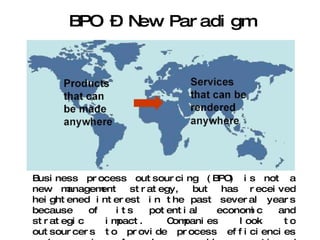
BPO – New Paradigm Business process outsourcing (BPO) is not a new management strategy, but has received heightened interest in the past several years because of its potential economic and strategic impact. Companies look to outsourcers to provide process efficiencies and economies of scale, as well as continued investment in the latest technology, which can be more effectively cost-justified when spread across multiple organizations.
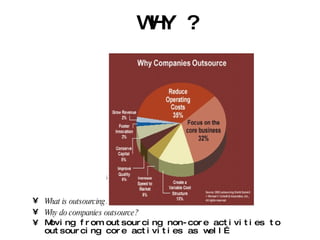
WHY ? What is outsourcing? Why do companies outsource? Moving from outsourcing non-core activities to outsourcing core activities as well…
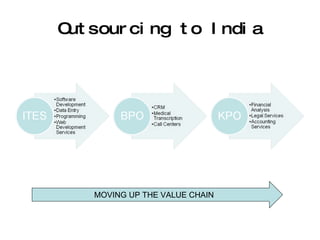
Outsourcing to India MOVING UP THE VALUE CHAIN
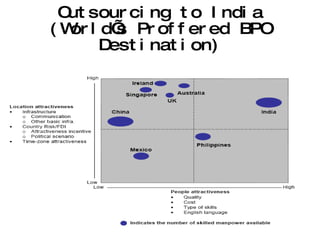
Outsourcing to India (World’s Proffered BPO Destination)
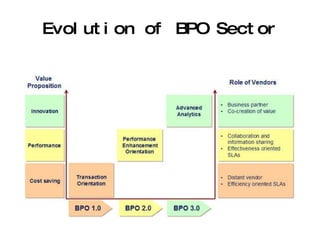
Evolution of BPO Sector
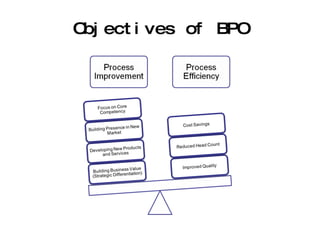
Objectives of BPO
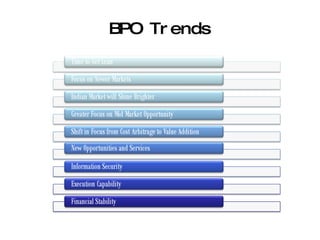
BPO Trends
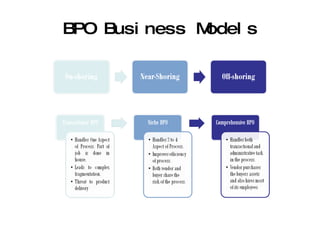
BPO Business Models
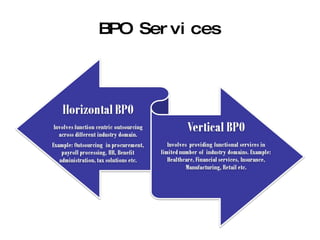
BPO Services
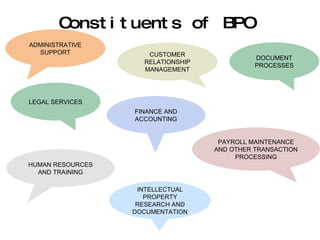
DOCUMENT PROCESSES HUMAN RESOURCES AND TRAINING ADMINISTRATIVE SUPPORT INTELLECTUAL PROPERTY RESEARCH AND DOCUMENTATION FINANCE AND ACCOUNTING PAYROLL MAINTENANCE AND OTHER TRANSACTION PROCESSING CUSTOMER RELATIONSHIP MANAGEMENT Constituents of BPO LEGAL SERVICES
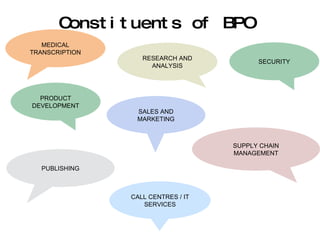
SECURITY PUBLISHING MEDICAL TRANSCRIPTION CALL CENTRES / IT SERVICES SALES AND MARKETING SUPPLY CHAIN MANAGEMENT RESEARCH AND ANALYSIS Constituents of BPO PRODUCT DEVELOPMENT
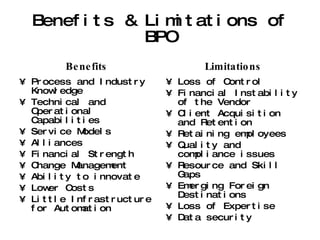
Benefits & Limitations of BPO Benefits Process and Industry Knowledge Technical and Operational Capabilities Service Models Alliances Financial Strength Change Management Ability to innovate Lower Costs Little Infrastructure for Automation Limitations Loss of Control Financial Instability of the Vendor Client Acquisition and Retention Retaining employees Quality and compliance issues Resource and Skill Gaps Emerging Foreign Destinations Loss of Expertise Data security
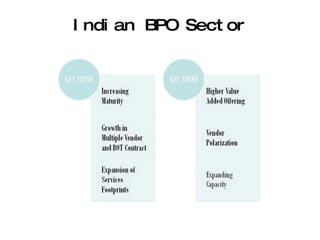
Indian BPO Sector
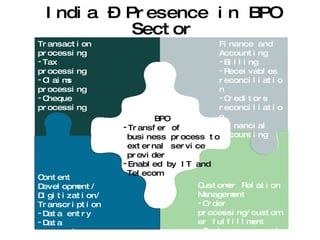
India – Presence in BPO Sector Content Development/ Digitization/ Transcription Data entry Data conversion Medical transcription BPO Transfer of business process to external service provider Enabled by IT and  Telecom Customer Relation Management Order processing/customer fulfillment Customer support Collection follow-up Telemarketing Finance and Accounting Billing Receivables reconciliation  Creditors reconciliation  Financial accounting Transaction processing Tax processing Claims processing Cheque processing
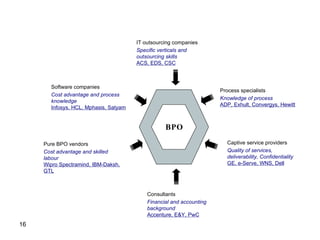
Captive service providers Quality of services, deliverability, Confidentiality  GE, e-Serve, WNS, Dell Process specialists Knowledge of process ADP, Exhult, Convergys, Hewitt IT outsourcing companies Specific verticals and outsourcing skills ACS, EDS, CSC Pure BPO vendors Cost advantage and skilled labour Wipro Spectramind, IBM-Daksh, GTL Software companies Cost advantage and process knowledge Infosys, HCL, Mphasis, Satyam Consultants Financial and accounting background Accenture, E&Y, PwC BPO Key BPO Players in India
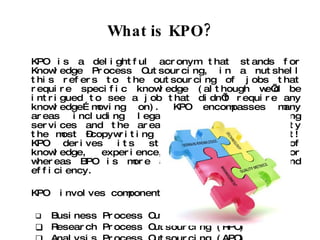
What is KPO? KPO is a delightful acronym that stands for Knowledge Process Outsourcing, in a nutshell this refers to the outsourcing of jobs that require specific knowledge (although we’d be intrigued to see a job that didn’t require any knowledge…moving on). KPO encompasses many areas including legal services, accounting services and the area that interests Clarity the most –copywriting and content development! KPO derives its strength from depth of knowledge, experience, and judgment factor whereas BPO is more about size, volume, and efficiency. KPO  involves components like: Business Process Outsourcing (BPO) Research Process Outsourcing (RPO) Analysis Process Outsourcing (APO)
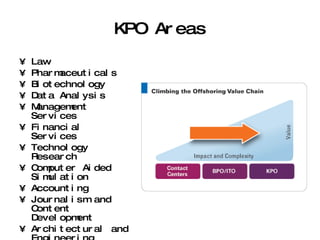
KPO Areas Law Pharmaceuticals Biotechnology Data Analysis Management Services Financial Services Technology Research Computer Aided Simulation Accounting Journalism and Content Development Architectural and Engineering Design Software Development English Translation
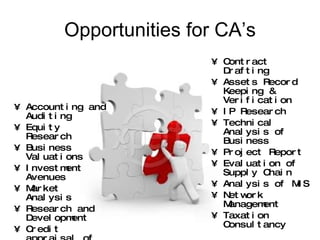
Opportunities for CA’s Accounting and Auditing Equity Research Business Valuations Investment Avenues Market Analysis Research and Development Credit appraisal of Customers Data Analytics Contract Drafting Assets Record Keeping & Verification IP Research Technical Analysis of Business Project Report Evaluation of Supply Chain Analysis of MIS Network Management Taxation Consultancy
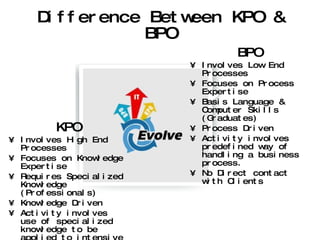
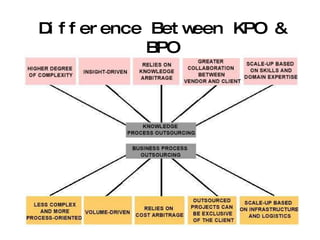
Difference Between KPO & BPO KPO Involves High End Processes Focuses on Knowledge Expertise Requires Specialized Knowledge (Professionals) Knowledge Driven  Activity involves use of specialized knowledge to be applied to intensive business processes. Direct Contact with Clients BPO Involves Low End Processes Focuses on Process Expertise Basis Language & Computer Skills (Graduates) Process Driven Activity involves predefined way of handling a business process. No Direct contact with Clients
Difference Between KPO & BPO
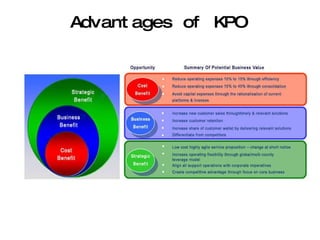
Advantages of KPO Perfection in work . The specialized peoples who are expert in working on a particular module execute projects. Cost effective . India has low labor cost compare to West that cuts approximately 70% of the project cost. Time zone advantages . Organizations can run there business 24 hours a day due to time difference. Save time and utilize it in other productive areas . Since you have outsourced your project, you can do a better time management and multiply the output of your time. A work force that is highly trained . You will be getting the advantage of capitalizing the resource of highly trained talented professionals at much lower cost. Fewer dependencies on your internal resources . You will have a second line of workers working for you, enable you gain more control over your business. Reduced overhead costs . Since the outsourcing service provider works remotely, you will save huge on day-to-day overheads. Free up your resources  and utilize them in areas that are more productive. Low risk, rapid transition , by distributing your risk you will have a better risk management. Lower the cost  of ongoing investment required in internal infrastructure. Increase flexibility  to meet changing business conditions. Obtain needed project management  and implementation consulting expertise, along with access to best practices and proven methodologies. Control of budget . You can carry out a well-controlled project within limitation of your budget. Leverage the provider's  extensive investments in technology, methodologies and people Reduce the overall IT management burden  while retaining control of strategic decision-making.
Advantages of KPO
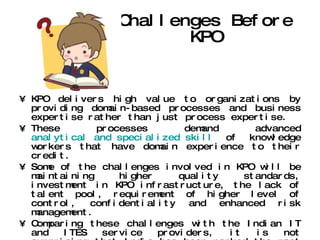
Challenges Before KPO KPO delivers high value to organizations by providing domain-based processes and business expertise rather than just process expertise.  These processes demand advanced  analytical and specialized skill  of knowledge workers that have domain experience to their credit.  Some of the challenges involved in KPO will be maintaining higher quality standards, investment in KPO infrastructure, the lack of talent pool, requirement of higher level of control, confidentiality and enhanced risk management.  Comparing these challenges with the Indian IT and ITES service providers, it is not surprising that India has been ranked the most preferred KPO outsourcing destination owing to the country's large talent pool, quality IT training, friendly government policies and low labor costs.  India is well equipped to meet this emerging sector's challenges and all set to be the global KPO hub .
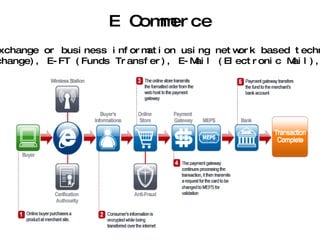
E Commerce Paperless exchange or business information using network based technologies.  Now we have E-DI (Data Interchange), E-FT (Funds Transfer), E-Mail (Electronic Mail), E-Cash, E-Stamp, E Commerce
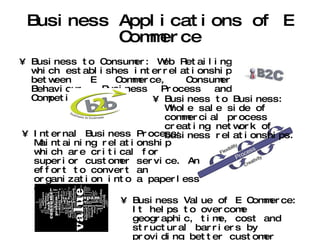
Business Applications of E Commerce Business to Consumer: Web Retailing which establishes interrelationship between E Commerce, Consumer Behaviour, Business Process and Competition. Business to Business: Whole sale side of commercial process creating network of business relationships. Internal Business Process: Maintaining relationship which are critical for superior customer service. An effort to convert an organization into a paperless office.  Business Value of E Commerce: It helps to overcome geographic, time, cost and structural barriers by providing better customer service, relationship through interactive marketing.
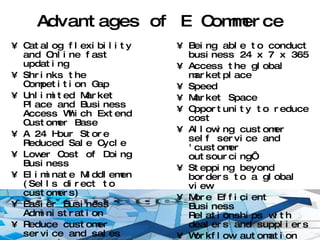
Advantages of E Commerce Catalog flexibility and Online fast updating Shrinks the Competition Gap Unlimited Market Place and Business Access Which Extend Customer Base A 24 Hour Store Reduced Sale Cycle Lower Cost of Doing Business Eliminate Middlemen (Sells direct to customers) Easier Business Administration Reduce customer service and sales support.  Customers will love it. Builds loyalty.  Reach remote location Being able to conduct business 24 x 7 x 365 Access the global marketplace Speed Market Space Opportunity to reduce cost Allowing customer self service and 'customer outsourcing‘ Stepping beyond borders to a global view More Efficient Business Relationships with dealers and suppliers Workflow automation Secure Payment Systems
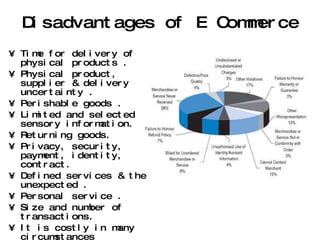
Disadvantages of E Commerce Time for delivery of physical products .  Physical product, supplier & delivery uncertainty .  Perishable goods .  Limited and selected sensory information.  Returning goods.  Privacy, security, payment, identity, contract.  Defined services & the unexpected .  Personal service .  Size and number of transactions.  It is costly in many circumstances Quality and quantity of product cannot be estimated in real value.
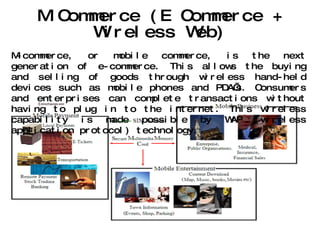
M Commerce (E Commerce + Wireless Web) M-commerce, or mobile commerce, is the next generation of e-commerce. This allows the buying and selling of goods through wireless hand-held devices such as mobile phones and PDA’s. Consumers and enterprises can complete transactions without having to plug in to the internet. This wireless capability is made possible by WAP (wireless application protocol) technology.
Definition of Mobile Business  “ Mobile business" could be described as the utilization of mobile technologies to maintain, improve or extend existing business processes and relationships or to develop new business segments.  Alternatively, "mobile business" could also include all activities, processes and applications which are realized or supported by mobile technologies. According to this aspect, "mobile business" can be defined as all types of business applications with the use of mobile devices. In addition has to be said that mobile business focuses on the procurement, processing and provision of any type of information. Incidentally, mobile business applications are not restricted to mobile phones, instead they include other mobile devices like smart phones and PDAs (Personal Digital Assistant).  However, "mobile commerce" focuses on processing a transaction and is therefore only a part of m-business.  m-commerce is a subset of e-commerce enabled by wireless communication
M Commerce Applications First,  convenience  is an attribute that characterizes a mobile device because of the easy use, accessibility and the ability of storing data.  Second,  ubiquity  and  reachability  are other advantages of wireless terminals: the user receive real-time information and can communicate from any location. Time critical needs can be satisfied by the short, to-the-point interactions of m-commerce. Third, SIM or Smart cards that are used in mobile devices facilitate a  higher level of security  than is presently realized in the fixed internet environment. Personalization  will be possible as per individual needs. Flexibility  and  Ease  in transaction process will increase utility for user. Localization  by providing access to local information and services (GPS Data). In addition, m-commerce opens the door to a number of  new services and applications  that would be simply inconceivable from a desktop PC.
 

NEW METHODS OF COMMERCE - Snap Shots

  • 1.
    NEW MODES OFCOMMERCE - SNAP SHOT Dr. Prashant Mehta Assistant Professor, National Law University, Jodhpur Email; prashantmehta1@rediffmail.com
  • 2.
    BPO – NewParadigm Business process outsourcing (BPO) is not a new management strategy, but has received heightened interest in the past several years because of its potential economic and strategic impact. Companies look to outsourcers to provide process efficiencies and economies of scale, as well as continued investment in the latest technology, which can be more effectively cost-justified when spread across multiple organizations.
  • 3.
    WHY ? Whatis outsourcing? Why do companies outsource? Moving from outsourcing non-core activities to outsourcing core activities as well…
  • 4.
    Outsourcing to IndiaMOVING UP THE VALUE CHAIN
  • 5.
    Outsourcing to India(World’s Proffered BPO Destination)
  • 6.
  • 7.
  • 8.
  • 9.
  • 10.
  • 11.
    DOCUMENT PROCESSES HUMANRESOURCES AND TRAINING ADMINISTRATIVE SUPPORT INTELLECTUAL PROPERTY RESEARCH AND DOCUMENTATION FINANCE AND ACCOUNTING PAYROLL MAINTENANCE AND OTHER TRANSACTION PROCESSING CUSTOMER RELATIONSHIP MANAGEMENT Constituents of BPO LEGAL SERVICES
  • 12.
    SECURITY PUBLISHING MEDICALTRANSCRIPTION CALL CENTRES / IT SERVICES SALES AND MARKETING SUPPLY CHAIN MANAGEMENT RESEARCH AND ANALYSIS Constituents of BPO PRODUCT DEVELOPMENT
  • 13.
    Benefits & Limitationsof BPO Benefits Process and Industry Knowledge Technical and Operational Capabilities Service Models Alliances Financial Strength Change Management Ability to innovate Lower Costs Little Infrastructure for Automation Limitations Loss of Control Financial Instability of the Vendor Client Acquisition and Retention Retaining employees Quality and compliance issues Resource and Skill Gaps Emerging Foreign Destinations Loss of Expertise Data security
  • 14.
  • 15.
    India – Presencein BPO Sector Content Development/ Digitization/ Transcription Data entry Data conversion Medical transcription BPO Transfer of business process to external service provider Enabled by IT and Telecom Customer Relation Management Order processing/customer fulfillment Customer support Collection follow-up Telemarketing Finance and Accounting Billing Receivables reconciliation Creditors reconciliation Financial accounting Transaction processing Tax processing Claims processing Cheque processing
  • 16.
    Captive service providersQuality of services, deliverability, Confidentiality GE, e-Serve, WNS, Dell Process specialists Knowledge of process ADP, Exhult, Convergys, Hewitt IT outsourcing companies Specific verticals and outsourcing skills ACS, EDS, CSC Pure BPO vendors Cost advantage and skilled labour Wipro Spectramind, IBM-Daksh, GTL Software companies Cost advantage and process knowledge Infosys, HCL, Mphasis, Satyam Consultants Financial and accounting background Accenture, E&Y, PwC BPO Key BPO Players in India
  • 17.
    What is KPO?KPO is a delightful acronym that stands for Knowledge Process Outsourcing, in a nutshell this refers to the outsourcing of jobs that require specific knowledge (although we’d be intrigued to see a job that didn’t require any knowledge…moving on). KPO encompasses many areas including legal services, accounting services and the area that interests Clarity the most –copywriting and content development! KPO derives its strength from depth of knowledge, experience, and judgment factor whereas BPO is more about size, volume, and efficiency. KPO involves components like: Business Process Outsourcing (BPO) Research Process Outsourcing (RPO) Analysis Process Outsourcing (APO)
  • 18.
    KPO Areas LawPharmaceuticals Biotechnology Data Analysis Management Services Financial Services Technology Research Computer Aided Simulation Accounting Journalism and Content Development Architectural and Engineering Design Software Development English Translation
  • 19.
    Opportunities for CA’sAccounting and Auditing Equity Research Business Valuations Investment Avenues Market Analysis Research and Development Credit appraisal of Customers Data Analytics Contract Drafting Assets Record Keeping & Verification IP Research Technical Analysis of Business Project Report Evaluation of Supply Chain Analysis of MIS Network Management Taxation Consultancy
  • 20.
    Difference Between KPO& BPO KPO Involves High End Processes Focuses on Knowledge Expertise Requires Specialized Knowledge (Professionals) Knowledge Driven Activity involves use of specialized knowledge to be applied to intensive business processes. Direct Contact with Clients BPO Involves Low End Processes Focuses on Process Expertise Basis Language & Computer Skills (Graduates) Process Driven Activity involves predefined way of handling a business process. No Direct contact with Clients
  • 21.
  • 22.
    Advantages of KPOPerfection in work . The specialized peoples who are expert in working on a particular module execute projects. Cost effective . India has low labor cost compare to West that cuts approximately 70% of the project cost. Time zone advantages . Organizations can run there business 24 hours a day due to time difference. Save time and utilize it in other productive areas . Since you have outsourced your project, you can do a better time management and multiply the output of your time. A work force that is highly trained . You will be getting the advantage of capitalizing the resource of highly trained talented professionals at much lower cost. Fewer dependencies on your internal resources . You will have a second line of workers working for you, enable you gain more control over your business. Reduced overhead costs . Since the outsourcing service provider works remotely, you will save huge on day-to-day overheads. Free up your resources and utilize them in areas that are more productive. Low risk, rapid transition , by distributing your risk you will have a better risk management. Lower the cost of ongoing investment required in internal infrastructure. Increase flexibility to meet changing business conditions. Obtain needed project management and implementation consulting expertise, along with access to best practices and proven methodologies. Control of budget . You can carry out a well-controlled project within limitation of your budget. Leverage the provider's extensive investments in technology, methodologies and people Reduce the overall IT management burden while retaining control of strategic decision-making.
  • 23.
  • 24.
    Challenges Before KPOKPO delivers high value to organizations by providing domain-based processes and business expertise rather than just process expertise. These processes demand advanced analytical and specialized skill of knowledge workers that have domain experience to their credit. Some of the challenges involved in KPO will be maintaining higher quality standards, investment in KPO infrastructure, the lack of talent pool, requirement of higher level of control, confidentiality and enhanced risk management. Comparing these challenges with the Indian IT and ITES service providers, it is not surprising that India has been ranked the most preferred KPO outsourcing destination owing to the country's large talent pool, quality IT training, friendly government policies and low labor costs. India is well equipped to meet this emerging sector's challenges and all set to be the global KPO hub .
  • 25.
    E Commerce Paperlessexchange or business information using network based technologies. Now we have E-DI (Data Interchange), E-FT (Funds Transfer), E-Mail (Electronic Mail), E-Cash, E-Stamp, E Commerce
  • 26.
    Business Applications ofE Commerce Business to Consumer: Web Retailing which establishes interrelationship between E Commerce, Consumer Behaviour, Business Process and Competition. Business to Business: Whole sale side of commercial process creating network of business relationships. Internal Business Process: Maintaining relationship which are critical for superior customer service. An effort to convert an organization into a paperless office. Business Value of E Commerce: It helps to overcome geographic, time, cost and structural barriers by providing better customer service, relationship through interactive marketing.
  • 27.
    Advantages of ECommerce Catalog flexibility and Online fast updating Shrinks the Competition Gap Unlimited Market Place and Business Access Which Extend Customer Base A 24 Hour Store Reduced Sale Cycle Lower Cost of Doing Business Eliminate Middlemen (Sells direct to customers) Easier Business Administration Reduce customer service and sales support. Customers will love it. Builds loyalty. Reach remote location Being able to conduct business 24 x 7 x 365 Access the global marketplace Speed Market Space Opportunity to reduce cost Allowing customer self service and 'customer outsourcing‘ Stepping beyond borders to a global view More Efficient Business Relationships with dealers and suppliers Workflow automation Secure Payment Systems
  • 28.
    Disadvantages of ECommerce Time for delivery of physical products . Physical product, supplier & delivery uncertainty . Perishable goods . Limited and selected sensory information. Returning goods. Privacy, security, payment, identity, contract. Defined services & the unexpected . Personal service . Size and number of transactions. It is costly in many circumstances Quality and quantity of product cannot be estimated in real value.
  • 29.
    M Commerce (ECommerce + Wireless Web) M-commerce, or mobile commerce, is the next generation of e-commerce. This allows the buying and selling of goods through wireless hand-held devices such as mobile phones and PDA’s. Consumers and enterprises can complete transactions without having to plug in to the internet. This wireless capability is made possible by WAP (wireless application protocol) technology.
  • 30.
    Definition of MobileBusiness “ Mobile business" could be described as the utilization of mobile technologies to maintain, improve or extend existing business processes and relationships or to develop new business segments. Alternatively, "mobile business" could also include all activities, processes and applications which are realized or supported by mobile technologies. According to this aspect, "mobile business" can be defined as all types of business applications with the use of mobile devices. In addition has to be said that mobile business focuses on the procurement, processing and provision of any type of information. Incidentally, mobile business applications are not restricted to mobile phones, instead they include other mobile devices like smart phones and PDAs (Personal Digital Assistant). However, "mobile commerce" focuses on processing a transaction and is therefore only a part of m-business. m-commerce is a subset of e-commerce enabled by wireless communication
  • 31.
    M Commerce ApplicationsFirst, convenience is an attribute that characterizes a mobile device because of the easy use, accessibility and the ability of storing data. Second, ubiquity and reachability are other advantages of wireless terminals: the user receive real-time information and can communicate from any location. Time critical needs can be satisfied by the short, to-the-point interactions of m-commerce. Third, SIM or Smart cards that are used in mobile devices facilitate a higher level of security than is presently realized in the fixed internet environment. Personalization will be possible as per individual needs. Flexibility and Ease in transaction process will increase utility for user. Localization by providing access to local information and services (GPS Data). In addition, m-commerce opens the door to a number of new services and applications that would be simply inconceivable from a desktop PC.
  • 32.