Convergence in contemporary media
Saikat Chatterjee
Definition of Media convergence
With time & technological development, the
traditional media has evolved and joined hands
with the new media.
Why converge?
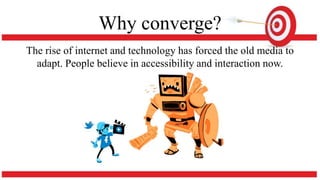
The rise of internet and technology has forced the old media to
adapt. People believe in accessibility and interaction now.
Difference between new & old media
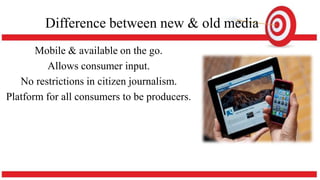
Mobile & available on the go.
Allows consumer input.
No restrictions in citizen journalism.
Platform for all consumers to be producers.
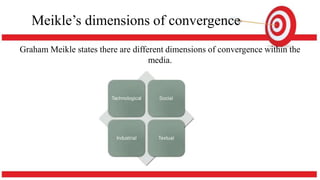
Meikle’s dimensions of convergence
Graham Meikle states there are different dimensions of convergence within the
media.
Jenkins on Convergence
Henry Jenkins argues there are four types of
convergence – Technological, Social, Cultural and
Economical.
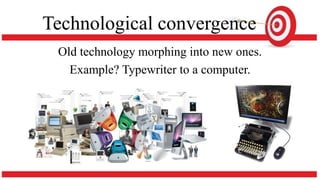
Technological convergence
Old technology morphing into new ones.
Example? Typewriter to a computer.
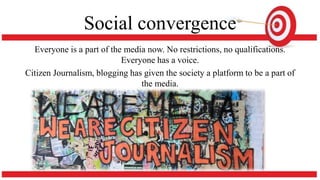
Social convergence
Everyone is a part of the media now. No restrictions, no qualifications.
Everyone has a voice.
Citizen Journalism, blogging has given the society a platform to be a part of
the media.
Economical convergence
Less effort, more outreach. Going digital has helped organisations with
promotion & advertising. Example – Film promotion across continents.
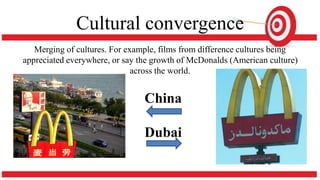
Cultural convergence
Merging of cultures. For example, films from difference cultures being
appreciated everywhere, or say the growth of McDonalds (American culture)
across the world.
China
Dubai
Critically defining convergence
“The flow of content across multiple media platforms, the cooperation
between multiple media industries and the migratory behavior of media
audiences who will go almost anywhere in search of the kinds of entertainment
experiences they want [...] Convergence is a word that manages to describe
technological, industrial, cultural and social changes [...] (Henry Jenkins,2006)
“The ‘ coming together ’ of previously separate industries (computing,
printing, film, audio etc.) which increasingly use the same or related
technology and skilled workers. A feature of the contemporary media
environment, convergence is a product of mergers between companies in
different sectors as well as an outcome of technological development.
(Branston and Stafford, 2010 )
Advantages of media convergence
Low cost of production
Greater outreach
Easily available information
Better media experience
Disadvantages of Media convergence
Information overload
Questionable accuracy of information
Requires tech-savvy audience
Conclusion
Media will continue to evolve with the help of
technology and the internet.
Traditional media may not necessarily die, but
they will continue to adapt for survival.
Digitisation & globalisation growth to continue.
Bibliography
Jenkins, H. (2004). The cultural logic of media convergence. International
journal of cultural studies, 7(1), 33-43.
Jenkins, H. (2001). Convergence? I diverge. Technology review, 104(5), 93.
Meikle, G., & Young, S. (2012). Media convergence: Networked digital media
in everyday life
Jenkins, H. (2006). Convergence culture: Where old and new media collide.
NYU press.fe. Basingstoke: Palgrave Macmillan.
Wirth, M. O. (2006). Issues in media convergence. Handbook of media
management and economics, 445-462.

Saikatpptshow

  • 1.
    Convergence in contemporarymedia Saikat Chatterjee
  • 2.
    Definition of Mediaconvergence With time & technological development, the traditional media has evolved and joined hands with the new media.
  • 3.
    Why converge? The riseof internet and technology has forced the old media to adapt. People believe in accessibility and interaction now.
  • 4.
    Difference between new& old media Mobile & available on the go. Allows consumer input. No restrictions in citizen journalism. Platform for all consumers to be producers.
  • 5.
    Meikle’s dimensions ofconvergence Graham Meikle states there are different dimensions of convergence within the media.
  • 6.
    Jenkins on Convergence HenryJenkins argues there are four types of convergence – Technological, Social, Cultural and Economical.
  • 7.
    Technological convergence Old technologymorphing into new ones. Example? Typewriter to a computer.
  • 8.
    Social convergence Everyone isa part of the media now. No restrictions, no qualifications. Everyone has a voice. Citizen Journalism, blogging has given the society a platform to be a part of the media.
  • 9.
    Economical convergence Less effort,more outreach. Going digital has helped organisations with promotion & advertising. Example – Film promotion across continents.
  • 10.
    Cultural convergence Merging ofcultures. For example, films from difference cultures being appreciated everywhere, or say the growth of McDonalds (American culture) across the world. China Dubai
  • 11.
    Critically defining convergence “Theflow of content across multiple media platforms, the cooperation between multiple media industries and the migratory behavior of media audiences who will go almost anywhere in search of the kinds of entertainment experiences they want [...] Convergence is a word that manages to describe technological, industrial, cultural and social changes [...] (Henry Jenkins,2006) “The ‘ coming together ’ of previously separate industries (computing, printing, film, audio etc.) which increasingly use the same or related technology and skilled workers. A feature of the contemporary media environment, convergence is a product of mergers between companies in different sectors as well as an outcome of technological development. (Branston and Stafford, 2010 )
  • 12.
    Advantages of mediaconvergence Low cost of production Greater outreach Easily available information Better media experience
  • 13.
    Disadvantages of Mediaconvergence Information overload Questionable accuracy of information Requires tech-savvy audience
  • 14.
    Conclusion Media will continueto evolve with the help of technology and the internet. Traditional media may not necessarily die, but they will continue to adapt for survival. Digitisation & globalisation growth to continue.
  • 15.
    Bibliography Jenkins, H. (2004).The cultural logic of media convergence. International journal of cultural studies, 7(1), 33-43. Jenkins, H. (2001). Convergence? I diverge. Technology review, 104(5), 93. Meikle, G., & Young, S. (2012). Media convergence: Networked digital media in everyday life Jenkins, H. (2006). Convergence culture: Where old and new media collide. NYU press.fe. Basingstoke: Palgrave Macmillan. Wirth, M. O. (2006). Issues in media convergence. Handbook of media management and economics, 445-462.