“ Earth tones made easy “
NOVACRON® NC
Advances in reactive dyes
Textile EffectsResearch & Technology /JMS C.O.C Mumbai, February 2009
NOVACRON® NC reactive
dyes
Convention on Colors
Mumbai, February 2009
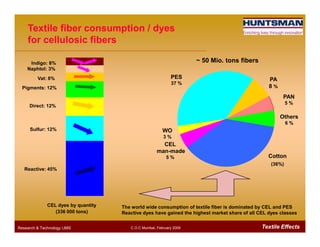
Textile fiber consumption / dyesTextile fiber consumption / dyes
for cellulosic fibersfor cellulosic fibers
Direct: 12%
Pigments: 12%
Vat: 8%
Naphtol: 3%
Indigo: 8% ~ 50 Mio. tons fibers
PES
37 %
PAN
5 %
PA
8 %
Others
6 %
Textile EffectsResearch & Technology /JMS C.O.C Mumbai, February 2009
The world wide consumption of textile fiber is dominated by CEL and PES
Reactive dyes have gained the highest market share of all CEL dyes classes
CEL dyes by quantity
(336 000 tons)
Reactive: 45%
Sulfur: 12%
Cotton
(36%)
6 %
WO
3 %
CEL
man-made
5 %
Major causes for market shareMajor causes for market share
increase of reactive dyesincrease of reactive dyes
• Substantial increase in cotton consumption
in recent years
• Concern about some technical/ environmental
drawbacks of alternative dyeing methods and
Textile EffectsResearch & Technology /JMS C.O.C Mumbai, February 2009
drawbacks of alternative dyeing methods and
dyestuffs classes
• Strong demand for bright and deep shades
• Convenient, simple economical dyeing methods
Characteristics of reactive dyesCharacteristics of reactive dyes
(1965(1965--1975)1975)
Strengths:Strengths:
•• Wide shade spectrumWide shade spectrum
•• Excellent brightnessExcellent brightness
•• Acceptable wet fastness levelAcceptable wet fastness level
•• Suitability for all application methodsSuitability for all application methods
Textile EffectsResearch & Technology /JMS C.O.C Mumbai, February 2009
•• high amounts of salt and long dyeing cycles (exhaust)high amounts of salt and long dyeing cycles (exhaust)
•• low degree of fixationlow degree of fixation
•• need for long washingneed for long washing--off cyclesoff cycles
•• moderate light, wetmoderate light, wet--light, gas fading, photochromylight, gas fading, photochromy
issues and poor chlorine fastness in some shadesissues and poor chlorine fastness in some shades
•• Lack of reproducibility in critical shadesLack of reproducibility in critical shades
WeaknessesWeaknesses
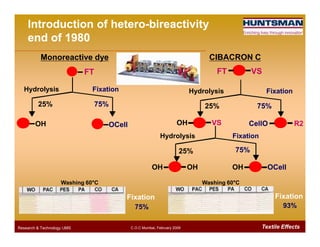
Monoreactive dye
FT
Hydrolysis Fixation
75%
OCell
25%
OH
Hydrolysis Fixation
75%
CellO R2
25%
OH VS
FT VS
CIBACRON C
Introduction of heteroIntroduction of hetero--bireactivitybireactivity
end of 1980end of 1980
Textile EffectsResearch & Technology /JMS C.O.C Mumbai, February 2009
OCellOH
FixationHydrolysis
OH OCell
75%
OH OH
25%
CellO R2OH VS
Washing 60°°°°CWashing 60°°°°C
75%
Fixation
93%
Fixation
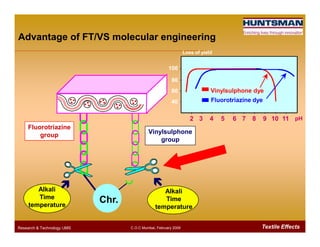
2 3 4 5 6 7 8 9 10 11
100
80
60
40
pH
Loss of yield
Vinylsulphone dye
Fluorotriazine dye
Fluorotriazine
Advantage of FT/VS molecular engineering
Textile EffectsResearch & Technology /JMS C.O.C Mumbai, February 2009
Alkali
Time
temperature
Fluorotriazine
group Vinylsulphone
group

Chr.
Alkali
Time
temperature
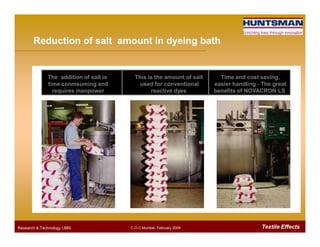
The addition of salt is
time conmsuming and
requires manpower
This is the amount of salt
used for conventional
reactive dyes
Time and cost saving,
easier handling - The great
benefits of NOVACRON LS
Reduction of salt amount in dyeing bathReduction of salt amount in dyeing bath
Textile EffectsResearch & Technology /JMS C.O.C Mumbai, February 2009
N N
N
S
S
O
O
OH
O
O
OH
N
N
NH
R2
N
H
R1
N
H
O
N N
N
S
S
O
OH O
O
OH O
N
N
NH
O
N
H
N
H
R1
R2
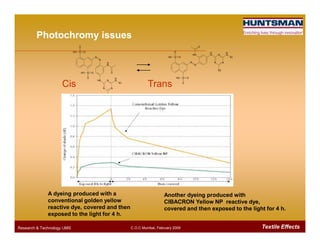
CisCis TransTrans
Photochromy issuesPhotochromy issues
Textile EffectsResearch & Technology /JMS C.O.C Mumbai, February 2009
A dyeing produced with a
conventional golden yellow
reactive dye, covered and then
exposed to the light for 4 h.
Another dyeing produced with
CIBACRON Yellow NP reactive dye,
covered and then exposed to the light for 4 h.
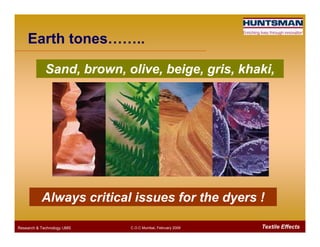
Earth tones……..
Sand, brown, olive, beige, gris, khaki,
Textile EffectsResearch & Technology /JMS C.O.C Mumbai, February 2009
Always critical issues for the dyers !
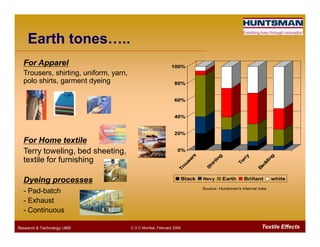
Earth tones…..
For Apparel
Trousers, shirting, uniform, yarn,
polo shirts, garment dyeing
40%
60%
80%
100%
Textile EffectsResearch & Technology /JMS C.O.C Mumbai, February 2009
For Home textile
Terry toweling, bed sheeting,
textile for furnishing
Dyeing processes
- Pad-batch
- Exhaust
- Continuous
0%
20%
Trousers
S
hirting
Terry
B
edding
Source: Huntsman's internal data
Black Navy Earth Brillant white
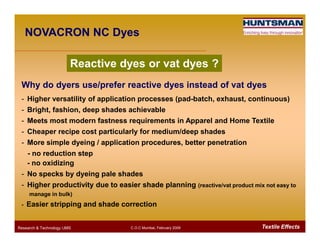
Reactive dyes or vat dyes ?
Why do dyers use/prefer reactive dyes instead of vat dyes
- Higher versatility of application processes (pad-batch, exhaust, continuous)
- Bright, fashion, deep shades achievable
- Meets most modern fastness requirements in Apparel and Home Textile
NOVACRON NC Dyes
Textile EffectsResearch & Technology /JMS C.O.C Mumbai, February 2009
- Meets most modern fastness requirements in Apparel and Home Textile
- Cheaper recipe cost particularly for medium/deep shades
- More simple dyeing / application procedures, better penetration
- no reduction step
- no oxidizing
- No specks by dyeing pale shades
- Higher productivity due to easier shade planning (reactive/vat product mix not easy to
manage in bulk)
- Easier stripping and shade correction
Use of vat dyes
Especially for dyeing pale and medium shades, and
when the brightness is not an issue
For what shades do the dyers prefer using vat dyes?
Apparel and Home textiles
Textile EffectsResearch & Technology /JMS C.O.C Mumbai, February 2009
Reasons .........
The reproducibility of vat dyes is much better but care
must be taken to application conditions (dispersing,
steaming, rinsing, oxidizing, soaping)
The fastness requirement are fulfiled
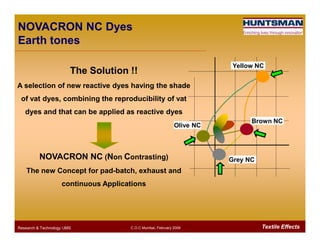
The Solution !!
A selection of new reactive dyes having the shade
of vat dyes, combining the reproducibility of vat
dyes and that can be applied as reactive dyes
NOVACRON NC Dyes
Earth tones
Olive NC
Yellow NC
Brown NC
Textile EffectsResearch & Technology /JMS C.O.C Mumbai, February 2009
NOVACRON NC (Non Contrasting)
The new Concept for pad-batch, exhaust and
continuous Applications
Olive NC
Brown NC
Grey NC
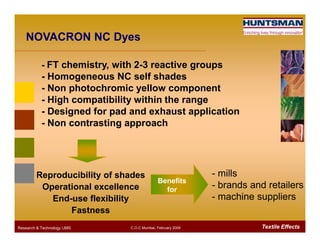
- FT chemistry, with 2-3 reactive groups
- Homogeneous NC self shades
- Non photochromic yellow component
- High compatibility within the range
- Designed for pad and exhaust application
- Non contrasting approach
NOVACRON NC Dyes
Textile EffectsResearch & Technology /JMS C.O.C Mumbai, February 2009
- Non contrasting approach
Reproducibility of shades
Operational excellence
End-use flexibility
Fastness
- mills
- brands and retailers
- machine suppliers
Benefits
for
Yellow
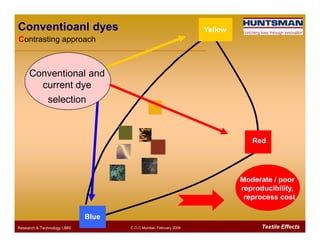
Conventional and
current dye
selection
Contrasting approach
Conventioanl dyes
Textile EffectsResearch & Technology /JMS C.O.C Mumbai, February 2009
Blue
Red
Moderate / poor
reproducibility,
reprocess cost
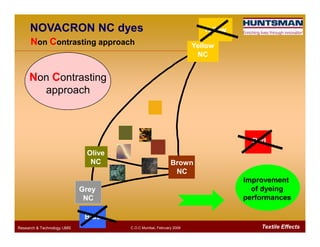
Yellow
Yellow
NC
Non Contrasting
approach
Non Contrasting approach
NOVACRON NC dyes
Textile EffectsResearch & Technology /JMS C.O.C Mumbai, February 2009
ImprovementImprovement
of dyeingof dyeing
performancesperformances
N
Olive
NC
Grey
NC
Brown
NC
Red
Blue
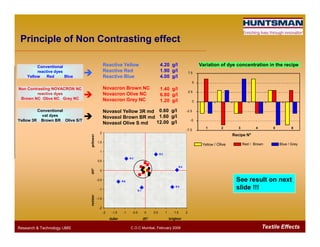
Reactive Yellow
Reactive Red
Reactive Blue
Novacron Brown NC
Novacron Olive NC
Novacron Grey NC
Novasol Yellow 3R md
Novasol Brown BR md
Novasol Olive S md
Conventional
reactive dyes
Yellow Red Blue
Non Contrasting NOVACRON NC
reactive dyes
Brown NC Olive NC Grey NC
Conventional
vat dyes
Yellow 3R Brown BR Olive S/T
Variation of dye concentration in the recipe
-5
-2.5
0
2.5
5
7.5
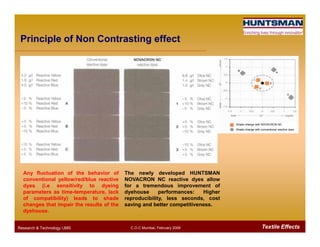
Principle of Non Contrasting effect
4.20 g/l
1.90 g/l
4.00 g/l
1.40 g/l
6.80 g/l
1.20 g/l
0.60 g/l
1.60 g/l
12.00 g/l
Textile EffectsResearch & Technology /JMS C.O.C Mumbai, February 2009
R 6
R 5
R 4
R 3
R 2
R 1
-2
-1.5
-1
-0.5
0
0.5
1
1.5
2
-2 -1.5 -1 -0.5 0 0.5 1 1.5 2
duller dC* brighter
redderdH*yellower
Novasol Olive S md
1 2 3 4 5 6
Recipe N°°°°
-7.5
Yellow / Olive Red / Brown Blue / Grey
See result on next
slide !!!
12.00 g/l
Principle of Non Contrasting effect
Shade change with NOVACRON NC
Textile EffectsResearch & Technology /JMS C.O.C Mumbai, February 2009
Any fluctuation of the behavior of
conventional yellow/red/blue reactive
dyes (i.e sensitivity to dyeing
parameters as time-temperature, lack
of compatibility) leads to shade
changes that impair the results of the
dyehouse.
The newly developed HUNTSMAN
NOVACRON NC reactive dyes allow
for a tremendous improvement of
dyehouse performances: Higher
reproducibility, less seconds, cost
saving and better competitiveness.
Shade change with NOVACRON NC
Shade change with conventional reactive dyes
-0,5
0
0,5
1
1,5
2
2,5
3
redderdH*yellower
0
0,5
1
1,5
2
redderdH*yellower
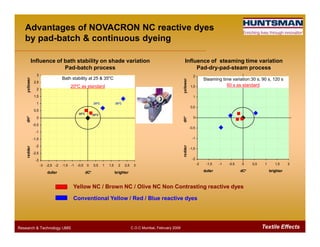
Influence of bath stability on shade variation
Pad-batch process
Influence of steaming time variation
Pad-dry-pad-steam process
25o
C35o
C
25o
C 35o
C
Steaming time variation:30 s, 90 s, 120 s
60 s as standard
Bath stability at 25 & 35o
C
20o
C as standard
Advantages of NOVACRON NC reactive dyes
by pad-batch & continuous dyeing
Textile EffectsResearch & Technology /JMS C.O.C Mumbai, February 2009
-3
-2,5
-2
-1,5
-1
-0,5
-3 -2,5 -2 -1,5 -1 -0,5 0 0,5 1 1,5 2 2,5 3
duller dC* brighter
redderdH*yellower
-2
-1,5
-1
-0,5
-2 -1,5 -1 -0,5 0 0,5 1 1,5 2
duller dC* brighter
redderdH*yellower
Yellow NC / Brown NC / Olive NC Non Contrasting reactive dyes
Conventional Yellow / Red / Blue reactive dyes
Advantages of NOVACRON NC reactive dyes
by exhaust dyeing
0,8
1
Shadevariation(dE)
Standard conditions
0.036 % Novacron Yellow NC
0.020 % Novacron Brown NC
0.123 % Novacron Olive NC
30 g/l common saltsal
10 g/l soda ash
LR: 1/10
300 kg single jersey
Influence of dyeing parameters fluctuations on
shade reproducibility
Textile EffectsResearch & Technology /JMS C.O.C Mumbai, February 2009
0
0,2
0,4
0,6
Shadevariation(dE)
Liquor ratio
1/6-1/12
Salt amount
+20% -20%
Fixation time
+15 min -15 min
Fixation temp.
+5° -5°
300 kg single jersey
Isotherm process, 60°°°°
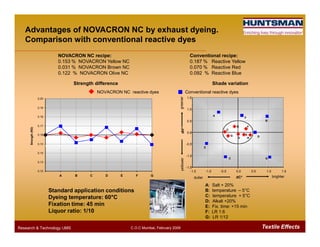
Advantages of NOVACRON NC by exhaust dyeing.
Comparison with conventional reactive dyes
0.18
0.19
0.20
0.5
1.0
1.5
greener
A
B
F
NOVACRON NC reactive dyes
Shade variationStrength difference
Conventional reactive dyes
NOVACRON NC recipe:
0.153 % NOVACRON Yellow NC
0.031 % NOVACRON Brown NC
0.122 % NOVACRON Olive NC
Conventional recipe:
0.187 % Reactive Yellow
0.070 % Reactive Red
0.092 % Reactive Blue
Textile EffectsResearch & Technology /JMS C.O.C Mumbai, February 2009
0.12
0.13
0.14
0.15
0.16
0.17
A B C D E F G
Strength(RD)
F
E
B
D
C
A
G
-1.5
-1.0
-0.5
0.0
-1.5 -1.0 -0.5 0.0 0.5 1.0 1.5
dC*
dH*yellower
brighterduller
C
D
E
G
A: Salt + 20%
B: temperature – 5°C
C: temperature + 5°C
D: Alkali +20%
E: Fix. time: +15 min
F: LR 1:6
G: LR 1/12
Standard application conditions
Dyeing temperature: 60°°°°C
Fixation time: 45 min
Liquor ratio: 1/10
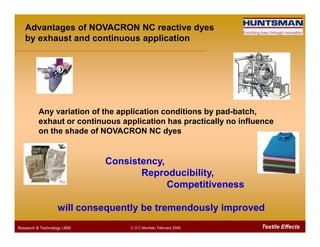
Any variation of the application conditions by pad-batch,
exhaut or continuous application has practically no influence
Advantages of NOVACRON NC reactive dyes
by exhaust and continuous application
Textile EffectsResearch & Technology /JMS C.O.C Mumbai, February 2009
exhaut or continuous application has practically no influence
on the shade of NOVACRON NC dyes
Consistency,
Reproducibility,
Competitiveness
will consequently be tremendously improved
NOVACRON NC Dyes
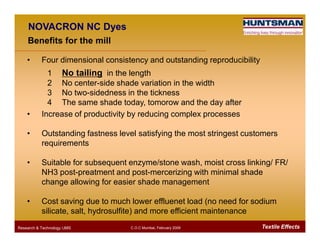
Benefits for the mill
• Four dimensional consistency and outstanding reproducibility
1 No tailing in the length
2 No center-side shade variation in the width
3 No two-sidedness in the tickness
4 The same shade today, tomorow and the day after
• Increase of productivity by reducing complex processes
Textile EffectsResearch & Technology /JMS C.O.C Mumbai, February 2009
• Outstanding fastness level satisfying the most stringest customers
requirements
• Suitable for subsequent enzyme/stone wash, moist cross linking/ FR/
NH3 post-preatment and post-mercerizing with minimal shade
change allowing for easier shade management
• Cost saving due to much lower effluenet load (no need for sodium
silicate, salt, hydrosulfite) and more efficient maintenance
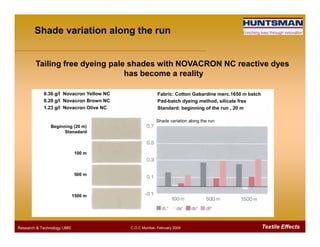
Shade variation along the run
Tailing free dyeing pale shades with NOVACRON NC reactive dyes
has become a reality
Fabric: Cotton Gabardine merc.1650 m batch
Pad-batch dyeing method, silicate free
Standard: beginning of the run , 20 m
Shade variation along the run
0.36 g/l Novacron Yellow NC
0.20 g/l Novacron Brown NC
1.23 g/l Novacron Olive NC
Textile EffectsResearch & Technology /JMS C.O.C Mumbai, February 2009
Beginning (20 m)
Stanadard
100 m
500 m
1500 m
NOVACRON NC reactive dyes
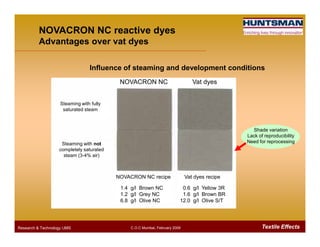
Advantages over vat dyes
Influence of steaming and development conditions
Steaming with fully
saturated steam
NOVACRON NC Vat dyes
Textile EffectsResearch & Technology /JMS C.O.C Mumbai, February 2009
Steaming with not
completely saturated
steam (3-4% air)
NOVACRON NC recipe
1.4 g/l Brown NC
1.2 g/l Grey NC
6.8 g/l Olive NC
Vat dyes recipe
0.6 g/l Yellow 3R
1.6 g/l Brown BR
12.0 g/l Olive S/T
Shade variation
Lack of reproducibility
Need for reprocessing
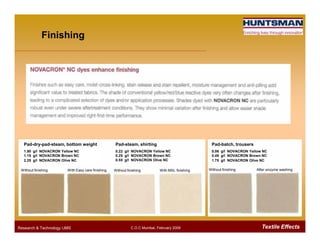
Finishing
Textile EffectsResearch & Technology /JMS C.O.C Mumbai, February 2009
Pad-dry-pad-steam, bottom weight
1.90 g/l NOVACRON Yellow NC
1.15 g/l NOVACRON Brown NC
2.25 g/l NOVACRON Olive NC
Pad-steam, shirting
0.22 g/l NOVACRON Yellow NC
0.25 g/l NOVACRON Brown NC
0.55 g/l NOVACRON Olive NC
Pad-batch, trousers
0.06 g/l NOVACRON Yellow NC
0.49 g/l NOVACRON Brown NC
1.75 g/l NOVACRON Olive NC
Without finishing With Easy care finishing Without finishing With MXL finishing Without finishing After enzyme washing
Cost saving and ease of use with
NOVACRON NC dyes
Textile EffectsResearch & Technology /JMS C.O.C Mumbai, February 2009
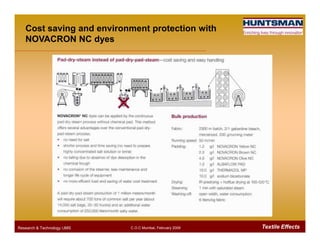
Cost saving and environment protection with
NOVACRON NC dyes
Textile EffectsResearch & Technology /JMS C.O.C Mumbai, February 2009
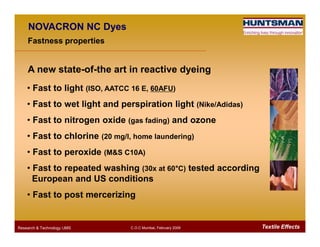
• Fast to light (ISO, AATCC 16 E, 60AFU)
• Fast to wet light and perspiration light (Nike/Adidas)
• Fast to nitrogen oxide (gas fading) and ozone
NOVACRON NC Dyes
A new state-of-the art in reactive dyeing
Fastness properties
Textile EffectsResearch & Technology /JMS C.O.C Mumbai, February 2009
• Fast to nitrogen oxide (gas fading) and ozone
• Fast to chlorine (20 mg/l, home laundering)
• Fast to peroxide (M&S C10A)
• Fast to repeated washing (30x at 60°°°°C) tested according
European and US conditions
• Fast to post mercerizing
Earth tones made easy
NOVACRON NC Dyes
Textile EffectsResearch & Technology /JMS C.O.C Mumbai, February 2009
Let´´´´s do it together
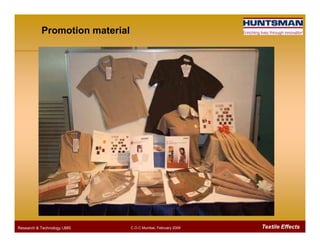
Promotion material
Textile EffectsResearch & Technology /JMS C.O.C Mumbai, February 2009

New generation of_reactive_dyes_mr_ jean_sire

  • 1.
    “ Earth tonesmade easy “ NOVACRON® NC Advances in reactive dyes Textile EffectsResearch & Technology /JMS C.O.C Mumbai, February 2009 NOVACRON® NC reactive dyes Convention on Colors Mumbai, February 2009
  • 2.
    Textile fiber consumption/ dyesTextile fiber consumption / dyes for cellulosic fibersfor cellulosic fibers Direct: 12% Pigments: 12% Vat: 8% Naphtol: 3% Indigo: 8% ~ 50 Mio. tons fibers PES 37 % PAN 5 % PA 8 % Others 6 % Textile EffectsResearch & Technology /JMS C.O.C Mumbai, February 2009 The world wide consumption of textile fiber is dominated by CEL and PES Reactive dyes have gained the highest market share of all CEL dyes classes CEL dyes by quantity (336 000 tons) Reactive: 45% Sulfur: 12% Cotton (36%) 6 % WO 3 % CEL man-made 5 %
  • 3.
    Major causes formarket shareMajor causes for market share increase of reactive dyesincrease of reactive dyes • Substantial increase in cotton consumption in recent years • Concern about some technical/ environmental drawbacks of alternative dyeing methods and Textile EffectsResearch & Technology /JMS C.O.C Mumbai, February 2009 drawbacks of alternative dyeing methods and dyestuffs classes • Strong demand for bright and deep shades • Convenient, simple economical dyeing methods
  • 4.
    Characteristics of reactivedyesCharacteristics of reactive dyes (1965(1965--1975)1975) Strengths:Strengths: •• Wide shade spectrumWide shade spectrum •• Excellent brightnessExcellent brightness •• Acceptable wet fastness levelAcceptable wet fastness level •• Suitability for all application methodsSuitability for all application methods Textile EffectsResearch & Technology /JMS C.O.C Mumbai, February 2009 •• high amounts of salt and long dyeing cycles (exhaust)high amounts of salt and long dyeing cycles (exhaust) •• low degree of fixationlow degree of fixation •• need for long washingneed for long washing--off cyclesoff cycles •• moderate light, wetmoderate light, wet--light, gas fading, photochromylight, gas fading, photochromy issues and poor chlorine fastness in some shadesissues and poor chlorine fastness in some shades •• Lack of reproducibility in critical shadesLack of reproducibility in critical shades WeaknessesWeaknesses
  • 5.
    Monoreactive dye FT Hydrolysis Fixation 75% OCell 25% OH HydrolysisFixation 75% CellO R2 25% OH VS FT VS CIBACRON C Introduction of heteroIntroduction of hetero--bireactivitybireactivity end of 1980end of 1980 Textile EffectsResearch & Technology /JMS C.O.C Mumbai, February 2009 OCellOH FixationHydrolysis OH OCell 75% OH OH 25% CellO R2OH VS Washing 60°°°°CWashing 60°°°°C 75% Fixation 93% Fixation
  • 6.
    2 3 45 6 7 8 9 10 11 100 80 60 40 pH Loss of yield Vinylsulphone dye Fluorotriazine dye Fluorotriazine Advantage of FT/VS molecular engineering Textile EffectsResearch & Technology /JMS C.O.C Mumbai, February 2009 Alkali Time temperature Fluorotriazine group Vinylsulphone group  Chr. Alkali Time temperature
  • 7.
    The addition ofsalt is time conmsuming and requires manpower This is the amount of salt used for conventional reactive dyes Time and cost saving, easier handling - The great benefits of NOVACRON LS Reduction of salt amount in dyeing bathReduction of salt amount in dyeing bath Textile EffectsResearch & Technology /JMS C.O.C Mumbai, February 2009
  • 8.
    N N N S S O O OH O O OH N N NH R2 N H R1 N H O N N N S S O OHO O OH O N N NH O N H N H R1 R2 CisCis TransTrans Photochromy issuesPhotochromy issues Textile EffectsResearch & Technology /JMS C.O.C Mumbai, February 2009 A dyeing produced with a conventional golden yellow reactive dye, covered and then exposed to the light for 4 h. Another dyeing produced with CIBACRON Yellow NP reactive dye, covered and then exposed to the light for 4 h.
  • 9.
    Earth tones…….. Sand, brown,olive, beige, gris, khaki, Textile EffectsResearch & Technology /JMS C.O.C Mumbai, February 2009 Always critical issues for the dyers !
  • 10.
    Earth tones….. For Apparel Trousers,shirting, uniform, yarn, polo shirts, garment dyeing 40% 60% 80% 100% Textile EffectsResearch & Technology /JMS C.O.C Mumbai, February 2009 For Home textile Terry toweling, bed sheeting, textile for furnishing Dyeing processes - Pad-batch - Exhaust - Continuous 0% 20% Trousers S hirting Terry B edding Source: Huntsman's internal data Black Navy Earth Brillant white
  • 11.
    Reactive dyes orvat dyes ? Why do dyers use/prefer reactive dyes instead of vat dyes - Higher versatility of application processes (pad-batch, exhaust, continuous) - Bright, fashion, deep shades achievable - Meets most modern fastness requirements in Apparel and Home Textile NOVACRON NC Dyes Textile EffectsResearch & Technology /JMS C.O.C Mumbai, February 2009 - Meets most modern fastness requirements in Apparel and Home Textile - Cheaper recipe cost particularly for medium/deep shades - More simple dyeing / application procedures, better penetration - no reduction step - no oxidizing - No specks by dyeing pale shades - Higher productivity due to easier shade planning (reactive/vat product mix not easy to manage in bulk) - Easier stripping and shade correction
  • 12.
    Use of vatdyes Especially for dyeing pale and medium shades, and when the brightness is not an issue For what shades do the dyers prefer using vat dyes? Apparel and Home textiles Textile EffectsResearch & Technology /JMS C.O.C Mumbai, February 2009 Reasons ......... The reproducibility of vat dyes is much better but care must be taken to application conditions (dispersing, steaming, rinsing, oxidizing, soaping) The fastness requirement are fulfiled
  • 13.
    The Solution !! Aselection of new reactive dyes having the shade of vat dyes, combining the reproducibility of vat dyes and that can be applied as reactive dyes NOVACRON NC Dyes Earth tones Olive NC Yellow NC Brown NC Textile EffectsResearch & Technology /JMS C.O.C Mumbai, February 2009 NOVACRON NC (Non Contrasting) The new Concept for pad-batch, exhaust and continuous Applications Olive NC Brown NC Grey NC
  • 14.
    - FT chemistry,with 2-3 reactive groups - Homogeneous NC self shades - Non photochromic yellow component - High compatibility within the range - Designed for pad and exhaust application - Non contrasting approach NOVACRON NC Dyes Textile EffectsResearch & Technology /JMS C.O.C Mumbai, February 2009 - Non contrasting approach Reproducibility of shades Operational excellence End-use flexibility Fastness - mills - brands and retailers - machine suppliers Benefits for
  • 15.
    Yellow Conventional and current dye selection Contrastingapproach Conventioanl dyes Textile EffectsResearch & Technology /JMS C.O.C Mumbai, February 2009 Blue Red Moderate / poor reproducibility, reprocess cost
  • 16.
    Yellow Yellow NC Non Contrasting approach Non Contrastingapproach NOVACRON NC dyes Textile EffectsResearch & Technology /JMS C.O.C Mumbai, February 2009 ImprovementImprovement of dyeingof dyeing performancesperformances N Olive NC Grey NC Brown NC Red Blue
  • 17.
    Reactive Yellow Reactive Red ReactiveBlue Novacron Brown NC Novacron Olive NC Novacron Grey NC Novasol Yellow 3R md Novasol Brown BR md Novasol Olive S md Conventional reactive dyes Yellow Red Blue Non Contrasting NOVACRON NC reactive dyes Brown NC Olive NC Grey NC Conventional vat dyes Yellow 3R Brown BR Olive S/T Variation of dye concentration in the recipe -5 -2.5 0 2.5 5 7.5 Principle of Non Contrasting effect 4.20 g/l 1.90 g/l 4.00 g/l 1.40 g/l 6.80 g/l 1.20 g/l 0.60 g/l 1.60 g/l 12.00 g/l Textile EffectsResearch & Technology /JMS C.O.C Mumbai, February 2009 R 6 R 5 R 4 R 3 R 2 R 1 -2 -1.5 -1 -0.5 0 0.5 1 1.5 2 -2 -1.5 -1 -0.5 0 0.5 1 1.5 2 duller dC* brighter redderdH*yellower Novasol Olive S md 1 2 3 4 5 6 Recipe N°°°° -7.5 Yellow / Olive Red / Brown Blue / Grey See result on next slide !!! 12.00 g/l
  • 18.
    Principle of NonContrasting effect Shade change with NOVACRON NC Textile EffectsResearch & Technology /JMS C.O.C Mumbai, February 2009 Any fluctuation of the behavior of conventional yellow/red/blue reactive dyes (i.e sensitivity to dyeing parameters as time-temperature, lack of compatibility) leads to shade changes that impair the results of the dyehouse. The newly developed HUNTSMAN NOVACRON NC reactive dyes allow for a tremendous improvement of dyehouse performances: Higher reproducibility, less seconds, cost saving and better competitiveness. Shade change with NOVACRON NC Shade change with conventional reactive dyes
  • 19.
    -0,5 0 0,5 1 1,5 2 2,5 3 redderdH*yellower 0 0,5 1 1,5 2 redderdH*yellower Influence of bathstability on shade variation Pad-batch process Influence of steaming time variation Pad-dry-pad-steam process 25o C35o C 25o C 35o C Steaming time variation:30 s, 90 s, 120 s 60 s as standard Bath stability at 25 & 35o C 20o C as standard Advantages of NOVACRON NC reactive dyes by pad-batch & continuous dyeing Textile EffectsResearch & Technology /JMS C.O.C Mumbai, February 2009 -3 -2,5 -2 -1,5 -1 -0,5 -3 -2,5 -2 -1,5 -1 -0,5 0 0,5 1 1,5 2 2,5 3 duller dC* brighter redderdH*yellower -2 -1,5 -1 -0,5 -2 -1,5 -1 -0,5 0 0,5 1 1,5 2 duller dC* brighter redderdH*yellower Yellow NC / Brown NC / Olive NC Non Contrasting reactive dyes Conventional Yellow / Red / Blue reactive dyes
  • 20.
    Advantages of NOVACRONNC reactive dyes by exhaust dyeing 0,8 1 Shadevariation(dE) Standard conditions 0.036 % Novacron Yellow NC 0.020 % Novacron Brown NC 0.123 % Novacron Olive NC 30 g/l common saltsal 10 g/l soda ash LR: 1/10 300 kg single jersey Influence of dyeing parameters fluctuations on shade reproducibility Textile EffectsResearch & Technology /JMS C.O.C Mumbai, February 2009 0 0,2 0,4 0,6 Shadevariation(dE) Liquor ratio 1/6-1/12 Salt amount +20% -20% Fixation time +15 min -15 min Fixation temp. +5° -5° 300 kg single jersey Isotherm process, 60°°°°
  • 21.
    Advantages of NOVACRONNC by exhaust dyeing. Comparison with conventional reactive dyes 0.18 0.19 0.20 0.5 1.0 1.5 greener A B F NOVACRON NC reactive dyes Shade variationStrength difference Conventional reactive dyes NOVACRON NC recipe: 0.153 % NOVACRON Yellow NC 0.031 % NOVACRON Brown NC 0.122 % NOVACRON Olive NC Conventional recipe: 0.187 % Reactive Yellow 0.070 % Reactive Red 0.092 % Reactive Blue Textile EffectsResearch & Technology /JMS C.O.C Mumbai, February 2009 0.12 0.13 0.14 0.15 0.16 0.17 A B C D E F G Strength(RD) F E B D C A G -1.5 -1.0 -0.5 0.0 -1.5 -1.0 -0.5 0.0 0.5 1.0 1.5 dC* dH*yellower brighterduller C D E G A: Salt + 20% B: temperature – 5°C C: temperature + 5°C D: Alkali +20% E: Fix. time: +15 min F: LR 1:6 G: LR 1/12 Standard application conditions Dyeing temperature: 60°°°°C Fixation time: 45 min Liquor ratio: 1/10
  • 22.
    Any variation ofthe application conditions by pad-batch, exhaut or continuous application has practically no influence Advantages of NOVACRON NC reactive dyes by exhaust and continuous application Textile EffectsResearch & Technology /JMS C.O.C Mumbai, February 2009 exhaut or continuous application has practically no influence on the shade of NOVACRON NC dyes Consistency, Reproducibility, Competitiveness will consequently be tremendously improved
  • 23.
    NOVACRON NC Dyes Benefitsfor the mill • Four dimensional consistency and outstanding reproducibility 1 No tailing in the length 2 No center-side shade variation in the width 3 No two-sidedness in the tickness 4 The same shade today, tomorow and the day after • Increase of productivity by reducing complex processes Textile EffectsResearch & Technology /JMS C.O.C Mumbai, February 2009 • Outstanding fastness level satisfying the most stringest customers requirements • Suitable for subsequent enzyme/stone wash, moist cross linking/ FR/ NH3 post-preatment and post-mercerizing with minimal shade change allowing for easier shade management • Cost saving due to much lower effluenet load (no need for sodium silicate, salt, hydrosulfite) and more efficient maintenance
  • 24.
    Shade variation alongthe run Tailing free dyeing pale shades with NOVACRON NC reactive dyes has become a reality Fabric: Cotton Gabardine merc.1650 m batch Pad-batch dyeing method, silicate free Standard: beginning of the run , 20 m Shade variation along the run 0.36 g/l Novacron Yellow NC 0.20 g/l Novacron Brown NC 1.23 g/l Novacron Olive NC Textile EffectsResearch & Technology /JMS C.O.C Mumbai, February 2009 Beginning (20 m) Stanadard 100 m 500 m 1500 m
  • 25.
    NOVACRON NC reactivedyes Advantages over vat dyes Influence of steaming and development conditions Steaming with fully saturated steam NOVACRON NC Vat dyes Textile EffectsResearch & Technology /JMS C.O.C Mumbai, February 2009 Steaming with not completely saturated steam (3-4% air) NOVACRON NC recipe 1.4 g/l Brown NC 1.2 g/l Grey NC 6.8 g/l Olive NC Vat dyes recipe 0.6 g/l Yellow 3R 1.6 g/l Brown BR 12.0 g/l Olive S/T Shade variation Lack of reproducibility Need for reprocessing
  • 26.
    Finishing Textile EffectsResearch &Technology /JMS C.O.C Mumbai, February 2009 Pad-dry-pad-steam, bottom weight 1.90 g/l NOVACRON Yellow NC 1.15 g/l NOVACRON Brown NC 2.25 g/l NOVACRON Olive NC Pad-steam, shirting 0.22 g/l NOVACRON Yellow NC 0.25 g/l NOVACRON Brown NC 0.55 g/l NOVACRON Olive NC Pad-batch, trousers 0.06 g/l NOVACRON Yellow NC 0.49 g/l NOVACRON Brown NC 1.75 g/l NOVACRON Olive NC Without finishing With Easy care finishing Without finishing With MXL finishing Without finishing After enzyme washing
  • 27.
    Cost saving andease of use with NOVACRON NC dyes Textile EffectsResearch & Technology /JMS C.O.C Mumbai, February 2009
  • 28.
    Cost saving andenvironment protection with NOVACRON NC dyes Textile EffectsResearch & Technology /JMS C.O.C Mumbai, February 2009
  • 29.
    • Fast tolight (ISO, AATCC 16 E, 60AFU) • Fast to wet light and perspiration light (Nike/Adidas) • Fast to nitrogen oxide (gas fading) and ozone NOVACRON NC Dyes A new state-of-the art in reactive dyeing Fastness properties Textile EffectsResearch & Technology /JMS C.O.C Mumbai, February 2009 • Fast to nitrogen oxide (gas fading) and ozone • Fast to chlorine (20 mg/l, home laundering) • Fast to peroxide (M&S C10A) • Fast to repeated washing (30x at 60°°°°C) tested according European and US conditions • Fast to post mercerizing
  • 30.
    Earth tones madeeasy NOVACRON NC Dyes Textile EffectsResearch & Technology /JMS C.O.C Mumbai, February 2009 Let´´´´s do it together
  • 31.
    Promotion material Textile EffectsResearch& Technology /JMS C.O.C Mumbai, February 2009