http://axonmatics.com
New Features of Python 3.10
Dr. Gábor Guta
http://axonmatics.com
About me
- I develop software in Python roughly for 15 years and I train/consult
Python developers for 8 years
- I did research on formally specifying programming languages, prove
correctness of software systems, and building compilers
- I worked mainly on bio-/cheminformatic software development and
this topic also generally interests me (I have degree on medicine
development too)
Copyright (C) 2022 Dr. Guta Gábor
http://axonmatics.com
Agenda
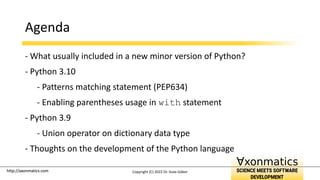
- What usually included in a new minor version of Python?
- Python 3.10
- Patterns matching statement (PEP634)
- Enabling parentheses usage in with statement
- Python 3.9
- Union operator on dictionary data type
- Thoughts on the development of the Python language
Copyright (C) 2022 Dr. Guta Gábor
http://axonmatics.com
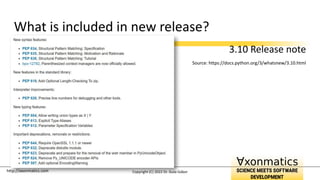
What is included in new release?
3.10 Release note
Source: https://docs.python.org/3/whatsnew/3.10.html
Copyright (C) 2022 Dr. Guta Gábor
http://axonmatics.com
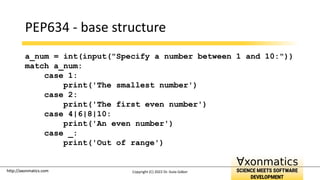
PEP634 - base structure
a_num = int(input("Specify a number between 1 and 10:"))
match a_num:
case 1:
print('The smallest number')
case 2:
print('The first even number')
case 4|6|8|10:
print('An even number')
case _:
print('Out of range')
Copyright (C) 2022 Dr. Guta Gábor
http://axonmatics.com
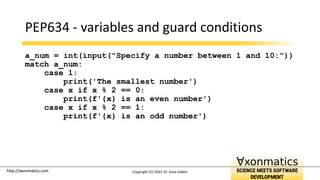
PEP634 - variables and guard conditions
a_num = int(input("Specify a number between 1 and 10:"))
match a_num:
case 1:
print('The smallest number')
case x if x % 2 == 0:
print(f'{x} is an even number')
case x if x % 2 == 1:
print(f'{x} is an odd number')
Copyright (C) 2022 Dr. Guta Gábor
http://axonmatics.com
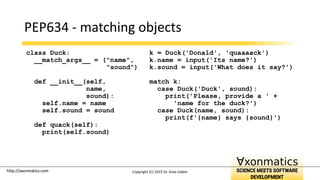
PEP634 - matching objects
class Duck:
__match_args__ = ("name",
"sound")
def __init__(self,
name,
sound):
self.name = name
self.sound = sound
def quack(self):
print(self.sound)
k = Duck('Donald', 'quaaaack')
k.name = input('Its name?')
k.sound = input('What does it say?')
match k:
case Duck('Duck', sound):
print('Please, provide a ' +
'name for the duck?')
case Duck(name, sound):
print(f'{name} says {sound}')
Copyright (C) 2022 Dr. Guta Gábor
http://axonmatics.com
PEP634 - matching lists and dictionaries
k = ['Donald', 'Quack']
k[0] = input('Its name?')
k[1] = ('What does it say?')
match k:
case ['Duck', sound]:
print('Please, provide ' +
'a name for the duck?')
case [name, sound]:
print(f'{name} says ' +
f'{sound}')
k = {'name': 'Donald',
'sound': 'Quack'}
k['name'] = input('Its name?')
k['sound'] = ('What does it say?')
match k:
case {'name': 'Duck',
'sound': sound}:
print('Please, provide ' +
'a name for the duck?')
case {'name': name,
'sound': sound}:
print(f'{name} says {sound}')
Copyright (C) 2022 Dr. Guta Gábor
http://axonmatics.com
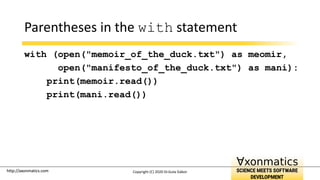
Parentheses in the with statement
with (open("memoir_of_the_duck.txt") as meomir,
open("manifesto_of_the_duck.txt") as mani):
print(memoir.read())
print(mani.read())
Copyright (C) 2020 Dr.Guta Gábor
http://axonmatics.com
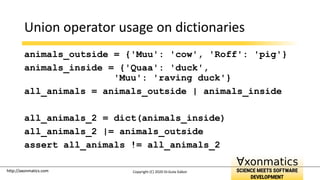
Union operator usage on dictionaries
animals_outside = {'Muu': 'cow', 'Roff': 'pig'}
animals_inside = {'Quaa': 'duck',
'Muu': 'raving duck'}
all_animals = animals_outside | animals_inside
all_animals_2 = dict(animals_inside)
all_animals_2 |= animals_outside
assert all_animals != all_animals_2
Copyright (C) 2020 Dr.Guta Gábor
http://axonmatics.com
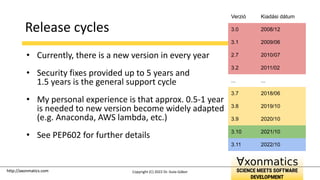
Release cycles
• Currently, there is a new version in every year
• Security fixes provided up to 5 years and
1.5 years is the general support cycle
• My personal experience is that approx. 0.5-1 year
is needed to new version become widely adapted
(e.g. Anaconda, AWS lambda, etc.)
• See PEP602 for further details
Verzió Kiadási dátum
3.0 2008/12
3.1 2009/06
2.7 2010/07
3.2 2011/02
... ...
3.7 2018/06
3.8 2019/10
3.9 2020/10
3.10 2021/10
3.11 2022/10
Copyright (C) 2022 Dr. Guta Gábor
http://axonmatics.com
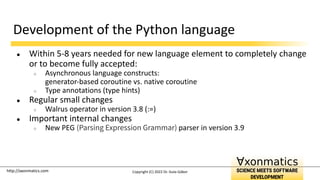
Development of the Python language
● Within 5-8 years needed for new language element to completely change
or to become fully accepted:
○ Asynchronous language constructs:
generator-based coroutine vs. native coroutine
○ Type annotations (type hints)
● Regular small changes
○ Walrus operator in version 3.8 (:=)
● Important internal changes
○ New PEG (Parsing Expression Grammar) parser in version 3.9
Copyright (C) 2022 Dr. Guta Gábor
http://axonmatics.com
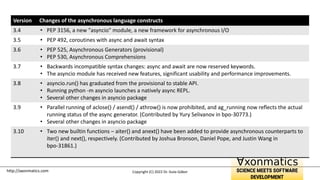
Version Changes of the asynchronous language constructs
3.4 • PEP 3156, a new "asyncio" module, a new framework for asynchronous I/O
3.5 • PEP 492, coroutines with async and await syntax
3.6 • PEP 525, Asynchronous Generators (provisional)
• PEP 530, Asynchronous Comprehensions
3.7 • Backwards incompatible syntax changes: async and await are now reserved keywords.
• The asyncio module has received new features, significant usability and performance improvements.
3.8 • asyncio.run() has graduated from the provisional to stable API.
• Running python -m asyncio launches a natively async REPL.
• Several other changes in asyncio package
3.9 • Parallel running of aclose() / asend() / athrow() is now prohibited, and ag_running now reflects the actual
running status of the async generator. (Contributed by Yury Selivanov in bpo-30773.)
• Several other changes in asyncio package
3.10 • Two new builtin functions – aiter() and anext() have been added to provide asynchronous counterparts to
iter() and next(), respectively. (Contributed by Joshua Bronson, Daniel Pope, and Justin Wang in
bpo-31861.)
Copyright (C) 2022 Dr. Guta Gábor

New Features of Python 3.10

  • 1.
  • 2.
    http://axonmatics.com http://axonmatics.com About me - Idevelop software in Python roughly for 15 years and I train/consult Python developers for 8 years - I did research on formally specifying programming languages, prove correctness of software systems, and building compilers - I worked mainly on bio-/cheminformatic software development and this topic also generally interests me (I have degree on medicine development too) Copyright (C) 2022 Dr. Guta Gábor
  • 3.
    http://axonmatics.com http://axonmatics.com Agenda - What usuallyincluded in a new minor version of Python? - Python 3.10 - Patterns matching statement (PEP634) - Enabling parentheses usage in with statement - Python 3.9 - Union operator on dictionary data type - Thoughts on the development of the Python language Copyright (C) 2022 Dr. Guta Gábor
  • 4.
    http://axonmatics.com What is includedin new release? 3.10 Release note Source: https://docs.python.org/3/whatsnew/3.10.html Copyright (C) 2022 Dr. Guta Gábor
  • 5.
    http://axonmatics.com http://axonmatics.com PEP634 - basestructure a_num = int(input("Specify a number between 1 and 10:")) match a_num: case 1: print('The smallest number') case 2: print('The first even number') case 4|6|8|10: print('An even number') case _: print('Out of range') Copyright (C) 2022 Dr. Guta Gábor
  • 6.
    http://axonmatics.com http://axonmatics.com PEP634 - variablesand guard conditions a_num = int(input("Specify a number between 1 and 10:")) match a_num: case 1: print('The smallest number') case x if x % 2 == 0: print(f'{x} is an even number') case x if x % 2 == 1: print(f'{x} is an odd number') Copyright (C) 2022 Dr. Guta Gábor
  • 7.
    http://axonmatics.com http://axonmatics.com PEP634 - matchingobjects class Duck: __match_args__ = ("name", "sound") def __init__(self, name, sound): self.name = name self.sound = sound def quack(self): print(self.sound) k = Duck('Donald', 'quaaaack') k.name = input('Its name?') k.sound = input('What does it say?') match k: case Duck('Duck', sound): print('Please, provide a ' + 'name for the duck?') case Duck(name, sound): print(f'{name} says {sound}') Copyright (C) 2022 Dr. Guta Gábor
  • 8.
    http://axonmatics.com http://axonmatics.com PEP634 - matchinglists and dictionaries k = ['Donald', 'Quack'] k[0] = input('Its name?') k[1] = ('What does it say?') match k: case ['Duck', sound]: print('Please, provide ' + 'a name for the duck?') case [name, sound]: print(f'{name} says ' + f'{sound}') k = {'name': 'Donald', 'sound': 'Quack'} k['name'] = input('Its name?') k['sound'] = ('What does it say?') match k: case {'name': 'Duck', 'sound': sound}: print('Please, provide ' + 'a name for the duck?') case {'name': name, 'sound': sound}: print(f'{name} says {sound}') Copyright (C) 2022 Dr. Guta Gábor
  • 9.
    http://axonmatics.com http://axonmatics.com Parentheses in thewith statement with (open("memoir_of_the_duck.txt") as meomir, open("manifesto_of_the_duck.txt") as mani): print(memoir.read()) print(mani.read()) Copyright (C) 2020 Dr.Guta Gábor
  • 10.
    http://axonmatics.com http://axonmatics.com Union operator usageon dictionaries animals_outside = {'Muu': 'cow', 'Roff': 'pig'} animals_inside = {'Quaa': 'duck', 'Muu': 'raving duck'} all_animals = animals_outside | animals_inside all_animals_2 = dict(animals_inside) all_animals_2 |= animals_outside assert all_animals != all_animals_2 Copyright (C) 2020 Dr.Guta Gábor
  • 11.
    http://axonmatics.com http://axonmatics.com Release cycles • Currently,there is a new version in every year • Security fixes provided up to 5 years and 1.5 years is the general support cycle • My personal experience is that approx. 0.5-1 year is needed to new version become widely adapted (e.g. Anaconda, AWS lambda, etc.) • See PEP602 for further details Verzió Kiadási dátum 3.0 2008/12 3.1 2009/06 2.7 2010/07 3.2 2011/02 ... ... 3.7 2018/06 3.8 2019/10 3.9 2020/10 3.10 2021/10 3.11 2022/10 Copyright (C) 2022 Dr. Guta Gábor
  • 12.
    http://axonmatics.com Development of thePython language ● Within 5-8 years needed for new language element to completely change or to become fully accepted: ○ Asynchronous language constructs: generator-based coroutine vs. native coroutine ○ Type annotations (type hints) ● Regular small changes ○ Walrus operator in version 3.8 (:=) ● Important internal changes ○ New PEG (Parsing Expression Grammar) parser in version 3.9 Copyright (C) 2022 Dr. Guta Gábor
  • 13.
    http://axonmatics.com Version Changes ofthe asynchronous language constructs 3.4 • PEP 3156, a new "asyncio" module, a new framework for asynchronous I/O 3.5 • PEP 492, coroutines with async and await syntax 3.6 • PEP 525, Asynchronous Generators (provisional) • PEP 530, Asynchronous Comprehensions 3.7 • Backwards incompatible syntax changes: async and await are now reserved keywords. • The asyncio module has received new features, significant usability and performance improvements. 3.8 • asyncio.run() has graduated from the provisional to stable API. • Running python -m asyncio launches a natively async REPL. • Several other changes in asyncio package 3.9 • Parallel running of aclose() / asend() / athrow() is now prohibited, and ag_running now reflects the actual running status of the async generator. (Contributed by Yury Selivanov in bpo-30773.) • Several other changes in asyncio package 3.10 • Two new builtin functions – aiter() and anext() have been added to provide asynchronous counterparts to iter() and next(), respectively. (Contributed by Joshua Bronson, Daniel Pope, and Justin Wang in bpo-31861.) Copyright (C) 2022 Dr. Guta Gábor