D R . E . J . S A R M A
A P R I L - 9 - 2 0 1 4
New model
for managing change
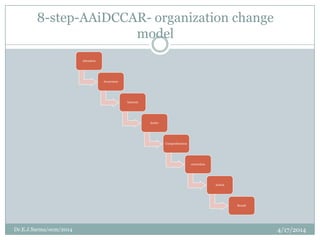
8-step-AAiDCCAR- organization change
model
4/17/2014Dr.E.J.Sarma/ocm/2014
Attention
Awareness
Interest
desire
Comprehension
conviction
Action
Result
Attention
4/17/2014Dr.E.J.Sarma/ocm/2014
3
 In any change effort there has to be a compelling
reason
 It is not enough if this remains in the mind of the CEO
 Let us create some rules:
 Rule no 1:
 If you want other's to pay more attention to you, you
have to have a strong reason and be interesting, Arouse
curiosity
 Rule no 2:
 That reason has to be powerfully
communicated to catch the attention of every one who
can influence change process and acceleration
 Rule no 3:
• Communicate directly
• Use the story telling
• Abundant seminars
• Use Multiple channels
• Repeat and repeat the message
Awareness
4/17/2014Dr.E.J.Sarma/ocm/2014
4
 What is awareness?
 Awareness is the state or ability to perceive, to feel,
or to be conscious of events, objects, or sensory
patterns. In this level of consciousness, sense data
can be confirmed by an observer without necessarily
implying understanding. More broadly, it is the state
or quality of being aware of something.
Awareness
4/17/2014Dr.E.J.Sarma/ocm/2014
5
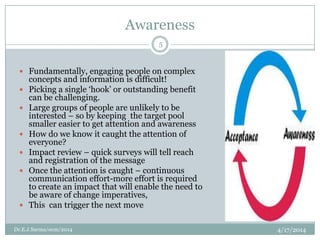
 Fundamentally, engaging people on complex
concepts and information is difficult!
 Picking a single „hook‟ or outstanding benefit
can be challenging.
 Large groups of people are unlikely to be
interested – so by keeping the target pool
smaller easier to get attention and awareness
 How do we know it caught the attention of
everyone?
 Impact review – quick surveys will tell reach
and registration of the message
 Once the attention is caught – continuous
communication effort-more effort is required
to create an impact that will enable the need to
be aware of change imperatives,
 This can trigger the next move
Paradigm shift-Here is what makes people
suddenly change their behavior
4/17/2014Dr.E.J.Sarma/ocm/2014
6
 I was travelling in local train in Mumbai with my 3
young kids at night
 This last train had few travelers returning home and
immediately they tried to sleep once they entered
 The kids were jumping all over making noise
 Few passengers told me to silence the kids as they
were disturbing the sleep. Some even shouted at me,
saying how incompetent father I am and was unable
to discipline the kids
Paradigm shift
4/17/2014Dr.E.J.Sarma/ocm/2014
7
 That is when I told them that I can‟t scold the kids
because I was in grief as we had just returned from
the hospital where my wife died and the kids were
not able to comprehend the tragedy
 This had dramatic effect on the very same people and
they started asking me if I needed help.Anger
vanished and compassion came in
 This paradigm shift happened because of the vital
information that I shared.
 Lesson-Let us not assume that people have the
necessary data and information. let us provide it
Interest
4/17/2014Dr.E.J.Sarma/ocm/2014
8
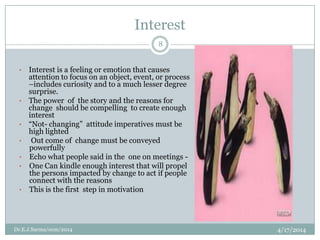
• Interest is a feeling or emotion that causes
attention to focus on an object, event, or process
–includes curiosity and to a much lesser degree
surprise.
• The power of the story and the reasons for
change should be compelling to create enough
interest
• “Not- changing” attitude imperatives must be
high lighted
• Out come of change must be conveyed
powerfully
• Echo what people said in the one on meetings -
• One Can kindle enough interest that will propel
the persons impacted by change to act if people
connect with the reasons
• This is the first step in motivation
Desire
4/17/2014Dr.E.J.Sarma/ocm/2014
9
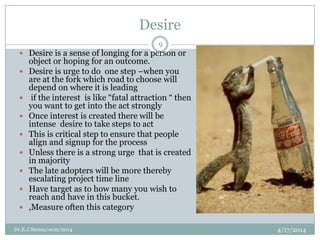
 Desire is a sense of longing for a person or
object or hoping for an outcome.
 Desire is urge to do one step –when you
are at the fork which road to choose will
depend on where it is leading
 if the interest is like “fatal attraction “ then
you want to get into the act strongly
 Once interest is created there will be
intense desire to take steps to act
 This is critical step to ensure that people
align and signup for the process
 Unless there is a strong urge that is created
in majority
 The late adopters will be more thereby
escalating project time line
 Have target as to how many you wish to
reach and have in this bucket.
 ,Measure often this category
comprehension
4/17/2014Dr.E.J.Sarma/ocm/2014
10

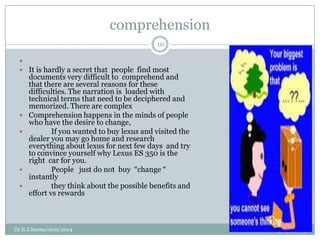
 It is hardly a secret that people find most
documents very difficult to comprehend and
that there are several reasons for these
difficulties. The narration is loaded with
technical terms that need to be deciphered and
memorized. There are complex
 Comprehension happens in the minds of people
who have the desire to change,
 If you wanted to buy lexus and visited the
dealer you may go home and research
everything about lexus for next few days and try
to convince yourself why Lexus ES 350 is the
right car for you.
 People just do not buy “change “
instantly
 they think about the possible benefits and
effort vs rewards
conviction
4/17/2014Dr.E.J.Sarma/ocm/2014
11
 “if you hold a moral conviction, you believe
that this conviction as to what is right vs.
wrong is not mere personal preference.
You believe that EVERYBODY must
conform to the criterion you believe in.--
Skitka et al. (2005, p. 896) cite a quote
from psychologists Haidt, Rosenberg, and
Hom:
 Conviction is strong belief that this is good
for me
 Once people think through, the
determination
 to change happens .
 Unless there is conviction that change will
impact positively there will not be any
action
 It may be good to have over 70% in this
category to begin with when the project is
few months of initiation
Action
4/17/2014Dr.E.J.Sarma/ocm/2014
12
 Depending on the conviction people
take steps to act
 To participate in change
 Have the list of things expected of
people
 Is it new skilling, behavior modification,
cultural change enterprise wide etc
 And bucket people in each category and
have action steps for each category
 This will ensure acceleration
Result
4/17/2014Dr.E.J.Sarma/ocm/2014
13
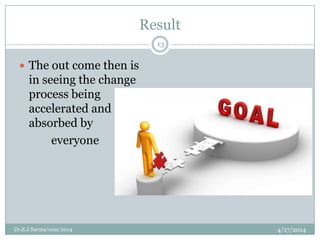
 The out come then is
in seeing the change
process being
accelerated and
absorbed by
everyone
More work to be done ?
at 3 levels of engagement
4/17/2014Dr.E.J.Sarma/ocm/2014
14
 Level 1-High-involvement - includes those commit
unquestionably. engaged fully, lead the efforts
 Level2-moderate involvement - still having some doubts.
But will commit once there is some visibility of positive outcome
of changes that were projected in step 1 through 5
 Level3- low involvement- still unsure hesitating and waiting
4/17/2014Dr.E.J.Sarma/ocm/2014
15

New approach to change management

  • 1.
    D R .E . J . S A R M A A P R I L - 9 - 2 0 1 4 New model for managing change
  • 2.
  • 3.
    Attention 4/17/2014Dr.E.J.Sarma/ocm/2014 3  In anychange effort there has to be a compelling reason  It is not enough if this remains in the mind of the CEO  Let us create some rules:  Rule no 1:  If you want other's to pay more attention to you, you have to have a strong reason and be interesting, Arouse curiosity  Rule no 2:  That reason has to be powerfully communicated to catch the attention of every one who can influence change process and acceleration  Rule no 3: • Communicate directly • Use the story telling • Abundant seminars • Use Multiple channels • Repeat and repeat the message
  • 4.
    Awareness 4/17/2014Dr.E.J.Sarma/ocm/2014 4  What isawareness?  Awareness is the state or ability to perceive, to feel, or to be conscious of events, objects, or sensory patterns. In this level of consciousness, sense data can be confirmed by an observer without necessarily implying understanding. More broadly, it is the state or quality of being aware of something.
  • 5.
    Awareness 4/17/2014Dr.E.J.Sarma/ocm/2014 5  Fundamentally, engagingpeople on complex concepts and information is difficult!  Picking a single „hook‟ or outstanding benefit can be challenging.  Large groups of people are unlikely to be interested – so by keeping the target pool smaller easier to get attention and awareness  How do we know it caught the attention of everyone?  Impact review – quick surveys will tell reach and registration of the message  Once the attention is caught – continuous communication effort-more effort is required to create an impact that will enable the need to be aware of change imperatives,  This can trigger the next move
  • 6.
    Paradigm shift-Here iswhat makes people suddenly change their behavior 4/17/2014Dr.E.J.Sarma/ocm/2014 6  I was travelling in local train in Mumbai with my 3 young kids at night  This last train had few travelers returning home and immediately they tried to sleep once they entered  The kids were jumping all over making noise  Few passengers told me to silence the kids as they were disturbing the sleep. Some even shouted at me, saying how incompetent father I am and was unable to discipline the kids
  • 7.
    Paradigm shift 4/17/2014Dr.E.J.Sarma/ocm/2014 7  Thatis when I told them that I can‟t scold the kids because I was in grief as we had just returned from the hospital where my wife died and the kids were not able to comprehend the tragedy  This had dramatic effect on the very same people and they started asking me if I needed help.Anger vanished and compassion came in  This paradigm shift happened because of the vital information that I shared.  Lesson-Let us not assume that people have the necessary data and information. let us provide it
  • 8.
    Interest 4/17/2014Dr.E.J.Sarma/ocm/2014 8 • Interest isa feeling or emotion that causes attention to focus on an object, event, or process –includes curiosity and to a much lesser degree surprise. • The power of the story and the reasons for change should be compelling to create enough interest • “Not- changing” attitude imperatives must be high lighted • Out come of change must be conveyed powerfully • Echo what people said in the one on meetings - • One Can kindle enough interest that will propel the persons impacted by change to act if people connect with the reasons • This is the first step in motivation
  • 9.
    Desire 4/17/2014Dr.E.J.Sarma/ocm/2014 9  Desire isa sense of longing for a person or object or hoping for an outcome.  Desire is urge to do one step –when you are at the fork which road to choose will depend on where it is leading  if the interest is like “fatal attraction “ then you want to get into the act strongly  Once interest is created there will be intense desire to take steps to act  This is critical step to ensure that people align and signup for the process  Unless there is a strong urge that is created in majority  The late adopters will be more thereby escalating project time line  Have target as to how many you wish to reach and have in this bucket.  ,Measure often this category
  • 10.
    comprehension 4/17/2014Dr.E.J.Sarma/ocm/2014 10   It ishardly a secret that people find most documents very difficult to comprehend and that there are several reasons for these difficulties. The narration is loaded with technical terms that need to be deciphered and memorized. There are complex  Comprehension happens in the minds of people who have the desire to change,  If you wanted to buy lexus and visited the dealer you may go home and research everything about lexus for next few days and try to convince yourself why Lexus ES 350 is the right car for you.  People just do not buy “change “ instantly  they think about the possible benefits and effort vs rewards
  • 11.
    conviction 4/17/2014Dr.E.J.Sarma/ocm/2014 11  “if youhold a moral conviction, you believe that this conviction as to what is right vs. wrong is not mere personal preference. You believe that EVERYBODY must conform to the criterion you believe in.-- Skitka et al. (2005, p. 896) cite a quote from psychologists Haidt, Rosenberg, and Hom:  Conviction is strong belief that this is good for me  Once people think through, the determination  to change happens .  Unless there is conviction that change will impact positively there will not be any action  It may be good to have over 70% in this category to begin with when the project is few months of initiation
  • 12.
    Action 4/17/2014Dr.E.J.Sarma/ocm/2014 12  Depending onthe conviction people take steps to act  To participate in change  Have the list of things expected of people  Is it new skilling, behavior modification, cultural change enterprise wide etc  And bucket people in each category and have action steps for each category  This will ensure acceleration
  • 13.
    Result 4/17/2014Dr.E.J.Sarma/ocm/2014 13  The outcome then is in seeing the change process being accelerated and absorbed by everyone
  • 14.
    More work tobe done ? at 3 levels of engagement 4/17/2014Dr.E.J.Sarma/ocm/2014 14  Level 1-High-involvement - includes those commit unquestionably. engaged fully, lead the efforts  Level2-moderate involvement - still having some doubts. But will commit once there is some visibility of positive outcome of changes that were projected in step 1 through 5  Level3- low involvement- still unsure hesitating and waiting
  • 15.