NEUROINFORMATICS
Guided By:- Presented By:-
Mrs.Manisha Sahoo
Dept. Of Bioinformatics
Pritinsha Rout
IMScBI014
📒🔬
CONTENTS-
1.Introduction,
2.Overview,
3.Examples,
4.Software tools,
5.Research Instruments,
6.Conclusion.
(www.incf.org)
🌐INTRODUCTION
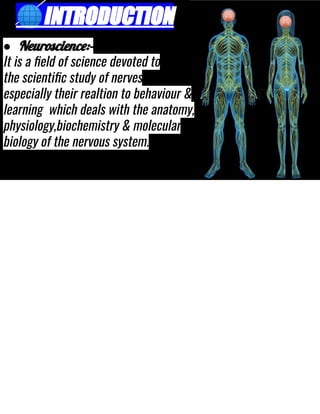
● Neuroscience:-
It is a field of science devoted to
the scientific study of nerves
especially their realtion to behaviour &
learning which deals with the anatomy,
physiology,biochemistry & molecular
biology of the nervous system.
● Neuroinformatics:-
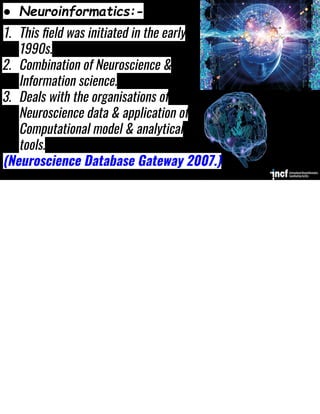
1. This field was initiated in the early
1990s.
2. Combination of Neuroscience &
Information science.
3. Deals with the organisations of
Neuroscience data & application of
Computational model & analytical
tools.
(Neuroscience Database Gateway 2007.)
What is the relation between Bioinformatics
&Neuroinformatics? 🤔
Let’s
see!! 💡
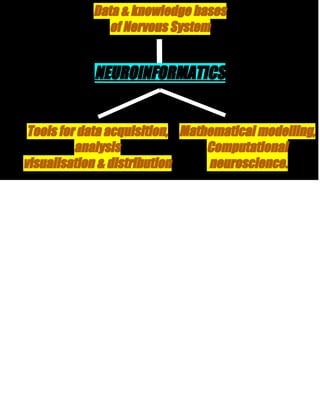
Data & knowledge bases
of Nervous System
NEUROINFORMATICS
Tools for data acquisition,
analysis
visualisation & distribution
Mathematical modelling,
Computational
neuroscience.
👁OVERVIEW
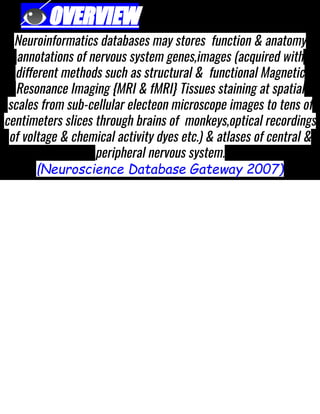
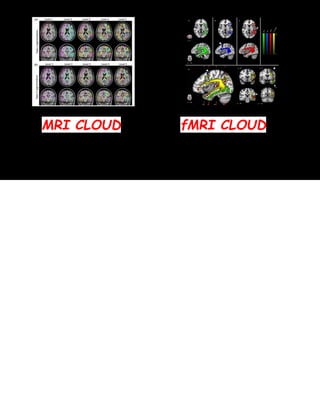
Neuroinformatics databases may stores function & anatomy
annotations of nervous system genes,images (acquired with
different methods such as structural & functional Magnetic
Resonance Imaging {MRI & fMRI} Tissues staining at spatial
scales from sub-cellular electeon microscope images to tens of
centimeters slices through brains of monkeys,optical recordings
of voltage & chemical activity dyes etc.) & atlases of central &
peripheral nervous system.
(Neuroscience Database Gateway 2007)
MRI CLOUD fMRI CLOUD
EXAMPLES OF NEUROINFORMATIC
🧠HUMAN BRAIN PROJECT:-
For further details the online resourcees
can be consulted(National Institute Of
Mental Health 2007.)
🧬MULTIPLE DATABASE SEARCH
USING THE NCBI:-
At PubMed,different searches which is around 28 databases
includes entries in the diverse topic of literature(articlea in
Journals & books) ,sequence databases,bibliographic
data for the National Library Of Medicine(NIM) holding
of books,softwares & other resources.
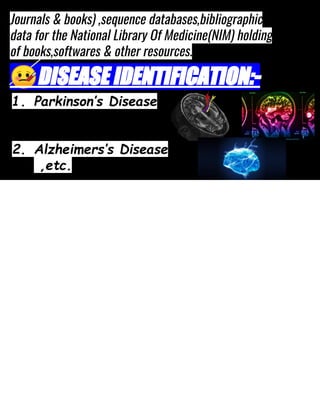
🤒DISEASE IDENTIFICATION:-
1. Parkinson’s Disease
2. Alzheimers’s Disease
,etc.
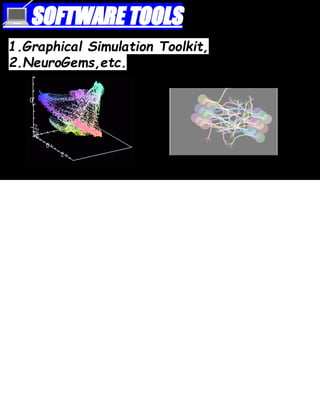
💻SOFTWARE TOOLS
1.Graphical Simulation Toolkit,
2.NeuroGems,etc.
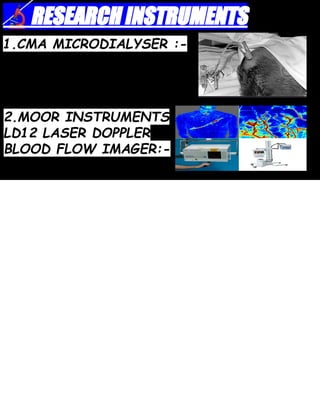
🔬RESEARCH INSTRUMENTS
1.CMA MICRODIALYSER :-
2.MOOR INSTRUMENTS
LD12 LASER DOPPLER
BLOOD FLOW IMAGER:-
3.SENSAPEX MICROMANIPULATORS:-
🤝CONCLUSION
● Neuroinformatics is a premier example of current
accelerating growth in Bioinformatics knowledge & data.
● Due to advancement of IT,huge amount of neuroscience data
is being generated, analysed & interpreted by using
computational tools with the help of neuroinformatics.
● It plays a crucial role in the modern trend techniques such as
human brain mapping-used in research & crime labs & also BCIs
which is used in treating various brain diseases,all ultimately
working for the betterment of human life.
Than yo al !!🙏

Neuroinformatics

  • 2.
    NEUROINFORMATICS Guided By:- PresentedBy:- Mrs.Manisha Sahoo Dept. Of Bioinformatics Pritinsha Rout IMScBI014 📒🔬
  • 3.
  • 4.
    🌐INTRODUCTION ● Neuroscience:- It isa field of science devoted to the scientific study of nerves especially their realtion to behaviour & learning which deals with the anatomy, physiology,biochemistry & molecular biology of the nervous system.
  • 5.
    ● Neuroinformatics:- 1. Thisfield was initiated in the early 1990s. 2. Combination of Neuroscience & Information science. 3. Deals with the organisations of Neuroscience data & application of Computational model & analytical tools. (Neuroscience Database Gateway 2007.)
  • 6.
    What is therelation between Bioinformatics &Neuroinformatics? 🤔 Let’s see!! 💡
  • 7.
    Data & knowledgebases of Nervous System NEUROINFORMATICS Tools for data acquisition, analysis visualisation & distribution Mathematical modelling, Computational neuroscience.
  • 8.
    👁OVERVIEW Neuroinformatics databases maystores function & anatomy annotations of nervous system genes,images (acquired with different methods such as structural & functional Magnetic Resonance Imaging {MRI & fMRI} Tissues staining at spatial scales from sub-cellular electeon microscope images to tens of centimeters slices through brains of monkeys,optical recordings of voltage & chemical activity dyes etc.) & atlases of central & peripheral nervous system. (Neuroscience Database Gateway 2007)
  • 9.
  • 10.
    EXAMPLES OF NEUROINFORMATIC 🧠HUMANBRAIN PROJECT:- For further details the online resourcees can be consulted(National Institute Of Mental Health 2007.) 🧬MULTIPLE DATABASE SEARCH USING THE NCBI:- At PubMed,different searches which is around 28 databases includes entries in the diverse topic of literature(articlea in
  • 11.
    Journals & books),sequence databases,bibliographic data for the National Library Of Medicine(NIM) holding of books,softwares & other resources. 🤒DISEASE IDENTIFICATION:- 1. Parkinson’s Disease 2. Alzheimers’s Disease ,etc.
  • 12.
  • 13.
    🔬RESEARCH INSTRUMENTS 1.CMA MICRODIALYSER:- 2.MOOR INSTRUMENTS LD12 LASER DOPPLER BLOOD FLOW IMAGER:-
  • 14.
  • 15.
    🤝CONCLUSION ● Neuroinformatics isa premier example of current accelerating growth in Bioinformatics knowledge & data. ● Due to advancement of IT,huge amount of neuroscience data is being generated, analysed & interpreted by using computational tools with the help of neuroinformatics. ● It plays a crucial role in the modern trend techniques such as human brain mapping-used in research & crime labs & also BCIs which is used in treating various brain diseases,all ultimately working for the betterment of human life.
  • 16.
    Than yo al!!🙏