"knowledgeable people know
  facts. Successful people and
prosperous people know people.”
          John Demartini
Always people want to be part of our positive energy, so why not to
put it in a positive way; then stand back and wait for it to come back
                                  to us.
Most popular ways to develop a network

• Contact people you already know.
• Attending conferences, seminars, taking
  courses, attending association meetings,
  doing volunteer works.
• Calling people you have researched on your
  own through trade journals, directories, and
  newspaper or magazine and articles.
Barriers   Ethics   Skills
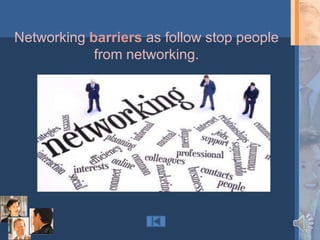
Networking barriers as follow stop people
            from networking.
•   Not having enough contacts
•   People try to solve your problem and you don‟t like it
•   Sometimes you need to begging
•   Sometimes it seems you are using people and you don‟t like
    it
•   It will owe too many favors
•   Makes you uncomfortable with not having the required
    confidence
•   Sometimes you need to talk and don‟t know what to say.
•   You hate cold calls
•   You feel no one can help, why should they?
•   You just feel it doesn‟t work!
•   You don‟t know how and from where should start
•   You not having enough time
•   You shy
•   You afraid of rejection
•   You feel, no one understand your real needs
All these matters go away with having clear vision
about your networking as long as you know your
             goal and plan positively.

  Don‟t forget, it‟s all about your mind and how
          organize it and willing to grow.
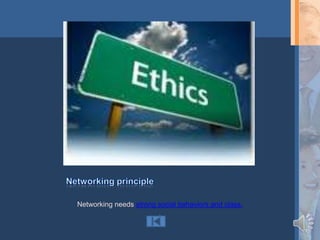
Networking needs strong social behaviors and class.
                         .
•   Arrive on time
                                      •   Stand tall, look at people, shake hands, and smile
                                      •   Locate the food table. Position yourself to meet
                                          people
                                      •   Hold your drink in your left hand and shake with your
                                          right hand
                                      •   Reintroduce yourself to people you know first
Actions help you to build a better    •   Meet as many people as possible, but for no more
social character for any networking       than ten minutes each.
purposes:                             •   Exchange a business card only after you‟ve
                                          established a rapport with another person.
                                      •   Do what you say you will do-follow up.
                                      •   Stand
                                      •   Don‟t smoke
                                      •   Approach only groups of three or more people
                                      •   Introduce younger people to older, those with less
                                          authority to greater authority.
                                      •   Don‟t flirt.
                                      •   Use humor. Avoid sarcasm or telling belittling or off-
                                          color jokes.
                                      •   Listen. Make eye contact and nod. Don‟t eye dart.
                                      •   Don‟t rush the buffet table
                                      •   Leave when you say you are going to leave.
Networking skills as follow help you to
carry out a good result in a minimum time
     or spending less energy or both.
• Try to give more than you get.
• Get to know people for who they are, not just for their
  positions
• Follow-up on all leads
• Report back to those people who give you lead
• Don‟t tell everything to everyone.
• Ask for exactly what you need. Be focused and succinct in
  your message
• Keep your word
• Don‟t immediately reject device
• Don‟t expect your network to function as the “be all and end
  all”
• Make networking a habit
Summary


Knowing „how to network‟, „how to ask for help‟, or „how to
give‟ helps you to plan your networking effectively. You may
have your own ideas about how to do interact with others but
the question is: „Is your Networking works!?‟ If not, you may
need to gain your skills and build positive impression on
others with an outstanding personal etiquette.

Conclusion


Of course, networking takes time, energy and character. But it
gives you more information and as much as you use it wisely
you achieve more and more.
Attending conferences, seminars, taking courses, attending association
                  meetings, doing volunteer works.
Calling people you have researched on your own through trade journals,
          directories, and newspaper or magazine and articles.

Networking

  • 1.
    "knowledgeable people know facts. Successful people and prosperous people know people.” John Demartini
  • 2.
    Always people wantto be part of our positive energy, so why not to put it in a positive way; then stand back and wait for it to come back to us.
  • 3.
    Most popular waysto develop a network • Contact people you already know. • Attending conferences, seminars, taking courses, attending association meetings, doing volunteer works. • Calling people you have researched on your own through trade journals, directories, and newspaper or magazine and articles.
  • 4.
    Barriers Ethics Skills
  • 5.
    Networking barriers asfollow stop people from networking.
  • 6.
    Not having enough contacts • People try to solve your problem and you don‟t like it • Sometimes you need to begging • Sometimes it seems you are using people and you don‟t like it • It will owe too many favors • Makes you uncomfortable with not having the required confidence • Sometimes you need to talk and don‟t know what to say. • You hate cold calls • You feel no one can help, why should they? • You just feel it doesn‟t work! • You don‟t know how and from where should start • You not having enough time • You shy • You afraid of rejection • You feel, no one understand your real needs
  • 7.
    All these mattersgo away with having clear vision about your networking as long as you know your goal and plan positively. Don‟t forget, it‟s all about your mind and how organize it and willing to grow.
  • 8.
    Networking needs strongsocial behaviors and class. .
  • 9.
    Arrive on time • Stand tall, look at people, shake hands, and smile • Locate the food table. Position yourself to meet people • Hold your drink in your left hand and shake with your right hand • Reintroduce yourself to people you know first Actions help you to build a better • Meet as many people as possible, but for no more social character for any networking than ten minutes each. purposes: • Exchange a business card only after you‟ve established a rapport with another person. • Do what you say you will do-follow up. • Stand • Don‟t smoke • Approach only groups of three or more people • Introduce younger people to older, those with less authority to greater authority. • Don‟t flirt. • Use humor. Avoid sarcasm or telling belittling or off- color jokes. • Listen. Make eye contact and nod. Don‟t eye dart. • Don‟t rush the buffet table • Leave when you say you are going to leave.
  • 10.
    Networking skills asfollow help you to carry out a good result in a minimum time or spending less energy or both.
  • 11.
    • Try togive more than you get. • Get to know people for who they are, not just for their positions • Follow-up on all leads • Report back to those people who give you lead • Don‟t tell everything to everyone. • Ask for exactly what you need. Be focused and succinct in your message • Keep your word • Don‟t immediately reject device • Don‟t expect your network to function as the “be all and end all” • Make networking a habit
  • 12.
    Summary Knowing „how tonetwork‟, „how to ask for help‟, or „how to give‟ helps you to plan your networking effectively. You may have your own ideas about how to do interact with others but the question is: „Is your Networking works!?‟ If not, you may need to gain your skills and build positive impression on others with an outstanding personal etiquette. Conclusion Of course, networking takes time, energy and character. But it gives you more information and as much as you use it wisely you achieve more and more.
  • 14.
    Attending conferences, seminars,taking courses, attending association meetings, doing volunteer works.
  • 15.
    Calling people youhave researched on your own through trade journals, directories, and newspaper or magazine and articles.