NETWORKED
COMMUNICATIONS
PART 1
FAR MORE PEOPLE HAVE ACCESS TO CELL PHONES THAN
ELECTRICITY OR CLEAN WATER
1-2
Charles Sturge/Alamy
COMMUNICATION THROUGH THE AGES
THE WORLD WIDE WEB
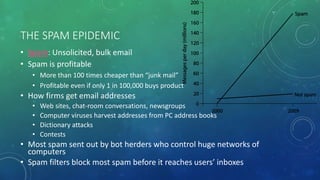
THE SPAM EPIDEMIC
• Spam: Unsolicited, bulk email
• Spam is profitable
• More than 100 times cheaper than “junk mail”
• Profitable even if only 1 in 100,000 buys product
• How firms get email addresses
• Web sites, chat-room conversations, newsgroups
• Computer viruses harvest addresses from PC address books
• Dictionary attacks
• Contests
• Most spam sent out by bot herders who control huge networks of
computers
• Spam filters block most spam before it reaches users’ inboxes
CASE STUDY: ANN THE ACME ACCOUNTANT
• Ann: Accountant at Acme Corporation
• She distributes paychecks to all 50 employees
• Ann sends email advertising Girl Scout cookie sale
• 9 recipients order cookies; average 4 boxes each
• Other 40 recipients unhappy to get email; half complain to a co-
worker
• Did Ann do anything wrong?
1-6
SUMMARY
• Analyses reached different conclusions, but Ann could have taken
a less controversial course
• She could have posted a sign-up sheet to identify those interested
in cookie sale
• That way, she would have sent email only to those interested,
avoiding the problems of grumbling and lost productivity
• She could have found a way to get her daughter more engaged
CENSORSHIP
• Censorship is the attempt to suppress or regulate public access to material considered offensive or
harmful.
• Types of censorship
• Direct Censorship
• Government
• Licensing
• Self Censorship
• Question: What are some reasons that organizations censor themselves when it is not
mandated?
• Group decides for itself not to publish
• Reasons
• Avoid subsequent persecution
• Maintain good relations with government officials (sources of information)
• Ratings systems created to advise potential audience
• Movies, TVs, CDs, video games
• Not the Web
ETHICAL PERSPECTIVES ON CENSORSHIP
• Kantianism opposes censorship
• Enlightenment thinker
• “Have courage to use your own reason”
• Utilitarianism opposes censorship
• No one is infallible
• Any opinion may contain a kernel of truth
• Truth revealed in class of ideas
• Ideas resulting from discourse are more influential
Mill’s Principle of Harm
“The only ground on which intervention
is justified is to prevent harm to others;
the individual’s own good is not a
sufficient condition.”
Question: At what point should someone
intervene? Suicide?
7 WORDS YOU CAN’T SAY ON TV
Question: What type of censorship would this constitute?
FREEDOM OF EXPRESSION
• Freedom of Expression is Not an Absolute Right
• Right to freedom of expression must be balanced
against the public good
• Various restrictions on freedom of expression exist
for the greater public good
• Question: Is this ethical to restrict our rights?
QUESTION: IS SENDING SPAM ETHICAL AND LEGAL?
QUESTION: WAS GEORGE CARLIN’S BIT ETHICAL?
LEGAL?
• George Carlin records “Filthy Words”
• WBAI in New York airs “Filthy Words” (1973)
• FCC issues declaratory order to Pacifica
• Pacifica sues
• U.S. Supreme Court ruled FCC did not violate 1st Amendment (5-4
decision)
• Broadcast media “uniquely pervasive”
• Broadcasting uniquely accessible to children
CASE STUDY: KATE’S BLOG
• Kate: Maintains a popular “life on campus” blog
• Jerry: Another student; active in Whig Party
• At private birthday party, someone gives Jerry a Tory Party T-shirt as a gag, and Jerry
puts it on
• Kate uses cell phone to take picture of Jerry when he isn’t looking, posts it on her
blog
• Story read by many people on and off campus
• Jerry confronts Kate and demands she remove photo; she complies, and they remain
friends
• Kate’s blog and Jerry both become more popular
SUMMARY
• Four out of five analyses: Wrong for Kate to post the photo
without asking Jerry’s permission
• Kate figured it would be better to beg for forgiveness than ask for
permission, but she cut Jerry out of a decision that affected both
of them, and that’s no way to treat a friend
• Kate should have tried to get Jerry’s consent

Networked Communication Part 1

  • 1.
  • 2.
    FAR MORE PEOPLEHAVE ACCESS TO CELL PHONES THAN ELECTRICITY OR CLEAN WATER 1-2 Charles Sturge/Alamy
  • 3.
  • 4.
  • 5.
    THE SPAM EPIDEMIC •Spam: Unsolicited, bulk email • Spam is profitable • More than 100 times cheaper than “junk mail” • Profitable even if only 1 in 100,000 buys product • How firms get email addresses • Web sites, chat-room conversations, newsgroups • Computer viruses harvest addresses from PC address books • Dictionary attacks • Contests • Most spam sent out by bot herders who control huge networks of computers • Spam filters block most spam before it reaches users’ inboxes
  • 6.
    CASE STUDY: ANNTHE ACME ACCOUNTANT • Ann: Accountant at Acme Corporation • She distributes paychecks to all 50 employees • Ann sends email advertising Girl Scout cookie sale • 9 recipients order cookies; average 4 boxes each • Other 40 recipients unhappy to get email; half complain to a co- worker • Did Ann do anything wrong? 1-6
  • 7.
    SUMMARY • Analyses reacheddifferent conclusions, but Ann could have taken a less controversial course • She could have posted a sign-up sheet to identify those interested in cookie sale • That way, she would have sent email only to those interested, avoiding the problems of grumbling and lost productivity • She could have found a way to get her daughter more engaged
  • 8.
    CENSORSHIP • Censorship isthe attempt to suppress or regulate public access to material considered offensive or harmful. • Types of censorship • Direct Censorship • Government • Licensing • Self Censorship • Question: What are some reasons that organizations censor themselves when it is not mandated? • Group decides for itself not to publish • Reasons • Avoid subsequent persecution • Maintain good relations with government officials (sources of information) • Ratings systems created to advise potential audience • Movies, TVs, CDs, video games • Not the Web
  • 9.
    ETHICAL PERSPECTIVES ONCENSORSHIP • Kantianism opposes censorship • Enlightenment thinker • “Have courage to use your own reason” • Utilitarianism opposes censorship • No one is infallible • Any opinion may contain a kernel of truth • Truth revealed in class of ideas • Ideas resulting from discourse are more influential Mill’s Principle of Harm “The only ground on which intervention is justified is to prevent harm to others; the individual’s own good is not a sufficient condition.” Question: At what point should someone intervene? Suicide?
  • 10.
    7 WORDS YOUCAN’T SAY ON TV Question: What type of censorship would this constitute?
  • 11.
    FREEDOM OF EXPRESSION •Freedom of Expression is Not an Absolute Right • Right to freedom of expression must be balanced against the public good • Various restrictions on freedom of expression exist for the greater public good • Question: Is this ethical to restrict our rights?
  • 12.
    QUESTION: IS SENDINGSPAM ETHICAL AND LEGAL?
  • 13.
    QUESTION: WAS GEORGECARLIN’S BIT ETHICAL? LEGAL? • George Carlin records “Filthy Words” • WBAI in New York airs “Filthy Words” (1973) • FCC issues declaratory order to Pacifica • Pacifica sues • U.S. Supreme Court ruled FCC did not violate 1st Amendment (5-4 decision) • Broadcast media “uniquely pervasive” • Broadcasting uniquely accessible to children
  • 14.
    CASE STUDY: KATE’SBLOG • Kate: Maintains a popular “life on campus” blog • Jerry: Another student; active in Whig Party • At private birthday party, someone gives Jerry a Tory Party T-shirt as a gag, and Jerry puts it on • Kate uses cell phone to take picture of Jerry when he isn’t looking, posts it on her blog • Story read by many people on and off campus • Jerry confronts Kate and demands she remove photo; she complies, and they remain friends • Kate’s blog and Jerry both become more popular
  • 15.
    SUMMARY • Four outof five analyses: Wrong for Kate to post the photo without asking Jerry’s permission • Kate figured it would be better to beg for forgiveness than ask for permission, but she cut Jerry out of a decision that affected both of them, and that’s no way to treat a friend • Kate should have tried to get Jerry’s consent

Editor's Notes

  • #4 New technologies sometimes cause new social situations to emerge Calculators  feminization of bookkeeping Telephones  blurred work/home boundaries PHONES AND APPS Spam an example of this phenomenon Email messages practically free Profits increase with number of messages sent Strong motivation to send more messages Internet design allows unfair, one-way communications
  • #5 Question: What was the internet like 30 years ago? 20? 10? Question: How do you use the internet? WWW : networked hypertext system Stimulated tremendous growth in popularity of Internet Two important attributes It is decentralized Every Web object has a unique address Shopping Socializing (e.g., Facebook) Contributing content (e.g., wikis) Blogging Crowdsourcing Learning Exploring our roots Entering virtual worlds Controlling the Internet of Things Paying taxes Gambling Taking humanitarian action Lots more!
  • #6 Question: Are you a target of spam? What type? How do you get targeted? Is that fair? Is that ethical?
  • #7 Kantianism We should always respect autonomy of others, treating them as ends in themselves and never only as the means to an end (2nd formulation of Categorical Imperative) Ann didn’t misrepresent what she was doing She didn’t force anyone to read the entire email Some who read her email chose to order cookies Therefore, she didn’t “use” others, and her action was not strictly wrong However, an “opt in” approach would have been better Act Utilitarianism Benefit to Girls Scouts = $108 $3 profit per box of cookies 36 boxes sold Harm to company: time wasted Orders taken during breaks Lost productivity from complaining: $70 20 employees ×2 ×5 minutes/employee = 200 minutes 3.5 hours ×$20/hour = $70 Benefits exceed harms, so action good Company may create policy against future fundraisers Rule Utilitarianism Q: What would be consequences of everyone in company used email to solicit donations? A: Plenty of employee grumbling and lower morale If all doing it, unlikely any one cause would do well Harms greater than benefits, so Ann’s action was wrong Social Contract Theory Acme Corporation has no prohibition against using its email system this way Ann was exercising her right to express herself Some people didn’t appreciate message, but she didn’t act like a spammer She didn’t conceal her identity She wasn’t selling a fraudulent product Ann did nothing wrong Virtue Ethics As employee, relevant virtues: honesty, fairness, respect Ann was honest: her email didn’t mislead anyone She wasn’t fair or respectful, and she exercised poor judgment (as evidenced by larger amount of complaining by co-workers) In her role as parent, she did all work herself and didn’t find a role for her daughter to play Ann should have found a way for her daughter to help, and she should have found another way to advertise that respected co-workers
  • #9 Limited number of frequencies on the spectrum for radio and tv but not on the internet one to many Question: What are censoring issues with the internet? We ran out of IPv4 addresses and now created a new system of IPv6 Many-to-many communications Dynamic connections Huge numbers of Web sites Extends beyond national borders, laws Hard to distinguish between minors and adults Cuba, North Korea: Internet virtually inaccessible Saudi Arabia: centralized control center People’s Republic of China: Blocks Internet access at times of social unrest Has “one of most sophisticated filtering systems in the world” Germany: Forbids access to neo-Nazi sites United States: Have been repeated efforts to limit access of minors to pornography Egypt and North Korea turn the internet off
  • #15 Kantian Kate uploaded Jerry’s photo to her blog without asking his permission She treated him as a means to her end of increasing the readership of her Web site Her action was wrong Social Contract Theory Birthday party held in apartment of one of Jerry’s friends Jerry had a reasonable expectation of privacy Kate violated Jerry’s right to privacy Kate’s action was wrong Act Utilitarianism Benefits Popularity of Kate’s blog increased (definitely) Jerry become more popular on campus (definitely) Harms Jerry’s anger at Kate (only temporary) Photo could discredit Jerry at some point in future (unlikely) Benefits greater than harms, so Kate did a good thing Rule Utilitarianism What if everyone were constantly taking photos of people they encountered and posting them? Positive consequences People would have more opportunities to keep up with what their friends are doing People might be more reluctant to engage in illegal activities Negative consequences People would become more self-conscious Some relationships would be harmed Negative consequences more weighty than positive consequences, so Kate’s action was bad Virtue Ethics True friends trust each other and seek each other’s good Reciprocity and equality are fundamental elements of friendship Lack of reciprocity: Kate took something from Jerry without giving him anything in return Lack of equality: She put her own interest above that of Jerry Kate’s actions did not seem to be characteristic of a good friend