NETWORK
DESIGN & ANALYSIS
COURSECONTENTS
• Overview Of Analysis, Architecture, And Design
Processes
• Process Components
• Tactical and Strategic Significance
• Hierarchy and Diversity
• Importance of Network Analysis
• Model for Networking Analysis, Architecture and Design
• A Systems Methodology
• System Description
• Service Description
TACTICAL AND STRATEGIC
SIGNIFICANCE
The Cyclic And Iterative Nature Of Processes
Process Iterations Evolve Toward The Long-term
Target
COURSECONTENTS
• Overview Of Analysis, Architecture, And Design
Processes
• Process Components
• Tactical and Strategic Significance
• Hierarchy and Diversity
• Importance of Network Analysis
• Model for Networking Analysis, Architecture and Design
• A Systems Methodology
• System Description
• Service Description
HIERARCHY AND DIVERSITY
COURSECONTENTS
• Overview Of Analysis, Architecture, And Design
Processes
• Process Components
• Tactical and Strategic Significance
• Hierarchy and Diversity
• Importance of Network Analysis
• Model for Networking Analysis, Architecture and Design
• A Systems Methodology
• System Description
• Service Description
IMPORTANCE OF NETWORK
ANALYSIS
• Understanding Network And System
Complexity
• Architecture And Design Defensibility
Understanding Network And
System Complexity
COURSECONTENTS
• Overview Of Analysis, Architecture, And Design
Processes
• Process Components
• Tactical and Strategic Significance
• Hierarchy and Diversity
• Importance of Network Analysis
• Model for Networking Analysis, Architecture and Design
• A Systems Methodology
• System Description
• Service Description
MODEL FOR NETWORKING ANALYSIS,
ARCHITECTURE AND DESIGN
• Defining the problems to be addressed
• Establishing and managing customer expectations
• Monitoring the existing network, system, and its environment.
• Analyzing data
• Developing a set of options to solve problems
• Evaluating and optimizing options based on various trade-offs
• Selecting one or more options
• Planning the implementation
COURSECONTENTS
• Overview Of Analysis, Architecture, And Design
Processes
• Process Components
• Tactical and Strategic Significance
• Hierarchy and Diversity
• Importance of Network Analysis
• Model for Networking Analysis, Architecture and Design
• A Systems Methodology
• System Description
• Service Description
A SYSTEMS METHODOLOGY
• Systems methodology means viewing the network
that you are architecting and designing, along with a
subset of its environment.
• The fundamental concepts of the systems methodology
is that network architectures and designs take into
account the services that each network will provide
and support.
COURSECONTENTS
• Overview Of Analysis, Architecture, And Design
Processes
• Process Components
• Tactical and Strategic Significance
• Hierarchy and Diversity
• Importance of Network Analysis
• Model for Networking Analysis, Architecture and Design
• A Systems Methodology
• System Description
• Service Description
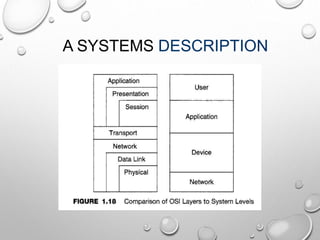
A SYSTEMS DESCRIPTION
• A system is a set of components that work together to
support or provide connectivity, communications, and
services to users of the system.
• Generically speaking, components of the system include
users, applications, devices, and networks.
A SYSTEMS DESCRIPTION
COURSECONTENTS
• Overview Of Analysis, Architecture, And Design
Processes
• Process Components
• Tactical and Strategic Significance
• Hierarchy and Diversity
• Importance of Network Analysis
• Model for Networking Analysis, Architecture and Design
• A Systems Methodology
• System Description
• Service Description
SERVICE DESCRIPTION
• Network services are defined as levels of performance and
function in the network. There are two perspectives:
• As services being offered by the network to the
rest of the system.
• As sets of requirements from the network that are
expected by the users, applications, or devices.
SERVICE DESCRIPTION
COURSECONTENTS
• Service Characteristics
• Service Levels
• System Components And Network Services
• Service Requests And Requirements
• Service Offerings
• Service Metrics
Service Characteristics
• Service characteristics are individual network performance and
functional parameters that are used to describe services.
• Characteristics of services that are requested from the network can
also be considered requirements for that network.
Service Characteristics
COURSECONTENTS
• Service Characteristics
• Service Levels
• System Components And Network Services
• Service Requests And Requirements
• Service Offerings
• Service Metrics
Service Levels
COURSECONTENTS
• Service Characteristics
• Service Levels
• System Components And Network Services
• Service Requests And Requirements
• Service Offerings
• Service Metrics
Service Components And
Network Services
Service Components And
Network Services
Service Components And
Network Services
COURSECONTENTS
• Service Characteristics
• Service Levels
• System Components And Network Services
• Service Requests And Requirements
• Service Offerings
• Service Metrics
Service Requests And
Requirements
COURSECONTENTS
• Service Characteristics
• Service Levels
• System Components And Network Services
• Service Requests And Requirements
• Service Offerings
• Service Metrics
Service Offerings
• Service offerings are the network counterparts to users, application, and
device requests for service.
• Service offerings map to service requests and thus can also be
categorized as best effort, predictable, or guaranteed.
COURSECONTENTS
• Service Characteristics
• Service Levels
• System Components And Network Services
• Service Requests And Requirements
• Service Offerings
• Service Metrics
Service Metrics
COURSECONTENTS
• Performance Characteristics
• Capacity
• Delay
• Ram
• Performance Envelopes
• Network Supportability
Performance Characteristics
• Capacity, is used as a label for the class of characteristics
that involves moving information from place to place, including
bandwidth, throughput, and so forth.
• Delay, is a label for the class of characteristics that includes
end-to-end delay, round-trip delay, and delay variation.
• RMA, is a label for the class of characteristics that includes
reliability, maintainability, and availability.
COURSECONTENTS
• Performance Characteristics
• Capacity
• Delay
• Ram
• Performance Envelopes
• Network Supportability
Performance Envelopes
COURSECONTENTS
• Performance Characteristics
• Capacity
• Delay
• Ram
• Performance Envelopes
• Network Supportability
Network Supportability
Two major tasks must be accomplished to ensure
supportability:
1. Conformance to the network architecture and design must be
validated and nonconformance corrected or documented to
ensure that performance is adequate and that maintenance can
be performed.
2. Operations and maintenance personnel must understand and be
trained in the technologies that are being deployed.

network design 2.pptx

  • 1.
  • 2.
    COURSECONTENTS • Overview OfAnalysis, Architecture, And Design Processes • Process Components • Tactical and Strategic Significance • Hierarchy and Diversity • Importance of Network Analysis • Model for Networking Analysis, Architecture and Design • A Systems Methodology • System Description • Service Description
  • 3.
  • 4.
    The Cyclic AndIterative Nature Of Processes
  • 5.
    Process Iterations EvolveToward The Long-term Target
  • 6.
    COURSECONTENTS • Overview OfAnalysis, Architecture, And Design Processes • Process Components • Tactical and Strategic Significance • Hierarchy and Diversity • Importance of Network Analysis • Model for Networking Analysis, Architecture and Design • A Systems Methodology • System Description • Service Description
  • 7.
  • 8.
  • 9.
  • 10.
    COURSECONTENTS • Overview OfAnalysis, Architecture, And Design Processes • Process Components • Tactical and Strategic Significance • Hierarchy and Diversity • Importance of Network Analysis • Model for Networking Analysis, Architecture and Design • A Systems Methodology • System Description • Service Description
  • 11.
    IMPORTANCE OF NETWORK ANALYSIS •Understanding Network And System Complexity • Architecture And Design Defensibility
  • 12.
  • 13.
    COURSECONTENTS • Overview OfAnalysis, Architecture, And Design Processes • Process Components • Tactical and Strategic Significance • Hierarchy and Diversity • Importance of Network Analysis • Model for Networking Analysis, Architecture and Design • A Systems Methodology • System Description • Service Description
  • 14.
    MODEL FOR NETWORKINGANALYSIS, ARCHITECTURE AND DESIGN • Defining the problems to be addressed • Establishing and managing customer expectations • Monitoring the existing network, system, and its environment. • Analyzing data • Developing a set of options to solve problems • Evaluating and optimizing options based on various trade-offs • Selecting one or more options • Planning the implementation
  • 15.
    COURSECONTENTS • Overview OfAnalysis, Architecture, And Design Processes • Process Components • Tactical and Strategic Significance • Hierarchy and Diversity • Importance of Network Analysis • Model for Networking Analysis, Architecture and Design • A Systems Methodology • System Description • Service Description
  • 16.
    A SYSTEMS METHODOLOGY •Systems methodology means viewing the network that you are architecting and designing, along with a subset of its environment. • The fundamental concepts of the systems methodology is that network architectures and designs take into account the services that each network will provide and support.
  • 17.
    COURSECONTENTS • Overview OfAnalysis, Architecture, And Design Processes • Process Components • Tactical and Strategic Significance • Hierarchy and Diversity • Importance of Network Analysis • Model for Networking Analysis, Architecture and Design • A Systems Methodology • System Description • Service Description
  • 18.
    A SYSTEMS DESCRIPTION •A system is a set of components that work together to support or provide connectivity, communications, and services to users of the system. • Generically speaking, components of the system include users, applications, devices, and networks.
  • 19.
  • 20.
  • 21.
  • 22.
  • 23.
    COURSECONTENTS • Overview OfAnalysis, Architecture, And Design Processes • Process Components • Tactical and Strategic Significance • Hierarchy and Diversity • Importance of Network Analysis • Model for Networking Analysis, Architecture and Design • A Systems Methodology • System Description • Service Description
  • 24.
    SERVICE DESCRIPTION • Networkservices are defined as levels of performance and function in the network. There are two perspectives: • As services being offered by the network to the rest of the system. • As sets of requirements from the network that are expected by the users, applications, or devices.
  • 25.
  • 26.
    COURSECONTENTS • Service Characteristics •Service Levels • System Components And Network Services • Service Requests And Requirements • Service Offerings • Service Metrics
  • 27.
    Service Characteristics • Servicecharacteristics are individual network performance and functional parameters that are used to describe services. • Characteristics of services that are requested from the network can also be considered requirements for that network.
  • 28.
  • 29.
  • 30.
    COURSECONTENTS • Service Characteristics •Service Levels • System Components And Network Services • Service Requests And Requirements • Service Offerings • Service Metrics
  • 31.
  • 32.
    COURSECONTENTS • Service Characteristics •Service Levels • System Components And Network Services • Service Requests And Requirements • Service Offerings • Service Metrics
  • 33.
  • 34.
  • 35.
  • 36.
    COURSECONTENTS • Service Characteristics •Service Levels • System Components And Network Services • Service Requests And Requirements • Service Offerings • Service Metrics
  • 37.
  • 38.
    COURSECONTENTS • Service Characteristics •Service Levels • System Components And Network Services • Service Requests And Requirements • Service Offerings • Service Metrics
  • 39.
    Service Offerings • Serviceofferings are the network counterparts to users, application, and device requests for service. • Service offerings map to service requests and thus can also be categorized as best effort, predictable, or guaranteed.
  • 40.
    COURSECONTENTS • Service Characteristics •Service Levels • System Components And Network Services • Service Requests And Requirements • Service Offerings • Service Metrics
  • 41.
  • 42.
    COURSECONTENTS • Performance Characteristics •Capacity • Delay • Ram • Performance Envelopes • Network Supportability
  • 43.
    Performance Characteristics • Capacity,is used as a label for the class of characteristics that involves moving information from place to place, including bandwidth, throughput, and so forth. • Delay, is a label for the class of characteristics that includes end-to-end delay, round-trip delay, and delay variation. • RMA, is a label for the class of characteristics that includes reliability, maintainability, and availability.
  • 44.
    COURSECONTENTS • Performance Characteristics •Capacity • Delay • Ram • Performance Envelopes • Network Supportability
  • 45.
  • 46.
    COURSECONTENTS • Performance Characteristics •Capacity • Delay • Ram • Performance Envelopes • Network Supportability
  • 47.
    Network Supportability Two majortasks must be accomplished to ensure supportability: 1. Conformance to the network architecture and design must be validated and nonconformance corrected or documented to ensure that performance is adequate and that maintenance can be performed. 2. Operations and maintenance personnel must understand and be trained in the technologies that are being deployed.

Editor's Notes

  • #4 Network analysis, architecture, and design are part of the engineering process that form the basis of networking projects. Such projects have immediate, tactical (near- term), and strategic (long-term) significance, and networking projects should consider all of these areas. These plans are intended to be iterative and should be regularly reviewed.