Perturbations and phenotypes - an introduction - Network Biology - lecture 1
 
Today’s lecture What are phenotyping screens? Perturbations : how to knock-out or knock-down a gene? Phenotypes : how to characterize the effects of a perturbation on the cell or organism? Where does computation come in? What challenges do we have to deal with?
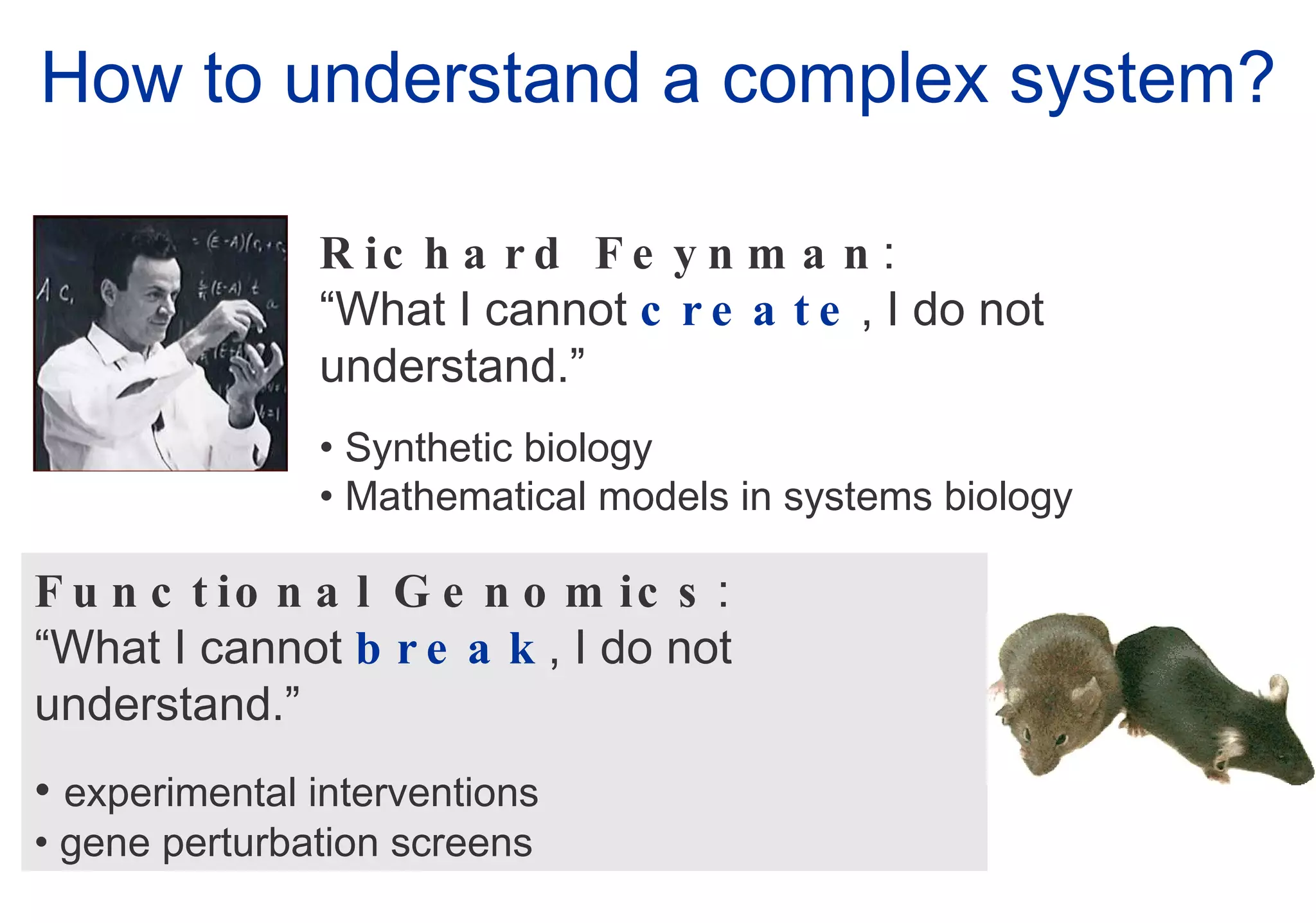
How to understand a complex system? Functional Genomics : “ What I cannot  break , I do not understand.” experimental interventions  gene perturbation screens Richard Feynman : “ What I cannot  create , I do not understand.” Synthetic biology Mathematical models in systems biology
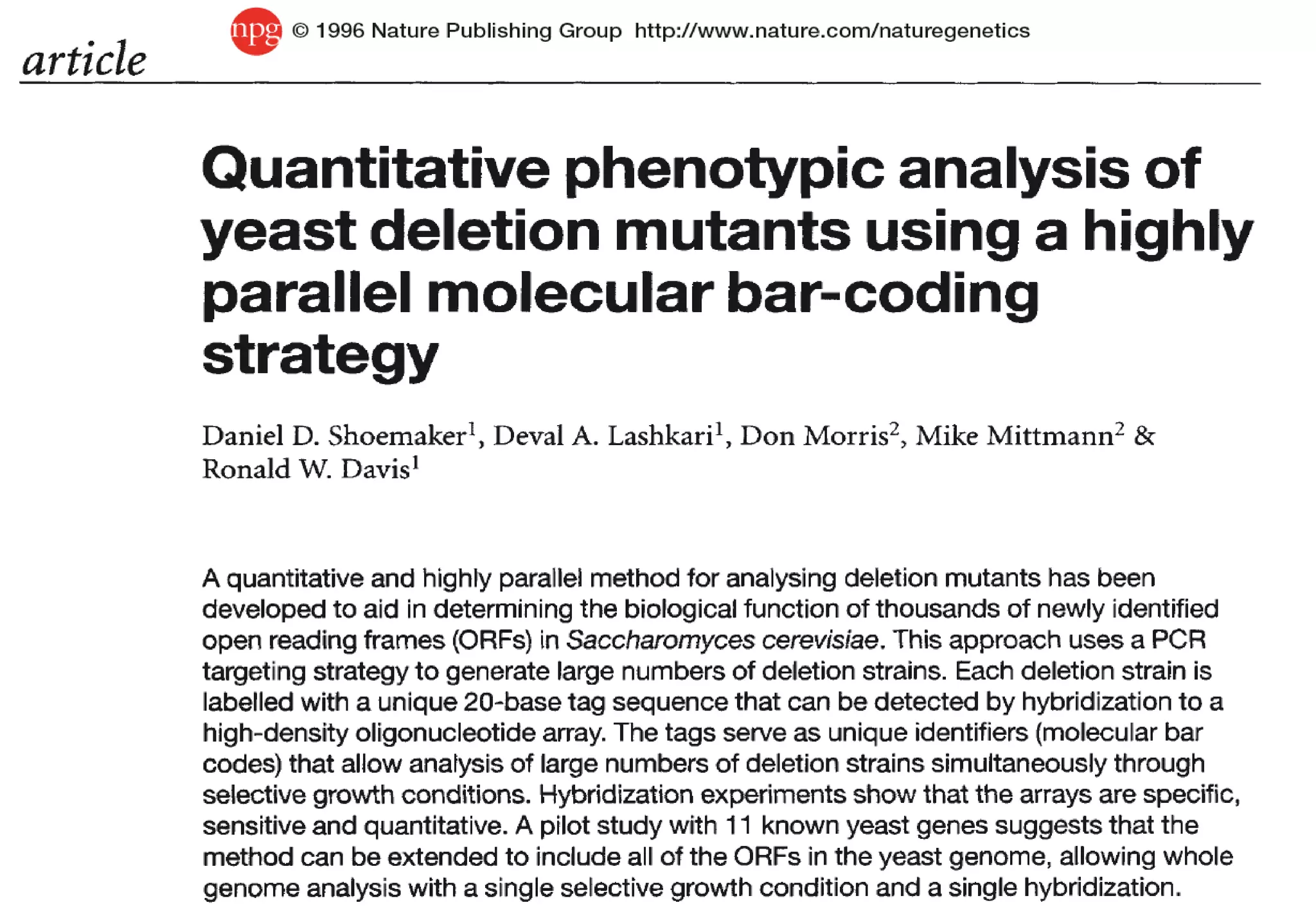
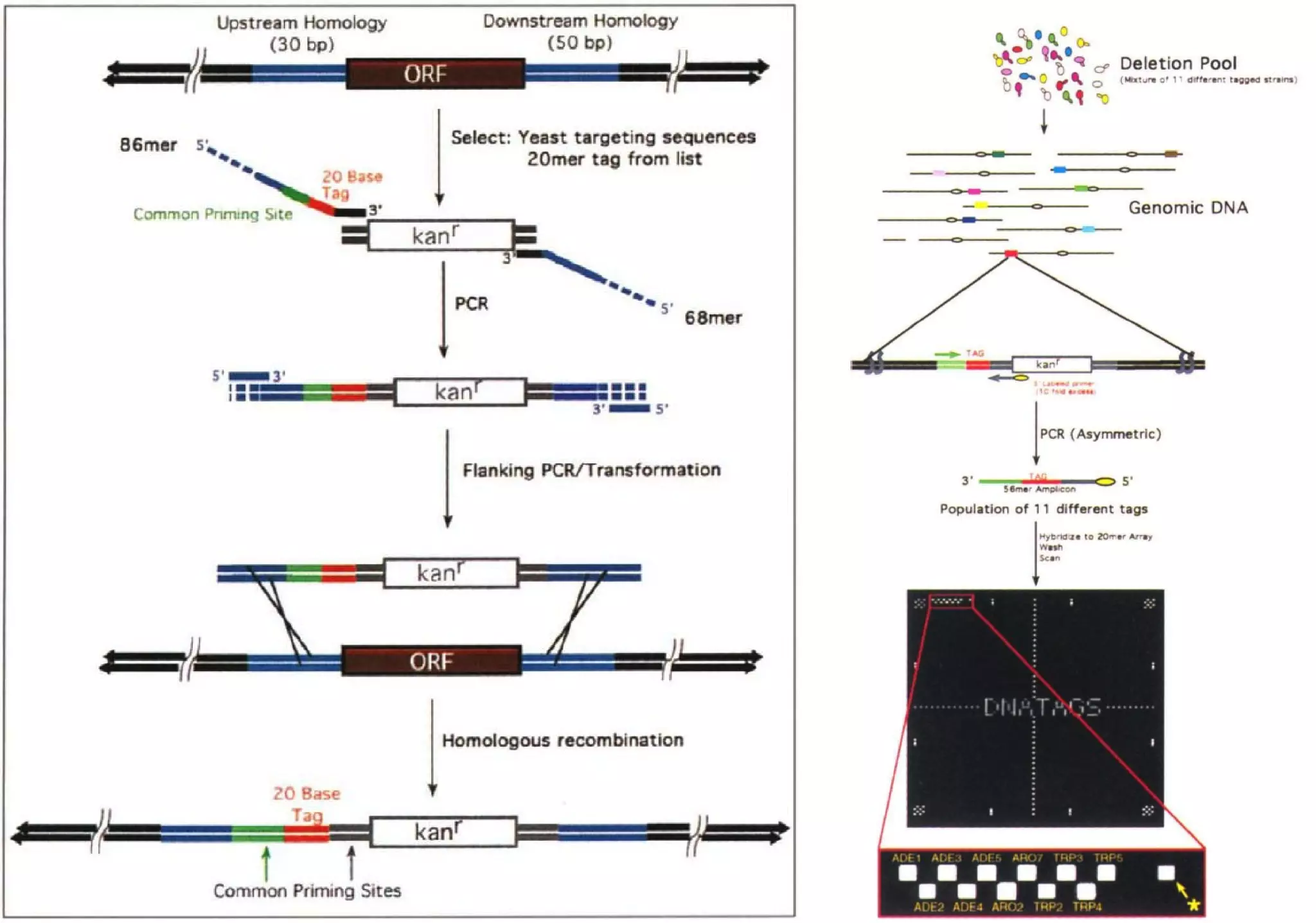
Breaking the system DNA mRNA Protein RNAi Knockout Drugs Small molecules Stress SNPs natural variation
 
 
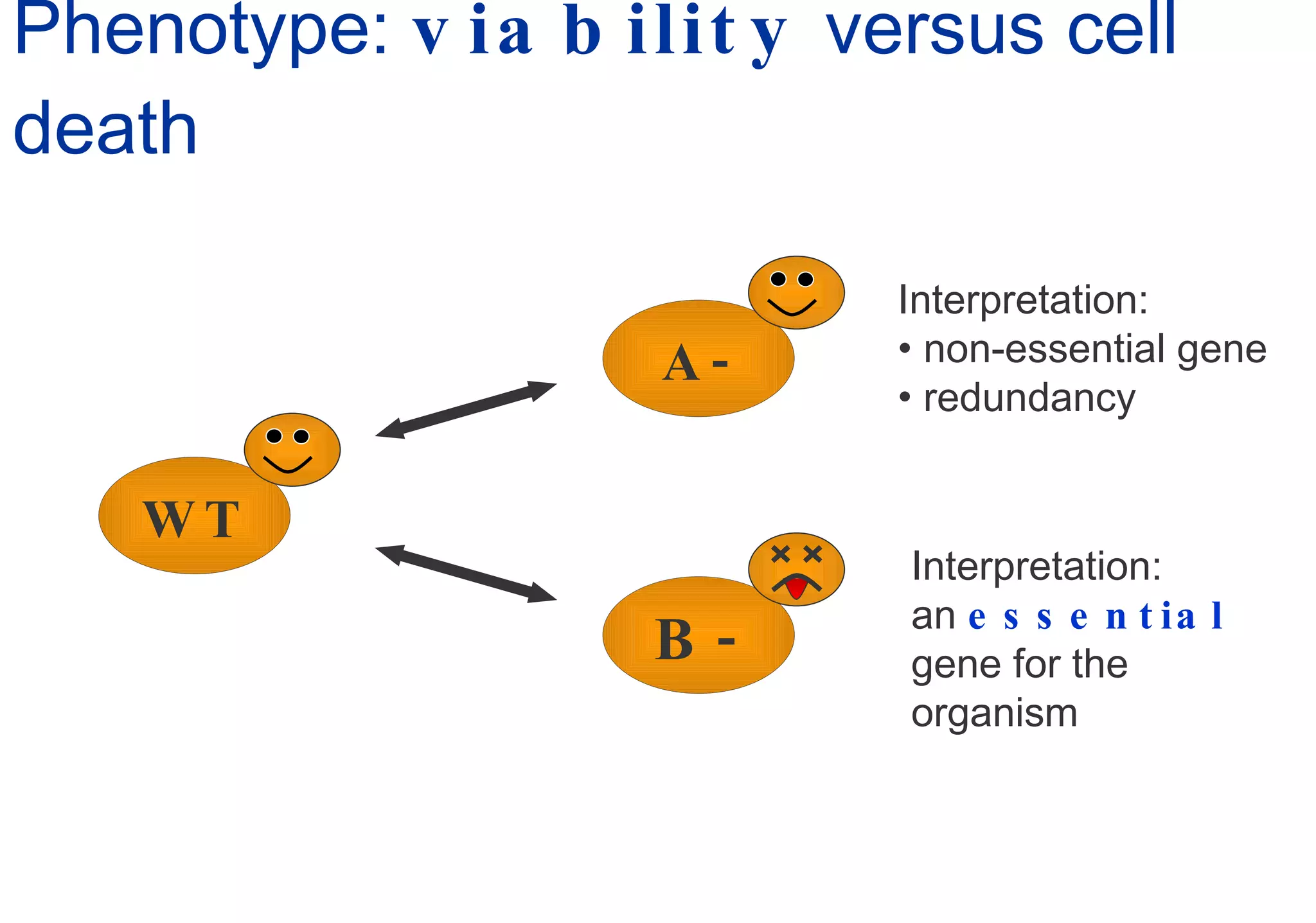
Phenotype:  viability  versus cell death Interpretation: non-essential gene redundancy Interpretation: an  essential   gene for the organism WT B- A-
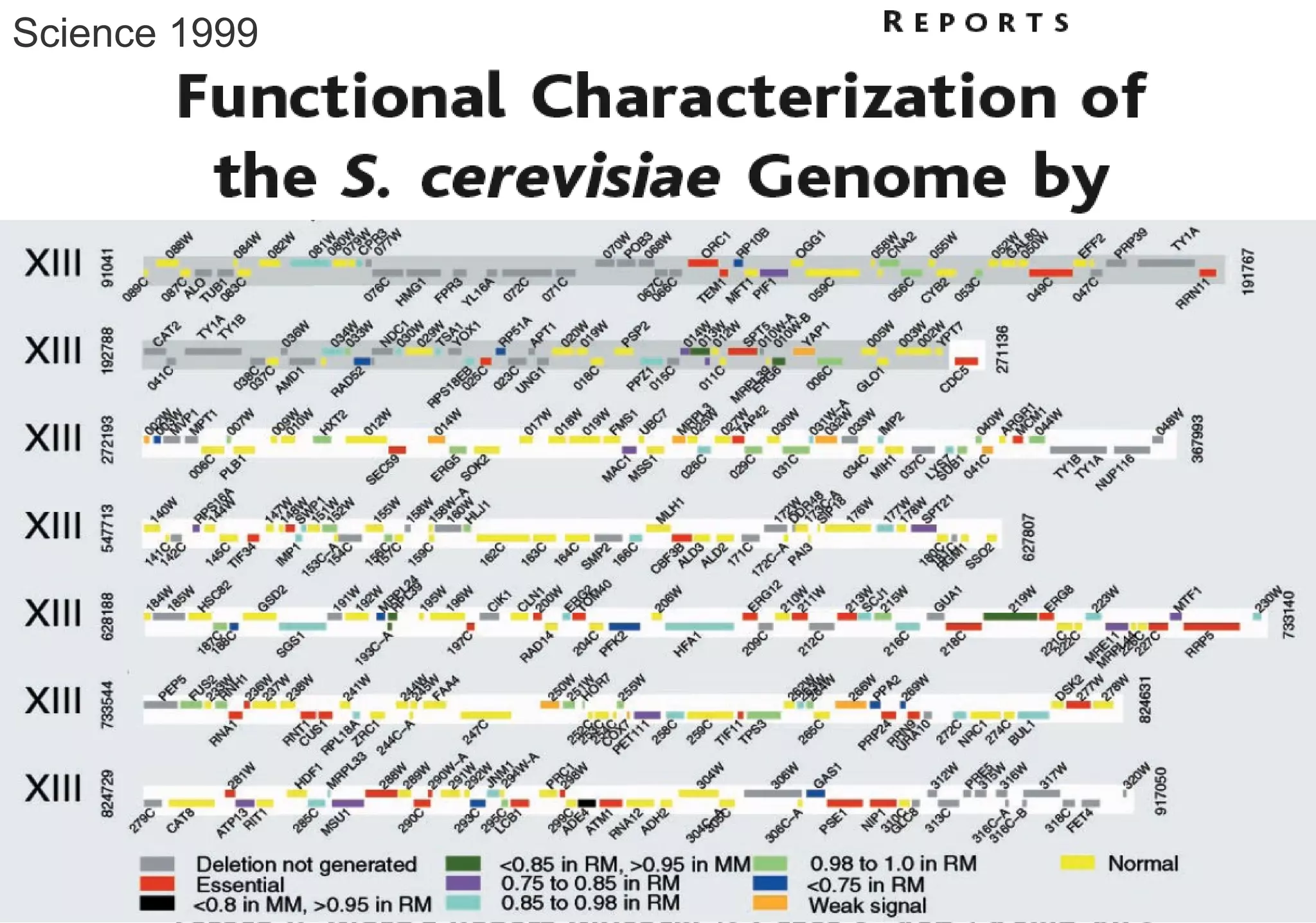
Science 1999
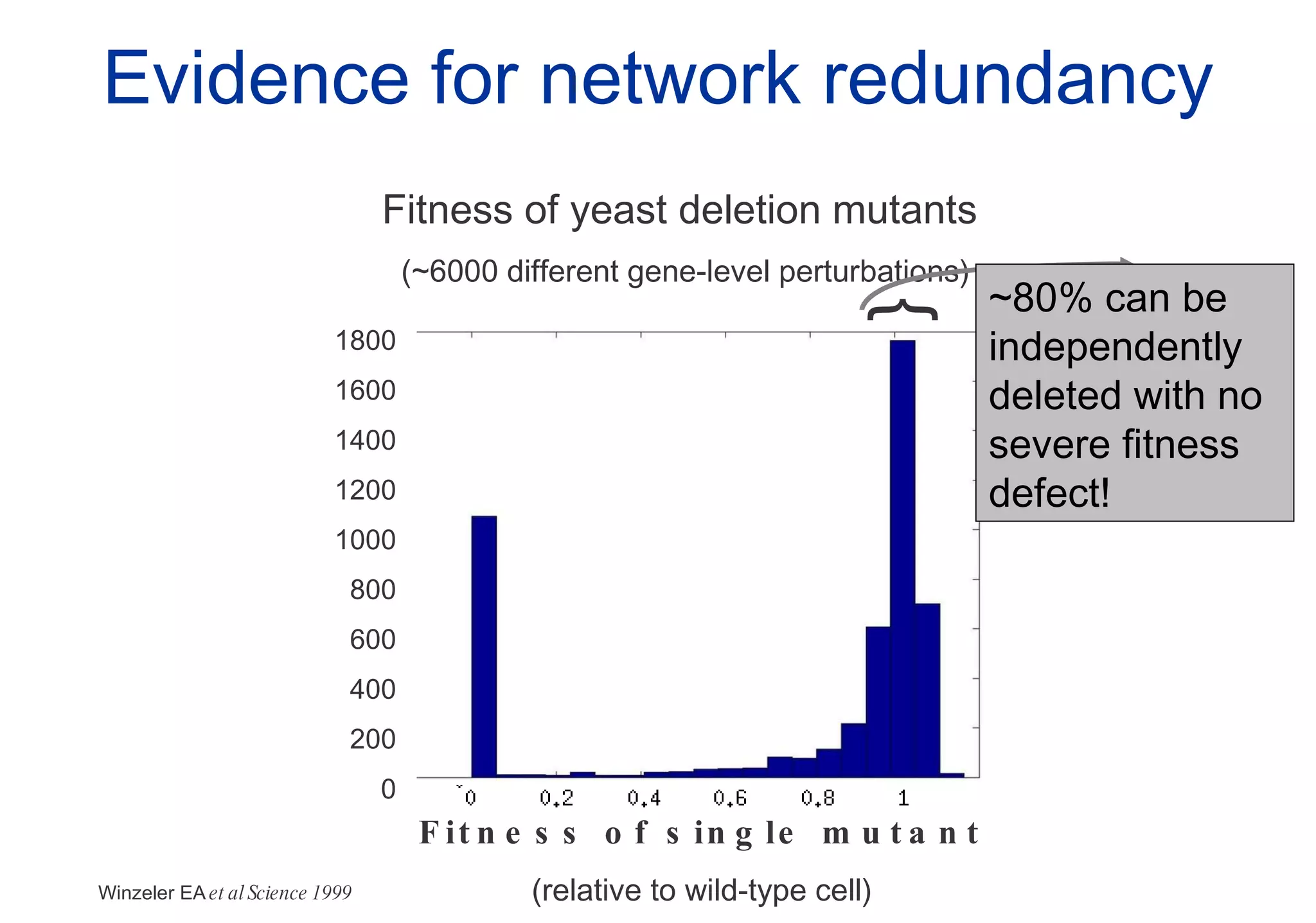
Evidence for network redundancy Fitness of single mutant (relative to wild-type cell) Fitness of yeast deletion mutants  (~6000 different gene-level perturbations) 1800 1600 1400 1200 1000 800 600 400 200 0 Winzeler EA  et al Science 1999 { ~80% can be independently deleted with no severe fitness defect!
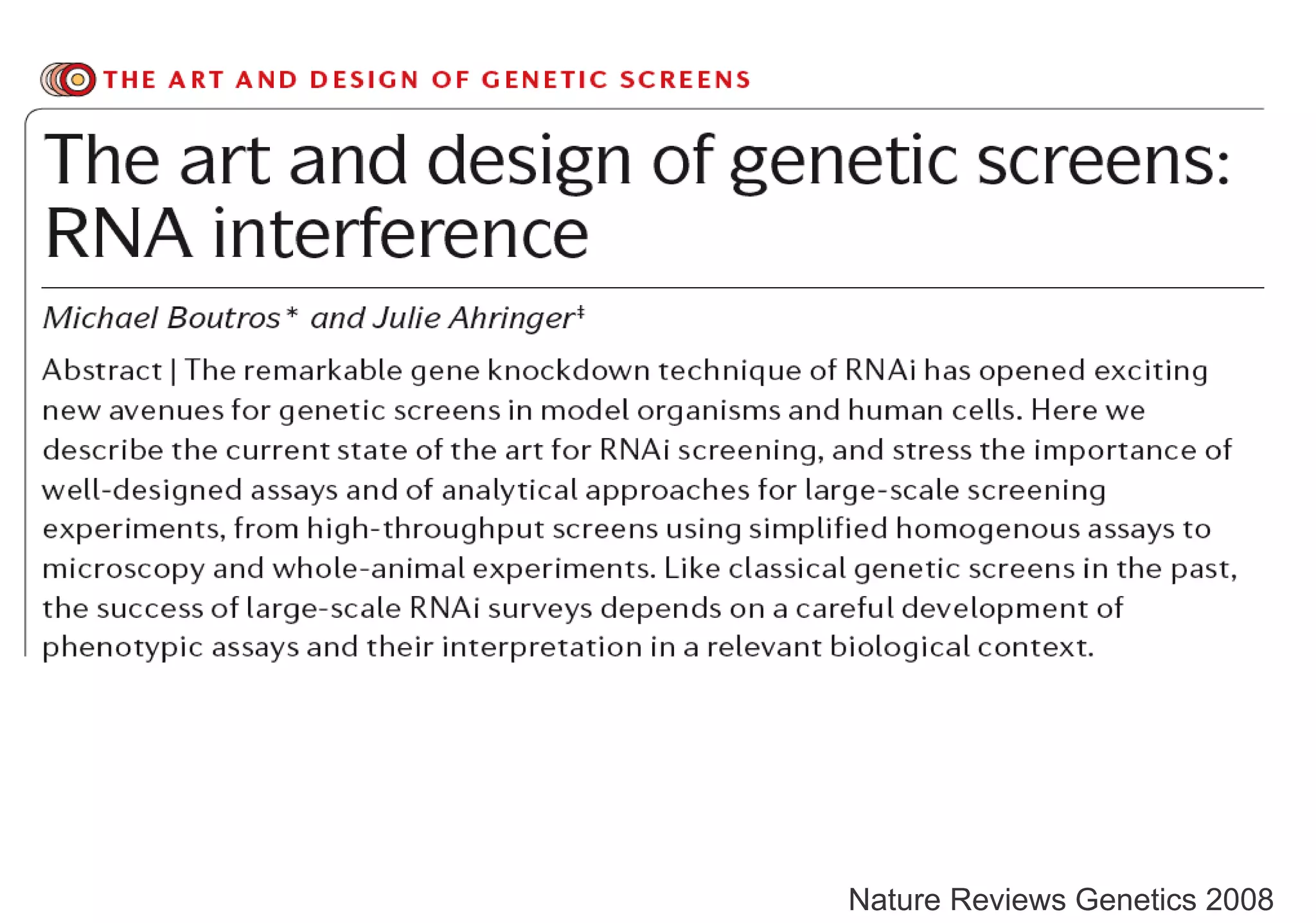
Nature Reviews Genetics 2008
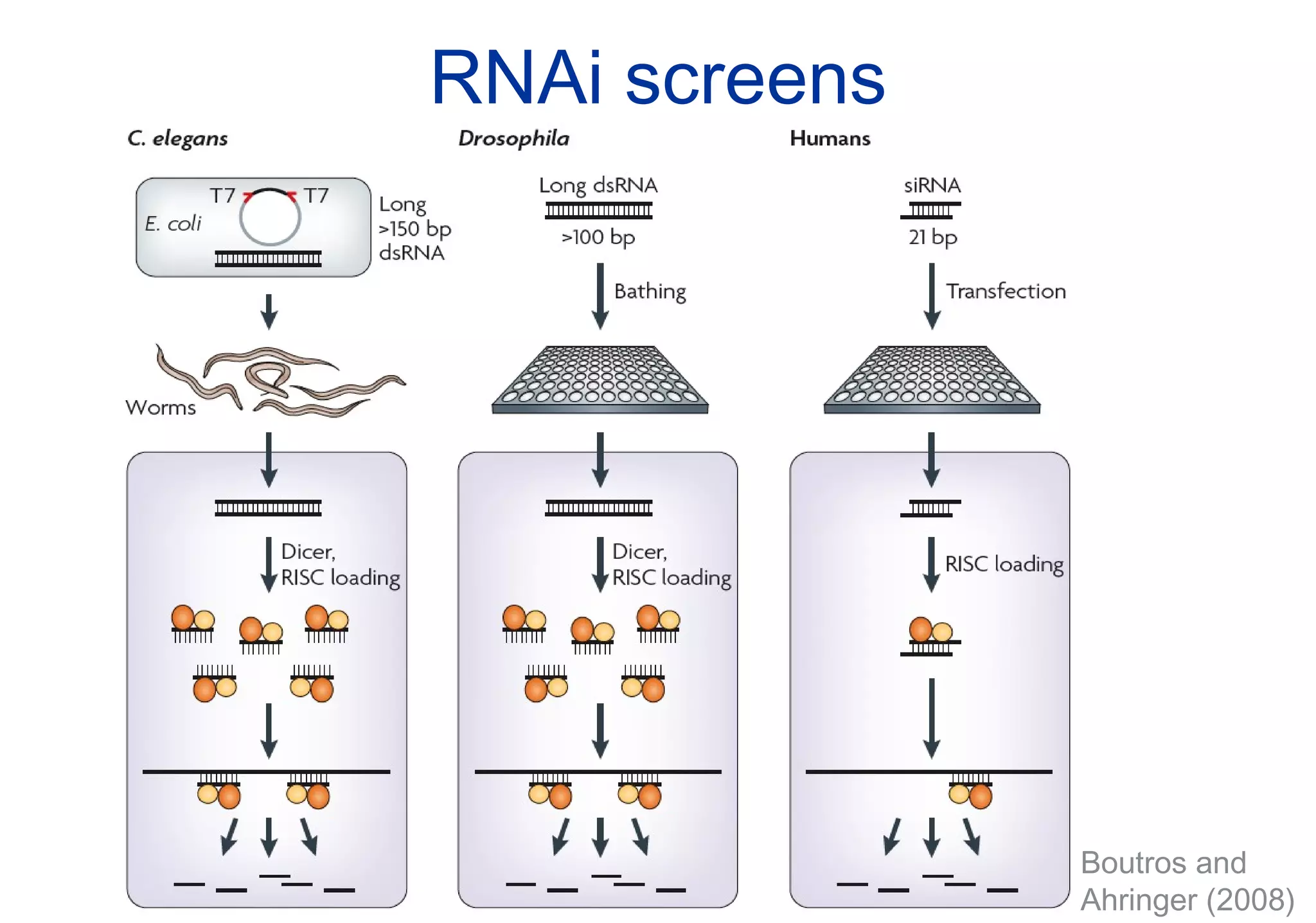
RNAi screens Boutros and  Ahringer (2008)
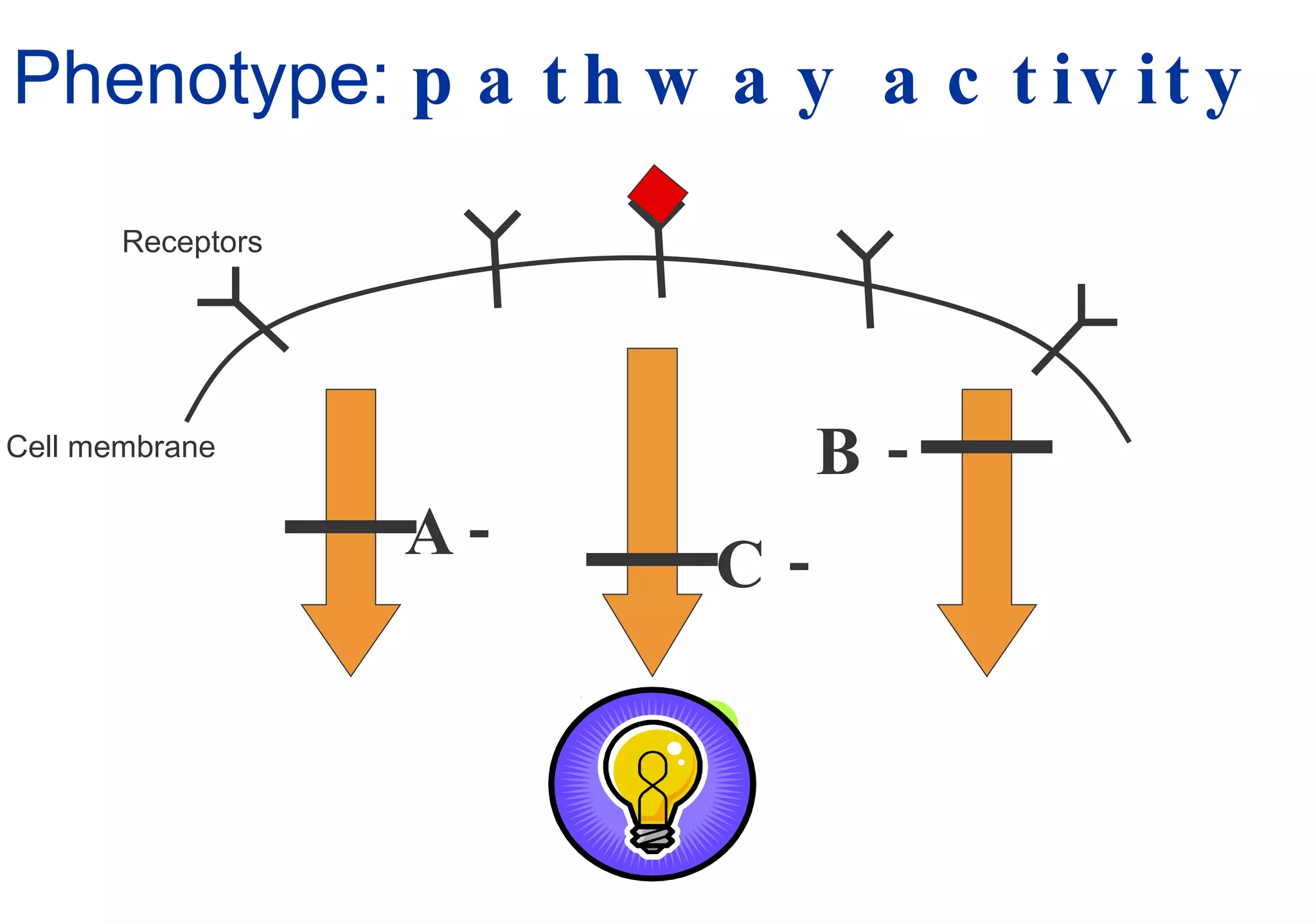
Phenotype:  pathway activity Cell membrane Receptors A- B- C-
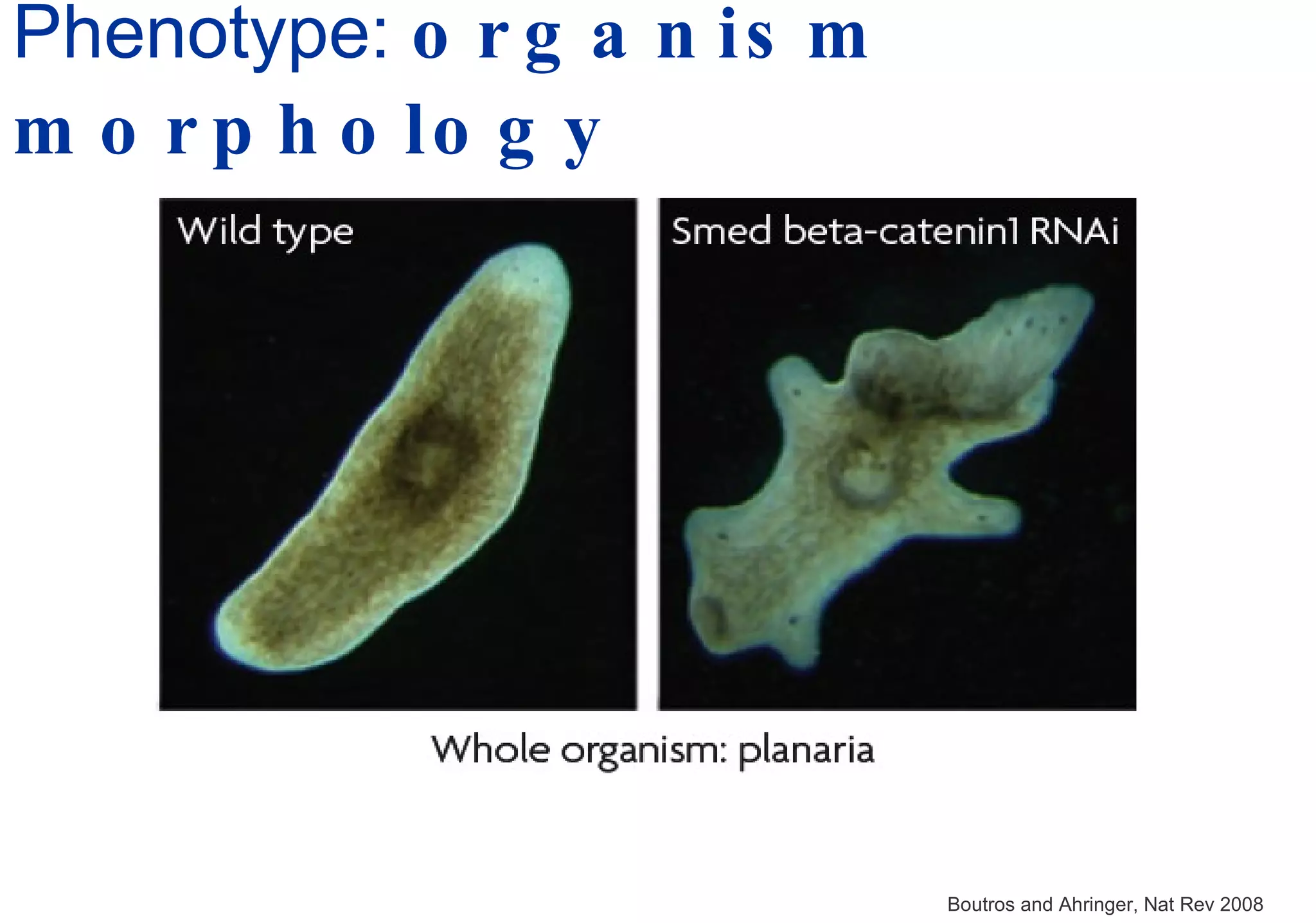
Phenotype:  organism morphology Boutros and Ahringer, Nat Rev 2008
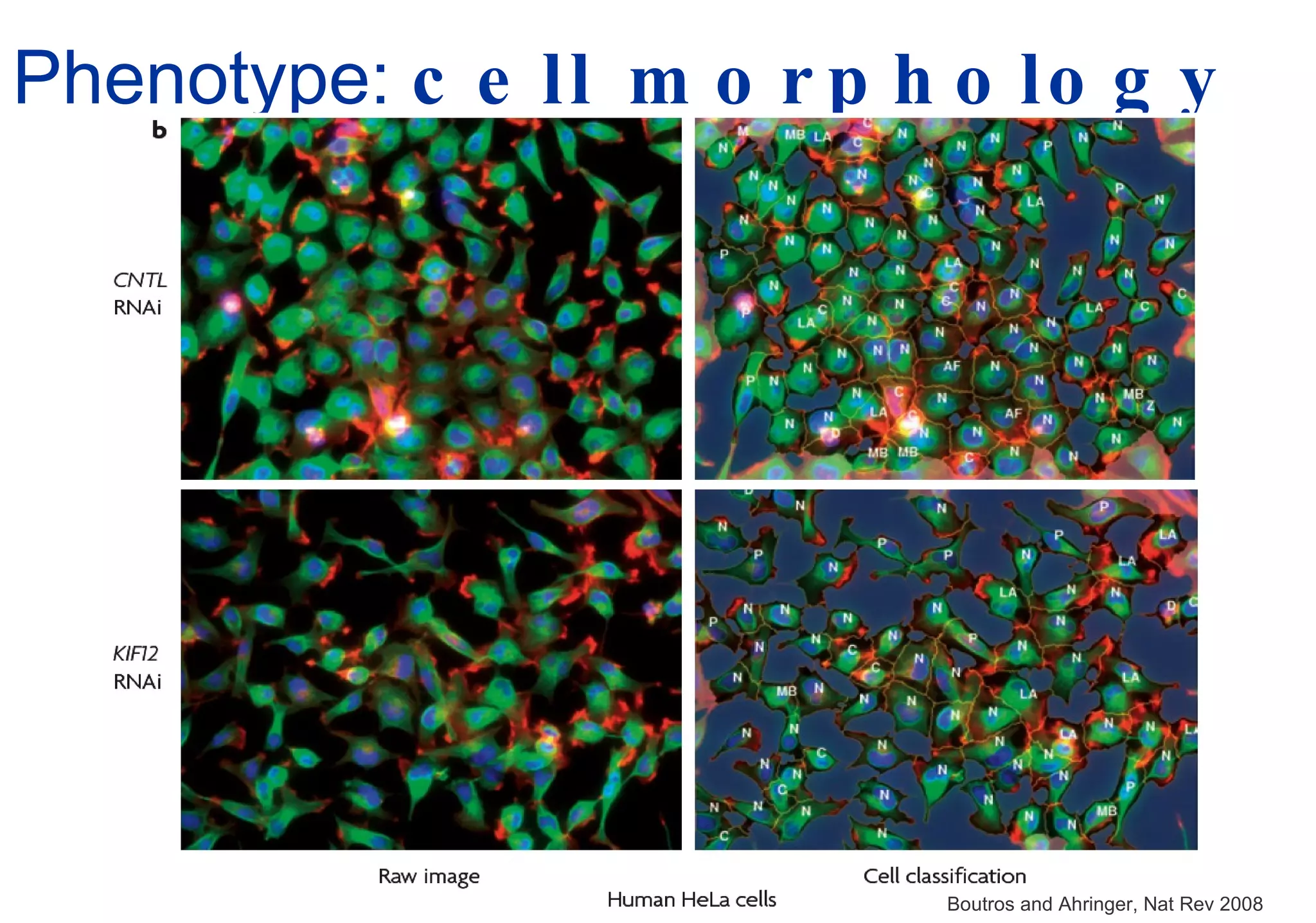
Phenotype:  cell morphology Boutros and Ahringer, Nat Rev 2008
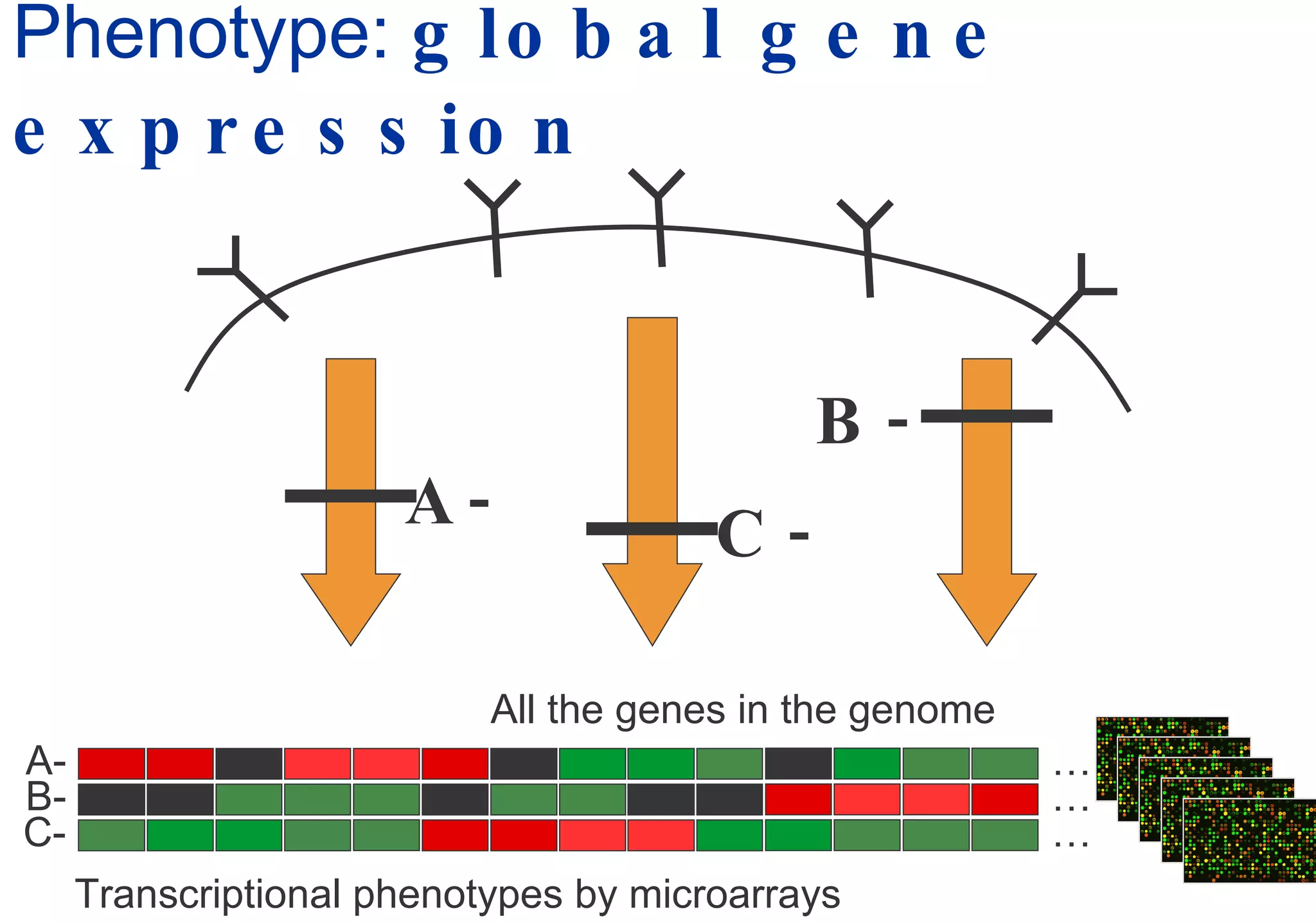
Phenotype:  global gene expression A- B- C- All the genes in the genome Transcriptional phenotypes by microarrays A- B- C- … … …
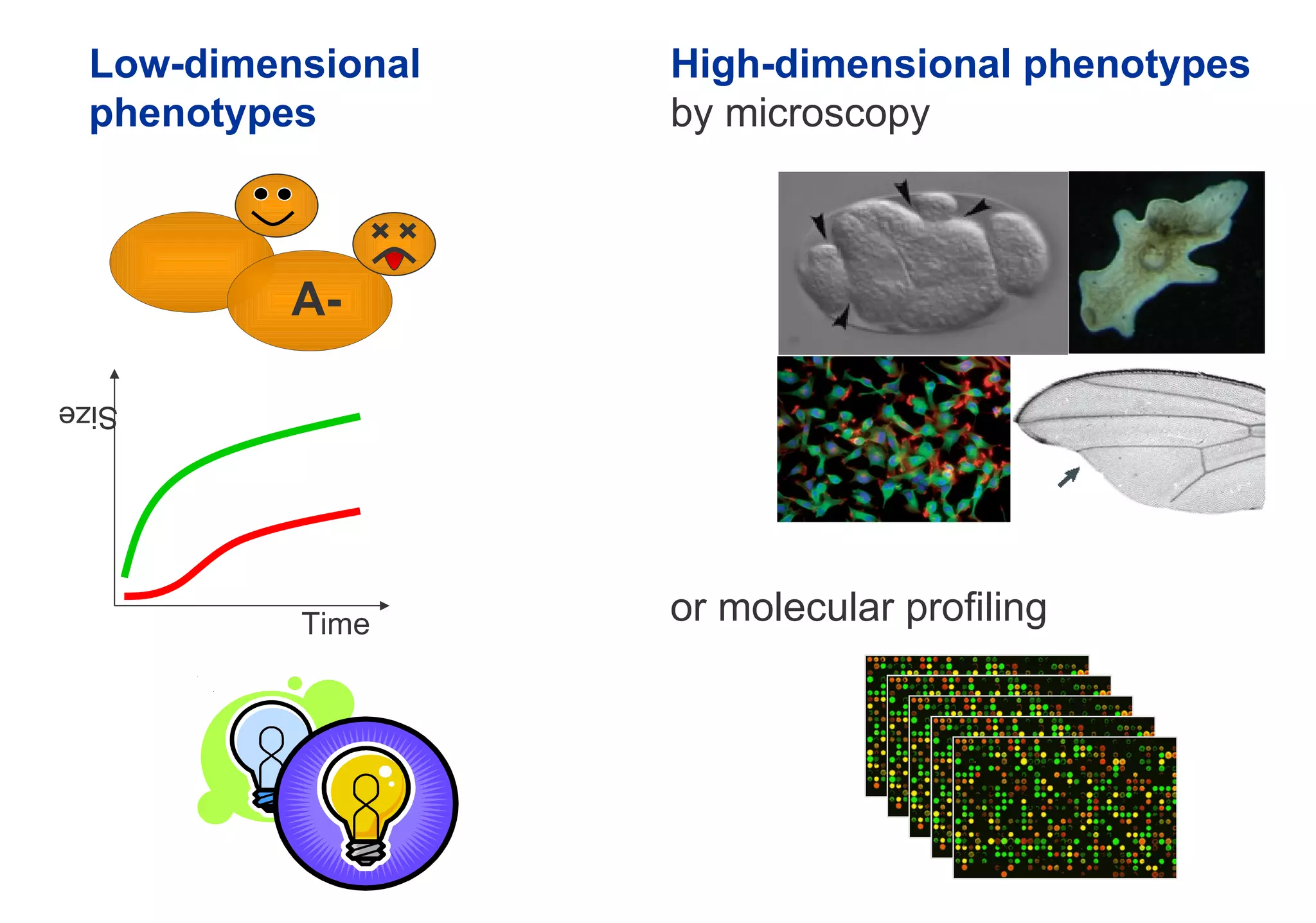
High-dimensional phenotypes by microscopy or molecular profiling Low-dimensional phenotypes A- Time Size
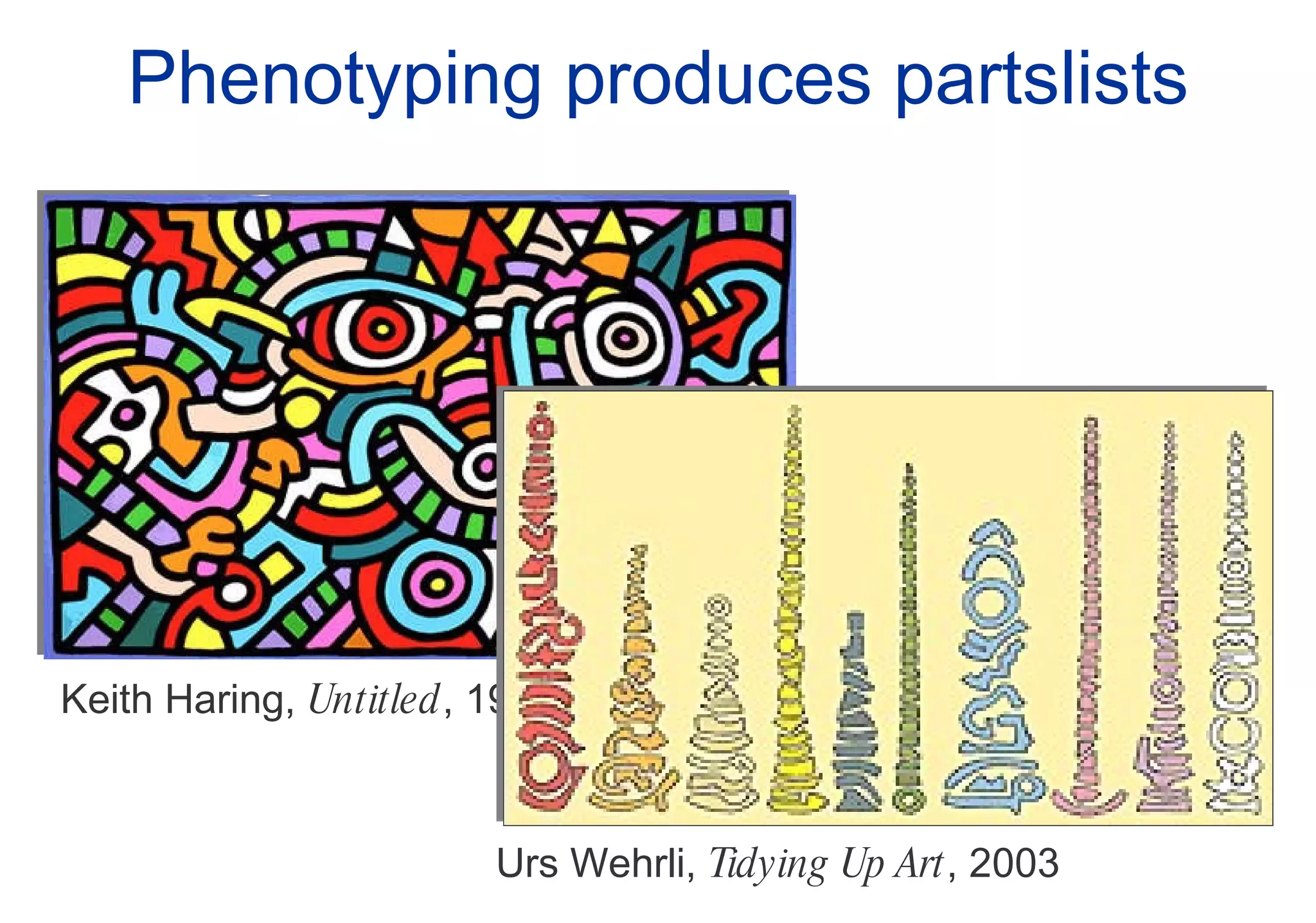
Phenotyping produces partslists Keith Haring,  Untitled , 1986 Urs Wehrli,  Tidying Up Art , 2003
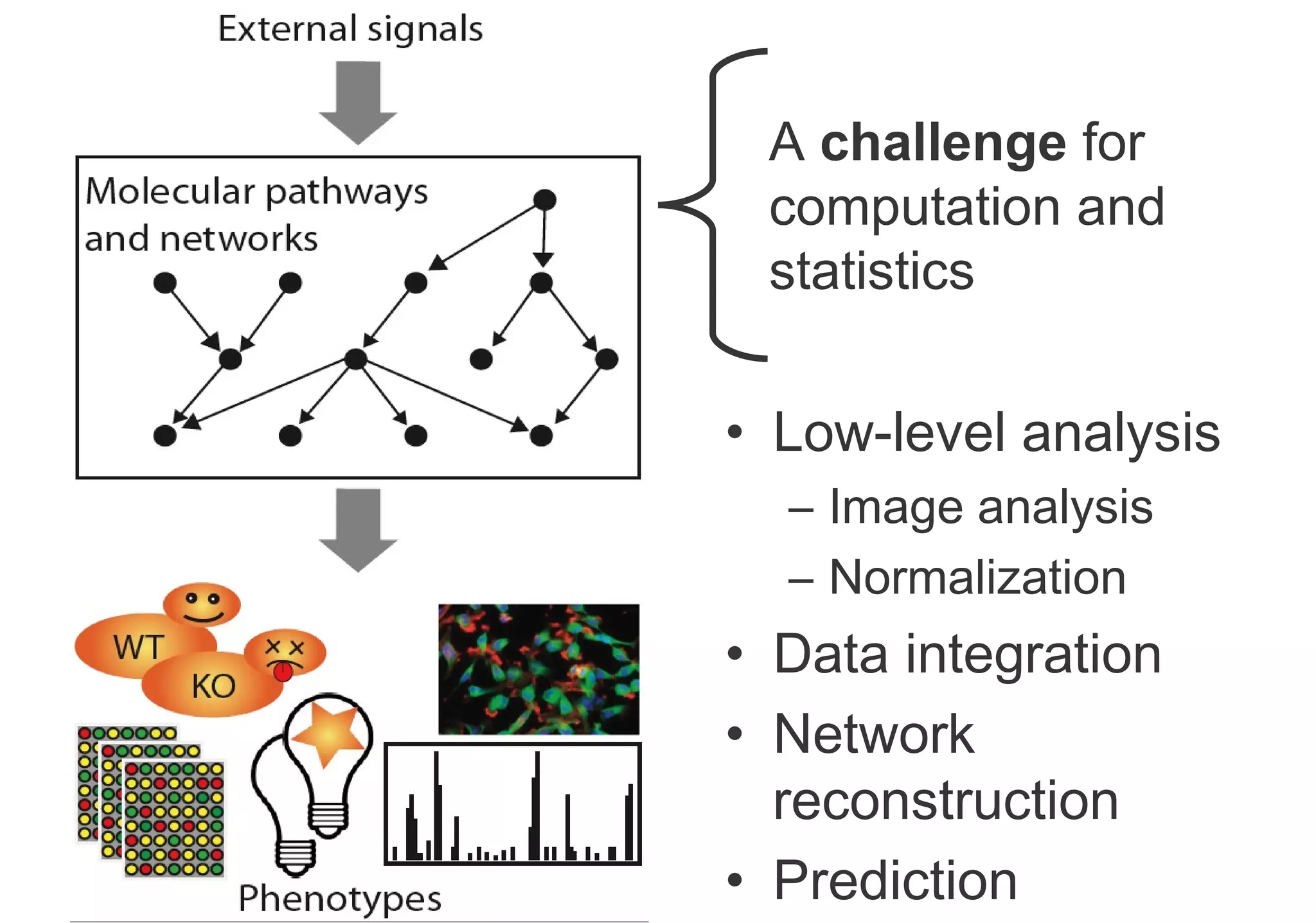
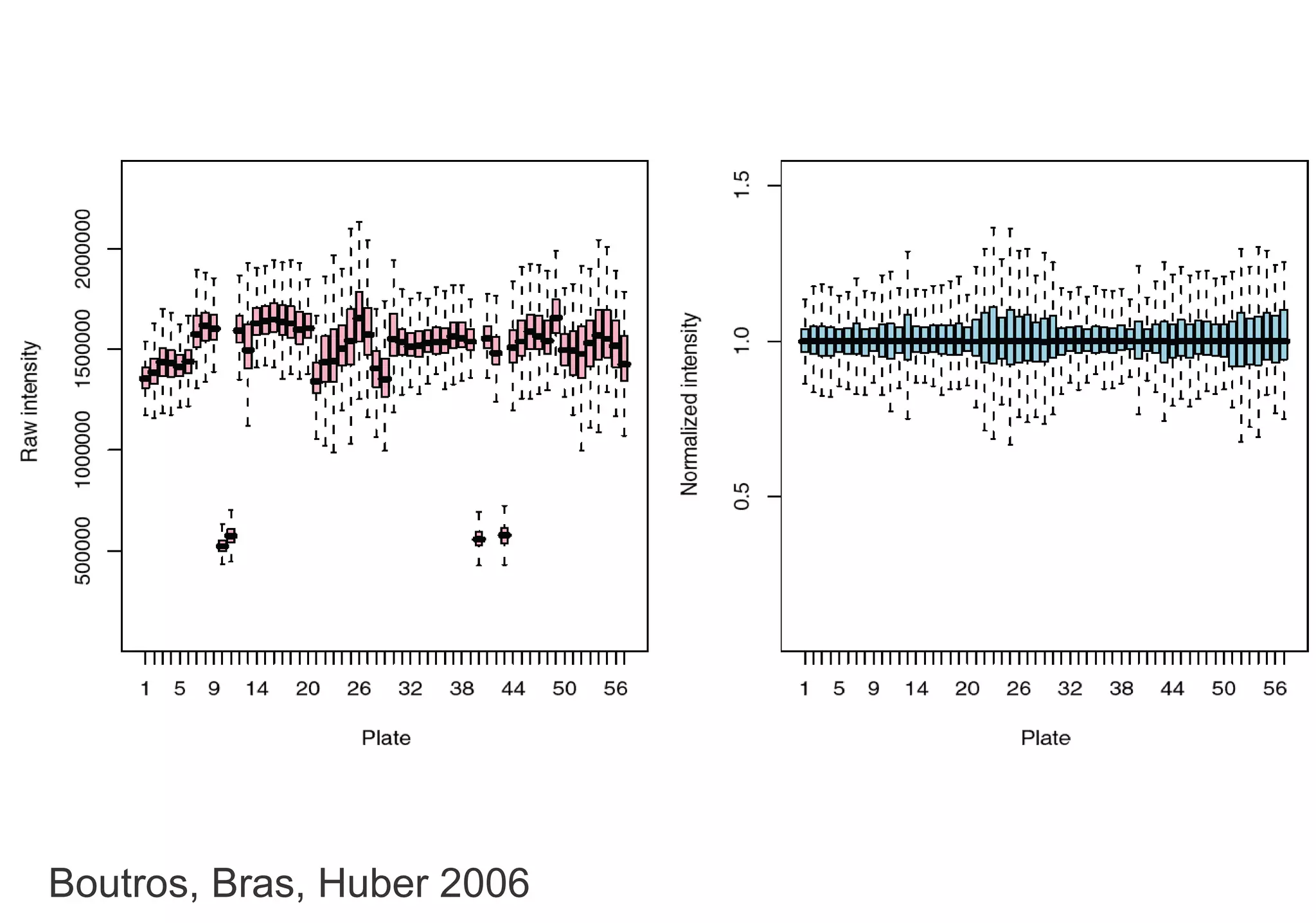
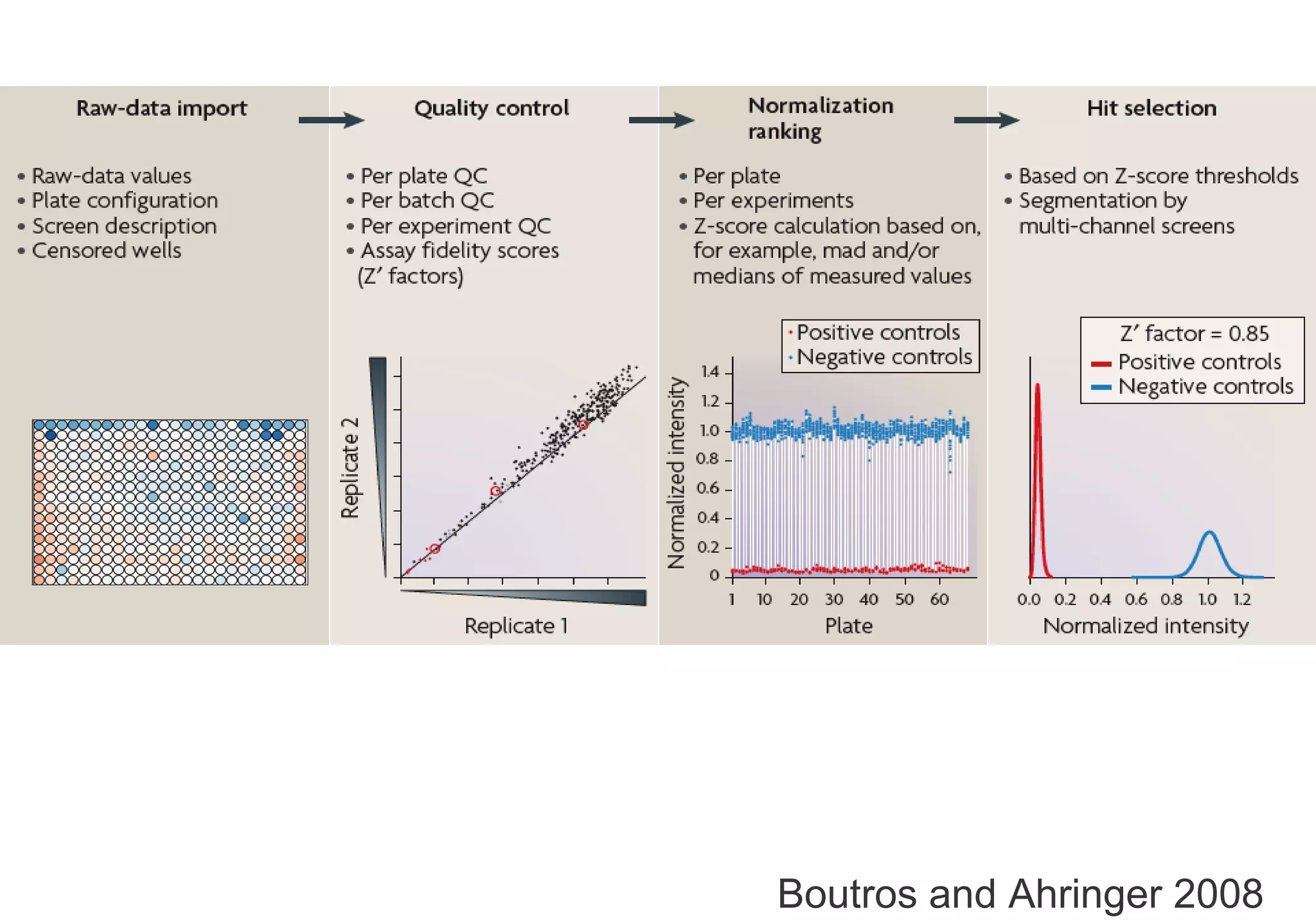
Low-level analysis Image analysis Normalization Data integration Network reconstruction Prediction A  challenge  for computation and statistics
 
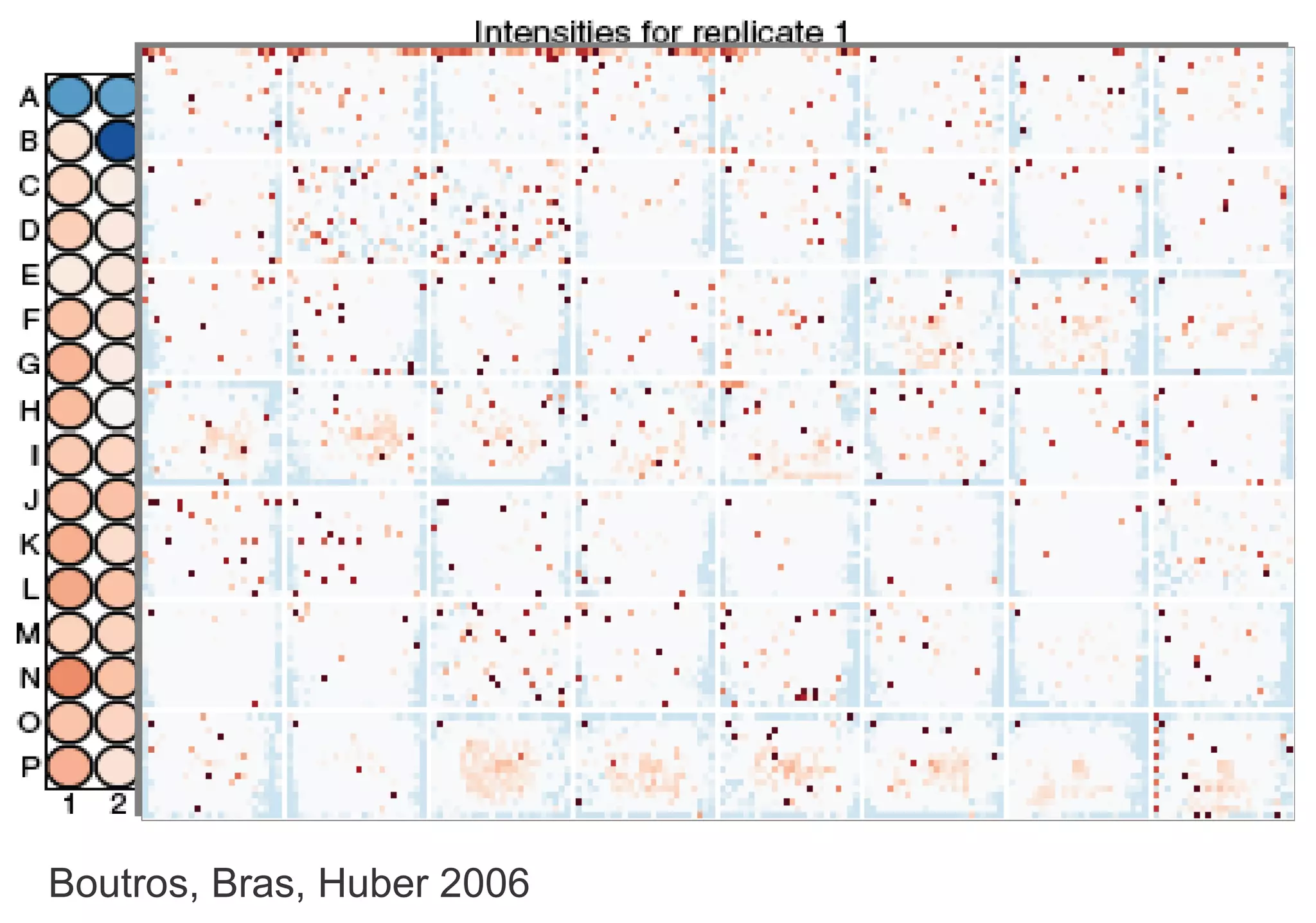
Boutros, Bras, Huber 2006
Boutros and Ahringer 2008
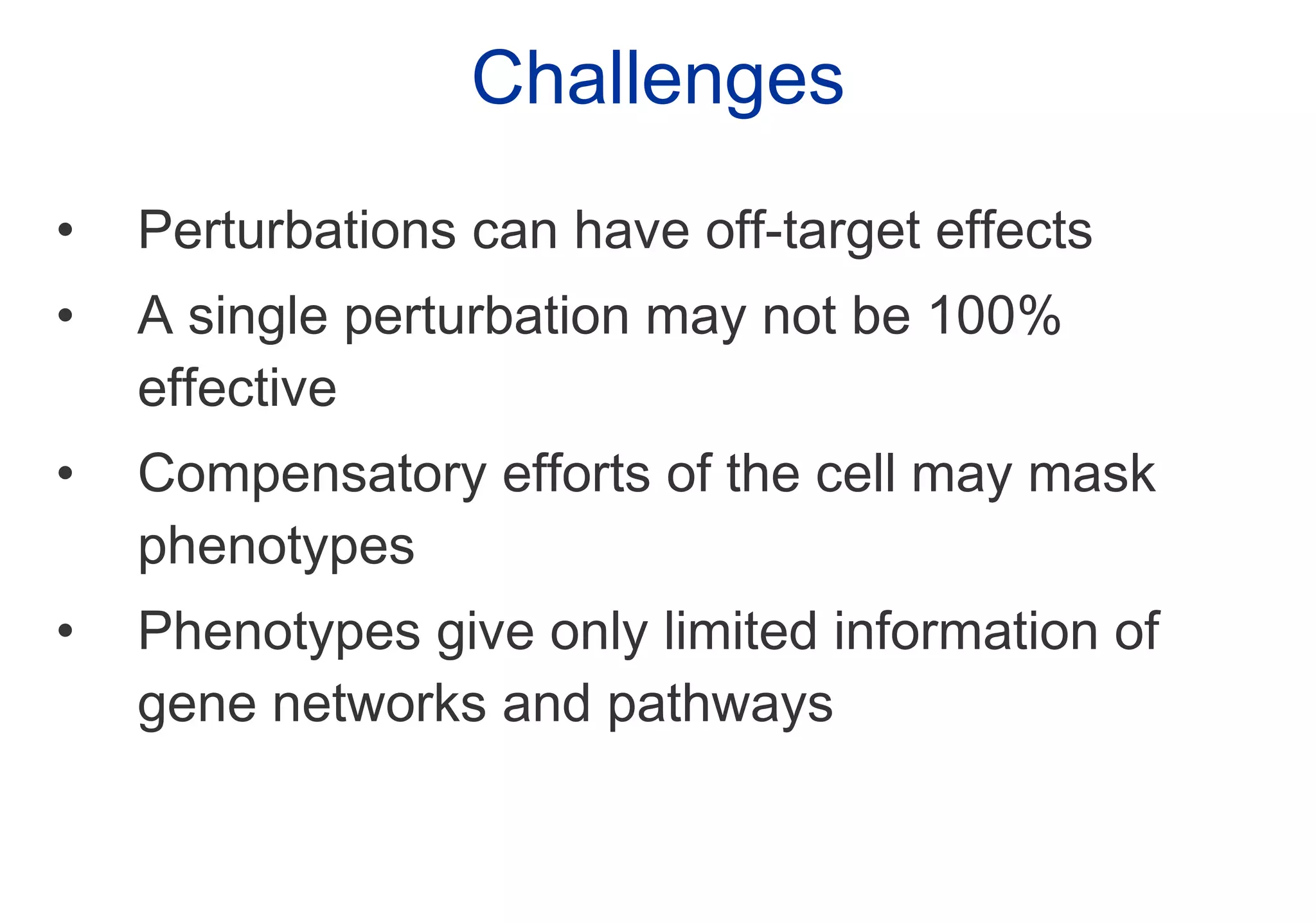
Challenges Perturbations can have off-target effects A single perturbation may not be 100% effective Compensatory efforts of the cell may mask phenotypes Phenotypes give only limited information of gene networks and pathways
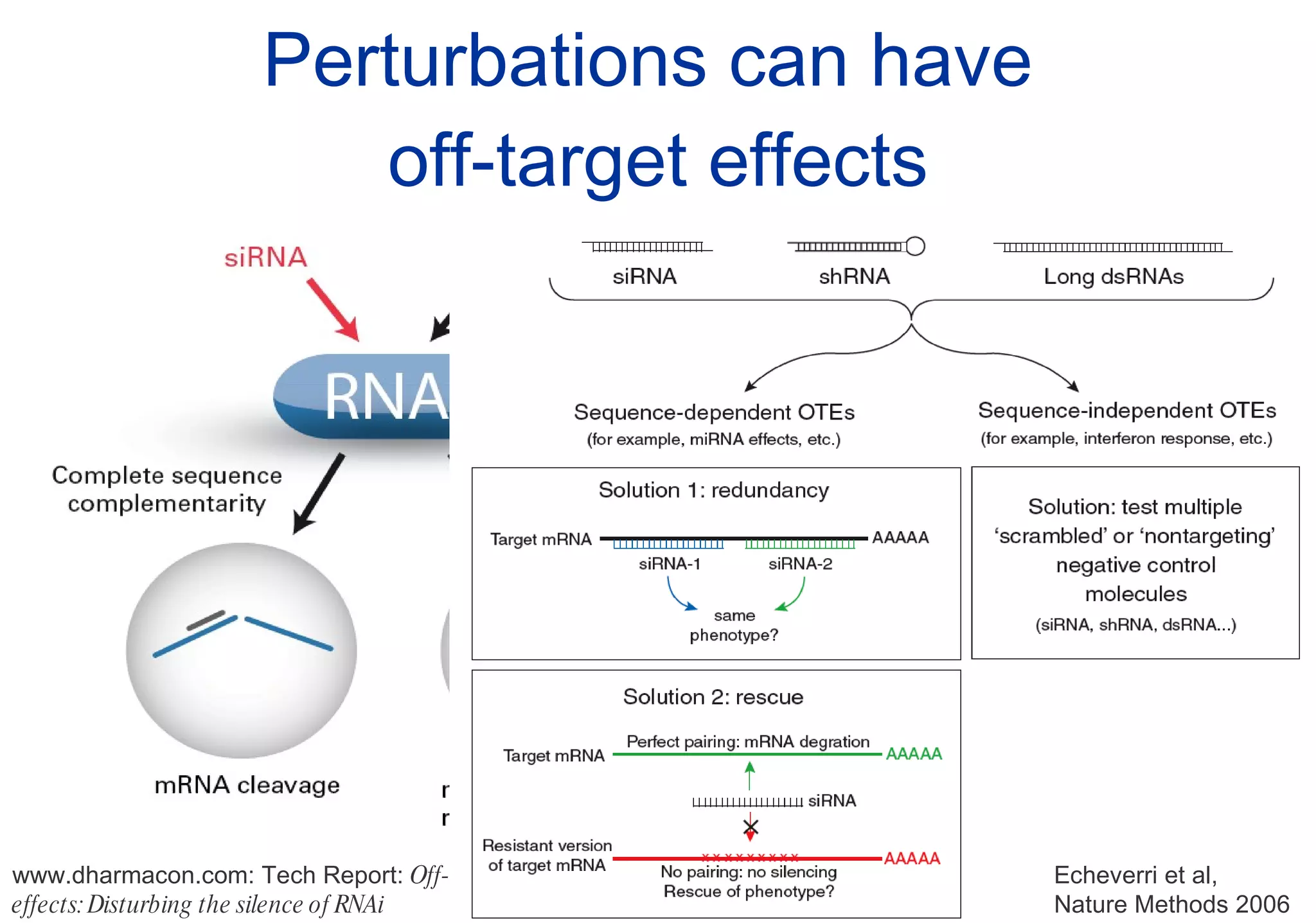
Perturbations can have  off-target effects www.dharmacon.com: Tech Report:  Off-target effects: Disturbing the silence of RNAi Echeverri et al,  Nature Methods 2006
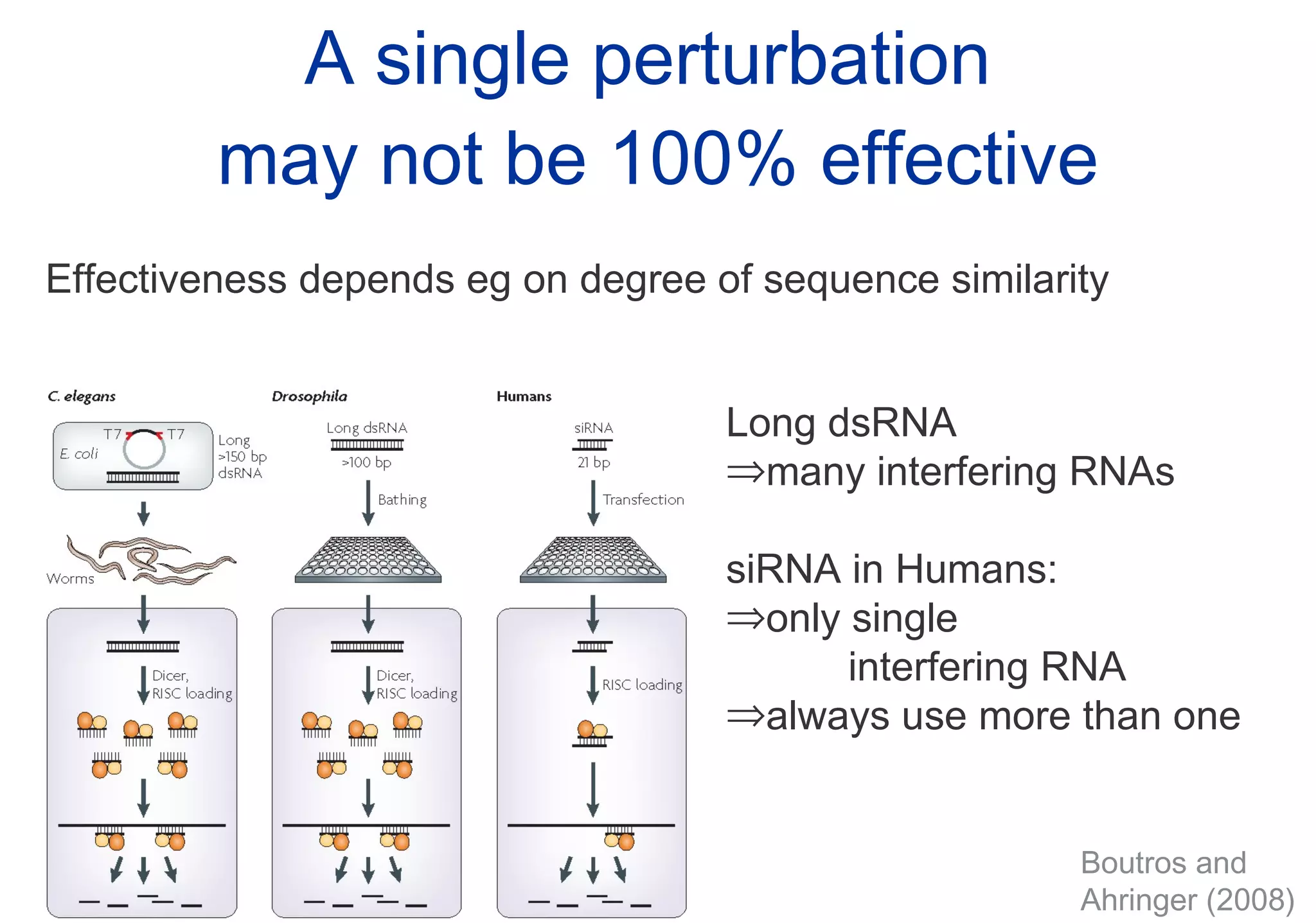
A single perturbation  may not be 100% effective Boutros and  Ahringer (2008) Effectiveness depends eg on degree of sequence similarity Long dsRNA  many interfering RNAs siRNA in Humans: only single  interfering RNA always use more than one
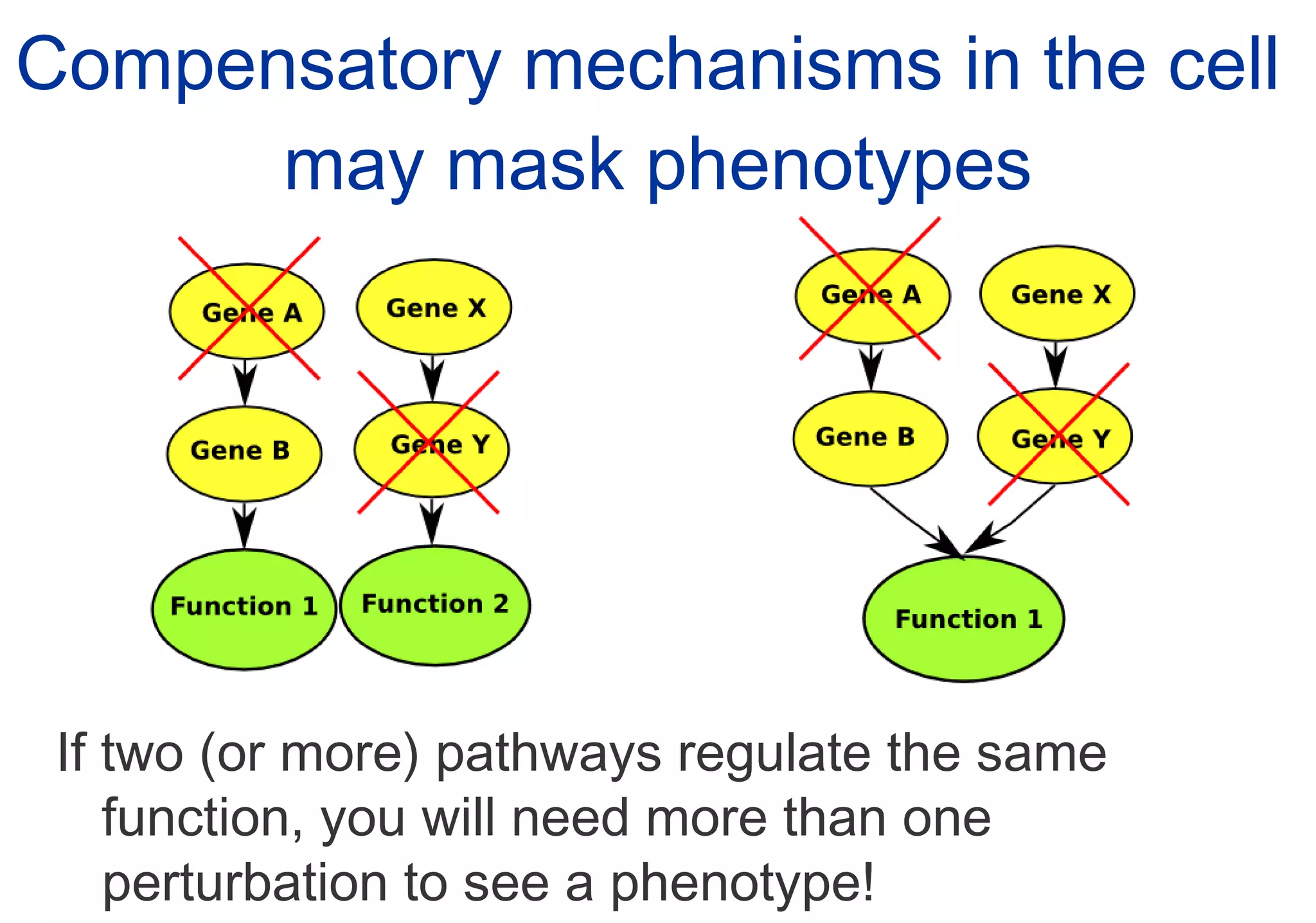
Compensatory mechanisms in the cell  may mask phenotypes If two (or more) pathways regulate the same function, you will need more than one perturbation to see a phenotype!
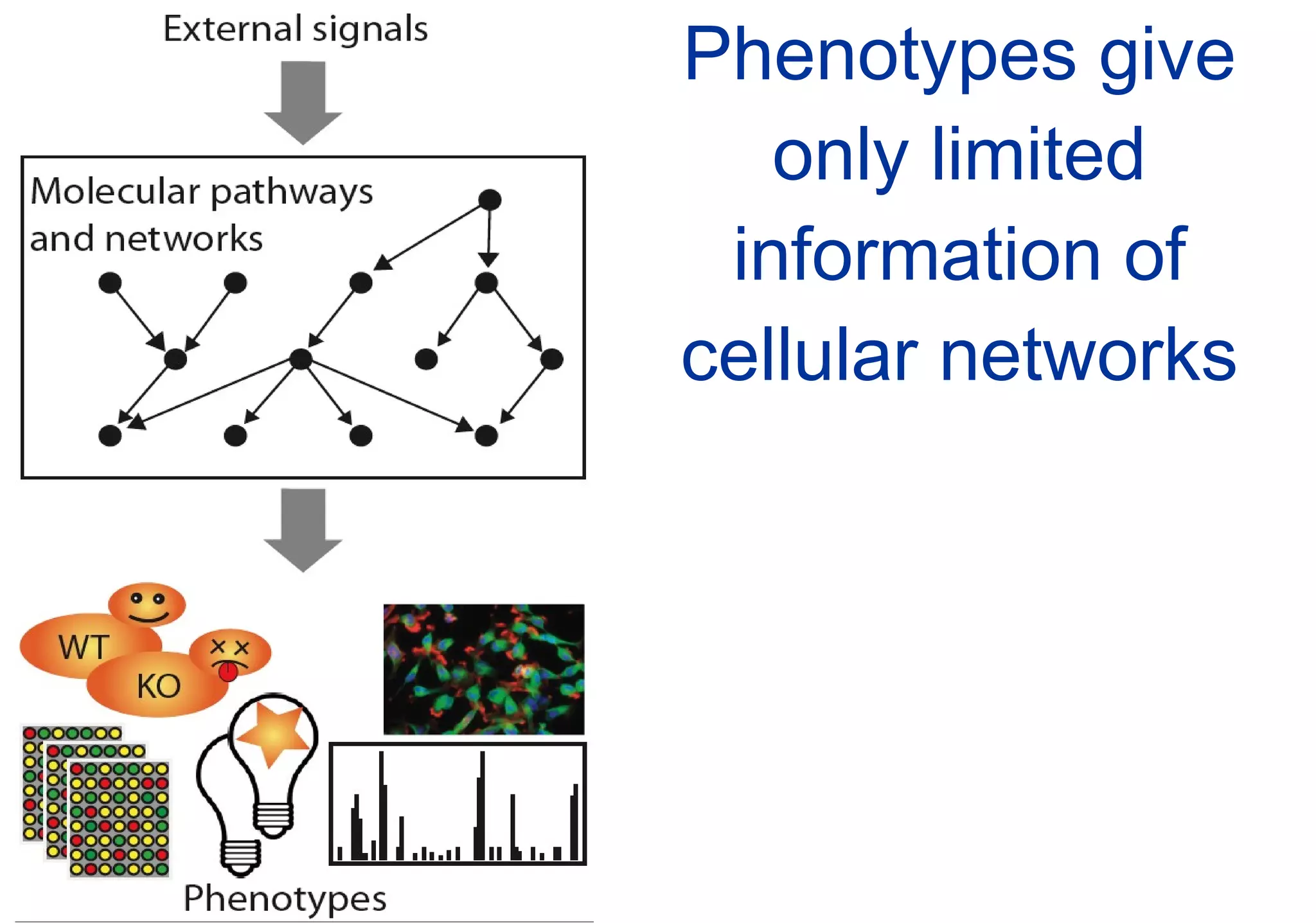
Phenotypes give only limited information of cellular networks
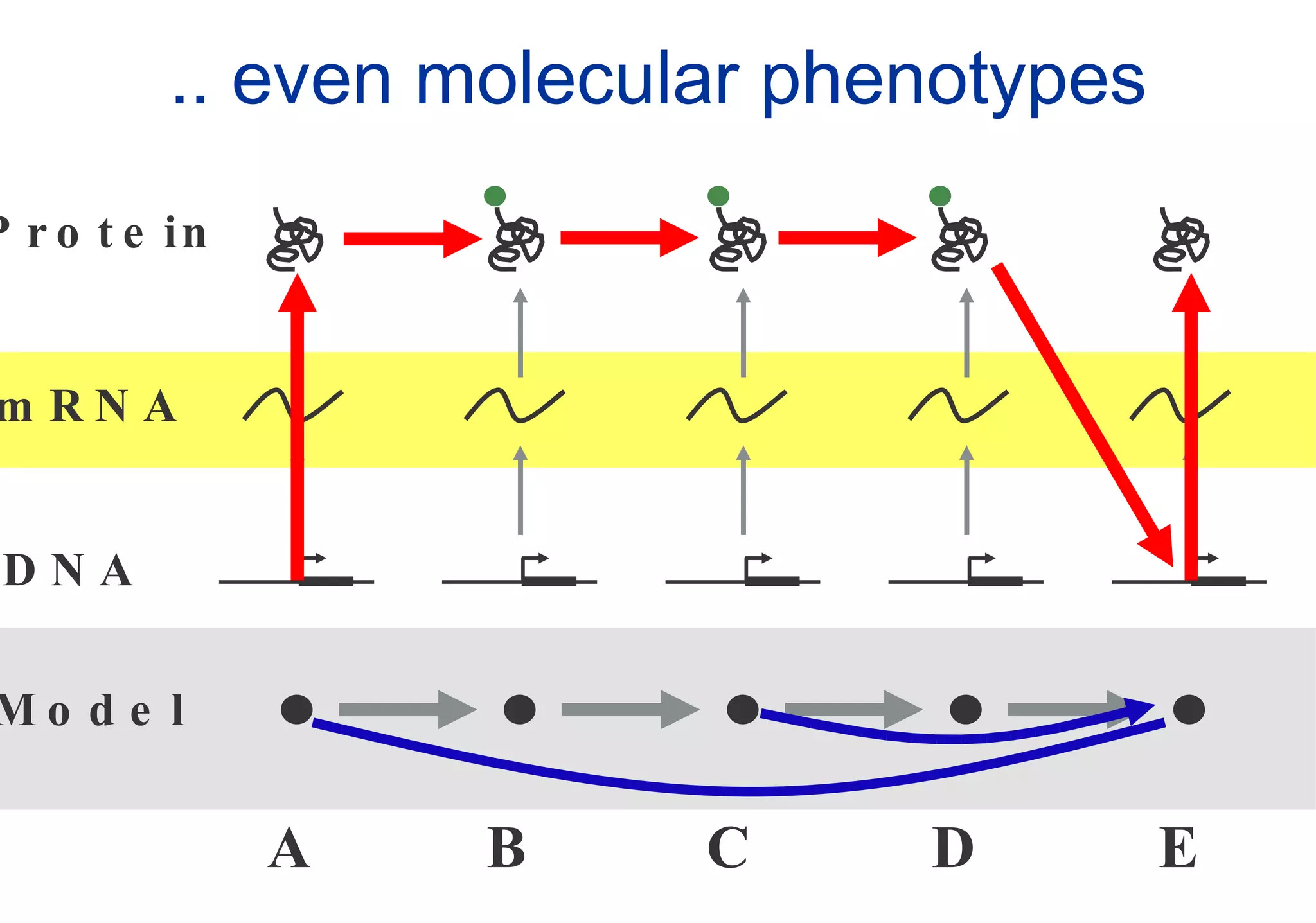
.. even molecular phenotypes Model DNA mRNA Protein A B C D E
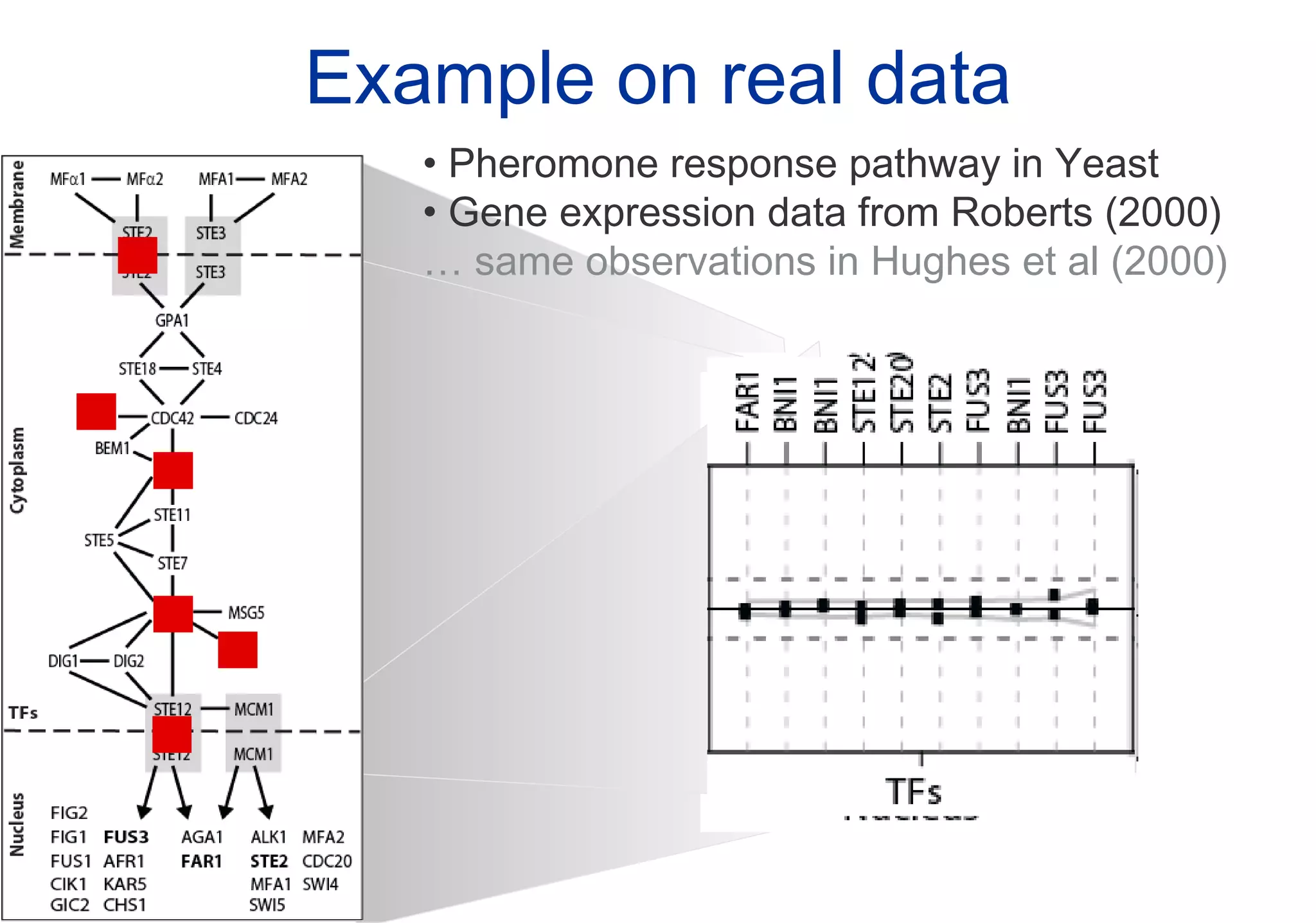
Example on real data Pheromone response pathway in Yeast Gene expression data from Roberts (2000) …  same observations in Hughes et al (2000)
Today’s lecture What are phenotyping screens? Perturbations : how to knock-out or knock-down a gene? Phenotypes : how to characterize the effects of a perturbation on the cell or organism? Where does computation come in? What challenges do we have to deal with?
Three take-home messages Phenotyping screens are key technologies in functional genomics Experimental perturbations are mostly knock-outs or knock-downs, phenotypes are various from viability and morphology to global gene expression. Even molecular phenotypes only show a ‘slice’ of what is happening in the cell.
Overview of rest of lectures Enrichment analysis, clustering and ranking function prediction by guilt-by-association Perturbations in probabilistic graphical models Inferring Bayesian networks from perturbation data Multiple-Input Multiple-Output models Non-linear dynamic models Nested Effects Models Inferring pathways from down-stream effects Genetic interaction networks Combinatorial perturbations
Network Biology - lecture 1 Questions ?

Network Biology Lent 2010 - lecture 1

  • 1.
    Perturbations and phenotypes- an introduction - Network Biology - lecture 1
  • 2.
  • 3.
    Today’s lecture Whatare phenotyping screens? Perturbations : how to knock-out or knock-down a gene? Phenotypes : how to characterize the effects of a perturbation on the cell or organism? Where does computation come in? What challenges do we have to deal with?
  • 4.
    How to understanda complex system? Functional Genomics : “ What I cannot break , I do not understand.” experimental interventions gene perturbation screens Richard Feynman : “ What I cannot create , I do not understand.” Synthetic biology Mathematical models in systems biology
  • 5.
    Breaking the systemDNA mRNA Protein RNAi Knockout Drugs Small molecules Stress SNPs natural variation
  • 6.
  • 7.
  • 8.
    Phenotype: viability versus cell death Interpretation: non-essential gene redundancy Interpretation: an essential gene for the organism WT B- A-
  • 9.
  • 10.
    Evidence for networkredundancy Fitness of single mutant (relative to wild-type cell) Fitness of yeast deletion mutants (~6000 different gene-level perturbations) 1800 1600 1400 1200 1000 800 600 400 200 0 Winzeler EA et al Science 1999 { ~80% can be independently deleted with no severe fitness defect!
  • 11.
  • 12.
    RNAi screens Boutrosand Ahringer (2008)
  • 13.
    Phenotype: pathwayactivity Cell membrane Receptors A- B- C-
  • 14.
    Phenotype: organismmorphology Boutros and Ahringer, Nat Rev 2008
  • 15.
    Phenotype: cellmorphology Boutros and Ahringer, Nat Rev 2008
  • 16.
    Phenotype: globalgene expression A- B- C- All the genes in the genome Transcriptional phenotypes by microarrays A- B- C- … … …
  • 17.
    High-dimensional phenotypes bymicroscopy or molecular profiling Low-dimensional phenotypes A- Time Size
  • 18.
    Phenotyping produces partslistsKeith Haring, Untitled , 1986 Urs Wehrli, Tidying Up Art , 2003
  • 19.
    Low-level analysis Imageanalysis Normalization Data integration Network reconstruction Prediction A challenge for computation and statistics
  • 20.
  • 21.
  • 22.
  • 23.
  • 24.
    Challenges Perturbations canhave off-target effects A single perturbation may not be 100% effective Compensatory efforts of the cell may mask phenotypes Phenotypes give only limited information of gene networks and pathways
  • 25.
    Perturbations can have off-target effects www.dharmacon.com: Tech Report: Off-target effects: Disturbing the silence of RNAi Echeverri et al, Nature Methods 2006
  • 26.
    A single perturbation may not be 100% effective Boutros and Ahringer (2008) Effectiveness depends eg on degree of sequence similarity Long dsRNA many interfering RNAs siRNA in Humans: only single interfering RNA always use more than one
  • 27.
    Compensatory mechanisms inthe cell may mask phenotypes If two (or more) pathways regulate the same function, you will need more than one perturbation to see a phenotype!
  • 28.
    Phenotypes give onlylimited information of cellular networks
  • 29.
    .. even molecularphenotypes Model DNA mRNA Protein A B C D E
  • 30.
    Example on realdata Pheromone response pathway in Yeast Gene expression data from Roberts (2000) … same observations in Hughes et al (2000)
  • 31.
    Today’s lecture Whatare phenotyping screens? Perturbations : how to knock-out or knock-down a gene? Phenotypes : how to characterize the effects of a perturbation on the cell or organism? Where does computation come in? What challenges do we have to deal with?
  • 32.
    Three take-home messagesPhenotyping screens are key technologies in functional genomics Experimental perturbations are mostly knock-outs or knock-downs, phenotypes are various from viability and morphology to global gene expression. Even molecular phenotypes only show a ‘slice’ of what is happening in the cell.
  • 33.
    Overview of restof lectures Enrichment analysis, clustering and ranking function prediction by guilt-by-association Perturbations in probabilistic graphical models Inferring Bayesian networks from perturbation data Multiple-Input Multiple-Output models Non-linear dynamic models Nested Effects Models Inferring pathways from down-stream effects Genetic interaction networks Combinatorial perturbations
  • 34.
    Network Biology -lecture 1 Questions ?