2024 Sourabh Saini 1
• Network : We represent activities of a project through networks. It
Network: We represent activities of a project through networks. It
arrange the activities in logical sequence, following the precedence –
succedence relationship.
• es care of precedence relationships.
2024 Sourabh Saini 2
CPM
•1.The time durations are deterministic (MBA degree).
•2.The duration of the project is fixed. And for a fixed duration it gives the most economical
schedule.
•3.Looping and probabilistic events are not allowed in the network.
PERT
•1.The time durations are probabilistic (Ph. D. degree, DRDO,ISRO, CSIR Labs)
•2.There is expected duration of the project.
•3.Simulation can be used to PERT network.
2024 Sourabh Saini 3
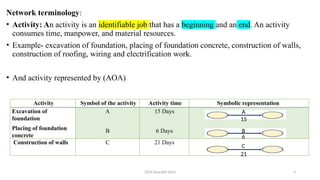
Network terminology:
• Activity: An activity is an identifiable job that has a beginning and an end. An activity
consumes time, manpower, and material resources.
• Example- excavation of foundation, placing of foundation concrete, construction of walls,
construction of roofing, wiring and electrification work.
• And activity represented by (AOA)
Activity Symbol of the activity Activity time Symbolic representation
Excavation of
foundation
Placing of foundation
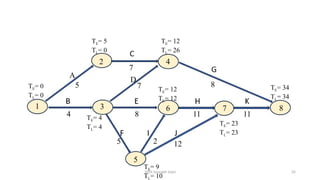
concrete
A
B
15 Days
6 Days
Construction of walls C 21 Days
A
A
15
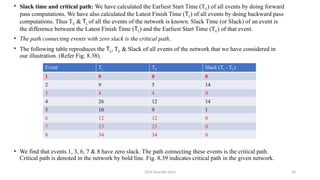
B
6
C
21
2024 Sourabh Saini 4
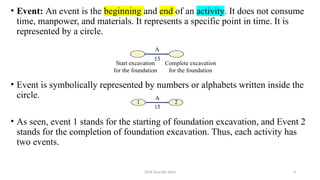
• Event: An event is the beginning and end of an activity. It does not consume
time, manpower, and materials. It represents a specific point in time. It is
represented by a circle.
• Event is symbolically represented by numbers or alphabets written inside the
circle.
• As seen, event 1 stands for the starting of foundation excavation, and Event 2
stands for the completion of foundation excavation. Thus, each activity has
two events.
Start excavation
for the foundation
Complete excavation
for the foundation
A
15
1 2
2024 Sourabh Saini 5
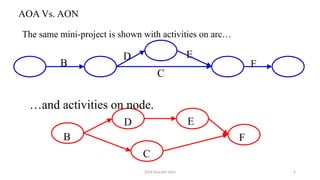
AOA Vs. AON
The same mini-project is shown with activities on arc…
C
E
D
B F
E
C
D
B F
…and activities on node.
2024 Sourabh Saini 6
i j
5
5
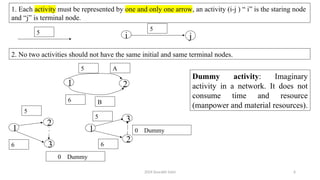
1. Each activity must be represented by one and only one arrow, an activity (i-j ) “ i” is the staring node
and “j” is terminal node.
2. No two activities should not have the same initial and same terminal nodes.
2
1
6
5 A
B
2
3
1
3
2
1
5
6
5
6
0 Dummy
0 Dummy
Dummy activity: Imaginary
activity in a network. It does not
consume time and resource
(manpower and material resources).
2024 Sourabh Saini 7
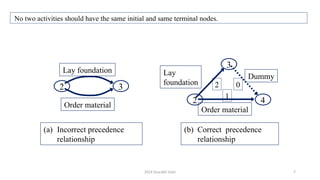
2 3
Lay foundation
Order material
(a) Incorrect precedence
relationship
(b) Correct precedence
relationship
3
4
2
Dummy
Lay
foundation
Order material
1
2 0
No two activities should have the same initial and same terminal nodes.
2024 Sourabh Saini 8
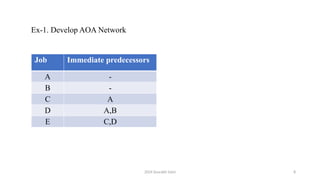
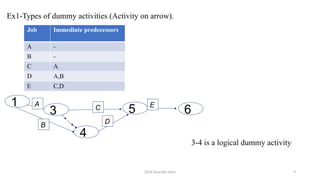
Job Immediate predecessors
A -
B -
C A
D A,B
E C,D
Ex-1. Develop AOA Network
2024 Sourabh Saini 9
Job Immediate predecessors
A -
B -
C A
D A,B
E C,D
1
3
4
6
5
C
A
B D
E
Ex1-Types of dummy activities (Activity on arrow).
3-4 is a logical dummy activity
2024 Sourabh Saini 10
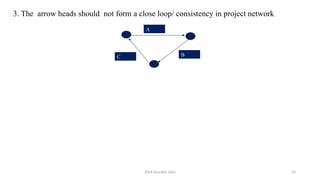
3. The arrow heads should not form a close loop/ consistency in project network
A
C B
2024 Sourabh Saini 11
Hints for drawing networks:
Example 2
-‘A’ precedes ‘B’ and ‘C’ or ‘B’ and ‘C’ follow ‘A’ or ‘B ‘and ‘C’ depend on ‘A’
- ‘D’ follows ‘B’
- E follows C
- D and E are terminal activities.
2024 Sourabh Saini 12
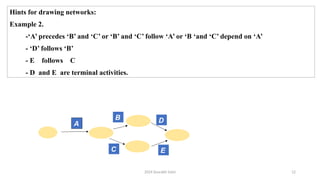
Hints for drawing networks:
Example 2.
-‘A’ precedes ‘B’ and ‘C’ or ‘B’ and ‘C’ follow ‘A’ or ‘B ‘and ‘C’ depend on ‘A’
- ‘D’ follows ‘B’
- E follows C
- D and E are terminal activities.
A
B
C E
D
2024 Sourabh Saini 13
Hints for drawing networks:
Example 3.
-‘A’ and ‘B’ start immediately
- ‘C’ follows both ‘A’ and ‘B’
- D follows A
- E follows D
- The project is complete when C and E are done
2024 Sourabh Saini 14
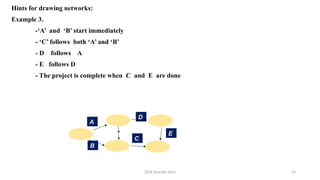
Hints for drawing networks:
Example 3.
-‘A’ and ‘B’ start immediately
- ‘C’ follows both ‘A’ and ‘B’
- D follows A
- E follows D
- The project is complete when C and E are done
A
B
E
D
C
2024 Sourabh Saini 15
Hints for drawing networks:
Example 4.
-‘A’ starts immediately
- ‘B’ , ‘C’ and ‘D’ follow ‘A’
- E follows B, C, and D
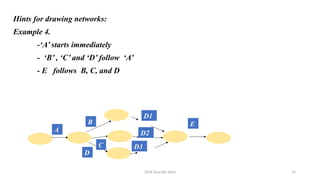
2024 Sourabh Saini 16
A
E
C
D
B
D1
D2
D3
Hints for drawing networks:
Example 4.
-‘A’ starts immediately
- ‘B’ , ‘C’ and ‘D’ follow ‘A’
- E follows B, C, and D
2024 Sourabh Saini 17
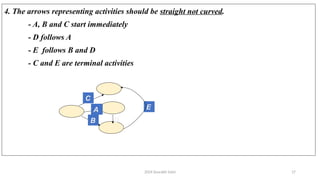
4. The arrows representing activities should be straight not curved.
- A, B and C start immediately
- D follows A
- E follows B and D
- C and E are terminal activities
D
A
B
C
E
2024 Sourabh Saini 18
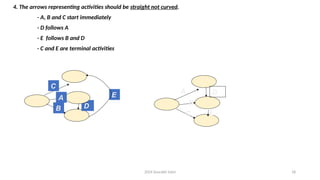
4. The arrows representing activities should be straight not curved.
- A, B and C start immediately
- D follows A
- E follows B and D
- C and E are terminal activities
E
B
C
A D
D
A
B
C
E
2024 Sourabh Saini 19
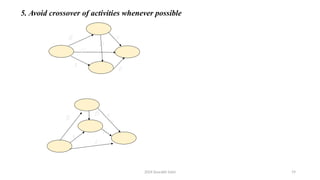
5. Avoid crossover of activities whenever possible
.
D
B
C
A
E
E
F
A
B
D
F
C
2024 Sourabh Saini 20
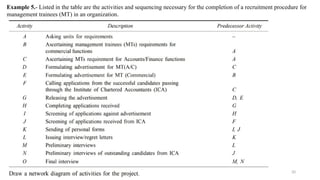
Example 5.- Listed in the table are the activities and sequencing necessary for the completion of a recruitment procedure for
management trainees (MT) in an organization.
2024 Sourabh Saini 21
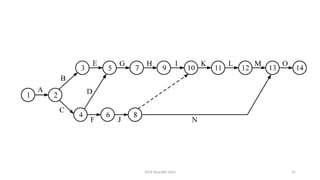
2024 Sourabh Saini 22
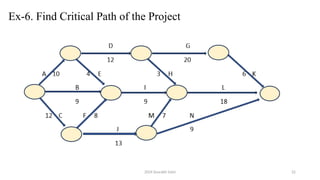
Ex-6. Find Critical Path of the Project
2024 Sourabh Saini 23
Critical Path
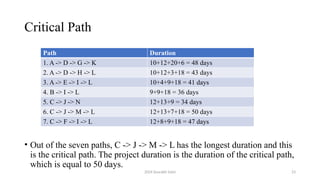
• Out of the seven paths, C -> J -> M -> L has the longest duration and this
is the critical path. The project duration is the duration of the critical path,
which is equal to 50 days.
Path Duration
1. A -> D -> G -> K 10+12+20+6 = 48 days
2. A -> D -> H -> L 10+12+3+18 = 43 days
3. A -> E -> I -> L 10+4+9+18 = 41 days
4. B -> I -> L 9+9+18 = 36 days
5. C -> J -> N 12+13+9 = 34 days
6. C -> J -> M -> L 12+13+7+18 = 50 days
7. C -> F -> I -> L 12+8+9+18 = 47 days
2024 Sourabh Saini 24
Forward Pass computation
• This is a method of computation of starting time of events. This computation
begins from the initial events and moves towards the final events.
• This series of computation is done to arrive at the at the earliest start time all the
events.
• Earliest expected time / Earliest start time (Te) : the time when an event can be
expected to start as early as possible. It is computed by adding the te’s of the
activity paths leading to that event.
2024 Sourabh Saini 25
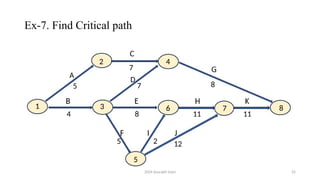
Ex-7. Find Critical path
A
D
1
7
7
5
4 11
8
5
11
8
12
2
6 8
7
4
2
5
3
2024 Sourabh Saini 26
Solution:
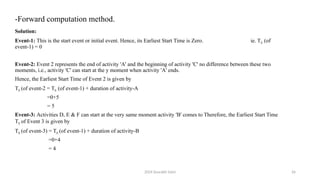
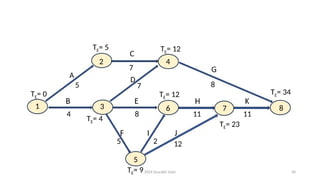
Event-1: This is the start event or initial event. Hence, its Earliest Start Time is Zero. ie. TE (of
event-1) = 0
Event-2: Event 2 represents the end of activity 'A' and the beginning of activity 'C' no difference between these two
moments, i.e., activity 'C' can start at the y moment when activity 'A' ends.
Hence, the Earliest Start Time of Event 2 is given by
TE (of event-2 = TE (of event-1) + duration of activity-A
=0+5
= 5
Event-3: Activities D, E & F can start at the very same moment activity 'B' comes to Therefore, the Earliest Start Time
TE of Event 3 is given by
TE (of event-3) = TE (of event-1) + duration of activity-B
=0+4
= 4
-Forward computation method.
2024 Sourabh Saini 27
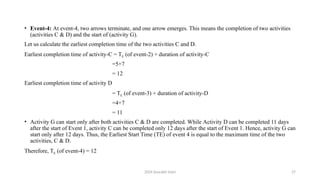
• Event-4: At event-4, two arrows terminate, and one arrow emerges. This means the completion of two activities
(activities C & D) and the start of (activity G).
Let us calculate the earliest completion time of the two activities C and D.
Earliest completion time of activity-C = TE (of event-2) + duration of activity-C
=5+7
= 12
Earliest completion time of activity D
= TE (of event-3) + duration of activity-D
=4+7
= 11
• Activity G can start only after both activities C & D are completed. While Activity D can be completed 11 days
after the start of Event 1, activity C can be completed only 12 days after the start of Event 1. Hence, activity G can
start only after 12 days. Thus, the Earliest Start Time (TE) of event 4 is equal to the maximum time of the two
activities, C & D.
Therefore, TE (of event-4) = 12
2024 Sourabh Saini 28
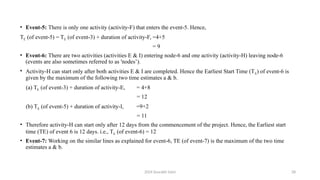
• Event-5: There is only one activity (activity-F) that enters the event-5. Hence,
TE (of event-5) = TE (of event-3) + duration of activity-F, =4+5
= 9
• Event-6: There are two activities (activities E & I) entering node-6 and one activity (activity-H) leaving node-6
(events are also sometimes referred to as 'nodes’).
• Activity-H can start only after both activities E & I are completed. Hence the Earliest Start Time (TE) of event-6 is
given by the maximum of the following two time estimates a & b.
(a) TE (of event-3) + duration of activity-E, = 4+8
= 12
(b) TE (of event-5) + duration of activity-l, =9+2
= 11
• Therefore activity-H can start only after 12 days from the commencement of the project. Hence, the Earliest start
time (TE) of event 6 is 12 days. i.e., TE (of event-6) = 12
• Event-7: Working on the similar lines as explained for event-6, TE (of event-7) is the maximum of the two time
estimates a & b.
2024 Sourabh Saini 29
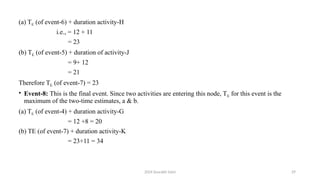
(a) TE (of event-6) + duration activity-H
i.e., = 12 + 11
= 23
(b) TE (of event-5) + duration of activity-J
= 9+ 12
= 21
Therefore TE (of event-7) = 23
• Event-8: This is the final event. Since two activities are entering this node, TE for this event is the
maximum of the two-time estimates, a & b.
(a) TE (of event-4) + duration activity-G
= 12 +8 = 20
(b) TE (of event-7) + duration activity-K
= 23+11 = 34
2024 Sourabh Saini 30
A
D
1
7
7
5
4 11
8
5
11
8
12
2
6 8
7
4
2
5
3
TE= 0
TE= 5 TE= 12
TE= 34
TE= 23
TE= 4
TE= 9
TE= 12
2024 Sourabh Saini 31
Backward pass computation
• This is a method of computation of finishing time of events.
• This computation begins from the final events and moves towards the initial
event.
• Latest finish time ( : is the latest time by which an event should be completed so
that the project completion should not delayed.
2024 Sourabh Saini 32
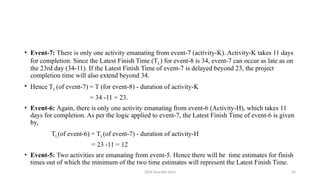
• Event-7: There is only one activity emanating from event-7 (activity-K). Activity-K takes 11 days
for completion. Since the Latest Finish Time (TL) for event-8 is 34, event-7 can occur as late as on
the 23rd day (34-11). If the Latest Finish Time of event-7 is delayed beyond 23, the project
completion time will also extend beyond 34.
• Hence TL (of event-7) = T (for event-8) - duration of activity-K
= 34 -11 = 23.
• Event-6: Again, there is only one activity emanating from event-6 (Activity-H), which takes 11
days for completion. As per the logic applied to event-7, the Latest Finish Time of event-6 is given
by,
TL(of event-6) = TL(of event-7) - duration of activity-H
= 23 -11 = 12
• Event-5: Two activities are emanating from event-5. Hence there will be time estimates for finish
times out of which the minimum of the two time estimates will represent the Latest Finish Time.
2024 Sourabh Saini 33
• Activity-J takes 12 days for completion. Since the Latest Finish Time of event-7 is 23, event-5 can start as
late as on the 11th day (23-12).
• Activity-I takes 2 days for completion. Since the Latest Finish Time of event-6 is 12, event- 5 can start as
late as on the 10th day (12-2).
• The Latest Finish Time of event-5 is given by the minimum of the two time estimates, viz., 10.
T (of event-5) = 10.
₁
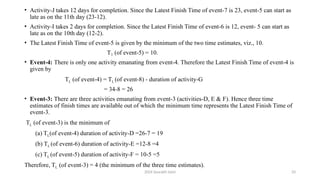
• Event-4: There is only one activity emanating from event-4. Therefore the Latest Finish Time of event-4 is
given by
TL (of event-4) = TL (of event-8) - duration of activity-G
= 34-8 = 26
• Event-3: There are three activities emanating from event-3 (activities-D, E & F). Hence three time
estimates of finish times are available out of which the minimum time represents the Latest Finish Time of
event-3.
TL (of event-3) is the minimum of
(a) TL(of event-4) duration of activity-D =26-7 = 19
(b) TL (of event-6) duration of activity-E =12-8 =4
(c) TL (of event-5) duration of activity-F = 10-5 =5
Therefore, TL (of event-3) = 4 (the minimum of the three time estimates).
2024 Sourabh Saini 34
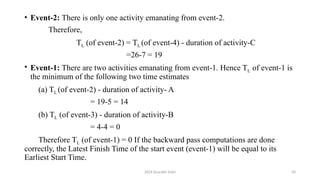
• Event-2: There is only one activity emanating from event-2.
Therefore,
TL (of event-2) = TL (of event-4) - duration of activity-C
=26-7 = 19
• Event-1: There are two activities emanating from event-1. Hence TL of event-1 is
the minimum of the following two time estimates
(a) TL (of event-2) - duration of activity- A
= 19-5 = 14
(b) TL (of event-3) - duration of activity-B
= 4-4 = 0
Therefore TL (of event-1) = 0 If the backward pass computations are done
correctly, the Latest Finish Time of the start event (event-1) will be equal to its
Earliest Start Time.
2024 Sourabh Saini 35
A
D
1
7
7
5
4 11
8
5
11
8
12
2
6 8
7
4
2
5
3
TE= 0
TL= 0
TE= 5
TL= 0
TE= 12
TL= 26
TE= 34
TL= 34
TE= 23
TL= 23
TE= 4
TL= 4
TE= 9
TL= 10
TE= 12
TL= 12
2024 Sourabh Saini 36
• Slack time and critical path: We have calculated the Earliest Start Time (TE) of all events by doing forward
pass computations. We have also calculated the Latest Finish Time (TL) of all events by doing backward pass
computations. Thus TE & TL of all the events of the network is known. Slack Time (or Slack) of an event is
the difference between the Latest Finish Time (TL) and the Earliest Start Time (TE) of that event.
• The path connecting events with zero slack is the critical path.
• The following table reproduces the TL, TE & Slack of all events of the network that we have considered in
our illustration. (Refer Fig. 8.38).
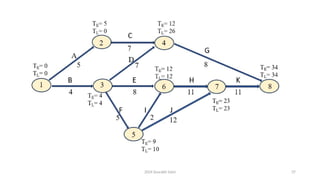
• We find that events 1, 3, 6, 7 & 8 have zero slack. The path connecting these events is the critical path.
Critical path is denoted in the network by bold line. Fig. 8.39 indicates critical path in the given network.
Event TL TE Slack (TL - TE)
1 0 0 0
2 9 5 14
3 4 4 0
4 26 12 14
5 10 9 1
6 12 12 0
7 23 23 0
8 34 34 0
2024 Sourabh Saini 37
2024 Sourabh Saini 38
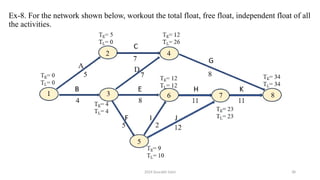
Ex-8. For the network shown below, workout the total float, free float, independent float of all
the activities.
2024 Sourabh Saini 39
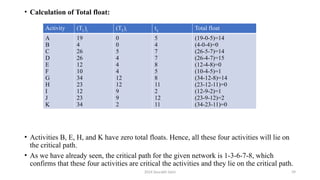
• Calculation of Total float:
• Activities B, E, H, and K have zero total floats. Hence, all these four activities will lie on
the critical path.
• As we have already seen, the critical path for the given network is 1-3-6-7-8, which
confirms that these four activities are critical the activities and they lie on the critical path.
Activity (TL)j (TE)i tij Total float
A
B
C
D
E
F
G
H
I
J
K
19
4
26
26
12
10
34
23
12
23
34
0
0
5
4
4
4
12
12
9
9
2
5
4
7
7
8
5
8
11
2
12
11
(19-0-5)=14
(4-0-4)=0
(26-5-7)=14
(26-4-7)=15
(12-4-8)=0
(10-4-5)=1
(34-12-8)=14
(23-12-11)=0
(12-9-2)=1
(23-9-12)=2
(34-23-11)=0
2024 Sourabh Saini 40
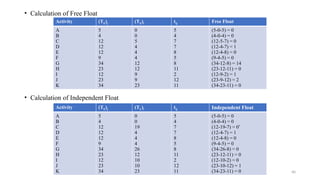
• Calculation of Free Float
• Calculation of Independent Float
Activity (TE)j (TE)i tij Free Float
A
B
C
D
E
F
G
H
I
J
K
5
4
12
12
12
9
34
23
12
23
34
0
0
5
4
4
4
12
12
9
9
23
5
4
7
7
8
5
8
11
2
12
11
(5-0-5) = 0
(4-0-4) = 0
(12-5-7) = 0
(12-4-7) = 1
(12-4-8) = 0
(9-4-5) = 0
(34-12-8) = 14
(23-12-11) = 0
(12-9-2) = 1
(23-9-12) = 2
(34-23-11) = 0
Activity (TE)j (TL)i tij Independent Float
A
B
C
D
E
F
G
H
I
J
K
5
4
12
12
12
9
34
23
12
23
34
0
0
19
4
4
4
26
12
10
10
23
5
4
7
7
8
5
8
11
2
12
11
(5-0-5) = 0
(4-0-4) = 0
(12-19-7) = 0*
(12-4-7) = 1
(12-4-8) = 0
(9-4-5) = 0
(34-26-8) = 0
(23-12-11) = 0
(12-10-2) = 0
(23-10-12) = 1
(34-23-11) = 0
2024 Sourabh Saini 41
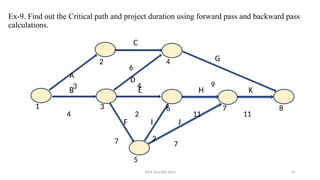
Ex-9. Find out the Critical path and project duration using forward pass and backward pass
calculations.
A
D
1
4
6
3
4 11
2
7
11
9
7
2
6 8
7
4
2
5
3
2024 Sourabh Saini 42
Solution
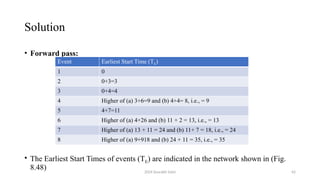
• Forward pass:
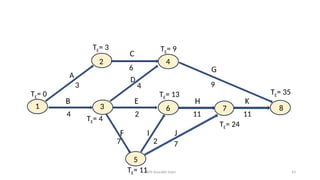
• The Earliest Start Times of events (TE) are indicated in the network shown in (Fig.
8.48)
Event Earliest Start Time (TE)
1 0
2 0+3=3
3 0+4=4
4 Higher of (a) 3+6=9 and (b) 4+4= 8, i.e., = 9
5 4+7=11
6 Higher of (a) 4+26 and (b) 11 + 2 = 13, i.e., = 13
7 Higher of (a) 13 + 11 = 24 and (b) 11+ 7 = 18, i.e., = 24
8 Higher of (a) 9+918 and (b) 24 + 11 = 35, i.e., = 35
2024 Sourabh Saini 43
A
D
1
4
6
3
4 11
2
7
11
9
7
2
6 8
7
4
2
5
3
TE= 0
TE= 3 TE= 9
TE= 35
TE= 24
TE= 4
TE= 11
TE= 13
2024 Sourabh Saini 44
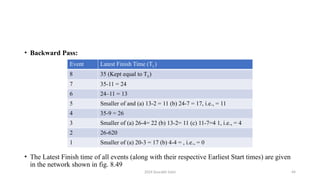
• Backward Pass:
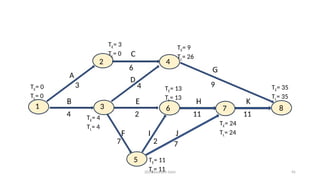
• The Latest Finish time of all events (along with their respective Earliest Start times) are given
in the network shown in fig. 8.49
Event Latest Finish Time (TL)
8 35 (Kept equal to TE)
7 35-11 = 24
6 24–11 = 13
5 Smaller of and (a) 13-2 = 11 (b) 24-7 = 17, i.e., = 11
4 35-9 = 26
3 Smaller of (a) 26-4= 22 (b) 13-2= 11 (c) 11-7=4 1, i.e., = 4
2 26-620
1 Smaller of (a) 20-3 = 17 (b) 4-4 = , i.e., = 0
2024 Sourabh Saini 45
A
D
1
4
6
3
4 11
2
7
11
9
7
2
6 8
7
4
2
5
3
TE= 0
TL= 0
TE= 3
TL= 0
TE= 9
TL= 26
TE= 35
TL= 35
TE= 24
TL= 24
TE= 4
TL= 4
TE= 11
TL= 11
TE= 13
TL= 13
2024 Sourabh Saini 46
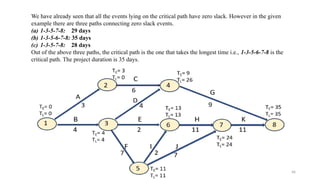
We have already seen that all the events lying on the critical path have zero slack. However in the given
example there are three paths connecting zero slack events.
(a) 1-3-5-7-8: 29 days
(b) 1-3-5-6-7-8: 35 days
(c) 1-3-5-7-8: 28 days
Out of the above three paths, the critical path is the one that takes the longest time i.e., 1-3-5-6-7-8 is the
critical path. The project duration is 35 days.
2024 Sourabh Saini 47
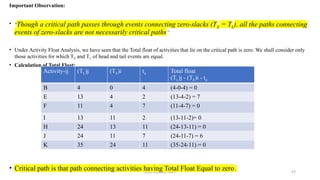
Important Observation:
• "Though a critical path passes through events connecting zero-slacks (TE = TL), all the paths connecting
events of zero-slacks are not necessarily critical paths”
• Under Activity Float Analysis, we have seen that the Total float of activities that lie on the critical path is zero. We shall consider only
those activities for which TE and TL of head and tail events are equal.
• Calculation of Total Float:
• Critical path is that path connecting activities having Total Float Equal to zero.
Activity-ij (TL)j (TE)i tij Total float
(TL)j - (TE)i - tij
B 4 0 4 (4-0-4) = 0
E 13 4 2 (13-4-2) = 7
F 11 4 7 (11-4-7) = 0
I 13 11 2 (13-11-2)= 0
H 24 13 11 (24-13-11) = 0
J 24 11 7 (24-11-7) = 6
K 35 24 11 (35-24-11) = 0
2024 Sourabh Saini 48
Floats for activities:
• Slack is the maximum delay possible for an event without affecting its
overall duration.
• Floats for activities are the same as slacks are for events.
• So, we can define float as maximum delays possible for an activity
without changing the project duration.
2024 Sourabh Saini 49
There are three types of floats:
1. Total float: It is the maximum delay possible for an activity without considering
any delay in its precedence or succeeding activity.
2. Free float: It is the maximum delay possible for activities which will not affect
the float of the successor activity.
3. Independent float: It is the maximum delay possible for an activity with used
floats of preceding activities and will not affect the floats of succeeding activities.
2024 Sourabh Saini 50
The characteristics of float are:
Independent float <=Free float <=Total float
Only independent float can be negative, the rest two floats are
always positive or zero.
Activities with all floats = 0 are critical activities.
2024 Sourabh Saini 51
The applications of floats are as follows:
1.It identifies the critical activities as well as quantify maximum delays possible
for all not critical activities.
2.It is very important in crashing of a network (reducing the time and/or cost of
overall project).
3.It helps in resource allocation and smoothing.
2024 Sourabh Saini 52
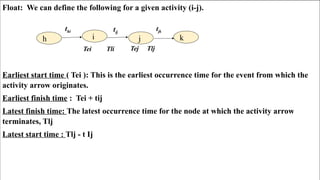
Float: We can define the following for a given activity (i-j).
Earliest start time ( Tei ): This is the earliest occurrence time for the event from which the
activity arrow originates.
Earliest finish time : Tei + tij
Latest finish time: The latest occurrence time for the node at which the activity arrow
terminates, Tlj
Latest start time : Tlj - t Ij
h i j k
thi tij
tjk
Tei Tli Tej Tlj
2024 Sourabh Saini 53
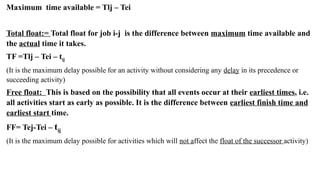
Maximum time available = Tlj – Tei
Total float:= Total float for job i-j is the difference between maximum time available and
the actual time it takes.
TF =Tlj – Tei – tij
(It is the maximum delay possible for an activity without considering any delay in its precedence or
succeeding activity)
Free float: This is based on the possibility that all events occur at their earliest times, i.e.
all activities start as early as possible. It is the difference between earliest finish time and
earliest start time.
FF= Tej-Tei – tij
(It is the maximum delay possible for activities which will not affect the float of the successor activity)
2024 Sourabh Saini 54
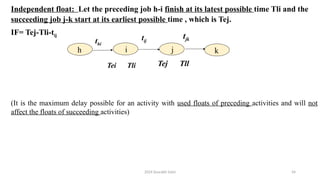
Independent float: Let the preceding job h-i finish at its latest possible time Tli and the
succeeding job j-k start at its earliest possible time , which is Tej.
IF= Tej-Tli-tij
(It is the maximum delay possible for an activity with used floats of preceding activities and will not
affect the floats of succeeding activities)
h i j k
Tei Tli Tej Tll
thi
tij
tjk
2024 Sourabh Saini 55
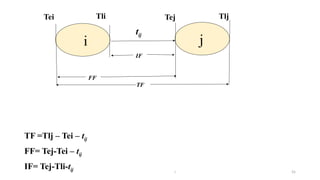
j
i
tij
FF
TF
IF
Tej
Tli
Tei Tlj
TF =Tlj – Tei – tij
FF= Tej-Tei – tij
IF= Tej-Tli-tij
2024 Sourabh Saini 56
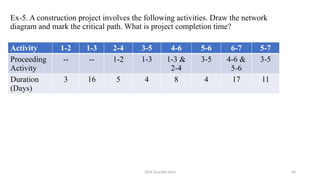
Ex-5. A construction project involves the following activities. Draw the network
diagram and mark the critical path. What is project completion time?
Activity 1-2 1-3 2-4 3-5 4-6 5-6 6-7 5-7
Proceeding
Activity
-- -- 1-2 1-3 1-3 &
2-4
3-5 4-6 &
5-6
3-5
Duration
(Days)
3 16 5 4 8 4 17 11
2024 Sourabh Saini 57
Activity 1-2 1-3 2-4 3-5 4-6 5-6 6-7 5-7
Proceeding
Activity
-- -- 1-2 1-3 1-3 &
2-4
3-5 4-6 &
5-6
3-5
Duration
(Days)
3 16 5 4 8 4 17 11
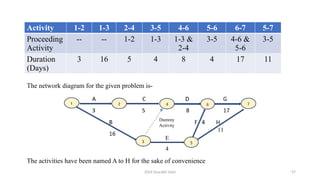
The network diagram for the given problem is-
Dummy
Activity
4
E
11
The activities have been named A to H for the sake of convenience
2024 Sourabh Saini 58
• The activities have been named A to H for the sake of convenience
• [Activity 1-2 is named 'A', activity 1-3 is named 'B' etc.]
Forward pass Computations Backward pass Computations
Event TE Event TL
1 0 7 41
2 0+3=3 6 41-17 = 24
3 0+16=16 5 Minimum of (a) 24-2 = 22 and (b) 41-
11 = 30, i.e., = 22
4 Maximum of (a) 3+5 = 8 and (b) 16+0 =
16, i.e., = 16
4 24-8 = 16
5 16+4=20 3 Minimum of (a) 16-0= 16 and (b) 22-2
= 18, l.e., = 16
6 Maximum of (a) 16 +8 = 24 and (b) 20 + 2
= 22 i.e., = 24
2 16-5 = 11
7 Maximum of (a) 24 + 17 = 41 (b) 20+11=
31., = 41
1 Minimum of (a) 11-3=8 (b) 1616 = 0,
i.e., = 0
2024 Sourabh Saini 59
• Nodes 1, 3, 4, 6, 7 have zero slacks.
• There is only one critical path, which is B→ (Dummy) →D→ G.
• The project completion time is (16+0+8+17) = 41 days. [Observation: Critical path can also pass
through dummy activity.]
• Let us find out the total floats of all the activities lying on the critical path and check up if they are
all zero.
• As expected, the total floats of all the activities lying on the critical path is zero.
Activity-ij (TL)j (TE)i tij Total float: (TL)j-(TE)i -tij
B
Dummy
D
G
16
16
24
41
0
16
16
24
16
0
8
17
16-0-16=0
16-16-0=0
24-16-8=0
41-24-17=0
TE= 0
TL= 0
TE= 24
TL= 24
TE= 16
TL= 16
TE= 3
TL= 11
TE= 20
TL= 20
TE= 16
TL= 16
TE=41
TL= 41
2024 Sourabh Saini 60
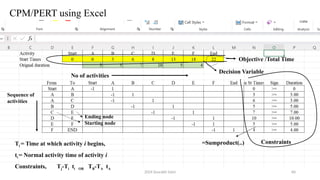
CPM/PERT using Excel
Sequence of
activities
No of activities
Objective /Total Time
Decision Variable
Constraints
=Sumproduct(..)
Ti = Time at which activity i begins,
ti = Normal activity time of activity i
Constraints, Tj-Ti ti OR TB-TA tA
Ending node
Starting node
2024 Sourabh Saini 61
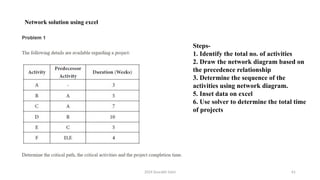
Network solution using excel
Steps-
1. Identify the total no. of activities
2. Draw the network diagram based on
the precedence relationship
3. Determine the sequence of the
activities using network diagram.
5. Inset data on excel
6. Use solver to determine the total time
of projects
2024 Sourabh Saini 62

Network analysis.pptxbbbbbbbbbbbbbbbbbbbbbbb

  • 1.
    2024 Sourabh Saini1 • Network : We represent activities of a project through networks. It Network: We represent activities of a project through networks. It arrange the activities in logical sequence, following the precedence – succedence relationship. • es care of precedence relationships.
  • 2.
    2024 Sourabh Saini2 CPM •1.The time durations are deterministic (MBA degree). •2.The duration of the project is fixed. And for a fixed duration it gives the most economical schedule. •3.Looping and probabilistic events are not allowed in the network. PERT •1.The time durations are probabilistic (Ph. D. degree, DRDO,ISRO, CSIR Labs) •2.There is expected duration of the project. •3.Simulation can be used to PERT network.
  • 3.
    2024 Sourabh Saini3 Network terminology: • Activity: An activity is an identifiable job that has a beginning and an end. An activity consumes time, manpower, and material resources. • Example- excavation of foundation, placing of foundation concrete, construction of walls, construction of roofing, wiring and electrification work. • And activity represented by (AOA) Activity Symbol of the activity Activity time Symbolic representation Excavation of foundation Placing of foundation concrete A B 15 Days 6 Days Construction of walls C 21 Days A A 15 B 6 C 21
  • 4.
    2024 Sourabh Saini4 • Event: An event is the beginning and end of an activity. It does not consume time, manpower, and materials. It represents a specific point in time. It is represented by a circle. • Event is symbolically represented by numbers or alphabets written inside the circle. • As seen, event 1 stands for the starting of foundation excavation, and Event 2 stands for the completion of foundation excavation. Thus, each activity has two events. Start excavation for the foundation Complete excavation for the foundation A 15 1 2
  • 5.
    2024 Sourabh Saini5 AOA Vs. AON The same mini-project is shown with activities on arc… C E D B F E C D B F …and activities on node.
  • 6.
    2024 Sourabh Saini6 i j 5 5 1. Each activity must be represented by one and only one arrow, an activity (i-j ) “ i” is the staring node and “j” is terminal node. 2. No two activities should not have the same initial and same terminal nodes. 2 1 6 5 A B 2 3 1 3 2 1 5 6 5 6 0 Dummy 0 Dummy Dummy activity: Imaginary activity in a network. It does not consume time and resource (manpower and material resources).
  • 7.
    2024 Sourabh Saini7 2 3 Lay foundation Order material (a) Incorrect precedence relationship (b) Correct precedence relationship 3 4 2 Dummy Lay foundation Order material 1 2 0 No two activities should have the same initial and same terminal nodes.
  • 8.
    2024 Sourabh Saini8 Job Immediate predecessors A - B - C A D A,B E C,D Ex-1. Develop AOA Network
  • 9.
    2024 Sourabh Saini9 Job Immediate predecessors A - B - C A D A,B E C,D 1 3 4 6 5 C A B D E Ex1-Types of dummy activities (Activity on arrow). 3-4 is a logical dummy activity
  • 10.
    2024 Sourabh Saini10 3. The arrow heads should not form a close loop/ consistency in project network A C B
  • 11.
    2024 Sourabh Saini11 Hints for drawing networks: Example 2 -‘A’ precedes ‘B’ and ‘C’ or ‘B’ and ‘C’ follow ‘A’ or ‘B ‘and ‘C’ depend on ‘A’ - ‘D’ follows ‘B’ - E follows C - D and E are terminal activities.
  • 12.
    2024 Sourabh Saini12 Hints for drawing networks: Example 2. -‘A’ precedes ‘B’ and ‘C’ or ‘B’ and ‘C’ follow ‘A’ or ‘B ‘and ‘C’ depend on ‘A’ - ‘D’ follows ‘B’ - E follows C - D and E are terminal activities. A B C E D
  • 13.
    2024 Sourabh Saini13 Hints for drawing networks: Example 3. -‘A’ and ‘B’ start immediately - ‘C’ follows both ‘A’ and ‘B’ - D follows A - E follows D - The project is complete when C and E are done
  • 14.
    2024 Sourabh Saini14 Hints for drawing networks: Example 3. -‘A’ and ‘B’ start immediately - ‘C’ follows both ‘A’ and ‘B’ - D follows A - E follows D - The project is complete when C and E are done A B E D C
  • 15.
    2024 Sourabh Saini15 Hints for drawing networks: Example 4. -‘A’ starts immediately - ‘B’ , ‘C’ and ‘D’ follow ‘A’ - E follows B, C, and D
  • 16.
    2024 Sourabh Saini16 A E C D B D1 D2 D3 Hints for drawing networks: Example 4. -‘A’ starts immediately - ‘B’ , ‘C’ and ‘D’ follow ‘A’ - E follows B, C, and D
  • 17.
    2024 Sourabh Saini17 4. The arrows representing activities should be straight not curved. - A, B and C start immediately - D follows A - E follows B and D - C and E are terminal activities D A B C E
  • 18.
    2024 Sourabh Saini18 4. The arrows representing activities should be straight not curved. - A, B and C start immediately - D follows A - E follows B and D - C and E are terminal activities E B C A D D A B C E
  • 19.
    2024 Sourabh Saini19 5. Avoid crossover of activities whenever possible . D B C A E E F A B D F C
  • 20.
    2024 Sourabh Saini20 Example 5.- Listed in the table are the activities and sequencing necessary for the completion of a recruitment procedure for management trainees (MT) in an organization.
  • 21.
  • 22.
    2024 Sourabh Saini22 Ex-6. Find Critical Path of the Project
  • 23.
    2024 Sourabh Saini23 Critical Path • Out of the seven paths, C -> J -> M -> L has the longest duration and this is the critical path. The project duration is the duration of the critical path, which is equal to 50 days. Path Duration 1. A -> D -> G -> K 10+12+20+6 = 48 days 2. A -> D -> H -> L 10+12+3+18 = 43 days 3. A -> E -> I -> L 10+4+9+18 = 41 days 4. B -> I -> L 9+9+18 = 36 days 5. C -> J -> N 12+13+9 = 34 days 6. C -> J -> M -> L 12+13+7+18 = 50 days 7. C -> F -> I -> L 12+8+9+18 = 47 days
  • 24.
    2024 Sourabh Saini24 Forward Pass computation • This is a method of computation of starting time of events. This computation begins from the initial events and moves towards the final events. • This series of computation is done to arrive at the at the earliest start time all the events. • Earliest expected time / Earliest start time (Te) : the time when an event can be expected to start as early as possible. It is computed by adding the te’s of the activity paths leading to that event.
  • 25.
    2024 Sourabh Saini25 Ex-7. Find Critical path A D 1 7 7 5 4 11 8 5 11 8 12 2 6 8 7 4 2 5 3
  • 26.
    2024 Sourabh Saini26 Solution: Event-1: This is the start event or initial event. Hence, its Earliest Start Time is Zero. ie. TE (of event-1) = 0 Event-2: Event 2 represents the end of activity 'A' and the beginning of activity 'C' no difference between these two moments, i.e., activity 'C' can start at the y moment when activity 'A' ends. Hence, the Earliest Start Time of Event 2 is given by TE (of event-2 = TE (of event-1) + duration of activity-A =0+5 = 5 Event-3: Activities D, E & F can start at the very same moment activity 'B' comes to Therefore, the Earliest Start Time TE of Event 3 is given by TE (of event-3) = TE (of event-1) + duration of activity-B =0+4 = 4 -Forward computation method.
  • 27.
    2024 Sourabh Saini27 • Event-4: At event-4, two arrows terminate, and one arrow emerges. This means the completion of two activities (activities C & D) and the start of (activity G). Let us calculate the earliest completion time of the two activities C and D. Earliest completion time of activity-C = TE (of event-2) + duration of activity-C =5+7 = 12 Earliest completion time of activity D = TE (of event-3) + duration of activity-D =4+7 = 11 • Activity G can start only after both activities C & D are completed. While Activity D can be completed 11 days after the start of Event 1, activity C can be completed only 12 days after the start of Event 1. Hence, activity G can start only after 12 days. Thus, the Earliest Start Time (TE) of event 4 is equal to the maximum time of the two activities, C & D. Therefore, TE (of event-4) = 12
  • 28.
    2024 Sourabh Saini28 • Event-5: There is only one activity (activity-F) that enters the event-5. Hence, TE (of event-5) = TE (of event-3) + duration of activity-F, =4+5 = 9 • Event-6: There are two activities (activities E & I) entering node-6 and one activity (activity-H) leaving node-6 (events are also sometimes referred to as 'nodes’). • Activity-H can start only after both activities E & I are completed. Hence the Earliest Start Time (TE) of event-6 is given by the maximum of the following two time estimates a & b. (a) TE (of event-3) + duration of activity-E, = 4+8 = 12 (b) TE (of event-5) + duration of activity-l, =9+2 = 11 • Therefore activity-H can start only after 12 days from the commencement of the project. Hence, the Earliest start time (TE) of event 6 is 12 days. i.e., TE (of event-6) = 12 • Event-7: Working on the similar lines as explained for event-6, TE (of event-7) is the maximum of the two time estimates a & b.
  • 29.
    2024 Sourabh Saini29 (a) TE (of event-6) + duration activity-H i.e., = 12 + 11 = 23 (b) TE (of event-5) + duration of activity-J = 9+ 12 = 21 Therefore TE (of event-7) = 23 • Event-8: This is the final event. Since two activities are entering this node, TE for this event is the maximum of the two-time estimates, a & b. (a) TE (of event-4) + duration activity-G = 12 +8 = 20 (b) TE (of event-7) + duration activity-K = 23+11 = 34
  • 30.
    2024 Sourabh Saini30 A D 1 7 7 5 4 11 8 5 11 8 12 2 6 8 7 4 2 5 3 TE= 0 TE= 5 TE= 12 TE= 34 TE= 23 TE= 4 TE= 9 TE= 12
  • 31.
    2024 Sourabh Saini31 Backward pass computation • This is a method of computation of finishing time of events. • This computation begins from the final events and moves towards the initial event. • Latest finish time ( : is the latest time by which an event should be completed so that the project completion should not delayed.
  • 32.
    2024 Sourabh Saini32 • Event-7: There is only one activity emanating from event-7 (activity-K). Activity-K takes 11 days for completion. Since the Latest Finish Time (TL) for event-8 is 34, event-7 can occur as late as on the 23rd day (34-11). If the Latest Finish Time of event-7 is delayed beyond 23, the project completion time will also extend beyond 34. • Hence TL (of event-7) = T (for event-8) - duration of activity-K = 34 -11 = 23. • Event-6: Again, there is only one activity emanating from event-6 (Activity-H), which takes 11 days for completion. As per the logic applied to event-7, the Latest Finish Time of event-6 is given by, TL(of event-6) = TL(of event-7) - duration of activity-H = 23 -11 = 12 • Event-5: Two activities are emanating from event-5. Hence there will be time estimates for finish times out of which the minimum of the two time estimates will represent the Latest Finish Time.
  • 33.
    2024 Sourabh Saini33 • Activity-J takes 12 days for completion. Since the Latest Finish Time of event-7 is 23, event-5 can start as late as on the 11th day (23-12). • Activity-I takes 2 days for completion. Since the Latest Finish Time of event-6 is 12, event- 5 can start as late as on the 10th day (12-2). • The Latest Finish Time of event-5 is given by the minimum of the two time estimates, viz., 10. T (of event-5) = 10. ₁ • Event-4: There is only one activity emanating from event-4. Therefore the Latest Finish Time of event-4 is given by TL (of event-4) = TL (of event-8) - duration of activity-G = 34-8 = 26 • Event-3: There are three activities emanating from event-3 (activities-D, E & F). Hence three time estimates of finish times are available out of which the minimum time represents the Latest Finish Time of event-3. TL (of event-3) is the minimum of (a) TL(of event-4) duration of activity-D =26-7 = 19 (b) TL (of event-6) duration of activity-E =12-8 =4 (c) TL (of event-5) duration of activity-F = 10-5 =5 Therefore, TL (of event-3) = 4 (the minimum of the three time estimates).
  • 34.
    2024 Sourabh Saini34 • Event-2: There is only one activity emanating from event-2. Therefore, TL (of event-2) = TL (of event-4) - duration of activity-C =26-7 = 19 • Event-1: There are two activities emanating from event-1. Hence TL of event-1 is the minimum of the following two time estimates (a) TL (of event-2) - duration of activity- A = 19-5 = 14 (b) TL (of event-3) - duration of activity-B = 4-4 = 0 Therefore TL (of event-1) = 0 If the backward pass computations are done correctly, the Latest Finish Time of the start event (event-1) will be equal to its Earliest Start Time.
  • 35.
    2024 Sourabh Saini35 A D 1 7 7 5 4 11 8 5 11 8 12 2 6 8 7 4 2 5 3 TE= 0 TL= 0 TE= 5 TL= 0 TE= 12 TL= 26 TE= 34 TL= 34 TE= 23 TL= 23 TE= 4 TL= 4 TE= 9 TL= 10 TE= 12 TL= 12
  • 36.
    2024 Sourabh Saini36 • Slack time and critical path: We have calculated the Earliest Start Time (TE) of all events by doing forward pass computations. We have also calculated the Latest Finish Time (TL) of all events by doing backward pass computations. Thus TE & TL of all the events of the network is known. Slack Time (or Slack) of an event is the difference between the Latest Finish Time (TL) and the Earliest Start Time (TE) of that event. • The path connecting events with zero slack is the critical path. • The following table reproduces the TL, TE & Slack of all events of the network that we have considered in our illustration. (Refer Fig. 8.38). • We find that events 1, 3, 6, 7 & 8 have zero slack. The path connecting these events is the critical path. Critical path is denoted in the network by bold line. Fig. 8.39 indicates critical path in the given network. Event TL TE Slack (TL - TE) 1 0 0 0 2 9 5 14 3 4 4 0 4 26 12 14 5 10 9 1 6 12 12 0 7 23 23 0 8 34 34 0
  • 37.
  • 38.
    2024 Sourabh Saini38 Ex-8. For the network shown below, workout the total float, free float, independent float of all the activities.
  • 39.
    2024 Sourabh Saini39 • Calculation of Total float: • Activities B, E, H, and K have zero total floats. Hence, all these four activities will lie on the critical path. • As we have already seen, the critical path for the given network is 1-3-6-7-8, which confirms that these four activities are critical the activities and they lie on the critical path. Activity (TL)j (TE)i tij Total float A B C D E F G H I J K 19 4 26 26 12 10 34 23 12 23 34 0 0 5 4 4 4 12 12 9 9 2 5 4 7 7 8 5 8 11 2 12 11 (19-0-5)=14 (4-0-4)=0 (26-5-7)=14 (26-4-7)=15 (12-4-8)=0 (10-4-5)=1 (34-12-8)=14 (23-12-11)=0 (12-9-2)=1 (23-9-12)=2 (34-23-11)=0
  • 40.
    2024 Sourabh Saini40 • Calculation of Free Float • Calculation of Independent Float Activity (TE)j (TE)i tij Free Float A B C D E F G H I J K 5 4 12 12 12 9 34 23 12 23 34 0 0 5 4 4 4 12 12 9 9 23 5 4 7 7 8 5 8 11 2 12 11 (5-0-5) = 0 (4-0-4) = 0 (12-5-7) = 0 (12-4-7) = 1 (12-4-8) = 0 (9-4-5) = 0 (34-12-8) = 14 (23-12-11) = 0 (12-9-2) = 1 (23-9-12) = 2 (34-23-11) = 0 Activity (TE)j (TL)i tij Independent Float A B C D E F G H I J K 5 4 12 12 12 9 34 23 12 23 34 0 0 19 4 4 4 26 12 10 10 23 5 4 7 7 8 5 8 11 2 12 11 (5-0-5) = 0 (4-0-4) = 0 (12-19-7) = 0* (12-4-7) = 1 (12-4-8) = 0 (9-4-5) = 0 (34-26-8) = 0 (23-12-11) = 0 (12-10-2) = 0 (23-10-12) = 1 (34-23-11) = 0
  • 41.
    2024 Sourabh Saini41 Ex-9. Find out the Critical path and project duration using forward pass and backward pass calculations. A D 1 4 6 3 4 11 2 7 11 9 7 2 6 8 7 4 2 5 3
  • 42.
    2024 Sourabh Saini42 Solution • Forward pass: • The Earliest Start Times of events (TE) are indicated in the network shown in (Fig. 8.48) Event Earliest Start Time (TE) 1 0 2 0+3=3 3 0+4=4 4 Higher of (a) 3+6=9 and (b) 4+4= 8, i.e., = 9 5 4+7=11 6 Higher of (a) 4+26 and (b) 11 + 2 = 13, i.e., = 13 7 Higher of (a) 13 + 11 = 24 and (b) 11+ 7 = 18, i.e., = 24 8 Higher of (a) 9+918 and (b) 24 + 11 = 35, i.e., = 35
  • 43.
    2024 Sourabh Saini43 A D 1 4 6 3 4 11 2 7 11 9 7 2 6 8 7 4 2 5 3 TE= 0 TE= 3 TE= 9 TE= 35 TE= 24 TE= 4 TE= 11 TE= 13
  • 44.
    2024 Sourabh Saini44 • Backward Pass: • The Latest Finish time of all events (along with their respective Earliest Start times) are given in the network shown in fig. 8.49 Event Latest Finish Time (TL) 8 35 (Kept equal to TE) 7 35-11 = 24 6 24–11 = 13 5 Smaller of and (a) 13-2 = 11 (b) 24-7 = 17, i.e., = 11 4 35-9 = 26 3 Smaller of (a) 26-4= 22 (b) 13-2= 11 (c) 11-7=4 1, i.e., = 4 2 26-620 1 Smaller of (a) 20-3 = 17 (b) 4-4 = , i.e., = 0
  • 45.
    2024 Sourabh Saini45 A D 1 4 6 3 4 11 2 7 11 9 7 2 6 8 7 4 2 5 3 TE= 0 TL= 0 TE= 3 TL= 0 TE= 9 TL= 26 TE= 35 TL= 35 TE= 24 TL= 24 TE= 4 TL= 4 TE= 11 TL= 11 TE= 13 TL= 13
  • 46.
    2024 Sourabh Saini46 We have already seen that all the events lying on the critical path have zero slack. However in the given example there are three paths connecting zero slack events. (a) 1-3-5-7-8: 29 days (b) 1-3-5-6-7-8: 35 days (c) 1-3-5-7-8: 28 days Out of the above three paths, the critical path is the one that takes the longest time i.e., 1-3-5-6-7-8 is the critical path. The project duration is 35 days.
  • 47.
    2024 Sourabh Saini47 Important Observation: • "Though a critical path passes through events connecting zero-slacks (TE = TL), all the paths connecting events of zero-slacks are not necessarily critical paths” • Under Activity Float Analysis, we have seen that the Total float of activities that lie on the critical path is zero. We shall consider only those activities for which TE and TL of head and tail events are equal. • Calculation of Total Float: • Critical path is that path connecting activities having Total Float Equal to zero. Activity-ij (TL)j (TE)i tij Total float (TL)j - (TE)i - tij B 4 0 4 (4-0-4) = 0 E 13 4 2 (13-4-2) = 7 F 11 4 7 (11-4-7) = 0 I 13 11 2 (13-11-2)= 0 H 24 13 11 (24-13-11) = 0 J 24 11 7 (24-11-7) = 6 K 35 24 11 (35-24-11) = 0
  • 48.
    2024 Sourabh Saini48 Floats for activities: • Slack is the maximum delay possible for an event without affecting its overall duration. • Floats for activities are the same as slacks are for events. • So, we can define float as maximum delays possible for an activity without changing the project duration.
  • 49.
    2024 Sourabh Saini49 There are three types of floats: 1. Total float: It is the maximum delay possible for an activity without considering any delay in its precedence or succeeding activity. 2. Free float: It is the maximum delay possible for activities which will not affect the float of the successor activity. 3. Independent float: It is the maximum delay possible for an activity with used floats of preceding activities and will not affect the floats of succeeding activities.
  • 50.
    2024 Sourabh Saini50 The characteristics of float are: Independent float <=Free float <=Total float Only independent float can be negative, the rest two floats are always positive or zero. Activities with all floats = 0 are critical activities.
  • 51.
    2024 Sourabh Saini51 The applications of floats are as follows: 1.It identifies the critical activities as well as quantify maximum delays possible for all not critical activities. 2.It is very important in crashing of a network (reducing the time and/or cost of overall project). 3.It helps in resource allocation and smoothing.
  • 52.
    2024 Sourabh Saini52 Float: We can define the following for a given activity (i-j). Earliest start time ( Tei ): This is the earliest occurrence time for the event from which the activity arrow originates. Earliest finish time : Tei + tij Latest finish time: The latest occurrence time for the node at which the activity arrow terminates, Tlj Latest start time : Tlj - t Ij h i j k thi tij tjk Tei Tli Tej Tlj
  • 53.
    2024 Sourabh Saini53 Maximum time available = Tlj – Tei Total float:= Total float for job i-j is the difference between maximum time available and the actual time it takes. TF =Tlj – Tei – tij (It is the maximum delay possible for an activity without considering any delay in its precedence or succeeding activity) Free float: This is based on the possibility that all events occur at their earliest times, i.e. all activities start as early as possible. It is the difference between earliest finish time and earliest start time. FF= Tej-Tei – tij (It is the maximum delay possible for activities which will not affect the float of the successor activity)
  • 54.
    2024 Sourabh Saini54 Independent float: Let the preceding job h-i finish at its latest possible time Tli and the succeeding job j-k start at its earliest possible time , which is Tej. IF= Tej-Tli-tij (It is the maximum delay possible for an activity with used floats of preceding activities and will not affect the floats of succeeding activities) h i j k Tei Tli Tej Tll thi tij tjk
  • 55.
    2024 Sourabh Saini55 j i tij FF TF IF Tej Tli Tei Tlj TF =Tlj – Tei – tij FF= Tej-Tei – tij IF= Tej-Tli-tij
  • 56.
    2024 Sourabh Saini56 Ex-5. A construction project involves the following activities. Draw the network diagram and mark the critical path. What is project completion time? Activity 1-2 1-3 2-4 3-5 4-6 5-6 6-7 5-7 Proceeding Activity -- -- 1-2 1-3 1-3 & 2-4 3-5 4-6 & 5-6 3-5 Duration (Days) 3 16 5 4 8 4 17 11
  • 57.
    2024 Sourabh Saini57 Activity 1-2 1-3 2-4 3-5 4-6 5-6 6-7 5-7 Proceeding Activity -- -- 1-2 1-3 1-3 & 2-4 3-5 4-6 & 5-6 3-5 Duration (Days) 3 16 5 4 8 4 17 11 The network diagram for the given problem is- Dummy Activity 4 E 11 The activities have been named A to H for the sake of convenience
  • 58.
    2024 Sourabh Saini58 • The activities have been named A to H for the sake of convenience • [Activity 1-2 is named 'A', activity 1-3 is named 'B' etc.] Forward pass Computations Backward pass Computations Event TE Event TL 1 0 7 41 2 0+3=3 6 41-17 = 24 3 0+16=16 5 Minimum of (a) 24-2 = 22 and (b) 41- 11 = 30, i.e., = 22 4 Maximum of (a) 3+5 = 8 and (b) 16+0 = 16, i.e., = 16 4 24-8 = 16 5 16+4=20 3 Minimum of (a) 16-0= 16 and (b) 22-2 = 18, l.e., = 16 6 Maximum of (a) 16 +8 = 24 and (b) 20 + 2 = 22 i.e., = 24 2 16-5 = 11 7 Maximum of (a) 24 + 17 = 41 (b) 20+11= 31., = 41 1 Minimum of (a) 11-3=8 (b) 1616 = 0, i.e., = 0
  • 59.
    2024 Sourabh Saini59 • Nodes 1, 3, 4, 6, 7 have zero slacks. • There is only one critical path, which is B→ (Dummy) →D→ G. • The project completion time is (16+0+8+17) = 41 days. [Observation: Critical path can also pass through dummy activity.] • Let us find out the total floats of all the activities lying on the critical path and check up if they are all zero. • As expected, the total floats of all the activities lying on the critical path is zero. Activity-ij (TL)j (TE)i tij Total float: (TL)j-(TE)i -tij B Dummy D G 16 16 24 41 0 16 16 24 16 0 8 17 16-0-16=0 16-16-0=0 24-16-8=0 41-24-17=0 TE= 0 TL= 0 TE= 24 TL= 24 TE= 16 TL= 16 TE= 3 TL= 11 TE= 20 TL= 20 TE= 16 TL= 16 TE=41 TL= 41
  • 60.
    2024 Sourabh Saini60 CPM/PERT using Excel Sequence of activities No of activities Objective /Total Time Decision Variable Constraints =Sumproduct(..) Ti = Time at which activity i begins, ti = Normal activity time of activity i Constraints, Tj-Ti ti OR TB-TA tA Ending node Starting node
  • 61.
    2024 Sourabh Saini61 Network solution using excel Steps- 1. Identify the total no. of activities 2. Draw the network diagram based on the precedence relationship 3. Determine the sequence of the activities using network diagram. 5. Inset data on excel 6. Use solver to determine the total time of projects
  • 62.