Specific tools andtechniques include:
•Network Analysis:-
- Critical Path Method (CPM) and
- Program Evaluation and Review Technique (PERT)
4.
TERMS USED INA NETWORK
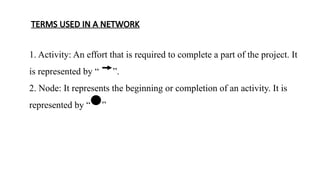
1. Activity: An effort that is required to complete a part of the project. It
is represented by “ ”.
2. Node: It represents the beginning or completion of an activity. It is
represented by “ ”
5.
1. Each definedactivity is represented by one and only one arrow in
the network.
2. Before an activity can be undertaken, all activities preceding it
must be completed.
3. The arrows depicting various activities are indicative of logical
procedure only. The length and bearing of the arrows are of no
significance.
RULES OF NETWORK CONSTRUCTION
6.
4. The arrowdirection indicates the general progression in time. Head
events and Tail events.
5. When a number of activities terminate at one event, it indicates that no
activity emanating from that event may start unless all activities
terminating there have been completed.
6. Events are identified by numbers.
7. The activities are identified by the numbers of their starting and
ending events or by alphabets.
7.
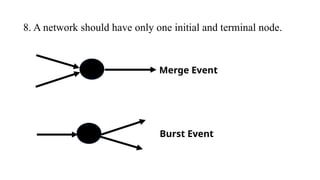
8. A networkshould have only one initial and terminal node.
Merge Event
Burst Event
8.
9. Parallel activitiesbetween two events, without intervening events, are
prohibited. When two or more parallel activities in a project have the
same head and tail events, dummy activities are needed in constructing the
network. Dummy activities do not consume time or resources. An efficient
network contains a minimum number of dummy activities required to
portray the correct precedence relationships.
10. Looping is not permitted in a network.
9.
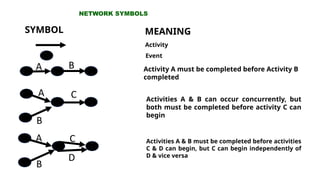
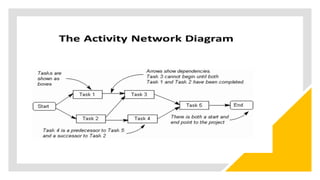
Activities A &B must be completed before activities
C & D can begin, but C can begin independently of
D & vice versa
NETWORK SYMBOLS
SYMBOL MEANING
Activity
Event
A
A
A
B
B
B
C
C
D
Activity A must be completed before Activity B
completed
Activities A & B can occur concurrently, but
both must be completed before activity C can
begin
11.
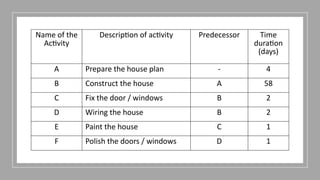
Name of the
Activity
Descriptionof activity Predecessor Time
duration
(days)
A Prepare the house plan - 4
B Construct the house A 58
C Fix the door / windows B 2
D Wiring the house B 2
E Paint the house C 1
F Polish the doors / windows D 1
12.
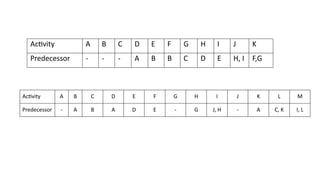
Activity A BC D E F G H I J K
Predecessor - - - A B B C D E H, I F,G
Activity A B C D E F G H I J K L M
Predecessor - A B A D E - G J, H - A C, K I, L
13.
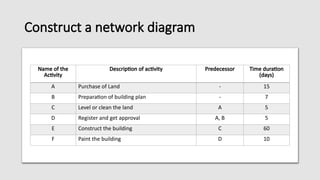
Construct a networkdiagram
Name of the
Activity
Description of activity Predecessor Time duration
(days)
A Purchase of Land - 15
B Preparation of building plan - 7
C Level or clean the land A 5
D Register and get approval A, B 5
E Construct the building C 60
F Paint the building D 10
14.
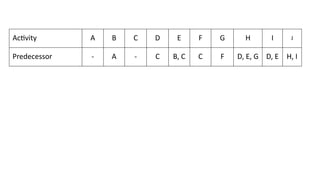
Activity A BC D E F G H I J
Predecessor - A - C B, C C F D, E, G D, E H, I
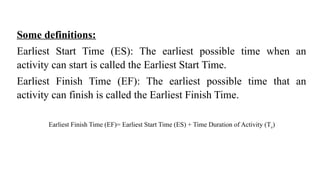
Some definitions:
Earliest StartTime (ES): The earliest possible time when an
activity can start is called the Earliest Start Time.
Earliest Finish Time (EF): The earliest possible time that an
activity can finish is called the Earliest Finish Time.
Earliest Finish Time (EF)= Earliest Start Time (ES) + Time Duration of Activity (Te)
17.
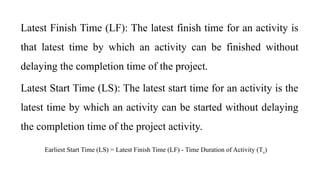
Latest Finish Time(LF): The latest finish time for an activity is
that latest time by which an activity can be finished without
delaying the completion time of the project.
Latest Start Time (LS): The latest start time for an activity is the
latest time by which an activity can be started without delaying
the completion time of the project activity.
Earliest Start Time (LS) = Latest Finish Time (LF) - Time Duration of Activity (Te)
18.
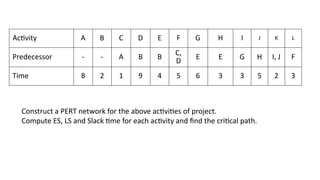
Activity A BC D E F G H I J K L
Predecessor - - A B B C,
D
E E G H I, J F
Time 8 2 1 9 4 5 6 3 3 5 2 3
Construct a PERT network for the above activities of project.
Compute ES, LS and Slack time for each activity and find the critical path.
19.
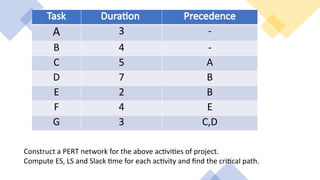
Task Duration Precedence
A3 -
B 4 -
C 5 A
D 7 B
E 2 B
F 4 E
G 3 C,D
Construct a PERT network for the above activities of project.
Compute ES, LS and Slack time for each activity and find the critical path.
20.
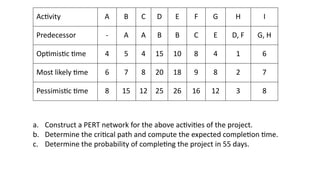
Activity A BC D E F G H I
Predecessor - A A B B C E D, F G, H
Optimistic time 4 5 4 15 10 8 4 1 6
Most likely time 6 7 8 20 18 9 8 2 7
Pessimistic time 8 15 12 25 26 16 12 3 8
a. Construct a PERT network for the above activities of the project.
b. Determine the critical path and compute the expected completion time.
c. Determine the probability of completing the project in 55 days.
Editor's Notes
#9 Activity: An activity represents an action and consumption of resources (time, money, energy) required to complete a portion of a project. Activity is represented by an arrow.
Event: An event (or node) will always occur at the beginning and end of an activity. The event has no resources and is represented by a circle.
Activities performed before given events are known as preceding activities and activities performed after a given event are known as succeeding activities.