INFS 774: Enterprise Architecture
16
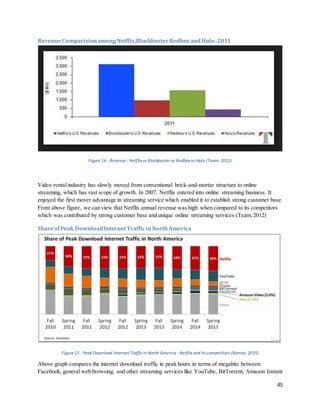
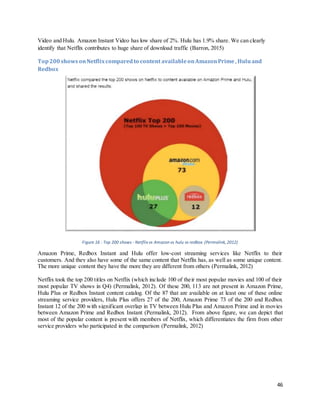
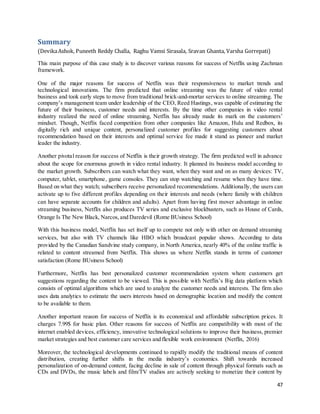
Netflix Inc
Success Case Study
Devika Ashok, Puneeth Reddy Challa, Raghu Vamsi Sirasala, Sravan Ghanta, Varsha Gorrepati
2
Contents
Introduction..................................................................................................................................................................................3
Success Analysis using Zachman Framework................................................................................................................8
What............................................................................................................................................................................................8
ExecutivePerspective.....................................................................................................................................................8
Business Mgmt Perspective.........................................................................................................................................8
How...........................................................................................................................................................................................15
ExecutivePerspective..................................................................................................................................................15
Business Mgmt Perspective......................................................................................................................................16
Where.......................................................................................................................................................................................18
ExecutivePerspective..................................................................................................................................................18
Business Mgmt Perspective......................................................................................................................................19
Who...........................................................................................................................................................................................20
ExecutivePerspective..................................................................................................................................................20
Business Mgmt Perspective......................................................................................................................................27
When........................................................................................................................................................................................28
ExecutivePerspective..................................................................................................................................................28
Business Mgmt Perspective......................................................................................................................................29
Figure: Numberof Netflix streamingsubscribers worldwidefrom3rdquarter2011to 1stquarter
2016 (inmillions)..................................................................................................Error!Bookmarknotdefined.
Why...........................................................................................................................................................................................32
ExecutivePerspective..................................................................................................................................................32
Netflix Company Profile................................................................................Error!Bookmarknotdefined.
Business Mgmt Perspective......................................................................................................................................32
Evaluation of Netflix Videos using Zachman Framework......................................................................................33
Summary......................................................................................................................................................................................47
List of Figures............................................................................................................................................................................48
References...................................................................................................................................................................................49
3
Introduction
(DevikaAshok, Puneeth Reddy Challa, Raghu Vamsi Sirasala, Sravan Ghanta, Varsha Gorrepati)
Netflix is the world’s leading Internet television network with over 81 million members in over 190
countries enjoying more than 125 million hours of TV shows and movies per day, including original
series, documentaries and feature films. Members can watch as much as they want, anytime,
anywhere, on nearly any Internet-connected screen. Members can play, pause and resume
watching, all without commercials or commitments (Netflix,2016).
Netflix was founded in Scotts Valley, California, in August,1997 by Reed Hastings and Marc
Randolph, both software engineers and veteran "new technology" entrepreneurs, to rent and sell
DVDs over the Internet. The rumors were that Hastings, who supplied the firm's startup cash of
$2.5 million, had come up with an idea of rental-by-mail when he was forced to pay $40 in fines
after returning an overdue videotape of the film Apollo 13. They used the then new DVD format,
which could store a high-quality copy of an entire feature film on a single five-inch disc. Hastings
and Randolph recognized the potential of disc to replace bulkier, lower-resolution videotape as the
consumer format of choice, even though it was an expensive technology at the time (Press, Netflix,
Inc. History, 2012).
Netflix had a clear advantage of being the first mover in light weight DVD concept in the video
rental market. The company took advantage of the small size and light weight of the discs, which
was shipped to the users very cheaply. They experimented with more than 200 mailing packages
before finding one that could safely ship a disc (in a plain case without cover art and inserts) for the
cost of a single first-class stamp. A stamped return mailer was also enclosed, making it more
convenient to the users to return the DVDs. NetFlix.com promised to virtually guarantee titles
would be in stock, with reasonably quick delivery offered through the U.S. Postal Service. The
company pledged to buy more than 1,000 copies of new releases which could be reserved in
advance for shipment on the day they were made available in stores (Press, Netflix, Inc. History,
2012).
The firm opened for business on April 14, 1998, with 30 employees and 925 titles for rent, which
comprised nearly the entire catalogue of DVDs in print. The firm offered some "soft-core" Playboy
titles but shied away from hardcore pornography to avoid the potential for legal problems in
certain states (Press, Netflix, Inc. History, 2012).NetFlix initially offered a seven-day DVD rental for
$4, plus $2 shipping, with the cost going down when additional discs were rented. Discs could be
kept longer for an additional fee (Press, Netflix, Inc. History, 2012). New DVDs were also offered for
sale at a discount of up to 30 percent (Press, Netflix, Inc. History, 2012). Consumers could decide to
purchase a rented disc once they got it home by having the balance of the retail price charged to
their credit card. The firm's Web site offered a number of informational features including movie
reviews, and once a customer had rented several titles a profile would be generated that
automatically suggested additional films of interest based on the characteristics of ones already
chosen (Press, Netflix, Inc. History, 2012).
NetFlix was one of the first companies to rent DVDs by mail, with only a handful of other
competitors in operation, including Magic Disc, DVD Express, and Reel.com. They offered multiple
promotions as a part of their marketing strategy. One such promotion was a venture with Toshiba
America to offer three free DVD rentals to purchasers of new Toshiba DVD players. Another
promotion they offered was to buyers of Pioneer DVD players, Hewlett-Packard and Apple
4
computer models that included DVD drives. Eventually, Sony and multiple other companies also
signed up for the same . Also, the company offered the customers sweepstakes to win an all-
expense-paid "L.A. Weekend" trip to Los Angeles as a cross-promotion with Warner Brothers for
the newly available DVD of the film L.A. Confidential. The initial response to NetFlix's service was
strong, and its Internet site was briefly forced to shut down 48 hours after it went up (Press, Netflix,
Inc. History, 2012).
In 1998, Netflix's Two-Cent DVD(plus $2 shipping and handling) of President Bill Clinton's Grand
Jury testimony in the Monica Lewinsky affair sold 10,000 Copies. There was a small set back when
there were some mix-ups in the DVDs shipped(pornographic DVDs instead of Clinton DVD) (Press,
Netflix, Inc. History, 2012).
At the end of 1998, NetFlix's library had grown to 2,300 titles, and home DVD player sales were
increasing, though prices remained high and only 1 percent of U.S. households owned the devices
(Press, Netflix, Inc. History, 2012). Because of relatively modest sales figures, the sizable
competition, and the huge effort which would be required to remain competitive, NetFlix
announced it would stop selling DVDs and directed their customers interested in purchases to the
Amazon.com website (Press, Netflix, Inc. History, 2012).
By January 1999, Netflix had an inventory of 250,000 disks and their staff had reached a
number of 110 (Press, Netflix, Inc. History, 2012). They even partnered with online movie
information provider All-Movie Guide, which would direct people looking up a title NetFlix
carried to the firm's Web site. they also got a well-known film critic Leonard Maltin to write
an exclusive monthly film column for the site, with five "must-rent" DVD titles listed each
time. By July, NetFlix CEO Reed Hastings announced the company had secured $30 million
in new financing from Group Arnault, a French luxury goods investment firm that was also
starting to back e-commerce ventures. Soon afterwards, the firm announced a new cross-
promotional initiative with Musicland Stores Corp., as well as plans to offer free rental
coupons in the box of most new DVD players sold (Press, Netflix, Inc. History, 2012).
IntroductionofSubscriptionPlan-September 1999
In September 1999, NetFlix introduced a the Marquee Program, which allowed customers
who paid $15.95 per month to pre-select four DVDs, with no late fees or due dates. Users
could also rent new discs each time they returned one and put themselves in a queue for
checked-out titles in which they were interested. The CEO, Hastings, commented that the
new program was possible because the company had 10,000 orders processed each day by
its own proprietary software system. Despite its growing popularity, in 1999, the firm
reported losses of $29.8 million on revenues of only $5 million because NetFlix was
spending heavily for marketing to build their brand value (Press, Netflix, Inc. History,
2012).
In February 2000, NetFlix introduced CineMatch, a new service, which compared rental
patterns among its customers and looked for similarities in taste, using this information to
recommend titles to people whose profiles were similar. It could also be programmed to
combine the attributes of two users, such as a married couple, and recommend titles that
both might like. The information gleaned from the CineMatch system, which required
customers to rate 20 films using a five-star scale, was also shared with movie studios to
help them plan marketing campaigns. Early the next year, the company changed the
5
Marquee Program to offer unlimited rentals for $19.95 a month(inclusive of shipping), with
a maximum of four titles out at a given time (later dropped to three). At the same time, the
firm phased out single-title rentals, as 97 percent of its business was now derived from the
Marquee Program. By now, the demand for DVDs had increased to 100,000 DVDs per week
(Press, Netflix, Inc. History, 2012).
In May 2000, CEO Hastings distinguished the firm's future goal as moving beyond DVD
rentals to streaming video, stating, "What NetfFlix is about is owning a transition stage as
rental converts to video-on-demand." During the year, the company continued to expand,
with more than 7,000 titles available by year's end to a customer base of 250,000 (Press,
Netflix, Inc. History, 2012).
RevenueSharing Agreements-December 2000
In December 2000, revenue sharing agreements were signed with Warner Home Video
and Columbia Tri-Star. Multiple other studios, including Dreamworks and Artisan, also soon signed
up for the same. Also, in January 2001, NetFlix signed a deal that gave it exclusive distribution of the
DVD version of a recent arthouse hit, Croupier, which it would have for three months before the
title was available elsewhere. During the winter of 2001, NetFlix secured additional venture capital
funds, and CEO Hastings began predicting profitability by the fourth quarter of the fiscal year, when the
company's subscriber base was expected to reach 500,000. (Press,Netflix, Inc. History, 2012).
Following the September 11, 2001 terrorist attacks, the company's monthly subscription rate
doubled, due as much to fearful Americans seeking refuge at home as the dropping price of DVD
players, which now could be purchased for less than $100. Despite its rapidly growing customer
base, the company lost $21.1 million for the year on revenues of $74.3 million (Press, Netflix, Inc.
History, 2012).
Initial PublicOffering - Feb2002
In February 2002, NetFlix announced it had reached a subscription figure of 500,000. This included
the "NetFlix Lite," which cost $13.95 a month and limited users to two rentals at a time. In March,
the company revived its plans for an initial public offering (IPO), and when it sold 5.5 million shares
in late May it raised $82.5 million, more than some had expected (Press, Netflix, Inc. History, 2012).
In conjunction with the IPO, the firm also quietly amended its name to Netflix, Inc., making the "F"
lower case. The money was targeted to paying down $14.1 million in debt and covering
promotional expenses (Press, Netflix, Inc. History, 2012).
In early 2002, Netflix had opened new regional distribution sites near Los Angeles and Boston to
facilitate faster delivery to those areas (Press, Netflix, Inc. History, 2012). This proved to be
successful and profitable to the firm, which led to the opening of multiple distribution sites in other
cities like Atlanta, Denver, Detroit, Houston, Minneapolis, New York, Seattle, and Washington, D.C.,
metro areas. The expense was approximately $60,000 on each site for computers, bar-code
scanners, and printers, and the centers could handle upto 50,000 orders per day (Press, Netflix, Inc.
History, 2012). The locations were well-situated that equipped the firm to achieve overnight first
class mail delivery to as many customers as possible. Netflix's per-capita subscription rate was
almost 5 percent higher in San Francisco than East coast (who had to wait approximately four days
for an order to reach them, reducing the number of DVDs they could receive each month) because
of overnight response to customer orders (Press, Netflix, Inc. History, 2012). Each distribution site
did not maintain a full inventory, and when an order for an out-of-stock disc was received the firm's
6
computers would find the closest location of a copy and automatically generate a shipping order to
forwardit (Press, Netflix, Inc.History, 2012).
In summer 2002, the company experimented briefly with a bricks-and-mortar DVD rental store in
Las Vegas, a 600-square-foot operation called Netflix Express which was located in a supermarket.
The test site was shuttered in less than a month (Press, Netflix, Inc. History, 2012). Netflix now had
670,000 subscribers and offered 11,500 different titles. The firm had also signed revenue-sharing
agreements with more than 50 film distributors, who received approximately 20 percent of the
company'ssubscription fees (Press, Netflix, Inc. History, 2012).
As Netflix got more media attention and its subscriber numbers seemed to be shooting up, the
competition also began to rise. Its main competitor Blockbuster, began to offer an unlimited, no-
late-fee subscription service for DVD rentals in some stores and bought an online DVD rental
company which was renamed FilmCaddy. Another potential competiton, came from Wal-Mart,
which had started an unlimited online DVD rental service. It was priced at $18.86, undercutting
Netflix by just over a dollar (Press, Netflix, Inc. History, 2012). Wal-Mart claimed it had 12,000 titles
available, comparable to what Netflix then offered (Press, Netflix, Inc. History, 2012). Another major
player, Columbia House, was also supposedly coming up with a similar plan. With these threats, and
with Netflix's subscriber cancellation rate going up, the company's stock price dropped by more
than half (Press, Netflix, Inc. History, 2012).As a reaction to these challenges, Netflix announced it
would open a dozen more distribution facilities by the end of 2003 in metro areas like Chicago,
Dallas, and Portland, Oregon, with overnight delivery (Press, Netflix, Inc. History, 2012). The firm
was targeting 5 million subscribers by 2009 and had plans to begin distribution to Canada in the
near future. Annual figures for 2002 showed double the previous year's revenues, $152.8 million,
and losses of just $1.56 million, a dramatic improvement over 2001 (Press, Netflix, Inc. History,
2012). The subscriber churn rate was also dropping, to 6.3 percent for the final quarter of the year
(Press, Netflix, Inc. History, 2012). The company was now spending $33 to acquire each new
member, which compared favorably with America Online's more than $100 (Press, Netflix, Inc.
History, 2012).
One MillionSubscribers -February2003
In February of 2003, Netflix hit the one million subscriber mark. Its stock price had risen to $22 a
share in spring, which was much higher than that in 2002 (Press, Netflix, Inc. History, 2012). In
June, the firm reported a profitable quarter and had also became one of the first Silicon Valley
companies to count stock options as expenses, a move that came in the wake of the public outcry
over a number of corporate accounting scandals. The company gave stock options to all of its
employees, which was expected to add $2 million in costs in the latter half of the fiscal year (Press,
Netflix, Inc. History, 2012). Also in June, Netflix was awarded U.S. patents for its software systems
that tracked DVD rentals and compiled customer requests. By mid-2003, the company had more
than 1.1 million subscribers and a content library of 15,000 titles (Press, Netflix, Inc. History,2012).
Netflix, Inc. was in growth mode, with advantages of an early start, a strong distribution system,
customer loyalty, and the newly received patents for its software programs. The company was also
making its mark in the e-commerce industry, slowly establishing itself as a permanent part of the
business world(Press, Netflix, Inc. History, 2012).
By 2005, Netflix was shipping 1,000,000 DVDs by mail per day and had over 35,000 titles to choose
from. They suggested recommendations to viewers based on their viewing habits and ratings
7
(Press, Netflix, Inc. History, 2012). By 2007, Netflix offered free of cost, on-demand videos
streaming for viewing on a PC or web-enabled device, with a strategy of meeting growing market
demand and reducing its costs and reliance upon physical DVDs, warehouses, and postage. Several
independent film producers made their content available for streaming on Netflix's website,
enabling the independent studios to obtain wider distribution than ever before. According to an
internet traffic report by Sandvine, Netflix's streaming service accounted for 28.8% to 33% of all
web traffic (Press, Netflix, Inc. History, 2012).In July 2007, Netflix reached $299 a share (Press,
Netflix, Inc. History, 2012).
In September 2007, CEO Reed Hastings announced that the company would charge separately for
the DVD rentals and the streaming content, and that a new company called Qwikster would be
formed to handle the physical DVD rentals, while Netflix retained the streaming (Press, Netflix, Inc.
History, 2012). The net effect to subscribers was an increase in prices. Following a huge outcry
from users, as well as significant numbers of cancellations, Mr. Hastings scrapped plans for separate
billing and separate companies. However, by December 2011, the damage was done, and Netflix
stockhad dropped 75% from its peak (Press, Netflix, Inc. History, 2012).
With a market growth rate of 100%, Netflix rapidly recovered. The firm chose growth over
defensiveness. By the decision of splitting DVD distribution and online streaming - CEO Hastings
began pulling profits and cash out of the DVD distribution to pay for building the faster growing, but
lower margin, streaming business. This allowed Netflix to actually grow revenue and profits in
2012, while making the market transition from one platform (DVD) to another (streaming). Netflix
grew its streaming user base by more than 50%. This proved to be the best strategic decision for the
company even though it initially saw some friction (Hartung, 2013).
In 2012, Netflix became available in Europe including the United Kingdom, Ireland and in the
Nordic Countries. (Netflix,2016)
On Feb1st 2013, Netflix moved intooriginal programmingwith online-onlywebshowswith $100
millioninvestment(CNN,2014).Netflix was the first internet TV network nominated forthe
primetime Emmy. The firm received 31 primetime Emmy nominations including outstanding
drama series, comedy series and documentary or nonfictionspecial for“House of Cards”, “Orange is
the new black”and “The Square” respectively. House of Cards won three Primetime Emmy Awards
(Netflix, 2016).
In 2013, Netflix expanded to the Netherlands (Netflix, 2016).
In 2014, Netflix had 50 millionsubscriberswithstockprice well over$400 a share (CNN,2014). The firm
launched their services in 6 new countries in Europe (Austria, Belgium, France, Germany,
Luxembourg and Switzerland). Netflixwon 7 creative Emmy Awards for House of Cards and Orange
is the New Black.The fir m reached a mark of 50 million members globally (Netflix, 2016).
In 2015, Netflix started its operations in Australia, New Zealand and Japan, with continued
expansion across Europe in Italy, Spain and Portugal. The first Netflix original feature film "Beasts
of No Nation" was released (Netflix, 2016).
8
In early 2016, Netflix is available worldwide expanding into new markets like India (Dhapola,
2016).Chinese market remains the only one blocked for the company (Chen & Shaw, 2016). The
firm, now offersa monthly subscription for its standard plan from $8.99-$9.99 (Stetler, 2015).
A clear analysis of the different aspects of the firm willbe discussed in detail in the next section.
Success Analysis using Zachman Framework
Netflix Inc can be analyzed through Zachman framework enterprise Ontology to study the multiple
areas of its success. The different verticalcomponents are analyzed below.
What
(Sravan Ghanta)
ExecutivePerspective
The main inventory for a global internet television service like Netflix is their huge database of movies
and TV shows. According to the Eva Tse , Director ,Big Data Platform, Netflix Inc. , Netflix mainly
focuses on quality of service , scalability , elasticity , global availability and velocity to make sure they
satisfy their customers.
BusinessMgmt Perspective
Netflix has a very advanced recommendation algorithm which allows them to provide their customers
almost exactly the movies and TV shows they need. It also knows that the outside world is advancing at
an alarming rate , so they try to improve the algorithm even more by conducting hackathons giving a huge
number of programmers a chance to improve this algorithm (Powers,2014).
Netflix develops and uses their recommender system because they believe that it is core to their business
for a number of reasons. Their recommender system helps them win moments of truth: when a member
starts a session and they help that member find something engaging within a few seconds, preventing
abandonment of their service for an alternative entertainment option (Carlos A.Gomez-Uribe & Neil
Hunt, 2015).
Personalization enables them to find an audience even for relatively niche videos that would not make
sense for broadcast TV models because their audiences would be too small to support significant
advertising revenue, or to occupy a broadcast or cable channel time slot. This is very evident in their data,
which show that their recommender system spreads viewing across many more videos much more evenly
than would an unpersonalized system. To make this more precise, they introduce a specific metric next
(Carlos A.Gomez-Uribe & Neil Hunt, 2015).
Netflix management team has the ability to predict the long term needs of the customers and market.
Under the leadership of cofounder and CEO, Reed Hastings, it took several strategic decisions which
helped in achieving profits to the company and projecting the company as industry leader.
One of such strategic decision is movement of firm’s services from traditional data centers to cloud
supported and managed by AWS. Netflix constantly updates its business services with advanced
technology like implementing Big data platform for data analytics, advanced algorithms and
infrastructure. One such advanced concept is effective catalog size (ECS). It is a metric that describes
how spread viewing is across the items in Netflix’s catalog. If most viewing comes from a single video, it
9
will be close to 1. If all videos generate the same amount of viewing, it is close to the number of videos in
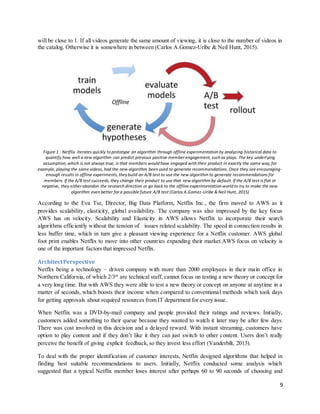
the catalog. Otherwise it is somewhere in between (Carlos A.Gomez-Uribe & Neil Hunt, 2015).
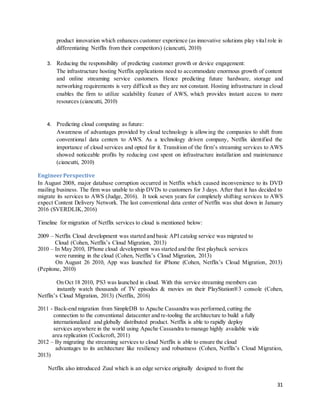
Figure 1 : Netflix iterates quickly to prototype an algorithm through offline experimentation by analyzing historical data to
quantify how well a new algorithm can predict previous positive member engagement, such as plays. The key underlying
assumption, which is not always true, is that members would have engaged with their product in exactly the same way, for
example, playing the same videos, had the new algorithm been used to generate recommendations. Once they see encouraging-
enough results in offline experiments, theybuild an A/B test to use the new algorithm to generate recommendations for
members. If the A/B test succeeds, they change their product to use that new algorithm by default. If the A/B test is flat or
negative, they either abandon the research direction or go back to the offline experimentation world to try to make the new
algorithm even better for a possible future A/B test (Carlos A.Gomez-Uribe & Neil Hunt, 2015)
According to the Eva Tse, Director, Big Data Platform, Netflix Inc., the firm moved to AWS as it
provides scalability, elasticity, global availability. The company was also impressed by the key focus
AWS has on velocity. Scalability and Elasticity in AWS allows Netflix to incorporate their search
algorithms efficiently without the tension of issues related scalability. The speed in connection results in
less buffer time, which in turn give a pleasant viewing experience for a Netflix customer. AWS global
foot print enables Netflix to move into other countries expanding their market.AWS focus on velocity is
one of the important factors that impressed Netflix.
ArchitectPerspective
Netflix being a technology – driven company with more than 2000 employees in their main office in
Northern California, of which 2/3rd
are technical staff, cannot focus on testing a new theory or concept for
a very long time. But with AWS they were able to test a new theory or concept on anyone at anytime in a
matter of seconds, which boosts their income when compared to conventional methods which took days
for getting approvals about required resources from IT department for every issue.
When Netflix was a DVD-by-mail company and people provided their ratings and reviews. Initially,
customers added something to their queue because they wanted to watch it later may be after few days.
There was cost involved in this decision and a delayed reward. With instant streaming, customers have
option to play content and if they don’t like it they can just switch to other content. Users don’t really
perceive the benefit of giving explicit feedback,so they invest less effort (Vanderbilt, 2013).
To deal with the proper identification of customer interests, Netflix designed algorithms that helped in
finding best suitable recommendations to users. Initially, Netflix conducted some analysis which
suggested that a typical Netflix member loses interest after perhaps 60 to 90 seconds of choosing and
10
having reviewed 10 to 20 titles (perhaps 3 in detail) on one or two screens. The user either finds
something of interest else the risk of the user abandoning the service increases substantially. The
recommender problem is to make sure that on those two screens each member in their diverse pool will
find something compelling to view, and will understand why it might be of interest (Carlos A.Gomez-
Uribe & Neil Hunt, 2015).
Historically, the Netflix recommendation problem has been thought of as equivalent to the problem of
predicting the number of stars that a person would rate a video after watching it, on a scale from 1 to 5.
We indeed relied on such an algorithm heavily when their main business was shipping DVDs by mail,
partly because in that context, a star rating was the main feedback that we received that a member had
actually watched the video. We even organized a competition aimed at improving the accuracy of the
rating prediction, resulting in algorithms that we use in production to predict ratings to this day (Netflix
Prize, 2015).
Netflix’s recommender system consists of a variety of algorithms that collectively define the Netflix
experience, most of which come together on the Netflix homepage. This is the first page that a Netflix
member sees upon logging onto one’s Netflix profile on any device (TV, tablet, phone, or browser)—it is
the main presentation of recommendations, where 2 of every 3 hours streamed on Netflix are discovered
(Carlos A.Gomez-Uribe & Neil Hunt, 2015).
EngineerPerspective
Algorithms used by Netflix
Personalised Video Ranker:PVR
There are typically about 40 rows on each homepage (depending on the capabilities of the device), and up
to 75 videos per row. These numbers vary somewhat across devices because of hardware and user
experience considerations. The videos in a given row typically come from a single algorithm. Genre rows
such as Suspense Movies, are driven by Netflix’s personalized video ranker (PVR) algorithm. As its name
suggests, this algorithm orders the entire catalog of videos (or subsets selected by genre or other filtering)
for each member profile in a personalized way. The resulting ordering is used to select the order of the
videos in genre and other rows, and is the reason why the same genre row shown to different members
often has completely different videos. Because Netflix uses PVR so widely, it must be good at general
purpose relative rankings throughout the entire catalog; this limits how personalized it can actually be.
Equivalently, PVR works better when we blend personalized signals with a pretty healthy dose of
(unpersonalized) popularity, which Netflix uses to drive the recommendations in the Popular row (Carlos
A.Gomez-Uribe & Neil Hunt, 2015).
11
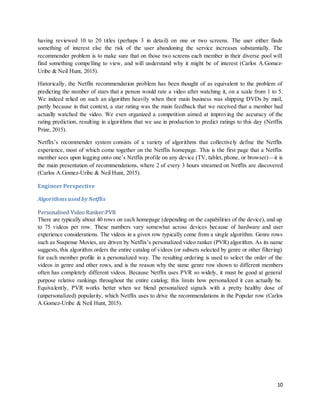
Figure 2 : : (Left) An example of the page of recommendations, showing two of the roughly 40 rows of recommendations on that
page. Suspenseful Movies is an example of a genre row driven by the PVR algorithm. The second row is a Because You Watched
row driven by the PVR algorithm. The second row is a Because You Watched row driven by the sims algorithm. (Right) A
homepage showing the Top Picks row driven by the Top N algorithm. Romantic Movies is a genre row driven by PVR (Carlos
A.Gomez-Uribe & Neil Hunt, 2015)
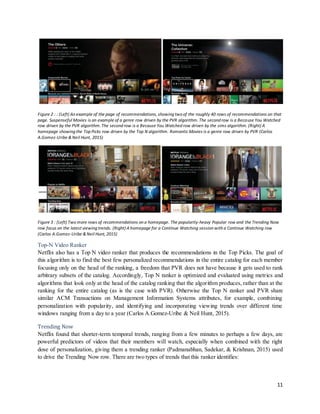
Figure 3 : (Left) Two more rows of recommendations on a homepage. The popularity-heavy Popular row and the Trending Now
row focus on the latest viewing trends. (Right) A homepage for a Continue Watching session with a Continue Watching row
(Carlos A.Gomez-Uribe & Neil Hunt, 2015)
Top-N Video Ranker
Netflix also has a Top N video ranker that produces the recommendations in the Top Picks. The goal of
this algorithm is to find the best few personalized recommendations in the entire catalog for each member
focusing only on the head of the ranking, a freedom that PVR does not have because it gets used to rank
arbitrary subsets of the catalog. Accordingly, Top N ranker is optimized and evaluated using metrics and
algorithms that look only at the head of the catalog ranking that the algorithm produces, rather than at the
ranking for the entire catalog (as is the case with PVR). Otherwise the Top N ranker and PVR share
similar ACM Transactions on Management Information Systems attributes, for example, combining
personalization with popularity, and identifying and incorporating viewing trends over different time
windows ranging from a day to a year (Carlos A.Gomez-Uribe & Neil Hunt, 2015).
Trending Now
Netflix found that shorter-term temporal trends, ranging from a few minutes to perhaps a few days, are
powerful predictors of videos that their members will watch, especially when combined with the right
dose of personalization, giving them a trending ranker (Padmanabhan, Sadekar, & Krishnan, 2015) used
to drive the Trending Now row. There are two types of trends that this ranker identifies:
12
1. Those that repeat every several months (e.g., yearly) yet have a short-term effect when they
occur, such as the uptick of romantic video watching during Valentine’s Day in North America
(Carlos A.Gomez-Uribe & Neil Hunt, 2015)
2. One-off, short-term events, for example, a big hurricane with an impending arrival to some
densely populated area, being covered by many media outlets, driving increased short-term
interest in documentaries and movies about hurricanes and other natural disasters (Carlos
A.Gomez-Uribe & Neil Hunt, 2015)
Continue Watching
Given the importance of episodic content viewed over several sessions, as well as the freedom to view
nonepisodic content in small bites, another important video ranking algorithm is the continue watching
ranker that orders the videos in the Continue Watching row. Most of Netflix’s rankers sort unviewed titles
on which they have only inferred information. In contrast, the continue watching ranker sorts the subset of
recently viewed titles based on their best estimate of whether the member intends to resume watching or
rewatch, or whether the member has abandoned something not as interesting as anticipated. The signals
that they use include the time elapsed since viewing, the point of abandonment (mid-program vs.
beginning or end), whether different titles have been viewed since, and the devices used. In general, their
different video ranking algorithms use different mathematical and statistical models, different signals and
data as input, and require different model trainings designed for the specific purpose each ranker serves
(Carlos A.Gomez-Uribe & Neil Hunt, 2015).
Video-Video Similarity
Because You Watched (BYW) rows are another type of categorization. A BYW row anchors its
recommendations to a single video watched by the member. The video-video similarity algorithm, which
Netflix refers to simply as “sims,” drives the recommendations in these rows. The sims algorithm is an
unpersonalized algorithm that computes a ranked list of videos—the similars—for every video in their
catalog. Even though the sims ranking is not personalized, the choice of which BYW rows make it onto a
homepage is personalized, and the subset of BYW videos recommended in a given BYW row benefits
from personalization, depending on what subsets of the similar videos we estimate that the member would
enjoy (or has already watched) (Carlos A.Gomez-Uribe & Neil Hunt, 2015)
Page Generation: Row Selection and Ranking
The videos chosen for each row represent their estimate of the best choices of videos to put in front of a
specific user. But most members have different moods from session to session, and many accounts are
shared by more than one member of a household. By offering a diverse selection of rows, Netflix hopes to
make it easy for a member to skip videos that would be good choices for a different time, occasion, or
member of the household, and quickly identify something immediately relevant (Carlos A.Gomez-Uribe
& Neil Hunt, 2015)
The page generation algorithm uses the output of all the algorithms already described to construct every
single page of recommendations, taking into account the relevance of each row to the member as well as
the diversity of the page. A typical member has tens of thousands of rows that could go on one’s
homepage, making it challenging to manage the computations required to evaluate them. For this reason,
before 2015, Netflix used a rule-based approach that would define what type of row (e.g., genre row,
BYW row, Popular row) would go in each vertical position of the page. This page layout was used to
construct all homepages for all members. Today, Netflix has a fully personalized and mathematical
13
algorithm that can select and order rows from a large pool of candidates to create an ordering optimized
for relevance and diversity. Their current algorithm does not use a template, thus is freer to optimize the
experience, for example, choosing not to have any BYW row for a given homepage and devoting half of
the page to BYW rows for another homepage (Carlos A.Gomez-Uribe & Neil Hunt, 2015)
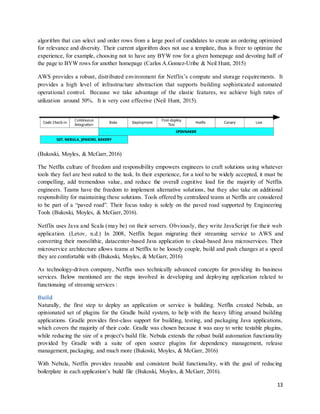
AWS provides a robust, distributed environment for Netflix’s compute and storage requirements. It
provides a high level of infrastructure abstraction that supports building sophisticated automated
operational control. Because we take advantage of the elastic features, we achieve high rates of
utilization around 50%. It is very cost effective (Neil Hunt, 2015).
(Bukoski, Moyles, & McGarr, 2016)
The Netflix culture of freedom and responsibility empowers engineers to craft solutions using whatever
tools they feel are best suited to the task. In their experience, for a tool to be widely accepted, it must be
compelling, add tremendous value, and reduce the overall cognitive load for the majority of Netflix
engineers. Teams have the freedom to implement alternative solutions, but they also take on additional
responsibility for maintaining these solutions. Tools offered by centralized teams at Netflix are considered
to be part of a “paved road”. Their focus today is solely on the paved road supported by Engineering
Tools (Bukoski, Moyles, & McGarr, 2016).
Netflix uses Java and Scala (may be) on their servers. Obviously, they write JavaScript for their web
application. (Letov, n.d.) In 2008, Netflix began migrating their streaming service to AWS and
converting their monolithic, datacenter-based Java application to cloud-based Java microservices. Their
microservice architecture allows teams at Netflix to be loosely couple, build and push changes at a speed
they are comfortable with (Bukoski, Moyles, & McGarr, 2016)
As technology-driven company, Netflix uses technically advanced concepts for providing its business
services. Below mentioned are the steps involved in developing and deploying application related to
functionaing of streamig services :
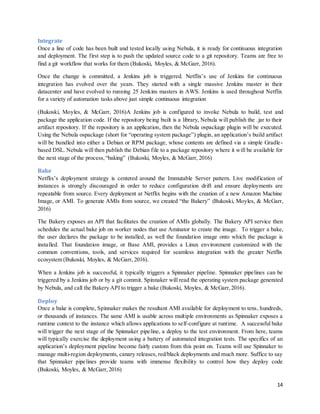
Build
Naturally, the first step to deploy an application or service is building. Netflix created Nebula, an
opinionated set of plugins for the Gradle build system, to help with the heavy lifting around building
applications. Gradle provides first-class support for building, testing, and packaging Java applications,
which covers the majority of their code. Gradle was chosen because it was easy to write testable plugins,
while reducing the size of a project's build file. Nebula extends the robust build automation functionality
provided by Gradle with a suite of open source plugins for dependency management, release
management, packaging, and much more (Bukoski, Moyles, & McGarr, 2016)
With Nebula, Netflix provides reusable and consistent build functionality, with the goal of reducing
boilerplate in each application’s build file (Bukoski, Moyles, & McGarr, 2016).
14
Integrate
Once a line of code has been built and tested locally using Nebula, it is ready for continuous integration
and deployment. The first step is to push the updated source code to a git repository. Teams are free to
find a git workflow that works for them (Bukoski, Moyles, & McGarr, 2016).
Once the change is committed, a Jenkins job is triggered. Netflix’s use of Jenkins for continuous
integration has evolved over the years. They started with a single massive Jenkins master in their
datacenter and have evolved to running 25 Jenkins masters in AWS. Jenkins is used throughout Netflix
for a variety of automation tasks above just simple continuous integration
(Bukoski, Moyles, & McGarr, 2016)A Jenkins job is configured to invoke Nebula to build, test and
package the application code. If the repository being built is a library, Nebula will publish the .jar to their
artifact repository. If the repository is an application, then the Nebula ospackage plugin will be executed.
Using the Nebula ospackage (short for “operating system package”) plugin, an application’s build artifact
will be bundled into either a Debian or RPM package, whose contents are defined via a simple Gradle-
based DSL. Nebula will then publish the Debian file to a package repository where it will be available for
the next stage of the process,“baking” (Bukoski, Moyles, & McGarr, 2016)
Bake
Netflix’s deployment strategy is centered around the Immutable Server pattern. Live modification of
instances is strongly discouraged in order to reduce configuration drift and ensure deployments are
repeatable from source. Every deployment at Netflix begins with the creation of a new Amazon Machine
Image, or AMI. To generate AMIs from source, we created “the Bakery” (Bukoski, Moyles, & McGarr,
2016)
The Bakery exposes an API that facilitates the creation of AMIs globally. The Bakery API service then
schedules the actual bake job on worker nodes that use Aminator to create the image. To trigger a bake,
the user declares the package to be installed, as well the foundation image onto which the package is
installed. That foundation image, or Base AMI, provides a Linux environment customized with the
common conventions, tools, and services required for seamless integration with the greater Netflix
ecosystem (Bukoski, Moyles, & McGarr, 2016).
When a Jenkins job is successful, it typically triggers a Spinnaker pipeline. Spinnaker pipelines can be
triggered by a Jenkins job or by a git commit. Spinnaker will read the operating system package generated
by Nebula, and call the Bakery API to trigger a bake (Bukoski, Moyles, & McGarr, 2016).
Deploy
Once a bake is complete, Spinnaker makes the resultant AMI available for deployment to tens, hundreds,
or thousands of instances. The same AMI is usable across multiple environments as Spinnaker exposes a
runtime context to the instance which allows applications to self-configure at runtime. A successful bake
will trigger the next stage of the Spinnaker pipeline, a deploy to the test environment. From here, teams
will typically exercise the deployment using a battery of automated integration tests. The specifics of an
application’s deployment pipeline become fairly custom from this point on. Teams will use Spinnaker to
manage multi-region deployments, canary releases, red/black deployments and much more. Suffice to say
that Spinnaker pipelines provide teams with immense flexibility to control how they deploy code
(Bukoski, Moyles, & McGarr, 2016)
15
How
(Puneeth Reddy Challa)
ExecutivePerspective
Netflix always strived for digital transformations and to achieve their goals, it chose an agile EA
overtraditional EA. Netflix treated the enterprise as a complex system, driving business agility as an
emergent property of the organization. Netflix used a transformative set of practices that is known as
Agile Architecture (Bloomberg, 2014).
Netflix started its journey with the traditional data-center infrastructure. It found that the infrastructure
was too fragile for its needs (i.e., things stopped working all the time), and the traditional operations
model didn’t respond fast enough to the needs of the business (Golden, 2012). Netflix’s business is
growing rapidly and experienced very uneven demand. In this kind of environment, Netflix didn’t want to
experience service interruptions caused due to its inability to build and expand data centers at a faster
pace. They followed the agile EA to rapidly identify the future view of the organization and chose AWS
for their services. Amazon Web Services (AWS) provided broader set of services and features that were
very useful for Netflix to run their services seamlessly (Weare,2016).
To run their services on new cloud platform, Netflix chose new processes for team operations like Agile,
Lean and DevOps to suit their new culture (Jones,2016). To solve the previous problems, Netflix re-
architected their applications and moved to mircoservices. (Weare,2016) The transition from traditional
data centers to AWS was done slowly by keeping the stakeholders in mind. (Weare,2016) A sudden
change in environment can lead to resistance from stakeholders, which will completely destroy the EA
program. Initially they focused on all customer-facing services being provisioned in the cloud. (Weare,
2016) This allowed Netflix to take advantage of Amazon’s regions located all over the world, which helps
the firm to provide services to customers across 130 countries. Once customer-facing services had been
moved to the cloud, Netflix then focused on billing and employee data management systems. From
December 2007 to December 2015, Netflix has experienced more than 1000x growth . Netflix took more
than 7 years to make the transition to the cloud. They did it methodically and did not resort to a lift and
shift strategy. Netflix felt that in order to truly benefit from the cloud, they needed to transition systems
to take advantage of cloud-based components instead of bringing the data center shortcomings to the
cloud (Weare,2016)
Netflix accelerated their application development lifecycle to make more time for marketing and to
reduce production costs. For this purpose they used DevOps, which combines externalities with core
processes (Weare,2016). In 2009 Netflix adopted a continuous delivery model, which blends perfectly
with a microservices architecture. (Mauro, 2015) Each microservice represents a single product feature
that can be updated independently of the other microservices and on its own schedule. Discovering a bug
in a microservice has no effect on the release schedule of any other microservice. Continuous delivery
relies on packaging microservices in standard containers (Mauro, 2015). The entire team moves at the
speed of development, because they are one organization (Weare,2016)
The potential footprint of a mature EA capability is as big as the entire organization, but one of the key
success factors for being successfulwith EA is to deliver value obtained by transformation of services
from old to current one at an early stage (Franken, Djik, & Gils, 2013). Experience from consultancy
16
practice proves that a “think big, start small” approach has the most potential for success . This means that
the process of implementing an EA capability is a process with iterative and incremental steps, based on a
long term vision . Each step in the process must add measurable value to the EA practice, and priorities
should be based on the needs and the change capacity of the organization (Franken, Djik, & Gils, 2013).
Netflix followed this EA practice since its beginning. Though Reed Hastings had a big idea of providing a
streaming service that he fervently believed in, he started with lots of small projects (Mui, 2011). On the
contrary, companies with big ideas tend to implement them in a rush (Mui, 2011). The number of
subscribers joining Netflix and subscribers that Netflix retained was the best metrics that Netflix used to
measure the success of the small projects and it made necessary changes to the EA to expand its user base
and to provide better service to their customers.
By following the “think big, start small” practice, Netflix grew rapidly from a DVD-by- rental service
provider to online streaming service provider and provider of own content. Even when Netflix was
making good profits with DVD-by- rental service, it never stopped innovating and discovering new
means of content delivery to its customers. They took many bold projects like moving into internet and
producing their own videos which was a completely new approach to them and became a successful
organization.
Even though Netflix has become the top player in the video rental industry, it needs to face many
challenges in the future and the biggest challenge will be the competition from Blockbuster. Although the
Blockbuster bankruptcy might seem like a huge win for Netflix, it isn’t all good news. Its competitor is
not gone -- just reorganizing (Indiviglio, 2010). When a company goes to Chapter 11, it’s a little like
going through detox. Chapter 11 bankruptcy is intended primarily for the reorganization of businesses
with heavy debt burdens, most often associated with corporations but available to small businesses as
well (Thomson Reuters). It sheds some of its liabilities and costs, and ends up a leaner, more focused firm
that can reinvent itself. So when Blockbuster emerges from bankruptcy, it won’t be the same company
that Netflix found so easy to smack around . That doesn’t mean Blockbuster will necessarily triumph over
Netflix, but Netflix can expect a different and more difficult challenge from Blockbuster going forward
(Indiviglio, 2010). Just by being open to changes in the market, incorporating those changes to provide a
high quality service to the customers and by sticking to “think big, start small” practice, Netflix can
withstand Blockbuster and continue to remain the leader of streaming and video rental industry.
BusinessMgmt Perspective
Netflix gained its initial competitive advantage, not through a new business model, but through a
combination of known business models. The company combined the physical landlord model with the
subscription and all you can eat models to allow customers to rent all the DVDs they could in a month for
a flat fee. Customers were allowed to keep the DVDs for an unlimited period of time and were not subject
to late fees. In return, customers agreed to pay a recurring monthly subscription fee. (Noren,2013)
Netflix was able to overcome some of the weaknesses of the landlord model by delivering DVDs through
the mail. This lack of physical infrastructure and advanced integration with the postal service provided a
clear advantage over the Blockbuster model. By opening up rentals to all you can eat, customers were
never subject to late fees and could rent as many videos as they wanted within a single month. Lastly, the
monthly subscription provided consistent cash flow for the company while establishing a single low price
that customers could count on month after month. (Noren, 2013)
17
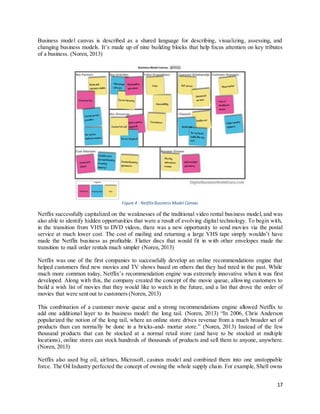
Business model canvas is described as a shared language for describing, visualizing, assessing, and
changing business models. It’s made up of nine building blocks that help focus attention on key tributes
of a business. (Noren, 2013)
Figure 4 : Netflix Business Model Canvas
Netflix successfully capitalized on the weaknesses of the traditional video rental business model, and was
also able to identify hidden opportunities that were a result of evolving digital technology. To begin with,
in the transition from VHS to DVD videos, there was a new opportunity to send movies via the postal
service at much lower cost. The cost of mailing and returning a large VHS tape simply wouldn’t have
made the Netflix business as profitable. Flatter discs that would fit in with other envelopes made the
transition to mail order rentals much simpler (Noren, 2013)
Netflix was one of the first companies to successfully develop an online recommendations engine that
helped customers find new movies and TV shows based on others that they had rated in the past. While
much more common today, Netflix’s recommendation engine was extremely innovative when it was first
developed. Along with this, the company created the concept of the movie queue, allowing customers to
build a wish list of movies that they would like to watch in the future, and a list that drove the order of
movies that were sent out to customers (Noren, 2013)
This combination of a customer movie queue and a strong recommendations engine allowed Netflix to
add one additional layer to its business model: the long tail. (Noren, 2013) “In 2006, Chris Anderson
popularized the notion of the long tail, where an online store drives revenue from a much broader set of
products than can normally be done in a bricks-and- mortar store.” (Noren, 2013) Instead of the few
thousand products that can be stocked at a normal retail store (and have to be stocked at multiple
locations), online stores can stock hundreds of thousands of products and sell them to anyone, anywhere.
(Noren, 2013)
Netflix also used big oil, airlines, Microsoft, casinos model and combined them into one unstoppable
force. The Oil Industry perfected the concept of owning the whole supply chain. For example, Shell owns
18
everything it needs to do business from exploration activities that discover where the oil is, to drilling
machinery, to the service station where cars fill gas. When Netflix decided it was going to spend $100
million to hire Kevin Spacey and make House of Cards, it was thinking like an oil company. Owning the
whole supply chain is known as vertical integration and it gives a company power. Oil companies do it to
control price, quality and quantity. Owning just the distribution mechanism makes the company
vulnerable. Netflix’s most famous house-made products are House of Cards and Orange is the New
Black, both of which have proven to be black gold (thinkengine, 2015)
Microsoft perfected the art of bundling. Microsoft Office comes with many applications like PowerPoint,
excel, word etc. Users get all the applications irrespective of what they actually need. This is known as
bundling. Companies do it because it let them make more profit. For example, a customer X is willing to
pay a maximum of $10 for product A and $6 for product B. Another Customer Y preferences are the other
way round. If the company tries to charge $10 for product A and $10 for product B, then both the
customers buy just one product. The company makes $20. If the company wants to sell two of product A
and two of Product B, it must set the price for each at $6. Then the company makes $24. If it bundles the
products into A+B packages costing $16 each, it can sell all four items and make $32! This is the best
option. When a customer buys Netflix, they get a lot of stuff you’ll never watch. Maybe horror films, or
BBC murder mysteries. That’s the Microsoft PowerPoint part of the bundle (thinkengine, 2015)
Airlines perfected the art of price discrimination. In Netflix website, there is are three types of
subscriptions plans: $8.99, $11.99 and $14.99. No matter how much the customer pays, he will get access
to all the same shows. The difference is in whether the content is delivered in high definition, regular
definition, or ultra-high definition, and how many screens the content can be viewed on. This is known as
price discrimination. Airlines use this model to perfection. Whether they sell an economy ticket for $700,
a business class seat for $2000 or a first class experience for $5000, all the customers take off and land at
the same time. Charging people different amounts for the same basic thing works well because of a
concept called “willingness to pay”. Not everyone will pay the same amount for the same good. If a
business sets just one price, it misses out on profit. There are some people that would pay more than that.
Even more important, there are people who would be profitable customers if the price was just a bit
lower. A different price for different folks is a proven model. Netflix wants to skim their first-class
passengers for as much as possible, but also fill up the back-end of the plane. The great thing for them is
their plane has an unlimited number of seats (thinkengine, 2015)
Casinos perfected the art of keeping the players hooked. The flashing lights on a poker machine are
scientifically designed to provoke the reward centers in the brain. Like rats in a cage, humans get addicted
on the dizzying sequence of highs and lows, pay-offs and disappointments. Scientist have shown a good
film or a good show controls our brain. A director makes a character act in a certain way and cuts the
scene. The brains of viewers all release neuro-transmitters on cue. With free-to- air TV there was nothing
we could do except wait a week to watch the next episode. But with Netflix the next episode is right there,
ready and waiting to deliver more brain stimulation. (thinkengine, 2015)
Where
(Varsha Gorrepati)
ExecutivePerspective
Netflix has huge subscriber base in The United States. South and Central America also have
large Netflix presences, as the service worked fairly actively to expand into those regions.
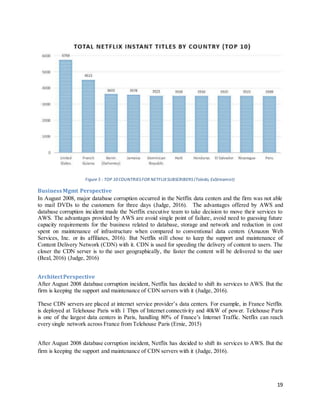
Below figure shows top 10 countries having more number of total number of unique titles (
TV and movies ) available as of February 22nd, 2016. (Toledo, ExStreamist)
19
Figure 5 : TOP 10 COUNTRIESFOR NETFLIXSUBSCRIBERS (Toledo, ExStreamist)
BusinessMgmt Perspective
In August 2008, major database corruption occurred in the Netflix data centers and the firm was not able
to mail DVDs to the customers for three days (Judge, 2016). The advantages offered by AWS and
database corruption incident made the Netflix executive team to take decision to move their services to
AWS. The advantages provided by AWS are avoid single point of failure, avoid need to guessing future
capacity requirements for the business related to database, storage and network and reduction in cost
spent on maintenance of infrastructure when compared to conventional data centers (Amazon Web
Services, Inc. or its affiliates, 2016). But Netflix still chose to keep the support and maintenance of
Content Delivery Network (CDN) with it. CDN is used for speeding the delivery of content to users. The
closer the CDN server is to the user geographically, the faster the content will be delivered to the user
(Beal, 2016) (Judge, 2016)
ArchitectPerspective
After August 2008 database corruption incident, Netflix has decided to shift its services to AWS. But the
firm is keeping the support and maintenance of CDN servers with it (Judge, 2016).
These CDN servers are placed at internet service provider’s data centers. For example, in France Netflix
is deployed at Telehouse Paris with 1 Tbps of Internet connectivity and 40kW of power. Telehouse Paris
is one of the largest data centers in Paris, handling 80% of France’s Internet Traffic. Netflix can reach
every single network across France from Telehouse Paris (Ernie, 2015)
After August 2008 database corruption incident, Netflix has decided to shift its services to AWS. But the
firm is keeping the support and maintenance of CDN servers with it (Judge, 2016).
20
These CDN servers are placed at internet service provider’s data centers. For example, in France Netflix
is deployed at Telehouse Paris with 1 Tbps of Internet connectivity and 40kW of power. Telehouse Paris
is one of the largest data centers in Paris, handling 80% of France’s Internet Traffic. Netflix can reach
every single network across France from Telehouse Paris (Ernie, 2015).
EngineerPerspective
Netflix maintains its own CDN servers. It handles CDN services by using Open Connect
programme. Netflix partners with Internet Service Providers to deliver their content in the most efficient
way possible so that video streaming subscribers view high quality videos (Netflix, 2016).
The OpenConnect appliance is a high-performance web server integrated with the Netflix Content
Delivery System. It consists of below mentioned software: (Netflix, 2016)
(a) Operating System: FreeBSD
(b) Web Server: NGINX
(c) BGP daemon: BIRD
(d) The remaining software on the system manages content and communicates system health and
other statistics to the Netflix OpenConnect Cloud Control Plane.
(e) IPv4 and IPv6 are fully supported
TechnicianPerspective
Netflix OpenConnect provides peering locations at Internet Exchange points (IXP). These IXPs
are located in United states, Netherlands, Germany, Japan, Egypt, Hong Kong, France,
Singapore, Australia, Switzerland, Ireland, United Kingdom, Italy, Brazil and Austria (Netflix,
2016). There are also private peering locations available at places present in United States and
Germany (Netflix, 2016)
Who
(Varsha Gorrepati)
ExecutivePerspective
The organizational units present in Netflix are:
1. Engineering:
This department is responsible for cloud and platform programming (Adi, 2014)
2. Data, Analytics, Algorithms:
This department is responsible for anticipating customer movie preferences, analyzing
customer usage data and make future forecasts (Adi, 2014)
In the data driven environment like video distribution industry, data analytics plays an
important role. Netflix identified this and used data analytics to predict below details
which helped them to enhance their business by providing innovative solutions:
21
(a) Predicting viewing habits of customers: Netflix provided unique feature of tagging
the movies watched by customers. This helps them to suggest customer’s other
movies or videos which are having similar tags (Marr, 2015)
(b) Finding the next smash-hit series: Netflix used data analytics to identify which
director’s programs the customers are interested and provide them with that content.
This indirectly helps in increasing the number of hours’ customers avail Netflix’s
services (Marr, 2015)
(c) Quality of experience: Collection of end-user data to know how the physical location
of the content affects the viewer’s experience and calculations about the placement of
data can be determined by using data analytics to ensure an optimal service to as
many homes as possible. Additionally, data points such as delays due to buffering
(rebuffed rate) and bitrate (which affects the picture quality) are collected to augment
analysis made by using data analytics (Marr, 2015)
3. Design: This department deals with web site design and aesthetic aspects used to enhance
the usability of the user interface by customers (Adi, 2014) (Marr, 2015)
4. Marketing and PR: Marketing and Public relations department is responsible for
understanding consumer demand, promoting new features and media content and
handling media promotions (Adi, 2014) (Marr, 2015)
Netflix followed below strategies for excelling in terms of marketing and stood as best
example for other companies:
(a) Create Ubiquity: Netflix changed its business model based on technology and market
trends. It distributed content in various formats preferred by its customers like DVDs,
computer, tablet, smart phone, TV. It also built a ubiquitous platform for delivering
premium video content to its customers (Bodnar, 2011)
(b) Market a Minimum Viable Product: Netflix was into DVD-by-mail business until it
made the strategic decision of streaming video content. When Netflix started its
streaming service, it had few content available for streaming service when compared
to distribution of content using DVDs via mail. But this did not stop the company
from actively penetrating its presence into new and existing customer base (Bodnar,
2011)
22
(c) Give Prospects What They Don't Know They Want: When Netflix began streaming
videos, their DVD-by-mail business was flourishing and most of the customers were
willing to wait for a day or two to get their next DVD. But Netflix anticipated that
this would become a potential issue as their customer base is expanding. Hence it
skillfully resolved this problem by starting streaming service before its customer base
increased (Bodnar, 2011)
Netflix was fast in responding to technological changes occurring in the industry
when compared to its competitors like Blockbuster. In 1999, Netflix anticipated that
there is no growth for video rental industry in DVD business and started its video
streaming services in 2007 (Press, Blockbuster Inc. History, 2000). But Blockbuster
was still testing online business model in 2008 and could not implement that until the
end. This performance gap reflected on their market share and ultimately their
business.
(d) Quickly Abandon Dying Platforms:
Enterprises need to have clear analytics and return on investment metrics for both
outbound and inbound marketing strategies. If the enterprise could predict a
prolonged decrease in results, then it should consider reallocating marketing budget to
other tactics that increase its business scope and profit. Netflix adopted the same
strategy and identified that usage and adoption of DVDs would gradually decline.
Hence it worked aggressively to increase adoption of streaming video. (Bodnar,
2011)
(e) Publish and Distribute: Netflix has funded the production of a new show called
"House of Cards," featuring Kevin Spacey. This move marked a major transition for
the company. It took them from a mere content distribution company to a business
that creates and distributes video content. (Bodnar, 2011) This show was first
broadcasted on Feb 1, 2013. After this show was successful, Netflix has started few
other shows like “Mitt” and “The Square”. All these shows increased the company’s
business value and resulted in increase of revenue in the first quarter of 2014. The
company’s revenue crossed $1 billion mark and also increased its subscribers base to
more than 46 million (Shaw, 2014)
23
5. HR, Talent and recruiting:
Netflix HR department has revolutionized the industry (Adi, 2014)
The radical changes which drove to wide-scale transformation of Netflix’s HR strategy
are mentioned below:
(a) Hire, Reward, and Tolerate Only Fully Formed Adults:
Most of the company’s waste time and money enforcing HR policies that only affect
the 3 percent of employees who need correction. If a company encourages employees
to rely on common sense principles instead of institutional policies, employees will
be better motivated to contribute and will feel more invested in the successes of the
company. Netflix identified this behavior among employees and ensured that its hires
were the type of employees who would always put the company’s interests first. It
also encouraged employees to model adult behaviors like openly communicating with
their bosses, colleagues and other employees. For example, Netflix’s paid time off
policy allows employees to take as much vacation time as they need, but with a
condition that there should be understanding that employees should clearly
communicate their plans to their managers (Staff, 2014)
Tell the Truth About Performance:
Instead of following formal conventional methods for employee reviews, Netflix
encouraged managers and employees to meet openly about their performance so that
employees were receiving proper feedback. It discovered that when an employee was
performing poorly, it was much more effective to sit down with the employee and
have a conversation rather than assigning the Performance Improvement Plan (PIP) to
that individual, which tracks performance over time. Also, Netflix ensures that all its
employees receive outstanding severance packages when they are leaving the
company because of few constraints associated in executing tasks related to their
designation because it leads to a more positive business culture. (Staff, 2014)
Managers Own the Job of Creating Great Teams:
Netflix taught its managers that team building is a critical step in crafting a culture of
excellence. Managers are encouraged to regularly involve in conversation with their
team members and identify the needs of the projects they are handling. Based on
24
these conversations, managers need to hire new persons or use existing persons to
create teams which accomplish in the desired tasks completion. (Staff, 2014)
Leaders Own the Job of Creating the Company Culture:
Netflix HR department emphasized that its responsibility of HR department to
explain new hires how the business works and how the company makes money. This
helps the employees to understand about core functionalities of the company and how
they can contribute to enhance the working of these functionalities. (Staff, 2014)
Good Talent Managers Think Like Businesspeople and Innovators First, and Like HR
People Last:
According to Patty McCord, former chief talent officer at Netflix, HR professionals
need to think like businessmen and businesswomen and think what policies are good
for the company and how do the company communicate an attitude of excellence to
the employees. If the company has a performance plan, a simple litmus test need to be
conducted by asking employees if they know what they need to be doing to boost
their bonus. If the employees can’t answer this question, then HR team need to
recheck how they are communicating and making employees understand the
company’s policies. (Staff, 2014)
Global customer service: This department is responsible for handling all customer
problems/complaints (Adi, 2014)
Netflix has one of the best customer service ratings of any online retail corporation in
America. It believes that great customer service comes from their “Freedom and
Responsibility” culture. This approach consists of 6 key elements:
(a) Hire for Personality/Job Fit/Soft Skills:
Netflix hires individuals with the right Personality/Job Fit/Soft Skill Traits. It looks
for Contact Center employees who are smart, friendly, enthusiastic, helpful,
energetic, reliable, mature, self motivated and have ability to solve problems in order
to keep subscribers happy and loyal (Filwood, 2015)
25
Market Based Compensation:
In order to retain the top talent with them, Netflix pays hourly wages according to
market norms to its CSRs (customer service representatives). Additionally, it also
offers bonus, incentives, inexpensive benefits or decent health care coverage
(Filwood, 2015)
(b) No Scripts:
Netflix CSR’s do not have any restrictions or rules to be followed to serve their
customers. Unlike other customer service representatives, they do not pressurize
customers to add a service or buy a more expensive plan. If customer wants to cancel
their subscription, CSRs don't push to have that person continue with the service.
They are empowered with the ability and autonomy to provide the best service
possible (Filwood, 2015)
CSR Empowerment:
In Netflix, CSRs are encouraged to solve a customer's problem without transferring
the caller to a Supervisor or another department. This approach creates CSRs who
don’t hesitate to answer questions, fix issues, troubleshoot with customers and who
feel secure in the initial and ongoing training they receive (Filwood, 2015)
(c) Managers/Supervisors Own the Job of Creating Great Teams:
The Managers/Supervisors at Netflix are tasked with creating a customer centric work
environment that differentiates the company by creating an emotional connection
with customers which helps in outperforming the competition (Filwood, 2015)
(d) Tell the Truth About the Job:
Netflix CSRs have their job performance measured primarily on attendance, shift
adherence and on customer dissatisfaction. Customer dissatisfaction can be identified
from a one question survey at the end of a call or text chat that simply asks whether a
customer was satisfied with their Netflix service experience or not (Filwood, 2015)
The CSR’s goal is to keep the percentage of people who answer "No" at around 5%.
In this competitive driven culture, CSRs may burnout or get emotionally exhausted.
To deal with this, Netflix has a policy of having honest conversations with their
employees about letting some team members find a place where their skills are a
26
better fit and quickly letting people go by offering generous severance packages when
their performance no longer fits in their current role (Filwood, 2015)
(e) Creating a Talented and Engaged Customer Care Workforce isn’t “Rocket Science”:
Customers have high expectations about the quality of service and support being
provided to them. Companies like Netflix which provide above average customer care
service, have stood as examples to other companies of their industry and other
industries. Netflix demonstrated how outstanding customer service and support looks
like and what positive results it produces (Filwood, 2015)
Contact Centers that practice the Netflix “Freedom and Responsibility” approach to
their work culture have low levels of burnout or emotional exhaustion and quit rates
among their (above average) CSRs. This results in high levels of employee
engagement and customer satisfaction (Filwood, 2015)
6. Finance: This department deals with financial planning and analysis and customer
payments (Filwood, 2015) (Adi, 2014)
7. Legal: This department handles getting the legal rights to movies and TV shows and any
other legal issues that arise (Adi, 2014)
8. Content: This department is responsible for managing and acquiring media content (Adi,
2014)
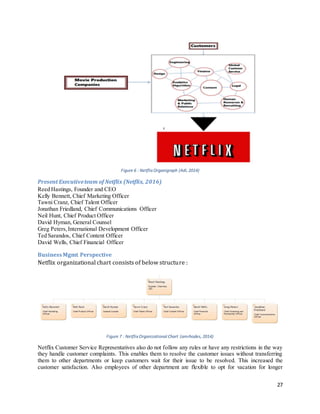
Netflix organizational units have well-defined functions, scope and coordination among
them. Below figure shows the organizational unit’s structure and coordination with in the
enterprise.
27
Figure 6 : Netflix Organigraph (Adi, 2014)
Present Executiveteam of Netflix (Netflix, 2016)
Reed Hastings, Founder and CEO
Kelly Bennett, Chief Marketing Officer
Tawni Cranz, Chief Talent Officer
Jonathan Friedland, Chief Communications Officer
Neil Hunt, Chief Product Officer
David Hyman, General Counsel
Greg Peters,International Development Officer
Ted Sarandos, Chief Content Officer
David Wells, Chief Financial Officer
BusinessMgmt Perspective
Netflix organizational chart consists of below structure :
Figure 7 : Netflix Organizational Chart (amrhodes, 2014)
Netflix Customer Service Representatives also do not follow any rules or have any restrictions in the way
they handle customer complaints. This enables them to resolve the customer issues without transferring
them to other departments or keep customers wait for their issue to be resolved. This increased the
customer satisfaction. Also employees of other department are flexible to opt for vacation for longer
28
period or period of their choice. This flexibility is also reflected in their organizational structure. They
follow flat structure in which CEO retains the centralized decision making authority over all the
functional areas present in the company (dribayles, 2012)
When
(Raghu Vamsi Sirasala)
ExecutivePerspective
Netflix timeline from when it started to now is given below:
1997 - Reed hastings and Marc Rudolph, both softwareengineers, founded NetFlix.com, Inc. to use
internet to rent movies on DVD(thena new format) in California. A domain name also was created
for the website. (CNN, 2014) (Netflix,2016)
1998 - NetFlix.com, Inc.began offering DVD rentals and sales. (CNN, 2014) (Netflix,2016)
1999 - Sales are halted; Group Arnault invests $30 million in the firm and a subscription plan
debuts. The monthly subscription model offered unlimited rentals forsingle monthly rate (CNN,
2014) (Netflix, 2016)
2000 - Revenue sharing deals are signed withWarner Brothers and Columbia film studios;
CineMatch is introduced. (CNN, 2014) (Netflix,2016)
2001 - A partnership with Best Buy gives Netflix exposure in the chain's 1,800 stores. (CNN, 2014)
(Netflix, 2016)
2002 - Marc Rudolph left the company.Also, it went public and changed its name to Netflix, Inc.
(CNN, 2014) (Netflix, 2016)
2003 - Subscribers top 1,000,000, and Netflix has its first profitable quarter. (CNN, 2014) (Netflix,
2016)
2006 - $1 million "Netflix prize" for better recommendation system algorithm (CNN, 2014) (Netflix,
2016)
2007 - Netflix moved into video streaming services (with20 million subscribers) (CNN, 2014)
(Netflix, 2016)
2011 - Netflix created Qwikster forDVD distribution (attempted to split DVD distribution and
online streaming , which saw protests and then the idea was dropped in a month) (CNN, 2014)
(Netflix, 2016)
2012- Lilyhammer premiered on Feb 6th 2012 (CNN, 2014) (Netflix,2016)
29
2013 - Netflix moved into original programming with 1st season of House of Cards(8 Emmy
nominations under online-only web show) on Feb 1st 2013- $100 million investment for 13
episode season (CNN, 2014) (Netflix,2016)
Orange is the New black premiered on July 11th 2013 - 12 Emmy nominations followedby season 2
in june 2014
2014- 50 million subscribers with stockprice well over$400 a share (CNN, 2014) (Netflix, 2016)
Blockbuster video was leadingvideo rental industryduring1999-2003. Innovative decisionstaken by
the Netflix management team placed the company in the top position in video streamingand video
rental industry. Netflix used data analytics to analyze customer interestsand started "House of Cards"
show featuring Kevin Spacey in 2012. This major transformation increased the subscriber count to
more than 46 million and increased the revenue around $1 billion in first quarter of 2014. (Davis,
2015) (breyia_w , 2014)
Netflix followed the technology and market trends. It also had the advantage asthe first company which
started online streamingservice. This strongdistribution system, customer loyalty, and innovative
solutions helped Netflix to increase its stock price in 2015 to $121.15 per share, which is the highest
price in the company’s history. (Davis, 2015)(breyia_w , 2014)
BusinessMgmt Perspective
In 2000, Netflix approached Blockbuster for partnership. Executive management failed to
assess the innovative online sales opportunity that would have enhanced the firm's revenue.
Instead of analyzing current market trends at that time, they invested more in their store-led
approach by selling books, toys and introducing video game rental business (Smith, 2015)
In 2007, Netflix saw the future of the entertainment to be on demand content. As a result, they began
offering streaming on demand videos for viewing from a PC or web-enabled device (Press, Netflix, Inc.
History, 2012)
During 2007 to 2011, Netflix enjoyed meteoric growth, and became one of the successful companies in
America with well managed business model, best talented employees and huge customer base. Growth in
subscribers and revenues is still continuing to increase.
Netflix executive team was well aware of changing trends in the market. Tablet sales were growing at an
amazing clip, while DVD players had no sales gains. Being first on the trend has high payoff. Moving
slowly is death. Kodak failed to aggressively convert film camera customers to its own digital cameras,
and it filed bankruptcy in 2012. Netflix management realized this situation well in advance and slowly
shifted from DVD rental business to online steaming business before their customer base increased. This
helped them to gain more customers and in 2016 first quarter Netflix has around 81.5 million subscribers
(Hartung, 2013).
The holistic success of Netflix relies on good management decisions, early reaction to updated technology
and market trends, understanding the customers’ needs and analyzing the need to deliver additional
content (Press,Netflix, Inc. History, 2012)
30
Figure 8 : Number of Netflix streaming subscribers worldwide from 3rd quarter 2011 to 1st quarter 2016 (in millions) (Statista,
2016)
ArchitectPerspective
In August 2008, major database corruption occurred in the Netflix data centers and the firm was not able
to mail DVDs to the customers for three days (Judge, 2016). This made the Netflix executive team to
take decision to move their services to cloud supported and maintained by AWS. Cloud provides highly
reliable, horizontally scalable and distributed systems which reduce the possibility of single point failures
(which occurred when Netflix services were hosted on servers present in the data centers). But Netflix
still chose to keep the support and maintenance of Content Delivery Network (CDN) with it. CDN is used
for speeding the delivery of content to users. The closer the CDN server is to the user geographically, the
faster the content will be delivered to the user (Beal, 2016) (Judge, 2016)
The main reasons for Netflix choosing AWS are mentioned below:
1. Need to re-architect,which enabled Netflix to question and know everything:
Netflix is experiencing meteoric growth in terms of customers and steaming content. Hence every layer of
software and hardware need to be scaled horizontally to accommodate the new content. Netflix need to
chose whether to build new data centers with redundancy and failover features, data synchronization
systems or opt to handover the responsibility to someone else. The firm has chosen to handover the
responsibility to Amazon (ciancutti, 2010)
2. Enabling focus on building and improving the firm’s business by handing over the scope of
infrastructure maintenance to Amazon:
Amazon AWS takes care of enormous storage needs and solutions, hardware failover, networking
infrastructure maintenance and reliability of systems. This enables Netflix engineers to focus on
31
product innovation which enhances customer experience (as innovative solutions play vital role in
differentiating Netflix from their competitors) (ciancutti, 2010)
3. Reducing the responsibility of predicting customer growth or device engagement:
The infrastructure hosting Netflix applications need to accommodate enormous growth of content
and online streaming service customers. Hence predicting future hardware, storage and
networking requirements is very difficult as they are not constant. Hosting infrastructure in cloud
enables the firm to utilize scalability feature of AWS, which provides instant access to more
resources (ciancutti, 2010)
4. Predicting cloud computing as future:
Awareness of advantages provided by cloud technology is allowing the companies to shift from
conventional data centers to AWS. As a technology driven company, Netflix identified the
importance of cloud services and opted for it. Transition of the firm’s streaming services to AWS
showed noticeable profits by reducing cost spent on infrastructure installation and maintenance
(ciancutti, 2010)
EngineerPerspective
In August 2008, major database corruption occurred in Netflix which caused inconvenience to its DVD
mailing business. The firm was unable to ship DVDs to customers for 3 days. After that it has decided to
migrate its services to AWS (Judge, 2016). It took seven years for completely shifting services to AWS
expect Content Delivery Network. The last conventional data center of Netflix was shut down in January
2016 (SVERDLIK,2016)
Timeline for migration of Netflix services to cloud is mentioned below:
2009 – Netflix Cloud development was started and basic API catalog service was migrated to
Cloud (Cohen, Netflix’s Cloud Migration, 2013)
2010 – In May 2010, IPhone cloud development was started and the first playback services
were running in the cloud (Cohen, Netflix’s Cloud Migration, 2013)
On August 26 2010, App was launched for iPhone (Cohen, Netflix’s Cloud Migration, 2013)
(Pepitone, 2010)
On Oct 18 2010, PS3 was launched in cloud. With this service streaming members can
instantly watch thousands of TV episodes & movies on their PlayStation®3 console (Cohen,
Netflix’s Cloud Migration, 2013) (Netflix, 2016)
2011 - Back-end migration from SimpleDB to Apache Cassandra was performed,cutting the
connection to the conventional datacenter and re-tooling the architecture to build a fully
internationalized and globally distributed product. Netflix is able to rapidly deploy
services anywhere in the world using Apache Cassandra to manage highly available wide
area replication (Cockcroft, 2011)
2012 – By migrating the streaming services to cloud Netflix is able to ensure the cloud
advantages to its architecture like resiliency and robustness (Cohen, Netflix’s Cloud Migration,
2013)
Netflix also introduced Zuul which is an edge service originally designed to front the
32
Netflix API. Zuul consists of a series of filters that are capable of performing a range of
actions during the routing of HTTP requests and responses (Cohen & Hawthorne, Announcing
Zuul: Edge Service in the Cloud, 2013)
2013 – Movement of Netflix services from traditional data centers to AWS imparted few
advantages to its infrastructure and services like automation, network traffic prediction,
continuous delivery and edge tier aggregation (Cohen, Netflix’s Cloud Migration, 2013)
Also Big Data platform was migrated to cloud. (Loeb, 2015)
2014 – After iPhone-related technology, accounts pages, Big Data platform and other customer
facing applications were migrated to cloud, billing and payments services were also
shifted to cloud (Loeb, 2015)
TechinicianPerspective
In 2007, Netflix launched its online streaming services using Oracle database as the back end which has
single point of failure. This database required downtime for changes in schema. After 2010, Oracle
database was replaced with Apache Cassandra, an open source NoSQL database known for its scalability,
enterprise-grade reliability and flexibility to create and manage data clusters quickly particularly in the
cloud environment. (Lampitt, 2013)
Why
(DevikaAshok)
ExecutivePerspective
The video industry giant Netflix now goes with the phrase "WATCH ANYWHERE. CANCEL
ANYTIME". And their most recent vision and mission statements were:
Netflix MissionStatement:
"Our core strategy is to grow our streaming subscription business domestically and globally. We are
continuously improving the customer experience, with a focus on expanding our streaming content,
enhancing our user interface and extending our streaming service to even more Internet-connected
devices, while staying within the parameters of our consolidated net income and operating segment
contribution profit targets" (UNITED STATES SECURITIES AND EXCHANGE COMMISSION,
2012).
Netflix VisionStatement:
Netflix does not have any "official" published vision statement, but at the Dublin Founders conference in
October, 2011, co-founder and CEO Reed Hastings expressed a clear vision for the future of Netflix
which includes:
 Becoming the best global entertainment distribution service
 Licensing entertainment content around the world
 Creating markets that are accessible to film makers
 Helping content creators around the world to find a global audience (Farhan, 2016)
Netflix's motivation description and strategies are very clear and concise, which consist of business
expansion plans (local and international), plans to enhance customer experience and extend streaming
services globally. The company’s international business expansion into Indian and European markets
33
recently proved that they align their business planning and decision making with their organizational
mission and goals of expanding their domestic and global business.
Netflix has an agile Enterprise architecture that is successful in aligning its business and operational
processes to their main mission and goals, which is one of the main reasons for their success.
Also, Netflix has been very responsive to market shifts (almost leading the market) from the beginning.
They have had the right growth strategy of thinking long-term, not short-term. One of the examples of
that is the way Netflix launched its 2-division campaign in 2011. It was a disaster at first. But with a
rapid market growth they rapidly recovered. With this executive decision, Netflix grew its streaming user
base by more than 50%, which is in line with their mission.
Netflix Inc. followed the organizational mission and vission. The firm’s mission states that they strive for
continuously improvement of the customer experience. To achieve this, they are continuously enhancing
their user interface, updating their content catalog by including latest videos, TV shows and movies,
updating content according to customer preferences, making streaming services available on Internet-
connected devices.
The firm also provides digitally rich content to customers. This is achieved by Netflix Open Connect
program. The goal of this program is to provide the highest-quality viewing experience possible to its
subscribers. Netflix is accomplishing this goal by partnering with Internet Service Providers (ISPs) to
deliver their content more efficiently. The company partners with hundreds of ISPs to localize
substantial amounts of traffic with Open Connect Appliance embedded deployments, and they have an
open peering policy at our interconnection locations. (Netflix, 2016)
Netflix binds to its organizational vission stated by co-founder and CEO Reed Hastings. The vission
stated by Reed Hastings, the CEO includes projecting the firm as the best global entertainment
distribution service, licensing entertainment content around the world, creating markets that are
accessible to film makers and helping content creators around the world to find global audience. To
attain this company is creating original content like House of Cards, Mitt, The Square which gained
popularity among customers, signing strategic agreements with content providers which enables the firm
to update its content catalog with enourmous content and keep the conent current. This provides access
of variety of content across all genres to the subscribers. Moreover, this creates oppurtunity to find
audience across the globe for various content providers and creators.
BusinessMgmt Perspective
Netflix company values
The Netflix company values and principles which guide its employees in their daily decisions and
activities are mentioned below : (Farhan, 2016)
 Judgment
 Productivity
 Creativity
 Intelligence
 Honesty
 Communication
 Selflessness
 Reliability
 Passion
34
Netflix considers their employees as valuable assets to achieve success. This is reflected in their company
culture and work environment. Employees get unlimited vacation. They can reimburse vacation expense
without getting approval from their managers, as long as they’re acting in Netflix’s best interest. They
don’t have traditional yearly performance reviews. (Stenovac, 2015)
Netflix is claims of hiring only “fully formed adults,” and the company treats them as such — bestowing
on them great amounts of freedom so they can take risks and innovate without being bogged down by
process. (Stenovac,2015)
The flip side of all this power is that people are expected to work at a super-high level or be quickly
shown the door (with a generous severance package) (Stenovac,2015)
“Netflix assumes that you have amazing judgment,” said John Ciancutti, the chief product officer at the
online educational tech company Coursera. “And judgment is the solution for almost every ambiguous
problem. Not process.” Ciancutti is an engineer who left Netflix in 2012, after spending 13 years at the
company. (Stenovac, 2015)
This intense culture of “freedom and responsibility” — outlined in the so-called “Netflix culture deck,” a
124-slide presentation that’s legendary in Silicon Valley — is a key factor in the company’s success. In
recent years, Netflix has reinvented its business entirely, bounced back from missteps and broken the
mold on TV production and distribution with its original series — including “House of Cards,” the third
season of which debuted on Friday (Stenovac, 2015)
Despite the legendary status of the Netflix culture deck, there’s little evidence of its mass adoption,
though some companies have started to put its broad-stroke principles to use. Giving employees greater
freedom and holding them to higher standards, while not sweating tiny details, are common-sense
approaches that seem likely to help many companies beyond Netflix. (Stenovac, 2015)
“If you trust and empower people and give them a chance to rise to the higher expectations, the vast
majority of people are able to do it,” said Sam Stern, a senior customer experience analyst at Forrester
Research. (Stenovac,2015)
35
Employees at the Los Gatos, California-based streaming video giant know that they’re not being judged
by how hard they appear to be working — long, grueling hours aren’t encouraged — but by how they
produce. In fact, working long hours and doing adequate work can actually get you fired from the
company. Working decent hours and doing great work, in contrast,will get you a raise. (Stenovac, 2015)
(Stenovac,2015)
The following algorithms are incorporated by Netflix to improve their recommendation system
1. Personalized Video Ranker(PVR)
2. Top-N Video Ranker
3. Trending Now
4. Continue Watching
5. Video-Video Similarity
6. Page Generation: Row Selection and Ranking (Carlos A.Gomez-Uribe & Neil Hunt, 2015)
Evaluationof Netflix using ZachmanFramework
(DevikaAshok, Puneeth Reddy Challa, Raghu Vamsi Sirasala, Sravan Ghanta, Varsha Gorrepati)
36
Figure 9 : Success Zachman Framework for Netflix
As per the analysis in the previous sections we would like summarize the concepts here for a collective
understanding. The Zachman Framework above depicts the various areas which played an important role
in Netflix dominating the online broadcasting field.
Netflix has all the latest movies and television shows which they acquire with the help of their Content
Delivery Network with the help of Netflix Open Connect. They use a wide array of algorithms to make
their recommendation system better with each iteration. Netflix moved into the cloud in the end of the last
decade, With the use of Amazon Web Services Netflix can now not worry about scalability and elasticity
and provide good quality content to its customers. Netflix never stopped improving their algorithms or
never stopped acquiring new content providers, they conduct hackathons every year and give
programmers a chance to work on improving their algorithms and they keep looking for new content
providers with the help of Netflix Open Connect. So we considered this as one of the major reason for the
success of Netflix and mentioned the Executive Perspective, Business Management perspective, Architect
Perspective,Engineer Perspective and Technician Perspective of the What part in green.
Netflix was initially in the United States, but now it is expanding worldwide into Asia and Europe as
well. By moving into the cloud, Netflix was globally accessible due to the various features provide by
Amazon. They were able to maximize the use of features provided by Amazon effectively to improve
37
their business. But since the world is a very big place, it may not be possible to go into every nook and
and corner, though Netflix is steadily moving towards that goal. We came to a conclusion that this is
another reason for the success of Netflix and mentioned the Executive Perspective, Business Management
perspective, Architect Perspective, Engineer Perspective and Technician Perspective of the Where part in
green.
The Netflix has always had a single CEO, Reed Hastings. There is no improper change in management
like their predecessors, Blockbuster Videos. The decisions taken by the Netflix’s personnel regarding
responding to the changes in the market like moving into cloud and big data or expanding the business
outside the US have been a very profitable decision. So we mentioned the Executive Perspective and the
Business Management perspective of the Who part in green.
Netflix was always one of the first organizations to keep track of the market evolution and change their
company strategies accordingly. As early as 2009, they predicted the evolution of cloud computing and
moved their Big Data department into AWS instead of a Data center which are well established instead of
cloud which was a pretty new idea then. Even the transformation from a DVD-By-Mail service into an
Online broadcasting of movies was a proper approach by the executives of Netflix by predicting the rise
of the Internet where their predecessors (Blockbuster Videos) failed completely. So we mentioned the
Executive Perspective, Business Management perspective and the Architect Perspective of the When part
in green.
Even while using all the above mentioned technologies and responding to change, Netflix never went out
of their mission and vision. Their phrase “WATCH ANYWHERE. CANCEL ANYTIME” or their
mission “Our core strategy is to grow our streaming subscription business domestically and globally. We
are continuously improving the customer experience, with a focus on expanding our streaming content,
enhancing our user interface and extending our streaming service to even more Internet-connected
devices, while staying within the parameters of our consolidated net income and operating segment
contribution profit targets.” Has never changed. So we concluded this as o=another reason for the success
of Netflix. So we mentioned the Executive Perspective and the Business Management perspective of the
Why part in green.
38
Figure 10 : Annual Revenue of Netflix (Statista, 2016)
The above statistics shows the annual revenue of Netflix from 2002 to 2015 (in million U.S. dollars).
Netflix is a technology driven company which constantly updates its infrastructure and technology
according to current technological and market trends. It has one of the best customer services available in
United States which enabled it to gain customer trust. Its profound strength in technology, large
utilization of data analytics to predict customer interests, optimal algorithms used in its services, ability to
provide unique and high definition video content to customers and management ability to predict future
scope and market trends of video rental industry made it market leader. The result of these features of the
firm resulted in attaining brand value and high revenues. From above figure, we can view that the total
revenue of the video streaming firm was around 1.36 billion U.S. dollars in 2008 and rose to 6.78 billion
U.S. dollars in 2015 (Statista, 2016)
Netflix vs Competitors
(DevikaAshok, Puneeth Reddy Challa, Raghu Vamsi Sirasala, Sravan Ghanta, Varsha Gorrepati)
SWOT Analysis
SWOT analysis (Strength, Weakness,Opportunity and Threat) is an EA artifact used at Strategic Goals
and initiatives level of EA3 Cube Framework. SWOT analysis is used to take holistic view of the
enterprise to identify internal and external factors which help in revealing the areas of improvement and
focus which increase enterprise’s success and survivability (Bernard, 2012)
39
Figure 11 : Netflix SWOT Analysis (Davies, Fairbairn, & McNulty, 2013) (Uphouse, 2012) (Bowen, Diagle, Dion, & Valentine, 2014)
(Cigliano, et al.)
Strengths
1. Brand recognition:
Netflix has become common word among household and internet users. (Uphouse,2012)
2. User Experience:
Netflix’s customers have access to enormous number of titles and unlimited number of TV shows
and episodes are streamed to users (Davies, Fairbairn, & McNulty, 2013)
3. Streaming Capability
Netflix is a technology-driven company. The firm has streaming services available on PC or any
web enabled devices (Davies, Fairbairn, & McNulty, 2013)
4. Large Subscriber base:
Netflix services are availed by large number of customers. In first quarter of 2016, the firm has
81.5 million online subscribers (Davies, Fairbairn, & McNulty, 2013) (Statista, 2016)
5. Technology:
Netflix has user-friendly interface. The firm ensured that it provides digitally rich and captivating
images displayed on the user interface viewed by the customers. This user interface has various
other features like quick and easy search option, personalized entertainment sections for kids and
adults, view list of friends who watched the episode or movie the customer chooses, provide
quick overview and synopsis of the chosen digital content (Davies, Fairbairn, & McNulty, 2013)
(Bishop, 2013)
40
6. Good Customer Service
Netflix is considered as one of the companies providing best customer service. This helps it to
gain trust of the customers. This company’s CSR (customer service representatives) do not follow
any rules or restriction to serve the customers. They are trained and have the freedom to solve the
customer problems immediately without transferring call to supervisor or other departments
(Davies, Fairbairn, & McNulty, 2013) (Staff, 2014)
7. First Move Advantage
Netflix enjoyed the first mover advantage. The firm was technology driven and predicted the
customer needs well in advance, which led to roll out of online streaming services in 2007. By the
time its competitors like Walmart launched similar services, Netflix has already established
strong customer base due to which competitors have backed off the services (Victor, 2007)
(Davies, Fairbairn, & McNulty, 2013) (CNN, 2014)
8. Producing original TV series:
Netflix has funded the production of a new show called "House of Cards," featuring Kevin
Spacey. This move marked a major transition for the company. It took them from a mere content
distribution company to a business that creates and distributes video content (Bodnar, 2011)
9. Optimize Content Suggestion:
Customization of user profiles and optimized recommendations to users, Netflix has increased
their library viewership up to 85% of the titles per quarter. This increase in title rental provides
greater value of their content library and could be perceived as a value added benefit by the
consumer as they are getting suggestion about content they are interested. This may also in-turn
reduce the time taken by customers to search for the required content (Bowen, Diagle, Dion, &
Valentine, 2014)
Weaknesses
1. Lost video provider EPIX to amazon :
In 2015, Netflix has ended its agreement with EPIX, the Hollywood movie distributor jointly
owned by MGM, Lion’s Gate and Paramount. This implied that Netflix lost the right to stream
films like “The Hunger Games” and “Transformers”,which are famous among most of the
customer community. This lead to decrease of Netflix’s share price during that time period.
EPIXand Amazon have signed new agreement for streaming movies distributed by EPIXto
Amazon online streaming customers (Ingram, 2015)
2. Content Storage and Delivery:
Netflix has migrated its online streaming services to Amazon AWS cloud computing services.
With Amazon entering the Pay-Per-View and Streaming Video market, the growing competition
between Netflix and Amazon could create a conflict of interest concerning a core function of their
business (Bowen, Diagle, Dion, & Valentine, 2014)
41
3. International business is not yet profitable:
Netflix is trying to expand its business worldwide. In the first 3 quarters of 2015, the firm
recorded loss of $81M.
The company’s recent expansions also added various expenses to the business, including a new
value-added tax that begun in January 2016 under European law. With international taxes and
constraints, Netflix may lose money for some period. But the firm’s strategy seems to be
prioritizing long-term performance over short-term profits, which is required for stabilizing the
company and making it a pioneer leader in video rental industry.
4. Dependency on striking deals with content owners :
Netflix has created and broadcasted original content successfully, which gained more popularity
among the customers. Though the company is producing popular original contents, it needs to
still make strategic deals with other content owners and movie distributors for constant upgrade
of their streaming catalogue.
Oppurtunities
1. International Markets :
Netflix has enormous customer base with in US and outside US.
In 2013, the firm has expanded its operations to Netherlands and in 2014 started its business in 6
new countries in Europe (Austria, Belgium, France, Germany, Luxembourg and Switzerland). In
2015, started its operations in Australia, New Zealand and Japan, with continued expansion
across Europe in Italy, Spain and Portugal. In early 2016, the firm is available worldwide
expanding into new markets like India (CNN, 2014) (Davies, Fairbairn, & McNulty, 2013)
(Netflix, 2016)
2. Creating and having original content and collaborate with well-known actors to create more
original series:
Netflix decision to create content and broadcast it to all the users marked a major transition for
the company. All the shows like House of Cards”, “Mitt” and “The Square” increased the
company’s business value and resulted in increase of revenue in the first quarter of 2014. The
company’s revenue crossed $1 billion mark and also increased its subscribers base to more than
46 million (Davies, Fairbairn, & McNulty, 2013) (Shaw, 2014)
3. Target/market to kids and young adults:
Now-a-days, children are using technology to a large extent for education and entertainment.
Also the number of children gaining access to mobile devices has increased. According to
Goldman, mobile is the only viewing platform that is gaining popularity and daily usage time
among children (Bachman, 2014). Also smart TVs and tablets have become less expensive which
opens new opportunity to Netflix. Hence access to internet, low price of internet enabled devices
and interest towards entertainment, increased the scope of Netflix to provide online streaming
services to adults (mmlindsay, 2014).
42
4. Increasing Infrastructure Capacity:
With advancements in technology, Internet Service Providers (ISP) are able to provide high
bandwidth internet at economical prices to their customers. For example, Time Warner
committed to provide new competitively priced Internet packages with speeds ranging from
50Mbps to 100Mbps for its consumers. With the Global Internet traffic expected to increase,
increasing ISP’s capacity is vital for supporting the customer demand for Internet services such as
streaming video content (Davies, Fairbairn, & McNulty, 2013)
5. Growth in Mobile Internet Segment:
With mobile data traffic expected to grow to 15.9 exabytes a month by 2018 (Garber, 2012), we
can expect an increasing number of users to access streaming video content through mobile
devices. Also the smart mobile devices prices are becoming affordable to most of the people.
With these growth opportunities, companies should anticipate an increasing number of mobile
device models to become available. This in-turn enables online content available for more
number of viewers (Davies, Fairbairn, & McNulty, 2013)
6. Increase in Technology:
Netflix ensured all kinds of users can avail its services through all web enabled devices like
laptops, tablets, smart phones, smart TVs and iPads. The firm also designed and developed its
user interface such that they are compatible with all web enabled devices (Davies, Fairbairn, &
McNulty, 2013).
Threats
1. Rising competition:
As video rental industry is having great scope of expansion in future and has lot of new company
entries, Netflix need to be ready to face competition from all these multiple companies in future.
Redbox (facility to collect DVDs at kiosks located at multiple locations), HBO GO, Amazon,
Hulu gave tough competition to Netflix. But with its online streaming service, Netflix still
continues to sustain the reputation as pioneer and market leader. Also new players in the market
could drive price competition and could significantly impact profit margins of Netflix (Davies,
Fairbairn, & McNulty, 2013) (Bowen, Diagle, Dion, & Valentine, 2014)
2. Content Prices :
Netflix is trying to sign more exclusive deals with the content providers. The firm also need to
check the inflation in content prices (Davies,Fairbairn, & McNulty, 2013)
3. Competitors partnerships (example: Amazon and EPIX):
In 2015, Netflix has ended its agreement with EPIX, the Hollywood movie distributor jointly
owned by MGM, Lion’s Gate and Paramount. This implied that Netflix lost the right to stream
43
films like “The Hunger Games” and “Transformers”, which are famous among most of the
customer community. EPIX and Amazon have signed new agreement for streaming movies
distributed by EPIXto Amazon online streaming customers (Ingram, 2015).
4. Competitor, Amazon, now developing original programming:
Netflix offers high definition movie and TV series. But Amazon Prime instant video has
additional features like free shipping, music downloads, and photo storage. Also Amazon
provides popular original content like Alpha house, Betas, Annebots, Creative Galaxy and
Tumbleleaf. Additional features available with Amazon and its debut into original content
making projected it as a major competitor to Netflix (Business Management Degrees, 2016)
(Blyskal, 2015)
5. Increase in Internet fraud :
With online fraud on the rise, few customers may be reluctant to provide confidential payment
information and personal information on content provider websites (Bowen, Diagle, Dion, &
Valentine, 2014)
ContentAcquisition
Figure 12 : Shopping Spree Netflix vs Amazon vs Hulu (Leung, 2016)
Netflix spends most of its revenue for paying studios for license agreements. Above figure shows us how
much amount Netflix and its competitors spend towards acquiring content. We can depict from above
figure that Netflix spent most of the revenue when compared to its competitors on content acquisition
(Leung, 2016)
44
Cost,ContentandSupporteddevices
Figure 13 : Cost , Content and Supported Devices - Netflix vs Amazon vs Hulu (Barron, 2015)
Above figure shows the comparison between video rental competitors, Netflix, Amazon and Hulu, in
terms of cost, content and supported devices (Barron, 2015)
45
RevenueComparisionamongNetflix,BlockbusterRedboxandHulu-2011
Figure 14 : Revenue : Netflix vs Blockbuster vs Redbox vs Hulu (Team, 2012)
Video rental industry has slowly moved from conventional brick-and-mortar structure to online
streaming, which has vast scope of growth. In 2007, Netflix entered into online streaming business. It
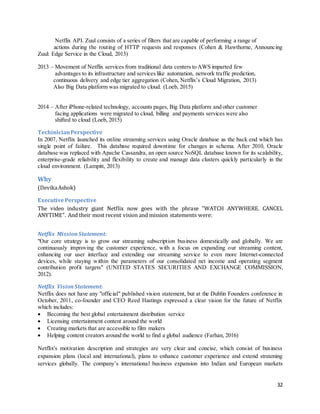
enjoyed the first mover advantage in streaming service which enabled it to establish strong customer base.
From above figure, we can view that Netflix annual revenue was high when compared to its competitors
which was contributed by strong customer base and unique online streaming services (Team,2012)
ShareofPeak DownloadInternetTrafficinNorthAmerica
Figure 15 : Peak Download Internet Traffic in North America - Netflix and its competitors (Barron, 2015)
Above graph compares the internet download traffic in peak hours in terms of megabits between
Facebook, general web browsing, and other streaming services like YouTube, BitTorrent, Amazon Instant
46
Video and Hulu. Amazon Instant Video has low share of 2%. Hulu has 1.9% share. We can clearly
identify that Netflix contributes to huge share of download traffic (Barron, 2015)
Top200showsonNetflixcomparedto content availableonAmazonPrime, Huluand
Redbox
Figure 16 : Top 200 shows - Netflix vs Amazon vs hulu vs redbox (Permalink, 2012)
Amazon Prime, Redbox Instant and Hulu offer low-cost streaming services like Netflix to their
customers. And they also have some of the same content that Netflix has, as well as some unique content.
The more unique content they have the more they are different from others (Permalink, 2012)
Netflix took the top 200 titles on Netflix (which include 100 of their most popular movies and 100 of their
most popular TV shows in Q4) (Permalink, 2012). Of these 200, 113 are not present in Amazon Prime,
Hulu Plus or Redbox Instant content catalog. Of the 87 that are available on at least one of these online
streaming service providers, Hulu Plus offers 27 of the 200, Amazon Prime 73 of the 200 and Redbox
Instant 12 of the 200 with significant overlap in TV between Hulu Plus and Amazon Prime and in movies
between Amazon Prime and Redbox Instant (Permalink, 2012). From above figure, we can depict that
most of the popular content is present with members of Netflix, which differentiates the firm from other
service providers who participated in the comparison (Permalink, 2012)
47
Summary
(DevikaAshok, Puneeth Reddy Challa, Raghu Vamsi Sirasala, Sravan Ghanta, Varsha Gorrepati)
This main purpose of this case study is to discover various reasons for success of Netflix using Zachman
framework.
One of the major reasons for success of Netflix was their responsiveness to market trends and
technological innovations. The firm predicted that online streaming was the future of video rental
business and took early steps to move from traditional brick-and-mortar services to online streaming. The
company’s management team under leadership of the CEO, Reed Hastings, was capable of estimating the
future of their business, customer needs and interests. By the time other companies in video rental
industry realized the need of online streaming, Netflix has already made its mark on the customers’
mindset. Though, Netflix faced competition from other companies like Amazon, Hulu and Redbox, its
digitally rich and unique content, personalized customer profiles for suggesting customers about
recommendation based on their interests and optimal service fee made it stand as pioneer and market
leader the industry.
Another pivotal reason for success of Netflix is their growth strategy. The firm predicted well in advance
about the scope for enormous growth in video rental industry. It planned its business model according to
the market growth. Subscribers can watch what they want, when they want and on as many devices: TV,
computer, tablet, smartphone, game consoles. They can stop watching and resume when they have time.
Based on what they watch; subscribers receive personalized recommendations. Additionally, the users can
activate up to five different profiles depending on their interests and needs (where family with children
can have separate accounts for children and adults). Apart from having first mover advantage in online
streaming business, Netflix also produces TV series and exclusive blockbusters, such as House of Cards,
Orange Is The New Black, Narcos,and Daredevil (Rome BUsiness School)
With this business model, Netflix has set itself up to compete not only with other on demand streaming
services, but also with TV channels like HBO which broadcast popular shows. According to data
provided by the Canadian Sandvine study company, in North America, nearly 40% of the online traffic is
related to content streamed from Netflix. This shows us where Netflix stands in terms of customer
satisfaction (Rome BUsiness School)
Furthermore, Netflix has best personalized customer recommendation system where customers get
suggestions regarding the content to be viewed. This is possible with Netflix’s Big data platform which
consists of optimal algorithms which are used to analyze the customer needs and interests. The firm also
uses data analytics to estimate the users interests based on demographic location and modify the content
to be available to them.
Another important reason for success of Netflix is its economical and affordable subscription prices. It
charges 7.99$ for basic plan. Other reasons for success of Netflix are compatibility with most of the
internet enabled devices, efficiency, innovative technological solutions to improve their business, premier
market strategies and best customer care services and flexible work environment (Netflix, 2016)
Moreover, the technological developments continued to rapidly modify the traditional means of content
distribution, creating further shifts in the media industry’s economics. Shift towards increased
personalization of on-demand content, facing decline in sale of content through physical formats such as
CDs and DVDs, the music labels and film/TV studios are actively seeking to monetize their content by
48
expanding into digital distribution. These content providers are leveraging the growing popularity of
various direct-to-consumer online distribution channels and rapidly growing social networking sites,
while also addressing the needs of consumers who wish to have access to such content while on the move.
In the TV business, cable networks have significantly attracted investments in original programming from
the major broadcast networks that have faced steady audience erosion. The Internet and other emerging
platforms also contributed to a secular increase in audience fragmentation. Consumers are increasingly
making personal recordings at home directly onto their computers or wireless handheld devices. For
content providers, changing consumer habits and a proliferation of online and mobile platforms have
necessitated a new way of thinking on delivery mechanisms, as older technologies become increasingly
obsolete. S&P Capital IQ (S&P) expects consumer time shifting and place shifting to spur further
convergence of content, technology, and services. Netflix identified this change in customer thinking and
made strategic agreements with various content providers which enabled the content providers to
broadcast their shows to Netflix viewers (N.Amobi, 2014)
Moreover, the success of the firm was not obstructed by socio-economical changes. It adapted its business
model and culture to meet these changes. The social behavior of customers changed and so did the
industry perspective and culture. In replacement to traditional brick-and-mortar structure, the industry
competitors started an aggressive battle to provide the best customer satisfaction (to bring the products to
customer's doorstep) and quality. Netflix was the first company to predict this change of mentality in
customers and adapted its business model to handle both DVD and streaming services. Infact, they were
enjoyed the first mover advantage in streaming service which led to strong customer base. Also, the
customers preferred watching unlimited movies at the convenience of home and time. At the same time,
the prices of smart phones, tablets, laptops were reducing. Hence in order to capture this smart devices
market, Netflix developed apps which supported content streaming on most of the internet enabled
devices (Rome BUsiness School)
It can be concluded that above mentioned facts are the main reasons for success of Netflix according to
the analysis conducted in this case study using Zachman framework.
List of Figures
Figure 1 : Netflix iteratesquicklytoprototype analgorithmthroughoffline experimentationby
analyzinghistorical datatoquantifyhowwell anew algorithmcanpredictpreviouspositive member
engagement,suchasplays.The keyunderlyingassumption,whichisnotalwaystrue,isthat members
wouldhave engagedwiththeirproductinexactlythe same way,forexample,playingthe same videos,
had the newalgorithmbeenusedtogenerate recommendations.Once theysee encouraging-enough
resultsinofflineexperiments,theybuildanA/Btestto use the new algorithmtogenerate
recommendationsformembers.If the A/Btestsucceeds,theychange theirproducttouse that new
algorithmbydefault.If the A/Btestisflator negative,theyeitherabandonthe researchdirectionorgo
back to the offline experimentationworldtotryto make the new algorithmevenbetterfora possible
future A/B test (Carlos A.Gomez-Uribe & Neil Hunt, 2015) ....................................................................9
Figure 2 : : (Left) Anexampleof the page of recommendations,showingtwoof the roughly40 rowsof
recommendationsonthatpage.Suspenseful Moviesisanexample of agenre row drivenbythe PVR
algorithm.The secondrowisa Because YouWatchedrow drivenbythe PVRalgorithm.The secondrow
49
isa Because YouWatched rowdrivenbythe simsalgorithm.(Right) A homepage showingthe TopPicks
row drivenbythe Top N algorithm.RomanticMoviesisa genre row drivenbyPVR(CarlosA.Gomez-
Uribe & Neil Hunt, 2015)...................................................................................................................11
Figure 3 : (Left) Twomore rows of recommendationsonahomepage.The popularity-heavyPopularrow
and the TrendingNowrowfocuson the latestviewingtrends.(Right)A homepage foraContinue
Watching sessionwith a Continue Watching row (Carlos A.Gomez-Uribe & Neil Hunt, 2015) ................11
Figure 4 : Netflix Business Model Canvas............................................................................................17
Figure 5 : TOP 10 COUNTRIES FOR NETFLIX SUBSCRIBERS (Toledo, ExStreamist)...................................19
Figure 6 : Netflix Organigraph (Adi, 2014)...........................................................................................27
Figure 7 : Netflix Organizational Chart (amrhodes, 2014) ....................................................................27
Figure 8 : Numberof Netflix streamingsubscribersworldwidefrom3rdquarter 2011 to 1st quarter2016
(in millions) (Statista, 2016)...............................................................................................................30
Figure 9 : Success Zachman Framework for Netflix............................................................................36
Figure 10 : Annual Revenue of Netflix (Statista, 2016) .........................................................................38
Figure 11 : NetflixSWOTAnalysis(Davies,Fairbairn,&McNulty,2013) (Uphouse,2012) (Bowen,Diagle,
Dion, &Valentine, 2014) (Cigliano, et al.)...........................................................................................39
Figure 12 : Shopping Spree Netflix vs Amazon vs Hulu (Leung, 2016) ...................................................43
Figure 13 : Cost , Content and Supported Devices - Netflix vs Amazon vs Hulu (Barron, 2015) ...............44
Figure 14 : Revenue : Netflix vs Blockbuster vs Redbox vs Hulu (Team, 2012) .......................................45
Figure 15 : PeakDownloadInternetTrafficinNorthAmerica - Netflix anditscompetitors(Barron,2015)
........................................................................................................................................................45
Figure 16 : Top 200 shows - Netflix vs Amazon vs hulu vs redbox (Permalink, 2012)..............................46
References
Adi.(2014). Organigraphs:Unveiling theOrganizationalStructureof Tesla,Twitter,and Netflix.
Retrievedfromadithya.co:https://adithya.co/2014/12/12/organigraphs-unveiling-the-
organizational-structure-of-tesla-twitter-and-netflix/
AmazonWebServices,Inc.orits affiliates.(2016). Netflix CaseStudy.(Amazon) Retrieved2016, from
https://aws.amazon.com/solutions/case-studies/netflix/
amrhodes.(2014, March 5). Netflix. Retrievedfromcogmap:http://www.cogmap.com/chart/Netflix
Bachman,J. (2014, July2). The Futureof Netflix Isn'tHouseof Cards,It'sShowsforKids. Retrievedfrom
Bloomberg:http://www.bloomberg.com/news/articles/2014-07-01/the-future-of-netflix-isnt-
house-of-cards-its-shows-for-kids
Barron, J.(2015, August28). Netflix,Amazon InstantVideo and Hulu Plus:How Do the Big 3 Compare?
RetrievedfromNextAdvisor:http://www.nextadvisor.com/blog/2015/08/28/netflix-amazon-
instant-video-and-hulu-plus-compare/
Beal,V.(2016). CDN - ContentDelivery Network.Retrievedfrom
http://www.webopedia.com/TERM/C/CDN.html
50
Bernard,S. A.(2012). An Introduction to EnterpriseArchitecture. AuthorHouse.
Bishop,B.(2013, November13). Netflix introducesoneunified TV interface to rule themall. Retrieved
fromThe Verge:http://www.theverge.com/2013/11/13/5098224/netflix-introduces-one-
unified-tv-interface-to-rule-them-all
Bloomberg,J.(2014, July23). Agile EnterpriseArchitecture finally crossesthe Chasm. Retrievedfrom
Forbes:http://www.forbes.com/sites/jasonbloomberg/2014/07/23/agile-enterprise-
architecture-
Blyskal,J.(2015, June 12). Video streaming face-off:Amazon PrimeInstantVideo vs.Netflix.Retrieved
fromConsumerReports:http://www.consumerreports.org/cro/news/2015/06/netflix-vs-
amazon-prime-video-streaming/index.htm
Bodnar,K. (2011, April 27). 5 Marketing LessonsfromNetflix. RetrievedfromHubSpot:
http://blog.hubspot.com/blog/tabid/6307/bid/12694/5-Marketing-Lessons-from-
Netflix.aspx#sm.0000f2t0jbi35fj4qgd2b90whqdkg
Bowen,R.,Diagle,R.,Dion,T.,& Valentine,S.(2014). Netflix CaseStudy. Retrievedfrom
robertdigle.com:http://robertdaigle.com/wp-
content/uploads/2014/01/BowenDaigleDionValentine_NetflixCaseStudy.pdf
breyia_w.(2014). History of Netflix. Retrievedfromtimeroast:
http://www.timetoast.com/timelines/history-of-netflix
Bukoski,E.,Moyles,B.,& McGarr, M. (2016, March 9). How We Build Codeat Netflix.RetrievedfromThe
Netflix TechBlog:http://techblog.netflix.com/2016/03/how-we-build-code-at-netflix.html
BusinessManagementDegrees.(2016). AMAZON VS.NETFLIX:THEFIGHT OFTHE CENTURY. Retrieved
fromBusinessmanagementdegree.net:http://www.business-management-
degree.net/features/amazon-vs-netflix/
CarlosA.Gomez-Uribe,N.I.,&Neil Hunt,N.(2015). The Netflix RecommenderSystem:Algorithms,
BusinessValue,. Retrievedfromdelivery.acm.org:
http://delivery.acm.org/10.1145/2850000/2843948/a13-gomez-
uribe.pdf?ip=192.5.215.225&id=2843948&acc=OA&key=4D4702B0C3E38B35%2E4D4702B0C3E
38B35%2E4D4702B0C3E38B35%2EE5B8A747884E71D5&CFID=612562928&CFTOKEN=36556763
&__acm__=1462732874_1239d50ea5855255d3f3d21
Chen,L. Y., & Shaw,L. (2016, JNUry 6). China RemainsRoadblockto Netflix'sGlobal Expansion
Ambitions.Retrievedfromhttp://www.bloomberg.com/news/articles/2016-01-07/china-
remains-roadblock-to-netflix-s-global-expansion-ambitions
ciancutti,j.(2010, December14). Four ReasonsWeChooseAmazon’sCloud asOurComputingPlatform.
RetrievedfromThe NetflixTechBlog:http://techblog.netflix.com/2010/12/four-reasons-we-
choose-amazons-cloud-as.html
Cigliano,J.,Dewey,C.,Hansen,J.,Jung,J.,King,C.,Krueger,K.,&Williams,M.(n.d.). Netflix. Retrieved
fromscf.usc.edu:http://www-scf.usc.edu/~jdhansen/Netflix%20Financial%20Analysis.pdf
51
CNN.(2014, July21). A brief history of Netflix.Retrievedfrom
http://www.cnn.com/2014/07/21/showbiz/gallery/netflix-history/
Cockcroft,A.(2011, November18). Netflix in theGlobal Cloud. Retrievedfromlanyrd:
http://lanyrd.com/2011/qcon-san-francisco/smfxq/
Cohen,M. (2013, October27-29). Netflix’sCloud Migration. RetrievedfromDCIA:
http://dcia.info/activities/ccw2013/10-28%20CCW2013%20Opening%20Mikey%20Cohen.pdf
Cohen,M.,& Hawthorne,M. (2013, June 12). Announcing Zuul:EdgeServicein the Cloud. Retrieved
fromThe NetflixTechBlog:http://techblog.netflix.com/2013/06/announcing-zuul-edge-service-
in-cloud.html
Davies,R.,Fairbairn,H.,& McNulty,M. (2013, May 2). Netflix:S.W.O.T.Analysis. RetrievedfromPrezi:
https://prezi.com/6gilut2g6h7b/netflix-swot-analysis/
Davis,C. (2015, October16). Timeline: Netflix'skey moments.RetrievedfromWKBWBUFFALO:
http://www.wkbw.com/news/us-news-world/timeline-netflixs-biggest-moments
Dhapola,S.(2016, January8). Netflix comesto India,pricing start at Rs 500 a month.Retrievedfrom
http://indianexpress.com/article/technology/tech-news-technology/netflix-launches-in-india-
plans-start-at-500-rupees-a-month/
dribayles.(2012,April 26). Netflix competitivelandscape. RetrievedfromSlideShare:
http://www.slideshare.net/dribayles/netflix-competitive-landscape
Ernie.(2015, march 15). NutsAnd Bolts Of Netflix’sCDN Infrastructure.Retrievedfrom
https://www.bizety.com/2015/03/15/nuts-and-bolts-of-netflixs-cdn-infrastructure/
Farhan,B. (2016, January 8). Company Mission Statements - CompleteListof World’sLargestRetail
Missions. Retrievedfromaboutmoney:
http://retailindustry.about.com/od/retailbestpractices/ig/Company-Mission-
Statements/Netflix-Movies-Mission-Statement.htm
Filwood,D.(2015, June 29). Netflix ContactCenterCultureIncreasesCustomerSatisfaction. Retrieved
fromLinkedIn:https://www.linkedin.com/pulse/netflix-contact-center-culture-increases-
customer-david-filwood
Franken,H.,Djik,S.v., & Gils,B. v.(2013, February8). Three Best Practices forSuccessful
Implementation of EnterpriseArchitectureUsing the TOGAF® Frameworkand theArchiMate®
Modeling Language. Retrievedfromopengroup:https://blog.opengroup.org/2013/02/08/three-
best-practices-for-successful-implementation-of-enterprise-architecture-using-the-togaf-
framework-and-the-archimate-modeling-language/
Garber, M. (2012, May 30). The FutureGrowth of theInternet,in One Chart(and OneGraph). Retrieved
fromThe Atlantic:http://www.theatlantic.com/technology/archive/2012/05/the-future-
growth-of-the-internet-in-one-chart-and-one-graph/257811
52
Golden,B.(2012, April 5). Cloud Computing DonetheNetflix Way. RetrievedfromCIO.com:
http://www.cio.com/article/2397486/cloud-computing/cloud-computing-done-the-netflix-
way.html
Hartung, A.(2013, January29). Netflix - The Turnaround Story of 2012! Retrievedfrom
http://www.forbes.com/sites/adamhartung/2013/01/29/netflix-the-turnaround-story-of-
2012/#2b034d3d2246
Indiviglio,D.(2010, September27). 3 Big ChallengesFacing Netflix. RetrievedfromThe Atlantic:
http://www.theatlantic.com/business/archive/2010/09/3-big-challenges-facing-netflix/63637/
Ingram,M. (2015, August31). Netflix justlost somebig nameHollywood movies,buthere'swhy it will be
fine anyway. Retrievedfromfortune:http://fortune.com/2015/08/31/netflix-epix-disney/
Jones,D.(2016, February22). Cloud Transformation atNetflix:ItWasn’tInstant. RetrievedfromSkyTap:
https://www.skytap.com/blog/cloud-transformation-at-netflix-it-wasnt-instant/
Judge,P.(2016, February12). Netflix completesmoveto AWS public cloud.Retrievedfrom
http://www.datacenterdynamics.com/colo-cloud-/netflix-completes-move-to-aws-public-
cloud/95707.fullarticle
Lampitt,A.(2013, May 2). Big movies,big data:Netflix embracesNoSQLin thecloud. Retrievedfrom
InfoWorld:http://www.infoworld.com/article/2614318/big-data/big-movies--big-data--netflix-
embraces-nosql-in-the-cloud.html?page=2
Letov,A.(n.d.). Which programming languageisNetflix coded in? How do I usethat language?
RetrievedfromQuora:https://www.quora.com/Which-programming-language-is-Netflix-coded-
in-How-do-I-use-that-language
Leung,A.(2016, February05). How Does Netflix Pay Studios?WhattheStreaming Giant Doesto Obtain
Content. RetrievedfromArt.Mic:http://mic.com/articles/134272/how-does-netflix-pay-studios-
what-the-streaming-giant-does-to-obtain-content#.JALaGIr0e
Loeb,L. (2015, August18). Netflix CompletesItsCloud Journey. RetrievedfromInformationWeek:
http://www.informationweek.com/cloud/platform-as-a-service/netflix-completes-its-cloud-
journey/a/d-id/1321800
Marr, B. (2015, April 21). Big Data:How Netflix UsesIt to Drive BusinessSuccess. Retrievedfrom
SmartDataCollective:http://www.smartdatacollective.com/bernardmarr/312146/big-data-how-
netflix-uses-it-drive-business-success
Mauro, T. (2015, March 10). Adopting MicroservicesatNetflix:LessonsforTeam and ProcessDesign.
RetrievedfromNGINX:https://www.nginx.com/blog/adopting-microservices-at-netflix-lessons-
for-team-and-process-design/
mmlindsay.(2014). Netflix:TargetMarket. Retrievedfromstorify:
https://storify.com/mmlindsay/netflix-target-market
53
Mui, C.(2011, March 17). HowNetflix Innovatesand Wins. RetrievedfromForbes:
http://www.forbes.com/sites/chunkamui/2011/03/17/how-netflix-innovates-and-
wins/#72182b9bb69a
N.Amobi,T.(2014, December). Industry SurveysMovies&Entertainment. RetrievedfromS&P Capital
IQ: https://gskkr.files.wordpress.com/2015/01/movies-entertainment.pdf
Neil Hunt,N.C. (2015, May 20). Why doesNetflix useAmazon EC2? RetrievedfromQuora:
https://www.quora.com/Why-does-Netflix-use-Amazon-EC2
Netflix.(2016). Netflix Timeline. Retrievedfromhttps://media.netflix.com/en/about-netflix
Netflix Prize.(2015,December6). The Netflix Prize. Retrievedfromhttp://www.netflixprize.com/
Noren,E. (2013, January21). Analysisof the Netflix BusinessModel. RetrievedfromDigital Business
Model:http://www.digitalbusinessmodelguru.com/2013/01/analysis-of-netflix-business-
model.html
Padmanabhan,P.,Sadekar,K.,&Krishnan,G. (2015, February10). What’strending on Netflix. Retrieved
fromThe NetflixTechBlog:http://techblog.netflix.com/2015/02/whats-trending-on-netflix.html
Pepitone,J.(2010,August26). Netflix releases iPhoneapp,stockjumps.RetrievedfromCNN Money:
http://money.cnn.com/2010/08/26/technology/netflix_app/
Permalink.(2012,September7). Netflix Hits 40 Million Members& BeatsEstimates. Retrievedfrom
HackingNetflix:http://www.hackingnetflix.com/investor_relations/
Powers, J.(2014, February7).Netflix,AmazonandHuluComparison:The Ultimate Throwdown.
Youtube.
Press,S.(2000). BlockbusterInc.History.RetrievedfromFundingUniverse:
http://www.fundinguniverse.com/company-histories/blockbuster-inc-history/
Press,S. (2012). Netflix,Inc.History.RetrievedfromFundingUniverse:
http://www.fundinguniverse.com/company-histories/netflix-inc-history/
Rome BUsinessSchool.(n.d.). Netflix:TheReasonsBehind its Success. RetrievedfromRome Business
School:http://romebusinessschool.it/netflix-the-reasons-behind-its-success/
Shaw,L. (2014, April 21). ‘Houseof Cards’Helps Netflix Add 4 Million New Subscribersin Q1. Retrieved
fromWrap: http://www.thewrap.com/house-cards-helps-netflix-add-4-million-new-subscribers-
q1/
Smith,J.(2015, November25). The rise and fall of Blockbuster.RetrievedfromBayStreetBlog:
http://baystreetblog.com/2015/11/25/the-rise-and-fall-of-blockbuster/
Staff,C.(2014, March 6). 5 ReasonsNetflix Is Spearheading TheHRRevolution. RetrievedfromCEO.com:
http://www.ceo.com/human_resource_management/5-reasons-netflix-is-spearheading-the-hr-
revolution/
54
Statista.(2016). Netflix's annualrevenuefrom2002 to 2015 (in million U.S.dollars). Retrievedfrom
Statista.com:http://www.statista.com/statistics/272545/annual-revenue-of-netflix/
Stenovac,T.(2015, March 3). One Reason ForNetflix’sSuccess — ItTreats EmployeesLike Grownups.
RetrievedfromHUffingtonpost:http://www.huffingtonpost.com/2015/02/27/netflix-culture-
deck-success_n_6763716.html
Stetler,B.(2015, October8). Netflix raises monthly price$1 to $9.99. Retrievedfrom
http://money.cnn.com/2015/10/08/media/netflix-raising-price-standard-plan/
SVERDLIK,Y. (2016, February11). Netflix ShutsDown Final Bits of Own Data CenterInfrastructure.
Retrievedfromdatacenterknowledge:
http://www.datacenterknowledge.com/archives/2016/02/11/netflix-shuts-down-final-bits-of-
own-data-center-infrastructure/
Team,T. (2012, October16). The U.S.Netflix Story:Evolving Competition ThreatensGrowth.Retrieved
fromTrefis:http://www.trefis.com/stock/nflx/articles/146469/the-u-s-netflix-story-evolving-
competition-threatens-growth/2012-10-16
thinkengine,t.(2015, July27). Five notoriously brilliantbusinessmodelsNetflix cobbled togetherinto an
undefeatablevortex of bingewatching. Retrievedfromthomasthe thinkengine:
https://thomasthethinkengine.com/2015/07/27/five-notoriously-brilliant-business-models-
netflix-cobbled-together-into-an-undefeatable-vortex-of-binge-watching/
ThomsonReuters.(n.d.).Chapter11Bankruptcy. Retrieved2016, fromFindLaw:
http://bankruptcy.findlaw.com/chapter-13/chapter-11-bankruptcy.html
Toledo,R.(ExStreamist,2016 February). REPORT:HERE ARE THE BEST ANDWORST COUNTRIESFOR
NETFLIXSUBSCRIBERS.Retrieved23,from http://exstreamist.com/report-here-are-the-best-
and-worst-countries-for-netflix-subscribers/
UNITED STATES SECURITIES ANDEXCHANGE COMMISSION.(2012). Netflix,Inc. Retrievedfromsec.gov:
http://www.sec.gov/Archives/edgar/data/1065280/000119312512053009/d260328d10k.htm#t
x260328_1
Uphouse,L.(2012, November8). Netflix CaseStudy Analysis. RetrievedfromSlideShare:
http://www.slideshare.net/ljuphouse/netflix-case-study-analysis
Vanderbilt,T.(2013, August7). The Science Behind the Netflix AlgorithmsThatDecide What You’ll Watch
Next.RetrievedfromWired:http://www.wired.com/2013/08/qq_netflix-algorithm/
Victor.(2007, February14). Netflix’sCompetitiveAdvantage. Retrievedfromnoisebetweenstations:
http://noisebetweenstations.com/personal/weblogs/?p=2011
Weare,K.(2016, March 22). Netflix Cloud Migration Complete. RetrievedfromInfoQ:
http://www.infoq.com/news/2016/03/Netflix-Cloud-Migration

Netflix - Success Case study v1.5

  • 1.
    INFS 774: EnterpriseArchitecture 16 Netflix Inc Success Case Study Devika Ashok, Puneeth Reddy Challa, Raghu Vamsi Sirasala, Sravan Ghanta, Varsha Gorrepati
  • 2.
    2 Contents Introduction..................................................................................................................................................................................3 Success Analysis usingZachman Framework................................................................................................................8 What............................................................................................................................................................................................8 ExecutivePerspective.....................................................................................................................................................8 Business Mgmt Perspective.........................................................................................................................................8 How...........................................................................................................................................................................................15 ExecutivePerspective..................................................................................................................................................15 Business Mgmt Perspective......................................................................................................................................16 Where.......................................................................................................................................................................................18 ExecutivePerspective..................................................................................................................................................18 Business Mgmt Perspective......................................................................................................................................19 Who...........................................................................................................................................................................................20 ExecutivePerspective..................................................................................................................................................20 Business Mgmt Perspective......................................................................................................................................27 When........................................................................................................................................................................................28 ExecutivePerspective..................................................................................................................................................28 Business Mgmt Perspective......................................................................................................................................29 Figure: Numberof Netflix streamingsubscribers worldwidefrom3rdquarter2011to 1stquarter 2016 (inmillions)..................................................................................................Error!Bookmarknotdefined. Why...........................................................................................................................................................................................32 ExecutivePerspective..................................................................................................................................................32 Netflix Company Profile................................................................................Error!Bookmarknotdefined. Business Mgmt Perspective......................................................................................................................................32 Evaluation of Netflix Videos using Zachman Framework......................................................................................33 Summary......................................................................................................................................................................................47 List of Figures............................................................................................................................................................................48 References...................................................................................................................................................................................49
  • 3.
    3 Introduction (DevikaAshok, Puneeth ReddyChalla, Raghu Vamsi Sirasala, Sravan Ghanta, Varsha Gorrepati) Netflix is the world’s leading Internet television network with over 81 million members in over 190 countries enjoying more than 125 million hours of TV shows and movies per day, including original series, documentaries and feature films. Members can watch as much as they want, anytime, anywhere, on nearly any Internet-connected screen. Members can play, pause and resume watching, all without commercials or commitments (Netflix,2016). Netflix was founded in Scotts Valley, California, in August,1997 by Reed Hastings and Marc Randolph, both software engineers and veteran "new technology" entrepreneurs, to rent and sell DVDs over the Internet. The rumors were that Hastings, who supplied the firm's startup cash of $2.5 million, had come up with an idea of rental-by-mail when he was forced to pay $40 in fines after returning an overdue videotape of the film Apollo 13. They used the then new DVD format, which could store a high-quality copy of an entire feature film on a single five-inch disc. Hastings and Randolph recognized the potential of disc to replace bulkier, lower-resolution videotape as the consumer format of choice, even though it was an expensive technology at the time (Press, Netflix, Inc. History, 2012). Netflix had a clear advantage of being the first mover in light weight DVD concept in the video rental market. The company took advantage of the small size and light weight of the discs, which was shipped to the users very cheaply. They experimented with more than 200 mailing packages before finding one that could safely ship a disc (in a plain case without cover art and inserts) for the cost of a single first-class stamp. A stamped return mailer was also enclosed, making it more convenient to the users to return the DVDs. NetFlix.com promised to virtually guarantee titles would be in stock, with reasonably quick delivery offered through the U.S. Postal Service. The company pledged to buy more than 1,000 copies of new releases which could be reserved in advance for shipment on the day they were made available in stores (Press, Netflix, Inc. History, 2012). The firm opened for business on April 14, 1998, with 30 employees and 925 titles for rent, which comprised nearly the entire catalogue of DVDs in print. The firm offered some "soft-core" Playboy titles but shied away from hardcore pornography to avoid the potential for legal problems in certain states (Press, Netflix, Inc. History, 2012).NetFlix initially offered a seven-day DVD rental for $4, plus $2 shipping, with the cost going down when additional discs were rented. Discs could be kept longer for an additional fee (Press, Netflix, Inc. History, 2012). New DVDs were also offered for sale at a discount of up to 30 percent (Press, Netflix, Inc. History, 2012). Consumers could decide to purchase a rented disc once they got it home by having the balance of the retail price charged to their credit card. The firm's Web site offered a number of informational features including movie reviews, and once a customer had rented several titles a profile would be generated that automatically suggested additional films of interest based on the characteristics of ones already chosen (Press, Netflix, Inc. History, 2012). NetFlix was one of the first companies to rent DVDs by mail, with only a handful of other competitors in operation, including Magic Disc, DVD Express, and Reel.com. They offered multiple promotions as a part of their marketing strategy. One such promotion was a venture with Toshiba America to offer three free DVD rentals to purchasers of new Toshiba DVD players. Another promotion they offered was to buyers of Pioneer DVD players, Hewlett-Packard and Apple
  • 4.
    4 computer models thatincluded DVD drives. Eventually, Sony and multiple other companies also signed up for the same . Also, the company offered the customers sweepstakes to win an all- expense-paid "L.A. Weekend" trip to Los Angeles as a cross-promotion with Warner Brothers for the newly available DVD of the film L.A. Confidential. The initial response to NetFlix's service was strong, and its Internet site was briefly forced to shut down 48 hours after it went up (Press, Netflix, Inc. History, 2012). In 1998, Netflix's Two-Cent DVD(plus $2 shipping and handling) of President Bill Clinton's Grand Jury testimony in the Monica Lewinsky affair sold 10,000 Copies. There was a small set back when there were some mix-ups in the DVDs shipped(pornographic DVDs instead of Clinton DVD) (Press, Netflix, Inc. History, 2012). At the end of 1998, NetFlix's library had grown to 2,300 titles, and home DVD player sales were increasing, though prices remained high and only 1 percent of U.S. households owned the devices (Press, Netflix, Inc. History, 2012). Because of relatively modest sales figures, the sizable competition, and the huge effort which would be required to remain competitive, NetFlix announced it would stop selling DVDs and directed their customers interested in purchases to the Amazon.com website (Press, Netflix, Inc. History, 2012). By January 1999, Netflix had an inventory of 250,000 disks and their staff had reached a number of 110 (Press, Netflix, Inc. History, 2012). They even partnered with online movie information provider All-Movie Guide, which would direct people looking up a title NetFlix carried to the firm's Web site. they also got a well-known film critic Leonard Maltin to write an exclusive monthly film column for the site, with five "must-rent" DVD titles listed each time. By July, NetFlix CEO Reed Hastings announced the company had secured $30 million in new financing from Group Arnault, a French luxury goods investment firm that was also starting to back e-commerce ventures. Soon afterwards, the firm announced a new cross- promotional initiative with Musicland Stores Corp., as well as plans to offer free rental coupons in the box of most new DVD players sold (Press, Netflix, Inc. History, 2012). IntroductionofSubscriptionPlan-September 1999 In September 1999, NetFlix introduced a the Marquee Program, which allowed customers who paid $15.95 per month to pre-select four DVDs, with no late fees or due dates. Users could also rent new discs each time they returned one and put themselves in a queue for checked-out titles in which they were interested. The CEO, Hastings, commented that the new program was possible because the company had 10,000 orders processed each day by its own proprietary software system. Despite its growing popularity, in 1999, the firm reported losses of $29.8 million on revenues of only $5 million because NetFlix was spending heavily for marketing to build their brand value (Press, Netflix, Inc. History, 2012). In February 2000, NetFlix introduced CineMatch, a new service, which compared rental patterns among its customers and looked for similarities in taste, using this information to recommend titles to people whose profiles were similar. It could also be programmed to combine the attributes of two users, such as a married couple, and recommend titles that both might like. The information gleaned from the CineMatch system, which required customers to rate 20 films using a five-star scale, was also shared with movie studios to help them plan marketing campaigns. Early the next year, the company changed the
  • 5.
    5 Marquee Program tooffer unlimited rentals for $19.95 a month(inclusive of shipping), with a maximum of four titles out at a given time (later dropped to three). At the same time, the firm phased out single-title rentals, as 97 percent of its business was now derived from the Marquee Program. By now, the demand for DVDs had increased to 100,000 DVDs per week (Press, Netflix, Inc. History, 2012). In May 2000, CEO Hastings distinguished the firm's future goal as moving beyond DVD rentals to streaming video, stating, "What NetfFlix is about is owning a transition stage as rental converts to video-on-demand." During the year, the company continued to expand, with more than 7,000 titles available by year's end to a customer base of 250,000 (Press, Netflix, Inc. History, 2012). RevenueSharing Agreements-December 2000 In December 2000, revenue sharing agreements were signed with Warner Home Video and Columbia Tri-Star. Multiple other studios, including Dreamworks and Artisan, also soon signed up for the same. Also, in January 2001, NetFlix signed a deal that gave it exclusive distribution of the DVD version of a recent arthouse hit, Croupier, which it would have for three months before the title was available elsewhere. During the winter of 2001, NetFlix secured additional venture capital funds, and CEO Hastings began predicting profitability by the fourth quarter of the fiscal year, when the company's subscriber base was expected to reach 500,000. (Press,Netflix, Inc. History, 2012). Following the September 11, 2001 terrorist attacks, the company's monthly subscription rate doubled, due as much to fearful Americans seeking refuge at home as the dropping price of DVD players, which now could be purchased for less than $100. Despite its rapidly growing customer base, the company lost $21.1 million for the year on revenues of $74.3 million (Press, Netflix, Inc. History, 2012). Initial PublicOffering - Feb2002 In February 2002, NetFlix announced it had reached a subscription figure of 500,000. This included the "NetFlix Lite," which cost $13.95 a month and limited users to two rentals at a time. In March, the company revived its plans for an initial public offering (IPO), and when it sold 5.5 million shares in late May it raised $82.5 million, more than some had expected (Press, Netflix, Inc. History, 2012). In conjunction with the IPO, the firm also quietly amended its name to Netflix, Inc., making the "F" lower case. The money was targeted to paying down $14.1 million in debt and covering promotional expenses (Press, Netflix, Inc. History, 2012). In early 2002, Netflix had opened new regional distribution sites near Los Angeles and Boston to facilitate faster delivery to those areas (Press, Netflix, Inc. History, 2012). This proved to be successful and profitable to the firm, which led to the opening of multiple distribution sites in other cities like Atlanta, Denver, Detroit, Houston, Minneapolis, New York, Seattle, and Washington, D.C., metro areas. The expense was approximately $60,000 on each site for computers, bar-code scanners, and printers, and the centers could handle upto 50,000 orders per day (Press, Netflix, Inc. History, 2012). The locations were well-situated that equipped the firm to achieve overnight first class mail delivery to as many customers as possible. Netflix's per-capita subscription rate was almost 5 percent higher in San Francisco than East coast (who had to wait approximately four days for an order to reach them, reducing the number of DVDs they could receive each month) because of overnight response to customer orders (Press, Netflix, Inc. History, 2012). Each distribution site did not maintain a full inventory, and when an order for an out-of-stock disc was received the firm's
  • 6.
    6 computers would findthe closest location of a copy and automatically generate a shipping order to forwardit (Press, Netflix, Inc.History, 2012). In summer 2002, the company experimented briefly with a bricks-and-mortar DVD rental store in Las Vegas, a 600-square-foot operation called Netflix Express which was located in a supermarket. The test site was shuttered in less than a month (Press, Netflix, Inc. History, 2012). Netflix now had 670,000 subscribers and offered 11,500 different titles. The firm had also signed revenue-sharing agreements with more than 50 film distributors, who received approximately 20 percent of the company'ssubscription fees (Press, Netflix, Inc. History, 2012). As Netflix got more media attention and its subscriber numbers seemed to be shooting up, the competition also began to rise. Its main competitor Blockbuster, began to offer an unlimited, no- late-fee subscription service for DVD rentals in some stores and bought an online DVD rental company which was renamed FilmCaddy. Another potential competiton, came from Wal-Mart, which had started an unlimited online DVD rental service. It was priced at $18.86, undercutting Netflix by just over a dollar (Press, Netflix, Inc. History, 2012). Wal-Mart claimed it had 12,000 titles available, comparable to what Netflix then offered (Press, Netflix, Inc. History, 2012). Another major player, Columbia House, was also supposedly coming up with a similar plan. With these threats, and with Netflix's subscriber cancellation rate going up, the company's stock price dropped by more than half (Press, Netflix, Inc. History, 2012).As a reaction to these challenges, Netflix announced it would open a dozen more distribution facilities by the end of 2003 in metro areas like Chicago, Dallas, and Portland, Oregon, with overnight delivery (Press, Netflix, Inc. History, 2012). The firm was targeting 5 million subscribers by 2009 and had plans to begin distribution to Canada in the near future. Annual figures for 2002 showed double the previous year's revenues, $152.8 million, and losses of just $1.56 million, a dramatic improvement over 2001 (Press, Netflix, Inc. History, 2012). The subscriber churn rate was also dropping, to 6.3 percent for the final quarter of the year (Press, Netflix, Inc. History, 2012). The company was now spending $33 to acquire each new member, which compared favorably with America Online's more than $100 (Press, Netflix, Inc. History, 2012). One MillionSubscribers -February2003 In February of 2003, Netflix hit the one million subscriber mark. Its stock price had risen to $22 a share in spring, which was much higher than that in 2002 (Press, Netflix, Inc. History, 2012). In June, the firm reported a profitable quarter and had also became one of the first Silicon Valley companies to count stock options as expenses, a move that came in the wake of the public outcry over a number of corporate accounting scandals. The company gave stock options to all of its employees, which was expected to add $2 million in costs in the latter half of the fiscal year (Press, Netflix, Inc. History, 2012). Also in June, Netflix was awarded U.S. patents for its software systems that tracked DVD rentals and compiled customer requests. By mid-2003, the company had more than 1.1 million subscribers and a content library of 15,000 titles (Press, Netflix, Inc. History,2012). Netflix, Inc. was in growth mode, with advantages of an early start, a strong distribution system, customer loyalty, and the newly received patents for its software programs. The company was also making its mark in the e-commerce industry, slowly establishing itself as a permanent part of the business world(Press, Netflix, Inc. History, 2012). By 2005, Netflix was shipping 1,000,000 DVDs by mail per day and had over 35,000 titles to choose from. They suggested recommendations to viewers based on their viewing habits and ratings
  • 7.
    7 (Press, Netflix, Inc.History, 2012). By 2007, Netflix offered free of cost, on-demand videos streaming for viewing on a PC or web-enabled device, with a strategy of meeting growing market demand and reducing its costs and reliance upon physical DVDs, warehouses, and postage. Several independent film producers made their content available for streaming on Netflix's website, enabling the independent studios to obtain wider distribution than ever before. According to an internet traffic report by Sandvine, Netflix's streaming service accounted for 28.8% to 33% of all web traffic (Press, Netflix, Inc. History, 2012).In July 2007, Netflix reached $299 a share (Press, Netflix, Inc. History, 2012). In September 2007, CEO Reed Hastings announced that the company would charge separately for the DVD rentals and the streaming content, and that a new company called Qwikster would be formed to handle the physical DVD rentals, while Netflix retained the streaming (Press, Netflix, Inc. History, 2012). The net effect to subscribers was an increase in prices. Following a huge outcry from users, as well as significant numbers of cancellations, Mr. Hastings scrapped plans for separate billing and separate companies. However, by December 2011, the damage was done, and Netflix stockhad dropped 75% from its peak (Press, Netflix, Inc. History, 2012). With a market growth rate of 100%, Netflix rapidly recovered. The firm chose growth over defensiveness. By the decision of splitting DVD distribution and online streaming - CEO Hastings began pulling profits and cash out of the DVD distribution to pay for building the faster growing, but lower margin, streaming business. This allowed Netflix to actually grow revenue and profits in 2012, while making the market transition from one platform (DVD) to another (streaming). Netflix grew its streaming user base by more than 50%. This proved to be the best strategic decision for the company even though it initially saw some friction (Hartung, 2013). In 2012, Netflix became available in Europe including the United Kingdom, Ireland and in the Nordic Countries. (Netflix,2016) On Feb1st 2013, Netflix moved intooriginal programmingwith online-onlywebshowswith $100 millioninvestment(CNN,2014).Netflix was the first internet TV network nominated forthe primetime Emmy. The firm received 31 primetime Emmy nominations including outstanding drama series, comedy series and documentary or nonfictionspecial for“House of Cards”, “Orange is the new black”and “The Square” respectively. House of Cards won three Primetime Emmy Awards (Netflix, 2016). In 2013, Netflix expanded to the Netherlands (Netflix, 2016). In 2014, Netflix had 50 millionsubscriberswithstockprice well over$400 a share (CNN,2014). The firm launched their services in 6 new countries in Europe (Austria, Belgium, France, Germany, Luxembourg and Switzerland). Netflixwon 7 creative Emmy Awards for House of Cards and Orange is the New Black.The fir m reached a mark of 50 million members globally (Netflix, 2016). In 2015, Netflix started its operations in Australia, New Zealand and Japan, with continued expansion across Europe in Italy, Spain and Portugal. The first Netflix original feature film "Beasts of No Nation" was released (Netflix, 2016).
  • 8.
    8 In early 2016,Netflix is available worldwide expanding into new markets like India (Dhapola, 2016).Chinese market remains the only one blocked for the company (Chen & Shaw, 2016). The firm, now offersa monthly subscription for its standard plan from $8.99-$9.99 (Stetler, 2015). A clear analysis of the different aspects of the firm willbe discussed in detail in the next section. Success Analysis using Zachman Framework Netflix Inc can be analyzed through Zachman framework enterprise Ontology to study the multiple areas of its success. The different verticalcomponents are analyzed below. What (Sravan Ghanta) ExecutivePerspective The main inventory for a global internet television service like Netflix is their huge database of movies and TV shows. According to the Eva Tse , Director ,Big Data Platform, Netflix Inc. , Netflix mainly focuses on quality of service , scalability , elasticity , global availability and velocity to make sure they satisfy their customers. BusinessMgmt Perspective Netflix has a very advanced recommendation algorithm which allows them to provide their customers almost exactly the movies and TV shows they need. It also knows that the outside world is advancing at an alarming rate , so they try to improve the algorithm even more by conducting hackathons giving a huge number of programmers a chance to improve this algorithm (Powers,2014). Netflix develops and uses their recommender system because they believe that it is core to their business for a number of reasons. Their recommender system helps them win moments of truth: when a member starts a session and they help that member find something engaging within a few seconds, preventing abandonment of their service for an alternative entertainment option (Carlos A.Gomez-Uribe & Neil Hunt, 2015). Personalization enables them to find an audience even for relatively niche videos that would not make sense for broadcast TV models because their audiences would be too small to support significant advertising revenue, or to occupy a broadcast or cable channel time slot. This is very evident in their data, which show that their recommender system spreads viewing across many more videos much more evenly than would an unpersonalized system. To make this more precise, they introduce a specific metric next (Carlos A.Gomez-Uribe & Neil Hunt, 2015). Netflix management team has the ability to predict the long term needs of the customers and market. Under the leadership of cofounder and CEO, Reed Hastings, it took several strategic decisions which helped in achieving profits to the company and projecting the company as industry leader. One of such strategic decision is movement of firm’s services from traditional data centers to cloud supported and managed by AWS. Netflix constantly updates its business services with advanced technology like implementing Big data platform for data analytics, advanced algorithms and infrastructure. One such advanced concept is effective catalog size (ECS). It is a metric that describes how spread viewing is across the items in Netflix’s catalog. If most viewing comes from a single video, it
  • 9.
    9 will be closeto 1. If all videos generate the same amount of viewing, it is close to the number of videos in the catalog. Otherwise it is somewhere in between (Carlos A.Gomez-Uribe & Neil Hunt, 2015). Figure 1 : Netflix iterates quickly to prototype an algorithm through offline experimentation by analyzing historical data to quantify how well a new algorithm can predict previous positive member engagement, such as plays. The key underlying assumption, which is not always true, is that members would have engaged with their product in exactly the same way, for example, playing the same videos, had the new algorithm been used to generate recommendations. Once they see encouraging- enough results in offline experiments, theybuild an A/B test to use the new algorithm to generate recommendations for members. If the A/B test succeeds, they change their product to use that new algorithm by default. If the A/B test is flat or negative, they either abandon the research direction or go back to the offline experimentation world to try to make the new algorithm even better for a possible future A/B test (Carlos A.Gomez-Uribe & Neil Hunt, 2015) According to the Eva Tse, Director, Big Data Platform, Netflix Inc., the firm moved to AWS as it provides scalability, elasticity, global availability. The company was also impressed by the key focus AWS has on velocity. Scalability and Elasticity in AWS allows Netflix to incorporate their search algorithms efficiently without the tension of issues related scalability. The speed in connection results in less buffer time, which in turn give a pleasant viewing experience for a Netflix customer. AWS global foot print enables Netflix to move into other countries expanding their market.AWS focus on velocity is one of the important factors that impressed Netflix. ArchitectPerspective Netflix being a technology – driven company with more than 2000 employees in their main office in Northern California, of which 2/3rd are technical staff, cannot focus on testing a new theory or concept for a very long time. But with AWS they were able to test a new theory or concept on anyone at anytime in a matter of seconds, which boosts their income when compared to conventional methods which took days for getting approvals about required resources from IT department for every issue. When Netflix was a DVD-by-mail company and people provided their ratings and reviews. Initially, customers added something to their queue because they wanted to watch it later may be after few days. There was cost involved in this decision and a delayed reward. With instant streaming, customers have option to play content and if they don’t like it they can just switch to other content. Users don’t really perceive the benefit of giving explicit feedback,so they invest less effort (Vanderbilt, 2013). To deal with the proper identification of customer interests, Netflix designed algorithms that helped in finding best suitable recommendations to users. Initially, Netflix conducted some analysis which suggested that a typical Netflix member loses interest after perhaps 60 to 90 seconds of choosing and
  • 10.
    10 having reviewed 10to 20 titles (perhaps 3 in detail) on one or two screens. The user either finds something of interest else the risk of the user abandoning the service increases substantially. The recommender problem is to make sure that on those two screens each member in their diverse pool will find something compelling to view, and will understand why it might be of interest (Carlos A.Gomez- Uribe & Neil Hunt, 2015). Historically, the Netflix recommendation problem has been thought of as equivalent to the problem of predicting the number of stars that a person would rate a video after watching it, on a scale from 1 to 5. We indeed relied on such an algorithm heavily when their main business was shipping DVDs by mail, partly because in that context, a star rating was the main feedback that we received that a member had actually watched the video. We even organized a competition aimed at improving the accuracy of the rating prediction, resulting in algorithms that we use in production to predict ratings to this day (Netflix Prize, 2015). Netflix’s recommender system consists of a variety of algorithms that collectively define the Netflix experience, most of which come together on the Netflix homepage. This is the first page that a Netflix member sees upon logging onto one’s Netflix profile on any device (TV, tablet, phone, or browser)—it is the main presentation of recommendations, where 2 of every 3 hours streamed on Netflix are discovered (Carlos A.Gomez-Uribe & Neil Hunt, 2015). EngineerPerspective Algorithms used by Netflix Personalised Video Ranker:PVR There are typically about 40 rows on each homepage (depending on the capabilities of the device), and up to 75 videos per row. These numbers vary somewhat across devices because of hardware and user experience considerations. The videos in a given row typically come from a single algorithm. Genre rows such as Suspense Movies, are driven by Netflix’s personalized video ranker (PVR) algorithm. As its name suggests, this algorithm orders the entire catalog of videos (or subsets selected by genre or other filtering) for each member profile in a personalized way. The resulting ordering is used to select the order of the videos in genre and other rows, and is the reason why the same genre row shown to different members often has completely different videos. Because Netflix uses PVR so widely, it must be good at general purpose relative rankings throughout the entire catalog; this limits how personalized it can actually be. Equivalently, PVR works better when we blend personalized signals with a pretty healthy dose of (unpersonalized) popularity, which Netflix uses to drive the recommendations in the Popular row (Carlos A.Gomez-Uribe & Neil Hunt, 2015).
  • 11.
    11 Figure 2 :: (Left) An example of the page of recommendations, showing two of the roughly 40 rows of recommendations on that page. Suspenseful Movies is an example of a genre row driven by the PVR algorithm. The second row is a Because You Watched row driven by the PVR algorithm. The second row is a Because You Watched row driven by the sims algorithm. (Right) A homepage showing the Top Picks row driven by the Top N algorithm. Romantic Movies is a genre row driven by PVR (Carlos A.Gomez-Uribe & Neil Hunt, 2015) Figure 3 : (Left) Two more rows of recommendations on a homepage. The popularity-heavy Popular row and the Trending Now row focus on the latest viewing trends. (Right) A homepage for a Continue Watching session with a Continue Watching row (Carlos A.Gomez-Uribe & Neil Hunt, 2015) Top-N Video Ranker Netflix also has a Top N video ranker that produces the recommendations in the Top Picks. The goal of this algorithm is to find the best few personalized recommendations in the entire catalog for each member focusing only on the head of the ranking, a freedom that PVR does not have because it gets used to rank arbitrary subsets of the catalog. Accordingly, Top N ranker is optimized and evaluated using metrics and algorithms that look only at the head of the catalog ranking that the algorithm produces, rather than at the ranking for the entire catalog (as is the case with PVR). Otherwise the Top N ranker and PVR share similar ACM Transactions on Management Information Systems attributes, for example, combining personalization with popularity, and identifying and incorporating viewing trends over different time windows ranging from a day to a year (Carlos A.Gomez-Uribe & Neil Hunt, 2015). Trending Now Netflix found that shorter-term temporal trends, ranging from a few minutes to perhaps a few days, are powerful predictors of videos that their members will watch, especially when combined with the right dose of personalization, giving them a trending ranker (Padmanabhan, Sadekar, & Krishnan, 2015) used to drive the Trending Now row. There are two types of trends that this ranker identifies:
  • 12.
    12 1. Those thatrepeat every several months (e.g., yearly) yet have a short-term effect when they occur, such as the uptick of romantic video watching during Valentine’s Day in North America (Carlos A.Gomez-Uribe & Neil Hunt, 2015) 2. One-off, short-term events, for example, a big hurricane with an impending arrival to some densely populated area, being covered by many media outlets, driving increased short-term interest in documentaries and movies about hurricanes and other natural disasters (Carlos A.Gomez-Uribe & Neil Hunt, 2015) Continue Watching Given the importance of episodic content viewed over several sessions, as well as the freedom to view nonepisodic content in small bites, another important video ranking algorithm is the continue watching ranker that orders the videos in the Continue Watching row. Most of Netflix’s rankers sort unviewed titles on which they have only inferred information. In contrast, the continue watching ranker sorts the subset of recently viewed titles based on their best estimate of whether the member intends to resume watching or rewatch, or whether the member has abandoned something not as interesting as anticipated. The signals that they use include the time elapsed since viewing, the point of abandonment (mid-program vs. beginning or end), whether different titles have been viewed since, and the devices used. In general, their different video ranking algorithms use different mathematical and statistical models, different signals and data as input, and require different model trainings designed for the specific purpose each ranker serves (Carlos A.Gomez-Uribe & Neil Hunt, 2015). Video-Video Similarity Because You Watched (BYW) rows are another type of categorization. A BYW row anchors its recommendations to a single video watched by the member. The video-video similarity algorithm, which Netflix refers to simply as “sims,” drives the recommendations in these rows. The sims algorithm is an unpersonalized algorithm that computes a ranked list of videos—the similars—for every video in their catalog. Even though the sims ranking is not personalized, the choice of which BYW rows make it onto a homepage is personalized, and the subset of BYW videos recommended in a given BYW row benefits from personalization, depending on what subsets of the similar videos we estimate that the member would enjoy (or has already watched) (Carlos A.Gomez-Uribe & Neil Hunt, 2015) Page Generation: Row Selection and Ranking The videos chosen for each row represent their estimate of the best choices of videos to put in front of a specific user. But most members have different moods from session to session, and many accounts are shared by more than one member of a household. By offering a diverse selection of rows, Netflix hopes to make it easy for a member to skip videos that would be good choices for a different time, occasion, or member of the household, and quickly identify something immediately relevant (Carlos A.Gomez-Uribe & Neil Hunt, 2015) The page generation algorithm uses the output of all the algorithms already described to construct every single page of recommendations, taking into account the relevance of each row to the member as well as the diversity of the page. A typical member has tens of thousands of rows that could go on one’s homepage, making it challenging to manage the computations required to evaluate them. For this reason, before 2015, Netflix used a rule-based approach that would define what type of row (e.g., genre row, BYW row, Popular row) would go in each vertical position of the page. This page layout was used to construct all homepages for all members. Today, Netflix has a fully personalized and mathematical
  • 13.
    13 algorithm that canselect and order rows from a large pool of candidates to create an ordering optimized for relevance and diversity. Their current algorithm does not use a template, thus is freer to optimize the experience, for example, choosing not to have any BYW row for a given homepage and devoting half of the page to BYW rows for another homepage (Carlos A.Gomez-Uribe & Neil Hunt, 2015) AWS provides a robust, distributed environment for Netflix’s compute and storage requirements. It provides a high level of infrastructure abstraction that supports building sophisticated automated operational control. Because we take advantage of the elastic features, we achieve high rates of utilization around 50%. It is very cost effective (Neil Hunt, 2015). (Bukoski, Moyles, & McGarr, 2016) The Netflix culture of freedom and responsibility empowers engineers to craft solutions using whatever tools they feel are best suited to the task. In their experience, for a tool to be widely accepted, it must be compelling, add tremendous value, and reduce the overall cognitive load for the majority of Netflix engineers. Teams have the freedom to implement alternative solutions, but they also take on additional responsibility for maintaining these solutions. Tools offered by centralized teams at Netflix are considered to be part of a “paved road”. Their focus today is solely on the paved road supported by Engineering Tools (Bukoski, Moyles, & McGarr, 2016). Netflix uses Java and Scala (may be) on their servers. Obviously, they write JavaScript for their web application. (Letov, n.d.) In 2008, Netflix began migrating their streaming service to AWS and converting their monolithic, datacenter-based Java application to cloud-based Java microservices. Their microservice architecture allows teams at Netflix to be loosely couple, build and push changes at a speed they are comfortable with (Bukoski, Moyles, & McGarr, 2016) As technology-driven company, Netflix uses technically advanced concepts for providing its business services. Below mentioned are the steps involved in developing and deploying application related to functionaing of streamig services : Build Naturally, the first step to deploy an application or service is building. Netflix created Nebula, an opinionated set of plugins for the Gradle build system, to help with the heavy lifting around building applications. Gradle provides first-class support for building, testing, and packaging Java applications, which covers the majority of their code. Gradle was chosen because it was easy to write testable plugins, while reducing the size of a project's build file. Nebula extends the robust build automation functionality provided by Gradle with a suite of open source plugins for dependency management, release management, packaging, and much more (Bukoski, Moyles, & McGarr, 2016) With Nebula, Netflix provides reusable and consistent build functionality, with the goal of reducing boilerplate in each application’s build file (Bukoski, Moyles, & McGarr, 2016).
  • 14.
    14 Integrate Once a lineof code has been built and tested locally using Nebula, it is ready for continuous integration and deployment. The first step is to push the updated source code to a git repository. Teams are free to find a git workflow that works for them (Bukoski, Moyles, & McGarr, 2016). Once the change is committed, a Jenkins job is triggered. Netflix’s use of Jenkins for continuous integration has evolved over the years. They started with a single massive Jenkins master in their datacenter and have evolved to running 25 Jenkins masters in AWS. Jenkins is used throughout Netflix for a variety of automation tasks above just simple continuous integration (Bukoski, Moyles, & McGarr, 2016)A Jenkins job is configured to invoke Nebula to build, test and package the application code. If the repository being built is a library, Nebula will publish the .jar to their artifact repository. If the repository is an application, then the Nebula ospackage plugin will be executed. Using the Nebula ospackage (short for “operating system package”) plugin, an application’s build artifact will be bundled into either a Debian or RPM package, whose contents are defined via a simple Gradle- based DSL. Nebula will then publish the Debian file to a package repository where it will be available for the next stage of the process,“baking” (Bukoski, Moyles, & McGarr, 2016) Bake Netflix’s deployment strategy is centered around the Immutable Server pattern. Live modification of instances is strongly discouraged in order to reduce configuration drift and ensure deployments are repeatable from source. Every deployment at Netflix begins with the creation of a new Amazon Machine Image, or AMI. To generate AMIs from source, we created “the Bakery” (Bukoski, Moyles, & McGarr, 2016) The Bakery exposes an API that facilitates the creation of AMIs globally. The Bakery API service then schedules the actual bake job on worker nodes that use Aminator to create the image. To trigger a bake, the user declares the package to be installed, as well the foundation image onto which the package is installed. That foundation image, or Base AMI, provides a Linux environment customized with the common conventions, tools, and services required for seamless integration with the greater Netflix ecosystem (Bukoski, Moyles, & McGarr, 2016). When a Jenkins job is successful, it typically triggers a Spinnaker pipeline. Spinnaker pipelines can be triggered by a Jenkins job or by a git commit. Spinnaker will read the operating system package generated by Nebula, and call the Bakery API to trigger a bake (Bukoski, Moyles, & McGarr, 2016). Deploy Once a bake is complete, Spinnaker makes the resultant AMI available for deployment to tens, hundreds, or thousands of instances. The same AMI is usable across multiple environments as Spinnaker exposes a runtime context to the instance which allows applications to self-configure at runtime. A successful bake will trigger the next stage of the Spinnaker pipeline, a deploy to the test environment. From here, teams will typically exercise the deployment using a battery of automated integration tests. The specifics of an application’s deployment pipeline become fairly custom from this point on. Teams will use Spinnaker to manage multi-region deployments, canary releases, red/black deployments and much more. Suffice to say that Spinnaker pipelines provide teams with immense flexibility to control how they deploy code (Bukoski, Moyles, & McGarr, 2016)
  • 15.
    15 How (Puneeth Reddy Challa) ExecutivePerspective Netflixalways strived for digital transformations and to achieve their goals, it chose an agile EA overtraditional EA. Netflix treated the enterprise as a complex system, driving business agility as an emergent property of the organization. Netflix used a transformative set of practices that is known as Agile Architecture (Bloomberg, 2014). Netflix started its journey with the traditional data-center infrastructure. It found that the infrastructure was too fragile for its needs (i.e., things stopped working all the time), and the traditional operations model didn’t respond fast enough to the needs of the business (Golden, 2012). Netflix’s business is growing rapidly and experienced very uneven demand. In this kind of environment, Netflix didn’t want to experience service interruptions caused due to its inability to build and expand data centers at a faster pace. They followed the agile EA to rapidly identify the future view of the organization and chose AWS for their services. Amazon Web Services (AWS) provided broader set of services and features that were very useful for Netflix to run their services seamlessly (Weare,2016). To run their services on new cloud platform, Netflix chose new processes for team operations like Agile, Lean and DevOps to suit their new culture (Jones,2016). To solve the previous problems, Netflix re- architected their applications and moved to mircoservices. (Weare,2016) The transition from traditional data centers to AWS was done slowly by keeping the stakeholders in mind. (Weare,2016) A sudden change in environment can lead to resistance from stakeholders, which will completely destroy the EA program. Initially they focused on all customer-facing services being provisioned in the cloud. (Weare, 2016) This allowed Netflix to take advantage of Amazon’s regions located all over the world, which helps the firm to provide services to customers across 130 countries. Once customer-facing services had been moved to the cloud, Netflix then focused on billing and employee data management systems. From December 2007 to December 2015, Netflix has experienced more than 1000x growth . Netflix took more than 7 years to make the transition to the cloud. They did it methodically and did not resort to a lift and shift strategy. Netflix felt that in order to truly benefit from the cloud, they needed to transition systems to take advantage of cloud-based components instead of bringing the data center shortcomings to the cloud (Weare,2016) Netflix accelerated their application development lifecycle to make more time for marketing and to reduce production costs. For this purpose they used DevOps, which combines externalities with core processes (Weare,2016). In 2009 Netflix adopted a continuous delivery model, which blends perfectly with a microservices architecture. (Mauro, 2015) Each microservice represents a single product feature that can be updated independently of the other microservices and on its own schedule. Discovering a bug in a microservice has no effect on the release schedule of any other microservice. Continuous delivery relies on packaging microservices in standard containers (Mauro, 2015). The entire team moves at the speed of development, because they are one organization (Weare,2016) The potential footprint of a mature EA capability is as big as the entire organization, but one of the key success factors for being successfulwith EA is to deliver value obtained by transformation of services from old to current one at an early stage (Franken, Djik, & Gils, 2013). Experience from consultancy
  • 16.
    16 practice proves thata “think big, start small” approach has the most potential for success . This means that the process of implementing an EA capability is a process with iterative and incremental steps, based on a long term vision . Each step in the process must add measurable value to the EA practice, and priorities should be based on the needs and the change capacity of the organization (Franken, Djik, & Gils, 2013). Netflix followed this EA practice since its beginning. Though Reed Hastings had a big idea of providing a streaming service that he fervently believed in, he started with lots of small projects (Mui, 2011). On the contrary, companies with big ideas tend to implement them in a rush (Mui, 2011). The number of subscribers joining Netflix and subscribers that Netflix retained was the best metrics that Netflix used to measure the success of the small projects and it made necessary changes to the EA to expand its user base and to provide better service to their customers. By following the “think big, start small” practice, Netflix grew rapidly from a DVD-by- rental service provider to online streaming service provider and provider of own content. Even when Netflix was making good profits with DVD-by- rental service, it never stopped innovating and discovering new means of content delivery to its customers. They took many bold projects like moving into internet and producing their own videos which was a completely new approach to them and became a successful organization. Even though Netflix has become the top player in the video rental industry, it needs to face many challenges in the future and the biggest challenge will be the competition from Blockbuster. Although the Blockbuster bankruptcy might seem like a huge win for Netflix, it isn’t all good news. Its competitor is not gone -- just reorganizing (Indiviglio, 2010). When a company goes to Chapter 11, it’s a little like going through detox. Chapter 11 bankruptcy is intended primarily for the reorganization of businesses with heavy debt burdens, most often associated with corporations but available to small businesses as well (Thomson Reuters). It sheds some of its liabilities and costs, and ends up a leaner, more focused firm that can reinvent itself. So when Blockbuster emerges from bankruptcy, it won’t be the same company that Netflix found so easy to smack around . That doesn’t mean Blockbuster will necessarily triumph over Netflix, but Netflix can expect a different and more difficult challenge from Blockbuster going forward (Indiviglio, 2010). Just by being open to changes in the market, incorporating those changes to provide a high quality service to the customers and by sticking to “think big, start small” practice, Netflix can withstand Blockbuster and continue to remain the leader of streaming and video rental industry. BusinessMgmt Perspective Netflix gained its initial competitive advantage, not through a new business model, but through a combination of known business models. The company combined the physical landlord model with the subscription and all you can eat models to allow customers to rent all the DVDs they could in a month for a flat fee. Customers were allowed to keep the DVDs for an unlimited period of time and were not subject to late fees. In return, customers agreed to pay a recurring monthly subscription fee. (Noren,2013) Netflix was able to overcome some of the weaknesses of the landlord model by delivering DVDs through the mail. This lack of physical infrastructure and advanced integration with the postal service provided a clear advantage over the Blockbuster model. By opening up rentals to all you can eat, customers were never subject to late fees and could rent as many videos as they wanted within a single month. Lastly, the monthly subscription provided consistent cash flow for the company while establishing a single low price that customers could count on month after month. (Noren, 2013)
  • 17.
    17 Business model canvasis described as a shared language for describing, visualizing, assessing, and changing business models. It’s made up of nine building blocks that help focus attention on key tributes of a business. (Noren, 2013) Figure 4 : Netflix Business Model Canvas Netflix successfully capitalized on the weaknesses of the traditional video rental business model, and was also able to identify hidden opportunities that were a result of evolving digital technology. To begin with, in the transition from VHS to DVD videos, there was a new opportunity to send movies via the postal service at much lower cost. The cost of mailing and returning a large VHS tape simply wouldn’t have made the Netflix business as profitable. Flatter discs that would fit in with other envelopes made the transition to mail order rentals much simpler (Noren, 2013) Netflix was one of the first companies to successfully develop an online recommendations engine that helped customers find new movies and TV shows based on others that they had rated in the past. While much more common today, Netflix’s recommendation engine was extremely innovative when it was first developed. Along with this, the company created the concept of the movie queue, allowing customers to build a wish list of movies that they would like to watch in the future, and a list that drove the order of movies that were sent out to customers (Noren, 2013) This combination of a customer movie queue and a strong recommendations engine allowed Netflix to add one additional layer to its business model: the long tail. (Noren, 2013) “In 2006, Chris Anderson popularized the notion of the long tail, where an online store drives revenue from a much broader set of products than can normally be done in a bricks-and- mortar store.” (Noren, 2013) Instead of the few thousand products that can be stocked at a normal retail store (and have to be stocked at multiple locations), online stores can stock hundreds of thousands of products and sell them to anyone, anywhere. (Noren, 2013) Netflix also used big oil, airlines, Microsoft, casinos model and combined them into one unstoppable force. The Oil Industry perfected the concept of owning the whole supply chain. For example, Shell owns
  • 18.
    18 everything it needsto do business from exploration activities that discover where the oil is, to drilling machinery, to the service station where cars fill gas. When Netflix decided it was going to spend $100 million to hire Kevin Spacey and make House of Cards, it was thinking like an oil company. Owning the whole supply chain is known as vertical integration and it gives a company power. Oil companies do it to control price, quality and quantity. Owning just the distribution mechanism makes the company vulnerable. Netflix’s most famous house-made products are House of Cards and Orange is the New Black, both of which have proven to be black gold (thinkengine, 2015) Microsoft perfected the art of bundling. Microsoft Office comes with many applications like PowerPoint, excel, word etc. Users get all the applications irrespective of what they actually need. This is known as bundling. Companies do it because it let them make more profit. For example, a customer X is willing to pay a maximum of $10 for product A and $6 for product B. Another Customer Y preferences are the other way round. If the company tries to charge $10 for product A and $10 for product B, then both the customers buy just one product. The company makes $20. If the company wants to sell two of product A and two of Product B, it must set the price for each at $6. Then the company makes $24. If it bundles the products into A+B packages costing $16 each, it can sell all four items and make $32! This is the best option. When a customer buys Netflix, they get a lot of stuff you’ll never watch. Maybe horror films, or BBC murder mysteries. That’s the Microsoft PowerPoint part of the bundle (thinkengine, 2015) Airlines perfected the art of price discrimination. In Netflix website, there is are three types of subscriptions plans: $8.99, $11.99 and $14.99. No matter how much the customer pays, he will get access to all the same shows. The difference is in whether the content is delivered in high definition, regular definition, or ultra-high definition, and how many screens the content can be viewed on. This is known as price discrimination. Airlines use this model to perfection. Whether they sell an economy ticket for $700, a business class seat for $2000 or a first class experience for $5000, all the customers take off and land at the same time. Charging people different amounts for the same basic thing works well because of a concept called “willingness to pay”. Not everyone will pay the same amount for the same good. If a business sets just one price, it misses out on profit. There are some people that would pay more than that. Even more important, there are people who would be profitable customers if the price was just a bit lower. A different price for different folks is a proven model. Netflix wants to skim their first-class passengers for as much as possible, but also fill up the back-end of the plane. The great thing for them is their plane has an unlimited number of seats (thinkengine, 2015) Casinos perfected the art of keeping the players hooked. The flashing lights on a poker machine are scientifically designed to provoke the reward centers in the brain. Like rats in a cage, humans get addicted on the dizzying sequence of highs and lows, pay-offs and disappointments. Scientist have shown a good film or a good show controls our brain. A director makes a character act in a certain way and cuts the scene. The brains of viewers all release neuro-transmitters on cue. With free-to- air TV there was nothing we could do except wait a week to watch the next episode. But with Netflix the next episode is right there, ready and waiting to deliver more brain stimulation. (thinkengine, 2015) Where (Varsha Gorrepati) ExecutivePerspective Netflix has huge subscriber base in The United States. South and Central America also have large Netflix presences, as the service worked fairly actively to expand into those regions. Below figure shows top 10 countries having more number of total number of unique titles ( TV and movies ) available as of February 22nd, 2016. (Toledo, ExStreamist)
  • 19.
    19 Figure 5 :TOP 10 COUNTRIESFOR NETFLIXSUBSCRIBERS (Toledo, ExStreamist) BusinessMgmt Perspective In August 2008, major database corruption occurred in the Netflix data centers and the firm was not able to mail DVDs to the customers for three days (Judge, 2016). The advantages offered by AWS and database corruption incident made the Netflix executive team to take decision to move their services to AWS. The advantages provided by AWS are avoid single point of failure, avoid need to guessing future capacity requirements for the business related to database, storage and network and reduction in cost spent on maintenance of infrastructure when compared to conventional data centers (Amazon Web Services, Inc. or its affiliates, 2016). But Netflix still chose to keep the support and maintenance of Content Delivery Network (CDN) with it. CDN is used for speeding the delivery of content to users. The closer the CDN server is to the user geographically, the faster the content will be delivered to the user (Beal, 2016) (Judge, 2016) ArchitectPerspective After August 2008 database corruption incident, Netflix has decided to shift its services to AWS. But the firm is keeping the support and maintenance of CDN servers with it (Judge, 2016). These CDN servers are placed at internet service provider’s data centers. For example, in France Netflix is deployed at Telehouse Paris with 1 Tbps of Internet connectivity and 40kW of power. Telehouse Paris is one of the largest data centers in Paris, handling 80% of France’s Internet Traffic. Netflix can reach every single network across France from Telehouse Paris (Ernie, 2015) After August 2008 database corruption incident, Netflix has decided to shift its services to AWS. But the firm is keeping the support and maintenance of CDN servers with it (Judge, 2016).
  • 20.
    20 These CDN serversare placed at internet service provider’s data centers. For example, in France Netflix is deployed at Telehouse Paris with 1 Tbps of Internet connectivity and 40kW of power. Telehouse Paris is one of the largest data centers in Paris, handling 80% of France’s Internet Traffic. Netflix can reach every single network across France from Telehouse Paris (Ernie, 2015). EngineerPerspective Netflix maintains its own CDN servers. It handles CDN services by using Open Connect programme. Netflix partners with Internet Service Providers to deliver their content in the most efficient way possible so that video streaming subscribers view high quality videos (Netflix, 2016). The OpenConnect appliance is a high-performance web server integrated with the Netflix Content Delivery System. It consists of below mentioned software: (Netflix, 2016) (a) Operating System: FreeBSD (b) Web Server: NGINX (c) BGP daemon: BIRD (d) The remaining software on the system manages content and communicates system health and other statistics to the Netflix OpenConnect Cloud Control Plane. (e) IPv4 and IPv6 are fully supported TechnicianPerspective Netflix OpenConnect provides peering locations at Internet Exchange points (IXP). These IXPs are located in United states, Netherlands, Germany, Japan, Egypt, Hong Kong, France, Singapore, Australia, Switzerland, Ireland, United Kingdom, Italy, Brazil and Austria (Netflix, 2016). There are also private peering locations available at places present in United States and Germany (Netflix, 2016) Who (Varsha Gorrepati) ExecutivePerspective The organizational units present in Netflix are: 1. Engineering: This department is responsible for cloud and platform programming (Adi, 2014) 2. Data, Analytics, Algorithms: This department is responsible for anticipating customer movie preferences, analyzing customer usage data and make future forecasts (Adi, 2014) In the data driven environment like video distribution industry, data analytics plays an important role. Netflix identified this and used data analytics to predict below details which helped them to enhance their business by providing innovative solutions:
  • 21.
    21 (a) Predicting viewinghabits of customers: Netflix provided unique feature of tagging the movies watched by customers. This helps them to suggest customer’s other movies or videos which are having similar tags (Marr, 2015) (b) Finding the next smash-hit series: Netflix used data analytics to identify which director’s programs the customers are interested and provide them with that content. This indirectly helps in increasing the number of hours’ customers avail Netflix’s services (Marr, 2015) (c) Quality of experience: Collection of end-user data to know how the physical location of the content affects the viewer’s experience and calculations about the placement of data can be determined by using data analytics to ensure an optimal service to as many homes as possible. Additionally, data points such as delays due to buffering (rebuffed rate) and bitrate (which affects the picture quality) are collected to augment analysis made by using data analytics (Marr, 2015) 3. Design: This department deals with web site design and aesthetic aspects used to enhance the usability of the user interface by customers (Adi, 2014) (Marr, 2015) 4. Marketing and PR: Marketing and Public relations department is responsible for understanding consumer demand, promoting new features and media content and handling media promotions (Adi, 2014) (Marr, 2015) Netflix followed below strategies for excelling in terms of marketing and stood as best example for other companies: (a) Create Ubiquity: Netflix changed its business model based on technology and market trends. It distributed content in various formats preferred by its customers like DVDs, computer, tablet, smart phone, TV. It also built a ubiquitous platform for delivering premium video content to its customers (Bodnar, 2011) (b) Market a Minimum Viable Product: Netflix was into DVD-by-mail business until it made the strategic decision of streaming video content. When Netflix started its streaming service, it had few content available for streaming service when compared to distribution of content using DVDs via mail. But this did not stop the company from actively penetrating its presence into new and existing customer base (Bodnar, 2011)
  • 22.
    22 (c) Give ProspectsWhat They Don't Know They Want: When Netflix began streaming videos, their DVD-by-mail business was flourishing and most of the customers were willing to wait for a day or two to get their next DVD. But Netflix anticipated that this would become a potential issue as their customer base is expanding. Hence it skillfully resolved this problem by starting streaming service before its customer base increased (Bodnar, 2011) Netflix was fast in responding to technological changes occurring in the industry when compared to its competitors like Blockbuster. In 1999, Netflix anticipated that there is no growth for video rental industry in DVD business and started its video streaming services in 2007 (Press, Blockbuster Inc. History, 2000). But Blockbuster was still testing online business model in 2008 and could not implement that until the end. This performance gap reflected on their market share and ultimately their business. (d) Quickly Abandon Dying Platforms: Enterprises need to have clear analytics and return on investment metrics for both outbound and inbound marketing strategies. If the enterprise could predict a prolonged decrease in results, then it should consider reallocating marketing budget to other tactics that increase its business scope and profit. Netflix adopted the same strategy and identified that usage and adoption of DVDs would gradually decline. Hence it worked aggressively to increase adoption of streaming video. (Bodnar, 2011) (e) Publish and Distribute: Netflix has funded the production of a new show called "House of Cards," featuring Kevin Spacey. This move marked a major transition for the company. It took them from a mere content distribution company to a business that creates and distributes video content. (Bodnar, 2011) This show was first broadcasted on Feb 1, 2013. After this show was successful, Netflix has started few other shows like “Mitt” and “The Square”. All these shows increased the company’s business value and resulted in increase of revenue in the first quarter of 2014. The company’s revenue crossed $1 billion mark and also increased its subscribers base to more than 46 million (Shaw, 2014)
  • 23.
    23 5. HR, Talentand recruiting: Netflix HR department has revolutionized the industry (Adi, 2014) The radical changes which drove to wide-scale transformation of Netflix’s HR strategy are mentioned below: (a) Hire, Reward, and Tolerate Only Fully Formed Adults: Most of the company’s waste time and money enforcing HR policies that only affect the 3 percent of employees who need correction. If a company encourages employees to rely on common sense principles instead of institutional policies, employees will be better motivated to contribute and will feel more invested in the successes of the company. Netflix identified this behavior among employees and ensured that its hires were the type of employees who would always put the company’s interests first. It also encouraged employees to model adult behaviors like openly communicating with their bosses, colleagues and other employees. For example, Netflix’s paid time off policy allows employees to take as much vacation time as they need, but with a condition that there should be understanding that employees should clearly communicate their plans to their managers (Staff, 2014) Tell the Truth About Performance: Instead of following formal conventional methods for employee reviews, Netflix encouraged managers and employees to meet openly about their performance so that employees were receiving proper feedback. It discovered that when an employee was performing poorly, it was much more effective to sit down with the employee and have a conversation rather than assigning the Performance Improvement Plan (PIP) to that individual, which tracks performance over time. Also, Netflix ensures that all its employees receive outstanding severance packages when they are leaving the company because of few constraints associated in executing tasks related to their designation because it leads to a more positive business culture. (Staff, 2014) Managers Own the Job of Creating Great Teams: Netflix taught its managers that team building is a critical step in crafting a culture of excellence. Managers are encouraged to regularly involve in conversation with their team members and identify the needs of the projects they are handling. Based on
  • 24.
    24 these conversations, managersneed to hire new persons or use existing persons to create teams which accomplish in the desired tasks completion. (Staff, 2014) Leaders Own the Job of Creating the Company Culture: Netflix HR department emphasized that its responsibility of HR department to explain new hires how the business works and how the company makes money. This helps the employees to understand about core functionalities of the company and how they can contribute to enhance the working of these functionalities. (Staff, 2014) Good Talent Managers Think Like Businesspeople and Innovators First, and Like HR People Last: According to Patty McCord, former chief talent officer at Netflix, HR professionals need to think like businessmen and businesswomen and think what policies are good for the company and how do the company communicate an attitude of excellence to the employees. If the company has a performance plan, a simple litmus test need to be conducted by asking employees if they know what they need to be doing to boost their bonus. If the employees can’t answer this question, then HR team need to recheck how they are communicating and making employees understand the company’s policies. (Staff, 2014) Global customer service: This department is responsible for handling all customer problems/complaints (Adi, 2014) Netflix has one of the best customer service ratings of any online retail corporation in America. It believes that great customer service comes from their “Freedom and Responsibility” culture. This approach consists of 6 key elements: (a) Hire for Personality/Job Fit/Soft Skills: Netflix hires individuals with the right Personality/Job Fit/Soft Skill Traits. It looks for Contact Center employees who are smart, friendly, enthusiastic, helpful, energetic, reliable, mature, self motivated and have ability to solve problems in order to keep subscribers happy and loyal (Filwood, 2015)
  • 25.
    25 Market Based Compensation: Inorder to retain the top talent with them, Netflix pays hourly wages according to market norms to its CSRs (customer service representatives). Additionally, it also offers bonus, incentives, inexpensive benefits or decent health care coverage (Filwood, 2015) (b) No Scripts: Netflix CSR’s do not have any restrictions or rules to be followed to serve their customers. Unlike other customer service representatives, they do not pressurize customers to add a service or buy a more expensive plan. If customer wants to cancel their subscription, CSRs don't push to have that person continue with the service. They are empowered with the ability and autonomy to provide the best service possible (Filwood, 2015) CSR Empowerment: In Netflix, CSRs are encouraged to solve a customer's problem without transferring the caller to a Supervisor or another department. This approach creates CSRs who don’t hesitate to answer questions, fix issues, troubleshoot with customers and who feel secure in the initial and ongoing training they receive (Filwood, 2015) (c) Managers/Supervisors Own the Job of Creating Great Teams: The Managers/Supervisors at Netflix are tasked with creating a customer centric work environment that differentiates the company by creating an emotional connection with customers which helps in outperforming the competition (Filwood, 2015) (d) Tell the Truth About the Job: Netflix CSRs have their job performance measured primarily on attendance, shift adherence and on customer dissatisfaction. Customer dissatisfaction can be identified from a one question survey at the end of a call or text chat that simply asks whether a customer was satisfied with their Netflix service experience or not (Filwood, 2015) The CSR’s goal is to keep the percentage of people who answer "No" at around 5%. In this competitive driven culture, CSRs may burnout or get emotionally exhausted. To deal with this, Netflix has a policy of having honest conversations with their employees about letting some team members find a place where their skills are a
  • 26.
    26 better fit andquickly letting people go by offering generous severance packages when their performance no longer fits in their current role (Filwood, 2015) (e) Creating a Talented and Engaged Customer Care Workforce isn’t “Rocket Science”: Customers have high expectations about the quality of service and support being provided to them. Companies like Netflix which provide above average customer care service, have stood as examples to other companies of their industry and other industries. Netflix demonstrated how outstanding customer service and support looks like and what positive results it produces (Filwood, 2015) Contact Centers that practice the Netflix “Freedom and Responsibility” approach to their work culture have low levels of burnout or emotional exhaustion and quit rates among their (above average) CSRs. This results in high levels of employee engagement and customer satisfaction (Filwood, 2015) 6. Finance: This department deals with financial planning and analysis and customer payments (Filwood, 2015) (Adi, 2014) 7. Legal: This department handles getting the legal rights to movies and TV shows and any other legal issues that arise (Adi, 2014) 8. Content: This department is responsible for managing and acquiring media content (Adi, 2014) Netflix organizational units have well-defined functions, scope and coordination among them. Below figure shows the organizational unit’s structure and coordination with in the enterprise.
  • 27.
    27 Figure 6 :Netflix Organigraph (Adi, 2014) Present Executiveteam of Netflix (Netflix, 2016) Reed Hastings, Founder and CEO Kelly Bennett, Chief Marketing Officer Tawni Cranz, Chief Talent Officer Jonathan Friedland, Chief Communications Officer Neil Hunt, Chief Product Officer David Hyman, General Counsel Greg Peters,International Development Officer Ted Sarandos, Chief Content Officer David Wells, Chief Financial Officer BusinessMgmt Perspective Netflix organizational chart consists of below structure : Figure 7 : Netflix Organizational Chart (amrhodes, 2014) Netflix Customer Service Representatives also do not follow any rules or have any restrictions in the way they handle customer complaints. This enables them to resolve the customer issues without transferring them to other departments or keep customers wait for their issue to be resolved. This increased the customer satisfaction. Also employees of other department are flexible to opt for vacation for longer
  • 28.
    28 period or periodof their choice. This flexibility is also reflected in their organizational structure. They follow flat structure in which CEO retains the centralized decision making authority over all the functional areas present in the company (dribayles, 2012) When (Raghu Vamsi Sirasala) ExecutivePerspective Netflix timeline from when it started to now is given below: 1997 - Reed hastings and Marc Rudolph, both softwareengineers, founded NetFlix.com, Inc. to use internet to rent movies on DVD(thena new format) in California. A domain name also was created for the website. (CNN, 2014) (Netflix,2016) 1998 - NetFlix.com, Inc.began offering DVD rentals and sales. (CNN, 2014) (Netflix,2016) 1999 - Sales are halted; Group Arnault invests $30 million in the firm and a subscription plan debuts. The monthly subscription model offered unlimited rentals forsingle monthly rate (CNN, 2014) (Netflix, 2016) 2000 - Revenue sharing deals are signed withWarner Brothers and Columbia film studios; CineMatch is introduced. (CNN, 2014) (Netflix,2016) 2001 - A partnership with Best Buy gives Netflix exposure in the chain's 1,800 stores. (CNN, 2014) (Netflix, 2016) 2002 - Marc Rudolph left the company.Also, it went public and changed its name to Netflix, Inc. (CNN, 2014) (Netflix, 2016) 2003 - Subscribers top 1,000,000, and Netflix has its first profitable quarter. (CNN, 2014) (Netflix, 2016) 2006 - $1 million "Netflix prize" for better recommendation system algorithm (CNN, 2014) (Netflix, 2016) 2007 - Netflix moved into video streaming services (with20 million subscribers) (CNN, 2014) (Netflix, 2016) 2011 - Netflix created Qwikster forDVD distribution (attempted to split DVD distribution and online streaming , which saw protests and then the idea was dropped in a month) (CNN, 2014) (Netflix, 2016) 2012- Lilyhammer premiered on Feb 6th 2012 (CNN, 2014) (Netflix,2016)
  • 29.
    29 2013 - Netflixmoved into original programming with 1st season of House of Cards(8 Emmy nominations under online-only web show) on Feb 1st 2013- $100 million investment for 13 episode season (CNN, 2014) (Netflix,2016) Orange is the New black premiered on July 11th 2013 - 12 Emmy nominations followedby season 2 in june 2014 2014- 50 million subscribers with stockprice well over$400 a share (CNN, 2014) (Netflix, 2016) Blockbuster video was leadingvideo rental industryduring1999-2003. Innovative decisionstaken by the Netflix management team placed the company in the top position in video streamingand video rental industry. Netflix used data analytics to analyze customer interestsand started "House of Cards" show featuring Kevin Spacey in 2012. This major transformation increased the subscriber count to more than 46 million and increased the revenue around $1 billion in first quarter of 2014. (Davis, 2015) (breyia_w , 2014) Netflix followed the technology and market trends. It also had the advantage asthe first company which started online streamingservice. This strongdistribution system, customer loyalty, and innovative solutions helped Netflix to increase its stock price in 2015 to $121.15 per share, which is the highest price in the company’s history. (Davis, 2015)(breyia_w , 2014) BusinessMgmt Perspective In 2000, Netflix approached Blockbuster for partnership. Executive management failed to assess the innovative online sales opportunity that would have enhanced the firm's revenue. Instead of analyzing current market trends at that time, they invested more in their store-led approach by selling books, toys and introducing video game rental business (Smith, 2015) In 2007, Netflix saw the future of the entertainment to be on demand content. As a result, they began offering streaming on demand videos for viewing from a PC or web-enabled device (Press, Netflix, Inc. History, 2012) During 2007 to 2011, Netflix enjoyed meteoric growth, and became one of the successful companies in America with well managed business model, best talented employees and huge customer base. Growth in subscribers and revenues is still continuing to increase. Netflix executive team was well aware of changing trends in the market. Tablet sales were growing at an amazing clip, while DVD players had no sales gains. Being first on the trend has high payoff. Moving slowly is death. Kodak failed to aggressively convert film camera customers to its own digital cameras, and it filed bankruptcy in 2012. Netflix management realized this situation well in advance and slowly shifted from DVD rental business to online steaming business before their customer base increased. This helped them to gain more customers and in 2016 first quarter Netflix has around 81.5 million subscribers (Hartung, 2013). The holistic success of Netflix relies on good management decisions, early reaction to updated technology and market trends, understanding the customers’ needs and analyzing the need to deliver additional content (Press,Netflix, Inc. History, 2012)
  • 30.
    30 Figure 8 :Number of Netflix streaming subscribers worldwide from 3rd quarter 2011 to 1st quarter 2016 (in millions) (Statista, 2016) ArchitectPerspective In August 2008, major database corruption occurred in the Netflix data centers and the firm was not able to mail DVDs to the customers for three days (Judge, 2016). This made the Netflix executive team to take decision to move their services to cloud supported and maintained by AWS. Cloud provides highly reliable, horizontally scalable and distributed systems which reduce the possibility of single point failures (which occurred when Netflix services were hosted on servers present in the data centers). But Netflix still chose to keep the support and maintenance of Content Delivery Network (CDN) with it. CDN is used for speeding the delivery of content to users. The closer the CDN server is to the user geographically, the faster the content will be delivered to the user (Beal, 2016) (Judge, 2016) The main reasons for Netflix choosing AWS are mentioned below: 1. Need to re-architect,which enabled Netflix to question and know everything: Netflix is experiencing meteoric growth in terms of customers and steaming content. Hence every layer of software and hardware need to be scaled horizontally to accommodate the new content. Netflix need to chose whether to build new data centers with redundancy and failover features, data synchronization systems or opt to handover the responsibility to someone else. The firm has chosen to handover the responsibility to Amazon (ciancutti, 2010) 2. Enabling focus on building and improving the firm’s business by handing over the scope of infrastructure maintenance to Amazon: Amazon AWS takes care of enormous storage needs and solutions, hardware failover, networking infrastructure maintenance and reliability of systems. This enables Netflix engineers to focus on
  • 31.
    31 product innovation whichenhances customer experience (as innovative solutions play vital role in differentiating Netflix from their competitors) (ciancutti, 2010) 3. Reducing the responsibility of predicting customer growth or device engagement: The infrastructure hosting Netflix applications need to accommodate enormous growth of content and online streaming service customers. Hence predicting future hardware, storage and networking requirements is very difficult as they are not constant. Hosting infrastructure in cloud enables the firm to utilize scalability feature of AWS, which provides instant access to more resources (ciancutti, 2010) 4. Predicting cloud computing as future: Awareness of advantages provided by cloud technology is allowing the companies to shift from conventional data centers to AWS. As a technology driven company, Netflix identified the importance of cloud services and opted for it. Transition of the firm’s streaming services to AWS showed noticeable profits by reducing cost spent on infrastructure installation and maintenance (ciancutti, 2010) EngineerPerspective In August 2008, major database corruption occurred in Netflix which caused inconvenience to its DVD mailing business. The firm was unable to ship DVDs to customers for 3 days. After that it has decided to migrate its services to AWS (Judge, 2016). It took seven years for completely shifting services to AWS expect Content Delivery Network. The last conventional data center of Netflix was shut down in January 2016 (SVERDLIK,2016) Timeline for migration of Netflix services to cloud is mentioned below: 2009 – Netflix Cloud development was started and basic API catalog service was migrated to Cloud (Cohen, Netflix’s Cloud Migration, 2013) 2010 – In May 2010, IPhone cloud development was started and the first playback services were running in the cloud (Cohen, Netflix’s Cloud Migration, 2013) On August 26 2010, App was launched for iPhone (Cohen, Netflix’s Cloud Migration, 2013) (Pepitone, 2010) On Oct 18 2010, PS3 was launched in cloud. With this service streaming members can instantly watch thousands of TV episodes & movies on their PlayStation®3 console (Cohen, Netflix’s Cloud Migration, 2013) (Netflix, 2016) 2011 - Back-end migration from SimpleDB to Apache Cassandra was performed,cutting the connection to the conventional datacenter and re-tooling the architecture to build a fully internationalized and globally distributed product. Netflix is able to rapidly deploy services anywhere in the world using Apache Cassandra to manage highly available wide area replication (Cockcroft, 2011) 2012 – By migrating the streaming services to cloud Netflix is able to ensure the cloud advantages to its architecture like resiliency and robustness (Cohen, Netflix’s Cloud Migration, 2013) Netflix also introduced Zuul which is an edge service originally designed to front the
  • 32.
    32 Netflix API. Zuulconsists of a series of filters that are capable of performing a range of actions during the routing of HTTP requests and responses (Cohen & Hawthorne, Announcing Zuul: Edge Service in the Cloud, 2013) 2013 – Movement of Netflix services from traditional data centers to AWS imparted few advantages to its infrastructure and services like automation, network traffic prediction, continuous delivery and edge tier aggregation (Cohen, Netflix’s Cloud Migration, 2013) Also Big Data platform was migrated to cloud. (Loeb, 2015) 2014 – After iPhone-related technology, accounts pages, Big Data platform and other customer facing applications were migrated to cloud, billing and payments services were also shifted to cloud (Loeb, 2015) TechinicianPerspective In 2007, Netflix launched its online streaming services using Oracle database as the back end which has single point of failure. This database required downtime for changes in schema. After 2010, Oracle database was replaced with Apache Cassandra, an open source NoSQL database known for its scalability, enterprise-grade reliability and flexibility to create and manage data clusters quickly particularly in the cloud environment. (Lampitt, 2013) Why (DevikaAshok) ExecutivePerspective The video industry giant Netflix now goes with the phrase "WATCH ANYWHERE. CANCEL ANYTIME". And their most recent vision and mission statements were: Netflix MissionStatement: "Our core strategy is to grow our streaming subscription business domestically and globally. We are continuously improving the customer experience, with a focus on expanding our streaming content, enhancing our user interface and extending our streaming service to even more Internet-connected devices, while staying within the parameters of our consolidated net income and operating segment contribution profit targets" (UNITED STATES SECURITIES AND EXCHANGE COMMISSION, 2012). Netflix VisionStatement: Netflix does not have any "official" published vision statement, but at the Dublin Founders conference in October, 2011, co-founder and CEO Reed Hastings expressed a clear vision for the future of Netflix which includes:  Becoming the best global entertainment distribution service  Licensing entertainment content around the world  Creating markets that are accessible to film makers  Helping content creators around the world to find a global audience (Farhan, 2016) Netflix's motivation description and strategies are very clear and concise, which consist of business expansion plans (local and international), plans to enhance customer experience and extend streaming services globally. The company’s international business expansion into Indian and European markets
  • 33.
    33 recently proved thatthey align their business planning and decision making with their organizational mission and goals of expanding their domestic and global business. Netflix has an agile Enterprise architecture that is successful in aligning its business and operational processes to their main mission and goals, which is one of the main reasons for their success. Also, Netflix has been very responsive to market shifts (almost leading the market) from the beginning. They have had the right growth strategy of thinking long-term, not short-term. One of the examples of that is the way Netflix launched its 2-division campaign in 2011. It was a disaster at first. But with a rapid market growth they rapidly recovered. With this executive decision, Netflix grew its streaming user base by more than 50%, which is in line with their mission. Netflix Inc. followed the organizational mission and vission. The firm’s mission states that they strive for continuously improvement of the customer experience. To achieve this, they are continuously enhancing their user interface, updating their content catalog by including latest videos, TV shows and movies, updating content according to customer preferences, making streaming services available on Internet- connected devices. The firm also provides digitally rich content to customers. This is achieved by Netflix Open Connect program. The goal of this program is to provide the highest-quality viewing experience possible to its subscribers. Netflix is accomplishing this goal by partnering with Internet Service Providers (ISPs) to deliver their content more efficiently. The company partners with hundreds of ISPs to localize substantial amounts of traffic with Open Connect Appliance embedded deployments, and they have an open peering policy at our interconnection locations. (Netflix, 2016) Netflix binds to its organizational vission stated by co-founder and CEO Reed Hastings. The vission stated by Reed Hastings, the CEO includes projecting the firm as the best global entertainment distribution service, licensing entertainment content around the world, creating markets that are accessible to film makers and helping content creators around the world to find global audience. To attain this company is creating original content like House of Cards, Mitt, The Square which gained popularity among customers, signing strategic agreements with content providers which enables the firm to update its content catalog with enourmous content and keep the conent current. This provides access of variety of content across all genres to the subscribers. Moreover, this creates oppurtunity to find audience across the globe for various content providers and creators. BusinessMgmt Perspective Netflix company values The Netflix company values and principles which guide its employees in their daily decisions and activities are mentioned below : (Farhan, 2016)  Judgment  Productivity  Creativity  Intelligence  Honesty  Communication  Selflessness  Reliability  Passion
  • 34.
    34 Netflix considers theiremployees as valuable assets to achieve success. This is reflected in their company culture and work environment. Employees get unlimited vacation. They can reimburse vacation expense without getting approval from their managers, as long as they’re acting in Netflix’s best interest. They don’t have traditional yearly performance reviews. (Stenovac, 2015) Netflix is claims of hiring only “fully formed adults,” and the company treats them as such — bestowing on them great amounts of freedom so they can take risks and innovate without being bogged down by process. (Stenovac,2015) The flip side of all this power is that people are expected to work at a super-high level or be quickly shown the door (with a generous severance package) (Stenovac,2015) “Netflix assumes that you have amazing judgment,” said John Ciancutti, the chief product officer at the online educational tech company Coursera. “And judgment is the solution for almost every ambiguous problem. Not process.” Ciancutti is an engineer who left Netflix in 2012, after spending 13 years at the company. (Stenovac, 2015) This intense culture of “freedom and responsibility” — outlined in the so-called “Netflix culture deck,” a 124-slide presentation that’s legendary in Silicon Valley — is a key factor in the company’s success. In recent years, Netflix has reinvented its business entirely, bounced back from missteps and broken the mold on TV production and distribution with its original series — including “House of Cards,” the third season of which debuted on Friday (Stenovac, 2015) Despite the legendary status of the Netflix culture deck, there’s little evidence of its mass adoption, though some companies have started to put its broad-stroke principles to use. Giving employees greater freedom and holding them to higher standards, while not sweating tiny details, are common-sense approaches that seem likely to help many companies beyond Netflix. (Stenovac, 2015) “If you trust and empower people and give them a chance to rise to the higher expectations, the vast majority of people are able to do it,” said Sam Stern, a senior customer experience analyst at Forrester Research. (Stenovac,2015)
  • 35.
    35 Employees at theLos Gatos, California-based streaming video giant know that they’re not being judged by how hard they appear to be working — long, grueling hours aren’t encouraged — but by how they produce. In fact, working long hours and doing adequate work can actually get you fired from the company. Working decent hours and doing great work, in contrast,will get you a raise. (Stenovac, 2015) (Stenovac,2015) The following algorithms are incorporated by Netflix to improve their recommendation system 1. Personalized Video Ranker(PVR) 2. Top-N Video Ranker 3. Trending Now 4. Continue Watching 5. Video-Video Similarity 6. Page Generation: Row Selection and Ranking (Carlos A.Gomez-Uribe & Neil Hunt, 2015) Evaluationof Netflix using ZachmanFramework (DevikaAshok, Puneeth Reddy Challa, Raghu Vamsi Sirasala, Sravan Ghanta, Varsha Gorrepati)
  • 36.
    36 Figure 9 :Success Zachman Framework for Netflix As per the analysis in the previous sections we would like summarize the concepts here for a collective understanding. The Zachman Framework above depicts the various areas which played an important role in Netflix dominating the online broadcasting field. Netflix has all the latest movies and television shows which they acquire with the help of their Content Delivery Network with the help of Netflix Open Connect. They use a wide array of algorithms to make their recommendation system better with each iteration. Netflix moved into the cloud in the end of the last decade, With the use of Amazon Web Services Netflix can now not worry about scalability and elasticity and provide good quality content to its customers. Netflix never stopped improving their algorithms or never stopped acquiring new content providers, they conduct hackathons every year and give programmers a chance to work on improving their algorithms and they keep looking for new content providers with the help of Netflix Open Connect. So we considered this as one of the major reason for the success of Netflix and mentioned the Executive Perspective, Business Management perspective, Architect Perspective,Engineer Perspective and Technician Perspective of the What part in green. Netflix was initially in the United States, but now it is expanding worldwide into Asia and Europe as well. By moving into the cloud, Netflix was globally accessible due to the various features provide by Amazon. They were able to maximize the use of features provided by Amazon effectively to improve
  • 37.
    37 their business. Butsince the world is a very big place, it may not be possible to go into every nook and and corner, though Netflix is steadily moving towards that goal. We came to a conclusion that this is another reason for the success of Netflix and mentioned the Executive Perspective, Business Management perspective, Architect Perspective, Engineer Perspective and Technician Perspective of the Where part in green. The Netflix has always had a single CEO, Reed Hastings. There is no improper change in management like their predecessors, Blockbuster Videos. The decisions taken by the Netflix’s personnel regarding responding to the changes in the market like moving into cloud and big data or expanding the business outside the US have been a very profitable decision. So we mentioned the Executive Perspective and the Business Management perspective of the Who part in green. Netflix was always one of the first organizations to keep track of the market evolution and change their company strategies accordingly. As early as 2009, they predicted the evolution of cloud computing and moved their Big Data department into AWS instead of a Data center which are well established instead of cloud which was a pretty new idea then. Even the transformation from a DVD-By-Mail service into an Online broadcasting of movies was a proper approach by the executives of Netflix by predicting the rise of the Internet where their predecessors (Blockbuster Videos) failed completely. So we mentioned the Executive Perspective, Business Management perspective and the Architect Perspective of the When part in green. Even while using all the above mentioned technologies and responding to change, Netflix never went out of their mission and vision. Their phrase “WATCH ANYWHERE. CANCEL ANYTIME” or their mission “Our core strategy is to grow our streaming subscription business domestically and globally. We are continuously improving the customer experience, with a focus on expanding our streaming content, enhancing our user interface and extending our streaming service to even more Internet-connected devices, while staying within the parameters of our consolidated net income and operating segment contribution profit targets.” Has never changed. So we concluded this as o=another reason for the success of Netflix. So we mentioned the Executive Perspective and the Business Management perspective of the Why part in green.
  • 38.
    38 Figure 10 :Annual Revenue of Netflix (Statista, 2016) The above statistics shows the annual revenue of Netflix from 2002 to 2015 (in million U.S. dollars). Netflix is a technology driven company which constantly updates its infrastructure and technology according to current technological and market trends. It has one of the best customer services available in United States which enabled it to gain customer trust. Its profound strength in technology, large utilization of data analytics to predict customer interests, optimal algorithms used in its services, ability to provide unique and high definition video content to customers and management ability to predict future scope and market trends of video rental industry made it market leader. The result of these features of the firm resulted in attaining brand value and high revenues. From above figure, we can view that the total revenue of the video streaming firm was around 1.36 billion U.S. dollars in 2008 and rose to 6.78 billion U.S. dollars in 2015 (Statista, 2016) Netflix vs Competitors (DevikaAshok, Puneeth Reddy Challa, Raghu Vamsi Sirasala, Sravan Ghanta, Varsha Gorrepati) SWOT Analysis SWOT analysis (Strength, Weakness,Opportunity and Threat) is an EA artifact used at Strategic Goals and initiatives level of EA3 Cube Framework. SWOT analysis is used to take holistic view of the enterprise to identify internal and external factors which help in revealing the areas of improvement and focus which increase enterprise’s success and survivability (Bernard, 2012)
  • 39.
    39 Figure 11 :Netflix SWOT Analysis (Davies, Fairbairn, & McNulty, 2013) (Uphouse, 2012) (Bowen, Diagle, Dion, & Valentine, 2014) (Cigliano, et al.) Strengths 1. Brand recognition: Netflix has become common word among household and internet users. (Uphouse,2012) 2. User Experience: Netflix’s customers have access to enormous number of titles and unlimited number of TV shows and episodes are streamed to users (Davies, Fairbairn, & McNulty, 2013) 3. Streaming Capability Netflix is a technology-driven company. The firm has streaming services available on PC or any web enabled devices (Davies, Fairbairn, & McNulty, 2013) 4. Large Subscriber base: Netflix services are availed by large number of customers. In first quarter of 2016, the firm has 81.5 million online subscribers (Davies, Fairbairn, & McNulty, 2013) (Statista, 2016) 5. Technology: Netflix has user-friendly interface. The firm ensured that it provides digitally rich and captivating images displayed on the user interface viewed by the customers. This user interface has various other features like quick and easy search option, personalized entertainment sections for kids and adults, view list of friends who watched the episode or movie the customer chooses, provide quick overview and synopsis of the chosen digital content (Davies, Fairbairn, & McNulty, 2013) (Bishop, 2013)
  • 40.
    40 6. Good CustomerService Netflix is considered as one of the companies providing best customer service. This helps it to gain trust of the customers. This company’s CSR (customer service representatives) do not follow any rules or restriction to serve the customers. They are trained and have the freedom to solve the customer problems immediately without transferring call to supervisor or other departments (Davies, Fairbairn, & McNulty, 2013) (Staff, 2014) 7. First Move Advantage Netflix enjoyed the first mover advantage. The firm was technology driven and predicted the customer needs well in advance, which led to roll out of online streaming services in 2007. By the time its competitors like Walmart launched similar services, Netflix has already established strong customer base due to which competitors have backed off the services (Victor, 2007) (Davies, Fairbairn, & McNulty, 2013) (CNN, 2014) 8. Producing original TV series: Netflix has funded the production of a new show called "House of Cards," featuring Kevin Spacey. This move marked a major transition for the company. It took them from a mere content distribution company to a business that creates and distributes video content (Bodnar, 2011) 9. Optimize Content Suggestion: Customization of user profiles and optimized recommendations to users, Netflix has increased their library viewership up to 85% of the titles per quarter. This increase in title rental provides greater value of their content library and could be perceived as a value added benefit by the consumer as they are getting suggestion about content they are interested. This may also in-turn reduce the time taken by customers to search for the required content (Bowen, Diagle, Dion, & Valentine, 2014) Weaknesses 1. Lost video provider EPIX to amazon : In 2015, Netflix has ended its agreement with EPIX, the Hollywood movie distributor jointly owned by MGM, Lion’s Gate and Paramount. This implied that Netflix lost the right to stream films like “The Hunger Games” and “Transformers”,which are famous among most of the customer community. This lead to decrease of Netflix’s share price during that time period. EPIXand Amazon have signed new agreement for streaming movies distributed by EPIXto Amazon online streaming customers (Ingram, 2015) 2. Content Storage and Delivery: Netflix has migrated its online streaming services to Amazon AWS cloud computing services. With Amazon entering the Pay-Per-View and Streaming Video market, the growing competition between Netflix and Amazon could create a conflict of interest concerning a core function of their business (Bowen, Diagle, Dion, & Valentine, 2014)
  • 41.
    41 3. International businessis not yet profitable: Netflix is trying to expand its business worldwide. In the first 3 quarters of 2015, the firm recorded loss of $81M. The company’s recent expansions also added various expenses to the business, including a new value-added tax that begun in January 2016 under European law. With international taxes and constraints, Netflix may lose money for some period. But the firm’s strategy seems to be prioritizing long-term performance over short-term profits, which is required for stabilizing the company and making it a pioneer leader in video rental industry. 4. Dependency on striking deals with content owners : Netflix has created and broadcasted original content successfully, which gained more popularity among the customers. Though the company is producing popular original contents, it needs to still make strategic deals with other content owners and movie distributors for constant upgrade of their streaming catalogue. Oppurtunities 1. International Markets : Netflix has enormous customer base with in US and outside US. In 2013, the firm has expanded its operations to Netherlands and in 2014 started its business in 6 new countries in Europe (Austria, Belgium, France, Germany, Luxembourg and Switzerland). In 2015, started its operations in Australia, New Zealand and Japan, with continued expansion across Europe in Italy, Spain and Portugal. In early 2016, the firm is available worldwide expanding into new markets like India (CNN, 2014) (Davies, Fairbairn, & McNulty, 2013) (Netflix, 2016) 2. Creating and having original content and collaborate with well-known actors to create more original series: Netflix decision to create content and broadcast it to all the users marked a major transition for the company. All the shows like House of Cards”, “Mitt” and “The Square” increased the company’s business value and resulted in increase of revenue in the first quarter of 2014. The company’s revenue crossed $1 billion mark and also increased its subscribers base to more than 46 million (Davies, Fairbairn, & McNulty, 2013) (Shaw, 2014) 3. Target/market to kids and young adults: Now-a-days, children are using technology to a large extent for education and entertainment. Also the number of children gaining access to mobile devices has increased. According to Goldman, mobile is the only viewing platform that is gaining popularity and daily usage time among children (Bachman, 2014). Also smart TVs and tablets have become less expensive which opens new opportunity to Netflix. Hence access to internet, low price of internet enabled devices and interest towards entertainment, increased the scope of Netflix to provide online streaming services to adults (mmlindsay, 2014).
  • 42.
    42 4. Increasing InfrastructureCapacity: With advancements in technology, Internet Service Providers (ISP) are able to provide high bandwidth internet at economical prices to their customers. For example, Time Warner committed to provide new competitively priced Internet packages with speeds ranging from 50Mbps to 100Mbps for its consumers. With the Global Internet traffic expected to increase, increasing ISP’s capacity is vital for supporting the customer demand for Internet services such as streaming video content (Davies, Fairbairn, & McNulty, 2013) 5. Growth in Mobile Internet Segment: With mobile data traffic expected to grow to 15.9 exabytes a month by 2018 (Garber, 2012), we can expect an increasing number of users to access streaming video content through mobile devices. Also the smart mobile devices prices are becoming affordable to most of the people. With these growth opportunities, companies should anticipate an increasing number of mobile device models to become available. This in-turn enables online content available for more number of viewers (Davies, Fairbairn, & McNulty, 2013) 6. Increase in Technology: Netflix ensured all kinds of users can avail its services through all web enabled devices like laptops, tablets, smart phones, smart TVs and iPads. The firm also designed and developed its user interface such that they are compatible with all web enabled devices (Davies, Fairbairn, & McNulty, 2013). Threats 1. Rising competition: As video rental industry is having great scope of expansion in future and has lot of new company entries, Netflix need to be ready to face competition from all these multiple companies in future. Redbox (facility to collect DVDs at kiosks located at multiple locations), HBO GO, Amazon, Hulu gave tough competition to Netflix. But with its online streaming service, Netflix still continues to sustain the reputation as pioneer and market leader. Also new players in the market could drive price competition and could significantly impact profit margins of Netflix (Davies, Fairbairn, & McNulty, 2013) (Bowen, Diagle, Dion, & Valentine, 2014) 2. Content Prices : Netflix is trying to sign more exclusive deals with the content providers. The firm also need to check the inflation in content prices (Davies,Fairbairn, & McNulty, 2013) 3. Competitors partnerships (example: Amazon and EPIX): In 2015, Netflix has ended its agreement with EPIX, the Hollywood movie distributor jointly owned by MGM, Lion’s Gate and Paramount. This implied that Netflix lost the right to stream
  • 43.
    43 films like “TheHunger Games” and “Transformers”, which are famous among most of the customer community. EPIX and Amazon have signed new agreement for streaming movies distributed by EPIXto Amazon online streaming customers (Ingram, 2015). 4. Competitor, Amazon, now developing original programming: Netflix offers high definition movie and TV series. But Amazon Prime instant video has additional features like free shipping, music downloads, and photo storage. Also Amazon provides popular original content like Alpha house, Betas, Annebots, Creative Galaxy and Tumbleleaf. Additional features available with Amazon and its debut into original content making projected it as a major competitor to Netflix (Business Management Degrees, 2016) (Blyskal, 2015) 5. Increase in Internet fraud : With online fraud on the rise, few customers may be reluctant to provide confidential payment information and personal information on content provider websites (Bowen, Diagle, Dion, & Valentine, 2014) ContentAcquisition Figure 12 : Shopping Spree Netflix vs Amazon vs Hulu (Leung, 2016) Netflix spends most of its revenue for paying studios for license agreements. Above figure shows us how much amount Netflix and its competitors spend towards acquiring content. We can depict from above figure that Netflix spent most of the revenue when compared to its competitors on content acquisition (Leung, 2016)
  • 44.
    44 Cost,ContentandSupporteddevices Figure 13 :Cost , Content and Supported Devices - Netflix vs Amazon vs Hulu (Barron, 2015) Above figure shows the comparison between video rental competitors, Netflix, Amazon and Hulu, in terms of cost, content and supported devices (Barron, 2015)
  • 45.
    45 RevenueComparisionamongNetflix,BlockbusterRedboxandHulu-2011 Figure 14 :Revenue : Netflix vs Blockbuster vs Redbox vs Hulu (Team, 2012) Video rental industry has slowly moved from conventional brick-and-mortar structure to online streaming, which has vast scope of growth. In 2007, Netflix entered into online streaming business. It enjoyed the first mover advantage in streaming service which enabled it to establish strong customer base. From above figure, we can view that Netflix annual revenue was high when compared to its competitors which was contributed by strong customer base and unique online streaming services (Team,2012) ShareofPeak DownloadInternetTrafficinNorthAmerica Figure 15 : Peak Download Internet Traffic in North America - Netflix and its competitors (Barron, 2015) Above graph compares the internet download traffic in peak hours in terms of megabits between Facebook, general web browsing, and other streaming services like YouTube, BitTorrent, Amazon Instant
  • 46.
    46 Video and Hulu.Amazon Instant Video has low share of 2%. Hulu has 1.9% share. We can clearly identify that Netflix contributes to huge share of download traffic (Barron, 2015) Top200showsonNetflixcomparedto content availableonAmazonPrime, Huluand Redbox Figure 16 : Top 200 shows - Netflix vs Amazon vs hulu vs redbox (Permalink, 2012) Amazon Prime, Redbox Instant and Hulu offer low-cost streaming services like Netflix to their customers. And they also have some of the same content that Netflix has, as well as some unique content. The more unique content they have the more they are different from others (Permalink, 2012) Netflix took the top 200 titles on Netflix (which include 100 of their most popular movies and 100 of their most popular TV shows in Q4) (Permalink, 2012). Of these 200, 113 are not present in Amazon Prime, Hulu Plus or Redbox Instant content catalog. Of the 87 that are available on at least one of these online streaming service providers, Hulu Plus offers 27 of the 200, Amazon Prime 73 of the 200 and Redbox Instant 12 of the 200 with significant overlap in TV between Hulu Plus and Amazon Prime and in movies between Amazon Prime and Redbox Instant (Permalink, 2012). From above figure, we can depict that most of the popular content is present with members of Netflix, which differentiates the firm from other service providers who participated in the comparison (Permalink, 2012)
  • 47.
    47 Summary (DevikaAshok, Puneeth ReddyChalla, Raghu Vamsi Sirasala, Sravan Ghanta, Varsha Gorrepati) This main purpose of this case study is to discover various reasons for success of Netflix using Zachman framework. One of the major reasons for success of Netflix was their responsiveness to market trends and technological innovations. The firm predicted that online streaming was the future of video rental business and took early steps to move from traditional brick-and-mortar services to online streaming. The company’s management team under leadership of the CEO, Reed Hastings, was capable of estimating the future of their business, customer needs and interests. By the time other companies in video rental industry realized the need of online streaming, Netflix has already made its mark on the customers’ mindset. Though, Netflix faced competition from other companies like Amazon, Hulu and Redbox, its digitally rich and unique content, personalized customer profiles for suggesting customers about recommendation based on their interests and optimal service fee made it stand as pioneer and market leader the industry. Another pivotal reason for success of Netflix is their growth strategy. The firm predicted well in advance about the scope for enormous growth in video rental industry. It planned its business model according to the market growth. Subscribers can watch what they want, when they want and on as many devices: TV, computer, tablet, smartphone, game consoles. They can stop watching and resume when they have time. Based on what they watch; subscribers receive personalized recommendations. Additionally, the users can activate up to five different profiles depending on their interests and needs (where family with children can have separate accounts for children and adults). Apart from having first mover advantage in online streaming business, Netflix also produces TV series and exclusive blockbusters, such as House of Cards, Orange Is The New Black, Narcos,and Daredevil (Rome BUsiness School) With this business model, Netflix has set itself up to compete not only with other on demand streaming services, but also with TV channels like HBO which broadcast popular shows. According to data provided by the Canadian Sandvine study company, in North America, nearly 40% of the online traffic is related to content streamed from Netflix. This shows us where Netflix stands in terms of customer satisfaction (Rome BUsiness School) Furthermore, Netflix has best personalized customer recommendation system where customers get suggestions regarding the content to be viewed. This is possible with Netflix’s Big data platform which consists of optimal algorithms which are used to analyze the customer needs and interests. The firm also uses data analytics to estimate the users interests based on demographic location and modify the content to be available to them. Another important reason for success of Netflix is its economical and affordable subscription prices. It charges 7.99$ for basic plan. Other reasons for success of Netflix are compatibility with most of the internet enabled devices, efficiency, innovative technological solutions to improve their business, premier market strategies and best customer care services and flexible work environment (Netflix, 2016) Moreover, the technological developments continued to rapidly modify the traditional means of content distribution, creating further shifts in the media industry’s economics. Shift towards increased personalization of on-demand content, facing decline in sale of content through physical formats such as CDs and DVDs, the music labels and film/TV studios are actively seeking to monetize their content by
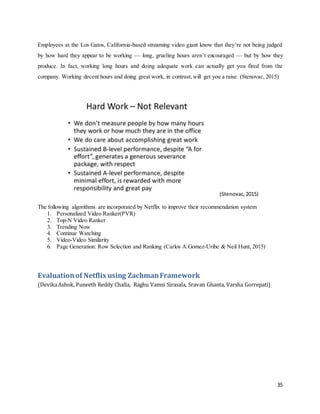
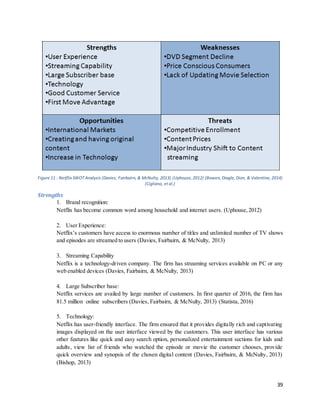
  • 48.
    48 expanding into digitaldistribution. These content providers are leveraging the growing popularity of various direct-to-consumer online distribution channels and rapidly growing social networking sites, while also addressing the needs of consumers who wish to have access to such content while on the move. In the TV business, cable networks have significantly attracted investments in original programming from the major broadcast networks that have faced steady audience erosion. The Internet and other emerging platforms also contributed to a secular increase in audience fragmentation. Consumers are increasingly making personal recordings at home directly onto their computers or wireless handheld devices. For content providers, changing consumer habits and a proliferation of online and mobile platforms have necessitated a new way of thinking on delivery mechanisms, as older technologies become increasingly obsolete. S&P Capital IQ (S&P) expects consumer time shifting and place shifting to spur further convergence of content, technology, and services. Netflix identified this change in customer thinking and made strategic agreements with various content providers which enabled the content providers to broadcast their shows to Netflix viewers (N.Amobi, 2014) Moreover, the success of the firm was not obstructed by socio-economical changes. It adapted its business model and culture to meet these changes. The social behavior of customers changed and so did the industry perspective and culture. In replacement to traditional brick-and-mortar structure, the industry competitors started an aggressive battle to provide the best customer satisfaction (to bring the products to customer's doorstep) and quality. Netflix was the first company to predict this change of mentality in customers and adapted its business model to handle both DVD and streaming services. Infact, they were enjoyed the first mover advantage in streaming service which led to strong customer base. Also, the customers preferred watching unlimited movies at the convenience of home and time. At the same time, the prices of smart phones, tablets, laptops were reducing. Hence in order to capture this smart devices market, Netflix developed apps which supported content streaming on most of the internet enabled devices (Rome BUsiness School) It can be concluded that above mentioned facts are the main reasons for success of Netflix according to the analysis conducted in this case study using Zachman framework. List of Figures Figure 1 : Netflix iteratesquicklytoprototype analgorithmthroughoffline experimentationby analyzinghistorical datatoquantifyhowwell anew algorithmcanpredictpreviouspositive member engagement,suchasplays.The keyunderlyingassumption,whichisnotalwaystrue,isthat members wouldhave engagedwiththeirproductinexactlythe same way,forexample,playingthe same videos, had the newalgorithmbeenusedtogenerate recommendations.Once theysee encouraging-enough resultsinofflineexperiments,theybuildanA/Btestto use the new algorithmtogenerate recommendationsformembers.If the A/Btestsucceeds,theychange theirproducttouse that new algorithmbydefault.If the A/Btestisflator negative,theyeitherabandonthe researchdirectionorgo back to the offline experimentationworldtotryto make the new algorithmevenbetterfora possible future A/B test (Carlos A.Gomez-Uribe & Neil Hunt, 2015) ....................................................................9 Figure 2 : : (Left) Anexampleof the page of recommendations,showingtwoof the roughly40 rowsof recommendationsonthatpage.Suspenseful Moviesisanexample of agenre row drivenbythe PVR algorithm.The secondrowisa Because YouWatchedrow drivenbythe PVRalgorithm.The secondrow
  • 49.
    49 isa Because YouWatchedrowdrivenbythe simsalgorithm.(Right) A homepage showingthe TopPicks row drivenbythe Top N algorithm.RomanticMoviesisa genre row drivenbyPVR(CarlosA.Gomez- Uribe & Neil Hunt, 2015)...................................................................................................................11 Figure 3 : (Left) Twomore rows of recommendationsonahomepage.The popularity-heavyPopularrow and the TrendingNowrowfocuson the latestviewingtrends.(Right)A homepage foraContinue Watching sessionwith a Continue Watching row (Carlos A.Gomez-Uribe & Neil Hunt, 2015) ................11 Figure 4 : Netflix Business Model Canvas............................................................................................17 Figure 5 : TOP 10 COUNTRIES FOR NETFLIX SUBSCRIBERS (Toledo, ExStreamist)...................................19 Figure 6 : Netflix Organigraph (Adi, 2014)...........................................................................................27 Figure 7 : Netflix Organizational Chart (amrhodes, 2014) ....................................................................27 Figure 8 : Numberof Netflix streamingsubscribersworldwidefrom3rdquarter 2011 to 1st quarter2016 (in millions) (Statista, 2016)...............................................................................................................30 Figure 9 : Success Zachman Framework for Netflix............................................................................36 Figure 10 : Annual Revenue of Netflix (Statista, 2016) .........................................................................38 Figure 11 : NetflixSWOTAnalysis(Davies,Fairbairn,&McNulty,2013) (Uphouse,2012) (Bowen,Diagle, Dion, &Valentine, 2014) (Cigliano, et al.)...........................................................................................39 Figure 12 : Shopping Spree Netflix vs Amazon vs Hulu (Leung, 2016) ...................................................43 Figure 13 : Cost , Content and Supported Devices - Netflix vs Amazon vs Hulu (Barron, 2015) ...............44 Figure 14 : Revenue : Netflix vs Blockbuster vs Redbox vs Hulu (Team, 2012) .......................................45 Figure 15 : PeakDownloadInternetTrafficinNorthAmerica - Netflix anditscompetitors(Barron,2015) ........................................................................................................................................................45 Figure 16 : Top 200 shows - Netflix vs Amazon vs hulu vs redbox (Permalink, 2012)..............................46 References Adi.(2014). Organigraphs:Unveiling theOrganizationalStructureof Tesla,Twitter,and Netflix. Retrievedfromadithya.co:https://adithya.co/2014/12/12/organigraphs-unveiling-the- organizational-structure-of-tesla-twitter-and-netflix/ AmazonWebServices,Inc.orits affiliates.(2016). Netflix CaseStudy.(Amazon) Retrieved2016, from https://aws.amazon.com/solutions/case-studies/netflix/ amrhodes.(2014, March 5). Netflix. Retrievedfromcogmap:http://www.cogmap.com/chart/Netflix Bachman,J. (2014, July2). The Futureof Netflix Isn'tHouseof Cards,It'sShowsforKids. Retrievedfrom Bloomberg:http://www.bloomberg.com/news/articles/2014-07-01/the-future-of-netflix-isnt- house-of-cards-its-shows-for-kids Barron, J.(2015, August28). Netflix,Amazon InstantVideo and Hulu Plus:How Do the Big 3 Compare? RetrievedfromNextAdvisor:http://www.nextadvisor.com/blog/2015/08/28/netflix-amazon- instant-video-and-hulu-plus-compare/ Beal,V.(2016). CDN - ContentDelivery Network.Retrievedfrom http://www.webopedia.com/TERM/C/CDN.html
  • 50.
    50 Bernard,S. A.(2012). AnIntroduction to EnterpriseArchitecture. AuthorHouse. Bishop,B.(2013, November13). Netflix introducesoneunified TV interface to rule themall. Retrieved fromThe Verge:http://www.theverge.com/2013/11/13/5098224/netflix-introduces-one- unified-tv-interface-to-rule-them-all Bloomberg,J.(2014, July23). Agile EnterpriseArchitecture finally crossesthe Chasm. Retrievedfrom Forbes:http://www.forbes.com/sites/jasonbloomberg/2014/07/23/agile-enterprise- architecture- Blyskal,J.(2015, June 12). Video streaming face-off:Amazon PrimeInstantVideo vs.Netflix.Retrieved fromConsumerReports:http://www.consumerreports.org/cro/news/2015/06/netflix-vs- amazon-prime-video-streaming/index.htm Bodnar,K. (2011, April 27). 5 Marketing LessonsfromNetflix. RetrievedfromHubSpot: http://blog.hubspot.com/blog/tabid/6307/bid/12694/5-Marketing-Lessons-from- Netflix.aspx#sm.0000f2t0jbi35fj4qgd2b90whqdkg Bowen,R.,Diagle,R.,Dion,T.,& Valentine,S.(2014). Netflix CaseStudy. Retrievedfrom robertdigle.com:http://robertdaigle.com/wp- content/uploads/2014/01/BowenDaigleDionValentine_NetflixCaseStudy.pdf breyia_w.(2014). History of Netflix. Retrievedfromtimeroast: http://www.timetoast.com/timelines/history-of-netflix Bukoski,E.,Moyles,B.,& McGarr, M. (2016, March 9). How We Build Codeat Netflix.RetrievedfromThe Netflix TechBlog:http://techblog.netflix.com/2016/03/how-we-build-code-at-netflix.html BusinessManagementDegrees.(2016). AMAZON VS.NETFLIX:THEFIGHT OFTHE CENTURY. Retrieved fromBusinessmanagementdegree.net:http://www.business-management- degree.net/features/amazon-vs-netflix/ CarlosA.Gomez-Uribe,N.I.,&Neil Hunt,N.(2015). The Netflix RecommenderSystem:Algorithms, BusinessValue,. Retrievedfromdelivery.acm.org: http://delivery.acm.org/10.1145/2850000/2843948/a13-gomez- uribe.pdf?ip=192.5.215.225&id=2843948&acc=OA&key=4D4702B0C3E38B35%2E4D4702B0C3E 38B35%2E4D4702B0C3E38B35%2EE5B8A747884E71D5&CFID=612562928&CFTOKEN=36556763 &__acm__=1462732874_1239d50ea5855255d3f3d21 Chen,L. Y., & Shaw,L. (2016, JNUry 6). China RemainsRoadblockto Netflix'sGlobal Expansion Ambitions.Retrievedfromhttp://www.bloomberg.com/news/articles/2016-01-07/china- remains-roadblock-to-netflix-s-global-expansion-ambitions ciancutti,j.(2010, December14). Four ReasonsWeChooseAmazon’sCloud asOurComputingPlatform. RetrievedfromThe NetflixTechBlog:http://techblog.netflix.com/2010/12/four-reasons-we- choose-amazons-cloud-as.html Cigliano,J.,Dewey,C.,Hansen,J.,Jung,J.,King,C.,Krueger,K.,&Williams,M.(n.d.). Netflix. Retrieved fromscf.usc.edu:http://www-scf.usc.edu/~jdhansen/Netflix%20Financial%20Analysis.pdf
  • 51.
    51 CNN.(2014, July21). Abrief history of Netflix.Retrievedfrom http://www.cnn.com/2014/07/21/showbiz/gallery/netflix-history/ Cockcroft,A.(2011, November18). Netflix in theGlobal Cloud. Retrievedfromlanyrd: http://lanyrd.com/2011/qcon-san-francisco/smfxq/ Cohen,M. (2013, October27-29). Netflix’sCloud Migration. RetrievedfromDCIA: http://dcia.info/activities/ccw2013/10-28%20CCW2013%20Opening%20Mikey%20Cohen.pdf Cohen,M.,& Hawthorne,M. (2013, June 12). Announcing Zuul:EdgeServicein the Cloud. Retrieved fromThe NetflixTechBlog:http://techblog.netflix.com/2013/06/announcing-zuul-edge-service- in-cloud.html Davies,R.,Fairbairn,H.,& McNulty,M. (2013, May 2). Netflix:S.W.O.T.Analysis. RetrievedfromPrezi: https://prezi.com/6gilut2g6h7b/netflix-swot-analysis/ Davis,C. (2015, October16). Timeline: Netflix'skey moments.RetrievedfromWKBWBUFFALO: http://www.wkbw.com/news/us-news-world/timeline-netflixs-biggest-moments Dhapola,S.(2016, January8). Netflix comesto India,pricing start at Rs 500 a month.Retrievedfrom http://indianexpress.com/article/technology/tech-news-technology/netflix-launches-in-india- plans-start-at-500-rupees-a-month/ dribayles.(2012,April 26). Netflix competitivelandscape. RetrievedfromSlideShare: http://www.slideshare.net/dribayles/netflix-competitive-landscape Ernie.(2015, march 15). NutsAnd Bolts Of Netflix’sCDN Infrastructure.Retrievedfrom https://www.bizety.com/2015/03/15/nuts-and-bolts-of-netflixs-cdn-infrastructure/ Farhan,B. (2016, January 8). Company Mission Statements - CompleteListof World’sLargestRetail Missions. Retrievedfromaboutmoney: http://retailindustry.about.com/od/retailbestpractices/ig/Company-Mission- Statements/Netflix-Movies-Mission-Statement.htm Filwood,D.(2015, June 29). Netflix ContactCenterCultureIncreasesCustomerSatisfaction. Retrieved fromLinkedIn:https://www.linkedin.com/pulse/netflix-contact-center-culture-increases- customer-david-filwood Franken,H.,Djik,S.v., & Gils,B. v.(2013, February8). Three Best Practices forSuccessful Implementation of EnterpriseArchitectureUsing the TOGAF® Frameworkand theArchiMate® Modeling Language. Retrievedfromopengroup:https://blog.opengroup.org/2013/02/08/three- best-practices-for-successful-implementation-of-enterprise-architecture-using-the-togaf- framework-and-the-archimate-modeling-language/ Garber, M. (2012, May 30). The FutureGrowth of theInternet,in One Chart(and OneGraph). Retrieved fromThe Atlantic:http://www.theatlantic.com/technology/archive/2012/05/the-future- growth-of-the-internet-in-one-chart-and-one-graph/257811
  • 52.
    52 Golden,B.(2012, April 5).Cloud Computing DonetheNetflix Way. RetrievedfromCIO.com: http://www.cio.com/article/2397486/cloud-computing/cloud-computing-done-the-netflix- way.html Hartung, A.(2013, January29). Netflix - The Turnaround Story of 2012! Retrievedfrom http://www.forbes.com/sites/adamhartung/2013/01/29/netflix-the-turnaround-story-of- 2012/#2b034d3d2246 Indiviglio,D.(2010, September27). 3 Big ChallengesFacing Netflix. RetrievedfromThe Atlantic: http://www.theatlantic.com/business/archive/2010/09/3-big-challenges-facing-netflix/63637/ Ingram,M. (2015, August31). Netflix justlost somebig nameHollywood movies,buthere'swhy it will be fine anyway. Retrievedfromfortune:http://fortune.com/2015/08/31/netflix-epix-disney/ Jones,D.(2016, February22). Cloud Transformation atNetflix:ItWasn’tInstant. RetrievedfromSkyTap: https://www.skytap.com/blog/cloud-transformation-at-netflix-it-wasnt-instant/ Judge,P.(2016, February12). Netflix completesmoveto AWS public cloud.Retrievedfrom http://www.datacenterdynamics.com/colo-cloud-/netflix-completes-move-to-aws-public- cloud/95707.fullarticle Lampitt,A.(2013, May 2). Big movies,big data:Netflix embracesNoSQLin thecloud. Retrievedfrom InfoWorld:http://www.infoworld.com/article/2614318/big-data/big-movies--big-data--netflix- embraces-nosql-in-the-cloud.html?page=2 Letov,A.(n.d.). Which programming languageisNetflix coded in? How do I usethat language? RetrievedfromQuora:https://www.quora.com/Which-programming-language-is-Netflix-coded- in-How-do-I-use-that-language Leung,A.(2016, February05). How Does Netflix Pay Studios?WhattheStreaming Giant Doesto Obtain Content. RetrievedfromArt.Mic:http://mic.com/articles/134272/how-does-netflix-pay-studios- what-the-streaming-giant-does-to-obtain-content#.JALaGIr0e Loeb,L. (2015, August18). Netflix CompletesItsCloud Journey. RetrievedfromInformationWeek: http://www.informationweek.com/cloud/platform-as-a-service/netflix-completes-its-cloud- journey/a/d-id/1321800 Marr, B. (2015, April 21). Big Data:How Netflix UsesIt to Drive BusinessSuccess. Retrievedfrom SmartDataCollective:http://www.smartdatacollective.com/bernardmarr/312146/big-data-how- netflix-uses-it-drive-business-success Mauro, T. (2015, March 10). Adopting MicroservicesatNetflix:LessonsforTeam and ProcessDesign. RetrievedfromNGINX:https://www.nginx.com/blog/adopting-microservices-at-netflix-lessons- for-team-and-process-design/ mmlindsay.(2014). Netflix:TargetMarket. Retrievedfromstorify: https://storify.com/mmlindsay/netflix-target-market
  • 53.
    53 Mui, C.(2011, March17). HowNetflix Innovatesand Wins. RetrievedfromForbes: http://www.forbes.com/sites/chunkamui/2011/03/17/how-netflix-innovates-and- wins/#72182b9bb69a N.Amobi,T.(2014, December). Industry SurveysMovies&Entertainment. RetrievedfromS&P Capital IQ: https://gskkr.files.wordpress.com/2015/01/movies-entertainment.pdf Neil Hunt,N.C. (2015, May 20). Why doesNetflix useAmazon EC2? RetrievedfromQuora: https://www.quora.com/Why-does-Netflix-use-Amazon-EC2 Netflix.(2016). Netflix Timeline. Retrievedfromhttps://media.netflix.com/en/about-netflix Netflix Prize.(2015,December6). The Netflix Prize. Retrievedfromhttp://www.netflixprize.com/ Noren,E. (2013, January21). Analysisof the Netflix BusinessModel. RetrievedfromDigital Business Model:http://www.digitalbusinessmodelguru.com/2013/01/analysis-of-netflix-business- model.html Padmanabhan,P.,Sadekar,K.,&Krishnan,G. (2015, February10). What’strending on Netflix. Retrieved fromThe NetflixTechBlog:http://techblog.netflix.com/2015/02/whats-trending-on-netflix.html Pepitone,J.(2010,August26). Netflix releases iPhoneapp,stockjumps.RetrievedfromCNN Money: http://money.cnn.com/2010/08/26/technology/netflix_app/ Permalink.(2012,September7). Netflix Hits 40 Million Members& BeatsEstimates. Retrievedfrom HackingNetflix:http://www.hackingnetflix.com/investor_relations/ Powers, J.(2014, February7).Netflix,AmazonandHuluComparison:The Ultimate Throwdown. Youtube. Press,S.(2000). BlockbusterInc.History.RetrievedfromFundingUniverse: http://www.fundinguniverse.com/company-histories/blockbuster-inc-history/ Press,S. (2012). Netflix,Inc.History.RetrievedfromFundingUniverse: http://www.fundinguniverse.com/company-histories/netflix-inc-history/ Rome BUsinessSchool.(n.d.). Netflix:TheReasonsBehind its Success. RetrievedfromRome Business School:http://romebusinessschool.it/netflix-the-reasons-behind-its-success/ Shaw,L. (2014, April 21). ‘Houseof Cards’Helps Netflix Add 4 Million New Subscribersin Q1. Retrieved fromWrap: http://www.thewrap.com/house-cards-helps-netflix-add-4-million-new-subscribers- q1/ Smith,J.(2015, November25). The rise and fall of Blockbuster.RetrievedfromBayStreetBlog: http://baystreetblog.com/2015/11/25/the-rise-and-fall-of-blockbuster/ Staff,C.(2014, March 6). 5 ReasonsNetflix Is Spearheading TheHRRevolution. RetrievedfromCEO.com: http://www.ceo.com/human_resource_management/5-reasons-netflix-is-spearheading-the-hr- revolution/
  • 54.
    54 Statista.(2016). Netflix's annualrevenuefrom2002to 2015 (in million U.S.dollars). Retrievedfrom Statista.com:http://www.statista.com/statistics/272545/annual-revenue-of-netflix/ Stenovac,T.(2015, March 3). One Reason ForNetflix’sSuccess — ItTreats EmployeesLike Grownups. RetrievedfromHUffingtonpost:http://www.huffingtonpost.com/2015/02/27/netflix-culture- deck-success_n_6763716.html Stetler,B.(2015, October8). Netflix raises monthly price$1 to $9.99. Retrievedfrom http://money.cnn.com/2015/10/08/media/netflix-raising-price-standard-plan/ SVERDLIK,Y. (2016, February11). Netflix ShutsDown Final Bits of Own Data CenterInfrastructure. Retrievedfromdatacenterknowledge: http://www.datacenterknowledge.com/archives/2016/02/11/netflix-shuts-down-final-bits-of- own-data-center-infrastructure/ Team,T. (2012, October16). The U.S.Netflix Story:Evolving Competition ThreatensGrowth.Retrieved fromTrefis:http://www.trefis.com/stock/nflx/articles/146469/the-u-s-netflix-story-evolving- competition-threatens-growth/2012-10-16 thinkengine,t.(2015, July27). Five notoriously brilliantbusinessmodelsNetflix cobbled togetherinto an undefeatablevortex of bingewatching. Retrievedfromthomasthe thinkengine: https://thomasthethinkengine.com/2015/07/27/five-notoriously-brilliant-business-models- netflix-cobbled-together-into-an-undefeatable-vortex-of-binge-watching/ ThomsonReuters.(n.d.).Chapter11Bankruptcy. Retrieved2016, fromFindLaw: http://bankruptcy.findlaw.com/chapter-13/chapter-11-bankruptcy.html Toledo,R.(ExStreamist,2016 February). REPORT:HERE ARE THE BEST ANDWORST COUNTRIESFOR NETFLIXSUBSCRIBERS.Retrieved23,from http://exstreamist.com/report-here-are-the-best- and-worst-countries-for-netflix-subscribers/ UNITED STATES SECURITIES ANDEXCHANGE COMMISSION.(2012). Netflix,Inc. Retrievedfromsec.gov: http://www.sec.gov/Archives/edgar/data/1065280/000119312512053009/d260328d10k.htm#t x260328_1 Uphouse,L.(2012, November8). Netflix CaseStudy Analysis. RetrievedfromSlideShare: http://www.slideshare.net/ljuphouse/netflix-case-study-analysis Vanderbilt,T.(2013, August7). The Science Behind the Netflix AlgorithmsThatDecide What You’ll Watch Next.RetrievedfromWired:http://www.wired.com/2013/08/qq_netflix-algorithm/ Victor.(2007, February14). Netflix’sCompetitiveAdvantage. Retrievedfromnoisebetweenstations: http://noisebetweenstations.com/personal/weblogs/?p=2011 Weare,K.(2016, March 22). Netflix Cloud Migration Complete. RetrievedfromInfoQ: http://www.infoq.com/news/2016/03/Netflix-Cloud-Migration