Eric Buchalter, Dylan Jones, Jacobea Junger,
Dominic Giannone, Monica Hernandez.
M a n a g e m e n t S t r a t e g y
Case Study
2
INDEX
Strategic Profile and Case Analysis Purpose…………………………………………………...3
General Environment……………………………………………………………………………4
Physical Environment……………………………………………………………………………6
Industry Analysis………………………………………………………………………………...6
Competitor Analysis……………………………………………………………………………..9
Internal Analysis………………………………………………………………………………..11
Organizational Structure, Controls, Values…………………………………………………..12
Management Style……………………………………………………………………………....13
SWOT Analysis………………………………………………………………………………....14
Exhibit 1……………………………………………………………………………………..…..15
Strategy Formulation……………………………………………………………………...……15
Strategy Implementation…………………………………………………………………….…16
Corporate Information ………………………………………………………………………...19
Works Cited……………………………………………………………………………………..20
3
Strategic Profile and Case Analysis Purpose
Netflix is the world’s leading television network with over 75 million members in over
190 countries. Members can watch as much content as they want, all without commercials,
including original series, documentaries and feature films. The company counts on 3 segments:
domestic streaming, international streaming and domestic DVD, which provides services
consisting solely of DVD-by-mail.1
According to S&P Capital IQ, Netflix obtains content from various studios and other
content providers through streaming license agreements, DVD direct purchases and DVD
revenue sharing agreements. It markets its service through various channels, including online
advertising, broad-based media such as television and radio, as well as various strategic
partnerships. In connection with marketing the service, it offers free trial memberships to new
members.2
Netflix has a domestic market of 45 million users, but still can increase the number of
subscribers from 60 million to 90 million customers. According to Ford Equity Research, the
price movement of Netflix is very positive and the historical performance should lead to above
average price performance in the next one to three months.3
Netflix was founded in 1997 by Reed Hastings and software executive Marc Randolph to
offer online movie rentals. In 2000 the company introduced a personalized movie
recommendation system. In went public in 2002 with the ticker NFLX. In 2007 Netflix
introduced the streaming service. A year after, it partnered with consumer electronics companies
to stream on the Xbox 360, Blu-ray disc players and TV set-top boxes. In 2010 and 2011, the
company began international operations by offering its streaming service in Canada and Latin
1
"About Netflix." Netflix Media Center. Netflix Inc, n.d. Web. 18 Apr. 2016.
2
"TD Ameritrade." S&P Capital IQ: Netflix. TD Ameritrade, 2 Apr. 2016. Web. 18 Apr. 2016.
3
"Ameritrade." Ford Equity Research: Netflix. N.p., 8 Apr. 2016. Web. 17 Apr. 2016.
4
America, as well as the U.K and Ireland, and several international markets thereafter. In 2013
Netflix was the first internet TV network nominated for the primetime Emmy. In 2016 Netflix
went global with the plan of adding new content to suit the culturally diverse population on
earth.4 Therefore, the purpose of this case study is to help Netflix to gain more subscribers and
maintain its leading position in the internet video streaming industry and expand its international
operations through analysis of all of the factors that apply to the firm's success.
General Environment
Technological trends have shifted dramatically over the past fifteen years, especially in
terms of online presence. Consumers have strayed away from tangible objects and now want
content immediately at their fingertips. From this came the emergence of the internet video
streaming craze. Streaming video is defined in the Webster Dictionary as “content sent in
compressed form over the Internet and displayed by the viewer in real time. With streaming
video or streaming media, a web user does not have to wait to download a file to play it. Instead,
the media is sent in a continuous stream of data and is played as it arrives.” This allows users to
watch movies almost instantly. Technology has further shifted to the point that individuals can
now stream and watch content right from their mobile devices, taking away relevance of rentable
DVD’s from a store. Businesses like Blockbuster were run out of business by the easy and time
saving act of streaming videos online.5
The media daily news stated that more than 50% of the viewing population watches some
form of streamed video content each week. This covered the 13-54 age demographic and the
percentage has risen consistently over the years. It has also become a sociocultural ideal to relax
after a long day and watch a flick with the family or girlfriend. Even the older population is
4
"About Netflix."
5
Steel, Emily. "Netflix Refines Its DVD Business, Even as Streaming Unit Booms." The New
York Times. The New York Times, 26 July 2015. Web. 18 Apr. 2016.
5
increasing its streaming video consumption due to the convenience of use and availability of old
content, prevalent from their younger days.6 Customers additionally like to feel they are being
taken care of and have the same options, if not more, than other streaming/content providers in
the entertainment industry. The ability of Netflix to please domestic individuals of all ages can
now be aimed outward towards a more global view.
Streaming seems to be moving globally, and this shift has become vital to any firm in the
industry to maintain market power and brand strength. Despite being America’s leading TV
internet service, Netflix has only just recently become global as of January 6, 2016. Netflix
realized that they needed to expand outside of the U.S. in order to deliver the best streaming
content available to all walks of life. According to Chief Executive Reed Hastings, “With this
launch, consumers around the world -- from Singapore to St. Petersburg, from San Francisco to
Sao Paulo -- will be able to enjoy TV shows and movies simultaneously -- no more waiting.
With the help of the Internet, we are putting power in consumers’ hands to watch whenever,
wherever and on whatever device.”7 Since their globalization starting in January, Netflix is
available in over 130 countries. This should increase their market share as well as their brand
recognition, because all of their content will now be available globally. Netflix has also added
over 10 additional languages of subtitles in order to increase membership globally and reach
customers who overlooked the service previously. Netflix has often been criticised for not going
global sooner, however, this is due to the significantly large demand its service had in America.
Netflix openly acknowledged that within the US testing market they have continued to build and
grow as a company in order to maintain a competitive advantage. Moreover, Netflix recognized
6
Friedman, Wayne. "Streaming TV Increases Popularity Across Demographics." 09/11/2013.
Media Daily News, 10 Sept. 2013. Web. 20 Apr. 2016.
7
Tart, Marlee. "Netflix Is Now Available Around the World." Netflix Media Center. Netflix, 6
Jan. 2016. Web. 18 Apr. 2016.
6
that streaming to a global audience to maintain market power and brand strength was needed. In
turn, other firms in the industry are and will be looking to go global soon, causing Netflix to look
for other possible differentiation techniques mentioned later in the paper.
Physical Environment
The industry has moved from buying and selling handheld physical copies of discs i.e
DVDs, into an online intangible streaming universe. Emily Steel of the New York Times adds
that “the industry's dwindling, often ignored DVD-by-mail operation, known for envelopes that
wind up under sofa cushions and viewed by many as an anachronism in an era of lightning-fast
streaming” needs to be put to rest.8 The decreasing use of DVD’s and plastic by Netflix is seen
as a way in which the company is going green in support of the global environmental crisis.
While some companies such as Netflix still use physical DVD’s, the industry is evolving into
solely streaming content due to DVD’s reduced relevance in the entertainment industry.
Industry Analysis
The challenge for new entrants is difficult in this particular industry due to the massive
amount of capital required for entry, as well as rapid and changing patterns of viewers and their
increased demand for entertainment. The rights per movie also adds to the barriers of market
entry because the price is often very high to obtain such content. This makes it difficult for
newcomers to exit or enter the industry quickly. There is also little room for diversification
because all the products are generally the same, such as types of content offered etc. The
exception is the ability a company has to release popular original content, or more diversified
product lines, i.e. music and audiobooks. Also, evaluating the industry that is entertainment
8
Steel, Emily. "Netflix Refines Its DVD Business, Even as Streaming Unit Booms." The New
York Times. The New York Times, 26 July 2015. Web. 18 Apr. 2016.
7
visual content, you will see that in store pick up of content has diminished, giving up most of the
market share and revenues to the internet streaming video sub-industry.9
The two major substitutes for internet streaming services are Satellite and Cable TV.
Both offer hundreds of hours of television, include films and movies that can be bought and
streamed onto your television at any time. The price to rent a movie on AT&T U Verse (cable)
costs $6, where as a monthly subscription to Netflix only costs $10. One-time rentals, however,
are attractive to those who do not watch significant amounts of TV and therefore do not need the
availability of content offered by Netflix or other streaming services. Pay Per View is also a
substitute product, but the prices for popular content can rise higher than some of the cheaper
streaming services monthly subscription. Not to mention the ‘free’ content that illegal websites
such as thepiratebay.co and putlocker.co offer. These free streaming websites have shown to be a
nuisance to the legal, for profit streaming industry and have also affected cable providers and
even the movie theater industries revenues. Because there are so many options when it comes to
streaming video content, the substitutes listed make it difficult to choose where to watch, giving
buyers increased power. 10
Also, buyers no longer have to leave the comfort of their homes in order to receive their
digital entertainment i.e. blockbuster, redbox. All types of video streaming content is available
right at their fingertips. The buyer has the power to choose which type of content he wishes to
watch, how much he pays for that content (single viewing or subscription), and also on what
platform he wishes to watch it on (TV or mobile device). This has made the industry both highly
profitable and increasingly volatile. Because of this, it is important that the each company
9
"Who Are Netflix's Main Competitors? (NFLX) | Investopedia." Investopedia. N.p., 12 May
2015. Web. 18 Apr. 2016.
10
Deutsch, Alison L. "Will Hulu And Netflix Replace Cable? | Investopedia."Investopedia. N.p.,
23 Dec. 2014. Web. 20 Apr. 2016.
8
maintains up to date with the latest technological trends, or possibly face irrelevance due to a
lack of change. Though buying power is extremely high, companies can use customer loyalty
programs to take back some of that power. For example, if you cancel Netflix, after a week they
will offer you a month free because retention of customers is how any streaming service
successfully maintains profit. Promotional activities will help eliminate some of the buyer power
existent in the industry from the amount of substitute products and services available today.
The bargaining power for the suppliers is also high. According to investopedia, it can be
difficult for companies to keep their contracts with major movie studios (such as Sony and
Disney) because of all the other competing firms in the industry. Some contracts even solely
depend on the number of subscribers, so if Netflix loses a certain amount of subscribers they will
also lose a certain amount of movies. Furthermore, the suppliers might decide to keep their
content exclusive, such as HBO Go’s hit series Game of Thrones, or even charge premiums in
order for their content to run on streaming devices such as Netflix.11
The intensity among competing firms in this industry is also at its extreme. New
developments with streaming technology as well as exclusive content amongst other firms makes
this a difficult industry to have core competencies that last. The exclusive content and/or
differentiating services that are offered by competing firms might be the biggest factor in
determining market share. Differentiation factors among competitors is what gains a company
market share, as expressed by Ibis World reports. This can include the ability to offer original
content that is popular, offer cheap prices for a variety of content, or high definition viewing.
Take Amazon's Prime Exclusive show “Transparent” which won several awards last year. One
must subscribe to Amazon Prime to view that content which gives them a strategic edge. Many
11
"Analyzing Netflix's Bargaining Supplier Power (NFLX) | Investopedia." Investopedia. N.p.,
11 Jan. 2016. Web. 18 Apr. 2016.
9
of the same movies on Amazon Prime are being offered on similar platforms like Netflix and
Hulu Plus, though. However, Netflix is much cheaper ($99 per year for Amazon Prime, as
opposed to Netflix’s new $10 a month fee). Likewise, the emerging Hulu Plus is beginning to
make big trends in the industry with the release of two new shows developed by Hulu: 11.22.63
and The Path. These popular shows are making consumers aware that they have a diverse set of
choices when making their streaming decisions, causing companies to have to think of different
ways to attract new customers and retain them.12
Competitor Analysis
Netflix has a few key competitors that have different advantages and disadvantages to
their company's stance and services offered. The first competitor is Amazon Prime, which is
considered a new direct competitor with Netflix controlling 13% of the market share. For a $99
charge per year, customers enjoy a wide variety of TV shows and movies, unlimited photo
storage, ad-free music streaming as well as access to clothing and unreleased merchandise ahead
of their release date. Amazon Prime customers receive free two-day shipping on millions of
other products, such as books or groceries as well as pay per viewing for a small fee. Compared
to Netflix, Amazon Prime offers more services to the customer but lacks on the forefront of a
diversified selection of streaming video content. Amazon Prime’s lack of global market exposure
hurts the company's revenue as well, but has other segments such as free two-day shipping on
other products, to mitigate that reduction. Also, the ability to fund partnerships with companies,
such as Epix, to receive additional content will be utilized in the future easily based on the size
of the parent issuer’s, Amazon, e-commerce market share and revenue.13
12
Moskowitz, Dan. "Who Are Netflix's Main Competitors? (NFLX) | Investopedia."
Investopedia. N.p., 12 May 2015. Web. 18 Apr. 2016.
13
"Competitive Landscape." Ibis World US. UTSA Library, n.d. Web. 20 Apr. 2016.
10
Hulu, another one of Netflix’s competitors, is partnered with Disney and the ABC
Television Group to provide high quality video streaming content to their customers. They offer
a monthly subscription for $11.99, which includes a monthly “commercial-free” TV and movie
experience; they offer another subscription for $7.99/month which includes “limited
commercial” TV and movie watching. They have also begun offering Showtime content for an
additional $8.99/month, cheaper than Showtime’s own subscription service. Hulu currently has 9
million subscribers, which is 6% of the markets share, and retains roughly 50% of all the ad
generated revenue appearing in their content. Compared to Netflix, there are a few key
differences. Hulu contains much less original content and overall content in general. However,
we see this changing in the future because in order to continue competing with the rest of the
market, joint ventures with Disney Corp. and alliances with AT&T will be expected to produce
increased content and service options. This can also be said in terms of globalization. Though
Hulu currently is only available in the US and various parts of Japan, the only way for their low
market share firm to continually compete is to go global. 14
Next there is HBO with their HBO Go and HBO Now services. Different than the
previous streaming services mentioned, HBO Go/Now strictly consists of HBO series’ and
movies that can be played back for a monthly fee (subscription). Previously, HBO streaming
services were only available for purchase, $15-$20 per month, through a cable providers already
paid for service. Their switch came with allowing customers to only subscribe to their HBO Now
without going through a provider like DirecTV. HBO’s streaming services specifically penetrate
the market in terms of popular original content, such as Game of Thrones, and their global
14
Cohan, Peter. "How Netflix Reinvented Itself." Forbes. Forbes Magazine, 4 Apr. 2013. Web.
18 Apr. 2016.
11
recognition. HBO’s various streaming services could be threatening to Netflix’s push to release
relevant, new content.
The final competitor we would like to mention is Vudu. Vudu is a Walmart subsidiary
company that offers streaming video content that is rentable for a 24-hour period. The service
offers high definition viewing, such as in 1080p, which Netflix does not offer. Different than the
rest, Vudu is the Mont Blanc of pens compared to the other streaming services which are Pilot
pens. The main differences between Netflix and Vudu is obviously the lack of content available
to Vudu customers, but also Vudu’s release of new content the same day it is released on DVD,
where Netflix takes upward of 28 days to release that same content. In the future, Vudu could
pick up market share by offering more content and services offered online as well as within
Walmart stores, with whom they are subsidized by. 15
Internal Analysis
Netflix spends a significant amount of its money on acquiring new content for its
customers. The reason people choose Netflix over other providers is the fact that there is a
ginormous amount of titles available for a low monthly fee. Also, Netflix is the largest internet
video streaming provider that offers its own original TV series’. According to Market Realist,
Netflix is a hefty leader of Downstream Internet Activity (DIA) in North America, beating out
Google’s YouTube service by over double. Because Netflix receives so much traffic from North
America, as well as other countries around the world, they have to continually acquire new
content through license agreements, which is not always cheap. Netflix paid $1.35 million per
episode of The Walking Dead and $2 million per episode for The Blacklist. Future acquisitions
of popular streaming content will need to be weighed against creating it themselves. Therefore,
15
Pelts, Shirley. "Welcome to Market Realist." Netflix's Competition Increases in Video
Streaming Market. Market Realist, 4 Aug. 2015. Web. 18 Apr. 2016.
12
Creating original content like House of Cards and Marvel’s Daredevil is of paramount
importance to Netflix’s continued market superiority in the streaming industry.16
Financial ratios of Netflix can further help identify and detail the statements made earlier
in the paper. Netflix’s Debt-to-Equity ratio is currently 3.59. This reflects the change in long-
term debt, which tripled from 2014 to 2015 while intangible assets doubled in that same time
period. These two accounts are linked to their content acquisitions in the sense that to acquire
more content and release new original series, large amounts of debt must be taken on. This
causes debt ratios to sky rockets and current assets to increase as a result. Consequently, cash
flows from 2015 were -$749 million, reflecting the massive capital investment in intangible
assets.17
Netflix’s current Price to Earnings (P/E) ratio is a 362. This means that the stocks
shareholders are expecting high growth in the future. It also tells us that the market value could
be overpriced due to the amount of debt taken on (riskiness), and an adjustment of that price in
the market could cause a vast drop in the stock price of Netflix. This drop would reflect all of the
available information to the markets investors, being the increased riskiness of operations from
debt holdings, in term increasing chances of bankruptcy. 18
Organizational Structure, Controls, Values
Netflix has a functional organizational structure, which is segmented by the aims of the
individual functions and not by the region or customer segments. The structure is centralized and
CEO Reed Hastings holds direct control of the six departments of Netflix. Each department has
an individual manager that controls the functions within the department. The management style
of departments within Netflix differ from other companies in the way in which they handle the
16
"Products and Markets." Ibis World US. UTSA Library, n.d. Web. 20 Apr. 2016
17
"Netflix, Inc." Yahoo! Finance. N.p., n.d. Web. 20 Apr. 2016
18
"Netflix, Inc." Yahoo! Finance. N.p., n.d. Web. 20 Apr. 2016.
13
use of control. Instead of monitoring and appraising employees, they use an anti-controls system
with the motto “Context, not Control”. Although there is little control, managers of Netflix do
tests such as the “Keeper Test” to evaluate their employees. The “Keeper Test” forces a manager
to ask herself “which of my people, if told they were leaving in two months for a similar job at a
competitor's company, would I fight to keep at Netflix?”. This shows that Netflix is trying to
measure employees on quality and not by quantity or control. Therefore, the organizational
values of Netflix are focused on phenomenal teamwork. Netflix is looking for nine traits in an
employees that include: judgment, impact, curiosity, innovation, courage, passion, honesty and
selflessness. With those values in mind, Netflix creates a productive and sustainable work
atmosphere fostered around efficiency.
Management Style
The management structure of Netflix is very different to the management styles of other
companies in the industry. Netflix offers a laid back structure that allows employees to make
their own decisions based off of their logic and reason. This aspect allows them to uniquely
attract and retain talent. Hastings, who believes that creative firms need different approaches in
recruiting and retaining employees, concludes that free food and entertaining activities will not
make an employee happy. He believes that working with excellent colleagues will make an
employee happier than anything else. That being the case, managers do not hesitate to let
employees go who no longer fit in the company. However, not all those who are attracted to
Netflix’s unique management style are hired. The company goes to great lengths to hire the right
person the first time leaving no room for confusion in the hiring process.
One of the recent major changes was the abolishment of formal vacation and
performance reviews. Netflix is not following the standard paid-time-off policy with 10 vacation
14
days, 10 holiday days and a few sick days as other firms in the industry. Instead, they offer
salaried employees whatever time they feel is appropriate to return to the workplace with new
ideas. The greatest policy Netflix holds is “Act in Netflix’s best interests”. Comparable to the
vacation planning, Netflix allows their employees book their own business trips to reduce travel
agent expenses. The flexible work environment has allowed formal reviews to be dropped, as the
culture around the workplace involve periodically checking in with employees. This environment
stresses honesty and good communication, going along with the individuality employees feel
within the firm.
Because Netflix is competing in a fast growth business environment, current and future
employees are held to high standards. Managers of Netflix are held responsible for creating great
teams and are constantly asked to think about where they want to see their teams in the long run
as well as what kind of skills they need to achieve these goals. Netflix is competing in a very
fast-changing business environment and that is why Netflix has to be constantly looking for new
talents. Finally, educating employees about the operating processes, such as company spending,
are an integral part of creating a culture that follows what the top managers are doing.
SWOT Analysis
In addition to the internal strength of the management team, paired with Netflix having
the most popular and convenient online entertainment prescription service in the US, there are
other factors that determine ways in which the company conducts further business. See a graphic
overview below in Exhibit 1.
15
Exhibit 1
Strategy Formulation
Based on previous findings presented earlier in the paper, Netflix has done a superb job
meeting customer needs thus far, however, the competition is catching up and other providers
such as HBO are doing their research on customer needs just as well or better than Netflix.
Netflix’s documentaries genre is a very popular one that serves a broad segment of the market
and has a variety of different topics. Likewise, their classic movies section is popular too. One
strategy Netflix can use in adding value to their current product portfolio can be to diversify the
number of genres offered to the customers. For instance, they could focus on sporting events and
show explicit sporting events or leagues which are becoming popular or have the potential to
become popular. Take the Champions League or the Australian Football League (AFL) for
example. These sports are gaining fans by the day, but not everyone gets to attend the games nor
watch the live stream on television. We believe allowing access to these events as well as
increasing the streaming quality of these events will eliminate the use of pirated sports channels,
and increase overall revenue of Netflix.
16
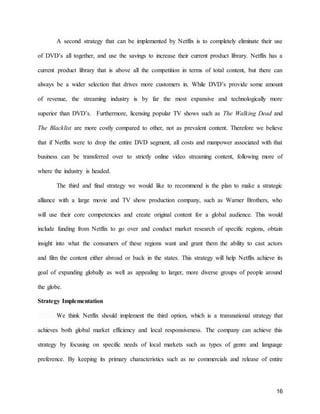
A second strategy that can be implemented by Netflix is to completely eliminate their use
of DVD’s all together, and use the savings to increase their current product library. Netflix has a
current product library that is above all the competition in terms of total content, but there can
always be a wider selection that drives more customers in. While DVD’s provide some amount
of revenue, the streaming industry is by far the most expansive and technologically more
superior than DVD’s. Furthermore, licensing popular TV shows such as The Walking Dead and
The Blacklist are more costly compared to other, not as prevalent content. Therefore we believe
that if Netflix were to drop the entire DVD segment, all costs and manpower associated with that
business can be transferred over to strictly online video streaming content, following more of
where the industry is headed.
The third and final strategy we would like to recommend is the plan to make a strategic
alliance with a large movie and TV show production company, such as Warner Brothers, who
will use their core competencies and create original content for a global audience. This would
include funding from Netflix to go over and conduct market research of specific regions, obtain
insight into what the consumers of these regions want and grant them the ability to cast actors
and film the content either abroad or back in the states. This strategy will help Netflix achieve its
goal of expanding globally as well as appealing to larger, more diverse groups of people around
the globe.
Strategy Implementation
We think Netflix should implement the third option, which is a transnational strategy that
achieves both global market efficiency and local responsiveness. The company can achieve this
strategy by focusing on specific needs of local markets such as types of genre and language
preference. By keeping its primary characteristics such as no commercials and release of entire
17
seasons at a time, opposed to Hulu or HBO who release episodes weekly, Netflix will
differentiate itself further from the competition along with staying cost effective.
Netflix should approach Warner Bros. with a partnership agreement to fund their
expenses in terms of market research and shooting as well as provide monthly payments for their
service. This payment will help Warner Bros. to manage fixed and variable costs and maintain
operations while overseas. Also, when new shows and content are released, Warner Bros. will
receive additional payment based on total revenue added from the content. Netflix will use their
current management and internal relations to smoothly communicate and guide Warner Bros. in
this process.
Netflix will begin by doing their own research to find out what other countries are into
and relying this input to Warner Bros. through information systems. These information systems
will be set up overseas, requiring contact with local entities who have expertise in data centers
and wifi utilities. This will allow Netflix and Warner Bros. to discuss further action in terms of
long range shooting and company moves. Also, this partnership is not to be viewed as a one way
street for Netflix. Both Netflix and Warner Bros. will be compensated for the work provided, just
in different ways. Netflix will receive more subscribers and globalization, therefore revenue, and
Warner Bros. will attain increased brand recognition and the ability to progress into production
of content that was previously unknown to their firm, raising expertise and marketability for
future productions.
All in all, Netflix is a high market share company that has many core competencies to
continually compete globally. Their ability to attract customers through cheap online streaming
services while partnering with some of the best production companies in the world will in turn
give them increasing market share. Combined with the new strategy of adding additional cultural
18
content and language diversification to its current portfolio, Netflix will integrate itself deeper
into the minds of the consumer, succeeding at the service of providing online entertainment at
your fingertips.
19
Corporate Information
Investor Contact
S. Wang (408-809-5360)
_________________________________
Office
100 Winchester Circle, Los Gatos, CA 95032.
Telephone
408-540-3700.
Fax
302-655-5049.
Website
http://www.netflix.com
_________________________________
Officers
Chrmn, CEO & Pres
R. Hastings
CFO
D. Wells
Secy & General Counsel
D. Hyman
________________________________
Board Members
R. N. Barton T. M. Haley
J. C. Hoag A. Mather
A. M. Sweeney A. G. Battle
R. Hastings L. J. Kilgore
B. L. Smith
___________________________________
Domicile
Delaware
Founded
1997
Employees
3,700
Shares Outstanding
428 million
20
Works Cited
"About Netflix." Netflix Media Center. Netflix Inc, n.d. Web. 18 Apr. 2016.
"Ameritrade." Ford Equity Research: Netflix. N.p., 8 Apr. 2016. Web. 17 Apr. 2016.
"Analyzing Netflix's Bargaining Supplier Power (NFLX) | Investopedia." Investopedia. N.p., 11
Jan. 2016. Web. 18 Apr. 2016.
"Analyzing Netflix's Threat of New Entrants (NFLX) | Investopedia." Investopedia. N.p., 11 Jan.
2016. Web. 18 Apr. 2016.
Cohan, Peter. "How Netflix Reinvented Itself." Forbes. Forbes Magazine, 4 Apr. 2013. Web. 18
Apr. 2016.
Deutsch, Alison L. "Will Hulu And Netflix Replace Cable? | Investopedia."Investopedia. N.p.,
23 Dec. 2014. Web. 20 Apr. 2016.
Friedman, Wayne. "Streaming TV Increases Popularity Across Demographics." 09/11/2013.
Media Daily News, 10 Sept. 2013. Web. 20 Apr. 2016.
McCord, Patty. "How Netflix Reinvented HR." Harvard Business Review. HBR, 01 Jan. 2014.
Web. 18 Apr. 2016.
Moskowitz, Dan. "Who Are Netflix's Main Competitors? (NFLX) | Investopedia." Investopedia.
N.p., 12 May 2015. Web. 18 Apr. 2016.
"Netflix (NFLX)." NFLX: Key Metrics and Competitive Analysis for Netflix. N.p., n.d. Web. 18
Apr. 2016.
"Netflix's View: Internet TV Is Replacing Linear TV." Netflix. Netflix Inc, 16 Jan. 2016. Web.
18 Apr. 2016.
Pelts, Shirley. "Welcome to Market Realist." Netflix's Competition Increases in Video Streaming
Market. Market Realist, 4 Aug. 2015. Web. 18 Apr. 2016.
21
Steel, Emily. "Netflix Refines Its DVD Business, Even as Streaming Unit Booms." The New
York Times. The New York Times, 26 July 2015. Web. 18 Apr. 2016.
Stenovec, Timothy. "One Reason For Netflix's Success -- It Treats Employees Like Grownups."
The Huffington Post. TheHuffingtonPost.com, 27 Feb. 2015. Web. 18 Apr. 2016.
Tart, Marlee. "Netflix Is Now Available Around the World." Netflix Media Center. Netflix, 6
Jan. 2016. Web. 18 Apr. 2016.
"Competitive Landscape." Ibis World US. UTSA Library, n.d. Web. 20 Apr. 2016.
"Netflix, Inc." Yahoo! Finance. N.p., n.d. Web. 20 Apr. 2016.
"Products and Markets." Ibis World US. UTSA Library, n.d. Web. 20 Apr. 2016.
"TD Ameritrade." S&P Capital IQ: Netflix. TD Ameritrade, 2 Apr. 2016. Web. 18 Apr. 2016.
"Who Are Netflix's Main Competitors? (NFLX) | Investopedia." Investopedia. N.p., 12 May
2015. Web. 18 Apr. 2016.

NetflixCaseStudy-2

  • 1.
    Eric Buchalter, DylanJones, Jacobea Junger, Dominic Giannone, Monica Hernandez. M a n a g e m e n t S t r a t e g y Case Study
  • 2.
    2 INDEX Strategic Profile andCase Analysis Purpose…………………………………………………...3 General Environment……………………………………………………………………………4 Physical Environment……………………………………………………………………………6 Industry Analysis………………………………………………………………………………...6 Competitor Analysis……………………………………………………………………………..9 Internal Analysis………………………………………………………………………………..11 Organizational Structure, Controls, Values…………………………………………………..12 Management Style……………………………………………………………………………....13 SWOT Analysis………………………………………………………………………………....14 Exhibit 1……………………………………………………………………………………..…..15 Strategy Formulation……………………………………………………………………...……15 Strategy Implementation…………………………………………………………………….…16 Corporate Information ………………………………………………………………………...19 Works Cited……………………………………………………………………………………..20
  • 3.
    3 Strategic Profile andCase Analysis Purpose Netflix is the world’s leading television network with over 75 million members in over 190 countries. Members can watch as much content as they want, all without commercials, including original series, documentaries and feature films. The company counts on 3 segments: domestic streaming, international streaming and domestic DVD, which provides services consisting solely of DVD-by-mail.1 According to S&P Capital IQ, Netflix obtains content from various studios and other content providers through streaming license agreements, DVD direct purchases and DVD revenue sharing agreements. It markets its service through various channels, including online advertising, broad-based media such as television and radio, as well as various strategic partnerships. In connection with marketing the service, it offers free trial memberships to new members.2 Netflix has a domestic market of 45 million users, but still can increase the number of subscribers from 60 million to 90 million customers. According to Ford Equity Research, the price movement of Netflix is very positive and the historical performance should lead to above average price performance in the next one to three months.3 Netflix was founded in 1997 by Reed Hastings and software executive Marc Randolph to offer online movie rentals. In 2000 the company introduced a personalized movie recommendation system. In went public in 2002 with the ticker NFLX. In 2007 Netflix introduced the streaming service. A year after, it partnered with consumer electronics companies to stream on the Xbox 360, Blu-ray disc players and TV set-top boxes. In 2010 and 2011, the company began international operations by offering its streaming service in Canada and Latin 1 "About Netflix." Netflix Media Center. Netflix Inc, n.d. Web. 18 Apr. 2016. 2 "TD Ameritrade." S&P Capital IQ: Netflix. TD Ameritrade, 2 Apr. 2016. Web. 18 Apr. 2016. 3 "Ameritrade." Ford Equity Research: Netflix. N.p., 8 Apr. 2016. Web. 17 Apr. 2016.
  • 4.
    4 America, as wellas the U.K and Ireland, and several international markets thereafter. In 2013 Netflix was the first internet TV network nominated for the primetime Emmy. In 2016 Netflix went global with the plan of adding new content to suit the culturally diverse population on earth.4 Therefore, the purpose of this case study is to help Netflix to gain more subscribers and maintain its leading position in the internet video streaming industry and expand its international operations through analysis of all of the factors that apply to the firm's success. General Environment Technological trends have shifted dramatically over the past fifteen years, especially in terms of online presence. Consumers have strayed away from tangible objects and now want content immediately at their fingertips. From this came the emergence of the internet video streaming craze. Streaming video is defined in the Webster Dictionary as “content sent in compressed form over the Internet and displayed by the viewer in real time. With streaming video or streaming media, a web user does not have to wait to download a file to play it. Instead, the media is sent in a continuous stream of data and is played as it arrives.” This allows users to watch movies almost instantly. Technology has further shifted to the point that individuals can now stream and watch content right from their mobile devices, taking away relevance of rentable DVD’s from a store. Businesses like Blockbuster were run out of business by the easy and time saving act of streaming videos online.5 The media daily news stated that more than 50% of the viewing population watches some form of streamed video content each week. This covered the 13-54 age demographic and the percentage has risen consistently over the years. It has also become a sociocultural ideal to relax after a long day and watch a flick with the family or girlfriend. Even the older population is 4 "About Netflix." 5 Steel, Emily. "Netflix Refines Its DVD Business, Even as Streaming Unit Booms." The New York Times. The New York Times, 26 July 2015. Web. 18 Apr. 2016.
  • 5.
    5 increasing its streamingvideo consumption due to the convenience of use and availability of old content, prevalent from their younger days.6 Customers additionally like to feel they are being taken care of and have the same options, if not more, than other streaming/content providers in the entertainment industry. The ability of Netflix to please domestic individuals of all ages can now be aimed outward towards a more global view. Streaming seems to be moving globally, and this shift has become vital to any firm in the industry to maintain market power and brand strength. Despite being America’s leading TV internet service, Netflix has only just recently become global as of January 6, 2016. Netflix realized that they needed to expand outside of the U.S. in order to deliver the best streaming content available to all walks of life. According to Chief Executive Reed Hastings, “With this launch, consumers around the world -- from Singapore to St. Petersburg, from San Francisco to Sao Paulo -- will be able to enjoy TV shows and movies simultaneously -- no more waiting. With the help of the Internet, we are putting power in consumers’ hands to watch whenever, wherever and on whatever device.”7 Since their globalization starting in January, Netflix is available in over 130 countries. This should increase their market share as well as their brand recognition, because all of their content will now be available globally. Netflix has also added over 10 additional languages of subtitles in order to increase membership globally and reach customers who overlooked the service previously. Netflix has often been criticised for not going global sooner, however, this is due to the significantly large demand its service had in America. Netflix openly acknowledged that within the US testing market they have continued to build and grow as a company in order to maintain a competitive advantage. Moreover, Netflix recognized 6 Friedman, Wayne. "Streaming TV Increases Popularity Across Demographics." 09/11/2013. Media Daily News, 10 Sept. 2013. Web. 20 Apr. 2016. 7 Tart, Marlee. "Netflix Is Now Available Around the World." Netflix Media Center. Netflix, 6 Jan. 2016. Web. 18 Apr. 2016.
  • 6.
    6 that streaming toa global audience to maintain market power and brand strength was needed. In turn, other firms in the industry are and will be looking to go global soon, causing Netflix to look for other possible differentiation techniques mentioned later in the paper. Physical Environment The industry has moved from buying and selling handheld physical copies of discs i.e DVDs, into an online intangible streaming universe. Emily Steel of the New York Times adds that “the industry's dwindling, often ignored DVD-by-mail operation, known for envelopes that wind up under sofa cushions and viewed by many as an anachronism in an era of lightning-fast streaming” needs to be put to rest.8 The decreasing use of DVD’s and plastic by Netflix is seen as a way in which the company is going green in support of the global environmental crisis. While some companies such as Netflix still use physical DVD’s, the industry is evolving into solely streaming content due to DVD’s reduced relevance in the entertainment industry. Industry Analysis The challenge for new entrants is difficult in this particular industry due to the massive amount of capital required for entry, as well as rapid and changing patterns of viewers and their increased demand for entertainment. The rights per movie also adds to the barriers of market entry because the price is often very high to obtain such content. This makes it difficult for newcomers to exit or enter the industry quickly. There is also little room for diversification because all the products are generally the same, such as types of content offered etc. The exception is the ability a company has to release popular original content, or more diversified product lines, i.e. music and audiobooks. Also, evaluating the industry that is entertainment 8 Steel, Emily. "Netflix Refines Its DVD Business, Even as Streaming Unit Booms." The New York Times. The New York Times, 26 July 2015. Web. 18 Apr. 2016.
  • 7.
    7 visual content, youwill see that in store pick up of content has diminished, giving up most of the market share and revenues to the internet streaming video sub-industry.9 The two major substitutes for internet streaming services are Satellite and Cable TV. Both offer hundreds of hours of television, include films and movies that can be bought and streamed onto your television at any time. The price to rent a movie on AT&T U Verse (cable) costs $6, where as a monthly subscription to Netflix only costs $10. One-time rentals, however, are attractive to those who do not watch significant amounts of TV and therefore do not need the availability of content offered by Netflix or other streaming services. Pay Per View is also a substitute product, but the prices for popular content can rise higher than some of the cheaper streaming services monthly subscription. Not to mention the ‘free’ content that illegal websites such as thepiratebay.co and putlocker.co offer. These free streaming websites have shown to be a nuisance to the legal, for profit streaming industry and have also affected cable providers and even the movie theater industries revenues. Because there are so many options when it comes to streaming video content, the substitutes listed make it difficult to choose where to watch, giving buyers increased power. 10 Also, buyers no longer have to leave the comfort of their homes in order to receive their digital entertainment i.e. blockbuster, redbox. All types of video streaming content is available right at their fingertips. The buyer has the power to choose which type of content he wishes to watch, how much he pays for that content (single viewing or subscription), and also on what platform he wishes to watch it on (TV or mobile device). This has made the industry both highly profitable and increasingly volatile. Because of this, it is important that the each company 9 "Who Are Netflix's Main Competitors? (NFLX) | Investopedia." Investopedia. N.p., 12 May 2015. Web. 18 Apr. 2016. 10 Deutsch, Alison L. "Will Hulu And Netflix Replace Cable? | Investopedia."Investopedia. N.p., 23 Dec. 2014. Web. 20 Apr. 2016.
  • 8.
    8 maintains up todate with the latest technological trends, or possibly face irrelevance due to a lack of change. Though buying power is extremely high, companies can use customer loyalty programs to take back some of that power. For example, if you cancel Netflix, after a week they will offer you a month free because retention of customers is how any streaming service successfully maintains profit. Promotional activities will help eliminate some of the buyer power existent in the industry from the amount of substitute products and services available today. The bargaining power for the suppliers is also high. According to investopedia, it can be difficult for companies to keep their contracts with major movie studios (such as Sony and Disney) because of all the other competing firms in the industry. Some contracts even solely depend on the number of subscribers, so if Netflix loses a certain amount of subscribers they will also lose a certain amount of movies. Furthermore, the suppliers might decide to keep their content exclusive, such as HBO Go’s hit series Game of Thrones, or even charge premiums in order for their content to run on streaming devices such as Netflix.11 The intensity among competing firms in this industry is also at its extreme. New developments with streaming technology as well as exclusive content amongst other firms makes this a difficult industry to have core competencies that last. The exclusive content and/or differentiating services that are offered by competing firms might be the biggest factor in determining market share. Differentiation factors among competitors is what gains a company market share, as expressed by Ibis World reports. This can include the ability to offer original content that is popular, offer cheap prices for a variety of content, or high definition viewing. Take Amazon's Prime Exclusive show “Transparent” which won several awards last year. One must subscribe to Amazon Prime to view that content which gives them a strategic edge. Many 11 "Analyzing Netflix's Bargaining Supplier Power (NFLX) | Investopedia." Investopedia. N.p., 11 Jan. 2016. Web. 18 Apr. 2016.
  • 9.
    9 of the samemovies on Amazon Prime are being offered on similar platforms like Netflix and Hulu Plus, though. However, Netflix is much cheaper ($99 per year for Amazon Prime, as opposed to Netflix’s new $10 a month fee). Likewise, the emerging Hulu Plus is beginning to make big trends in the industry with the release of two new shows developed by Hulu: 11.22.63 and The Path. These popular shows are making consumers aware that they have a diverse set of choices when making their streaming decisions, causing companies to have to think of different ways to attract new customers and retain them.12 Competitor Analysis Netflix has a few key competitors that have different advantages and disadvantages to their company's stance and services offered. The first competitor is Amazon Prime, which is considered a new direct competitor with Netflix controlling 13% of the market share. For a $99 charge per year, customers enjoy a wide variety of TV shows and movies, unlimited photo storage, ad-free music streaming as well as access to clothing and unreleased merchandise ahead of their release date. Amazon Prime customers receive free two-day shipping on millions of other products, such as books or groceries as well as pay per viewing for a small fee. Compared to Netflix, Amazon Prime offers more services to the customer but lacks on the forefront of a diversified selection of streaming video content. Amazon Prime’s lack of global market exposure hurts the company's revenue as well, but has other segments such as free two-day shipping on other products, to mitigate that reduction. Also, the ability to fund partnerships with companies, such as Epix, to receive additional content will be utilized in the future easily based on the size of the parent issuer’s, Amazon, e-commerce market share and revenue.13 12 Moskowitz, Dan. "Who Are Netflix's Main Competitors? (NFLX) | Investopedia." Investopedia. N.p., 12 May 2015. Web. 18 Apr. 2016. 13 "Competitive Landscape." Ibis World US. UTSA Library, n.d. Web. 20 Apr. 2016.
  • 10.
    10 Hulu, another oneof Netflix’s competitors, is partnered with Disney and the ABC Television Group to provide high quality video streaming content to their customers. They offer a monthly subscription for $11.99, which includes a monthly “commercial-free” TV and movie experience; they offer another subscription for $7.99/month which includes “limited commercial” TV and movie watching. They have also begun offering Showtime content for an additional $8.99/month, cheaper than Showtime’s own subscription service. Hulu currently has 9 million subscribers, which is 6% of the markets share, and retains roughly 50% of all the ad generated revenue appearing in their content. Compared to Netflix, there are a few key differences. Hulu contains much less original content and overall content in general. However, we see this changing in the future because in order to continue competing with the rest of the market, joint ventures with Disney Corp. and alliances with AT&T will be expected to produce increased content and service options. This can also be said in terms of globalization. Though Hulu currently is only available in the US and various parts of Japan, the only way for their low market share firm to continually compete is to go global. 14 Next there is HBO with their HBO Go and HBO Now services. Different than the previous streaming services mentioned, HBO Go/Now strictly consists of HBO series’ and movies that can be played back for a monthly fee (subscription). Previously, HBO streaming services were only available for purchase, $15-$20 per month, through a cable providers already paid for service. Their switch came with allowing customers to only subscribe to their HBO Now without going through a provider like DirecTV. HBO’s streaming services specifically penetrate the market in terms of popular original content, such as Game of Thrones, and their global 14 Cohan, Peter. "How Netflix Reinvented Itself." Forbes. Forbes Magazine, 4 Apr. 2013. Web. 18 Apr. 2016.
  • 11.
    11 recognition. HBO’s variousstreaming services could be threatening to Netflix’s push to release relevant, new content. The final competitor we would like to mention is Vudu. Vudu is a Walmart subsidiary company that offers streaming video content that is rentable for a 24-hour period. The service offers high definition viewing, such as in 1080p, which Netflix does not offer. Different than the rest, Vudu is the Mont Blanc of pens compared to the other streaming services which are Pilot pens. The main differences between Netflix and Vudu is obviously the lack of content available to Vudu customers, but also Vudu’s release of new content the same day it is released on DVD, where Netflix takes upward of 28 days to release that same content. In the future, Vudu could pick up market share by offering more content and services offered online as well as within Walmart stores, with whom they are subsidized by. 15 Internal Analysis Netflix spends a significant amount of its money on acquiring new content for its customers. The reason people choose Netflix over other providers is the fact that there is a ginormous amount of titles available for a low monthly fee. Also, Netflix is the largest internet video streaming provider that offers its own original TV series’. According to Market Realist, Netflix is a hefty leader of Downstream Internet Activity (DIA) in North America, beating out Google’s YouTube service by over double. Because Netflix receives so much traffic from North America, as well as other countries around the world, they have to continually acquire new content through license agreements, which is not always cheap. Netflix paid $1.35 million per episode of The Walking Dead and $2 million per episode for The Blacklist. Future acquisitions of popular streaming content will need to be weighed against creating it themselves. Therefore, 15 Pelts, Shirley. "Welcome to Market Realist." Netflix's Competition Increases in Video Streaming Market. Market Realist, 4 Aug. 2015. Web. 18 Apr. 2016.
  • 12.
    12 Creating original contentlike House of Cards and Marvel’s Daredevil is of paramount importance to Netflix’s continued market superiority in the streaming industry.16 Financial ratios of Netflix can further help identify and detail the statements made earlier in the paper. Netflix’s Debt-to-Equity ratio is currently 3.59. This reflects the change in long- term debt, which tripled from 2014 to 2015 while intangible assets doubled in that same time period. These two accounts are linked to their content acquisitions in the sense that to acquire more content and release new original series, large amounts of debt must be taken on. This causes debt ratios to sky rockets and current assets to increase as a result. Consequently, cash flows from 2015 were -$749 million, reflecting the massive capital investment in intangible assets.17 Netflix’s current Price to Earnings (P/E) ratio is a 362. This means that the stocks shareholders are expecting high growth in the future. It also tells us that the market value could be overpriced due to the amount of debt taken on (riskiness), and an adjustment of that price in the market could cause a vast drop in the stock price of Netflix. This drop would reflect all of the available information to the markets investors, being the increased riskiness of operations from debt holdings, in term increasing chances of bankruptcy. 18 Organizational Structure, Controls, Values Netflix has a functional organizational structure, which is segmented by the aims of the individual functions and not by the region or customer segments. The structure is centralized and CEO Reed Hastings holds direct control of the six departments of Netflix. Each department has an individual manager that controls the functions within the department. The management style of departments within Netflix differ from other companies in the way in which they handle the 16 "Products and Markets." Ibis World US. UTSA Library, n.d. Web. 20 Apr. 2016 17 "Netflix, Inc." Yahoo! Finance. N.p., n.d. Web. 20 Apr. 2016 18 "Netflix, Inc." Yahoo! Finance. N.p., n.d. Web. 20 Apr. 2016.
  • 13.
    13 use of control.Instead of monitoring and appraising employees, they use an anti-controls system with the motto “Context, not Control”. Although there is little control, managers of Netflix do tests such as the “Keeper Test” to evaluate their employees. The “Keeper Test” forces a manager to ask herself “which of my people, if told they were leaving in two months for a similar job at a competitor's company, would I fight to keep at Netflix?”. This shows that Netflix is trying to measure employees on quality and not by quantity or control. Therefore, the organizational values of Netflix are focused on phenomenal teamwork. Netflix is looking for nine traits in an employees that include: judgment, impact, curiosity, innovation, courage, passion, honesty and selflessness. With those values in mind, Netflix creates a productive and sustainable work atmosphere fostered around efficiency. Management Style The management structure of Netflix is very different to the management styles of other companies in the industry. Netflix offers a laid back structure that allows employees to make their own decisions based off of their logic and reason. This aspect allows them to uniquely attract and retain talent. Hastings, who believes that creative firms need different approaches in recruiting and retaining employees, concludes that free food and entertaining activities will not make an employee happy. He believes that working with excellent colleagues will make an employee happier than anything else. That being the case, managers do not hesitate to let employees go who no longer fit in the company. However, not all those who are attracted to Netflix’s unique management style are hired. The company goes to great lengths to hire the right person the first time leaving no room for confusion in the hiring process. One of the recent major changes was the abolishment of formal vacation and performance reviews. Netflix is not following the standard paid-time-off policy with 10 vacation
  • 14.
    14 days, 10 holidaydays and a few sick days as other firms in the industry. Instead, they offer salaried employees whatever time they feel is appropriate to return to the workplace with new ideas. The greatest policy Netflix holds is “Act in Netflix’s best interests”. Comparable to the vacation planning, Netflix allows their employees book their own business trips to reduce travel agent expenses. The flexible work environment has allowed formal reviews to be dropped, as the culture around the workplace involve periodically checking in with employees. This environment stresses honesty and good communication, going along with the individuality employees feel within the firm. Because Netflix is competing in a fast growth business environment, current and future employees are held to high standards. Managers of Netflix are held responsible for creating great teams and are constantly asked to think about where they want to see their teams in the long run as well as what kind of skills they need to achieve these goals. Netflix is competing in a very fast-changing business environment and that is why Netflix has to be constantly looking for new talents. Finally, educating employees about the operating processes, such as company spending, are an integral part of creating a culture that follows what the top managers are doing. SWOT Analysis In addition to the internal strength of the management team, paired with Netflix having the most popular and convenient online entertainment prescription service in the US, there are other factors that determine ways in which the company conducts further business. See a graphic overview below in Exhibit 1.
  • 15.
    15 Exhibit 1 Strategy Formulation Basedon previous findings presented earlier in the paper, Netflix has done a superb job meeting customer needs thus far, however, the competition is catching up and other providers such as HBO are doing their research on customer needs just as well or better than Netflix. Netflix’s documentaries genre is a very popular one that serves a broad segment of the market and has a variety of different topics. Likewise, their classic movies section is popular too. One strategy Netflix can use in adding value to their current product portfolio can be to diversify the number of genres offered to the customers. For instance, they could focus on sporting events and show explicit sporting events or leagues which are becoming popular or have the potential to become popular. Take the Champions League or the Australian Football League (AFL) for example. These sports are gaining fans by the day, but not everyone gets to attend the games nor watch the live stream on television. We believe allowing access to these events as well as increasing the streaming quality of these events will eliminate the use of pirated sports channels, and increase overall revenue of Netflix.
  • 16.
    16 A second strategythat can be implemented by Netflix is to completely eliminate their use of DVD’s all together, and use the savings to increase their current product library. Netflix has a current product library that is above all the competition in terms of total content, but there can always be a wider selection that drives more customers in. While DVD’s provide some amount of revenue, the streaming industry is by far the most expansive and technologically more superior than DVD’s. Furthermore, licensing popular TV shows such as The Walking Dead and The Blacklist are more costly compared to other, not as prevalent content. Therefore we believe that if Netflix were to drop the entire DVD segment, all costs and manpower associated with that business can be transferred over to strictly online video streaming content, following more of where the industry is headed. The third and final strategy we would like to recommend is the plan to make a strategic alliance with a large movie and TV show production company, such as Warner Brothers, who will use their core competencies and create original content for a global audience. This would include funding from Netflix to go over and conduct market research of specific regions, obtain insight into what the consumers of these regions want and grant them the ability to cast actors and film the content either abroad or back in the states. This strategy will help Netflix achieve its goal of expanding globally as well as appealing to larger, more diverse groups of people around the globe. Strategy Implementation We think Netflix should implement the third option, which is a transnational strategy that achieves both global market efficiency and local responsiveness. The company can achieve this strategy by focusing on specific needs of local markets such as types of genre and language preference. By keeping its primary characteristics such as no commercials and release of entire
  • 17.
    17 seasons at atime, opposed to Hulu or HBO who release episodes weekly, Netflix will differentiate itself further from the competition along with staying cost effective. Netflix should approach Warner Bros. with a partnership agreement to fund their expenses in terms of market research and shooting as well as provide monthly payments for their service. This payment will help Warner Bros. to manage fixed and variable costs and maintain operations while overseas. Also, when new shows and content are released, Warner Bros. will receive additional payment based on total revenue added from the content. Netflix will use their current management and internal relations to smoothly communicate and guide Warner Bros. in this process. Netflix will begin by doing their own research to find out what other countries are into and relying this input to Warner Bros. through information systems. These information systems will be set up overseas, requiring contact with local entities who have expertise in data centers and wifi utilities. This will allow Netflix and Warner Bros. to discuss further action in terms of long range shooting and company moves. Also, this partnership is not to be viewed as a one way street for Netflix. Both Netflix and Warner Bros. will be compensated for the work provided, just in different ways. Netflix will receive more subscribers and globalization, therefore revenue, and Warner Bros. will attain increased brand recognition and the ability to progress into production of content that was previously unknown to their firm, raising expertise and marketability for future productions. All in all, Netflix is a high market share company that has many core competencies to continually compete globally. Their ability to attract customers through cheap online streaming services while partnering with some of the best production companies in the world will in turn give them increasing market share. Combined with the new strategy of adding additional cultural
  • 18.
    18 content and languagediversification to its current portfolio, Netflix will integrate itself deeper into the minds of the consumer, succeeding at the service of providing online entertainment at your fingertips.
  • 19.
    19 Corporate Information Investor Contact S.Wang (408-809-5360) _________________________________ Office 100 Winchester Circle, Los Gatos, CA 95032. Telephone 408-540-3700. Fax 302-655-5049. Website http://www.netflix.com _________________________________ Officers Chrmn, CEO & Pres R. Hastings CFO D. Wells Secy & General Counsel D. Hyman ________________________________ Board Members R. N. Barton T. M. Haley J. C. Hoag A. Mather A. M. Sweeney A. G. Battle R. Hastings L. J. Kilgore B. L. Smith ___________________________________ Domicile Delaware Founded 1997 Employees 3,700 Shares Outstanding 428 million
  • 20.
    20 Works Cited "About Netflix."Netflix Media Center. Netflix Inc, n.d. Web. 18 Apr. 2016. "Ameritrade." Ford Equity Research: Netflix. N.p., 8 Apr. 2016. Web. 17 Apr. 2016. "Analyzing Netflix's Bargaining Supplier Power (NFLX) | Investopedia." Investopedia. N.p., 11 Jan. 2016. Web. 18 Apr. 2016. "Analyzing Netflix's Threat of New Entrants (NFLX) | Investopedia." Investopedia. N.p., 11 Jan. 2016. Web. 18 Apr. 2016. Cohan, Peter. "How Netflix Reinvented Itself." Forbes. Forbes Magazine, 4 Apr. 2013. Web. 18 Apr. 2016. Deutsch, Alison L. "Will Hulu And Netflix Replace Cable? | Investopedia."Investopedia. N.p., 23 Dec. 2014. Web. 20 Apr. 2016. Friedman, Wayne. "Streaming TV Increases Popularity Across Demographics." 09/11/2013. Media Daily News, 10 Sept. 2013. Web. 20 Apr. 2016. McCord, Patty. "How Netflix Reinvented HR." Harvard Business Review. HBR, 01 Jan. 2014. Web. 18 Apr. 2016. Moskowitz, Dan. "Who Are Netflix's Main Competitors? (NFLX) | Investopedia." Investopedia. N.p., 12 May 2015. Web. 18 Apr. 2016. "Netflix (NFLX)." NFLX: Key Metrics and Competitive Analysis for Netflix. N.p., n.d. Web. 18 Apr. 2016. "Netflix's View: Internet TV Is Replacing Linear TV." Netflix. Netflix Inc, 16 Jan. 2016. Web. 18 Apr. 2016. Pelts, Shirley. "Welcome to Market Realist." Netflix's Competition Increases in Video Streaming Market. Market Realist, 4 Aug. 2015. Web. 18 Apr. 2016.
  • 21.
    21 Steel, Emily. "NetflixRefines Its DVD Business, Even as Streaming Unit Booms." The New York Times. The New York Times, 26 July 2015. Web. 18 Apr. 2016. Stenovec, Timothy. "One Reason For Netflix's Success -- It Treats Employees Like Grownups." The Huffington Post. TheHuffingtonPost.com, 27 Feb. 2015. Web. 18 Apr. 2016. Tart, Marlee. "Netflix Is Now Available Around the World." Netflix Media Center. Netflix, 6 Jan. 2016. Web. 18 Apr. 2016. "Competitive Landscape." Ibis World US. UTSA Library, n.d. Web. 20 Apr. 2016. "Netflix, Inc." Yahoo! Finance. N.p., n.d. Web. 20 Apr. 2016. "Products and Markets." Ibis World US. UTSA Library, n.d. Web. 20 Apr. 2016. "TD Ameritrade." S&P Capital IQ: Netflix. TD Ameritrade, 2 Apr. 2016. Web. 18 Apr. 2016. "Who Are Netflix's Main Competitors? (NFLX) | Investopedia." Investopedia. N.p., 12 May 2015. Web. 18 Apr. 2016.