Machine Assisted Verification Tools for
Cryptography
Paulo Silva1

Manuel Barbosa1

1 Departamento de Informática
Computer Science and Technology Centre (CCTC/DI)
Universidade do Minho
Portugal

October 13, 2010
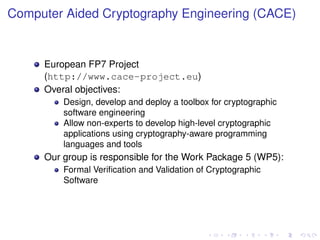
Computer Aided Cryptography Engineering (CACE)

European FP7 Project
(http://www.cace-project.eu)
Overal objectives:
Design, develop and deploy a toolbox for cryptographic
software engineering
Allow non-experts to develop high-level cryptographic
applications using cryptography-aware programming
languages and tools

Our group is responsible for the Work Package 5 (WP5):
Formal Verification and Validation of Cryptographic
Software
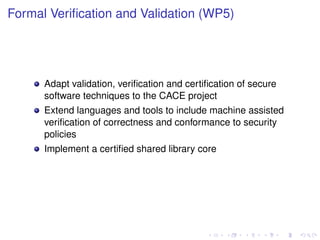
Formal Verification and Validation (WP5)

Adapt validation, verification and certification of secure
software techniques to the CACE project
Extend languages and tools to include machine assisted
verification of correctness and conformance to security
policies
Implement a certified shared library core
CAO Language
CAO Language

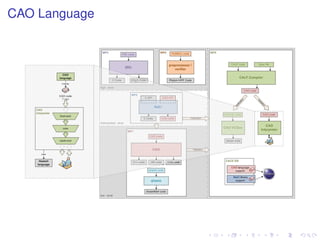
Small and simple domain specific language
Geared toward the automatic production of highly efficient
target code subject to security-aware optimizations
Close to cryptographic standards
Type system supports cryptographic types such as bit
strings, matrices and field extensions
We have a complete formalization of CAO’s:
Syntax
Semantics
Type system

We have implemented a fully functional CAO interpreter
CAO Language Example (AES fragment)
typedef GF2 := mod[ 2 ];
typedef GF2N :=
mod[ GF2<X> / X**8 + X**4 + X**3 + X + 1 ];
typedef S
:= matrix[4,4] of GF2N;
def mix : matrix[4,4] of GF2N
{[X],[X+1],[1],[1],
[1],[X],[X+1],[1],
[1],[1],[X],[X+1],
[X+1],[1],[1],[X]};

:=

def MixColumns( s : S ) : S {
def r : S;
seq i := 0 to 3 {
r[0..3,i] := mix * s[0..3,i]; }
return r; }
Deductive Verification

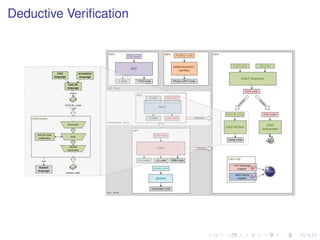
Tools based on variations of Hoare logic
Axioms and inference rules capture the semantics of
imperative languages
Programs are bound to contracts: a pre- and a
post-condition
If pre-condition is met at the inputs, program guarantees
post-conditions at the outputs
Deductive Verification
Annotation Language (CAO-SL) Properties that must be
proven (specification) and extra information to
facilitate verification are included in source code
as annotations.
Verification condition generator (VCGen) The annotated
program is used to generate a set of proof
obligations. The validity of these proof obligations
will imply that the software is indeed correct with
respect to the specification.
Proof generation Proof obligations are theorems of first-order
logic that must be proven, using a first-order
automatic proof tool (e.g. Simplify) or a proof
assistant (e.g. Coq) to construct the proof.
CALF Language
CALF Language

Higher-level than CAO
More powerful abstraction to write generic code
A suitable candidate for direct translation and
implementation of cryptographic standards
Static verification and pre-processing tool for enhanced
CAO source code.
CALF to CAO compiler

High-assurance compiler that translates CALF to CAO
code
Advanced type system based on dependent types to
ensure that certain properties are met
More manageable than deductive verification
May be used to reduce the number of proof obligations
Example: ensures that the access to a vector position is
within bounds (memory safe)
CALF Language Example (RSA fragment)

typedef RSAPub<(n : int)> :=
struct [ def e : int; ];
def RSA<(n : int)>(k : RSAPub<(n)>, m : int ) : int
{
def c : mod[n];
c := (mod[n]) m;
c := c ** k.e;
return (int) c;
}
Ongoing Work

Proofs about CAO formalization, namely, type safety
Data type classifiers
Verification of cryptographic libraries (NaCl)
Compiler from CAO to C

Machine Assisted Verification Tools for Cryptography

  • 1.
    Machine Assisted VerificationTools for Cryptography Paulo Silva1 Manuel Barbosa1 1 Departamento de Informática Computer Science and Technology Centre (CCTC/DI) Universidade do Minho Portugal October 13, 2010
  • 2.
    Computer Aided CryptographyEngineering (CACE) European FP7 Project (http://www.cace-project.eu) Overal objectives: Design, develop and deploy a toolbox for cryptographic software engineering Allow non-experts to develop high-level cryptographic applications using cryptography-aware programming languages and tools Our group is responsible for the Work Package 5 (WP5): Formal Verification and Validation of Cryptographic Software
  • 3.
    Formal Verification andValidation (WP5) Adapt validation, verification and certification of secure software techniques to the CACE project Extend languages and tools to include machine assisted verification of correctness and conformance to security policies Implement a certified shared library core
  • 4.
  • 5.
    CAO Language Small andsimple domain specific language Geared toward the automatic production of highly efficient target code subject to security-aware optimizations Close to cryptographic standards Type system supports cryptographic types such as bit strings, matrices and field extensions We have a complete formalization of CAO’s: Syntax Semantics Type system We have implemented a fully functional CAO interpreter
  • 6.
    CAO Language Example(AES fragment) typedef GF2 := mod[ 2 ]; typedef GF2N := mod[ GF2<X> / X**8 + X**4 + X**3 + X + 1 ]; typedef S := matrix[4,4] of GF2N; def mix : matrix[4,4] of GF2N {[X],[X+1],[1],[1], [1],[X],[X+1],[1], [1],[1],[X],[X+1], [X+1],[1],[1],[X]}; := def MixColumns( s : S ) : S { def r : S; seq i := 0 to 3 { r[0..3,i] := mix * s[0..3,i]; } return r; }
  • 7.
  • 8.
    Deductive Verification Tools basedon variations of Hoare logic Axioms and inference rules capture the semantics of imperative languages Programs are bound to contracts: a pre- and a post-condition If pre-condition is met at the inputs, program guarantees post-conditions at the outputs
  • 9.
    Deductive Verification Annotation Language(CAO-SL) Properties that must be proven (specification) and extra information to facilitate verification are included in source code as annotations. Verification condition generator (VCGen) The annotated program is used to generate a set of proof obligations. The validity of these proof obligations will imply that the software is indeed correct with respect to the specification. Proof generation Proof obligations are theorems of first-order logic that must be proven, using a first-order automatic proof tool (e.g. Simplify) or a proof assistant (e.g. Coq) to construct the proof.
  • 10.
  • 11.
    CALF Language Higher-level thanCAO More powerful abstraction to write generic code A suitable candidate for direct translation and implementation of cryptographic standards Static verification and pre-processing tool for enhanced CAO source code.
  • 12.
    CALF to CAOcompiler High-assurance compiler that translates CALF to CAO code Advanced type system based on dependent types to ensure that certain properties are met More manageable than deductive verification May be used to reduce the number of proof obligations Example: ensures that the access to a vector position is within bounds (memory safe)
  • 13.
    CALF Language Example(RSA fragment) typedef RSAPub<(n : int)> := struct [ def e : int; ]; def RSA<(n : int)>(k : RSAPub<(n)>, m : int ) : int { def c : mod[n]; c := (mod[n]) m; c := c ** k.e; return (int) c; }
  • 14.
    Ongoing Work Proofs aboutCAO formalization, namely, type safety Data type classifiers Verification of cryptographic libraries (NaCl) Compiler from CAO to C