Nervous System
CNS and PNS
What is Nervous
System?
It is a network of nerves that
connect the spinal cord to the
brain to the rest of the body
and allow a stimulus-
response reaction to occur
among different organs.
Basic Function of Nervous System
SENSATION INTEGRATION RESPONSE
Other Functions….
• Control of body’s internal
environment to maintain
‘homeostasis’
• Memory and learning
• Voluntary control of movement
• Programming of spinal cord reflexes,
etc.
Neurons
Fundamental units of the nervous system.
These are cells that translates external stimuli into
electrical signals transmitted into the brain where
the delivered information interpreted.
Parts of Neurons
Transmission of
Information in the Nervous
System
Stimulus Receptors
Afferent
Neurons
Central
Nervous
System
Interneuron
s
Peripheral
Nervous
System
Efferent
Neuron
Response
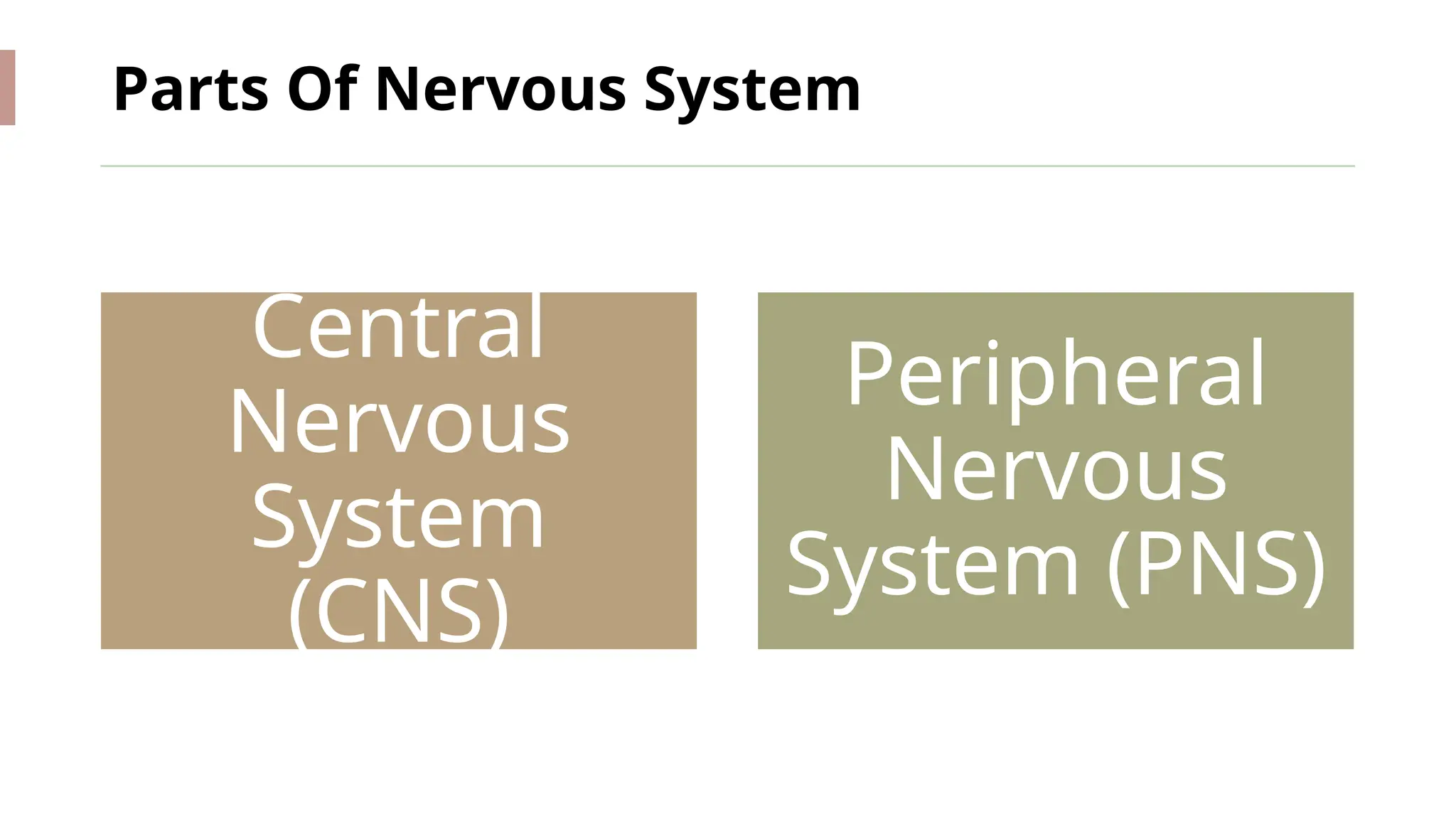
Parts Of Nervous System
Central
Nervous
System
(CNS)
Peripheral
Nervous
System (PNS)
Main function of Central
Nervous System
• To receive, process, interpret,
and send information,
through the electrical signals
or nerve impulses that
neuron carry toward the
peripheral nervous system.
Parts of CNS
Brain Spinal cord
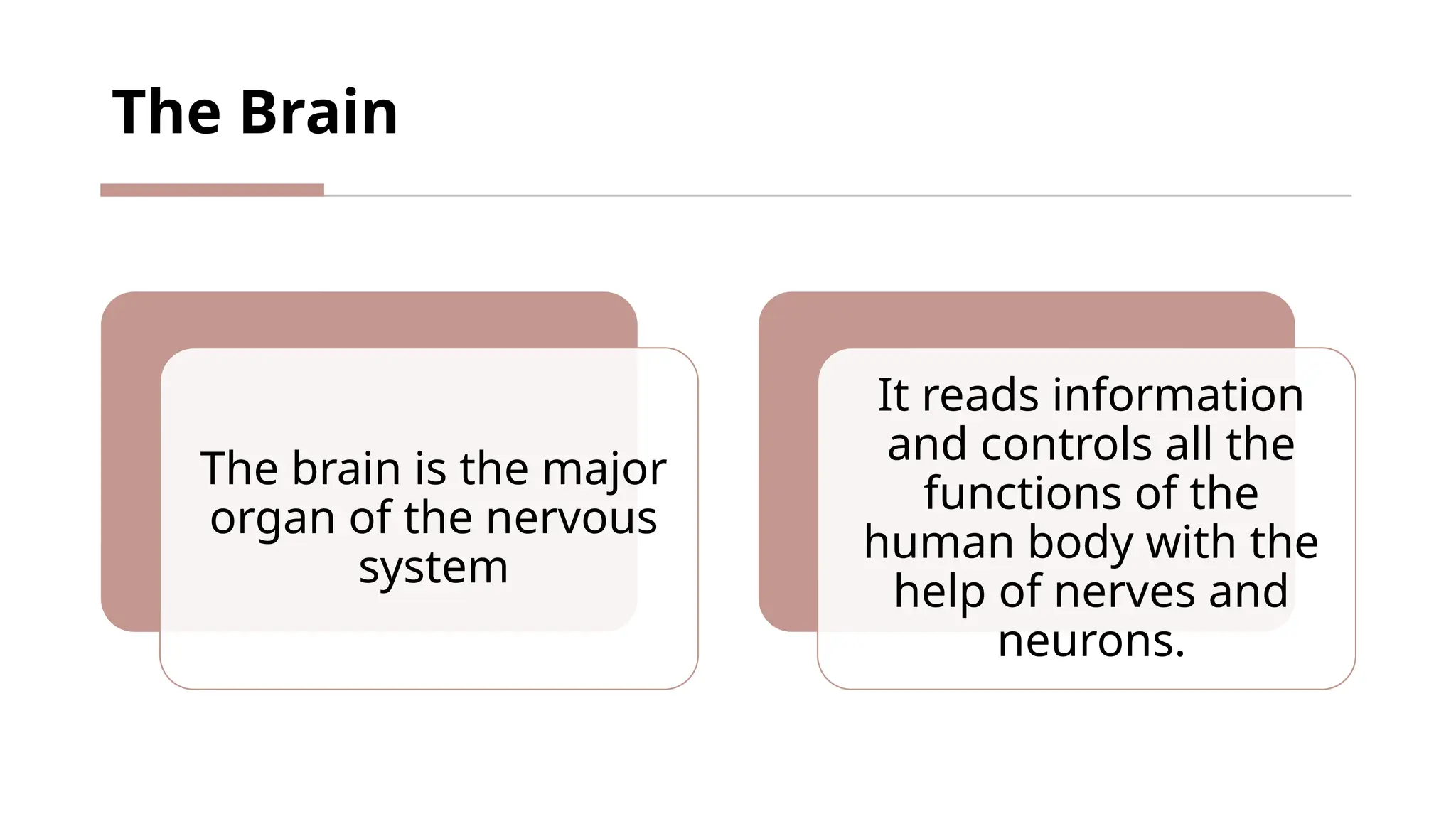
The Brain
The brain is the major
organ of the nervous
system
It reads information
and controls all the
functions of the
human body with the
help of nerves and
neurons.
Exterior Part of the brain
Meninges
Pia Mater
Arachnoi
d Mater
Dura
Mater
Gyri Sulci
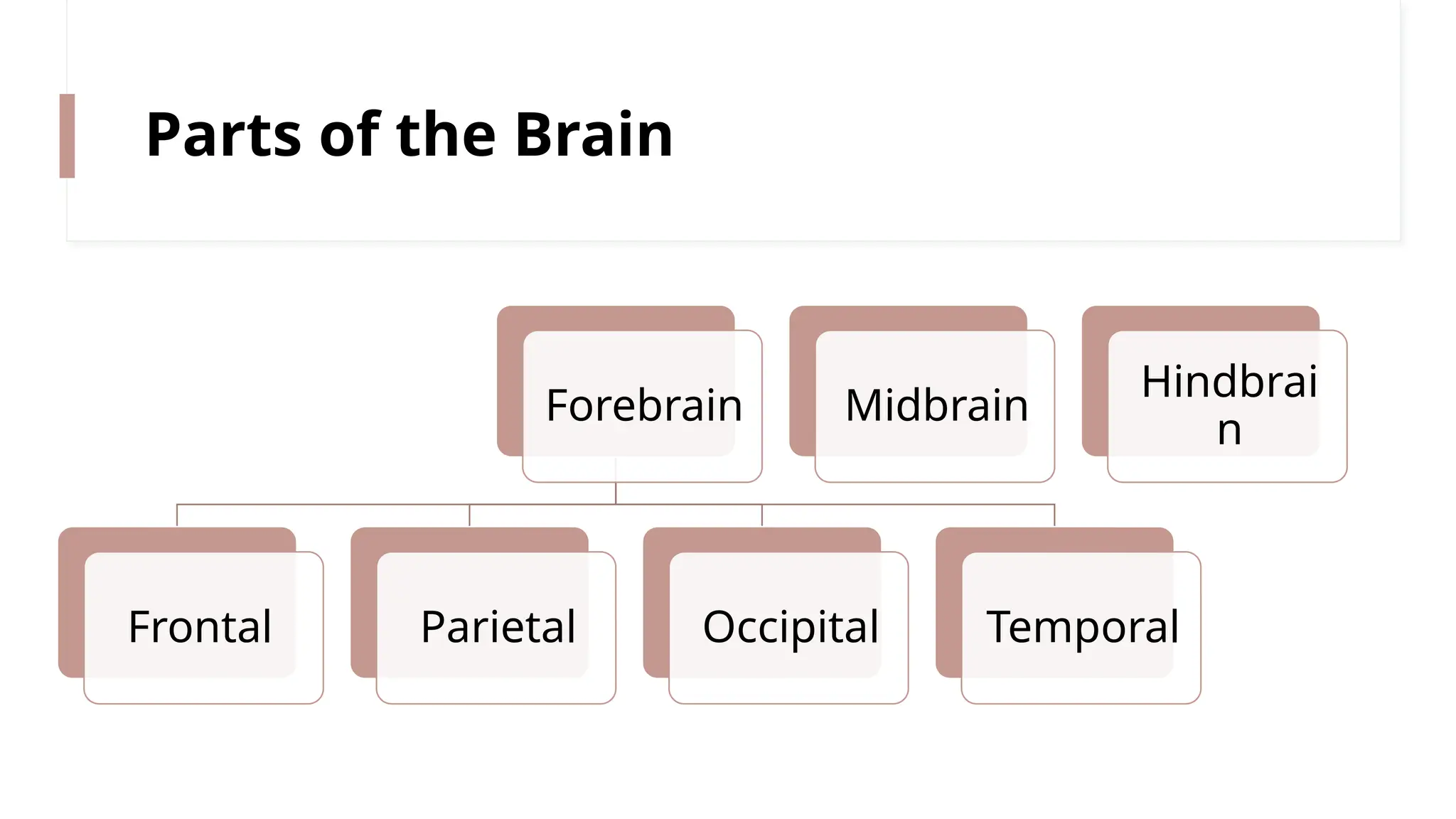
Parts of the Brain
Forebrain
Frontal Parietal Occipital Temporal
Midbrain
Hindbrai
n
Parts of the
Brain
Forebrain
Midbrain
Hindbrain
Pons
Medulla
oblongata
Cerebellum
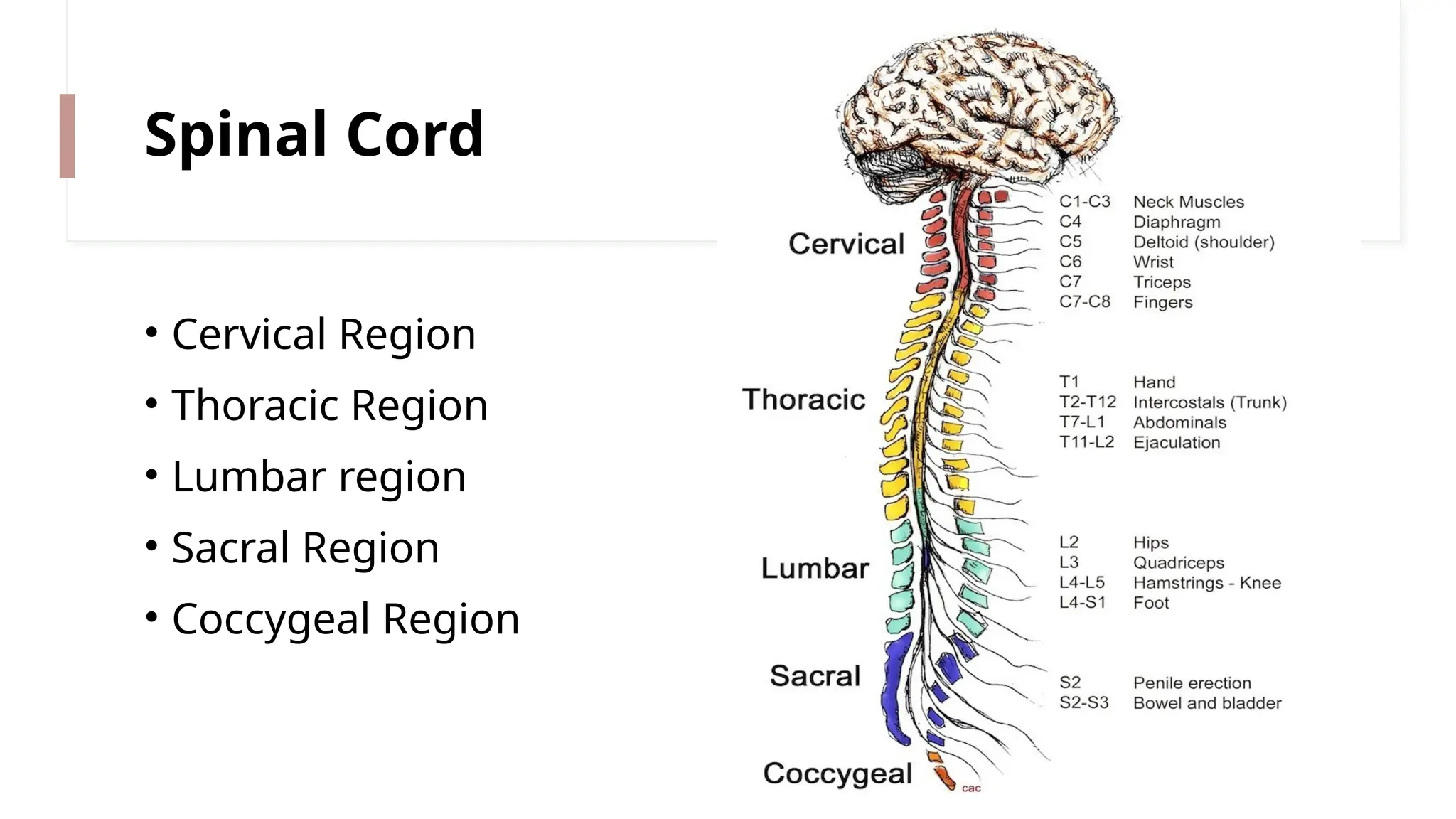
Spinal Cord
• Cervical Region
• Thoracic Region
• Lumbar region
• Sacral Region
• Coccygeal Region
Peripheral
Nervous
System
Peripheral Nervous System (PNS)
• Consists of a network of nerve extensions and ganglia.
• The peripheral nervous system consists of 43 pairs of
nerves that arise from the brain and spinal cord, leading
to the organs throughout the body.
Peripheral Nervous System (PNS)
Somatic
Nervous
System
Autonomic
Nervous
System
Sympathetic
Parasympatheti
c
Peripheral Nervous System (PNS)
Parasympatheti
c Division
Cranial Nerves Spinal Nerves Sense Organs
Sympathetic
Division
Cranial Nerves
Olfactory
nerve: Sense of
smell.
Optic nerve: Ability
to see.
Oculomotor
nerve: Ability to
move and blink your
eyes.
Trochlear
nerve: Ability to
move your eyes up
and down or back
and forth.
Trigeminal
nerve: Sensations in
your face and
cheeks, taste and
jaw movements.
Abducens
nerve: Ability to
move your eyes.
Facial nerve: Facial
expressions and
sense of taste.
Auditory/vestibular
nerve: Sense of
hearing and balance.
Glossopharyngeal
nerve: Ability to
taste and swallow.
Vagus
nerve: Digestion
and heart rate.
Accessory nerve (or
spinal accessory
nerve): Shoulder
and neck muscle
movement.
Hypoglossal
nerve: Ability to
move your tongue.
nfjhfku

Nervous System.pptx mhghjghvbvhmvhgvhvhvhv