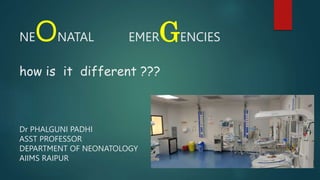
NEONATAL EMERGENCIES
how is it different ???
Dr PHALGUNI PADHI
ASST PROFESSOR
DEPARTMENT OF NEONATOLOGY
AIIMS RAIPUR
How is it different?
 Neonatal emergencies can start in……..the FETUS k/a…FETAL EMERGENCIES
 Common thing like Blood Group of mother (Rh Negative)can lead to fetal
emergency(Hydrops Fetalis).
 Fetal emergencies commonly seen are fetal arrythmias,Hydrops ,FGR etc
 Needs multidisciplinary team approach
 What are the limitations in newborns?
Less reserve so decompensates quite early
Limited & non-specific presentation
Limitation in assessment due to prematurity
Origin may be from insults during utero, birth or immediate post
natal period highlighting importance of each aspect of history
Neonatal Resusication is different…..
Adult cardiac arrest is a complication of trauma or existing heart disease.
It is caused by a sudden arrhythmia that prevents the heart from effectively circulating
blood.
During adult cardiopulmonary resuscitation, chest compressions are used to
maintain circulation until electrical defibrillation or medications restore cardiac function.
Neonatal Resusication is different…..
In contrast, most newborns requiring resuscitation have a healthy heart.
When a newborn requires resuscitation, it is usually caused by a problem with
respiration leading to inadequate gas exchange.
Respiratory failure may occur either before or after birth.
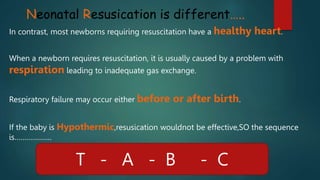
If the baby is Hypothermic,resusication wouldnot be effective,SO the sequence
is……………….
T - A - B - C
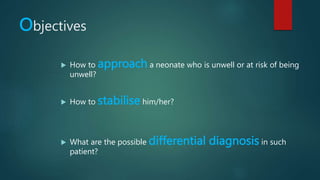
Objectives
 How to approach a neonate who is unwell or at risk of being
unwell?
 How to stabilise him/her?
 What are the possible differential diagnosis in such
patient?
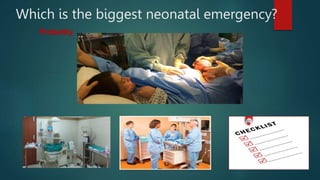
Which is the biggest neonatal emergency?
Probably
Food for thought!
Why is it important to recognise a sick newborn at the
earliest?
Delay will lead to high morbidity & mortality
How to approach?
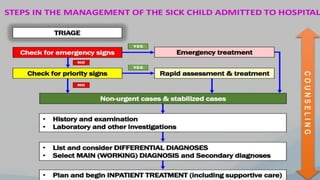
Logical and systematic approach for babies who are
unwell or at risk of becoming unwell
Gathering & organising information
Establishing priorities
Intervening appropriately
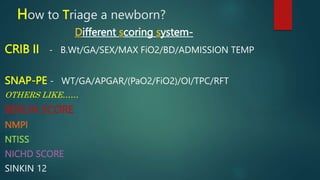
How to Triage a newborn?
Different scoring system-
CRIB II - B.Wt/GA/SEX/MAX FiO2/BD/ADMISSION TEMP
SNAP-PE - WT/GA/APGAR/(PaO2/FiO2)/OI/TPC/RFT
OTHERS LIKE……
BERLIN SCORE
NMPI
NTISS
NICHD SCORE
SINKIN 12
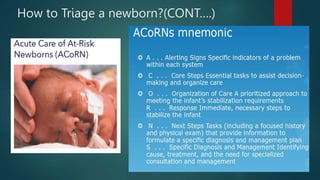
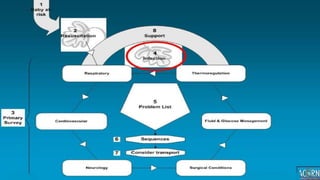
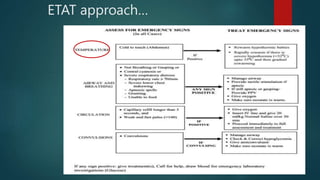
How to Triage a newborn?(CONT….)
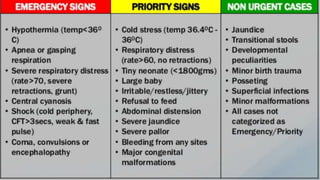
ETAT approach…
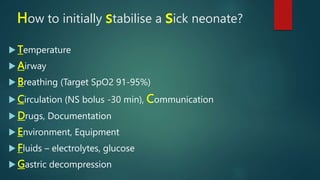
How to initially stabilise a sick neonate?
 Temperature
 Airway
 Breathing (Target SpO2 91-95%)
 Circulation (NS bolus -30 min), Communication
 Drugs, Documentation
 Environment, Equipment
 Fluids – electrolytes, glucose
 Gastric decompression
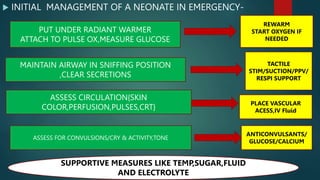
 INITIAL MANAGEMENT OF A NEONATE IN EMERGENCY-
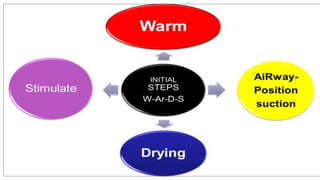
PUT UNDER RADIANT WARMER
ATTACH TO PULSE OX,MEASURE GLUCOSE
MAINTAIN AIRWAY IN SNIFFING POSITION
,CLEAR SECRETIONS
ASSESS CIRCULATION{SKIN
COLOR,PERFUSION,PULSES,CRT}
ASSESS FOR CONVULSIONS/CRY & ACTIVITY,TONE
ANTICONVULSANTS/
GLUCOSE/CALCIUM
PLACE VASCULAR
ACESS,IV Fluid
TACTILE
STIM/SUCTION/PPV/
RESPI SUPPORT
REWARM
START OXYGEN IF
NEEDED
SUPPORTIVE MEASURES LIKE TEMP,SUGAR,FLUID
AND ELECTROLYTE
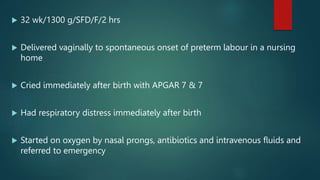
 32 wk/1300 g/SFD/F/2 hrs
 Delivered vaginally to spontaneous onset of preterm labour in a nursing
home
 Cried immediately after birth with APGAR 7 & 7
 Had respiratory distress immediately after birth
 Started on oxygen by nasal prongs, antibiotics and intravenous fluids and
referred to emergency
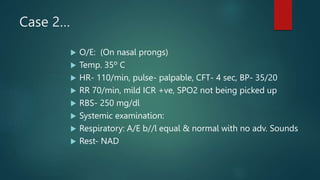
Case 2…
 O/E: (On nasal prongs)
 Temp. 35º C
 HR- 110/min, pulse- palpable, CFT- 4 sec, BP- 35/20
 RR 70/min, mild ICR +ve, SPO2 not being picked up
 RBS- 250 mg/dl
 Systemic examination:
 Respiratory: A/E b//l equal & normal with no adv. Sounds
 Rest- NAD
What we practice in NICU here….
Intensive care cot space should always be prepared and ready for use
Transport incubator checked at start of every shift and ready for use
(Disseminate information immediately)
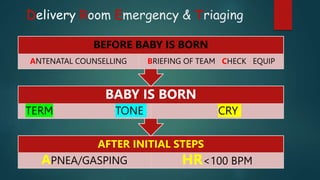
Delivery Room Emergency & Triaging
AFTER INITIAL STEPS
APNEA/GASPING HR<100 BPM
BABY IS BORN
TERM TONE CRY
BEFORE BABY IS BORN
ANTENATAL COUNSELLING BRIEFING OF TEAM CHECK EQUIP
Team concept to be developed where obs provider is also a part.
Institute should have a clear duty roaster sharing between dept with clear
clear cut guidelines regarding LR calls.
@AIIMS R-
 All deliveries attended by Ped JR.
 We have identified a list of conditions where PDCC should attend the
delivery or if the obs faculty request.
 We have a whatsapp group where between 8 am and 8 pm we update
bed status and high risk pregnancy.
 Proper documentation with debriefing sessions.
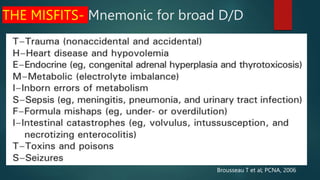
THE MISFITS- Mnemonic for broad D/D
Brousseau T et al; PCNA, 2006
THANK YOU
FORA PATIENTLISTENING

NEONATAL EMERGENCIES TRIAGE.pptx

  • 1.
    NEONATAL EMERGENCIES how isit different ??? Dr PHALGUNI PADHI ASST PROFESSOR DEPARTMENT OF NEONATOLOGY AIIMS RAIPUR
  • 2.
    How is itdifferent?  Neonatal emergencies can start in……..the FETUS k/a…FETAL EMERGENCIES  Common thing like Blood Group of mother (Rh Negative)can lead to fetal emergency(Hydrops Fetalis).  Fetal emergencies commonly seen are fetal arrythmias,Hydrops ,FGR etc  Needs multidisciplinary team approach
  • 3.
     What arethe limitations in newborns? Less reserve so decompensates quite early Limited & non-specific presentation Limitation in assessment due to prematurity Origin may be from insults during utero, birth or immediate post natal period highlighting importance of each aspect of history
  • 4.
    Neonatal Resusication isdifferent….. Adult cardiac arrest is a complication of trauma or existing heart disease. It is caused by a sudden arrhythmia that prevents the heart from effectively circulating blood. During adult cardiopulmonary resuscitation, chest compressions are used to maintain circulation until electrical defibrillation or medications restore cardiac function.
  • 5.
    Neonatal Resusication isdifferent….. In contrast, most newborns requiring resuscitation have a healthy heart. When a newborn requires resuscitation, it is usually caused by a problem with respiration leading to inadequate gas exchange. Respiratory failure may occur either before or after birth. If the baby is Hypothermic,resusication wouldnot be effective,SO the sequence is………………. T - A - B - C
  • 6.
    Objectives  How toapproach a neonate who is unwell or at risk of being unwell?  How to stabilise him/her?  What are the possible differential diagnosis in such patient?
  • 7.
    Which is thebiggest neonatal emergency? Probably
  • 8.
    Food for thought! Whyis it important to recognise a sick newborn at the earliest? Delay will lead to high morbidity & mortality
  • 9.
    How to approach? Logicaland systematic approach for babies who are unwell or at risk of becoming unwell Gathering & organising information Establishing priorities Intervening appropriately
  • 10.
    How to Triagea newborn? Different scoring system- CRIB II - B.Wt/GA/SEX/MAX FiO2/BD/ADMISSION TEMP SNAP-PE - WT/GA/APGAR/(PaO2/FiO2)/OI/TPC/RFT OTHERS LIKE…… BERLIN SCORE NMPI NTISS NICHD SCORE SINKIN 12
  • 11.
    How to Triagea newborn?(CONT….)
  • 16.
  • 17.
    How to initiallystabilise a sick neonate?  Temperature  Airway  Breathing (Target SpO2 91-95%)  Circulation (NS bolus -30 min), Communication  Drugs, Documentation  Environment, Equipment  Fluids – electrolytes, glucose  Gastric decompression
  • 18.
     INITIAL MANAGEMENTOF A NEONATE IN EMERGENCY- PUT UNDER RADIANT WARMER ATTACH TO PULSE OX,MEASURE GLUCOSE MAINTAIN AIRWAY IN SNIFFING POSITION ,CLEAR SECRETIONS ASSESS CIRCULATION{SKIN COLOR,PERFUSION,PULSES,CRT} ASSESS FOR CONVULSIONS/CRY & ACTIVITY,TONE ANTICONVULSANTS/ GLUCOSE/CALCIUM PLACE VASCULAR ACESS,IV Fluid TACTILE STIM/SUCTION/PPV/ RESPI SUPPORT REWARM START OXYGEN IF NEEDED SUPPORTIVE MEASURES LIKE TEMP,SUGAR,FLUID AND ELECTROLYTE
  • 19.
     32 wk/1300g/SFD/F/2 hrs  Delivered vaginally to spontaneous onset of preterm labour in a nursing home  Cried immediately after birth with APGAR 7 & 7  Had respiratory distress immediately after birth  Started on oxygen by nasal prongs, antibiotics and intravenous fluids and referred to emergency
  • 20.
    Case 2…  O/E:(On nasal prongs)  Temp. 35º C  HR- 110/min, pulse- palpable, CFT- 4 sec, BP- 35/20  RR 70/min, mild ICR +ve, SPO2 not being picked up  RBS- 250 mg/dl  Systemic examination:  Respiratory: A/E b//l equal & normal with no adv. Sounds  Rest- NAD
  • 21.
    What we practicein NICU here…. Intensive care cot space should always be prepared and ready for use Transport incubator checked at start of every shift and ready for use (Disseminate information immediately)
  • 22.
    Delivery Room Emergency& Triaging AFTER INITIAL STEPS APNEA/GASPING HR<100 BPM BABY IS BORN TERM TONE CRY BEFORE BABY IS BORN ANTENATAL COUNSELLING BRIEFING OF TEAM CHECK EQUIP
  • 24.
    Team concept tobe developed where obs provider is also a part. Institute should have a clear duty roaster sharing between dept with clear clear cut guidelines regarding LR calls. @AIIMS R-  All deliveries attended by Ped JR.  We have identified a list of conditions where PDCC should attend the delivery or if the obs faculty request.  We have a whatsapp group where between 8 am and 8 pm we update bed status and high risk pregnancy.  Proper documentation with debriefing sessions.
  • 25.
    THE MISFITS- Mnemonicfor broad D/D Brousseau T et al; PCNA, 2006
  • 27.