Nicholas Lovell
GAMESbrief
11th November, 2010
The afternoon
 2.00: What is a self-publishing and who do you need to
do it?
 2.30: ARM yourself: funneling users into profits
 3.00: Whales, power-laws and the future of media
 3.30: How do we get our game out there?
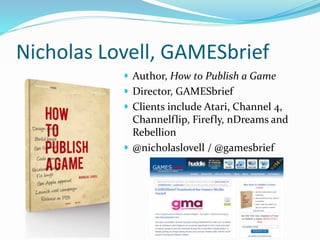
Nicholas Lovell, GAMESbrief
 Author, How to Publish a Game
 Director, GAMESbrief
 Clients include Atari, Channel 4,
Channelflip, Firefly, nDreams and
Rebellion
 @nicholaslovell / @gamesbrief
Who does what?
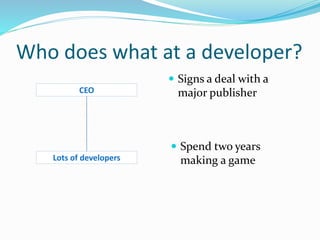
Who does what at a developer?
CEO
Lots of developers
 Signs a deal with a
major publisher
 Spend two years
making a game
Who does what at a publisher?
 Over to you
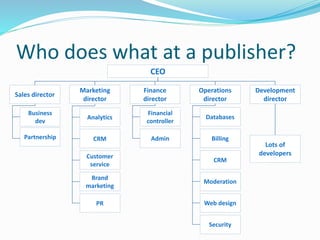
Who does what at a publisher?
CEO
Development
director
Operations
director
Marketing
director
Finance
director
Sales director
Lots of
developers
Databases
Billing
CRM
Moderation
Web design
Security
Analytics
CRM
Customer
service
Brand
marketing
PR
Financial
controller
Admin
Business
dev
Partnership
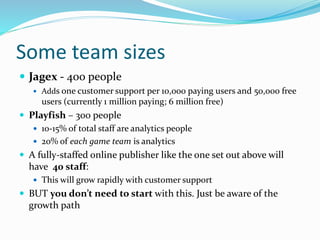
Some team sizes
 Jagex - 400 people
 Adds one customer support per 10,000 paying users and 50,000 free
users (currently 1 million paying; 6 million free)
 Playfish – 300 people
 10-15% of total staff are analytics people
 20% of each game team is analytics
 A fully-staffed online publisher like the one set out above will

have 40 staff:
 This will grow rapidly with customer support
 BUT you don’t need to start with this. Just be aware of the
growth path
Can we outsource?
 Developers have always outsourced the publishing
function – to PUBLISHERS
 Most jobs *can* be outsourced
 The questions is which ones *should* be
Sales
 This is all about taking the user’s money
 As much technology as “sales”
 PSN/XBLA/WiiWare/iPhone:
 Already outsourced to Sony/Microsoft/Nintendo/Apple
 Web billing:
 Yes, but plenty of integration issues
 Advertising sales:
 Yes, but plenty of integration issues
Distribution
 This is all about getting games into the hands of users
 PSN/XBLA/WiiWare/iPhone:
 Already outsourced to Sony/Microsoft/Nintendo/Apple
 On the web, this has two elements:
 Technical: scaleable infrastructure
 Marketing: generating traffic and plays
 Although large elements can be “outsourced” to
Facebook
Marketing
 ARM yourself:
 Acquisition: getting players to your game
 Retention: keep them coming back
 Monetisation: make money from them
 Where marketing meets gameplay, keep it inhouse
 “Traditional” marketing skills can be outsourced:
 PR
 Brand marketing
 Graphic design
Finance
 The hardest element to outsource
 Only you can determine how best to finance your game
 Heavily dependent on your business model
 Regional location may matter
 Use accountants/lawyers/financial advisors where
necessary
 Non-executives are extremely useful
 But boot-strapping may be best
ARM yourselves:
funnelling users into profits
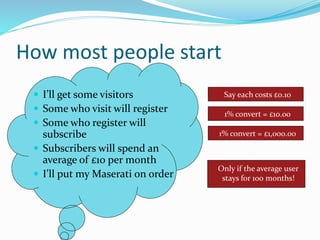
 I’ll get some visitors
 Some who visit will register
 Some who register will
subscribe
 Subscribers will spend an
average of £10 per month
 I’ll put my Maserati on order
1% convert = £1,000.00
1% convert = £10.00
Say each costs £0.10
Only if the average user
stays for 100 months!
How most people start
ARM yourself
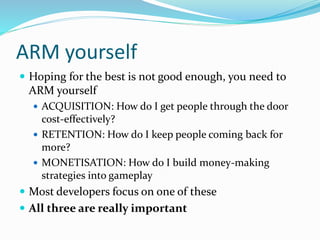
 Hoping for the best is not good enough, you need to
ARM yourself
 ACQUISITION: How do I get people through the door
cost-effectively?
 RETENTION: How do I keep people coming back for
more?
 MONETISATION: How do I build money-making
strategies into gameplay
 Most developers focus on one of these
 All three are really important
The funnel
Users
Profits
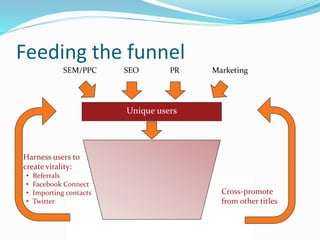
Feeding the funnel
Unique users
Harness users to
create virality:
• Referrals
• Facebook Connect
• Importing contacts
• Twitter
MarketingPRSEOSEM/PPC
Cross-promote
from other titles
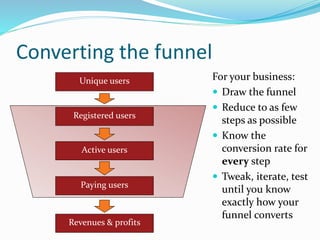
Converting the funnel
Unique users
Registered users
Active users
Paying users
Revenues & profits
For your business:
 Draw the funnel
 Reduce to as few
steps as possible
 Know the
conversion rate for
every step
 Tweak, iterate, test
until you know
exactly how your
funnel converts
Finding the levers
 Users are not the only metric
 The others depend on your business, but might include:
 Page views
 Video views
 Game downloads
 Purchase of a virtual item
 A metric that you can’t influence is no good
 Focus on LEVERS
Digression 1: Calls to Action
 On every page, you should know what you want your users
to do
 Then SHOW THEM
 e.g. Register/Log In/Buy/Subscribe
 But also:
 Tell a friend
 Play a game
 Connect with Facebook/Twitter
The equations
Why the funnel matters
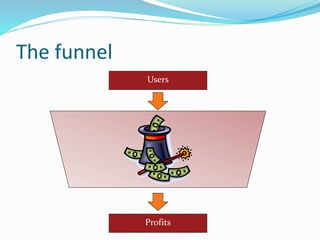
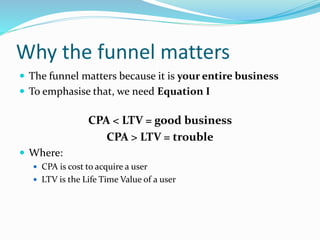
 The funnel matters because it is your entire business
 To emphasise that, we need Equation I
CPA < LTV = good business
CPA > LTV = trouble
 Where:
 CPA is cost to acquire a user
 LTV is the Life Time Value of a user
Harnessing virality
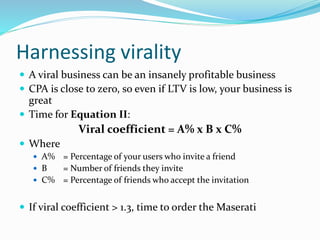
 A viral business can be an insanely profitable business
 CPA is close to zero, so even if LTV is low, your business is
great
 Time for Equation II:
Viral coefficient = A% x B x C%
 Where
 A% = Percentage of your users who invite a friend
 B = Number of friends they invite
 C% = Percentage of friends who accept the invitation
 If viral coefficient > 1.3, time to order the Maserati
But what if I’m not viral?
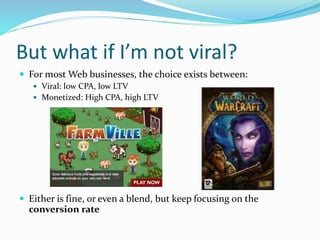
 For most Web businesses, the choice exists between:
 Viral: low CPA, low LTV
 Monetized: High CPA, high LTV
 Either is fine, or even a blend, but keep focusing on the
conversion rate
It’s all about the levers
 Find the metrics that have the biggest impact on the
bottom line
 Try to reduce the metrics to one!
 Three is more usual
 Make sure they are LEVERS
 Laser-like focus on pulling and improving these LEVERS
 The result will be a better business and a happier team
Whales, power-laws and the future
of media
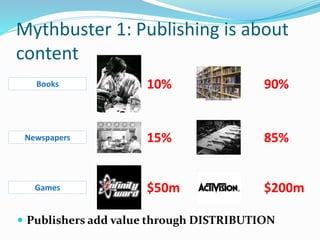
Mythbuster 1: Publishing is about
content
 Publishers add value through DISTRIBUTION
Books 10% 90%
Newspapers 15% 85%
Games $200m$50m
The Internet has made
distribution easy
Great news for content creators
 Content distributors, not so much
 Ballpark, I estimate 50% of people in content
distribution will be out of work over the next decade
 BUT many more content creators will be able to make
a living from producing and distributing their own
content
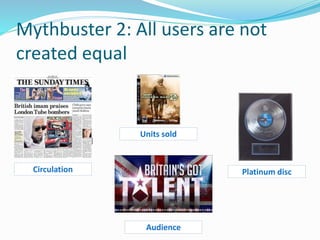
Mythbuster 2: All users are not
created equal
Circulation
Audience
Platinum disc
Units sold
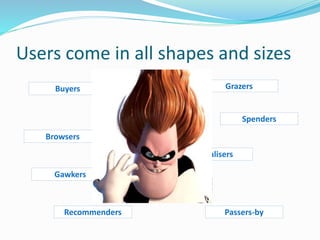
Users come in all shapes and sizes
Buyers
Sneezers
Influencers
Browsers
Spenders
Socialisers
Gawkers
Grazers
Recommenders Passers-by
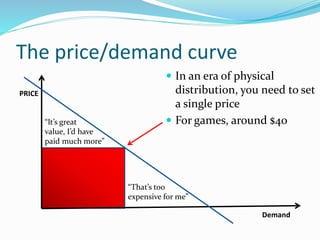
The price/demand curve
 In an era of physical
distribution, you need to set
a single price
 For games, around $40
PRICE
Demand
“That’s too
expensive for me”
“It’s great
value, I’d have
paid much more”
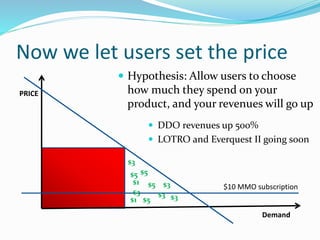
 DDO revenues up 500%
 LOTRO and Everquest II going soon
Now we let users set the price
 Hypothesis: Allow users to choose
how much they spend on your
product, and your revenues will go up
PRICE
Demand
$10 MMO subscription
$1
$1
$5
$5
$5
$5
$3
$3
$3
$3
$3
WRONG!
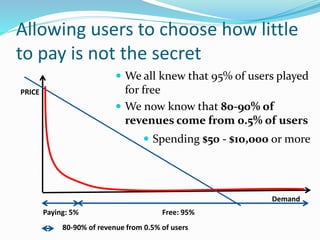
Allowing users to choose how little
to pay is not the secret
 We all knew that 95% of users played
for free
 We now know that 80-90% of
revenues come from 0.5% of users
PRICE
Demand
Free: 95%Paying: 5%
80-90% of revenue from 0.5% of users
 Spending $50 - $10,000 or more
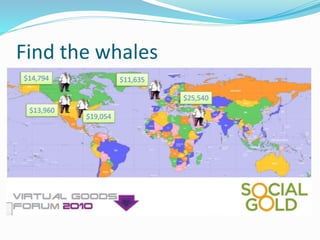
Find the whales
Let’s look outside the games
industry
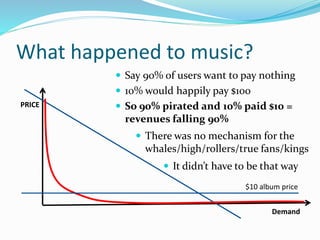
What happened to music?
 Say 90% of users want to pay nothing
 10% would happily pay $100
 So 90% pirated and 10% paid $10 =
revenues falling 90%
PRICE
Demand
 There was no mechanism for the
whales/high/rollers/true fans/kings
$10 album price
 It didn’t have to be that way
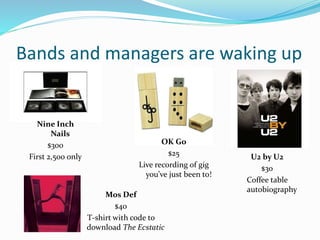
Bands and managers are waking up
Nine Inch
Nails
$300
First 2,500 only
OK Go
$25
Live recording of gig
you’ve just been to!
U2 by U2
$30
Coffee table
autobiography
Mos Def
$40
T-shirt with code to
download The Ecstatic
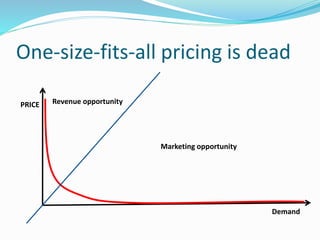
One-size-fits-all pricing is dead
PRICE
Demand
Revenue opportunity
Marketing opportunity
Mythbuster 3: Free players are
freeloaders
 Free users are insanely important
 They are:
 Potential converts
 Eyeballs for advertising
 Leads for lead gen deals
 Influencers through virality and word of mouth
 Gawkers
 Every single player has value
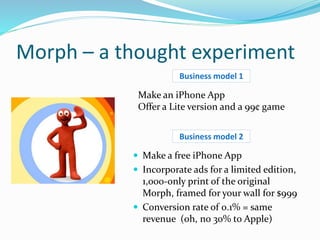
Morph – a thought experiment
Business model 2
 Make a free iPhone App
 Incorporate ads for a limited edition,
1,000-only print of the original
Morph, framed for your wall for $999
 Conversion rate of 0.1% = same
revenue (oh, no 30% to Apple)
Business model 1
Make an iPhone App
Offer a Lite version and a 99¢ game
My advice
 If you don’t have a way for whales to spend unlimited
amounts of cash, you’re in trouble
 Look after the whales
 Treat your freeloaders with love and respect; they
never stop being valuable
 All users are not equal. Tailor your products
accordingly
 Sales, marketing, revenue generation. These are all
part of the creative process now. Have fun.
How do we get our game out
there?
Neon workshop2010

Neon workshop2010

  • 1.
  • 2.
    The afternoon  2.00:What is a self-publishing and who do you need to do it?  2.30: ARM yourself: funneling users into profits  3.00: Whales, power-laws and the future of media  3.30: How do we get our game out there?
  • 3.
    Nicholas Lovell, GAMESbrief Author, How to Publish a Game  Director, GAMESbrief  Clients include Atari, Channel 4, Channelflip, Firefly, nDreams and Rebellion  @nicholaslovell / @gamesbrief
  • 4.
  • 5.
    Who does whatat a developer? CEO Lots of developers  Signs a deal with a major publisher  Spend two years making a game
  • 6.
    Who does whatat a publisher?  Over to you
  • 7.
    Who does whatat a publisher? CEO Development director Operations director Marketing director Finance director Sales director Lots of developers Databases Billing CRM Moderation Web design Security Analytics CRM Customer service Brand marketing PR Financial controller Admin Business dev Partnership
  • 8.
    Some team sizes Jagex - 400 people  Adds one customer support per 10,000 paying users and 50,000 free users (currently 1 million paying; 6 million free)  Playfish – 300 people  10-15% of total staff are analytics people  20% of each game team is analytics  A fully-staffed online publisher like the one set out above will have 40 staff:  This will grow rapidly with customer support  BUT you don’t need to start with this. Just be aware of the growth path
  • 9.
    Can we outsource? Developers have always outsourced the publishing function – to PUBLISHERS  Most jobs *can* be outsourced  The questions is which ones *should* be
  • 10.
    Sales  This isall about taking the user’s money  As much technology as “sales”  PSN/XBLA/WiiWare/iPhone:  Already outsourced to Sony/Microsoft/Nintendo/Apple  Web billing:  Yes, but plenty of integration issues  Advertising sales:  Yes, but plenty of integration issues
  • 11.
    Distribution  This isall about getting games into the hands of users  PSN/XBLA/WiiWare/iPhone:  Already outsourced to Sony/Microsoft/Nintendo/Apple  On the web, this has two elements:  Technical: scaleable infrastructure  Marketing: generating traffic and plays  Although large elements can be “outsourced” to Facebook
  • 12.
    Marketing  ARM yourself: Acquisition: getting players to your game  Retention: keep them coming back  Monetisation: make money from them  Where marketing meets gameplay, keep it inhouse  “Traditional” marketing skills can be outsourced:  PR  Brand marketing  Graphic design
  • 13.
    Finance  The hardestelement to outsource  Only you can determine how best to finance your game  Heavily dependent on your business model  Regional location may matter  Use accountants/lawyers/financial advisors where necessary  Non-executives are extremely useful  But boot-strapping may be best
  • 14.
  • 15.
     I’ll getsome visitors  Some who visit will register  Some who register will subscribe  Subscribers will spend an average of £10 per month  I’ll put my Maserati on order 1% convert = £1,000.00 1% convert = £10.00 Say each costs £0.10 Only if the average user stays for 100 months! How most people start
  • 16.
    ARM yourself  Hopingfor the best is not good enough, you need to ARM yourself  ACQUISITION: How do I get people through the door cost-effectively?  RETENTION: How do I keep people coming back for more?  MONETISATION: How do I build money-making strategies into gameplay  Most developers focus on one of these  All three are really important
  • 17.
  • 18.
    Feeding the funnel Uniqueusers Harness users to create virality: • Referrals • Facebook Connect • Importing contacts • Twitter MarketingPRSEOSEM/PPC Cross-promote from other titles
  • 19.
    Converting the funnel Uniqueusers Registered users Active users Paying users Revenues & profits For your business:  Draw the funnel  Reduce to as few steps as possible  Know the conversion rate for every step  Tweak, iterate, test until you know exactly how your funnel converts
  • 20.
    Finding the levers Users are not the only metric  The others depend on your business, but might include:  Page views  Video views  Game downloads  Purchase of a virtual item  A metric that you can’t influence is no good  Focus on LEVERS
  • 21.
    Digression 1: Callsto Action  On every page, you should know what you want your users to do  Then SHOW THEM  e.g. Register/Log In/Buy/Subscribe  But also:  Tell a friend  Play a game  Connect with Facebook/Twitter
  • 22.
  • 23.
    Why the funnelmatters  The funnel matters because it is your entire business  To emphasise that, we need Equation I CPA < LTV = good business CPA > LTV = trouble  Where:  CPA is cost to acquire a user  LTV is the Life Time Value of a user
  • 24.
    Harnessing virality  Aviral business can be an insanely profitable business  CPA is close to zero, so even if LTV is low, your business is great  Time for Equation II: Viral coefficient = A% x B x C%  Where  A% = Percentage of your users who invite a friend  B = Number of friends they invite  C% = Percentage of friends who accept the invitation  If viral coefficient > 1.3, time to order the Maserati
  • 25.
    But what ifI’m not viral?  For most Web businesses, the choice exists between:  Viral: low CPA, low LTV  Monetized: High CPA, high LTV  Either is fine, or even a blend, but keep focusing on the conversion rate
  • 26.
    It’s all aboutthe levers  Find the metrics that have the biggest impact on the bottom line  Try to reduce the metrics to one!  Three is more usual  Make sure they are LEVERS  Laser-like focus on pulling and improving these LEVERS  The result will be a better business and a happier team
  • 28.
    Whales, power-laws andthe future of media
  • 29.
    Mythbuster 1: Publishingis about content  Publishers add value through DISTRIBUTION Books 10% 90% Newspapers 15% 85% Games $200m$50m
  • 30.
    The Internet hasmade distribution easy
  • 31.
    Great news forcontent creators  Content distributors, not so much  Ballpark, I estimate 50% of people in content distribution will be out of work over the next decade  BUT many more content creators will be able to make a living from producing and distributing their own content
  • 32.
    Mythbuster 2: Allusers are not created equal Circulation Audience Platinum disc Units sold
  • 33.
    Users come inall shapes and sizes Buyers Sneezers Influencers Browsers Spenders Socialisers Gawkers Grazers Recommenders Passers-by
  • 34.
    The price/demand curve In an era of physical distribution, you need to set a single price  For games, around $40 PRICE Demand “That’s too expensive for me” “It’s great value, I’d have paid much more”
  • 35.
     DDO revenuesup 500%  LOTRO and Everquest II going soon Now we let users set the price  Hypothesis: Allow users to choose how much they spend on your product, and your revenues will go up PRICE Demand $10 MMO subscription $1 $1 $5 $5 $5 $5 $3 $3 $3 $3 $3
  • 36.
  • 37.
    Allowing users tochoose how little to pay is not the secret  We all knew that 95% of users played for free  We now know that 80-90% of revenues come from 0.5% of users PRICE Demand Free: 95%Paying: 5% 80-90% of revenue from 0.5% of users  Spending $50 - $10,000 or more
  • 38.
  • 39.
    Let’s look outsidethe games industry
  • 40.
    What happened tomusic?  Say 90% of users want to pay nothing  10% would happily pay $100  So 90% pirated and 10% paid $10 = revenues falling 90% PRICE Demand  There was no mechanism for the whales/high/rollers/true fans/kings $10 album price  It didn’t have to be that way
  • 41.
    Bands and managersare waking up Nine Inch Nails $300 First 2,500 only OK Go $25 Live recording of gig you’ve just been to! U2 by U2 $30 Coffee table autobiography Mos Def $40 T-shirt with code to download The Ecstatic
  • 42.
    One-size-fits-all pricing isdead PRICE Demand Revenue opportunity Marketing opportunity
  • 43.
    Mythbuster 3: Freeplayers are freeloaders  Free users are insanely important  They are:  Potential converts  Eyeballs for advertising  Leads for lead gen deals  Influencers through virality and word of mouth  Gawkers  Every single player has value
  • 44.
    Morph – athought experiment Business model 2  Make a free iPhone App  Incorporate ads for a limited edition, 1,000-only print of the original Morph, framed for your wall for $999  Conversion rate of 0.1% = same revenue (oh, no 30% to Apple) Business model 1 Make an iPhone App Offer a Lite version and a 99¢ game
  • 45.
    My advice  Ifyou don’t have a way for whales to spend unlimited amounts of cash, you’re in trouble  Look after the whales  Treat your freeloaders with love and respect; they never stop being valuable  All users are not equal. Tailor your products accordingly  Sales, marketing, revenue generation. These are all part of the creative process now. Have fun.
  • 46.
    How do weget our game out there?