Going Online
Moving from boxed title
game devlopemt to F2P
Ralf C. Adam
This lecture was first held in August 2010 at the European GDC
in Cologne/GERMANY. The presentation may not include all
original materials shown during this speech (pictures, videos
etc.) and is solely meant as a summary and handout. All
copyrights of presented materials belong to their respective
owners.
DISCLAIMER
• Ralf C. Adam
• Vice President Publishing / Gameforge
• In the games industry since 1993
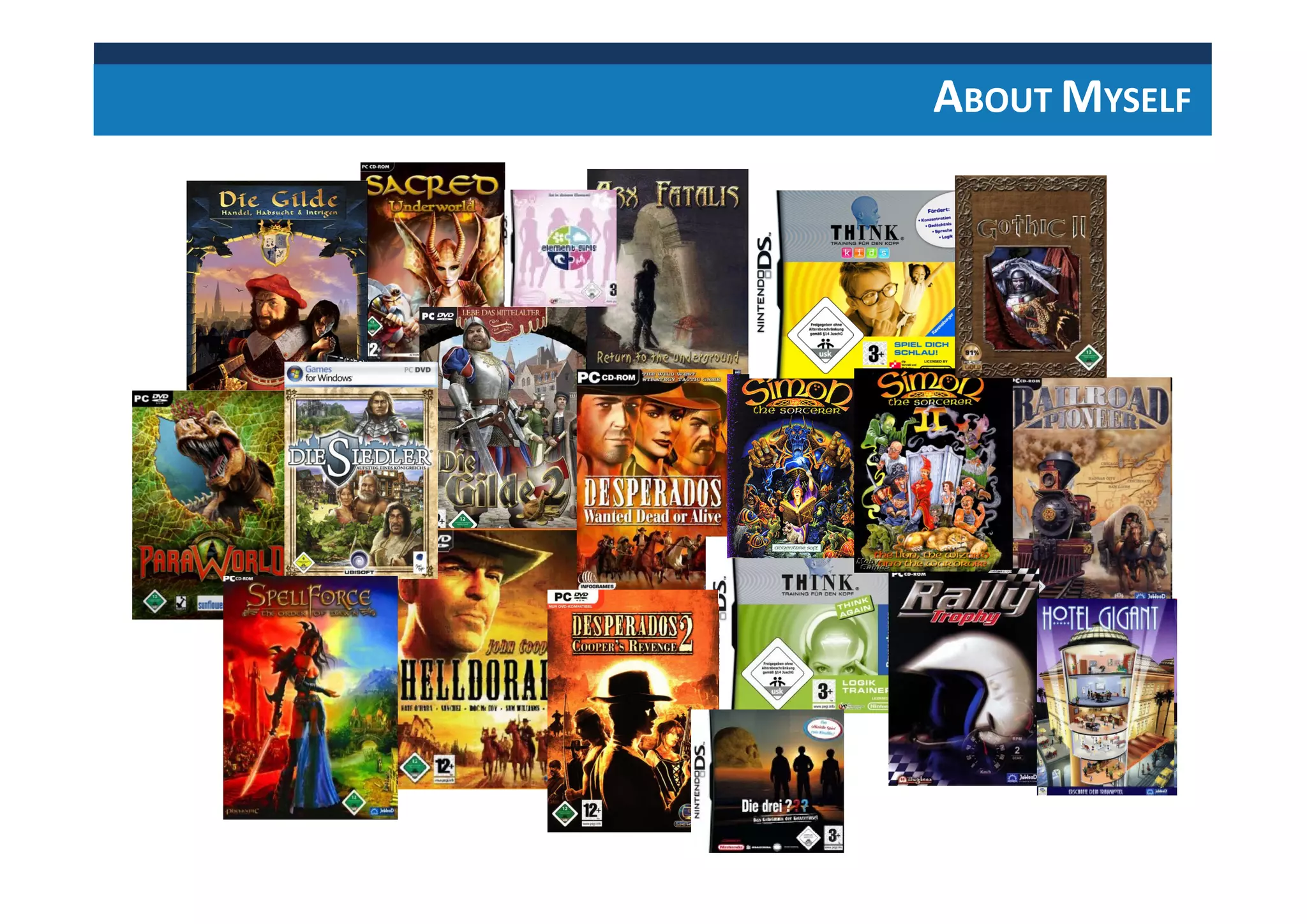
• Track record includes work for Atari/Infogrames,
Ubisoft, Disney Interactive, Take 2, Ascaron,
Sunflowers, Spellbound and other Publisher & Studios
ABOUT MYSELF
ABOUT MYSELF
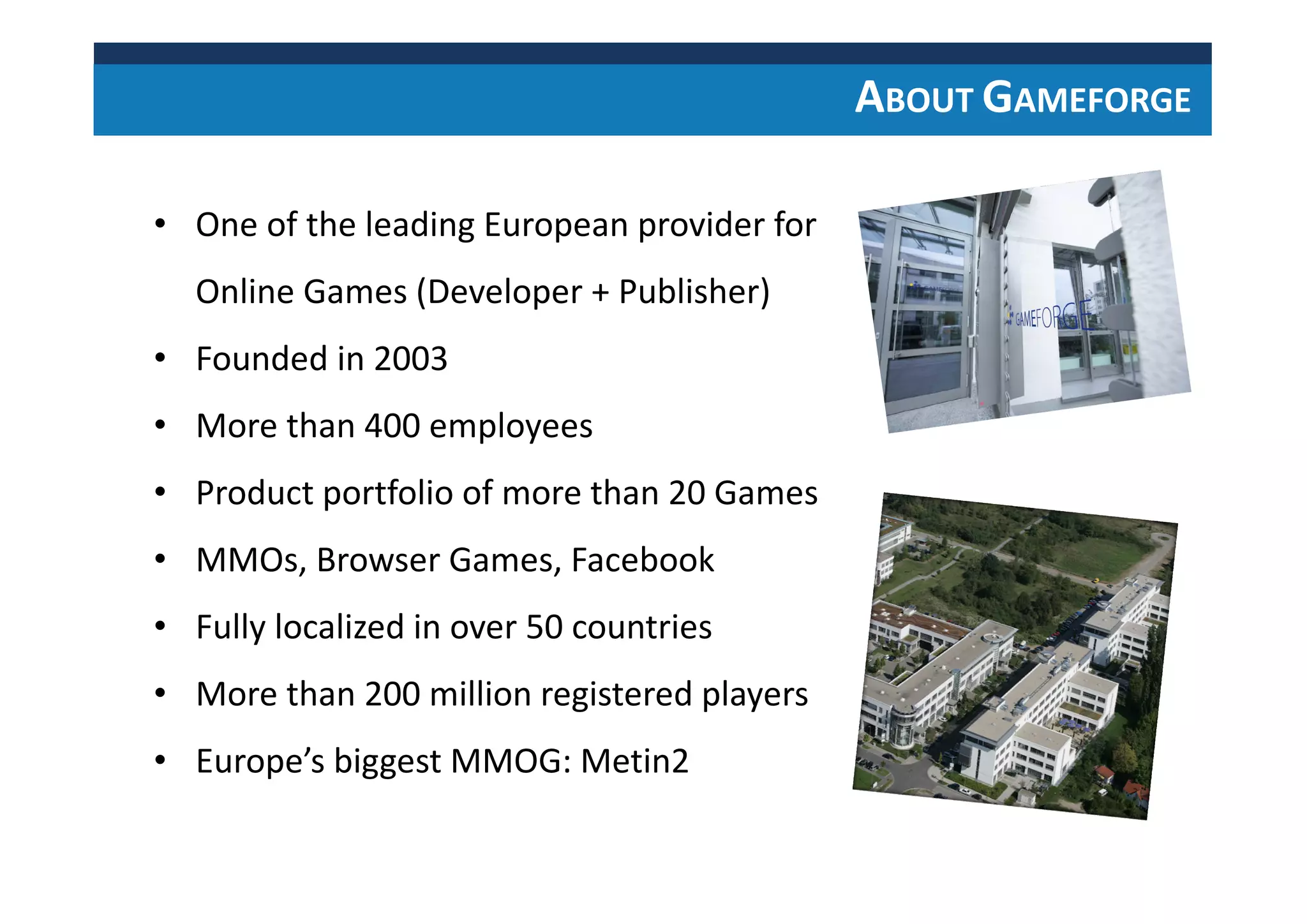
• One of the leading European provider for
Online Games (Developer + Publisher)
• Founded in 2003
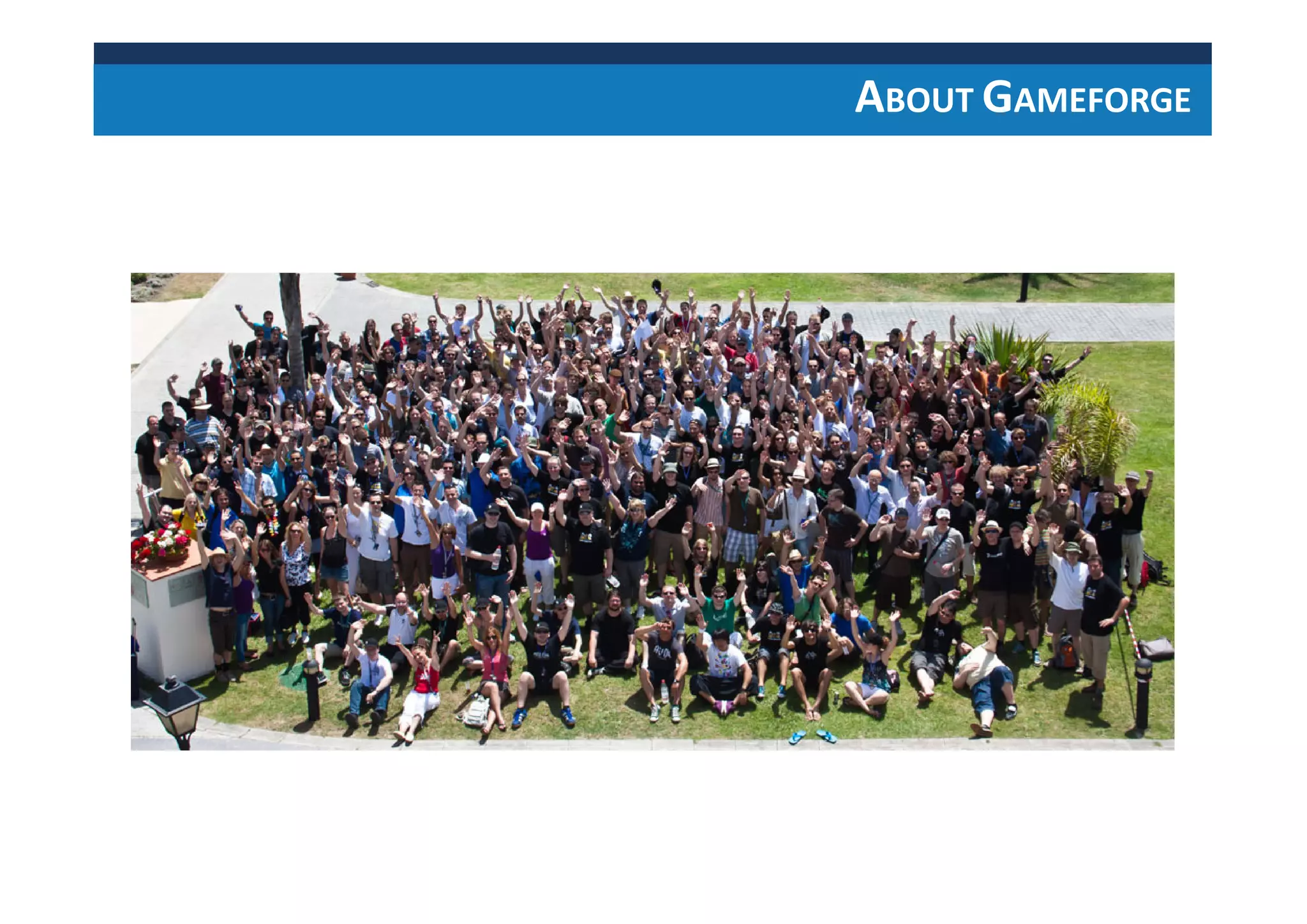
• More than 400 employees
• Product portfolio of more than 20 Games
• MMOs, Browser Games, Facebook
• Fully localized in over 50 countries
• More than 200 million registered players
• Europe’s biggest MMOG: Metin2
ABOUT GAMEFORGE
ABOUT GAMEFORGE
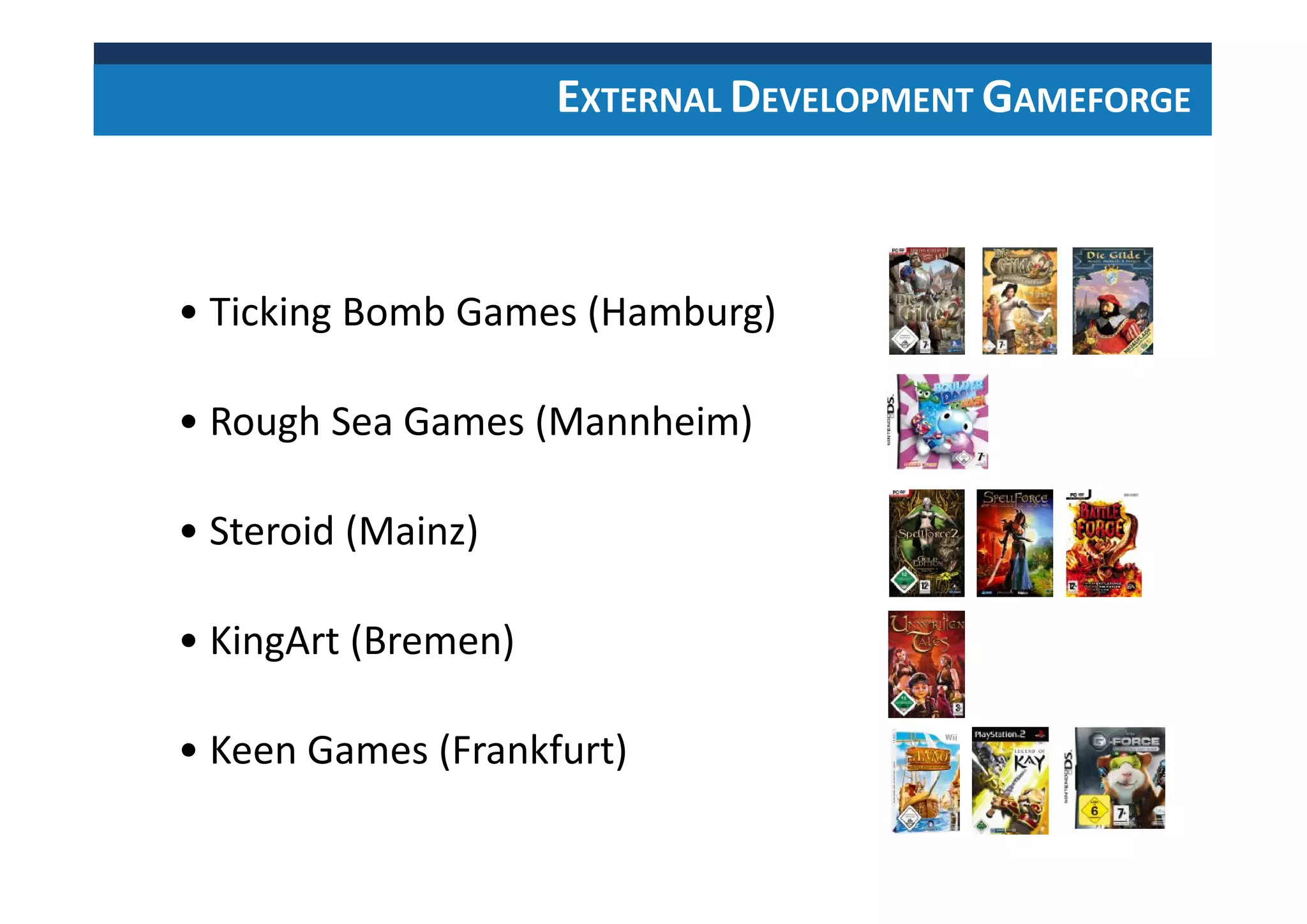
EXTERNAL DEVELOPMENT GAMEFORGE
• Ticking Bomb Games (Hamburg)
• Rough Sea Games (Mannheim)
• Steroid (Mainz)
• KingArt (Bremen)
• Keen Games (Frankfurt)
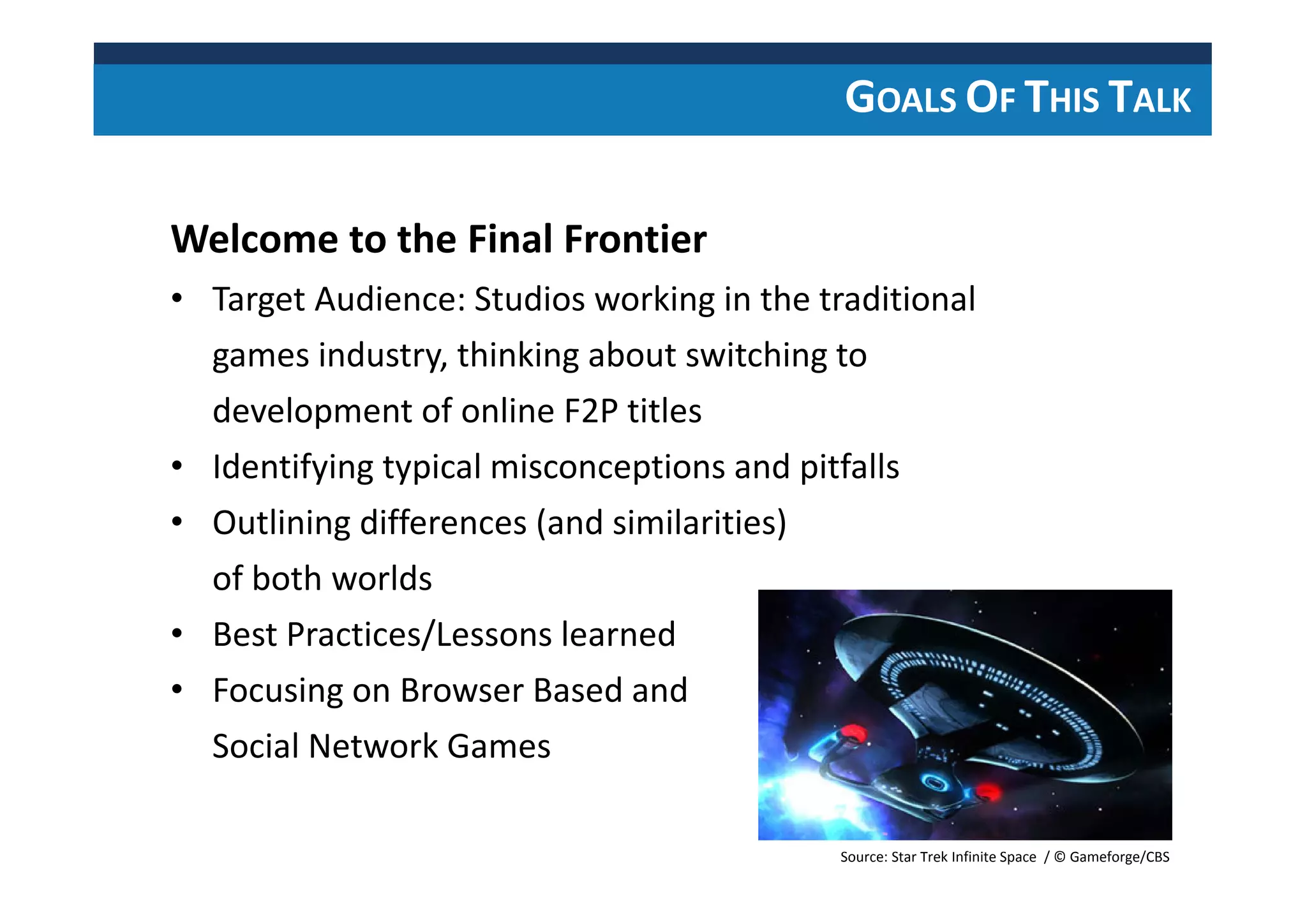
GOALS OF THIS TALK
Welcome to the Final Frontier
• Target Audience: Studios working in the traditional
games industry, thinking about switching to
development of online F2P titles
• Identifying typical misconceptions and pitfalls
• Outlining differences (and similarities)
of both worlds
• Best Practices/Lessons learned
• Focusing on Browser Based and
Social Network Games
Source: Star Trek Infinite Space / © Gameforge/CBS
WHY F2P ONLINE?
Online-Publisher Perspective on External Studios
• Getting the best game developers possible
• Using synergies between own online experience and
know-how of traditional game developers, including
game design, proven workflows and production methods
• Broadening of development capacities
• Scalability of resources
• Collaborating with studios outside
your home territory
Traditional Games Market – The sky is falling
• Exploding budgets & team sizes & development cycles…
• …while the gap between the Top 5 titles and the rest is
getting bigger every day
• Success depends on the first 4 – 6 weeks after release
• Pirating vs. Copy Protection (BattleNet, Cloud Copy
Protection etc.)
• Sequels vs. Innovation
• F2P is there – and it’s going to stay
WHY F2P ONLINE?
WHY F2P ONLINE?
Looks like an easy call – but be aware…
• You might be dealing with smaller budgets
• You might be doing different kind of games
(FarmVille vs. Crysis)…
• …and therefore very likely won’t be seen
as the technological trailblazer of the
gaming industry
• You might need other developer with different
skill sets in your team
• It will have a massive impact on your production
workflows as well as your game design approach
BETTER THINK TWICE
Questions you should ask yourself as a developer
• Where do I want to be with my studio in 2 years
from now? What’s my long-term strategy?
• Maybe I‘m a great game developer – but am I a
good service provider? And do I want to be one?
• Do I have the business skills (and people) that it
takes to be successful?
• Only make your choice with a full knowledge of
the impact of your actions!
ROLE OF PUBLISHER
Publisher REALLY has to be your Partner
• Vital Online-Publisher Services:
Producing (Development)
Live-Producing/Product Management
QA
PR
Localization
Payment
Business Intelligence
Customer Service
Community Management
System-Administration
Tech-Department
Marketing
ROLE OF PUBLISHER
Best Practice
• Choose your partner wisely
• Make a Publisher Due Diligence
• Your key contact persons: Producer (during development)
and later Product Manager (aka Product Director or Live-
Producer)
• Keep a close relationship to your publisher
• Establish direct lines of communication between experts
(including regular meetings and workshops)
• Always communicate personally and directly: Meeting
wins over Phone/Skype wins over ICQ wins over Email
SIGNING THE DEAL
Traditional Business Model:
• Developer gets advance against royalties
• Developer has to recoup the advance
• Percentage of gross profits or net receipts
or a flat fee per product sold
• Only few games earn back their advances
• Therefore developer is “forced” to build profit
into his advances
SIGNING THE DEAL
Important questions
• Who will pay for development?
• Does the budget include general operating expenses?
• Is it an "advance against royalties" model or not?
• Who will pay for the Live-Team?
• Does the studio have to recoup the Live-Team?
• Which Share Model (Profit, Revenue etc.)?
• Does the studio have to recoup Marketing?
SIGNING THE DEAL
Best Practice
• Learn & understand the vocabulary (ARPU, Churn, CLV,
Conversion Rate, Retention etc.)
• Try to do as much research upfront as possible and
build your studio plan and business case on solid
numbers and expectations
• Keep in mind:
o Development Budget is just one piece of the Puzzle
o You won’t break even after one month or two
o The costs that really matter are Live-Team costs
and Marketing spends
GAME DESIGN
»Unlearn what you have learned you must!«
o Asynchronous Gameplay (Browser & Facebook)
o Each player spends different amount of time
o Many players (>1,000) on one Server
o Unique Difference in Facebook compared
to Browser Games: No Game Rounds!
o The player’s experience in the
first five minutes is essential
o F2P also means: no strong commitment
of player in the beginning as he had no
upfront investment
GAME DESIGN
How to earn money in F2P
• Players don’t buy your game – they pay
for goods and services while playing
• You want as many players as possible
• And you want players to spend money
• But player’s that never buy anything
at all are also of great importance
• It’s very dangerous to not annoy
them (otherwise your worlds will be
pretty empty)
GAME DESIGN
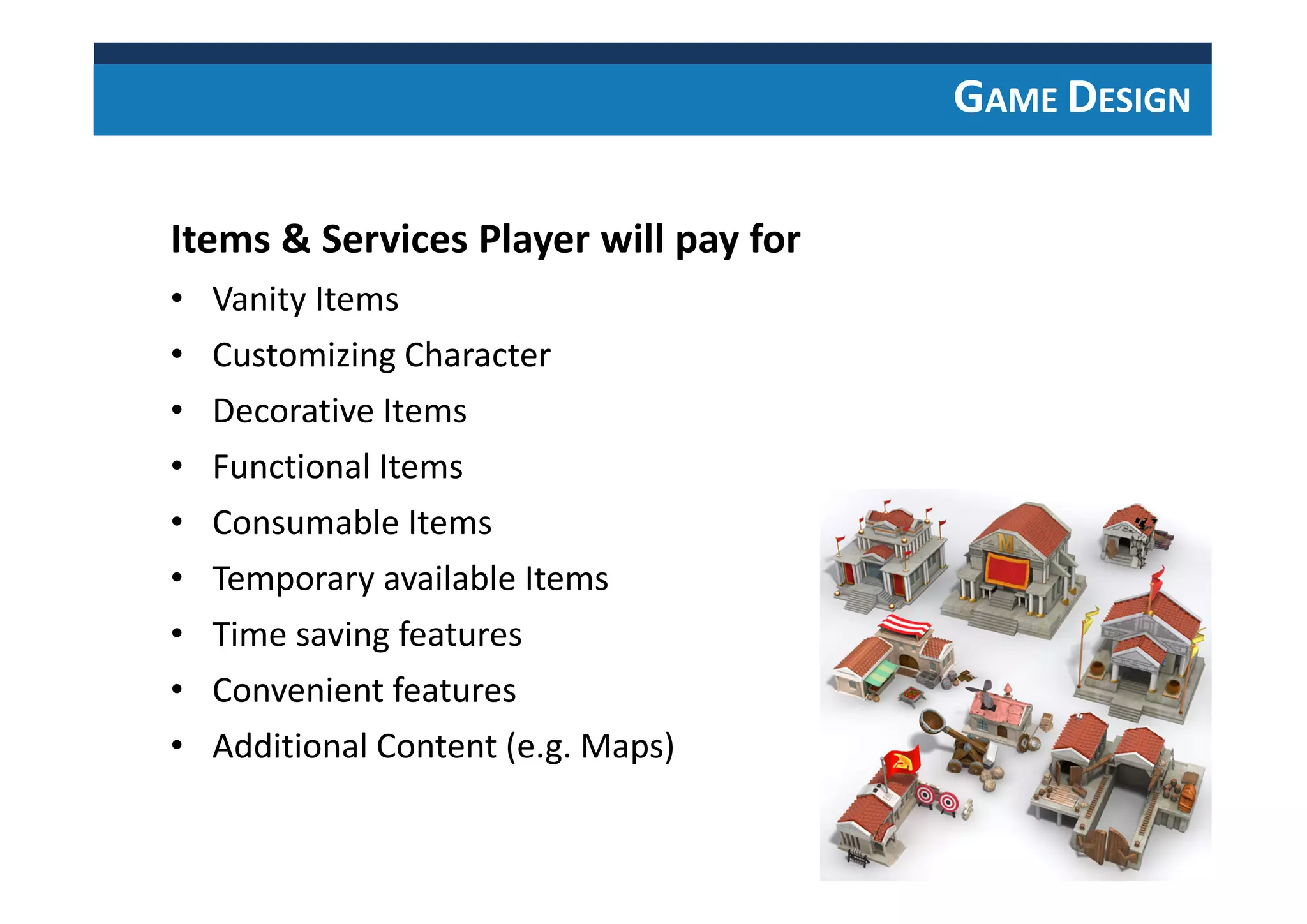
Items & Services Player will pay for
• Vanity Items
• Customizing Character
• Decorative Items
• Functional Items
• Consumable Items
• Temporary available Items
• Time saving features
• Convenient features
• Additional Content (e.g. Maps)
GAME DESIGN
Monetization vs. Game Design
• Monetization needs to be woven into the design
right from the start – not added later
• But always ask yourself first:
o Is that a great feature and is it fun?
o Not: Will the player pay money for it?
• Biggest Challenge: Balancing for payment features
• You do not want to have a pay-to-win strategy
• But payment features must be meaningful to
the player on the other side
GAME DESIGN
Best Practice
• Early prototyping of core gameplay is a must
• Full Pre-Production is vital
• Do a lot of focus group testing – especially for UI
• Two (or more) game designers working collaborative –
One with focus on gameplay and fun and one
concentrating on monetization
• Make the entry into your game as easy and as
accessible as possible
• The player is never wrong
• In the end is still about having a great game!
SCOPE
What does Scope mean?
• Product Scope: All features, functions and assets
that are supposed to be in the game
• Project Scope: All work that must be done to
deliver the game
• Scope needs to be clear and to the point
• Scope needs to be shared
SCOPE
Small is beautiful
• Don’t make it overcomplicated
• Keep the scope as small as possible in the beginning
• You do not need to deliver all content at day #1
• If you fail...
o ...fail early
o ...fail fast
o ...iterate fast
TECHNOLOGY TRAPS
It’s an ever-changing World!
• Online-Games are supposed to be “live” for years
• New DirectX-Version: roughly every 4 years
• Internet: Constant changes!
• Problems with Flash Update 10
• Facebook changes with heavy impact:
o Limitations on User Messaging
o Facebook-Credits
• Worst Case: From one day to the next
your game is not working anymore!
• Your publisher might also do changes
on his own API that could effect you
CODING PITFALLS
Mayday! Mayday!
• 1st Rule: There’s no »quick & dirty« in Online-Games!!!
• Never ever produce a single line of “hard-coded” stuff
• Classic Mistake: »We will not change this feature later,
let’s do a quick hack here.«
• Think about it: Once your game
has taken off, there’s no landing
anymore
• Any update or code change is
like repairing the engine or the
wing of an airplane during flight
THE NAME OF THE GAME
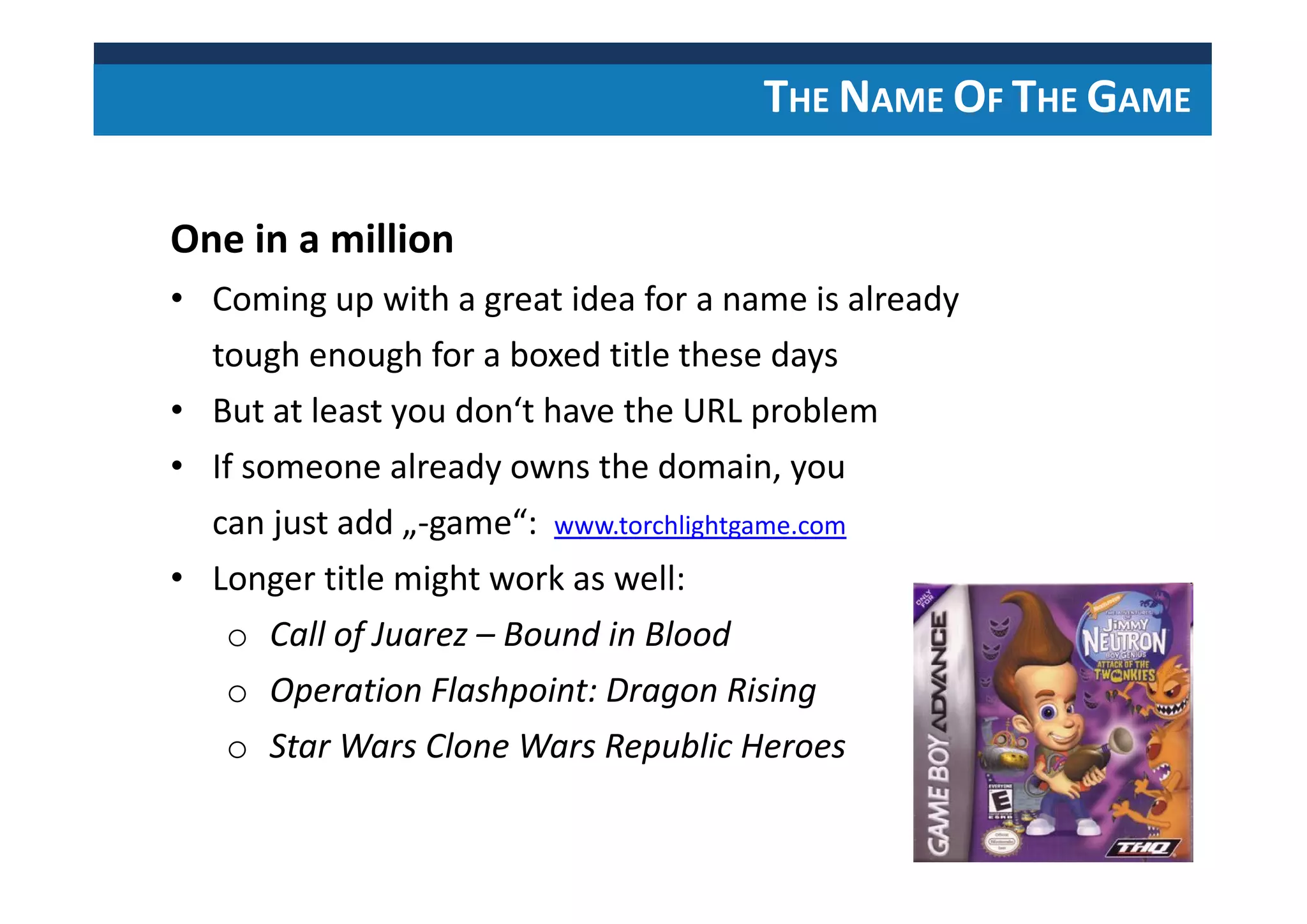
One in a million
• Coming up with a great idea for a name is already
tough enough for a boxed title these days
• But at least you don‘t have the URL problem
• If someone already owns the domain, you
can just add „-game“: www.torchlightgame.com
• Longer title might work as well:
o Call of Juarez – Bound in Blood
o Operation Flashpoint: Dragon Rising
o Star Wars Clone Wars Republic Heroes
THE NAME OF THE GAME
Lessons learned
• Define the name already during pre-production
• Find a name that works everywhere in the World
• If you‘re not native and have an English name: Check
with UK/US natives!
• Make sure, that all relevant domains (.com, .de, .es
etc.) are available and buy them asap
• Name needs to be short (ideally one word)
• Spelling must be evident – even when communicated
only verbally
• Website is equivalent to shelf positioning
LOCALIZATION
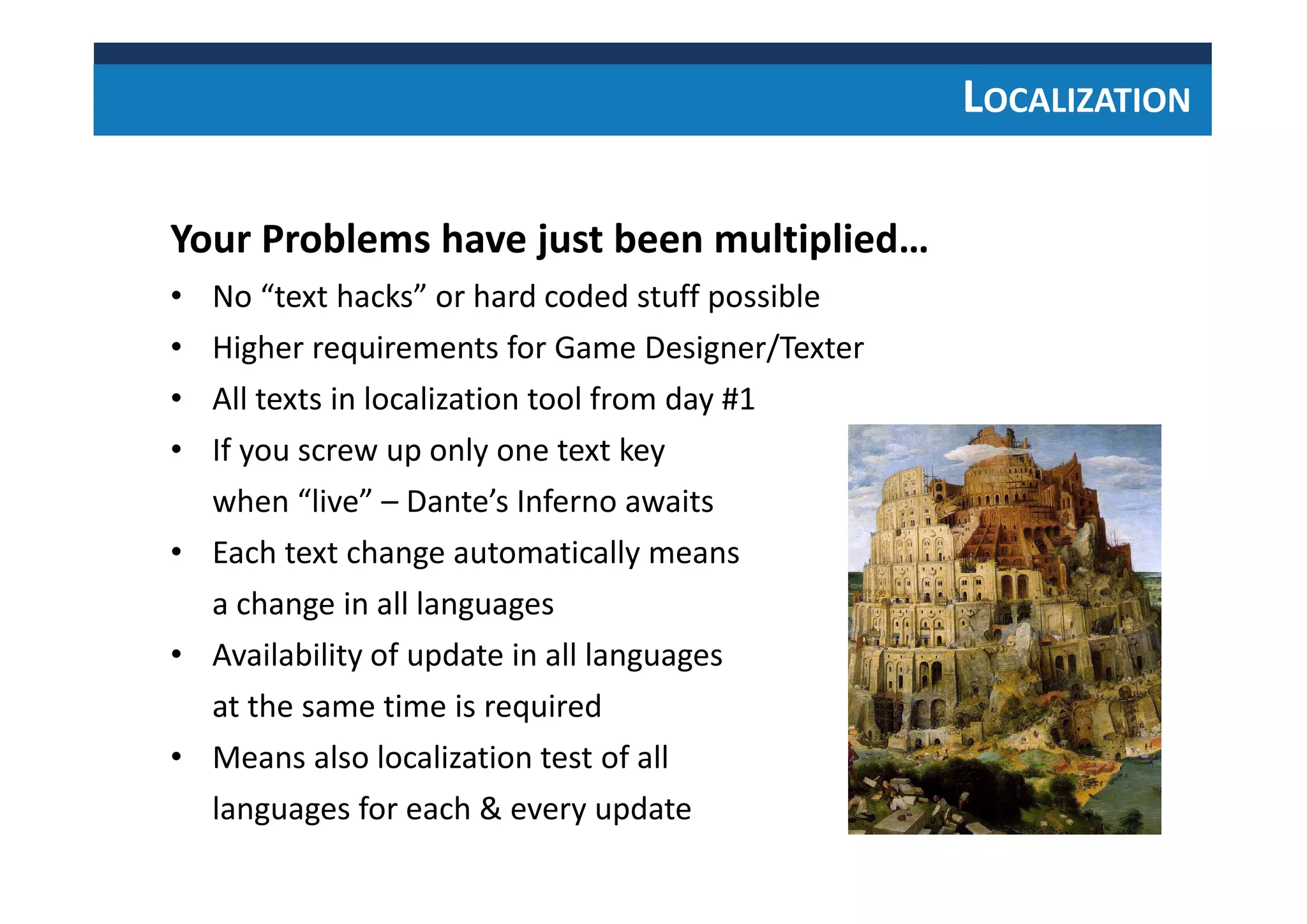
Your Problems have just been multiplied…
• No “text hacks” or hard coded stuff possible
• Higher requirements for Game Designer/Texter
• All texts in localization tool from day #1
• If you screw up only one text key
when “live” – Dante’s Inferno awaits
• Each text change automatically means
a change in all languages
• Availability of update in all languages
at the same time is required
• Means also localization test of all
languages for each & every update
LOCALIZATION
»What’s my line?«
• A close collaboration with Localization Department
throughout the whole production and beyond is vital
• Make sure your game is properly connected into the
publisher localization tool already during Pre-Production
• Never do any quick & dirty fixes with hard coded text
(aka »I will attach the loca key later«)
• Always keep your Localization Manager in the loop
for every text change, no matter how minor it seems
QA & TESTING
Lessons learned the very hard way
• Some Bugs do not occur, when only 200 people are playing
• Different story with 200,000 people though
• Therefore: Never skip a Beta no matter how good the
Alpha looks!
• Fatal: Bugs in features the player has paid for
• Fixing problems when “live” takes 5x times longer
• Always use test servers in the first place
• Automated testing is a must
• Remember: If it’s not tested, it doesn’t work!
ADMINISTRATION TOOL
»Ah, we do that at the very end. Won’t take long!«
• Player Support
o Emails notfications, Guild-Support functions etc…
• Management of user generated content:
o Editing of content, delete functions etc…
• Observing game rules:
o Suspending players, Chatlog access etc…
• Payment Support:
o Player Inventory, Statistics etc…
• User Management
o Different kinds of access level etc…
POST RELEASE
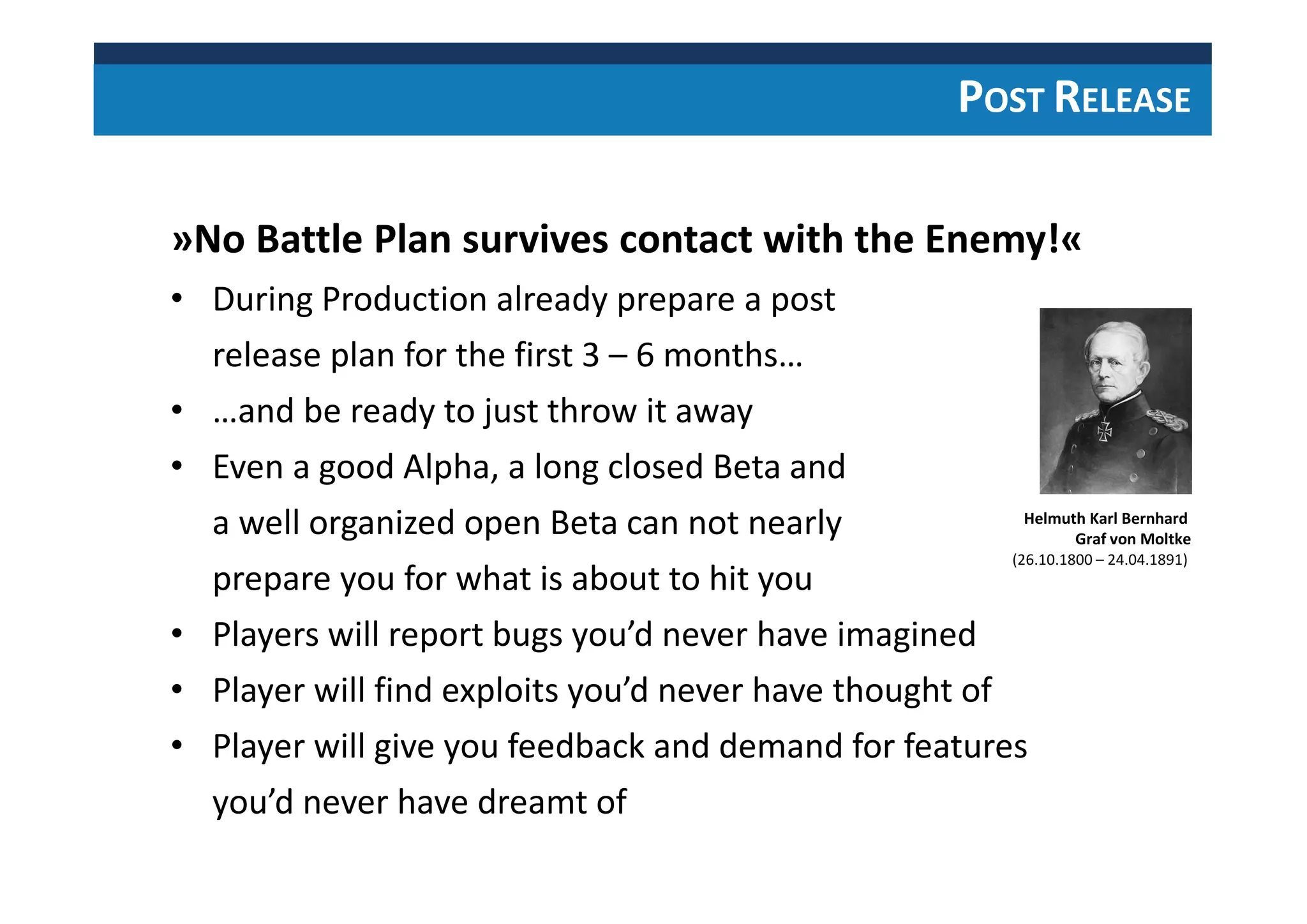
»No Battle Plan survives contact with the Enemy!«
• During Production already prepare a post
release plan for the first 3 – 6 months…
• …and be ready to just throw it away
• Even a good Alpha, a long closed Beta and
a well organized open Beta can not nearly
prepare you for what is about to hit you
• Players will report bugs you’d never have imagined
• Player will find exploits you’d never have thought of
• Player will give you feedback and demand for features
you’d never have dreamt of
Helmuth Karl Bernhard
Graf von Moltke
(26.10.1800 – 24.04.1891)
LIVE-TEAM
»Drums... Drums in the deep! We cannot get out!«
• For Browser Games: first 6 months after release
usually full development team size for Live-Team
• Especially on Facebook even more common: Two
(or more) Live-Teams in parallel
• FB: Release Cycles of 1 – 2 weeks
• Each version tested & in all languages
• Heavy workload for Project Manager
• Strong collaboration with Marketing
is vital
• Once you’re “live” – it’s all about metrics!
TEAM-MOTIVATION
You never ship!
• In the traditional games business you embrace
a new game idea as soon as the current title has
been shipped
• Now you’re not making “products” anymore
• The more successful the game gets the longer the
team will work on it – maybe for many, many years!
• This means an increasing risk, that your team
members will get unsatisfied and demotivated
TEAM-MOTIVATION
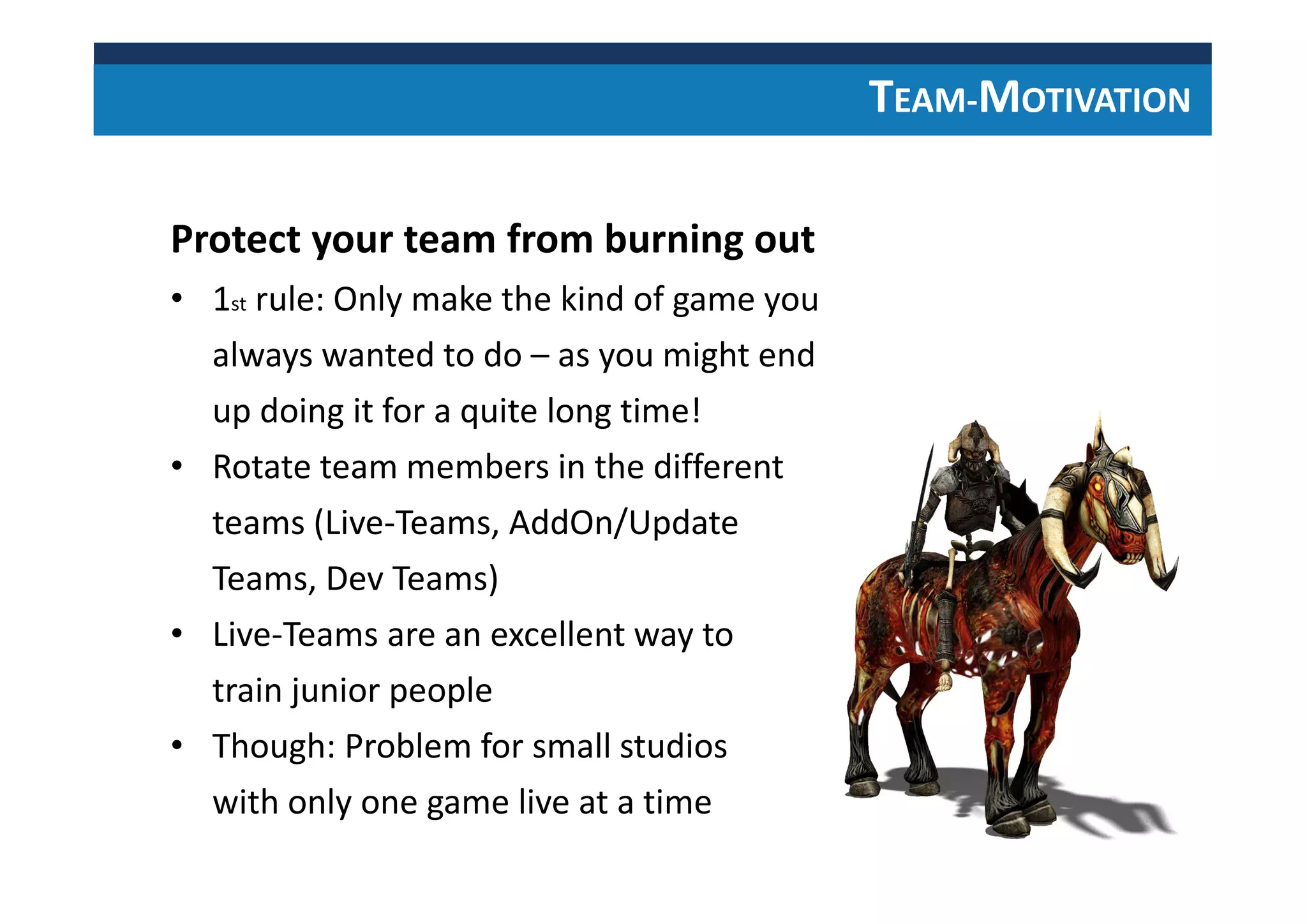
Protect your team from burning out
• 1st rule: Only make the kind of game you
always wanted to do – as you might end
up doing it for a quite long time!
• Rotate team members in the different
teams (Live-Teams, AddOn/Update
Teams, Dev Teams)
• Live-Teams are an excellent way to
train junior people
• Though: Problem for small studios
with only one game live at a time

Moving from boxed title Game Development to F2P | Ralf C. Adam

  • 1.
    Going Online Moving fromboxed title game devlopemt to F2P Ralf C. Adam
  • 2.
    This lecture wasfirst held in August 2010 at the European GDC in Cologne/GERMANY. The presentation may not include all original materials shown during this speech (pictures, videos etc.) and is solely meant as a summary and handout. All copyrights of presented materials belong to their respective owners. DISCLAIMER
  • 3.
    • Ralf C.Adam • Vice President Publishing / Gameforge • In the games industry since 1993 • Track record includes work for Atari/Infogrames, Ubisoft, Disney Interactive, Take 2, Ascaron, Sunflowers, Spellbound and other Publisher & Studios ABOUT MYSELF
  • 4.
  • 5.
    • One ofthe leading European provider for Online Games (Developer + Publisher) • Founded in 2003 • More than 400 employees • Product portfolio of more than 20 Games • MMOs, Browser Games, Facebook • Fully localized in over 50 countries • More than 200 million registered players • Europe’s biggest MMOG: Metin2 ABOUT GAMEFORGE
  • 6.
  • 7.
    EXTERNAL DEVELOPMENT GAMEFORGE •Ticking Bomb Games (Hamburg) • Rough Sea Games (Mannheim) • Steroid (Mainz) • KingArt (Bremen) • Keen Games (Frankfurt)
  • 8.
    GOALS OF THISTALK Welcome to the Final Frontier • Target Audience: Studios working in the traditional games industry, thinking about switching to development of online F2P titles • Identifying typical misconceptions and pitfalls • Outlining differences (and similarities) of both worlds • Best Practices/Lessons learned • Focusing on Browser Based and Social Network Games Source: Star Trek Infinite Space / © Gameforge/CBS
  • 9.
    WHY F2P ONLINE? Online-PublisherPerspective on External Studios • Getting the best game developers possible • Using synergies between own online experience and know-how of traditional game developers, including game design, proven workflows and production methods • Broadening of development capacities • Scalability of resources • Collaborating with studios outside your home territory
  • 10.
    Traditional Games Market– The sky is falling • Exploding budgets & team sizes & development cycles… • …while the gap between the Top 5 titles and the rest is getting bigger every day • Success depends on the first 4 – 6 weeks after release • Pirating vs. Copy Protection (BattleNet, Cloud Copy Protection etc.) • Sequels vs. Innovation • F2P is there – and it’s going to stay WHY F2P ONLINE?
  • 11.
    WHY F2P ONLINE? Lookslike an easy call – but be aware… • You might be dealing with smaller budgets • You might be doing different kind of games (FarmVille vs. Crysis)… • …and therefore very likely won’t be seen as the technological trailblazer of the gaming industry • You might need other developer with different skill sets in your team • It will have a massive impact on your production workflows as well as your game design approach
  • 12.
    BETTER THINK TWICE Questionsyou should ask yourself as a developer • Where do I want to be with my studio in 2 years from now? What’s my long-term strategy? • Maybe I‘m a great game developer – but am I a good service provider? And do I want to be one? • Do I have the business skills (and people) that it takes to be successful? • Only make your choice with a full knowledge of the impact of your actions!
  • 13.
    ROLE OF PUBLISHER PublisherREALLY has to be your Partner • Vital Online-Publisher Services: Producing (Development) Live-Producing/Product Management QA PR Localization Payment Business Intelligence Customer Service Community Management System-Administration Tech-Department Marketing
  • 14.
    ROLE OF PUBLISHER BestPractice • Choose your partner wisely • Make a Publisher Due Diligence • Your key contact persons: Producer (during development) and later Product Manager (aka Product Director or Live- Producer) • Keep a close relationship to your publisher • Establish direct lines of communication between experts (including regular meetings and workshops) • Always communicate personally and directly: Meeting wins over Phone/Skype wins over ICQ wins over Email
  • 15.
    SIGNING THE DEAL TraditionalBusiness Model: • Developer gets advance against royalties • Developer has to recoup the advance • Percentage of gross profits or net receipts or a flat fee per product sold • Only few games earn back their advances • Therefore developer is “forced” to build profit into his advances
  • 16.
    SIGNING THE DEAL Importantquestions • Who will pay for development? • Does the budget include general operating expenses? • Is it an "advance against royalties" model or not? • Who will pay for the Live-Team? • Does the studio have to recoup the Live-Team? • Which Share Model (Profit, Revenue etc.)? • Does the studio have to recoup Marketing?
  • 17.
    SIGNING THE DEAL BestPractice • Learn & understand the vocabulary (ARPU, Churn, CLV, Conversion Rate, Retention etc.) • Try to do as much research upfront as possible and build your studio plan and business case on solid numbers and expectations • Keep in mind: o Development Budget is just one piece of the Puzzle o You won’t break even after one month or two o The costs that really matter are Live-Team costs and Marketing spends
  • 18.
    GAME DESIGN »Unlearn whatyou have learned you must!« o Asynchronous Gameplay (Browser & Facebook) o Each player spends different amount of time o Many players (>1,000) on one Server o Unique Difference in Facebook compared to Browser Games: No Game Rounds! o The player’s experience in the first five minutes is essential o F2P also means: no strong commitment of player in the beginning as he had no upfront investment
  • 19.
    GAME DESIGN How toearn money in F2P • Players don’t buy your game – they pay for goods and services while playing • You want as many players as possible • And you want players to spend money • But player’s that never buy anything at all are also of great importance • It’s very dangerous to not annoy them (otherwise your worlds will be pretty empty)
  • 20.
    GAME DESIGN Items &Services Player will pay for • Vanity Items • Customizing Character • Decorative Items • Functional Items • Consumable Items • Temporary available Items • Time saving features • Convenient features • Additional Content (e.g. Maps)
  • 21.
    GAME DESIGN Monetization vs.Game Design • Monetization needs to be woven into the design right from the start – not added later • But always ask yourself first: o Is that a great feature and is it fun? o Not: Will the player pay money for it? • Biggest Challenge: Balancing for payment features • You do not want to have a pay-to-win strategy • But payment features must be meaningful to the player on the other side
  • 22.
    GAME DESIGN Best Practice •Early prototyping of core gameplay is a must • Full Pre-Production is vital • Do a lot of focus group testing – especially for UI • Two (or more) game designers working collaborative – One with focus on gameplay and fun and one concentrating on monetization • Make the entry into your game as easy and as accessible as possible • The player is never wrong • In the end is still about having a great game!
  • 23.
    SCOPE What does Scopemean? • Product Scope: All features, functions and assets that are supposed to be in the game • Project Scope: All work that must be done to deliver the game • Scope needs to be clear and to the point • Scope needs to be shared
  • 24.
    SCOPE Small is beautiful •Don’t make it overcomplicated • Keep the scope as small as possible in the beginning • You do not need to deliver all content at day #1 • If you fail... o ...fail early o ...fail fast o ...iterate fast
  • 25.
    TECHNOLOGY TRAPS It’s anever-changing World! • Online-Games are supposed to be “live” for years • New DirectX-Version: roughly every 4 years • Internet: Constant changes! • Problems with Flash Update 10 • Facebook changes with heavy impact: o Limitations on User Messaging o Facebook-Credits • Worst Case: From one day to the next your game is not working anymore! • Your publisher might also do changes on his own API that could effect you
  • 26.
    CODING PITFALLS Mayday! Mayday! •1st Rule: There’s no »quick & dirty« in Online-Games!!! • Never ever produce a single line of “hard-coded” stuff • Classic Mistake: »We will not change this feature later, let’s do a quick hack here.« • Think about it: Once your game has taken off, there’s no landing anymore • Any update or code change is like repairing the engine or the wing of an airplane during flight
  • 27.
    THE NAME OFTHE GAME One in a million • Coming up with a great idea for a name is already tough enough for a boxed title these days • But at least you don‘t have the URL problem • If someone already owns the domain, you can just add „-game“: www.torchlightgame.com • Longer title might work as well: o Call of Juarez – Bound in Blood o Operation Flashpoint: Dragon Rising o Star Wars Clone Wars Republic Heroes
  • 28.
    THE NAME OFTHE GAME Lessons learned • Define the name already during pre-production • Find a name that works everywhere in the World • If you‘re not native and have an English name: Check with UK/US natives! • Make sure, that all relevant domains (.com, .de, .es etc.) are available and buy them asap • Name needs to be short (ideally one word) • Spelling must be evident – even when communicated only verbally • Website is equivalent to shelf positioning
  • 29.
    LOCALIZATION Your Problems havejust been multiplied… • No “text hacks” or hard coded stuff possible • Higher requirements for Game Designer/Texter • All texts in localization tool from day #1 • If you screw up only one text key when “live” – Dante’s Inferno awaits • Each text change automatically means a change in all languages • Availability of update in all languages at the same time is required • Means also localization test of all languages for each & every update
  • 30.
    LOCALIZATION »What’s my line?« •A close collaboration with Localization Department throughout the whole production and beyond is vital • Make sure your game is properly connected into the publisher localization tool already during Pre-Production • Never do any quick & dirty fixes with hard coded text (aka »I will attach the loca key later«) • Always keep your Localization Manager in the loop for every text change, no matter how minor it seems
  • 31.
    QA & TESTING Lessonslearned the very hard way • Some Bugs do not occur, when only 200 people are playing • Different story with 200,000 people though • Therefore: Never skip a Beta no matter how good the Alpha looks! • Fatal: Bugs in features the player has paid for • Fixing problems when “live” takes 5x times longer • Always use test servers in the first place • Automated testing is a must • Remember: If it’s not tested, it doesn’t work!
  • 32.
    ADMINISTRATION TOOL »Ah, wedo that at the very end. Won’t take long!« • Player Support o Emails notfications, Guild-Support functions etc… • Management of user generated content: o Editing of content, delete functions etc… • Observing game rules: o Suspending players, Chatlog access etc… • Payment Support: o Player Inventory, Statistics etc… • User Management o Different kinds of access level etc…
  • 33.
    POST RELEASE »No BattlePlan survives contact with the Enemy!« • During Production already prepare a post release plan for the first 3 – 6 months… • …and be ready to just throw it away • Even a good Alpha, a long closed Beta and a well organized open Beta can not nearly prepare you for what is about to hit you • Players will report bugs you’d never have imagined • Player will find exploits you’d never have thought of • Player will give you feedback and demand for features you’d never have dreamt of Helmuth Karl Bernhard Graf von Moltke (26.10.1800 – 24.04.1891)
  • 34.
    LIVE-TEAM »Drums... Drums inthe deep! We cannot get out!« • For Browser Games: first 6 months after release usually full development team size for Live-Team • Especially on Facebook even more common: Two (or more) Live-Teams in parallel • FB: Release Cycles of 1 – 2 weeks • Each version tested & in all languages • Heavy workload for Project Manager • Strong collaboration with Marketing is vital • Once you’re “live” – it’s all about metrics!
  • 35.
    TEAM-MOTIVATION You never ship! •In the traditional games business you embrace a new game idea as soon as the current title has been shipped • Now you’re not making “products” anymore • The more successful the game gets the longer the team will work on it – maybe for many, many years! • This means an increasing risk, that your team members will get unsatisfied and demotivated
  • 36.
    TEAM-MOTIVATION Protect your teamfrom burning out • 1st rule: Only make the kind of game you always wanted to do – as you might end up doing it for a quite long time! • Rotate team members in the different teams (Live-Teams, AddOn/Update Teams, Dev Teams) • Live-Teams are an excellent way to train junior people • Though: Problem for small studios with only one game live at a time