CULTURAL SENSITIVITY &
WOMEN’S ISSUES
Part One: The Intersections of Womanhood and Other Oppressed Identities
Part Two: The Issues Faced by All Women
MATERIALS:
1. Sex, Lies, and Fetishizing Race (Feministe, Lekas Miller, Anna, July 9, 2012)
2. The Problem with Racial Fetishazation (Ravishly, Gladstone, Sarah, June
3, 2014)
3. Muslim Women Suffer Abuse For Wearing Hijab, Study Finds (Huffington
Post UK, Elgot, Jessica, November 11, 2013)
4. Cisgender privilege (based on Peggy McIntosh’s white privilege)
5. The Brutality of Corrective Rape (New York Times, Carter, Clare, July 27,
2013)
6. 7 Photos of Courageous Women Speaking Out Against Corrective Rape in
America (Identities.Mic, Davidson, Laura, March 27, 2014)
7. Tweets from Twitter hashtags #YesAll Women, #BeenRapedNeverReported,
#SolidarityisforRapists
8. The Evidence Is In: Decriminalizing Sex Work Is Critical to Public Health
(RH Reality Check, Forbes, Anna & Patterson, Sarah Elspeth, August 13, 2014)
PART ONE:
The Intersections of Womanhood and Other Oppressed Identities
Section 1: Women of Color
This is the definition for intersectionality as is found in the main multiculturalism handbook:
THIS DISCUSSION CENTERS ON
INTERSECTIONALITY AND RACE
Indeed, the concept of intersectionality was invented by black feminists, most notably by
Kimberlé Crenshaw in 1989. It is the concept of what it is like to live as a black woman, at the
crossroads of race and gender, under the constraints of both the patriarchy and white supremacy.
(As defined below)
White supremacy
The belief that white people are superior to those of all other races, especially the black race, and
should therefore dominate society.
Patriarchy
A system of society or government in which men hold the power and women are largely
excluded from it.
To be a black woman in a society that features both of these systems is to be doubly put down,
discouraged, demeaned, controlled, silenced, and judged for her worth by behavior and
appearance. The idea that beauty is Eurocentric, that to be beautiful means to be thin, white, and
blonde, further devalues her. To be respected, she must be strong, which often entails showing
little emotion and/or to be able to take abusive treatment from black men, white men, and white
women, all at the same time.
Black women (as well as other women of color) are also objectified and fetishized.
(From the race-focused multiculturalist handbook)
Historically, black women were prized for their “exotic” features. Female slaves were often
raped to obtain offspring with just the right amount of “mixed” appeal. Nowadays, black women
are fetishized by adult pornographic sites and yet, paradoxically, at the same time are criticized
for showing pride in their sexuality and/or bodies. (Recall when Rihanna wore a see-through
gown to the Grammy awards, or when Nicki Minaj released her music video for her hit single
“Anaconda.”) Because of this double-edged sword of being seen as both “exotic” and yet being
shamed for being sexual, black women face a particularly difficult ordeal when reporting rape. It
is for these reasons that black women usually feel very reluctant and afraid to go to the
authorities with claims of sexual assault.
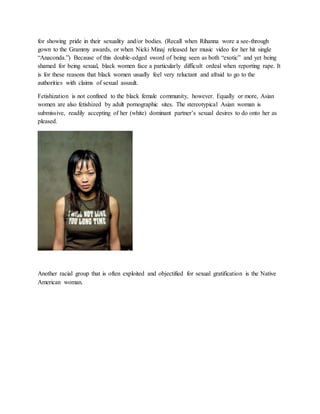
Fetishization is not confined to the black female community, however. Equally or more, Asian
women are also fetishized by adult pornographic sites. The stereotypical Asian woman is
submissive, readily accepting of her (white) dominant partner’s sexual desires to do onto her as
pleased.
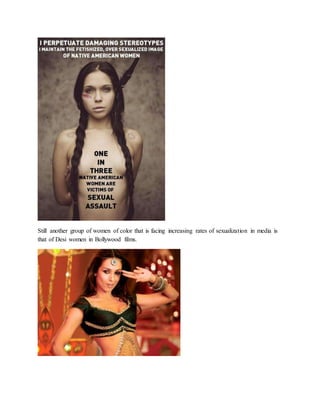
Another racial group that is often exploited and objectified for sexual gratification is the Native
American woman.
Still another group of women of color that is facing increasing rates of sexualization in media is
that of Desi women in Bollywood films.
This contrasts sharply with Indian culture’s emphasis on women being pure and chaste before
marriage. It leads to confusion and pent up sexual frustration in India’s heterosexual men. In
light of India’s epidemic of rape, this is a highly problematic and dangerous message to be
sending its people.
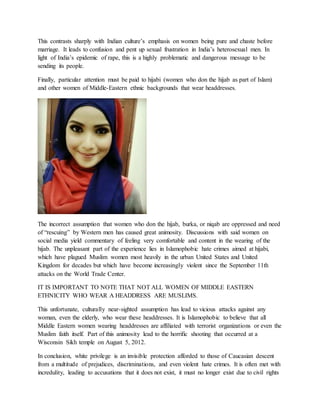
Finally, particular attention must be paid to hijabi (women who don the hijab as part of Islam)
and other women of Middle-Eastern ethnic backgrounds that wear headdresses.
The incorrect assumption that women who don the hijab, burka, or niqab are oppressed and need
of “rescuing” by Western men has caused great animosity. Discussions with said women on
social media yield commentary of feeling very comfortable and content in the wearing of the
hijab. The unpleasant part of the experience lies in Islamophobic hate crimes aimed at hijabi,
which have plagued Muslim women most heavily in the urban United States and United
Kingdom for decades but which have become increasingly violent since the September 11th
attacks on the World Trade Center.
IT IS IMPORTANT TO NOTE THAT NOT ALL WOMEN OF MIDDLE EASTERN
ETHNICITY WHO WEAR A HEADDRESS ARE MUSLIMS.
This unfortunate, culturally near-sighted assumption has lead to vicious attacks against any
woman, even the elderly, who wear these headdresses. It is Islamophobic to believe that all
Middle Eastern women wearing headdresses are affiliated with terrorist organizations or even the
Muslim faith itself. Part of this animosity lead to the horrific shooting that occurred at a
Wisconsin Sikh temple on August 5, 2012.
In conclusion, white privilege is an invisible protection afforded to those of Caucasian descent
from a multitude of prejudices, discriminations, and even violent hate crimes. It is often met with
incredulity, leading to accusations that it does not exist, it must no longer exist due to civil rights
gains, and/or that its mere mention is “playing the race card” or “racist.” It is not racist to discuss
race. It is not possible to be racist towards a white person, what some claim is “reverse racism,”
as it is this group that holds the most power in Western societies. Mistrust and fear is often
afforded to black men; skepticism of sexual “purity,” shaming, and unfair objectification is
afforded to black women and other women of color.
What is more, women of color must also deal with the insidious effects of colorism, both in this
country and abroad.
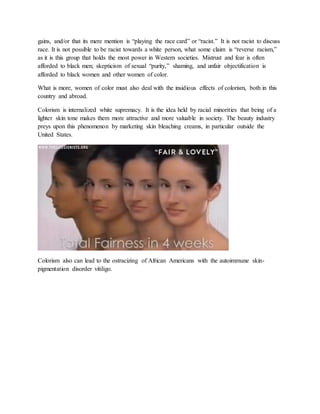
Colorism is internalized white supremacy. It is the idea held by racial minorities that being of a
lighter skin tone makes them more attractive and more valuable in society. The beauty industry
preys upon this phenomenon by marketing skin bleaching creams, in particular outside the
United States.
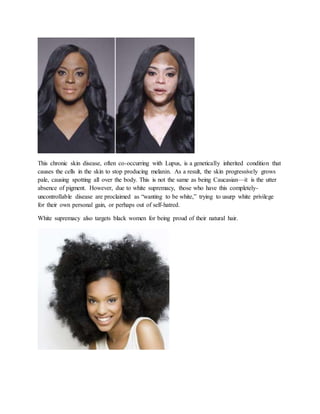
Colorism also can lead to the ostracizing of African Americans with the autoimmune skin-
pigmentation disorder vitiligo.
This chronic skin disease, often co-occurring with Lupus, is a genetically inherited condition that
causes the cells in the skin to stop producing melanin. As a result, the skin progressively grows
pale, causing spotting all over the body. This is not the same as being Caucasian—it is the utter
absence of pigment. However, due to white supremacy, those who have this completely-
uncontrollable disease are proclaimed as “wanting to be white,” trying to usurp white privilege
for their own personal gain, or perhaps out of self-hatred.
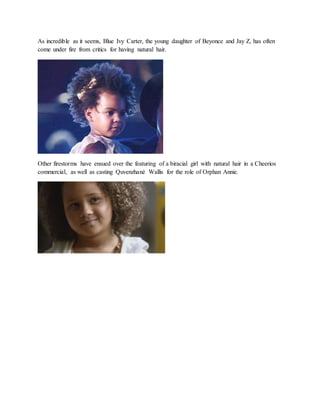
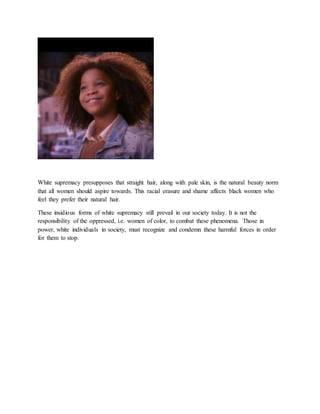
White supremacy also targets black women for being proud of their natural hair.
As incredible as it seems, Blue Ivy Carter, the young daughter of Beyonce and Jay Z, has often
come under fire from critics for having natural hair.
Other firestorms have ensued over the featuring of a biracial girl with natural hair in a Cheerios
commercial, as well as casting Quvenzhané Wallis for the role of Orphan Annie.
White supremacy presupposes that straight hair, along with pale skin, is the natural beauty norm
that all women should aspire towards. This racial erasure and shame affects black women who
feel they prefer their natural hair.
These insidious forms of white supremacy still prevail in our society today. It is not the
responsibility of the oppressed, i.e. women of color, to combat these phenomena. Those in
power, white individuals in society, must recognize and condemn these harmful forces in order
for them to stop.
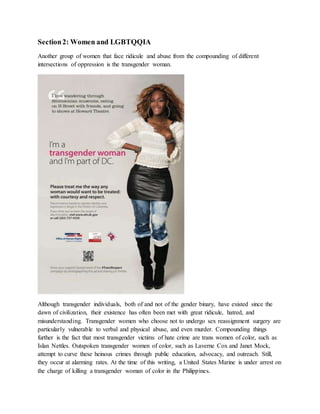
Section2: Women and LGBTQQIA
Another group of women that face ridicule and abuse from the compounding of different
intersections of oppression is the transgender woman.
Although transgender individuals, both of and not of the gender binary, have existed since the
dawn of civilization, their existence has often been met with great ridicule, hatred, and
misunderstanding. Transgender women who choose not to undergo sex reassignment surgery are
particularly vulnerable to verbal and physical abuse, and even murder. Compounding things
further is the fact that most transgender victims of hate crime are trans women of color, such as
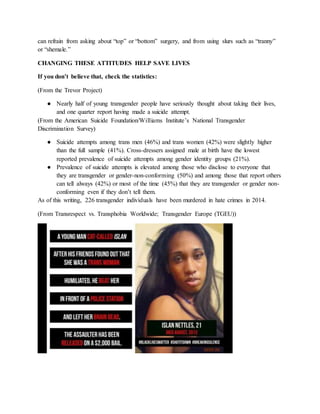
Islan Nettles. Outspoken transgender women of color, such as Laverne Cox and Janet Mock,
attempt to curve these heinous crimes through public education, advocacy, and outreach. Still,
they occur at alarming rates. At the time of this writing, a United States Marine is under arrest on
the charge of killing a transgender woman of color in the Philippines.
Why are transgender women met by such disdain and hatred for who they are? Part of this is due
to cissexism.
(From the general multiculturalism handbook)
Cissexism
The assumption that, due to human sexual differentiation, one's gender is determined solely by a
biological sex of male or female, and that trans people are inferior to cis people, being in
"defiance of nature.”
The cissexist assumption of sex and gender tells us that women can only be seen as “real” if they
have breasts, vaginas, and all other female reproductive organs and secondary sex characteristics.
This is harmful not only to transgender women, but to cisgender (non-trans) women, as well. If a
woman is not a woman if she no longer has breasts, is she still a “real” woman? This means that
women who undergo a mastectomy or double mastectomy as a result of breast cancer cannot be
considered women. Likewise, women who have a hysterectomy can no longer be considered
women.
What makes a woman? Is it wearing a dress? Most women of our era no longer wear dresses. Is
it wearing make-up? Many women choose not to do so. Then how can the word “woman” be
defined so narrowly?
Many women are also “gender non-conforming,” meaning they opt out of actions and behaviors,
like those above, which are generally ascribed to women.
Despite this seemingly common sense approach, many still believe that transgender women
cannot be “real” women; that they are simply pretending, or are mentally ill.
Within feminism, some view the inclusion of transgender women to be highly controversial.
There is a faction of modern feminism whose members are referred to some as TERFs: Trans
Exclusionary Radical Feminists. These feminists claim to be upholding the rights of women
while simultaneously attacking, harassing, and shaming transgender women. They claim that
including trangender women in women’s spaces is putting cisgender women at risk, especially if
the transgender women wishing to participate still carry their presumed-male genitalia. These
feminists wish to see transgender women placed into male prisons and transgender women kept
from using restroom facilities that ascribe to their presented, female gender. To do so would be
putting that individual at risk more so than the other women being “protected” from her. Those
who do not see transgender women as women would inflict emotional and/or physical harm upon
them for intruding into spaces some feel they do not belong in. The safety of transgender women
is paramount; thus so is their access to appropriate restrooms, changing facilities, and
emotionally supportive spaces.
The irrational hatred of all transgender people is known as transphobia. However, a special term
has been coined for that of transgender women, listed and defined below.
Transmisogyny
The confluence of misogyny and transphobia: the negative attitudes, expressed through cultural
hate, individual and state violence, and discrimination directed toward trans women and trans
and gender non-conforming people on the feminine end of the gender spectrum.
(from: http://everydayfeminism.com/2014/01/transmisogyny/)
It is up to cisgender women to uphold the worth, dignity, and safety of transgender women from
those who would wish to gaslight, verbally or physically assault, or harm them in any other way.
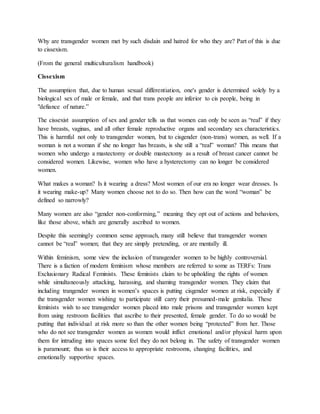
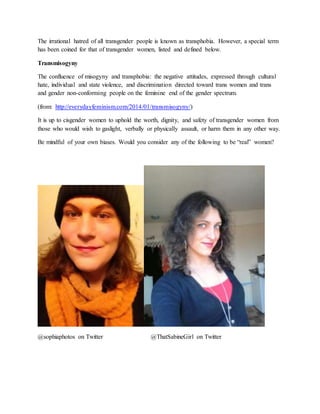
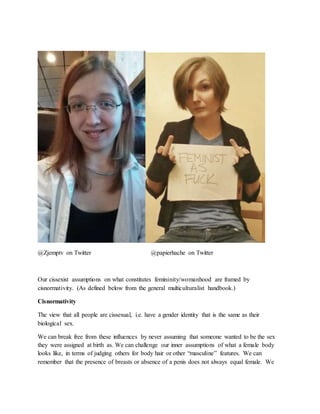
Be mindful of your own biases. Would you consider any of the following to be “real” women?
@sophiaphotos on Twitter @ThatSabineGirl on Twitter
@Zjemptv on Twitter @papierhache on Twitter
Our cissexist assumptions on what constitutes femininity/womanhood are framed by
cisnormativity. (As defined below from the general multiculturalist handbook.)
Cisnormativity
The view that all people are cissexual, i.e. have a gender identity that is the same as their
biological sex.
We can break free from these influences by never assuming that someone wanted to be the sex
they were assigned at birth as. We can challenge our inner assumptions of what a female body
looks like, in terms of judging others for body hair or other “masculine” features. We can
remember that the presence of breasts or absence of a penis does not always equal female. We
can refrain from asking about “top” or “bottom” surgery, and from using slurs such as “tranny”
or “shemale.”
CHANGING THESE ATTITUDES HELP SAVE LIVES
If you don’t believe that, check the statistics:
(From the Trevor Project)
● Nearly half of young transgender people have seriously thought about taking their lives,
and one quarter report having made a suicide attempt.
(From the American Suicide Foundation/Williams Institute’s National Transgender
Discrimination Survey)
● Suicide attempts among trans men (46%) and trans women (42%) were slightly higher
than the full sample (41%). Cross-dressers assigned male at birth have the lowest
reported prevalence of suicide attempts among gender identity groups (21%).
● Prevalence of suicide attempts is elevated among those who disclose to everyone that
they are transgender or gender-non-conforming (50%) and among those that report others
can tell always (42%) or most of the time (45%) that they are transgender or gender non-
conforming even if they don’t tell them.
As of this writing, 226 transgender individuals have been murdered in hate crimes in 2014.
(From Transrespect vs. Transphobia Worldwide; Transgender Europe (TGEU))
It must also be considered that both transgender and cisgender women may not be attracted to
men, or more attracted to other women/femme-presenting people than men. They could be
lesbian, bisexual/pansexual, gynesexual, or asexual/greysexual (all falling under the umbrella
term “queer). However, according to patriarchal society, which values men over women, a
woman that is not attracted to men is an insult. As a result of these beliefs, queer women are
often the target of abuse. These beliefs are referred to as heteropatriarchy (or
cisheteropatriarchy), as defined below (from the general multiculturalist handbook).
Heteropatriarchy
Men dominating and de-skilling women in any of a number of forms, from outright attack to
paternalistic care, and women devaluing (of necessity) female bonding. Hetereopatriarchy
normalizes the dominance of one person and the subordination of another.
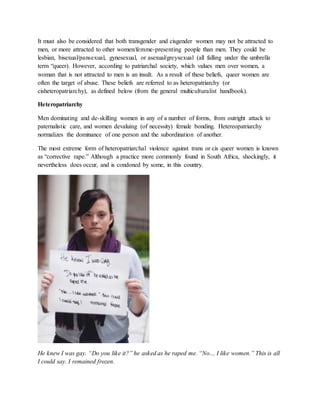
The most extreme form of heteropatriarchal violence against trans or cis queer women is known
as “corrective rape.” Although a practice more commonly found in South Africa, shockingly, it
nevertheless does occur, and is condoned by some, in this country.
He knew I was gay. “Do you like it?” he asked as he raped me. “No… I like women.” This is all
I could say. I remained frozen.
In an infamous 2012 radio broadcast that would later cause him to be terminated him his job,
Cleveland DJ Dominic Dieter suggested corrective rape for a caller’s daughter.
According to cisheteropatriarchy, if a woman’s life, especially her sexual life, is not centered on
a man, or if she does not cater her sexual expression to male needs and wants, she is deemed
undesirable, even a threat. Thus, she must be reined in with violent means.
Finally, another devaluation of women comes in the form of femmephobia.
Femmephobia is the devaluation, fear and hatred of the feminine: of softness, nurturance,
dependence, emotions, passivity, sensitivity, grace, innocence and the color pink.
(From: http://www.popsugar.com/love/What-Femmephobia-22725637)
Basically, this can be summed up in every small, male child’s assertion that “girls are gross.” It
is actually an insidious form of sexism, more vague and unrecognizable than usual, and it is often
aimed by women at women. Within the feminist community, the debate has always been raised if
a feminine woman is upholding an infantilizing form of patriarchy that wants women to always
stay little girls, or simply being herself in her love of kittens and fuzzy slippers. It should be
recognized and called out that this femmephobic treatment by feminists onto other feminists is in
actuality a form of internalized misogyny. Women are not to dictate to each other what
constitutes right and wrong when it comes to personal gender expression.
Indeed, it is this femmephobia which intimidates Designated Male at Birth femme non-binary
individuals, as well as flamboyant gay men, to feel ashamed of themselves, their personalities,
and their fully autonomous expressions and presentations of gender. Because of this,
femmephobia is not only inherently misogynistic, it also upholds homophobia (“sissyphobia,” as
some gay activists would deem the fear of femme gay men); cissexism (by telling DMAB femme
enbies that they should “act masculine” in order to be taken seriously); and cisnormativity (that
being femme is acting “like a woman,” rather than one’s personal gender presentation outside of
the binary).
As a society, we must not accept or condone these beliefs and practices. They endanger not only
queer women, but any women. If a woman rejects the idea of sexual subserviency to men,
seeking her own sexual autonomy, then she is homophobically branded a lesbian, or is simply
seen as a threat to patriarchal control. This opens her up to misogynistic/transmisogynistic
violence. Dismantling said attitudes is, again, saving lives, something we all should be invested
in.
Section3: Women and Disabilities/MentalHealth
(Taken from the Cultural Sensitivity and Disabilities handbook)
Mentally ill individuals are 2/3rds at greater risk than society at large to be the victims of
violence. Often, women who have mental health conditions are re-victimized by those who do
not believe their claims of sexual assault, as they are “crazy” or “imagining things.” Indeed,
women were more often to be classically deemed mentally ill than men; the origins of terms like
histrionic personality disorder and hysteria are rooted in misogyny. In the early years of
psychology, mental illnesses and other mental conditions, such as schizophrenia and autism,
were blamed on bad parenting by a child’s mother.
The World Health Organization contends that women are more prone to diagnoses of depression
and anxiety due to their subordinate position enforced by societal gender roles:
Low rank is a powerful predictor of depression. Women's subordinate social status isreinforced
in the workplace as they are more likely to occupy insecure, low status jobs with nodecision
making authority. Those in such jobs experience higher levels of negative life events,insecure
housing tenure, more chronic stressors and reduced social support. Traditional genderroles
further increase susceptibility by stressing passivity, submission and dependence andimpose a
duty to take on the unremitting care of others and unpaid domestic and agriculturallabour.
Conversely, gains in gender development that improve women's status are likely to bring with
them improvements in women's mental health.
There is often an unfair portrayal of mentally ill women in the mainstream media and popular
culture. Women who have post-partum depression are shunned, as becoming a mother is
supposed to be the happiest point in a woman’s life. Although the concept of being “shell
shocked” from war has existed since the first World War, and PTSD was officially made a
diagnosis in 1991, men are still more likely to be understood when seeking treatment for trauma.
Substance abuse rehabilitational programs are predominantly organized and participated in by
men. As mentioned above, personality disorders were commonly more attributed to women than
men, in particular histrionic (the perpetually seductive, attention seeking individual) and the
borderline (the person who is unable to control their emotions within the context of a
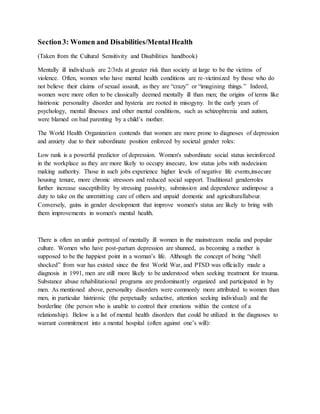
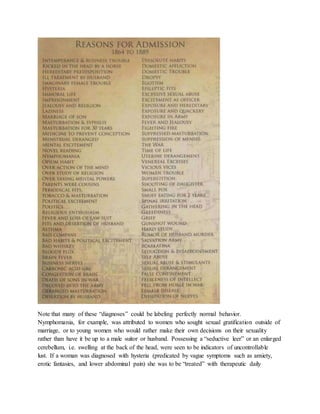
relationship). Below is a list of mental health disorders that could be utilized in the diagnoses to
warrant commitment into a mental hospital (often against one’s will):
Note that many of these “diagnoses” could be labeling perfectly normal behavior.
Nymphomania, for example, was attributed to women who sought sexual gratification outside of
marriage, or to young women who would rather make their own decisions on their sexuality
rather than have it be up to a male suitor or husband. Possessing a “seductive leer” or an enlarged
cerebellum, i.e. swelling at the back of the head, were seen to be indicators of uncontrollable
lust. If a woman was diagnosed with hysteria (predicated by vague symptoms such as anxiety,
erotic fantasies, and lower abdominal pain) she was to be “treated” with therapeutic daily
orgasms via a vibrator. Once the hysteria was “cured,” she could go on to be a suitable wife and
mother as per the standards of Victorian society.
Hollywood is abound with stories of “madwomen.” The horror classic Rosemary’s Baby
involves a woman suspicious of a conspiracy afoot that everyone in her life assures her is non-
existent, a product of upper class ennui and hysterical paranoia. Films from Whatever Happened
to Baby Jane to the Disney animated original classic 101 Dalmatians involve unhinged women
seeking to cause violence upon the most vulnerable for their own personal gains. Countless films
depict women as witches, evil sorceresses, and demonic succubi, harkening back to the Biblical
Eve or Delilah.
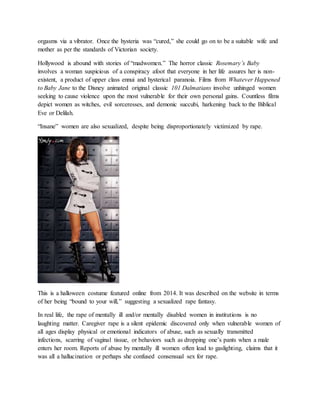
“Insane” women are also sexualized, despite being disproportionately victimized by rape.
This is a halloween costume featured online from 2014. It was described on the website in terms
of her being “bound to your will,” suggesting a sexualized rape fantasy.
In real life, the rape of mentally ill and/or mentally disabled women in institutions is no
laughting matter. Caregiver rape is a silent epidemic discovered only when vulnerable women of
all ages display physical or emotional indicators of abuse, such as sexually transmitted
infections, scarring of vaginal tissue, or behaviors such as dropping one’s pants when a male
enters her room. Reports of abuse by mentally ill women often lead to gaslighting, claims that it
was all a hallucination or perhaps she confused consensual sex for rape.
The facts are simply horrifying. (From http://www.theguardian.com/science/occams-
corner/2014/sep/04/mental-illness-sexual-abuse-rape-victim)
A study by researchers at University College and Kings College London, published today
in Psychological Medicine, reports that of women with severe mental illness surveyed
for the study, 40% had been the victims of rape or attempted rape.
It is clear from this that, more so than in the general population, women with mental
health diagnoses must be believed when disclosing sexual assault. The rape of women in
the mental health care system is an issue that lies at the intersections of ableism and
rape culture.
The following section, rape culture will be defined and discussed on broader terms.
PART TWO:
The Issues Faced by All Women
Section 1: Rape Culture, Street Harassment, and Women Speaking
Out Online
(From: http://www.wavaw.ca/what-is-rape-culture/ )
Many feminists have provided great definitions of what rape culture is and how it plays out
everyday. Emilie Buchwald, author of Transforming a Rape Culture, describes that when society
normalizes sexualized violence, it accepts and creates rape culture. In her book she defines rape
culture as
“A complex set of beliefs that encourage male sexual aggression and supports violence against
women. It is a society where violence is seen as sexy and sexuality as violent. In a rape culture,
women perceive a continuum of threatened violence that ranges from sexual remarks to sexual
touching to rape itself. A rape culture condones physical and emotional terrorism against women
as the norm . . . In a rape culture both men and women assume that sexual violence is a fact of
life, inevitable . . . However . . . much of what we accept as inevitable is in fact the expression of
values and attitudes that can change.”
The website Force: Upsetting the Rape Culture explains how rape culture is the images,
language, laws and other everyday phenomena that we see and hear everyday that validate and
perpetuate rape.
“Rape culture includes jokes, TV, music, advertising, legal jargon, laws, words and imagery, that
make violence against women and sexual coercion seem so normal that people believe that rape
is inevitable. Rather than viewing the culture of rape as a problem to change, people in a rape
culture think about the persistence of rape as ‘just the way things are.’”
Melissa McEwan, the founder of the political and cultural group blog Shakesville, provides an
extensive definition of rape culture that answers the questions what does Rape Culture look like
and sound like and feel like? It is an excellent definition that provides various examples of Rape
Culture, and it can be found here.
Furthermore, WAVAW itself did a comprehensive blog piece on Rape Culture just several
months ago, titled “Rape Culture is Real—And Yes, We’ve Had Enough”, which included citing
recent current events that exemplified Rape Culture:
Rape culture is…
 The existence of “Keep Calm and Rape A Lot” t-shirts. They really, seriously exist.
 The media’s constant glossing-over of sexual assault with euphemistic language:
“inappropriate behaviour,” “sexual misconduct,” and even plain old “having sex.”
 Facebook’s refusal to pull sadistically graphic images of violence against women (while
deeming photos of breastfeeding moms to be objectionable)!
 A beauty website that calls toddlers “effing hot” – even the preschool set can’t escape
objectification!
 A magazine editor’s blasé admission that “the women we feature in the magazine are
ornamental” and “objectified.”
 Major news outlets waxing sympathetic about how two teen rapists’ “promising” lives
will be destroyed by a youthful mistake, without once mentioning how the rape might
affect the survivor.
 Kids who call losing a sports game “getting totally raped.”
 A pizza marketing campaign that makes a joke out of rape.
 A subculture of self-proclaimed “ratters” who hack into women’s computers and steal
their photos.
 College women being instructed to vomit or urinate on demand to protect themselves
against rape.
 10,000 untested rape kits collecting dust on a shelf somewhere.
Twitter has emerged as a useful tool in combating rape culture. From accounts such as
@RapeIsntOkay and @exposerapeapology, to hashtags such as #BeenRapedNeverReported and
#SolidarityIsForRapists, feminists, womanists, and other social justice movement members have
turned social media into activism for women worldwide.
Similarly, feminists use Twitter to speak out against street harassment, also known as catcalling,
which is defined by Stop Street Harassment as
Unwelcome words and actions by unknown persons in public places which are motivated by
gender and invade a person’s physical and emotional space in a disrespectful, creepy, startling,
scary, or insulting way.
Stop Street Harassment, as well as the “Holla Back” Campaign, seeks to end an epidemic of
seemingly shameless male entitlement to the female body that causes random men to shout
obscenities and even touch and grope strange women without impunity.
Another online activism project that shares real experiences by real women on diverse issues
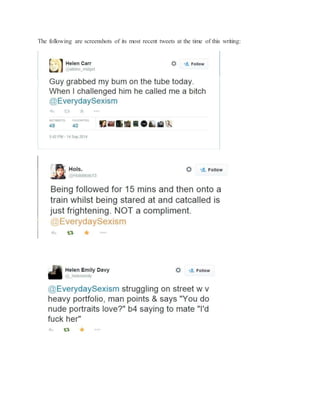
including street harassment is the Everyday Sexism campaign.
The following are screenshots of its most recent tweets at the time of this writing:
There are, however, still drawbacks to being an outspoken woman on social media.
In response to her critique of underdeveloped female characters in video games and a lack of
female representation in “gamer” culture, Anita Sarkeesian, owner of the Twitter account
Feminist Frequency (@femfreq) was driven out of her home with death threats from male video
game players participating in #GamerGate. Said gamers also went on to issue similar violent
threats towards other feminists critiquing games, such as Brianna Wu (Twitter user
@Spacekatgal).
When Dr. Matt Taylor, a British scientist on Rosetta’s mission team who helped successfully
land a piece of NASA equipment upon a comet’s surface, appeared on television wearing an ugly
bowling shirt covered in naked women, science writer Rose Eveleth basically said “not cool.”
She, also, received death threats through social media. The ensuing clash of feminists and
defenders of Dr. Taylor was by turns entitled #shirtgate or #shirtstorm.
Despite the backlash, feminists continue to speak out on these very important issues. Recent
surveys indicate that many young people do not understand what does and does not constitute
consent. Most do not understand that street harassment is sexualized verbal abuse, rather than
women who are unable to take compliments on their appearance. The facts show why all of this
“whining” is important.
CONSIDER THE FOLLOWING FROM A SURVEY OF STUDENTS
(From: http://www.uic.edu/depts/owa/sa_rape_support.html )
Societal Attitudes Supporting Rape
- A survey of 6,159 college students enrolled at 32 institutions in the U.S. found the following:
 54% of the women surveyed had been the victims of some form of sexual abuse; more
than one in four college-aged women had been the victim of rape or attempted rape;
 57% of the assaults occurred on dates;
 73% of the assailants and 55% of the victims had used alcohol or other drugs prior to the
assault;
 25% of the men surveyed admitted some degree of sexually aggressive behavior;
 42% of the victims told no one.
- In a survey of high school students, 56% of the girls and 76% of the boys believed forced sex
was acceptable under some circumstances. (ref 5)
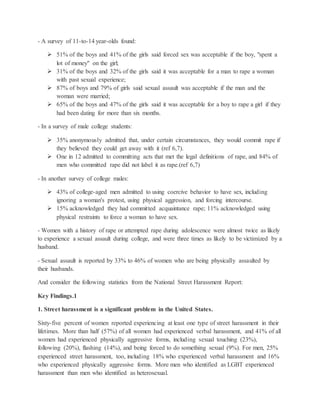
- A survey of 11-to-14 year-olds found:
 51% of the boys and 41% of the girls said forced sex was acceptable if the boy, "spent a
lot of money" on the girl;
 31% of the boys and 32% of the girls said it was acceptable for a man to rape a woman
with past sexual experience;
 87% of boys and 79% of girls said sexual assault was acceptable if the man and the
woman were married;
 65% of the boys and 47% of the girls said it was acceptable for a boy to rape a girl if they
had been dating for more than six months.
- In a survey of male college students:
 35% anonymously admitted that, under certain circumstances, they would commit rape if
they believed they could get away with it (ref 6,7).
 One in 12 admitted to committing acts that met the legal definitions of rape, and 84% of
men who committed rape did not label it as rape.(ref 6,7)
- In another survey of college males:
 43% of college-aged men admitted to using coercive behavior to have sex, including
ignoring a woman's protest, using physical aggression, and forcing intercourse.
 15% acknowledged they had committed acquaintance rape; 11% acknowledged using
physical restraints to force a woman to have sex.
- Women with a history of rape or attempted rape during adolescence were almost twice as likely
to experience a sexual assault during college, and were three times as likely to be victimized by a
husband.
- Sexual assault is reported by 33% to 46% of women who are being physically assaulted by
their husbands.
And consider the following statistics from the National Street Harassment Report:
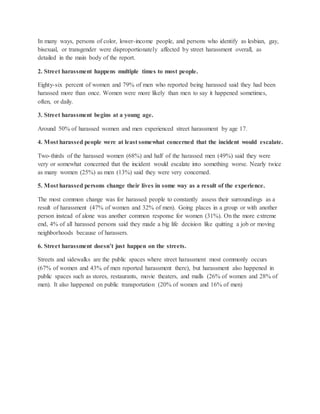
Key Findings.1
1. Street harassment is a significant problem in the United States.
Sixty-five percent of women reported experiencing at least one type of street harassment in their
lifetimes. More than half (57%) of all women had experienced verbal harassment, and 41% of all
women had experienced physically aggressive forms, including sexual touching (23%),
following (20%), flashing (14%), and being forced to do something sexual (9%). For men, 25%
experienced street harassment, too, including 18% who experienced verbal harassment and 16%
who experienced physically aggressive forms. More men who identified as LGBT experienced
harassment than men who identified as heterosexual.
In many ways, persons of color, lower-income people, and persons who identify as lesbian, gay,
bisexual, or transgender were disproportionately affected by street harassment overall, as
detailed in the main body of the report.
2. Street harassment happens multiple times to most people.
Eighty-six percent of women and 79% of men who reported being harassed said they had been
harassed more than once. Women were more likely than men to say it happened sometimes,
often, or daily.
3. Street harassment begins at a young age.
Around 50% of harassed women and men experienced street harassment by age 17.
4. Most harassed people were at least somewhat concerned that the incident would escalate.
Two-thirds of the harassed women (68%) and half of the harassed men (49%) said they were
very or somewhat concerned that the incident would escalate into something worse. Nearly twice
as many women (25%) as men (13%) said they were very concerned.
5. Most harassed persons change their lives in some way as a result of the experience.
The most common change was for harassed people to constantly assess their surroundings as a
result of harassment (47% of women and 32% of men). Going places in a group or with another
person instead of alone was another common response for women (31%). On the more extreme
end, 4% of all harassed persons said they made a big life decision like quitting a job or moving
neighborhoods because of harassers.
6. Street harassment doesn’t just happen on the streets.
Streets and sidewalks are the public spaces where street harassment most commonly occurs
(67% of women and 43% of men reported harassment there), but harassment also happened in
public spaces such as stores, restaurants, movie theaters, and malls (26% of women and 28% of
men). It also happened on public transportation (20% of women and 16% of men)
Section 2: Sexual harassment in the workplace and other crimes and
prejudice against working women
It would seem that sexual harassment of women in the workplace would be a relic of the past, of
a bygone Mad Men era of dysregulation and lack of workplace cultural sensitivity.
Unfortunately, this would be an inaccurate assumption.
The recent case of Raechel Sterud, a 32 year old female firefighter in Ohio, dispels this myth.
After being sexually harassed for months on the job and then fired, Sterud sued and won a $1.7
million amount for damages and gender-based discrimination.
Other lines of work in which female employees have reported high levels of sexual harassment
on the job include police departments, restaurants, and construction work.
Perhaps the most infamous case of sexual harassment was brought to the big screen by Charlize
Theron, in the film North Country.
Eveleth Mines employee Lois Jenson would make history by convincing her female colleagues
to enact a class action lawsuit against the company for ongoing, violent, and humiliating sexual
harassment on the part of its male employees towards them all. It is a gut-wrenching film to
watch, especially considering the fact that the story is true.
Even more gruesome is the true story behind the film Compliance.
In 2004, a man claiming to be an Officer Scott called over 70 fast food establishments in 31
states to conduct the same sadistic phone prank, in which he used his false authority to have
young women strip searched and sexually abused by their fellow employees.
The film centers around the case of a Mount Washington, KY McDonalds and a then 18-year-old
employee Louise Ogburn, and the horrific actions taken against her by her manager, Donna
Summers, and her then-fiancé, Walter Nix, in the name of complying with a “police officer’s”
requests. The man over the phone claimed that Ogburn had stolen a patron’s wallet; Summers
believed him, proceeding to strip Ogburn naked and follow his every command. Ogburn was told
to do jumping jacks naked, comply to a cavity search in which she was digitally penetrated, and
be spanked and forced to perform oral sex upon Mr. Nix.
Here are some statistics on violence against women in the workplace:
(From
 In 2000, 13,935 women had injuries or illnesses involving days away from work that
resulted from assaults and violent acts (Bureau of Labor Statistics [BLS]).
 Homicide is the second-leading cause of fatal occupational injuries for women, after
traffic accidents. Thirty-one percent of women who die at work are killed as a result of an
assault or violent act. In 2003, 119 women died as a result of an assault or violent act in
the workplace (BLS).
 12.7 percent of all female violent crimes were committed while the victim was working
or on duty. These acts of nonfatal violence include rape and sexual assault, robbery,
aggravated assault and simple assault (BLS).
 Some 36,500 rapes and sexual assaults occur annually in the workplace. In 80 percent of
these incidents, the victim was female (NCVS).
 Nurses experience workplace crime at a rate 72 percent higher than medical technicians
and at more than twice the rate of other medical fieldworkers (NCVS).
 Professional (social worker/psychiatrist) and custodial care providers in the mental health
care field were victimized while working or on duty at rates more than three times those
in the medical field (NCVS).
 Junior high school teachers have a rate of victimization in the workplace similar to
convenience store clerks—54.2 versus 53.9 per 1,000 workers (NCVS).
The four types of violence against women in the workplace are as follows:
1. Violence committed by clients or patients.
2. Violence associated with robbery or other crimes.
3. Violence among co-workers or managers.
4. Domestic violence that spills over into the workplace.
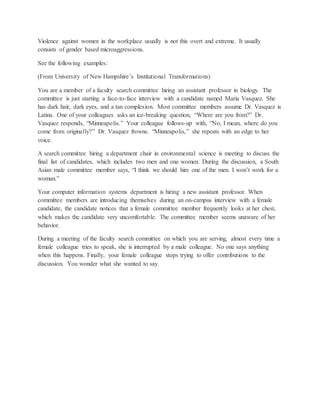
Violence against women in the workplace usually is not this overt and extreme. It usually
consists of gender based microaggressions.
See the following examples:
(From University of New Hampshire’s Institutional Transformations)
You are a member of a faculty search committee hiring an assistant professor in biology. The
committee is just starting a face-to-face interview with a candidate named Maria Vasquez. She
has dark hair, dark eyes, and a tan complexion. Most committee members assume Dr. Vasquez is
Latina. One of your colleagues asks an ice-breaking question, “Where are you from?” Dr.
Vasquez responds, “Minneapolis.” Your colleague follows-up with, “No, I mean, where do you
come from originally?” Dr. Vasquez frowns. “Minneapolis,” she repeats with an edge to her
voice.
A search committee hiring a department chair in environmental science is meeting to discuss the
final list of candidates, which includes two men and one women. During the discussion, a South
Asian male committee member says, “I think we should hire one of the men. I won’t work for a
woman.”
Your computer information systems department is hiring a new assistant professor. When
committee members are introducing themselves during an on-campus interview with a female
candidate, the candidate notices that a female committee member frequently looks at her chest,
which makes the candidate very uncomfortable. The committee member seems unaware of her
behavior.
During a meeting of the faculty search committee on which you are serving, almost every time a
female colleague tries to speak, she is interrupted by a male colleague. No one says anything
when this happens. Finally, your female colleague stops trying to offer contributions to the
discussion. You wonder what she wanted to say.
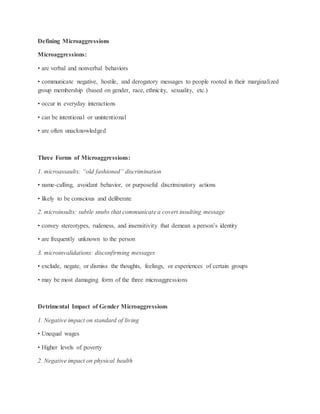
Defining Microaggressions
Microaggressions:
• are verbal and nonverbal behaviors
• communicate negative, hostile, and derogatory messages to people rooted in their marginalized
group membership (based on gender, race, ethnicity, sexuality, etc.)
• occur in everyday interactions
• can be intentional or unintentional
• are often unacknowledged
Three Forms of Microaggressions:
1. microassaults: “old fashioned” discrimination
• name-calling, avoidant behavior, or purposeful discriminatory actions
• likely to be conscious and deliberate
2. microinsults: subtle snubs that communicate a covert insulting message
• convey stereotypes, rudeness, and insensitivity that demean a person’s identity
• are frequently unknown to the person
3. microinvalidations: disconfirming messages
• exclude, negate, or dismiss the thoughts, feelings, or experiences of certain groups
• may be most damaging form of the three microaggressions
Detrimental Impact of Gender Microaggressions
1. Negative impact on standard of living
• Unequal wages
• Higher levels of poverty
2. Negative impact on physical health
• Migraines, heart disease, autoimmune disorders
3. Negative impact on psychological health
• Depression
• Anxiety
• Body image dissatisfaction and eating disorders
Moving Forward: How to Overcome Microaggressions
1. Individual Intervention
• Develop an honest awareness of our own biases, prejudices, and stereotypes
• Become an ally and activist
2. Organizational Intervention
• Make sure policies, practices, and procedures allow for equal access and opportunity
• Create a welcoming communication climate
• Provide professional development opportunities
• Make accountability central
3. Societal/Cultural Intervention
• Critically assess cultural communication (education, mass media, institutions, etc.)
• Create social policy and law to rectify discrimination and promote equal access
• Promote multi-cultural education
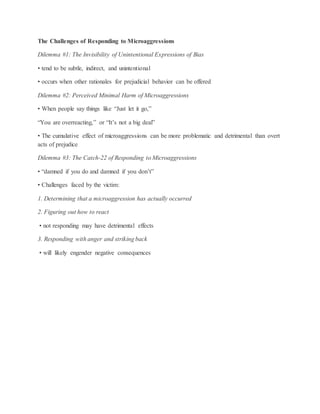
The Challenges of Responding to Microaggressions
Dilemma #1: The Invisibility of Unintentional Expressions of Bias
• tend to be subtle, indirect, and unintentional
• occurs when other rationales for prejudicial behavior can be offered
Dilemma #2: Perceived Minimal Harm of Microaggressions
• When people say things like “Just let it go,”
“You are overreacting,” or “It’s not a big deal”
• The cumulative effect of microaggressions can be more problematic and detrimental than overt
acts of prejudice
Dilemma #3: The Catch-22 of Responding to Microaggressions
• “damned if you do and damned if you don’t”
• Challenges faced by the victim:
1. Determining that a microaggression has actually occurred
2. Figuring out how to react
• not responding may have detrimental effects
3. Responding with anger and striking back
• will likely engender negative consequences
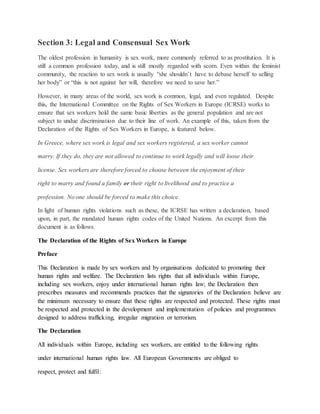
Section 3: Legal and Consensual Sex Work
The oldest profession in humanity is sex work, more commonly referred to as prostitution. It is
still a common profession today, and is still mostly regarded with scorn. Even within the feminist
community, the reaction to sex work is usually “she shouldn’t have to debase herself to selling
her body” or “this is not against her will, therefore we need to save her.”
However, in many areas of the world, sex work is common, legal, and even regulated. Despite
this, the International Committee on the Rights of Sex Workers in Europe (ICRSE) works to
ensure that sex workers hold the same basic liberties as the general population and are not
subject to undue discrimination due to their line of work. An example of this, taken from the
Declaration of the Rights of Sex Workers in Europe, is featured below.
In Greece, where sex work is legal and sex workers registered, a sex worker cannot
marry. If they do, they are not allowed to continue to work legally and will loose their
license. Sex workers are therefore forced to choose between the enjoyment of their
right to marry and found a family or their right to livelihood and to practice a
profession. No one should be forced to make this choice.
In light of human rights violations such as these, the ICRSE has written a declaration, based
upon, in part, the mandated human rights codes of the United Nations. An excerpt from this
document is as follows.
The Declaration of the Rights of Sex Workers in Europe
Preface
This Declaration is made by sex workers and by organisations dedicated to promoting their
human rights and welfare. The Declaration lists rights that all individuals within Europe,
including sex workers, enjoy under international human rights law; the Declaration then
prescribes measures and recommends practices that the signatories of the Declaration believe are
the minimum necessary to ensure that these rights are respected and protected. These rights must
be respected and protected in the development and implementation of policies and programmes
designed to address trafficking, irregular migration or terrorism.
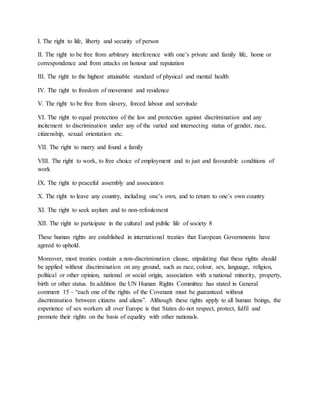
The Declaration
All individuals within Europe, including sex workers, are entitled to the following rights
under international human rights law. All European Governments are obliged to
respect, protect and fulfil:
I. The right to life, liberty and security of person
II. The right to be free from arbitrary interference with one’s private and family life, home or
correspondence and from attacks on honour and reputation
III. The right to the highest attainable standard of physical and mental health
IV. The right to freedom of movement and residence
V. The right to be free from slavery, forced labour and servitude
VI. The right to equal protection of the law and protection against discrimination and any
incitement to discrimination under any of the varied and intersecting status of gender, race,
citizenship, sexual orientation etc.
VII. The right to marry and found a family
VIII. The right to work, to free choice of employment and to just and favourable conditions of
work
IX. The right to peaceful assembly and association
X. The right to leave any country, including one’s own, and to return to one’s own country
XI. The right to seek asylum and to non-refoulement
XII. The right to participate in the cultural and public life of society 8
These human rights are established in international treaties that European Governments have
agreed to uphold.
Moreover, most treaties contain a non-discrimination clause, stipulating that these rights should
be applied without discrimination on any ground, such as race, colour, sex, language, religion,
political or other opinion, national or social origin, association with a national minority, property,
birth or other status. In addition the UN Human Rights Committee has stated in General
comment 15 – “each one of the rights of the Covenant must be guaranteed without
discrimination between citizens and aliens”. Although these rights apply to all human beings, the
experience of sex workers all over Europe is that States do not respect, protect, fulfil and
promote their rights on the basis of equality with other nationals.
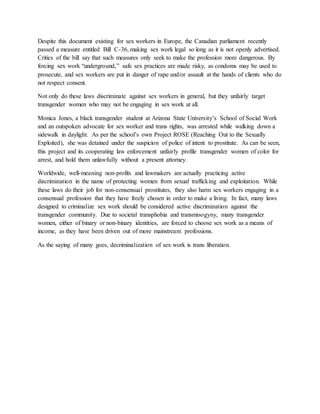
Despite this document existing for sex workers in Europe, the Canadian parliament recently
passed a measure entitled Bill C-36, making sex work legal so long as it is not openly advertised.
Critics of the bill say that such measures only seek to make the profession more dangerous. By
forcing sex work “underground,” safe sex practices are made risky, as condoms may be used to
prosecute, and sex workers are put in danger of rape and/or assault at the hands of clients who do
not respect consent.
Not only do these laws discriminate against sex workers in general, but they unfairly target
transgender women who may not be engaging in sex work at all.
Monica Jones, a black transgender student at Arizona State University’s School of Social Work
and an outspoken advocate for sex worker and trans rights, was arrested while walking down a
sidewalk in daylight. As per the school’s own Project ROSE (Reaching Out to the Sexually
Exploited), she was detained under the suspicion of police of intent to prostitute. As can be seen,
this project and its cooperating law enforcement unfairly profile transgender women of color for
arrest, and hold them unlawfully without a present attorney.
Worldwide, well-meaning non-profits and lawmakers are actually practicing active
discrimination in the name of protecting women from sexual trafficking and exploitation. While
these laws do their job for non-consensual prostitutes, they also harm sex workers engaging in a
consensual profession that they have freely chosen in order to make a living. In fact, many laws
designed to criminalize sex work should be considered active discrimination against the
transgender community. Due to societal transphobia and transmisogyny, many transgender
women, either of binary or non-binary identities, are forced to choose sex work as a means of
income, as they have been driven out of more mainstream professions.
As the saying of many goes, decriminalization of sex work is trans liberation.

WOMENCULTURALSENSITIVITY

  • 1.
    CULTURAL SENSITIVITY & WOMEN’SISSUES Part One: The Intersections of Womanhood and Other Oppressed Identities Part Two: The Issues Faced by All Women MATERIALS: 1. Sex, Lies, and Fetishizing Race (Feministe, Lekas Miller, Anna, July 9, 2012) 2. The Problem with Racial Fetishazation (Ravishly, Gladstone, Sarah, June 3, 2014) 3. Muslim Women Suffer Abuse For Wearing Hijab, Study Finds (Huffington Post UK, Elgot, Jessica, November 11, 2013) 4. Cisgender privilege (based on Peggy McIntosh’s white privilege) 5. The Brutality of Corrective Rape (New York Times, Carter, Clare, July 27, 2013) 6. 7 Photos of Courageous Women Speaking Out Against Corrective Rape in America (Identities.Mic, Davidson, Laura, March 27, 2014) 7. Tweets from Twitter hashtags #YesAll Women, #BeenRapedNeverReported, #SolidarityisforRapists 8. The Evidence Is In: Decriminalizing Sex Work Is Critical to Public Health (RH Reality Check, Forbes, Anna & Patterson, Sarah Elspeth, August 13, 2014)
  • 2.
    PART ONE: The Intersectionsof Womanhood and Other Oppressed Identities Section 1: Women of Color This is the definition for intersectionality as is found in the main multiculturalism handbook:
  • 3.
    THIS DISCUSSION CENTERSON INTERSECTIONALITY AND RACE Indeed, the concept of intersectionality was invented by black feminists, most notably by Kimberlé Crenshaw in 1989. It is the concept of what it is like to live as a black woman, at the crossroads of race and gender, under the constraints of both the patriarchy and white supremacy. (As defined below) White supremacy The belief that white people are superior to those of all other races, especially the black race, and should therefore dominate society. Patriarchy A system of society or government in which men hold the power and women are largely excluded from it. To be a black woman in a society that features both of these systems is to be doubly put down, discouraged, demeaned, controlled, silenced, and judged for her worth by behavior and appearance. The idea that beauty is Eurocentric, that to be beautiful means to be thin, white, and blonde, further devalues her. To be respected, she must be strong, which often entails showing little emotion and/or to be able to take abusive treatment from black men, white men, and white women, all at the same time. Black women (as well as other women of color) are also objectified and fetishized. (From the race-focused multiculturalist handbook) Historically, black women were prized for their “exotic” features. Female slaves were often raped to obtain offspring with just the right amount of “mixed” appeal. Nowadays, black women are fetishized by adult pornographic sites and yet, paradoxically, at the same time are criticized
  • 4.
    for showing pridein their sexuality and/or bodies. (Recall when Rihanna wore a see-through gown to the Grammy awards, or when Nicki Minaj released her music video for her hit single “Anaconda.”) Because of this double-edged sword of being seen as both “exotic” and yet being shamed for being sexual, black women face a particularly difficult ordeal when reporting rape. It is for these reasons that black women usually feel very reluctant and afraid to go to the authorities with claims of sexual assault. Fetishization is not confined to the black female community, however. Equally or more, Asian women are also fetishized by adult pornographic sites. The stereotypical Asian woman is submissive, readily accepting of her (white) dominant partner’s sexual desires to do onto her as pleased. Another racial group that is often exploited and objectified for sexual gratification is the Native American woman.
  • 5.
    Still another groupof women of color that is facing increasing rates of sexualization in media is that of Desi women in Bollywood films.
  • 6.
    This contrasts sharplywith Indian culture’s emphasis on women being pure and chaste before marriage. It leads to confusion and pent up sexual frustration in India’s heterosexual men. In light of India’s epidemic of rape, this is a highly problematic and dangerous message to be sending its people. Finally, particular attention must be paid to hijabi (women who don the hijab as part of Islam) and other women of Middle-Eastern ethnic backgrounds that wear headdresses. The incorrect assumption that women who don the hijab, burka, or niqab are oppressed and need of “rescuing” by Western men has caused great animosity. Discussions with said women on social media yield commentary of feeling very comfortable and content in the wearing of the hijab. The unpleasant part of the experience lies in Islamophobic hate crimes aimed at hijabi, which have plagued Muslim women most heavily in the urban United States and United Kingdom for decades but which have become increasingly violent since the September 11th attacks on the World Trade Center. IT IS IMPORTANT TO NOTE THAT NOT ALL WOMEN OF MIDDLE EASTERN ETHNICITY WHO WEAR A HEADDRESS ARE MUSLIMS. This unfortunate, culturally near-sighted assumption has lead to vicious attacks against any woman, even the elderly, who wear these headdresses. It is Islamophobic to believe that all Middle Eastern women wearing headdresses are affiliated with terrorist organizations or even the Muslim faith itself. Part of this animosity lead to the horrific shooting that occurred at a Wisconsin Sikh temple on August 5, 2012. In conclusion, white privilege is an invisible protection afforded to those of Caucasian descent from a multitude of prejudices, discriminations, and even violent hate crimes. It is often met with incredulity, leading to accusations that it does not exist, it must no longer exist due to civil rights
  • 7.
    gains, and/or thatits mere mention is “playing the race card” or “racist.” It is not racist to discuss race. It is not possible to be racist towards a white person, what some claim is “reverse racism,” as it is this group that holds the most power in Western societies. Mistrust and fear is often afforded to black men; skepticism of sexual “purity,” shaming, and unfair objectification is afforded to black women and other women of color. What is more, women of color must also deal with the insidious effects of colorism, both in this country and abroad. Colorism is internalized white supremacy. It is the idea held by racial minorities that being of a lighter skin tone makes them more attractive and more valuable in society. The beauty industry preys upon this phenomenon by marketing skin bleaching creams, in particular outside the United States. Colorism also can lead to the ostracizing of African Americans with the autoimmune skin- pigmentation disorder vitiligo.
  • 8.
    This chronic skindisease, often co-occurring with Lupus, is a genetically inherited condition that causes the cells in the skin to stop producing melanin. As a result, the skin progressively grows pale, causing spotting all over the body. This is not the same as being Caucasian—it is the utter absence of pigment. However, due to white supremacy, those who have this completely- uncontrollable disease are proclaimed as “wanting to be white,” trying to usurp white privilege for their own personal gain, or perhaps out of self-hatred. White supremacy also targets black women for being proud of their natural hair.
  • 9.
    As incredible asit seems, Blue Ivy Carter, the young daughter of Beyonce and Jay Z, has often come under fire from critics for having natural hair. Other firestorms have ensued over the featuring of a biracial girl with natural hair in a Cheerios commercial, as well as casting Quvenzhané Wallis for the role of Orphan Annie.
  • 10.
    White supremacy presupposesthat straight hair, along with pale skin, is the natural beauty norm that all women should aspire towards. This racial erasure and shame affects black women who feel they prefer their natural hair. These insidious forms of white supremacy still prevail in our society today. It is not the responsibility of the oppressed, i.e. women of color, to combat these phenomena. Those in power, white individuals in society, must recognize and condemn these harmful forces in order for them to stop.
  • 11.
    Section2: Women andLGBTQQIA Another group of women that face ridicule and abuse from the compounding of different intersections of oppression is the transgender woman. Although transgender individuals, both of and not of the gender binary, have existed since the dawn of civilization, their existence has often been met with great ridicule, hatred, and misunderstanding. Transgender women who choose not to undergo sex reassignment surgery are particularly vulnerable to verbal and physical abuse, and even murder. Compounding things further is the fact that most transgender victims of hate crime are trans women of color, such as Islan Nettles. Outspoken transgender women of color, such as Laverne Cox and Janet Mock, attempt to curve these heinous crimes through public education, advocacy, and outreach. Still, they occur at alarming rates. At the time of this writing, a United States Marine is under arrest on the charge of killing a transgender woman of color in the Philippines.
  • 12.
    Why are transgenderwomen met by such disdain and hatred for who they are? Part of this is due to cissexism. (From the general multiculturalism handbook) Cissexism The assumption that, due to human sexual differentiation, one's gender is determined solely by a biological sex of male or female, and that trans people are inferior to cis people, being in "defiance of nature.” The cissexist assumption of sex and gender tells us that women can only be seen as “real” if they have breasts, vaginas, and all other female reproductive organs and secondary sex characteristics. This is harmful not only to transgender women, but to cisgender (non-trans) women, as well. If a woman is not a woman if she no longer has breasts, is she still a “real” woman? This means that women who undergo a mastectomy or double mastectomy as a result of breast cancer cannot be considered women. Likewise, women who have a hysterectomy can no longer be considered women. What makes a woman? Is it wearing a dress? Most women of our era no longer wear dresses. Is it wearing make-up? Many women choose not to do so. Then how can the word “woman” be defined so narrowly? Many women are also “gender non-conforming,” meaning they opt out of actions and behaviors, like those above, which are generally ascribed to women. Despite this seemingly common sense approach, many still believe that transgender women cannot be “real” women; that they are simply pretending, or are mentally ill. Within feminism, some view the inclusion of transgender women to be highly controversial. There is a faction of modern feminism whose members are referred to some as TERFs: Trans Exclusionary Radical Feminists. These feminists claim to be upholding the rights of women while simultaneously attacking, harassing, and shaming transgender women. They claim that including trangender women in women’s spaces is putting cisgender women at risk, especially if the transgender women wishing to participate still carry their presumed-male genitalia. These feminists wish to see transgender women placed into male prisons and transgender women kept from using restroom facilities that ascribe to their presented, female gender. To do so would be putting that individual at risk more so than the other women being “protected” from her. Those who do not see transgender women as women would inflict emotional and/or physical harm upon them for intruding into spaces some feel they do not belong in. The safety of transgender women is paramount; thus so is their access to appropriate restrooms, changing facilities, and emotionally supportive spaces.
  • 13.
    The irrational hatredof all transgender people is known as transphobia. However, a special term has been coined for that of transgender women, listed and defined below. Transmisogyny The confluence of misogyny and transphobia: the negative attitudes, expressed through cultural hate, individual and state violence, and discrimination directed toward trans women and trans and gender non-conforming people on the feminine end of the gender spectrum. (from: http://everydayfeminism.com/2014/01/transmisogyny/) It is up to cisgender women to uphold the worth, dignity, and safety of transgender women from those who would wish to gaslight, verbally or physically assault, or harm them in any other way. Be mindful of your own biases. Would you consider any of the following to be “real” women? @sophiaphotos on Twitter @ThatSabineGirl on Twitter
  • 14.
    @Zjemptv on Twitter@papierhache on Twitter Our cissexist assumptions on what constitutes femininity/womanhood are framed by cisnormativity. (As defined below from the general multiculturalist handbook.) Cisnormativity The view that all people are cissexual, i.e. have a gender identity that is the same as their biological sex. We can break free from these influences by never assuming that someone wanted to be the sex they were assigned at birth as. We can challenge our inner assumptions of what a female body looks like, in terms of judging others for body hair or other “masculine” features. We can remember that the presence of breasts or absence of a penis does not always equal female. We
  • 15.
    can refrain fromasking about “top” or “bottom” surgery, and from using slurs such as “tranny” or “shemale.” CHANGING THESE ATTITUDES HELP SAVE LIVES If you don’t believe that, check the statistics: (From the Trevor Project) ● Nearly half of young transgender people have seriously thought about taking their lives, and one quarter report having made a suicide attempt. (From the American Suicide Foundation/Williams Institute’s National Transgender Discrimination Survey) ● Suicide attempts among trans men (46%) and trans women (42%) were slightly higher than the full sample (41%). Cross-dressers assigned male at birth have the lowest reported prevalence of suicide attempts among gender identity groups (21%). ● Prevalence of suicide attempts is elevated among those who disclose to everyone that they are transgender or gender-non-conforming (50%) and among those that report others can tell always (42%) or most of the time (45%) that they are transgender or gender non- conforming even if they don’t tell them. As of this writing, 226 transgender individuals have been murdered in hate crimes in 2014. (From Transrespect vs. Transphobia Worldwide; Transgender Europe (TGEU))
  • 16.
    It must alsobe considered that both transgender and cisgender women may not be attracted to men, or more attracted to other women/femme-presenting people than men. They could be lesbian, bisexual/pansexual, gynesexual, or asexual/greysexual (all falling under the umbrella term “queer). However, according to patriarchal society, which values men over women, a woman that is not attracted to men is an insult. As a result of these beliefs, queer women are often the target of abuse. These beliefs are referred to as heteropatriarchy (or cisheteropatriarchy), as defined below (from the general multiculturalist handbook). Heteropatriarchy Men dominating and de-skilling women in any of a number of forms, from outright attack to paternalistic care, and women devaluing (of necessity) female bonding. Hetereopatriarchy normalizes the dominance of one person and the subordination of another. The most extreme form of heteropatriarchal violence against trans or cis queer women is known as “corrective rape.” Although a practice more commonly found in South Africa, shockingly, it nevertheless does occur, and is condoned by some, in this country. He knew I was gay. “Do you like it?” he asked as he raped me. “No… I like women.” This is all I could say. I remained frozen.
  • 17.
    In an infamous2012 radio broadcast that would later cause him to be terminated him his job, Cleveland DJ Dominic Dieter suggested corrective rape for a caller’s daughter. According to cisheteropatriarchy, if a woman’s life, especially her sexual life, is not centered on a man, or if she does not cater her sexual expression to male needs and wants, she is deemed undesirable, even a threat. Thus, she must be reined in with violent means. Finally, another devaluation of women comes in the form of femmephobia. Femmephobia is the devaluation, fear and hatred of the feminine: of softness, nurturance, dependence, emotions, passivity, sensitivity, grace, innocence and the color pink. (From: http://www.popsugar.com/love/What-Femmephobia-22725637) Basically, this can be summed up in every small, male child’s assertion that “girls are gross.” It is actually an insidious form of sexism, more vague and unrecognizable than usual, and it is often aimed by women at women. Within the feminist community, the debate has always been raised if a feminine woman is upholding an infantilizing form of patriarchy that wants women to always stay little girls, or simply being herself in her love of kittens and fuzzy slippers. It should be recognized and called out that this femmephobic treatment by feminists onto other feminists is in actuality a form of internalized misogyny. Women are not to dictate to each other what constitutes right and wrong when it comes to personal gender expression. Indeed, it is this femmephobia which intimidates Designated Male at Birth femme non-binary individuals, as well as flamboyant gay men, to feel ashamed of themselves, their personalities, and their fully autonomous expressions and presentations of gender. Because of this, femmephobia is not only inherently misogynistic, it also upholds homophobia (“sissyphobia,” as some gay activists would deem the fear of femme gay men); cissexism (by telling DMAB femme enbies that they should “act masculine” in order to be taken seriously); and cisnormativity (that being femme is acting “like a woman,” rather than one’s personal gender presentation outside of the binary). As a society, we must not accept or condone these beliefs and practices. They endanger not only queer women, but any women. If a woman rejects the idea of sexual subserviency to men, seeking her own sexual autonomy, then she is homophobically branded a lesbian, or is simply seen as a threat to patriarchal control. This opens her up to misogynistic/transmisogynistic violence. Dismantling said attitudes is, again, saving lives, something we all should be invested in.
  • 18.
    Section3: Women andDisabilities/MentalHealth (Taken from the Cultural Sensitivity and Disabilities handbook) Mentally ill individuals are 2/3rds at greater risk than society at large to be the victims of violence. Often, women who have mental health conditions are re-victimized by those who do not believe their claims of sexual assault, as they are “crazy” or “imagining things.” Indeed, women were more often to be classically deemed mentally ill than men; the origins of terms like histrionic personality disorder and hysteria are rooted in misogyny. In the early years of psychology, mental illnesses and other mental conditions, such as schizophrenia and autism, were blamed on bad parenting by a child’s mother. The World Health Organization contends that women are more prone to diagnoses of depression and anxiety due to their subordinate position enforced by societal gender roles: Low rank is a powerful predictor of depression. Women's subordinate social status isreinforced in the workplace as they are more likely to occupy insecure, low status jobs with nodecision making authority. Those in such jobs experience higher levels of negative life events,insecure housing tenure, more chronic stressors and reduced social support. Traditional genderroles further increase susceptibility by stressing passivity, submission and dependence andimpose a duty to take on the unremitting care of others and unpaid domestic and agriculturallabour. Conversely, gains in gender development that improve women's status are likely to bring with them improvements in women's mental health. There is often an unfair portrayal of mentally ill women in the mainstream media and popular culture. Women who have post-partum depression are shunned, as becoming a mother is supposed to be the happiest point in a woman’s life. Although the concept of being “shell shocked” from war has existed since the first World War, and PTSD was officially made a diagnosis in 1991, men are still more likely to be understood when seeking treatment for trauma. Substance abuse rehabilitational programs are predominantly organized and participated in by men. As mentioned above, personality disorders were commonly more attributed to women than men, in particular histrionic (the perpetually seductive, attention seeking individual) and the borderline (the person who is unable to control their emotions within the context of a relationship). Below is a list of mental health disorders that could be utilized in the diagnoses to warrant commitment into a mental hospital (often against one’s will):
  • 19.
    Note that manyof these “diagnoses” could be labeling perfectly normal behavior. Nymphomania, for example, was attributed to women who sought sexual gratification outside of marriage, or to young women who would rather make their own decisions on their sexuality rather than have it be up to a male suitor or husband. Possessing a “seductive leer” or an enlarged cerebellum, i.e. swelling at the back of the head, were seen to be indicators of uncontrollable lust. If a woman was diagnosed with hysteria (predicated by vague symptoms such as anxiety, erotic fantasies, and lower abdominal pain) she was to be “treated” with therapeutic daily
  • 20.
    orgasms via avibrator. Once the hysteria was “cured,” she could go on to be a suitable wife and mother as per the standards of Victorian society. Hollywood is abound with stories of “madwomen.” The horror classic Rosemary’s Baby involves a woman suspicious of a conspiracy afoot that everyone in her life assures her is non- existent, a product of upper class ennui and hysterical paranoia. Films from Whatever Happened to Baby Jane to the Disney animated original classic 101 Dalmatians involve unhinged women seeking to cause violence upon the most vulnerable for their own personal gains. Countless films depict women as witches, evil sorceresses, and demonic succubi, harkening back to the Biblical Eve or Delilah. “Insane” women are also sexualized, despite being disproportionately victimized by rape. This is a halloween costume featured online from 2014. It was described on the website in terms of her being “bound to your will,” suggesting a sexualized rape fantasy. In real life, the rape of mentally ill and/or mentally disabled women in institutions is no laughting matter. Caregiver rape is a silent epidemic discovered only when vulnerable women of all ages display physical or emotional indicators of abuse, such as sexually transmitted infections, scarring of vaginal tissue, or behaviors such as dropping one’s pants when a male enters her room. Reports of abuse by mentally ill women often lead to gaslighting, claims that it was all a hallucination or perhaps she confused consensual sex for rape.
  • 21.
    The facts aresimply horrifying. (From http://www.theguardian.com/science/occams- corner/2014/sep/04/mental-illness-sexual-abuse-rape-victim) A study by researchers at University College and Kings College London, published today in Psychological Medicine, reports that of women with severe mental illness surveyed for the study, 40% had been the victims of rape or attempted rape. It is clear from this that, more so than in the general population, women with mental health diagnoses must be believed when disclosing sexual assault. The rape of women in the mental health care system is an issue that lies at the intersections of ableism and rape culture. The following section, rape culture will be defined and discussed on broader terms.
  • 22.
    PART TWO: The IssuesFaced by All Women Section 1: Rape Culture, Street Harassment, and Women Speaking Out Online (From: http://www.wavaw.ca/what-is-rape-culture/ ) Many feminists have provided great definitions of what rape culture is and how it plays out everyday. Emilie Buchwald, author of Transforming a Rape Culture, describes that when society normalizes sexualized violence, it accepts and creates rape culture. In her book she defines rape culture as “A complex set of beliefs that encourage male sexual aggression and supports violence against women. It is a society where violence is seen as sexy and sexuality as violent. In a rape culture, women perceive a continuum of threatened violence that ranges from sexual remarks to sexual touching to rape itself. A rape culture condones physical and emotional terrorism against women as the norm . . . In a rape culture both men and women assume that sexual violence is a fact of life, inevitable . . . However . . . much of what we accept as inevitable is in fact the expression of values and attitudes that can change.” The website Force: Upsetting the Rape Culture explains how rape culture is the images, language, laws and other everyday phenomena that we see and hear everyday that validate and perpetuate rape. “Rape culture includes jokes, TV, music, advertising, legal jargon, laws, words and imagery, that make violence against women and sexual coercion seem so normal that people believe that rape is inevitable. Rather than viewing the culture of rape as a problem to change, people in a rape culture think about the persistence of rape as ‘just the way things are.’” Melissa McEwan, the founder of the political and cultural group blog Shakesville, provides an extensive definition of rape culture that answers the questions what does Rape Culture look like and sound like and feel like? It is an excellent definition that provides various examples of Rape Culture, and it can be found here. Furthermore, WAVAW itself did a comprehensive blog piece on Rape Culture just several months ago, titled “Rape Culture is Real—And Yes, We’ve Had Enough”, which included citing recent current events that exemplified Rape Culture:
  • 23.
    Rape culture is… The existence of “Keep Calm and Rape A Lot” t-shirts. They really, seriously exist.  The media’s constant glossing-over of sexual assault with euphemistic language: “inappropriate behaviour,” “sexual misconduct,” and even plain old “having sex.”  Facebook’s refusal to pull sadistically graphic images of violence against women (while deeming photos of breastfeeding moms to be objectionable)!  A beauty website that calls toddlers “effing hot” – even the preschool set can’t escape objectification!  A magazine editor’s blasé admission that “the women we feature in the magazine are ornamental” and “objectified.”  Major news outlets waxing sympathetic about how two teen rapists’ “promising” lives will be destroyed by a youthful mistake, without once mentioning how the rape might affect the survivor.  Kids who call losing a sports game “getting totally raped.”  A pizza marketing campaign that makes a joke out of rape.  A subculture of self-proclaimed “ratters” who hack into women’s computers and steal their photos.  College women being instructed to vomit or urinate on demand to protect themselves against rape.  10,000 untested rape kits collecting dust on a shelf somewhere. Twitter has emerged as a useful tool in combating rape culture. From accounts such as @RapeIsntOkay and @exposerapeapology, to hashtags such as #BeenRapedNeverReported and #SolidarityIsForRapists, feminists, womanists, and other social justice movement members have turned social media into activism for women worldwide. Similarly, feminists use Twitter to speak out against street harassment, also known as catcalling, which is defined by Stop Street Harassment as Unwelcome words and actions by unknown persons in public places which are motivated by gender and invade a person’s physical and emotional space in a disrespectful, creepy, startling, scary, or insulting way. Stop Street Harassment, as well as the “Holla Back” Campaign, seeks to end an epidemic of seemingly shameless male entitlement to the female body that causes random men to shout obscenities and even touch and grope strange women without impunity. Another online activism project that shares real experiences by real women on diverse issues including street harassment is the Everyday Sexism campaign.
  • 24.
    The following arescreenshots of its most recent tweets at the time of this writing:
  • 25.
    There are, however,still drawbacks to being an outspoken woman on social media. In response to her critique of underdeveloped female characters in video games and a lack of female representation in “gamer” culture, Anita Sarkeesian, owner of the Twitter account Feminist Frequency (@femfreq) was driven out of her home with death threats from male video game players participating in #GamerGate. Said gamers also went on to issue similar violent threats towards other feminists critiquing games, such as Brianna Wu (Twitter user @Spacekatgal). When Dr. Matt Taylor, a British scientist on Rosetta’s mission team who helped successfully land a piece of NASA equipment upon a comet’s surface, appeared on television wearing an ugly bowling shirt covered in naked women, science writer Rose Eveleth basically said “not cool.” She, also, received death threats through social media. The ensuing clash of feminists and defenders of Dr. Taylor was by turns entitled #shirtgate or #shirtstorm. Despite the backlash, feminists continue to speak out on these very important issues. Recent surveys indicate that many young people do not understand what does and does not constitute consent. Most do not understand that street harassment is sexualized verbal abuse, rather than women who are unable to take compliments on their appearance. The facts show why all of this “whining” is important. CONSIDER THE FOLLOWING FROM A SURVEY OF STUDENTS (From: http://www.uic.edu/depts/owa/sa_rape_support.html ) Societal Attitudes Supporting Rape - A survey of 6,159 college students enrolled at 32 institutions in the U.S. found the following:  54% of the women surveyed had been the victims of some form of sexual abuse; more than one in four college-aged women had been the victim of rape or attempted rape;  57% of the assaults occurred on dates;  73% of the assailants and 55% of the victims had used alcohol or other drugs prior to the assault;  25% of the men surveyed admitted some degree of sexually aggressive behavior;  42% of the victims told no one. - In a survey of high school students, 56% of the girls and 76% of the boys believed forced sex was acceptable under some circumstances. (ref 5)
  • 26.
    - A surveyof 11-to-14 year-olds found:  51% of the boys and 41% of the girls said forced sex was acceptable if the boy, "spent a lot of money" on the girl;  31% of the boys and 32% of the girls said it was acceptable for a man to rape a woman with past sexual experience;  87% of boys and 79% of girls said sexual assault was acceptable if the man and the woman were married;  65% of the boys and 47% of the girls said it was acceptable for a boy to rape a girl if they had been dating for more than six months. - In a survey of male college students:  35% anonymously admitted that, under certain circumstances, they would commit rape if they believed they could get away with it (ref 6,7).  One in 12 admitted to committing acts that met the legal definitions of rape, and 84% of men who committed rape did not label it as rape.(ref 6,7) - In another survey of college males:  43% of college-aged men admitted to using coercive behavior to have sex, including ignoring a woman's protest, using physical aggression, and forcing intercourse.  15% acknowledged they had committed acquaintance rape; 11% acknowledged using physical restraints to force a woman to have sex. - Women with a history of rape or attempted rape during adolescence were almost twice as likely to experience a sexual assault during college, and were three times as likely to be victimized by a husband. - Sexual assault is reported by 33% to 46% of women who are being physically assaulted by their husbands. And consider the following statistics from the National Street Harassment Report: Key Findings.1 1. Street harassment is a significant problem in the United States. Sixty-five percent of women reported experiencing at least one type of street harassment in their lifetimes. More than half (57%) of all women had experienced verbal harassment, and 41% of all women had experienced physically aggressive forms, including sexual touching (23%), following (20%), flashing (14%), and being forced to do something sexual (9%). For men, 25% experienced street harassment, too, including 18% who experienced verbal harassment and 16% who experienced physically aggressive forms. More men who identified as LGBT experienced harassment than men who identified as heterosexual.
  • 27.
    In many ways,persons of color, lower-income people, and persons who identify as lesbian, gay, bisexual, or transgender were disproportionately affected by street harassment overall, as detailed in the main body of the report. 2. Street harassment happens multiple times to most people. Eighty-six percent of women and 79% of men who reported being harassed said they had been harassed more than once. Women were more likely than men to say it happened sometimes, often, or daily. 3. Street harassment begins at a young age. Around 50% of harassed women and men experienced street harassment by age 17. 4. Most harassed people were at least somewhat concerned that the incident would escalate. Two-thirds of the harassed women (68%) and half of the harassed men (49%) said they were very or somewhat concerned that the incident would escalate into something worse. Nearly twice as many women (25%) as men (13%) said they were very concerned. 5. Most harassed persons change their lives in some way as a result of the experience. The most common change was for harassed people to constantly assess their surroundings as a result of harassment (47% of women and 32% of men). Going places in a group or with another person instead of alone was another common response for women (31%). On the more extreme end, 4% of all harassed persons said they made a big life decision like quitting a job or moving neighborhoods because of harassers. 6. Street harassment doesn’t just happen on the streets. Streets and sidewalks are the public spaces where street harassment most commonly occurs (67% of women and 43% of men reported harassment there), but harassment also happened in public spaces such as stores, restaurants, movie theaters, and malls (26% of women and 28% of men). It also happened on public transportation (20% of women and 16% of men)
  • 28.
    Section 2: Sexualharassment in the workplace and other crimes and prejudice against working women It would seem that sexual harassment of women in the workplace would be a relic of the past, of a bygone Mad Men era of dysregulation and lack of workplace cultural sensitivity. Unfortunately, this would be an inaccurate assumption. The recent case of Raechel Sterud, a 32 year old female firefighter in Ohio, dispels this myth. After being sexually harassed for months on the job and then fired, Sterud sued and won a $1.7 million amount for damages and gender-based discrimination. Other lines of work in which female employees have reported high levels of sexual harassment on the job include police departments, restaurants, and construction work. Perhaps the most infamous case of sexual harassment was brought to the big screen by Charlize Theron, in the film North Country.
  • 29.
    Eveleth Mines employeeLois Jenson would make history by convincing her female colleagues to enact a class action lawsuit against the company for ongoing, violent, and humiliating sexual harassment on the part of its male employees towards them all. It is a gut-wrenching film to watch, especially considering the fact that the story is true. Even more gruesome is the true story behind the film Compliance.
  • 30.
    In 2004, aman claiming to be an Officer Scott called over 70 fast food establishments in 31 states to conduct the same sadistic phone prank, in which he used his false authority to have young women strip searched and sexually abused by their fellow employees. The film centers around the case of a Mount Washington, KY McDonalds and a then 18-year-old employee Louise Ogburn, and the horrific actions taken against her by her manager, Donna Summers, and her then-fiancé, Walter Nix, in the name of complying with a “police officer’s” requests. The man over the phone claimed that Ogburn had stolen a patron’s wallet; Summers believed him, proceeding to strip Ogburn naked and follow his every command. Ogburn was told to do jumping jacks naked, comply to a cavity search in which she was digitally penetrated, and be spanked and forced to perform oral sex upon Mr. Nix. Here are some statistics on violence against women in the workplace: (From  In 2000, 13,935 women had injuries or illnesses involving days away from work that resulted from assaults and violent acts (Bureau of Labor Statistics [BLS]).  Homicide is the second-leading cause of fatal occupational injuries for women, after traffic accidents. Thirty-one percent of women who die at work are killed as a result of an assault or violent act. In 2003, 119 women died as a result of an assault or violent act in the workplace (BLS).  12.7 percent of all female violent crimes were committed while the victim was working or on duty. These acts of nonfatal violence include rape and sexual assault, robbery, aggravated assault and simple assault (BLS).  Some 36,500 rapes and sexual assaults occur annually in the workplace. In 80 percent of these incidents, the victim was female (NCVS).  Nurses experience workplace crime at a rate 72 percent higher than medical technicians and at more than twice the rate of other medical fieldworkers (NCVS).  Professional (social worker/psychiatrist) and custodial care providers in the mental health care field were victimized while working or on duty at rates more than three times those in the medical field (NCVS).  Junior high school teachers have a rate of victimization in the workplace similar to convenience store clerks—54.2 versus 53.9 per 1,000 workers (NCVS). The four types of violence against women in the workplace are as follows: 1. Violence committed by clients or patients. 2. Violence associated with robbery or other crimes. 3. Violence among co-workers or managers. 4. Domestic violence that spills over into the workplace.
  • 31.
    Violence against womenin the workplace usually is not this overt and extreme. It usually consists of gender based microaggressions. See the following examples: (From University of New Hampshire’s Institutional Transformations) You are a member of a faculty search committee hiring an assistant professor in biology. The committee is just starting a face-to-face interview with a candidate named Maria Vasquez. She has dark hair, dark eyes, and a tan complexion. Most committee members assume Dr. Vasquez is Latina. One of your colleagues asks an ice-breaking question, “Where are you from?” Dr. Vasquez responds, “Minneapolis.” Your colleague follows-up with, “No, I mean, where do you come from originally?” Dr. Vasquez frowns. “Minneapolis,” she repeats with an edge to her voice. A search committee hiring a department chair in environmental science is meeting to discuss the final list of candidates, which includes two men and one women. During the discussion, a South Asian male committee member says, “I think we should hire one of the men. I won’t work for a woman.” Your computer information systems department is hiring a new assistant professor. When committee members are introducing themselves during an on-campus interview with a female candidate, the candidate notices that a female committee member frequently looks at her chest, which makes the candidate very uncomfortable. The committee member seems unaware of her behavior. During a meeting of the faculty search committee on which you are serving, almost every time a female colleague tries to speak, she is interrupted by a male colleague. No one says anything when this happens. Finally, your female colleague stops trying to offer contributions to the discussion. You wonder what she wanted to say.
  • 32.
    Defining Microaggressions Microaggressions: • areverbal and nonverbal behaviors • communicate negative, hostile, and derogatory messages to people rooted in their marginalized group membership (based on gender, race, ethnicity, sexuality, etc.) • occur in everyday interactions • can be intentional or unintentional • are often unacknowledged Three Forms of Microaggressions: 1. microassaults: “old fashioned” discrimination • name-calling, avoidant behavior, or purposeful discriminatory actions • likely to be conscious and deliberate 2. microinsults: subtle snubs that communicate a covert insulting message • convey stereotypes, rudeness, and insensitivity that demean a person’s identity • are frequently unknown to the person 3. microinvalidations: disconfirming messages • exclude, negate, or dismiss the thoughts, feelings, or experiences of certain groups • may be most damaging form of the three microaggressions Detrimental Impact of Gender Microaggressions 1. Negative impact on standard of living • Unequal wages • Higher levels of poverty 2. Negative impact on physical health
  • 33.
    • Migraines, heartdisease, autoimmune disorders 3. Negative impact on psychological health • Depression • Anxiety • Body image dissatisfaction and eating disorders Moving Forward: How to Overcome Microaggressions 1. Individual Intervention • Develop an honest awareness of our own biases, prejudices, and stereotypes • Become an ally and activist 2. Organizational Intervention • Make sure policies, practices, and procedures allow for equal access and opportunity • Create a welcoming communication climate • Provide professional development opportunities • Make accountability central 3. Societal/Cultural Intervention • Critically assess cultural communication (education, mass media, institutions, etc.) • Create social policy and law to rectify discrimination and promote equal access • Promote multi-cultural education
  • 34.
    The Challenges ofResponding to Microaggressions Dilemma #1: The Invisibility of Unintentional Expressions of Bias • tend to be subtle, indirect, and unintentional • occurs when other rationales for prejudicial behavior can be offered Dilemma #2: Perceived Minimal Harm of Microaggressions • When people say things like “Just let it go,” “You are overreacting,” or “It’s not a big deal” • The cumulative effect of microaggressions can be more problematic and detrimental than overt acts of prejudice Dilemma #3: The Catch-22 of Responding to Microaggressions • “damned if you do and damned if you don’t” • Challenges faced by the victim: 1. Determining that a microaggression has actually occurred 2. Figuring out how to react • not responding may have detrimental effects 3. Responding with anger and striking back • will likely engender negative consequences
  • 35.
    Section 3: Legaland Consensual Sex Work The oldest profession in humanity is sex work, more commonly referred to as prostitution. It is still a common profession today, and is still mostly regarded with scorn. Even within the feminist community, the reaction to sex work is usually “she shouldn’t have to debase herself to selling her body” or “this is not against her will, therefore we need to save her.” However, in many areas of the world, sex work is common, legal, and even regulated. Despite this, the International Committee on the Rights of Sex Workers in Europe (ICRSE) works to ensure that sex workers hold the same basic liberties as the general population and are not subject to undue discrimination due to their line of work. An example of this, taken from the Declaration of the Rights of Sex Workers in Europe, is featured below. In Greece, where sex work is legal and sex workers registered, a sex worker cannot marry. If they do, they are not allowed to continue to work legally and will loose their license. Sex workers are therefore forced to choose between the enjoyment of their right to marry and found a family or their right to livelihood and to practice a profession. No one should be forced to make this choice. In light of human rights violations such as these, the ICRSE has written a declaration, based upon, in part, the mandated human rights codes of the United Nations. An excerpt from this document is as follows. The Declaration of the Rights of Sex Workers in Europe Preface This Declaration is made by sex workers and by organisations dedicated to promoting their human rights and welfare. The Declaration lists rights that all individuals within Europe, including sex workers, enjoy under international human rights law; the Declaration then prescribes measures and recommends practices that the signatories of the Declaration believe are the minimum necessary to ensure that these rights are respected and protected. These rights must be respected and protected in the development and implementation of policies and programmes designed to address trafficking, irregular migration or terrorism. The Declaration All individuals within Europe, including sex workers, are entitled to the following rights under international human rights law. All European Governments are obliged to respect, protect and fulfil:
  • 36.
    I. The rightto life, liberty and security of person II. The right to be free from arbitrary interference with one’s private and family life, home or correspondence and from attacks on honour and reputation III. The right to the highest attainable standard of physical and mental health IV. The right to freedom of movement and residence V. The right to be free from slavery, forced labour and servitude VI. The right to equal protection of the law and protection against discrimination and any incitement to discrimination under any of the varied and intersecting status of gender, race, citizenship, sexual orientation etc. VII. The right to marry and found a family VIII. The right to work, to free choice of employment and to just and favourable conditions of work IX. The right to peaceful assembly and association X. The right to leave any country, including one’s own, and to return to one’s own country XI. The right to seek asylum and to non-refoulement XII. The right to participate in the cultural and public life of society 8 These human rights are established in international treaties that European Governments have agreed to uphold. Moreover, most treaties contain a non-discrimination clause, stipulating that these rights should be applied without discrimination on any ground, such as race, colour, sex, language, religion, political or other opinion, national or social origin, association with a national minority, property, birth or other status. In addition the UN Human Rights Committee has stated in General comment 15 – “each one of the rights of the Covenant must be guaranteed without discrimination between citizens and aliens”. Although these rights apply to all human beings, the experience of sex workers all over Europe is that States do not respect, protect, fulfil and promote their rights on the basis of equality with other nationals.
  • 37.
    Despite this documentexisting for sex workers in Europe, the Canadian parliament recently passed a measure entitled Bill C-36, making sex work legal so long as it is not openly advertised. Critics of the bill say that such measures only seek to make the profession more dangerous. By forcing sex work “underground,” safe sex practices are made risky, as condoms may be used to prosecute, and sex workers are put in danger of rape and/or assault at the hands of clients who do not respect consent. Not only do these laws discriminate against sex workers in general, but they unfairly target transgender women who may not be engaging in sex work at all. Monica Jones, a black transgender student at Arizona State University’s School of Social Work and an outspoken advocate for sex worker and trans rights, was arrested while walking down a sidewalk in daylight. As per the school’s own Project ROSE (Reaching Out to the Sexually Exploited), she was detained under the suspicion of police of intent to prostitute. As can be seen, this project and its cooperating law enforcement unfairly profile transgender women of color for arrest, and hold them unlawfully without a present attorney. Worldwide, well-meaning non-profits and lawmakers are actually practicing active discrimination in the name of protecting women from sexual trafficking and exploitation. While these laws do their job for non-consensual prostitutes, they also harm sex workers engaging in a consensual profession that they have freely chosen in order to make a living. In fact, many laws designed to criminalize sex work should be considered active discrimination against the transgender community. Due to societal transphobia and transmisogyny, many transgender women, either of binary or non-binary identities, are forced to choose sex work as a means of income, as they have been driven out of more mainstream professions. As the saying of many goes, decriminalization of sex work is trans liberation.