Negotiation
By:
Dr. Esraa Mohammed Soltan
Nursing Administration Department
2022
Outline:
• Definition of negotiation
• Examples of negotiation
• Three criteria for negotiation to take place
• Types of negotiation
• Types of negotiation outcomes
• 6 Steps to a successful negotiation-PERPOS
Definition of negotiation:
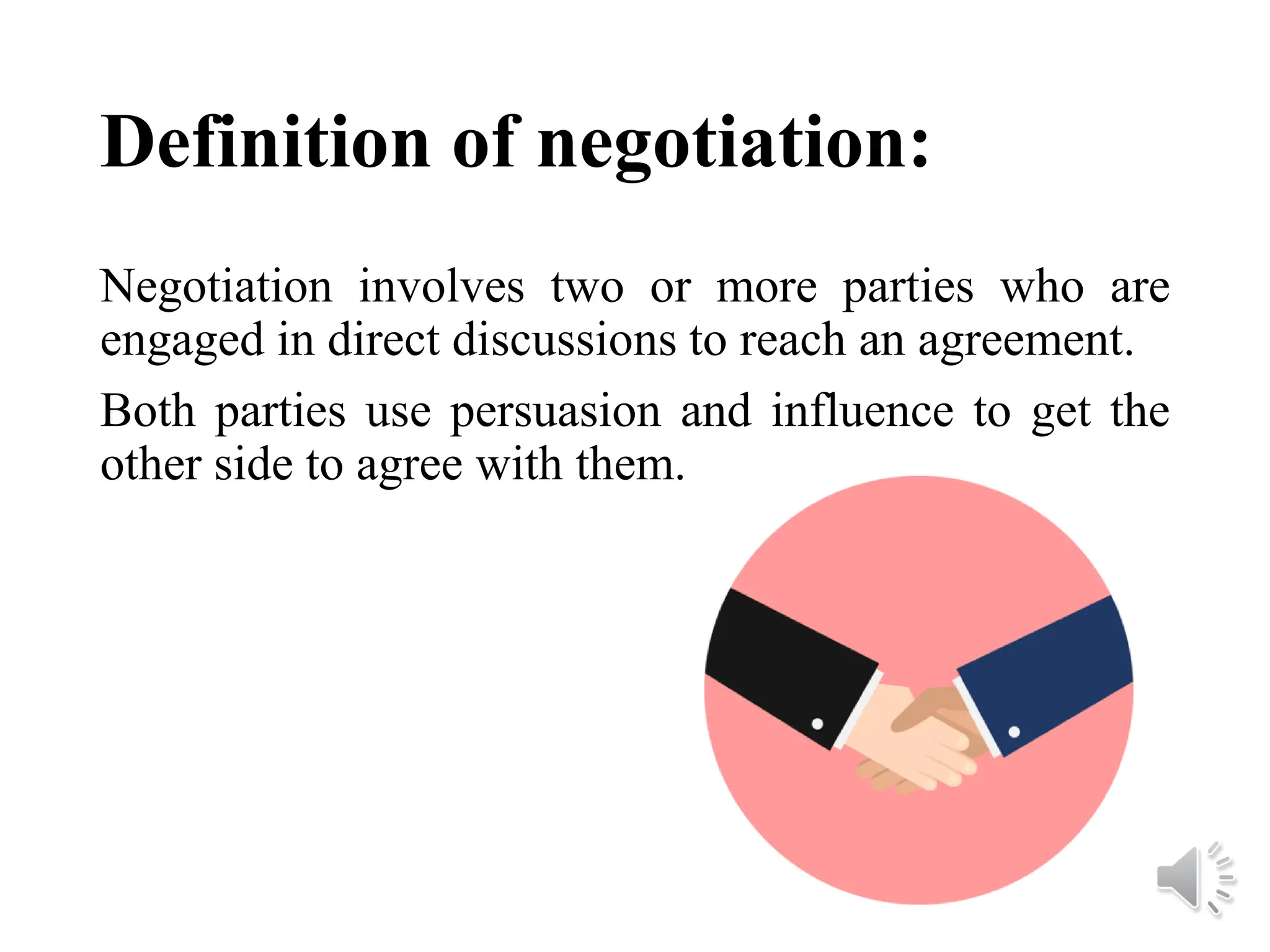
Negotiation involves two or more parties who are
engaged in direct discussions to reach an agreement.
Both parties use persuasion and influence to get the
other side to agree with them.
Examples of negotiation:
• A buyer and a salesman are negotiating a price for a
car.
• A wife is negotiating with her husband overuse of
finances.
Three criteria for negotiation to take place:
• The issue must be negotiable
• The negotiators must be interested in giving as well
as taking during the process
• The negotiating parties must trust each other, as
well as the negotiating process
Types of negotiation:
• Cooperative (i.e. everybody wins)
• Competitive (i.e. one party wins, the other
loses).
Integrative negotiation:
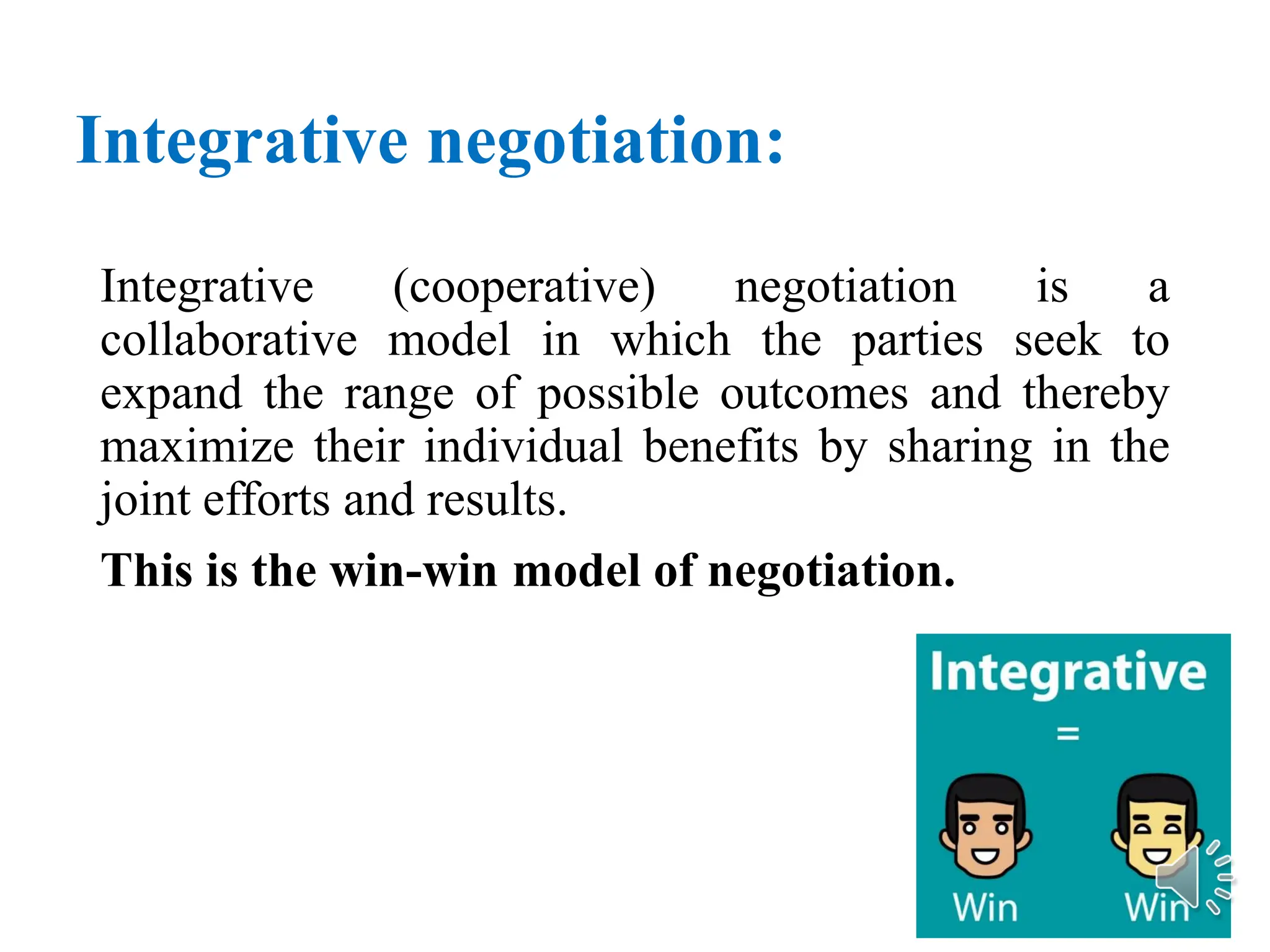
Integrative (cooperative) negotiation is a
collaborative model in which the parties seek to
expand the range of possible outcomes and thereby
maximize their individual benefits by sharing in the
joint efforts and results.
This is the win-win model of negotiation.
Distributive negotiation:
Distributive (competitive) negotiation, by contrast, is
a zero-sum game in which parties are in a state of
competition, whereby each party seeks dominance
over the other and tries to maximize its own self-
interests.
This is the win-lose model of negotiation.
Types of negotiation outcomes:
• Win-Lose
• Lose-Lose
• Partial win-Partial lose
• Win-Win
Win-Lose:
• One party wins, and the other loses.
• This can happen when the parties are mismatched,
or when one party is not prepared.
• It can also result from cheating.
• In any case, the loser will resent the winner, and any
relationship between the parties will suffer.
Lose-Lose:
• Both parties lose.
Partial win-partial lose:
This is by far the most common negotiating outcome.
Both parties get part of what they want, but neither
has his interests fully satisfied.
This seems fair since both come out better off than
they were, and we all understand that we can’t
realistically expect to get everything we want.
Win-win:
• Both parties get everything they want!
• This is the best of all possible worlds! It’s the ideal
outcome.
6 Steps to a successful negotiation-PERPOS
1. Plan ahead.
2. Emotional control.
3. Reduce tension.
4. Persuade.
5. Options.
6. Solutions.
Negotiation***********************************

Negotiation***********************************

  • 1.
    Negotiation By: Dr. Esraa MohammedSoltan Nursing Administration Department 2022
  • 2.
    Outline: • Definition ofnegotiation • Examples of negotiation • Three criteria for negotiation to take place • Types of negotiation • Types of negotiation outcomes • 6 Steps to a successful negotiation-PERPOS
  • 4.
    Definition of negotiation: Negotiationinvolves two or more parties who are engaged in direct discussions to reach an agreement. Both parties use persuasion and influence to get the other side to agree with them.
  • 5.
    Examples of negotiation: •A buyer and a salesman are negotiating a price for a car. • A wife is negotiating with her husband overuse of finances.
  • 6.
    Three criteria fornegotiation to take place: • The issue must be negotiable • The negotiators must be interested in giving as well as taking during the process • The negotiating parties must trust each other, as well as the negotiating process
  • 7.
    Types of negotiation: •Cooperative (i.e. everybody wins) • Competitive (i.e. one party wins, the other loses).
  • 8.
    Integrative negotiation: Integrative (cooperative)negotiation is a collaborative model in which the parties seek to expand the range of possible outcomes and thereby maximize their individual benefits by sharing in the joint efforts and results. This is the win-win model of negotiation.
  • 9.
    Distributive negotiation: Distributive (competitive)negotiation, by contrast, is a zero-sum game in which parties are in a state of competition, whereby each party seeks dominance over the other and tries to maximize its own self- interests. This is the win-lose model of negotiation.
  • 10.
    Types of negotiationoutcomes: • Win-Lose • Lose-Lose • Partial win-Partial lose • Win-Win
  • 11.
    Win-Lose: • One partywins, and the other loses. • This can happen when the parties are mismatched, or when one party is not prepared. • It can also result from cheating. • In any case, the loser will resent the winner, and any relationship between the parties will suffer.
  • 12.
  • 13.
    Partial win-partial lose: Thisis by far the most common negotiating outcome. Both parties get part of what they want, but neither has his interests fully satisfied. This seems fair since both come out better off than they were, and we all understand that we can’t realistically expect to get everything we want.
  • 14.
    Win-win: • Both partiesget everything they want! • This is the best of all possible worlds! It’s the ideal outcome.
  • 15.
    6 Steps toa successful negotiation-PERPOS 1. Plan ahead. 2. Emotional control. 3. Reduce tension. 4. Persuade. 5. Options. 6. Solutions.