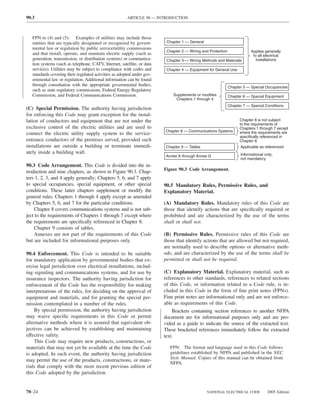
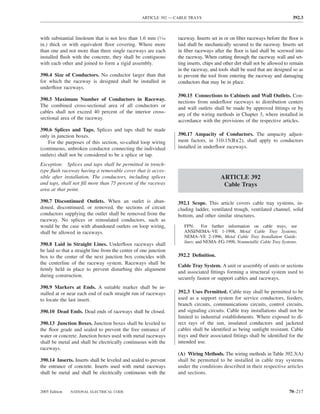
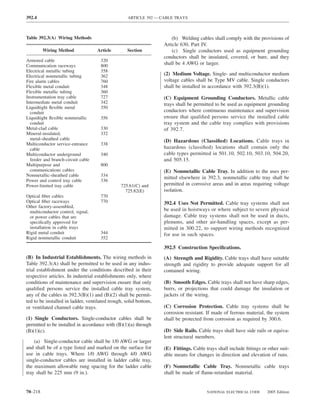
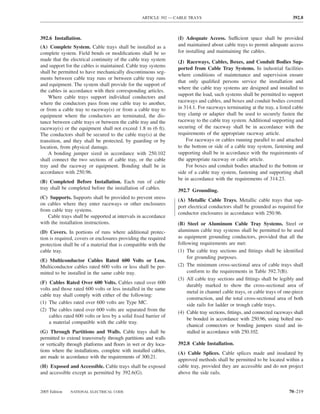
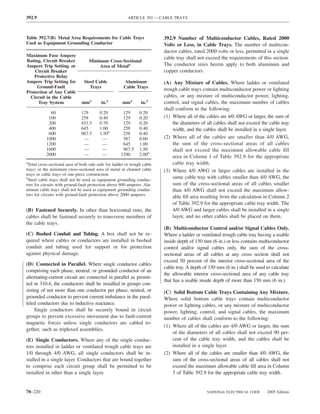
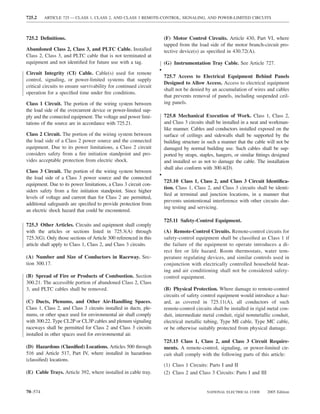
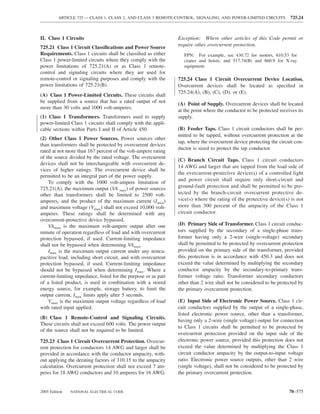
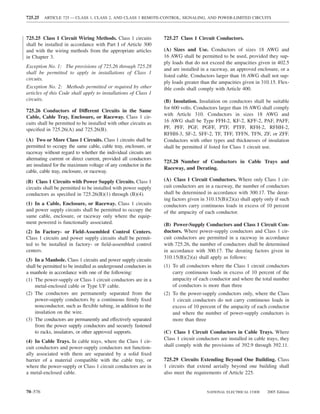
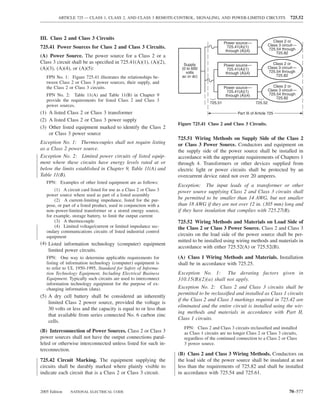
NFPA 70

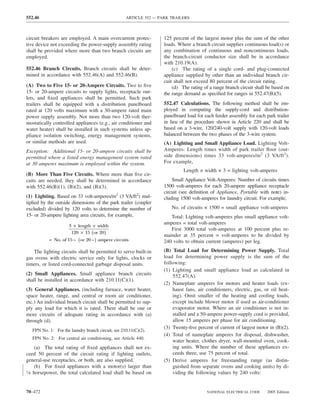
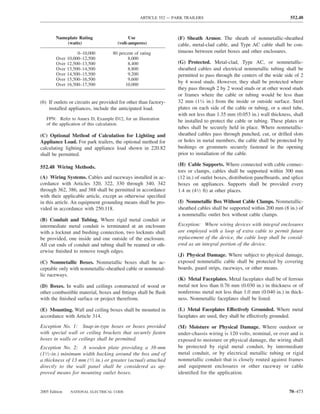
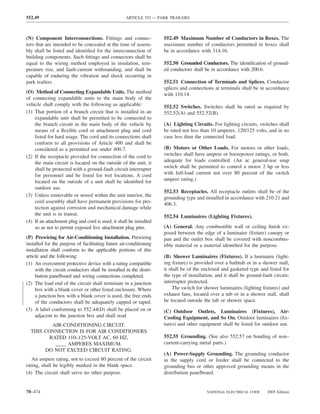
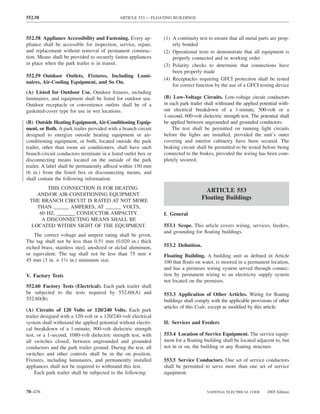
                      National
                     Electrical
                        Code


          2005 Edition


NFPA, 1 Batterymarch Park, Quincy, MA 02169-7471
 An International Codes and Standards Organization
IMPORTANT NOTICES AND DISCLAIMERS CONCERNING NFPA DOCUMENTS

NOTICE AND DISCLAIMER OF LIABILITY CONCERNING THE USE OF NFPA DOCUMENTS

   NFPA codes, standards, recommended practices, and guides, of which the document contained herein is one, are de-
veloped through a consensus standards development process approved by the American National Standards Institute.
This process brings together volunteers representing varied viewpoints and interests to achieve consensus on fire and
other safety issues. While the NFPA administers the process and establishes rules to promote fairness in the develop-
ment of consensus, it does not independently test, evaluate, or verify the accuracy of any information or the soundness
of any judgments contained in its codes and standards.
  The NFPA disclaims liability for any personal injury, property or other damages of any nature whatsoever, whether
special, indirect, consequential or compensatory, directly or indirectly resulting from the publication, use of, or reliance
on this document. The NFPA also makes no guaranty or warranty as to the accuracy or completeness of any information
published herein.
   In issuing and making this document available, the NFPA is not undertaking to render professional or other services
for or on behalf of any person or entity. Nor is the NFPA undertaking to perform any duty owed by any person or entity
to someone else. Anyone using this document should rely on his or her own independent judgment or, as appropriate,
seek the advice of a competent professional in determining the exercise of reasonable care in any given circumstances.
   The NFPA has no power, nor does it undertake, to police or enforce compliance with the contents of this document.
Nor does the NFPA list, certify, test or inspect products, designs, or installations for compliance with this document.
Any certification or other statement of compliance with the requirements of this document shall not be attributable to
the NFPA and is solely the responsibility of the certifier or maker of the statement.
ADDITIONAL NOTICES AND DISCLAIMERS

Updating of NFPA Documents

   Users of NFPA codes, standards, recommended practices, and guides should be aware that
these documents may be superseded at any time by the issuance of new editions or may be
amended from time to time through the issuance of Tentative Interim Amendments. An offi-
cial NFPA document at any point in time consists of the current edition of the document
together with any Tentative Interim Amendments and any Errata then in effect. In order to
determine whether a given document is the current edition and whether it has been amended
through the issuance of Tentative Interim Amendments or corrected through the issuance of
Errata, consult appropriate NFPA publications such as the National Fire Codes® Subscription
Service, visit the NFPA website at www.nfpa.org, or contact the NFPA at the address listed
below.

Interpretations of NFPA Documents
   A statement, written or oral, that is not processed in accordance with Section 6 of the Reg-
ulations Governing Committee Projects shall not be considered the official position of NFPA
or any of its Committees and shall not be considered to be, nor be relied upon as, a Formal
Interpretation.

Patents
   The NFPA does not take any position with respect to the validity of any patent rights
asserted in connection with any items which are mentioned in or are the subject of NFPA
codes, standards, recommended practices, and guides, and the NFPA disclaims liability for
the infringement of any patent resulting from the use of or reliance on these documents.
Users of these documents are expressly advised that determination of the validity of any such
patent rights, and the risk of infringement of such rights, is entirely their own responsibility.
   NFPA adheres to applicable policies of the American National Standards Institute with
respect to patents. For further information contact the NFPA at the address listed below.

Law and Regulations
   Users of these documents should consult applicable federal, state, and local laws and reg-
ulations. NFPA does not, by the publication of its codes, standards, recommended practices,
and guides, intend to urge action that is not in compliance with applicable laws, and these
documents may not be construed as doing so.

Copyrights

   This document is copyrighted by the NFPA. It is made available for a wide variety of both
public and private uses. These include both use, by reference, in laws and regulations, and
use in private self-regulation, standardization, and the promotion of safe practices and
methods. By making this document available for use and adoption by public authorities and
private users, the NFPA does not waive any rights in copyright to this document.
   Use of NFPA documents for regulatory purposes should be accomplished through adop-
tion by reference. The term “adoption by reference” means the citing of title, edition, and
publishing information only. Any deletions, additions, and changes desired by the adopting
authority should be noted separately in the adopting instrument. In order to assist NFPA in
following the uses made of its documents, adopting authorities are requested to notify the
NFPA (Attention: Secretary, Standards Council) in writing of such use. For technical assis-
tance and questions concerning adoption of NFPA documents, contact NFPA at the address
below.
For Further Information
   All questions or other communications relating to NFPA codes, standards, recommended
practices, and guides and all requests for information on NFPA procedures governing its
codes and standards development process, including information on the procedures for
requesting Formal Interpretations, for proposing Tentative Interim Amendments, and for
proposing revisions to NFPA documents during regular revision cycles, should be sent to
NFPA headquarters, addressed to the attention of the Secretary, Standards Council, NFPA,
1 Batterymarch Park, P.O. Box 9101, Quincy, MA 02269-9101.

For more information about NFPA, visit the NFPA website at www.nfpa.org.
Copyright © 2004, National Fire Protection Association, All Rights Reserved

                                                            NFPA 70

                                             National Electrical Code®
                                                           2005 Edition
                This edition of NFPA 70, National Electrical Code, was prepared by the National Electrical Code
                Committee and acted on by NFPA at its May Association Technical Meeting held May 23–26,
                2004, in Salt Lake City, UT. It was issued by the Standards Council on July 16, 2004, with an
                effective date of August 5, 2004, and supersedes all previous editions.
                    A tentative interim amendment (TIA) to Section 604.6(A)(1) was issued on July 15, 2004.
                For further information on tentative interim amendments see Section 5 of the NFPA Regulations
                Governing Committee Projects available at:
                                http://www.nfpa.org/Codes/NFPADirectory.asp#Regs&Procedures
                    This edition of NFPA 70 was approved as an American National Standard on August 5, 2004.

                                History and Development of the National Electrical Code®
                    The National Fire Protection Association has acted as sponsor of the National Electrical
                Code since 1911. The original Code document was developed in 1897 as a result of the united
                efforts of various insurance, electrical, architectural, and allied interests.
                    In accordance with the provisions of the NFPA Regulations Governing Committee Projects,
                a National Electrical Code Committee Report on Proposals containing proposed amendments to
                the 2002 National Electrical Code was published by NFPA in July 2003. This report recorded the
                actions of the various Code-Making Panels and the Correlating Committee of the National
                Electrical Code Committee on each proposal that had been made to revise the 2002 Code. The
                report was circulated to all members of the National Electrical Code Committee and was made
                available to other interested NFPA members and to the public for review and comment. Follow-
                ing the close of the public comment period, the Code-Making Panels met, acted on each com-
                ment, and reported their action to the Correlating Committee. NFPA published the National
                Electrical Code Committee Report on Comments in April 2004, which recorded the actions of the
                Code-Making Panels and the Correlating Committee on each public comment to the National
                Electrical Code Committee Report on Proposals. The National Electrical Code Committee Report
                on Proposals and the National Electrical Code Committee Report on Comments were presented
                to the 2004 May Association Technical Meeting for adoption.
                    NFPA has an Electrical Section that provides particular opportunity for NFPA members
                interested in electrical safety to become better informed and to contribute to the development of
                the National Electrical Code and other NFPA electrical standards. Each of the Code-Making
                Panels and the Chairman of the Correlating Committee reported their recommendations to meet-
                ings of the Electrical Section at the 2004 NFPA World Safety Conference and Exposition. The
                Electrical Section thus had opportunity to discuss and review the report of the National Electrical
                Code Committee prior to the adoption of this edition of the Code by the Association at its 2004
                May Technical Session.
                    This 2005 edition supersedes all other previous editions, supplements, and printings dated
                1897, 1899, 1901, 1903, 1904, 1905, 1907, 1909, 1911, 1913, 1915, 1918, 1920, 1923, 1925,
                1926, 1928, 1930, 1931, 1933, 1935, 1937, 1940, 1942, 1943, 1947, 1949, 1951, 1953, 1954, 1955, 1956,
                1957, 1958, 1959, 1962, 1965, 1968, 1971, 1975, 1978, 1981, 1984, 1987, 1990, 1993, 1996, 1999, and
                2002. The 2005 edition marks the 50th edition of the National Electrical Code.
                    Changes other than editorial are indicated by a vertical rule beside the paragraph, table, or
                figure in which the change occurred. These rules are included as an aid to the user in identifying
                changes from the previous edition. Where one or more complete paragraphs have been deleted,
                the deletion is indicated by a bullet (•) between the paragraphs that remain.
                    This Code is purely advisory as far as NFPA is concerned. It is made available for a wide
                variety of both public and private uses in the interest of life and property protection. These
                include both use in law and for regulatory purposes, and use in private self-regulation and
                standardization activities as insurance underwriting, building and facilities construction and man-
                agement, and product testing and certification.


2005 Edition   NATIONAL ELECTRICAL CODE                                                                                 70–1
CONTENTS


                                                                       Contents

ARTICLE                                                                      ARTICLE
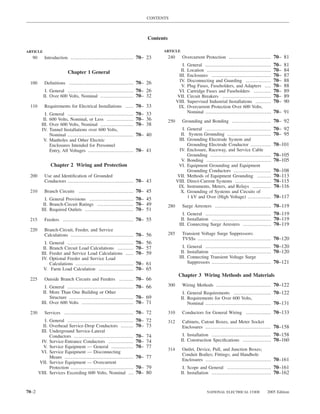
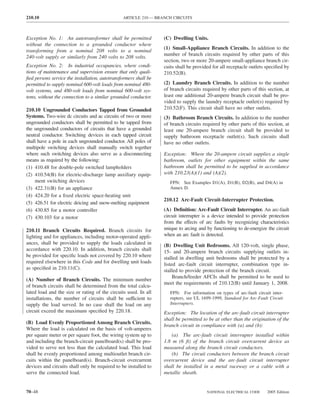
  90      Introduction ........................................ 70– 23            240      Overcurrent Protection ........................... 70– 81
                                                                                           I.   General ..........................................   70–   81
                        Chapter 1 General                                                 II.   Location .........................................   70–   84
                                                                                         III.   Enclosures ......................................    70–   87
                                                                                         IV.    Disconnecting and Guarding ................          70–   88
 100      Definitions ......................................... 70– 26
                                                                                          V.    Plug Fuses, Fuseholders, and Adapters ....           70–   88
           I. General .......................................... 70– 26                  VI.    Cartridge Fuses and Fuseholders ...........          70–   89
          II. Over 600 Volts, Nominal ..................... 70– 32                      VII.    Circuit Breakers ...............................     70–   89
                                                                                        VIII.   Supervised Industrial Installations ..........       70–   90
 110      Requirements for Electrical Installations ..... 70– 33                         IX.    Overcurrent Protection Over 600 Volts,
           I.General ..........................................    70– 33                       Nominal ..........................................   70– 91
          II.600 Volts, Nominal, or Less .................         70– 36         250      Grounding and Bonding ......................... 70– 92
         III.Over 600 Volts, Nominal .....................         70– 38
         IV. Tunnel Installations over 600 Volts,                                          I. General ..........................................     70– 92
             Nominal ..........................................    70– 40                 II. System Grounding ............................          70– 95
          V. Manholes and Other Electric                                                 III. Grounding Electrode System and
             Enclosures Intended for Personnel                                                Grounding Electrode Conductor .............            70–101
             Entry, All Voltages .............................     70– 41                IV. Enclosure, Raceway, and Service Cable
                                                                                              Grounding .......................................      70–105
                                                                                          V. Bonding .........................................       70–105
                Chapter 2 Wiring and Protection                                          VI. Equipment Grounding and Equipment
                                                                                              Grounding Conductors ........................          70–108
 200      Use and Identification of Grounded                                             VII. Methods of Equipment Grounding .........                70–113
          Conductors .......................................... 70– 43                  VIII. Direct-Current Systems .......................         70–115
                                                                                         IX. Instruments, Meters, and Relays ............            70–116
 210      Branch Circuits ................................... 70– 45                      X. Grounding of Systems and Circuits of
           I. General Provisions ............................ 70– 45                          1 kV and Over (High Voltage) ...............           70–117
          II. Branch-Circuit Ratings ....................... 70– 49               280      Surge Arresters .................................... 70–119
         III. Required Outlets ............................... 70– 51
                                                                                           I. General .......................................... 70–119
 215      Feeders ............................................. 70– 55                    II. Installation ...................................... 70–119
                                                                                         III. Connecting Surge Arresters .................. 70–119
 220      Branch-Circuit, Feeder, and Service
          Calculations ........................................ 70– 56            285      Transient Voltage Surge Suppressors:
                                                                                           TVSSs ............................................... 70–120
           I.General ..........................................    70– 56
          II.Branch Circuit Load Calculations ..........           70– 57                  I. General .......................................... 70–120
         III.Feeder and Service Load Calculations .....            70– 59                 II. Installation ...................................... 70–120
         IV. Optional Feeder and Service Load                                            III. Connecting Transient Voltage Surge
             Calculations .....................................    70– 61                     Suppressors ...................................... 70–121
          V. Farm Load Calculation ......................          70– 65
                                                                                         Chapter 3 Wiring Methods and Materials
 225      Outside Branch Circuits and Feeders ......... 70– 66
           I. General .......................................... 70– 66           300      Wiring Methods ................................... 70–122
          II. More Than One Building or Other                                              I. General Requirements ........................ 70–122
              Structure ......................................... 70– 69                  II. Requirements for Over 600 Volts,
         III. Over 600 Volts ................................. 70– 71                         Nominal .......................................... 70–131

 230      Services ............................................ 70– 72            310      Conductors for General Wiring ................ 70–133
          I. General ..........................................    70– 72         312      Cabinets, Cutout Boxes, and Meter Socket
         II. Overhead Service-Drop Conductors ........             70– 73                  Enclosures .......................................... 70–158
        III. Underground Service-Lateral
             Conductors ......................................     70– 74                  I. Installation ...................................... 70–158
        IV. Service-Entrance Conductors ................           70– 74                 II. Construction Specifications .................. 70–160
         V. Service Equipment — General ..............             70– 77         314      Outlet, Device, Pull, and Junction Boxes;
        VI. Service Equipment — Disconnecting
                                                                                           Conduit Bodies; Fittings; and Handhole
             Means ............................................    70– 77                  Enclosures .......................................... 70–161
       VII. Service Equipment — Overcurrent
             Protection ........................................   70– 79                  I. Scope and General ............................ 70–161
       VIII. Services Exceeding 600 Volts, Nominal ...             70– 80                 II. Installation ...................................... 70–162


70–2                                                                                                       NATIONAL ELECTRICAL CODE            2005 Edition
CONTENTS


ARTICLE                                                                    ARTICLE
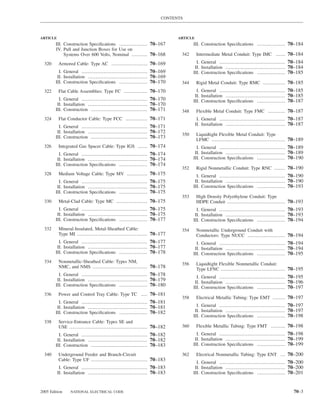
        III. Construction Specifications .................. 70–167                 III. Construction Specifications .................. 70–184
        IV. Pull and Junction Boxes for Use on
             Systems Over 600 Volts, Nominal .......... 70–168              342      Intermediate Metal Conduit: Type IMC ...... 70–184

  320     Armored Cable: Type AC ....................... 70–169                     I. General .......................................... 70–184
                                                                                   II. Installation ...................................... 70–184
          I. General .......................................... 70–169            III. Construction Specifications .................. 70–185
         II. Installation ...................................... 70–169
        III. Construction Specifications .................. 70–170           344      Rigid Metal Conduit: Type RMC .............. 70–185
  322     Flat Cable Assemblies: Type FC ............... 70–170                     I. General .......................................... 70–185
                                                                                   II. Installation ...................................... 70–185
          I. General .......................................... 70–170            III. Construction Specifications .................. 70–187
         II. Installation ...................................... 70–170
        III. Construction .................................... 70–171       348      Flexible Metal Conduit: Type FMC ........... 70–187
  324     Flat Conductor Cable: Type FCC .............. 70–171                        I. General .......................................... 70–187
                                                                                     II. Installation ...................................... 70–187
          I. General .......................................... 70–171
         II. Installation ...................................... 70–172
                                                                            350      Liquidtight Flexible Metal Conduit: Type
        III. Construction .................................... 70–173
                                                                                     LFMC ............................................... 70–189
  326     Integrated Gas Spacer Cable: Type IGS ...... 70–174                       I. General .......................................... 70–189
          I. General .......................................... 70–174             II. Installation ...................................... 70–189
         II. Installation ...................................... 70–174           III. Construction Specifications .................. 70–190
        III. Construction Specifications .................. 70–174
                                                                            352      Rigid Nonmetallic Conduit: Type RNC ....... 70–190
  328     Medium Voltage Cable: Type MV ............. 70–175                        I. General .......................................... 70–190
          I. General .......................................... 70–175             II. Installation ...................................... 70–190
         II. Installation ...................................... 70–175           III. Construction Specifications .................. 70–193
        III. Construction Specifications .................. 70–175
                                                                            353      High Density Polyethylene Conduit: Type
  330     Metal-Clad Cable: Type MC .................... 70–175                      HDPE Conduit ..................................... 70–193
          I. General .......................................... 70–175              I. General .......................................... 70–193
         II. Installation ...................................... 70–175            II. Installation ...................................... 70–193
        III. Construction Specifications .................. 70–177                 III. Construction Specifications .................. 70–194
  332     Mineral-Insulated, Metal-Sheathed Cable:                          354      Nonmetallic Underground Conduit with
          Type MI ............................................. 70–177               Conductors: Type NUCC ........................ 70–194
          I. General .......................................... 70–177              I. General .......................................... 70–194
         II. Installation ...................................... 70–177            II. Installation ...................................... 70–194
        III. Construction Specifications .................. 70–178                 III. Construction Specifications .................. 70–195
  334     Nonmetallic-Sheathed Cable: Types NM,
                                                                            356      Liquidtight Flexible Nonmetallic Conduit:
          NMC, and NMS ................................... 70–178
                                                                                     Type LFNC ......................................... 70–195
          I. General .......................................... 70–178
                                                                                    I. General .......................................... 70–195
         II. Installation ...................................... 70–179
                                                                                   II. Installation ...................................... 70–196
        III. Construction Specifications .................. 70–180
                                                                                  III. Construction Specifications .................. 70–197
  336     Power and Control Tray Cable: Type TC .... 70–181
                                                                            358      Electrical Metallic Tubing: Type EMT ........ 70–197
          I. General .......................................... 70–181
         II. Installation ...................................... 70–181             I. General .......................................... 70–197
        III. Construction Specifications .................. 70–182                  II. Installation ...................................... 70–197
                                                                                  III. Construction Specifications .................. 70–198
  338     Service-Entrance Cable: Types SE and
          USE .................................................. 70–182     360      Flexible Metallic Tubing: Type FMT ......... 70–198
          I. General .......................................... 70–182              I. General .......................................... 70–198
         II. Installation ...................................... 70–182            II. Installation ...................................... 70–199
        III. Construction .................................... 70–183             III. Construction Specifications .................. 70–199

  340     Underground Feeder and Branch-Circuit                             362      Electrical Nonmetallic Tubing: Type ENT ... 70–200
          Cable: Type UF .................................... 70–183
                                                                                    I. General .......................................... 70–200
           I. General .......................................... 70–183            II. Installation ...................................... 70–200
          II. Installation ...................................... 70–183          III. Construction Specifications .................. 70–201


2005 Edition     NATIONAL ELECTRICAL CODE                                                                                                    70–3
CONTENTS


ARTICLE                                                                       ARTICLE
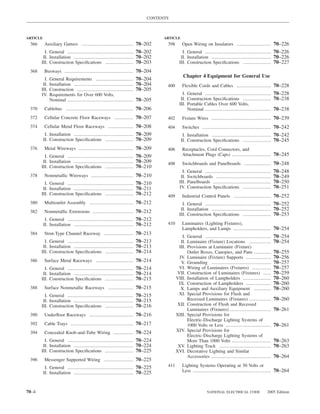
 366      Auxiliary Gutters ................................. 70–202           398      Open Wiring on Insulators ...................... 70–226
         I. General .......................................... 70–202                    I. General .......................................... 70–226
        II. Installation ...................................... 70–202                  II. Installation ...................................... 70–226
       III. Construction Specifications .................. 70–203                       III. Construction Specifications .................. 70–227
 368      Busways ............................................ 70–204
                                                                                         Chapter 4 Equipment for General Use
         I.   General Requirements ........................         70–204
        II.   Installation ......................................   70–204     400      Flexible Cords and Cables ...................... 70–228
       III.   Construction ....................................     70–205
       IV.    Requirements for Over 600 Volts,                                           I. General .......................................... 70–228
              Nominal ..........................................    70–205              II. Construction Specifications .................. 70–238
                                                                                       III. Portable Cables Over 600 Volts,
 370      Cablebus ........................................... 70–206                       Nominal .......................................... 70–238
 372      Cellular Concrete Floor Raceways ............ 70–207                 402      Fixture Wires ...................................... 70–239
 374      Cellular Metal Floor Raceways ................ 70–208                404      Switches ............................................ 70–242
           I. Installation ...................................... 70–209                 I. Installation ...................................... 70–242
          II. Construction Specifications .................. 70–209                      II. Construction Specifications .................. 70–245
 376      Metal Wireways ................................... 70–209            406      Receptacles, Cord Connectors, and
         I. General .......................................... 70–209                   Attachment Plugs (Caps) ......................... 70–245
        II. Installation ...................................... 70–209         408      Switchboards and Panelboards ................. 70–248
       III. Construction Specifications .................. 70–210
                                                                                         I.   General ..........................................   70–248
 378      Nonmetallic Wireways ........................... 70–210                       II.   Switchboards ...................................     70–249
         I. General .......................................... 70–210                  III.   Panelboards .....................................    70–250
        II. Installation ...................................... 70–211                 IV.    Construction Specifications ..................        70–251
       III. Construction Specifications .................. 70–212               409      Industrial Control Panels ........................ 70–252
 380      Multioutlet Assembly ............................ 70–212                       I. General .......................................... 70–252
                                                                                        II. Installation ...................................... 70–252
 382      Nonmetallic Extensions .......................... 70–212
                                                                                       III. Construction Specifications .................. 70–253
           I. General .......................................... 70–212
          II. Installation ...................................... 70–212       410      Luminaires (Lighting Fixtures),
                                                                                        Lampholders, and Lamps ........................ 70–254
 384      Strut-Type Channel Raceway ................... 70–213
                                                                                         I. General ..........................................     70–254
         I. General .......................................... 70–213                   II. Luminaire (Fixture) Locations ..............           70–254
        II. Installation ...................................... 70–213                 III. Provisions at Luminaire (Fixture)
       III. Construction Specifications .................. 70–214                            Outlet Boxes, Canopies, and Pans ...........           70–255
                                                                                       IV. Luminaire (Fixture) Supports ................           70–256
 386      Surface Metal Raceways ........................ 70–214                        V. Grounding ......................................        70–257
         I. General .......................................... 70–214                 VI. Wiring of Luminaires (Fixtures) ............             70–257
        II. Installation ...................................... 70–214                VII. Construction of Luminaires (Fixtures) .....             70–259
       III. Construction Specifications .................. 70–215                     VIII. Installation of Lampholders ..................          70–260
                                                                                      IX. Construction of Lampholders ................             70–260
 388      Surface Nonmetallic Raceways ................ 70–215                          X. Lamps and Auxiliary Equipment ...........               70–260
         I. General .......................................... 70–215                 XI. Special Provisions for Flush and
        II. Installation ...................................... 70–215                      Recessed Luminaires (Fixtures) ..............          70–260
       III. Construction Specifications .................. 70–216                      XII. Construction of Flush and Recessed
                                                                                            Luminaires (Fixtures) ..........................       70–261
 390      Underfloor Raceways ............................ 70–216                     XIII. Special Provisions for
                                                                                            Electric-Discharge Lighting Systems of
 392      Cable Trays ........................................ 70–217                       1000 Volts or Less .............................       70–261
 394      Concealed Knob-and-Tube Wiring ............. 70–224                        XIV. Special Provisions for
                                                                                            Electric-Discharge Lighting Systems of
         I. General .......................................... 70–224                       More Than 1000 Volts .........................         70–263
        II. Installation ...................................... 70–224                XV. Lighting Track .................................         70–263
       III. Construction Specifications .................. 70–225                     XVI. Decorative Lighting and Similar
                                                                                            Accessories ......................................     70–264
 396      Messenger Supported Wiring ................... 70–225
           I. General .......................................... 70–225        411      Lighting Systems Operating at 30 Volts or
          II. Installation ...................................... 70–225                Less .................................................. 70–264


70–4                                                                                                     NATIONAL ELECTRICAL CODE            2005 Edition
CONTENTS


ARTICLE                                                                          ARTICLE
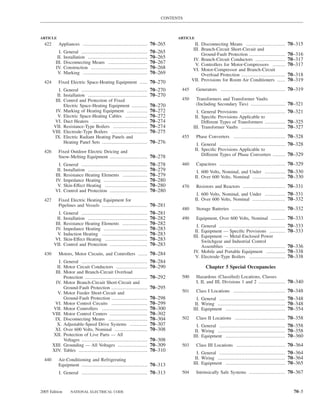
  422      Appliances ......................................... 70–265                    II. Disconnecting Means .........................        70–315
                                                                                         III. Branch-Circuit Short-Circuit and
            I.   General ..........................................    70–265                 Ground-Fault Protection .......................      70–316
           II.   Installation ......................................   70–265            IV. Branch-Circuit Conductors ...................         70–317
          III.   Disconnecting Means .........................         70–267             V. Controllers for Motor-Compressors ........            70–317
          IV.    Construction ....................................     70–268           VI. Motor-Compressor and Branch-Circuit
           V.    Marking .........................................     70–269                 Overload Protection ............................     70–318
  424      Fixed Electric Space-Heating Equipment ..... 70–270                          VII. Provisions for Room Air Conditioners .....            70–319
           I. General ..........................................       70–270     445      Generators ......................................... 70–319
          II. Installation ......................................      70–270
         III. Control and Protection of Fixed                                     450      Transformers and Transformer Vaults
              Electric Space-Heating Equipment ..........              70–270              (Including Secondary Ties) ...................... 70–321
         IV. Marking of Heating Equipment .............                70–272              I. General Provisions ............................ 70–321
          V. Electric Space-Heating Cables ..............              70–272             II. Specific Provisions Applicable to
         VI. Duct Heaters ...................................          70–274                 Different Types of Transformers ............. 70–325
        VII. Resistance-Type Boilers ......................            70–274            III. Transformer Vaults ............................ 70–327
        VIII. Electrode-Type Boilers .......................           70–275
         IX. Electric Radiant Heating Panels and                                  455      Phase Converters ................................. 70–328
              Heating Panel Sets .............................         70–276               I. General .......................................... 70–328
  426      Fixed Outdoor Electric Deicing and                                              II. Specific Provisions Applicable to
           Snow-Melting Equipment ........................ 70–278                              Different Types of Phase Converters ........ 70–329

           I.    General ..........................................    70–278     460      Capacitors .......................................... 70–329
          II.    Installation ......................................   70–279               I. 600 Volts, Nominal, and Under ............. 70–330
         III.    Resistance Heating Elements ................          70–279              II. Over 600 Volts, Nominal ..................... 70–330
         IV.     Impedance Heating ............................        70–280
          V.     Skin-Effect Heating ...........................       70–280     470      Resistors and Reactors ........................... 70–331
         VI.     Control and Protection ........................       70–280
                                                                                            I. 600 Volts, Nominal, and Under ............. 70–331
  427      Fixed Electric Heating Equipment for                                            II. Over 600 Volts, Nominal ..................... 70–332
           Pipelines and Vessels ............................. 70–281
                                                                                  480      Storage Batteries .................................. 70–332
           I.    General ..........................................    70–281
          II.    Installation ......................................   70–282     490      Equipment, Over 600 Volts, Nominal ......... 70–333
         III.    Resistance Heating Elements ................          70–282              I. General ..........................................   70–333
         IV.     Impedance Heating ............................        70–283             II. Equipment — Specific Provisions ..........            70–333
          V.     Induction Heating .............................       70–283            III. Equipment — Metal-Enclosed Power
        VI.      Skin-Effect Heating ...........................       70–283                 Switchgear and Industrial Control
        VII.     Control and Protection ........................       70–283                 Assemblies ......................................    70–336
  430      Motors, Motor Circuits, and Controllers ...... 70–284                         IV. Mobile and Portable Equipment ............            70–338
                                                                                          V. Electrode-Type Boilers .......................        70–338
           I. General ..........................................       70–284
          II. Motor Circuit Conductors ....................            70–290                    Chapter 5 Special Occupancies
         III. Motor and Branch-Circuit Overload
              Protection ........................................      70–292     500      Hazardous (Classified) Locations, Classes
         IV. Motor Branch-Circuit Short-Circuit and                                        I, II, and III, Divisions 1 and 2 ................. 70–340
              Ground-Fault Protection .......................          70–295
          V. Motor Feeder Short-Circuit and                                       501      Class I Locations ................................. 70–348
              Ground-Fault Protection .......................          70–298              I. General .......................................... 70–348
         VI. Motor Control Circuits .......................            70–299             II. Wiring ........................................... 70–348
        VII. Motor Controllers .............................           70–300            III. Equipment ...................................... 70–354
        VIII. Motor Control Centers ........................           70–302
         IX. Disconnecting Means .........................             70–304     502      Class II Locations ................................ 70–358
          X. Adjustable-Speed Drive Systems ...........                70–307              I. General .......................................... 70–358
         XI. Over 600 Volts, Nominal .....................             70–308             II. Wiring ........................................... 70–358
        XII. Protection of Live Parts — All                                              III. Equipment ...................................... 70–360
              Voltages ..........................................      70–308
        XIII. Grounding — All Voltages ...................             70–309     503      Class III Locations ............................... 70–364
        XIV. Tables ............................................       70–310              I. General .......................................... 70–364
  440      Air-Conditioning and Refrigerating                                             II. Wiring ........................................... 70–364
           Equipment .......................................... 70–313                   III. Equipment ...................................... 70–365

            I. General .......................................... 70–313          504      Intrinsically Safe Systems ....................... 70–367


2005 Edition         NATIONAL ELECTRICAL CODE                                                                                                        70–5
CONTENTS


ARTICLE                                                                       ARTICLE
 505      Class I, Zone 0, 1, and 2 Locations ........... 70–369                      III. Nonprofessional Projectors .................. 70–442
                                                                                      IV. Audio Signal Processing, Amplification,
 506      Zone 20, 21, and 22 Locations for                                                and Reproduction Equipment ................ 70–442
          Combustible Dusts, Fibers, and Flyings ....... 70–383
                                                                               545      Manufactured Buildings ......................... 70–442
 510      Hazardous (Classified) Locations —
          Specific .............................................. 70–388
                                                                               547      Agricultural Buildings ........................... 70–443
 511      Commercial Garages, Repair and Storage .... 70–388
                                                                               550      Mobile Homes, Manufactured Homes, and
 513      Aircraft Hangars .................................. 70–391                    Mobile Home Parks ............................... 70–446
 514      Motor Fuel Dispensing Facilities .............. 70–393                        I. General .......................................... 70–446
                                                                                       II. Mobile and Manufactured Homes .......... 70–447
 515      Bulk Storage Plants .............................. 70–397                   III. Services and Feeders .......................... 70–454
 516      Spray Application, Dipping, and Coating                              551      Recreational Vehicles and Recreational
          Processes ............................................ 70–402                 Vehicle Parks ....................................... 70–455
 517      Health Care Facilities ............................ 70–408                    I.General ..........................................      70–455
         I. General ..........................................      70–408             II.Combination Electrical Systems ............             70–456
        II. Wiring and Protection ........................          70–410            III.Other Power Sources .........................           70–457
       III. Essential Electrical System ..................          70–413            IV. Nominal 120-Volt or 120/240-Volt
       IV.  Inhalation Anesthetizing Locations .........            70–420                Systems ..........................................      70–458
        V.  X-Ray Installations ............................        70–422             V. Factory Tests ...................................       70–464
       VI.  Communications, Signaling Systems,                                        VI. Recreational Vehicle Parks ...................          70–465
            Data Systems, Fire Alarm Systems, and
            Systems Less Than 120 Volts, Nominal ....               70–424     552      Park Trailers ....................................... 70–467
       VII. Isolated Power Systems ......................           70–424              I. General ..........................................     70–467
                                                                                       II. Low-Voltage Systems .........................          70–467
 518      Assembly Occupancies .......................... 70–425                      III. Combination Electrical Systems ............            70–469
 520      Theaters, Audience Areas of Motion                                          IV.  Nominal 120-Volt or 120/240-Volt
          Picture and Television Studios,                                                  Systems ..........................................     70–469
          Performance Areas, and Similar Locations ... 70–427                           V. Factory Tests ...................................      70–476
          I. General ..........................................     70–427     553      Floating Buildings ................................ 70–476
         II. Fixed Stage Switchboards ....................          70–428
        III. Fixed Stage Equipment Other Than                                           I. General .......................................... 70–476
             Switchboards ....................................      70–429             II. Services and Feeders .......................... 70–476
        IV. Portable Switchboards on Stage ............             70–430            III. Grounding ...................................... 70–477
         V. Portable Stage Equipment Other Than
             Switchboards ....................................      70–433     555      Marinas and Boatyards .......................... 70–477
       VI. Dressing Rooms ...............................           70–434
       VII. Grounding ......................................        70–435     590      Temporary Installations .......................... 70–480

 525      Carnivals, Circuses, Fairs, and Similar
          Events ............................................... 70–435                         Chapter 6 Special Equipment
          I.   General Requirements ........................        70–435     600      Electric Signs and Outline Lighting ........... 70–483
         II.   Power Sources .................................      70–435
        III.   Wiring Methods ................................      70–435               I. General .......................................... 70–483
        IV.    Grounding and Bonding ......................         70–436              II. Field-Installed Skeleton Tubing ............. 70–486
 530      Motion Picture and Television Studios                                604      Manufactured Wiring Systems ................. 70–487
          and Similar Locations ............................ 70–437
         I.    General ..........................................   70–437     605      Office Furnishings (Consisting of Lighting
        II.    Stage or Set ....................................    70–437              Accessories and Wired Partitions) .............. 70–488
       III.    Dressing Rooms ...............................       70–440
       IV.     Viewing, Cutting, and Patching Tables ....           70–440     610      Cranes and Hoists ................................ 70–489
        V.     Cellulose Nitrate Film Storage Vaults .....          70–440              I.   General ..........................................   70–489
       VI.     Substations ......................................   70–440             II.   Wiring ...........................................   70–489
                                                                                      III.   Contact Conductors ...........................       70–492
 540      Motion Picture Projection Rooms ............. 70–440
                                                                                      IV.    Disconnecting Means .........................        70–492
           I. General .......................................... 70–440                V.    Overcurrent Protection ........................      70–493
          II. Equipment and Projectors of the                                        VI.     Control ..........................................   70–494
              Professional Type .............................. 70–441                VII.    Grounding ......................................     70–494


70–6                                                                                                    NATIONAL ELECTRICAL CODE            2005 Edition
CONTENTS


ARTICLE                                                                        ARTICLE
  620      Elevators, Dumbwaiters, Escalators,                                  680      Swimming Pools, Fountains, and Similar
           Moving Walks, Wheelchair Lifts, and                                           Installations ......................................... 70–528
           Stairway Chair Lifts .............................. 70–494
                                                                                         I.   General ..........................................   70–528
           I.General ..........................................      70–494             II.   Permanently Installed Pools .................        70–531
          II.Conductors ......................................       70–496            III.   Storable Pools ..................................    70–538
         III.Wiring ...........................................      70–497            IV.    Spas and Hot Tubs ............................       70–538
         IV. Installation of Conductors ....................         70–500             V.    Fountains ........................................   70–540
          V. Traveling Cables ...............................        70–500           VI.     Pools and Tubs for Therapeutic Use .......           70–542
         VI. Disconnecting Means and Control ..........              70–501           VII.    Hydromassage Bathtubs ......................         70–542
        VII. Overcurrent Protection ........................         70–502
        VIII.Machine Rooms, Control Rooms,                                      682      Natural and Artificially Made Bodies of
             Machinery Spaces, and Control Spaces ....               70–503              Water ................................................ 70–543
         IX. Grounding ......................................        70–503              I. General .......................................... 70–543
          X. Emergency and Standby Power                                                II. Installation ...................................... 70–543
             Systems ..........................................      70–503            III. Grounding and Bonding ...................... 70–544
  625      Electric Vehicle Charging System ............. 70–504
                                                                                685      Integrated Electrical Systems ................... 70–544
           I.   General ..........................................   70–504
          II.   Wiring Methods ................................      70–504               I. General .......................................... 70–544
         III.   Equipment Construction ......................        70–505              II. Orderly Shutdown ............................. 70–545
         IV.    Control and Protection ........................      70–505
          V.    Electric Vehicle Supply Equipment                               690      Solar Photovoltaic Systems ..................... 70–545
                Locations ........................................   70–506              I.   General ..........................................   70–545
                                                                                        II.   Circuit Requirements .........................       70–547
  630      Electric Welders ................................... 70–507                 III.   Disconnecting Means .........................        70–549
           I.   General ..........................................   70–507            IV.    Wiring Methods ................................      70–551
          II.   Arc Welders ....................................     70–508             V.    Grounding ......................................     70–552
         III.   Resistance Welders ............................      70–509            VI.    Marking .........................................    70–553
         IV.    Welding Cable .................................      70–509           VII.    Connection to Other Sources ................         70–554
                                                                                      VIII.   Storage Batteries ...............................    70–554
  640      Audio Signal Processing, Amplification,                                      IX.    Systems Over 600 Volts ......................        70–556
           and Reproduction Equipment .................... 70–510
           I. General .......................................... 70–510         692      Fuel Cell Systems ................................ 70–556
          II. Permanent Audio System Installations ..... 70–513                          I.   General ..........................................   70–556
         III. Portable and Temporary Audio System                                       II.   Circuit Requirements .........................       70–556
              Installations ...................................... 70–514              III.   Disconnecting Means .........................        70–557
                                                                                       IV.    Wiring Methods ................................      70–557
  645      Information Technology Equipment ........... 70–515                          V.    Grounding ......................................     70–557
  647      Sensitive Electronic Equipment ................ 70–516                      VI.    Marking .........................................    70–558
                                                                                      VII.    Connection to Other Circuits ................        70–558
  650      Pipe Organs ........................................ 70–518                VIII.   Outputs Over 600 Volts ......................        70–559
  660      X-Ray Equipment ................................ 70–518              695      Fire Pumps ......................................... 70–559
           I.   General ..........................................   70–518
          II.   Control ..........................................   70–519
         III.   Transformers and Capacitors ................         70–520                      Chapter 7 Special Conditions
         IV.    Guarding and Grounding .....................         70–520
                                                                                700      Emergency Systems .............................. 70–563
  665      Induction and Dielectric Heating                                              I.General ..........................................      70–563
           Equipment .......................................... 70–520                  II.Circuit Wiring ..................................       70–564
           I. General .......................................... 70–520                III.Sources of Power ..............................         70–565
          II. Guarding, Grounding, and Labeling ........ 70–521                        IV. Emergency System Circuits for
                                                                                           Lighting and Power ............................         70–566
  668      Electrolytic Cells ................................. 70–522                  V. Control — Emergency Lighting
                                                                                           Circuits ...........................................    70–567
  669      Electroplating ...................................... 70–524
                                                                                       VI. Overcurrent Protection ........................         70–567
  670      Industrial Machinery ............................. 70–525
                                                                                701      Legally Required Standby Systems ............ 70–567
  675      Electrically Driven or Controlled
                                                                                         I.   General ..........................................   70–567
           Irrigation Machines ............................... 70–526
                                                                                        II.   Circuit Wiring ..................................    70–568
           I. General .......................................... 70–526                III.   Sources of Power ..............................      70–569
          II. Center Pivot Irrigation Machines ........... 70–528                      IV.    Overcurrent Protection ........................      70–570


2005 Edition        NATIONAL ELECTRICAL CODE                                                                                                         70–7
CONTENTS


ARTICLE                                                                      ARTICLE
 702      Optional Standby Systems ...................... 70–570                        II.   Cables Outside and Entering Buildings ....           70–610
                                                                                       III.   Protection .......................................   70–611
         I.   General ..........................................   70–570              IV.    Grounding Methods ...........................        70–611
        II.   Circuit Wiring ..................................    70–571               V.    Cables Within Buildings .....................        70–612
       III.   Grounding ......................................     70–571              VI.    Listing Requirements .........................       70–614
       IV.    Sources of Power ..............................      70–571
 705      Interconnected Electric Power Production                            830        Network-Powered Broadband
          Sources .............................................. 70–571                  Communications Systems ........................ 70–615
                                                                                         I.   General ..........................................   70–615
 720      Circuits and Equipment Operating at Less
                                                                                        II.   Cables Outside and Entering Buildings ....           70–617
          Than 50 Volts ...................................... 70–573
                                                                                       III.   Protection .......................................   70–619
 725      Class 1, Class 2, and Class 3                                                IV.    Grounding Methods ...........................        70–620
          Remote-Control, Signaling, and                                                V.    Wiring Methods Within Buildings ..........           70–621
          Power-Limited Circuits ........................... 70–573                    VI.    Listing Requirements .........................       70–623
         I.   General ..........................................   70–573    TABLES
        II.   Class 1 Circuits ................................    70–575                                 Chapter 9 Tables
       III.   Class 2 and Class 3 Circuits .................       70–577
       IV.    Listing Requirements .........................       70–581          1     Percent of Cross Section of Conduit and
                                                                                         Tubing for Conductors ........................... 70–625
 727      Instrumentation Tray Cable: Type ITC ........ 70–583
 760      Fire Alarm Systems .............................. 70–584                 2     Radius of Conduit and Tubing Bends ......... 70–625

         I. General ..........................................     70–584          4     Dimensions and Percent Area of Conduit
        II. Non–Power-Limited Fire Alarm                                                 and Tubing (Areas of Conduit or Tubing
            (NPLFA) Circuits ..............................        70–585                for the Combinations of Wires Permitted
       III. Power-Limited Fire Alarm (PLFA)                                              in Table 1, Chapter 9) ............................ 70–626
            Circuits ...........................................   70–587
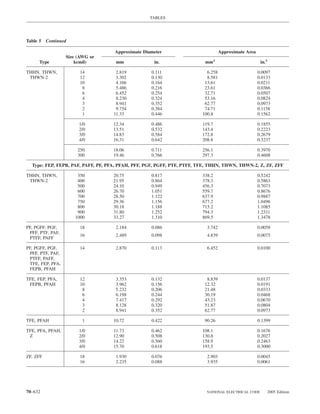
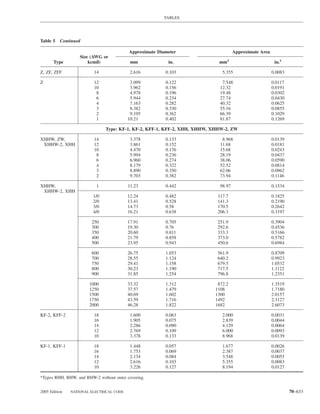
       IV. Listing Requirements .........................          70–590          5     Dimensions of Insulated Conductors and
                                                                                         Fixture Wires ....................................... 70–630
 770      Optical Fiber Cables and Raceways ........... 70–592
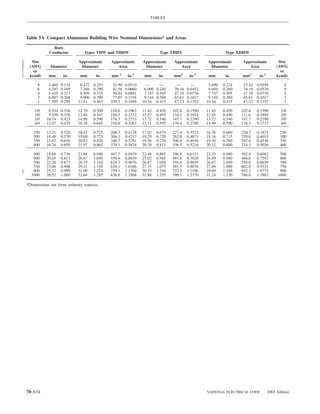
         I.   General ..........................................   70–592         5A     Compact Aluminum Building Wire
        II.   Protection .......................................   70–593                Nominal Dimensions and Areas ................ 70–634
       III.   Cables Within Buildings .....................        70–593
                                                                                   8     Conductor Properties ............................. 70–634
       IV.    Listing Requirements .........................       70–595
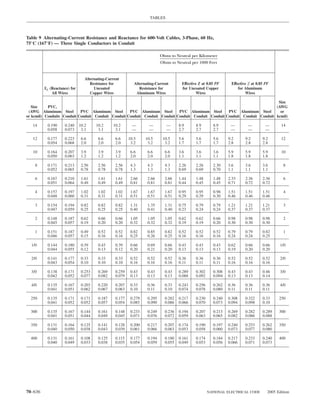
 780      Closed-Loop and Programmed Power                                         9     Alternating-Current Resistance and
          Distribution ......................................... 70–596                  Reactance for 600-Volt Cables, 3-Phase,
                                                                                         60 Hz, 75°C (167°F) — Three Single
                                                                                         Conductors in Conduit ............................ 70–636
              Chapter 8 Communications Systems
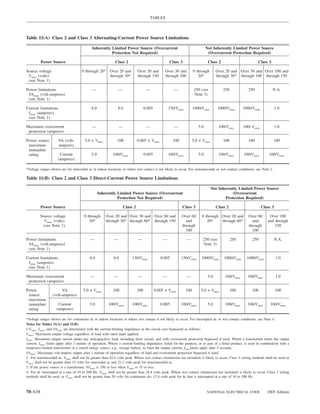
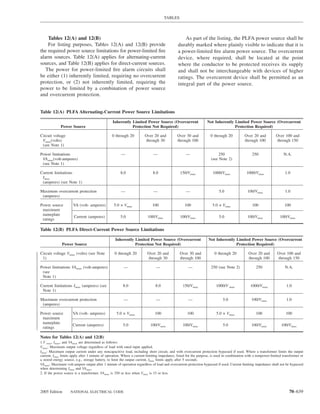
                                                                             11(A)       Class 2 and Class 3 Alternating-Current
 800      Communications Circuits ........................ 70–597
                                                                                         Power Source Limitations ........................ 70–638
         I. General ..........................................     70–597
        II. Wires and Cables Outside and Entering                            11(B)       Class 2 and Class 3 Direct-Current Power
            Buildings ........................................     70–598                Source Limitations ................................ 70–638
       III. Protection .......................................     70–599
       IV. Grounding Methods ...........................           70–600    12(A)       PLFA Alternating-Current Power Source
        V. Communications Wires and Cables                                               Limitations .......................................... 70–639
            Within Buildings ...............................       70–601    12(B)       PLFA Direct-Current Power Source
       VI. Listing Requirements .........................          70–603                Limitations .......................................... 70–639
 810      Radio and Television Equipment ............... 70–606
                                                                                         Annex A ............................................ 70–640
         I. General ..........................................     70–606
        II. Receiving Equipment — Antenna                                                Annex B ............................................ 70–643
            Systems ..........................................     70–606                Annex C ............................................ 70–657
       III. Amateur Transmitting and Receiving
            Stations — Antenna Systems .................           70–608                Annex D ............................................ 70–717
       IV. Interior Installation — Transmitting
                                                                                         Annex E ............................................ 70–726
            Stations ...........................................   70–609
                                                                                         Annex F ............................................ 70–728
 820      Community Antenna Television and Radio
          Distribution Systems .............................. 70–609                     Annex G ............................................ 70–731
          I. General .......................................... 70–609                   Index ............................................... 70–738


70–8                                                                                                     NATIONAL ELECTRICAL CODE            2005 Edition
NATIONAL ELECTRICAL CODE COMMITTEE


                                      NATIONAL ELECTRICAL CODE COMMITTEE
         These lists represent the membership at the time the Committee was balloted on the final text of this edition. Since
         that time, changes in the membership may have occurred. A key to classifications is found at the back of this
         document.


                                                  Technical Correlating Committee

                                                          James W. Carpenter, Chair
                                            International Association of Electrical Inspectors, TX [E]
                                              Rep. International Association of Electrical Inspectors

                                                          Mark W. Earley, Secretary
                                                                NFPA, MA
                                                                (nonvoting)
                                                   Jean A. O’Connor, Recording Secretary
                                                                NFPA, MA
                                                                (nonvoting)
    James E. Brunssen, Telcordia, NJ [UT]                                       James M. Daly, General Cable, NJ [M]
        Rep. Alliance for Telecommunications Industry Solutions                    Rep. National Electrical Manufacturers Association
    Michael I. Callanan, National Joint Apprentice & Training                      (Alt. to J. T. Pauley)
    Committee, MD [L]                                                           Stanley J. Folz, Folz Electric, Incorporated, IL [IM]
        Rep. International Brotherhood of Electrical Workers                       Rep. National Electrical Contractors Association
    William R. Drake, Marinco, CA [M]                                              (Alt. to M. D. Toman)
    John R. Kovacik, Underwriters Laboratories Incorporated,                    Palmer L. Hickman, National Joint Apprentice & Training
    IL [RT]                                                                     Committee, MD [L]
    James T. Pauley, Square D Company, KY [M]                                      Rep. International Brotherhood of Electrical Workers
        Rep. National Electrical Manufacturers Association                         (Alt. to M. I. Callanan)
    Michael D. Toman, MEGA Power Electrical Services,                           Neil F. LaBrake, Jr., Niagara Mohawk, a National Grid
    Incorporated, MD [IM]
                                                                                Company, NY [UT]
        Rep. National Electrical Contractors Association
                                                                                   Rep. Electric Light & Power Group/EEI
    John W. Troglia, Edison Electric Institute, WI [UT]
        Rep. Electric Light & Power Group/EEI                                      (Alt. to J. W. Troglia)
    Craig M. Wellman, DuPont Engineering, DE [U]                                William M. Lewis, Eli Lilly & Company, IN [U]
        Rep. American Chemistry Council                                            Rep. American Chemistry Council
                                                                                   (Alt. to C. M. Wellman)
                             Alternates                                         Mark C. Ode, Underwriters Laboratories Incorporated,
    Jeffrey Boksiner, Telcordia Technologies, Incorporated,                     NC [RT]
    NJ [UT]                                                                        (Alt. to J. R. Kovacik)
        Rep. Alliance for Telecommunications Industry Solutions                                          Nonvoting
        (Alt. to J. E. Brunssen)
    Philip H. Cox, Bigelow, AR [E]                                              Richard G. Biermann, Biermann Electric Company,
        Rep. International Association of Electrical Inspectors                 Incorporated, IA [IM]
        (Alt. to J. W. Carpenter)                                               D. Harold Ware, Libra Electric Company, OK [IM]


                                                CODE–MAKING PANEL NO. 1
                                             Articles 90, 100, 110, Annex A, Annex G

                                                            John D. Minick, Chair
                                             National Electrical Manufacturers Association, TX [M]
                                              Rep. National Electrical Manufacturers Association

    Michael A. Anthony, University of Michigan, MI [U]                          H. Landis Floyd II, The DuPont Company, DE [U]
        Rep. The Association of Higher Education Facilities                        Rep. Institute of Electrical & Electronics Engineers,
        Officers                                                                   Incorporated
    Louis A. Barrios, Jr., Shell Global Solutions, TX [U]                       Palmer L. Hickman, National Joint Apprentice & Training
        Rep. American Chemistry Council                                         Committee, MD [L]
    David A. Dini, Underwriters Laboratories Incorporated,                         Rep. International Brotherhood of Electrical Workers
    IL [RT]                                                                     David L. Hittinger, IEC of Greater Cincinnati, OH [IM]
    William T. Fiske, Intertek Testing Services NA,                                Rep. Independent Electrical Contractors, Incorporated
    Incorporated, NY [RT]


2005 Edition    NATIONAL ELECTRICAL CODE                                                                                                   70–9
NATIONAL ELECTRICAL CODE COMMITTEE


        Randall R. McCarver, Telcordia Technologies, Incorporated,                 Neil F. LaBrake, Jr., Niagara Mohawk, a National Grid
        NJ [U]                                                                     Company, NY [UT]
           Rep. Alliance for Telecommunications Industry Solutions                    Rep. Electric Light & Power Group/EEI
        Lanny G. McMahill, City of Phoenix, AZ [E]                                    (Alt. to J. W. Troglia)
           Rep. International Association of Electrical Inspectors                 Donald H. McCullough, II, Westinghouse Savannah River
        H. Brooke Stauffer, National Electrical Contractors                        Company, SC [U]
        Association, MD [IM]                                                          Rep. Institute of Electrical & Electronics Engineers,
           Rep. National Electrical Contractors Association                           Incorporated
        John W. Troglia, Edison Electric Institute, WI [UT]                           (Alt. to H. L. Floyd II)
           Rep. Electric Light & Power Group/EEI
                                                                                   Gil Moniz, National Electrical Manufacturers Association,
                                 Alternates                                        MA [M]
                                                                                      Rep. National Electrical Manufacturers
        Lawrence S. Ayer, Biz Com Electric, Incorporated, OH [IM]
                                                                                      Association
            Rep. Independent Electrical Contractors, Incorporated
                                                                                      (Alt. to J. D. Minick)
            (Alt. to D. L. Hittinger)
        Kenneth P. Boyce, Underwriters Laboratories Incorporated,                  Rick Munch, Frischhertz Electric Company, LA [L]
        IL [RT]                                                                       Rep. International Brotherhood of Electrical
            (Alt. to D. A. Dini)                                                      Workers
        Ernest J. Gallo, Telcordia Technologies, Incorporated, NJ [U]                 (Alt. to P. L. Hickman)
            Rep. Alliance for Telecommunications Industry Solutions
            (Alt. to R. R. McCarver)
        Russell J. Helmick, Jr., City of Irvine, CA [E]
                                                                                                            Nonvoting
            Rep. International Association of Electrical Inspectors                Ark Tsisserev, City of Vancouver, BC, Canada
            (Alt. to L. G. McMahill)                                                  Rep. Canadian Standards Association International


                                                   CODE–MAKING PANEL NO. 2
                                        Articles 210, 215, 220, Annex D, Examples 1 through 6

                                                             Raymond W. Weber, Chair
                                                               State of Wisconsin, WI [E]
                                                 Rep. International Association of Electrical Inspectors

        Richard W. Becker, Engineered Electrical Systems,                          Ernest S. Broome, City of Knoxville, TN [E]
        Incorporated, WA [U]                                                           Rep. International Association of Electrical Inspectors
           Rep. Institute of Electrical & Electronics Engineers,                       (Alt. to R. W. Weber)
           Incorporated                                                            James R. Jones, University of Alabama at Birmingham, AL
        Frank Coluccio, New York City Department of Buildings,                     [U]
        NY [E]                                                                         Rep. Institute of Electrical & Electronics Engineers,
        Matthew D. Dobson, National Association of Home                                Incorporated
        Builders, DC [U]                                                               (Alt. to R. W. Becker)
           Rep. National Association of Home Builders                              Daniel J. Kissane, Pass & Seymour/Legrand, NY [M]
        Thomas L. Harman, University of Houston/Clear Lake, TX
                                                                                       Rep. National Electrical Manufacturers Association
        [SE]
                                                                                       (Alt. to J. T. Pauley)
        Donald M. King, IBEW Local Union 313, DE [L]
           Rep. International Brotherhood of Electrical Workers                    Brian J. Nenninger, The Dow Chemical Company, TX [U]
        Christopher P. O’Neil, National Grid USA Service                               Rep. American Chemistry Council
        Company, MA                                                                    (Alt. to J. P. Roché)
           Rep. Electric Light & Power Group/EEI, MA                               Clifford L. Rediger, Independent Electrical Contractors
        James T. Pauley, Square D Company, KY [M]                                  Training Fund, CO [IM]
           Rep. National Electrical Manufacturers Association                          Rep. Independent Electrical Contractors, Incorporated
        Susan W. Porter, Underwriters Laboratories Incorporated,                       (Alt. to R. G. Wilkinson)
        NY [RT]                                                                    Richard V. Wagner, Underwriters Laboratories Incorporated,
        Joseph Patterson Roché, Celanese Acetate, SC [U]                           NY [RT]
           Rep. American Chemistry Council                                             (Alt. to S. W. Porter)
        Albert F. Sidhom, U.S. Army Corps of Engineers, CA [U]                     Joseph E. Wiehagen, National Association of Home
        Michael D. Toman, MEGA Power Electrical Services,                          Builders, MD [U]
        Incorporated, MD [IM]                                                          Rep. National Association of Home Builders
           Rep. National Electrical Contractors Association                            (Alt. to M. D. Dobson)
        Robert G. Wilkinson, Independent Electrical Contractors of
        Texas Gulf Coast, TX [IM]                                                                           Nonvoting
           Rep. Independent Electrical Contractors, Incorporated
                                                                                   Douglas A. Lee, U.S. Consumer Product Safety
                                 Alternates                                        Commission, MD [C]
        Kevin J. Brooks, IBEW Local Union 16, IN [L]                               Andrew M. Trotta, U.S. Consumer Product Safety
           Rep. International Brotherhood of Electrical Workers                    Commission, MD [C]
           (Alt. to D. M King)                                                        (Alt. to D. A. Lee)


70–10                                                                                                  NATIONAL ELECTRICAL CODE           2005 Edition
NATIONAL ELECTRICAL CODE COMMITTEE


                                           CODE–MAKING PANEL NO. 3
           Articles 300, 590, 720, 725, 727, 760, Chapter 9, Tables 11(a) and (b), and Tables 12(a) and (b)

                                                            Richard P. Owen, Chair
                                                             City of St. Paul, MN [E]
                                              Rep. International Association of Electrical Inspectors

    Lawrence S. Ayer, Biz Com Electric, Incorporated, OH [IM]                   Adam D. Corbin, Corbin Electrical Services, Incorporated,
       Rep. Independent Electrical Contractors, Incorporated                    NJ [IM]
    Paul J. Casparro, Scranton Electricians JATC, PA [L]                           Rep. Independent Electrical Contractors, Inc.
       Rep. International Brotherhood of Electrical Workers                        (Alt. to L. S. Ayer)
    Les Easter, Allied Tube and Conduit, IL [M]                                 John C. Hudak, Old Forge, PA [E]
       Rep. National Electrical Manufacturers Association                          Rep. International Association of Electrical Inspectors
    Sanford E. Egesdal, Egesdal Associates PLC, MN [M]                             (Alt. to R. P. Owen)
       Rep. Automatic Fire Alarm Association, Incorporated                      Danny Liggett, DuPont Engineering, DE [U]
    Thomas J. Guida, Underwriters Laboratories, Inc., NY [RT]                      Rep. American Chemistry Council
    Dennis B. Horman, PacifiCorp, UT [UT]                                           (Alt. to D. A. Pace)
       Rep. Electric Light & Power Group/EEI                                    Juan C. Menendez, Southern California Edison Company,
    Ray R. Keden, ERICO, Incorporated, CA [M]                                   CA [UT]
       Rep. Building Industry Consulting Services International                    Rep. Electric Light & Power Group/EEI
    Ronald E. Maassen, Lemberg Electric Company,
                                                                                   (Alt. to D. B. Horman)
    Incorporated, WI [IM]
                                                                                T. David Mills, Bechtel Savannah River, Incorporated,
       Rep. National Electrical Contractors Association
                                                                                SC [U]
    Steven J. Owen, Steven J. Owen, Incorporated, AL [IM]
       Rep. Associated Builders and Contractors, Incorporated                      Rep. Institute of Electrical & Electronics Engineers,
    David A. Pace, Olin Corporation, AL [U]                                        Incorporated
       Rep. American Chemistry Council                                             (Alt. to M. K. Sanders)
    Melvin K. Sanders, Things Electrical Company,                               Mark C. Ode, Underwriters Laboratories Incorporated,
    Incorporated (TECo., Incorporated), IA [U]                                  NC [RT]
       Rep. Institute of Electrical & Electronics Engineers,                       (Alt. to T. J. Guida)
       Incorporated                                                             Lorena Orbanic, Carlon, Lamson & Sessions, OH [M]
    John E. Sleights, Travelers Insurance, CT [I]                                  Rep. Building Industry Consulting Services International
                                                                                   (Alt. to R. R. Keden)
                             Alternates                                         Roger S. Passmore, Davis Electrical Constructors,
    Mark E Christian, Chattanooga Electrical JATC, TN [L]                       Incorporated, SC [IM]
        Rep. International Brotherhood of Electrical Workers                       Rep. Associated Builders and Contractors, Incorporated
        (Alt. to P. J. Casparro)                                                   (Alt. to S. J. Owen)
    Dr. Shane M. Clary, Bay Alarm Company, Incorporated,                        George A. Straniero, AFC Cable Systems, Incorporated,
    CA [M]                                                                      NJ [M]
        Rep. Automatic Fire Alarm Association, Incorporated                        Rep. National Electrical Manufacturers Association
        (Alt. to S. E. Egesdal)                                                    (Alt. to L. Easter)


                                                    CODE–MAKING PANEL NO. 4
                                                         Articles 225, 230

                                                          James M. Naughton, Chair
                                                         IBEW Local Union 103, MA [L]
                                               Rep. International Brotherhood of Electrical Workers

    Malcolm Allison, Ferraz Shawmut, MA [M]                                     John W. Young, Siemens Energy & Automation,
    C. John Beck, Pacific Gas and Electric Company,                              Incorporated, GA [M]
    CA [UT]                                                                        Rep. National Electrical Manufacturers Association
        Rep. Electric Light & Power Group/EEI                                   Vincent Zinnante, Advantage Electric, Incorporated,
    Robert J. Deaton, The Dow Chemical Company, TX [U]                          TX [IM]
        Rep. Institute of Electrical & Electronics Engineers,                      Rep. Independent Electrical Contractors, Incorporated
        Incorporated
    Howard D. Hughes, Hughes Electric Company                                                            Alternates
    Incorporated, AR [IM]                                                       Thomas L. Adams, Exelon Corporation, IL [UT]
        Rep. National Electrical Contractors Association                           Rep. Electric Light & Power Group/EEI
    William M. Lewis, Eli Lilly & Company, IN [U]                                  (Alt. to C. J. Beck)
        Rep. American Chemistry Council                                         Ronald Breschini, Underwriters Laboratories Incorporated,
    Mark C. Ode, Underwriters Laboratories Incorporated,                        CA [RT]
    NC [RT]                                                                        (Alt. to M. C. Ode)
    James J. Rogers, Towns of Oak Bluffs, Tisbury, West                         Terry D. Cole, Hamer Electric, WA [IM]
    Tisbury, MA [E]                                                                Rep. Independent Electrical Contractors, Incorporated
        Rep. International Association of Electrical Inspectors                    (Alt. to V. Zinnante)


2005 Edition    NATIONAL ELECTRICAL CODE                                                                                                      70–11
NATIONAL ELECTRICAL CODE COMMITTEE


        Mark R. Hilbert, State of New Hampshire, NH [E]                            John Sigmund, PPG Industries, Incorporated,
           Rep. International Association of Electrical Inspectors                 LA [U]
           (Alt. to J. J. Rogers)                                                     Rep. American Chemistry Council
        Philip M. Piqueira, General Electric Company, CT [M]                          (Alt. to W. M. Lewis)
           Rep. National Electrical Manufacturers Association
                                                                                   Mark H. Sumrall, IBEW Local Union 527, TX [L]
           (Alt. to J. W. Young)
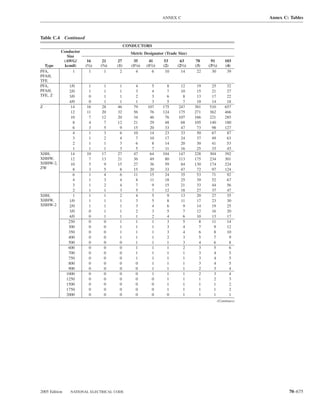
        Francis E. Rose, Jr., W. S. Nelson and Company,                               Rep. International Brotherhood of Electrical
                                                                                      Workers
        Incorporated, LA [U]
           Rep. Institute of Electrical & Electronics Engineers,                      (Alt. to J. M. Naughton)
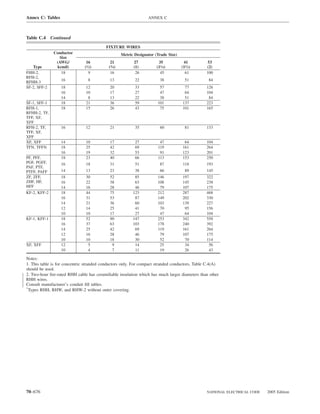
           Incorporated                                                            Kent Walker, Ferraz Shawmut, MA [M]
           (Alt. to R. J. Deaton)                                                     (Alt. to M. Allison)


                                                        CODE-MAKING PANEL NO. 5
                                                          Articles 200, 250, 280, 285

                                                               Ronald J. Toomer, Chair
                                                    Toomer Electrical Company Incorporated, LA [IM]
                                                     Rep. National Electrical Contractors Association

        Jeffrey Boksiner, Telcordia Technologies, Incorporated,                                              Alternates
        NJ [UT]
                                                                                   Martin D. Adams, Adams Electric, Incorporated, CO [IM]
            Rep. Alliance for Telecommunications Industry
                                                                                       Rep. National Electrical Contractors Association
            Solutions
                                                                                       (Alt. to R. J. Toomer)
        David T. Brender, Copper Development Association,                          David A. Dini, Underwriters Laboratories Incorporated, IL
        Incorporated, NY [M]                                                       [RT]
            Rep. Copper Development Association, Incorporated                          (Alt. to W. Skuggevig)
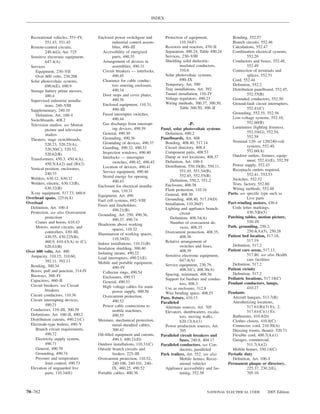
        Martin J. Brett, Jr., Wheatland Tube Company,                              Timothy Edwards, Alcan Cable Company, GA [M]
        NJ [M]                                                                         Rep. The Aluminum Association
            Rep. American Iron and Steel Institute                                     (Alt. to G. L. Hadeen)
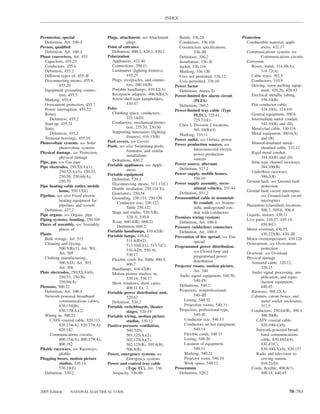
        Elio L. Checca, U.S. Department of Labor, VA [E]                           Robert Figlia, New York Board of Fire Underwriters, NY
        Paul Dobrowsky, Eastman Kodak Company, NY [U]                              [E]
            Rep. American Chemistry Council                                            Rep. International Association of Electrical Inspectors
        Gerald L. Hadeen, Tehachapi, CA [M]                                            (Alt. to M. J. Johnston)
            Rep. The Aluminum Association                                          G. Scott Harding, F. B. Harding, Incorporated, MD [IM]
        Dan Hammel, IBEW Local Union 704, IA [L]                                       Rep. Independent Electrical Contractors, Incorporated
            Rep. International Brotherhood of Electrical Workers                       (Alt. to T. G. Robertson)
        Michael J. Johnston, International Association of Electrical               William J. Helfrich, U.S. Department of Labor, PA [E]
        Inspectors, TX [E]                                                             (Alt. to E. L. Checca)
            Rep. International Association of Electrical Inspectors                Ronald Lai, FCI Electrical, NH [M]
        Charles Mello, Electro-Test, Incorporated, OR [IM]                             Rep. National Electrical Manufacturers Association
            Rep. InterNational Electrical Testing Association                          (Alt. to G. J. Steinman)
            Incorporated                                                           Paul J. LeVasseur, Bay City JEATC, MI [L]
                                                                                       Rep. International Brotherhood of Electrical Workers
        Elliot Rappaport, Electro Technology Consultants,
        Incorporated, FL [U]                                                           (Alt. to D. Hammel)
            Rep. Institute of Electrical & Electronics Engineers,                  Richard E. Loyd, R & N Associates, AZ [M]
            Incorporated                                                               Rep. American Iron and Steel Institute
                                                                                       (Alt. to M. J. Brett, Jr.)
        Ted G. Robertson, Robertson Electric, Incorporated,
                                                                                   Daleep C. Mohla, DCM Electrical Consulting Services,
        TX [IM]
                                                                                   Incorporated, TX [U]
            Rep. Independent Electrical Contractors, Incorporated
                                                                                       Rep. Institute of Electrical & Electronics Engineers,
        Walter Skuggevig, Underwriters Laboratories Incorporated,                      Incorporated
        NY [RT]                                                                        (Alt. to E. Rappaport)
        Gregory J. Steinman, Thomas & Betts Corporation,                           David Peot, Ryobi, SC [M]
        TN [M]                                                                         Rep. Power Tool Institute, Incorporated
            Rep. National Electrical Manufacturers Association                         (Alt. to R. G. Stoll)
        Robert G. Stoll, Thomas Associates, Incorporated,                          J. Philip Simmons, Simmons Electrical Services, WA [M]
        OH [M]                                                                         Rep. Copper Development Association, Incorporated
            Rep. Power Tool Institute, Incorporated                                    (Alt. to D. T. Brender)
        C. Douglas White, CenterPoint Energy, Incorporated,                        James S. Simpson, Southern Company Services, AL [UT]
        TX [UT]                                                                        Rep. Electric Light & Power Group/EEI
            Rep. Electric Light & Power Group/EEI                                      (Alt. to C. D.White)


70–12                                                                                                   NATIONAL ELECTRICAL CODE        2005 Edition
NATIONAL ELECTRICAL CODE COMMITTEE


                                               CODE-MAKING PANEL NO. 6
                               Articles 310, 400, 402, Chapter 9 Tables 5 through 9, Annex B

                                                    Stephen J. Thorwegen, Jr., Chair
                                                      Fisk Electric Company, TX [IM]
                                               Rep. National Electrical Contractors Association

    Robert Edwards, Alcan Aluminum Corporation, ON,                            James M. Daly, General Cable, NJ [M]
    Canada [M]                                                                     Rep. Copper Development Association, Incorporated
        Rep. The Aluminum Association                                              (Alt. to J. S. Zimnoch)
    Samuel B. Friedman, BICC General Cable Corporation,                        Robert L. Huddleston, Jr., Eastman Chemical Company,
    RI [M]                                                                     TN [U]
        Rep. National Electrical Manufacturers Association                         Rep. American Chemistry Council
    G. W. “Jerry” Kent, Kent Electric & Plumbing Systems,                          (Alt. to D. P. Liggett)
    TX [IM]                                                                    Philip T. Laudicini, Underwriters Laboratories Incorporated,
        Rep. Independent Electrical Contractors, Incorporated                  NY [RT]
    David G. Komassa, WE Energies, WI [UT]                                         (Alt. to A. D. Wetherell)
        Rep. Electric Light & Power Group/EEI                                  Lowell S. Lisker, American Insulated Wire Corporation,
    William F. Laidler, South Shore VoTech/IBEW 223, MA [L]                    RI [M]
        Rep. International Brotherhood of Electrical Workers                       Rep. National Electrical Manufacturers Association
    Danny P. Liggett, DuPont Engineering, TX [U]                                   (Alt. to S. B. Friedman)
        Rep. American Chemistry Council                                        Paul R. Picard, AFC Cable Systems, Incorporated, MA [M]
    L. Bruce McClung, Electrical Safety Consulting Services,                       Rep. The Aluminum Association
    Incorporated, WV [U]                                                           (Alt. to R. Edwards)
        Rep. Institute of Electrical & Electronics Engineers,                  Harry J. Sassaman, Forest Electric Corporation, NJ [IM]
        Incorporated                                                               Rep. National Electrical Contractors Association
    Oran P. Post, City of Cuyahoga Falls, OH [E]                                   (Alt. to S. J. Thorwegen, Jr.)
        Rep. International Association of Electrical Inspectors                John Stacey, City of St. Louis, MO [E]
    Austin D. Wetherell, Underwriters Laboratories                                 Rep. International Association of Electrical Inspectors
    Incorporated, NY [RT]                                                          (Alt. to O. P. Post)
    Joseph S. Zimnoch, The Okonite Company, NJ [M]                             Donald A. Voltz, Mustang Engineering, Incorporated,
        Rep. Copper Development Association, Incorporated                      TX [U]
                                                                                   Rep. Institute of Electrical & Electronics Engineers,
                            Alternates                                             Incorporated
    Peter E. Bowers, Satellite Electric Company, Incorporated,                     (Alt. to L. B. McClung)
    MD [IM]                                                                    David R. Wellington, Toledo Electrical JATC, OH [L]
       Rep. Independent Electrical Contractors, Incorporated                       Rep. International Brotherhood of Electrical Workers
       (Alt. to G. W. Kent)                                                        (Alt. to W. F. Laidler)


                                            CODE-MAKING PANEL NO. 7
                    Articles 320, 322, 324, 326, 328, 330, 332, 334, 336, 338, 340, 382, 394, 396, 398

                                                          Gaylen D. Rogers, Chair
                                                             State of Utah, UT [E]
                                             Rep. International Association of Electrical Inspectors

    James J. Anastasi, Intertek/ETL Semko, NY [RT]                             Gregory L. Runyon, Eli Lilly and Company, IN [U]
    Harry C. Brown, IBEW Local Union 606, FL [L]                                   Rep. American Chemistry Council
       Rep. International Brotherhood of Electrical                            David E. Schumacher, All County Electric Company,
       Workers                                                                 IA [IM]
    John J. Cangemi, Underwriters Laboratories Incorporated,                       Rep. Associated Builders and Contractors, Incorporated
    NY [RT]                                                                    H. R. Stewart, HRS Consulting, TX [U]
    James M. Daly, General Cable, NJ [M]                                           Rep. Institute of Electrical & Electronics Engineers,
       Rep. National Electrical Manufacturers Association                          Incorporated
    Chris J. Fahrenthold, Encompass Electrical Technologies,                   George A. Straniero, AFC Cable Systems, Incorporated,
    TX [IM]                                                                    NJ [M]
       Rep. Independent Electrical Contractors, Incorporated                       Rep. Copper Development Association, Incorporated
                                                                               Richard Temblador, Alflex Corporation, CA [M]
    Robert L. Gotham, Rose City Electric Company,                                  Rep. The Aluminum Association
    Incorporated, OR [IM]
       Rep. National Electrical Contractors Association                                                 Alternates
    Herman J. Hall, Austin, TX [M]                                             William B. Crist, Houston Stafford Electric Company,
       Rep. Society of the Plastics Industry Incorporated                      TX [IM]
    Ronald G. Nickson, National Multi Housing Council,                            Rep. Independent Electrical Contractors, Incorporated
    DC [U]                                                                        (Alt. to C. J. Fahrenthold)
       Rep. National Multi Housing Council                                     James D. Erwin, Celanese, Limited, TX [U]
    Bruce W. Nutt, Oncor, TX [UT]                                                 Rep. American Chemistry Council
       Rep. Electric Light & Power Group/EEI                                      (Alt. to G. L. Runyon)


2005 Edition    NATIONAL ELECTRICAL CODE                                                                                                      70–13
NATIONAL ELECTRICAL CODE COMMITTEE


        James K. Hinrichs, State of Washington, WA [E]                             John W. “Wes” Ray, Duke Energy Corporation, NC [UT]
           Rep. International Association of Electrical Inspectors                    Rep. Electric Light & Power Group/EEI
           (Alt. to G. D. Rogers)                                                     (Alt. to B. W. Nutt)
        Samuel R. LaDart, City of Memphis, TN [L]                                  David K. Smith, Encore Wire Limited, TX [M]
           Rep. International Brotherhood of Electrical Workers                       Rep. Copper Development Association, Incorporated
           (Alt. to H. C. Brown)                                                      (Alt. to G. A. Straniero)
        C. David Mercier, Southwire Company, GA [M]                                John Thomas Thompson, ABC Marathon Electrical
           Rep. National Electrical Manufacturers Association
                                                                                   Company, Incorporated, AL [IM]
           (Alt. to J. M. Daly)
                                                                                      Rep. Associated Builders and Contractors, Incorporated
        Dennis A. Nielsen, Lawrence Berkeley National Laboratory,
        CA [U]                                                                        (Alt. to D. E. Schumacher)
           Rep. Institute of Electrical & Electronics Engineers,                   Larry G. Watkins, Alcan Aluminum Corporation, GA [M]
           Incorporated                                                               Rep. The Aluminum Association
           (Alt. to H. R. Stewart)                                                    (Alt. to R. Temblador)
        Paul A. Orr, Underwriters Laboratories Incorporated,                       Thomas H. Wood, Cecil B. Wood Incorporated, IL [IM]
        NY [RT]                                                                       Rep. National Electrical Contractors Association
           (Alt. to J. J. Cangemi)                                                    (Alt. to R. L. Gotham)


                                             CODE-MAKING PANEL NO. 8
        Articles 342, 344, 348, 350, 352, 353, 354, 356, 358, 360, 362, 366, 368, 370, 372, 374, 376, 378, 380, 384,
                               386, 388, 390, 392, Chapter 9 Tables 1 through 4, Annex C

                                                                Julian R. Burns, Chair
                                             Burns Electrical/Quality Power Solutions, Incorporated, NC [IM]
                                                  Rep. Independent Electrical Contractors, Incorporated

        John S. Corry, Corry Electric Incorporated, CA [IM]                        Charles W. Forsberg, Shaker Heights, OH [M]
           Rep. Associated Builders and Contractors, Incorporated                      Rep. Society of the Plastics Industry Incorporated
        Joseph G. Dabe, City of St. Paul, MN [L]                                       (Alt. to D. H. Kendall)
           Rep. International Brotherhood of Electrical Workers                    Dr. Jack A. Gruber, Wheatland Tube Company, PA [M]
        George R. Dauberger, Thomas & Betts Corporation, TN [M]                        Rep. American Iron and Steel Institute
           Rep. National Electrical Manufacturers Association                          (Alt. to R. E. Loyd)
        James C. Dollins, AFC Cable Systems, MA [M]                                James M. Imlah, City of Hillsboro, OR [E]
           Rep. The Aluminum Association                                               Rep. International Association of Electrical Inspectors
        Ronald E. Duren, PacifiCorp, WA [UT]
                                                                                       (Alt. to W. A. Lilly)
           Rep. Electric Light & Power Group/EEI
                                                                                   Alan Manche, Schneider Electric/Square D Company,
        M. Shan Griffith, Kelloff, Brown & Root, Incorporated,
        TX [U]                                                                     KY [M]
           Rep. Institute of Electrical & Electronics Engineers,                       Rep. National Electrical Manufacturers Association
           Incorporated                                                                (Alt. to G. R. Dauberger)
        David H. Kendall, Carlon, Lamson & Sessions, OH [M]                        Jamie McNamara, City of St. Paul, MN [L]
           Rep. Society of the Plastics Industry Incorporated                          Rep. International Brotherhood of Electrical Workers
        Wayne A. Lilly, City of Harrisonburg, VA [E]                                   (Alt. to J. G. Dabe)
           Rep. International Association of Electrical Inspectors                 C. Ernest Reynolds, Hatfield-Reynolds Electric Company,
        Richard E. Loyd, R & N Associates, AZ [M]                                  AZ [IM]
           Rep. American Iron and Steel Institute                                      Rep. Independent Electrical Contractors, Incorporated
        Stephen P. Poholski, Newkirk Electric Associates,                              (Alt. to J. R. Burns)
        Incorporated, MI [IM]                                                      Richard Temblador, Alflex Corporation, CA [M]
           Rep. National Electrical Contractors Association                            Rep. The Aluminum Association
        Dennis L. Rowe, New York Board of Fire Underwriters,                           (Alt. to J. C. Dollins)
        NY [E]                                                                     Ronald J. Toomer, Toomer Electrical Company
           Rep. New York Board of Fire Underwriters                                Incorporated, LA [IM]
        George F. Walbrecht, Underwriters Laboratories                                 Rep. National Electrical Contractors Association
        Incorporated, IL [RT]
                                                                                       (Alt. to S. P. Poholski)
                                Alternates                                         James Van Den Heuvel, West Electric Incorporated,
                                                                                   WI [IM]
        Richard Berman, Underwriters Laboratories Incorporated,
                                                                                       Rep. Associated Builders and Contractors, Incorporated
        IL [RT]
            (Alt. to G. F. Walbrecht)                                                  (Alt. to J. S. Corry)
        Duane A. Carlson, PRS Consulting Engineers, WA [U]                         Leslie R. Zielke, South Carolina Electric & Gas Company,
            Rep. Institute of Electrical & Electronics Engineers,                  SC [UT]
            Incorporated                                                               Rep. Electric Light & Power Group/EEI
            (Alt. to M. S. Griffith)                                                   (Alt. to R. E. Duren)


70–14                                                                                                NATIONAL ELECTRICAL CODE           2005 Edition
NATIONAL ELECTRICAL CODE COMMITTEE


                                                CODE-MAKING PANEL NO. 9
                                               Articles 312, 314, 404, 408, 450, 490

                                                      Timothy M. Croushore, Chair
                                                         Allegheny Power, PA [UT]
                                                   Rep. Electric Light & Power Group/EEI

    Jeffery Bernson, IBEW Local Union 701, IL [L]                             Joseph M. Bolesina, Pinellas County Building Inspections,
        Rep. International Brotherhood of Electrical Workers                  FL [E]
    Hector R. de Vega, Fluor Daniel, TX [U]                                       Rep. International Association of Electrical Inspectors
        Rep. Associated Builders and Contractors, Incorporated                    (Alt. to D. R. Offerdahl)
    Frederic P. Hartwell, Hartwell Electrical Services, MA [SE]               Julian R. Burns, Burns Electrical/Quality Power Solutions,
    Robert J. Kaemmerlen, Kaemmerlen Electric Company,                        Incorporated, NC [IM]
    MO [IM]                                                                       Rep. Independent Electrical Contractors, Incorporated
        Rep. National Electrical Contractors Association
                                                                                  (Alt. to T. J. LeMay)
    Jacob Killinger, Underwriters Laboratories Incorporated,
    IL [RT]                                                                   James C. Carroll, Square D Company, TN [M]
    Thomas J. LeMay, LeMay Electric, Incorporated, GA [IM]                        Rep. National Electrical Manufacturers Association
        Rep. Independent Electrical Contractors, Incorporated                     (Alt. to B. D. Rupp)
    Donald R. Offerdahl, North Dakota State Electrical Board,                 Richard P. Fogarty, Consolidated Edison Company of NY,
    ND [E]                                                                    Incorporated, NY [UT]
        Rep. International Association of Electrical Inspectors                   Rep. Electric Light & Power Group/EEI
    Bradford D. Rupp, Allied Moulded Products, Incorporated,                      (Alt. to T. M. Croushore)
    OH [M]                                                                    Robert D. Osborne, Underwriters Laboratories Incorporated,
        Rep. National Electrical Manufacturers Association                    NC [RT]
    Sukanta Sengupta, FMC Corporation, NJ [U]                                     (Alt. to J. Killinger)
        Rep. Institute of Electrical & Electronics Engineers,                 Jerome W. Seigel, West Hartford, CT [U]
        Incorporated                                                              Rep. Institute of Electrical & Electronics Engineers,
    Ralph H. Young, Eastman Chemical Company, TN [U]                              Incorporated
        Rep. American Chemistry Council
                                                                                  (Alt. to S. Sengupta)
                            Alternates                                        Monte Szendre, Wilson Construction Company, OR [IM]
                                                                                  Rep. National Electrical Contractors Association
    Rodney D. Belisle, NECA-IBEW Training Center, WA [L]
                                                                                  (Alt. to R. J. Kaemmerlen)
       Rep. International Brotherhood of Electrical Workers
       (Alt. to L. Bernson)


                                                 CODE-MAKING PANEL NO. 10
                                                      Articles 240, 780

                                                        James T. Dollard, Jr., Chair
                                                        IBEW Local Union 98, PA [L]
                                             Rep. International Brotherhood of Electrical Workers

    Charles K. Blizard, American Electrical Testing Company,                  John A. Zaplatosch, Underwriters Laboratories
    Incorporated, MA [IM]                                                     Incorporated, IL [RT]
       Rep. InterNational Electrical Testing Association
       Incorporated                                                                                   Alternates
    Madeline Borthick, IEC of Houston, Incorporated, TX [IM]                  Robert R. Gage, Niagara Mohawk, A National Grid
       Rep. Independent Electrical Contractors, Incorporated                  Company, NY [UT]
    Scott Cline, McMurtrey Electric, Incorporated, CA [IM]                       Rep. Electric Light & Power Group/EEI
       Rep. National Electrical Contractors Association                          (Alt. to C. K. Eldridge)
    Dennis M. Darling, Ayres, Lewis, Norris & May,                            George D. Gregory, Square D Company, IA [M]
    Incorporated, MI [U]                                                         Rep. National Electrical Manufacturers Association
       Rep. Institute of Electrical & Electronics Engineers,                     (Alt. to C. W. Kimblin)
       Incorporated                                                           Roderic L. Hageman, PRIT Service, Incorporated, IL [IM]
    Charles K. Eldridge, Indianapolis Power & Light Company,                     Rep. InterNational Electrical Testing Association
    IN [UT]                                                                      Incorporated
       Rep. Electric Light & Power Group/EEI                                     (Alt. to C. K. Blizard)
    Carl J. Fredericks, The Dow Chemical Company, TX [U]                      Charles D. Hughes, Westinghouse Savannah River
       Rep. American Chemistry Council                                        Company, SC [U]
    C. W. Kimblin, Cutler-Hammer, Incorporated, PA [M]                           Rep. Institute of Electrical & Electronics Engineers,
       Rep. National Electrical Manufacturers Association                        Incorporated
    Arden L. Munson, Hussmann Corporation, MO [M]                                (Alt. to D. M. Darling)
       Rep. Air-Conditioning and Refrigeration Institute                      Robert J. Kauer, Middle Department Inspection Agency,
    George J. Ockuly, Chesterfield, MO [M]                                     Incorporated, PA [E]
    Gerald W. Williams, County of Ventura, California, CA [E]                    Rep. International Association of Electrical Inspectors
       Rep. International Association of Electrical Inspectors                   (Alt. to G. W. Williams)


2005 Edition    NATIONAL ELECTRICAL CODE                                                                                                    70–15
NATIONAL ELECTRICAL CODE COMMITTEE


        Richard E. Lofton, II, IBEW Local Union 280, OR [L]                        James R. Sicard, Shell Oil Company, TX [U]
           Rep. International Brotherhood of Electrical Workers                       Rep. American Chemistry Council
           (Alt. to J. T. Dollard, Jr.)                                               (Alt. to C. J. Fredericks)
        Robert W. Mount, Jr., Hussmann Corporation, MO [M]                         Steve A. Struble, Freeman’s Electric Service, Incorporated,
           Rep. Air-Conditioning and Refrigeration Institute                       SD [IM]
           (Alt. to A. L. Munson)                                                     Rep. Independent Electrical Contractors, Incorporated
        Paul J. Notarian, Underwriters Laboratories Incorporated,                     (Alt. to M. Borthick)
        NY [RT]
           (Alt. to J. A. Zaplatosch)                                                                       Nonvoting
        Vincent J. Saporita, Cooper Bussmann, MO [M]                               Rick C. Gilmour, Canadian Standards Association (CSA),
           (Alt. to G. J. Ockuly)                                                  ON, Canada


                                                   CODE-MAKING PANEL NO. 11
                                        Articles 409, 430, 440, 460, 470, Annex D, Example D8

                                                             Wayne Brinkmeyer, Chair
                                                         Biddle Electric Corporation, TX [IM]
                                                    Rep. National Electrical Contractors Association

        Frederick Bried, Spring, TX [U]                                            Ralph M. Esemplare, Consolidated Edison Company of
            Rep. American Petroleum Institute                                      New York, NY [UT]
        Rick L. Bunch, Tecumseh Products Company, MI [M]                              Rep. Electric Light & Power Group/EEI
            Rep. Air-Conditioning and Refrigeration Institute                         (Alt. to L. H. Haas, Jr.)
        Joe David Cox, Eastman Chemical Company, TN [U]                            James M. Fahey, IBEW Local Union 103, MA [L]
            Rep. American Chemistry Council                                           Rep. International Brotherhood of Electrical Workers
        Michael A. D’Amico, IBEW Local Union 488, CT [L]                              (Alt. to M. A. D’Amico)
            Rep. International Brotherhood of Electrical Workers                   Stanley J. Folz, Folz Electric, Incorporated, IL [IM]
        Thomas J. Garvey, State of Wisconsin, WI [E]                                  Rep. National Electrical Contractors Association
            Rep. International Association of Electrical Inspectors                   (Alt. to W. Brinkmeyer)
        Charles A. Goetz, Underwriters Laboratories Incorporated,                  William D. Glover, PPG Industries, Incorporated, WV [U]
        IL [RT]                                                                       Rep. American Chemistry Council
            Rep. Associated Builders and Contractors, Incorporated                    (Alt. to J. D. Cox)
        Paul E. Guidry, Fluor Enterprises, Incorporated, TX [U]                    Paul S. Hamer, ChevronTexaco Corporation, CA [U]
            Rep. Associated Builders & Contractors, Incorporated                      Rep. American Petroleum Institute
        Leo H. Haas, Jr., CenterPoint Energy, Incorporated,                           (Alt. to F. Bried)
        TX, [UT]                                                                   Robert J. Keough, Emerson Motor Company, MO [M]
            Rep. Electric Light & Power Group/EEI                                     Rep. National Electrical Manufacturers Association
        Vincent J. Saporita, Cooper Bussmann, MO [M]                                  (Alt. to J. R. Wright)
        Lynn F. Saunders, General Motors WFG-Utilities Services,                   Thomas E. Moore, Stark County Building Department,
        MI [U]                                                                     OH [E]
            Rep. Institute of Electrical & Electronics Engineers,                     Rep. International Association of Electrical Inspectors
            Incorporated                                                              (Alt. to T. J. Garvey)
        Lawrence E. Todd, Intertek Testing Services NA,                            George J. Ockuly, Chesterfield, MO [M]
        Incorporated, OR [RT]                                                         (Alt. to V. J. Saporita)
        Ron Widup, Shermco Industries, Incorporated, TX [IM]                       Frederic A. Salzman, Underwriters Laboratories
            Rep. InterNational Electrical Testing Association                      Incorporated, IL [RT]
            Incorporated                                                              (Alt. to C. A. Goetz)
        James R. Wright, Siemens Energy & Automation,                              Arthur J. Smith, III, Waldemar S. Nelson & Company,
        Incorporated, IL [M]                                                       Incorporated, LA [U]
            Rep. National Electrical Manufacturers Association                        Rep. Institute of Electrical & Electronics Engineers,
                                                                                      Incorporated
                                Alternates                                            (Alt. to L. F. Saunders)
        Elwood J. Dodge, Addison Products Company, FL [M]
           Rep. Air-Conditioning and Refrigeration Institute
                                                                                                            Nonvoting
           (Alt. to R. L. Bunch)                                                   Nino Mancini, CSA International, ON, Canada


70–16                                                                                                  NATIONAL ELECTRICAL CODE         2005 Edition
NATIONAL ELECTRICAL CODE COMMITTEE


                                             CODE-MAKING PANEL NO. 12
                        Articles 610, 620, 625, 630, 640, 645, 647, 650, 660, 665, 668, 669, 670, 685,
                                              Annex D, Examples D9 and D10

                                                           Charles M. Trout, Chair
                                                       Maron Electric Company, FL [IM]
                                                 Rep. National Electrical Contractors Association

    Thomas M. Burke, Underwriters Laboratories Incorporated,                    James E. Winfrey, Square D Company, NC [M]
    CA [RT]                                                                        Rep. National Electrical Manufacturers Association
    Kent B. Givens, Aluminum Company of America, TX [M]
       Rep. The Aluminum Association                                                                    Alternates
       (VL to 610, 625, 630, 645, 660, 665, 668, 669, 685)                      William E. Anderson, The Procter & Gamble Company, OH
    Ron L. Janikowski, City of Wausau, Wisconsin, WI [E]                        [U]
       Rep. International Association of Electrical Inspectors                      Rep. Institute of Electrical & Electronics Engineers,
    Robert E. Johnson, ITE Safety, MA [U]                                           Incorporated
       Rep. Information Technology Industry Council                                 (Alt. to R. C. Prichard)
       (VL to 640, 645, 647, 685)                                               Jeffrey W. Blain, Schindler Elevator Corporation, NJ [M]
                                                                                    Rep. National Elevator Industry Incorporated
    Robert A. Jones, Independent Electrical Contractors,
                                                                                    (Alt. to A. Juhasz )
    Incorporated, TX [IM]
                                                                                    (VL to 610, 620, 630)
       Rep. Independent Electrical Contractors, Incorporated                    William A. Brunner, IBEW Local Union 714, ND [L]
    Andy Juhasz, Kone Incorporated, IL [M]                                          Rep. International Brotherhood of Electrical Workers
       Rep. National Elevator Industry Incorporated                                 (Alt. to D. R. Quave)
       (VL to 610, 620, 630)                                                    Scott Cline, McMurtrey Electric, Incorporated, CA [IM]
    Sam Marcovici, New York City Department of Buildings,                           Rep. National Electrical Contractors Association
    NY [E]                                                                          (Alt. to C. M. Trout)
    John H. Mortimer, Inductotherm Corporation, NJ [M]                          Robert Michael Forister, City of Sheridan, Wyoming,
       (VL to 665)                                                              WY [E]
    Ralph C. Prichard, Hercules Incorporated, DE [U]                                Rep. International Association of Electrical Inspectors
       Rep. Institute of Electrical & Electronics Engineers,                        (Alt. to R. L. Janikowski)
       Incorporated                                                             Barry G. Karnes, Underwriters Laboratories Incorporated,
    Ronald L. Purvis, Georgia Power Company, GA [UT]                            CA [RT]
       Rep. Electric Light & Power Group/EEI                                        (Alt. to T. M. Burke)
    David R. Quave, IBEW Local Union 903, MS [L]                                Todd F. Lottmann, Cooper Bussmann, MO [M]
       Rep. International Brotherhood of Electrical Workers                         Rep. National Electrical Manufacturers Association
                                                                                    (Alt. to J. E. Winfrey)
    Robert H. Reuss, Morris Material Handling, LLC, WI [M]
                                                                                Roger D. McDaniel, Georgia Power Company, GA [UT]
       Rep. Crane Manufacturers Association of America
                                                                                    Rep. Electric Light & Power Group/EEI
       Incorporated                                                                 (Alt. to R. L. Purvis)
       (VL to 610)                                                              George S. Tidden, George’s Electrical Service Incorporated,
    Arthur E. Schlueter, Jr., A. E. Schlueter Pipe Organ                        TX [IM]
    Company, GA [M]                                                                 Rep. Independent Electrical Contractors, Incorporated
       Rep. American Institute of Organ Builders                                    (Alt. to R. A. Jones)
       (VL to 640, 650)                                                         Robert C. Turner, Inductotherm Corporation, NJ [M]
    Kenneth P. White, Olin Corporation, TN [U]                                      (Alt. to J. H. Mortimer)
       Rep. American Chemistry Council                                              (VL to 665)


                                                CODE-MAKING PANEL NO. 13
                                     Articles 445, 455, 480, 690, 692, 695, 700, 701, 702, 705

                                                           Thomas H. Wood, Chair
                                                      Cecil B. Wood Incorporated, IL [IM]
                                                 Rep. National Electrical Contractors Association

    Tarry L. Baker, Broward County Board of Rules &                             Ernest J. Gallo, Telcordia Technologies, Incorporated,
    Appeals, FL [E]                                                             NJ [U]
       Rep. International Association of Electrical Inspectors                     Rep. Alliance for Telecommunications Industry Solutions
    Ward I. Bower, Sandia National Laboratories, NM [U]                            (VL to 445, 480, 690, 692)
       Rep. Solar Energy Industries Association                                 Michael V. Glenn, Longview Fibre Company, WA [U]
       (VL to 690, 692, 705)                                                       Rep. Institute of Electrical & Electronics Engineers,
    Douglas L. Elkins, ExxonMobil Chemical Company,                                Incorporated
    TX [U]                                                                      Banks Hattaway, Hattaway Brothers, Incorporated, AL [IM]
       Rep. American Chemistry Council                                             Rep. Associated Builders and Contractors, Incorporated
    George W. Flach, George W. Flach Consultant,                                Timothy D. Holleman, AC Corporation, NC [IM]
    Incorporated, LA [SE]                                                          Rep. Independent Electrical Contractors, Incorporated


2005 Edition    NATIONAL ELECTRICAL CODE                                                                                                      70–17
NATIONAL ELECTRICAL CODE COMMITTEE


        Barry N. Hornberger, PECO Energy Company, PA [UT]                         Ron B. Chilton, North Carolina Department of Insurance,
            Rep. Electric Light & Power Group/EEI                                 NC [E]
        John R. Kovacik, Underwriters Laboratories Incorporated,                     Rep. International Association of Electrical Inspectors
        IL [RT]                                                                      (Alt. to T. L. Baker)
        Kenneth Krastins, Plug Power, Incorporated, NY [M]                        Brian L. Crise, NIETC, OR [L]
            Rep. U.S. Fuel Cell Council                                              Rep. International Brotherhood of Electrical Workers
            (VL to 690, 692, 705)                                                    (Alt. to T. W. Stafford)
        James S. Nasby, Master Control Systems, Inc., IL [M]                      Steven J. Fredette, UTC Cells, LLC, CT [M]
            Rep. National Electrical Manufacturers Association                       Rep. U.S. Fuel Cell Council
        Steven H. Pasternack, Intertek Testing Services NA,                          (Alt. to K. Krastins)
        Incorporated, NY [RT]                                                        (VL to 690, 692, 705)
        Todd W. Stafford, National Joint Apprentice & Training                    Ronald H. Minter, Thomas & Betts, TN [M]
        Committee, IBEW-NJATC, TN [L]                                                Rep. National Electrical Manufacturers Association
            Rep. International Brotherhood of Electrical Workers                     (Alt. to J. S. Nasby)
        LaVerne E. Stetson, Lincoln, NE [U]                                       Duke W. Schamel, Copperhead Electric Inc, CA [IM]
            Rep. American Society of Agricultural Engineers                          Rep. Independent Electrical Contractors, Incorporated
        Herbert V. Whittall, Electrical Generating Systems                           (Alt. to T. D. Holleman)
        Association, FL [M]                                                       Robert L. Simpson, Simpson Electrical Engineering
            Rep. Electrical Generating Systems Association                        Company, GA [U]
                                                                                     Rep. Institute of Electrical & Electronics Engineers,
                                Alternates                                           Incorporated
        Daniel Batta, Jr., Constellation Generation Group, LLC,                      (Alt. to M. V. Glenn)
        MD [UT]                                                                   Richard Sobel, Quantum Electric Corporation, NY [IM]
           Rep. Electric Light & Power Group/EEI                                     Rep. National Electrical Contractors Association
           (Alt. to B. N. Hornberger)                                                (Alt. to T. H. Wood)
        Sonya M. Bird, Underwriters Laboratories Incorporated,                    Dale A. Triffo, Shell Oil Products US, TX [U]
        NC [RT]                                                                      Rep. American Chemistry Council
           (Alt. to J. R. Kovacik)                                                   (Alt. to D. L. Elkins)


                                                 CODE-MAKING PANEL NO. 14
                              Articles 500, 501, 502, 503, 504, 505, 506, 510, 511, 513, 514, 515, 516

                                                              Donald R. Cook, Chair
                                                    Shelby County Building Inspections, AL [E]
                                                Rep. International Association of Electrical Inspectors

        Troy Beall, B & D Electric Company, Incorporated, NM [IM]                                          Alternates
           Rep. National Electrical Contractors Association
                                                                                  A. W. Ballard, Crouse-Hinds, NY [M]
        Edward M. Briesch, Underwriters Laboratories
                                                                                     Rep. National Electrical Manufacturers Association
        Incorporated, IL [RT]
                                                                                     (Alt. to J. H. Kuczka)
        Al Engler, EGS Electrical Group, IL [M]
                                                                                  Marc J. Bernsen, Southwestern Idaho Electrical JATC,
           Rep. International Society for Measurement and Control
                                                                                  ID [L]
        Mark Goodman, Jacobs Engineering Group, CA [U]
                                                                                     Rep. International Brotherhood of Electrical Workers
           Rep. American Petroleum Institute
        Gregory D. Hall, Better-Way Electric, Incorporated, CO [IM]                  (Alt. to J. A. Weldon)
           Rep. Independent Electrical Contractors, Incorporated                  Mark W. Bonk, Cargill Incorporated, MN [U]
        John Katunar, III, GE Global Asset Protection Services,                      Rep. Grain Elevator and Processing Society
        MO [I]                                                                       (Alt. to M. C. Wirfs)
           Rep. GE Global Asset Protection Services                               Giovanni Hummel Borges, Underwriters Laboratories
        Joseph H. Kuczka, Killark Electric Manufacturing                          Incorporated, Brasil [RT]
        Company, MO [M]                                                              (Alt. to E. M. Briesch)
           Rep. National Electrical Manufacturers Association                     James D. Cospolich, Waldemar S. Nelson & Company
        William G. Lawrence, Jr., FM Global, MA [I]                               Incorporated, LA [U]
           Rep. FM Global/FM Research                                                Rep. Institute of Electrical & Electronics Engineers,
        Jeremy Neagle, Intertek Testing Services NA, Incorporated,                   Incorporated
        NY [RT]                                                                      (Alt. to D. W. Zipse)
        Mike O’Meara, Arizona Public Service Company, AZ [UT]                     Larry E. Fuhrman, City of Titusville, FL [E]
           Rep. Electric Light & Power Group/EEI                                     Rep. International Association of Electrical Inspectors
        David B. Wechsler, The Dow Chemical Company, TX [U]                          (Alt. to D. R. Cook)
           Rep. American Chemistry Council                                        Nicholas P. Ludlam, FM Global, MA [I]
        James A. Weldon, IBEW Local Union 728, FL [L]                                Rep. FM Global/FM Research
           Rep. International Brotherhood of Electrical Workers                      (Alt. to W. G. Lawrence, Jr.)
        Mark C. Wirfs, R & W Engineering Incorporated, OR [U]                     Michael E. McNeil, FMC Corporation/Bio Polymer, ME [U]
           Rep. Grain Elevator and Processing Society                                Rep. American Chemistry Council
        Donald W. Zipse, Zipse Electrical Engineering Incorporated,                  (Alt. to D. B. Wechsler)
        PA [U]                                                                    Ted H. Schnaare, Rosemount Incorporated, MN [M]
           Rep. Institute of Electrical & Electronics Engineers,                     Rep. International Society for Measurement and Control
           Incorporated                                                              (Alt. to A. Engler)


70–18                                                                                                 NATIONAL ELECTRICAL CODE         2005 Edition
NATIONAL ELECTRICAL CODE COMMITTEE


    Francis M. Stone, Jr., Shell Exploration and Production                                          Nonvoting
    Company, TX [U]                                                          Eduardo N. Solano, Estudio Ingeniero Solano S.A.,
       Rep. American Petroleum Institute                                     Argentina [SE]
       (Alt. to M. Goodman)                                                  Fred K. Walker, U.S. Air Force, FL [U]
                                                                                Rep. TC on Airport Facilities


                                                 CODE-MAKING PANEL NO. 15
                                                Articles 517, 518, 520, 525, 530, 540

                                                          Donald J. Talka, Chair
                                               Underwriters Laboratories Incorporated, NY [RT]

    James R. Duncan, Sparling Electrical Engineering, WA [U]                 Andrew White, IBEW Local Union 3, NY [L]
       Rep. Institute of Electrical & Electronics Engineers,                    Rep. International Brotherhood of Electrical Workers
       Incorporated                                                          James L. Wiseman, Square D Company, TN [M]
    Tom Dunn, Butler Amusements, CA [U]                                         Rep. National Electrical Manufacturers Association
       Rep. Outdoor Amusement Business Association,
       Incorporated                                                                                  Alternates
       (VL to 525)                                                           James R. Cook, IBEW Local Union 364, IL [L]
    Douglas S. Erickson, American Society for Healthcare                         Rep. International Brotherhood of Electrical Workers
    Engineering, Virgin Islands [U]                                              (Alt. to A. White)
       Rep. American Society for Healthcare Engineering                      Matthew B. Dozier, IDesign Services, TN [U]
    Michael B. Klein, Metropolitan Engineering, Incorporated,                    Rep. Institute of Electrical & Electronics Engineers,
    DC [IM]                                                                      Incorporated
       Rep. Illuminating Engineering Society of North America                    (Alt. to J. R. Duncan)
       (VL to 518, 520, 525, 530, 540)                                       Samuel B. Friedman, BICC General Cable Corporation,
    Edwin S. Kramer, Radio City Music Hall, NY [L]                           RI [M]
       Rep. International Alliance of Theatrical Stage Employees                 Rep. National Electrical Manufacturers Association
       (VL to 518, 520, 525, 530, 540)                                           (Alt. to J. L. Wiseman)
    Larry Lau, U.S. Department of Veterans Affairs, DC [U]                   Dale A. Hallerberg, Underwriters Laboratories Incorporated,
       (VL to 517, 518)                                                      IL [RT]
    Dennis W. Marshall, TAG Electric Companies, TX [IM]                          (Alt. to D. J. Talka)
       Rep. Independent Electrical Contractors, Incorporated                 Mitchell K. Hefter, Entertainment Technology, TX [IM]
                                                                                 Rep. Illuminating Engineering Society of North America
    Eugene E. Morgan, County of Clackamas, Oregon, OR [E]
                                                                                 (Alt. to M. B. Klein)
       Rep. International Association of Electrical Inspectors
                                                                                 (VL to 518, 520, 525, 530, 540))
    Hugh O. Nash, Jr., Nash Lipsey Burch, LLC, TN [SE]
                                                                             Stanley D. Kahn, Tri-City Electric Company, Incorporated,
       Rep. TC on Electrical Systems
                                                                             CA [IM]
    Bruce D. Shelly, Shelly Electric Company, Inc., PA [IM]                      Rep. National Electrical Contractors Association
       Rep. National Electrical Contractors Association                          (Alt. to B. D. Shelly)
    Donald J. Sherratt, Intertek Testing Services NA,                        Malinda Joyce Sampson, Minnesota Electricity Board,
    Incorporated, MA [RT]                                                    MN [E]
    Michael D. Skinner, CBS Studio Center, CA [U]                                Rep. International Association of Electrical Inspectors
       Rep. Alliance of Motion Picture and Television Producers                  (Alt. to E. E. Morgan)
       (VL to 518, 520, 525, 530, 540)                                       James C. Seabury, III, Enterprise Electric, LLC, TN [IM]
    Richard H. Smith, OG&E Electric Services, OK [UT]                            Rep. Independent Electrical Contractors, Incorporated
       Rep. Electric Light & Power Group/EEI                                     (Alt. to D. W. Marshall)
    Kenneth E. Vannice, Leviton Manufacturing Company                        Steven R. Terry, Electronic Theatre Controls Incorporated,
    Incorporated, OR [M]                                                     NY [M]
       Rep. U.S. Institute for Theatre Technology                                Rep. U.S. Institute for Theatre Technology
       (VL to 518, 520, 525, 530, 540)                                           (Alt. to K. E. Vannice)
    Michael Velvikis, High Voltage Maintenance Corporation,                      (VL to 518, 520, 525, 530, 540)
    WI [IM]                                                                  Rodney M. Young, Detroit Edison Company, MI [UT]
       Rep. InterNational Electrical Testing Association                         Rep. Electric Light & Power Group/EEI
       Incorporated                                                              (Alt. to R. H. Smith)


2005 Edition    NATIONAL ELECTRICAL CODE                                                                                                   70–19
NATIONAL ELECTRICAL CODE COMMITTEE


                                                      CODE-MAKING PANEL NO. 16
                                                       Articles 770, 800, 810, 820, 830

                                                               Stanley D. Kahn, Chair
                                                   Tri-City Electric Company, Incorporated, CA [IM]
                                                    Rep. National Electrical Contractors Association

        J. Robert Boyer, Edwards Systems Technology,                               Chrysanthos Chrysanthou, Telcordia Technologies/SAIC,
        Incorporated, NJ [M]                                                       NJ [U]
            Rep. National Electrical Manufacturers Association                         Rep. Alliance for Telecommunications Industry Solutions
        James E. Brunssen, Telcordia, NJ [U]                                           (Alt. to J. E. Brunssen)
            Rep. Alliance for Telecommunications Industry Solutions                Terry C. Coleman, National Joint Apprentice & Training
        Larry Chan, City of New Orleans, LA [E]                                    Committee, TN [L]
            Rep. International Association of Electrical Inspectors                    Rep. International Brotherhood of Electrical Workers
        Gerald Lee Dorna, Belden Wire & Cable, IN [M]                                  (Alt. to H. C. Ohde)
            Rep. Insulated Cable Engineers Association Incorporated
                                                                                   William K. Hopple, Tyco/SimplexGrinnell, CA [M]
        Roland W. Gubisch, Intertek Testing Services NA,
                                                                                       Rep. National Electrical Manufacturers Association
        Incorporated, MA [RT]
        Robert L. Hughes, The DuPont Company, TN [U]                                   (Alt. to J. R. Boyer)
            Rep. American Chemistry Council                                        Dr. Stanley Kaufman, CableSafe/OFS, GA [M]
        Robert W. Jensen, dbi-Telecommunication Infrastructure                         Rep. Insulated Cable Engineers Association Incorporated
        Design, TX [M]                                                                 (Alt. to G. L. Dorna)
            Rep. Building Industry Consulting Services International               Robert W. McCourt, Public Service Electric and Gas
        Steven C. Johnson, Time Warner Cable, NC [UT]                              Company, NJ [UT]
            Rep. National Cable & Telecommunications Association                       Rep. Electric Light & Power Group/EEI
        Ronald G. Jones, Ronald G. Jones, P.E., TX [U]                                 (Alt. to K. E. Todd)
            Rep. Institute of Electrical & Electronics Engineers,                  William J. McCoy, Verizon Wireless, TX [U]
            Incorporated                                                               Rep. Institute of Electrical & Electronics Engineers,
        Barrett (Barry) Kalian, Underwriters Laboratories of                           Incorporated
        Canada, ON, Canada [RT]                                                        (Alt. to R. G. Jones)
        Harold C. Ohde, IBEW/NECA Technical Institute, IL [L]                      Robert P. McGann, City of Cambridge, MA [E]
            Rep. International Brotherhood of Electrical Workers                       Rep. International Association of Electrical Inspectors
        Joseph W. Rao, R.A.O. Electric Company, FL [IM]                                (Alt. to L. Chan)
            Rep. Independent Electrical Contractors, Incorporated                  W. Douglas Pirkle, Pirkle Electric Company, Incorporated,
        James W. Romlein, MV Labs LLC, WI [M]
                                                                                   GA [IM]
            Rep. Telecommunications Industry Association
                                                                                       Rep. National Electrical Contractors Association
        Kyle E. Todd, Entergy Corporation, TX [UT]
            Rep. Electric Light & Power Group/EEI                                      (Alt. to S. D. Kahn)
                                                                                   Luigi G. Prezioso, M. C. Dean, Incorporated, VA [IM]
                                 Alternates                                            Rep. Independent Electrical Contractors, Incorporated
        Alan Amato, Times Fiber Communications, Incorporated,                          (Alt. to J. W. Rao)
        CT [UT]                                                                    Bradley C. Rowe, Underwriters Laboratories Incorporated,
           Rep. National Cable & Telecommunications Association                    IL [RT]
           (Alt. to S. C. Johnson)                                                     (Alt. to B. Kalian)
        Donna Ballast, University of Texas at Austin, TX [M]
           Rep. Building Industry Consulting Services International
                                                                                                            Nonvoting
           (Alt. to R. W. Jensen)                                                  Irving Mande, Westport, CT [M]


                                                      CODE-MAKING PANEL NO. 17
                                                     Articles 422, 424, 426, 427, 680, 682

                                                               Don W. Jhonson, Chair
                                                        Interior Electric, Incorporated, FL [IM]
                                                    Rep. National Electrical Contractors Association

        Richard J. Cripps, Association of Home Appliance                           Walter Koessel, Intertek Testing Services NA, Incorporated,
        Manufacturers, DC [M]                                                      MO [RT]
            Rep. Association of Home Appliance Manufacturers                       Robert M. Milatovich, Clark County Building Department,
            (VL to 422, 424)                                                       NV [E]
        Bill Hanthorn, Tyco Thermal Controls, ON, Canada [M]                          Rep. International Association of Electrical Inspectors
            Rep. Copper Development Association, Incorporated                      Marcos Ramirez, Hatfield-Reynolds Electric Company, AZ
        Bruce R. Hirsch, Baltimore Gas & Electric Company, MD                      [IM]
        [UT]                                                                          Rep. Independent Electrical Contractors, Incorporated
            Rep. Electric Light & Power Group/EEI                                  Brian E. Rock, Hubbell Incorporated, CT [M]
        Christopher T. Hutchings, Underwriters Laboratories                           Rep. National Electrical Manufacturers Association
        Incorporated, CA [RT]


70–20                                                                                                  NATIONAL ELECTRICAL CODE        2005 Edition
NATIONAL ELECTRICAL CODE COMMITTEE


    Anthony P. Sardina, UTC Carrier Corporation, NY [M]                       Paul Crivell, Kennedy Jenks Consultants, WA [U]
       Rep. Air-Conditioning and Refrigeration Institute                         Rep. Institute of Electrical & Electronics Engineers,
       (VL to 422, 424)                                                          Incorporated
    Lee L. West, Balboa Instruments, Incorporated, CA [M]                        (Alt. to R. M. Yurkanin)
       Rep. National Spa and Pool Institute                                   James E. Maldonado, City of Tempe, AZ [E]
       (VL to 680)                                                               Rep. International Association of Electrical Inspectors
    Randy J. Yasenchak, IBEW Local Union 607, PA [L]
                                                                                 (Alt. to R. M. Milatovich)
       Rep. International Brotherhood of Electrical Workers
    Robert M. Yurkanin, Electran Process International                        Cannon Sun, Underwriters Laboratories Incorporated,
    Incorporated, NJ [U]                                                      Taiwan [RT]
       Rep. Institute of Electrical & Electronics Engineers,                     (Alt. to C. T. Hutchings)
       Incorporated                                                           D. Harold Ware, Libra Electric Company, OK [IM]
                                                                                 Rep. National Electrical Contractors Association
                             Alternates                                          (Alt. to D. W. Jhonson)
    Dennis L. Baker, Springs & Sons Electrical Contractors                    Robert E. Wisenburg, Coates Heater Company,
    Incorporated, AZ [IM]                                                     Incorporated, WA [M]
        Rep. Independent Electrical Contractors, Incorporated                    Rep. National Spa and Pool Institute
        (Alt. to M. Ramirez)                                                     (Alt. to L. L. West)
    Mark R. Berner, PPL Electric Utilities Corporation,                          (VL to 680)
    PA [UT]
        Rep. Electric Light & Power Group/EEI                                                          Nonvoting
        (Alt. to B. R. Hirsch)
                                                                              William H. King, Jr., U.S. Consumer Product Safety
    J. Ron Caccamese, Nathan Electric Company, LTD., TX [L]
        Rep. International Brotherhood of Electrical Workers                  Commission, MD [C]
        (Alt. to R. J. Yasenchak)                                                (Alt. to A. M. Trotta)
    Aaron B. Chase, Leviton Manufacturing Company,                            Andrew M. Trotta, U.S. Consumer Product Safety
    Incorporated, NY [M]                                                      Commission, MD [C]
        Rep. National Electrical Manufacturers Association
        (Alt. to B. E. Rock)


                                                  CODE-MAKING PANEL NO. 18
                                                   Articles 406, 410, 411, 600, 605

                                                          Michael N. Ber, Chair
                                                           IEC, Houston, TX [IM]
                                             Rep. Independent Electrical Contractors, Incorporated

    Paul Costello, NECA and IBEW Local 90 JATC, CT [L]                                                 Alternates
       Rep. International Brotherhood of Electrical Workers                   Robert T. Carlock, R. T. Carlock Company, TN [IM]
    Kenneth A. Fetzer, Underwriters Laboratories Incorporated,                    Rep. Independent Electrical Contractors, Incorporated
    NC [RT]                                                                       (Alt. to M. N. Ber)
    Stephen G. Kieffer, Kieffer & Company, Incorporated,                      Frederick L. Carpenter, Lithonia Lighting, GA [M]
    WI [M]                                                                        Rep. National Electrical Manufacturers Association
       Rep. International Sign Association                                        (Alt. to S. Rosenbaum)
       (VL to 600)                                                            Amos D. Lowrance, Jr., City of Chattanooga, Tennessee,
    Steven A. Larson, BWXT Y-12, LLC, TN [U]                                  TN [E]
       Rep. Institute of Electrical & Electronics Engineers,                      Rep. International Association of Electrical Inspectors
       Incorporated                                                               (Alt. to T. S. Owens)
                                                                              Ronald Michaelis, South Bend Vicinity Electrical JATC,
    Michael S. O’Boyle, Genlyte Thomas Group, MA [M]                          IN [L]
       Rep. American Lighting Association                                         Rep. International Brotherhood of Electrical Workers
       (VL to 410, 411)                                                           (Alt. to P. Costello)
    Timothy S. Owens, City of San Diego, CA [E]                               Christopher P. O’Neil, National Grid USA Service
       Rep. International Association of Electrical Inspectors                Company, MA [UT]
    Jim F. Pierce, Intertek Testing Services NA, Incorporated,                    Rep. Electric Light & Power Group/EEI
    OR [RT]                                                                       (Alt. to C. T. Wall)
    Saul Rosenbaum, Leviton Manufacturing Company                             Alan M. Smith, France/Scott Fetzer Company, TN [M]
    Incorporated, NY [M]                                                          Rep. International Sign Association
       Rep. National Electrical Manufacturers Association                         (Alt. to S. G. Kieffer)
                                                                                  (VL to 600)
    Michael W. Smith, Guarantee Electrical Company,
                                                                              Rachna Stegall, Underwriters Laboratories Incorporated,
    MO [IM]                                                                   IL [RT]
       Rep. National Electrical Contractors Association                           (Alt. to K. A. Fetzer)
    Carl Tim Wall, Alabama Power Company, AL [UT]                             Charles M. Trout, Maron Electric Company, FL [IM]
       Rep. Electric Light & Power Group/EEI                                      Rep. National Electrical Contractors Association
    Jack Wells, Pass & Seymour/Legrand, NY [M]                                    (Alt. to M. W. Smith)


2005 Edition    NATIONAL ELECTRICAL CODE                                                                                                    70–21
NATIONAL ELECTRICAL CODE COMMITTEE


                                               CODE-MAKING PANEL NO. 19
                    Articles 545, 547, 550, 551, 552, 553, 555, 604, 675, Annex D, Examples D11 and D12

                                                          Robert A. McCullough, Chair
                                              Ocean County Construction Inspection Department, NJ [E]
                                                Rep. International Association of Electrical Inspectors

        Barry Bauman, Alliant Energy, WI [U]                                     Steven J. Blais, EGS Electrical Group, IL [M]
           Rep. American Society of Agricultural Engineers                          Rep. National Electrical Manufacturers Association
        James W. Finch, Kampgrounds of America, Incorporated,                       (Alt. to T. P. McNeive)
        MT [U]                                                                   Monte R. Ewing, Wisconsin Department of Commerce,
           (VL to 550, 551, 552, 555)                                            WI [E]
        Bruce A. Hopkins, Recreation Vehicle Industry Association,                  Rep. International Association of Electrical Inspectors
        VA [M]                                                                      (Alt. to R. A. McCullough)
           Rep. Recreation Vehicle Industry Association                          Thomas R. Lichtenstein, Underwriters Laboratories
           (VL to 550, 551, 552)                                                 Incorporated, IL [RT]
        Robert L. La Rocca, Underwriters Laboratories                               (Alt. to R. L. La Rocca)
        Incorporated, NY [RT]                                                    Linda J. Little, IBEW Local Union 1, MO [L]
        Timothy P. McNeive, Thomas & Betts Corporation, TN [M]                      Rep. International Brotherhood of Electrical Workers
           Rep. National Electrical Manufacturers Association                       (Alt. to W. J. Tipton)
        John Mikel, Skyline Corporation, IN [M]                                  Suzanne Mark, National Association of RV Parks &
           Rep. Manufactured Housing Institute                                   Campgrounds, VA [U]
           (VL to 550, 551, 552)
                                                                                    Rep. National Association of RV Parks & Campgrounds
        Tug L. Miller, National Association of RV Parks &
                                                                                    (Alt. to T. L. Miller)
        Campgrounds, CA [U]
                                                                                    (VL to 550, 551, 552)
           Rep. National Association of RV Parks & Campgrounds
           (VL to 550, 551, 552)                                                 N. Kent Morgan, AC Corporation, NC [IM]
        Leslie Sabin-Mercado, San Diego Gas & Electric Company,                     Rep. Independent Electrical Contractors, Incorporated
        CA [UT]                                                                     (Alt. to W. A. Zanicchi)
           Rep. Electric Light & Power Group/EEI                                 Kent Perkins, Recreation Vehicle Industry Association,
        William J. Tipton, IBEW Local Union 575, OH [L]                          VA [M]
           Rep. International Brotherhood of Electrical Workers                     Rep. Recreation Vehicle Industry Association
        Kenneth Weakley, Mountain Electric, Incorporated,                           (Alt. to B. A. Hopkins)
        CA [IM]                                                                     (VL to 550, 551, 552)
           Rep. National Electrical Contractors Association                      John G. Sims, NTA Incorporated, IN [M]
        William A. Zanicchi, AAA Certified Electric Incorporated,                    Rep. Manufactured Housing Institute
        FL [IM]                                                                     (Alt. to J. Mikel)
           Rep. Independent Electrical Contractors, Incorporated                    (VL to 550, 551, 552)
        Michael L. Zieman, RADCO, CA [RT]                                        Keith G. Tinsey, Michigan State University, MI [U]
           (VL to 545, 550, 551, 552)                                               Rep. American Society of Agricultural Engineers
                                                                                    (Alt. to B. Bauman)
                                Alternates                                       Raymond F. Tucker, Consulting Professional Engineer,
        Glenn H. Ankenbrand, Conectiv Power, MD [UT]                             CA [RT]
           Rep. Electric Light & Power Group/EEI                                    (Alt. to M. L. Zieman)
           (Alt. to L. Sabin-Mercado)                                               (VL to 545, 550, 551, 552)


                                        NFPA Electrical Engineering Division Technical Staff
        Mark W. Earley, Assistant Vice President/Chief Electrical                Lee F. Richardson, Senior Electrical Engineer
        Engineer                                                                 Richard J. Roux, Senior Electrical Specialist
        Kenneth G. Mastrullo, Senior Electrical Specialist                       Jeffrey S. Sargent, Senior Electrical Specialist
        Jean A. O’Connor, Electrical Project Specialist/Support                  Joseph V. Sheehan, Principal Electrical Engineer
        Supervisor                                                               Donald W. Shields, Senior Electrical Specialist

                                                               NFPA Staff Editor
                                                      Joyce G. Grandy, Senior Project Editor
             Note: Membership on a committee shall not in and of itself constitute an endorsement of the Association
             or any document developed by the Committee on which the member serves.
                 Committee Scope: This Committee shall have primary responsibility for documents on minimizing
             the risk of electricity as a source of electric shock and as a potential ignition source of fires and
             explosions. It shall also be responsible for text to minimize the propagation of fire and explosions due
             to electrical installations.


70–22                                                                                              NATIONAL ELECTRICAL CODE          2005 Edition
ARTICLE 90 — INTRODUCTION                                                   90.2


                             NFPA 70                                     90.2 Scope.

                 National Electrical Code®                               (A) Covered. This Code covers the installation of electri-
                                                                         cal conductors, equipment, and raceways; signaling and
                            2005 Edition                                 communications conductors, equipment, and raceways; and
                                                                         optical fiber cables and raceways for the following:
    IMPORTANT NOTE: This NFPA document is made
                                                                         (1) Public and private premises, including buildings, struc-
available for use subject to important notices and legal dis-
                                                                             tures, mobile homes, recreational vehicles, and floating
claimers. These notices and disclaimers appear in all publi-
                                                                             buildings
cations containing this document and may be found under
                                                                         (2) Yards, lots, parking lots, carnivals, and industrial sub-
the heading “Important Notices and Disclaimers Concern-
                                                                             stations
ing NFPA Documents.” They can also be obtained on re-
quest from NFPA or viewed at www.nfpa.org/disclaimers.                      FPN to (2): For additional information concerning such instal-
                                                                            lations in an industrial or multibuilding complex, see ANSI
                                                                            C2-2002, National Electrical Safety Code.
                                                                         (3) Installations of conductors and equipment that connect
                                                                             to the supply of electricity
                         ARTICLE 90                                      (4) Installations used by the electric utility, such as office
                         Introduction                                        buildings, warehouses, garages, machine shops, and
                                                                             recreational buildings, that are not an integral part of a
                                                                             generating plant, substation, or control center.
90.1 Purpose.
                                                                         (B) Not Covered. This Code does not cover the following:
(A) Practical Safeguarding. The purpose of this Code is                  (1) Installations in ships, watercraft other than floating build-
the practical safeguarding of persons and property from                      ings, railway rolling stock, aircraft, or automotive vehicles
hazards arising from the use of electricity.                                 other than mobile homes and recreational vehicles

(B) Adequacy. This Code contains provisions that are con-                   FPN: Although the scope of this Code indicates that the
                                                                            Code does not cover installations in ships, portions of this
sidered necessary for safety. Compliance therewith and
                                                                            Code are incorporated by reference into Title 46, Code of
proper maintenance results in an installation that is essen-                Federal Regulations, Parts 110–113.
tially free from hazard but not necessarily efficient, conve-            (2) Installations underground in mines and self-propelled
nient, or adequate for good service or future expansion of                   mobile surface mining machinery and its attendant
electrical use.                                                              electrical trailing cable
   FPN: Hazards often occur because of overloading of wiring             (3) Installations of railways for generation, transformation,
   systems by methods or usage not in conformity with this                   transmission, or distribution of power used exclusively
   Code. This occurs because initial wiring did not provide for              for operation of rolling stock or installations used ex-
   increases in the use of electricity. An initial adequate installa-        clusively for signaling and communications purposes
   tion and reasonable provisions for system changes provide for
                                                                         (4) Installations of communications equipment under the
   future increases in the use of electricity.
                                                                             exclusive control of communications utilities located
(C) Intention. This Code is not intended as a design speci-                  outdoors or in building spaces used exclusively for
fication or an instruction manual for untrained persons.                      such installations
                                                                         (5) Installations under the exclusive control of an electric
(D) Relation to Other International Standards. The re-                       utility where such installations
quirements in this Code address the fundamental principles                   a. Consist of service drops or service laterals, and as-
of protection for safety contained in Section 131 of Inter-                      sociated metering, or
national Electrotechnical Commission Standard 60364-1,                       b. Are located in legally established easements, rights-
Electrical Installations of Buildings.                                           of-way, or by other agreements either designated by
                                                                                 or recognized by public service commissions, utility
   FPN: IEC 60364-1, Section 131, contains fundamental                           commissions, or other regulatory agencies having
   principles of protection for safety that encompass protec-
                                                                                 jurisdiction for such installations, or
   tion against electric shock, protection against thermal ef-
   fects, protection against overcurrent, protection against                 c. Are on property owned or leased by the electric
   fault currents, and protection against overvoltage. All of                    utility for the purpose of communications, metering,
   these potential hazards are addressed by the requirements in                  generation, control, transformation, transmission, or
   this Code.                                                                    distribution of electric energy.


2005 Edition     NATIONAL ELECTRICAL CODE                                                                                            70–23
90.3                                                    ARTICLE 90 — INTRODUCTION


   FPN to (4) and (5): Examples of utilities may include those
   entities that are typically designated or recognized by govern-        Chapter 1 — General
   mental law or regulation by public service/utility commissions
                                                                          Chapter 2 — Wiring and Protection               Applies generally
   and that install, operate, and maintain electric supply (such as                                                        to all electrical
   generation, transmission, or distribution systems) or communica-       Chapter 3 — Wiring Methods and Materials           installations
   tion systems (such as telephone, CATV, Internet, satellite, or data
   services). Utilities may be subject to compliance with codes and       Chapter 4 — Equipment for General Use
   standards covering their regulated activities as adopted under gov-
   ernmental law or regulation. Additional information can be found
   through consultation with the appropriate governmental bodies,                                             Chapter 5 — Special Occupancies
   such as state regulatory commissions, Federal Energy Regulatory
   Commission, and Federal Communications Commission.                        Supplements or modifies          Chapter 6 — Special Equipment
                                                                              Chapters 1 through 4
                                                                                                              Chapter 7 — Special Conditions
(C) Special Permission. The authority having jurisdiction
for enforcing this Code may grant exception for the instal-
lation of conductors and equipment that are not under the                                                           Chapter 8 is not subject
                                                                                                                    to the requirements of
exclusive control of the electric utilities and are used to                                                         Chapters 1 through 7 except
                                                                         Chapter 8 — Communications Systems         where the requirements are
connect the electric utility supply system to the service-
                                                                                                                    specifically referenced in
entrance conductors of the premises served, provided such                                                           Chapter 8.
installations are outside a building or terminate immedi-                 Chapter 9 — Tables                        Applicable as referenced
ately inside a building wall.                                                                                       Informational only;
                                                                          Annex A through Annex G
                                                                                                                    not mandatory
90.3 Code Arrangement. This Code is divided into the in-
                                                                         Figure 90.3 Code Arrangement.
troduction and nine chapters, as shown in Figure 90.3. Chap-
ters 1, 2, 3, and 4 apply generally; Chapters 5, 6, and 7 apply
to special occupancies, special equipment, or other special              90.5 Mandatory Rules, Permissive Rules, and
conditions. These latter chapters supplement or modify the               Explanatory Material.
general rules. Chapters 1 through 4 apply except as amended
by Chapters 5, 6, and 7 for the particular conditions.                   (A) Mandatory Rules. Mandatory rules of this Code are
    Chapter 8 covers communications systems and is not sub-              those that identify actions that are specifically required or
ject to the requirements of Chapters 1 through 7 except where            prohibited and are characterized by the use of the terms
the requirements are specifically referenced in Chapter 8.                shall or shall not.
    Chapter 9 consists of tables.
    Annexes are not part of the requirements of this Code                (B) Permissive Rules. Permissive rules of this Code are
but are included for informational purposes only.                        those that identify actions that are allowed but not required,
                                                                         are normally used to describe options or alternative meth-
90.4 Enforcement. This Code is intended to be suitable                   ods, and are characterized by the use of the terms shall be
for mandatory application by governmental bodies that ex-                permitted or shall not be required.
ercise legal jurisdiction over electrical installations, includ-
ing signaling and communications systems, and for use by                 (C) Explanatory Material. Explanatory material, such as
insurance inspectors. The authority having jurisdiction for              references to other standards, references to related sections
enforcement of the Code has the responsibility for making                of this Code, or information related to a Code rule, is in-
interpretations of the rules, for deciding on the approval of            cluded in this Code in the form of fine print notes (FPNs).
equipment and materials, and for granting the special per-               Fine print notes are informational only and are not enforce-
mission contemplated in a number of the rules.                           able as requirements of this Code.
    By special permission, the authority having jurisdiction                 Brackets containing section references to another NFPA
may waive specific requirements in this Code or permit                    document are for informational purposes only and are pro-
alternative methods where it is assured that equivalent ob-              vided as a guide to indicate the source of the extracted text.
jectives can be achieved by establishing and maintaining                 These bracketed references immediately follow the extracted
effective safety.                                                        text.
    This Code may require new products, constructions, or
materials that may not yet be available at the time the Code                FPN: The format and language used in this Code follows
is adopted. In such event, the authority having jurisdiction                guidelines established by NFPA and published in the NEC
                                                                            Style Manual. Copies of this manual can be obtained from
may permit the use of the products, constructions, or mate-
                                                                            NFPA.
rials that comply with the most recent previous edition of
this Code adopted by the jurisdiction.


70–24                                                                                           NATIONAL ELECTRICAL CODE           2005 Edition
ARTICLE 90 — INTRODUCTION                                                  90.9


90.6 Formal Interpretations. To promote uniformity of              90.9 Units of Measurement.
interpretation and application of the provisions of this
Code, formal interpretation procedures have been estab-            (A) Measurement System of Preference. For the purpose
lished and are found in the NFPA Regulations Governing             of this Code, metric units of measurement are in accor-
Committee Projects.                                                dance with the modernized metric system known as the
                                                                   International System of Units (SI).
90.7 Examination of Equipment for Safety. For specific
                                                                   (B) Dual System of Units. SI units shall appear first, and
items of equipment and materials referred to in this Code,
                                                                   inch-pound units shall immediately follow in parentheses.
examinations for safety made under standard conditions
                                                                   Conversion from inch-pound units to SI units shall be
provide a basis for approval where the record is made gen-
                                                                   based on hard conversion except as provided in 90.9(C).
erally available through promulgation by organizations
properly equipped and qualified for experimental testing,           (C) Permitted Uses of Soft Conversion. The cases given
inspections of the run of goods at factories, and service-         in 90.9(C)(1) through (C)(4) shall not be required to use hard
value determination through field inspections. This avoids          conversion and shall be permitted to use soft conversion.
the necessity for repetition of examinations by different
examiners, frequently with inadequate facilities for such          (1) Trade Sizes. Where the actual measured size of a prod-
work, and the confusion that would result from conflicting          uct is not the same as the nominal size, trade size designa-
reports on the suitability of devices and materials examined       tors shall be used rather than dimensions. Trade practices
for a given purpose.                                               shall be followed in all cases.
    It is the intent of this Code that factory-installed inter-
nal wiring or the construction of equipment need not be            (2) Extracted Material. Where material is extracted from
inspected at the time of installation of the equipment, ex-        another standard, the context of the original material shall
cept to detect alterations or damage, if the equipment has         not be compromised or violated. Any editing of the ex-
been listed by a qualified electrical testing laboratory that is    tracted text shall be confined to making the style consistent
recognized as having the facilities described in the preced-       with that of the NEC.
ing paragraph and that requires suitability for installation in
accordance with this Code.                                         (3) Industry Practice. Where industry practice is to ex-
                                                                   press units in inch-pound units, the inclusion of SI units
   FPN No. 1: See requirements in 110.3.                           shall not be required.
   FPN No. 2: Listed is defined in Article 100.                     (4) Safety. Where a negative impact on safety would re-
   FPN No. 3: Annex A contains an informative list of prod-        sult, soft conversion shall be used.
   uct safety standards for electrical equipment.
                                                                   (D) Compliance. Conversion from inch-pound units to SI
90.8 Wiring Planning.                                              units shall be permitted to be an approximate conversion.
                                                                   Compliance with the numbers shown in either the SI sys-
(A) Future Expansion and Convenience. Plans and                    tem or the inch-pound system shall constitute compliance
specifications that provide ample space in raceways, spare          with this Code.
raceways, and additional spaces allow for future increases
in electric power and communication circuits. Distribution            FPN No. 1: Hard conversion is considered a change in
centers located in readily accessible locations provide con-          dimensions or properties of an item into new sizes that
                                                                      might or might not be interchangeable with the sizes used
venience and safety of operation.                                     in the original measurement. Soft conversion is considered
                                                                      a direct mathematical conversion and involves a change in
(B) Number of Circuits in Enclosures. It is elsewhere pro-            the description of an existing measurement but not in the
vided in this Code that the number of wires and circuits con-         actual dimension.
fined in a single enclosure be varyingly restricted. Limiting the      FPN No. 2: SI conversions are based on IEEE/ASTM SI
number of circuits in a single enclosure minimizes the effects        10-1997, Standard for the Use of the International System
from a short circuit or ground fault in one circuit.                  of Units (SI): The Modern Metric System.


2005 Edition   NATIONAL ELECTRICAL CODE                                                                                      70–25
100                                                ARTICLE 100 — DEFINITIONS


                                                     Chapter 1 General

                                                                  can include varying amounts of combustible gases, depend-
                     ARTICLE 100                                  ing on the askarel type.
                      Definitions                                  Attachment Plug (Plug Cap) (Plug). A device that, by
                                                                  insertion in a receptacle, establishes a connection between
Scope. This article contains only those definitions essential      the conductors of the attached flexible cord and the conduc-
to the proper application of this Code. It is not intended to     tors connected permanently to the receptacle.
include commonly defined general terms or commonly de-
                                                                  Authority Having Jurisdiction (AHJ). The organization,
fined technical terms from related codes and standards. In
                                                                  office, or individual responsible for approving equipment,
general, only those terms that are used in two or more
                                                                  materials, an installation, or a procedure.
articles are defined in Article 100. Other definitions are
included in the article in which they are used but may be            FPN: The phrase “authority having jurisdiction” is used in
referenced in Article 100.                                           NFPA documents in a broad manner, since jurisdictions and
    Part I of this article contains definitions intended to           approval agencies vary, as do their responsibilities. Where
apply wherever the terms are used throughout this Code.              public safety is primary, the AHJ may be a federal, state,
                                                                     local, or other regional department or individual such as a
Part II contains definitions applicable only to the parts of          fire chief; fire marshal; chief of a fire prevention bureau,
articles specifically covering installations and equipment            labor department, or health department; building official;
operating at over 600 volts, nominal.                                electrical inspector; or others having statutory authority.
                                                                     For insurance purposes, an insurance inspection depart-
                                                                     ment, rating bureau, or other insurance company represen-
I. General                                                           tative may be the AHJ. In many circumstances, the property
                                                                     owner or his or her designated agent assumes the role of the
Accessible (as applied to equipment). Admitting close                AHJ; at government installations, the commanding officer
approach; not guarded by locked doors, elevation, or other           or departmental official may be the AHJ.
effective means.
                                                                  Automatic. Self-acting, operating by its own mechanism
Accessible (as applied to wiring methods). Capable of             when actuated by some impersonal influence, as, for ex-
being removed or exposed without damaging the building            ample, a change in current, pressure, temperature, or me-
structure or finish or not permanently closed in by the struc-     chanical configuration.
ture or finish of the building.
                                                                  Bathroom. An area including a basin with one or more of
Accessible, Readily (Readily Accessible). Capable of be-          the following: a toilet, a tub, or a shower.
ing reached quickly for operation, renewal, or inspections
                                                                  Bonding (Bonded). The permanent joining of metallic parts
without requiring those to whom ready access is requisite
                                                                  to form an electrically conductive path that ensures electrical
to climb over or remove obstacles or to resort to portable
                                                                  continuity and the capacity to conduct safely any current likely
ladders, and so forth.
                                                                  to be imposed.
Ampacity. The current, in amperes, that a conductor can
                                                                  Bonding Jumper. A reliable conductor to ensure the required
carry continuously under the conditions of use without ex-
                                                                  electrical conductivity between metal parts required to be elec-
ceeding its temperature rating.
                                                                  trically connected.
Appliance. Utilization equipment, generally other than in-        Bonding Jumper, Equipment. The connection between two
dustrial, that is normally built in standardized sizes or types   or more portions of the equipment grounding conductor.
and is installed or connected as a unit to perform one or
more functions such as clothes washing, air conditioning,         Bonding Jumper, Main. The connection between the
food mixing, deep frying, and so forth.                           grounded circuit conductor and the equipment grounding
                                                                  conductor at the service.
Approved. Acceptable to the authority having jurisdiction.
                                                                  Bonding Jumper, System. The connection between the
Askarel. A generic term for a group of nonflammable syn-           grounded circuit conductor and the equipment grounding
thetic chlorinated hydrocarbons used as electrical insulating     conductor at a separately derived system.
media. Askarels of various compositional types are used.
Under arcing conditions, the gases produced, while consist-       Branch Circuit. The circuit conductors between the final
ing predominantly of noncombustible hydrogen chloride,            overcurrent device protecting the circuit and the outlet(s).


70–26                                                                                   NATIONAL ELECTRICAL CODE        2005 Edition
ARTICLE 100 — DEFINITIONS                                               100


Branch Circuit, Appliance. A branch circuit that supplies           considered concealed, even though they may become ac-
energy to one or more outlets to which appliances are to be         cessible by withdrawing them.
connected and that has no permanently connected lumi-
naires (lighting fixtures) that are not a part of an appliance.      Conductor, Bare. A conductor having no covering or elec-
                                                                    trical insulation whatsoever.
Branch Circuit, General-Purpose. A branch circuit that
supplies two or more receptacles or outlets for lighting and        Conductor, Covered. A conductor encased within material
appliances.                                                         of composition or thickness that is not recognized by this
                                                                    Code as electrical insulation.
Branch Circuit, Individual. A branch circuit that supplies
only one utilization equipment.                                     Conductor, Insulated. A conductor encased within mate-
                                                                    rial of composition and thickness that is recognized by this
Branch Circuit, Multiwire. A branch circuit that consists           Code as electrical insulation.
of two or more ungrounded conductors that have a voltage
between them, and a grounded conductor that has equal               Conduit Body. A separate portion of a conduit or tubing
voltage between it and each ungrounded conductor of the             system that provides access through a removable cover(s)
circuit and that is connected to the neutral or grounded            to the interior of the system at a junction of two or more
conductor of the system.                                            sections of the system or at a terminal point of the system.
                                                                        Boxes such as FS and FD or larger cast or sheet metal
Building. A structure that stands alone or that is cut off          boxes are not classified as conduit bodies.
from adjoining structures by fire walls with all openings
therein protected by approved fire doors.                            Connector, Pressure (Solderless). A device that establishes
                                                                    a connection between two or more conductors or between one
Cabinet. An enclosure that is designed for either surface           or more conductors and a terminal by means of mechanical
mounting or flush mounting and is provided with a frame,             pressure and without the use of solder.
mat, or trim in which a swinging door or doors are or can
be hung.                                                            Continuous Load. A load where the maximum current is
                                                                    expected to continue for 3 hours or more.
Circuit Breaker. A device designed to open and close a
circuit by nonautomatic means and to open the circuit au-           Controller. A device or group of devices that serves to
tomatically on a predetermined overcurrent without damage           govern, in some predetermined manner, the electric power
to itself when properly applied within its rating.                  delivered to the apparatus to which it is connected.
   FPN: The automatic opening means can be integral, direct         Cooking Unit, Counter-Mounted. A cooking appliance
   acting with the circuit breaker, or remote from the circuit      designed for mounting in or on a counter and consisting of
   breaker.                                                         one or more heating elements, internal wiring, and built-in
Adjustable (as applied to circuit breakers). A qualifying           or mountable controls.
term indicating that the circuit breaker can be set to trip at      Coordination (Selective). Localization of an overcurrent
various values of current, time, or both, within a predeter-        condition to restrict outages to the circuit or equipment
mined range.                                                        affected, accomplished by the choice of overcurrent protec-
Instantaneous Trip (as applied to circuit breakers). A quali-       tive devices and their ratings or settings.
fying term indicating that no delay is purposely introduced
in the tripping action of the circuit breaker.                      Copper-Clad Aluminum Conductors. Conductors drawn
                                                                    from a copper-clad aluminum rod with the copper metallur-
Inverse Time (as applied to circuit breakers). A qualifying         gically bonded to an aluminum core. The copper forms a
term indicating that there is purposely introduced a delay in       minimum of 10 percent of the cross-sectional area of a
the tripping action of the circuit breaker, which delay de-         solid conductor or each strand of a stranded conductor.
creases as the magnitude of the current increases.
Nonadjustable (as applied to circuit breakers). A quali-            Cutout Box. An enclosure designed for surface mounting
fying term indicating that the circuit breaker does not have        that has swinging doors or covers secured directly to and
any adjustment to alter the value of current at which it will       telescoping with the walls of the box proper.
trip or the time required for its operation.                        Dead Front. Without live parts exposed to a person on the
Setting (of circuit breakers). The value of current, time, or       operating side of the equipment.
both, at which an adjustable circuit breaker is set to trip.
                                                                    Demand Factor. The ratio of the maximum demand of a
Concealed. Rendered inaccessible by the structure or                system, or part of a system, to the total connected load of a
finish of the building. Wires in concealed raceways are              system or the part of the system under consideration.


2005 Edition   NATIONAL ELECTRICAL CODE                                                                                    70–27
100                                               ARTICLE 100 — DEFINITIONS


Device. A unit of an electrical system that is intended to       Explosionproof Apparatus. Apparatus enclosed in a case
carry or control but not utilize electric energy.                that is capable of withstanding an explosion of a specified
                                                                 gas or vapor that may occur within it and of preventing the
Disconnecting Means. A device, or group of devices, or
                                                                 ignition of a specified gas or vapor surrounding the enclo-
other means by which the conductors of a circuit can be
                                                                 sure by sparks, flashes, or explosion of the gas or vapor
disconnected from their source of supply.
                                                                 within, and that operates at such an external temperature
Dusttight. Constructed so that dust will not enter the en-       that a surrounding flammable atmosphere will not be ig-
closing case under specified test conditions.                     nited thereby.
Duty, Continuous. Operation at a substantially constant             FPN: For further information, see ANSI/UL 1203-1999,
load for an indefinitely long time.                                  Explosion-Proof and Dust-Ignition-Proof Electrical Equip-
                                                                    ment for Use in Hazardous (Classified) Locations.
Duty, Intermittent. Operation for alternate intervals of
                                                                 Exposed (as applied to live parts). Capable of being in-
(1) load and no load; or (2) load and rest; or (3) load, no
                                                                 advertently touched or approached nearer than a safe dis-
load, and rest.
                                                                 tance by a person. It is applied to parts that are not suitably
Duty, Periodic. Intermittent operation in which the load         guarded, isolated, or insulated.
conditions are regularly recurrent.                              Exposed (as applied to wiring methods). On or attached
Duty, Short-Time. Operation at a substantially constant          to the surface or behind panels designed to allow access.
load for a short and definite, specified time.                     Externally Operable. Capable of being operated without
Duty, Varying. Operation at loads, and for intervals of          exposing the operator to contact with live parts.
time, both of which may be subject to wide variation.            Feeder. All circuit conductors between the service equip-
Dwelling Unit. A single unit, providing complete and in-         ment, the source of a separately derived system, or other
dependent living facilities for one or more persons, includ-     power supply source and the final branch-circuit overcur-
ing permanent provisions for living, sleeping, cooking, and      rent device.
sanitation.                                                      Festoon Lighting. A string of outdoor lights that is sus-
Dwelling, One-Family. A building that consists solely of         pended between two points.
one dwelling unit.                                               Fitting. An accessory such as a locknut, bushing, or other
Dwelling, Two-Family. A building that consists solely of         part of a wiring system that is intended primarily to per-
two dwelling units.                                              form a mechanical rather than an electrical function.
                                                                 Garage. A building or portion of a building in which one or
Dwelling, Multifamily. A building that contains three or
                                                                 more self-propelled vehicles can be kept for use, sale, stor-
more dwelling units.
                                                                 age, rental, repair, exhibition, or demonstration purposes.
Electric Sign. A fixed, stationary, or portable self-contained,
                                                                    FPN: For commercial garages, repair and storage, see Ar-
electrically illuminated utilization equipment with words or        ticle 511.
symbols designed to convey information or attract attention.
                                                                 Ground. A conducting connection, whether intentional or
Enclosed. Surrounded by a case, housing, fence, or wall(s)       accidental, between an electrical circuit or equipment and
that prevents persons from accidentally contacting ener-         the earth or to some conducting body that serves in place of
gized parts.                                                     the earth.
Enclosure. The case or housing of apparatus, or the fence        Grounded. Connected to earth or to some conducting body
or walls surrounding an installation to prevent personnel        that serves in place of the earth.
from accidentally contacting energized parts or to protect
the equipment from physical damage.                              Grounded, Effectively. Intentionally connected to earth
                                                                 through a ground connection or connections of sufficiently
   FPN: See Table 430.91 for examples of enclosure types.        low impedance and having sufficient current-carrying ca-
                                                                 pacity to prevent the buildup of voltages that may result in
Energized. Electrically connected to, or is, a source of
                                                                 undue hazards to connected equipment or to persons.
voltage.
                                                                 Grounded, Solidly. Connected to ground without inserting
Equipment. A general term including material, fittings, de-
                                                                 any resistor or impedance device.
vices, appliances, luminaires (fixtures), apparatus, and the
like used as a part of, or in connection with, an electrical     Grounded Conductor. A system or circuit conductor that
installation.                                                    is intentionally grounded.


70–28                                                                                 NATIONAL ELECTRICAL CODE       2005 Edition
ARTICLE 100 — DEFINITIONS                                                      100


Ground-Fault Circuit Interrupter (GFCI). A device in-                 Identified (as applied to equipment). Recognizable as
tended for the protection of personnel that functions to de-          suitable for the specific purpose, function, use, environ-
energize a circuit or portion thereof within an established           ment, application, and so forth, where described in a par-
period of time when a current to ground exceeds the values            ticular Code requirement.
established for a Class A device.
                                                                         FPN: Some examples of ways to determine suitability of
   FPN: Class A ground-fault circuit interrupters trip when the          equipment for a specific purpose, environment, or applica-
   current to ground has a value in the range of 4 mA to 6 mA.           tion include investigations by a qualified testing laboratory
   For further information, see UL 943, Standard for Ground-
                                                                         (listing and labeling), an inspection agency, or other orga-
   Fault Circuit Interrupters.
                                                                         nizations concerned with product evaluation.
Ground-Fault Protection of Equipment. A system in-
tended to provide protection of equipment from damaging               In Sight From (Within Sight From, Within Sight). Where
line-to-ground fault currents by operating to cause a discon-         this Code specifies that one equipment shall be “in sight
necting means to open all ungrounded conductors of the                from,” “within sight from,” or “within sight,” and so forth,
faulted circuit. This protection is provided at current levels less   of another equipment, the specified equipment is to be vis-
than those required to protect conductors from damage                 ible and not more than 15 m (50 ft) distant from the other.
through the operation of a supply circuit overcurrent device.
                                                                      Interrupting Rating. The highest current at rated voltage
Grounding Conductor. A conductor used to connect                      that a device is intended to interrupt under standard test
equipment or the grounded circuit of a wiring system to a             conditions.
grounding electrode or electrodes.
Grounding Conductor, Equipment. The conductor used                       FPN: Equipment intended to interrupt current at other than
                                                                         fault levels may have its interrupting rating implied in other
to connect the non–current-carrying metal parts of equip-                ratings, such as horsepower or locked rotor current.
ment, raceways, and other enclosures to the system
grounded conductor, the grounding electrode conductor, or             Isolated (as applied to location). Not readily accessible
both, at the service equipment or at the source of a sepa-            to persons unless special means for access are used.
rately derived system.
                                                                      Labeled. Equipment or materials to which has been attached
Grounding Electrode. A device that establishes an electri-
                                                                      a label, symbol, or other identifying mark of an organization
cal connection to the earth.
                                                                      that is acceptable to the authority having jurisdiction and con-
Grounding Electrode Conductor. The conductor used to                  cerned with product evaluation, that maintains periodic in-
connect the grounding electrode(s) to the equipment                   spection of production of labeled equipment or materials, and
grounding conductor, to the grounded conductor, or to both,           by whose labeling the manufacturer indicates compliance with
at the service, at each building or structure where supplied          appropriate standards or performance in a specified manner.
by a feeder(s) or branch circuit(s), or at the source of a
separately derived system.                                            Lighting Outlet. An outlet intended for the direct connec-
Guarded. Covered, shielded, fenced, enclosed, or otherwise            tion of a lampholder, a luminaire (lighting fixture), or a
protected by means of suitable covers, casings, barriers, rails,      pendant cord terminating in a lampholder.
screens, mats, or platforms to remove the likelihood of ap-           Listed. Equipment, materials, or services included in a list
proach or contact by persons or objects to a point of danger.         published by an organization that is acceptable to the au-
Guest Room. An accommodation combining living, sleep-                 thority having jurisdiction and concerned with evaluation
ing, sanitary, and storage facilities within a compartment.           of products or services, that maintains periodic inspection
Guest Suite. An accommodation with two or more con-                   of production of listed equipment or materials or periodic
tiguous rooms comprising a compartment, with or without               evaluation of services, and whose listing states that the
doors between such rooms, that provides living, sleeping,             equipment, material, or services either meets appropriate
sanitary, and storage facilities.                                     designated standards or has been tested and found suitable
Handhole Enclosure. An enclosure identified for use in                 for a specified purpose.
underground systems, provided with an open or closed bot-                FPN: The means for identifying listed equipment may
tom, and sized to allow personnel to reach into, but not                 vary for each organization concerned with product evalua-
enter, for the purpose of installing, operating, or maintain-            tion, some of which do not recognize equipment as listed
ing equipment or wiring or both.                                         unless it is also labeled. Use of the system employed by the
                                                                         listing organization allows the authority having jurisdiction
Hoistway. Any shaftway, hatchway, well hole, or other ver-               to identify a listed product.
tical opening or space in which an elevator or dumbwaiter
is designed to operate.                                               Live Parts. Energized conductive components.


2005 Edition    NATIONAL ELECTRICAL CODE                                                                                           70–29
100                                                   ARTICLE 100 — DEFINITIONS


    Location, Damp. Locations protected from weather and                 sources to outline or call attention to certain features such as
    not subject to saturation with water or other liquids but            the shape of a building or the decoration of a window.
    subject to moderate degrees of moisture. Examples of such
                                                                         Overcurrent. Any current in excess of the rated current of
    locations include partially protected locations under cano-
                                                                         equipment or the ampacity of a conductor. It may result
    pies, marquees, roofed open porches, and like locations,
                                                                         from overload, short circuit, or ground fault.
    and interior locations subject to moderate degrees of mois-
    ture, such as some basements, some barns, and some cold-                FPN: A current in excess of rating may be accommodated
    storage warehouses.                                                     by certain equipment and conductors for a given set of
                                                                            conditions. Therefore, the rules for overcurrent protection
    Location, Dry. A location not normally subject to damp-                 are specific for particular situations.
    ness or wetness. A location classified as dry may be tem-
                                                                         Overload. Operation of equipment in excess of normal,
    porarily subject to dampness or wetness, as in the case of a
                                                                         full-load rating, or of a conductor in excess of rated ampac-
    building under construction.
                                                                         ity that, when it persists for a sufficient length of time,
    Location, Wet. Installations under ground or in concrete             would cause damage or dangerous overheating. A fault,
    slabs or masonry in direct contact with the earth; in loca-          such as a short circuit or ground fault, is not an overload.
    tions subject to saturation with water or other liquids, such
                                                                         Panelboard. A single panel or group of panel units de-
    as vehicle washing areas; and in unprotected locations ex-
                                                                         signed for assembly in the form of a single panel, including
    posed to weather.
                                                                         buses and automatic overcurrent devices, and equipped
    Luminaire. A complete lighting unit consisting of a lamp             with or without switches for the control of light, heat, or
    or lamps together with the parts designed to distribute the          power circuits; designed to be placed in a cabinet or cutout
    light, to position and protect the lamps and ballast (where          box placed in or against a wall, partition, or other support;
    applicable), and to connect the lamps to the power supply.           and accessible only from the front.
    Metal-Enclosed Power Switchgear. A switchgear assem-                 Plenum. A compartment or chamber to which one or more
    bly completely enclosed on all sides and top with sheet              air ducts are connected and that forms part of the air distri-
    metal (except for ventilating openings and inspection win-           bution system.
    dows) containing primary power circuit switching, inter-
                                                                         Power Outlet. An enclosed assembly that may include re-
    rupting devices, or both, with buses and connections. The
                                                                         ceptacles, circuit breakers, fuseholders, fused switches,
    assembly may include control and auxiliary devices. Access
                                                                         buses, and watt-hour meter mounting means; intended to
    to the interior of the enclosure is provided by doors, remov-
                                                                         supply and control power to mobile homes, recreational
    able covers, or both.
                                                                         vehicles, park trailers, or boats or to serve as a means for
    Motor Control Center. An assembly of one or more en-                 distributing power required to operate mobile or tempo-
    closed sections having a common power bus and princi-                rarily installed equipment.
    pally containing motor control units.
                                                                         Premises Wiring (System). That interior and exterior wir-
    Multioutlet Assembly. A type of surface, flush, or free-              ing, including power, lighting, control, and signal circuit
    standing raceway designed to hold conductors and recep-              wiring together with all their associated hardware, fittings,
    tacles, assembled in the field or at the factory.                     and wiring devices, both permanently and temporarily in-
                                                                         stalled, that extends from the service point or source of
    Nonautomatic. Action requiring personal intervention for
                                                                         power, such as a battery, a solar photovoltaic system, or a
    its control. As applied to an electric controller, nonauto-
                                                                         generator, transformer, or converter windings, to the out-
    matic control does not necessarily imply a manual control-
                                                                         let(s). Such wiring does not include wiring internal to ap-
    ler, but only that personal intervention is necessary.
•                                                                        pliances, luminaires (fixtures), motors, controllers, motor
    Nonlinear Load. A load where the wave shape of the                   control centers, and similar equipment.
    steady-state current does not follow the wave shape of the
                                                                         Qualified Person. One who has skills and knowledge re-
    applied voltage.
                                                                         lated to the construction and operation of the electrical
       FPN: Electronic equipment, electronic/electric-discharge          equipment and installations and has received safety training
       lighting, adjustable-speed drive systems, and similar equip-      on the hazards involved.
       ment may be nonlinear loads.
                                                                            FPN: Refer to NFPA 70E-2004, Standard for Electrical
    Outlet. A point on the wiring system at which current is                Safety in the Workplace, for electrical safety training
    taken to supply utilization equipment.                                  requirements.

    Outline Lighting. An arrangement of incandescent lamps,              Raceway. An enclosed channel of metal or nonmetallic
    electric discharge lighting, or other electrically powered light     materials designed expressly for holding wires, cables, or


    70–30                                                                                      NATIONAL ELECTRICAL CODE       2005 Edition
ARTICLE 100 — DEFINITIONS                                                   100


busbars, with additional functions as permitted in this Code.       ment and a point usually outside the building, clear of building
Raceways include, but are not limited to, rigid metal conduit,      walls, where joined by tap or splice to the service drop.
rigid nonmetallic conduit, intermediate metal conduit, liq-
uidtight flexible conduit, flexible metallic tubing, flexible          Service-Entrance Conductors, Underground System. The
metal conduit, electrical nonmetallic tubing, electrical metallic   service conductors between the terminals of the service
tubing, underfloor raceways, cellular concrete floor raceways,        equipment and the point of connection to the service lateral.
cellular metal floor raceways, surface raceways, wireways,              FPN: Where service equipment is located outside the
and busways.                                                           building walls, there may be no service-entrance conduc-
                                                                       tors or they may be entirely outside the building.
Rainproof. Constructed, protected, or treated so as to pre-
vent rain from interfering with the successful operation of         Service Equipment. The necessary equipment, usually con-
the apparatus under specified test conditions.                       sisting of a circuit breaker(s) or switch(es) and fuse(s) and
                                                                    their accessories, connected to the load end of service conduc-
Raintight. Constructed or protected so that exposure to a           tors to a building or other structure, or an otherwise designated
beating rain will not result in the entrance of water under         area, and intended to constitute the main control and cutoff of
specified test conditions.                                           the supply.
Receptacle. A receptacle is a contact device installed at the       Service Lateral. The underground service conductors be-
outlet for the connection of an attachment plug. A single           tween the street main, including any risers at a pole or other
receptacle is a single contact device with no other contact         structure or from transformers, and the first point of con-
device on the same yoke. A multiple receptacle is two or            nection to the service-entrance conductors in a terminal box
more contact devices on the same yoke.                              or meter or other enclosure, inside or outside the building
Receptacle Outlet. An outlet where one or more recep-               wall. Where there is no terminal box, meter, or other enclo-
tacles are installed.                                               sure, the point of connection is considered to be the point of
                                                                    entrance of the service conductors into the building.
Remote-Control Circuit. Any electric circuit that controls
any other circuit through a relay or an equivalent device.          Service Point. The point of connection between the facili-
                                                                    ties of the serving utility and the premises wiring.
Sealable Equipment. Equipment enclosed in a case or
cabinet that is provided with a means of sealing or locking         Show Window. Any window used or designed to be used
so that live parts cannot be made accessible without open-          for the display of goods or advertising material, whether it
ing the enclosure. The equipment may or may not be oper-            is fully or partly enclosed or entirely open at the rear and
able without opening the enclosure.                                 whether or not it has a platform raised higher than the street
                                                                    floor level.
Separately Derived System. A premises wiring system
whose power is derived from a source of electric energy or          Signaling Circuit. Any electric circuit that energizes sig-
equipment other than a service. Such systems have no di-            naling equipment.
rect electrical connection, including a solidly connected
                                                                    Solar Photovoltaic System. The total components and sub-
grounded circuit conductor, to supply conductors originat-
                                                                    systems that, in combination, convert solar energy into elec-
ing in another system.
                                                                    trical energy suitable for connection to a utilization load.
Service. The conductors and equipment for delivering elec-
                                                                    Special Permission. The written consent of the authority
tric energy from the serving utility to the wiring system of
                                                                    having jurisdiction.
the premises served.
                                                                    Structure. That which is built or constructed.
Service Cable. Service conductors made up in the form of
a cable.                                                            Supplementary Overcurrent Protective Device. A device
Service Conductors. The conductors from the service point           intended to provide limited overcurrent protection for specific
to the service disconnecting means.                                 applications and utilization equipment such as luminaires
                                                                    (lighting fixtures) and appliances. This limited protection is in
Service Drop. The overhead service conductors from the              addition to the protection provided in the required branch cir-
last pole or other aerial support to and including the splices,     cuit by the branch circuit overcurrent protective device.
if any, connecting to the service-entrance conductors at the
building or other structure.                                        Switch, Bypass Isolation. A manually operated device
                                                                    used in conjunction with a transfer switch to provide a
Service-Entrance Conductors, Overhead System. The ser-              means of directly connecting load conductors to a power
vice conductors between the terminals of the service equip-         source and of disconnecting the transfer switch.


2005 Edition   NATIONAL ELECTRICAL CODE                                                                                       70–31
100                                                    ARTICLE 100 — DEFINITIONS


Switch, General-Use. A switch intended for use in general             Voltage (of a circuit). The greatest root-mean-square (rms)
distribution and branch circuits. It is rated in amperes, and it is   (effective) difference of potential between any two conduc-
capable of interrupting its rated current at its rated voltage.       tors of the circuit concerned.
Switch, General-Use Snap. A form of general-use switch                   FPN: Some systems, such as 3-phase 4-wire, single-phase
constructed so that it can be installed in device boxes or on            3-wire, and 3-wire direct current, may have various circuits
                                                                         of various voltages.
box covers, or otherwise used in conjunction with wiring
systems recognized by this Code.                                      Voltage, Nominal. A nominal value assigned to a circuit or
                                                                      system for the purpose of conveniently designating its volt-
Switch, Isolating. A switch intended for isolating an elec-
                                                                      age class (e.g., 120/240 volts, 480Y/277 volts, 600 volts).
tric circuit from the source of power. It has no interrupting
                                                                      The actual voltage at which a circuit operates can vary from
rating, and it is intended to be operated only after the circuit      the nominal within a range that permits satisfactory opera-
has been opened by some other means.                                  tion of equipment.
Switch, Motor-Circuit. A switch rated in horsepower that                 FPN: See ANSI C84.1-1995, Voltage Ratings for Electric
is capable of interrupting the maximum operating overload                Power Systems and Equipment (60 Hz).
current of a motor of the same horsepower rating as the
switch at the rated voltage.                                          Voltage to Ground. For grounded circuits, the voltage be-
                                                                      tween the given conductor and that point or conductor of
Switch, Transfer. An automatic or nonautomatic device for             the circuit that is grounded; for ungrounded circuits, the
transferring one or more load conductor connections from              greatest voltage between the given conductor and any other
one power source to another.                                          conductor of the circuit.
Switchboard. A large single panel, frame, or assembly of              Watertight. Constructed so that moisture will not enter the
panels on which are mounted on the face, back, or both,               enclosure under specified test conditions.
switches, overcurrent and other protective devices, buses,
                                                                      Weatherproof. Constructed or protected so that exposure
and usually instruments. Switchboards are generally acces-
                                                                      to the weather will not interfere with successful operation.
sible from the rear as well as from the front and are not
intended to be installed in cabinets.                                    FPN: Rainproof, raintight, or watertight equipment can
                                                                         fulfill the requirements for weatherproof where varying
Thermally Protected (as applied to motors). The words                    weather conditions other than wetness, such as snow, ice,
Thermally Protected appearing on the nameplate of a motor                dust, or temperature extremes, are not a factor.
or motor-compressor indicate that the motor is provided
with a thermal protector.                                             II. Over 600 Volts, Nominal
Thermal Protector (as applied to motors). A protective                Whereas the preceding definitions are intended to apply
device for assembly as an integral part of a motor or motor-          wherever the terms are used throughout this Code, the fol-
compressor that, when properly applied, protects the motor            lowing definitions are applicable only to parts of the article
against dangerous overheating due to overload and failure             specifically covering installations and equipment operating
to start.                                                             at over 600 volts, nominal.
   FPN: The thermal protector may consist of one or more              Electronically Actuated Fuse. An overcurrent protective
   sensing elements integral with the motor or motor-compressor       device that generally consists of a control module that pro-
   and an external control device.                                    vides current sensing, electronically derived time–current
Utilization Equipment. Equipment that utilizes electric               characteristics, energy to initiate tripping, and an interrupt-
energy for electronic, electromechanical, chemical, heating,          ing module that interrupts current when an overcurrent oc-
lighting, or similar purposes.                                        curs. Electronically actuated fuses may or may not operate
                                                                      in a current-limiting fashion, depending on the type of con-
Ventilated. Provided with a means to permit circulation of            trol selected.
air sufficient to remove an excess of heat, fumes, or vapors.
                                                                      Fuse. An overcurrent protective device with a circuit-
Volatile Flammable Liquid. A flammable liquid having a                 opening fusible part that is heated and severed by the pas-
flash point below 38°C (100°F), or a flammable liquid                   sage of overcurrent through it.
whose temperature is above its flash point, or a Class II
                                                                         FPN: A fuse comprises all the parts that form a unit ca-
combustible liquid that has a vapor pressure not exceeding               pable of performing the prescribed functions. It may or may
276 kPa (40 psia) at 38°C (100°F) and whose temperature                  not be the complete device necessary to connect it into an
is above its flash point.                                                 electrical circuit.


70–32                                                                                       NATIONAL ELECTRICAL CODE        2005 Edition
ARTICLE 110 — REQUIREMENTS FOR ELECTRICAL INSTALLATIONS                                      110.3


Controlled Vented Power Fuse. A fuse with provision for            (fuse link) so that arc interruption by severing of the fuse
controlling discharge circuit interruption such that no solid      link or by opening of the contacts will occur under oil.
material may be exhausted into the surrounding atmosphere.         Oil Switch. A switch having contacts that operate under oil
   FPN: The fuse is designed so that discharged gases will not     (or askarel or other suitable liquid).
   ignite or damage insulation in the path of the discharge or     Regulator Bypass Switch. A specific device or combina-
   propagate a flashover to or between grounded members or          tion of devices designed to bypass a regulator.
   conduction members in the path of the discharge where the
   distance between the vent and such insulation or conduction
   members conforms to manufacturer’s recommendations.
Expulsion Fuse Unit (Expulsion Fuse). A vented fuse unit
in which the expulsion effect of gases produced by the arc                       ARTICLE 110
and lining of the fuseholder, either alone or aided by a              Requirements for Electrical Installations
spring, extinguishes the arc.
Nonvented Power Fuse. A fuse without intentional provi-
                                                                   I. General
sion for the escape of arc gases, liquids, or solid particles to
the atmosphere during circuit interruption.                        110.1 Scope. This article covers general requirements for the
Power Fuse Unit. A vented, nonvented, or controlled vented         examination and approval, installation and use, access to and
fuse unit in which the arc is extinguished by being drawn          spaces about electrical conductors and equipment; enclosures
through solid material, granular material, or liquid, either       intended for personnel entry; and tunnel installations.
alone or aided by a spring.
Vented Power Fuse. A fuse with provision for the escape            110.2 Approval. The conductors and equipment required or
                                                                   permitted by this Code shall be acceptable only if approved.
of arc gases, liquids, or solid particles to the surrounding
atmosphere during circuit interruption.                               FPN: See 90.7, Examination of Equipment for Safety, and
                                                                      110.3, Examination, Identification, Installation, and Use of
Multiple Fuse. An assembly of two or more single-pole                 Equipment. See definitions of Approved, Identified, La-
fuses.                                                                beled, and Listed.

Switching Device. A device designed to close, open, or
                                                                   110.3 Examination, Identification, Installation, and Use
both, one or more electric circuits.
                                                                   of Equipment.
Circuit Breaker. A switching device capable of making, car-
rying, and interrupting currents under normal circuit condi-       (A) Examination. In judging equipment, considerations
tions, and also of making, carrying for a specified time, and       such as the following shall be evaluated:
interrupting currents under specified abnormal circuit condi-       (1) Suitability for installation and use in conformity with
tions, such as those of short circuit.                                 the provisions of this Code
Cutout. An assembly of a fuse support with either a fuse-             FPN: Suitability of equipment use may be identified by a
holder, fuse carrier, or disconnecting blade. The fuseholder          description marked on or provided with a product to iden-
or fuse carrier may include a conducting element (fuse link)          tify the suitability of the product for a specific purpose,
                                                                      environment, or application. Suitability of equipment may
or may act as the disconnecting blade by the inclusion of a
                                                                      be evidenced by listing or labeling.
nonfusible member.
                                                                   (2) Mechanical strength and durability, including, for parts
Disconnecting (or Isolating) Switch (Disconnector, Isolator).          designed to enclose and protect other equipment, the
A mechanical switching device used for isolating a circuit             adequacy of the protection thus provided
or equipment from a source of power.                               (3) Wire-bending and connection space
Disconnecting Means. A device, group of devices, or other          (4) Electrical insulation
means whereby the conductors of a circuit can be discon-           (5) Heating effects under normal conditions of use and also
nected from their source of supply.                                    under abnormal conditions likely to arise in service
Interrupter Switch. A switch capable of making, carrying,          (6) Arcing effects
and interrupting specified currents.                                (7) Classification by type, size, voltage, current capacity,
Oil Cutout (Oil-Filled Cutout). A cutout in which all or               and specific use
part of the fuse support and its fuse link or disconnecting        (8) Other factors that contribute to the practical safeguard-
blade is mounted in oil with complete immersion of the                 ing of persons using or likely to come in contact with
contacts and the fusible portion of the conducting element             the equipment


2005 Edition   NATIONAL ELECTRICAL CODE                                                                                       70–33
110.4                            ARTICLE 110 — REQUIREMENTS FOR ELECTRICAL INSTALLATIONS


(B) Installation and Use. Listed or labeled equipment               shall be located in damp or wet locations; where exposed to
shall be installed and used in accordance with any instruc-         gases, fumes, vapors, liquids, or other agents that have a
tions included in the listing or labeling.                          deteriorating effect on the conductors or equipment; or
                                                                    where exposed to excessive temperatures.
110.4 Voltages. Throughout this Code, the voltage consid-
                                                                       FPN No. 1: See 300.6 for protection against corrosion.
ered shall be that at which the circuit operates. The voltage
rating of electrical equipment shall not be less than the              FPN No. 2: Some cleaning and lubricating compounds
nominal voltage of a circuit to which it is connected.                 can cause severe deterioration of many plastic materials
                                                                       used for insulating and structural applications in equipment.
110.5 Conductors. Conductors normally used to carry cur-                Equipment identified only as “dry locations,” “Type 1,”
rent shall be of copper unless otherwise provided in this           or “indoor use only” shall be protected against permanent
Code. Where the conductor material is not specified, the             damage from the weather during building construction.
material and the sizes given in this Code shall apply to
copper conductors. Where other materials are used, the size         110.12 Mechanical Execution of Work. Electrical equip-
shall be changed accordingly.                                       ment shall be installed in a neat and workmanlike manner.
   FPN: For aluminum and copper-clad aluminum conduc-                  FPN: Accepted industry practices are described in
   tors, see 310.15.                                                   ANSI/NECA 1-2000, Standard Practices for Good
                                                                       Workmanship in Electrical Contracting, and other ANSI-
110.6 Conductor Sizes. Conductor sizes are expressed in                approved installation standards.
American Wire Gage (AWG) or in circular mils.
                                                                    (A) Unused Openings. Unused cable or raceway openings
110.7 Insulation Integrity. Completed wiring installations          in boxes, raceways, auxiliary gutters, cabinets, cutout boxes,
shall be free from short circuits and from grounds other            meter socket enclosures, equipment cases, or housings shall be
than as required or permitted in Article 250.                       effectively closed to afford protection substantially equivalent
                                                                    to the wall of the equipment. Where metallic plugs or plates
110.8 Wiring Methods. Only wiring methods recognized                are used with nonmetallic enclosures, they shall be recessed at
as suitable are included in this Code. The recognized meth-         least 6 mm (1⁄4 in.) from the outer surface of the enclosure.
ods of wiring shall be permitted to be installed in any type
of building or occupancy, except as otherwise provided in           (B) Subsurface Enclosures. Conductors shall be racked to
this Code.                                                          provide ready and safe access in underground and subsur-
                                                                    face enclosures into which persons enter for installation and
110.9 Interrupting Rating. Equipment intended to inter-             maintenance.
rupt current at fault levels shall have an interrupting rating
                                                                    (C) Integrity of Electrical Equipment and Connections.
sufficient for the nominal circuit voltage and the current
                                                                    Internal parts of electrical equipment, including busbars,
that is available at the line terminals of the equipment.
                                                                    wiring terminals, insulators, and other surfaces, shall not be
    Equipment intended to interrupt current at other than fault
                                                                    damaged or contaminated by foreign materials such as
levels shall have an interrupting rating at nominal circuit volt-
                                                                    paint, plaster, cleaners, abrasives, or corrosive residues.
age sufficient for the current that must be interrupted.
                                                                    There shall be no damaged parts that may adversely affect
                                                                    safe operation or mechanical strength of the equipment
110.10 Circuit Impedance and Other Characteristics.
                                                                    such as parts that are broken; bent; cut; or deteriorated by
The overcurrent protective devices, the total impedance, the
                                                                    corrosion, chemical action, or overheating.
component short-circuit current ratings, and other charac-
teristics of the circuit to be protected shall be selected and
                                                                    110.13 Mounting and Cooling of Equipment.
coordinated to permit the circuit-protective devices used to
clear a fault to do so without extensive damage to the elec-        (A) Mounting. Electrical equipment shall be firmly se-
trical components of the circuit. This fault shall be assumed       cured to the surface on which it is mounted. Wooden plugs
to be either between two or more of the circuit conductors          driven into holes in masonry, concrete, plaster, or similar
or between any circuit conductor and the grounding con-             materials shall not be used.
ductor or enclosing metal raceway. Listed products applied
in accordance with their listing shall be considered to meet        (B) Cooling. Electrical equipment that depends on the
the requirements of this section.                                   natural circulation of air and convection principles for cool-
                                                                    ing of exposed surfaces shall be installed so that room
110.11 Deteriorating Agents. Unless identified for use in            airflow over such surfaces is not prevented by walls or by
the operating environment, no conductors or equipment               adjacent installed equipment. For equipment designed for


70–34                                                                                     NATIONAL ELECTRICAL CODE         2005 Edition
ARTICLE 110 — REQUIREMENTS FOR ELECTRICAL INSTALLATIONS                                     110.16


floor mounting, clearance between top surfaces and adja-           otherwise, conductor ampacities used in determining
cent surfaces shall be provided to dissipate rising warm air.     equipment termination provisions shall be based on
    Electrical equipment provided with ventilating openings       Table 310.16 as appropriately modified by 310.15(B)(6).
shall be installed so that walls or other obstructions do not
                                                                      (a) Termination provisions of equipment for circuits
prevent the free circulation of air through the equipment.
                                                                  rated 100 amperes or less, or marked for 14 AWG through
                                                                  1 AWG conductors, shall be used only for one of the fol-
110.14 Electrical Connections. Because of different char-
                                                                  lowing:
acteristics of dissimilar metals, devices such as pressure
terminal or pressure splicing connectors and soldering lugs       (1) Conductors rated 60°C (140°F).
shall be identified for the material of the conductor and          (2) Conductors with higher temperature ratings, provided the
shall be properly installed and used. Conductors of dissimi-          ampacity of such conductors is determined based on the
lar metals shall not be intermixed in a terminal or splicing          60°C (140°F) ampacity of the conductor size used.
connector where physical contact occurs between dissimilar        (3) Conductors with higher temperature ratings if the equip-
conductors (such as copper and aluminum, copper and                   ment is listed and identified for use with such conductors.
copper-clad aluminum, or aluminum and copper-clad alu-            (4) For motors marked with design letters B, C, or D, con-
minum), unless the device is identified for the purpose and            ductors having an insulation rating of 75°C (167°F) or
conditions of use. Materials such as solder, fluxes, inhibi-           higher shall be permitted to be used, provided the am-
tors, and compounds, where employed, shall be suitable for            pacity of such conductors does not exceed the 75°C
the use and shall be of a type that will not adversely affect         (167°F) ampacity.
the conductors, installation, or equipment.                           (b) Termination provisions of equipment for circuits
                                                                  rated over 100 amperes, or marked for conductors larger
   FPN: Many terminations and equipment are marked with           than 1 AWG, shall be used only for one of the following:
   a tightening torque.
                                                                  (1) Conductors rated 75°C (167°F)
(A) Terminals. Connection of conductors to terminal parts         (2) Conductors with higher temperature ratings, provided
shall ensure a thoroughly good connection without damaging            the ampacity of such conductors does not exceed the
the conductors and shall be made by means of pressure con-            75°C (167°F) ampacity of the conductor size used, or
nectors (including set-screw type), solder lugs, or splices to        up to their ampacity if the equipment is listed and iden-
flexible leads. Connection by means of wire-binding screws or          tified for use with such conductors
studs and nuts that have upturned lugs or the equivalent shall    (2) Separate Connector Provisions. Separately installed
be permitted for 10 AWG or smaller conductors.                    pressure connectors shall be used with conductors at the
    Terminals for more than one conductor and terminals           ampacities not exceeding the ampacity at the listed and
used to connect aluminum shall be so identified.                   identified temperature rating of the connector.
(B) Splices. Conductors shall be spliced or joined with splic-       FPN: With respect to 110.14(C)(1) and (C)(2), equipment
ing devices identified for the use or by brazing, welding, or         markings or listing information may additionally restrict
soldering with a fusible metal or alloy. Soldered splices shall      the sizing and temperature ratings of connected conductors.
first be spliced or joined so as to be mechanically and electri-
                                                                  110.15 High-Leg Marking. On a 4-wire, delta-connected
cally secure without solder and then be soldered. All splices
                                                                  system where the midpoint of one phase winding is
and joints and the free ends of conductors shall be covered
                                                                  grounded, only the conductor or busbar having the higher
with an insulation equivalent to that of the conductors or with
                                                                  phase voltage to ground shall be durably and permanently
an insulating device identified for the purpose.
                                                                  marked by an outer finish that is orange in color or by other
    Wire connectors or splicing means installed on conduc-
                                                                  effective means. Such identification shall be placed at each
tors for direct burial shall be listed for such use.
                                                                  point on the system where a connection is made if the
(C) Temperature Limitations. The temperature rating as-           grounded conductor is also present.
sociated with the ampacity of a conductor shall be selected
and coordinated so as not to exceed the lowest temperature        110.16 Flash Protection. Switchboards, panelboards, in-
rating of any connected termination, conductor, or device.        dustrial control panels, meter socket enclosures, and motor
Conductors with temperature ratings higher than specified          control centers that are in other than dwelling occupancies
for terminations shall be permitted to be used for ampacity       and are likely to require examination, adjustment, servic-
adjustment, correction, or both.                                  ing, or maintenance while energized shall be field marked
                                                                  to warn qualified persons of potential electric arc flash haz-
(1) Equipment Provisions. The determination of termination        ards. The marking shall be located so as to be clearly vis-
provisions of equipment shall be based on 110.14(C)(1)(a)         ible to qualified persons before examination, adjustment,
or (C)(1)(b). Unless the equipment is listed and marked           servicing, or maintenance of the equipment.


2005 Edition   NATIONAL ELECTRICAL CODE                                                                                      70–35
110.18                           ARTICLE 110 — REQUIREMENTS FOR ELECTRICAL INSTALLATIONS


   FPN No. 1: NFPA 70E-2004, Standard for Electrical             II. 600 Volts, Nominal, or Less
   Safety in the Workplace, provides assistance in determining
   severity of potential exposure, planning safe work prac-      110.26 Spaces About Electrical Equipment. Sufficient
   tices, and selecting personal protective equipment.           access and working space shall be provided and maintained
                                                                 about all electric equipment to permit ready and safe opera-
   FPN No. 2: ANSI Z535.4-1998, Product Safety Signs and
                                                                 tion and maintenance of such equipment. Enclosures hous-
   Labels, provides guidelines for the design of safety signs
   and labels for application to products.                       ing electrical apparatus that are controlled by a lock(s) shall
                                                                 be considered accessible to qualified persons.
110.18 Arcing Parts. Parts of electric equipment that in or-     (A) Working Space. Working space for equipment operat-
dinary operation produce arcs, sparks, flames, or molten metal    ing at 600 volts, nominal, or less to ground and likely to
shall be enclosed or separated and isolated from all combus-     require examination, adjustment, servicing, or maintenance
tible material.                                                  while energized shall comply with the dimensions of
                                                                 110.26(A)(1), (A)(2), and (A)(3) or as required or permitted
   FPN: For hazardous (classified) locations, see Articles 500    elsewhere in this Code.
   through 517. For motors, see 430.14.
                                                                 (1) Depth of Working Space. The depth of the working
110.19 Light and Power from Railway Conductors. Cir-             space in the direction of live parts shall not be less than that
cuits for lighting and power shall not be connected to any       specified in Table 110.26(A)(1)(1) unless the requirements
system that contains trolley wires with a ground return.         of 110.26(A)(1)(a), (A)(1)(b), or (A)(1)(c) are met. Dis-
                                                                 tances shall be measured from the exposed live parts or
Exception: Such circuit connections shall be permitted in        from the enclosure or opening if the live parts are enclosed.
car houses, power houses, or passenger and freight stations
operated in connection with electric railways.                   Table 110.26(A)(1) Working Spaces

110.21 Marking. The manufacturer’s name, trademark, or              Nominal                  Minimum Clear Distance
other descriptive marking by which the organization re-            Voltage to
sponsible for the product can be identified shall be placed          Ground         Condition 1       Condition 2       Condition 3
on all electric equipment. Other markings that indicate volt-         0–150       900 mm (3 ft)     900 mm (3 ft)     900 mm (3 ft)
age, current, wattage, or other ratings shall be provided as        151–600       900 mm (3 ft)     1.1 m (31⁄2 ft)    1.2 m (4 ft)
specified elsewhere in this Code. The marking shall be of
                                                                 Note: Where the conditions are as follows:
sufficient durability to withstand the environment involved.
                                                                 Condition 1 — Exposed live parts on one side of the working space
                                                                 and no live or grounded parts on the other side of the working space,
110.22 Identification of Disconnecting Means. Each dis-           or exposed live parts on both sides of the working space that are
                                                                 effectively guarded by insulating materials.
connecting means shall be legibly marked to indicate its
                                                                 Condition 2 — Exposed live parts on one side of the working space
purpose unless located and arranged so the purpose is evi-       and grounded parts on the other side of the working space. Concrete,
dent. The marking shall be of sufficient durability to with-     brick, or tile walls shall be considered as grounded.
stand the environment involved.                                  Condition 3 — Exposed live parts on both sides of the working
                                                                 space.
    Where circuit breakers or fuses are applied in compliance
with the series combination ratings marked on the equipment
by the manufacturer, the equipment enclosure(s) shall be leg-        (a) Dead-Front Assemblies. Working space shall not
ibly marked in the field to indicate the equipment has been       be required in the back or sides of assemblies, such as
applied with a series combination rating. The marking shall be   dead-front switchboards or motor control centers, where all
                                                                 connections and all renewable or adjustable parts, such as
readily visible and state the following:
                                                                 fuses or switches, are accessible from locations other than
     CAUTION — SERIES COMBINATION SYSTEM                         the back or sides. Where rear access is required to work on
        RATED ____ AMPERES. IDENTIFIED                           nonelectrical parts on the back of enclosed equipment, a
     REPLACEMENT COMPONENTS REQUIRED.                            minimum horizontal working space of 762 mm (30 in.)
                                                                 shall be provided.
   FPN: See 240.86(B) for interrupting rating marking for            (b) Low Voltage. By special permission, smaller working
   end-use equipment.                                            spaces shall be permitted where all exposed live parts operate
                                                                 at not greater than 30 volts rms, 42 volts peak, or 60 volts dc.
110.23 Current Transformers. Unused current transform-               (c) Existing Buildings. In existing buildings where
ers associated with potentially energized circuits shall be      electrical equipment is being replaced, Condition 2 working
short-circuited.                                                 clearance shall be permitted between dead-front switch-


70–36                                                                                   NATIONAL ELECTRICAL CODE         2005 Edition
ARTICLE 110 — REQUIREMENTS FOR ELECTRICAL INSTALLATIONS                                    110.26


boards, panelboards, or motor control centers located             (D) Illumination. Illumination shall be provided for all
across the aisle from each other where conditions of main-        working spaces about service equipment, switchboards,
tenance and supervision ensure that written procedures            panelboards, or motor control centers installed indoors. Ad-
have been adopted to prohibit equipment on both sides of          ditional lighting outlets shall not be required where the
the aisle from being open at the same time and qualified           work space is illuminated by an adjacent light source or as
persons who are authorized will service the installation.         permitted by 210.70(A)(1), Exception No. 1, for switched
(2) Width of Working Space. The width of the working              receptacles. In electrical equipment rooms, the illumination
space in front of the electric equipment shall be the width       shall not be controlled by automatic means only.
of the equipment or 750 mm (30 in.), whichever is greater.
                                                                  (E) Headroom. The minimum headroom of working
In all cases, the work space shall permit at least a 90 degree
opening of equipment doors or hinged panels.                      spaces about service equipment, switchboards, panelboards,
                                                                  or motor control centers shall be 2.0 m (61⁄2 ft). Where the
(3) Height of Working Space. The work space shall be              electrical equipment exceeds 2.0 m (61⁄2 ft) in height, the
clear and extend from the grade, floor, or platform to the         minimum headroom shall not be less than the height of the
height required by 110.26(E). Within the height require-          equipment.
ments of this section, other equipment that is associated
with the electrical installation and is located above or be-      Exception: In existing dwelling units, service equipment
low the electrical equipment shall be permitted to extend         or panelboards that do not exceed 200 amperes shall be
not more than 150 mm (6 in.) beyond the front of the              permitted in spaces where the headroom is less than 2.0 m
electrical equipment.                                             (61⁄2 ft).

(B) Clear Spaces. Working space required by this section          (F) Dedicated Equipment Space. All switchboards, panel-
shall not be used for storage. When normally enclosed live        boards, distribution boards, and motor control centers shall be
parts are exposed for inspection or servicing, the working        located in dedicated spaces and protected from damage.
space, if in a passageway or general open space, shall be
suitably guarded.                                                 Exception: Control equipment that by its very nature or
                                                                  because of other rules of the Code must be adjacent to or
(C) Entrance to Working Space.                                    within sight of its operating machinery shall be permitted
                                                                  in those locations.
(1) Minimum Required. At least one entrance of suffi-
cient area shall be provided to give access to working space      (1) Indoor. Indoor installations        shall   comply     with
about electrical equipment.                                       110.26(F)(1)(a) through (F)(1)(d).
(2) Large Equipment. For equipment rated 1200 amperes                 (a) Dedicated Electrical Space. The space equal to the
or more that contains overcurrent devices, switching de-          width and depth of the equipment and extending from the
vices, or control devices, there shall be one entrance to the
                                                                  floor to a height of 1.8 m (6 ft) above the equipment or to
required working space not less than 610 mm (24 in.) wide
                                                                  the structural ceiling, whichever is lower, shall be dedicated
and 2.0 m (61⁄2 ft) high at each end of the working space.
                                                                  to the electrical installation. No piping, ducts, leak protec-
Where the entrance has a personnel door(s), the door(s)
                                                                  tion apparatus, or other equipment foreign to the electrical
shall open in the direction of egress and be equipped with
panic bars, pressure plates, or other devices that are nor-       installation shall be located in this zone.
mally latched but open under simple pressure.                     Exception: Suspended ceilings with removable panels shall
    A single entrance to the required working space shall be      be permitted within the 1.8-m (6-ft) zone.
permitted where either of the conditions in 110.26(C)(2)(a)
                                                                      (b) Foreign Systems. The area above the dedicated
or (C)(2)(b) is met.
                                                                  space required by 110.26(F)(1)(a) shall be permitted to con-
    (a) Unobstructed Exit. Where the location permits a           tain foreign systems, provided protection is installed to
continuous and unobstructed way of exit travel, a single          avoid damage to the electrical equipment from condensa-
entrance to the working space shall be permitted.                 tion, leaks, or breaks in such foreign systems.
    (b) Extra Working Space. Where the depth of the
                                                                      (c) Sprinkler Protection. Sprinkler protection shall be
working space is twice that required by 110.26(A)(1), a
                                                                  permitted for the dedicated space where the piping com-
single entrance shall be permitted. It shall be located so that
                                                                  plies with this section.
the distance from the equipment to the nearest edge of the
entrance is not less than the minimum clear distance speci-           (d) Suspended Ceilings. A dropped, suspended, or simi-
fied in Table 110.26(A)(1) for equipment operating at that         lar ceiling that does not add strength to the building structure
voltage and in that condition.                                    shall not be considered a structural ceiling.


2005 Edition   NATIONAL ELECTRICAL CODE                                                                                    70–37
110.27                           ARTICLE 110 — REQUIREMENTS FOR ELECTRICAL INSTALLATIONS


(2) Outdoor. Outdoor electrical equipment shall be in-             lock(s) or other approved means, shall be considered to be
stalled in suitable enclosures and shall be protected from         accessible to qualified persons only. The type of enclosure
accidental contact by unauthorized personnel, or by vehicu-        used in a given case shall be designed and constructed accord-
lar traffic, or by accidental spillage or leakage from piping      ing to the nature and degree of the hazard(s) associated with
systems. The working clearance space shall include the             the installation.
zone described in 110.26(A). No architectural appurtenance             For installations other than equipment as described in
or other equipment shall be located in this zone.                  110.31(D), a wall, screen, or fence shall be used to enclose
                                                                   an outdoor electrical installation to deter access by persons
110.27 Guarding of Live Parts.                                     who are not qualified. A fence shall not be less than 2.1 m
                                                                   (7 ft) in height or a combination of 1.8 m (6 ft) or more of
(A) Live Parts Guarded Against Accidental Contact.                 fence fabric and a 300-mm (1-ft) or more extension utiliz-
Except as elsewhere required or permitted by this Code,            ing three or more strands of barbed wire or equivalent. The
live parts of electrical equipment operating at 50 volts or        distance from the fence to live parts shall be not less than
more shall be guarded against accidental contact by ap-            given in Table 110.31.
proved enclosures or by any of the following means:
(1) By location in a room, vault, or similar enclosure that is
    accessible only to qualified persons.                           Table 110.31 Minimum Distance from Fence to Live Parts
(2) By suitable permanent, substantial partitions or screens
                                                                                                Minimum Distance to Live Parts
    arranged so that only qualified persons have access to
    the space within reach of the live parts. Any openings           Nominal Voltage                    m                       ft
    in such partitions or screens shall be sized and located
    so that persons are not likely to come into accidental              601 – 13,799                   3.05                     10
    contact with the live parts or to bring conducting ob-           13,800 – 230,000                  4.57                     15
                                                                       Over 230,000                    5.49                     18
    jects into contact with them.
(3) By location on a suitable balcony, gallery, or platform        Note: For clearances of conductors for specific system voltages and typi-
    elevated and arranged so as to exclude unqualified per-         cal BIL ratings, see ANSI C2-2002, National Electrical Safety Code.
    sons.
(4) By elevation of 2.5 m (8 ft) or more above the floor or            FPN: See Article 450 for construction requirements for
    other working surface.                                            transformer vaults.

(B) Prevent Physical Damage. In locations where electric           (A) Fire Resistivity of Electrical Vaults. The walls, roof,
equipment is likely to be exposed to physical damage, en-          floors, and doorways of vaults containing conductors and
closures or guards shall be so arranged and of such strength       equipment over 600 volts, nominal, shall be constructed of
as to prevent such damage.                                         materials that have adequate structural strength for the con-
                                                                   ditions, with a minimum fire rating of 3 hours. The floors of
(C) Warning Signs. Entrances to rooms and other guarded            vaults in contact with the earth shall be of concrete that is
locations that contain exposed live parts shall be marked          not less than 4 in. (102 mm) thick, but where the vault is
with conspicuous warning signs forbidding unqualified per-          constructed with a vacant space or other stories below it,
sons to enter.                                                     the floor shall have adequate structural strength for the load
                                                                   imposed on it and a minimum fire resistance of 3 hours. For
   FPN: For motors, see 430.232 and 430.233. For over
   600 volts, see 110.34.                                          the purpose of this section, studs and wallboards shall not
                                                                   be considered acceptable.

III. Over 600 Volts, Nominal                                       (B) Indoor Installations.
110.30 General. Conductors and equipment used on cir-              (1) In Places Accessible to Unqualified Persons. Indoor
cuits over 600 volts, nominal, shall comply with Part I of         electrical installations that are accessible to unqualified per-
this article and with the following sections, which supple-        sons shall be made with metal-enclosed equipment. Metal-
ment or modify Part I. In no case shall the provisions of          enclosed switchgear, unit substations, transformers, pull
this part apply to equipment on the supply side of the ser-        boxes, connection boxes, and other similar associated
vice point.                                                        equipment shall be marked with appropriate caution signs.
                                                                   Openings in ventilated dry-type transformers or similar
110.31 Enclosure for Electrical Installations. Electrical in-      openings in other equipment shall be designed so that for-
stallations in a vault, room, or closet or in an area surrounded   eign objects inserted through these openings are deflected
by a wall, screen, or fence, access to which is controlled by a    from energized parts.


70–38                                                                                      NATIONAL ELECTRICAL CODE           2005 Edition
ARTICLE 110 — REQUIREMENTS FOR ELECTRICAL INSTALLATIONS                                   110.34


(2) In Places Accessible to Qualified Persons Only. In-             panic bars, pressure plates, or other devices that are nor-
door electrical installations considered accessible only to        mally latched but open under simple pressure.
qualified persons in accordance with this section shall com-
ply with 110.34, 110.36, and 490.24.                               (1) Large Equipment. On switchboard and control panels
                                                                   exceeding 1.8 m (6 ft) in width, there shall be one entrance
(C) Outdoor Installations.                                         at each end of the equipment. A single entrance to the
                                                                   required working space shall be permitted where either of
(1) In Places Accessible to Unqualified Persons. Outdoor            the conditions in 110.33(A)(1)(a) or (A)(1)(b) is met.
electrical installations that are open to unqualified persons
shall comply with Parts I, II, and III of Article 225.                 (a) Unobstructed Exit. Where the location permits a
                                                                   continuous and unobstructed way of exit travel, a single
   FPN: For clearances of conductors for system voltages
   over 600 volts, nominal, see ANSI C2-2002, National Elec-       entrance to the working space shall be permitted.
   trical Safety Code.                                                 (b) Extra Working Space. Where the depth of the
                                                                   working space is twice that required by 110.34(A), a single
(2) In Places Accessible to Qualified Persons Only. Out-            entrance shall be permitted. It shall be located so that the
door electrical installations that have exposed live parts         distance from the equipment to the nearest edge of the
shall be accessible to qualified persons only in accordance         entrance is not less than the minimum clear distance speci-
with the first paragraph of this section and shall comply           fied in Table 110.34(A) for equipment operating at that
with 110.34, 110.36, and 490.24.                                   voltage and in that condition.
(D) Enclosed Equipment Accessible to Unqualified Per-               (2) Guarding. Where bare energized parts at any voltage
sons. Ventilating or similar openings in equipment shall be        or insulated energized parts above 600 volts, nominal, to
designed such that foreign objects inserted through these          ground are located adjacent to such entrance, they shall be
openings are deflected from energized parts. Where exposed          suitably guarded.
to physical damage from vehicular traffic, suitable guards shall
be provided. Nonmetallic or metal-enclosed equipment lo-           (B) Access. Permanent ladders or stairways shall be provided
cated outdoors and accessible to the general public shall be       to give safe access to the working space around electric equip-
designed such that exposed nuts or bolts cannot be readily         ment installed on platforms, balconies, or mezzanine floors or
removed, permitting access to live parts. Where nonmetallic or     in attic or roof rooms or spaces.
metal-enclosed equipment is accessible to the general public
and the bottom of the enclosure is less than 2.5 m (8 ft) above    110.34 Work Space and Guarding.
the floor or grade level, the enclosure door or hinged cover
shall be kept locked. Doors and covers of enclosures used          (A) Working Space. Except as elsewhere required or per-
solely as pull boxes, splice boxes, or junction boxes shall be     mitted in this Code, the minimum clear working space in
locked, bolted, or screwed on. Underground box covers that         the direction of access to live parts of electrical equipment
weigh over 45.4 kg (100 lb) shall be considered as meeting         shall not be less than specified in Table 110.34(A). Dis-
this requirement.                                                  tances shall be measured from the live parts, if such are
                                                                   exposed, or from the enclosure front or opening if such are
110.32 Work Space About Equipment. Sufficient space                enclosed.
shall be provided and maintained about electric equipment
to permit ready and safe operation and maintenance of such         Exception: Working space shall not be required in back of
equipment. Where energized parts are exposed, the mini-            equipment such as dead-front switchboards or control as-
mum clear work space shall not be less than 2.0 m (61⁄2 ft)        semblies where there are no renewable or adjustable parts
high (measured vertically from the floor or platform) or less       (such as fuses or switches) on the back and where all con-
than 900 mm (3 ft) wide (measured parallel to the equip-           nections are accessible from locations other than the back.
ment). The depth shall be as required in 110.34(A). In all         Where rear access is required to work on de-energized
cases, the work space shall permit at least a 90 degree            parts on the back of enclosed equipment, a minimum work-
opening of doors or hinged panels.                                 ing space of 750 mm (30 in.) horizontally shall be provided.

110.33 Entrance and Access to Work Space.                          (B) Separation from Low-Voltage Equipment. Where
                                                                   switches, cutouts, or other equipment operating at 600 volts,
(A) Entrance. At least one entrance not less than 610 mm           nominal, or less are installed in a vault, room, or enclosure
(24 in.) wide and 2.0 m (61⁄2 ft) high shall be provided to        where there are exposed live parts or exposed wiring operating
give access to the working space about electric equipment.         at over 600 volts, nominal, the high-voltage equipment shall
Where the entrance has a personnel door(s), the door(s)            be effectively separated from the space occupied by the low-
shall open in the direction of egress and be equipped with         voltage equipment by a suitable partition, fence, or screen.


2005 Edition   NATIONAL ELECTRICAL CODE                                                                                     70–39
110.36                              ARTICLE 110 — REQUIREMENTS FOR ELECTRICAL INSTALLATIONS


Table 110.34(A) Minimum Depth of Clear Working Space at                       Table 110.34(E) Elevation of Unguarded Live Parts Above
Electrical Equipment                                                          Working Space

   Nominal                   Minimum Clear Distance                                                                 Elevation
  Voltage to                                                                   Nominal Voltage
   Ground            Condition 1       Condition 2 Condition 3                 Between Phases                m                     ft

  601–2500 V        900 mm (3 ft)     1.2   m   (4 ft)    1.5   m   (5 ft)       601–7500 V                 2.8                  9
 2501–9000 V         1.2 m (4 ft)     1.5   m   (5 ft)    1.8   m   (6 ft)      7501–35,000 V               2.9                 91⁄2
9001–25,000 V        1.5 m (5 ft)     1.8   m   (6 ft)    2.8   m   (9 ft)       Over 35 kV         2.9 m + 9.5 mm/kV 91⁄2 ft + 0.37 in./kV
25,001V–75 kV        1.8 m (6 ft)     2.5   m   (8 ft)    3.0   m   (10 ft)                            above 35          above 35
 Above 75 kV         2.5 m (8 ft)     3.0   m   (10 ft)   3.7   m   (12 ft)

Note: Where the conditions are as follows:
                                                                              shall not be located in the vicinity of the service equip-
Condition 1 — Exposed live parts on one side of the working space
and no live or grounded parts on the other side of the working space,         ment, metal-enclosed power switchgear, or industrial control
or exposed live parts on both sides of the working space that are             assemblies. Protection shall be provided where necessary to
effectively guarded by insulating materials.                                  avoid damage from condensation leaks and breaks in such
Condition 2 — Exposed live parts on one side of the working space
and grounded parts on the other side of the working space. Concrete,          foreign systems. Piping and other facilities shall not be con-
brick, or tile walls shall be considered as grounded.                         sidered foreign if provided for fire protection of the electrical
Condition 3 — Exposed live parts on both sides of the working space.          installation.

                                                                              110.36 Circuit Conductors. Circuit conductors shall be
Exception: Switches or other equipment operating at
                                                                              permitted to be installed in raceways; in cable trays; as
600 volts, nominal, or less and serving only equipment
                                                                              metal-clad cable, as bare wire, cable, and busbars; or as
within the high-voltage vault, room, or enclosure shall
                                                                              Type MV cables or conductors as provided in 300.37,
be permitted to be installed in the high-voltage vault,
room or enclosure without a partition, fence, or screen if                    300.39, 300.40, and 300.50. Bare live conductors shall con-
accessible to qualified persons only.                                          form with 490.24.
                                                                                  Insulators, together with their mounting and conductor at-
(C) Locked Rooms or Enclosures. The entrance to all build-                    tachments, where used as supports for wires, single-conductor
ings, vaults, rooms, or enclosures containing exposed live                    cables, or busbars, shall be capable of safely withstanding the
parts or exposed conductors operating at over 600 volts, nomi-                maximum magnetic forces that would prevail when two or
nal, shall be kept locked unless such entrances are under the                 more conductors of a circuit were subjected to short-circuit
observation of a qualified person at all times.                                current.
    Where the voltage exceeds 600 volts, nominal, perma-
                                                                                  Exposed runs of insulated wires and cables that have a
nent and conspicuous warning signs shall be provided,
reading as follows:                                                           bare lead sheath or a braided outer covering shall be sup-
                                                                              ported in a manner designed to prevent physical damage to
         DANGER — HIGH VOLTAGE — KEEP OUT                                     the braid or sheath. Supports for lead-covered cables shall
                                                                              be designed to prevent electrolysis of the sheath.
(D) Illumination. Illumination shall be provided for all
working spaces about electrical equipment. The lighting                       110.40 Temperature Limitations at Terminations. Con-
outlets shall be arranged so that persons changing lamps or
                                                                              ductors shall be permitted to be terminated based on the
making repairs on the lighting system are not endangered
                                                                              90°C (194°F) temperature rating and ampacity as given
by live parts or other equipment.
                                                                              in Table 310.67 through Table 310.86, unless otherwise
    The points of control shall be located so that persons
                                                                              identified.
are not likely to come in contact with any live part or
moving part of the equipment while turning on the lights.
                                                                              IV. Tunnel Installations over 600 Volts, Nominal
(E) Elevation of Unguarded Live Parts. Unguarded live
parts above working space shall be maintained at elevations                   110.51 General.
not less than required by Table 110.34(E).
                                                                              (A) Covered. The provisions of this part shall apply to the
(F) Protection of Service Equipment, Metal-Enclosed                           installation and use of high-voltage power distribution and
Power Switchgear, and Industrial Control Assemblies.                          utilization equipment that is portable, mobile, or both, such
Pipes or ducts foreign to the electrical installation and                     as substations, trailers, cars, mobile shovels, draglines,
requiring periodic maintenance or whose malfunction                           hoists, drills, dredges, compressors, pumps, conveyors, un-
would endanger the operation of the electrical system                         derground excavators, and the like.


70–40                                                                                              NATIONAL ELECTRICAL CODE       2005 Edition
ARTICLE 110 — REQUIREMENTS FOR ELECTRICAL INSTALLATIONS                                     110.72


(B) Other Articles. The requirements of this part shall be        110.59 Enclosures. Enclosures for use in tunnels shall be
additional to, or amendatory of, those prescribed in Articles     dripproof, weatherproof, or submersible as required by the
100 through 490 of this Code. Special attention shall be          environmental conditions. Switch or contactor enclosures
paid to Article 250.                                              shall not be used as junction boxes or as raceways for
                                                                  conductors feeding through or tapping off to other switches,
(C) Protection Against Physical Damage. Conductors and            unless the enclosures comply with 312.8.
cables in tunnels shall be located above the tunnel floor and so
placed or guarded to protect them from physical damage.
                                                                  V. Manholes and Other Electric Enclosures Intended
110.52 Overcurrent Protection. Motor-operated equip-                 for Personnel Entry, All Voltages
ment shall be protected from overcurrent in accordance            110.70 General. Electric enclosures intended for personnel
with Parts III, IV, and V of Article 430. Transformers shall      entry and specifically fabricated for this purpose shall be of
be protected from overcurrent in accordance with 450.3.           sufficient size to provide safe work space about electric
                                                                  equipment with live parts that is likely to require examina-
110.53 Conductors. High-voltage conductors in tunnels             tion, adjustment, servicing, or maintenance while ener-
shall be installed in metal conduit or other metal raceway,       gized. Such enclosures shall have sufficient size to permit
Type MC cable, or other approved multiconductor cable.            ready installation or withdrawal of the conductors em-
Multiconductor portable cable shall be permitted to supply        ployed without damage to the conductors or to their insu-
mobile equipment.                                                 lation. They shall comply with the provisions of this part.
                                                                  Exception: Where electric enclosures covered by Part V of
110.54 Bonding and Equipment Grounding Conductors.
                                                                  this article are part of an industrial wiring system operat-
(A) Grounded and Bonded. All non–current-carrying                 ing under conditions of maintenance and supervision that
metal parts of electric equipment and all metal raceways          ensure that only qualified persons monitor and supervise
and cable sheaths shall be effectively grounded and bonded        the system, they shall be permitted to be designed and in-
to all metal pipes and rails at the portal and at intervals not   stalled in accordance with appropriate engineering prac-
exceeding 300 m (1000 ft) throughout the tunnel.                  tice. If required by the authority having jurisdiction, design
                                                                  documentation shall be provided.
(B) Equipment Grounding Conductors. An equipment
grounding conductor shall be run with circuit conductors          110.71 Strength. Manholes, vaults, and their means of ac-
inside the metal raceway or inside the multiconductor cable       cess shall be designed under qualified engineering supervi-
jacket. The equipment grounding conductor shall be per-           sion and shall withstand all loads likely to be imposed on
mitted to be insulated or bare.                                   the structures.
                                                                     FPN: See ANSI C2-2002, National Electrical Safety
110.55 Transformers, Switches, and Electrical Equip-                 Code, for additional information on the loading that can be
ment. All transformers, switches, motor controllers, motors,         expected to bear on underground enclosures.
rectifiers, and other equipment installed below ground shall be
protected from physical damage by location or guarding.           110.72 Cabling Work Space. A clear work space not less
                                                                  than 900 mm (3 ft) wide shall be provided where cables are
110.56 Energized Parts. Bare terminals of transformers,           located on both sides, and not less than 750 mm (21⁄2 ft)
switches, motor controllers, and other equipment shall be         where cables are only on one side. The vertical headroom
enclosed to prevent accidental contact with energized parts.      shall not be less than 1.8 m (6 ft) unless the opening is
                                                                  within 300 mm (1 ft), measured horizontally, of the adja-
110.57 Ventilation System Controls. Electrical controls           cent interior side wall of the enclosure.
for the ventilation system shall be arranged so that the          Exception: A manhole containing only one or more of the
airflow can be reversed.                                           following shall be permitted to have one of the horizontal
                                                                  work space dimensions reduced to 600 mm (2 ft) where the
110.58 Disconnecting Means. A switch or circuit breaker           other horizontal clear work space is increased so the sum
that simultaneously opens all ungrounded conductors of the        of the two dimensions is not less than 1.8 m (6 ft):
circuit shall be installed within sight of each transformer or
motor location for disconnecting the transformer or motor.        (1) Optical fiber cables as covered in Article 770
The switch or circuit breaker for a transformer shall have an     (2) Power-limited fire alarm circuits supplied in accor-
ampere rating not less than the ampacity of the transformer           dance with 760.41(A)
supply conductors. The switch or circuit breaker for a motor      (3) Class 2 or Class 3 remote-control and signaling cir-
shall comply with the applicable requirements of Article 430.         cuits, or both, supplied in accordance with 725.41


2005 Edition   NATIONAL ELECTRICAL CODE                                                                                      70–41
110.73                          ARTICLE 110 — REQUIREMENTS FOR ELECTRICAL INSTALLATIONS


110.73 Equipment Work Space. Where electric equipment             (C) Location. Manhole openings for personnel shall be lo-
with live parts that is likely to require examination, adjust-    cated where they are not directly above electric equipment or
ment, servicing, or maintenance while energized is installed in   conductors in the enclosure. Where this is not practicable,
a manhole, vault, or other enclosure designed for personnel       either a protective barrier or a fixed ladder shall be provided.
access, the work space and associated requirements in 110.26
shall be met for installations operating at 600 volts or less.    (D) Covers. Covers shall be over 45 kg (100 lb) or other-
Where the installation is over 600 volts, the work space and      wise designed to require the use of tools to open. They shall
associated requirements in 110.34 shall be met. A manhole         be designed or restrained so they cannot fall into the man-
access cover that weighs over 45 kg (100 lb) shall be consid-     hole or protrude sufficiently to contact electrical conductors
ered as meeting the requirements of 110.34(C).                    or equipment within the manhole.

110.74 Bending Space for Conductors. Bending space for            (E) Marking. Manhole covers shall have an identifying
conductors operating at 600 volts or below shall be provided      mark or logo that prominently indicates their function, such
in accordance with the requirements of 314.28. Conductors         as “electric.”
operating over 600 volts shall be provided with bending space
in accordance with 314.71(A) and 314.71(B), as applicable.        110.76 Access to Vaults and Tunnels.
All conductors shall be cabled, racked up, or arranged in an      (A) Location. Access openings for personnel shall be lo-
approved manner that provides ready and safe access for per-      cated where they are not directly above electric equipment
sons to enter for installation and maintenance.                   or conductors in the enclosure. Other openings shall be
Exception: Where 314.71(B) applies, each row or column            permitted over equipment to facilitate installation, mainte-
of ducts on one wall of the enclosure shall be calculated         nance, or replacement of equipment.
individually, and the single row or column that provides the
maximum distance shall be used.                                   (B) Locks. In addition to compliance with the requirements
                                                                  of 110.34, if applicable, access openings for personnel shall
110.75 Access to Manholes.                                        be arranged such that a person on the inside can exit when
                                                                  the access door is locked from the outside, or in the case of
(A) Dimensions. Rectangular access openings shall not be          normally locking by padlock, the locking arrangement shall
less than 650 mm × 550 mm (26 in. × 22 in.). Round access         be such that the padlock can be closed on the locking sys-
openings in a manhole shall not be less than 650 mm               tem to prevent locking from the outside.
(26 in.) in diameter.
Exception: A manhole that has a fixed ladder that does not         110.77 Ventilation. Where manholes, tunnels, and vaults
obstruct the opening or that contains only one or more of         have communicating openings into enclosed areas used by
the following shall be permitted to reduce the minimum            the public, ventilation to open air shall be provided wher-
cover diameter to 600 mm (2 ft):                                  ever practicable.

(1) Optical fiber cables as covered in Article 770                 110.78 Guarding. Where conductors or equipment, or both,
(2) Power-limited fire alarm circuits supplied in accor-           could be contacted by objects falling or being pushed through
    dance with 760.41                                             a ventilating grating, both conductors and live parts shall be
(3) Class 2 or Class 3 remote-control and signaling cir-          protected in accordance with the requirements of 110.27(A)(2)
    cuits, or both, supplied in accordance with 725.41            or 110.31(B)(1), depending on the voltage.

(B) Obstructions. Manhole openings shall be free of pro-          110.79 Fixed Ladders. Fixed ladders shall be corrosion
trusions that could injure personnel or prevent ready egress.     resistant.


70–42                                                                                  NATIONAL ELECTRICAL CODE      2005 Edition
ARTICLE 200 — USE AND IDENTIFICATION OF GROUNDED CONDUCTORS                                 200.6


                                           Chapter 2 Wiring and Protection

                                                                   (2) A single-conductor, sunlight-resistant, outdoor-rated
                 ARTICLE 200                                           cable used as a grounded conductor in photovoltaic
       Use and Identification of Grounded                               power systems as permitted by 690.31 shall be identi-
                                                                       fied at the time of installation by distinctive white
                  Conductors
                                                                       marking at all terminations.
                                                                   (3) Fixture wire shall comply with the requirements for
200.1 Scope. This article provides requirements for the                grounded conductor identification as specified in 402.8.
following:                                                         (4) For aerial cable, the identification shall be as above, or
(1) Identification of terminals                                         by means of a ridge located on the exterior of the cable
(2) Grounded conductors in premises wiring systems                     so as to identify it.
(3) Identification of grounded conductors                           (B) Sizes Larger Than 6 AWG. An insulated grounded
   FPN: See Article 100 for definitions of Grounded Conduc-         conductor larger than 6 AWG shall be identified by one of
   tor and Grounding Conductor.                                    the following means:
                                                                   (1) By a continuous white or gray outer finish.
200.2 General. All premises wiring systems, other than             (2) By three continuous white stripes along its entire length
circuits and systems exempted or prohibited by 210.10,                 on other than green insulation.
215.7, 250.21, 250.22, 250.162, 503.155, 517.63, 668.11,
                                                                   (3) At the time of installation, by a distinctive white or
668.21, and 690.41 Exception, shall have a grounded con-
                                                                       gray marking at its terminations. This marking shall
ductor that is identified in accordance with 200.6.
                                                                       encircle the conductor or insulation.
    The grounded conductor, where insulated, shall have
insulation that is (1) suitable, other than color, for any un-     (C) Flexible Cords. An insulated conductor that is in-
grounded conductor of the same circuit on circuits of less         tended for use as a grounded conductor, where contained
than 1000 volts or impedance grounded neutral systems of           within a flexible cord, shall be identified by a white or gray
1 kV and over, or (2) rated not less than 600 volts for            outer finish or by methods permitted by 400.22.
solidly grounded neutral systems of 1 kV and over as de-
scribed in 250.184(A).                                             (D) Grounded Conductors of Different Systems. Where
                                                                   grounded conductors of different systems are installed in
200.3 Connection to Grounded System. Premises wiring               the same raceway, cable, box, auxiliary gutter, or other type
shall not be electrically connected to a supply system unless      of enclosure, each grounded conductor shall be identified
the latter contains, for any grounded conductor of the interior    by system. Identification that distinguishes each system
system, a corresponding conductor that is grounded. For the        grounded conductor shall be permitted by one of the fol-
purpose of this section, electrically connected shall mean con-    lowing means:
nected so as to be capable of carrying current, as distinguished   (1) One system grounded conductor shall have an outer
from connection through electromagnetic induction.                     covering conforming to 200.6(A) or 200.6(B).
                                                                   (2) The grounded conductor(s) of other systems shall have
200.6 Means of Identifying Grounded Conductors.                        a different outer covering conforming to 200.6(A) or
(A) Sizes 6 AWG or Smaller. An insulated grounded con-                 200.6(B) or by an outer covering of white or gray with
ductor of 6 AWG or smaller shall be identified by a con-                a readily distinguishable colored stripe other than green
tinuous white or gray outer finish or by three continuous               running along the insulation.
white stripes on other than green insulation along its entire      (3) Other and different means of identification as allowed
length. Wires that have their outer covering finished to                by 200.6(A) or 200.6(B) that will distinguish each sys-
show a white or gray color but have colored tracer threads             tem grounded conductor.
in the braid identifying the source of manufacture shall be        This means of identification shall be permanently posted at
considered as meeting the provisions of this section. Insu-        each branch-circuit panelboard.
lated grounded conductors shall also be permitted to be
identified as follows:                                              (E) Grounded Conductors of Multiconductor Cables.
(1) The grounded conductor of a mineral-insulated, metal-          The insulated grounded conductors in a multiconductor
     sheathed cable shall be identified at the time of instal-      cable shall be identified by a continuous white or gray outer
     lation by distinctive marking at its terminations.            finish or by three continuous white stripes on other than


2005 Edition   NATIONAL ELECTRICAL CODE                                                                                   70–43
200.7                        ARTICLE 200 — USE AND IDENTIFICATION OF GROUNDED CONDUCTORS


green insulation along its entire length. Multiconductor flat          tive means at its terminations and at each location
cable 4 AWG or larger shall be permitted to employ an                 where the conductor is visible and accessible.
external ridge on the grounded conductor.                         (3) Where a flexible cord, having one conductor identified
Exception No. 1: Where the conditions of maintenance                  by a white or gray outer finish or three continuous
and supervision ensure that only qualified persons service             white stripes or by any other means permitted by
the installation, grounded conductors in multiconductor               400.22, is used for connecting an appliance or equip-
cables shall be permitted to be permanently identified at              ment permitted by 400.7. This shall apply to flexible
their terminations at the time of installation by a distinctive       cords connected to outlets whether or not the outlet is
white marking or other equally effective means.                       supplied by a circuit that has a grounded conductor.
Exception No. 2: The grounded conductor of a multiconduc-            FPN: The color gray may have been used in the past as an
tor varnished-cloth-insulated cable shall be permitted to be         ungrounded conductor. Care should be taken when working
identified at its terminations at the time of installation by a       on existing systems.
distinctive white marking or other equally effective means.
                                                                  200.9 Means of Identification of Terminals. The identifi-
   FPN: The color gray may have been used in the past as an       cation of terminals to which a grounded conductor is to be
   ungrounded conductor. Care should be taken when working        connected shall be substantially white in color. The identi-
   on existing systems.
                                                                  fication of other terminals shall be of a readily distinguish-
200.7 Use of Insulation of a White or Gray Color or               able different color.
with Three Continuous White Stripes.                              Exception: Where the conditions of maintenance and super-
(A) General. The following shall be used only for the             vision ensure that only qualified persons service the installa-
grounded circuit conductor, unless otherwise permitted in         tions, terminals for grounded conductors shall be permitted to
200.7(B) and 200.7(C):                                            be permanently identified at the time of installation by a dis-
                                                                  tinctive white marking or other equally effective means.
(1) A conductor with continuous white or gray covering
(2) A conductor with three continuous white stripes on            200.10 Identification of Terminals.
    other than green insulation
(3) A marking of white or gray color at the termination           (A) Device Terminals. All devices, excluding panelboards,
                                                                  provided with terminals for the attachment of conductors and
(B) Circuits of Less Than 50 Volts. A conductor with              intended for connection to more than one side of the circuit
white or gray color insulation or three continuous white          shall have terminals properly marked for identification, unless
stripes or having a marking of white or gray at the termi-        the electrical connection of the terminal intended to be con-
nation for circuits of less than 50 volts shall be required to    nected to the grounded conductor is clearly evident.
be grounded only as required by 250.20(A).
                                                                  Exception: Terminal identification shall not be required for
(C) Circuits of 50 Volts or More. The use of insulation that      devices that have a normal current rating of over 30 amperes,
is white or gray or that has three continuous white stripes for   other than polarized attachment plugs and polarized recep-
other than a grounded conductor for circuits of 50 volts or       tacles for attachment plugs as required in 200.10(B).
more shall be permitted only as in (1) through (3).
(1) If part of a cable assembly and where the insulation is       (B) Receptacles, Plugs, and Connectors. Receptacles,
    permanently reidentified to indicate its use as an un-         polarized attachment plugs, and cord connectors for plugs
    grounded conductor, by painting or other effective            and polarized plugs shall have the terminal intended for
    means at its termination, and at each location where the      connection to the grounded conductor identified as follows:
    conductor is visible and accessible. Identification shall      (1) Identification shall be by a metal or metal coating that
    encircle the insulation and shall be a color other than           is substantially white in color or by the word white or
    white, gray, or green.                                            the letter W located adjacent to the identified terminal.
(2) Where a cable assembly contains an insulated conduc-          (2) If the terminal is not visible, the conductor entrance
    tor for single-pole, 3-way or 4-way switch loops and              hole for the connection shall be colored white or
    the conductor with white or gray insulation or a mark-            marked with the word white or the letter W.
    ing of three continuous white stripes is used for the            FPN: See 250.126 for identification of wiring device
    supply to the switch but not as a return conductor from          equipment grounding conductor terminals.
    the switch to the switched outlet. In these applications,
    the conductor with white or gray insulation or with           (C) Screw Shells. For devices with screw shells, the ter-
    three continuous white stripes shall be permanently re-       minal for the grounded conductor shall be the one con-
    identified to indicate its use by painting or other effec-     nected to the screw shell.


70–44                                                                                  NATIONAL ELECTRICAL CODE      2005 Edition
ARTICLE 210 — BRANCH CIRCUITS                                              210.3


(D) Screw Shell Devices with Leads. For screw shell de-             Table 210.2 Specific-Purpose Branch Circuits
vices with attached leads, the conductor attached to the
screw shell shall have a white or gray finish. The outer                     Equipment               Article          Section
finish of the other conductor shall be of a solid color that
                                                                    Air-conditioning and                          440.6, 440.31,
will not be confused with the white or gray finish used to             refrigerating equipment                        440.32
identify the grounded conductor.                                    Audio signal processing,                         640.8
   FPN: The color gray may have been used in the past as an           amplification, and
   ungrounded conductor. Care should be taken when working            reproduction equipment
   on existing systems.                                             Busways                                          368.17
                                                                    Circuits and equipment           720
(E) Appliances. Appliances that have a single-pole                    operating at less than 50
                                                                      volts
switch or a single-pole overcurrent device in the line or
                                                                    Central heating equipment                        422.12
any line-connected screw shell lampholders, and that are              other than fixed electric
to be connected by (1) a permanent wiring method or (2)               space-heating equipment
field-installed attachment plugs and cords with three or             Class 1, Class 2, and Class 3    725
more wires (including the equipment grounding conduc-                 remote-control, signaling,
                                                                      and power-limited circuits
tor), shall have means to identify the terminal for the
                                                                    Closed-loop and programmed       780
grounded circuit conductor (if any).                                  power distribution
                                                                    Cranes and hoists                                610.42
200.11 Polarity of Connections. No grounded conductor               Electric signs and outline                       600.6
shall be attached to any terminal or lead so as to reverse the        lighting
designated polarity.                                                Electric welders                 630
                                                                    Elevators, dumbwaiters,                          620.61
                                                                      escalators, moving walks,
                                                                      wheelchair lifts, and
                                                                      stairway chair lifts
                                                                    Fire alarm systems               760
                     ARTICLE 210                                    Fixed electric heating                           427.4
                     Branch Circuits                                  equipment for pipelines
                                                                      and vessels
                                                                    Fixed electric space-heating                     424.3
I. General Provisions                                                 equipment
                                                                    Fixed outdoor electric                           426.4
210.1 Scope. This article covers branch circuits except for           deicing and snow-melting
branch circuits that supply only motor loads, which are               equipment
                                                                    Information technology                           645.5
covered in Article 430. Provisions of this article and Article
                                                                      equipment
430 apply to branch circuits with combination loads.                Infrared lamp industrial                      422.48, 424.3
                                                                      heating equipment
210.2 Other Articles for Specific-Purpose Branch Cir-                Induction and dielectric         665
cuits. Branch circuits shall comply with this article and also        heating equipment
with the applicable provisions of other articles of this Code.      Marinas and boatyards                            555.19
                                                                    Mobile homes, manufactured       550
The provisions for branch circuits supplying equipment listed
                                                                      homes, and mobile home
in Table 210.2 amend or supplement the provisions in this             parks
article and shall apply to branch circuits referred to therein.     Motion picture and television    530
                                                                      studios and similar
210.3 Rating. Branch circuits recognized by this article shall        locations
be rated in accordance with the maximum permitted ampere            Motors, motor circuits, and      430
                                                                      controllers
rating or setting of the overcurrent device. The rating for other
                                                                    Pipe organs                                      650.7
than individual branch circuits shall be 15, 20, 30, 40, and 50     Recreational vehicles and        551
amperes. Where conductors of higher ampacity are used for             recreational vehicle parks
any reason, the ampere rating or setting of the specified over-      Switchboards and                                 408.52
current device shall determine the circuit rating.                    panelboards
                                                                    Theaters, audience areas of                      520.41,
Exception: Multioutlet branch circuits greater than 50                motion picture and                          520.52, 520.62
amperes shall be permitted to supply nonlighting outlet               television studios, and
                                                                      similar locations
loads on industrial premises where conditions of mainte-
                                                                    X-ray equipment                               660.2, 517.73
nance and supervision ensure that only qualified persons
service the equipment.


2005 Edition   NATIONAL ELECTRICAL CODE                                                                                   70–45
210.4                                           ARTICLE 210 — BRANCH CIRCUITS


    210.4 Multiwire Branch Circuits.                                 (2) Cord-and-plug-connected loads 1440 volt-amperes,
                                                                         nominal, or less or less than 1⁄4 hp
    (A) General. Branch circuits recognized by this article
    shall be permitted as multiwire circuits. A multiwire circuit    (B) 120 Volts Between Conductors. Circuits not exceed-
    shall be permitted to be considered as multiple circuits. All    ing 120 volts, nominal, between conductors shall be permit-
    conductors shall originate from the same panelboard or           ted to supply the following:
    similar distribution equipment.
                                                                     (1) The terminals of lampholders applied within their volt-
       FPN: A 3-phase, 4-wire, wye-connected power system                age ratings
       used to supply power to nonlinear loads may necessitate       (2) Auxiliary equipment of electric-discharge lamps
       that the power system design allow for the possibility of
       high harmonic neutral currents.                               (3) Cord-and-plug-connected or permanently connected
                                                                         utilization equipment
    (B) Devices or Equipment. Where a multiwire branch cir-
    cuit supplies more than one device or equipment on the same      (C) 277 Volts to Ground. Circuits exceeding 120 volts,
    yoke, a means shall be provided to disconnect simultaneously     nominal, between conductors and not exceeding 277 volts,
    all ungrounded conductors supplying those devices or equip-      nominal, to ground shall be permitted to supply the following:
    ment at the point where the branch circuit originates.           (1) Listed electric-discharge luminaires (lighting fixtures)
                                                                     (2) Listed incandescent luminaires (lighting fixtures), where
    (C) Line-to-Neutral Loads. Multiwire branch circuits                 supplied at 120 volts or less from the output of a step-
    shall supply only line-to-neutral loads.                             down autotransformer that is an integral component of
    Exception No. 1: A multiwire branch circuit that supplies            the luminaire (fixture) and the outer shell terminal is
    only one utilization equipment.                                      electrically connected to a grounded conductor of the
                                                                         branch circuit
    Exception No. 2: Where all ungrounded conductors of the
    multiwire branch circuit are opened simultaneously by the        (3) Luminaires (lighting fixtures) equipped with mogul-
    branch-circuit overcurrent device.                                   base screw shell lampholders
                                                                     (4) Lampholders, other than the screw shell type, applied
       FPN: See 300.13(B) for continuity of grounded conductor
       on multiwire circuits.
                                                                         within their voltage ratings
•                                                                    (5) Auxiliary equipment of electric-discharge lamps
    210.5 Identification for Branch Circuits.                         (6) Cord-and-plug-connected or permanently connected
                                                                         utilization equipment
    (A) Grounded Conductor. The grounded conductor of a
    branch circuit shall be identified in accordance with 200.6.      (D) 600 Volts Between Conductors. Circuits exceeding
                                                                     277 volts, nominal, to ground and not exceeding 600 volts,
    (B) Equipment Grounding Conductor. The equipment
                                                                     nominal, between conductors shall be permitted to supply
    grounding conductor shall be identified in accordance with
                                                                     the following:
    250.119.
                                                                     (1) The auxiliary equipment of electric-discharge lamps
    (C) Ungrounded Conductors. Where the premises wiring                 mounted in permanently installed luminaires (fixtures)
    system has branch circuits supplied from more than one nomi-         where the luminaires (fixtures) are mounted in accor-
    nal voltage system, each ungrounded conductor of a branch            dance with one of the following:
    circuit, where accessible, shall be identified by system. The          a. Not less than a height of 6.7 m (22 ft) on poles or
    means of identification shall be permitted to be by separate              similar structures for the illumination of outdoor ar-
    color coding, marking tape, tagging, or other approved means             eas such as highways, roads, bridges, athletic fields,
    and shall be permanently posted at each branch-circuit panel-            or parking lots
    board or similar branch-circuit distribution equipment.              b. Not less than a height of 5.5 m (18 ft) on other
                                                                             structures such as tunnels
    210.6 Branch-Circuit Voltage Limitations. The nominal            (2) Cord-and-plug-connected or permanently connected
    voltage of branch circuits shall not exceed the values per-          utilization equipment other than luminaires (fixtures)
    mitted by 210.6(A) through 210.6(E).
                                                                        FPN: See 410.78 for auxiliary equipment limitations.
    (A) Occupancy Limitation. In dwelling units and guest
    rooms or guest suites of hotels, motels, and similar occupan-    Exception No. 1 to (B), (C), and (D): For lampholders of
    cies, the voltage shall not exceed 120 volts, nominal, between   infrared industrial heating appliances as provided in 422.14.
    conductors that supply the terminals of the following:           Exception No. 2 to (B), (C), and (D): For railway proper-
    (1) Luminaires (lighting fixtures)                                ties as described in 110.19.


    70–46                                                                                 NATIONAL ELECTRICAL CODE      2005 Edition
ARTICLE 210 — BRANCH CIRCUITS                                              210.9


    (E) Over 600 Volts Between Conductors. Circuits ex-                (4) Crawl spaces — at or below grade level
    ceeding 600 volts, nominal, between conductors shall be            (5) Unfinished basements — for purposes of this section,
    permitted to supply utilization equipment in installations             unfinished basements are defined as portions or areas of
    where conditions of maintenance and supervision ensure                 the basement not intended as habitable rooms and lim-
    that only qualified persons service the installation.                   ited to storage areas, work areas, and the like
                                                                       Exception No. 1 to (5): Receptacles that are not readily
    210.7 Branch Circuit Receptacle Requirements.                      accessible.
    (A) Receptacle Outlet Location. Receptacle outlets shall           Exception No. 2 to (5): A single receptacle or a duplex re-
    be located in branch circuits in accordance with Part III of       ceptacle for two appliances located within dedicated space for
    Article 210.                                                       each appliance that, in normal use, is not easily moved from
•                                                                      one place to another and that is cord-and-plug connected in
    (B) Multiple Branch Circuits. Where two or more branch             accordance with 400.7(A)(6), (A)(7), or (A)(8).
    circuits supply devices or equipment on the same yoke, a
                                                                       Exception No. 3 to (5): A receptacle supplying only a perma-
    means to simultaneously disconnect the ungrounded con-             nently installed fire alarm or burglar alarm system shall not
    ductors supplying those devices shall be provided at the           be required to have ground-fault circuit-interrupter protection.
    point at which the branch circuits originate.
                                                                       (6) Kitchens — where the receptacles are installed to serve
    210.8 Ground-Fault Circuit-Interrupter Protection for                  the countertop surfaces
    Personnel.                                                         (7) Laundry, utility, and wet bar sinks — where the recep-
                                                                           tacles are installed within 1.8 m (6 ft) of the outside
       FPN: See 215.9 for ground-fault circuit-interrupter protec-
                                                                           edge of the sink
       tion for personnel on feeders.
                                                                       (8) Boathouses
    (A) Dwelling Units. All 125-volt, single-phase, 15- and
    20-ampere receptacles installed in the locations specified in       (B) Other Than Dwelling Units. All 125-volt, single-
    (1) through (8) shall have ground-fault circuit-interrupter        phase, 15- and 20-ampere receptacles installed in the loca-
    protection for personnel.                                          tions specified in (1) through (5) shall have ground-fault
                                                                       circuit-interrupter protection for personnel:
    (1) Bathrooms
                                                                       (1) Bathrooms
    (2) Garages, and also accessory buildings that have a floor
                                                                       (2) Commercial and institutional kitchens — for the purposes
        located at or below grade level not intended as habit-
                                                                           of this section, a kitchen is an area with a sink and per-
        able rooms and limited to storage areas, work areas,
                                                                           manent facilities for food preparation and cooking
        and areas of similar use
                                                                       (3) Rooftops
    Exception No. 1 to (2): Receptacles that are not readily           (4) Outdoors in public spaces—for the purpose of this sec-
    accessible.                                                            tion a public space is defined as any space that is for
    Exception No. 2 to (2): A single receptacle or a duplex re-            use by, or is accessible to, the public
    ceptacle for two appliances located within dedicated space for     Exception to (3) and (4): Receptacles that are not readily
    each appliance that, in normal use, is not easily moved from       accessible and are supplied from a dedicated branch circuit
    one place to another and that is cord-and-plug connected in        for electric snow-melting or deicing equipment shall be
    accordance with 400.7(A)(6), (A)(7), or (A)(8).                    permitted to be installed in accordance with the applicable
                                                                       provisions of Article 426.
        Receptacles installed under the exceptions to 210.8(A)(2)
        shall not be considered as meeting the requirements of         (5) Outdoors, where installed to comply with 210.63
        210.52(G)
                                                                       (C) Boat Hoists. Ground-fault circuit-interrupter protec-
    (3) Outdoors                                                       tion for personnel shall be provided for outlets that supply
    Exception to (3): Receptacles that are not readily acces-          boat hoists installed in dwelling unit locations and supplied
    sible and are supplied by a dedicated branch circuit for           by 125-volt, 15- and 20-ampere branch circuits.
    electric snow-melting or deicing equipment shall be permit-
    ted to be installed in accordance with 426.28.                     210.9 Circuits Derived from Autotransformers. Branch
                                                                       circuits shall not be derived from autotransformers unless
        Receptacles installed under the exceptions to 210.8(A)(5)      the circuit supplied has a grounded conductor that is elec-
        shall not be considered as meeting the requirements of         trically connected to a grounded conductor of the system
        210.52(G).                                                     supplying the autotransformer.


    2005 Edition   NATIONAL ELECTRICAL CODE                                                                                     70–47
210.10                                          ARTICLE 210 — BRANCH CIRCUITS


Exception No. 1: An autotransformer shall be permitted            (C) Dwelling Units.
without the connection to a grounded conductor where
                                                                  (1) Small-Appliance Branch Circuits. In addition to the
transforming from a nominal 208 volts to a nominal
                                                                  number of branch circuits required by other parts of this
240-volt supply or similarly from 240 volts to 208 volts.
                                                                  section, two or more 20-ampere small-appliance branch cir-
Exception No. 2: In industrial occupancies, where condi-          cuits shall be provided for all receptacle outlets specified by
tions of maintenance and supervision ensure that only quali-      210.52(B).
fied persons service the installation, autotransformers shall be
permitted to supply nominal 600-volt loads from nominal 480-      (2) Laundry Branch Circuits. In addition to the number
volt systems, and 480-volt loads from nominal 600-volt sys-       of branch circuits required by other parts of this section, at
tems, without the connection to a similar grounded conductor.     least one additional 20-ampere branch circuit shall be pro-
                                                                  vided to supply the laundry receptacle outlet(s) required by
210.10 Ungrounded Conductors Tapped from Grounded                 210.52(F). This circuit shall have no other outlets.
Systems. Two-wire dc circuits and ac circuits of two or more      (3) Bathroom Branch Circuits. In addition to the number
ungrounded conductors shall be permitted to be tapped from        of branch circuits required by other parts of this section, at
the ungrounded conductors of circuits that have a grounded        least one 20-ampere branch circuit shall be provided to
neutral conductor. Switching devices in each tapped circuit       supply bathroom receptacle outlet(s). Such circuits shall
shall have a pole in each ungrounded conductor. All poles of      have no other outlets.
multipole switching devices shall manually switch together
where such switching devices also serve as a disconnecting        Exception: Where the 20-ampere circuit supplies a single
means as required by the following:                               bathroom, outlets for other equipment within the same
(1) 410.48 for double-pole switched lampholders                   bathroom shall be permitted to be supplied in accordance
(2) 410.54(B) for electric-discharge lamp auxiliary equip-        with 210.23(A)(1) and (A)(2).
    ment switching devices                                           FPN: See Examples D1(A), D1(B), D2(B), and D4(A) in
(3) 422.31(B) for an appliance                                       Annex D.
(4) 424.20 for a fixed electric space-heating unit
                                                                  210.12 Arc-Fault Circuit-Interrupter Protection.
(5) 426.51 for electric deicing and snow-melting equipment
(6) 430.85 for a motor controller                                 (A) Definition: Arc-Fault Circuit Interrupter. An arc-fault
(7) 430.103 for a motor                                           circuit interrupter is a device intended to provide protection
                                                                  from the effects of arc faults by recognizing characteristics
210.11 Branch Circuits Required. Branch circuits for              unique to arcing and by functioning to de-energize the circuit
lighting and for appliances, including motor-operated appli-      when an arc fault is detected.
ances, shall be provided to supply the loads calculated in        (B) Dwelling Unit Bedrooms. All 120-volt, single phase,
accordance with 220.10. In addition, branch circuits shall        15- and 20-ampere branch circuits supplying outlets in-
be provided for specific loads not covered by 220.10 where         stalled in dwelling unit bedrooms shall be protected by a
required elsewhere in this Code and for dwelling unit loads       listed arc-fault circuit interrupter, combination type in-
as specified in 210.11(C).                                         stalled to provide protection of the branch circuit.
                                                                       Branch/feeder AFCIs shall be permitted to be used to
(A) Number of Branch Circuits. The minimum number
                                                                  meet the requirements of 210.12(B) until January 1, 2008.
of branch circuits shall be determined from the total calcu-
lated load and the size or rating of the circuits used. In all       FPN: For information on types of arc-fault circuit inter-
installations, the number of circuits shall be sufficient to         rupters, see UL 1699-1999, Standard for Arc-Fault Circuit
supply the load served. In no case shall the load on any             Interrupters.
circuit exceed the maximum specified by 220.18.                    Exception: The location of the arc-fault circuit interrupter
                                                                  shall be permitted to be at other than the origination of the
(B) Load Evenly Proportioned Among Branch Circuits.
                                                                  branch circuit in compliance with (a) and (b):
Where the load is calculated on the basis of volt-amperes
per square meter or per square foot, the wiring system up to          (a) The arc-fault circuit interrupter installed within
and including the branch-circuit panelboard(s) shall be pro-      1.8 m (6 ft) of the branch circuit overcurrent device as
vided to serve not less than the calculated load. This load       measured along the branch circuit conductors.
shall be evenly proportioned among multioutlet branch cir-            (b) The circuit conductors between the branch circuit
cuits within the panelboard(s). Branch-circuit overcurrent        overcurrent device and the arc-fault circuit interrupter
devices and circuits shall only be required to be installed to    shall be installed in a metal raceway or a cable with a
serve the connected load.                                         metallic sheath.


70–48                                                                                  NATIONAL ELECTRICAL CODE       2005 Edition
ARTICLE 210 — BRANCH CIRCUITS                                            210.19


210.18 Guest Rooms and Guest Suites. Guest rooms and                 suffıcient for the load to be served. These tap conductors
guest suites that are provided with permanent provisions for         include any conductors that are a part of the leads supplied
cooking shall have branch circuits and outlets installed to          with the appliance that are smaller than the branch circuit
meet the rules for dwelling units.                                   conductors. The taps shall not be longer than necessary for
                                                                     servicing the appliance.
II. Branch-Circuit Ratings                                           Exception No. 2: The neutral conductor of a 3-wire
                                                                     branch circuit supplying a household electric range, a
210.19 Conductors — Minimum Ampacity and Size.                       wall-mounted oven, or a counter-mounted cooking unit
(A) Branch Circuits Not More Than 600 Volts.                         shall be permitted to be smaller than the ungrounded con-
                                                                     ductors where the maximum demand of a range of 83⁄4 kW
(1) General. Branch-circuit conductors shall have an am-             or more rating has been calculated according to Column C
pacity not less than the maximum load to be served. Where            of Table 220.55, but such conductor shall have an ampacity
a branch circuit supplies continuous loads or any combina-           of not less than 70 percent of the branch-circuit rating and
tion of continuous and noncontinuous loads, the minimum              shall not be smaller than 10 AWG.
branch-circuit conductor size, before the application of any
adjustment or correction factors, shall have an allowable            (4) Other Loads. Branch-circuit conductors that supply
ampacity not less than the noncontinuous load plus                   loads other than those specified in 210.2 and other than
125 percent of the continuous load.                                  cooking appliances as covered in 210.19(A)(3) shall have
                                                                     an ampacity sufficient for the loads served and shall not be
Exception: Where the assembly, including the overcurrent             smaller than 14 AWG.
devices protecting the branch circuit(s), is listed for opera-
                                                                     Exception No. 1: Tap conductors shall have an ampacity
tion at 100 percent of its rating, the allowable ampacity of
                                                                     suffıcient for the load served. In addition, they shall have an
the branch circuit conductors shall be permitted to be not
                                                                     ampacity of not less than 15 for circuits rated less than
less than the sum of the continuous load plus the noncon-
                                                                     40 amperes and not less than 20 for circuits rated at 40 or
tinuous load.
                                                                     50 amperes and only where these tap conductors supply
   FPN No. 1:        See 310.15 for ampacity ratings of              any of the following loads:
   conductors.
                                                                         (a) Individual lampholders or luminaires (fixtures)
   FPN No. 2: See Part II of Article 430 for minimum rating          with taps extending not longer than 450 mm (18 in.) beyond
   of motor branch-circuit conductors.                               any portion of the lampholder or luminaire (fixture).
   FPN No. 3:      See 310.10 for temperature limitation of              (b) A fixture having tap conductors as provided in
   conductors.                                                       410.67.
   FPN No. 4: Conductors for branch circuits as defined in                (c) Individual outlets, other than receptacle outlets,
   Article 100, sized to prevent a voltage drop exceeding            with taps not over 450 mm (18 in.) long.
   3 percent at the farthest outlet of power, heating, and light-        (d) Infrared lamp industrial heating appliances.
   ing loads, or combinations of such loads, and where the
   maximum total voltage drop on both feeders and branch                 (e) Nonheating leads of deicing and snow-melting
   circuits to the farthest outlet does not exceed 5 percent,        cables and mats.
   provide reasonable efficiency of operation. See FPN No. 2         Exception No. 2: Fixture wires and flexible cords shall be
   of 215.2(A)(3) for voltage drop on feeder conductors.
                                                                     permitted to be smaller than 14 AWG as permitted by 240.5.
(2) Multioutlet Branch Circuits. Conductors of branch
                                                                     (B) Branch Circuits Over 600 Volts. The ampacity of
circuits supplying more than one receptacle for cord-and-
                                                                     conductors shall be in accordance with 310.15 and 310.60,
plug-connected portable loads shall have an ampacity of
                                                                     as applicable. Branch-circuit conductors over 600 volts
not less than the rating of the branch circuit.
                                                                     shall be sized in accordance with 210.19(B)(1) or (B)(2).
(3) Household Ranges and Cooking Appliances. Branch-
                                                                     (1) General. The ampacity of branch-circuit conductors shall
circuit conductors supplying household ranges, wall-mounted
                                                                     not be less than 125 percent of the designed potential load of
ovens, counter-mounted cooking units, and other household
                                                                     utilization equipment that will be operated simultaneously.
cooking appliances shall have an ampacity not less than the
rating of the branch circuit and not less than the maximum           (2) Supervised Installations. For supervised installations,
load to be served. For ranges of 83⁄4 kW or more rating, the         branch-circuit conductor sizing shall be permitted to be de-
minimum branch-circuit rating shall be 40 amperes.                   termined by qualified persons under engineering supervi-
Exception No. 1: Tap conductors supplying electric                   sion. Supervised installations are defined as those portions
ranges, wall-mounted electric ovens, and counter-mounted             of a facility where both of the following conditions are met:
electric cooking units from a 50-ampere branch circuit               (1) Conditions of design and installation are provided un-
shall have an ampacity of not less than 20 and shall be                   der engineering supervision.


2005 Edition    NATIONAL ELECTRICAL CODE                                                                                      70–49
210.20                                          ARTICLE 210 — BRANCH CIRCUITS


(2) Qualified persons with documented training and expe-          (2) Total Cord-and-Plug-Connected Load. Where con-
    rience in over 600-volt systems provide maintenance,         nected to a branch circuit supplying two or more recep-
    monitoring, and servicing of the system.                     tacles or outlets, a receptacle shall not supply a total
                                                                 cord-and-plug-connected load in excess of the maximum
210.20 Overcurrent Protection. Branch-circuit conduc-            specified in Table 210.21(B)(2).
tors and equipment shall be protected by overcurrent pro-
tective devices that have a rating or setting that complies
                                                                 Table 210.21(B)(2) Maximum Cord-and-Plug-Connected
with 210.20(A) through (D).
                                                                 Load to Receptacle
(A) Continuous and Noncontinuous Loads. Where a
branch circuit supplies continuous loads or any combina-           Circuit Rating      Receptacle Rating      Maximum Load
                                                                     (Amperes)            (Amperes)             (Amperes)
tion of continuous and noncontinuous loads, the rating of
the overcurrent device shall not be less than the noncon-             15 or 20                 15                    12
tinuous load plus 125 percent of the continuous load.                    20                    20                    16
                                                                         30                    30                    24
Exception: Where the assembly, including the overcurrent
devices protecting the branch circuit(s), is listed for opera-
tion at 100 percent of its rating, the ampere rating of the
                                                                 (3) Receptacle Ratings. Where connected to a branch cir-
overcurrent device shall be permitted to be not less than the
                                                                 cuit supplying two or more receptacles or outlets, recep-
sum of the continuous load plus the noncontinuous load.
                                                                 tacle ratings shall conform to the values listed in Table
(B) Conductor Protection. Conductors shall be protected          210.21(B)(3), or where larger than 50 amperes, the recep-
in accordance with 240.4. Flexible cords and fixture wires        tacle rating shall not be less than the branch-circuit rating.
shall be protected in accordance with 240.5.                     Exception No. 1: Receptacles for one or more cord-and-
                                                                 plug-connected arc welders shall be permitted to have am-
(C) Equipment. The rating or setting of the overcurrent          pere ratings not less than the minimum branch-circuit con-
protective device shall not exceed that specified in the ap-      ductor ampacity permitted by 630.11(A) or (B) as
plicable articles referenced in Table 240.3 for equipment.       applicable for arc welders.
(D) Outlet Devices. The rating or setting shall not exceed       Exception No. 2: The ampere rating of a receptacle in-
that specified in 210.21 for outlet devices.                      stalled for electric discharge lighting shall be permitted to
                                                                 be based on 410.30(C).
210.21 Outlet Devices. Outlet devices shall have an am-
pere rating that is not less than the load to be served and
                                                                 Table 210.21(B)(3) Receptacle Ratings for Various
shall comply with 210.21(A) and (B).                             Size Circuits
(A) Lampholders. Where connected to a branch circuit
having a rating in excess of 20 amperes, lampholders shall                Circuit Rating            Receptacle Rating
                                                                            (Amperes)                  (Amperes)
be of the heavy-duty type. A heavy-duty lampholder shall
have a rating of not less than 660 watts if of the admedium                      15                    Not over 15
type, or not less than 750 watts if of any other type.                           20                     15 or 20
                                                                                 30                        30
(B) Receptacles.                                                                 40                     40 or 50
                                                                                 50                        50
(1) Single Receptacle on an Individual Branch Circuit.
A single receptacle installed on an individual branch circuit
shall have an ampere rating not less than that of the branch
                                                                 (4) Range Receptacle Rating. The ampere rating of a
circuit.
                                                                 range receptacle shall be permitted to be based on a single
Exception No. 1:     A receptacle installed in accordance        range demand load as specified in Table 220.55.
with 430.81(B).
                                                                 210.23 Permissible Loads. In no case shall the load ex-
Exception No. 2: A receptacle installed exclusively for
                                                                 ceed the branch-circuit ampere rating. An individual branch
the use of a cord-and-plug-connected arc welder shall be
                                                                 circuit shall be permitted to supply any load for which it is
permitted to have an ampere rating not less than the
                                                                 rated. A branch circuit supplying two or more outlets or
minimum branch-circuit conductor ampacity determined
                                                                 receptacles shall supply only the loads specified according
by 630.11(A) for arc welders.
                                                                 to its size as specified in 210.23(A) through (D) and as
   FPN: See the definition of receptacle in Article 100.          summarized in 210.24 and Table 210.24.


70–50                                                                                 NATIONAL ELECTRICAL CODE       2005 Edition
ARTICLE 210 — BRANCH CIRCUITS                                                  210.50


(A) 15- and 20-Ampere Branch Circuits. A 15- or 20-                        (D) Branch Circuits Larger Than 50 Amperes. Branch
ampere branch circuit shall be permitted to supply lighting                circuits larger than 50 amperes shall supply only nonlight-
units or other utilization equipment, or a combination of                  ing outlet loads.
both, and shall comply with 210.23(A)(1) and (A)(2).
                                                                           210.24 Branch-Circuit Requirements — Summary. The
Exception: The small appliance branch circuits, laundry                    requirements for circuits that have two or more outlets or
branch circuits, and bathroom branch circuits required in a                receptacles, other than the receptacle circuits of 210.11(C)(1)
dwelling unit(s) by 210.11(C)(1), (C)(2), and (C)(3) shall                 and (C)(2), are summarized in Table 210.24. This table pro-
supply only the receptacle outlets specified in that section.               vides only a summary of minimum requirements. See 210.19,
                                                                           210.20, and 210.21 for the specific requirements applying to
(1) Cord-and-Plug-Connected Equipment Not Fastened
                                                                           branch circuits.
in Place. The rating of any one cord-and-plug-connected
utilization equipment not fastened in place shall not exceed               210.25 Common Area Branch Circuits. Branch circuits
80 percent of the branch-circuit ampere rating.                            in dwelling units shall supply only loads within that dwell-
                                                                           ing unit or loads associated only with that dwelling unit.
(2) Utilization Equipment Fastened in Place. The total
                                                                           Branch circuits required for the purpose of lighting, central
rating of utilization equipment fastened in place, other than
                                                                           alarm, signal, communications, or other needs for public or
luminaires (lighting fixtures), shall not exceed 50 percent of
                                                                           common areas of a two-family or multifamily dwelling
the branch-circuit ampere rating where lighting units, cord-
                                                                           shall not be supplied from equipment that supplies an indi-
and-plug-connected utilization equipment not fastened in
                                                                           vidual dwelling unit.
place, or both, are also supplied.

(B) 30-Ampere Branch Circuits. A 30-ampere branch cir-                     III. Required Outlets
cuit shall be permitted to supply fixed lighting units with
                                                                           210.50 General. Receptacle outlets shall be installed as
heavy-duty lampholders in other than a dwelling unit(s) or
                                                                           specified in 210.52 through 210.63.
utilization equipment in any occupancy. A rating of any one
cord-and-plug-connected utilization equipment shall not                    (A) Cord Pendants. A cord connector that is supplied by a
exceed 80 percent of the branch-circuit ampere rating.                     permanently connected cord pendant shall be considered a
                                                                           receptacle outlet.
(C) 40- and 50-Ampere Branch Circuits. A 40- or 50-
ampere branch circuit shall be permitted to supply cooking                 (B) Cord Connections. A receptacle outlet shall be in-
appliances that are fastened in place in any occupancy. In                 stalled wherever flexible cords with attachment plugs are
other than dwelling units, such circuits shall be permitted to             used. Where flexible cords are permitted to be permanently
supply fixed lighting units with heavy-duty lampholders,                    connected, receptacles shall be permitted to be omitted for
infrared heating units, or other utilization equipment.                    such cords.

Table 210.24 Summary of Branch-Circuit Requirements

    Circuit Rating                 15 A                    20 A                    30 A                      40 A            50 A

Conductors (min. size):
  Circuit wires1                 14                         12                      10                         8               6
  Taps                           14                         14                      14                        12              12
  Fixture wires and cords — see 240.5

      Overcurrent
       Protection                  15 A                    20 A                    30 A                      40 A            50 A

Outlet devices:
  Lampholders                    Any type               Any type               Heavy duty              Heavy duty         Heavy duty
 permitted
  Receptacle rating2            15 max. A              15 or 20 A                  30 A                    40 or 50 A        50 A

    Maximum Load                   15 A                    20 A                    30 A                      40 A            50 A

Permissible load              See 210.23(A)           See 210.23(A)          See 210.23(B)            See 210.23(C)      See 210.23(C)
1
These gauges are for copper conductors.
2
For receptacle rating of cord-connected electric-discharge luminaires (lighting fixtures), see 410.30(C).


2005 Edition   NATIONAL ELECTRICAL CODE                                                                                             70–51
210.52                                            ARTICLE 210 — BRANCH CIRCUITS


(C) Appliance Outlets. Appliance receptacle outlets in-            Exception No. 1: In addition to the required receptacles
stalled in a dwelling unit for specific appliances, such as         specified by 210.52, switched receptacles supplied from a
laundry equipment, shall be installed within 1.8 m (6 ft) of       general-purpose branch circuit as defined in 210.70(A)(1),
the intended location of the appliance.                            Exception No. 1, shall be permitted.
                                                                   Exception No. 2: The receptacle outlet for refrigeration
210.52 Dwelling Unit Receptacle Outlets. This section              equipment shall be permitted to be supplied from an indi-
provides requirements for 125-volt, 15- and 20-ampere recep-       vidual branch circuit rated 15 amperes or greater.
tacle outlets. Receptacle outlets required by this section shall
be in addition to any receptacle that is part of a luminaire       (2) No Other Outlets. The two or more small-appliance
(lighting fixture) or appliance, located within cabinets or cup-    branch circuits specified in 210.52(B)(1) shall have no
boards, or located more than 1.7 m (51⁄2 ft) above the floor.       other outlets.
    Permanently installed electric baseboard heaters equipped      Exception No. 1: A receptacle installed solely for the elec-
with factory-installed receptacle outlets or outlets provided as   trical supply to and support of an electric clock in any of
a separate assembly by the manufacturer shall be permitted as      the rooms specified in 210.52(B)(1).
the required outlet or outlets for the wall space utilized by      Exception No. 2: Receptacles installed to provide power
such permanently installed heaters. Such receptacle outlets        for supplemental equipment and lighting on gas-fired
shall not be connected to the heater circuits.                     ranges, ovens, or counter-mounted cooking units.
   FPN: Listed baseboard heaters include instructions that         (3) Kitchen Receptacle Requirements. Receptacles in-
   may not permit their installation below receptacle outlets.     stalled in a kitchen to serve countertop surfaces shall be
                                                                   supplied by not fewer than two small-appliance branch cir-
(A) General Provisions. In every kitchen, family room,
                                                                   cuits, either or both of which shall also be permitted to supply
dining room, living room, parlor, library, den, sunroom,           receptacle outlets in the same kitchen and in other rooms
bedroom, recreation room, or similar room or area of               specified in 210.52(B)(1). Additional small-appliance branch
dwelling units, receptacle outlets shall be installed in accor-    circuits shall be permitted to supply receptacle outlets in the
dance with the general provisions specified in 210.52(A)(1)         kitchen and other rooms specified in 210.52(B)(1). No small-
through (A)(3).                                                    appliance branch circuit shall serve more than one kitchen.
(1) Spacing. Receptacles shall be installed so that no point       (C) Countertops. In kitchens and dining rooms of dwell-
measured horizontally along the floor line in any wall space        ing units, receptacle outlets for counter spaces shall be in-
is more than 1.8 m (6 ft) from a receptacle outlet.                stalled in accordance with 210.52(C)(1) through (C)(5).
(2) Wall Space. As used in this section, a wall space shall        (1) Wall Counter Spaces. A receptacle outlet shall be in-
include the following:                                             stalled at each wall counter space that is 300 mm (12 in.) or
(1) Any space 600 mm (2 ft) or more in width (including            wider. Receptacle outlets shall be installed so that no point
    space measured around corners) and unbroken along the          along the wall line is more than 600 mm (24 in.) measured
    floor line by doorways, fireplaces, and similar openings         horizontally from a receptacle outlet in that space.
(2) The space occupied by fixed panels in exterior walls,           Exception: Receptacle outlets shall not be required on a
    excluding sliding panels                                       wall directly behind a range or sink in the installation de-
(3) The space afforded by fixed room dividers such as free-         scribed in Figure 210.52.
    standing bar-type counters or railings
                                                                   (2) Island Counter Spaces. At least one receptacle shall
(3) Floor Receptacles. Receptacle outlets in floors shall           be installed at each island counter space with a long dimen-
not be counted as part of the required number of receptacle        sion of 600 mm (24 in.) or greater and a short dimension of
outlets unless located within 450 mm (18 in.) of the wall.         300 mm (12 in.) or greater. Where a rangetop or sink is
                                                                   installed in an island counter and the width of the counter
(B) Small Appliances.                                              behind the rangetop or sink is less than 300 mm (12 in.),
(1) Receptacle Outlets Served. In the kitchen, pantry,             the rangetop or sink is considered to divide the island into
breakfast room, dining room, or similar area of a dwelling         two separate countertop spaces as defined in 210.52(C)(4).
unit, the two or more 20-ampere small-appliance branch             (3) Peninsular Counter Spaces. At least one receptacle
circuits required by 210.11(C)(1) shall serve all wall and         outlet shall be installed at each peninsular counter space
floor receptacle outlets covered by 210.52(A), all counter-         with a long dimension of 600 mm (24 in.) or greater and a
top outlets covered by 210.52(C), and receptacle outlets for       short dimension of 300 mm (12 in.) or greater. A peninsular
refrigeration equipment.                                           countertop is measured from the connecting edge.


70–52                                                                                   NATIONAL ELECTRICAL CODE       2005 Edition
ARTICLE 210 — BRANCH CIRCUITS                                            210.52


    Outlet within          Outlet not required        Outlet within      (1) Construction for the physically impaired
                         if X <300 mm (12 in.)
   600 mm (24 in.)                                   600 mm (24 in.)
                                                                         (2) On island and peninsular countertops where the coun-
                                                                             tertop is flat across its entire surface (no backsplashes,
                                  X                                          dividers, etc.) and there are no means to mount a re-
                                                                             ceptacle within 500 mm (20 in.) above the countertop,
                                                                             such as an overhead cabinet

                                                                         (D) Bathrooms. In dwelling units, at least one receptacle
                                                                         outlet shall be installed in bathrooms within 900 mm (3 ft)
                                                                         of the outside edge of each basin. The receptacle outlet
                                                                         shall be located on a wall or partition that is adjacent to the
                                                                         basin or basin countertop.
            Sink or range extending from face of counter
                                                                         Exception: The receptacle shall not be required to be
                                                                         mounted in the wall or partition where it is installed on the
        Outlets not required          Outlet within 600 mm (24 in.)
                                                                         side or face of the basin cabinet not more than 300 mm
       if X <450 mm (18 in.)                                             (12 in.) below the countertop.

                                                                         (E) Outdoor Outlets. For a one-family dwelling and each
                                                                         unit of a two-family dwelling that is at grade level, at least
                     X
                                                                         one receptacle outlet accessible at grade level and not more
                                                                         than 2.0 m (61⁄2 ft) above grade shall be installed at the
                                                                         front and back of the dwelling.
                                                                             For each dwelling unit of a multifamily dwelling where
                                                                         the dwelling unit is located at grade level and provided with
                                                                         individual exterior entrance/egress, at least one receptacle
Outlet within
  600 mm                                                                 outlet accessible from grade level and not more than 2.0 m
  (24 in.)                                                               (61⁄2 ft) above grade shall be installed. See 210.8(A)(3).

                                                                         (F) Laundry Areas. In dwelling units, at least one recep-
                                                                         tacle outlet shall be installed for the laundry.

                  Sink or range mounted in corner                        Exception No. 1: In a dwelling unit that is an apartment
                                                                         or living area in a multifamily building where laundry fa-
Figure 210.52 Determination of Area Behind Sink or Range.                cilities are provided on the premises and are available to
                                                                         all building occupants, a laundry receptacle shall not be
(4) Separate Spaces. Countertop spaces separated by                      required.
rangetops, refrigerators, or sinks shall be considered as                Exception No. 2: In other than one-family dwellings where
separate countertop spaces in applying the requirements of               laundry facilities are not to be installed or permitted, a
210.52(C)(1), (C)(2), and (C)(3).                                        laundry receptacle shall not be required.
(5) Receptacle Outlet Location. Receptacle outlets shall                 (G) Basements and Garages. For a one-family dwelling,
be located above, but not more than 500 mm (20 in.) above,               at least one receptacle outlet, in addition to any provided
the countertop. Receptacle outlets rendered not readily ac-              for laundry equipment, shall be installed in each basement
cessible by appliances fastened in place, appliance garages,             and in each attached garage, and in each detached garage
sinks, or rangetops as covered in 210.52(C)(1), Exception,               with electric power. See 210.8(A)(2) and (A)(5). Where a
or appliances occupying dedicated space shall not be con-                portion of the basement is finished into one or more habit-
sidered as these required outlets.                                       able rooms, each separate unfinished portion shall have a
Exception to (5): To comply with the conditions specified in              receptacle outlet installed in accordance with this section.
(1) or (2), receptacle outlets shall be permitted to be
mounted not more than 300 mm (12 in.) below the counter-                 (H) Hallways. In dwelling units, hallways of 3.0 m (10 ft)
top. Receptacles mounted below a countertop in accor-                    or more in length shall have at least one receptacle outlet.
dance with this exception shall not be located where the                     As used in this subsection, the hall length shall be con-
countertop extends more than 150 mm (6 in.) beyond its                   sidered the length along the centerline of the hall without
support base.                                                            passing through a doorway.


2005 Edition     NATIONAL ELECTRICAL CODE                                                                                         70–53
210.60                                          ARTICLE 210 — BRANCH CIRCUITS


210.60 Guest Rooms or Guest Suites.                               wall switches or (2) located at a customary wall switch
                                                                  location and equipped with a manual override that will
(A) General. Guest rooms or guest suites in hotels, motels,
                                                                  allow the sensor to function as a wall switch.
and similar occupancies shall have receptacle outlets in-
stalled in accordance with 210.52(A) and 210.52(D). Guest         (2) Additional Locations. Additional lighting outlets shall
rooms or guest suites provided with permanent provisions          be installed in accordance with (A)(2)(a), (A)(2)(b), and
for cooking shall have receptacle outlets installed in accor-     (A)(2)(c).
dance with all of the applicable rules in 210.52.                     (a) At least one wall switch-controlled lighting outlet
                                                                  shall be installed in hallways, stairways, attached garages,
(B) Receptacle Placement. In applying the provisions of
                                                                  and detached garages with electric power.
210.52(A), the total number of receptacle outlets shall not
                                                                      (b) For dwelling units, attached garages, and detached
be less than the minimum number that would comply with
                                                                  garages with electric power, at least one wall switch–
the provisions of that section. These receptacle outlets shall
                                                                  controlled lighting outlet shall be installed to provide illu-
be permitted to be located conveniently for permanent fur-
                                                                  mination on the exterior side of outdoor entrances or exits
niture layout. At least two receptacle outlets shall be readily
                                                                  with grade level access. A vehicle door in a garage shall not
accessible. Where receptacles are installed behind the bed,
                                                                  be considered as an outdoor entrance or exit.
the receptacle shall be located to prevent the bed from
                                                                      (c) Where one or more lighting outlet(s) are installed
contacting any attachment plug that may be installed or the
                                                                  for interior stairways, there shall be a wall switch at each
receptacle shall be provided with a suitable guard.
                                                                  floor level, and landing level that includes an entryway, to
210.62 Show Windows. At least one receptacle outlet               control the lighting outlet(s) where the stairway between
shall be installed directly above a show window for each          floor levels has six risers or more.
3.7 linear m (12 linear ft) or major fraction thereof of show     Exception to (A)(2)(a), (A)(2)(b), and (A)(2)(c): In hall-
window area measured horizontally at its maximum width.           ways, stairways, and at outdoor entrances, remote, central,
                                                                  or automatic control of lighting shall be permitted.
210.63 Heating, Air-Conditioning, and Refrigeration
Equipment Outlet. A 125-volt, single-phase, 15- or 20-            (3) Storage or Equipment Spaces. For attics, underfloor
ampere-rated receptacle outlet shall be installed at an ac-       spaces, utility rooms, and basements, at least one lighting
cessible location for the servicing of heating, air-              outlet containing a switch or controlled by a wall switch
conditioning, and refrigeration equipment. The receptacle         shall be installed where these spaces are used for storage or
shall be located on the same level and within 7.5 m (25 ft)       contain equipment requiring servicing. At least one point of
of the heating, air-conditioning, and refrigeration equip-        control shall be at the usual point of entry to these spaces.
ment. The receptacle outlet shall not be connected to the         The lighting outlet shall be provided at or near the equip-
load side of the equipment disconnecting means.                   ment requiring servicing.

Exception: A receptacle outlet shall not be required at           (B) Guest Rooms or Guest Suites. In hotels, motels, or
one- and two-family dwellings for the service of evapora-         similar occupancies, guest rooms or guest suites shall have
tive coolers.                                                     at least one wall switch–controlled lighting outlet installed
                                                                  in every habitable room and bathroom.
   FPN: See 210.8 for ground-fault circuit-interrupter
   requirements.                                                  Exception No. 1: In other than bathrooms and kitchens
                                                                  where provided, one or more receptacles controlled by a
210.70 Lighting Outlets Required. Lighting outlets shall          wall switch shall be permitted in lieu of lighting outlets.
be installed where specified in 210.70(A), (B), and (C).           Exception No. 2: Lighting outlets shall be permitted to be
(A) Dwelling Units. In dwelling units, lighting outlets           controlled by occupancy sensors that are (1) in addition to
shall be installed in accordance with 210.70(A)(1), (A)(2),       wall switches or (2) located at a customary wall switch
and (A)(3).                                                       location and equipped with a manual override that will
                                                                  allow the sensor to function as a wall switch.
(1) Habitable Rooms. At least one wall switch-controlled
lighting outlet shall be installed in every habitable room        (C) Other Than Dwelling Units. For attics and underfloor
and bathroom.                                                     spaces containing equipment requiring servicing, such as
                                                                  heating, air-conditioning, and refrigeration equipment, at
Exception No. 1: In other than kitchens and bathrooms,            least one lighting outlet containing a switch or controlled
one or more receptacles controlled by a wall switch shall         by a wall switch shall be installed in such spaces. At least
be permitted in lieu of lighting outlets.                         one point of control shall be at the usual point of entry to
Exception No. 2: Lighting outlets shall be permitted to be        these spaces. The lighting outlet shall be provided at or
controlled by occupancy sensors that are (1) in addition to       near the equipment requiring servicing.


70–54                                                                                  NATIONAL ELECTRICAL CODE      2005 Edition
ARTICLE 215 — FEEDERS                                                215.4


                                                                          (B) Feeders Over 600 Volts. The ampacity of conductors
                          ARTICLE 215                                     shall be in accordance with 310.15 and 310.60 as applicable.
                            Feeders                                       Where installed, the size of the feeder circuit grounded con-
                                                                          ductor shall not be smaller than that required by 250.122,
                                                                          except that 250.122(F) shall not apply where grounded con-
    215.1 Scope. This article covers the installation require-            ductors are run in parallel. Feeder conductors over 600 volts
    ments, overcurrent protection requirements, minimum size,             shall be sized in accordance with 215.2(B)(1), (B)(2), or
    and ampacity of conductors for feeders supplying branch-              (B)(3).
    circuit loads.
                                                                          (1) Feeders Supplying Transformers. The ampacity of
    Exception: Feeders for electrolytic cells as covered in
                                                                          feeder conductors shall not be less than the sum of the
    668.3(C)(1) and (C)(4).
                                                                          nameplate ratings of the transformers supplied when only
    215.2 Minimum Rating and Size.                                        transformers are supplied.
    (A) Feeders Not More Than 600 Volts.                                  (2) Feeders Supplying Transformers and Utilization
    (1) General. Feeder conductors shall have an ampacity not             Equipment. The ampacity of feeders supplying a combina-
    less than required to supply the load as calculated in Parts          tion of transformers and utilization equipment shall not be
    III, IV, and V of Article 220. The minimum feeder-circuit             less than the sum of the nameplate ratings of the transform-
    conductor size, before the application of any adjustment or           ers and 125 percent of the designed potential load of the
    correction factors, shall have an allowable ampacity not              utilization equipment that will be operated simultaneously.
    less than the noncontinuous load plus 125 percent of the              (3) Supervised Installations. For supervised installations,
    continuous load.                                                      feeder conductor sizing shall be permitted to be determined
    Exception: Where the assembly, including the overcurrent              by qualified persons under engineering supervision. Super-
    devices protecting the feeder(s), is listed for operation at          vised installations are defined as those portions of a facility
    100 percent of its rating, the allowable ampacity of the              where all of the following conditions are met:
    feeder conductors shall be permitted to be not less than the
                                                                          (1) Conditions of design and installation are provided un-
    sum of the continuous load plus the noncontinuous load.
                                                                              der engineering supervision.
        The size of the feeder circuit grounded conductor shall not       (2) Qualified persons with documented training and expe-
    be smaller than that required by 250.122, except that                     rience in over 600-volt systems provide maintenance,
    250.122(F) shall not apply where grounded conductors are run              monitoring, and servicing of the system.
    in parallel.
        Additional minimum sizes shall be as specified in                  215.3 Overcurrent Protection. Feeders shall be protected
    215.2(A)(2) and (A)(3) under the conditions stipulated.               against overcurrent in accordance with the provisions of
•
    (2) Ampacity Relative to Service Conductors. The                      Part I of Article 240. Where a feeder supplies continuous
    feeder conductor ampacity shall not be less than that of the          loads or any combination of continuous and noncontinuous
    service conductors where the feeder conductors carry the              loads, the rating of the overcurrent device shall not be less
    total load supplied by service conductors with an ampacity            than the noncontinuous load plus 125 percent of the con-
    of 55 amperes or less.                                                tinuous load.
    (3) Individual Dwelling Unit or Mobile Home Conduc-                   Exception No. 1: Where the assembly, including the over-
    tors. Feeder conductors for individual dwelling units or              current devices protecting the feeder(s), is listed for opera-
    mobile homes need not be larger than service conductors.              tion at 100 percent of its rating, the ampere rating of the
    Paragraph 310.15(B)(6) shall be permitted to be used for              overcurrent device shall be permitted to be not less than the
    conductor size.                                                       sum of the continuous load plus the noncontinuous load.
       FPN No. 1: See Examples D1 through D11 in Annex D.                 Exception No. 2: Overcurrent protection for feeders
       FPN No. 2: Conductors for feeders as defined in Article             over 600 volts, nominal, shall comply with Part XI of
       100, sized to prevent a voltage drop exceeding 3 percent at        Article 240.
       the farthest outlet of power, heating, and lighting loads, or
       combinations of such loads, and where the maximum total
       voltage drop on both feeders and branch circuits to the            215.4 Feeders with Common Neutral.
       farthest outlet does not exceed 5 percent, will provide rea-
       sonable efficiency of operation.                                   (A) Feeders with Common Neutral. Two or three sets of
       FPN No. 3: See 210.19(A), FPN No. 4, for voltage drop              3-wire feeders or two sets of 4-wire or 5-wire feeders shall
       for branch circuits.                                               be permitted to utilize a common neutral.


    2005 Edition   NATIONAL ELECTRICAL CODE                                                                                       70–55
215.5                       ARTICLE 220 — BRANCH-CIRCUIT, FEEDER, AND SERVICE CALCULATIONS


    (B) In Metal Raceway or Enclosure. Where installed in a          system supplied has a grounded conductor that is electri-
    metal raceway or other metal enclosure, all conductors of        cally connected to a grounded conductor of the system sup-
    all feeders using a common neutral shall be enclosed within      plying the autotransformer.
    the same raceway or other enclosure as required in 300.20.
                                                                     Exception No. 1: An autotransformer shall be permitted
    215.5 Diagrams of Feeders. If required by the authority          without the connection to a grounded conductor where
    having jurisdiction, a diagram showing feeder details shall      transforming from a nominal 208 volts to a nominal 240-
    be provided prior to the installation of the feeders. Such a     volt supply or similarly from 240 volts to 208 volts.
    diagram shall show the area in square feet of the building       Exception No. 2: In industrial occupancies, where condi-
    or other structure supplied by each feeder, the total calcu-     tions of maintenance and supervision ensure that only quali-
    lated load before applying demand factors, the demand fac-       fied persons service the installation, autotransformers shall be
    tors used, the calculated load after applying demand fac-        permitted to supply nominal 600-volt loads from nominal 480-
    tors, and the size and type of conductors to be used.            volt systems, and 480-volt loads from nominal 600-volt sys-
                                                                     tems, without the connection to a similar grounded conductor.
    215.6 Feeder Conductor Grounding Means. Where a
    feeder supplies branch circuits in which equipment ground-       215.12 Identification for Feeders.
    ing conductors are required, the feeder shall include or pro-
    vide a grounding means, in accordance with the provisions        (A) Grounded Conductor. The grounded conductor of a
    of 250.134, to which the equipment grounding conductors          feeder shall be identified in accordance with 200.6.
    of the branch circuits shall be connected.
                                                                     (B) Equipment Grounding Conductor. The equipment
    215.7 Ungrounded Conductors Tapped from Grounded                 grounding conductor shall be identified in accordance with
    Systems. Two-wire dc circuits and ac circuits of two or more     250.119.
    ungrounded conductors shall be permitted to be tapped from       (C) Ungrounded Conductors. Where the premises wiring
    the ungrounded conductors of circuits having a grounded neu-     system has feeders supplied from more than one nominal
    tral conductor. Switching devices in each tapped circuit shall   voltage system, each ungrounded conductor of a feeder,
    have a pole in each ungrounded conductor.                        where accessible, shall be identified by system. The means
•
                                                                     of identification shall be permitted to be by separate color
    215.9 Ground-Fault Circuit-Interrupter Protection for
                                                                     coding, marking tape, tagging, or other approved means
    Personnel. Feeders supplying 15- and 20-ampere recep-
                                                                     and shall be permanently posted at each feeder panelboard
    tacle branch circuits shall be permitted to be protected by a
                                                                     or similar feeder distribution equipment.
    ground-fault circuit interrupter in lieu of the provisions for
    such interrupters as specified in 210.8 and 590.6(A).

    215.10 Ground-Fault Protection of Equipment. Each
    feeder disconnect rated 1000 amperes or more and installed                      ARTICLE 220
    on solidly grounded wye electrical systems of more than
    150 volts to ground, but not exceeding 600 volts phase-to-
                                                                           Branch-Circuit, Feeder, and Service
    phase, shall be provided with ground-fault protection of                         Calculations
    equipment in accordance with the provisions of 230.95.
       FPN: For buildings that contain healthcare occupancies,       I. General
       see the requirements of 517.17.
                                                                     220.1 Scope. This article provides requirements for calculat-
    Exception No. 1: The provisions of this section shall not        ing branch-circuit, feeder, and service loads. Part I provides
    apply to a disconnecting means for a continuous industrial       for general requirements for calculation methods. Part II pro-
    process where a nonorderly shutdown will introduce addi-         vides calculation methods for branch circuit loads. Parts III
    tional or increased hazards.                                     and IV provide calculation methods for feeders and services.
    Exception No. 2: The provisions of this section shall not        Part V provides calculation methods for farms.
    apply to fire pumps.                                                 FPN: See Figure 220.1 for information on the organization
    Exception No. 3: The provisions of this section shall not           of Article 220.
    apply if ground-fault protection of equipment is provided on
    the supply side of the feeder.                                   220.3 Application of Other Articles. In other articles ap-
                                                                     plying to the calculation of loads in specialized applications,
    215.11 Circuits Derived from Autotransformers. Feed-             there are requirements provided in Table 220.3 that are in
    ers shall not be derived from autotransformers unless the        addition to, or modifications of, those within this article.


    70–56                                                                                 NATIONAL ELECTRICAL CODE       2005 Edition
ARTICLE 220 — BRANCH-CIRCUIT, FEEDER, AND SERVICE CALCULATIONS                               220.12


                                                                       220.5 Calculations.
                           Part I General
                                                                       (A) Voltages. Unless other voltages are specified, for pur-
                                                                       poses of calculating branch-circuit and feeder loads, nomi-
               Part II Branch circuit load calculations                nal system voltages of 120, 120/240, 208Y/120, 240, 347,
                                                                       480Y/277, 480, 600Y/347, and 600 volts shall be used.

           Part III
                                                   Part IV             (B) Fractions of an Ampere. Where calculations result in
                              220.61              Optional             a fraction of an ampere that is less than 0.5, such fractions
         Feeder and
                              Neutral            feeder and
         service load                                                  shall be permitted to be dropped.
                              Loads             service load
         calculations
                                                calculations

                                                                       II. Branch Circuit Load Calculations
        Farm dwellings                         Farm dwellings
            only                                   only
                                                                       220.10 General. Branch-circuit loads shall be calculated
                                                                       as shown in 220.12, 220.14, and 220.16.
                   Part V Farm load calculations
                                                                       220.12 Lighting Load for Specified Occupancies. A unit
Figure 220.1 Branch-Circuit, Feeder, and Service Calculation           load of not less than that specified in Table 220.12 for
Methods.                                                               occupancies specified therein shall constitute the minimum


Table 220.3 Additional Load Calculation References

                               Calculation                                         Article                   Section (or Part)

Air-Conditioning and Refrigerating Equipment, Branch-Circuit                         440                          Part IV
  Conductor Sizing
Cranes and Hoists, Rating and Size of Conductors                                     610                         610.14
Electric Welders, ampacity calculations                                              630                     630.11, 630.31
Electrically Driven or Controlled Irrigation Machines                                675                   675.7(A), 675.22(A)
Electrolytic Cell Lines                                                              668                        668.3(C)
Electroplating, Branch-Circuit Conductor Sizing                                      669                          669.5
Elevator Feeder Demand Factors                                                       620                         620.14
Fire Pumps, Voltage Drop (mandatory calculation)                                     695                          695.7
Fixed Electric Heating Equipment for Pipelines and Vessels,                          427                          427.4
  Branch-Circuit Sizing
Fixed Electric Space Heating Equipment, Branch-Circuit Sizing                        424                          424.3
Fixed Outdoor Electric Deicing and Snow-Melting Equipment,                           426                          426.4
  Branch-Circuit Sizing
Industrial Machinery, Supply Conductor Sizing                                        670                        670.4(A)
Marinas and Boatyards, Feeder and Service Load Calculations                          555                         555.12
Mobile Homes, Manufactured Homes, and Mobile Home Parks,                             550                        550.18(B)
  Total Load for Determining Power Supply
Mobile Homes, Manufactured Homes, and Mobile Home Parks,                             550                          550.31
 Allowable Demand Factors for Park Electrical Wiring Systems
Motion Picture and Television Studios and Similar Locations –                        530                          530.19
 Sizing of Feeder Conductors for Television Studio Sets
Motors, Feeder Demand Factor                                                         430                         430.26
Motors, Multimotor and Combination-Load Equipment                                    430                         430.25
Motors, Several Motors or a Motor(s) and Other Load(s)                               430                         430.24
Over 600 Volt Branch Circuit Calculations                                            210                        210.19(B)
Over 600 Volt Feeder Calculations                                                    215                        215.2(B)
Phase Converters, Conductors                                                         455                           455.6
Recreational Vehicle Parks, Basis of Calculations                                    551                        551.73(A)
Sensitive Electrical Equipment, Voltage Drop (mandatory calculation)                 647                         647.4(D)
Solar Photovoltaic Systems, Circuit Sizing and Current                               690                           690.8
Storage-Type Water Heaters                                                           422                        422.11(E)
Theaters, Stage Switchboard Feeders                                                  520                          520.27


2005 Edition    NATIONAL ELECTRICAL CODE                                                                                         70–57
220.14                           ARTICLE 220 — BRANCH-CIRCUIT, FEEDER, AND SERVICE CALCULATIONS


lighting load. The floor area for each floor shall be calcu-        Exception: The loads of outlets serving switchboards and
lated from the outside dimensions of the building, dwelling       switching frames in telephone exchanges shall be waived
unit, or other area involved. For dwelling units, the calcu-      from the calculations.
lated floor area shall not include open porches, garages, or
unused or unfinished spaces not adaptable for future use.          (A) Specific Appliances or Loads. An outlet for a specific
                                                                  appliance or other load not covered in 220.14(B) through
    FPN: The unit values herein are based on minimum load
    conditions and 100 percent power factor and may not pro-      (L) shall be calculated based on the ampere rating of the
    vide sufficient capacity for the installation contemplated.   appliance or load served.

                                                                  (B) Electric Dryers and Household Electric Cooking
Table 220.12 General Lighting Loads by Occupancy
                                                                  Appliances. Load calculations shall be permitted as speci-
                                                                  fied in 220.54 for electric dryers and in 220.55 for electric
                                             Unit Load
                                                                  ranges and other cooking appliances.
                                  Volt-Amperes    Volt-Amperes
                                   per Square      per Square     (C) Motor Loads. Outlets for motor loads shall be calcu-
     Type of Occupancy                Meter            Foot       lated in accordance with the requirements in 430.22,
                                                                  430.24, and 440.6.
Armories and auditoriums               11                 1
Banks                                  39b                31⁄2b   (D) Luminaires (Lighting Fixtures). An outlet supplying
Barber shops and beauty                33                 3       luminaire(s) [lighting fixture(s)] shall be calculated based
  parlors
Churches                               11                 1
                                                                  on the maximum volt-ampere rating of the equipment and
Clubs                                  22                 2       lamps for which the luminaire(s) [fixture(s)] is rated.
Court rooms                            22                 2
Dwelling unitsa                        33                 3       (E) Heavy-Duty Lampholders. Outlets for heavy-duty
Garages — commercial                    6                1⁄2      lampholders shall be calculated at a minimum of 600 volt-
  (storage)                                                       amperes.
Hospitals                              22                 2
Hotels and motels, including           22                 2       (F) Sign and Outline Lighting. Sign and outline lighting
  apartment houses without
                                                                  outlets shall be calculated at a minimum of 1200 volt-
  provision for cooking by
  tenantsa                                                        amperes for each required branch circuit specified in
Industrial commercial (loft)           22                 2       600.5(A).
  buildings
Lodge rooms                            17                 11⁄2    (G) Show Windows. Show windows shall be calculated in
Office buildings                       39b                31⁄2b   accordance with either of the following:
Restaurants                            22                 2
Schools                                33                 3
                                                                  (1) The unit load per outlet as required in other provisions
Stores                                 33                 3           of this section
Warehouses (storage)                    3                1⁄4
                                                                  (2) At 200 volt-amperes per 300 mm (1 ft) of show
In any of the preceding                                               window
  occupancies except
  one-family dwellings and                                        (H) Fixed Multioutlet Assemblies. Fixed multioutlet as-
  individual dwelling units of
  two-family and multifamily                                      semblies used in other than dwelling units or the guest
  dwellings:                                                      rooms or guest suites of hotels or motels shall be calculated
   Assembly halls and                  11                 1       in accordance with (H)(1) or (H)(2). For the purposes of
  auditoriums                                                     this section, the calculation shall be permitted to be based
   Halls, corridors, closets,           6                 ⁄
                                                         12
                                                                  on the portion that contains receptacle outlets.
  stairways
   Storage spaces                       3                 ⁄
                                                         14       (1) Where appliances are unlikely to be used simulta-
                                                                       neously, each 1.5 m (5 ft) or fraction thereof of each
a
See 220.14(J).                                                         separate and continuous length shall be considered as
b
See 220.14(K).                                                         one outlet of not less than 180 volt-amperes.
                                                                  (2) Where appliances are likely to be used simultaneously,
220.14 Other Loads — All Occupancies. In all occupan-                  each 300 mm (1 ft) or fraction thereof shall be consid-
cies, the minimum load for each outlet for general-use re-             ered as an outlet of not less than 180 volt-amperes.
ceptacles and outlets not used for general illumination shall
not be less than that calculated in 220.14(A) through (L),        (I) Receptacle Outlets. Except as covered in 220.14(J)
the loads shown being based on nominal branch-circuit             and (K), receptacle outlets shall be calculated at not less
voltages.                                                         than 180 volt-amperes for each single or for each multiple


70–58                                                                                 NATIONAL ELECTRICAL CODE      2005 Edition
ARTICLE 220 — BRANCH-CIRCUIT, FEEDER, AND SERVICE CALCULATIONS                                      220.50


receptacle on one yoke. A single piece of equipment consist-       lization equipment that is fastened in place and has a motor
ing of a multiple receptacle comprised of four or more recep-      larger than 1⁄8 hp in combination with other loads, the total
tacles shall be calculated at not less than 90 volt-amperes per    calculated load shall be based on 125 percent of the largest
receptacle. This provision shall not be applicable to the recep-   motor load plus the sum of the other loads.
tacle outlets specified in 210.11(C)(1) and (C)(2).
                                                                   (B) Inductive Lighting Loads. For circuits supplying
(J) Dwelling Occupancies. In one-family, two-family, and           lighting units that have ballasts, transformers, or autotrans-
multifamily dwellings and in guest rooms or guest suites of        formers, the calculated load shall be based on the total
hotels and motels, the outlets specified in (J)(1), (J)(2), and     ampere ratings of such units and not on the total watts of
(J)(3) are included in the general lighting load calculations      the lamps.
of 220.12. No additional load calculations shall be required
for such outlets.                                                  (C) Range Loads. It shall be permissible to apply demand
                                                                   factors for range loads in accordance with Table 220.55,
(1) All general-use receptacle outlets of 20-ampere rating
                                                                   including Note 4.
     or less, including receptacles connected to the circuits
     in 210.11(C)(3)
(2) The receptacle outlets specified in 210.52(E) and (G)           III. Feeder and Service Load Calculations
(3) The lighting outlets specified in 210.70(A) and (B)             220.40 General. The calculated load of a feeder or service
                                                                   shall not be less than the sum of the loads on the branch
(K) Banks and Office Buildings. In banks or office build-          circuits supplied, as determined by Part II of this article,
ings, the receptacle loads shall be calculated to be the larger    after any applicable demand factors permitted by Parts III
of (1) or (2):                                                     or IV or required by Part V have been applied.
(1) The computed load from 220.14
                                                                      FPN: See Examples D1(A) through D10 in Annex D. See
(2) 11 volt-amperes/m2 or 1 volt-ampere/ft2                           220.18(B) for the maximum load in amperes permitted for
                                                                      lighting units operating at less than 100 percent power factor.
(L) Other Outlets. Other outlets not covered in 220.14(A)
through (K) shall be calculated based on 180 volt-amperes          220.42 General Lighting. The demand factors specified in
per outlet.                                                        Table 220.42 shall apply to that portion of the total branch-
                                                                   circuit load calculated for general illumination. They shall
220.16 Loads for Additions to Existing Installations.              not be applied in determining the number of branch circuits
(A) Dwelling Units. Loads added to an existing dwelling            for general illumination.
unit(s) shall comply with the following as applicable:
                                                                   220.43 Show-Window and Track Lighting.
(1) Loads for structural additions to an existing dwelling unit
    or for a previously unwired portion of an existing dwell-      (A) Show Windows. For show-window lighting, a load of
    ing unit, either of which exceeds 46.5 m2 (500 ft2), shall     not less than 660 volt-amperes/linear meter or 200 volt-
    be calculated in accordance with 220.12 and 220.14.            amperes/linear foot shall be included for a show window,
(2) Loads for new circuits or extended circuits in previ-          measured horizontally along its base.
    ously wired dwelling units shall be calculated in accor-          FPN: See 220.14(G) for branch circuits supplying show
    dance with either 220.12 or 220.14, as applicable.                windows.

(B) Other Than Dwelling Units. Loads for new circuits              (B) Track Lighting. For track lighting in other than dwell-
or extended circuits in other than dwelling units shall be         ing units or guest rooms or guest suites of hotels or motels,
calculated in accordance with either 220.12 or 220.14, as          an additional load of 150 volt-amperes shall be included for
applicable.                                                        every 600 mm (2 ft) of lighting track or fraction thereof.
                                                                   Where multicircuit track is installed, the load shall be con-
220.18 Maximum Loads. The total load shall not exceed              sidered to be divided equally between the track circuits.
the rating of the branch circuit, and it shall not exceed the
maximum loads specified in 220.18(A) through (C) under              220.44 Receptacle Loads — Other Than Dwelling
the conditions specified therein.                                   Units. Receptacle loads calculated in accordance with
                                                                   220.14(H) and (I) shall be permitted to be made subject to
(A) Motor-Operated and Combination Loads. Where a                  the demand factors given in Table 220.42 or Table 220.44.
circuit supplies only motor-operated loads, Article 430 shall
apply. Where a circuit supplies only air-conditioning equip-       220.50 Motors. Motor loads shall be calculated in accor-
ment, refrigerating equipment, or both, Article 440 shall apply.   dance with 430.24, 430.25, and 430.26 and with 440.6 for
For circuits supplying loads consisting of motor-operated uti-     hermetic refrigerant motor compressors.


2005 Edition   NATIONAL ELECTRICAL CODE                                                                                          70–59
220.51                           ARTICLE 220 — BRANCH-CIRCUIT, FEEDER, AND SERVICE CALCULATIONS


Table 220.42 Lighting Load Demand Factors                                   220.52 Small Appliance and Laundry Loads — Dwell-
                                                                            ing Unit.
                         Portion of Lighting
                           Load to Which                                    (A) Small Appliance Circuit Load. In each dwelling
                          Demand Factor                                     unit, the load shall be calculated at 1500 volt-amperes
     Type of                   Applies              Demand Factor
    Occupancy              (Volt-Amperes)             (Percent)
                                                                            for each 2-wire small-appliance branch circuit required
                                                                            by 210.11(C)(1). Where the load is subdivided through
Dwelling units          First 3000 or less at              100              two or more feeders, the calculated load for each shall
                        From 3001 to                                        include not less than 1500 volt-amperes for each 2-wire
                        120,000 at                           35
                        Remainder over                                      small-appliance branch circuit. These loads shall be per-
                        120,000 at                           25             mitted to be included with the general lighting load and
                                                                            subjected to the demand factors provided in Table 220.42.
Hospitals*              First 50,000 or less at              40
                        Remainder over                                      Exception: The individual branch circuit permitted by
                        50,000 at                            20             210.52(B)(1), Exception No. 2, shall be permitted to be
Hotels and motels,      First 20,000 or less at                             excluded from the calculation required by 220.52.
                                                             50
 including              From 20,001 to
 apartment houses       100,000 at                                          (B) Laundry Circuit Load. A load of not less than 1500
 without provision                                           40
                        Remainder over                                      volt-amperes shall be included for each 2-wire laundry branch
 for cooking by
                        100,000 at                                          circuit installed as required by 210.11(C)(2). This load shall be
 tenants*                                                    30
                                                                            permitted to be included with the general lighting load and
Warehouses              First 12,500 or less at            100              subjected to the demand factors provided in Table 220.42.
 (storage)              Remainder over
                        12,500 at                            50
                                                                            220.53 Appliance Load — Dwelling Unit(s). It shall be
All others              Total volt-amperes                 100              permissible to apply a demand factor of 75 percent to the
*
                                                                            nameplate rating load of four or more appliances fastened
  The demand factors of this table shall not apply to the calculated load
of feeders or services supplying areas in hospitals, hotels, and motels
                                                                            in place, other than electric ranges, clothes dryers, space-
where the entire lighting is likely to be used at one time, as in oper-     heating equipment, or air-conditioning equipment, that are
ating rooms, ballrooms, or dining rooms.                                    served by the same feeder or service in a one-family, two-
                                                                            family, or multifamily dwelling.

Table 220.44 Demand Factors for Non-dwelling Receptacle                     220.54 Electric Clothes Dryers — Dwelling Unit(s). The
Loads
                                                                            load for household electric clothes dryers in a dwelling
                                                                            unit(s) shall be either 5000 watts (volt-amperes) or the
Portion of Receptacle Load to Which
       Demand Factor Applies                       Demand Factor            nameplate rating, whichever is larger, for each dryer
           (Volt-Amperes)                            (Percent)              served. The use of the demand factors in Table 220.54 shall
                                                                            be permitted. Where two or more single-phase dryers are
         First 10 kVA or less at                          100
         Remainder over 10 kVA at                          50
                                                                            supplied by a 3-phase, 4-wire feeder or service, the total
                                                                            load shall be calculated on the basis of twice the maximum
                                                                            number connected between any two phases.

220.51 Fixed Electric Space Heating. Fixed electric                         220.55 Electric Ranges and Other Cooking Appliances
space heating loads shall be calculated at 100 percent of the               — Dwelling Unit(s). The load for household electric
total connected load. However, in no case shall a feeder or                 ranges, wall-mounted ovens, counter-mounted cooking
service load current rating be less than the rating of the                  units, and other household cooking appliances individually
largest branch circuit supplied.                                            rated in excess of 13⁄4 kW shall be permitted to be calcu-
Exception: Where reduced loading of the conductors re-                      lated in accordance with Table 220.55. Kilovolt-amperes
sults from units operating on duty-cycle, intermittently, or                (kVA) shall be considered equivalent to kilowatts (kW) for
from all units not operating at the same time, the authority                loads calculated under this section.
having jurisdiction may grant permission for feeder and                         Where two or more single-phase ranges are supplied by
service conductors to have an ampacity less than 100 per-                   a 3-phase, 4-wire feeder or service, the total load shall be
cent, provided the conductors have an ampacity for the                      calculated on the basis of twice the maximum number con-
load so determined.                                                         nected between any two phases.


70–60                                                                                             NATIONAL ELECTRICAL CODE       2005 Edition
ARTICLE 220 — BRANCH-CIRCUIT, FEEDER, AND SERVICE CALCULATIONS                              220.80


Table 220.54 Demand Factors for Household Electric            220.60 Noncoincident Loads. Where it is unlikely that
Clothes Dryers                                                two or more noncoincident loads will be in use simulta-
                                                              neously, it shall be permissible to use only the largest
 Number of                      Demand Factor                 load(s) that will be used at one time for calculating the total
  Dryers                          (Percent)                   load of a feeder or service.
     1–4                           100%
       5                            85%                       220.61 Feeder or Service Neutral Load.
       6                            75%                       (A) Basic Calculation. The feeder or service neutral load
       7                            65%                       shall be the maximum unbalance of the load determined by
       8                            60%                       this article. The maximum unbalanced load shall be the
       9                            55%                       maximum net calculated load between the neutral and any
      10                            50%                       one ungrounded conductor.
      11                            47%
    12–22              % = 47 – (number of dryers − 11)       Exception: For 3-wire, 2-phase or 5-wire, 2-phase sys-
                                                              tems, the maximum unbalanced load shall be the maximum
      23                            35%                       net calculated load between the neutral and any one un-
                                                              grounded conductor multiplied by 140 percent.
    24–42          % = 35 – [0.5 × (number of dryers − 23)]
                                                              (B) Permitted Reductions. A service or feeder supplying
 43 and over                        25%
                                                              the following loads shall be permitted to have an additional
                                                              demand factor of 70 percent applied to the amount in
                                                              220.61(B)(1) or portion of the amount in 220.61(B)(2) de-
   FPN No. 1: See Example D5(A) in Annex D.
                                                              termined by the basic calculation:
   FPN No. 2:     See Table 220.56 for commercial cooking     (1) A feeder or service supplying household electric
   equipment.                                                     ranges, wall-mounted ovens, counter-mounted cooking
   FPN No. 3: See the examples in Annex D.                        units, and electric dryers, where the maximum unbal-
                                                                  anced load has been determined in accordance with
220.56 Kitchen Equipment — Other Than Dwelling                    Table 220.55 for ranges and Table 220.54 for dryers
Unit(s). It shall be permissible to calculate the load for    (2) That portion of the unbalanced load in excess of 200 am-
commercial electric cooking equipment, dishwasher                 peres where the feeder or service is supplied from a
booster heaters, water heaters, and other kitchen equipment       3-wire dc or single-phase ac system, or a 4-wire, 3-phase;
in accordance with Table 220.56. These demand factors             3-wire, 2-phase system, or a 5-wire, 2-phase system
shall be applied to all equipment that has either thermo-
static control or intermittent use as kitchen equipment.      (C) Prohibited Reductions. There shall be no reduction of
These demand factors shall not apply to space-heating, ven-   the neutral or grounded conductor capacity applied to the
                                                              amount in 220.61(C)(1), or portion of the amount in (C)(2),
tilating, or air-conditioning equipment.
                                                              from that determined by the basic calculation:
     However, in no case shall the feeder or service calcu-
lated load be less than the sum of the largest two kitchen    (1) Any portion of a 3-wire circuit consisting of 2-phase
equipment loads.                                                  wires and the neutral of a 4-wire, 3-phase, wye-
                                                                  connected system
                                                              (2) That portion consisting of nonlinear loads supplied
                                                                  from a 4-wire, wye-connected, 3-phase system
Table 220.56 Demand Factors for Kitchen Equipment —
Other Than Dwelling Unit(s)                                      FPN No. 1: See Examples D1(A), D1(B), D2(B), D4(A),
                                                                 and D5(A) in Annex D.
           Number of Units of         Demand Factor
              Equipment                 (Percent)                FPN No. 2: A 3-phase, 4-wire, wye-connected power sys-
                                                                 tem used to supply power to nonlinear loads may necessi-
                                                                 tate that the power system design allow for the possibility
                   1                        100                  of high harmonic neutral currents.
                   2                        100
                   3                         90
                   4                         80               IV. Optional Feeder and Service Load Calculations
                   5                         70
               6 and over                    65               220.80 General. Optional feeder and service load calcula-
                                                              tions shall be permitted in accordance with Part IV.


2005 Edition    NATIONAL ELECTRICAL CODE                                                                                 70–61
220.80                          ARTICLE 220 — BRANCH-CIRCUIT, FEEDER, AND SERVICE CALCULATIONS


Table 220.55 Demand Factors and Loads for Household Electric Ranges, Wall-Mounted Ovens, Counter-Mounted Cooking
Units, and Other Household Cooking Appliances over 13⁄4 kW Rating (Column C to be used in all cases except as otherwise
permitted in Note 3.)

                                                  Demand Factor (Percent) (See Notes)
                                                                                                                          Column C
                                            Column A                              Column B                       Maximum Demand (kW) (See
   Number of Appliances             (Less than 31⁄2 kW Rating)            (31⁄2 kW to 83⁄4 kW Rating)           Notes) (Not over 12 kW Rating)

                1                                 80                                    80                                        8
                2                                 75                                    65                                       11
                3                                 70                                    55                                       14
                4                                 66                                    50                                       17
                5                                 62                                    45                                       20

                6                                 59                                    43                                       21
                7                                 56                                    40                                       22
                8                                 53                                    36                                       23
                9                                 51                                    35                                       24
               10                                 49                                    34                                       25

               11                                 47                                    32                                       26
               12                                 45                                    32                                       27
               13                                 43                                    32                                       28
               14                                 41                                    32                                       29
               15                                 40                                    32                                       30

               16                                 39                                    28                                       31
               17                                 38                                    28                                       32
               18                                 37                                    28                                       33
               19                                 36                                    28                                       34
               20                                 35                                    28                                       35

               21                                 34                                    26                                       36
               22                                 33                                    26                                       37
               23                                 32                                    26                                       38
               24                                 31                                    26                                       39
               25                                 30                                    26                                       40

             26–30                                30                                    24                       15 kW + 1 kW for each range
             31–40                                30                                    22

            41–50                                 30                                    20                       25 kW + 3⁄4 kW for each range
            51–60                                 30                                    18
         61 and over                              30                                    16

1. Over 12 kW through 27 kW ranges all of same rating. For ranges individually rated more than 12 kW but not more than 27 kW, the maximum
demand in Column C shall be increased 5 percent for each additional kilowatt of rating or major fraction thereof by which the rating of individual
ranges exceeds 12 kW.
2. Over 83⁄4 kW through 27 kW ranges of unequal ratings. For ranges individually rated more than 83⁄4 kW and of different ratings, but none
exceeding 27 kW, an average value of rating shall be calculated by adding together the ratings of all ranges to obtain the total connected load (using
12 kW for any range rated less than 12 kW) and dividing by the total number of ranges. Then the maximum demand in Column C shall be increased
5 percent for each kilowatt or major fraction thereof by which this average value exceeds 12 kW.
3. Over 13⁄4 kW through 83⁄4 kW. In lieu of the method provided in Column C, it shall be permissible to add the nameplate ratings of all household
cooking appliances rated more than 13⁄4 kW but not more than 83⁄4 kW and multiply the sum by the demand factors specified in Column A or B for
the given number of appliances. Where the rating of cooking appliances falls under both Column A and Column B, the demand factors for each
column shall be applied to the appliances for that column, and the results added together.
4. Branch-Circuit Load. It shall be permissible to calculate the branch-circuit load for one range in accordance with Table 220.55. The branch-
circuit load for one wall-mounted oven or one counter-mounted cooking unit shall be the nameplate rating of the appliance. The branch-circuit load
for a counter-mounted cooking unit and not more than two wall-mounted ovens, all supplied from a single branch circuit and located in the same
room, shall be calculated by adding the nameplate rating of the individual appliances and treating this total as equivalent to one range.
5. This table also applies to household cooking appliances rated over 13⁄4 kW and used in instructional programs.


70–62                                                                                                  NATIONAL ELECTRICAL CODE          2005 Edition
ARTICLE 220 — BRANCH-CIRCUIT, FEEDER, AND SERVICE CALCULATIONS                                    220.83


220.82 Dwelling Unit.                                             (6) 40 percent of the nameplate rating(s) of electric space
                                                                      heating if four or more separately controlled units.
(A) Feeder and Service Load. This section applies to a
dwelling unit having the total connected load served by a         220.83 Existing Dwelling Unit. This section shall be per-
single 120/240-volt or 208Y/120-volt set of 3-wire service        mitted to be used to determine if the existing service or feeder
or feeder conductors with an ampacity of 100 or greater. It       is of sufficient capacity to serve additional loads. Where the
shall be permissible to calculate the feeder and service          dwelling unit is served by a 120/240-volt or 208Y/120-volt,
loads in accordance with this section instead of the method       3-wire service, it shall be permissible to calculate the total load
specified in Part III of this article. The calculated load shall   in accordance with 220.83(A) or (B).
be the result of adding the loads from 220.82(B) and (C).
Feeder and service-entrance conductors whose calculated           (A) Where Additional Air-Conditioning Equipment or
load is determined by this optional calculation shall be per-     Electric Space-Heating Equipment Is Not to Be In-
mitted to have the neutral load determined by 220.61.             stalled. The following formula shall be used for existing
                                                                  and additional new loads.
(B) General Loads. The general calculated load shall be
not less than 100 percent of the first 10 kVA plus 40 percent               Load (kVA)                      Percent of Load
of the remainder of the following loads:
                                                                      First 8 kVA of load at                      100
(1) 33 volt-amperes/m2 or 3 volt-amperes/ft2 for general              Remainder of load at                         40
    lighting and general-use receptacles. The floor area for
    each floor shall be calculated from the outside dimen-
    sions of the dwelling unit. The calculated floor area
    shall not include open porches, garages, or unused or         Load calculations shall include the following:
    unfinished spaces not adaptable for future use.                (1) General lighting and general-use receptacles at 33 volt-
(2) 1500 volt-amperes for each 2-wire, 20-ampere small-               amperes/m2 or 3 volt-amperes/ft2 as determined by 220.12
    appliance branch circuit and each laundry branch cir-         (2) 1500 volt-amperes for each 2-wire, 20-ampere small-
    cuit specified in 220.52.                                          appliance branch circuit and each laundry branch cir-
(3) The nameplate rating of all appliances that are fastened in       cuit specified in 220.52
    place, permanently connected, or located to be on a spe-      (3) Household range(s), wall-mounted oven(s), and counter-
    cific circuit, ranges, wall-mounted ovens, counter-                mounted cooking unit(s)
    mounted cooking units, clothes dryers, and water heaters.
                                                                  (4) All other appliances that are permanently connected,
(4) The nameplate ampere or kVA rating of all motors and              fastened in place, or connected to a dedicated circuit, at
    of all low-power-factor loads.                                    nameplate rating
(C) Heating and Air-Conditioning Load. The largest of             (B) Where Additional Air-Conditioning Equipment or
the following six selections (load in kVA) shall be included:     Electric Space-Heating Equipment Is to Be Installed.
(1) 100 percent of the nameplate rating(s) of the air condi-      The following formula shall be used for existing and addi-
     tioning and cooling.                                         tional new loads. The larger connected load of air-
(2) 100 percent of the nameplate rating(s) of the heating         conditioning or space-heating, but not both, shall be used.
     when a heat pump is used without any supplemental
                                                                                    Load                    Percent of Load
     electric heating.
(3) 100 percent of the nameplate ratings of electric thermal          Air-conditioning equipment                   100
     storage and other heating systems where the usual load           Central electric space heating               100
     is expected to be continuous at the full nameplate               Less than four separately                    100
                                                                        controlled space-heating units
     value. Systems qualifying under this selection shall not         First 8 kVA of all other loads               100
     be calculated under any other selection in 220.82(C).            Remainder of all other loads                  40
(4) 100 percent of the nameplate rating(s) of the heat pump
     compressor and 65 percent of the supplemental electric
     heating for central electric space heating systems. If the
     heat pump compressor is prevented from operating at          Other loads shall include the following:
     the same time as the supplementary heat, it does not         (1) General lighting and general-use receptacles at 33 volt-
     need to be added to the supplementary heat for the total         amperes/m2 or 3 volt-amperes/ft2 as determined by 220.12
     central space heating load.                                  (2) 1500 volt-amperes for each 2-wire, 20-ampere small-
(5) 65 percent of the nameplate rating(s) of electric space           appliance branch circuit and each laundry branch cir-
     heating if less than four separately controlled units.           cuit specified in 220.52


2005 Edition   NATIONAL ELECTRICAL CODE                                                                                       70–63
220.84                      ARTICLE 220 — BRANCH-CIRCUIT, FEEDER, AND SERVICE CALCULATIONS


(3) Household range(s), wall-mounted oven(s), and                 Table 220.84 Optional Calculations — Demand Factors for
    counter-mounted cooking unit(s)                               Three or More Multifamily Dwelling Units
(4) All other appliances that are permanently connected,
                                                                              Number of                  Demand Factor
    fastened in place, or connected to a dedicated circuit,                  Dwelling Units                (Percent)
    including four or more separately controlled space-
    heating units, at nameplate rating                                             3–5                          45
                                                                                   6–7                          44
220.84 Multifamily Dwelling.                                                      8–10                          43

(A) Feeder or Service Load. It shall be permissible to                              11                          42
calculate the load of a feeder or service that supplies three                     12–13                         41
                                                                                  14–15                         40
or more dwelling units of a multifamily dwelling in accor-                        16–17                         39
dance with Table 220.84 instead of Part III of this article if                    18–20                         38
all the following conditions are met:
(1) No dwelling unit is supplied by more than one feeder.                           21                          37
                                                                                  22–23                         36
(2) Each dwelling unit is equipped with electric cooking                          24–25                         35
     equipment.                                                                   26–27                         34
                                                                                  28–30                         33
Exception: When the calculated load for multifamily dwell-
ings without electric cooking in Part III of this article ex-                       31                          32
ceeds that calculated under Part IV for the identical load                        32–33                         31
                                                                                  34–36                         30
plus electric cooking (based on 8 kW per unit), the lesser of
                                                                                  37–38                         29
the two loads shall be permitted to be used.                                      39–42                         28
(3) Each dwelling unit is equipped with either electric
                                                                                  43–45                         27
    space heating or air conditioning, or both. Feeders and                       46–50                         26
    service conductors whose calculated load is determined                        51–55                         25
    by this optional calculation shall be permitted to have                       56–61                         24
    the neutral load determined by 220.61.                                     62 and over                      23

(B) House Loads. House loads shall be calculated in ac-
cordance with Part III of this article and shall be in addition   220.85 Two Dwelling Units. Where two dwelling units
to the dwelling unit loads calculated in accordance with          are supplied by a single feeder and the calculated load
Table 220.84.                                                     under Part III of this article exceeds that for three identical
                                                                  units calculated under 220.84, the lesser of the two loads
(C) Connected Loads. The calculated load to which the             shall be permitted to be used.
demand factors of Table 220.84 apply shall include the
following:                                                        220.86 Schools. The calculation of a feeder or service
(1) 33 volt-amperes/m2 or 3 volt-amperes/ft2 for general          load for schools shall be permitted in accordance with
     lighting and general-use receptacles.                        Table 220.86 in lieu of Part III of this article where
                                                                  equipped with electric space heating, air conditioning, or
(2) 1500 volt-amperes for each 2-wire, 20-ampere small-
                                                                  both. The connected load to which the demand factors of
     appliance branch circuit and each laundry branch cir-
                                                                  Table 220.86 apply shall include all of the interior and
     cuit specified in 220.52.
                                                                  exterior lighting, power, water heating, cooking, other
(3) The nameplate rating of all appliances that are fastened      loads, and the larger of the air-conditioning load or space-
     in place, permanently connected or located to be on a        heating load within the building or structure.
     specific circuit, ranges, wall-mounted ovens, counter-            Feeders and service-entrance conductors whose calculated
     mounted cooking units, clothes dryers, water heaters,        load is determined by this optional calculation shall be permit-
     and space heaters. If water heater elements are inter-       ted to have the neutral load determined by 220.61. Where the
     locked so that all elements cannot be used at the same       building or structure load is calculated by this optional
     time, the maximum possible load shall be considered          method, feeders within the building or structure shall have
     the nameplate load.                                          ampacity as permitted in Part III of this article; however, the
(4) The nameplate ampere or kilovolt-ampere rating of all         ampacity of an individual feeder shall not be required to be
     motors and of all low-power-factor loads.                    larger than the ampacity for the entire building.
(5) The larger of the air-conditioning load or the space-             This section shall not apply to portable classroom
     heating load.                                                buildings.


70–64                                                                                    NATIONAL ELECTRICAL CODE     2005 Edition
ARTICLE 220 — BRANCH-CIRCUIT, FEEDER, AND SERVICE CALCULATIONS                                      220.103


Table 220.86 Optional Method — Demand Factors for                           new restaurant shall be permitted in accordance with Table
Feeders and Service-Entrance Conductors for Schools                         220.88 in lieu of Part III of this article.
                                                                                The overload protection of the service conductors shall
                                                         Demand
                                                                            be in accordance with 230.90 and 240.4.
                                                          Factor
                Connected Load                           (Percent)              Feeder conductors shall not be required to be of greater
                                                                            ampacity than the service conductors.
First 33 VA/m2               (3 VA/ft2) at                 100                  Service or feeder conductors whose calculated load is
  Plus,
Over 33 to 220 VA/m2         (3 to 20 VA/ft2) at            75
                                                                            determined by this optional calculation shall be permitted
  Plus,                                                                     to have the neutral load determined by 220.61.
Remainder over 220           (20 VA/ft2) at                 25
  VA/m2
                                                                            V. Farm Load Calculation
                                                                            220.100 General. Farm loads shall be calculated in accor-
220.87 Determining Existing Loads. The calculation of a                     dance with Part V.
feeder or service load for existing installations shall be
permitted to use actual maximum demand to determine the                     220.102 Farm Loads — Buildings and Other Loads.
existing load under all of the following conditions:
                                                                            (A) Dwelling Unit. The feeder or service load of a farm
(1) The maximum demand data is available for a 1-year
    period.                                                                 dwelling unit shall be calculated in accordance with the
                                                                            provisions for dwellings in Part III or IV of this article.
Exception: If the maximum demand data for a 1-year pe-                      Where the dwelling has electric heat and the farm has elec-
riod is not available, the calculated load shall be permitted               tric grain-drying systems, Part IV of this article shall not be
to be based on the maximum demand (measure of average                       used to calculate the dwelling load where the dwelling and
power demand over a 15-minute period) continuously re-                      farm load are supplied by a common service.
corded over a minimum 30-day period using a recording
ammeter or power meter connected to the highest loaded                      (B) Other Than Dwelling Unit. Where a feeder or service
phase of the feeder or service, based on the initial loading                supplies a farm building or other load having two or more
at the start of the recording. The recording shall reflect the               separate branch circuits, the load for feeders, service con-
maximum demand of the feeder or service by being taken                      ductors, and service equipment shall be calculated in accor-
when the building or space is occupied and shall include by                 dance with demand factors not less than indicated in Table
measurement or calculation the larger of the heating or                     220.102.
cooling equipment load, and other loads that may be peri-
odic in nature due to seasonal or similar conditions.                       220.103 Farm Loads — Total. Where supplied by a com-
(2) The maximum demand at 125 percent plus the new                          mon service, the total load of the farm for service conduc-
    load does not exceed the ampacity of the feeder or                      tors and service equipment shall be calculated in accor-
    rating of the service.                                                  dance with the farm dwelling unit load and demand factors
(3) The feeder has overcurrent protection in accordance                     specified in Table 220.103. Where there is equipment in
    with 240.4, and the service has overload protection in                  two or more farm equipment buildings or for loads having
    accordance with 230.90.                                                 the same function, such loads shall be calculated in accor-
                                                                            dance with Table 220.102 and shall be permitted to be
220.88 New Restaurants. Calculation of a service or                         combined as a single load in Table 220.103 for calculating
feeder load, where the feeder serves the total load, for a                  the total load.

Table 220.88 Optional Method — Permitted Load Calculations for Service and Feeder Conductors for New Restaurants

          Total Connected                          All Electric Restaurant                      Not All Electric Restaurant
            Load (kVA)                             Calculated Loads (kVA)                        Calculated Loads (kVA)

                 0–200                                    80%                                            100%
               201–325                        10% (amount over 200) + 160.0                    50% (amount over 200) + 200.0
               326–800                        50% (amount over 325) + 172.5                    45% (amount over 325) + 262.5
               Over 800                       50% (amount over 800) + 410.0                    20% (amount over 800) + 476.3

Note: Add all electrical loads, including both heating and cooling loads, to calculate the total connected load. Select
the one demand factor that applies from the table, then multiply the total connected load by this single demand factor.


2005 Edition    NATIONAL ELECTRICAL CODE                                                                                             70–65
225.1                                     ARTICLE 225 — OUTSIDE BRANCH CIRCUITS AND FEEDERS


Table 220.102 Method for Calculating Farm Loads for                         Table 225.2 Other Articles
Other Than Dwelling Unit
                                                                                   Equipment/Conductors                     Article
     Ampere Load at 240 Volts                    Demand Factor
           Maximum                                 (Percent)                Branch circuits                                  210
                                                                            Class 1, Class 2, and Class 3                    725
Loads expected to operate                               100                   remote-control, signaling, and
 simultaneously, but not less than                                            power-limited circuits
 125 percent full-load current of the                                       Communications circuits                          800
 largest motor and not less than the                                        Community antenna television and radio           820
 first 60 amperes of load                                                      distribution systems
Next 60 amperes of all other loads                       50                 Conductors for general wiring                    310
Remainder of other load                                  25                 Electrically driven or controlled                675
                                                                              irrigation machines
                                                                            Electric signs and outline lighting              600
Table 220.103 Method for Calculating Total Farm Load                        Feeders                                          215
                                                                            Fire alarm systems                               760
                                                                            Fixed outdoor electric deicing and               426
 Individual Loads Calculated in                Demand Factor
                                                                              snow-melting equipment
 Accordance with Table 220.102                   (Percent)
                                                                            Floating buildings                               553
        Largest load                                  100                   Grounding                                        250
        Second largest load                            75                   Hazardous (classified) locations                  500
        Third largest load                             65                   Hazardous (classified) locations —                510
        Remaining loads                                50                     specific
                                                                            Marinas and boatyards                            555
Note: To this total load, add the load of the farm dwelling unit calcu-     Messenger supported wiring                       396
lated in accordance with Part III or IV of this article. Where the          Mobile homes, manufactured homes,                550
dwelling has electric heat and the farm has electric grain-drying sys-        and mobile home parks
tems, Part IV of this article shall not be used to calculate the dwelling   Open wiring on insulators                        398
load.                                                                       Over 600 volts, general                          490
                                                                            Overcurrent protection                           240
                                                                            Radio and television equipment                   810
                                                                            Services                                         230
                                                                            Solar photovoltaic systems                       690
                  ARTICLE 225                                               Swimming pools, fountains, and similar           680
        Outside Branch Circuits and Feeders                                   installations
                                                                            Use and identification of grounded                200
                                                                              conductors
225.1 Scope. This article covers requirements for outside
branch circuits and feeders run on or between buildings,
structures, or poles on the premises; and electric equipment                225.4 Conductor Covering. Where within 3.0 m (10 ft) of
and wiring for the supply of utilization equipment that is                  any building or structure other than supporting poles or
located on or attached to the outside of buildings, struc-                  towers, open individual (aerial) overhead conductors shall
tures, or poles.                                                            be insulated or covered. Conductors in cables or raceways,
                                                                            except Type MI cable, shall be of the rubber-covered type
   FPN: For additional information on wiring over 600 volts,                or thermoplastic type and, in wet locations, shall comply
   see ANSI C2-2002, National Electrical Safety Code.                       with 310.8. Conductors for festoon lighting shall be of the
                                                                            rubber-covered or thermoplastic type.
225.2 Other Articles. Application of other articles, includ-
ing additional requirements to specific cases of equipment                   Exception: Equipment grounding conductors and grounded
and conductors, is shown in Table 225.2.                                    circuit conductors shall be permitted to be bare or covered as
                                                                            specifically permitted elsewhere in this Code.

I. General                                                                  225.5 Size of Conductors 600 Volts, Nominal, or Less.
                                                                            The ampacity of outdoor branch-circuit and feeder conduc-
225.3 Calculation of Loads 600 Volts, Nominal, or Less.                     tors shall be in accordance with 310.15 based on loads as
                                                                            determined under 220.10 and Part III of Article 220.
(A) Branch Circuits. The load on outdoor branch circuits
shall be as determined by 220.10.                                           225.6 Conductor Size and Support.
(B) Feeders. The load on outdoor feeders shall be as de-                    (A) Overhead Spans. Open individual conductors shall
termined by Part III of Article 220.                                        not be smaller than the following:


70–66                                                                                            NATIONAL ELECTRICAL CODE      2005 Edition
ARTICLE 225 — OUTSIDE BRANCH CIRCUITS AND FEEDERS                                    225.17


(1) For 600 volts, nominal, or less, 10 AWG copper or 8           225.11 Circuit Exits and Entrances. Where outside
    AWG aluminum for spans up to 15 m (50 ft) in length,          branch and feeder circuits leave or enter a building, the
    and 8 AWG copper or 6 AWG aluminum for a longer               requirements of 230.52 and 230.54 shall apply.
    span unless supported by a messenger wire
(2) For over 600 volts, nominal, 6 AWG copper or 4 AWG            225.12 Open-Conductor Supports. Open conductors
    aluminum where open individual conductors, and                shall be supported on glass or porcelain knobs, racks,
    8 AWG copper or 6 AWG aluminum where in cable                 brackets, or strain insulators.

(B) Festoon Lighting. Overhead conductors for festoon             225.14 Open-Conductor Spacings.
lighting shall not be smaller than 12 AWG unless the con-         (A) 600 Volts, Nominal, or Less. Conductors of 600 volts,
ductors are supported by messenger wires. In all spans ex-        nominal, or less, shall comply with the spacings provided
ceeding 12 m (40 ft), the conductors shall be supported by        in Table 230.51(C).
messenger wire. The messenger wire shall be supported by
strain insulators. Conductors or messenger wires shall not        (B) Over 600 Volts, Nominal. Conductors of over 600 volts,
be attached to any fire escape, downspout, or plumbing             nominal, shall comply with the spacings provided in 110.36
equipment.                                                        and 490.24.

225.7 Lighting Equipment Installed Outdoors.                      (C) Separation from Other Circuits. Open conductors
                                                                  shall be separated from open conductors of other circuits or
(A) General. For the supply of lighting equipment in-             systems by not less than 100 mm (4 in.).
stalled outdoors, the branch circuits shall comply with
Article 210 and 225.7(B) through (D).                             (D) Conductors on Poles. Conductors on poles shall have a
                                                                  separation of not less than 300 mm (1 ft) where not placed on
(B) Common Neutral. The ampacity of the neutral con-              racks or brackets. Conductors supported on poles shall provide
ductor shall not be less than the maximum net computed            a horizontal climbing space not less than the following:
load current between the neutral and all ungrounded con-          (1) Power conductors below communications conductors
ductors connected to any one phase of the circuit.                    — 750 mm (30 in.)
                                                                  (2) Power conductors alone or above communications
(C) 277 Volts to Ground. Circuits exceeding 120 volts,                conductors:
nominal, between conductors and not exceeding 277 volts,
nominal, to ground shall be permitted to supply luminaires            a. 300 volts or less — 600 mm (24 in.)
(lighting fixtures) for illumination of outdoor areas of in-           b. Over 300 volts — 750 mm (30 in.)
dustrial establishments, office buildings, schools, stores,       (3) Communications conductors below power conductors
and other commercial or public buildings where the lumi-              — same as power conductors
naires (fixtures) are not less than 900 mm (3 ft) from win-        (4) Communications conductors alone — no requirement
dows, platforms, fire escapes, and the like.
                                                                  225.15 Supports over Buildings. Supports over a building
(D) 600 Volts Between Conductors. Circuits exceeding              shall be in accordance with 230.29.
277 volts, nominal, to ground and not exceeding 600 volts,
nominal, between conductors shall be permitted to supply          225.16 Attachment to Buildings.
the auxiliary equipment of electric-discharge lamps in ac-
                                                                  (A) Point of Attachment. The point of attachment to a
cordance with 210.6(D)(1).
                                                                  building shall be in accordance with 230.26.
225.10 Wiring on Buildings. The installation of outside           (B) Means of Attachment. The means of attachment to a
wiring on surfaces of buildings shall be permitted for cir-       building shall be in accordance with 230.27.
cuits of not over 600 volts, nominal, as open wiring on
insulators, as multiconductor cable, as Type MC cable, as         225.17 Masts as Supports. Where a mast is used for the
Type MI cable, as messenger supported wiring, in rigid            support of final spans of feeders or branch circuits, it shall
metal conduit, in intermediate metal conduit, in rigid non-       be of adequate strength or be supported by braces or guys
metallic conduit, in cable trays, as cablebus, in wireways,       to withstand safely the strain imposed by the overhead
in auxiliary gutters, in electrical metallic tubing, in flexible   drop. Where raceway-type masts are used, all raceway fit-
metal conduit, in liquidtight flexible metal conduit, in liq-      tings shall be identified for use with masts. Only the feeder
uidtight flexible nonmetallic conduit, and in busways. Cir-        or branch circuit conductors specified within this section
cuits of over 600 volts, nominal, shall be installed as pro-      shall be permitted to be attached to the feeder and/or branch
vided in 300.37.                                                  circuit mast.


2005 Edition   NATIONAL ELECTRICAL CODE                                                                                   70–67
225.18                             ARTICLE 225 — OUTSIDE BRANCH CIRCUITS AND FEEDERS


225.18 Clearance from Ground. Overhead spans of open            vertical, diagonal, and horizontal — shall not be less than
conductors and open multiconductor cables of not over 600       900 mm (3 ft).
volts, nominal, shall have a clearance of not less than the
following:                                                      (C) Horizontal Clearances. Clearances shall not be less
                                                                than 900 mm (3 ft).
(1) 3.0 m (10 ft) — above finished grade, sidewalks, or
     from any platform or projection from which they might      (D) Final Spans. Final spans of feeders or branch circuits
     be reached where the voltage does not exceed 150 volts     shall comply with 225.19(D)(1), (D)(2), and (D)(3).
     to ground and accessible to pedestrians only
(2) 3.7 m (12 ft) — over residential property and drive-        (1) Clearance from Windows. Final spans to the building
     ways, and those commercial areas not subject to truck      they supply, or from which they are fed, shall be permitted
     traffic where the voltage does not exceed 300 volts to     to be attached to the building, but they shall be kept not less
     ground                                                     than 900 mm (3 ft) from windows that are designed to be
                                                                opened, and from doors, porches, balconies, ladders, stairs,
(3) 4.5 m (15 ft) — for those areas listed in the 3.7-m
                                                                fire escapes, or similar locations.
     (12-ft) classification where the voltage exceeds 300
     volts to ground                                            Exception: Conductors run above the top level of a win-
(4) 5.5 m (18 ft) — over public streets, alleys, roads, park-   dow shall be permitted to be less than the 900-mm (3-ft)
     ing areas subject to truck traffic, driveways on other     requirement.
     than residential property, and other land traversed by     (2) Vertical Clearance. The vertical clearance of final
     vehicles, such as cultivated, grazing, forest, and         spans above, or within 900 mm (3 ft) measured horizontally
     orchard                                                    of, platforms, projections, or surfaces from which they
                                                                might be reached shall be maintained in accordance with
225.19 Clearances from Buildings for Conductors of
                                                                225.18.
Not Over 600 Volts, Nominal.
                                                                (3) Building Openings. The overhead branch-circuit and
(A) Above Roofs. Overhead spans of open conductors and          feeder conductors shall not be installed beneath openings
open multiconductor cables shall have a vertical clearance      through which materials may be moved, such as openings
of not less than 2.5 m (8 ft) above the roof surface. The       in farm and commercial buildings, and shall not be installed
vertical clearance above the roof level shall be maintained     where they obstruct entrance to these buildings’ openings.
for a distance not less than 900 mm (3 ft) in all directions
from the edge of the roof.                                      (E) Zone for Fire Ladders. Where buildings exceed three
                                                                stories or 15 m (50 ft) in height, overhead lines shall be ar-
Exception No. 1: The area above a roof surface subject to
                                                                ranged, where practicable, so that a clear space (or zone) at
pedestrian or vehicular traffıc shall have a vertical clear-
                                                                least 1.8 m (6 ft) wide will be left either adjacent to the build-
ance from the roof surface in accordance with the clear-
                                                                ings or beginning not over 2.5 m (8 ft) from them to facilitate
ance requirements of 225.18.
                                                                the raising of ladders when necessary for fire fighting.
Exception No. 2: Where the voltage between conductors
does not exceed 300, and the roof has a slope of 100 mm in      225.20 Mechanical Protection of Conductors. Mechani-
300 mm (4 in. in 12 in.) or greater, a reduction in clearance   cal protection of conductors on buildings, structures, or
to 900 mm (3 ft) shall be permitted.                            poles shall be as provided for services in 230.50.
Exception No. 3: Where the voltage between conductors
does not exceed 300, a reduction in clearance above only        225.21 Multiconductor Cables on Exterior Surfaces of
the overhanging portion of the roof to not less than 450 mm     Buildings. Supports for multiconductor cables on exterior
(18 in.) shall be permitted if (1) not more than 1.8 m (6 ft)   surfaces of buildings shall be as provided in 230.51.
of the conductors, 1.2 m (4 ft) horizontally, pass above the
roof overhang and (2) they are terminated at a through-the-     225.22 Raceways on Exterior Surfaces of Buildings or
roof raceway or approved support.                               Other Structures. Raceways on exteriors of buildings or
                                                                other structures shall be arranged to drain and shall be
Exception No. 4: The requirement for maintaining the ver-       raintight in wet locations.
tical clearance 900 mm (3 ft) from the edge of the roof shall
not apply to the final conductor span where the conductors       Exception: Flexible metal conduit, where permitted in
are attached to the side of a building.                         348.12(1), shall not be required to be raintight.

(B) From Nonbuilding or Nonbridge Structures. From              225.24 Outdoor Lampholders. Where outdoor lamphold-
signs, chimneys, radio and television antennas, tanks, and      ers are attached as pendants, the connections to the circuit
other nonbuilding or nonbridge structures, clearances —         wires shall be staggered. Where such lampholders have


70–68                                                                                 NATIONAL ELECTRICAL CODE        2005 Edition
ARTICLE 225 — OUTSIDE BRANCH CIRCUITS AND FEEDERS                                     225.33


terminals of a type that puncture the insulation and make            (E) Documented Switching Procedures. Additional feed-
contact with the conductors, they shall be attached only to          ers or branch circuits shall be permitted to supply installa-
conductors of the stranded type.                                     tions under single management where documented safe
                                                                     switching procedures are established and maintained for
225.25 Location of Outdoor Lamps. Locations of lamps                 disconnection.
for outdoor lighting shall be below all energized conduc-
tors, transformers, or other electric utilization equipment,         225.31 Disconnecting Means. Means shall be provided
unless either of the following apply:                                for disconnecting all ungrounded conductors that supply or
(1) Clearances or other safeguards are provided for relamping        pass through the building or structure.
     operations.
                                                                     225.32 Location. The disconnecting means shall be in-
(2) Equipment is controlled by a disconnecting means that
                                                                     stalled either inside or outside of the building or structure
     can be locked in the open position.
                                                                     served or where the conductors pass through the building or
                                                                     structure. The disconnecting means shall be at a readily
225.26 Vegetation as Support. Vegetation such as trees
                                                                     accessible location nearest the point of entrance of the con-
shall not be used for support of overhead conductor spans.
                                                                     ductors. For the purposes of this section, the requirements
                                                                     in 230.6 shall be utilized.
II. More Than One Building or Other Structure
                                                                     Exception No. 1: For installations under single manage-
225.30 Number of Supplies. Where more than one build-                ment, where documented safe switching procedures are es-
ing or other structure is on the same property and under             tablished and maintained for disconnection, and where the
single management, each additional building or other struc-          installation is monitored by qualified individuals, the dis-
ture that is served by a branch circuit or feeder on the load        connecting means shall be permitted to be located else-
side of the service disconnecting means shall be supplied            where on the premises.
by only one feeder or branch circuit unless permitted in             Exception No. 2: For buildings or other structures quali-
225.30(A) through (E). For the purpose of this section, a            fying under the provisions of Article 685, the disconnecting
multiwire branch circuit shall be considered a single circuit.       means shall be permitted to be located elsewhere on the
                                                                     premises.
(A) Special Conditions. Additional feeders or branch cir-
cuits shall be permitted to supply the following:                    Exception No. 3: For towers or poles used as lighting
                                                                     standards, the disconnecting means shall be permitted to be
(1) Fire pumps
                                                                     located elsewhere on the premises.
(2) Emergency systems
                                                                     Exception No. 4: For poles or similar structures used only
(3) Legally required standby systems
                                                                     for support of signs installed in accordance with Article
(4) Optional standby systems                                         600, the disconnecting means shall be permitted to be lo-
(5) Parallel power production systems                                cated elsewhere on the premises.
(6) Systems designed for connection to multiple sources of
    supply for the purpose of enhanced reliability                   225.33 Maximum Number of Disconnects.

(B) Special Occupancies. By special permission, addi-                (A) General. The disconnecting means for each supply
tional feeders or branch circuits shall be permitted for ei-         permitted by 225.30 shall consist of not more than six
ther of the following:                                               switches or six circuit breakers mounted in a single enclo-
                                                                     sure, in a group of separate enclosures, or in or on a switch-
(1) Multiple-occupancy buildings where there is no space
                                                                     board. There shall be no more than six disconnects per
    available for supply equipment accessible to all occupants
                                                                     supply grouped in any one location.
(2) A single building or other structure sufficiently large to
    make two or more supplies necessary                              Exception: For the purposes of this section, disconnecting
                                                                     means used solely for the control circuit of the ground-fault
(C) Capacity Requirements. Additional feeders or                     protection system, or the control circuit of the power-
branch circuits shall be permitted where the capacity                operated supply disconnecting means, installed as part of
requirements are in excess of 2000 amperes at a supply               the listed equipment, shall not be considered a supply dis-
voltage of 600 volts or less.                                        connecting means.

(D) Different Characteristics. Additional feeders or branch          (B) Single-Pole Units. Two or three single-pole switches
circuits shall be permitted for different voltages, frequencies,     or breakers capable of individual operation shall be permit-
or phases or for different uses, such as control of outside light-   ted on multiwire circuits, one pole for each ungrounded
ing from multiple locations.                                         conductor, as one multipole disconnect, provided they are


2005 Edition   NATIONAL ELECTRICAL CODE                                                                                      70–69
225.34                               ARTICLE 225 — OUTSIDE BRANCH CIRCUITS AND FEEDERS


equipped with handle ties or a master handle to disconnect          225.38 Disconnect Construction. Disconnecting means
all ungrounded conductors with no more than six opera-              shall meet the requirements of 225.38(A) through (D).
tions of the hand.                                                  Exception: For garages and outbuildings on residential
                                                                    property, snap switches or sets of 3-way or 4-way snap
225.34 Grouping of Disconnects.
                                                                    switches shall be permitted as the disconnecting means.
(A) General. The two to six disconnects as permitted in
225.33 shall be grouped. Each disconnect shall be marked            (A) Manually or Power Operable. The disconnecting
to indicate the load served.                                        means shall consist of either (1) a manually operable switch
                                                                    or a circuit breaker equipped with a handle or other suitable
Exception: One of the two to six disconnecting means                operating means or (2) a power-operable switch or circuit
permitted in 225.33, where used only for a water pump also          breaker, provided the switch or circuit breaker can be
intended to provide fire protection, shall be permitted to be        opened by hand in the event of a power failure.
located remote from the other disconnecting means.
                                                                    (B) Simultaneous Opening of Poles. Each building or
(B) Additional Disconnecting Means. The one or more                 structure disconnecting means shall simultaneously discon-
additional disconnecting means for fire pumps or for emer-           nect all ungrounded supply conductors that it controls from
gency, legally required standby or optional standby system          the building or structure wiring system.
permitted by 225.30 shall be installed sufficiently remote from
                                                                    (C) Disconnection of Grounded Conductor. Where the
the one to six disconnecting means for normal supply to mini-
                                                                    building or structure disconnecting means does not discon-
mize the possibility of simultaneous interruption of supply.
                                                                    nect the grounded conductor from the grounded conductors
225.35 Access to Occupants. In a multiple-occupancy                 in the building or structure wiring, other means shall be
building, each occupant shall have access to the occupant’s         provided for this purpose at the location of disconnecting
supply disconnecting means.                                         means. A terminal or bus to which all grounded conductors
                                                                    can be attached by means of pressure connectors shall be
Exception: In a multiple-occupancy building where elec-             permitted for this purpose.
tric supply and electrical maintenance are provided by the              In a multisection switchboard, disconnects for the
building management and where these are under continu-              grounded conductor shall be permitted to be in any of the
ous building management supervision, the supply discon-             switchboard, provided any such switchboard is marked.
necting means supplying more than one occupancy shall be
                                                                    (D) Indicating. The building or structure disconnecting
permitted to be accessible to authorized management per-
                                                                    means shall plainly indicate whether it is in the open or
sonnel only.
                                                                    closed position.
225.36 Suitable for Service Equipment. The disconnect-              225.39 Rating of Disconnect. The feeder or branch-circuit
ing means specified in 225.31 shall be suitable for use as           disconnecting means shall have a rating of not less than the
service equipment.                                                  load to be supplied, determined in accordance with Parts I
Exception: For garages and outbuildings on residential              and II of Article 220 for branch circuits, Parts III or IV of
property, a snap switch or a set of 3-way or 4-way snap             Article 220 for feeders, or Part V of Article 220 for farm
switches shall be permitted as the disconnecting means.             loads. In no case shall the rating be lower than specified in
                                                                    225.39(A), (B), (C), or (D).
225.37 Identification. Where a building or structure has any
                                                                    (A) One-Circuit Installation. For installations to supply
combination of feeders, branch circuits, or services passing
                                                                    only limited loads of a single branch circuit, the branch
through it or supplying it, a permanent plaque or directory         circuit disconnecting means shall have a rating of not less
shall be installed at each feeder and branch-circuit disconnect     than 15 amperes.
location denoting all other services, feeders, or branch circuits
supplying that building or structure or passing through that        (B) Two-Circuit Installations. For installations consisting
building or structure and the area served by each.                  of not more than two 2-wire branch circuits, the feeder or
                                                                    branch-circuit disconnecting means shall have a rating of
Exception No. 1: A plaque or directory shall not be re-             not less than 30 amperes.
quired for large-capacity multibuilding industrial installa-
tions under single management, where it is ensured that             (C) One-Family Dwelling. For a one-family dwelling, the
disconnection can be accomplished by establishing and               feeder disconnecting means shall have a rating of not less
maintaining safe switching procedures.                              than 100 amperes, 3-wire.
Exception No. 2: This identification shall not be required           (D) All Others. For all other installations, the feeder or
for branch circuits installed from a dwelling unit to a sec-        branch-circuit disconnecting means shall have a rating of
ond building or structure.                                          not less than 60 amperes.


70–70                                                                                   NATIONAL ELECTRICAL CODE      2005 Edition
ARTICLE 225 — OUTSIDE BRANCH CIRCUITS AND FEEDERS                                             225.61


225.40 Access to Overcurrent Protective Devices. Where               be engineered considering the special circumstances and
a feeder overcurrent device is not readily accessible, branch-       shall be approved by the authority having jurisdiction.
circuit overcurrent devices shall be installed on the load side,
shall be mounted in a readily accessible location, and shall be         FPN: For additional information, see ANSI C2-2002, Na-
                                                                        tional Electrical Safety Code.
of a lower ampere rating than the feeder overcurrent device.

                                                                     Table 225.60 Clearances over Roadways, Walkways, Rail,
III. Over 600 Volts                                                  Water, and Open Land
225.50 Sizing of Conductors. The sizing of conductors
over 600 volts shall be in accordance with 210.19(B) for                                                                Clearance
branch circuits and 215.2(B) for feeders.                                         Location                        m                 ft

225.51 Isolating Switches. Where oil switches or air, oil,           Open land subject to vehicles,               5.6            18.5
vacuum, or sulfur hexafluoride circuit breakers constitute a           cultivation, or grazing
                                                                     Roadways, driveways, parking lots,           5.6            18.5
building disconnecting means, an isolating switch with visible        and alleys
break contacts and meeting the requirements of 230.204(B),           Walkways                                     4.1            13.5
(C), and (D) shall be installed on the supply side of the dis-       Rails                                        8.1            26.5
connecting means and all associated equipment.                       Spaces and ways for pedestrians              4.4            14.5
                                                                      and restricted traffic
Exception: The isolating switch shall not be required where          Water areas not suitable for boating         5.2            17
the disconnecting means is mounted on removable truck pan-
els or metal-enclosed switchgear units that cannot be opened
unless the circuit is disconnected and that, when removed from       225.61 Clearances over Buildings and Other Structures.
the normal operating position, automatically disconnect the          (A) 22 kV Nominal to Ground or Less. The clearances
circuit breaker or switch from all energized parts.                  over buildings and other structures for conductors and live
                                                                     parts up to 22 kV, nominal, to ground or less shall be not
225.52 Location. A building or structure disconnecting               less than the values shown in Table 225.61.
means shall be located in accordance with 225.32, or it
shall be electrically operated by a similarly located remote-        (B) Over 22 kV Nominal to Ground. Clearances for the
control device.                                                      categories shown in Table 225.61 shall be increased by
                                                                     10 mm (0.4 in.) per kV above 22,000 volts.
225.53 Type. Each building or structure disconnect shall
                                                                        FPN: For additional information, see ANSI C2-2002, Na-
simultaneously disconnect all ungrounded supply conduc-                 tional Electrical Safety Code.
tors it controls and shall have a fault-closing rating not less
than the maximum available short-circuit current available
at its supply terminals.
     Where fused switches or separately mounted fuses are in-        Table 225.61 Clearances over Buildings and Other
stalled, the fuse characteristics shall be permitted to contribute   Structures
to the fault closing rating of the disconnecting means.
                                                                        Clearance from             Horizontal                Vertical
                                                                       Conductors or Live
225.60 Clearances over Roadways, Walkways, Rail,                          Parts from:               m       ft              m            ft
Water, and Open Land.
                                                                     Building walls,               2.3      7.5             —            —
(A) 22 kV Nominal to Ground or Less. The clearances                   projections, and
over roadways, walkways, rail, water, and open land for               windows
conductors and live parts up to 22 kV nominal to ground or           Balconies, catwalks, and      2.3      7.5            4.1        13.5
less shall be not less than the values shown in Table 225.60.         similar areas accessible
                                                                      to people
                                                                     Over or under roofs or        —        —              3.8        12.5
(B) Over 22 kV Nominal to Ground. Clearances for the                  projections not readily
categories shown in Table 225.60 shall be increased by                accessible to people
10 mm (0.4 in.) per kV above 22,000 volts.                           Over roofs accessible to      —        —              4.1        13.5
                                                                      vehicles but not trucks
(C) Special Cases. For special cases, such as where cross-           Over roofs accessible to      —        —              5.6        18.5
                                                                      trucks
ings will be made over lakes, rivers, or areas using large
                                                                     Other structures              2.3      7.5             —            —
vehicles such as mining operations, specific designs shall


2005 Edition   NATIONAL ELECTRICAL CODE                                                                                              70–71
230.1                                                         ARTICLE 230 — SERVICES


                                                                             (A) Special Conditions. Additional services shall be per-
                           ARTICLE 230                                       mitted to supply the following:
                             Services                                        (1) Fire pumps
                                                                             (2) Emergency systems
230.1 Scope. This article covers service conductors and                      (3) Legally required standby systems
equipment for control and protection of services and their                   (4) Optional standby systems
installation requirements.                                                   (5) Parallel power production systems
   FPN: See Figure 230.1.
                                                                             (6) Systems designed for connection to multiple sources of
                                                                                 supply for the purpose of enhanced reliability

                                                                             (B) Special Occupancies. By special permission, additional
          General                                     Part I
          Overhead Service-Drop Conductors            Part II                services shall be permitted for either of the following:
          Underground Service-Lateral Conductors      Part III               (1) Multiple-occupancy buildings where there is no available
          Service-Entrance Conductors                 Part IV
          Service Equipment—General                   Part V                     space for service equipment accessible to all occupants
          Service Equipment—Disconnecting Means       Part VI
          Service Equipment—Overcurrent Protection    Part VII               (2) A single building or other structure sufficiently large to
          Services Exceeding 600 Volts, Nominal       Part VIII                  make two or more services necessary
                                Source
                                                                             (C) Capacity Requirements. Additional services shall be
               Overhead                     Underground                      permitted under any of the following:
               Last pole                    Street main
                                                                             (1) Where the capacity requirements are in excess of
Part II         Service drop                Service lateral       Part III       2000 amperes at a supply voltage of 600 volts or less
230.24         Clearances                   Depth of burial       230.49     (2) Where the load requirements of a single-phase installa-
                                            and protection                       tion are greater than the serving agency normally sup-
                                                                                 plies through one service
               Service head                 Terminal box,
                                            meter, or other                  (3) By special permission
                                            enclosure
                                                                             (D) Different Characteristics. Additional services shall
                                                                             be permitted for different voltages, frequencies, or phases,
Service-entrance                                                  Part IV
conductors                                                                   or for different uses, such as for different rate schedules.

                                                                             (E) Identification. Where a building or structure is supplied
Service equipment—general                                          Part V
                                                                             by more than one service, or any combination of branch cir-
Grounding                                                     Article 250
                                                                             cuits, feeders, and services, a permanent plaque or directory
Disconnecting means                                               Part VI
                                                                             shall be installed at each service disconnect location denoting
                                                                             all other services, feeders, and branch circuits supplying that
Overcurrent protection                                            Part VII   building or structure and the area served by each. See 225.37.

                                                                             230.3 One Building or Other Structure Not to Be Sup-
Branch circuits                                      Articles 210, 225
Feeders                                              Articles 215, 225       plied Through Another. Service conductors supplying a
                                                                             building or other structure shall not pass through the inte-
                                                                             rior of another building or other structure.
Figure 230.1 Services.
                                                                             230.6 Conductors Considered Outside the Building.
                                                                             Conductors shall be considered outside of a building or
I. General                                                                   other structure under any of the following conditions:
                                                                             (1) Where installed under not less than 50 mm (2 in.) of
230.2 Number of Services. A building or other structure
                                                                                 concrete beneath a building or other structure
served shall be supplied by only one service unless permitted
in 230.2(A) through (D). For the purpose of 230.40, Exception                (2) Where installed within a building or other structure in a
No. 2 only, underground sets of conductors, 1/0 AWG and                          raceway that is encased in concrete or brick not less
larger, running to the same location and connected together at                   than 50 mm (2 in.) thick
their supply end but not connected together at their load end                (3) Where installed in any vault that meets the construction
shall be considered to be supplying one service.                                 requirements of Article 450, Part III


70–72                                                                                             NATIONAL ELECTRICAL CODE      2005 Edition
ARTICLE 230 — SERVICES                                             230.24


(4) Where installed in conduit and under not less than            (B) Minimum Size. The conductors shall not be smaller
    450 mm (18 in.) of earth beneath a building or other          than 8 AWG copper or 6 AWG aluminum or copper-clad
    structure                                                     aluminum.

230.7 Other Conductors in Raceway or Cable. Conduc-               Exception: Conductors supplying only limited loads of a
tors other than service conductors shall not be installed in      single branch circuit — such as small polyphase power,
the same service raceway or service cable.                        controlled water heaters, and similar loads — shall not be
                                                                  smaller than 12 AWG hard-drawn copper or equivalent.
Exception No. 1: Grounding conductors and bonding jumpers.
Exception No. 2: Load management control conductors               (C) Grounded Conductors. The grounded conductor shall
having overcurrent protection.                                    not be less than the minimum size as required by 250.24(C).

230.8 Raceway Seal. Where a service raceway enters a              230.24 Clearances. Service-drop conductors shall not be
building or structure from an underground distribution sys-       readily accessible and shall comply with 230.24(A) through
tem, it shall be sealed in accordance with 300.5(G). Spare        (D) for services not over 600 volts, nominal.
or unused raceways shall also be sealed. Sealants shall be
identified for use with the cable insulation, shield, or other     (A) Above Roofs. Conductors shall have a vertical clear-
components.                                                       ance of not less than 2.5 m (8 ft) above the roof surface.
                                                                  The vertical clearance above the roof level shall be main-
230.9 Clearances on Buildings. Service conductors and             tained for a distance of not less than 900 mm (3 ft) in all
final spans shall comply with 230.9(A), (B), and (C).              directions from the edge of the roof.
(A) Clearances. Service conductors installed as open con-         Exception No. 1: The area above a roof surface subject to
ductors or multiconductor cable without an overall outer          pedestrian or vehicular traffıc shall have a vertical clear-
jacket shall have a clearance of not less than 900 mm (3 ft)      ance from the roof surface in accordance with the clear-
from windows that are designed to be opened, doors, porches,      ance requirements of 230.24(B).
balconies, ladders, stairs, fire escapes, or similar locations.
                                                                  Exception No. 2: Where the voltage between conductors
Exception: Conductors run above the top level of a win-           does not exceed 300 and the roof has a slope of 100 mm in
dow shall be permitted to be less than the 900-mm (3-ft)          300 mm (4 in. in 12 in.) or greater, a reduction in clearance
requirement.                                                      to 900 mm (3 ft) shall be permitted.
(B) Vertical Clearance. The vertical clearance of final            Exception No. 3: Where the voltage between conductors
spans above, or within 900 mm (3 ft) measured horizontally        does not exceed 300, a reduction in clearance above only
of, platforms, projections, or surfaces from which they might     the overhanging portion of the roof to not less than 450 mm
be reached shall be maintained in accordance with 230.24(B).      (18 in.) shall be permitted if (1) not more than 1.8 m (6 ft)
                                                                  of service-drop conductors, 1.2 m (4 ft) horizontally, pass
(C) Building Openings. Overhead service conductors                above the roof overhang, and (2) they are terminated at a
shall not be installed beneath openings through which ma-         through-the-roof raceway or approved support.
terials may be moved, such as openings in farm and com-
mercial buildings, and shall not be installed where they             FPN: See 230.28 for mast supports.
obstruct entrance to these building openings.                     Exception: The requirement for maintaining the vertical
230.10 Vegetation as Support. Vegetation such as trees            clearance 900 mm (3 ft) from the edge of the roof shall not
shall not be used for support of overhead service conductors.     apply to the final conductor span where the service drop is
                                                                  attached to the side of a building.

II. Overhead Service-Drop Conductors                              (B) Vertical Clearance from Ground. Service-drop con-
                                                                  ductors, where not in excess of 600 volts, nominal, shall
230.22 Insulation or Covering. Individual conductors
                                                                  have the following minimum clearance from final grade:
shall be insulated or covered.
                                                                  (1) 3.0 m (10 ft) — at the electric service entrance to
Exception: The grounded conductor of a multiconductor                 buildings, also at the lowest point of the drip loop of
cable shall be permitted to be bare.                                  the building electric entrance, and above areas or side-
                                                                      walks accessible only to pedestrians, measured from
230.23 Size and Rating.
                                                                      final grade or other accessible surface only for service-
(A) General. Conductors shall have sufficient ampacity to             drop cables supported on and cabled together with a
carry the current for the load as calculated in accordance with       grounded bare messenger where the voltage does not
Article 220 and shall have adequate mechanical strength.              exceed 150 volts to ground


2005 Edition   NATIONAL ELECTRICAL CODE                                                                                  70–73
230.26                                               ARTICLE 230 — SERVICES


(2) 3.7 m (12 ft) — over residential property and driveways,      (3) Bare copper for direct burial without regard to soil
    and those commercial areas not subject to truck traffic           conditions where part of a cable assembly identified for
    where the voltage does not exceed 300 volts to ground             underground use.
(3) 4.5 m (15 ft) — for those areas listed in the 3.7-m (12-ft)   (4) Aluminum or copper-clad aluminum without individual
    classification where the voltage exceeds 300 volts to              insulation or covering where part of a cable assembly
    ground                                                            identified for underground use in a raceway or for direct
(4) 5.5 m (18 ft) — over public streets, alleys, roads, park-         burial.
    ing areas subject to truck traffic, driveways on other
    than residential property, and other land such as culti-      230.31 Size and Rating.
    vated, grazing, forest, and orchard                           (A) General. Service-lateral conductors shall have suffi-
                                                                  cient ampacity to carry the current for the load as calculated
(C) Clearance from Building Openings. See 230.9.                  in accordance with Article 220 and shall have adequate
                                                                  mechanical strength.
(D) Clearance from Swimming Pools. See 680.8.
                                                                  (B) Minimum Size. The conductors shall not be smaller
230.26 Point of Attachment. The point of attachment of            than 8 AWG copper or 6 AWG aluminum or copper-clad
the service-drop conductors to a building or other structure      aluminum.
shall provide the minimum clearances as specified in 230.9
and 230.24. In no case shall this point of attachment be less     Exception: Conductors supplying only limited loads of a
than 3.0 m (10 ft) above finished grade.                           single branch circuit — such as small polyphase power,
                                                                  controlled water heaters, and similar loads — shall not be
                                                                  smaller than 12 AWG copper or 10 AWG aluminum or
230.27 Means of Attachment. Multiconductor cables used
                                                                  copper-clad aluminum.
for service drops shall be attached to buildings or other
structures by fittings identified for use with service conduc-      (C) Grounded Conductors. The grounded conductor shall
tors. Open conductors shall be attached to fittings identified      not be less than the minimum size required by 250.24(C).
for use with service conductors or to noncombustible, non-
absorbent insulators securely attached to the building or         230.32 Protection Against Damage. Underground service-
other structure.                                                  lateral conductors shall be protected against damage in ac-
                                                                  cordance with 300.5. Service-lateral conductors entering a
230.28 Service Masts as Supports. Where a service mast            building shall be installed in accordance with 230.6 or pro-
is used for the support of service-drop conductors, it shall      tected by a raceway wiring method identified in 230.43.
be of adequate strength or be supported by braces or guys
to withstand safely the strain imposed by the service drop.       230.33 Spliced Conductors. Service-lateral conductors
Where raceway-type service masts are used, all raceway            shall be permitted to be spliced or tapped in accordance
fittings shall be identified for use with service masts. Only       with 110.14, 300.5(E), 300.13, and 300.15.
power service-drop conductors shall be permitted to be at-
tached to a service mast.                                         IV. Service-Entrance Conductors

230.29 Supports over Buildings. Service-drop conductors           230.40 Number of Service-Entrance Conductor Sets.
passing over a roof shall be securely supported by substan-       Each service drop or lateral shall supply only one set of
tial structures. Where practicable, such supports shall be        service-entrance conductors.
independent of the building.                                      Exception No. 1: A building shall be permitted to have one
                                                                  set of service-entrance conductors for each service, as defined
III. Underground Service-Lateral Conductors                       in 230.2, run to each occupancy or group of occupancies.
                                                                  Exception No. 2: Where two to six service disconnecting
230.30 Insulation. Service-lateral conductors shall be in-        means in separate enclosures are grouped at one location
sulated for the applied voltage.                                  and supply separate loads from one service drop or lateral,
Exception: A grounded conductor shall be permitted to be          one set of service-entrance conductors shall be permitted to
uninsulated as follows:                                           supply each or several such service equipment enclosures.
                                                                  Exception No. 3: A single-family dwelling unit and a sepa-
(1) Bare copper used in a raceway.                                rate structure shall be permitted to have one set of service-
(2) Bare copper for direct burial where bare copper is            entrance conductors run to each from a single service drop
    judged to be suitable for the soil conditions.                or lateral.


70–74                                                                                  NATIONAL ELECTRICAL CODE      2005 Edition
ARTICLE 230 — SERVICES                                             230.50


Exception No. 4: A two-family dwelling or a multifamily        230.43 Wiring Methods for 600 Volts, Nominal, or Less.
dwelling shall be permitted to have one set of service-        Service-entrance conductors shall be installed in accor-
entrance conductors installed to supply the circuits covered   dance with the applicable requirements of this Code cover-
in 210.25.                                                     ing the type of wiring method used and shall be limited to
Exception No. 5: One set of service-entrance conductors        the following methods:
connected to the supply side of the normal service discon-      (1) Open wiring on insulators
necting means shall be permitted to supply each or several      (2) Type IGS cable
systems covered by 230.82(4) or 230.82(5).                      (3) Rigid metal conduit
                                                                (4) Intermediate metal conduit
230.41 Insulation of Service-Entrance Conductors.               (5) Electrical metallic tubing
Service-entrance conductors entering or on the exterior of
                                                                (6) Electrical nonmetallic tubing (ENT)
buildings or other structures shall be insulated.
                                                                (7) Service-entrance cables
Exception: A grounded conductor shall be permitted to be        (8) Wireways
uninsulated as follows:                                         (9) Busways
(1) Bare copper used in a raceway or part of a service         (10) Auxiliary gutters
    cable assembly.                                            (11) Rigid nonmetallic conduit
(2) Bare copper for direct burial where bare copper is         (12) Cablebus
    judged to be suitable for the soil conditions.             (13) Type MC cable
(3) Bare copper for direct burial without regard to soil       (14) Mineral-insulated, metal-sheathed cable
    conditions where part of a cable assembly identified for    (15) Flexible metal conduit not over 1.8 m (6 ft) long or
    underground use.                                                 liquidtight flexible metal conduit not over 1.8 m (6 ft)
(4) Aluminum or copper-clad aluminum without individual              long between raceways, or between raceway and ser-
    insulation or covering where part of a cable assembly            vice equipment, with equipment bonding jumper
    or identified for underground use in a raceway, or for            routed with the flexible metal conduit or the liq-
    direct burial.                                                   uidtight flexible metal conduit according to the provi-
(5) Bare conductors used in an auxiliary gutter.                     sions of 250.102(A), (B), (C), and (E)
                                                               (16) Liquidtight flexible nonmetallic conduit
230.42 Minimum Size and Rating.
                                                               230.44 Cable Trays. Cable tray systems shall be permitted
(A) General. The ampacity of the service-entrance con-         to support service-entrance conductors. Cable trays used to
ductors before the application of any adjustment or correc-    support service-entrance conductors shall contain only
tion factors shall not be less than either (A)(1) or (A)(2).   service-entrance conductors.
Loads shall be determined in accordance with Article 220.
Ampacity shall be determined from 310.15. The maximum          Exception: Conductors other than service-entrance con-
allowable current of busways shall be that value for which     ductors shall be permitted to be installed in a cable tray
the busway has been listed or labeled.                         with service-entrance conductors, provided a solid fixed
(1) The sum of the noncontinuous loads plus 125 percent        barrier of a material compatible with the cable tray is
    of continuous loads                                        installed to separate the service-entrance conductors from
(2) The sum of the noncontinuous load plus the continuous      other conductors installed in the cable tray.
    load if the service-entrance conductors terminate in an
    overcurrent device where both the overcurrent device       230.46 Spliced Conductors. Service-entrance conductors
    and its assembly are listed for operation at 100 percent   shall be permitted to be spliced or tapped in accordance
    of their rating                                            with 110.14, 300.5(E), 300.13, and 300.15.

(B) Specific Installations. In addition to the requirements     230.49 Protection Against Physical Damage — Under-
of 230.42(A), the minimum ampacity for ungrounded con-         ground. Underground service-entrance conductors shall be
ductors for specific installations shall not be less than the   protected against physical damage in accordance with 300.5.
rating of the service disconnecting means specified in
230.79(A) through (D).                                         230.50 Protection of Open Conductors and Cables
                                                               Against Damage — Above Ground. Service-entrance
(C) Grounded Conductors. The grounded conductor shall          conductors installed above ground shall be protected
not be less than the minimum size as required by 250.24(C).    against physical damage as specified in 230.50(A) or (B).


2005 Edition   NATIONAL ELECTRICAL CODE                                                                               70–75
230.51                                                ARTICLE 230 — SERVICES


(A) Service Cables. Service cables, where subject to physi-        230.52 Individual Conductors Entering Buildings or
cal damage, shall be protected by any of the following:            Other Structures. Where individual open conductors enter a
(1) Rigid metal conduit                                            building or other structure, they shall enter through roof bush-
                                                                   ings or through the wall in an upward slant through individual,
(2) Intermediate metal conduit
                                                                   noncombustible, nonabsorbent insulating tubes. Drip loops
(3) Schedule 80 rigid nonmetallic conduit                          shall be formed on the conductors before they enter the tubes.
(4) Electrical metallic tubing
(5) Other approved means                                           230.53 Raceways to Drain. Where exposed to the weather,
                                                                   raceways enclosing service-entrance conductors shall be rain-
(B) Other Than Service Cable. Individual open conduc-              tight and arranged to drain. Where embedded in masonry,
tors and cables other than service cables shall not be in-         raceways shall be arranged to drain.
stalled within 3.0 m (10 ft) of grade level or where exposed
                                                                   Exception: As permitted in 348.12(1).
to physical damage.
Exception: Type MI and Type MC cable shall be permitted            230.54 Overhead Service Locations.
within 3.0 m (10 ft) of grade level where not exposed to physi-    (A) Raintight Service Head. Service raceways shall be
cal damage or where protected in accordance with 300.5(D).         equipped with a raintight service head at the point of con-
                                                                   nection to service-drop conductors.
230.51 Mounting Supports. Cables or individual open ser-
vice conductors shall be supported as specified in 230.51(A),       (B) Service Cable Equipped with Raintight Service
(B), or (C).                                                       Head or Gooseneck. Service cables shall be equipped with
                                                                   a raintight service head.
(A) Service Cables. Service cables shall be supported by
                                                                   Exception: Type SE cable shall be permitted to be formed
straps or other approved means within 300 mm (12 in.) of
                                                                   in a gooseneck and taped with a self-sealing weather-
every service head, gooseneck, or connection to a raceway or
                                                                   resistant thermoplastic.
enclosure and at intervals not exceeding 750 mm (30 in.).
                                                                   (C) Service Heads and Goosenecks Above Service-Drop
(B) Other Cables. Cables that are not approved for mount-          Attachment. Service heads and goosenecks in service-
ing in contact with a building or other structure shall be         entrance cables shall be located above the point of attach-
mounted on insulating supports installed at intervals not ex-      ment of the service-drop conductors to the building or other
ceeding 4.5 m (15 ft) and in a manner that maintains a clear-      structure.
ance of not less than 50 mm (2 in.) from the surface over
which they pass.                                                   Exception: Where it is impracticable to locate the service
                                                                   head or gooseneck above the point of attachment, the ser-
(C) Individual Open Conductors. Individual open con-               vice head or gooseneck location shall be permitted not
ductors shall be installed in accordance with Table 230.51(C).     farther than 600 mm (24 in.) from the point of attachment.
Where exposed to the weather, the conductors shall be
                                                                   (D) Secured. Service cables shall be held securely in place.
mounted on insulators or on insulating supports attached to
racks, brackets, or other approved means. Where not exposed        (E) Separately Bushed Openings. Service heads shall
to the weather, the conductors shall be mounted on glass or        have conductors of different potential brought out through
porcelain knobs.                                                   separately bushed openings.

Table 230.51(C) Supports

                                                                                    Minimum Clearance
                          Maximum Distance Between
                                 Supports                            Between Conductors                       From Surface
        Maximum
         Volts               m                ft                  mm                   in.                  mm            in.

         600                2.7               9                   150                   6                   50             2
         600                4.5              15                   300                  12                   50             2
         300                1.4               41⁄2                 75                   3                   50             2
         600*               1.4*              41⁄2*                65*                  2 1 ⁄2 *            25*            1*

*Where not exposed to weather.


70–76                                                                                    NATIONAL ELECTRICAL CODE      2005 Edition
ARTICLE 230 — SERVICES                                                    230.72


Exception: For jacketed multiconductor service cable             (1) Readily Accessible Location. The service disconnect-
without splice.                                                  ing means shall be installed at a readily accessible location
                                                                 either outside of a building or structure or inside nearest the
(F) Drip Loops. Drip loops shall be formed on individual         point of entrance of the service conductors.
conductors. To prevent the entrance of moisture, service-
                                                                 (2) Bathrooms. Service disconnecting means shall not be
entrance conductors shall be connected to the service-drop
                                                                 installed in bathrooms.
conductors either (1) below the level of the service head or
(2) below the level of the termination of the service-           (3) Remote Control. Where a remote control device(s) is
entrance cable sheath.                                           used to actuate the service disconnecting means, the service
                                                                 disconnecting means shall be located in accordance with
(G) Arranged That Water Will Not Enter Service Race-             230.70(A)(1).
way or Equipment. Service-drop conductors and service-           (B) Marking. Each service disconnect shall be perma-
entrance conductors shall be arranged so that water will not     nently marked to identify it as a service disconnect.
enter service raceway or equipment.
                                                                 (C) Suitable for Use. Each service disconnecting means
230.56 Service Conductor with the Higher Voltage to              shall be suitable for the prevailing conditions. Service
Ground. On a 4-wire, delta-connected service where the           equipment installed in hazardous (classified) locations shall
midpoint of one phase winding is grounded, the service           comply with the requirements of Articles 500 through 517.
conductor having the higher phase voltage to ground shall        230.71 Maximum Number of Disconnects.
be durably and permanently marked by an outer finish that
is orange in color, or by other effective means, at each         (A) General. The service disconnecting means for each
termination or junction point.                                   service permitted by 230.2, or for each set of service-
                                                                 entrance conductors permitted by 230.40, Exception Nos.
                                                                 1, 3, 4, or 5, shall consist of not more than six switches or
V. Service Equipment — General                                   sets of circuit breakers, or a combination of not more than
                                                                 six switches and sets of circuit breakers, mounted in a
230.62 Service Equipment — Enclosed or Guarded. Ener-            single enclosure, in a group of separate enclosures, or in or
gized parts of service equipment shall be enclosed as specified   on a switchboard. There shall be not more than six sets of
in 230.62(A) or guarded as specified in 230.62(B).                disconnects per service grouped in any one location. For
                                                                 the purpose of this section, disconnecting means used
(A) Enclosed. Energized parts shall be enclosed so that          solely for power monitoring equipment, transient voltage
they will not be exposed to accidental contact or shall be       surge suppressors, or the control circuit of the ground-fault
guarded as in 230.62(B).                                         protection system or power-operable service disconnecting
                                                                 means, installed as part of the listed equipment, shall not be
(B) Guarded. Energized parts that are not enclosed shall         considered a service disconnecting means.
be installed on a switchboard, panelboard, or control board
and guarded in accordance with 110.18 and 110.27. Where          (B) Single-Pole Units. Two or three single-pole switches
energized parts are guarded as provided in 110.27(A)(1)          or breakers, capable of individual operation, shall be per-
and (A)(2), a means for locking or sealing doors providing       mitted on multiwire circuits, one pole for each ungrounded
access to energized parts shall be provided.                     conductor, as one multipole disconnect, provided they are
                                                                 equipped with handle ties or a master handle to disconnect
230.66 Marking. Service equipment rated at 600 volts or          all conductors of the service with no more than six opera-
less shall be marked to identify it as being suitable for use    tions of the hand.
as service equipment. Individual meter socket enclosures            FPN: See 408.36(A) for service equipment in panelboards,
shall not be considered service equipment.                          and see 430.95 for service equipment in motor control centers.

                                                                 230.72 Grouping of Disconnects.
VI. Service Equipment — Disconnecting Means                      (A) General. The two to six disconnects as permitted in
                                                                 230.71 shall be grouped. Each disconnect shall be marked
230.70 General. Means shall be provided to disconnect all
                                                                 to indicate the load served.
conductors in a building or other structure from the service-
entrance conductors.                                             Exception: One of the two to six service disconnecting
                                                                 means permitted in 230.71, where used only for a water pump
(A) Location. The service disconnecting means shall be in-       also intended to provide fire protection, shall be permitted to
stalled in accordance with 230.70(A)(1), (A)(2), and (A)(3).     be located remote from the other disconnecting means.


2005 Edition   NATIONAL ELECTRICAL CODE                                                                                       70–77
230.74                                              ARTICLE 230 — SERVICES


(B) Additional Service Disconnecting Means. The one or           (A) One-Circuit Installation. For installations to supply
ore additional service disconnecting means for fire               only limited loads of a single branch circuit, the service
pumps, emergency systems, legally required standby, or           disconnecting means shall have a rating of not less than 15
optional standby services permitted by 230.2 shall be            amperes.
installed remote from the one to six service disconnect-         (B) Two-Circuit Installations. For installations consisting of
ing means for normal service to minimize the possibility         not more than two 2-wire branch circuits, the service discon-
of simultaneous interruption of supply.                          necting means shall have a rating of not less than 30 amperes.

(C) Access to Occupants. In a multiple-occupancy build-          (C) One-Family Dwelling. For a one-family dwelling, the
ing, each occupant shall have access to the occupant’s ser-      service disconnecting means shall have a rating of not less
vice disconnecting means.                                        than 100 amperes, 3-wire.
                                                                 (D) All Others. For all other installations, the service discon-
Exception: In a multiple-occupancy building where electric
                                                                 necting means shall have a rating of not less than 60 amperes.
service and electrical maintenance are provided by the build-
ing management and where these are under continuous build-       230.80 Combined Rating of Disconnects. Where the ser-
ing management supervision, the service disconnecting means      vice disconnecting means consists of more than one switch
supplying more than one occupancy shall be permitted to be       or circuit breaker, as permitted by 230.71, the combined
accessible to authorized management personnel only.              ratings of all the switches or circuit breakers used shall not
                                                                 be less than the rating required by 230.79.
230.74 Simultaneous Opening of Poles. Each service               230.81 Connection to Terminals. The service conductors
disconnect shall simultaneously disconnect all ungrounded        shall be connected to the service disconnecting means by
service conductors that it controls from the premises wiring     pressure connectors, clamps, or other approved means.
system.                                                          Connections that depend on solder shall not be used.
                                                                 230.82 Equipment Connected to the Supply Side of Ser-
230.75 Disconnection of Grounded Conductor. Where
                                                                 vice Disconnect. Only the following equipment shall be
the service disconnecting means does not disconnect the
                                                                 permitted to be connected to the supply side of the service
grounded conductor from the premises wiring, other means
                                                                 disconnecting means:
shall be provided for this purpose in the service equipment.
                                                                 (1) Cable limiters or other current-limiting devices
A terminal or bus to which all grounded conductors can be
attached by means of pressure connectors shall be permit-        (2) Meters and meter sockets nominally rated not in excess
ted for this purpose. In a multisection switchboard, discon-         of 600 volts, provided all metal housings and service
                                                                     enclosures are grounded
nects for the grounded conductor shall be permitted to be in
any section of the switchboard, provided any such switch-        (3) Meter disconnect switches nominally rated not in ex-
board section is marked.                                             cess of 600 volts that have a short-circuit current rating
                                                                     equal to or greater than the available short circuit cur-
                                                                     rent, provided all metal housings and service enclo-
230.76 Manually or Power Operable. The service dis-
                                                                     sures are grounded
connecting means for ungrounded service conductors shall
                                                                 (4) Instrument transformers (current and voltage), imped-
consist of one of the following:
                                                                     ance shunts, load management devices, and arresters
(1) A manually operable switch or circuit breaker equipped
                                                                 (5) Taps used only to supply load management devices,
    with a handle or other suitable operating means                  circuits for standby power systems, fire pump equip-
(2) A power-operated switch or circuit breaker, provided             ment, and fire and sprinkler alarms, if provided with
    the switch or circuit breaker can be opened by hand in           service equipment and installed in accordance with re-
    the event of a power supply failure                              quirements for service-entrance conductors
                                                                 (6) Solar photovoltaic systems, fuel cell systems, or inter-
230.77 Indicating. The service disconnecting means shall             connected electric power production sources
plainly indicate whether it is in the open or closed position.   (7) Control circuits for power-operable service disconnect-
                                                                     ing means, if suitable overcurrent protection and dis-
230.79 Rating of Service Disconnecting Means. The ser-               connecting means are provided
vice disconnecting means shall have a rating not less than       (8) Ground-fault protection systems or transient voltage
the load to be carried, determined in accordance with Ar-            surge suppressors, where installed as part of listed
ticle 220. In no case shall the rating be lower than specified        equipment, if suitable overcurrent protection and dis-
in 230.79(A), (B), (C), or (D).                                      connecting means are provided


70–78                                                                                 NATIONAL ELECTRICAL CODE       2005 Edition
ARTICLE 230 — SERVICES                                                   230.95


VII. Service Equipment — Overcurrent Protection                       Exception No. 1: The service switch shall be permitted on
                                                                      the supply side.
230.90 Where Required. Each ungrounded service conduc-
tor shall have overload protection.                                   Exception No. 2: High-impedance shunt circuits, surge
                                                                      arresters, surge-protective capacitors, and instrument
(A) Ungrounded Conductor. Such protection shall be pro-               transformers (current and voltage) shall be permitted to be
vided by an overcurrent device in series with each ungrounded         connected and installed on the supply side of the service
service conductor that has a rating or setting not higher than
                                                                      disconnecting means as permitted in 230.82.
the allowable ampacity of the conductor. A set of fuses shall
be considered all the fuses required to protect all the un-           Exception No. 3: Circuits for load management devices
grounded conductors of a circuit. Single-pole circuit breakers,       shall be permitted to be connected on the supply side of the
grouped in accordance with 230.71(B), shall be considered as          service overcurrent device where separately provided with
one protective device.                                                overcurrent protection.
Exception No. 1: For motor-starting currents, ratings that            Exception No. 4: Circuits used only for the operation of
conform with 430.52, 430.62, and 430.63 shall be permitted.           fire alarm, other protective signaling systems, or the supply
Exception No. 2: Fuses and circuit breakers with a rating             to fire pump equipment shall be permitted to be connected
or setting that conforms with 240.4(B) or (C) and 240.6               on the supply side of the service overcurrent device where
shall be permitted.                                                   separately provided with overcurrent protection.
Exception No. 3: Two to six circuit breakers or sets of fuses         Exception No. 5: Meters nominally rated not in excess of
shall be permitted as the overcurrent device to provide the           600 volts shall be permitted, provided all metal housings
overload protection. The sum of the ratings of the circuit            and service enclosures are grounded.
breakers or fuses shall be permitted to exceed the ampacity of        Exception No. 6: Where service equipment is power oper-
the service conductors, provided the calculated load does not         able, the control circuit shall be permitted to be connected
exceed the ampacity of the service conductors.                        ahead of the service equipment if suitable overcurrent pro-
Exception No. 4: Overload protection for fire pump supply              tection and disconnecting means are provided.
conductors shall conform with 695.4(B)(1).
Exception No. 5: Overload protection for 120/240-volt,                230.95 Ground-Fault Protection of Equipment. Ground-
3-wire, single-phase dwelling services shall be permitted in          fault protection of equipment shall be provided for solidly
accordance with the requirements of 310.15(B)(6).                     grounded wye electrical services of more than 150 volts to
                                                                      ground but not exceeding 600 volts phase-to-phase for each
(B) Not in Grounded Conductor. No overcurrent device                  service disconnect rated 1000 amperes or more. The grounded
shall be inserted in a grounded service conductor except a
                                                                      conductor for the solidly grounded wye system shall be con-
circuit breaker that simultaneously opens all conductors of
                                                                      nected directly to ground without inserting any resistor or im-
the circuit.
                                                                      pedance device.
230.91 Location. The service overcurrent device shall be                  The rating of the service disconnect shall be considered
an integral part of the service disconnecting means or shall          to be the rating of the largest fuse that can be installed or
be located immediately adjacent thereto.                              the highest continuous current trip setting for which the
                                                                      actual overcurrent device installed in a circuit breaker is
230.92 Locked Service Overcurrent Devices. Where the                  rated or can be adjusted.
service overcurrent devices are locked or sealed or are not       •
readily accessible to the occupant, branch-circuit overcur-           Exception No. 1: The ground-fault protection provisions of
rent devices shall be installed on the load side, shall be            this section shall not apply to a service disconnect for a
mounted in a readily accessible location, and shall be of             continuous industrial process where a nonorderly shutdown
lower ampere rating than the service overcurrent device.              will introduce additional or increased hazards.
                                                                      Exception No. 2: The ground-fault protection provisions of
230.93 Protection of Specific Circuits. Where necessary
                                                                      this section shall not apply to fire pumps.
to prevent tampering, an automatic overcurrent device that
protects service conductors supplying only a specific load,
such as a water heater, shall be permitted to be locked or            (A) Setting. The ground-fault protection system shall operate
sealed where located so as to be accessible.                          to cause the service disconnect to open all ungrounded con-
                                                                      ductors of the faulted circuit. The maximum setting of the
230.94 Relative Location of Overcurrent Device and                    ground-fault protection shall be 1200 amperes, and the maxi-
Other Service Equipment. The overcurrent device shall                 mum time delay shall be one second for ground-fault currents
protect all circuits and devices.                                     equal to or greater than 3000 amperes.


2005 Edition   NATIONAL ELECTRICAL CODE                                                                                        70–79
230.200                                                    ARTICLE 230 — SERVICES


(B) Fuses. If a switch and fuse combination is used, the                230.204 Isolating Switches.
fuses employed shall be capable of interrupting any current
higher than the interrupting capacity of the switch during a            (A) Where Required. Where oil switches or air, oil,
time that the ground-fault protective system will not cause             vacuum, or sulfur hexafluoride circuit breakers constitute
the switch to open.                                                     the service disconnecting means, an isolating switch with
                                                                        visible break contacts shall be installed on the supply side
(C) Performance Testing. The ground-fault protection                    of the disconnecting means and all associated service
system shall be performance tested when first installed on               equipment.
site. The test shall be conducted in accordance with instruc-
tions that shall be provided with the equipment. A written              Exception: An isolating switch shall not be required where
record of this test shall be made and shall be available to             the circuit breaker or switch is mounted on removable truck
the authority having jurisdiction.                                      panels or metal-enclosed switchgear units where both of
                                                                        the following conditions apply:
   FPN No. 1: Ground-fault protection that functions to open
   the service disconnect affords no protection from faults on
   the line side of the protective element. It serves only to
                                                                        (1) Cannot be opened unless the circuit is disconnected.
   limit damage to conductors and equipment on the load side            (2) Where all energized parts are automatically discon-
   in the event of an arcing ground fault on the load side of the           nected when the circuit breaker or switch is removed
   protective element.
                                                                            from the normal operating position.
   FPN No. 2: This added protective equipment at the service
   equipment may make it necessary to review the overall wiring         (B) Fuses as Isolating Switch. Where fuses are of the type
   system for proper selective overcurrent protection coordina-         that can be operated as a disconnecting switch, a set of such
   tion. Additional installations of ground-fault protective equip-
   ment may be needed on feeders and branch circuits where              fuses shall be permitted as the isolating switch.
   maximum continuity of electrical service is necessary.
                                                                        (C) Accessible to Qualified Persons Only. The isolating
   FPN No. 3: Where ground-fault protection is provided for
   the service disconnect and interconnection is made with an-          switch shall be accessible to qualified persons only.
   other supply system by a transfer device, means or devices
   may be needed to ensure proper ground-fault sensing by the           (D) Grounding Connection. Isolating switches shall be
   ground-fault protection equipment.                                   provided with a means for readily connecting the load side
   FPN No. 4: See 517.17(A) for information on where an                 conductors to ground when disconnected from the source of
   additional step of ground fault protection is required for           supply.
   hospitals and other buildings with critical areas or life sup-           A means for grounding the load side conductors shall
   port equipment.
                                                                        not be required for any duplicate isolating switch installed
                                                                        and maintained by the electric supply company.
VIII. Services Exceeding 600 Volts, Nominal
                                                                        230.205 Disconnecting Means.
230.200 General. Service conductors and equipment used
on circuits exceeding 600 volts, nominal, shall comply with             (A) Location. The service disconnecting means shall be
all the applicable provisions of the preceding sections of              located in accordance with 230.70.
this article and with the following sections that supplement
or modify the preceding sections. In no case shall the pro-             (B) Type. Each service disconnect shall simultaneously
visions of Part VIII apply to equipment on the supply side              disconnect all ungrounded service conductors that it con-
of the service point.                                                   trols and shall have a fault-closing rating that is not less
   FPN: For clearances of conductors of over 600 volts, nomi-           than the maximum short-circuit current available at its sup-
   nal, see ANSI C2-2002, National Electrical Safety Code.              ply terminals.
                                                                            Where fused switches or separately mounted fuses
230.202 Service-Entrance Conductors. Service-entrance                   are installed, the fuse characteristics shall be permitted
conductors to buildings or enclosures shall be installed to             to contribute to the fault-closing rating of the discon-
conform to 230.202(A) and (B).                                          necting means.
(A) Conductor Size. Service-entrance conductors shall not
                                                                        (C) Remote Control. For multibuilding, industrial instal-
be smaller than 6 AWG unless in multiconductor cable.
                                                                        lations under single management, the service disconnecting
Multiconductor cable shall not be smaller than 8 AWG.
                                                                        means shall be permitted to be located at a separate build-
(B) Wiring Methods. Service-entrance conductors shall be                ing or structure. In such cases, the service disconnecting
installed by one of the wiring methods covered in 300.37 and            means shall be permitted to be electrically operated by a
300.50.                                                                 readily accessible, remote-control device.


70–80                                                                                       NATIONAL ELECTRICAL CODE      2005 Edition
ARTICLE 240 — OVERCURRENT PROTECTION                                                    240.3


230.206 Overcurrent Devices as Disconnecting Means.
Where the circuit breaker or alternative for it, as specified                             ARTICLE 240
in 230.208 for service overcurrent devices, meets the re-                             Overcurrent Protection
quirements specified in 230.205, they shall constitute the
service disconnecting means.
                                                                      I. General
230.208 Protection Requirements. A short-circuit protec-              240.1 Scope. Parts I through VII of this article provide the
tive device shall be provided on the load side of, or as an           general requirements for overcurrent protection and over-
integral part of, the service disconnect, and shall protect all       current protective devices not more than 600 volts, nominal.
ungrounded conductors that it supplies. The protective                Part VIII covers overcurrent protection for those portions of
device shall be capable of detecting and interrupting all             supervised industrial installations operating at voltages of not
values of current, in excess of its trip setting or melting           more than 600 volts, nominal. Part IX covers overcurrent pro-
point, that can occur at its location. A fuse rated in con-           tection over 600 volts, nominal.
tinuous amperes not to exceed three times the ampacity                   FPN: Overcurrent protection for conductors and equip-
of the conductor, or a circuit breaker with a trip setting               ment is provided to open the circuit if the current reaches a
of not more than six times the ampacity of the conduc-                   value that will cause an excessive or dangerous temperature
tors, shall be considered as providing the required short-               in conductors or conductor insulation. See also 110.9 for
                                                                         requirements for interrupting ratings and 110.10 for re-
circuit protection.                                                      quirements for protection against fault currents.

   FPN: See Table 310.67 through Table 310.86 for ampaci-             240.2 Definitions.
   ties of conductors rated 2001 volts and above.                 •
                                                                      Current-Limiting Overcurrent Protective Device. A de-
    Overcurrent devices shall conform to 230.208(A) and (B).          vice that, when interrupting currents in its current-limiting
                                                                      range, reduces the current flowing in the faulted circuit to a
                                                                      magnitude substantially less than that obtainable in the
(A) Equipment Type. Equipment used to protect service-
                                                                      same circuit if the device were replaced with a solid con-
entrance conductors shall meet the requirements of Ar-
                                                                      ductor having comparable impedance.
ticle 490, Part II.
                                                                      Supervised Industrial Installation. For the purposes of
(B) Enclosed Overcurrent Devices. The restriction to                  Part VIII, the industrial portions of a facility where all of
80 percent of the rating for an enclosed overcurrent device           the following conditions are met:
for continuous loads shall not apply to overcurrent devices           (1) Conditions of maintenance and engineering supervision
installed in systems operating at over 600 volts.                         ensure that only qualified persons monitor and service
                                                                          the system.
230.209 Surge Arresters (Lightning Arresters). Surge                  (2) The premises wiring system has 2500 kVA or greater of
arresters installed in accordance with the requirements of                load used in industrial process(es), manufacturing activi-
Article 280 shall be permitted on each ungrounded over-                   ties, or both, as calculated in accordance with Article 220.
head service conductor.                                               (3) The premises has at least one service or feeder that is
                                                                          more than 150 volts to ground and more than 300 volts
230.210 Service Equipment — General Provisions. Ser-                      phase-to-phase.
vice equipment, including instrument transformers, shall                  This definition excludes installations in buildings used by
conform to Article 490, Part I.                                       the industrial facility for offices, warehouses, garages, ma-
                                                                      chine shops, and recreational facilities that are not an integral
230.211 Metal-Enclosed Switchgear. Metal-enclosed                     part of the industrial plant, substation, or control center.
switchgear shall consist of a substantial metal structure and
                                                                      Tap Conductors. As used in this article, a tap conductor is
a sheet metal enclosure. Where installed over a combustible
                                                                      defined as a conductor, other than a service conductor, that
floor, suitable protection thereto shall be provided.
                                                                      has overcurrent protection ahead of its point of supply that
                                                                      exceeds the value permitted for similar conductors that are
230.212 Over 35,000 Volts. Where the voltage exceeds                  protected as described elsewhere in 240.4.
35,000 volts between conductors that enter a building, they
shall terminate in a metal-enclosed switchgear compart-               240.3 Other Articles. Equipment shall be protected against
ment or a vault conforming to the requirements of 450.41              overcurrent in accordance with the article in this Code that
through 450.48.                                                       covers the type of equipment specified in Table 240.3.


2005 Edition   NATIONAL ELECTRICAL CODE                                                                                            70–81
240.4                                   ARTICLE 240 — OVERCURRENT PROTECTION


Table 240.3 Other Articles                                   (A) Power Loss Hazard. Conductor overload protection
                                                             shall not be required where the interruption of the circuit
            Equipment                      Article           would create a hazard, such as in a material-handling mag-
                                                             net circuit or fire pump circuit. Short-circuit protection
Air-conditioning and refrigerating          440
  equipment
                                                             shall be provided.
Appliances                                  422                 FPN: See NFPA 20-2003, Standard for the Installation of
Assembly occupancies                        518                 Stationary Pumps for Fire Protection.
Audio signal processing,                    640
  amplification, and reproduction                             (B) Devices Rated 800 Amperes or Less. The next higher
  equipment
Branch circuits                             210              standard overcurrent device rating (above the ampacity of
Busways                                     368              the conductors being protected) shall be permitted to be
Capacitors                                  460              used, provided all of the following conditions are met:
Class 1, Class 2, and Class 3               725              (1) The conductors being protected are not part of a mul-
  remote-control, signaling, and
  power-limited circuits                                         tioutlet branch circuit supplying receptacles for cord-
Closed-loop and programmed power            780                  and-plug-connected portable loads.
  distribution                                               (2) The ampacity of the conductors does not correspond
Cranes and hoists                           610                  with the standard ampere rating of a fuse or a circuit
Electric signs and outline lighting         600
Electric welders                            630                  breaker without overload trip adjustments above its rat-
Electrolytic cells                          668                  ing (but that shall be permitted to have other trip or
Elevators, dumbwaiters, escalators,         620                  rating adjustments).
  moving walks, wheelchair lifts, and                        (3) The next higher standard rating selected does not ex-
  stairway chair lifts
Emergency systems                           700                  ceed 800 amperes.
Fire alarm systems                          760
Fire pumps                                  695              (C) Devices Rated Over 800 Amperes. Where the over-
Fixed electric heating equipment for        427              current device is rated over 800 amperes, the ampacity of
  pipelines and vessels                                      the conductors it protects shall be equal to or greater than
Fixed electric space-heating                424              the rating of the overcurrent device defined in 240.6.
  equipment
Fixed outdoor electric deicing and          426              (D) Small Conductors. Unless specifically permitted in
  snow-melting equipment
Generators                                  445
                                                             240.4(E) or 240.4(G), the overcurrent protection shall not
Health care facilities                      517              exceed 15 amperes for 14 AWG, 20 amperes for 12 AWG,
Induction and dielectric heating            665              and 30 amperes for 10 AWG copper; or 15 amperes for
  equipment                                                  12 AWG and 25 amperes for 10 AWG aluminum and
Industrial machinery                        670              copper-clad aluminum after any correction factors for
Luminaires (lighting fixtures),              410
  lampholders, and lamps
                                                             ambient temperature and number of conductors have
Motion picture and television studios       530              been applied.
  and similar locations
Motors, motor circuits, and                 430              (E) Tap Conductors. Tap conductors shall be permitted to
  controllers                                                be protected against overcurrent in accordance with the fol-
Phase converters                            455              lowing:
Pipe organs                                 650
Receptacles                                 406              (1) 210.19(A)(3) and (A)(4) Household Ranges and Cook-
Services                                    230                  ing Appliances and Other Loads
Solar photovoltaic systems                  690              (2) 240.5(B)(2) Fixture Wire
Switchboards and panelboards                408
Theaters, audience areas of motion          520              (3) 240.21 Location in Circuit
  picture and television studios, and                        (4) 368.17(B) Reduction in Ampacity Size of Busway
  similar locations                                          (5) 368.17(C) Feeder or Branch Circuits (busway taps)
Transformers and transformer vaults         450
X-ray equipment                             660              (6) 430.53(D) Single Motor Taps

                                                             (F) Transformer Secondary Conductors. Single-phase
240.4 Protection of Conductors. Conductors, other than       (other than 2-wire) and multiphase (other than delta-delta,
flexible cords, flexible cables, and fixture wires, shall be    3-wire) transformer secondary conductors shall not be consid-
protected against overcurrent in accordance with their am-   ered to be protected by the primary overcurrent protective
pacities specified in 310.15, unless otherwise permitted or   device. Conductors supplied by the secondary side of a single-
required in 240.4(A) through (G).                            phase transformer having a 2-wire (single-voltage) secondary,


70–82                                                                             NATIONAL ELECTRICAL CODE      2005 Edition
ARTICLE 240 — OVERCURRENT PROTECTION                                          240.6


or a three-phase, delta-delta connected transformer having a       Supplementary overcurrent protection, as in 240.10, shall
3-wire (single-voltage) secondary, shall be permitted to be        be permitted to be an acceptable means for providing this
protected by overcurrent protection provided on the primary        protection.
(supply) side of the transformer, provided this protection is in
accordance with 450.3 and does not exceed the value deter-         (B) Branch Circuit Overcurrent Device. Flexible cord
mined by multiplying the secondary conductor ampacity by           shall be protected where supplied by a branch circuit in
the secondary to primary transformer voltage ratio.                accordance with one of the methods described in
                                                                   240.5(B)(1), (B)(2), (B)(3), or (B)(4).
(G) Overcurrent Protection for Specific Conductor
Applications. Overcurrent protection for the specific con-          (1) Supply Cord of Listed Appliance or Portable
ductors shall be permitted to be provided as referenced in         Lamps. Where flexible cord or tinsel cord is approved for
Table 240.4(G).                                                    and used with a specific listed appliance or portable lamp, it
                                                                   shall be considered to be protected when applied within the
                                                                   appliance or portable lamp listing requirements.
Table 240.4(G) Specific Conductor Applications
                                                                   (2) Fixture Wire. Fixture wire shall be permitted to be
     Conductor             Article               Section           tapped to the branch circuit conductor of a branch circuit in
                                                                   accordance with the following:
Air-conditioning and    440, Parts III,
  refrigeration              VI                                    (1) 20-ampere circuits — 18 AWG, up to 15 m (50 ft) of
  equipment circuit                                                    run length
  conductors
Capacitor circuit            460              460.8(B) and         (2) 20-ampere circuits — 16 AWG, up to 30 m (100 ft) of
  conductors                                 460.25(A)–(D)             run length
Control and                  727                 727.9             (3) 20-ampere circuits — 14 AWG and larger
  instrumentation
  circuit conductors                                               (4) 30-ampere circuits — 14 AWG and larger
  (Type ITC)                                                       (5) 40-ampere circuits — 12 AWG and larger
Electric welder              630            630.12 and 630.32
  circuit conductors                                               (6) 50-ampere circuits — 12 AWG and larger
Fire alarm system            760             760.23, 760.24,
  circuit conductors                      760.41, and Chapter 9,   (3) Extension Cord Sets. Flexible cord used in listed ex-
                                            Tables 12(A) and       tension cord sets shall be considered to be protected when
                                                  12(B)            applied within the extension cord listing requirements.
Motor-operated           422, Part II
 appliance circuit                                                 (4) Field Assembled Extension Cord Sets. Flexible cord
 conductors                                                        used in extension cords made with separately listed and
Motor and               430, Parts III,
 motor-control          IV, V, VI, VII                             installed components shall be permitted to be supplied by a
 circuit conductors                                                branch circuit in accordance with the following:
Phase converter              455                  455.7                20-ampere circuits — 16 AWG and larger
 supply conductors
Remote-control,              725             725.23, 725.24,
 signaling, and                           725.41, and Chapter 9,   240.6 Standard Ampere Ratings.
 power- limited                             Tables 11(A) and
 circuit conductors                               11(B)
                                                                   (A) Fuses and Fixed-Trip Circuit Breakers. The stan-
Secondary tie                450                  450.6            dard ampere ratings for fuses and inverse time circuit
 conductors                                                        breakers shall be considered 15, 20, 25, 30, 35, 40, 45, 50,
                                                                   60, 70, 80, 90, 100, 110, 125, 150, 175, 200, 225, 250, 300,
                                                                   350, 400, 450, 500, 600, 700, 800, 1000, 1200, 1600, 2000,
240.5 Protection of Flexible Cords, Flexible Cables, and           2500, 3000, 4000, 5000, and 6000 amperes. Additional
Fixture Wires. Flexible cord and flexible cable, including          standard ampere ratings for fuses shall be 1, 3, 6, 10, and
tinsel cord and extension cords, and fixture wires shall be         601. The use of fuses and inverse time circuit breakers with
protected against overcurrent by either 240.5(A) or (B).           nonstandard ampere ratings shall be permitted.

(A) Ampacities. Flexible cord and flexible cable shall be           (B) Adjustable-Trip Circuit Breakers. The rating of
protected by an overcurrent device in accordance with their        adjustable-trip circuit breakers having external means for
ampacity as specified in Table 400.5(A) and Table 400.5(B).         adjusting the current setting (long-time pickup setting), not
Fixture wire shall be protected against overcurrent in             meeting the requirements of 240.6(C), shall be the maxi-
accordance with its ampacity as specified in Table 402.5.           mum setting possible.


2005 Edition   NATIONAL ELECTRICAL CODE                                                                                   70–83
240.8                                        ARTICLE 240 — OVERCURRENT PROTECTION


(C) Restricted Access Adjustable-Trip Circuit Breakers.             (2) Installations where ground-fault protection is provided
A circuit breaker(s) that has restricted access to the adjusting        by other requirements for services or feeders
means shall be permitted to have an ampere rating(s) that is        (3) Fire pumps
equal to the adjusted current setting (long-time pickup setting).
Restricted access shall be defined as located behind one of the
following:                                                          II. Location
(1) Removable and sealable covers over the adjusting means          240.20 Ungrounded Conductors.
(2) Bolted equipment enclosure doors
(3) Locked doors accessible only to qualified personnel              (A) Overcurrent Device Required. A fuse or an overcur-
                                                                    rent trip unit of a circuit breaker shall be connected in
240.8 Fuses or Circuit Breakers in Parallel. Fuses and              series with each ungrounded conductor. A combination of a
circuit breakers shall be permitted to be connected in par-         current transformer and overcurrent relay shall be consid-
allel where they are factory assembled in parallel and listed       ered equivalent to an overcurrent trip unit.
as a unit. Individual fuses, circuit breakers, or combinations
thereof shall not otherwise be connected in parallel.                  FPN: For motor circuits, see Parts III, IV, V, and XI of
                                                                       Article 430.
240.9 Thermal Devices. Thermal relays and other devices
not designed to open short circuits or ground faults shall not      (B) Circuit Breaker as Overcurrent Device. Circuit
be used for the protection of conductors against overcurrent        breakers shall open all ungrounded conductors of the circuit
due to short circuits or ground faults, but the use of such         both manually and automatically unless otherwise permit-
devices shall be permitted to protect motor branch-circuit con-     ted in 240.20(B)(1), (B)(2), and (B)(3).
ductors from overload if protected in accordance with 430.40.
                                                                    (1) Multiwire Branch Circuit. Except where limited by
240.10 Supplementary Overcurrent Protection. Where                  210.4(B), individual single-pole circuit breakers, with or
supplementary overcurrent protection is used for luminaires         without identified handle ties, shall be permitted as the pro-
(lighting fixtures), appliances, and other equipment or for in-      tection for each ungrounded conductor of multiwire branch
ternal circuits and components of equipment, it shall not be        circuits that serve only single-phase line-to-neutral loads.
used as a substitute for required branch-circuit overcurrent
devices or in place of the required branch-circuit protection.      (2) Grounded Single-Phase and 3-Wire dc Circuits. In
Supplementary overcurrent devices shall not be required to be       grounded systems, individual single-pole circuit breakers with
readily accessible.                                                 identified handle ties shall be permitted as the protection for
                                                                    each ungrounded conductor for line-to-line connected loads
240.12 Electrical System Coordination. Where an orderly             for single-phase circuits or 3-wire, direct-current circuits.
shutdown is required to minimize the hazard(s) to personnel
and equipment, a system of coordination based on the follow-        (3) 3-Phase and 2-Phase Systems. For line-to-line loads
ing two conditions shall be permitted:                              in 4-wire, 3-phase systems or 5-wire, 2-phase systems hav-
(1) Coordinated short-circuit protection                            ing a grounded neutral and no conductor operating at a
(2) Overload indication based on monitoring systems or              voltage greater than permitted in 210.6, individual single-
     devices                                                        pole circuit breakers with identified handle ties shall be
                                                                    permitted as the protection for each ungrounded conductor.
   FPN: The monitoring system may cause the condition to go
   to alarm, allowing corrective action or an orderly shutdown,     (C) Closed-Loop Power Distribution Systems. Listed de-
   thereby minimizing personnel hazard and equipment damage.
                                                                    vices that provide equivalent overcurrent protection in
240.13 Ground-Fault Protection of Equipment. Ground-                closed-loop power distribution systems shall be permitted
fault protection of equipment shall be provided in accor-           as a substitute for fuses or circuit breakers.
dance with the provisions of 230.95 for solidly grounded
wye electrical systems of more than 150 volts to ground but         240.21 Location in Circuit. Overcurrent protection shall
not exceeding 600 volts phase-to-phase for each individual          be provided in each ungrounded circuit conductor and shall
device used as a building or structure main disconnecting           be located at the point where the conductors receive their
means rated 1000 amperes or more.                                   supply except as specified in 240.21(A) through (G). No
    The provisions of this section shall not apply to the           conductor supplied under the provisions of 240.21(A)
disconnecting means for the following:                              through (G) shall supply another conductor under those
(1) Continuous industrial processes where a nonorderly shut-        provisions, except through an overcurrent protective device
    down will introduce additional or increased hazards             meeting the requirements of 240.4.


70–84                                                                                    NATIONAL ELECTRICAL CODE      2005 Edition
ARTICLE 240 — OVERCURRENT PROTECTION                                              240.21


(A) Branch-Circuit Conductors. Branch-circuit tap con-              (3) Taps Supplying a Transformer [Primary Plus Sec-
ductors meeting the requirements specified in 210.19 shall           ondary Not Over 7.5 m (25 ft) Long]. Where the tap
be permitted to have overcurrent protection located as              conductors supply a transformer and comply with all the
specified in that section.                                           following conditions:
                                                                    (1) The conductors supplying the primary of a transformer
(B) Feeder Taps. Conductors shall be permitted to be                     have an ampacity at least one-third the rating of the
tapped, without overcurrent protection at the tap, to a feeder as        overcurrent device protecting the feeder conductors.
specified in 240.21(B)(1) through (B)(5). The provisions of          (2) The conductors supplied by the secondary of the trans-
240.4(B) shall not be permitted for tap conductors.                      former shall have an ampacity that is not less than the
                                                                         value of the primary-to-secondary voltage ratio multi-
(1) Taps Not Over 3 m (10 ft) Long. Where the length of                  plied by one-third of the rating of the overcurrent de-
the tap conductors does not exceed 3 m (10 ft) and the tap               vice protecting the feeder conductors.
conductors comply with all of the following:                        (3) The total length of one primary plus one secondary con-
(1) The ampacity of the tap conductors is                                ductor, excluding any portion of the primary conductor
                                                                         that is protected at its ampacity, is not over 7.5 m (25 ft).
    a. Not less than the combined calculated loads on the
       circuits supplied by the tap conductors, and                 (4) The primary and secondary conductors are protected
                                                                         from physical damage by being enclosed in an ap-
    b. Not less than the rating of the device supplied by
                                                                         proved raceway or by other approved means.
       the tap conductors or not less than the rating of the
       overcurrent-protective device at the termination of          (5) The secondary conductors terminate in a single circuit
       the tap conductors.                                               breaker or set of fuses that limit the load current to not
                                                                         more than the conductor ampacity that is permitted by
(2) The tap conductors do not extend beyond the switch-                  310.15.
    board, panelboard, disconnecting means, or control de-
                                                                    (4) Taps Over 7.5 m (25 ft) Long. Where the feeder is in
    vices they supply.
                                                                    a high bay manufacturing building over 11 m (35 ft) high at
(3) Except at the point of connection to the feeder, the tap        walls and the installation complies with all the following
    conductors are enclosed in a raceway, which shall ex-           conditions:
    tend from the tap to the enclosure of an enclosed               (1) Conditions of maintenance and supervision ensure that
    switchboard, panelboard, or control devices, or to the              only qualified persons service the systems.
    back of an open switchboard.                                    (2) The tap conductors are not over 7.5 m (25 ft) long
(4) For field installations where the tap conductors leave               horizontally and not over 30 m (100 ft) total length.
    the enclosure or vault in which the tap is made, the            (3) The ampacity of the tap conductors is not less than
    rating of the overcurrent device on the line side of the            one-third the rating of the overcurrent device protecting
    tap conductors shall not exceed 10 times the ampacity               the feeder conductors.
    of the tap conductor.                                           (4) The tap conductors terminate at a single circuit breaker
                                                                        or a single set of fuses that limit the load to the ampac-
   FPN: For overcurrent protection requirements for lighting
   and appliance branch-circuit panelboards and certain power           ity of the tap conductors. This single overcurrent de-
   panelboards, see 408.36(A), (B), and (E).                            vice shall be permitted to supply any number of addi-
                                                                        tional overcurrent devices on its load side.
(2) Taps Not Over 7.5 m (25 ft) Long. Where the length              (5) The tap conductors are protected from physical damage
of the tap conductors does not exceed 7.5 m (25 ft) and the             by being enclosed in an approved raceway or by other
tap conductors comply with all the following:                           approved means.
(1) The ampacity of the tap conductors is not less than             (6) The tap conductors are continuous from end-to-end and
     one-third of the rating of the overcurrent device pro-             contain no splices.
     tecting the feeder conductors.                                 (7) The tap conductors are sized 6 AWG copper or 4 AWG
(2) The tap conductors terminate in a single circuit breaker            aluminum or larger.
     or a single set of fuses that will limit the load to the       (8) The tap conductors do not penetrate walls, floors, or
     ampacity of the tap conductors. This device shall be               ceilings.
     permitted to supply any number of additional overcur-          (9) The tap is made no less than 9 m (30 ft) from the floor.
     rent devices on its load side.                                 (5) Outside Taps of Unlimited Length. Where the con-
(3) The tap conductors are protected from physical damage           ductors are located outdoors of a building or structure, ex-
     by being enclosed in an approved raceway or by other           cept at the point of load termination, and comply with all of
     approved means.                                                the following conditions:


2005 Edition   NATIONAL ELECTRICAL CODE                                                                                        70–85
240.21                                    ARTICLE 240 — OVERCURRENT PROTECTION


(1) The conductors are protected from physical damage in             c. Not less than one-tenth of the rating of the overcurrent
    an approved manner.                                                  device protecting the primary of the transformer, mul-
(2) The conductors terminate at a single circuit breaker or              tiplied by the primary to secondary transformer volt-
    a single set of fuses that limit the load to the ampacity            age ratio
    of the conductors. This single overcurrent device shall      (2) The secondary conductors do not extend beyond the
    be permitted to supply any number of additional over-            switchboard, panelboard, disconnecting means, or con-
    current devices on its load side.                                trol devices they supply.
(3) The overcurrent device for the conductors is an integral     (3) The secondary conductors are enclosed in a raceway,
    part of a disconnecting means or shall be located im-            which shall extend from the transformer to the enclo-
    mediately adjacent thereto.                                      sure of an enclosed switchboard, panelboard, or control
                                                                     devices or to the back of an open switchboard.
(4) The disconnecting means for the conductors is installed
    at a readily accessible location complying with one of          FPN: For overcurrent protection requirements for lighting
    the following:                                                  and appliance branch-circuit panelboards and certain power
                                                                    panelboards, see 408.36(A), (B), and (E).
    a. Outside of a building or structure
    b. Inside, nearest the point of entrance of the conductors   (3) Industrial Installation Secondary Conductors Not
    c. Where installed in accordance with 230.6, nearest         Over 7.5 m (25 ft) Long. For industrial installations only,
                                                                 where the length of the secondary conductors does not ex-
       the point of entrance of the conductors
                                                                 ceed 7.5 m (25 ft) and complies with all of the following:
(C) Transformer Secondary Conductors. Each set of                (1) The ampacity of the secondary conductors is not less than
conductors feeding separate loads shall be permitted to be           the secondary current rating of the transformer, and the
connected to a transformer secondary, without overcurrent            sum of the ratings of the overcurrent devices does not
protection at the secondary, as specified in 240.21(C)(1)             exceed the ampacity of the secondary conductors.
through (C)(6). The provisions of 240.4(B) shall not be          (2) All overcurrent devices are grouped.
permitted for transformer secondary conductors.                  (3) The secondary conductors are protected from physical
                                                                     damage by being enclosed in an approved raceway or
   FPN: For overcurrent protection requirements for trans-
   formers, see 450.3.                                               by other approved means.
                                                                 (4) Outside Secondary Conductors. Where the conduc-
(1) Protection by Primary Overcurrent Device. Conduc-
                                                                 tors are located outdoors of a building or structure, except
tors supplied by the secondary side of a single-phase trans-
                                                                 at the point of load termination, and comply with all of the
former having a 2-wire (single-voltage) secondary, or a
                                                                 following conditions:
three-phase, delta-delta connected transformer having a
                                                                 (1) The conductors are protected from physical damage in
3-wire (single-voltage) secondary, shall be permitted to be
                                                                      an approved manner.
protected by overcurrent protection provided on the pri-
mary (supply) side of the transformer, provided this protec-     (2) The conductors terminate at a single circuit breaker or
                                                                      a single set of fuses that limit the load to the ampacity
tion is in accordance with 450.3 and does not exceed the value
                                                                      of the conductors. This single overcurrent device shall
determined by multiplying the secondary conductor ampacity
                                                                      be permitted to supply any number of additional over-
by the secondary to primary transformer voltage ratio.
                                                                      current devices on its load side.
    Single-phase (other than 2-wire) and multiphase (other
                                                                 (3) The overcurrent device for the conductors is an integral
than delta-delta, 3-wire) transformer secondary conductors
                                                                      part of a disconnecting means or shall be located im-
are not considered to be protected by the primary overcur-
                                                                      mediately adjacent thereto.
rent protective device.
                                                                 (4) The disconnecting means for the conductors is installed
(2) Transformer Secondary Conductors Not Over 3 m                     at a readily accessible location complying with one of
(10 ft) Long. Where the length of secondary conductor does            the following:
not exceed 3 m (10 ft) and complies with all of the following:       a. Outside of a building or structure
(1) The ampacity of the secondary conductors is                      b. Inside, nearest the point of entrance of the conductors
    a. Not less than the combined calculated loads on the            c. Where installed in accordance with 230.6, nearest
       circuits supplied by the secondary conductors, and               the point of entrance of the conductors
    b. Not less than the rating of the device supplied by        (5) Secondary Conductors from a Feeder Tapped
       the secondary conductors or not less than the rating      Transformer. Transformer secondary conductors installed
       of the overcurrent-protective device at the termina-      in accordance with 240.21(B)(3) shall be permitted to have
       tion of the secondary conductors, and                     overcurrent protection as specified in that section.


70–86                                                                                 NATIONAL ELECTRICAL CODE       2005 Edition
ARTICLE 240 — OVERCURRENT PROTECTION                                        240.30


(6) Secondary Conductors Not Over 7.5 m (25 ft) Long.              (1) For busways, as provided in 368.12.
Where the length of secondary conductor does not exceed            (2) For supplementary overcurrent protection, as described
7.5 m (25 ft) and complies with all of the following:                  in 240.10.
(1) The secondary conductors shall have an ampacity that is        (3) For overcurrent devices, as described in 225.40 and
    not less than the value of the primary-to-secondary volt-          230.92.
    age ratio multiplied by one-third of the rating of the over-   (4) For overcurrent devices adjacent to utilization equip-
    current device protecting the primary of the transformer.          ment that they supply, access shall be permitted to be
(2) The secondary conductors terminate in a single circuit             by portable means.
    breaker or set of fuses that limit the load current to not
    more than the conductor ampacity that is permitted by          (B) Occupancy. Each occupant shall have ready access to
    310.15.                                                        all overcurrent devices protecting the conductors supplying
(3) The secondary conductors are protected from physical           that occupancy.
    damage by being enclosed in an approved raceway or             Exception No. 1: Where electric service and electrical
    by other approved means.                                       maintenance are provided by the building management and
                                                                   where these are under continuous building management
(D) Service Conductors. Service-entrance conductors shall
                                                                   supervision, the service overcurrent devices and feeder
be permitted to be protected by overcurrent devices in accor-
                                                                   overcurrent devices supplying more than one occupancy
dance with 230.91.
                                                                   shall be permitted to be accessible to only authorized man-
(E) Busway Taps. Busways and busway taps shall be per-             agement personnel in the following:
mitted to be protected against overcurrent in accordance
                                                                   (1) Multiple-occupancy buildings
with 368.17.
                                                                   (2) Guest rooms or guest suites of hotels and motels that
(F) Motor Circuit Taps. Motor-feeder and branch-circuit                are intended for transient occupancy
conductors shall be permitted to be protected against over-        Exception No. 2: Where electric service and electrical main-
current in accordance with 430.28 and 430.53, respectively.        tenance are provided by the building management and where
                                                                   these are under continuous building management supervision,
(G) Conductors from Generator Terminals. Conductors                the branch circuit overcurrent devices supplying any guest
from generator terminals that meet the size requirement in         rooms or guest suites shall be permitted to be accessible to
445.13 shall be permitted to be protected against overload         only authorized management personnel for guest rooms of
by the generator overload protective device(s) required by         hotels and motels that are intended for transient occupancy.
445.12.
                                                                   (C) Not Exposed to Physical Damage. Overcurrent de-
240.22 Grounded Conductor. No overcurrent device shall             vices shall be located where they will not be exposed to
be connected in series with any conductor that is intentionally    physical damage.
grounded, unless one of the following two conditions is met:
                                                                     FPN: See 110.11, Deteriorating Agents.
(1) The overcurrent device opens all conductors of the cir-
    cuit, including the grounded conductor, and is designed        (D) Not in Vicinity of Easily Ignitible Material. Overcur-
    so that no pole can operate independently.                     rent devices shall not be located in the vicinity of easily
(2) Where required by 430.36 or 430.37 for motor over-             ignitible material, such as in clothes closets.
    load protection.
                                                                   (E) Not Located in Bathrooms. In dwelling units and
240.23 Change in Size of Grounded Conductor. Where a               guest rooms or guest suites of hotels and motels, overcur-
change occurs in the size of the ungrounded conductor, a           rent devices, other than supplementary overcurrent protec-
similar change shall be permitted to be made in the size of        tion, shall not be located in bathrooms.
the grounded conductor.
                                                                   III. Enclosures
240.24 Location in or on Premises.
                                                                   240.30 General.
(A) Accessibility. Overcurrent devices shall be readily ac-
cessible and shall be installed so that the center of the grip     (A) Protection from Physical Damage. Overcurrent de-
of the operating handle of the switch or circuit breaker,          vices shall be protected from physical damage by one of the
when in its highest position, is not more than 2.0 m (6 ft         following:
7 in.) above the floor or working platform unless one of the        (1) Installation in enclosures, cabinets, cutout boxes, or
following applies:                                                      equipment assemblies


2005 Edition   NATIONAL ELECTRICAL CODE                                                                                  70–87
240.32                                      ARTICLE 240 — OVERCURRENT PROTECTION


(2) Mounting on open-type switchboards, panelboards, or            (2) Circuits supplied by a system having a grounded neu-
    control boards that are in rooms or enclosures free from           tral where the line-to-neutral voltage does not exceed
    dampness and easily ignitible material and are acces-              150 volts
    sible only to qualified personnel
                                                                   (B) Marking. Each fuse, fuseholder, and adapter shall be
(B) Operating Handle. The operating handle of a circuit            marked with its ampere rating.
breaker shall be permitted to be accessible without opening
a door or cover.                                                   (C) Hexagonal Configuration. Plug fuses of 15-ampere
                                                                   and lower rating shall be identified by a hexagonal configu-
240.32 Damp or Wet Locations. Enclosures for overcur-              ration of the window, cap, or other prominent part to dis-
rent devices in damp or wet locations shall comply with            tinguish them from fuses of higher ampere ratings.
312.2(A).
                                                                   (D) No Energized Parts. Plug fuses, fuseholders, and adapt-
240.33 Vertical Position. Enclosures for overcurrent de-           ers shall have no exposed energized parts after fuses or fuses
vices shall be mounted in a vertical position unless that is       and adapters have been installed.
shown to be impracticable. Circuit breaker enclosures shall be
                                                                   (E) Screw Shell. The screw shell of a plug-type fuseholder
permitted to be installed horizontally where the circuit breaker
                                                                   shall be connected to the load side of the circuit.
is installed in accordance with 240.81. Listed busway plug-in
units shall be permitted to be mounted in orientations corre-
                                                                   240.51 Edison-Base Fuses.
sponding to the busway mounting position.
                                                                   (A) Classification. Plug fuses of the Edison-base type shall
                                                                   be classified at not over 125 volts and 30 amperes and below.
IV. Disconnecting and Guarding
240.40 Disconnecting Means for Fuses. A disconnecting              (B) Replacement Only. Plug fuses of the Edison-base type
means shall be provided on the supply side of all fuses in         shall be used only for replacements in existing installations
circuits over 150 volts to ground and cartridge fuses in           where there is no evidence of overfusing or tampering.
circuits of any voltage where accessible to other than quali-
fied persons, so that each circuit containing fuses can be          240.52 Edison-Base Fuseholders. Fuseholders of the
independently disconnected from the source of power. A             Edison-base type shall be installed only where they are
current-limiting device without a disconnecting means shall        made to accept Type S fuses by the use of adapters.
be permitted on the supply side of the service disconnecting
                                                                   240.53 Type S Fuses. Type S fuses shall be of the plug
means as permitted by 230.82. A single disconnecting
                                                                   type and shall comply with 240.53(A) and (B).
means shall be permitted on the supply side of more than
one set of fuses as permitted by 430.112, Exception, for           (A) Classification. Type S fuses shall be classified at not
group operation of motors and 424.22(C) for fixed electric          over 125 volts and 0 to 15 amperes, 16 to 20 amperes, and
space-heating equipment.                                           21 to 30 amperes.
240.41 Arcing or Suddenly Moving Parts. Arcing or sud-             (B) Noninterchangeable. Type S fuses of an ampere clas-
denly moving parts shall comply with 240.41(A) and (B).            sification as specified in 240.53(A) shall not be inter-
                                                                   changeable with a lower ampere classification. They shall
(A) Location. Fuses and circuit breakers shall be located
                                                                   be designed so that they cannot be used in any fuseholder
or shielded so that persons will not be burned or otherwise
                                                                   other than a Type S fuseholder or a fuseholder with a Type S
injured by their operation.
                                                                   adapter inserted.
(B) Suddenly Moving Parts. Handles or levers of circuit
breakers, and similar parts that may move suddenly in such         240.54 Type S Fuses, Adapters, and Fuseholders.
a way that persons in the vicinity are likely to be injured by     (A) To Fit Edison-Base Fuseholders. Type S adapters
being struck by them, shall be guarded or isolated.                shall fit Edison-base fuseholders.

                                                                   (B) To Fit Type S Fuses Only. Type S fuseholders and
V. Plug Fuses, Fuseholders, and Adapters
                                                                   adapters shall be designed so that either the fuseholder it-
240.50 General.                                                    self or the fuseholder with a Type S adapter inserted cannot
                                                                   be used for any fuse other than a Type S fuse.
(A) Maximum Voltage. Plug fuses shall be permitted to
be used in the following circuits:                                 (C) Nonremovable. Type S adapters shall be designed so
(1) Circuits not exceeding 125 volts between conductors            that once inserted in a fuseholder, they cannot be removed.


70–88                                                                                   NATIONAL ELECTRICAL CODE      2005 Edition
ARTICLE 240 — OVERCURRENT PROTECTION                                          240.85


(D) Nontamperable. Type S fuses, fuseholders, and adapt-          manual means, such as electrical or pneumatic, shall be
ers shall be designed so that tampering or shunting (bridg-       permitted if means for manual operation are also provided.
ing) would be difficult.
                                                                  240.81 Indicating. Circuit breakers shall clearly indicate
(E) Interchangeability. Dimensions of Type S fuses, fuse-         whether they are in the open “off” or closed “on” position.
holders, and adapters shall be standardized to permit inter-          Where circuit breaker handles are operated vertically
changeability regardless of the manufacturer.                     rather than rotationally or horizontally, the “up” position of
                                                                  the handle shall be the “on” position.
VI. Cartridge Fuses and Fuseholders
                                                                  240.82 Nontamperable. A circuit breaker shall be of such
240.60 General.                                                   design that any alteration of its trip point (calibration) or
                                                                  the time required for its operation requires dismantling of
(A) Maximum Voltage — 300-Volt Type. Cartridge fuses
                                                                  the device or breaking of a seal for other than intended
and fuseholders of the 300-volt type shall be permitted to
                                                                  adjustments.
be used in the following circuits:
(1) Circuits not exceeding 300 volts between conductors           240.83 Marking.
(2) Single-phase line-to-neutral circuits supplied from a
    3-phase, 4-wire, solidly grounded neutral source where        (A) Durable and Visible. Circuit breakers shall be marked
    the line-to-neutral voltage does not exceed 300 volts         with their ampere rating in a manner that will be durable
                                                                  and visible after installation. Such marking shall be permit-
(B) Noninterchangeable — 0–6000-Ampere Cartridge                  ted to be made visible by removal of a trim or cover.
Fuseholders. Fuseholders shall be designed so that it will
be difficult to put a fuse of any given class into a fuseholder   (B) Location. Circuit breakers rated at 100 amperes or less
that is designed for a current lower, or voltage higher, than     and 600 volts or less shall have the ampere rating molded,
that of the class to which the fuse belongs. Fuseholders for      stamped, etched, or similarly marked into their handles or
current-limiting fuses shall not permit insertion of fuses        escutcheon areas.
that are not current-limiting.
                                                                  (C) Interrupting Rating. Every circuit breaker having an
(C) Marking. Fuses shall be plainly marked, either by             interrupting rating other than 5000 amperes shall have its
printing on the fuse barrel or by a label attached to the         interrupting rating shown on the circuit breaker. The inter-
barrel showing the following:                                     rupting rating shall not be required to be marked on circuit
                                                                  breakers used for supplementary protection.
(1) Ampere rating
(2) Voltage rating                                                (D) Used as Switches. Circuit breakers used as switches in
(3) Interrupting rating where other than 10,000 amperes           120-volt and 277-volt fluorescent lighting circuits shall be
(4) Current limiting where applicable                             listed and shall be marked SWD or HID. Circuit breakers
(5) The name or trademark of the manufacturer                     used as switches in high-intensity discharge lighting cir-
                                                                  cuits shall be listed and shall be marked as HID.
   The interrupting rating shall not be required to be
marked on fuses used for supplementary protection.                (E) Voltage Marking. Circuit breakers shall be marked
                                                                  with a voltage rating not less than the nominal system volt-
(D) Renewable Fuses. Class H cartridge fuses of the re-           age that is indicative of their capability to interrupt fault
newable type shall only be permitted to be used for replace-      currents between phases or phase to ground.
ment in existing installations where there is no evidence of
overfusing or tampering.                                          240.85 Applications. A circuit breaker with a straight volt-
                                                                  age rating, such as 240V or 480V, shall be permitted to be
240.61 Classification. Cartridge fuses and fuseholders shall       applied in a circuit in which the nominal voltage between
be classified according to voltage and amperage ranges. Fuses      any two conductors does not exceed the circuit breaker’s
rated 600 volts, nominal, or less shall be permitted to be used   voltage rating. A two-pole circuit breaker shall not be used
for voltages at or below their ratings.                           for protecting a 3-phase, corner-grounded delta circuit un-
                                                                  less the circuit breaker is marked 1φ–3φ to indicate such
VII. Circuit Breakers                                             suitability.
                                                                      A circuit breaker with a slash rating, such as 120/240V
240.80 Method of Operation. Circuit breakers shall be             or 480Y/277V, shall be permitted to be applied in a solidly
trip free and capable of being closed and opened by manual        grounded circuit where the nominal voltage of any conduc-
operation. Their normal method of operation by other than         tor to ground does not exceed the lower of the two values


2005 Edition   NATIONAL ELECTRICAL CODE                                                                                   70–89
240.86                                      ARTICLE 240 — OVERCURRENT PROTECTION


of the circuit breaker’s voltage rating and the nominal volt-    (A) Feeder and Branch-Circuit Conductors. Feeder and
age between any two conductors does not exceed the higher        branch-circuit conductors shall be protected at the point the
value of the circuit breaker’s voltage rating.                   conductors receive their supply as permitted in 240.21 or as
                                                                 otherwise permitted in 240.92(B), (C), or (D).
   FPN: Proper application of molded case circuit breakers
   on 3-phase systems, other than solidly grounded wye, par-     (B) Transformer Secondary Conductors of Separately
   ticularly on corner grounded delta systems, considers the     Derived Systems. Conductors shall be permitted to be con-
   circuit breakers’ individual pole-interrupting capability.    nected to a transformer secondary of a separately derived sys-
                                                                 tem, without overcurrent protection at the connection, where
240.86 Series Ratings. Where a circuit breaker is used on        the conditions of 240.92(B)(1), (B)(2), and (B)(3) are met.
a circuit having an available fault current higher than the
marked interrupting rating by being connected on the load        (1) Short-Circuit and Ground-Fault Protection. The con-
side of an acceptable overcurrent protective device having a     ductors shall be protected from short-circuit and ground-fault
                                                                 conditions by complying with one of the following conditions:
higher rating, the circuit breaker shall meet the require-
ments specified in (A) or (B), and (C).                           (1) The length of the secondary conductors does not ex-
                                                                     ceed 30 m (100 ft) and the transformer primary over-
(A) Selected Under Engineering Supervision in Existing               current device has a rating or setting that does not
Installations. The series rated combination devices shall be         exceed 150 percent of the value determined by mul-
selected by a licensed professional engineer engaged pri-            tiplying the secondary conductor ampacity by the
marily in the design or maintenance of electrical installa-          secondary-to-primary transformer voltage ratio.
tions. The selection shall be documented and stamped by          (2) The conductors are protected by a differential relay
the professional engineer. This documentation shall be               with a trip setting equal to or less than the conductor
available to those authorized to design, install, inspect,           ampacity.
maintain, and operate the system. This series combination           FPN: A differential relay is connected to be sensitive only
rating, including identification of the upstream device, shall       to short-circuit or fault currents within the protected zone
be field marked on the end use equipment.                            and is normally set much lower than the conductor ampac-
                                                                    ity. The differential relay is connected to trip protective
(B) Tested Combinations. The combination of line-side               devices that will de-energize the protected conductors if a
                                                                    short-circuit condition occurs.
overcurrent device and load-side circuit breaker(s) is tested
and marked on the end use equipment, such as switch-             (3) The conductors shall be considered to be protected if
boards and panelboards.                                              calculations, made under engineering supervision, de-
                                                                     termine that the system overcurrent devices will protect
(C) Motor Contribution. Series ratings shall not be used             the conductors within recognized time vs. current limits
where                                                                for all short-circuit and ground-fault conditions.
(1) Motors are connected on the load side of the higher-         (2) Overload Protection. The conductors shall be pro-
    rated overcurrent device and on the line side of the         tected against overload conditions by complying with one
    lower-rated overcurrent device, and                          of the following:
(2) The sum of the motor full-load currents exceeds 1 per-       (1) The conductors terminate in a single overcurrent device
    cent of the interrupting rating of the lower-rated circuit       that will limit the load to the conductor ampacity.
    breaker.                                                     (2) The sum of the overcurrent devices at the conductor
                                                                     termination limits the load to the conductor ampacity.
VIII. Supervised Industrial Installations                            The overcurrent devices shall consist of not more than
                                                                     six circuit breakers or sets of fuses, mounted in a single
240.90 General. Overcurrent protection in areas of super-            enclosure, in a group of separate enclosures, or in or on
vised industrial installations shall comply with all of the          a switchboard. There shall be no more than six over-
other applicable provisions of this article, except as pro-          current devices grouped in any one location.
vided in Part VIII. The provisions of Part VIII shall be         (3) Overcurrent relaying is connected [with a current trans-
permitted only to apply to those portions of the electrical          former(s), if needed] to sense all of the secondary con-
system in the supervised industrial installation used exclu-         ductor current and limit the load to the conductor am-
sively for manufacturing or process control activities.              pacity by opening upstream or downstream devices.
                                                                 (4) Conductors shall be considered to be protected if cal-
240.92 Location in Circuit. An overcurrent device shall              culations, made under engineering supervision, deter-
be connected in each ungrounded circuit conductor as re-             mine that the system overcurrent devices will protect
quired in 240.92(A) through (D).                                     the conductors from overload conditions.


70–90                                                                                  NATIONAL ELECTRICAL CODE        2005 Edition
ARTICLE 240 — OVERCURRENT PROTECTION                                            240.100


(3) Physical Protection. The secondary conductors are            (C) Motor Contribution. Series ratings shall not be used
protected from physical damage by being enclosed in an           where
approved raceway or by other approved means.                     (1) Motors are connected on the load side of the higher-rated
                                                                     overcurrent device and on the line side of the lower-rated
(C) Outside Feeder Taps. Outside conductors shall be per-
                                                                     overcurrent device, and
mitted to be tapped to a feeder or to be connected at a trans-
former secondary, without overcurrent protection at the tap or   (2) The sum of the motor full-load currents exceeds 1 percent
connection, where all the following conditions are met:              of the interrupting rating of the lower-rated circuit breaker.
(1) The conductors are protected from physical damage in
    an approved manner.                                          IX. Overcurrent Protection Over 600 Volts, Nominal
(2) The sum of the overcurrent devices at the conductor
    termination limits the load to the conductor ampacity.       240.100 Feeders and Branch Circuits.
    The overcurrent devices shall consist of not more than       (A) Location and Type of Protection. Feeder and branch-
    six circuit breakers or sets of fuses mounted in a single    circuit conductors shall have overcurrent protection in each
    enclosure, in a group of separate enclosures, or in or on    ungrounded conductor located at the point where the con-
    a switchboard. There shall be no more than six over-         ductor receives its supply or at an alternative location in the
    current devices grouped in any one location.                 circuit when designed under engineering supervision that
(3) The tap conductors are installed outdoors of a building      includes but is not limited to considering the appropriate
    or structure except at the point of load termination.        fault studies and time–current coordination analysis of the
(4) The overcurrent device for the conductors is an integral     protective devices and the conductor damage curves. The
    part of a disconnecting means or shall be located im-        overcurrent protection shall be permitted to be provided by
    mediately adjacent thereto.                                  either 240.100(A)(1) or (A)(2).
(5) The disconnecting means for the conductors are in-
                                                                 (1) Overcurrent Relays and Current Transformers.
    stalled at a readily accessible location complying with
                                                                 Circuit breakers used for overcurrent protection of 3-phase
    one of the following:
                                                                 circuits shall have a minimum of three overcurrent relay
     a. Outside of a building or structure                       elements operated from three current transformers. The
    b. Inside, nearest the point of entrance of the conductors   separate overcurrent relay elements (or protective func-
     c. Where installed in accordance with 230.6, nearest        tions) shall be permitted to be part of a single electronic
        the point of entrance of the conductors                  protective relay unit.
(D) Protection by Primary Overcurrent Device. Con-                   On 3-phase, 3-wire circuits, an overcurrent relay ele-
ductors supplied by the secondary side of a transformer          ment in the residual circuit of the current transformers shall
shall be permitted to be protected by overcurrent protection     be permitted to replace one of the phase relay elements.
provided on the primary (supply) side of the transformer,            An overcurrent relay element, operated from a current
provided the primary device time–current protection char-        transformer that links all phases of a 3-phase, 3-wire circuit,
acteristic, multiplied by the maximum effective primary-to-      shall be permitted to replace the residual relay element and
secondary transformer voltage ratio, effectively protects the    one of the phase-conductor current transformers. Where the
secondary conductors.                                            neutral is not regrounded on the load side of the circuit as
                                                                 permitted in 250.184(B), the current transformer shall be per-
240.93 Series Ratings. Where a circuit breaker is used on        mitted to link all 3-phase conductors and the grounded circuit
a circuit having an available fault current higher than its      conductor (neutral).
marked interrupting rating by being connected on the load
                                                                 (2) Fuses. A fuse shall be connected in series with each
side of an acceptable overcurrent protective device having
                                                                 ungrounded conductor.
the higher rating, the circuit breaker shall meet the require-
ments specified in 240.93(A) or (B) and (C).                      (B) Protective Devices. The protective device(s) shall be
(A) Tested Combinations. The combination of line-side            capable of detecting and interrupting all values of current
overcurrent device and load-side circuit breaker(s) is tested    that can occur at their location in excess of their trip-setting
and marked on the end use equipment, such as switch-             or melting point.
boards and panelboards.
                                                                 (C) Conductor Protection. The operating time of the pro-
(B) Selected Under Engineering Supervision. The line-            tective device, the available short-circuit current, and the
side device is selected under engineering supervision. This      conductor used shall be coordinated to prevent damaging or
series combination rating, including identification of the up-    dangerous temperatures in conductors or conductor insula-
stream device, shall be field marked on the end use equipment.    tion under short-circuit conditions.


2005 Edition   NATIONAL ELECTRICAL CODE                                                                                     70–91
240.101                                     ARTICLE 250 — GROUNDING AND BONDING


240.101 Additional Requirements for Feeders.                         FPN: Examples of ground-fault current paths could con-
                                                                     sist of any combination of equipment grounding conduc-
(A) Rating or Setting of Overcurrent Protective De-                  tors, metallic raceways, metallic cable sheaths, electrical
vices. The continuous ampere rating of a fuse shall not              equipment, and any other electrically conductive material
exceed three times the ampacity of the conductors. The               such as metal water and gas piping, steel framing members,
                                                                     stucco mesh, metal ducting, reinforcing steel, shields of
long-time trip element setting of a breaker or the minimum           communications cables, and the earth itself.
trip setting of an electronically actuated fuse shall not ex-
ceed six times the ampacity of the conductor. For fire
                                                                  250.3 Application of Other Articles. In other articles ap-
pumps, conductors shall be permitted to be protected for
                                                                  plying to particular cases of installation of conductors and
overcurrent in accordance with 695.4(B).
                                                                  equipment, requirements are identified in Table 250.3 that
(B) Feeder Taps. Conductors tapped to a feeder shall be           are in addition to, or modifications of, those of this article.
permitted to be protected by the feeder overcurrent device
where that overcurrent device also protects the tap conductor.    250.4 General Requirements for Grounding and Bonding.
                                                                  The following general requirements identify what grounding
                                                                  and bonding of electrical systems are required to accomplish.
                                                                  The prescriptive methods contained in Article 250 shall be
                                                                  followed to comply with the performance requirements of this
                  ARTICLE 250                                     section.
              Grounding and Bonding
                                                                  (A) Grounded Systems.
I. General                                                        (1) Electrical System Grounding. Electrical systems that
250.1 Scope. This article covers general requirements for         are grounded shall be connected to earth in a manner that
grounding and bonding of electrical installations, and spe-       will limit the voltage imposed by lightning, line surges, or
cific requirements in (1) through (6).                             unintentional contact with higher-voltage lines and that will
                                                                  stabilize the voltage to earth during normal operation.
(1) Systems, circuits, and equipment required, permitted,
    or not permitted to be grounded                               (2) Grounding of Electrical Equipment. Non–current-
(2) Circuit conductor to be grounded on grounded systems          carrying conductive materials enclosing electrical conduc-
(3) Location of grounding connections                             tors or equipment, or forming part of such equipment, shall
(4) Types and sizes of grounding and bonding conductors           be connected to earth so as to limit the voltage to ground on
    and electrodes                                                these materials.
(5) Methods of grounding and bonding                              (3) Bonding of Electrical Equipment. Non–current-carrying
(6) Conditions under which guards, isolation, or insulation       conductive materials enclosing electrical conductors or equip-
    may be substituted for grounding                              ment, or forming part of such equipment, shall be connected
                                                                  together and to the electrical supply source in a manner that
250.2 Definitions.                                                 establishes an effective ground-fault current path.
Effective Ground-Fault Current Path. An intentionally             (4) Bonding of Electrically Conductive Materials and
constructed, permanent, low-impedance electrically conduc-        Other Equipment. Electrically conductive materials that
tive path designed and intended to carry current under ground-    are likely to become energized shall be connected together
fault conditions from the point of a ground fault on a wiring     and to the electrical supply source in a manner that estab-
system to the electrical supply source and that facilitates the   lishes an effective ground-fault current path.
operation of the overcurrent protective device or ground fault
detectors on high-impedance grounded systems.                     (5) Effective Ground-Fault Current Path. Electrical
                                                                  equipment and wiring and other electrically conductive ma-
Ground Fault. An unintentional, electrically conducting
                                                                  terial likely to become energized shall be installed in a
connection between an ungrounded conductor of an electrical
                                                                  manner that creates a permanent, low-impedance circuit
circuit and the normally non–current-carrying conductors, me-
                                                                  facilitating the operation of the overcurrent device or
tallic enclosures, metallic raceways, metallic equipment, or
                                                                  ground detector for high-impedance grounded systems. It
earth.
                                                                  shall be capable of safely carrying the maximum ground-
Ground-Fault Current Path. An electrically conductive             fault current likely to be imposed on it from any point on
path from the point of a ground fault on a wiring system          the wiring system where a ground fault may occur to the
through normally non–current-carrying conductors, equip-          electrical supply source. The earth shall not be considered
ment, or the earth to the electrical supply source.               as an effective ground-fault current path.


70–92                                                                                   NATIONAL ELECTRICAL CODE       2005 Edition
ARTICLE 250 — GROUNDING AND BONDING                                        250.4


Table 250.3 Additional Grounding Requirements

                    Conductor/Equipment                             Article                          Section

Agricultural buildings                                                                          547.9 and 547.10
Audio signal processing, amplification, and reproduction                                               640.7
 equipment
Branch circuits                                                                                210.5, 210.6, 406.3
Cablebus                                                                                              370.9
Cable trays                                                          392                         392.3(C), 392.7
Capacitors                                                                                       460.10, 460.27
Circuits and equipment operating at less than 50 volts               720
Closed-loop and programmed power distribution                                                         780.3
Communications circuits                                              800
Community antenna television and radio distribution systems                                 820.93, 820.100, 820.103
Conductors for general wiring                                        310
Cranes and hoists                                                    610
Electrically driven or controlled irrigation machines                               675.11(C), 675.12, 675.13, 675.14, 675.15
Electric signs and outline lighting                                  600
Electrolytic cells                                                   668
Elevators, dumbwaiters, escalators, moving walks, wheelchair         620
  lifts, and stairway chair lifts
Fire alarm systems                                                                                   760.9
Fixed electric heating equipment for pipelines and vessels                                       427.29, 427.48
Fixed outdoor electric deicing and snow-melting equipment                                            426.27
Flexible cords and cables                                                                        400.22, 400.23
Floating buildings                                                                            553.8, 553.10, 553.11
Grounding-type receptacles, adapters, cord connectors, and                                            406.9
  attachment plugs
Hazardous (classified) locations                                    500–517
Health care facilities                                               517
Induction and dielectric heating equipment                           665
Industrial machinery                                                 670
Information technology equipment                                                                      645.15
Intrinsically safe systems                                                                            504.50
Luminaires (lighting fixtures) and lighting equipment                                410.17, 410.18, 410.20, 410.21, 410.105(B)
Luminaires (fixtures), lampholders, and lamps                         410
Marinas and boatyards                                                                                555.15
Mobile homes and mobile home park                                    550
Motion picture and television studios and similar locations                                     530.20, 530.64(B)
Motors, motor circuits, and controllers                              430
Outlet, device, pull, and junction boxes; conduit bodies; and                                     314.4, 314.25
 fittings
Over 600 volts, nominal, underground wiring methods                                                 300.50(B)
Panelboards                                                                                          408.40
Pipe organs                                                          650
Radio and television equipment                                       810
Receptacles and cord connectors                                                                       406.3
Recreational vehicles and recreational vehicle parks                 551
Services                                                             230
Solar photovoltaic systems                                                            690.41, 690.42, 690.43, 690.45, 690.47
Swimming pools, fountains, and similar installations                 680
Switchboards and panelboards                                                                        408.3(D)
Switches                                                                                             404.12
Theaters, audience areas of motion picture and television                                            520.81
  studios, and similar locations
Transformers and transformer vaults                                                                  450.10
Use and identification of grounded conductors                         200
X-ray equipment                                                      660                             517.78


2005 Edition    NATIONAL ELECTRICAL CODE                                                                                70–93
250.6                                     ARTICLE 250 — GROUNDING AND BONDING


(B) Ungrounded Systems.                                         (4) Path for Fault Current. Electrical equipment, wiring,
                                                                and other electrically conductive material likely to become
(1) Grounding Electrical Equipment. Non–current-
                                                                energized shall be installed in a manner that creates a per-
carrying conductive materials enclosing electrical conduc-
tors or equipment, or forming part of such equipment, shall     manent, low-impedance circuit from any point on the wir-
be connected to earth in a manner that will limit the voltage   ing system to the electrical supply source to facilitate the
imposed by lightning or unintentional contact with higher-      operation of overcurrent devices should a second fault oc-
voltage lines and limit the voltage to ground on these ma-      cur on the wiring system. The earth shall not be considered
terials.                                                        as an effective fault-current path.

(2) Bonding of Electrical Equipment. Non–current-                  FPN No. 1: A second fault that occurs through the equip-
carrying conductive materials enclosing electrical conductors      ment enclosures and bonding is considered a ground fault.
or equipment, or forming part of such equipment, shall be
                                                                   FPN No. 2: See Figure 250.4 for information on the orga-
connected together and to the supply system grounded equip-
                                                                   nization of Article 250.
ment in a manner that creates a permanent, low-impedance
path for ground-fault current that is capable of carrying the
maximum fault current likely to be imposed on it.               250.6 Objectionable Current over Grounding
                                                                Conductors.
(3) Bonding of Electrically Conductive Materials and
Other Equipment. Electrically conductive materials that         (A) Arrangement to Prevent Objectionable Current.
are likely to become energized shall be connected together      The grounding of electrical systems, circuit conductors,
and to the supply system grounded equipment in a manner         surge arresters, and conductive non–current-carrying mate-
that creates a permanent, low-impedance path for ground-        rials and equipment shall be installed and arranged in a
fault current that is capable of carrying the maximum fault     manner that will prevent objectionable current over the
current likely to be imposed on it.                             grounding conductors or grounding paths.

                                                                (B) Alterations to Stop Objectionable Current. If the
        Part I General
                                                                use of multiple grounding connections results in objection-
                                                                able current, one or more of the following alterations shall
                                                                be permitted to be made, provided that the requirements of
        Part II System
          grounding                                             250.4(A)(5) or (B)(4) are met:

   Part VIII Direct-current                                     (1) Discontinue one or more but not all of such grounding
          systems                                                   connections.
     Part X Grounding of                                        (2) Change the locations of the grounding connections.
   systems and circuits of
 1 kV and over (high voltage)                                   (3) Interrupt the continuity of the conductor or conductive
                                                                    path interconnecting the grounding connections.
    Part III Grounding electrode                                (4) Take other suitable remedial and approved action.
      system and grounding                Part V Bonding
       electrode conductor
                                                                (C) Temporary Currents Not Classified as Objection-
          Part IV Enclosure,                                    able Currents. Temporary currents resulting from acciden-
        raceway, and service                                    tal conditions, such as ground-fault currents, that occur
           cable grounding
                                                                only while the grounding conductors are performing their
         Part VI Equipment
                                                                intended protective functions shall not be classified as ob-
     grounding and equipment                                    jectionable current for the purposes specified in 250.6(A)
       grounding conductors                                     and (B).

            Part VII Methods of                                 (D) Limitations to Permissible Alterations. The provi-
           equipment grounding
                                                                sions of this section shall not be considered as permitting
                                                                electronic equipment from being operated on ac systems or
                                         Part IX Instruments,
                                                                branch circuits that are not grounded as required by this
                                          meters, and relays    article. Currents that introduce noise or data errors in elec-
                                                                tronic equipment shall not be considered the objectionable
Figure 250.4 Grounding.                                         currents addressed in this section.


70–94                                                                                NATIONAL ELECTRICAL CODE       2005 Edition
ARTICLE 250 — GROUNDING AND BONDING                                                250.21


(E) Isolation of Objectionable Direct-Current Ground               (1) Where the system can be grounded so that the maxi-
Currents. Where isolation of objectionable dc ground cur-              mum voltage to ground on the ungrounded conductors
rents from cathodic protection systems is required, a listed           does not exceed 150 volts
ac coupling/dc isolating device shall be permitted in the          (2) Where the system is 3-phase, 4-wire, wye connected in
equipment grounding path to provide an effective return                which the neutral is used as a circuit conductor
path for ac ground-fault current while blocking dc current.        (3) Where the system is 3-phase, 4-wire, delta connected in
                                                                       which the midpoint of one phase winding is used as a
250.8 Connection of Grounding and Bonding Equipment.                   circuit conductor
Grounding conductors and bonding jumpers shall be con-
nected by exothermic welding, listed pressure connectors,          (C) Alternating-Current Systems of 1 kV and Over.
listed clamps, or other listed means. Connection devices or        Alternating-current systems supplying mobile or portable
fittings that depend solely on solder shall not be used. Sheet      equipment shall be grounded as specified in 250.188.
metal screws shall not be used to connect grounding con-           Where supplying other than mobile or portable equipment,
ductors or connection devices to enclosures.                       such systems shall be permitted to be grounded.

250.10 Protection of Ground Clamps and Fittings.                   (D) Separately Derived Systems. Separately derived sys-
Ground clamps or other fittings shall be approved for gen-          tems, as covered in 250.20(A) or (B), shall be grounded as
eral use without protection or shall be protected from             specified in 250.30.
physical damage as indicated in (1) or (2) as follows:
                                                                      FPN No. 1: An alternate ac power source such as an on-site
(1) In installations where they are not likely to be damaged          generator is not a separately derived system if the neutral is
(2) Where enclosed in metal, wood, or equivalent protec-              solidly interconnected to a service-supplied system neutral.
    tive covering                                                     FPN No. 2: For systems that are not separately derived
                                                                      and are not required to be grounded as specified in 250.30,
250.12 Clean Surfaces. Nonconductive coatings (such as                see 445.13 for minimum size of conductors that must carry
paint, lacquer, and enamel) on equipment to be grounded shall         fault current.
be removed from threads and other contact surfaces to ensure
good electrical continuity or be connected by means of fittings     (E) Impedance Grounded Neutral Systems. Impedance
designed so as to make such removal unnecessary.                   grounded neutral systems shall be grounded in accordance
                                                                   with 250.36 or 250.186.

II. System Grounding                                               250.21 Alternating-Current Systems of 50 Volts to
250.20 Alternating-Current Systems to Be Grounded.                 1000 Volts Not Required to Be Grounded. The follow-
Alternating-current systems shall be grounded as provided for      ing ac systems of 50 volts to 1000 volts shall be permitted
in 250.20(A), (B), (C), or (D). Other systems shall be permit-     to be grounded but shall not be required to be grounded:
ted to be grounded. If such systems are grounded, they shall       (1) Electric systems used exclusively to supply industrial
comply with the applicable provisions of this article.                 electric furnaces for melting, refining, tempering, and
                                                                       the like
   FPN: An example of a system permitted to be grounded is a
   corner-grounded delta transformer connection. See 250.26(4)
                                                                   (2) Separately derived systems used exclusively for recti-
   for conductor to be grounded.                                       fiers that supply only adjustable-speed industrial drives
                                                                   (3) Separately derived systems supplied by transformers
(A) Alternating-Current Systems of Less Than 50 Volts.                 that have a primary voltage rating less than 1000 volts,
Alternating-current systems of less than 50 volts shall be             provided that all the following conditions are met:
grounded under any of the following conditions:
                                                                       a. The system is used exclusively for control circuits.
(1) Where supplied by transformers, if the transformer sup-            b. The conditions of maintenance and supervision ensure
    ply system exceeds 150 volts to ground                                that only qualified persons service the installation.
(2) Where supplied by transformers, if the transformer sup-            c. Continuity of control power is required.
    ply system is ungrounded                                           d. Ground detectors are installed on the control
(3) Where installed as overhead conductors outside of                     system.
    buildings                                                    • (4) Other systems that are not required to be grounded in
                                                                       accordance with the requirements of 250.20(B).
(B) Alternating-Current Systems of 50 Volts to 1000
Volts. Alternating-current systems of 50 volts to 1000 volts       Where an alternating-current system is not grounded as per-
that supply premises wiring and premises wiring systems            mitted in 250.21(1) through (4), ground detectors shall be
shall be grounded under any of the following conditions:           installed on the system.


2005 Edition   NATIONAL ELECTRICAL CODE                                                                                         70–95
250.22                                    ARTICLE 250 — GROUNDING AND BONDING


Exception: Systems of less than 120 volts to ground as          (5) Load-Side Grounding Connections. A grounding
permitted by this Code shall not be required to have ground     connection shall not be made to any grounded conductor on
detectors.                                                      the load side of the service disconnecting means except as
                                                                otherwise permitted in this article.
250.22 Circuits Not to Be Grounded. The following cir-
cuits shall not be grounded:                                       FPN: See 250.30(A) for separately derived systems,
                                                                   250.32 for connections at separate buildings or structures,
(1) Circuits for electric cranes operating over combustible        and 250.142 for use of the grounded circuit conductor for
    fibers in Class III locations, as provided in 503.155           grounding equipment.
(2) Circuits in health care facilities as provided in 517.61
    and 517.160                                                 (B) Main Bonding Jumper. For a grounded system, an un-
                                                                spliced main bonding jumper shall be used to connect the
(3) Circuits for equipment within electrolytic cell working
    zone as provided in Article 668                             equipment grounding conductor(s) and the service-disconnect
                                                                enclosure to the grounded conductor within the enclosure for
(4) Secondary circuits of lighting systems as provided in
                                                                each service disconnect in accordance with 250.28.
    411.5(A)
                                                                Exception No. 1: Where more than one service disconnect-
250.24 Grounding Service-Supplied Alternating-Current           ing means is located in an assembly listed for use as ser-
Systems.                                                        vice equipment, an unspliced main bonding jumper shall
(A) System Grounding Connections. A premises wiring             bond the grounded conductor(s) to the assembly enclosure.
system supplied by a grounded ac service shall have a           Exception No. 2: Impedance grounded neutral systems shall
grounding electrode conductor connected to the grounded         be permitted to be connected as provided in 250.36 and
service conductor, at each service, in accordance with          250.186.
250.24(A)(1) through (A)(5).
                                                                (C) Grounded Conductor Brought to Service Equipment.
(1) General. The connection shall be made at any acces-         Where an ac system operating at less than 1000 volts is
sible point from the load end of the service drop or service    grounded at any point, the grounded conductor(s) shall be run
lateral to and including the terminal or bus to which the       to each service disconnecting means and shall be bonded to
grounded service conductor is connected at the service dis-     each disconnecting means enclosure. The grounded conduc-
connecting means.                                               tor(s) shall be installed in accordance with 250.24(C)(1)
   FPN: See definitions of Service Drop and Service Lateral      through (C)(3).
   in Article 100.
                                                                Exception: Where more than one service disconnecting
(2) Outdoor Transformer. Where the transformer supply-          means are located in an assembly listed for use as service
ing the service is located outside the building, at least one   equipment, it shall be permitted to run the grounded con-
additional grounding connection shall be made from the          ductor(s) to the assembly, and the conductor(s) shall be
grounded service conductor to a grounding electrode, either     bonded to the assembly enclosure.
at the transformer or elsewhere outside the building.
                                                                (1) Routing and Sizing. This conductor shall be routed with
Exception: The additional grounding connection shall not        the phase conductors and shall not be smaller than the required
be made on high-impedance grounded neutral systems. The         grounding electrode conductor specified in Table 250.66 but
system shall meet the requirements of 250.36.                   shall not be required to be larger than the largest ungrounded
(3) Dual Fed Services. For services that are dual fed (double   service-entrance phase conductor. In addition, for service-
ended) in a common enclosure or grouped together in separate    entrance phase conductors larger than 1100 kcmil copper or
enclosures and employing a secondary tie, a single grounding    1750 kcmil aluminum, the grounded conductor shall not be
electrode connection to the tie point of the grounded conduc-   smaller than 121⁄2 percent of the area of the largest service-
tor(s) from each power source shall be permitted.               entrance phase conductor. The grounded conductor of a
                                                                3-phase, 3-wire delta service shall have an ampacity not less
(4) Main Bonding Jumper as Wire or Busbar. Where the            than that of the ungrounded conductors.
main bonding jumper specified in 250.28 is a wire or bus-
bar and is installed from the grounded conductor terminal       (2) Parallel Conductors. Where the service-entrance
bar or bus to the equipment grounding terminal bar or bus       phase conductors are installed in parallel, the size of the
in the service equipment, the grounding electrode conduc-       grounded conductor shall be based on the total circular mil
tor shall be permitted to be connected to the equipment         area of the parallel conductors as indicated in this section.
grounding terminal, bar, or bus to which the main bonding       Where installed in two or more raceways, the size of the
jumper is connected.                                            grounded conductor in each raceway shall be based on the


70–96                                                                                 NATIONAL ELECTRICAL CODE       2005 Edition
ARTICLE 250 — GROUNDING AND BONDING                                            250.30


size of the ungrounded service-entrance conductor in the           (D) Size. Main bonding jumpers and system bonding jump-
raceway but not smaller than 1/0 AWG.                              ers shall not be smaller than the sizes shown in Table 250.66.
   FPN: See 310.4 for grounded conductors connected in parallel.   Where the supply conductors are larger than 1100 kcmil cop-
                                                                   per or 1750 kcmil aluminum, the bonding jumper shall have
(3) High Impedance. The grounded conductor on a high-
                                                                   an area that is not less than 121⁄2 percent of the area of the
impedance grounded neutral system shall be grounded in
                                                                   largest phase conductor except that, where the phase conduc-
accordance with 250.36.
                                                                   tors and the bonding jumper are of different materials (copper
(D) Grounding Electrode Conductor. A grounding elec-               or aluminum), the minimum size of the bonding jumper shall
trode conductor shall be used to connect the equipment             be based on the assumed use of phase conductors of the same
grounding conductors, the service-equipment enclosures,            material as the bonding jumper and with an ampacity equiva-
and, where the system is grounded, the grounded service            lent to that of the installed phase conductors.
conductor to the grounding electrode(s) required by Part III
of this article.                                                   250.30 Grounding Separately Derived Alternating-
    High-impedance grounded neutral system connections             Current Systems.
shall be made as covered in 250.36.
                                                                   (A) Grounded Systems. A separately derived ac system
   FPN: See 250.24(A) for ac system grounding connections.
                                                                   that is grounded shall comply with 250.30(A)(1) through
(E) Ungrounded System Grounding Connections. A pre-                (A)(8). A grounding connection shall not be made to any
mises wiring system that is supplied by an ac service that is      grounded circuit conductor on the load side of the point of
ungrounded shall have, at each service, a grounding elec-          grounding of the separately derived system except as oth-
trode conductor connected to the grounding electrode(s)            erwise permitted in this article.
required by Part III of this article. The grounding electrode
conductor shall be connected to a metal enclosure of the              FPN: See 250.32 for connections at separate buildings or
service conductors at any accessible point from the load              structures, and 250.142 for use of the grounded circuit con-
                                                                      ductor for grounding equipment.
end of the service drop or service lateral to the service
disconnecting means.                                               Exception: Impedance grounded neutral system grounding
250.26 Conductor to Be Grounded — Alternating-                     connections shall be made as specified in 250.36 or 250.186.
Current Systems. For ac premises wiring systems, the con-          (1) System Bonding Jumper. An unspliced system bond-
ductor to be grounded shall be as specified in the following:       ing jumper in compliance with 250.28(A) through (D) that
(1) Single-phase, 2-wire — one conductor                           is sized based on the derived phase conductors shall be
(2) Single-phase, 3-wire — the neutral conductor                   used to connect the equipment grounding conductors of the
(3) Multiphase systems having one wire common to all               separately derived system to the grounded conductor. This
    phases — the common conductor                                  connection shall be made at any single point on the sepa-
(4) Multiphase systems where one phase is grounded —               rately derived system from the source to the first system
    one phase conductor                                            disconnecting means or overcurrent device, or it shall be
(5) Multiphase systems in which one phase is used as in            made at the source of a separately derived system that has
    (2) — the neutral conductor                                    no disconnecting means or overcurrent devices.
                                                                   Exception No. 1: For separately derived systems that are
250.28 Main Bonding Jumper and System Bonding
Jumper. For a grounded system, main bonding jumpers                dual fed (double ended) in a common enclosure or grouped
and system bonding jumpers shall be installed as follows:          together in separate enclosures and employing a secondary
                                                                   tie, a single system bonding jumper connection to the tie
(A) Material. Main bonding jumpers and system bonding              point of the grounded circuit conductors from each power
jumpers shall be of copper or other corrosion-resistant mate-      source shall be permitted.
rial. A main bonding jumper and a system bonding jumper
shall be a wire, bus, screw, or similar suitable conductor.        Exception No. 2: A system bonding jumper at both the
                                                                   source and the first disconnecting means shall be permitted
(B) Construction. Where a main bonding jumper or a sys-            where doing so does not establish a parallel path for the
tem bonding jumper is a screw only, the screw shall be             grounded conductor. Where a grounded conductor is used
identified with a green finish that shall be visible with the        in this manner, it shall not be smaller than the size specified
screw installed.                                                   for the system bonding jumper but shall not be required to
(C) Attachment. Main bonding jumpers and system bond-              be larger than the ungrounded conductor(s). For the pur-
ing jumpers shall be attached in the manner specified by the        poses of this exception, connection through the earth shall
applicable provisions of 250.8.                                    not be considered as providing a parallel path.


2005 Edition   NATIONAL ELECTRICAL CODE                                                                                        70–97
250.30                                    ARTICLE 250 — GROUNDING AND BONDING


Exception No. 3: The size of the system bonding jumper          shall connect the grounded conductor of the separately de-
for a system that supplies a Class 1, Class 2, or Class 3       rived system to the common grounding electrode conduc-
circuit, and is derived from a transformer rated not more       tor. The grounding electrode conductors and taps shall
than 1000 volt-amperes, shall not be smaller than the derived   comply with 250.30(A)(4)(a) through (A)(4)(c).
phase conductors and shall not be smaller than 14 AWG cop-      Exception No. 1: Where the system bonding jumper speci-
per or 12 AWG aluminum.                                         fied in 250.30(A)(1) is a wire or busbar, it shall be permit-
(2) Equipment Bonding Jumper Size. Where a bonding              ted to connect the grounding electrode conductor to the
jumper of the wire type is run with the derived phase con-      equipment grounding terminal, bar, or bus, provided the
ductors from the source of a separately derived system to       equipment grounding terminal, bar, or bus is of suffıcient
the first disconnecting means, it shall be sized in accor-       size for the separately derived system.
dance with 250.102(C), based on the size of the derived         Exception No. 2: A grounding electrode conductor shall
phase conductors.                                               not be required for a system that supplies a Class 1, Class 2,
(3) Grounding Electrode Conductor, Single Separately            or Class 3 circuit and is derived from a transformer rated not
Derived System. A grounding electrode conductor for a           more than 1000 volt-amperes, provided the system grounded
single separately derived system shall be sized in accor-       conductor is bonded to the transformer frame or enclosure by
dance with 250.66 for the derived phase conductors and          a jumper sized in accordance with 250.30(A)(1), Excep-
shall be used to connect the grounded conductor of the          tion No. 3 and the transformer frame or enclosure is grounded
derived system to the grounding electrode as specified in        by one of the means specified in 250.134.
250.30(A)(7). This connection shall be made at the same             (a) Common Grounding Electrode Conductor Size.
point on the separately derived system where the system         The common grounding electrode conductor shall not be
bonding jumper is installed.                                    smaller than 3/0 AWG copper or 250 kcmil aluminum.
Exception No. 1: Where the system bonding jumper speci-             (b) Tap Conductor Size. Each tap conductor shall be
fied in 250.30(A)(1) is a wire or busbar, it shall be permit-    sized in accordance with 250.66 based on the derived phase
ted to connect the grounding electrode conductor to the         conductors of the separately derived system it serves.
equipment grounding terminal, bar, or bus, provided the         Exception: Where a separately derived system originates
equipment grounding terminal, bar, or bus is of suffıcient      in listed equipment suitable as service equipment, the
size for the separately derived system.                         grounding electrode conductor from the service or feeder
Exception No. 2: Where a separately derived system origi-       equipment to the grounding electrode shall be permitted as
nates in listed equipment suitable as service equipment, the    the grounding electrode conductor for the separately de-
grounding electrode conductor from the service or feeder        rived system, provided the grounding electrode conductor is
equipment to the grounding electrode shall be permitted as      of suffıcient size for the separately derived system. Where
the grounding electrode conductor for the separately de-        the equipment ground bus internal to the equipment is not
rived system, provided the grounding electrode conductor is     smaller than the required grounding electrode conductor
of suffıcient size for the separately derived system. Where     for the separately derived system, the grounding electrode
the equipment ground bus internal to the equipment is not       connection for the separately derived system shall be per-
smaller than the required grounding electrode conductor         mitted to be made to the bus.
for the separately derived system, the grounding electrode
                                                                    (c) Connections. All tap connections to the common
connection for the separately derived system shall be per-
                                                                grounding electrode conductor shall be made at an acces-
mitted to be made to the bus.
                                                                sible location by one of the following methods:
Exception No. 3: A grounding electrode conductor shall          (1) A listed connector.
not be required for a system that supplies a Class 1, Class     (2) Listed connections to aluminum or copper busbars not
2, or Class 3 circuit and is derived from a transformer             less than 6 mm × 50 mm (1⁄4 in. × 2 in.). Where alu-
rated not more than 1000 volt-amperes, provided the                 minum busbars are used, the installation shall comply
grounded conductor is bonded to the transformer frame or            with 250.64(A).
enclosure by a jumper sized in accordance with 250.30(A)(1),    (3) By the exothermic welding process.
Exception No. 3, and the transformer frame or enclosure is
grounded by one of the means specified in 250.134.                   Tap conductors shall be connected to the common
                                                                grounding electrode conductor in such a manner that the
(4) Grounding Electrode Conductor, Multiple Sepa-               common grounding electrode conductor remains without a
rately Derived Systems. Where more than one separately          splice or joint.
derived system is installed, it shall be permissible to con-
nect a tap from each separately derived system to a com-        (5) Installation. The installation of all grounding electrode
mon grounding electrode conductor. Each tap conductor           conductors shall comply with 250.64(A), (B), (C), and (E).


70–98                                                                                NATIONAL ELECTRICAL CODE      2005 Edition
ARTICLE 250 — GROUNDING AND BONDING                                          250.32


(6) Bonding. Structural steel and metal piping shall be            (B) Ungrounded Systems. The equipment of an ungrounded
bonded in accordance with 250.104(D).                              separately derived system shall be grounded as specified in
                                                                   250.30(B)(1) and (B)(2).
(7) Grounding Electrode. The grounding electrode shall be
as near as practicable to and preferably in the same area as the   (1) Grounding Electrode Conductor. A grounding elec-
grounding electrode conductor connection to the system. The        trode conductor, sized in accordance with 250.66 for the
grounding electrode shall be the nearest one of the following:     derived phase conductors, shall be used to connect the
(1) Metal water pipe grounding electrode as specified in            metal enclosures of the derived system to the grounding
    250.52(A)(1)                                                   electrode as specified in 250.30(B)(2). This connection
                                                                   shall be made at any point on the separately derived system
(2) Structural metal grounding electrode as specified in
                                                                   from the source to the first system disconnecting means.
    250.52(A)(2)
Exception No. 1: Any of the other electrodes identified in          (2) Grounding Electrode. Except as permitted by 250.34
250.52(A) shall be used where the electrodes specified by           for portable and vehicle-mounted generators, the grounding
250.30(A)(7) are not available.                                    electrode shall comply with 250.30(A)(7).
Exception No. 2 to (1) and (2): Where a separately derived
                                                                   250.32 Buildings or Structures Supplied by Feeder(s) or
system originates in listed equipment suitable for use as
                                                                   Branch Circuit(s).
service equipment, the grounding electrode used for the
service or feeder equipment shall be permitted as the              (A) Grounding Electrode. Building(s) or structure(s) sup-
grounding electrode for the separately derived system.             plied by feeder(s) or branch circuit(s) shall have a ground-
                                                                   ing electrode or grounding electrode system installed in
   FPN: See 250.104(D) for bonding requirements of interior
                                                                   accordance with 250.50. The grounding electrode conduc-
   metal water piping in the area served by separately derived
   systems.                                                        tor(s) shall be connected in accordance with 250.32(B) or
                                                                   (C). Where there is no existing grounding electrode, the
(8) Grounded Conductor. Where a grounded conductor is              grounding electrode(s) required in 250.50 shall be installed.
installed and the system bonding jumper is not located at the
                                                                   Exception: A grounding electrode shall not be required
source of the separately derived system, 250.30(A)(8)(a),
                                                                   where only a single branch circuit supplies the building or
(A)(8)(b), and (A)(8)(c) shall apply.
                                                                   structure and the branch circuit includes an equipment
    (a) Routing and Sizing. This conductor shall be routed         grounding conductor for grounding the conductive non–
with the derived phase conductors and shall not be smaller         current-carrying parts of equipment. For the purpose of
than the required grounding electrode conductor specified           this section, a multiwire branch circuit shall be considered
in Table 250.66 but shall not be required to be larger than        as a single branch circuit.
the largest ungrounded derived phase conductor. In addi-
                                                                   (B) Grounded Systems. For a grounded system at the
tion, for phase conductors larger than 1100 kcmil copper or
                                                                   separate building or structure, the connection to the ground-
1750 kcmil aluminum, the grounded conductor shall not be
                                                                   ing electrode and grounding or bonding of equipment,
smaller than 121⁄2 percent of the area of the largest derived
                                                                   structures, or frames required to be grounded or bonded
phase conductor. The grounded conductor of a 3-phase,              shall comply with either 250.32(B)(1) or (B)(2).
3-wire delta system shall have an ampacity not less than
that of the ungrounded conductors.                                 (1) Equipment Grounding Conductor. An equipment
    (b) Parallel Conductors. Where the derived phase con-          grounding conductor as described in 250.118 shall be run with
ductors are installed in parallel, the size of the grounded        the supply conductors and connected to the building or struc-
conductor shall be based on the total circular mil area of the     ture disconnecting means and to the grounding electrode(s).
parallel conductors, as indicated in this section. Where in-       The equipment grounding conductor shall be used for ground-
stalled in two or more raceways, the size of the grounded          ing or bonding of equipment, structures, or frames required to
conductor in each raceway shall be based on the size of the        be grounded or bonded. The equipment grounding conductor
ungrounded conductors in the raceway but not smaller than          shall be sized in accordance with 250.122. Any installed
                                                                   grounded conductor shall not be connected to the equipment
1/0 AWG.
                                                                   grounding conductor or to the grounding electrode(s).
   FPN: See 310.4 for grounded conductors connected in
   parallel.                                                       (2) Grounded Conductor. Where (1) an equipment
                                                                   grounding conductor is not run with the supply to the build-
    (c) Impedance Grounded System. The grounded con-               ing or structure, (2) there are no continuous metallic paths
ductor of an impedance grounded neutral system shall be            bonded to the grounding system in each building or struc-
installed in accordance with 250.36 or 250.186.                    ture involved, and (3) ground-fault protection of equipment


2005 Edition   NATIONAL ELECTRICAL CODE                                                                                    70–99
250.34                                       ARTICLE 250 — GROUNDING AND BONDING


has not been installed on the supply side of the feeder(s),             (1) The generator supplies only equipment mounted on the
the grounded conductor run with the supply to the building                  generator, cord-and-plug-connected equipment through
or structure shall be connected to the building or structure                receptacles mounted on the generator, or both, and
disconnecting means and to the grounding electrode(s) and               (2) The non–current-carrying metal parts of equipment and
shall be used for grounding or bonding of equipment, struc-                 the equipment grounding conductor terminals of the
tures, or frames required to be grounded or bonded. The                     receptacles are bonded to the generator frame.
size of the grounded conductor shall not be smaller than the
larger of either of the following:                                      (B) Vehicle-Mounted Generators. The frame of a vehicle
(1) That required by 220.61                                             shall not be required to be connected to a grounding electrode
                                                                        as defined in 250.52 for a system supplied by a generator
(2) That required by 250.122
                                                                        located on this vehicle under the following conditions:
(C) Ungrounded Systems. The grounding electrode(s)                      (1) The frame of the generator is bonded to the vehicle
shall be connected to the building or structure disconnect-                 frame, and
ing means.                                                              (2) The generator supplies only equipment located on the
                                                                            vehicle or cord-and-plug-connected equipment through
(D) Disconnecting Means Located in Separate Building                        receptacles mounted on the vehicle, or both equipment
or Structure on the Same Premises. Where one or more                        located on the vehicle and cord-and-plug-connected
disconnecting means supply one or more additional build-                    equipment through receptacles mounted on the vehicle
ings or structures under single management, and where                       or on the generator, and
these disconnecting means are located remote from those                 (3) The non–current-carrying metal parts of equipment and
buildings or structures in accordance with the provisions of                the equipment grounding conductor terminals of the
225.32, Exception Nos. 1 and 2, all of the following con-                   receptacles are bonded to the generator frame.
ditions shall be met:                                               •
(1) The connection of the grounded conductor to the ground-             (C) Grounded Conductor Bonding. A system conductor
     ing electrode at a separate building or structure shall not        that is required to be grounded by 250.26 shall be bonded
     be made.                                                           to the generator frame where the generator is a component
                                                                        of a separately derived system.
(2) An equipment grounding conductor for grounding any
     non–current-carrying equipment, interior metal piping                 FPN: For grounding portable generators supplying fixed
     systems, and building or structural metal frames is run               wiring systems, see 250.20(D).
     with the circuit conductors to a separate building or
                                                                        250.36 High-Impedance Grounded Neutral Systems.
     structure and bonded to existing grounding electrode(s)
                                                                        High-impedance grounded neutral systems in which a
     required in Part III of this article, or, where there are no
                                                                        grounding impedance, usually a resistor, limits the ground-
     existing electrodes, the grounding electrode(s) required
                                                                        fault current to a low value shall be permitted for 3-phase
     in Part III of this article shall be installed where a
                                                                        ac systems of 480 volts to 1000 volts where all the follow-
     separate building or structure is supplied by more than
                                                                        ing conditions are met:
     one branch circuit.
                                                                        (1) The conditions of maintenance and supervision ensure
(3) Bonding the equipment grounding conductor to the
                                                                            that only qualified persons service the installation.
     grounding electrode at a separate building or structure
     shall be made in a junction box, panelboard, or similar            (2) Continuity of power is required.
     enclosure located immediately inside or outside the                (3) Ground detectors are installed on the system.
     separate building or structure.                                    (4) Line-to-neutral loads are not served.

(E) Grounding Electrode Conductor. The size of the                          High-impedance grounded neutral systems shall com-
grounding electrode conductor to the grounding elec-                    ply with the provisions of 250.36(A) through (G).
trode(s) shall not be smaller than given in 250.66, based on            (A) Grounding Impedance Location. The grounding im-
the largest ungrounded supply conductor. The installation               pedance shall be installed between the grounding electrode
shall comply with Part III of this article.                             conductor and the system neutral. Where a neutral is not
                                                                        available, the grounding impedance shall be installed be-
250.34 Portable and Vehicle-Mounted Generators.                         tween the grounding electrode conductor and the neutral
                                                                        derived from a grounding transformer.
(A) Portable Generators. The frame of a portable genera-
tor shall not be required to be connected to a grounding                (B) Neutral Conductor. The neutral conductor from the
electrode as defined in 250.52 for a system supplied by the              neutral point of the transformer or generator to its connection
generator under the following conditions:                               point to the grounding impedance shall be fully insulated.


70–100                                                                                       NATIONAL ELECTRICAL CODE      2005 Edition
ARTICLE 250 — GROUNDING AND BONDING                                         250.52


    The neutral conductor shall have an ampacity of not                together to form the grounding electrode system. Where
less than the maximum current rating of the grounding im-              none of these grounding electrodes exist, one or more of
pedance. In no case shall the neutral conductor be smaller             the grounding electrodes specified in 250.52(A)(4) through
than 8 AWG copper or 6 AWG aluminum or copper-clad                     (A)(7) shall be installed and used.
aluminum.
                                                                       Exception: Concrete-encased electrodes of existing build-
(C) System Neutral Connection. The system neutral con-                 ings or structures shall not be required to be part of the
ductor shall not be connected to ground except through the             grounding electrode system where the steel reinforcing bars
grounding impedance.                                                   or rods are not accessible for use without disturbing the
   FPN: The impedance is normally selected to limit the                concrete.
   ground-fault current to a value slightly greater than or equal to
   the capacitive charging current of the system. This value of        250.52 Grounding Electrodes.
   impedance will also limit transient overvoltages to safe values.
   For guidance, refer to criteria for limiting transient overvolt-    (A) Electrodes Permitted for Grounding.
   ages in ANSI/IEEE 142-1991, Recommended Practice for
   Grounding of Industrial and Commercial Power Systems.               (1) Metal Underground Water Pipe. A metal under-
(D) Neutral Conductor Routing. The conductor connect-                  ground water pipe in direct contact with the earth for 3.0 m
ing the neutral point of the transformer or generator to the           (10 ft) or more (including any metal well casing effectively
grounding impedance shall be permitted to be installed in a            bonded to the pipe) and electrically continuous (or made
separate raceway. It shall not be required to run this con-            electrically continuous by bonding around insulating joints
ductor with the phase conductors to the first system discon-            or insulating pipe) to the points of connection of the
necting means or overcurrent device.                                   grounding electrode conductor and the bonding conductors.
                                                                       Interior metal water piping located more than 1.52 m (5 ft)
(E) Equipment Bonding Jumper. The equipment bond-                      from the point of entrance to the building shall not be used
ing jumper (the connection between the equipment ground-
                                                                       as a part of the grounding electrode system or as a conduc-
ing conductors and the grounding impedance) shall be an
                                                                       tor to interconnect electrodes that are part of the grounding
unspliced conductor run from the first system disconnecting
                                                                       electrode system.
means or overcurrent device to the grounded side of the
grounding impedance.                                                   Exception: In industrial and commercial buildings or
(F) Grounding Electrode Conductor Location. The                        structures where conditions of maintenance and supervi-
grounding electrode conductor shall be attached at any                 sion ensure that only qualified persons service the installa-
point from the grounded side of the grounding impedance                tion, interior metal water piping located more than 1.52 m
to the equipment grounding connection at the service                   (5 ft) from the point of entrance to the building shall be
equipment or first system disconnecting means.                          permitted as a part of the grounding electrode system or as
                                                                       a conductor to interconnect electrodes that are part of the
(G) Equipment Bonding Jumper Size. The equipment                       grounding electrode system, provided that the entire length,
bonding jumper shall be sized in accordance with (1) or (2)            other than short sections passing perpendicular through
as follows:                                                            walls, floors, or ceilings, of the interior metal water pipe
(1) Where the grounding electrode conductor connection is              that is being used for the conductor is exposed.
    made at the grounding impedance, the equipment bond-
    ing jumper shall be sized in accordance with 250.66,               (2) Metal Frame of the Building or Structure. The metal
    based on the size of the service entrance conductors for           frame of the building or structure, where any of the follow-
    a service or the derived phase conductors for a sepa-              ing methods are used to make an earth connection:
    rately derived system.                                             (1) 3.0 m (10 ft) or more of a single structural metal mem-
(2) Where the grounding electrode conductor is connected                   ber in direct contact with the earth or encased in con-
    at the first system disconnecting means or overcurrent                  crete that is in direct contact with the earth
    device, the equipment bonding jumper shall be sized                (2) The structural metal frame is bonded to one or more of
    the same as the neutral conductor in 250.36(B).                        the grounding electrodes as defined in 250.52(A)(1),
                                                                           (A)(3), or (A)(4)
III. Grounding Electrode System and Grounding                          (3) The structural metal frame is bonded to one or more of
     Electrode Conductor                                                   the grounding electrodes as defined in 250.52(A)(5) or
250.50 Grounding Electrode System. All grounding elec-                     (A)(6) that comply with 250.56, or
trodes as described in 250.52(A)(1) through (A)(6) that are            (4) Other approved means of establishing a connection to
present at each building or structure served shall be bonded               earth.


2005 Edition    NATIONAL ELECTRICAL CODE                                                                                     70–101
250.53                                        ARTICLE 250 — GROUNDING AND BONDING


(3) Concrete-Encased Electrode. An electrode encased                 (A) Rod, Pipe, and Plate Electrodes. Where practicable,
by at least 50 mm (2 in.) of concrete, located within and            rod, pipe, and plate electrodes shall be embedded below per-
near the bottom of a concrete foundation or footing that is          manent moisture level. Rod, pipe, and plate electrodes shall be
in direct contact with the earth, consisting of at least 6.0 m       free from nonconductive coatings such as paint or enamel.
(20 ft) of one or more bare or zinc galvanized or other
                                                                     (B) Electrode Spacing. Where more than one of the elec-
electrically conductive coated steel reinforcing bars or rods
                                                                     trodes of the type specified in 250.52(A)(5) or (A)(6) are
of not less than 13 mm (1⁄2 in.) in diameter, or consisting of
                                                                     used, each electrode of one grounding system (including
at least 6.0 m (20 ft) of bare copper conductor not smaller
                                                                     that used for air terminals) shall not be less than 1.83 m
than 4 AWG. Reinforcing bars shall be permitted to be
                                                                     (6 ft) from any other electrode of another grounding sys-
bonded together by the usual steel tie wires or other effec-         tem. Two or more grounding electrodes that are effectively
tive means.                                                          bonded together shall be considered a single grounding
(4) Ground Ring. A ground ring encircling the building or            electrode system.
structure, in direct contact with the earth, consisting of at        (C) Bonding Jumper. The bonding jumper(s) used to con-
least 6.0 m (20 ft) of bare copper conductor not smaller             nect the grounding electrodes together to form the ground-
than 2 AWG.                                                          ing electrode system shall be installed in accordance with
                                                                     250.64(A), (B), and (E), shall be sized in accordance with
(5) Rod and Pipe Electrodes. Rod and pipe electrodes
                                                                     250.66, and shall be connected in the manner specified in
shall not be less than 2.5 m (8 ft) in length and shall consist
                                                                     250.70.
of the following materials.
                                                                     (D) Metal Underground Water Pipe. Where used as a
    (a) Electrodes of pipe or conduit shall not be smaller
                                                                     grounding electrode, metal underground water pipe shall
than metric designator 21 (trade size 3⁄4) and, where of iron
                                                                     meet the requirements of 250.53(D)(1) and (D)(2).
or steel, shall have the outer surface galvanized or other-
wise metal-coated for corrosion protection.                          (1) Continuity. Continuity of the grounding path or the
    (b) Electrodes of rods of iron or steel shall be at least        bonding connection to interior piping shall not rely on wa-
15.87 mm (5⁄8 in.) in diameter. Stainless steel rods less than       ter meters or filtering devices and similar equipment.
16 mm (5⁄8 in.) in diameter, nonferrous rods, or their equiva-
                                                                     (2) Supplemental Electrode Required. A metal under-
lent shall be listed and shall not be less than 13 mm (1⁄2 in.) in
                                                                     ground water pipe shall be supplemented by an additional
diameter.
                                                                     electrode of a type specified in 250.52(A)(2) through
(6) Plate Electrodes. Each plate electrode shall expose not          (A)(7). Where the supplemental electrode is a rod, pipe, or
less than 0.186 m2 (2 ft2) of surface to exterior soil. Elec-        plate type, it shall comply with 250.56. The supplemental
trodes of iron or steel plates shall be at least 6.4 mm (1⁄4 in.)    electrode shall be permitted to be bonded to the grounding
in thickness. Electrodes of nonferrous metal shall be at least       electrode conductor, the grounded service-entrance conductor,
                                                                     the nonflexible grounded service raceway, or any grounded
1.5 mm (0.06 in.) in thickness.
                                                                     service enclosure.
(7) Other Local Metal Underground Systems or Struc-                  Exception: The supplemental electrode shall be permitted
tures. Other local metal underground systems or structures           to be bonded to the interior metal water piping at any
such as piping systems, underground tanks, and under-                convenient point as covered in 250.52(A)(1), Exception.
ground metal well casings that are not effectively bonded to
a metal water pipe.                                                  (E) Supplemental Electrode Bonding Connection Size.
                                                                     Where the supplemental electrode is a rod, pipe, or plate elec-
(B) Electrodes Not Permitted for Grounding. The fol-                 trode, that portion of the bonding jumper that is the sole con-
lowing shall not be used as grounding electrodes:                    nection to the supplemental grounding electrode shall not be
(1) Metal underground gas piping system                              required to be larger than 6 AWG copper wire or 4 AWG
(2) Aluminum electrodes                                              aluminum wire.

   FPN: See 250.104(B) for bonding requirements of gas               (F) Ground Ring. The ground ring shall be buried at a
   piping.                                                           depth below the earth’s surface of not less than 750 mm
                                                                     (30 in.).
250.53 Grounding Electrode System Installation.
                                                                     (G) Rod and Pipe Electrodes. The electrode shall be in-
   FPN: See 547.9 and 547.10 for special grounding and               stalled such that at least 2.44 m (8 ft) of length is in contact
   bonding requirements for agricultural buildings.                  with the soil. It shall be driven to a depth of not less than


70–102                                                                                    NATIONAL ELECTRICAL CODE       2005 Edition
ARTICLE 250 — GROUNDING AND BONDING                                              250.64


2.44 m (8 ft) except that, where rock bottom is encountered,         FPN No. 2: Bonding together of all separate grounding
the electrode shall be driven at an oblique angle not to exceed      electrodes will limit potential differences between them and
                                                                     between their associated wiring systems.
45 degrees from the vertical or, where rock bottom is encoun-
tered at an angle up to 45 degrees, the electrode shall be        250.62 Grounding Electrode Conductor Material. The
permitted to be buried in a trench that is at least 750 mm        grounding electrode conductor shall be of copper, aluminum,
(30 in.) deep. The upper end of the electrode shall be flush       or copper-clad aluminum. The material selected shall be resis-
with or below ground level unless the aboveground end and         tant to any corrosive condition existing at the installation or
the grounding electrode conductor attachment are protected        shall be suitably protected against corrosion. The conductor
against physical damage as specified in 250.10.                    shall be solid or stranded, insulated, covered, or bare.

(H) Plate Electrode. Plate electrodes shall be installed not      250.64 Grounding Electrode Conductor Installation.
less than 750 mm (30 in.) below the surface of the earth.         Grounding electrode conductors shall be installed as speci-
                                                                  fied in 250.64(A) through (F).
250.54 Supplementary Grounding Electrodes. Supple-                (A) Aluminum or Copper-Clad Aluminum Conductors.
mentary grounding electrodes shall be permitted to be con-        Bare aluminum or copper-clad aluminum grounding con-
nected to the equipment grounding conductors specified in          ductors shall not be used where in direct contact with ma-
250.118 and shall not be required to comply with the elec-        sonry or the earth or where subject to corrosive conditions.
trode bonding requirements of 250.50 or 250.53(C) or the          Where used outside, aluminum or copper-clad aluminum
resistance requirements of 250.56, but the earth shall not be     grounding conductors shall not be terminated within 450 mm
used as an effective ground-fault current path as specified        (18 in.) of the earth.
in 250.4(A)(5) and 250.4(B)(4).
                                                                  (B) Securing and Protection Against Physical Damage.
250.56 Resistance of Rod, Pipe, and Plate Electrodes. A           Where exposed, a grounding electrode conductor or its enclo-
single electrode consisting of a rod, pipe, or plate that does    sure shall be securely fastened to the surface on which it is
not have a resistance to ground of 25 ohms or less shall be       carried. A 4 AWG or larger copper or aluminum grounding
augmented by one additional electrode of any of the types         electrode conductor shall be protected where exposed to
specified by 250.52(A)(2) through (A)(7). Where multiple           physical damage. A 6 AWG grounding electrode conductor
rod, pipe, or plate electrodes are installed to meet the re-      that is free from exposure to physical damage shall be permit-
quirements of this section, they shall not be less than 1.8 m     ted to be run along the surface of the building construction
(6 ft) apart.                                                     without metal covering or protection where it is securely fas-
                                                                  tened to the construction; otherwise, it shall be in rigid metal
   FPN: The paralleling efficiency of rods longer than 2.5 m      conduit, intermediate metal conduit, rigid nonmetallic conduit,
   (8 ft) is improved by spacing greater than 1.8 m (6 ft).       electrical metallic tubing, or cable armor. Grounding electrode
                                                                  conductors smaller than 6 AWG shall be in rigid metal con-
250.58 Common Grounding Electrode. Where an ac sys-               duit, intermediate metal conduit, rigid nonmetallic conduit,
tem is connected to a grounding electrode in or at a build-       electrical metallic tubing, or cable armor.
ing or structure, the same electrode shall be used to ground
conductor enclosures and equipment in or on that building         (C) Continuous. Grounding electrode conductor(s) shall be
or structure. Where separate services, feeders, or branch         installed in one continuous length without a splice or joint
circuits supply a building and are required to be connected       except as permitted in (1) through (4):
to a grounding electrode(s), the same grounding elec-             (1) Splicing shall be permitted only by irreversible
trode(s) shall be used.                                                compression-type connectors listed as grounding and
    Two or more grounding electrodes that are effectively              bonding equipment or by the exothermic welding
bonded together shall be considered as a single grounding              process.
electrode system in this sense.                                   (2) Sections of busbars shall be permitted to be connected
                                                                       together to form a grounding electrode conductor.
250.60 Use of Air Terminals. Air terminal conductors and          (3) Bonding jumper(s) from grounding electrode(s) and
driven pipes, rods, or plate electrodes used for grounding air         grounding electrode conductor(s) shall be permitted to
terminals shall not be used in lieu of the grounding electrodes        be connected to an aluminum or copper busbar not less
required by 250.50 for grounding wiring systems and equip-             than 6 mm × 50 mm (1⁄4 in. × 2 in.). The busbar shall be
ment. This provision shall not prohibit the required bonding           securely fastened and shall be installed in an accessible
together of grounding electrodes of different systems.                 location. Connections shall be made by a listed connec-
                                                                       tor or by the exothermic welding process.
   FPN No. 1: See 250.106 for spacing from air terminals.
   See 800.100(D), 810.21(J), and 820.100(D) for bonding of       (4) Where aluminum busbars are used, the installation
   electrodes.                                                         shall comply with 250.64(A).


2005 Edition   NATIONAL ELECTRICAL CODE                                                                                     70–103
250.66                                      ARTICLE 250 — GROUNDING AND BONDING


(D) Grounding Electrode Conductor Taps. Where a ser-               Table 250.66 Grounding Electrode Conductor for
vice consists of more than a single enclosure as permitted in      Alternating-Current Systems
230.71(A), it shall be permitted to connect taps to the common
grounding electrode conductor. Each such tap conductor shall        Size of Largest Ungrounded
                                                                   Service-Entrance Conductor or               Size of Grounding
extend to the inside of each such enclosure. The common             Equivalent Area for Parallel              Electrode Conductor
grounding electrode conductor shall be sized in accordance           Conductorsa (AWG/kcmil)                      (AWG/kcmil)
with 250.66, based on the sum of the circular mil area of the
largest ungrounded service entrance conductors. Where more                                                                 Aluminum
than one set of service entrance conductors as permitted by                           Aluminum or                              or
                                                                                      Copper-Clad                         Copper-Clad
230.40, Exception No. 2 connect directly to a service drop or         Copper           Aluminum               Copper       Aluminumb
lateral, the common grounding electrode conductor shall be
sized in accordance with Table 250.66 Note 1. The tap con-         2 or smaller      1/0 or smaller                8              6
ductors shall be permitted to be sized in accordance with the
                                                                   1 or 1/0          2/0 or 3/0                    6              4
grounding electrode conductors specified in 250.66 for the
largest conductor serving the respective enclosures. The tap       2/0 or 3/0        4/0 or 250                    4              2
conductors shall be connected to the common grounding elec-
trode conductor in such a manner that the common grounding         Over 3/0          Over 250                      2            1/0
electrode conductor remains without a splice or joint.              through 350        through 500

(E) Enclosures for Grounding Electrode Conductors.                 Over 350          Over 500                    1/0            3/0
                                                                    through 600        through 900
Ferrous metal enclosures for grounding electrode conductors
shall be electrically continuous from the point of attachment to   Over 600      Over 900                        2/0            4/0
cabinets or equipment to the grounding electrode and shall be       through 1100   through 1750
securely fastened to the ground clamp or fitting. Nonferrous
                                                                   Over 1100         Over 1750                   3/0            250
metal enclosures shall not be required to be electrically con-
tinuous. Ferrous metal enclosures that are not physically con-     Notes:
tinuous from cabinets or equipment to the grounding electrode      1. Where multiple sets of service-entrance conductors are used as
shall be made electrically continuous by bonding each end of       permitted in 230.40, Exception No. 2, the equivalent size of the larg-
                                                                   est service-entrance conductor shall be determined by the largest sum
the raceway or enclosure to the grounding electrode conduc-
                                                                   of the areas of the corresponding conductors of each set.
tor. Bonding shall apply at each end and to all intervening        2. Where there are no service-entrance conductors, the grounding elec-
ferrous raceways, boxes, and enclosures between the service        trode conductor size shall be determined by the equivalent size of the
equipment and the grounding electrode. The bonding jumper          largest service-entrance conductor required for the load to be served.
                                                                   a
for a grounding electrode conductor raceway or cable armor          This table also applies to the derived conductors of separately de-
                                                                   rived ac systems.
shall be the same size as, or larger than, the required enclosed   b
                                                                     See installation restrictions in 250.64(A).
grounding electrode conductor. Where a raceway is used as
protection for a grounding electrode conductor, the installation
shall comply with the requirements of the appropriate raceway
article.                                                           (A) Connections to Rod, Pipe, or Plate Electrodes. Where
                                                                   the grounding electrode conductor is connected to rod, pipe, or
(F) To Electrode(s). A grounding electrode conductor               plate electrodes as permitted in 250.52(A)(5) or (A)(6), that
shall be permitted to be run to any convenient grounding           portion of the conductor that is the sole connection to the
electrode available in the grounding electrode system, or to       grounding electrode shall not be required to be larger than 6
one or more grounding electrode(s) individually, or to the         AWG copper wire or 4 AWG aluminum wire.
aluminum or copper busbar as permitted in 250.64(C). The
grounding electrode conductor shall be sized for the largest       (B) Connections to Concrete-Encased Electrodes.
grounding electrode conductor required among all the elec-         Where the grounding electrode conductor is connected to a
trodes connected to it.                                            concrete-encased electrode as permitted in 250.52(A)(3),
                                                                   that portion of the conductor that is the sole connection to
250.66 Size of Alternating-Current Grounding Elec-                 the grounding electrode shall not be required to be larger
trode Conductor. The size of the grounding electrode con-          than 4 AWG copper wire.
ductor of a grounded or ungrounded ac system shall not be          (C) Connections to Ground Rings. Where the grounding
less than given in Table 250.66, except as permitted in            electrode conductor is connected to a ground ring as permitted
250.66(A) through (C).                                             in 250.52(A)(4), that portion of the conductor that is the sole
   FPN: See 250.24(C) for size of ac system conductor brought      connection to the grounding electrode shall not be required to
   to service equipment.                                           be larger than the conductor used for the ground ring.


70–104                                                                                     NATIONAL ELECTRICAL CODE         2005 Edition
ARTICLE 250 — GROUNDING AND BONDING                                             250.90


250.68 Grounding Electrode Conductor and Bonding                   Exception: A metal elbow that is installed in an under-
Jumper Connection to Grounding Electrodes.                         ground installation of rigid nonmetallic conduit and is iso-
                                                                   lated from possible contact by a minimum cover of 450 mm
(A) Accessibility. The connection of a grounding electrode
                                                                   (18 in.) to any part of the elbow shall not be required to be
conductor or bonding jumper to a grounding electrode shall
                                                                   grounded.
be accessible.
Exception No. 1: An encased or buried connection to a              250.84 Underground Service Cable or Raceway.
concrete-encased, driven, or buried grounding electrode
shall not be required to be accessible.                            (A) Underground Service Cable. The sheath or armor of
                                                                   a continuous underground metal-sheathed or armored ser-
Exception No. 2: An exothermic or irreversible compres-
                                                                   vice cable system that is bonded to the grounded under-
sion connection to fire-proofed structural metal shall not be
                                                                   ground system shall not be required to be grounded at the
required to be accessible.
                                                                   building or structure. The sheath or armor shall be permit-
(B) Effective Grounding Path. The connection of a                  ted to be insulated from the interior metal raceway conduit
grounding electrode conductor or bonding jumper to a ground-       or piping.
ing electrode shall be made in a manner that will ensure a
permanent and effective grounding path. Where necessary to         (B) Underground Service Raceway Containing Cable.
ensure the grounding path for a metal piping system used as a      An underground metal service raceway that contains a metal-
grounding electrode, effective bonding shall be provided           sheathed or armored cable bonded to the grounded under-
around insulated joints and around any equipment likely to be      ground system shall not be required to be grounded at the
disconnected for repairs or replacement. Bonding conductors        building or structure. The sheath or armor shall be permitted to
shall be of sufficient length to permit removal of such equip-     be insulated from the interior metal raceway or piping.
ment while retaining the integrity of the bond.
                                                                   250.86 Other Conductor Enclosures and Raceways. Ex-
250.70 Methods of Grounding and Bonding Conductor                  cept as permitted by 250.112(I), metal enclosures and race-
Connection to Electrodes. The grounding or bonding con-            ways for other than service conductors shall be grounded.
ductor shall be connected to the grounding electrode by
exothermic welding, listed lugs, listed pressure connectors,       Exception No. 1: Metal enclosures and raceways for con-
listed clamps, or other listed means. Connections depend-          ductors added to existing installations of open wire, knob
ing on solder shall not be used. Ground clamps shall be            and tube wiring, and nonmetallic-sheathed cable shall not
listed for the materials of the grounding electrode and the        be required to be grounded where these enclosures or wir-
grounding electrode conductor and, where used on pipe,             ing methods comply with (1) through (4) as follows:
rod, or other buried electrodes, shall also be listed for direct
soil burial or concrete encasement. Not more than one con-         (1) Do not provide an equipment ground
ductor shall be connected to the grounding electrode by a          (2) Are in runs of less than 7.5 m (25 ft)
single clamp or fitting unless the clamp or fitting is listed        (3) Are free from probable contact with ground, grounded
for multiple conductors. One of the following methods                  metal, metal lath, or other conductive material
shall be used:                                                     (4) Are guarded against contact by persons
(1) A pipe fitting, pipe plug, or other approved device
                                                                   Exception No. 2: Short sections of metal enclosures or
     screwed into a pipe or pipe fitting
                                                                   raceways used to provide support or protection of cable
(2) A listed bolted clamp of cast bronze or brass, or plain
                                                                   assemblies from physical damage shall not be required to
     or malleable iron
                                                                   be grounded.
(3) For indoor telecommunications purposes only, a listed
     sheet metal strap-type ground clamp having a rigid            Exception No. 3: A metal elbow shall not be required to be
     metal base that seats on the electrode and having a           grounded where it is installed in a nonmetallic raceway
     strap of such material and dimensions that it is not          and is isolated from possible contact by a minimum cover
     likely to stretch during or after installation                of 450 mm (18 in.) to any part of the elbow or is encased in
(4) An equally substantial approved means                          not less than 50 mm (2 in.) of concrete.


IV. Enclosure, Raceway, and Service Cable Grounding                V. Bonding

250.80 Service Raceways and Enclosures. Metal enclo-               250.90 General. Bonding shall be provided where neces-
sures and raceways for service conductors and equipment            sary to ensure electrical continuity and the capacity to con-
shall be grounded.                                                 duct safely any fault current likely to be imposed.


2005 Edition   NATIONAL ELECTRICAL CODE                                                                                    70–105
250.92                                    ARTICLE 250 — GROUNDING AND BONDING


250.92 Services.                                                  FPN No. 2: See 800.100, 810.21, and 820.100 for bonding
                                                                  and grounding requirements for communications circuits,
(A) Bonding of Services. The non–current-carrying metal           radio and television equipment, and CATV circuits.
parts of equipment indicated in 250.92(A)(1), (A)(2), and
(A)(3) shall be effectively bonded together.                   250.96 Bonding Other Enclosures.
(1) The service raceways, cable trays, cablebus framework,     (A) General. Metal raceways, cable trays, cable armor, cable
    auxiliary gutters, or service cable armor or sheath ex-    sheath, enclosures, frames, fittings, and other metal non–
    cept as permitted in 250.84.                               current-carrying parts that are to serve as grounding conduc-
(2) All service enclosures containing service conductors,      tors, with or without the use of supplementary equipment
    including meter fittings, boxes, or the like, interposed    grounding conductors, shall be effectively bonded where nec-
    in the service raceway or armor.                           essary to ensure electrical continuity and the capacity to con-
(3) Any metallic raceway or armor enclosing a grounding        duct safely any fault current likely to be imposed on them.
    electrode conductor as specified in 250.64(B). Bonding      Any nonconductive paint, enamel, or similar coating shall be
    shall apply at each end and to all intervening raceways,   removed at threads, contact points, and contact surfaces or be
    boxes, and enclosures between the service equipment        connected by means of fittings designed so as to make such
                                                               removal unnecessary.
    and the grounding electrode.
                                                               (B) Isolated Grounding Circuits. Where required for the
(B) Method of Bonding at the Service. Electrical conti-
                                                               reduction of electrical noise (electromagnetic interference) on
nuity at service equipment, service raceways, and service
                                                               the grounding circuit, an equipment enclosure supplied by a
conductor enclosures shall be ensured by one of the follow-
                                                               branch circuit shall be permitted to be isolated from a raceway
ing methods:
                                                               containing circuits supplying only that equipment by one or
(1) Bonding equipment to the grounded service conductor        more listed nonmetallic raceway fittings located at the point of
    in a manner provided in 250.8                              attachment of the raceway to the equipment enclosure. The
(2) Connections utilizing threaded couplings or threaded       metal raceway shall comply with provisions of this article and
    bosses on enclosures where made up wrenchtight             shall be supplemented by an internal insulated equipment
(3) Threadless couplings and connectors where made up          grounding conductor installed in accordance with 250.146(D)
    tight for metal raceways and metal-clad cables             to ground the equipment enclosure.
(4) Other listed devices, such as bonding-type locknuts,          FPN: Use of an isolated equipment grounding conductor
    bushings, or bushings with bonding jumpers                    does not relieve the requirement for grounding the raceway
                                                                  system.
    Bonding jumpers meeting the other requirements of this
article shall be used around concentric or eccentric knock-    250.97 Bonding for Over 250 Volts. For circuits of over
outs that are punched or otherwise formed so as to impair      250 volts to ground, the electrical continuity of metal race-
the electrical connection to ground. Standard locknuts or      ways and cables with metal sheaths that contain any con-
bushings shall not be the sole means for the bonding re-       ductor other than service conductors shall be ensured by
quired by this section.                                        one or more of the methods specified for services in
                                                               250.92(B), except for (B)(1).
250.94 Bonding for Other Systems. An accessible means
                                                               Exception: Where oversized, concentric, or eccentric
external to enclosures for connecting intersystem bonding
                                                               knockouts are not encountered, or where a box or enclosure
and grounding electrode conductors shall be provided at the
                                                               with concentric or eccentric knockouts listed to provide a
service equipment and at the disconnecting means for any
                                                               permanent, reliable electrical bond, the following methods
additional buildings or structures by at least one of the
                                                               shall be permitted:
following means:
(1) Exposed nonflexible metallic raceways                       (1) Threadless couplings and connectors for cables with
(2) Exposed grounding electrode conductor                          metal sheaths
(3) Approved means for the external connection of a cop-       (2) Two locknuts, on rigid metal conduit or intermediate
     per or other corrosion-resistant bonding or grounding         metal conduit, one inside and one outside of boxes and
     conductor to the grounded raceway or equipment                cabinets
                                                               (3) Fittings with shoulders that seat firmly against the box or
  FPN No. 1: A 6 AWG copper conductor with one end                 cabinet, such as electrical metallic tubing connectors,
  bonded to the grounded nonflexible metallic raceway or
                                                                   flexible metal conduit connectors, and cable connectors,
  equipment and with 150 mm (6 in.) or more of the other
  end made accessible on the outside wall is an example of         with one locknut on the inside of boxes and cabinets
  the approved means covered in 250.94(3).                     (4) Listed fittings


70–106                                                                              NATIONAL ELECTRICAL CODE       2005 Edition
ARTICLE 250 — GROUNDING AND BONDING                                           250.104


    250.98 Bonding Loosely Jointed Metal Raceways. Ex-               with Table 250.122 for the largest overcurrent device sup-
    pansion fittings and telescoping sections of metal raceways       plying circuits therein.
    shall be made electrically continuous by equipment bond-
    ing jumpers or other means.                                      (E) Installation. The equipment bonding jumper shall be
                                                                     permitted to be installed inside or outside of a raceway or
    250.100 Bonding in Hazardous (Classified) Locations.              enclosure. Where installed on the outside, the length of the
    Regardless of the voltage of the electrical system, the elec-    equipment bonding jumper shall not exceed 1.8 m (6 ft) and
    trical continuity of non–current-carrying metal parts of         shall be routed with the raceway or enclosure. Where installed
    equipment, raceways, and other enclosures in any hazardous       inside of a raceway, the equipment bonding jumper shall com-
    (classified) location as defined in Article 500 shall be ensured   ply with the requirements of 250.119 and 250.148.
    by any of the methods specified in 250.92(B)(2) through           Exception: An equipment bonding jumper longer than 1.8 m
    (B)(4) that are approved for the wiring method used. One or      (6 ft) shall be permitted at outside pole locations for the pur-
    more of these bonding methods shall be used whether or not       pose of bonding or grounding isolated sections of metal race-
    supplementary equipment grounding conductors are installed.      ways or elbows installed in exposed risers of metal conduit or
                                                                     other metal raceway.
    250.102 Equipment Bonding Jumpers.
                                                                     250.104 Bonding of Piping Systems and Exposed
    (A) Material. Equipment bonding jumpers shall be of cop-         Structural Steel.
    per or other corrosion-resistant material. A bonding jumper
    shall be a wire, bus, screw, or similar suitable conductor.      (A) Metal Water Piping. The metal water piping system
                                                                     shall be bonded as required in (A)(1), (A)(2), or (A)(3) of
    (B) Attachment. Equipment bonding jumpers shall be at-           this section. The bonding jumper(s) shall be installed in
    tached in the manner specified by the applicable provisions       accordance with 250.64(A), (B), and (E). The points of
    of 250.8 for circuits and equipment and by 250.70 for            attachment of the bonding jumper(s) shall be accessible.
    grounding electrodes.
                                                                     (1) General. Metal water piping system(s) installed in or at-
    (C) Size — Equipment Bonding Jumper on Supply Side               tached to a building or structure shall be bonded to the service
    of Service. The bonding jumper shall not be smaller than the     equipment enclosure, the grounded conductor at the service,
    sizes shown in Table 250.66 for grounding electrode conduc-      the grounding electrode conductor where of sufficient size, or
    tors. Where the service-entrance phase conductors are larger     to the one or more grounding electrodes used. The bonding
    than 1100 kcmil copper or 1750 kcmil aluminum, the bonding       jumper(s) shall be sized in accordance with Table 250.66 ex-
    jumper shall have an area not less than 121⁄2 percent of the     cept as permitted in 250.104(A)(2) and (A)(3).
    area of the largest phase conductor except that, where the       (2) Buildings of Multiple Occupancy. In buildings of
    phase conductors and the bonding jumper are of different ma-     multiple occupancy where the metal water piping system(s)
    terials (copper or aluminum), the minimum size of the bond-      installed in or attached to a building or structure for the
    ing jumper shall be based on the assumed use of phase con-       individual occupancies is metallically isolated from all
    ductors of the same material as the bonding jumper and with      other occupancies by use of nonmetallic water piping, the
    an ampacity equivalent to that of the installed phase conduc-    metal water piping system(s) for each occupancy shall be
    tors. Where the service-entrance conductors are paralleled in    permitted to be bonded to the equipment grounding termi-
    two or more raceways or cables, the equipment bonding            nal of the panelboard or switchboard enclosure (other than
    jumper, where routed with the raceways or cables, shall be run   service equipment) supplying that occupancy. The bonding
    in parallel. The size of the bonding jumper for each raceway     jumper shall be sized in accordance with Table 250.122.
    or cable shall be based on the size of the service-entrance
    conductors in each raceway or cable.                             (3) Multiple Buildings or Structures Supplied by a
•                                                                    Feeder(s) or Branch Circuit(s). The metal water piping
    (D) Size — Equipment Bonding Jumper on Load Side                 system(s) installed in or attached to a building or structure
    of Service. The equipment bonding jumper on the load side        shall be bonded to the building or structure disconnecting
    of the service overcurrent devices shall be sized, as a mini-    means enclosure where located at the building or structure, to
    mum, in accordance with the sizes listed in Table 250.122,       the equipment grounding conductor run with the supply con-
    but shall not be required to be larger than the largest un-      ductors, or to the one or more grounding electrodes used. The
    grounded circuit conductors supplying the equipment and          bonding jumper(s) shall be sized in accordance with 250.66,
    shall not be smaller than 14 AWG.                                based on the size of the feeder or branch circuit conductors
        A single common continuous equipment bonding                 that supply the building. The bonding jumper shall not be
    jumper shall be permitted to bond two or more raceways or        required to be larger than the largest ungrounded feeder or
    cables where the bonding jumper is sized in accordance           branch circuit conductor supplying the building.


    2005 Edition   NATIONAL ELECTRICAL CODE                                                                                  70–107
250.106                                       ARTICLE 250 — GROUNDING AND BONDING


•
    (B) Other Metal Piping. Where installed in or attached to a           This connection shall be made at the same point on the sepa-
    building or structure, metal piping system(s), including gas          rately derived system where the grounding electrode conduc-
    piping, that is likely to become energized shall be bonded to         tor is connected. Each bonding jumper shall be sized in accor-
    the service equipment enclosure, the grounded conductor at            dance with Table 250.66 based on the largest ungrounded
    the service, the grounding electrode conductor where of suffi-        conductor of the separately derived system.
    cient size, or to the one or more grounding electrodes used.          Exception No. 1: A separate bonding jumper to the build-
    The bonding jumper(s) shall be sized in accordance with               ing structural metal shall not be required where the metal
    250.122, using the rating of the circuit that is likely to energize   frame of a building or structure is used as the grounding
    the piping system(s). The equipment grounding conductor for           electrode for the separately derived system.
    the circuit that is likely to energize the piping shall be permit-    Exception No. 2: A separate bonding jumper to the building
    ted to serve as the bonding means. The points of attachment of        structural metal shall not be required where the water piping
    the bonding jumper(s) shall be accessible.                            of a building or structure is used as the grounding electrode
       FPN: Bonding all piping and metal air ducts within the             for a separately derived system and is bonded to the building
       premises will provide additional safety.                           structural metal in the area served by the separately derived
                                                                          system.
    (C) Structural Metal. Exposed structural metal that is in-
                                                                          (3) Common Grounding Electrode Conductor. Where a
    terconnected to form a metal building frame and is not
                                                                          common grounding electrode conductor is installed for mul-
    intentionally grounded and is likely to become energized
                                                                          tiple separately derived systems as permitted by 250.30(A)(4),
    shall be bonded to the service equipment enclosure, the
                                                                          and exposed structural metal that is interconnected to form the
    grounded conductor at the service, the grounding electrode
                                                                          building frame or interior metal piping exists in the area
    conductor where of sufficient size, or the one or more
                                                                          served by the separately derived system, the metal piping and
    grounding electrodes used. The bonding jumper(s) shall be
                                                                          the structural metal member shall be bonded to the common
    sized in accordance with Table 250.66 and installed in ac-
                                                                          grounding electrode conductor.
    cordance with 250.64(A), (B), and (E). The points of at-
    tachment of the bonding jumper(s) shall be accessible.                Exception: A separate bonding jumper from each derived
                                                                          system to metal water piping and to structural metal mem-
    (D) Separately Derived Systems. Metal water piping sys-               bers shall not be required where the metal water piping and
    tems and structural metal that is interconnected to form a            the structural metal members in the area served by the
    building frame shall be bonded to separately derived sys-             separately derived system are bonded to the common
    tems in accordance with (D)(1) through (D)(3).                        grounding electrode conductor.

    (1) Metal Water Piping System(s). The grounded conduc-                250.106 Lightning Protection Systems. The lightning
    tor of each separately derived system shall be bonded to the          protection system ground terminals shall be bonded to the
    nearest available point of the metal water piping system(s)           building or structure grounding electrode system.
    in the area served by each separately derived system. This               FPN No. 1: See 250.60 for use of air terminals. For further
    connection shall be made at the same point on the sepa-                  information, see NFPA 780-2004, Standard for the Instal-
    rately derived system where the grounding electrode con-                 lation of Lightning Protection Systems, which contains de-
                                                                             tailed information on grounding, bonding, and spacing from
    ductor is connected. Each bonding jumper shall be sized in               lightning protection systems.
    accordance with Table 250.66 based on the largest un-                    FPN No. 2: Metal raceways, enclosures, frames, and other
    grounded conductor of the separately derived system.                     non–current-carrying metal parts of electric equipment in-
                                                                             stalled on a building equipped with a lightning protection
    Exception No. 1: A separate bonding jumper to the metal                  system may require bonding or spacing from the lightning
    water piping system shall not be required where the metal                protection conductors in accordance with NFPA 780-2004,
    water piping system is used as the grounding electrode for               Standard for the Installation of Lightning Protection Sys-
    the separately derived system.                                           tems. Separation from lightning protection conductors is
                                                                             typically 1.8 m (6 ft) through air or 900 mm (3 ft) through
    Exception No. 2: A separate water piping bonding jumper                  dense materials such as concrete, brick, or wood.
    shall not be required where the metal frame of a building or
    structure is used as the grounding electrode for a sepa-
                                                                          VI. Equipment Grounding and Equipment
    rately derived system and is bonded to the metal water
                                                                              Grounding Conductors
    piping in the area served by the separately derived system.
                                                                          250.110 Equipment Fastened in Place or Connected by
    (2) Structural Metal. Where exposed structural metal that             Permanent Wiring Methods (Fixed). Exposed non–
    is interconnected to form the building frame exists in the area       current-carrying metal parts of fixed equipment likely to
    served by the separately derived system, it shall be bonded to        become energized shall be grounded under any of the fol-
    the grounded conductor of each separately derived system.             lowing conditions:


    70–108                                                                                      NATIONAL ELECTRICAL CODE       2005 Edition
ARTICLE 250 — GROUNDING AND BONDING                                        250.114


(1) Where within 2.5 m (8 ft) vertically or 1.5 m (5 ft)         (G) Electric Signs. Electric signs, outline lighting, and as-
    horizontally of ground or grounded metal objects and         sociated equipment as provided in Article 600.
    subject to contact by persons
(2) Where located in a wet or damp location and not isolated     (H) Motion Picture Projection Equipment. Motion pic-
                                                                 ture projection equipment.
(3) Where in electrical contact with metal
(4) Where in a hazardous (classified) location as covered         (I) Power-Limited Remote-Control, Signaling, and Fire
    by Articles 500 through 517                                  Alarm Circuits. Equipment supplied by Class 1 power-
(5) Where supplied by a metal-clad, metal-sheathed, metal-       limited circuits and Class 1, Class 2, and Class 3 remote-
    raceway, or other wiring method that provides an equip-      control and signaling circuits, and by fire alarm circuits,
    ment ground, except as permitted by 250.86, Exception        shall be grounded where system grounding is required by
    No. 2, for short sections of metal enclosures                Part II or Part VIII of this article.
(6) Where equipment operates with any terminal at over
    150 volts to ground                                          (J) Luminaires (Lighting Fixtures). Luminaires (lighting
                                                                 fixtures) as provided in Part V of Article 410.
Exception No. 1: Metal frames of electrically heated ap-
pliances, exempted by special permission, in which case the      (K) Skid Mounted Equipment. Permanently mounted
frames shall be permanently and effectively insulated from       electrical equipment and skids shall be grounded with an
ground.                                                          equipment bonding jumper sized as required by 250.122.
Exception No. 2: Distribution apparatus, such as trans-
former and capacitor cases, mounted on wooden poles, at a        (L) Motor-Operated Water Pumps. Motor-operated wa-
height exceeding 2.5 m (8 ft) above ground or grade level.       ter pumps, including the submersible type.
Exception No. 3: Listed equipment protected by a system
                                                                 (M) Metal Well Casings. Where a submersible pump is
of double insulation, or its equivalent, shall not be required
                                                                 used in a metal well casing, the well casing shall be bonded
to be grounded. Where such a system is employed, the
                                                                 to the pump circuit equipment grounding conductor.
equipment shall be distinctively marked.

250.112 Fastened in Place or Connected by Permanent              250.114 Equipment Connected by Cord and Plug. Un-
Wiring Methods (Fixed) — Specific. Exposed, non–current-          der any of the conditions described in 250.114(1) through
carrying metal parts of the kinds of equipment described in      (4), exposed non–current-carrying metal parts of cord-and-
250.112(A) through (K), and non–current-carrying metal parts     plug-connected equipment likely to become energized shall
of equipment and enclosures described in 250.112(L) and (M),     be grounded.
shall be grounded regardless of voltage.                         Exception: Listed tools, listed appliances, and listed equip-
(A) Switchboard Frames and Structures. Switchboard               ment covered in 250.114(2) through (4) shall not be required
frames and structures supporting switching equipment, ex-        to be grounded where protected by a system of double insula-
cept frames of 2-wire dc switchboards where effectively          tion or its equivalent. Double insulated equipment shall be
insulated from ground.                                           distinctively marked.
                                                                 (1) In hazardous (classified) locations (see Articles 500
(B) Pipe Organs. Generator and motor frames in an elec-              through 517)
trically operated pipe organ, unless effectively insulated
                                                                 (2) Where operated at over 150 volts to ground
from ground and the motor driving it.
                                                                 Exception No. 1: Motors, where guarded, shall not be
(C) Motor Frames. Motor frames, as provided by 430.242.          required to be grounded.
(D) Enclosures for Motor Controllers. Enclosures for             Exception No. 2: Metal frames of electrically heated ap-
motor controllers unless attached to ungrounded portable         pliances, exempted by special permission, shall not be re-
equipment.                                                       quired to be grounded, in which case the frames shall be
                                                                 permanently and effectively insulated from ground.
(E) Elevators and Cranes. Electric equipment for eleva-
                                                                 (3) In residential occupancies:
tors and cranes.
                                                                     a. Refrigerators, freezers, and air conditioners
(F) Garages, Theaters, and Motion Picture Studios.                   b. Clothes-washing, clothes-drying, dish-washing ma-
Electric equipment in commercial garages, theaters, and                 chines; kitchen waste disposers; information tech-
motion picture studios, except pendant lampholders sup-                 nology equipment; sump pumps and electrical
plied by circuits not over 150 volts to ground.                         aquarium equipment


2005 Edition   NATIONAL ELECTRICAL CODE                                                                                70–109
250.116                                      ARTICLE 250 — GROUNDING AND BONDING


    c. Hand-held motor-operated tools, stationary and fixed         (3) Intermediate metal conduit.
       motor-operated tools, light industrial motor-operated       (4) Electrical metallic tubing.
       tools                                                     • (5) Listed flexible metal conduit meeting all the following
    d. Motor-operated appliances of the following types:               conditions:
       hedge clippers, lawn mowers, snow blowers, and
                                                                        a. The conduit is terminated in fittings listed for
       wet scrubbers
                                                                           grounding.
    e. Portable handlamps                                               b. The circuit conductors contained in the conduit are
(4) In other than residential occupancies:                                 protected by overcurrent devices rated at 20 am-
    a. Refrigerators, freezers, and air conditioners                       peres or less.
    b. Clothes-washing, clothes-drying, dish-washing ma-                c. The combined length of flexible metal conduit and
       chines; information technology equipment; sump                      flexible metallic tubing and liquidtight flexible
       pumps and electrical aquarium equipment                             metal conduit in the same ground return path does
    c. Hand-held motor-operated tools, stationary and fixed                 not exceed 1.8 m (6 ft).
       motor-operated tools, light industrial motor-operated            d. Where used to connect equipment where flexibility
       tools                                                               is necessary after installation, an equipment
    d. Motor-operated appliances of the following types:                   grounding conductor shall be installed.
       hedge clippers, lawn mowers, snow blowers, and               (6) Listed liquidtight flexible metal conduit meeting all
       wet scrubbers                                                    the following conditions:
    e. Portable handlamps                                               a. The conduit is terminated in fittings listed for
    f. Cord-and-plug-connected appliances used in damp                      grounding.
       or wet locations or by persons standing on the                   b. For metric designators 12 through 16 (trade sizes
       ground or on metal floors or working inside of metal                  3⁄8 through 1⁄2), the circuit conductors contained in

       tanks or boilers                                                     the conduit are protected by overcurrent devices
    g. Tools likely to be used in wet or conductive locations               rated at 20 amperes or less.
Exception: Tools and portable handlamps likely to be used               c. For metric designators 21 through 35 (trade sizes
                                                                            3⁄4 through 11⁄4), the circuit conductors contained in
in wet or conductive locations shall not be required to be
                                                                            the conduit are protected by overcurrent devices
grounded where supplied through an isolating transformer
                                                                            rated not more than 60 amperes and there is no
with an ungrounded secondary of not over 50 volts.
                                                                            flexible metal conduit, flexible metallic tubing, or
250.116 Nonelectric Equipment. The metal parts of                           liquidtight flexible metal conduit in trade sizes
nonelectric equipment described in this section shall be                    metric designators 12 through 16 (trade sizes 3⁄8
grounded.                                                                   through 1⁄2) in the grounding path.
                                                                        d. The combined length of flexible metal conduit and
(1) Frames and tracks of electrically operated cranes and
                                                                            flexible metallic tubing and liquidtight flexible
    hoists                                                                  metal conduit in the same ground return path does
(2) Frames of nonelectrically driven elevator cars to which                 not exceed 1.8 m (6 ft).
    electric conductors are attached                                    e. Where used to connect equipment where flexibility is
(3) Hand-operated metal shifting ropes or cables of electric                necessary after installation, an equipment grounding
    elevators                                                               conductor shall be installed.
                                                                    (7) Flexible metallic tubing where the tubing is termi-
   FPN: Where extensive metal in or on buildings may be-
   come energized and is subject to personal contact, adequate          nated in fittings listed for grounding and meeting the
   bonding and grounding will provide additional safety.                following conditions:
                                                                        a. The circuit conductors contained in the tubing are
250.118 Types of Equipment Grounding Conductors.                           protected by overcurrent devices rated at 20 am-
The equipment grounding conductor run with or enclosing                    peres or less.
the circuit conductors shall be one or more or a combina-               b. The combined length of flexible metal conduit and
tion of the following:                                                     flexible metallic tubing and liquidtight flexible
  (1) A copper, aluminum, or copper-clad aluminum con-                     metal conduit in the same ground return path does
      ductor. This conductor shall be solid or stranded; in-               not exceed 1.8 m (6 ft).
      sulated, covered, or bare; and in the form of a wire or       (8) Armor of Type AC cable as provided in 320.108.
      a busbar of any shape.                                        (9) The copper sheath of mineral-insulated, metal-sheathed
  (2) Rigid metal conduit.                                              cable.


70–110                                                                                  NATIONAL ELECTRICAL CODE      2005 Edition
ARTICLE 250 — GROUNDING AND BONDING                                            250.122


(10) Type MC cable where listed and identified for ground-          (3) Marking the exposed insulation with green tape or
     ing in accordance with the following:                             green adhesive labels
     a. The combined metallic sheath and grounding con-
        ductor of interlocked metal tape–type MC cable             (C) Flexible Cord. An uninsulated equipment grounding
     b. The metallic sheath or the combined metallic               conductor shall be permitted, but, if individually covered,
        sheath and grounding conductors of the smooth or           the covering shall have a continuous outer finish that is
        corrugated tube type MC cable                              either green or green with one or more yellow stripes.
(11) Cable trays as permitted in 392.3(C) and 392.7.
                                                                   250.120 Equipment Grounding Conductor Installation.
(12) Cablebus framework as permitted in 370.3.
                                                                   An equipment grounding conductor shall be installed in
(13) Other listed electrically continuous metal raceways           accordance with 250.120(A), (B), and (C).
     and listed auxiliary gutters.
(14) Surface metal raceways listed for grounding.                  (A) Raceway, Cable Trays, Cable Armor, Cablebus, or
                                                                   Cable Sheaths. Where it consists of a raceway, cable tray,
250.119 Identification of Equipment Grounding Con-                  cable armor, cablebus framework, or cable sheath or where
ductors. Unless required elsewhere in this Code, equip-            it is a wire within a raceway or cable, it shall be installed in
ment grounding conductors shall be permitted to be bare,           accordance with the applicable provisions in this Code us-
covered, or insulated. Individually covered or insulated           ing fittings for joints and terminations approved for use
equipment grounding conductors shall have a continuous             with the type raceway or cable used. All connections,
outer finish that is either green or green with one or more         joints, and fittings shall be made tight using suitable tools.
yellow stripes except as permitted in this section. Conduc-
tors with insulation or individual covering that is green,         (B) Aluminum and Copper-Clad Aluminum Conductors.
green with one or more yellow stripes, or otherwise identi-        Equipment grounding conductors of bare or insulated alu-
fied as permitted by this section shall not be used for un-         minum or copper-clad aluminum shall be permitted. Bare
grounded or grounded circuit conductors.                           conductors shall not come in direct contact with masonry or
                                                                   the earth or where subject to corrosive conditions. Alumi-
(A) Conductors Larger Than 6 AWG. Equipment ground-
                                                                   num or copper-clad aluminum conductors shall not be ter-
ing conductors larger than 6 AWG shall comply with
                                                                   minated within 450 mm (18 in.) of the earth.
250.119(A)(1) and (A)(2).
(1) An insulated or covered conductor larger than 6 AWG            (C) Equipment Grounding Conductors Smaller Than
    shall be permitted, at the time of installation, to be         6 AWG. Equipment grounding conductors smaller than
    permanently identified as an equipment grounding con-           6 AWG shall be protected from physical damage by a
    ductor at each end and at every point where the con-           raceway or cable armor except where run in hollow
    ductor is accessible.                                          spaces of walls or partitions, where not subject to physi-
Exception: Conductors larger than 6 AWG shall not be               cal damage, or where protected from physical damage.
required to be marked in conduit bodies that contain no
splices or unused hubs.                                            250.122 Size of Equipment Grounding Conductors.
(2) Identification shall encircle the conductor and shall be
                                                                   (A) General. Copper, aluminum, or copper-clad aluminum
    accomplished by one of the following:
                                                                   equipment grounding conductors of the wire type shall not be
     a. Stripping the insulation or covering from the entire       smaller than shown in Table 250.122 but shall not be required
        exposed length                                             to be larger than the circuit conductors supplying the equip-
     b. Coloring the exposed insulation or covering green          ment. Where a raceway or a cable armor or sheath is used as
     c. Marking the exposed insulation or covering with            the equipment grounding conductor, as provided in 250.118
        green tape or green adhesive labels                        and 250.134(A), it shall comply with 250.4(A)(5) or (B)(4).
(B) Multiconductor Cable. Where the conditions of main-
                                                                   (B) Increased in Size. Where ungrounded conductors are
tenance and supervision ensure that only qualified persons ser-
                                                                   increased in size, equipment grounding conductors, where
vice the installation, one or more insulated conductors in a
                                                                   installed, shall be increased in size proportionately accord-
multiconductor cable, at the time of installation, shall be per-
                                                                   ing to circular mil area of the ungrounded conductors.
mitted to be permanently identified as equipment grounding
conductors at each end and at every point where the conduc-        (C) Multiple Circuits. Where a single equipment ground-
tors are accessible by one of the following means:                 ing conductor is run with multiple circuits in the same
(1) Stripping the insulation from the entire exposed length        raceway or cable, it shall be sized for the largest overcur-
(2) Coloring the exposed insulation green                          rent device protecting conductors in the raceway or cable.


2005 Edition   NATIONAL ELECTRICAL CODE                                                                                    70–111
250.124                                      ARTICLE 250 — GROUNDING AND BONDING


(D) Motor Circuits. Where the overcurrent device consists           Table 250.122 Minimum Size Equipment Grounding
of an instantaneous trip circuit breaker or a motor short-circuit   Conductors for Grounding Raceway and Equipment
protector, as allowed in 430.52, the equipment grounding con-
ductor size shall be permitted to be based on the rating of the         Rating or Setting of
                                                                                                           Size (AWG or kcmil)
                                                                      Automatic Overcurrent
motor overload protective device but shall not be less than the       Device in Circuit Ahead
size shown in Table 250.122.                                          of Equipment, Conduit,                             Aluminum or
                                                                        etc., Not Exceeding                              Copper-Clad
(E) Flexible Cord and Fixture Wire. The equipment                             (Amperes)                  Copper           Aluminum*
grounding conductor in a flexible cord with the largest cir-
cuit conductor 10 AWG or smaller, and the equipment                                15                        14                  12
grounding conductor used with fixture wires of any size in                          20                        12                  10
                                                                                   30                        10                   8
accordance with 240.5, shall not be smaller than 18 AWG
copper and shall not be smaller than the circuit conductors.                       40                        10                   8
The equipment grounding conductor in a flexible cord with                           60                        10                   8
a circuit conductor larger than 10 AWG shall be sized in                          100                         8                   6
accordance with Table 250.122.                                                    200                         6                   4
                                                                                  300                         4                   2
(F) Conductors in Parallel. Where conductors are run in                           400                         3                   1
parallel in multiple raceways or cables as permitted in
310.4, the equipment grounding conductors, where used,                            500                         2                 1/0
shall be run in parallel in each raceway or cable. One of the                     600                         1                 2/0
methods in 250.122(F)(1) or (F)(2) shall be used to ensure                        800                       1/0                 3/0
the equipment grounding conductors are protected.                                1000                       2/0                4/0
                                                                                 1200                       3/0                250
(1) Based on Rating of Overcurrent Protective Device.                            1600                       4/0                350
Each parallel equipment grounding conductor shall be sized
on the basis of the ampere rating of the overcurrent device                      2000                      250                 400
protecting the circuit conductors in the raceway or cable in                     2500                      350                 600
accordance with Table 250.122.                                                   3000                      400                 600

(2) Ground-Fault Protection of Equipment Installed.                              4000                      500                 800
                                                                                 5000                      700                1200
Where ground-fault protection of equipment is installed,                         6000                      800                1200
each parallel equipment grounding conductor in a multi-
conductor cable shall be permitted to be sized in accor-            Note: Where necessary to comply with 250.4(A)(5) or (B)(4), the
dance with Table 250.122 on the basis of the trip rating of         equipment grounding conductor shall be sized larger than given in this
                                                                    table.
the ground-fault protection where the following conditions
                                                                    *See installation restrictions in 250.120.
are met:
(1) Conditions of maintenance and supervision ensure that
    only qualified persons will service the installation.            for first-make, last-break of the equipment grounding con-
(2) The ground-fault protection equipment is set to trip at         ductor. First-make, last-break shall not be required where
    not more than the ampacity of a single ungrounded               interlocked equipment, plugs, receptacles, and connectors
    conductor of one of the cables in parallel.                     preclude energization without grounding continuity.
(3) The ground-fault protection is listed for the purpose of
    protecting the equipment grounding conductor.                   (B) Switches. No automatic cutout or switch shall be
                                                                    placed in the equipment grounding conductor of a premises
(G) Feeder Taps. Equipment grounding conductors run with            wiring system unless the opening of the cutout or switch
feeder taps shall not be smaller than shown in Table 250.122        disconnects all sources of energy.
based on the rating of the overcurrent device ahead of
the feeder but shall not be required to be larger than the
                                                                    250.126 Identification of Wiring Device Terminals.
tap conductors.
                                                                    The terminal for the connection of the equipment ground-
250.124 Equipment Grounding Conductor Continuity.                   ing conductor shall be identified by one of the following:
                                                                    (1) A green, not readily removable terminal screw with a
(A) Separable Connections. Separable connections such
                                                                        hexagonal head.
as those provided in drawout equipment or attachment
plugs and mating connectors and receptacles shall provide           (2) A green, hexagonal, not readily removable terminal nut.


70–112                                                                                      NATIONAL ELECTRICAL CODE         2005 Edition
ARTICLE 250 — GROUNDING AND BONDING                                          250.138


(3) A green pressure wire connector. If the terminal for the     250.132 Short Sections of Raceway. Isolated sections of
    grounding conductor is not visible, the conductor entrance   metal raceway or cable armor, where required to be grounded,
    hole shall be marked with the word green or ground, the      shall be grounded in accordance with 250.134.
    letters G or GR, a grounding symbol, or otherwise identi-
    fied by a distinctive green color. If the terminal for the    250.134 Equipment Fastened in Place or Connected by
    equipment grounding conductor is readily removable, the      Permanent Wiring Methods (Fixed) — Grounding. Unless
    area adjacent to the terminal shall be similarly marked.     grounded by connection to the grounded circuit conductor
                                                                 as permitted by 250.32, 250.140, and 250.142, non–
   FPN: See FPN Figure 250.126.                                  current-carrying metal parts of equipment, raceways, and
                                                                 other enclosures, if grounded, shall be grounded by one of
                                                                 the following methods.

                                                                 (A) Equipment Grounding Conductor Types. By any of
FPN Figure 250.126 One Example of a Symbol Used to Iden-
tify the Grounding Termination Point for an Equipment            the equipment grounding conductors permitted by 250.118.
Grounding Conductor.
                                                                 (B) With Circuit Conductors. By an equipment ground-
                                                                 ing conductor contained within the same raceway, cable, or
VII. Methods of Equipment Grounding
                                                                 otherwise run with the circuit conductors.
250.130 Equipment Grounding Conductor Connections.
                                                                 Exception No. 1: As provided in 250.130(C), the equipment
Equipment grounding conductor connections at the source of
                                                                 grounding conductor shall be permitted to be run separately
separately derived systems shall be made in accordance with
                                                                 from the circuit conductors.
250.30(A)(1). Equipment grounding conductor connections at
service equipment shall be made as indicated in 250.130(A) or    Exception No. 2: For dc circuits, the equipment grounding
(B). For replacement of non–grounding-type receptacles with      conductor shall be permitted to be run separately from the
grounding-type receptacles and for branch-circuit extensions     circuit conductors.
only in existing installations that do not have an equipment        FPN No. 1: See 250.102 and 250.168 for equipment bond-
grounding conductor in the branch circuit, connections shall        ing jumper requirements.
be permitted as indicated in 250.130(C).                            FPN No. 2: See 400.7 for use of cords for fixed equipment.
(A) For Grounded Systems. The connection shall be
                                                                 250.136 Equipment Considered Effectively Grounded.
made by bonding the equipment grounding conductor to the
                                                                 Under the conditions specified in 250.136(A) and (B), the
grounded service conductor and the grounding electrode
                                                                 non–current-carrying metal parts of the equipment shall be
conductor.
                                                                 considered effectively grounded.
(B) For Ungrounded Systems. The connection shall be
made by bonding the equipment grounding conductor to the         (A) Equipment Secured to Grounded Metal Supports.
grounding electrode conductor.                                   Electrical equipment secured to and in electrical contact
                                                                 with a metal rack or structure provided for its support and
(C) Nongrounding Receptacle Replacement or Branch                grounded by one of the means indicated in 250.134. The
Circuit Extensions. The equipment grounding conductor            structural metal frame of a building shall not be used as the
of a grounding-type receptacle or a branch-circuit extension     required equipment grounding conductor for ac equipment.
shall be permitted to be connected to any of the following:
                                                                 (B) Metal Car Frames. Metal car frames supported by
(1) Any accessible point on the grounding electrode sys-
                                                                 metal hoisting cables attached to or running over metal
     tem as described in 250.50
                                                                 sheaves or drums of elevator machines that are grounded
(2) Any accessible point on the grounding electrode con-         by one of the methods indicated in 250.134.
     ductor
(3) The equipment grounding terminal bar within the en-          250.138 Cord-and-Plug-Connected Equipment. Non–
     closure where the branch circuit for the receptacle or      current-carrying metal parts of cord-and-plug-connected
     branch circuit originates                                   equipment, if grounded, shall be grounded by one of the
(4) For grounded systems, the grounded service conductor         methods in 250.138(A) or (B).
     within the service equipment enclosure
                                                                 (A) By Means of an Equipment Grounding Conductor.
(5) For ungrounded systems, the grounding terminal bar           By means of an equipment grounding conductor run with
     within the service equipment enclosure                      the power supply conductors in a cable assembly or flexible
   FPN: See 406.3(D) for the use of a ground-fault circuit-      cord properly terminated in a grounding-type attachment
   interrupting type of receptacle.                              plug with one fixed grounding contact.


2005 Edition   NATIONAL ELECTRICAL CODE                                                                                  70–113
250.140                                   ARTICLE 250 — GROUNDING AND BONDING


Exception: The grounding contacting pole of grounding-          (3) On the supply side or within the enclosure of the
type plug-in ground-fault circuit interrupters shall be             main disconnecting means or overcurrent devices of
permitted to be of the movable, self-restoring type on              a separately derived system where permitted by
circuits operating at not over 150 volts between any two            250.30(A)(1)
conductors or over 150 volts between any conductor and
ground.
                                                                (B) Load-Side Equipment. Except as permitted in
                                                                250.30(A)(1) and 250.32(B), a grounded circuit conductor
(B) By Means of a Separate Flexible Wire or Strap. By           shall not be used for grounding non–current-carrying metal
means of a separate flexible wire or strap, insulated or bare,
                                                                parts of equipment on the load side of the service discon-
protected as well as practicable against physical damage,
                                                                necting means or on the load side of a separately derived
where part of equipment.
                                                                system disconnecting means or the overcurrent devices for
                                                                a separately derived system not having a main disconnect-
250.140 Frames of Ranges and Clothes Dryers. Frames             ing means.
of electric ranges, wall-mounted ovens, counter-mounted
cooking units, clothes dryers, and outlet or junction           Exception No. 1: The frames of ranges, wall-mounted
boxes that are part of the circuit for these appliances         ovens, counter-mounted cooking units, and clothes dry-
shall be grounded in the manner specified by 250.134 or
                                                                ers under the conditions permitted for existing installa-
250.138.
                                                                tions by 250.140 shall be permitted to be grounded by a
                                                                grounded circuit conductor.
Exception: For existing branch circuit installations only
where an equipment grounding conductor is not present in
                                                                Exception No. 2: It shall be permissible to ground meter
the outlet or junction box, the frames of electric ranges,
                                                                enclosures by connection to the grounded circuit conductor
wall-mounted ovens, counter-mounted cooking units, clothes
                                                                on the load side of the service disconnect where all of the
dryers, and outlet or junction boxes that are part of the
                                                                following conditions apply:
circuit for these appliances shall be permitted to be
grounded to the grounded circuit conductor if all the
following conditions are met.                                   (1) No service ground-fault protection is installed.
                                                                (2) All meter socket enclosures are located immediately
(1) The supply circuit is 120/240-volt, single-phase, 3-wire;       adjacent to the service disconnecting means.
    or 208Y/120-volt derived from a 3-phase, 4-wire, wye-       (3) The size of the grounded circuit conductor is not smaller
    connected system.                                               than the size specified in Table 250.122 for equipment
(2) The grounded conductor is not smaller than 10 AWG               grounding conductors.
    copper or 8 AWG aluminum.
(3) The grounded conductor is insulated, or the grounded        Exception No. 3: Direct-current systems shall be permitted
    conductor is uninsulated and part of a Type SE service-     to be grounded on the load side of the disconnecting means
    entrance cable and the branch circuit originates at the     or overcurrent device in accordance with 250.164.
    service equipment.
(4) Grounding contacts of receptacles furnished as part of      Exception No. 4: Electrode-type boilers operating at over
    the equipment are bonded to the equipment.                  600 volts shall be grounded as required in 490.72(E)(1) and
                                                                490.74.

250.142 Use of Grounded Circuit Conductor for
Grounding Equipment.                                            250.144 Multiple Circuit Connections. Where equipment
                                                                is required to be grounded and is supplied by separate con-
(A) Supply-Side Equipment. A grounded circuit conduc-           nection to more than one circuit or grounded premises wir-
tor shall be permitted to ground non–current-carrying metal     ing system, a means for grounding shall be provided for
parts of equipment, raceways, and other enclosures at any       each such connection as specified in 250.134 and 250.138.
of the following locations:

(1) On the supply side or within the enclosure of the ac        250.146 Connecting Receptacle Grounding Terminal to
    service-disconnecting means                                 Box. An equipment bonding jumper shall be used to con-
(2) On the supply side or within the enclosure of the main      nect the grounding terminal of a grounding-type receptacle
    disconnecting means for separate buildings as provided      to a grounded box unless grounded as in 250.146(A)
    in 250.32(B)                                                through (D).


70–114                                                                              NATIONAL ELECTRICAL CODE      2005 Edition
ARTICLE 250 — GROUNDING AND BONDING
                                                                                                                     250.162


(A) Surface Mounted Box. Where the box is mounted on             (A) Connections. Connections and splices shall be made
the surface, direct metal-to-metal contact between the de-       in accordance with 110.14(B) except that insulation shall
vice yoke and the box or a contact yoke or device that           not be required.
complies with 250.146(B) shall be permitted to ground the
receptacle to the box. At least one of the insulating washers    (B) Grounding Continuity. The arrangement of ground-
shall be removed from receptacles that do not have a con-        ing connections shall be such that the disconnection or the
tact yoke or device that complies with 250.146(B) to ensure      removal of a receptacle, luminaire (fixture), or other device
direct metal-to-metal contact. This provision shall not apply    fed from the box does not interfere with or interrupt the
to cover-mounted receptacles unless the box and cover            grounding continuity.
combination are listed as providing satisfactory ground
continuity between the box and the receptacle.                   (C) Metal Boxes. A connection shall be made between the
                                                                 one or more equipment grounding conductors and a metal
(B) Contact Devices or Yokes. Contact devices or yokes           box by means of a grounding screw that shall be used for
designed and listed as self-grounding shall be permitted         no other purpose or a listed grounding device.
in conjunction with the supporting screws to establish
the grounding circuit between the device yoke and flush-          (D) Nonmetallic Boxes. One or more equipment ground-
type boxes.                                                      ing conductors brought into a nonmetallic outlet box shall
(C) Floor Boxes. Floor boxes designed for and listed as          be arranged such that a connection can be made to any
providing satisfactory ground continuity between the box         fitting or device in that box requiring grounding.
and the device shall be permitted.
                                                                 (E) Solder. Connections depending solely on solder shall
(D) Isolated Receptacles. Where required for the reduc-          not be used.
tion of electrical noise (electromagnetic interference) on the
grounding circuit, a receptacle in which the grounding ter-
                                                                 VIII. Direct-Current Systems
minal is purposely insulated from the receptacle mounting
means shall be permitted. The receptacle grounding termi-
                                                                 250.160 General. Direct-current systems shall comply
nal shall be grounded by an insulated equipment grounding
                                                                 with Part VIII and other sections of Article 250 not specifi-
conductor run with the circuit conductors. This grounding
                                                                 cally intended for ac systems.
conductor shall be permitted to pass through one or more
panelboards without connection to the panelboard ground-
ing terminal as permitted in 408.40, Exception, so as to         250.162 Direct-Current Circuits and Systems to Be
terminate within the same building or structure directly at      Grounded. Direct-current circuits and systems shall be
an equipment grounding conductor terminal of the appli-          grounded as provided for in 250.162(A) and (B).
cable derived system or service.
                                                                 (A) Two-Wire, Direct-Current Systems. A 2-wire, dc sys-
   FPN: Use of an isolated equipment grounding conductor         tem supplying premises wiring and operating at greater than
   does not relieve the requirement for grounding the raceway    50 volts but not greater than 300 volts shall be grounded.
   system and outlet box.
                                                                 Exception No. 1: A system equipped with a ground detec-
250.148 Continuity and Attachment of Equipment                   tor and supplying only industrial equipment in limited ar-
Grounding Conductors to Boxes. Where circuit conduc-             eas shall not be required to be grounded.
tors are spliced within a box, or terminated on equipment
                                                                 Exception No. 2: A rectifier-derived dc system supplied
within or supported by a box, any equipment grounding
                                                                 from an ac system complying with 250.20 shall not be re-
conductor(s) associated with those circuit conductors
                                                                 quired to be grounded.
shall be spliced or joined within the box or to the box
with devices suitable for the use in accordance with             Exception No. 3: Direct-current fire alarm circuits having
250.148(A) through (E).                                          a maximum current of 0.030 amperes as specified in Article
                                                                 760, Part III, shall not be required to be grounded.
Exception: The equipment grounding conductor permit-
ted in 250.146(D) shall not be required to be connected          (B) Three-Wire, Direct-Current Systems. The neutral
to the other equipment grounding conductors or to the            conductor of all 3-wire, dc systems supplying premises wir-
box.                                                             ing shall be grounded.


2005 Edition   NATIONAL ELECTRICAL CODE                                                                               70–115
250.164                                    ARTICLE 250 — GROUNDING AND BONDING


250.164 Point of Connection for Direct-Current Systems.          250.168 Direct-Current Bonding Jumper. For dc sys-
                                                                 tems, the size of the bonding jumper shall not be smaller
(A) Off-Premises Source. Direct-current systems to be            than the system grounding electrode conductor specified in
grounded and supplied from an off-premises source shall          250.166.
have the grounding connection made at one or more supply
stations. A grounding connection shall not be made at indi-      250.169 Ungrounded Direct-Current Separately Derived
vidual services or at any point on the premises wiring.          Systems. Except as otherwise permitted in 250.34 for
                                                                 portable and vehicle-mounted generators, an ungrounded
(B) On-Premises Source. Where the dc system source is            dc separately derived system supplied from a stand-alone
located on the premises, a grounding connection shall be         power source (such as an engine–generator set) shall
made at one of the following:                                    have a grounding electrode conductor connected to an
(1) The source                                                   electrode that complies with Part III to provide for
(2) The first system disconnection means or overcurrent           grounding of metal enclosures, raceways, cables, and ex-
    device                                                       posed non–current-carrying metal parts of equipment.
                                                                 The grounding electrode conductor connection shall be
(3) By other means that accomplish equivalent system pro-
                                                                 to the metal enclosure at any point on the separately
    tection and that utilize equipment listed and identified
                                                                 derived system from the source to the first system dis-
    for the use
                                                                 connecting means or overcurrent device, or it shall be
                                                                 made at the source of a separately derived system that
250.166 Size of Direct-Current Grounding Electrode
                                                                 has no disconnecting means or overcurrent devices.
Conductor. The size of the grounding electrode conductor for
                                                                     The size of the grounding electrode conductor shall be
a dc system shall be as specified in 250.166(A) through (E).
                                                                 in accordance with 250.166.
(A) Not Smaller Than the Neutral Conductor. Where
the dc system consists of a 3-wire balancer set or a balancer    IX. Instruments, Meters, and Relays
winding with overcurrent protection as provided in 445.12(D),
the grounding electrode conductor shall not be smaller than      250.170 Instrument Transformer Circuits. Secondary
the neutral conductor and not smaller than 8 AWG copper or       circuits of current and potential instrument transformers shall
6 AWG aluminum.                                                  be grounded where the primary windings are connected to
                                                                 circuits of 300 volts or more to ground and, where on switch-
(B) Not Smaller Than the Largest Conductor. Where the            boards, shall be grounded irrespective of voltage.
dc system is other than as in 250.166(A), the grounding
                                                                 Exception: Circuits where the primary windings are con-
electrode conductor shall not be smaller than the largest
                                                                 nected to circuits of less than 1000 volts with no live parts or
conductor supplied by the system, and not smaller than
                                                                 wiring exposed or accessible to other than qualified persons.
8 AWG copper or 6 AWG aluminum.
                                                                 250.172 Instrument Transformer Cases. Cases or frames
(C) Connected to Rod, Pipe, or Plate Electrodes. Where
                                                                 of instrument transformers shall be grounded where acces-
connected to rod, pipe, or plate electrodes as in 250.52(A)(5)
                                                                 sible to other than qualified persons.
or 250.52(A)(6), that portion of the grounding electrode con-
ductor that is the sole connection to the grounding electrode    Exception: Cases or frames of current transformers, the
shall not be required to be larger than 6 AWG copper wire or     primaries of which are not over 150 volts to ground and
4 AWG aluminum wire.                                             that are used exclusively to supply current to meters.

(D) Connected to a Concrete-Encased Electrode. Where             250.174 Cases of Instruments, Meters, and Relays Op-
connected to a concrete-encased electrode as in 250.52(A)(3),    erating at Less Than 1000 Volts. Instruments, meters, and
that portion of the grounding electrode conductor that is the    relays operating with windings or working parts at less than
sole connection to the grounding electrode shall not be re-      1000 volts shall be grounded as specified in 250.174(A),
quired to be larger than 4 AWG copper wire.                      (B), or (C).

(E) Connected to a Ground Ring. Where connected to a             (A) Not on Switchboards. Instruments, meters, and re-
ground ring as in 250.52(A)(4), that portion of the ground-      lays not located on switchboards, operating with wind-
ing electrode conductor that is the sole connection to the       ings or working parts at 300 volts or more to ground, and
grounding electrode shall not be required to be larger than      accessible to other than qualified persons, shall have the
the conductor used for the ground ring.                          cases and other exposed metal parts grounded.


70–116                                                                                NATIONAL ELECTRICAL CODE       2005 Edition
ARTICLE 250 — GROUNDING AND BONDING                                            250.184


(B) On Dead-Front Switchboards. Instruments, meters,            (A) Neutral Conductor.
and relays (whether operated from current and potential
                                                                (1) Insulation Level. The minimum insulation level for
transformers or connected directly in the circuit) on switch-
                                                                neutral conductors of solidly grounded systems shall be
boards having no live parts on the front of the panels shall
                                                                600 volts.
have the cases grounded.
                                                                Exception No. 1: Bare copper conductors shall be permit-
(C) On Live-Front Switchboards. Instruments, meters,            ted to be used for the neutral of service entrances and the
and relays (whether operated from current and potential         neutral of direct-buried portions of feeders.
transformers or connected directly in the circuit) on
                                                                Exception No. 2: Bare conductors shall be permitted for
switchboards having exposed live parts on the front of
                                                                the neutral of overhead portions installed outdoors.
panels shall not have their cases grounded. Mats of in-
sulating rubber or other suitable floor insulation shall be      Exception No. 3: The neutral grounded conductor shall be
provided for the operator where the voltage to ground           permitted to be a bare conductor if isolated from phase
exceeds 150.                                                    conductors and protected from physical damage.
                                                                      FPN: See 225.4 for conductor covering where within 3.0 m
250.176 Cases of Instruments, Meters, and Relays —                    (10 ft) of any building or other structure.
Operating Voltage 1 kV and Over. Where instruments,
meters, and relays have current-carrying parts of 1 kV and      (2) Ampacity. The neutral conductor shall be of suffi-
over to ground, they shall be isolated by elevation or pro-     cient ampacity for the load imposed on the conductor but
tected by suitable barriers, grounded metal, or insulating      not less than 331⁄3 percent of the ampacity of the phase
covers or guards. Their cases shall not be grounded.            conductors.
                                                                Exception: In industrial and commercial premises under
Exception: Cases of electrostatic ground detectors where
                                                                engineering supervision, it shall be permissible to size the
the internal ground segments of the instrument are con-
                                                                ampacity of the neutral conductor to not less than 20 per-
nected to the instrument case and grounded and the ground
                                                                cent of the ampacity of the phase conductor.
detector is isolated by elevation.
                                                                (B) Single Point Grounded System. Where a single point
250.178 Instrument Grounding Conductor. The ground-             grounded neutral system is used, the following shall apply:
ing conductor for secondary circuits of instrument trans-
                                                                (1) A single point grounded system shall be permitted to be
formers and for instrument cases shall not be smaller than
                                                                    supplied from (a) or (b):
12 AWG copper or 10 AWG aluminum. Cases of instru-
ment transformers, instruments, meters, and relays that are            a. A separately derived system
mounted directly on grounded metal surfaces of enclosures              b. A multigrounded neutral system with an equipment
or grounded metal switchboard panels shall be considered                   grounding conductor connected to the multigrounded
to be grounded, and no additional grounding conductor                      neutral at the source of the single point grounded
shall be required.                                                         system
                                                                (2)    A grounding electrode shall be provided for the system.
                                                                (3)    A grounding electrode conductor shall connect the
X. Grounding of Systems and Circuits of 1 kV and
                                                                       grounding electrode to the system neutral.
   Over (High Voltage)
                                                                (4)    A bonding jumper shall connect the equipment ground-
250.180 General. Where high-voltage systems are                        ing conductor to the grounding electrode conductor.
grounded, they shall comply with all applicable provi-          (5)    An equipment bonding conductor shall be provided to
sions of the preceding sections of this article and with               each building, structure, and equipment enclosure.
250.182 through 250.190, which supplement and modify            (6)    A neutral shall only be required where phase to neutral
the preceding sections.                                                loads are supplied.
                                                                (7)    The neutral, where provided, shall be insulated and iso-
250.182 Derived Neutral Systems. A system neutral de-
                                                                       lated from earth except at one location.
rived from a grounding transformer shall be permitted to be
used for grounding high-voltage systems.                        (8)    An equipment grounding conductor shall be run with the
                                                                       phase conductors and shall comply with (a), (b), and (c):
250.184 Solidly Grounded Neutral Systems. Solidly                      a. Shall not carry continuous load
grounded neutral systems shall be permitted to be either               b. May be bare or insulated
single point grounded or multigrounded neutral.                        c. Shall have sufficient ampacity for fault current duty


2005 Edition   NATIONAL ELECTRICAL CODE                                                                                   70–117
250.186                                       ARTICLE 250 — GROUNDING AND BONDING


(C) Multigrounded Neutral Systems. Where a multi-                     (A) Portable or Mobile Equipment. Portable or mobile
grounded neutral system is used, the following shall apply:           high-voltage equipment shall be supplied from a system
(1) The neutral of a solidly grounded neutral system shall            having its neutral grounded through an impedance. Where
    be permitted to be grounded at more than one point.               a delta-connected high-voltage system is used to supply
    Grounding shall be permitted at one or more of the fol-           portable or mobile equipment, a system neutral shall be
    lowing locations:                                                 derived.
    a. Transformers supplying conductors to a building or
        other structure                                               (B) Exposed Non–Current-Carrying Metal Parts. Ex-
    b. Underground circuits where the neutral is exposed              posed non–current-carrying metal parts of portable or mo-
    c. Overhead circuits installed outdoors                           bile equipment shall be connected by an equipment ground-
(2) The multigrounded neutral conductor shall be grounded             ing conductor to the point at which the system neutral
    at each transformer and at other additional locations by          impedance is grounded.
    connection to a made or existing electrode.
                                                                      (C) Ground-Fault Current. The voltage developed be-
(3) At least one grounding electrode shall be installed and
                                                                      tween the portable or mobile equipment frame and ground
    connected to the multigrounded neutral circuit conduc-
                                                                      by the flow of maximum ground-fault current shall not
    tor every 400 m (1300 ft).
                                                                      exceed 100 volts.
(4) The maximum distance between any two adjacent elec-
    trodes shall not be more than 400 m (1300 ft).                    (D) Ground-Fault Detection and Relaying. Ground-fault
(5) In a multigrounded shielded cable system, the shielding           detection and relaying shall be provided to automatically
    shall be grounded at each cable joint that is exposed to          de-energize any high-voltage system component that has
    personnel contact.                                                developed a ground fault. The continuity of the equipment
250.186 Impedance Grounded Neutral Systems. Imped-                    grounding conductor shall be continuously monitored so as
ance grounded neutral systems in which a grounding imped-             to de-energize automatically the high-voltage circuit to the
ance, usually a resistor, limits the ground-fault current, shall be   portable or mobile equipment upon loss of continuity of the
permitted where all of the following conditions are met:              equipment grounding conductor.
(1) The conditions of maintenance and supervision ensure
                                                                      (E) Isolation. The grounding electrode to which the por-
    that only qualified persons will service the installation.
                                                                      table or mobile equipment system neutral impedance is
(2) Ground detectors are installed on the system.                     connected shall be isolated from and separated in the
(3) Line-to-neutral loads are not served.                             ground by at least 6.0 m (20 ft) from any other system or
    Impedance grounded neutral systems shall comply with              equipment grounding electrode, and there shall be no direct
the provisions of 250.186(A) through (D).                             connection between the grounding electrodes, such as bur-
(A) Location. The grounding impedance shall be inserted               ied pipe and fence, and so forth.
in the grounding conductor between the grounding elec-
                                                                      (F) Trailing Cable and Couplers. High-voltage trailing
trode of the supply system and the neutral point of the
                                                                      cable and couplers for interconnection of portable or mo-
supply transformer or generator.
                                                                      bile equipment shall meet the requirements of Part III of
(B) Identified and Insulated. The neutral conductor of an              Article 400 for cables and 490.55 for couplers.
impedance grounded neutral system shall be identified, as
well as fully insulated with the same insulation as the phase         250.190 Grounding of Equipment. All non–current-
conductors.                                                           carrying metal parts of fixed, portable, and mobile equip-
(C) System Neutral Connection. The system neutral                     ment and associated fences, housings, enclosures, and sup-
shall not be connected to ground, except through the                  porting structures shall be grounded.
neutral grounding impedance.
                                                                      Exception: Where isolated from ground and located so as to
(D) Equipment Grounding Conductors. Equipment                         prevent any person who can make contact with ground from
grounding conductors shall be permitted to be bare and                contacting such metal parts when the equipment is energized.
shall be electrically connected to the ground bus and
grounding electrode conductor.                                            Grounding conductors not an integral part of a cable
                                                                      assembly shall not be smaller than 6 AWG copper or 4
250.188 Grounding of Systems Supplying Portable or                    AWG aluminum.
Mobile Equipment. Systems supplying portable or mobile
high-voltage equipment, other than substations installed on a           FPN: See 250.110, Exception No. 2, for pole-mounted
temporary basis, shall comply with 250.188(A) through (F).              distribution apparatus.


70–118                                                                                    NATIONAL ELECTRICAL CODE     2005 Edition
ARTICLE 280 — SURGE ARRESTERS                                                 280.24


                                                                       FPN No. 2: The selection of a properly rated metal oxide
                     ARTICLE 280                                       arrester is based on considerations of maximum continuous
                                                                       operating voltage and the magnitude and duration of over-
                     Surge Arresters                                   voltages at the arrester location as affected by phase-to-
                                                                       ground faults, system grounding techniques, switching
                                                                       surges, and other causes. See the manufacturer’s applica-
I. General                                                             tion rules for selection of the specific arrester to be used at
280.1 Scope. This article covers general requirements, in-             a particular location.
stallation requirements, and connection requirements for
surge arresters installed on premises wiring systems.               II. Installation
280.2 Definition.                                                    280.11 Location. Surge arresters shall be permitted to be
Surge Arrester. A protective device for limiting surge volt-        located indoors or outdoors. Surge arresters shall be made
ages by discharging or bypassing surge current, and it also         inaccessible to unqualified persons, unless listed for instal-
prevents continued flow of follow current while remaining            lation in accessible locations.
capable of repeating these functions.
                                                                    280.12 Routing of Surge Arrester Connections. The con-
280.3 Number Required. Where used at a point on a cir-              ductor used to connect the surge arrester to line or bus and
cuit, a surge arrester shall be connected to each ungrounded        to ground shall not be any longer than necessary and shall
conductor. A single installation of such surge arresters shall      avoid unnecessary bends.
be permitted to protect a number of interconnected circuits,
provided that no circuit is exposed to surges while discon-
nected from the surge arresters.                                    III. Connecting Surge Arresters

280.4 Surge Arrester Selection.                                     280.21 Installed at Services of Less Than 1000 Volts.
                                                                    Line and ground connecting conductors shall not be smaller
(A) Circuits of Less Than 1000 Volts. Surge arresters in-
                                                                    than 14 AWG copper or 12 AWG aluminum. The arrester
stalled on a circuit of less than 1000 volts shall comply
with all of the following:                                          grounding conductor shall be connected to one of the fol-
                                                                    lowing:
(1) The rating of the surge arrester shall be equal to or greater
     than the maximum continuous phase-to-ground power              (1) Grounded service conductor
     frequency voltage available at the point of application.       (2) Grounding electrode conductor
(2) Surge arresters installed on circuits of less than 1000 volts   (3) Grounding electrode for the service
     shall be listed.                                               (4) Equipment grounding terminal in the service equipment
(3) Surge arresters shall be marked with a short circuit
     current rating and shall not be installed at a point on the    280.22 Installed on the Load Side Services of Less
     system where the available fault current is in excess of       Than 1000 Volts. Line and ground connecting conductors
     that rating.                                                   shall not be smaller than 14 AWG copper or 12 AWG alu-
(4) Surge arresters shall not be installed on ungrounded            minum. A surge arrester shall be permitted to be connected
     systems, impedance grounded systems, or corner                 between any two conductors — ungrounded conductor(s),
     grounded delta systems unless listed specifically for           grounded conductor, grounding conductor. The grounded
     use on these systems.                                          conductor and the grounding conductor shall be intercon-
                                                                    nected only by the normal operation of the surge arrester
(B) Circuits of 1 kV and Over — Silicon Carbide Types.
The rating of a silicon carbide-type surge arrester shall be not    during a surge.
less than 125 percent of the maximum continuous phase-to-
ground voltage available at the point of application.               280.23 Circuits of 1 kV and Over — Surge-Arrester
                                                                    Conductors. The conductor between the surge arrester
   FPN No. 1: For further information on surge arresters, see       and the line and the surge arrester and the grounding
   ANSI/IEEE C62.1-1989, Standard for Gapped Silicon-
   Carbide Surge Arresters for AC Power Circuits;                   connection shall not be smaller than 6 AWG copper or
   ANSI/IEEE C62.2-1987, Guide for the Application of               aluminum.
   Gapped Silicon-Carbide Surge Arresters for Alternating-
   Current Systems; ANSI/IEEE C62.11-1993, Standard for             280.24 Circuits of 1 kV and Over — Interconnections.
   Metal-Oxide Surge Arresters for Alternating-Current Power
   Circuits; and ANSI/IEEE C62.22-1991, Guide for the Appli-
                                                                    The grounding conductor of a surge arrester protecting a trans-
   cation of Metal-Oxide Surge Arresters for Alternating-Current    former that supplies a secondary distribution system shall be
   Systems.                                                         interconnected as specified in 280.24(A), (B), or (C).


2005 Edition   NATIONAL ELECTRICAL CODE                                                                                         70–119
280.25                          ARTICLE 285 — TRANSIENT VOLTAGE SURGE SUPPRESSORS: TVSSs


(A) Metallic Interconnections. A metallic interconnection
shall be made to the secondary grounded circuit conductor                        ARTICLE 285
or the secondary circuit grounding conductor provided that,           Transient Voltage Surge Suppressors:
in addition to the direct grounding connection at the surge                          TVSSs
arrester, the following occurs:

(1) The grounded conductor of the secondary has else-            I. General
    where a grounding connection to a continuous metal
                                                                 285.1 Scope. This article covers general requirements, in-
    underground water piping system. However, in urban
                                                                 stallation requirements, and connection requirements for
    water-pipe areas where there are at least four water-
                                                                 transient voltage surge suppressors (TVSSs) permanently
    pipe connections on the neutral and not fewer than four
                                                                 installed on premises wiring systems.
    such connections in each mile of neutral, the metallic
    interconnection shall be permitted to be made to the         285.2 Definition.
    secondary neutral with omission of the direct ground-
    ing connection at the surge arrester.                        Transient Voltage Surge Suppressor (TVSS). A protec-
                                                                 tive device for limiting transient voltages by diverting or
(2) The grounded conductor of the secondary system is a
                                                                 limiting surge current; it also prevents continued flow of
    part of a multiground neutral system or static wire of
                                                                 follow current while remaining capable of repeating these
    which the primary neutral or static wire has at least        functions.
    four ground connections in each mile of line in addition
    to a ground at each service.                                 285.3 Uses Not Permitted. A TVSS device shall not be
                                                                 installed in the following:
(B) Through Spark Gap or Device. Where the surge
                                                                 (1) Circuits exceeding 600 volts
arrester grounding conductor is not connected as in
                                                                 (2) On ungrounded systems, impedance grounded systems,
280.24(A) or where the secondary is not grounded as in
                                                                     or corner grounded delta systems unless listed specifi-
280.24(A) but is otherwise grounded as in 250.52, an
                                                                     cally for use on these systems.
interconnection shall be made through a spark gap or
listed device as follows:                                        (3) Where the rating of the TVSS is less than the maxi-
                                                                     mum continuous phase-to-ground power frequency
(1) For ungrounded or unigrounded primary systems, the               voltage available at the point of application
    spark gap or listed device shall have a 60-Hz break-            FPN: For further information on TVSSs, see NEMA LS
    down voltage of at least twice the primary circuit              1-1992, Standard for Low Voltage Surge Suppression De-
    voltage but not necessarily more than 10 kV, and                vices. The selection of a properly rated TVSS is based on
    there shall be at least one other ground on the                 criteria such as maximum continuous operating voltage, the
                                                                    magnitude and duration of overvoltages at the suppressor
    grounded conductor of the secondary that is not less            location as affected by phase-to-ground faults, system
    than 6.0 m (20 ft) distant from the surge arrester              grounding techniques, and switching surges.
    grounding electrode.
(2) For multigrounded neutral primary systems, the spark         285.4 Number Required. Where used at a point on a
    gap or listed device shall have a 60-Hz breakdown of         circuit, the TVSS shall be connected to each ungrounded
    not more than 3 kV, and there shall be at least one other    conductor.
    ground on the grounded conductor of the secondary
                                                                 285.5 Listing. A TVSS shall be a listed device.
    that is not less than 6.0 m (20 ft) distant from the surge
    arrester grounding electrode.                                285.6 Short Circuit Current Rating. The TVSS shall be
                                                                 marked with a short circuit current rating and shall not be
(C) By Special Permission. An interconnection of the             installed at a point on the system where the available fault
surge arrester ground and the secondary neutral, other than      current is in excess of that rating. This marking requirement
as provided in 280.24(A) or (B), shall be permitted to be        shall not apply to receptacles.
made only by special permission.

280.25 Grounding. Except as indicated in this article,           II. Installation
surge arrester grounding connections shall be made as            285.11 Location. TVSSs shall be permitted to be located
specified in Article 250. Grounding conductors shall not be       indoors or outdoors and shall be made inaccessible to un-
run in metal enclosures unless bonded to both ends of such       qualified persons, unless listed for installation in accessible
enclosure.                                                       locations.


70–120                                                                                NATIONAL ELECTRICAL CODE       2005 Edition
ARTICLE 285 — TRANSIENT VOLTAGE SURGE SUPPRESSORS: TVSSs                              285.25


285.12 Routing of Connections. The conductors used to            Exception to (1) and (2): Where the TVSS is also listed as a
connect the TVSS to the line or bus and to ground shall not be   surge arrester, the connection shall be as permitted by Ar-
any longer than necessary and shall avoid unnecessary bends.     ticle 280.
                                                                 (3) Separately Derived System. The TVSS shall be con-
III. Connecting Transient Voltage Surge Suppressors              nected on the load side of the first overcurrent device in a
                                                                 separately derived system.
285.21 Connection. Where a TVSS is installed, it shall
                                                                 (B) Conductor Size. Line and ground connecting conduc-
comply with 285.21(A) through (C).
                                                                 tors shall not be smaller than 14 AWG copper or 12 AWG
                                                                 aluminum.
(A) Location.
                                                                 (C) Connection Between Conductors. A TVSS shall be
(1) Service Supplied Building or Structure. The transient        permitted to be connected between any two conductors —
voltage surge suppressor shall be connected on the load          ungrounded conductor(s), grounded conductor, grounding
side of a service disconnect overcurrent device required in      conductor. The grounded conductor and the grounding con-
230.91, unless installed in accordance with 230.82(8).           ductor shall be interconnected only by the normal operation
                                                                 of the TVSS during a surge.
(2) Feeder Supplied Building or Structure. The tran-
sient voltage surge suppressor shall be connected on the         285.25 Grounding. Grounding conductors shall not be run
load side of the first overcurrent device at the building or      in metal enclosures unless bonded to both ends of such
structure.                                                       enclosure.


2005 Edition   NATIONAL ELECTRICAL CODE                                                                               70–121
300.1                                              ARTICLE 300 — WIRING METHODS


                                      Chapter 3 Wiring Methods and Materials

                                                                     300.3 Conductors.
                       ARTICLE 300
                                                                     (A) Single Conductors. Single conductors specified in
                       Wiring Methods                                Table 310.13 shall only be installed where part of a recog-
                                                                     nized wiring method of Chapter 3.
I. General Requirements
                                                                     Exception: Individual conductors shall be permitted
300.1 Scope.                                                         where installed as separate overhead conductors in accor-
                                                                     dance with 225.6.
(A) All Wiring Installations. This article covers wiring
methods for all wiring installations unless modified by               (B) Conductors of the Same Circuit. All conductors of
other articles.                                                      the same circuit and, where used, the grounded conductor
                                                                     and all equipment grounding conductors and bonding con-
(B) Integral Parts of Equipment. The provisions of this
                                                                     ductors shall be contained within the same raceway, auxil-
article are not intended to apply to the conductors that form
                                                                     iary gutter, cable tray, cablebus assembly, trench, cable, or
an integral part of equipment, such as motors, controllers,
                                                                     cord, unless otherwise permitted in accordance with
motor control centers, or factory assembled control equip-
ment or listed utilization equipment.                                300.3(B)(1) through (B)(4).
                                                                     (1) Paralleled Installations. Conductors shall be permit-
(C) Metric Designators and Trade Sizes. Metric designa-
                                                                     ted to be run in parallel in accordance with the provisions
tors and trade sizes for conduit, tubing, and associated fittings
                                                                     of 310.4. The requirement to run all circuit conductors
and accessories shall be as designated in Table 300.1(C).
                                                                     within the same raceway, auxiliary gutter, cable tray,
                                                                     trench, cable, or cord shall apply separately to each portion
Table 300.1(C) Metric Designator and Trade Sizes                     of the paralleled installation, and the equipment grounding
                                                                     conductors shall comply with the provisions of 250.122.
              Metric                     Trade                       Parallel runs in cable tray shall comply with the provisions
             Designator                   Size
                                                                     of 392.8(D).
                  12                        38⁄
                                                                     Exception: Conductors installed in nonmetallic raceways
                  16                        12⁄
                  21                        3 ⁄4                     run underground shall be permitted to be arranged as iso-
                  27                      1                          lated phase installations. The raceways shall be installed in
                  35                      11⁄4                       close proximity, and the conductors shall comply with the
                  41                      11⁄2
                                                                     provisions of 300.20(B).
                  53                      2
                  63                      21⁄2                       (2) Grounding and Bonding Conductors. Equipment
                  78                      3
                  91                      31⁄2                       grounding conductors shall be permitted to be installed out-
                 103                      4                          side a raceway or cable assembly where in accordance with
                 129                      5                          the provisions of 250.130(C) for certain existing installa-
                 155                      6                          tions or in accordance with 250.134(B), Exception No. 2,
Note: The metric designators and trade sizes are for identification   for dc circuits. Equipment bonding conductors shall be per-
purposes only and are not actual dimensions.                         mitted to be installed on the outside of raceways in accor-
                                                                     dance with 250.102(E).
300.2 Limitations.                                                   (3) Nonferrous Wiring Methods. Conductors in wiring
                                                                     methods with a nonmetallic or other nonmagnetic sheath,
(A) Voltage. Wiring methods specified in Chapter 3 shall
                                                                     where run in different raceways, auxiliary gutters, cable
be used for 600 volts, nominal, or less where not specifi-
                                                                     trays, trenches, cables, or cords, shall comply with the pro-
cally limited in some section of Chapter 3. They shall be
permitted for over 600 volts, nominal, where specifically             visions of 300.20(B). Conductors in single-conductor Type
permitted elsewhere in this Code.                                    MI cable with a nonmagnetic sheath shall comply with the
                                                                     provisions of 332.31. Conductors of single-conductor Type
(B) Temperature. Temperature limitation of conductors                MC cable with a nonmagnetic sheath shall comply with the
shall be in accordance with 310.10.                                  provisions of 330.31, 330.116, and 300.20(B).


70–122                                                                                   NATIONAL ELECTRICAL CODE      2005 Edition
ARTICLE 300 — WIRING METHODS                                               300.4


(4) Enclosures. Where an auxiliary gutter runs between a             (A) Cables and Raceways Through Wood Members.
column-width panelboard and a pull box, and the pull box
                                                                     (1) Bored Holes. In both exposed and concealed locations,
includes neutral terminations, the neutral conductors of cir-        where a cable- or raceway-type wiring method is installed
cuits supplied from the panelboard shall be permitted to             through bored holes in joists, rafters, or wood members,
originate in the pull box.                                           holes shall be bored so that the edge of the hole is not less
(C) Conductors of Different Systems.                                 than 32 mm (11⁄4 in.) from the nearest edge of the wood
                                                                     member. Where this distance cannot be maintained, the
(1) 600 Volts, Nominal, or Less. Conductors of circuits rated        cable or raceway shall be protected from penetration by
600 volts, nominal, or less, ac circuits, and dc circuits shall be   screws or nails by a steel plate or bushing, at least 1.6 mm
permitted to occupy the same equipment wiring enclosure,             (1⁄16 in.) thick, and of appropriate length and width installed
cable, or raceway. All conductors shall have an insulation rat-      to cover the area of the wiring.
ing equal to at least the maximum circuit voltage applied to         Exception No. 1: Steel plates shall not be required to
any conductor within the enclosure, cable, or raceway.               protect rigid metal conduit, intermediate metal conduit,
Exception: For solar photovoltaic systems in accordance              rigid nonmetallic conduit, or electrical metallic tubing.
with 690.4(B).                                                       Exception No. 2: A listed and marked steel plate less than
                                                                     1.6 mm (1⁄16 in.) thick that provides equal or better protec-
   FPN: See 725.55(A) for Class 2 and Class 3 circuit
                                                                     tion against nail or screw penetration shall be permitted.
   conductors.
                                                                     (2) Notches in Wood. Where there is no objection because
(2) Over 600 Volts, Nominal. Conductors of circuits rated
                                                                     of weakening the building structure, in both exposed and
over 600 volts, nominal, shall not occupy the same equip-
                                                                     concealed locations, cables or raceways shall be permitted
ment wiring enclosure, cable, or raceway with conductors             to be laid in notches in wood studs, joists, rafters, or other
of circuits rated 600 volts, nominal, or less unless otherwise       wood members where the cable or raceway at those points
permitted in (C)(2)(a) through (C)(2)(e).                            is protected against nails or screws by a steel plate at least
    (a) Secondary wiring to electric-discharge lamps of              1.6 mm (1⁄16 in.) thick, and of appropriate length and width,
1000 volts or less, if insulated for the secondary voltage           installed to cover the area of the wiring. The steel plate
involved, shall be permitted to occupy the same luminaire            shall be installed before the building finish is applied.
(fixture), sign, or outline lighting enclosure as the branch-         Exception No. 1: Steel plates shall not be required to
circuit conductors.                                                  protect rigid metal conduit, intermediate metal conduit,
    (b) Primary leads of electric-discharge lamp ballasts            rigid nonmetallic conduit, or electrical metallic tubing.
insulated for the primary voltage of the ballast, where con-         Exception No. 2: A listed and marked steel plate less than
tained within the individual wiring enclosure, shall be per-         1.6 mm (1⁄16 in.) thick that provides equal or better protec-
mitted to occupy the same luminaire (fixture), sign, or out-          tion against nail or screw penetration shall be permitted.
line lighting enclosure as the branch-circuit conductors.
                                                                     (B) Nonmetallic-Sheathed Cables and Electrical Non-
    (c) Excitation, control, relay, and ammeter conductors
                                                                     metallic Tubing Through Metal Framing Members.
used in connection with any individual motor or starter
shall be permitted to occupy the same enclosure as the               (1) Nonmetallic-Sheathed Cable. In both exposed and
motor-circuit conductors.                                            concealed locations where nonmetallic-sheathed cables
    (d) In motors, switchgear and control assemblies, and            pass through either factory or field punched, cut, or
similar equipment, conductors of different voltage ratings           drilled slots or holes in metal members, the cable shall
shall be permitted.                                                  be protected by listed bushings or listed grommets cov-
    (e) In manholes, if the conductors of each system are            ering all metal edges that are securely fastened in the
permanently and effectively separated from the conductors            opening prior to installation of the cable.
of the other systems and securely fastened to racks, insula-         (2) Nonmetallic-Sheathed Cable and Electrical Nonme-
tors, or other approved supports, conductors of different            tallic Tubing. Where nails or screws are likely to pen-
voltage ratings shall be permitted.                                  etrate nonmetallic-sheathed cable or electrical nonmetal-
                                                                     lic tubing, a steel sleeve, steel plate, or steel clip not less
   Conductors having nonshielded insulation and operat-
                                                                     than 1.6 mm (1⁄16 in.) in thickness shall be used to pro-
ing at different voltage levels shall not occupy the same
                                                                     tect the cable or tubing.
enclosure, cable, or raceway.
                                                                     Exception: A listed and marked steel plate less than
300.4 Protection Against Physical Damage. Where sub-                 1.6 mm (1⁄16 in.) thick that provides equal or better protec-
ject to physical damage, conductors shall be protected.              tion against nail or screw penetration shall be permitted.


2005 Edition   NATIONAL ELECTRICAL CODE                                                                                     70–123
300.5                                              ARTICLE 300 — WIRING METHODS


(C) Cables Through Spaces Behind Panels Designed to                      Exception: Where threaded hubs or bosses that are an
Allow Access. Cables or raceway-type wiring methods, in-                 integral part of a cabinet, box enclosure, or raceway pro-
stalled behind panels designed to allow access, shall be                 vide a smoothly rounded or flared entry for conductors.
supported according to their applicable articles.                            Conduit bushings constructed wholly of insulating ma-
(D) Cables and Raceways Parallel to Framing Mem-                         terial shall not be used to secure a fitting or raceway. The
bers and Furring Strips. In both exposed and concealed                   insulating fitting or insulating material shall have a tem-
locations, where a cable- or raceway-type wiring method is               perature rating not less than the insulation temperature rat-
installed parallel to framing members, such as joists,                   ing of the installed conductors.
rafters, or studs, or is installed parallel to furring strips, the       300.5 Underground Installations.
cable or raceway shall be installed and supported so that the
                                                                         (A) Minimum Cover Requirements. Direct-buried cable
nearest outside surface of the cable or raceway is not less
                                                                         or conduit or other raceways shall be installed to meet the
than 32 mm (11⁄4 in.) from the nearest edge of the framing
                                                                         minimum cover requirements of Table 300.5.
member or furring strips where nails or screws are likely to         •
penetrate. Where this distance cannot be maintained, the                 (B) Listing. Cables and insulated conductors installed in
cable or raceway shall be protected from penetration by                  enclosures or raceways in underground installations shall
nails or screws by a steel plate, sleeve, or equivalent at least         be listed for use in wet locations.
1.6 mm (1⁄16 in.) thick.                                                 (C) Underground Cables Under Buildings. Underground
Exception No. 1: Steel plates, sleeves, or the equivalent                cable installed under a building shall be in a raceway that is
shall not be required to protect rigid metal conduit, inter-             extended beyond the outside walls of the building.
mediate metal conduit, rigid nonmetallic conduit, or elec-               (D) Protection from Damage. Direct-buried conductors
trical metallic tubing.                                                  and cables shall be protected from damage in accordance
Exception No. 2: For concealed work in finished build-                    with 300.5(D)(1) through (D)(4).
ings, or finished panels for prefabricated buildings where                (1) Emerging from Grade. Direct-buried conductors and
such supporting is impracticable, it shall be permissible to             enclosures emerging from grade shall be protected by en-
fish the cables between access points.                                    closures or raceways extending from the minimum cover
Exception No. 3: A listed and marked steel plate less than               distance below grade required by 300.5(A) to a point at
1.6 mm (1⁄16 in.) thick that provides equal or better protec-            least 2.5 m (8 ft) above finished grade. In no case shall the
tion against nail or screw penetration shall be permitted.               protection be required to exceed 450 mm (18 in.) below
                                                                         finished grade.
(E) Cables and Raceways Installed in Shallow Grooves.                    (2) Conductors Entering Buildings. Conductors entering
Cable- or raceway-type wiring methods installed in a groove,             a building shall be protected to the point of entrance.
to be covered by wallboard, siding, paneling, carpeting, or
similar finish, shall be protected by 1.6 mm (1⁄16 in.) thick steel       (3) Service Conductors. Underground service conductors
plate, sleeve, or equivalent or by not less than 32-mm (11⁄4-in.)        that are not encased in concrete and that are buried 450 mm
                                                                         (18 in.) or more below grade shall have their location iden-
free space for the full length of the groove in which the cable
                                                                         tified by a warning ribbon that is placed in the trench at
or raceway is installed.
                                                                         least 300 mm (12 in.) above the underground installation.
Exception No. 1: Steel plates, sleeves, or the equivalent                (4) Enclosure or Raceway Damage. Where the enclosure
shall not be required to protect rigid metal conduit, inter-             or raceway is subject to physical damage, the conductors shall
mediate metal conduit, rigid nonmetallic conduit, or elec-               be installed in rigid metal conduit, intermediate metal conduit,
trical metallic tubing.                                                  Schedule 80 rigid nonmetallic conduit, or equivalent.
Exception No. 2: A listed and marked steel plate less than           •
                                                                         (E) Splices and Taps. Direct-buried conductors or cables
1.6 mm (1⁄16 in.) thick that provides equal or better protec-
                                                                         shall be permitted to be spliced or tapped without the use of
tion against nail or screw penetration shall be permitted.               splice boxes. The splices or taps shall be made in accor-
(F) Insulated Fittings. Where raceways containing un-                    dance with 110.14(B).
grounded conductors 4 AWG or larger enter a cabinet, box                 (F) Backfill. Backfill that contains large rocks, paving ma-
enclosure, or raceway, the conductors shall be protected by              terials, cinders, large or sharply angular substances, or cor-
a substantial fitting providing a smoothly rounded insulat-               rosive material shall not be placed in an excavation where
ing surface, unless the conductors are separated from the                materials may damage raceways, cables, or other substruc-
fitting or raceway by substantial insulating material that is             tures or prevent adequate compaction of fill or contribute to
securely fastened in place.                                              corrosion of raceways, cables, or other substructures.


70–124                                                                                        NATIONAL ELECTRICAL CODE       2005 Edition
ARTICLE 300 — WIRING METHODS                                                        300.5


Table 300.5 Minimum Cover Requirements, 0 to 600 Volts, Nominal, Burial in Millimeters (Inches)

                                                     Type of Wiring Method or Circuit

                                                                                                                                  Column 5
                                                                                                                                 Circuits for
                                                                                                                                  Control of
                                                                                                           Column 4            Irrigation and
                                                                                                           Residential           Landscape
                                                                                     Column 3           Branch Circuits       Lighting Limited
                                                                                    Nonmetallic         Rated 120 Volts         to Not More
                                                                                 Raceways Listed          or Less with         Than 30 Volts
                                                               Column 2          for Direct Burial      GFCI Protection         and Installed
                                        Column 1              Rigid Metal        Without Concrete        and Maximum          with Type UF or
                                       Direct Burial          Conduit or          Encasement or           Overcurrent              in Other
                                        Cables or            Intermediate        Other Approved         Protection of 20      Identified Cable
                                       Conductors            Metal Conduit           Raceways               Amperes              or Raceway
Location of Wiring Method or
           Circuit                     mm          in.        mm         in.        mm          in.       mm          in.       mm          in.

All locations not specified             600         24         150          6        450         18        300         12         150          6
 below

In trench below 50-mm (2-in.)          450         18         150          6        300         12        150          6         150          6
  thick concrete or equivalent

Under a building                          0       0             0          0          0          0           0       0              0       0
                                     (in raceway only)                                                  (in raceway only)      (in raceway only)

Under minimum of 102-mm                450         18         100          4        100          4        150          6         150          6
 (4-in.) thick concrete exterior
 slab with no vehicular traffic                                                                           (direct burial)
 and the slab extending not
                                                                                                          100          4
 less than 152 mm (6 in.)
 beyond the underground                                                                                    (in raceway)
 installation

Under streets, highways, roads,        600         24         600        24         600         24        600         24         600        24
 alleys, driveways, and parking
 lots

One- and two-family dwelling           450         18         450        18         450         18        300         12         450        18
 driveways and outdoor
 parking areas, and used only
 for dwelling-related purposes

In or under airport runways,           450         18         450        18         450         18        450         18         450        18
  including adjacent areas
  where trespassing prohibited

Notes:
1. Cover is defined as the shortest distance in millimeters (inches) measured between a point on the top surface of any direct-buried conductor,
cable, conduit, or other raceway and the top surface of finished grade, concrete, or similar cover.
2. Raceways approved for burial only where concrete encased shall require concrete envelope not less than 50 mm (2 in.) thick.
3. Lesser depths shall be permitted where cables and conductors rise for terminations or splices or where access is otherwise required.
4. Where one of the wiring method types listed in Columns 1–3 is used for one of the circuit types in Columns 4 and 5, the shallowest depth of
burial shall be permitted.
5. Where solid rock prevents compliance with the cover depths specified in this table, the wiring shall be installed in metal or nonmetallic raceway
permitted for direct burial. The raceways shall be covered by a minimum of 50 mm (2 in.) of concrete extending down to rock.


2005 Edition    NATIONAL ELECTRICAL CODE                                                                                                   70–125
300.6                                            ARTICLE 300 — WIRING METHODS


  Where necessary to prevent physical damage to the race-         (A) Ferrous Metal Equipment. Ferrous metal raceways,
way or cable, protection shall be provided in the form of         cable trays, cablebus, auxiliary gutters, cable armor, boxes,
granular or selected material, suitable running boards, suit-     cable sheathing, cabinets, metal elbows, couplings, nipples,
able sleeves, or other approved means.                            fittings, supports, and support hardware shall be suitably pro-
                                                                  tected against corrosion inside and outside (except threads at
(G) Raceway Seals. Conduits or raceways through which             joints) by a coating of listed corrosion-resistant material.
moisture may contact live parts shall be sealed or plugged        Where corrosion protection is necessary and the conduit is
at either or both ends.                                           threaded in the field, the threads shall be coated with an ap-
   FPN: Presence of hazardous gases or vapors may also            proved electrically conductive, corrosion-resistant compound.
   necessitate sealing of underground conduits or raceways
   entering buildings.
                                                                  Exception: Stainless steel shall not be required to have
                                                                  protective coatings.
(H) Bushing. A bushing, or terminal fitting, with an integral
                                                                  (1) Protected from Corrosion Solely by Enamel. Where
bushed opening shall be used at the end of a conduit or other
                                                                  protected from corrosion solely by enamel, ferrous metal
raceway that terminates underground where the conductors or
                                                                  raceways, cable trays, cablebus, auxiliary gutters, cable ar-
cables emerge as a direct burial wiring method. A seal incor-
                                                                  mor, boxes, cable sheathing, cabinets, metal elbows, cou-
porating the physical protection characteristics of a bushing
                                                                  plings, nipples, fittings, supports, and support hardware
shall be permitted to be used in lieu of a bushing.
                                                                  shall not be used outdoors or in wet locations as described
(I) Conductors of the Same Circuit. All conductors of             in 300.6(D).
the same circuit and, where used, the grounded conductor          (2) Organic Coatings on Boxes or Cabinets. Where
and all equipment grounding conductors shall be installed         boxes or cabinets have an approved system of organic coat-
in the same raceway or cable or shall be installed in close       ings and are marked “Raintight,” “Rainproof,” or “Outdoor
proximity in the same trench.                                     Type,” they shall be permitted outdoors.
Exception No. 1: Conductors in parallel in raceways or
                                                                  (3) In Concrete or in Direct Contact with the Earth.
cables shall be permitted, but each raceway or cable shall
                                                                  Ferrous metal raceways, cable armor, boxes, cable sheath-
contain all conductors of the same circuit including
                                                                  ing, cabinets, elbows, couplings, nipples, fittings, supports,
grounding conductors.
                                                                  and support hardware shall be permitted to be installed in
Exception No. 2: Isolated phase, polarity, grounded conduc-       concrete or in direct contact with the earth, or in areas
tor, and equipment grounding and bonding conductor instal-        subject to severe corrosive influences where made of mate-
lations shall be permitted in nonmetallic raceways or cables      rial approved for the condition, or where provided with
with a nonmetallic covering or nonmagnetic sheath in close        corrosion protection approved for the condition.
proximity where conductors are paralleled as permitted in
310.4, and where the conditions of 300.20(B) are met.             (B) Non-Ferrous Metal Equipment. Non-ferrous race-
                                                                  ways, cable trays, cablebus, auxiliary gutters, cable armor,
(J) Ground Movement. Where direct-buried conductors,              boxes, cable sheathing, cabinets, elbows, couplings,
raceways, or cables are subject to movement by settlement         nipples, fittings, supports, and support hardware embedded
or frost, direct-buried conductors, raceways, or cables shall     or encased in concrete or in direct contact with the earth
be arranged so as to prevent damage to the enclosed con-          shall be provided with supplementary corrosion protection.
ductors or to equipment connected to the raceways.
   FPN: This section recognizes “S” loops in underground          (C) Nonmetallic Equipment. Nonmetallic raceways, cable
   direct burial to raceway transitions, expansion fittings in     trays, cablebus, auxiliary gutters, boxes, cables with a nonme-
   raceway risers to fixed equipment, and, generally, the pro-     tallic outer jacket and internal metal armor or jacket, cable
   vision of flexible connections to equipment subject to          sheathing, cabinets, elbows, couplings, nipples, fittings, sup-
   settlement or frost heaves.
                                                                  ports, and support hardware shall be made of material ap-
(K) Directional Boring. Cables or raceways installed us-          proved for the condition and shall comply with (C)(1) and
ing directional boring equipment shall be approved for the        (C)(2) as applicable to the specific installation.
purpose.                                                          (1) Exposed to Sunlight. Where exposed to sunlight, the
                                                                  materials shall be listed as sunlight resistant or shall be
300.6 Protection Against Corrosion and Deterioration.             identified as sunlight resistant.
Raceways, cable trays, cablebus, auxiliary gutters, cable ar-
mor, boxes, cable sheathing, cabinets, elbows, couplings, fit-     (2) Chemical Exposure. Where subject to exposure to
tings, supports, and support hardware shall be of materials       chemical solvents, vapors, splashing, or immersion, mate-
suitable for the environment in which they are to be installed.   rials or coatings shall either be inherently resistant to


70–126                                                                                 NATIONAL ELECTRICAL CODE      2005 Edition
ARTICLE 300 — WIRING METHODS                                              300.11


chemicals based on its listing or be identified for the spe-          enclosures for conductors shall be metallically joined together
cific chemical reagent.                                               into a continuous electric conductor and shall be connected to
                                                                     all boxes, fittings, and cabinets so as to provide effective elec-
(D) Indoor Wet Locations. In portions of dairy processing
                                                                     trical continuity. Unless specifically permitted elsewhere in
facilities, laundries, canneries, and other indoor wet loca-
                                                                     this Code, raceways and cable assemblies shall be mechani-
tions, and in locations where walls are frequently washed or
                                                                     cally secured to boxes, fittings, cabinets, and other enclosures.
where there are surfaces of absorbent materials, such as
damp paper or wood, the entire wiring system, where in-              Exception No. 1: Short sections of raceways used to pro-
stalled exposed, including all boxes, fittings, raceways, and         vide support or protection of cable assemblies from physi-
cable used therewith, shall be mounted so that there is at           cal damage shall not be required to be made electrically
least a 6-mm (1⁄4-in.) airspace between it and the wall or           continuous.
supporting surface.
                                                                     Exception No. 2: Equipment enclosures to be isolated, as
Exception: Nonmetallic raceways, boxes, and fittings shall            permitted by 250.96(B), shall not be required to be metal-
be permitted to be installed without the airspace on a con-          lically joined to the metal raceway.
crete, masonry, tile, or similar surface.
   FPN: In general, areas where acids and alkali chemicals
                                                                     300.11 Securing and Supporting.
   are handled and stored may present such corrosive condi-
                                                                     (A) Secured in Place. Raceways, cable assemblies, boxes,
   tions, particularly when wet or damp. Severe corrosive con-
   ditions may also be present in portions of meatpacking            cabinets, and fittings shall be securely fastened in place.
   plants, tanneries, glue houses, and some stables; in instal-      Support wires that do not provide secure support shall not
   lations immediately adjacent to a seashore and swimming           be permitted as the sole support. Support wires and associ-
   pool areas; in areas where chemical deicers are used; and in
                                                                     ated fittings that provide secure support and that are in-
   storage cellars or rooms for hides, casings, fertilizer, salt,
   and bulk chemicals.                                               stalled in addition to the ceiling grid support wires shall be
                                                                     permitted as the sole support. Where independent support
300.7 Raceways Exposed to Different Temperatures.                    wires are used, they shall be secured at both ends. Cables
                                                                     and raceways shall not be supported by ceiling grids.
(A) Sealing. Where portions of a cable raceway or sleeve
are known to be subjected to different temperatures and              (1) Fire-Rated Assemblies. Wiring located within the cav-
where condensation is known to be a problem, as in cold              ity of a fire-rated floor–ceiling or roof–ceiling assembly
storage areas of buildings or where passing from the inte-           shall not be secured to, or supported by, the ceiling assem-
rior to the exterior of a building, the raceway or sleeve shall      bly, including the ceiling support wires. An independent
be filled with an approved material to prevent the circula-           means of secure support shall be provided and shall be
tion of warm air to a colder section of the raceway or               permitted to be attached to the assembly. Where indepen-
sleeve. An explosionproof seal shall not be required for this        dent support wires are used, they shall be distinguishable
purpose.
                                                                     by color, tagging, or other effective means from those that
(B) Expansion Fittings. Raceways shall be provided with              are part of the fire-rated design.
expansion fittings where necessary to compensate for ther-            Exception: The ceiling support system shall be permitted
mal expansion and contraction.                                       to support wiring and equipment that have been tested as
   FPN: Table 352.44(A) provides the expansion information           part of the fire-rated assembly.
   for polyvinyl chloride (PVC). A nominal number for steel
   conduit can be determined by multiplying the expansion               FPN: One method of determining fire rating is testing in
   length in this table by 0.20. The coefficient of expansion for       accordance with NFPA 251-1999, Standard Methods of
   steel electrical metallic tubing, intermediate metal conduit,        Tests of Fire Endurance of Building Construction and
   and rigid conduit is 11.70 × 10⁻⁶ (0.0000117 mm per mm               Materials.
   of conduit for each °C in temperature change) [6.50 × 10⁻⁶
   (0.0000065 in. per inch of conduit for each °F in tempera-        (2) Non–Fire-Rated Assemblies. Wiring located within
   ture change)].                                                    the cavity of a non–fire-rated floor–ceiling or roof–ceiling
                                                                     assembly shall not be secured to, or supported by, the ceil-
300.8 Installation of Conductors with Other Systems.                 ing assembly, including the ceiling support wires. An inde-
Raceways or cable trays containing electric conductors               pendent means of secure support shall be provided.
shall not contain any pipe, tube, or equal for steam, water,
air, gas, drainage, or any service other than electrical.            Exception: The ceiling support system shall be permitted
                                                                     to support branch-circuit wiring and associated equipment
300.10 Electrical Continuity of Metal Raceways and                   where installed in accordance with the ceiling system
Enclosures. Metal raceways, cable armor, and other metal             manufacturer’s instructions.


2005 Edition    NATIONAL ELECTRICAL CODE                                                                                      70–127
300.12                                           ARTICLE 300 — WIRING METHODS


(B) Raceways Used as Means of Support. Raceways                    300.15 Boxes, Conduit Bodies, or Fittings — Where Re-
shall be used only as a means of support for other race-           quired. A box shall be installed at each outlet and switch
ways, cables, or nonelectric equipment under any of the            point for concealed knob-and-tube wiring.
following conditions:                                                  Fittings and connectors shall be used only with the spe-
(1) Where the raceway or means of support is identified for         cific wiring methods for which they are designed and listed.
     the purpose                                                       Where the wiring method is conduit, tubing, Type AC
(2) Where the raceway contains power supply conductors             cable, Type MC cable, Type MI cable, nonmetallic-sheathed
     for electrically controlled equipment and is used to sup-     cable, or other cables, a box or conduit body shall be installed
     port Class 2 circuit conductors or cables that are solely     at each conductor splice point, outlet point, switch point, junc-
     for the purpose of connection to the equipment control        tion point, termination point, or pull point, unless otherwise
     circuits                                                      permitted in 300.15(A) through (M).
(3) Where the raceway is used to support boxes or conduit          (A) Wiring Methods with Interior Access. A box or con-
     bodies in accordance with 314.23 or to support lumi-          duit body shall not be required for each splice, junction,
     naires (fixtures) in accordance with 410.16(F)                 switch, pull, termination, or outlet points in wiring methods
                                                                   with removable covers, such as wireways, multioutlet as-
(C) Cables Not Used as Means of Support. Cable wiring              semblies, auxiliary gutters, and surface raceways. The cov-
methods shall not be used as a means of support for other          ers shall be accessible after installation.
cables, raceways, or nonelectrical equipment.
                                                                   (B) Equipment. An integral junction box or wiring com-
300.12 Mechanical Continuity — Raceways and Cables.                partment as part of approved equipment shall be permitted
Metal or nonmetallic raceways, cable armors, and cable             in lieu of a box.
sheaths shall be continuous between cabinets, boxes, fit-
                                                                   (C) Protection. A box or conduit body shall not be re-
tings, or other enclosures or outlets.
                                                                   quired where cables enter or exit from conduit or tubing
Exception: Short sections of raceways used to provide sup-         that is used to provide cable support or protection against
port or protection of cable assemblies from physical damage        physical damage. A fitting shall be provided on the end(s)
shall not be required to be mechanically continuous.               of the conduit or tubing to protect the cable from abrasion.

                                                                   (D) Type MI Cable. A box or conduit body shall not be
300.13 Mechanical and Electrical Continuity —
                                                                   required where accessible fittings are used for straight-
Conductors.
                                                                   through splices in mineral-insulated metal-sheathed cable.
(A) General. Conductors in raceways shall be continuous
                                                                   (E) Integral Enclosure. A wiring device with integral en-
between outlets, boxes, devices, and so forth. There shall be
                                                                   closure identified for the use, having brackets that securely
no splice or tap within a raceway unless permitted by 300.15;
                                                                   fasten the device to walls or ceilings of conventional on-
368.56(A); 376.56; 378.56; 384.56; 386.56; 388.56; or 390.6.
                                                                   site frame construction, for use with nonmetallic-sheathed
(B) Device Removal. In multiwire branch circuits, the              cable, shall be permitted in lieu of a box or conduit body.
continuity of a grounded conductor shall not depend on                FPN: See 334.30(C); 545.10; 550.15(I); 551.47(E), Ex-
device connections such as lampholders, receptacles, and              ception No. 1; and 552.48(E), Exception No. 1.
so forth, where the removal of such devices would interrupt
the continuity.                                                    (F) Fitting. A fitting identified for the use shall be permit-
                                                                   ted in lieu of a box or conduit body where conductors are
300.14 Length of Free Conductors at Outlets, Junc-                 not spliced or terminated within the fitting. The fitting shall
tions, and Switch Points. At least 150 mm (6 in.) of free          be accessible after installation.
conductor, measured from the point in the box where it             (G) Direct-Buried Conductors. As permitted in 300.5(E),
emerges from its raceway or cable sheath, shall be left at each    a box or conduit body shall not be required for splices and
outlet, junction, and switch point for splices or the connection   taps in direct-buried conductors and cables.
of luminaires (fixtures) or devices. Where the opening to an
outlet, junction, or switch point is less than 200 mm (8 in.) in   (H) Insulated Devices. As permitted in 334.40(B), a box
any dimension, each conductor shall be long enough to extend       or conduit body shall not be required for insulated devices
at least 75 mm (3 in.) outside the opening.                        supplied by nonmetallic-sheathed cable.

Exception: Conductors that are not spliced or terminated           (I) Enclosures. A box or conduit body shall not be re-
at the outlet, junction, or switch point shall not be required     quired where a splice, switch, terminal, or pull point is in a
to comply with 300.14.                                             cabinet or cutout box, in an enclosure for a switch or over-


70–128                                                                                   NATIONAL ELECTRICAL CODE       2005 Edition
ARTICLE 300 — WIRING METHODS                                                 300.19


current device as permitted in 312.8, in a motor controller            520.6; signs, 600.31(C); elevators, 620.33; audio signal
as permitted in 430.10(A), or in a motor control center.               processing, amplification, and reproduction equipment,
                                                                       640.23(A) and 640.24; Class 1, Class 2, and Class 3 cir-
(J) Luminaires (Fixtures). A box or conduit body shall                 cuits, Article 725; fire alarm circuits, Article 760; and opti-
                                                                       cal fiber cables and raceways, Article 770.
not be required where a luminaire (fixture) is used as a
raceway as permitted in 410.31 and 410.32.
                                                                    300.18 Raceway Installations.
(K) Embedded. A box or conduit body shall not be required
                                                                    (A) Complete Runs. Raceways, other than busways or ex-
for splices where conductors are embedded as permitted in
                                                                    posed raceways having hinged or removable covers, shall be
424.40, 424.41(D), 426.22(B), 426.24(A), and 427.19(A).
                                                                    installed complete between outlet, junction, or splicing points
(L) Manholes and Handhole Enclosures. Where acces-                  prior to the installation of conductors. Where required to fa-
sible only to qualified persons, a box or conduit body shall         cilitate the installation of utilization equipment, the raceway
not be required for conductors in manholes or handhole              shall be permitted to be initially installed without a terminat-
enclosures, except where connecting to electrical equip-            ing connection at the equipment. Prewired raceway assemblies
ment. The installation shall comply with the provisions of          shall be permitted only where specifically permitted in this
Part V of Article 110 for manholes, and 314.30 for hand-            Code for the applicable wiring method.
hole enclosures.                                                    Exception: Short sections of raceways used to contain
(M) Closed Loop. A box shall not be required with a closed-         conductors or cable assemblies for protection from physi-
loop power distribution system where a device identified and         cal damage shall not be required to be installed complete
listed as suitable for installation without a box is used.          between outlet, junction, or splicing points.

300.16 Raceway or Cable to Open or Concealed Wiring.                (B) Welding. Metal raceways shall not be supported, ter-
                                                                    minated, or connected by welding to the raceway unless
(A) Box or Fitting. A box or terminal fitting having a               specifically designed to be or otherwise specifically permit-
separately bushed hole for each conductor shall be used             ted to be in this Code.
wherever a change is made from conduit, electrical metallic
tubing, electrical nonmetallic tubing, nonmetallic-sheathed         300.19 Supporting Conductors in Vertical Raceways.
cable, Type AC cable, Type MC cable, or mineral-insulated,
metal-sheathed cable and surface raceway wiring to open             (A) Spacing Intervals — Maximum. Conductors in ver-
wiring or to concealed knob-and-tube wiring. A fitting used          tical raceways shall be supported if the vertical rise exceeds
for this purpose shall contain no taps or splices and shall         the values in Table 300.19(A). One cable support shall be
not be used at luminaire (fixture) outlets.                          provided at the top of the vertical raceway or as close to the
                                                                    top as practical. Intermediate supports shall be provided as
(B) Bushing. A bushing shall be permitted in lieu of a box          necessary to limit supported conductor lengths to not
or terminal where the conductors emerge from a raceway              greater than those values specified in Table 300.19(A).
and enter or terminate at equipment, such as open switch-
                                                                    Exception: Steel wire armor cable shall be supported at
boards, unenclosed control equipment, or similar equip-
                                                                    the top of the riser with a cable support that clamps the
ment. The bushing shall be of the insulating type for other
                                                                    steel wire armor. A safety device shall be permitted at the
than lead-sheathed conductors.
                                                                    lower end of the riser to hold the cable in the event there is
300.17 Number and Size of Conductors in Raceway.                    slippage of the cable in the wire-armored cable support.
The number and size of conductors in any raceway shall              Additional wedge-type supports shall be permitted to re-
not be more than will permit dissipation of the heat and            lieve the strain on the equipment terminals caused by ex-
ready installation or withdrawal of the conductors without          pansion of the cable under load.
damage to the conductors or to their insulation.
                                                                    (B) Support Methods. One of the following methods of
   FPN: See the following sections of this Code: intermedi-         support shall be used.
   ate metal conduit, 342.22; rigid metal conduit, 344.22; flex-     (1) By clamping devices constructed of or employing insu-
   ible metal conduit, 348.22; liquidtight flexible metal con-
   duit, 350.22; rigid nonmetallic conduit, 352.22; liquidtight         lating wedges inserted in the ends of the raceways.
   nonmetallic flexible conduit, 356.22; electrical metallic tub-        Where clamping of insulation does not adequately sup-
   ing, 358.22; flexible metallic tubing, 360.22; electrical non-        port the cable, the conductor also shall be clamped.
   metallic tubing, 362.22; cellular concrete floor raceways,        (2) By inserting boxes at the required intervals in which in-
   372.11; cellular metal floor raceways, 374.5; metal wire-
   ways, 376.22; nonmetallic wireways, 378.22; surface metal            sulating supports are installed and secured in a satisfac-
   raceways, 386.22; surface nonmetallic raceways, 388.22;              tory manner to withstand the weight of the conductors
   underfloor raceways, 390.5; fixture wire, 402.7; theaters,             attached thereto, the boxes being provided with covers.


2005 Edition   NATIONAL ELECTRICAL CODE                                                                                         70–129
300.20                                          ARTICLE 300 — WIRING METHODS


Table 300.19(A) Spacings for Conductor Supports

                                                                                           Conductors

                                          Support of            Aluminum or Copper-Clad
                                         Conductors in                 Aluminum                                  Copper
                                            Vertical
            Size of Wire                   Raceways                m                 ft                    m                  ft

18 AWG through 8 AWG                    Not   greater   than       30               100                    30               100
6 AWG through 1/0 AWG                   Not   greater   than       60               200                    30               100
2/0 AWG through 4/0 AWG                 Not   greater   than       55               180                    25                80
Over 4/0 AWG through 350 kcmil          Not   greater   than       41               135                    18                60
Over 350 kcmil through 500 kcmil        Not   greater   than       36               120                    15                50
Over 500 kcmil through 750 kcmil        Not   greater   than       28                95                    12                40
Over 750 kcmil                          Not   greater   than       26                85                    11                35


(3) In junction boxes, by deflecting the cables not less than        tus, the currents carried by the conductors are so small that
    90 degrees and carrying them horizontally to a distance         the inductive heating effect can be ignored where these con-
    not less than twice the diameter of the cable, the cables       ductors are placed in metal enclosures or pass through metal.
    being carried on two or more insulating supports and
    additionally secured thereto by tie wires if desired.               FPN: Because aluminum is not a magnetic metal, there
                                                                        will be no heating due to hysteresis; however, induced cur-
    Where this method is used, cables shall be supported at             rents will be present. They will not be of sufficient magni-
    intervals not greater than 20 percent of those mentioned            tude to require grouping of conductors or special treatment
    in the preceding tabulation.                                        in passing conductors through aluminum wall sections.
(4) By a method of equal effectiveness.
                                                                    300.21 Spread of Fire or Products of Combustion. Elec-
300.20 Induced Currents in Metal Enclosures                         trical installations in hollow spaces, vertical shafts, and
or Metal Raceways.                                                  ventilation or air-handling ducts shall be made so that the
                                                                    possible spread of fire or products of combustion will not
(A) Conductors Grouped Together. Where conductors
                                                                    be substantially increased. Openings around electrical pen-
carrying alternating current are installed in metal enclo-
                                                                    etrations through fire-resistant–rated walls, partitions,
sures or metal raceways, they shall be arranged so as to
                                                                    floors, or ceilings shall be firestopped using approved meth-
avoid heating the surrounding metal by induction. To ac-
                                                                    ods to maintain the fire resistance rating.
complish this, all phase conductors and, where used, the
grounded conductor and all equipment grounding conduc-                  FPN: Directories of electrical construction materials pub-
tors shall be grouped together.                                         lished by qualified testing laboratories contain many listing
                                                                        installation restrictions necessary to maintain the fire-
Exception No. 1: Equipment grounding conductors for                     resistive rating of assemblies where penetrations or open-
certain existing installations shall be permitted to be in-             ings are made. Building codes also contain restrictions on
stalled separate from their associated circuit conductors               membrane penetrations on opposite sides of a fire-
                                                                        resistance–rated wall assembly. An example is the 600-mm
where run in accordance with the provisions of 250.130(C).              (24-in.) minimum horizontal separation that usually applies
Exception No. 2: A single conductor shall be permitted to               between boxes installed on opposite sides of the wall. As-
be installed in a ferromagnetic enclosure and used for skin-            sistance in complying with 300.21 can be found in building
effect heating in accordance with the provisions of 426.42              codes, fire resistance directories, and product listings.
and 427.47.
                                                                    300.22 Wiring in Ducts, Plenums, and Other Air-
(B) Individual Conductors. Where a single conductor                 Handling Spaces. The provisions of this section apply to
carrying alternating current passes through metal with mag-         the installation and uses of electric wiring and equipment in
netic properties, the inductive effect shall be minimized by        ducts, plenums, and other air-handling spaces.
(1) cutting slots in the metal between the individual holes
through which the individual conductors pass or (2) passing             FPN: See Article 424, Part VI, for duct heaters.
all the conductors in the circuit through an insulating wall
                                                                    (A) Ducts for Dust, Loose Stock, or Vapor Removal. No
sufficiently large for all of the conductors of the circuit.
                                                                    wiring systems of any type shall be installed in ducts used
Exception: In the case of circuits supplying vacuum or              to transport dust, loose stock, or flammable vapors. No
electric-discharge lighting systems or signs or X-ray appara-       wiring system of any type shall be installed in any duct, or


70–130                                                                                     NATIONAL ELECTRICAL CODE        2005 Edition
ARTICLE 300 — WIRING METHODS                                           300.39


shaft containing only such ducts, used for vapor removal or        tics, and associated wiring material suitable for the ambient
for ventilation of commercial-type cooking equipment.              temperature shall be permitted to be installed in such other
                                                                   space unless prohibited elsewhere in this Code.
(B) Ducts or Plenums Used for Environmental Air. Only
                                                                   Exception: Integral fan systems shall be permitted where
wiring methods consisting of Type MI cable, Type MC
                                                                   specifically identified for such use.
cable employing a smooth or corrugated impervious metal
sheath without an overall nonmetallic covering, electrical         (D) Information Technology Equipment. Electric wiring
metallic tubing, flexible metallic tubing, intermediate metal       in air-handling areas beneath raised floors for information
conduit, or rigid metal conduit without an overall nonme-          technology equipment shall be permitted in accordance
tallic covering shall be installed in ducts or plenums spe-        with Article 645.
cifically fabricated to transport environmental air. Flexible
metal conduit shall be permitted, in lengths not to exceed         300.23 Panels Designed to Allow Access. Cables, race-
1.2 m (4 ft), to connect physically adjustable equipment           ways, and equipment installed behind panels designed to
and devices permitted to be in these ducts and plenum              allow access, including suspended ceiling panels, shall be
chambers. The connectors used with flexible metal conduit           arranged and secured so as to allow the removal of panels
shall effectively close any openings in the connection.            and access to the equipment.
Equipment and devices shall be permitted within such ducts
or plenum chambers only if necessary for their direct action
upon, or sensing of, the contained air. Where equipment or         II. Requirements for Over 600 Volts, Nominal
devices are installed and illumination is necessary to facili-     300.31 Covers Required. Suitable covers shall be in-
tate maintenance and repair, enclosed gasketed-type lumi-          stalled on all boxes, fittings, and similar enclosures to pre-
naires (fixtures) shall be permitted.                               vent accidental contact with energized parts or physical
                                                                   damage to parts or insulation.
(C) Other Space Used for Environmental Air. This sec-
tion applies to space used for environmental air-handling pur-     300.32 Conductors of Different Systems. See 300.3(C)(2).
poses other than ducts and plenums as specified in 300.22(A)
and (B). It does not include habitable rooms or areas of build-    300.34 Conductor Bending Radius. The conductor shall
ings, the prime purpose of which is not air handling.              not be bent to a radius less than 8 times the overall diameter
   FPN: The space over a hung ceiling used for environmen-         for nonshielded conductors or 12 times the overall diameter
   tal air-handling purposes is an example of the type of other    for shielded or lead-covered conductors during or after in-
   space to which this section applies.                            stallation. For multiconductor or multiplexed single con-
                                                                   ductor cables having individually shielded conductors, the
Exception: This section shall not apply to the joist or stud
                                                                   minimum bending radius is 12 times the diameter of the
spaces of dwelling units where the wiring passes through
                                                                   individually shielded conductors or 7 times the overall di-
such spaces perpendicular to the long dimension of such
                                                                   ameter, whichever is greater.
spaces.
(1) Wiring Methods. The wiring methods for such other              300.35 Protection Against Induction Heating. Metallic
space shall be limited to totally enclosed, nonventilated,         raceways and associated conductors shall be arranged so as
insulated busway having no provisions for plug-in connec-          to avoid heating of the raceway in accordance with the
tions, Type MI cable, Type MC cable without an overall             applicable provisions of 300.20.
nonmetallic covering, Type AC cable, or other factory-
assembled multiconductor control or power cable that is            300.37 Aboveground Wiring Methods. Aboveground
specifically listed for the use, or listed prefabricated cable      conductors shall be installed in rigid metal conduit, in in-
assemblies of metallic manufactured wiring systems with-           termediate metal conduit, in electrical metallic tubing, in
out nonmetallic sheath. Other types of cables and conduc-          rigid nonmetallic conduit, in cable trays, as busways, as
tors shall be installed in electrical metallic tubing, flexible     cablebus, in other identified raceways, or as exposed runs
metallic tubing, intermediate metal conduit, rigid metal           of metal-clad cable suitable for the use and purpose. In
conduit without an overall nonmetallic covering, flexible           locations accessible to qualified persons only, exposed runs
metal conduit, or, where accessible, surface metal raceway         of Type MV cables, bare conductors, and bare busbars shall
or metal wireway with metal covers or solid bottom metal           also be permitted. Busbars shall be permitted to be either
cable tray with solid metal covers.                                copper or aluminum.

(2) Equipment. Electrical equipment with a metal enclosure,        300.39 Braid-Covered Insulated Conductors — Exposed
or with a nonmetallic enclosure listed for the use and having      Installation. Exposed runs of braid-covered insulated con-
adequate fire-resistant and low-smoke-producing characteris-        ductors shall have a flame-retardant braid. If the conductors


2005 Edition   NATIONAL ELECTRICAL CODE                                                                                   70–131
300.40                                                 ARTICLE 300 — WIRING METHODS


used do not have this protection, a flame-retardant saturant                   300.50 Underground Installations.
shall be applied to the braid covering after installation. This
                                                                              (A) General. Underground conductors shall be identified
treated braid covering shall be stripped back a safe distance
                                                                              for the voltage and conditions under which they are in-
at conductor terminals, according to the operating voltage.                   stalled. Direct burial cables shall comply with the provi-
Where practicable, this distance shall not be less than                       sions of 310.7. Underground cables shall be installed in
25 mm (1 in.) for each kilovolt of the conductor-to-ground                    accordance with 300.50(A)(1) or (A)(2), and the installa-
voltage of the circuit.                                                       tion shall meet the depth requirements of Table 300.50.
                                                                              (1) Shielded Cables and Nonshielded Cables in Metal-
300.40 Insulation Shielding. Metallic and semiconducting
                                                                              Sheathed Cable Assemblies. Underground cables, includ-
insulation shielding components of shielded cables shall be
                                                                              ing nonshielded, Type MC and moisture-impervious metal
removed for a distance dependent on the circuit voltage and
                                                                              sheath cables, shall have those sheaths grounded through an
insulation. Stress reduction means shall be provided at all
                                                                              effective grounding path meeting the requirements of
terminations of factory-applied shielding.                                    250.4(A)(5) or (B)(4). They shall be direct buried or in-
    Metallic shielding components such as tapes, wires, or                    stalled in raceways identified for the use.
braids, or combinations thereof, and their associated con-
ducting or semiconducting components shall be grounded.                       (2) Other Nonshielded Cables. Other nonshielded cables
                                                                              not covered in 300.50(A)(1) shall be installed in rigid metal
                                                                              conduit, intermediate metal conduit, or rigid nonmetallic
300.42 Moisture or Mechanical Protection for Metal-
                                                                              conduit encased in not less than 75 mm (3 in.) of concrete.
Sheathed Cables. Where cable conductors emerge from a
metal sheath and where protection against moisture or                         (B) Protection from Damage. Conductors emerging from
physical damage is necessary, the insulation of the conduc-                   the ground shall be enclosed in listed raceways. Raceways
tors shall be protected by a cable sheath terminating device.                 installed on poles shall be of rigid metal conduit, intermediate

Table 300.50 Minimum Cover1 Requirements

                           General Conditions (not otherwise specified)                           Special Conditions (use if applicable)

                                                                                        (4)
                                                                                    Raceways
                                                                                      under
                                                                                   buildings or         (5)                            (6)
                                                                                     exterior        Cables in                  Areas subject to
                                                                         (3)      concrete slabs,     airport                   vehicular traffic,
                                                    (2)              Rigid Metal     100 mm         runways or                      such as
                                                   Rigid            Conduit and       (4 in.)     adjacent areas               thoroughfares and
                             (1)                 Nonmetallic        Intermediate    minimum       where trespass                  commercial
                    Direct-Buried Cables          Conduit2          Metal Conduit   thickness3     is prohibited                 parking areas

Circuit Voltage         mm            in.        mm         in.       mm         in.      mm        in.      mm        in.       mm           in.

Over 600 V
 through 22 kV           750          30         450        18        150         6       100        4       450        18        600         24

Over 22 kV
 through 40 kV           900          36         600        24        150         6       100        4       450        18        600         24

Over 40 kV              1000          42         750        30        150         6       100        4       450        18        600         24

Notes:
1. Lesser depths shall be permitted where cables and conductors rise for terminations or splices or where access is otherwise required.
2. Where solid rock prevents compliance with the cover depths specified in this table, the wiring shall be installed in a metal or nonmetallic raceway
permitted for direct burial. The raceways shall be covered by a minimum of 50 mm (2 in.) of concrete extending down to rock.
1
  Cover is defined as the shortest distance in millimeters (inches) measured between a point on the top surface of any direct-buried conductor, cable,
conduit, or other raceway and the top surface of finished grade, concrete, or similar cover.
2
  Listed by a qualified testing agency as suitable for direct burial without encasement. All other nonmetallic systems shall require 50 mm (2 in.)
of concrete or equivalent above conduit in addition to the table depth.
3
  The slab shall extend a minimum of 150 mm (6 in.) beyond the underground installation, and a warning ribbon or other effective means suitable
for the conditions shall be placed above the underground installation.


70–132                                                                                                NATIONAL ELECTRICAL CODE          2005 Edition
ARTICLE 310 — CONDUCTORS FOR GENERAL WIRING                                           310.4


metal conduit, PVC Schedule 80, or equivalent, extending          310.2 Conductors.
from the minimum cover depth specified in Table 300.50 to a
                                                                  (A) Insulated. Conductors shall be insulated.
point 2.5 m (8 ft) above finished grade. Conductors entering a
building shall be protected by an approved enclosure or race-     Exception: Where covered or bare conductors are specifi-
way from the minimum cover depth to the point of en-              cally permitted elsewhere in this Code.
trance. Where direct-buried conductors, raceways, or cables
                                                                     FPN: See 250.184 for insulation of neutral conductors of a
are subject to movement by settlement or frost, they shall
                                                                     solidly grounded high-voltage system.
be installed to prevent damage to the enclosed conductors
or to the equipment connected to the raceways. Metallic           (B) Conductor Material. Conductors in this article shall
enclosures shall be grounded.                                     be of aluminum, copper-clad aluminum, or copper unless
                                                                  otherwise specified.
(C) Splices. Direct burial cables shall be permitted to be
spliced or tapped without the use of splice boxes, provided       310.3 Stranded Conductors. Where installed in raceways,
they are installed using materials suitable for the applica-      conductors of size 8 AWG and larger shall be stranded.
tion. The taps and splices shall be watertight and protected
from mechanical damage. Where cables are shielded, the            Exception: As permitted or required elsewhere in this Code.
shielding shall be continuous across the splice or tap.
                                                                  310.4 Conductors in Parallel. Aluminum, copper-clad
Exception: At splices of an engineered cabling system,            aluminum, or copper conductors of size 1/0 AWG and
metallic shields of direct-buried single-conductor cables         larger, comprising each phase, polarity, neutral, or
with maintained spacing between phases shall be permitted         grounded circuit conductor, shall be permitted to be con-
to be interrupted and overlapped. Where shields are inter-        nected in parallel (electrically joined at both ends).
rupted and overlapped, each shield section shall be
grounded at one point.                                            Exception No. 1: As permitted in 620.12(A)(1).
                                                                  Exception No. 2: Conductors in sizes smaller than
(D) Backfill. Backfill containing large rocks, paving materi-
                                                                  1/0 AWG shall be permitted to be run in parallel to
als, cinders, large or sharply angular substances, or corrosive
                                                                  supply control power to indicating instruments, contac-
materials shall not be placed in an excavation where materials
                                                                  tors, relays, solenoids, and similar control devices, pro-
can damage or contribute to the corrosion of raceways, cables,
                                                                  vided all of the following apply:
or other substructures or where it may prevent adequate com-
paction of fill.                                                       (a) They are contained within the same raceway or
     Protection in the form of granular or selected material      cable.
or suitable sleeves shall be provided to prevent physical             (b) The ampacity of each individual conductor is suf-
damage to the raceway or cable.                                   ficient to carry the entire load current shared by the paral-
                                                                  lel conductors.
(E) Raceway Seal. Where a raceway enters from an un-
                                                                      (c) The overcurrent protection is such that the ampac-
derground system, the end within the building shall be
                                                                  ity of each individual conductor will not be exceeded if one
sealed with an identified compound so as to prevent the
                                                                  or more of the parallel conductors become inadvertently
entrance of moisture or gases, or it shall be so arranged to
                                                                  disconnected.
prevent moisture from contacting live parts.
                                                                  Exception No. 3: Conductors in sizes smaller than
                                                                  1/0 AWG shall be permitted to be run in parallel for fre-
                                                                  quencies of 360 Hz and higher where conditions (a), (b),
                                                                  and (c) of Exception No. 2 are met.
                 ARTICLE 310
                                                                  Exception No. 4: Under engineering supervision, grounded
          Conductors for General Wiring
                                                                  neutral conductors in sizes 2 AWG and larger shall be permit-
                                                                  ted to be run in parallel for existing installations.
310.1 Scope. This article covers general requirements for
conductors and their type designations, insulations, mark-           FPN: Exception No. 4 can be used to alleviate overheating
                                                                     of neutral conductors in existing installations due to high
ings, mechanical strengths, ampacity ratings, and uses.              content of triplen harmonic currents.
These requirements do not apply to conductors that form an
integral part of equipment, such as motors, motor control-             The paralleled conductors in each phase, polarity, neu-
lers, and similar equipment, or to conductors specifically         tral, or grounded circuit conductor shall comply with all of
provided for elsewhere in this Code.                              the following:
   FPN: For flexible cords and cables, see Article 400. For        (1) Be the same length
   fixture wires, see Article 402.                                 (2) Have the same conductor material


2005 Edition   NATIONAL ELECTRICAL CODE                                                                                    70–133
310.5                                 ARTICLE 310 — CONDUCTORS FOR GENERAL WIRING


    (3) Be the same size in circular mil area                        ductor(s) shall be covered with a material resistant to
    (4) Have the same insulation type                                ozone, electric discharge, and surface tracking.
    (5) Be terminated in the same manner                                 (b) Where used in wet locations, the insulated conduc-
                                                                     tor(s) shall have an overall nonmetallic jacket or a continu-
        Where run in separate raceways or cables, the raceways       ous metallic sheath.
    or cables shall have the same physical characteristics.        •     (c) Insulation and jacket thicknesses shall be in accor-
    Where conductors are in separate raceways or cables, the         dance with Table 310.63.
    same number of conductors shall be used in each raceway
    or cable. Conductors of one phase, polarity, neutral, or         310.7 Direct Burial Conductors. Conductors used for di-
    grounded circuit conductor shall not be required to have the     rect burial applications shall be of a type identified for such
    same physical characteristics as those of another phase,         use.
    polarity, neutral, or grounded circuit conductor to achieve          Cables rated above 2000 volts shall be shielded.
    balance.
                                                                     Exception: Nonshielded multiconductor cables rated 2001–
      FPN: Differences in inductive reactance and unequal divi-      5000 volts shall be permitted if the cable has an overall me-
      sion of current can be minimized by choice of materials,       tallic sheath or armor.
      methods of construction, and orientation of conductors.
                                                                         The metallic shield, sheath, or armor shall be grounded
       Where equipment grounding conductors are used with            through an effective grounding path meeting the require-
    conductors in parallel, they shall comply with the require-      ments of 250.4(A)(5) or (B)(4).
    ments of this section except that they shall be sized in
    accordance with 250.122.                                            FPN No. 1: See 300.5 for installation requirements for
                                                                        conductors rated 600 volts or less.
       Conductors installed in parallel shall comply with the
    provisions of 310.15(B)(2)(a).                                      FPN No. 2: See 300.50 for installation requirements for
                                                                        conductors rated over 600 volts.
    310.5 Minimum Size of Conductors. The minimum size
    of conductors shall be as shown in Table 310.5, except as        310.8 Locations.
    permitted elsewhere in this Code.                                (A) Dry Locations. Insulated conductors and cables used in
•                                                                    dry locations shall be any of the types identified in this Code.
    Table 310.5 Minimum Size of Conductors
                                                                     (B) Dry and Damp Locations. Insulated conductors and
                          Minimum Conductor Size (AWG)               cables used in dry and damp locations shall be Types FEP,
       Conductor
     Voltage Rating                  Aluminum or Copper-Clad         FEPB, MTW, PFA, RHH, RHW, RHW-2, SA, THHN,
         (Volts)        Copper              Aluminum                 THW, THW-2, THHW, THHW-2, THWN, THWN-2, TW,
                                                                     XHH, XHHW, XHHW-2, Z, or ZW.
          0–2000           14                     12
       2001–8000            8                      8                 (C) Wet Locations. Insulated conductors and cables used
       8001–15,000          2                      2
     15,001–28,000          1                      1                 in wet locations shall be
     28,001–35,000        1/0                    1/0                 (1) Moisture-impervious metal-sheathed;
                                                                     (2) Types MTW, RHW, RHW-2, TW, THW, THW-2, THHW,
    310.6 Shielding. Solid dielectric insulated conductors op-           THHW-2, THWN, THWN-2, XHHW, XHHW-2, ZW; or
    erated above 2000 volts in permanent installations shall         (3) Of a type listed for use in wet locations.
    have ozone-resistant insulation and shall be shielded. All
                                                                     (D) Locations Exposed to Direct Sunlight. Insulated con-
    metallic insulation shields shall be grounded through an
                                                                     ductors or cables used where exposed to direct rays of the
    effective grounding path meeting the requirements of
                                                                     sun shall comply with one of the following:
    250.4(A)(5) or 250.4(B)(4). Shielding shall be for the pur-
    pose of confining the voltage stresses to the insulation.         (1) Cables listed, or listed and marked, as being sunlight
                                                                         resistant
    Exception: Nonshielded insulated conductors listed by a          (2) Conductors listed, or listed and marked, as being sun-
    qualified testing laboratory shall be permitted for use up to         light resistant
    2400 volts under the following conditions:
                                                                     (3) Covered with insulating material, such as tape or sleev-
        (a) Conductors shall have insulation resistant to elec-          ing, that is listed, or listed and marked, as being sun-
    tric discharge and surface tracking, or the insulated con-           light resistant


    70–134                                                                                NATIONAL ELECTRICAL CODE      2005 Edition
ARTICLE 310 — CONDUCTORS FOR GENERAL WIRING                                      310.11


310.9 Corrosive Conditions. Conductors exposed to oils,             (5) Cable assemblies where the neutral conductor is smaller
greases, vapors, gases, fumes, liquids, or other substances             than the ungrounded conductors shall be so marked
having a deleterious effect on the conductor or insulation
shall be of a type suitable for the application.                    (B) Method of Marking.
                                                                    (1) Surface Marking. The following conductors and
310.10 Temperature Limitation of Conductors. No con-                cables shall be durably marked on the surface. The AWG
ductor shall be used in such a manner that its operating tem-       size or circular mil area shall be repeated at intervals not
perature exceeds that designated for the type of insulated con-     exceeding 610 mm (24 in.). All other markings shall be
ductor involved. In no case shall conductors be associated          repeated at intervals not exceeding 1.0 m (40 in.).
together in such a way, with respect to type of circuit, the        (1) Single-conductor and multiconductor rubber- and
wiring method employed, or the number of conductors, that               thermoplastic-insulated wire and cable
the limiting temperature of any conductor is exceeded.
                                                                    (2) Nonmetallic-sheathed cable
   FPN No. 1: The temperature rating of a conductor (see            (3) Service-entrance cable
   Table 310.13 and Table 310.61) is the maximum tempera-           (4) Underground feeder and branch-circuit cable
   ture, at any location along its length, that the conductor can
   withstand over a prolonged time period without serious           (5) Tray cable
   degradation. The allowable ampacity tables, the ampacity         (6) Irrigation cable
   tables of Article 310 and the ampacity tables of Annex B,
   the correction factors at the bottom of these tables, and the    (7) Power-limited tray cable
   notes to the tables provide guidance for coordinating con-       (8) Instrumentation tray cable
   ductor sizes, types, allowable ampacities, ampacities, ambi-
   ent temperatures, and number of associated conductors.           (2) Marker Tape. Metal-covered multiconductor cables
       The principal determinants of operating temperature          shall employ a marker tape located within the cable and
   are as follows:                                                  running for its complete length.
   (1) Ambient temperature — ambient temperature may vary
       along the conductor length as well as from time to time.
                                                                    Exception No. 1: Mineral-insulated, metal-sheathed cable.
   (2) Heat generated internally in the conductor as the result     Exception No. 2: Type AC cable.
       of load current flow, including fundamental and har-
       monic currents.                                              Exception No. 3: The information required in 310.11(A)
   (3) The rate at which generated heat dissipates into the         shall be permitted to be durably marked on the outer non-
       ambient medium. Thermal insulation that covers or sur-       metallic covering of Type MC, Type ITC, or Type PLTC
       rounds conductors affects the rate of heat dissipation.      cables at intervals not exceeding 1.0 m (40 in.).
   (4) Adjacent load-carrying conductors — adjacent conduc-
       tors have the dual effect of raising the ambient tempera-    Exception No. 4: The information required in 310.11(A)
       ture and impeding heat dissipation.                          shall be permitted to be durably marked on a nonmetallic
   FPN No. 2: Conductors installed in conduit exposed to            covering under the metallic sheath of Type ITC or Type
   direct sunlight in close proximity to rooftops have been         PLTC cable at intervals not exceeding 1.0 m (40 in.).
   shown, under certain conditions, to experience a tempera-
   ture rise of 17°C (30°F) above ambient temperature on              FPN: Included in the group of metal-covered cables are
   which the ampacity is based.                                       Type AC cable (Article 320), Type MC cable (Article 330),
                                                                      and lead-sheathed cable.

310.11 Marking.                                                     (3) Tag Marking. The following conductors and cables
                                                                    shall be marked by means of a printed tag attached to the
(A) Required Information. All conductors and cables                 coil, reel, or carton:
shall be marked to indicate the following information, us-          (1) Mineral-insulated, metal-sheathed cable
ing the applicable method described in 310.11(B):
                                                                    (2) Switchboard wires
(1) The maximum rated voltage
                                                                    (3) Metal-covered, single-conductor cables
(2) The proper type letter or letters for the type of wire or
                                                                    (4) Type AC cable
    cable as specified elsewhere in this Code
(3) The manufacturer’s name, trademark, or other distinc-           (4) Optional Marking of Wire Size. The information re-
    tive marking by which the organization responsible for          quired in 310.11(A)(4) shall be permitted to be marked on
    the product can be readily identified                            the surface of the individual insulated conductors for the
(4) The AWG size or circular mil area                               following multiconductor cables:
                                                                    (1) Type MC cable
   FPN: See Conductor Properties, Table 8 of Chapter 9, for
   conductor area expressed in SI units for conductor sizes         (2) Tray cable
   specified in AWG or circular mil area.                            (3) Irrigation cable


2005 Edition    NATIONAL ELECTRICAL CODE                                                                                   70–135
310.12                                     ARTICLE 310 — CONDUCTORS FOR GENERAL WIRING


(4) Power-limited tray cable                                         Stranded aluminum conductors 8 AWG through 1000 kcmil
(5) Power-limited fire alarm cable                                    marked as Type RHH, RHW, XHHW, THW, THHW, THWN,
(6) Instrumentation tray cable                                       THHN, service-entrance Type SE Style U and SE Style R
                                                                     shall be made of an AA-8000 series electrical grade aluminum
(C) Suffixes to Designate Number of Conductors. A type               alloy conductor material.
letter or letters used alone shall indicate a single insulated
conductor. The letter suffixes shall be indicated as follows:        310.15 Ampacities for Conductors Rated 0–2000 Volts.
(1) D — For two insulated conductors laid parallel within
                                                                     (A) General.
     an outer nonmetallic covering
(2) M — For an assembly of two or more insulated con-                (1) Tables or Engineering Supervision. Ampacities for
     ductors twisted spirally within an outer nonmetallic            conductors shall be permitted to be determined by tables as
     covering                                                        provided in 310.15(B) or under engineering supervision, as
                                                                     provided in 310.15(C).
(D) Optional Markings. All conductors and cables con-
tained in Chapter 3 shall be permitted to be surface marked             FPN No. 1: Ampacities provided by this section do not
to indicate special characteristics of the cable materials.             take voltage drop into consideration. See 210.19(A), FPN
                                                                        No. 4, for branch circuits and 215.2(A), FPN No. 2, for
These markings include, but are not limited to, markings                feeders.
for limited smoke, sunlight resistant, and so forth.
                                                                        FPN No. 2: For the allowable ampacities of Type MTW
310.12 Conductor Identification.                                         wire, see Table 13.5.1 in NFPA 79-2002, Electrical Stan-
                                                                        dard for Industrial Machinery.
(A) Grounded Conductors. Insulated or covered grounded
conductors shall be identified in accordance with 200.6.              (2) Selection of Ampacity. Where more than one calcu-
                                                                     lated or tabulated ampacity could apply for a given circuit
(B) Equipment Grounding Conductors. Equipment                        length, the lowest value shall be used.
grounding conductors shall be in accordance with 250.119.
                                                                     Exception: Where two different ampacities apply to adja-
(C) Ungrounded Conductors. Conductors that are intended              cent portions of a circuit, the higher ampacity shall be
for use as ungrounded conductors, whether used as a single           permitted to be used beyond the point of transition, a dis-
conductor or in multiconductor cables, shall be finished to be        tance equal to 3.0 m (10 ft) or 10 percent of the circuit
clearly distinguishable from grounded and grounding conduc-          length figured at the higher ampacity, whichever is less.
tors. Distinguishing markings shall not conflict in any manner
                                                                        FPN: See 110.14(C) for conductor temperature limitations
with the surface markings required by 310.11(B)(1). Branch-             due to termination provisions.
circuit ungrounded conductors shall be identified in accor-
dance with 210.5(C). Feeders shall be identified in accordance        (B) Tables. Ampacities for conductors rated 0 to 2000 volts
with 215.12.                                                         shall be as specified in the Allowable Ampacity Table 310.16
Exception: Conductor identification shall be permitted in             through Table 310.19, and Ampacity Table 310.20 and Table
accordance with 200.7.                                               310.21 as modified by (B)(1) through (B)(6).
                                                                        FPN: Table 310.16 through Table 310.19 are application
310.13 Conductor Constructions and Applications. In-                    tables for use in determining conductor sizes on loads calcu-
sulated conductors shall comply with the applicable provi-              lated in accordance with Article 220. Allowable ampacities
sions of one or more of the following: Table 310.13, Table              result from consideration of one or more of the following:
310.61, Table 310.62, Table 310.63, and Table 310.64.                   (1) Temperature compatibility with connected equipment,
    These conductors shall be permitted for use in any of the               especially the connection points.
wiring methods recognized in Chapter 3 and as specified in               (2) Coordination with circuit and system overcurrent
                                                                            protection.
their respective tables or as permitted elsewhere in this Code.         (3) Compliance with the requirements of product listings
   FPN: Thermoplastic insulation may stiffen at temperatures                or certifications. See 110.3(B).
   lower than −10°C (+14°F). Thermoplastic insulation may also          (4) Preservation of the safety benefits of established indus-
   be deformed at normal temperatures where subjected to pres-              try practices and standardized procedures.
   sure, such as at points of support. Thermoplastic insulation,
                                                                     (1) General. For explanation of type letters used in tables
   where used on dc circuits in wet locations, may result in elec-
   troendosmosis between conductor and insulation.                   and for recognized sizes of conductors for the various conduc-
                                                                     tor insulations, see 310.13. For installation requirements,
310.14 Aluminum Conductor Material. Solid aluminum                   see 310.1 through 310.10 and the various articles of this
conductors 8, 10, and 12 AWG shall be made of an AA-8000             Code. For flexible cords, see Table 400.4, Table 400.5(A),
series electrical grade aluminum alloy conductor material.           and Table 400.5(B).


70–136                                                                                     NATIONAL ELECTRICAL CODE         2005 Edition
ARTICLE 310 — CONDUCTORS FOR GENERAL WIRING                                                                                  310.15


Table 310.13 Conductor Application and Insulations

                                    Maximum                                                                         Thickness of Insulation
                          Type      Operating
     Trade Name           Letter   Temperature     Application Provisions             Insulation      AWG or kcmil               mm             mils             Outer Covering1

Fluorinated ethylene     FEP or        90°C       Dry and damp locations      Fluorinated                  14–10                 0.51               20                  None
  propylene              FEPB         194°F                                     ethylene propylene          8–2                  0.76               30
                                     200°C        Dry locations —     special Fluorinated
                                                                                                            14–8                 0.36               14          Glass braid
                                     392°F        applications2                 ethylene propylene

                                                                                                            6–2                  0.36               14          Glass or other
                                                                                                                                                                  suitable braid
                                                                                                                                                                  material

Mineral insulation       MI            90°C       Dry and wet locations       Magnesium oxide              18–163                0.58               23          Copper or alloy steel
 (metal sheathed)                     194°F                                                                16–10                 0.91               36
                                                                                                            9–4                  1.27               50
                                      250°C       For special applications2                                3–500                 1.40               55
                                      482°F

Moisture-, heat-, and    MTW           60°C       Machine tool wiring in      Flame-retardant                              (A)      (B)       (A)         (B)   (A) None
 oil-resistant thermo-                140°F        wet locations                moisture-, heat-,                                                               (B) Nylon jacket or
 plastic                                                                        and oil-resistant          22–12          0.76      0.38       30         15      equivalent
                                       90°C       Machine tool wiring in        thermo-
                                      194°F         dry locations.                                           10           0.76      0.51       30         20
                                                                                plastic                       8           1.14      0.76       45         30
                                                  FPN: See NFPA 79.
                                                                                                              6           1.52      0.76       60         30
                                                                                                            4–2           1.52      1.02       60         40
                                                                                                           1–4/0          2.03      1.27       80         50
                                                                                                          213–500         2.41      1.52       95         60
                                                                                                         501–1000         2.79      1.78      110         70

Paper                                  85°C       For underground service     Paper                                                                             Lead sheath
                                      185°F         conductors, or by
                                                    special permission

Perfluoro-alkoxy          PFA           90°C       Dry and damp locations      Perfluoro-alkoxy              14–10                 0.51               20                  None
                                      194°F                                                                 8–2                  0.76               30
                                                                                                           1–4/0                 1.14               45
                                      200°C       Dry locations — special
                                      392°F         applications2


Perfluoro-alkoxy          PFAH         250°C       Dry locations only. Only    Perfluoro-alkoxy              14–10                 0.51               20                  None
                                      482°F         for leads within                                        8–2                  0.76               30
                                                    apparatus or within                                    1–4/0                 1.14               45
                                                    raceways connected to
                                                    apparatus (nickel or
                                                    nickel-coated copper
                                                    only)

Thermoset                RHH           90°C       Dry and damp locations                                    14-10                1.14                45         Moisture-resistant,
                                      194°F                                                                  8–2                 1.52                60          flame-retardant,
                                                                                                            1–4/0                2.03                80          nonmetallic
                                                                                                          213–500                2.41                95           covering1
                                                                                                         501–1000                2.79               110
                                                                                                        1001–2000                3.18               125
                                                                                                       For 601–2000
                                                                                                         see Table
                                                                                                           310.62.

Moisture-resistant       RHW4          75°C       Dry and wet locations       Flame-retardant,             14–10                 1.14                45         Moisture-resistant,
 thermoset                            167°F                                     moisture- resistant          8–2                 1.52                60          flame-retardant,
                                                                                thermoset                   1–4/0                2.03                80          nonmetallic
                                                                                                          213–500                2.41                95           covering5
                                                                                                         501–1000                2.79               110
                                                                                                        1001–2000                3.18               125
                                                                                                       For 601–2000,
                                                                                                         see Table
                                                                                                           310.62.

Moisture-resistant       RHW-2         90°C       Dry and wet locations       Flame-retardant               14–10                1.14                45         Moisture-resistant,
 thermoset                            194°F                                     moisture-resistant           8–2                 1.52                60          flame-retardant,
                                                                                thermoset                   1-4/0                2.03                80          nonmetallic
                                                                                                           213–500               2.41                95           covering5
                                                                                                          501–1000               2.79               110
                                                                                                         1001–2000               3.18               125
                                                                                                       For 601–2000,
                                                                                                      see Table 310.62.
                                                                                                                                                                          (Continues)


2005 Edition         NATIONAL ELECTRICAL CODE                                                                                                                                 70–137
310.15                                        ARTICLE 310 — CONDUCTORS FOR GENERAL WIRING


Table 310.13 Continued
                                 Maximum                                                                      Thickness of Insulation
                       Type      Operating
     Trade Name        Letter   Temperature     Application Provisions          Insulation         AWG or kcmil          mm             mils    Outer Covering1

Silicone              SA            90°C       Dry and damp locations      Silicone rubber             14–10             1.14            45    Glass or other
                                   194°F                                                                8–2              1.52            60      suitable braid
                                                                                                       1–4/0             2.03            80       material
                                  200°C        For special application2                               213–500            2.41            95
                                  392°F                                                              501–1000            2.79           110
                                                                                                    1001–2000            3.18           125


Thermoset             SIS           90°C       Switchboard wiring only     Flame-retardant            14–10              0.76            30           None
                                   194°F                                     thermoset                 8–2               1.14            45
                                                                                                      1–4/0              2.41            95

Thermoplastic and     TBS           90°C       Switchboard wiring only     Thermoplastic              14–10              0.76            30    Flame-retardant,
 fibrous outer braid                194°F                                                                8                1.14            45      nonmetallic
                                                                                                       6–2               1.52            60       covering
                                                                                                      1–4/0              2.03            80

Extended polytetra-   TFE          250°C       Dry locations only. Only    Extruded polytetra-        14–10              0.51            20           None
 fluoro-ethylene                    482°F         for leads within            fluoro-ethylene            8–2               0.76            30
                                                 apparatus or within                                  1–4/0              1.14            45
                                                 raceways connected to
                                                 apparatus, or as open
                                                 wiring (nickel or
                                                 nickel-coated copper
                                                 only)

Heat-resistant        THHN          90°C       Dry and damp locations      Flame-retardant,            14–12             0.38            15    Nylon jacket or
 thermoplastic                     194°F                                     heat-resistant              10              0.51            20      equivalent
                                                                             thermoplastic              8–6              0.76            30
                                                                                                        4–2              1.02            40
                                                                                                       1–4/0             1.27            50
                                                                                                      250–500            1.52            60
                                                                                                     501–1000            1.78            70

Moisture- and         THHW          75°C       Wet location                Flame-retardant,            14–10             0.76            30           None
 heat-resistant                    167°F                                     moisture- and               8               1.14            45
 thermoplastic                                                               heat-resistant             6–2              1.52            60
                                   90°C        Dry location                  thermoplastic             1–4/0             2.03            80
                                   194°F                                                              213–500            2.41            95
                                                                                                     501–1000            2.79           110

Moisture- and         THW4          75°C       Dry and wet locations       Flame-retardant,            14–10             0.76            30           None
 heat-resistant                    167°F                                     moisture- and               8               1.14            45
 thermoplastic                                                               heat-resistant             6–2              1.52            60
                                    90°C       Special applications within   thermoplastic             1–4/0             2.03            80
                                   194°F         electric discharge                                   213–500            2.41            95
                                                 lighting equipment.                                 501–1000            2.79           110
                                                 Limited to 1000                                    1001–2000            3.18           125
                                                 open-circuit volts or
                                                 less. (size 14-8 only as
                                                 permitted in 410.33)

Moisture- and         THWN4         75°C       Dry and wet locations       Flame-retardant,            14–12             0.38            15    Nylon jacket or
 heat-resistant                    167°F                                     moisture- and               10              0.51            20      equivalent
 thermoplastic                                                               heat-resistant             8–6              0.76            30
                                                                             thermoplastic              4–2              1.02            40
                                                                                                       1–4/0             1.27            50
                                                                                                      250–500            1.52            60
                                                                                                     501–1000            1.78            70

Moisture-resistant    TW            60°C       Dry and wet locations       Flame-retardant,            14–10             0.76            30           None
 thermoplastic                     140°F                                     moisture- resistant         8               1.14            45
                                                                             thermoplastic              6–2              1.52            60
                                                                                                       1–4/0             2.03            80
                                                                                                      213–500            2.41            95
                                                                                                     501–1000            2.79           110
                                                                                                    1001–2000            3.18           125


70–138                                                                                                           NATIONAL ELECTRICAL CODE           2005 Edition
ARTICLE 310 — CONDUCTORS FOR GENERAL WIRING                                                                310.15


Table 310.13 Continued
                                       Maximum                                                                    Thickness of Insulation
                             Type      Operating
     Trade Name              Letter   Temperature     Application Provisions        Insulation         AWG or kcmil          mm             mils    Outer Covering1

Underground feeder      UF               60°C        See Article 340.          Moisture-resistant         14–10              1.52            606   Integral with
 and branch-circuit                     140°F                                                              8–2               2.03            806      insulation
 cable — single                          75°C                                  Moisture- and              1–4/0              2.41            956
 conductor (for Type                    167°F7                                  heat-resistant
 UF cable employing
 more than one
 conductor, see Article
 340.)

Underground service-   USE4               75°C       See Article 338.          Heat- and moisture-         14–10             1.14             5    Moisture-resistant
 entrance cable —                        167°F                                   resistant                  8–2              1.52            60     nonmetallic
 single conductor (for                                                                                     1–4/0             2.03            80     covering (See
 Type USE cable                                                                                           213–500            2.41            958     338.2.)
 employing more than                                                                                     501–1000            2.79           110
 one conductor, see                                                                                     1001–2000            3.18           125
 Article 338.)

Thermoset                XHH              90°C       Dry and damp locations    Flame-retardant             14–10             0.76            30            None
                                         194°F                                   thermoset                  8–2              1.14            45
                                                                                                           1–4/0             1.40            55
                                                                                                          213–500            1.65            65
                                                                                                         501–1000            2.03            80
                                                                                                        1001–2000            2.41            95

Moisture-resistant       XHHW 4           90°C       Dry and damp locations    Flame-retardant,            14–10             0.76            30            None
 thermoset                               194°F                                   moisture-resistant         8–2              1.14            45
                                                                                 thermoset                 1–4/0             1.40            55
                                          75°C       Wet locations                                        213–500            1.65            65
                                         167°F                                                           501–1000            2.03            80
                                                                                                        1001–2000            2.41            95

Moisture-resistant       XHHW-2           90°C       Dry and wet locations     Flame-retardant,            14–10             0.76            30            None
 thermoset                               194°F                                   moisture-resistant         8–2              1.14            45
                                                                                 thermoset                 1–4/0             1.40            55
                                                                                                          213–500            1.65            65
                                                                                                         501–1000            2.03            80
                                                                                                        1001–2000            2.41            95

Modified ethylene         Z                90°C       Dry and damp              Modified ethylene            14–12             0.38            15            None
 tetrafluoro-ethylene                     194°F         locations                tetrafluoro- ethylene         10              0.51            20
                                         150°C       Dry locations —                                        8–4              0.64            25
                                         302°F         special applications2                                3–1              0.89            35
                                                                                                          1/0–4/0            1.14            45

Modified ethylene         ZW4              75°C       Wet locations             Modified ethylene           14–10              0.76           30             None
 tetrafluoro-ethylene                     167°F                                  tetrafluoro-ethylene        8–2               1.14           45
                                         90°C        Dry and damp locations
                                         194°F
                                         150°C       Dry locations —
                                         302°F         special applications2

1
  Some insulations do not require an outer covering.
2
  Where design conditions require maximum conductor operating temperatures above 90°C (194°F).
3
  For signaling circuits permitting 300-volt insulation.
4
  Listed wire types designated with the suffix “2,” such as RHW-2, shall be permitted to be used at a
continuous 90°C (194°F) operating temperature, wet or dry.
5
  Some rubber insulations do not require an outer covering.
6
  Includes integral jacket.
7
  For ampacity limitation, see 340.80.
8
  Insulation thickness shall be permitted to be 2.03 mm (80 mils) for listed Type USE conductors that have
been subjected to special investigations. The nonmetallic covering over individual rubber-covered conduc-
tors of aluminum-sheathed cable and of lead-sheathed or multiconductor cable shall not be required to be
flame retardant. For Type MC cable, see 330.104. For nonmetallic-sheathed cable, see Article 334, Part III.
For Type UF cable, see Article 340, Part III.


2005 Edition           NATIONAL ELECTRICAL CODE                                                                                                               70–139
310.15                                   ARTICLE 310 — CONDUCTORS FOR GENERAL WIRING


(2) Adjustment Factors.                                           Table 310.15(B)(2)(a) Adjustment Factors for More Than
                                                                  Three Current-Carrying Conductors in a Raceway or Cable
    (a) More Than Three Current-Carrying Conductors in
a Raceway or Cable. Where the number of current-carrying                                           Percent of Values in Tables
conductors in a raceway or cable exceeds three, or where                   Number of                310.16 through 310.19 as
single conductors or multiconductor cables are stacked or               Current-Carrying              Adjusted for Ambient
bundled longer than 600 mm (24 in.) without maintaining                   Conductors                Temperature if Necessary
spacing and are not installed in raceways, the allowable
                                                                              4–6                              80
ampacity of each conductor shall be reduced as shown in                       7–9                              70
Table 310.15(B)(2)(a). Each current-carrying conductor of                    10–20                             50
a paralleled set of conductors shall be counted as a current-                21–30                             45
carrying conductor.                                                          31–40                             40
                                                                          41 and above                         35
   FPN No. 1: See Annex B, Table B.310.11, for adjustment
   factors for more than three current-carrying conductors in a   (3) Bare or Covered Conductors. Where bare or covered
   raceway or cable with load diversity.
                                                                  conductors are used with insulated conductors, their allow-
   FPN No. 2: See 366.23(A) for correction factors for con-       able ampacities shall be limited to those permitted for the
   ductors in sheet metal auxiliary gutters and 376.22 for cor-   adjacent insulated conductors.
   rection factors for conductors in metal wireways.
                                                                  (4) Neutral Conductor.
Exception No. 1: Where conductors of different systems,
as provided in 300.3, are installed in a common raceway or            (a) A neutral conductor that carries only the unbal-
cable, the derating factors shown in Table 310.15(B)(2)(a)        anced current from other conductors of the same circuit
shall apply only to the number of power and lighting con-         shall not be required to be counted when applying the pro-
ductors (Articles 210, 215, 220, and 230).                        visions of 310.15(B)(2)(a).
                                                                      (b) In a 3-wire circuit consisting of two phase wires
Exception No. 2: For conductors installed in cable trays,
                                                                  and the neutral of a 4-wire, 3-phase, wye-connected sys-
the provisions of 392.11 shall apply.
                                                                  tem, a common conductor carries approximately the same
Exception No. 3: Derating factors shall not apply to con-         current as the line-to-neutral load currents of the other con-
ductors in nipples having a length not exceeding 600 mm           ductors and shall be counted when applying the provisions
(24 in.).                                                         of 310.15(B)(2)(a).
Exception No. 4: Derating factors shall not apply to un-              (c) On a 4-wire, 3-phase wye circuit where the major
derground conductors entering or leaving an outdoor               portion of the load consists of nonlinear loads, harmonic
trench if those conductors have physical protection in the        currents are present in the neutral conductor; the neutral
form of rigid metal conduit, intermediate metal conduit, or       shall therefore be considered a current-carrying conductor.
rigid nonmetallic conduit having a length not exceeding
3.05 m (10 ft) and if the number of conductors does not           (5) Grounding or Bonding Conductor. A grounding or
exceed four.                                                      bonding conductor shall not be counted when applying the
                                                                  provisions of 310.15(B)(2)(a).
Exception No. 5: Adjustment factors shall not apply to
Type AC cable or to Type MC cable without an overall              (6) 120/240-Volt, 3-Wire, Single-Phase Dwelling Ser-
outer jacket under the following conditions:                      vices and Feeders. For individual dwelling units of one
                                                                  family, two-family, and multifamily dwellings, conductors,
(1) Each cable has not more than three current-carrying           as listed in Table 310.15(B)(6), shall be permitted as
    conductors.                                                   120/240-volt, 3-wire, single-phase service-entrance con-
(2) The conductors are 12 AWG copper.                             ductors, service lateral conductors, and feeder conductors
(3) Not more than 20 current-carrying conductors are              that serve as the main power feeder to each dwelling unit
    bundled, stacked, or supported on “bridle rings.”             and are installed in raceway or cable with or without an
                                                                  equipment grounding conductor. For application of this sec-
  A 60 percent adjustment factor shall be applied where the       tion, the main power feeder shall be the feeder(s) between
current-carrying conductors in these cables that are              the main disconnect and the lighting and appliance branch-
stacked or bundled longer than 600 mm (24 in.) without            circuit panelboards(s). The feeder conductors to a dwelling
maintaining spacing exceeds 20.                                   unit shall not be required to have an allowable ampacity
                                                                  rating greater than their service-entrance conductors. The
   (b) More Than One Conduit, Tube, or Raceway.                   grounded conductor shall be permitted to be smaller than
Spacing between conduits, tubing, or raceways shall be            the ungrounded conductors, provided the requirements of
maintained.                                                       215.2, 220.61, and 230.42 are met.


70–140                                                                                 NATIONAL ELECTRICAL CODE      2005 Edition
ARTICLE 310 — CONDUCTORS FOR GENERAL WIRING                                   310.60


Table 310.15(B)(6) Conductor Types and Sizes for                 310.60 Conductors Rated 2001 to 35,000 Volts.
120/240-Volt, 3-Wire, Single-Phase Dwelling Services and
Feeders. Conductor Types RHH, RHW, RHW-2, THHN,                  (A) Definitions.
THHW, THW, THW-2, THWN, THWN-2, XHHW,
XHHW-2, SE, USE, USE-2                                           Electrical Ducts. As used in Article 310, electrical ducts
                                                                 shall include any of the electrical conduits recognized in
       Conductor (AWG or kcmil)                                  Chapter 3 as suitable for use underground; other raceways
                                                                 round in cross section, listed for underground use, and em-
                         Aluminum or                             bedded in earth or concrete.
                         Copper-Clad         Service or Feeder
      Copper              Aluminum           Rating (Amperes)    Thermal Resistivity. As used in this Code, the heat trans-
                                                                 fer capability through a substance by conduction. It is the
          4                   2                    100           reciprocal of thermal conductivity and is designated Rho
          3                   1                    110
          2                  1/0                   125           and expressed in the units °C-cm/watt.
          1                  2/0                   150
                                                                 (B) Ampacities of Conductors Rated 2001 to 35,000
         1/0                 3/0                   175           Volts. Ampacities for solid dielectric-insulated conductors
         2/0                 4/0                   200           shall be permitted to be determined by tables or under en-
         3/0                 250                   225
         4/0                 300                   250           gineering supervision, as provided in 310.60(C) and (D).
        250                  350                   300           (1) Selection of Ampacity. Where more than one calcu-
        350                  500                   350           lated or tabulated ampacity could apply for a given circuit
        400                  600                   400           length, the lowest value shall be used.
                                                                 Exception: Where two different ampacities apply to adja-
(C) Engineering Supervision. Under engineering supervi-          cent portions of a circuit, the higher ampacity shall be
sion, conductor ampacities shall be permitted to be calcu-       permitted to be used beyond the point of transition, a dis-
lated by means of the following general formula:                 tance equal to 3.0 m (10 ft) or 10 percent of the circuit
                                                                 length figured at the higher ampacity, whichever is less.
                         TC − (TA + ∆TD )
                   I =                                             FPN: See 110.40 for conductor temperature limitations
                         RDC (1 + YC ) RCA                         due to termination provisions.

where:
 TC = conductor temperature in degrees Celsius (°C)
 TA = ambient temperature in degrees Celsius (°C)
∆TD = dielectric loss temperature rise
RDC = dc resistance of conductor at temperature TC
 YC = component ac resistance resulting from skin
      effect and proximity effect
RCA = effective thermal resistance between conductor
      and surrounding ambient
   FPN: See Annex B for examples of formula applications.


2005 Edition   NATIONAL ELECTRICAL CODE                                                                              70–141
310.60                                       ARTICLE 310 — CONDUCTORS FOR GENERAL WIRING


Table 310.16 Allowable Ampacities of Insulated Conductors Rated 0 Through 2000 Volts, 60°C Through
90°C (140°F Through 194°F), Not More Than Three Current-Carrying Conductors in Raceway, Cable,
or Earth (Directly Buried), Based on Ambient Temperature of 30°C (86°F)

                                              Temperature Rating of Conductor (See Table 310.13.)

                                                                               60°C
                  60°C (140°F)     75°C (167°F)           90°C (194°F)        (140°F)    75°C (167°F)         90°C (194°F)

                                                       Types TBS, SA, SIS,
                                                      FEP, FEPB, MI, RHH,                           Types TBS, SA, SIS,
                                                         RHW-2, THHN,                                 THHN, THHW,
                                   Types RHW,            THHW, THW-2,                    Types RHW,  THW-2, THWN-2,
                                  THHW, THW,            THWN-2, USE-2,                  THHW, THW, RHH, RHW-2, USE-2,
                                 THWN, XHHW,              XHH, XHHW,        Types          THWN,       XHH, XHHW,
                  Types TW, UF      USE, ZW              XHHW-2, ZW-2      TW, UF       XHHW, USE     XHHW-2, ZW-2
 Size AWG or                                                                                                                      Size AWG or
     kcmil                               COPPER                              ALUMINUM OR COPPER-CLAD ALUMINUM                         kcmil
     18               —                 —                      14               —            —                    —                   —
     16               —                 —                      18               —            —                    —                   —
     14*              20                20                     25               —            —                    —                   —
     12*              25                25                     30               20           20                   25                  12*
     10*              30                35                     40               25           30                   35                  10*
      8               40                50                     55               30           40                   45                   8
      6               55                65                     75               40           50                   60                   6
      4               70                85                     95               55           65                   75                   4
      3               85               100                    110               65           75                   85                   3
      2               95               115                    130               75           90                  100                   2
      1              110               130                    150               85          100                  115                   1
    1/0              125               150                    170              100          120                  135                 1/0
    2/0              145               175                    195              115          135                  150                 2/0
    3/0              165               200                    225              130          155                  175                 3/0
    4/0              195               230                    260              150          180                  205                 4/0
    250              215               255                    290              170          205                  230                 250
    300              240               285                    320              190          230                  255                 300
    350              260               310                    350              210          250                  280                 350
    400              280               335                    380              225          270                  305                 400
    500              320               380                    430              260          310                  350                 500
    600              355               420                    475              285          340                  385                 600
    700              385               460                    520              310          375                  420                 700
    750              400               475                    535              320          385                  435                 750
    800              410               490                    555              330          395                  450                 800
    900              435               520                    585              355          425                  480                 900
   1000              455               545                    615              375          445                  500                1000
   1250              495               590                    665              405          485                  545                1250
   1500              520               625                    705              435          520                  585                1500
   1750              545               650                    735              455          545                  615                1750
   2000              560               665                    750              470          560                  630                2000
                                                           CORRECTION FACTORS
Ambient Temp. For ambient temperatures other than 30°C (86°F), multiply the allowable ampacities shown above by the appropriate   Ambient Temp.
     (°C)                                                   factor shown below.                                                       (°F)

      21–25            1.08              1.05                   1.04             1.08          1.05                1.04                70–77

      26–30            1.00              1.00                   1.00             1.00          1.00                1.00                78–86

      31–35            0.91              0.94                   0.96             0.91          0.94                0.96                87–95

      36–40            0.82              0.88                   0.91             0.82          0.88                0.91                96–104

      41–45            0.71              0.82                   0.87             0.71          0.82                0.87               105–113

      46–50            0.58              0.75                   0.82             0.58          0.75                0.82               114–122

      51–55            0.41              0.67                   0.76             0.41          0.67                0.76               123–131

      56–60            —                 0.58                   0.71             —             0.58                0.71               132–140

      61–70            —                 0.33                   0.58             —             0.33                0.58               141–158

      71–80            —                 —                      0.41             —            —                    0.41               159–176

* See 240.4(D).


70–142                                                                                                NATIONAL ELECTRICAL CODE       2005 Edition
ARTICLE 310 — CONDUCTORS FOR GENERAL WIRING                                         310.60


Table 310.17 Allowable Ampacities of Single-Insulated Conductors Rated 0 Through 2000 Volts
in Free Air, Based on Ambient Air Temperature of 30°C (86°F)

                                                Temperature Rating of Conductor (See Table 310.13.)

                  60°C (140°F)   75°C (167°F)          90°C (194°F)        60°C (140°F)   75°C (167°F)     90°C (194°F)

                                             Types TBS, SA, SIS,                          Types TBS, SA, SIS,
                                            FEP, FEPB, MI, RHH,                             THHN, THHW,
                                Types RHW, RHW-2, THHN, THHW,                  Types RHW,  THW-2, THWN-2,
                               THHW, THW,     THW-2, THWN-2,                  THHW, THW, RHH, RHW-2, USE-2,
                                  THWN,     USE-2, XHH, XHHW,                    THWN,       XHH, XHHW,
                  Types TW, UF XHHW, ZW        XHHW-2, ZW-2      Types TW, UF    XHHW       XHHW-2, ZW-2
Size AWG or                                                                                                                  Size AWG or
    kcmil                              COPPER                                ALUMINUM OR COPPER-CLAD ALUMINUM                    kcmil

      18              —              —                      18                  —             —                 —                —
      16              —              —                      24                  —             —                 —                —
      14*             25             30                     35                  —             —                 —                —
      12*             30             35                     40                 25             30                35               12*
      10*             40             50                     55                 35             40                40               10*
       8              60             70                     80                 45             55                60                8
       6              80             95                    105                 60             75                80                6
       4             105            125                    140                 80            100               110                4
       3             120            145                    165                 95            115               130                3
       2             140            170                    190                110            135               150                2
       1             165            195                    220                130            155               175                1
      1/0            195            230                    260                150            180               205              1/0
      2/0            225            265                    300                175            210               235              2/0
      3/0            260            310                    350                200            240               275              3/0
      4/0            300            360                    405                235            280               315              4/0
     250             340            405                    455                265            315               355              250
     300             375            445                    505                290            350               395              300
     350             420            505                    570                330            395               445              350
     400             455            545                    615                355            425               480              400
     500             515            620                    700                405            485               545              500
     600             575            690                    780                455            540               615              600
     700             630            755                    855                500            595               675              700
     750             655            785                    885                515            620               700              750
     800             680            815                    920                535            645               725              800
     900             730            870                    985                580            700               785              900
    1000             780            935                  1055                 625            750               845             1000
    1250             890           1065                  1200                 710            855               960             1250
    1500             980           1175                  1325                 795            950              1075             1500
    1750            1070           1280                  1445                 875           1050              1185             1750
    2000            1155           1385                  1560                 960           1150              1335             2000

                                                            CORRECTION FACTORS

  Ambient            For ambient temperatures other than 30°C (86°F), multiply the allowable ampacities shown above by the   Ambient
  Temp. (°C)                                           appropriate factor shown below.                                        Temp.
                                                                                                                                (˚F)

    21–25               1.08           1.05                  1.04               1.08            1.05             1.04           70–77

    26–30               1.00           1.00                  1.00               1.00            1.00             1.00           78–86

    31–35               0.91           0.94                  0.96               0.91            0.94             0.96           87–95

    36–40               0.82           0.88                  0.91               0.82            0.88             0.91           96–104

    41–45               0.71           0.82                  0.87               0.71            0.82             0.87          105–113

    46–50               0.58           0.75                  0.82               0.58            0.75             0.82          114–122

    51–55               0.41           0.67                  0.76               0.41            0.67             0.76          123–131

    56–60              —               0.58                  0.71               —               0.58             0.71          132–140

    61–70              —               0.33                  0.58               —               0.33             0.58          141–158

    71–80              —              —                      0.41               —              —                 0.41          159–176

* See 240.4(D).


2005 Edition      NATIONAL ELECTRICAL CODE                                                                                        70–143
310.60                               ARTICLE 310 — CONDUCTORS FOR GENERAL WIRING


Table 310.18 Allowable Ampacities of Insulated Conductors Rated 0 Through 2000 Volts, 150°C Through 250°C (302°F
Through 482°F). Not More Than Three Current-Carrying Conductors in Raceway or Cable, Based on Ambient Air
Temperature of 40°C (104°F)

                                         Temperature Rating of Conductor (See Table 310.13.)

                        150°C (302°F)            200°C (392°F)         250°C (482°F)            150°C (302°F)

                                              Types FEP, FEPB,
                           Type Z                 PFA, SA            Types PFAH, TFE               Type Z

                                                                      NICKEL OR                ALUMINUM OR
                                                                    NICKEL-COATED              COPPER-CLAD
 Size AWG or kcmil                      COPPER                         COPPER                   ALUMINUM          Size AWG or kcmil

          14                34                       36                     39                       —                     14
          12                43                       45                     54                      30                     12
          10                55                       60                     73                      44                     10
           8                76                       83                     93                      57                      8

           6                96                      110                    117                      75                      6
           4               120                      125                    148                      94                      4
           3               143                      152                    166                     109                      3
           2               160                      171                    191                     124                      2
           1               186                      197                    215                     145                      1

         1/0               215                      229                    244                     169                    1/0
         2/0               251                      260                    273                     198                    2/0
         3/0               288                      297                    308                     227                    3/0
         4/0               332                      346                    361                     260                    4/0

                                                     CORRECTION FACTORS

Ambient Temp. (°C)   For ambient temperatures other than 40°C (104°F), multiply the allowable ampacities shown    Ambient Temp. (°F)
                                          above by the appropriate factor shown below.

          41–50              0.95                     0.97                   0.98                    0.95                 105–122

          51–60              0.90                     0.94                   0.95                    0.90                 123–140

          61–70              0.85                     0.90                   0.93                    0.85                 141–158

          71–80              0.80                     0.87                   0.90                    0.80                 159–176

          81–90              0.74                     0.83                   0.87                    0.74                 177–194

          91–100             0.67                     0.79                   0.85                    0.67                 195–212

         101–120             0.52                     0.71                   0.79                    0.52                 213–248

         121–140             0.30                     0.61                   0.72                    0.30                 249–284

         141–160             —                        0.50                   0.65                    —                    285–320

         161–180             —                        0.35                   0.58                    —                    321–356

         181–200             —                        —                      0.49                    —                    357–392

         201–225             —                        —                      0.35                    —                    393–437


70–144                                                                                         NATIONAL ELECTRICAL CODE         2005 Edition
ARTICLE 310 — CONDUCTORS FOR GENERAL WIRING                                             310.60


Table 310.19 Allowable Ampacities of Single-Insulated Conductors, Rated 0 Through 2000 Volts, 150°C Through 250°C
(302°F Through 482°F), in Free Air, Based on Ambient Air Temperature of 40°C (104°F)

                                       Temperature Rating of Conductor (See Table 310.13.)

                     150°C (302°F)     200°C (392°F)           250°C (482°F)                 150°C (302°F)

                                        Types FEP,
                        Type Z        FEPB, PFA, SA          Types PFAH, TFE                    Type Z

                                                                                          ALUMINUM OR
                                                             NICKEL, OR                   COPPER-CLAD
Size AWG or kcmil                 COPPER                NICKEL-COATED COPPER               ALUMINUM              Size AWG or kcmil

       14                 46                54                      59                            —                    14
       12                 60                68                      78                           47                    12
       10                 80                90                     107                           63                    10
        8                106               124                     142                           83                     8

        6                155               165                     205                          112                     6
        4                190               220                     278                          148                     4
        3                214               252                     327                          170                     3
        2                255               293                     381                          198                     2
        1                293               344                     440                          228                     1

      1/0                339               399                     532                          263                   1/0
      2/0                390               467                     591                          305                   2/0
      3/0                451               546                     708                          351                   3/0
      4/0                529               629                     830                          411                   4/0

                                                       CORRECTION FACTORS

Ambient Temp. (°C)   For ambient temperatures other than 40°C (104°F), multiply the allowable ampacities shown   Ambient Temp. (°F)
                                          above by the appropriate factor shown below.

       41–50               0.95              0.97                    0.98                         0.95                105–122

       51–60               0.90              0.94                    0.95                         0.90                123–140

       61–70               0.85              0.90                    0.93                         0.85                141–158

       71–80               0.80              0.87                    0.90                         0.80                159–176

       81–90               0.74              0.83                    0.87                         0.74                177–194

       91–100              0.67              0.79                    0.85                         0.67                195–212

      101–120              0.52              0.71                    0.79                         0.52                213–248

      121–140              0.30              0.61                    0.72                         0.30                249–284

      141–160              —                 0.50                    0.65                         —                   285–320

      161–180              —                 0.35                    0.58                         —                   321–356

      181–200              —                 —                       0.49                         —                   357–392

      201–225              —                 —                       0.35                         —                   393–437


2005 Edition    NATIONAL ELECTRICAL CODE                                                                                        70–145
310.60                                  ARTICLE 310 — CONDUCTORS FOR GENERAL WIRING


Table 310.20 Ampacities of Not More Than Three Single Insulated Conductors, Rated 0 Through 2000 Volts,
Supported on a Messenger, Based on Ambient Air Temperature of 40°C (104°F)

                                          Temperature Rating of Conductor (See Table 310.13.)

                         75°C (167°F)            90°C (194°F)         75°C (167°F)              90°C (194°F)

                                             Types MI, THHN,
                                              THHW, THW-2,
                                              THWN-2, RHH,                                Types THHN, THHW,
                      Types RHW, THHW,        RHW-2, USE-2,        Types RHW, THW,       RHH, XHHW, RHW-2,
                         THW, THWN,          XHHW, XHHW-2,          THWN, THHW,            XHHW-2, THW-2,
                          XHHW, ZW                 ZW-2                 XHHW             THWN-2, USE-2, ZW-2

  Size AWG or kcmil                     COPPER                    ALUMINUM OR COPPER-CLAD ALUMINUM                Size AWG or kcmil

            8                57                      66                   44                        51                      8
            6                76                      89                   59                        69                      6
            4               101                     117                   78                        91                      4
            3               118                     138                   92                       107                      3
            2               135                     158                  106                       123                      2
            1               158                     185                  123                       144                      1

          1/0               183                     214                  143                       167                    1/0
          2/0               212                     247                  165                       193                    2/0
          3/0               245                     287                  192                       224                    3/0
          4/0               287                     335                  224                       262                    4/0

          250               320                     374                  251                       292                   250
          300               359                     419                  282                       328                   300
          350               397                     464                  312                       364                   350
          400               430                     503                  339                       395                   400
          500               496                     580                  392                       458                   500

          600               553                     647                  440                       514                   600
          700               610                     714                  488                       570                   700
          750               638                     747                  512                       598                   750
          800               660                     773                  532                       622                   800
          900               704                     826                  572                       669                   900
         1000               748                     879                  612                       716                  1000

                                                      CORRECTION FACTORS

Ambient Temp. (°C)    For ambient temperatures other than 40°C (104°F), multiply the allowable ampacities shown   Ambient Temp. (°F)
                                           above by the appropriate factor shown below.

         21–25                1.20                    1.14                 1.20                      1.14               70–77

         26–30                1.13                    1.10                 1.13                      1.10               79–86

         31–35                1.07                    1.05                 1.07                      1.05               88–95

         36–40                1.00                    1.00                 1.00                      1.00              97–104

         41–45                0.93                    0.95                 0.93                      0.95              106–113

         46–50                0.85                    0.89                 0.85                      0.89              115–122

         51–55                0.76                    0.84                 0.76                      0.84              124–131

         56–60                0.65                    0.77                 0.65                      0.77              133–140

         61–70                0.38                    0.63                 0.38                      0.63              142–158

         71–80               —                        0.45                 —                         0.45              160–176


70–146                                                                                      NATIONAL ELECTRICAL CODE      2005 Edition
ARTICLE 310 — CONDUCTORS FOR GENERAL WIRING                                       310.60


Table 310.21 Ampacities of Bare or Covered Conductors in Free Air, Based on 40°C (104°F) Ambient,
80°C (176°F) Total Conductor Temperature, 610 mm/sec (2 ft/sec) Wind Velocity

                        Copper Conductors                                          AAC Aluminum Conductors

               Bare                          Covered                        Bare                                 Covered

 AWG or                            AWG or                         AWG or                              AWG or
  kcmil           Amperes           kcmil          Amperes         kcmil        Amperes                kcmil         Amperes

      8                 98               8             103            8               76                  8              80
      6                124               6             130            6               96                  6             101
      4                155               4             163            4              121                  4             127
      2                209               2             219            2              163                  2             171
    1/0                282             1/0             297          1/0              220                1/0             231
    2/0                329             2/0             344          2/0              255                2/0             268
    3/0                382             3/0             401          3/0              297                3/0             312
    4/0                444             4/0             466          4/0              346                4/0             364
    250                494             250             519          266.8            403                266.8           423
    300                556             300             584          336.4            468                336.4           492
    500                773             500             812          397.5            522                397.5           548
    750               1000             750            1050          477.0            588                477.0           617
   1000               1193            1000            1253          556.5            650                556.5           682
    —                  —               —               —            636.0            709                636.0           744
    —                  —               —               —            795.0            819                795.0           860
    —                  —               —               —            954.0            920                 —              —
    —                  —               —               —           1033.5            968               1033.5          1017
    —                  —               —               —           1272             1103               1272            1201
    —                  —               —               —           1590             1267               1590            1381
    —                  —               —               —           2000             1454               2000            1527


(C) Tables. Ampacities for conductors rated 2001 to                   (b) Where burial depths are deeper than shown in a
35,000 volts shall be as specified in the Ampacity Table           specific underground ampacity table or figure, an ampacity
310.67 through Table 310.86. Ampacities at ambient tem-           derating factor of 6 percent per 300-mm (1-ft) increase in
peratures other than those shown in the tables shall be de-       depth for all values of rho shall be permitted.
termined by the formula in 310.60(C)(4).
                                                                     No rating change is needed where the burial depth is
   FPN No. 1: For ampacities calculated in accordance with        decreased.
   310.60(B), reference IEEE 835-1994 (IPCEA Pub. No. P-46-
   426), Standard Power Cable Ampacity Tables, and the refer-     (3) Electrical Ducts in Figure 310.60. At locations where
   ences therein for availability of all factors and constants.   electrical ducts enter equipment enclosures from under
   FPN No. 2: Ampacities provided by this section do not take     ground, spacing between such ducts, as shown in Figure
   voltage drop into consideration. See 210.19(A), FPN No. 4,     310.60, shall be permitted to be reduced without requiring
   for branch circuits and 215.2(A), FPN No. 2, for feeders.      the ampacity of conductors therein to be reduced.
(1) Grounded Shields. Ampacities shown in Table 310.69,           (4) Ambients Not in Tables. Ampacities at ambient tem-
Table 310.70, Table 310.81, and Table 310.82 are for cable        peratures other than those shown in the tables shall be de-
with shields grounded at one point only. Where shields are        termined by means of the following formula:
grounded at more than one point, ampacities shall be adjusted
to take into consideration the heating due to shield currents.                                  TC − TA2 − ∆TD
                                                                                     I 2 = I1
(2) Burial Depth of Underground Circuits. Where the                                             TC − TA1 − ∆TD
burial depth of direct burial or electrical duct bank circuits
                                                                  where:
is modified from the values shown in a figure or table,
ampacities shall be permitted to be modified as indicated in          I1 =ampacity from tables at ambient TA1
(C)(a) and (C)(b).                                                   I2 =ampacity at desired ambient TA2
                                                                    TC = conductor temperature in degrees Celsius (°C)
    (a) Where burial depths are increased in part(s) of an         TA1 = surrounding ambient from tables in degrees
electrical duct run, no decrease in ampacity of the conduc-              Celsius (°C)
tors is needed, provided the total length of parts of the duct     TA2 = desired ambient in degrees Celsius (°C)
run increased in depth is less than 25 percent of the total       ∆TD = dielectric loss temperature rise
run length.


2005 Edition      NATIONAL ELECTRICAL CODE                                                                                 70–147
310.60                                             ARTICLE 310 — CONDUCTORS FOR GENERAL WIRING


                                                                  190 mm (7.5 in.)


                                                                                                    190 mm 190 mm
                                                                                                    (7.5 in.) (7.5 in.)
         Detail 1
         290 mm × 290 mm
         (11.5 in. × 11.5 in.)              190 mm (7.5 in.)
         Electrical duct bank           Detail 2
         One electrical duct            475 mm × 475 mm
                                        (19 in. × 19 in.)
                                                                                                                           190 mm (7.5 in.)
                                        Electrical duct bank
                                        Three electrical ducts                                                            Detail 3
                                                or                                                                        475 mm × 675 mm
                                                                                                                          (19 in. × 27 in.)
                                                                                                                          Electrical duct bank
                                                                                                                          Six electrical ducts
                                                                                                                                  or


                                                                                      190 mm (7.5 in.)
                                            190 mm 190 mm
                                            (7.5 in.) (7.5 in.)
                                       675 mm × 290 mm
                                       (27 in. × 11.5 in.)
                                       Electrical duct bank
                                       Three electrical ducts
                                                                                                                          190 mm 190 mm
                                                                                                                          (7.5 in.) (7.5 in.)
                                                                                                                          675 mm × 475 mm
                                                                                                                          (27 in. × 19 in.)
                                                                                                                          Electrical duct bank
                                                                                                                          Six electrical ducts

                                 600 mm                                                                                                    600 mm
                                 (24 in.)                                                                                                  (24 in.)


     Detail 5                   Detail 6                       Detail 7                                                                Detail 8
     Buried 3                   Buried 3                       Buried triplexed                                                        Buried triplexed
     conductor                  conductor                      cables (1 circuit)                                                      cables (2 circuits)
     cable                      cables
          190 mm 190 mm                                  190 mm 190 mm                                                                   190 mm 190 mm
          (7.5 in.) (7.5 in.)                            (7.5 in.) (7.5 in.)                                               600 mm        (7.5 in.) (7.5 in.)
                                                                                                                           (24 in.)


         Detail 9                                                                    Detail 10
         Buried single-conductor                                                     Buried single-conductor
         cables (1 circuit)                                                          cables (2 circuits)

                                                                                                                                Legend
Note: Minimum burial depths to top electrical ducts or cables shall be                                                                 Backfill (earth or concrete)
      in accordance with Section 300.50. Maximum depth to the top
      of electrical duct banks shall be 750 mm (30 in.) and maximum                                                                    Electrical duct
      depth to the top of direct buried cables shall be 900 mm (36 in.).
                                                                                                                                       Cable or cables

Figure 310.60 Cable Installation Dimensions for Use with Table 310.77 Through Table 310.86.

(D) Engineering Supervision. Under engineering supervi-                                                                           RDC= dc resistance of conductor at
sion, conductor ampacities shall be permitted to be calcu-                                                                             temperature TC
lated by means of the following general formula:                                                                                  YC = component ac resistance
                                                                                                                                       resulting from skin effect and
                                TC − (TA + ∆TD )                                                                                       proximity effect
                        I =
                                RDC (1 + YC ) RCA                                                                                RCA = effective thermal resistance
                                                                                                                                       between conductor and
where:                                                                                                                                 surrounding ambient
 TC = conductor temperature in °C
 TA = ambient temperature in °C                                                                                                       FPN: See Annex B for examples of formula applications.
∆TD = dielectric loss temperature rise


70–148                                                                                                                                                         NATIONAL ELECTRICAL CODE   2005 Edition
ARTICLE 310 — CONDUCTORS FOR GENERAL WIRING                                                                     310.60


Table 310.61 Conductor Application and Insulation                                        Table 310.62 Thickness of Insulation for 601- to 2000-Volt
                                                                                         Nonshielded Types RHH and RHW
                             Maximum
                             Operating                                                                                           Column A1               Column B2
                      Type Tempera- Application              Outer
 Trade Name           Letter   ture    Provision Insulation Covering
                                                                                               Conductor Size
                                                                                              (AWG or kcmil)                     mm       mils          mm          mils
Medium voltage MV-90       90°C               Dry or wet   Thermo-        Jacket,
 solid dielectric MV-105* 105°C               locations    plastic or    sheath, or                 14–10                        2.03      80           1.52         60
                                              rated 2001   thermo-         armor                      8                          2.03      80           1.78         70
                                              volts and    setting                                   6–2                         2.41      95           1.78         70
                                              higher                                                1–2/0                        2.79     110           2.29         90
                                                                                                   3/0–4/0                       2.79     110           2.29         90
*Where design conditions require maximum conductor temperatures                                    213–500                       3.18     125           2.67        105
above 90°C.                                                                                       501–1000                       3.56     140           3.05        120
                                                                                                 1001–2000                       3.56     140           3.56        140
                                                                                         1
                                                                                          Column A insulations are limited to natural, SBR, and butyl rubbers.
                                                                                         2
                                                                                          Column B insulations are materials such as cross-linked polyethyl-
                                                                                         ene, ethylene propylene rubber, and composites thereof.


Table 310.63 Thickness of Insulated Conductors Rated 2400 Volts and Jacket for Nonshielded
Solid Dielectric Insulation

                                             Dry Locations, Single Conductor                                                 Wet or Dry Locations

                              Without                            With Jacket                                     Single Conductor
                               Jacket                                                                                                               Multiconductor
                             Insulation                 Insulation              Jacket                  Insulation                  Jacket            Insulation*
 Conductor Size
(AWG or kcmil)           mm        mils             mm         mils          mm       mils           mm          mils            mm      mils          mm          mils

        8                2.79          110          2.29        90           0.76     30             3.18         125            2.03     80           2.29        90
        6                2.79          110          2.29        90           0.76     30             3.18         125            2.03     80           2.29        90
       4–2               2.79          110          2.29        90           1.14     45             3.18         125            2.03     80           2.29        90
      1–2/0              2.79          110          2.29        90           1.14     45             3.18         125            2.03     80           2.29        90
     3/0–4/0             2.79          110          2.29        90           1.65     65             3.18         125            2.41     95           2.29        90
     213–500             3.05          120          2.29        90           1.65     65             3.56         140            2.79    110           2.29        90
     501–750             3.30          130          2.29        90           1.65     65             3.94         155            3.18    125           2.29        90
    751–1000             3.30          130          2.29        90           1.65     65             3.94         155            3.18    125           2.29        90

*Under a common overall covering such as a jacket, sheath, or armor.


Table 310.64 Thickness of Insulation for Shielded Solid Dielectric Insulated Conductors
Rated 2001 to 35,000 Volts

                                               5001–8000 volts                                8001–15,000 volts                              15,001–25,000 volts

Conductor                          100              133              173            100              133               173            100           133           173
   Size                          Percent          Percent          Percent        Percent          Percent           Percent        Percent       Percent       Percent
 (AWG     2001–5000             Insulation       Insulation       Insulation     Insulation       Insulation       Insulation      Insulation    Insulation    Insulation
or kcmil)   Volts                Level 1           Level 2          Level3         Level1           Level2           Level3          Level1        Level2        Level3

               mm mils          mm mils          mm mils          mm mils         mm mils        mm       mils      mm mils        mm mils       mm mils        mm mils

     8         2.29     90       —       —        —       —        —       —       — —            —        —         —      —       — —           — —           —        —
    6–4        2.29     90      2.92    115      3.56    140      4.45    175      — —            —        —         —      —       — —           — —           —        —
     2         2.29     90      2.92    115      3.56    140      4.45    175     4.45 175       5.59     220       6.60   260      — —           — —           —        —
     1         2.29     90      2.92    115      3.56    140      4.45    175     4.45 175       5.59     220       6.60   260     6.60 260      8.13 320      10.67    420
 1/0–2000      2.29     90      2.92    115      3.56    140      4.45    175     4.45 175       5.59     220       6.60   260     6.60 260      8.13 320      10.67    420

                                                                                                                                                               (continues)

2005 Edition      NATIONAL ELECTRICAL CODE                                                                                                                         70–149
310.60                                        ARTICLE 310 — CONDUCTORS FOR GENERAL WIRING


Table 310.64 Continued

                                                          25,001–28000 volts                                        28,001–35,000 volts

                                             100                 133                173                100                   133                 173
                                           Percent             Percent            Percent            Percent               Percent             Percent
   Conductor          2001–5000           Insulation          Insulation         Insulation         Insulation            Insulation          Insulation
      Size              Volts               Level1              Level 2            Level3             Level1                Level2              Level3
    (AWG
   or kcmil)         mm      mils        mm        mils      mm        mils    mm        mils      mm       mils         mm       mils     mm        mils

        1            2.29     90         7.11      2.80      8.76      345     11..30     445       —        —            —        —        —         —
    1/0–2000         2.29     90         7.11      2.80      8.76      345     11.30      445      8.76     345          10.67    420      14.73     580

Notes:
1
  100 Percent Insulation Level. Cables in this category shall be permitted to be applied where the system is provided with relay protection such
that ground faults will be cleared as rapidly as possible but, in any case, within 1 minute. While these cables are applicable to the great majority
of cable installations that are on grounded systems, they shall be permitted to be used also on other systems for which the application of cables is
acceptable, provided the above clearing requirements are met in completely de-energizing the faulted section.
2
  133 Percent Insulation Level. This insulation level corresponds to that formerly designated for ungrounded systems. Cables in this category shall
be permitted to be applied in situations where the clearing time requirements of the 100 percent level category cannot be met and yet there is
adequate assurance that the faulted section will be de-energized in a time not exceeding 1 hour. Also, they shall be permitted to be used in
100 percent insulation level applications where additional insulation is desirable.
3
  173 Percent Insulation Level. Cables in this category shall be permitted to be applied under all of the following conditions:
(1) In industrial establishments where the conditions of maintenance and supervision ensure that only qualified persons service the installation
(2) Where the fault clearing time requirements of the 133 percent level category cannot be met
(3) Where an orderly shutdown is essential to protect equipment and personnel
(4) There is adequate assurance that the faulted section will be de-energized in an orderly shutdown
Also, cables with this insulation thickness shall be permitted to be used in 100 or 133 percent insulation level applications where additional
insulation strength is desirable.


Table 310.67 Ampacities of Insulated Single Copper                             Table 310.68 Ampacities of Insulated Single Aluminum
Conductor Cables Triplexed in Air Based on Conductor                           Conductor Cables Triplexed in Air Based on Conductor
Temperatures of 90°C (194°F) and 105°C (221°F) and                             Temperatures of 90°C (194°F) and 105°C (221°F) and
Ambient Air Temperature of 40°C (104°F)                                        Ambient Air Temperature of 40°C (104°F)

               Temperature Rating of Conductor (See Table 310.61.)                              Temperature Rating of Conductor (See Table 310.61.)

                    2001–5000 Volts                5001–35,000 Volts                                2001–5000 Volts                 5001–35,000 Volts
                       Ampacity                        Ampacity                                        Ampacity                         Ampacity

 Conductor                      105°C                          105°C             Conductor                         105°C                         105°C
    Size          90°C         (221°F)             90°C       (221°F)               Size           90°C           (221°F)           90°C        (221°F)
  (AWG           (194°F)         Type             (194°F)       Type              (AWG            (194°F)           Type           (194°F)        Type
 or kcmil)     Type MV-90      MV-105           Type MV-90    MV-105             or kcmil)      Type MV-90        MV-105         Type MV-90     MV-105

         8          65              74             —            —                        8           50             57              —              —
         6          90              99             100          110                      6           70             77               75             84
         4         120             130             130          140                      4           90            100              100            110
         2         160             175             170          195                      2          125            135              130            150
         1         185             205             195          225                      1          145            160              150            175

      1/0          215             240             225          255                     1/0         170            185              175            200
      2/0          250             275             260          295                     2/0         195            215              200            230
      3/0          290             320             300          340                     3/0         225            250              230            265
      4/0          335             375             345          390                     4/0         265            290              270            305

     250           375             415             380          430                  250            295            325              300            335
     350           465             515             470          525                  350            365            405              370            415
     500           580             645             580          650                  500            460            510              460            515
     750           750             835             730          820                  750            600            665              590            660
    1000           880             980             850          950                 1000            715            800              700            780


70–150                                                                                                    NATIONAL ELECTRICAL CODE            2005 Edition
ARTICLE 310 — CONDUCTORS FOR GENERAL WIRING                                        310.60


Table 310.69 Ampacities of Insulated Single Copper                   Table 310.71 Ampacities of an Insulated Three-Conductor
Conductor Isolated in Air Based on Conductor Temperatures            Copper Cable Isolated in Air Based on Conductor
of 90°C (194°F) and 105°C (221°F) and Ambient Air                    Temperatures of 90°C (194°F) and 105°C (221°F) and
Temperature of 40°C (104°F)                                          Ambient Air Temperature of 40°C (104°F)

               Temperature Rating of Conductor (See Table 310.61.)               Temperature Rating of Conductor (See Table 310.61.)

               2001–5000 Volts     5001–15,000      15,001–35,000                    2001–5000 Volts           5001–35,000 Volts
                  Ampacity        Volts Ampacity    Volts Ampacity                      Ampacity                   Ampacity

Conductor 90°C     105°C          90°C    105°C     90°C    105°C     Conductor                 105°C                       105°C
   Size   (194°F) (221°F)        (194°F) (221°F)   (194°F) (221°F)       Size      90°C        (221°F)                     (221°F)
 (AWG      Type     Type          Type     Type     Type     Type      (AWG       (194°F)        Type      90°C (194°F)      Type
or kcmil) MV-90 MV-105           MV-90 MV-105      MV-90 MV-105       or kcmil) Type MV-90     MV-105      Type MV-90      MV-105

      8           83      93       —       —         —        —            8         59           66            —            —
      6          110     120       110     125       —        —            6         79           88             93          105
      4          145     160       150     165       —        —            4        105          115            120          135
      2          190     215       195     215       —        —            2        140          154            165          185
      1          225     250       225     250       225      250          1        160          180            185          210

    1/0          260     290       260     290       260      290        1/0        185          205            215          240
    2/0          300     330       300     335       300      330        2/0        215          240            245          275
    3/0          345     385       345     385       345      380        3/0        250          280            285          315
    4/0          400     445       400     445       395      445        4/0        285          320            325          360

    250          445     495       445     495       440      490        250        320          355            360          400
    350          550     615       550     610       545      605        350        395          440            435          490
    500          695     775       685     765       680      755        500        485          545            535          600
    750          900    1000       885     990       870      970        750        615          685            670          745
                                                                        1000        705          790            770          860
   1000         1075    1200      1060    1185      1040     1160
   1250         1230    1370      1210    1350      1185     1320
   1500         1365    1525      1345    1500      1315     1465
   1750         1495    1665      1470    1640      1430     1595    Table 310.72 Ampacities of an Insulated Three-Conductor
   2000         1605    1790      1575    1755      1535     1710    Aluminum Cable Isolated in Air Based on Conductor
                                                                     Temperatures of 90°C (194°F) and 105°C (221°F) and
                                                                     Ambient Air Temperature of 40°C (104°F)
Table 310.70 Ampacities of Insulated Single Aluminum
Conductor Isolated in Air Based on Conductor Temperatures                        Temperature Rating of Conductor (See Table 310.61.)
of 90°C (194°F) and 105°C (221°F) and Ambient Air
                                                                                                               5001–35,000 Volts
Temperature of 40°C (104°F)                                                     2001–5000 Volts Ampacity           Ampacity
               Temperature Rating of Conductor (See Table 310.61.)   Conductor                  105°C                      105°C
                                                                        Size      90°C         (221°F)        90°C        (221°F)
           2001–5000 Volts        5001–15,000       15,001–35,000     (AWG       (194°F)         Type        (194°F)        Type
              Ampacity           Volts Ampacity     Volts Ampacity   or kcmil) Type MV-90      MV-105      Type MV-90     MV-105
Conductor 90°C     105°C          90°C    105°C     90°C    105°C          8         46           51             —            —
   Size   (194°F) (221°F)        (194°F) (221°F)   (194°F) (221°F)         6         61           68             72           80
  (AWG     Type     Type          Type     Type     Type     Type          4         81           90             95          105
or kcmil) MV-90 MV-105           MV-90 MV-105      MV-90 MV-105            2        110          120            125          145
                                                                           1        125          140            145          165
      8          64       71       —       —         —        —
      6          85       95        87      97       —        —          1/0        145          160            170          185
      4         115      125       115     130       —        —          2/0        170          185            190          215
      2         150      165       150     170       —        —
      1         175      195       175     195       175      195        3/0        195          215            220          245
                                                                         4/0        225          250            255          285
    1/0         200      225       200     225       200      225
    2/0         230      260       235     260       230      260        250        250          280            280          315
    3/0         270      300       270     300       270      300        350        310          345            345          385
    4/0         310      350       310     350       310      345        500        385          430            425          475
                                                                         750        495          550            540          600
    250         345      385       345     385       345      380       1000        585          650            635          705
    350         430      480       430     480       430      475
    500         545      605       535     600       530      590
    750         710      790       700     780       685      765

  1000          855      950       840     940       825      920
  1250          980     1095       970    1080       950     1055
  1500         1105     1230      1085    1215      1060     1180
  1750         1215     1355      1195    1335      1165     1300
  2000         1320     1475      1295    1445      1265     1410


2005 Edition      NATIONAL ELECTRICAL CODE                                                                                   70–151
310.60                                  ARTICLE 310 — CONDUCTORS FOR GENERAL WIRING


Table 310.73 Ampacities of an Insulated Triplexed or Three          Table 310.75 Ampacities of an Insulated Three-Conductor
Single-Conductor Copper Cables in Isolated Conduit in Air           Copper Cable in Isolated Conduit in Air Based on
Based on Conductor Temperatures of 90°C (194°F) and                 Conductor Temperatures of 90°C (194°F) and 105°C (221°F)
105°C (221°F) and Ambient Air Temperature of 40°C                   and Ambient Air Temperature of 40°C (104°F)
(104°F)
                                                                                 Temperature Rating of Conductor (See Table 310.61.)
              Temperature Rating of Conductor (See Table 310.61.)
                                                                                                                5001–35,000 Volts
                  2001–5000 Volts           5001–35,000 Volts                    2001–5000 Volts Ampacity           Ampacity
                     Ampacity                   Ampacity
                                                                    Conductor                     105°C                     105°C
 Conductor      90°C                       90°C                        Size      90°C            (221°F)       90°C        (221°F)
    Size       (194°F)      105°C         (194°F)       105°C        (AWG       (194°F)            Type       (194°F)        Type
  (AWG          Type     (221°F) Type      Type      (221°F) Type   or kcmil) Type MV-90         MV-105     Type MV-90     MV-105
 or kcmil)     MV-90       MV-105         MV-90        MV-105
                                                                          8           52           58            —            —
         8        55          61            —            —                6           69           77            83           92
         6        75          84             83           93              4           91          100           105          120
         4        97         110            110          120              2          125          135           145          165
         2       130         145            150          165              1          140          155           165          185
         1       155         175            170          190
                                                                        1/0          165          185           195          215
     1/0         180         200            195          215            2/0          190          210           220          245
     2/0         205         225            225          255            3/0          220          245           250          280
     3/0         240         270            260          290            4/0          255          285           290          320
     4/0         280         305            295          330
                                                                        250          280          315           315          350
     250         315         355            330          365            350          350          390           385          430
     350         385         430            395          440            500          425          475           470          525
     500         475         530            480          535            750          525          585           570          635
     750         600         665            585          655           1000          590          660           650          725
    1000         690         770            675          755

                                                                    Table 310.76 Ampacities of an Insulated Three-Conductor
Table 310.74 Ampacities of an Insulated Triplexed or Three          Aluminum Cable in Isolated Conduit in Air Based on
Single-Conductor Aluminum Cables in Isolated Conduit in             Conductor Temperatures of 90°C (194°F) and 105°C (221°F)
Air Based on Conductor Temperatures of 90°C (194°F) and             and Ambient Air Temperature of 40°C (104°F)
105°C (221°F) and Ambient Air Temperature of 40°C
(104°F)                                                                           Temperature Rating of Conductor (See Table 310.61.)

              Temperature Rating of Conductor (See Table 310.61.)                     2001–5000 Volts           5001–35,000 Volts
                                                                                         Ampacity                   Ampacity
                  2001–5000 Volts           5001–35,000 Volts
                     Ampacity                   Ampacity             Conductor                    105°C                     105°C
                                                                        Size        90°C         (221°F)       90°C        (221°F)
                             105°C                      105°C         (AWG         (194°F)         Type       (194°F)        Type
 Conductor       90°C       (221°F)        90°C        (221°F)       or kcmil)   Type MV-90      MV-105     Type MV-90     MV-105
 Size (AWG      (194°F)       Type        (194°F)        Type
  or kcmil)   Type MV-90    MV-105      Type MV-90     MV-105             8            41           46          —            —
                                                                          6            53           59           64           71
         8         43          48           —            —                4            71           79           84           94
         6         58          65            65           72              2            96          105          115          125
         4         76          85            84           94              1           110          125          130          145
         2        100         115           115          130
         1        120         135           130          150             1/0          130          145          150          170
                                                                         2/0          150          165          170          190
     1/0          140         155           150          170             3/0          170          190          195          220
     2/0          160         175           175          200             4/0          200          225          225          255
     3/0          190         210           200          225
     4/0          215         240           230          260            250           220          245          250          280
                                                                        350           275          305          305          340
    250           250         280           255          290            500           340          380          380          425
    350           305         340           310          350            750           430          480          470          520
    500           380         425           385          430           1000           505          560          550          615
    750           490         545           485          540
   1000           580         645           565          640


70–152                                                                                      NATIONAL ELECTRICAL CODE     2005 Edition
ARTICLE 310 — CONDUCTORS FOR GENERAL WIRING                                       310.60


Table 310.77 Ampacities of Three Single-Insulated Copper          Table 310.78 Ampacities of Three Single-Insulated
Conductors in Underground Electrical Ducts (Three                 Aluminum Conductors in Underground Electrical Ducts
Conductors per Electrical Duct) Based on Ambient Earth            (Three Conductors per Electrical Duct) Based on Ambient
Temperature of 20°C (68°F), Electrical Duct Arrangement           Earth Temperature of 20°C (68°F), Electrical Duct
per Figure 310.60, 100 Percent Load Factor, Thermal               Arrangement per Figure 310.60, 100 Percent Load Factor,
Resistance (RHO) of 90, Conductor Temperatures of 90°C            Thermal Resistance (RHO) of 90, Conductor Temperatures
(194°F) and 105°C (221°F)                                         of 90°C (194°F) and 105°C (221°F)

                     Temperature Rating of Conductor (See Table                      Temperature Rating of Conductor (See Table
                                      310.61.)                                                        310.61.)

                       2001–5000 Volts        5001–35,000 Volts                       2001–5000 Volts         5001–35,000 Volts
                          Ampacity                Ampacity                               Ampacity                 Ampacity

    Conductor         90°C       105°C        90°C       105°C      Conductor        90°C       105°C         90°C        105°C
       Size          (194°F)    (221°F)      (194°F)    (221°F)        Size         (194°F)    (221°F)       (194°F)     (221°F)
     (AWG             Type        Type        Type        Type       (AWG            Type        Type         Type         Type
    or kcmil)        MV-90      MV-105       MV-90      MV-105      or kcmil)       MV-90      MV-105        MV-90       MV-105

One Circuit (See Figure                                           One Circuit (See Figure
 310.60, Detail 1.)                                                310.60, Detail 1.)
          8             64         69          —          —               8            50         54           —           —
          6             85         92           90         97             6            66         71            70          75
          4            110        120          115        125             4            86         93            91          98
          2            145        155          155        165             2           115        125           120         130
          1            170        180          175        185             1           130        140           135         145
        1/0            195        210          200        215           1/0           150        160           155         165
        2/0            220        235          230        245           2/0           170        185           175         190
        3/0            250        270          260        275           3/0           195        210           200         215
        4/0            290        310          295        315           4/0           225        245           230         245
        250            320        345          325        345           250           250        270           250         270
        350            385        415          390        415           350           305        325           305         330
        500            470        505          465        500           500           370        400           370         400
        750            585        630          565        610           750           470        505           455         490
       1000            670        720          640        690          1000           545        590           525         565

Three Circuits (See Figure                                        Three Circuits (See Figure
 310.60, Detail 2.)                                                310.60, Detail 2.)
          8             56         60          —          —               8            44         47           —           —
          6             73         79           77         83             6            57         61            60          65
          4             95        100           99        105             4            74         80            77          83
          2            125        130          130        135             2            96        105           100         105
          1            140        150          145        155             1           110        120           110         120
        1/0            160        175          165        175           1/0           125        135           125         140
        2/0            185        195          185        200           2/0           145        155           145         155
        3/0            210        225          210        225           3/0           160        175           165         175
        4/0            235        255          240        255           4/0           185        200           185         200
        250            260        280          260        280           250           205        220           200         220
        350            315        335          310        330           350           245        265           245         260
        500            375        405          370        395           500           295        320           290         315
        750            460        495          440        475           750           370        395           355         385
       1000            525        565          495        535          1000           425        460           405         440

Six Circuits (See Figure                                          Six Circuits (See Figure
 310.60, Detail 3.)                                                310.60, Detail 3.)
          8             48         52           —         —               8            38          41          —            —
          6             62         67           64         68             6            48          52          50           54
          4             80         86           82         88             4            62          67          64           69
          2            105        110          105        115             2            80          86          80           88
          1            115        125          120        125             1            91          98          90           99
        1/0            135        145          135        145           1/0           105        110           105         110
        2/0            150        160          150        165           2/0           115        125           115         125
        3/0            170        185          170        185           3/0           135        145           130         145
        4/0            195        210          190        205           4/0           150        165           150         160
        250            210        225          210        225           250           165        180           165         175
        350            250        270          245        265           350           195        210           195         210
        500            300        325          290        310           500           240        255           230         250
        750            365        395          350        375           750           290        315           280         305
       1000            410        445          390        415          1000           335        360           320         345


2005 Edition    NATIONAL ELECTRICAL CODE                                                                                   70–153
310.60                                   ARTICLE 310 — CONDUCTORS FOR GENERAL WIRING


Table 310.79 Ampacities of Three Insulated Copper                 Table 310.80 Ampacities of Three Insulated Aluminum
Conductors Cabled Within an Overall Covering                      Conductors Cabled Within an Overall Covering
(Three-Conductor Cable) in Underground Electrical Ducts           (Three-Conductor Cable) in Underground Electrical Ducts
(One Cable per Electrical Duct) Based on Ambient Earth            (One Cable per Electrical Duct) Based on Ambient Earth
Temperature of 20°C (68°F), Electrical Duct Arrangement           Temperature of 20°C (68°F), Electrical Duct Arrangement
per Figure 310.60, 100 Percent Load Factor, Thermal               per Figure 310.60, 100 Percent Load Factor, Thermal
Resistance (RHO) of 90, Conductor Temperatures of 90°C            Resistance (RHO) of 90, Conductor Temperatures of 90°C
(194°F) and 105°C (221°C)                                         (194°F) and 105°C (221°C)

                     Temperature Rating of Conductor (See Table                        Temperature Rating of Conductor (See Table
                                      310.61.)                                                          310.61.)

                      2001–5000 Volts         5001–35,000 Volts                         2001–5000 Volts         5001–35,000 Volts
                         Ampacity                 Ampacity                                 Ampacity                 Ampacity

   Conductor         90°C       105°C         90°C       105°C       Conductor         90°C       105°C         90°C        105°C
      Size          (194°F)    (221°F)       (194°F)    (221°F)         Size          (194°F)    (221°F)       (194°F)     (221°F)
    (AWG             Type        Type         Type        Type        (AWG             Type        Type         Type         Type
   or kcmil)        MV-90      MV-105        MV-90      MV-105       or kcmil)        MV-90      MV-105        MV-90       MV-105

One Circuit (See Figure                                           One Circuit (See Figure
 310.60, Detail 1.)                                                310.60, Detail 1.)
          8            59         64            —          —               8             46         50            —           —
          6            78         84            88         95              6             61         66            69          74
          4           100        110           115        125              4             80         86            89          96
          2           135        145           150        160              2            105        110           115         125
          1           155        165           170        185              1            120        130           135         145
         1/0          175        190           195        210             1/0           140        150           150         165
         2/0          200        220           220        235             2/0           160        170           170         185
         3/0          230        250           250        270             3/0           180        195           195         210
         4/0          265        285           285        305             4/0           205        220           220         240
       250            290        315           310        335            250            230        245           245         265
       350            355        380           375        400            350            280        310           295         315
       500            430        460           450        485            500            340        365           355         385
       750            530        570           545        585            750            425        460           440         475
      1000            600        645           615        660           1000            495        535           510         545

Three Circuits (See Figure                                        Three Circuits (See Figure
 310.60, Detail 2.)                                                310.60, Detail 2.)
          8            53         57            —          —               8             41         44            —           —
          6            69         74            75         81              6             54         58            59          64
          4            89         96            97        105              4             70         75            75          81
          2           115        125           125        135              2             90         97           100         105
          1           135        145           140        155              1            105        110           110         120
         1/0          150        165           160        175             1/0           120        125           125         135
         2/0          170        185           185        195             2/0           135        145           140         155
         3/0          195        210           205        220             3/0           155        165           160         175
         4/0          225        240           230        250             4/0           175        185           180         195
       250            245        265           255        270            250            190        205           200         215
       350            295        315           305        325            350            230        250           240         255
       500            355        380           360        385            500            280        300           285         305
       750            430        465           430        465            750            345        375           350         375
      1000            485        520           485        515           1000            400        430           400         430

Six Circuits (See Figure                                          Six Circuits (See Figure
 310.60, Detail 3.)                                                310.60, Detail 3.)
          8            46         50            —          —               8             36         39           —            —
          6            60         65            63         68              6             46         50           49           53
          4            77         83            81         87              4             60         65           63           68
          2            98        105           105        110              2             77         83           80           86
          1           110        120           115        125              1             87         94           90           98
         1/0          125        135           130        145             1/0            99        105           105         110
         2/0          145        155           150        160             2/0           110        120           115         125
         3/0          165        175           170        180             3/0           130        140           130         140
         4/0          185        200           190        200             4/0           145        155           150         160
       250            200        220           205        220            250            160        170           160         170
       350            240        270           245        275            350            190        205           190         205
       500            290        310           290        305            500            230        245           230         245
       750            350        375           340        365            750            280        305           275         295
      1000            390        420           380        405           1000            320        345           315         335


70–154                                                                                   NATIONAL ELECTRICAL CODE        2005 Edition
ARTICLE 310 — CONDUCTORS FOR GENERAL WIRING                                      310.60


Table 310.81 Ampacities of Single Insulated Copper              Table 310.82 Ampacities of Single Insulated Aluminum
Conductors Directly Buried in Earth Based on Ambient            Conductors Directly Buried in Earth Based on Ambient
Earth Temperature of 20°C (68°F), Arrangement per Figure        Earth Temperature of 20°C (68°F), Arrangement per Figure
310.60, 100 Percent Load Factor, Thermal Resistance (RHO)       310.60, 100 Percent Load Factor, Thermal Resistance (RHO)
of 90, Conductor Temperatures of 90°C (194°F) and 105°C         of 90, Conductor Temperatures of 90°C (194°F) and 105°C
(221°C)                                                         (221°F)

                   Temperature Rating of Conductor (See Table                      Temperature Rating of Conductor (See Table
                                    310.61.)                                                        310.61)

                    2001–5000 Volts         5001–35,000 Volts                       2001–5000 Volts         5001–35,000 Volts
                       Ampacity                 Ampacity                               Ampacity                 Ampacity

   Conductor       90°C        105°C        90°C       105°C       Conductor       90°C       105°C         90°C       105°C
      Size        (194°F)     (221°F)      (194°F)    (221°F)         Size        (194°F)    (221°F)       (194°F)    (221°F)
    (AWG           Type         Type        Type        Type        (AWG           Type        Type         Type        Type
   or kcmil)      MV-90       MV-105       MV-90      MV-105       or kcmil)      MV-90      MV-105        MV-90      MV-105

One Circuit,                                                    One Circuit, Three
 Three Conductors (See                                           Conductors (See Figure
 Figure                                                          310.60, Detail 9.)
 310.60, Detail 9.)
                                                                        8            85         90            —          —
         8          110         115           —          —              6           110        115           100        110
         6          140         150          130         140            4           140        150           130        140
         4          180         195          170         180            2           180        195           165        175
         2          230         250          210         225            1           205        220           185        200
         1          260         280          240         260
                                                                       1/0          230        250           215        230
       1/0          295         320          275         295           2/0          265        285           245        260
       2/0          335         365          310         335           3/0          300        320           275        295
       3/0          385         415          355         380           4/0          340        365           315        340
       4/0          435         465          405         435
                                                                      250           370        395           345        370
       250          470         510          440         475          350           445        480           415        450
       350          570         615          535         575          500           540        580           510        545
       500          690         745          650         700          750           665        720           635        680
       750          845         910          805         865         1000           780        840           740        795
      1000          980        1055          930        1005
                                                                Two Circuits, Six
Two Circuits,                                                    Conductors (See Figure
 Six Conductors (See Figure                                      310.60, Detail 10.)
 310.60, Detail 10.)
                                                                        8            80         85            —          —
         8          100         110           —          —              6           100        110            95        100
         6          130         140          120         130            4           130        140           125        130
         4          165         180          160         170            2           165        180           155        165
         2          215         230          195         210            1           190        200           175        190
         1          240         260          225         240
                                                                       1/0          215        230           200        215
       1/0          275         295          255         275           2/0          245        260           225        245
       2/0          310         335          290         315           3/0          275        295           255        275
       3/0          355         380          330         355           4/0          310        335           290        315
       4/0          400         430          375         405
                                                                      250           340        365           320        345
       250          435         470          410         440          350           410        440           385        415
       350          520         560          495         530          500           495        530           470        505
       500          630         680          600         645          750           610        655           580        625
       750          775         835          740         795         1000           710        765           680        730
      1000          890         960          855         920


2005 Edition   NATIONAL ELECTRICAL CODE                                                                                 70–155
310.60                                   ARTICLE 310 — CONDUCTORS FOR GENERAL WIRING


Table 310.83 Ampacities of Three Insulated Copper                Table 310.84 Ampacities of Three Insulated Aluminum
Conductors Cabled Within an Overall Covering                     Conductors Cabled Within an Overall Covering
(Three-Conductor Cable), Directly Buried in Earth Based on       (Three-Conductor Cable), Directly Buried in Earth Based on
Ambient Earth Temperature of 20°C (68°F), Arrangement            Ambient Earth Temperature of 20°C (68°F), Arrangement
per Figure 310.60, 100 Percent Load Factor, Thermal              per Figure 310.60, 100 Percent Load Factor, Thermal
Resistance (RHO) of 90, Conductor Temperatures of 90°C           Resistance (RHO) of 90, Conductor Temperatures of 90°C
(194°F) and 105°C (221°F)                                        (194°F) and 105°C (221°F)

                    Temperature Rating of Conductor (See Table                       Temperature Rating of Conductor (See Table
                                     310.61.)                                                         310.61.)

                      2001–5000 Volts        5001–35,000 Volts                        2001–5000 Volts         5001–35,000 Volts
                         Ampacity                Ampacity                                Ampacity                 Ampacity

   Conductor         90°C       105°C        90°C       105°C       Conductor        90°C       105°C         90°C        105°C
      Size          (194°F)    (221°F)      (194°F)    (221°F)         Size         (194°F)    (221°F)       (194°F)     (221°F)
    (AWG             Type        Type        Type        Type        (AWG            Type        Type         Type         Type
   or kcmil)        MV-90      MV-105       MV-90      MV-105       or kcmil)       MV-90      MV-105        MV-90       MV-105

One Circuit (See Figure                                          One Circuit (See Figure
 310.60, Detail 5.)                                               310.60, Detail 5.)

          8            85         89          —           —               8            65         70            —           —
          6           105        115         115         120              6            80         88            90          95
          4           135        150         145         155              4           105        115           115         125
          2           180        190         185         200              2           140        150           145         155
          1           200        215         210         225              1           155        170           165         175

         1/0          230        245         240         255            1/0           180        190           185         200
         2/0          260        280         270         290            2/0           205        220           210         225
         3/0          295        320         305         330            3/0           230        250           240         260
         4/0          335        360         350         375            4/0           260        280           270         295

       250            365        395         380         410            250           285        310           300         320
       350            440        475         460         495            350           345        375           360         390
       500            530        570         550         590            500           420        450           435         470
       750            650        700         665         720            750           520        560           540         580
      1000            730        785         750         810           1000           600        650           620         665

Two Circuits (See Figure                                         Two Circuits (See Figure
 310.60, Detail 6.)                                               310.60, Detail 6.)

          8            80         84          —           —               8            60         66            —           —
          6           100        105         105         115              6            75         83            80          95
          4           130        140         135         145              4           100        110           105         115
          2           165        180         170         185              2           130        140           135         145
          1           185        200         195         210              1           145        155           150         165

         1/0          215        230         220         235            1/0           165        180           170         185
         2/0          240        260         250         270            2/0           190        205           195         210
         3/0          275        295         280         305            3/0           215        230           220         240
         4/0          310        335         320         345            4/0           245        260           250         270

       250            340        365         350         375            250           265        285           275         295
       350            410        440         420         450            350           320        345           330         355
       500            490        525         500         535            500           385        415           395         425
       750            595        640         605         650            750           480        515           485         525
      1000            665        715         675         730           1000           550        590           560         600


70–156                                                                                 NATIONAL ELECTRICAL CODE        2005 Edition
ARTICLE 310 — CONDUCTORS FOR GENERAL WIRING                                       310.60


Table 310.85 Ampacities of Three Triplexed Single Insulated     Table 310.86 Ampacities of Three Triplexed Single Insulated
Copper Conductors Directly Buried in Earth Based on             Aluminum Conductors Directly Buried in Earth Based on
Ambient Earth Temperature of 20°C (68°F), Arrangement           Ambient Earth Temperature of 20°C (68°F), Arrangement
per Figure 310.60, 100 Percent Load Factor, Thermal             per Figure 310.60, 100 Percent Load Factor, Thermal
Resistance (RHO) of 90, Conductor Temperatures 90°C             Resistance (RHO) of 90, Conductor Temperatures 90°C
(194°F) and 105°C (221°F)                                       (194°F) and 105°C (221°F)

                   Temperature Rating of Conductor (See Table                      Temperature Rating of Conductor (See Table
                                    310.61.)                                                        310.61.)

                    2001–5000 Volts         5001–35,000 Volts                       2001–5000 Volts         5001–35,000 Volts
                       Ampacity                 Ampacity                               Ampacity                 Ampacity

   Conductor       90°C       105°C         90°C       105°C       Conductor       90°C       105°C         90°C       105°C
      Size        (194°F)    (221°F)       (194°F)    (221°F)         Size        (194°F)    (221°F)       (194°F)    (221°F)
    (AWG           Type        Type         Type        Type        (AWG           Type        Type         Type        Type
   or kcmil)      MV-90      MV-105        MV-90      MV-105       or kcmil)      MV-90      MV-105        MV-90      MV-105

One Circuit, Three                                              One Circuit, Three
 Conductors (See Figure                                          Conductors (See Figure
 310.60, Detail 7.)                                              310.60, Detail 7.)

         8           90         95            —          —              8            70         75            —          —
         6          120        130           115        120             6            90        100            90         95
         4          150        165           150        160             4           120        130           115        125
         2          195        205           190        205             2           155        165           145        155
         1          225        240           215        230             1           175        190           165        175

        1/0         255        270           245        260            1/0          200        210           190        205
        2/0         290        310           275        295            2/0          225        240           215        230
        3/0         330        360           315        340            3/0          255        275           245        265
        4/0         375        405           360        385            4/0          290        310           280        305

       250          410        445           390        410           250           320        350           305        325
       350          490        580           470        505           350           385        420           370        400
       500          590        635           565        605           500           465        500           445        480
       750          725        780           685        740           750           580        625           550        590
      1000          825        885           770        830          1000           670        725           635        680

Two Circuits, Six                                               Two Circuits, Six
 Conductors (See Figure                                          Conductors (See Figure
 310.60, Detail 8.)                                              310.60, Detail 8.)

         8           85         90            —          —              8            65         70            —          —
         6          110        115           105        115             6            85         95            85         90
         4          140        150           140        150             4           110        120           105        115
         2          180        195           175        190             2           140        150           135        145
         1          205        220           200        215             1           160        170           155        170

        1/0         235        250           225        240            1/0          180        195           175        190
        2/0         265        285           255        275            2/0          205        220           200        215
        3/0         300        320           290        315            3/0          235        250           225        245
        4/0         340        365           325        350            4/0          265        285           255        275

       250          370        395           355        380           250           290        310           280        300
       350          445        480           425        455           350           350        375           335        360
       500          535        575           510        545           500           420        455           405        435
       750          650        700           615        660           750           520        560           485        525
      1000          740        795           690        745          1000           600        645           565        605


2005 Edition   NATIONAL ELECTRICAL CODE                                                                                 70–157
312.1                     ARTICLE 312 — CABINETS, CUTOUT BOXES, AND METER SOCKET ENCLOSURES


                                                                    (B) Metal Cabinets, Cutout Boxes, and Meter Socket
                   ARTICLE 312                                      Enclosures. Where metal enclosures within the scope of
         Cabinets, Cutout Boxes, and Meter                          this article are installed with messenger supported wiring,
                                                                    open wiring on insulators, or concealed knob-and-tube wir-
                 Socket Enclosures
                                                                    ing, conductors shall enter through insulating bushings or,
                                                                    in dry locations, through flexible tubing extending from the
312.1 Scope. This article covers the installation and con-          last insulating support and firmly secured to the enclosure.
struction specifications of cabinets, cutout boxes, and meter
socket enclosures.                                                  (C) Cables. Where cable is used, each cable shall be se-
                                                                    cured to the cabinet, cutout box, or meter socket enclosure.

I. Installation                                                     Exception: Cables with entirely nonmetallic sheaths shall
                                                                    be permitted to enter the top of a surface-mounted enclo-
312.2 Damp, Wet, or Hazardous (Classified) Locations.                sure through one or more nonflexible raceways not less
                                                                    than 450 mm (18 in.) and not more than 3.0 m (10 ft) in
(A) Damp and Wet Locations. In damp or wet locations,               length, provided all of the following conditions are met:
surface-type enclosures within the scope of this article shall be
placed or equipped so as to prevent moisture or water from              (a) Each cable is fastened within 300 mm (12 in.),
entering and accumulating within the cabinet or cutout box,         measured along the sheath, of the outer end of the raceway.
and shall be mounted so there is at least 6-mm (1⁄4-in.) airspace       (b) The raceway extends directly above the enclosure
between the enclosure and the wall or other supporting sur-         and does not penetrate a structural ceiling.
face. Enclosures installed in wet locations shall be weather-           (c) A fitting is provided on each end of the raceway to
proof. For enclosures in wet locations, raceways or cables          protect the cable(s) from abrasion and the fittings remain
entering above the level of uninsulated live parts shall use        accessible after installation.
fittings listed for wet locations.                                       (d) The raceway is sealed or plugged at the outer end
                                                                    using approved means so as to prevent access to the enclo-
Exception: Nonmetallic enclosures shall be permitted to             sure through the raceway.
be installed without the airspace on a concrete, masonry,               (e) The cable sheath is continuous through the race-
tile, or similar surface.                                           way and extends into the enclosure beyond the fitting not
   FPN: For protection against corrosion, see 300.6.                less than 6 mm (1⁄4 in.).
                                                                        (f) The raceway is fastened at its outer end and at
(B) Hazardous (Classified) Locations. Installations in               other points in accordance with the applicable article.
hazardous (classified) locations shall conform to Articles               (g) Where installed as conduit or tubing, the allowable
500 through 517.                                                    cable fill does not exceed that permitted for complete con-
                                                                    duit or tubing systems by Table 1 of Chapter 9 of this Code
312.3 Position in Wall. In walls of concrete, tile, or other        and all applicable notes thereto.
noncombustible material, cabinets shall be installed so that
                                                                      FPN: See Table 1 in Chapter 9, including Note 9, for allow-
the front edge of the cabinet is not set back of the finished          able cable fill in circular raceways. See 310.15(B)(2)(a) for
surface more than 6 mm (1⁄4 in.). In walls constructed of             required ampacity reductions for multiple cables installed in a
wood or other combustible material, cabinets shall be flush            common raceway.
with the finished surface or project therefrom.
                                                                    312.6 Deflection of Conductors. Conductors at terminals
312.4 Repairing Plaster and Drywall or Plasterboard.                or conductors entering or leaving cabinets or cutout boxes
Plaster, drywall, or plasterboard surfaces that are broken or       and the like shall comply with 312.6(A) through (C).
incomplete shall be repaired so there will be no gaps or
open spaces greater than 3 mm (1⁄8 in.) at the edge of the          Exception: Wire-bending space in enclosures for motor
cabinet or cutout box employing a flush-type cover.                  controllers with provisions for one or two wires per termi-
                                                                    nal shall comply with 430.10(B).
312.5 Cabinets, Cutout Boxes, and Meter Socket Enclo-
sures. Conductors entering enclosures within the scope of           (A) Width of Wiring Gutters. Conductors shall not be
this article shall be protected from abrasion and shall com-        deflected within a cabinet or cutout box unless a gutter
ply with 312.5(A) through (C).                                      having a width in accordance with Table 312.6(A) is pro-
                                                                    vided. Conductors in parallel in accordance with 310.4
(A) Openings to Be Closed. Openings through which con-              shall be judged on the basis of the number of conductors in
ductors enter shall be adequately closed.                           parallel.


70–158                                                                                    NATIONAL ELECTRICAL CODE          2005 Edition
ARTICLE 312 — CABINETS, CUTOUT BOXES, AND METER SOCKET ENCLOSURES                                          312.9


Table 312.6(A) Minimum Wire-Bending Space at Terminals and Minimum Width of Wiring Gutters

                                                                      Wires per Terminal

                                 1                        2                      3                       4                       5
 Wire Size (AWG or
       kcmil)             mm          in.          mm         in.         mm         in.          mm         in.          mm          in.

        14–10              Not specified             —         —            —         —             —         —             —          —
         8–6              38.1       11⁄2           —         —            —         —             —         —             —          —
         4–3              50.8       2              —         —            —         —             —         —             —          —
          2               63.5       21⁄2           —         —            —         —             —         —             —          —
          1               76.2       3              —         —            —         —             —         —             —          —

       1/0–2/0            88.9        31⁄2          127        5           178        7            —         —             —          —
       3/0–4/0           102          4             152        6           203        8            —         —              —         —
         250             114          41⁄2          152        6           203        8           254        10            —          —
       300–350           127          5             203        8           254       10           305        12             —         —
       400–500           152          6             203        8           254       10           305        12            356        14
       600–700           203          8             254       10           305       12           356        14            406        16
       750–900           203          8             305       12           356       14           406        16            457        18
      1000–1250          254         10              —        —             —        —             —         —              —         —
      1500–2000          305         12              —        —             —        —             —         —              —         —

Note: Bending space at terminals shall be measured in a straight line from the end of the lug or wire
connector (in the direction that the wire leaves the terminal) to the wall, barrier, or obstruction.


(B) Wire-Bending Space at Terminals. Wire-bending                         (b) Directly facing the enclosure wall and offset not
space at each terminal shall be provided in accordance with            greater than 50 percent of the bending space specified in
312.6(B)(1) or (B)(2).                                                 Table 312.6(A)

(1) Conductors Not Entering or Leaving Opposite Wall.                     FPN: Offset is the distance measured along the enclosure
Table 312.6(A) shall apply where the conductor does not                   wall from the axis of the centerline of the terminal to a line
                                                                          passing through the center of the opening in the enclosure.
enter or leave the enclosure through the wall opposite its
terminal.                                                              (C) Conductors 4 AWG or Larger. Installation shall com-
                                                                       ply with 300.4(F).
(2) Conductors Entering or Leaving Opposite Wall.
Table 312.6(B) shall apply where the conductor does enter or
                                                                       312.7 Space in Enclosures. Cabinets and cutout boxes
leave the enclosure through the wall opposite its terminal.
                                                                       shall have sufficient space to accommodate all conductors
Exception No. 1: Where the distance between the wall and               installed in them without crowding.
its terminal is in accordance with Table 312.6(A), a con-
ductor shall be permitted to enter or leave an enclosure               312.8 Enclosures for Switches or Overcurrent Devices.
through the wall opposite its terminal, provided the con-              Enclosures for switches or overcurrent devices shall not be
ductor enters or leaves the enclosure where the gutter joins           used as junction boxes, auxiliary gutters, or raceways for
an adjacent gutter that has a width that conforms to Table             conductors feeding through or tapping off to other switches
312.6(B) for the conductor.                                            or overcurrent devices, unless adequate space for this pur-
Exception No. 2: A conductor not larger than 350 kcmil                 pose is provided. The conductors shall not fill the wiring
shall be permitted to enter or leave an enclosure containing           space at any cross section to more than 40 percent of the
only a meter socket(s) through the wall opposite its termi-            cross-sectional area of the space, and the conductors,
nal, provided the distance between the terminal and the                splices, and taps shall not fill the wiring space at any cross
opposite wall is not less than that specified in Table                  section to more than 75 percent of the cross-sectional area
312.6(A) and the terminal is a lay-in type, where the termi-           of that space.
nal is either of the following:
                                                                       312.9 Side or Back Wiring Spaces or Gutters. Cabinets
    (a) Directed toward the opening in the enclosure and               and cutout boxes shall be provided with back-wiring
within a 45 degree angle of directly facing the enclosure              spaces, gutters, or wiring compartments as required by
wall                                                                   312.11(C) and (D).


2005 Edition    NATIONAL ELECTRICAL CODE                                                                                             70–159
312.10                       ARTICLE 312 — CABINETS, CUTOUT BOXES, AND METER SOCKET ENCLOSURES


Table 312.6(B) Minimum Wire-Bending Space at Terminals

                                                                                 Wires per Terminal

  Wire Size (AWG or kcmil)                        1                             2                          3                 4 or More

                     Compact
                     Stranded
                     AA-8000
                    Aluminum
                       Alloy
  All Other         Conductors
 Conductors        (See Note 3.)         mm              in.           mm             in.           mm          in.        mm          in.

     14–10              12–8               Not specified                 —             —              —                      —          —
         8                 6             38.1         11⁄2              —             —              —                      —          —
        6                  4             50.8         2                 —             —              —                      —          —
        4                  2             76.2         3                 —             —              —                      —          —
        3                  1             76.2         3                 —             —              —                      —          —
        2                1/0             88.9         31⁄2              —             —              —                      —          —
        1                2/0            114           41⁄2              —             —              —                      —          —

         1/0             3/0            140              51⁄2          140             51⁄2        178           7          —          —
         2/0             4/0            152              6             152             6           190           71⁄2       —          —
         3/0             250            165a             61⁄2a         165a            61⁄2a       203           8          —          —
         4/0             300            178b             7b            190c            71⁄2c       216a          81⁄2a      —          —

       250               350            216d            81⁄2d          229d           81⁄2d        254b          9b        254         10
       300               400            254e           10e             254d          10d           279b         11b        305         12
       350               500            305e           12e             305e          12e           330e         13e        356d        14d
       400               600            330e           13e             330e          13e           356e         14e        381e        15e
       500            700–750           356e           14e             356e          14e           381e         15e        406e        16e
       600            800–900           381e           15e             406e          16e           457e         18e        483e        19e
       700              1000            406e           16e             457e          18e           508e         20e        559e        22e
       750               —              432e           17e             483e          19e           559e         22e        610e        24e

      800                —              457            18              508           20            559          22         610         24
      900                —              483            19              559           22            610          24         610         24
     1000                —              508            20               —                 —           —                      —
     1250                —              559            22               —                 —           —                      —
     1500                —              610            24               —                 —           —                      —
     1750                —              610            24               —                 —           —                      —
     2000                —              610            24               —                 —           —                      —

1. Bending space at terminals shall be measured in a straight line from the end of the lug or wire connector
   in a direction perpendicular to the enclosure wall.
2. For removable and lay-in wire terminals intended for only one wire, bending space shall be permitted to
   be reduced by the following number of millimeters (inches):
    a                       d
      12.7 mm (1⁄2 in.)       50.8 mm (2 in.)
    b                       e
      25.4 mm (1 in.)         76.2 mm (3 in.)
    c
      38.1 mm (11⁄2 in.)
3. This column shall be permitted to determine the required wire-bending space for compact stranded
   aluminum conductors in sizes up to 1000 kcmil and manufactured using AA-8000 series electrical grade
   aluminum alloy conductor material in accordance with 310.14.


II. Construction Specifications                                                   FPN: For information on protection against corrosion, see
                                                                                 300.6.
312.10 Material. Cabinets, cutout boxes, and meter socket
enclosures shall comply with 312.10(A) through (C).                           (B) Strength. The design and construction of enclosures
                                                                              within the scope of this article shall be such as to secure
(A) Metal Cabinets and Cutout Boxes. Metal enclosures                         ample strength and rigidity. If constructed of sheet steel, the
within the scope of this article shall be protected both in-                  metal thickness shall not be less than 1.35 mm (0.053 in.)
side and outside against corrosion.                                           uncoated.


70–160                                                                                              NATIONAL ELECTRICAL CODE      2005 Edition
ARTICLE 314 — OUTLET, DEVICE, PULL, AND JUNCTION BOXES; CONDUIT BODIES; FITTINGS; AND HANDHOLES                314.3


(C) Nonmetallic Cabinets. Nonmetallic cabinets shall be           barriers, or partitions extending from the bases of the de-
listed, or they shall be submitted for approval prior to          vices contained in the cabinet, to the door, frame, or sides
installation.                                                     of the cabinet.

312.11 Spacing. The spacing within cabinets and cutout            Exception: Side-wiring spaces, side gutters, and side-
boxes shall comply with 312.11(A) through (D).                    wiring compartments of cabinets shall not be required to be
                                                                  made tight enclosures where those side spaces contain only
(A) General. Spacing within cabinets and cutout boxes             conductors that enter the cabinet directly opposite to the
shall be sufficient to provide ample room for the distribu-       devices where they terminate.
tion of wires and cables placed in them and for a separation          Partially enclosed back-wiring spaces shall be provided
between metal parts of devices and apparatus mounted              with covers to complete the enclosure. Wiring spaces that
within them as follows.                                           are required by 312.11(C) and are exposed when doors are
(1) Base. Other than at points of support, there shall be an      open shall be provided with covers to complete the enclo-
airspace of at least 1.59 mm (0.0625 in.) between the base        sure. Where adequate space is provided for feed-through
of the device and the wall of any metal cabinet or cutout         conductors and for splices as required in 312.8, additional
box in which the device is mounted.                               barriers shall not be required.

(2) Doors. There shall be an airspace of at least 25.4 mm
(1.00 in.) between any live metal part, including live metal
parts of enclosed fuses, and the door.
                                                                                  ARTICLE 314
Exception: Where the door is lined with an approved in-
sulating material or is of a thickness of metal not less than        Outlet, Device, Pull, and Junction Boxes;
2.36 mm (0.093 in.) uncoated, the airspace shall not be less         Conduit Bodies; Fittings; and Handhole
than 12.7 mm (0.500 in.).                                                            Enclosures
(3) Live Parts. There shall be an airspace of at least
12.7 mm (0.500 in.) between the walls, back, gutter parti-        I. Scope and General
tion, if of metal, or door of any cabinet or cutout box and
the nearest exposed current-carrying part of devices              314.1 Scope. This article covers the installation and use of
mounted within the cabinet where the voltage does not             all boxes and conduit bodies used as outlet, device, junc-
exceed 250. This spacing shall be increased to at least           tion, or pull boxes, depending on their use, and handhole
25.4 mm (1.00 in.) for voltages of 251 to 600, nominal.           enclosures. Cast, sheet metal, nonmetallic, and other boxes
                                                                  such as FS, FD, and larger boxes are not classified as con-
Exception: Where the conditions in 312.11(A)(2), Excep-           duit bodies. This article also includes installation require-
tion, are met, the airspace for nominal voltages from 251 to      ments for fittings used to join raceways and to connect
600 shall be permitted to be not less than 12.7 mm                raceways and cables to boxes and conduit bodies.
(0.500 in.).

(B) Switch Clearance. Cabinets and cutout boxes shall be          314.2 Round Boxes. Round boxes shall not be used where
deep enough to allow the closing of the doors when 30-            conduits or connectors requiring the use of locknuts or
ampere branch-circuit panelboard switches are in any posi-        bushings are to be connected to the side of the box.
tion, when combination cutout switches are in any position,
                                                                  314.3 Nonmetallic Boxes. Nonmetallic boxes shall be per-
or when other single-throw switches are opened as far as
                                                                  mitted only with open wiring on insulators, concealed knob-
their construction permits.
                                                                  and-tube wiring, cabled wiring methods with entirely nonme-
(C) Wiring Space. Cabinets and cutout boxes that contain          tallic sheaths, flexible cords, and nonmetallic raceways.
devices or apparatus connected within the cabinet or box to       Exception No. 1: Where internal bonding means are pro-
more than eight conductors, including those of branch circuits,   vided between all entries, nonmetallic boxes shall be permit-
meter loops, feeder circuits, power circuits, and similar cir-    ted to be used with metal raceways or metal-armored cables.
cuits, but not including the supply circuit or a continuation
thereof, shall have back-wiring spaces or one or more side-       Exception No. 2: Where integral bonding means with a
wiring spaces, side gutters, or wiring compartments.              provision for attaching an equipment bonding jumper in-
                                                                  side the box are provided between all threaded entries in
(D) Wiring Space — Enclosure. Side-wiring spaces, side            nonmetallic boxes listed for the purpose, nonmetallic boxes
gutters, or side-wiring compartments of cabinets and cutout       shall be permitted to be used with metal raceways or metal-
boxes shall be made tight enclosures by means of covers,          armored cables.


2005 Edition   NATIONAL ELECTRICAL CODE                                                                                 70–161
314.4    ARTICLE 314 — OUTLET, DEVICE, PULL, AND JUNCTION BOXES; CONDUIT BODIES; FITTINGS; AND HANDHOLES


314.4 Metal Boxes. All metal boxes shall be grounded in          boxes shall be durably and legibly marked by the manufac-
accordance with the provisions of Article 250.                   turer with their volume. Boxes described in Table
                                                                 314.16(A) that have a volume larger than is designated in
314.5 Short-Radius Conduit Bodies. Conduit bodies such           the table shall be permitted to have their volume marked as
as capped elbows and service-entrance elbows that enclose        required by this section.
conductors 6 AWG or smaller, and are only intended to
enable the installation of the raceway and the contained         (B) Box Fill Calculations. The volumes in paragraphs
conductors, shall not contain splices, taps, or devices and      314.16(B)(1) through (B)(5), as applicable, shall be added
shall be of sufficient size to provide free space for all con-   together. No allowance shall be required for small fittings
ductors enclosed in the conduit body.                            such as locknuts and bushings.
                                                                 (1) Conductor Fill. Each conductor that originates outside
II. Installation                                                 the box and terminates or is spliced within the box shall be
                                                                 counted once, and each conductor that passes through the
314.15 Damp, Wet, or Hazardous (Classified) Locations.
                                                                 box without splice or termination shall be counted once. A
(A) Damp or Wet Locations. In damp or wet locations,             looped, unbroken conductor not less than twice the mini-
boxes, conduit bodies, and fittings shall be placed or            mum length required for free conductors in 300.14 shall be
equipped so as to prevent moisture from entering or accu-        counted twice. The conductor fill shall be calculated using
mulating within the box, conduit body, or fitting. Boxes,         Table 314.16(B). A conductor, no part of which leaves the
conduit bodies, and fittings installed in wet locations shall     box, shall not be counted.
be listed for use in wet locations.
                                                                 Exception: An equipment grounding conductor or conduc-
   FPN No. 1: For boxes in floors, see 314.27(C).                 tors or not over four fixture wires smaller than 14 AWG, or
   FPN No. 2: For protection against corrosion, see 300.6.       both, shall be permitted to be omitted from the calculations
                                                                 where they enter a box from a domed luminaire (fixture) or
(B) Hazardous (Classified) Locations. Installations in            similar canopy and terminate within that box.
hazardous (classified) locations shall conform to Articles
500 through 517.                                                 (2) Clamp Fill. Where one or more internal cable clamps,
                                                                 whether factory or field supplied, are present in the box, a
314.16 Number of Conductors in Outlet, Device, and               single volume allowance in accordance with Table 314.16(B)
Junction Boxes, and Conduit Bodies. Boxes and conduit            shall be made based on the largest conductor present in the
bodies shall be of sufficient size to provide free space for     box. No allowance shall be required for a cable connector with
all enclosed conductors. In no case shall the volume of the      its clamping mechanism outside the box.
box, as calculated in 314.16(A), be less than the fill calcu-
                                                                 (3) Support Fittings Fill. Where one or more luminaire
lation as calculated in 314.16(B). The minimum volume for
                                                                 (fixture) studs or hickeys are present in the box, a single
conduit bodies shall be as calculated in 314.16(C).
                                                                 volume allowance in accordance with Table 314.16(B)
    The provisions of this section shall not apply to termi-
                                                                 shall be made for each type of fitting based on the largest
nal housings supplied with motors.
                                                                 conductor present in the box.
   FPN: For volume requirements of motor terminal hous-
   ings, see 430.12.                                             (4) Device or Equipment Fill. For each yoke or strap con-
                                                                 taining one or more devices or equipment, a double volume
    Boxes and conduit bodies enclosing conductors 4 AWG          allowance in accordance with Table 314.16(B) shall be
or larger shall also comply with the provisions of 314.28.       made for each yoke or strap based on the largest conductor
                                                                 connected to a device(s) or equipment supported by that
(A) Box Volume Calculations. The volume of a wiring
                                                                 yoke or strap.
enclosure (box) shall be the total volume of the assembled
sections and, where used, the space provided by plaster          (5) Equipment Grounding Conductor Fill. Where one or
rings, domed covers, extension rings, and so forth, that are     more equipment grounding conductors or equipment bond-
marked with their volume or are made from boxes the di-          ing jumpers enter a box, a single volume allowance in ac-
mensions of which are listed in Table 314.16(A).                 cordance with Table 314.16(B) shall be made based on the
                                                                 largest equipment grounding conductor or equipment bond-
(1) Standard Boxes. The volumes of standard boxes that
                                                                 ing jumper present in the box. Where an additional set of
are not marked with their volume shall be as given in Table
                                                                 equipment grounding conductors, as permitted by 250.146(D),
314.16(A).
                                                                 is present in the box, an additional volume allowance shall be
(2) Other Boxes. Boxes 1650 cm3 (100 in.3) or less, other        made based on the largest equipment grounding conductor in
than those described in Table 314.16(A), and nonmetallic         the additional set.


70–162                                                                                NATIONAL ELECTRICAL CODE      2005 Edition
ARTICLE 314 — OUTLET, DEVICE, PULL, AND JUNCTION BOXES; CONDUIT BODIES; FITTINGS; AND HANDHOLES                      314.17


Table 314.16(A) Metal Boxes

                                                                        Minimum
                           Box Trade Size                                Volume                 Maximum Number of Conductors*

         mm                     in.                                     cm3   in.3      18      16      14      12       10      8        6

100 × 32                    (4 × 11⁄4)             round/octagonal      205   12.5       8       7       6        5       5       5       2
100 × 38                    (4 × 11⁄2)             round/octagonal      254   15.5      10       8       7        6       6       5       3
100 × 54                    (4 × 21⁄8)             round/octagonal      353   21.5      14      12      10        9       8       7       4

100 × 32                    (4 × 11⁄4)                 square           295   18.0      12      10       9       8        7       6       3
100 × 38                    (4 × 11⁄2)                 square           344   21.0      14      12      10       9        8       7       4
100 × 54                    (4 × 21⁄8)                 square           497   30.3      20      17      15      13       12      10       6

120 × 32                  (411⁄16 × 11⁄4)              square           418   25.5      17      14      12      11       10       8       5
120 × 38                  (411⁄16 × 11⁄2)              square           484   29.5      19      16      14      13       11       9       5
120 × 54                  (411⁄16 × 21⁄8)              square           689   42.0      28      24      21      18       16      14       8

75   ×   50   ×   38      (3 × 2 × 11⁄2)               device           123    7.5       5       4       3        3       3       2       1
75   ×   50   ×   50       (3 × 2 × 2)                 device           164   10.0       6       5       5        4       4       3       2
75   ×   50   ×   57      (3 × 2 × 21⁄4)               device           172   10.5       7       6       5        4       4       3       2
75   ×   50   ×   65      (3 × 2 × 21⁄2)               device           205   12.5       8       7       6        5       5       4       2
75   ×   50   ×   70      (3 × 2 × 23⁄4)               device           230   14.0       9       8       7        6       5       4       2
75   ×   50   ×   90      (3 × 2 × 31⁄2)               device           295   18.0      12      10       9        8       7       6       3

100 × 54 × 38            (4 × 21⁄8 × 11⁄2)             device           169   10.3       6       5       5        4       4       3       2
100 × 54 × 48            (4 × 21⁄8 × 17⁄8)             device           213   13.0       8       7       6        5       5       4       2
100 × 54 × 54            (4 × 21⁄8 × 21⁄8)             device           238   14.5       9       8       7        6       5       4       2

95 × 50 × 65             (33⁄4 × 2 × 21⁄2)     masonry box/gang         230   14.0       9       8       7        6       5       4       2
95 × 50 × 90             (33⁄4 × 2 × 31⁄2)     masonry box/gang         344   21.0      14      12      10        9       8       7       4

min. 44.5 depth              FS — single cover/gang (13⁄4)              221   13.5       9       7       6        6       5       4       2
min. 60.3 depth              FD — single cover/gang (23⁄8)              295   18.0      12      10       9        8       7       6       3

min. 44.5 depth            FS — multiple cover/gang (13⁄4)              295   18.0      12      10       9       8        7       6       3
min. 60.3 depth            FD — multiple cover/gang (23⁄8)              395   24.0      16      13      12      10        9       8       4

*Where no volume allowances are required by 314.16(B)(2) through (B)(5).

Table 314.16(B) Volume Allowance Required per Conductor                           conductors permitted shall be the maximum number per-
                                                                                  mitted by Table 1 of Chapter 9 for the conduit or tubing to
                                      Free Space Within Box for Each              which it is attached.
                                                Conductor
     Size of Conductor                                                            (2) With Splices, Taps, or Devices. Only those conduit
           (AWG)                            cm3                  in.3             bodies that are durably and legibly marked by the manufac-
                  18                        24.6                 1.50
                                                                                  turer with their volume shall be permitted to contain
                  16                        28.7                 1.75             splices, taps, or devices. The maximum number of conduc-
                  14                        32.8                 2.00             tors shall be calculated in accordance with 314.16(B). Con-
                  12                        36.9                 2.25             duit bodies shall be supported in a rigid and secure manner.
                  10                        41.0                 2.50
                   8                        49.2                 3.00             314.17 Conductors Entering Boxes, Conduit Bodies, or
                   6                        81.9                 5.00
                                                                                  Fittings. Conductors entering boxes, conduit bodies, or fit-
                                                                                  tings shall be protected from abrasion and shall comply
(C) Conduit Bodies.                                                               with 314.17(A) through (D).
(1) General. Conduit bodies enclosing 6 AWG conductors                            (A) Openings to Be Closed. Openings through which con-
or smaller, other than short-radius conduit bodies as de-                         ductors enter shall be adequately closed.
scribed in 314.5, shall have a cross-sectional area not less
than twice the cross-sectional area of the largest conduit or                     (B) Metal Boxes and Conduit Bodies. Where metal boxes
tubing to which it is attached. The maximum number of                             or conduit bodies are installed with messenger supported


2005 Edition           NATIONAL ELECTRICAL CODE                                                                                        70–163
314.19   ARTICLE 314 — OUTLET, DEVICE, PULL, AND JUNCTION BOXES; CONDUIT BODIES; FITTINGS; AND HANDHOLES


wiring, open wiring on insulators, or concealed knob-and-         rings, or listed extenders shall be flush with the finished
tube wiring, conductors shall enter through insulating bush-      surface or project therefrom.
ings or, in dry locations, through flexible tubing extending
from the last insulating support to not less than 6 mm            314.21 Repairing Plaster and Drywall or Plasterboard.
(1⁄4 in.) inside the box and beyond any cable clamps. Except      Plaster, drywall, or plasterboard surfaces that are broken or
as provided in 300.15(C), the wiring shall be firmly secured       incomplete around boxes employing a flush-type cover or
to the box or conduit body. Where raceway or cable is             faceplate shall be repaired so there will be no gaps or open
installed with metal boxes or conduit bodies, the raceway         spaces greater than 3 mm (1⁄8 in.) at the edge of the box.
or cable shall be secured to such boxes and conduit bodies.
                                                                  314.22 Exposed Surface Extensions. Surface extensions
(C) Nonmetallic Boxes and Conduit Bodies. Nonmetallic             from a flush-mounted box shall be made by mounting and
boxes and conduit bodies shall be suitable for the lowest         mechanically securing an extension ring over the flush box.
temperature-rated conductor entering the box. Where non-          Equipment grounding and bonding shall be in accordance
metallic boxes and conduit bodies are used with messenger         with Article 250.
supported wiring, open wiring on insulators, or concealed
                                                                  Exception: A surface extension shall be permitted to be
knob-and-tube wiring, the conductors shall enter the box
                                                                  made from the cover of a flush-mounted box where the
through individual holes. Where flexible tubing is used to
                                                                  cover is designed so it is unlikely to fall off or be removed
enclose the conductors, the tubing shall extend from the last
                                                                  if its securing means becomes loose. The wiring method
insulating support to not less than 6 mm (1⁄4 in.) inside the
                                                                  shall be flexible for a length suffıcient to permit removal of
box and beyond any cable clamp. Where nonmetallic-
                                                                  the cover and provide access to the box interior, and ar-
sheathed cable or multiconductor Type UF cable is used,
                                                                  ranged so that any bonding or grounding continuity is in-
the sheath shall extend not less than 6 mm (1⁄4 in.) inside
                                                                  dependent of the connection between the box and cover.
the box and beyond any cable clamp. In all instances, all
permitted wiring methods shall be secured to the boxes.
                                                                  314.23 Supports. Enclosures within the scope of this ar-
Exception: Where nonmetallic-sheathed cable or multi-             ticle shall be supported in accordance with one or more of
conductor Type UF cable is used with single gang boxes            the provisions in 314.23(A) through (H).
not larger than a nominal size 57 mm × 100 mm (2 1⁄4 in.
                                                                  (A) Surface Mounting. An enclosure mounted on a build-
× 4 in.) mounted in walls or ceilings, and where the cable
                                                                  ing or other surface shall be rigidly and securely fastened in
is fastened within 200 mm (8 in.) of the box measured along
                                                                  place. If the surface does not provide rigid and secure sup-
the sheath and where the sheath extends through a cable
                                                                  port, additional support in accordance with other provisions
knockout not less than 6 mm (1⁄4 in.), securing the cable to
                                                                  of this section shall be provided.
the box shall not be required. Multiple cable entries shall
be permitted in a single cable knockout opening.                  (B) Structural Mounting. An enclosure supported from a
                                                                  structural member of a building or from grade shall be
(D) Conductors 4 AWG or Larger. Installation shall com-
                                                                  rigidly supported either directly or by using a metal, poly-
ply with 300.4(F).
                                                                  meric, or wood brace.
   FPN: See 110.12(A) for requirements on closing unused
   cable and raceway knockout openings.                           (1) Nails and Screws. Nails and screws, where used as a
                                                                  fastening means, shall be attached by using brackets on the
314.19 Boxes Enclosing Flush Devices. Boxes used to en-           outside of the enclosure, or they shall pass through the interior
close flush devices shall be of such design that the devices       within 6 mm (1⁄4 in.) of the back or ends of the enclosure.
will be completely enclosed on back and sides and substan-        Screws shall not be permitted to pass through the box unless
tial support for the devices will be provided. Screws for         exposed threads in the box are protected using approved
supporting the box shall not be used in attachment of the         means to avoid abrasion of conductor insulation.
device contained therein.                                         (2) Braces. Metal braces shall be protected against corro-
                                                                  sion and formed from metal that is not less than 0.51 mm
314.20 In Wall or Ceiling. In walls or ceilings with a            (0.020 in.) thick uncoated. Wood braces shall have a cross
surface of concrete, tile, gypsum, plaster, or other noncom-      section not less than nominal 25 mm × 50 mm (1 in.
bustible material, boxes employing a flush-type cover or           × 2 in.). Wood braces in wet locations shall be treated for
faceplate shall be installed so that the front edge of the box,   the conditions. Polymeric braces shall be identified as being
plaster ring, extension ring, or listed extender will not be      suitable for the use.
set back of the finished surface more than 6 mm (1⁄4 in.).
    In walls and ceilings constructed of wood or other com-       (C) Mounting in Finished Surfaces. An enclosure
bustible surface material, boxes, plaster rings, extension        mounted in a finished surface shall be rigidly secured


70–164                                                                                  NATIONAL ELECTRICAL CODE       2005 Edition
ARTICLE 314 — OUTLET, DEVICE, PULL, AND JUNCTION BOXES; CONDUIT BODIES; FITTINGS; AND HANDHOLES                314.23


thereto by clamps, anchors, or fittings identified for the           size, including a conduit body constructed with only one
application.                                                       conduit entry, provided the trade size of the conduit body is
                                                                   not larger than the largest trade size of the conduit.
(D) Suspended Ceilings. An enclosure mounted to struc-
tural or supporting elements of a suspended ceiling shall be       Exception No. 2: An unbroken length(s) of rigid or interme-
not more than 1650 cm3 (100 in.3) in size and shall be             diate metal conduit shall be permitted to support a box used
securely fastened in place in accordance with either (D)(1)        for luminaire (fixture) or lampholder support, or to support a
or (D)(2).                                                         wiring enclosure that is an integral part of a luminaire (fix-
                                                                   ture) and used in lieu of a box in accordance with 300.15(B),
(1) Framing Members. An enclosure shall be fastened to
                                                                   where all of the following conditions are met:
the framing members by mechanical means such as bolts,
screws, or rivets, or by the use of clips or other securing            (a) The conduit is securely fastened at a point so that
means identified for use with the type of ceiling framing           the length of conduit beyond the last point of conduit sup-
member(s) and enclosure(s) employed. The framing mem-              port does not exceed 900 mm (3 ft).
bers shall be adequately supported and securely fastened to            (b) The unbroken conduit length before the last point
each other and to the building structure.                          of conduit support is 300 mm (12 in.) or greater, and that
                                                                   portion of the conduit is securely fastened at some point not
(2) Support Wires. The installation shall comply with the
provisions of 300.11(A). The enclosure shall be secured,           less than 300 mm (12 in.) from its last point of support.
using methods identified for the purpose, to ceiling support            (c) Where accessible to unqualified persons, the lumi-
wire(s), including any additional support wire(s) installed        naire (fixture) or lampholder, measured to its lowest point,
for that purpose. Support wire(s) used for enclosure support       is at least 2.5 m (8 ft) above grade or standing area and at
shall be fastened at each end so as to be taut within the          least 900 mm (3 ft) measured horizontally to the 2.5 m (8 ft)
ceiling cavity.                                                    elevation from windows, doors, porches, fire escapes, or
                                                                   similar locations.
(E) Raceway Supported Enclosure, Without Devices,                      (d) A luminaire (fixture) supported by a single conduit
Luminaires (Fixtures), or Lampholders. An enclosure                does not exceed 300 mm (12 in.) in any direction from the
that does not contain a device(s) other than splicing devices      point of conduit entry.
or support a luminaire(s) [fixture(s)], lampholder, or other            (e) The weight supported by any single conduit does
equipment and is supported by entering raceways shall not          not exceed 9 kg (20 lb).
exceed 1650 cm3 (100 in.3) in size. It shall have threaded             (f) At the luminaire (fixture) or lampholder end, the
entries or have hubs identified for the purpose. It shall be
                                                                   conduit(s) is threaded wrenchtight into the box, conduit
supported by two or more conduits threaded wrenchtight
                                                                   body, or integral wiring enclosure, or into hubs identified
into the enclosure or hubs. Each conduit shall be secured
                                                                   for the purpose. Where a box or conduit body is used for
within 900 mm (3 ft) of the enclosure, or within 450 mm
                                                                   support, the luminaire (fixture) shall be secured directly to
(18 in.) of the enclosure if all conduit entries are on the
                                                                   the box or conduit body, or through a threaded conduit
same side.
                                                                   nipple not over 75 mm (3 in.) long.
Exception: Rigid metal, intermediate metal, or rigid nonme-
tallic conduit or electrical metallic tubing shall be permitted    (G) Enclosures in Concrete or Masonry. An enclosure
to support a conduit body of any size, including a conduit         supported by embedment shall be identified as suitably pro-
body constructed with only one conduit entry, provided the         tected from corrosion and securely embedded in concrete or
trade size of the conduit body is not larger than the largest      masonry.
trade size of the conduit or electrical metallic tubing.
                                                                   (H) Pendant Boxes. An enclosure supported by a pendant
(F) Raceway Supported Enclosures, with Devices, Lu-                shall comply with 314.23(H)(1) or (H)(2).
minaires (Fixtures), or Lampholders. An enclosure that
contains a device(s), other than splicing devices, or supports a   (1) Flexible Cord. A box shall be supported from a mul-
luminaire(s) [fixture(s)], lampholder, or other equipment and       ticonductor cord or cable in an approved manner that pro-
is supported by entering raceways shall not exceed 1650 cm3        tects the conductors against strain, such as a strain-relief
(100 in.3) in size. It shall have threaded entries or have hubs    connector threaded into a box with a hub.
identified for the purpose. It shall be supported by two or more    (2) Conduit. A box supporting lampholders or luminaires
conduits threaded wrenchtight into the enclosure or hubs.          (lighting fixtures), or wiring enclosures within luminaires
Each conduit shall be secured within 450 mm (18 in.) of the        (fixtures) used in lieu of boxes in accordance with
enclosure.                                                         300.15(B), shall be supported by rigid or intermediate
Exception No. 1: Rigid metal or intermediate metal con-            metal conduit stems. For stems longer than 450 mm
duit shall be permitted to support a conduit body of any           (18 in.), the stems shall be connected to the wiring system


2005 Edition   NATIONAL ELECTRICAL CODE                                                                                  70–165
314.24    ARTICLE 314 — OUTLET, DEVICE, PULL, AND JUNCTION BOXES; CONDUIT BODIES; FITTINGS; AND HANDHOLES


with flexible fittings suitable for the location. At the lumi-       on other boxes or plaster rings that are secured to other
naire (fixture) end, the conduit(s) shall be threaded               boxes, provided the luminaire (fixture) or its supporting
wrenchtight into the box or wiring enclosure, or into hubs         yoke is secured to the box with no fewer than two No. 6 or
identified for the purpose.                                         larger screws.
    Where supported by only a single conduit, the threaded
joints shall be prevented from loosening by the use of set-        (B) Maximum Luminaire (Fixture) Weight. Outlet boxes
screws or other effective means, or the luminaire (fixture),        or fittings installed as required by 314.23 shall be permitted
at any point, shall be at least 2.5 m (8 ft) above grade or        to support luminaires (lighting fixtures) weighing 23 kg
standing area and at least 900 mm (3 ft) measured horizon-         (50 lb) or less. A luminaire (lighting fixture) that weighs
tally to the 2.5 m (8 ft) elevation from windows, doors,           more than 23 kg (50 lb) shall be supported independently of
porches, fire escapes, or similar locations. A luminaire (fix-       the outlet box unless the outlet box is listed for the weight
ture) supported by a single conduit shall not exceed               to be supported.
300 mm (12 in.) in any horizontal direction from the point         (C) Floor Boxes. Boxes listed specifically for this applica-
of conduit entry.                                                  tion shall be used for receptacles located in the floor.

314.24 Depth of Outlet Boxes. No box shall have an in-             Exception: Where the authority having jurisdiction judges
ternal depth of less than 12.7 mm (1⁄2 in.). Boxes intended        them free from likely exposure to physical damage, mois-
to enclose flush devices shall have an internal depth of not        ture, and dirt, boxes located in elevated floors of show
less than 23.8 mm (15⁄16 in.).                                     windows and similar locations shall be permitted to be
                                                                   other than those listed for floor applications. Receptacles
314.25 Covers and Canopies. In completed installations,            and covers shall be listed as an assembly for this type of
each box shall have a cover, faceplate, lampholder, or lu-         location.
minaire (fixture) canopy, except where the installation com-
                                                                   (D) Boxes at Ceiling-Suspended (Paddle) Fan Outlets.
plies with 410.14(B).
                                                                   Outlet boxes or outlet box systems used as the sole support of
(A) Nonmetallic or Metal Covers and Plates. Nonmetal-              a ceiling-suspended (paddle) fan shall be listed, shall be
lic or metal covers and plates shall be permitted. Where           marked by their manufacturer as suitable for this purpose, and
metal covers or plates are used, they shall comply with the        shall not support ceiling-suspended (paddle) fans that weigh
grounding requirements of 250.110.                                 more than 32 kg (70 lb). For outlet boxes or outlet box sys-
                                                                   tems designed to support ceiling-suspended (paddle) fans that
   FPN: For additional grounding requirements, see 410.18(A)       weigh more than 16 kg (35 lb), the required marking shall
   for metal luminaire (fixture) canopies, and 404.12 and           include the maximum weight to be supported.
   406.5(B) for metal faceplates.
                                                                   314.28 Pull and Junction Boxes and Conduit Bodies.
(B) Exposed Combustible Wall or Ceiling Finish. Where
                                                                   Boxes and conduit bodies used as pull or junction boxes
a luminaire (fixture) canopy or pan is used, any combus-
                                                                   shall comply with 314.28(A) through (D).
tible wall or ceiling finish exposed between the edge of the
canopy or pan and the outlet box shall be covered with             Exception: Terminal housings supplied with motors shall
noncombustible material.                                           comply with the provisions of 430.12.

(C) Flexible Cord Pendants. Covers of outlet boxes and             (A) Minimum Size. For raceways containing conductors
conduit bodies having holes through which flexible cord             of 4 AWG or larger, and for cables containing conductors of
pendants pass shall be provided with bushings designed for         4 AWG or larger, the minimum dimensions of pull or junc-
the purpose or shall have smooth, well-rounded surfaces on         tion boxes installed in a raceway or cable run shall comply
which the cords may bear. So-called hard rubber or com-            with (A)(1) through (A)(3). Where an enclosure dimension
position bushings shall not be used.                               is to be calculated based on the diameter of entering race-
                                                                   ways, the diameter shall be the metric designator (trade
314.27 Outlet Boxes.                                               size) expressed in the units of measurement employed.
(A) Boxes at Luminaire (Lighting Fixture) Outlets.                 (1) Straight Pulls. In straight pulls, the length of the box
Boxes used at luminaire (lighting fixture) or lampholder out-       shall not be less than eight times the metric designator
lets shall be designed for the purpose. At every outlet used       (trade size) of the largest raceway.
exclusively for lighting, the box shall be designed or installed
                                                                   (2) Angle or U Pulls. Where splices or where angle or U
so that a luminaire (lighting fixture) may be attached.
                                                                   pulls are made, the distance between each raceway entry
Exception: A wall-mounted luminaire (fixture) weighing              inside the box and the opposite wall of the box shall not be
not more than 3 kg (6 lb) shall be permitted to be supported       less than six times the metric designator (trade size) of the


70–166                                                                                  NATIONAL ELECTRICAL CODE      2005 Edition
ARTICLE 314 — OUTLET, DEVICE, PULL, AND JUNCTION BOXES; CONDUIT BODIES; FITTINGS; AND HANDHOLES                    314.40


largest raceway in a row. This distance shall be increased        314.30 Handhole Enclosures. Handhole enclosures shall
for additional entries by the amount of the sum of the di-        be designed and installed to withstand all loads likely to be
ameters of all other raceway entries in the same row on the       imposed.
same wall of the box. Each row shall be calculated indi-
                                                                     FPN: See ANSI/SCTE 77-2002, Specification for Under-
vidually, and the single row that provides the maximum               ground Enclosure Integrity, for additional information on
distance shall be used.                                              deliberate and nondeliberate traffic loading that can be ex-
Exception: Where a raceway or cable entry is in the wall             pected to bear on underground enclosures.
of a box or conduit body opposite a removable cover, the          (A) Size. Handhole enclosures shall be sized in accordance
distance from that wall to the cover shall be permitted to        with 314.28(A) for conductors operating at 600 volts or
comply with the distance required for one wire per terminal       below, and in accordance with 314.71 for conductors oper-
in Table 312.6(A).                                                ating at over 600 volts. For handhole enclosures without
    The distance between raceway entries enclosing the            bottoms where the provisions of 314.28(A)(2), Exception,
same conductor shall not be less than six times the metric        or 314.71(B)(1), Exception No. 1, apply, the measurement
designator (trade size) of the larger raceway.                    to the removable cover shall be taken from the end of the
    When transposing cable size into raceway size in              conduit or cable assembly.
314.28(A)(1) and (A)(2), the minimum metric designator
                                                                  (B) Wiring Entries. Underground raceways and cable as-
(trade size) raceway required for the number and size of
                                                                  semblies entering a handhole enclosure shall extend into
conductors in the cable shall be used.
                                                                  the enclosure, but they shall not be required to be mechani-
(3) Smaller Dimensions. Boxes or conduit bodies of di-            cally connected to the enclosure.
mensions less than those required in 314.28(A)(1) and
(A)(2) shall be permitted for installations of combinations       (C) Handhole Enclosures Without Bottoms. Where
of conductors that are less than the maximum conduit or           handhole enclosures without bottoms are installed, all en-
tubing fill (of conduits or tubing being used) permitted by        closed conductors and any splices or terminations, if
Table 1 of Chapter 9, provided the box or conduit body has        present, shall be listed as suitable for wet locations.
been listed for, and is permanently marked with, the maxi-        (D) Covers. Handhole enclosure covers shall have an identi-
mum number and maximum size of conductors permitted.              fying mark or logo that prominently identifies the function of
(B) Conductors in Pull or Junction Boxes. In pull boxes           the enclosure, such as “electric.” Handhole enclosure covers
or junction boxes having any dimension over 1.8 m (6 ft),         shall require the use of tools to open, or they shall weigh over
all conductors shall be cabled or racked up in an approved        45 kg (100 lb). Metal covers and other exposed conductive
manner.                                                           surfaces shall be bonded in accordance with 250.96(A).

(C) Covers. All pull boxes, junction boxes, and conduit bod-
                                                                  III. Construction Specifications
ies shall be provided with covers compatible with the box or
conduit body construction and suitable for the conditions of      314.40 Metal Boxes, Conduit Bodies, and Fittings.
use. Where used, metal covers shall comply with the ground-
                                                                  (A) Corrosion Resistant. Metal boxes, conduit bodies,
ing requirements of 250.110. An extension from the cover of
                                                                  and fittings shall be corrosion resistant or shall be well-
an exposed box shall comply with 314.22, Exception.
                                                                  galvanized, enameled, or otherwise properly coated inside
(D) Permanent Barriers. Where permanent barriers are              and out to prevent corrosion.
installed in a box, each section shall be considered as a            FPN: See 300.6 for limitation in the use of boxes and
separate box.                                                        fittings protected from corrosion solely by enamel.

314.29 Boxes, Conduit Bodies, and Handhole Enclo-                 (B) Thickness of Metal. Sheet steel boxes not over
sures to Be Accessible. Boxes, conduit bodies, and hand-          1650 cm3 (100 in.3) in size shall be made from steel not
hole enclosures shall be installed so that the wiring con-        less than 1.59 mm (0.0625 in.) thick. The wall of a mal-
tained in them can be rendered accessible without removing        leable iron box or conduit body and a die-cast or
any part of the building or, in underground circuits, without     permanent-mold cast aluminum, brass, bronze, or zinc box
excavating sidewalks, paving, earth, or other substance that      or conduit body shall not be less than 2.38 mm (3⁄32 in.)
is to be used to establish the finished grade.                     thick. Other cast metal boxes or conduit bodies shall have a
                                                                  wall thickness not less than 3.17 mm (1⁄8 in.).
Exception: Listed boxes and handhole enclosures shall be
permitted where covered by gravel, light aggregate, or non-       Exception No. 1: Listed boxes and conduit bodies shown
cohesive granulated soil if their location is effectively iden-   to have equivalent strength and characteristics shall be
tified and accessible for excavation.                              permitted to be made of thinner or other metals.


2005 Edition   NATIONAL ELECTRICAL CODE                                                                                     70–167
314.41    ARTICLE 314 — OUTLET, DEVICE, PULL, AND JUNCTION BOXES; CONDUIT BODIES; FITTINGS; AND HANDHOLES


    Exception No. 2: The walls of listed short radius conduit          (2) Part II, 314.15; 314.17; 314.20; 314.23(A), (B), or (G);
    bodies, as covered in 314.5, shall be permitted to be made             314.28(B); and 314.29
    of thinner metal.                                                  (3) Part III, 314.40(A) and (C) and 314.41
    (C) Metal Boxes Over 1650 cm3 (100 in.3). Metal boxes              314.71 Size of Pull and Junction Boxes. Pull and junction
    over 1650 cm3 (100 in.3) in size shall be constructed so as        boxes shall provide adequate space and dimensions for the
    to be of ample strength and rigidity. If of sheet steel, the       installation of conductors, and they shall comply with the
    metal thickness shall not be less than 1.35 mm (0.053 in.)         specific requirements of this section.
    uncoated.
                                                                       Exception: Terminal housings supplied with motors shall
    (D) Grounding Provisions. A means shall be provided in             comply with the provisions of 430.12.
    each metal box for the connection of an equipment ground-
    ing conductor. The means shall be permitted to be a tapped         (A) For Straight Pulls. The length of the box shall not be
    hole or equivalent.                                                less than 48 times the outside diameter, over sheath, of the
                                                                       largest shielded or lead-covered conductor or cable entering
    314.41 Covers. Metal covers shall be of the same material          the box. The length shall not be less than 32 times the
    as the box or conduit body with which they are used, or            outside diameter of the largest nonshielded conductor or
    they shall be lined with firmly attached insulating material        cable.
    that is not less than 0.79 mm (1⁄32 in.) thick, or they shall be
    listed for the purpose. Metal covers shall be the same thick-      (B) For Angle or U Pulls.
    ness as the boxes or conduit body for which they are used,         (1) Distance to Opposite Wall. The distance between each
    or they shall be listed for the purpose. Covers of porcelain       cable or conductor entry inside the box and the opposite
    or other approved insulating materials shall be permitted if       wall of the box shall not be less than 36 times the outside
    of such form and thickness as to afford the required protec-       diameter, over sheath, of the largest cable or conductor.
    tion and strength.                                                 This distance shall be increased for additional entries by the
                                                                       amount of the sum of the outside diameters, over sheath, of
    314.42 Bushings. Covers of outlet boxes and conduit bod-
                                                                       all other cables or conductor entries through the same wall
    ies having holes through which flexible cord pendants may
                                                                       of the box.
    pass shall be provided with approved bushings or shall
    have smooth, well-rounded surfaces on which the cord may           Exception No. 1: Where a conductor or cable entry is in
    bear. Where individual conductors pass through a metal             the wall of a box opposite a removable cover, the distance
    cover, a separate hole equipped with a bushing of suitable         from that wall to the cover shall be permitted to be not less
    insulating material shall be provided for each conductor.          than the bending radius for the conductors as provided in
    Such separate holes shall be connected by a slot as required       300.34.
    by 300.20.                                                         Exception No. 2: Where cables are nonshielded and not
                                                                       lead covered, the distance of 36 times the outside diameter
    314.43 Nonmetallic Boxes. Provisions for supports or               shall be permitted to be reduced to 24 times the outside
    other mounting means for nonmetallic boxes shall be out-           diameter.
    side of the box, or the box shall be constructed so as to
    prevent contact between the conductors in the box and the          (2) Distance Between Entry and Exit. The distance be-
    supporting screws.                                                 tween a cable or conductor entry and its exit from the box
                                                                       shall not be less than 36 times the outside diameter, over
    314.44 Marking. All boxes and conduit bodies, covers,              sheath, of that cable or conductor.
    extension rings, plaster rings, and the like shall be durably      Exception: Where cables are nonshielded and not lead
    and legibly marked with the manufacturer’s name or                 covered, the distance of 36 times the outside diameter shall
    trademark.                                                         be permitted to be reduced to 24 times the outside diameter.
•
                                                                       (C) Removable Sides. One or more sides of any pull box
    IV. Pull and Junction Boxes for Use on Systems Over                shall be removable.
        600 Volts, Nominal
    314.70 General. Where pull and junction boxes are used             314.72 Construction and Installation Requirements.
    on systems over 600 volts, the installation shall comply           (A) Corrosion Protection. Boxes shall be made of mate-
    with the provisions of Part IV and also with the following         rial inherently resistant to corrosion or shall be suitably
    general provisions of this article:                                protected, both internally and externally, by enameling, gal-
    (1) Part I, 314.2, 314.3, and 314.4                                vanizing, plating, or other means.


    70–168                                                                                  NATIONAL ELECTRICAL CODE      2005 Edition
ARTICLE 320 — ARMORED CABLE: TYPE AC                                            320.30


(B) Passing Through Partitions. Suitable bushings, shields,      320.12 Uses Not Permitted. Type AC cable shall not be
or fittings having smooth, rounded edges shall be provided        used as follows:
where conductors or cables pass through partitions and at        (1) Where subject to physical damage
other locations where necessary.                                 (2) In damp or wet locations
(C) Complete Enclosure. Boxes shall provide a complete           (3) In air voids of masonry block or tile walls where such
enclosure for the contained conductors or cables.                    walls are exposed or subject to excessive moisture or
                                                                     dampness
(D) Wiring Is Accessible. Boxes shall be installed so that       (4) Where exposed to corrosive fumes or vapors
the wiring is accessible without removing any part of the
                                                                 (5) Embedded in plaster finish on brick or other masonry
building. Working space shall be provided in accordance
                                                                     in damp or wet locations
with 110.34.

(E) Suitable Covers. Boxes shall be closed by suitable           320.15 Exposed Work. Exposed runs of cable, except as
covers securely fastened in place. Underground box covers        provided in 300.11(A), shall closely follow the surface of
that weigh over 45 kg (100 lb) shall be considered meeting       the building finish or of running boards. Exposed runs shall
this requirement. Covers for boxes shall be permanently          also be permitted to be installed on the underside of joists
marked “DANGER — HIGH VOLTAGE — KEEP OUT.”                       where supported at each joist and located so as not to be
The marking shall be on the outside of the box cover and         subject to physical damage.
shall be readily visible. Letters shall be block type and at
least 13 mm (1⁄2 in.) in height.                                 320.17 Through or Parallel to Framing Members.
                                                                 Type AC cable shall be protected in accordance with
(F) Suitable for Expected Handling. Boxes and their              300.4(A), (C), and (D) where installed through or parallel
covers shall be capable of withstanding the handling to          to framing members.
which they are likely to be subjected.
                                                                 320.23 In Accessible Attics. Type AC cables in accessible
                                                                 attics or roof spaces shall be installed as specified in
                                                                 320.23(A) and (B).
                   ARTICLE 320
               Armored Cable: Type AC                            (A) Where Run Across the Top of Floor Joists. Where
                                                                 run across the top of floor joists, or within 2.1 m (7 ft) of
                                                                 floor or floor joists across the face of rafters or studding, in
I. General                                                       attics and roof spaces that are accessible, the cable shall be
320.1 Scope. This article covers the use, installation, and      protected by substantial guard strips that are at least as high
construction specifications for armored cable, Type AC.           as the cable. Where this space is not accessible by perma-
                                                                 nent stairs or ladders, protection shall only be required
320.2 Definition.                                                 within 1.8 m (6 ft) of the nearest edge of the scuttle hole or
                                                                 attic entrance.
Armored Cable, Type AC. A fabricated assembly of insu-
lated conductors in a flexible metallic enclosure. See 320.100.   (B) Cable Installed Parallel to Framing Members. Where
                                                                 the cable is installed parallel to the sides of rafters, studs, or
II. Installation                                                 floor joists, neither guard strips nor running boards shall be
                                                                 required, and the installation shall also comply with
320.10 Uses Permitted. Type AC cable shall be permitted          300.4(D).
as follows:
(1) In both exposed and concealed work                           320.24 Bending Radius. Bends in Type AC cable shall be
(2) In cable trays                                               made such that the cable is not damaged. The radius of the
(3) In dry locations                                             curve of the inner edge of any bend shall not be less than
(4) Embedded in plaster finish on brick or other masonry,         five times the diameter of the Type AC cable.
    except in damp or wet locations
(5) To be run or fished in the air voids of masonry block or      320.30 Securing and Supporting.
    tile walls where such walls are not exposed or subject
                                                                 (A) General. Type AC cable shall be supported and se-
    to excessive moisture or dampness
                                                                 cured by staples, cable ties, straps, hangers, or similar fit-
   FPN: The “Uses Permitted” is not an all-inclusive list.       tings, designed and installed so as not to damage the cable.


2005 Edition   NATIONAL ELECTRICAL CODE                                                                                    70–169
320.40                                 ARTICLE 322 — FLAT CABLE ASSEMBLIES: TYPE FC


(B) Securing. Unless otherwise provided, Type AC cable           III. Construction Specifications
shall be secured within 300 mm (12 in.) of every outlet
box, junction box, cabinet, or fitting and at intervals not       320.100 Construction. Type AC cable shall have an armor
exceeding 1.4 m (41⁄2 ft) where installed on or across fram-     of flexible metal tape and shall have an internal bonding
ing members.                                                     strip of copper or aluminum in intimate contact with the
                                                                 armor for its entire length.
(C) Supporting. Unless otherwise provided, Type AC cable
shall be supported at intervals not exceeding 1.4 m (41⁄2 ft).   320.104 Conductors. Insulated conductors shall be of a
    Horizontal runs of Type AC cable installed in wooden         type listed in Table 310.13 or those identified for use in this
or metal framing members or similar supporting means             cable. In addition, the conductors shall have an overall
shall be considered supported where such support does not        moisture-resistant and fire-retardant fibrous covering. For
exceed 1.4-m (41⁄2-ft) intervals.                                Type ACT, a moisture-resistant fibrous covering shall be
(D) Unsupported Cables. Type AC cable shall be permit-           required only on the individual conductors.
ted to be unsupported where the cable complies with any of
the following:                                                   320.108 Equipment Grounding. Type AC cable shall pro-
(1) Is fished between access points through concealed             vide an adequate path for equipment grounding as required
     spaces in finished buildings or structures and support-      by 250.4(A)(5) or 250.4(B)(4).
     ing is impracticable
(2) Is not more than 600 mm (2 ft) in length at terminals        320.120 Marking. The cable shall be marked in accor-
     where flexibility is necessary                               dance with 310.11, except that Type AC shall have ready
(3) Is not more than 1.8 m (6 ft) in length from the last        identification of the manufacturer by distinctive external
     point of cable support to the point of connection to a      markings on the cable sheath throughout its entire length.
     luminaire(s) [lighting fixture(s)] or other electrical
     equipment and the cable and point of connection are
     within an accessible ceiling. For the purposes of this
     section, Type AC cable fittings shall be permitted as a
                                                                                  ARTICLE 322
     means of cable support.
                                                                          Flat Cable Assemblies: Type FC
320.40 Boxes and Fittings. At all points where the armor
of AC cable terminates, a fitting shall be provided to protect
                                                                 I. General
wires from abrasion, unless the design of the outlet boxes
or fittings is such as to afford equivalent protection, and, in   322.1 Scope. This article covers the use, installation, and
addition, an insulating bushing or its equivalent protection     construction specifications for flat cable assemblies, Type FC.
shall be provided between the conductors and the armor.
The connector or clamp by which the Type AC cable is
                                                                 322.2 Definition.
fastened to boxes or cabinets shall be of such design that
the insulating bushing or its equivalent will be visible for     Flat Cable Assembly, Type FC. An assembly of parallel
inspection. Where change is made from Type AC cable to           conductors formed integrally with an insulating material
other cable or raceway wiring methods, a box, fitting, or         web specifically designed for field installation in surface
conduit body shall be installed at junction points as re-        metal raceway.
quired in 300.15.

320.80 Ampacity. The ampacity shall be determined by             II. Installation
310.15.
                                                                 322.10 Uses Permitted. Flat cable assemblies shall be per-
(A) Thermal Insulation. Armored cable installed in ther-         mitted only as follows:
mal insulation shall have conductors rated at 90°C (194°F).      (1) As branch circuits to supply suitable tap devices for light-
The ampacity of cable installed in these applications shall          ing, small appliances, or small power loads. The rating of
be that of 60°C (140°F) conductors. The 90°C (194°F) rat-            the branch circuit shall not exceed 30 amperes.
ing shall be permitted to be used for ampacity derating
                                                                 (2) Where installed for exposed work.
purposes, provided the final derated ampacity does not ex-
ceed that for a 60°C (140°F) rated conductor.                    (3) In locations where they will not be subjected to physical
                                                                     damage. Where a flat cable assembly is installed less than
(B) Cable Tray. The ampacity of Type AC cable installed in           2.5 m (8 ft) above the floor or fixed working platform, it
cable tray shall be determined in accordance with 392.11.            shall be protected by a cover identified for the use.


70–170                                                                                NATIONAL ELECTRICAL CODE       2005 Edition
ARTICLE 324 — FLAT CONDUCTOR CABLE: TYPE FCC                                      324.2


(4) In surface metal raceways identified for the use. The       322.104 Conductors. Flat cable assemblies shall have
    channel portion of the surface metal raceway systems       conductors of 10 AWG special stranded copper wires.
    shall be installed as complete systems before the flat
    cable assemblies are pulled into the raceways.             322.112 Insulation. The entire flat cable assembly shall be
                                                               formed to provide a suitable insulation covering all the
322.12 Uses Not Permitted. Flat cable assemblies shall         conductors and using one of the materials recognized in
not be used as follows:                                        Table 310.13 for general branch-circuit wiring.
(1) Where subject to corrosive vapors unless suitable for
    the application                                            322.120 Marking.
(2) In hoistways or on elevators or escalators
                                                               (A) Temperature Rating. In addition to the provisions of
(3) In any hazardous (classified) location                      310.11, Type FC cable shall have the temperature rating
(4) Outdoors or in wet or damp locations unless identified      durably marked on the surface at intervals not exceeding
    for the use                                                600 mm (24 in.).

322.30 Securing and Supporting. The flat cable assem-           (B) Identification of Grounded Conductor. The grounded
blies shall be supported by means of their special design      conductor shall be identified throughout its length by means
features, within the surface metal raceways.                   of a distinctive and durable white or gray marking.
    The surface metal raceways shall be supported as re-
                                                                  FPN: The color gray may have been used in the past as an
quired for the specific raceway to be installed.                   ungrounded conductor. Care should be taken when working
                                                                  on existing systems.
322.40 Boxes and Fittings.
                                                               (C) Terminal Block Identification. Terminal blocks iden-
(A) Dead Ends. Each flat cable assembly dead end shall
                                                               tified for the use shall have distinctive and durable mark-
be terminated in an end-cap device identified for the use.
                                                               ings for color or word coding. The grounded conductor
    The dead-end fitting for the enclosing surface metal
                                                               section shall have a white marking or other suitable desig-
raceway shall be identified for the use.
                                                               nation. The next adjacent section of the terminal block shall
(B) Luminaire (Fixture) Hangers. Luminaire (fixture)            have a black marking or other suitable designation. The
hangers installed with the flat cable assemblies shall be       next section shall have a red marking or other suitable
identified for the use.                                         designation. The final or outer section, opposite the
                                                               grounded conductor section of the terminal block, shall
(C) Fittings. Fittings to be installed with flat cable assem-   have a blue marking or other suitable designation.
blies shall be designed and installed to prevent physical
damage to the cable assemblies.

(D) Extensions. All extensions from flat cable assemblies
shall be made by approved wiring methods, within the                            ARTICLE 324
junction boxes, installed at either end of the flat cable as-           Flat Conductor Cable: Type FCC
sembly runs.
                                                               I. General
322.56 Splices and Taps.
(A) Splices. Splices shall be made in listed junction boxes.   324.1 Scope. This article covers a field-installed wiring sys-
                                                               tem for branch circuits incorporating Type FCC cable and
(B) Taps. Taps shall be made between any phase conduc-         associated accessories as defined by the article. The wiring
tor and the grounded conductor or any other phase conduc-      system is designed for installation under carpet squares.
tor by means of devices and fittings identified for the use.
Tap devices shall be rated at not less than 15 amperes, or     324.2 Definitions.
more than 300 volts to ground, and shall be color-coded in
                                                               Bottom Shield. A protective layer that is installed between
accordance with the requirements of 322.120(C).
                                                               the floor and Type FCC flat conductor cable to protect the
                                                               cable from physical damage and may or may not be incor-
III. Construction                                              porated as an integral part of the cable.
322.100 Construction. Flat cable assemblies shall consist      Cable Connector. A connector designed to join Type FCC
of two, three, four, or five conductors.                        cables without using a junction box.


2005 Edition   NATIONAL ELECTRICAL CODE                                                                               70–171
324.6                                  ARTICLE 324 — FLAT CONDUCTOR CABLE: TYPE FCC


FCC System. A complete wiring system for branch circuits          (F) Heated Floors. Materials used for floors heated in ex-
that is designed for installation under carpet squares. The FCC   cess of 30°C (86°F) shall be identified as suitable for use at
system includes Type FCC cable and associated shielding,          these temperatures.
connectors, terminators, adapters, boxes, and receptacles.
                                                                  (G) System Height. Any portion of an FCC system with a
Insulating End. An insulator designed to electrically insu-       height above floor level exceeding 2.3 mm (0.090 in.) shall
late the end of a Type FCC cable.                                 be tapered or feathered at the edges to floor level.

Metal Shield Connections. Means of connection designed to         (H) Coverings. Floor-mounted Type FCC cable, cable con-
electrically and mechanically connect a metal shield to another   nectors, and insulating ends shall be covered with carpet
metal shield, to a receptacle housing or self-contained device,   squares not larger than 914 mm (36 in.) square. Carpet squares
or to a transition assembly.                                      that are adhered to the floor shall be attached with release-type
                                                                  adhesives.
Top Shield. A grounded metal shield covering under-carpet
components of the FCC system for the purposes of provid-          (I) Corrosion Resistance. Metal components of the system
ing protection against physical damage.                           shall be either corrosion resistant, coated with corrosion-
                                                                  resistant materials, or insulated from contact with corrosive
Transition Assembly. An assembly to facilitate connection         substances.
of the FCC system to other wiring systems, incorporating
(1) a means of electrical interconnection and (2) a suitable      (J) Metal-Shield Connectors. Metal shields shall be con-
box or covering for providing electrical safety and protec-       nected to each other and to boxes, receptacle housings,
tion against physical damage.                                     self-contained devices, and transition assemblies using
                                                                  metal-shield connectors.
Type FCC Cable. Three or more flat copper conductors
placed edge-to-edge and separated and enclosed within an          324.12 Uses Not Permitted. FCC systems shall not be
insulating assembly.                                              used in the following locations:
                                                                  (1) Outdoors or in wet locations
324.6 Listing Requirements. Type FCC cable and associ-            (2) Where subject to corrosive vapors
ated fittings shall be listed.
                                                                  (3) In any hazardous (classified) location
                                                                  (4) In residential, school, and hospital buildings
II. Installation
                                                                  324.18 Crossings. Crossings of more than two Type FCC
324.10 Uses Permitted.                                            cable runs shall not be permitted at any one point. Cross-
                                                                  ings of a Type FCC cable over or under a flat communica-
(A) Branch Circuits. Use of FCC systems shall be permit-          tions or signal cable shall be permitted. In each case, a
ted both for general-purpose and appliance branch circuits        grounded layer of metal shielding shall separate the two
and for individual branch circuits.                               cables, and crossings of more than two flat cables shall not
                                                                  be permitted at any one point.
(B) Branch-Circuit Ratings.
                                                                  324.30 Securing and Supporting. All FCC system com-
(1) Voltage. Voltage between ungrounded conductors shall
                                                                  ponents shall be firmly anchored to the floor or wall using
not exceed 300 volts. Voltage between ungrounded conduc-
                                                                  an adhesive or mechanical anchoring system identified for
tors and the grounded conductor shall not exceed 150 volts.
                                                                  this use. Floors shall be prepared to ensure adherence of the
(2) Current. General-purpose and appliance branch circuits        FCC system to the floor until the carpet squares are placed.
shall have ratings not exceeding 20 amperes. Individual
                                                                  324.40 Boxes and Fittings.
branch circuits shall have ratings not exceeding 30 amperes.
                                                                  (A) Cable Connections and Insulating Ends. All Type
(C) Floors. Use of FCC systems shall be permitted on hard,        FCC cable connections shall use connectors identified for their
sound, smooth, continuous floor surfaces made of concrete,         use, installed such that electrical continuity, insulation, and
ceramic, or composition flooring, wood, and similar materials.     sealing against dampness and liquid spillage are provided. All
                                                                  bare cable ends shall be insulated and sealed against dampness
(D) Walls. Use of FCC systems shall be permitted on wall          and liquid spillage using listed insulating ends.
surfaces in surface metal raceways.
                                                                  (B) Polarization of Connections. All receptacles and con-
(E) Damp Locations. Use of FCC systems in damp loca-              nections shall be constructed and installed so as to maintain
tions shall be permitted.                                         proper polarization of the system.


70–172                                                                                 NATIONAL ELECTRICAL CODE       2005 Edition
ARTICLE 324 — FLAT CONDUCTOR CABLE: TYPE FCC                                      324.120


(C) Shields.                                                    (B) Transition Assemblies. All transition assemblies shall
                                                                be identified for their use. Each assembly shall incorporate
(1) Top Shield. A metal top shield shall be installed over      means for facilitating entry of the Type FCC cable into the
all floor-mounted Type FCC cable, connectors, and insulat-       assembly, for connecting the Type FCC cable to grounded
ing ends. The top shield shall completely cover all cable       conductors, and for electrically connecting the assembly to the
runs, corners, connectors, and ends.                            metal cable shields and to equipment grounding conductors.
(2) Bottom Shield. A bottom shield shall be installed be-       324.60 Grounding. All metal shields, boxes, receptacle
neath all Type FCC cable, connectors, and insulating ends.      housings, and self-contained devices shall be electrically
                                                                continuous to the equipment grounding conductor of the
(D) Connection to Other Systems. Power feed, grounding
                                                                supplying branch circuit. All such electrical connections
connection, and shield system connection between the FCC
                                                                shall be made with connectors identified for this use. The
system and other wiring systems shall be accomplished in a      electrical resistivity of such shield system shall not be more
transition assembly identified for this use.                     than that of one conductor of the Type FCC cable used in
                                                                the installation.
(E) Metal-Shield Connectors. Metal shields shall be con-
nected to each other and to boxes, receptacle housings,
self-contained devices, and transition assemblies using         III. Construction
metal-shield connectors.                                        324.100 Construction.
324.41 Floor Coverings. Floor-mounted Type FCC cable,           (A) Type FCC Cable. Type FCC cable shall be listed for
cable connectors, and insulating ends shall be covered with     use with the FCC system and shall consist of three, four, or
carpet squares not larger than 914 mm (36 in.) square.          five flat copper conductors, one of which shall be an equip-
Carpet squares that are adhered to the floor shall be at-        ment grounding conductor.
tached with release-type adhesives.                             (B) Shields.

324.42 Devices.                                                 (1) Materials and Dimensions. All top and bottom shields
                                                                shall be of designs and materials identified for their use.
(A) Receptacles. All receptacles, receptacle housings, and      Top shields shall be metal. Both metallic and nonmetallic
self-contained devices used with the FCC system shall be        materials shall be permitted for bottom shields.
identified for this use and shall be connected to the Type FCC
                                                                (2) Resistivity. Metal shields shall have cross-sectional areas
cable and metal shields. Connection from any grounding con-     that provide for electrical resistivity of not more than that of
ductor of the Type FCC cable shall be made to the shield        one conductor of the Type FCC cable used in the installation.
system at each receptacle.
                                                                324.101 Corrosion Resistance. Metal components of the
(B) Receptacles and Housings. Receptacle housings and           system shall be either corrosion resistant, coated with
self-contained devices designed either for floor mounting or     corrosion-resistant materials, or insulated from contact with
for in-wall or on-wall mounting shall be permitted for use      corrosive substances.
with the FCC system. Receptacle housings and self-
contained devices shall incorporate means for facilitating      324.112 Insulation. The insulating material of the cable
entry and termination of Type FCC cable and for electri-        shall be moisture resistant and flame retardant. All insulating
cally connecting the housing or device with the metal           materials in the FCC systems shall be identified for their use.
shield. Receptacles and self-contained devices shall comply
                                                                324.120 Markings.
with 406.3. Power and communications outlets installed
together in common housing shall be permitted in accor-         (A) Cable Marking. Type FCC cable shall be clearly and
dance with 800.133(A)(1)(c), Exception No. 2.                   durably marked on both sides at intervals of not more than
                                                                610 mm (24 in.) with the information required by
324.56 Splices and Taps.                                        310.11(A) and with the following additional information:
                                                                (1) Material of conductors
(A) FCC Systems Alterations. Alterations to FCC sys-
                                                                (2) Maximum temperature rating
tems shall be permitted. New cable connectors shall be
                                                                (3) Ampacity
used at new connection points to make alterations. It shall
be permitted to leave unused cable runs and associated          (B) Conductor Identification. Conductors shall be clearly
cable connectors in place and energized. All cable ends         and durably identified on both sides throughout their length
shall be covered with insulating ends.                          as specified in 310.12.


2005 Edition   NATIONAL ELECTRICAL CODE                                                                                 70–173
326.1                               ARTICLE 326 — INTEGRATED GAS SPACER CABLE: TYPE IGS


                                                                   326.80 Ampacity. The ampacity of Type IGS cable shall
                ARTICLE 326                                        not exceed the values shown in Table 326.80.
    Integrated Gas Spacer Cable: Type IGS
                                                                   Table 326.80 Ampacity of Type IGS Cable
I. General
                                                                     Size (kcmil)      Amperes       Size (kcmil)    Amperes
326.1 Scope. This article covers the use, installation, and
construction specifications for integrated gas spacer cable,              250              119           2500            376
                                                                         500              168           3000            412
Type IGS.
                                                                         750              206           3250            429
                                                                        1000              238           3500            445
326.2 Definition.                                                        1250              266           3750            461
                                                                        1500              292           4000            476
Integrated Gas Spacer Cable, Type IGS. A factory assem-                 1750              344           4250            491
bly of one or more conductors, each individually insulated and          2000              336           4500            505
enclosed in a loose fit, nonmetallic flexible conduit as an in-           2250              357           4750            519
tegrated gas spacer cable rated 0 through 600 volts.

II. Installation                                                   III. Construction Specifications
326.10 Uses Permitted. Type IGS cable shall be permitted
                                                                   326.104 Conductors. The conductors shall be solid alu-
for use under ground, including direct burial in the earth, as
                                                                   minum rods, laid parallel, consisting of one to nineteen
the following:
                                                                   12.7 mm (1⁄2 in.) diameter rods. The minimum conductor
(1) Service-entrance conductors
                                                                   size shall be 250 kcmil, and the maximum size shall be
(2) Feeder or branch-circuit conductors                            4750 kcmil.
326.12 Uses Not Permitted. Type IGS cable shall not be
used as interior wiring or be exposed in contact with buildings.   326.112 Insulation. The insulation shall be dry kraft pa-
                                                                   per tapes and a pressurized sulfur hexafluoride gas (SF6),
326.24 Bending Radius. Where the coilable nonmetallic              both approved for electrical use. The nominal gas pres-
conduit and cable is bent for installation purposes or is          sure shall be 138 kPa gauge (20 pounds per square inch
flexed or bent during shipment or installation, the radii of        gauge). The thickness of the paper spacer shall be as
bends measured to the inside of the bend shall not be less         specified in Table 326.112.
than specified in Table 326.24.
                                                                   Table 326.112 Paper Spacer Thickness
Table 326.24 Minimum Radii of Bends
                                                                                                        Thickness
           Conduit Size                    Minimum Radii
                                                                       Size (kcmil)              mm                    in.
Metric Designator     Trade Size           mm            in.
                                                                         250–1000                1.02                0.040
          53               2                600          24             1250–4750                1.52                0.060
          78               3                900          35
         103               4               1150          45
                                                                   326.116 Conduit. The conduit shall be a medium density
                                                                   polyethylene identified as suitable for use with natural gas
326.26 Bends. A run of Type IGS cable between pull boxes           rated pipe in metric designator 53, 78, or 103 (trade size 2,
or terminations shall not contain more than the equivalent of      3, or 4). The percent fill dimensions for the conduit are
four quarter bends (360 degrees total), including those bends      shown in Table 326.116.
located immediately at the pull box or terminations.                   The size of the conduit permitted for each conductor
                                                                   size shall be calculated for a percent fill not to exceed those
326.40 Fittings. Terminations and splices for Type IGS
cable shall be identified as a type that is suitable for main-      found in Table 1, Chapter 9.
taining the gas pressure within the conduit. A valve and cap
shall be provided for each length of the cable and conduit         326.120 Marking. The cable shall be marked in accor-
to check the gas pressure or to inject gas into the conduit.       dance with 310.11(A), 310.11(B)(1), and 310.11(D).


70–174                                                                                  NATIONAL ELECTRICAL CODE      2005 Edition
ARTICLE 330 — METAL-CLAD CABLE: TYPE MC                                        330.10


Table 326.116 Conduit Dimensions                                        III. Construction Specifications
                                                                        328.100 Construction. Type MV cables shall have copper,
                             Actual Outside        Actual Inside
       Conduit Size            Diameter             Diameter            aluminum, or copper-clad aluminum conductors and shall
                                                                        comply with Table 310.61 and Table 310.63 or Table 310.64.
 Metric           Trade
Designator         Size       mm        in.        mm           in.     328.120 Marking. Medium voltage cable shall be marked
                                                                        as required by 310.11.
       53           2           60    2.375       49.46     1.947
       78           3           89    3.500       73.30     2.886
      103           4          114    4.500       94.23     3.710

                                                                                         ARTICLE 330
                                                                                   Metal-Clad Cable: Type MC
                   ARTICLE 328
            Medium Voltage Cable: Type MV                               I. General
                                                                        330.1 Scope. This article covers the use, installation, and
I. General                                                              construction specifications of metal-clad cable, Type MC.

328.1 Scope. This article covers the use, installation, and             330.2 Definition.
construction specifications for medium voltage cable,                    Metal Clad Cable, Type MC. A factory assembly of one
Type MV.                                                                or more insulated circuit conductors with or without optical
                                                                        fiber members enclosed in an armor of interlocking metal
328.2 Definition.                                                        tape, or a smooth or corrugated metallic sheath.
Medium Voltage Cable, Type MV. A single or multicon-
ductor solid dielectric insulated cable rated 2001 volts or             II. Installation
higher.                                                                 330.10 Uses Permitted.
                                                                       (A) General Uses. Type MC cable shall be permitted as
II. Installation                                                       follows:
328.10 Uses Permitted. Type MV cable shall be permitted                  (1) For services, feeders, and branch circuits
for use on power systems rated up to 35,000 volts nominal                (2) For power, lighting, control, and signal circuits
as follows:                                                              (3) Indoors or outdoors
                                                                         (4) Exposed or concealed
(1)    In wet or dry locations
                                                                         (5) To be direct buried where identified for such use
(2)    In raceways
                                                                         (6) In cable tray where identified for such use
(3)    In cable trays as specified in 392.3(B)(2)
                                                                         (7) In any raceway
(4)    Direct buried in accordance with 300.50                        • (8) As aerial cable on a messenger
(5)    In messenger-supported wiring
                                                                         (9) In hazardous (classified) locations as permitted
      FPN: The “Uses Permitted” is not an all-inclusive list.          (10) In dry locations and embedded in plaster finish on brick
                                                                             or other masonry except in damp or wet locations
328.12 Uses Not Permitted. Unless identified for the use,                (11) In wet locations where any of the following conditions
Type MV cable shall not be used as follows:                                  are met:
                                                                             a. The metallic covering is impervious to moisture.
(1) Where exposed to direct sunlight
                                                                             b. A lead sheath or moisture-impervious jacket is pro-
(2) In cable trays, unless specified in 392.3(B)(2)                              vided under the metal covering.
(3) Direct buried, unless in accordance with 300.50                          c. The insulated conductors under the metallic cover-
                                                                                ing are listed for use in wet locations.
328.80 Ampacity. The ampacity of Type MV cable shall                    (12) Where single-conductor cables are used, all phase
be determined in accordance with 310.60. The ampacity of                     conductors and, where used, the neutral conductor
Type MV cable installed in cable tray shall be determined                    shall be grouped together to minimize induced voltage
in accordance with 392.13.                                                   on the sheath.


2005 Edition      NATIONAL ELECTRICAL CODE                                                                                   70–175
330.12                                      ARTICLE 330 — METAL-CLAD CABLE: TYPE MC


(B) Specific Uses. Type MC cable shall be permitted to be             (B) Interlocked-Type Armor or Corrugated Sheath.
installed in compliance with Parts II and III of Article 725 and     Seven times the external diameter of the metallic sheath.
770.52 as applicable and in accordance with 330.10(B)(1)
through (B)(4).                                                      (C) Shielded Conductors. Twelve times the overall diam-
                                                                     eter of one of the individual conductors or seven times the
(1) Cable Tray. Type MC cable installed in cable tray shall          overall diameter of the multiconductor cable, whichever is
comply with 392.3, 392.4, 392.6, and 392.8 through 392.13.           greater.
(2) Direct Buried. Direct-buried cable shall comply with
300.5 or 300.50, as appropriate.                                     330.30 Securing and Supporting.

(3) Installed as Service-Entrance Cable. Type MC cable               (A) General. Type MC cable shall be supported and se-
installed as service-entrance cable shall be permitted in ac-        cured by staples, cable ties, straps, hangers, or similar fit-
cordance with 230.43.                                                tings or other approved means designed and installed so as
                                                                     not to damage the cable.
(4) Installed Outside of Buildings or as Aerial Cable.
Type MC cable installed outside of buildings or as aerial            (B) Securing. Unless otherwise provided, cables shall be se-
cable shall comply with 225.10, 396.10, and 396.12.                  cured at intervals not exceeding 1.8 m (6 ft). Cables contain-
   FPN: The “Uses Permitted” is not an all-inclusive list.           ing four or fewer conductors sized no larger than 10 AWG
                                                                     shall be secured within 300 mm (12 in.) of every box, cabinet,
330.12 Uses Not Permitted. Type MC cable shall not be                fitting, or other cable termination.
used where exposed to the following destructive corrosive
conditions, unless the metallic sheath is suitable for the con-      (C) Supporting. Unless otherwise provided, cables shall
ditions or is protected by material suitable for the conditions:     be supported at intervals not exceeding 1.8-m (6-ft)
(1) Where subject to physical damage                                     Horizontal runs of Type MC cable installed in wooden
                                                                     or metal framing members or similar supporting means
(2) Direct burial in the earth
                                                                     shall be considered supported and secured where such sup-
(3) In concrete                                                      port does not exceed 1.8-m (6-ft) intervals.
   FPN to (3): MC cable that is identified for direct burial appli-
   cations is suitable for installation in concrete.                 (D) Unsupported Cables. Type MC cable shall be permit-
                                                                     ted to be unsupported where the cable:
(4) Where subject to cinder fills, strong chlorides, caustic
    alkalis, or vapors of chlorine or of hydrochloric acids          (1) Is fished between access points through concealed spaces
                                                                         in finished buildings or structures and supporting is im-
330.17 Through or Parallel to Framing Members.                           practical; or
Type MC cable shall be protected in accordance with                  (2) Is not more than 1.8 m (6 ft) in length from the last
300.4(A), (C), and (D) where installed through or parallel               point of cable support to the point of connection to a
to framing members.                                                      luminaire (lighting fixture) or other piece of electrical
                                                                         equipment and the cable and point of connection are
330.23 In Accessible Attics. The installation of Type MC                 within an accessible ceiling. For the purpose of this
cable in accessible attics or roof spaces shall also comply              section, Type MC cable fittings shall be permitted as a
with 320.23.                                                             means of cable support.

330.24 Bending Radius. Bends in Type MC cable shall be               330.31 Single Conductors. Where single-conductor cables
so made that the cable will not be damaged. The radius of            with a nonferrous armor or sheath are used, the installation
the curve of the inner edge of any bend shall not be less            shall comply with 300.20.
than required in 330.24(A) through (C).
                                                                     330.40 Boxes and Fitting. Fittings used for connecting
(A) Smooth Sheath.                                                   Type MC cable to boxes, cabinets, or other equipment shall
(1) Ten times the external diameter of the metallic sheath for       be listed and identified for such use.
    cable not more than 19 mm (3⁄4 in.) in external diameter
(2) Twelve times the external diameter of the metallic               330.80 Ampacity. The ampacity of Type MC cable shall be
    sheath for cable more than 19 mm (3⁄4 in.) but not more          determined in accordance with 310.15 or 310.60 for 14 AWG
    than 38 mm (11⁄2 in.) in external diameter                       and larger conductors and in accordance with Table 402.5 for
(3) Fifteen times the external diameter of the metallic sheath       18 AWG and 16 AWG conductors. The installation shall not
    for cable more than 38 mm (11⁄2 in.) in external diameter        exceed the temperature ratings of terminations and equipment.


70–176                                                                                    NATIONAL ELECTRICAL CODE      2005 Edition
ARTICLE 332 — MINERAL-INSULATED, METAL-SHEATHED CABLE: TYPE MI                                332.17


(A) Type MC Cable Installed in Cable Tray. The am-
pacities for Type MC cable installed in cable tray shall be                       ARTICLE 332
determined in accordance with 392.11 and 392.13.                         Mineral-Insulated, Metal-Sheathed
                                                                                  Cable: Type MI
(B) Single Type MC Conductors Grouped Together.
Where single Type MC conductors are grouped together in
a triangular or square configuration and installed on a mes-       I. General
senger or exposed with a maintained free airspace of not
                                                                  332.1 Scope. This article covers the use, installation, and
less than 2.15 times one conductor diameter (2.15 × O.D.)
                                                                  construction specifications for mineral-insulated, metal-
of the largest conductor contained within the configuration
                                                                  sheathed cable, Type MI.
and adjacent conductor configurations or cables, the ampac-
ity of the conductors shall not exceed the allowable am-
                                                                  332.2 Definition.
pacities in the following tables:
                                                                  Mineral-Insulated, Metal-Sheathed Cable, Type MI. A
(1) Table 310.20 for conductors rated 0 through 2000 volts        factory assembly of one or more conductors insulated with
(2) Table 310.67 and Table 310.68 for conductors rated            a highly compressed refractory mineral insulation and en-
    over 2000 volts                                               closed in a liquidtight and gastight continuous copper or
                                                                  alloy steel sheath.
III. Construction Specifications
                                                                  II. Installation
330.104 Conductors. The conductors shall be of copper,
aluminum, or copper-clad aluminum, solid or stranded.             332.10 Uses Permitted. Type MI cable shall be permitted
The minimum conductor size shall be 18 AWG copper                 as follows:
and 12 AWG aluminum or copper-clad aluminum.                       (1) For services, feeders, and branch circuits
                                                                   (2) For power, lighting, control, and signal circuits
330.108 Equipment Grounding. Where Type MC cable is                (3) In dry, wet, or continuously moist locations
used for equipment grounding, it shall comply with                 (4) Indoors or outdoors
250.118(10) and 250.122.
                                                                   (5) Where exposed or concealed
                                                                   (6) Where embedded in plaster, concrete, fill, or other
330.112 Insulation. Insulated conductors shall comply
                                                                       masonry, whether above or below grade
with 330.112(A) or (B).
                                                                   (7) In any hazardous (classified) location
(A) 600 Volts. Insulated conductors in sizes 18 AWG and 16         (8) Where exposed to oil and gasoline
AWG shall be of a type listed in Table 402.3, with a maximum       (9) Where exposed to corrosive conditions not deteriorat-
operating temperature not less than 90°C (194°F) and as per-           ing to its sheath
mitted by 725.27. Conductors larger than 16 AWG shall be of       (10) In underground runs where suitably protected against
a type listed in Table 310.13 or of a type identified for use in        physical damage and corrosive conditions
Type MC cable.                                                    (11) In or attached to cable tray

(B) Over 600 Volts. Insulated conductors shall be of a type         FPN: The “Uses Permitted” is not an all-inclusive list.
listed in Table 310.61 through Table 310.64.
                                                                  332.12 Uses Not Permitted. Type MI cable shall not be
330.116 Sheath. Metallic covering shall be one of the fol-        used under the following conditions or in the following
lowing types: smooth metallic sheath, corrugated metallic         locations:
sheath, interlocking metal tape armor. The metallic sheath        (1) In underground runs unless protected from physical
shall be continuous and close fitting. A nonmagnetic sheath            damage, where necessary
or armor shall be used on single conductor Type MC.               (2) Where exposed to conditions that are destructive and
Supplemental protection of an outer covering of corrosion-            corrosive to the metallic sheath, unless additional pro-
resistant material shall be permitted and shall be required           tection is provided
where such protection is needed. The sheath shall not be
used as a current-carrying conductor.                             332.17 Through or Parallel to Framing Members.
                                                                  Type MI cable shall be protected in accordance with 300.4
   FPN: See 300.6 for protection against corrosion.               where installed through or parallel to framing members.


2005 Edition   NATIONAL ELECTRICAL CODE                                                                                  70–177
332.24                    ARTICLE 334 — NONMETALLIC-SHEATHED CABLE: TYPES NM, NMC, AND NMS


332.24 Bending Radius. Bends in Type MI cable shall be            and installed on a messenger or exposed with a maintained
so made that the cable will not be damaged. The radius of         free air space of not less than 2.15 times one conductor
the inner edge of any bend shall not be less than required as     diameter (2.15 × O.D.) of the largest conductor contained
follows:                                                          within the configuration and adjacent conductor configura-
(1) Five times the external diameter of the metallic sheath for   tions or cables, the ampacity of the conductors shall not
     cable not more than 19 mm (3⁄4 in.) in external diameter     exceed the allowable ampacities of Table 310.17.
(2) Ten times the external diameter of the metallic sheath
     for cable greater than 19 mm (3⁄4 in.) but not more than     III. Construction Specifications
     25 mm (1 in.) in external diameter
                                                                  332.104 Conductors. Type MI cable conductors shall be
332.30 Securing and Supporting. Type MI cable shall be            of solid copper, nickel, or nickel-coated copper with a re-
supported and secured by staples, straps, hangers, or similar     sistance corresponding to standard AWG and kcmil sizes.
fittings, designed and installed so as not to damage the
cable, at intervals not exceeding 1.8 m (6 ft).                   332.108 Equipment Grounding. Where the outer sheath
(A) Horizontal Runs Through Holes and Notches. In                 is made of copper, it shall provide an adequate path for
other than vertical runs, cables installed in accordance with     equipment grounding purposes. Where made of steel, an
300.4 shall be considered supported and secured where             equipment grounding conductor shall be provided.
such support does not exceed 1.8 m (6 ft) intervals.
                                                                  332.112 Insulation. The conductor insulation in Type MI
(B) Unsupported Cable. Type MI cable shall be permitted           cable shall be a highly compressed refractory mineral that
to be unsupported where the cable is fished between access         provides proper spacing for all conductors.
points through concealed spaces in finished buildings or
structures and supporting is impracticable.                       332.116 Sheath. The outer sheath shall be of a continu-
                                                                  ous construction to provide mechanical protection and
(C) Cable Trays. All MI cable installed in cable trays
                                                                  moisture seal.
shall comply with 392.8(B).
332.31 Single Conductors. Where single-conductor cables
are used, all phase conductors and, where used, the neutral
conductor shall be grouped together to minimize induced
voltage on the sheath.
                                                                                 ARTICLE 334
                                                                     Nonmetallic-Sheathed Cable: Types NM,
332.40 Boxes and Fittings.                                                      NMC, and NMS
(A) Fittings. Fittings used for connecting Type MI cable to
boxes, cabinets, or other equipment shall be identified for        I. General
such use.
                                                                  334.1 Scope. This article covers the use, installation, and
(B) Terminal Seals. Where Type MI cable terminates, an
                                                                  construction specifications of nonmetallic-sheathed cable.
end seal fitting shall be installed immediately after stripping
to prevent the entrance of moisture into the insulation. The
                                                                  334.2 Definitions.
conductors extending beyond the sheath shall be individu-
ally provided with an insulating material.                        Nonmetallic-Sheathed Cable. A factory assembly of two
                                                                  or more insulated conductors enclosed within an overall
332.80 Ampacity. The ampacity of Type MI cable shall be           nonmetallic jacket.
determined in accordance with 310.15. The conductor tem-
perature at the end seal fitting shall not exceed the tempera-     Type NM. Insulated conductors enclosed within an overall
ture rating of the listed end seal fitting, and the installation   nonmetallic jacket.
shall not exceed the temperature ratings of terminations or
                                                                  Type NMC. Insulated conductors enclosed within an over-
equipment.
                                                                  all, corrosion resistant, nonmetallic jacket.
(A) Type MI Cable Installed in Cable Tray. The ampaci-
                                                                  Type NMS. Insulated power or control conductors with
ties for Type MI cable installed in cable tray shall be deter-
                                                                  signaling, data, and communications conductors within an
mined in accordance with 392.11.
                                                                  overall nonmetallic jacket.
(B) Single Type MI Conductors Grouped Together.
Where single Type MI conductors are grouped together in a         334.6 Listed. Type NM, Type NMC, and Type NMS cables
triangular or square configuration, as required by 332.31,         shall be listed.


70–178                                                                                NATIONAL ELECTRICAL CODE    2005 Edition
ARTICLE 334 — NONMETALLIC-SHEATHED CABLE: TYPES NM, NMC, AND NMS                           334.15


    II. Installation                                                  (2) Exposed in dropped or suspended ceilings in other
                                                                          than one- and two-family and multifamily dwellings
    334.10 Uses Permitted. Type NM, Type NMC, and
    Type NMS cables shall be permitted to be used in the              (3) As service-entrance cable
    following:                                                        (4) In commercial garages having hazardous (classified)
    (1) One- and two-family dwellings.                                    locations as defined in 511.3
    (2) Multifamily dwellings permitted to be of Types III, IV,       (5) In theaters and similar locations, except where permit-
         and V construction except as prohibited in 334.12.               ted in 518.4(B)
    (3) Other structures permitted to be of Types III, IV, and V      (6) In motion picture studios
         construction except as prohibited in 334.12. Cables          (7) In storage battery rooms
         shall be concealed within walls, floors, or ceilings that     (8) In hoistways or on elevators or escalators
         provide a thermal barrier of material that has at least a    (9) Embedded in poured cement, concrete, or aggregate
         15-minute finish rating as identified in listings of fire-     (10) In hazardous (classified) locations, except where per-
         rated assemblies.                                                mitted by the following:
       FPN No. 1: Types of building construction and occupancy            a. 501.10(B)(3)
       classifications are defined in NFPA 220-1999, Standard on            b. 502.10(B)(3)
       Types of Building Construction, or the applicable building
                                                                          c. 504.20
       code, or both.
       FPN No. 2: See Annex E for determination of building          (B) Types NM and NMS. Types NM and NMS cables
       types [NFPA 220, Table 3-1].                                  shall not be used under the following conditions or in the
    (4) Cable trays in structures permitted to be Types III, IV,     following locations:
        or V where the cables are identified for the use.             (1) Where exposed to corrosive fumes or vapors
       FPN: See 310.10 for temperature limitation of conductors.     (2) Where embedded in masonry, concrete, adobe, fill, or
                                                                          plaster
    (A) Type NM. Type NM cable shall be permitted as follows:
                                                                     (3) In a shallow chase in masonry, concrete, or adobe and
    (1) For both exposed and concealed work in normally dry               covered with plaster, adobe, or similar finish
        locations except as prohibited in 334.10(3)
                                                                     (4) Where exposed or subject to excessive moisture or
    (2) To be installed or fished in air voids in masonry block            dampness
        or tile walls
    (B) Type NMC. Type NMC cable shall be permitted as               334.15 Exposed Work. In exposed work, except as pro-
    follows:                                                         vided in 300.11(A), cable shall be installed as specified in
                                                                     334.15(A) through (C).
    (1) For both exposed and concealed work in dry, moist,
         damp, or corrosive locations, except as prohibited by       (A) To Follow Surface. Cable shall closely follow the sur-
         334.10(3)                                                   face of the building finish or of running boards.
    (2) In outside and inside walls of masonry block or tile
    (3) In a shallow chase in masonry, concrete, or adobe pro-       (B) Protection from Physical Damage. Cable shall be
         tected against nails or screws by a steel plate at least    protected from physical damage where necessary by rigid
         1.59 mm (1⁄16 in.) thick and covered with plaster, adobe,   metal conduit, intermediate metal conduit, electrical metal-
         or similar finish                                            lic tubing, Schedule 80 PVC rigid nonmetallic conduit, or
                                                                     other approved means. Where passing through a floor, the
    (C) Type NMS. Type NMS cable shall be permitted as               cable shall be enclosed in rigid metal conduit, intermediate
    follows:                                                         metal conduit, electrical metallic tubing, Schedule 80 PVC
    (1) For both exposed and concealed work in normally dry          rigid nonmetallic conduit, or other approved means extend-
         locations except as prohibited by 334.10(3)                 ing at least 150 mm (6 in.) above the floor.
    (2) To be installed or fished in air voids in masonry block            Where Type NMC cable is installed in shallow chases
         or tile walls                                               in masonry, concrete, or adobe, the cable shall be protected
•                                                                    against nails or screws by a steel plate at least 1.59 mm
    334.12 Uses Not Permitted.                                       (1⁄16 in.) thick and covered with plaster, adobe, or similar
                                                                     finish.
    (A) Types NM, NMC, and NMS. Types NM, NMC, and
    NMS cables shall not be permitted as follows:                    (C) In Unfinished Basements. Where cable is run at
     (1) In any dwelling or structure not specifically permitted      angles with joists in unfinished basements, it shall be per-
         in 334.10(1), (2), and (3)                                  missible to secure cables not smaller than two 6 AWG or


    2005 Edition   NATIONAL ELECTRICAL CODE                                                                               70–179
334.17                   ARTICLE 334 — NONMETALLIC-SHEATHED CABLE: TYPES NM, NMC, AND NMS


three 8 AWG conductors directly to the lower edges of the       (C) Wiring Device Without a Separate Outlet Box. A
joists. Smaller cables shall be run either through bored        wiring device identified for the use, without a separate out-
holes in joists or on running boards. NM cable used on a        let box, and incorporating an integral cable clamp shall be
wall of an unfinished basement shall be permitted to be          permitted where the cable is secured in place at intervals
installed in a listed conduit or tubing. Conduit or tubing      not exceeding 1.4 m (41⁄2 ft) and within 300 mm (12 in.)
shall utilize a nonmetallic bushing or adapter at the point     from the wiring device wall opening, and there shall be at
the cable enters the raceway. Metal conduit and tubings and     least a 300 mm (12 in.) loop of unbroken cable or 150 mm
metal outlet boxes shall be grounded.                           (6 in.) of a cable end available on the interior side of the
                                                                finished wall to permit replacement.
334.17 Through or Parallel to Framing Members.
Types NM, NMC, or NMS cable shall be protected in               334.40 Boxes and Fittings.
accordance with 300.4 where installed through or paral-         (A) Boxes of Insulating Material. Nonmetallic outlet
lel to framing members. Grommets used as required in            boxes shall be permitted as provided by 314.3.
300.4(B)(1) shall remain in place and be listed for the
purpose of cable protection.                                    (B) Devices of Insulating Material. Switch, outlet, and tap
                                                                devices of insulating material shall be permitted to be used
334.23 In Accessible Attics. The installation of cable in ac-   without boxes in exposed cable wiring and for rewiring in
cessible attics or roof spaces shall also comply with 320.23.   existing buildings where the cable is concealed and fished.
                                                                Openings in such devices shall form a close fit around the
334.24 Bending Radius. Bends in Types NM, NMC, and
                                                                outer covering of the cable, and the device shall fully enclose
NMS cable shall be so made that the cable will not be
                                                                the part of the cable from which any part of the covering has
damaged. The radius of the curve of the inner edge of any
                                                                been removed. Where connections to conductors are by
bend during or after installation shall not be less than five
                                                                binding-screw terminals, there shall be available as many ter-
times the diameter of the cable.
                                                                minals as conductors.
334.30 Securing and Supporting. Nonmetallic-sheathed            (C) Devices with Integral Enclosures. Wiring devices
cable shall be supported and secured by staples, cable ties,    with integral enclosures identified for such use shall be
straps, hangers, or similar fittings designed and installed so   permitted as provided by 300.15(E).
as not to damage the cable, at intervals not exceeding 1.4 m
(41⁄2 ft) and within 300 mm (12 in.) of every outlet box,       334.80 Ampacity. The ampacity of Types NM, NMC, and
junction box, cabinet, or fitting. Flat cables shall not be      NMS cable shall be determined in accordance with 310.15.
stapled on edge.                                                The ampacity shall be in accordance with the 60°C (140°F)
    Sections of cable protected from physical damage by race-   conductor temperature rating. The 90°C (194°F) rating
way shall not be required to be secured within the raceway.     shall be permitted to be used for ampacity derating pur-
                                                                poses, provided the final derated ampacity does not exceed
(A) Horizontal Runs Through Holes and Notches. In
                                                                that for a 60°C (140°F) rated conductor. The ampacity of
other than vertical runs, cables installed in accordance with
                                                                Types NM, NMC, and NMS cable installed in cable tray
300.4 shall be considered to be supported and secured
                                                                shall be determined in accordance with 392.11.
where such support does not exceed 1.4-m (41⁄2-ft) intervals
                                                                    Where more than two NM cables containing two or
and the nonmetallic-sheathed cable is securely fastened in
                                                                more current-carrying conductors are bundled together and
place by an approved means within 300 mm (12 in.) of
                                                                pass through wood framing that is to be fire- or draft-
each box, cabinet, conduit body, or other nonmetallic-
                                                                stopped using thermal insulation or sealing foam, the al-
sheathed cable termination.
                                                                lowable ampacity of each conductor shall be adjusted in
   FPN: See 314.17(C) for support where nonmetallic boxes       accordance with Table 310.15(B)(2)(a).
   are used.

(B) Unsupported Cables. Nonmetallic-sheathed cable              III. Construction Specifications
shall be permitted to be unsupported where the cable:
                                                                334.100 Construction. The outer cable sheath of
(1) Is fished between access points through concealed
                                                                nonmetallic-sheathed cable shall be a nonmetallic material.
    spaces in finished buildings or structures and support-
    ing is impracticable.                                       334.104 Conductors. The 600 volt insulated conductors
(2) Is not more than 1.4 m (41⁄2 ft) from the last point of     shall be sizes 14 AWG through 2 AWG copper conductors
    cable support to the point of connection to a luminaire     or sizes 12 AWG through 2 AWG aluminum or copper-clad
    (lighting fixture) or other piece of electrical equipment    aluminum conductors. The signaling conductors shall com-
    and the cable and point of connection are within an         ply with 780.5. The communication conductors shall com-
    accessible ceiling.                                         ply with Part V of Article 800.


70–180                                                                               NATIONAL ELECTRICAL CODE      2005 Edition
ARTICLE 336 — POWER AND CONTROL TRAY CABLE: TYPE TC                                      336.24


334.108 Equipment Grounding. In addition to the insu-                (5) For Class 1 circuits as permitted in Parts II and III of
lated conductors, the cable shall have an insulated or bare              Article 725.
conductor for equipment grounding purposes only.                     (6) For non–power-limited fire alarm circuits if conductors
                                                                         comply with the requirements of 760.27.
334.112 Insulation. The insulated power conductors shall be
one of the types listed in Table 310.13 that are suitable for        (7) In industrial establishments where the conditions of
branch circuit wiring or one that is identified for use in these          maintenance and supervision ensure that only qualified
cables. Conductor insulation shall be rated at 90°C (194°F).             persons service the installation, and where the cable is
                                                                         continuously supported and protected against physical
   FPN: Types NM, NMC, and NMS cable identified by the                    damage using mechanical protection, such as struts,
   markings NM-B, NMC-B, and NMS-B meet this requirement.
                                                                         angles, or channels, Type TC tray cable that complies
334.116 Sheath. The outer sheath of nonmetallic-sheathed                 with the crush and impact requirements of Type MC
cable shall comply with 334.116(A), (B), and (C).                        cable and is identified for such use with the marking
                                                                         Type TC–ER shall be permitted between a cable tray
(A) Type NM. The overall covering shall be flame retar-                   and the utilization equipment or device. The cable shall
dant and moisture resistant.                                             be secured at intervals not exceeding 1.8 m (6 ft).
(B) Type NMC. The overall covering shall be flame retar-                  Equipment grounding for the utilization equipment
dant, moisture resistant, fungus resistant, and corrosion re-            shall be provided by an equipment grounding conduc-
sistant.                                                                 tor within the cable. In cables containing conductors
                                                                         sized 6 AWG or smaller, the equipment grounding con-
(C) Type NMS. The overall covering shall be flame retar-                  ductor shall be provided within the cable or, at the time
dant and moisture resistant. The sheath shall be applied so              of installation, one or more insulated conductors shall
as to separate the power conductors from the communica-                  be permanently identified as an equipment grounding
tions and signaling conductors. The signaling conductors                 conductor in accordance with 250.119(B).
shall be permitted to be shielded. An optional outer jacket
                                                                     (8) Where installed in wet locations, Type TC cable shall
shall be permitted.
                                                                         also be resistant to moisture and corrosive agents.
   FPN: For composite optical cable, see 770.9 and 770.133.
                                                                        FPN: See 310.10 for temperature limitation of conductors.

                                                                     336.12 Uses Not Permitted. Type TC tray cable shall not
                                                                     be installed or used as follows:
              ARTICLE 336
                                                                     (1) Installed where it will be exposed to physical damage
   Power and Control Tray Cable: Type TC
                                                                     (2) Installed outside a raceway or cable tray system, except
                                                                         as permitted in 336.10(7)
I. General                                                           (3) Used where exposed to direct rays of the sun, unless
336.1 Scope. This article covers the use, installation, and con-         identified as sunlight resistant
struction specifications for power and control tray cable, Type TC.   (4) Direct buried, unless identified for such use

336.2 Definition.                                                     336.24 Bending Radius. Bends in Type TC cable shall be
Power and Control Tray Cable, Type TC. A factory as-                 made so as not to damage the cable. For Type TC cable
sembly of two or more insulated conductors, with or with-            without metal shielding, the minimum bending radius shall
out associated bare or covered grounding conductors, under           be as follows:
a nonmetallic jacket.                                                (1) Four times the overall diameter for cables 25 mm
                                                                         (1 in.) or less in diameter
II. Installation                                                     (2) Five times the overall diameter for cables larger than
336.10 Uses Permitted. Type TC cable shall be permitted                  25 mm (1 in.) but not more than 50 mm (2 in.) in diameter
to be used as follows:                                               (3) Six times the overall diameter for cables larger than
(1) For power, lighting, control, and signal circuits.                   50 mm (2 in.) in diameter
(2) In cable trays.                                                     Type TC cables with metallic shielding shall have a
(3) In raceways.                                                     minimum bending radius of not less than 12 times the cable
(4) In outdoor locations supported by a messenger wire.              overall diameter.


2005 Edition   NATIONAL ELECTRICAL CODE                                                                                      70–181
336.80                          ARTICLE 338 — SERVICE-ENTRANCE CABLE: TYPES SE AND USE


336.80 Ampacity. The ampacity of Type TC tray cable shall       Type SE. Service-entrance cable having a flame-retardant,
be determined in accordance with 392.11 for 14 AWG and          moisture-resistant covering.
larger conductors, in accordance with 402.5 for 18 AWG          Type USE. Service-entrance cable, identified for under-
through 16 AWG conductors where installed in cable tray, and    ground use, having a moisture-resistant covering, but not
in accordance with 310.15 where installed in a raceway or as    required to have a flame-retardant covering.
messenger supported wiring.

                                                                II. Installation
III. Construction Specifications
                                                                338.10 Uses Permitted.
336.100 Construction. A metallic sheath or armor as de-
fined in 330.116 shall not be permitted either under or over     (A) Service-Entrance Conductors. Service-entrance cable
the nonmetallic jacket. Metallic shield(s) shall be permitted   shall be permitted to be used as service-entrance conductors
over groups of conductors, under the outer jacket, or both.     and shall be installed in accordance with 230.6, 230.7, and
                                                                Parts II, III, and IV of Article 230.
336.104 Conductors. The insulated conductors of Type
                                                                    Type USE used for service laterals shall be permitted to
TC tray cable shall be in sizes 18 AWG through 1000 kcmil
                                                                emerge from the ground outside at terminations in meter
copper and sizes 12 AWG through 1000 kcmil aluminum
                                                                bases or other enclosures where protected in accordance
or copper-clad aluminum. Insulated conductors of sizes
                                                                with 300.5(D).
14 AWG and larger copper and sizes 12 AWG and larger
aluminum or copper-clad aluminum shall be one of the            (B) Branch Circuits or Feeders.
types listed in Table 310.13 or Table 310.62 that is suit-
able for branch circuit and feeder circuits or one that is      (1) Grounded Conductor Insulated. Type SE service-
identified for such use.                                         entrance cables shall be permitted in wiring systems where
                                                                all of the circuit conductors of the cable are of the rubber-
(A) Fire Alarm Systems. Where used for fire alarm sys-           covered or thermoplastic type.
tems, conductors shall also be in accordance with 760.27.
                                                                (2) Grounded Conductor Not Insulated. Type SE
(B) Thermocouple Circuits. Conductors in Type TC cable
                                                                service-entrance cable shall be permitted for use where the
used for thermocouple circuits in accordance with Part III
                                                                insulated conductors are used for circuit wiring and the
of Article 725 shall also be permitted to be any of the
                                                                uninsulated conductor is used only for equipment ground-
materials used for thermocouple extension wire.
                                                                ing purposes.
(C) Class I Circuit Conductors. Insulated conductors of
                                                                Exception: Uninsulated conductors shall be permitted as
18 AWG and 16 AWG copper shall also be in accordance
                                                                a grounded conductor in accordance with 250.140, 250.32,
with 725.27.
                                                                and 225.30 through 225.40.
336.116 Jacket. The outer jacket shall be a flame-retardant,
                                                                (3) Temperature Limitations. Type SE service-entrance
nonmetallic material.
                                                                cable used to supply appliances shall not be subject to con-
336.120 Marking. There shall be no voltage marking on a         ductor temperatures in excess of the temperature specified
Type TC cable employing thermocouple extension wire.            for the type of insulation involved.
                                                                (4) Installation Methods for Branch Circuits and Feeders.
                                                                    (a) Interior Installations. In addition to the provisions
                  ARTICLE 338                                   of this article, Type SE service-entrance cable used for in-
         Service-Entrance Cable: Types SE                       terior wiring shall comply with the installation require-
                     and USE                                    ments of Parts I and II of Article 334, excluding 334.80.
                                                                   FPN: See 310.10 for temperature limitation of conductors.
I. General                                                          (b) Exterior Installations. In addition to the provisions
338.1 Scope. This article covers the use, installation, and     of this article, service-entrance cable used for feeders or
construction specifications of service-entrance cable.           branch circuits, where installed as exterior wiring, shall be
                                                                installed in accordance with Part I of Article 225. The cable
338.2 Definitions.                                               shall be supported in accordance with 334.30, unless used
Service-Entrance Cable. A single conductor or multicon-         as messenger-supported wiring as permitted in Part II of
ductor assembly provided with or without an overall covering,   Article 396. Type USE cable installed as underground
primarily used for services, and of the following types:        feeder and branch circuit cable shall comply with Part II of


70–182                                                                               NATIONAL ELECTRICAL CODE       2005 Edition
ARTICLE 340 — UNDERGROUND FEEDER AND BRANCH-CIRCUIT CABLE: TYPE UF                                340.80


Article 340. Where Type USE cable emerges from the                  II. Installation
ground at terminations, it shall be protected in accordance
with 300.5(D). Multiconductor service-entrance cable shall          340.10 Uses Permitted. Type UF cable shall be permitted
be permitted to be installed as messenger-supported wiring          as follows:
in accordance with 225.10 and Part II of Article 396.               (1) For use underground, including direct burial in the
                                                                        earth. For underground requirements, see 300.5.
338.24 Bending Radius. Bends in Types USE and SE cable              (2) As single-conductor cables. Where installed as single-
shall be so made that the cable will not be damaged. The                conductor cables, all conductors of the feeder grounded
radius of the curve of the inner edge of any bend, during or            conductor or branch circuit, including the grounded
after installation, shall not be less than five times the diameter       conductor and equipment grounding conductor, if any,
of the cable.                                                           shall be installed in accordance with 300.3.
                                                                    (3) For wiring in wet, dry, or corrosive locations under the
III. Construction                                                       recognized wiring methods of this Code.
                                                                    (4) Installed as nonmetallic-sheathed cable. Where so
338.100 Construction. Cabled, single-conductor, Type USE                installed, the installation and conductor requirements
constructions recognized for underground use shall be permit-           shall comply with Parts II and III of Article 334 and
ted to have a bare copper conductor cabled with the assembly.           shall be of the multiconductor type.
Type USE single, parallel, or cabled conductor assemblies rec-      (5) For solar photovoltaic systems in accordance with 690.31.
ognized for underground use shall be permitted to have a bare
                                                                    (6) As single-conductor cables as the nonheating leads for
copper concentric conductor applied. These constructions shall
                                                                        heating cables as provided in 424.43.
not require an outer overall covering.
                                                                    (7) Supported by cable trays. Type UF cable supported by
   FPN: See 230.41, Exception, item (2), for directly buried,           cable trays shall be of the multiconductor type.
   uninsulated service-entrance conductors.
                                                                       FPN: See 310.10 for temperature limitation of conductors.
    Type SE or USE cable containing two or more conduc-
tors shall be permitted to have one conductor uninsulated.          340.12 Uses Not Permitted. Type UF cable shall not be
                                                                    used as follows:
338.120 Marking. Service-entrance cable shall be marked              (1) As service-entrance cable
as required in 310.11. Cable with the neutral conductor
                                                                     (2) In commercial garages
smaller than the ungrounded conductors shall be so marked.
                                                                     (3) In theaters and similar locations
                                                                     (4) In motion picture studios
                                                                     (5) In storage battery rooms
                                                                     (6) In hoistways or on elevators or escalators
              ARTICLE 340
                                                                     (7) In hazardous (classified) locations
   Underground Feeder and Branch-Circuit
                                                                     (8) Embedded in poured cement, concrete, or aggregate,
             Cable: Type UF                                              except where embedded in plaster as nonheating leads
                                                                         where permitted in 424.43
I. General                                                           (9) Where exposed to direct rays of the sun, unless iden-
                                                                         tified as sunlight resistant
340.1 Scope. This article covers the use, installation, and
                                                                    (10) Where subject to physical damage
construction specifications for underground feeder and
branch-circuit cable, Type UF.                                      (11) As overhead cable, except where installed as messenger-
                                                                         supported wiring in accordance with Part II of Article 396
340.2 Definition.
                                                                    340.24 Bending Radius. Bends in Type UF cable shall be
Underground Feeder and Branch-Circuit Cable, Type UF.               so made that the cable is not damaged. The radius of the
A factory assembly of one or more insulated conductors              curve of the inner edge of any bend shall not be less than
with an integral or an overall covering of nonmetallic ma-          five times the diameter of the cable.
terial suitable for direct burial in the earth.
                                                                    340.80 Ampacity. The ampacity of Type UF cable shall be
340.6 Listing Requirements. Type UF cable shall be listed.          that of 60°C (140°F) conductors in accordance with 310.15.


2005 Edition   NATIONAL ELECTRICAL CODE                                                                                     70–183
340.104                            ARTICLE 342 — INTERMEDIATE METAL CONDUIT: TYPE IMC


III. Construction Specifications                                   (C) Cinder Fill. IMC shall be permitted to be installed in
                                                                  or under cinder fill where subject to permanent moisture
340.104 Conductors. The conductors shall be sizes 14 AWG
                                                                  where protected on all sides by a layer of noncinder con-
copper or 12 AWG aluminum or copper-clad aluminum
                                                                  crete not less than 50 mm (2 in.) thick; where the conduit is
through 4/0 AWG.
                                                                  not less than 450 mm (18 in.) under the fill; or where
340.108 Equipment Grounding. In addition to the insu-             protected by corrosion protection and judged suitable for
lated conductors, the cable shall be permitted to have an         the condition.
insulated or bare conductor for equipment grounding pur-
                                                                  (D) Wet Locations. All supports, bolts, straps, screws, and
poses only.
                                                                  so forth, shall be of corrosion-resistant materials or pro-
340.112 Insulation. The conductors of Type UF shall be            tected against corrosion by corrosion-resistant materials.
one of the moisture-resistant types listed in Table 310.13           FPN: See 300.6 for protection against corrosion.
that is suitable for branch-circuit wiring or one that is iden-
tified for such use. Where installed as a substitute wiring        342.14 Dissimilar Metals. Where practicable, dissimilar
method for NM cable, the conductor insulation shall be            metals in contact anywhere in the system shall be avoided
rated 90°C (194°F).                                               to eliminate the possibility of galvanic action.
                                                                      Aluminum fittings and enclosures shall be permitted to
340.116 Sheath. The overall covering shall be flame retar-         be used with IMC.
dant; moisture, fungus, and corrosion resistant; and suitable
for direct burial in the earth.                                   342.20 Size.
                                                                  (A) Minimum. IMC smaller than metric designator 16 (trade
                                                                  size 1⁄2) shall not be used.
                ARTICLE 342                                       (B) Maximum. IMC larger than metric designator 103 (trade
    Intermediate Metal Conduit: Type IMC                          size 4) shall not be used.
                                                                     FPN: See 300.1(C) for the metric designators and trade
I. General                                                           sizes. These are for identification purposes only and do not
                                                                     relate to actual dimensions.
342.1 Scope. This article covers the use, installation, and
construction specifications for intermediate metal conduit         342.22 Number of Conductors. The number of conduc-
(IMC) and associated fittings.                                     tors shall not exceed that permitted by the percentage fill
                                                                  specified in Table 1, Chapter 9.
342.2 Definition.                                                      Cables shall be permitted to be installed where such use
Intermediate Metal Conduit (IMC). A steel threadable              is not prohibited by the respective cable articles. The num-
raceway of circular cross section designed for the physical       ber of cables shall not exceed the allowable percentage fill
protection and routing of conductors and cables and for use       specified in Table 1, Chapter 9.
as an equipment grounding conductor when installed with
its integral or associated coupling and appropriate fittings.      342.24 Bends — How Made. Bends of IMC shall be so
                                                                  made that the conduit will not be damaged and the internal
342.6 Listing Requirements. IMC, factory elbows and cou-          diameter of the conduit will not be effectively reduced. The
plings, and associated fittings shall be listed.                   radius of the curve of any field bend to the centerline of the
                                                                  conduit shall not be less than indicated in Table 2, Chapter 9.
II. Installation                                                  342.26 Bends — Number in One Run. There shall not be
342.10 Uses Permitted.                                            more than the equivalent of four quarter bends (360 degrees
                                                                  total) between pull points, for example, conduit bodies and
(A) All Atmospheric Conditions and Occupancies. Use               boxes.
of IMC shall be permitted under all atmospheric conditions
and occupancies.                                                  342.28 Reaming and Threading. All cut ends shall be
(B) Corrosion Environments. IMC, elbows, couplings,               reamed or otherwise finished to remove rough edges. Where
and fittings shall be permitted to be installed in concrete, in    conduit is threaded in the field, a standard cutting die with a
direct contact with the earth, or in areas subject to severe      taper of 1 in 16 (3⁄4 in. taper per foot) shall be used.
corrosive influences where protected by corrosion protec-             FPN: See ANSI/ASME B.1.20.1-1983, Standard for Pipe
tion and judged suitable for the condition.                          Threads, General Purpose (Inch).


70–184                                                                                  NATIONAL ELECTRICAL CODE        2005 Edition
ARTICLE 344 — RIGID METAL CONDUIT: TYPE RMC                                     344.10


342.30 Securing and Supporting. IMC shall be installed             342.56 Splices and Taps. Splices and taps shall be made
as a complete system in accordance with 300.18 and shall           in accordance with 300.15.
be securely fastened in place and supported in accordance
with 342.30(A) and (B).                                            342.60 Grounding. IMC shall be permitted as an equip-
                                                                   ment grounding conductor.
(A) Securely Fastened. Each IMC shall be securely fas-
tened within 900 mm (3 ft) of each outlet box, junction box,
device box, cabinet, conduit body, or other conduit termina-       III. Construction Specifications
tion. Fastening shall be permitted to be increased to a distance   342.120 Marking. Each length shall be clearly and dura-
of 1.5 m (5 ft) where structural members do not readily permit     bly marked at least every 1.5 m (5 ft) with the letters IMC.
fastening within 900 mm (3 ft). Where approved, conduit shall      Each length shall be marked as required in 110.21.
not be required to be securely fastened within 900 mm (3 ft) of
the service head for above-the-roof termination of a mast.         342.130 Standard Lengths. The standard length of IMC
                                                                   shall be 3.05 m (10 ft), including an attached coupling, and
(B) Supports. IMC shall be supported in accordance with
                                                                   each end shall be threaded. Longer or shorter lengths with
one of the following:
                                                                   or without coupling and threaded or unthreaded shall be
(1) Conduit shall be supported at intervals not exceeding 3 m      permitted.
    (10 ft).
(2) The distance between supports for straight runs of conduit
    shall be permitted in accordance with Table 344.30(B)(2),
    provided the conduit is made up with threaded couplings
    and such supports prevent transmission of stresses to ter-                     ARTICLE 344
    mination where conduit is deflected between supports.                   Rigid Metal Conduit: Type RMC
(3) Exposed vertical risers from industrial machinery or
    fixed equipment shall be permitted to be supported at           I. General
    intervals not exceeding 6 m (20 ft) if the conduit is
    made up with threaded couplings, the conduit is sup-           344.1 Scope. This article covers the use, installation, and
    ported and securely fastened at the top and bottom of          construction specifications for rigid metal conduit (RMC)
    the riser, and no other means of intermediate support is       and associated fittings.
    readily available.
                                                                   344.2 Definition.
(4) Horizontal runs of IMC supported by openings through
    framing members at intervals not exceeding 3 m (10 ft)         Rigid Metal Conduit (RMC). A threadable raceway of
    and securely fastened within 900 mm (3 ft) of termina-         circular cross section designed for the physical protection
    tion points shall be permitted.                                and routing of conductors and cables and for use as an
                                                                   equipment grounding conductor when installed with its in-
342.42 Couplings and Connectors.                                   tegral or associated coupling and appropriate fittings. RMC
                                                                   is generally made of steel (ferrous) with protective coatings
(A) Threadless. Threadless couplings and connectors used
                                                                   or aluminum (nonferrous). Special use types are silicon
with conduit shall be made tight. Where buried in masonry or
                                                                   bronze and stainless steel.
concrete, they shall be the concretetight type. Where installed
in wet locations, they shall comply with 314.15(A). Thread-
                                                                   344.6 Listing Requirements. RMC, factory elbows and
less couplings and connectors shall not be used on threaded
                                                                   couplings, and associated fittings shall be listed.
conduit ends unless listed for the purpose.

(B) Running Threads. Running threads shall not be used             II. Installation
on conduit for connection at couplings.
                                                                   344.10 Uses Permitted.
342.46 Bushings. Where a conduit enters a box, fitting, or
                                                                   (A) All Atmospheric Conditions and Occupancies. Use
other enclosure, a bushing shall be provided to protect the
                                                                   of RMC shall be permitted under all atmospheric condi-
wire from abrasion unless the design of the box, fitting, or
                                                                   tions and occupancies. Ferrous raceways and fittings pro-
enclosure is such as to afford equivalent protection.
                                                                   tected from corrosion solely by enamel shall be permitted
   FPN: See 300.4(F) for the protection of conductors 4            only indoors and in occupancies not subject to severe cor-
   AWG and larger at bushings.                                     rosive influences.


2005 Edition   NATIONAL ELECTRICAL CODE                                                                                  70–185
344.14                                   ARTICLE 344 — RIGID METAL CONDUIT: TYPE RMC


    (B) Corrosion Environments. RMC, elbows, couplings,              344.26 Bends — Number in One Run. There shall not be
    and fittings shall be permitted to be installed in concrete, in   more than the equivalent of four quarter bends (360 degrees
    direct contact with the earth, or in areas subject to severe     total) between pull points, for example, conduit bodies and
    corrosive influences where protected by corrosion protec-         boxes.
    tion and judged suitable for the condition.
                                                                     344.28 Reaming and Threading. All cut ends shall be
    (C) Cinder Fill. RMC shall be permitted to be installed in       reamed or otherwise finished to remove rough edges.
    or under cinder fill where subject to permanent moisture          Where conduit is threaded in the field, a standard cutting
    where protected on all sides by a layer of noncinder con-        die with a 1 in 16 taper (3⁄4-in. taper per foot) shall be used.
    crete not less than 50 mm (2 in.) thick; where the conduit is
    not less than 450 mm (18 in.) under the fill; or where               FPN: See ANSI/ASME B.1.20.1-1983, Standard for Pipe
    protected by corrosion protection and judged suitable for           Threads, General Purpose (Inch).
    the condition.
                                                                     344.30 Securing and Supporting. RMC shall be installed
    (D) Wet Locations. All supports, bolts, straps, screws, and      as a complete system in accordance with 300.18 and shall
    so forth, shall be of corrosion-resistant materials or pro-      be securely fastened in place and supported in accordance
    tected against corrosion by corrosion-resistant materials.       with 344.30(A) and (B).
       FPN: See 300.6 for protection against corrosion.              (A) Securely Fastened. RMC shall be securely fastened
                                                                     within 900 mm (3 ft) of each outlet box, junction box, device
    344.14 Dissimilar Metals. Where practicable, dissimilar
                                                                     box, cabinet, conduit body, or other conduit termination. Fas-
    metals in contact anywhere in the system shall be avoided
                                                                     tening shall be permitted to be increased to a distance of 1.5 m
    to eliminate the possibility of galvanic action. Aluminum
                                                                     (5 ft) where structural members do not readily permit fasten-
    fittings and enclosures shall be permitted to be used with
                                                                     ing within 900 mm (3 ft). Where approved, conduit shall not
    steel RMC, and steel fittings and enclosures shall be per-
                                                                     be required to be securely fastened within 900 mm (3 ft) of the
    mitted to be used with aluminum RMC where not subject to
                                                                     service head for above-the-roof termination of a mast.
    severe corrosive influences.
                                                                     (B) Supports. RMC shall be supported in accordance with
    344.20 Size.                                                     one of the following:
    (A) Minimum. RMC smaller than metric designator 16 (trade        (1) Conduit shall be supported at intervals not exceeding 3 m
    size 1⁄2) shall not be used.                                         (10 ft).
    Exception: For enclosing the leads of motors as permitted        (2) The distance between supports for straight runs of conduit
    in 430.245(B).                                                       shall be permitted in accordance with Table 344.30(B)(2),
                                                                         provided the conduit is made up with threaded couplings,
    (B) Maximum. RMC larger than metric designator 155 (trade            and such supports prevent transmission of stresses to ter-
    size 6) shall not be used.                                           mination where conduit is deflected between supports.
       FPN: See 300.1(C) for the metric designators and trade
                                                                     (3) Exposed vertical risers from industrial machinery or fixed
       sizes. These are for identification purposes only and do not       equipment shall be permitted to be supported at intervals
       relate to actual dimensions.                                      not exceeding 6 m (20 ft) if the conduit is made up with
                                                                         threaded couplings, the conduit is supported and securely
    344.22 Number of Conductors. The number of conduc-                   fastened at the top and bottom of the riser, and no other
    tors shall not exceed that permitted by the percentage fill           means of intermediate support is readily available.
    specified in Table 1, Chapter 9.                                  (4) Horizontal runs of RMC supported by openings through
        Cables shall be permitted to be installed where such use         framing members at intervals not exceeding 3 m (10 ft)
    is not prohibited by the respective cable articles. The num-         and securely fastened within 900 mm (3 ft) of termination
    ber of cables shall not exceed the allowable percentage fill          points shall be permitted.
    specified in Table 1, Chapter 9.
                                                                     344.42 Couplings and Connectors.
    344.24 Bends — How Made. Bends of RMC shall be so
    made that the conduit will not be damaged and so that the        (A) Threadless. Threadless couplings and connectors used
    internal diameter of the conduit will not be effectively re-     with conduit shall be made tight. Where buried in masonry or
    duced. The radius of the curve of any field bend to the           concrete, they shall be the concretetight type. Where installed
    centerline of the conduit shall not be less than indicated in    in wet locations, they shall comply with 314.15(A). Thread-
    Table 2, Chapter 9.                                              less couplings and connectors shall not be used on threaded
•                                                                    conduit ends unless listed for the purpose.


    70–186                                                                                NATIONAL ELECTRICAL CODE       2005 Edition
ARTICLE 348 — FLEXIBLE METAL CONDUIT: TYPE FMC                                     348.20


Table 344.30(B)(2) Supports for Rigid Metal Conduit             348.2 Definition.
                                                                Flexible Metal Conduit (FMC). A raceway of circular
                                       Maximum Distance
                                       Between Rigid Metal      cross section made of helically wound, formed, interlocked
         Conduit Size                   Conduit Supports        metal strip.

   Metric                                                       348.6 Listing Requirements. FMC and associated fittings
  Designator       Trade Size            m              ft      shall be listed.
    16–21              ⁄–⁄
                      12 34             3.0             10
      27                 1              3.7             12      II. Installation
    35–41            11⁄4–11⁄2          4.3             14
    53–63             2–21⁄2            4.9             16      348.10 Uses Permitted. FMC shall be permitted to be used
 78 and larger     3 and larger         6.1             20      in exposed and concealed locations.

                                                                348.12 Uses Not Permitted. FMC shall not be used in the
(B) Running Threads. Running threads shall not be used          following:
on conduit for connection at couplings.                         (1) In wet locations unless the conductors are approved for
                                                                     the specific conditions and the installation is such that
344.46 Bushings. Where a conduit enters a box, fitting, or            liquid is not likely to enter raceways or enclosures to
other enclosure, a bushing shall be provided to protect the          which the conduit is connected
wire from abrasion unless the design of the box, fitting, or     (2) In hoistways, other than as permitted in 620.21(A)(1)
enclosure is such as to afford equivalent protection.
                                                                (3) In storage battery rooms
   FPN: See 300.4(F) for the protection of conductors sizes 4   (4) In any hazardous (classified) location other than as per-
   AWG and larger at bushings.                                       mitted in 501.10(B) and 504.20
                                                                (5) Where exposed to materials having a deteriorating ef-
344.56 Splices and Taps. Splices and taps shall be made
                                                                     fect on the installed conductors, such as oil or gasoline
in accordance with 300.15.
                                                                (6) Underground or embedded in poured concrete or aggre-
344.60 Grounding. RMC shall be permitted as an equip-                gate
ment grounding conductor.                                       (7) Where subject to physical damage

                                                                348.20 Size.
III. Construction Specifications
                                                                (A) Minimum. FMC less than metric designator 16 (trade
344.120 Marking. Each length shall be clearly and dura-         size 1⁄2) shall not be used unless permitted in 348.20(A)(1)
bly identified in every 3 m (10 ft) as required in the first      through (A)(5) for metric designator 12 (trade size 3⁄8).
sentence of 110.21. Nonferrous conduit of corrosion-            (1) For enclosing the leads of motors as permitted in
resistant material shall have suitable markings.                    430.245(B)
                                                                (2) In lengths not in excess of 1.8 m (6 ft) for any of the
344.130 Standard Lengths. The standard length of RMC
                                                                    following uses:
shall be 3.05 m (10 ft), including an attached coupling, and
each end shall be threaded. Longer or shorter lengths with           a. For utilization equipment
or without coupling and threaded or unthreaded shall be              b. As part of a listed assembly
permitted.                                                           c. For tap connections to luminaires (lighting fixtures)
                                                                         as permitted in 410.67(C)
                                                                (3) For manufactured wiring systems as permitted in
                                                                    604.6(A)
                                                                (4) In hoistways as permitted in 620.21(A)(1)
                 ARTICLE 348
                                                                (5) As part of a listed assembly to connect wired luminaire
       Flexible Metal Conduit: Type FMC                             (fixture) sections as permitted in 410.77(C)
                                                                (B) Maximum. FMC larger than metric designator 103 (trade
I. General
                                                                size 4) shall not be used.
348.1 Scope. This article covers the use, installation, and        FPN: See 300.1(C) for the metric designators and trade
construction specifications for flexible metal conduit               sizes. These are for identification purposes only and do not
(FMC) and associated fittings.                                      relate to actual dimensions.


2005 Edition     NATIONAL ELECTRICAL CODE                                                                                70–187
348.22                                   ARTICLE 348 — FLEXIBLE METAL CONDUIT: TYPE FMC


348.22 Number of Conductors. The number of conduc-                        (1) 900 mm (3 ft) for metric designators 16 through 35
tors shall not exceed that permitted by the percentage fill                    (trade sizes 1⁄2 through 11⁄4)
specified in Table 1, Chapter 9, or as permitted in Table                  (2) 1200 mm (4 ft) for metric designators 41 through 53
348.22, or for metric designator 12 (trade size 3⁄8).                         (trade sizes 11⁄2 through 2)
    Cables shall be permitted to be installed where such use
                                                                          (3) 1500 mm (5 ft) for metric designators 63 (trade size
is not prohibited by the respective cable articles. The num-
                                                                              21⁄2) and larger
ber of cables shall not exceed the allowable percentage fill
specified in Table 1, Chapter 9.                                           Exception No. 3: Lengths not exceeding 1.8 m (6 ft) from a
                                                                          luminaire (fixture) terminal connection for tap connections to
348.24 Bends — How Made. Bends in conduit shall be                        luminaires (light fixtures) as permitted in 410.67(C).
made so that the conduit is not damaged and the internal
diameter of the conduit is not effectively reduced. Bends                 Exception No. 4: Lengths not exceeding 1.8 m (6 ft) from
shall be permitted to be made manually without auxiliary                  the last point where the raceway is securely fastened for
equipment. The radius of the curve to the centerline of any               connections within an accessible ceiling to luminaire(s)
bend shall not be less than shown in Table 2, Chapter 9                   [lighting fixture(s)] or other equipment.
using the column “Other Bends.”
                                                                          (B) Supports. Horizontal runs of FMC supported by open-
348.26 Bends — Number in One Run. There shall not be                      ings through framing members at intervals not greater than
more than the equivalent of four quarter bends (360 degrees               1.4 m (41⁄2 ft) and securely fastened within 300 mm (12 in.)
total) between pull points, for example, conduit bodies and               of termination points shall be permitted.
boxes.
                                                                          348.42 Couplings and Connectors. Angle connectors
348.28 Trimming. All cut ends shall be trimmed or other-                  shall not be used for concealed raceway installations.
wise finished to remove rough edges, except where fittings
that thread into the convolutions are used.
                                                                          348.56 Splices and Taps. Splices and taps shall be made
348.30 Securing and Supporting. FMC shall be securely                     in accordance with 300.15.
fastened in place and supported in accordance with 348.30(A)
and (B).                                                                  348.60 Grounding and Bonding. Where used to connect
                                                                          equipment where flexibility is required, an equipment ground-
(A) Securely Fastened. FMC shall be securely fastened in                  ing conductor shall be installed.
place by an approved means within 300 mm (12 in.) of                          Where flexibility is not required, FMC shall be permit-
each box, cabinet, conduit body, or other conduit termina-                ted to be used as an equipment grounding conductor when
tion and shall be supported and secured at intervals not to               installed in accordance with 250.118(5) .
exceed 1.4 m (41⁄2 ft).
                                                                              Where required or installed, equipment grounding con-
Exception No. 1: Where FMC is fished.                                      ductors shall be installed in accordance with 250.134(B).
Exception No. 2: At terminals where flexibility is required,                   Where required or installed, equipment bonding jump-
lengths shall not exceed the following:                                   ers shall be installed in accordance with 250.102.


Table 348.22 Maximum Number of Insulated Conductors in Metric Designator 12 (Trade Size 3⁄8) Flexible Metal Conduit*

                                                                                    Types TFN, THHN,            Types FEP, FEBP, PF,
                   Types RFH-2, SF-2              Types TF, XHHW, TW                      THWN                          PGF

                  Fittings       Fittings          Fittings       Fittings          Fittings      Fittings       Fittings    Fittings
                   Inside        Outside            Inside        Outside            Inside       Outside         Inside     Outside
 Size (AWG)       Conduit        Conduit           Conduit        Conduit           Conduit       Conduit        Conduit     Conduit

      18              2             3                  3             5                  5              8            5            8
      16              1             2                  3             4                  4              6            4            6
      14              1             2                  2             3                  3              4            3            4
      12              —             —                  1             2                  2              3            2            3
      10              —             —                  1             1                  1              1            1            2

*In addition, one covered or bare equipment grounding conductor of the same size shall be permitted.


70–188                                                                                           NATIONAL ELECTRICAL CODE   2005 Edition
ARTICLE 350 — LIQUIDTIGHT FLEXIBLE METAL CONDUIT: TYPE LFMC                            350.42


                                                                 350.22 Number of Conductors or Cables.
                 ARTICLE 350                                     (A) Metric Designators 16 through 103 (Trade Sizes 1⁄2
       Liquidtight Flexible Metal Conduit:                       through 4). The number of conductors shall not exceed
                   Type LFMC                                     that permitted by the percentage fill specified in Table 1,
                                                                 Chapter 9.
                                                                     Cables shall be permitted to be installed where such use
I. General
                                                                 is not prohibited by the respective cable articles. The num-
350.1 Scope. This article covers the use, installation, and      ber of cables shall not exceed the allowable percentage fill
construction specifications for liquidtight flexible metal         specified in Table 1, Chapter 9.
conduit (LFMC) and associated fittings.
                                                                 (B) Metric Designator 12 (Trade Size 3⁄8). The number of
                                                                 conductors shall not exceed that permitted in Table 348.22,
350.2 Definition.
                                                                 “Fittings Outside Conduit” columns.
Liquidtight Flexible Metal Conduit (LFMC). A raceway
of circular cross section having an outer liquidtight, non-      350.24 Bends — How Made. Bends in conduit shall be so
metallic, sunlight-resistant jacket over an inner flexible        made that the conduit will not be damaged and the internal
metal core with associated couplings, connectors, and fit-        diameter of the conduit will not be effectively reduced.
tings for the installation of electric conductors.               Bends shall be permitted to be made manually without aux-
                                                                 iliary equipment. The radius of the curve to the centerline
350.6 Listing Requirements. LFMC and associated fit-              of any bend shall not be less than required in Table 2,
tings shall be listed.                                           Chapter 9 using the column “Other Bends.”

                                                                 350.26 Bends — Number in One Run. There shall not be
II. Installation                                                 more than the equivalent of four quarter bends (360 degrees
350.10 Uses Permitted. LFMC shall be permitted to be             total) between pull points, for example, conduit bodies and
used in exposed or concealed locations as follows:               boxes.
(1) Where conditions of installation, operation, or mainte-      350.30 Securing and Supporting. LFMC shall be se-
    nance require flexibility or protection from liquids, va-     curely fastened in place and supported in accordance with
    pors, or solids                                              350.30(A) and (B).
(2) As permitted by 501.10(B), 502.10, 503.10, and 504.20
    and in other hazardous (classified) locations where spe-      (A) Securely Fastened. LFMC shall be securely fastened
    cifically approved, and by 553.7(B)                           in place by an approved means within 300 mm (12 in.) of
(3) For direct burial where listed and marked for the purpose    each box, cabinet, conduit body, or other conduit termina-
                                                                 tion and shall be supported and secured at intervals not to
350.12 Uses Not Permitted. LFMC shall not be used as             exceed 1.4 m (41⁄2 ft).
follows:                                                         Exception No. 1: Where LFMC is fished.
(1) Where subject to physical damage                             Exception No. 2: Lengths not exceeding 900 mm (3 ft) at
(2) Where any combination of ambient and conductor tem-          terminals where flexibility is necessary.
     perature produces an operating temperature in excess        Exception No. 3: Lengths not exceeding 1.8 m (6 ft) from
     of that for which the material is approved                  a luminaire (fixture) terminal connection for tap conductors
                                                                 to luminaires (lighting fixtures), as permitted in 410.67(C).
350.20 Size.
                                                                 Exception No. 4: Lengths not exceeding 1.8 m (6 ft) from
(A) Minimum. LFMC smaller than metric designator 16 (trade       the last point where the raceway is securely fastened for
size 1⁄2) shall not be used.                                     connections within an accessible ceiling to luminaire(s)
                                                                 [lighting fixture(s)] or other equipment.
Exception: LFMC of metric designator 12 (trade size 3⁄8)
shall be permitted as covered in 348.20(A).                      (B) Supports. Horizontal runs of LFMC supported by
                                                                 openings through framing members at intervals not greater
(B) Maximum. The maximum size of LFMC shall be met-              than 1.4 m (41⁄2 ft) and securely fastened within 300 mm
ric designator 103 (trade size 4).                               (12 in.) of termination points shall be permitted.
   FPN: See 300.1(C) for the metric designators and trade
   sizes. These are for identification purposes only and do not   350.42 Couplings and Connectors. Angle connectors
   relate to actual dimensions.                                  shall not be used for concealed raceway installations.


2005 Edition   NATIONAL ELECTRICAL CODE                                                                               70–189
350.56                              ARTICLE 352 — RIGID NONMETALLIC CONDUIT: TYPE RNC


350.56 Splices and Taps. Splices and taps shall be made        (B) Corrosive Influences. RNC shall be permitted in lo-
in accordance with 300.15.                                     cations subject to severe corrosive influences as covered in
                                                               300.6 and where subject to chemicals for which the mate-
350.60 Grounding and Bonding. Where used to connect            rials are specifically approved.
equipment where flexibility is required, an equipment ground-
ing conductor shall be installed.                              (C) Cinders. RNC shall be permitted in cinder fill.
    Where flexibility is not required, LFMC shall be per-
mitted to be used as an equipment grounding conductor          (D) Wet Locations. RNC shall be permitted in portions of
when installed in accordance with 250.118(6).                  dairies, laundries, canneries, or other wet locations and in lo-
    Where required or installed, equipment grounding con-      cations where walls are frequently washed, the entire conduit
ductors shall be installed in accordance with 250.134(B).      system including boxes and fittings used therewith shall be
    Where required or installed, equipment bonding jump-       installed and equipped so as to prevent water from entering the
ers shall be installed in accordance with 250.102.             conduit. All supports, bolts, straps, screws, and so forth, shall
  FPN: See 501.30(B), 502.30(B), and 503.30(B) for types       be of corrosion-resistant materials or be protected against cor-
  of equipment grounding conductors.                           rosion by approved corrosion-resistant materials.

                                                               (E) Dry and Damp Locations. RNC shall be permitted
III. Construction Specifications                                for use in dry and damp locations not prohibited by 352.12.
350.120 Marking. LFMC shall be marked according to
110.21. The trade size and other information required by       (F) Exposed. RNC shall be permitted for exposed work
the listing shall also be marked on the conduit. Conduit       where not subject to physical damage if identified for
suitable for direct burial shall be so marked.                 such use.

                                                               (G) Underground Installations. For underground installa-
                                                               tions, see 300.5 and 300.50.
                                                                  FPN: Refer to Article 353 for High Density Polyethylene
              ARTICLE 352                                         Conduit: Type HDPE.
    Rigid Nonmetallic Conduit: Type RNC
                                                               (H) Support of Conduit Bodies. Rigid nonmetallic con-
                                                               duit shall be permitted to support nonmetallic conduit bod-
I. General                                                     ies not larger than the largest trade size of an entering
352.1 Scope. This article covers the use, installation, and    raceway. These conduit bodies shall not support luminaires
construction specifications for rigid nonmetallic conduit       (fixtures) or other equipment and shall not contain devices
(RNC) and associated fittings.                                  other than splicing devices as permitted by 110.14(B) and
                                                               314.16(C)(2).
352.2 Definition.
Rigid Nonmetallic Conduit (RNC). A nonmetallic race-           352.12 Uses Not Permitted. RNC shall not be used under
way of circular cross section, with integral or associated     the following conditions.
couplings, connectors, and fittings for the installation of
electrical conductors and cables.                              (A) Hazardous (Classified) Locations.
                                                               (1) In hazardous (classified) locations, except as permitted in
352.6 Listing Requirements. RNC, factory elbows, and               503.10(A), 504.20, 514.8 Exception No. 2, and 515.8
associated fittings shall be listed.                            (2) In Class I, Division 2 locations, except as permitted in
                                                                   501.10(B)(3)
II. Installation
                                                               (B) Support of Luminaires (Fixtures). For the support of
352.10 Uses Permitted. The use of RNC shall be permit-         luminaires (fixtures) or other equipment not described in
ted in accordance with 352.10(A) through (H).                  352.10(H).
  FPN: Extreme cold may cause some nonmetallic conduits
  to become brittle and therefore more susceptible to damage
                                                               (C) Physical Damage. Where subject to physical damage
  from physical contact.                                       unless identified for such use.

(A) Concealed. RNC shall be permitted in walls, floors,         (D) Ambient Temperatures. Where subject to ambient tem-
and ceilings.                                                  peratures in excess of 50°C (122°F) unless listed otherwise.


70–190                                                                               NATIONAL ELECTRICAL CODE       2005 Edition
ARTICLE 352 — RIGID NONMETALLIC CONDUIT: TYPE RNC                                352.60


(E) Insulation Temperature Limitations. For conductors           (B) Supports. RNC shall be supported as required in
or cables operating at a temperature higher than the RNC         Table 352.30(B). Conduit listed for support at spacings
listed operating temperature rating.                             other than as shown in Table 352.30(B) shall be permitted
                                                                 to be installed in accordance with the listing. Horizontal
Exception: Conductors or cables rated at a temperature
                                                                 runs of RNC supported by openings through framing mem-
higher than the RNC listed temperature rating shall be
                                                                 bers at intervals not exceeding those in Table 352.30(B)
permitted to be installed in RNC, provided they are not
                                                                 and securely fastened within 900 mm (3 ft) of termination
operated at a temperature higher than the RNC listed tem-
                                                                 points shall be permitted.
perature rating.
(F) Theaters and Similar Locations. In theaters and simi-
                                                                 Table 352.30(B) Support of Rigid Nonmetallic
lar locations, except as provided in 518.4 and 520.5.            Conduit (RNC)
352.20 Size.
                                                                                                 Maximum Spacing Between
(A) Minimum. RNC smaller than metric designator 16 (trade               Conduit Size                    Supports
size 1⁄2) shall not be used.
                                                                   Metric
(B) Maximum. RNC larger than metric designator 155 (trade         Designator     Trade Size        mm or m           ft
size 6) shall not be used.                                           16–27          1⁄2–1          900 mm            3
   FPN: The trade sizes and metric designators are for iden-         35–53          11⁄4–2           1.5 m           5
   tification purposes only and do not relate to actual dimen-        63–78          21⁄2–3           1.8 m           6
   sions. See 300.1(C).                                             91–129          31⁄2–5           2.1 m           7
                                                                      155             6              2.5 m           8
352.22 Number of Conductors. The number of conduc-
tors shall not exceed that permitted by the percentage fill
specified in Table 1, Chapter 9.                                  352.44 Expansion Fittings. Expansion fittings for RNC
    Cables shall be permitted to be installed where such use     shall be provided to compensate for thermal expansion and
is not prohibited by the respective cable articles. The num-     contraction where the length change, in accordance with
ber of cables shall not exceed the allowable percentage fill      Table 352.44(A) or Table 352.44(B), is expected to be
specified in Table 1, Chapter 9.                                  6 mm (1⁄4 in.) or greater in a straight run between securely
                                                                 mounted items such as boxes, cabinets, elbows, or other
352.24 Bends — How Made. Bends shall be so made that             conduit terminations.
the conduit will not be damaged and the internal diameter of
the conduit will not be effectively reduced. Field bends shall   352.46 Bushings. Where a conduit enters a box, fitting, or
be made only with bending equipment identified for the pur-       other enclosure, a bushing or adapter shall be provided to
pose. The radius of the curve to the centerline of such bends    protect the wire from abrasion unless the box, fitting, or
shall not be less than shown in Table 2, Chapter 9.              enclosure design provides equivalent protection.
352.26 Bends — Number in One Run. There shall not be               FPN: See 300.4(F) for the protection of conductors 4
more than the equivalent of four quarter bends (360 degrees        AWG and larger at bushings.
total) between pull points, for example, conduit bodies and
                                                                 352.48 Joints. All joints between lengths of conduit, and
boxes.
                                                                 between conduit and couplings, fittings, and boxes, shall be
352.28 Trimming. All cut ends shall be trimmed inside            made by an approved method.
and outside to remove rough edges.
                                                                 352.56 Splices and Taps. Splices and taps shall be made
352.30 Securing and Supporting. RNC shall be installed           in accordance with 300.15.
as a complete system as provided in 300.18 and shall be
fastened so that movement from thermal expansion or con-         352.60 Grounding. Where equipment grounding is re-
traction is permitted. RNC shall be securely fastened and        quired, a separate equipment grounding conductor shall be
supported in accordance with 352.30(A) and (B).                  installed in the conduit.

(A) Securely Fastened. RNC shall be securely fastened            Exception No. 1: As permitted in 250.134(B), Exception
within 900 mm (3 ft) of each outlet box, junction box,           No. 2, for dc circuits and 250.134(B), Exception No. 1, for
device box, conduit body, or other conduit termination.          separately run equipment grounding conductors.
Conduit listed for securing at other than 900 mm (3 ft) shall    Exception No. 2: Where the grounded conductor is used to
be permitted to be installed in accordance with the listing.     ground equipment as permitted in 250.142.


2005 Edition   NATIONAL ELECTRICAL CODE                                                                               70–191
352.60                            ARTICLE 352 — RIGID NONMETALLIC CONDUIT: TYPE RNC


Table 352.44(A) Expansion Characteristics of PVC Rigid Nonmetallic Conduit Coefficient
of Thermal Expansion = 6.084 × 10⁻⁵ mm/mm/°C (3.38 × 10⁻⁵ in./in./°F)

                    Length Change of                        Length Change of
   Temperature        PVC Conduit          Temperature        PVC Conduit          Temperature     Length Change of PVC
   Change (°C)          (mm/m)             Change (°F)         (in./100 ft)        Change (°F)       Conduit (in./100 ft)

           5               0.30                  5                 0.20                  105                   4.26
          10               0.61                 10                 0.41                  110                   4.46
          15               0.91                 15                 0.61                  115                   4.66
          20               1.22                 20                 0.81                  120                   4.87
          25               1.52                 25                 1.01                  125                   5.07
          30               1.83                 30                 1.22                  130                   5.27

          35               2.13                 35                 1.42                  135                   5.48
          40               2.43                 40                 1.62                  140                   5.68
          45               2.74                 45                 1.83                  145                   5.88
          50               3.04                 50                 2.03                  150                   6.08

          55               3.35                 55                 2.23                  155                   6.29
          60               3.65                 60                 2.43                  160                   6.49
          65               3.95                 65                 2.64                  165                   6.69
          70               4.26                 70                 2.84                  170                   6.90
          75               4.56                 75                 3.04                  175                   7.10

          80               4.87                 80                 3.24                  180                   7.30
          85               5.17                 85                 3.45                  185                   7.50
          90               5.48                 90                 3.65                  190                   7.71
          95               5.78                 95                 3.85                  195                   7.91
         100               6.08                100                 4.06                  200                   8.11


Table 352.44(B) Expansion Characteristics of Reinforced Thermosetting Resin Conduit
(RTRC) Coefficient of Thermal Expansion = 2.7 × 10⁻⁵ mm/mm/°C (1.5 × 10⁻⁵ in./in./°F)

                    Length Change of                        Length Change of                         Length Change of
   Temperature       RTRC Conduit         Temperature        RTRC Conduit          Temperature        RTRC Conduit
   Change (°C)          (mm/m)            Change (°F)          (in./100 ft)        Change (°F)          (in./100 ft)

           5               0.14                  5                 0.09                  105                   1.89
          10               0.27                 10                 0.18                  110                   1.98
          15               0.41                 15                 0.27                  115                   2.07
          20               0.54                 20                 0.36                  120                   2.16
          25               0.68                 25                 0.45                  125                   2.25

          30               0.81                 30                 0.54                  130                   2.34
          35               0.95                 35                 0.63                  135                   2.43
          40               1.08                 40                 0.72                  140                   2.52
          45               1.22                 45                 0.81                  145                   2.61
          50               1.35                 50                 0.90                  150                   2.70

          55               1.49                 55                 0.99                  155                   2.79
          60               1.62                 60                 1.08                  160                   2.88
          65               1.76                 65                 1.17                  165                   2.97
          70               1.89                 70                 1.26                  170                   3.06
          75               2.03                 75                 1.35                  175                   3.15
          80               2.16                 80                 1.44                  180                   3.24

          85               2.30                 85                 1.53                  185                   3.33
          90               2.43                 90                 1.62                  190                   3.42
          95               2.57                 95                 1.71                  195                   3.51
         100               2.70                100                 1.80                  200                   3.60


70–192                                                                              NATIONAL ELECTRICAL CODE      2005 Edition
ARTICLE 353 — HIGH DENSITY POLYETHYLENE CONDUIT: TYPE HDPE CONDUIT                                353.24


III. Construction Specifications                                   (2) In locations subject to severe corrosive influences as
352.100 Construction. RNC and fittings shall be com-                   covered in 300.6 and where subject to chemicals for
posed of suitable nonmetallic material that is resistant to           which the conduit is listed
moisture and chemical atmospheres. For use above ground,          (3) In cinder fill
it shall also be flame retardant, resistant to impact and          (4) In direct burial installations in earth or concrete
crushing, resistant to distortion from heat under conditions
likely to be encountered in service, and resistant to low            FPN to (4): Refer to 300.5 and 300.50 for underground
                                                                     installations.
temperature and sunlight effects. For use underground, the
material shall be acceptably resistant to moisture and cor-
                                                                  353.12 Uses Not Permitted. HDPE conduit shall not be
rosive agents and shall be of sufficient strength to withstand
abuse, such as by impact and crushing, in handling and            used under the following conditions:
during installation. Where intended for direct burial, with-      (1) Where exposed
out encasement in concrete, the material shall also be ca-
                                                                  (2) Within a building
pable of withstanding continued loading that is likely to be
encountered after installation.                                   (3) In hazardous (classified) locations, except as permitted
                                                                      in 504.20
352.120 Marking. Each length of RNC shall be clearly              (4) Where subject to ambient temperatures in excess of
and durably marked at least every 3 m (10 ft) as required in          50°C (122°F) unless listed otherwise
the first sentence of 110.21. The type of material shall also
be included in the marking unless it is visually identifiable.     (5) For conductors or cables operating at a temperature higher
For conduit recognized for use above ground, these mark-              than the HDPE conduit listed operating temperature rating
ings shall be permanent. For conduit limited to under-
                                                                  Exception: Conductors or cables rated at a temperature
ground use only, these markings shall be sufficiently du-
rable to remain legible until the material is installed.          higher than the HDPE conduit listed temperature rating
Conduit shall be permitted to be surface marked to indicate       shall be permitted to be installed in HDPE conduit, pro-
special characteristics of the material.                          vided they are not operated at a temperature higher than
                                                                  the HDPE conduit listed temperature rating.
   FPN: Examples of these markings include but are not
   limited to “limited smoke” and “sunlight resistant.”
                                                                  353.20 Size.
                                                                  (A) Minimum. HDPE conduit smaller than metric desig-
                                                                  nator 16 (trade size 1⁄2) shall not be used.
                ARTICLE 353
       High Density Polyethylene Conduit:                         (B) Maximum. HDPE conduit larger than metric designa-
             Type HDPE Conduit                                    tor 103 (trade size 4) shall not be used.

                                                                     FPN: The trade sizes and metric designators are for iden-
I. General                                                           tification purposes only and do not relate to actual dimen-
                                                                     sions. See 300.1(C).
353.1 Scope. This article covers the use, installation, and
construction specifications for high density polyethylene
                                                                  353.22 Number of Conductors. The number of conduc-
(HDPE) conduit and associated fittings.
                                                                  tors shall not exceed that permitted by the percentage fill
353.2 Definition.                                                  specified in Table 1, Chapter 9.
High Density Polyethylene (HDPE) Conduit. A nonmetallic               Cables shall be permitted to be installed where such use
raceway of circular cross section, with associated couplings,     is not prohibited by the respective cable articles. The num-
connectors, and fittings for the installation of electrical con-   ber of cables shall not exceed the allowable percentage fill
ductors.                                                          specified in Table 1, Chapter 9.
353.6 Listing Requirements. HDPE conduit and associ-
ated fittings shall be listed.                                     353.24 Bends — How Made. Bends shall be so made
                                                                  that the conduit will not be damaged and the internal
                                                                  diameter of the conduit will not be effectively reduced.
II. Installation                                                  Bends shall be permitted to be made manually without
353.10 Uses Permitted. The use of HDPE conduit shall be           auxiliary equipment, and the radius of the curve to the
permitted under the following conditions:                         centerline of such bends shall not be less than shown in
(1) In discrete lengths or in continuous lengths from a reel      Table 354.24.


2005 Edition   NATIONAL ELECTRICAL CODE                                                                                   70–193
353.26            ARTICLE 354 — NONMETALLIC UNDERGROUND CONDUIT WITH CONDUCTORS: TYPE NUCC


353.26 Bends — Number in One Run. There shall not be
more than the equivalent of four quarter bends (360 degrees                   ARTICLE 354
total) between pull points, for example, conduit bodies and       Nonmetallic Underground Conduit with
boxes.                                                                 Conductors: Type NUCC
353.28 Trimming. All cut ends shall be trimmed inside and
outside to remove rough edges.                                I. General
                                                              354.1 Scope. This article covers the use, installation, and
353.46 Bushings. Where a conduit enters a box, fitting, or     construction specifications for nonmetallic underground
other enclosure, a bushing or adapter shall be provided to    conduit with conductors (NUCC).
protect the wire from abrasion unless the box, fitting, or
enclosure design provides equivalent protection.              354.2 Definition.
                                                              Nonmetallic Underground Conduit with Conductors
  FPN: See 300.4(F) for the protection of conductors 4        (NUCC). A factory assembly of conductors or cables inside a
  AWG and larger at bushings.
                                                              nonmetallic, smooth wall conduit with a circular cross section.
353.48 Joints. All joints between lengths of conduit, and     354.6 Listing Requirements. NUCC and associated fit-
between conduit and couplings, fittings, and boxes, shall be   tings shall be listed.
made by an approved method.
                                                              II. Installation
353.56 Splices and Taps. Splices and taps shall be made
in accordance with 300.15.                                    354.10 Uses Permitted. The use of NUCC and fittings
                                                              shall be permitted in the following:
353.60 Grounding. Where equipment grounding is re-            (1) For direct burial underground installation (For mini-
quired, a separate equipment grounding conductor shall be         mum cover requirements, see Table 300.5 and Table
installed in the conduit.                                         300.50 under Rigid Nonmetallic Conduit.)
                                                              (2) Encased or embedded in concrete
Exception No. 1: The equipment grounding conductor            (3) In cinder fill
shall be permitted to be run separately from the conduit      (4) In underground locations subject to severe corrosive influ-
where used for grounding dc circuits as permitted in              ences as covered in 300.6 and where subject to chemicals
250.134, Exception No. 2.                                         for which the assembly is specifically approved
Exception No. 2: The equipment grounding conductor
shall not be required where the grounded conductor is used    354.12 Uses Not Permitted. NUCC shall not be used in
to ground equipment as permitted in 250.142.                  the following:
                                                              (1) In exposed locations
                                                              (2) Inside buildings
III. Construction Specifications
                                                              Exception: The conductor or the cable portion of the assem-
353.100 Construction. HDPE conduit shall be composed          bly, where suitable, shall be permitted to extend within the
of high density polyethylene that is resistant to moisture    building for termination purposes in accordance with 300.3.
and chemical atmospheres. The material shall be resis-
                                                              (3) In hazardous (classified) locations except as permitted
tant to moisture and corrosive agents and shall be of             by 503.10(A), 504.20, 514.8, and 515.8, and in Class I,
sufficient strength to withstand abuse, such as by impact         Division 2 locations as permitted in 501.10(B)(3)
and crushing, in handling and during installation. Where
intended for direct burial, without encasement in con-        354.20 Size.
crete, the material shall also be capable of withstanding
                                                              (A) Minimum. NUCC smaller than metric designator 16 (trade
continued loading that is likely to be encountered after
                                                              size 1⁄2) shall not be used.
installation.
                                                              (B) Maximum. NUCC larger than metric designator 103 (trade
353.120 Marking. Each length of HDPE shall be clearly and     size 4) shall not be used.
durably marked at least every 3 m (10 ft) as required in         FPN: See 300.1(C) for the metric designators and trade
110.21. The type of material shall also be included in the       sizes. These are for identification purposes only and do not
marking.                                                         relate to actual dimensions.


70–194                                                                              NATIONAL ELECTRICAL CODE       2005 Edition
ARTICLE 356 — LIQUIDTIGHT FLEXIBLE NONMETALLIC CONDUIT: TYPE LFNC                                  356.2


354.22 Number of Conductors. The number of conduc-                 354.60 Grounding. Where equipment grounding is required,
tors or cables shall not exceed that permitted by the per-         an assembly containing a separate equipment grounding con-
centage fill in Table 1, Chapter 9.                                 ductor shall be used.

354.24 Bends — How Made. Bends shall be manually
                                                                   III. Construction Specifications
made so that the conduit will not be damaged and the in-
ternal diameter of the conduit will not be effectively re-         354.100 Construction.
duced. The radius of the curve of the centerline of such
                                                                   (A) General. NUCC is an assembly that is provided in
bends shall not be less than shown in Table 354.24.
                                                                   continuous lengths shipped in a coil, reel, or carton.

Table 354.24 Minimum Bending Radius for Nonmetallic
                                                                   (B) Nonmetallic Underground Conduit. The nonmetallic
Underground Conduit with Conductors (NUCC)                         underground conduit shall be listed and composed of a mate-
                                                                   rial that is resistant to moisture and corrosive agents. It shall
                                        Minimum Bending            also be capable of being supplied on reels without damage or
         Conduit Size                        Radius                distortion and shall be of sufficient strength to withstand
                                                                   abuse, such as impact or crushing, in handling and during
   Metric                                                          installation without damage to conduit or conductors.
  Designator    Trade Size               mm             in.
                    1                                              (C) Conductors and Cables. Conductors and cables used
       16            /2                  250            10
       21           3
                     /4                  300            12         in NUCC shall be listed and shall comply with 310.8(C).
       27          1                     350            14         Conductors of different systems shall be installed in accor-
       35          11⁄4                  450            18         dance with 300.3(C).
       41          11⁄2                  500            20
       53          2                     650            26         (D) Conductor Fill. The maximum number of conductors
       63          21⁄2                  900            36         or cables in NUCC shall not exceed that permitted by the
       78          3                    1200            48         percentage fill in Table 1, Chapter 9.
      103          4                    1500            60
                                                                   354.120 Marking. NUCC shall be clearly and durably
                                                                   marked at least every 3.05 m (10 ft) as required by 110.21.
354.26 Bends — Number in One Run. There shall not be               The type of conduit material shall also be included in the
more than the equivalent of four quarter bends (360 degrees        marking.
total) between termination points.                                     Identification of conductors or cables used in the assem-
                                                                   bly shall be provided on a tag attached to each end of the
354.28 Trimming. For termination, the conduit shall be             assembly or to the side of a reel. Enclosed conductors or
trimmed away from the conductors or cables using an ap-            cables shall be marked in accordance with 310.11.
proved method that will not damage the conductor or cable
insulation or jacket. All conduit ends shall be trimmed in-
side and out to remove rough edges.
                                                                                     ARTICLE 356
354.46 Bushings. Where the NUCC enters a box, fitting, or
other enclosure, a bushing or adapter shall be provided to                  Liquidtight Flexible Nonmetallic
protect the conductor or cable from abrasion unless the design                   Conduit: Type LFNC
of the box, fitting, or enclosure provides equivalent protection.
   FPN: See 300.4(F) for the protection of conductors size         I. General
   4 AWG or larger.
                                                                   356.1 Scope. This article covers the use, installation, and
                                                                   construction specifications for liquidtight flexible nonme-
354.48 Joints. All joints between conduit, fittings, and
                                                                   tallic conduit (LFNC) and associated fittings.
boxes shall be made by an approved method.
                                                                   356.2 Definition.
354.50 Conductor Terminations. All terminations between
the conductors or cables and equipment shall be made by an         Liquidtight Flexible Nonmetallic Conduit (LFNC). A race-
approved method for that type of conductor or cable.               way of circular cross section of various types as follows:
                                                                   (1) A smooth seamless inner core and cover bonded together
354.56 Splices and Taps. Splices and taps shall be made                and having one or more reinforcement layers between the
in junction boxes or other enclosures.                                 core and covers, designated as Type LFNC-A


2005 Edition   NATIONAL ELECTRICAL CODE                                                                                     70–195
356.6                       ARTICLE 356 — LIQUIDTIGHT FLEXIBLE NONMETALLIC CONDUIT: TYPE LFNC


(2) A smooth inner surface with integral reinforcement            356.20 Size.
    within the conduit wall, designated as Type LFNC-B            (A) Minimum. LFNC smaller than metric designator 16 (trade
(3) A corrugated internal and external surface without integral   size 1⁄2) shall not be used unless permitted in 356.20(A)(1)
    reinforcement within the conduit wall, designated as          through (A)(3) for metric designator 12 (trade size 3⁄8).
    LFNC-C                                                        (1) For enclosing the leads of motors as permitted in
   LFNC is flame resistant and with fittings and is ap-                 430.245(B)
proved for the installation of electrical conductors.             (2) In lengths not exceeding 1.8 m (6 ft ) as part of a listed
                                                                      assembly for tap connections to luminaires (lighting
   FPN: FNMC is an alternative designation for LFNC.                  fixtures) as required in 410.67(C), or for utilization
                                                                      equipment
356.6 Listing Requirements. LFNC and associated fit-               (3) For electric sign conductors in accordance with 600.32(A)
tings shall be listed.
                                                                  (B) Maximum. LFNC larger than metric designator 103 (trade
                                                                  size 4) shall not be used.
II. Installation
                                                                     FPN: See 300.1(C) for the metric designators and trade
356.10 Uses Permitted. LFNC shall be permitted to be                 sizes. These are for identification purposes only and do not
                                                                     relate to actual dimensions.
used in exposed or concealed locations for the following
purposes:                                                         356.22 Number of Conductors. The number of conduc-
                                                                  tors shall not exceed that permitted by the percentage fill
   FPN: Extreme cold may cause some types of nonmetallic
   conduits to become brittle and therefore more susceptible to   specified in Table 1, Chapter 9.
   damage from physical contact.                                      Cables shall be permitted to be installed where such use
                                                                  is not prohibited by the respective cable articles. The num-
(1) Where flexibility is required for installation, operation,     ber of cables shall not exceed the allowable percentage fill
    or maintenance                                                specified in Table 1, Chapter 9.
(2) Where protection of the contained conductors is re-
    quired from vapors, liquids, or solids                        356.24 Bends — How Made. Bends in conduit shall be so
                                                                  made that the conduit is not damaged and the internal di-
(3) For outdoor locations where listed and marked as suit-
                                                                  ameter of the conduit is not effectively reduced. Bends shall
    able for the purpose                                          be permitted to be made manually without auxiliary equip-
(4) For direct burial where listed and marked for the purpose     ment. The radius of the curve to the centerline of any bend
(5) Type LFNC-B shall be permitted to be installed in             shall not be less than shown in Table 2, Chapter 9 using the
    lengths longer than 1.8 m (6 ft) where secured in ac-         column “Other Bends.”
    cordance with 356.30
                                                                  356.26 Bends — Number in One Run. There shall not be
(6) Type LFNC-B as a listed manufactured prewired as-             more than the equivalent of four quarter bends (360 degrees
    sembly, metric designator 16 through 27 (trade size 1⁄2       total) between pull points, for example, conduit bodies and
    through 1) conduit                                            boxes.

356.12 Uses Not Permitted. LFNC shall not be used as              356.28 Trimming. All cut ends of conduit shall be
follows:                                                          trimmed inside and outside to remove rough edges.

(1) Where subject to physical damage                              356.30 Securing and Supporting. Type LFNC-B shall be
(2) Where any combination of ambient and conductor tem-           securely fastened and supported in accordance with one of
    peratures is in excess of that for which the LFNC is          the following:
    approved                                                      (1) Where installed in lengths exceeding 1.8 m (6 ft), the
                                                                      conduit shall be securely fastened at intervals not exceed-
(3) In lengths longer than 1.8 m (6 ft), except as permitted
                                                                      ing 900 mm (3 ft) and within 300 mm (12 in.) on each
    by 356.10(5) or where a longer length is approved as
                                                                      side of every outlet box, junction box, cabinet, or fitting.
    essential for a required degree of flexibility
                                                                  (2) Securing or supporting of the conduit shall not be re-
(4) Where the operating voltage of the contained conduc-              quired where it is fished, installed in lengths not ex-
    tors is in excess of 600 volts, nominal, except as per-           ceeding 900 mm (3 ft) at terminals where flexibility is
    mitted in 600.32(A)                                               required, or installed in lengths not exceeding 1.8 m
(5) In any hazardous (classified) location other than as per-          (6 ft) from a luminaire (fixture) terminal connection for
    mitted in 501.10(B), 502.10(A) and (B), 503.10(A), and            tap conductors to luminaires (lighting fixtures) permit-
    504.20                                                            ted in 410.67(C).


70–196                                                                                  NATIONAL ELECTRICAL CODE       2005 Edition
ARTICLE 358 — ELECTRICAL METALLIC TUBING: TYPE EMT                                       358.12


(3) Horizontal runs of LFNC supported by openings through        358.2 Definition.
    framing members at intervals not exceeding 900 mm
    (3 ft) and securely fastened within 300 mm (12 in.) of       Electrical Metallic Tubing (EMT). An unthreaded thin-
    termination points shall be permitted.                       wall raceway of circular cross section designed for the
                                                                 physical protection and routing of conductors and cables
(4) Securing or supporting of LFNC-B shall not be required
                                                                 and for use as an equipment grounding conductor when
    where installed in lengths not exceeding 1.8 m (6 ft) from
    the last point where the raceway is securely fastened for    installed utilizing appropriate fittings. EMT is generally
    connections within an accessible ceiling to luminaire(s)     made of steel (ferrous) with protective coatings or alumi-
    [lighting fixture(s)] or other equipment.                     num (nonferrous).

356.42 Couplings and Connectors. Only fittings listed for         358.6 Listing Requirements. EMT, factory elbows, and
use with LFNC shall be used. Angle connectors shall not be       associated fittings shall be listed.
used for concealed raceway installations. Straight LFNC
fittings are permitted for direct burial or encasement in
                                                                 II. Installation
concrete.
                                                                 358.10 Uses Permitted.
356.56 Splices and Taps. Splices and taps shall be made
in accordance with 300.15.                                       (A) Exposed and Concealed. The use of EMT shall be
                                                                 permitted for both exposed and concealed work.
356.60 Grounding and Bonding. Where used to connect
equipment where flexibility is required, an equipment             (B) Corrosion Protection. Ferrous or nonferrous EMT, el-
grounding conductor shall be installed.                          bows, couplings, and fittings shall be permitted to be installed
    Where required or installed, equipment grounding con-        in concrete, in direct contact with the earth, or in areas subject
ductors shall be installed in accordance with 250.134(B).        to severe corrosive influences where protected by corrosion
    Where required or installed, equipment bonding jump-         protection and judged suitable for the condition.
ers shall be installed in accordance with 250.102.
                                                                 (C) Wet Locations. All supports, bolts, straps, screws, and
III. Construction Specifications                                  so forth shall be of corrosion-resistant materials or pro-
                                                                 tected against corrosion by corrosion-resistant materials.
356.100 Construction. LFNC-B as a prewired manufactured
assembly shall be provided in continuous lengths capable of         FPN: See 300.6 for protection against corrosion.
being shipped in a coil, reel, or carton without damage.
                                                                 358.12 Uses Not Permitted. EMT shall not be used under
356.120 Marking. LFNC shall be marked at least every             the following conditions:
600 mm (2 ft) in accordance with 110.21. The marking             (1) Where, during installation or afterward, it will be sub-
shall include a type designation in accordance with 356.2            ject to severe physical damage
and the trade size. Conduit that is intended for outdoor use
                                                                 (2) Where protected from corrosion solely by enamel
or direct burial shall be marked.
    The type, size, and quantity of conductors used in           (3) In cinder concrete or cinder fill where subject to per-
prewired manufactured assemblies shall be identified by               manent moisture unless protected on all sides by a
means of a printed tag or label attached to each end of the          layer of noncinder concrete at least 50 mm (2 in.) thick
manufactured assembly and either the carton, coil, or reel.          or unless the tubing is at least 450 mm (18 in.) under
The enclosed conductors shall be marked in accordance                the fill
with 310.11.                                                     (4) In any hazardous (classified) location except as permit-
                                                                     ted by 502.10, 503.10, and 504.20
                                                                 (5) For the support of luminaires (fixtures) or other equip-
                                                                     ment except conduit bodies no larger than the largest
                 ARTICLE 358                                         trade size of the tubing
     Electrical Metallic Tubing: Type EMT                        (6) Where practicable, dissimilar metals in contact any-
                                                                     where in the system shall be avoided to eliminate the
I. General                                                           possibility of galvanic action

358.1 Scope. This article covers the use, installation, and      Exception: Aluminum fittings and enclosures shall be per-
construction specifications for electrical metallic tubing        mitted to be used with steel EMT where not subject to
(EMT) and associated fittings.                                    severe corrosive influences.


2005 Edition   NATIONAL ELECTRICAL CODE                                                                                    70–197
358.20                                ARTICLE 360 — FLEXIBLE METALLIC TUBING: TYPE FMT


358.20 Size.                                                     Exception No. 2: For concealed work in finished buildings
                                                                 or prefinished wall panels where such securing is imprac-
(A) Minimum. EMT smaller than metric designator 16 (trade
                                                                 ticable, unbroken lengths (without coupling) of EMT shall
size 1⁄2) shall not be used.
                                                                 be permitted to be fished.
Exception: For enclosing the leads of motors as permitted
in 430.245(B).                                                   (B) Supports. Horizontal runs of EMT supported by open-
                                                                 ings through framing members at intervals not greater than
(B) Maximum. The maximum size of EMT shall be metric             3 m (10 ft) and securely fastened within 900 mm (3 ft) of
designator 103 (trade size 4).                                   termination points shall be permitted.
   FPN: See 300.1(C) for the metric designators and trade
   sizes. These are for identification purposes only and do not   358.42 Couplings and Connectors. Couplings and connec-
   relate to actual dimensions.                                  tors used with EMT shall be made up tight. Where buried in
                                                                 masonry or concrete, they shall be concretetight type. Where
358.22 Number of Conductors. The number of conduc-               installed in wet locations, they shall comply with 314.15(A).
tors shall not exceed that permitted by the percentage fill
specified in Table 1, Chapter 9.
                                                                 358.56 Splices and Taps. Splices and taps shall be made
    Cables shall be permitted to be installed where such use
                                                                 in accordance with 300.15.
is not prohibited by the respective cable articles. The num-
ber of cables shall not exceed the allowable percentage fill
                                                                 358.60 Grounding. EMT shall be permitted as an equip-
specified in Table 1, Chapter 9.
                                                                 ment grounding conductor.
358.24 Bends — How Made. Bends shall be made so that
the tubing is not damaged and the internal diameter of the       III. Construction Specifications
tubing is not effectively reduced. The radius of the curve of
any field bend to the centerline of the tubing shall not be       358.100 Construction. Factory-threaded integral couplings
less than shown in Table 2, Chapter 9 for one-shot and full      shall be permitted. Where EMT with a threaded integral cou-
shoe benders.                                                    pling is used, threads for both the tubing and coupling shall be
                                                                 factory-made. The coupling and EMT threads shall be de-
358.26 Bends — Number in One Run. There shall not be             signed so as to prevent bending of the tubing at any part of the
more than the equivalent of four quarter bends (360 degrees      thread.
total) between pull points, for example, conduit bodies and
boxes.                                                           358.120 Marking. EMT shall be clearly and durably marked
                                                                 at least every 3 m (10 ft) as required in the first sentence of
358.28 Reaming and Threading.
                                                                 110.21.
(A) Reaming. All cut ends of EMT shall be reamed or
otherwise finished to remove rough edges.
(B) Threading. EMT shall not be threaded.
Exception: EMT with factory threaded integral couplings                          ARTICLE 360
complying with 358.100.                                                Flexible Metallic Tubing: Type FMT
358.30 Securing and Supporting. EMT shall be installed
as a complete system in accordance with 300.18 and shall         I. General
be securely fastened in place and supported in accordance        360.1 Scope. This article covers the use, installation, and
with 358.30(A) and (B).                                          construction specifications for flexible metallic tubing
(A) Securely Fastened. EMT shall be securely fastened in         (FMT) and associated fittings.
place at least every 3 m (10 ft). In addition, each EMT run
between termination points shall be securely fastened within     360.2 Definition.
900 mm (3 ft) of each outlet box, junction box, device box,      Flexible Metallic Tubing (FMT). A raceway that is circu-
cabinet, conduit body, or other tubing termination.              lar in cross section, flexible, metallic, and liquidtight with-
Exception No. 1: Fastening of unbroken lengths shall be          out a nonmetallic jacket.
permitted to be increased to a distance of 1.5 m (5 ft) where
structural members do not readily permit fastening within        360.6 Listing Requirements. FMT and associated fittings
900 mm (3 ft).                                                   shall be listed.


70–198                                                                                NATIONAL ELECTRICAL CODE       2005 Edition
ARTICLE 360 — FLEXIBLE METALLIC TUBING: TYPE FMT                                 360.120


II. Installation                                                    (B) FMT — Metric Designator 12 (Trade Size 3⁄8). The
                                                                    number of conductors in metric designator 12 (trade size
360.10 Uses Permitted. FMT shall be permitted to be used            3⁄8) shall not exceed that permitted in Table 348.22.

for branch circuits as follows:
(1)    In dry locations                                             360.24 Bends.
(2)    Where concealed                                              (A) Infrequent Flexing Use. Where FMT may be infre-
(3)    In accessible locations                                      quently flexed in service after installation, the radii of
(4)    For system voltages of 1000 volts maximum                    bends measured to the inside of the bend shall not be less
                                                                    than specified in Table 360.24(A).
360.12 Uses Not Permitted. FMT shall not be used as
follows:                                                            Table 360.24(A) Minimum Radii for Flexing Use
(1) In hoistways
                                                                                                     Minimum Radii for Flexing
(2) In storage battery rooms                                                                                  Use
(3) In hazardous (classified) locations unless otherwise               Metric
    permitted under other articles in this Code                      Designator       Trade Size         mm              in.
(4) Under ground for direct earth burial, or embedded in                  12               ⁄
                                                                                          38             25.4           10
    poured concrete or aggregate                                          16               ⁄
                                                                                          12            317.5           121⁄2
                                                                          21              3⁄4           444.5           171⁄2
(5) Where subject to physical damage
(6) In lengths over 1.8 m (6 ft)

                                                                    (B) Fixed Bends. Where FMT is bent for installation pur-
360.20 Size.
                                                                    poses and is not flexed or bent as required by use after
(A) Minimum. FMT smaller than metric designator 16 (trade           installation, the radii of bends measured to the inside of the
size 1⁄2) shall not be used.                                        bend shall not be less than specified in Table 360.24(B).

Exception No. 1: FMT of metric designator 12 (trade size            Table 360.24(B) Minimum Radii for Fixed Bends
3⁄8) shall be permitted to be installed in accordance with

300.22(B) and (C).                                                                                   Minimum Radii for Fixed
                                                                                                            Bends
Exception No. 2: FMT of metric designator 12 (trade size
3⁄8) shall be permitted in lengths not in excess of 1.8 m (6 ft)
                                                                      Metric
as part of an approved assembly or for luminaires (lighting          Designator       Trade Size         mm              in.
fixtures). See 410.67(C).
                                                                          12               ⁄
                                                                                          38             88.9             31⁄2
                                                                          16               ⁄
                                                                                          12            101.6             4
(B) Maximum. The maximum size of FMT shall be metric                      21              3⁄4           127.0             5
designator 21 (trade size 3⁄4).

      FPN: See 300.1(C) for the metric designators and trade
      sizes. These are for identification purposes only and do not   360.40 Boxes and Fittings. Fittings shall effectively close
      relate to actual dimensions.                                  any openings in the connection.

360.22 Number of Conductors.                                        360.56 Splices and Taps. Splices and taps shall be made
                                                                    in accordance with 300.15.
(A) FMT — Metric Designators 16 and 21 (Trade Sizes
1⁄2 and 3⁄4). The number of conductors in metric designators
                                                                    360.60 Grounding. FMT shall be permitted as an equip-
16 (trade size 1⁄2) and 21 (trade size 3⁄4) shall not exceed        ment grounding conductor where installed in accordance
that permitted by the percentage fill specified in Table 1,           with 250.118(7).
Chapter 9.
    Cables shall be permitted to be installed where such use        III. Construction Specifications
is not prohibited by the respective cable articles. The num-
ber of cables shall not exceed the allowable percentage fill         360.120 Marking. FMT shall be marked according to
specified in Table 1, Chapter 9.                                     110.21.


2005 Edition      NATIONAL ELECTRICAL CODE                                                                                 70–199
362.1                              ARTICLE 362 — ELECTRICAL NONMETALLIC TUBING: TYPE ENT


                                                                       FPN: A finish rating is established for assemblies contain-
                  ARTICLE 362                                          ing combustible (wood) supports. The finish rating is de-
                                                                       fined as the time at which the wood stud or wood joist
          Electrical Nonmetallic Tubing:                               reaches an average temperature rise of 121°C (250°F) or an
                     Type ENT                                          individual temperature of 163°C (325°F) as measured on
                                                                       the plane of the wood nearest the fire. A finish rating is not
                                                                       intended to represent a rating for a membrane ceiling.
I. General                                                          (3) In locations subject to severe corrosive influences as
362.1 Scope. This article covers the use, installation, and             covered in 300.6 and where subject to chemicals for
construction specifications for electrical nonmetallic tubing            which the materials are specifically approved.
(ENT) and associated fittings.                                       (4) In concealed, dry, and damp locations not prohibited by
                                                                        362.12.
362.2 Definition.                                                    (5) Above suspended ceilings where the suspended ceilings
                                                                        provide a thermal barrier of material that has at least a
Electrical Nonmetallic Tubing (ENT). A nonmetallic pli-
                                                                        15-minute finish rating as identified in listings of fire-rated
able corrugated raceway of circular cross section with inte-
                                                                        assemblies, except as permitted in 362.10(1)(a).
gral or associated couplings, connectors, and fittings for the
installation of electric conductors. ENT is composed of a           Exception to (5): ENT shall be permitted to be used above
material that is resistant to moisture and chemical atmo-           suspended ceilings in buildings exceeding three floors above
spheres and is flame retardant.                                      grade where the building is protected throughout by a fire
    A pliable raceway is a raceway that can be bent by hand         sprinkler system installed in accordance with NFPA 13-2002,
with a reasonable force but without other assistance.               Standard for the Installation of Sprinkler Systems.
                                                                    (6) Encased in poured concrete, or embedded in a concrete
362.6 Listing Requirements. ENT and associated fittings
                                                                        slab on grade where ENT is placed on sand or ap-
shall be listed.
                                                                        proved screenings, provided fittings identified for this
                                                                        purpose are used for connections.
II. Installation                                                    (7) For wet locations indoors as permitted in this section or
362.10 Uses Permitted. For the purpose of this article, the             in a concrete slab on or below grade, with fittings listed
first floor of a building shall be that floor that has 50 per-             for the purpose.
cent or more of the exterior wall surface area level with or        (8) Metric designator 16 through 27 (trade size 1⁄2 through 1)
above finished grade. One additional level that is the first              as listed manufactured prewired assembly.
level and not designed for human habitation and used only              FPN: Extreme cold may cause some types of nonmetallic
for vehicle parking, storage, or similar use shall be permit-          conduits to become brittle and therefore more susceptible to
ted. The use of ENT and fittings shall be permitted in the              damage from physical contact.
following:
(1) In any building not exceeding three floors above grade           362.12 Uses Not Permitted. ENT shall not be used in the
     as follows:                                                    following:
     a. For exposed work, where not prohibited by 362.12             (1) In hazardous (classified) locations, except as permit-
     b. Concealed within walls, floors, and ceilings                      ted by 504.20 and 505.15(A)(1)
(2) In any building exceeding three floors above grade,               (2) For the support of luminaires (fixtures) and other
     ENT shall be concealed within walls, floors, and ceilings            equipment
     where the walls, floors, and ceilings provide a thermal          (3) Where subject to ambient temperatures in excess of
     barrier of material that has at least a 15-minute finish             50°C (122°F) unless listed otherwise
     rating as identified in listings of fire-rated assemblies. The    (4) For conductors or cables operating at a temperature
     15-minute-finish-rated thermal barrier shall be permitted            higher than the ENT listed temperature rating
     to be used for combustible or noncombustible walls,
     floors, and ceilings.                                           Exception to (4): Conductors or cables rated at a tempera-
                                                                    ture higher than the ENT listed temperature rating shall be
Exception to (2): Where a fire sprinkler system(s) is in-            permitted to be installed in ENT, provided they are not
stalled in accordance with NFPA 13-2002, Standard for the           operated at a temperature higher than the ENT listed tem-
Installation of Sprinkler Systems, on all floors, ENT shall          perature rating.
be permitted to be used within walls, floors, and ceilings,
exposed or concealed, in buildings exceeding three floors             (5) For direct earth burial
above grade.                                                         (6) Where the voltage is over 600 volts


70–200                                                                                    NATIONAL ELECTRICAL CODE        2005 Edition
ARTICLE 362 — ELECTRICAL NONMETALLIC TUBING: TYPE ENT                                  362.120


 (7) In exposed locations, except as permitted by 362.10(1),      Exception No. 2: Lengths not exceeding 1.8 m (6 ft) from
     362.10(5), and 362.10(7)                                     the last point where the raceway is securely fastened for
 (8) In theaters and similar locations, except as provided in     connections within an accessible ceiling to luminaire(s)
     518.4 and 520.5                                              [lighting fixture(s)] or other equipment.
 (9) Where exposed to the direct rays of the sun, unless
     identified as sunlight resistant                              (B) Supports. Horizontal runs of ENT supported by open-
(10) Where subject to physical damage                             ings in framing members at intervals not exceeding 900 mm
                                                                  (3 ft) and securely fastened within 900 mm (3 ft) of termina-
362.20 Size.                                                      tion points shall be permitted.
(A) Minimum. ENT smaller than metric designator 16 (trade
size 1⁄2) shall not be used.                                      362.46 Bushings. Where a tubing enters a box, fitting, or
                                                                  other enclosure, a bushing or adapter shall be provided to
(B) Maximum. ENT larger than metric designator 53 (trade          protect the wire from abrasion unless the box, fitting, or
size 2) shall not be used.                                        enclosure design provides equivalent protection.
   FPN: See 300.1(C) for the metric designators and trade
   sizes. These are for identification purposes only and do not       FPN: See 300.4(F) for the protection of conductors size 4
   relate to actual dimensions.                                      AWG or larger.

362.22 Number of Conductors. The number of conduc-                362.48 Joints. All joints between lengths of tubing and
tors shall not exceed that permitted by the percentage fill in
                                                                  between tubing and couplings, fittings, and boxes shall be
Table 1, Chapter 9.
                                                                  by an approved method.
    Cables shall be permitted to be installed where such use
is not prohibited by the respective cable articles. The num-
ber of cables shall not exceed the allowable percentage fill       362.56 Splices and Taps. Splices and taps shall be made
specified in Table 1, Chapter 9.                                   only in accordance with 300.15.

362.24 Bends — How Made. Bends shall be so made that                 FPN: See Article 314 for rules on the installation and use
                                                                     of boxes and conduit bodies.
the tubing will not be damaged and the internal diameter of
the tubing will not be effectively reduced. Bends shall be
permitted to be made manually without auxiliary equip-            362.60 Grounding. Where equipment grounding is required,
ment, and the radius of the curve to the centerline of such       a separate equipment grounding conductor shall be installed in
bends shall not be less than shown in Table 2, Chapter 9          the raceway.
using the column “Other Bends.”

362.26 Bends — Number in One Run. There shall not be              III. Construction Specifications
more than the equivalent of four quarter bends (360 degrees
                                                                  362.100 Construction. ENT shall be made of material that
total) between pull points, for example, conduit bodies and
                                                                  does not exceed the ignitibility, flammability, smoke gen-
boxes.
                                                                  eration, and toxicity characteristics of rigid (nonplasticized)
362.28 Trimming. All cut ends shall be trimmed inside             polyvinyl chloride.
and outside to remove rough edges.                                    ENT, as a prewired manufactured assembly, shall be
                                                                  provided in continuous lengths capable of being shipped in
362.30 Securing and Supporting. ENT shall be installed            a coil, reel, or carton without damage.
as a complete system in accordance with 300.18 and shall
be securely fastened in place and supported in accordance
                                                                  362.120 Marking. ENT shall be clearly and durably marked
with 362.30(A) and (B).
                                                                  at least every 3 m (10 ft) as required in the first sentence of
(A) Securely Fastened. ENT shall be securely fastened at          110.21. The type of material shall also be included in the
intervals not exceeding 900 mm (3 ft). In addition, ENT           marking. Marking for limited smoke shall be permitted on the
shall be securely fastened in place within 900 mm (3 ft) of       tubing that has limited smoke-producing characteristics.
each outlet box, device box, junction box, cabinet, or fitting         The type, size, and quantity of conductors used in
where it terminates.                                              prewired manufactured assemblies shall be identified by
Exception No. 1: Lengths not exceeding a distance of 1.8 m        means of a printed tag or label attached to each end of the
(6 ft) from a luminaire (fixture) terminal connection for tap      manufactured assembly and either the carton, coil, or reel.
connections to lighting luminaires (fixtures) shall be permitted   The enclosed conductors shall be marked in accordance
without being secured.                                            with 310.11.


2005 Edition   NATIONAL ELECTRICAL CODE                                                                                   70–201
366.1                                          ARTICLE 366 — AUXILIARY GUTTERS


                                                                  (1) Outdoors. Nonmetallic auxiliary gutters shall be per-
                    ARTICLE 366                                   mitted to be installed outdoors where listed and marked as
                   Auxiliary Gutters                              suitable for the purpose.
                                                                     FPN: Extreme cold may cause nonmetallic auxiliary gut-
I. General                                                           ter to become brittle and therefore more susceptible to dam-
                                                                     age from physical contact.
366.1 Scope. This article covers the use, installation, and
construction requirements of metal auxiliary gutters and          (2) Indoors. Nonmetallic auxiliary gutters shall be permit-
nonmetallic auxiliary gutters and associated fittings.             ted to be installed indoors.

366.2 Definitions.                                                 366.12 Uses Not Permitted. Auxiliary gutters shall not be
                                                                  used under the following conditions:
Metallic Auxiliary Gutters. Sheet metal enclosures with           (1) To enclose switches, overcurrent devices, appliances,
hinged or removable covers for housing and protecting                 or other similar equipment.
electric wires, cable, and busbars in which conductors are
                                                                  (2) To extend a greater distance than 9 m (30 ft) beyond
laid in place after the wireway has been installed as a com-
                                                                      the equipment that it supplements.
plete system.
Nonmetallic Auxiliary Gutters. Flame retardant, non-              Exception: As permitted in 620.35 for elevators, an aux-
metallic enclosures with removable covers for housing and         iliary gutter shall be permitted to extend a distance greater
protecting electric wires, cable, and busbars in which con-       than 9 m (30 ft) beyond the equipment it supplements.
ductors are laid in place after the wireway has been in-             FPN: For wireways, see Articles 376 and 378. For busways,
stalled as a complete system.                                        see Article 368.

366.6 Listing Requirements.                                       366.22 Number of Conductors.
(A) Outdoors. Nonmetallic auxiliary gutters installed out-        (A) Sheet Metal Auxiliary Gutters. The sum of the cross-
doors shall comply with the following:                            sectional areas of all contained conductors at any cross section
(1) Be listed as suitable for exposure to sunlight                of a sheet metal auxiliary gutter shall not exceed 20 percent of
(2) Be listed as suitable for use in wet locations                the interior cross-sectional area of the sheet metal auxiliary
(3) Be listed for maximum ambient temperature of the              gutter. The derating factors in 310.15(B)(2)(a) shall be applied
    installation                                                  only where the number of current-carrying conductors, includ-
                                                                  ing neutral conductors classified as current-carrying under the
(B) Indoors. Nonmetallic auxiliary gutters installed in-          provisions of 310.15(B)(4), exceeds 30. Conductors for signal-
doors shall be listed for the maximum ambient temperature         ing circuits or controller conductors between a motor and its
of the installation.                                              starter and used only for starting duty shall not be considered
                                                                  as current-carrying conductors.
II. Installation
                                                                  (B) Nonmetallic Auxiliary Gutters. The sum of cross-
366.10 Uses Permitted. Auxiliary gutters shall be permitted       sectional areas of all contained conductors at any cross
to supplement wiring spaces at meter centers, distribution cen-   section of the nonmetallic auxiliary gutter shall not exceed
ters, switchboards, and similar points of wiring systems and      20 percent of the interior cross-sectional area of the non-
may enclose conductors or busbars.                                metallic auxiliary gutter.

(A) Sheet Metal Auxiliary Gutters.                                366.23 Ampacity of Conductors.
(1) Indoor and Outdoor Use. Sheet metal auxiliary gut-            (A) Sheet Metal Auxiliary Gutters. Where the number of
ters shall be permitted for indoor and outdoor use.               current-carrying conductors contained in the sheet metal
(2) Wet Locations. Sheet metal auxiliary gutters installed        auxiliary gutter is 30 or less, the correction factors specified
in wet locations shall be suitable for such locations.            in 310.15(B)(2)(a) shall not apply. The current carried con-
                                                                  tinuously in bare copper bars in sheet metal auxiliary gut-
(B) Nonmetallic Auxiliary Gutters. Nonmetallic auxil-             ters shall not exceed 1.55 amperes/mm2 (1000 amperes/in.2)
iary gutters shall be listed for the maximum ambient tem-         of cross section of the conductor. For aluminum bars, the cur-
perature of the installation and marked for the installed         rent carried continuously shall not exceed 1.09 amperes/mm2
conductor insulation temperature rating.                          (700 amperes/in.2) of cross section of the conductor.


70–202                                                                                  NATIONAL ELECTRICAL CODE        2005 Edition
ARTICLE 366 — AUXILIARY GUTTERS                                          366.120


(B) Nonmetallic Auxiliary Gutters. The derating factors           than that required in 314.28(A)(1) for straight pulls and
specified in 310.15(B)(2)(a) shall be applicable to the current-   314.28(A)(2) for angle pulls.
carrying conductors in the nonmetallic auxiliary gutter.
                                                                  366.60 Grounding. Metal auxiliary gutters shall be
366.30 Securing and Supporting.                                   grounded.
(A) Sheet Metal Auxiliary Gutters. Sheet metal auxiliary
gutters shall be supported throughout their entire length at      III. Construction Specifications
intervals not exceeding 1.5 m (5 ft).
                                                                  366.100 Construction.
(B) Nonmetallic Auxiliary Gutters. Nonmetallic auxil-
iary gutters shall be supported at intervals not to exceed        (A) Electrical and Mechanical Continuity. Gutters shall
900 mm (3 ft) and at each end or joint, unless listed for         be constructed and installed so that adequate electrical and
other support intervals. In no case shall the distance be-        mechanical continuity of the complete system is secured.
tween supports exceed 3 m (10 ft).
                                                                  (B) Substantial Construction. Gutters shall be of substan-
366.44 Expansion Fittings. Expansion fittings shall be in-         tial construction and shall provide a complete enclosure for
stalled where expected length change, due to expansion and        the contained conductors. All surfaces, both interior and
contraction due to temperature change, is more than 6 mm          exterior, shall be suitably protected from corrosion. Corner
(0.25 in.).                                                       joints shall be made tight, and where the assembly is held
                                                                  together by rivets, bolts, or screws, such fasteners shall be
366.56 Splices and Taps. Splices and taps shall comply            spaced not more than 300 mm (12 in.) apart.
with 366.56(A) through (D).
                                                                  (C) Smooth Rounded Edges. Suitable bushings, shields,
(A) Within Gutters. Splices or taps shall be permitted            or fittings having smooth, rounded edges shall be provided
within gutters where they are accessible by means of re-          where conductors pass between gutters, through partitions,
movable covers or doors. The conductors, including splices        around bends, between gutters and cabinets or junction
and taps, shall not fill the gutter to more than 75 percent of     boxes, and at other locations where necessary to prevent
its area.                                                         abrasion of the insulation of the conductors.
(B) Bare Conductors. Taps from bare conductors shall
                                                                  (D) Covers. Covers shall be securely fastened to the gutter.
leave the gutter opposite their terminal connections, and
conductors shall not be brought in contact with uninsulated
                                                                  (E) Clearance of Bare Live Parts. Bare conductors shall
current-carrying parts of different potential.
                                                                  be securely and rigidly supported so that the minimum
(C) Suitably Identified. All taps shall be suitably identi-        clearance between bare current-carrying metal parts of dif-
fied at the gutter as to the circuit or equipment that they        ferent potential mounted on the same surface will not be
supply.                                                           less than 50 mm (2 in.), nor less than 25 mm (1 in.) for
                                                                  parts that are held free in the air. A clearance not less than
(D) Overcurrent Protection. Tap connections from con-
                                                                  25 mm (1 in.) shall be secured between bare current-
ductors in auxiliary gutters shall be provided with overcur-
                                                                  carrying metal parts and any metal surface. Adequate pro-
rent protection as required in 240.21.
                                                                  visions shall be made for the expansion and contraction
                                                                  of busbars.
366.58 Insulated Conductors.
(A) Deflected Insulated Conductors. Where insulated                366.120 Marking.
conductors are deflected within an auxiliary gutter, either at
the ends or where conduits, fittings, or other raceways or         (A) Outdoors. Nonmetallic auxiliary gutters installed out-
cables enter or leave the gutter, or where the direction of       doors shall have the following markings:
the gutter is deflected greater than 30 degrees, dimensions        (1) Suitable for exposure to sunlight
corresponding to one wire per terminal in Table 312.6(A)
                                                                  (2) Suitable for use in wet locations
shall apply.
                                                                  (3) Installed conductor insulation temperature rating
(B) Auxiliary Gutters Used as Pullboxes. Where insu-
lated conductors 4 AWG or larger are pulled through an            (B) Indoors. Nonmetallic auxiliary gutters installed in-
auxiliary gutter, the distance between raceway and cable          doors shall have the following markings:
entries enclosing the same conductor shall not be less            (1) Installed conductor insulation temperature rating


2005 Edition   NATIONAL ELECTRICAL CODE                                                                                  70–203
368.1                                               ARTICLE 368 — BUSWAYS


                                                                     (b) In other than industrial establishments, where a ver-
                     ARTICLE 368                                 tical riser penetrates two or more dry floors, a minimum
                       Busways                                   100-mm (4-in.) high curb shall be installed around all floor
                                                                 openings for riser busways to prevent liquids from entering
                                                                 the opening. The curb shall be installed within 300 mm
I. General Requirements                                          (12 in.) of the floor opening. Electrical equipment shall be
                                                                 located so that it will not be damaged by liquids that are
368.1 Scope. This article covers service-entrance, feeder,       retained by the curb.
and branch-circuit busways and associated fittings.
                                                                    FPN: See 300.21 for information concerning the spread of
368.2 Definition.                                                    fire or products of combustion.

Busway. A grounded metal enclosure containing factory-           368.12 Uses Not Permitted.
mounted, bare or insulated conductors, which are usually
copper or aluminum bars, rods, or tubes.                         (A) Physical Damage. Busways shall not be installed where
                                                                 subject to severe physical damage or corrosive vapors.
   FPN: For cablebus, refer to Article 370.
                                                                 (B) Hoistways. Busways shall not be installed in hoistways.
II. Installation                                                 (C) Hazardous Locations. Busways shall not be installed
                                                                 in any hazardous (classified) location, unless specifically
368.10 Uses Permitted. Busways shall be permitted to be
                                                                 approved for such use.
installed where they are located in accordance with 368.10(A)
through (C).                                                        FPN: See 501.10(B).

(A) Exposed. Busways shall be permitted to be located in         (D) Wet Locations. Busways shall not be installed outdoors
the open where visible, except as permitted in 368.10(C).        or in wet or damp locations unless identified for such use.

(B) Concealed. Busways shall be permitted to be installed        (E) Working Platform. Lighting busway and trolley
behind access panels, provided the busways are totally en-       busway shall not be installed less than 2.5 m (8 ft) above
closed, of nonventilating-type construction, and installed so    the floor or working platform unless provided with a cover
that the joints between sections and at fittings are accessible   identified for the purpose.
for maintenance purposes. Where installed behind access
panels, means of access shall be provided, and either of the     368.17 Overcurrent Protection. Overcurrent protection
following conditions shall be met:                               shall be provided in accordance with 368.17(A) through (D).
(1) The space behind the access panels shall not be used         (A) Rating of Overcurrent Protection — Feeders. A
     for air-handling purposes.                                  busway shall be protected against overcurrent in accor-
(2) Where the space behind the access panels is used for         dance with the allowable current rating of the busway.
     environmental air, other than ducts and plenums, there
     shall be no provisions for plug-in connections, and the     Exception No. 1: The applicable provisions of 240.4 shall
     conductors shall be insulated.                              be permitted.
                                                                 Exception No. 2: Where used as transformer secondary
(C) Through Walls and Floors. Busways shall be permit-           ties, the provisions of 450.6(A)(3) shall be permitted.
ted to be installed through walls or floors in accordance with
(C)(1) and (C)(2).                                               (B) Reduction in Ampacity Size of Busway. Overcurrent
                                                                 protection shall be required where busways are reduced in
(1) Walls. Unbroken lengths of busway shall be permitted         ampacity.
to be extended through dry walls.
                                                                 Exception: For industrial establishments only, omission of
(2) Floors. Floor penetrations shall comply with (a) and (b):    overcurrent protection shall be permitted at points where
                                                                 busways are reduced in ampacity, provided that the length
    (a) Busways shall be permitted to be extended verti-         of the busway having the smaller ampacity does not exceed
cally through dry floors if totally enclosed (unventilated)       15 m (50 ft) and has an ampacity at least equal to one-third
where passing through and for a minimum distance of 1.8          the rating or setting of the overcurrent device next back on
m (6 ft) above the floor to provide adequate protection from      the line, and provided that such busway is free from contact
physical damage.                                                 with combustible material.


70–204                                                                                NATIONAL ELECTRICAL CODE      2005 Edition
ARTICLE 368 — BUSWAYS                                             368.214


(C) Feeder or Branch Circuits. Where a busway is used               Where a separate equipment grounding conductor is
as a feeder, devices or plug-in connections for tapping off     used, connection of the equipment grounding conductor to
feeder or branch circuits from the busway shall contain the     the busway shall comply with 250.8 and 250.12.
overcurrent devices required for the protection of the feeder
                                                                (B) Cord and Cable Assemblies. Suitable cord and cable
or branch circuits. The plug-in device shall consist of an
                                                                assemblies approved for extra-hard usage or hard usage,
externally operable circuit breaker or an externally operable
                                                                and listed bus drop cable shall be permitted as branches
fusible switch. Where such devices are mounted out of           from busways for the connection of portable equipment or
reach and contain disconnecting means, suitable means           the connection of stationary equipment to facilitate their
such as ropes, chains, or sticks shall be provided for oper-    interchange in accordance with 400.7 and 400.8 and the
ating the disconnecting means from the floor.                    following conditions:
Exception No. 1: As permitted in 240.21.                        (1) The cord or cable shall be attached to the building by
                                                                    an approved means.
Exception No. 2: For fixed or semifixed luminaires (light-
                                                                (2) The length of the cord or cable from a busway plug-in
ing fixtures), where the branch-circuit overcurrent device is
                                                                    device to a suitable tension take-up support device shall
part of the luminaire (fixture) cord plug on cord-connected
                                                                    not exceed 1.8 m (6 ft).
luminaires (fixtures).
                                                                (3) The cord and cable shall be installed as a vertical riser
Exception No. 3: Where luminaires (fixtures) without                 from the tension take-up support device to the equip-
cords are plugged directly into the busway and the overcur-         ment served.
rent device is mounted on the luminaire (fixture).               (4) Strain relief cable grips shall be provided for the cord
                                                                    or cable at the busway plug-in device and equipment
(D) Rating of Overcurrent Protection — Branch Cir-                  terminations.
cuits. A busway used as a branch circuit shall be protected
against overcurrent in accordance with 210.20.                  Exception to (B)(2): In industrial establishments only,
                                                                where the conditions of maintenance and supervision en-
                                                                sure that only qualified persons service the installation,
368.30 Support. Busways shall be securely supported at
                                                                lengths exceeding 1.8 m (6 ft) shall be permitted between
intervals not exceeding 1.5 m (5 ft) unless otherwise de-
                                                                the busway plug-in device and the tension take-up support
signed and marked.
                                                                device where the cord or cable is supported at intervals not
                                                                exceeding 2.5 m (8 ft).
368.56 Branches from Busways. Branches from busways
shall be permitted to be made in accordance with 368.56(A),     (C) Branches from Trolley-Type Busways. Suitable cord
(B), and (C).                                                   and cable assemblies approved for extra-hard usage or hard
                                                                usage and listed bus drop cable shall be permitted as
(A) General. Branches from busways shall be permitted to        branches from trolley-type busways for the connection of
use any of the following wiring methods:                        movable equipment in accordance with 400.7 and 400.8.

 (1)   Type AC armored cable                                    368.58 Dead Ends. A dead end of a busway shall be closed.
 (2)   Type MC metal-clad cable
                                                                368.60 Grounding. Busway shall be grounded.
 (3)   Type MI mineral-insulated, metal-sheathed cable
 (4)   Type IMC intermediate metal conduit
 (5)   Type RMC rigid metal conduit                             III. Construction
 (6)   Type FMC flexible metal conduit                           368.120 Marking. Busways shall be marked with the volt-
 (7)   Type LFMC liquidtight flexible metal conduit              age and current rating for which they are designed, and
                                                                with the manufacturer’s name or trademark in such a man-
 (8)   Type RNC rigid nonmetallic conduit
                                                                ner as to be visible after installation.
 (9)   Type LFNC liquidtight flexible nonmetal conduit
(10)   Type EMT electrical metallic tubing
                                                                IV. Requirements for Over 600 Volts, Nominal
(11)   Type ENT electrical nonmetallic tubing
(12)   Busways                                                  368.214 Adjacent and Supporting Structures. Metal-
                                                                enclosed busways shall be installed so that temperature rise
(13)   Strut-type channel raceway
                                                                from induced circulating currents in any adjacent metallic
(14)   Surface metal raceways                                   parts will not be hazardous to personnel or constitute a fire
(15)   Surface nonmetallic raceways                             hazard.


2005 Edition   NATIONAL ELECTRICAL CODE                                                                               70–205
368.234                                             ARTICLE 370 — CABLEBUS


368.234 Barriers and Seals.                                      368.260 Grounding. Metal-enclosed busway shall be
                                                                 grounded.
(A) Vapor Seals. Busway runs that have sections located
both inside and outside of buildings shall have a vapor seal
at the building wall to prevent interchange of air between       368.320 Marking. Each busway run shall be provided
indoor and outdoor sections.                                     with a permanent nameplate on which the following infor-
                                                                 mation shall be provided:
Exception: Vapor seals shall not be required in forced-
cooled bus.                                                      (1) Rated voltage.
                                                                 (2) Rated continuous current; if bus is forced-cooled, both
(B) Fire Barriers. Fire barriers shall be provided where             the normal forced-cooled rating and the self-cooled
fire walls, floors, or ceilings are penetrated.                        (not forced-cooled) rating for the same temperature rise
   FPN: See 300.21 for information concerning the spread of          shall be given.
   fire or products of combustion.                                (3) Rated frequency.
                                                                 (4) Rated impulse withstand voltage.
368.236 Drain Facilities. Drain plugs, filter drains, or simi-
lar methods shall be provided to remove condensed moisture       (5) Rated 60-Hz withstand voltage (dry).
from low points in busway run.                                   (6) Rated momentary current.
                                                                 (7) Manufacturer’s name or trademark.
368.237 Ventilated Bus Enclosures. Ventilated busway
enclosures shall be installed in accordance with Article 110,       FPN: See ANSI C37.23-1987 (R1991), Guide for Metal-
Part III, and 490.24.                                               Enclosed Bus and Calculating Losses in Isolated-Phase
                                                                    Bus, for construction and testing requirements for metal-
368.238 Terminations and Connections. Where bus en-                 enclosed buses.
closures terminate at machines cooled by flammable gas,
seal-off bushings, baffles, or other means shall be provided
to prevent accumulation of flammable gas in the busway
enclosures.
    All conductor termination and connection hardware shall                           ARTICLE 370
be accessible for installation, connection, and maintenance.                            Cablebus
368.239 Switches. Switching devices or disconnecting
links provided in the busway run shall have the same mo-         370.1 Scope. This article covers the use and installation
mentary rating as the busway. Disconnecting links shall be       requirements of cablebus and associated fittings.
plainly marked to be removable only when bus is de-
energized. Switching devices that are not load-break shall       370.2 Definition.
be interlocked to prevent operation under load, and discon-
necting link enclosures shall be interlocked to prevent ac-      Cablebus. An assembly of insulated conductors with fit-
cess to energized parts.                                         tings and conductor terminations in a completely enclosed,
                                                                 ventilated protective metal housing. Cablebus is ordinarily
368.240 Wiring 600 Volts or Less, Nominal. Secondary             assembled at the point of installation from the components
control devices and wiring that are provided as part of the      furnished or specified by the manufacturer in accordance
metal-enclosed bus run shall be insulated by fire-retardant       with instructions for the specific job. This assembly is de-
barriers from all primary circuit elements with the excep-       signed to carry fault current and to withstand the magnetic
tion of short lengths of wire, such as at instrument trans-      forces of such current.
former terminals.
                                                                 370.3 Use. Approved cablebus shall be permitted at any
368.244 Expansion Fittings. Flexible or expansion con-
nections shall be provided in long, straight runs of bus to      voltage or current for which spaced conductors are rated
allow for temperature expansion or contraction, or where         and shall be installed only for exposed work, except as
the busway run crosses building vibration insulation joints.     permitted in 370.6. Cablebus installed outdoors or in cor-
                                                                 rosive, wet, or damp locations shall be identified for such
368.258 Neutral. Neutral bus, where required, shall be           use. Cablebus shall not be installed in hoistways or hazard-
sized to carry all neutral load current, including harmonic      ous (classified) locations unless specifically approved for
currents, and shall have adequate momentary and short-           such use. Cablebus shall be permitted to be used for branch
circuit rating consistent with system requirements.              circuits, feeders, and services.


70–206                                                                                NATIONAL ELECTRICAL CODE       2005 Edition
ARTICLE 372 — CELLULAR CONCRETE FLOOR RACEWAYS                                             372.2


    Cablebus framework, where bonded, shall be permitted to           (D) Through Floors and Platforms in Wet Locations.
be used as the equipment grounding conductor for branch               Except where firestops are required, cablebus shall be per-
circuits and feeders.                                                 mitted to extend vertically through floors and platforms in
                                                                      wet locations where (1) there are curbs or other suitable
370.4 Conductors.                                                     means to prevent waterflow through the floor or platform
                                                                      opening, and (2) where the cablebus is totally enclosed at
(A) Types of Conductors. The current-carrying conduc-                 the point where it passes through the floor or platform and
tors in cablebus shall have an insulation rating of 75°C              for a distance of 1.8 m (6 ft) above the floor or platform.
(167°F) or higher and be an approved type suitable for the
application.                                                          370.7 Fittings. A cablebus system shall include approved
                                                                      fittings for the following:
(B) Ampacity of Conductors. The ampacity of conduc-
tors in cablebus shall be in accordance with Table 310.17             (1) Changes in horizontal or vertical direction of the run
and Table 310.19, or with Table 310.69 and Table 310.70               (2) Dead ends
for installations over 600 volts.
                                                                      (3) Terminations in or on connected apparatus or equip-
(C) Size and Number of Conductors. The size and num-                      ment or the enclosures for such equipment
ber of conductors shall be that for which the cablebus is             (4) Additional physical protection where required, such as
designed, and in no case smaller than 1/0 AWG.                            guards where subject to severe physical damage

(D) Conductor Supports. The insulated conductors shall                370.8 Conductor Terminations. Approved terminating
be supported on blocks or other mounting means designed               means shall be used for connections to cablebus conductors.
for the purpose.
     The individual conductors in a cablebus shall be supported       370.9 Grounding. A cablebus installation shall be grounded
at intervals not greater than 900 mm (3 ft) for horizontal runs       and bonded in accordance with Article 250, excluding 250.86,
and 450 mm (11⁄2 ft) for vertical runs. Vertical and horizontal       Exception No. 2.
spacing between supported conductors shall not be less than
one conductor diameter at the points of support.                      370.10 Marking. Each section of cablebus shall be marked
                                                                      with the manufacturer’s name or trade designation and the
370.5 Overcurrent Protection. Cablebus shall be protected             maximum diameter, number, voltage rating, and ampacity of
against overcurrent in accordance with the allowable ampacity         the conductors to be installed. Markings shall be located so as
of the cablebus conductors in accordance with 240.4.                  to be visible after installation.

Exception: Overcurrent protection shall be permitted in
accordance with 240.100 and 240.101 for over 600 volts,
nominal.
                                                                                        ARTICLE 372
370.6 Support and Extension Through Walls and Floors.                         Cellular Concrete Floor Raceways
(A) Support. Cablebus shall be securely supported at in-
tervals not exceeding 3.7 m (12 ft).                                  372.1 Scope. This article covers cellular concrete floor
                                                                      raceways, the hollow spaces in floors constructed of precast
Exception: Where spans longer than 3.7 m (12 ft) are
                                                                      cellular concrete slabs, together with suitable metal fittings
required, the structure shall be specifically designed for the
                                                                      designed to provide access to the floor cells.
required span length.

(B) Transversely Routed. Cablebus shall be permitted to               372.2 Definitions.
extend transversely through partitions or walls, other than           Cell. A single, enclosed tubular space in a floor made of
fire walls, provided the section within the wall is continu-           precast cellular concrete slabs, the direction of the cell be-
ous, protected against physical damage, and unventilated.             ing parallel to the direction of the floor member.
(C) Through Dry Floors and Platforms. Except where                    Header. Transverse metal raceways for electric conduc-
firestops are required, cablebus shall be permitted to extend          tors, providing access to predetermined cells of a precast
vertically through dry floors and platforms, provided the              cellular concrete floor, thereby permitting the installation
cablebus is totally enclosed at the point where it passes             of electric conductors from a distribution center to the
through the floor or platform and for a distance of 1.8 m              floor cells.
(6 ft) above the floor or platform.                                •


2005 Edition   NATIONAL ELECTRICAL CODE                                                                                      70–207
372.4                                  ARTICLE 374 — CELLULAR METAL FLOOR RACEWAYS


372.4 Uses Not Permitted. Conductors shall not be installed        372.12 Splices and Taps. Splices and taps shall be made
in precast cellular concrete floor raceways as follows:             only in header access units or junction boxes.
(1) Where subject to corrosive vapor                                   For the purposes of this section, so-called loop wiring
(2) In any hazardous (classified) locations except as permitted     (continuous unbroken conductor connecting the individual
    by 504.20, and in Class I, Division 2 locations as permit-     outlets) shall not be considered to be a splice or tap.
    ted in 501.10(B)(3)
                                                                   372.13 Discontinued Outlets. When an outlet is aban-
(3) In commercial garages, other than for supplying ceiling
                                                                   doned, discontinued, or removed, the sections of circuit
    outlets or extensions to the area below the floor but not
                                                                   conductors supplying the outlet shall be removed from the
    above
                                                                   raceway. No splices or reinsulated conductors, such as would
   FPN: See 300.8 for installation of conductors with other        be the case of abandoned outlets on loop wiring, shall be
   systems.                                                        allowed in raceways.

372.5 Header. The header shall be installed in a straight          372.17 Ampacity of Conductors. The ampacity adjust-
line at right angles to the cells. The header shall be me-         ment factors, provided in 310.15(B)(2), shall apply to con-
chanically secured to the top of the precast cellular concrete     ductors installed in cellular concrete floor raceways.
floor. The end joints shall be closed by a metal closure
fitting and sealed against the entrance of concrete. The
header shall be electrically continuous throughout its entire
length and shall be electrically bonded to the enclosure of
the distribution center.                                                            ARTICLE 374
                                                                            Cellular Metal Floor Raceways
372.6 Connection to Cabinets and Other Enclosures.
Connections from headers to cabinets and other enclosures
shall be made by means of listed metal raceways and listed         374.1 Scope. This article covers the use and installation
fittings.                                                           requirements for cellular metal floor raceways.

372.7 Junction Boxes. Junction boxes shall be leveled to           374.2 Definitions.
the floor grade and sealed against the free entrance of water
or concrete. Junction boxes shall be of metal and shall be         Cellular Metal Floor Raceway. The hollow spaces of cel-
mechanically and electrically continuous with the header.          lular metal floors, together with suitable fittings, that may
                                                                   be approved as enclosures for electric conductors.
372.8 Markers. A suitable number of markers shall be
                                                                   Cell. A single enclosed tubular space in a cellular metal
installed for the future location of cells.
                                                                   floor member, the axis of the cell being parallel to the axis
                                                                   of the metal floor member.
372.9 Inserts. Inserts shall be leveled and sealed against the
entrance of concrete. Inserts shall be of metal and shall be       Header. A transverse raceway for electric conductors, pro-
fitted with grounded-type receptacles. A grounding conductor        viding access to predetermined cells of a cellular metal
shall connect the insert receptacles to a positive ground con-     floor, thereby permitting the installation of electric conduc-
nection provided on the header. Where cutting through the cell     tors from a distribution center to the cells.
wall for setting inserts or other purposes (such as providing
access openings between header and cells), chips and other         374.3 Uses Not Permitted. Conductors shall not be in-
dirt shall not be allowed to remain in the raceway, and the tool   stalled in cellular metal floor raceways as follows:
used shall be designed so as to prevent the tool from entering     (1) Where subject to corrosive vapor
the cell and damaging the conductors.                              (2) In any hazardous (classified) location except as permit-
                                                                        ted by 504.20, and in Class I, Division 2 locations as
372.10 Size of Conductors. No conductor larger than                     permitted by 501.10(B)(3)
1/0 AWG shall be installed, except by special permission.
                                                                   (3) In commercial garages, other than for supplying ceiling
                                                                        outlets or extensions to the area below the floor but not
372.11 Maximum Number of Conductors. The com-
                                                                        above
bined cross-sectional area of all conductors or cables shall
not exceed 40 percent of the cross-sectional area of the cell         FPN: See 300.8 for installation of conductors with other
or header.                                                            systems.


70–208                                                                                  NATIONAL ELECTRICAL CODE      2005 Edition
ARTICLE 376 — METAL WIREWAYS                                           376.12


I. Installation                                                    374.17 Ampacity of Conductors. The ampacity adjust-
                                                                   ment factors in 310.15(B)(2) shall apply to conductors in-
374.4 Size of Conductors. No conductor larger than                 stalled in cellular metal floor raceways.
1/0 AWG shall be installed, except by special permission.

374.5 Maximum Number of Conductors in Raceway.                     II. Construction Specifications
The combined cross-sectional area of all conductors or
                                                                   374.100 General. Cellular metal floor raceways shall be
cables shall not exceed 40 percent of the interior cross-
                                                                   constructed so that adequate electrical and mechanical con-
sectional area of the cell or header.
                                                                   tinuity of the complete system will be secured. They shall
                                                                   provide a complete enclosure for the conductors. The inte-
374.6 Splices and Taps. Splices and taps shall be made             rior surfaces shall be free from burrs and sharp edges, and
only in header access units or junction boxes.                     surfaces over which conductors are drawn shall be smooth.
    For the purposes of this section, so-called loop wiring        Suitable bushings or fittings having smooth rounded edges
(continuous unbroken conductor connecting the individual           shall be provided where conductors pass.
outlets) shall not be considered to be a splice or tap.

374.7 Discontinued Outlets. When an outlet is aban-
doned, discontinued, or removed, the sections of circuit
conductors supplying the outlet shall be removed from the                              ARTICLE 376
raceway. No splices or reinsulated conductors, such as                                 Metal Wireways
would be the case with abandoned outlets on loop wiring,
shall be allowed in raceways.
                                                                   I. General
374.8 Markers. A suitable number of markers shall be
                                                                   376.1 Scope. This article covers the use, installation, and
installed for locating cells in the future.
                                                                   construction specifications for metal wireways and associ-
                                                                   ated fittings.
374.9 Junction Boxes. Junction boxes shall be leveled to
the floor grade and sealed against the free entrance of water
                                                                   376.2 Definition.
or concrete. Junction boxes used with these raceways shall
be of metal and shall be electrically continuous with the          Metal Wireways. Sheet metal troughs with hinged or re-
raceway.                                                           movable covers for housing and protecting electric wires
                                                                   and cable and in which conductors are laid in place after
374.10 Inserts. Inserts shall be leveled to the floor grade and     the wireway has been installed as a complete system.
sealed against the entrance of concrete. Inserts shall be of
metal and shall be electrically continuous with the raceway. In
                                                                   II. Installation
cutting through the cell wall and setting inserts, chips and
other dirt shall not be allowed to remain in the raceway, and      376.10 Uses Permitted. The use of metal wireways shall
tools shall be used that are designed to prevent the tool from     be permitted in the following:
entering the cell and damaging the conductors.
                                                                   (1) For exposed work
                                                                   (2) In concealed spaces as permitted in 376.10(4)
374.11 Connection to Cabinets and Extensions from
Cells. Connections between raceways and distribution centers       (3) In hazardous (classified) locations as permitted by
and wall outlets shall be made by means of liquidtight flexible         501.10(B) for Class I, Division 2 locations; 502.10(B)
metal conduit, flexible metal conduit where not installed in            for Class II, Division 2 locations; and 504.20 for intrin-
concrete, rigid metal conduit, intermediate metal conduit, elec-       sically safe wiring. Where installed in wet locations,
trical metallic tubing, or approved fittings. Where there are           wireways shall be listed for the purpose.
provisions for the termination of an equipment grounding con-      (4) As extensions to pass transversely through walls if the
ductor, nonmetallic conduit, electrical nonmetallic tubing, or         length passing through the wall is unbroken. Access to the
liquidtight flexible nonmetallic conduit shall be permitted.            conductors shall be maintained on both sides of the wall.
Where installed in concrete, liquidtight flexible nonmetallic
conduit shall be listed and marked for direct burial.              376.12 Uses Not Permitted. Metal wireways shall not be
                                                                   used in the following:
   FPN: Liquidtight flexible metal conduit and liquidtight
   flexible nonmetallic conduit that is suitable for installation   (1) Where subject to severe physical damage
   in concrete is listed and marked for direct burial.             (2) Where subject to severe corrosive environments


2005 Edition   NATIONAL ELECTRICAL CODE                                                                                  70–209
376.21                                         ARTICLE 378 — NONMETALLIC WIREWAYS


376.21 Size of Conductors. No conductor larger than that                  (B) Power Distribution Blocks.
for which the wireway is designed shall be installed in any
wireway.                                                                  (1) Installation. Power distribution blocks installed in
                                                                          metal wireways shall be listed.
376.22 Number of Conductors. The sum of the cross-
sectional areas of all contained conductors at any cross                  (2) Size of Enclosure. In addition to the wiring space re-
section of a wireway shall not exceed 20 percent of the                   quirement in 376.56(A), the power distribution block shall
interior cross-sectional area of the wireway. The derating                be installed in a wireway with dimensions not smaller than
factors in 310.15(B)(2)(a) shall be applied only where the                specified in the installation instructions of the power distri-
number of current-carrying conductors, including neutral                  bution block.
conductors classified as current-carrying under the provi-
                                                                          (3) Wire Bending Space. Wire bending space at the termi-
sions of 310.15(B)(4), exceeds 30. Conductors for signaling
                                                                          nals of power distribution blocks shall comply with 312.6(B).
circuits or controller conductors between a motor and its
starter and used only for starting duty shall not be consid-              (4) Live Parts. Power distribution blocks shall not have
ered as current-carrying conductors.                                      exposed live parts in the wireway after installation.
376.23 Insulated Conductors. Insulated conductors installed
                                                                          376.58 Dead Ends. Dead ends of metal wireways shall be
in a metallic wireway shall comply with 376.23(A) and (B).
                                                                          closed.
(A) Deflected Insulated Conductors. Where insulated con-
ductors are deflected within a metallic wireway, either at                 376.70 Extensions from Metal Wireways. Extensions
the ends or where conduits, fittings, or other raceways or                 from wireways shall be made with cord pendants installed
cables enter or leave the metallic wireway, or where the                  in accordance with 400.10 or with any wiring method in
direction of the metallic wireway is deflected greater than                Chapter 3 that includes a means for equipment grounding.
30 degrees, dimensions corresponding to one wire per ter-                 Where a separate equipment grounding conductor is em-
minal in Table 312.6(A) shall apply.                                      ployed, connection of the equipment grounding conductors
(B) Metallic Wireways Used as Pull Boxes. Where insu-                     in the wiring method to the wireway shall comply with
lated conductors 4 AWG or larger are pulled through a wire-               250.8 and 250.12.
way, the distance between raceway and cable entries enclosing
the same conductor shall not be less than that required by                III. Construction Specifications
314.28(A)(1) for straight pulls and 314.28(A)(2) for angle
pulls. When transposing cable size into raceway size, the mini-           376.120 Marking. Metal wireways shall be so marked that
mum metric designator (trade size) raceway required for the               their manufacturer’s name or trademark will be visible after
number and size of conductors in the cable shall be used.                 installation.

376.30 Securing and Supporting. Metal wireways shall
be supported in accordance with 376.30(A) and (B).
(A) Horizontal Support. Wireways shall be supported
                                                                                            ARTICLE 378
where run horizontally at each end and at intervals not to
exceed 1.5 m (5 ft) or for individual lengths longer than 1.5 m                          Nonmetallic Wireways
(5 ft) at each end or joint, unless listed for other support inter-
vals. The distance between supports shall not exceed 3 m                  I. General
(10 ft).
                                                                          378.1 Scope. This article covers the use, installation, and
(B) Vertical Support. Vertical runs of wireways shall be
                                                                          construction specifications for nonmetallic wireways and
securely supported at intervals not exceeding 4.5 m (15 ft)
                                                                          associated fittings.
and shall not have more than one joint between supports.
Adjoining wireway sections shall be securely fastened to-
                                                                          378.2 Definition.
gether to provide a rigid joint.
                                                                          Nonmetallic Wireways. Flame retardant, nonmetallic
376.56 Splices, Taps, and Power Distribution Blocks.
                                                                          troughs with removable covers for housing and protect-
(A) Splices and Taps. Splices and taps shall be permitted                 ing electric wires and cables in which conductors are laid
within a wireway, provided they are accessible. The con-                  in place after the wireway has been installed as a com-
ductors, including splices and taps, shall not fill the wire-              plete system.
way to more than 75 percent of its area at that point.                •


70–210                                                                                         NATIONAL ELECTRICAL CODE      2005 Edition
ARTICLE 378 — NONMETALLIC WIREWAYS                                            378.60


378.6 Listing Requirements. Nonmetallic wireways and              cables enter or leave the nonmetallic wireway, or where the
associated fittings shall be listed.                               direction of the nonmetallic wireway is deflected greater
                                                                  than 30 degrees, dimensions corresponding to one wire per
II. Installation                                                  terminal in Table 312.6(A) shall apply.

378.10 Uses Permitted. The use of nonmetallic wireways            (B) Nonmetallic Wireways Used as Pull Boxes. Where
shall be permitted in the following:                              insulated conductors 4 AWG or larger are pulled through a
(1) Only for exposed work, except as permitted in 378.10(4).      wireway, the distance between raceway and cable entries en-
(2) Where subject to corrosive environments where identi-         closing the same conductor shall not be less than that required
    fied for the use.                                              in 314.28(A)(1) for straight pulls and in 314.28(A)(2) for
                                                                  angle pulls. When transposing cable size into raceway size, the
(3) In wet locations where listed for the purpose.
                                                                  minimum metric designator (trade size) raceway required for
   FPN: Extreme cold may cause nonmetallic wireways to            the number and size of conductors in the cable shall be used.
   become brittle and therefore more susceptible to damage
   from physical contact.
                                                                  378.30 Securing and Supporting. Nonmetallic wireway
(4) As extensions to pass transversely through walls if the       shall be supported in accordance with 378.30(A) and (B).
    length passing through the wall is unbroken. Access to the
    conductors shall be maintained on both sides of the wall.     (A) Horizontal Support. Nonmetallic wireways shall be
                                                                  supported where run horizontally at intervals not to exceed
378.12 Uses Not Permitted. Nonmetallic wireways shall             900 mm (3 ft), and at each end or joint, unless listed for
not be used in the following:                                     other support intervals. In no case shall the distance be-
(1) Where subject to physical damage                              tween supports exceed 3 m (10 ft).
(2) In any hazardous (classified) location, except as permit-
    ted in 504.20                                                 (B) Vertical Support. Vertical runs of nonmetallic wire-
                                                                  way shall be securely supported at intervals not exceeding
(3) Where exposed to sunlight unless listed and marked as
    suitable for the purpose                                      1.2 m (4 ft), unless listed for other support intervals, and
                                                                  shall not have more than one joint between supports. Ad-
(4) Where subject to ambient temperatures other than those
                                                                  joining nonmetallic wireway sections shall be securely fas-
    for which nonmetallic wireway is listed
                                                                  tened together to provide a rigid joint.
(5) For conductors whose insulation temperature limitations
    would exceed those for which the nonmetallic wireway is
                                                                  378.44 Expansion Fittings. Expansion fittings for nonme-
    listed
                                                                  tallic wireway shall be provided to compensate for thermal
378.21 Size of Conductors. No conductor larger than that          expansion and contraction where the length change is ex-
for which the nonmetallic wireway is designed shall be in-        pected to be 6 mm (0.25 in.) or greater in a straight run.
stalled in any nonmetallic wireway.                                  FPN: See Table 352.44(A) for expansion characteristics of
                                                                     PVC rigid nonmetallic conduit. The expansion characteris-
378.22 Number of Conductors. The sum of cross-sectional              tics of PVC nonmetallic wireway are identical.
areas of all contained conductors at any cross section of the
nonmetallic wireway shall not exceed 20 percent of the inte-      378.56 Splices and Taps. Splices and taps shall be permit-
rior cross-sectional area of the nonmetallic wireway. Conduc-     ted within a nonmetallic wireway, provided they are acces-
tors for signaling circuits or controller conductors between a    sible. The conductors, including splices and taps, shall not
motor and its starter and used only for starting duty shall not   fill the nonmetallic wireway to more than 75 percent of its
be considered as current-carrying conductors.                     area at that point.
    The derating factors specified in 310.15(B)(2)(a) shall
be applicable to the current-carrying conductors up to and        378.58 Dead Ends. Dead ends of nonmetallic wireway
including the 20 percent fill specified above.                      shall be closed using listed fittings.
378.23 Insulated Conductors. Insulated conductors in-
                                                                  378.60 Grounding. Where equipment grounding is re-
stalled in a nonmetallic wireway shall comply with
                                                                  quired, a separate equipment grounding conductor shall be
378.23(A) and (B).
                                                                  installed in the nonmetallic wireway. A separate equipment
(A) Deflected Insulated Conductors. Where insulated con-           grounding conductor shall not be required where the
ductors are deflected within a nonmetallic wireway, either         grounded conductor is used to ground equipment as permit-
at the ends or where conduits, fittings, or other raceways or      ted in 250.142.


2005 Edition   NATIONAL ELECTRICAL CODE                                                                                   70–211
378.70                                      ARTICLE 382 — NONMETALLIC EXTENSIONS


378.70 Extensions from Nonmetallic Wireways. Exten-
sions from nonmetallic wireway shall be made with cord                                 ARTICLE 382
pendants or any wiring method of Chapter 3. A separate                              Nonmetallic Extensions
equipment grounding conductor shall be installed in, or an
equipment grounding connection shall be made to, any of
the wiring methods used for the extension.                         I. General

                                                                   382.1 Scope. This article covers the use, installation, and
III. Construction Specifications                                    construction specifications for nonmetallic extensions.

378.120 Marking. Nonmetallic wireways shall be marked              382.2 Definition.
so that the manufacturer’s name or trademark and interior
                                                                   Nonmetallic Extension. An assembly of two insulated
cross-sectional area in square inches shall be visible after in-
                                                                   conductors within a nonmetallic jacket or an extruded ther-
stallation. Marking for limited smoke shall be permitted on the
                                                                   moplastic covering. The classification includes surface ex-
nonmetallic wireways that have limited smoke-producing
                                                                   tensions intended for mounting directly on the surface of
characteristics.                                                   walls or ceilings.

                                                                   II. Installation

                   ARTICLE 380                                     382.10 Uses Permitted. Nonmetallic extensions shall be
                                                                   permitted only in accordance with 382.10(A), (B), and (C).
                 Multioutlet Assembly
                                                                   (A) From an Existing Outlet. The extension shall be from
                                                                   an existing outlet on a 15- or 20-ampere branch circuit.
380.1 Scope. This article covers the use and installation
requirements for multioutlet assemblies.                           (B) Exposed and in a Dry Location. The extension shall
                                                                   be run exposed and in a dry location.
380.2 Use.
                                                                   (C) Residential or Offices. For nonmetallic surface exten-
(A) Permitted. The use of a multioutlet assembly shall be          sions mounted directly on the surface of walls or ceilings,
permitted in dry locations.                                        the building shall be occupied for residential or office pur-
                                                                   poses and shall not exceed three floors above grade.
(B) Not Permitted. A multioutlet assembly shall not be
installed as follows:                                                 FPN No. 1:      See 310.10 for temperature limitation of
                                                                      conductors.
(1) Where concealed, except that it shall be permissible to           FPN No. 2: See 362.10 for definition of first floor.
    surround the back and sides of a metal multioutlet as-
    sembly by the building finish or recess a nonmetallic           382.12 Uses Not Permitted. Nonmetallic extensions shall
    multioutlet assembly in a baseboard                            not be used as follows:
(2) Where subject to severe physical damage                        (1) In unfinished basements, attics, or roof spaces
(3) Where the voltage is 300 volts or more between con-            (2) Where the voltage between conductors exceeds 150 volts
    ductors unless the assembly is of metal having a thick-            for nonmetallic surface extension and 300 volts for aerial
    ness of not less than 1.02 mm (0.040 in.)                          cable
(4) Where subject to corrosive vapors                              (3) Where subject to corrosive vapors
                                                                   (4) Where run through a floor or partition, or outside the
(5) In hoistways
                                                                       room in which it originates
(6) In any hazardous (classified) locations except Class I,
    Division 2 locations as permitted in 501.10(B)(3)              382.15 Exposed. One or more extensions shall be permit-
                                                                   ted to be run in any direction from an existing outlet, but
380.3 Metal Multioutlet Assembly Through Dry Parti-                not on the floor or within 50 mm (2 in.) from the floor.
tions. It shall be permissible to extend a metal multioutlet
assembly through (not run within) dry partitions if arrange-       382.26 Bends. A bend that reduces the normal spacing be-
ments are made for removing the cap or cover on all ex-            tween the conductors shall be covered with a cap to protect
posed portions and no outlet is located within the partitions.     the assembly from physical damage.


70–212                                                                                   NATIONAL ELECTRICAL CODE     2005 Edition
ARTICLE 384 — STRUT-TYPE CHANNEL RACEWAY                                         384.30


382.30 Securing and Supporting. Nonmetallic surface             (5) As power poles.
extensions shall be secured in place by approved means at       (6) In Class I, Division 2 hazardous (classified) locations
intervals not exceeding 200 mm (8 in.), with an allowance           as permitted in 501.10(B)(3).
for 300 mm (12 in.) to the first fastening where the connec-     (7) As extensions of unbroken lengths through walls, par-
tion to the supplying outlet is by means of an attachment           titions, and floors where closure strips are removable
plug. There shall be at least one fastening between each two        from either side and the portion within the wall, parti-
adjacent outlets supplied. An extension shall be attached to        tion, or floor remains covered.
only woodwork or plaster finish and shall not be in contact
                                                                (8) Ferrous channel raceways and fittings protected from cor-
with any metal work or other conductive material other
                                                                    rosion solely by enamel shall be permitted only indoors.
than with metal plates on receptacles.

382.40 Boxes and Fittings. Each run shall terminate in a        384.12 Uses Not Permitted. Strut type channel raceways
fitting that covers the end of the assembly. All fittings and     shall not be used as follows:
devices shall be of a type identified for the use.               (1) Where concealed.
                                                                (2) Ferrous channel raceways and fittings protected from
382.56 Splices and Taps. Extensions shall consist of a con-         corrosion solely by enamel shall not be permitted where
tinuous unbroken length of the assembly, without splices,           subject to severe corrosive influences.
and without exposed conductors between fittings. Taps
shall be permitted where approved fittings completely cov-       384.21 Size of Conductors. No conductor larger than that
ering the tap connections are used. Aerial cable and its tap    for which the raceway is listed shall be installed in strut-
connectors shall be provided with an approved means for         type channel raceways.
polarization. Receptacle-type tap connectors shall be of the
locking type.                                                   384.22 Number of Conductors. The number of conduc-
                                                                tors permitted in strut-type channel raceways shall not ex-
                                                                ceed the percentage fill using Table 384.22 and applicable
                                                                outside diameter (O.D.) dimensions of specific types and
                                                                sizes of wire given in the tables in Chapter 9.
                      ARTICLE 384                                   The derating factors of 310.15(B)(2)(a) shall not apply
               Strut-Type Channel Raceway                       to conductors installed in strut-type channel raceways
                                                                where all of the following conditions are met:
I. General                                                      (1) The cross-sectional area of the raceway exceeds
                                                                    2500 mm2 (4 in.2).
384.1 Scope. This article covers the use, installation, and
                                                                (2) The current-carrying conductors do not exceed 30 in
construction specifications of strut-type channel raceway.
                                                                    number.
384.2 Definition.                                                (3) The sum of the cross-sectional areas of all contained
                                                                    conductors does not exceed 20 percent of the interior
Strut-Type Channel Raceway. A metallic raceway that is              cross-sectional area of the strut-type channel raceways,
intended to be mounted to the surface of or suspended from          calculated in accordance with the following formula for
a structure, with associated accessories for the installation       wire fill:
of electrical conductors and cables.
                                                                                                 ca
                                                                                            n=
384.6 Listing Requirements. Strut-type channel raceways,                                         wa
closure strips, and accessories shall be listed and identified
for such use.                                                   where:
                                                                 n = number of wires
II. Installation                                                ca = channel area in square inches
                                                                wa = wire area
384.10 Uses Permitted. The use of strut-type channel
raceways shall be permitted in the following:                   384.30 Securing and Supporting.
(1) Where exposed.
                                                                (A) Surface Mount. A surface mount strut-type channel
(2) In dry locations.                                           raceway shall be secured to the mounting surface with reten-
(3) In locations subject to corrosive vapors where pro-         tion straps external to the channel at intervals not exceeding 3
    tected by finishes judged suitable for the condition.        m (10 ft) and within 900 mm (3 ft) of each outlet box, cabinet,
(4) Where the voltage is 600 volts or less.                     junction box, or other channel raceway termination.


2005 Edition     NATIONAL ELECTRICAL CODE                                                                               70–213
384.56                                         ARTICLE 386 — SURFACE METAL RACEWAYS


Table 384.22 Channel Size and Inside Diameter Area                      (A) Material. Raceways and accessories shall be formed
                                                                        of steel, stainless steel, or aluminum.
                     Area          40% Area*         25% Area**
     Size                                                               (B) Corrosion Protection. Steel raceways and accessories
    Channel       in.2    mm2       in.2 mm2          in.2     mm2      shall be protected against corrosion by galvanizing or by an
15⁄8 × 13⁄16      0.887     572   0.355    229       0.222     143
                                                                        organic coating.
 15⁄8 × 1         1.151     743   0.460    297       0.288     186         FPN: Enamel and PVC coatings are examples of organic
                                                                           coatings that provide corrosion protection.
15⁄8 × 13⁄8       1.677   1076    0.671 433          0.419     270
15⁄8 × 15⁄8       2.028   1308    0.811 523          0.507     327
15⁄8 × 27⁄16      3.169   2045    1.267 817          0.792     511      (C) Cover. Covers of strut-type channel raceways shall be
15⁄8 × 31⁄4       4.308   2780    1.723 1112         1.077     695      either metallic or nonmetallic.
 11⁄2 × 3⁄4       0.849    548    0.340 219          0.212     137
                                                                        384.120 Marking. Each length of strut-type channel race-
    11⁄2 × 11⁄2   1.828   1179    0.731    472       0.457     295      ways shall be clearly and durably identified as required in
    11⁄2 × 17⁄8   2.301   1485    0.920    594       0.575     371
     11⁄2 × 3     3.854   2487    1.542    995       0.964     622
                                                                        the first sentence of 110.21.

*
 Raceways with external joiners shall use a 40 percent wire fill cal-
culation to determine the number of conductors permitted.
**
  Raceways with internal joiners shall use a 25 percent wire fill cal-
culation to determine the number of conductors permitted.                                  ARTICLE 386
                                                                                      Surface Metal Raceways
(B) Suspension Mount. Strut-type channel raceways shall
be permitted to be suspension mounted in air with approved
                                                                        I. General
appropriate methods designed for the purpose at intervals
not to exceed 3 m (10 ft) and within 900 mm (3 ft) of                   386.1 Scope. This article covers the use, installation, and
channel raceway terminations and ends.                                  construction specifications for surface metal raceways and
                                                                        associated fittings.
384.56 Splices and Taps. Splices and taps shall be permit-
ted in raceways that are accessible after installation by hav-          386.2 Definition.
ing a removable cover. The conductors, including splices
                                                                        Surface Metal Raceway. A metallic raceway that is in-
and taps, shall not fill the raceway to more than 75 percent
                                                                        tended to be mounted to the surface of a structure, with
of its area at that point. All splices and taps shall be made
                                                                        associated couplings, connectors, boxes, and fittings for the
by approved methods.
                                                                        installation of electrical conductors.
384.60 Grounding. Strut-type channel raceway enclosures
                                                                        386.6 Listing Requirements. Surface metal raceway and
providing a transition to or from other wiring methods shall
                                                                        associated fittings shall be listed.
have a means for connecting an equipment grounding con-
ductor. Strut-type channel raceways shall be permitted as
an equipment grounding conductor in accordance with                     II. Installation
250.118(14). Where a snap-fit metal cover for strut-type
channel raceways is used to achieve electrical continuity in            386.10 Uses Permitted. The use of surface metal race-
accordance with the listing, this cover shall not be permit-            ways shall be permitted in the following:
ted as the means for providing electrical continuity for a              (1) In dry locations.
receptacle mounted in the cover.                                        (2) In Class I, Division 2 hazardous (classified) locations
                                                                            as permitted in 501.10(B)(3).
III. Construction Specifications                                         (3) Under raised floors, as permitted in 645.5(D)(2).
                                                                        (4) Extension through walls and floors. Surface metal race-
384.100 Construction. Strut-type channel raceways and                       way shall be permitted to pass transversely through dry
their accessories shall be of a construction that distinguishes             walls, dry partitions, and dry floors if the length passing
them from other raceways. Raceways and their elbows, cou-                   through is unbroken. Access to the conductors shall be
plings, and other fittings shall be designed such that the sec-              maintained on both sides of the wall, partition, or floor.
tions can be electrically and mechanically coupled together
and installed without subjecting the wires to abrasion. They            386.12 Uses Not Permitted. Surface metal raceways shall
shall comply with 384.100(A), (B), and (C).                             not be used in the following:


70–214                                                                                       NATIONAL ELECTRICAL CODE      2005 Edition
ARTICLE 388 — SURFACE NONMETALLIC RACEWAYS                                       388.12


(1) Where subject to severe physical damage, unless other-        III. Construction Specifications
    wise approved
                                                                  386.100 Construction. Surface metal raceways shall be of
(2) Where the voltage is 300 volts or more between con-
                                                                  such construction as will distinguish them from other race-
    ductors, unless the metal has a thickness of not less
                                                                  ways. Surface metal raceways and their elbows, couplings,
    than 1.02 mm (0.040 in.) nominal
                                                                  and similar fittings shall be designed so that the sections
(3) Where subject to corrosive vapors                             can be electrically and mechanically coupled together and
(4) In hoistways                                                  installed without subjecting the wires to abrasion.
(5) Where concealed, except as permitted in 386.10                    Where covers and accessories of nonmetallic materials
                                                                  are used on surface metal raceways, they shall be identified
386.21 Size of Conductors. No conductor larger than that          for such use.
for which the raceway is designed shall be installed in surface
metal raceway.

386.22 Number of Conductors or Cables. The number of
conductors or cables installed in surface metal raceway                             ARTICLE 388
shall not be greater than the number for which the raceway                  Surface Nonmetallic Raceways
is designed. Cables shall be permitted to be installed where
such use is not prohibited by the respective cable articles.      I. General
    The derating factors of 310.15(B)(2)(a) shall not apply
to conductors installed in surface metal raceways where all       388.1 Scope. This article covers the use, installation, and
of the following conditions are met:                              construction specifications for surface nonmetallic race-
(1) The cross-sectional area of the raceway exceeds               ways and associated fittings.
    2500 mm2 (4 in.2)
(2) The current-carrying conductors do not exceed 30 in           388.2 Definition.
    number                                                        Surface Nonmetallic Raceway. A nonmetallic raceway
(3) The sum of the cross-sectional areas of all contained         that is intended to be mounted to the surface of a structure,
    conductors does not exceed 20 percent of the interior         with associated couplings, connectors, boxes, and fittings
    cross-sectional area of the surface metal raceway             for the installation of electrical conductors.

386.30 Securing and Supporting. Surface metal raceways            388.6 Listing Requirements. Surface nonmetallic raceway
shall be supported at intervals in accordance with the            and associated fittings shall be listed.
manufacturer’s installation instructions.
                                                                  II. Installation
386.56 Splices and Taps. Splices and taps shall be permit-
ted in surface metal raceways having a removable cover            388.10 Uses Permitted. Surface nonmetallic raceway shall
that is accessible after installation. The conductors, includ-    be permitted as follows:
ing splices and taps, shall not fill the raceway to more than      (1) The use of surface nonmetallic raceways shall be per-
75 percent of its area at that point. Splices and taps in             mitted in dry locations.
surface metal raceways without removable covers shall be
                                                                  (2) Extension through walls and floors shall be permitted.
made only in boxes. All splices and taps shall be made by
                                                                      Surface nonmetallic raceway shall be permitted to pass
approved methods.
                                                                      transversely through dry walls, dry partitions, and dry
    Taps of Type FC cable installed in surface metal race-
                                                                      floors if the length passing through is unbroken. Access
way shall be made in accordance with 322.56(B).
                                                                      to the conductors shall be maintained on both sides of
                                                                      the wall, partition, or floor.
386.60 Grounding. Surface metal raceway enclosures pro-
viding a transition from other wiring methods shall have a        388.12 Uses Not Permitted. Surface nonmetallic raceways
means for connecting an equipment grounding conductor.            shall not be used in the following:
                                                                  (1) Where concealed, except as permitted in 388.10(2)
386.70 Combination Raceways. When combination sur-
face metallic raceways are used for both signaling and for        (2) Where subject to severe physical damage
lighting and power circuits, the different systems shall be       (3) Where the voltage is 300 volts or more between con-
run in separate compartments identified by stamping, im-               ductors, unless listed for higher voltage
printing, or color coding of the interior finish.                  (4) In hoistways


2005 Edition   NATIONAL ELECTRICAL CODE                                                                                 70–215
388.21                                      ARTICLE 390 — UNDERFLOOR RACEWAYS


(5) In any hazardous (classified) location except Class I,
    Division 2 locations as permitted in 501.10(B)(3)                              ARTICLE 390
(6) Where subject to ambient temperatures exceeding those                        Underfloor Raceways
    for which the nonmetallic raceway is listed
(7) For conductors whose insulation temperature limitations
                                                                 390.1 Scope. This article covers the use and installation
    would exceed those for which the nonmetallic raceway is
                                                                 requirements for underfloor raceways.
    listed

388.21 Size of Conductors. No conductor larger than that         390.2 Use.
for which the raceway is designed shall be installed in          (A) Permitted. The installation of underfloor raceways
surface nonmetallic raceway.                                     shall be permitted beneath the surface of concrete or other
388.22 Number of Conductors or Cables. The number of             flooring material or in office occupancies where laid flush
conductors or cables installed in surface nonmetallic race-      with the concrete floor and covered with linoleum or
way shall not be greater than the number for which the           equivalent floor covering.
raceway is designed. Cables shall be permitted to be in-         (B) Not Permitted. Underfloor raceways shall not be in-
stalled where such use is not prohibited by the respective       stalled (1) where subject to corrosive vapors or (2) in any
cable articles.                                                  hazardous (classified) locations, except as permitted by
388.56 Splices and Taps. Splices and taps shall be permit-       504.20 and in Class I, Division 2 locations as permitted in
ted in surface nonmetallic raceways having a removable           501.10(B)(3). Unless made of a material judged suitable for
cover that is accessible after installation. The conductors,     the condition or unless corrosion protection approved for
including splices and taps, shall not fill the raceway to more    the condition is provided, ferrous or nonferrous metal un-
than 75 percent of its area at that point. Splices and taps in   derfloor raceways, junction boxes, and fittings shall not be
surface nonmetallic raceways without removable covers            installed in concrete or in areas subject to severe corrosive
shall be made only in boxes. All splices and taps shall be       influences.
made by approved methods.
                                                                 390.3 Covering. Raceway coverings shall comply with
388.60 Grounding. Where equipment grounding is re-               390.3(A) through (D).
quired, a separate equipment grounding conductor shall be
installed in the raceway.                                        (A) Raceways Not Over 100 mm (4 in.) Wide. Half-
                                                                 round and flat-top raceways not over 100 mm (4 in.) in
388.70 Combination Raceways. When combination sur-               width shall have not less than 20 mm (3⁄4 in.) of concrete or
face nonmetallic raceways are used both for signaling and        wood above the raceway.
for lighting and power circuits, the different systems shall
                                                                 Exception: As permitted in 390.3(C) and (D) for flat-top
be run in separate compartments identified by stamping,
                                                                 raceways.
imprinting, or color coding of the interior finish.
                                                                 (B) Raceways Over 100 mm (4 in.) Wide But Not Over
III. Construction Specifications                                  200 mm (8 in.) Wide. Flat-top raceways over 100 mm
                                                                 (4 in.) but not over 200 mm (8 in.) wide with a minimum of
388.100 Construction. Surface nonmetallic raceways shall         25 mm (1 in.) spacing between raceways shall be covered
be of such construction as will distinguish them from other      with concrete to a depth of not less than 25 mm (1 in.).
raceways. Surface nonmetallic raceways and their elbows,         Raceways spaced less than 25 mm (1 in.) apart shall be
couplings, and similar fittings shall be designed so that the     covered with concrete to a depth of 38 mm (11⁄2 in.).
sections can be mechanically coupled together and installed
without subjecting the wires to abrasion.                        (C) Trench-Type Raceways Flush with Concrete. Trench-
    Surface nonmetallic raceways and fittings are made of         type flush raceways with removable covers shall be permit-
suitable nonmetallic material that is resistant to moisture      ted to be laid flush with the floor surface. Such approved
and chemical atmospheres. It shall also be flame retardant,       raceways shall be designed so that the cover plates provide
resistant to impact and crushing, resistant to distortion from   adequate mechanical protection and rigidity equivalent to
heat under conditions likely to be encountered in service,       junction box covers.
and resistant to low-temperature effects.
                                                                 (D) Other Raceways Flush with Concrete. In office oc-
388.120 Marking. Surface nonmetallic raceways that have          cupancies, approved metal flat-top raceways, if not over
limited smoke-producing characteristics shall be permitted       100 mm (4 in.) in width, shall be permitted to be laid flush
to be so identified.                                              with the concrete floor surface, provided they are covered


70–216                                                                               NATIONAL ELECTRICAL CODE      2005 Edition
ARTICLE 392 — CABLE TRAYS                                                 392.3


with substantial linoleum that is not less than 1.6 mm (1⁄16      raceway. Inserts set in or on fiber raceways before the floor is
in.) thick or with equivalent floor covering. Where more           laid shall be mechanically secured to the raceway. Inserts set
than one and not more than three single raceways are each         in fiber raceways after the floor is laid shall be screwed into
installed flush with the concrete, they shall be contiguous        the raceway. When cutting through the raceway wall and set-
with each other and joined to form a rigid assembly.              ting inserts, chips and other dirt shall not be allowed to remain
                                                                  in the raceway, and tools shall be used that are designed so as
390.4 Size of Conductors. No conductor larger than that           to prevent the tool from entering the raceway and damaging
for which the raceway is designed shall be installed in           conductors that may be in place.
underfloor raceways.
                                                                  390.15 Connections to Cabinets and Wall Outlets. Con-
390.5 Maximum Number of Conductors in Raceway.                    nections from underfloor raceways to distribution centers
The combined cross-sectional area of all conductors or            and wall outlets shall be made by approved fittings or by
cables shall not exceed 40 percent of the interior cross-         any of the wiring methods in Chapter 3, where installed in
sectional area of the raceway.                                    accordance with the provisions of the respective articles.
390.6 Splices and Taps. Splices and taps shall be made
only in junction boxes.                                           390.17 Ampacity of Conductors. The ampacity adjust-
    For the purposes of this section, so-called loop wiring       ment factors, in 310.15(B)(2), shall apply to conductors
(continuous, unbroken conductor connecting the individual         installed in underfloor raceways.
outlets) shall not be considered to be a splice or tap.
Exception: Splices and taps shall be permitted in trench-
type flush raceway having a removable cover that is acces-
sible after installation. The conductors, including splices                             ARTICLE 392
and taps, shall not fill more than 75 percent of the raceway                              Cable Trays
area at that point.

390.7 Discontinued Outlets. When an outlet is aban-               392.1 Scope. This article covers cable tray systems, in-
doned, discontinued, or removed, the sections of circuit          cluding ladder, ventilated trough, ventilated channel, solid
conductors supplying the outlet shall be removed from the         bottom, and other similar structures.
raceway. No splices or reinsulated conductors, such as
would be the case with abandoned outlets on loop wiring,             FPN: For further information on cable trays, see
shall be allowed in raceways.                                        ANSI/NEMA–VE 1-1998, Metal Cable Tray Systems;
                                                                     NEMA–VE 2-1996, Metal Cable Tray Installation Guide-
                                                                     lines; and NEMA–FG-1998, Nonmetallic Cable Tray Systems.
390.8 Laid in Straight Lines. Underfloor raceways shall
be laid so that a straight line from the center of one junction
box to the center of the next junction box coincides with         392.2 Definition.
the centerline of the raceway system. Raceways shall be
                                                                  Cable Tray System. A unit or assembly of units or sections
firmly held in place to prevent disturbing this alignment
                                                                  and associated fittings forming a structural system used to
during construction.
                                                                  securely fasten or support cables and raceways.
390.9 Markers at Ends. A suitable marker shall be in-
stalled at or near each end of each straight run of raceways      392.3 Uses Permitted. Cable tray shall be permitted to be
to locate the last insert.                                        used as a support system for service conductors, feeders,
                                                                  branch circuits, communications circuits, control circuits,
390.10 Dead Ends. Dead ends of raceways shall be closed.          and signaling circuits. Cable tray installations shall not be
                                                                  limited to industrial establishments. Where exposed to di-
390.13 Junction Boxes. Junction boxes shall be leveled to         rect rays of the sun, insulated conductors and jacketed
the floor grade and sealed to prevent the free entrance of         cables shall be identified as being sunlight resistant. Cable
water or concrete. Junction boxes used with metal raceways        trays and their associated fittings shall be identified for the
shall be metal and shall be electrically continuous with the      intended use.
raceways.
                                                                  (A) Wiring Methods. The wiring methods in Table 392.3(A)
390.14 Inserts. Inserts shall be leveled and sealed to prevent    shall be permitted to be installed in cable tray systems
the entrance of concrete. Inserts used with metal raceways        under the conditions described in their respective articles
shall be metal and shall be electrically continuous with the      and sections.


2005 Edition   NATIONAL ELECTRICAL CODE                                                                                    70–217
392.4                                              ARTICLE 392 — CABLE TRAYS


Table 392.3(A) Wiring Methods                                         (b) Welding cables shall comply with the provisions of
                                                                  Article 630, Part IV.
         Wiring Method              Article       Section             (c) Single conductors used as equipment grounding
                                                                  conductors shall be insulated, covered, or bare, and they
Armored cable                        320
Communication raceways               800
                                                                  shall be 4 AWG or larger.
Electrical metallic tubing           358
Electrical nonmetallic tubing        362                          (2) Medium Voltage. Single- and multiconductor medium
Fire alarm cables                    760                          voltage cables shall be Type MV cable. Single conductors
Flexible metal conduit               348                          shall be installed in accordance with 392.3(B)(1).
Flexible metallic tubing             360
Instrumentation tray cable           727                          (C) Equipment Grounding Conductors. Metallic cable
Intermediate metal conduit           342                          trays shall be permitted to be used as equipment grounding
Liquidtight flexible metal            350
  conduit                                                         conductors where continuous maintenance and supervision
Liquidtight flexible nonmetallic      356                          ensure that qualified persons service the installed cable
  conduit                                                         tray system and the cable tray complies with provisions
Metal-clad cable                     330                          of 392.7.
Mineral-insulated,                   332
  metal-sheathed cable                                            (D) Hazardous (Classified) Locations. Cable trays in
Multiconductor service-entrance      338
  cable                                                           hazardous (classified) locations shall contain only the
Multiconductor underground           340                          cable types permitted in 501.10, 502.10, 503.10, 504.20,
  feeder and branch-circuit cable                                 and 505.15.
Multipurpose and                     800
  communications cables                                           (E) Nonmetallic Cable Tray. In addition to the uses per-
Nonmetallic-sheathed cable           334
                                                                  mitted elsewhere in 392.3, nonmetallic cable tray shall be
Power and control tray cable         336
Power-limited tray cable                       725.61(C) and      permitted in corrosive areas and in areas requiring voltage
                                                 725.82(E)        isolation.
Optical fiber cables                  770
Optical fiber raceways                770                          392.4 Uses Not Permitted. Cable tray systems shall not
Other factory-assembled,
 multiconductor control, signal,                                  be used in hoistways or where subject to severe physical
 or power cables that are                                         damage. Cable tray systems shall not be used in ducts,
 specifically approved for                                         plenums, and other air-handling spaces, except as per-
 installation in cable trays                                      mitted in 300.22, to support wiring methods recognized
Rigid metal conduit                  344                          for use in such spaces.
Rigid nonmetallic conduit            352

                                                                  392.5 Construction Specifications.
(B) In Industrial Establishments. The wiring methods in           (A) Strength and Rigidity. Cable trays shall have suitable
Table 392.3(A) shall be permitted to be used in any indus-        strength and rigidity to provide adequate support for all
trial establishment under the conditions described in their       contained wiring.
respective articles. In industrial establishments only, where
conditions of maintenance and supervision ensure that only        (B) Smooth Edges. Cable trays shall not have sharp edges,
qualified persons service the installed cable tray system,         burrs, or projections that could damage the insulation or
any of the cables in 392.3(B)(1) and (B)(2) shall be permit-      jackets of the wiring.
ted to be installed in ladder, ventilated trough, solid bottom,
or ventilated channel cable trays.                                (C) Corrosion Protection. Cable tray systems shall be
                                                                  corrosion resistant. If made of ferrous material, the system
(1) Single Conductors. Single-conductor cables shall be           shall be protected from corrosion as required by 300.6.
permitted to be installed in accordance with (B)(1)(a) through
(B)(1)(c).                                                        (D) Side Rails. Cable trays shall have side rails or equiva-
                                                                  lent structural members.
    (a) Single-conductor cable shall be 1/0 AWG or larger
and shall be of a type listed and marked on the surface for       (E) Fittings. Cable trays shall include fittings or other suit-
use in cable trays. Where 1/0 AWG through 4/0 AWG                 able means for changes in direction and elevation of runs.
single-conductor cables are installed in ladder cable tray,
the maximum allowable rung spacing for the ladder cable           (F) Nonmetallic Cable Tray. Nonmetallic cable trays
tray shall be 225 mm (9 in.).                                     shall be made of flame-retardant material.


70–218                                                                                 NATIONAL ELECTRICAL CODE      2005 Edition
ARTICLE 392 — CABLE TRAYS                                              392.8


392.6 Installation.                                              (I) Adequate Access. Sufficient space shall be provided
(A) Complete System. Cable trays shall be installed as a         and maintained about cable trays to permit adequate access
complete system. Field bends or modifications shall be so         for installing and maintaining the cables.
made that the electrical continuity of the cable tray system     (J) Raceways, Cables, Boxes, and Conduit Bodies Sup-
and support for the cables is maintained. Cable tray systems
                                                                 ported from Cable Tray Systems. In industrial facilities
shall be permitted to have mechanically discontinuous seg-
                                                                 where conditions of maintenance and supervision ensure
ments between cable tray runs or between cable tray runs
                                                                 that only qualified persons service the installation and
and equipment. The system shall provide for the support of
                                                                 where the cable tray systems are designed and installed to
the cables in accordance with their corresponding articles.
                                                                 support the load, such systems shall be permitted to support
    Where cable trays support individual conductors and
where the conductors pass from one cable tray to another,        raceways and cables, and boxes and conduit bodies covered
or from a cable tray to raceway(s) or from a cable tray to       in 314.1. For raceways terminating at the tray, a listed cable
equipment where the conductors are terminated, the dis-          tray clamp or adapter shall be used to securely fasten the
tance between cable trays or between the cable tray and the      raceway to the cable tray system. Additional supporting and
raceway(s) or the equipment shall not exceed 1.8 m (6 ft).       securing of the raceway shall be in accordance with the
The conductors shall be secured to the cable tray(s) at the      requirements of the appropriate raceway article.
transition, and they shall be protected, by guarding or by           For raceways or cables running parallel to and attached
location, from physical damage.                                  to the bottom or side of a cable tray system, fastening and
    A bonding jumper sized in accordance with 250.102            supporting shall be in accordance with the requirements of
shall connect the two sections of cable tray, or the cable       the appropriate raceway or cable article.
tray and the raceway or equipment. Bonding shall be in               For boxes and conduit bodies attached to the bottom or
accordance with 250.96.                                          side of a cable tray system, fastening and supporting shall
                                                                 be in accordance with the requirements of 314.23.
(B) Completed Before Installation. Each run of cable
tray shall be completed before the installation of cables.       392.7 Grounding.
(C) Supports. Supports shall be provided to prevent stress       (A) Metallic Cable Trays. Metallic cable trays that sup-
on cables where they enter raceways or other enclosures
                                                                 port electrical conductors shall be grounded as required for
from cable tray systems.
                                                                 conductor enclosures in accordance with 250.96.
   Cable trays shall be supported at intervals in accordance
with the installation instructions.                              (B) Steel or Aluminum Cable Tray Systems. Steel or
(D) Covers. In portions of runs where additional protec-         aluminum cable tray systems shall be permitted to be used
tion is required, covers or enclosures providing the required    as equipment grounding conductors, provided that all the
protection shall be of a material that is compatible with the    following requirements are met:
cable tray.                                                      (1) The cable tray sections and fittings shall be identified
                                                                      for grounding purposes.
(E) Multiconductor Cables Rated 600 Volts or Less.
Multiconductor cables rated 600 volts or less shall be per-      (2) The minimum cross-sectional area of cable trays shall
mitted to be installed in the same cable tray.                        conform to the requirements in Table 392.7(B).
                                                                 (3) All cable tray sections and fittings shall be legibly and
(F) Cables Rated Over 600 Volts. Cables rated over 600
                                                                      durably marked to show the cross-sectional area of
volts and those rated 600 volts or less installed in the same
                                                                      metal in channel cable trays, or cable trays of one-piece
cable tray shall comply with either of the following:
                                                                      construction, and the total cross-sectional area of both
(1) The cables rated over 600 volts are Type MC.                      side rails for ladder or trough cable trays.
(2) The cables rated over 600 volts are separated from the
                                                                 (4) Cable tray sections, fittings, and connected raceways shall
    cables rated 600 volts or less by a solid fixed barrier of
                                                                      be bonded in accordance with 250.96, using bolted me-
    a material compatible with the cable tray.
                                                                      chanical connectors or bonding jumpers sized and in-
(G) Through Partitions and Walls. Cable trays shall be                stalled in accordance with 250.102.
permitted to extend transversely through partitions and walls
or vertically through platforms and floors in wet or dry loca-    392.8 Cable Installation.
tions where the installations, complete with installed cables,   (A) Cable Splices. Cable splices made and insulated by
are made in accordance with the requirements of 300.21.
                                                                 approved methods shall be permitted to be located within a
(H) Exposed and Accessible. Cable trays shall be exposed         cable tray, provided they are accessible and do not project
and accessible except as permitted by 392.6(G).                  above the side rails.


2005 Edition   NATIONAL ELECTRICAL CODE                                                                                 70–219
392.9                                                      ARTICLE 392 — CABLE TRAYS


Table 392.7(B) Metal Area Requirements for Cable Trays                      392.9 Number of Multiconductor Cables, Rated 2000
Used as Equipment Grounding Conductor                                       Volts or Less, in Cable Trays. The number of multicon-
                                                                            ductor cables, rated 2000 volts or less, permitted in a single
Maximum Fuse Ampere                                                         cable tray shall not exceed the requirements of this section.
Rating, Circuit Breaker             Minimum Cross-Sectional
Ampere Trip Setting, or                 Area of Metala                      The conductor sizes herein apply to both aluminum and
    Circuit Breaker                                                         copper conductors.
   Protective Relay
Ampere Trip Setting for          Steel Cable            Aluminum            (A) Any Mixture of Cables. Where ladder or ventilated
     Ground-Fault                   Trays               Cable Trays
                                                                            trough cable trays contain multiconductor power or lighting
Protection of Any Cable
  Circuit in the Cable                                                      cables, or any mixture of multiconductor power, lighting,
     Tray System                mm2        in.2         mm2       in.2      control, and signal cables, the maximum number of cables
                                                                            shall conform to the following:
             60                 129       0.20          129      0.20
            100                 258       0.40          129      0.20       (1) Where all of the cables are 4/0 AWG or larger, the sum of
            200                 451.5     0.70          129      0.20           the diameters of all cables shall not exceed the cable tray
            400                 645       1.00          258      0.40           width, and the cables shall be installed in a single layer.
            600                 967.5     1.50b         258      0.40
           1000                  —         —            387      0.60       (2) Where all of the cables are smaller than 4/0 AWG,
           1200                  —         —            645      1.00           the sum of the cross-sectional areas of all cables
           1600                  —         —            967.5    1.50           shall not exceed the maximum allowable cable fill
           2000                  —         —           1290      2.00b          area in Column 1 of Table 392.9 for the appropriate
a
 Total cross-sectional area of both side rails for ladder or trough cable       cable tray width.
trays; or the minimum cross-sectional area of metal in channel cable        (3) Where 4/0 AWG or larger cables are installed in the
trays or cable trays of one-piece construction.
b
  Steel cable trays shall not be used as equipment grounding conduc-
                                                                                same cable tray with cables smaller than 4/0 AWG, the
tors for circuits with ground-fault protection above 600 amperes. Alu-          sum of the cross-sectional areas of all cables smaller
minum cable trays shall not be used as equipment grounding conduc-              than 4/0 AWG shall not exceed the maximum allow-
tors for circuits with ground-fault protection above 2000 amperes.
                                                                                able fill area resulting from the calculation in Column 2
                                                                                of Table 392.9 for the appropriate cable tray width. The
(B) Fastened Securely. In other than horizontal runs, the                       4/0 AWG and larger cables shall be installed in a single
cables shall be fastened securely to transverse members of                      layer, and no other cables shall be placed on them.
the cable trays.
                                                                            (B) Multiconductor Control and/or Signal Cables Only.
(C) Bushed Conduit and Tubing. A box shall not be re-                       Where a ladder or ventilated trough cable tray having a usable
quired where cables or conductors are installed in bushed                   inside depth of 150 mm (6 in.) or less contains multiconductor
conduit and tubing used for support or for protection                       control and/or signal cables only, the sum of the cross-
against physical damage.                                                    sectional areas of all cables at any cross section shall not
                                                                            exceed 50 percent of the interior cross-sectional area of the
(D) Connected in Parallel. Where single conductor cables
                                                                            cable tray. A depth of 150 mm (6 in.) shall be used to calculate
comprising each phase, neutral; or grounded conductor of an
                                                                            the allowable interior cross-sectional area of any cable tray
alternating-current circuit are connected in parallel as permit-
                                                                            that has a usable inside depth of more than 150 mm (6 in.).
ted in 310.4, the conductors shall be installed in groups con-
sisting of not more than one conductor per phase, neutral, or               (C) Solid Bottom Cable Trays Containing Any Mixture.
grounded conductor to prevent current imbalance in the paral-               Where solid bottom cable trays contain multiconductor
leled conductors due to inductive reactance.                                power or lighting cables, or any mixture of multiconductor
     Single conductors shall be securely bound in circuit                   power, lighting, control, and signal cables, the maximum
groups to prevent excessive movement due to fault-current                   number of cables shall conform to the following:
magnetic forces unless single conductors are cabled to-
                                                                            (1) Where all of the cables are 4/0 AWG or larger, the sum
gether, such as triplexed assemblies.
                                                                                of the diameters of all cables shall not exceed 90 per-
(E) Single Conductors. Where any of the single conduc-                          cent of the cable tray width, and the cables shall be
tors installed in ladder or ventilated trough cable trays are                   installed in a single layer.
1/0 through 4/0 AWG, all single conductors shall be in-                     (2) Where all of the cables are smaller than 4/0 AWG, the
stalled in a single layer. Conductors that are bound together                   sum of the cross-sectional areas of all cables shall not
to comprise each circuit group shall be permitted to be                         exceed the maximum allowable cable fill area in Column
installed in other than a single layer.                                         3 of Table 392.9 for the appropriate cable tray width.


70–220                                                                                           NATIONAL ELECTRICAL CODE       2005 Edition
ARTICLE 392 — CABLE TRAYS                                                        392.9


Table 392.9 Allowable Cable Fill Area for Multiconductor Cables in Ladder, Ventilated Trough, or Solid Bottom Cable Trays
for Cables Rated 2000 Volts or Less

                                                       Maximum Allowable Fill Area for Multiconductor Cables

                                  Ladder or Ventilated Trough Cable Trays,
                                                  392.9(A)                                        Solid Bottom Cable Trays, 392.9(C)

                                                                                        Column 3
                   Column 1                                                           Applicable for
Inside Width of  Applicable for                 Column 2a Applicable for               392.9(C)(2)             Column 4a Applicable for
  Cable Tray    392.9(A)(2) Only                    392.9(A)(3) Only                      Only                     392.9(C)(3) Only

    mm         in.       mm2      in.2           mm2                 in.2            mm2         in.2             mm2              in.2

    150     6.0          4,500     7.0     4,500 – (30 Sd)b    7 – (1.2 Sd)b         3,500        5.5       3,500 – (25 Sdb)      5.5   –   Sdb
    225     9.0          6,800    10.5     6,800 – (30 Sd)    10.5 – (1.2 Sd)        5,100        8.0       5,100 – (25 Sd)       8.0   –   Sd
    300    12.0          9,000    14.0     9,000 – (30 Sd)    14 – (1.2 Sd)          7,100       11.0       7,100 – (25 Sd)      11.0   –   Sd
    450    18.0         13,500    21.0    13,500 – (30 Sd)    21 – (1.2 Sd)         10,600       16.5      10,600 – (25 Sd)      16.5   –   Sd
    600    24.0         18,000    28.0    18,000 – (30 Sd)    28 – (1.2 Sd)         14,200       22.0      14,200 – (25 Sd)      22.0   –   Sd
    750    30.0         22,500    35.0    22,500 – (30 Sd)    35 – (1.2 Sd)         17,700       27.5      17,700 – (25 Sd)      27.5   –   Sd
    900    36.0         27,000    42.0    27,000 – (30 Sd)    42 – (1.2 Sd)         21,300       33.0      21,300 – (25 Sd)      33.0   –   Sd
a
 The maximum allowable fill areas in Columns 2 and 4 shall be calculated. For example, the maximum
allowable fill in mm2 for a 150-mm wide cable tray in Column 2 shall be 4500 minus (30 multiplied by Sd)
[the maximum allowable fill, in square inches, for a 6-in. wide cable tray in Column 2 shall be 7 minus
(1.2 multiplied by Sd)].
b
 The term Sd in Columns 2 and 4 is equal to the sum of the diameters, in mm, of all cables 107.2 mm
(in inches, of all 4/0 AWG) and larger multiconductor cables in the same cable tray with smaller cables.


(3) Where 4/0 AWG or larger cables are installed in the same                Table 392.9(E) Allowable Cable Fill Area for Multiconductor
    cable tray with cables smaller than 4/0 AWG, the sum of the             Cables in Ventilated Channel Cable Trays for Cables Rated
    cross-sectional areas of all cables smaller than 4/0 AWG shall          2000 Volts or Less
    not exceed the maximum allowable fill area resulting from
    the computation in Column 4 of Table 392.9 for the appro-                                           Maximum Allowable Fill Area for
                                                                                                            Multiconductor Cables
    priate cable tray width. The 4/0 AWG and larger cables shall
    be installed in a single layer, and no other cables shall be                                                               Column 2
    placed on them.                                                           Inside Width of            Column 1              More Than
                                                                                Cable Tray               One Cable             One Cable
(D) Solid Bottom Cable Tray — Multiconductor Con-
trol and/or Signal Cables Only. Where a solid bottom                          mm           in.          mm2       in.2     mm2          in.2
cable tray having a usable inside depth of 150 mm (6 in.) or                   75            3          1500      2.3       850         1.3
less contains multiconductor control and/or signal cables                     100            4          2900      4.5      1600         2.5
only, the sum of the cross-sectional areas of all cables at                   150            6          4500      7.0      2450         3.8
any cross section shall not exceed 40 percent of the interior
cross-sectional area of the cable tray. A depth of 150 mm
(6 in.) shall be used to calculate the allowable interior
cross-sectional area of any cable tray that has a usable
inside depth of more than 150 mm (6 in.).                                   (F) Solid Channel Cable Trays. Where solid channel
(E) Ventilated Channel Cable Trays. Where ventilated                        cable trays contain multiconductor cables of any type, the
channel cable trays contain multiconductor cables of any                    following shall apply:
type, the following shall apply:                                            (1) Where only one multiconductor cable is installed, the
(1) Where only one multiconductor cable is installed, the                        cross-sectional area of the cable shall not exceed the
    cross-sectional area shall not exceed the value specified                     value specified in Column 1 of Table 392.9(F).
    in Column 1 of Table 392.9(E).                                          (2) Where more than one multiconductor cable is in-
(2) Where more than one multiconductor cable is installed,                       stalled, the sum of the cross-sectional area of all
    the sum of the cross-sectional area of all cables shall not                  cable shall not exceed the value specified in Col-
    exceed the value specified in Column 2 of Table 392.9(E).                     umn 2 of Table 392.9(F).


2005 Edition         NATIONAL ELECTRICAL CODE                                                                                       70–221
392.10                                                 ARTICLE 392 — CABLE TRAYS


Table 392.9(F) Allowable Cable Fill Area for Multiconductor                (2) Where all of the cables are from 250 kcmil up to
Cables in Solid Channel Cable Trays for Cables Rated 2000                      1000 kcmil, the sum of the cross-sectional areas of
Volts or Less
                                                                               all single-conductor cables shall not exceed the
                                                                               maximum allowable cable fill area in Column 1 of
                                                     Column 2
  Inside Width of             Column 1               More Than                 Table 392.10(A) for the appropriate cable tray width.
    Cable Tray                One Cable              One Cable             (3) Where 1000 kcmil or larger single-conductor cables
                                                                               are installed in the same cable tray with single-
  mm          in.            mm2       in.2        mm2       in.2
                                                                               conductor cables smaller than 1000 kcmil, the sum
    50         2              850      1.3          500      0.8               of the cross-sectional areas of all cables smaller than
    75         3             1300      2.0          700      1.1               1000 kcmil shall not exceed the maximum allowable
   100         4             2400      3.7         1400      2.1
                                                                               fill area resulting from the computation in Column 2
   150         6             3600      5.5         2100      3.2
                                                                               of Table 392.10(A) for the appropriate cable tray
                                                                               width.
392.10 Number of Single-Conductor Cables, Rated 2000                       (4) Where any of the single conductor cables are 1/0 through
Volts or Less, in Cable Trays. The number of single-                           4/0 AWG, the sum of the diameters of all single conductor
conductor cables, rated 2000 volts or less, permitted in a                     cables shall not exceed the cable tray width.
single cable tray section shall not exceed the requirements of
                                                                           (B) Ventilated Channel Cable Trays. Where 50 mm (2 in.),
this section. The single conductors, or conductor assemblies,
                                                                           75 mm (3 in.), 100 mm (4 in.), or 150 mm (6 in.) wide
shall be evenly distributed across the cable tray. The conductor
                                                                           ventilated channel cable trays contain single-conductor cables,
sizes herein apply to both aluminum and copper conductors.
                                                                           the sum of the diameters of all single conductors shall not
(A) Ladder or Ventilated Trough Cable Trays. Where                         exceed the inside width of the channel.
ladder or ventilated trough cable trays contain single-
                                                                           392.11 Ampacity of Cables, Rated 2000 Volts or Less, in
conductor cables, the maximum number of single conduc-
                                                                           Cable Trays.
tors shall conform to the following:
(1) Where all of the cables are 1000 kcmil or larger, the                  (A) Multiconductor Cables. The allowable ampacity of
    sum of the diameters of all single conductor cables                    multiconductor cables, nominally rated 2000 volts or less,
    shall not exceed cable tray width, and the cables shall                installed according to the requirements of 392.9 shall be as
    be installed in a single layer. Conductors that are bound              given in Table 310.16 and Table 310.18, subject to the
    together to comprise each circuit group shall be permit-               provisions of (1), (2), (3), and 310.15(A)(2).
    ted to be installed in other than a single layer.

Table 392.10(A) Allowable Cable Fill Area for Single-Conductor Cables in Ladder or Ventilated
Trough Cable Trays for Cables Rated 2000 Volts or Less

                                        Maximum Allowable Fill Area for Single-Conductor Cables in Ladder or Ventilated Trough
                                                                             Cable Trays

                                              Column 1 Applicable for
Inside Width of Cable Tray                       392.10(A)(2) Only                      Column 2a Applicable for 392.10(A)(3) Only

    mm                 in.                     mm2                  in.2                      mm2                             in.2

     150                6                      4,200                 6.5                 4,200 – (28 Sd)b              6.5 – (1.1 Sd)b
     225                9                      6,100                 9.5                 6,100 – (28 Sd)               9.5 – (1.1 Sd)
     300               12                      8,400                13.0                 8,400 – (28 Sd)              13.0 – (1.1 Sd)
     450               18                     12,600                19.5                12,600 – (28 Sd)              19.5 – (1.1 Sd)
     600               24                     16,800                26.0                16,800 – (28 Sd)              26.0 – (1.1 Sd)
     750               30                     21,000                32.5                21,000 – (28 Sd)              32.5 – (1.1 Sd)
     900               36                     25,200                39.0                25,200 – (28 Sd)              39.0 – (1.1 Sd)
a
 The maximum allowable fill areas in Column 2 shall be calculated. For example, the maximum allowable fill, in mm2,
for a 150 mm wide cable tray in Column 2 shall be 4200 minus (28 multiplied by Sd) [the maximum allowable fill, in square
inches, for a 6-in. wide cable tray in Column 2 shall be 6.5 minus (1.1 multiplied by Sd)].
b
  The term Sd in Column 2 is equal to the sum of the diameters, in mm, of all cables 507 mm2 (in inches, of all 1000 kcmil)
and larger single-conductor cables in the same ladder or ventilated trough cable tray with small cables.


70–222                                                                                          NATIONAL ELECTRICAL CODE             2005 Edition
ARTICLE 392 — CABLE TRAYS                                               392.13


(1) The derating factors of 310.15(B)(2)(a) shall apply only to    (4) Where single conductors are installed in a triangular or
    multiconductor cables with more than three current-                square configuration in uncovered cable trays, with a
    carrying conductors. Derating shall be limited to the num-         maintained free airspace of not less than 2.15 times one
    ber of current-carrying conductors in the cable and not to         conductor diameter (2.15 × O.D.) of the largest conductor
    the number of conductors in the cable tray.                        contained within the configuration and adjacent conductor
(2) Where cable trays are continuously covered for more                configurations or cables, the ampacity of 1/0 AWG and
    than 1.8 m (6 ft) with solid unventilated covers, not              larger cables shall not exceed the allowable ampacities of
    over 95 percent of the allowable ampacities of Table               two or three single insulated conductors rated 0 through
    310.16 and Table 310.18 shall be permitted for multi-              2000 volts supported on a messenger in accordance with
    conductor cables.                                                  310.15(B).
(3) Where multiconductor cables are installed in a single             FPN: See Table 310.20.
    layer in uncovered trays, with a maintained spacing of not
    less than one cable diameter between cables, the ampacity      392.12 Number of Type MV and Type MC Cables (2001
    shall not exceed the allowable ambient temperature-            Volts or Over) in Cable Trays. The number of cables rated
    corrected ampacities of multiconductor cables, with not        2001 volts or over permitted in a single cable tray shall not
    more than three insulated conductors rated 0 through           exceed the requirements of this section.
    2000 volts in free air, in accordance with 310.15(C).              The sum of the diameters of single-conductor and mul-
   FPN: See Table B.310.3.                                         ticonductor cables shall not exceed the cable tray width,
                                                                   and the cables shall be installed in a single layer. Where
(B) Single-Conductor Cables. The allowable ampacity of             single conductor cables are triplexed, quadruplexed, or
single-conductor cables shall be as permitted by 310.15(A)(2).     bound together in circuit groups, the sum of the diameters
The derating factors of 310.15(B)(2)(a) shall not apply to the     of the single conductors shall not exceed the cable tray
ampacity of cables in cable trays. The ampacity of single-         width, and these groups shall be installed in single layer
conductor cables, or single conductors cabled together (tri-       arrangement.
plexed, quadruplexed, etc.), nominally rated 2000 volts or less,
shall comply with the following:                                   392.13 Ampacity of Type MV and Type MC Cables
(1) Where installed according to the requirements of 392.10,       (2001 Volts or Over) in Cable Trays. The ampacity of
    the ampacities for 600 kcmil and larger single-conductor       cables, rated 2001 volts, nominal, or over, installed according
    cables in uncovered cable trays shall not exceed 75 per-       to 392.12 shall not exceed the requirements of this section.
    cent of the allowable ampacities in Table 310.17 and
    Table 310.19. Where cable trays are continuously covered       (A) Multiconductor Cables (2001 Volts or Over). The
    for more than 1.8 m (6 ft) with solid unventilated covers,     allowable ampacity of multiconductor cables shall be as
    the ampacities for 600 kcmil and larger cables shall           given in Table 310.75 and Table 310.76, subject to the
    not exceed 70 percent of the allowable ampacities in           following provisions:
    Table 310.17 and Table 310.19.                                 (1) Where cable trays are continuously covered for more
(2) Where installed according to the requirements of 392.10,            than 1.8 m (6 ft) with solid unventilated covers, not
    the ampacities for 1/0 AWG through 500 kcmil single-                more than 95 percent of the allowable ampacities of
    conductor cables in uncovered cable trays shall not ex-             Table 310.75 and Table 310.76 shall be permitted for
    ceed 65 percent of the allowable ampacities in Table                multiconductor cables.
    310.17 and Table 310.19. Where cable trays are continu-        (2) Where multiconductor cables are installed in a single
    ously covered for more than 1.8 m (6 ft) with solid un-
                                                                        layer in uncovered cable trays, with maintained spacing
    ventilated covers, the ampacities for 1/0 AWG through
                                                                        of not less than one cable diameter between cables, the
    500 kcmil cables shall not exceed 60 percent of the allow-
                                                                        ampacity shall not exceed the allowable ampacities of
    able ampacities in Table 310.17 and Table 310.19.
                                                                        Table 310.71 and Table 310.72.
(3) Where single conductors are installed in a single
    layer in uncovered cable trays, with a maintained              (B) Single-Conductor Cables (2001 Volts or Over). The
    space of not less than one cable diameter between              ampacity of single-conductor cables, or single conductors
    individual conductors, the ampacity of 1/0 AWG and             cabled together (triplexed, quadruplexed, etc.), shall com-
    larger cables shall not exceed the allowable ampaci-           ply with the following:
    ties in Table 310.17 and Table 310.19.                         (1) The ampacities for 1/0 AWG and larger single-conductor
Exception to (B)(3): For solid bottom cable trays the am-              cables in uncovered cable trays shall not exceed 75 per-
pacity of single conductor cables shall be determined by               cent of the allowable ampacities in Table 310.69 and
310.15(C).                                                             Table 310.70. Where the cable trays are covered for more


2005 Edition   NATIONAL ELECTRICAL CODE                                                                                   70–223
394.1                                 ARTICLE 394 — CONCEALED KNOB-AND-TUBE WIRING


    than 1.8 m (6 ft) with solid unventilated covers, the am-    394.17 Through or Parallel to Framing Members. Con-
    pacities for 1/0 AWG and larger single-conductor cables      ductors shall comply with 398.17 where passing through
    shall not exceed 70 percent of the allowable ampacities in   holes in structural members. Where passing through wood
    Table 310.69 and Table 310.70.                               cross members in plastered partitions, conductors shall be
(2) Where single-conductor cables are installed in a single      protected by noncombustible, nonabsorbent, insulating
    layer in uncovered cable trays, with a maintained space of   tubes extending not less than 75 mm (3 in.) beyond the
    not less than one cable diameter between individual con-     wood member.
    ductors, the ampacity of 1/0 AWG and larger cables shall
    not exceed the allowable ampacities in Table 310.69 and      394.19 Clearances.
    Table 310.70.                                                (A) General. A clearance of not less than 75 mm (3 in.)
(3) Where single conductors are installed in a triangular or     shall be maintained between conductors and a clearance of
    square configuration in uncovered cable trays, with a         not less than 25 mm (1 in.) between the conductor and the
    maintained free air space of not less than 2.15 times the    surface over which it passes.
    diameter (2.15 × O.D.) of the largest conductor con-
    tained within the configuration and adjacent conductor        (B) Limited Conductor Space. Where space is too limited
    configurations or cables, the ampacity of 1/0 AWG and         to provide these minimum clearances, such as at meters,
    larger cables shall not exceed the allowable ampacities      panelboards, outlets, and switch points, the individual con-
    in Table 310.67 and Table 310.68.                            ductors shall be enclosed in flexible nonmetallic tubing,
                                                                 which shall be continuous in length between the last sup-
                                                                 port and the enclosure or terminal point.

                                                                 (C) Clearance from Piping, Exposed Conductors, and
                  ARTICLE 394                                    So Forth. Conductors shall comply with 398.19 for clear-
         Concealed Knob-and-Tube Wiring                          ances from other exposed conductors, piping, and so forth.

                                                                 394.23 In Accessible Attics. Conductors in unfinished at-
I. General                                                       tics and roof spaces shall comply with 394.23(A) or (B).
394.1 Scope. This article covers the use, installation, and         FPN: See 310.10 for temperature limitation of conductors.
construction specifications of concealed knob-and-tube wiring.
                                                                 (A) Accessible by Stairway or Permanent Ladder. Con-
394.2. Definition.                                                ductors shall be installed along the side of or through bored
                                                                 holes in floor joists, studs, or rafters. Where run through
Concealed Knob-and-Tube Wiring. A wiring method us-              bored holes, conductors in the joists and in studs or rafters
ing knobs, tubes, and flexible nonmetallic tubing for the         to a height of not less than 2.1 m (7 ft) above the floor or
protection and support of single insulated conductors.           floor joists shall be protected by substantial running boards
                                                                 extending not less than 25 mm (1 in.) on each side of the
II. Installation                                                 conductors. Running boards shall be securely fastened in
                                                                 place. Running boards and guard strips shall not be re-
394.10 Uses Permitted. Concealed knob-and-tube wiring            quired where conductors are installed along the sides of
shall be permitted to be installed in the hollow spaces of       joists, studs, or rafters.
walls and ceilings or in unfinished attics and roof spaces as
provided by 394.23 only as follows:                              (B) Not Accessible by Stairway or Permanent Ladder.
(1) For extensions of existing installations                     Conductors shall be installed along the sides of or through
(2) Elsewhere by special permission                              bored holes in floor joists, studs, or rafters.
                                                                 Exception: In buildings completed before the wiring is
394.12 Uses Not Permitted. Concealed knob-and-tube
                                                                 installed, attic and roof spaces that are not accessible by
wiring shall not be used in the following:
                                                                 stairway or permanent ladder and have headroom at all
(1) Commercial garages                                           points less than 900 mm (3 ft), the wiring shall be permitted
(2) Theaters and similar locations                               to be installed on the edges of rafters or joists facing the
(3) Motion picture studios                                       attic or roof space.
(4) Hazardous (classified) locations
                                                                 394.30 Securing and Supporting.
(5) Hollow spaces of walls, ceilings, and attics where such
    spaces are insulated by loose, rolled, or foamed-in-         (A) Supporting. Conductors shall be rigidly supported
    place insulating material that envelops the conductors       on noncombustible, nonabsorbent insulating materials and


70–224                                                                                NATIONAL ELECTRICAL CODE       2005 Edition
ARTICLE 396 — MESSENGER SUPPORTED WIRING                                        396.30


shall not contact any other objects. Supports shall be in-      II. Installation
stalled as follows:
(1) Within 150 mm (6 in.) of each side of each tap or           396.10 Uses Permitted.
     splice, and                                                (A) Cable Types. The cable types in Table 396.10(A) shall
(2) At intervals not exceeding 1.4 m (41⁄2 ft).                 be permitted to be installed in messenger supported wiring
    Where it is impracticable to provide supports, conduc-      under the conditions described in the article or section ref-
tors shall be permitted to be fished through hollow spaces       erenced for each.
in dry locations, provided each conductor is individually
enclosed in flexible nonmetallic tubing that is in continuous    Table 396.10(A) Cable Types
lengths between supports, between boxes, or between a
support and a box.                                                       Cable Type                Section          Article

(B) Securing. Where solid knobs are used, conductors            Metal-clad cable                                      330
shall be securely tied thereto by tie wires having insulation   Mineral-insulated,                                    332
equivalent to that of the conductor.                             metal-sheathed cable
                                                                Multiconductor                                        338
                                                                 service-entrance cable
394.42 Devices. Switches shall comply with 404.4 and            Multiconductor underground                            340
404.10(B).                                                       feeder and branch-circuit
                                                                 cable
                                                                Other factory-assembled,
394.56 Splices and Taps. Splices shall be soldered unless        multiconductor control,
approved splicing devices are used. In-line or strain splices    signal, or power cables that
shall not be used.                                               are identified for the use
                                                                Power and control tray cable                          336
                                                                Power-limited tray cable        725.61(C) and
III. Construction Specifications                                                                   725.82(E)

394.104 Conductors. Conductors shall be of a type speci-
fied by Article 310.                                             (B) In Industrial Establishments. In industrial establish-
                                                                ments only, where conditions of maintenance and supervision
                                                                ensure that only qualified persons service the installed messen-
                                                                ger supported wiring, the following shall be permitted:
                     ARTICLE 396                                (1) Any of the conductor types shown in Table 310.13 or
               Messenger Supported Wiring                           Table 310.62
                                                                (2) MV cable

I. General                                                          Where exposed to weather, conductors shall be listed
                                                                for use in wet locations. Where exposed to direct rays of
396.1 Scope. This article covers the use, installation, and     the sun, conductors or cables shall be sunlight resistant.
construction specifications for messenger supported wiring.
                                                                (C) Hazardous (Classified) Locations. Messenger sup-
396.2 Definition.                                                ported wiring shall be permitted to be used in hazardous
                                                                (classified) locations where the contained cables are permit-
Messenger Supported Wiring. An exposed wiring support           ted for such use in 501.10, 502.10, 503.10, and 504.20.
system using a messenger wire to support insulated conduc-
tors by any one of the following:                               396.12 Uses Not Permitted. Messenger supported wiring
(1) A messenger with rings and saddles for conductor support    shall not be used in hoistways or where subject to physical
(2) A messenger with a field-installed lashing material for      damage.
    conductor support
(3) Factory-assembled aerial cable                              396.30 Messenger Support. The messenger shall be sup-
(4) Multiplex cables utilizing a bare conductor, factory as-    ported at dead ends and at intermediate locations so as to
    sembled and twisted with one or more insulated con-         eliminate tension on the conductors. The conductors shall
    ductors, such as duplex, triplex, or quadruplex type of     not be permitted to come into contact with the messenger
    construction                                                supports or any structural members, walls, or pipes.


2005 Edition     NATIONAL ELECTRICAL CODE                                                                              70–225
396.56                                    ARTICLE 398 — OPEN WIRING ON INSULATORS


396.56 Conductor Splices and Taps. Conductor splices            (C) Exposed to Physical Damage. Conductors within 2.1 m
and taps made and insulated by approved methods shall be        (7 ft) from the floor shall be considered exposed to physical
permitted in messenger supported wiring.                        damage. Where open conductors cross ceiling joists and wall
                                                                studs and are exposed to physical damage, they shall be pro-
396.60 Grounding. The messenger shall be grounded as
                                                                tected by one of the following methods:
required by 250.80 and 250.86 for enclosure grounding.
                                                                (1) Guard strips not less than 25 mm (1 in.) nominal in
                                                                     thickness and at least as high as the insulating supports,
                                                                     placed on each side of and close to the wiring.
                  ARTICLE 398                                   (2) A substantial running board at least 13 mm (1⁄2 in.)
             Open Wiring on Insulators                               thick in back of the conductors with side protections.
                                                                     Running boards shall extend at least 25 mm (1 in.)
                                                                     outside the conductors, but not more than 50 mm
I. General                                                           (2 in.), and the protecting sides shall be at least 50 mm
398.1 Scope. This article covers the use, installation, and          (2 in.) high and at least 25 mm (1 in.) nominal in
construction specifications of open wiring on insulators.             thickness.
                                                                (3) Boxing made in accordance with 398.15(C)(1) or
398.2 Definition.                                                     (C)(2) and furnished with a cover kept at least 25 mm
Open Wiring on Insulators. An exposed wiring method                  (1 in.) away from the conductors within. Where pro-
using cleats, knobs, tubes, and flexible tubing for the pro-          tecting vertical conductors on side walls, the boxing
tection and support of single insulated conductors run in or         shall be closed at the top and the holes through which
on buildings.                                                        the conductors pass shall be bushed.
                                                                (4) Rigid metal conduit, intermediate metal conduit, rigid
II. Installation                                                     nonmetallic conduit, or electrical metallic tubing. When
                                                                     installed in metal piping, the conductors shall be encased
398.10 Uses Permitted. Open wiring on insulators shall be
                                                                     in continuous lengths of approved flexible tubing.
permitted only for industrial or agricultural establishments
on systems of 600 volts, nominal, or less, as follows:
                                                                398.17 Through or Parallel to Framing Members. Open
(1) Indoors or outdoors
                                                                conductors shall be separated from contact with walls,
(2) In wet or dry locations                                     floors, wood cross members, or partitions through which
(3) Where subject to corrosive vapors                           they pass by tubes or bushings of noncombustible, nonab-
(4) For services                                                sorbent insulating material. Where the bushing is shorter
                                                                than the hole, a waterproof sleeve of noninductive material
398.12 Uses Not Permitted. Open wiring on insulators
                                                                shall be inserted in the hole and an insulating bushing
shall not be installed where concealed by the building
                                                                slipped into the sleeve at each end in such a manner as to
structure.
                                                                keep the conductors absolutely out of contact with the
398.15 Exposed Work.                                            sleeve. Each conductor shall be carried through a separate
                                                                tube or sleeve.
(A) Dry Locations. In dry locations, where not exposed to
physical damage, conductors shall be permitted to be sepa-         FPN: See 310.10 for temperature limitation of conductors.
rately enclosed in flexible nonmetallic tubing. The tubing
shall be in continuous lengths not exceeding 4.5 m (15 ft)      398.19 Clearances. Open conductors shall be separated at
and secured to the surface by straps at intervals not exceed-   least 50 mm (2 in.) from metal raceways, piping, or other
ing 1.4 m (41⁄2 ft).                                            conducting material, and from any exposed lighting, power,
(B) Entering Spaces Subject to Dampness, Wetness, or            or signaling conductor, or shall be separated therefrom by a
Corrosive Vapors. Conductors entering or leaving loca-          continuous and firmly fixed nonconductor in addition to the
tions subject to dampness, wetness, or corrosive vapors         insulation of the conductor. Where any insulating tube is
shall have drip loops formed on them and shall then pass        used, it shall be secured at the ends. Where practicable,
upward and inward from the outside of the buildings, or         conductors shall pass over rather than under any piping
from the damp, wet, or corrosive location, through non-         subject to leakage or accumulations of moisture.
combustible, nonabsorbent insulating tubes.
   FPN: See 230.52 for individual conductors entering build-    398.23 In Accessible Attics. Conductors in unfinished at-
   ings or other structures.                                    tics and roof spaces shall comply with 398.23(A) or (B).


70–226                                                                               NATIONAL ELECTRICAL CODE       2005 Edition
ARTICLE 398 — OPEN WIRING ON INSULATORS                                     398.104


(A) Accessible by Stairway or Permanent Ladder. Con-            (B) Conductor Sizes 8 AWG and Larger. Supports for
ductors shall be installed along the side of or through bored   conductors 8 AWG or larger installed across open spaces
holes in floor joists, studs, or rafters. Where run through      shall be permitted up to 4.5 m (15 ft) apart if noncombus-
bored holes, conductors in the joists and in studs or rafters   tible, nonabsorbent insulating spacers are used at least ev-
to a height of not less than 2.1 m (7 ft) above the floor or     ery 1.4 m (41⁄2 ft) to maintain at least 65 mm (21⁄2 in.)
floor joists shall be protected by substantial running boards    between conductors.
extending not less than 25 mm (1 in.) on each side of the           Where not likely to be disturbed in buildings of mill
conductors. Running boards shall be securely fastened in        construction, 8 AWG and larger conductors shall be permit-
place. Running boards and guard strips shall not be re-         ted to be run across open spaces if supported from each
quired for conductors installed along the sides of joists,      wood cross member on approved insulators maintaining
                                                                150 mm (6 in.) between conductors.
studs, or rafters.
                                                                (C) Industrial Establishments. In industrial establish-
(B) Not Accessible by Stairway or Permanent Ladder.             ments only, where conditions of maintenance and supervi-
Conductors shall be installed along the sides of or through     sion ensure that only qualified persons service the system,
bored holes in floor joists, studs, or rafters.                  conductors of sizes 250 kcmil and larger shall be permitted
                                                                to be run across open spaces where supported at intervals
Exception: In buildings completed before the wiring is          up to 9.0 m (30 ft) apart.
installed, attic and roof spaces that are not accessible by
stairway or permanent ladder and have headroom at all           (D) Mounting of Conductor Supports. Where nails are
points less than 900 mm (3 ft), the wiring shall be permitted   used to mount knobs, they shall not be smaller than ten-
to be installed on the edges of rafters or joists facing the    penny. Where screws are used to mount knobs, or where
attic or roof space.                                            nails or screws are used to mount cleats, they shall be of a
                                                                length sufficient to penetrate the wood to a depth equal to at
398.30 Securing and Supporting.                                 least one-half the height of the knob and the full thickness
                                                                of the cleat. Cushion washers shall be used with nails.
(A) Conductor Sizes Smaller Than 8 AWG. Conductors
                                                                (E) Tie Wires. 8 AWG or larger conductors supported on
smaller than 8 AWG shall be rigidly supported on noncom-
                                                                solid knobs shall be securely tied thereto by tie wires hav-
bustible, nonabsorbent insulating materials and shall not
                                                                ing an insulation equivalent to that of the conductor.
contact any other objects. Supports shall be installed as
follows:                                                        398.42 Devices. Surface-type snap switches shall be
                                                                mounted in accordance with 404.10(A), and boxes shall not
(1) Within 150 mm (6 in.) from a tap or splice
                                                                be required. Other type switches shall be installed in accor-
(2) Within 300 mm (12 in.) of a dead-end connection to a        dance with 404.4.
    lampholder or receptacle

(3) At intervals not exceeding 1.4 m (41⁄2 ft) and at closer    III. Construction Specifications
    intervals sufficient to provide adequate support where      398.104 Conductors. Conductors shall be of a type speci-
    likely to be disturbed                                      fied by Article 310.


2005 Edition   NATIONAL ELECTRICAL CODE                                                                                70–227
CHAPTER 4                                           ARTICLE 400 — FLEXIBLE CORDS AND CABLES


                                                     Chapter 4 Equipment for General Use

                                                                                      400.3 Suitability. Flexible cords and cables and their as-
                          ARTICLE 400                                                 sociated fittings shall be suitable for the conditions of use
                    Flexible Cords and Cables                                         and location.

                                                                                      400.4 Types. Flexible cords and flexible cables shall con-
    I. General
                                                                                      form to the description in Table 400.4. Types of flexible
    400.1 Scope. This article covers general requirements, ap-                        cords and flexible cables other than those listed in the table
    plications, and construction specifications for flexible cords                      shall be the subject of special investigation.
    and flexible cables.

    400.2 Other Articles. Flexible cords and flexible cables
    shall comply with this article and with the applicable pro-
    visions of other articles of this Code.

    Table 400.4 Flexible Cords and Cables (See 400.4.)

                                                                                   Nominal
                                                                                  Insulation
                                                                                  Thickness1

                                        AWG                               AWG                           Braid
      Trade        Type                  or     Number of                  or                          on Each       Outer
      Name         Letter     Voltage   kcmil   Conductors   Insulation   kcmil    mm          mils   Conductor     Covering                      Use

    Lamp       C               300      18–16   2 or more    Thermoset    18–16    0.76        30     Cotton      None             Pendant or     Dry       Not
     cord                      600      14–10                or thermo-   14–10    1.14        45                                  portable       locations hard
                                                             plastic                                                                                        usage

    Elevator   E              300 or 20–2       2 or more    Thermoset    20–16    0.51        20     Cotton      Three cotton,    Elevator       Unclassified
     cable     See Note 5.     600                                        14–12    0.76        30                 Outer one        lighting and   locations
               See Note 9.                                                12–10    1.14        45                 flame-retardant   control
               See Note 10.                                                8–2     1.52        60                 & moisture-
                                                                                                                  resistant. See
                                                                                                                  Note 3.

                                                                          20–16    0.51        20     Flexible
                                                                          14–12    0.76        30     nylon
                                                                          12–10    1.14        45     jacket
                                                                           8–2     1.52        60

    Elevator   EO             300 or 20–2       2 or more    Thermoset    20–16    0.51        20     Cotton      Outer one        Elevator       Unclassified
     cable     See Note 5.     600                                        14–12    0.76        30                 Three cotton,    lighting and   locations
               See Note 10.                                               12–10    1.14        45                 flame-retardant   control
                                                                           8–2     1.52        60                 & moisture-
                                                                                                                  resistant. See
                                                                                                                  Note 3.

                                                                                                                  One cotton and                  Hazardous
                                                                                                                  a neoprene                      (classified)
                                                                                                                  jacket. See                     locations
                                                                                                                  Note 3.

    Elevator   ETP            300 or                                                                  Rayon       Thermoplastic    Hazardous (classified) locations
     cable     See Note 5.     600
               See Note 10.

•              ETT            300 or                                                                  None        One cotton or
               See Note 5.     600                                                                                equivalent and
               See Note 10.                                                                                       a thermo-
                                                                                                                  plastic jacket


    70–228                                                                                                     NATIONAL ELECTRICAL CODE              2005 Edition
ARTICLE 400 — FLEXIBLE CORDS AND CABLES                                                                        400.4


Table 400.4 Continued
                                                                                          Nominal
                                                                                         Insulation
                                                                                         Thickness1

                                    AWG                                        AWG                                     Braid
  Trade        Type                  or       Number of                         or                                    on Each        Outer
  Name         Letter    Voltage    kcmil     Conductors      Insulation       kcmil       mm            mils        Conductor      Covering                   Use

Electric   EV             600      18–500 2 or more           Thermoset        18–16    0.76 (0.51)     30 (20)    Optional      Thermoset       Electric      Wet       Extra
 vehicle                           See Note plus ground-      with             14–10    1.14 (0.76)     45 (30)                                  vehicle       locations hard
 cable                             11.      ing conduc-       optional          8–2     1.52 (1.14)     60 (45)                                  charging                usage
                                            tor(s), plus      nylon See        1–4/0    2.03 (1.52)     80 (60)
                                            optional          Note 12.        250–500   2.41 (1.90)     95 (75)
                                            hybrid data,                                              See Note 12.
                                            signal com-
                                            munications,
                                            and optical
                                            fiber cables

           EVJ            300      18–12                                      18–12     0.76(0.51)      30 (20)                                                           Hard
                                   See Note                                                           See Note 12.                                                        usage
                                   11.

           EVE            600      18–500 2 or more           Thermo-         18–16     0.76 (0.51)     30 (20)                  Thermoplastic                            Extra
                                   See Note plus ground-      plastic         14–10     1.14 (0.76)     45 (30)                  elastomer                                hard
                                   11.      ing conduc-       elastomer        8–2      1.52 (1.14)     60 (45)                                                           usage
                                            tor(s), plus      with            1–4/0     2.03 (1.52)     80 (60)
                                            optional          optional         250–     2.41 (1.90)     95 (75)
                                            hybrid data,      nylon See         500                   See Note 12.
                                            signal com-       Note 12.
                                            munications,
                                            and optical
                                            fiber cables

           EVJE           300      18–12                                      18–12     0.76 (0.51)     30 (20)                                                           Hard
                                   See Note                                                           See Note 12.                                                        usage
                                   11.

           EVT            600      18–500 2 or more           Thermo-         18–16     0.76 (0.51)     30 (20)    Optional      Thermoplastic   Electric      Wet       Extra
                                   See Note plus ground-      plastic with    14–10     1.14 (0.76)     45 (30)                                  vehicle       Locations hard
                                   11.      ing conduc-       optional         8–2      1.52 (1.14)     60 (45)                                  charging                usage
                                            tor(s), plus      nylon See       1–4/0     2.03 (1.52)     80 (60)
                                            optional          Note 12.         250–     2.41 (1.90)     95 (75)
                                            hybrid data,                        500                   See Note 12.
                                            signal com-
                                            munications,
                                            and optical
                                            fiber cables

           EVJT           300      18–12                                      18–12     0.76 (0.51)     30 (20)                                                           Hard
                                   See Note                                                           See Note 12.                                                        usage
                                   11.

Portable   G              2000     12–500     2–6 plus        Thermoset        12–2        1.52           60                     Oil-resistant   Portable and extra hard usage
 power                                        grounding                        1–4/0       2.03           80                     thermoset
 cable                                        conductor(s)                    250–500      2.41           95

           G-GC           2000     12–500     3–6 plus        Thermoset        12–2        1.52           60                     Oil-resistant
                                              grounding                        1–4/0       2.03           80                     thermoset
                                              conductors                      250–500      2.41           95
                                              and 1
                                              ground
                                              check con-
                                              ductor

Heater     HPD            300      18–12      2, 3, or 4      Thermoset       18–16        0.38           15         None        Cotton or       Portable      Dry       Not
 cord                                                                         14–12        0.76           30                     rayon           heaters       locations hard
                                                                                                                                                                         usage

Parallel   HPN            300      18–12      2 or 3          Oil-resistant   18–16        1.14           45         None        Oil-resistant   Portable      Damp      Not
 heater    See Note 6.                                        thermoset       14–12        1.52           60                     thermoset                     locations hard
 cord                                                                                      2.41           95                                                             usage

                                                                                                                                                                      (Continues)


2005 Edition      NATIONAL ELECTRICAL CODE                                                                                                                              70–229
400.4                                                      ARTICLE 400 — FLEXIBLE CORDS AND CABLES


Table 400.4 Continued
                                                                                         Nominal
                                                                                        Insulation
                                                                                        Thickness1

                                      AWG                                      AWG                            Braid
  Trade          Type                  or     Number of                         or                           on Each        Outer
  Name           Letter    Voltage    kcmil   Conductors      Insulation       kcmil     mm          mils   Conductor      Covering                    Use

Thermoset   HSJ             300      18–12    2, 3, or 4      Thermoset       18–16      0.76        30     None        Cotton and       Portable or   Damp      Hard
 jacketed                                                                                                               Thermoset        portable      locations usage
 heater                                                                                                                                  heater
 cords

            HSJO            300      18–12                    Oil-resistant   14–12      1.14        45                 Cotton and
                                                              thermoset                                                 oil-resistant
                                                                                                                        thermoset

            HSJOO           300      18–12

Non-        NISP-1          300      20–18    2 or 3          Thermoset       20–18      0.38        15     None        Thermoset        Pendant or    Damp      Not
 integral   See Note 6.                                                                                                                  portable      locations hard
 parallel                                                                                                                                                        usage
 cords      NISP-2          300      18–16                                    18–16      0.76        30
            See Note 6.

            NISPE-1        300       20–18                    Thermo-         20–18      0.38        15                 Thermoplastic
            See Note 6.                                       plastic                                                   elastomer
                                                              elastomer
            NISPE-2         300      18–16                                    18–16      0.76        30
            See Note 6.

            NISPT-1         300      20–18                    Thermo-         20–18      0.38        15                 Thermoplastic
            See Note 6.                                       plastic

            NISPT-2         300      18–16                                    18–16      0.76        30
            See Note 6.

Twisted     PD              300      18–16    2 or more       Thermoset       18–16      0.76        30     Cotton      Cotton or        Pendant or    Dry       Not
 portable                   600      14–10                    or thermo-      14–10      1.14        45                 rayon            portable      locations hard
 cord                                                         plastic                                                                                            usage

Portable    PPE             2000     12–500   1–6 plus        Thermo-           12–2     1.52        60                 Oil-resistant    Portable, extra hard usage
 power                                        optional        plastic          1–4/0     2.03        80                 thermoplastic
 cable                                        grounding       elastomer       250–500    2.41        95                 elastomer
                                              conductor(s)

Hard        S               600      18–12    2 or more       Thermoset       18–16      0.76        30     None        Thermoset        Pendant or    Damp      Extra
 service    See Note 4.                                                       14–10      1.14        45                                  portable      locations hard
 cord                                                                          8–2       1.52        60                                                          usage

Flexible    SC              600      8–250    1 or more                         8–2      1.52        60                 Thermoset2       Portable, extra hard usage
  stage and                                                                    1–4/0     2.03        80
  lighting                                                                      250      2.41        95
  power
  cable

            SCE             600                               Thermo-                                                   Thermoplastic
                                                              plastic                                                   elastomer2
                                                              elastomer

            SCT             600                               Thermo-                                                   Thermoplastic2
                                                              plastic

Hard        SE              600      18–2     2 or more       Thermo-         18–16      0.76        30     None        Thermoplastic    Pendant or    Damp      Extra
 service    See Note 4.                                       plastic         14–10      1.14        45                 elastomer        portable      locations hard
 cord                                                         elastomer        8–2       1.52        60                                                          usage

            SEW             600                                                                                                                        Damp
            See Note 4.                                                                                                                                and wet
            See Note 13.                                                                                                                               locations

            SEO             600                                                                                         Oil-resistant                  Damp
            See Note 4.                                                                                                 thermoplastic                  locations
                                                                                                                        elastomer

            SEOW            600                                                                                                                        Damp
            See Note 4.                                                                                                                                and wet
            See Note 13.                                                                                                                               locations


70–230                                                                                                               NATIONAL ELECTRICAL CODE              2005 Edition
ARTICLE 400 — FLEXIBLE CORDS AND CABLES                                                                400.4


Table 400.4 Continued
                                                                                   Nominal
                                                                                  Insulation
                                                                                  Thickness1

                                     AWG                                  AWG                           Braid
  Trade          Type                 or     Number of                     or                          on Each        Outer
  Name           Letter   Voltage    kcmil   Conductors   Insulation      kcmil    mm          mils   Conductor      Covering                  Use

           SEOO See        600      18–2     2 or more    Oil-resistant   18–16    0.76        30     None        Oil-resistant   Pendant or   Damp      Extra
           Note 4.                                        thermo-         14–10    1.14        45                 thermoplastic   portable     locations hard
                                                          plastic          8–2     1.52        60                 elastomer                              usage
                                                          elastomer
           SEOOW           600                                                                                                                 Damp
           See Note 4.                                                                                                                         and wet
           See Note 13.                                                                                                                        locations

Junior hard SJ             300      18–10    2–6          Thermoset       18–12    0.76        30     None        Thermoset       Pendant or   Damp      Hard
  service                                                                                                                         portable     locations usage
  cord

           SJE             300                            Thermo-                                                 Thermoplastic
                                                          plastic                                                 elastomer
                                                          elastomer

           SJEW            300                                                                                                                 Damp
           See Note 13.                                                                                                                        and wet
                                                                                                                                               locations

           SJEO            300                                                                                    Oil-resistant                Damp
                                                                                                                  thermoplastic                locations
                                                                                                                  elastomer

           SJEOW           300                                                                                                                 Damp
           See Note 13.                                                                                                                        and wet
                                                                                                                                               locations

           SJEOO           300                            Oil-resistant                                                                        Damp
                                                          thermo-                                                                              locations
                                                          plastic
                                                          elastomer

           SJEOOW          300                                                                                                                 Damp
           See Note 13.                                                                                                                        and wet
                                                                                                                                               locations

           SJO             300                            Thermoset                                               Oil-resistant                Damp
                                                                                                                  thermoset                    locations

           SJOW            300                                                                                                                 Damp
           See Note 13.                                                                                                                        and wet
                                                                                                                                               locations

           SJOO            300                            Oil-resistant                                                                        Damp
                                                          thermoset                                                                            locations

           SJOOW           300                                                                                                                 Damp
           See Note 13.                                                                                                                        and wet
                                                                                                                                               locations

           SJT             300                            Thermo-          10      1.14        45                 Thermoplastic                Damp
                                                          plastic                                                                              locations

           SJTW            300                                                                                                                 Damp
           See Note 13.                                                                                                                        and wet
                                                                                                                                               locations

           SJTO            300                                            18–12    0.76        30                 Oil-resistant                Damp
                                                                                                                  thermoplastic                locations

           SJTOW           300                                                                                                                 Damp
           See Note 13.                                                                                                                        and wet
                                                                                                                                               locations

           SJTOO           300                            Oil-resistant                                                                        Damp
                                                          thermo-                                                                              locations
                                                          plastic

           SJTOOW          300                                                                                                                 Damp
           See Note 13.                                                                                                                        and wet
                                                                                                                                               locations
                                                                                                                                                      (Continues)


2005 Edition        NATIONAL ELECTRICAL CODE                                                                                                               70–231
400.4                                                    ARTICLE 400 — FLEXIBLE CORDS AND CABLES


Table 400.4 Continued
                                                                                      Nominal
                                                                                     Insulation
                                                                                     Thickness1

                                        AWG                                  AWG                           Braid
  Trade         Type                     or     Number of                     or                          on Each        Outer
  Name          Letter       Voltage    kcmil   Conductors   Insulation      kcmil    mm          mils   Conductor      Covering                      Use

Hard          SO              600      18–2     2 or more    Thermoset       18–16    0.76         30    None        Oil-resistant   Pendant or       Damp      Extra
 service      See Note 4.                                                                                            thermoset       portable         locations hard
 cord                                                                                                                                                           usage

              SOW             600                                                                                                                     Damp
              See Note 4.                                                                                                                             and wet
              See Note 13.                                                                                                                            locations

              SOO             600                            Oil-resistant   14–10    1.14         45                                                 Damp
              See Note 4.                                    thermoset        8–2     1.52         60                                                 locations

              SOOW            600                                                                                                                     Damp
              See Note 4.                                                                                                                             and wet
              See Note 13.                                                                                                                            locations

All        SP-1               300      20–18    2 or 3       Thermoset       20–18    0.76         30    None        None            Pendant or       Damp      Not
 thermoset See Note 6.                                                                                                               portable         locations hard
 parallel                                                                                                                                                       usage
 cord

              SP-2            300      18–16                                 18-16    1.14         45
              See Note 6.

              SP-3            300      18–10                                 18–16    1.52         60                                Refrigerators,
              See Note 6.                                                      14     2.03         80                                room air
                                                                               12     2.41         95                                conditioners,
                                                                               10     2.80        110                                and as
                                                                                                                                     permitted in
                                                                                                                                     422.16(B)

All        SPE-1              300      20-18    2 or 3       Thermo-         20–18    0.76         30    None        None            Pendant or       Damp      Not
 elastomer See Note 6.                                       plastic                                                                 portable         locations Hard
 (thermo-                                                    elastomer                                                                                          usage
 plastic)
 parallel
 cord

              SPE-2           300      18–16                                 18–16    1.14         45
              See Note 6.

              SPE-3           300      18–10                                 18–16    1.52         60                                Refrigerators,
              See Note 6.                                                      14     2.03         80                                room air
                                                                               12     2.41         95                                conditioners,
                                                                               10     2.80        110                                and as
                                                                                                                                     permitted in
                                                                                                                                     422.16(B)

All plastic   SPT-1           300      20–18    2 or 3       Thermo-         20–18    0.76         30    None        None            Pendant or       Damp      Not
 parallel     See Note 6.                                    plastic                                                                 portable         locations hard
 cord                                                                                                                                                           usage

              SPT-1W          300                                                                                                                     Damp
              See Note 6.                                                                                                                             and wet
              See Note 13.                                                                                                                            locations

              SPT-2           300      18–16                                 18–16    1.14         45                                                 Damp
              See Note 6.                                                                                                                             locations

              SPT-2W          300                                                                                                                     Damp
              See Note 6.                                                                                                                             and wet
              See Note 13.                                                                                                                            locations

              SPT-3           300      18–10                                 18–16    1.52         60                                Refrigerators, Damp      Not
              See Note 6.                                                      14     2.03         80                                room air       locations hard
                                                                               12     2.41         95                                conditioners,            usage
                                                                               10     2.80        110                                and as
                                                                                                                                     permitted in
                                                                                                                                     422.16(B)


70–232                                                                                                          NATIONAL ELECTRICAL CODE                 2005 Edition
ARTICLE 400 — FLEXIBLE CORDS AND CABLES                                                               400.4


Table 400.4 Continued
                                                                                   Nominal
                                                                                  Insulation
                                                                                  Thickness1

                                     AWG                                  AWG                           Braid
  Trade        Type                   or     Number of                     or                          on Each        Outer
  Name         Letter     Voltage    kcmil   Conductors   Insulation      kcmil    mm          mils   Conductor      Covering                  Use

Range,     SRD             300      10–4     3 or 4       Thermoset       10–4     1.14         45    None        Thermoset       Portable     Damp      Ranges,
 dryer                                                                                                                                         locations dryers
 cable

           SRDE            300      10–4     3 or 4       Thermo-                                     None        Thermoplastic
                                                          plastic                                                 elastomer
                                                          elastomer

           SRDT            300      10–4     3 or 4       Thermo-                                     None        Thermoplastic
                                                          plastic

Hard       ST              600      18–2     2 or more    Thermo-         18–16    0.76         30    None        Thermoplastic   Pendant or   Damp      Extra
 service   See Note 4.                                    plastic         14–10    1.14         45                                portable     locations hard
 cord                                                                      8–2     1.52         60                                                       usage

           STW             600                                                                                                                 Damp
           See Note 4.                                                                                                                         and wet
           See Note 13.                                                                                                                        locations

           STO             600                                                                                    Oil-resistant                Damp
           See Note 4.                                                                                            thermoplastic                locations

           STOW            600                                                                                                                 Damp
           See Note 4.                                                                                                                         and wet
           See Note 13.                                                                                                                        locations

           STOO            600                            Oil-resistant                                                                        Damp
           See Note 4.                                    thermo-                                                                              locations
                                                          plastic

           STOOW           600                                                                                                                 Damp
           See Note 4.                                                                                                                         and wet
                                                                                                                                               locations

Vacuum     SV              300      18–16    2 or 3       Thermoset       18–16    0.38        15     None        Thermoset       Pendant or   Damp      Not
 cleaner   See Note 6.                                                                                                            portable     locations hard
 cord                                                                                                                                                    usage

           SVE             300                            Thermo-                                                 Thermoplastic
           See Note 6.                                    plastic                                                 elastomer
                                                          elastomer

           SVEO            300                                                                                    Oil-resistant
           See Note 6.                                                                                            termoplastic
                                                                                                                  elastomer

           SVEOO           300                            Oil-resistant
           See Note 6.                                    thermo-
                                                          plastic
                                                          elastomer

           SVO             300                            Thermoset                                               Oil-resistant
                                                                                                                  thermoset

           SVOO            300                            Oil-resistant                                           Oil-resistant
                                                          thermoset                                               thermoset

           SVT             300                            Thermo-                                                 Thermoplastic
           See Note 6.                                    plastic

           SVTO            300                            Thermo-                                                 Oil-resistant
           See Note 6.                                    plastic                                                 thermoplastic

           SVTOO           300                            Oil-resistant
                                                          thermo-
                                                          plastic

Parallel   TPT             300        27          2       Thermo-          27      0.76        N30    None        Thermoplastic   Attached to Damp       Not
 tinsel    See Note 2.                                    plastic                                                                 an appliance locations hard
 cord                                                                                                                                                    usage

                                                                                                                                                      (Continues)


2005 Edition      NATIONAL ELECTRICAL CODE                                                                                                                 70–233
400.4                                                  ARTICLE 400 — FLEXIBLE CORDS AND CABLES


Table 400.4 Continued
                                                                                    Nominal
                                                                                   Insulation
                                                                                   Thickness1

                                    AWG                                  AWG                             Braid
  Trade        Type                  or       Number of                   or                            on Each        Outer
  Name         Letter    Voltage    kcmil     Conductors   Insulation    kcmil      mm          mils   Conductor      Covering                   Use

Jacketed   TST            300      27             2        Thermo-         27       0.38        N15    None        Thermoplastic   Attached to Damp       Not
  tinsel   See Note 2.                                     plastic                                                                 an appliance locations hard
  cord                                                                                                                                                    usage

Portable   W              2000      12–500       1–6       Thermoset      12–2      1.52        N60                Oil-resistant   Portable, extra hard usage
 power-                            501–1000       1                       1–4/0     2.03        N80                thermoset
 cable                                                                   250–500    2.41        N95
                                                                        501–1000    2.80        110

*See Note 8.
**The required outer covering on some single conductor cables may be integral with the insulation.
Notes:
1. All types listed in Table 400.4 shall have individual conductors twisted together except for Types HPN,
SP-1, SP-2, SP-3, SPE-1, SPE-2, SPE-3, SPT-1, SPT-2, SPT-3, TPT, NISP-1, NISP-2, NISPT-1, NISPT-2,
NISPE-1, NISPE-2, and three-conductor parallel versions of SRD, SRDE, and SRDT.
2. Types TPT and TST shall be permitted in lengths not exceeding 2.5 m (8 ft) where attached directly, or by
means of a special type of plug, to a portable appliance rated at 50 watts or less and of such nature that
extreme flexibility of the cord is essential.
3. Rubber-filled or varnished cambric tapes shall be permitted as a substitute for the inner braids.
4. Types G, G-GC, S, SC, SCE, SCT, SE, SEO, SEOO, SO, SOO, ST, STO, STOO, PPE, and W shall be
permitted for use on theater stages, in garages, and elsewhere where flexible cords are permitted by this
Code.
5. Elevator traveling cables for operating control and signal circuits shall contain nonmetallic fillers as
necessary to maintain concentricity. Cables shall have steel supporting members as required for suspension
by 620.41. In locations subject to excessive moisture or corrosive vapors or gases, supporting members of
other materials shall be permitted. Where steel supporting members are used, they shall run straight through
the center of the cable assembly and shall not be cabled with the copper strands of any conductor.
   In addition to conductors used for control and signaling circuits, Types E, EO, ETP, and ETT elevator
cables shall be permitted to incorporate in the construction one or more 20 AWG telephone conductor pairs,
one or more coaxial cables, or one or more optical fibers. The 20 AWG conductor pairs shall be permitted to
be covered with suitable shielding for telephone, audio, or higher frequency communications circuits; the
coaxial cables consist of a center conductor, insulation, and shield for use in video or other radio frequency
communications circuits. The optical fiber shall be suitably covered with flame-retardant thermoplastic. The
insulation of the conductors shall be rubber or thermoplastic of thickness not less than specified for the other
conductors of the particular type of cable. Metallic shields shall have their own protective covering. Where
used, these components shall be permitted to be incorporated in any layer of the cable assembly but shall not
run straight through the center.
6. The third conductor in these cables shall be used for equipment grounding purpose only. The insulation of
the grounding conductor for Types SPE-1, SPE-2, SPE-3, SPT-1, SPT-2, SPT-3, NISPT-1, NISPT-2,
NISPE-1, and NISPE-2 shall be permitted to be thermoset polymer.
7. The individual conductors of all cords, except those of heat-resistant cords, shall have a thermoset or
thermoplastic insulation, except that the equipment grounding conductor where used shall be in accordance
with 400.23(B).
8. Where the voltage between any two conductors exceeds 300, but does not exceed 600, flexible cord of
10 AWG and smaller shall have thermoset or thermoplastic insulation on the individual conductors at least
1.14 mm (45 mils) in thickness, unless Type S, SE, SEO, SEOO, SO, SOO, ST, STO, or STOO cord is used.
9. Insulations and outer coverings that meet the requirements as flame retardant, limited smoke, and are so
listed, shall be permitted to be marked for limited smoke after the code type designation.
10. Elevator cables in sizes 20 AWG through 14 AWG are rated 300 volts, and sizes 10 through 2 are rated
600 volts. 12 AWG is rated 300 volts with a 0.76-mm (30-mil) insulation thickness and 600 volts with a
1.14-mm (45-mil) insulation thickness.
11. Conductor size for Types EV, EVJ, EVE, EVJE, EVT, and EVJT cables apply to nonpower-limited
circuits only. Conductors of power-limited (data, signal, or communications) circuits may extend beyond the
stated AWG size range. All conductors shall be insulated for the same cable voltage rating.
12. Insulation thickness for Types EV, EVJ, EVEJE, EVT, and EVJT cables of nylon construction is
indicated in parentheses.
13. Cords that comply with the requirements for outdoor cords and are so listed shall be permitted to be
designated as weather and water resistant with the suffix “W” after the code type designation. Cords with the
“W” suffix are suitable for use in wet locations.


70–234                                                                                                        NATIONAL ELECTRICAL CODE               2005 Edition
ARTICLE 400 — FLEXIBLE CORDS AND CABLES                                                400.8


400.5 Ampacities for Flexible Cords and Cables.                            FPN: See Annex B, Table B.310.11, for adjustment factors
                                                                           for more than three current-carrying conductors in a race-
(A) Ampacity Tables. Table 400.5(A) provides the allow-                    way or cable with load diversity.
able ampacities, and Table 400.5(B) provides the ampacities
for flexible cords and cables with not more than three current-          400.6 Markings.
carrying conductors. These tables shall be used in conjunction
with applicable end-use product standards to ensure selection           (A) Standard Markings. Flexible cords and cables shall be
of the proper size and type. Where cords are used in ambient            marked by means of a printed tag attached to the coil reel or
temperatures exceeding 30°C (86°F), the temperature correc-             carton. The tag shall contain the information required in
tion factors from Table 310.16 that correspond to the tempera-          310.11(A). Types S, SC, SCE, SCT, SE, SEO, SEOO, SJ, SJE,
ture rating of the cord shall be applied to the ampacity from           SJEO, SJEOO, SJO, SJT, SJTO, SJTOO, SO, SOO, ST, STO,
Table 400.5(B). Where the number of current-carrying con-               STOO, SEW, SEOW, SEOOW, SJEW, SJEOW, SJEOOW,
ductors exceeds three, the allowable ampacity or the ampacity           SJOW, SJTW, SJTOW, SJTOOW, SOW, SOOW, STW,
of each conductor shall be reduced from the 3-conductor rat-            STOW, and STOOW flexible cords and G, G-GC, PPE, and
ing as shown in Table 400.5.                                            W flexible cables shall be durably marked on the surface at
                                                                        intervals not exceeding 610 mm (24 in.) with the type desig-
Table 400.5 Adjustment Factors for More Than Three                      nation, size, and number of conductors.
Current-Carrying Conductors in a Flexible Cord or Cable
                                                                        (B) Optional Markings. Flexible cords and cable types
                                Percent of Value in Tables              listed in Table 400.4 shall be permitted to be surface marked to
   Number of Conductors         400.5(A) and 400.5(B)                   indicate special characteristics of the cable materials. These
                                                                        markings include, but are not limited to, markings for limited
             4–6                               80
                                                                        smoke, sunlight resistance, and so forth.
             7–9                               70
           10 – 20                             50
           21 – 30                             45                       400.7 Uses Permitted.
           31 – 40                             40
         41 and above                          35                    (A) Uses. Flexible cords and cables shall be used only for
                                                                     the following:
                                                                      (1) Pendants
(B) Ultimate Insulation Temperature. In no case shall con-
ductors be associated together in such a way with respect to          (2) Wiring of luminaires (fixtures)
the kind of circuit, the wiring method used, or the number of         (3) Connection of portable lamps, portable and mobile
conductors such that the limiting temperature of the conduc-               signs, or appliances
tors is exceeded.                                                     (4) Elevator cables
    A neutral conductor that carries only the unbalanced              (5) Wiring of cranes and hoists
current from other conductors of the same circuit shall not           (6) Connection of utilization equipment to facilitate fre-
be required to meet the requirements of a current-carrying                 quent interchange
conductor.
                                                                      (7) Prevention of the transmission of noise or vibration
    In a 3-wire circuit consisting of two phase wires and the
neutral of a 4-wire, 3-phase, wye-connected system, a com-            (8) Appliances where the fastening means and mechanical
mon conductor carries approximately the same current as                    connections are specifically designed to permit ready re-
the line-to-neutral currents of the other conductors and shall             moval for maintenance and repair, and the appliance is
be considered to be a current-carrying conductor.                          intended or identified for flexible cord connection
                                                                    • (9) Connection of moving parts
    On a 4-wire, 3-phase, wye circuit where the major portion
of the load consists of nonlinear loads, there are harmonic          (10) Where specifically permitted elsewhere in this Code
currents present in the neutral conductor and the neutral shall     •
be considered to be a current-carrying conductor.                       (B) Attachment Plugs. Where used as permitted in
    An equipment grounding conductor shall not be consid-               400.7(A)(3), (A)(6), and (A)(8), each flexible cord shall
ered a current-carrying conductor.                                      be equipped with an attachment plug and shall be ener-
    Where a single conductor is used for both equipment                 gized from a receptacle outlet.
grounding and to carry unbalanced current from other conduc-            Exception: As permitted in 368.56.
tors, as provided for in 250.140 for electric ranges and electric
clothes dryers, it shall not be considered as a current-carrying        400.8 Uses Not Permitted. Unless specifically permitted
conductor.                                                              in 400.7, flexible cords and cables shall not be used for the
Exception: For other loading conditions, adjustment fac-                following:
tors shall be permitted to be calculated under 310.15(C).               (1) As a substitute for the fixed wiring of a structure


2005 Edition   NATIONAL ELECTRICAL CODE                                                                                         70–235
400.9                                        ARTICLE 400 — FLEXIBLE CORDS AND CABLES


Table 400.5(A) Allowable Ampacity for Flexible Cords and Cables [Based on Ambient
Temperature of 30°C (86°F). See 400.13 and Table 400.4.]

                                           Thermoset Types C, E, EO, PD, S,
                                            SJ, SJO, SJOW, SJOO, SJOOW,
                                          SO, SOW, SOO, SOOW, SP-1, SP-2,
                                              SP-3, SRD, SV, SVO, SVOO

                                             Thermoplastic Types ET, ETLB,
                                            ETP, ETT, SE, SEW, SEO, SEOW,
                                              SEOOW, SJE, SJEW, SJEO,
                                             SJEOW, SJEOOW, SJT, SJTW,
                                           SJTO, SJTOW, SJTOO, SJTOOW,
                                              SPE-1, SPE-2, SPE-3, SPT-1,
                                           SPT-1W, SPT-2, SPT-2W, SPT-3, ST,
                                           SRDE, SRDT, STO, STOW, STOO,                 Types HPD,
                       Thermoplastic       STOOW, SVE, SVEO, SVT, SVTO,                 HPN, HSJ,
   Size (AWG)         Types TPT, TST                    SVTOO                          HSJO, HSJOO

                                                    A+                   B+
         27*                 0.5                   —                    —                     —
         20                  —                      5**                ***                    —
         18                  —                      7                   10                    10
         17                  —                     —                    12                    13
         16                  —                     10                   13                    15
         15                  —                     —                    —                     17
         14                  —                     15                   18                    20
         12                  —                     20                   25                    30
         10                  —                     25                   30                    35
          8                  —                     35                   40                    —
          6                  —                     45                   55                    —
          4                  —                     60                   70                    —
          2                  —                     80                   95                    —

*Tinsel cord.
**Elevator cables only.
***7 amperes for elevator cables only; 2 amperes for other types.
+The allowable currents under Column A apply to 3-conductor cords and other multiconductor cords
connected to utilization equipment so that only 3 conductors are current-carrying. The allowable currents
under Column B apply to 2-conductor cords and other multiconductor cords connected to utilization equip-
ment so that only 2 conductors are current carrying.


(2) Where run through holes in walls, structural ceilings,                cations permitted by 400.7(A). The repair of hard-service cord
    suspended ceilings, dropped ceilings, or floors                        and junior hard-service cord (see Trade Name column in Table
(3) Where run through doorways, windows, or similar                       400.4) 14 AWG and larger shall be permitted if conductors are
    openings                                                              spliced in accordance with 110.14(B) and the completed splice
(4) Where attached to building surfaces                                   retains the insulation, outer sheath properties, and usage char-
                                                                          acteristics of the cord being spliced.
Exception to (4): Flexible cord and cable shall be permitted
to be attached to building surfaces in accordance with the
                                                                          400.10 Pull at Joints and Terminals. Flexible cords and
provisions of 368.56(B)
                                                                          cables shall be connected to devices and to fittings so that
(5) Where concealed by walls, floors, or ceilings or located               tension is not transmitted to joints or terminals.
    above suspended or dropped ceilings
(6) Where installed in raceways, except as otherwise per-                 Exception: Listed portable single-pole devices that are in-
    mitted in this Code                                                   tended to accommodate such tension at their terminals shall
                                                                          be permitted to be used with single-conductor flexible cable.
(7) Where subject to physical damage
                                                                              FPN: Some methods of preventing pull on a cord from being
400.9 Splices. Flexible cord shall be used only in continuous                 transmitted to joints or terminals are knotting the cord, wind-
lengths without splice or tap where initially installed in appli-             ing with tape, and fittings designed for the purpose.


70–236                                                                                             NATIONAL ELECTRICAL CODE         2005 Edition
ARTICLE 400 — FLEXIBLE CORDS AND CABLES                                              400.14


Table 400.5(B) Ampacity of Cable Types SC, SCE, SCT, PPE, G, G-GC, and W. [Based on Ambient Temperature
of 30°C (86°F). See Table 400.4.] Temperature Rating of Cable.

                                60°C (140°F)                                 75°C (167°F)                           90°C (194°F)
Size (AWG
 or kcmil)                 D1         E2          F3                  D1          E2         F3               D1         E2         F3

      12                   —           31         26                   —          37          31               —         42         35
      10                   —           44         37                   —          52          43               —         59         49
       8                   60          55         48                   70         65          57               80        74         65
       6                   80          72         63                   95         88          77              105        99         87
       4                  105          96         84                  125        115         101              140       130        114
       3                  120         113         99                  145        135         118              165       152        133
       2                  140         128        112                  170        152         133              190       174        152
       1                  165         150        131                  195        178         156              220       202        177

      1/0                 195         173        151                  230        207         181              260       234        205
      2/0                 225         199        174                  265        238         208              300       271        237
      3/0                 260         230        201                  310        275         241              350       313        274
      4/0                 300         265        232                  360        317         277              405       361        316

     250                  340         296        259                  405        354         310              455       402        352
     300                  375         330        289                  445        395         346              505       449        393
     350                  420         363        318                  505        435         381              570       495        433
     400                  455         392        343                  545        469         410              615       535        468
     500                  515         448        392                  620        537         470              700       613        536
     600                  575          —          —                   690         —           —               780        —          —
     700                  630          —          —                   755         —           —               855        —          —
     750                  655          —          —                   785         —           —               885        —          —
     800                  680          —          —                   815         —           —               920        —          —
     900                  730          —          —                   870         —           —               985        —          —
    1000                  780          —          —                   935         —           —              1055        —          —
1
 The ampacities under subheading D shall be permitted for single-conductor Types SC, SCE, SCT, PPE, and
W cable only where the individual conductors are not installed in raceways and are not in physical contact
with each other except in lengths not to exceed 600 mm (24 in.) where passing through the wall of an
enclosure.
2
 The ampacities under subheading E apply to two-conductor cables and other multiconductor cables con-
nected to utilization equipment so that only two conductors are current carrying.
3
 The ampacities under subheading F apply to three-conductor cables and other multiconductor cables con-
nected to utilization equipment so that only three conductors are current carrying.


400.11 In Show Windows and Show Cases. Flexible                             400.13 Overcurrent Protection. Flexible cords not smaller
cords used in show windows and show cases shall be Type                     than 18 AWG, and tinsel cords or cords having equivalent
S, SE, SEO, SEOO, SJ, SJE, SJEO, SJEOO, SJO, SJOO,                          characteristics of smaller size approved for use with specific
SJT, SJTO, SJTOO, SO, SOO, ST, STO, STOO, SEW,                              appliances, shall be considered as protected against overcur-
SEOW, SEOOW, SJEW, SJEOW, SJEOOW, SJOW,                                     rent by the overcurrent devices described in 240.5.
SJOOW, SJTW, SJTOW, SJTOOW, SOW, SOOW, STW,
STOW, or STOOW.                                                             400.14 Protection from Damage. Flexible cords and cables
Exception No. 1: For the wiring of chain-supported lumi-                    shall be protected by bushings or fittings where passing
naires (lighting fixtures).                                                  through holes in covers, outlet boxes, or similar enclosures.
                                                                                In industrial establishments where the conditions of
Exception No. 2: As supply cords for portable lamps and                     maintenance and supervision ensure that only qualified per-
other merchandise being displayed or exhibited.                             sons service the installation, flexible cords and cables shall
                                                                            be permitted to be installed in aboveground raceways that
400.12 Minimum Size. The individual conductors of a
                                                                            are no longer than 15 m (50 ft) to protect the flexible cord
flexible cord or cable shall not be smaller than the sizes in
                                                                            or cable from physical damage. Where more than three
Table 400.4.
                                                                            current-carrying conductors are installed within the race-
Exception: The size of the insulated ground-check conduc-                   way, the allowable ampacity shall be reduced in accordance
tor of Type G-GC cables shall be not smaller than 10 AWG.                   with Table 400.5.


2005 Edition    NATIONAL ELECTRICAL CODE                                                                                           70–237
400.20                                   ARTICLE 400 — FLEXIBLE CORDS AND CABLES


II. Construction Specifications                                  having insulation on the individual conductors integral
                                                                with the jacket.
400.20 Labels. Flexible cords shall be examined and
tested at the factory and labeled before shipment.              (E) Tinned Conductors. One conductor having the indi-
                                                                vidual strands tinned and the other conductor or conductors
400.21 Nominal Insulation Thickness. The nominal                having the individual strands untinned for cords having insu-
thickness of insulation for conductors of flexible cords and     lation on the individual conductors integral with the jacket.
cables shall not be less than specified in Table 400.4.
                                                                (F) Surface Marking. One or more ridges, grooves, or
Exception: The nominal insulation thickness for the             white stripes located on the exterior of the cord so as to
ground-check conductors of Type G-GC cables shall not be        identify one conductor for cords having insulation on the
less than 1.14 mm (45 mils) for 8 AWG and not less than         individual conductors integral with the jacket.
0.76 mm (30 mils) for 10 AWG.
                                                                400.23 Equipment Grounding Conductor Identification.
400.22 Grounded-Conductor Identification. One con-               A conductor intended to be used as an equipment ground-
ductor of flexible cords that is intended to be used as a        ing conductor shall have a continuous identifying marker
grounded circuit conductor shall have a continuous marker       readily distinguishing it from the other conductor or con-
that readily distinguishes it from the other conductor or       ductors. Conductors having a continuous green color or a
conductors. The identification shall consist of one of the       continuous green color with one or more yellow stripes
methods indicated in 400.22(A) through 400.22(F).               shall not be used for other than equipment grounding pur-
                                                                poses. The identifying marker shall consist of one of the
(A) Colored Braid. A braid finished to show a white or
                                                                methods in 400.23(A) or 400.23(B).
gray color and the braid on the other conductor or conduc-
tors finished to show a readily distinguishable solid color or   (A) Colored Braid. A braid finished to show a continuous
colors.                                                         green color or a continuous green color with one or more
                                                                yellow stripes.
(B) Tracer in Braid. A tracer in a braid of any color con-
trasting with that of the braid and no tracer in the braid of   (B) Colored Insulation or Covering. For cords having no
the other conductor or conductors. No tracer shall be used      braids on the individual conductors, an insulation of a con-
in the braid of any conductor of a flexible cord that contains   tinuous green color or a continuous green color with one or
a conductor having a braid finished to show white or gray.       more yellow stripes.
Exception: In the case of Types C and PD and cords
having the braids on the individual conductors finished to       400.24 Attachment Plugs. Where a flexible cord is pro-
show white or gray. In such cords, the identifying marker       vided with an equipment grounding conductor and equipped
shall be permitted to consist of the solid white or gray        with an attachment plug, the attachment plug shall comply
finish on one conductor, provided there is a colored tracer      with 250.138(A) and 250.138(B).
in the braid of each other conductor.
                                                                III. Portable Cables Over 600 Volts, Nominal
(C) Colored Insulation. A white or gray insulation on one
conductor and insulation of a readily distinguishable color     400.30 Scope. This part applies to multiconductor portable
or colors on the other conductor or conductors for cords        cables used to connect mobile equipment and machinery.
having no braids on the individual conductors.
    For jacketed cords furnished with appliances, one con-      400.31 Construction.
ductor having its insulation colored light blue, with the
other conductors having their insulation of a readily distin-   (A) Conductors. The conductors shall be 8 AWG copper
guishable color other than white or gray.                       or larger and shall employ flexible stranding.

Exception: Cords that have insulation on the individual         Exception: The size of the insulated ground-check conduc-
conductors integral with the jacket.                            tor of Type G-GC cables shall be not smaller than 10 AWG.

    The insulation shall be permitted to be covered with an     (B) Shields. Cables operated at over 2000 volts shall be
outer finish to provide the desired color.                       shielded. Shielding shall be for the purpose of confining the
                                                                voltage stresses to the insulation.
(D) Colored Separator. A white or gray separator on one
conductor and a separator of a readily distinguishable          (C) Equipment Grounding Conductor(s). An equipment
solid color on the other conductor or conductors of cords       grounding conductor(s) shall be provided. The total area


70–238                                                                              NATIONAL ELECTRICAL CODE      2005 Edition
ARTICLE 402 — FIXTURE WIRES                                                    402.3


shall not be less than that of the size of the equipment
grounding conductor required in 250.122.                                                       ARTICLE 402
                                                                                               Fixture Wires
400.32 Shielding. All shields shall be grounded.

400.33 Grounding. Grounding conductors shall be con-                 402.1 Scope. This article covers general requirements and
nected in accordance with Part V of Article 250.                     construction specifications for fixture wires.

                                                                     402.2 Other Articles. Fixture wires shall comply with this
400.34 Minimum Bending Radii. The minimum bending                    article and also with the applicable provisions of other ar-
radii for portable cables during installation and handling in        ticles of this Code.
service shall be adequate to prevent damage to the cable.
                                                                           FPN: For application in luminaires (lighting fixtures), see
                                                                           Article 410.
400.35 Fittings. Connectors used to connect lengths of
cable in a run shall be of a type that lock firmly together.
                                                                     402.3 Types. Fixture wires shall be of a type listed in Table
Provisions shall be made to prevent opening or closing
                                                                     402.3, and they shall comply with all requirements of that
these connectors while energized. Suitable means shall be
                                                                     table. The fixture wires listed in Table 402.3 are all suitable for
used to eliminate tension at connectors and terminations.
                                                                     service at 600 volts, nominal, unless otherwise specified.

400.36 Splices and Terminations. Portable cables shall not                 FPN: Thermoplastic insulation may stiffen at temperatures
contain splices unless the splices are of the permanent molded,            colder than −10°C (+14°F), requiring that care be exercised
                                                                           during installation at such temperatures. Thermoplastic in-
vulcanized types in accordance with 110.14(B). Terminations                sulation may also be deformed at normal temperatures
on portable cables rated over 600 volts, nominal, shall be                 where subjected to pressure, requiring that care be exer-
accessible only to authorized and qualified personnel.                      cised during installation and at points of support.

Table 402.3 Fixture Wires

                                                           Thickness of Insulation

                                                                                                           Maximum
                          Type                                                               Outer         Operating       Application
         Name             Letter        Insulation          AWG      mm          mils       Covering     Temperature       Provisions

Heat-resistant            FFH-2     Heat-resistant         18–16    0.76         30     Nonmetallic         75°C        Fixture wiring
 rubber-covered                       rubber                                              covering          167°F
 fixture wire —                      Cross-linked           18–16    0.76         30
 flexible stranding                    synthetic
                                      polymer

ECTFE — solid or 7-         HF      Ethylene chlorotri-    18–14    0.38         15     None                150°C       Fixture wiring
 strand                               fluoroethylene                                                         302°F

ECTFE — flexible             HFF     Ethylene               18–14    0.38         15     None                150°C       Fixture wiring
 stranding                            chlorotriflu-                                                          302°F
                                      oroethylene

Tape insulated fixture     KF-1      Aromatic               18–10    0.14        5.5     None                200°C       Fixture wiring
  wire — solid or                     polyimide tape                                                        392°F         — limited to
  7-strand                                                                                                                300 volts
                          KF-2      Aromatic               18–10    0.21        8.4     None                200°C       Fixture wiring
                                      polyimide tape                                                        392°F

Tape insulated fixture     KFF-1     Aromatic               18–10    0.14        5.5     None                200°C       Fixture wiring
  wire — flexible                      polyimide tape                                                        392°F         — limited to
  stranding                                                                                                               300 volts
                          KFF-2     Aromatic               18–10    0.21        8.4     None                200°C       Fixture wiring
                                      polyimide tape                                                        392°F

                                                                                                                                (Continues)


2005 Edition    NATIONAL ELECTRICAL CODE                                                                                          70–239
402.3                                               ARTICLE 402 — FIXTURE WIRES


Table 402.3 Continued

                                                          Thickness of Insulation

                                                                                                      Maximum
                          Type                                                          Outer         Operating       Application
         Name             Letter       Insulation          AWG      mm       mils      Covering     Temperature       Provisions

Perfluoro- alkoxy —         PAF     Perfluoro-alkoxy        18–14    0.51      20     None               250°C      Fixture wiring
 solid or 7- strand                                                                                    482°F        (nickel or
 (nickel or                                                                                                         nickel-coated
 nickel-coated                                                                                                      copper)
 copper)

Perfluoro-alkoxy           PAFF     Perfluoro-alkoxy        18–14    0.51      20     None               150°C      Fixture wiring
 — flexible stranding                                                                                   302°F

Fluorinated ethylene       PF      Fluorinated            18–14    0.51      20     None               200°C      Fixture wiring
  propylene fixture                   ethylene                                                          392°F
  wire — solid or                    propylene
  7-strand

Fluorinated ethylene       PFF     Fluorinated            18–14    0.51      20     None               150°C      Fixture wiring
  propylene fixture                   ethylene                                                          302°F
  wire — flexible                     propylene
  stranding

Fluorinated ethylene      PGF      Fluorinated            18–14    0.36      14     Glass braid        200°C      Fixture wiring
  propylene fixture                   ethylene                                                          392°F
  wire — solid or                    propylene
  7-strand

Fluorinated ethylene      PGFF     Fluorinated            18–14    0.36      14     Glass braid        150°C      Fixture wiring
  propylene fixture                   ethylene                                                          302°F
  wire — flexible                     propylene
  stranding

Extruded polytetraflu-      PTF     Extruded               18–14    0.51      20     None               250°C      Fixture wiring
 oroethylene — solid                 polytetraflu-                                                      482°F        (nickel or
 or 7-strand (nickel or              oroethylene                                                                    nickel-coated
 nickel-coated                                                                                                      copper)
 copper)

Extruded polytetraflu-     PTFF     Extruded               18–14    0.51      20     None               150°C      Fixture wiring
 oroethylene —                       polytetraflu-                                                      302°F        (silver or
 flexible stranding                   oroethylene                                                                    nickel-coated
 26-36 (AWG silver                                                                                                  copper)
 or nickel- coated
 coper)

Heat-resistant rubber-    RFH-1    Heat-resistant          18      0.38      15     Nonmetallic        75°C       Fixture wiring
 covered fixture wire                 rubber                                           covering         167°F        — limited to
 — solid or 7-strand                                                                                                300 volts

                          RFH-2    Heat-resistant         18–16    0.76      30     None or            75°C       Fixture wiring
                                     rubber                                           nonmetallic      167°F
                                     Cross-linked                                     covering
                                     synthetic
                                     polymer

Heat-resistant         RFHH-2* Cross-linked               18–16    0.76      30     None or            90°C       Fixture wiring
 cross-linked                    synthetic                                            nonmetallic      194°F        —
 synthetic polymer-              polymer                                              covering
 insulated fixture wire
                       RFHH-3*                            18–16    1.14      45
 — solid or 7- strand


70–240                                                                                     NATIONAL ELECTRICAL CODE    2005 Edition
ARTICLE 402 — FIXTURE WIRES                                                 402.3


Table 402.3 Continued

                                                              Thickness of Insulation

                                                                                                             Maximum
                            Type                                                                Outer        Operating      Application
         Name               Letter         Insulation          AWG        mm        mils       Covering    Temperature      Provisions

Silicone insulated           SF-1      Silicone rubber         18        0.38       15     Nonmetallic       200°C       Fixture wiring
  fixture wire — solid                                                                        covering        392°F         — limited to
  or 7-strand                                                                                                              300 volts

                             SF-2      Silicone rubber       18–12       0.76       30     Nonmetallic       200°C       Fixture wiring
                                                              10         1.14       45       covering        392°F

Silicone insulated          SFF-1      Silicone rubber         18        0.38       15     Nonmetallic       150°C       Fixture wiring
  fixture wire —                                                                              covering        302°F         — limited to
  flexible stranding                                                                                                        300 volts

                            SFF-2      Silicone rubber       18–12       0.76       30     Nonmetallic       150°C       Fixture wiring
                                                              10         1.14       45       covering        302°F

Thermoplastic covered        TF*       Thermoplastic         18–16       0.76       30     None              60°C        Fixture wiring
 fixture wire — solid                                                                                         140°F
 or 7-strand

Thermoplastic covered       TFF*       Thermoplastic         18–16       0.76       30     None              60°C        Fixture wiring
 fixture wire —                                                                                               140°F
 flexible stranding

Heat-resistant thermo       TFN*       Thermoplastic         18–16       0.38       15     Nylon-jacket-     90°C        Fixture wiring
 plastic covered                                                                             ed or           194°F
 fixture wire — solid                                                                         equivalent
 or 7-strand

Heat-resistant thermo      TFFN*       Thermoplastic         18–16       0.38       15     Nylon-jacket-     90°C        Fixture wiring
 plastic covered                                                                             ed or           194°F
 fixture wire —                                                                               equivalent
 flexible stranded

Cross-linked polyolefin       XF*       Cross-linked          18–14       0.76       30     None              150°C       Fixture wiring
 insulated fixture wire                   polyolefin           12-10       1.14       45                       302°F         — limited to
 — solid or 7-strand                                                                                                       300 volts

Cross-linked polyolefin      XFF*       Cross-linked          18–14       0.76       30     None              150°C       Fixture wiring
 insulated fixture wire                   polyolefin           12–10       1.14       45                       302°F         — limited to
 — flexible stranded                                                                                                        300 volts

Modified ETFE —                ZF       Modified ethylene      18–14       0.38       15     None              150°C       Fixture wiring
 solid or 7- strand                     tetrafluoro-                                                          302°F
                                        ethylene

Flexible stranding           ZFF       Modified ethylene      18–14       0.38       15     None              150°C       Fixture wiring
                                        tetrafluoro-                                                          302°F
                                        ethylene

High temp. modified           ZHF       Modified ethylene      18–14       0.38       15     None              200°C       Fixture wiring
 ETFE — solid or 7-                     tetrafluoro-                                                          392°F
 strand                                 ethylene

*Insulations and outer coverings that meet the requirements of flame retardant, limited smoke, and are so
listed shall be permitted to be marked for limited smoke after the Code type designation.


2005 Edition    NATIONAL ELECTRICAL CODE                                                                                          70–241
402.5                                               ARTICLE 404 — SWITCHES


402.5 Allowable Ampacities for Fixture Wires. The al-            402.11 Uses Not Permitted. Fixture wires shall not be
lowable ampacity of fixture wire shall be as specified in          used as branch-circuit conductors.
Table 402.5.
     No conductor shall be used under such conditions that       402.12 Overcurrent Protection. Overcurrent protection
                                                                 for fixture wires shall be as specified in 240.5.
its operating temperature exceeds the temperature specified
in Table 402.3 for the type of insulation involved.
  FPN: See 310.10 for temperature limitation of conductors.
                                                                                     ARTICLE 404
                                                                                       Switches
Table 402.5 Allowable Ampacity for Fixture Wires

            Size (AWG)           Allowable Ampacity              I. Installation
                18                         6                     404.1 Scope. The provisions of this article shall apply to
                16                         8                     all switches, switching devices, and circuit breakers where
                14                        17                     used as switches.
                12                        23
                10                        28                     404.2 Switch Connections.
                                                                 (A) Three-Way and Four-Way Switches. Three-way and
402.6 Minimum Size. Fixture wires shall not be smaller           four-way switches shall be wired so that all switching is
than 18 AWG.                                                     done only in the ungrounded circuit conductor. Where in
                                                                 metal raceways or metal-armored cables, wiring between
402.7 Number of Conductors in Conduit or Tubing. The             switches and outlets shall be in accordance with 300.20(A).
number of fixture wires permitted in a single conduit or          Exception:   Switch loops shall not require a grounded
tubing shall not exceed the percentage fill specified in Table     conductor.
1, Chapter 9.
                                                                 (B) Grounded Conductors. Switches or circuit breakers
402.8 Grounded Conductor Identification. Fixture wires            shall not disconnect the grounded conductor of a circuit.
that are intended to be used as grounded conductors shall        Exception: A switch or circuit breaker shall be permitted
be identified by one or more continuous white stripes on          to disconnect a grounded circuit conductor where all cir-
other than green insulation or by the means described in         cuit conductors are disconnected simultaneously, or where
400.22(A) through 400.22(E).                                     the device is arranged so that the grounded conductor can-
                                                                 not be disconnected until all the ungrounded conductors of
402.9 Marking.                                                   the circuit have been disconnected.

(A) Method of Marking. Thermoplastic insulated fixture            404.3 Enclosure.
wire shall be durably marked on the surface at intervals not     (A) General. Switches and circuit breakers shall be of the
exceeding 610 mm (24 in.). All other fixture wire shall be        externally operable type mounted in an enclosure listed for
marked by means of a printed tag attached to the coil, reel,     the intended use. The minimum wire-bending space at ter-
or carton.                                                       minals and minimum gutter space provided in switch en-
                                                                 closures shall be as required in 312.6.
(B) Optional Marking. Fixture wire types listed in Table
402.3 shall be permitted to be surface marked to indicate        Exception No. 1: Pendant- and surface-type snap switches
                                                                 and knife switches mounted on an open-face switchboard
special characteristics of the cable materials. These mark-
                                                                 or panelboard shall be permitted without enclosures.
ings include, but are not limited to, markings for limited
smoke, sunlight resistance, and so forth.                        Exception No. 2: Switches and circuit breakers installed
                                                                 in accordance with 110.27(A)(1), (A)(2), (A)(3), or (A)(4)
402.10 Uses Permitted. Fixture wires shall be permitted          shall be permitted without enclosures.
(1) for installation in luminaires (lighting fixtures) and in     (B) Used as a Raceway. Enclosures shall not be used as
similar equipment where enclosed or protected and not sub-       junction boxes, auxiliary gutters, or raceways for conduc-
ject to bending or twisting in use, or (2) for connecting        tors feeding through or tapping off to other switches or
luminaires (lighting fixtures) to the branch-circuit conduc-      overcurrent devices, unless the enclosure complies with
tors supplying the luminaires (fixtures).                         312.8.


70–242                                                                               NATIONAL ELECTRICAL CODE    2005 Edition
ARTICLE 404 — SWITCHES                                              404.9


404.4 Wet Locations. A switch or circuit breaker in a wet         in an enclosure as described in 404.3, shall clearly indicate
location or outside of a building shall be enclosed in a          whether they are in the open (off) or closed (on) position.
weatherproof enclosure or cabinet that shall comply with              Where these switch or circuit breaker handles are oper-
312.2(A). Switches shall not be installed within wet loca-        ated vertically rather than rotationally or horizontally, the
tions in tub or shower spaces unless installed as part of a       up position of the handle shall be the (on) position.
listed tub or shower assembly.
                                                                  Exception No. 1: Vertically operated double-throw
404.5 Time Switches, Flashers, and Similar Devices.               switches shall be permitted to be in the closed (on) position
Time switches, flashers, and similar devices shall be of the       with the handle in either the up or down position.
enclosed type or shall be mounted in cabinets or boxes or         Exception No. 2: On busway installations, tap switches
equipment enclosures. Energized parts shall be barriered to       employing a center-pivoting handle shall be permitted to be
prevent operator exposure when making manual adjust-              open or closed with either end of the handle in the up or
ments or switching.                                               down position. The switch position shall be clearly indicat-
Exception: Devices mounted so they are accessible only to         ing and shall be visible from the floor or from the usual
qualified persons shall be permitted without barriers, pro-        point of operation.
vided they are located within an enclosure such that any
energized parts within 152 mm (6.0 in.) of the manual ad-         404.8 Accessibility and Grouping.
justment or switch are covered by suitable barriers.
                                                                  (A) Location. All switches and circuit breakers used as
404.6 Position and Connection of Switches.                        switches shall be located so that they may be operated from
                                                                  a readily accessible place. They shall be installed such that
(A) Single-Throw Knife Switches. Single-throw knife
                                                                  the center of the grip of the operating handle of the switch
switches shall be placed so that gravity will not tend to
                                                                  or circuit breaker, when in its highest position, is not more
close them. Single-throw knife switches, approved for use
                                                                  than 2.0 m (6 ft 7 in.) above the floor or working platform.
in the inverted position, shall be provided with an integral
mechanical means that ensures that the blades remain in the       Exception No. 1: On busway installations, fused switches
open position when so set.                                        and circuit breakers shall be permitted to be located at the
                                                                  same level as the busway. Suitable means shall be provided
(B) Double-Throw Knife Switches. Double-throw knife
                                                                  to operate the handle of the device from the floor.
switches shall be permitted to be mounted so that the throw
is either vertical or horizontal. Where the throw is vertical,    Exception No. 2: Switches and circuit breakers installed
integral mechanical means shall be provided to hold the           adjacent to motors, appliances, or other equipment that
blades in the open position when so set.                          they supply shall be permitted to be located higher than
                                                                  2.0 m (6 ft 7 in.) and to be accessible by portable means.
(C) Connection of Switches. Single-throw knife switches
and switches with butt contacts shall be connected such that      Exception No. 3: Hookstick operable isolating switches
their blades are de-energized when the switch is in the open      shall be permitted at greater heights.
position. Bolted pressure contact switches shall have barriers
                                                                  (B) Voltage Between Adjacent Devices. A snap switch
that prevent inadvertent contact with energized blades. Single-
                                                                  shall not be grouped or ganged in enclosures with other
throw knife switches, bolted pressure contact switches,
                                                                  snap switches, receptacles, or similar devices, unless they
molded case switches, switches with butt contacts, and circuit
                                                                  are arranged so that the voltage between adjacent devices
breakers used as switches shall be connected so that the ter-
                                                                  does not exceed 300 volts, or unless they are installed in
minals supplying the load are de-energized when the switch is
                                                                  enclosures equipped with identified, securely installed bar-
in the open position.
                                                                  riers between adjacent devices.
Exception: The blades and terminals supplying the load of
a switch shall be permitted to be energized when the switch       404.9 Provisions for General-Use Snap Switches.
is in the open position where the switch is connected to
circuits or equipment inherently capable of providing a           (A) Faceplates. Faceplates provided for snap switches
backfeed source of power. For such installations, a perma-        mounted in boxes and other enclosures shall be installed so
nent sign shall be installed on the switch enclosure or im-       as to completely cover the opening and, where the switch is
mediately adjacent to open switches with the following            flush mounted, seat against the finished surface.
words or equivalent: WARNING — LOAD SIDE TERMI-
NALS MAY BE ENERGIZED BY BACKFEED.                                (B) Grounding. Snap switches, including dimmer and
                                                                  similar control switches, shall be effectively grounded and
404.7 Indicating. General-use and motor-circuit switches,         shall provide a means to ground metal faceplates, whether
circuit breakers, and molded case switches, where mounted         or not a metal faceplate is installed. Snap switches shall be


2005 Edition   NATIONAL ELECTRICAL CODE                                                                                 70–243
404.10                                               ARTICLE 404 — SWITCHES


considered effectively grounded if either of the following        metal raceways or metal-armored cables, provision shall be
conditions is met:                                                made for grounding continuity.
(1) The switch is mounted with metal screws to a metal                Except as covered in 404.9(B), Exception, nonmetallic
    box or to a nonmetallic box with integral means for           boxes for switches shall be installed with a wiring method
    grounding devices.                                            that provides or includes an equipment ground.
(2) An equipment grounding conductor or equipment
                                                                  404.13 Knife Switches.
    bonding jumper is connected to an equipment ground-
    ing termination of the snap switch.                           (A) Isolating Switches. Knife switches rated at over
                                                                  1200 amperes at 250 volts or less, and at over 600 am-
Exception to (B): Where no grounding means exists within
                                                                  peres at 251 to 600 volts, shall be used only as isolating
the snap-switch enclosure or where the wiring method does
                                                                  switches and shall not be opened under load.
not include or provide an equipment ground, a snap switch
without a grounding connection shall be permitted for re-         (B) To Interrupt Currents. To interrupt currents over
placement purposes only. A snap switch wired under the            1200 amperes at 250 volts, nominal, or less, or over 600
provisions of this exception and located within reach of          amperes at 251 to 600 volts, nominal, a circuit breaker or
earth, grade, conducting floors, or other conducting sur-          a switch of special design listed for such purpose shall
faces shall be provided with a faceplate of nonconducting,        be used.
noncombustible material or shall be protected by a ground-
fault circuit interrupter.                                        (C) General-Use Switches. Knife switches of ratings less
                                                                  than specified in 404.13(A) and 404.13(B) shall be consid-
(C) Construction. Metal faceplates shall be of ferrous            ered general-use switches.
metal not less than 0.76 mm (0.030 in.) in thickness or of
                                                                     FPN: See the definition of General-Use Switch in Ar-
nonferrous metal not less than 1.02 mm (0.040 in.) in thick-         ticle 100.
ness. Faceplates of insulating material shall be noncombus-
tible and not less than 2.54 mm (0.010 in.) in thickness, but     (D) Motor-Circuit Switches. Motor-circuit switches shall
they shall be permitted to be less than 2.54 mm (0.010 in.)       be permitted to be of the knife-switch type.
in thickness if formed or reinforced to provide adequate             FPN: See the definition of a Motor-Circuit Switch in Ar-
mechanical strength.                                                 ticle 100.

404.10 Mounting of Snap Switches.                                 404.14 Rating and Use of Snap Switches. Snap switches
                                                                  shall be used within their ratings and as indicated in
(A) Surface-Type. Snap switches used with open wiring             404.14(A) through 404.14(D).
on insulators shall be mounted on insulating material that
separates the conductors at least 13 mm (1⁄2 in.) from the           FPN No. 1: For switches on signs and outline lighting, see
                                                                     600.6.
surface wired over.
                                                                     FPN No. 2: For switches controlling motors, see 430.83,
(B) Box Mounted. Flush-type snap switches mounted in                 430.109, and 430.110.
boxes that are set back of the finished surface as permitted
                                                                  (A) Alternating Current General-Use Snap Switch. A
in 314.20 shall be installed so that the extension plaster ears
                                                                  form of general-use snap switch suitable only for use on ac
are seated against the surface. Flush-type snap switches
                                                                  circuits for controlling the following:
mounted in boxes that are flush with the finished surface or
project from it shall be installed so that the mounting yoke      (1) Resistive and inductive loads, including electric-discharge
or strap of the switch is seated against the box.                     lamps, not exceeding the ampere rating of the switch at
                                                                      the voltage involved
404.11 Circuit Breakers as Switches. A hand-operable              (2) Tungsten-filament lamp loads not exceeding the am-
circuit breaker equipped with a lever or handle, or a power-          pere rating of the switch at 120 volts
operated circuit breaker capable of being opened by hand in       (3) Motor loads not exceeding 80 percent of the ampere
the event of a power failure, shall be permitted to serve as          rating of the switch at its rated voltage
a switch if it has the required number of poles.
                                                                  (B) Alternating-Current or Direct-Current General-
   FPN: See the provisions contained in 240.81 and 240.83.        Use Snap Switch. A form of general-use snap switch suit-
                                                                  able for use on either ac or dc circuits for controlling the
404.12 Grounding of Enclosures. Metal enclosures for              following:
switches or circuit breakers shall be grounded as specified        (1) Resistive loads not exceeding the ampere rating of the
in Article 250. Where nonmetallic enclosures are used with             switch at the voltage applied.


70–244                                                                                 NATIONAL ELECTRICAL CODE       2005 Edition
ARTICLE 406 — RECEPTACLES, CORD CONNECTORS, AND ATTACHMENT PLUGS (CAPS)                               406.3


(2) Inductive loads not exceeding 50 percent of the ampere       404.18 Wire-Bending Space. The wire-bending space re-
    rating of the switch at the applied voltage. Switches        quired by 404.3 shall meet Table 312.6(B) spacings to the
    rated in horsepower are suitable for controlling motor       enclosure wall opposite the line and load terminals.
    loads within their rating at the voltage applied.
(3) Tungsten-filament lamp loads not exceeding the ampere
    rating of the switch at the applied voltage if T-rated.

(C) CO/ALR Snap Switches. Snap switches rated 20 am-                              ARTICLE 406
peres or less directly connected to aluminum conductors                 Receptacles, Cord Connectors, and
shall be listed and marked CO/ALR.                                          Attachment Plugs (Caps)
(D) Alternating-Current Specific-Use Snap Switches
Rated for 347 Volts. Snap switches rated 347 volts ac shall      406.1 Scope. This article covers the rating, type, and in-
be listed and shall be used only for controlling the loads       stallation of receptacles, cord connectors, and attachment
permitted by (D)(1) and (D)(2).                                  plugs (cord caps).

(1) Noninductive Loads. Noninductive loads other than            406.2 Receptacle Rating and Type.
tungsten-filament lamps not exceeding the ampere and volt-
age ratings of the switch.                                       (A) Receptacles. Receptacles shall be listed and marked
                                                                 with the manufacturer’s name or identification and voltage
(2) Inductive Loads. Inductive loads not exceeding the           and ampere ratings.
ampere and voltage ratings of the switch. Where particular
load characteristics or limitations are specified as a condi-     (B) Rating. Receptacles and cord connectors shall be rated
tion of the listing, those restrictions shall be observed re-    not less than 15 amperes, 125 volts, or 15 amperes,
gardless of the ampere rating of the load.                       250 volts, and shall be of a type not suitable for use as
    The ampere rating of the switch shall not be less than 15    lampholders.
amperes at a voltage rating of 347 volts ac. Flush-type snap
switches rated 347 volts ac shall not be readily interchange-       FPN: See 210.21(B) for receptacle ratings where installed
                                                                    on branch circuits.
able in box mounting with switches identified in 404.14(A)
and 404.14(B).                                                   (C) Receptacles for Aluminum Conductors. Receptacles
                                                                 rated 20 amperes or less and designed for the direct con-
(E) Dimmer Switches. General-use dimmer switches shall           nection of aluminum conductors shall be marked CO/ALR.
be used only to control permanently installed incandescent
luminaires (lighting fixtures) unless listed for the control of   (D) Isolated Ground Receptacles. Receptacles incorpo-
other loads and installed accordingly.                           rating an isolated grounding connection intended for the
                                                                 reduction of electrical noise (electromagnetic interference)
II. Construction Specifications                                   as permitted in 250.146(D) shall be identified by an orange
                                                                 triangle located on the face of the receptacle.
404.15 Marking.
                                                                 (1) Isolated Equipment Grounding Conductor Required.
(A) Ratings. Switches shall be marked with the current           Receptacles so identified shall be used only with grounding
voltage, and, if horsepower rated, the maximum rating for        conductors that are isolated in accordance with 250.146(D).
which they are designed.
                                                                 (2) Installation in Nonmetallic Boxes. Isolated ground re-
(B) Off Indication. Where in the off position, a switching       ceptacles installed in nonmetallic boxes shall be covered
device with a marked OFF position shall completely dis-          with a nonmetallic faceplate.
connect all ungrounded conductors to the load it controls.       Exception: Where an isolated ground receptacle is in-
                                                                 stalled in a nonmetallic box, a metal faceplate shall be
404.16 600-Volt Knife Switches. Auxiliary contacts of a          permitted if the box contains a feature or accessory that
renewable or quick-break type or the equivalent shall be         permits the effective grounding of the faceplate.
provided on all knife switches rated 600 volts and designed
for use in breaking current over 200 amperes.                    406.3 General Installation Requirements. Receptacle out-
                                                                 lets shall be located in branch circuits in accordance with Part
404.17 Fused Switches. A fused switch shall not have             III of Article 210. General installation requirements shall be in
fuses in parallel except as permitted in 240.8.                  accordance with 406.3(A) through 406.3(F).


2005 Edition   NATIONAL ELECTRICAL CODE                                                                                   70–245
406.4                 ARTICLE 406 — RECEPTACLES, CORD CONNECTORS, AND ATTACHMENT PLUGS (CAPS)


(A) Grounding Type. Receptacles installed on 15- and             type of receptacle(s). These receptacles shall be marked
20-ampere branch circuits shall be of the grounding type.        “No Equipment Ground.” An equipment grounding con-
Grounding-type receptacles shall be installed only on            ductor shall not be connected from the ground-fault circuit-
circuits of the voltage class and current for which they         interrupter-type receptacle to any outlet supplied from the
are rated, except as provided in Table 210.21(B)(2) and          ground-fault circuit-interrupter receptacle.
Table 210.21(B)(3).                                                  (c) A non–grounding-type receptacle(s) shall be per-
                                                                 mitted to be replaced with a grounding-type receptacle(s)
Exception: Nongrounding-type receptacles installed in ac-        where supplied through a ground-fault circuit interrupter.
cordance with 406.3(D).                                          Grounding-type receptacles supplied through the ground-
(B) To Be Grounded. Receptacles and cord connectors              fault circuit interrupter shall be marked “GFCI Protected”
that have grounding contacts shall have those contacts ef-       and “No Equipment Ground.” An equipment grounding
                                                                 conductor shall not be connected between the grounding-
fectively grounded.
                                                                 type receptacles.
Exception No. 1: Receptacles mounted on portable and
                                                                 (E) Cord-and-Plug-Connected Equipment. The installa-
vehicle-mounted generators in accordance with 250.34.
                                                                 tion of grounding-type receptacles shall not be used as a
Exception No. 2: Replacement receptacles as permitted by         requirement that all cord-and-plug-connected equipment be
406.3(D).                                                        of the grounded type.
(C) Methods of Grounding. The grounding contacts of                 FPN: See 250.114 for types of cord-and-plug-connected
                                                                    equipment to be grounded.
receptacles and cord connectors shall be grounded by con-
nection to the equipment grounding conductor of the circuit      (F) Noninterchangeable Types. Receptacles connected to
supplying the receptacle or cord connector.                      circuits that have different voltages, frequencies, or types of
                                                                 current (ac or dc) on the same premises shall be of such
   FPN: For installation requirements for the reduction of
   electrical noise, see 250.146(D).
                                                                 design that the attachment plugs used on these circuits are
                                                                 not interchangeable.
   The branch-circuit wiring method shall include or provide
                                                                 406.4 Receptacle Mounting. Receptacles shall be mounted
an equipment-grounding conductor to which the grounding
                                                                 in boxes or assemblies designed for the purpose, and such
contacts of the receptacle or cord connector are connected.
                                                                 boxes or assemblies shall be securely fastened in place unless
   FPN No. 1: See 250.118 for acceptable grounding means.        otherwise permitted elsewhere in this Code.
   FPN No. 2: For extensions of existing branch circuits, see    (A) Boxes That Are Set Back. Receptacles mounted in
   250.130.                                                      boxes that are set back from the finished surface as permitted
                                                                 in 314.20 shall be installed such that the mounting yoke or
(D) Replacements. Replacement of receptacles shall com-
                                                                 strap of the receptacle is held rigidly at the finished surface.
ply with 406.3(D)(1), (D)(2), and (D)(3) as applicable.
                                                                 (B) Boxes That Are Flush. Receptacles mounted in boxes
(1) Grounding-Type Receptacles. Where a grounding
                                                                 that are flush with the finished surface or project therefrom
means exists in the receptacle enclosure or a grounding          shall be installed such that the mounting yoke or strap of
conductor is installed in accordance with 250.130(C),            the receptacle is held rigidly against the box or box cover.
grounding-type receptacles shall be used and shall be
connected to the grounding conductor in accordance               (C) Receptacles Mounted on Covers. Receptacles mounted
with 406.3(C) or 250.130(C).                                     to and supported by a cover shall be held rigidly against the
                                                                 cover by more than one screw or shall be a device assembly or
(2) Ground-Fault Circuit Interrupters. Ground-fault              box cover listed and identified for securing by a single screw.
circuit-interrupter protected receptacles shall be provided
where replacements are made at receptacle outlets that are       (D) Position of Receptacle Faces. After installation, recep-
required to be so protected elsewhere in this Code.              tacle faces shall be flush with or project from faceplates of
                                                                 insulating material and shall project a minimum of 0.4 mm
(3) Non–grounding-Type Receptacles. Where grounding              (0.015 in.) from metal faceplates.
means does not exist in the receptacle enclosure, the instal-
                                                                 Exception No. 1: Listed kits or assemblies encompassing
lation shall comply with (D)(3)(a), (D)(3)(b), or (D)(3)(c).
                                                                 receptacles and nonmetallic faceplates that cover the re-
    (a) A non–grounding-type receptacle(s) shall be per-         ceptacle face, where the plate cannot be installed on any
mitted to be replaced with another non–grounding-type re-        other receptacle, shall be permitted.
ceptacle(s).                                                     Exception No. 2: Listed nonmetallic faceplates that cover the
    (b) A non–grounding-type receptacle(s) shall be per-         receptacle face to a maximum thickness of 1 mm (0.040 in.)
mitted to be replaced with a ground-fault circuit interrupter-   shall be permitted.


70–246                                                                                NATIONAL ELECTRICAL CODE      2005 Edition
ARTICLE 406 — RECEPTACLES, CORD CONNECTORS, AND ATTACHMENT PLUGS (CAPS)                             406.9


(E) Receptacles in Countertops and Similar Work Sur-                receptacle or cord connector shall be permitted to accept a
faces in Dwelling Units. Receptacles shall not be installed in      15-ampere attachment plug of the same voltage rating.
a face-up position in countertops or similar work surfaces.         Non–grounding-type receptacles and connectors shall not
                                                                    accept grounding-type attachment plugs.
(F) Exposed Terminals. Receptacles shall be enclosed so
that live wiring terminals are not exposed to contact.              406.8 Receptacles in Damp or Wet Locations.

406.5 Receptacle Faceplates (Cover Plates). Receptacle              (A) Damp Locations. A receptacle installed outdoors in a
faceplates shall be installed so as to completely cover the         location protected from the weather or in other damp loca-
opening and seat against the mounting surface.                      tions shall have an enclosure for the receptacle that is
                                                                    weatherproof when the receptacle is covered (attachment
(A) Thickness of Metal Faceplates. Metal faceplates shall           plug cap not inserted and receptacle covers closed).
be of ferrous metal not less than 0.76 mm (0.030 in.) in                An installation suitable for wet locations shall also be
thickness or of nonferrous metal not less than 1.02 mm              considered suitable for damp locations.
(0.040 in.) in thickness.                                               A receptacle shall be considered to be in a location
                                                                    protected from the weather where located under roofed
(B) Grounding. Metal faceplates shall be grounded.                  open porches, canopies, marquees, and the like, and will
(C) Faceplates of Insulating Material. Faceplates of in-            not be subjected to a beating rain or water runoff.
sulating material shall be noncombustible and not less than         (B) Wet Locations.
2.54 mm (0.10 in.) in thickness but shall be permitted to be
less than 2.54 mm (0.10 in.) in thickness if formed or rein-        (1) 15- and 20-Ampere Receptacles in a Wet Location.
forced to provide adequate mechanical strength.                     15- and 20-ampere, 125- and 250-volt receptacles installed
                                                                    in a wet location shall have an enclosure that is weather-
406.6 Attachment Plugs, Cord Connectors, and Flanged                proof whether or not the attachment plug cap is inserted.
Surface Devices. All attachment plugs, cord connectors,
and flanged surface devices (inlets and outlets) shall be            (2) Other Receptacles. All other receptacles installed in a
listed and marked with the manufacturer’s name or identi-           wet location shall comply with (B)(2)(a) or (B)(2)(b).
fication and voltage and ampere ratings.                                 (a) A receptacle installed in a wet location, where the
                                                                    product intended to be plugged into it is not attended while
(A) Construction of Attachment Plugs and Cord Con-
                                                                    in use, shall have an enclosure that is weatherproof with the
nectors. Attachment plugs and cord connectors shall be con-
                                                                    attachment plug cap inserted or removed.
structed so that there are no exposed current-carrying parts
                                                                        (b) A receptacle installed in a wet location where the
except the prongs, blades, or pins. The cover for wire termi-
                                                                    product intended to be plugged into it will be attended
nations shall be a part that is essential for the operation of an
                                                                    while in use (e.g., portable tools) shall have an enclosure
attachment plug or connector (dead-front construction).
                                                                    that is weatherproof when the attachment plug is removed.
(B) Connection of Attachment Plugs. Attachment plugs
                                                                    (C) Bathtub and Shower Space. Receptacles shall not be
shall be installed so that their prongs, blades, or pins are not
                                                                    installed within or directly over a bathtub or shower stall.
energized unless inserted into an energized receptacle. No
receptacle shall be installed so as to require the insertion of     (D) Protection for Floor Receptacles. Standpipes of floor
an energized attachment plug as its source of supply.               receptacles shall allow floor-cleaning equipment to be op-
                                                                    erated without damage to receptacles.
(C) Attachment Plug Ejector Mechanisms. Attachment
plug ejector mechanisms shall not adversely affect engage-          (E) Flush Mounting with Faceplate. The enclosure for a
ment of the blades of the attachment plug with the contacts         receptacle installed in an outlet box flush-mounted in a
of the receptacle.                                                  finished surface shall be made weatherproof by means of a
                                                                    weatherproof faceplate assembly that provides a watertight
(D) Flanged Surface Inlet. A flanged surface inlet shall be
                                                                    connection between the plate and the finished surface.
installed such that the prongs, blades, or pins are not ener-
gized unless an energized cord connector is inserted into it.       406.9 Grounding-Type Receptacles, Adapters, Cord Con-
                                                                    nectors, and Attachment Plugs.
406.7 Noninterchangeability. Receptacles, cord connec-
tors, and attachment plugs shall be constructed such that           (A) Grounding Poles. Grounding-type receptacles, cord
receptacle or cord connectors do not accept an attachment           connectors, and attachment plugs shall be provided with
plug with a different voltage or current rating from that for       one fixed grounding pole in addition to the circuit poles.
which the device is intended. However, a 20-ampere T-slot           The grounding contacting pole of grounding-type plug-in


2005 Edition   NATIONAL ELECTRICAL CODE                                                                                   70–247
406.10                                ARTICLE 408 — SWITCHBOARDS AND PANELBOARDS


ground-fault circuit interrupters shall be permitted to be of    406.10 Connecting Receptacle Grounding Terminal to
the movable, self-restoring type on circuits operating at not    Box. The connection of the receptacle grounding terminal
over 150 volts between any two conductors or any conduc-         shall comply with 250.146.
tor and ground.

(B) Grounding-Pole Identification. Grounding-type re-
ceptacles, adapters, cord connections, and attachment plugs
shall have a means for connection of a grounding conductor                        ARTICLE 408
to the grounding pole.                                                     Switchboards and Panelboards
    A terminal for connection to the grounding pole shall be
designated by one of the following:
(1) A green-colored hexagonal-headed or -shaped terminal         I. General
     screw or nut, not readily removable.                        408.1 Scope. This article covers the following:
(2) A green-colored pressure wire connector body (a wire         (1) All switchboards, panelboards, and distribution boards
     barrel).                                                        installed for the control of light and power circuits
(3) A similar green-colored connection device, in the case       (2) Battery-charging panels supplied from light or power
     of adapters. The grounding terminal of a grounding              circuits
     adapter shall be a green-colored rigid ear, lug, or simi-
     lar device. The grounding connection shall be so de-        408.2 Other Articles. Switches, circuit breakers, and over-
     signed that it cannot make contact with current-            current devices used on switchboards, panelboards, and dis-
     carrying parts of the receptacle, adapter, or attachment    tribution boards, and their enclosures shall comply with this
     plug. The adapter shall be polarized.                       article and also with the requirements of Articles 240, 250,
(4) If the terminal for the grounding conductor is not vis-      312, 314, 404, and other articles that apply. Switchboards
     ible, the conductor entrance hole shall be marked with      and panelboards in hazardous (classified) locations shall
     the word green or ground, the letters G or GR, a            comply with the requirements of Articles 500 through 517.
     grounding symbol, or otherwise identified by a distinc-
     tive green color. If the terminal for the equipment         408.3 Support and Arrangement of Busbars
     grounding conductor is readily removable, the area ad-      and Conductors.
     jacent to the terminal shall be similarly marked.
                                                                 (A) Conductors and Busbars on a Switchboard or
   FPN: See FPN Figure 406.9(B)(4).                              Panelboard. Conductors and busbars on a switchboard or
                                                                 panelboard shall comply with 408.3(A)(1), (A)(2), and
                                                                 (A)(3) as applicable.
                                                                 (1) Location. Conductors and busbars shall be located so
FPN Figure 406.9(B)(4) One Example of a Symbol Used to
                                                                 as to be free from physical damage and shall be held firmly
Identify the Termination Point for an Equipment Grounding        in place.
Conductor.
                                                                 (2) Service Switchboards. Barriers shall be placed in all
                                                                 service switchboards such that no uninsulated, ungrounded
(C) Grounding Terminal Use. A grounding terminal or
                                                                 service busbar or service terminal is exposed to inadvertent
grounding-type device shall not be used for purposes other
                                                                 contact by persons or maintenance equipment while servic-
than grounding.
                                                                 ing load terminations.
(D) Grounding-Pole Requirements. Grounding-type at-
                                                                 (3) Same Vertical Section. Other than the required intercon-
tachment plugs and mating cord connectors and receptacles
                                                                 nections and control wiring, only those conductors that are
shall be designed such that the grounding connection is
                                                                 intended for termination in a vertical section of a switchboard
made before the current-carrying connections. Grounding-
                                                                 shall be located in that section.
type devices shall be so designed that grounding poles of
attachment plugs cannot be brought into contact with             Exception: Conductors shall be permitted to travel hori-
current-carrying parts of receptacles or cord connectors.        zontally through vertical sections of switchboards where
                                                                 such conductors are isolated from busbars by a barrier.
(E) Use. Grounding-type attachment plugs shall be used
only with a cord having an equipment grounding conductor.        (B) Overheating and Inductive Effects. The arrangement
   FPN: See 200.10(B) for identification of grounded con-         of busbars and conductors shall be such as to avoid over-
   ductor terminals.                                             heating due to inductive effects.


70–248                                                                                NATIONAL ELECTRICAL CODE      2005 Edition
ARTICLE 408 — SWITCHBOARDS AND PANELBOARDS                                              408.19


    (C) Used as Service Equipment. Each switchboard or pan-               bottom, sufficient space shall be provided to permit instal-
    elboard, if used as service equipment, shall be provided with a       lation of conductors in the enclosure. The wiring space
    main bonding jumper sized in accordance with 250.28(D) or             shall not be less than shown in Table 408.5 where the con-
    the equivalent placed within the panelboard or one of the sec-        duit or raceways enter or leave the enclosure below the
    tions of the switchboard for connecting the grounded service          busbars, their supports, or other obstructions. The conduit
    conductor on its supply side to the switchboard or panelboard         or raceways, including their end fittings, shall not rise more
    frame. All sections of a switchboard shall be bonded together         than 75 mm (3 in.) above the bottom of the enclosure.
    using an equipment bonding conductor sized in accordance
    with Table 250.122 or Table 250.66 as appropriate.
                                                                          Table 408.5 Clearance for Conductors Entering Bus
    Exception: Switchboards and panelboards used as service               Enclosures
    equipment on high-impedance grounded-neutral systems in
    accordance with 250.36 shall not be required to be pro-                                          Minimum Spacing Between Bottom
                                                                                                      of Enclosure and Busbars, Their
    vided with a main bonding jumper.                                                                 Supports, or Other Obstructions
    (D) Terminals. In switchboards and panelboards, load ter-                   Conductor                 mm                 in.
    minals for field wiring, including grounded circuit conduc-
    tor load terminals and connections to the ground bus for              Insulated busbars, their        200                 8
    load equipment grounding conductors, shall be so located                supports, or other
                                                                            obstructions
    that it is not necessary to reach across or beyond an unin-           Noninsulated busbars            250                10
    sulated ungrounded line bus in order to make connections.

    (E) Phase Arrangement. The phase arrangement on
    3-phase buses shall be A, B, C from front to back, top to             408.7 Unused Openings. Unused openings for circuit
    bottom, or left to right, as viewed from the front of the             breakers and switches shall be closed using identified clo-
    switchboard or panelboard. The B phase shall be that phase            sures, or other approved means that provide protection sub-
    having the higher voltage to ground on 3-phase, 4-wire,               stantially equivalent to the wall of the enclosure.
    delta-connected systems. Other busbar arrangements shall
    be permitted for additions to existing installations and shall        II. Switchboards
    be marked.
                                                                          408.16 Switchboards in Damp or Wet Locations. Switch-
    Exception: Equipment within the same single section or mul-           boards in damp or wet locations shall be installed in accor-
    tisection switchboard or panelboard as the meter on 3-phase,          dance with 312.2(A).
    4-wire, delta-connected systems shall be permitted to have the
    same phase configuration as the metering equipment.                    408.17 Location Relative to Easily Ignitible Material.
                                                                          Switchboards shall be placed so as to reduce to a minimum
       FPN: See 110.15 for requirements on marking the busbar
       or phase conductor having the higher voltage to ground
                                                                          the probability of communicating fire to adjacent combus-
       where supplied from a 4-wire, delta-connected system.              tible materials. Where installed over a combustible floor,
                                                                          suitable protection thereto shall be provided.
    (F) Minimum Wire-Bending Space. The minimum wire-
    bending space at terminals and minimum gutter space pro-              408.18 Clearances.
    vided in panelboards and switchboards shall be as required            (A) From Ceiling. For other than a totally enclosed switch-
    in 312.6.                                                             board, a space not less than 900 mm (3 ft) shall be provided
                                                                          between the top of the switchboard and any combustible ceil-
    408.4 Circuit Directory or Circuit Identification. Every
                                                                          ing, unless a noncombustible shield is provided between the
    circuit and circuit modification shall be legibly identified as
                                                                          switchboard and the ceiling.
    to its clear, evident, and specific purpose or use. The iden-
    tification shall include sufficient detail to allow each circuit       (B) Around Switchboards. Clearances around switch-
    to be distinguished from all others. The identification shall          boards shall comply with the provisions of 110.26.
    be included in a circuit directory that is located on the face
    or inside of the panel door in the case of a panelboard, and          408.19 Conductor Insulation. An insulated conductor
    located at each switch on a switchboard.                              used within a switchboard shall be listed, shall be flame
•                                                                         retardant, and shall be rated not less than the voltage ap-
    408.5 Clearance for Conductor Entering Bus Enclo-                     plied to it and not less than the voltage applied to other
    sures. Where conduits or other raceways enter a switch-               conductors or busbars with which it may come in contact.
    board, floor-standing panelboard, or similar enclosure at the      •


    2005 Edition   NATIONAL ELECTRICAL CODE                                                                                        70–249
408.20                                ARTICLE 408 — SWITCHBOARDS AND PANELBOARDS


408.20 Location of Switchboards. Switchboards that               408.36 Overcurrent Protection.
have any exposed live parts shall be located in permanently
dry locations and then only where under competent super-         (A) Lighting and Appliance Branch-Circuit Panelboard
vision and accessible only to qualified persons. Switch-          Individually Protected. Each lighting and appliance branch-
boards shall be located such that the probability of damage      circuit panelboard shall be individually protected on the sup-
from equipment or processes is reduced to a minimum.             ply side by not more than two main circuit breakers or two
                                                                 sets of fuses having a combined rating not greater than that of
408.22 Grounding of Instruments, Relays, Meters, and             the panelboard.
Instrument Transformers on Switchboards. Instruments,            Exception No. 1: Individual protection for a lighting and
relays, meters, and instrument transformers located on           appliance panelboard shall not be required if the panel-
switchboards shall be grounded as specified in 250.170            board feeder has overcurrent protection not greater than
through 250.178.                                                 the rating of the panelboard.
                                                                 Exception No. 2: For existing installations, individual
III. Panelboards                                                 protection for lighting and appliance branch-circuit panel-
                                                                 boards shall not be required where such panelboards are
408.30 General. All panelboards shall have a rating not
                                                                 used as service equipment in supplying an individual resi-
less than the minimum feeder capacity required for the load
                                                                 dential occupancy.
calculated in accordance with Article 220. Panelboards
shall be durably marked by the manufacturer with the volt-
                                                                 (B) Power Panelboard Protection. In addition to the re-
age and the current rating and the number of phases for
                                                                 quirements of 408.30, a power panelboard with supply
which they are designed and with the manufacturer’s name
                                                                 conductors that include a neutral, and having more than
or trademark in such a manner so as to be visible after
                                                                 10 percent of its overcurrent devices protecting branch
installation, without disturbing the interior parts or wiring.
                                                                 circuits rated 30 amperes or less, shall be protected by an
   FPN: See 110.22 for additional requirements.                  overcurrent protective device having a rating not greater
                                                                 than that of the panelboard. This overcurrent protective
408.34 Classification of Panelboards. Panelboards shall           device shall be located within or at any point on the
be classified for the purposes of this article as either light-   supply side of the panelboard.
ing and appliance branch-circuit panelboards or power pan-
                                                                 Exception: This individual protection shall not be required
elboards, based on their content. A lighting and appliance
                                                                 for a power panelboard used as service equipment with
branch circuit is a branch circuit that has a connection to
                                                                 multiple disconnecting means in accordance with 230.71.
the neutral of the panelboard and that has overcurrent pro-
tection of 30 amperes or less in one or more conductors.         (C) Snap Switches Rated at 30 Amperes or Less. Panel-
                                                                 boards equipped with snap switches rated at 30 amperes or
(A) Lighting and Appliance Branch-Circuit Panelboard.
                                                                 less shall have overcurrent protection of 200 amperes or less.
A lighting and appliance branch-circuit panelboard is one
having more than 10 percent of its overcurrent devices pro-
                                                                 (D) Supplied Through a Transformer. Where a panel-
tecting lighting and appliance branch circuits.
                                                                 board is supplied through a transformer, the overcurrent
(B) Power Panelboard. A power panelboard is one having           protection required by 408.36(A), (B), and (C) shall be
10 percent or fewer of its overcurrent devices protecting        located on the secondary side of the transformer.
lighting and appliance branch circuits.                          Exception: A panelboard supplied by the secondary side
                                                                 of a transformer shall be considered as protected by the
408.35 Number of Overcurrent Devices on One Panel-               overcurrent protection provided on the primary side of the
board. Not more than 42 overcurrent devices (other than          transformer where that protection is in accordance with
those provided for in the mains) of a lighting and appliance     240.21(C)(1).
branch-circuit panelboard shall be installed in any one cabi-
net or cutout box.                                               (E) Delta Breakers. A 3-phase disconnect or overcurrent
    A lighting and appliance branch-circuit panelboard shall     device shall not be connected to the bus of any panelboard
be provided with physical means to prevent the installation      that has less than 3-phase buses. Delta breakers shall not be
of more overcurrent devices than that number for which the       installed in panelboards.
panelboard was designed, rated, and approved.
    For the purposes of this article, a 2-pole circuit breaker   (F) Back-Fed Devices. Plug-in-type overcurrent protec-
shall be considered two overcurrent devices; a 3-pole cir-       tion devices or plug-in type main lug assemblies that are
cuit breaker shall be considered three overcurrent devices.      backfed and used to terminate field-installed ungrounded


70–250                                                                                NATIONAL ELECTRICAL CODE      2005 Edition
ARTICLE 408 — SWITCHBOARDS AND PANELBOARDS                                           408.55


supply conductors shall be secured in place by an addi-          IV. Construction Specifications
tional fastener that requires other than a pull to release the
device from the mounting means on the panel.                     408.50 Panels. The panels of switchboards shall be made
                                                                 of moisture-resistant, noncombustible material.
408.37 Panelboards in Damp or Wet Locations. Panel-
boards in damp or wet locations shall be installed to comply     408.51 Busbars. Insulated or bare busbars shall be rigidly
with 312.2(A).                                                   mounted.

408.38 Enclosure. Panelboards shall be mounted in cabi-          408.52 Protection of Instrument Circuits. Instruments,
nets, cutout boxes, or enclosures designed for the purpose       pilot lights, potential transformers, and other switchboard de-
and shall be dead-front.                                         vices with potential coils shall be supplied by a circuit that is
Exception: Panelboards other than of the dead-front, ex-         protected by standard overcurrent devices rated 15 amperes
ternally operable type shall be permitted where accessible       or less.
only to qualified persons.                                        Exception No. 1: Overcurrent devices rated more than
                                                                 15 amperes shall be permitted where the interruption of
408.39 Relative Arrangement of Switches and Fuses. In
                                                                 the circuit could create a hazard. Short-circuit protection
panelboards, fuses of any type shall be installed on the load
                                                                 shall be provided.
side of any switches.
                                                                 Exception No. 2: For ratings of 2 amperes or less, special
Exception: Fuses installed as part of service equipment in       types of enclosed fuses shall be permitted.
accordance with the provisions of 230.94 shall be permitted
on the line side of the service switch.
                                                                 408.53 Component Parts. Switches, fuses, and fusehold-
                                                                 ers used on panelboards shall comply with the applicable
408.40 Grounding of Panelboards. Panelboard cabinets
                                                                 requirements of Articles 240 and 404.
and panelboard frames, if of metal, shall be in physical
contact with each other and shall be grounded. Where the
panelboard is used with nonmetallic raceway or cable or          408.55 Wire-Bending Space in Panelboards. The enclo-
where separate grounding conductors are provided, a termi-       sure for a panelboard shall have the top and bottom wire-
nal bar for the grounding conductors shall be secured inside     bending space sized in accordance with Table 312.6(B) for the
the cabinet. The terminal bar shall be bonded to the cabinet     largest conductor entering or leaving the enclosure. Side wire-
and panelboard frame, if of metal; otherwise it shall be         bending space shall be in accordance with Table 312.6(A) for
connected to the grounding conductor that is run with the        the largest conductor to be terminated in that space.
conductors feeding the panelboard.                               Exception No. 1: Either the top or bottom wire-bending
Exception: Where an isolated equipment grounding con-            space shall be permitted to be sized in accordance with
ductor is provided as permitted by 250.146(D), the insu-         Table 312.6(A) for a lighting and appliance branch-circuit
lated equipment grounding conductor that is run with the         panelboard rated 225 amperes or less.
circuit conductors shall be permitted to pass through the        Exception No. 2: Either the top or bottom wire-bending
panelboard without being connected to the panelboard’s           space for any panelboard shall be permitted to be sized in
equipment grounding terminal bar.                                accordance with Table 312.6(A) where at least one side wire-
    Grounding conductors shall not be connected to a ter-        bending space is sized in accordance with Table 312.6(B) for
minal bar provided for grounded conductors (may be a             the largest conductor to be terminated in any side wire-
neutral) unless the bar is identified for the purpose and is      bending space.
located where interconnection between equipment ground-          Exception No. 3: The top and bottom wire-bending
ing conductors and grounded circuit conductors is permit-        space shall be permitted to be sized in accordance with
ted or required by Article 250.                                  Table 312.6(A) spacings if the panelboard is designed
                                                                 and constructed for wiring using only one single 90 de-
408.41 Grounded Conductor Terminations. Each grounded            gree bend for each conductor, including the grounded
conductor shall terminate within the panelboard in an indi-      circuit conductor, and the wiring diagram shows and
vidual terminal that is not also used for another conductor.     specifies the method of wiring that shall be used.
Exception: Grounded conductors of circuits with parallel         Exception No. 4: Either the top or the bottom wire-
conductors shall be permitted to terminate in a single ter-      bending space, but not both, shall be permitted to be sized
minal if the terminal is identified for connection of more        in accordance with Table 312.6(A) where there are no con-
than one conductor.                                              ductors terminated in that space.


2005 Edition   NATIONAL ELECTRICAL CODE                                                                                   70–251
408.56                                          ARTICLE 409 — INDUSTRIAL CONTROL PANELS


408.56 Minimum Spacings. The distance between bare                         409.3 Other Articles. In addition to the requirements of Ar-
metal parts, busbars, and so forth shall not be less than                  ticle 409, industrial control panels that contain branch circuits
specified in Table 408.56.                                                  for specific loads or components, or are for control of specific
    Where close proximity does not cause excessive heat-                   types of equipment addressed in other articles of this Code,
ing, parts of the same polarity at switches, enclosed fuses,               shall be constructed and installed in accordance with the ap-
and so forth shall be permitted to be placed as close to-                  plicable requirements from the specific articles in Table 409.3.
gether as convenience in handling will allow.
Exception: The distance shall be permitted to be less than                 Table 409.3 Other Articles
that specified in Table 408.56 at circuit breakers and
switches and in listed components installed in switchboards                  Equipment/Occupancy              Article          Section
and panelboards.                                                           Branch circuits                      210
                                                                           Luminaires                           410
                                                                           Motors, motor circuits, and          430
Table 408.56 Minimum Spacings Between Bare Metal Parts                       controllers
                                                                           Air-conditioning and                 440
                         Opposite                                            refrigerating equipment
                          Polarity                                         Capacitors                                        460.8, 460.9
                          Where     Opposite                               Hazardous (classified)           500, 501, 502,
                        Mounted on  Polarity                                 locations                     503, 504, 505
                         the Same  Where Held Live Parts                   Commercial garages; aircraft    511, 513, 514,
                          Surface  Free in Air to Ground*                    hangars; motor fuel           515, 516, and
                                                                             dispensing facilities; bulk    517 Part IV
      Voltage            mm       in.    mm       in.     mm       in.       storage plants; spray
                                                                             application, dipping, and
Not over 125 volts,     19.1        ⁄
                                   34    12.7      ⁄
                                                   12     12.7      ⁄
                                                                   12
                                                                             coating processes; and
 nominal                                                                     inhalation anesthetizing
Not over 250 volts,     31.8     11⁄4    19.1      ⁄
                                                   34     12.7      ⁄
                                                                   12
                                                                             locations
 nominal                                                                   Cranes and hoists                    610
Not over 600 volts,     50.8        2    25.4       1     25.4      1      Electrically driven or               675
 nominal                                                                     controlled irrigation
                                                                             machines
*For spacing between live parts and doors of cabinets, see 312.11(A)(1),   Elevators, dumbwaiters,              620
(2), and (3).                                                                escalators, moving walks,
                                                                             wheelchair lifts, and
                                                                             stairway chair lifts
                                                                           Industrial machinery                 670
                     ARTICLE 409                                           Resistors and reactors               470
                                                                           Transformers                         450
                Industrial Control Panels                                  Class 1, Class 2, and Class          725
                                                                             3 remote-control,
                                                                             signaling, and
I. General                                                                   power-limited circuits

409.1 Scope. This article covers industrial control panels
intended for general use and operating at 600 volts or less.               II. Installation
   FPN: UL 508A is a safety standard for industrial control                409.20 Conductor — Minimum Size and Ampacity. The
   panels.                                                                 size of the industrial control panel supply conductor shall
                                                                           have an ampacity not less than 125 percent of the full-load
409.2 Definitions.                                                          current rating of all resistance heating loads plus 125 per-
Industrial Control Panel. An assembly of a systematic                      cent of the full-load current rating of the highest rated mo-
and standard arrangement of two or more components such                    tor plus the sum of the full-load current ratings of all other
as motor controllers, overload relays, fused disconnect                    connected motors and apparatus based on their duty cycle
switches, and circuit breakers and related control devices                 that may be in operation at the same time.
such as pushbutton stations, selector switches, timers,
                                                                           409.21 Overcurrent Protection.
switches, control relays, and the like with associated wir-
ing, terminal blocks, pilot lights, and similar components.                (A) General. Industrial control panels shall be provided
The industrial control panel does not include the controlled               with overcurrent protection in accordance with Parts I, II,
equipment.                                                                 and IX of Article 240.


70–252                                                                                           NATIONAL ELECTRICAL CODE       2005 Edition
ARTICLE 409 — INDUSTRIAL CONTROL PANELS                                        409.110


(B) Location. This protection shall be provided by either          conditions such as condensation, icing, corrosion, or con-
of the following:                                                  tamination that may occur within the enclosure or enter via
(1) An overcurrent protective device located ahead of the          the conduit or unsealed openings.
    industrial control panel.
(2) A single main overcurrent protective device located            409.102 Busbars and Conductors. Industrial control pan-
    within the industrial control panel. Where overcurrent         els utilizing busbars shall comply with 409.102(A) and
    protection is provided as part of the industrial control       409.102(B).
    panel, the supply conductors shall be considered as ei-
    ther feeders or taps as covered by 240.21.                     (A) Support and Arrangement. Busbars shall be pro-
                                                                   tected from physical damage and be held firmly in place.
(C) Rating. The rating or setting of the overcurrent protec-
tive device for the circuit supplying the industrial control       (B) Phase Arrangement. The phase arrangement on 3-phase
panel shall not be greater than the sum of the largest rating      horizontal common power and vertical buses shall be A, B, C
or setting of the branch-circuit short-circuit and ground-         from front to back, top to bottom, or left to right, as viewed
fault protective device provided with the industrial control       from the front of the industrial control panel. The B phase
panel, plus 125 percent of the full-load current rating of all     shall be that phase having the higher voltage to ground on
resistance heating loads, plus the sum of the full-load currents   3-phase, 4-wire, delta-connected systems. Other busbar ar-
of all other motors and apparatus that could be in operation at    rangements shall be permitted for additions to existing instal-
the same time.                                                     lations and shall be marked.
Exception: Where one or more instantaneous trip circuit
breakers or motor short-circuit protectors are used for mo-        409.104 Wiring Space in Industrial Control Panels.
tor branch-circuit short-circuit and ground-fault protection
                                                                   (A) General. Industrial control panel enclosures shall not be
as permitted by 430.52(C), the procedure specified above
                                                                   used as junction boxes, auxiliary gutters, or raceways for con-
for determining the maximum rating of the protective de-
                                                                   ductors feeding through or tapping off to other switches or
vice for the circuit supplying the industrial control panel
                                                                   overcurrent devices, unless adequate space for this purpose is
shall apply with the following provision: For the purpose of
the calculation, each instantaneous trip circuit breaker or        provided. The conductors shall not fill the wiring space at any
motor short-circuit protector shall be assumed to have a           cross section to more than 40 percent of the cross-sectional
rating not exceeding the maximum percentage of motor               area of the space, and the conductors, splices, and taps shall
full-load current permitted by Table 430.52 for the type of        not fill the wiring space at any cross section to more than
control panel supply circuit protective device employed.           75 percent of the cross-sectional area of that space.

    Where no branch-circuit short-circuit and ground-fault         (B) Wire Bending Space. Wire bending space for the main
protective device is provided with the industrial control          supply terminals shall be in accordance with the requirements
panel for motor or combination of motor and non-motor              in 312.6. Wire bending space for other terminals shall be in
loads, the rating or setting of the overcurrent protective         accordance with the requirements in 430.10(B). The gutter
device shall be based on 430.52 and 430.53, as applicable.         space shall comply with 312.8.

409.30 Disconnecting Means. Disconnecting means that
                                                                   409.108 Service-Entrance Equipment. Where used as
supply motor loads shall comply with Part IX of Article 430.
                                                                   service equipment, each industrial control panel shall be of
                                                                   the type that is suitable for use as service equipment.
409.60 Grounding. Multisection industrial control panels
                                                                       Where a grounded conductor is provided, the industrial
shall be bonded together with an equipment grounding con-
                                                                   control panel shall be provided with a main bonding
ductor or an equivalent grounding bus sized in accordance
with Table 250.122. Equipment grounding conductors shall           jumper, sized in accordance with 250.28(D), for connecting
terminate on this grounding bus or to a grounding termination      the grounded conductor, on its supply side, to the industrial
point provided in a single-section industrial control panel.       control panel equipment ground bus or terminal.

                                                                   409.110 Marking. An industrial control panel shall be
III. Construction Specifications                                    marked with the following information that is plainly vis-
409.100 Enclosures. Table 430.91 shall be used as the ba-          ible after installation:
sis for selecting industrial control panel enclosures for use      (1) Manufacturer’s name, trademark, or other descriptive
in specific locations other than hazardous (classified) loca-            marking by which the organization responsible for the
tions. The enclosures are not intended to protect against              product can be identified.


2005 Edition   NATIONAL ELECTRICAL CODE                                                                                   70–253
410.1                   ARTICLE 410 — LUMINAIRES (LIGHTING FIXTURES), LAMPHOLDERS, AND LAMPS


(2) Supply voltage, phase, frequency, and full-load current.     II. Luminaire (Fixture) Locations
(3) Short-circuit current rating of the industrial control
    panel based on one of the following:                         410.4 Luminaires (Fixtures) in Specific Locations.
    a. Short-circuit current rating of a listed and labeled      (A) Wet and Damp Locations. Luminaires (fixtures) in-
       assembly                                                  stalled in wet or damp locations shall be installed so that
    b. Short-circuit current rating established utilizing an     water cannot enter or accumulate in wiring compartments,
       approved method                                           lampholders, or other electrical parts. All luminaires (fix-
   FPN: UL 508A-2001, Supplement SB, is an example of an
                                                                 tures) installed in wet locations shall be marked, “Suitable
   approved method.                                              for Wet Locations.” All luminaires (fixtures) installed in damp
                                                                 locations shall be marked, “Suitable for Wet Locations” or
(4) If the industrial control panel is intended as service       “Suitable for Damp Locations.”
    equipment, it shall be marked to identify it as being
    suitable for use as service equipment.                       (B) Corrosive Locations. Luminaires (fixtures) installed
(5) Electrical wiring diagram or the number of the index to      in corrosive locations shall be of a type suitable for such
    the electrical drawings showing the electrical wiring        locations.
    diagram.
(6) An enclosure type number shall be marked on the in-          (C) In Ducts or Hoods. Luminaires (fixtures) shall be per-
    dustrial control panel enclosure.                            mitted to be installed in commercial cooking hoods where
                                                                 all of the following conditions are met:
                                                                 (1) The luminaire (fixture) shall be identified for use within
                                                                      commercial cooking hoods and installed such that the
                                                                      temperature limits of the materials used are not exceeded.
                ARTICLE 410                                      (2) The luminaire (fixture) shall be constructed so that all
         Luminaires (Lighting Fixtures),                              exhaust vapors, grease, oil, or cooking vapors are ex-
           Lampholders, and Lamps                                     cluded from the lamp and wiring compartment. Diffus-
                                                                      ers shall be resistant to thermal shock.
I. General                                                       (3) Parts of the luminaire (fixture) exposed within the hood
                                                                      shall be corrosion resistant or protected against corro-
410.1 Scope. This article covers luminaires (lighting fix-             sion, and the surface shall be smooth so as not to col-
tures), lampholders, pendants, incandescent filament lamps,            lect deposits and to facilitate cleaning.
arc lamps, electric-discharge lamps, decorative lighting         (4) Wiring methods and materials supplying the lumi-
products, lighting accessories for temporary seasonal and             naire(s) [fixture(s)] shall not be exposed within the
holiday use, portable flexible lighting products, and the wir-         cooking hood.
ing and equipment forming part of such products and light-
ing installations.                                                  FPN: See 110.11 for conductors and equipment exposed to
                                                                    deteriorating agents.
410.2 Application of Other Articles. Equipment for use in
hazardous (classified) locations shall conform to Articles 500    (D) Bathtub and Shower Areas. No parts of cord-
through 517. Lighting systems operating at 30 volts or less      connected luminaires (fixtures), chain-, cable-, or cord-
shall conform to Article 411. Arc lamps used in theaters shall   suspended-luminaires (fixtures), lighting track, pendants, or
comply with 520.61, and arc lamps used in projection ma-         ceiling-suspended (paddle) fans shall be located within a
chines shall comply with 540.20. Arc lamps used on constant-     zone measured 900 mm (3 ft) horizontally and 2.5 m (8 ft)
current systems shall comply with the general requirements of    vertically from the top of the bathtub rim or shower stall
Article 490.                                                     threshold. This zone is all encompassing and includes the
                                                                 zone directly over the tub or shower stall. Luminaires
410.3 Live Parts. Luminaires (fixtures), lampholders, and         (lighting fixtures) located in this zone shall be listed for
lamps shall have no live parts normally exposed to contact.      damp locations, or listed for wet locations where subject to
Exposed accessible terminals in lampholders and switches         shower spray.
shall not be installed in metal luminaire (fixture) canopies
                                                                 (E) Luminaires (Fixtures) in Indoor Sports, Mixed-Use,
or in open bases of portable table or floor lamps.
                                                                 and All-Purpose Facilities. Luminaires (fixtures) subject
Exception: Cleat-type lampholders located at least 2.5 m         to physical damage, using a mercury vapor or metal halide
(8 ft) above the floor shall be permitted to have exposed         lamp, installed in playing and spectator seating areas of
terminals.                                                       indoor sports, mixed-use, or all-purpose facilities shall be


70–254                                                                                NATIONAL ELECTRICAL CODE      2005 Edition
ARTICLE 410 — LUMINAIRES (LIGHTING FIXTURES), LAMPHOLDERS, AND LAMPS                                        410.10


of the type that protects the lamp with a glass or plastic                    300 mm (12 in.)                       300 mm (12 in.)
                                                                              or shelf width
lens. Such luminaires (fixtures) shall be permitted to have                                                          or shelf width
an additional guard.

410.5 Luminaires (Fixtures) Near Combustible Material.
Luminaires (fixtures) shall be constructed, installed, or
equipped with shades or guards so that combustible mate-                                                                 300 mm
                                                                                              300 mm                     (12 in.)
                                                                                              (12 in.)
rial is not subjected to temperatures in excess of 90°C                    1.8 m (6 ft)                                  or shelf
                                                                                or        600 mm                         width
(194°F).                                                                   rod height     (24 in.)

                                                                                                         600 mm
410.6 Luminaires (Fixtures) Over Combustible Mate-                                                       (24 in.)
rial. Lampholders installed over highly combustible mate-
rial shall be of the unswitched type. Unless an individual
switch is provided for each luminaire (fixture), lampholders
shall be located at least 2.5 m (8 ft) above the floor or shall
be located or guarded so that the lamps cannot be readily
removed or damaged.

410.7 Luminaires (Fixtures) in Show Windows. Chain-                  Figure 410.8 Closet Storage Space.
supported luminaires (fixtures) used in a show window
shall be permitted to be externally wired. No other exter-           (D) Location. Luminaires (fixtures) in clothes closets shall
nally wired luminaires (fixtures) shall be used.                      be permitted to be installed as follows:
                                                                     (1) Surface-mounted incandescent luminaires (fixtures) in-
410.8 Luminaires (Fixtures) in Clothes Closets.                          stalled on the wall above the door or on the ceiling,
(A) Definition.                                                           provided there is a minimum clearance of 300 mm
                                                                         (12 in.) between the luminaire (fixture) and the nearest
Storage Space. The volume bounded by the sides and back                  point of a storage space
closet walls and planes extending from the closet floor verti-        (2) Surface-mounted fluorescent luminaires (fixtures) in-
cally to a height of 1.8 m (6 ft) or to the highest clothes-             stalled on the wall above the door or on the ceiling,
hanging rod and parallel to the walls at a horizontal distance of        provided there is a minimum clearance of 150 mm
600 mm (24 in.) from the sides and back of the closet walls,             (6 in.) between the luminaire (fixture) and the nearest
respectively, and continuing vertically to the closet ceiling par-       point of a storage space
allel to the walls at a horizontal distance of 300 mm (12 in.) or    (3) Recessed incandescent luminaires (fixtures) with a com-
the width of the shelf, whichever is greater; for a closet that          pletely enclosed lamp installed in the wall or the ceiling,
permits access to both sides of a hanging rod, this space in-            provided there is a minimum clearance of 150 mm (6 in.)
cludes the volume below the highest rod extending 300 mm                 between the luminaire (fixture) and the nearest point of a
(12 in.) on either side of the rod on a plane horizontal to the          storage space
floor extending the entire length of the rod.                         (4) Recessed fluorescent luminaires (fixtures) installed in
                                                                         the wall or the ceiling, provided there is a minimum
   FPN: See Figure 410.8.
                                                                         clearance of 150 mm (6 in.) between the luminaire
(B) Luminaire (Fixture) Types Permitted. Listed lumi-                    (fixture) and the nearest point of a storage space
naires (fixtures) of the following types shall be permitted to
                                                                     410.9 Space for Cove Lighting. Coves shall have ad-
be installed in a closet:
                                                                     equate space and shall be located so that lamps and equip-
(1) A surface-mounted or recessed incandescent luminaire             ment can be properly installed and maintained.
    (fixture) with a completely enclosed lamp
(2) A surface-mounted or recessed fluorescent luminaire
                                                                     III. Provisions at Luminaire (Fixture) Outlet Boxes,
    (fixture)
                                                                          Canopies, and Pans
(C) Luminaire (Fixture) Types Not Permitted. Incandes-               410.10 Space for Conductors. Canopies and outlet boxes
cent luminaires (fixtures) with open or partially enclosed            taken together shall provide adequate space so that lumi-
lamps and pendant luminaires (fixtures) or lampholders                naire (fixture) conductors and their connecting devices can
shall not be permitted.                                              be properly installed.


2005 Edition   NATIONAL ELECTRICAL CODE                                                                                               70–255
410.11                   ARTICLE 410 — LUMINAIRES (LIGHTING FIXTURES), LAMPHOLDERS, AND LAMPS


410.11 Temperature Limit of Conductors in Outlet                  (1) A pole shall have a handhole not less than 50 mm
Boxes. Luminaires (fixtures) shall be of such construction             × 100 mm (2 in. × 4 in.) with a raintight cover to
or installed so that the conductors in outlet boxes shall not         provide access to the supply terminations within the
be subjected to temperatures greater than that for which the          pole or pole base.
conductors are rated.
                                                                  Exception No. 1: No handhole shall be required in a pole
    Branch-circuit wiring, other than 2-wire or multiwire
                                                                  2.5 m (8 ft) or less in height above grade where the supply
branch circuits supplying power to luminaires (fixtures)
                                                                  wiring method continues without splice or pull point, and
connected together, shall not be passed through an outlet
                                                                  where the interior of the pole and any splices are accessible
box that is an integral part of a luminaire (fixture) unless
                                                                  by removing the luminaire (fixture).
the luminaire (fixture) is identified for through-wiring.
                                                                  Exception No. 2: No handhole shall be required in a pole
   FPN: See 410.32 for wiring supplying power to fixtures          6.0 m (20 ft) or less in height above grade that is provided
   connected together.                                            with a hinged base.
410.12 Outlet Boxes to Be Covered. In a completed in-             (2) Where raceway risers or cable is not installed within
stallation, each outlet box shall be provided with a cover            the pole, a threaded fitting or nipple shall be brazed,
unless covered by means of a luminaire (fixture) canopy,               welded, or attached to the pole opposite the handhole
lampholder, receptacle, or similar device.                            for the supply connection.
                                                                  (3) A metal pole shall be provided with a grounding terminal
410.13 Covering of Combustible Material at Outlet                     as follows:
Boxes. Any combustible wall or ceiling finish exposed be-              a. A pole with a handhole shall have the grounding
tween the edge of a luminaire (fixture) canopy or pan and an               terminal accessible from the handhole.
outlet box shall be covered with noncombustible material.             b. A pole with a hinged base shall have the grounding
                                                                          terminal accessible within the base.
410.14 Connection of Electric-Discharge Luminaires
                                                                  Exception to (3): No grounding terminal shall be required
(Lighting Fixtures).
                                                                  in a pole 2.5 m (8 ft) or less in height above grade where
(A) Independent of the Outlet Box. Electric-discharge             the supply wiring method continues without splice or pull,
luminaires (lighting fixtures) supported independently of          and where the interior of the pole and any splices are
the outlet box shall be connected to the branch circuit           accessible by removing the luminaire (fixture).
through metal raceway, nonmetallic raceway, Type MC               (4) A metal pole with a hinged base shall have the hinged
cable, Type AC cable, Type MI cable, nonmetallic sheathed             base and pole bonded together.
cable, or by flexible cord as permitted in 410.30(B) or
                                                                  (5) Metal raceways or other equipment grounding conduc-
410.30(C).
                                                                      tors shall be bonded to the metal pole with an equip-
(B) Access to Boxes. Electric-discharge luminaires (fixtures)          ment grounding conductor recognized by 250.118 and
surface mounted over concealed outlet, pull, or junction boxes        sized in accordance with 250.122.
and designed not to be supported solely by the outlet box shall   (6) Conductors in vertical poles used as raceway shall be
be provided with suitable openings in the back of the lumi-           supported as provided in 300.19.
naire (fixture) to provide access to the wiring in the box.
                                                                  410.16 Means of Support.

IV. Luminaire (Fixture) Supports                                  (A) Outlet Boxes. Outlet boxes or fittings installed as re-
                                                                  quired by 314.23 and complying with the provisions of
410.15 Supports.                                                  314.27(A) and 314.27(B) shall be permitted to support lu-
                                                                  minaires (fixtures).
(A) General. Luminaires (fixtures) and lampholders shall
be securely supported. A luminaire (fixture) that weighs           (B) Inspection. Luminaires (fixtures) shall be installed
more than 3 kg (6 lb) or exceeds 400 mm (16 in.) in any           such that the connections between the luminaire (fixture)
dimension shall not be supported by the screw shell of a          conductors and the circuit conductors can be inspected
lampholder.                                                       without requiring the disconnection of any part of the wir-
                                                                  ing unless the luminaires (fixtures) are connected by attach-
(B) Metal or Nonmetallic Poles Supporting Luminaires              ment plugs and receptacles.
(Lighting Fixtures). Metal or nonmetallic poles shall be
permitted to be used to support luminaires (lighting fix-          (C) Suspended Ceilings. Framing members of suspended
tures) and as a raceway to enclose supply conductors, pro-        ceiling systems used to support luminaires (fixtures) shall
vided the following conditions are met:                           be securely fastened to each other and shall be securely


70–256                                                                                NATIONAL ELECTRICAL CODE      2005 Edition
ARTICLE 410 — LUMINAIRES (LIGHTING FIXTURES), LAMPHOLDERS, AND LAMPS                             410.27


attached to the building structure at appropriate intervals.       Exception No. 2: Where no equipment grounding conduc-
Luminaires (fixtures) shall be securely fastened to the ceil-       tor exists at the outlet, replacement luminaires (fixtures)
ing framing member by mechanical means such as bolts,              that are GFCI protected shall not be required to be con-
screws, or rivets. Listed clips identified for use with the         nected to an equipment grounding conductor.
type of ceiling framing member(s) and luminaire(s) [fix-
ture(s)] shall also be permitted.                                  410.20 Equipment Grounding Conductor Attachment.
                                                                   Luminaires (fixtures) with exposed metal parts shall be pro-
(D) Luminaire (Fixture) Studs. Luminaire (fixture) studs            vided with a means for connecting an equipment grounding
that are not a part of outlet boxes, hickeys, tripods, and         conductor for such luminaires (fixtures).
crowfeet shall be made of steel, malleable iron, or other
                                                                   410.21 Methods of Grounding. Luminaires (fixtures) and
material suitable for the application.
                                                                   equipment shall be considered grounded where mechani-
(E) Insulating Joints. Insulating joints that are not designed     cally connected to an equipment grounding conductor as
to be mounted with screws or bolts shall have an exterior          specified in 250.118 and sized in accordance with 250.122.
metal casing, insulated from both screw connections.
                                                                   VI. Wiring of Luminaires (Fixtures)
(F) Raceway Fittings. Raceway fittings used to support a
luminaire(s) [lighting fixture(s)] shall be capable of supporting   410.22 Luminaire (Fixture) Wiring — General. Wiring
the weight of the complete fixture assembly and lamp(s).            on or within fixtures shall be neatly arranged and shall not be
                                                                   exposed to physical damage. Excess wiring shall be avoided.
(G) Busways. Luminaires (fixtures) shall be permitted to            Conductors shall be arranged so that they are not subjected to
be connected to busways in accordance with 368.17(C).              temperatures above those for which they are rated.

(H) Trees. Outdoor luminaires (lighting fixtures) and associ-       410.23 Polarization of Luminaires (Fixtures). Luminaires
ated equipment shall be permitted to be supported by trees.        (fixtures) shall be wired so that the screw shells of lamphold-
                                                                   ers are connected to the same luminaire (fixture) or circuit
   FPN No. 1: See 225.26 for restrictions for support of           conductor or terminal. The grounded conductor, where con-
   overhead conductors.
                                                                   nected to a screw-shell lampholder, shall be connected to the
   FPN No. 2: See 300.5(D) for protection of conductors.           screw shell.

                                                                   410.24 Conductor Insulation. Luminaires (fixtures) shall
V. Grounding
                                                                   be wired with conductors having insulation suitable for the
410.17 General. Luminaires (fixtures) and lighting equip-           environmental conditions, current, voltage, and temperature
ment shall be grounded as required in Article 250 and Part V       to which the conductors will be subjected.
of this article.                                                      FPN: For ampacity of luminaire (fixture) wire, maximum
                                                                      operating temperature, voltage limitations, minimum wire
410.18 Exposed Luminaire (Fixture) Parts.                             size, and so forth, see Article 402.

(A) Exposed Conductive Parts. Exposed metal parts shall            410.27 Pendant Conductors for Incandescent
be grounded or insulated from ground and other conducting          Filament Lamps.
surfaces or be inaccessible to unqualified personnel. Lamp
                                                                   (A) Support. Pendant lampholders with permanently at-
tie wires, mounting screws, clips, and decorative bands on
                                                                   tached leads, where used for other than festoon wiring,
glass spaced at least 38 mm (11⁄2 in.) from lamp terminals         shall be hung from separate stranded rubber-covered con-
shall not be required to be grounded.                              ductors that are soldered directly to the circuit conductors
                                                                   but supported independently thereof.
(B) Made of Insulating Material. Luminaires (fixtures)
directly wired or attached to outlets supplied by a wiring         (B) Size. Unless part of listed decorative lighting assem-
method that does not provide a ready means for grounding           blies, pendant conductors shall not be smaller than 14 AWG
shall be made of insulating material and shall have no ex-         for mogul-base or medium-base screw-shell lampholders or
posed conductive parts.                                            smaller than 18 AWG for intermediate or candelabra-base
                                                                   lampholders.
Exception No. 1: Replacement luminaires (fixtures) shall be
permitted to connect an equipment grounding conductor from         (C) Twisted or Cabled. Pendant conductors longer than
the outlet in compliance with 250.130(C). The luminaire (fix-       900 mm (3 ft) shall be twisted together where not cabled in
ture) shall then be grounded in accordance with 410.18(A).         a listed assembly.


2005 Edition   NATIONAL ELECTRICAL CODE                                                                                   70–257
410.28                  ARTICLE 410 — LUMINAIRES (LIGHTING FIXTURES), LAMPHOLDERS, AND LAMPS


410.28 Protection of Conductors and Insulation.                (D) No Other Equipment. Equipment other than show-
                                                               cases shall not be electrically connected to showcases.
(A) Properly Secured. Conductors shall be secured in a
manner that does not tend to cut or abrade the insulation.     (E) Secondary Circuit(s). Where showcases are cord-
                                                               connected, the secondary circuit(s) of each electric-discharge
(B) Protection Through Metal. Conductor insulation shall
                                                               lighting ballast shall be limited to one showcase.
be protected from abrasion where it passes through metal.

(C) Luminaire (Fixture) Stems. Splices and taps shall not      410.30 Cord-Connected Lampholders and
be located within luminaire (fixture) arms or stems.            Luminaires (Fixtures).
                                                               (A) Lampholders. Where a metal lampholder is attached
(D) Splices and Taps. No unnecessary splices or taps shall
                                                               to a flexible cord, the inlet shall be equipped with an insu-
be made within or on a luminaire (fixture).
                                                               lating bushing that, if threaded, is not smaller than metric
  FPN: For approved means of making connections, see           designator 12 (trade size 3⁄8) pipe size. The cord hole shall
  110.14.                                                      be of a size appropriate for the cord, and all burrs and fins
                                                               shall be removed in order to provide a smooth bearing
(E) Stranding. Stranded conductors shall be used for wir-
                                                               surface for the cord.
ing on luminaire (fixture) chains and on other movable or
                                                                   Bushing having holes 7 mm (9⁄32 in.) in diameter shall
flexible parts.
                                                               be permitted for use with plain pendant cord and holes
(F) Tension. Conductors shall be arranged so that the          11 mm (13⁄32 in.) in diameter with reinforced cord.
weight of the luminaire (fixture) or movable parts does not
put tension on the conductors.                                 (B) Adjustable Luminaires (Fixtures). Luminaires (fix-
                                                               tures) that require adjusting or aiming after installation
410.29 Cord-Connected Showcases. Individual show-              shall not be required to be equipped with an attachment
cases, other than fixed, shall be permitted to be connected     plug or cord connector, provided the exposed cord is of the
by flexible cord to permanently installed receptacles, and      hard-usage or extra-hard-usage type and is not longer than
groups of not more than six such showcases shall be per-       that required for maximum adjustment. The cord shall not
mitted to be coupled together by flexible cord and separable    be subject to strain or physical damage.
locking-type connectors with one of the group connected
by flexible cord to a permanently installed receptacle.         (C) Electric-Discharge Luminaires (Fixtures).
    The installation shall comply with 410.29(A) through       (1) Cord Connected Installation. A listed luminaire (fix-
410.29(E).                                                     ture) or a listed assembly shall be permitted to be cord
                                                               connected if the following conditions apply:
(A) Cord Requirements. Flexible cord shall be of the
hard-service type, having conductors not smaller than the      (1) The luminaire (fixture) is located directly below the
branch-circuit conductors, having ampacity at least equal to       outlet or busway.
the branch-circuit overcurrent device, and having an equip-    (2) The flexible cord meets all the following:
ment grounding conductor.                                          a. Is visible for its entire length outside the luminaire
  FPN: See Table 250.122 for size of equipment grounding              (fixture)
  conductor.                                                       b. Is not subject to strain or physical damage
                                                                   c. Is terminated in a grounding-type attachment plug cap
(B) Receptacles, Connectors, and Attachment Plugs. Re-                or busway plug, or is a part of a listed assembly incor-
ceptacles, connectors, and attachment plugs shall be of a             porating a manufactured wiring system connector in
listed grounding type rated 15 or 20 amperes.                         accordance with 604.6(C), or has a luminaire (fixture)
(C) Support. Flexible cords shall be secured to the under-            assembly with a strain relief and canopy
sides of showcases such that all of the following conditions   (2) Provided with Mogul-Base, Screw-Shell Lamphold-
are ensured:                                                   ers. Electric-discharge luminaires (lighting fixtures) pro-
(1) The wiring is not exposed to mechanical damage.            vided with mogul-base, screw-shell lampholders shall be
(2) The separation between cases is not in excess of 50 mm     permitted to be connected to branch circuits of 50 amperes
    (2 in.), or more than 300 mm (12 in.) between the first     or less by cords complying with 240.5. Receptacles and
    case and the supply receptacle.                            attachment plugs shall be permitted to be of a lower ampere
(3) The free lead at the end of a group of showcases has a     rating than the branch circuit but not less than 125 percent
    female fitting not extending beyond the case.               of the luminaire (fixture) full-load current.


70–258                                                                              NATIONAL ELECTRICAL CODE      2005 Edition
ARTICLE 410 — LUMINAIRES (LIGHTING FIXTURES), LAMPHOLDERS, AND LAMPS                           410.42


(3) Equipped with Flanged Surface Inlet. Electric-                as to secure requisite mechanical strength and rigidity. Wir-
discharge luminaires (lighting fixtures) equipped with a           ing compartments, including their entrances, shall be de-
flanged surface inlet shall be permitted to be supplied by         signed and constructed to permit conductors to be drawn in
cord pendants equipped with cord connectors. Inlets and           and withdrawn without physical damage.
connectors shall be permitted to be of a lower ampere rat-
ing than the branch circuit but not less than 125 percent of      410.37 Nonmetallic Luminaires (Fixtures). When lumi-
the luminaire (fixture) load current.                              naire (fixture) wiring compartments are constructed from
                                                                  combustible material, armored or lead-covered conductors
410.31 Luminaires (Fixtures) as Raceways. Luminaires              with suitable fittings shall be used or the wiring compart-
(fixtures) shall not be used as a raceway for circuit conduc-      ment shall be lined with metal.
tors unless listed and marked for use as a raceway.
                                                                  410.38 Mechanical Strength.
410.32 Wiring Supplying Luminaires (Fixtures) Con-
nected Together. Luminaires (fixtures) designed for end-to-        (A) Tubing for Arms. Tubing used for arms and stems
end connection to form a continuous assembly, or luminaires       where provided with cut threads shall not be less than
(fixtures) connected together by recognized wiring methods,        1.02 mm (0.040 in.) in thickness and, where provided with
shall be permitted to contain the conductors of a 2-wire branch   rolled (pressed) threads, shall not be less than 0.64 mm
circuit, or one multiwire branch circuit, supplying the con-      (0.025 in.) in thickness. Arms and other parts shall be fas-
nected luminaires (fixtures) and need not be listed as a race-     tened to prevent turning.
way. One additional 2-wire branch circuit separately supplying
one or more of the connected luminaires (fixtures) shall also      (B) Metal Canopies. Metal canopies supporting lamphold-
be permitted.                                                     ers, shades, and so forth exceeding 4 kg (8 lb), or incorpo-
                                                                  rating attachment-plug receptacles, shall not be less than
   FPN: See Article 100 for the definition of Multiwire Branch     0.51 mm (0.020 in.) in thickness. Other canopies shall not
   Circuit.
                                                                  be less than 0.41 mm (0.016 in.) if made of steel and not
                                                                  less than 0.51 mm (0.020 in.) if of other metals.
410.33 Branch Circuit Conductors and Ballasts. Branch-
circuit conductors within 75 mm (3 in.) of a ballast shall        (C) Canopy Switches. Pull-type canopy switches shall not
have an insulation temperature rating not lower than 90°C         be inserted in the rims of metal canopies that are less than
(194°F) unless supplying a luminaire (fixture) listed and          0.64 mm (0.025 in.) in thickness, unless the rims are rein-
marked as suitable for a different insulation temperature.        forced by the turning of a bead or the equivalent. Pull-type
                                                                  canopy switches, whether mounted in the rims or elsewhere
VII. Construction of Luminaires (Fixtures)                        in sheet metal canopies, shall not be located more than
                                                                  90 mm (31⁄2 in.) from the center of the canopy. Double
410.34 Combustible Shades and Enclosures. Adequate                set-screws, double canopy rings, a screw ring, or equal
airspace shall be provided between lamps and shades or            method shall be used where the canopy supports a pull-type
other enclosures of combustible material.                         switch or pendant receptacle.
                                                                      The thickness requirements in the preceding paragraph
410.35 Luminaire (Fixture) Rating.                                shall apply to measurements made on finished (formed)
(A) Marking. All luminaires (fixtures) shall be marked             canopies.
with the maximum lamp wattage or electrical rating, manu-
facturer’s name, trademark, or other suitable means of iden-      410.39 Wiring Space. Bodies of luminaires (fixtures), in-
tification. A luminaire (fixture) requiring supply wire rated       cluding portable lamps, shall provide ample space for
higher than 60°C (140°F) shall be marked in letters not           splices and taps and for the installation of devices, if any.
smaller than 6 mm (1⁄4 in.) high, prominently displayed on        Splice compartments shall be of nonabsorbent, noncombus-
the luminaire (fixture) and shipping carton or equivalent.         tible material.

(B) Electrical Rating. The electrical rating shall include        410.42 Portable Lamps.
the voltage and frequency and shall indicate the current
rating of the unit, including the ballast, transformer, or au-    (A) General. Portable lamps shall be wired with flexible
totransformer.                                                    cord recognized by 400.4 and an attachment plug of the
                                                                  polarized or grounding type. Where used with Edison-base
410.36 Design and Material. Luminaires (fixtures) shall            lampholders, the grounded conductor shall be identified and
be constructed of metal, wood, or other material suitable         attached to the screw shell and the identified blade of the
for the application and shall be designed and assembled so        attachment plug.


2005 Edition   NATIONAL ELECTRICAL CODE                                                                                 70–259
410.44                   ARTICLE 410 — LUMINAIRES (LIGHTING FIXTURES), LAMPHOLDERS, AND LAMPS


(B) Portable Handlamps. In addition to the provisions of          410.52 Switched Lampholders. Switched lampholders
410.42(A), portable handlamps shall comply with the fol-          shall be of such construction that the switching mechanism
lowing:                                                           interrupts the electrical connection to the center contact.
(1) Metal shell, paper-lined lampholders shall not be used.       The switching mechanism shall also be permitted to inter-
(2) Handlamps shall be equipped with a handle of molded           rupt the electrical connection to the screw shell if the con-
    composition or other insulating material.                     nection to the center contact is simultaneously interrupted.
(3) Handlamps shall be equipped with a substantial guard
    attached to the lampholder or handle.                         X. Lamps and Auxiliary Equipment
(4) Metallic guards shall be grounded by means of an              410.53 Bases, Incandescent Lamps. An incandescent
    equipment grounding conductor run with circuit con-           lamp for general use on lighting branch circuits shall not be
    ductors within the power-supply cord.                         equipped with a medium base if rated over 300 watts, or
(5) Portable handlamps shall not be required to be grounded       with a mogul base if rated over 1500 watts. Special bases or
    where supplied through an isolating transformer with an       other devices shall be used for over 1500 watts.
    ungrounded secondary of not over 50 volts.
                                                                  410.54 Electric-Discharge Lamp Auxiliary Equipment.
410.44 Cord Bushings. A bushing or the equivalent shall
be provided where flexible cord enters the base or stem of a       (A) Enclosures. Auxiliary equipment for electric-discharge
portable lamp. The bushing shall be of insulating material        lamps shall be enclosed in noncombustible cases and treated
unless a jacketed type of cord is used.                           as sources of heat.
                                                                  (B) Switching. Where supplied by the ungrounded con-
410.45 Tests. All wiring shall be free from short circuits        ductors of a circuit, the switching device of auxiliary equip-
and grounds and shall be tested for these defects prior to        ment shall simultaneously disconnect all conductors.
being connected to the circuit.

410.46 Live Parts. Exposed live parts within porcelain lu-        XI. Special Provisions for Flush and Recessed
minaires (fixtures) shall be suitably recessed and located so as       Luminaires (Fixtures)
to make it improbable that wires come in contact with them.
                                                                  410.64 General. Luminaires (fixtures) installed in recessed
There shall be a spacing of at least 13 mm (1⁄2 in.) between
                                                                  cavities in walls or ceilings shall comply with 410.65 through
live parts and the mounting plane of the luminaire (fixture).
                                                                  410.72.

VIII. Installation of Lampholders                                 410.65 Temperature.

410.47 Screw-Shell Type. Lampholders of the screw-shell           (A) Combustible Material. Luminaires (fixtures) shall be
type shall be installed for use as lampholders only. Where        installed so that adjacent combustible material will not be
supplied by a circuit having a grounded conductor, the            subjected to temperatures in excess of 90°C (194°F).
grounded conductor shall be connected to the screw shell.
                                                                  (B) Fire-Resistant Construction. Where a luminaire (fix-
                                                                  ture) is recessed in fire-resistant material in a building of
410.48 Double-Pole Switched Lampholders. Where sup-
                                                                  fire-resistant construction, a temperature higher than 90°C
plied by the ungrounded conductors of a circuit, the switch-
                                                                  (194°F) but not higher than 150°C (302°F) shall be consid-
ing device of lampholders of the switched type shall simul-
                                                                  ered acceptable if the luminaire (fixture) is plainly marked
taneously disconnect both conductors of the circuit.
                                                                  that it is listed for that service.
410.49 Lampholders in Wet or Damp Locations. Lamp-                (C) Recessed Incandescent Luminaires (Fixtures). In-
holders installed in wet or damp locations shall be of the        candescent luminaires (fixtures) shall have thermal protec-
weatherproof type.                                                tion and shall be identified as thermally protected.
                                                                  Exception No. 1: Thermal protection shall not be required
IX. Construction of Lampholders                                   in a recessed luminaire (fixture) identified for use and in-
410.50 Insulation. The outer metal shell and the cap shall be     stalled in poured concrete.
lined with insulating material that prevents the shell and cap    Exception No. 2: Thermal protection shall not be required
from becoming a part of the circuit. The lining shall not ex-     in a recessed luminaire (fixture) whose design, construc-
tend beyond the metal shell more than 3 mm (1⁄8 in.) but shall    tion, and thermal performance characteristics are equiva-
prevent any current-carrying part of the lamp base from being     lent to a thermally protected luminaire (fixture) and are
exposed when a lamp is in the lampholding device.                 identified as inherently protected.


70–260                                                                                 NATIONAL ELECTRICAL CODE      2005 Edition
ARTICLE 410 — LUMINAIRES (LIGHTING FIXTURES), LAMPHOLDERS, AND LAMPS                              410.73


410.66 Clearance and Installation.                                 410.72 Lampholders. Lampholders of the screw-shell
                                                                   type shall be of porcelain or other suitable insulating mate-
(A) Clearance.                                                     rials. Where used, cements shall be of the high-heat type.
(1) Non-Type IC. A recessed luminaire (fixture) that is not
identified for contact with insulation shall have all recessed      XIII. Special Provisions for Electric-Discharge
parts spaced not less than 13 mm (1⁄2 in.) from combustible              Lighting Systems of 1000 Volts or Less
materials. The points of support and the trim finishing off
the opening in the ceiling or wall surface shall be permitted      410.73 General.
to be in contact with combustible materials.                       (A) Open-Circuit Voltage of 1000 Volts or Less. Equip-
                                                                   ment for use with electric-discharge lighting systems and
(2) Type IC. A recessed luminaire (fixture) that is identi-
                                                                   designed for an open-circuit voltage of 1000 volts or less
fied for contact with insulation, Type IC, shall be permitted
                                                                   shall be of a type intended for such service.
to be in contact with combustible materials at recessed
parts, points of support, and portions passing through or          (B) Considered as Energized. The terminals of an
finishing off the opening in the building structure.                electric-discharge lamp shall be considered as energized
                                                                   where any lamp terminal is connected to a circuit of over
(B) Installation. Thermal insulation shall not be installed
                                                                   300 volts.
above a recessed luminaire (fixture) or with 75 mm (3 in.)
of the recessed luminaire’s (fixture’s) enclosure, wiring           (C) Transformers of the Oil-Filled Type. Transformers
compartment, or ballast unless it is identified for contact         of the oil-filled type shall not be used.
with insulation, Type IC.
                                                                   (D) Additional Requirements. In addition to complying
410.67 Wiring.                                                     with the general requirements for luminaires (lighting fix-
                                                                   tures), such equipment shall comply with Part XIII of this
(A) General. Conductors that have insulation suitable for          article.
the temperature encountered shall be used.
                                                                   (E) Thermal Protection — Fluorescent Luminaires
(B) Circuit Conductors. Branch-circuit conductors that             (Fixtures).
have an insulation suitable for the temperature encountered
shall be permitted to terminate in the luminaire (fixture).         (1) Integral Thermal Protection. The ballast of a fluores-
                                                                   cent luminaire (fixture) installed indoors shall have integral
(C) Tap Conductors. Tap conductors of a type suitable for          thermal protection. Replacement ballasts shall also have
the temperature encountered shall be permitted to run from the     thermal protection integral with the ballast.
luminaire (fixture) terminal connection to an outlet box placed     (2) Simple Reactance Ballasts. A simple reactance ballast
at least 300 mm (1 ft) from the luminaire (fixture). Such tap       in a fluorescent luminaire (fixture) with straight tubular
conductors shall be in suitable raceway or Type AC or MC           lamps shall not be required to be thermally protected.
cable of at least 450 mm (18 in.) but not more than 1.8 m (6 ft)
in length.                                                         (3) Exit Fixtures. A ballast in a fluorescent exit luminaire
                                                                   (fixture) shall not have thermal protection.
XII. Construction of Flush and Recessed Luminaires                 (4) Egress Luminaires (Fixtures). A ballast in a fluores-
     (Fixtures)                                                    cent luminaire (fixture) that is used for egress lighting and
                                                                   energized only during a failure of the normal supply shall
410.68 Temperature. Luminaires (fixtures) shall be con-             not have thermal protection.
structed such that adjacent combustible material is not sub-
ject to temperatures in excess of 90°C (194°F).                    (F) High-Intensity Discharge Luminaires (Fixtures).
                                                                   (1) Recessed. Recessed high-intensity luminaires (fixtures)
410.70 Lamp Wattage Marking. Incandescent lamp lu-
                                                                   designed to be installed in wall or ceiling cavities shall have
minaires (fixtures) shall be marked to indicate the maxi-
                                                                   thermal protection and be identified as thermally protected.
mum allowable wattage of lamps. The markings shall be
permanently installed, in letters at least 6 mm (1⁄4 in.) high,    (2) Inherently Protected. Thermal protection shall not be
and shall be located where visible during relamping.               required in a recessed high-intensity luminaire (fixture)
                                                                   whose design, construction, and thermal performance char-
410.71 Solder Prohibited. No solder shall be used in the           acteristics are equivalent to a thermally protected luminaire
construction of a luminaire (fixture) box.                          (fixture) and are identified as inherently protected.


2005 Edition   NATIONAL ELECTRICAL CODE                                                                                   70–261
410.74                  ARTICLE 410 — LUMINAIRES (LIGHTING FIXTURES), LAMPHOLDERS, AND LAMPS


(3) Installed in Poured Concrete. Thermal protection            410.74 Direct-Current Equipment. Luminaires (fixtures)
shall not be required in a recessed high-intensity discharge    installed on dc circuits shall be equipped with auxiliary
luminaire (fixture) identified for use and installed in poured    equipment and resistors designed for dc operation. The lu-
concrete.                                                       minaires (fixtures) shall be marked for dc operation.
(4) Recessed Remote Ballasts. A recessed remote ballast         410.75 Open-Circuit Voltage Exceeding 300 Volts. Equip-
for a high-intensity discharge luminaire (fixture) shall have    ment having an open-circuit voltage exceeding 300 volts
thermal protection that is integral with the ballast and be     shall not be installed in dwelling occupancies unless such
identified as thermally protected.                               equipment is designed so that there will be no exposed live
(5) Metal Halide Lamp Containment. Luminaires (fix-              parts when lamps are being inserted, are in place, or are
tures) that use a metal halide lamp other than a thick-glass    being removed.
parabolic reflector lamp (PAR) shall be provided with a
                                                                410.76 Luminaire (Fixture) Mounting.
containment barrier that encloses the lamp, or shall be pro-
vided with a physical means that only allows the use of a       (A) Exposed Ballasts. Luminaires (fixtures) that have ex-
lamp that is Type O.                                            posed ballasts or transformers shall be installed so that such
                                                                ballasts or transformers will not be in contact with combus-
   FPN: See ANSI Standard C78.387, American National Stan-
   dard for Electric Lamps — Metal Halide Lamps, Methods of     tible material.
   Measuring Characteristics.
                                                                (B) Combustible Low-Density Cellulose Fiberboard.
(G) Disconnecting Means. In indoor locations, other than        Where a surface-mounted luminaire (fixture) containing a
dwellings and associated accessory structures, fluorescent       ballast is to be installed on combustible low-density cellu-
luminaires (fixtures) that utilize double-ended lamps and        lose fiberboard, it shall be listed for this condition or shall
contain ballast(s) that can be serviced in place or ballasted   be spaced not less than 38 mm (11⁄2 in.) from the surface of
luminaires that are supplied from multiwire branch circuits     the fiberboard. Where such luminaires (fixtures) are par-
and contain ballast(s) that can be serviced in place shall      tially or wholly recessed, the provisions of 410.64 through
have a disconnecting means either internal or external to       410.72 shall apply.
each luminaire (fixture), to disconnect simultaneously from
                                                                   FPN: Combustible low-density cellulose fiberboard includes
the source of supply all conductors of the ballast, including      sheets, panels, and tiles that have a density of 320 kg/m3
the grounded conductor if any. The line side terminals of          (20 lb/ft3) or less and that are formed of bonded plant fiber
the disconnecting means shall be guarded. The disconnect-          material but does not include solid or laminated wood or fi-
ing means shall be located so as to be accessible to quali-        berboard that has a density in excess of 320 kg/m3 (20 lb/ft3)
                                                                   or is a material that has been integrally treated with fire-
fied persons before servicing or maintaining the ballast.
                                                                   retarding chemicals to the degree that the flame spread in any
This requirement shall become effective January 1, 2008.           plane of the material will not exceed 25, determined in accor-
                                                                   dance with tests for surface burning characteristics of building
Exception No. 1: A disconnecting means shall not be re-
                                                                   materials. See ANSI/ASTM E84-1997, Test Method for Sur-
quired for luminaires (fixtures) installed in hazardous (clas-      face Burning Characteristics of Building Materials.
sified) location(s).
Exception No. 2: A disconnecting means shall not be re-         410.77 Equipment Not Integral with Luminaire (Fixture).
quired for emergency illumination required in 700.16.           (A) Metal Cabinets. Auxiliary equipment, including reac-
Exception No. 3: For cord-and-plug-connected lumi-              tors, capacitors, resistors, and similar equipment, where not
naires, an accessible separable connector or an accessible      installed as part of a luminaire (lighting fixture) assembly,
plug and receptacle shall be permitted to serve as the dis-     shall be enclosed in accessible, permanently installed metal
connecting means.                                               cabinets.
Exception No. 4: A disconnecting means shall not be re-
                                                                (B) Separate Mounting. Separately mounted ballasts that
quired in industrial establishments with restricted public
                                                                are intended for direct connection to a wiring system shall
access where conditions of maintenance and supervision
                                                                not be required to be separately enclosed.
ensure that only qualified persons service the installation
by written procedures.                                          (C) Wired Luminaire (Fixture) Sections. Wired luminaire
Exception No. 5: Where more than one luminaire is in-           (fixture) sections are paired, with a ballast(s) supplying a lamp
stalled and supplied by other than a multiwire branch cir-      or lamps in both. For interconnection between paired units, it
cuit, a disconnecting means shall not be required for every     shall be permissible to use metric designator 12 (trade size 3⁄8)
luminaire when the design of the installation includes lo-      flexible metal conduit in lengths not exceeding 7.5 m (25 ft),
cally accessible disconnects, such that the illuminated         in conformance with Article 348. Luminaire (fixture) wire op-
space cannot be left in total darkness.                         erating at line voltage, supplying only the ballast(s) of one of


70–262                                                                                 NATIONAL ELECTRICAL CODE           2005 Edition
ARTICLE 410 — LUMINAIRES (LIGHTING FIXTURES), LAMPHOLDERS, AND LAMPS                            410.101


the paired luminaires (fixtures), shall be permitted in the same     (B) Voltage. The secondary-circuit voltage shall not exceed
raceway as the lamp supply wires of the paired luminaires           15,000 volts, nominal, under any load condition. The voltage
(fixtures).                                                          to ground of any output terminals of the secondary circuit
                                                                    shall not exceed 7500 volts, under any load conditions.
410.78 Autotransformers. An autotransformer that is used
to raise the voltage to more than 300 volts, as part of a ballast   (C) Rating. Transformers shall have a secondary short-
for supplying lighting units, shall be supplied only by a           circuit current rating of not more than 150 mA if the open-
grounded system.                                                    circuit voltage is over 7500 volts, and not more than 300 mA
                                                                    if the open-circuit voltage rating is 7500 volts or less.
410.79 Switches. Snap switches shall comply with 404.14.
                                                                    (D) Secondary Connections. Secondary circuit outputs shall
                                                                    not be connected in parallel or in series.
XIV. Special Provisions for Electric-Discharge
     Lighting Systems of More Than 1000 Volts
                                                                    410.84 Transformer Locations.
410.80 General.
                                                                    (A) Accessible. Transformers shall be accessible after in-
(A) Listing. Electric-discharge lighting systems with an            stallation.
open-circuit voltage exceeding 1000 volts shall be listed
and installed in conformance with that listing.                     (B) Secondary Conductors. Transformers shall be installed
                                                                    as near to the lamps as practicable to keep the secondary
(B) Dwelling Occupancies. Equipment that has an open-               conductors as short as possible.
circuit voltage exceeding 1000 volts shall not be installed
in or on dwelling occupancies.                                      (C) Adjacent to Combustible Materials. Transformers
                                                                    shall be located so that adjacent combustible materials are
(C) Live Parts. The terminal of an electric-discharge lamp          not subjected to temperatures in excess of 90°C (194°F).
shall be considered as a live part.
                                                                    410.85 Exposure to Damage. Lamps shall not be located
(D) Additional Requirements. In addition to complying
                                                                    where normally exposed to physical damage.
with the general requirements for luminaires (lighting fix-
tures), such equipment shall comply with Part XIV of this
                                                                    410.86 Marking. Each luminaire (fixture) or each second-
article.
                                                                    ary circuit of tubing having an open-circuit voltage of over
   FPN: For signs and outline lighting, see Article 600.            1000 volts shall have a clearly legible marking in letters not
                                                                    less than 6 mm (1⁄4 in.) high reading “Caution ____ volts.”
410.81 Control.                                                     The voltage indicated shall be the rated open-circuit voltage.
(A) Disconnection. Luminaires (fixtures) or lamp installa-
                                                                    410.87 Switches. Snap switches shall comply with 404.4.
tion shall be controlled either singly or in groups by an
externally operable switch or circuit breaker that opens all
ungrounded primary conductors.                                      XV. Lighting Track

(B) Within Sight or Locked Type. The switch or circuit              410.100 Definition.
breaker shall be located within sight from the luminaires
(fixtures) or lamps, or it shall be permitted elsewhere if it is     Lighting Track. A manufactured assembly designed to
provided with a means for locking in the open position.             support and energize luminaires (lighting fixtures) that are
                                                                    capable of being readily repositioned on the track. Its
410.82 Lamp Terminals and Lampholders. Parts that                   length can be altered by the addition or subtraction of sec-
must be removed for lamp replacement shall be hinged or             tions of track.
held captive. Lamps or lampholders shall be designed so
that there are no exposed live parts when lamps are being           410.101 Installation.
inserted or removed.
                                                                    (A) Lighting Track. Lighting track shall be permanently
                                                                    installed and permanently connected to a branch circuit.
410.83 Transformers.
                                                                    Only lighting track fittings shall be installed on lighting
(A) Type. Transformers shall be enclosed, identified for             track. Lighting track fittings shall not be equipped with
the use, and listed.                                                general-purpose receptacles.


2005 Edition   NATIONAL ELECTRICAL CODE                                                                                    70–263
410.103                       ARTICLE 411 — LIGHTING SYSTEMS OPERATING AT 30 VOLTS OR LESS


(B) Connected Load. The connected load on lighting track          XVI. Decorative Lighting and Similar Accessories
shall not exceed the rating of the track. Lighting track shall
be supplied by a branch circuit having a rating not more          410.110 Listing of Decorative Lighting. Decorative light-
than that of the track.                                           ing and similar accessories used for holiday lighting and simi-
                                                                  lar purposes, in accordance with 590.3(B), shall be listed.
(C) Locations Not Permitted. Lighting track shall not be
installed in the following locations:
(1) Where likely to be subjected to physical damage
(2) In wet or damp locations
                                                                                  ARTICLE 411
(3) Where subject to corrosive vapors
                                                                      Lighting Systems Operating at 30 Volts
(4) In storage battery rooms
                                                                                     or Less
(5) In hazardous (classified) locations
(6) Where concealed
(7) Where extended through walls or partitions                    411.1 Scope. This article covers lighting systems operating
(8) Less than 1.5 m (5 ft) above the finished floor except          at 30 volts or less and their associated components.
    where protected from physical damage or track operat-
    ing at less than 30 volts rms open-circuit voltage            411.2 Definition.
(9) Where prohibited by 410.4(D)                                  Lighting Systems Operating at 30 Volts or Less. A light-
(D) Support. Fittings identified for use on lighting track         ing system consisting of an isolating power supply operating
shall be designed specifically for the track on which they         at 30 volts (42.4 volts peak) or less under any load condition,
are to be installed. They shall be securely fastened to the       with one or more secondary circuits, each limited to 25 am-
track, shall maintain polarization and grounding, and shall       peres maximum, supplying luminaires (lighting fixtures) and
be designed to be suspended directly from the track.              associated equipment identified for the use.

410.103 Heavy-Duty Lighting Track. Heavy-duty lighting            411.3 Listing Required. Lighting systems operating at
track is lighting track identified for use exceeding 20 amperes.   30 volts or less shall be listed.
Each fitting attached to a heavy-duty lighting track shall have
individual overcurrent protection.                                411.4 Locations Not Permitted. Lighting systems operat-
                                                                  ing at 30 volts or less shall not be installed in the locations
410.104 Fastening. Lighting track shall be securely mounted       described in 411.4(A) and 411.4(B).
so that each fastening is suitable for supporting the maximum
weight of luminaires (fixtures) that can be installed. Unless      (A) Where concealed or extended through a building wall
identified for supports at greater intervals, a single section     unless permitted in (1) or (2):
1.2 m (4 ft) or shorter in length shall have two supports, and,   (1) Installed using any of the wiring methods specified in
where installed in a continuous row, each individual section of       Chapter 3
not more than 1.2 m (4 ft) in length shall have one additional
                                                                  (2) Installed using wiring supplied by a listed Class 2
support.
                                                                      power source and installed in accordance with 725.52
410.105 Construction Requirements.
                                                                  (B) Where installed within 3.0 m (10 ft) of pools, spas, foun-
(A) Construction. The housing for the lighting track sys-         tains, or similar locations, unless permitted by Article 680.
tem shall be of substantial construction to maintain rigidity.
The conductors shall be installed within the track housing,       411.5 Secondary Circuits.
permitting insertion of a luminaire (fixture), and designed
to prevent tampering and accidental contact with live parts.      (A) Grounding. Secondary circuits shall not be grounded.
Components of lighting track systems of different voltages
shall not be interchangeable. The track conductors shall be       (B) Isolation. The secondary circuit shall be insulated
a minimum 12 AWG or equal and shall be copper. The                from the branch circuit by an isolating transformer.
track system ends shall be insulated and capped.
                                                                  (C) Bare Conductors. Exposed bare conductors and
(B) Grounding. Lighting track shall be grounded in accor-         current-carrying parts shall be permitted for indoor instal-
dance with Article 250, and the track sections shall be se-       lations only. Bare conductors shall not be installed less than
curely coupled to maintain continuity of the circuitry, po-       2.1 m (7 ft) above the finished floor, unless specifically
larization, and grounding throughout.                             listed for a lower installation height.


70–264                                                                                 NATIONAL ELECTRICAL CODE      2005 Edition
ARTICLE 422 — APPLIANCES                                               422.11


411.6 Branch Circuit. Lighting systems operating at 30 volts      422.11 Overcurrent Protection. Appliances shall be pro-
or less shall be supplied from a maximum 20-ampere branch         tected against overcurrent in accordance with 422.11(A)
circuit.                                                          through 422.11(G) and 422.10.

411.7 Hazardous (Classified) Locations. Where installed            (A) Branch-Circuit Overcurrent Protection. Branch cir-
in hazardous (classified) locations, these systems shall con-      cuits shall be protected in accordance with 240.4.
form with Articles 500 through 517 in addition to this article.       If a protective device rating is marked on an appliance,
                                                                  the branch-circuit overcurrent device rating shall not ex-
                                                                  ceed the protective device rating marked on the appliance.

                                                                  (B) Household-Type Appliances with Surface Heating
                     ARTICLE 422                                  Elements. Household-type appliances with surface heating
                      Appliances                                  elements having a maximum demand of more than 60 am-
                                                                  peres calculated in accordance with Table 220.55 shall have
                                                                  its power supply subdivided into two or more circuits, each
I. General                                                        of which shall be provided with overcurrent protection
422.1 Scope. This article covers electric appliances used in      rated at not over 50 amperes.
any occupancy.
                                                                  (C) Infrared Lamp Commercial and Industrial Heating
422.3 Other Articles. The requirements of Article 430             Appliances. Infrared lamp commercial and industrial heating
shall apply to the installation of motor-operated appliances,     appliances shall have overcurrent protection not exceeding
and the requirements of Article 440 shall apply to the instal-    50 amperes.
lation of appliances containing a hermetic refrigerant motor-
                                                                  (D) Open-Coil or Exposed Sheathed-Coil Types of Sur-
compressor(s), except as specifically amended in this article.
                                                                  face Heating Elements in Commercial-Type Heating
422.4 Live Parts. Appliances shall have no live parts nor-        Appliances. Open-coil or exposed sheathed-coil types of
mally exposed to contact other than those parts functioning       surface heating elements in commercial-type heating appli-
as open-resistance heating elements, such as the heating          ances shall be protected by overcurrent protective devices
element of a toaster, which are necessarily exposed.              rated at not over 50 amperes.

                                                                  (E) Single Non–motor-Operated Appliance. If the branch
II. Installation                                                  circuit supplies a single non–motor-operated appliance, the
                                                                  rating of overcurrent protection shall:
422.10 Branch-Circuit Rating. This section specifies the
                                                                  (1) Not exceed that marked on the appliance.
ratings of branch circuits capable of carrying appliance cur-
rent without overheating under the conditions specified.           (2) Not exceed 20 amperes if the overcurrent protection rat-
                                                                       ing is not marked and the appliance is rated 13.3 amperes
(A) Individual Circuits. The rating of an individual branch            or less; or
circuit shall not be less than the marked rating of the appli-    (3) Not exceed 150 percent of the appliance rated current if
ance or the marked rating of an appliance having combined              the overcurrent protection rating is not marked and the
loads as provided in 422.62.                                           appliance is rated over 13.3 amperes. Where 150 percent
    The rating of an individual branch circuit for motor-              of the appliance rating does not correspond to a standard
operated appliances not having a marked rating shall be in             overcurrent device ampere rating, the next higher standard
accordance with Part II of Article 430.                                rating shall be permitted.
    The branch-circuit rating for an appliance that is con-
tinuously loaded, other than a motor-operated appliance,          (F) Electric Heating Appliances Employing Resistance-
shall not be less than 125 percent of the marked rating, or       Type Heating Elements Rated More Than 48 Amperes.
not less than 100 percent of the marked rating if the branch-
circuit device and its assembly are listed for continuous         (1) Electric Heating Appliances. Electric heating appli-
loading at 100 percent of its rating.                             ances employing resistance-type heating elements rated
    Branch circuits for household cooking appliances shall        more than 48 amperes, other than household appliances
be permitted to be in accordance with Table 220.55.               with surface heating elements covered by 422.11(B), and
                                                                  commercial-type heating appliances covered by 422.11(D),
(B) Circuits Supplying Two or More Loads. For branch              shall have the heating elements subdivided. Each subdi-
circuits supplying appliance and other loads, the rating          vided load shall not exceed 48 amperes and shall be pro-
shall be determined in accordance with 210.23.                    tected at not more than 60 amperes.


2005 Edition   NATIONAL ELECTRICAL CODE                                                                                  70–265
422.12                                               ARTICLE 422 — APPLIANCES


    These supplementary overcurrent protective devices              422.14 Infrared Lamp Industrial Heating Appliances.
shall be (1) factory-installed within or on the heater enclo-       In industrial occupancies, infrared heating appliance lamp-
sure or provided as a separate assembly by the heater               holders shall be permitted to be operated in series on cir-
manufacturer; (2) accessible; and (3) suitable for branch-          cuits of over 150 volts to ground, provided the voltage
circuit protection.                                                 rating of the lampholders is not less than the circuit voltage.
    The main conductors supplying these overcurrent protec-             Each section, panel, or strip carrying a number of infra-
tive devices shall be considered branch-circuit conductors.         red lampholders (including the internal wiring of such sec-
                                                                    tion, panel, or strip) shall be considered an appliance. The
(2) Commercial Kitchen and Cooking Appliances. Com-
                                                                    terminal connection block of each such assembly shall be
mercial kitchen and cooking appliances using sheathed-
                                                                    considered an individual outlet.
type heating elements not covered in 422.11(D) shall be
permitted to be subdivided into circuits not exceeding              422.15 Central Vacuum Outlet Assemblies.
120 amperes and protected at not more than 150 amperes
where one of the following is met:                                  (A) Listed central vacuum outlet assemblies shall be per-
(1) Elements are integral with and enclosed within a cook-          mitted to be connected to a branch circuit in accordance
    ing surface.                                                    with 210.23(A).
(2) Elements are completely contained within an enclosure           (B) The ampacity of the connecting conductors shall not be
    identified as suitable for this use.                             less than the ampacity of the branch circuit conductors to
(3) Elements are contained within an ASME-rated and                 which they are connected.
    stamped vessel.
                                                                    (C) An equipment grounding conductor shall be used
(3) Water Heaters and Steam Boilers. Water heaters and              where the central vacuum outlet assembly has accessible
steam boilers employing resistance-type immersion electric          non–current-carrying metal parts.
heating elements contained in an ASME-rated and stamped
vessel or listed instantaneous water heaters shall be permit-       422.16 Flexible Cords.
ted to be subdivided into circuits not exceeding 120 am-
peres and protected at not more than 150 amperes.                   (A) General. Flexible cord shall be permitted (1) for the
                                                                    connection of appliances to facilitate their frequent inter-
(G) Motor-Operated Appliances. Motors of motor-operated             change or to prevent the transmission of noise or vibration or
appliances shall be provided with overload protection in ac-        (2) to facilitate the removal or disconnection of appliances that
cordance with Part III of Article 430. Hermetic refrigerant         are fastened in place, where the fastening means and mechani-
motor-compressors in air-conditioning or refrigerating equip-       cal connections are specifically designed to permit ready re-
ment shall be provided with overload protection in accordance       moval for maintenance or repair and the appliance is intended
with Part VI of Article 440. Where appliance overcurrent pro-       or identified for flexible cord connection.
tective devices that are separate from the appliance are re-
quired, data for selection of these devices shall be marked on      (B) Specific Appliances.
the appliance. The minimum marking shall be that specified in
                                                                    (1) Electrically Operated Kitchen Waste Disposers.
430.7 and 440.4.
                                                                    Electrically operated kitchen waste disposers shall be per-
422.12 Central Heating Equipment. Central heating equip-            mitted to be cord-and-plug connected with a flexible cord
ment other than fixed electric space-heating equipment shall         identified as suitable for the purpose in the installation in-
be supplied by an individual branch circuit.                        structions of the appliance manufacturer, where all of the
                                                                    following conditions are met.
Exception No. 1: Auxiliary equipment, such as a pump,               (1) The flexible cord shall be terminated with a grounding-
valve, humidifier, or electrostatic air cleaner directly asso-            type attachment plug.
ciated with the heating equipment, shall be permitted to be
connected to the same branch circuit.                               Exception: A listed kitchen waste disposer distinctly marked
                                                                    to identify it as protected by a system of double insulation, or
Exception No. 2: Permanently connected air-conditioning
                                                                    its equivalent, shall not be required to be terminated with a
equipment shall be permitted to be connected to the same
                                                                    grounding-type attachment plug.
branch circuit.
                                                                    (2) The length of the cord shall not be less than 450 mm
422.13 Storage-Type Water Heaters. A fixed storage-type                  (18 in.) and not over 900 mm (36 in.).
water heater that has a capacity of 450 L (120 gal) or less shall   (3) Receptacles shall be located to avoid physical damage
be considered a continuous load.                                        to the flexible cord.
   FPN: For branch-circuit rating, see 422.10.                      (4) The receptacle shall be accessible.


70–266                                                                                    NATIONAL ELECTRICAL CODE       2005 Edition
ARTICLE 422 — APPLIANCES                                               422.32


(2) Built-in Dishwashers and Trash Compactors. Built-in             so as to provide ample protection between the appliance
dishwashers and trash compactors shall be permitted to be           and adjacent combustible material.
cord-and-plug connected with a flexible cord identified as
suitable for the purpose in the installation instructions of        422.18 Support of Ceiling-Suspended (Paddle) Fans.
the appliance manufacturer where all of the following con-          Ceiling-suspended (paddle) fans shall be supported inde-
ditions are met.                                                    pendently of an outlet box or by listed outlet box or outlet
(1) The flexible cord shall be terminated with a grounding-          box systems identified for the use and installed in accor-
     type attachment plug.                                          dance with 314.27(D).
Exception: A listed dishwasher or trash compactor distinctly
marked to identify it as protected by a system of double insu-      422.20 Other Installation Methods. Appliances employ-
lation, or its equivalent, shall not be required to be terminated   ing methods of installation other than covered by this article
with a grounding-type attachment plug.                              shall be permitted to be used only by special permission.
(2) The length of the cord shall be 0.9 m to 1.2 m (3 ft to
    4 ft) measured from the face of the attachment plug to          III. Disconnecting Means
    the plane of the rear of the appliance.
                                                                    422.30 General. A means shall be provided to disconnect
(3) Receptacles shall be located to avoid physical damage
    to the flexible cord.                                            each appliance from all ungrounded conductors in accor-
                                                                    dance with the following sections of Part III. If an appli-
(4) The receptacle shall be located in the space occupied
                                                                    ance is supplied by more than one source, the disconnecting
    by the appliance or adjacent thereto.
                                                                    means shall be grouped and identified.
(5) The receptacle shall be accessible.
(3) Wall-Mounted Ovens and Counter-Mounted Cooking                  422.31 Disconnection of Permanently Connected Appli-
Units. Wall-mounted ovens and counter-mounted cooking               ances.
units complete with provisions for mounting and for making
                                                                    (A) Rated at Not Over 300 Volt-Amperes or 1⁄8 Horse-
electrical connections shall be permitted to be permanently
connected or, only for ease in servicing or for installation,       power. For permanently connected appliances rated at not
cord-and-plug connected.                                            over 300 volt-amperes or 1⁄8 hp, the branch-circuit overcurrent
    A separable connector or a plug and receptacle combi-           device shall be permitted to serve as the disconnecting means.
nation in the supply line to an oven or cooking unit shall be
                                                                    (B) Appliances Rated Over 300 Volt-Amperes or
approved for the temperature of the space in which it is            1⁄ 8 Horsepower. For permanently connected appliances
located.
                                                                    rated over 300 volt-amperes or 1⁄8 hp, the branch-circuit
(4) Range Hoods. Range hoods shall be permitted to be               switch or circuit breaker shall be permitted to serve as the
cord-and-plug connected with a flexible cord identified as            disconnecting means where the switch or circuit breaker is
suitable for use on range hoods in the installation instruc-        within sight from the appliance or is capable of being
tions of the appliance manufacturer, where all of the fol-          locked in the open position. The provision for locking or
lowing conditions are met:                                          adding a lock to the disconnecting means shall be installed
(1) The flexible cord is terminated with a grounding-type            on or at the switch or circuit breaker used as the discon-
    attachment plug.                                                necting means and shall remain in place with or without the
Exception: A listed range hood distinctly marked to iden-           lock installed.
tify it as protected by a system of double insulation, or its
                                                                       FPN: For appliances employing unit switches, see 422.34.
equivalent, shall not be required to be terminated with a
grounding-type attachment plug.
                                                                    422.32 Disconnecting Means for Motor-Driven Appliance.
(2) The length of the cord is not less than 450 mm (18 in.)
                                                                    If a switch or circuit breaker serves as the disconnecting
     and not over 900 mm (36 in.).
                                                                    means for a permanently connected motor-driven appliance of
(3) Receptacles are located to avoid physical damage to the         more than 1⁄8 hp, it shall be located within sight from the
     flexible cord.
                                                                    motor controller and shall comply with Part IX of Article 430.
(4) The receptacle is accessible.
(5) The receptacle is supplied by an individual branch circuit.     Exception: If a motor-driven appliance of more than 1⁄8 hp
                                                                    is provided with a unit switch that complies with 422.34(A),
422.17 Protection of Combustible Material. Each elec-               (B), (C), or (D), the switch or circuit breaker serving as the
trically heated appliance that is intended by size, weight,         other disconnecting means shall be permitted to be out of
and service to be located in a fixed position shall be placed        sight from the motor controller.


2005 Edition   NATIONAL ELECTRICAL CODE                                                                                    70–267
422.33                                               ARTICLE 422 — APPLIANCES


422.33 Disconnection of Cord-and-Plug-Connected                     IV. Construction
Appliances.
                                                                    422.40 Polarity in Cord-and-Plug-Connected Appliances.
(A) Separable Connector or an Attachment Plug and                   If the appliance is provided with a manually operated, line-
Receptacle. For cord-and-plug-connected appliances, an ac-          connected, single-pole switch for appliance on–off opera-
cessible separable connector or an accessible plug and recep-       tion, an Edison-base lampholder, or a 15- or 20-ampere
tacle shall be permitted to serve as the disconnecting means.       receptacle, the attachment plug shall be of the polarized or
Where the separable connector or plug and receptacle are not        grounding type.
accessible, cord-and-plug-connected appliances shall be pro-             A 2-wire, nonpolarized attachment plug shall be permit-
vided with disconnecting means in accordance with 422.31.           ted to be used on a listed double-insulated shaver.
(B) Connection at the Rear Base of a Range. For cord-                  FPN: For polarity of Edison-base lampholders, see
and-plug-connected household electric ranges, an attachment            410.42(A).
plug and receptacle connection at the rear base of a range, if it
is accessible from the front by removal of a drawer, shall be       422.41 Cord-and-Plug-Connected Appliances Subject to
considered as meeting the intent of 422.33(A).                      Immersion. Cord-and-plug-connected portable, freestanding
                                                                    hydromassage units and hand-held hair dryers shall be con-
(C) Rating. The rating of a receptacle or of a separable            structed to provide protection for personnel against electrocu-
connector shall not be less than the rating of any appliance        tion when immersed while in the “on” or “off” position.
connected thereto.
Exception: Demand factors authorized elsewhere in this              422.42 Signals for Heated Appliances. In other than
Code shall be permitted to be applied to the rating of a            dwelling-type occupancies, each electrically heated appliance
receptacle or of a separable connector.                             or group of appliances intended to be applied to combustible
                                                                    material shall be provided with a signal or an integral
422.34 Unit Switch(es) as Disconnecting Means. A unit               temperature-limiting device.
switch(es) with a marked-off position that is a part of an
appliance and disconnects all ungrounded conductors shall           422.43 Flexible Cords.
be permitted as the disconnecting means required by this
article where other means for disconnection are provided in         (A) Heater Cords. All cord-and-plug-connected smoothing
occupancies specified in 422.34(A) through 422.34(D).                irons and electrically heated appliances that are rated at more
                                                                    than 50 watts and produce temperatures in excess of 121°C
(A) Multifamily Dwellings. In multifamily dwellings, the            (250°F) on surfaces with which the cord is likely to be in
other disconnecting means shall be within the dwelling              contact shall be provided with one of the types of approved
unit, or on the same floor as the dwelling unit in which the         heater cords listed in Table 400.4.
appliance is installed, and shall be permitted to control
lamps and other appliances.                                         (B) Other Heating Appliances. All other cord-and-plug-
                                                                    connected electrically heated appliances shall be connected
(B) Two-Family Dwellings. In two-family dwellings, the              with one of the approved types of cord listed in Table 400.4,
other disconnecting means shall be permitted either inside          selected in accordance with the usage specified in that table.
or outside of the dwelling unit in which the appliance is
installed. In this case, an individual switch or circuit            422.44 Cord-and-Plug-Connected Immersion Heaters.
breaker for the dwelling unit shall be permitted and shall          Electric heaters of the cord-and-plug-connected immersion
also be permitted to control lamps and other appliances.            type shall be constructed and installed so that current-
                                                                    carrying parts are effectively insulated from electrical con-
(C) One-Family Dwellings. In one-family dwellings, the
                                                                    tact with the substance in which they are immersed.
service disconnecting means shall be permitted to be the
other disconnecting means.
                                                                    422.45 Stands for Cord-and-Plug-Connected Appliances.
(D) Other Occupancies. In other occupancies, the branch-            Each smoothing iron and other cord-and-plug-connected
circuit switch or circuit breaker, where readily accessible         electrically heated appliance intended to be applied to com-
for servicing of the appliance, shall be permitted as the           bustible material shall be equipped with an approved stand,
other disconnecting means.                                          which shall be permitted to be a separate piece of equip-
                                                                    ment or a part of the appliance.
422.35 Switch and Circuit Breaker to Be Indicating.
Switches and circuit breakers used as disconnecting means           422.46 Flatirons. Electrically heated smoothing irons shall
shall be of the indicating type.                                    be equipped with an identified temperature-limiting means.


70–268                                                                                   NATIONAL ELECTRICAL CODE      2005 Edition
ARTICLE 422 — APPLIANCES                                              422.62


422.47 Water Heater Controls. All storage or                      V. Marking
instantaneous-type water heaters shall be equipped with a
                                                                  422.60 Nameplate.
temperature-limiting means in addition to its control ther-
mostat to disconnect all ungrounded conductors. Such              (A) Nameplate Marking. Each electric appliance shall be
means shall comply with both of the following:                    provided with a nameplate giving the identifying name and
(1) Installed to sense maximum water temperature.                 the rating in volts and amperes, or in volts and watts. If the
                                                                  appliance is to be used on a specific frequency or frequencies,
(2) Be either a trip-free, manually reset type or a type hav-
                                                                  it shall be so marked.
    ing a replacement element. Such water heaters shall be
                                                                       Where motor overload protection external to the appli-
    marked to require the installation of a temperature and
                                                                  ance is required, the appliance shall be so marked.
    pressure relief valve.
                                                                     FPN: See 422.11 for overcurrent protection requirements.
Exception No. 1: Storage water heaters that are identified
as being suitable for use with supply water temperature of        (B) To Be Visible. Marking shall be located so as to be
82°C (180°F) or above and a capacity of 60 kW or above.           visible or easily accessible after installation.
Exception No. 2: Instantaneous-type water heaters that
                                                                  422.61 Marking of Heating Elements. All heating ele-
are identified as being suitable for such use, with a capacity
                                                                  ments that are rated over one ampere, replaceable in the
of 4 L (1 gal) or less.                                           field, and a part of an appliance shall be legibly marked
   FPN: See ANSI Z21.22-1999/CSA 4.4-M99, Relief Valves           with the ratings in volts and amperes, or in volts and watts,
   for Hot Water Supply Systems.                                  or with the manufacturer’s part number.

422.48 Infrared Lamp Industrial Heating Appliances.               422.62 Appliances Consisting of Motors and
                                                                  Other Loads.
(A) 300 Watts or Less. Infrared heating lamps rated at
300 watts or less shall be permitted with lampholders of the      (A) Nameplate Horsepower Markings. Where a motor-
medium-base, unswitched porcelain type or other types             operated appliance nameplate includes a horsepower rating,
identified as suitable for use with infrared heating lamps         that rating shall not be less than the horsepower rating on
rated 300 watts or less.                                          the motor nameplate. Where an appliance consists of mul-
                                                                  tiple motors, or one or more motors and other loads, the
(B) Over 300 Watts. Screw-shell lampholders shall not be          nameplate value shall not be less than the equivalent horse-
used with infrared lamps rated over 300 watts, unless the         power of the combined loads, calculated in accordance with
lampholders are identified as being suitable for use with          430.110(C)(1).
infrared heating lamps rated over 300 watts.
                                                                  (B) Additional Nameplate Markings. Appliances, other
                                                                  than those factory-equipped with cords and attachment
422.49 High-Pressure Spray Washers. All single-phase
                                                                  plugs and with nameplates in compliance with 422.60, shall
cord-and-plug-connected high-pressure spray washing ma-
                                                                  be marked in accordance with 422.62(B)(1) or (B)(2).
chines rated at 250 volts or less shall be provided with
factory-installed ground-fault circuit-interrupter protection     (1) Marking. In addition to the marking required in 422.60,
for personnel. The ground-fault circuit interrupter shall be an   the marking on an appliance consisting of a motor with other
integral part of the attachment plug or shall be located in the   load(s) or motors with or without other load(s) shall specify
supply cord within 300 mm (12 in.) of the attachment plug.        the minimum supply circuit conductor ampacity and the maxi-
                                                                  mum rating of the circuit overcurrent protective device. This
422.50 Cord-and-Plug-Connected Pipe Heating Assem-                requirement shall not apply to an appliance with a nameplate
blies. Cord-and-plug-connected pipe heating assemblies in-        in compliance with 422.60 where both the minimum supply
tended to prevent freezing of piping shall be listed.             circuit conductor ampacity and maximum rating of the circuit
                                                                  overcurrent protective device are not more than 15 amperes.
422.51 Cord-and-Plug-Connected Vending Machines.                  (2) Alternate Marking Method. An alternative marking
Cord-and-plug-connected vending machines manufactured or          method shall be permitted to specify the rating of the larg-
re-manufactured on or after January 1, 2005, shall include a      est motor in volts and amperes, and the additional load(s) in
ground-fault circuit-interrupter as an integral part of the at-   volts and amperes, or volts and watts in addition to the
tachment plug or located in the power supply cord within          marking required in 422.60. The ampere rating of a motor
300 mm (12 in.) of the attachment plug. Cord-and-plug-            1⁄8 horsepower or less or a nonmotor load 1 ampere or less

connected vending machines not incorporating integral GFCI        shall be permitted to be omitted unless such loads consti-
protection shall be connected to a GFCI protected outlet.         tute the principal load.


2005 Edition   NATIONAL ELECTRICAL CODE                                                                                  70–269
424.1                              ARTICLE 424 — FIXED ELECTRIC SPACE-HEATING EQUIPMENT


                                                                    shall be plainly visible after installation and shall be permitted
                ARTICLE 424                                         to be adjacent to the field connection box.
   Fixed Electric Space-Heating Equipment
                                                                    424.12 Locations.
                                                                    (A) Exposed to Physical Damage. Where subject to physi-
I. General
                                                                    cal damage, fixed electric space-heating equipment shall be
424.1 Scope. This article covers fixed electric equipment            protected in an approved manner.
used for space heating. For the purpose of this article, heat-
ing equipment shall include heating cable, unit heaters,            (B) Damp or Wet Locations. Heaters and related equip-
boilers, central systems, or other approved fixed electric           ment installed in damp or wet locations shall be listed for
space-heating equipment. This article shall not apply to            such locations and shall be constructed and installed so that
process heating and room air conditioning.                          water or other liquids cannot enter or accumulate in or on
                                                                    wired sections, electrical components, or ductwork.
424.2 Other Articles. Fixed electric space-heating equip-              FPN No. 1: See 110.11 for equipment exposed to deterio-
ment incorporating a hermetic refrigerant motor-compressor             rating agents.
shall also comply with Article 440.                                    FPN No. 2: See 680.27(C) for pool deck areas.

424.3 Branch Circuits.                                              424.13 Spacing from Combustible Materials. Fixed
(A) Branch-Circuit Requirements. Individual branch cir-             electric space-heating equipment shall be installed to pro-
cuits shall be permitted to supply any size fixed electric           vide the required spacing between the equipment and adja-
space-heating equipment.                                            cent combustible material, unless it is listed to be installed
    Branch circuits supplying two or more outlets for fixed          in direct contact with combustible material.
electric space-heating equipment shall be rated 15, 20, 25,
or 30 amperes. In nondwelling occupancies, fixed infrared            III. Control and Protection of Fixed Electric
heating equipment shall be permitted to be supplied from                 Space-Heating Equipment
branch circuits rated not over 50 amperes.
                                                                    424.19 Disconnecting Means. Means shall be provided to
(B) Branch-Circuit Sizing. Fixed electric space heating             disconnect the heater, motor controller(s), and supplementary
equipment shall be considered continuous load.                      overcurrent protective device(s) of all fixed electric space-
                                                                    heating equipment from all ungrounded conductors. Where
424.6 Listed Equipment. Electric baseboard heaters, heat-           heating equipment is supplied by more than one source, the
ing cables, duct heaters, and radiant heating systems shall         disconnecting means shall be grouped and marked.
be listed and labeled.
                                                                    (A) Heating Equipment with Supplementary Overcur-
                                                                    rent Protection. The disconnecting means for fixed electric
II. Installation                                                    space-heating equipment with supplementary overcurrent
424.9 General. All fixed electric space-heating equipment            protection shall be within sight from the supplementary
shall be installed in an approved manner.                           overcurrent protective device(s), on the supply side of these
    Permanently installed electric baseboard heaters equipped       devices, if fuses, and, in addition, shall comply with either
with factory-installed receptacle outlets, or outlets provided as   424.19(A)(1) or (A)(2).
a separate listed assembly, shall be permitted in lieu of a re-     (1) Heater Containing No Motor Rated Over 1⁄8 Horse-
ceptacle outlet(s) that is required by 210.50(B). Such recep-       power. The above disconnecting means or unit switches
tacle outlets shall not be connected to the heater circuits.        complying with 424.19(C) shall be permitted to serve as the
   FPN: Listed baseboard heaters include instructions that          required disconnecting means for both the motor control-
   may not permit their installation below receptacle outlets.      ler(s) and heater under either of the following conditions:
                                                                    (1) The disconnecting means provided is also within sight
424.10 Special Permission. Fixed electric space-heating                  from the motor controller(s) and the heater.
equipment and systems installed by methods other than               (2) The disconnecting means provided is capable of being
covered by this article shall be permitted only by special               locked in the open position.
permission.
                                                                    (2) Heater Containing a Motor(s) Rated Over 1⁄8 Horse-
424.11 Supply Conductors. Fixed electric space-heating              power. The above disconnecting means shall be permitted to
equipment requiring supply conductors with over 60°C insu-          serve as the required disconnecting means for both the motor
lation shall be clearly and permanently marked. This marking        controller(s) and heater by one of the following means:


70–270                                                                                    NATIONAL ELECTRICAL CODE        2005 Edition
ARTICLE 424 — FIXED ELECTRIC SPACE-HEATING EQUIPMENT                                     424.22


(1) Where the disconnecting means is also in sight from              424.20 Thermostatically Controlled Switching Devices.
    the motor controller(s) and the heater.
                                                                     (A) Serving as Both Controllers and Disconnecting
(2) Where the disconnecting means is not within sight from           Means. Thermostatically controlled switching devices and
    the heater, a separate disconnecting means shall be in-          combination thermostats and manually controlled switches
    stalled, or the disconnecting means shall be capable of          shall be permitted to serve as both controllers and disconnect-
    being locked in the open position, or unit switches com-         ing means, provided all of the following conditions are met:
    plying with 424.19(C) shall be permitted.
                                                                     (1) Provided with a marked “off” position
(3) Where the disconnecting means is not within sight
                                                                     (2) Directly open all ungrounded conductors when manu-
    from the motor controller location, a disconnecting
                                                                         ally placed in the “off” position
    means complying with 430.102 shall be provided.
                                                                     (3) Designed so that the circuit cannot be energized auto-
(4) Where the motor is not in sight from the motor control-
                                                                         matically after the device has been manually placed in
    ler location, 430.102(B) shall apply.
                                                                         the “off” position
(B) Heating Equipment Without Supplementary                          (4) Located as specified in 424.19
Overcurrent Protection.
                                                                     (B) Thermostats That Do Not Directly Interrupt All
(1) Without Motor or with Motor Not Over 1⁄8 Horse-                  Ungrounded Conductors. Thermostats that do not directly
power. For fixed electric space-heating equipment without a           interrupt all ungrounded conductors and thermostats that
motor rated over 1⁄8 hp, the branch-circuit switch or circuit        operate remote-control circuits shall not be required to meet
breaker shall be permitted to serve as the disconnecting means       the requirements of 424.20(A). These devices shall not be
where the switch or circuit breaker is within sight from the         permitted as the disconnecting means.
heater or is capable of being locked in the open position.
                                                                     424.21 Switch and Circuit Breaker to Be Indicating.
(2) Over 1⁄8 Horsepower. For motor-driven electric space-
                                                                     Switches and circuit breakers used as disconnecting means
heating equipment with a motor rated over 1⁄8 hp, a discon-
                                                                     shall be of the indicating type.
necting means shall be located within sight from the motor
controller or shall be permitted to comply with the require-
                                                                     424.22 Overcurrent Protection.
ments in 424.19(A)(2).
                                                                     (A) Branch-Circuit Devices. Electric space-heating equip-
(C) Unit Switch(es) as Disconnecting Means. A unit                   ment, other than such motor-operated equipment as re-
switch(es) with a marked “off” position that is part of a fixed       quired by Article 430 and Article 440 to have additional
heater and disconnects all ungrounded conductors shall be per-       overcurrent protection, shall be permitted to be protected
mitted as the disconnecting means required by this article           against overcurrent where supplied by one of the branch
where other means for disconnection are provided in the types        circuits in Article 210.
of occupancies in 424.19(C)(1) through (C)(4).
                                                                     (B) Resistance Elements. Resistance-type heating elements
(1) Multifamily Dwellings. In multifamily dwellings, the
                                                                     in electric space-heating equipment shall be protected at not
other disconnecting means shall be within the dwelling unit, or
                                                                     more than 60 amperes. Equipment rated more than 48 am-
on the same floor as the dwelling unit in which the fixed
                                                                     peres and employing such elements shall have the heating
heater is installed, and shall also be permitted to control lamps
                                                                     elements subdivided, and each subdivided load shall not
and appliances.
                                                                     exceed 48 amperes. Where a subdivided load is less than
(2) Two-Family Dwellings. In two-family dwellings, the               48 amperes, the rating of the supplementary overcurrent
other disconnecting means shall be permitted either inside or        protective device shall comply with 424.3(B). A boiler em-
outside of the dwelling unit in which the fixed heater is in-         ploying resistance-type immersion heating elements contained
stalled. In this case, an individual switch or circuit breaker for   in an ASME rated and stamped vessel shall be permitted to
the dwelling unit shall be permitted and shall also be permitted     comply with 424.72(A).
to control lamps and appliances.
                                                                     (C) Overcurrent Protective Devices. The supplementary
(3) One-Family Dwellings. In one-family dwellings, the               overcurrent protective devices for the subdivided loads
service disconnecting means shall be permitted to be the             specified in 424.22(B) shall be (1) factory-installed within
other disconnecting means.                                           or on the heater enclosure or supplied for use with the
                                                                     heater as a separate assembly by the heater manufacturer;
(4) Other Occupancies. In other occupancies, the branch-
                                                                     (2) accessible, but shall not be required to be readily acces-
circuit switch or circuit breaker, where readily accessible
                                                                     sible; and (3) suitable for branch-circuit protection.
for servicing of the fixed heater, shall be permitted as the
other disconnecting means.                                              FPN: See 240.10.


2005 Edition   NATIONAL ELECTRICAL CODE                                                                                     70–271
424.28                             ARTICLE 424 — FIXED ELECTRIC SPACE-HEATING EQUIPMENT


    Where cartridge fuses are used to provide this overcur-             (B) Location. This nameplate shall be located so as to be
rent protection, a single disconnecting means shall be per-             visible or easily accessible after installation.
mitted to be used for the several subdivided loads.
                                                                        424.29 Marking of Heating Elements. All heating ele-
   FPN No. 1: For supplementary overcurrent protection, see
                                                                        ments that are replaceable in the field and are part of an
   240.10.
                                                                        electric heater shall be legibly marked with the ratings in
   FPN No. 2: For disconnecting means for cartridge fuses in            volts and watts or in volts and amperes.
   circuits of any voltage, see 240.40.

(D) Branch-Circuit Conductors. The conductors supply-                   V. Electric Space-Heating Cables
ing the supplementary overcurrent protective devices shall
be considered branch-circuit conductors.                                424.34 Heating Cable Construction. Heating cables shall
    Where the heaters are rated 50 kW or more, the con-                 be furnished complete with factory-assembled nonheating
ductors supplying the supplementary overcurrent protective              leads at least 2.1 m (7 ft) in length.
devices specified in 424.22(C) shall be permitted to be
sized at not less than 100 percent of the nameplate rating of           424.35 Marking of Heating Cables. Each unit shall be
the heater, provided all of the following conditions are met:           marked with the identifying name or identification symbol,
                                                                        catalog number, and ratings in volts and watts or in volts
(1) The heater is marked with a minimum conductor size.
                                                                        and amperes.
(2) The conductors are not smaller than the marked minimum                  Each unit length of heating cable shall have a perma-
    size.                                                               nent legible marking on each nonheating lead located
(3) A temperature-actuated device controls the cyclic op-               within 75 mm (3 in.) of the terminal end. The lead wire
    eration of the equipment.                                           shall have the following color identification to indicate the
                                                                        circuit voltage on which it is to be used:
(E) Conductors for Subdivided Loads. Field-wired conduc-
tors between the heater and the supplementary overcurrent               (1) 120 volt, nominal — yellow
protective devices shall be sized at not less than 125 percent of       (2) 208 volt, nominal — blue
the load served. The supplementary overcurrent protective de-           (3) 240 volt, nominal — red
vices specified in 424.22(C) shall protect these conductors in           (4) 277 volt, nominal — brown
accordance with 240.4.                                                  (5) 480 volt, nominal — orange
    Where the heaters are rated 50 kW or more, the ampacity
of field-wired conductors between the heater and the supple-             424.36 Clearances of Wiring in Ceilings. Wiring located
mentary overcurrent protective devices shall be permitted to            above heated ceilings shall be spaced not less than 50 mm
be not less than 100 percent of the load of their respective            (2 in.) above the heated ceiling and shall be considered as
subdivided circuits, provided all of the following conditions           operating at an ambient temperature of 50°C (122°F). The
are met:                                                                ampacity of conductors shall be calculated on the basis of
(1) The heater is marked with a minimum conductor size.                 the correction factors shown in the 0–2000 volt ampacity
(2) The conductors are not smaller than the marked minimum              tables of Article 310. If this wiring is located above thermal
     size.                                                              insulation having a minimum thickness of 50 mm (2 in.),
(3) A temperature-activated device controls the cyclic op-              the wiring shall not require correction for temperature.
     eration of the equipment.                                      •
                                                                        424.38 Area Restrictions.

IV. Marking of Heating Equipment                                        (A) Shall Not Extend Beyond the Room or Area. Heat-
                                                                        ing cables shall not extend beyond the room or area in
424.28 Nameplate.                                                       which they originate.
(A) Marking Required. Each unit of fixed electric space-                 (B) Uses Prohibited. Heating cables shall not be installed
heating equipment shall be provided with a nameplate giv-               in the following:
ing the identifying name and the normal rating in volts and
                                                                        (1) In closets
watts or in volts and amperes.
    Electric space-heating equipment intended for use on                (2) Over walls
alternating current only or direct current only shall be                (3) Over partitions that extend to the ceiling, unless they
marked to so indicate. The marking of equipment consist-                     are isolated single runs of embedded cable
ing of motors over 1⁄8 hp and other loads shall specify the             (4) Over cabinets whose clearance from the ceiling is less
rating of the motor in volts, amperes, and frequency, and                    than the minimum horizontal dimension of the cabinet to
the heating load in volts and watts or in volts and amperes.                 the nearest cabinet edge that is open to the room or area


70–272                                                                                       NATIONAL ELECTRICAL CODE      2005 Edition
ARTICLE 424 — FIXED ELECTRIC SPACE-HEATING EQUIPMENT                                     424.43


(C) In Closet Ceilings as Low-Temperature Heat Sources               that straddle the cable shall not be used with metal lath or
to Control Relative Humidity. The provisions of 424.38(B)            other electrically conductive surfaces.
shall not prevent the use of cable in closet ceilings as low-
temperature heat sources to control relative humidity, pro-          (G) Dry Board Installations. In dry board installations,
vided they are used only in those portions of the ceiling that       the entire ceiling below the heating cable shall be covered
are unobstructed to the floor by shelves or other permanent           with gypsum board not exceeding 13 mm (1⁄2 in.) thickness.
luminaires (fixtures).                                                The void between the upper layer of gypsum board, plaster
                                                                     lath, or other fire-resistant material and the surface layer of
424.39 Clearance from Other Objects and Openings.                    gypsum board shall be completely filled with thermally
Heating elements of cables shall be separated at least 200 mm        conductive, nonshrinking plaster or other approved material
(8 in.) from the edge of outlet boxes and junction boxes that        or equivalent thermal conductivity.
are to be used for mounting surface luminaires (lighting fix-
tures). A clearance of not less than 50 mm (2 in.) shall be          (H) Free from Contact with Conductive Surfaces.
provided from recessed luminaires (fixtures) and their trims,         Cables shall be kept free from contact with metal or other
ventilating openings, and other such openings in room sur-           electrically conductive surfaces.
faces. Sufficient area shall be provided to ensure that no heat-
ing cable is covered by any surface-mounted units.                   (I) Joists. In dry board applications, cable shall be installed
                                                                     parallel to the joist, leaving a clear space centered under the
424.40 Splices. Embedded cables shall be spliced only                joist of 65 mm (21⁄2 in.) (width) between centers of adjacent
where necessary and only by approved means, and in no                runs of cable. A surface layer of gypsum board shall be
case shall the length of the heating cable be altered.               mounted so that the nails or other fasteners do not pierce the
                                                                     heating cable.
424.41 Installation of Heating Cables on Dry Board, in
Plaster, and on Concrete Ceilings.                                   (J) Crossing Joists. Cables shall cross joists only at the
(A) In Walls. Cables shall not be installed in walls unless          ends of the room unless the cable is required to cross joists
it is necessary for an isolated single run of cable to be            elsewhere in order to satisfy the manufacturer’s instructions
installed down a vertical surface to reach a dropped ceiling.        that the installer avoid placing the cable too close to ceiling
                                                                     penetrations and luminaires (lighting fixtures).
(B) Adjacent Runs. Adjacent runs of cable not exceeding
9 watts/m (23⁄4 watts/ft) shall not be installed less than           424.42 Finished Ceilings. Finished ceilings shall not be
38 mm (11⁄2 in.) on centers.                                         covered with decorative panels or beams constructed of
(C) Surfaces to Be Applied. Heating cables shall be applied          materials that have thermal insulating properties, such as
only to gypsum board, plaster lath, or other fire-resistant ma-       wood, fiber, or plastic. Finished ceilings shall be permitted
terial. With metal lath or other electrically conductive surfaces,   to be covered with paint, wallpaper, or other approved sur-
a coat of plaster shall be applied to completely separate the        face finishes.
metal lath or conductive surface from the cable.
                                                                     424.43 Installation of Nonheating Leads of Cables.
   FPN: See also 424.41(F).
                                                                     (A) Free Nonheating Leads. Free nonheating leads of
(D) Splices. All heating cables, the splice between the heat-        cables shall be installed in accordance with approved wir-
ing cable and nonheating leads, and 75-mm (3-in.) minimum            ing methods from the junction box to a location within the
of the nonheating lead at the splice shall be embedded in            ceiling. Such installations shall be permitted to be single
plaster or dry board in the same manner as the heating cable.
                                                                     conductors in approved raceways, single or multiconductor
(E) Ceiling Surface. The entire ceiling surface shall have           Type UF, Type NMC, Type MI, or other approved conductors.
a finish of thermally noninsulating sand plaster that has a
nominal thickness of 13 mm (1⁄2 in.), or other noninsulating         (B) Leads in Junction Box. Not less than 150 mm (6 in.) of
material identified as suitable for this use and applied ac-          free nonheating lead shall be within the junction box. The
cording to specified thickness and directions.                        marking of the leads shall be visible in the junction box.

(F) Secured. Cables shall be secured by means of ap-                 (C) Excess Leads. Excess leads of heating cables shall not
proved stapling, tape, plaster, nonmetallic spreaders, or            be cut but shall be secured to the underside of the ceiling
other approved means either at intervals not exceeding               and embedded in plaster or other approved material, leav-
400 mm (16 in.) or at intervals not exceeding 1.8 m (6 ft)           ing only a length sufficient to reach the junction box with
for cables identified for such use. Staples or metal fasteners        not less than 150 mm (6 in.) of free lead within the box.


2005 Edition   NATIONAL ELECTRICAL CODE                                                                                     70–273
424.44                                 ARTICLE 424 — FIXED ELECTRIC SPACE-HEATING EQUIPMENT


424.44 Installation of Cables in Concrete or Poured                    424.60 Elevated Inlet Temperature. Duct heaters in-
Masonry Floors.                                                        tended for use with elevated inlet air temperature shall be
                                                                       identified as suitable for use at the elevated temperatures.
(A) Watts per Linear Foot. Constant wattage heating cables
shall not exceed 54 watts/linear meter (161⁄2 watts/linear foot)       424.61 Installation of Duct Heaters with Heat Pumps
of cable.                                                              and Air Conditioners. Heat pumps and air conditioners
(B) Spacing Between Adjacent Runs. The spacing be-                     having duct heaters closer than 1.2 m (4 ft) to the heat
tween adjacent runs of cable shall not be less than 25 mm              pump or air conditioner shall have both the duct heater and
(1 in.) on centers.                                                    heat pump or air conditioner identified as suitable for such
                                                                       installation and so marked.
(C) Secured in Place. Cables shall be secured in place by
nonmetallic frames or spreaders or other approved means                424.62 Condensation. Duct heaters used with air condi-
while the concrete or other finish is applied.                          tioners or other air-cooling equipment that could result in
    Cables shall not be installed where they bridge expansion          condensation of moisture shall be identified as suitable for
joints unless protected from expansion and contraction.                use with air conditioners.

(D) Spacings Between Heating Cable and Metal Em-                       424.63 Fan Circuit Interlock. Means shall be provided to
bedded in the Floor. Spacings shall be maintained between              ensure that the fan circuit is energized when any heater circuit
the heating cable and metal embedded in the floor, unless               is energized. However, time- or temperature-controlled delay
the cable is a grounded metal-clad cable.                              in energizing the fan motor shall be permitted.

(E) Leads Protected. Leads shall be protected where they               424.64 Limit Controls. Each duct heater shall be provided
leave the floor by rigid metal conduit, intermediate metal              with an approved, integral, automatic-reset temperature-
conduit, rigid nonmetallic conduit, electrical metallic tub-           limiting control or controllers to de-energize the circuit or
ing, or by other approved means.                                       circuits.
                                                                           In addition, an integral independent supplementary control
(F) Bushings or Approved Fittings. Bushings or approved                or controllers shall be provided in each duct heater that dis-
fittings shall be used where the leads emerge within the floor slab.     connects a sufficient number of conductors to interrupt current
(G) Ground-Fault Circuit-Interrupter Protection. Ground-               flow. This device shall be manually resettable or replaceable.
fault circuit-interrupter protection for personnel shall be
                                                                       424.65 Location of Disconnecting Means. Duct heater
provided for cables installed in electrically heated floors of
                                                                       controller equipment shall be either accessible with the dis-
bathrooms and in hydromassage bathtub locations.
                                                                       connecting means installed at or within sight from the con-
424.45 Inspection and Tests. Cable installations shall be              troller or as permitted by 424.19(A).
made with due care to prevent damage to the cable assem-
                                                                       424.66 Installation. Duct heaters shall be installed in ac-
bly and shall be inspected and approved before cables are
                                                                       cordance with the manufacturer’s instructions in such a
covered or concealed.
                                                                       manner that operation does not create a hazard to persons
                                                                       or property. Furthermore, duct heaters shall be located with
VI. Duct Heaters                                                       respect to building construction and other equipment so as
                                                                       to permit access to the heater. Sufficient clearance shall be
424.57 General. Part VI shall apply to any heater mounted
                                                                       maintained to permit replacement of controls and heating
in the airstream of a forced-air system where the air-moving
                                                                       elements and for adjusting and cleaning of controls and
unit is not provided as an integral part of the equipment.
                                                                       other parts requiring such attention. See 110.26.
424.58 Identification. Heaters installed in an air duct shall              FPN: For additional installation information, see NFPA 90A-
be identified as suitable for the installation.                            2002, Standard for the Installation of Air-Conditioning and
                                                                          Ventilating Systems, and NFPA 90B-2002, Standard for the
424.59 Airflow. Means shall be provided to ensure uni-                     Installation of Warm Air Heating and Air-Conditioning
form and adequate airflow over the face of the heater in                   Systems.
accordance with the manufacturer’s instructions.
   FPN: Heaters installed within 1.2 m (4 ft) of the outlet of an      VII. Resistance-Type Boilers
   air-moving device, heat pump, air conditioner, elbows, baffle       424.70 Scope. The provisions in Part VII of this article shall
   plates, or other obstructions in ductwork may require turning
   vanes, pressure plates, or other devices on the inlet side of the   apply to boilers employing resistance-type heating elements.
   duct heater to ensure an even distribution of air over the face     Electrode-type boilers shall not be considered as employing
   of the heater.                                                      resistance-type heating elements. See Part VIII of this article.


70–274                                                                                       NATIONAL ELECTRICAL CODE       2005 Edition
ARTICLE 424 — FIXED ELECTRIC SPACE-HEATING EQUIPMENT                                     424.82


424.71 Identification. Resistance-type boilers shall be iden-      (E) Conductors for Subdivided Loads. Field-wired con-
tified as suitable for the installation.                           ductors between the heater and the supplementary overcur-
                                                                  rent protective devices shall be sized at not less than
424.72 Overcurrent Protection.                                    125 percent of the load served. The supplementary overcur-
(A) Boiler Employing Resistance-Type Immersion Heat-              rent protective devices specified in 424.72(C) shall protect
ing Elements in an ASME Rated and Stamped Vessel. A               these conductors in accordance with 240.4.
boiler employing resistance-type immersion heating ele-               Where the heaters are rated 50 kW or more, the ampac-
ments contained in an ASME rated and stamped vessel               ity of field-wired conductors between the heater and the
shall have the heating elements protected at not more than        supplementary overcurrent protective devices shall be per-
150 amperes. Such a boiler rated more than 120 amperes            mitted to be not less than 100 percent of the load of their
shall have the heating elements subdivided into loads not         respective subdivided circuits, provided all of the following
exceeding 120 amperes.                                            conditions are met:
    Where a subdivided load is less than 120 amperes, the         (1) The heater is marked with a minimum conductor size.
rating of the overcurrent protective device shall comply          (2) The conductors are not smaller than the marked minimum
with 424.3(B).                                                        size.
(B) Boiler Employing Resistance-Type Heating Elements             (3) A temperature-activated device controls the cyclic op-
Rated More Than 48 Amperes and Not Contained in an                    eration of the equipment.
ASME Rated and Stamped Vessel. A boiler employing
resistance-type heating elements not contained in an ASME         424.73 Overtemperature Limit Control. Each boiler de-
rated and stamped vessel shall have the heating elements          signed so that in normal operation there is no change in state
protected at not more than 60 amperes. Such a boiler rated        of the heat transfer medium shall be equipped with a
more than 48 amperes shall have the heating elements sub-         temperature-sensitive limiting means. It shall be installed to
divided into loads not exceeding 48 amperes.                      limit maximum liquid temperature and shall directly or indi-
    Where a subdivided load is less than 48 amperes, the          rectly disconnect all ungrounded conductors to the heating
rating of the overcurrent protective device shall comply          elements. Such means shall be in addition to a temperature
with 424.3(B).                                                    regulating system and other devices protecting the tank against
                                                                  excessive pressure.
(C) Supplementary Overcurrent Protective Devices. The
supplementary overcurrent protective devices for the sub-         424.74 Overpressure Limit Control. Each boiler designed
divided loads as required by 424.72(A) and 424.72(B) shall        so that in normal operation there is a change in state of the
be as follows:                                                    heat transfer medium from liquid to vapor shall be
(1) Factory-installed within or on the boiler enclosure or pro-   equipped with a pressure-sensitive limiting means. It shall
    vided as a separate assembly by the boiler manufacturer       be installed to limit maximum pressure and shall directly or
                                                                  indirectly disconnect all ungrounded conductors to the
(2) Accessible, but need not be readily accessible
                                                                  heating elements. Such means shall be in addition to a
(3) Suitable for branch-circuit protection                        pressure regulating system and other devices protecting the
    Where cartridge fuses are used to provide this overcur-       tank against excessive pressure.
rent protection, a single disconnecting means shall be per-
mitted for the several subdivided circuits. See 240.40.           VIII. Electrode-Type Boilers
(D) Conductors Supplying Supplementary Overcurrent                424.80 Scope. The provisions in Part VIII of this article
Protective Devices. The conductors supplying these supple-        shall apply to boilers for operation at 600 volts, nominal, or
mentary overcurrent protective devices shall be considered        less, in which heat is generated by the passage of current
branch-circuit conductors.                                        between electrodes through the liquid being heated.
    Where the heaters are rated 50 kW or more, the con-
ductors supplying the overcurrent protective device speci-           FPN: For over 600 volts, see Part V of Article 490.
fied in 424.72(C) shall be permitted to be sized at not less
than 100 percent of the nameplate rating of the heater,           424.81 Identification. Electrode-type boilers shall be iden-
provided all of the following conditions are met:                 tified as suitable for the installation.
(1) The heater is marked with a minimum conductor size.           424.82 Branch-Circuit Requirements. The size of branch-
(2) The conductors are not smaller than the marked minimum        circuit conductors and overcurrent protective devices shall
    size.                                                         be calculated on the basis of 125 percent of the total load
(3) A temperature- or pressure-actuated device controls the       (motors not included). A contactor, relay, or other device,
    cyclic operation of the equipment.                            approved for continuous operation at 100 percent of its


2005 Edition   NATIONAL ELECTRICAL CODE                                                                                    70–275
424.83                              ARTICLE 424 — FIXED ELECTRIC SPACE-HEATING EQUIPMENT


rating, shall be permitted to supply its full-rated load. See        (5) A warning marking, “All Power Supplies Shall Be Dis-
210.19(A), Exception. The provisions of this section shall               connected Before Servicing, Including Servicing the
not apply to conductors that form an integral part of an                 Pressure Vessel”
approved boiler.                                                         The nameplate shall be located so as to be visible after
    Where an electrode boiler is rated 50 kW or more, the            installation.
conductors supplying the boiler electrode(s) shall be permitted
to be sized at not less than 100 percent of the nameplate rating
of the electrode boiler, provided all the following conditions       IX. Electric Radiant Heating Panels and Heating
are met:                                                                 Panel Sets
(1) The electrode boiler is marked with a minimum con-               424.90 Scope. The provisions of Part IX of this article
     ductor size.                                                    shall apply to radiant heating panels and heating panel sets.
(2) The conductors are not smaller than the marked mini-
                                                                     424.91 Definitions.
     mum size.
(3) A temperature- or pressure-actuated device controls the          Heating Panel. A complete assembly provided with a junc-
     cyclic operation of the equipment.                              tion box or a length of flexible conduit for connection to a
                                                                     branch circuit.
424.83 Overtemperature Limit Control. Each boiler, de-               Heating Panel Set. A rigid or nonrigid assembly provided
signed so that in normal operation there is no change in             with nonheating leads or a terminal junction assembly iden-
state of the heat transfer medium, shall be equipped with a          tified as being suitable for connection to a wiring system.
temperature-sensitive limiting means. It shall be installed to
limit maximum liquid temperature and shall directly or in-           424.92 Markings.
directly interrupt all current flow through the electrodes.
                                                                     (A) Location. Markings shall be permanent and in a loca-
Such means shall be in addition to the temperature regulat-
                                                                     tion that is visible prior to application of panel finish.
ing system and other devices protecting the tank against
excessive pressure.                                                  (B) Identified as Suitable. Each unit shall be identified as
                                                                     suitable for the installation.
424.84 Overpressure Limit Control. Each boiler, designed
so that in normal operation there is a change in state of the        (C) Required Markings. Each unit shall be marked with
heat transfer medium from liquid to vapor, shall be equipped         the identifying name or identification symbol, catalog num-
with a pressure-sensitive limiting means. It shall be installed to   ber, and rating in volts and watts or in volts and amperes.
limit maximum pressure and shall directly or indirectly inter-       (D) Labels Provided by Manufacturer. The manufactur-
rupt all current flow through the electrodes. Such means shall        ers of heating panels or heating panel sets shall provide
be in addition to a pressure regulating system and other de-         marking labels that indicate that the space-heating installa-
vices protecting the tank against excessive pressure.                tion incorporates heating panels or heating panel sets and
                                                                     instructions that the labels shall be affixed to the panel-
424.85 Grounding. For those boilers designed such that
                                                                     boards to identify which branch circuits supply the circuits
fault currents do not pass through the pressure vessel, and          to those space-heating installations. If the heating panels
the pressure vessel is electrically isolated from the elec-          and heating panel set installations are visible and distin-
trodes, all exposed non–current-carrying metal parts, in-            guishable after installation, the labels shall not be required
cluding the pressure vessel, supply, and return connecting           to be provided and affixed to the panelboards.
piping, shall be grounded in accordance with Article 250.
    For all other designs, the pressure vessel containing the        424.93 Installation.
electrodes shall be isolated and electrically insulated from
                                                                     (A) General.
ground.
                                                                     (1) Manufacturer’s Instructions. Heating panels and heat-
424.86 Markings. All electrode-type boilers shall be marked          ing panel sets shall be installed in accordance with the
to show the following:                                               manufacturer’s instructions.
(1) The manufacturer’s name                                          (2) Locations Not Permitted. The heating portion shall not
(2) The normal rating in volts, amperes, and kilowatts               be installed as follows:
(3) The electrical supply required specifying frequency,             (1) In or behind surfaces where subject to physical damage
     number of phases, and number of wires                           (2) Run through or above walls, partitions, cupboards, or
(4) The marking “Electrode-Type Boiler”                                  similar portions of structures that extend to the ceiling.


70–276                                                                                    NATIONAL ELECTRICAL CODE      2005 Edition
ARTICLE 424 — FIXED ELECTRIC SPACE-HEATING EQUIPMENT                                    424.98


(3) Run in or through thermal insulation, but shall be permit-     minimum thickness of 50 mm (2 in.), the wiring shall not
    ted to be in contact with the surface of thermal insulation.   require correction for temperature.
(3) Separation from Outlets for Luminaires (Lighting
                                                                   424.95 Location of Branch-Circuit and Feeder
Fixtures). Edges of panels and panel sets shall be separated
                                                                   Wiring in Walls.
by not less than 200 mm (8 in.) from the edges of any outlet
boxes and junction boxes that are to be used for mounting          (A) Exterior Walls. Wiring methods shall comply with
surface luminaires (lighting fixtures). A clearance of not          Article 300 and 310.10.
less than 50 mm (2 in.) shall be provided from recessed
luminaires (fixtures) and their trims, ventilating openings,        (B) Interior Walls. Any wiring behind heating panels or
and other such openings in room surfaces, unless the heat-         heating panel sets located in interior walls or partitions
ing panels and panel sets are listed and marked for lesser         shall be considered as operating at an ambient temperature
clearances, in which case they shall be permitted to be            of 40°C (104°F), and the ampacity shall be calculated on
installed at the marked clearances. Sufficient area shall be       the basis of the correction factors given in the 0–2000 volt
provided to ensure that no heating panel or heating panel          ampacity tables of Article 310.
set is to be covered by any surface-mounted units.
                                                                   424.96 Connection to Branch-Circuit Conductors.
(4) Surfaces Covering Heating Panels. After the heating
panels or heating panel sets are installed and inspected, it       (A) General. Heating panels or heating panel sets as-
shall be permitted to install a surface that has been identi-      sembled together in the field to form a heating installation
fied by the manufacturer’s instructions as being suitable for       in one room or area shall be connected in accordance with
the installation. The surface shall be secured so that the         the manufacturer’s instructions.
nails or other fastenings do not pierce the heating panels or
heating panel sets.                                                (B) Heating Panels. Heating panels shall be connected to
                                                                   branch-circuit wiring by an approved wiring method.
(5) Surface Coverings. Surfaces permitted by 424.93(A)(4)
shall be permitted to be covered with paint, wallpaper, or other   (C) Heating Panel Sets.
approved surfaces identified in the manufacturer’s instructions
as being suitable.                                                 (1) Connection to Branch Circuit Wiring. Heating panel
                                                                   sets shall be connected to branch-circuit wiring by a method
(B) Heating Panel Sets.                                            identified as being suitable for the purpose.
(1) Mounting Location. Heating panel sets shall be per-            (2) Panel Sets with Terminal Junction Assembly. A heat-
mitted to be secured to the lower face of joists or mounted        ing panel set provided with terminal junction assembly
in between joists, headers, or nailing strips.                     shall be permitted to have the nonheating leads attached at
                                                                   the time of installation in accordance with the manufacturer’s
(2) Parallel to Joists or Nailing Strips. Heating panel sets
                                                                   instructions.
shall be installed parallel to joists or nailing strips.
(3) Installation of Nails, Staples, or Other Fasteners.            424.97 Nonheating Leads. Excess nonheating leads of
Nailing or stapling of heating panel sets shall be done only       heating panels or heating panel sets shall be permitted to be
through the unheated portions provided for this purpose.           cut to the required length. They shall meet the installation
Heating panel sets shall not be cut through or nailed              requirements of the wiring method employed in accordance
through any point closer than 6 mm (1⁄4 in.) to the element.       with 424.96. Nonheating leads shall be an integral part of a
Nails, staples, or other fasteners shall not be used where         heating panel and a heating panel set and shall not be sub-
they penetrate current-carrying parts.                             jected to the ampacity requirements of 424.3(B) for branch
                                                                   circuits.
(4) Installed as Complete Unit. Heating panel sets shall be
installed as complete units unless identified as suitable for
                                                                   424.98 Installation in Concrete or Poured Masonry.
field cutting in an approved manner.
                                                                   (A) Maximum Heated Area. Heating panels or heating
424.94 Clearances of Wiring in Ceilings. Wiring located            panel sets shall not exceed 355 watts/m2 (33 watts/ft2) of
above heated ceilings shall be spaced not less than 50 mm          heated area.
(2 in.) above the heated ceiling and shall be considered as
operating at an ambient of 50°C (122°F). The ampacity              (B) Secured in Place and Identified as Suitable. Heating
shall be calculated on the basis of the correction factors         panels or heating panel sets shall be secured in place by means
given in the 0–2000 volt ampacity tables of Article 310. If        specified in the manufacturer’s instructions and identified as
this wiring is located above thermal insulations having a          suitable for the installation.


2005 Edition   NATIONAL ELECTRICAL CODE                                                                                   70–277
424.99                ARTICLE 426 — FIXED OUTDOOR ELECTRIC DEICING AND SNOW-MELTING EQUIPMENT


(C) Expansion Joints. Heating panels or heating panel sets
shall not be installed where they bridge expansion joints un-                      ARTICLE 426
less provision is made for expansion and contraction.                     Fixed Outdoor Electric Deicing and
(D) Spacings. Spacings shall be maintained between heat-                       Snow-Melting Equipment
ing panels or heating panel sets and metal embedded in the
floor. Grounded metal-clad heating panels shall be permit-
                                                                   I. General
ted to be in contact with metal embedded in the floor.
(E) Protection of Leads. Leads shall be protected where            426.1 Scope. The requirements of this article shall apply to
they leave the floor by rigid metal conduit, intermediate           electrically energized heating systems and the installation
metal conduit, rigid nonmetallic conduit, or electrical me-        of these systems.
tallic tubing, or by other approved means.
                                                                   (A) Embedded. Embedded in driveways, walks, steps, and
(F) Bushings or Fittings Required. Bushings or approved            other areas.
fittings shall be used where the leads emerge within the
floor slabs.                                                        (B) Exposed. Exposed on drainage systems, bridge struc-
                                                                   tures, roofs, and other structures.
424.99 Installation Under Floor Covering.
(A) Identification. Heating panels or heating panel sets for        426.2 Definitions.
installation under floor covering shall be identified as suit-
able for installation under floor covering.                         Heating System. A complete system consisting of compo-
                                                                   nents such as heating elements, fastening devices, nonheat-
(B) Maximum Heated Area. Heating panels or panel sets              ing circuit wiring, leads, temperature controllers, safety
installed under floor covering shall not exceed 160 watts/m2        signs, junction boxes, raceways, and fittings.
(15 watts/ft2) of heated area.
                                                                   Impedance Heating System. A system in which heat is
(C) Installation. Listed heating panels or panel sets, if in-      generated in a pipe or rod, or combination of pipes and
stalled under floor covering, shall be installed on floor sur-       rods, by causing current to flow through the pipe or rod by
faces that are smooth and flat in accordance with the manu-         direct connection to an ac voltage source from a dual-
facturer’s instructions and shall also comply with                 winding transformer. The pipe or rod shall be permitted to
424.99(C)(1) through (C)(5).                                       be embedded in the surface to be heated, or constitute the
(1) Expansion Joints. Heating panels or heating panel sets         exposed components to be heated.
shall not be installed where they bridge expansion joints
                                                                   Resistance Heating Element. A specific separate element
unless protected from expansion and contraction.
                                                                   to generate heat that is embedded in or fastened to the
(2) Connection to Conductors. Heating panels and heat-             surface to be heated.
ing panel sets shall be connected to branch-circuit and sup-
ply wiring by wiring methods recognized in Chapter 3.                 FPN: Tubular heaters, strip heaters, heating cable, heating
                                                                      tape, and heating panels are examples of resistance heaters.
(3) Anchoring. Heating panels and heating panel sets shall
be firmly anchored to the floor using an adhesive or anchor-         Skin-Effect Heating System. A system in which heat is
ing system identified for this use.                                 generated on the inner surface of a ferromagnetic envelope
                                                                   embedded in or fastened to the surface to be heated.
(4) Coverings. After heating panels or heating panel sets are
installed and inspected, they shall be permitted to be covered        FPN: Typically, an electrically insulated conductor is
by a floor covering that has been identified by the manufac-            routed through and connected to the envelope at the other
turer as being suitable for the installation. The covering shall      end. The envelope and the electrically insulated conductor
                                                                      are connected to an ac voltage source from a dual-winding
be secured to the heating panel or heating panel sets with
                                                                      transformer.
release-type adhesives or by means identified for this use.
(5) Fault Protection. A device to open all ungrounded              426.3 Application of Other Articles. Cord-and-plug-
conductors supplying the heating panels or heating panel           connected fixed outdoor electric deicing and snow-melting
sets, provided by the manufacturer, shall function when a          equipment intended for specific use and identified as suit-
low- or high-resistance line-to-line, line-to-grounded con-        able for this use shall be installed according to Article 422.
ductor, or line-to-ground fault occurs, such as the result of
a penetration of the element or element assembly.                  426.4 Continuous Load. Fixed outdoor electric deicing
   FPN: An integral grounding shield may be required to            and snow-melting equipment shall be considered as a con-
   provide this protection.                                        tinuous load.


70–278                                                                                   NATIONAL ELECTRICAL CODE        2005 Edition
ARTICLE 426 — FIXED OUTDOOR ELECTRIC DEICING AND SNOW-MELTING EQUIPMENT                                 426.23


II. Installation                                                      (E) Expansion and Contraction. Cables, units, and panels
                                                                      shall not be installed where they bridge expansion joints un-
426.10 General. Equipment for outdoor electric deicing
                                                                      less provision is made for expansion and contraction.
and snow melting shall be identified as being suitable for
the following:                                                        426.21 Exposed Deicing and Snow-Melting Equipment.
(1) The chemical, thermal, and physical environment
                                                                      (A) Secured. Heating element assemblies shall be secured
(2) Installation in accordance with the manufacturer’s draw-
                                                                      to the surface being heated by approved means.
    ings and instructions
                                                                      (B) Overtemperature. Where the heating element is not
426.11 Use. Electrical heating equipment shall be installed           in direct contact with the surface being heated, the design
in such a manner as to be afforded protection from physical           of the heater assembly shall be such that its temperature
damage.                                                               limitations shall not be exceeded.
426.12 Thermal Protection. External surfaces of outdoor               (C) Expansion and Contraction. Heating elements and as-
electric deicing and snow-melting equipment that operate at           semblies shall not be installed where they bridge expansion
temperatures exceeding 60°C (140°F) shall be physically               joints unless provision is made for expansion and contraction.
guarded, isolated, or thermally insulated to protect against
contact by personnel in the area.                                     (D) Flexural Capability. Where installed on flexible struc-
                                                                      tures, the heating elements and assemblies shall have a flex-
426.13 Identification. The presence of outdoor electric de-            ural capability that is compatible with the structure.
icing and snow-melting equipment shall be evident by the
posting of appropriate caution signs or markings where                426.22 Installation of Nonheating Leads for
clearly visible.                                                      Embedded Equipment.
                                                                      (A) Grounding Sheath or Braid. Nonheating leads hav-
426.14 Special Permission. Fixed outdoor deicing and                  ing a grounding sheath or braid shall be permitted to be
snow-melting equipment employing methods of construc-                 embedded in the masonry or asphalt in the same manner as
tion or installation other than covered by this article shall         the heating cable without additional physical protection.
be permitted only by special permission.
                                                                      (B) Raceways. All but 25 mm to 150 mm (1 in. to 6 in.) of
                                                                      nonheating leads of Type TW and other approved types not
III. Resistance Heating Elements                                      having a grounding sheath shall be enclosed in a rigid conduit,
426.20 Embedded Deicing and Snow-Melting Equipment.                   electrical metallic tubing, intermediate metal conduit, or other
                                                                      raceways within asphalt or masonry; and the distance from the
(A) Watt Density. Panels or units shall not exceed                    factory splice to raceway shall not be less than 25 mm (1 in.)
1300 watts/m2 (120 watts/ft2) of heated area.                         or more than 150 mm (6 in.).
(B) Spacing. The spacing between adjacent cable runs is               (C) Bushings. Insulating bushings shall be used in the as-
dependent upon the rating of the cable and shall be not less          phalt or masonry where leads enter conduit or tubing.
than 25 mm (1 in.) on centers.
                                                                      (D) Expansion and Contraction. Leads shall be protected
(C) Cover. Units, panels, or cables shall be installed as             in expansion joints and where they emerge from masonry or
follows:                                                              asphalt by rigid conduit, electrical metallic tubing, intermedi-
(1) On a substantial asphalt or masonry base at least 50 mm           ate metal conduit, other raceways, or other approved means.
     (2 in.) thick and have at least 38 mm (11⁄2 in.) of asphalt or
     masonry applied over the units, panels, or cables; or            (E) Leads in Junction Boxes. Not less than 150 mm (6 in.)
                                                                      of free nonheating lead shall be within the junction box.
(2) They shall be permitted to be installed over other ap-
     proved bases and embedded within 90 mm (31⁄2 in.) of             426.23 Installation of Nonheating Leads for
     masonry or asphalt but not less than 38 mm (11⁄2 in.)            Exposed Equipment.
     from the top surface; or
(3) Equipment that has been specially investigated for                (A) Nonheating Leads. Power supply nonheating leads
     other forms of installation shall be installed only in the       (cold leads) for resistance elements shall be suitable for the
     manner for which it has been investigated.                       temperature encountered. Not less than 150 mm (6 in.) of
                                                                      nonheating leads shall be provided within the junction box.
(D) Secured. Cables, units, and panels shall be secured in            Preassembled factory supplied and field assembled nonheating
place by frames or spreaders or other approved means while            leads on approved heaters shall be permitted to be shortened if
the masonry or asphalt finish is applied.                              the markings specified in 426.25 are retained.


2005 Edition    NATIONAL ELECTRICAL CODE                                                                                      70–279
426.24                ARTICLE 426 — FIXED OUTDOOR ELECTRIC DEICING AND SNOW-MELTING EQUIPMENT


(B) Protection. Nonheating power supply leads shall be en-          winding of the isolation transformer connected to the imped-
closed in a rigid conduit, intermediate metal conduit, electrical   ance heating elements shall not have an output voltage greater
metallic tubing, or other approved means.                           than 30 volts ac.
                                                                        Where ground-fault circuit-interrupter protection for per-
426.24 Electrical Connection.                                       sonnel is provided, the voltage shall be permitted to be greater
(A) Heating Element Connections. Electrical connections,            than 30 but not more than 80 volts.
other than factory connections of heating elements to non-
                                                                    426.33 Induced Currents. All current-carrying components
heating elements embedded in masonry or asphalt or on
                                                                    shall be installed in accordance with 300.20.
exposed surfaces, shall be made with insulated connectors
identified for the use.
                                                                    426.34 Grounding. An impedance heating system that is
(B) Circuit Connections. Splices and terminations at the            operating at a voltage greater than 30 but not more than 80
end of the nonheating leads, other than the heating element         shall be grounded at a designated point(s).
end, shall be installed in a box or fitting in accordance with
110.14 and 300.15.                                                  V. Skin-Effect Heating
426.25 Marking. Each factory-assembled heating unit shall           426.40 Conductor Ampacity. The current through the elec-
be legibly marked within 75 mm (3 in.) of each end of the           trically insulated conductor inside the ferromagnetic envelope
nonheating leads with the permanent identification symbol,           shall be permitted to exceed the ampacity values shown in
catalog number, and ratings in volts and watts or in volts and      Article 310, provided it is identified as suitable for this use.
amperes.
                                                                    426.41 Pull Boxes. Where pull boxes are used, they shall
426.26 Corrosion Protection. Ferrous and nonferrous                 be accessible without excavation by location in suitable
metal raceways, cable armor, cable sheaths, boxes, fittings,         vaults or above grade. Outdoor pull boxes shall be of wa-
supports, and support hardware shall be permitted to be             tertight construction.
installed in concrete or in direct contact with the earth, or in
areas subject to severe corrosive influences, where made of          426.42 Single Conductor in Enclosure. The provisions of
material suitable for the condition, or where provided with         300.20 shall not apply to the installation of a single con-
corrosion protection identified as suitable for the condition.       ductor in a ferromagnetic envelope (metal enclosure).
426.27 Grounding Braid or Sheath. Grounding means,                  426.43 Corrosion Protection. Ferromagnetic envelopes,
such as copper braid, metal sheath, or other approved means,        ferrous or nonferrous metal raceways, boxes, fittings, sup-
shall be provided as part of the heated section of the cable,       ports, and support hardware shall be permitted to be in-
panel, or unit.                                                     stalled in concrete or in direct contact with the earth, or in
                                                                    areas subjected to severe corrosive influences, where made
426.28 Equipment Protection. Ground-fault protection of
                                                                    of material suitable for the condition, or where provided
equipment shall be provided for fixed outdoor electric de-
                                                                    with corrosion protection identified as suitable for the con-
icing and snow-melting equipment, except for equipment
                                                                    dition. Corrosion protection shall maintain the original wall
that employs mineral-insulated, metal-sheathed cable em-
                                                                    thickness of the ferromagnetic envelope.
bedded in a noncombustible medium.
                                                                    426.44 Grounding. The ferromagnetic envelope shall be
IV. Impedance Heating                                               grounded at both ends; and, in addition, it shall be permitted to
                                                                    be grounded at intermediate points as required by its design.
426.30 Personnel Protection. Exposed elements of im-                    The provisions of 250.30 shall not apply to the instal-
pedance heating systems shall be physically guarded, iso-           lation of skin-effect heating systems.
lated, or thermally insulated with a weatherproof jacket to
protect against contact by personnel in the area.                      FPN: For grounding methods, see Article 250.

426.31 Isolation Transformer. A dual-winding transformer
with a grounded shield between the primary and secondary            VI. Control and Protection
windings shall be used to isolate the distribution system           426.50 Disconnecting Means.
from the heating system.
                                                                    (A) Disconnection. All fixed outdoor deicing and snow-
426.32 Voltage Limitations. Unless protected by ground-             melting equipment shall be provided with a means for dis-
fault circuit-interrupter protection for personnel, the secondary   connection from all ungrounded conductors. Where readily


70–280                                                                                    NATIONAL ELECTRICAL CODE       2005 Edition
ARTICLE 427 — FIXED ELECTRIC HEATING EQUIPMENT FOR PIPELINES AND VESSELS                             427.2


accessible to the user of the equipment, the branch-circuit
switch or circuit breaker shall be permitted to serve as the                    ARTICLE 427
disconnecting means. The disconnecting means shall be of             Fixed Electric Heating Equipment for
the indicating type and be provided with a positive lockout                  Pipelines and Vessels
in the “off” position.

(B) Cord-and-Plug-Connected Equipment. The factory-             I. General
installed attachment plug of cord-and-plug-connected equip-
                                                                427.1 Scope. The requirements of this article shall apply to
ment rated 20 amperes or less and 150 volts or less to ground
                                                                electrically energized heating systems and the installation
shall be permitted to be the disconnecting means.
                                                                of these systems used with pipelines or vessels or both.

426.51 Controllers.                                                FPN: For further information, see ANSI/IEEE Std. 515-
                                                                   1997, Standard for the Testing, Design, Installation and
(A) Temperature Controller with “Off” Position.                    Maintenance of Electrical Resistance Heat Tracing for In-
                                                                   dustrial Applications, and ANSI/IEEE Std. 844-2000, Rec-
Temperature controlled switching devices that indicate an          ommended Practice for Electrical Impedance, Induction,
“off” position and that interrupt line current shall open all      and Skin Effect Heating of Pipelines and Vessels.
ungrounded conductors when the control device is in the
“off” position. These devices shall not be permitted to serve   427.2 Definitions.
as the disconnecting means unless provided with a positive
                                                                Impedance Heating System. A system in which heat is
lockout in the “off” position.
                                                                generated in a pipeline or vessel wall by causing current to
(B) Temperature Controller Without “Off” Position.              flow through the pipeline or vessel wall by direct connection
                                                                to an ac voltage source from a dual-winding transformer.
Temperature controlled switching devices that do not have
an “off” position shall not be required to open all un-         Induction Heating System. A system in which heat is gen-
grounded conductors and shall not be permitted to serve as      erated in a pipeline or vessel wall by inducing current and
the disconnecting means.                                        hysteresis effect in the pipeline or vessel wall from an ex-
                                                                ternal isolated ac field source.
(C) Remote Temperature Controller. Remote controlled
temperature-actuated devices shall not be required to meet      Integrated Heating System. A complete system consisting
                                                                of components such as pipelines, vessels, heating elements,
the requirements of 426.51(A). These devices shall not be
                                                                heat transfer medium, thermal insulation, moisture barrier,
permitted to serve as the disconnecting means.
                                                                nonheating leads, temperature controllers, safety signs, junc-
(D) Combined Switching Devices. Switching devices               tion boxes, raceways, and fittings.
consisting of combined temperature-actuated devices and         Pipeline. A length of pipe including pumps, valves, flanges,
manually controlled switches that serve both as the control-    control devices, strainers, and/or similar equipment for con-
ler and the disconnecting means shall comply with all of        veying fluids.
the following conditions:
                                                                Resistance Heating Element. A specific separate element
(1) Open all ungrounded conductors when manually placed         to generate heat that is applied to the pipeline or vessel
    in the “off” position                                       externally or internally.
(2) Be so designed that the circuit cannot be energized            FPN: Tubular heaters, strip heaters, heating cable, heating
    automatically if the device has been manually placed in        tape, heating blankets, and immersion heaters are examples
    the “off” position                                             of resistance heaters.
(3) Be provided with a positive lockout in the “off” position   Skin-Effect Heating System. A system in which heat is
                                                                generated on the inner surface of a ferromagnetic envelope
426.52 Overcurrent Protection. Fixed outdoor electric           attached to a pipeline or vessel, or both.
deicing and snow-melting equipment shall be permitted to
                                                                   FPN: Typically, an electrically insulated conductor is
be protected against overcurrent where supplied by a branch        routed through and connected to the envelope at the other
circuit as specified in 426.4.                                      end. The envelope and the electrically insulated conductor
                                                                   are connected to an ac voltage source from a dual-winding
                                                                   transformer.
426.54 Cord-and-Plug-Connected Deicing and Snow-
Melting Equipment. Cord-and-plug-connected deicing and          Vessel. A container such as a barrel, drum, or tank for
snow-melting equipment shall be listed.                         holding fluids or other material.


2005 Edition   NATIONAL ELECTRICAL CODE                                                                                  70–281
427.3                   ARTICLE 427 — FIXED ELECTRIC HEATING EQUIPMENT FOR PIPELINES AND VESSELS


427.3 Application of Other Articles. Cord-connected pipe             nonheating leads shall be provided within the junction box.
heating assemblies intended for specific use and identified as         Preassembled factory supplied and field assembled non-
suitable for this use shall be installed according to Article 422.   heating leads on approved heaters shall be permitted to be
                                                                     shortened if the markings specified in 427.20 are retained.
427.4 Continuous Load. Fixed electric heating equipment
for pipelines and vessels shall be considered continuous load.       (B) Power Supply Leads Protection. Nonheating power
                                                                     supply leads shall be protected where they emerge from elec-
II. Installation                                                     trically heated pipeline or vessel heating units by rigid metal
                                                                     conduit, intermediate metal conduit, electrical metallic tubing,
427.10 General. Equipment for pipeline and vessel electrical         or other raceways identified as suitable for the application.
heating shall be identified as being suitable for (1) the chemi-
cal, thermal, and physical environment and (2) installation in       (C) Interconnecting Leads. Interconnecting nonheating
accordance with the manufacturer’s drawings and instructions.        leads connecting portions of the heating system shall be
                                                                     permitted to be covered by thermal insulation in the same
427.11 Use. Electrical heating equipment shall be installed          manner as the heaters.
in such a manner as to be afforded protection from physical
damage.                                                              427.19 Electrical Connections.

427.12 Thermal Protection. External surfaces of pipeline             (A) Nonheating Interconnections. Nonheating intercon-
and vessel heating equipment that operate at temperatures            nections, where required under thermal insulation, shall be
exceeding 60°C (140°F) shall be physically guarded, iso-             made with insulated connectors identified as suitable for
lated, or thermally insulated to protect against contact by          this use.
personnel in the area.
                                                                     (B) Circuit Connections. Splices and terminations outside
427.13 Identification. The presence of electrically heated            the thermal insulation shall be installed in a box or fitting in
pipelines, vessels, or both, shall be evident by the posting         accordance with 110.14 and 300.15.
of appropriate caution signs or markings at frequent inter-
vals along the pipeline or vessel.                                   427.20 Marking. Each factory-assembled heating unit
                                                                     shall be legibly marked within 75 mm (3 in.) of each end of
III. Resistance Heating Elements                                     the nonheating leads with the permanent identification sym-
                                                                     bol, catalog number, and ratings in volts and watts or in
427.14 Secured. Heating element assemblies shall be se-              volts and amperes.
cured to the surface being heated by means other than the
thermal insulation.
                                                                     427.22 Equipment Protection. Ground-fault protection of
                                                                     equipment shall be provided for electric heat tracing and
427.15 Not in Direct Contact. Where the heating element
                                                                     heating panels. This requirement shall not apply in indus-
is not in direct contact with the pipeline or vessel being heated,
means shall be provided to prevent overtemperature of the            trial establishments where there is alarm indication of
heating element unless the design of the heater assembly is          ground faults and the following conditions apply:
such that its temperature limitations will not be exceeded.          (1) Conditions of maintenance and supervision ensure that
                                                                          only qualified persons service the installed systems.
427.16 Expansion and Contraction. Heating elements                   (2) Continued circuit operation is necessary for safe opera-
and assemblies shall not be installed where they bridge                   tion of equipment or processes.
expansion joints unless provisions are made for expansion
and contraction.                                                     427.23 Grounded Conductive Covering. Electric heating
                                                                     equipment shall be listed and have a grounded conductive
427.17 Flexural Capability. Where installed on flexible
                                                                     covering in accordance with 427.23(A) or 427.23(B). The
pipelines, the heating elements and assemblies shall have a
                                                                     conductive covering shall provide an effective ground path
flexural capability that is compatible with the pipeline.
                                                                     for equipment protection.
427.18 Power Supply Leads.
                                                                     (A) Heating Wires or Cables. Heating wires or cables
(A) Nonheating Leads. Power supply nonheating leads                  shall have a grounded conductive covering that surrounds
(cold leads) for resistance elements shall be suitable for the       the heating element and bus wires, if any, and their electri-
temperature encountered. Not less than 150 mm (6 in.) of             cal insulation.


70–282                                                                                    NATIONAL ELECTRICAL CODE       2005 Edition
ARTICLE 427 — FIXED ELECTRIC HEATING EQUIPMENT FOR PIPELINES AND VESSELS                            427.55


(B) Heating Panels. Heating panels shall have a grounded            V. Induction Heating
conductive covering over the heating element and its elec-
                                                                    427.35 Scope. This part covers the installation of line fre-
trical insulation on the side opposite the side attached to the
                                                                    quency induction heating equipment and accessories for
surface to be heated.
                                                                    pipelines and vessels.
                                                                       FPN: See Article 665 for other applications.
IV. Impedance Heating

427.25 Personnel Protection. All accessible external sur-           427.36 Personnel Protection. Induction coils that operate
faces of the pipeline, vessel, or both, being heated shall be       or may operate at a voltage greater than 30 volts ac shall be
physically guarded, isolated, or thermally insulated (with a        enclosed in a nonmetallic or split metallic enclosure, iso-
                                                                    lated, or made inaccessible by location to protect personnel
weatherproof jacket for outside installations) to protect
                                                                    in the area.
against contact by personnel in the area.
                                                                    427.37 Induced Current. Induction coils shall be pre-
427.26 Isolation Transformer. A dual-winding trans-                 vented from inducing circulating currents in surrounding
former with a grounded shield between the primary and               metallic equipment, supports, or structures by shielding,
secondary windings shall be used to isolate the distribution        isolation, or insulation of the current paths. Stray current
system from the heating system.                                     paths shall be bonded to prevent arcing.

427.27 Voltage Limitations. Unless protected by ground-
                                                                    VI. Skin-Effect Heating
fault circuit-interrupter protection for personnel, the secondary
winding of the isolation transformer connected to the pipeline      427.45 Conductor Ampacity. The ampacity of the electri-
or vessel being heated shall not have an output voltage greater     cally insulated conductor inside the ferromagnetic envelope
than 30 volts ac.                                                   shall be permitted to exceed the values given in Article 310,
    Where ground-fault circuit-interrupter protection for per-      provided it is identified as suitable for this use.
sonnel is provided, the voltage shall be permitted to be greater
than 30 but not more than 80 volts.                                 427.46 Pull Boxes. Pull boxes for pulling the electrically
                                                                    insulated conductor in the ferromagnetic envelope shall be
Exception: In industrial establishments, the isolation trans-       permitted to be buried under the thermal insulation, provided
former connected to the pipeline or vessel being heated shall       their locations are indicated by permanent markings on the
be permitted to have an output voltage not greater than             insulation jacket surface and on drawings. For outdoor instal-
132 volts ac to ground where all of the following conditions        lations, pull boxes shall be of watertight construction.
apply:
                                                                    427.47 Single Conductor in Enclosure. The provisions of
(1) Conditions of maintenance and supervision ensure that           300.20 shall not apply to the installation of a single con-
    only qualified persons service the installed systems.            ductor in a ferromagnetic envelope (metal enclosure).
(2) Ground fault protection of equipment is provided.
(3) The pipeline or vessel being heated is completely en-           427.48 Grounding. The ferromagnetic envelope shall be
    closed in a grounded metal enclosure.                           grounded at both ends, and, in addition, it shall be permit-
                                                                    ted to be grounded at intermediate points as required by its
(4) The transformer secondary connections to the pipeline           design. The ferromagnetic envelope shall be bonded at all
    or vessel being heated are completely enclosed in a             joints to ensure electrical continuity.
    grounded metal mesh or metal enclosure.                             The provisions of 250.30 shall not apply to the instal-
                                                                    lation of skin-effect heating systems.
427.28 Induced Currents. All current-carrying compo-
nents shall be installed in accordance with 300.20.                    FPN: See Article 250 for grounding methods.


427.29 Grounding. The pipeline, vessel, or both, that is            VII. Control and Protection
being heated and operating at a voltage greater than 30 but
not more than 80 shall be grounded at designated points.            427.55 Disconnecting Means.
                                                                    (A) Switch or Circuit Breaker. Means shall be provided
427.30 Secondary Conductor Sizing. The ampacity of the              to disconnect all fixed electric pipeline or vessel heating
conductors connected to the secondary of the transformer            equipment from all ungrounded conductors. The branch-
shall be at least 100 percent of the total load of the heater.      circuit switch or circuit breaker, where readily accessible to


2005 Edition   NATIONAL ELECTRICAL CODE                                                                                    70–283
427.56                           ARTICLE 430 — MOTORS, MOTOR CIRCUITS, AND CONTROLLERS


the user of the equipment, shall be permitted to serve as the
                                                                     General, 430.1 through 430.18                              Part I
disconnecting means. The disconnecting means shall be of             Motor Circuit Conductors, 430.21 through 430.29            Part II
the indicating type and shall be provided with a positive            Motor and Branch-Circuit Overload Protection, 430.31       Part III
                                                                        through 430.44
lockout in the “off” position.                                       Motor Branch-Circuit Short-Circuit and Ground-Fault        Part IV
                                                                        Protection, 430.51 through 430.58
(B) Cord-and-Plug-Connected Equipment. The factory-                  Motor Feeder Short-Circuit and Ground-Fault Protection,    Part V
installed attachment plug of cord-and-plug-connected                    430.61 through 430.63
                                                                     Motor Control Circuits, 430.71 through 430.74              Part VI
equipment rated 20 amperes or less and 150 volts or less to          Motor Controllers, 430.81 through 430.91                   Part VII
ground shall be permitted to be the disconnecting means.             Motor Control Centers, 430.92 through 430.98               Part VIII
                                                                     Disconnecting Means, 430.101 through 430.113               Part IX
427.56 Controls.                                                     Adjustable Speed Drive Systems, 430.120 through 430.128    Part X
                                                                     Over 600 Volts, Nominal, 430.221 through 430.227           Part XI
(A) Temperature Control with “Off” Position. Tempera-                Protection of Live Parts—All Voltages, 430.231             Part XII
                                                                        through 430.233
ture controlled switching devices that indicate an “off” po-         Grounding—All Voltages, 430.241 through 430.245            Part XIII
sition and that interrupt line current shall open all un-            Tables, Tables 430.247 through 430.251(B)                  Part XIV
grounded conductors when the control device is in this
                                                                                                    To Supply                      Part II
“off” position. These devices shall not be permitted to serve
                                                                                                                                 430.24,
as the disconnecting means unless provided with a positive           Motor feeder                                         430.25, 430.26
lockout in the “off” position.                                       Motor feeder
                                                                     short-circuit and
(B) Temperature Control Without “Off” Position. Tem-                 ground-fault protection                                       Part V
perature controlled switching devices that do not have an
                                                                     Motor disconnecting means                                    Part IX
“off” position shall not be required to open all ungrounded
                                                                     Motor branch-circuit
conductors and shall not be permitted to serve as the dis-           short-circuit and
connecting means.                                                    ground-fault protection                                      Part IV

(C) Remote Temperature Controller. Remote controlled                 Motor circuit conductor                                       Part II

temperature-actuated devices shall not be required to meet the       Motor controller                                             Part VII
requirements of 427.56(A) and 427.56(B). These devices shall         Motor control circuits                                       Part VI
not be permitted to serve as the disconnecting means.                Motor overload protection                                    Part III
                                                                     Motor                                                          Part I
(D) Combined Switching Devices. Switching devices
consisting of combined temperature-actuated devices and              Thermal protection                                           Part III

manually controlled switches that serve both as the control-         Secondary controller                                          Part II
                                                                     Secondary conductors                                         430.23
lers and the disconnecting means shall comply with all the
                                                                     Secondary resistor                                           Part II
following conditions:                                                                                             430.23 and Article 470
(1) Open all ungrounded conductors when manually placed
     in the “off” position                                           Figure 430.1 Article 430 Contents.
(2) Be designed so that the circuit cannot be energized
     automatically if the device has been manually placed in
     the “off” position
                                                                        FPN No. 1: Installation requirements for motor control
(3) Be provided with a positive lockout in the “off” position
                                                                        centers are covered in 110.26(F). Air conditioning and re-
427.57 Overcurrent Protection. Heating equipment shall                  frigerating equipment are covered in Article 440.
be considered as protected against overcurrent where sup-               FPN No. 2: Figure 430.1 is for information only.
plied by a branch circuit as specified in 210.3 and 210.23.       •
                                                                     430.2 Definitions.
                                                                     Adjustable Speed Drive. A combination of the power con-
              ARTICLE 430                                            verter, motor, and motor mounted auxiliary devices such as
   Motors, Motor Circuits, and Controllers                           encoders, tachometers, thermal switches and detectors, air
                                                                     blowers, heaters, and vibration sensors.
I. General                                                           Adjustable-Speed Drive System. An interconnected com-
430.1 Scope. This article covers motors, motor branch-               bination of equipment that provides a means of adjusting
circuit and feeder conductors and their protection, motor            the speed of a mechanical load coupled to a motor. A drive
overload protection, motor control circuits, motor control-          system typically consists of an adjustable speed drive and
lers, and motor control centers.                                     auxiliary electrical apparatus.


70–284                                                                                         NATIONAL ELECTRICAL CODE      2005 Edition
ARTICLE 430 — MOTORS, MOTOR CIRCUITS, AND CONTROLLERS                                        430.6


Controller. For the purpose of this article, a controller is       Table 430.5 Other Articles
any switch or device that is normally used to start and stop
a motor by making and breaking the motor circuit current.           Equipment/Occupancy             Article          Section

Motor Control Circuit. The circuit of a control apparatus          Air-conditioning and               440
or system that carries the electric signals directing the per-       refrigerating equipment
                                                                   Capacitors                                      460.8, 460.9
formance of the controller but does not carry the main             Commercial garages;           511, 513, 514,
power current.                                                       aircraft hangars; motor     515, 516, and
                                                                     fuel dispensing              517 Part IV
System Isolation Equipment. A redundantly monitored, re-             facilities; bulk storage
motely operated contactor-isolating system, packaged to pro-         plants; spray
vide the disconnection/isolation function, capable of verifiable      application, dipping,
operation from multiple remote locations by means of lockout         and coating processes;
                                                                     and inhalation
switches, each having the capability of being padlocked in the       anesthetizing locations
“off” (open) position.                                             Cranes and hoists                  610
                                                                   Electrically driven or             675
430.4 Part-Winding Motors. A part-winding start induc-               controlled irrigation
                                                                     machines
tion or synchronous motor is one that is arranged for starting     Elevators, dumbwaiters,            620
by first energizing part of its primary (armature) winding and,       escalators, moving
subsequently, energizing the remainder of this winding in one        walks, wheelchair lifts,
or more steps. A standard part-winding start induction motor is      and stairway chair lifts
arranged so that one-half of its primary winding can be ener-      Fire pumps                         695
                                                                   Hazardous (classified)        500–503 and 505
gized initially, and, subsequently, the remaining half can be        locations
energized, both halves then carrying equal current. A hermetic     Industrial machinery               670
refrigerant compressor motor shall not be considered a stan-       Motion picture projectors                       540.11 and
dard part-winding start induction motor.                                                                             540.20
     Where separate overload devices are used with a standard      Motion picture and                 530
                                                                     television studios and
part-winding start induction motor, each half of the motor           similar locations
winding shall be individually protected in accordance with         Resistors and reactors             470
430.32 and 430.37 with a trip current one-half that specified.      Theaters, audience areas                           520.48
     Each motor-winding connection shall have branch-circuit         of motion picture and
short-circuit and ground-fault protection rated at not more than     television studios, and
                                                                     similar locations
one-half that specified by 430.52.                                  Transformers and                   450
                                                                     transformer vaults
Exception: A short-circuit and ground-fault protective de-
vice shall be permitted for both windings if the device will
allow the motor to start. Where time-delay (dual-element)
fuses are used, they shall be permitted to have a rating not       (1) Table Values. Other than for motors built for low
exceeding 150 percent of the motor full-load current.              speeds (less than 1200 RPM) or high torques, and for
                                                                   multispeed motors, the values given in Table 430.247,
                                                                   Table 430.248, Table 430.249, and Table 430.250 shall be
430.5 Other Articles. Motors and controllers shall also
                                                                   used to determine the ampacity of conductors or ampere rat-
comply with the applicable provisions of Table 430.5.
                                                                   ings of switches, branch-circuit short-circuit and ground-fault
                                                                   protection, instead of the actual current rating marked on the
430.6 Ampacity and Motor Rating Determination.                     motor nameplate. Where a motor is marked in amperes, but
The size of conductors supplying equipment covered by              not horsepower, the horsepower rating shall be assumed to be
Article 430 shall be selected from the allowable ampacity          that corresponding to the value given in Table 430.247,
tables in accordance with 310.15(B) or shall be calculated         Table 430.248, Table 430.249, and Table 430.250, interpolated
in accordance with 310.15(C). Where flexible cord is used,          if necessary. Motors built for low speeds (less than 1200
the size of the conductor shall be selected in accordance          RPM) or high torques may have higher full-load currents, and
with 400.5. The required ampacity and motor ratings shall          multispeed motors will have full-load current varying with
be determined as specified in 430.6(A), (B), and (C).               speed, in which case the nameplate current ratings shall be
                                                                   used.
(A) General Motor Applications. For general motor ap-
plications, current ratings shall be determined based on           Exception No. 1: Multispeed motors shall be in accor-
(A)(1) and (A)(2).                                                 dance with 430.22(A) and 430.52.


2005 Edition   NATIONAL ELECTRICAL CODE                                                                                   70–285
430.7                            ARTICLE 430 — MOTORS, MOTOR CIRCUITS, AND CONTROLLERS


Exception No. 2: For equipment that employs a shaded-pole          (3) Rated frequency and number of phases if an ac motor.
or permanent-split capacitor-type fan or blower motor that is      (4) Rated full-load speed.
marked with the motor type, the full load current for such         (5) Rated temperature rise or the insulation system class
motor marked on the nameplate of the equipment in which the            and rated ambient temperature.
fan or blower motor is employed shall be used instead of the
                                                                   (6) Time rating. The time rating shall be 5, 15, 30, or
horsepower rating to determine the ampacity or rating of the
                                                                       60 minutes, or continuous.
disconnecting means, the branch-circuit conductors, the con-
troller, the branch-circuit short-circuit and ground-fault pro-    (7) Rated horsepower if 1⁄8 hp or more. For a multispeed
tection, and the separate overload protection. This marking on         motor 1⁄8 hp or more, rated horsepower for each speed,
the equipment nameplate shall not be less than the current             except shaded-pole and permanent-split capacitor mo-
marked on the fan or blower motor nameplate.                           tors 1⁄8 hp or more where rated horsepower is required
                                                                       only for maximum speed. Motors of arc welders are
Exception No. 3: For a listed motor-operated appliance that            not required to be marked with the horsepower rating.
is marked with both motor horsepower and full-load current,
                                                                   (8) Code letter or locked-rotor amperes if an alternating-
the motor full-load current marked on the nameplate of the
                                                                       current motor rated 1⁄2 hp or more. On polyphase
appliance shall be used instead of the horsepower rating on
                                                                       wound-rotor motors, the code letter shall be omitted.
the appliance nameplate to determine the ampacity or rating
of the disconnecting means, the branch-circuit conductors, the       FPN: See 430.7(B).
controller, the branch-circuit short-circuit and ground-fault
                                                                   (9) Design letter for design B, C, or D motors.
protection, and any separate overload protection.
                                                                     FPN: Motor design letter definitions are found in
(2) Nameplate Values. Separate motor overload protection             ANSI/NEMA MG 1-1993, Motors and Generators, Part 1,
shall be based on the motor nameplate current rating.                Definitions, and in IEEE 100-1996, Standard Dictionary of
                                                                     Electrical and Electronic Terms.
(B) Torque Motors. For torque motors, the rated current           (10) Secondary volts and full-load current if a wound-rotor
shall be locked-rotor current, and this nameplate current              induction motor.
shall be used to determine the ampacity of the branch-            (11) Field current and voltage for dc excited synchronous
circuit conductors covered in 430.22 and 430.24, the ampere            motors.
rating of the motor overload protection, and the ampere rating
                                                                  (12) Winding — straight shunt, stabilized shunt, com-
of motor branch-circuit short-circuit and ground-fault protec-
                                                                       pound, or series, if a dc motor. Fractional horsepower
tion in accordance with 430.52(B).
                                                                       dc motors 175 mm (7 in.) or less in diameter shall not
   FPN: For motor controllers and disconnecting means, see             be required to be marked.
   430.83(D) and 430.110.                                         (13) A motor provided with a thermal protector complying
(C) Alternating-Current Adjustable Voltage Motors.                     with 430.32(A)(2) or (B)(2) shall be marked “Thermally
For motors used in alternating-current, adjustable voltage,            Protected.” Thermally protected motors rated 100 watts
variable torque drive systems, the ampacity of conductors,             or less and complying with 430.32(B)(2) shall be permit-
or ampere ratings of switches, branch-circuit short-circuit            ted to use the abbreviated marking “T.P.”
and ground-fault protection, and so forth, shall be based on      (14) A motor complying with 430.32(B)(4) shall be
the maximum operating current marked on the motor or                   marked “Impedance Protected.” Impedance protected
control nameplate, or both. If the maximum operating cur-              motors rated 100 watts or less and complying with
rent does not appear on the nameplate, the ampacity deter-             430.32(B)(4) shall be permitted to use the abbreviated
mination shall be based on 150 percent of the values given             marking “Z.P.”
in Table 430.249 and Table 430.250.                               (15) Motors equipped with electrically powered condensa-
                                                                       tion prevention heaters shall be marked with the rated
430.7 Marking on Motors and Multimotor Equipment.                      heater voltage, number of phases, and the rated power
                                                                       in watts.
(A) Usual Motor Applications. A motor shall be marked
with the following information.                                   (B) Locked-Rotor Indicating Code Letters. Code letters
 (1) Manufacturer’s name.                                         marked on motor nameplates to show motor input with
 (2) Rated volts and full-load current. For a multispeed mo-      locked rotor shall be in accordance with Table 430.7(B).
     tor, full-load current for each speed, except shaded-pole        The code letter indicating motor input with locked rotor
     and permanent-split capacitor motors where amperes are       shall be in an individual block on the nameplate, properly
     required only for maximum speed.                             designated.


70–286                                                                                 NATIONAL ELECTRICAL CODE      2005 Edition
ARTICLE 430 — MOTORS, MOTOR CIRCUITS, AND CONTROLLERS                                   430.8


Table 430.7(B) Locked-Rotor Indicating Code Letters              (D) Multimotor and Combination-Load Equipment.
                                                                 (1) Factory-Wired. Multimotor and combination-load equip-
                              Kilovolt-Amperes per Horsepower
       Code Letter                    with Locked Rotor
                                                                 ment shall be provided with a visible nameplate marked
                                                                 with the manufacturer’s name, the rating in volts, fre-
               A                            0–3.14               quency, number of phases, minimum supply circuit con-
               B                         3.15–3.54               ductor ampacity, and the maximum ampere rating of the
               C                         3.55–3.99               circuit short-circuit and ground-fault protective device.
               D                         4.0–4.49
                                                                 The conductor ampacity shall be calculated in accor-
               E                          4.5–4.99               dance with 430.24 and counting all of the motors and
               F                          5.0–5.59               other loads that will be operated at the same time. The
               G                          5.6–6.29
               H                          6.3–7.09
                                                                 short-circuit and ground-fault protective device rating
                                                                 shall not exceed the value calculated in accordance with
               J                          7.1–7.99               430.53. Multimotor equipment for use on two or more
               K                          8.0–8.99
                                                                 circuits shall be marked with the preceding information
               L                          9.0–9.99
               M                         10.0–11.19              for each circuit.
               N                         11.2–12.49              (2) Not Factory-Wired. Where the equipment is not
               P                         12.5–13.99              factory-wired and the individual nameplates of motors and
               R                         14.0–15.99              other loads are visible after assembly of the equipment, the
               S                         16.0–17.99              individual nameplates shall be permitted to serve as the
               T                        18.0–19.99               required marking.
               U                        20.0–22.39
               V                        22.4 and up              430.8 Marking on Controllers. A controller shall be marked
                                                                 with the manufacturer’s name or identification, the voltage,
                                                                 the current or horsepower rating, the short-circuit current rat-
(1) Multispeed Motors. Multispeed motors shall be marked         ing, and such other necessary data to properly indicate the
with the code letter designating the locked-rotor kilovolt-      applications for which it is suitable.
ampere (kVA) per horsepower for the highest speed at which       Exception No. 1: The short-circuit current rating is not
the motor can be started.                                        required for controllers applied in accordance with
Exception: Constant horsepower multispeed motors shall           430.81(A) or (B).
be marked with the code letter giving the highest locked-        Exception No. 2: The short-circuit rating is not required to
rotor kilovolt-ampere (kVA) per horsepower.                      be marked on the controller when the short-circuit current
                                                                 rating of the controller is marked elsewhere on the assembly.
(2) Single-Speed Motors. Single-speed motors starting on
                                                                 Exception No. 3: The short-circuit rating is not required to
wye connection and running on delta connections shall
                                                                 be marked on the controller when the assembly into which
be marked with a code letter corresponding to the locked-
                                                                 it is installed has a marked short-circuit current rating.
rotor kilovolt-ampere (kVA) per horsepower for the wye
connection.                                                      Exception No. 4: Short-circuit ratings are not required for
                                                                 controllers rated less than 2 hp at 300 V or less and listed
(3) Dual-Voltage Motors. Dual-voltage motors that have a         exclusively for general-purpose branch circuits.
different locked-rotor kilovolt-ampere (kVA) per horsepower
                                                                     A controller that includes motor overload protection suit-
on the two voltages shall be marked with the code letter for
                                                                 able for group motor application shall be marked with the
the voltage giving the highest locked-rotor kilovolt-ampere
                                                                 motor overload protection and the maximum branch-circuit
(kVA) per horsepower.
                                                                 short-circuit and ground-fault protection for such applications.
(4) 50/60 Hz Motors. Motors with 50- and 60-Hz ratings               Combination controllers that employ adjustable instan-
shall be marked with a code letter designating the locked-       taneous trip circuit breakers shall be clearly marked to in-
rotor kilovolt-ampere (kVA) per horsepower on 60 Hz.             dicate the ampere settings of the adjustable trip element.
                                                                     Where a controller is built-in as an integral part of a
(5) Part Winding Motors. Part-winding start motors shall
                                                                 motor or of a motor-generator set, individual marking of
be marked with a code letter designating the locked-rotor
                                                                 the controller shall not be required if the necessary data are
kilovolt-ampere (kVA) per horsepower that is based on the
                                                                 on the nameplate. For controllers that are an integral part of
locked-rotor current for the full winding of the motor.
                                                                 equipment approved as a unit, the above marking shall be
(C) Torque Motors. Torque motors are rated for operation         permitted on the equipment nameplate.
at standstill and shall be marked in accordance with 430.7(A),      FPN: See 110.10 for information on circuit impedance and
except that locked-rotor torque shall replace horsepower.           other characteristics.


2005 Edition       NATIONAL ELECTRICAL CODE                                                                              70–287
430.9                              ARTICLE 430 — MOTORS, MOTOR CIRCUITS, AND CONTROLLERS


430.9 Terminals.                                                   Table 430.10(B) Minimum Wire-Bending Space at the
                                                                   Terminals of Enclosed Motor Controllers
(A) Markings. Terminals of motors and controllers shall
be suitably marked or colored where necessary to indicate                                             Wires per Terminal*
the proper connections.
                                                                   Size of Wire                  1                               2
(B) Conductors. Motor controllers and terminals of con-             (AWG or
trol circuit devices shall be connected with copper conduc-           kcmil)          mm                in.            mm               in.
tors unless identified for use with a different conductor.
                                                                      14–10            Not specified                     —               —
(C) Torque Requirements. Control circuit devices with                  8–6             38         11⁄2                 —                —
                                                                       4–3             50         2                     —               —
screw-type pressure terminals used with 14 AWG or smaller               2              65         21⁄2                 —                —
copper conductors shall be torqued to a minimum of 0.8 N·m              1              75         3                     —               —
(7 lb-in.) unless identified for a different torque value.              1/0            125         5                    125               5
                                                                       2/0            150         6                    150               6
430.10 Wiring Space in Enclosures.                                   3/0–4/0          175         7                    175               7
                                                                       250            200         8                    200               8
(A) General. Enclosures for motor controllers and discon-              300            250        10                    250              10
necting means shall not be used as junction boxes, auxiliary         350–500          300        12                    300              12
gutters, or raceways for conductors feeding through or tap-          600–700          350        14                    400              16
                                                                     750–900          450        18                    475              19
ping off to the other apparatus unless designs are employed
that provide adequate space for this purpose.                      *
                                                                    Where provision for three or more wires per terminal exists, the
                                                                   minimum wire-bending space shall be in accordance with the require-
   FPN: See 312.8 for switch and overcurrent-device enclosures.    ments of Article 312.
(B) Wire-Bending Space in Enclosures. Minimum wire-
bending space within the enclosures for motor controllers          Table 430.12(B) Terminal Housings — Wire-to-Wire
shall be in accordance with Table 430.10(B) where mea-             Connections
sured in a straight line from the end of the lug or wire
connector (in the direction the wire leaves the terminal) to                Motors 275 mm (11 in.) in Diameter or Less
the wall or barrier. Where alternate wire termination means
are substituted for that supplied by the manufacturer of the                           Cover Opening                       Usable Volume
                                                                                     Minimum Dimension                       Minimum
controller, they shall be of a type identified by the manu-
facturer for use with the controller and shall not reduce the       Horsepower             mm                 in.          cm3          in.3
minimum wire-bending space.
                                                                   1 and smallera          41            1 5 ⁄8            170          10.5
430.11 Protection Against Liquids. Suitable guards or en-          11⁄2, 2, and 3b         45            1 3 ⁄4            275          16.8
                                                                   5 and 71⁄2              50            2                 365          22.4
closures shall be provided to protect exposed current-carrying
                                                                   10 and 15               65            21⁄2              595          36.4
parts of motors and the insulation of motor leads where in-
stalled directly under equipment, or in other locations where
                                                                           Motors Over 275 mm (11 in.) in Diameter —
dripping or spraying oil, water, or other injurious liquid may                    Alternating-Current Motors
occur, unless the motor is designed for the existing conditions.
                                                                    Maximum           Terminal
430.12 Motor Terminal Housings.                                     Full Load        Box Cover                                     Typical
                                                                   Current for        Opening                  Usable             Maximum
(A) Material. Where motors are provided with terminal                 3-Phase        Minimum                   Volume            Horsepower
housings, the housings shall be of metal and of substantial        Motors with       Dimension                Minimum              3-Phase
construction.                                                      Maximum of
                                                                     12 Leads                                                    230      460
Exception: In other than hazardous (classified) locations,           (Amperes)        mm     in.           cm3       in.3         Volt     Volt
substantial, nonmetallic, nonburning housings shall be per-
                                                                         45           65        2.5         595   36.4             15      30
mitted, provided an internal grounding means between the                 70           84        3.3       1,265   77               25      50
motor frame and the equipment grounding connection is                   110          100        4.0       2,295 140                40      75
incorporated within the housing.                                        160          125        5.0       4,135 252                60     125
                                                                        250          150        6.0       7,380 450               100     200
(B) Dimensions and Space — Wire-to-Wire Connections.                    400          175        7.0      13,775 840               150     300
Where these terminal housings enclose wire-to-wire con-                 600          200        8.0      25,255 1540              250     500
nections, they shall have minimum dimensions and usable
volumes in accordance with Table 430.12(B).


70–288                                                                                     NATIONAL ELECTRICAL CODE               2005 Edition
ARTICLE 430 — MOTORS, MOTOR CIRCUITS, AND CONTROLLERS                                           430.16


Table 430.12(B) Continued                                                      Table 430.12(C)(2) Usable Volumes — Fixed Terminals

                       Direct-Current Motors                                                             Minimum Usable Volume per
                                                                                 Power-Supply             Power-Supply Conductor
 Maximum                                                                         Conductor Size
 Full-Load             Terminal Box                                                 (AWG)                   cm3                  in.3
Current for              Minimum                     Usable Volume
Motors with             Dimensions                     Minimum                         14                   16                   1
Maximum of                                                                          12 and 10               20                   11⁄4
  6 Leads                                                                            8 and 6                37                   21⁄4
 (Amperes)             mm            in.              cm3           in.3

       68               65           2.5               425            26
      105               84           3.3               900            55       (E) Equipment Grounding Connections. A means for at-
      165              100           4.0             1,640           100       tachment of an equipment grounding conductor termination
      240              125           5.0             2,950           180
      375              150           6.0             5,410           330       in accordance with 250.8 shall be provided at motor termi-
      600              175           7.0             9,840           600       nal housings for wire-to-wire connections or fixed terminal
      900              200           8.0            18,040         1,100       connections. The means for such connections shall be per-
                                                                               mitted to be located either inside or outside the motor ter-
Note: Auxiliary leads for such items as brakes, thermostats, space
heaters, and exciting fields shall be permitted to be neglected if their
                                                                               minal housing.
current-carrying area does not exceed 25 percent of the current-               Exception: Where a motor is installed as a part of factory-
carrying area of the machine power leads.
a
 For motors rated 1 hp and smaller and with the terminal housing par-          wired equipment that is required to be grounded and without
tially or wholly integral with the frame or end shield, the volume of the      additional connection being required at the motor terminal
terminal housing shall not be less than 18.0 cm3 (1.1 in.3) per wire-to-       housing during equipment installation, a separate means for
wire connection. The minimum cover opening dimension is not specified.          motor grounding at the motor terminal housing shall not be
b
  For motors rated 11⁄2, 2, and 3 hp and with the terminal housing partially
or wholly integral with the frame or end shield, the volume of the termi-      required.
nal housing shall not be less than 23.0 cm3 (1.4 in.3) per wire-to-wire
connection. The minimum cover opening dimension is not specified.               430.13 Bushing. Where wires pass through an opening in
                                                                               an enclosure, conduit box, or barrier, a bushing shall be
(C) Dimensions and Space — Fixed Terminal Connec-                              used to protect the conductors from the edges of openings
tions. Where these terminal housings enclose rigidly                           having sharp edges. The bushing shall have smooth, well-
mounted motor terminals, the terminal housing shall be of                      rounded surfaces where it may be in contact with the con-
sufficient size to provide minimum terminal spacings and                       ductors. If used where oils, greases, or other contaminants
usable volumes in accordance with Table 430.12(C)(1) and                       may be present, the bushing shall be made of material not
Table 430.12(C)(2).                                                            deleteriously affected.

Table 430.12(C)(1) Terminal Spacings — Fixed Terminals                            FPN: For conductors exposed to deteriorating agents, see
                                                                                  310.9.
                                     Minimum Spacing
                                                                               430.14 Location of Motors.
                                                     Between Line
                                                                               (A) Ventilation and Maintenance. Motors shall be lo-
                                                    Terminals and
                         Between Line              Other Uninsulated           cated so that adequate ventilation is provided and so that
                          Terminals                   Metal Parts              maintenance, such as lubrication of bearings and replacing
    Nominal                                                                    of brushes, can be readily accomplished.
     Volts              mm            in.            mm             in.
                                                                               Exception: Ventilation shall not be required for submersible
240 or less               6            ⁄
                                      14               6            14⁄        types of motors.
Over 250 – 600           10           3⁄8             10            3 ⁄8

                                                                               (B) Open Motors. Open motors that have commutators or
(D) Large Wire or Factory Connections. For motors with                         collector rings shall be located or protected so that sparks
larger ratings, greater number of leads, or larger wire sizes,                 cannot reach adjacent combustible material.
or where motors are installed as a part of factory-wired                       Exception: Installation of these motors on wooden floors
equipment, without additional connection being required at                     or supports shall be permitted.
the motor terminal housing during equipment installation,
the terminal housing shall be of ample size to make con-                       430.16 Exposure to Dust Accumulations. In locations
nections, but the foregoing provisions for the volumes of                      where dust or flying material collects on or in motors in
terminal housings shall not be considered applicable.                          such quantities as to seriously interfere with the ventilation


2005 Edition      NATIONAL ELECTRICAL CODE                                                                                              70–289
430.17                            ARTICLE 430 — MOTORS, MOTOR CIRCUITS, AND CONTROLLERS


or cooling of motors and thereby cause dangerous tempera-            (a) Where a rectifier bridge of the single-phase half-
tures, suitable types of enclosed motors that do not overheat     wave type is used, 190 percent.
under the prevailing conditions shall be used.                       (b) Where a rectifier bridge of the single-phase full-
                                                                  wave type is used, 150 percent.
   FPN: Especially severe conditions may require the use
   of enclosed pipe-ventilated motors, or enclosure in sepa-      (B) Multispeed Motor. For a multispeed motor, the selec-
   rate dusttight rooms, properly ventilated from a source of     tion of branch-circuit conductors on the line side of the
   clean air.                                                     controller shall be based on the highest of the full-load
                                                                  current ratings shown on the motor nameplate. The selec-
430.17 Highest Rated or Smallest Rated Motor. In deter-           tion of branch-circuit conductors between the controller
mining compliance with 430.24, 430.53(B), and 430.53(C),          and the motor shall be based on the current rating of the
the highest rated or smallest rated motor shall be based on the   winding(s) that the conductors energize.
rated full-load current as selected from Table 430.247,
                                                                  (C) Wye-Start, Delta-Run Motor. For a wye-start, delta-
Table 430.248, Table 430.249, and Table 430.250.
                                                                  run connected motor, the selection of branch-circuit con-
                                                                  ductors on the line side of the controller shall be based on
430.18 Nominal Voltage of Rectifier Systems. The nomi-             the motor full-load current. The selection of conductors
nal value of the ac voltage being rectified shall be used to       between the controller and the motor shall be based on
determine the voltage of a rectifier derived system.               58 percent of the motor full-load current.

Exception: The nominal dc voltage of the rectifier shall be        (D) Part-Winding Motor. For a part-winding connected
used if it exceeds the peak value of the ac voltage being         motor, the selection of branch-circuit conductors on the line
rectified.                                                         side of the controller shall be based on the motor full-load
                                                                  current. The selection of conductors between the controller
                                                                  and the motor shall be based on 50 percent of the motor
II. Motor Circuit Conductors                                      full-load current.
430.21 General. Part II specifies ampacities of conductors         (E) Other Than Continuous Duty. Conductors for a mo-
that are capable of carrying the motor current without over-      tor used in a short-time, intermittent, periodic, or varying
heating under the conditions specified.                            duty application shall have an ampacity of not less than the
    The provisions of Part II shall not apply to motor cir-       percentage of the motor nameplate current rating shown in
cuits rated over 600 volts, nominal.                              Table 430.22(E), unless the authority having jurisdiction
    The provisions of Articles 250, 300, and 310 shall not        grants special permission for conductors of lower ampacity.
apply to conductors that form an integral part of equipment,
such as motors, motor controllers, motor control centers, or
                                                                  Table 430.22(E) Duty-Cycle Service
other factory-assembled control equipment.
                                                                                                Nameplate Current Rating Percentages
   FPN No. 1:       See 300.1(B) and 310.1 for similar
   requirements.                                                                                                      30- & 60- Contin-
                                                                                               5-Minute   15-Minute    Minute    uous
   FPN No. 2: See 110.14(C) and 430.9(B) for equipment               Classification of            Rated      Rated       Rated    Rated
                                                                         Service                Motor       Motor      Motor    Motor
   device terminal requirements.
   FPN No. 3: For over 600 volts, nominal, see Part XI.           Short-time duty                110         120         150         —
                                                                    operating valves,
                                                                    raising or lowering
430.22 Single Motor.                                                rolls, etc.
                                                                  Intermittent duty freight       85          85          90         140
                                                                    and passenger
(A) General. Conductors that supply a single motor used             elevators, tool heads,
in a continuous duty application shall have an ampacity of          pumps, drawbridges,
                                                                    turntables, etc. (for
not less than 125 percent of the motor’s full-load current          arc welders, see
rating as determined by 430.6(A)(1).                                630.11)
                                                                  Periodic duty rolls, ore-       85          90          95         140
                                                                    and coal-handling
Exception: For dc motors operating from a rectified                  machines, etc.
single-phase power supply, the conductors between the field        Varying duty                   110         120         150         200
wiring terminals of the rectifier and the motor shall have an
                                                                  Note: Any motor application shall be considered as continuous duty
ampacity of not less than the following percent of the motor      unless the nature of the apparatus it drives is such that the motor will
full-load current rating:                                         not operate continuously with load under any condition of use.


70–290                                                                                        NATIONAL ELECTRICAL CODE         2005 Edition
ARTICLE 430 — MOTORS, MOTOR CIRCUITS, AND CONTROLLERS                                           430.28


(F) Separate Terminal Enclosure. The conductors be-             Exception No. 2: The ampacity of conductors supplying
tween a stationary motor rated 1 hp or less and the separate    motor-operated fixed electric space-heating equipment
terminal enclosure permitted in 430.245(B) shall be permitted   shall conform with 424.3(B).
to be smaller than 14 AWG but not smaller than 18 AWG,          Exception No. 3: Where the circuitry is interlocked so as
provided they have an ampacity as specified in 430.22(A).        to prevent operation of selected motors or other loads at
                                                                the same time, the conductor ampacity shall be permitted to
430.23 Wound-Rotor Secondary.                                   be based on the summation of the currents of the motors
(A) Continuous Duty. For continuous duty, the conductors        and other loads to be operated at the same time that results
                                                                in the highest total current.
connecting the secondary of a wound-rotor ac motor to its
controller shall have an ampacity not less than 125 percent
                                                                430.25 Multimotor and Combination-Load Equipment.
of the full-load secondary current of the motor.
                                                                The ampacity of the conductors supplying multimotor and
(B) Other Than Continuous Duty. For other than con-             combination-load equipment shall not be less than the mini-
tinuous duty, these conductors shall have an ampacity, in       mum circuit ampacity marked on the equipment in accordance
percent of full-load secondary current, not less than that      with 430.7(D). Where the equipment is not factory-wired and
specified in Table 430.22(E).                                    the individual nameplates are visible in accordance with
                                                                430.7(D)(2), the conductor ampacity shall be determined in
(C) Resistor Separate from Controller. Where the sec-           accordance with 430.24.
ondary resistor is separate from the controller, the ampacity
of the conductors between controller and resistor shall not     430.26 Feeder Demand Factor. Where reduced heating of
be less than that shown in Table 430.23(C).                     the conductors results from motors operating on duty-cycle,
                                                                intermittently, or from all motors not operating at one time,
                                                                the authority having jurisdiction may grant permission for
Table 430.23(C) Secondary Conductor                             feeder conductors to have an ampacity less than specified in
                                                                430.24, provided the conductors have sufficient ampacity
                                Ampacity of Conductor in        for the maximum load determined in accordance with the
                                  Percent of Full-Load
Resistor Duty Classification        Secondary Current
                                                                sizes and number of motors supplied and the character of
                                                                their loads and duties.
   Light starting duty                      35
   Heavy starting duty                      45                     FPN: Demand factors determined in the design of new fa-
   Extra-heavy starting duty                55                     cilities can often be validated against actual historical experi-
   Light intermittent duty                  65                     ence from similar installations. Refer to ANSI/IEEE Std. 141,
   Medium intermittent duty                 75                     IEEE Recommended Practice for Electric Power Distribution
   Heavy intermittent duty                  85                     for Industrial Plants, and ANSI/IEEE Std. 241, Recommended
   Continuous duty                         110                     Practice for Electric Power Systems in Commercial Buildings,
                                                                   for information on the calculation of loads and demand factor.

                                                                430.27 Capacitors with Motors. Where capacitors are in-
430.24 Several Motors or a Motor(s) and Other Load(s).          stalled in motor circuits, conductors shall comply with
Conductors supplying several motors, or a motor(s) and          460.8 and 460.9.
other load(s), shall have an ampacity not less than 125 per-
cent of the full-load current rating of the highest rated mo-   430.28 Feeder Taps. Feeder tap conductors shall have an
tor plus the sum of the full-load current ratings of all the    ampacity not less than that required by Part II, shall termi-
other motors in the group, as determined by 430.6(A), plus      nate in a branch-circuit protective device, and, in addition,
the ampacity required for the other loads.                      shall meet one of the following requirements:
   FPN: See Annex D, Example No. D8.                            (1) Be enclosed either by an enclosed controller or by a
                                                                    raceway, be not more than 3.0 m (10 ft) in length, and,
Exception No. 1: Where one or more of the motors of the             for field installation, be protected by an overcurrent
group are used for short-time, intermittent, periodic, or           device on the line side of the tap conductor, the rating
varying duty, the ampere rating of such motors to be used           or setting of which shall not exceed 1000 percent of the
in the summation shall be determined in accordance with             tap conductor ampacity
430.22(E). For the highest rated motor, the greater of ei-      (2) Have an ampacity of at least one-third that of the feeder
ther the ampere rating from 430.22(E) or the largest con-           conductors, be suitably protected from physical damage
tinuous duty motor full-load current multiplied by 1.25             or enclosed in a raceway, and be not more than 7.5 m
shall be used in the summation.                                     (25 ft) in length


2005 Edition   NATIONAL ELECTRICAL CODE                                                                                        70–291
430.29                               ARTICLE 430 — MOTORS, MOTOR CIRCUITS, AND CONTROLLERS


(3) Have an ampacity not less than the feeder conductors           III. Motor and Branch-Circuit Overload Protection

Exception: Feeder taps over 7.5 m (25 ft) long. In high-bay        430.31 General. Part III specifies overload devices intended
manufacturing buildings [over 11 m (35 ft) high at walls],         to protect motors, motor-control apparatus, and motor branch-
where conditions of maintenance and supervision ensure that        circuit conductors against excessive heating due to motor
only qualified persons service the systems, conductors tapped       overloads and failure to start.
to a feeder shall be permitted to be not over 7.5 m (25 ft) long       Overload in electrical apparatus is an operating overcur-
horizontally and not over 30.0 m (100 ft) in total length where    rent that, when it persists for a sufficient length of time,
all of the following conditions are met:                           would cause damage or dangerous overheating of the appa-
                                                                   ratus. It does not include short circuits or ground faults.
    (a) The ampacity of the tap conductors is not less than            These provisions shall not be interpreted as requiring
one-third that of the feeder conductors.                           overload protection where it might introduce additional or
    (b) The tap conductors terminate with a single circuit         increased hazards, as in the case of fire pumps.
breaker or a single set of fuses conforming with (1) Part IV,
where the load-side conductors are a branch circuit, or (2)           FPN: For protection of fire pump supply conductors, see
Part V, where the load-side conductors are a feeder.                  695.6.
    (c) The tap conductors are suitably protected from                 The provisions of Part III shall not apply to motor cir-
physical damage and are installed in raceways.                     cuits rated over 600 volts, nominal.
    (d) The tap conductors are continuous from end-to-
end and contain no splices.                                           FPN No. 1: For over 600 volts, nominal, see Part XI.
    (e) The tap conductors shall be 6 AWG copper or 4 AWG             FPN No. 2: See Annex D, Example No. D8.
aluminum or larger.
    (f) The tap conductors shall not penetrate walls,              430.32 Continuous-Duty Motors.
floors, or ceilings.
    (g) The tap shall not be made less than 9.0 m (30 ft)          (A) More Than 1 Horsepower. Each motor used in a
from the floor.                                                     continuous duty application and rated more than 1 hp
                                                                   shall be protected against overload by one of the means
430.29 Constant Voltage Direct-Current Motors —                    in 430.32(A)(1) through (A)(4).
Power Resistors. Conductors connecting the motor control-          (1) Separate Overload Device. A separate overload de-
ler to separately mounted power accelerating and dynamic           vice that is responsive to motor current. This device shall
braking resistors in the armature circuit shall have an ampacity   be selected to trip or shall be rated at no more than the
not less than the value calculated from Table 430.29 using         following percent of the motor nameplate full-load current
motor full-load current. If an armature shunt resistor is used,    rating:
the power accelerating resistor conductor ampacity shall be
calculated using the total of motor full-load current and arma-
                                                                   Motors with a marked service              125%
ture shunt resistor current.                                        factor 1.15 or greater
    Armature shunt resistor conductors shall have an am-           Motors with a marked                      125%
pacity of not less than that calculated from Table 430.29           temperature rise 40°C
using rated shunt resistor current as full-load current.            or less
                                                                   All other motors                          115%


Table 430.29 Conductor Rating Factors for Power Resistors          Modification of this value shall be permitted as provided in
                                                                   430.32(C). For a multispeed motor, each winding connec-
                                                Ampacity of        tion shall be considered separately.
              Time in Seconds
                                               Conductor in            Where a separate motor overload device is connected so
                                                 Percent of
         On                     Off          Full-Load Current     that it does not carry the total current designated on the
                                                                   motor nameplate, such as for wye-delta starting, the proper
          5                     75                   35            percentage of nameplate current applying to the selection or
         10                     70                   45            setting of the overload device shall be clearly designated on
         15                     75                   55
                                                                   the equipment, or the manufacturer’s selection table shall
         15                     45                   65
         15                     30                   75            take this into account.
         15                     15                   85
              Continuous Duty                       110               FPN: Where power factor correction capacitors are installed
                                                                      on the load side of the motor overload device, see 460.9.


70–292                                                                                   NATIONAL ELECTRICAL CODE       2005 Edition
ARTICLE 430 — MOTORS, MOTOR CIRCUITS, AND CONTROLLERS                                      430.32


    (2) Thermal Protector. A thermal protector integral with           as the safety combustion controls on a domestic oil burner)
    the motor, approved for use with the motor it protects on          that protect the motor against damage due to failure to start.
    the basis that it will prevent dangerous overheating of the        Where the assembly has safety controls that protect the motor,
    motor due to overload and failure to start. The ultimate trip      it shall be so indicated on the nameplate of the assembly
    current of a thermally protected motor shall not exceed the        where it will be visible after installation.
    following percentage of motor full-load current given in
                                                                       (4) Impedance-Protected. If the impedance of the motor
    Table 430.248, Table 430.249, and Table 430.250:
                                                                       windings is sufficient to prevent overheating due to failure to
                                                                       start, the motor shall be permitted to be protected as specified
    Motor full-load current 9 amperes or less       170%               in 430.32(D)(2)(a) for manually started motors if the motor is
    Motor full-load current from 9.1 to, and        156%               part of an approved assembly in which the motor will limit
     including, 20 amperes                                             itself so that it will not be dangerously overheated.
    Motor full-load current greater than            140%
     20 amperes                                                           FPN: Many ac motors of less than 1⁄20 hp, such as clock
                                                                          motors, series motors, and so forth, and also some larger
                                                                          motors such as torque motors, come within this classifica-
    If the motor current-interrupting device is separate from the         tion. It does not include split-phase motors having auto-
    motor and its control circuit is operated by a protective             matic switches that disconnect the starting windings.
    device integral with the motor, it shall be arranged so that       (C) Selection of Overload Relay. Where the sensing ele-
    the opening of the control circuit will result in interruption     ment or setting of the overload relay selected in accordance
    of current to the motor.                                           with 430.32(A)(1) and 430.32(B)(1) is not sufficient to start
    (3) Integral with Motor. A protective device integral with         the motor or to carry the load, higher size sensing elements
    a motor that will protect the motor against damage due to          or incremental settings shall be permitted to be used, pro-
    failure to start shall be permitted if the motor is part of an     vided the trip current of the overload relay does not exceed
    approved assembly that does not normally subject the mo-           the following percentage of motor nameplate full-load cur-
    tor to overloads.                                                  rent rating:

    (4) Larger Than 1500 Horsepower. For motors larger than            Motors with marked service factor 1.15                 140%
    1500 hp, a protective device having embedded temperature            or greater
    detectors that cause current to the motor to be interrupted        Motors with a marked temperature rise 40°C             140%
                                                                        or less
    when the motor attains a temperature rise greater than marked      All other motors                                       130%
    on the nameplate in an ambient temperature of 40°C.

    (B) One Horsepower or Less, Automatically Started.
                                                                       If not shunted during the starting period of the motor as
    Any motor of 1 hp or less that is started automatically shall be
                                                                       provided in 430.35, the overload device shall have suffi-
    protected against overload by one of the following means.
                                                                       cient time delay to permit the motor to start and accelerate
    (1) Separate Overload Device. By a separate overload               its load.
    device following the requirements of 430.32(A)(1).                    FPN: A Class 20 or Class 30 overload relay will provide a
        For a multispeed motor, each winding connection shall             longer motor acceleration time than a Class 10 or Class 20,
    be considered separately. Modification of this value shall be          respectively. Use of a higher class overload relay may pre-
                                                                          clude the need for selection of a higher trip current.
    permitted as provided in 430.32(C).
•                                                                      (D) One Horsepower or Less, Nonautomatically
    (2) Thermal Protector. A thermal protector integral with
    the motor, approved for use with the motor that it protects on     Started.
    the basis that it will prevent dangerous overheating of the        (1) Permanently Installed. Overload protection shall be
    motor due to overload and failure to start. Where the motor        in accordance with 430.32(B).
    current-interrupting device is separate from the motor and its
    control circuit is operated by a protective device integral with   (2) Not Permanently Installed.
    the motor, it shall be arranged so that the opening of the             (a) Within Sight from Controller. Overload protection
    control circuit results in interruption of current to the motor.   shall be permitted to be furnished by the branch circuit
                                                                       short-circuit and ground-fault protective device; such de-
    (3) Integral with Motor. A protective device integral with a
                                                                       vice, however, shall not be larger than that specified in Part
    motor that protects the motor against damage due to failure to
                                                                       IV of Article 430.
    start shall be permitted (1) if the motor is part of an approved
    assembly that does not subject the motor to overloads, or (2) if   Exception: Any such motor shall be permitted on a nominal
    the assembly is also equipped with other safety controls (such     120 volt branch circuit protected at not over 20 amperes.


    2005 Edition   NATIONAL ELECTRICAL CODE                                                                                     70–293
430.33                            ARTICLE 430 — MOTORS, MOTOR CIRCUITS, AND CONTROLLERS


    (b) Not Within Sight from Controller. Overload pro-             430.37 Devices Other Than Fuses — In Which Conduc-
tection shall be in accordance with 430.32(B).                      tor. Where devices other than fuses are used for motor
                                                                    overload protection, Table 430.37 shall govern the mini-
(E) Wound-Rotor Secondaries. The secondary circuits of              mum allowable number and location of overload units such
wound-rotor ac motors, including conductors, controllers,           as trip coils or relays.
resistors, and so forth, shall be permitted to be protected
against overload by the motor-overload device.
                                                                    Table 430.37 Overload Units
430.33 Intermittent and Similar Duty. A motor used for a
condition of service that is inherently short-time, intermittent,                                                 Number and
                                                                                                                   Location of
periodic, or varying duty, as illustrated by Table 430.22(E),                                                    Overload Units,
shall be permitted to be protected against overload by the                                                      Such as Trip Coils
branch-circuit short-circuit and ground-fault protective device,      Kind of Motor         Supply System           or Relays
provided the protective device rating or setting does not ex-
ceed that specified in Table 430.52.                                 1-phase ac or dc      2-wire, 1-phase ac or 1 in either
                                                                                            dc ungrounded          conductor
    Any motor application shall be considered to be for
continuous duty unless the nature of the apparatus it drives        1-phase ac or dc      2-wire, 1-phase ac or 1 in ungrounded
is such that the motor cannot operate continuously with                                     dc, one conductor      conductor
load under any condition of use.                                                            grounded

                                                                    1-phase ac or dc      3-wire, 1-phase ac or 1 in either
430.35 Shunting During Starting Period.                                                     dc, grounded           ungrounded
                                                                                            neutral                conductor
(A) Nonautomatically Started. For a nonautomatically
started motor, the overload protection shall be permitted to        1-phase ac            Any 3-phase           1 in ungrounded
be shunted or cut out of the circuit during the starting pe-                                                       conductor
riod of the motor if the device by which the overload pro-
                                                                    2-phase ac            3-wire, 2-phase ac,   2, one in each
tection is shunted or cut out cannot be left in the starting                                ungrounded             phase
position and if fuses or inverse time circuit breakers rated
or set at not over 400 percent of the full-load current of the      2-phase ac            3-wire, 2-phase ac,   2 in ungrounded
motor are located in the circuit so as to be operative during                               one conductor          conductors
                                                                                            grounded
the starting period of the motor.
                                                                    2-phase ac            4-wire, 2-phase ac,   2, one per phase in
(B) Automatically Started. The motor overload protec-                                       grounded or            ungrounded con-
tion shall not be shunted or cut out during the starting                                    ungrounded             ductors
period if the motor is automatically started.
                                                                    2-phase ac            Grounded neutral or   2, one per phase in
Exception: The motor overload protection shall be permit-                                   5-wire, 2-phase        any ungrounded
ted to be shunted or cut out during the starting period on                                  ac, ungrounded         phase wire
an automatically started motor where the following apply:           3-phase ac            Any 3-phase           3, one in each
    (a) The motor starting period exceeds the time delay                                                           phase*
of available motor overload protective devices, and
                                                                    *Exception: An overload unit in each phase shall not be required
    (b) Listed means are provided to perform the following:         where overload protection is provided by other approved means.
(1) Sense motor rotation and automatically prevent the shunt-
    ing or cutout in the event that the motor fails to start, and
(2) Limit the time of overload protection shunting or cutout to     430.38 Number of Conductors Opened by Overload
    less than the locked rotor time rating of the protected         Device. Motor overload devices, other than fuses or thermal
    motor, and                                                      protectors, shall simultaneously open a sufficient number of
(3) Provide for shutdown and manual restart if motor run-           ungrounded conductors to interrupt current flow to the motor.
    ning condition is not reached.
                                                                    430.39 Motor Controller as Overload Protection. A motor
430.36 Fuses — In Which Conductor. Where fuses are                  controller shall also be permitted to serve as an overload
used for motor overload protection, a fuse shall be inserted        device if the number of overload units complies with
in each ungrounded conductor and also in the grounded               Table 430.37 and if these units are operative in both the
conductor if the supply system is 3-wire, 3-phase ac with           starting and running position in the case of a dc motor, and
one conductor grounded.                                             in the running position in the case of an ac motor.


70–294                                                                                   NATIONAL ELECTRICAL CODE       2005 Edition
ARTICLE 430 — MOTORS, MOTOR CIRCUITS, AND CONTROLLERS                                       430.52


430.40 Overload Relays. Overload relays and other de-               motor it protects. A motor overload device that can restart a
vices for motor overload protection that are not capable of         motor automatically after overload tripping shall not be
opening short circuits or ground faults shall be protected by       installed if automatic restarting of the motor can result in
fuses or circuit breakers with ratings or settings in accor-        injury to persons.
dance with 430.52 or by a motor short-circuit protector in
accordance with 430.52.                                             430.44 Orderly Shutdown. If immediate automatic shut-
Exception: Where approved for group installation and                down of a motor by a motor overload protective device(s)
marked to indicate the maximum size of fuse or inverse time         would introduce additional or increased hazard(s) to a per-
circuit breaker by which they must be protected, the overload       son(s) and continued motor operation is necessary for safe
devices shall be protected in accordance with this marking.         shutdown of equipment or process, a motor overload sens-
                                                                    ing device(s) conforming with the provisions of Part III of
   FPN: For instantaneous trip circuit breakers or motor            this article shall be permitted to be connected to a super-
   short-circuit protectors, see 430.52.                            vised alarm instead of causing immediate interruption of
                                                                    the motor circuit, so that corrective action or an orderly
430.42 Motors on General-Purpose Branch Circuits.                   shutdown can be initiated.
Overload protection for motors used on general-purpose
branch circuits as permitted in Article 210 shall be provided
as specified in 430.42(A), (B), (C), or (D).                         IV. Motor Branch-Circuit Short-Circuit and
                                                                        Ground-Fault Protection
(A) Not Over 1 Horsepower. One or more motors without
individual overload protection shall be permitted to be con-        430.51 General. Part IV specifies devices intended to protect
nected to a general-purpose branch circuit only where the           the motor branch-circuit conductors, the motor control appa-
installation complies with the limiting conditions specified         ratus, and the motors against overcurrent due to short circuits
in 430.32(B) and 430.32(D) and 430.53(A)(1) and (A)(2).             or grounds. These rules add to or amend the provisions of
                                                                    Article 240. The devices specified in Part IV do not include
(B) Over 1 Horsepower. Motors of ratings larger than                the types of devices required by 210.8, 230.95, and 590.6.
specified in 430.53(A) shall be permitted to be connected to             The provisions of Part IV shall not apply to motor cir-
general-purpose branch circuits only where each motor is            cuits rated over 600 volts, nominal.
protected by overload protection selected to protect the mo-
tor as specified in 430.32. Both the controller and the motor           FPN No. 1: For over 600 volts, nominal, see Part XI.
overload device shall be approved for group installation               FPN No. 2: See Annex D, Example D8.
with the short-circuit and ground-fault protective device
selected in accordance with 430.53.
                                                                    430.52 Rating or Setting for Individual Motor Circuit.
(C) Cord-and-Plug Connected. Where a motor is con-
                                                                    (A) General. The motor branch-circuit short-circuit and
nected to a branch circuit by means of an attachment plug and
                                                                    ground-fault protective device shall comply with 430.52(B)
receptacle and individual overload protection is omitted as
                                                                    and either 430.52(C) or 430.52(D), as applicable.
provided in 430.42(A), the rating of the attachment plug and
receptacle shall not exceed 15 amperes at 125 volts or              (B) All Motors. The motor branch-circuit short-circuit and
250 volts. Where individual overload protection is required as      ground-fault protective device shall be capable of carrying
provided in 430.42(B) for a motor or motor-operated appli-          the starting current of the motor.
ance that is attached to the branch circuit through an attach-
ment plug and receptacle, the overload device shall be an           (C) Rating or Setting.
integral part of the motor or of the appliance. The rating of the
attachment plug and receptacle shall determine the rating of        (1) In Accordance with Table 430.52. A protective device
the circuit to which the motor may be connected, as provided        that has a rating or setting not exceeding the value calculated
in Article 210.                                                     according to the values given in Table 430.52 shall be used.

(D) Time Delay. The branch-circuit short-circuit and ground-        Exception No. 1: Where the values for branch-circuit
fault protective device protecting a circuit to which a motor or    short-circuit and ground-fault protective devices deter-
motor-operated appliance is connected shall have sufficient         mined by Table 430.52 do not correspond to the standard
time delay to permit the motor to start and accelerate its load.    sizes or ratings of fuses, nonadjustable circuit breakers,
                                                                    thermal protective devices, or possible settings of adjust-
430.43 Automatic Restarting. A motor overload device                able circuit breakers, a higher size, rating, or possible set-
that can restart a motor automatically after overload trip-         ting that does not exceed the next higher standard ampere
ping shall not be installed unless approved for use with the        rating shall be permitted.


2005 Edition   NATIONAL ELECTRICAL CODE                                                                                    70–295
430.52                                  ARTICLE 430 — MOTORS, MOTOR CIRCUITS, AND CONTROLLERS


Table 430.52 Maximum Rating or Setting of Motor                               (3) Instantaneous Trip Circuit Breaker. An instanta-
Branch-Circuit Short-Circuit and Ground-Fault                                 neous trip circuit breaker shall be used only if adjustable
Protective Devices
                                                                              and if part of a listed combination motor controller having
                            Percentage of Full-Load Current                   coordinated motor overload and short-circuit and ground-
                                                                              fault protection in each conductor, and the setting is ad-
              Nontime         Dual Element     Instantaneous Inverse
               Delay          (Time-Delay)          Trip      Time            justed to no more than the value specified in Table 430.52.
Type of Motor  Fuse1             Fuse1            Breaker    Breaker2
                                                                                 FPN: For the purpose of this article, instantaneous trip
Single-phase      300           175                   800          250           circuit breakers may include a damping means to accom-
 motors                                                                          modate a transient motor inrush current without nuisance
AC polyphase motors other than wound-rotor
Squirrel cage     300           175                   800          250           tripping of the circuit breaker.
 — other than                                                                 Exception No. 1: Where the setting specified in Table 430.52
 Design B
 energy-efficient                                                             is not suffıcient for the starting current of the motor, the
Design B          300           175                  1100          250        setting of an instantaneous trip circuit breaker shall be
 energy-efficient
Synchronous3      300           175                   800          250        permitted to be increased but shall in no case exceed
Wound rotor       150           150                   800          150        1300 percent of the motor full-load current for other
Direct current    150           150                   250          150
 (constant                                                                    than Design B energy-effıcient motors and no more than
 voltage)                                                                     1700 percent of full-load motor current for Design B
                                                                              energy-effıcient motors. Trip settings above 800 percent
Note: For certain exceptions to the values specified, see 430.54.
1
  The values in the Nontime Delay Fuse column apply to Time-Delay             for other than Design B energy-effıcient motors and
Class CC fuses.                                                               above 1100 percent for Design B energy-effıcient motors
2
  The values given in the last column also cover the ratings of nonad-        shall be permitted where the need has been demonstrated
justable inverse time types of circuit breakers that may be modified as
in 430.52(C), Exception No. 1 and No. 2.
                                                                              by engineering evaluation. In such cases, it shall not be
3
  Synchronous motors of the low-torque, low-speed type (usually 450 rpm       necessary to first apply an instantaneous-trip circuit
or lower), such as are used to drive reciprocating compressors, pumps,        breaker at 800 percent or 1100 percent.
and so forth, that start unloaded, do not require a fuse rating or circuit-
breaker setting in excess of 200 percent of full-load current.                   FPN: For additional information on the requirements for a
                                                                                 motor to be classified “energy efficient,” see NEMA Stan-
                                                                                 dards Publication No. MG1-1993, Revision, Motors and
Exception No. 2: Where the rating specified in Table 430.52,                      Generators, Part 12.59.
as modified by Exception No. 1, is not suffıcient for the start-               Exception No. 2: Where the motor full-load current is 8 am-
ing current of the motor:                                                     peres or less, the setting of the instantaneous-trip circuit
     (a) The rating of a nontime-delay fuse not exceeding                     breaker with a continuous current rating of 15 amperes or less
600 amperes or a time-delay Class CC fuse shall be permitted                  in a listed combination motor controller that provides coordi-
to be increased but shall in no case exceed 400 percent of the                nated motor branch-circuit overload and short-circuit and
full-load current.                                                            ground-fault protection shall be permitted to be increased to
     (b) The rating of a time-delay (dual-element) fuse                       the value marked on the controller.
shall be permitted to be increased but shall in no case
                                                                              (4) Multispeed Motor. For a multispeed motor, a single
exceed 225 percent of the full-load current.
                                                                              short-circuit and ground-fault protective device shall be
     (c) The rating of an inverse time circuit breaker shall be
                                                                              permitted for two or more windings of the motor, provided
permitted to be increased but shall in no case exceed 400 per-
                                                                              the rating of the protective device does not exceed the
cent for full-load currents of 100 amperes or less or 300 per-
                                                                              above applicable percentage of the nameplate rating of the
cent for full-load currents greater than 100 amperes.
                                                                              smallest winding protected.
     (d) The rating of a fuse of 601–6000 ampere classifi-
cation shall be permitted to be increased but shall in no                     Exception: For a multispeed motor, a single short-circuit
case exceed 300 percent of the full-load current.                             and ground-fault protective device shall be permitted to be
                                                                              used and sized according to the full-load current of the
   FPN: See Annex D, Example D8, and Figure 430.1.                            highest current winding, where all of the following condi-
(2) Overload Relay Table. Where maximum branch-                               tions are met:
circuit short-circuit and ground-fault protective device rat-                     (a) Each winding is equipped with individual overload
ings are shown in the manufacturer’s overload relay table                     protection sized according to its full-load current.
for use with a motor controller or are otherwise marked on                        (b) The branch-circuit conductors supplying each
the equipment, they shall not be exceeded even if higher                      winding are sized according to the full-load current of the
values are allowed as shown above.                                            highest full-load current winding.


70–296                                                                                             NATIONAL ELECTRICAL CODE       2005 Edition
ARTICLE 430 — MOTORS, MOTOR CIRCUITS, AND CONTROLLERS                                      430.53


    (c) The controller for each winding has a horsepower          (B) If Smallest Rated Motor Protected. If the branch-
rating not less than that required for the winding having the     circuit short-circuit and ground-fault protective device is
highest horsepower rating.                                        selected not to exceed that allowed by 430.52 for the small-
                                                                  est rated motor, two or more motors or one or more motors
(5) Power Electronic Devices. Suitable fuses shall be per-        and other load(s), with each motor having individual over-
mitted in lieu of devices listed in Table 430.52 for power
                                                                  load protection, shall be permitted to be connected to a
electronic devices in a solid state motor controller system,
                                                                  branch circuit where it can be determined that the branch-
provided that the marking for replacement fuses is provided
                                                                  circuit short-circuit and ground-fault protective device will
adjacent to the fuses.
                                                                  not open under the most severe normal conditions of ser-
(6) Self-Protected Combination Controller. A listed self-         vice that might be encountered.
protected combination controller shall be permitted in lieu
                                                                  (C) Other Group Installations. Two or more motors of
of the devices specified in Table 430.52. Adjustable
                                                                  any rating or one or more motors and other load(s), with each
instantaneous-trip settings shall not exceed 1300 percent of
full-load motor current for other than Design B energy-           motor having individual overload protection, shall be permit-
efficient motors and not more than 1700 percent of full-load      ted to be connected to one branch circuit where the motor
motor current for Design B energy-efficient motors.               controller(s) and overload device(s) are (1) installed as a listed
                                                                  factory assembly and the motor branch-circuit short-circuit
   FPN: Proper application of self-protected combination          and ground-fault protective device either is provided as part of
   controllers on 3-phase systems, other than solidly grounded    the assembly or is specified by a marking on the assembly, or
   wye, particularly on corner grounded delta systems, consid-
   ers the self-protected combination controllers’ individual     (2) the motor branch-circuit short-circuit and ground-fault pro-
   pole-interrupting capability.                                  tective device, the motor controller(s), and overload device(s)
                                                                  are field-installed as separate assemblies listed for such use
(7) Motor Short-Circuit Protector. A motor short-circuit          and provided with manufacturers’ instructions for use with
protector shall be permitted in lieu of devices listed in         each other, and (3) all of the following conditions are com-
Table 430.52 if the motor short-circuit protector is part of a    plied with:
listed combination motor controller having coordinated motor
                                                                  (1) Each motor overload device is listed for group instal-
overload protection and short-circuit and ground-fault protec-
                                                                       lation with a specified maximum rating of fuse, inverse
tion in each conductor and it will open the circuit at currents
                                                                       time circuit breaker, or both.
exceeding 1300 percent of motor full-load current for other
than Design B energy-efficient motors and 1700 percent of         (2) Each motor controller is listed for group installation
motor full-load motor current for Design B energy-efficient            with a specified maximum rating of fuse, circuit breaker,
motors.                                                                or both.
                                                                  (3) Each circuit breaker is listed and is of the inverse time
(D) Torque Motors. Torque motor branch circuits shall be               type.
protected at the motor nameplate current rating in accor-         (4) The branch circuit shall be protected by fuses or in-
dance with 240.4(B).                                                   verse time circuit breakers having a rating not exceed-
                                                                       ing that specified in 430.52 for the highest rated motor
430.53 Several Motors or Loads on One Branch Cir-                      connected to the branch circuit plus an amount equal to
cuit. Two or more motors or one or more motors and other               the sum of the full-load current ratings of all other
loads shall be permitted to be connected to the same branch            motors and the ratings of other loads connected to the
circuit under conditions specified in 430.53(D) and in                  circuit. Where this calculation results in a rating less
430.53(A), (B), or (C).                                                than the ampacity of the supply conductors, it shall be
                                                                       permitted to increase the maximum rating of the fuses
(A) Not Over 1 Horsepower. Several motors, each not
                                                                       or circuit breaker to a value not exceeding that permit-
exceeding 1 hp in rating, shall be permitted on a nominal
120-volt branch circuit protected at not over 20 amperes or a          ted by 240.4(B).
branch circuit of 600 volts, nominal, or less, protected at not   (5) The branch-circuit fuses or inverse time circuit breakers
over 15 amperes, if all of the following conditions are met:           are not larger than allowed by 430.40 for the overload
(1) The full-load rating of each motor does not exceed                 relay protecting the smallest rated motor of the group.
    6 amperes.                                                    (6) Overcurrent protection for loads other than motor loads
(2) The rating of the branch-circuit short-circuit and                 shall be in accordance with Parts I through VII of Ar-
    ground-fault protective device marked on any of the                ticle 240.
    controllers is not exceeded.                                     FPN: See 110.10 for circuit impedance and other charac-
(3) Individual overload protection conforms to 430.32.               teristics.


2005 Edition   NATIONAL ELECTRICAL CODE                                                                                     70–297
430.54                            ARTICLE 430 — MOTORS, MOTOR CIRCUITS, AND CONTROLLERS


(D) Single Motor Taps. For group installations described            V. Motor Feeder Short-Circuit and Ground-Fault
above, the conductors of any tap supplying a single motor              Protection
shall not be required to have an individual branch-circuit
                                                                    430.61 General. Part V specifies protective devices intended
short-circuit and ground-fault protective device, provided
                                                                    to protect feeder conductors supplying motors against overcur-
they comply with one of the following:
                                                                    rents due to short circuits or grounds.
(1) No conductor to the motor shall have an ampacity less
    than that of the branch-circuit conductors.                        FPN: See Annex D, Example D8.
(2) No conductor to the motor shall have an ampacity less
                                                                    430.62 Rating or Setting — Motor Load.
    than one-third that of the branch-circuit conductors, with a
    minimum in accordance with 430.22, the conductors to            (A) Specific Load. A feeder supplying a specific fixed mo-
    the motor overload device being not more than 7.5 m             tor load(s) and consisting of conductor sizes based on
    (25 ft) long and being protected from physical damage.          430.24 shall be provided with a protective device having a
(3) Conductors from the branch-circuit short-circuit and            rating or setting not greater than the largest rating or setting
    ground-fault protective device to a listed manual motor         of the branch-circuit short-circuit and ground-fault protec-
    controller additionally marked “Suitable for Tap Con-           tive device for any motor supplied by the feeder [based on
    ductor Protection in Group Installations” shall be per-         the maximum permitted value for the specific type of a
    mitted to have an ampacity not less than 1⁄10 the rating or     protective device in accordance with 430.52, or 440.22(A)
    setting of the branch-circuit short-circuit and ground-fault    for hermetic refrigerant motor-compressors], plus the sum
    protective device. The conductors from the controller to        of the full-load currents of the other motors of the group.
    the motor shall have an ampacity in accordance with                 Where the same rating or setting of the branch-circuit
    430.22. The conductors from the branch-circuit short-           short-circuit and ground-fault protective device is used on
    circuit and ground-fault protective device to the controller    two or more of the branch circuits supplied by the feeder,
    shall (1) be suitably protected from physical damage and        one of the protective devices shall be considered the largest
    enclosed either by an enclosed controller or by a raceway       for the above calculations.
    and shall be not more than 3 m (10 ft) long or (2) shall
                                                                    Exception No. 1: Where one or more instantaneous trip
    have an ampacity not less than that of the branch circuit
                                                                    circuit breakers or motor short-circuit protectors are used for
    conductors.
                                                                    motor branch-circuit short-circuit and ground-fault protection
430.54 Multimotor and Combination-Load Equipment.                   as permitted in 430.52(C), the procedure provided above for
The rating of the branch-circuit short-circuit and ground-          determining the maximum rating of the feeder protective de-
fault protective device for multimotor and combination-             vice shall apply with the following provision: For the purpose
load equipment shall not exceed the rating marked on the            of the calculation, each instantaneous trip circuit breaker or
equipment in accordance with 430.7(D).                              motor short-circuit protector shall be assumed to have a rat-
                                                                    ing not exceeding the maximum percentage of motor full-load
430.55 Combined Overcurrent Protection. Motor branch-               current permitted by Table 430.52 for the type of feeder pro-
circuit short-circuit and ground-fault protection and motor         tective device employed.
overload protection shall be permitted to be combined in a
single protective device where the rating or setting of the         Exception No. 2: Where the feeder overcurrent protective
device provides the overload protection specified in 430.32.         device also provides overcurrent protection for a motor
                                                                    control center, the provisions of 430.94 shall apply.
430.56 Branch-Circuit Protective Devices — In Which
                                                                       FPN: See Annex D, Example D8.
Conductor. Branch-circuit protective devices shall comply
with the provisions of 240.20.                                      (B) Other Installations. Where feeder conductors have an
430.57 Size of Fuseholder. Where fuses are used for mo-             ampacity greater than required by 430.24, the rating or setting
tor branch-circuit short-circuit and ground-fault protection,       of the feeder overcurrent protective device shall be permitted
the fuseholders shall not be of a smaller size than required        to be based on the ampacity of the feeder conductors.
to accommodate the fuses specified by Table 430.52.
                                                                    430.63 Rating or Setting — Power and Lighting Loads.
Exception: Where fuses having time delay appropriate for            Where a feeder supplies a motor load and, in addition, a
the starting characteristics of the motor are used, it shall be     lighting or a lighting and appliance load, the feeder protec-
permitted to use fuseholders sized to fit the fuses that are used.   tive device shall have a rating sufficient to carry the lighting
430.58 Rating of Circuit Breaker. A circuit breaker for             or lighting and appliance load, plus the following:
motor branch-circuit short-circuit and ground-fault protec-         (1) For a single motor, the rating permitted by 430.52
tion shall have a current rating in accordance with 430.52          (2) For a single hermetic refrigerant motor-compressor, the
and 430.110.                                                             rating permitted by 440.22


70–298                                                                                   NATIONAL ELECTRICAL CODE       2005 Edition
ARTICLE 430 — MOTORS, MOTOR CIRCUITS, AND CONTROLLERS                                         430.72


    (3) For two or more motors, the rating permitted by 430.62               fire pump motor, and the like, conductors of control circuits
                                                                             shall require only short-circuit and ground-fault protection
    Exception: Where the feeder overcurrent device provides
                                                                             and shall be permitted to be protected by the motor branch-
    the overcurrent protection for a motor control center, the
                                                                             circuit short-circuit and ground-fault protective device(s).
    provisions of 430.94 shall apply.
                                                                             Exception No. 2: Conductors supplied by the secondary
                                                                             side of a single-phase transformer having only a two-wire
    VI. Motor Control Circuits                                               (single-voltage) secondary shall be permitted to be pro-
    430.71 General. Part VI contains modifications of the gen-                tected by overcurrent protection provided on the primary
    eral requirements and applies to the particular conditions of            (supply) side of the transformer, provided this protection
    motor control circuits.                                                  does not exceed the value determined by multiplying the
                                                                             appropriate maximum rating of the overcurrent device for
       FPN: See 430.9(B) for equipment device terminal                       the secondary conductor from Table 430.72(B) by the
       requirements.
•                                                                            secondary-to-primary voltage ratio. Transformer second-
    430.72 Overcurrent Protection.                                           ary conductors (other than two-wire) shall not be consid-
                                                                             ered to be protected by the primary overcurrent protection.
    (A) General. A motor control circuit tapped from the load
    side of a motor branch-circuit short-circuit and ground-fault            (1) Separate Overcurrent Protection. Where the motor
    protective device(s) and functioning to control the motor(s)             branch-circuit short-circuit and ground-fault protective device
    connected to that branch circuit shall be protected against              does not provide protection in accordance with 430.72(B)(2),
    overcurrent in accordance with 430.72. Such a tapped con-                separate overcurrent protection shall be provided. The over-
    trol circuit shall not be considered to be a branch circuit              current protection shall not exceed the values specified in Col-
    and shall be permitted to be protected by either a supple-               umn A of Table 430.72(B).
    mentary or branch-circuit overcurrent protective device(s).              (2) Branch-Circuit Overcurrent Protective Device. Con-
    A motor control circuit other than such a tapped control                 ductors shall be permitted to be protected by the motor
    circuit shall be protected against overcurrent in accordance             branch-circuit short-circuit and ground-fault protective de-
    with 725.23 or the notes to Table 11(A) and Table 11(B) in               vice and shall require only short-circuit and ground-fault
    Chapter 9, as applicable.                                                protection. Where the conductors do not extend beyond the
                                                                             motor control equipment enclosure, the rating of the pro-
    (B) Conductor Protection. The overcurrent protection for
                                                                             tective device(s) shall not exceed the value specified in
    conductors shall be provided as specified in 430.72(B)(1)
                                                                             Column B of Table 430.72(B). Where the conductors ex-
    or (B)(2).
                                                                             tend beyond the motor control equipment enclosure, the
    Exception No. 1: Where the opening of the control circuit                rating of the protective device(s) shall not exceed the value
    would create a hazard as, for example, the control circuit of a          specified in Column C of Table 430.72(B).

    Table 430.72(B) Maximum Rating of Overcurrent Protective Device in Amperes

                                                                    Protection Provided by Motor Branch-Circuit Protective Device(s)

                                Column A                                   Column B                               Column C
                            Separate Protection                         Conductors Within                  Conductors Extend Beyond
                                 Provided                                  Enclosure                              Enclosure
    Control
    Circuit                            Aluminum or                                Aluminum or                               Aluminum or
    Conductor                          Copper-Clad                                Copper-Clad                               Copper-Clad
    Size (AWG)          Copper          Aluminum                   Copper          Aluminum                 Copper           Aluminum

          18                7               —                        25                 —                       7                —
          16              10                —                        40                 —                     10                 —
          14            (Note   1)          —                       100                 —                     45                 —
          12            (Note   1)        (Note 1)                  120                100                    60                 45
          10            (Note   1)        (Note 1)                  160                140                    90                 75
    Larger than 10      (Note   1)        (Note 1)                (Note 2)           (Note 2)               (Note 3)           (Note 3)

    Notes:
    1. Value specified in 310.15 as applicable.
    2. 400 percent of value specified in Table 310.17 for 60°C conductors.
    3. 300 percent of value specified in Table 310.16 for 60°C conductors.


    2005 Edition     NATIONAL ELECTRICAL CODE                                                                                       70–299
430.73                            ARTICLE 430 — MOTORS, MOTOR CIRCUITS, AND CONTROLLERS


(C) Control Circuit Transformer. Where a motor control                  Exception No. 1: Where more than 12 motor control cir-
circuit transformer is provided, the transformer shall be pro-          cuit conductors are required to be disconnected, the discon-
tected in accordance with 430.72(C)(1), (C)(2), (C)(3), (C)(4),         necting means shall be permitted to be located other than
or (C)(5).                                                              immediately adjacent to each other where all of the follow-
                                                                        ing conditions are complied with:
Exception: Overcurrent protection shall be omitted where
the opening of the control circuit would create a hazard as,                (a) Access to energized parts is limited to qualified
for example, the control circuit of a fire pump motor and                persons in accordance with Part XI of this article.
the like.                                                                   (b) A warning sign is permanently located on the out-
                                                                        side of each equipment enclosure door or cover permitting
(1) Compliance with Article 725. Where the transformer
                                                                        access to the live parts in the motor control circuit(s),
supplies a Class 1 power-limited circuit, Class 2, or Class 3
                                                                        warning that motor control circuit disconnecting means are
remote-control circuit conforming with the requirements of
                                                                        remotely located and specifying the location and identifica-
Article 725, protection shall comply with Article 725.
                                                                        tion of each disconnect. Where energized parts are not in
(2) Compliance with Article 450. Protection shall be per-               an equipment enclosure as permitted by 430.232 and
mitted to be provided in accordance with 450.3.                         430.233, an additional warning sign(s) shall be located
                                                                        where visible to persons who may be working in the area of
(3) Less Than 50 Volt-Amperes. Control circuit trans-
                                                                        the energized parts.
formers rated less than 50 volt-amperes (VA) and that are
an integral part of the motor controller and located within             Exception No. 2: The motor control circuit disconnecting
the motor controller enclosure shall be permitted to be pro-            means shall be permitted to be remote from the motor con-
tected by primary overcurrent devices, impedance limiting               troller power supply disconnecting means where the open-
means, or other inherent protective means.                              ing of one or more motor control circuit disconnect means
                                                                        may result in potentially unsafe conditions for personnel or
(4) Primary Less Than 2 Amperes. Where the control
                                                                        property and the conditions of items (a) and (b) of Excep-
circuit transformer rated primary current is less than 2 am-
                                                                        tion No. 1 are complied with.
peres, an overcurrent device rated or set at not more than
500 percent of the rated primary current shall be permitted             (B) Control Transformer in Controller Enclosure. Where
in the primary circuit.                                                 a transformer or other device is used to obtain a reduced
(5) Other Means. Protection shall be permitted to be pro-               voltage for the motor control circuit and is located in the
vided by other approved means.                                          controller enclosure, such transformer or other device shall
                                                                        be connected to the load side of the disconnecting means
430.73 Mechanical Protection of Conductor. Where dam-                   for the motor control circuit.
age to a motor control circuit would constitute a hazard, all
conductors of such a remote motor control circuit that are              VII. Motor Controllers
outside the control device itself shall be installed in a raceway
or be otherwise suitably protected from physical damage.                430.81 General. Part VII is intended to require suitable
    Where one side of the motor control circuit is grounded,            controllers for all motors.
the motor control circuit shall be arranged so that an acci-        •
dental ground in the control circuit remote from the motor              (A) Stationary Motor of 1⁄8 Horsepower or Less. For a
controller will (1) not start the motor and (2) not bypass              stationary motor rated at 1⁄8 hp or less that is normally left
manually operated shutdown devices or automatic safety                  running and is constructed so that it cannot be damaged by
shutdown devices.                                                       overload or failure to start, such as clock motors and the
                                                                        like, the branch-circuit protective device shall be permitted
430.74 Disconnection.                                                   to serve as the controller.
(A) General. Motor control circuits shall be arranged so                (B) Portable Motor of 1⁄3 Horsepower or Less. For a
that they will be disconnected from all sources of supply               portable motor rated at 1⁄3 hp or less, the controller shall be
when the disconnecting means is in the open position. The               permitted to be an attachment plug and receptacle.
disconnecting means shall be permitted to consist of two or
more separate devices, one of which disconnects the motor               430.82 Controller Design.
and the controller from the source(s) of power supply for
the motor, and the other(s), the motor control circuit(s)               (A) Starting and Stopping. Each controller shall be capable
from its power supply. Where separate devices are used,                 of starting and stopping the motor it controls and shall be
they shall be located immediately adjacent to each other.               capable of interrupting the locked-rotor current of the motor.


70–300                                                                                       NATIONAL ELECTRICAL CODE      2005 Edition
ARTICLE 430 — MOTORS, MOTOR CIRCUITS, AND CONTROLLERS                                     430.89


(B) Autotransformer. An autotransformer starter shall pro-          current rating, the equivalent current rating shall be deter-
vide an “off” position, a running position, and at least one        mined from the horsepower rating by using Table 430.247,
starting position. It shall be designed so that it cannot rest in   Table 430.248, Table 430.249, or Table 430.250.
the starting position or in any position that will render the
overload device in the circuit inoperative.                         (E) Voltage Rating. A controller with a straight voltage
                                                                    rating, for example, 240 volts or 480 volts, shall be permit-
(C) Rheostats. Rheostats shall be in compliance with the            ted to be applied in a circuit in which the nominal voltage
following:                                                          between any two conductors does not exceed the control-
(1) Motor-starting rheostats shall be designed so that the          ler’s voltage rating. A controller with a slash rating, for ex-
     contact arm cannot be left on intermediate segments.           ample, 240/120 volts or 480Y/277 volts, shall only be applied
     The point or plate on which the arm rests when in the          in a solidly grounded circuit in which the nominal voltage to
     starting position shall have no electrical connection          ground from any conductor does not exceed the lower of the
     with the resistor.                                             two values of the controller’s voltage rating and the nominal
(2) Motor-starting rheostats for dc motors operated from a          voltage between any two conductors does not exceed the
     constant voltage supply shall be equipped with auto-           higher value of the controller’s voltage rating.
     matic devices that will interrupt the supply before the
                                                                    430.84 Need Not Open All Conductors. The controller
     speed of the motor has fallen to less than one-third its
                                                                    shall not be required to open all conductors to the motor.
     normal rate.
                                                                    Exception: Where the controller serves also as a discon-
430.83 Ratings. The controller shall have a rating as speci-        necting means, it shall open all ungrounded conductors to
fied in 430.83(A), unless otherwise permitted in 430.83(B)           the motor as provided in 430.111.
or 430.83(C), or as specified in 430.83(D), under the con-
ditions specified.                                                   430.85 In Grounded Conductors. One pole of the control-
                                                                    ler shall be permitted to be placed in a permanently grounded
(A) General.                                                        conductor, provided the controller is designed so that the pole
(1) Horsepower Ratings. Controllers, other than inverse             in the grounded conductor cannot be opened without simulta-
time circuit breakers and molded case switches, shall have          neously opening all conductors of the circuit.
horsepower ratings at the application voltage not lower than
                                                                    430.87 Number of Motors Served by Each Controller.
the horsepower rating of the motor.
                                                                    Each motor shall be provided with an individual controller.
(2) Circuit Breaker. A branch-circuit inverse time circuit
                                                                    Exception: For motors rated 600 volts or less, a single
breaker rated in amperes shall be permitted as a controller
                                                                    controller rated at not less than the equivalent horsepower,
for all motors. Where this circuit breaker is also used for
                                                                    as determined in accordance with 430.110(C)(1), of all the
overload protection, it shall conform to the appropriate pro-
                                                                    motors in the group shall be permitted to serve the group
visions of this article governing overload protection.
                                                                    under any of the following conditions:
(3) Molded Case Switch. A molded case switch rated in                   (a) Where a number of motors drive several parts of a
amperes shall be permitted as a controller for all motors.          single machine or piece of apparatus, such as metal and
                                                                    woodworking machines, cranes, hoists, and similar apparatus
(B) Small Motors. Devices as specified in 430.81(A) and
                                                                        (b) Where a group of motors is under the protection of
430.81(B) shall be permitted as a controller.
                                                                    one overcurrent device as permitted in 430.53(A)
(C) Stationary Motors of 2 Horsepower or Less. For                      (c) Where a group of motors is located in a single
stationary motors rated at 2 hp or less and 300 volts or less,      room within sight from the controller location
the controller shall be permitted to be either of the following:
                                                                    430.88 Adjustable-Speed Motors. Adjustable-speed mo-
(1) A general-use switch having an ampere rating not less           tors that are controlled by means of field regulation shall be
     than twice the full-load current rating of the motor           equipped and connected so that they cannot be started un-
(2) On ac circuits, a general-use snap switch suitable only         der a weakened field.
     for use on ac (not general-use ac–dc snap switches)
     where the motor full-load current rating is not more           Exception: Starting under a weakened field shall be per-
     than 80 percent of the ampere rating of the switch             mitted where the motor is designed for such starting.

(D) Torque Motors. For torque motors, the controller shall          430.89 Speed Limitation. Machines of the following types
have a continuous-duty, full-load current rating not less than      shall be provided with speed-limiting devices or other
the nameplate current rating of the motor. For a motor control-     speed-limiting means:
ler rated in horsepower but not marked with the foregoing           (1) Separately excited dc motors


2005 Edition   NATIONAL ELECTRICAL CODE                                                                                    70–301
430.90                            ARTICLE 430 — MOTORS, MOTOR CIRCUITS, AND CONTROLLERS


(2) Series motors                                                      Where a grounded conductor is provided, the motor con-
(3) Motor-generators and converters that can be driven at          trol center shall be provided with a main bonding jumper,
    excessive speed from the dc end, as by a reversal of           sized in accordance with 250.28(D), within one of the sections
    current or decrease in load                                    for connecting the grounded conductor, on its supply side, to
                                                                   the motor control center equipment ground bus.
Exception: Separate speed-limiting devices or means shall          Exception: High-impedance grounded neutral systems
not be required under either of the following conditions:          shall be permitted to be connected as provided in 250.36.
    (1) Where the inherent characteristics of the machines,
the system, or the load and the mechanical connection              430.96 Grounding. Multisection motor control centers
thereto are such as to safely limit the speed                      shall be bonded together with an equipment grounding con-
    (2) Where the machine is always under the manual               ductor or an equivalent grounding bus sized in accordance
control of a qualified operator                                     with Table 250.122. Equipment grounding conductors shall
                                                                   terminate on this grounding bus or to a grounding termina-
                                                                   tion point provided in a single-section motor control center.
430.90 Combination Fuseholder and Switch as Control-
ler. The rating of a combination fuseholder and switch used        430.97 Busbars and Conductors.
as a motor controller shall be such that the fuseholder will
accommodate the size of the fuse specified in Part III of           (A) Support and Arrangement. Busbars shall be pro-
this article for motor overload protection.                        tected from physical damage and be held firmly in place.
                                                                   Other than for required interconnections and control wiring,
Exception: Where fuses having time delay appropriate for           only those conductors that are intended for termination in a
the starting characteristics of the motor are used, fusehold-      vertical section shall be located in that section.
ers of smaller size than specified in Part III of this article
                                                                   Exception: Conductors shall be permitted to travel hori-
shall be permitted.
                                                                   zontally through vertical sections where such conductors
                                                                   are isolated from the busbars by a barrier.
430.91 Motor Controller Enclosure Types. Table 430.91
provides the basis for selecting enclosures for use in spe-        (B) Phase Arrangement. The phase arrangement on 3-phase
cific locations other than hazardous (classified) locations.         horizontal common power and vertical buses shall be A, B, C
The enclosures are not intended to protect against condi-          from front to back, top to bottom, or left to right, as viewed
tions such as condensation, icing, corrosion, or contamina-        from the front of the motor control center. The B phase shall
tion that may occur within the enclosure or enter via the          be that phase having the higher voltage to ground on 3-phase,
conduit or unsealed openings. These internal conditions            4-wire, delta-connected systems. Other busbar arrangements
shall require special consideration by the installer and user.     shall be permitted for additions to existing installations and
                                                                   shall be marked.
VIII. Motor Control Centers                                        Exception: Rear-mounted units connected to a vertical bus
                                                                   that is common to front-mounted units shall be permitted to
430.92 General. Part VIII covers motor control centers in-         have a C, B, A phase arrangement where properly identified.
stalled for the control of motors, lighting, and power circuits.
                                                                   (C) Minimum Wire-Bending Space. The minimum wire-
                                                                   bending space at the motor control center terminals and
430.94 Overcurrent Protection. Motor control centers
                                                                   minimum gutter space shall be as required in Article 312.
shall be provided with overcurrent protection in accordance
with Parts I, II, and IX of Article 240. The ampere rating or      (D) Spacings. Spacings between motor control center bus
setting of the overcurrent protective device shall not exceed      terminals and other bare metal parts shall not be less than
the rating of the common power bus. This protection shall          specified in Table 430.97.
be provided by (1) an overcurrent protective device located
ahead of the motor control center or (2) a main overcurrent        (E) Barriers. Barriers shall be placed in all service-entrance
protective device located within the motor control center.         motor control centers to isolate service busbars and terminals
                                                                   from the remainder of the motor control center.
430.95 Service-Entrance Equipment. Where used as ser-              430.98 Marking.
vice equipment, each motor control center shall be pro-
vided with a single main disconnecting means to disconnect         (A) Motor Control Centers. Motor control centers shall
all ungrounded service conductors.                                 be marked according to 110.21, and such marking shall be
                                                                   plainly visible after installation. Marking shall also include
Exception: A second service disconnect shall be permitted          common power bus current rating and motor control center
to supply additional equipment.                                    short-circuit rating.


70–302                                                                                  NATIONAL ELECTRICAL CODE      2005 Edition
ARTICLE 430 — MOTORS, MOTOR CIRCUITS, AND CONTROLLERS                                430.98


Table 430.91 Motor Controller Enclosure Selection

                                                               For Outdoor Use

Provides a Degree of
 Protection Against                                                     Enclosure Type Number1
   the Following
   Environmental
    Conditions                 3          3R          3S          3X         3RX          3SX          4       4X    6    6P

Incidental contact with       X           X            X           X           X           X           X       X    X      X
  the enclosed
  equipment
Rain, snow, and sleet         X           X           X           X           X            X           X       X    X     X
Sleet2                        —           —           X           —           —            X           —       —    —     —
Windblown dust                X           —           X           X           —            X           X       X    X     X
Hosedown                      —           —           —           —           —            —           X       X    X     X
Corrosive agents              —           —           —           X           X            X           —       X    —     X
Temporary submersion          —           —           —           —           —            —           —       —    X     X
Prolonged submersion          —           —           —           —           —            —           —       —    —     X

                                                                For Indoor Use

Provides a Degree of
 Protection Against                                                     Enclosure Type Number1
   the Following
   Environmental
    Conditions                 1           2           4          4X           5           6           6P      12   12K   13

Incidental contact with       X           X            X           X           X           X           X       X    X      X
  the enclosed
  equipment
Falling dirt                  X           X            X           X           X           X           X       X    X      X
Falling liquids and           —           X            X           X           X           X           X       X    X      X
  light splashing
Circulating dust, lint,       —           —            X           X          —            X           X       X    X      X
  fibers, and flyings
Settling airborne dust,       —           —            X           X           X           X           X       X    X      X
  lint, fibers, and
  flyings
Hosedown and                  —           —            X           X          —            X           X       —    —     —
  splashing water
Oil and coolant               —           —           —           —           —            —           —       X    X      X
  seepage
Oil or coolant                —           —           —           —           —            —           —       —    —      X
  spraying and
  splashing
Corrosive agents              —           —           —           X           —            —           X       —    —     —
Temporary submersion          —           —           —           —           —            X           X       —    —     —
Prolonged submersion          —           —           —           —           —            —           X       —    —     —
1
 Enclosure type number shall be marked on the motor controller enclosure.
2
 Mechanism shall be operable when ice covered.
FPN: The term raintight is typically used in conjunction with Enclosure Types 3, 3S, 3SX, 3X, 4, 4X, 6, 6P.
The term rainproof is typically used in conjunction with Enclosure Type 3R, 3RX. The term watertight is
typically used in conjunction with Enclosure Types 4, 4X, 6, 6P. The term driptight is typically used in
conjunction with Enclosure Types 2, 5, 12, 12K, 13. The term dusttight is typically used in conjunction with
Enclosure Types 3, 3S, 3SX, 3X, 5, 12, 12K, 13.


2005 Edition    NATIONAL ELECTRICAL CODE                                                                                  70–303
430.101                           ARTICLE 430 — MOTORS, MOTOR CIRCUITS, AND CONTROLLERS


Table 430.97 Minimum Spacing Between Bare Metal Parts

                                  Opposite Polarity Where           Opposite Polarity Where
                                Mounted on the Same Surface            Held Free in Air                 Live Parts to Ground

      Nominal Voltage                mm                in.             mm               in.               mm             in.

Not over 125 volts, nominal          19.1               3⁄4            12.7              ⁄
                                                                                        12                12.7            ⁄
                                                                                                                         12

Not over 250 volts, nominal          31.8              11⁄4            19.1              ⁄
                                                                                        34                12.7            ⁄
                                                                                                                         12

Not over 600 volts, nominal          50.8                2             25.4              1                25.4            1


(B) Motor Control Units. Motor control units in a motor               (a) Where such a location of the disconnecting means
control center shall comply with 430.8.                           is impracticable or introduces additional or increased haz-
                                                                  ards to persons or property
IX. Disconnecting Means                                               (b) In industrial installations, with written safety pro-
                                                                  cedures, where conditions of maintenance and supervision
430.101 General. Part IX is intended to require discon-           ensure that only qualified persons service the equipment
necting means capable of disconnecting motors and con-
trollers from the circuit.                                           FPN No. 1: Some examples of increased or additional
                                                                     hazards include, but are not limited to, motors rated in
   FPN No. 1: See Figure 430.1.                                      excess of 100 hp, multimotor equipment, submersible mo-
                                                                     tors, motors associated with adjustable speed drives, and
   FPN No. 2: See 110.22 for identification of disconnecting          motors located in hazardous (classified) locations.
   means.
                                                                     FPN No. 2: For information on lockout/tagout procedures,
430.102 Location.                                                    see NFPA 70E-2004, Standard for Electrical Safety in the
                                                                     Workplace.
(A) Controller. An individual disconnecting means shall
be provided for each controller and shall disconnect the              The disconnecting means required in accordance with
controller. The disconnecting means shall be located in           430.102(A) shall be permitted to serve as the disconnecting
sight from the controller location.                               means for the motor if it is located in sight from the motor
                                                                  location and the driven machinery location.
Exception No. 1: For motor circuits over 600 volts, nominal,
a controller disconnecting means capable of being locked in
                                                                  430.103 Operation. The disconnecting means shall open
the open position shall be permitted to be out of sight of the
                                                                  all ungrounded supply conductors and shall be designed so
controller, provided the controller is marked with a warning
                                                                  that no pole can be operated independently. The disconnect-
label giving the location of the disconnecting means.
                                                                  ing means shall be permitted in the same enclosure with the
Exception No. 2: A single disconnecting means shall be            controller.
permitted for a group of coordinated controllers that drive
several parts of a single machine or piece of apparatus. The         FPN: See 430.113 for equipment receiving energy from
disconnecting means shall be located in sight from the con-          more than one source.
trollers, and both the disconnecting means and the controllers
shall be located in sight from the machine or apparatus.          430.104 To Be Indicating. The disconnecting means shall
                                                                  plainly indicate whether it is in the open (off) or closed (on)
(B) Motor. A disconnecting means shall be located in sight        position.
from the motor location and the driven machinery location.
Exception: The disconnecting means shall not be required to       430.105 Grounded Conductors. One pole of the discon-
be in sight from the motor and the driven machinery location      necting means shall be permitted to disconnect a perma-
under either condition (a) or (b), provided the disconnecting     nently grounded conductor, provided the disconnecting
means required in accordance with 430.102(A) is individually      means is designed so that the pole in the grounded conduc-
capable of being locked in the open position. The provision for   tor cannot be opened without simultaneously disconnecting
locking or adding a lock to the disconnecting means shall be      all conductors of the circuit.
installed on or at the switch or circuit breaker used as the
disconnecting means and shall remain in place with or with-       430.107 Readily Accessible. At least one of the discon-
out the lock installed.                                           necting means shall be readily accessible.


70–304                                                                                 NATIONAL ELECTRICAL CODE       2005 Edition
ARTICLE 430 — MOTORS, MOTOR CIRCUITS, AND CONTROLLERS                                   430.110


430.108 Every Disconnecting Means. Every disconnecting            (1) A general-use switch having an ampere rating not less
means in the motor circuit between the point of attachment to         than twice the full-load current rating of the motor
the feeder and the point of connection to the motor shall com-    (2) On ac circuits, a general-use snap switch suitable only
ply with the requirements of 430.109 and 430.110.                     for use on ac (not general-use ac–dc snap switches)
                                                                      where the motor full-load current rating is not more
430.109 Type. The disconnecting means shall be a type                 than 80 percent of the ampere rating of the switch
specified in 430.109(A), unless otherwise permitted in
                                                                  (3) A listed manual motor controller having a horsepower
430.109(B) through 430.109(G), under the conditions
                                                                      rating not less than the rating of the motor and marked
specified.
                                                                      “Suitable as Motor Disconnect”
(A) General.
                                                                  (D) Autotransformer-Type Controlled Motors. For motors
(1) Motor Circuit Switch. A listed motor-circuit switch           of over 2 hp to and including 100 hp, the separate disconnect-
rated in horsepower.                                              ing means required for a motor with an autotransformer-type
                                                                  controller shall be permitted to be a general-use switch where
(2) Molded Case Circuit Breaker. A listed molded case             all of the following provisions are met:
circuit breaker.
                                                                  (1) The motor drives a generator that is provided with over-
(3) Molded Case Switch. A listed molded case switch.                   load protection.
                                                                  (2) The controller is capable of interrupting the locked-rotor
(4) Instantaneous Trip Circuit Breaker. An instanta-                   current of the motors, is provided with a no voltage re-
neous trip circuit breaker that is part of a listed combination
                                                                       lease, and is provided with running overload protection
motor controller.
                                                                       not exceeding 125 percent of the motor full-load current
(5) Self-Protected Combination Controller. Listed self-                rating.
protected combination controller.                                 (3) Separate fuses or an inverse time circuit breaker rated
                                                                       or set at not more than 150 percent of the motor full-
(6) Manual Motor Controller. Listed manual motor con-
                                                                       load current are provided in the motor branch circuit.
trollers additionally marked “Suitable as Motor Disconnect”
shall be permitted as a disconnecting means where installed       (E) Isolating Switches. For stationary motors rated at more
between the final motor branch-circuit short-circuit protective    than 40 hp dc or 100 hp ac, the disconnecting means shall be
device and the motor. Listed manual motor controllers addi-       permitted to be a general-use or isolating switch where plainly
tionally marked “Suitable as Motor Disconnect” shall be per-      marked “Do not operate under load.”
mitted as disconnecting means on the line side of the fuses
permitted in 430.52(C)(5). In this case, the fuses permitted in   (F) Cord-and-Plug-Connected Motors. For a cord-and-
430.52(C)(5) shall be considered supplementary fuses, and         plug-connected motor, a horsepower-rated attachment plug
suitable branch-circuit short-circuit and ground-fault protec-    and receptacle having ratings no less than the motor ratings
tive devices shall be installed on the line side of the manual    shall be permitted to serve as the disconnecting means. A
motor controller additionally marked “Suitable as Motor Dis-      horsepower-rated attachment plug and receptacle shall not
connect.”                                                         be required for a cord-and-plug-connected appliance in ac-
(7) System Isolation Equipment. System isolation equip-           cordance with 422.32, a room air conditioner in accordance
ment shall be listed for disconnection purposes. System           with 440.63, or a portable motor rated 1⁄3 hp or less.
isolation equipment shall be installed on the load side of the    (G) Torque Motors. For torque motors, the disconnecting
overcurrent protection and its disconnecting means. The
                                                                  means shall be permitted to be a general-use switch.
disconnecting means shall be one of the types permitted by
430.109(A)(1) through (A)(3).                                     430.110 Ampere Rating and Interrupting Capacity.
(B) Stationary Motors of 1⁄8 Horsepower or Less. For              (A) General. The disconnecting means for motor circuits
stationary motors of 1⁄8 hp or less, the branch-circuit over-     rated 600 volts, nominal, or less shall have an ampere rat-
current device shall be permitted to serve as the disconnect-     ing not less than 115 percent of the full-load current rating
ing means.                                                        of the motor.

(C) Stationary Motors of 2 Horsepower or Less. For                Exception: A listed nonfused motor-circuit switch having
stationary motors rated at 2 hp or less and 300 volts or less,    a horsepower rating not less than the motor horsepower
the disconnecting means shall be permitted to be one of the       shall be permitted to have an ampere rating less than
devices specified in (1), (2), or (3):                             115 percent of the full-load current rating of the motor.


2005 Edition   NATIONAL ELECTRICAL CODE                                                                                  70–305
430.111                          ARTICLE 430 — MOTORS, MOTOR CIRCUITS, AND CONTROLLERS


(B) For Torque Motors. Disconnecting means for a torque           the locked-rotor current shall be assumed to be six times
motor shall have an ampere rating of at least 115 percent of      the full-load current.
the motor nameplate current.
                                                                  430.111 Switch or Circuit Breaker as Both Controller
(C) For Combination Loads. Where two or more motors
                                                                  and Disconnecting Means. A switch or circuit breaker
are used together or where one or more motors are used in
                                                                  shall be permitted to be used as both the controller and
combination with other loads, such as resistance heaters, and
                                                                  disconnecting means if it complies with 430.111(A) and is
where the combined load may be simultaneous on a single
                                                                  one of the types specified in 430.111(B).
disconnecting means, the ampere and horsepower ratings of
the combined load shall be determined as follows.                 (A) General. The switch or circuit breaker complies with
(1) Horsepower Rating. The rating of the disconnecting            the requirements for controllers specified in 430.83, opens
means shall be determined from the sum of all currents,           all ungrounded conductors to the motor, and is protected by
including resistance loads, at the full-load condition and        an overcurrent device in each ungrounded conductor
also at the locked-rotor condition. The combined full-load        (which shall be permitted to be the branch-circuit fuses).
current and the combined locked-rotor current so obtained         The overcurrent device protecting the controller shall be
shall be considered as a single motor for the purpose of this     permitted to be part of the controller assembly or shall be
requirement as follows.                                           permitted to be separate. An autotransformer-type control-
    The full-load current equivalent to the horsepower rat-       ler shall be provided with a separate disconnecting means.
ing of each motor shall be selected from Table 430.247,
Table 430.248, Table 430.249, or Table 430.250. These full-       (B) Type. The device shall be one of the types specified in
load currents shall be added to the rating in amperes of other    430.111(B)(1), (B)(2), or (B)(3).
loads to obtain an equivalent full-load current for the com-      (1) Air-Break Switch. An air-break switch, operable di-
bined load.                                                       rectly by applying the hand to a lever or handle.
    The locked-rotor current equivalent to the horsepower rat-
ing of each motor shall be selected from Table 430.251(A) or      (2) Inverse Time Circuit Breaker. An inverse time circuit
Table 430.251(B). The locked-rotor currents shall be added to     breaker operable directly by applying the hand to a lever or
the rating in amperes of other loads to obtain an equivalent      handle. The circuit breaker shall be permitted to be both
locked-rotor current for the combined load. Where two or          power and manually operable.
more motors or other loads cannot be started simultaneously,
                                                                  (3) Oil Switch. An oil switch used on a circuit whose rating
the largest sum of locked rotor currents of a motor or group of
                                                                  does not exceed 600 volts or 100 amperes, or by special per-
motors that can be started simultaneously and the full load
                                                                  mission on a circuit exceeding this capacity where under ex-
currents of other concurrent loads shall be permitted to be
                                                                  pert supervision. The oil switch shall be permitted to be both
used to determine the equivalent locked-rotor current for the
                                                                  power and manually operable.
simultaneous combined loads.
Exception: Where part of the concurrent load is resistance        430.112 Motors Served by Single Disconnecting Means.
load, and where the disconnecting means is a switch rated         Each motor shall be provided with an individual discon-
in horsepower and amperes, the switch used shall be per-          necting means.
mitted to have a horsepower rating that is not less than the
combined load of the motor(s), if the ampere rating of the        Exception: A single disconnecting means shall be permit-
switch is not less than the locked-rotor current of the mo-       ted to serve a group of motors under any one of the condi-
tor(s) plus the resistance load.                                  tions of (a), (b), and (c). The single disconnecting means
                                                                  shall be rated in accordance with 430.110(C).
(2) Ampere Rating. The ampere rating of the disconnect-
ing means shall not be less than 115 percent of the sum of            (a) Where a number of motors drive several parts of a
all currents at the full-load condition determined in accor-      single machine or piece of apparatus, such as metal- and
dance with 430.110(C)(1).                                         woodworking machines, cranes, and hoists.
                                                                      (b) Where a group of motors is under the protection of
Exception: A listed nonfused motor-circuit switch having          one set of branch-circuit protective devices as permitted by
a horsepower rating equal to or greater than the equivalent       430.53(A).
horsepower of the combined loads, determined in accor-                (c) Where a group of motors is in a single room within
dance with 430.110(C)(1), shall be permitted to have an           sight from the location of the disconnecting means.
ampere rating less than 115 percent of the sum of all cur-
rents at the full-load condition.                                 430.113 Energy from More Than One Source. Motor and
(3) Small Motors. For small motors not covered by Table           motor-operated equipment receiving electrical energy from
430.247, Table 430.248, Table 430.249, or Table 430.250,          more than one source shall be provided with disconnecting


70–306                                                                                 NATIONAL ELECTRICAL CODE      2005 Edition
ARTICLE 430 — MOTORS, MOTOR CIRCUITS, AND CONTROLLERS                                        430.128


means from each source of electrical energy immediately ad-       load speed, motor overload protection as described in Ar-
jacent to the equipment served. Each source shall be permitted    ticle 430, Part III, shall be provided in the bypass circuit.
to have a separate disconnecting means. Where multiple dis-
connecting means are provided, a permanent warning sign           (C) Multiple Motor Applications. For multiple motor ap-
shall be provided on or adjacent to each disconnecting means.     plication, individual motor overload protection shall be pro-
                                                                  vided in accordance with Article 430, Part III.
Exception No. 1: Where a motor receives electrical energy
from more than one source, the disconnecting means for the
                                                                  430.126 Motor Overtemperature Protection.
main power supply to the motor shall not be required to be
immediately adjacent to the motor, provided the controller        (A) General. Adjustable speed drive systems shall protect
disconnecting means is capable of being locked in the open        against motor overtemperature conditions. Overtemperature
position.                                                         protection is in addition to the conductor protection re-
Exception No. 2: A separate disconnecting means shall not         quired in 430.32. Protection shall be provided by one of the
be required for a Class 2 remote-control circuit conforming       following means.
with Article 725, rated not more than 30 volts, and isolated      (1) Motor thermal protector in accordance with 430.32
and ungrounded.                                                   (2) Adjustable speed drive controller with load and speed-
                                                                       sensitive overload protection and thermal memory re-
X. Adjustable-Speed Drive Systems                                      tention upon shutdown or power loss
                                                                  (3) Overtemperature protection relay utilizing thermal sen-
430.120 General. The installation provisions of Part I
                                                                       sors embedded in the motor and meeting the require-
through Part IX are applicable unless modified or supple-
mented by Part X.                                                      ments of 430.32(A)(2) or (B)(2)
                                                                  (4) Thermal sensor embedded in the motor that is received
   FPN: Electrical resonance can result from the interaction           and acted upon by an adjustable speed drive
   of the nonsinusoidal currents from this type of load with
   power factor correction capacitors.
                                                                  (B) Motors with Cooling Systems. Motors that utilize ex-
                                                                  ternal forced air or liquid cooling systems shall be provided
430.122 Conductors — Minimum Size and Ampacity.
                                                                  with protection that shall be continuously enabled or en-
(A) Branch/Feeder Circuit Conductors. Circuit conduc-             abled automatically if the cooling system fails.
tors supplying power conversion equipment included as
                                                                     FPN: Protection against cooling system failure can take
part of an adjustable-speed drive system shall have an am-
                                                                     many forms. Some examples of protection against inopera-
pacity not less than 125 percent of the rated input to the           tive or failed cooling systems are direct sensing of the mo-
power conversion equipment.                                          tor temperature as described in 430.32(A)(1), (A)(3), and
                                                                     (A)(4) or sensing of the presence or absence of the cooling
(B) Bypass Device. For an adjustable speed drive system              media (flow or pressure sensing).
that utilizes a bypass device, the conductor ampacity shall not
be less than required by 430.6. The ampacity of circuit con-      (C) Multiple Motor Applications. For multiple motor ap-
ductors supplying power conversion equipment included as          plication, individual motor overtemperature protection shall
part of an adjustable-speed drive system that utilizes a bypass   be provided.
device shall be the larger of either of the following:
                                                                     FPN: The relationship between motor current and motor
(1) 125 percent of the rated input to the power conversion           temperature changes when the motor is operated by an ad-
     equipment                                                       justable speed drive. When operated at reduced speed, over-
(2) 125 percent of the motor full-load current rating as             heating of motors may occur at current levels less than or
     determined by 430.6                                             equal to a motor’s rated full load current. This is the result
                                                                     of reduced motor cooling when its shaft-mounted fan is
                                                                     operating less than rated nameplate RPM.
430.124 Overload Protection. Overload protection of the
motor shall be provided.                                          (D) Automatic Restarting and Orderly Shutdown. The
                                                                  provisions of 430.43 and 430.44 shall apply to the motor
(A) Included in Power Conversion Equipment. Where
the power conversion equipment is marked to indicate that         overtemperature protection means.
motor overload protection is included, additional overload
protection shall not be required.                                 430.128 Disconnecting Means. The disconnecting means
                                                                  shall be permitted to be in the incoming line to the conversion
(B) Bypass Circuits. For adjustable speed drive systems that      equipment and shall have a rating not less than 115 percent of
utilize a bypass device to allow motor operation at rated full    the rated input current of the conversion unit.


2005 Edition   NATIONAL ELECTRICAL CODE                                                                                       70–307
430.221                         ARTICLE 430 — MOTORS, MOTOR CIRCUITS, AND CONTROLLERS


XI. Over 600 Volts, Nominal                                     (C) Fault-Current Protection.

430.221 General. Part XI recognizes the additional hazard       (1) Type of Protection. Fault-current protection shall be
due to the use of higher voltages. It adds to or amends the     provided in each motor circuit by one of the following
other provisions of this article.                               means.
                                                                    (a) A circuit breaker of suitable type and rating ar-
430.222 Marking on Controllers. In addition to the mark-
                                                                ranged so that it can be serviced without hazard. The circuit
ing required by 430.8, a controller shall be marked with the    breaker shall simultaneously disconnect all ungrounded
control voltage.                                                conductors. The circuit breaker shall be permitted to sense
                                                                the fault current by means of integral or external sensing
430.223 Conductor Enclosures Adjacent to Motors. Flex-          elements.
ible metal conduit or liquidtight flexible metal conduit not         (b) Fuses of a suitable type and rating placed in each
exceeding 1.8 m (6 ft) in length shall be permitted to be       ungrounded conductor. Fuses shall be used with suitable
employed for raceway connection to a motor terminal en-         disconnecting means, or they shall be of a type that can
closure.                                                        also serve as the disconnecting means. They shall be
                                                                arranged so that they cannot be serviced while they are
430.224 Size of Conductors. Conductors supplying mo-            energized.
tors shall have an ampacity not less than the current at
which the motor overload protective device(s) is selected       (2) Reclosing. Fault-current interrupting devices shall not
to trip.                                                        automatically reclose the circuit.
                                                                Exception: Automatic reclosing of a circuit shall be per-
430.225 Motor-Circuit Overcurrent Protection.                   mitted where the circuit is exposed to transient faults and
                                                                where such automatic reclosing does not create a hazard to
(A) General. Each motor circuit shall include coordinated
                                                                persons.
protection to automatically interrupt overload and fault cur-
rents in the motor, the motor-circuit conductors, and the       (3) Combination Protection. Overload protection and
motor control apparatus.                                        fault-current protection shall be permitted to be provided by
                                                                the same device.
Exception: Where a motor is vital to operation of the plant
and the motor should operate to failure if necessary to
                                                                430.226 Rating of Motor Control Apparatus. The ulti-
prevent a greater hazard to persons, the sensing device(s)
                                                                mate trip current of overcurrent (overload) relays or
shall be permitted to be connected to a supervised annun-
                                                                other motor-protective devices used shall not exceed
ciator or alarm instead of interrupting the motor circuit.
                                                                115 percent of the controller’s continuous current rating.
                                                                Where the motor branch-circuit disconnecting means is
(B) Overload Protection.
                                                                separate from the controller, the disconnecting means
(1) Type of Overload Device. Each motor shall be pro-           current rating shall not be less than the ultimate trip
tected against dangerous heating due to motor overloads         setting of the overcurrent relays in the circuit.
and failure to start by a thermal protector integral with the
motor or external current-sensing devices, or both.             430.227 Disconnecting Means. The controller disconnecting
                                                                means shall be capable of being locked in the open position.
(2) Wound-Rotor AC Motors. The secondary circuits of
wound-rotor ac motors, including conductors, controllers,
                                                                XII. Protection of Live Parts — All Voltages
and resistors rated for the application, shall be considered
as protected against overcurrent by the motor overload pro-     430.231 General. Part XII specifies that live parts shall be
tection means.                                                  protected in a manner judged adequate for the hazard in-
(3) Operation. Operation of the overload interrupting device    volved.
shall simultaneously disconnect all ungrounded conductors.
                                                                430.232 Where Required. Exposed live parts of motors
(4) Automatic Reset. Overload sensing devices shall not         and controllers operating at 50 volts or more between ter-
automatically reset after trip unless resetting of the over-    minals shall be guarded against accidental contact by en-
load sensing device does not cause automatic restarting of      closure or by location as follows:
the motor or there is no hazard to persons created by auto-     (1) By installation in a room or enclosure that is accessible
matic restarting of the motor and its connected machinery.          only to qualified persons


70–308                                                                              NATIONAL ELECTRICAL CODE      2005 Edition
ARTICLE 430 — MOTORS, MOTOR CIRCUITS, AND CONTROLLERS                                430.245


(2) By installation on a suitable balcony, gallery, or plat-       FPN No. 2: See 250.119(C) for color of equipment
    form, elevated and arranged so as to exclude unquali-          grounding conductor.
    fied persons
(3) By elevation 2.5 m (8 ft) or more above the floor            430.244 Controllers. Controller enclosures shall be
                                                                grounded regardless of voltage. Controller enclosures
Exception: Live parts of motors operating at more than 50       shall have means for attachment of an equipment
volts between terminals shall not require additional guard-     grounding conductor termination in accordance with
ing for stationary motors that have commutators, collec-        250.8.
tors, and brush rigging located inside of motor-end brack-
ets and not conductively connected to supply circuits           Exception: Enclosures attached to ungrounded portable
operating at more than 150 volts to ground.                     equipment shall not be required to be grounded.

430.233 Guards for Attendants. Where live parts of mo-          430.245 Method of Grounding. Where required, ground-
tors or controllers operating at over 150 volts to ground are   ing shall be done in the manner specified in Part VI of
guarded against accidental contact only by location as          Article 250.
specified in 430.232, and where adjustment or other atten-
dance may be necessary during the operation of the appa-
                                                                (A) Grounding Through Terminal Housings. Where the
ratus, suitable insulating mats or platforms shall be pro-
                                                                wiring to fixed motors is metal-enclosed cable or in
vided so that the attendant cannot readily touch live parts
                                                                metal raceways, junction boxes to house motor terminals
unless standing on the mats or platforms.
                                                                shall be provided, and the armor of the cable or the metal
                                                                raceways shall be connected to them in the manner
   FPN: For working space, see 110.26 and 110.34.
                                                                specified in Article 250.

XIII. Grounding — All Voltages                                     FPN: See 430.12(E) for equipment grounding connection
                                                                   means required at motor terminal housings.
430.241 General. Part XIII specifies the grounding of ex-
posed non–current-carrying metal parts, likely to become
                                                                (B) Separation of Junction Box from Motor. The junc-
energized, of motor and controller frames to prevent a volt-
                                                                tion box required by 430.245(A) shall be permitted to be
age above ground in the event of accidental contact be-
                                                                separated from the motor by not more than 1.8 m (6 ft),
tween energized parts and frames. Insulation, isolation, or
                                                                provided the leads to the motor are stranded conductors
guarding are suitable alternatives to grounding of motors
                                                                within Type AC cable, interlocked metal tape Type MC
under certain conditions.
                                                                cable where listed and identified in accordance with
                                                                250.118(10)(a), or armored cord or are stranded leads en-
430.242 Stationary Motors. The frames of stationary mo-
                                                                closed in liquidtight flexible metal conduit, flexible metal
tors shall be grounded under any of the following condi-
                                                                conduit, intermediate metal conduit, rigid metal conduit, or
tions:
                                                                electrical metallic tubing not smaller than metric designator
(1) Where supplied by metal-enclosed wiring                     12 (trade size 3⁄8), the armor or raceway being connected
                                                                both to the motor and to the box.
(2) Where in a wet location and not isolated or guarded             Liquidtight flexible nonmetallic conduit and rigid non-
(3) If in a hazardous (classified) location as covered in        metallic conduit shall be permitted to enclose the leads to
    Articles 500 through 517                                    the motor, provided the leads are stranded and the required
                                                                equipment grounding conductor is connected to both the
(4) If the motor operates with any terminal at over 150         motor and to the box.
    volts to ground                                                 Where stranded leads are used, protected as specified
   Where the frame of the motor is not grounded, it             above, each strand within the conductor shall be not larger
shall be permanently and effectively insulated from the         than 10 AWG and shall comply with other requirements of
ground.                                                         this Code for conductors to be used in raceways.

430.243 Portable Motors. The frames of portable motors          (C) Grounding of Controller-Mounted Devices. Instru-
that operate at over 150 volts to ground shall be guarded or    ment transformer secondaries and exposed non–current-
grounded.                                                       carrying metal or other conductive parts or cases of in-
                                                                strument transformers, meters, instruments, and relays
   FPN No. 1: See 250.114(4) for grounding of portable ap-      shall be grounded as specified in 250.170 through
   pliances in other than residential occupancies.              250.178.


2005 Edition   NATIONAL ELECTRICAL CODE                                                                               70–309
TABLE 430.247                       ARTICLE 430 — MOTORS, MOTOR CIRCUITS, AND CONTROLLERS


XIV. Tables


Table 430.247 Full-Load Current in Amperes, Direct-Current Motors
The following values of full-load currents* are for motors running at base speed.

                                                                   Armature Voltage Rating*

Horsepower               90 Volts            120 Volts             180 Volts       240 Volts          500 Volts           550 Volts

            ⁄
           14                4.0                3.1                    2.0             1.6               —                   —
            ⁄
           13                5.2                4.1                    2.6             2.0               —                   —
          1⁄2                6.8                5.4                    3.4             2.7               —                   —
          3⁄4                9.6                7.6                    4.8             3.8               —                   —
          1                 12.2                9.5                    6.1             4.7               —                   —
          11⁄2               —                 13.2                    8.3             6.6               —                   —
          2                  —                 17                     10.8             8.5               —                   —
          3                  —                 25                     16              12.2               —                   —
          5                  —                 40                     27              20                 —                   —
          71⁄2               —                 58                      —              29                 13.6                12.2

         10                   —                76                     —               38                 18                  16
         15                   —                 —                     —               55                 27                  24
         20                   —                 —                     —               72                 34                  31
         25                   —                 —                     —               89                 43                  38
         30                   —                 —                     —              106                 51                  46
         40                   —                 —                     —              140                 67                  61

       50                     —                 —                     —              173                 83                 75
       60                     —                 —                     —              206                 99                 90
       75                     —                 —                     —              255                123                111
      100                     —                 —                     —              341                164                148
      125                     —                 —                     —              425                205                185
      150                     —                 —                     —              506                246                222
      200                     —                 —                     —              675                330                294

*These are average dc quantities.


Table 430.248 Full-Load Currents in Amperes, Single-Phase
Alternating-Current Motors
The following values of full-load currents are for motors running
at usual speeds and motors with normal torque characteristics. The
voltages listed are rated motor voltages. The currents listed shall
be permitted for system voltage ranges of 110 to 120 and 220 to
240 volts.

                         115        200        208         230
   Horsepower           Volts       Volts      Volts       Volts

               ⁄
              16          4.4        2.5         2.4         2.2
               ⁄
              14          5.8        3.3         3.2         2.9
              1⁄3         7.2        4.1         4.0         3.6
              1⁄2         9.8        5.6         5.4         4.9
              3⁄4        13.8        7.9         7.6         6.9
          1              16          9.2         8.8        8.0
          11⁄2           20         11.5        11.0       10
          2              24         13.8        13.2       12
          3              34         19.6        18.7       17
          5              56         32.2        30.8       28
          71⁄2           80         46.0        44.0       40
         10             100         57.5        55.0       50


70–310                                                                                         NATIONAL ELECTRICAL CODE     2005 Edition
ARTICLE 430 — MOTORS, MOTOR CIRCUITS, AND CONTROLLERS                                               TABLE 430.250


Table 430.249 Full-Load Current, Two-Phase                                          Table 430.249         Continued
Alternating-Current Motors (4-Wire)
                                                                                                                   Induction-Type Squirrel Cage and
The following values of full-load current are for motors running at
                                                                                                                       Wound Rotor (Amperes)
speeds usual for belted motors and motors with normal torque char-
acteristics. Current in the common conductor of a 2-phase, 3-wire                                           115          230           460       575      2300
system will be 1.41 times the value given. The voltages listed are                     Horsepower          Volts         Volts         Volts     Volts    Volts
rated motor voltages. The currents listed shall be permitted for sys-
tem voltage ranges of 110 to 120, 220 to 240, 440 to 480, and 550 to                           10           —              24           12           10    —
600 volts.                                                                                     15           —              36           18           14    —
                                                                                               20           —              47           23           19    —
                               Induction-Type Squirrel Cage and                                25           —              59           29           24    —
                                   Wound Rotor (Amperes)                                       30           —              69           35           28    —
                                                                                               40           —              90           45           36    —
                        115          230        460      575         2300
   Horsepower          Volts         Volts      Volts    Volts       Volts                     50           —            113            56          45     —
                                                                                               60           —            133            67          53     14
        12 ⁄            4.0           2.0        1.0      0.8         —                        75           —            166            83          66     18
        34 ⁄            4.8           2.4        1.2      1.0         —                       100           —            218           109          87     23
        1               6.4           3.2        1.6      1.3         —                       125           —            270           135         108     28
        11⁄2            9.0           4.5        2.3      1.8         —                       150           —            312           156         125     32
        2              11.8           5.9        3.0      2.4         —                       200           —            416           208         167     43
        3               —             8.3        4.2      3.3         —
        5               —            13.2        6.6      5.3         —
        71⁄2            —            19          9.0      8.0         —


Table 430.250 Full-Load Current, Three-Phase Alternating-Current Motors
The following values of full-load currents are typical for motors running at speeds usual for belted motors and
motors with normal torque characteristics.
    The voltages listed are rated motor voltages. The currents listed shall be permitted for system voltage ranges
of 110 to 120, 220 to 240, 440 to 480, and 550 to 600 volts.
                                                                                                                       Synchronous-Type Unity Power
                               Induction-Type Squirrel Cage and Wound Rotor (Amperes)                                       Factor* (Amperes)

  Horsepower      115 Volts      200 Volts   208 Volts   230 Volts    460 Volts     575 Volts 2300 Volts     230 Volts     460 Volts      575 Volts 2300 Volts
        12 ⁄          4.4            2.5         2.4         2.2              1.1       0.9         —              —             —             —          —
        34 ⁄          6.4            3.7         3.5         3.2              1.6       1.3         —              —             —             —          —
        1             8.4            4.8         4.6         4.2              2.1       1.7         —              —             —             —          —
        11⁄2         12.0            6.9         6.6         6.0              3.0       2.4         —              —             —             —          —
        2            13.6            7.8         7.5         6.8              3.4       2.7         —              —             —             —          —
        3             —             11.0        10.6         9.6              4.8       3.9         —              —             —             —          —
        5             —             17.5        16.7        15.2              7.6       6.1         —              —             —             —          —
        71⁄2          —             25.3        24.2        22               11         9           —              —             —             —          —

      10              —            32.2         30.8       28             14          11            —              —             —             —          —
      15              —            48.3         46.2       42             21          17            —              —             —             —          —
      20              —            62.1         59.4       54             27          22            —              —             —             —          —
      25              —            78.2         74.8       68             34          27            —              53            26            21         —
      30              —            92           88         80             40          32            —              63            32            26         —
      40              —           120          114        104             52          41            —              83            41            33         —

      50              —           150          143        130              65         52            —              104            52            42        —
      60              —           177          169        154              77         62            16             123            61            49        12
      75              —           221          211        192              96         77            20             155            78            62        15
     100              —           285          273        248             124         99            26             202           101            81        20
     125              —           359          343        312             156        125            31             253           126           101        25
     150              —           414          396        360             180        144            37             302           151           121        30
     200                          552          528        480             240        192            49             400           201           161        40

     250              —             —           —           —             302        242             60            —             —             —          —
     300              —             —           —           —             361        289             72            —             —             —          —
     350              —             —           —           —             414        336             83            —             —             —          —
     400              —             —           —           —             477        382             95            —             —             —          —
     450              —             —           —           —             515        412            103            —             —             —          —
     500              —             —           —           —             590        472            118            —             —             —          —

*For 90 and 80 percent power factor, the figures shall be multiplied by 1.1 and 1.25, respectively.


2005 Edition     NATIONAL ELECTRICAL CODE                                                                                                                 70–311
TABLE 430.251                       ARTICLE 430 — MOTORS, MOTOR CIRCUITS, AND CONTROLLERS


Table 430.251(A) Conversion Table of Single-Phase Locked-
Rotor Currents for Selection of Disconnecting Means and
Controllers as Determined from Horsepower and Voltage
Rating
For use only with 430.110, 440.12, 440.41, and 455.8(C).

                      Maximum Locked-Rotor Current in
                           Amperes, Single Phase
   Rated
 Horsepower         115 Volts        208 Volts         230 Volts

         ⁄
         12            58.8             32.5             29.4
         ⁄
         34            82.8             45.8             41.4
      1                96               53               48
      1               120               66               60
      2               144               80               72
      3               204              113              102
      5               336              186              168
      7 1 ⁄2          480              265              240
     10               600              332              300


Table 430.251(B) Conversion Table of Polyphase Design B, C, and D Maximum Locked-Rotor Currents for Selection of
Disconnecting Means and Controllers as Determined from Horsepower and Voltage Rating and Design Letter
For use only with 430.110, 440.12, 440.41 and 455.8(C).

                          Maximum Motor Locked-Rotor Current in Amperes, Two- and Three-Phase, Design B, C, and D*

                      115 Volts            200 Volts            208 Volts             230 Volts            460 Volts           575 Volts
    Rated
  Horsepower           B, C, D              B, C, D                B, C, D                B, C, D           B, C, D            B, C, D

              ⁄
             12           40                    23                   22.1                    20                10                  8
              ⁄
             34           50                    28.8                 27.6                    25                12.5               10
          1               60                    34.5                 33                      30                15                 12
          11⁄2            80                    46                   44                      40                20                 16
          2              100                    57.5                 55                      50                25                 20
          3               —                     73.6                 71                      64                32                 25.6
          5               —                    105.8                102                      92                46                 36.8
          71⁄2           —                     146                  140                     127                63.5               50.8

       10                 —                    186.3                179                     162                81                 64.8
       15                 —                    267                  257                     232               116                 93
       20                 —                    334                  321                     290               145                116
       25                 —                    420                  404                     365               183                146
       30                 —                    500                  481                     435               218                174
       40                 —                    667                  641                     580               290                232

       50                 —                   834                   802                     725               363                290
       60                 —                  1001                   962                     870               435                348
       75                 —                  1248                  1200                    1085               543                434
      100                 —                  1668                  1603                    1450               725                580
      125                 —                  2087                  2007                    1815               908                726
      150                 —                  2496                  2400                    2170              1085                868
      200                 —                  3335                  3207                    2900              1450               1160

      250                 —                    —                     —                      —                1825               1460
      300                 —                    —                     —                      —                2200               1760
      350                 —                    —                     —                      —                2550               2040
      400                 —                    —                     —                      —                2900               2320
      450                 —                    —                     —                      —                3250               2600
      500                 —                    —                     —                      —                3625               2900

*Design A motors are not limited to a maximum starting current or locked rotor current.


70–312                                                                                              NATIONAL ELECTRICAL CODE    2005 Edition
ARTICLE 440 — AIR-CONDITIONING AND REFRIGERATING EQUIPMENT                                   440.4


                                                                  installed, fan-coil units, remote forced air-cooled condensers,
                 ARTICLE 440                                      remote commercial refrigerators, and so forth.
       Air-Conditioning and Refrigerating
                                                                  (C) Article 422. Equipment such as room air conditioners,
                   Equipment                                      household refrigerators and freezers, drinking water cool-
                                                                  ers, and beverage dispensers shall be considered appli-
I. General                                                        ances, and the provisions of Article 422 shall also apply.

440.1 Scope. The provisions of this article apply to electric     (D) Other Applicable Articles. Hermetic refrigerant motor-
motor-driven air-conditioning and refrigerating equipment and     compressors, circuits, controllers, and equipment shall also
to the branch circuits and controllers for such equipment. It     comply with the applicable provisions of Table 440.3(D).
provides for the special considerations necessary for circuits
supplying hermetic refrigerant motor-compressors and for any
                                                                  Table 440.3(D) Other Articles
air-conditioning or refrigerating equipment that is supplied
from a branch circuit that supplies a hermetic refrigerant
                                                                    Equipment/Occupancy              Article         Section
motor-compressor.
                                                                  Capacitors                                          460.9
440.2 Definitions.                                                 Commercial garages,             511, 513, 514,
                                                                   aircraft hangars, motor        515, 516, and
Branch-Circuit Selection Current. The value in amperes             fuel dispensing facilities,     517 Part IV
to be used instead of the rated-load current in determining        bulk storage plants, spray
the ratings of motor branch-circuit conductors, disconnect-        application, dipping, and
                                                                   coating processes, and
ing means, controllers, and branch-circuit short-circuit and       inhalation anesthetizing
ground-fault protective devices wherever the running over-         locations
load protective device permits a sustained current greater        Hazardous (classified)           500–503 and
than the specified percentage of the rated-load current. The        locations                          505
value of branch-circuit selection current will always be          Motion picture and                  530
                                                                   television studios and
equal to or greater than the marked rated-load current.            similar locations
                                                                  Resistors and reactors               470
Hermetic Refrigerant Motor-Compressor. A combina-
tion consisting of a compressor and motor, both of which
are enclosed in the same housing, with no external shaft or
shaft seals, the motor operating in the refrigerant.              440.4 Marking on Hermetic Refrigerant Motor-
                                                                  Compressors and Equipment.
Leakage Current Detection and Interruption (LCDI)
Protection. A device provided in a power supply cord or           (A) Hermetic Refrigerant Motor-Compressor Name-
cord set that senses leakage current flowing between or            plate. A hermetic refrigerant motor-compressor shall be
from the cord conductors and interrupts the circuit at a          provided with a nameplate that shall indicate the manufac-
predetermined level of leakage current.                           turer’s name, trademark, or symbol; identifying designa-
                                                                  tion; phase; voltage; and frequency. The rated-load current
Rated-Load Current. The rated-load current for a hermetic         in amperes of the motor-compressor shall be marked by the
refrigerant motor-compressor is the current resulting when the    equipment manufacturer on either or both the motor-
motor-compressor is operated at the rated load, rated voltage,    compressor nameplate and the nameplate of the equipment
and rated frequency of the equipment it serves.                   in which the motor-compressor is used. The locked-rotor
                                                                  current of each single-phase motor-compressor having a
440.3 Other Articles.                                             rated-load current of more than 9 amperes at 115 volts, or
(A) Article 430. These provisions are in addition to, or          more than 4.5 amperes at 230 volts, and each polyphase
amendatory of, the provisions of Article 430 and other articles   motor-compressor shall be marked on the motor-
in this Code, which apply except as modified in this article.      compressor nameplate. Where a thermal protector comply-
                                                                  ing with 440.52(A)(2) and (B)(2) is used, the motor-
(B) Articles 422, 424, or 430. The rules of Articles 422,         compressor nameplate or the equipment nameplate shall be
424, or 430, as applicable, shall apply to air-conditioning and   marked with the words “thermally protected.” Where a pro-
refrigerating equipment that does not incorporate a hermetic      tective system complying with 440.52(A)(4) and (B)(4) is
refrigerant motor-compressor. This equipment includes de-         used and is furnished with the equipment, the equipment
vices that employ refrigeration compressors driven by conven-     nameplate shall be marked with the words, “thermally pro-
tional motors, furnaces with air-conditioning evaporator coils    tected system.” Where a protective system complying with


2005 Edition   NATIONAL ELECTRICAL CODE                                                                                  70–313
440.5                         ARTICLE 440 — AIR-CONDITIONING AND REFRIGERATING EQUIPMENT


440.52(A)(4) and (B)(4) is specified, the equipment name-         440.6 Ampacity and Rating. The size of conductors for
plate shall be appropriately marked.                             equipment covered by this article shall be selected from
                                                                 Table 310.16 through Table 310.19 or calculated in accor-
(B) Multimotor and Combination-Load Equipment.                   dance with 310.15 as applicable. The required ampacity of
Multimotor and combination-load equipment shall be pro-          conductors and rating of equipment shall be determined
vided with a visible nameplate marked with the maker’s           according to 440.6(A) and 440.6(B).
name, the rating in volts, frequency and number of phases,
minimum supply circuit conductor ampacity, the maximum           (A) Hermetic Refrigerant Motor-Compressor. For a her-
rating of the branch-circuit short-circuit and ground-fault      metic refrigerant motor-compressor, the rated-load current
protective device, and the short-circuit current rating of the   marked on the nameplate of the equipment in which the
motor controllers or industrial control panel. The ampacity      motor-compressor is employed shall be used in determining
shall be calculated by using Part IV and counting all the        the rating or ampacity of the disconnecting means, the
motors and other loads that will be operated at the same         branch-circuit conductors, the controller, the branch-circuit
time. The branch-circuit short-circuit and ground-fault pro-     short-circuit and ground-fault protection, and the separate
tective device rating shall not exceed the value calculated      motor overload protection. Where no rated-load current is
by using Part III. Multimotor or combination-load equip-         shown on the equipment nameplate, the rated-load current
ment for use on two or more circuits shall be marked with        shown on the compressor nameplate shall be used.
the above information for each circuit.
                                                                 Exception No. 1: Where so marked, the branch-circuit
Exception No. 1: Multimotor and combination-load equip-          selection current shall be used instead of the rated-load
ment that is suitable under the provisions of this article for   current to determine the rating or ampacity of the discon-
connection to a single 15- or 20-ampere, 120-volt, or a          necting means, the branch-circuit conductors, the control-
15-ampere, 208- or 240-volt, single-phase branch circuit         ler, and the branch-circuit short-circuit and ground-fault
shall be permitted to be marked as a single load.                protection.
Exception No. 2: The minimum supply circuit conductor            Exception No. 2: For cord-and-plug-connected equip-
ampacity and the maximum rating of the branch-circuit            ment, the nameplate marking shall be used in accordance
short-circuit and ground-fault protective device shall not be    with 440.22(B), Exception No. 2.
required to be marked on a room air conditioner conform-
                                                                    FPN: For disconnecting means and controllers, see 440.12
ing with 440.62(A).
                                                                    and 440.41.
Exception No. 3: Multimotor and combination-load equip-
ment used in one- and two-family dwellings, cord-and-            (B) Multimotor Equipment. For multimotor equipment em-
attachment-plug-connected equipment, or equipment sup-           ploying a shaded-pole or permanent split-capacitor-type fan or
plied from a branch circuit protected at 60 A or less shall      blower motor, the full-load current for such motor marked on
not be required to be marked with a short-circuit current        the nameplate of the equipment in which the fan or blower
rating.                                                          motor is employed shall be used instead of the horsepower
                                                                 rating to determine the ampacity or rating of the disconnecting
(C) Branch-Circuit Selection Current. A hermetic refrig-         means, the branch-circuit conductors, the controller, the
erant motor-compressor, or equipment containing such a           branch-circuit short-circuit and ground-fault protection, and
compressor, having a protection system that is approved for      the separate overload protection. This marking on the equip-
use with the motor-compressor that it protects and that per-     ment nameplate shall not be less than the current marked on
mits continuous current in excess of the specified percent-       the fan or blower motor nameplate.
age of nameplate rated-load current given in 440.52(B)(2)
or (B)(4) shall also be marked with a branch-circuit selec-      440.7 Highest Rated (Largest) Motor. In determining
tion current that complies with 440.52(B)(2) or (B)(4). This     compliance with this article and with 430.24, 430.53(B) and
marking shall be provided by the equipment manufacturer          430.53(C), and 430.62(A), the highest rated (largest) motor
and shall be on the nameplate(s) where the rated-load cur-       shall be considered to be the motor that has the highest rated-
rent(s) appears.                                                 load current. Where two or more motors have the same high-
                                                                 est rated-load current, only one of them shall be considered as
440.5 Marking on Controllers. A controller shall be marked       the highest rated (largest) motor. For other than hermetic re-
with the manufacturer’s name, trademark, or symbol; identi-      frigerant motor-compressors, and fan or blower motors as cov-
fying designation; voltage; phase; full-load and locked-rotor    ered in 440.6(B), the full-load current used to determine the
current (or horsepower) rating; and such other data as may be    highest rated motor shall be the equivalent value correspond-
needed to properly indicate the motor-compressor for which it    ing to the motor horsepower rating selected from Table
is suitable.                                                     430.248, Table 430.249, or Table 430.250.


70–314                                                                                NATIONAL ELECTRICAL CODE      2005 Edition
ARTICLE 440 — AIR-CONDITIONING AND REFRIGERATING EQUIPMENT                                   440.12


Exception: Where so marked, the branch-circuit selection         necting means, the rating for the disconnecting means shall
current shall be used instead of the rated-load current in       be determined in accordance with 440.12(B)(1) and (B)(2).
determining the highest rated (largest) motor-compressor.
                                                                 (1) Horsepower Rating. The horsepower rating of the dis-
440.8 Single Machine. An air-conditioning or refrigerat-         connecting means shall be determined from the sum of all
ing system shall be considered to be a single machine under      currents, including resistance loads, at the rated-load con-
the provisions of 430.87, Exception, and 430.112, Excep-         dition and also at the locked-rotor condition. The combined
tion. The motors shall be permitted to be located remotely       rated-load current and the combined locked-rotor current so
from each other.                                                 obtained shall be considered as a single motor for the pur-
                                                                 pose of this requirement as follows.

II. Disconnecting Means                                               (a) The full-load current equivalent to the horsepower
                                                                 rating of each motor, other than a hermetic refrigerant motor-
440.11 General. The provisions of Part II are intended to        compressor, and fan or blower motors as covered in 440.6(B)
require disconnecting means capable of disconnecting air-        shall be selected from Table 430.248, Table 430.249, or Table
conditioning and refrigerating equipment, including motor-       430.250. These full-load currents shall be added to the motor-
compressors and controllers from the circuit conductors.         compressor rated-load current(s) or branch-circuit selection
                                                                 current(s), whichever is greater, and to the rating in amperes of
440.12 Rating and Interrupting Capacity.                         other loads to obtain an equivalent full-load current for the
                                                                 combined load.
(A) Hermetic Refrigerant Motor-Compressor. A dis-                     (b) The locked-rotor current equivalent to the horse-
connecting means serving a hermetic refrigerant motor-           power rating of each motor, other than a hermetic refrigerant
compressor shall be selected on the basis of the nameplate       motor-compressor, shall be selected from Table 430.251(A) or
rated-load current or branch-circuit selection current,          Table 430.251(B), and, for fan and blower motors of the
whichever is greater, and locked-rotor current, respectively,    shaded-pole or permanent split-capacitor type marked with the
of the motor-compressor as follows.                              locked-rotor current, the marked value shall be used. The
(1) Ampere Rating. The ampere rating shall be at least           locked-rotor currents shall be added to the motor-compressor
115 percent of the nameplate rated-load current or branch-       locked-rotor current(s) and to the rating in amperes of other
circuit selection current, whichever is greater.                 loads to obtain an equivalent locked-rotor current for the com-
                                                                 bined load. Where two or more motors or other loads such as
Exception: A listed nonfused motor circuit switch having a       resistance heaters, or both, cannot be started simultaneously,
horsepower rating not less than the equivalent horsepower        appropriate combinations of locked-rotor and rated-load cur-
determined in accordance with 440.12(A)(2) shall be per-         rent or branch-circuit selection current, whichever is greater,
mitted to have an ampere rating less than 115 percent of the     shall be an acceptable means of determining the equivalent
specified current.                                                locked-rotor current for the simultaneous combined load.
(2) Equivalent Horsepower. To determine the equivalent           Exception: Where part of the concurrent load is a resis-
horsepower in complying with the requirements of 430.109,        tance load and the disconnecting means is a switch rated in
the horsepower rating shall be selected from Table 430.248,      horsepower and amperes, the switch used shall be permit-
Table 430.249, or Table 430.250 corresponding to the rated-      ted to have a horsepower rating not less than the combined
load current or branch-circuit selection current, whichever is   load to the motor-compressor(s) and other motor(s) at the
greater, and also the horsepower rating from Table 430.251(A)    locked-rotor condition, if the ampere rating of the switch is
or Table 430.251(B) corresponding to the locked-rotor current.   not less than this locked-rotor load plus the resistance load.
In case the nameplate rated-load current or branch-circuit se-
lection current and locked-rotor current do not correspond to    (2) Full-Load Current Equivalent. The ampere rating of
the currents shown in Table 430.248, Table 430.249, Table        the disconnecting means shall be at least 115 percent of the
430.250, Table 430.251(A), or Table 430.251(B), the horse-       sum of all currents at the rated-load condition determined
power rating corresponding to the next higher value shall be     in accordance with 440.12(B)(1).
selected. In case different horsepower ratings are obtained      Exception: A listed nonfused motor circuit switch having a
when applying these tables, a horsepower rating at least equal   horsepower rating not less than the equivalent horsepower
to the larger of the values obtained shall be selected.          determined by 440.12(B)(1) shall be permitted to have an am-
                                                                 pere rating less than 115 percent of the sum of all currents.
(B) Combination Loads. Where the combined load of two
or more hermetic refrigerant motor-compressors or one or         (C) Small Motor-Compressors. For small motor-
more hermetic refrigerant motor-compressor with other            compressors not having the locked-rotor current marked
motors or loads may be simultaneous on a single discon-          on the nameplate, or for small motors not covered by


2005 Edition   NATIONAL ELECTRICAL CODE                                                                                   70–315
440.13                        ARTICLE 440 — AIR-CONDITIONING AND REFRIGERATING EQUIPMENT


Table 430.247, Table 430.248, Table 430.249, or Table             apparatus, and motors in circuits supplying hermetic refrig-
430.250, the locked-rotor current shall be assumed to be          erant motor-compressors against overcurrent due to short
six times the rated-load current.                                 circuits and grounds. They are in addition to or amendatory
                                                                  of the provisions of Article 240.
(D) Disconnecting Means. Every disconnecting means in
the refrigerant motor-compressor circuit between the point        440.22 Application and Selection.
of attachment to the feeder and the point of connection to
the refrigerant motor-compressor shall comply with the re-        (A) Rating or Setting for Individual Motor-Compressor.
quirements of 440.12.                                             The motor-compressor branch-circuit short-circuit and
                                                                  ground-fault protective device shall be capable of carry-
(E) Disconnecting Means Rated in Excess of 100 Horse-             ing the starting current of the motor. A protective device
power. Where the rated-load or locked-rotor current as deter-     having a rating or setting not exceeding 175 percent of the
mined above would indicate a disconnecting means rated in         motor-compressor rated-load current or branch-circuit se-
excess of 100 hp, the provisions of 430.109(E) shall apply.       lection current, whichever is greater, shall be permitted,
                                                                  provided that, where the protection specified is not suffi-
440.13 Cord-Connected Equipment. For cord-connected               cient for the starting current of the motor, the rating or
equipment such as room air conditioners, household re-            setting shall be permitted to be increased but shall not ex-
frigerators and freezers, drinking water coolers, and bev-        ceed 225 percent of the motor rated-load current or branch-
erage dispensers, a separable connector or an attachment          circuit selection current, whichever is greater.
plug and receptacle shall be permitted to serve as the
disconnecting means.                                              Exception: The rating of the branch-circuit short-circuit
                                                                  and ground-fault protective device shall not be required to
   FPN: For room air conditioners, see 440.63.
                                                                  be less than 15 amperes.
440.14 Location. Disconnecting means shall be located             (B) Rating or Setting for Equipment. The equipment
within sight from and readily accessible from the air-            branch-circuit short-circuit and ground-fault protective device
conditioning or refrigerating equipment. The disconnecting        shall be capable of carrying the starting current of the equip-
means shall be permitted to be installed on or within the         ment. Where the hermetic refrigerant motor-compressor is the
air-conditioning or refrigerating equipment.                      only load on the circuit, the protection shall conform with
    The disconnecting means shall not be located on panels        440.22(A). Where the equipment incorporates more than one
that are designed to allow access to the air-conditioning or      hermetic refrigerant motor-compressor or a hermetic refriger-
refrigeration equipment.                                          ant motor-compressor and other motors or other loads, the
Exception No. 1: Where the disconnecting means provided           equipment short-circuit and ground-fault protection shall con-
in accordance with 430.102(A) is capable of being locked in       form with 430.53 and 440.22(B)(1) and (B)(2).
the open position, and the refrigerating or air-conditioning
                                                                  (1) Motor-Compressor Largest Load. Where a hermetic
equipment is essential to an industrial process in a facility
                                                                  refrigerant motor-compressor is the largest load connected to
with written safety procedures, and where the conditions of
                                                                  the circuit, the rating or setting of the branch-circuit short-
maintenance and supervision ensure that only qualified per-
                                                                  circuit and ground-fault protective device shall not exceed the
sons service the equipment, a disconnecting means within
                                                                  value specified in 440.22(A) for the largest motor-compressor
sight from the equipment shall not be required. The provision
                                                                  plus the sum of the rated-load current or branch-circuit selec-
for locking or adding a lock to the disconnecting means shall
                                                                  tion current, whichever is greater, of the other motor-
be permanently installed on or at the switch or circuit breaker
                                                                  compressor(s) and the ratings of the other loads supplied.
used as the disconnecting means.
Exception No. 2: Where an attachment plug and recep-              (2) Motor-Compressor Not Largest Load. Where a her-
tacle serve as the disconnecting means in accordance with         metic refrigerant motor-compressor is not the largest load
440.13, their location shall be accessible but shall not be       connected to the circuit, the rating or setting of the branch-
required to be readily accessible.                                circuit short-circuit and ground-fault protective device shall
                                                                  not exceed a value equal to the sum of the rated-load cur-
   FPN: See Parts VII and IX of Article 430 for additional        rent or branch-circuit selection current, whichever is
   requirements.
                                                                  greater, rating(s) for the motor-compressor(s) plus the value
                                                                  specified in 430.53(C)(4) where other motor loads are sup-
III. Branch-Circuit Short-Circuit and Ground-Fault                plied, or the value specified in 240.4 where only nonmotor
     Protection                                                   loads are supplied in addition to the motor-compressor(s).
440.21 General. The provisions of Part III specify devices        Exception No. 1: Equipment that starts and operates on a
intended to protect the branch-circuit conductors, control        15- or 20-ampere 120-volt, or 15-ampere 208- or 240-volt


70–316                                                                                 NATIONAL ELECTRICAL CODE      2005 Edition
ARTICLE 440 — AIR-CONDITIONING AND REFRIGERATING EQUIPMENT                                 440.41


single-phase branch circuit, shall be permitted to be pro-         is larger, of all the motor-compressors plus the full-load
tected by the 15- or 20-ampere overcurrent device protect-         currents of the other motors, plus 25 percent of the highest
ing the branch circuit, but if the maximum branch-circuit          motor or motor-compressor rating in the group.
short-circuit and ground-fault protective device rating            Exception No. 1: Where the circuitry is interlocked so as
marked on the equipment is less than these values, the             to prevent the starting and running of a second motor-
circuit protective device shall not exceed the value marked        compressor or group of motor-compressors, the conductor
on the equipment nameplate.                                        size shall be determined from the largest motor-compressor
Exception No. 2: The nameplate marking of cord-and-                or group of motor-compressors that is to be operated at a
plug-connected equipment rated not greater than 250 volts,         given time.
single-phase, such as household refrigerators and freezers,        Exception No. 2: The branch circuit conductors for room
drinking water coolers, and beverage dispensers, shall be          air conditioners shall be in accordance with Part VII of
used in determining the branch-circuit requirements, and           Article 440.
each unit shall be considered as a single motor unless the
nameplate is marked otherwise.                                     440.34 Combination Load. Conductors supplying a motor-
                                                                   compressor load in addition to a lighting or appliance load as
(C) Protective Device Rating Not to Exceed the Manu-
                                                                   calculated from Article 220 and other applicable articles shall
facturer’s Values. Where maximum protective device rat-
                                                                   have an ampacity sufficient for the lighting or appliance load
ings shown on a manufacturer’s overload relay table for use
                                                                   plus the required ampacity for the motor-compressor load de-
with a motor controller are less than the rating or setting
                                                                   termined in accordance with 440.33 or, for a single motor-
selected in accordance with 440.22(A) and 440.22(B), the
                                                                   compressor, in accordance with 440.32.
protective device rating shall not exceed the manufacturer’s
values marked on the equipment.                                    Exception: Where the circuitry is interlocked so as to pre-
                                                                   vent simultaneous operation of the motor-compressor(s) and
                                                                   all other loads connected, the conductor size shall be deter-
IV. Branch-Circuit Conductors                                      mined from the largest size required for the motor-
440.31 General. The provisions of Part IV and Article 310          compressor(s) and other loads to be operated at a given time.
specify ampacities of conductors required to carry the mo-
                                                                   440.35 Multimotor and Combination-Load Equipment.
tor current without overheating under the conditions speci-
                                                                   The ampacity of the conductors supplying multimotor and
fied, except as modified in 440.6(A), Exception No. 1.
                                                                   combination-load equipment shall not be less than the mini-
    The provisions of these articles shall not apply to integral
                                                                   mum circuit ampacity marked on the equipment in accor-
conductors of motors, motor controllers and the like, or to
                                                                   dance with 440.4(B).
conductors that form an integral part of approved equipment.
   FPN: See 300.1(B) and 310.1 for similar requirements.           V. Controllers for Motor-Compressors
440.32 Single Motor-Compressor. Branch-circuit con-                440.41 Rating.
ductors supplying a single motor-compressor shall have an          (A) Motor-Compressor Controller. A motor-compressor
ampacity not less than 125 percent of either the motor-            controller shall have both a continuous-duty full-load cur-
compressor rated-load current or the branch-circuit selec-         rent rating and a locked-rotor current rating not less than
tion current, whichever is greater.                                the nameplate rated-load current or branch-circuit selection
    For a wye-start, delta-run connected motor-compressor,         current, whichever is greater, and locked-rotor current, re-
the selection of branch-circuit conductors between the con-        spectively, of the compressor. In case the motor controller
troller and the motor-compressor shall be permitted to be          is rated in horsepower but is without one or both of the
based on 72 percent of either the motor-compressor rated-          foregoing current ratings, equivalent currents shall be de-
load current or the branch-circuit selection current, which-       termined from the ratings as follows. Table 430.248, Table
ever is greater.                                                   430.249, and Table 430.250 shall be used to determine the
   FPN: The individual motor circuit conductors of wye-            equivalent full-load current rating. Table 430.251(A) and
   start, delta-run connected motor-compressors carry 58 per-      Table 430.251(B) shall be used to determine the equivalent
   cent of the rated load current. The multiplier of 72 percent    locked-rotor current ratings.
   is obtained by multiplying 58 percent by 1.25.
                                                                   (B) Controller Serving More Than One Load. A control-
440.33 Motor-Compressor(s) With or Without Addi-                   ler serving more than one motor-compressor or a motor-
tional Motor Loads. Conductors supplying one or more               compressor and other loads shall have a continuous-duty
motor-compressor(s) with or without an additional load(s)          full-load current rating and a locked-rotor current rating not
shall have an ampacity not less than the sum of the rated-         less than the combined load as determined in accordance
load or branch-circuit selection current ratings, whichever        with 440.12(B).


2005 Edition   NATIONAL ELECTRICAL CODE                                                                                   70–317
440.51                         ARTICLE 440 — AIR-CONDITIONING AND REFRIGERATING EQUIPMENT


VI. Motor-Compressor and Branch-Circuit                            the branch-circuit conductors shall be protected against
    Overload Protection                                            overcurrent due to motor overload and failure to start by
                                                                   one of the following means, which shall be permitted to
440.51 General. The provisions of Part VI specify devices          be the same device or system protecting the motor-
intended to protect the motor-compressor, the motor-control        compressor in accordance with 440.52(A):
apparatus, and the branch-circuit conductors against exces-
sive heating due to motor overload and failure to start.           Exception: Overload protection of motor-compressors and
                                                                   equipment on 15- and 20-ampere, single-phase, branch cir-
   FPN: See 240.4(G) for application of Parts III and VI of        cuits shall be permitted to be in accordance with 440.54
   Article 440.                                                    and 440.55.
                                                                   (1) An overload relay selected in accordance with
440.52 Application and Selection.                                      440.52(A)(1)
(A) Protection of Motor-Compressor. Each motor-                    (2) A thermal protector applied in accordance with
compressor shall be protected against overload and failure             440.52(A)(2), that will not permit a continuous cur-
to start by one of the following means:                                rent in excess of 156 percent of the marked rated-
(1) A separate overload relay that is responsive to motor-             load current or branch-circuit selection current
     compressor current. This device shall be selected to trip     (3) A fuse or inverse time circuit breaker selected in accor-
     at not more than 140 percent of the motor-compressor              dance with 440.52(A)(3)
     rated-load current.                                           (4) A protective system, in accordance with 440.52(A)(4),
(2) A thermal protector integral with the motor-compressor,            that will not permit a continuous current in excess of
     approved for use with the motor-compressor that it pro-           156 percent of the marked rated-load current or branch-
     tects on the basis that it will prevent dangerous overheat-       circuit selection current
     ing of the motor-compressor due to overload and failure
     to start. If the current-interrupting device is separate      440.53 Overload Relays. Overload relays and other de-
     from the motor-compressor and its control circuit is          vices for motor overload protection that are not capable of
     operated by a protective device integral with the motor-      opening short circuits shall be protected by fuses or inverse
     compressor, it shall be arranged so that the opening of       time circuit breakers with ratings or settings in accordance
     the control circuit will result in interruption of current    with Part III unless approved for group installation or for
     to the motor-compressor.                                      part-winding motors and marked to indicate the maximum
                                                                   size of fuse or inverse time circuit breaker by which they
(3) A fuse or inverse time circuit breaker responsive to
                                                                   shall be protected.
     motor current, which shall also be permitted to serve as
     the branch-circuit short-circuit and ground-fault protec-     Exception: The fuse or inverse time circuit breaker size
     tive device. This device shall be rated at not more than      marking shall be permitted on the nameplate of approved
     125 percent of the motor-compressor rated-load cur-           equipment in which the overload relay or other overload
     rent. It shall have sufficient time delay to permit the       device is used.
     motor-compressor to start and accelerate its load. The
     equipment or the motor-compressor shall be marked             440.54 Motor-Compressors and Equipment on 15- or 20-
     with this maximum branch-circuit fuse or inverse time         Ampere Branch Circuits — Not Cord-and-Attachment-
     circuit breaker rating.                                       Plug-Connected. Overload protection for motor-compressors
                                                                   and equipment used on 15- or 20-ampere 120-volt, or 15-
(4) A protective system, furnished or specified and ap-
                                                                   ampere 208- or 240-volt single-phase branch circuits as per-
     proved for use with the motor-compressor that it pro-
                                                                   mitted in Article 210 shall be permitted as indicated in
     tects on the basis that it will prevent dangerous over-
                                                                   440.54(A) and 440.54(B).
     heating of the motor-compressor due to overload and
     failure to start. If the current-interrupting device is       (A) Overload Protection. The motor-compressor shall be
     separate from the motor-compressor and its control            provided with overload protection selected as specified in
     circuit is operated by a protective device that is not        440.52(A). Both the controller and motor overload protec-
     integral with the current-interrupting device, it shall       tive device shall be approved for installation with the short-
     be arranged so that the opening of the control circuit        circuit and ground-fault protective device for the branch
     will result in interruption of current to the                 circuit to which the equipment is connected.
     motor-compressor.
                                                                   (B) Time Delay. The short-circuit and ground-fault protec-
(B) Protection of Motor-Compressor Control Appara-                 tive device protecting the branch circuit shall have suffi-
tus and Branch-Circuit Conductors. The motor-                      cient time delay to permit the motor-compressor and other
compressor controller(s), the disconnecting means, and             motors to start and accelerate their loads.


70–318                                                                                  NATIONAL ELECTRICAL CODE      2005 Edition
ARTICLE 445 — GENERATORS                                                   445.1


440.55 Cord-and-Attachment-Plug-Connected Motor-                    (3) Total rated-load current is shown on the room air-
Compressors and Equipment on 15- or 20-Ampere                           conditioner nameplate rather than individual motor
Branch Circuits. Overload protection for motor-                         currents.
compressors and equipment that are cord-and-attachment-             (4) The rating of the branch-circuit short-circuit and ground-
plug-connected and used on 15- or 20-ampere 120-volt, or                fault protective device does not exceed the ampacity of
15-ampere 208- or 240-volt, single-phase branch circuits as             the branch-circuit conductors or the rating of the recep-
permitted in Article 210 shall be permitted as indicated in             tacle, whichever is less.
440.55(A), (B), and (C).
                                                                    (B) Where No Other Loads Are Supplied. The total
(A) Overload Protection. The motor-compressor shall                 marked rating of a cord-and-attachment-plug-connected
be provided with overload protection as specified in                 room air conditioner shall not exceed 80 percent of the
440.52(A). Both the controller and the motor overload               rating of a branch circuit where no other loads are supplied.
protective device shall be approved for installation with
the short-circuit and ground-fault protective device for            (C) Where Lighting Units or Other Appliances Are Also
the branch circuit to which the equipment is connected.             Supplied. The total marked rating of a cord-and-
                                                                    attachment-plug-connected room air conditioner shall not
(B) Attachment Plug and Receptacle Rating. The rating               exceed 50 percent of the rating of a branch circuit where
of the attachment plug and receptacle shall not exceed              lighting outlets, other appliances, or general-use receptacles
20 amperes at 125 volts or 15 amperes at 250 volts.                 are also supplied. Where the circuitry is interlocked to pre-
                                                                    vent simultaneous operation of the room air conditioner and
(C) Time Delay. The short-circuit and ground-fault protec-          energization of other outlets on the same branch circuit, a
tive device protecting the branch circuit shall have suffi-         cord-and-attachment-plug-connected room air conditioner
cient time delay to permit the motor-compressor and other           shall not exceed 80 percent of the branch-circuit rating.
motors to start and accelerate their loads.
                                                                    440.63 Disconnecting Means. An attachment plug and re-
                                                                    ceptacle shall be permitted to serve as the disconnecting
VII. Provisions for Room Air Conditioners
                                                                    means for a single-phase room air conditioner rated
440.60 General. The provisions of Part VII shall apply to           250 volts or less if (1) the manual controls on the room air
electrically energized room air conditioners that control           conditioner are readily accessible and located within 1.8 m
temperature and humidity. For the purpose of Part VII, a            (6 ft) of the floor or (2) an approved manually operable
room air conditioner (with or without provisions for heat-          disconnecting means is installed in a readily accessible lo-
ing) shall be considered as an ac appliance of the air-cooled       cation within sight from the room air conditioner.
window, console, or in-wall type that is installed in the
conditioned room and that incorporates a hermetic refriger-         440.64 Supply Cords. Where a flexible cord is used to
ant motor-compressor(s). The provisions of Part VII cover           supply a room air conditioner, the length of such cord shall
equipment rated not over 250 volts, single phase, and such          not exceed 3.0 m (10 ft) for a nominal, 120-volt rating or
equipment shall be permitted to be cord-and-attachment-             1.8 m (6 ft) for a nominal, 208- or 240-volt rating.
plug-connected.
                                                                    440.65 Leakage Current Detection and Interruption
    A room air conditioner that is rated three phase or rated
                                                                    (LCDI) and Arc Fault Circuit Interrupter (AFCI).
over 250 volts shall be directly connected to a wiring
                                                                    Single-phase cord-and-plug-connected room air condition-
method recognized in Chapter 3, and provisions of Part VII
                                                                    ers shall be provided with factory-installed LCDI or AFCI
shall not apply.
                                                                    protection. The LCDI or AFCI protection shall be an inte-
                                                                    gral part of the attachment plug or be located in the power
440.61 Grounding. Room air conditioners shall be
                                                                    supply cord within 300 mm (12 in.) of the attachment plug.
grounded in accordance with 250.110, 250.112, and 250.114.

440.62 Branch-Circuit Requirements.
(A) Room Air Conditioner as a Single Motor Unit. A
room air conditioner shall be considered as a single motor
                                                                                         ARTICLE 445
unit in determining its branch-circuit requirements where                                 Generators
all the following conditions are met:
(1) It is cord-and-attachment-plug-connected.                       445.1 Scope. This article covers the installation of gen-
(2) Its rating is not more than 40 amperes and 250 volts,           erators.
     single phase.                                              •


2005 Edition   NATIONAL ELECTRICAL CODE                                                                                    70–319
445.10                                              ARTICLE 445 — GENERATORS


445.10 Location. Generators shall be of a type suitable for        annunciator or alarm supervised by authorized personnel
the locations in which they are installed. They shall also         instead of interrupting the generator circuit.
meet the requirements for motors in 430.14.
                                                                   445.13 Ampacity of Conductors. The ampacity of the
445.11 Marking. Each generator shall be provided with a            conductors from the generator terminals to the first distri-
nameplate giving the manufacturer’s name, the rated fre-           bution device(s) containing overcurrent protection shall not
quency, power factor, number of phases if of alternating           be less than 115 percent of the nameplate current rating of
current, the subtransient and transient impedances, the rat-       the generator. It shall be permitted to size the neutral con-
ing in kilowatts or kilovolt amperes, the normal volts and         ductors in accordance with 220.61. Conductors that must
amperes corresponding to the rating, rated revolutions per         carry ground-fault currents shall not be smaller than re-
minute, insulation system class and rated ambient tempera-         quired by 250.24(C). Neutral conductors of dc generators
ture or rated temperature rise, and time rating.                   that must carry ground-fault currents shall not be smaller
                                                                   than the minimum required size of the largest conductor.
445.12 Overcurrent Protection.
                                                                   Exception: Where the design and operation of the genera-
(A) Constant-Voltage Generators. Constant-voltage gen-             tor prevent overloading, the ampacity of the conductors
erators, except ac generator exciters, shall be protected          shall not be less than 100 percent of the nameplate current
from overloads by inherent design, circuit breakers, fuses,        rating of the generator.
or other acceptable overcurrent protective means suitable
for the conditions of use.                                         445.14 Protection of Live Parts. Live parts of generators
                                                                   operated at more than 50 volts to ground shall not be exposed
(B) Two-Wire Generators. Two-wire, dc generators shall             to accidental contact where accessible to unqualified persons.
be permitted to have overcurrent protection in one conduc-
tor only if the overcurrent device is actuated by the entire       445.15 Guards for Attendants. Where necessary for the
current generated other than the current in the shunt field.        safety of attendants, the requirements of 430.233 shall apply.
The overcurrent device shall not open the shunt field.

(C) 65 Volts or Less. Generators operating at 65 volts or less     445.16 Bushings. Where wires pass through an opening in
and driven by individual motors shall be considered as pro-        an enclosure, conduit box, or barrier, a bushing shall be
tected by the overcurrent device protecting the motor if these     used to protect the conductors from the edges of an opening
devices will operate when the generators are delivering not        having sharp edges. The bushing shall have smooth, well-
more than 150 percent of their full-load rated current.            rounded surfaces where it may be in contact with the con-
                                                                   ductors. If used where oils, grease, or other contaminants
(D) Balancer Sets. Two-wire, dc generators used in con-            may be present, the bushing shall be made of a material not
junction with balancer sets to obtain neutrals for 3-wire          deleteriously affected.
systems shall be equipped with overcurrent devices that
disconnect the 3-wire system in case of excessive unbalanc-        445.17 Generator Terminal Housings. Generator terminal
ing of voltages or currents.                                       housings shall comply with 430.12. Where a horsepower rat-
                                                                   ing is required to determine the required minimum size of the
(E) Three-Wire, Direct-Current Generators. Three-wire,             generator terminal housing, the full-load current of the genera-
dc generators, whether compound or shunt wound, shall be           tor shall be compared with comparable motors in Table
equipped with overcurrent devices, one in each armature lead,      430.247 through Table 430.250. The higher horsepower rating
and connected so as to be actuated by the entire current from      of Table 430.247 and Table 430.250 shall be used whenever
the armature. Such overcurrent devices shall consist either of a   the generator selection is between two ratings.
double-pole, double-coil circuit breaker or of a 4-pole circuit
breaker connected in the main and equalizer leads and tripped      445.18 Disconnecting Means Required for Generators.
by two overcurrent devices, one in each armature lead. Such        Generators shall be equipped with disconnect(s) by means
protective devices shall be interlocked so that no one pole can    of which the generator and all protective devices and con-
be opened without simultaneously disconnecting both leads of       trol apparatus are able to be disconnected entirely from the
the armature from the system.                                      circuits supplied by the generator except where both of the
Exception to (A) through (E): Where deemed by the author-          following conditions apply:
ity having jurisdiction, a generator is vital to the operation     (1) The driving means for the generator can be readily shut
of an electrical system and the generator should operate to             down.
failure to prevent a greater hazard to persons. The overload       (2) The generator is not arranged to operate in parallel with
sensing device(s) shall be permitted to be connected to an              another generator or other source of voltage.


70–320                                                                                  NATIONAL ELECTRICAL CODE       2005 Edition
ARTICLE 450 — TRANSFORMERS AND TRANSFORMER VAULTS (INCLUDING SECONDARY TIES)                            450.4


                                                                 (A) Transformers Over 600 Volts, Nominal. Overcurrent
                ARTICLE 450                                      protection shall be provided in accordance with Table
     Transformers and Transformer Vaults                         450.3(A).
          (Including Secondary Ties)                             (B) Transformers 600 Volts, Nominal, or Less. Overcur-
                                                                 rent protection shall be provided in accordance with Table
                                                                 450.3(B).
450.1 Scope. This article covers the installation of all
transformers.                                                    Exception: Where the transformer is installed as a motor-
                                                                 control circuit transformer in accordance with 430.72(C)(1)
Exception No. 1: Current transformers.
                                                                 through (C)(5).
Exception No. 2: Dry-type transformers that constitute a
component part of other apparatus and comply with the            (C) Voltage Transformers. Voltage transformers installed
requirements for such apparatus.                                 indoors or enclosed shall be protected with primary fuses.
Exception No. 3: Transformers that are an integral part of          FPN: For protection of instrument circuits including volt-
an X-ray, high-frequency, or electrostatic-coating                  age transformers, see 408.52.
apparatus.
                                                                 450.4 Autotransformers 600 Volts, Nominal, or Less.
Exception No. 4: Transformers used with Class 2 and
Class 3 circuits that comply with Article 725.                   (A) Overcurrent Protection. Each autotransformer 600
                                                                 volts, nominal, or less shall be protected by an individual
Exception No. 5: Transformers for sign and outline light-        overcurrent device installed in series with each ungrounded
ing that comply with Article 600.                                input conductor. Such overcurrent device shall be rated or set
Exception No. 6: Transformers for electric-discharge             at not more than 125 percent of the rated full-load input cur-
lighting that comply with Article 410.                           rent of the autotransformer. Where this calculation does not
Exception No. 7: Transformers used for power-limited fire         correspond to a standard rating of a fuse or nonadjustable
alarm circuits that comply with Part III of Article 760.         circuit breaker and the rated input current is 9 amperes or
                                                                 more, the next higher standard rating described in 240.6 shall
Exception No. 8: Transformers used for research, devel-
                                                                 be permitted. An overcurrent device shall not be installed in
opment, or testing, where effective arrangements are pro-
                                                                 series with the shunt winding (the winding common to both
vided to safeguard persons from contacting energized parts.
                                                                 the input and the output circuits) of the autotransformer be-
    This article covers the installation of transformers dedi-   tween Points A and B as shown in Figure 450.4.
cated to supplying power to a fire pump installation as
modified by Article 695.
    This article also covers the installation of transformers
in hazardous (classified) locations as modified by Articles
501 through 504.
                                                                                              A


I. General Provisions                                                                                 Shunt winding(s)

450.2 Definition. For the purpose of this article, the fol-
lowing definition shall apply.                                                                     B

Transformer. An individual transformer, single- or               Figure 450.4 Autotransformer.
polyphase, identified by a single nameplate, unless oth-
erwise indicated in this article.
                                                                 Exception: Where the rated input current of the autotrans-
450.3 Overcurrent Protection. Overcurrent protection of          former is less than 9 amperes, an overcurrent device rated
transformers shall comply with 450.3(A), (B), or (C). As         or set at not more than 167 percent of the input current
used in this section, the word transformer shall mean a          shall be permitted.
transformer or polyphase bank of two or more single-phase
transformers operating as a unit.                                (B) Transformer Field-Connected as an Autotrans-
   FPN No. 1: See 240.4, 240.21, 240.100, and 240.101 for        former. A transformer field-connected as an autotrans-
   overcurrent protection of conductors.                         former shall be identified for use at elevated voltage.
   FPN No. 2: Nonlinear loads can increase heat in a trans-         FPN: For information on permitted uses of autotransform-
   former without operating its overcurrent protective device.      ers, see 210.9 and 215.11.


2005 Edition   NATIONAL ELECTRICAL CODE                                                                                  70–321
450.5                ARTICLE 450 — TRANSFORMERS AND TRANSFORMER VAULTS (INCLUDING SECONDARY TIES)


Table 450.3(A) Maximum Rating or Setting of Overcurrent Protection for Transformers
Over 600 Volts (as a Percentage of Transformer-Rated Current)

                                                                                                   Secondary Protection (See Note 2.)
                                               Primary Protection Over 600
                                                          Volts                                   Over 600 Volts              600 Volts or Less

                       Transformer               Circuit
   Location               Rated                Breaker (See                            Circuit Breaker                         Circuit Breaker
  Limitations           Impedance                Note 4.)          Fuse Rating          (See Note 4.)         Fuse Rating      or Fuse Rating

                    Not more than                  600%               300%                   300%                 250%               125%
                    6%                         (See Note 1.)      (See Note 1.)          (See Note 1.)        (See Note 1.)      (See Note 1.)
Any location
                    More than 6%                   400%               300%                   250%                 225%               125%
                    and not more               (See Note 1.)      (See Note 1.)          (See Note 1.)        (See Note 1.)      (See Note 1.)
                    than 10%

Supervised          Any                            300%               250%                Not required        Not required       Not required
 locations only                                (See Note 1.)      (See Note 1.)
 (See Note 3.)
                    Not more than                   600%               300%                  300%                 250%               250%
                    6%                                                                   (See Note 5.)        (See Note 5.)      (See Note 5.)

                    More than 6%                    400%               300%                  250%                 225%               250%
                    and not more                                                         (See Note 5.)        (See Note 5.)      (See Note 5.)
                    than 10%

Notes:
1. Where the required fuse rating or circuit breaker setting does not correspond to a standard rating or setting,
a higher rating or setting that does not exceed the next higher standard rating or setting shall be permitted.
2. Where secondary overcurrent protection is required, the secondary overcurrent device shall be permitted
to consist of not more than six circuit breakers or six sets of fuses grouped in one location. Where multiple
overcurrent devices are utilized, the total of all the device ratings shall not exceed the allowed value of a
single overcurrent device. If both circuit breakers and fuses are used as the overcurrent device, the total of
the device ratings shall not exceed that allowed for fuses.
3. A supervised location is a location where conditions of maintenance and supervision ensure that only
qualified persons monitor and service the transformer installation.
4. Electronically actuated fuses that may be set to open at a specific current shall be set in accordance with
settings for circuit breakers.
5. A transformer equipped with a coordinated thermal overload protection by the manufacturer shall be
permitted to have separate secondary protection omitted.


450.5 Grounding Autotransformers. Grounding au-                                 (1) Connections. The transformer shall be directly con-
totransformers covered in this section are zigzag or                            nected to the ungrounded phase conductors and shall not be
T-connected transformers connected to 3-phase, 3-wire un-                       switched or provided with overcurrent protection that is
grounded systems for the purpose of creating a 3-phase,                         independent of the main switch and common-trip overcur-
4-wire distribution system or providing a neutral reference                     rent protection for the 3-phase, 4-wire system.
for grounding purposes. Such transformers shall have a
continuous per-phase current rating and a continuous neu-                       (2) Overcurrent Protection. An overcurrent sensing device
tral current rating. Zig-zag connected transformers shall not                   shall be provided that will cause the main switch or common-
be installed on the load side of any system grounding con-                      trip overcurrent protection referred to in 450.5(A)(1) to open if
nection, including those made in accordance with                                the load on the autotransformer reaches or exceeds 125 per-
250.24(B), 250.30(A)(1), or 250.32(B)(2).                                       cent of its continuous current per-phase or neutral rating. De-
   FPN: The phase current in a grounding autotransformer is
                                                                                layed tripping for temporary overcurrents sensed at the au-
   one-third the neutral current.                                               totransformer overcurrent device shall be permitted for the
                                                                                purpose of allowing proper operation of branch or feeder pro-
(A) Three-Phase, 4-Wire System. A grounding autotrans-                          tective devices on the 4-wire system.
former used to create a 3-phase, 4-wire distribution system
from a 3-phase, 3-wire ungrounded system shall conform to                       (3) Transformer Fault Sensing. A fault-sensing system
450.5(A)(1) through (A)(4).                                                     that causes the opening of a main switch or common-trip


70–322                                                                                                   NATIONAL ELECTRICAL CODE    2005 Edition
ARTICLE 450 — TRANSFORMERS AND TRANSFORMER VAULTS (INCLUDING SECONDARY TIES)                                         450.6


Table 450.3(B) Maximum Rating or Setting of Overcurrent Protection for Transformers
600 Volts and Less (as a Percentage of Transformer-Rated Current)

                                                Primary Protection                                        Secondary Protection (See Note 2.)

   Protection         Currents of 9 Amperes           Currents Less           Currents Less               Currents of 9        Currents Less
    Method                  or More                  Than 9 Amperes          Than 2 Amperes              Amperes or More      Than 9 Amperes

Primary only            125% (See Note 1.)                                                                                     Not required
  protection                                               167%                    300%                      Not required

Primary and             250% (See Note 3.)          250% (See Note 3.) 250% (See Note 3.)                125% (See Note 1.)        167%
  secondary
  protection

Notes:
1. Where 125 percent of this current does not correspond to a standard rating of a fuse or nonadjustable
circuit breaker, a higher rating that does not exceed the next higher standard rating shall be permitted.
2. Where secondary overcurrent protection is required, the secondary overcurrent device shall be permitted
to consist of not more than six circuit breakers or six sets of fuses grouped in one location. Where multiple
overcurrent devices are utilized, the total of all the device ratings shall not exceed the allowed value of a
single overcurrent device. If both breakers and fuses are utilized as the overcurrent device, the total of the
device ratings shall not exceed that allowed for fuses.
3. A transformer equipped with coordinated thermal overload protection by the manufacturer and arranged to
interrupt the primary current shall be permitted to have primary overcurrent protection rated or set at a
current value that is not more than six times the rated current of the transformer for transformers having not
more than 6 percent impedance and not more than four times the rated current of the transformer for
transformers having more than 6 percent but not more than 10 percent impedance.

overcurrent device for the 3-phase, 4-wire system shall be                    permit the proper operation of ground-responsive tripping
provided to guard against single-phasing or internal faults.                  devices on the main system shall be permitted but shall not
                                                                              exceed values that would be more than the short-time cur-
   FPN: This can be accomplished by the use of two
   subtractive-connected donut-type current transformers in-                  rent rating of the grounding autotransformer or any series
   stalled to sense and signal when an unbalance occurs in the                connected devices in the neutral connection thereto.
   line current to the autotransformer of 50 percent or more of
   rated current.                                                             (C) Ground Reference for Damping Transitory Over-
                                                                              voltages. A grounding autotransformer used to limit transi-
(4) Rating. The autotransformer shall have a continuous                       tory overvoltages shall be of suitable rating and connected
neutral-current rating that is sufficient to handle the maxi-                 in accordance with 450.5(A)(1).
mum possible neutral unbalanced load current of the 4-wire
system.                                                                       450.6 Secondary Ties. As used in this article, a secondary
(B) Ground Reference for Fault Protection Devices. A                          tie is a circuit operating at 600 volts, nominal, or less be-
grounding autotransformer used to make available a specified                   tween phases that connects two power sources or power
magnitude of ground-fault current for operation of a ground-                  supply points, such as the secondaries of two transformers.
responsive protective device on a 3-phase, 3-wire ungrounded                  The tie shall be permitted to consist of one or more con-
system shall conform to 450.5(B)(1) and (B)(2).                               ductors per phase or neutral. Conductors connecting the
                                                                              secondaries of transformers in accordance with 450.7 shall
(1) Rating. The autotransformer shall have a continuous                       not be considered secondary ties.
neutral-current rating sufficient for the specified ground-                        As used in this section, the word transformer means a
fault current.                                                                transformer or a bank of transformers operating as a unit.
(2) Overcurrent Protection. An overcurrent protective
                                                                              (A) Tie Circuits. Tie circuits shall be provided with over-
device of adequate short-circuit rating that will open simul-
                                                                              current protection at each end as required in Parts I, II, and
taneously all ungrounded conductors when it operates shall
                                                                              VIII of Article 240.
be applied in the grounding autotransformer branch circuit
                                                                                  Under the conditions described in 450.6(A)(1) and
and shall be rated or set at a current not exceeding 125 per-
                                                                              450.6(A)(2), the overcurrent protection shall be permitted
cent of the autotransformer continuous per-phase current
                                                                              to be in accordance with 450.6(A)(3).
rating or 42 percent of the continuous-current rating of any
series connected devices in the autotransformer neutral                       (1) Loads at Transformer Supply Points Only. Where all
connection. Delayed tripping for temporary overcurrents to                    loads are connected at the transformer supply points at each


2005 Edition     NATIONAL ELECTRICAL CODE                                                                                              70–323
450.7             ARTICLE 450 — TRANSFORMERS AND TRANSFORMER VAULTS (INCLUDING SECONDARY TIES)


end of the tie and overcurrent protection is not provided in      (5) Tie Circuit Control. Where the operating voltage ex-
accordance with Parts I, II, and VIII of Article 240, the         ceeds 150 volts to ground, secondary ties provided with
rated ampacity of the tie shall not be less than 67 percent of    limiters shall have a switch at each end that, when open,
the rated secondary current of the highest rated transformer      de-energizes the associated tie conductors and limiters. The
supplying the secondary tie system.                               current rating of the switch shall not be less than the rated
                                                                  current ampacity of the conductors connected to the switch.
(2) Loads Connected Between Transformer Supply                    It shall be capable of interrupting its rated current, and it
Points. Where load is connected to the tie at any point           shall be constructed so that it will not open under the mag-
between transformer supply points and overcurrent protec-         netic forces resulting from short-circuit current.
tion is not provided in accordance with Parts I, II, and VIII
of Article 240, the rated ampacity of the tie shall not be less   (B) Overcurrent Protection for Secondary Connections.
than 100 percent of the rated secondary current of the high-      Where secondary ties are used, an overcurrent device rated
est rated transformer supplying the secondary tie system.         or set at not more than 250 percent of the rated secondary
Exception: Tie circuits comprised of multiple conductors          current of the transformers shall be provided in the second-
                                                                  ary connections of each transformer supplying the tie sys-
per phase shall be permitted to be sized and protected in
                                                                  tem. In addition, an automatic circuit breaker actuated by a
accordance with 450.6(A)(4).
                                                                  reverse-current relay set to open the circuit at not more than
(3) Tie Circuit Protection. Under the conditions described        the rated secondary current of the transformer shall be pro-
in 450.6(A)(1) and (A)(2), both supply ends of each un-           vided in the secondary connection of each transformer.
grounded tie conductor shall be equipped with a protective
device that opens at a predetermined temperature of the tie       (C) Grounding. Where the secondary tie system is
conductor under short-circuit conditions. This protection         grounded, each transformer secondary supplying the tie
shall consist of one of the following: (1) a fusible link cable   system shall be grounded in accordance with the require-
connector, terminal, or lug, commonly known as a limiter,         ments of 250.30 for separately derived systems.
each being of a size corresponding with that of the conduc-
tor and of construction and characteristics according to the      450.7 Parallel Operation. Transformers shall be permitted
operating voltage and the type of insulation on the tie con-      to be operated in parallel and switched as a unit, provided
ductors or (2) automatic circuit breakers actuated by de-         the overcurrent protection for each transformer meets the
vices having comparable time-current characteristics.             requirements of 450.3(A) for primary and secondary pro-
                                                                  tective devices over 600 volts, or 450.3(B) for primary and
(4) Interconnection of Phase Conductors Between                   secondary protective devices 600 volts or less.
Transformer Supply Points. Where the tie consists of
more than one conductor per phase or neutral, the conduc-         450.8 Guarding. Transformers shall be guarded as speci-
tors of each phase or neutral shall comply with one of the        fied in 450.8(A) through 450.8(D).
following provisions.
    (a) Interconnected. The conductors shall be intercon-         (A) Mechanical Protection. Appropriate provisions shall
nected in order to establish a load supply point, and the         be made to minimize the possibility of damage to trans-
protective device specified in 450.6(A)(3) shall be provided       formers from external causes where the transformers are
in each ungrounded tie conductor at this point on both sides      exposed to physical damage.
of the interconnection. The means of interconnection shall
                                                                  (B) Case or Enclosure. Dry-type transformers shall be
have an ampacity not less than the load to be served.
                                                                  provided with a noncombustible moisture-resistant case or
    (b) Not Interconnected. The loads shall be connected
                                                                  enclosure that provides protection against the accidental
to one or more individual conductors of a paralleled con-
                                                                  insertion of foreign objects.
ductor tie without interconnecting the conductors of each
phase or neutral and without the protection specified in           (C) Exposed Energized Parts. Switches or other equip-
450.6(A)(3) at load connection points. Where this is done,        ment operating at 600 volts, nominal, or less and serving
the tie conductors of each phase or neutral shall have a          only equipment within a transformer enclosure shall be per-
combined capacity ampacity of not less than 133 percent of        mitted to be installed in the transformer enclosure if acces-
the rated secondary current of the highest rated transformer      sible to qualified persons only. All energized parts shall be
supplying the secondary tie system, the total load of such        guarded in accordance with 110.27 and 110.34.
taps shall not exceed the rated secondary current of the
highest rated transformer, and the loads shall be equally         (D) Voltage Warning. The operating voltage of exposed
divided on each phase and on the individual conductors of         live parts of transformer installations shall be indicated by
each phase as far as practicable.                                 signs or visible markings on the equipment or structures.


70–324                                                                                 NATIONAL ELECTRICAL CODE      2005 Edition
ARTICLE 450 — TRANSFORMERS AND TRANSFORMER VAULTS (INCLUDING SECONDARY TIES)                          450.23


450.9 Ventilation. The ventilation shall be adequate to dis-     requirements of 450.9 and separation from combustible ma-
pose of the transformer full-load losses without creating a      terials requirements of 450.21(A). Transformers so installed
temperature rise that is in excess of the transformer rating.    shall not be required to be readily accessible.
   FPN No. 1: See ANSI/IEEE C57.12.00-1993, General Re-
   quirements for Liquid-Immersed Distribution, Power, and       II. Specific Provisions Applicable to Different
   Regulating Transformers, and ANSI/IEEE C57.12.01-1989,            Types of Transformers
   General Requirements for Dry-Type Distribution and
   Power Transformers.                                           450.21 Dry-Type Transformers Installed Indoors.
   FPN No. 2: Additional losses may occur in some trans-
   formers where nonsinusoidal currents are present, resulting   (A) Not Over 1121⁄2 kVA. Dry-type transformers installed
   in increased heat in the transformer above its rating. See    indoors and rated 1121⁄2 kVA or less shall have a separation
   ANSI/IEEE C57.110-1993, Recommended Practice for Es-          of at least 305 mm (12 in.) from combustible material un-
   tablishing Transformer Capability When Supplying Nonsi-       less separated from the combustible material by a fire-
   nusoidal Load Currents, where transformers are utilized       resistant, heat-insulated barrier.
   with nonlinear loads.
                                                                 Exception: This rule shall not apply to transformers rated
    Transformers with ventilating openings shall be in-          for 600 volts, nominal, or less that are completely enclosed,
stalled so that the ventilating openings are not blocked by      with or without ventilating openings.
walls or other obstructions. The required clearances shall be
clearly marked on the transformer.                               (B) Over 1121⁄2 kVA. Individual dry-type transformers of
                                                                 more than 1121⁄2 kVA rating shall be installed in a trans-
450.10 Grounding. Exposed non–current-carrying metal             former room of fire-resistant construction. Unless specified
parts of transformer installations, including fences, guards,    otherwise in this article, the term fire resistant means a
and so forth, shall be grounded where required under the         construction having a minimum fire rating of 1 hour.
conditions and in the manner specified for electric equip-
ment and other exposed metal parts in Article 250.               Exception No. 1: Transformers with Class 155 or higher
                                                                 insulation systems and separated from combustible mate-
450.11 Marking. Each transformer shall be provided with          rial by a fire-resistant, heat-insulating barrier or by not less
a nameplate giving the name of the manufacturer, rated           than 1.83 m (6 ft) horizontally and 3.7 m (12 ft) vertically.
kilovolt-amperes, frequency, primary and secondary volt-         Exception No. 2: Transformers with Class 155 or higher
age, impedance of transformers 25 kVA and larger, required       insulation systems and completely enclosed except for ven-
clearances for transformers with ventilating openings, and       tilating openings.
the amount and kind of insulating liquid where used. In
                                                                    FPN: See ANSI/ASTM E119-1995, Method for Fire Tests
addition, the nameplate of each dry-type transformer shall          of Building Construction and Materials, and NFPA 251-
include the temperature class for the insulation system.            1999, Standard Methods of Tests of Fire Endurance of
                                                                    Building Construction and Materials.
450.12 Terminal Wiring Space. The minimum wire-
bending space at fixed, 600-volt and below terminals of           (C) Over 35,000 Volts. Dry-type transformers rated over
transformer line and load connections shall be as re-            35,000 volts shall be installed in a vault complying with
quired in 312.6. Wiring space for pigtail connections            Part III of this article.
shall conform to Table 314.16(B).
                                                                 450.22 Dry-Type Transformers Installed Outdoors. Dry-
450.13 Accessibility. All transformers and transformer           type transformers installed outdoors shall have a weather-
vaults shall be readily accessible to qualified personnel         proof enclosure.
for inspection and maintenance or shall meet the require-             Transformers exceeding 1121⁄2 kVA shall not be located
ments of 450.13(A) or 450.13(B).                                 within 305 mm (12 in.) of combustible materials of build-
                                                                 ings unless the transformer has Class 155 insulation sys-
(A) Open Installations. Dry-type transformers 600 volts,         tems or higher and is completely enclosed except for ven-
nominal, or less, located in the open on walls, columns, or      tilating openings.
structures, shall not be required to be readily accessible.
                                                                 450.23 Less-Flammable Liquid-Insulated Transform-
(B) Hollow Space Installations. Dry-type transformers            ers. Transformers insulated with listed less-flammable liq-
600 volts, nominal, or less and not exceeding 50 kVA shall       uids that have a fire point of not less than 300°C shall be
be permitted in hollow spaces of buildings not permanently       permitted to be installed in accordance with 450.23(A) or
closed in by structure, provided they meet the ventilation       450.23(B).


2005 Edition   NATIONAL ELECTRICAL CODE                                                                                 70–325
450.24             ARTICLE 450 — TRANSFORMERS AND TRANSFORMER VAULTS (INCLUDING SECONDARY TIES)


(A) Indoor Installations. Indoor installations shall be per-      over 25 kVA shall be furnished with a pressure-relief vent.
mitted in accordance with one of the following:                   Where installed in a poorly ventilated place, they shall be
(1) In Type I or Type II buildings, in areas where all of the     furnished with a means for absorbing any gases generated
    following requirements are met:                               by arcing inside the case, or the pressure-relief vent shall be
                                                                  connected to a chimney or flue that carries such gases out-
    a. The transformer is rated 35,000 volts or less.
                                                                  side the building. Askarel-insulated transformers rated over
    b. No combustible materials are stored.
                                                                  35,000 volts shall be installed in a vault.
    c. A liquid confinement area is provided.
    d. The installation complies with all restrictions pro-       450.26 Oil-Insulated Transformers Installed Indoors.
        vided for in the listing of the liquid.                   Oil-insulated transformers installed indoors shall be in-
(2) With an automatic fire extinguishing system and a liq-         stalled in a vault constructed as specified in Part III of this
    uid confinement area, provided the transformer is rated        article.
    35,000 volts or less
                                                                  Exception No. 1: Where the total capacity does not exceed
(3) In accordance with 450.26                                     1121⁄2 kVA, the vault specified in Part III of this article shall
(B) Outdoor Installations. Less-flammable liquid-filled             be permitted to be constructed of reinforced concrete that is
                                                                  not less than 100 mm (4 in.) thick.
transformers shall be permitted to be installed outdoors,
attached to, adjacent to, or on the roof of buildings, where      Exception No. 2: Where the nominal voltage does not
installed in accordance with (1) or (2):                          exceed 600, a vault shall not be required if suitable ar-
(1) For Type I and Type II buildings, the installation shall      rangements are made to prevent a transformer oil fire from
    comply with all restrictions provided for in the listing      igniting other materials and the total capacity in one loca-
    of the liquid.                                                tion does not exceed 10 kVA in a section of the building
                                                                  classified as combustible or 75 kVA where the surrounding
   FPN: Installations adjacent to combustible material, fire       structure is classified as fire-resistant construction.
   escapes, or door and window openings may require addi-
   tional safeguards such as those listed in 450.27.              Exception No. 3: Electric furnace transformers that have
(2) In accordance with 450.27.                                    a total rating not exceeding 75 kVA shall be permitted to be
                                                                  installed without a vault in a building or room of fire-
   FPN No. 1: As used in this section, Type I and Type II         resistant construction, provided suitable arrangements are
   buildings refers to Type I and Type II building construction
   as defined in NFPA 220-1999, Standard on Types of Build-
                                                                  made to prevent a transformer oil fire from spreading to
   ing Construction. Combustible materials refers to those        other combustible material.
   materials not classified as noncombustible or limited-          Exception No. 4: A transformer that has a total rating not
   combustible as defined in NFPA 220-1999, Standard on
                                                                  exceeding 75 kVA and a supply voltage of 600 volts or less
   Types of Building Construction.
                                                                  that is an integral part of charged-particle-accelerating
   FPN No. 2: See definition of Listed in Article 100.             equipment shall be permitted to be installed without a vault
                                                                  in a building or room of noncombustible or fire-resistant
450.24 Nonflammable Fluid-Insulated Transformers.                  construction, provided suitable arrangements are made to
Transformers insulated with a dielectric fluid identified as        prevent a transformer oil fire from spreading to other com-
nonflammable shall be permitted to be installed indoors or         bustible material.
outdoors. Such transformers installed indoors and rated
over 35,000 volts shall be installed in a vault. Such trans-      Exception No. 5: Transformers shall be permitted to be
                                                                  installed in a detached building that does not comply with
formers installed indoors shall be furnished with a liquid
                                                                  Part III of this article if neither the building nor its contents
confinement area and a pressure-relief vent. The transform-
                                                                  present a fire hazard to any other building or property, and
ers shall be furnished with a means for absorbing any gases
                                                                  if the building is used only in supplying electric service and
generated by arcing inside the tank, or the pressure-relief
                                                                  the interior is accessible only to qualified persons.
vent shall be connected to a chimney or flue that will carry
such gases to an environmentally safe area.                       Exception No. 6: Oil-insulated transformers shall be per-
                                                                  mitted to be used without a vault in portable and mobile
   FPN: Safety may be increased if fire hazard analyses are        surface mining equipment (such as electric excavators) if
   performed for such transformer installations.
                                                                  each of the following conditions is met:
     For the purposes of this section, a nonflammable dielec-
tric fluid is one that does not have a flash point or fire point     (a) Provision is made for draining leaking fluid to the
and is not flammable in air.                                           ground.
                                                                  (b) Safe egress is provided for personnel.
450.25 Askarel-Insulated Transformers Installed Indoors.          (c) A minimum 6-mm (1⁄4-in.) steel barrier is provided for
Askarel-insulated transformers installed indoors and rated            personnel protection.


70–326                                                                                  NATIONAL ELECTRICAL CODE       2005 Edition
ARTICLE 450 — TRANSFORMERS AND TRANSFORMER VAULTS (INCLUDING SECONDARY TIES)                         450.45


450.27 Oil-Insulated Transformers Installed Outdoors.              and Materials, and NFPA 251-1999, Standard Methods of
Combustible material, combustible buildings, and parts of          Tests of Fire Endurance of Building Construction and
                                                                   Materials.
buildings, fire escapes, and door and window openings
shall be safeguarded from fires originating in oil-insulated        FPN No. 2: A typical 3-hour construction is 150 mm
transformers installed on roofs, attached to or adjacent to a      (6 in.) thick reinforced concrete.
building or combustible material.
    In cases where the transformer installation presents a      450.43 Doorways. Vault doorways shall be protected in
fire hazard, one or more of the following safeguards shall       accordance with 450.43(A), (B), and (C).
be applied according to the degree of hazard involved:
(1) Space separations                                           (A) Type of Door. Each doorway leading into a vault from
                                                                the building interior shall be provided with a tight-fitting
(2) Fire-resistant barriers
                                                                door that has a minimum fire rating of 3 hours. The author-
(3) Automatic fire suppression systems                           ity having jurisdiction shall be permitted to require such a
(4) Enclosures that confine the oil of a ruptured trans-         door for an exterior wall opening where conditions warrant.
    former tank
                                                                Exception: Where transformers are protected with auto-
    Oil enclosures shall be permitted to consist of fire-        matic sprinkler, water spray, carbon dioxide, or halon, con-
resistant dikes, curbed areas or basins, or trenches filled      struction of 1-hour rating shall be permitted.
with coarse, crushed stone. Oil enclosures shall be provided
with trapped drains where the exposure and the quantity of         FPN: For additional information, see NFPA 80-1999,
oil involved are such that removal of oil is important.            Standard for Fire Doors and Fire Windows.

   FPN: For additional information on transformers installed    (B) Sills. A door sill or curb that is of sufficient height to
   on poles or structures or under ground, see ANSI C2-2002,
                                                                confine the oil from the largest transformer within the vault
   National Electrical Safety Code.
                                                                shall be provided, and in no case shall the height be less
450.28 Modification of Transformers. When modifica-               than 100 mm (4 in.).
tions are made to a transformer in an existing installation
that change the type of the transformer with respect to Part    (C) Locks. Doors shall be equipped with locks, and doors
II of this article, such transformer shall be marked to show    shall be kept locked, access being allowed only to qualified
the type of insulating liquid installed, and the modified        persons. Personnel doors shall swing out and be equipped
transformer installation shall comply with the applicable       with panic bars, pressure plates, or other devices that are
requirements for that type of transformer.                      normally latched but open under simple pressure.

                                                                450.45 Ventilation Openings. Where required by 450.9,
III. Transformer Vaults                                         openings for ventilation shall be provided in accordance
450.41 Location. Vaults shall be located where they can be      with 450.45(A) through 450.45(F).
ventilated to the outside air without using flues or ducts
wherever such an arrangement is practicable.                    (A) Location. Ventilation openings shall be located as far
                                                                as possible from doors, windows, fire escapes, and combus-
450.42 Walls, Roofs, and Floors. The walls and roofs of         tible material.
vaults shall be constructed of materials that have adequate
structural strength for the conditions with a minimum fire       (B) Arrangement. A vault ventilated by natural circula-
resistance of 3 hours. The floors of vaults in contact with      tion of air shall be permitted to have roughly half of the
the earth shall be of concrete that is not less than 100 mm     total area of openings required for ventilation in one or
(4 in.) thick, but where the vault is constructed with a        more openings near the floor and the remainder in one or
vacant space or other stories below it, the floor shall have     more openings in the roof or in the sidewalls near the roof,
adequate structural strength for the load imposed thereon       or all of the area required for ventilation shall be permitted
and a minimum fire resistance of 3 hours. For the purposes       in one or more openings in or near the roof.
of this section, studs and wallboard construction shall not
be acceptable.                                                  (C) Size. For a vault ventilated by natural circulation of air
                                                                to an outdoor area, the combined net area of all ventilating
Exception: Where transformers are protected with auto-          openings, after deducting the area occupied by screens,
matic sprinkler, water spray, carbon dioxide, or halon, con-    gratings, or louvers, shall not be less than 1900 mm2
struction of 1-hour rating shall be permitted.                  (3 in.2) per kVA of transformer capacity in service, and in
   FPN No. 1: For additional information, see ANSI/ASTM         no case shall the net area be less than 0.1 m2 (1 ft2) for any
   E119-1995, Method for Fire Tests of Building Construction    capacity under 50 kVA.


2005 Edition   NATIONAL ELECTRICAL CODE                                                                                70–327
450.46                                          ARTICLE 455 — PHASE CONVERTERS


(D) Covering. Ventilation openings shall be covered with         Rotary-Phase Converter. A device that consists of a rotary
durable gratings, screens, or louvers, according to the treat-   transformer and capacitor panel(s) that permits the opera-
ment required in order to avoid unsafe conditions.               tion of 3-phase loads from a single-phase supply.

(E) Dampers. All ventilation openings to the indoors shall       Static-Phase Converter. A device without rotating parts,
be provided with automatic closing fire dampers that oper-        sized for a given 3-phase load to permit operation from a
ate in response to a vault fire. Such dampers shall possess a     single-phase supply.
standard fire rating of not less than 11⁄2 hours.
                                                                 455.3 Other Articles. All applicable requirements of this
   FPN: See ANSI/UL 555-1995, Standard for Fire                  Code shall apply to phase converters except as amended by
   Dampers.
                                                                 this article.
(F) Ducts. Ventilating ducts shall be constructed of fire-
resistant material.                                              455.4 Marking. Each phase converter shall be provided
                                                                 with a permanent nameplate indicating the following:
450.46 Drainage. Where practicable, vaults containing            (1) Manufacturer’s name
more than 100 kVA transformer capacity shall be provided         (2) Rated input and output voltages
with a drain or other means that will carry off any accumu-      (3) Frequency
lation of oil or water in the vault unless local conditions
                                                                 (4) Rated single-phase input full-load amperes
make this impracticable. The floor shall be pitched to the
drain where provided.                                            (5) Rated minimum and maximum single load in kilovolt-
                                                                     amperes (kVA) or horsepower
450.47 Water Pipes and Accessories. Any pipe or duct             (6) Maximum total load in kilovolt-amperes (kVA) or
system foreign to the electrical installation shall not enter        horsepower
or pass through a transformer vault. Piping or other facili-     (7) For a rotary-phase converter, 3-phase amperes at full load
ties provided for vault fire protection, or for transformer
cooling, shall not be considered foreign to the electrical       455.5 Equipment Grounding Connection. A means for
installation.                                                    attachment of an equipment grounding conductor termina-
                                                                 tion in accordance with 250.8 shall be provided.
450.48 Storage in Vaults. Materials shall not be stored in
transformer vaults.                                              455.6 Conductors.
                                                                 (A) Ampacity. The ampacity of the single-phase supply
                                                                 conductors shall be determined by 455.6(A)(1) or (A)(2).
                                                                    FPN: Single-phase conductors sized to prevent a voltage
                    ARTICLE 455                                     drop not exceeding 3 percent from the source of supply to
                   Phase Converters                                 the phase converter may help ensure proper starting and
                                                                    operation of motor loads.

I. General                                                       (1) Variable Loads. Where the loads to be supplied are
                                                                 variable, the conductor ampacity shall not be less than
455.1 Scope. This article covers the installation and use of     125 percent of the phase converter nameplate single-phase
phase converters.
                                                                 input full-load amperes.
455.2 Definitions.                                                (2) Fixed Loads. Where the phase converter supplies spe-
                                                                 cific fixed loads, and the conductor ampacity is less than
Manufactured Phase. The manufactured or derived phase
                                                                 125 percent of the phase converter nameplate single-phase
originates at the phase converter and is not solidly con-
                                                                 input full-load amperes, the conductors shall have an am-
nected to either of the single-phase input conductors.
                                                                 pacity not less than 250 percent of the sum of the full-load,
Phase Converter. An electrical device that converts single-      3-phase current rating of the motors and other loads served
phase power to 3-phase electrical power.                         where the input and output voltages of the phase converter
                                                                 are identical. Where the input and output voltages of the
   FPN: Phase converters have characteristics that modify
   the starting torque and locked-rotor current of motors
                                                                 phase converter are different, the current as determined by
   served, and consideration is required in selecting a phase    this section shall be multiplied by the ratio of output to
   converter for a specific load.                                 input voltage.


70–328                                                                                NATIONAL ELECTRICAL CODE       2005 Edition
ARTICLE 460 — CAPACITORS                                                    460.1


(B) Manufactured Phase Marking. The manufactured                   (2) The 3-phase, locked-rotor current of the largest motor
phase conductors shall be identified in all accessible loca-            as determined from Table 430.251(B)
tions with a distinctive marking. The marking shall be con-        (3) The full-load current of all other 3-phase motors oper-
sistent throughout the system and premises.                            ating at the same time

455.7 Overcurrent Protection. The single-phase supply              (D) Voltage Ratios. The calculations in 455.8(C) shall apply
conductors and phase converter shall be protected from             directly where the input and output voltages of the phase con-
overcurrent by 455.7(A) or 455.7(B). Where the required            verter are identical. Where the input and output voltages of the
fuse or nonadjustable circuit breaker rating or settings of        phase converter are different, the current shall be multiplied by
adjustable circuit breakers do not correspond to a standard        the ratio of the output to input voltage.
rating or setting, a higher rating or setting that does not
exceed the next higher standard rating shall be permitted.         455.9 Connection of Single-Phase Loads. Where single-
                                                                   phase loads are connected on the load side of a phase con-
(A) Variable Loads. Where the loads to be supplied are             verter, they shall not be connected to the manufactured phase.
variable, overcurrent protection shall be set at not more
than 125 percent of the phase converter nameplate single-          455.10 Terminal Housings. A terminal housing in accor-
phase input full-load amperes.                                     dance with the provisions of 430.12 shall be provided on a
                                                                   phase converter.
(B) Fixed Loads. Where the phase converter supplies spe-
cific fixed loads and the conductors are sized in accordance
with 455.6(A)(2), the conductors shall be protected in accor-      II. Specific Provisions Applicable to Different Types
dance with their ampacity. The overcurrent protection deter-           of Phase Converters
mined from this section shall not exceed 125 percent of the
                                                                   455.20 Disconnecting Means. The single-phase discon-
phase converter nameplate single-phase input amperes.
                                                                   necting means for the input of a static phase converter shall
                                                                   be permitted to serve as the disconnecting means for the
455.8 Disconnecting Means. Means shall be provided to              phase converter and a single load if the load is within sight
disconnect simultaneously all ungrounded single-phase              of the disconnecting means.
supply conductors to the phase converter.
                                                                   455.21 Start-Up. Power to the utilization equipment shall
(A) Location. The disconnecting means shall be readily
                                                                   not be supplied until the rotary-phase converter has been
accessible and located in sight from the phase converter.
                                                                   started.
(B) Type. The disconnecting means shall be a switch rated
in horsepower, a circuit breaker, or a molded-case switch.         455.22 Power Interruption. Utilization equipment sup-
Where only nonmotor loads are served, an ampere-rated              plied by a rotary-phase converter shall be controlled in such
switch shall be permitted.                                         a manner that power to the equipment will be disconnected
                                                                   in the event of a power interruption.
(C) Rating. The ampere rating of the disconnecting means
                                                                      FPN: Magnetic motor starters, magnetic contactors, and
shall not be less than 115 percent of the rated maximum               similar devices, with manual or time delay restarting for the
single-phase input full-load amperes or, for specific fixed             load, provide restarting after power interruption.
loads, shall be permitted to be selected from 455.8(C)(1) or
(C)(2).                                                            455.23 Capacitors. Capacitors that are not an integral part
                                                                   of the rotary-phase conversion system but are installed for a
(1) Current Rated Disconnect. The disconnecting means
                                                                   motor load shall be connected to the line side of that motor
shall be a circuit breaker or molded-case switch with an
                                                                   overload protective device.
ampere rating not less than 250 percent of the sum of the
following:
(1) Full-load, 3-phase current ratings of the motors
(2) Other loads served
                                                                                         ARTICLE 460
(2) Horsepower Rated Disconnect. The disconnecting                                        Capacitors
means shall be a switch with a horsepower rating. The equiva-
lent locked rotor current of the horsepower rating of the switch
shall not be less than 200 percent of the sum of the following:    460.1 Scope. This article covers the installation of capaci-
(1) Nonmotor loads                                                 tors on electric circuits.


2005 Edition   NATIONAL ELECTRICAL CODE                                                                                       70–329
460.2                                               ARTICLE 460 — CAPACITORS


    Surge capacitors or capacitors included as a component         Exception: A separate overcurrent device shall not be re-
part of other apparatus and conforming with the requirements       quired for a capacitor connected on the load side of a
of such apparatus are excluded from these requirements.            motor overload protective device.
    This article also covers the installation of capacitors in
hazardous (classified) locations as modified by Articles 501         (C) Disconnecting Means. A disconnecting means shall
through 503.                                                       be provided in each ungrounded conductor for each capaci-
                                                                   tor bank and shall meet the following requirements:
460.2 Enclosing and Guarding.                                      (1) The disconnecting means shall open all ungrounded
                                                                       conductors simultaneously.
(A) Containing More Than 11 L (3 gal) of Flammable                 (2) The disconnecting means shall be permitted to discon-
Liquid. Capacitors containing more than 11 L (3 gal) of flam-           nect the capacitor from the line as a regular operating
mable liquid shall be enclosed in vaults or outdoor fenced             procedure.
enclosures complying with Article 110, Part III. This limit
                                                                   (3) The rating of the disconnecting means shall not be less
shall apply to any single unit in an installation of capacitors.
                                                                       than 135 percent of the rated current of the capacitor.
(B) Accidental Contact. Where capacitors are accessible            Exception: A separate disconnecting means shall not be
to unauthorized and unqualified persons, they shall be en-          required where a capacitor is connected on the load side of
closed, located, or guarded so that persons cannot come            a motor controller.
into accidental contact or bring conducting materials into
accidental contact with exposed energized parts, terminals,
                                                                   460.9 Rating or Setting of Motor Overload Device.
or buses associated with them. However, no additional
                                                                   Where a motor installation includes a capacitor connected
guarding is required for enclosures accessible only to au-
                                                                   on the load side of the motor overload device, the rating or
thorized and qualified persons.
                                                                   setting of the motor overload device shall be based on the
                                                                   improved power factor of the motor circuit.
I. 600 Volts, Nominal, and Under                                       The effect of the capacitor shall be disregarded in de-
                                                                   termining the motor circuit conductor rating in accordance
460.6 Discharge of Stored Energy. Capacitors shall be              with 430.22.
provided with a means of discharging stored energy.
                                                                   460.10 Grounding. Capacitor cases shall be grounded in
(A) Time of Discharge. The residual voltage of a capaci-
                                                                   accordance with Article 250.
tor shall be reduced to 50 volts, nominal, or less within
1 minute after the capacitor is disconnected from the source       Exception: Capacitor cases shall not be grounded where
of supply.                                                         the capacitor units are supported on a structure designed to
                                                                   operate at other than ground potential.
(B) Means of Discharge. The discharge circuit shall be
either permanently connected to the terminals of the capaci-       460.12 Marking. Each capacitor shall be provided with a
tor or capacitor bank or provided with automatic means of          nameplate giving the name of the manufacturer, rated volt-
connecting it to the terminals of the capacitor bank on re-        age, frequency, kilovar or amperes, number of phases, and,
moval of voltage from the line. Manual means of switching          if filled with a combustible liquid, the volume of liquid.
or connecting the discharge circuit shall not be used.             Where filled with a nonflammable liquid, the nameplate
                                                                   shall so state. The nameplate shall also indicate whether a
460.8 Conductors.                                                  capacitor has a discharge device inside the case.
(A) Ampacity. The ampacity of capacitor circuit conduc-
tors shall not be less than 135 percent of the rated current of    II. Over 600 Volts, Nominal
the capacitor. The ampacity of conductors that connect a
capacitor to the terminals of a motor or to motor circuit          460.24 Switching.
conductors shall not be less than one-third the ampacity of
                                                                   (A) Load Current. Group-operated switches shall be used
the motor circuit conductors and in no case less than
                                                                   for capacitor switching and shall be capable of the following:
135 percent of the rated current of the capacitor.
                                                                   (1) Carrying continuously not less than 135 percent of the
(B) Overcurrent Protection. An overcurrent device shall                 rated current of the capacitor installation
be provided in each ungrounded conductor for each capaci-          (2) Interrupting the maximum continuous load current of
tor bank. The rating or setting of the overcurrent device               each capacitor, capacitor bank, or capacitor installation
shall be as low as practicable.                                         that will be switched as a unit


70–330                                                                                  NATIONAL ELECTRICAL CODE      2005 Edition
ARTICLE 470 — RESISTORS AND REACTORS                                           470.4


(3) Withstanding the maximum inrush current, including            of phases, and the volume of liquid identified as flammable,
    contributions from adjacent capacitor installations           if such is the case.
(4) Carrying currents due to faults on capacitor side of
    switch                                                        460.27 Grounding. Capacitor neutrals and cases, if
                                                                  grounded, shall be grounded in accordance with Arti-
(B) Isolation.                                                    cle 250.
                                                                  Exception: Where the capacitor units are supported on a
(1) General. A means shall be installed to isolate from all
                                                                  structure that is designed to operate at other than ground
sources of voltage each capacitor, capacitor bank, or ca-
                                                                  potential.
pacitor installation that will be removed from service as a
unit. The isolating means shall provide a visible gap in the      460.28 Means for Discharge.
electrical circuit adequate for the operating voltage.
                                                                  (A) Means to Reduce the Residual Voltage. A means
(2) Isolating or Disconnecting Switches with No Inter-            shall be provided to reduce the residual voltage of a capaci-
rupting Rating. Isolating or disconnecting switches (with         tor to 50 volts or less within 5 minutes after the capacitor is
no interrupting rating) shall be interlocked with the load-       disconnected from the source of supply.
interrupting device or shall be provided with prominently
displayed caution signs in accordance with 490.22 to pre-         (B) Connection to Terminals. A discharge circuit shall be
vent switching load current.                                      either permanently connected to the terminals of the capaci-
                                                                  tor or provided with automatic means of connecting it to
(C) Additional Requirements for Series Capacitors. The            the terminals of the capacitor bank after disconnection of
proper switching sequence shall be ensured by use of one          the capacitor from the source of supply. The windings of
of the following:                                                 motors, transformers, or other equipment directly con-
(1) Mechanically sequenced isolating and bypass switches          nected to capacitors without a switch or overcurrent device
(2) Interlocks                                                    interposed shall meet the requirements of 460.28(A).
(3) Switching procedure prominently displayed at the
    switching location

460.25 Overcurrent Protection.                                                       ARTICLE 470
                                                                                 Resistors and Reactors
(A) Provided to Detect and Interrupt Fault Current. A
means shall be provided to detect and interrupt fault current
likely to cause dangerous pressure within an individual capaci-   I. 600 Volts, Nominal, and Under
tor.                                                              470.1 Scope. This article covers the installation of separate
                                                                  resistors and reactors on electric circuits.
(B) Single Pole or Multipole Devices. Single-pole or mul-
tipole devices shall be permitted for this purpose.               Exception: Resistors and reactors that are component
                                                                  parts of other apparatus.
(C) Protected Individually or in Groups. Capacitors
                                                                      This article also covers the installation of resistors and
shall be permitted to be protected individually or in groups.
                                                                  reactors in hazardous (classified) locations as modified by
(D) Protective Devices Rated or Adjusted. Protective de-          Articles 501 through 504.
vices for capacitors or capacitor equipment shall be rated or
                                                                  470.2 Location. Resistors and reactors shall not be placed
adjusted to operate within the limits of the safe zone for
                                                                  where exposed to physical damage.
individual capacitors. If the protective devices are rated or
adjusted to operate within the limits for Zone 1 or Zone 2,       470.3 Space Separation. A thermal barrier shall be re-
the capacitors shall be enclosed or isolated.                     quired if the space between the resistors and reactors and
    In no event shall the rating or adjustment of the protec-     any combustible material is less than 305 mm (12 in.).
tive devices exceed the maximum limit of Zone 2.
                                                                  470.4 Conductor Insulation. Insulated conductors used
   FPN: For definitions of Safe Zone, Zone 1, and Zone 2, see
   ANSI/IEEE 18-1992, Shunt Power Capacitors.
                                                                  for connections between resistance elements and controllers
                                                                  shall be suitable for an operating temperature of not less
                                                                  than 90°C (194°F).
460.26 Identification. Each capacitor shall be provided
with a permanent nameplate giving the manufacturer’s              Exception: Other conductor insulations shall be permitted
name, rated voltage, frequency, kilovar or amperes, number        for motor starting service.


2005 Edition   NATIONAL ELECTRICAL CODE                                                                                  70–331
470.18                                        ARTICLE 480 — STORAGE BATTERIES


II. Over 600 Volts, Nominal                                          The individual cells shall be permitted to contain a venting
                                                                     arrangement as described in 480.10(B).
470.18 General.
                                                                     Storage Battery. A battery comprised of one or more re-
(A) Protected Against Physical Damage. Resistors and                 chargeable cells of the lead-acid, nickel-cadmium, or other
reactors shall be protected against physical damage.                 rechargeable electrochemical types.
(B) Isolated by Enclosure or Elevation. Resistors and re-
actors shall be isolated by enclosure or elevation to protect        480.3 Wiring and Equipment Supplied from Batteries.
personnel from accidental contact with energized parts.              Wiring and equipment supplied from storage batteries shall
                                                                     be subject to the requirements of this Code applying to
(C) Combustible Materials. Resistors and reactors shall              wiring and equipment operating at the same voltage, unless
not be installed in close enough proximity to combustible            otherwise permitted by 480.4.
materials to constitute a fire hazard and shall have a clear-
ance of not less than 305 mm (12 in.) from combustible               480.4 Overcurrent Protection for Prime Movers. Over-
materials.                                                           current protection shall not be required for conductors from
                                                                     a battery rated less than 50 volts if the battery provides
(D) Clearances. Clearances from resistors and reactors to            power for starting, ignition, or control of prime movers.
grounded surfaces shall be adequate for the voltage involved.        Section 300.3 shall not apply to these conductors.
   FPN: See Article 490.                                         •
                                                                     480.6 Insulation of Batteries Not Over 250 Volts. This
(E) Temperature Rise from Induced Circulating Cur-                   section shall apply to storage batteries having cells con-
rents. Metallic enclosures of reactors and adjacent metal            nected so as to operate at a nominal battery voltage of not
parts shall be installed so that the temperature rise from           over 250 volts.
induced circulating currents is not hazardous to personnel
or does not constitute a fire hazard.                                 (A) Vented Lead-Acid Batteries. Cells and multicompart-
                                                                     ment batteries with covers sealed to containers of noncon-
470.19 Grounding. Resistor and reactor cases or enclo-               ductive, heat-resistant material shall not require additional
sures shall be grounded in accordance with Article 250.              insulating support.

Exception: Resistor or reactor cases or enclosures sup-              (B) Vented Alkaline-Type Batteries. Cells with covers
ported on a structure designed to operate at other than              sealed to jars of nonconductive, heat-resistant material shall
ground potential shall not be grounded.                              require no additional insulation support. Cells in jars of
                                                                     conductive material shall be installed in trays of noncon-
470.20 Oil-Filled Reactors. Installation of oil-filled reac-          ductive material with not more than 20 cells (24 volts,
tors, in addition to the above requirements, shall comply            nominal) in the series circuit in any one tray.
with applicable requirements of Article 450.
                                                                     (C) Rubber Jars. Cells in rubber or composition contain-
                                                                     ers shall require no additional insulating support where the
                                                                     total nominal voltage of all cells in series does not exceed
                                                                     150 volts. Where the total voltage exceeds 150 volts, bat-
                    ARTICLE 480                                      teries shall be sectionalized into groups of 150 volts or less,
                   Storage Batteries                                 and each group shall have the individual cells installed in
                                                                     trays or on racks.

480.1 Scope. The provisions of this article shall apply to           (D) Sealed Cells or Batteries. Sealed cells and multicom-
all stationary installations of storage batteries.                   partment sealed batteries constructed of nonconductive,
                                                                     heat-resistant material shall not require additional insulat-
480.2 Definitions.                                                    ing support. Batteries constructed of a conducting container
                                                                     shall have insulating support if a voltage is present between
Nominal Battery Voltage. The voltage calculated on the
                                                                     the container and ground.
basis of 2 volts per cell for the lead-acid type and 1.2 volts
per cell for the alkali type.
                                                                     480.7 Insulation of Batteries of Over 250 Volts. The pro-
Sealed Cell or Battery. A sealed cell or battery is one that         visions of 480.6 shall apply to storage batteries having the
has no provision for the addition of water or electrolyte or         cells connected so as to operate at a nominal voltage ex-
for external measurement of electrolyte specific gravity.             ceeding 250 volts, and, in addition, the provisions of this


70–332                                                                                    NATIONAL ELECTRICAL CODE      2005 Edition
ARTICLE 490 — EQUIPMENT, OVER 600 VOLTS, NOMINAL                                      490.21


section shall also apply to such batteries. Cells shall be
installed in groups having a total nominal voltage of not                       ARTICLE 490
over 250 volts. Insulation, which can be air, shall be pro-            Equipment, Over 600 Volts, Nominal
vided between groups and shall have a minimum separation
between live battery parts of opposite polarity of 50 mm
(2 in.) for battery voltages not exceeding 600 volts.            I. General
                                                                 490.1 Scope. This article covers the general requirements
480.8 Racks and Trays. Racks and trays shall comply              for equipment operating at more than 600 volts, nominal.
with 480.8(A) and 480.8(B).                                         FPN No. 1: See NFPA 70E-2004, Standard for Electrical
                                                                    Safety in the Workplace, for electrical safety requirements
(A) Racks. Racks, as required in this article, are rigid            for employee workplaces.
frames designed to support cells or trays. They shall be            FPN No. 2: For further information on hazard signs and
substantial and be made of one of the following:                    labels, see ANSI Z535-4, Product Signs and Safety Labels.
(1) Metal, treated so as to be resistant to deteriorating ac-    490.2 Definition.
    tion by the electrolyte and provided with nonconduct-
    ing members directly supporting the cells or with con-       High Voltage. For the purposes of this article, more than
    tinuous insulating material other than paint on              600 volts, nominal.
    conducting members
                                                                 490.3 Oil-Filled Equipment. Installation of electrical equip-
(2) Other construction such as fiberglass or other suitable       ment, other than transformers covered in Article 450, contain-
    nonconductive materials                                      ing more than 38 L (10 gal) of flammable oil per unit shall
                                                                 meet the requirements of Parts II and III of Article 450.
(B) Trays. Trays are frames, such as crates or shallow
boxes usually of wood or other nonconductive material,
constructed or treated so as to be resistant to deteriorating    II. Equipment — Specific Provisions
action by the electrolyte.                                       490.21 Circuit-Interrupting Devices.
                                                                 (A) Circuit Breakers.
480.9 Battery Locations. Battery locations shall conform
to 480.9(A), (B), and (C).                                       (1) Location.
                                                                     (a) Circuit breakers installed indoors shall be mounted
(A) Ventilation. Provisions shall be made for sufficient         either in metal-enclosed units or fire-resistant cell-mounted
diffusion and ventilation of the gases from the battery to       units, or they shall be permitted to be open-mounted in
prevent the accumulation of an explosive mixture.                locations accessible to qualified persons only.
                                                                     (b) Circuit breakers used to control oil-filled trans-
(B) Live Parts. Guarding of live parts shall comply with         formers shall either be located outside the transformer vault
110.27.                                                          or be capable of operation from outside the vault.
                                                                     (c) Oil circuit breakers shall be arranged or located so
(C) Working Space. Working space about the battery sys-
                                                                 that adjacent readily combustible structures or materials are
tems shall comply with 110.26. Working clearance shall be        safeguarded in an approved manner.
measured from the edge of the battery rack.
                                                                 (2) Operating Characteristics. Circuit breakers shall have
                                                                 the following equipment or operating characteristics:
480.10 Vents.
                                                                 (1) An accessible mechanical or other approved means for
(A) Vented Cells. Each vented cell shall be equipped with            manual tripping, independent of control power.
a flame arrester that is designed to prevent destruction of       (2) Be release free (trip free).
the cell due to ignition of gases within the cell by an exter-   (3) If capable of being opened or closed manually while
nal spark or flame under normal operating conditions.                 energized, main contacts that operate independently of
                                                                     the speed of the manual operation.
(B) Sealed Cells. Sealed battery or cells shall be equipped      (4) A mechanical position indicator at the circuit breaker to
with a pressure-release vent to prevent excessive accumu-            show the open or closed position of the main contacts.
lation of gas pressure, or the battery or cell shall be de-
                                                                 (5) A means of indicating the open and closed position of
signed to prevent scatter of cell parts in event of a cell
                                                                     the breaker at the point(s) from which they may be
explosion.                                                           operated.


2005 Edition   NATIONAL ELECTRICAL CODE                                                                                   70–333
490.21                               ARTICLE 490 — EQUIPMENT, OVER 600 VOLTS, NOMINAL


(3) Nameplate. A circuit breaker shall have a permanent          (6) Fuseholders. Fuseholders shall be designed or in-
and legible nameplate showing manufacturer’s name or             stalled so that they are de-energized while a fuse is being
trademark, manufacturer’s type or identification number,          replaced.
continuous current rating, interrupting rating in megavolt-
                                                                 Exception: Fuses and fuseholders designed to permit fuse
amperes (MVA) or amperes, and maximum voltage rating.
                                                                 replacement by qualified persons using equipment designed
Modification of a circuit breaker affecting its rating(s) shall
                                                                 for the purpose without de-energizing the fuseholder shall
be accompanied by an appropriate change of nameplate
                                                                 be permitted.
information.
                                                                 (7) High-Voltage Fuses. Metal-enclosed switchgear and
(4) Rating. Circuit breakers shall have the following ratings:
                                                                 substations that utilize high-voltage fuses shall be provided
(1) The continuous current rating of a circuit breaker shall     with a gang-operated disconnecting switch. Isolation of the
    not be less than the maximum continuous current              fuses from the circuit shall be provided by either connect-
    through the circuit breaker.                                 ing a switch between the source and the fuses or providing
(2) The interrupting rating of a circuit breaker shall not be    roll-out switch and fuse-type construction. The switch shall
    less than the maximum fault current the circuit breaker      be of the load-interrupter type, unless mechanically or elec-
    will be required to interrupt, including contributions       trically interlocked with a load-interrupting device arranged
    from all connected sources of energy.                        to reduce the load to the interrupting capability of the
(3) The closing rating of a circuit breaker shall not be less    switch.
    than the maximum asymmetrical fault current into             Exception: More than one switch shall be permitted as the
    which the circuit breaker can be closed.                     disconnecting means for one set of fuses where the switches
(4) The momentary rating of a circuit breaker shall not be       are installed to provide connection to more than one set of
    less than the maximum asymmetrical fault current at          supply conductors. The switches shall be mechanically or
    the point of installation.                                   electrically interlocked to permit access to the fuses only
(5) The rated maximum voltage of a circuit breaker shall         when all switches are open. A conspicuous sign shall be
    not be less than the maximum circuit voltage.                placed at the fuses identifying the presence of more than
                                                                 one source.
(B) Power Fuses and Fuseholders.
                                                                 (C) Distribution Cutouts and Fuse Links — Expulsion
(1) Use. Where fuses are used to protect conductors and
                                                                 Type.
equipment, a fuse shall be placed in each ungrounded con-
ductor. Two power fuses shall be permitted to be used in         (1) Installation. Cutouts shall be located so that they may
parallel to protect the same load if both fuses have identical   be readily and safely operated and re-fused, and so that the
ratings and both fuses are installed in an identified common      exhaust of the fuses does not endanger persons. Distribu-
mounting with electrical connections that divide the current     tion cutouts shall not be used indoors, underground, or in
equally. Power fuses of the vented type shall not be used        metal enclosures.
indoors, under ground, or in metal enclosures unless iden-
                                                                 (2) Operation. Where fused cutouts are not suitable to
tified for the use.
                                                                 interrupt the circuit manually while carrying full load, an
(2) Interrupting Rating. The interrupting rating of power        approved means shall be installed to interrupt the entire
fuses shall not be less than the maximum fault current the       load. Unless the fused cutouts are interlocked with the
fuse is required to interrupt, including contributions from      switch to prevent opening of the cutouts under load, a con-
all connected sources of energy.                                 spicuous sign shall be placed at such cutouts identifying
                                                                 that they shall not be operated under load.
(3) Voltage Rating. The maximum voltage rating of power
fuses shall not be less than the maximum circuit voltage.        (3) Interrupting Rating. The interrupting rating of distri-
Fuses having a minimum recommended operating voltage             bution cutouts shall not be less than the maximum fault
shall not be applied below this voltage.                         current the cutout is required to interrupt, including contri-
                                                                 butions from all connected sources of energy.
(4) Identification of Fuse Mountings and Fuse Units.
Fuse mountings and fuse units shall have permanent and           (4) Voltage Rating. The maximum voltage rating of cut-
legible nameplates showing the manufacturer’s type or des-       outs shall not be less than the maximum circuit voltage.
ignation, continuous current rating, interrupting current rat-
                                                                 (5) Identification. Distribution cutouts shall have on their
ing, and maximum voltage rating.
                                                                 body, door, or fuse tube a permanent and legible nameplate
(5) Fuses. Fuses that expel flame in opening the circuit          or identification showing the manufacturer’s type or desig-
shall be designed or arranged so that they function properly     nation, continuous current rating, maximum voltage rating,
without hazard to persons or property.                           and interrupting rating.


70–334                                                                                NATIONAL ELECTRICAL CODE      2005 Edition
ARTICLE 490 — EQUIPMENT, OVER 600 VOLTS, NOMINAL                                     490.24


(6) Fuse Links. Fuse links shall have a permanent and             (2) Voltage Rating. The maximum voltage rating of inter-
legible identification showing continuous current rating and       rupter switches shall equal or exceed the maximum circuit
type.                                                             voltage.
(7) Structure Mounted Outdoors. The height of cutouts             (3) Identification. Interrupter switches shall have a perma-
mounted outdoors on structures shall provide safe clearance       nent and legible nameplate including the following infor-
between lowest energized parts (open or closed position)          mation: manufacturer’s type or designation, continuous cur-
and standing surfaces, in accordance with 110.34(E).              rent rating, interrupting current rating, fault closing rating,
                                                                  maximum voltage rating.
(D) Oil-Filled Cutouts.
                                                                  (4) Switching of Conductors. The switching mechanism
(1) Continuous Current Rating. The continuous current
                                                                  shall be arranged to be operated from a location where the
rating of oil-filled cutouts shall not be less than the maxi-
                                                                  operator is not exposed to energized parts and shall be
mum continuous current through the cutout.
                                                                  arranged to open all ungrounded conductors of the circuit
(2) Interrupting Rating. The interrupting rating of oil-          simultaneously with one operation. Switches shall be ar-
filled cutouts shall not be less than the maximum fault            ranged to be locked in the open position. Metal-enclosed
current the oil-filled cutout is required to interrupt, includ-    switches shall be operable from outside the enclosure.
ing contributions from all connected sources of energy.
                                                                  (5) Stored Energy for Opening. The stored-energy opera-
(3) Voltage Rating. The maximum voltage rating of oil-            tor shall be permitted to be left in the uncharged position
filled cutouts shall not be less than the maximum circuit          after the switch has been closed if a single movement of the
voltage.                                                          operating handle charges the operator and opens the switch.
(4) Fault Closing Rating. Oil-filled cutouts shall have a          (6) Supply Terminals. The supply terminals of fused in-
fault closing rating not less than the maximum asymmetri-         terrupter switches shall be installed at the top of the switch
cal fault current that can occur at the cutout location, unless   enclosure, or, if the terminals are located elsewhere, the
suitable interlocks or operating procedures preclude the          equipment shall have barriers installed so as to prevent
possibility of closing into a fault.                              persons from accidentally contacting energized parts or
                                                                  dropping tools or fuses into energized parts.
(5) Identification. Oil-filled cutouts shall have a permanent
and legible nameplate showing the rated continuous current,       490.22 Isolating Means. Means shall be provided to com-
rated maximum voltage, and rated interrupting current.            pletely isolate an item of equipment. The use of isolating
(6) Fuse Links. Fuse links shall have a permanent and             switches shall not be required where there are other ways of
legible identification showing the rated continuous current.       de-energizing the equipment for inspection and repairs,
                                                                  such as draw-out-type metal-enclosed switchgear units and
(7) Location. Cutouts shall be located so that they are           removable truck panels.
readily and safely accessible for re-fusing, with the top of          Isolating switches not interlocked with an approved
the cutout not over 1.5 m (5 ft) above the floor or platform.      circuit-interrupting device shall be provided with a sign
(8) Enclosure. Suitable barriers or enclosures shall be pro-      warning against opening them under load.
vided to prevent contact with nonshielded cables or ener-             A fuseholder and fuse, designed for the purpose, shall
gized parts of oil-filled cutouts.                                 be permitted as an isolating switch.

(E) Load Interrupters. Load-interrupter switches shall be         490.23 Voltage Regulators. Proper switching sequence for
permitted if suitable fuses or circuit breakers are used in       regulators shall be ensured by use of one of the following:
conjunction with these devices to interrupt fault currents.       (1) Mechanically sequenced regulator bypass switch(es)
Where these devices are used in combination, they shall be
                                                                  (2) Mechanical interlocks
coordinated electrically so that they will safely withstand
the effects of closing, carrying, or interrupting all possible    (3) Switching procedure prominently displayed at the
currents up to the assigned maximum short-circuit rating.             switching location
    Where more than one switch is installed with intercon-
                                                                  490.24 Minimum Space Separation. In field-fabricated in-
nected load terminals to provide for alternate connection to
                                                                  stallations, the minimum air separation between bare live con-
different supply conductors, each switch shall be provided
                                                                  ductors and between such conductors and adjacent grounded
with a conspicuous sign identifying this hazard.
                                                                  surfaces shall not be less than the values given in Table
(1) Continuous Current Rating. The continuous current             490.24. These values shall not apply to interior portions or
rating of interrupter switches shall equal or exceed the          exterior terminals of equipment designed, manufactured, and
maximum continuous current at the point of installation.          tested in accordance with accepted national standards.


2005 Edition   NATIONAL ELECTRICAL CODE                                                                                  70–335
490.30                                    ARTICLE 490 — EQUIPMENT, OVER 600 VOLTS, NOMINAL


Table 490.24 Minimum Clearance of Live Parts*

                                                                           Minimum Clearance of Live Parts

                                                         Phase-to-Phase                                          Phase-to-Ground
Nominal      Impulse Withstand,
Voltage         B.I.L (kV)                         Indoors               Outdoors                    Indoors                   Outdoors
 Rating
  (kV)       Indoors      Outdoors           mm          in.           mm         in.          mm           in.             mm         in.

2.4–4.16         60            95            115          4.5           180         7           80              3.0          155          6
    7.2          75            95            140          5.5           180         7          105              4.0          155          6
   13.8          95           110            195          7.5           305        12          130              5.0          180          7
   14.4         110           110            230          9.0           305        12          170              6.5          180          7
   23          125            150            270        10.5            385        15          190          7.5              255       10
   34.5        150            150            320        12.5            385        15          245          9.5              255       10
               200            200            460        18.0            460        18          335         13.0              335       13
   46           —             200             —         —               460        18          —           —                 335       13
                —             250             —         —               535        21           —          —                 435       17
   69           —             250             —         —               535        21          —           —                 435       17
                —             350             —         —               790        31           —          —                 635       25
  115           —            550              —         —              1350        53           —          —                1070       42
  138           —            550              —         —              1350        53           —          —                1070       42
                —            650              —         —              1605        63           —          —                1270       50
  161           —            650              —         —              1605        63           —          —                1270       50
                —            750              —         —              1830        72           —          —                1475       58
  230           —            750              —         —              1830        72           —          —                1475       58
                —            900              —         —              2265        89           —          —                1805       71
                —           1050              —         —              2670       105           —          —                2110       83

*The values given are the minimum clearance for rigid parts and bare conductors under favorable service
conditions. They shall be increased for conductor movement or under unfavorable service conditions or
wherever space limitations permit. The selection of the associated impulse withstand voltage for a particular
system voltage is determined by the characteristics of the surge protective equipment.


III. Equipment — Metal-Enclosed Power Switchgear                              ment with energized parts. Exposed live parts shall only be
     and Industrial Control Assemblies                                        permitted in compartments accessible to qualified persons.
                                                                              Fuses and fuseholders designed to enable future replace-
490.30 General. This part covers assemblies of metal-                         ment without de-energizing the fuse holder shall only be
enclosed power switchgear and industrial control, including                   permitted for use by qualified persons.
but not limited to switches, interrupting devices and their
control, metering, protection and regulating equipment,                       490.33 Guarding of Low-Voltage Energized Parts
where an integral part of the assembly, with associated in-                   Within a Compartment. Energized bare parts mounted on
terconnections and supporting structures. This part also in-                  doors shall be guarded where the door must be opened for
cludes metal-enclosed power switchgear assemblies that                        maintenance of equipment or removal of draw-out equipment.
form a part of unit substations, power centers, or similar
equipment.                                                                    490.34 Clearance for Cable Conductors Entering En-
                                                                              closure. The unobstructed space opposite terminals or op-
490.31 Arrangement of Devices in Assemblies. Arrange-                         posite raceways or cables entering a switchgear or control
ment of devices in assemblies shall be such that individual                   assembly shall be adequate for the type of conductor and
components can safely perform their intended function                         method of termination.
without adversely affecting the safe operation of other com-
ponents in the assembly.                                                      490.35 Accessibility of Energized Parts.
                                                                              (A) High-Voltage Equipment. Doors that would provide
490.32 Guarding of High-Voltage Energized Parts                               unqualified persons access to high-voltage energized parts
Within a Compartment. Where access for other than vi-                         shall be locked.
sual inspection is required to a compartment that contains
energized high-voltage parts, barriers shall be provided to                   (B) Low-Voltage Control Equipment. Low-voltage con-
prevent accidental contact by persons, tools, or other equip-                 trol equipment, relays, motors, and the like shall not be


70–336                                                                                               NATIONAL ELECTRICAL CODE      2005 Edition
ARTICLE 490 — EQUIPMENT, OVER 600 VOLTS, NOMINAL                                    490.46


installed in compartments with exposed high-voltage ener-          be located where they are safely operable and serviceable
gized parts or high-voltage wiring unless either of the fol-       from a portable platform.
lowing conditions is met:
(1) The access means is interlocked with the high-voltage          490.42 Interlocks — Interrupter Switches. Interrupter
    switch or disconnecting means to prevent the access            switches equipped with stored energy mechanisms shall
    means from being opened or removed.                            have mechanical interlocks to prevent access to the switch
(2) The high-voltage switch or disconnecting means is in           compartment unless the stored energy mechanism is in the
    the isolating position.                                        discharged or blocked position.

(C) High-Voltage Instruments or Control Transformers               490.43 Stored Energy for Opening. The stored energy op-
and Space Heaters. High-voltage instrument or control              erator shall be permitted to be left in the uncharged position
transformers and space heaters shall be permitted to be            after the switch has been closed if a single movement of the
installed in the high-voltage compartment without access           operating handle charges the operator and opens the switch.
restrictions beyond those that apply to the high-voltage
compartment generally.                                             490.44 Fused Interrupter Switches.

490.36 Grounding. Frames of switchgear and control as-             (A) Supply Terminals. The supply terminals of fused in-
semblies shall be grounded.                                        terrupter switches shall be installed at the top of the switch
                                                                   enclosure or, if the terminals are located elsewhere, the
490.37 Grounding of Devices. Devices with metal cases or           equipment shall have barriers installed so as to prevent
frames, or both, such as instruments, relays, meters, and in-      persons from accidentally contacting energized parts or
strument and control transformers, located in or on switchgear     dropping tools or fuses into energized parts.
or control, shall have the frame or case grounded.
                                                                   (B) Backfeed. Where fuses can be energized by backfeed,
490.38 Door Stops and Cover Plates. External hinged                a sign shall be placed on the enclosure door identifying this
doors or covers shall be provided with stops to hold them in       hazard.
the open position. Cover plates intended to be removed for
inspection of energized parts or wiring shall be equipped          (C) Switching Mechanism. The switching mechanism shall
with lifting handles and shall not exceed 1.1 m2 (12 ft2) in       be arranged to be operated from a location outside the enclo-
area or 27 kg (60 lb) in weight, unless they are hinged and        sure where the operator is not exposed to energized parts and
bolted or locked.                                                  shall be arranged to open all ungrounded conductors of the
                                                                   circuit simultaneously with one operation. Switches shall be
490.39 Gas Discharge from Interrupting Devices. Gas                capable of being locked in the open position.
discharged during operating of interrupting devices shall be
directed so as not to endanger personnel.                          490.45 Circuit Breakers — Interlocks.

490.40 Inspection Windows. Windows intended for in-                (A) Circuit Breakers. Circuit breakers equipped with
spection of disconnecting switches or other devices shall be       stored energy mechanisms shall be designed to prevent the
of suitable transparent material.                                  release of the stored energy unless the mechanism has been
                                                                   fully charged.
490.41 Location of Devices.
                                                                   (B) Mechanical Interlocks. Mechanical interlocks shall
(A) Control and Instrument Transfer Switch Handles                 be provided in the housing to prevent the complete with-
or Pushbuttons. Control and instrument transfer switch             drawal of the circuit breaker from the housing when the
handles or pushbuttons other than those covered in 490.41(B)       stored energy mechanism is in the fully charged position,
shall be in a readily accessible location at an elevation of not   unless a suitable device is provided to block the closing
over 2.0 m (78 in.).                                               function of the circuit breaker before complete withdrawal.
Exception: Operating handles requiring more than 23 kg
(50 lb) of force shall be located no higher than 1.7 m             490.46 Metal Enclosed and Metal Clad Service Equip-
(66 in.) in either the open or closed position.                    ment. Metal enclosed and metal clad switchgear installed
                                                                   as high-voltage service equipment shall include a ground
(B) Infrequently Operated Devices. Operating handles               bus for the connection of service cable shields and to fa-
for infrequently operated devices, such as drawout fuses,          cilitate the attachment of safety grounds for personnel pro-
fused potential or control transformers and their primary          tection. This bus shall be extended into the compartment
disconnects, and bus transfer switches, shall be permitted to      where the service conductors are terminated.


2005 Edition   NATIONAL ELECTRICAL CODE                                                                                   70–337
490.51                               ARTICLE 490 — EQUIPMENT, OVER 600 VOLTS, NOMINAL


IV. Mobile and Portable Equipment                                 insulators or be terminated in approved high-voltage cable
                                                                  couplers (which include ground wire connectors) of proper
490.51 General.
                                                                  voltage and ampere rating. The method of cable termina-
(A) Covered. The provisions of this part shall apply to           tion used shall prevent any strain or pull on the cable from
installations and use of high-voltage power distribution and      stressing the electrical connections. The enclosure shall
utilization equipment that is portable, mobile, or both, such     have provision for locking so only authorized and qualified
as substations and switch houses mounted on skids, trailers,      persons may open it and shall be marked
or cars; mobile shovels; draglines; cranes; hoists; drills;
dredges; compressors; pumps; conveyors; underground ex-                  DANGER — HIGH VOLTAGE — KEEP OUT.
cavators; and the like.
                                                                  490.56 High-Voltage Portable Cable for Main Power
(B) Other Requirements. The requirements of this part             Supply. Flexible high-voltage cable supplying power to
shall be additional to, or amendatory of, those prescribed in     portable or mobile equipment shall comply with Article 250
Articles 100 through 725 of this Code. Special attention          and Article 400, Part III.
shall be paid to Article 250.

(C) Protection. Adequate enclosures, guarding, or both,           V. Electrode-Type Boilers
shall be provided to protect portable and mobile equipment
from physical damage.                                             490.70 General. The provisions of this part shall apply to
                                                                  boilers operating over 600 volts, nominal, in which heat is
(D) Disconnecting Means. Disconnecting means shall be             generated by the passage of current between electrodes
installed for mobile and portable high-voltage equipment          through the liquid being heated.
according to the requirements of Part VIII of Article 230
and shall disconnect all ungrounded conductors.                   490.71 Electric Supply System. Electrode-type boilers
                                                                  shall be supplied only from a 3-phase, 4-wire solidly
490.52 Overcurrent Protection. Motors driving single or
                                                                  grounded wye system, or from isolating transformers ar-
multiple dc generators supplying a system operating on a
cyclic load basis do not require overload protection, pro-        ranged to provide such a system. Control circuit voltages
vided that the thermal rating of the ac drive motor cannot        shall not exceed 150 volts, shall be supplied from a
be exceeded under any operating condition. The branch-            grounded system, and shall have the controls in the un-
circuit protective device(s) shall provide short-circuit and      grounded conductor.
locked-rotor protection and shall be permitted to be exter-
nal to the equipment.                                             490.72 Branch-Circuit Requirements.
                                                                  (A) Rating. Each boiler shall be supplied from an indi-
490.53 Enclosures. All energized switching and control
parts shall be enclosed in effectively grounded metal cabinets    vidual branch circuit rated not less than 100 percent of the
or enclosures. These cabinets or enclosures shall be marked       total load.
“DANGER — HIGH VOLTAGE — KEEP OUT” and shall
                                                                  (B) Common-Trip Fault-Interrupting Device. The cir-
be locked so that only authorized and qualified persons can
                                                                  cuit shall be protected by a 3-phase, common-trip fault-
enter. Circuit breakers and protective equipment shall have the
                                                                  interrupting device, which shall be permitted to automati-
operating means projecting through the metal cabinet or en-
closure so these units can be reset without opening locked        cally reclose the circuit upon removal of an overload
doors. With doors closed, reasonable safe access for normal       condition but shall not reclose after a fault condition.
operation of these units shall be provided.
                                                                  (C) Phase-Fault Protection. Phase-fault protection shall
490.54 Collector Rings. The collector ring assemblies on          be provided in each phase, consisting of a separate phase-
revolving-type machines (shovels, draglines, etc.) shall be       overcurrent relay connected to a separate current trans-
guarded to prevent accidental contact with energized parts        former in the phase.
by personnel on or off the machine.
                                                                  (D) Ground Current Detection. Means shall be pro-
490.55 Power Cable Connections to Mobile Machines.                vided for detection of the sum of the neutral and ground
A metallic enclosure shall be provided on the mobile ma-          currents and shall trip the circuit-interrupting device if
chine for enclosing the terminals of the power cable. The         the sum of those currents exceeds the greater of 5 am-
enclosure shall include provisions for a solid connection for     peres or 71⁄2 percent of the boiler full-load current for
the ground wire(s) terminal to effectively ground the ma-         10 seconds or exceeds an instantaneous value of 25 per-
chine frame. Ungrounded conductors shall be attached to           cent of the boiler full-load current.


70–338                                                                                NATIONAL ELECTRICAL CODE     2005 Edition
ARTICLE 490 — EQUIPMENT, OVER 600 VOLTS, NOMINAL                                    490.74


(E) Grounded Neutral Conductor. The grounded neutral         490.73 Pressure and Temperature Limit Control. Each
conductor shall be as follows:                               boiler shall be equipped with a means to limit the maximum
(1) Connected to the pressure vessel containing the elec-    temperature, pressure, or both, by directly or indirectly inter-
    trodes                                                   rupting all current flow through the electrodes. Such means
(2) Insulated for not less than 600 volts                    shall be in addition to the temperature, pressure, or both, regu-
(3) Have not less than the ampacity of the largest un-       lating systems and pressure relief or safety valves.
    grounded branch-circuit conductor
                                                             490.74 Grounding. All exposed non–current-carrying
(4) Installed with the ungrounded conductors in the same
                                                             metal parts of the boiler and associated exposed grounded
    raceway, cable, or cable tray, or, where installed as
                                                             structures or equipment shall be bonded to the pressure
    open conductors, in close proximity to the ungrounded
                                                             vessel or to the neutral conductor to which the vessel is
    conductors
                                                             connected in accordance with 250.102, except the ampacity
(5) Not used for any other circuit
                                                             of the bonding jumper shall not be less than the ampacity of
                                                             the neutral conductor.


2005 Edition   NATIONAL ELECTRICAL CODE                                                                               70–339
CHAPTER 5         ARTICLE 500 — HAZARDOUS (CLASSIFIED) LOCATIONS, CLASSES I, II, AND III, DIVISIONS 1 AND 2


                                                 Chapter 5 Special Occupancies

                                                                     (2) Electrical apparatus not so protected that shall not be
                ARTICLE 500                                              used in a hazardous (classified) location
   Hazardous (Classified) Locations, Classes                             FPN: Associated nonincendive field wiring apparatus has
       I, II, and III, Divisions 1 and 2                                designated associated nonincendive field wiring apparatus
                                                                        connections for nonincendive field wiring apparatus and
                                                                        may also have connections for other electrical apparatus.
   FPN: Rules that are followed by a reference in brackets
   contain text that has been extracted from NFPA 497, Rec-
                                                                     Combustible Gas Detection System. A protection tech-
   ommended Practice for the Classification of Flammable              nique utilizing stationary gas detectors in industrial estab-
   Liquids, Gases, or Vapors and of Hazardous (Classified)            lishments.
   Locations for Electrical Installations in Chemical Process
   Areas, 2004 edition, and NFPA 499, Recommended Prac-              Control Drawing. A drawing or other document provided
   tice for the Classification of Combustible Dusts and of Haz-       by the manufacturer of the intrinsically safe or associated
   ardous (Classified) Locations for Electrical Installation in       apparatus, or of the nonincendive field wiring apparatus or
   Chemical Process Areas, 2004 edition. Only editorial              associated nonincendive field wiring apparatus, that details
   changes were made to the extracted text to make it consis-        the allowed interconnections between the intrinsically safe
   tent with this Code.                                              and associated apparatus or between the nonincendive field
                                                                     wiring apparatus or associated nonincendive field wiring
500.1 Scope — Articles 500 Through 504. Articles 500
                                                                     apparatus.
through 504 cover the requirements for electrical and elec-
tronic equipment and wiring for all voltages in Class I, Divi-       Dust-Ignitionproof. Equipment enclosed in a manner that
sions 1 and 2; Class II, Divisions 1 and 2; and Class III,           excludes dusts and does not permit arcs, sparks, or heat
Divisions 1 and 2 locations where fire or explosion hazards           otherwise generated or liberated inside of the enclosure to
may exist due to flammable gases or vapors, flammable liq-             cause ignition of exterior accumulations or atmospheric
uids, combustible dust, or ignitible fibers or flyings.                suspensions of a specified dust on or in the vicinity of the
                                                                     enclosure.
   FPN No. 1: The unique hazards associated with explo-
   sives, pyrotechnics, and blasting agents are not addressed in        FPN: For further information on dust-ignitionproof enclo-
   this article.                                                        sures, see Type 9 enclosure in ANSI/NEMA 250-1991, En-
                                                                        closures for Electrical Equipment, and ANSI/UL 1203-
   FPN No. 2: For the requirements for electrical and elec-             1994, Explosionproof and Dust-Ignitionproof Electrical
   tronic equipment and wiring for all voltages in Class I,             Equipment for Hazardous (Classified) Locations.
   Zone 0, Zone 1, and Zone 2 hazardous (classified) locations
   where fire or explosion hazards may exist due to flammable          Dusttight. Enclosures constructed so that dust will not en-
   gases or vapors or flammable liquids, refer to Article 505.        ter under specified test conditions.
   FPN No. 3: For the requirements for electrical and elec-
   tronic equipment and wiring for all voltages in Zone 20,             FPN: See ANSI/ISA 12.12.01-2000, Nonincendive Elec-
   Zone 21, and Zone 22 hazardous (classified) locations                 trical Equipment for Use in Class I and II, Division 2, and
                                                                        Class III, Divisions 1 and 2 Hazardous (Classified) Loca-
   where fire or explosion hazards may exist due to combus-
                                                                        tions, and UL 1604-1994, Electrical Equipment for Use in
   tible dusts or ignitible fibers or flyings, refer to Article 506.
                                                                        Class I and II, Division 2 and Class III Hazardous (Clas-
                                                                        sified) Locations.
500.2 Definitions. For purposes of Articles 500 through
504 and Articles 510 through 516, the following definitions           Electrical and Electronic Equipment. Materials, fittings,
apply.                                                               devices, appliances, and the like that are part of, or in
                                                                     connection with, an electrical installation.
Associated Nonincendive Field Wiring Apparatus. Ap-
paratus in which the circuits are not necessarily nonincen-             FPN: Portable or transportable equipment having self-
dive themselves but that affect the energy in nonincendive              contained power supplies, such as battery-operated equip-
                                                                        ment, could potentially become an ignition source in haz-
field wiring circuits and are relied upon to maintain nonin-             ardous (classified) locations. See ISA-RP12.12.03-2002,
cendive energy levels. Associated nonincendive field wir-                Portable Electronic Products Suitable for Use in Class I
ing apparatus may be either of the following:                           and II, Division 2, Class I Zone 2 and Class III, Division 1
                                                                        and 2 Hazardous (Classified) Locations.
(1) Electrical apparatus that has an alternative type of pro-
    tection for use in the appropriate hazardous (classified)         Explosionproof Apparatus. Apparatus enclosed in a case
    location                                                         that is capable of withstanding an explosion of a specified


70–340                                                                                     NATIONAL ELECTRICAL CODE        2005 Edition
ARTICLE 500 — HAZARDOUS (CLASSIFIED) LOCATIONS, CLASSES I, II, AND III, DIVISIONS 1 AND 2                      500.4


gas or vapor that may occur within it and of preventing the      Nonincendive Field Wiring Apparatus. Apparatus in-
ignition of a specified gas or vapor surrounding the enclo-       tended to be connected to nonincendive field wiring.
sure by sparks, flashes, or explosion of the gas or vapor
                                                                    FPN: For further information see ANSI/ISA 12.12.01-
within, and that operates at such an external temperature
                                                                    2000, Nonincendive Electrical Equipment for Use in Class
that a surrounding flammable atmosphere will not be ig-              I and II, Division 2, and Class III, Divisions 1 and 2 Haz-
nited thereby.                                                      ardous (Classified) Locations.
   FPN: For further information, see ANSI/UL 1203-1994,          Oil Immersion. Electrical equipment immersed in a pro-
   Explosion-Proof and Dust-Ignition-Proof Electrical Equip-     tective liquid in such a way that an explosive atmosphere
   ment for Use in Hazardous (Classified) Locations.
                                                                 that may be above the liquid or outside the enclosure can-
Hermetically Sealed. Equipment sealed against the en-            not be ignited.
trance of an external atmosphere where the seal is made by
                                                                    FPN: For further information, see ANSI/UL 698-1995,
fusion, for example, soldering, brazing, welding, or the fu-        Industrial Control Equipment for Use in Hazardous (Clas-
sion of glass to metal.                                             sified) Locations.
   FPN: For further information, see ANSI/ISA 12.12.01-          Purged and Pressurized. The process of (1) purging, sup-
   2000, Nonincendive Electrical Equipment for Use in Class      plying an enclosure with a protective gas at a sufficient flow
   I and II, Division 2, and Class III, Division 1 and 2 Haz-
   ardous (Classified) Locations.                                 and positive pressure to reduce the concentration of any
                                                                 flammable gas or vapor initially present to an acceptable
Nonincendive Circuit. A circuit, other than field wiring, in      level; and (2) pressurization, supplying an enclosure with a
which any arc or thermal effect produced under intended          protective gas with or without continuous flow at sufficient
operating conditions of the equipment is not capable, under      pressure to prevent the entrance of a flammable gas or
specified test conditions, of igniting the flammable gas–air,      vapor, a combustible dust, or an ignitible fiber.
vapor–air, or dust–air mixture.
                                                                    FPN: For further information, see ANSI/ NFPA 496-2003,
   FPN: Conditions are described in ANSI/ISA 12.12.01-              Purged and Pressurized Enclosures for Electrical Equipment.
   2000, Nonincendive Electrical Equipment for Use in Class
   I and II, Division 2, and Class III, Divisions 1 and 2 Haz-   Unclassified Locations. Locations determined to be neither
   ardous (Classified) Locations.                                 Class I, Division 1; Class I, Division 2; Class I, Zone 0;
                                                                 Class I, Zone 1; Class I, Zone 2; Class II, Division 1; Class
Nonincendive Component. A component having contacts
                                                                 II, Division 2; Class III, Division 1; Class III, Division 2; or
for making or breaking an incendive circuit and the con-
                                                                 any combination thereof.
tacting mechanism is constructed so that the component is
incapable of igniting the specified flammable gas–air or
                                                                 500.3 Other Articles. Except as modified in Articles 500
vapor–air mixture. The housing of a nonincendive compo-
                                                                 through 504, all other applicable rules contained in this
nent is not intended to exclude the flammable atmosphere
                                                                 Code shall apply to electrical equipment and wiring in-
or contain an explosion.
                                                                 stalled in hazardous (classified) locations.
   FPN: For further information, see UL 1604-1994, Electri-
   cal Equipment for Use in Class I and II, Division 2, and      500.4 General.
   Class III Hazardous (Classified) Locations.
                                                                 (A) Documentation. All areas designated as hazardous
Nonincendive Equipment. Equipment having electrical/             (classified) locations shall be properly documented. This
electronic circuitry that is incapable, under normal operat-     documentation shall be available to those authorized to de-
ing conditions, of causing ignition of a specified flammable       sign, install, inspect, maintain, or operate electrical equip-
gas–air, vapor–air, or dust–air mixture due to arcing or ther-   ment at the location.
mal means.
   FPN: For further information, see ANSI/ISA 12.12.01-          (B) Reference Standards. Important information relat-
   2000, Nonincendive Electrical Equipment for Use in Class      ing to topics covered in Chapter 5 may be found in other
   I and II, Division 2, and Class III, Divisions 1 and 2 Haz-   publications.
   ardous (Classified) Locations.
                                                                    FPN No. 1: It is important that the authority having jurisdic-
Nonincendive Field Wiring. Wiring that enters or leaves             tion be familiar with recorded industrial experience as well as
an equipment enclosure and, under normal operating con-             with the standards of the National Fire Protection Association
ditions of the equipment, is not capable, due to arcing or          (NFPA), the American Petroleum Institute (API), and the In-
                                                                    strumentation, Systems, and Automation Society (ISA) that
thermal effects, of igniting the flammable gas–air, vapor–           may be of use in the classification of various locations, the
air, or dust–air mixture. Normal operation includes open-           determination of adequate ventilation, and the protection
ing, shorting, or grounding the field wiring.                        against static electricity and lightning hazards.


2005 Edition   NATIONAL ELECTRICAL CODE                                                                                       70–341
500.5              ARTICLE 500 — HAZARDOUS (CLASSIFIED) LOCATIONS, CLASSES I, II, AND III, DIVISIONS 1 AND 2


   FPN No. 2: For further information on the classification of              frequently possible to locate much of the equipment in a re-
   locations, see NFPA 30-2003, Flammable and Combustible                  duced level of classification or in an unclassified location and,
   Liquids Code; NFPA 32-2004, Standard for Drycleaning                    thus, to reduce the amount of special equipment required.
   Plants; NFPA 33-2003, Standard for Spray Application Us-
   ing Flammable or Combustible Materials; NFPA 34-2003,                     Rooms and areas containing ammonia refrigeration sys-
   Standard for Dipping and Coating Processes Using Flam-                tems that are equipped with adequate mechanical ventila-
   mable or Combustible Liquids; NFPA 35-1999, Standard
   for the Manufacture of Organic Coatings; NFPA 36-2004,
                                                                         tion may be classified as “unclassified” locations.
   Standard for Solvent Extraction Plants; NFPA 45-2004,                   FPN: For further information regarding classification and
   Standard on Fire Protection for Laboratories Using Chemi-               ventilation of areas involving ammonia, see ANSI/ASHRAE
   cals; NFPA 50A-1999, Standard for Gaseous Hydrogen                      15-1994, Safety Code for Mechanical Refrigeration, and
   Systems at Consumer Sites; NFPA 50B-1999, Standard for
                                                                           ANSI/CGA G2.1-1989, Safety Requirements for the Storage
   Liquefied Hydrogen Systems at Consumer Sites; NFPA 58-
                                                                           and Handling of Anhydrous Ammonia.
   2004, Liquefied Petroleum Gas Code; NFPA 59-2004, Util-
   ity LP-Gas Plant Code; NFPA 497-2004, Recommended
   Practice for the Classification of Flammable Liquids,                  (B) Class I Locations. Class I locations are those in which
   Gases, or Vapors and of Hazardous (Classified) Locations               flammable gases or vapors are or may be present in the air
   for Electrical Installations in Chemical Process Areas;               in quantities sufficient to produce explosive or ignitible
   NFPA 499-2004, Recommended Practice for the Classifica-                mixtures. Class I locations shall include those specified in
   tion of Combustible Dusts and of Hazardous (Classified)
   Locations for Electrical Installations in Chemical Process
                                                                         500.5(B)(1) and (B)(2).
   Areas; NFPA 820-2003, Standard for Fire Protection in                 (1) Class I, Division 1. A Class I, Division 1 location is a
   Wastewater Treatment and Collection Facilities; ANSI/API
   RP500-1997, Recommended Practice for Classification of                 location
   Locations of Electrical Installations at Petroleum Facilities         (1) In which ignitible concentrations of flammable gases or
   Classified as Class I, Division 1 and Division 2; ISA 12.10-               vapors can exist under normal operating conditions, or
   1988, Area Classification in Hazardous (Classified) Dust
   Locations.                                                            (2) In which ignitible concentrations of such gases or va-
                                                                             pors may exist frequently because of repair or mainte-
   FPN No. 3: For further information on protection against
   static electricity and lightning hazards in hazardous (classi-            nance operations or because of leakage, or
   fied) locations, see NFPA 77-2000, Recommended Practice                (3) In which breakdown or faulty operation of equipment
   on Static Electricity; NFPA 780-2004, Standard for the In-                or processes might release ignitible concentrations of
   stallation of Lightning Protection Systems; and API RP
   2003-1998, Protection Against Ignitions Arising Out of                    flammable gases or vapors and might also cause simul-
   Static Lightning and Stray Currents.                                      taneous failure of electrical equipment in such a way as
   FPN No. 4: For further information on ventilation, see
                                                                             to directly cause the electrical equipment to become a
   NFPA 30-2003, Flammable and Combustible Liquids Code;                     source of ignition.
   and API RP 500-1997, Recommended Practice for Classi-
   fication of Locations for Electrical Installations at Petro-             FPN No. 1: This classification usually includes the follow-
   leum Facilities Classified as Class I, Division 1 and Divi-              ing locations:
   sion 2.                                                                  (1) Where volatile flammable liquids or liquefied flammable
   FPN No. 5: For further information on electrical systems                     gases are transferred from one container to another
   for hazardous (classified) locations on offshore oil- and gas-            (2) Interiors of spray booths and areas in the vicinity of
   producing platforms, see ANSI/API RP 14F-1999, Recom-                        spraying and painting operations where volatile flam-
   mended Practice for Design and Installation of Electrical                    mable solvents are used
   Systems for Fixed and Floating Offshore Petroleum Facili-                (3) Locations containing open tanks or vats of volatile
   ties for Unclassified and Class I, Division 1 and Division 2                  flammable liquids
   Locations.                                                               (4) Drying rooms or compartments for the evaporation of
                                                                                flammable solvents
500.5 Classifications of Locations.                                          (5) Locations containing fat- and oil-extraction equip-
                                                                                ment using volatile flammable solvents
(A) Classifications of Locations. Locations shall be classi-                 (6) Portions of cleaning and dyeing plants where flam-
fied depending on the properties of the flammable vapors,                         mable liquids are used
                                                                            (7) Gas generator rooms and other portions of gas manu-
liquids, or gases, or combustible dusts or fibers that may be
                                                                                facturing plants where flammable gas may escape
present, and the likelihood that a flammable or combustible                  (8) Inadequately ventilated pump rooms for flammable
concentration or quantity is present. Where pyrophoric mate-                    gas or for volatile flammable liquids
rials are the only materials used or handled, these locations               (9) The interiors of refrigerators and freezers in which
shall not be classified. Each room, section, or area shall be                    volatile flammable materials are stored in open,
considered individually in determining its classification.                       lightly stoppered, or easily ruptured containers
                                                                           (10) All other locations where ignitible concentrations of
   FPN: Through the exercise of ingenuity in the layout of                      flammable vapors or gases are likely to occur in the
   electrical installations for hazardous (classified) locations, it is          course of normal operations


70–342                                                                                         NATIONAL ELECTRICAL CODE          2005 Edition
ARTICLE 500 — HAZARDOUS (CLASSIFIED) LOCATIONS, CLASSES I, II, AND III, DIVISIONS 1 AND 2                    500.5


   FPN No. 2: In some Division 1 locations, ignitible con-            flammable liquids or liquefied or compressed gases in
   centrations of flammable gases or vapors may be present             sealed containers may be considered either hazardous (clas-
   continuously or for long periods of time. Examples include         sified) or unclassified locations. See NFPA 30-2003, Flam-
   the following:                                                     mable and Combustible Liquids Code, and NFPA 58-2004,
                                                                      Liquefied Petroleum Gas Code.
   (1) The inside of inadequately vented enclosures contain-
       ing instruments normally venting flammable gases or
       vapors to the interior of the enclosure                     (C) Class II Locations. Class II locations are those that are
   (2) The inside of vented tanks containing volatile flam-         hazardous because of the presence of combustible dust. Class
       mable liquids                                               II locations shall include those specified in 500.5(C)(1) and
   (3) The area between the inner and outer roof sections of a     (C)(2).
       floating roof tank containing volatile flammable fluids
   (4) Inadequately ventilated areas within spraying or coat-      (1) Class II, Division 1. A Class II, Division 1 location is
       ing operations using volatile flammable fluids                a location
   (5) The interior of an exhaust duct that is used to vent
       ignitible concentrations of gases or vapors                 (1) In which combustible dust is in the air under normal
                                                                       operating conditions in quantities sufficient to produce
      Experience has demonstrated the prudence of avoiding
   the installation of instrumentation or other electric equip-        explosive or ignitible mixtures, or
   ment in these particular areas altogether or where it cannot    (2) Where mechanical failure or abnormal operation of
   be avoided because it is essential to the process and other         machinery or equipment might cause such explosive or
   locations are not feasible [see 500.5(A), FPN] using elec-
                                                                       ignitible mixtures to be produced, and might also pro-
   tric equipment or instrumentation approved for the specific
   application or consisting of intrinsically safe systems as          vide a source of ignition through simultaneous failure
   described in Article 504.                                           of electric equipment, through operation of protection
                                                                       devices, or from other causes, or
(2) Class I, Division 2. A Class I, Division 2 location is a
location                                                           (3) In which Group E combustible dusts may be present in
                                                                       quantities sufficient to be hazardous.
(1) In which volatile flammable liquids or flammable gases
    are handled, processed, or used, but in which the liq-            FPN: Dusts containing magnesium or aluminum are par-
    uids, vapors, or gases will normally be confined within            ticularly hazardous, and the use of extreme precaution is
    closed containers or closed systems from which they               necessary to avoid ignition and explosion.
    can escape only in case of accidental rupture or break-        (2) Class II, Division 2. A Class II, Division 2 location is
    down of such containers or systems or in case of ab-           a location
    normal operation of equipment, or
                                                                   (1) In which combustible dust due to abnormal operations
(2) In which ignitible concentrations of gases or vapors are           may be present in the air in quantities sufficient to
    normally prevented by positive mechanical ventilation              produce explosive or ignitible mixtures; or
    and which might become hazardous through failure or
                                                                   (2) Where combustible dust accumulations are present but
    abnormal operation of the ventilating equipment, or
                                                                       are normally insufficient to interfere with the normal
(3) That is adjacent to a Class I, Division 1 location, and to         operation of electrical equipment or other apparatus,
    which ignitible concentrations of gases or vapors might            but could as a result of infrequent malfunctioning of
    occasionally be communicated unless such communi-                  handling or processing equipment become suspended
    cation is prevented by adequate positive-pressure ven-             in the air; or
    tilation from a source of clean air and effective safe-
                                                                   (3) In which combustible dust accumulations on, in, or in
    guards against ventilation failure are provided.
                                                                       the vicinity of the electrical equipment could be suffi-
   FPN No. 1: This classification usually includes locations            cient to interfere with the safe dissipation of heat from
   where volatile flammable liquids or flammable gases or                electrical equipment, or could be ignitible by abnormal
   vapors are used but that, in the judgment of the authority          operation or failure of electrical equipment.
   having jurisdiction, would become hazardous only in case
   of an accident or of some unusual operating condition. The         FPN No. 1: The quantity of combustible dust that may be
   quantity of flammable material that might escape in case of         present and the adequacy of dust removal systems are fac-
   accident, the adequacy of ventilating equipment, the total         tors that merit consideration in determining the classifica-
   area involved, and the record of the industry or business          tion and may result in an unclassified area.
   with respect to explosions or fires are all factors that merit
   consideration in determining the classification and extent of       FPN No. 2: Where products such as seed are handled in a
   each location.                                                     manner that produces low quantities of dust, the amount of
                                                                      dust deposited may not warrant classification.
   FPN No. 2: Piping without valves, checks, meters, and
   similar devices would not ordinarily introduce a hazardous
   condition even though used for flammable liquids or gases.       (D) Class III Locations. Class III locations are those that
   Depending on factors such as the quantity and size of the       are hazardous because of the presence of easily ignitible
   containers and ventilation, locations used for the storage of   fibers or flyings, but in which such fibers or flyings are not


2005 Edition   NATIONAL ELECTRICAL CODE                                                                                     70–343
500.6             ARTICLE 500 — HAZARDOUS (CLASSIFIED) LOCATIONS, CLASSES I, II, AND III, DIVISIONS 1 AND 2


likely to be in suspension in the air in quantities sufficient       experimental safe gap (MESG) value less than or equal to
to produce ignitible mixtures. Class III locations shall in-         0.45 mm or a minimum igniting current ratio (MIC ratio)
clude those specified in 500.5(D)(1) and (D)(2).                      less than or equal to 0.40. [NFPA 497:3.3]
(1) Class III, Division 1. A Class III, Division 1 location            FPN: A typical Class I, Group B material is hydrogen.
is a location in which easily ignitible fibers or materials           Exception No. 1: Group D equipment shall be permitted to
producing combustible flyings are handled, manufactured,              be used for atmospheres containing butadiene, provided all
or used.                                                             conduit runs into explosionproof equipment are provided
   FPN No. 1: Such locations usually include some parts of           with explosionproof seals installed within 450 mm (18 in.)
   rayon, cotton, and other textile mills; combustible fiber manu-    of the enclosure.
   facturing and processing plants; cotton gins and cotton-seed
   mills; flax-processing plants; clothing manufacturing plants;      Exception No. 2: Group C equipment shall be permitted to
   woodworking plants; and establishments and industries in-         be used for atmospheres containing allyl glycidyl ether,
   volving similar hazardous processes or conditions.                n-butyl glycidyl ether, ethylene oxide, propylene oxide, and
   FPN No. 2: Easily ignitible fibers and flyings include              acrolein, provided all conduit runs into explosionproof
   rayon, cotton (including cotton linters and cotton waste),        equipment are provided with explosionproof seals installed
   sisal or henequen, istle, jute, hemp, tow, cocoa fiber, oa-        within 450 mm (18 in.) of the enclosure.
   kum, baled waste kapok, Spanish moss, excelsior, and other
   materials of similar nature.                                      (3) Group C. Flammable gas, flammable liquid–produced
                                                                     vapor, or combustible liquid–produced vapor mixed with
(2) Class III, Division 2. A Class III, Division 2 location
                                                                     air that may burn or explode, having either a maximum
is a location in which easily ignitible fibers are stored or
                                                                     experimental safe gap (MESG) value greater than 0.45 mm
handled other than in the process of manufacture.
                                                                     and less than or equal to 0.75 mm, or a minimum igniting
                                                                     current ratio (MIC ratio) greater than 0.40 and less than or
500.6 Material Groups. For purposes of testing, approval,
                                                                     equal to 0.80. [NFPA 497:3.3]
and area classification, various air mixtures (not oxygen-
enriched) shall be grouped in accordance with 500.6(A)                 FPN: A typical Class I, Group C material is ethylene.
and 500.6(B).
                                                                     (4) Group D. Flammable gas, flammable liquid–produced
Exception: Equipment identified for a specific gas, vapor,             vapor, or combustible liquid–produced vapor mixed with
or dust.                                                             air that may burn or explode, having either a maximum
   FPN: This grouping is based on the characteristics of the         experimental safe gap (MESG) value greater than 0.75 mm
   materials. Facilities are available for testing and identifying   or a minimum igniting current ratio (MIC ratio) greater
   equipment for use in the various atmospheric groups.              than 0.80. [NFPA 497:3.3]
                                                                       FPN No. 1:      A typical Class I, Group D material is
(A) Class I Group Classifications. Class I groups shall be              propane.
according to 500.6(A)(1) through (A)(4).
                                                                       FPN No. 2: For classification of areas involving ammonia
   FPN No. 1: FPN Nos. 2 and 3 apply to 500.6(A).                      atmospheres, see ANSI/ASHRAE 15-1994, Safety Code for
   FPN No. 2: The explosion characteristics of air mixtures            Mechanical Refrigeration, and ANSI/CGA G2.1-1989, Safety
   of gases or vapors vary with the specific material involved.         Requirements for the Storage and Handling of Anhydrous
   For Class I locations, Groups A, B, C, and D, the classifi-          Ammonia.
   cation involves determinations of maximum explosion
   pressure and maximum safe clearance between parts of a            (B) Class II Group Classifications. Class II groups shall
   clamped joint in an enclosure. It is necessary, therefore, that   be in accordance with 500.6(B)(1) through (B)(3).
   equipment be identified not only for class but also for the
   specific group of the gas or vapor that will be present.           (1) Group E. Atmospheres containing combustible metal
   FPN No. 3: Certain chemical atmospheres may have char-            dusts, including aluminum, magnesium, and their commer-
   acteristics that require safeguards beyond those required for     cial alloys, or other combustible dusts whose particle size,
   any of the Class I groups. Carbon disulfide is one of these        abrasiveness, and conductivity present similar hazards in
   chemicals because of its low ignition temperature [100°C          the use of electrical equipment. [NFPA 499:3.3]
   (212°F)] and the small joint clearance permitted to arrest its
   flame.                                                               FPN: Certain metal dusts may have characteristics that re-
                                                                       quire safeguards beyond those required for atmospheres con-
(1) Group A. Acetylene. [NFPA 497:3.3]                                 taining the dusts of aluminum, magnesium, and their commer-
                                                                       cial alloys. For example, zirconium, thorium, and uranium
(2) Group B. Flammable gas, flammable liquid–produced                   dusts have extremely low ignition temperatures [as low as
vapor, or combustible liquid–produced vapor mixed with                 20°C (68°F)] and minimum ignition energies lower than any
air that may burn or explode, having either a maximum                  material classified in any of the Class I or Class II groups.


70–344                                                                                    NATIONAL ELECTRICAL CODE        2005 Edition
ARTICLE 500 — HAZARDOUS (CLASSIFIED) LOCATIONS, CLASSES I, II, AND III, DIVISIONS 1 AND 2                      500.7


(2) Group F. Atmospheres containing combustible carbon-              installation of intrinsically safe apparatus and wiring shall
aceous dusts that have more than 8 percent total entrapped           be in accordance with the requirements of Article 504.
volatiles (see ASTM D 3175-89, Standard Test Method for
Volatile Material in the Analysis Sample for Coal and                (F) Nonincendive Circuit. This protection technique shall
Coke, for coal and coke dusts) or that have been sensitized          be permitted for equipment in Class I, Division 2; Class II,
by other materials so that they present an explosion hazard.         Division 2; or Class III, Division 1 or 2 locations.
Coal, carbon black, charcoal, and coke dusts are examples
                                                                     (G) Nonincendive Equipment. This protection technique
of carbonaceous dusts. [NFPA 499:3.3]
                                                                     shall be permitted for equipment in Class I, Division 2;
(3) Group G. Atmospheres containing combustible dusts                Class II, Division 2; or Class III, Division 1 or 2 locations.
not included in Group E or F, including flour, grain, wood,
plastic, and chemicals.                                              (H) Nonincendive Component. This protection technique
                                                                     shall be permitted for equipment in Class I, Division 2;
   FPN No. 1: For additional information on group classifi-           Class II, Division 2; or Class III, Division 1 or 2 locations.
   cation of Class II materials, see NFPA 499-2004, Recom-
   mended Practice for the Classification of Combustible              (I) Oil Immersion. This protection technique shall be per-
   Dusts and of Hazardous (Classified) Locations for Electri-         mitted for current-interrupting contacts in Class I, Division
   cal Installations in Chemical Process Areas.
                                                                     2 locations as described in 501.115(B)(1)(2).
   FPN No. 2: The explosion characteristics of air mixtures
   of dust vary with the materials involved. For Class II loca-      (J) Hermetically Sealed. This protection technique shall
   tions, Groups E, F, and G, the classification involves the         be permitted for equipment in Class I, Division 2; Class II,
   tightness of the joints of assembly and shaft openings to
   prevent the entrance of dust in the dust-ignitionproof enclo-
                                                                     Division 2; or Class III, Division 1 or 2 locations.
   sure, the blanketing effect of layers of dust on the equip-
   ment that may cause overheating, and the ignition tempera-        (K) Combustible Gas Detection System. A combustible
   ture of the dust. It is necessary, therefore, that equipment be   gas detection system shall be permitted as a means of pro-
   identified not only for the class, but also for the specific        tection in industrial establishments with restricted public
   group of dust that will be present.                               access and where the conditions of maintenance and super-
   FPN No. 3: Certain dusts may require additional precautions       vision ensure that only qualified persons service the instal-
   due to chemical phenomena that can result in the generation of    lation. Gas detection equipment shall be listed for detection
   ignitible gases. See ANSI C2-2002, National Electrical Safety     of the specific gas or vapor to be encountered. Where such
   Code, Section 127A, Coal Handling Areas.
                                                                     a system is installed, equipment specified in 500.7(K)(1),
                                                                     (K)(2), or (K)(3) shall be permitted.
500.7 Protection Techniques. Section 500.7(A) through
                                                                         The type of detection equipment, its listing, installation
500.7(L) shall be acceptable protection techniques for
                                                                     location(s), alarm and shutdown criteria, and calibration
electrical and electronic equipment in hazardous (classi-
                                                                     frequency shall be documented when combustible gas de-
fied) locations.
                                                                     tectors are used as a protection technique.
(A) Explosionproof Apparatus. This protection technique                 FPN No. 1: For further information, see ANSI/ISA-
shall be permitted for equipment in Class I, Division 1 or              12.13.01, Performance Requirements, Combustible Gas
2 locations.                                                            Detectors.
                                                                        FPN No. 2: For further information, see ANSI/API RP
(B) Dust Ignitionproof. This protection technique shall be              500, Recommended Practice for Classification of Locations
permitted for equipment in Class II, Division 1 or 2 locations.         for Electrical Installations at Petroleum Facilities Classi-
                                                                        fied as Class I, Division I or Division 2.
(C) Dusttight. This protection technique shall be permit-
ted for equipment in Class II, Division 2 or Class III, Di-             FPN No. 3: For further information, see ISA-RP12.13.02,
                                                                        Installation, Operation, and Maintenance of Combustible
vision 1 or 2 locations.                                                Gas Detection Instruments.
(D) Purged and Pressurized. This protection technique                (1) Inadequate Ventilation. In a Class I, Division 1 loca-
shall be permitted for equipment in any hazardous (classi-           tion that is so classified due to inadequate ventilation, elec-
fied) location for which it is identified.                             trical equipment suitable for Class I, Division 2 locations
                                                                     shall be permitted.
(E) Intrinsic Safety. This protection technique shall be
permitted for equipment in Class I, Division 1 or 2; or              (2) Interior of a Building. In a building located in, or with
Class II, Division 1 or 2; or Class III, Division 1 or 2             an opening into, a Class I, Division 2 location where the
locations. The provisions of Articles 501 through 503 and            interior does not contain a source of flammable gas or va-
Articles 510 through 516 shall not be considered applicable          por, electrical equipment for unclassified locations shall be
to such installations, except as required by Article 504, and        permitted.


2005 Edition    NATIONAL ELECTRICAL CODE                                                                                       70–345
500.8             ARTICLE 500 — HAZARDOUS (CLASSIFIED) LOCATIONS, CLASSES I, II, AND III, DIVISIONS 1 AND 2


    (3) Interior of a Control Panel. In the interior of a control          (3) Evidence acceptable to the authority having jurisdiction
    panel containing instrumentation utilizing or measuring                    such as a manufacturer’s self-evaluation or an owner’s
    flammable liquids, gases, or vapors, electrical equipment                   engineering judgment
    suitable for Class I, Division 2 locations shall be permitted.
•                                                                          (2) Equipment that has been identified for a Division 1
    (L) Other Protection Techniques. Other protection tech-                location shall be permitted in a Division 2 location of the
    niques used in equipment identified for use in hazardous                same class, group, and temperature class and shall comply
    (classified) locations.                                                 with (a) or (b) as applicable.
                                                                               (a) Intrinsically safe apparatus having a control draw-
    500.8 Equipment. Articles 500 through 504 require equip-               ing requiring the installation of associated apparatus for a
    ment construction and installation that ensure safe perfor-            Division 1 installation shall be permitted to be installed in a
    mance under conditions of proper use and maintenance.                  Division 2 location if the same associated apparatus is used
                                                                           for the Division 2 installation.
       FPN No. 1: It is important that inspection authorities and
       users exercise more than ordinary care with regard to in-               (b) Equipment that is required to be explosionproof
       stallation and maintenance.                                         shall incorporate seals per 501.15(A) or 501.15(D) when
                                                                           the wiring methods of 501.10(B) are employed.
       FPN No. 2: Since there is no consistent relationship be-
       tween explosion properties and ignition temperature, the            (3) Where specifically permitted in Articles 501 through
       two are independent requirements.
                                                                           503, general-purpose equipment or equipment in general-
       FPN No. 3: Low ambient conditions require special consid-           purpose enclosures shall be permitted to be installed in
       eration. Explosionproof or dust-ignitionproof equipment may         Division 2 locations if the equipment does not constitute a
       not be suitable for use at temperatures lower than −25ºC
                                                                           source of ignition under normal operating conditions.
       (−13ºF) unless they are identified for low-temperature service.
       However, at low ambient temperatures, flammable concentra-           (4) Equipment that depends on a single compression seal,
       tions of vapors may not exist in a location classified as Class I,
       Division 1 at normal ambient temperature.                           diaphragm, or tube to prevent flammable or combustible fluids
                                                                           from entering the equipment shall be identified for a Class I,
    (A) Approval for Class and Properties.                                 Division 2 location even if installed in an unclassified loca-
                                                                           tion. Equipment installed in a Class I, Division 1 location shall
    (1) Equipment shall be identified not only for the class of             be identified for the Class I, Division 1 location.
    location but also for the explosive, combustible, or ignitible
    properties of the specific gas, vapor, dust, fiber, or flyings               FPN: Equipment used for flow measurement is an ex-
                                                                              ample of equipment having a single compression seal, dia-
    that will be present. In addition, Class I equipment shall not
                                                                              phragm, or tube.
    have any exposed surface that operates at a temperature in
    excess of the ignition temperature of the specific gas or               (5) Unless otherwise specified, normal operating conditions
    vapor. Class II equipment shall not have an external tem-              for motors shall be assumed to be rated full-load steady
    perature higher than that specified in 500.8(C)(2). Class III           conditions.
    equipment shall not exceed the maximum surface tempera-
                                                                           (6) Where flammable gases or combustible dusts are or
    tures specified in 503.5.
                                                                           may be present at the same time, the simultaneous presence
       FPN: Luminaires (lighting fixtures) and other heat-                  of both shall be considered when determining the safe op-
       producing apparatus, switches, circuit breakers, and plugs          erating temperature of the electrical equipment.
       and receptacles are potential sources of ignition and are
       investigated for suitability in classified locations. Such              FPN: The characteristics of various atmospheric mixtures
       types of equipment, as well as cable terminations for entry            of gases, vapors, and dusts depend on the specific material
       into explosionproof enclosures, are available as listed for            involved.
       Class I, Division 2 locations. Fixed wiring, however, may
       utilize wiring methods that are not evaluated with respect to       (B) Marking. Equipment shall be marked to show the en-
       classified locations. Wiring products such as cable, race-           vironment for which it has been evaluated. Unless other-
       ways, boxes, and fittings, therefore, are not marked as be-
       ing suitable for Class I, Division 2 locations. Also see
                                                                           wise specified or allowed in (B)(6), the marking shall in-
       500.8(B)(6)(a).                                                     clude the information specified in (B)(1) through (B)(5).

        Suitability of identified equipment shall be determined             (1) Class. The marking shall specify the class(es) for
    by any of the following:                                               which the equipment is suitable.
    (1) Equipment listing or labeling                                      (2) Division. The marking shall specify the division if the
    (2) Evidence of equipment evaluation from a qualified test-             equipment is suitable for Division 2 only. Equipment suit-
        ing laboratory or inspection agency concerned with                 able for Division 1 shall be permitted to omit the division
        product evaluation                                                 marking.


    70–346                                                                                       NATIONAL ELECTRICAL CODE       2005 Edition
ARTICLE 500 — HAZARDOUS (CLASSIFIED) LOCATIONS, CLASSES I, II, AND III, DIVISIONS 1 AND 2                   500.8


   FPN: Equipment not marked to indicate a division, or          shall specify the special range of ambient temperatures. The
   marked “Division 1” or “Div. 1,” is suitable for both         marking shall include either the symbol “Ta” or “Tamb.”
   Division 1 and 2 locations; see 500.8(A)(2). Equipment
   marked “Division 2” or “Div. 2” is suitable for Division         FPN: As an example, such a marking might be “–30°C ≤
   2 locations only.                                                Ta ≤ +40°C.”
(3) Material Classification Group. The marking shall              (6) Special Allowances.
specify the applicable material classification group(s) in ac-
cordance with 500.6.                                                 (a) General Purpose Equipment. Fixed general-purpose
                                                                 equipment in Class I locations, other than fixed luminaires
Exception: Fixed luminaires (lighting fixtures) marked for        (lighting fixtures), that is acceptable for use in Class I, Divi-
use only in Class I, Division 2 or Class II, Division 2          sion 2 locations shall not be required to be marked with the
locations shall not be required to indicate the group.           class, division, group, temperature class, or ambient tempera-
(4) Equipment Temperature. The marking shall specify             ture range.
the temperature class or operating temperature at a 40°C             (b) Dusttight Equipment. Fixed dusttight equipment,
ambient temperature, or at the higher ambient temperature        other than fixed luminaires (lighting fixtures), that is accept-
if the equipment is rated and marked for an ambient tem-         able for use in Class II, Division 2 and Class III locations shall
perature of greater than 40°C. The temperature class, if         not be required to be marked with the class, division, group,
provided, shall be indicated using the temperature class (T      temperature class, or ambient temperature range.
Codes) shown in Table 500.8(B). Equipment for Class I and            (c) Associated Apparatus. Associated intrinsically safe
Class II shall be marked with the maximum safe operating         apparatus and associated nonincendive field wiring appara-
temperature, as determined by simultaneous exposure to the       tus that are not protected by an alternative type of protec-
combinations of Class I and Class II conditions.                 tion shall not be marked with the class, division, group, or
                                                                 temperature class. Associated intrinsically safe apparatus
                                                                 and associated nonincendive field wiring apparatus shall be
Table 500.8(B) Classification of Maximum Surface
                                                                 marked with the class, division, and group of the apparatus
Temperature
                                                                 to which it is to be connected.
                                                                     (d) Simple Apparatus. “Simple apparatus” as defined
        Maximum Temperature
                                            Temperature Class    in Article 504, shall not be required to be marked with
        C°                    F°                (T Code)         class, division, group, temperature class, or ambient tem-
                                                                 perature range.
        450                  842                   T1
        300                  572                   T2            (C) Temperature.
        280                  536                   T2A
        260                  500                   T2B           (1) Class I Temperature. The temperature marking speci-
        230                  446                   T2C           fied in 500.8(B) shall not exceed the ignition temperature of
        215                  419                   T2D           the specific gas or vapor to be encountered.
        200                  392                   T3
        180                  356                   T3A              FPN: For information regarding ignition temperatures of
        165                  329                   T3B              gases and vapors, see NFPA 497-2004, Recommended
        160                  320                   T3C              Practice for the Classification of Flammable Liquids,
                                                                    Gases, or Vapors, and of Hazardous (Classified) Locations
        135                  275                   T4               for Electrical Installations in Chemical Process Areas.
        120                  248                   T4A
        100                  212                   T5            (2) Class II Temperature. The temperature marking speci-
         85                  185                   T6            fied in 500.8(B) shall be less than the ignition temperature
                                                                 of the specific dust to be encountered. For organic dusts
                                                                 that may dehydrate or carbonize, the temperature marking
Exception: Equipment of the non–heat-producing type,             shall not exceed the lower of either the ignition temperature
such as junction boxes, conduit, and fittings, and equipment      or 165°C (329°F).
of the heat-producing type having a maximum temperature
not more than 100°C shall not be required to have a                 FPN: See NFPA 499-2004, Recommended Practice for the
                                                                    Classification of Combustible Dusts and of Hazardous
marked operating temperature or temperature class.                  (Classified) Locations for Electrical Installations in Chemi-
   FPN: More than one marked temperature class or operat-           cal Process Areas, for minimum ignition temperatures of
   ing temperature, for gases and vapors, dusts, and different      specific dusts.
   ambient temperatures, may appear.
                                                                    The ignition temperature for which equipment was ap-
(5) Ambient Temperature Range. For equipment rated for           proved prior to this requirement shall be assumed to be as
a temperature range other than –25°C to +40°C, the marking       shown in Table 500.8(C)(2).


2005 Edition   NATIONAL ELECTRICAL CODE                                                                                    70–347
500.9                                          ARTICLE 501 — CLASS I LOCATIONS


Table 500.8(C)(2) Class II Temperatures                          500.9 Specific Occupancies. Articles 510 through 517
                                                                 cover garages, aircraft hangars, motor fuel dispensing fa-
                            Equipment (Such as Motors or         cilities, bulk storage plants, spray application, dipping and
                            Power Transformers) That May         coating processes, and health care facilities.
           Equipment               Be Overloaded
           Not Subject
               to             Normal             Abnormal
           Overloading       Operation           Operation
Class II
Group       °C    °F         °C      °F         °C       °F                          ARTICLE 501
                                                                                    Class I Locations
   E       200    392       200      392        200     392
   F       200    392       150      302        200     392
   G       165    329       120      248        165     329
                                                                 I. General
                                                                 501.1 Scope. Article 501 covers the requirements for elec-
(D) Threading. All NPT threaded conduit and fittings re-          trical and electronic equipment and wiring for all voltages
ferred to herein shall be threaded with a National (American)    in Class I, Division 1 and 2 locations where fire or explo-
Standard Pipe Taper (NPT) thread that provides a taper of 1 in   sion hazards may exist due to flammable gases or vapors or
16 (3⁄4-in. taper per foot). Conduit and fittings shall be made   flammable liquids.
wrenchtight to prevent sparking when fault current flows
                                                                    FPN: For the requirements for electrical and electronic
through the conduit system, and to ensure the explosionproof        equipment and wiring for all voltages in Class I, Zone 0,
integrity of the conduit system where applicable. Equipment         Zone 1, or Zone 2 hazardous (classified) locations where
provided with threaded entries for field wiring connections          fire or explosion hazards may exist due to flammable gases
shall be installed in accordance with 500.8(D)(1) or (D)(2).        or vapors or flammable liquids, refer to Article 505.
Threaded entries into explosionproof equipment shall be made
up with at least five threads fully engaged.                      501.5 General. The general rules of this Code shall apply
                                                                 to the electric wiring and equipment in locations classified
Exception: For listed explosionproof equipment, factory          as Class I in 500.5.
threaded NPT entries shall be made up with at least 41⁄2
threads fully engaged.                                           Exception: As modified by this article.

(1) Equipment Provided with Threaded Entries for                     Equipment listed and marked in accordance with
NPT Threaded Conduit or Fittings. For equipment pro-             505.9(C)(2) for use in Class I, Zone 0, 1, or 2 locations
vided with threaded entries for NPT threaded conduit or          shall be permitted in Class I, Division 2 locations for the
fittings, listed conduit, conduit fittings, or cable fittings       same gas and with a suitable temperature class. Equip-
shall be used.                                                   ment listed and marked in accordance with 505.9(C)(2)
                                                                 for use in Class I, Zone 0 locations shall be permitted in
   FPN: Thread form specifications for NPT threads are lo-        Class I, Division 1 or Division 2 locations for the same
   cated in ANSI/ASME B1.20.1-1983, Pipe Threads, Gen-
                                                                 gas and with a suitable temperature class.
   eral Purpose (Inch).

(2) Equipment Provided with Threaded Entries for
                                                                 II. Wiring
Metric Threaded Conduit or Fittings. For equipment
with metric threaded entries, such entries shall be identified    501.10 Wiring Methods. Wiring methods shall comply
as being metric, or listed adapters to permit connection to      with 501.10(A) or 501.10(B).
conduit or NPT-threaded fittings shall be provided with the
equipment. Adapters shall be used for connection to con-         (A) Class I, Division 1.
duit or NPT-threaded fittings. Listed cable fittings that have     (1) General. In Class I, Division 1 locations, the wiring
metric threads shall be permitted to be used.                    methods in (a) through (d) shall be permitted.
   FPN: Threading specifications for metric threaded entries          (a) Threaded rigid metal conduit or threaded steel inter-
   are located in ISO 965/1-1980, Metric Screw Threads, and      mediate metal conduit.
   ISO 965/3-1980, Metric Screw Threads.
                                                                 Exception: Rigid nonmetallic conduit complying with Ar-
(E) Fiber Optic Cable Assembly. Where a fiber optic               ticle 352 shall be permitted where encased in a concrete
cable assembly contains conductors that are capable of car-      envelope a minimum of 50 mm (2 in.) thick and provided
rying current, the fiber optic cable assembly shall be in-        with not less than 600 mm (24 in.) of cover measured from
stalled in accordance with the requirements of Articles 500,     the top of the conduit to grade. The concrete encasement
501, 502, or 503, as applicable.                                 shall be permitted to be omitted where subject to the pro-


70–348                                                                                NATIONAL ELECTRICAL CODE       2005 Edition
ARTICLE 501 — CLASS I LOCATIONS                                                    501.15


visions of 514.8, Exception No. 2; and 515.8(A). Threaded             to avoid tensile stress at the termination fittings. Single
rigid metal conduit or threaded steel intermediate metal              conductor Type MV cables shall be shielded or metallic
conduit shall be used for the last 600 mm (24 in.) of the             armored.
underground run to emergence or to the point of connection
                                                                  (2) Flexible Connections. Where provision must be made
to the aboveground raceway. An equipment grounding con-
                                                                  for limited flexibility, one or more of the following shall
ductor shall be included to provide for electrical continuity
                                                                  also be permitted:
of the raceway system and for grounding of non–current-
carrying metal parts.                                             (1) Flexible metal fittings
                                                                  (2) Flexible metal conduit with listed fittings
    (b) Type MI cable with termination fittings listed for the
                                                                  (3) Liquidtight flexible metal conduit with listed fittings
location. Type MI cable shall be installed and supported in
a manner to avoid tensile stress at the termination fittings.      (4) Liquidtight flexible nonmetallic conduit with listed fittings
    (c) In industrial establishments with restricted public       (5) Flexible cord listed for extra-hard usage and provided
access, where the conditions of maintenance and supervi-              with listed bushed fittings. An additional conductor for
sion ensure that only qualified persons service the installa-          grounding shall be included in the flexible cord.
tion, Type MC-HL cable, listed for use in Class I, Division
                                                                     FPN: See 501.30(B) for grounding requirements where
1 locations, with a gas/vaportight continuous corrugated             flexible conduit is used.
metallic sheath, an overall jacket of suitable polymeric ma-
terial, separate grounding conductors in accordance with          (3) Nonincendive Field Wiring. Nonincendive field wiring
250.122, and provided with termination fittings listed for         shall be permitted using any of the wiring methods permitted
the application.                                                  for unclassified locations. Nonincendive field wiring systems
                                                                  shall be installed in accordance with the control drawing(s).
   FPN: See 330.12 for restrictions on use of Type MC cable.
                                                                  Simple apparatus, not shown on the control drawing, shall be
    (d) In industrial establishments with restricted public       permitted in a nonincendive field wiring circuit, provided the
access, where the conditions of maintenance and supervi-          simple apparatus does not interconnect the nonincendive field
sion ensure that only qualified persons service the installa-      wiring circuit to any other circuit.
tion, Type ITC-HL cable, listed for use in Class I, Division         FPN: Simple apparatus is defined in 504.2.
1 locations, with a gas/vaportight continuous corrugated
metallic sheath, an overall jacket of suitable polymeric ma-          Separate nonincendive field wiring circuits shall be in-
terial and provided with termination fittings listed for the       stalled in accordance with one of the following:
application.                                                      (1) In separate cables
(2) Flexible Connections. Where necessary to employ flex-          (2) In multiconductor cables where the conductors of each
ible connections, as at motor terminals, flexible fittings listed        circuit are within a grounded metal shield
for Class I, Division 1 locations or flexible cord in accordance   (3) In multiconductor cables, where the conductors of each
with the provisions of 501.140 shall be permitted.                     circuit have insulation with a minimum thickness of
                                                                       0.25 mm (0.01 in.)
(3) Boxes and Fittings. All boxes and fittings shall be
approved for Class I, Division 1.                                 (4) Boxes and Fittings. Boxes and fittings shall not be
                                                                  required to be explosionproof except as required by
(B) Class I, Division 2.
                                                                  501.105(B)(1), 501.115(B)(1), and 501.150(B)(1).
(1) General. In Class I, Division 2 locations, the following
wiring methods shall be permitted:                                501.15 Sealing and Drainage. Seals in conduit and cable
(1) All wiring methods permitted in Article 501.10(A).            systems shall comply with 501.15(A) through 501.15(F).
(2) Threaded rigid metal conduit, threaded steel intermedi-       Sealing compound shall be used in Type MI cable termina-
    ate metal conduit.                                            tion fittings to exclude moisture and other fluids from the
                                                                  cable insulation.
(3) Enclosed gasketed busways, enclosed gasketed wire-
    ways.                                                            FPN No. 1: Seals are provided in conduit and cable systems
(4) Type PLTC cable in accordance with the provisions of             to minimize the passage of gases and vapors and prevent the
                                                                     passage of flames from one portion of the electrical installa-
    Article 725, or in cable tray systems. PLTC shall be             tion to another through the conduit. Such communication
    installed in a manner to avoid tensile stress at the ter-        through Type MI cable is inherently prevented by construction
    mination fittings.                                                of the cable. Unless specifically designed and tested for the
(5) Type ITC cable as permitted in 727.4.                            purpose, conduit and cable seals are not intended to prevent
                                                                     the passage of liquids, gases, or vapors at a continuous pres-
(6) Type MI, MC, MV, or TC cable with termination fit-                sure differential across the seal. Even at differences in pressure
    tings, or in cable tray systems and installed in a manner        across the seal equivalent to a few inches of water, there may


2005 Edition   NATIONAL ELECTRICAL CODE                                                                                           70–349
501.15                                              ARTICLE 501 — CLASS I LOCATIONS


   be a slow passage of gas or vapor through a seal and through       (2) Pressurized Enclosures. In each conduit entry into a
   conductors passing through the seal. See 501.15(E)(2). Tem-        pressurized enclosure where the conduit is not pressur-
   perature extremes and highly corrosive liquids and vapors can      ized as part of the protection system. Conduit seals shall
   affect the ability of seals to perform their intended function.
                                                                      be installed within 450 mm (18 in.) from the pressurized
   See 501.15(C)(2).
                                                                      enclosure.
   FPN No. 2: Gas or vapor leakage and propagation of
   flames may occur through the interstices between the                   FPN No. 1: Installing the seal as close as possible to the
   strands of standard stranded conductors larger than 2 AWG.            enclosure will reduce problems with purging the dead air-
   Special conductor constructions, for example, compacted               space in the pressurized conduit.
   strands or sealing of the individual strands, are means of            FPN No. 2: For further information, see NFPA 496-2003,
   reducing leakage and preventing the propagation of flames.             Standard for Purged and Pressurized Enclosures for Elec-
                                                                         trical Equipment.
(A) Conduit Seals, Class I, Division 1. In Class I, Divi-
                                                                      (3) Two or More Explosionproof Enclosures. Where two
sion 1 locations, conduit seals shall be located in accor-            or more explosionproof enclosures for which conduit seals
dance with 501.15(A)(1) through (A)(4).                               are required under 501.15(A)(1) are connected by nipples
(1) Entering Enclosures. In each conduit entry into an ex-            or by runs of conduit not more than 900 mm (36 in.) long,
                                                                      a single conduit seal in each such nipple connection or run
plosionproof enclosure where either of the following apply:
                                                                      of conduit shall be considered sufficient if located not more
(1) The enclosure contains apparatus, such as switches, cir-          than 450 mm (18 in.) from either enclosure.
    cuit breakers, fuses, relays, or resistors, that may pro-
    duce arcs, sparks, or high temperatures that are consid-          (4) Class I, Division 1 Boundary. In each conduit run
    ered to be an ignition source in normal operation.                leaving a Class I, Division 1 location. The sealing fitting
                                                                      shall be permitted on either side of the boundary of such
(2) The entry is metric designator 53 (trade size 2) or larger
                                                                      location within 3.05 m (10 ft) of the boundary and shall be
    and the enclosure contains terminals, splices, or taps.           designed and installed so as to minimize the amount of gas
    For the purposes of this section, high temperatures shall         or vapor within the Division 1 portion of the conduit from
be considered to be any temperatures exceeding 80 percent             being communicated to the conduit beyond the seal. Except
of the autoignition temperature in degrees Celsius of the             for listed explosionproof reducers at the conduit seal, there
                                                                      shall be no union, coupling, box, or fitting between the
gas or vapor involved.
                                                                      conduit seal and the point at which the conduit leaves the
Exception to 501.15(A)(1)(1): Seals shall not be required             Division 1 location.
for conduit entering an enclosure where such switches, cir-           Exception No. 1: Metal conduit that contains no unions,
cuit breakers, fuses, relays, or resistors comply with one of         couplings, boxes, or fittings, and passes completely through
the following:                                                        a Class I, Division 1 location with no fittings less than
                                                                      300 mm (12 in.) beyond each boundary, shall not require a
(1) Are enclosed within a chamber hermetically sealed
                                                                      conduit seal if the termination points of the unbroken con-
    against the entrance of gases or vapors
                                                                      duit are in unclassified locations.
(2) Are immersed in oil in accordance with 501.115(B)(1)(2)
                                                                      Exception No. 2: For underground conduit installed in
(3) Are enclosed within a factory-sealed explosionproof               accordance with 300.5 where the boundary is beneath the
    chamber located within the enclosure, identified for the           ground, the sealing fitting shall be permitted to be installed
    location, and marked “factory sealed” or equivalent,              after the conduit leaves the ground, but there shall be no
    unless the enclosure entry is metric designator 53                union, coupling, box, or fitting, other than listed explosion-
    (trade size 2) or larger                                          proof reducers at the sealing fitting, in the conduit between
(4) Are in nonincendive circuits                                      the sealing fitting and the point at which the conduit leaves
                                                                      the ground.
     Factory-sealed enclosures shall not be considered to
serve as a seal for another adjacent explosionproof enclo-            (B) Conduit Seals, Class I, Division 2. In Class I, Divi-
sure that is required to have a conduit seal.                         sion 2 locations, conduit seals shall be located in accor-
     Conduit seals shall be installed within 450 mm (18 in.)          dance with 501.15(B)(1) and (B)(2).
from the enclosure. Only explosionproof unions, couplings,            (1) Entering Enclosures. For connections to enclosures
reducers, elbows, capped elbows, and conduit bodies simi-             that are required to be explosionproof, a conduit seal shall
lar to L, T, and Cross types that are not larger than the trade       be provided in accordance with 501.15(A)(1) and (A)(3).
size of the conduit shall be permitted between the sealing            All portions of the conduit run or nipple between the seal
fitting and the explosionproof enclosure.                              and such enclosure shall comply with 501.10(A).


70–350                                                                                     NATIONAL ELECTRICAL CODE       2005 Edition
ARTICLE 501 — CLASS I LOCATIONS                                           501.15


(2) Class I, Division 2 Boundary. In each conduit run            (3) The conduit system segment is not directly connected to
passing from a Class I, Division 2 location into an un-              canned pumps, process or service connections for flow,
classified location. The sealing fitting shall be permitted            pressure, or analysis measurement, and so forth, that
on either side of the boundary of such location within               depend on a single compression seal, diaphragm, or
3.05 m (10 ft) of the boundary. Rigid metal conduit or               tube to prevent flammable or combustible fluids from
threaded steel intermediate metal conduit shall be used              entering the conduit system.
between the sealing fitting and the point at which the            (4) The conduit system segment contains only threaded
conduit leaves the Division 2 location, and a threaded               metal conduit, unions, couplings, conduit bodies, and
connection shall be used at the sealing fitting. Except for           fittings in the unclassified location.
listed reducers at the conduit seal, there shall be no           (5) The conduit system segment is sealed at its entry to
union, coupling, box, or fitting between the conduit seal             each enclosure or fitting housing terminals, splices, or
and the point at which the conduit leaves the Division 2             taps in Class I, Division 2 locations.
location. Conduits shall be sealed to minimize the
amount of gas or vapor within the Division 2 portion of          (C) Class I, Divisions 1 and 2. Seals installed in Class I,
the conduit from being communicated to the conduit be-           Division 1 and Division 2 locations shall comply with
yond the seal. Such seals shall not be required to be            501.15(C)(1) through (C)(6).
explosionproof but shall be identified for the purpose of
minimizing passage of gases under normal operating               Exception: Seals not required to be explosionproof by
conditions and shall be accessible.                              501.15(B)(2) or 504.70.

Exception No. 1: Metal conduit that contains no unions,          (1) Fittings. Enclosures for connections or equipment shall
couplings, boxes, or fittings, and passes completely through      be provided with an integral means for sealing, or sealing
a Class I, Division 2 location with no fittings less than         fittings listed for the location shall be used. Sealing fittings
300 mm (12 in.) beyond each boundary, shall not be re-           shall be listed for use with one or more specific compounds
quired to be sealed if the termination points of the unbroken    and shall be accessible.
conduit are in unclassified locations.                            (2) Compound. The compound shall provide a seal against
Exception No. 2: Conduit systems terminating at an un-           passage of gas or vapors through the seal fitting, shall not
classified location where a wiring method transition is           be affected by the surrounding atmosphere or liquids, and
made to cable tray, cablebus, ventilated busway, Type MI         shall not have a melting point of less than 93°C (200°F).
cable, or cable not installed in any cable tray or raceway
system, shall not be required to be sealed where passing         (3) Thickness of Compounds. Except for listed cable seal-
from the Class I, Division 2 location into the unclassified       ing fittings, the thickness of the sealing compound in a com-
location. The unclassified location shall be outdoors or, if      pleted seal shall not be less than the metric designator (trade
the conduit system is all in one room, it shall be permitted     size) of the sealing fitting expressed in the units of measure-
to be indoors. The conduits shall not terminate at an enclo-     ment employed, and in no case less than 16 mm (5⁄8 in.).
sure containing an ignition source in normal operation.          (4) Splices and Taps. Splices and taps shall not be made in
Exception No. 3: Conduit systems passing from an enclo-          fittings intended only for sealing with compound, nor shall
sure or room that is unclassified as a result of pressuriza-      other fittings in which splices or taps are made be filled
tion into a Class I, Division 2 location shall not require a     with compound.
seal at the boundary.
                                                                 (5) Assemblies. In an assembly where equipment that may
   FPN: For further information, refer to NFPA 496-2003,         produce arcs, sparks, or high temperatures is located in a
   Standard for Purged and Pressurized Enclosures for Elec-      compartment separate from the compartment containing
   trical Equipment.                                             splices or taps, and an integral seal is provided where con-
Exception No. 4: Segments of aboveground conduit systems         ductors pass from one compartment to the other, the entire
shall not be required to be sealed where passing from a          assembly shall be identified for the location. Seals in con-
Class I, Division 2 location into an unclassified location if     duit connections to the compartment containing splices or
all of the following conditions are met:                         taps shall be provided in Class I, Division 1 locations
                                                                 where required by 501.15(A)(1)(2).
(1) No part of the conduit system segment passes through a
    Class I, Division 1 location where the conduit contains      (6) Conductor Fill. The cross-sectional area of the con-
    unions, couplings, boxes, or fittings within 300 mm           ductors permitted in a seal shall not exceed 25 percent of
    (12 in.) of the Class I, Division 1 location.                the cross-sectional area of a rigid metal conduit of the same
(2) The conduit system segment is located entirely in out-       trade size unless it is specifically identified for a higher
    door locations.                                              percentage of fill.


2005 Edition   NATIONAL ELECTRICAL CODE                                                                                 70–351
501.15                                             ARTICLE 501 — CLASS I LOCATIONS


(D) Cable Seals, Class I, Division 1. In Class I, Division 1          in such a manner as to minimize the passage of gases and
locations, cable seals shall be located according to                  vapors. Multiconductor cables in conduit shall be sealed as
501.15(D)(1) through (D)(3).                                          described in 501.15(D).
(1) At Terminations. Cable shall be sealed at all termina-            Exception No. 1: Cables passing from an enclosure or
tions. The sealing fitting shall comply with 501.15(C). Mul-           room that is unclassified as a result of Type Z pressuriza-
ticonductor Type MC-HL cables with a gas/vaportight con-              tion into a Class I, Division 2 location shall not require a
tinuous corrugated metallic sheath and an overall jacket of           seal at the boundary.
suitable polymeric material shall be sealed with a listed
                                                                      Exception No. 2: Shielded cables and twisted pair cables
fitting after removing the jacket and any other covering so
                                                                      shall not require the removal of the shielding material or sepa-
that the sealing compound surrounds each individual insu-
                                                                      ration of the twisted pairs, provided the termination is by an
lated conductor in such a manner as to minimize the pas-
                                                                      approved means to minimize the entrance of gases or vapors
sage of gases and vapors.
                                                                      and prevent propagation of flame into the cable core.
Exception: Shielded cables and twisted pair cables shall not
require the removal of the shielding material or separation of        (2) Cables That Do Not Transmit Gases or Vapors.
the twisted pairs, provided the termination is by an approved         Cables that have a gas/vaportight continuous sheath and do
means to minimize the entrance of gases or vapors and pre-            not transmit gases or vapors through the cable core in excess
vent propagation of flame into the cable core.                         of the quantity permitted for seal fittings shall not be required
                                                                      to be sealed except as required in 501.15(E)(1). The minimum
(2) Cables Capable of Transmitting Gases or Vapors.                   length of such cable run shall not be less than that length that
Cables in conduit with a gas/vaportight continuous sheath             limits gas or vapor flow through the cable core to the rate
capable of transmitting gases or vapors through the cable             permitted for seal fittings [200 cm3/hr (0.007 ft3/hr) of air at a
core shall be sealed in the Division 1 location after remov-          pressure of 1500 pascals (6 in. of water)].
ing the jacket and any other coverings so that the sealing
compound will surround each individual insulated conduc-                 FPN No. 1: See ANSI/UL 886-1994, Outlet Boxes and
                                                                         Fittings for Use in Hazardous (Classified) Locations.
tor and the outer jacket.
Exception: Multiconductor cables with a gas/vaportight                   FPN No. 2: The cable core does not include the interstices
                                                                         of the conductor strands.
continuous sheath capable of transmitting gases or vapors
through the cable core shall be permitted to be considered            (3) Cables Capable of Transmitting Gases or Vapors.
as a single conductor by sealing the cable in the conduit             Cables with a gas/vaportight continuous sheath capable of
within 450 mm (18 in.) of the enclosure and the cable end             transmitting gases or vapors through the cable core shall not
within the enclosure by an approved means to minimize the             be required to be sealed except as required in 501.15(E)(1),
entrance of gases or vapors and prevent the propagation of            unless the cable is attached to process equipment or devices
flame into the cable core, or by other approved methods.               that may cause a pressure in excess of 1500 pascals (6 in. of
For shielded cables and twisted pair cables, it shall not be          water) to be exerted at a cable end, in which case a seal,
required to remove the shielding material or separate the             barrier, or other means shall be provided to prevent migration
twisted pair.                                                         of flammables into an unclassified location.
(3) Cables Incapable of Transmitting Gases or Vapors.                 Exception: Cables with an unbroken gas/vaportight con-
Each multiconductor cable in conduit shall be considered as           tinuous sheath shall be permitted to pass through a Class I,
a single conductor if the cable is incapable of transmitting          Division 2 location without seals.
gases or vapors through the cable core. These cables shall
be sealed in accordance with 501.15(A).                               (4) Cables Without Gas/Vaportight Sheath. Cables that
                                                                      do not have gas/vaportight continuous sheath shall be
(E) Cable Seals, Class I, Division 2. In Class I, Division 2          sealed at the boundary of the Division 2 and unclassified
locations, cable seals shall be located in accordance with            location in such a manner as to minimize the passage of
501.15(E)(1) through (E)(4).                                          gases or vapors into an unclassified location.
(1) Terminations. Cables entering enclosures that are re-             (F) Drainage.
quired to be explosionproof shall be sealed at the point of
entrance. The sealing fitting shall comply with 501.15(B)(1).          (1) Control Equipment. Where there is a probability that
Multiconductor cables with a gas/vaportight continuous sheath         liquid or other condensed vapor may be trapped within
capable of transmitting gases or vapors through the cable core        enclosures for control equipment or at any point in the
shall be sealed in a listed fitting in the Division 2 location after   raceway system, approved means shall be provided to pre-
removing the jacket and any other coverings so that the seal-         vent accumulation or to permit periodic draining of such
ing compound surrounds each individual insulated conductor            liquid or condensed vapor.


70–352                                                                                      NATIONAL ELECTRICAL CODE       2005 Edition
ARTICLE 501 — CLASS I LOCATIONS                                           501.35


(2) Motors and Generators. Where the authority having               locations shall be grounded as specified in Article 250 and
jurisdiction judges that there is a probability that liquid or      with the requirements in 501.30(A) and 501.30(B).
condensed vapor may accumulate within motors or genera-
tors, joints and conduit systems shall be arranged to mini-         (A) Bonding. The locknut-bushing and double-locknut
mize the entrance of liquid. If means to prevent accumula-          types of contacts shall not be depended on for bonding
tion or to permit periodic draining are judged necessary,           purposes, but bonding jumpers with proper fittings or other
such means shall be provided at the time of manufacture             approved means of bonding shall be used. Such means of
and shall be considered an integral part of the machine.            bonding shall apply to all intervening raceways, fittings,
                                                                    boxes, enclosures, and so forth between Class I locations
(3) Canned Pumps, Process, or Service Connections,
                                                                    and the point of grounding for service equipment or point
etc. For canned pumps, process, or service connections for
                                                                    of grounding of a separately derived system.
flow, pressure, or analysis measurement, and so forth, that
depend on a single compression seal, diaphragm, or tube to          Exception: The specific bonding means shall be required
prevent flammable or combustible fluids from entering the             only to the nearest point where the grounded circuit con-
electrical raceway or cable system capable of transmitting          ductor and the grounding electrode are connected together
fluids, an additional approved seal, barrier, or other means         on the line side of the building or structure disconnecting
shall be provided to prevent the flammable or combustible            means as specified in 250.32(A), (B), and (C), provided the
fluid from entering the raceway or cable system capable of           branch-circuit overcurrent protection is located on the load
transmitting fluids beyond the additional devices or means,          side of the disconnecting means.
if the primary seal fails. The additional approved seal or
barrier and the interconnecting enclosure shall meet the               FPN: See 250.100 for additional bonding requirements in
temperature and pressure conditions to which they will be              hazardous (classified) locations.
subjected upon failure of the primary seal, unless other
approved means are provided to accomplish this purpose.             (B) Types of Equipment Grounding Conductors. Where
Drains, vents, or other devices shall be provided so that           flexible metal conduit or liquidtight flexible metal conduit
primary seal leakage will be obvious.                               is used as permitted in 501.10(B) and is to be relied on to
                                                                    complete a sole equipment grounding path, it shall be in-
   FPN: See also the fine print notes to 501.15.                     stalled with internal or external bonding jumpers in parallel
   Process-connected equipment that is listed and marked            with each conduit and complying with 250.102.
“Dual Seal” shall not require additional process sealing            Exception: In Class I, Division 2 locations, the bonding
when used within the manufacturer’s ratings.
                                                                    jumper shall be permitted to be deleted where all of the
   FPN: For construction and testing requirements for dual          following conditions are met:
   seal process connected equipment, refer to ISA 12.27.01,         (1) Listed liquidtight flexible metal conduit 1.8 m (6 ft) or
   Requirements for Process Sealing Between Electrical Sys-
   tems and Potentially Flammable or Combustible Process                less in length, with fittings listed for grounding, is used.
   Fluids.                                                          (2) Overcurrent protection in the circuit is limited to
                                                                        10 amperes or less.
501.20 Conductor Insulation, Class I, Divisions 1 and 2.            (3) The load is not a power utilization load.
Where condensed vapors or liquids may collect on, or come
in contact with, the insulation on conductors, such insula-         501.35 Surge Protection.
tion shall be of a type identified for use under such condi-
tions; or the insulation shall be protected by a sheath of          (A) Class I, Division 1. Surge arresters, transient voltage
lead or by other approved means.                                    surge suppressors (TVSS), and capacitors shall be installed
                                                                    in enclosures identified for Class I, Division 1 locations.
501.25 Uninsulated Exposed Parts, Class I, Divisions 1              Surge-protective capacitors shall be of a type designed for
and 2. There shall be no uninsulated exposed parts, such as         specific duty.
electric conductors, buses, terminals, or components, that
operate at more than 30 volts (15 volts in wet locations).          (B) Class I, Division 2. Surge arresters and TVSS shall be
These parts shall additionally be protected by a protection         nonarcing, such as metal-oxide varistor (MOV) sealed type,
technique according to 500.7(E), 500.7(F), or 500.7(G) that         and surge-protective capacitors shall be of a type designed
is suitable for the location.                                       for specific duty. Enclosures shall be permitted to be of the
                                                                    general-purpose type. Surge protection of types other than
501.30 Grounding and Bonding, Class I, Divisions 1                  described in this paragraph shall be installed in enclosures
and 2. Wiring and equipment in Class I, Division 1 and 2            identified for Class I, Division 1 locations.


2005 Edition   NATIONAL ELECTRICAL CODE                                                                                    70–353
501.40                                         ARTICLE 501 — CLASS I LOCATIONS


501.40 Multiwire Branch Circuits. In a Class I, Division 1       horns shall have enclosures identified for Class I, Division
location, a multiwire branch circuit shall not be permitted.     1 locations in accordance with 501.105(A).
Exception: Where the disconnect device(s) for the circuit        Exception: General-purpose enclosures shall be permitted
opens all ungrounded conductors of the multiwire circuit         if current-interrupting contacts comply with one of the fol-
simultaneously.                                                  lowing:
                                                                 (1) Are immersed in oil
III. Equipment                                                   (2) Are enclosed within a chamber that is hermetically
                                                                     sealed against the entrance of gases or vapors
501.100 Transformers and Capacitors.
                                                                 (3) Are in nonincendive circuits
(A) Class I, Division 1. In Class I, Division 1 locations,       (4) Are listed for Division 2
transformers and capacitors shall comply with 501.100(A)(1)
and (A)(2).                                                      (2) Resistors and Similar Equipment. Resistors, resis-
                                                                 tance devices, thermionic tubes, rectifiers, and similar
(1) Containing Liquid That Will Burn. Transformers and
                                                                 equipment that are used in or in connection with meters,
capacitors containing a liquid that will burn shall be in-
                                                                 instruments, and relays shall comply with 501.105(A).
stalled only in vaults that comply with 450.41 through
450.48 and with (1) through (4) as follows:                      Exception: General-purpose-type enclosures shall be per-
(1) There shall be no door or other communicating opening        mitted if such equipment is without make-and-break or slid-
     between the vault and the Division 1 location.              ing contacts [other than as provided in 501.105(B)(1)] and
(2) Ample ventilation shall be provided for the continuous       if the maximum operating temperature of any exposed sur-
     removal of flammable gases or vapors.                        face will not exceed 80 percent of the ignition temperature
                                                                 in degrees Celsius of the gas or vapor involved or has been
(3) Vent openings or ducts shall lead to a safe location
                                                                 tested and found incapable of igniting the gas or vapor.
     outside of buildings.
                                                                 This exception shall not apply to thermionic tubes.
(4) Vent ducts and openings shall be of sufficient area to
     relieve explosion pressures within the vault, and all       (3) Without Make-or-Break Contacts. Transformer wind-
     portions of vent ducts within the buildings shall be of     ings, impedance coils, solenoids, and other windings that do
     reinforced concrete construction.                           not incorporate sliding or make-or-break contacts shall be pro-
                                                                 vided with enclosures. General-purpose-type enclosures shall
(2) Not Containing Liquid That Will Burn. Transform-
                                                                 be permitted.
ers and capacitors that do not contain a liquid that will burn
shall be installed in vaults complying with 501.100(A)(1)        (4) General-Purpose Assemblies. Where an assembly is
or be approved for Class I locations.                            made up of components for which general-purpose enclo-
                                                                 sures are acceptable as provided in 501.105(B)(1), (B)(2),
(B) Class I, Division 2. In Class I, Division 2 locations,
                                                                 and (B)(3), a single general-purpose enclosure shall be ac-
transformers and capacitors shall comply with 450.21
                                                                 ceptable for the assembly. Where such an assembly in-
through 450.27.
                                                                 cludes any of the equipment described in 501.105(B)(2),
501.105 Meters, Instruments, and Relays.                         the maximum obtainable surface temperature of any com-
                                                                 ponent of the assembly shall be clearly and permanently
(A) Class I, Division 1. In Class I, Division 1 locations,       indicated on the outside of the enclosure. Alternatively,
meters, instruments, and relays, including kilowatt-hour         equipment shall be permitted to be marked to indicate the
meters, instrument transformers, resistors, rectifiers, and       temperature class for which it is suitable, using the tem-
thermionic tubes, shall be provided with enclosures identi-      perature class (T Code) of Table 500.8(B).
fied for Class I, Division 1 locations. Enclosures for Class
I, Division 1 locations include explosionproof enclosures        (5) Fuses. Where general-purpose enclosures are permitted
and purged and pressurized enclosures.                           in 501.105(B)(1) through (B)(4), fuses for overcurrent pro-
                                                                 tection of instrument circuits not subject to overloading in
   FPN: See NFPA 496-2003, Standard for Purged and Pres-         normal use shall be permitted to be mounted in general-
   surized Enclosures for Electrical Equipment.
                                                                 purpose enclosures if each such fuse is preceded by a
(B) Class I, Division 2. In Class I, Division 2 locations,       switch complying with 501.105(B)(1).
meters, instruments, and relays shall comply with
                                                                 (6) Connections. To facilitate replacements, process con-
501.105(B)(1) through (B)(6).
                                                                 trol instruments shall be permitted to be connected through
(1) Contacts. Switches, circuit breakers, and make-and-          flexible cord, attachment plug, and receptacle, provided all
break contacts of pushbuttons, relays, alarm bells, and          of the following conditions apply:


70–354                                                                                NATIONAL ELECTRICAL CODE      2005 Edition
ARTICLE 501 — CLASS I LOCATIONS                                          501.125


(1) A switch complying with 501.105(B)(1) is provided so         (3) Fuses. For the protection of motors, appliances, and
    that the attachment plug is not depended on to interrupt     lamps, other than as provided in 501.115(B)(4), standard
    current.                                                     plug or cartridge fuses shall be permitted, provided they are
(2) The current does not exceed 3 amperes at 120 volts,          placed within enclosures identified for the location; or fuses
    nominal.                                                     shall be permitted if they are within general-purpose enclo-
(3) The power-supply cord does not exceed 900 mm (3 ft),         sures, and if they are of a type in which the operating
    is of a type listed for extra-hard usage or for hard usage   element is immersed in oil or other approved liquid, or the
    if protected by location, and is supplied through an         operating element is enclosed within a chamber hermeti-
    attachment plug and receptacle of the locking and            cally sealed against the entrance of gases and vapors, or the
    grounding type.                                              fuse is a nonindicating, filled, current-limiting type.
(4) Only necessary receptacles are provided.                     (4) Fuses Internal to Luminaires (Lighting Fixtures).
(5) The receptacle carries a label warning against unplug-       Listed cartridge fuses shall be permitted as supplementary
    ging under load.                                             protection within luminaires (lighting fixtures).

501.115 Switches, Circuit Breakers, Motor Controllers,           501.120 Control Transformers and Resistors. Transform-
and Fuses.                                                       ers, impedance coils, and resistors used as, or in conjunction
                                                                 with, control equipment for motors, generators, and appliances
(A) Class I, Division 1. In Class I, Division 1 locations,       shall comply with 501.120(A) and 501.120(B).
switches, circuit breakers, motor controllers, and fuses, in-
cluding pushbuttons, relays, and similar devices, shall be       (A) Class I, Division 1. In Class I, Division 1 locations,
provided with enclosures, and the enclosure in each case,        transformers, impedance coils, and resistors, together with
together with the enclosed apparatus, shall be identified as a    any switching mechanism associated with them, shall be
complete assembly for use in Class I locations.                  provided with enclosures identified for Class I, Division 1
                                                                 locations in accordance with 501.105(A).
(B) Class I, Division 2. Switches, circuit breakers, motor
controllers, and fuses in Class I, Division 2 locations shall    (B) Class I, Division 2. In Class I, Division 2 locations,
comply with 501.115(B)(1) through (B)(4).                        control transformers and resistors shall comply with
                                                                 501.120(B)(1) through (B)(3).
(1) Type Required. Circuit breakers, motor controllers,
and switches intended to interrupt current in the normal         (1) Switching Mechanisms. Switching mechanisms used
performance of the function for which they are installed         in conjunction with transformers, impedance coils, and re-
shall be provided with enclosures identified for Class I,         sistors shall comply with 501.115(B).
Division 1 locations in accordance with 501.105(A), unless
general-purpose enclosures are provided and any of the fol-      (2) Coils and Windings. Enclosures for windings of trans-
lowing apply:                                                    formers, solenoids, or impedance coils shall be permitted to
                                                                 be of the general-purpose type.
(1) The interruption of current occurs within a chamber
    hermetically sealed against the entrance of gases and        (3) Resistors. Resistors shall be provided with enclosures;
    vapors.                                                      and the assembly shall be identified for Class I locations, un-
(2) The current make-and-break contacts are oil-immersed         less resistance is nonvariable and maximum operating tem-
    and of the general-purpose type having a 50-mm (2-in.)       perature, in degrees Celsius, will not exceed 80 percent of the
    minimum immersion for power contacts and a 25-mm             ignition temperature of the gas or vapor involved or has been
    (1-in.) minimum immersion for control contacts.              tested and found incapable of igniting the gas or vapor.
(3) The interruption of current occurs within a factory-
    sealed explosionproof chamber.                               501.125 Motors and Generators.
(4) The device is a solid state, switching control without       (A) Class I, Division 1. In Class I, Division 1 locations,
    contacts, where the surface temperature does not ex-         motors, generators, and other rotating electric machinery
    ceed 80 percent of the ignition temperature in degrees       shall be one of the following:
    Celsius of the gas or vapor involved.
                                                                 (1) Identified for Class I, Division 1 locations
(2) Isolating Switches. Fused or unfused disconnect and          (2) Of the totally enclosed type supplied with positive-
isolating switches for transformers or capacitor banks that          pressure ventilation from a source of clean air with
are not intended to interrupt current in the normal perfor-          discharge to a safe area, so arranged to prevent ener-
mance of the function for which they are installed shall be          gizing of the machine until ventilation has been estab-
permitted to be installed in general-purpose enclosures.             lished and the enclosure has been purged with at least


2005 Edition   NATIONAL ELECTRICAL CODE                                                                                 70–355
501.130                                         ARTICLE 501 — CLASS I LOCATIONS


    10 volumes of air, and also arranged to automatically            FPN No. 1: It is important to consider the temperature of
    de-energize the equipment when the air supply fails              internal and external surfaces that may be exposed to the
                                                                     flammable atmosphere.
(3) Of the totally enclosed inert gas-filled type supplied
    with a suitable reliable source of inert gas for pressur-        FPN No. 2: It is important to consider the risk of ignition
                                                                     due to currents arcing across discontinuities and overheat-
    izing the enclosure, with devices provided to ensure a           ing of parts in multisection enclosures of large motors and
    positive pressure in the enclosure and arranged to au-           generators. Such motors and generators may need equipo-
    tomatically de-energize the equipment when the gas               tential bonding jumpers across joints in the enclosure and
    supply fails                                                     from enclosure to ground. Where the presence of ignitible
                                                                     gases or vapors is suspected, clean-air purging may be
(4) Of a type designed to be submerged in a liquid that is           needed immediately prior to and during start-up periods.
    flammable only when vaporized and mixed with air, or
                                                                     FPN No. 3: For further information on the application of
    in a gas or vapor at a pressure greater than atmospheric
                                                                     electric motors in Class I, Division 2 hazardous (classified)
    and that is flammable only when mixed with air; and               locations, see IEEE Std. 1349-2001, IEEE Guide for the
    the machine is arranged so to prevent energizing it until        Application of Electric Motors in Class I, Division 2 Haz-
    it has been purged with the liquid or gas to exclude air,        ardous (Classified) Locations.
    and also arranged to automatically de-energize the
    equipment when the supply of liquid or gas or vapor           501.130 Luminaires (Lighting Fixtures). Luminaires
    fails or the pressure is reduced to atmospheric               (lighting fixtures) shall comply with 501.130(A) or (B).
    Totally enclosed motors of the types specified in              (A) Class I, Division 1. In Class I, Division 1 locations,
501.125(A)(2) or 501.125(A)(3) shall have no external surface     luminaires (lighting fixtures) shall comply with 501.130(A)(1)
with an operating temperature in degrees Celsius in excess of     through (A)(4).
80 percent of the ignition temperature of the gas or vapor
involved. Appropriate devices shall be provided to detect and     (1) Luminaires (Lighting Fixtures). Each luminaire
automatically de-energize the motor or provide an adequate        (lighting fixture) shall be identified as a complete assembly
alarm if there is any increase in temperature of the motor        for the Class I, Division 1 location and shall be clearly
beyond designed limits. Auxiliary equipment shall be of a type    marked to indicate the maximum wattage of lamps for
identified for the location in which it is installed.              which it is identified. Luminaires (lighting fixtures) in-
                                                                  tended for portable use shall be specifically listed as a com-
   FPN: See D 2155-69, ASTM Test Procedure.                       plete assembly for that use.
(B) Class I, Division 2. In Class I, Division 2 locations,        (2) Physical Damage. Each luminaire (lighting fixture)
motors, generators, and other rotating electric machinery in      shall be protected against physical damage by a suitable
which are employed sliding contacts, centrifugal or other         guard or by location.
types of switching mechanism (including motor overcur-
rent, overloading, and overtemperature devices), or integral      (3) Pendant Luminaires (Lighting Fixtures). Pendant lu-
resistance devices, either while starting or while running,       minaires (lighting fixtures) shall be suspended by and sup-
shall be identified for Class I, Division 1 locations, unless      plied through threaded rigid metal conduit stems or
such sliding contacts, switching mechanisms, and resis-           threaded steel intermediate conduit stems, and threaded
tance devices are provided with enclosures identified for          joints shall be provided with set-screws or other effective
Class I, Division 2 locations in accordance with                  means to prevent loosening. For stems longer than 300 mm
501.105(B). The exposed surface of space heaters used to          (12 in.), permanent and effective bracing against lateral dis-
prevent condensation of moisture during shutdown periods          placement shall be provided at a level not more than
shall not exceed 80 percent of the ignition temperature in        300 mm (12 in.) above the lower end of the stem, or flex-
degrees Celsius of the gas or vapor involved when operated        ibility in the form of a fitting or flexible connector identi-
at rated voltage, and the maximum surface temperature             fied for the Class I, Division 1 location shall be provided
[based on a 40°C (104°F) ambient] shall be permanently            not more than 300 mm (12 in.) from the point of attachment
                                                                  to the supporting box or fitting.
marked on a visible nameplate mounted on the motor. Oth-
erwise, space heaters shall be identified for Class I, Divi-       (4) Supports. Boxes, box assemblies, or fittings used for
sion 2 locations. In Class I, Division 2 locations, the instal-   the support of luminaires (lighting fixtures) shall be identi-
lation of open or nonexplosionproof enclosed motors, such         fied for Class I locations.
as squirrel-cage induction motors without brushes, switch-
ing mechanisms, or similar arc-producing devices that are         (B) Class I, Division 2. In Class I, Division 2 locations,
not identified for use in a Class I, Division 2 location, shall    luminaires (lighting fixtures) shall comply with
be permitted.                                                     501.130(B)(1) through 501.130(B)(6).


70–356                                                                                  NATIONAL ELECTRICAL CODE        2005 Edition
ARTICLE 501 — CLASS I LOCATIONS                                          501.140


(1) Luminaires (Lighting Fixtures). Where lamps are of a          (1) The heater shall not exceed 80 percent of the ignition
size or type that may, under normal operating conditions,             temperature in degrees Celsius of the gas or vapor in-
reach surface temperatures exceeding 80 percent of the igni-          volved on any surface that is exposed to the gas or
tion temperature in degrees Celsius of the gas or vapor in-           vapor when continuously energized at the maximum
volved, fixtures shall comply with 501.130(A)(1) or shall be           rated ambient temperature. If a temperature controller
of a type that has been tested in order to determine the marked       is not provided, these conditions shall apply when the
operating temperature or temperature class (T Code).                  heater is operated at 120 percent of rated voltage.
(2) Physical Damage. Luminaires (lighting fixtures) shall          Exception No. 1: For motor-mounted anticondensation
be protected from physical damage by suitable guards or by        space heaters, see 501.125.
location. Where there is danger that falling sparks or hot        Exception No. 2: Where a current-limiting device is ap-
metal from lamps or fixtures might ignite localized concen-        plied to the circuit serving the heater to limit the current in
trations of flammable vapors or gases, suitable enclosures         the heater to a value less than that required to raise the
or other effective protective means shall be provided.            heater surface temperature to 80 percent of the ignition
(3) Pendant Luminaires (Fixtures). Pendant luminaires             temperature.
(lighting fixtures) shall be suspended by threaded rigid           (2) The heater shall be identified for Class I, Division 1
metal conduit stems, threaded steel intermediate metal con-           locations.
duit stems, or other approved means. For rigid stems longer       Exception: Electrical resistance heat tracing identified for
than 300 mm (12 in.), permanent and effective bracing             Class I, Division 2 locations.
against lateral displacement shall be provided at a level not
more than 300 mm (12 in.) above the lower end of the              (2) Motors. Motors of motor-driven utilization equipment
stem, or flexibility in the form of an identified fitting or         shall comply with 501.125(B).
flexible connector shall be provided not more than 300 mm
                                                                  (3) Switches, Circuit Breakers, and Fuses. Switches, cir-
(12 in.) from the point of attachment to the supporting box
                                                                  cuit breakers, and fuses shall comply with 501.115(B).
or fitting.
(4) Portable Lighting Equipment. Portable lighting                501.140 Flexible Cords, Class I, Divisions 1 and 2.
equipment shall comply with 501.130(A)(1).
                                                                  (A) Permitted Uses. Flexible cord shall be permitted:
Exception: Where portable lighting equipment is mounted           (1) For connection between portable lighting equipment or
on movable stands and is connected by flexible cords, as               other portable utilization equipment and the fixed por-
covered in 501.140, it shall be permitted, where mounted in           tion of their supply circuit.
any position, if it conforms to 501.130(B)(2).                    (2) For that portion of the circuit where the fixed wiring
                                                                      methods of 501.10(A) cannot provide the necessary de-
(5) Switches. Switches that are a part of an assembled
                                                                      gree of movement for fixed and mobile electrical utiliza-
fixture or of an individual lampholder shall comply with
                                                                      tion equipment, and the flexible cord is protected by loca-
501.115(B)(1).
                                                                      tion or by a suitable guard from damage and only in an
(6) Starting Equipment. Starting and control equipment                industrial establishment where conditions of maintenance
for electric-discharge lamps shall comply with 501.120(B).            and engineering supervision ensure that only qualified
                                                                      persons install and service the installation.
Exception: A thermal protector potted into a thermally
protected fluorescent lamp ballast if the luminaire (lighting      (3) For electric submersible pumps with means for re-
fixture) is identified for the location.                                moval without entering the wet-pit. The extension of
                                                                      the flexible cord within a suitable raceway between the
501.135 Utilization Equipment.                                        wet-pit and the power source shall be permitted.
                                                                  (4) For electric mixers intended for travel into and out of
(A) Class I, Division 1. In Class I, Division 1 locations, all        open-type mixing tanks or vats.
utilization equipment shall be identified for Class I, Divi-
sion 1 locations.                                                 (B) Installation. Where flexible cords are used, the cords
                                                                  shall comply with all of the following:
(B) Class I, Division 2. In Class I, Division 2 locations, all    (1) Be of a type listed for extra-hard usage
utilization equipment shall comply with 501.135(B)(1)
                                                                  (2) Contain, in addition to the conductors of the circuit, a
through (B)(3).
                                                                      grounding conductor complying with 400.23
(1) Heaters. Electrically heated utilization equipment shall      (3) Be connected to terminals or to supply conductors in an
conform with either item (1) or (2):                                  approved manner


2005 Edition   NATIONAL ELECTRICAL CODE                                                                                  70–357
501.145                                          ARTICLE 502 — CLASS II LOCATIONS


    (4) Be supported by clamps or by other suitable means in
        such a manner that there is no tension on the terminal                              ARTICLE 502
        connections                                                                        Class II Locations
    (5) Be provided with suitable seals where the flexible cord
        enters boxes, fittings, or enclosures of the explosion-
        proof type                                                      I. General

    Exception to (5): Seals shall not be required as provided in        502.1 Scope. Article 502 covers the requirements for elec-
    501.10(B) and 501.105(B)(6).                                        trical and electronic equipment and wiring for all voltages
    (6) Be of continuous length.                                        in Class II, Division 1 and 2 locations where fire or explo-
                                                                        sion hazards may exist due to combustible dust.
       FPN: See 501.20 for flexible cords exposed to liquids
       having a deleterious effect on the conductor insulation.
•                                                                       502.5 General. The general rules of this Code shall apply
                                                                        to the electric wiring and equipment in locations classified
    501.145 Receptacles and Attachment Plugs, Class I, Di-
                                                                        as Class II locations in 500.5(C).
    visions 1 and 2. Receptacles and attachment plugs shall be of
    the type providing for connection to the grounding conductor        Exception: As modified by this article.
    of a flexible cord and shall be identified for the location.
                                                                            Equipment installed in Class II locations shall be able to
    Exception: As provided in 501.105(B)(6).                            function at full rating without developing surface temperatures
                                                                        high enough to cause excessive dehydration or gradual car-
    501.150 Signaling, Alarm, Remote-Control, and                       bonization of any organic dust deposits that may occur.
    Communications Systems.
                                                                           FPN: Dust that is carbonized or excessively dry is highly
    (A) Class I, Division 1. In Class I, Division 1 locations, all         susceptible to spontaneous ignition.
    apparatus and equipment of signaling, alarm, remote-control,
    and communications systems, regardless of voltage, shall be             Explosionproof equipment and wiring shall not be re-
    identified for Class I, Division 1 locations, and all wiring shall   quired and shall not be acceptable in Class II locations
    comply with 501.10(A), 501.15(A), and 501.15(C).                    unless identified for such locations.

    (B) Class I, Division 2. In Class I, Division 2 locations,
    signaling, alarm, remote-control, and communications sys-           II. Wiring
    tems shall comply with 501.150(B)(1) through (B)(4).
                                                                        502.10 Wiring Methods. Wiring methods shall comply
    (1) Contacts. Switches, circuit breakers, and make-and-
                                                                        with 502.10(A) or 502.10(B).
    break contacts of pushbuttons, relays, alarm bells, and
    horns shall have enclosures identified for Class I, Division         (A) Class II, Division 1.
    1 locations in accordance with 501.105(A).
                                                                        (1) General. In Class II, Division 1 locations, the wiring
    Exception: General-purpose enclosures shall be permitted
                                                                        methods in (1) through (4) shall be permitted.
    if current-interrupting contacts are one of the following:
                                                                        (1) Threaded rigid metal conduit, or threaded steel inter-
    (1) Immersed in oil
                                                                            mediate metal conduit.
    (2) Enclosed within a chamber hermetically sealed against
        the entrance of gases or vapors                                 (2) Type MI cable with termination fittings listed for the
                                                                            location. Type MI cable shall be installed and sup-
    (3) In nonincendive circuits
                                                                            ported in a manner to avoid tensile stress at the termi-
    (4) Part of a listed nonincendive component                             nation fittings.
    (2) Resistors and Similar Equipment. Resistors, resis-              (3) In industrial establishments with limited public access,
    tance devices, thermionic tubes, rectifiers, and similar                 where the conditions of maintenance and supervision en-
    equipment shall comply with 501.105(B)(2).                              sure that only qualified persons service the installation,
                                                                            Type MC cable, listed for use in Class II, Division 1
    (3) Protectors. Enclosures shall be provided for lightning
                                                                            locations, with a gas/vaportight continuous corrugated
    protective devices and for fuses. Such enclosures shall be
                                                                            metallic sheath, an overall jacket of suitable polymeric
    permitted to be of the general-purpose type.
                                                                            material, separate grounding conductors in accordance
    (4) Wiring and Sealing. All wiring shall comply with                    with 250.122, and provided with termination fittings listed
    501.10(B), 501.15(B), and 501.15(C).                                    for the application, shall be permitted.


    70–358                                                                                   NATIONAL ELECTRICAL CODE       2005 Edition
ARTICLE 502 — CLASS II LOCATIONS                                             502.30


(4) Fittings and boxes shall be provided with threaded            terconnect the nonincendive field wiring circuit to any other
    bosses for connection to conduit or cable terminations        circuit.
    and shall be dusttight. Fittings and boxes in which taps,
                                                                     FPN: Simple apparatus is defined in 504.2.
    joints, or terminal connections are made, or that are
    used in Group E locations, shall be identified for Class           Separate nonincendive field wiring circuits shall be in-
    II locations.                                                 stalled in accordance with one of the following:
                                                                  (1) In separate cables
(2) Flexible Connections. Where necessary to employ
flexible connections, one or more of the following shall           (2) In multiconductor cables where the conductors of each
also be permitted:                                                     circuit are within a grounded metal shield
                                                                  (3) In multiconductor cables where the conductors of each
(1) Dusttight flexible connectors
                                                                       circuit have insulation with a minimum thickness of
(2) Liquidtight flexible metal conduit with listed fittings              0.25 mm (0.01 in.)
(3) Liquidtight flexible nonmetallic conduit with listed fittings
                                                                  (4) Boxes and Fittings. All boxes and fittings shall be
(4) Interlocked armor Type MC cable having an overall
                                                                  dusttight.
    jacket of suitable polymeric material and provided
    with termination fittings listed for Class II, Division        502.15 Sealing, Class II, Divisions 1 and 2. Where a
    1 locations.                                                  raceway provides communication between an enclosure
(5) Flexible cord listed for extra-hard usage and provided        that is required to be dust-ignitionproof and one that is not,
    with bushed fittings. Where flexible cords are used,            suitable means shall be provided to prevent the entrance of
    they shall comply with 502.140.                               dust into the dust-ignitionproof enclosure through the race-
                                                                  way. One of the following means shall be permitted:
      FPN: See 502.30(B) for grounding requirements where
      flexible conduit is used.                                    (1) A permanent and effective seal
                                                                  (2) A horizontal raceway not less than 3.05 m (10 ft) long
(B) Class II, Division 2.                                         (3) A vertical raceway not less than 1.5 m (5 ft) long and
(1)   General. In Class II, Division 2 locations, the follow-          extending downward from the dust-ignitionproof enclo-
ing   wiring methods shall be permitted:                               sure
(1)   All wiring methods permitted in 502.10(A).                  (4) A raceway installed in a manner equivalent to (2) or (3)
                                                                       that extends only horizontally and downward from the
(2)   Rigid metal conduit, intermediate metal conduit, elec-
                                                                       dust-ignition proof enclosures.
      trical metallic tubing, dusttight wireways.
(3)   Type MC or MI cable with listed termination fittings.            Where a raceway provides communication between an en-
                                                                  closure that is required to be dust-ignitionproof and an enclo-
(4)   Type PLTC in cable trays.
                                                                  sure in an unclassified location, seals shall not be required.
(5)   Type ITC in cable trays.                                        Sealing fittings shall be accessible.
(6)   Type MC, MI, or TC cable installed in ladder, venti-            Seals shall not be required to be explosionproof.
      lated trough, or ventilated channel cable trays in a
                                                                     FPN: Electrical sealing putty is a method of sealing.
      single layer, with a space not less than the larger cable
      diameter between the two adjacent cables, shall be the
                                                                  502.25 Uninsulated Exposed Parts, Class II, Divisions 1
      wiring method employed.
                                                                  and 2. There shall be no uninsulated exposed parts, such as
Exception to (6): Type MC cable listed for use in Class II,       electric conductors, buses, terminals, or components, that
Division 1 locations shall be permitted to be installed with-     operate at more than 30 volts (15 volts in wet locations).
out the spacings required by (6).                                 These parts shall additionally be protected by a protection
                                                                  technique according to 500.7(E), 500.7(F), or 500.7(G) that
(2) Flexible Connections. Where provision must be made            is suitable for the location.
for flexibility, 502.10(A)(2) shall apply.
                                                                  502.30 Grounding and Bonding, Class II, Divisions 1
(3) Nonincendive Field Wiring. Nonincendive field wir-
                                                                  and 2. Wiring and equipment in Class II, Division 1 and 2
ing shall be permitted using any of the wiring methods
                                                                  locations shall be grounded as specified in Article 250 and
permitted for unclassified locations. Nonincendive field
                                                                  with the requirements in 502.30(A) and 502.30(B).
wiring systems shall be installed in accordance with the
control drawing(s). Simple apparatus, not shown on the            (A) Bonding. The locknut-bushing and double-locknut
control drawing, shall be permitted in a nonincendive field        types of contact shall not be depended on for bonding pur-
wiring circuit, provided the simple apparatus does not in-        poses, but bonding jumpers with proper fittings or other


2005 Edition    NATIONAL ELECTRICAL CODE                                                                                     70–359
502.35                                         ARTICLE 502 — CLASS II LOCATIONS


approved means of bonding shall be used. Such means of            (1) Doors or other openings communicating with the Division
bonding shall apply to all intervening raceways, fittings,             1 location shall have self-closing fire doors on both sides
boxes, enclosures, and so forth, between Class II locations           of the wall, and the doors shall be carefully fitted and
and the point of grounding for service equipment or point             provided with suitable seals (such as weather stripping) to
of grounding of a separately derived system.                          minimize the entrance of dust into the vault.
                                                                  (2) Vent openings and ducts shall communicate only with
Exception: The specific bonding means shall only be
                                                                      the outside air.
required to the nearest point where the grounded circuit
conductor and the grounding electrode conductor are               (3) Suitable pressure-relief openings communicating with
connected together on the line side of the building or                the outside air shall be provided.
structure disconnecting means as specified in 250.32(A),           (2) Not Containing Liquid That Will Burn. Transform-
(B), and (C), if the branch-circuit overcurrent protection        ers and capacitors that do not contain a liquid that will burn
is located on the load side of the disconnecting means.           shall be installed in vaults complying with 450.41 through
   FPN: See 250.100 for additional bonding requirements in        450.48 or be identified as a complete assembly, including
   hazardous (classified) locations.                               terminal connections for Class II locations.
                                                                  (3) Metal Dusts. No transformer or capacitor shall be in-
(B) Types of Equipment Grounding Conductors. Where
                                                                  stalled in a location where dust from magnesium, alumi-
flexible conduit is used as permitted in 502.10, it shall be
                                                                  num, aluminum bronze powders, or other metals of simi-
installed with internal or external bonding jumpers in par-
                                                                  larly hazardous characteristics may be present.
allel with each conduit and complying with 250.102.
Exception: In Class II, Division 2 locations, the bonding         (B) Class II, Division 2. In Class II, Division 2 locations,
jumper shall be permitted to be deleted where all of the          transformers and capacitors shall comply with 502.100(B)(1)
following conditions are met:                                     through (B)(3).
(1) Listed liquidtight flexible metal conduit 1.8 m (6 ft) or      (1) Containing Liquid That Will Burn. Transformers and
    less in length, with fittings listed for grounding, is used.   capacitors containing a liquid that will burn shall be in-
(2) Overcurrent protection in the circuit is limited to 10        stalled in vaults that comply with 450.41 through 450.48.
    amperes or less.                                              (2) Containing Askarel. Transformers containing askarel
(3) The load is not a power utilization load.                     and rated in excess of 25 kVA shall be as follows:
                                                                  (1) Provided with pressure-relief vents
502.35 Surge Protection — Class II, Divisions 1 and 2.
                                                                  (2) Provided with a means for absorbing any gases gener-
Surge arresters and transient voltage surge suppressors
                                                                      ated by arcing inside the case, or the pressure-relief
(TVSS) installed in a Class II, Division 1 location shall be
                                                                      vents shall be connected to a chimney or flue that will
in suitable enclosures. Surge-protective capacitors shall be
                                                                      carry such gases outside the building
of a type designed for specific duty.
                                                                  (3) Have an airspace of not less than 150 mm (6 in.) be-
                                                                      tween the transformer cases and any adjacent combus-
502.40 Multiwire Branch Circuits. In a Class II, Division
                                                                      tible material
1 location, a multiwire branch circuit shall not be permitted.
                                                                  (3) Dry-Type Transformers. Dry-type transformers shall
Exception: Where the disconnect device(s) for the circuit
                                                                  be installed in vaults or shall have their windings and ter-
opens all ungrounded conductors of the multiwire circuit
                                                                  minal connections enclosed in tight metal housings without
simultaneously.
                                                                  ventilating or other openings and shall operate at not over
                                                                  600 volts, nominal.
III. Equipment
                                                                  502.115 Switches, Circuit Breakers, Motor Controllers,
502.100 Transformers and Capacitors.                              and Fuses.
(A) Class II, Division 1. In Class II, Division 1 locations,      (A) Class II, Division 1. In Class II, Division 1 locations,
transformers and capacitors shall comply with 502.100(A)(1)       switches, circuit breakers, motor controllers, and fuses shall
through (A)(3).                                                   comply with 502.115(A)(1) through (A)(3).
(1) Containing Liquid That Will Burn. Transformers and            (1) Type Required. Switches, circuit breakers, motor con-
capacitors containing a liquid that will burn shall be in-        trollers, and fuses, including pushbuttons, relays, and similar
stalled only in vaults complying with 450.41 through              devices that are intended to interrupt current during normal
450.48, and, in addition, (1), (2), and (3) shall apply.          operation or that are installed where combustible dusts of an


70–360                                                                                 NATIONAL ELECTRICAL CODE      2005 Edition
ARTICLE 502 — CLASS II LOCATIONS                                          502.128


electrically conductive nature may be present, shall be pro-      Exception: Where the maximum normal operating tem-
vided with identified dust-ignitionproof enclosures.               perature of the resistor will not exceed 120°C (248°F),
                                                                  nonadjustable resistors or resistors that are part of an au-
(2) Isolating Switches. Disconnecting and isolating switches      tomatically timed starting sequence shall be permitted to
containing no fuses and not intended to interrupt current and
                                                                  have enclosures complying with 502.120(B)(2).
not installed where dusts may be of an electrically conductive
nature shall be provided with tight metal enclosures that shall   502.125 Motors and Generators.
be designed to minimize the entrance of dust and that shall (1)
be equipped with telescoping or close-fitting covers or with       (A) Class II, Division 1. In Class II, Division 1 locations,
other effective means to prevent the escape of sparks or          motors, generators, and other rotating electrical machinery
burning material and (2) have no openings (such as holes          shall be in conformance with either of the following:
for attachment screws) through which, after installation,         (1) Identified for Class II, Division 1 locations
sparks or burning material might escape or through which
                                                                  (2) Totally enclosed pipe-ventilated, meeting temperature
exterior accumulations of dust or adjacent combustible ma-
                                                                      limitations in 502.5
terial might be ignited.
                                                                  (B) Class II, Division 2. In Class II, Division 2 locations,
(3) Metal Dusts. In locations where dust from magnesium,
                                                                  motors, generators, and other rotating electrical equipment
aluminum, aluminum bronze powders, or other metals of
                                                                  shall be totally enclosed nonventilated, totally enclosed pipe-
similarly hazardous characteristics may be present, fuses,
switches, motor controllers, and circuit breakers shall have      ventilated, totally enclosed water-air-cooled, totally enclosed
enclosures identified for such locations.                          fan-cooled or dust-ignitionproof for which maximum full-load
                                                                  external temperature shall be in accordance with 500.8(C)(2)
(B) Class II, Division 2. In Class II, Division 2 locations,      for normal operation when operating in free air (not dust blan-
enclosures for fuses, switches, circuit breakers, and motor       keted) and shall have no external openings.
controllers, including pushbuttons, relays, and similar de-
                                                                  Exception: If the authority having jurisdiction believes ac-
vices, shall be dusttight.
                                                                  cumulations of nonconductive, nonabrasive dust will be
                                                                  moderate and if machines can be easily reached for routine
502.120 Control Transformers and Resistors.
                                                                  cleaning and maintenance, the following shall be permitted
(A) Class II, Division 1. In Class II, Division 1 locations,      to be installed:
control transformers, solenoids, impedance coils, resistors,      (1) Standard open-type machines without sliding contacts,
and any overcurrent devices or switching mechanisms as-               centrifugal or other types of switching mechanism (in-
sociated with them shall have dust-ignitionproof enclosures           cluding motor overcurrent, overloading, and overtem-
identified for Class II locations. No control transformer,             perature devices), or integral resistance devices
impedance coil, or resistor shall be installed in a location      (2) Standard open-type machines with such contacts,
where dust from magnesium, aluminum, aluminum bronze                  switching mechanisms, or resistance devices enclosed
powders, or other metals of similarly hazardous character-
                                                                      within dusttight housings without ventilating or other
istics may be present unless provided with an enclosure
                                                                      openings
identified for the specific location.
                                                                  (3) Self-cleaning textile motors of the squirrel-cage type
(B) Class II, Division 2. . In Class II, Division 2 locations,
transformers and resistors shall comply with 502.120(B)(1)        502.128 Ventilating Piping. Ventilating pipes for motors,
through (B)(3).                                                   generators, or other rotating electric machinery, or for en-
                                                                  closures for electric equipment, shall be of metal not less
(1) Switching Mechanisms. Switching mechanisms (in-               than 0.53 mm (0.021 in.) in thickness or of equally substan-
cluding overcurrent devices) associated with control trans-       tial noncombustible material and shall comply with all of
formers, solenoids, impedance coils, and resistors shall be       the following:
provided with dusttight enclosures.                               (1) Lead directly to a source of clean air outside of buildings
(2) Coils and Windings. Where not located in the same             (2) Be screened at the outer ends to prevent the entrance of
enclosure with switching mechanisms, control transform-                small animals or birds
ers, solenoids, and impedance coils shall be provided with        (3) Be protected against physical damage and against rust-
tight metal housings without ventilating openings.                     ing or other corrosive influences
(3) Resistors. Resistors and resistance devices shall have           Ventilating pipes shall also comply with 502.128(A)
dust-ignitionproof enclosures identified for Class II locations.   and 502.128(B).


2005 Edition   NATIONAL ELECTRICAL CODE                                                                                  70–361
502.130                                       ARTICLE 502 — CLASS II LOCATIONS


(A) Class II, Division 1. In Class II, Division 1 locations,     ture) is not enclosed in conduit, flexible cord listed for hard
ventilating pipes, including their connections to motors or      usage shall be used, and suitable seals shall be provided
to the dust-ignitionproof enclosures for other equipment,        where the cord enters the luminaire (fixture) and the outlet
shall be dusttight throughout their length. For metal pipes,     box or fitting. Flexible cord shall not serve as the support-
seams and joints shall comply with one of the following:         ing means for a fixture.
(1) Be riveted and soldered                                      (4) Supports. Boxes, box assemblies, or fittings used for
(2) Be bolted and soldered                                       the support of luminaires (lighting fixtures) shall be identi-
(3) Be welded                                                    fied for Class II locations.
(4) Be rendered dusttight by some other equally effective
    means                                                        (B) Class II, Division 2. In Class II, Division 2 locations,
                                                                 luminaires (lighting fixtures) shall comply with 502.130(B)(1)
(B) Class II, Division 2. In Class II, Division 2 locations,     through (B)(5).
ventilating pipes and their connections shall be sufficiently
                                                                 (1) Portable Lighting Equipment. Portable lighting equip-
tight to prevent the entrance of appreciable quantities of
                                                                 ment shall be identified for Class II locations. They shall be
dust into the ventilated equipment or enclosure and to pre-
                                                                 clearly marked to indicate the maximum wattage of lamps for
vent the escape of sparks, flame, or burning material that
                                                                 which they are designed.
might ignite dust accumulations or combustible material in
the vicinity. For metal pipes, lock seams and riveted or         (2) Fixed Lighting. Luminaires (lighting fixtures) for fixed
welded joints shall be permitted; and tight-fitting slip joints   lighting, where not of a type identified for Class II loca-
shall be permitted where some flexibility is necessary, as at     tions, shall provide enclosures for lamps and lampholders
connections to motors.                                           that shall be designed to minimize the deposit of dust on
                                                                 lamps and to prevent the escape of sparks, burning mate-
502.130 Luminaires (Lighting Fixtures). Luminaires (light-       rial, or hot metal. Each fixture shall be clearly marked to
ing fixtures) shall comply with 502.130(A) and 502.130(B).        indicate the maximum wattage of the lamp that shall be
                                                                 permitted without exceeding an exposed surface tempera-
(A) Class II, Division 1. In Class II, Division 1 locations,
                                                                 ture in accordance with 500.8(C)(2) under normal condi-
luminaires (lighting fixtures) for fixed and portable lighting
                                                                 tions of use.
shall comply with 502.130(A)(1) through (A)(4).
                                                                 (3) Physical Damage. Luminaires (lighting fixtures) for
(1) Fixtures. Each luminaire (fixture) shall be identified
                                                                 fixed lighting shall be protected from physical damage by
for Class II locations and shall be clearly marked to indi-
                                                                 suitable guards or by location.
cate the maximum wattage of the lamp for which it is
designed. In locations where dust from magnesium, alumi-         (4) Pendant Luminaires (Fixtures). Pendant luminaires
num, aluminum bronze powders, or other metals of simi-           (fixtures) shall be suspended by threaded rigid metal con-
larly hazardous characteristics may be present, luminaires       duit stems, threaded steel intermediate metal conduit stems,
(fixtures) for fixed or portable lighting and all auxiliary        by chains with approved fittings, or by other approved
equipment shall be identified for the specific location.           means. For rigid stems longer than 300 mm (12 in.), per-
                                                                 manent and effective bracing against lateral displacement
(2) Physical Damage. Each luminaire (fixture) shall be
                                                                 shall be provided at a level not more than 300 mm (12 in.)
protected against physical damage by a suitable guard or by
                                                                 above the lower end of the stem, or flexibility in the form
location.
                                                                 of an identified fitting or a flexible connector shall be pro-
(3) Pendant Luminaires (Fixtures). Pendant luminaires            vided not more than 300 mm (12 in.) from the point of
(fixtures) shall be suspended by threaded rigid metal con-        attachment to the supporting box or fitting. Where wiring
duit stems, threaded steel intermediate metal conduit stems,     between an outlet box or fitting and a pendant luminaire
by chains with approved fittings, or by other approved            (fixture) is not enclosed in conduit, flexible cord listed for
means. For rigid stems longer than 300 mm (12 in.), per-         hard usage shall be used. Flexible cord shall not serve as
manent and effective bracing against lateral displacement        the supporting means for a fixture.
shall be provided at a level not more than 300 mm (12 in.)
                                                                 (5) Electric-Discharge Lamps. Starting and control equip-
above the lower end of the stem, or flexibility in the form
                                                                 ment for electric-discharge lamps shall comply with the
of a fitting or a flexible connector listed for the location
                                                                 requirements of 502.120(B).
shall be provided not more than 300 mm (12 in.) from the
point of attachment to the supporting box or fitting.
                                                                 502.135 Utilization Equipment.
Threaded joints shall be provided with set-screws or other
effective means to prevent loosening. Where wiring be-           (A) Class II, Division 1. In Class II, Division 1 locations,
tween an outlet box or fitting and a pendant luminaire (fix-       all utilization equipment shall be identified for Class II


70–362                                                                                NATIONAL ELECTRICAL CODE      2005 Edition
ARTICLE 502 — CLASS II LOCATIONS                                         502.150


locations. Where dust from magnesium, aluminum, alumi-          502.150 Signaling, Alarm, Remote-Control, and Commu-
num bronze powders, or other metals of similarly hazard-        nications Systems; and Meters, Instruments, and Relays.
ous characteristics may be present, such equipment shall be
                                                                   FPN: See Article 800 for rules governing the installation
identified for the specific location.                                of communications circuits.
(B) Class II, Division 2. In Class II, Division 2 locations,    (A) Class II, Division 1. In Class II, Division 1 locations,
all utilization equipment shall comply with 502.135(B)(1)       signaling, alarm, remote-control, and communications sys-
through (B)(4).                                                 tems; and meters, instruments, and relays shall comply with
                                                                502.150(A)(1) through (A)(6).
(1) Heaters. Electrically heated utilization equipment shall
be identified for Class II locations.                            (1) Wiring Methods. The wiring method shall comply
                                                                with 502.100(A).
Exception: Metal-enclosed radiant heating panel equip-
ment shall be dusttight and marked in accordance with           (2) Contacts. Switches, circuit breakers, relays, contactors,
500.8(B).                                                       fuses and current-breaking contacts for bells, horns, howl-
                                                                ers, sirens, and other devices in which sparks or arcs may
(2) Motors. Motors of motor-driven utilization equipment
                                                                be produced shall be provided with enclosures identified for
shall comply with 502.125(B).
                                                                a Class II location.
(3) Switches, Circuit Breakers, and Fuses. Enclosures           Exception: Where current-breaking contacts are immersed
for switches, circuit breakers, and fuses shall be dusttight.   in oil or where the interruption of current occurs within a
(4) Transformers, Solenoids, Impedance Coils, and Re-           chamber sealed against the entrance of dust, enclosures
sistors. Transformers, solenoids, impedance coils, and re-      shall be permitted to be of the general-purpose type.
sistors shall comply with 502.120(B).                           (3) Resistors and Similar Equipment. Resistors, trans-
                                                                formers, choke coils, rectifiers, thermionic tubes, and other
502.140 Flexible Cords — Class II, Divisions 1 and 2.           heat-generating equipment shall be provided with enclo-
Flexible cords used in Class II locations shall comply with     sures identified for Class II locations.
all of the following:
                                                                Exception: Where resistors or similar equipment are im-
(1) Be of a type listed for extra-hard usage
                                                                mersed in oil or enclosed in a chamber sealed against the
Exception: Flexible cord listed for hard usage as permitted     entrance of dust, enclosures shall be permitted to be of the
by 502.130(A)(3) and (B)(4).                                    general-purpose type.
(2) Contain, in addition to the conductors of the circuit, a    (4) Rotating Machinery. Motors, generators, and other ro-
    grounding conductor complying with 400.23                   tating electric machinery shall comply with 502.125(A).
(3) Be connected to terminals or to supply conductors in an
                                                                (5) Combustible, Electrically Conductive Dusts. Where
    approved manner
                                                                dusts are of a combustible, electrically conductive nature,
(4) Be supported by clamps or by other suitable means in        all wiring and equipment shall be identified for Class II
    such a manner that there will be no tension on the          locations.
    terminal connections
                                                                (6) Metal Dusts. Where dust from magnesium, aluminum,
(5) Be provided with suitable seals to prevent the entrance
                                                                aluminum bronze powders, or other metals of similarly
    of dust where the flexible cord enters boxes or fittings
                                                                hazardous characteristics may be present, all apparatus and
    that are required to be dust-ignitionproof
                                                                equipment shall be identified for the specific conditions.
502.145 Receptacles and Attachment Plugs.                       (B) Class II, Division 2. In Class II, Division 2 locations,
(A) Class II, Division 1. In Class II, Division 1 locations,    signaling, alarm, remote-control, and communications sys-
receptacles and attachment plugs shall be of the type pro-      tems; and meters, instruments, and relays shall comply with
viding for connection to the grounding conductor of the         502.150(B)(1) through (B)(5).
flexible cord and shall be identified for Class II locations.     (1) Contacts. Enclosures shall comply with 502.150(A)(2),
                                                                or contacts shall have tight metal enclosures designed to mini-
(B) Class II, Division 2. In Class II, Division 2 locations,
                                                                mize the entrance of dust and shall have telescoping or tight-
receptacles and attachment plugs shall be of the type that
                                                                fitting covers and no openings through which, after installa-
provides for connection to the grounding conductor of the
                                                                tion, sparks or burning material might escape.
flexible cord and shall be designed so that connection to the
supply circuit cannot be made or broken while live parts are    Exception: In nonincendive circuits, enclosures shall be
exposed.                                                        permitted to be of the general-purpose type.


2005 Edition   NATIONAL ELECTRICAL CODE                                                                                 70–363
503.1                                         ARTICLE 503 — CLASS III LOCATIONS


(2) Transformers and Similar Equipment. The windings             (A) Class III, Division 1. In Class III, Division 1 locations,
and terminal connections of transformers, choke coils, and       the wiring method shall be rigid metal conduit, rigid non-
similar equipment shall be provided with tight metal enclo-      metallic conduit, intermediate metal conduit, electrical me-
sures without ventilating openings.                              tallic tubing, dusttight wireways, or Type MC or MI cable
                                                                 with listed termination fittings.
(3) Resistors and Similar Equipment. Resistors, resistance
devices, thermionic tubes, rectifiers, and similar equipment      (1) Boxes and Fittings. All boxes and fittings shall be dust-
shall comply with 502.130(A)(3).                                 tight.
Exception: Enclosures for thermionic tubes, nonadjustable        (2) Flexible Connections. Where necessary to employ flex-
resistors, or rectifiers for which maximum operating tempera-     ible connections, dusttight flexible connectors, liquidtight
ture will not exceed 120°C (248°F) shall be permitted to be of   flexible metal conduit with listed fittings, liquidtight flex-
the general-purpose type.                                        ible nonmetallic conduit with listed fittings, or flexible cord
(4) Rotating Machinery. Motors, generators, and other ro-        in conformance with 503.140 shall be used.
tating electric machinery shall comply with 502.125(B).             FPN: See 503.30(B) for grounding requirements where flex-
(5) Wiring Methods. The wiring method shall comply with             ible conduit is used.
502.10(B).                                                       (3) Nonincendive Field Wiring. Nonincendive field wiring
                                                                 shall be permitted using any of the wiring methods permitted
                                                                 for unclassified locations. Nonincendive field wiring systems
                                                                 shall be installed in accordance with the control drawing(s).
                    ARTICLE 503                                  Simple apparatus, not shown on the control drawing, shall be
                                                                 permitted in a nonincendive field wiring circuit, provided the
                  Class III Locations
                                                                 simple apparatus does not interconnect the nonincendive field
                                                                 wiring circuit to any other circuit.
I. General
                                                                    FPN: Simple apparatus is defined in 504.2.
503.1 Scope. Article 503 covers the requirements for elec-
trical and electronic equipment and wiring for all voltages          Separate nonincendive field wiring circuits shall be in-
in Class III, Division 1 and 2 locations where fire or explo-     stalled in accordance with one of the following:
sion hazards may exist due to ignitible fibers or flyings.         (1) In separate cables
                                                                 (2) In multiconductor cables where the conductors of each
503.5 General. The general rules of this Code shall apply             circuit are within a grounded metal shield
to electric wiring and equipment in locations classified as       (3) In multiconductor cables where the conductors of each
Class III locations in 500.5(D).                                      circuit have insulation with a minimum thickness of
Exception: As modified by this article.                                0.25 mm (0.01 in.)

    Equipment installed in Class III locations shall be able     (B) Class III, Division 2. In Class III, Division 2 locations,
to function at full rating without developing surface tem-       the wiring method shall comply with 503.10(A).
peratures high enough to cause excessive dehydration or
                                                                 Exception: In sections, compartments, or areas used solely
gradual carbonization of accumulated fibers or flyings. Or-
                                                                 for storage and containing no machinery, open wiring on in-
ganic material that is carbonized or excessively dry is
                                                                 sulators shall be permitted where installed in accordance with
highly susceptible to spontaneous ignition. The maximum
                                                                 Article 398, but only on condition that protection as required
surface temperatures under operating conditions shall not
                                                                 by 398.15(C) be provided where conductors are not run in
exceed 165°C (329°F) for equipment that is not subject to
                                                                 roof spaces and are well out of reach of sources of physical
overloading, and 120°C (248°F) for equipment (such as
                                                                 damage.
motors or power transformers) that may be overloaded.
   FPN: For electric trucks, see NFPA 505-2002, Fire Safety      503.25 Uninsulated Exposed Parts, Class III, Divisions
   Standard for Powered Industrial Trucks Including Type         1 and 2. There shall be no uninsulated exposed parts, such as
   Designations, Areas of Use, Conversions, Maintenance,         electric conductors, buses, terminals, or components, that op-
   and Operation.
                                                                 erate at more than 30 volts (15 volts in wet locations). These
                                                                 parts shall additionally be protected by a protection technique
II. Wiring                                                       according to 500.7(E), 500.7(F), or 500.7(G) that is suitable
                                                                 for the location.
503.10 Wiring Methods. Wiring methods shall comply
with 503.10(A) or 503.10(B).                                     Exception: As provided in 503.155.


70–364                                                                                NATIONAL ELECTRICAL CODE      2005 Edition
ARTICLE 503 — CLASS III LOCATIONS                                            503.130


503.30 Grounding and Bonding — Class III, Divisions               dusttight enclosures complying with the temperature limi-
1 and 2. Wiring and equipment in Class III, Division 1 and 2      tations in 503.5.
locations shall be grounded as specified in Article 250 and
                                                                  503.125 Motors and Generators — Class III, Divisions 1
with the following additional requirements in 503.30(A) and
                                                                  and 2. In Class III, Divisions 1 and 2 locations, motors,
503.30(B).
                                                                  generators, and other rotating machinery shall be totally
(A) Bonding. The locknut-bushing and double-locknut types         enclosed nonventilated, totally enclosed pipe ventilated, or
of contacts shall not be depended on for bonding purposes, but    totally enclosed fan cooled.
bonding jumpers with proper fittings or other approved means       Exception: In locations where, in the judgment of the au-
of bonding shall be used. Such means of bonding shall apply       thority having jurisdiction, only moderate accumulations of
to all intervening raceways, fittings, boxes, enclosures, and so   lint or flyings are likely to collect on, in, or in the vicinity of
forth, between Class III locations and the point of grounding     a rotating electric machine and where such machine is
for service equipment or point of grounding of a separately       readily accessible for routine cleaning and maintenance,
derived system.                                                   one of the following shall be permitted:
Exception: The specific bonding means shall only be                (1) Self-cleaning textile motors of the squirrel-cage type
required to the nearest point where the grounded circuit          (2) Standard open-type machines without sliding contacts,
conductor and the grounding electrode conductor are                   centrifugal or other types of switching mechanisms, in-
connected together on the line side of the building or                cluding motor overload devices
structure disconnecting means as specified in 250.32(A),           (3) Standard open-type machines having such contacts,
(B), and (C), if the branch-circuit overcurrent protection            switching mechanisms, or resistance devices enclosed
is located on the load side of the disconnecting means.               within tight housings without ventilating or other
   FPN: See 250.100 for additional bonding requirements in            openings
   hazardous (classified) locations.
                                                                  503.128 Ventilating Piping — Class III, Divisions 1 and 2.
(B) Types of Equipment Grounding Conductors. Where                Ventilating pipes for motors, generators, or other rotating
flexible conduit is used as permitted in 503.10, it shall be       electric machinery, or for enclosures for electric equipment,
installed with internal or external bonding jumpers in par-       shall be of metal not less than 0.53 mm (0.021 in.) in
allel with each conduit and complying with 250.102.               thickness, or of equally substantial noncombustible mate-
                                                                  rial, and shall comply with the following:
Exception: In Class III, Division 1 and 2 locations, the
                                                                  (1) Lead directly to a source of clean air outside of buildings
bonding jumper shall be permitted to be deleted where all
                                                                  (2) Be screened at the outer ends to prevent the entrance of
of the following conditions are met:
                                                                       small animals or birds
(1) Listed liquidtight flexible metal 1.8 m (6 ft) or less in      (3) Be protected against physical damage and against rust-
    length, with fittings listed for grounding, is used.                ing or other corrosive influences
(2) Overcurrent protection in the circuit is limited to 10 am-         Ventilating pipes shall be sufficiently tight, including their
    peres or less.                                                connections, to prevent the entrance of appreciable quantities
(3) The load is not a power utilization load.                     of fibers or flyings into the ventilated equipment or enclosure
                                                                  and to prevent the escape of sparks, flame, or burning material
                                                                  that might ignite accumulations of fibers or flyings or combus-
III. Equipment
                                                                  tible material in the vicinity. For metal pipes, lock seams and
503.100 Transformers and Capacitors — Class III, Di-              riveted or welded joints shall be permitted; and tight-fitting
visions 1 and 2. Transformers and capacitors shall comply         slip joints shall be permitted where some flexibility is neces-
with 502.100(B).                                                  sary, as at connections to motors.

503.115 Switches, Circuit Breakers, Motor Controllers,            503.130 Luminaires (Lighting Fixtures) — Class III,
and Fuses — Class III, Divisions 1 and 2. Switches, cir-          Divisions 1 and 2.
cuit breakers, motor controllers, and fuses, including push-      (A) Fixed Lighting. Luminaires (lighting fixtures) for fixed
buttons, relays, and similar devices, shall be provided with      lighting shall provide enclosures for lamps and lampholders
dusttight enclosures.                                             that are designed to minimize entrance of fibers and flyings
                                                                  and to prevent the escape of sparks, burning material, or hot
503.120 Control Transformers and Resistors — Class III,           metal. Each luminaire (fixture) shall be clearly marked to
Divisions 1 and 2. Transformers, impedance coils, and re-         show the maximum wattage of the lamps that shall be permit-
sistors used as or in conjunction with control equipment for      ted without exceeding an exposed surface temperature of
motors, generators, and appliances shall be provided with         165°C (329°F) under normal conditions of use.


2005 Edition   NATIONAL ELECTRICAL CODE                                                                                      70–365
503.135                                         ARTICLE 503 — CLASS III LOCATIONS


(B) Physical Damage. A luminaire (fixture) that may be              Exception: In locations where, in the judgment of the au-
exposed to physical damage shall be protected by a suitable        thority having jurisdiction, only moderate accumulations of
guard.                                                             lint or flyings will be likely to collect in the vicinity of a
                                                                   receptacle, and where such receptacle is readily accessible
(C) Pendant Luminaires (Fixtures). Pendant luminaires
                                                                   for routine cleaning, general-purpose grounding-type re-
(fixtures) shall be suspended by stems of threaded rigid metal
                                                                   ceptacles mounted so as to minimize the entry of fibers or
conduit, threaded intermediate metal conduit, threaded metal
tubing of equivalent thickness, or by chains with approved         flyings shall be permitted.
fittings. For stems longer than 300 mm (12 in.), permanent
and effective bracing against lateral displacement shall be pro-   503.150 Signaling, Alarm, Remote-Control, and Local
vided at a level not more than 300 mm (12 in.) above the           Loudspeaker Intercommunications Systems — Class III,
lower end of the stem, or flexibility in the form of an identified   Divisions 1 and 2. Signaling, alarm, remote-control, and local
fitting or a flexible connector shall be provided not more than      loudspeaker intercommunications systems shall comply with
300 mm (12 in.) from the point of attachment to the support-       the requirements of Article 503 regarding wiring methods,
ing box or fitting.                                                 switches, transformers, resistors, motors, luminaires (lighting
                                                                   fixtures), and related components.
(D) Portable Lighting Equipment. Portable lighting
equipment shall be equipped with handles and protected             503.155 Electric Cranes, Hoists, and Similar Equipment
with substantial guards. Lampholders shall be of the un-
                                                                   — Class III, Divisions 1 and 2. Where installed for opera-
switched type with no provision for receiving attachment
                                                                   tion over combustible fibers or accumulations of flyings,
plugs. There shall be no exposed current-carrying metal
                                                                   traveling cranes and hoists for material handling, traveling
parts, and all exposed non–current-carrying metal parts
                                                                   cleaners for textile machinery, and similar equipment shall
shall be grounded. In all other respects, portable lighting
equipment shall comply with 503.130(A).                            comply with 503.155(A) through (D).

503.135 Utilization Equipment — Class III,                         (A) Power Supply. Power supply to contact conductors
Divisions 1 and 2.                                                 shall be electrically isolated from all other systems, un-
                                                                   grounded, and shall be equipped with an acceptable ground
(A) Heaters. Electrically heated utilization equipment shall       detector that gives an alarm and automatically de-energizes
be identified for Class III locations.                              the contact conductors in case of a fault to ground or gives
(B) Motors. Motors of motor-driven utilization equipment           a visual and audible alarm as long as power is supplied to
shall comply with 503.125.                                         the contact conductors and the ground fault remains.

(C) Switches, Circuit Breakers, Motor Controllers, and             (B) Contact Conductors. Contact conductors shall be lo-
Fuses. Switches, circuit breakers, motor controllers, and fuses    cated or guarded so as to be inaccessible to other than
shall comply with 503.115.                                         authorized persons and shall be protected against accidental
                                                                   contact with foreign objects.
503.140 Flexible Cords — Class III, Divisions 1 and 2.
Flexible cords shall comply with the following:                    (C) Current Collectors. Current collectors shall be ar-
(1) Be of a type listed for extra-hard usage                       ranged or guarded so as to confine normal sparking and
(2) Contain, in addition to the conductors of the circuit, a       prevent escape of sparks or hot particles. To reduce spark-
    grounding conductor complying with 400.23                      ing, two or more separate surfaces of contact shall be pro-
(3) Be connected to terminals or to supply conductors in an        vided for each contact conductor. Reliable means shall be
    approved manner                                                provided to keep contact conductors and current collectors
(4) Be supported by clamps or other suitable means in such         free of accumulations of lint or flyings.
    a manner that there will be no tension on the terminal
    connections                                                    (D) Control Equipment. Control equipment shall comply
                                                                   with 503.115 and 503.120.
(5) Be provided with suitable means to prevent the entrance
    of fibers or flyings where the cord enters boxes or fittings
                                                                   503.160 Storage Battery Charging Equipment — Class
503.145 Receptacles and Attachment Plugs — Class III,              III, Divisions 1 and 2. Storage battery charging equipment
Divisions 1 and 2. Receptacles and attachment plugs shall          shall be located in separate rooms built or lined with sub-
be of the grounding type and shall be designed so as to            stantial noncombustible materials. The rooms shall be con-
minimize the accumulation or the entry of fibers or flyings,         structed to prevent the entrance of ignitible amounts of
and shall prevent the escape of sparks or molten particles.        flyings or lint and shall be well ventilated.


70–366                                                                                  NATIONAL ELECTRICAL CODE      2005 Edition
ARTICLE 504 — INTRINSICALLY SAFE SYSTEMS                                          504.10


                                                                     Simple Apparatus. An electrical component or combina-
                     ARTICLE 504                                     tion of components of simple construction with well-
               Intrinsically Safe Systems                            defined electrical parameters that does not generate more
                                                                     than 1.5 volts, 100 milliamps, and 25 milliwatts, or a pas-
                                                                     sive component that does not dissipate more than 1.3 watts
504.1 Scope. This article covers the installation of intrin-         and is compatible with the intrinsic safety of the circuit in
sically safe (I.S.) apparatus, wiring, and systems for Class I,      which it is used.
II, and III locations.
                                                                        FPN: The following apparatus are examples of simple ap-
   FPN: For further information, see ANSI/ISA RP 12.06.01-              paratus:
   2002, Wiring Methods for Hazardous (Classified) Locations
                                                                            (a) Passive components, for example, switches, junction
   Instrumentation — Part 1: Intrinsic Safety.
                                                                        boxes, resistance temperature devices, and simple semicon-
                                                                        ductor devices such as LEDs
504.2 Definitions.                                                           (b) Sources of generated energy, for example, thermo-
                                                                        couples and photocells, which do not generate more than
Associated Apparatus. Apparatus in which the circuits are
                                                                        1.5 V, 100 mA, and 25 mW
not necessarily intrinsically safe themselves but that affect
the energy in the intrinsically safe circuits and are relied on      504.3 Application of Other Articles. Except as modified
to maintain intrinsic safety. Associated apparatus may be            by this article, all applicable articles of this Code shall apply.
either of the following:
(1) Electrical apparatus that has an alternative-type protection     504.4 Equipment. All intrinsically safe apparatus and as-
    for use in the appropriate hazardous (classified) location        sociated apparatus shall be listed.
(2) Electrical apparatus not so protected that shall not be
                                                                     Exception: Simple apparatus, as described on the control
    used within a hazardous (classified) location
                                                                     drawing, shall not be required to be listed.
   FPN No. 1: Associated apparatus has identified intrinsically
   safe connections for intrinsically safe apparatus and also may    504.10 Equipment Installation.
   have connections for nonintrinsically safe apparatus.
                                                                     (A) Control Drawing. Intrinsically safe apparatus, associ-
   FPN No. 2: An example of associated apparatus is an intrin-
   sic safety barrier, which is a network designed to limit the
                                                                     ated apparatus, and other equipment shall be installed in
   energy (voltage and current) available to the protected circuit   accordance with the control drawing(s).
   in the hazardous (classified) location, under specified fault
   conditions.                                                       Exception: A simple apparatus that does not interconnect
                                                                     intrinsically safe circuits.
Control Drawing. See definition in 500.2.
                                                                        FPN: The control drawing identification is marked on the
Different Intrinsically Safe Circuits. Intrinsically safe cir-          apparatus.
cuits in which the possible interconnections have not been
evaluated and identified as intrinsically safe.                       (B) Location. Intrinsically safe apparatus shall be permit-
                                                                     ted to be installed in any hazardous (classified) location for
Intrinsically Safe Apparatus. Apparatus in which all the             which it has been identified. General-purpose enclosures
circuits are intrinsically safe.                                     shall be permitted for intrinsically safe apparatus.
Intrinsically Safe Circuit. A circuit in which any spark or              Associated apparatus shall be permitted to be installed
thermal effect is incapable of causing ignition of a mixture         in any hazardous (classified) location for which it has been
of flammable or combustible material in air under pre-                identified or, if protected by other means, permitted by Ar-
scribed test conditions.                                             ticles 501 through 503 and Article 505.
                                                                         Simple apparatus shall be permitted to be installed in
   FPN: Test conditions are described in ANSI/UL 913-1997,           any hazardous (classified) location in which the maximum
   Standard for Safety, Intrinsically Safe Apparatus and Asso-       surface temperature of the simple apparatus does not ex-
   ciated Apparatus for Use in Class I, II, and III, Division 1,
   Hazardous (Classified) Locations.                                  ceed the ignition temperature of the flammable gases or
                                                                     vapors, flammable liquids, combustible dusts, or ignitible
Intrinsically Safe System. An assembly of interconnected             fibers or flyings present.
intrinsically safe apparatus, associated apparatus, and inter-           For simple apparatus, the maximum surface tempera-
connecting cables in that those parts of the system that may         ture can be determined from the values of the output power
be used in hazardous (classified) locations are intrinsically         from the associated apparatus or apparatus to which it is
safe circuits.                                                       connected to obtain the temperature class. The temperature
   FPN: An intrinsically safe system may include more than           class can be determined by:
   one intrinsically safe circuit.                                   (1) Reference to Table 504.10(B)


2005 Edition    NATIONAL ELECTRICAL CODE                                                                                       70–367
504.20                                      ARTICLE 504 — INTRINSICALLY SAFE SYSTEMS


(2) Calculation using the formula:                                    Exception No. 2: Where either (1) all of the intrinsically
                                                                      safe circuit conductors or (2) all of the nonintrinsically safe
    T = PoRth + Tamb
                                                                      circuit conductors are in grounded metal-sheathed or
    where:                                                            metal-clad cables where the sheathing or cladding is ca-
    T is the surface temperature                                      pable of carrying fault current to ground.
    Po is the output power marked on the associated appa-                FPN: Cables meeting the requirements of Articles 330 and
ratus or intrinsically safe apparatus                                    332 are typical of those considered acceptable.
    Rth is the thermal resistance of the simple apparatus
                                                                      (2) Within Enclosures.
    Tamb is the ambient temperature (normally 40°C) and
reference Table 500.8(B)                                              (1) Conductors of intrinsically safe circuits shall be separated
                                                                          at least 50 mm (2 in.) from conductors of any nonintrin-
     In addition, components with a surface area smaller                  sically safe circuits, or as specified in 504.30(A)(2).
than 10 cm2 (excluding lead wires) may be classified as T5
                                                                      (2) All conductors shall be secured so that any conductor
if their surface temperature does not exceed 150°C.
                                                                          that might come loose from a terminal cannot come in
Table 504.10(B) Assessment for T4 Classification According                 contact with another terminal.
to Component Size and Temperature                                        FPN No. 1: The use of separate wiring compartments for
                                                                         the intrinsically safe and nonintrinsically safe terminals is
                                      Requirement for T4                 the preferred method of complying with this requirement.
    Total Surface Area            Classification (Based on 40°C
                                                                         FPN No. 2: Physical barriers such as grounded metal par-
   Excluding Lead Wires              Ambient Temperature)
                                                                         titions or approved insulating partitions or approved re-
                                                                         stricted access wiring ducts separated from other such ducts
          <20 mm2                  Surface temperature ≤275°C
                                                                         by at least 19 mm (3⁄4 in.) can be used to help ensure the
      ≥20 mm2 ≤10 cm2              Surface temperature ≤200°C
                                                                         required separation of the wiring.
          ≥20 mm2                  Power not exceeding 1.3 W*
                                                                      (3) Other (Not in Raceway or Cable Tray Systems).
*Reduce to 1.2 W with an ambient of 60°C or 1.0 W with 80°C ambient
temperature.                                                          Conductors and cables of intrinsically safe circuits run in
                                                                      other than raceway or cable tray systems shall be separated
   FPN: The following apparatus are examples of simple ap-            by at least 50 mm (2 in.) and secured from conductors and
   paratus:                                                           cables of any nonintrinsically safe circuits.
   (1) Passive components, for example, switches, junction            Exception: Where either (1) all of the intrinsically safe
       boxes, resistance temperature devices, and simple              circuit conductors are in Type MI or MC cables or (2) all of
       semiconductor devices such as LEDs
   (2) Sources of generated energy, for example, thermocouples        the nonintrinsically safe circuit conductors are in raceways
       and photocells, which do not generate more than 1.5 V,         or Type MI or MC cables where the sheathing or cladding
       100 mA, and 25 mW                                              is capable of carrying fault current to ground.
504.20 Wiring Methods. Intrinsically safe apparatus and               (B) From Different Intrinsically Safe Circuit Conduc-
wiring shall be permitted to be installed using any of the            tors. Different intrinsically safe circuits shall be in separate
wiring methods suitable for unclassified locations, includ-            cables or shall be separated from each other by one of the
ing Chapter 7 and Chapter 8. Sealing shall be as provided             following means:
in 504.70, and separation shall be as provided in 504.30.             (1) The conductors of each circuit are within a grounded
                                                                           metal shield.
504.30 Separation of Intrinsically Safe Conductors.
                                                                      (2) The conductors of each circuit have insulation with a
(A) From Nonintrinsically Safe Circuit Conductors.                         minimum thickness of 0.25 mm (0.01 in.).
(1) In Raceways, Cable Trays, and Cables. Conductors of               Exception: Unless otherwise identified.
intrinsically safe circuits shall not be placed in any race-          (3) The clearance between two terminals for connection of
way, cable tray, or cable with conductors of any nonintrin-               field wiring of different intrinsically safe circuits shall be
sically safe circuit.                                                     at least 6 mm (0.25 in.) unless this clearance is permitted
Exception No. 1: Where conductors of intrinsically safe                   to be reduced by the control drawing.
circuits are separated from conductors of nonintrinsically
safe circuits by a distance of at least 50 mm (2 in.) and             504.50 Grounding.
secured, or by a grounded metal partition or an approved              (A) Intrinsically Safe Apparatus, Associated Apparatus,
insulating partition.                                                 and Raceways. Intrinsically safe apparatus, associated ap-
   FPN: No. 20 gauge sheet metal partitions 0.91 mm                   paratus, cable shields, enclosures, and raceways, if of
   (0.0359 in.) or thicker are generally considered acceptable.       metal, shall be grounded.


70–368                                                                                      NATIONAL ELECTRICAL CODE         2005 Edition
ARTICLE 505 — CLASS I, ZONE 0, 1, AND 2 LOCATIONS                                           505.2


   FPN: Supplementary bonding to the grounding electrode             Exception: Circuits run underground shall be permitted to
   may be needed for some associated apparatus, for example,         be identified where they become accessible after emergence
   zener diode barriers, if specified in the control drawing. See
   ANSI/ISA RP 12.06.01-2002, Wiring Methods for Hazardous           from the ground.
   (Classified) Locations Instrumentation Part 1: Intrinsic Safety.
                                                                        FPN No. 1: Wiring methods permitted in unclassified loca-
(B) Connection to Grounding Electrodes. Where con-                      tions may be used for intrinsically safe systems in hazardous
nection to a grounding electrode is required, the grounding             (classified) locations. Without labels to identify the application
                                                                        of the wiring, enforcement authorities cannot determine that
electrode shall be as specified in 250.52(A)(1), (A)(2),                 an installation is in compliance with this Code.
(A)(3), and (A)(4) and shall comply with 250.30(A)(7).
Section 250.52(A)(5), (A)(6), and (A)(7) shall not be used              FPN No. 2: In unclassified locations, identification is nec-
if electrodes specified in 250.52(A)(1), (A)(2), (A)(3), or              essary to ensure that nonintrinsically safe wire will not be
                                                                        inadvertently added to existing raceways at a later date.
(A)(4) are available.
(C) Shields. Where shielded conductors or cables are used,           (C) Color Coding. Color coding shall be permitted to
shields shall be grounded.                                           identify intrinsically safe conductors where they are col-
                                                                     ored light blue and where no other conductors colored light
Exception: Where a shield is part of an intrinsically safe
                                                                     blue are used. Likewise, color coding shall be permitted to
circuit.
                                                                     identify raceways, cable trays, and junction boxes where
504.60 Bonding.                                                      they are colored light blue and contain only intrinsically
                                                                     safe wiring.
(A) Hazardous Locations. In hazardous (classified) loca-
tions, intrinsically safe apparatus shall be bonded in the
hazardous (classified) location in accordance with 250.100.
(B) Unclassified. In unclassified or nonhazardous locations,
where metal raceways are used for intrinsically safe system                            ARTICLE 505
wiring in hazardous (classified) locations, associated apparatus              Class I, Zone 0, 1, and 2 Locations
shall be bonded in accordance with 501.30(A), 502.30(A),
503.30(A), or 505.25, as applicable.
                                                                        FPN: Rules that are followed by a reference in brackets
504.70 Sealing. Conduits and cables that are required to be             contain text that has been extracted from NFPA 497-2004,
sealed by 501.15, 502.15, and 505.16 shall be sealed to                 Recommended Practice for the Classification of Flammable
minimize the passage of gases, vapors, or dusts. Such seals             Liquids, Gases, or Vapors and of Hazardous (Classified)
                                                                        Locations for Electrical Installations in Chemical Process
shall not be required to be explosionproof or flameproof.
                                                                        Areas. Only editorial changes were made to the extracted
Exception: Seals shall not be required for enclosures that              text to make it consistent with this Code.
contain only intrinsically safe apparatus, except as required
by 501.15(F)(3).                                                     505.1 Scope. This article covers the requirements for the
                                                                     zone classification system as an alternative to the division
504.80 Identification. Labels required by this section shall          classification system covered in Article 500 for electrical
be suitable for the environment where they are installed with        and electronic equipment and wiring for all voltages in
consideration given to exposure to chemicals and sunlight.           Class I, Zone 0, Zone 1, and Zone 2 hazardous (classified)
(A) Terminals. Intrinsically safe circuits shall be identified        locations where fire or explosion hazards may exist due to
at terminal and junction locations in a manner that will             flammable gases, vapors, or liquids.
prevent unintentional interference with the circuits during
                                                                        FPN: For the requirements for electrical and electronic
testing and servicing.
                                                                        equipment and wiring for all voltages in Class I, Division 1 or
(B) Wiring. Raceways, cable trays, and other wiring meth-               Division 2; Class II, Division 1 or Division 2; and Class III,
                                                                        Division 1 or Division 2 hazardous (classified) locations
ods for intrinsically safe system wiring shall be identified with
                                                                        where fire or explosion hazards may exist due to flammable
permanently affixed labels with the wording “Intrinsic Safety           gases or vapors, flammable liquids, or combustible dusts or
Wiring” or equivalent. The labels shall be located so as to be          fibers, refer to Articles 500 through 504.
visible after installation and placed so that they may be readily
traced through the entire length of the installation. Intrinsic      505.2 Definitions. For purposes of this article, the follow-
safety circuit labels shall appear in every section of the wiring    ing definitions apply.
system that is separated by enclosures, walls, partitions, or
floors. Spacing between labels shall not be more than 7.5 m           Combustible Gas Detection System. A protection technique
(25 ft).                                                             utilizing stationary gas detectors in industrial establishments.


2005 Edition    NATIONAL ELECTRICAL CODE                                                                                            70–369
505.2                                      ARTICLE 505 — CLASS I, ZONE 0, 1, AND 2 LOCATIONS


Electrical and Electronic Equipment. Materials, fittings,                 FPN No. 3: Intrinsically safe associated apparatus, desig-
devices, appliances, and the like that are part of, or in connec-        nated by [ia] or [ib], is connected to intrinsically safe ap-
tion with, an electrical installation.                                   paratus (“ia” or “ib,” respectively) but is located outside the
                                                                         hazardous (classified) location unless also protected by an-
   FPN: Portable or transportable equipment having self-                 other type of protection (such as flameproof).
   contained power supplies, such as battery-operated equipment,
   could potentially become an ignition source in hazardous           Oil Immersion “o.” Type of protection where electrical
   (classified) locations.                                             equipment is immersed in a protective liquid in such a way
                                                                      that an explosive atmosphere that may be above the liquid
Encapsulation “m.” Type of protection where electrical
                                                                      or outside the enclosure cannot be ignited.
parts that could ignite an explosive atmosphere by either
sparking or heating are enclosed in a compound in such a                 FPN: See ISA 12.26.01-1998, Electrical Apparatus for Use
way that this explosive atmosphere cannot be ignited.                    in Class I, Zone 1 Hazardous (Classified) Locations, Type of
                                                                         Protection — Oil-Immersion “o”; and ANSI/UL 60079-6,
   FPN: See ANSI/ISA 12.23.01-2002, Electrical Apparatus                 Electrical apparatus for explosive gas atmospheres — Part 6:
   for Use in Class I, Zone 1 Hazardous (Classified) Locations,           Oil-immersion “o.”
   Type of Protection — Encapsulation “m”; and ANSI/UL
   60079–18, Electrical apparatus for explosive gas atmospheres       Powder Filling “q.” Type of protection where electrical
   — Part 18: Encapsulation “m.”                                      parts capable of igniting an explosive atmosphere are fixed
Flameproof “d.” Type of protection where the enclosure                in position and completely surrounded by filling material
will withstand an internal explosion of a flammable mixture            (glass or quartz powder) to prevent the ignition of an ex-
that has penetrated into the interior, without suffering dam-         ternal explosive atmosphere.
age and without causing ignition, through any joints or
                                                                         FPN: See ANSI/ISA-12.25.01-2002, Electrical Apparatus
structural openings in the enclosure, of an external explo-              for Use in Class I, Zone 1 Hazardous (Classified) Locations
sive gas atmosphere consisting of one or more of the gases               Type of Protection — Powder Filling “q”; and ANSI/UL
or vapors for which it is designed.                                      60079-5, Electrical apparatus for explosive gas atmo-
                                                                         spheres — Part 5: Powder filling “q.”
   FPN: See ANSI/ISA 12.22.01-2002, Electrical Apparatus
   for Use in Class I, Zone 1 and 2 Hazardous (Classified)             Purged and Pressurized. Type of protection for electrical
   Locations, Type of Protection — Flameproof “d”; and
                                                                      equipment that uses the technique of guarding against the
   ANSI/UL 60079–1, Electrical apparatus for explosive gas
   atmospheres — Part 1: Flameproof enclosures “d.”                   ingress of the external atmosphere, which may be explo-
                                                                      sive, into an enclosure by maintaining a protective gas
Increased Safety “e.” Type of protection applied to electri-          therein at a pressure above that of the external atmosphere.
cal equipment that does not produce arcs or sparks in normal
service and under specified abnormal conditions, in which ad-             FPN No. 1: See NFPA 496-2003, Standard for Purged and
ditional measures are applied so as to give increased security           Pressurized Enclosures for Electrical Equipment.
against the possibility of excessive temperatures and of the             FPN No. 2: See IEC 60079-2-2000, Electrical Apparatus
occurrence of arcs and sparks.                                           for Explosive Gas Atmospheres — Part 2: Electrical Appa-
                                                                         ratus, Type of Protection “p”; and IEC 60079-13-1982,
   FPN: See ANSI/ISA — 12.16.01-2002, Electrical Appa-                   Electrical Apparatus for Explosive Gas Atmospheres —
   ratus for Use in Class I, Zone 1 Hazardous (Classified)                Part 13: Construction and Use of Rooms or Buildings Pro-
   Locations, Type of Protection — Increased Safety “e”; and             tected by Pressurization.
   ANSI/UL 60079-7, Electrical apparatus for explosive gas
   atmospheres — Part 7: Increased Safety “e.”                        Type of Protection “n.” Type of protection where electri-
Intrinsic Safety “i.” Type of protection where any spark or           cal equipment, in normal operation, is not capable of ignit-
thermal effect is incapable of causing ignition of a mixture          ing a surrounding explosive gas atmosphere and a fault
of flammable or combustible material in air under pre-                 capable of causing ignition is not likely to occur.
scribed test conditions.                                                 FPN: See ANSI/UL 60079-15-2002, Electrical apparatus
                                                                         for explosive gas atmospheres — Part 15: Type of protection
   FPN No. 1: See ANSI/UL 913-1997, Intrinsically Safe
   Apparatus and Associated Apparatus for Use in Class I, II,            “n”; and ANSI/ISA 12.12.02-2003, Electrical apparatus for
   and III, Hazardous Locations; ISA 12.02.01-1999, Electri-             use in Class I, Zone 2 Hazardous (Classified) Locations: Type
   cal Apparatus for Use in Class I, Zones 0, 1 and 2 Hazard-            of protection “n.”
   ous (Classified) Locations — Intrinsic Safety “i”; and
   ANSI/UL 60079-11, Electrical apparatus for explosive gas           Unclassified Locations. Locations determined to be neither
   atmospheres — Part II: Intrinsic safety “i.”                       Class I, Division 1; Class I, Division 2; Class I, Zone 0; Class
   FPN No. 2: Intrinsic safety is designated type of protection
                                                                      I, Zone 1; Class I, Zone 2; Class II, Division 1; Class II,
   “ia” for use in Zone 0 locations. Intrinsic safety is designated   Division 2; Class III, Division 1; Class III, Division 2; or any
   type of protection “ib” for use in Zone 1 locations.               combination thereof.


70–370                                                                                       NATIONAL ELECTRICAL CODE          2005 Edition
ARTICLE 505 — CLASS I, ZONE 0, 1, AND 2 LOCATIONS                                          505.5


505.3 Other Articles. All other applicable rules contained                FPN No. 4: For further information on ventilation, see
in this Code shall apply to electrical equipment and wiring               NFPA 30-2003, Flammable and Combustible Liquids Code,
                                                                          and ANSI/API RP 505-1997, Recommended Practice for
installed in hazardous (classified) locations.
                                                                          Classification of Locations for Electrical Installations at Pe-
Exception: As modified by Article 504 and this article.                    troleum Facilities Classified as Class I, Zone 0, Zone 1, or
                                                                          Zone 2.
505.4 General.                                                            FPN No. 5: For further information on electrical systems
                                                                          for hazardous (classified) locations on offshore oil and
(A) Documentation for Industrial Occupancies. All ar-                     gas producing platforms, see ANSI/API RP 14FZ-2000,
eas in industrial occupancies designated as hazardous (clas-              Recommended Practice for Design and Installation of Electri-
sified) locations shall be properly documented. This docu-                 cal Systems for Fixed and Floating Offshore Petroleum Facili-
                                                                          ties for Unclassified and Class I, Zone 0, Zone 1, and Zone 2
mentation shall be available to those authorized to design,               Locations.
install, inspect, maintain, or operate electrical equipment at
                                                                          FPN No. 6: For further information on the installation of
the location.
                                                                          electrical equipment in hazardous (classified) locations in
   FPN: For examples of area classification drawings, see                  general, see IEC 60079-14-1996, Electrical Apparatus for
   ANSI/API RP 505-1997, Recommended Practice for Classifi-                Explosive Gas Atmospheres — Part 14: Electrical Installa-
   cation of Locations for Electrical Installations at Petroleum          tions in Explosive Gas Atmospheres (Other Than Mines),
   Facilities Classified as Class I, Zone 0, Zone 1, or Zone 2;            and IEC 60079-16-1990, Electrical Apparatus for Explo-
   ISA RP12.24.01-1998, Recommended Practice for Classifica-               sive Gas Atmospheres — Part 16: Artificial Ventilation for
   tion of Locations for Electrical Installations Classified as            the Protection of Analyzer(s) Houses.
   Class I, Zone 0, Zone 1, or Zone 2; IEC 60079-10-1995,                 FPN No. 7: For further information on application of elec-
   Electrical Apparatus for Explosive Gas Atmospheres, Classi-            trical equipment in hazardous (classified) locations in general,
   fication of Hazardous Areas; and Model Code of Safe Practice            see ANSI/ISA 12.00.01-2002, Electrical Apparatus for Use in
   in the Petroleum Industry, Part 15: Area Classification Code            Class I, Zones 0 and 1, Hazardous (Classified) Locations:
   for Petroleum Installations, IP 15, The Institute of Petroleum,        General Requirements; ISA 12.01.01-1999, Definitions and
   London.                                                                Information Pertaining to Electrical Apparatus in Hazardous
                                                                          (Classified) Locations; and ANSI/UL 60079-0, Electrical ap-
(B) Reference Standards. Important information relating                   paratus for explosive gas atmospheres — Part 0: General
to topics covered in Chapter 5 may be found in other pub-                 requirements.
lications.
   FPN No. 1: It is important that the authority having juris-         505.5 Classifications of Locations.
   diction be familiar with recorded industrial experience as          (A) Classification of Locations. Locations shall be classi-
   well as with standards of the National Fire Protection As-
   sociation (NFPA), the American Petroleum Institute (API),
                                                                       fied depending on the properties of the flammable vapors,
   the Instrumentation, Systems, and Automation Society                liquids, or gases that may be present and the likelihood that
   (ISA), and the International Electrotechnical Commission            a flammable or combustible concentration or quantity is
   (IEC) that may be of use in the classification of various            present. Where pyrophoric materials are the only materials
   locations, the determination of adequate ventilation, and the       used or handled, these locations shall not be classified.
   protection against static electricity and lightning hazards.
                                                                       Each room, section, or area shall be considered individually
   FPN No. 2: For further information on the classification of          in determining its classification.
   locations, see ANSI/API RP 505-1997, Recommended
   Practice for Classification of Locations for Electrical In-             FPN No. 1: See 505.7 for restrictions on area classification.
   stallations at Petroleum Facilities Classified as Class I,
                                                                          FPN No. 2: Through the exercise of ingenuity in the lay-
   Zone 0, Zone 1, or Zone 2; ISA RP 12.24.01-1998, Recom-
                                                                          out of electrical installations for hazardous (classified) lo-
   mended Practice for Classification of Locations for Electri-
                                                                          cations, it is frequently possible to locate much of the
   cal Installations Classified as Class I, Zone 0, Zone 1, or
                                                                          equipment in reduced level of classification or in an unclas-
   Zone 2; IEC 60079-10-1995, Electrical Apparatus for Ex-
                                                                          sified location and, thus, to reduce the amount of special
   plosive Gas Atmospheres, Classification of Hazardous Ar-
                                                                          equipment required.
   eas; and Model Code of Safe Practice in the Petroleum
   Industry, Part 15: Area Classification Code for Petroleum                Rooms and areas containing ammonia refrigeration sys-
   Installations, IP 15, The Institute of Petroleum, London.
                                                                       tems that are equipped with adequate mechanical ventila-
   FPN No. 3: For further information on protection against            tion may be classified as “unclassified” locations.
   static electricity and lightning hazards in hazardous (classified)
   locations, see NFPA 77-2000, Recommended Practice on                   FPN: For further information regarding classification and
   Static Electricity; NFPA 780-2004, Standard for the Installa-          ventilation of areas involving ammonia, see ANSI/ASHRAE
   tion of Lightning Protection Systems; and API RP 2003-1998,            15-1994, Safety Code for Mechanical Refrigeration; and
   Protection Against Ignitions Arising Out of Static Lightning           ANSI/CGA G2.1-1989 (14-39), Safety Requirements for the
   and Stray Currents.                                                    Storage and Handling of Anhydrous Ammonia.


2005 Edition    NATIONAL ELECTRICAL CODE                                                                                            70–371
505.5                                       ARTICLE 505 — CLASS I, ZONE 0, 1, AND 2 LOCATIONS


(B) Class I, Zone 0, 1, and 2 Locations. Class I, Zone 0, 1,            (4) That is adjacent to a Class I, Zone 0 location from which
and 2 locations are those in which flammable gases or vapors                 ignitible concentrations of vapors could be communi-
are or may be present in the air in quantities sufficient to                cated, unless communication is prevented by adequate
produce explosive or ignitible mixtures. Class I, Zone 0, 1,                positive pressure ventilation from a source of clean air
and 2 locations shall include those specified in 505(B)(1),                  and effective safeguards against ventilation failure are
(B)(2), and (B)(3).                                                         provided.
(1) Class I, Zone 0. A Class I, Zone 0 location is a location              FPN No. 1: Normal operation is considered the situation
in which                                                                   when plant equipment is operating within its design param-
                                                                           eters. Minor releases of flammable material may be part of
(1) Ignitible concentrations of flammable gases or vapors
                                                                           normal operations. Minor releases include the releases from
    are present continuously, or                                           mechanical packings on pumps. Failures that involve repair
(2) Ignitible concentrations of flammable gases or vapors                   or shutdown (such as the breakdown of pump seals and
    are present for long periods of time.                                  flange gaskets, and spillage caused by accidents) are not
                                                                           considered normal operation.
   FPN No. 1: As a guide in determining when flammable
                                                                           FPN No. 2: This classification usually includes locations
   gases or vapors are present continuously or for long periods of
                                                                           where volatile flammable liquids or liquefied flammable
   time, refer to ANSI/API RP 505-1997, Recommended Prac-
                                                                           gases are transferred from one container to another. In areas
   tice for Classification of Locations for Electrical Installations
                                                                           in the vicinity of spraying and painting operations where
   of Petroleum Facilities Classified as Class I, Zone 0, Zone 1
                                                                           flammable solvents are used; adequately ventilated drying
   or Zone 2; ISA 12.24.01-1998, Recommended Practice for
                                                                           rooms or compartments for evaporation of flammable sol-
   Classification of Locations for Electrical Installations Classi-
   fied as Class I, Zone 0, Zone 1, or Zone 2; IEC 60079-10-                vents; adequately ventilated locations containing fat and oil
   1995, Electrical Apparatus for Explosive Gas Atmospheres,               extraction equipment using volatile flammable solvents;
   Classifications of Hazardous Areas; and Area Classification               portions of cleaning and dyeing plants where volatile flam-
   Code for Petroleum Installations, Model Code, Part 15, Insti-           mable liquids are used; adequately ventilated gas generator
   tute of Petroleum.                                                      rooms and other portions of gas manufacturing plants
                                                                           where flammable gas may escape; inadequately ventilated
   FPN No. 2: This classification includes locations inside                 pump rooms for flammable gas or for volatile flammable
   vented tanks or vessels that contain volatile flammable liq-             liquids; the interiors of refrigerators and freezers in which
   uids; inside inadequately vented spraying or coating enclo-             volatile flammable materials are stored in the open, lightly
   sures, where volatile flammable solvents are used; between               stoppered, or in easily ruptured containers; and other loca-
   the inner and outer roof sections of a floating roof tank                tions where ignitible concentrations of flammable vapors or
   containing volatile flammable liquids; inside open vessels,              gases are likely to occur in the course of normal operation
   tanks and pits containing volatile flammable liquids; the                but not classified Zone 0.
   interior of an exhaust duct that is used to vent ignitible
   concentrations of gases or vapors; and inside inadequately           (3) Class I, Zone 2. A Class I, Zone 2 location is a location
   ventilated enclosures that contain normally venting instru-
                                                                        (1) In which ignitible concentrations of flammable gases or
   ments utilizing or analyzing flammable fluids and venting
   to the inside of the enclosures.                                         vapors are not likely to occur in normal operation and,
                                                                            if they do occur, will exist only for a short period; or
   FPN No. 3: It is not good practice to install electrical equip-
   ment in Zone 0 locations except when the equipment is essen-         (2) In which volatile flammable liquids, flammable gases, or
   tial to the process or when other locations are not feasible.            flammable vapors are handled, processed, or used but in
   [See 505.5(A) FPN No. 2.] If it is necessary to install electrical       which the liquids, gases, or vapors normally are confined
   systems in a Zone 0 location, it is good practice to install             within closed containers of closed systems from which
   intrinsically safe systems as described by Article 504.
                                                                            they can escape, only as a result of accidental rupture or
(2) Class I, Zone 1. A Class I, Zone 1 location is a location               breakdown of the containers or system, or as a result of
(1) In which ignitible concentrations of flammable gases or                  the abnormal operation of the equipment with which the
    vapors are likely to exist under normal operating condi-                liquids or gases are handled, processed, or used; or
    tions; or                                                           (3) In which ignitible concentrations of flammable gases or
(2) In which ignitible concentrations of flammable gases or                  vapors normally are prevented by positive mechanical
    vapors may exist frequently because of repair or main-                  ventilation but which may become hazardous as a re-
    tenance operations or because of leakage; or                            sult of failure or abnormal operation of the ventilation
(3) In which equipment is operated or processes are carried                 equipment; or
    on, of such a nature that equipment breakdown or                    (4) That is adjacent to a Class I, Zone 1 location, from
    faulty operations could result in the release of ignitible              which ignitible concentrations of flammable gases or
    concentrations of flammable gases or vapors and also                     vapors could be communicated, unless such communi-
    cause simultaneous failure of electrical equipment in a                 cation is prevented by adequate positive-pressure ven-
    mode to cause the electrical equipment to become a                      tilation from a source of clean air and effective safe-
    source of ignition; or                                                  guards against ventilation failure are provided.


70–372                                                                                        NATIONAL ELECTRICAL CODE         2005 Edition
ARTICLE 505 — CLASS I, ZONE 0, 1, AND 2 LOCATIONS                                         505.7


   FPN: The Zone 2 classification usually includes locations        that may burn or explode, having either maximum experi-
   where volatile flammable liquids or flammable gases or            mental safe gap (MESG) values greater than 0.50 mm and
   vapors are used but which would become hazardous only in
                                                                   less than or equal to 0.90 mm or minimum igniting current
   case of an accident or of some unusual operating condition.
                                                                   ratio (MIC ratio) greater than 0.45 and less than or equal to
505.6 Material Groups. For purposes of testing, approval,          0.80. [NFPA 497:3.3]
and area classification, various air mixtures (not oxygen en-          FPN: Group IIB is equivalent to Class I, Group C, as
riched) shall be grouped as required in 505.6(A), (B), and (C).       described in 500.6(A)(3).

   FPN: Group I is intended for use in describing atmospheres      (C) Group IIA. Atmospheres containing acetone, ammonia,
   that contain firedamp (a mixture of gases, composed mostly of    ethyl alcohol, gasoline, methane, propane, or flammable gas,
   methane, found underground, usually in mines). This Code        flammable liquid-produced vapor, or combustible liquid-
   does not apply to installations underground in mines. See       produced vapor mixed with air that may burn or explode,
   90.2(B).                                                        having either a maximum experiment safe gap (MESG) value
    Group II shall be subdivided into IIC, IIB, and IIA, as        greater than 0.90 mm or minimum igniting current ratio (MIC
noted in 505.6(A), (B), and (C), according to the nature of        ratio) greater than 0.80. [NFPA 497:3.3]
the gas or vapor, for protection techniques “d,” “ia,” “ib,”          FPN: Group IIA is equivalent to Class I, Group D as
“[ia],” and “[ib],” and, where applicable, “n” and “o.”               described in 500.6(A)(4).

   FPN No. 1: The gas and vapor subdivision as described           505.7 Special Precaution. Article 505 requires equipment
   above is based on the maximum experimental safe gap             construction and installation that ensures safe performance
   (MESG), minimum igniting current (MIC), or both. Test
   equipment for determining the MESG is described in IEC
                                                                   under conditions of proper use and maintenance.
   60079-1A-1975, Amendment No. 1 (1993), Construction                FPN No. 1: It is important that inspection authorities and
   and Verification Tests of Flameproof Enclosures of Electri-         users exercise more than ordinary care with regard to the
   cal Apparatus; and UL Technical Report No. 58 (1993).              installation and maintenance of electrical equipment in haz-
   The test equipment for determining MIC is described in             ardous (classified) locations.
   IEC 60079-11-1999, Electrical Apparatus for Explosive
   Gas Atmospheres — Part 11: Intrinsic Safety “i.” The clas-         FPN No. 2: Low ambient conditions require special consid-
   sification of gases or vapors according to their maximum            eration. Electrical equipment depending on the protection
   experimental safe gaps and minimum igniting currents is            techniques described by 505.8(A) may not be suitable for use
   described in IEC 60079-12-1978, Classification of Mixtures          at temperatures lower than −20°C (−4°F) unless they are iden-
   of Gases or Vapours with Air According to Their Maximum            tified for use at lower temperatures. However, at low ambient
   Experimental Safe Gaps and Minimum Igniting Currents.              temperatures, flammable concentrations of vapors may not ex-
                                                                      ist in a location classified Class I, Zones 0, 1, or 2 at normal
   FPN No. 2: Verification of electrical equipment utilizing           ambient temperature.
   protection techniques “e,” “m,” “p,” and “q,” due to design
   technique, does not require tests involving MESG or MIC.        (A) Supervision of Work. Classification of areas and se-
   Therefore, Group II is not required to be subdivided for        lection of equipment and wiring methods shall be under the
   these protection techniques.                                    supervision of a qualified Registered Professional Engineer.
   FPN No. 3: It is necessary that the meanings of the dif-
   ferent equipment markings and Group II classifications be        (B) Dual Classification. In instances of areas within the
   carefully observed to avoid confusion with Class I, Divi-       same facility classified separately, Class I, Zone 2 locations
   sions 1 and 2, Groups A, B, C, and D.                           shall be permitted to abut, but not overlap, Class I, Division 2
                                                                   locations. Class I, Zone 0 or Zone 1 locations shall not abut
    Class I, Zone 0, 1, and 2, groups shall be as follows:
                                                                   Class I, Division 1 or Division 2 locations.
(A) Group IIC. Atmospheres containing acetylene, hydro-            (C) Reclassification Permitted. A Class I, Division 1 or
gen, or flammable gas, flammable liquid-produced vapor,              Division 2 location shall be permitted to be reclassified as a
or combustible liquid-produced vapor mixed with air that           Class I, Zone 0, Zone 1, or Zone 2 location, provided all of
may burn or explode, having either a maximum experimen-            the space that is classified because of a single flammable
tal safe gap (MESG) value less than or equal to 0.50 mm or         gas or vapor source is reclassified under the requirements
minimum igniting current ratio (MIC ratio) less than or            of this article.
equal to 0.45. [NFPA 497:3.3]
                                                                   (D) Solid Obstacles. Flameproof equipment with flanged
   FPN: Group IIC is equivalent to a combination of Class I,       joints shall not be installed such that the flange openings
   Group A, and Class I, Group B, as described in 500.6(A)(1)
   and 500.6(A)(2).                                                are closer than the distances shown in Table 505.7(D) to
                                                                   any solid obstacle that is not a part of the equipment (such
(B) Group IIB. Atmospheres containing acetaldehyde,                as steelworks, walls, weather guards, mounting brackets,
ethylene, or flammable gas, flammable liquid-produced va-            pipes, or other electrical equipment) unless the equipment
por, or combustible liquid-produced vapor mixed with air           is listed for a smaller distance of separation.


2005 Edition   NATIONAL ELECTRICAL CODE                                                                                         70–373
505.8                                   ARTICLE 505 — CLASS I, ZONE 0, 1, AND 2 LOCATIONS


Table 505.7(D) Minimum Distance of Obstructions from                  where the conditions of maintenance and supervision ensure
Flameproof “d” Flange Openings                                        that only qualified persons service the installation. Gas detec-
                                                                      tion equipment shall be listed for detection of the specific gas
                                Minimum Distance                      or vapor to be encountered. Where such a system is installed,
                                                                      equipment specified in 505.8(I)(1), I(2), or I(3) shall be per-
        Gas Group             mm                   in.                mitted. The type of detection equipment, its listing, installation
           IIC                 40                   137⁄64
                                                                      location(s), alarm and shutdown criteria, and calibration fre-
           IIB                 30                   13⁄16             quency shall be documented when combustible gas detectors
           IIA                 10                    25⁄64            are used as a protection technique.
                                                                         FPN No. 1: For further information, see ANSI/ISA-
505.8 Protection Techniques. Acceptable protection tech-                 12.13.01, Performance Requirements, Combustible Gas
niques for electrical and electronic equipment in hazardous              Detectors.
(classified) locations shall be as described in 505.8(A) through          FPN No. 2: For further information, see ANSI/API RP
505.8(I).                                                                505, Recommended Practice for Classification of Locations
                                                                         for Electrical Installations at Petroleum Facilities Classi-
   FPN: For additional information, see ANSI/ISA 12.00.01-               fied as Class I, Zone 0, Zone 1, and Zone 2.
   2002, Electrical Apparatus for Use in Class I, Zones 0 and 1
   Hazardous (Classified) Locations, General Requirements;                FPN No. 3: For further information, see ISA-RP12.13.02,
   ANSI/ISA 12.01.01-2002, Definitions and Information Per-               Installation, Operation, and Maintenance of Combustible
   taining to Electrical Apparatus in Hazardous (Classified) Lo-          Gas Detection Instruments.
   cations; and ANSI/UL 60079–0, Electrical apparatus for ex-
   plosive gas atmospheres — Part 0: General requirements.            (1) Inadequate Ventilation. In a Class I, Zone 1 location that
                                                                      is so classified due to inadequate ventilation, electrical equip-
(A) Flameproof “d.” This protection technique shall be per-           ment suitable for Class I, Zone 2 locations shall be permitted.
mitted for equipment in Class I, Zone 1 or Zone 2 locations.
                                                                      (2) Interior of a Building. In a building located in, or with
(B) Purged and Pressurized. This protection technique
                                                                      an opening into, a Class I, Zone 2 location where the interior
shall be permitted for equipment in those Class I, Zone 1 or
                                                                      does not contain a source of flammable gas or vapor, electrical
Zone 2 locations for which it is identified.
                                                                      equipment for unclassified locations shall be permitted.
(C) Intrinsic Safety. This protection technique shall be
                                                                      (3) Interior of a Control Panel. In the interior of a control
permitted for apparatus and associated apparatus in Class I,
                                                                      panel containing instrumentation utilizing or measuring
Zone 0, Zone 1, or Zone 2 locations for which it is listed.
                                                                      flammable liquids, gases, or vapors, electrical equipment
(D) Type of Protection “n.” This protection technique shall           suitable for Class I, Zone 2 locations shall be permitted.
be permitted for equipment in Class I, Zone 2 locations. Type     •
of protection “n” is further subdivided into nA, nC, and nR.          505.9 Equipment.
   FPN: See Table 505.9(C)(2)(4) for the descriptions of sub-
   divisions for type of protection “n.”
                                                                      (A) Suitability. Suitability of identified equipment shall be
                                                                      determined by one of the following:
(E) Oil Immersion “o.” This protection technique shall                (1) Equipment listing or labeling
be permitted for equipment in Class I, Zone 1 or Zone 2               (2) Evidence of equipment evaluation from a qualified test-
locations.                                                                ing laboratory or inspection agency concerned with
(F) Increased Safety “e.” This protection technique shall                 product evaluation
be permitted for equipment in Class I, Zone 1 or Zone 2               (3) Evidence acceptable to the authority having jurisdiction
locations.                                                                such as a manufacturer’s self-evaluation or an owner’s
                                                                          engineering judgment
(G) Encapsulation “m.” This protection technique shall
be permitted for equipment in Class I, Zone 1 or Zone 2               (B) Listing.
locations.                                                            (1) Equipment that is listed for a Zone 0 location shall be
(H) Powder Filling “q.” This protection technique shall                   permitted in a Zone 1 or Zone 2 location of the same
be permitted for equipment in Class I, Zone 1 or Zone 2                   gas or vapor, provided that it is installed in accordance
locations.                                                                with the requirements for the marked type of protec-
                                                                          tion. Equipment that is listed of a Zone 1 location shall
(I) Combustible Gas Detection System. A combustible gas                   be permitted in a Zone 2 location of the same gas or
detection system shall be permitted as a means of protection in           vapor, provided that it is installed in accordance with
industrial establishments with restricted public access and               the requirements for the marked type of protection.


70–374                                                                                      NATIONAL ELECTRICAL CODE        2005 Edition
ARTICLE 505 — CLASS I, ZONE 0, 1, AND 2 LOCATIONS                                               505.9


(2) Equipment shall be permitted to be listed for a specific       Table 505.9(C)(2)(4) Types of Protection Designation
    gas or vapor, specific mixtures of gases or vapors, or
    any specific combination of gases or vapors.                       Designation           Technique                          Zone*

   FPN: One common example is equipment marked for                          d               Flameproof enclosure                1
   “IIB. + H2.”                                                              e              Increased safety                    1
                                                                            ia              Intrinsic safety                    0
                                                                            ib              Intrinsic safety                    1
(C) Marking. Equipment shall be marked in accordance                       [ia]             Associated apparatus           Unclassified
with 505.9(C)(1) or (C)(2).                                                [ib]             Associated apparatus           Unclassified
                                                                            m               Encapsulation                       1
(1) Division Equipment. Equipment identified for Class I,                   nA               Nonsparking equipment               2
Division 1 or Class I, Division 2 shall, in addition to being              nC               Sparking equipment in               2
marked in accordance with 500.8(B), be permitted to be                                         which the contacts are
marked with all of the following:                                                              suitably protected
                                                                                               other than by
(1) Class I, Zone 1 or Class I, Zone 2 (as applicable)                                         restricted breathing
(2) Applicable gas classification group(s) in accordance                                        enclosure
    with Table 505.9(C)                                                     nR              Restricted breathing                 2
                                                                                               enclosure
(3) Temperature classification in accordance with 505.9(D)(1)                 o              Oil immersion                        1
                                                                             p              Purged and pressurized             1 or 2
Table 505.9(C) Gas Classification Groups                                      q              Powder filled                         1

                                                                  *Does not address use where a combination of techniques is used.
               Gas Group             Comment
                                                                  be marked Group II unless it contains enclosed-break de-
                  IIC              See 505.6(A)(1)
                  IIB              See 505.6(A)(2)                vices, nonincendive components, or energy-limited equip-
                  IIA              See 505.6(A)(3)                ment or circuits, in which case it shall be marked Group
                                                                  IIA, IIB, or IIC, or a specific gas or vapor. Electrical equip-
                                                                  ment of other types of protection shall be marked Group II
(2) Zone Equipment. Equipment meeting one or more of              unless the type of protection utilized by the equipment re-
the protection techniques described in 505.8 shall be             quires that it be marked Group IIA, IIB, or IIC, or a specific
marked with all of the following in the order shown:              gas or vapor.
(1) Class
                                                                     FPN No. 1: An example of the required marking for intrin-
(2) Zone                                                             sically safe apparatus for installation in Class I, Zone 0 is
(3) Symbol “AEx”                                                     “Class I, Zone 0, AEx ia IIC T6.” An explanation of the mark-
                                                                     ing that is required is shown in FPN Figure 505.9(C)(2).
(4) Protection technique(s) in accordance with Table
    505.9(C)(2)(4)                                                   FPN No. 2: An example of the required marking for intrin-
                                                                     sically safe associated apparatus mounted in a flameproof en-
(5) Applicable gas classification group(s) in accordance              closure for installation in Class I, Zone 1 is “Class I, Zone 1
    with Table 505.9(C)                                              AEx d[ia] IIC T4.”
(6) Temperature classification in accordance with 505.9(D)(1)         FPN No. 3: An example of the required marking for in-
                                                                     trinsically safe associated apparatus NOT for installation in
Exception No. 1: Associated apparatus NOT suitable for               a hazardous (classified) location is “[AEx ia] IIC.”
installation in a hazardous (classified) locations shall be
required to be marked only with (3), (4), and (5), but BOTH
the symbol AEx (3) and the symbol for the type of protec-                               Example: Class I Zone 0     AEx   ia    IIC      T6
tion (4) shall be enclosed within the same square brackets,
for example, [AEx ia] IIC.                                        Area classification

Exception No. 2: Simple apparatus as defined in 504.2              Symbol for equipment built to American
shall not be required to have a marked operating tempera-         standards

ture or temperature class.                                        Type(s) of protection designation

    Electrical equipment of types of protection “e,” “m,”         Gas classification group (not required for protection
“p,” or “q” shall be marked Group II. Electrical equipment        techniques indicated in 505.6, FPN No. 2)
of types of protection “d,” “ia,” “ib,” “[ia],” or “[ib]” shall   Temperature classification
be marked Group IIA, IIB, or IIC, or for a specific gas or
vapor. Electrical equipment of types of protection “n” shall      FPN Figure 505.9(C)(2) Zone Equipment Marking.


2005 Edition   NATIONAL ELECTRICAL CODE                                                                                              70–375
505.15                                  ARTICLE 505 — CLASS I, ZONE 0, 1, AND 2 LOCATIONS


(D) Class I Temperature. The temperature marking speci-            can) Standard Pipe Taper (NPT) thread that provides a taper
fied below shall not exceed the ignition temperature of the         of 1 in 16 (3⁄4-in. taper per foot). Conduit and fittings shall
specific gas or vapor to be encountered.                            be made wrenchtight to prevent sparking when fault current
   FPN: For information regarding ignition temperatures of         flows through the conduit system, and to ensure the explo-
   gases and vapors, see NFPA 497-2004, Recommended                sionproof or flameproof integrity of the conduit system
   Practice for the Classification of Flammable Liquids,            where applicable. Equipment provided with threaded en-
   Gases, or Vapors and of Hazardous (Classified) Locations
   for Electrical Installations in Chemical Process Areas; and     tries for field wiring connections shall be installed in accor-
   IEC 60079-20-1996, Electrical Apparatus for Explosive           dance with 505.9(E)(1) or 505.9(E)(2). Threaded entries
   Gas Atmospheres, Data for Flammable Gases and Vapours,          into explosionproof or flameproof equipment shall be made
   Relating to the Use of Electrical Apparatus.                    up with at least five threads fully engaged.
(1) Temperature Classifications. Equipment shall be
                                                                   Exception: For listed explosionproof or flameproof equip-
marked to show the operating temperature or temperature
                                                                   ment, factory threaded NPT entries shall be made up with
class referenced to a 40°C (104°F) ambient. The tempera-
                                                                   at least 41⁄2 threads fully engaged.
ture class, if provided, shall be indicated using the tempera-
ture class (T Code) shown in Table 505.9(D)(1).                    (1) Equipment Provided with Threaded Entries for NPT
                                                                   Threaded Conduit or Fittings. For equipment provided
Table 505.9(D)(1) Classification of Maximum Surface
Temperature for Group II Electrical Equipment                      with threaded entries for NPT threaded conduit or fittings,
                                                                   listed conduit fittings or cable fittings shall be used.
     Temperature Class                Maximum Surface                 FPN: Thread form specifications for NPT threads are located
         (T Code)                     Temperature (°C)
                                                                      in ANSI/ASME B1.20.1-1983, Pipe Threads, General Pur-
             T1                               ≤450                    pose (Inch).
             T2                               ≤300
             T3                               ≤200
                                                                   (2) Equipment Provided with Threaded Entries for
             T4                               ≤135                 Metric Threaded Conduit or Fittings. For equipment
             T5                               ≤100                 with metric threaded entries, such entries shall be identified
             T6                               ≤85                  as being metric, or listed adapters to permit connection to
                                                                   conduit or NPT-threaded fittings shall be provided with the
   Electrical equipment designed for use in the ambient            equipment. Adapters shall be used for connection to con-
temperature range between −20°C and +40°C shall require            duit or NPT-threaded fittings. Listed cable fittings that have
no additional ambient temperature marking.                         metric threads shall be permitted to be used.
    Electrical equipment that is designed for use in a range
of ambient temperatures other than −20°C and +40°C is                 FPN: Threading specifications for metric threaded entries
                                                                      are located in ISO 965/1-1980, Metric Screw Threads; and
considered to be special; and the ambient temperature range           ISO 965/3-1980, Metric Screw Threads.
shall then be marked on the equipment, including either the
symbol “Ta” or “Tamb” together with the special range of           505.15 Wiring Methods. Wiring methods shall maintain
ambient temperatures. As an example, such a marking
                                                                   the integrity of protection techniques and shall comply with
might be “−30°C ≤ Ta ≤ + 40°C.”
                                                                   505.15(A) through 505.15(C).
    Electrical equipment suitable for ambient temperatures
exceeding 40°C (104°F) shall be marked with both the               (A) Class I, Zone 0. In Class I, Zone 0 locations, only in-
maximum ambient temperature and the operating tempera-             trinsically safe wiring methods in accordance with Article 504
ture or temperature class at that ambient temperature.             shall be permitted.
Exception No. 1: Equipment of the non–heat-producing type,
                                                                      FPN: Article 504 only includes protection technique “ia.”
such as conduit fittings, and equipment of the heat-producing
type having a maximum temperature of not more than 100°C           (B) Class I, Zone 1.
(212°F) shall not be required to have a marked operating
temperature or temperature class.                                  (1) General. In Class I, Zone 1 locations, the wiring meth-
Exception No. 2: Equipment identified for Class I, Division 1       ods in (B)(1)(a) through (B)(1)(f) shall be permitted.
or Division 2 locations as permitted by 505.20(B) and
                                                                       (a) All wiring methods permitted by 505.15(A).
505.20(D) shall be permitted to be marked in accordance with
                                                                       (b) In industrial establishments with restricted public
500.8(B) and Table 500.8(B).
                                                                   access, where the conditions of maintenance and supervi-
(E) Threading. All NPT threaded conduit and fittings re-            sion ensure that only qualified persons service the installa-
ferred to herein shall be threaded with a National (Ameri-         tion, and where the cable is not subject to physical damage,


70–376                                                                                  NATIONAL ELECTRICAL CODE       2005 Edition
ARTICLE 505 — CLASS I, ZONE 0, 1, AND 2 LOCATIONS                                       505.16


Type MC-HL cable listed for use in Class I, Zone 1 or Divi-             (e) Enclosed gasketed busways, enclosed gasketed
sion 1 locations, with a gas/vaportight continuous corrugated       wireways.
metallic sheath, an overall jacket of suitable polymeric mate-          (f) Threaded rigid metal conduit, threaded steel inter-
rial, separate grounding conductors in accordance with              mediate metal conduit.
250.122, and provided with termination fittings listed for the           (g) Nonincendive field wiring shall be permitted using
application.                                                        any of the wiring methods permitted for unclassified loca-
                                                                    tions. Nonincendive field wiring systems shall be installed
   FPN: See 330.12 for restrictions on use of Type MC cable.        in accordance with the control drawing(s). Simple appara-
    (c) In industrial establishments with restricted public         tus, not shown on the control drawing, shall be permitted in
                                                                    a nonincendive field wiring circuit, provided the simple
access, where the conditions of maintenance and supervi-
                                                                    apparatus does not interconnect the nonincendive field wir-
sion ensure that only qualified persons service the installa-
                                                                    ing circuit to any other circuit.
tion, and where the cable is not subject to physical damage,
Type ITC-HL cable, listed for use in Class I, Zone 1 or                FPN: Simple apparatus is defined in 504.2.
Division 1 locations, with a gas/vaportight continuous cor-             Separate nonincendive field wiring circuits shall be in-
rugated metallic sheath, an overall jacket of suitable poly-        stalled in accordance with one of the following:
meric material and provided with termination fittings listed         (1) In separate cables
for the application.                                                (2) In multiconductor cables where the conductors of each
    (d) Type MI cable with termination fittings listed for                circuit are within a grounded metal shield
Class I, Zone 1 or Division 1 locations. Type MI cable shall
                                                                    (3) In multiconductor cables where the conductors of each
be installed and supported in a manner to avoid tensile
                                                                         circuit have insulation with a minimum thickness of
stress at the termination fittings.                                       0.25 mm (0.01 in.)
    (e) Threaded rigid metal conduit, or threaded steel in-
termediate metal conduit.                                           (2) Flexible Connections. Where provision must be made
    (f) Rigid nonmetallic conduit complying with Article 352        for limited flexibility, flexible metal fittings, flexible metal
shall be permitted where encased in a concrete envelope a           conduit with listed fittings, liquidtight flexible metal con-
                                                                    duit with listed fittings, liquidtight flexible nonmetallic con-
minimum of 50 mm (2 in.) thick and provided with not less
                                                                    duit with listed fittings, or flexible cord in accordance with
than 600 mm (24 in.) of cover measured from the top of the
                                                                    the provisions of 505.17 shall be permitted.
conduit to grade. Threaded rigid metal conduit or threaded
steel intermediate metal conduit shall be used for the last            FPN: See 505.25(B) for grounding requirements where
                                                                       flexible conduit is used.
600 mm (24 in.) of the underground run to emergence or to
the point of connection to the aboveground raceway. An              505.16 Sealing and Drainage. Seals in conduit and cable
equipment grounding conductor shall be included to provide          systems shall comply with 505.16(A) through 505.16(E).
for electrical continuity of the raceway system and for ground-     Sealing compound shall be used in Type MI cable termina-
ing of non–current-carrying metal parts.                            tion fittings to exclude moisture and other fluids from the
                                                                    cable insulation.
(2) Flexible Connections. Where necessary to employ flex-
                                                                       FPN No. 1: Seals are provided in conduit and cable sys-
ible connections, flexible fittings listed for Class I, Zone 1 or
                                                                       tems to minimize the passage of gases and vapors and pre-
Division 1 locations or flexible cord in accordance with the            vent the passage of flames from one portion of the electrical
provisions of 505.17 shall be permitted.                               installation to another through the conduit. Such communi-
                                                                       cation through Type MI cable is inherently prevented by
(C) Class I, Zone 2.                                                   construction of the cable. Unless specifically designed and
                                                                       tested for the purpose, conduit and cable seals are not in-
(1) General. In Class I, Zone 2 locations, the wiring meth-            tended to prevent the passage of liquids, gases, or vapors at
ods in (C)(1)(a) through (C)(1)(g) shall be permitted.                 a continuous pressure differential across the seal. Even at
                                                                       differences in pressure across the seal equivalent to a few
     (a) All wiring methods permitted by 505.15(B).                    inches of water, there may be a slow passage of gas or
     (b) Types MI, MC, MV, or TC cable with termination                vapor through a seal and through conductors passing
                                                                       through the seal. See 505.16(C)(2)(b). Temperature ex-
fittings, or in cable tray systems and installed in a manner to         tremes and highly corrosive liquids and vapors can affect
avoid tensile stress at the termination fittings. Single conductor      the ability of seals to perform their intended function. See
Type MV cables shall be shielded or metallic-armored.                  505.16(D)(2).
     (c) Type ITC cable as permitted in 727.4.                         FPN No. 2: Gas or vapor leakage and propagation of
     (d) Type PLTC cable in accordance with the provisions             flames may occur through the interstices between the
of Article 725, or in cable tray systems. PLTC shall be in-            strands of standard stranded conductors larger than 2 AWG.
                                                                       Special conductor constructions, for example, compacted
stalled in a manner to avoid tensile stress at the termination         strands or sealing of the individual strands, are means of
fittings.                                                               reducing leakage and preventing the propagation of flames.


2005 Edition   NATIONAL ELECTRICAL CODE                                                                                        70–377
505.16                                 ARTICLE 505 — CLASS I, ZONE 0, 1, AND 2 LOCATIONS


(A) Zone 0. In Class I, Zone 0 locations, seals shall be           Exception: Conduit entering an enclosure where such
located according to 505.16(A)(1), (A)(2), and (A)(3).             switches, circuit breakers, fuses, relays, or resistors comply
                                                                   with one of the following:
(1) Conduit Seals. Seals shall be provided within 3.05 m
(10 ft) of where a conduit leaves a Zone 0 location. There         (1) Are enclosed within a chamber hermetically sealed
shall be no unions, couplings, boxes, or fittings, except               against the entrance of gases or vapors.
listed reducers at the seal, in the conduit run between the        (2) Are immersed in oil.
seal and the point at which the conduit leaves the location.       (3) Are enclosed within a factory-sealed explosionproof
Exception: A rigid unbroken conduit that passes com-                   chamber located within the enclosure, identified for the
pletely through the Zone 0 location with no fittings less               location, and marked “factory sealed” or equivalent, un-
than 300 mm (12 in.) beyond each boundary shall not be                 less the entry is metric designator 53 (trade size 2) or
required to be sealed if the termination points of the unbro-          larger. Factory-sealed enclosures shall not be considered
ken conduit are in unclassified locations.                              to serve as a seal for another adjacent explosionproof
                                                                       enclosure that is required to have a conduit seal.
(2) Cable Seals. Seals shall be provided on cables at the first
point of termination after entry into the Zone 0 location.             (b) Conduit seals shall be installed within 450 mm
                                                                   (18 in.) from the enclosure. Only explosionproof unions,
(3) Not Required to Be Explosionproof or Flameproof.               couplings, reducers, elbows, capped elbows, and conduit
Seals shall not be required to be explosionproof or flameproof.     bodies similar to L, T, and cross types that are not larger
                                                                   than the trade size of the conduit shall be permitted be-
(B) Zone 1. In Class I, Zone 1 locations, seals shall be           tween the sealing fitting and the explosionproof enclosure.
located in accordance with 505.16(B)(1) through (B)(8).
                                                                       (c) Where two or more explosionproof enclosures for
(1) Type of Protection “d” or “e” Enclosures. Conduit              which conduit seals are required under 505.16(B)(2) are
seals shall be provided within 50 mm (2 in.) for each conduit      connected by nipples or by runs of conduit not more than
entering enclosures having type of protection “d” or “e.”          900 mm (36 in.) long, a single conduit seal in each such
Exception No. 1: Where the enclosure having type of pro-           nipple connection or run of conduit shall be considered
tection “d” is marked to indicate that a seal is not required.     sufficient if located not more than 450 mm (18 in.) from
                                                                   either enclosure.
Exception No. 2: For type of protection “e,” conduit and
fittings employing only NPT to NPT raceway joints or fittings        (3) Pressurized Enclosures. Conduit seals shall be pro-
listed for type of protection “e” shall be permitted between the   vided in each conduit entry into a pressurized enclosure
enclosure and the seal, and the seal shall not be required to be   where the conduit is not pressurized as part of the protec-
within 50 mm (2 in.) of the entry.                                 tion system. Conduit seals shall be installed within 450 mm
   FPN: Examples of fittings employing other than NPT               (18 in.) from the pressurized enclosure.
   threads include conduit couplings, capped elbows, unions,
                                                                      FPN No. 1: Installing the seal as close as possible to the
   and breather drains.
                                                                      enclosure reduces problems with purging the dead airspace
Exception No. 3: For conduit installed between type of                in the pressurized conduit.
protection “e” enclosures employing only NPT to NPT                   FPN No. 2: For further information, see NFPA 496-2003,
raceway joints or conduit fittings listed for type of protec-          Standard for Purged and Pressurized Enclosures for Elec-
tion “e,” a seal shall not be required.                               trical Equipment.

(2) Explosionproof Equipment. Conduit seals shall be               (4) Class I, Zone 1 Boundary. Conduit seals shall be pro-
provided for each conduit entering explosionproof equip-           vided in each conduit run leaving a Class I, Zone 1 loca-
ment according to (B)(2)(a), (B)(2)(b), and (B)(2)(c).             tion. The sealing fitting shall be permitted on either side of
    (a) In each conduit entry into an explosionproof enclo-        the boundary of such location within 3.05 m (10 ft) of the
sure where either (1) the enclosure contains apparatus, such       boundary and shall be designed and installed so as to mini-
as switches, circuit breakers, fuses, relays, or resistors, that   mize the amount of gas or vapor within the Zone 1 portion
may produce arcs, sparks, or high temperatures that are            of the conduit from being communicated to the conduit
considered to be an ignition source in normal operation, or        beyond the seal. Except for listed explosionproof reducers
(2) the entry is metric designator 53 (trade size 2) or larger     at the conduit seal, there shall be no union, coupling, box,
and the enclosure contains terminals, splices, or taps. For        or fitting between the conduit seal and the point at which
the purposes of this section, high temperatures shall be           the conduit leaves the Zone 1 location.
considered to be any temperatures exceeding 80 percent of          Exception: Metal conduit containing no unions, couplings,
the autoignition temperature in degrees Celsius of the gas         boxes, or fittings and passing completely through a Class I,
or vapor involved.                                                 Zone 1 location with no fittings less than 300 mm (12 in.)


70–378                                                                                  NATIONAL ELECTRICAL CODE       2005 Edition
ARTICLE 505 — CLASS I, ZONE 0, 1, AND 2 LOCATIONS                                    505.16


beyond each boundary shall not require a conduit seal if          leaves the Zone 2 location, and a threaded connection shall be
the termination points of the unbroken conduit are in un-         used at the sealing fitting. Except for listed explosionproof
classified locations.                                              reducers at the conduit seal, there shall be no union, coupling,
                                                                  box, or fitting between the conduit seal and the point at which
(5) Cables Capable of Transmitting Gases or Vapors.
Conduits containing cables with a gas/vaportight continu-         the conduit leaves the Zone 2 location.
ous sheath capable of transmitting gases or vapors through        Exception No. 1: Metal conduit containing no unions, cou-
the cable core shall be sealed in the Zone 1 location after       plings, boxes, or fittings and passing completely through a
removing the jacket and any other coverings so that the           Class I, Zone 2 location with no fittings less than 300 mm
sealing compound surrounds each individual insulated con-         (12 in.) beyond each boundary shall not be required to be
ductor and the outer jacket.                                      sealed if the termination points of the unbroken conduit are
Exception: Multiconductor cables with a gas/vaportight            in unclassified locations.
continuous sheath capable of transmitting gases or vapors         Exception No. 2: Conduit systems terminating at an un-
through the cable core shall be permitted to be considered        classified location where a wiring method transition is
as a single conductor by sealing the cable in the conduit         made to cable tray, cablebus, ventilated busway, Type MI
within 450 mm (18 in.) of the enclosure and the cable end         cable, or cable that is not installed in a raceway or cable
within the enclosure by an approved means to minimize the         tray system shall not be required to be sealed where pass-
entrance of gases or vapors and prevent the propagation of
                                                                  ing from the Class I, Zone 2 location into the unclassified
flame into the cable core, or by other approved methods.
                                                                  location. The unclassified location shall be outdoors or, if
For shielded cables and twisted pair cables, it shall not be
                                                                  the conduit system is all in one room, it shall be permitted
required to remove the shielding material or separate the
                                                                  to be indoors. The conduits shall not terminate at an enclo-
twisted pair.
                                                                  sure containing an ignition source in normal operation.
(6) Cables Incapable of Transmitting Gases or Vapors.             Exception No. 3: Conduit systems passing from an enclo-
Each multiconductor cable in conduit shall be considered as       sure or room that is unclassified as a result of pressuriza-
a single conductor if the cable is incapable of transmitting      tion into a Class I, Zone 2 location shall not require a seal
gases or vapors through the cable core. These cables shall        at the boundary.
be sealed in accordance with 505.16(D).
                                                                     FPN: For further information, refer to NFPA 496-2003,
(7) Cables Entering Enclosures. Cable seals shall be pro-            Standard for Purged and Pressurized Enclosures for Elec-
vided for each cable entering flameproof or explosionproof            trical Equipment.
enclosures. The seal shall comply with 505.16(D).                 Exception No. 4: Segments of aboveground conduit systems
(8) Class I, Zone 1 Boundary. Cables shall be sealed at           shall not be required to be sealed where passing from a
the point at which they leave the Zone 1 location.                Class I, Zone 2 location into an unclassified location if all
Exception: Where cable is sealed at the termination point.        the following conditions are met:
                                                                      (1) No part of the conduit system segment passes
(C) Zone 2. In Class I, Zone 2 locations, seals shall be
                                                                  through a Class I, Zone 0 or Class I, Zone 1 location where
located in accordance with 505.16(C)(1) and (C)(2).
                                                                  the conduit contains unions, couplings, boxes, or fittings
(1) Conduit Seals. Conduit seals shall be located in accor-       within 300 mm (12 in.) of the Class I, Zone 0 or Class I,
dance with (C)(1)(a) and (C)(1)(b).                               Zone 1 location.
    (a) For connections to enclosures that are required to be         (2) The conduit system segment is located entirely in
flameproof or explosionproof, a conduit seal shall be provided     outdoor locations.
in accordance with 505.16(B)(1) and 505.16(B)(2). All por-            (3) The conduit system segment is not directly con-
tions of the conduit run or nipple between the seal and such      nected to canned pumps, process or service connections for
enclosure shall comply with 505.16(B).                            flow, pressure, or analysis measurement, and so forth, that
    (b) In each conduit run passing from a Class I, Zone 2        depend on a single compression seal, diaphragm, or tube to
location into an unclassified location. The sealing fitting shall   prevent flammable or combustible fluids from entering the
be permitted on either side of the boundary of such location      conduit system.
within 3.05 m (10 ft) of the boundary and shall be designed           (4) The conduit system segment contains only threaded
and installed so as to minimize the amount of gas or vapor        metal conduit, unions, couplings, conduit bodies, and fit-
within the Zone 2 portion of the conduit from being commu-        tings in the unclassified location.
nicated to the conduit beyond the seal. Rigid metal conduit or        (5) The conduit system segment is sealed at its entry to
threaded steel intermediate metal conduit shall be used be-       each enclosure or fitting housing terminals, splices, or taps
tween the sealing fitting and the point at which the conduit       in Class I, Zone 2 locations.


2005 Edition   NATIONAL ELECTRICAL CODE                                                                                   70–379
505.16                                  ARTICLE 505 — CLASS I, ZONE 0, 1, AND 2 LOCATIONS


(2) Cable Seals. Cable seals shall be located in accordance            FPN: The cable sheath may be either metal or a nonme-
with (C)(2)(a), (C)(2)(b), and (C)(2)(c).                              tallic material.

    (a) Explosionproof and Flameproof Enclosures. Cables            (D) Class I, Zones 0, 1, and 2. Where required, seals in
entering enclosures required to be flameproof or explosion-          Class I, Zones 0, 1, and 2 locations shall comply with
proof shall be sealed at the point of entrance. The seal shall      505.16(D)(1) through (D)(5).
comply with 505.16(D). Multiconductor cables with a
gas/vaportight continuous sheath capable of transmitting            (1) Fittings. Enclosures for connections or equipment shall
gases or vapors through the cable core shall be sealed in the       be provided with an integral means for sealing, or sealing
Zone 2 location after removing the jacket and any other cov-        fittings listed for the location shall be used. Sealing fittings
erings so that the sealing compound surrounds each individual       shall be listed for use with one or more specific compounds
insulated conductor in such a manner as to minimize the pas-        and shall be accessible.
sage of gases and vapors. Multiconductor cables in conduit          (2) Compound. The compound shall provide a seal against
shall be sealed as described in 505.16(B)(4).                       passage of gas or vapors through the seal fitting, shall not
Exception No. 1: Cables passing from an enclosure or                be affected by the surrounding atmosphere or liquids, and
room that is unclassified as a result of Type Z pressuriza-          shall not have a melting point less than 93°C (200°F).
tion into a Class I, Zone 2 location shall not require a seal
                                                                    (3) Thickness of Compounds. In a completed seal, the
at the boundary.
                                                                    minimum thickness of the sealing compound shall not be
Exception No. 2: Shielded cables and twisted pair cables            less than the trade size of the sealing fitting and, in no case,
shall not require the removal of the shielding material or sepa-    less than 16 mm (5⁄8 in.).
ration of the twisted pairs, provided the termination is by an
approved means to minimize the entrance of gases or vapors          Exception: Listed cable sealing fittings shall not be re-
and prevent propagation of flame into the cable core.                quired to have a minimum thickness equal to the trade size
    (b) Cables That Will Not Transmit Gases or Vapors.              of the fitting.
Cables with a gas/vaportight continuous sheath and that will        (4) Splices and Taps. Splices and taps shall not be made in
not transmit gases or vapors through the cable core in excess       fittings intended only for sealing with compound, nor shall
of the quantity permitted for seal fittings shall not be required    other fittings in which splices or taps are made be filled
to be sealed except as required in 505.16(C)(2)(a). The mini-       with compound.
mum length of such cable run shall not be less than the length
that limits gas or vapor flow through the cable core to the rate     (5) Conductor Fill. The cross-sectional area of the con-
permitted for seal fittings [200 cm3/hr (0.007 ft3/hr) of air at a   ductors permitted in a seal shall not exceed 25 percent of
pressure of 1500 pascals (6 in. of water)].                         the cross-sectional area of a rigid metal conduit of the same
                                                                    trade size unless it is specifically listed for a higher percent-
   FPN No. 1: See ANSI/UL 886-1994, Outlet Boxes and
                                                                    age of fill.
   Fittings for Use in Hazardous (Classified) Locations.
   FPN No. 2: The cable core does not include the interstices       (E) Drainage.
   of the conductor strands.
                                                                    (1) Control Equipment. Where there is a probability that
    (c) Cables Capable of Transmitting Gases or Vapors.             liquid or other condensed vapor may be trapped within
Cables with a gas/vaportight continuous sheath capable of           enclosures for control equipment or at any point in the
transmitting gases or vapors through the cable core shall not       raceway system, approved means shall be provided to pre-
be required to be sealed except as required in 505.16(C)(2)(a),     vent accumulation or to permit periodic draining of such
unless the cable is attached to process equipment or devices        liquid or condensed vapor.
that may cause a pressure in excess of 1500 pascals (6 in. of
water) to be exerted at a cable end, in which case a seal,          (2) Motors and Generators. Where the authority having
barrier, or other means shall be provided to prevent migration      jurisdiction judges that there is a probability that liquid or
of flammables into an unclassified area.                              condensed vapor may accumulate within motors or genera-
Exception: Cables with an unbroken gas/vaportight con-              tors, joints and conduit systems shall be arranged to mini-
tinuous sheath shall be permitted to pass through a Class I,        mize entrance of liquid. If means to prevent accumulation
Zone 2 location without seals.                                      or to permit periodic draining are judged necessary, such
                                                                    means shall be provided at the time of manufacture and
    (d) Cables Without Gas/Vaportight Continuous Sheath.
                                                                    shall be considered an integral part of the machine.
Cables that do not have gas/vaportight continuous sheath
shall be sealed at the boundary of the Zone 2 and unclassi-         (3) Canned Pumps, Process, or Service Connections,
fied location in such a manner as to minimize the passage            and So Forth. For canned pumps, process, or service con-
of gases or vapors into an unclassified location.                    nections for flow, pressure, or analysis measurement, and


70–380                                                                                   NATIONAL ELECTRICAL CODE       2005 Edition
ARTICLE 505 — CLASS I, ZONE 0, 1, AND 2 LOCATIONS                                   505.20


so forth, that depend on a single compression seal, dia-                 Electric submersible pumps with means for removal
phragm, or tube to prevent flammable or combustible fluids            without entering the wet-pit shall be considered portable
from entering the electrical conduit system, an additional          utilization equipment. The extension of the flexible cord
approved seal, barrier, or other means shall be provided to         within a suitable raceway between the wet-pit and the
prevent the flammable or combustible fluid from entering              power source shall be permitted.
the conduit system beyond the additional devices or means                Electric mixers intended for travel into and out of open-
if the primary seal fails.                                          type mixing tanks or vats shall be considered portable uti-
     The additional approved seal or barrier and the inter-         lization equipment.
connecting enclosure shall meet the temperature and                    FPN: See 505.18 for flexible cords exposed to liquids
pressure conditions to which they will be subjected upon               having a deleterious effect on the conductor insulation.
failure of the primary seal, unless other approved means
are provided to accomplish the purpose in the preceding             505.18 Conductors and Conductor Insulation.
paragraph.
                                                                    (A) Conductors. For type of protection “e,” field wiring
     Drains, vents, or other devices shall be provided so that
                                                                    conductors shall be copper. Every conductor (including
primary seal leakage is obvious.
                                                                    spares) that enters Type “e” equipment shall be terminated
   FPN: See also the fine print notes to 505.16.                     at a Type “e” terminal.

   Process-connected equipment that is listed and marked            (B) Conductor Insulation. Where condensed vapors or liq-
“Dual Seal” shall not require additional process sealing            uids may collect on, or come in contact with, the insulation on
when used within the manufacturer’s ratings.                        conductors, such insulation shall be of a type identified for use
                                                                    under such conditions, or the insulation shall be protected by a
   FPN: For construction and testing requirements for dual seal     sheath of lead or by other approved means.
   process, connected equipment, refer to ISA 12.27.01, Require-
   ments for Process Sealing Between Electrical Systems and
   Potentially Flammable or Combustible Process Fluids.             505.19 Uninsulated Exposed Parts. There shall be no un-
                                                                    insulated exposed parts, such as electric conductors, buses,
505.17 Flexible Cords, Class I, Zones 1 and 2. A flexible            terminals, or components that operate at more than 30 volts
cord shall be permitted for connection between portable             (15 volts in wet locations). These parts shall additionally be
lighting equipment or other portable utilization equipment          protected by type of protection ia, ib, or nA that is suitable
and the fixed portion of their supply circuit. Flexible cord         for the location.
shall also be permitted for that portion of the circuit where
                                                                    505.20 Equipment Requirements.
the fixed wiring methods of 505.15(B) cannot provide the
necessary degree of movement for fixed and mobile elec-              (A) Zone 0. In Class I, Zone 0 locations, only equipment
trical utilization equipment, in an industrial establishment        specifically listed and marked as suitable for the location
where conditions of maintenance and engineering supervi-            shall be permitted.
sion ensure that only qualified persons install and service
                                                                    Exception: Intrinsically safe apparatus listed for use in
the installation, and the flexible cord is protected by loca-
                                                                    Class I, Division 1 locations for the same gas, or as per-
tion or by a suitable guard from damage. The length of the
                                                                    mitted by 505.9(B)(2), and with a suitable temperature
flexible cord shall be continuous. Where flexible cords are
                                                                    class shall be permitted.
used, the cords shall comply with all of the following:
(1) Be of a type listed for extra-hard usage                        (B) Zone 1. In Class I, Zone 1 locations, only equipment
(2) Contain, in addition to the conductors of the circuit, a        specifically listed and marked as suitable for the location
     grounding conductor complying with 400.23                      shall be permitted.
(3) Be connected to terminals or to supply conductors in an         Exception No. 1: Equipment identified for use in Class I,
     approved manner                                                Division 1 or listed for use in Class I, Zone 0 locations for
(4) Be supported by clamps or by other suitable means in            the same gas, or as permitted by 505.9(B)(2), and with a
     such a manner that there will be no tension on the             suitable temperature class shall be permitted.
     terminal connections                                           Exception No. 2: Equipment identified for Class I, Zone 1,
(5) Be provided with listed seals where the flexible cord            or Zone 2 type of protection “p” shall be permitted.
     enters boxes, fittings, or enclosures that are required to
                                                                    (C) Zone 2. In Class I, Zone 2 locations, only equipment
     be explosionproof or flameproof
                                                                    specifically listed and marked as suitable for the location
Exception: As provided in 505.16.                                   shall be permitted.


2005 Edition   NATIONAL ELECTRICAL CODE                                                                                     70–381
505.21                                  ARTICLE 505 — CLASS I, ZONE 0, 1, AND 2 LOCATIONS


Exception No. 1: Equipment listed for use in Class I, Zone         (4) Terminal housings shall be permitted to be of substan-
0 or Zone 1 locations for the same gas, or as permitted by             tial, nonmetallic, nonburning material, provided an in-
505.9(B)(2), and with a suitable temperature class, shall be           ternal grounding means between the motor frame and
permitted.                                                             the equipment grounding connection is incorporated
Exception No. 2: Equipment identified for Class I, Zone 1               within the housing.
or Zone 2 type of protection “p” shall be permitted.               (5) The provisions of Part III of Article 430 shall apply
Exception No. 3: Equipment identified for use in Class I,               regardless of the voltage rating of the motor.
Division 1 or Division 2 locations for the same gas, or as         (6) The motors shall be protected against overload by a
permitted by 505.9(B)(2), and with a suitable temperature              separate overload device that is responsive to motor
class shall be permitted.                                              current. This device shall be selected to trip or shall be
                                                                       rated in accordance with the listing of the motor and its
Exception No. 4: In Class I, Zone 2 locations, the instal-
                                                                       overload protection.
lation of open or nonexplosionproof or nonflameproof en-
closed motors, such as squirrel-cage induction motors              (7) Sections 430.32(C) and 430.44 shall not apply to such
without brushes, switching mechanisms, or similar arc-                 motors.
producing devices that are not identified for use in a Class        (8) The motor overload protection shall not be shunted or
I, Zone 2 location shall be permitted.                                 cut out during the starting period.
   FPN No. 1: It is important to consider the temperature of       505.25 Grounding and Bonding. Grounding and bonding
   internal and external surfaces that may be exposed to the       shall comply with Article 250 and the requirements in
   flammable atmosphere.
                                                                   505.25(A) and 505.25(B).
   FPN No. 2: It is important to consider the risk of ignition
   due to currents arcing across discontinuities and overheat-     (A) Bonding. The locknut-bushing and double-locknut
   ing of parts in multisection enclosures of large motors and     types of contacts shall not be depended on for bonding
   generators. Such motors and generators may need equipo-
                                                                   purposes, but bonding jumpers with proper fittings or other
   tential bonding jumpers across joints in the enclosure and
   from enclosure to ground. Where the presence of ignitible       approved means of bonding shall be used. Such means of
   gases or vapors is suspected, clean air purging may be          bonding shall apply to all intervening raceways, fittings,
   needed immediately prior to and during start-up periods.        boxes, enclosures, and so forth, between Class I locations
                                                                   and the point of grounding for service equipment or point
(D) Manufacturer’s Instructions. Electrical equipment              of grounding of a separately derived system.
installed in hazardous (classified) locations shall be in-
stalled in accordance with the instructions (if any) provided      Exception: The specific bonding means shall be required
by the manufacturer.                                               only to the nearest point where the grounded circuit con-
                                                                   ductor and the grounding electrode are connected together
505.21 Multiwire Branch Circuits. In a Class I, Zone 1             on the line side of the building or structure disconnecting
location, a multiwire branch circuit shall not be permitted.       means as specified in 250.32(A), (B), and (C), provided the
                                                                   branch-circuit overcurrent protection is located on the load
Exception: Where the disconnect device(s) for the circuit
                                                                   side of the disconnecting means.
opens all ungrounded conductors of the multiwire circuit
simultaneously.                                                       FPN: See 250.100 for additional bonding requirements in
                                                                      hazardous (classified) locations.
505.22 Increased Safety “e” Motors and Generators. In
                                                                   (B) Types of Equipment Grounding Conductors. Where
Class I, Zone 1 locations, Increased Safety “e” motors and
                                                                   flexible metal conduit or liquidtight flexible metal conduit
generators of all voltage ratings shall be listed for Class I,
                                                                   is used as permitted in 505.15(C) and is to be relied on to
Zone 1 locations, and shall comply with all of the following:
                                                                   complete a sole equipment grounding path, it shall be in-
(1) Motors shall be marked with the current ratio, IA/IN,          stalled with internal or external bonding jumpers in parallel
    and time, tE.                                                  with each conduit and complying with 250.102.
(2) Motors shall have controllers marked with the model or
    identification number, output rating (horsepower or             Exception: In Class I, Zone 2 locations, the bonding
    kilowatt), full-load amperes, starting current ratio           jumper shall be permitted to be deleted where all of the
    (IA/IN), and time (tE) of the motors that they are in-         following conditions are met:
    tended to protect; the controller marking shall also in-           (a) Listed liquidtight flexible metal conduit 1.8 m (6 ft)
    clude the specific overload protection type (and setting,       or less in length, with fittings listed for grounding, is used.
    if applicable) that is listed with the motor or generator.         (b) Overcurrent protection in the circuit is limited to
(3) Connections shall be made with the specific terminals           10 amperes or less.
    listed with the motor or generator.                                (c) The load is not a power utilization load.


70–382                                                                                  NATIONAL ELECTRICAL CODE      2005 Edition
ARTICLE 506 — ZONE 20, 21, AND 22 LOCATIONS FOR COMBUSTIBLE DUSTS, FIBERS, AND FLYINGS                         506.2


                                                                   ignition of exterior accumulations or atmospheric suspensions
               ARTICLE 506                                         of a specified dust on or in the vicinity of the enclosure.
      Zone 20, 21, and 22 Locations for                               FPN: For further information on dust-ignitionproof enclo-
    Combustible Dusts, Fibers, and Flyings                            sures, see Type 9 enclosure in ANSI/NEMA 250-1991, En-
                                                                      closures for Electrical Equipment, and ANSI/UL 1203-
                                                                      1994, Explosionproof and Dust-Ignitionproof Electrical
                                                                      Equipment for Hazardous (Classified) Locations.
506.1 Scope. This article covers the requirements for the
zone classification system as an alternative to the division        Dusttight. Enclosures constructed so that dust will not en-
classification system covered in Article 500, Article 502,          ter under specified test conditions.
and Article 503 for electrical and electronic equipment and
wiring for all voltages in Zone 20, Zone 21, and Zone 22              FPN: See ANSI/ISA 12.12.01-2000, Nonincendive Elec-
                                                                      trical Equipment for Use in Class I and II, Division 2, and
hazardous (classified) locations where fire and explosion               Class III, Divisions 1 and 2 Hazardous (Classified) Loca-
hazards may exist due to combustible dusts, or ignitible              tions, and UL 1604-1994, Electrical Equipment for Use in
fibers or flyings. Combustible metallic dusts are not cov-              Class I and II, Division 2 and Class III Hazardous (Clas-
ered by the requirements of this article.                             sified) Locations.

   FPN No. 1: For the requirements for electrical and elec-        Nonincendive Circuit. A circuit, other than field wiring, in
   tronic equipment and wiring for all voltages in Class I,        which any arc or thermal effect produced under intended
   Division 1 or Division 2; Class II, Division 1 or Division 2;   operating conditions of the equipment is not capable, under
   Class III, Division 1 or Division 2; and Class I, Zone 0 or     specified test conditions, of igniting the flammable gas–air,
   Zone 1 or Zone 2 hazardous (classified) locations where
                                                                   vapor–air, or dust–air mixture.
   fire or explosion hazards may exist due to flammable gases
   or vapors, flammable liquids, or combustible dusts or fi-            FPN: Conditions are described in ANSI/ISA 12.12.01-2000,
   bers, refer to Articles 500 through 505.                           Nonincendive Electrical Equipment for Use in Class I and II,
   FPN No. 2: Zone 20, Zone 21, and Zone 22 area classifica-           Division 2, and Class III, Divisions 1 and 2 Hazardous (Clas-
   tions are based on the modified IEC area classification system       sified) Locations.
   as defined in ISA 12.10.05, Electrical Apparatus for Use in
                                                                   Nonincendive Equipment. Equipment having electrical/
   Zone 20, Zone 21, and Zone 22 Hazardous (Classified) Loca-
   tions — Classification of Zone 20, Zone 21, and Zone 22          electronic circuitry that is incapable, under normal operating
   Hazardous (Classified) Locations (IEC61241-10 Mod).              conditions, of causing ignition of a specified flammable gas–
                                                                   air, vapor–air, or dust–air mixture due to arcing or thermal
   FPN No. 3: The unique hazards associated with explosives,
   pyrotechnics, and blasting agents are not addressed in this     means.
   article.
                                                                      FPN: Conditions are described in ANSI/ISA 12.12.01-2000,
                                                                      Nonincendive Electrical Equipment for Use in Class I and II,
506.2 Definitions. For purposes of this article, the follow-           Division 2, and Class III, Divisions 1 and 2 Hazardous (Clas-
ing definitions apply.                                                 sified) Locations.

Associated Nonincendive Field Wiring Apparatus.                    Nonincendive Field Wiring. Wiring that enters or leaves
Apparatus in which the circuits are not necessarily nonin-         an equipment enclosure and, under normal operating con-
cendive themselves but that affect the energy in nonincen-         ditions of the equipment, is not capable, due to arcing or
dive field wiring circuits and are relied upon to maintain          thermal effects, of igniting the flammable gas–air, vapor–
nonincendive energy levels. Associated nonincendive field           air, or dust–air mixture. Normal operation includes open-
wiring apparatus may be either of the following:                   ing, shorting, or grounding the field wiring.
(1) Electrical apparatus that has an alternative type of pro-      Nonincendive Field Wiring Apparatus. Apparatus in-
    tection for use in the appropriate hazardous (classified)       tended to be connected to nonincendive field wiring.
    location
                                                                      FPN: Conditions are described in ANSI/ISA 12.12.01-2000,
(2) Electrical apparatus not so protected that shall not be           Nonincendive Electrical Equipment for Use in Class I and II,
    used in a hazardous (classified) location                          Division 2, and Class III, Divisions 1 and 2 Hazardous (Clas-
                                                                      sified) Locations.
   FPN: Associated nonincendive field wiring apparatus has
   designated associated nonincendive field wiring apparatus        Pressurized. The process of supplying an enclosure with a
   connections for nonincendive field wiring apparatus and          protective gas with or without continuous flow at sufficient
   may also have connections for other electrical apparatus.       pressure to prevent the entrance of combustible dust, or an
Dust-Ignitionproof. Equipment enclosed in a manner that            ignitible fiber or flying.
excludes dusts and does not permit arcs, sparks, or heat oth-         FPN: For further information, see ANSI/ NFPA 496-2003,
erwise generated or liberated inside of the enclosure to cause        Purged and Pressurized Enclosures for Electrical Equipment.


2005 Edition   NATIONAL ELECTRICAL CODE                                                                                       70–383
506.4            ARTICLE 506 — ZONE 20, 21, AND 22 LOCATIONS FOR COMBUSTIBLE DUSTS, FIBERS, AND FLYINGS


Zone 20 Hazardous (Classified) Location. An area where                 (1) Zone 20. A Zone 20 location is a location in which
combustible dust or ignitible fibers and flyings are present                (a) Ignitible concentrations of combustible dust or ig-
continuously or for long periods of time in quantities suf-           nitible fibers or flyings are present continuously.
ficient to be hazardous, as classified by 506.5(B)(1).                      (b) Ignitible concentrations of combustible dust or ig-
Zone 21 Hazardous (Classified) Location. An area where                 nitible fibers or flyings are present for long periods of time.
combustible dust or ignitible fibers and flyings are likely to             FPN No. 1: As a guide to classification of Zone 20 loca-
exist occasionally under normal operation in quantities suf-             tions, refer to ISA 12.10.05, Electrical Apparatus for Use in
ficient to be hazardous, as classified by 506.5(B)(2).                     Zone 20, Zone 21, and Zone 22 Hazardous (Classified)
                                                                         Locations — Classification of Zone 20, Zone 21, and Zone 22
Zone 22 Hazardous (Classified) Location. An area where                    Hazardous (Classified) Locations (IEC61241-10 Mod).
combustible dust or ignitible fibers and flyings are not                   FPN No. 2: Zone 20 classification includes locations inside
likely to occur under normal operation in quantities suffi-              dust containment systems; hoppers, silos, etc., cyclones and
cient to be hazardous, as classified by 506.5(B)(3).                      filters, dust transport systems, except some parts of belt and
                                                                         chain conveyors, etc.; blenders, mills, dryers, bagging equip-
                                                                         ment, etc.
506.4 General.
                                                                      (2) Zone 21. A Zone 21 location is a location
(A) Documentation for Industrial Occupancies. Areas                       (a) In which ignitible concentrations of combustible
designated as hazardous (classified) locations shall be prop-          dust or ignitible fibers or flyings are likely to exist occa-
erly documented. This documentation shall be available to             sionally under normal operating conditions; or
those authorized to design, install, inspect, maintain or op-             (b) In which ignitible concentrations of combustible
erate electrical equipment.                                           dust or ignitible fibers or flyings may exist frequently be-
                                                                      cause of repair or maintenance operations or because of
(B) Reference Standards. Important information relating to
                                                                      leakage; or
topics covered in Chapter 5 are found in other publications.
                                                                          (c) In which equipment is operated or processes are
   FPN: It is important that the authority having jurisdiction be     carried on, of such a nature that equipment breakdown or
   familiar with the recorded industrial experience as well as with   faulty operations could result in the release of ignitible
   standards of the National Fire Protection Association (NFPA),      concentrations of combustible dust, or ignitible fibers or
   the ISA, International Society for Measurement and Control,
   and the International Electrotechnical Commission (IEC) that
                                                                      flyings and also cause simultaneous failure of electrical
   may be of use in the classification of various locations, the       equipment in a mode to cause the electrical equipment to
   determination of adequate ventilation, and the protection          become a source of ignition; or
   against static electricity and lightning hazards.                      (d) That is adjacent to a Zone 20 location from which
                                                                      ignitible concentrations of dust or ignitible fibers or flyings
506.5 Classification of Locations.                                     could be communicated, unless communication is pre-
                                                                      vented by adequate positive pressure ventilation from a
(A) Classifications of Locations. Locations shall be classi-
                                                                      source of clean air and effective safeguards against ventila-
fied on the basis of the properties of the combustible dust,
                                                                      tion failure are provided.
ignitible fibers or flyings that may be present, and the likeli-
hood that a combustible or combustible concentration or quan-            FPN No. 1: As a guide to classification of Zone 21 loca-
                                                                         tions, refer to ISA 12.10.05, Electrical Apparatus for Use
tity is present. Each room, section, or area shall be considered
                                                                         In Zone 20, Zone 21, and Zone 22 Hazardous (Classified)
individually in determining its classification. Where pyro-               Locations — Classification of Zone 20, Zone 21, and Zone 22
phoric materials are the only materials used or handled, these           Hazardous (Classified) Locations (IEC61241-10 Mod).
locations are outside of the scope of this article.                      FPN No. 2: This classification usually includes locations
                                                                         outside dust containment and in the immediate vicinity of ac-
(B) Zone 20, Zone 21, and Zone 22 Locations. Zone 20,                    cess doors subject to frequent removal or opening for opera-
Zone 21, and Zone 22 locations are those in which com-                   tion purposes when internal combustible mixtures are present;
bustible dust, ignitible fibers, or flyings are or may be                  locations outside dust containment in the proximity of filling
                                                                         and emptying points, feed belts, sampling points, truck dump
present in the air or in layers, in quantities sufficient to
                                                                         stations, belt dump over points, etc. where no measures are
produce explosive or ignitible mixtures. Zone 20, Zone 21,               employed to prevent the formation of combustible mixtures;
and Zone 22 locations shall include those specified in                    locations outside dust containment where dust accumulates
506.5(B)(1), (B)(2), and (B)(3).                                         and where due to process operations the dust layer is likely to
                                                                         be disturbed and form combustible mixtures; locations inside
   FPN: Through the exercise of ingenuity in the layout of               dust containment where explosive dust clouds are likely to
   electrical installations for hazardous (classified) locations,         occur (but neither continuously, nor for long periods, nor fre-
   it is frequently possible to locate much of the equipment in          quently) as, for example, silos (if filled and/or emptied only
   a reduced level of classification, and, thus, to reduce the            occasionally) and the dirty side of filters if large self-cleaning
   amount of special equipment required.                                 intervals are occurring.


70–384                                                                                        NATIONAL ELECTRICAL CODE          2005 Edition
ARTICLE 506 — ZONE 20, 21, AND 22 LOCATIONS FOR COMBUSTIBLE DUSTS, FIBERS, AND FLYINGS                         506.9


(3) Zone 22. A Zone 22 location is a location                         (B) Dual Classification. In instances of areas within the
                                                                      same facility classified separately, Zone 22 locations shall be
    (a) In which ignitible concentrations of combustible              permitted to abut, but not overlap, Class II or Class III, Divi-
dust or ignitible fibers or flyings are not likely to occur in          sion 2 locations. Zone 20 or Zone 21 locations shall not abut
normal operation, and if they do occur, will only persist for         Class II or Class III, Division 1 or Division 2 locations.
a short period; or
    (b) In which combustible dust, or fibers, or flyings are            (C) Reclassification Permitted. A Class II or Class III,
handled, processed, or used but in which the dust, fibers, or          Division 1 or Division 2 location shall be permitted to be
flyings are normally confined within closed containers of               reclassified as a Zone 20, Zone 21, or Zone 22 location,
closed systems from which they can escape only as a result            provided that all of the space that is classified because of a
of the abnormal operation of the equipment with which the             single combustible dust or ignitible fiber or flying source is
dust, or fibers, or flyings are handled, processed, or used; or         reclassified under the requirements of this article.
    (c) That is adjacent to a Zone 21 location, from which
ignitible concentrations of dust or fibers or flyings could be          (D) Simultaneous Presence of Flammable Gases and
communicated, unless such communication is prevented by               Combustible Dusts, Fibers, or Flyings. Where flammable
adequate positive pressure ventilation from a source of               gases or combustible dusts, fibers, or flyings are or may be
clean air and effective safeguards against ventilation failure        present at the same time, the simultaneous presence shall be
are provided.                                                         considered during the selection and installation of the electri-
                                                                      cal equipment and the wiring methods, including the determi-
   FPN No. 1: As a guide to classification of Zone 22 loca-            nation of the safe operating temperature of the electrical
   tions, refer to ISA 12.10.05, Electrical Apparatus for Use in      equipment.
   Zone 20, Zone 21, and Zone 22 Hazardous (Classified)
   Locations — Classification of Zone 20, Zone 21, and Zone 22
   Hazardous (Classified) Locations (IEC61241-10 Mod).                 506.8 Protection Techniques. Acceptable protection tech-
                                                                      niques for electrical and electronic equipment in hazardous
   FPN No. 2: Zone 22 locations usually include outlets from          (classified) locations shall be as described in 506.8(A)
   bag filter vents, because in the event of a malfunction there
   can be emission of combustible mixtures; locations near            through 506.8(F).
   equipment that has to be opened at infrequent intervals or
   equipment that from experience can easily form leaks where,        (A) Dust Ignitionproof. This protection technique shall be
   due to pressure above atmospheric, dust will blow out; pneu-       permitted for equipment in Zone 20, Zone 21, and Zone 22
   matic equipment, flexible connections that can become dam-          locations for which it is identified.
   aged, etc.; storage locations for bags containing dusty product,
   since failure of bags can occur during handling, causing dust      (B) Pressurized. This protection technique shall be per-
   leakage; and locations where controllable dust layers are          mitted for equipment in Zone 21, and Zone 22 locations for
   formed that are likely to be raised into explosive dust/air mix-
   tures. Only if the layer is removed by cleaning before hazard-     which it is identified.
   ous dust–air mixtures can be formed is the area designated
   non-hazardous.                                                     (C) Intrinsic Safety. This protection technique shall be
                                                                      permitted for equipment in Zone 20, Zone 21, and Zone 22
   FPN No. 3: Locations that normally are classified as Zone           locations for which it is identified. Installation of intrinsi-
   21 can fall into Zone 22 when measures are employed to
   prevent the formation of explosive dust–air mixtures. Such         cally safe apparatus and wiring shall be in accordance with
   measures include exhaust ventilation. The measures should be       the requirements of Article 504.
   used in the vicinity of (bag) filling and emptying points, feed
   belts, sampling points, truck dump stations, belt dump over        (D) Dusttight. This protection technique shall be permitted
   points, etc.                                                       for equipment in Zone 22 locations for which it is identified.

506.6 Special Precaution. Article 506 requires equipment              (E) Nonincendive Circuit. This protection technique shall
construction and installation that ensures safe performance           be permitted for equipment in Zone 22 locations for which
under conditions of proper use and maintenance.                       it is identified.

   FPN: It is important that inspection authorities and users         (F) Nonincendive Equipment. This protection technique
   exercise more than ordinary care with regard to the instal-        shall be permitted for equipment in Zone 22 locations for
   lation and maintenance of electrical equipment in hazard-          which it is identified.
   ous (classified) locations.
                                                                      506.9 Equipment Requirements.
(A) Implementation of Zone Classification System. Classi-
fication of areas, engineering and design, selection of                (A) Suitability. Suitability of identified equipment shall be
equipment and wiring methods, installation, and inspection            determined by one of the following:
shall be performed by qualified persons.                               (1) Equipment listing or labeling


2005 Edition    NATIONAL ELECTRICAL CODE                                                                                      70–385
506.15         ARTICLE 506 — ZONE 20, 21, AND 22 LOCATIONS FOR COMBUSTIBLE DUSTS, FIBERS, AND FLYINGS


(2) Evidence of equipment evaluation from a qualified testing    system. Equipment provided with threaded entries for field
    laboratory or inspection agency concerned with product      wiring connections shall be installed in accordance with
    evaluation                                                  506.9(E)(1) or (E)(2).
(3) Evidence acceptable to the authority having jurisdiction
                                                                (1) Equipment Provided with Threaded Entries for
    such as a manufacturer’s self-evaluation or an owner’s
    engineering judgment                                        NPT Threaded Conduit or Fittings. For equipment pro-
                                                                vided with threaded entries for NPT threaded conduit or fit-
(B) Listing.                                                    tings, listed conduit fittings, or cable fittings shall be used.
(1) Equipment that is listed for Zone 20 shall be permitted
    in a Zone 21 or Zone 22 location of the same dust, or       (2) Equipment Provided with Threaded Entries for Met-
    ignitible fiber, or flying. Equipment that is listed for      ric Threaded Conduit or Fittings. For equipment with met-
    Zone 21 may be used in a Zone 22 location of the same       ric threaded entries, such entries shall be identified as being
    dust, fiber, or flying.                                       metric, or listed adapters to permit connection to conduit or
(2) Equipment shall be permitted to be listed for a specific     NPT-threaded fittings shall be provided with the equipment.
    dust, or ignitible fiber or flying, or any specific combi-     Adapters shall be used for connection to conduit or NPT-
    nation of dusts, fibers, or flyings.                          threaded fittings. Listed cable fittings that have metric
                                                                threads shall be permitted to be used.
(C) Marking. Equipment identified for Class II, Division 1
or Class II, Division 2 shall, in addition to being marked in   506.15 Wiring Methods. Wiring methods shall maintain
accordance with 500.8(B), be permitted to be marked with        the integrity of the protection techniques and shall comply
both of the following:                                          with 506.15(A), (B), or (C).
(1) Zone 20, 21, or 22 (as applicable)
(2) Temperature classification in accordance with 506.9(D)       (A) Zone 20. In Zone 20 locations, the wiring methods in
                                                                (1) through (5) shall be permitted.
(D) Temperature Classifications. Equipment shall be              (1) Threaded rigid metal conduit, or threaded steel inter-
marked to show the operating temperature referenced to a             mediate metal conduit.
40°C (104°F) ambient. Electrical equipment designed for
                                                                (2) Type MI cable with termination fittings listed for the
use in the ambient temperature range between −20°C and
                                                                     location. Type MI cable shall be installed and sup-
+40°C shall require no additional ambient temperature
marking. Electrical equipment that is designed for use in a          ported in a manner to avoid tensile stress at the termi-
range of ambient temperatures other than −20°C and +40°C             nation fittings.
is considered to be special; and the ambient temperature        Exception: MI cable and fittings listed for Class II, Divi-
range shall then be marked on the equipment, including          sion 1 locations are permitted to be used.
either the symbol “Ta” or “Tamb” together with the special
range of ambient temperatures. As an example, such a            (3) In industrial establishments with limited public access,
marking might be “–30°C ≤ Ta ≤ +40°C.” Electrical equip-            where the conditions of maintenance and supervision en-
ment suitable for ambient temperatures exceeding 40°C               sure that only qualified persons service the installation,
(104°F) shall be marked with both the maximum ambient               Type MC cable, listed for continuous use in Zone 20
temperature and the operating temperature at that ambient           locations, with a gas/vaportight continuous corrugated
temperature.                                                        metallic sheath, and overall jacket of suitable polymeric
                                                                    material, separate grounding conductors in accordance
Exception No. 1: Equipment of the non–heat-producing                with 250.122, and provided with termination fittings listed
type, such as conduit fittings, shall not be required to have        for the application, shall be permitted.
a marked operating temperature.
                                                                Exception: MC cable and fittings listed for Class II, Divi-
Exception No. 2: Equipment identified for Class II, Divi-
                                                                sion 1 locations are permitted to be used.
sion 1 or Class II, Division 2 locations as permitted by
506.20(B) and 506.20(C) shall be permitted to be marked         (4) Fittings and boxes shall be identified for use in Zone 20
in accordance with 500.6(D) and Table 500.6(D).                     locations.
                                                                Exception: Boxes and fittings listed for Class II, Division
(E) Threading. All NPT threads referred to herein shall be
threaded with a National (American) Standard Pipe Taper         1 locations are permitted to be used.
(NPT) thread that provides a taper of 1 in 16 (3⁄4-in. taper    (5) Where necessary to employ flexible connections, liq-
per foot). Conduit and fittings shall be made wrenchtight to         uidtight flexible metal conduit with listed fittings, liq-
prevent sparking when the fault current flows through the            uidtight flexible nonmetallic conduit with listed fittings,
conduit system, and to ensure the integrity of the conduit          or flexible cord listed for extra-hard usage and provided


70–386                                                                               NATIONAL ELECTRICAL CODE      2005 Edition
ARTICLE 506 — ZONE 20, 21, AND 22 LOCATIONS FOR COMBUSTIBLE DUSTS, FIBERS, AND FLYINGS                       506.20


    with listed fittings shall be used. Where flexible cords          506.16 Sealing. Where necessary to protect the ingress of
    are used, they shall also comply with 506.17. Where             combustible dust, or ignitible fibers, or flyings, or to maintain
    flexible connections are subject to oil or other corrosive       the type of protection, seals shall be provided. The seal shall
    conditions, the insulation of the conductors shall be of        be identified as capable of preventing the ingress of combus-
    a type listed for the condition or shall be protected by        tible dust or ignitible fibers or flyings and maintaining the type
    means of a suitable sheath.                                     of protection but need not be explosionproof or flameproof.
Exception: Flexible conduit and flexible conduit and cord
fittings listed for Class II, Division 1 locations are permit-       506.17 Flexible Cords. Flexible cords used in Zone 20,
ted to be used.                                                     Zone 21, and Zone 22 locations shall comply with all of the
                                                                    following:
   FPN: See 506.25 for grounding requirements where flex-
   ible conduit is used.                                            (1) Be of a type listed for extra-hard usage
                                                                    (2) Contain, in addition to the conductors of the circuit, a
(B) Zone 21. In Zone 21 locations, the wiring methods in
                                                                         grounding conductor in complying with 400.23
(B)(1) and (B)(2) shall be permitted.
                                                                    (3) Be connected to terminals or to supply conductors in an
(1) All wiring methods permitted in 506.15(A)
                                                                         approved manner
(2) Fittings and boxes that are dusttight, provided with
    threaded bosses for connection to conduit, in which taps,       (4) Be supported by clamps or by other suitable means in
    joints, or terminal connections are not made, and are not            such a manner to minimize tension on the terminal
    used in locations where metal dust is present, may be used           connections
                                                                    (5) Be provided with suitable seals to prevent the entrance
(C) Zone 22. In Zone 22 locations, the wiring methods in (1)             of combustible dust, or ignitible fibers, or flyings where
through (8) shall be permitted.                                          the flexible cord enters boxes or fittings
(1) All wiring methods permitted in 506.15(B).
(2) Rigid metal conduit, intermediate metal conduit, elec-          506.20 Equipment Installation.
    trical metallic tubing, dusttight wireways.
                                                                    (A) Zone 20. In Zone 20 locations, only equipment listed
(3) Type MC or MI cable with listed termination fittings.
                                                                    and marked as suitable for the location shall be permitted.
(4) Type PLTC in cable trays.
(5) Type ITC in cable trays.                                        Exception: Intrinsically safe apparatus listed for use in
(6) Type MC, MI, MV, or TC cable installed in ladder, ven-          Class II, Division 1 locations with a suitable temperature
    tilated trough, or ventilated channel cable trays in a single   class shall be permitted.
    layer, with a space not less than the larger cable diameter
    between two adjacent cables, shall be the wiring method         (B) Zone 21. In Zone 21 locations, only equipment listed
    employed. Single conductor Type MV cables shall be              and marked as suitable for the location shall be permitted.
    shielded or metallic armored.
                                                                    Exception No. 1: Apparatus listed for use in Class II,
(7) Nonincendive field wiring shall be permitted using any           Division 1 locations with a suitable temperature class shall
    of the wiring methods permitted for unclassified loca-           be permitted.
    tions. Nonincendive field wiring systems shall be in-
    stalled in accordance with the control drawing(s).              Exception No. 2: Pressurized equipment identified for
    Simple apparatus, not shown on the control drawing, shall       Class II, Division 1 shall be permitted.
    be permitted in a nonincendive field wiring circuit, pro-
    vided the simple apparatus does not interconnect the non-       (C) Zone 22. In Zone 22 locations, only equipment listed
    incendive field wiring circuit to any other circuit.             and marked as suitable for the location shall be permitted.
   FPN: Simple apparatus is defined in 504.2.                        Exception No. 1: Apparatus listed for use in Class II,
    Separation of nonincendive field wiring circuits                 Division 1 or Class II, Division 2 locations with a suitable
    shall be in accordance with one of the following:               temperature class shall be permitted.
    a. Be in separate cables                                        Exception No. 2: Pressurized equipment identified for
    b. Be in multiconductor cables where the conductors             Class II, Division 1 or Division 2 shall be permitted.
       of each circuit are within a grounded metal shield
    c. Be in multiconductor cables where the conductors             (D) Manufacturer’s Instructions. Electrical equipment
       have insulation with a minimum thickness of 0.25 mm          installed in hazardous (classified) locations shall be in-
       (0.01 in.)                                                   stalled in accordance with the instructions (if any) provided
(8) Boxes and fittings shall be dusttight.                           by the manufacturer.


2005 Edition   NATIONAL ELECTRICAL CODE                                                                                     70–387
506.21                             ARTICLE 511 — COMMERCIAL GARAGES, REPAIR AND STORAGE


(E) Temperature. The temperature marking specified in              Exception: In Zone 22 locations, the bonding jumper shall
506.9(C)(2)(5) shall comply with (E)(1) or (E)(2).                be permitted to be deleted where all of the following con-
(1) For combustible dusts, less than the lower of either the      ditions are met:
    layer or cloud ignition temperature of the specific com-       (1) Listed liquidtight flexible metal conduit 1.8 m (6 ft) or
    bustible dust. For organic dusts that may dehydrate or            less in length, with fittings listed for grounding, is used.
    carbonize, the temperature marking shall not exceed           (2) Overcurrent protection in the circuit is limited to 10 am-
    the lower of either the ignition temperature or 165°C             peres or less.
    (329°F).                                                      (3) The load is not a power utilization load.
(2) For ignitible fibers or flyings, less than 165°C (329°F)
    for equipment that is not subject to overloading, or
    120°C (248°F) for equipment (such as motors or power
    transformers) that may be overloaded.                                        ARTICLE 510
                                                                        Hazardous (Classified) Locations —
   FPN: See NFPA 499-2004, Recommended Practice for the
   Classification of Combustible Dusts and of Hazardous                              Specific
   (Classified) Locations for Electrical Installations in Chemi-
   cal Processing Areas, for minimum ignition temperatures        510.1 Scope. Articles 511 through 517 cover occupancies
   of specific dusts.                                              or parts of occupancies that are or may be hazardous be-
                                                                  cause of atmospheric concentrations of flammable liquids,
506.21 Multiwire Branch Circuits. In Zone 20 and                  gases, or vapors, or because of deposits or accumulations of
Zone 21 locations, a multiwire branch circuit shall not be        materials that may be readily ignitible.
permitted.
                                                                  510.2 General. The general rules of this Code and the pro-
Exception: Where the disconnect device(s) for the circuit         visions of Articles 500 through 504 shall apply to electric
opens all ungrounded conductors of the multiwire circuit          wiring and equipment in occupancies within the scope of Ar-
simultaneously.                                                   ticles 511 through 517, except as such rules are modified in
                                                                  Articles 511 through 517. Where unusual conditions exist in a
506.25 Grounding and Bonding. Grounding and bonding               specific occupancy, the authority having jurisdiction shall
shall comply with Article 250 and the requirements in             judge with respect to the application of specific rules.
506.25(A) and 506.25(B).

(A) Bonding. The locknut-bushing and double-locknut types
of contacts shall not be depended on for bonding purposes, but                    ARTICLE 511
bonding jumpers with proper fittings or other approved means                  Commercial Garages, Repair
of bonding shall be used. Such means of bonding shall apply                        and Storage
to all intervening raceways, fittings, boxes, enclosures, and so
forth, between Zone 20, Zone 21, and Zone 22 locations and           FPN: Rules that are followed by a reference in brackets
the point of grounding for service equipment or point of             contain text that has been extracted from NFPA 30A-2003,
grounding of a separately derived system.                            Code for Motor Fuel Dispensing Facilities and Repair Ga-
                                                                     rages. Only editorial changes were made to the extracted
Exception: The specific bonding means shall be required               text to make it consistent with this Code.
only to the nearest point where the grounded circuit con-         511.1 Scope. These occupancies shall include locations
ductor and the grounding electrode conductor are con-             used for service and repair operations in connection with
nected together on the line side of the building or structure     self-propelled vehicles (including, but not limited to, pas-
disconnecting means as specified in 250.32(A), (B), and            senger automobiles, buses, trucks, and tractors) in which
(C), if the branch side overcurrent protection is located on      volatile flammable liquids or flammable gases are used for
the load side of the disconnecting means.                         fuel or power.
   FPN: See 250.100 for additional bonding requirements in        511.3 Classifications of Locations.
   hazardous (classified) locations.
                                                                  (A) Unclassified Locations.
(B) Types of Equipment Grounding Conductors. Where                (1) Parking and Repair Garages. Parking garages used for
flexible conduit is used as permitted in 506.15, it shall be       parking or storage shall be permitted to be unclassified. Repair
installed with internal or external bonding jumpers in par-       garages shall be permitted to be unclassified when designed in
allel with each conduit and complying with 250.102.               accordance with 511.3(A)(2) through 511.3(A)(7).


70–388                                                                                 NATIONAL ELECTRICAL CODE      2005 Edition
ARTICLE 511 — COMMERCIAL GARAGES, REPAIR AND STORAGE                                      511.3


   FPN: For further information, see NFPA 88A-2002, Stan-             FPN: For further information on the definition of major
   dard for Parking Structures, and NFPA 30A-2003, Code for           repair garage, see 3.3.12.1 of NFPA 30A-2003, Code for
   Motor Fuel Dispensing Facilities and Repair Garages.               Motor Fuel Dispensing Facilities and Repair Garages.

(2) Alcohol-Based Windshield Washer Fluid. The stor-               (B) Classified Locations.
age, handling, or dispensing into motor vehicles of alcohol-
based windshield washer fluid in areas used for the service         (1) Flammable Fuel Dispensing Areas. Areas in which
and repair operations of the vehicles shall not cause such         flammable fuel is dispensed into vehicle fuel tanks shall
areas to be classified as hazardous (classified) locations.          conform to Article 514.
   FPN: For further information, see 8.3.5, Exception, of          (2) Lubrication or Service Room Where Class I Liquids
   NFPA 30A-2003, Code for Motor Fuel Dispensing Facili-           or Gaseous Fuels (Such as Natural Gas, Hydrogen, or
   ties and Repair Garages.
                                                                   LPG) Are Not Transferred. The following spaces that are
(3) Specific Areas Adjacent to Classified Locations. Ar-             not designed in accordance with 511.3(A)(4) shall be clas-
eas adjacent to classified locations in which flammable va-          sified as Class I, Division 2:
pors are not likely to be released, such as stock rooms,           (1) Entire area within any unventilated pit, belowgrade work
switchboard rooms, and other similar locations, shall not be           area, or subfloor area.
classified where mechanically ventilated at a rate of four or       (2) Area up to 450 mm (18 in.) above any such unventi-
more air changes per hour, or designed with positive air               lated pit, belowgrade work area, or subfloor work area
pressure, or where effectively cut off by walls or partitions.         and extending a distance of 900 mm (3 ft) horizontally
                                                                       from the edge of any such pit, belowgrade work area,
(4) Pits in Lubrication or Service Room Where Class I
                                                                       or subfloor work area.
Liquids Are Not Transferred. Any pit, belowgrade work
area, or subfloor work area that is provided with exhaust ven-      (3) Lubrication or Service Room Where Class I Liquids
tilation at a rate of not less than 0.3 m3/min/m2 (1 cfm/ft2) of   or Gaseous Fuels (Such as Natural Gas, Hydrogen, or
floor area at all times that the building is occupied or when       LPG) Are Transferred. The following spaces that are not
vehicles are parked in or over this area and where exhaust air     designed in accordance with 511.3(A)(5) shall be classified
is taken from a point within 300 mm (12 in.) of the floor of the    as follows:
pit, belowgrade work area, or subfloor work area is unclassi-
                                                                   (1) Up to a Level of 450 mm (18 in.) Above the Floor. For
fied. [NFPA 30A:7.4.5.4 and Table 8.3.1]
                                                                       each floor, the entire area up to a level of 450 mm (18 in.)
(5) Up to a Level of 450 mm (18 in.) Above the Floor in                above the floor shall be a Class I, Division 2 location.
Lubrication or Service Rooms Where Class I Liquids Are             (2) Any Unventilated Pit or Depression Below Floor Level.
Transferred. For each floor, the entire area up to a level of           Any unventilated pit or depression below floor level shall
450 mm (18 in.) above the floor shall be considered unclas-             be a Class I, Division 1 location and shall extend up to
sified where there is mechanical ventilation providing a                said floor level.
minimum of four air changes per hour or one cubic foot per         (3) Any Ventilated Pit or Depression Below Floor Level. Any
minute of exchanged air for each square foot of floor area.             ventilated pit or depression in which six air changes per
Ventilation shall provide for air exchange across the entire           hour are exhausted from a point within 300 mm (12 in.)
floor area, and exhaust air shall be taken at a point within            of the floor level of the pit shall be a Class I, Division 2
0.3 m (12 in.) of the floor.                                            location.
(6) Flammable Liquids Having Flash Points Below 38°C               (4) Space Above an Unventilated Pit or Depression Below
(100°F). Where flammable liquids having a flash point be-                Floor Level. Above a pit, or depression below floor
low 38°C (100°F) (such as gasoline) or gaseous fuels (such             level, the space up to 450 mm (18 in.) above the floor
as natural gas, hydrogen, or LPG) will not be transferred,             or grade level and 900 mm (3 ft) horizontally from a
such location shall be considered to be unclassified. unless            lubrication pit shall be a Class I, Division 2 location.
the location is required to be classified in accordance with        (5) Dispenser for Class I Liquids, Other Than Fuels.
511.3(B)(2) or (B)(4).                                                 Within 900 mm (3 ft) of any fill or dispensing point,
                                                                       extending in all directions shall be a Class I, Division 2
(7) Within 450 mm (18 in.) of the Ceiling. In major re-                location. See also 511.3(B)(1).
pair garages, where lighter-than-air gaseous fuels (such as
natural gas or hydrogen) vehicles are repaired or stored, the      (4) Within 450 mm (18 in.) of the Ceiling. In major re-
area within 450 mm (18 in.) of the ceiling shall be consid-        pair garages where lighter-than-air gaseous fuel (such as
ered unclassified where ventilation of at least 1 cfm/sq ft of      natural gas or hydrogen) vehicles are repaired or stored,
ceiling area taken from a point within 450 mm (18 in.) of          ceiling spaces that are not designed in accordance with
the highest point in the ceiling is provided.                      511.3(A)(7) shall be classified as Class I, Division 2.


2005 Edition   NATIONAL ELECTRICAL CODE                                                                                   70–389
511.4                           ARTICLE 511 — COMMERCIAL GARAGES, REPAIR AND STORAGE


       FPN: For further information on the definition of major       (B) Electrical Equipment Installed Above
       repair garage, see 3.3.12.1 of NFPA 30A, 2003, Code for      Class I Locations.
       Motor Fuel Dispensing Facilities and Repair Garages.
                                                                    (1) Fixed Electrical Equipment. Electrical equipment in a
    511.4 Wiring and Equipment in Class I Locations.                fixed position shall be located above the level of any de-
    (A) Wiring Located in Class I Locations. Within Class I         fined Class I location or shall be identified for the location.
    locations as classified in 511.3, wiring shall conform to             (a) Arcing Equipment. Equipment that is less than 3.7 m
    applicable provisions of Article 501.                           (12 ft) above the floor level and that may produce arcs, sparks,
•                                                                   or particles of hot metal, such as cutouts, switches, charging
    (B) Equipment Located in Class I Locations. Within
    Class I locations as defined in 511.3, equipment shall con-      panels, generators, motors, or other equipment (excluding re-
    form to applicable provisions of Article 501.                   ceptacles, lamps, and lampholders) having make-and-break or
                                                                    sliding contacts, shall be of the totally enclosed type or con-
    (1) Fuel-Dispensing Units. Where fuel-dispensing units          structed so as to prevent the escape of sparks or hot metal
    (other than liquid petroleum gas, which is prohibited) are      particles.
    located within buildings, the requirements of Article 514            (b) Fixed Lighting. Lamps and lampholders for fixed
    shall govern.                                                   lighting that is located over lanes through which vehicles are
        Where mechanical ventilation is provided in the dis-        commonly driven or that may otherwise be exposed to physi-
    pensing area, the control shall be interlocked so that the      cal damage shall be located not less than 3.7 m (12 ft) above
    dispenser cannot operate without ventilation, as prescribed     floor level, unless of the totally enclosed type or constructed
    in 500.5(B)(2).                                                 so as to prevent escape of sparks or hot metal particles.
    (2) Portable Lighting Equipment. Portable lighting equip-
    ment shall be equipped with handle, lampholder, hook, and       511.9 Sealing. Seals conforming to the requirements of
    substantial guard attached to the lampholder or handle. All     501.15 and 501.15(B)(2) shall be provided and shall apply
    exterior surfaces that might come in contact with battery       to horizontal as well as vertical boundaries of the defined
    terminals, wiring terminals, or other objects shall be of       Class I locations.
    nonconducting material or shall be effectively protected
    with insulation. Lampholders shall be of an unswitched          511.10 Special Equipment.
    type and shall not provide means for plug-in of attachment
                                                                    (A) Battery Charging Equipment. Battery chargers and
    plugs. The outer shell shall be of molded composition or
                                                                    their control equipment, and batteries being charged, shall
    other suitable material. Unless the lamp and its cord are
                                                                    not be located within locations classified in 511.3.
    supported or arranged in such a manner that they cannot be
    used in the locations classified in 511.3, they shall be of a    (B) Electric Vehicle Charging Equipment.
    type identified for Class I, Division 1 locations.
                                                                    (1) General. All electrical equipment and wiring shall be
    511.7 Wiring and Equipment Installed Above                      installed in accordance with Article 625, except as noted in
    Class I Locations.                                              511.10(B)(2) and (B)(3). Flexible cords shall be of a type
                                                                    identified for extra-hard usage.
    (A) Wiring in Spaces Above Class I Locations.
    (1) Fixed Wiring Above Class I Locations. All fixed wir-         (2) Connector Location. No connector shall be located
    ing above Class I locations shall be in metal raceways, rigid   within a Class I location as defined in 511.3.
    nonmetallic conduit, electrical nonmetallic tubing, flexible
                                                                    (3) Plug Connections to Vehicles. Where the cord is sus-
    metal conduit, liquidtight flexible metal conduit, or liq-
                                                                    pended from overhead, it shall be arranged so that the lowest
    uidtight flexible nonmetallic conduit, or shall be Type MC,
                                                                    point of sag is at least 150 mm (6 in.) above the floor. Where
    AC, MI, manufactured wiring systems, or PLTC cable in
                                                                    an automatic arrangement is provided to pull both cord and
    accordance with Article 725, or Type TC cable or Type ITC
                                                                    plug beyond the range of physical damage, no additional con-
    cable in accordance with Article 727. Cellular metal floor
                                                                    nector shall be required in the cable or at the outlet.
    raceways or cellular concrete floor raceways shall be per-
    mitted to be used only for supplying ceiling outlets or ex-
                                                                    511.12 Ground-Fault Circuit-Interrupter Protection for
    tensions to the area below the floor, but such raceways shall
                                                                    Personnel. All 125-volt, single-phase, 15- and 20-ampere
    have no connections leading into or through any Class I
                                                                    receptacles installed in areas where electrical diagnostic
    location above the floor.
                                                                    equipment, electrical hand tools, or portable lighting equip-
    (2) Pendant. For pendants, flexible cord suitable for the        ment are to be used shall have ground-fault circuit-
    type of service and listed for hard usage shall be used.        interrupter protection for personnel.


    70–390                                                                               NATIONAL ELECTRICAL CODE      2005 Edition
ARTICLE 513 — AIRCRAFT HANGARS                                              513.7


511.16 Grounded and Grounding Requirements.                         513.3 Classification of Locations.
(A) General Grounding Requirements. All metal race-                 (A) Below Floor Level. Any pit or depression below the
ways, the metal armor or metallic sheath on cables, and all         level of the hangar floor shall be classified as a Class I,
non–current-carrying metal parts of fixed or portable elec-          Division 1 or Zone 1 location that shall extend up to said
trical equipment, regardless of voltage, shall be grounded          floor level.
as provided in Article 250.
                                                                    (B) Areas Not Cut Off or Ventilated. The entire area of
(B) Supplying Circuits with Grounded and Grounding                  the hangar, including any adjacent and communicating ar-
Conductors in Class I Locations. Grounding in Class I               eas not suitably cut off from the hangar, shall be classified
locations shall comply with 501.30.                                 as a Class I, Division 2 or Zone 2 location up to a level
                                                                    450 mm (18 in.) above the floor.
(1) Circuits Supplying Portable Equipment or Pen-
dants. Where a circuit supplies portables or pendants and           (C) Vicinity of Aircraft. The area within 1.5 m (5 ft) hori-
includes a grounded conductor as provided in Article 200,           zontally from aircraft power plants or aircraft fuel tanks shall
receptacles, attachment plugs, connectors, and similar de-          be classified as a Class I, Division 2 or Zone 2 location that
vices shall be of the grounding type, and the grounded              shall extend upward from the floor to a level 1.5 m (5 ft)
conductor of the flexible cord shall be connected to the             above the upper surface of wings and of engine enclosures.
screw shell of any lampholder or to the grounded terminal
of any utilization equipment supplied.                              (D) Areas Suitably Cut Off and Ventilated. Adjacent ar-
                                                                    eas in which flammable liquids or vapors are not likely to
(2) Approved Means. Approved means shall be provided
                                                                    be released, such as stock rooms, electrical control rooms,
for maintaining continuity of the grounding conductor be-
                                                                    and other similar locations, shall not be classified where
tween the fixed wiring system and the non–current-carrying
                                                                    adequately ventilated and where effectively cut off from the
metal portions of pendant luminaires (fixtures), portable
                                                                    hangar itself by walls or partitions.
lamps, and portable utilization equipment.
                                                                    513.4 Wiring and Equipment in Class I Locations.

                                                                    (A) General. All wiring and equipment that is or may be
                                                                    installed or operated within any of the Class I locations
                     ARTICLE 513
                                                                    defined in 513.3 shall comply with the applicable provi-
                    Aircraft Hangars                                sions of Article 501 or Article 505 for the division or zone
                                                                    in which they are used.
                                                                        Attachment plugs and receptacles in Class I locations
513.1 Scope. This article shall apply to buildings or
                                                                    shall be identified for Class I locations or shall be designed
structures in any part of which aircraft containing Class I
                                                                    such that they cannot be energized while the connections
(flammable) liquids or Class II (combustible) liquids whose
                                                                    are being made or broken.
temperatures are above their flash points are housed or stored
and in which aircraft might undergo service, repairs, or alter-
                                                                    (B) Stanchions, Rostrums, and Docks. Electric wiring,
ations. It shall not apply to locations used exclusively for air-
                                                                    outlets, and equipment (including lamps) on or attached to
craft that have never contained fuel or unfueled aircraft.
                                                                    stanchions, rostrums, or docks that are located or likely to be
   FPN No. 1: For definitions of aircraft hangar and unfueled        located in a Class I location, as defined in 513.3(C), shall
   aircraft, see NFPA 409-2004, Standard on Aircraft Hangars.       comply with the applicable provisions of Article 501 or Ar-
   FPN No. 2: For further information on fuel classification see     ticle 505 for the division or zone in which they are used.
   NFPA 30-2003, Flammable and Combustible Liquids Code.
                                                                    513.7 Wiring and Equipment Not Installed in
513.2 Definitions. For the purpose of this article, the fol-         Class I Locations.
lowing definitions shall apply.
                                                                    (A) Fixed Wiring. All fixed wiring in a hangar but not
Mobile Equipment. Equipment with electric components                installed in a Class I location as classified in 513.3 shall
suitable to be moved only with mechanical aids or is provided       be installed in metal raceways or shall be Type MI, TC,
with wheels for movement by person(s) or powered devices.           or MC cable.
Portable Equipment. Equipment with electric components              Exception: Wiring in unclassified locations, as described
suitable to be moved by a single person without mechanical          in 513.3(D), shall be permitted to be any suitable type
aids.                                                               wiring method recognized in Chapter 3.


2005 Edition   NATIONAL ELECTRICAL CODE                                                                                     70–391
513.8                                         ARTICLE 513 — AIRCRAFT HANGARS


(B) Pendants. For pendants, flexible cord suitable for the       the floor, regardless of the point at which the raceway de-
type of service and identified for hard usage or extra-hard      scends below or rises above the floor.
usage shall be used. Each such cord shall include a separate
equipment grounding conductor.                                  513.9 Sealing. Seals shall be provided in accordance with
                                                                501.15 or 505.16, as applicable. Sealing requirements speci-
(C) Arcing Equipment. In locations above those de-              fied shall apply to horizontal as well as to vertical boundaries
scribed in 513.3, equipment that is less than 3.0 m (10 ft)     of the defined Class I locations.
above wings and engine enclosures of aircraft and that may
produce arcs, sparks, or particles of hot metal, such as        513.10 Special Equipment.
lamps and lampholders for fixed lighting, cutouts, switches,
receptacles, charging panels, generators, motors, or other      (A) Aircraft Electrical Systems.
equipment having make-and-break or sliding contacts, shall      (1) De-energizing Aircraft Electrical Systems. Aircraft
be of the totally enclosed type or constructed so as to pre-    electrical systems shall be de-energized when the aircraft is
vent the escape of sparks or hot metal particles.               stored in a hangar and, whenever possible, while the air-
                                                                craft is undergoing maintenance.
Exception: Equipment in areas described in 513.3(D)
shall be permitted to be of the general-purpose type.           (2) Aircraft Batteries. Aircraft batteries shall not be
                                                                charged where installed in an aircraft located inside or par-
(D) Lampholders. Lampholders of metal-shell, fiber-lined         tially inside a hangar.
types shall not be used for fixed incandescent lighting.
                                                                (B) Aircraft Battery Charging and Equipment. Battery
(E) Stanchions, Rostrums, or Docks. Where stanchions,           chargers and their control equipment shall not be located or
rostrums, or docks are not located or likely to be located in   operated within any of the Class I locations defined in
a Class I location, as defined in 513.3(C), wiring and equip-    513.3 and shall preferably be located in a separate building
ment shall comply with 513.7, except that such wiring and       or in an area such as defined in 513.3(D). Mobile chargers
equipment not more than 457 mm (18 in.) above the floor          shall carry at least one permanently affixed warning sign
in any position shall comply with 513.4(B). Receptacles         with the following words or equivalent:
and attachment plugs shall be of a locking type that will not
                                                                                    WARNING
readily disconnect.
                                                                     KEEP 5 FT CLEAR OF AIRCRAFT ENGINES
(F) Mobile Stanchions. Mobile stanchions with electric                       AND FUEL TANK AREAS
equipment complying with 513.7(E) shall carry at least one      or
permanently affixed warning sign with the following words
or equivalent:                                                                      WARNING
                                                                      KEEP 1.5 METERS CLEAR OF AIRCRAFT
                      WARNING                                           ENGINES AND FUEL TANK AREAS
           KEEP 5 FT CLEAR OF AIRCRAFT
          ENGINES AND FUEL TANK AREAS                               Tables, racks, trays, and wiring shall not be located
                                                                within a Class I location and, in addition, shall comply with
or                                                              Article 480.
                      WARNING                                   (C) External Power Sources for Energizing Aircraft.
        KEEP 1.5 METERS CLEAR OF AIRCRAFT
          ENGINES AND FUEL TANK AREAS                           (1) Not Less Than 450 mm (18 in.) Above Floor. Aircraft
                                                                energizers shall be designed and mounted such that all elec-
513.8 Underground Wiring.                                       tric equipment and fixed wiring will be at least 450 mm
                                                                (18 in.) above floor level and shall not be operated in a
(A) Wiring and Equipment Embedded, Under Slab, or               Class I location as defined in 513.3(C).
Under Ground. All wiring installed in or under the hangar
floor shall comply with the requirements for Class I, Divi-      (2) Marking for Mobile Units. Mobile energizers shall
sion 1 locations. Where such wiring is located in vaults,       carry at least one permanently affixed warning sign with the
pits, or ducts, adequate drainage shall be provided.            following words or equivalent:
                                                                                      WARNING
(B) Uninterrupted Raceways, Embedded, Under Slab,
                                                                           KEEP 5 FT CLEAR OF AIRCRAFT
or Underground. Uninterrupted raceways that are embed-
                                                                          ENGINES AND FUEL TANK AREAS
ded in a hangar floor or buried beneath the hangar floor
shall be considered to be within the Class I location above     or


70–392                                                                               NATIONAL ELECTRICAL CODE      2005 Edition
ARTICLE 514 — MOTOR FUEL DISPENSING FACILITIES                                      514.1


                     WARNING                                    usage shall be used. Each such cord shall include a separate
       KEEP 1.5 METERS CLEAR OF AIRCRAFT                        equipment grounding conductor.
         ENGINES AND FUEL TANK AREAS
                                                                513.12 Ground-Fault Circuit-Interrupter Protection for
(3) Cords. Flexible cords for aircraft energizers and           Personnel. All 125-volt, 50/60 Hz, single phase, 15– and
ground support equipment shall be identified for the type of     20-ampere receptacles installed in areas where electrical
service and extra-hard usage and shall include an equip-        diagnostic equipment, electrical hand tools, or portable
ment grounding conductor.                                       lighting equipment are to be used shall have ground-fault
                                                                circuit-interrupter protection for personnel.
(D) Mobile Servicing Equipment with Electric
Components.                                                     513.16 Grounded and Grounding Requirements.
(1) General. Mobile servicing equipment (such as vacuum         (A) General Grounding Requirements. All metal race-
cleaners, air compressors, air movers) having electric wir-     ways, the metal armor or metallic sheath on cables, and all
ing and equipment not suitable for Class I, Division 2 or       non–current-carrying metal parts of fixed or portable elec-
Zone 2 locations shall be so designed and mounted that all      trical equipment, regardless of voltage, shall be grounded
such fixed wiring and equipment will be at least 450 mm          as provided in Article 250. Grounding in Class I locations
(18 in.) above the floor. Such mobile equipment shall not be     shall comply with 501.30 for Class I, Division 1 and 2
operated within the Class I location defined in 513.3(C) and     locations and 505.25 for Class I, Zone 0, 1, and 2 locations.
shall carry at least one permanently affixed warning sign
with the following words or equivalent:                         (B) Supplying Circuits with Grounded and Grounding
                                                                Conductors in Class I Locations.
                    WARNING
     KEEP 5 FT CLEAR OF AIRCRAFT ENGINES                        (1) Circuits Supplying Portable Equipment or Pen-
             AND FUEL TANK AREAS                                dants. Where a circuit supplies portables or pendants and
                                                                includes a grounded conductor as provided in Article 200,
or                                                              receptacles, attachment plugs, connectors, and similar de-
                  WARNING                                       vices shall be of the grounding type, and the grounded
KEEP 1.5 METERS CLEAR OF AIRCRAFT ENGINES                       conductor of the flexible cord shall be connected to the
           AND FUEL TANK AREAS                                  screw shell of any lampholder or to the grounded terminal
                                                                of any utilization equipment supplied.
(2) Cords and Connectors. Flexible cords for mobile
equipment shall be suitable for the type of service and         (2) Approved Means. Approved means shall be provided
identified for extra-hard usage and shall include an equip-      for maintaining continuity of the grounding conductor be-
ment grounding conductor. Attachment plugs and recep-           tween the fixed wiring system and the non–current-carrying
tacles shall be identified for the location in which they are    metal portions of pendant luminaires (fixtures), portable
installed and shall provide for connection of the equipment     lamps, and portable utilization equipment.
grounding conductor.
(3) Restricted Use. Equipment that is not identified as
suitable for Class I, Division 2 locations shall not be oper-
ated in locations where maintenance operations likely to                        ARTICLE 514
release flammable liquids or vapors are in progress.                      Motor Fuel Dispensing Facilities
(E) Portable Equipment.
                                                                   FPN: Rules that are followed by a reference in brackets
(1) Portable Lighting Equipment. Portable lighting                 contain text that has been extracted from NFPA 30A-2003,
equipment that is used within a hangar shall be identified          Code for Motor Fuel Dispensing Facilities and Repair Ga-
for the location in which they are used. For portable lamps,       rages. Only editorial changes were made to the extracted
                                                                   text to make it consistent with this Code.
flexible cord suitable for the type of service and identified
for extra-hard usage shall be used. Each such cord shall        514.1 Scope. This article shall apply to motor fuel dispens-
include a separate equipment grounding conductor.               ing facilities, marine/motor fuel dispensing facilities, motor
(2) Portable Utilization Equipment. Portable utilization        fuel dispensing facilities located inside buildings, and fleet
equipment that is or may be used within a hangar shall be       vehicle motor fuel dispensing facilities.
of a type suitable for use in Class I, Division 2 or Zone 2        FPN: For further information regarding safeguards for
locations. For portable utilization equipment, flexible cord        motor fuel dispensing facilities, see NFPA 30A-2003, Code
suitable for the type of service and approved for extra-hard       for Motor Fuel Dispensing Facilities and Repair Garages.


2005 Edition   NATIONAL ELECTRICAL CODE                                                                                 70–393
514.2                                   ARTICLE 514 — MOTOR FUEL DISPENSING FACILITIES


514.2 Definition.                                                                                                                 Class I, Div. 1
                                                                                                                                 Class I, Div. 2
Motor Fuel Dispensing Facility. That portion of a prop-
erty where motor fuels are stored and dispensed from fixed                                Dispensing area         6.0 m (20 ft)
                                                                    450 mm
equipment into the fuel tanks of motor vehicles or marine           (18 in.)
craft or into approved containers, including all equipment                                                            450 mm
                                                                                                                      (18 in.)
used in connection therewith. [NFPA 30A:3.3.11]                                                                                       450 mm
   FPN: Refer to Articles 510 and 511 with respect to electric                                                                        (18 in.)
   wiring and equipment for other areas used as lubritoriums,
   service rooms, repair rooms, offices, salesrooms, compres-
   sor rooms, and similar locations.
514.3 Classification of Locations.
(A) Unclassified Locations. Where the authority having ju-                      6.0 m (20 ft)                6.0 m (20 ft)
risdiction can satisfactorily determine that flammable liq-
uids having a flash point below 38°C (100°F), such as gaso-
line, will not be handled, such location shall not be required                                 Dispensers
to be classified.
(B) Classified Locations.                                                            6.0 m                   6.0 m
                                                                                    (20 ft)                 (20 ft)
(1) Class I Locations. Table 514.3(B)(1) shall be applied
where Class I liquids are stored, handled, or dispensed and
shall be used to delineate and classify motor fuel dispens-
ing facilities and commercial garages as defined in Article
                                                                  Figure 514.3 Classified Areas Adjacent to Dispensers as De-
511. Table 515.3 shall be used for the purpose of delineat-       tailed in Table 514.3(B)(1). [NFPA 30A:Figure 8.3.1]
ing and classifying aboveground tanks. A Class I location
shall not extend beyond an unpierced wall, roof, or other
solid partition. [NFPA 30A:8.1, 8.3]                                 FPN: For special requirements for conductor insulation,
(2) Compressed Natural Gas, Liquefied Natural Gas,                    see 501.20.
and Liquefied Petroleum Gas Areas. Table 514.3(B)(2)
shall be used to delineate and classify areas where com-          514.7 Wiring and Equipment Above Class I Locations.
pressed natural gas (CNG), liquefied natural gas (LNG),            Wiring and equipment above the Class I locations as clas-
or liquefied petroleum gas (LPG) are stored, handled, or           sified in 514.3 shall comply with 511.7.
dispensed. Where CNG or LNG dispensers are installed
beneath a canopy or enclosure, either the canopy or the           514.8 Underground Wiring. Underground wiring shall be
enclosure shall be designed to prevent accumulation or            installed in threaded rigid metal conduit or threaded steel in-
entrapment of ignitible vapors, or all electrical equip-          termediate metal conduit. Any portion of electrical wiring that
ment installed beneath the canopy or enclosure shall be           is below the surface of a Class I, Division 1, or a Class I,
suitable for Class I, Division 2 hazardous (classified)            Division 2, location [as classified in Table 514.3(B)(1) and
locations. Dispensing devices for liquefied petroleum gas          Table 514.3(B)(2)] shall be sealed within 3.05 m (10 ft) of the
shall be located not less than 1.5 m (5 ft) from any              point of emergence above grade. Except for listed explosion-
dispensing device for Class I liquids. [NFPA 30A:12.1,            proof reducers at the conduit seal, there shall be no union,
12.4, 12.5]                                                       coupling, box, or fitting between the conduit seal and the point
                                                                  of emergence above grade. Refer to Table 300.5.
   FPN No. 1: For information on area classification where
   liquefied petroleum gases are dispensed, see NFPA 58-           Exception No. 1: Type MI cable shall be permitted where
   2004, Liquefied Petroleum Gas Code.
                                                                  it is installed in accordance with Article 332.
   FPN No. 2: For information on classified areas pertaining
   to LP-Gas systems other than residential or commercial,        Exception No. 2: Rigid nonmetallic conduit shall be per-
   see NFPA 58-2004, Liquefied Petroleum Gas Code, and             mitted where buried under not less than 600 mm (2 ft) of
   NFPA 59-2004, Utility LP-Gas Plant Code.                       cover. Where rigid nonmetallic conduit is used, threaded
   FPN No. 3: See 555.21 for motor fuel dispensing stations       rigid metal conduit or threaded steel intermediate metal
   in marinas and boatyards.                                      conduit shall be used for the last 600 mm (2 ft) of the
14.4 Wiring and Equipment Installed in Class I Loca-              underground run to emergence or to the point of connection
tions. All electrical equipment and wiring installed in Class I   to the aboveground raceway, and an equipment grounding
locations as classified in 514.3 shall comply with the appli-      conductor shall be included to provide electrical continuity
cable provisions of Article 501.                                  of the raceway system and for grounding of non–current-
Exception: As permitted in 514.8.                                 carrying metal parts.


70–394                                                                                         NATIONAL ELECTRICAL CODE           2005 Edition
ARTICLE 514 — MOTOR FUEL DISPENSING FACILITIES                                          514.8


Table 514.3(B)(1) Class I Locations — Motor Fuel Dispensing Facilities

                                             Class I, Group D
                  Location                       Division                        Extent of Classified Location1

Underground Tank
 Fill opening                                        1          Any pit or box below grade level, any part of which is within the
                                                                  Division 1 or Division 2, Zone 1 or Zone 2 classified location
                                                     2          Up to 450 mm (18 in.) above grade level within a horizontal
                                                                  radius of 3.0 m (10 ft) from a loose fill connection and within
                                                                  a horizontal radius of 1.5 m (5 ft) from a tight fill connection
  Vent — discharging upward                          1          Within 900 mm (3 ft) of open end of vent, extending in all
                                                                  directions
                                                     2          Space between 900 mm (3 ft) and 1.5 m (5 ft) of open end of
                                                                  vent, extending in all directions

Dispensing Device2,5
 (except overhead type)3
  Pits                                               1          Any pit or box below grade level, any part of which is within the
                                                                  Division 1 or Division 2, Zone 1 or Zone 2 classified location
  Dispenser                                                     FPN: Space classification inside the dispenser enclosure is
                                                                  covered in ANSI/UL 87-1995, Power Operated Dispensing
                                                                  Devices for Petroleum Products.
                                                     2          Within 450 mm (18 in.) horizontally in all directions extending
                                                                  to grade from the dispenser enclosure or that portion of the
                                                                  dispenser enclosure containing liquid-handling components
                                                                  FPN: Space classification inside the dispenser enclosure is
                                                                  covered in ANSI/UL 87-1995, Power Operated Dispensing
                                                                  Devices for Petroleum Products.
  Outdoor                                            2          Up to 450 mm (18 in.) above grade level within 6.0 m (20 ft)
                                                                  horizontally of any edge of enclosure.
Indoor                                               2          Up to 450 mm (18 in.) above grade or floor level within 6.0 m
  with mechanical ventilation                                     (20 ft) horizontally of any edge of enclosure
  with gravity ventilation                           2          Up to 450 mm (18 in.) above grade or floor level within 7.5 m
                                                                  (25 ft) horizontally of any edge of enclosure

Dispensing Device5
  Overhead type 3                                    1          The space within the dispenser enclosure, and all electrical
                                                                  equipment integral with the dispensing hose or nozzle
                                                     2          A space extending 450 mm (18 in.) horizontally in all directions
                                                                  beyond the enclosure and extending to grade
                                                     2          Up to 450 mm (18 in.) above grade level within 6.0 m (20 ft)
                                                                  horizontally measured from a point vertically below the edge
                                                                  of any dispenser enclosure

Remote Pump — Outdoor                                1          Any pit or box below grade level if any part is within a
                                                                  horizontal distance of 3.0 m (10 ft) from any edge of pump
                                                     2          Within 900 mm (3 ft) of any edge of pump, extending in all
                                                                  directions. Also up to 450 mm (18 in.) above grade level
                                                                  within 3.0 m (10 ft) horizontally from any edge of pump

Remote Pump — Indoor                                 1          Entire space within any pit
                                                     2          Within 1.5 m (5 ft) of any edge of pump, extending in all
                                                                  directions. Also up to 900 mm (3 ft) above grade level within
                                                                  7.5 m (25 ft) horizontally from any edge of pump
                                                                                                                        (Continues)


2005 Edition   NATIONAL ELECTRICAL CODE                                                                                   70–395
514.8                                   ARTICLE 514 — MOTOR FUEL DISPENSING FACILITIES


Table 514.3(B)(1) Continued

                                                 Class I, Group D
                  Location                           Division                             Extent of Classified Location1

Lubrication or Service Room       —                       2            Entire area within any pit used for lubrication or similar services
 Without Dispensing                                                      where Class I liquids may be released
                                                          2            Area up to 450 mm (18 in.) above any such pit and extending a
                                                                         distance of 900 mm (3 ft) horizontally from any edge of the
                                                                         pit
                                                          2            Entire unventilated area within any pit, belowgrade area, or
                                                                         subfloor area
                                                          2            Area up to 450 mm (18 in.) above any such unventilated pit,
                                                                         belowgrade work area, or subfloor work area and extending a
                                                                         distance of 900 mm (3 ft) horizontally from the edge of any
                                                                         such pit, belowgrade work area, or subfloor work area
                                                    Unclassified        Any pit, belowgrade work area, or subfloor work area that is
                                                                         provided with exhaust ventilation at a rate of not less than 0.3
                                                                         m3/min/m2
                                                                         (1 cfm/ft2) of floor area at all times that the building is
                                                                         occupied or when vehicles are parked in or over this area and
                                                                         where exhaust air is taken from a point within 300 mm
                                                                         (12 in.) of the floor of the pit, belowgrade work area, or
                                                                         subfloor work area

Special Enclosure Inside Building4                        1            Entire enclosure

Sales, Storage, and Rest Rooms                      Unclassified        If there is any opening to these rooms within the extent of a
                                                                          Division 1 location, the entire room shall be classified as
                                                                          Division 1

Vapor Processing Systems Pits                             1            Any pit or box below grade level, any part of which is within a
                                                                         Division 1 or Division 2 classified location or that houses any
                                                                         equipment used to transport or process vapors

Vapor Processing Equipment                                2            Within any protective enclosure housing vapor processing
 Located Within Protective                                              equipment
 Enclosures
 FPN: See 10.1.7 of NFPA 30A-2003, Code
 for Motor Fuel Dispensing Facilities and
 Repair Garages.

Vapor Processing Equipment                                2            The space within 450 mm (18 in.) in all directions of equipment
 Not Within Protective                                                   containing flammable vapor or liquid extending to grade level.
 Enclosures (excluding piping and                                        Up to 450 mm (18 in.) above grade level within 3.0 m (10 ft)
 combustion devices)                                                     horizontally of the vapor processing equipment

Equipment Enclosures                                      1            Any space within the enclosure where vapor or liquid is present
                                                                         under normal operating conditions

Vacuum-Assist Blowers                                     2            The space within 450 mm (18 in.) in all directions extending to
                                                                         grade level. Up to 450 mm (18 in.) above grade level within
                                                                         3.0 m (10 ft) horizontally
1
  For marine application, grade level means the surface of a pier extending down to water level.
2
  Refer to Figure 514.3 for an illustration of classified location around dispensing devices.
3
  Ceiling mounted hose reel.
4
  FPN: See 4.3.9 of NFPA 30A-2003, Code for Motor Fuel Dispensing Facilities and Repair Garages.
5
  FPN: Area classification inside the dispenser enclosure is covered in ANSI/UL 87-1995, Power-Operated
Dispensing Devices for Petroleum Products. [NFPA 30A:Table 8.3.1]


70–396                                                                                         NATIONAL ELECTRICAL CODE        2005 Edition
ARTICLE 515 — BULK STORAGE PLANTS                                                         515.1


Table 514.3(B)(2) Electrical Equipment Classified Areas for Dispensing Devices

                                                                    Extent of Classified Area

   Dispensing Device                          Class I, Division 1                                       Class I, Division 2

Compressed natural gas       Entire space within the dispenser enclosure               1.5 m (5 ft) in all directions from dispenser
                                                                                         enclosure
Liquefied natural gas         Entire space within the dispenser enclosure and           From 1.5 m to 3.0 m (5 ft to 10 ft) in all
                               1.5 m (5 ft) in all directions from the dispenser         directions from the dispenser enclosure
                               enclosure
Liquefied petroleum gas       Entire space within the dispenser enclosure; 450 mm Up to 450 mm (18 in.) aboveground and within
                               (18 in.) from the exterior surface of the dispenser 6.0 m (20 ft) horizontally from any edge of the
                               enclosure to an elevation of 1.2 m (4 ft) above the dispenser enclosure, including pits or trenches
                               base of the dispenser; the entire pit or open space within this area when provided with adequate
                               beneath the dispenser and within 6.0 m (20 ft)      mechanical ventilation
                               horizontally from any edge of the dispenser when
                               the pit or trench is not mechanically ventilated.

[NFPA 30A:Table 12.6.2]


514.9 Sealing.                                                       control the dispensers. Emergency controls shall shut off
                                                                     all power to all dispensing equipment at the station. Con-
(A) At Dispenser. A listed seal shall be provided in each
                                                                     trols shall be manually reset only in a manner approved
conduit run entering or leaving a dispenser or any cavities
                                                                     by the authority having jurisdiction. [NFPA 30A:6.7.2]
or enclosures in direct communication therewith. The seal-
ing fitting shall be the first fitting after the conduit emerges              FPN: For additional information, see 6.7.1 and 6.7.2 of
                                                                           NFPA 30A-2003, Code for Motor Fuel Dispensing Facili-
from the earth or concrete.                                                ties and Repair Garages.
(B) At Boundary. Additional seals shall be provided in               514.13 Provisions for Maintenance and Service of Dis-
accordance with 501.15. Sections 501.15(A)(4) and (B)(2)             pensing Equipment. Each dispensing device shall be pro-
shall apply to horizontal as well as to vertical boundaries of       vided with a means to remove all external voltage sources,
the defined Class I locations.                                        including feedback, during periods of maintenance and ser-
                                                                     vice of the dispensing equipment. The location of this
514.11 Circuit Disconnects.                                          means shall be permitted to be other than inside or adjacent
(A) General. Each circuit leading to or through dispensing           to the dispensing device. The means shall be capable of
equipment, including equipment for remote pumping sys-               being locked in the open position.
tems, shall be provided with a clearly identified and readily
                                                                     514.16 Grounding. All metal raceways, the metal armor or
accessible switch or other acceptable means, located remote          metallic sheath on cables, and all non–current-carrying metal
from the dispensing devices, to disconnect simultaneously            parts of fixed portable electrical equipment, regardless of volt-
from the source of supply, all conductors of the circuits,           age, shall be grounded as provided in Article 250. Grounding
including the grounded conductor, if any.                            in Class I locations shall comply with 501.130.
    Single-pole breakers utilizing handle ties shall not be
permitted.

(B) Attended Self-Service Motor Fuel Dispensing Fa-
cilities. Emergency controls as specified in 514.11(A) shall
                                                                                             ARTICLE 515
be installed at a location acceptable to the authority having                              Bulk Storage Plants
jurisdiction, but controls shall not be more than 30 m
(100 ft) from dispensers. [NFPA 30A:6.7.1]                                 FPN: Rules that are followed by a reference in brackets contain
                                                                           text that has been extracted from NFPA 30-2003, Flammable and
(C) Unattended Self-Service Motor Fuel Dispensing Fa-                      Combustible Liquids Code. Only editorial changes were made to
                                                                           the extracted text to make it consistent with this Code.
cilities. Emergency controls as specified in 514.11(A)
shall be installed at a location acceptable to the authority         515.1 Scope. This article covers a property or portion of a
having jurisdiction, but the control shall be more than 6            property where flammable liquids are received by tank vessel,
m (20 ft) but less than 30 m (100 ft) from the dispensers.           pipelines, tank car, or tank vehicle and are stored or blended in
Additional emergency controls shall be installed on each             bulk for the purpose of distributing such liquids by tank ves-
group of dispensers or the outdoor equipment used to                 sel, pipeline, tank car, tank vehicle, portable tank, or container.


2005 Edition   NATIONAL ELECTRICAL CODE                                                                                              70–397
515.2                                           ARTICLE 515 — BULK STORAGE PLANTS


515.2 Definition.                                                     shall be used to delineate and classify bulk storage plants.
                                                                     The class location shall not extend beyond a floor, wall,
Bulk Plant or Terminal. That portion of a property where
                                                                     roof, or other solid partition that has no communicating
liquids are received by tank vessel, pipelines, tank car, or tank
                                                                     openings. [NFPA 30:8.1, 8.2.2]
vehicle and are stored or blended in bulk for the purpose of
distributing such liquids by tank vessel, pipeline, tank car, tank     FPN No. 1: The area classifications listed in Table 515.3 are
vehicle, portable tank, or container. [NFPA 30:3.3.32.1]               based on the premise that the installation meets the applicable
                                                                       requirements of NFPA 30-2003, Flammable and Combustible
   FPN: For further information, see NFPA 30-2003, Flam-               Liquids Code, Chapter 5, in all respects. Should this not be the
   mable and Combustible Liquids Code.                                 case, the authority having jurisdiction has the authority to clas-
                                                                       sify the extent of the classified space.
515.3 Class I Locations. Table 515.3 shall be applied                  FPN No. 2: See 555.21 for gasoline dispensing stations in
where Class I liquids are stored, handled, or dispensed and            marinas and boatyards.

Table 515.3 Electrical Area Classifications

                                                       NEC Class I
                       Location                         Division      Zone                      Extent of Classified Area

Indoor equipment installed in accordance with                1          0        The entire area associated with such equipment
  Section 5.3 of NFPA 30 where flammable                                            where flammable gases or vapors are present
  vapor–air mixtures can exist under normal                                        continuously or for long periods of time
  operation                                                  1          1        Area within 1.5 m (5 ft) of any edge of such
                                                                                   equipment, extending in all directions
                                                             2          2        Area between 1.5 m and 2.5 m (5 ft and 8 ft) of
                                                                                   any edge of such equipment, extending in all
                                                                                   directions; also, space up to 900 mm (3 ft) above
                                                                                   floor or grade level within 1.5 m to 7.5 m (5 ft to
                                                                                   25 ft) horizontally from any edge of such
                                                                                   equipment1

Outdoor equipment of the type covered in Section 5.3         1          0        The entire area associated with such equipment where
 of NFPA 30 where flammable vapor–air mixtures                                      flammable gases or vapors are present continuously
 may exist under normal operation                                                  or for long periods of time
                                                             1          1        Area within 900 mm (3 ft) of any edge of such
                                                                                   equipment, extending in all directions
                                                             2          2        Area between 900 mm (3 ft) and 2.5 m (8 ft) of any
                                                                                   edge of such equipment, extending in all directions;
                                                                                   also, space up to 900 mm (3 ft) above floor or
                                                                                   grade level within 900 mm to 3.0 m (3 ft to 10 ft)
                                                                                   horizontally from any edge of such equipment

Tank storage installations inside buildings                  1          1        All equipment located below grade level
                                                             2          2        Any equipment located at or above grade level

Tank – aboveground                                           1          0        Inside fixed roof tank
                                                             1          1        Area inside dike where dike height is greater than the
                                                                                    distance from the tank to the dike for more than
                                                                                    50 percent of the tank circumference
Shell, ends, or roof and dike area                           2          2        Within 3.0 m (10 ft) from shell, ends, or roof of tank;
                                                                                    also, area inside dike to level of top of tank
Vent                                                         1          0        Area inside of vent piping or opening
                                                             1          1        Within 1.5 m (5 ft) of open end of vent, extending in
                                                                                    all directions
                                                             2          2        Area between 1.5 m and 3.0 m (5 ft and 10 ft) from
                                                                                    open end of vent, extending in all directions
Floating roof with fixed outer roof                           1          0        Area between the floating and fixed roof sections and
                                                                                    within the shell
Floating roof with no fixed outer roof                        1          1        Area above the floating roof and within the shell


70–398                                                                                      NATIONAL ELECTRICAL CODE           2005 Edition
ARTICLE 515 — BULK STORAGE PLANTS                                              515.3


Table 515.3 Continued

                                                       NEC Class I
                     Location                           Division      Zone                  Extent of Classified Area

Underground tank fill opening                                1          1       Any pit, or space below grade level, if any part is
                                                                                 within a Division 1 or 2, or Zone 1 or 2,
                                                                                 classified location
                                                            2          2       Up to 450 mm (18 in.) above grade level within a
                                                                                 horizontal radius of 3.0 m (10 ft) from a loose
                                                                                 fill connection, and within a horizontal radius of
                                                                                 1.5 m (5 ft) from a tight fill connection

Vent – discharging upward                                   1          0       Area inside of vent piping or opening
                                                            1          1       Within 900 mm (3 ft) of open end of vent,
                                                                                 extending in all directions
                                                            2          2       Area between 900 mm and 1.5 m (3 ft and 5 ft) of
                                                                                 open end of vent, extending in all directions
Drum and container filling – outdoors or indoors             1          0       Area inside the drum or container
                                                            1          1       Within 900 mm (3 ft) of vent and fill openings,
                                                                                 extending in all directions
                                                            2          2       Area between 900 mm and 1.5 m (3 ft and 5 ft)
                                                                                 from vent or fill opening, extending in all
                                                                                 directions; also, up to 450 mm (18 in.) above
                                                                                 floor or grade level within a horizontal radius of
                                                                                 3.0 m (10 ft) from vent or fill opening

Pumps, bleeders, withdrawal fittings,
  Indoors                                                   2          2       Within 1.5 m (5 ft) of any edge of such devices,
                                                                                extending in all directions; also, up to 900 mm
                                                                                (3 ft) above floor or grade level within 7.5 m
                                                                                (25 ft) horizontally from any edge of such
                                                                                devices
  Outdoors                                                  2          2       Within 900 mm (3 ft) of any edge of such devices,
                                                                                extending in all directions. Also, up to 450 mm
                                                                                (18 in.) above grade level within 3.0 m (10 ft)
                                                                                horizontally from any edge of such devices

Pits and sumps
   Without mechanical ventilation                           1          1       Entire area within a pit or sump if any part is
                                                                                 within a Division 1 or 2, or Zone 1 or 2,
                                                                                 classified location
  With adequate mechanical ventilation                      2          2       Entire area within a pit or sump if any part is
                                                                                 within a Division 1 or 2, or Zone 1 or 2,
                                                                                 classified location
Containing valves, fittings, or piping, and not              2          2       Entire pit or sump
 within a Division 1 or 2, or Zone 1 or 2,
 classified location

Drainage ditches, separators, impounding basins
  Outdoors                                                  2          2       Area up to 450 mm (18 in.) above ditch, separator,
                                                                                 or basin; also, area up to 450 mm (18 in.) above
                                                                                 grade within 4.5 m (15 ft) horizontally from any
                                                                                 edge
  Indoors                                                                      Same classified area as pits

Tank vehicle and tank car2 loading through open             1          0       Area inside of the tank
  dome
                                                            1          1       Within 900 mm (3 ft) of edge of dome, extending in
                                                                                 all directions
                                                            2          2       Area between 900 mm and 4.5 m (3 ft and 15 ft)
                                                                                 from edge of dome, extending in all directions
                                                                                                                           (Continues)


2005 Edition   NATIONAL ELECTRICAL CODE                                                                                      70–399
515.3                                                ARTICLE 515 — BULK STORAGE PLANTS


Table 515.3 Continued

                                                            NEC Class I
                        Location                             Division             Zone                      Extent of Classified Area

Loading through bottom connections with                            1                0         Area inside of the tank
 atmospheric venting                                               1                1         Within 900 mm (3 ft) of point of venting to
                                                                                                 atmosphere, extending in all directions
                                                                   2                2         Area between 900 mm and 4.5 m (3 ft and 15 ft)
                                                                                                 from point of venting to atmosphere, extending
                                                                                                 in all directions; also, up to 450 mm (18 in.)
                                                                                                 above grade within a horizontal radius of 3.0 m
                                                                                                 (10 ft) from point of loading connection
Office and rest rooms                                                  Ordinary               If there is any opening to these rooms within the
                                                                                                 extent of an indoor classified location, the room
                                                                                                 shall be classified the same as if the wall, curb,
                                                                                                 or partition did not exist.

Loading through closed dome with atmospheric                       1                1         Within 900 mm (3 ft) of open end of vent,
 venting                                                                                        extending in all directions
                                                                   2                2         Area between 900 mm and 4.5 m (3 ft and 15 ft)
                                                                                                from open end of vent, extending in all
                                                                                                directions; also, within 900 mm (3 ft) of edge of
                                                                                                dome, extending in all directions
Loading through closed dome with vapor control                     2                2         Within 900 mm (3 ft) of point of connection of
                                                                                                both fill and vapor lines extending in all
                                                                                                directions

Bottom loading with vapor control or any bottom                    2                2         Within 900 mm (3 ft) of point of connections,
 unloading                                                                                     extending in all directions; also up to 450 mm
                                                                                               (18 in.) above grade within a horizontal radius of
                                                                                               3.0 m (10 ft) from point of connections

Storage and repair garage for tank vehicles                        1                1         All pits or spaces below floor level
                                                                   2                2         Area up to 450 mm (18 in.) above floor or grade
                                                                                                 level for entire storage or repair garage
Garages for other than tank vehicles                                   Ordinary               If there is any opening to these rooms within the
                                                                                                 extent of an outdoor classified location, the entire
                                                                                                 room shall be classified the same as the area
                                                                                                 classification at the point of the opening.

Outdoor drum storage                                                   Ordinary
Inside rooms or storage lockers used for the storage               2                2         Entire room
  of Class I liquids

Indoor warehousing where there is no flammable                          Ordinary               If there is any opening to these rooms within the
  liquid transfer                                                                                extent of an indoor classified location, the room
                                                                                                 shall be classified the same as if the wall, curb,
                                                                                                 or partition did not exist.

Piers and wharves                                                                             See Figure 515.3.
1
  The release of Class I liquids may generate vapors to the extent that the entire building, and possibly an area
surrounding it, should be considered a Class I, Division 2 or Zone 2 location.
2
  When classifying extent of area, consideration shall be given to fact that tank cars or tank vehicles may be
spotted at varying points. Therefore, the extremities of the loading or unloading positions shall be used.
[NFPA 30:Table 8.2.2]


70–400                                                                                                   NATIONAL ELECTRICAL CODE       2005 Edition
ARTICLE 515 — BULK STORAGE PLANTS                                                 515.8


                                              15 m (50 ft)                         15 m (50 ft)
                                                        7.5 m                    7.5 m
                                                        (25 ft)                  (25 ft)
                           Deck

                                         7.5 m
                                         (25 ft)

                                                                                Operating envelope
   Open sump in deck for                                                        and stored position
   draining lines and hoses                                                     of loading arms or
                                                                                hoses


                  15 m (50 ft)
              600 mm
              (2 ft) 7.5 m (25 ft)


      Approach                                   Pier


      Shore


                                                    Water level


        Division 1               Division 2                  Unclassified

Notes:
(1) The "source of vapor" shall be the operating envelope and stored position of the
outboard flange connection of the loading arm (or hose).
(2) The berth area adjacent to tanker and barge cargo tanks is to be Division 2 to the
following extent:
        a. 7.6 m (25 ft) horizontally in all directions on the pier side from that
        portion of the hull containing cargo tanks
        b. From the water level to 7.6 m (25 ft) above the cargo tanks at their
        highest position
(3) Additional locations may have to be classified as required by the presence of other
sources of flammable liquids on the berth, by Coast Guard, or other regulations.


Figure 515.3 Marine Terminal Handling Flammable Liquids. [NFPA 30:Figure 7.7.16]


515.4 Wiring and Equipment Located in Class I Loca-                                          (C) Portable Lamps or Other Utilization Equipment.
tions. All electrical wiring and equipment within the Class I                                Portable lamps or other utilization equipment and their flexible
locations defined in 515.3 shall comply with the applicable                                   cords shall comply with the provisions of Article 501 or Ar-
provisions of Article 501 or Article 505 for the division or                                 ticle 505 for the class of location above which they are con-
zone in which they are used.                                                                 nected or used.

Exception: As permitted in 515.8.                                                            515.8 Underground Wiring.

515.7 Wiring and Equipment Above Class I Locations.                                          (A) Wiring Method. Underground wiring shall be in-
                                                                                             stalled in threaded rigid metal conduit or threaded steel
(A) Fixed Wiring. All fixed wiring above Class I locations                                    intermediate metal conduit or, where buried under not less
shall be in metal raceways or PVC Schedule 80 rigid nonme-                                   than 600 mm (2 ft) of cover, shall be permitted in rigid
tallic conduit, or equivalent, or be Type MI, TC, or MC cable.                               nonmetallic conduit or a listed cable. Where rigid nonme-
                                                                                             tallic conduit is used, threaded rigid metal conduit or
(B) Fixed Equipment. Fixed equipment that may produce                                        threaded steel intermediate metal conduit shall be used for
arcs, sparks, or particles of hot metal, such as lamps and                                   the last 600 mm (2 ft) of the conduit run to emergence or to
lampholders for fixed lighting, cutouts, switches, recep-                                     the point of connection to the aboveground raceway. Where
tacles, motors, or other equipment having make-and-break                                     cable is used, it shall be enclosed in threaded rigid metal
or sliding contacts, shall be of the totally enclosed type or                                conduit or threaded steel intermediate metal conduit from
be constructed so as to prevent the escape of sparks or hot                                  the point of lowest buried cable level to the point of con-
metal particles.                                                                             nection to the aboveground raceway.


2005 Edition         NATIONAL ELECTRICAL CODE                                                                                                       70–401
515.9                        ARTICLE 516 — SPRAY APPLICATION, DIPPING, AND COATING PROCESSES


(B) Insulation. Conductor insulation shall comply with              Spray Application Using Flammable and Combustible Ma-
501.20.                                                             terials, and NFPA 34-2003, Standard for Dipping and
                                                                    Coating Processes Using Flammable or Combustible Liq-
(C) Nonmetallic Wiring. Where rigid nonmetallic conduit             uids. For additional information regarding ventilation, see
                                                                    NFPA 91-2004, Standard for Exhaust Systems for Air Con-
or cable with a nonmetallic sheath is used, an equipment            veying of Vapors, Gases, Mists, and Noncombustible Par-
grounding conductor shall be included to provide for elec-          ticulate Solids.
trical continuity of the raceway system and for grounding
of non–current-carrying metal parts.                              516.2 Definitions. For the purpose of this article, the fol-
                                                                  lowing definitions shall apply.
515.9 Sealing. Sealing requirements shall apply to horizontal
as well as to vertical boundaries of the defined Class I loca-     Spray Area. Normally, locations outside of buildings
tions. Buried raceways and cables under defined Class I loca-      or localized operations within a larger room or space.
tions shall be considered to be within a Class I, Division 1 or   Such are normally provided with some local vapor
Zone 1 location.                                                  extraction/ventilation system. In automated operations,
                                                                  the area limits shall be the maximum area in the direct
515.10 Special Equipment — Gasoline Dispensers.                   path of spray operations. In manual operations, the area
Where gasoline or other volatile flammable liquids or liq-         limits shall be the maximum area of spray when aimed at
uefied flammable gases are dispensed at bulk stations, the          180 degrees to the application surface.
applicable provisions of Article 514 shall apply.
                                                                  Spray Booth. An enclosure or insert within a larger room
                                                                  used for spray/coating/dipping applications. A spray booth
515.16 Grounding. All metal raceways, the metal armor
                                                                  may be fully enclosed or have open front or face and may
or metallic sheath on cables, and all non–current-carrying
                                                                  include separate conveyor entrance and exit. The spray
metal parts of fixed or portable electrical equipment, re-
                                                                  booth is provided with a dedicated ventilation exhaust but
gardless of voltage, shall be grounded as provided in Ar-
                                                                  may draw supply air from the larger room or have a dedi-
ticle 250. Grounding in Class I locations shall comply with
                                                                  cated air supply.
501.30 for Class I, Division 1 and 2 locations and 505.25
for Class I, Zone 0, 1, and 2 locations.                          Spray Room. A purposefully enclosed room built for
   FPN: For information on grounding for static protection,
                                                                  spray/coating/dipping applications provided with dedicated
   see 4.5.3.4 and 4.5.3.5 of NFPA 30-2003, Flammable and         ventilation supply and exhaust. Normally the room is con-
   Combustible Liquids Code.                                      figured to house the item to be painted, providing reason-
                                                                  able access around the item/process. Depending on the size
                                                                  of the item being painted, such rooms may actually be the
                                                                  entire building or the major portion thereof.

                 ARTICLE 516                                      516.3 Classification of Locations. Classification is based
         Spray Application, Dipping, and                          on dangerous quantities of flammable vapors, combustible
               Coating Processes                                  mists, residues, dusts, or deposits.

                                                                  (A) Class I, Division 1 or Class I, Zone 0 Locations. The
   FPN: Rules that are followed by a reference in brackets        following spaces shall be considered Class I, Division 1, or
   contain text that has been extracted from NFPA 33-2003,        Class I, Zone 0, as applicable:
   Standard for Spray Application Using Flammable and
   Combustible Materials, or NFPA 34-2003, Standard for
                                                                  (1) The interior of any open or closed container of a flam-
   Dipping and Coating Processes Using Flammable or Com-               mable liquid
   bustible Liquids. Only editorial changes were made to the      (2) The interior of any dip tank or coating tank
   extracted text to make it consistent with this Code.
                                                                    FPN: For additional guidance and explanatory diagrams, see
516.1 Scope. This article covers the regular or frequent            4.3.5 of NFPA 33-2003, Standard for Spray Application Using
                                                                    Flammable or Combustible Materials, and Sections 4.2, 4.3,
application of flammable liquids, combustible liquids, and
                                                                    and 4.4 of NFPA 34-2003, Standard for Dipping and Coating
combustible powders by spray operations and the applica-            Processes Using Flammable or Combustible Liquids.
tion of flammable liquids, or combustible liquids at tem-
peratures above their flashpoint, by dipping, coating, or          (B) Class I or Class II, Division 1 Locations. The follow-
other means.                                                      ing spaces shall be considered Class I, Division 1, or Class
                                                                  I, Zone 1, or Class II, Division 1 locations, as applicable:
   FPN: For further information regarding safeguards for
   these processes, such as fire protection, posting of warning    (1) The interior of spray booths and rooms except as spe-
   signs, and maintenance, see NFPA 33-2003, Standard for             cifically provided in 516.3(D).


70–402                                                                                 NATIONAL ELECTRICAL CODE       2005 Edition
ARTICLE 516 — SPRAY APPLICATION, DIPPING, AND COATING PROCESSES                                      516.3


(2) The interior of exhaust ducts.
(3) Any area in the direct path of spray operations.
(4) For open dipping and coating operations, all space within                         Spray area
    a 1.5-m (5-ft) radial distance from the vapor sources ex-
                                                                                                                      6100 mm
    tending from these surfaces to the floor. The vapor source                                                          (20 ft)
    shall be the liquid exposed in the process and the drain-
    board, and any dipped or coated object from which it is
    possible to measure vapor concentrations exceeding
    25 percent of the lower flammable limit at a distance of
    300 mm (1 ft), in any direction, from the object.                                      Top (plan)
(5) Sumps, pits, or belowgrade channels within 7.5 m
    (25 ft) horizontally of a vapor source. If the sump, pit,                                                         Roof
    or channel extends beyond 7.5 m (25 ft) from the vapor
    source, it shall be provided with a vapor stop or it shall
    be classified as Class I, Division 1 for its entire length.                               3050 m      Spray area
                                                                                              (10 ft)
(6) All space in all directions outside of but within 900 mm
    (3 ft) of open containers, supply containers, spray gun
    cleaners, and solvent distillation units containing flam-
    mable liquids.
                                                                                        Front (elevation)
(C) Class I or Class II, Division 2 Locations. The follow-
ing spaces shall be considered Class I, Division 2 or Class I,                      Class I, Division 1, Class I, Zone 1,
                                                                                    or Class II, Division 1
Zone 2, or Class II, Division 2 as applicable.
                                                                                    Class I, Division 2, Class I, Zone 2,
                                                                                    or Class II, Division 2
(1) Open Spraying. For open spraying, all space outside of
but within 6 m (20 ft) horizontally and 3 m (10 ft) vertically of   Figure 516.3(B)(1) Electrical Area Classification for Open
the Class I, Division 1 or Class I, Zone 1 location as defined in    Spray Areas. [NFPA 33:Figure 6.5.1]
516.3(A), and not separated from it by partitions. See Fig-
ure 516.3(B)(1) . [NFPA 33:6.5.1]
                                                                        For the purposes of this subsection, interlocked shall
(2) Closed-Top, Open-Face, and Open-Front Spraying.                 mean that the spray application equipment cannot be
If spray application operations are conducted within a closed-      operated unless the exhaust ventilation system is operat-
top, open-face, or open-front booth or room, any electrical         ing and functioning properly and spray application is
wiring or utilization equipment located outside of the booth or     automatically stopped if the exhaust ventilation system
room but within the boundaries designated as Division 2 or          fails. [NFPA 33:6.5.2]
Zone 2 in Figure 516.3(B)(2) shall be suitable for Class I,         (3) Open-Top Spraying. For spraying operations con-
Division 2, Class I, Zone 2, or Class II, Division 2 locations,     ducted within an open top spray booth, the space
whichever is applicable. The Class I, Division 2, Class I,          900 mm (3 ft) vertically above the booth and within
Zone 2, or Class II, Division 2 locations shown in Figure           900 mm (3 ft) of other booth openings shall be consid-
516.3(B)(2) shall extend from the edges of the open face or         ered Class I, Division 2, Class I, Zone 2, or Class II,
open front of the booth or room in accordance with the fol-         Division 2. [NFPA 33:6.5.3]
lowing:
                                                                    (4) Enclosed Booths and Rooms. For spraying operations
    (a) If the exhaust ventilation system is interlocked            confined to an enclosed spray booth or room, the space
with the spray application equipment, the Division 2 or             within 900 mm (3 ft) in all directions from any openings
Zone 2 location shall extend 1.5 m (5 ft) horizontally and          shall be considered Class I, Division 2, Class I, or Zone 2,
900 mm (3 ft) vertically from the open face or open front of        or Class II, Division 2 as shown in Figure 516.3(B)(4) .
the booth or room, as shown in Figure 516.3(B)(2), top.             [NFPA 33:6.5.4]
    (b) If the exhaust ventilation system is not interlocked        (5) Dip Tanks and Drain Boards — Surrounding Space.
with the spray application equipment, the Division 2 or             For dip tanks and drain boards, the 914-mm (3-ft) space
Zone 2 location shall extend 3 m (10 ft) horizontally and           surrounding the Class I, Division 1 or Class I, Zone 1
900 mm (3 ft) vertically from the open face or open front of        location as defined in 516.3(A)(4) and as shown in Figure
the booth or room, as shown in Figure 516.3(B)(2), bottom.          516.3(B)(5). [NFPA 34:6.4.3]


2005 Edition   NATIONAL ELECTRICAL CODE                                                                                          70–403
516.3                                 ARTICLE 516 — SPRAY APPLICATION, DIPPING, AND COATING PROCESSES


   1525 mm (5 ft) radius                    915 mm (3 ft) radius                                                 Extent of Class I or
                                                                                        900 mm R                 Class II, Division 2 area
           915 mm (3 ft) radius        915 mm (3 ft) radius                               (3 ft)

                                                                                    900 mm R
                                                                                      (3 ft)

           915 mm
           (3 ft) radius                                                                                        Enclosed spray
915 mm (3 ft) radius                                                                                             booth or room
                                                                                                             (Class I, Division 1 or
    915 mm (3 ft) radius                                           Conveyor
                                                                                                           Class II, Division 1 within)
                                                                   opening

                                  Open
                                  face
                                                                 1525 mm                                                                              900 mm R
                                                                 (5 ft) radius                                                                          (3 ft)
                                                                                                                   Plan view                 900 mm R
                                                                                                                                               (3 ft)
     3050 m (10 ft) radius
                                            915 mm (3 ft) radius
           915 mm (3 ft) radius                                                     900 mm R (3 ft)                                             900 mm R (3 ft)
                                       915 mm (3 ft) radius

                                                                                                             900 mm R
                                                                                                               (3 ft)


           915 mm
           (3 ft) radius

                                                                   Conveyor                                        Elevation
915 mm (3 ft) radius
     915 mm (3 ft) radius                                          opening
                                                                                    Figure 516.3(B)(4) Class I, Division 2, Class I, Zone 2, or
                                                                                    Class II, Division 2 Locations Adjacent to an Enclosed Spray
                                                                                    Booth or Spray Room. [NFPA 33:Figure 6.5.4]
                                  Open                          3050 m
                                  face                          (10 ft) radius

Figure 516.3(B)(2) Class I, Division 2, Class I, Zone 2, or
Class II, Division 2 Locations Adjacent to a Closed Top, Open
Face, or Open Front Spray Booth or Room. [NFPA 33:Figures
6.5.2(a) and 6.5.2(b)]


                                                                         1525 mm
                                                                           (5 ft)                                    Point beyond which object
                                                                1525 mm                                              is no longer a vapor source
                                                  915 mm          (5 ft)                                             as defined in 516.3(B)(4)
            Conveyor rail                          (3 ft)

                     915 mm
                       (3 ft)

                    1525 mm
915 mm                (5 ft)                                                                                                                    915 mm
  (3 ft)                                                                                                                                         (3 ft)
                                                              Diptank

                                                                                                                                          Floor
  Pit                      915 mm                               Drainboard                                              915 mm (3 ft)
                             (3 ft)                                                  1525 mm          1525 mm
                 6100 mm (20 ft)                          1525 mm                      (5 ft)           (5 ft)          6100 mm (20 ft)
                                                            (5 ft)

                Class I, Division 1 or Zone 0
                Class I, Division 1 or Zone 1
                Class I, Division 2 or Zone 2

Figure 516.3(B)(5) Electrical Area Classification for Open Processes Without Vapor Contain-
ment or Ventilation. [NFPA 34:Figure 6.4(a)]


70–404                                                                                                       NATIONAL ELECTRICAL CODE              2005 Edition
ARTICLE 516 — SPRAY APPLICATION, DIPPING, AND COATING PROCESSES                                 516.4


(6) Dip Tanks and Drain Boards — Space Above Floor.               (B) Wiring and Equipment — Vapors and Residues.
For dip tanks and drain boards, the space 900 mm (3 ft) above     Unless specifically listed for locations containing deposits
the floor and extending 6 m (20 ft) horizontally in all direc-     of dangerous quantities of flammable or combustible va-
tions from the Class I, Division 1 or Class I, Zone 1 location.   pors, mists, residues, dusts, or deposits (as applicable),
                                                                  there shall be no electrical equipment in any spray area as
Exception: This space shall not be required to be considered
a hazardous (classified) location where the vapor source area      herein defined whereon deposits of combustible residue
is 0.46 m2 (5 ft2) or less and where the contents of the open     may readily accumulate, except wiring in rigid metal con-
tank trough or container do not exceed 19 L (5 gal). In addi-     duit, intermediate metal conduit, Type MI cable, or in metal
tion, the vapor concentration during operation and shutdown       boxes or fittings containing no taps, splices, or terminal
periods shall not exceed 25 percent of the lower flammable         connections. [NFPA 33:6.4.2]
limit outside the Class I location specified in 516.3(A)(4).
                                                                  (C) Illumination. Illumination of readily ignitible areas
[NFPA 34:6.4.4]
                                                                  through panels of glass or other transparent or translucent
(7) Open Containers. All space in all directions within           material shall be permitted only if it complies with the
600 mm (2 ft) of the Division 1 or Zone 1 area surrounding        following:
open containers, supply containers, spray gun cleaners, and       (1) Fixed lighting units are used as the source of illumination.
solvent distillation units containing flammable liquids, as well   (2) The panel effectively isolates the Class I location from
as the area extending 1.5 m (5 ft) beyond the Division 1 or            the area in which the lighting unit is located.
Zone 1 area up to a height of 460 mm (18 in.) above the floor
                                                                  (3) The lighting unit is identified for its specific location.
or grade level. [NFPA 33:6.5.5.1(2)]
                                                                  (4) The panel is of a material or is protected so that break-
(D) Enclosed Coating and Dipping Operations. The                       age is unlikely.
space adjacent to an enclosed dipping or coating process or       (5) The arrangement is such that normal accumulations of
apparatus shall be considered unclassified. [NFPA 34:6.5.2]             hazardous residue on the surface of the panel will not
Exception: The space within 900 mm (3 ft) in all direc-                be raised to a dangerous temperature by radiation or
tions from any opening in the enclosures shall be classified            conduction from the source of illumination.
as Class I, Division 2 or Class I, Zone 2, as applicable.         (D) Portable Equipment. Portable electric lamps or other
[NFPA 34:6.5.3]
                                                                  utilization equipment shall not be used in a spray area dur-
(E) Adjacent Locations. Adjacent locations that are cut           ing spray operations.
off from the defined Class I or Class II locations by tight        Exception No. 1: Where portable electric lamps are re-
partitions without communicating openings, and within             quired for operations in spaces not readily illuminated by
which flammable vapors or combustible powders are not              fixed lighting within the spraying area, they shall be of the
likely to be released, shall be unclassified.                      type identified for Class I, Division 1 or Class 1, Zone 1
(F) Unclassified Locations. Locations using drying, cur-           locations where readily ignitible residues may be present.
ing, or fusion apparatus and provided with positive me-           [NFPA 33:6.9]
chanical ventilation adequate to prevent accumulation of          Exception No. 2: Where portable electric drying appara-
flammable concentrations of vapors, and provided with ef-          tus is used in automobile refinishing spray booths and the
fective interlocks to de-energize all electrical equipment        following requirements are met.
(other than equipment identified for Class I locations) in
                                                                      (a) The apparatus and its electrical connections are
case the ventilating equipment is inoperative, shall be per-
mitted to be unclassified where the authority having juris-        not located within the spray enclosure during spray op-
diction so judges.                                                erations.
                                                                      (b) Electrical equipment within 450 mm (18 in.) of the
   FPN: For further information regarding safeguards, see         floor is identified for Class I, Division 2 or Class I, Zone 2
   NFPA 86-2003, Standard for Ovens and Furnaces.                 locations.
                                                                      (c) All metallic parts of the drying apparatus are elec-
516.4 Wiring and Equipment in Class I Locations.
                                                                  trically bonded and grounded.
(A) Wiring and Equipment — Vapors. All electric wir-                  (d) Interlocks are provided to prevent the operation of
ing and equipment within the Class I location (containing         spray equipment while drying apparatus is within the spray
vapor only — not residues) defined in 516.3 shall comply           enclosure, to allow for a 3-minute purge of the enclosure
with the applicable provisions of Article 501 or Article 505,     before energizing the drying apparatus and to shut off dry-
as applicable.                                                    ing apparatus on failure of ventilation system.


2005 Edition   NATIONAL ELECTRICAL CODE                                                                                   70–405
516.7                        ARTICLE 516 — SPRAY APPLICATION, DIPPING, AND COATING PROCESSES


(E) Electrostatic Equipment. Electrostatic spraying or              (2) Electrostatic Equipment. Electrodes and electrostatic
detearing equipment shall be installed and used only as             atomizing heads shall be adequately supported in permanent
provided in 516.10.                                                 locations and shall be effectively insulated from ground. Elec-
                                                                    trodes and electrostatic atomizing heads that are permanently
   FPN: For further information, see NFPA 33-2003, Stan-
   dard for Spray Application Using Flammable or Combus-
                                                                    attached to their bases, supports, reciprocators, or robots shall
   tible Materials.                                                 be deemed to comply with this section.

                                                                    (3) High-Voltage Leads. High-voltage leads shall be prop-
516.7 Wiring and Equipment Not Within Class I
                                                                    erly insulated and protected from mechanical damage or
and II Locations.
                                                                    exposure to destructive chemicals. Any exposed element at
(A) Wiring. All fixed wiring above the Class I and II lo-            high voltage shall be effectively and permanently supported
cations shall be in metal raceways, rigid nonmetallic con-          on suitable insulators and shall be effectively guarded
duit, or electrical nonmetallic tubing, or shall be Type MI,        against accidental contact or grounding.
TC, or MC cable. Cellular metal floor raceways shall be
                                                                    (4) Support of Goods. Goods being coated using this pro-
permitted only for supplying ceiling outlets or extensions to
                                                                    cess shall be supported on conveyors or hangers. The con-
the area below the floor of a Class I or II location, but such
                                                                    veyors or hangers shall be arranged (1) to ensure that the
raceways shall have no connections leading into or through
                                                                    parts being coated are electrically connected to ground with
the Class I or II location above the floor unless suitable
                                                                    a resistance of 1 megohm or less and (2) to prevent parts
seals are provided.
                                                                    from swinging.
(B) Equipment. Equipment that may produce arcs, sparks,
                                                                    (5) Automatic Controls. Electrostatic apparatus shall be
or particles of hot metal, such as lamps and lampholders for
                                                                    equipped with automatic means that will rapidly de-energize
fixed lighting, cutouts, switches, receptacles, motors, or
                                                                    the high-voltage elements under any of the following condi-
other equipment having make-and-break or sliding con-
                                                                    tions:
tacts, where installed above a Class I or II location or above
a location where freshly finished goods are handled, shall           (1) Stoppage of ventilating fans or failure of ventilating
be of the totally enclosed type or be constructed so as to               equipment from any cause
prevent the escape of sparks or hot metal particles.                (2) Stoppage of the conveyor carrying goods through the
                                                                         high-voltage field unless stoppage is required by the
516.10 Special Equipment.                                                spray process
                                                                    (3) Occurrence of excessive current leakage at any point in
(A) Fixed Electrostatic Equipment. This section shall ap-                the high-voltage system
ply to any equipment using electrostatically charged elements
                                                                    (4) De-energizing the primary voltage input to the power
for the atomization, charging, and/or precipitation of hazard-
                                                                         supply
ous materials for coatings on articles or for other similar pur-
poses in which the charging or atomizing device is attached to      (6) Grounding. All electrically conductive objects in the
a mechanical support or manipulator. This shall include ro-         spray area, except those objects required by the process to be
botic devices. This section shall not apply to devices that are     at high voltage, shall be adequately grounded. This require-
held or manipulated by hand. Where robot or programming             ment shall apply to paint containers, wash cans, guards, hose
procedures involve manual manipulation of the robot arm             connectors, brackets, and any other electrically conductive ob-
while spraying with the high voltage on, the provisions of          jects or devices in the area.
516.10(B) shall apply. The installation of electrostatic spraying
equipment shall comply with 516.10(A)(1) through (A)(10).           (7) Isolation. Safeguards such as adequate booths, fencing,
Spray equipment shall be listed. All automatic electrostatic        railings, interlocks, or other means shall be placed about
equipment systems shall comply with 516.4(A)(1) through             the equipment or incorporated therein so that they, either by
(A)(9).                                                             their location, character, or both, ensure that a safe separa-
                                                                    tion of the process is maintained.
(1) Power and Control Equipment. Transformers, high-
voltage supplies, control apparatus, and all other electric         (8) Signs. Signs shall be conspicuously posted to convey
portions of the equipment shall be installed outside of the         the following:
Class I location as defined in 516.3 or be of a type identi-         (1) Designate the process zone as dangerous with regard to
fied for the location.                                                   fire and accident
Exception: High-voltage grids, electrodes, electrostatic            (2) Identify the grounding requirements for all electrically
atomizing heads, and their connections shall be permitted               conductive objects in the spray area
within the Class I location.                                        (3) Restrict access to qualified personnel only


70–406                                                                                    NATIONAL ELECTRICAL CODE       2005 Edition
ARTICLE 516 — SPRAY APPLICATION, DIPPING, AND COATING PROCESSES                                 516.10


(9) Insulators. All insulators shall be kept clean and dry.        The equipment shall carry a prominent, permanently installed
                                                                   warning regarding the necessity for this grounding feature.
(10) Other Than Nonincendive Equipment. Spray equip-
ment that cannot be classified as nonincendive shall comply         (5) Support of Objects. Objects being painted shall be
with (A)(10)(a) and (A)(10)(b).                                    maintained in metallic contact with the conveyor or other
                                                                   grounded support. Hooks shall be regularly cleaned to en-
    (a) Conveyors or hangers shall be arranged so as to            sure adequate grounding of 1 megohm or less. Areas of
maintain a safe distance of at least twice the sparking dis-       contact shall be sharp points or knife edges where possible.
tance between goods being painted and electrodes, electro-         Points of support of the object shall be concealed from
static atomizing heads, or charged conductors. Warnings            random spray where feasible; and, where the objects being
defining this safe distance shall be posted.                        sprayed are supported from a conveyor, the point of attach-
    (b) The equipment shall provide an automatic means             ment to the conveyor shall be located so as to not collect
of rapidly de-energizing the high-voltage elements in the          spray material during normal operation. [NFPA 33:Chap-
event the distance between the goods being painted and the         ter 12]
electrodes or electrostatic atomizing heads falls below that
specified in (a). [NFPA 33:Chapter 11]                              (C) Powder Coating. This section shall apply to processes
                                                                   in which combustible dry powders are applied. The hazards
(B) Electrostatic Hand-Spraying Equipment. This sec-               associated with combustible dusts are present in such a
tion shall apply to any equipment using electrostatically          process to a degree, depending on the chemical composi-
charged elements for the atomization, charging, and/or pre-        tion of the material, particle size, shape, and distribution.
cipitation of materials for coatings on articles, or for other
similar purposes in which the atomizing device is hand-held or     (1) Electric Equipment and Sources of Ignition. Electric
manipulated during the spraying operation. Electrostatic hand-     equipment and other sources of ignition shall comply with
spraying equipment and devices used in connection with             the requirements of Article 502. Portable electric lamps and
paint-spraying operations shall be of listed types and shall       other utilization equipment shall not be used within a Class II
comply with 516.10(B)(1) through (B)(5).                           location during operation of the finishing processes. Where
                                                                   such lamps or utilization equipment are used during cleaning
(1) General. The high-voltage circuits shall be designed so        or repairing operations, they shall be of a type identified for
as not to produce a spark of sufficient intensity to ignite the    Class II, Division 1 locations, and all exposed metal parts shall
most readily ignitible of those vapor–air mixtures likely to       be effectively grounded.
be encountered, or result in appreciable shock hazard upon
coming in contact with a grounded object under all normal          Exception: Where portable electric lamps are required for
operating conditions. The electrostatically charged exposed        operations in spaces not readily illuminated by fixed light-
elements of the handgun shall be capable of being ener-            ing within the spraying area, they shall be of the type listed
gized only by an actuator that also controls the coating           for Class II, Division 1 locations where readily ignitible
material supply.                                                   residues may be present.

(2) Power Equipment. Transformers, power packs, con-               (2) Fixed Electrostatic Spraying Equipment. The provi-
trol apparatus, and all other electric portions of the equip-      sions of 516.10(A) and 516.10(C)(1) shall apply to fixed
ment shall be located outside of the Class I location or be        electrostatic spraying equipment.
identified for the location.
                                                                   (3) Electrostatic Hand-Spraying Equipment. The provi-
Exception: The handgun itself and its connections to the           sions of 516.10(B) and 516.10(C)(1) shall apply to electro-
power supply shall be permitted within the Class I location.       static hand-spraying equipment.
(3) Handle. The handle of the spraying gun shall be electri-       (4) Electrostatic Fluidized Beds. Electrostatic fluidized
cally connected to ground by a metallic connection and be          beds and associated equipment shall be of identified types.
constructed so that the operator in normal operating position is   The high-voltage circuits shall be designed so that any dis-
in intimate electrical contact with the grounded handle to pre-    charge produced when the charging electrodes of the bed are
vent buildup of a static charge on the operator’s body. Signs      approached or contacted by a grounded object shall not be of
indicating the necessity for grounding other persons entering      sufficient intensity to ignite any powder–air mixture likely to
the spray area shall be conspicuously posted.                      be encountered or to result in an appreciable shock hazard.
(4) Electrostatic Equipment. All electrically conductive               (a) Transformers, power packs, control apparatus, and
objects in the spraying area shall be adequately grounded. This    all other electric portions of the equipment shall be located
requirement shall apply to paint containers, wash cans, and        outside the powder-coating area or shall otherwise comply
any other electrical conductive objects or devices in the area.    with the requirements of 516.10(C)(1).


2005 Edition   NATIONAL ELECTRICAL CODE                                                                                     70–407
516.16                                            ARTICLE 517 — HEALTH CARE FACILITIES


Exception: The charging electrodes and their connections              during the interruption of the normal electrical services or
to the power supply shall be permitted within the powder-             the public utility electrical service intended to provide
coating area.                                                         power during interruption of service normally provided by
    (b) All electrically conductive objects within the                the generating facilities on the premises.
powder-coating area shall be adequately grounded. The                 Ambulatory Health Care Facility. A building or part thereof
powder-coating equipment shall carry a prominent, perma-              used to provide services or treatment to four or more patients
nently installed warning regarding the necessity for ground-          at the same time and meeting either (1) or (2).
ing these objects.
                                                                      (1) Those facilities that provide, on an outpatient basis, treat-
    (c) Objects being coated shall be maintained in elec-                  ment for patients that would render them incapable of
trical contact (less than 1 megohm) with the conveyor or                   taking action for self-preservation under emergency con-
other support in order to ensure proper grounding. Hangers                 ditions without assistance from others, such as hemodialy-
shall be regularly cleaned to ensure effective electrical con-             sis units or freestanding emergency medical units.
tact. Areas of electrical contact shall be sharp points or
                                                                      (2) Those facilities that provide, on an outpatient basis,
knife edges where possible.
                                                                           surgical treatment requiring general anesthesia.
    (d) The electric equipment and compressed air sup-
plies shall be interlocked with a ventilation system so that          Anesthetizing Location. Any area of a facility that has
the equipment cannot be operated unless the ventilating               been designated to be used for the administration of any
fans are in operation. [NFPA 33:Chapter 15]                           flammable or nonflammable inhalation anesthetic agent in
                                                                      the course of examination or treatment, including the use of
516.16 Grounding. All metal raceways, the metal armors                such agents for relative analgesia.
or metallic sheath on cables, and all non–current-carrying
metal parts of fixed or portable electrical equipment, regard-         Critical Branch. A subsystem of the emergency system
less of voltage, shall be grounded as provided in Article 250.        consisting of feeders and branch circuits supplying energy
Grounding shall comply with 501.30, 502.30, or 505.25, as             to task illumination, special power circuits, and selected
applicable.                                                           receptacles serving areas and functions related to patient
                                                                      care, and which are connected to alternate power sources
                                                                      by one or more transfer switches during interruption of the
                                                                      normal power source.
                     ARTICLE 517                                      Electrical Life-Support Equipment. Electrically powered
                  Health Care Facilities                              equipment whose continuous operation is necessary to main-
                                                                      tain a patient’s life.
   FPN: Rules that are followed by a reference in brackets            Emergency System. A system of circuits and equipment in-
   contain text that has been extracted from NFPA 99-2002, Stan-
   dard for Health Care Facilities. Only editorial changes were
                                                                      tended to supply alternate power to a limited number of pre-
   made to the extracted text to make it consistent with this Code.   scribed functions vital to the protection of life and safety.
                                                                      Equipment System. A system of circuits and equipment ar-
I. General                                                            ranged for delayed, automatic, or manual connection to the
                                                                      alternate power source and that serves primarily 3-phase
517.1 Scope. The provisions of this article shall apply to
                                                                      power equipment.
electrical construction and installation criteria in health care
facilities that provide services to human beings.                     Essential Electrical System. A system comprised of alter-
    The requirements in Parts II and III not only apply to            nate sources of power and all connected distribution systems
single-function buildings but are also intended to be indi-           and ancillary equipment, designed to ensure continuity of
vidually applied to their respective forms of occupancy               electrical power to designated areas and functions of a health
within a multifunction building (e.g., a doctor’s examining           care facility during disruption of normal power sources, and
room located within a limited care facility would be re-              also designed to minimize disruption within the internal wir-
quired to meet the provisions of 517.10).                             ing system.
   FPN: For information concerning performance, mainte-               Exposed Conductive Surfaces. Those surfaces that are ca-
   nance, and testing criteria, refer to the appropriate health       pable of carrying electric current and that are unprotected,
   care facilities documents.
                                                                      unenclosed, or unguarded, permitting personal contact.
517.2 Definitions.                                                     Paint, anodizing, and similar coatings are not considered
                                                                      suitable insulation, unless they are listed for such use.
Alternate Power Source. One or more generator sets, or
battery systems where permitted, intended to provide power            Fault Hazard Current. See Hazard Current.


70–408                                                                                      NATIONAL ELECTRICAL CODE       2005 Edition
ARTICLE 517 — HEALTH CARE FACILITIES                                            517.2


Flammable Anesthetics. Gases or vapors, such as fluroxene,         limitation due to accident or illness, or mental limitations,
cyclopropane, divinyl ether, ethyl chloride, ethyl ether, and     such as mental retardation/developmental disability, mental
ethylene, which may form flammable or explosive mixtures           illness, or chemical dependency.
with air, oxygen, or reducing gases such as nitrous oxide.
                                                                  Line Isolation Monitor. A test instrument designed to con-
Flammable Anesthetizing Location. Any area of the fa-             tinually check the balanced and unbalanced impedance
cility that has been designated to be used for the adminis-       from each line of an isolated circuit to ground and equipped
tration of any flammable inhalation anesthetic agents in the       with a built-in test circuit to exercise the alarm without
normal course of examination or treatment.                        adding to the leakage current hazard.
Hazard Current. For a given set of connections in an iso-         Monitor Hazard Current. See Hazard Current.
lated power system, the total current that would flow through
a low impedance if it were connected between either isolated      Nurses’ Stations. Areas intended to provide a center of
conductor and ground.                                             nursing activity for a group of nurses serving bed patients,
Fault Hazard Current. The hazard current of a given isolated      where the patient calls are received, nurses are dispatched,
system with all devices connected except the line isolation       nurses’ notes written, inpatient charts prepared, and medi-
monitor.                                                          cations prepared for distribution to patients. Where such
Monitor Hazard Current. The hazard current of the line iso-       activities are carried on in more than one location within a
lation monitor alone.                                             nursing unit, all such separate areas are considered a part of
                                                                  the nurses’ station.
Total Hazard Current. The hazard current of a given iso-
lated system with all devices, including the line isolation       Nursing Home. A building or part thereof used for the
monitor, connected.                                               lodging, boarding, and nursing care, on a 24-hour basis, of
                                                                  four or more persons who, because of mental or physical
Health Care Facilities. Buildings or portions of buildings
in which medical, dental, psychiatric, nursing, obstetrical,      incapacity, may be unable to provide for their own needs
or surgical care are provided. Health care facilities include,    and safety without the assistance of another person. Nurs-
but are not limited to, hospitals, nursing homes, limited         ing home, wherever used in this Code, shall include nursing
care facilities, clinics, medical and dental offices, and am-     and convalescent homes, skilled nursing facilities, interme-
bulatory care centers, whether permanent or movable.              diate care facilities, and infirmaries of homes for the aged.

Hospital. A building or part thereof used for the medical,        Patient Bed Location. The location of an inpatient sleep-
psychiatric, obstetrical, or surgical care, on a 24-hour basis,   ing bed; or the bed or procedure table used in a critical
of four or more inpatients. Hospital, wherever used in this       patient care area.
Code, shall include general hospitals, mental hospitals, tu-
berculosis hospitals, children’s hospitals, and any such fa-      Patient Care Area. Any portion of a health care facility
cilities providing inpatient care.                                wherein patients are intended to be examined or treated.
                                                                  Areas of a health care facility in which patient care is ad-
Isolated Power System. A system comprising an isolating           ministered are classified as general care areas or critical
transformer or its equivalent, a line isolation monitor, and      care areas, either of which may be classified as a wet loca-
its ungrounded circuit conductors.                                tion. The governing body of the facility designates these
Isolation Transformer. A transformer of the multiple-             areas in accordance with the type of patient care anticipated
winding type, with the primary and secondary windings             and with the following definitions of the area classification.
physically separated, which inductively couples its second-          FPN: Business offices, corridors, lounges, day rooms, din-
ary winding to the grounded feeder systems that energize             ing rooms, or similar areas typically are not classified as
its primary winding.                                                 patient care areas.
Life Safety Branch. A subsystem of the emergency system           General Care Areas. Patient bedrooms, examining rooms,
consisting of feeders and branch circuits, meeting the require-   treatment rooms, clinics, and similar areas in which it is
ments of Article 700 and intended to provide adequate power       intended that the patient will come in contact with ordinary
needs to ensure safety to patients and personnel, and which are   appliances such as a nurse call system, electrical beds, ex-
automatically connected to alternate power sources during in-     amining lamps, telephone, and entertainment devices. In
terruption of the normal power source.
                                                                  such areas, it may also be intended that patients be con-
Limited Care Facility. A building or part thereof used on a       nected to electromedical devices (such as heating pads,
24-hour basis for the housing of four or more persons who         electrocardiographs, drainage pumps, monitors, otoscopes,
are incapable of self-preservation because of age, physical       ophthalmoscopes, intravenous lines, etc.).


2005 Edition   NATIONAL ELECTRICAL CODE                                                                                   70–409
517.10                                        ARTICLE 517 — HEALTH CARE FACILITIES


Critical Care Areas. Those special care units, intensive            X-Ray Installations, Momentary Rating. A rating based
care units, coronary care units, angiography laboratories,          on an operating interval that does not exceed 5 seconds.
cardiac catheterization laboratories, delivery rooms, operat-       X-Ray Installations, Portable. X-ray equipment designed
ing rooms, and similar areas in which patients are intended         to be hand carried.
to be subjected to invasive procedures and connected to
line-operated, electromedical devices.                              X-Ray Installations, Transportable. X-ray equipment to
                                                                    be installed in a vehicle or that may be readily disassembled
Wet Locations. Those patient care areas that are normally
                                                                    for transport in a vehicle.
subject to wet conditions while patients are present. These
include standing fluids on the floor or drenching of the
work area, either of which condition is intimate to the pa-         II. Wiring and Protection
tient or staff. Routine housekeeping procedures and inci-           517.10 Applicability.
dental spillage of liquids do not define a wet location.
                                                                    (A) Applicability. Part II shall apply to patient care areas
Patient Equipment Grounding Point. A jack or terminal               of all health care facilities.
bus that serves as the collection point for redundant
grounding of electric appliances serving a patient vicinity         (B) Not Covered. Part II shall not apply to the following:
or for grounding other items in order to eliminate electro-         (1) Business offices, corridors, waiting rooms, and the like
magnetic interference problems.                                         in clinics, medical and dental offices, and outpatient
                                                                        facilities
Patient Vicinity. In an area in which patients are normally
cared for, the patient vicinity is the space with surfaces likely   (2) Areas of nursing homes and limited care facilities
to be contacted by the patient or an attendant who can touch            wired in accordance with Chapters 1 through 4 of this
the patient. Typically in a patient room, this encloses a space         Code where these areas are used exclusively as patient
within the room not less than 1.8 m (6 ft) beyond the perim-            sleeping rooms
eter of the bed in its nominal location, and extending vertically      FPN: See NFPA 101®-2003, Life Safety Code®.
not less than 2.3 m (71⁄2 ft) above the floor.
                                                                    517.11 General Installation — Construction Criteria.
Psychiatric Hospital. A building used exclusively for the           The purpose of this article is to specify the installation criteria
psychiatric care, on a 24-hour basis, of four or more inpatients.   and wiring methods that minimize electrical hazards by the
Reference Grounding Point. The ground bus of the pan-               maintenance of adequately low potential differences only be-
elboard or isolated power system panel supplying the pa-            tween exposed conductive surfaces that are likely to become
tient care area.                                                    energized and could be contacted by a patient.
Relative Analgesia. A state of sedation and partial block of           FPN: In a health care facility, it is difficult to prevent the
                                                                       occurrence of a conductive or capacitive path from the pa-
pain perception produced in a patient by the inhalation of             tient’s body to some grounded object, because that path
concentrations of nitrous oxide insufficient to produce loss           may be established accidentally or through instrumentation
of consciousness (conscious sedation).                                 directly connected to the patient. Other electrically conduc-
                                                                       tive surfaces that may make an additional contact with the
Selected Receptacles. A minimum number of electric recep-              patient, or instruments that may be connected to the patient,
tacles to accommodate appliances ordinarily required for local         then become possible sources of electric currents that can
tasks or likely to be used in patient care emergencies.                traverse the patient’s body. The hazard is increased as more
                                                                       apparatus is associated with the patient, and, therefore,
Task Illumination. Provision for the minimum lighting re-              more intensive precautions are needed. Control of electric
quired to carry out necessary tasks in the described areas,            shock hazard requires the limitation of electric current that
including safe access to supplies and equipment, and access            might flow in an electric circuit involving the patient’s
to exits.                                                              body by raising the resistance of the conductive circuit that
                                                                       includes the patient, or by insulating exposed surfaces that
Therapeutic High Frequency Diathermy Equipment.                        might become energized, in addition to reducing the poten-
Therapeutic high-frequency diathermy equipment is thera-               tial difference that can appear between exposed conductive
                                                                       surfaces in the patient vicinity, or by combinations of these
peutic induction and dielectric heating equipment.
                                                                       methods. A special problem is presented by the patient with
Total Hazard Current. See Hazard Current.                              an externalized direct conductive path to the heart muscle.
                                                                       The patient may be electrocuted at current levels so low
X-Ray Installations, Long-Time Rating. A rating based                  that additional protection in the design of appliances, insu-
on an operating interval of 5 minutes or longer.                       lation of the catheter, and control of medical practice is
                                                                       required.
X-Ray Installations, Mobile. X-ray equipment mounted
on a permanent base with wheels, casters, or a combination          517.12 Wiring Methods. Except as modified in this ar-
of both to facilitate moving the equipment while com-               ticle, wiring methods shall comply with the applicable re-
pletely assembled.                                                  quirements of Chapters 1 through 4 of this Code.


70–410                                                                                     NATIONAL ELECTRICAL CODE         2005 Edition
ARTICLE 517 — HEALTH CARE FACILITIES                                         517.18


517.13 Grounding of Receptacles and Fixed Electric                  517.17 Ground-Fault Protection.
Equipment in Patient Care Areas. Wiring in patient care
                                                                    (A) Applicability. The requirements of 517.17 shall apply
areas shall comply with 517.13(A) and 517.13(B).
                                                                    to hospitals and other buildings (including multiple occu-
(A) Wiring Methods. All branch circuits serving patient             pancy buildings) with critical care areas or utilizing electri-
care areas shall be provided with a ground path for fault           cal life support equipment, and buildings that provide the
current by installation in a metal raceway system, or a cable       required essential utilities or services for the operation of
having a metallic armor or sheath assembly. The metal               critical care areas or electrical life support equipment.
raceway system, or metallic cable armor, or sheath assem-
                                                                    (B) Feeders. Where ground-fault protection is provided for
bly shall itself qualify as an equipment grounding return
                                                                    operation of the service disconnecting means or feeder discon-
path in accordance with 250.118.
                                                                    necting means as specified by 230.95 or 215.10, an additional
(B) Insulated Equipment Grounding Conductor. The                    step of ground-fault protection shall be provided in all next
grounding terminals of all receptacles and all non–current-         level feeder disconnecting means downstream toward the
carrying conductive surfaces of fixed electric equipment likely      load. Such protection shall consist of overcurrent devices and
to become energized that are subject to personal contact, op-       current transformers or other equivalent protective equipment
erating at over 100 volts, shall be grounded by an insulated        that shall cause the feeder disconnecting means to open.
copper conductor. The equipment grounding conductor shall               The additional levels of ground-fault protection shall
be sized in accordance with Table 250.122 and installed in          not be installed as follows:
metal raceways or as a part of listed cables having a metallic      (1) On the load side of an essential electrical system trans-
armor or sheath assembly with the branch-circuit conductors              fer switch
supplying these receptacles or fixed equipment.                      (2) Between the on-site generating unit(s) described in
Exception No. 1: Metal faceplates shall be permitted to be               517.35(B) and the essential electrical system transfer
grounded by means of a metal mounting screw(s) securing the              switch(es)
faceplate to a grounded outlet box or grounded wiring device.       (3) On electrical systems that are not solidly grounded wye
                                                                         systems with greater than 150 volts to ground but not
Exception No. 2: Luminaires (light fixtures) more than 2.3 m
                                                                         exceeding 600 volts phase-to-phase
(71⁄2 ft) above the floor and switches located outside of the
patient vicinity shall not be required to be grounded by an         (C) Selectivity. Ground-fault protection for operation of
insulated equipment grounding conductor.                            the service and feeder disconnecting means shall be fully
                                                                    selective such that the feeder device, but not the service
517.14 Panelboard Bonding. The equipment grounding                  device, shall open on ground faults on the load side of the
terminal buses of the normal and essential branch-circuit pan-      feeder device. A six-cycle minimum separation between the
elboards serving the same individual patient vicinity shall be      service and feeder ground-fault tripping bands shall be pro-
bonded together with an insulated continuous copper conduc-         vided. Operating time of the disconnecting devices shall be
tor not smaller than 10 AWG. Where two or more panelboards          considered in selecting the time spread between these two
serving the same individual patient vicinity are served from        bands to achieve 100 percent selectivity.
separate transfer switches on the emergency system, the
equipment grounding terminal buses of those panelboards                FPN: See 230.95, fine print note, for transfer of alternate
shall be bonded together with an insulated continuous copper           source where ground-fault protection is applied.
conductor not smaller than 10 AWG. This conductor shall be          (D) Testing. When equipment ground-fault protection is
permitted to be broken in order to terminate on the equipment       first installed, each level shall be performance tested to
grounding terminal bus in each panelboard.                          ensure compliance with 517.17(C).
517.16 Receptacles with Insulated Grounding Terminals.              517.18 General Care Areas.
Receptacles with insulated grounding terminals, as permit-
ted in 250.146(D), shall be identified; such identification           (A) Patient Bed Location. Each patient bed location shall
shall be visible after installation.                                be supplied by at least two branch circuits, one from the
                                                                    emergency system and one from the normal system. All
   FPN: Caution is important in specifying such a system            branch circuits from the normal system shall originate in
   with receptacles having insulated grounding terminals,
   since the grounding impedance is controlled only by the          the same panelboard.
   equipment grounding conductors and does not benefit func-         Exception No. 1: Branch circuits serving only special-
   tionally from any parallel grounding paths. This type of
   installation is typically used where a reduction of electrical   purpose outlets or receptacles, such as portable X-ray out-
   noise (electromagnetic interference) is necessary and paral-     lets, shall not be required to be served from the same dis-
   lel grounding paths are to be avoided.                           tribution panel or panels.


2005 Edition    NATIONAL ELECTRICAL CODE                                                                                     70–411
517.19                                         ARTICLE 517 — HEALTH CARE FACILITIES


Exception No. 2: Requirements of 517.18(A) shall not ap-           (B) Patient Bed Location Receptacles.
ply to patient bed locations in clinics, medical and dental
                                                                   (1) Minimum Number and Supply. Each patient bed lo-
offıces, and outpatient facilities; psychiatric, substance
                                                                   cation shall be provided with a minimum of six receptacles,
abuse, and rehabilitation hospitals; sleeping rooms of nurs-
                                                                   at least one of which shall be connected to either of the
ing homes and limited care facilities meeting the require-
                                                                   following:
ments of 517.10(B)(2).
                                                                   (1) The normal system branch circuit required in
Exception No. 3: A general care patient bed location                    517.19(A)
served from two separate transfer switches on the emer-            (2) An emergency system branch circuit supplied by a dif-
gency system shall not be required to have circuits from the            ferent transfer switch than the other receptacles at the
normal system.                                                          same location
(B) Patient Bed Location Receptacles. Each patient bed             (2) Receptacle Requirements. The receptacles required in
location shall be provided with a minimum of four recep-           517.19(B)(1) shall be permitted to be of the single or du-
tacles. They shall be permitted to be of the single or duplex      plex types or a combination of both. All receptacles,
types or a combination of both. All receptacles, whether four      whether six or more, shall be listed “hospital grade” and so
or more, shall be listed “hospital grade” and so identified.        identified. Each receptacle shall be grounded to the refer-
Each receptacle shall be grounded by means of an insulated         ence grounding point by means of an insulated copper
copper conductor sized in accordance with Table 250.122.           equipment grounding conductor.

Exception No. 1: Requirements of 517.18(B) shall not ap-           (C) Patient Vicinity Grounding and Bonding (Op-
ply to psychiatric, substance abuse, and rehabilitation hos-       tional). A patient vicinity shall be permitted to have a pa-
pitals meeting the requirements of 517.10(B)(2).                   tient equipment grounding point. The patient equipment
                                                                   grounding point, where supplied, shall be permitted to con-
Exception No. 2: Psychiatric security rooms shall not be           tain one or more listed grounding and bonding jacks. An
required to have receptacle outlets installed in the room.         equipment bonding jumper not smaller than 10 AWG shall
   FPN: It is not intended that there be a total, immediate        be used to connect the grounding terminal of all grounding-
   replacement of existing non–hospital grade receptacles. It is   type receptacles to the patient equipment grounding point.
   intended, however, that non–hospital grade receptacles be       The bonding conductor shall be permitted to be arranged
   replaced with hospital grade receptacles upon modification of    centrically or looped as convenient.
   use, renovation, or as existing receptacles need replacement.
                                                                      FPN: Where there is no patient equipment grounding
(C) Pediatric Locations. Receptacles located within the               point, it is important that the distance between the reference
                                                                      grounding point and the patient vicinity be as short as pos-
rooms, bathrooms, playrooms, activity rooms, and patient              sible to minimize any potential differences.
care areas of pediatric wards shall be listed tamper resistant
or shall employ a listed tamper resistant cover.                   (D) Panelboard Grounding. Where a grounded electrical
                                                                   distribution system is used and metal feeder raceway or
517.19 Critical Care Areas.                                        Type MC or MI cable is installed, grounding of a panel-
                                                                   board or switchboard shall be ensured by one of the follow-
(A) Patient Bed Location Branch Circuits. Each patient             ing means at each termination or junction point of the race-
bed location shall be supplied by at least two branch cir-         way or Type MC or MI cable:
cuits, one or more from the emergency system and one or            (1) A grounding bushing and a continuous copper bonding
more circuits from the normal system. At least one branch               jumper, sized in accordance with 250.122, with the
circuit from the emergency system shall supply an outlet(s)             bonding jumper connected to the junction enclosure or
only at that bed location. All branch circuits from the nor-            the ground bus of the panel
mal system shall be from a single panelboard. Emergency            (2) Connection of feeder raceways or Type MC or MI
system receptacles shall be identified and shall also indicate           cable to threaded hubs or bosses on terminating enclo-
the panelboard and circuit number supplying them.                       sures
Exception No. 1: Branch circuits serving only special-             (3) Other approved devices such as bonding-type locknuts
purpose receptacles or equipment in critical care areas                 or bushings
shall be permitted to be served by other panelboards.
                                                                   (E) Additional Protective Techniques in Critical Care
Exception No. 2: Critical care locations served from two           Areas (Optional). Isolated power systems shall be permit-
separate transfer switches on the emergency system shall           ted to be used for critical care areas, and, if used, the iso-
not be required to have circuits from the normal system.           lated power system equipment shall be listed as isolated


70–412                                                                                    NATIONAL ELECTRICAL CODE         2005 Edition
ARTICLE 517 — HEALTH CARE FACILITIES                                             517.30


power equipment. The isolated power system shall be de-            517.21 Ground-Fault Circuit-Interrupter Protection for
signed and installed in accordance with 517.160.                   Personnel. Ground-fault circuit-interrupter protection for
                                                                   personnel shall not be required for receptacles installed in
Exception: The audible and visual indicators of the line           those critical care areas where the toilet and basin are in-
isolation monitor shall be permitted to be located at the          stalled within the patient room.
nursing station for the area being served.

(F) Isolated Power System Grounding. Where an iso-                 III. Essential Electrical System
lated ungrounded power source is used and limits the first-         517.25 Scope. The essential electrical system for these facili-
fault current to a low magnitude, the grounding conductor          ties shall comprise a system capable of supplying a limited
associated with the secondary circuit shall be permitted to        amount of lighting and power service, which is considered
be run outside of the enclosure of the power conductors in         essential for life safety and orderly cessation of procedures
the same circuit.                                                  during the time normal electrical service is interrupted for any
   FPN: Although it is permitted to run the grounding con-         reason. This includes clinics, medical and dental offices, out-
   ductor outside of the conduit, it is safer to run it with the   patient facilities, nursing homes, limited care facilities, hospi-
   power conductors to provide better protection in case of a      tals, and other health care facilities serving patients.
   second ground fault.
                                                                      FPN: For information on the need for an essential electri-
(G) Special-Purpose Receptacle Grounding. The equip-                  cal system, see NFPA 99-2002, Standard for Health Care
                                                                      Facilities.
ment grounding conductor for special-purpose receptacles,
such as the operation of mobile X-ray equipment, shall be
                                                                   517.26 Application of Other Articles. The essential elec-
extended to the reference grounding points of branch cir-          trical system shall meet the requirements of Article 700,
cuits for all locations likely to be served from such recep-       except as amended by Article 517.
tacles. Where such a circuit is served from an isolated un-
grounded system, the grounding conductor shall not be              517.30 Essential Electrical Systems for Hospitals.
required to be run with the power conductors; however, the
equipment grounding terminal of the special-purpose recep-         (A) Applicability. The requirements of Part III, 517.30
tacle shall be connected to the reference grounding point.         through 517.35, shall apply to hospitals where an essential
                                                                   electrical system is required.
517.20 Wet Locations.                                                 FPN No. 1: For performance, maintenance, and testing
                                                                      requirements of essential electrical systems in hospitals, see
(A) Receptacles and Fixed Equipment. All receptacles                  NFPA 99-2002, Standard for Health Care Facilities. For
and fixed equipment within the area of the wet location                installation of centrifugal fire pumps, see NFPA 20-2002,
shall have ground-fault circuit-interrupter protection for            Standard for the Installation of Stationary Fire Pumps for
                                                                      Fire Protection.
personnel if interruption of power under fault conditions
can be tolerated, or be served by an isolated power system            FPN No. 2: For additional information, see NFPA 99-2002,
                                                                      Standard for Health Care Facilities.
if such interruption cannot be tolerated.

Exception: Branch circuits supplying only listed, fixed,            (B) General.
therapeutic and diagnostic equipment shall be permitted to         (1) Separate Systems. Essential electrical systems for hos-
be supplied from a normal grounded service, single- or             pitals shall be comprised of two separate systems capable
3-phase system, provided that                                      of supplying a limited amount of lighting and power ser-
                                                                   vice, which is considered essential for life safety and effec-
   (a) Wiring for grounded and isolated circuits does not
                                                                   tive hospital operation during the time the normal electrical
occupy the same raceway, and
                                                                   service is interrupted for any reason. These two systems
   (b) All conductive surfaces of the equipment are                shall be the emergency system and the equipment system.
grounded.
                                                                   (2) Emergency Systems. The emergency system shall be
(B) Isolated Power Systems. Where an isolated power sys-           limited to circuits essential to life safety and critical patient
tem is utilized, the isolated power equipment shall be listed as   care. These are designated the life safety branch and the
isolated power equipment, and the isolated power system shall      critical branch.
be designed and installed in accordance with 517.160.
                                                                   (3) Equipment System. The equipment system shall sup-
   FPN: For requirements for installation of therapeutic           ply major electrical equipment necessary for patient care
   pools and tubs, see Part VI of Article 680.                     and basic hospital operation.


2005 Edition   NATIONAL ELECTRICAL CODE                                                                                        70–413
517.30                                       ARTICLE 517 — HEALTH CARE FACILITIES


(4) Transfer Switches. The number of transfer switches to                    Normal power                            Alternate power
be used shall be based on reliability, design, and load con-                    source                                    source
siderations. Each branch of the emergency system and each
equipment system shall have one or more transfer switches.       Normal
One transfer switch shall be permitted to serve one or more      supply
branches or systems in a facility with a maximum demand
on the essential electrical system of 150 kVA.
                                                                           Nonessential
   FPN No. 1: See NFPA 99-2002, Standard for Health                           loads
   Care Facilities: 4.4.3.2, Transfer Switch Operation
   Type I; 4.4.2.1.4, Automatic Transfer Switch Features;                 Automatic
   and 4.4.2.1.6, Nonautomatic Transfer Device Features.                  switching
                                                                          equipment
   FPN No. 2: See FPN Figure 517.30, No. 1.
   FPN No. 3: See FPN Figure 517.30, No. 2.                                                  Equipment                Life safety
                                                                                             system                   branch
                                                                                                          Critical
               Normal                     Alternate power                                                 branch
               source                          source
                                                                                                 Essential electrical system

Normal                                                           FPN Figure 517.30, No. 2 Hospital — Minimum Requirement
system                                                           (150 kVA or less) for Transfer Switch Arrangement.


          Nonessential                                               Wiring of the life safety branch and the critical branch
             loads                                               shall be permitted to occupy the same raceways, boxes, or
         Automatic
                                                                 cabinets of other circuits not part of the branch where such
         switching                                               wiring complies with one of the following:
         equipment        Equipment Life safety Critical
                          system    branch      branch           (1) Is in transfer equipment enclosures
         Delayed
         automatic
                                                                 (2) Is in exit or emergency luminaires (lighting fixtures)
                                     Emergency system
         switching                                                   supplied from two sources
         equipment
                                                                 (3) Is in a common junction box attached to exit or emer-
                              Essential electrical system
                                                                     gency luminaires (lighting fixtures) supplied from two
FPN Figure 517.30, No. 1 Hospital — Minimum Requirement              sources
for Transfer Switch Arrangement.                                 (4) Is for two or more emergency circuits supplied from
                                                                     the same branch
(5) Other Loads. Loads served by the generating equip-
ment not specifically named in Article 517 shall be served            The wiring of the equipment system shall be permitted
by their own transfer switches such that the following con-      to occupy the same raceways, boxes, or cabinets of other
ditions apply:                                                   circuits that are not part of the emergency system.
(1) These loads shall not be transferred if the transfer will    (2) Isolated Power Systems. Where isolated power sys-
     overload the generating equipment.
                                                                 tems are installed in any of the areas in 517.33(A)(1) and
(2) These loads shall be automatically shed upon generat-        (A)(2), each system shall be supplied by an individual cir-
     ing equipment overloading.                                  cuit serving no other load.
(6) Contiguous Facilities. Hospital power sources and al-
ternate power sources shall be permitted to serve the essen-     (3) Mechanical Protection of the Emergency System.
tial electrical systems of contiguous or same site facilities.   The wiring of the emergency system in hospitals shall be
[NFPA 99:13.3.4.3]                                               mechanically protected. Where installed as branch circuits
                                                                 in patient care areas, the installation shall comply with the
(C) Wiring Requirements.                                         requirements of 517.13(A) and 517.13(B). The following
(1) Separation from Other Circuits. The life safety              wiring methods shall be permitted:
branch and critical branch of the emergency system shall be      (1) Nonflexible metal raceways, Type MI cable, or Sched-
kept entirely independent of all other wiring and equipment          ule 80 rigid nonmetallic conduit. Nonmetallic raceways
and shall not enter the same raceways, boxes, or cabinets            shall not be used for branch circuits that supply patient
with each other or other wiring.                                     care areas.


70–414                                                                                    NATIONAL ELECTRICAL CODE          2005 Edition
ARTICLE 517 — HEALTH CARE FACILITIES                                          517.33


(2) Where encased in not less than 50 mm (2 in.) of con-         517.32 Life Safety Branch. No function other than those
    crete, Schedule 40 rigid nonmetallic conduit, flexible        listed in 517.32(A) through 517.32(G) shall be connected to
    nonmetallic or jacketed metallic raceways, or jacketed       the life safety branch. The life safety branch of the emer-
    metallic cable assemblies listed for installation in con-    gency system shall supply power for the following lighting,
    crete. Nonmetallic raceways shall not be used for            receptacles, and equipment.
    branch circuits that supply patient care areas.
(3) Listed flexible metal raceways and listed metal sheathed      (A) Illumination of Means of Egress. Illumination of means
    cable assemblies in any of the following:                    of egress, such as lighting required for corridors, passageways,
                                                                 stairways, and landings at exit doors, and all necessary ways
    a. Where used in listed prefabricated medical headwalls
                                                                 of approach to exits. Switching arrangements to transfer pa-
    b. In listed office furnishings
                                                                 tient corridor lighting in hospitals from general illumination
    c. Where fished into existing walls or ceilings, not other-
                                                                 circuits to night illumination circuits shall be permitted, pro-
        wise accessible and not subject to physical damage
                                                                 vided only one of two circuits can be selected and both cir-
    d. Where necessary for flexible connection to equipment
                                                                 cuits cannot be extinguished at the same time.
(4) Flexible power cords of appliances or other utilization
    equipment connected to the emergency system.                    FPN: See NFPA 101-2003, Life Safety Code, Sections 7.8
                                                                    and 7.9.
(5) Secondary circuits of Class 2 or Class 3 communication
    or signaling systems
                                                                 (B) Exit Signs. Exit signs and exit directional signs.
   FPN: See 517.13 for additional grounding requirements in
   patient care areas.                                              FPN: See NFPA 101-2003, Life Safety Code, Section 7.10.

(D) Capacity of Systems. The essential electrical system         (C) Alarm and Alerting Systems. Alarm and alerting sys-
shall have adequate capacity to meet the demand for the          tems including the following:
operation of all functions and equipment to be served by         (1) Fire alarms
each system and branch.
                                                                    FPN: See NFPA 101-2003, Life Safety Code, Section 9.6
    Feeders shall be sized in accordance with Articles 215          and 18.3.4.
and 220. The generator set(s) shall have sufficient capacity
                                                                 (2) Alarms required for systems used for the piping of
and proper rating to meet the demand produced by the load
                                                                     nonflammable medical gases
of the essential electrical system(s) at any given time.
    Demand calculations for sizing of the generator set(s)          FPN: See NFPA 99-2002, Standard for Health Care Fa-
shall be based on any of the following:                             cilities, 4.4.2.2.2.2(3).
(1) Prudent demand factors and historical data
                                                                 (D) Communications Systems. Hospital communications
(2) Connected load                                               systems, where used for issuing instructions during emer-
(3) Feeder calculation procedures described in Article 220       gency conditions.
(4) Any combination of the above
                                                                 (E) Generator Set Location. Task illumination battery
   The sizing requirements in 700.5 and 701.6 shall not          charger for emergency battery-powered lighting unit(s) and
apply to hospital generator set(s).                              selected receptacles at the generator set location.
(E) Receptacle Identification. The cover plates for the
electrical receptacles or the electrical receptacles them-       (F) Elevators. Elevator cab lighting, control, communica-
selves supplied from the emergency system shall have a           tions, and signal systems.
distinctive color or marking so as to be readily identifiable.
                                                                 (G) Automatic Doors. Automatically operated doors used
[NFPA 99:4.4.2.2.4.2(B)]
                                                                 for building egress. [NFPA 99:4.4.2.2.2.2]
517.31 Emergency System. Those functions of patient
care depending on lighting or appliances that are connected      517.33 Critical Branch.
to the emergency system shall be divided into two manda-
tory branches: the life safety branch and the critical branch,   (A) Task Illumination and Selected Receptacles. The
described in 517.32 and 517.33.                                  critical branch of the emergency system shall supply power
     The branches of the emergency system shall be in-           for task illumination, fixed equipment, selected receptacles,
stalled and connected to the alternate power source so that      and special power circuits serving the following areas and
all functions specified herein for the emergency system shall     functions related to patient care:
be automatically restored to operation within 10 seconds after   (1) Critical care areas that utilize anesthetizing gases — task
interruption of the normal source. [NFPA 99:4.4.2.2.2.1,              illumination, selected receptacles, and fixed equipment
4.4.3.1]                                                         (2) The isolated power systems in special environments


2005 Edition   NATIONAL ELECTRICAL CODE                                                                                  70–415
517.34                                       ARTICLE 517 — HEALTH CARE FACILITIES


(3) Patient care areas — task illumination and selected re-        (A) Equipment for Delayed Automatic Connection. The
    ceptacles in the following:                                    following equipment shall be arranged for delayed auto-
    a. Infant nurseries                                            matic connection to the alternate power source:
    b. Medication preparation areas                                (1) Central suction systems serving medical and surgical
    c. Pharmacy dispensing areas                                        functions, including controls. Such suction systems
    d. Selected acute nursing areas                                     shall be permitted on the critical branch.
    e. Psychiatric bed areas (omit receptacles)                    (2) Sump pumps and other equipment required to operate
     f. Ward treatment rooms                                            for the safety of major apparatus, including associated
    g. Nurses’ stations (unless adequately lighted by corri-            control systems and alarms.
        dor luminaires)
                                                                   (3) Compressed air systems serving medical and surgical
(4) Additional specialized patient care task illumination
                                                                        functions, including controls. Such air systems shall be
    and receptacles, where needed
                                                                        permitted on the critical branch.
(5) Nurse call systems
                                                                   (4) Smoke control and stair pressurization systems, or both.
(6) Blood, bone, and tissue banks
                                                                   (5) Kitchen hood supply or exhaust systems, or both, if re-
(7) Telephone equipment rooms and closets
                                                                        quired to operate during a fire in or under the hood.
(8) Task illumination, selected receptacles, and selected               [NFPA 99:4.4.2.2.3.4(5)]
    power circuits for the following:
                                                                   (6) Supply, return, and exhaust ventilating systems for air-
    a. General care beds (at least one duplex receptacle                borne infectious/isolation rooms, protective environment
        per patient bedroom)                                            rooms, exhaust fans for laboratory fume hoods, nuclear
    b. Angiographic labs
                                                                        medicine areas where radioactive material is used, ethyl-
    c. Cardiac catheterization labs
                                                                        ene oxide evacuation and anesthesia evacuation. Where
    d. Coronary care units
                                                                        delayed automatic connection is not appropriate, such
    e. Hemodialysis rooms or areas
                                                                        ventilation systems shall be permitted to be placed on the
     f. Emergency room treatment areas (selected)
    g. Human physiology labs                                            critical branch. [NFPA 99:4.4.2.2.3.4(6)]
    h. Intensive care units                                        Exception: Sequential delayed automatic connection to the
     i. Postoperative recovery rooms (selected)                    alternate power source to prevent overloading the generator
(9) Additional task illumination, receptacles, and selected        shall be permitted where engineering studies indicate it is
    power circuits needed for effective hospital operation.        necessary.
    Single-phase fractional horsepower motors shall be
    permitted to be connected to the critical branch.              (B) Equipment for Delayed Automatic or Manual Con-
    [NFPA 99:4.4.2.2.2.3(9)]                                       nection. The following equipment shall be arranged for
                                                                   either delayed automatic or manual connection to the alter-
(B) Subdivision of the Critical Branch. It shall be per-           nate power source:
mitted to subdivide the critical branch into two or more           (1) Heating equipment to provide heating for operating,
branches.
                                                                       delivery, labor, recovery, intensive care, coronary care,
   FPN: It is important to analyze the consequences of sup-            nurseries, infection/isolation rooms, emergency treat-
   plying an area with only critical care branch power when            ment spaces, and general patient rooms and pressure
   failure occurs between the area and the transfer switch.
                                                                       maintenance (jockey or make-up) pump(s) for water-
   Some proportion of normal and critical power or critical
   power from separate transfer switches may be appropriate.           based fire protection systems.

517.34 Equipment System Connection to Alternate Power              Exception: eating of general patient rooms and infection/
                                                                   isolation rooms during disruption of the normal source
Source. The equipment system shall be installed and con-
nected to the alternate power source such that the equip-          shall not be required under any of the following conditions:
ment described in 517.34(A) is automatically restored to               (1) The outside design temperature is higher than
operation at appropriate time-lag intervals following the          −6.7°C (20°F).
energizing of the emergency system. Its arrangement shall              (2) The outside design temperature is lower than
also provide for the subsequent connection of equipment            −6.7°C (20°F), and where a selected room(s) is provided
described in 517.34(B). [NFPA 99:4.4.2.2.3.2]                      for the needs of all confined patients, only such room(s)
Exception: For essential electrical systems under 150 kVA,         need be heated.
deletion of the time-lag intervals feature for delayed automatic       (3) The facility is served by a dual source of normal
connection to the equipment system shall be permitted.             power.


70–416                                                                                  NATIONAL ELECTRICAL CODE      2005 Edition
ARTICLE 517 — HEALTH CARE FACILITIES                                                  517.40


     FPN No. 1: The design temperature is based on the 971⁄2       shall also be given to the possible interruption of normal elec-
     percent design value as shown in Chapter 24 of the            trical services resulting from similar causes as well as possible
     ASHRAE Handbook of Fundamentals (1997).
                                                                   disruption of normal electrical service due to internal wiring
     FPN No. 2: For a description of a dual source of normal       and equipment failures.
     power, see 517.35(C), FPN.
  (2) An elevator(s) selected to provide service to patient,          FPN: Facilities in which the normal source of power is sup-
                                                                      plied by two or more separate central station-fed services ex-
      surgical, obstetrical, and ground floors during interrup-
                                                                      perience greater than normal electrical service reliability than
      tion of normal power. In instances where interruption           those with only a single feed. Such a dual source of normal
      of normal power would result in other elevators stop-           power consists of two or more electrical services fed from
      ping between floors, throw-over facilities shall be pro-         separate generator sets or a utility distribution network that has
      vided to allow the temporary operation of any elevator          multiple power input sources and is arranged to provide me-
                                                                      chanical and electrical separation so that a fault between the
      for the release of patients or other persons who may be
                                                                      facility and the generating sources is not likely to cause an
      confined between floors.                                          interruption of more than one of the facility service feeders.
• (3) Hyperbaric facilities.
  (4) Hypobaric facilities.                                        517.40 Essential Electrical Systems for Nursing Homes
  (5) Automatically operated doors.                                and Limited Care Facilities.
  (6) Minimal electrically heated autoclaving equipment shall      (A) Applicability. The requirements of Part III, 517.40(C)
      be permitted to be arranged for either automatic or manual   through 517.44, shall apply to nursing homes and limited
      connection to the alternate source.                          care facilities.
  (7) Controls for equipment listed in 517.34.
  (8) Other selected equipment shall be permitted to be served     Exception: The requirements of Part III, 517.40(C) through
      by the equipment system. [NFPA 99:4.4.2.2.3.5(9)]            517.44, shall not apply to freestanding buildings used as nurs-
                                                                   ing homes and limited care facilities, provided that the follow-
  (C) AC Equipment for Nondelayed Automatic Connec-                ing apply:
  tion. Generator accessories, including but not limited to,           (a) Admitting and discharge policies are maintained that
  the transfer fuel pump, electrically operated louvers, and       preclude the provision of care for any patient or resident who
  other generator accessories essential for generator opera-       may need to be sustained by electrical life-support equipment.
  tion, shall be arranged for automatic connection to the al-          (b) No surgical treatment requiring general anesthesia
  ternate power source. [NFPA 99:4.4.2.2.3.3]                      is offered.
                                                                       (c) An automatic battery-operated system(s) or equip-
  517.35 Sources of Power.                                         ment is provided that shall be effective for at least 11⁄2
  (A) Two Independent Sources of Power. Essential electri-         hours and is otherwise in accordance with 700.12 and that
  cal systems shall have a minimum of two independent sources      shall be capable of supplying lighting for exit lights, exit
  of power: a normal source generally supplying the entire elec-   corridors, stairways, nursing stations, medical preparation
  trical system and one or more alternate sources for use when     areas, boiler rooms, and communications areas. This sys-
  the normal source is interrupted. [NFPA 99:4.4.1.1.4]            tem shall also supply power to operate all alarm systems.
                                                                   [NFPA 99:17.3.4.1.2(3), 18.3.4.1.2(3)]
  (B) Alternate Source of Power. The alternate source of
  power shall be one of the following:                                FPN: See NFPA 101-2003, Life Safety Code.
  (1) Generator(s) driven by some form of prime mover(s)
                                                                   (B) Inpatient Hospital Care Facilities. Nursing homes
      and located on the premises
                                                                   and limited care facilities that provide inpatient hospital
  (2) Another generating unit(s) where the normal source           care shall comply with the requirements of Part III, 517.30
      consists of a generating unit(s) located on the premises     through 517.35.
  (3) An external utility service when the normal source con-
      sists of a generating unit(s) located on the premises        (C) Facilities Contiguous or Located on the Same Site
  (4) A battery system located on the premises [NFPA 99:4.4.1.2]   with Hospitals. Nursing homes and limited care facilities
                                                                   that are contiguous or located on the same site with a hos-
  (C) Location of Essential Electrical System Components.          pital shall be permitted to have their essential electrical
  Careful consideration shall be given to the location of the      systems supplied by that of the hospital.
  spaces housing the components of the essential electrical sys-
                                                                      FPN: For performance, maintenance, and testing require-
  tem to minimize interruptions caused by natural forces com-         ments of essential electrical systems in nursing homes and
  mon to the area (e.g., storms, floods, earthquakes, or hazards       limited care facilities, see NFPA 99-2002, Standard for
  created by adjoining structures or activities). Consideration       Health Care Facilities.


  2005 Edition   NATIONAL ELECTRICAL CODE                                                                                          70–417
517.41                                          ARTICLE 517 — HEALTH CARE FACILITIES


517.41 Essential Electrical Systems.                                            Normal power                            Alternate power
                                                                                   source                                    source
(A) General. Essential electrical systems for nursing homes
and limited care facilities shall be comprised of two separate
                                                                    Normal
branches capable of supplying a limited amount of lighting          system
and power service, which is considered essential for the pro-
tection of life safety and effective operation of the institution
during the time normal electrical service is interrupted for any              Nonessential
reason. These two separate branches shall be the life safety                     loads
branch and the critical branch. [NFPA 99:Annex A, 4.5.2.2.1]
                                                                             Automatic
(B) Transfer Switches. The number of transfer switches to                    switching
                                                                             equipment
be used shall be based on reliability, design, and load con-
siderations. Each branch of the essential electrical system                                          Critical
                                                                                                     branch
shall be served by one or more transfer switches. One trans-                                                    Life safety
                                                                                                                branch
fer switch shall be permitted to serve one or more branches
or systems in a facility with a maximum demand on the                                               Essential electrical system
essential electrical system of 150 kVA. [NFPA 99:4.5.2.2.1]
                                                                    FPN Figure 517.41, No. 2 Nursing Home and Limited Health
   FPN No. 1: See NFPA 99-2002, Standard for Health Care            Care Facilities — Minimum Requirement (150 kVA or less)
   Facilities, 4.5.3.2, Transfer Switch Operation Type II;          for Transfer Switch Arrangement.
   4.4.2.1.4, Automatic Transfer Switch Features; and
   4.4.2.1.6, Nonautomatic Transfer Device Features.
   FPN No. 2: See FPN Figure 517.41, No. 1.                         (2) In exit or emergency luminaires (lighting fixtures) sup-
                                                                        plied from two sources
   FPN No. 3: See FPN Figure 517.41, No. 2.
                                                                    (3) In a common junction box attached to exit or emergency
                                                                        luminaires (lighting fixtures) supplied from two sources
             Normal power                      Alternate power
                source                              source              The wiring of the critical branch shall be permitted to
                                                                    occupy the same raceways, boxes, or cabinets of other cir-
Normal
                                                                    cuits that are not part of the life safety branch.
system
                                                                    (E) Receptacle Identification. The cover plates for the
                                                                    electrical receptacles or the electrical receptacles them-
          Nonessential                                              selves supplied from the emergency system shall have a
             loads                                                  distinctive color or marking so as to be readily identifiable.
         Automatic
                                                                    [NFPA 99: 4.5.2.2.4.2]
         switching
                                          Life safety
         equipment                                                  517.42 Automatic Connection to Life Safety Branch.
                                          branch
         Delayed
                               Critical
                                                                    The life safety branch shall be installed and connected to
         automatic                                                  the alternate source of power so that all functions specified
                               branch
         switching
         equipment                                                  herein shall be automatically restored to operation within
                                  Essential electrical system
                                                                    10 seconds after the interruption of the normal source. No
FPN Figure 517.41, No. 1 Nursing Home and Limited Health            functions other than those listed in 517.42(A) through
Care Facilities — Minimum Requirement for Transfer Switch           517.42(G) shall be connected to the life safety branch. The
Arrangement.                                                        life safety branch shall supply power for the following
                                                                    lighting, receptacles, and equipment.
(C) Capacity of System. The essential electrical system                FPN: The life safety branch is called the emergency sys-
shall have adequate capacity to meet the demand for the                tem in NFPA 99-2002, Standard for Health Care Facilities.
operation of all functions and equipment to be served by
each branch at one time.                                            (A) Illumination of Means of Egress. Illumination of means
                                                                    of egress as is necessary for corridors, passageways, stairways,
(D) Separation from Other Circuits. The life safety                 landings, and exit doors and all ways of approach to exits.
branch shall be kept entirely independent of all other wiring       Switching arrangement to transfer patient corridor lighting
and equipment and shall not enter the same raceways,                from general illumination circuits shall be permitted, provid-
boxes, or cabinets with other wiring except as follows:             ing only one of two circuits can be selected and both circuits
(1) In transfer switches                                            cannot be extinguished at the same time.


70–418                                                                                       NATIONAL ELECTRICAL CODE         2005 Edition
ARTICLE 517 — HEALTH CARE FACILITIES                                           517.44


   FPN: See NFPA 101-2003, Life Safety Code, Sections 7.8           (4) Kitchen hood supply and/or exhaust systems, if re-
   and 7.9.                                                             quired to operate during a fire in or under the hood
(B) Exit Signs. Exit signs and exit directional signs.              (5) Supply, return, and exhaust ventilating systems for air-
                                                                        borne infectious isolation rooms
   FPN: See NFPA 101-2003, Life Safety Code, Section 7.10.

(C) Alarm and Alerting Systems. Alarm and alerting sys-             (B) Delayed Automatic or Manual Connection. The fol-
tems, including the following:                                      lowing equipment shall be connected to the critical branch
                                                                    and shall be arranged for either delayed automatic or
(1) Fire alarms
                                                                    manual connection to the alternate power source.
   FPN: See NFPA 101-2003, Life Safety Code, Sections 9.6
   and 18.3.4.
                                                                    (1) Heating equipment to provide heating for patient rooms.
(2) Alarms required for systems used for the piping of              Exception: Heating of general patient rooms during dis-
    nonflammable medical gases                                       ruption of the normal source shall not be required under
   FPN: See NFPA 99-2002, Standard for Health Care Fa-              any of the following conditions:
   cilities, 4.4.2.2.2.2(3).                                            (1) The outside design temperature is higher than
                                                                    −6.7°C (20°F).
(D) Communications Systems. Communications systems,
                                                                        (2) The outside design temperature is lower than
where used for issuing instructions during emergency con-
                                                                    −6.7°C (20°F) and where a selected room(s) is provided for
ditions.
                                                                    the needs of all confined patients, only such room(s) need
(E) Dining and Recreation Areas. Sufficient lighting in din-        be heated.
ing and recreation areas to provide illumination to exit ways.          (3) The facility is served by a dual source of normal
                                                                    power as described in 517.44(C), FPN.
(F) Generator Set Location. Task illumination and selected
receptacles in the generator set location.                             FPN: The outside design temperature is based on the 971⁄2
                                                                       percent design values as shown in Chapter 24 of the ASHRAE
(G) Elevators. Elevator cab lighting, control, communica-              Handbook of Fundamentals (1997).
tions, and signal systems. [NFPA 99:4.4.2.2.2.2(6), 4.5.2.2.2(7)]   (2) Elevator service — in instances where disruption of
                                                                        power would result in elevators stopping between
517.43 Connection to Critical Branch. The critical
                                                                        floors, throw-over facilities shall be provided to allow
branch shall be installed and connected to the alternate
                                                                        the temporary operation of any elevator for the release
power source so that the equipment listed in 517.43(A)
                                                                        of passengers. For elevator cab lighting, control, and
shall be automatically restored to operation at appropriate
                                                                        signal system requirements, see 517.42(G).
time-lag intervals following the restoration of the life safety
branch to operation. Its arrangement shall also provide for         (3) Additional illumination, receptacles, and equipment
the additional connection of equipment listed in 517.43(B)              shall be permitted to be connected only to the critical
by either delayed automatic or manual operation.                        branch. [NFPA 99:4.5.2.2.3.3(C)]

Exception: For essential electrical systems under 150 kVA,          517.44 Sources of Power.
deletion of the time-lag intervals feature for delayed automatic
connection to the equipment system shall be permitted.              (A) Two Independent Sources of Power. Essential electri-
                                                                    cal systems shall have a minimum of two independent sources
(A) Delayed Automatic Connection. The following                     of power: a normal source generally supplying the entire elec-
equipment shall be connected to the critical branch and             trical system and one or more alternate sources for use when
shall be arranged for delayed automatic connection to the           the normal source is interrupted. [NFPA 99:4.4.1.1.4]
alternate power source:
(1) Patient care areas — task illumination and selected re-         (B) Alternate Source of Power. The alternate source of
     ceptacles in the following:                                    power shall be a generator(s) driven by some form of prime
                                                                    mover(s) and located on the premises.
    a. Medication preparation areas
    b. Pharmacy dispensing areas                                    Exception No. 1: Where the normal source consists of gen-
    c. Nurses’ stations (unless adequately lighted by corri-        erating units on the premises, the alternate source shall be
       dor luminaires)                                              either another generator set or an external utility service.
(2) Sump pumps and other equipment required to operate              Exception No. 2: Nursing homes or limited care facilities
    for the safety of major apparatus and associated control        meeting the requirements of 517.40(A), Exception, shall be
    systems and alarms                                              permitted to use a battery system or self-contained battery
(3) Smoke control and stair pressurization systems                  integral with the equipment. [NFPA 99:17.3.4.1.3, 18.3.4.1.1]


2005 Edition   NATIONAL ELECTRICAL CODE                                                                                     70–419
517.45                                          ARTICLE 517 — HEALTH CARE FACILITIES


(C) Location of Essential Electrical System Compo-                  Class I, Division 1 location that extends upward to a level
nents. Careful consideration shall be given to the location of      1.52 m (5 ft) above the floor. The remaining volume up to
the spaces housing the components of the essential electrical       the structural ceiling is considered to be above a hazardous
system to minimize interruptions caused by natural forces           (classified) location. [NFPA 99:Annex E, E.1, and E.2]
common to the area (e.g., storms, floods, earthquakes, or haz-
ards created by adjoining structures or activities). Consider-      (2) Storage Location. Any room or location in which
ation shall also be given to the possible interruption of normal    flammable anesthetics or volatile flammable disinfecting
electrical services resulting from similar causes as well as pos-   agents are stored shall be considered to be a Class I, Divi-
sible disruption of normal electrical service due to internal       sion 1 location from floor to ceiling.
wiring and equipment failures.                                      (B) Other-Than-Hazardous (Classified) Location. Any
   FPN: Facilities in which the normal source of power is           inhalation anesthetizing location designated for the exclu-
   supplied by two or more separate central station-fed ser-        sive use of nonflammable anesthetizing agents shall be con-
   vices experience greater than normal electrical service reli-    sidered to be an other-than-hazardous (classified) location.
   ability than those with only a single feed. Such a dual
   source of normal power consists of two or more electrical
   services fed from separate generator sets or a utility distri-
                                                                    517.61 Wiring and Equipment.
   bution network that has multiple power input sources and is      (A) Within Hazardous (Classified) Anesthetizing
   arranged to provide mechanical and electrical separation so
   that a fault between the facility and the generating sources     Locations.
   will not likely cause an interruption of more than one of the
   facility service feeders.
                                                                    (1) Isolation. Except as permitted in 517.160, each power
                                                                    circuit within, or partially within, a flammable anesthetiz-
517.45 Essential Electrical Systems for Other Health                ing location as referred to in 517.60 shall be isolated from
Care Facilities.                                                    any distribution system by the use of an isolated power
                                                                    system. [NFPA 99:Annex E, E.6.6.2]
(A) Essential Electrical Distribution. The essential electri-
cal distribution system shall be a battery or generator system.     (2) Design and Installation. Where an isolated power sys-
                                                                    tem is utilized, the isolated power equipment shall be listed
   FPN: See NFPA 99–2002, Standard for Health Care                  as isolated power equipment, and the isolated power system
   Facilities.
                                                                    shall be designed and installed in accordance with 517.160.
(B) Electrical Life Support Equipment. Where electrical             (3) Equipment Operating at More Than 10 Volts. In
life support equipment is required, the essential electrical        hazardous (classified) locations referred to in 517.60, all
distribution system shall be as described in 517.30 through         fixed wiring and equipment and all portable equipment,
517.35. [NFPA 99:14.3.4.2.1]                                        including lamps and other utilization equipment, operating at
(C) Critical Care Areas. Where critical care areas are              more than 10 volts between conductors shall comply with the
present, the essential electrical distribution system shall be as   requirements of 501.1 through 501.25, and 501.100 through
described in 517.30 through 517.35. [NFPA 99:14.3.4.2.2]            501.150, and 501.30(A) and 501.30(B) for Class I, Division 1
                                                                    locations. All such equipment shall be specifically approved
(D) Power Systems. Battery systems shall be installed in            for the hazardous atmospheres involved. [NFPA 99:Annex E,
accordance with the requirements of Article 700, and gen-           E.2.1, E.4.5, E.4.6, and E.4.7]
erator systems shall be as described in 517.30 through
                                                                    (4) Extent of Location. Where a box, fitting, or enclosure
517.35.
                                                                    is partially, but not entirely, within a hazardous (classified)
                                                                    location(s), the hazardous (classified) location(s) shall be
IV. Inhalation Anesthetizing Locations                              considered to be extended to include the entire box, fitting,
   FPN: For further information regarding safeguards for            or enclosure.
   anesthetizing locations, see NFPA 99-2002, Standard for
   Health Care Facilities.                                          (5) Receptacles and Attachment Plugs. Receptacles and
                                                                    attachment plugs in a hazardous (classified) location(s)
517.60 Anesthetizing Location Classification.                        shall be listed for use in Class I, Group C hazardous (clas-
                                                                    sified) locations and shall have provision for the connection
   FPN: If either of the anesthetizing locations in 517.60(A)       of a grounding conductor.
   or 517.60(B) is designated a wet location, refer to 517.20.
                                                                    (6) Flexible Cord Type. Flexible cords used in hazardous
(A) Hazardous (Classified) Location.
                                                                    (classified) locations for connection to portable utilization
(1) Use Location. In a location where flammable anesthet-            equipment, including lamps operating at more than 8 volts
ics are employed, the entire area shall be considered to be a       between conductors, shall be of a type approved for extra-


70–420                                                                                   NATIONAL ELECTRICAL CODE      2005 Edition
ARTICLE 517 — HEALTH CARE FACILITIES                                           517.63


hard usage in accordance with Table 400.4 and shall in-             ampere receptacles shall be designed so as not to accept the
clude an additional conductor for grounding.                        60-ampere attachment plug. The attachment plugs shall be of
                                                                    the 2-pole, 3-wire design with a third contact connecting to the
(7) Flexible Cord Storage. A storage device for the flex-
                                                                    insulated (green or green with yellow stripe) equipment
ible cord shall be provided and shall not subject the cord to
                                                                    grounding conductor of the electrical system.
bending at a radius of less than 75 mm (3 in.).
                                                                    (C) Other-Than-Hazardous (Classified) Anesthetizing
(B) Above Hazardous (Classified) Anesthetizing                       Locations.
Locations.
                                                                    (1) Wiring Methods. Wiring serving other-than-hazardous
(1) Wiring Methods. Wiring above a hazardous (classi-               (classified) locations, as defined in 517.60, shall be in-
fied) location referred to in 517.60 shall be installed in rigid     stalled in a metal raceway system or cable assembly. The
metal conduit, electrical metallic tubing, intermediate metal       metal raceway system or cable armor or sheath assembly
conduit, Type MI cable, or Type MC cable that employs a             shall qualify as an equipment grounding return path in ac-
continuous, gas/vaportight metal sheath.                            cordance with 250.118. Type MC and Type MI cable shall
                                                                    have an outer metal armor or sheath that is identified as an
(2) Equipment Enclosure. Installed equipment that may
                                                                    acceptable grounding return path.
produce arcs, sparks, or particles of hot metal, such as
lamps and lampholders for fixed lighting, cutouts, switches,         Exception: Pendant receptacle constructions that employ
generators, motors, or other equipment having make-and-             at least Type SJO or equivalent flexible cords suspended
break or sliding contacts, shall be of the totally enclosed         not less than 1.8 m (6 ft) from the floor shall not be required
type or be constructed so as to prevent escape of sparks or         to be installed in a metal raceway or cable assembly.
hot metal particles.                                                (2) Receptacles and Attachment Plugs. Receptacles and
Exception: Wall-mounted receptacles installed above the             attachment plugs installed and used in other-than-
hazardous (classified) location in flammable anesthetizing            hazardous (classified) locations shall be listed for hospi-
locations shall not be required to be totally enclosed or           tal use for services of prescribed voltage, frequency, rat-
have openings guarded or screened to prevent dispersion of          ing, and number of conductors with provision for
                                                                    connection of the grounding conductor. This requirement
particles.
                                                                    shall apply to 2-pole, 3-wire grounding type for single-
(3) Luminaires (Lighting Fixtures). Surgical and other              phase, 120-, 208-, or 240-volt, nominal, ac service.
luminaires (lighting fixtures) shall conform to 501.130(B).          (3) 250-Volt Receptacles and Attachment Plugs Rated
Exception No. 1: The surface temperature limitations set            50 Amperes and 60 Amperes. Receptacles and attachment
forth in 501.130(B)(1) shall not apply.                             plugs rated 250 volts, for connection of 50-ampere and
Exception No. 2: Integral or pendant switches that are lo-          60-ampere ac medical equipment for use in other-than-
cated above and cannot be lowered into the hazardous (clas-         hazardous (classified) locations, shall be arranged so that
sified) location(s) shall not be required to be explosionproof.      the 60-ampere receptacle will accept either the 50-ampere
                                                                    or the 60-ampere plug. Fifty-ampere receptacles shall be
(4) Seals. Approved seals shall be provided in conform-             designed so as not to accept the 60-ampere attachment
ance with 501.15, and 501.15(A)(4) shall apply to horizon-          plug. The attachment plugs shall be of the 2-pole, 3-wire
tal as well as to vertical boundaries of the defined hazard-         design with a third contact connecting to the insulated
ous (classified) locations.                                          (green or green with yellow stripe) equipment grounding
(5) Receptacles and Attachment Plugs. Receptacles and               conductor of the electrical system.
attachment plugs located above hazardous (classified) anesthe-       517.62 Grounding. In any anesthetizing area, all metal
tizing locations shall be listed for hospital use for services of   raceways and metal-sheathed cables and all non–current-
prescribed voltage, frequency, rating, and number of conduc-        carrying conductive portions of fixed electric equipment
tors with provision for the connection of the grounding con-        shall be grounded. Grounding in Class I locations shall
ductor. This requirement shall apply to attachment plugs and        comply with 501.30.
receptacles of the 2-pole, 3-wire grounding type for single-
phase, 120-volt, nominal, ac service.                               Exception: Equipment operating at not more than 10 volts
                                                                    between conductors shall not be required to be grounded.
(6) 250-Volt Receptacles and Attachment Plugs Rated
50 and 60 Amperes. Receptacles and attachment plugs rated           517.63 Grounded Power Systems in Anesthetizing
250 volts, for connection of 50-ampere and 60-ampere ac             Locations.
medical equipment for use above hazardous (classified) loca-         (A) Battery-Powered Emergency Lighting Units. One or
tions, shall be arranged so that the 60-ampere receptacle will      more battery-powered emergency lighting units shall be
accept either the 50-ampere or the 60-ampere plug. Fifty-           provided in accordance with 700.12(F).


2005 Edition   NATIONAL ELECTRICAL CODE                                                                                     70–421
517.64                                      ARTICLE 517 — HEALTH CARE FACILITIES


(B) Branch-Circuit Wiring. Branch circuits supplying only         has exposed current-carrying elements shall comply with
listed, fixed, therapeutic and diagnostic equipment, perma-        one of the following:
nently installed above the hazardous (classified) location and     (1) Operate on an electrical potential of 10 volts or less
in other-than-hazardous (classified) locations, shall be permit-   (2) Approved as intrinsically safe or double-insulated
ted to be supplied from a normal grounded service, single- or         equipment
three-phase system, provided the following apply:
                                                                  (3) Be moisture resistant
(1) Wiring for grounded and isolated circuits does not oc-
     cupy the same raceway or cable.                              (B) Power Supplies. Power shall be supplied to low-
(2) All conductive surfaces of the equipment are grounded.        voltage equipment from one of the following:
(3) Equipment (except enclosed X-ray tubes and the leads          (1) An individual portable isolating transformer (autotrans-
     to the tubes) are located at least 2.5 m (8 ft) above the        formers shall not be used) connected to an isolated
     floor or outside the anesthetizing location.                      power circuit receptacle by means of an appropriate
                                                                      cord and attachment plug
(4) Switches for the grounded branch circuit are located
                                                                  (2) A common low-voltage isolating transformer installed
     outside the hazardous (classified) location.
                                                                      in an other-than-hazardous (classified) location
Exception: Sections 517.63(B)(3) and (B)(4) shall not ap-         (3) Individual dry-cell batteries
ply in other-than-hazardous (classified) locations.
                                                                  (4) Common batteries made up of storage cells located in
(C) Fixed Lighting Branch Circuits. Branch circuits sup-              an other-than-hazardous (classified) location
plying only fixed lighting shall be permitted to be supplied by    (C) Isolated Circuits. Isolating-type transformers for sup-
a normal grounded service, provided the following apply:          plying low-voltage circuits shall have both of the following:
(1) Such luminaires (fixtures) are located at least 2.5 m          (1) Approved means for insulating the secondary circuit
    (8 ft) above the floor.                                            from the primary circuit
(2) All conductive surfaces of luminaires (fixtures) are           (2) The core and case grounded
    grounded.
(3) Wiring for circuits supplying power to luminaires (fix-        (D) Controls. Resistance or impedance devices shall be per-
    tures) does not occupy the same raceway or cable for          mitted to control low-voltage equipment but shall not be used
    circuits supplying isolated power.                            to limit the maximum available voltage to the equipment.
(4) Switches are wall-mounted and located above hazard-           (E) Battery-Powered Appliances. Battery-powered appli-
    ous (classified) locations.                                    ances shall not be capable of being charged while in opera-
                                                                  tion unless their charging circuitry incorporates an integral
Exception: Sections 517.63(C)(1) and (C)(4) shall not ap-
                                                                  isolating-type transformer.
ply in other-than-hazardous (classified) locations.
                                                                  (F) Receptacles or Attachment Plugs. Any receptacle or
(D) Remote-Control Stations. Wall-mounted remote-control
                                                                  attachment plug used on low-voltage circuits shall be of a
stations for remote-control switches operating at 24 volts or
                                                                  type that does not permit interchangeable connection with
less shall be permitted to be installed in any anesthetizing
                                                                  circuits of higher voltage.
location.
                                                                     FPN: Any interruption of the circuit, even circuits as low
(E) Location of Isolated Power Systems. Where an iso-                as 10 volts, either by any switch or loose or defective con-
lated power system is utilized, the isolated power equip-            nections anywhere in the circuit, may produce a spark that
ment shall be listed as isolated power equipment. Isolated           is sufficient to ignite flammable anesthetic agents.
power equipment and its grounded primary feeder shall be
permitted to be located in an anesthetizing location, pro-        V. X-Ray Installations
vided it is installed above a hazardous (classified) location
or in an other-than-hazardous (classified) location.               Nothing in this part shall be construed as specifying safe-
                                                                  guards against the useful beam or stray X-ray radiation.
(F) Circuits in Anesthetizing Locations. Except as per-              FPN No. 1: Radiation safety and performance require-
mitted above, each power circuit within, or partially within,        ments of several classes of X-ray equipment are regulated
a flammable anesthetizing location as referred to in 517.60           under Public Law 90-602 and are enforced by the Depart-
shall be isolated from any distribution system supplying             ment of Health and Human Services.
other-than-anesthetizing locations.                                  FPN No. 2: In addition, information on radiation protec-
                                                                     tion by the National Council on Radiation Protection and
517.64 Low-Voltage Equipment and Instruments.                        Measurements is published as Reports of the National
                                                                     Council on Radiation Protection and Measurement. These
(A) Equipment Requirements. Low-voltage equipment                    reports are obtainable from NCRP Publications, P.O. Box
that is frequently in contact with the bodies of persons or          30175, Washington, DC 20014.


70–422                                                                                  NATIONAL ELECTRICAL CODE        2005 Edition
ARTICLE 517 — HEALTH CARE FACILITIES                                              517.78


517.71 Connection to Supply Circuit.                                 FPN: The minimum conductor size for branch and feeder
                                                                     circuits is also governed by voltage regulation requirements.
(A) Fixed and Stationary Equipment. Fixed and station-               For a specific installation, the manufacturer usually specifies
ary X-ray equipment shall be connected to the power sup-             minimum distribution transformer and conductor sizes, rating
ply by means of a wiring method that meets the general               of disconnecting means, and overcurrent protection.
requirements of this Code.
                                                                  (B) Therapeutic Equipment. The ampacity of conductors
Exception: Equipment properly supplied by a branch cir-           and rating of overcurrent protective devices shall not be
cuit rated at not over 30 amperes shall be permitted to be        less than 100 percent of the current rating of medical X-ray
supplied through a suitable attachment plug and hard-             therapy equipment.
service cable or cord.                                               FPN: The ampacity of the branch-circuit conductors and
                                                                     the ratings of disconnecting means and overcurrent protec-
(B) Portable, Mobile, and Transportable Equipment.                   tion for X-ray equipment are usually designated by the
Individual branch circuits shall not be required for portable,       manufacturer for the specific installation.
mobile, and transportable medical X-ray equipment requir-
ing a capacity of not over 60 amperes.                            517.74 Control Circuit Conductors.

(C) Over 600-Volt Supply. Circuits and equipment oper-            (A) Number of Conductors in Raceway. The number of
ated on a supply circuit of over 600 volts shall comply with      control circuit conductors installed in a raceway shall be
Article 490.                                                      determined in accordance with 300.17.

                                                                  (B) Minimum Size of Conductors. Size 18 AWG or
517.72 Disconnecting Means.
                                                                  16 AWG fixture wires as specified in 725.27 and flexible
(A) Capacity. A disconnecting means of adequate capacity          cords shall be permitted for the control and operating cir-
for at least 50 percent of the input required for the momentary   cuits of X-ray and auxiliary equipment where protected by
rating or 100 percent of the input required for the long-time     not larger than 20-ampere overcurrent devices.
rating of the X-ray equipment, whichever is greater, shall be
provided in the supply circuit.                                   517.75 Equipment Installations. All equipment for new
                                                                  X-ray installations and all used or reconditioned X-ray
(B) Location. The disconnecting means shall be operable           equipment moved to and reinstalled at a new location shall
from a location readily accessible from the X-ray control.        be of an approved type.
(C) Portable Equipment. For equipment connected to a              517.76 Transformers and Capacitors. Transformers and
120-volt branch circuit of 30 amperes or less, a grounding-       capacitors that are part of X-ray equipment shall not be
type attachment plug and receptacle of proper rating shall        required to comply with Articles 450 and 460.
be permitted to serve as a disconnecting means.                       Capacitors shall be mounted within enclosures of insu-
                                                                  lating material or grounded metal.
517.73 Rating of Supply Conductors and Overcurrent
Protection.
                                                                  517.77 Installation of High-Tension X-Ray Cables. Cables
(A) Diagnostic Equipment.                                         with grounded shields connecting X-ray tubes and image
                                                                  intensifiers shall be permitted to be installed in cable trays
(1) Branch Circuits. The ampacity of supply branch-               or cable troughs along with X-ray equipment control and
circuit conductors and the current rating of overcurrent pro-     power supply conductors without the need for barriers to
tective devices shall not be less than 50 percent of the          separate the wiring.
momentary rating or 100 percent of the long-time rating,
whichever is greater.                                             517.78 Guarding and Grounding.
(2) Feeders. The ampacity of supply feeders and the current       (A) High-Voltage Parts. All high-voltage parts, including
rating of overcurrent protective devices supplying two or more    X-ray tubes, shall be mounted within grounded enclosures.
branch circuits supplying X-ray units shall not be less than      Air, oil, gas, or other suitable insulating media shall be used
50 percent of the momentary demand rating of the largest unit     to insulate the high-voltage from the grounded enclosure.
plus 25 percent of the momentary demand rating of the next        The connection from the high-voltage equipment to X-ray
largest unit plus 10 percent of the momentary demand rating       tubes and other high-voltage components shall be made
of each additional unit. Where simultaneous biplane examina-      with high-voltage shielded cables.
tions are undertaken with the X-ray units, the supply conduc-
tors and overcurrent protective devices shall be 100 percent of   (B) Low-Voltage Cables. Low-voltage cables connecting
the momentary demand rating of each X-ray unit.                   to oil-filled units that are not completely sealed, such as


2005 Edition   NATIONAL ELECTRICAL CODE                                                                                      70–423
517.80                                         ARTICLE 517 — HEALTH CARE FACILITIES


transformers, condensers, oil coolers, and high-voltage             means of motor generator sets, or by means of suitably
switches, shall have insulation of the oil-resistant type.          isolated batteries.

(C) Noncurrent–Carrying Metal Parts. Noncurrent-                    (2) Circuit Characteristics. Circuits supplying primaries of
carrying metal parts of X-ray and associated equipment              isolating transformers shall operate at not more than 600 volts
(controls, tables, X-ray tube supports, transformer tanks,          between conductors and shall be provided with proper over-
shielded cables, X-ray tube heads, etc.) shall be grounded          current protection. The secondary voltage of such transformers
in the manner specified in Article 250, as modified by                shall not exceed 600 volts between conductors of each circuit.
517.13(A) and 517.13(B).                                            All circuits supplied from such secondaries shall be un-
                                                                    grounded and shall have an approved overcurrent device of
                                                                    proper ratings in each conductor. Circuits supplied directly
VI. Communications, Signaling Systems, Data                         from batteries or from motor generator sets shall be un-
    Systems, Fire Alarm Systems, and Systems                        grounded and shall be protected against overcurrent in the
    Less Than 120 Volts, Nominal                                    same manner as transformer-fed secondary circuits. If an elec-
517.80 Patient Care Areas. Equivalent insulation and iso-           trostatic shield is present, it shall be connected to the reference
lation to that required for the electrical distribution systems     grounding point. [NFPA 99:4.3.2.6.1]
in patient care areas shall be provided for communications,         (3) Equipment Location. The isolating transformers, motor
signaling systems, data system circuits, fire alarm systems,         generator sets, batteries and battery chargers, and associated
and systems less than 120 volts, nominal.                           primary or secondary overcurrent devices shall not be installed
   FPN: An acceptable alternate means of providing isolation        in hazardous (classified) locations. The isolated secondary cir-
   for patient/nurse call systems is by the use of nonelectrified    cuit wiring extending into a hazardous anesthetizing location
   signaling, communications, or control devices held by the        shall be installed in accordance with 501.10.
   patient or within reach of the patient.
                                                                    (4) Isolation Transformers. An isolation transformer shall
517.81 Other-Than-Patient-Care Areas. In other-than-                not serve more than one operating room except as covered
patient-care areas, installations shall be in accordance with the   in (A)(4)(a) and (A)(4)(b).
appropriate provisions of Articles 640, 725, 760, and 800.              For purposes of this section, anesthetic induction rooms
                                                                    are considered part of the operating room or rooms served
517.82 Signal Transmission Between Appliances.                      by the induction rooms.
(A) General. Permanently installed signal cabling from an               (a) Induction Rooms. Where an induction room serves
appliance in a patient location to remote appliances shall          more than one operating room, the isolated circuits of the
employ a signal transmission system that prevents hazard-           induction room shall be permitted to be supplied from the
ous grounding interconnection of the appliances.                    isolation transformer of any one of the operating rooms
                                                                    served by that induction room.
   FPN: See 517.13(A) for additional grounding require-                 (b) Higher Voltages. Isolation transformers shall be
   ments in patient care areas.                                     permitted to serve single receptacles in several patient areas
(B) Common Signal Grounding Wire. Common signal                     where the following apply:
grounding wires (i.e., the chassis ground for single-               (1) The receptacles are reserved for supplying power to
ended transmission) shall be permitted to be used be-                   equipment requiring 150 volts or higher, such as por-
tween appliances all located within the patient vicinity,               table X-ray units.
provided the appliances are served from the same refer-             (2) The receptacles and mating plugs are not interchange-
ence grounding point.                                                   able with the receptacles on the local isolated power
                                                                        system. [NFPA 99:13.4.1.2.6.6]

VII. Isolated Power Systems                                         (5) Conductor Identification. The isolated circuit conduc-
                                                                    tors shall be identified as follows:
517.160 Isolated Power Systems.
                                                                    (1) Isolated Conductor No. 1 — Orange
(A) Installations.                                                  (2) Isolated Conductor No. 2 — Brown
(1) Isolated Power Circuits. Each isolated power circuit                For 3-phase systems, the third conductor shall be iden-
shall be controlled by a switch that has a disconnecting pole       tified as yellow. Where isolated circuit conductors supply
in each isolated circuit conductor to simultaneously discon-        125-volt, single-phase, 15- and 20-ampere receptacles, the
nect all power. Such isolation shall be accomplished by             orange conductor(s) shall be connected to the terminal(s)
means of one or more transformers having no electrical              on the receptacles that are identified in accordance with
connection between primary and secondary windings, by               200.10(B) for connection to the grounded circuit conductor.


70–424                                                                                     NATIONAL ELECTRICAL CODE        2005 Edition
ARTICLE 518 — ASSEMBLY OCCUPANCIES                                              518.2


(6) Wire-Pulling Compounds. Wire-pulling compounds                 (3) Ammeter. An ammeter calibrated in the total hazard
that increase the dielectric constant shall not be used on the     current of the system (contribution of the fault hazard
secondary conductors of the isolated power supply.                 current plus monitor hazard current) shall be mounted in
                                                                   a plainly visible place on the line isolation monitor with
   FPN No. 1: It is desirable to limit the size of the isolation
   transformer to 10 kVA or less and to use conductor insula-      the “alarm on” zone at approximately the center of the
   tion with low leakage to meet impedance requirements.           scale.
   FPN No. 2: Minimizing the length of branch-circuit con-         Exception: The line isolation monitor shall be permitted to
   ductors and using conductor insulations with a dielectric       be a composite unit, with a sensing section cabled to a
   constant less than 3.5 and insulation resistance constant       separate display panel section on which the alarm or test
   greater than 6100 megohm-meters (20,000 megohm-feet) at         functions are located.
   16°C (60°F) reduces leakage from line to ground, reducing
   the hazard current.                                                FPN: It is desirable to locate the ammeter so that it is con-
                                                                      spicuously visible to persons in the anesthetizing location.
(B) Line Isolation Monitor.
(1) Characteristics. In addition to the usual control and
overcurrent protective devices, each isolated power sys-
tem shall be provided with a continually operating line                                ARTICLE 518
isolation monitor that indicates total hazard current. The                         Assembly Occupancies
monitor shall be designed such that a green signal lamp,
conspicuously visible to persons in each area served by
the isolated power system, remains lighted when the sys-
                                                                   518.1 Scope. Except for the assembly occupancies ex-
tem is adequately isolated from ground. An adjacent red
                                                                   plicitly covered by 520.1, this article covers all buildings
signal lamp and an audible warning signal (remote if
                                                                   or portions of buildings or structures designed or in-
desired) shall be energized when the total hazard current
                                                                   tended for the gathering together of 100 or more persons
(consisting of possible resistive and capacitive leakage
                                                                   for such purposes as deliberation, worship, entertain-
currents) from either isolated conductor to ground
                                                                   ment, eating, drinking, amusement, awaiting transporta-
reaches a threshold value of 5 mA under nominal line
                                                                   tion, or similar purposes.
voltage conditions. The line monitor shall not alarm for a
fault hazard of less than 3.7 mA or for a total hazard             518.2 General Classification.
current of less than 5 mA.
                                                                   (A) Examples. Assembly occupancies shall include, but
Exception: A system shall be permitted to be designed to
                                                                   not be limited to, the following:
operate at a lower threshold value of total hazard current.
A line isolation monitor for such a system shall be permit-        Armories                       Exhibition halls
ted to be approved with the provision that the fault hazard        Assembly halls                 Gymnasiums
current shall be permitted to be reduced but not to less than      Auditoriums                    Mortuary chapels
35 percent of the corresponding threshold value of the total       Bowling lanes                  Multipurpose rooms
hazard current, and the monitor hazard current is to be            Club rooms                     Museums
correspondingly reduced to not more than 50 percent of the         Conference rooms               Places of awaiting transportation
alarm threshold value of the total hazard current.                 Courtrooms                     Places of religious worship
(2) Impedance. The line isolation monitor shall be de-             Dance halls                    Pool rooms
signed to have sufficient internal impedance such that,            Dining and drinking            Restaurants
                                                                    facilities                    Skating rinks
when properly connected to the isolated system, the maxi-
mum internal current that can flow through the line isola-
tion monitor, when any point of the isolated system is
grounded, shall be 1 mA.
                                                                   (B) Multiple Occupancies. Where an assembly occu-
Exception: The line isolation monitor shall be permitted to        pancy forms a portion of a building containing other
be of the low-impedance type such that the current through         occupancies, Article 518 applies only to that portion of
the line isolation monitor, when any point of the isolated         the building considered an assembly occupancy. Occu-
system is grounded, will not exceed twice the alarm thresh-        pancy of any room or space for assembly purposes by
old value for a period not exceeding 5 milliseconds.               less than 100 persons in a building of other occupancy,
   FPN: Reduction of the monitor hazard current, provided this     and incidental to such other occupancy, shall be classi-
   reduction results in an increased “not alarm” threshold value   fied as part of the other occupancy and subject to the
   for the fault hazard current, will increase circuit capacity.   provisions applicable thereto.


2005 Edition   NATIONAL ELECTRICAL CODE                                                                                       70–425
518.3                                         ARTICLE 518 — ASSEMBLY OCCUPANCIES


(C) Theatrical Areas. Where any such building structure,             (c) Class 2 and Class 3 remote-control and signaling
or portion thereof, contains a projection booth or stage plat-   circuits — Article 725
form or area for the presentation of theatrical or musical           (d) Fire alarm circuits — Article 760
productions, either fixed or portable, the wiring for that
area, including associated audience seating areas, and all       (B) Nonrated Construction. In addition to the wiring
equipment that is used in the referenced area, and portable      methods of 518.4(A), nonmetallic-sheathed cable, Type
equipment and wiring for use in the production that will not     AC cable, electrical nonmetallic tubing, and rigid nonme-
be connected to permanently installed wiring, shall comply       tallic conduit shall be permitted to be installed in those
with Article 520.                                                buildings or portions thereof that are not required to be of
                                                                 fire-rated construction by the applicable building code.
   FPN: For methods of determining population capacity, see
   local building code or, in its absence, NFPA 101-2003, Life      FPN: Fire-rated construction is the fire-resistive classifica-
   Safety Code.                                                     tion used in building codes.

                                                                 (C) Spaces with Finish Rating. Electrical nonmetallic tub-
518.3 Other Articles.
                                                                 ing and rigid nonmetallic conduit shall be permitted to be
(A) Hazardous (Classified) Areas. Electrical installations        installed in club rooms, conference and meeting rooms in
in hazardous (classified) areas located in assembly occu-         hotels or motels, courtrooms, dining facilities, restaurants,
pancies shall comply with Article 500.                           mortuary chapels, museums, libraries, and places of reli-
                                                                 gious worship where the following apply:
(B) Temporary Wiring. In exhibition halls used for dis-          (1) The electrical nonmetallic tubing or rigid nonmetal-
play booths, as in trade shows, the temporary wiring shall           lic conduit is installed concealed within walls, floors,
be installed in accordance with Article 590. Flexible cables         and ceilings where the walls, floors, and ceilings
and cords approved for hard or extra-hard usage shall be             provide a thermal barrier of material that has at least
permitted to be laid on floors where protected from contact           a 15-minute finish rating as identified in listings of
by the general public. The ground-fault circuit-interrupter          fire-rated assemblies.
requirements of 590.6 shall not apply.                           (2) The electrical nonmetallic tubing or rigid nonmetallic
Exception: Where conditions of supervision and mainte-               conduit is installed above suspended ceilings where the
nance ensure that only qualified persons will service the             suspended ceilings provide a thermal barrier of mate-
installation, flexible cords or cables identified in Table             rial that has at least a 15-minute finish rating as iden-
400.4 for hard usage or extra-hard usage shall be permit-            tified in listings of fire-rated assemblies.
ted in cable trays used only for temporary wiring. All cords         Electrical nonmetallic tubing and rigid nonmetallic con-
or cables shall be installed in a single layer. A permanent      duit are not recognized for use in other space used for
sign shall be attached to the cable tray at intervals not to     environmental air in accordance with 300.22(C).
exceed 7.5 m (25 ft). The sign shall read
                                                                    FPN: A finish rating is established for assemblies con-
   CABLE TRAY FOR TEMPORARY WIRING ONLY                             taining combustible (wood) supports. The finish rating is
                                                                    defined as the time at which the wood stud or wood joist
(C) Emergency Systems. Control of emergency systems                 reaches an average temperature rise of 121°C (250°F) or
shall comply with Article 700.                                      an individual temperature rise of 163°C (325°F) as mea-
                                                                    sured on the plane of the wood nearest the fire. A finish
                                                                    rating is not intended to represent a rating for a mem-
518.4 Wiring Methods.                                               brane ceiling.

(A) General. The fixed wiring methods shall be metal race-        518.5 Supply. Portable switchboards and portable power
ways, flexible metal raceways, nonmetallic raceways encased       distribution equipment shall be supplied only from listed
in not less than 50 mm (2 in.) of concrete, Type MI, MC, or      power outlets of sufficient voltage and ampere rating.
AC cable containing an insulated equipment grounding con-        Such power outlets shall be protected by overcurrent
ductor sized in accordance with Table 250.122.                   devices. Such overcurrent devices and power outlets
Exception: Fixed wiring methods shall be as provided in          shall not be accessible to the general public. Provisions
                                                                 for connection of an equipment grounding conductor
   (a) Audio signal processing, amplification, and repro-         shall be provided. The neutral of feeders supplying solid-
duction equipment — Article 640                                  state, 3-phase, 4-wire dimmer systems shall be consid-
   (b) Communications circuits — Article 800                     ered a current-carrying conductor.


70–426                                                                                 NATIONAL ELECTRICAL CODE        2005 Edition
ARTICLE 520 — THEATERS, MOTION PICTURE AND TELEVISION STUDIOS, AND SIMILAR LOCATIONS                         520.6


                                                                   Strip Light. A luminaire (lighting fixture) with multiple
                 ARTICLE 520                                       lamps arranged in a row.
       Theaters, Audience Areas of Motion                          Two-Fer. An adapter cable containing one male plug and
         Picture and Television Studios,                           two female cord connectors used to connect two loads to
        Performance Areas, and Similar                             one branch circuit.
                   Locations
                                                                   520.3 Motion Picture Projectors. Motion picture equip-
                                                                   ment and its installation and use shall comply with Article
I. General                                                         540.
520.1 Scope. This article covers all buildings or that part
of a building or structure, indoor or outdoor, designed or         520.4 Audio Signal Processing, Amplification, and Re-
used for presentation, dramatic, musical, motion picture           production Equipment. Audio signal processing, amplifi-
projection, or similar purposes and to specific audience            cation, and reproduction equipment and its installation shall
                                                                   comply with Article 640.
seating areas within motion picture or television studios.

520.2 Definitions.                                                  520.5 Wiring Methods.

Border Light. A permanently installed overhead strip light.        (A) General. The fixed wiring method shall be metal race-
                                                                   ways, nonmetallic raceways encased in at least 50 mm
Breakout Assembly. An adapter used to connect a multi-             (2 in.) of concrete, Type MI cable, MC cable, or AC cable
pole connector containing two or more branch circuits to           containing an insulated equipment grounding conductor
multiple individual branch-circuit connectors.                     sized in accordance with Table 250.122.
Bundled. Cables or conductors that are physically tied,            Exception: Fixed wiring methods shall be as provided in
wrapped, taped or otherwise periodically bound together.           Article 640 for audio signal processing, amplification, and
                                                                   reproduction equipment, in Article 800 for communication
Connector Strip. A metal wireway containing pendant or
                                                                   circuits, in Article 725 for Class 2 and Class 3 remote-
flush receptacles.
                                                                   control and signaling circuits, and in Article 760 for fire
Drop Box. A box containing pendant- or flush-mounted                alarm circuits.
receptacles attached to a multiconductor cable via strain
relief or a multipole connector.                                   (B) Portable Equipment. The wiring for portable switch-
                                                                   boards, stage set lighting, stage effects, and other wiring not
Footlight. A border light installed on or in the stage.            fixed as to location shall be permitted with approved flex-
                                                                   ible cords and cables as provided elsewhere in Article 520.
Grouped. Cables or conductors positioned adjacent to one
                                                                   Fastening such cables and cords by uninsulated staples or
another but not in continuous contact with each other.
                                                                   nailing shall not be permitted.
Performance Area. The stage and audience seating area as-
sociated with a temporary stage structure, whether indoors or      (C) Nonrated Construction. Nonmetallic-sheathed cable,
outdoors, constructed of scaffolding, truss, platforms, or simi-   Type AC cable, electrical nonmetallic tubing, and rigid non-
lar devices, that is used for the presentation of theatrical or    metallic conduit shall be permitted to be installed in those
                                                                   buildings or portions thereof that are not required to be of
musical productions or for public presentations.
                                                                   fire-rated construction by the applicable building code.
Portable Equipment. Equipment fed with portable cords
or cables intended to be moved from one place to another.          520.6 Number of Conductors in Raceway. The number
                                                                   of conductors permitted in any metal conduit, rigid nonme-
Portable Power Distribution Unit. A power distribution
                                                                   tallic conduit as permitted in this article, or electrical me-
box containing receptacles and overcurrent devices.                tallic tubing for border or stage pocket circuits or for
Proscenium. The wall and arch that separates the stage             remote-control conductors shall not exceed the percentage
from the auditorium (house).                                       fill shown in Table 1 of Chapter 9. Where contained within an
                                                                   auxiliary gutter or a wireway, the sum of the cross-sectional
Stand Lamp (Work Light). A portable stand that contains            areas of all contained conductors at any cross section shall not
a general-purpose luminaire (lighting fixture) or lampholder        exceed 20 percent of the interior cross-sectional area of the
with guard for the purpose of providing general illumina-          auxiliary gutter or wireway. The 30-conductor limitation of
tion on the stage or in the auditorium.                            366.22 and 376.22 shall not apply.


2005 Edition   NATIONAL ELECTRICAL CODE                                                                                    70–427
520.7          ARTICLE 520 — THEATERS, MOTION PICTURE AND TELEVISION STUDIOS, AND SIMILAR LOCATIONS


520.7 Enclosing and Guarding Live Parts. Live parts               (A) Disconnection and Overcurrent Protection. Where
shall be enclosed or guarded to prevent accidental contact        dimmers are installed in ungrounded conductors, each dim-
by persons and objects. All switches shall be of the exter-       mer shall have overcurrent protection not greater than
nally operable type. Dimmers, including rheostats, shall be       125 percent of the dimmer rating and shall be disconnected
placed in cases or cabinets that enclose all live parts.          from all ungrounded conductors when the master or indi-
                                                                  vidual switch or circuit breaker supplying such dimmer is
520.8 Emergency Systems. Control of emergency systems             in the open position.
shall comply with Article 700.
                                                                  (B) Resistance- or Reactor-Type Dimmers. Resistance-
520.9 Branch Circuits. A branch circuit of any size sup-          or series reactor-type dimmers shall be permitted to be
plying one or more receptacles shall be permitted to supply       placed in either the grounded or the ungrounded conductor
stage set lighting. The voltage rating of the receptacles shall   of the circuit. Where designed to open either the supply
not be less than the circuit voltage. Receptacle ampere rat-      circuit to the dimmer or the circuit controlled by it, the
ings and branch-circuit conductor ampacity shall not be less      dimmer shall then comply with 404.2(B). Resistance- or
than the branch-circuit overcurrent device ampere rating.         reactor-type dimmers placed in the grounded neutral con-
Table 210.21(B)(2) shall not apply.                               ductor of the circuit shall not open the circuit.
520.10 Portable Equipment. Portable stage and studio              (C) Autotransformer-Type Dimmers. The circuit supply-
lighting equipment and portable power distribution equip-         ing an autotransformer-type dimmer shall not exceed
ment shall be permitted for temporary use outdoors, pro-          150 volts between conductors. The grounded conductor
vided the equipment is supervised by qualified personnel           shall be common to the input and output circuits.
while energized and barriered from the general public.
                                                                     FPN: See 210.9 for circuits derived from autotransformers.

II. Fixed Stage Switchboards                                      (D) Solid-State-Type Dimmers. The circuit supplying a
520.21 Dead Front. Stage switchboards shall be of the             solid-state dimmer shall not exceed 150 volts between con-
dead-front type and shall comply with Part IV of Article          ductors unless the dimmer is listed specifically for higher volt-
408 unless approved based on suitability as a stage switch-       age operation. Where a grounded conductor supplies a dim-
board as determined by a qualified testing laboratory and          mer, it shall be common to the input and output circuits.
recognized test standards and principles.                         Dimmer chassis shall be connected to the equipment ground-
                                                                  ing conductor.
520.22 Guarding Back of Switchboard. Stage switch-
boards having exposed live parts on the back of such              520.26 Type of Switchboard. A stage switchboard shall
boards shall be enclosed by the building walls, wire mesh         be either one or a combination of the types specified in
grilles, or by other approved methods. The entrance to this       520.26(A), (B), and (C).
enclosure shall be by means of a self-closing door.
                                                                  (A) Manual. Dimmers and switches are operated by
520.23 Control and Overcurrent Protection of Recep-               handles mechanically linked to the control devices.
tacle Circuits. Means shall be provided at a stage-lighting
switchboard to which load circuits are connected for over-        (B) Remotely Controlled. Devices are operated electri-
current protection of stage-lighting branch circuits, includ-     cally from a pilot-type control console or panel. Pilot con-
ing branch circuits supplying stage and auditorium recep-         trol panels either shall be part of the switchboard or shall be
tacles used for cord- and plug-connected stage equipment.         permitted to be at another location.
Where the stage switchboard contains dimmers to control
nonstage lighting, the locating of the overcurrent protective     (C) Intermediate. A stage switchboard with circuit inter-
devices for these branch circuits at the stage switchboard        connections is a secondary switchboard (patch panel) or
shall be permitted.                                               panelboard remote to the primary stage switchboard. It
                                                                  shall contain overcurrent protection. Where the required
520.24 Metal Hood. A stage switchboard that is not com-           branch-circuit overcurrent protection is provided in the
pletely enclosed dead-front and dead-rear or recessed into a      dimmer panel, it shall be permitted to be omitted from the
wall shall be provided with a metal hood extending the full       intermediate switchboard.
length of the board to protect all equipment on the board
from falling objects.                                             520.27 Stage Switchboard Feeders.

520.25 Dimmers. Dimmers shall comply with 520.25(A)               (A) Type of Feeder. Feeders supplying stage switchboards
through (D).                                                      shall be one of the types in 520.27(A)(1) through (A)(3).


70–428                                                                                  NATIONAL ELECTRICAL CODE       2005 Edition
ARTICLE 520 — THEATERS, MOTION PICTURE AND TELEVISION STUDIOS, AND SIMILAR LOCATIONS                        520.44


(1) Single Feeder. A single feeder disconnected by a single       520.42 Conductor Insulation. Foot, border, proscenium, or
disconnect device.                                                portable strip lights and connector strips shall be wired with
                                                                  conductors that have insulation suitable for the temperature at
(2) Multiple Feeders to Intermediate Stage Switch-
                                                                  which the conductors are operated, but not less than 125°C
board (Patch Panel). Multiple feeders of unlimited quan-
                                                                  (257°F). The ampacity of the 125°C (257°F) conductors shall
tity shall be permitted, provided that all multiple feeders are
                                                                  be that of 60°C (140°F) conductors. All drops from connector
part of a single system. Where combined, neutral conduc-
tors in a given raceway shall be of sufficient ampacity to        strips shall be 90°C (194°F) wire sized to the ampacity of
carry the maximum unbalanced current supplied by mul-             60°C (140°F) cords and cables with no more than 150 mm
tiple feeder conductors in the same raceway, but they need        (6 in.) of conductor extending into the connector strip. Section
not be greater than the ampacity of the neutral supplying         310.15(B)(2)(a) shall not apply.
the primary stage switchboard. Parallel neutral conductors           FPN: See Table 310.13 for conductor types.
shall comply with 310.4.
(3) Separate Feeders to Single Primary Stage Switch-              520.43 Footlights.
board (Dimmer Bank). Installations with separate feeders to
                                                                  (A) Metal Trough Construction. Where metal trough con-
a single primary stage switchboard shall have a disconnecting
                                                                  struction is employed for footlights, the trough containing
means for each feeder. The primary stage switchboard shall
                                                                  the circuit conductors shall be made of sheet metal not
have a permanent and obvious label stating the number and
location of disconnecting means. If the disconnecting means       lighter than 0.81 mm (0.032 in.) and treated to prevent
are located in more than one distribution switchboard, the        oxidation. Lampholder terminals shall be kept at least
primary stage switchboard shall be provided with barriers to      13 mm (1⁄2 in.) from the metal of the trough. The circuit
correspond with these multiple locations.                         conductors shall be soldered to the lampholder terminals.

(B) Neutral. The neutral of feeders supplying solid-state,        (B) Other-Than-Metal Trough Construction. Where the
3-phase, 4-wire dimming systems shall be considered a             metal trough construction specified in 520.43(A) is not used,
current-carrying conductor.                                       footlights shall consist of individual outlets with lampholders
                                                                  wired with rigid metal conduit, intermediate metal conduit, or
(C) Supply Capacity. For the purposes of calculating sup-         flexible metal conduit, Type MC cable, or mineral-insulated,
ply capacity to switchboards, it shall be permissible to con-     metal-sheathed cable. The circuit conductors shall be soldered
sider the maximum load that the switchboard is intended to        to the lampholder terminals.
control in a given installation, provided that the following
apply:                                                            (C) Disappearing Footlights. Disappearing footlights shall
(1) All feeders supplying the switchboard shall be protected      be arranged so that the current supply is automatically discon-
    by an overcurrent device with a rating not greater than the   nected when the footlights are replaced in the storage recesses
    ampacity of the feeder.                                       designed for them.
(2) The opening of the overcurrent device shall not affect
    the proper operation of the egress or emergency light-        520.44 Borders and Proscenium Sidelights.
    ing systems.
                                                                  (A) General. Borders and proscenium sidelights shall be
   FPN: For calculation of stage switchboard feeder loads,        as follows:
   see 220.40.
                                                                  (1) Constructed as specified in 520.43
                                                                  (2) Suitably stayed and supported
III. Fixed Stage Equipment Other Than Switchboards                (3) Designed so that the flanges of the reflectors or other
520.41 Circuit Loads.                                                 adequate guards protect the lamps from mechanical
                                                                      damage and from accidental contact with scenery or
(A) Circuits Rated 20 Amperes or Less. Footlights, bor-               other combustible material
der lights, and proscenium sidelights shall be arranged so
that no branch circuit supplying such equipment carries a         (B) Cords and Cables for Border Lights.
load exceeding 20 amperes.
                                                                  (1) General. Cords and cables for supply to border lights
(B) Circuits Rated Greater Than 20 Amperes. Where                 shall be listed for extra-hard usage. The cords and cables
only heavy-duty lampholders are used, such circuits shall         shall be suitably supported. Such cords and cables shall be
be permitted to comply with Article 210 for circuits sup-         employed only where flexible conductors are necessary.
plying heavy-duty lampholders.                                    Ampacity of the conductors shall be as provided in 400.5.


2005 Edition   NATIONAL ELECTRICAL CODE                                                                                   70–429
520.45           ARTICLE 520 — THEATERS, MOTION PICTURE AND TELEVISION STUDIOS, AND SIMILAR LOCATIONS


(2) Cords and Cables Not in Contact with Heat-                            520.45 Receptacles. Receptacles for electrical equipment on
Producing Equipment. Listed multiconductor extra-hard-                    stages shall be rated in amperes. Conductors supplying recep-
usage-type cords and cables not in direct contact with                    tacles shall be in accordance with Articles 310 and 400.
equipment containing heat-producing elements shall be per-
mitted to have their ampacity determined by Table 520.44.                 520.46 Connector Strips, Drop Boxes, Floor Pockets,
Maximum load current in any conductor with an ampacity                    and Other Outlet Enclosures. Receptacles for the connec-
determined by Table 520.44 shall not exceed the values in                 tion of portable stage-lighting equipment shall be pendant
Table 520.44.                                                             or mounted in suitable pockets or enclosures and shall com-
                                                                          ply with 520.45. Supply cables for connector strips and
                                                                          drop boxes shall be as specified in 520.44(B).
Table 520.44 Ampacity of Listed Extra-Hard-Usage Cords
and Cables with Temperature Ratings of 75°C (167°F) and                   520.47 Backstage Lamps (Bare Bulbs). Lamps (bare
90°C (194°F)* [Based on Ambient Temperature of 30°C
                                                                          bulbs) installed in backstage and ancillary areas where they
(86°F)]
                                                                          can come in contact with scenery shall be located and
                                                                          guarded so as to be free from physical damage and shall
                 Temperature Rating of Cords
                         and Cables                     Maximum           provide an air space of not less than 50 mm (2 in.) between
                                                        Rating of         such lamps and any combustible material.
     Size             75°C              90°C           Overcurrent
   (AWG)             (167°F)           (194°F)           Device           Exception: Decorative lamps installed in scenery shall not
                                                                          be considered to be backstage lamps for the purpose of this
      14                24                 28                15           section.
      12                32                 35                20
      10                41                 47                25
       8                57                 65                35
                                                                          520.48 Curtain Machines. Curtain machines shall be
                                                                          listed.
         6              77                 87                45
         4             101                114                60           520.49 Smoke Ventilator Control. Where stage smoke
         2             133                152                80
                                                                          ventilators are released by an electrical device, the circuit
* Ampacity shown is the ampacity for multiconductor cords and             operating the device shall be normally closed and shall be
cables where only three copper conductors are current-carrying as         controlled by at least two externally operable switches, one
described in 400.5. If the number of current-carrying conductors in a     switch being placed at a readily accessible location on stage
cord or cable exceeds three and the load diversity factor is a minimum
of 50 percent, the ampacity of each conductor shall be reduced as         and the other where designated by the authority having
shown in the following table.                                             jurisdiction. The device shall be designed for the full volt-
                                                                          age of the circuit to which it is connected, no resistance
                                                                          being inserted. The device shall be located in the loft above
                Number                     Percent
                   of                        of
                                                                          the scenery and shall be enclosed in a suitable metal box
               Conductors                 Ampacity                        having a tight, self-closing door.

                    4–6                         80
                   7–24                         70                        IV. Portable Switchboards on Stage
                  25–42                         60
               43 and above                     50                        520.50 Road Show Connection Panel (A Type of Patch
                                                                          Panel). A panel designed to allow for road show connec-
Note: Ultimate insulation temperature. In no case shall conductors be     tion of portable stage switchboards to fixed lighting outlets
associated together in such a way with respect to the kind of circuit,    by means of permanently installed supplementary circuits.
the wiring method used, or the number of conductors such that the         The panel, supplementary circuits, and outlets shall comply
temperature limit of the conductors is exceeded.
   A neutral conductor that carries only the unbalanced current from
                                                                          with 520.50(A) through (D).
other conductors of the same circuit need not be considered as a
current-carrying conductor.                                               (A) Load Circuits. Circuits shall terminate in grounding-
   In a 3-wire circuit consisting of two phase wires and the neutral of   type polarized inlets of current and voltage rating that
a 4-wire, 3-phase, wye-connected system, a common conductor car-          match the fixed-load receptacle.
ries approximately the same current as the line-to-neutral currents of
the other conductors and shall be considered to be a current-carrying     (B) Circuit Transfer. Circuits that are transferred between
conductor.
                                                                          fixed and portable switchboards shall have all circuit con-
   On a 4-wire, 3-phase, wye circuit where the major portion of the
load consists of nonlinear loads such as electric-discharge lighting,     ductors transferred simultaneously.
electronic computer/data processing, or similar equipment, there are
harmonic currents present in the neutral conductor, and the neutral       (C) Overcurrent Protection. The supply devices of these
shall be considered to be a current-carrying conductor.                   supplementary circuits shall be protected by branch-circuit


70–430                                                                                        NATIONAL ELECTRICAL CODE      2005 Edition
ARTICLE 520 — THEATERS, MOTION PICTURE AND TELEVISION STUDIOS, AND SIMILAR LOCATIONS                     520.53


overcurrent protective devices. The individual supplemen-       (F) Interior Conductors.
tary circuit, within the road show connection panel and
                                                                (1) Type. All conductors other than busbars within the
theater, shall be protected by branch-circuit overcurrent
                                                                switchboard enclosure shall be stranded. Conductors shall be
protective devices of suitable ampacity installed within the
                                                                approved for an operating temperature at least equal to the
road show connection panel.
                                                                approved operating temperature of the dimming devices used
(D) Enclosure. Panel construction shall be in accordance        in the switchboard and in no case less than the following:
with Article 408.                                               (1) Resistance-type dimmers — 200°C (392°F); or
                                                                (2) Reactor-type, autotransformer, and solid-state dimmers
520.51 Supply. Portable switchboards shall be supplied               — 125°C (257°F)
only from power outlets of sufficient voltage and ampere
rating. Such power outlets shall include only externally op-       All control wiring shall comply with Article 725.
erable, enclosed fused switches or circuit breakers mounted     (2) Protection. Each conductor shall have an ampacity not
on stage or at the permanent switchboard in locations           less than the rating of the circuit breaker, switch, or fuse
readily accessible from the stage floor. Provisions for con-     that it supplies. Circuit interrupting and bus bracing shall be
nection of an equipment grounding conductor shall be pro-       in accordance with 110.9 and 110.10. The short-circuit cur-
vided. The neutral of feeders supplying solid-state, 3-phase,   rent rating shall be marked on the switchboard.
4-wire dimmer systems shall be considered a current-                Conductors shall be enclosed in metal wireways or shall
carrying conductor.                                             be securely fastened in position and shall be bushed where
                                                                they pass through metal.
520.52 Overcurrent Protection. Circuits from portable
switchboards directly supplying equipment containing in-        (G) Pilot Light. A pilot light shall be provided within the
candescent lamps of not over 300 watts shall be protected       enclosure and shall be connected to the circuit supplying
by overcurrent protective devices having a rating or setting    the board so that the opening of the master switch does not
of not over 20 amperes. Circuits for lampholders over           cut off the supply to the lamp. This lamp shall be on an
300 watts shall be permitted where overcurrent protection       individual branch circuit having overcurrent protection
complies with Article 210.                                      rated or set at not over 15 amperes.

520.53 Construction and Feeders. Portable switchboards          (H) Supply Conductors.
and feeders for use on stages shall comply with 520.53(A)       (1) General. The supply to a portable switchboard shall be
through (P).                                                    by means of listed extra-hard usage cords or cables. The
                                                                supply cords or cable shall terminate within the switch-
(A) Enclosure. Portable switchboards shall be placed within
                                                                board enclosure, in an externally operable fused master
an enclosure of substantial construction, which shall be per-
                                                                switch or circuit breaker or in a connector assembly iden-
mitted to be arranged so that the enclosure is open during
                                                                tified for the purpose. The supply cords or cable (and con-
operation. Enclosures of wood shall be completely lined with
                                                                nector assembly) shall have sufficient ampacity to carry the
sheet metal of not less than 0.51 mm (0.020 in.) and shall be
                                                                total load connected to the switchboard and shall be pro-
well galvanized, enameled, or otherwise properly coated to
                                                                tected by overcurrent devices.
prevent corrosion or be of a corrosion-resistant material.
                                                                (2) Single-Conductor Cables. Single-conductor portable
(B) Energized Parts. There shall not be exposed ener-           supply cable sets shall not be smaller than 2 AWG conduc-
gized parts within the enclosure.                               tors. The equipment grounding conductor shall not be
                                                                smaller than 6 AWG conductor. Single-conductor grounded
(C) Switches and Circuit Breakers. All switches and cir-
                                                                neutral cables for a supply shall be sized in accordance with
cuit breakers shall be of the externally operable, enclosed
                                                                520.53(O)(2). Where single conductors are paralleled for
type.
                                                                increased ampacity, the paralleled conductors shall be of
(D) Circuit Protection. Overcurrent devices shall be pro-       the same length and size. Single-conductor supply cables
vided in each ungrounded conductor of every circuit supplied    shall be grouped together but not bundled. The equipment
through the switchboard. Enclosures shall be provided for all   grounding conductor shall be permitted to be of a different
overcurrent devices in addition to the switchboard enclosure.   type, provided it meets the other requirements of this sec-
                                                                tion, and it shall be permitted to be reduced in size as
(E) Dimmers. The terminals of dimmers shall be provided         permitted by 250.122. Grounded (neutral) and equipment
with enclosures, and dimmer faceplates shall be arranged        grounding conductors shall be identified in accordance with
so that accidental contact cannot be readily made with the      200.6, 250.119, and 310.12. Grounded conductors shall be
faceplate contacts.                                             permitted to be identified by marking at least the first


2005 Edition   NATIONAL ELECTRICAL CODE                                                                                70–431
520.53         ARTICLE 520 — THEATERS, MOTION PICTURE AND TELEVISION STUDIOS, AND SIMILAR LOCATIONS


150 mm (6 in.) from both ends of each length of conductor       (4) The supply conductors shall be suitably terminated in
with white or gray. Equipment grounding conductors shall            an approved manner.
be permitted to be identified by marking at least the first       (5) The supply conductors shall be supported in an approved
150 mm (6 in.) from both ends of each length of conductor           manner at least 2.1 m (7 ft) above the floor except at
with green or green with yellow stripes. Where more than            terminations.
one nominal voltage exists within the same premises, each       (6) The supply conductors shall not be bundled.
ungrounded conductor shall be identified by system.              (7) Tap conductors shall be in unbroken lengths.
(3) Supply Conductors Not Over 3.0 m (10 ft) Long.              (5) Supply Conductors Not Reduced in Size. Supply
Where supply conductors do not exceed 3.0 m (10 ft) in          conductors not reduced in size under provisions of
length between supply and switchboard or supply and a           520.53(H)(3) or 520.53(H)(4) shall be permitted to pass
subsequent overcurrent device, the supply conductors shall      through holes in walls specifically designed for the pur-
be permitted to be reduced in size where all of the follow-     pose. If penetration is through the fire-resistant–rated wall,
ing conditions are met:                                         it shall be in accordance with 300.21.
(1) The ampacity of the supply conductors shall be at least     (I) Cable Arrangement. Cables shall be protected by
    one-quarter of the ampacity of the supply overcurrent       bushings where they pass through enclosures and shall be
    protection device.                                          arranged so that tension on the cable is not transmitted to
(2) The supply conductors shall terminate in a single over-     the connections. Where power conductors pass through
    current protection device that will limit the load to the   metal, the requirements of 300.20 shall apply.
    ampacity of the supply conductors. This single overcur-
                                                                (J) Number of Supply Interconnections. Where connec-
    rent device shall be permitted to supply additional
                                                                tors are used in a supply conductor, there shall be a maxi-
    overcurrent devices on its load side.
                                                                mum number of three interconnections (mated connector
(3) The supply conductors shall not penetrate walls, floors,     pairs) where the total length from supply to switchboard
    or ceilings or be run through doors or traffic areas. The   does not exceed 30 m (100 ft). In cases where the total
    supply conductors shall be adequately protected from        length from supply to switchboard exceeds 30 m (100 ft),
    physical damage.                                            one additional interconnection shall be permitted for each
(4) The supply conductors shall be suitably terminated in       additional 30 m (100 ft) of supply conductor.
    an approved manner.
                                                                (K) Single-Pole Separable Connectors. Where single-pole
(5) Conductors shall be continuous without splices or con-      portable cable connectors are used, they shall be listed and of
    nectors.                                                    the locking type. Sections 400.10, 406.6, and 406.7 shall not
(6) Conductors shall not be bundled.                            apply to listed single-pole separable connectors and single-
(7) Conductors shall be supported above the floor in an          conductor cable assemblies utilizing listed single-pole sepa-
    approved manner.                                            rable connectors. Where paralleled sets of current-carrying,
                                                                single-pole separable connectors are provided as input de-
(4) Supply Conductors Not Over 6.0 m (20 ft) Long.              vices, they shall be prominently labeled with a warning indi-
Where supply conductors do not exceed 6.0 m (20 ft) in          cating the presence of internal parallel connections. The use of
length between supply and switchboard or supply and a           single-pole separable connectors shall comply with at least
subsequent overcurrent protection device, the supply con-       one of the following conditions:
ductors shall be permitted to be reduced in size where all of   (1) Connection and disconnection of connectors are only
the following conditions are met:                                    possible where the supply connectors are interlocked to
(1) The ampacity of the supply conductors shall be at least          the source, and it is not possible to connect or discon-
    one-half of the ampacity of the supply overcurrent pro-          nect connectors when the supply is energized.
    tection device.                                             (2) Line connectors are of the listed sequential-interlocking
(2) The supply conductors shall terminate in a single over-          type so that load connectors shall be connected in the
    current protection device that limits the load to the            following sequence:
    ampacity of the supply conductors. This single overcur-          a. Equipment grounding conductor connection
    rent device shall be permitted to supply additional              b. Grounded circuit conductor connection, if provided
    overcurrent devices on its load side.                            c. Ungrounded conductor connection, and that discon-
(3) The supply conductors shall not penetrate walls, floors,              nection shall be in the reverse order
    or ceilings or be run through doors or traffic areas. The   (3) A caution notice shall be provided adjacent to the line
    supply conductors shall be adequately protected from             connectors indicating that plug connection shall be in
    physical damage.                                                 the following order:


70–432                                                                               NATIONAL ELECTRICAL CODE       2005 Edition
ARTICLE 520 — THEATERS, MOTION PICTURE AND TELEVISION STUDIOS, AND SIMILAR LOCATIONS                        520.63


    a. Equipment grounding conductor connectors                  the receptacle, interconnection, and switchboard comply
    b. Grounded circuit conductor connectors, if provided        with all of the following:
    c. Ungrounded conductor connectors, and that discon-             (a) Employ listed multipole connectors suitable for the
       nection shall be in the reverse order                     purpose for every supply interconnection
                                                                     (b) Prevent access to all supply connections by the
(L) Protection of Supply Conductors and Connectors.              general public
All supply conductors and connectors shall be protected              (c) Employ listed extra-hard usage multiconductor
against physical damage by an approved means. This pro-          cords or cables with an ampacity suitable for the type of
tection shall not be required to be raceways.                    load and not less than the ampere rating of the connectors.
(M) Flanged Surface Inlets. Flanged surface inlets (re-
cessed plugs) that are used to accept the power shall be         V. Portable Stage Equipment Other Than
rated in amperes.                                                   Switchboards

(N) Terminals. Terminals to which stage cables are con-          520.61 Arc Lamps. Arc lamps, including enclosed arc
nected shall be located so as to permit convenient access to     lamps and associated ballasts, shall be listed. Interconnect-
the terminals.                                                   ing cord sets and interconnecting cords and cables shall be
                                                                 extra-hard usage type and listed.
(O) Neutral.
                                                                 520.62 Portable Power Distribution Units. Portable power
(1) Neutral Terminal. In portable switchboard equipment          distribution units shall comply with 520.62(A) through (E).
designed for use with 3-phase, 4-wire with ground supply,
the supply neutral terminal, its associated busbar, or           (A) Enclosure. The construction shall be such that no
equivalent wiring, or both, shall have an ampacity equal to      current-carrying part will be exposed.
at least twice the ampacity of the largest ungrounded sup-
ply terminal.                                                    (B) Receptacles and Overcurrent Protection. Receptacles
                                                                 shall comply with 520.45 and shall have branch-circuit over-
Exception: Where portable switchboard equipment is spe-          current protection in the box. Fuses and circuit breakers shall
cifically constructed and identified to be internally con-         be protected against physical damage. Cords or cables supply-
verted in the field, in an approved manner, from use with a       ing pendant receptacles shall be listed for extra-hard usage.
balanced 3-phase, 4-wire with ground supply to a balanced
single-phase, 3-wire with ground supply, the supply neutral      (C) Busbars and Terminals. Busbars shall have an am-
terminal and its associated busbar, equivalent wiring, or        pacity equal to the sum of the ampere ratings of all the
both, shall have an ampacity equal to at least that of the       circuits connected to the busbar. Lugs shall be provided for
largest ungrounded single-phase supply terminal.                 the connection of the master cable.
(2) Supply Neutral. The power supply conductors for por-         (D) Flanged Surface Inlets. Flanged surface inlets (re-
table switchboards shall be sized considering the neutral as a   cessed plugs) that are used to accept the power shall be
current-carrying conductor. Where single-conductor feeder        rated in amperes.
cables, not installed in raceways, are used on multiphase cir-
cuits, the grounded neutral conductor shall have an ampacity     (E) Cable Arrangement. Cables shall be adequately pro-
of at least 130 percent of the ungrounded circuit conductors     tected where they pass through enclosures and be arranged so
feeding the portable switchboard.                                that tension on the cable is not transmitted to the terminations.

(P) Qualified Personnel. The routing of portable supply           520.63 Bracket Fixture Wiring.
conductors, the making and breaking of supply connec-
tors and other supply connections, and the energization          (A) Bracket Wiring. Brackets for use on scenery shall be
and de-energization of supply services shall be per-             wired internally, and the fixture stem shall be carried
formed by qualified personnel, and portable switch-               through to the back of the scenery where a bushing shall be
boards shall be so marked, indicating this requirement in        placed on the end of the stem. Externally wired brackets or
a permanent and conspicuous manner.                              other fixtures shall be permitted where wired with cords
                                                                 designed for hard usage that extend through scenery and
Exception: A portable switchboard shall be permitted to          without joint or splice in canopy of fixture back and termi-
be connected to a permanently installed supply receptacle        nate in an approved-type stage connector located, where
by other than qualified personnel, provided that the supply       practical, within 450 mm (18 in.) of the fixture.
receptacle is protected for its rated ampacity by an over-
current device of not greater than 150 amperes, and where        (B) Mounting. Fixtures shall be securely fastened in place.


2005 Edition   NATIONAL ELECTRICAL CODE                                                                                   70–433
520.64         ARTICLE 520 — THEATERS, MOTION PICTURE AND TELEVISION STUDIOS, AND SIMILAR LOCATIONS


520.64 Portable Strips. Portable strips shall be con-             employ alternate, suitable conductors as determined by a
structed in accordance with the requirements for border           qualified testing laboratory and recognized test standards.
lights and proscenium sidelights in 520.44(A). The supply
cable shall be protected by bushings where it passes              (4) Breakouts. Listed, hard usage (junior hard service)
through metal and shall be arranged so that tension on the        cords shall be permitted in breakout assemblies where all of
cable will not be transmitted to the connections.                 the following conditions are met:
                                                                  (1) The cords are utilized to connect between a single mul-
   FPN No. 1: See 520.42 for wiring of portable strips.               tipole connector containing two or more branch circuits
   FPN No. 2: See 520.68(A)(3) for insulation types required          and multiple 2-pole, 3-wire connectors.
   on single conductors.                                          (2) The longest cord in the breakout assembly does not
                                                                      exceed 6.0 m (20 ft).
520.65 Festoons. Joints in festoon wiring shall be stag-
                                                                  (3) The breakout assembly is protected from physical dam-
gered. Lamps enclosed in lanterns or similar devices of
                                                                      age by attachment over its entire length to a pipe, truss,
combustible material shall be equipped with guards.
                                                                      tower, scaffold, or other substantial support structure.
520.66 Special Effects. Electrical devices used for simu-         (4) All branch circuits feeding the breakout assembly are
lating lightning, waterfalls, and the like shall be constructed       protected by overcurrent devices rated at not over
and located so that flames, sparks, or hot particles cannot            20 amperes.
come in contact with combustible material.
                                                                  (B) Conductor Ampacity. The ampacity of conductors
                                                                  shall be as given in 400.5, except multiconductor, listed,
520.67 Multipole Branch-Circuit Cable Connectors.
                                                                  extra-hard usage portable cords that are not in direct con-
Multipole branch-circuit cable connectors, male and fe-
                                                                  tact with equipment containing heat-producing elements
male, for flexible conductors shall be constructed so that
                                                                  shall be permitted to have their ampacity determined by
tension on the cord or cable is not transmitted to the con-
                                                                  Table 520.44. Maximum load current in any conductor with
nections. The female half shall be attached to the load end
                                                                  an ampacity determined by Table 520.44 shall not exceed
of the power supply cord or cable. The connector shall be
                                                                  the values in Table 520.44.
rated in amperes and designed so that differently rated de-
vices cannot be connected together; however, a 20-ampere          Exception: Where alternate conductors are allowed in
T-slot receptacle shall be permitted to accept a 15-ampere        520.68(A)(3), their ampacity shall be as given in the appro-
attachment plug of the same voltage rating. Alternating-          priate table in this Code for the types of conductors employed.
current multipole connectors shall be polarized and comply
with 406.6 and 406.9.                                             520.69 Adapters. Adapters, two-fers, and other single-
   FPN: See 400.10 for pull at terminals.                         and multiple-circuit outlet devices shall comply with
                                                                  520.69(A), (B), and (C).
520.68 Conductors for Portables.
                                                                  (A) No Reduction in Current Rating. Each receptacle
(A) Conductor Type.                                               and its corresponding cable shall have the same current and
                                                                  voltage rating as the plug supplying it. It shall not be uti-
(1) General. Flexible conductors, including cable exten-          lized in a stage circuit with a greater current rating.
sions, used to supply portable stage equipment shall be
listed extra-hard usage cords or cables.                          (B) Connectors. All connectors shall be wired in accor-
                                                                  dance with 520.67.
(2) Stand Lamps. Listed, hard usage cord shall be permit-
ted to supply stand lamps where the cord is not subject to        (C) Conductor Type. Conductors for adapters and two-
physical damage and is protected by an overcurrent device         fers shall be listed, extra-hard usage or listed, hard usage
rated at not over 20 amperes.                                     (junior hard service) cord. Hard usage (junior hard service)
(3) High-Temperature Applications. A special assembly             cord shall be restricted in overall length to 1.0 m (3.3 ft).
of conductors in sleeving not longer than 1.0 m (3.3 ft)
shall be permitted to be employed in lieu of flexible cord if      VI. Dressing Rooms
the individual wires are stranded and rated not less than
125°C (257°F) and the outer sleeve is glass fiber with a           520.71 Pendant Lampholders. Pendant lampholders shall
wall thickness of at least 0.635 mm (0.025 in.).                  not be installed in dressing rooms.
    Portable stage equipment requiring flexible supply con-
ductors with a higher temperature rating where one end is         520.72 Lamp Guards. All exposed incandescent lamps in
permanently attached to the equipment shall be permitted to       dressing rooms, where less than 2.5 m (8 ft) from the floor,


70–434                                                                                 NATIONAL ELECTRICAL CODE      2005 Edition
ARTICLE 525 — CARNIVALS, CIRCUSES, FAIRS, AND SIMILAR EVENTS                               525.20


shall be equipped with open-end guards riveted to the outlet     525.5 Overhead Conductor Clearances.
box cover or otherwise sealed or locked in place.
                                                                 (A) Vertical Clearances. Conductors shall have a vertical
                                                                 clearance to ground in accordance with 225.18. These
520.73 Switches Required. All lights and any receptacles
                                                                 clearances shall apply only to wiring installed outside of
adjacent to the mirror(s) and above the dressing table
                                                                 tents and concessions.
counter(s) installed in dressing rooms shall be controlled by
wall switches installed in the dressing room(s). Each switch     (B) Clearance to Rides and Attractions. Amusement
controlling receptacles adjacent to the mirror(s) and above      rides and amusement attractions shall be maintained not
the dressing table counter(s) shall be provided with a pilot     less than 4.5 m (15 ft) in any direction from overhead
light located outside the dressing room, adjacent to the door    conductors operating at 600 volts or less, except for the
to indicate when the receptacles are energized. Other out-       conductors supplying the amusement ride or attraction.
lets installed in the dressing room shall not be required to     Amusement rides or attractions shall not be located under
be switched.                                                     or within 4.5 m (15 ft) horizontally of conductors operating
                                                                 in excess of 600 volts.
VII. Grounding
                                                                 525.6 Protection of Electrical Equipment. Electrical
520.81 Grounding. All metal raceways and metal-sheathed          equipment and wiring methods in or on rides, concessions,
cables shall be grounded. The metal frames and enclosures of     or other units shall be provided with mechanical protection
all equipment, including border lights and portable luminaires   where such equipment or wiring methods are subject to
(lighting fixtures), shall be grounded. Grounding, where used,    physical damage.
shall be in accordance with Article 250.
                                                                 II. Power Sources

                                                                 525.10 Services. Services shall comply with 525.10(A)
                                                                 and 525.10(B).
                  ARTICLE 525
           Carnivals, Circuses, Fairs, and                       (A) Guarding. Service equipment shall not be installed in
                  Similar Events                                 a location that is accessible to unqualified persons, unless
                                                                 the equipment is lockable.
I. General Requirements                                          (B) Mounting and Location. Service equipment shall be
                                                                 mounted on solid backing and be installed so as to be pro-
525.1 Scope. This article covers the installation of portable
                                                                 tected from the weather, unless of weatherproof construction.
wiring and equipment for carnivals, circuses, fairs, and
similar functions, including wiring in or on all structures.
                                                                 525.11 Multiple Sources of Supply. Where multiple ser-
                                                                 vices or separately derived systems or both supply rides,
525.3 Other Articles.
                                                                 attractions, and other structures, all sources of supply that
(A) Portable Wiring and Equipment. Wherever the re-              serve rides, attractions, or other structures separated by less
quirements of other articles of this Code and Article 525        than 3.7 m (12 ft) shall be bonded to the same grounding
differ, the requirements of Article 525 shall apply to the       electrode system.
portable wiring and equipment.
                                                                 III. Wiring Methods
(B) Permanent Structures. Articles 518 and 520 shall ap-
ply to wiring in permanent structures.                           525.20 Wiring Methods.

(C) Audio Signal Processing, Amplification, and Repro-            (A) Type. Where flexible cords or cables are used, they
duction Equipment. Article 640 shall apply to the wiring         shall be listed for extra hard usage. Where flexible cords or
and installation of audio signal processing, amplification,       cables are used and are not subject to physical damage,
and reproduction equipment.                                      they shall be permitted to be listed for hard usage. Where
                                                                 used outdoors, flexible cords and cables shall also be listed
(D) Attractions Utilizing Pools, Fountains, and Similar          for wet locations and shall be sunlight resistant. Extra-hard
Installations with Contained Volumes of Water. This              usage flexible cords or cables shall be permitted for use as
equipment shall be installed to comply with the applicable       permanent wiring on portable amusement rides and attrac-
requirements of Article 680.                                     tions where not subject to physical damage.


2005 Edition   NATIONAL ELECTRICAL CODE                                                                                 70–435
525.21                         ARTICLE 525 — CARNIVALS, CIRCUSES, FAIRS, AND SIMILAR EVENTS


(B) Single-Conductor. Single-conductor cable shall be              (A) Construction. Boxes shall be designed so that no live
permitted only in sizes 2 AWG or larger.                           parts are exposed to accidental contact. Where installed
                                                                   outdoors, the box shall be of weatherproof construction and
(C) Open Conductors. Open conductors are prohibited                mounted so that the bottom of the enclosure is not less than
except as part of a listed assembly or festoon lighting in-        150 mm (6 in.) above the ground.
stalled in accordance with Article 225.
                                                                   (B) Busbars and Terminals. Busbars shall have an am-
(D) Splices. Flexible cords or cables shall be continuous          pere rating not less than the overcurrent device supplying
without splice or tap between boxes or fittings.                    the feeder supplying the box. Where conductors terminate
                                                                   directly on busbars, busbar connectors shall be provided.
(E) Cord Connectors. Cord connectors shall not be laid on
the ground unless listed for wet locations. Connectors and         (C) Receptacles and Overcurrent Protection. Recep-
cable connections shall not be placed in audience traffic paths    tacles shall have overcurrent protection installed within the
or within areas accessible to the public unless guarded.           box. The overcurrent protection shall not exceed the am-
                                                                   pere rating of the receptacle, except as permitted in Article
(F) Support. Wiring for an amusement ride, attraction, tent,       430 for motor loads.
or similar structure shall not be supported by any other ride or
structure unless specifically designed for the purpose.             (D) Single-Pole Connectors. Where single-pole connec-
                                                                   tors are used, they shall comply with 530.22.
(G) Protection. Flexible cords or cables accessible to the
public shall be arranged to minimize the tripping hazard           525.23 Ground-Fault Circuit-Interrupter
and shall be permitted to be covered with nonconductive            (GFCI) Protection.
matting, provided that the matting does not constitute a
greater tripping hazard than the uncovered cables. It shall        (A) Where GFCI Protection Is Required. The ground-
be permitted to bury cables. The requirements of 300.5             fault circuit interrupter shall be permitted to be an integral
shall not apply.                                                   part of the attachment plug or located in the power-supply
                                                                   cord, within 300 mm (12 in.) of the attachment plug. Listed
(H) Boxes and Fittings. A box or fitting shall be installed at      cord sets incorporating ground-fault circuit-interrupter for
each connection point, outlet, switchpoint, or junction point.     personnel shall be permitted.
                                                                   (1) 125-volt, single-phase, 15- and 20-ampere non-locking
525.21 Rides, Tents and Concessions.                                   type receptacles used for disassembly and reassembly
                                                                       or readily accessible to the general public.
(A) Disconnecting Means. Each ride and concession shall
                                                                   (2) Equipment that is readily accessible to the general pub-
be provided with a fused disconnect switch or circuit
                                                                       lic and supplied from a 125-volt, single-phase, 15- or
breaker located within sight and within 1.8 m (6 ft) of the
                                                                       20-ampere branch circuit.
operator’s station. The disconnecting means shall be readily
accessible to the operator, including when the ride is in          (B) Where GFCI Protection Is Not Required. Recep-
operation. Where accessible to unqualified persons, the en-         tacles that only facilitate quick disconnecting and recon-
closure for the switch or circuit breaker shall be of the          necting of electrical equipment shall not be required to be
lockable type. A shunt trip device that opens the fused            provided with GFCI protection. These receptacles shall be
disconnect or circuit breaker when a switch located in the         of the locking type.
ride operator’s console is closed shall be a permissible
method of opening the circuit.                                     (C) Where GFCI Protection Is Not Permitted. Egress
                                                                   lighting shall not be protected by a GFCI.
(B) Portable Wiring Inside Tents and Concessions.
Electrical wiring for lighting, where installed inside of tents
and concessions, shall be securely installed and, where sub-       IV. Grounding and Bonding
ject to physical damage, shall be provided with mechanical
protection. All lamps for general illumination shall be pro-       525.30 Equipment Bonding. The following equipment
tected from accidental breakage by a suitable fixture or            connected to the same source shall be bonded:
lampholder with a guard.                                           (1) Metal raceways and metal-sheathed cable
                                                                   (2) Metal enclosures of electric equipment
525.22 Portable Distribution or Termination Boxes.                 (3) Metal frames and metal parts of rides, concessions,
Portable distribution or termination boxes shall comply                tents, trailers, trucks, or other equipment that contain or
with 525.22(A) through 525.22(D).                                      support electrical equipment


70–436                                                                                  NATIONAL ELECTRICAL CODE      2005 Edition
ARTICLE 530 — MOTION PICTURE AND TELEVISION STUDIOS AND SIMILAR LOCATIONS                           530.11


525.31 Equipment Grounding. All equipment requiring               Location Board (Deuce Board). Portable equipment con-
grounding shall be grounded by an equipment grounding             taining a lighting contactor or contactors and overcurrent
conductor of a type and size recognized by 250.118 and            protection designed for remote control of stage lighting.
installed in accordance with Article 250. The equipment           Motion Picture Studio (Lot). A building or group of
grounding conductor shall be bonded to the system                 buildings and other structures designed, constructed, or per-
grounded conductor at the service disconnecting means or,         manently altered for use by the entertainment industry for
in the case of a separately derived system such as a genera-      the purpose of motion picture or television production.
tor, at the generator or first disconnecting means supplied
                                                                  Plugging Box. A dc device consisting of one or more
by the generator. The grounded circuit conductor shall not
                                                                  2-pole, 2-wire, nonpolarized, nongrounding-type recep-
be connected to the equipment grounding conductor on the          tacles intended to be used on dc circuits only.
load side of the service disconnecting means or on the load
side of a separately derived system disconnecting means.          Portable Equipment. Equipment intended to be moved
                                                                  from one place to another.
525.32 Grounding Conductor Continuity Assurance.                  Single-Pole Separable Connector. A device that is in-
The continuity of the grounding conductor system used to          stalled at the ends of portable, flexible, single-conductor
reduce electrical shock hazards as required by 250.114,           cable that is used to establish connection or disconnection
250.138, 406.3(C), and 590.4(D) shall be verified each time        between two cables or one cable and a single-pole, panel-
that portable electrical equipment is connected.                  mounted separable connector.
                                                                  Spider (Cable Splicing Block). A device that contains bus-
                                                                  bars that are insulated from each other for the purpose of
                                                                  splicing or distributing power to portable cables and cords
                ARTICLE 530                                       that are terminated with single-pole busbar connectors.
     Motion Picture and Television Studios                        Stage Effect (Special Effect). An electrical or electrome-
            and Similar Locations                                 chanical piece of equipment used to simulate a distinctive
                                                                  visual or audible effect such as wind machines, lightning
                                                                  simulators, sunset projectors, and the like.
I. General
                                                                  Stage Property. An article or object used as a visual ele-
530.1 Scope. The requirements of this article shall apply to      ment in a motion picture or television production, except
television studios and motion picture studios using either        painted backgrounds (scenery) and costumes.
film or electronic cameras, except as provided in 520.1, and       Stage Set. A specific area set up with temporary scenery
exchanges, factories, laboratories, stages, or a portion of the   and properties designed and arranged for a particular scene
building in which film or tape more than 22 mm (7⁄8 in.) in        in a motion picture or television production.
width is exposed, developed, printed, cut, edited, rewound,       Stand Lamp (Work Light). A portable stand that contains
repaired, or stored.                                              a general-purpose luminaire (lighting fixture) or lampholder
   FPN: For methods of protecting against cellulose nitrate       with guard for the purpose of providing general illumina-
   film hazards, see NFPA 40-2001, Standard for the Storage        tion in the studio or stage.
   and Handling of Cellulose Nitrate Motion Picture Film.
                                                                  Television Studio or Motion Picture Stage (Sound Stage).
                                                                  A building or portion of a building usually insulated from
530.2 Definitions.
                                                                  the outside noise and natural light for use by the entertain-
Alternating-Current Power Distribution Box (Alternating-          ment industry for the purpose of motion picture, television,
Current Plugging Box, Scatter Box). An ac distribution            or commercial production.
center or box that contains one or more grounding-type
                                                                  530.6 Portable Equipment. Portable stage and studio light-
polarized receptacles that may contain overcurrent protec-
                                                                  ing equipment and portable power distribution equipment
tion devices.
                                                                  shall be permitted for temporary use outdoors if the equipment
Bull Switch. An externally operated wall-mounted safety           is supervised by qualified personnel while energized and bar-
switch that may or may not contain overcurrent protection and     riered from the general public.
is designed for the connection of portable cables and cords.
Location (Shooting Location). A place outside a motion            II. Stage or Set
picture studio where a production or part of it is filmed or       530.11 Permanent Wiring. The permanent wiring shall be
recorded.                                                         Type MC cable, Type AC cable containing an insulated


2005 Edition   NATIONAL ELECTRICAL CODE                                                                                  70–437
530.12                 ARTICLE 530 — MOTION PICTURE AND TELEVISION STUDIOS AND SIMILAR LOCATIONS


equipment grounding conductor sized in accordance with               (C) Rheostats. Rheostats shall be placed in approved cases
Table 250.122, Type MI cable, or in approved raceways.               or cabinets that enclose all live parts, having only the op-
                                                                     erating handles exposed.
Exception: Communications circuits; audio signal process-
ing, amplification, and reproduction circuits; Class 1, Class 2,      (D) Current-Carrying Parts. Current-carrying parts of
and Class 3 remote-control or signaling circuits and power-          bull switches, location boards, spiders, and plugging boxes
limited fire alarm circuits shall be permitted to be wired in         shall be enclosed, guarded, or located so that persons can-
accordance with Articles 640, 725, 760, and 800.                     not accidentally come into contact with them or bring con-
                                                                     ductive material into contact with them.
530.12 Portable Wiring.
                                                                     530.16 Portable Lamps. Portable lamps and work lights
(A) Stage Set Wiring. The wiring for stage set lighting              shall be equipped with flexible cords, composition or
and other supply wiring not fixed as to location shall be             metal-sheathed porcelain sockets, and substantial guards.
done with listed hard usage flexible cords and cables.                Exception: Portable lamps used as properties in a motion
Where subject to physical damage, such wiring shall be               picture set or television stage set, on a studio stage or lot,
listed extra-hard usage flexible cords and cables. Splices or         or on location shall not be considered to be portable lamps
taps in cables shall be permitted if the total connected load        for the purpose of this section.
does not exceed the maximum ampacity of the cable.
                                                                     530.17 Portable Arc Lamps.
(B) Stage Effects and Electrical Equipment Used as
                                                                     (A) Portable Carbon Arc Lamps. Portable carbon arc
Stage Properties. The wiring for stage effects and electri-
                                                                     lamps shall be substantially constructed. The arc shall be
cal equipment used as stage properties shall be permitted to
                                                                     provided with an enclosure designed to retain sparks and
be wired with single- or multiconductor listed flexible cords
                                                                     carbons and to prevent persons or materials from coming
or cables if the conductors are protected from physical
                                                                     into contact with the arc or bare live parts. The enclosures
damage and secured to the scenery by approved cable ties
                                                                     shall be ventilated. All switches shall be of the externally
or by insulated staples. Splices or taps shall be permitted
                                                                     operable type.
where such are made with listed devices and the circuit is
protected at not more than 20 amperes.                               (B) Portable Noncarbon Arc Electric-Discharge Lamps.
                                                                     Portable noncarbon arc lamps, including enclosed arc
(C) Other Electrical Equipment. Cords and cables other               lamps, and associated ballasts shall be listed. Interconnect-
than extra-hard usage, where supplied as a part of a listed          ing cord sets and interconnecting cords and cables shall be
assembly, shall be permitted.                                        extra-hard usage type and listed.

530.13 Stage Lighting and Effects Control. Switches used             530.18 Overcurrent Protection — General. Automatic
for studio stage set lighting and effects (on the stages and lots    overcurrent protective devices (circuit breakers or fuses)
and on location) shall be of the externally operable type.           for motion picture studio stage set lighting and the stage
Where contactors are used as the disconnecting means for             cables for such stage set lighting shall be as given in
fuses, an individual externally operable switch, such as a tum-      530.18(A) through (G). The maximum ampacity allowed
bler switch, for the control of each contactor shall be located at   on a given conductor, cable, or cord size shall be as given
a distance of not more than 1.8 m (6 ft) from the contactor, in      in the applicable tables of Articles 310 and 400.
addition to remote-control switches. A single externally oper-       (A) Stage Cables. Stage cables for stage set lighting shall
able switch shall be permitted to simultaneously disconnect all      be protected by means of overcurrent devices set at not
the contactors on any one location board, where located at a         more than 400 percent of the ampacity given in the appli-
distance of not more than 1.8 m (6 ft) from the location board.      cable tables of Articles 310 and 400.

530.14 Plugging Boxes. Each receptacle of dc plugging                (B) Feeders. In buildings used primarily for motion pic-
boxes shall be rated at not less than 30 amperes.                    ture production, the feeders from the substations to the
                                                                     stages shall be protected by means of overcurrent devices
530.15 Enclosing and Guarding Live Parts.                            (generally located in the substation) having a suitable am-
                                                                     pere rating. The overcurrent devices shall be permitted to
(A) Live Parts. Live parts shall be enclosed or guarded to           be multipole or single-pole gang operated. No pole shall be
prevent accidental contact by persons and objects.                   required in the neutral conductor. The overcurrent device
                                                                     setting for each feeder shall not exceed 400 percent of the
(B) Switches. All switches shall be of the externally oper-          ampacity of the feeder, as given in the applicable tables of
able type.                                                           Article 310.


70–438                                                                                    NATIONAL ELECTRICAL CODE      2005 Edition
ARTICLE 530 — MOTION PICTURE AND TELEVISION STUDIOS AND SIMILAR LOCATIONS                              530.22


(C) Cable Protection. Cables shall be protected by bush-            (B) Portable Feeders. A demand factor of 50 percent of
ings where they pass through enclosures and shall be ar-            maximum possible connected load shall be permitted for all
ranged so that tension on the cable is not transmitted to the       portable feeders.
connections. Where power conductors pass through metal,
the requirements of 300.20 shall apply.                             Table 530.19(A) Demand Factors for Stage Set Lighting
    Portable feeder cables shall be permitted to temporarily
penetrate fire-rated walls, floors, or ceilings provided that           Portion of Stage Set Lighting Load to
all of the following apply:                                              Which Demand Factor Applied              Feeder Demand
(1) The opening is of noncombustible material.                                    (volt-amperes)                      Factor

(2) When in use, the penetration is sealed with a temporary                   First 50,000 or less at                   100%
     seal of a listed firestop material.                                       From 50,001 to 100,000 at                  75%
                                                                              From 100,001 to 200,000 at                 60%
(3) When not in use, the opening shall be capped with a                       Remaining over 200,000 at                  50%
     material of equivalent fire rating.

(D) Location Boards. Overcurrent protection (fuses or cir-
cuit breakers) shall be provided at the location boards.            530.20 Grounding. Type MC cable, Type MI cable, metal
Fuses in the location boards shall have an ampere rating of         raceways, and all non–current-carrying metal parts of ap-
not over 400 percent of the ampacity of the cables between          pliances, devices, and equipment shall be grounded as
the location boards and the plugging boxes.                         specified in Article 250. This shall not apply to pendant and
                                                                    portable lamps, to stage lighting and stage sound equip-
(E) Plugging Boxes. Cables and cords supplied through               ment, or to other portable and special stage equipment op-
plugging boxes shall be of copper. Cables and cords smaller         erating at not over 150 volts dc to ground.
than 8 AWG shall be attached to the plugging box by means
of a plug containing two cartridge fuses or a 2-pole circuit        530.21 Plugs and Receptacles.
breaker. The rating of the fuses or the setting of the circuit      (A) Rating. Plugs and receptacles shall be rated in am-
breaker shall not be over 400 percent of the rated ampacity         peres. The voltage rating of the plugs and receptacles shall
of the cables or cords as given in the applicable tables of         not be less than the circuit voltage. Plug and receptacle
Articles 310 and 400. Plugging boxes shall not be permitted         ampere ratings for ac circuits shall not be less than the
on ac systems.                                                      feeder or branch-circuit overcurrent device ampere rating.
                                                                    Table 210.21(B)(2) shall not apply.
(F) Alternating-Current Power Distribution Boxes.
Alternating-current power distribution boxes used on sound          (B) Interchangeability. Plugs and receptacles used in por-
stages and shooting locations shall contain connection recep-       table professional motion picture and television equipment
tacles of a polarized, grounding type.                              shall be permitted to be interchangeable for ac or dc use on
                                                                    the same premises, provided they are listed for ac/dc use
(G) Lighting. Work lights, stand lamps, and luminaires (fix-         and marked in a suitable manner to identify the system to
tures) rated 1000 watts or less and connected to dc plugging        which they are connected.
boxes shall be by means of plugs containing two cartridge
fuses not larger than 20 amperes, or they shall be permitted to     530.22 Single-Pole Separable Connectors.
be connected to special outlets on circuits protected by fuses
or circuit breakers rated at not over 20 amperes. Plug fuses        (A) General. Where ac single-pole portable cable connectors
                                                                    are used, they shall be listed and of the locking type. Sections
shall not be used unless they are on the load side of the fuse or
                                                                    400.10, 406.6, and 406.7 shall not apply to listed single-pole
circuit breakers on the location boards.
                                                                    separable connections and single-conductor cable assemblies
530.19 Sizing of Feeder Conductors for Television Stu-              utilizing listed single-pole separable connectors. Where paral-
dio Sets.                                                           leled sets of current-carrying single-pole separable connectors
                                                                    are provided as input devices, they shall be prominently la-
(A) General. It shall be permissible to apply the demand            beled with a warning indicating the presence of internal par-
factors listed in Table 530.19(A) to that portion of the            allel connections. The use of single-pole separable connectors
maximum possible connected load for studio or stage set             shall comply with at least one of the following conditions:
lighting for all permanently installed feeders between sub-         (1) Connection and disconnection of connectors are only
stations and stages and to all permanently installed feeders             possible where the supply connectors are interlocked to
between the main stage switchboard and stage distribution                the source and it is not possible to connect or discon-
centers or location boards.                                              nect connectors when the supply is energized.


2005 Edition   NATIONAL ELECTRICAL CODE                                                                                     70–439
530.23                                ARTICLE 540 — MOTION PICTURE PROJECTION ROOMS


(2) Line connectors are of the listed sequential-interlocking    530.52 Electrical Equipment in Cellulose Nitrate Film
    type so that load connectors shall be connected in the       Storage Vaults. Except as permitted in 530.51, no recep-
    following sequence:                                          tacles, outlets, heaters, portable lights, or other portable
    a. Equipment grounding conductor connection                  electric equipment shall be located in cellulose nitrate film
    b. Grounded circuit conductor connection, if provided        storage vaults. Electric motors shall be permitted, provided
    c. Ungrounded conductor connection, and that discon-         they are listed for the application and comply with Article
       nection shall be in the reverse order                     500, Class I, Division 2.
(3) A caution notice shall be provided adjacent to the line
    connectors, indicating that plug connection shall be in      VI. Substations
    the following order:
                                                                 530.61 Substations. Wiring and equipment of over 600
    a. Equipment grounding conductor connectors
                                                                 volts, nominal, shall comply with Article 490.
    b. Grounded circuit-conductor connectors, if provided
    c. Ungrounded conductor connectors, and that discon-         530.62 Portable Substations. Wiring and equipment in
       nection shall be in the reverse order                     portable substations shall conform to the sections applying
                                                                 to installations in permanently fixed substations, but, due to
(B) Interchangeability. Single-pole separable connectors
                                                                 the limited space available, the working spaces shall be
used in portable professional motion picture and television
                                                                 permitted to be reduced, provided that the equipment shall
equipment shall be permitted to be interchangeable for ac
                                                                 be arranged so that the operator can work safely and so that
or dc use or for different current ratings on the same pre-
                                                                 other persons in the vicinity cannot accidentally come into
mises, provided they are listed for ac/dc use and marked in
                                                                 contact with current-carrying parts or bring conducting ob-
a suitable manner to identify the system to which they are
                                                                 jects into contact with them while they are energized.
connected.
                                                                 530.63 Overcurrent Protection of Direct-Current Gen-
530.23 Branch Circuits. A branch circuit of any size sup-        erators. Three-wire generators shall have overcurrent pro-
plying one or more receptacles shall be permitted to supply      tection in accordance with 445.12(E).
stage set lighting loads.
                                                                 530.64 Direct-Current Switchboards.
III. Dressing Rooms                                              (A) General. Switchboards of not over 250 volts dc be-
                                                                 tween conductors, where located in substations or switch-
530.31 Dressing Rooms. Fixed wiring in dressing rooms
                                                                 board rooms accessible to qualified persons only, shall not
shall be installed in accordance with the wiring methods cov-
                                                                 be required to be dead-front.
ered in Chapter 3. Wiring for portable dressing rooms shall be
approved.                                                        (B) Circuit Breaker Frames. Frames of dc circuit break-
                                                                 ers installed on switchboards shall not be required to be
IV. Viewing, Cutting, and Patching Tables                        grounded.

530.41 Lamps at Tables. Only composition or metal-
sheathed, porcelain, keyless lampholders equipped with
suitable means to guard lamps from physical damage and
from film and film scrap shall be used at patching, viewing,                       ARTICLE 540
and cutting tables.                                                      Motion Picture Projection Rooms

V. Cellulose Nitrate Film Storage Vaults                         I. General

530.51 Lamps in Cellulose Nitrate Film Storage Vaults.           540.1 Scope. The provisions of this article apply to motion
Lamps in cellulose nitrate film storage vaults shall be in-       picture projection rooms, motion picture projectors, and as-
stalled in rigid fixtures of the glass-enclosed and gasketed      sociated equipment of the professional and nonprofessional
type. Lamps shall be controlled by a switch having a pole        types using incandescent, carbon arc, xenon, or other light
in each ungrounded conductor. This switch shall be located       source equipment that develops hazardous gases, dust, or
outside of the vault and provided with a pilot light to indi-    radiation.
cate whether the switch is on or off. This switch shall dis-        FPN: For further information, see NFPA 40-2001, Stan-
connect from all sources of supply all ungrounded conduc-           dard for the Storage and Handling of Cellulose Nitrate
tors terminating in any outlet in the vault.                        Motion Picture Film.


70–440                                                                               NATIONAL ELECTRICAL CODE      2005 Edition
ARTICLE 540 — MOTION PICTURE PROJECTION ROOMS                                  540.15


540.2 Definitions.                                               generator enclosed by a wire screen or perforated metal and
                                                                the lower half enclosed by solid metal covers.
Nonprofessional Projector. Nonprofessional projectors are
those types other than as described in 540.2.                   (6) Wire Screens or Perforated Metal. Have wire screens
                                                                or perforated metal placed at the commutator of brush ends.
Professional Projector. A type of projector using 35- or        No dimension of any opening in the wire screen or perfo-
70-mm film that has a minimum width of 35 mm (13⁄8 in.)          rated metal shall exceed 1.27 mm (0.05 in.), regardless of
and has on each edge 212 perforations per meter (5.4 per-       the shape of the opening and of the material used.
forations per inch), or a type using carbon arc, xenon, or
other light source equipment that develops hazardous gases,     (B) Switches, Overcurrent Devices, or Other Equip-
dust, or radiation.                                             ment. Switches, overcurrent devices, or other equipment
                                                                not normally required or used for projectors, sound repro-
II. Equipment and Projectors of the Professional Type           duction, flood or other special effect lamps, or other equip-
                                                                ment shall not be installed in projection rooms.
540.10 Motion Picture Projection Room Required. Every
                                                                Exception No. 1: In projection rooms approved for use
professional-type projector shall be located within a projec-
                                                                only with cellulose acetate (safety) film, the installation of
tion room. Every projection room shall be of permanent
                                                                appurtenant electrical equipment used in conjunction with
construction, approved for the type of building in which the
                                                                the operation of the projection equipment and the control of
projection room is located. All projection ports, spotlight
                                                                lights, curtains, and audio equipment, and so forth, shall be
ports, viewing ports, and similar openings shall be provided
                                                                permitted. In such projection rooms, a sign reading “Safety
with glass or other approved material so as to completely
                                                                Film Only Permitted in This Room” shall be posted on the
close the opening. Such rooms shall not be considered as
                                                                outside of each projection room door and within the pro-
hazardous (classified) locations as defined in Article 500.
                                                                jection room itself in a conspicuous location.
   FPN: For further information on protecting openings in       Exception No. 2: Remote-control switches for the control of
   projection rooms handling cellulose nitrate motion picture
   film, see NFPA 101-2003, Life Safety Code.                    auditorium lights or switches for the control of motors oper-
                                                                ating curtains and masking of the motion picture screen shall
                                                                be permitted to be installed in projection rooms.
540.11 Location of Associated Electrical Equipment.

(A) Motor Generator Sets, Transformers, Rectifiers,              (C) Emergency Systems. Control of emergency systems
Rheostats, and Similar Equipment. Motor generator sets,         shall comply with Article 700.
transformers, rectifiers, rheostats, and similar equipment for
the supply or control of current to projection or spotlight     540.12 Work Space. Each motion picture projector, flood-
equipment shall, where nitrate film is used, be located in a     light, spotlight, or similar equipment shall have clear work-
separate room. Where placed in the projection room, they        ing space not less than 750 mm (30 in.) wide on each side
shall be located or guarded so that arcs or sparks cannot       and at the rear thereof.
come in contact with film, and the commutator end or ends        Exception: One such space shall be permitted between
of motor generator sets shall comply with one of the con-       adjacent pieces of equipment.
ditions in 540.11(A)(1) through (A)(6).

(1) Types. Be of the totally enclosed, enclosed fan-cooled,     540.13 Conductor Size. Conductors supplying outlets for
or enclosed pipe-ventilated type.                               arc and xenon projectors of the professional type shall not
                                                                be smaller than 8 AWG and shall be of sufficient size for
(2) Separate Rooms or Housings. Be enclosed in separate         the projector employed. Conductors for incandescent-type
rooms or housings built of noncombustible material con-         projectors shall conform to normal wiring standards as pro-
structed so as to exclude flyings or lint, and properly ven-     vided in 210.24.
tilated from a source of clean air.
                                                                540.14 Conductors on Lamps and Hot Equipment. In-
(3) Solid Metal Covers. Have the brush or sliding-contact       sulated conductors having a rated operating temperature of
end of motor-generator enclosed by solid metal covers.          not less than 200°C (392°F) shall be used on all lamps or
(4) Tight Metal Housings. Have brushes or sliding con-          other equipment where the ambient temperature at the con-
tacts enclosed in substantial, tight metal housings.            ductors as installed will exceed 50°C (122°F).

(5) Upper and Lower Half Enclosures. Have the upper             540.15 Flexible Cords. Cords approved for hard usage, as
half of the brush or sliding-contact end of the motor-          provided in Table 400.4, shall be used on portable equipment.


2005 Edition   NATIONAL ELECTRICAL CODE                                                                               70–441
540.20                                    ARTICLE 545 — MANUFACTURED BUILDINGS


    540.20 Approval. Projectors and enclosures for arc, xenon       spected before installation at the building site without dis-
    and incandescent lamps and rectifiers, transformers, rheo-       assembly, damage, or destruction.
    stats, and similar equipment shall be listed.
                                                                    Manufactured Building. Any building that is of closed
    540.21 Marking. Projectors and other equipment shall be         construction and is made or assembled in manufacturing
    marked with the manufacturer’s name or trademark and            facilities on or off the building site for installation, or for
    with the voltage and current for which they are designed in     assembly and installation on the building site, other than
    accordance with 110.21.                                         manufactured homes, mobile homes, park trailers, or recre-
                                                                    ational vehicles.

    III. Nonprofessional Projectors                                 545.4 Wiring Methods.
    540.31 Motion Picture Projection Room Not Required.             (A) Methods Permitted. All raceway and cable wiring
    Projectors of the nonprofessional or miniature type, where      methods included in this Code and such other wiring systems
    employing cellulose acetate (safety) film, shall be permitted    specifically intended and listed for use in manufactured build-
    to be operated without a projection room.                       ings shall be permitted with listed fittings and with fittings
                                                                    listed and identified for manufactured buildings.
    540.32 Approval. Projection equipment shall be listed.
                                                                    (B) Securing Cables. In closed construction, cables shall
                                                                    be permitted to be secured only at cabinets, boxes, or fit-
    IV. Audio Signal Processing, Amplification, and                  tings where 10 AWG or smaller conductors are used and
        Reproduction Equipment                                      protection against physical damage is provided.
    540.50 Audio Signal Processing, Amplification, and Re-
    production Equipment. Audio signal processing, amplifi-          545.5 Supply Conductors. Provisions shall be made to
    cation, and reproduction equipment shall be installed as        route the service-entrance, service-lateral, feeder, or branch-
    provided in Article 640.                                        circuit supply to the service or building disconnecting
                                                                    means conductors.

                                                                    545.6 Installation of Service-Entrance Conductors.
                                                                    Service-entrance conductors shall be installed after erection
                     ARTICLE 545                                    at the building site.
                  Manufactured Buildings                            Exception: Where point of attachment is known prior to
                                                                    manufacture.
    545.1 Scope. This article covers requirements for a manufac-
                                                                    545.7 Service Equipment. Service equipment shall be in-
    tured building and building components as herein defined.
                                                                    stalled in accordance with 230.70.
•
    545.2 Definitions.
                                                                    545.8 Protection of Conductors and Equipment. Protec-
    Building Component. Any subsystem, subassembly, or              tion shall be provided for exposed conductors and equip-
    other system designed for use in or integral with or as part    ment during processes of manufacturing, packaging, in
    of a structure, which can include structural, electrical, me-   transit, and erection at the building site.
    chanical, plumbing, and fire protection systems, and other
    systems affecting health and safety.                            545.9 Boxes.

    Building System. Plans, specifications, and documentation        (A) Other Dimensions. Boxes of dimensions other than
    for a system of manufactured building or for a type or a        those required in Table 314.16(A) shall be permitted to be
    system of building components, which can include struc-         installed where tested, identified, and listed to applicable
    tural, electrical, mechanical, plumbing, and fire protection     standards.
    systems, and other systems affecting health and safety, and
    including such variations thereof as are specifically permit-    (B) Not Over 1650 cm3 (100 in.3). Any box not over
    ted by regulation, and which variations are submitted as        1650 cm3 (100 in.3) in size, intended for mounting in
    part of the building system or amendment thereto.               closed construction, shall be affixed with anchors or clamps
                                                                    so as to provide a rigid and secure installation.
    Closed Construction. Any building, building component,
    assembly, or system manufactured in such a manner that all      545.10 Receptacle or Switch with Integral Enclosure. A
    concealed parts of processes of manufacture cannot be in-       receptacle or switch with integral enclosure and mounting


    70–442                                                                               NATIONAL ELECTRICAL CODE      2005 Edition
ARTICLE 547 — AGRICULTURAL BUILDINGS                                           547.5


means, where tested, identified, and listed to applicable         547.2 Definitions.
standards, shall be permitted to be installed.                   Distribution Point. An electrical supply point from which
                                                                 service drops, service laterals, feeders, or branch circuits to
545.11 Bonding and Grounding. Prewired panels and                agricultural buildings, associated farm dwelling(s), and as-
building components shall provide for the bonding, or            sociated buildings under single management are supplied.
bonding and grounding, of all exposed metals likely to be-
                                                                    FPN No. 1: Distribution points are also known as the
come energized, in accordance with Article 250, Parts V,
                                                                    center yard pole, meterpole, or the common distribution
VI, and VII.                                                        point.
                                                                    FPN No. 2: The service point as defined in Article 100 is
545.12 Grounding Electrode Conductor. Provisions shall              typically at the distribution point.
be made to route a grounding electrode conductor from the
                                                                 Equipotential Plane. An area where wire mesh or other
service, feeder, or branch-circuit supply to the point of at-
                                                                 conductive elements are embedded in or placed under con-
tachment to the grounding electrode.
                                                                 crete, bonded to all metal structures and fixed nonelectrical
                                                                 equipment that may become energized, and connected to
545.13 Component Interconnections. Fittings and con-
                                                                 the electrical grounding system to prevent a difference in
nectors that are intended to be concealed at the time of
                                                                 voltage from developing within the plane.
on-site assembly, where tested, identified, and listed to ap-
plicable standards, shall be permitted for on-site intercon-     Site-Isolating Device. A disconnecting means installed at
nection of modules or other building components. Such            the distribution point for the purposes of isolation, system
fittings and connectors shall be equal to the wiring method       maintenance, emergency disconnection, or connection of
employed in insulation, temperature rise, and fault-current      optional standby systems.
withstand and shall be capable of enduring the vibration         547.3 Other Articles. For agricultural buildings not hav-
and minor relative motions occurring in the components of        ing conditions as specified in 547.1, the electrical installa-
manufactured building.                                           tions shall be made in accordance with the applicable ar-
                                                                 ticles in this Code.

                                                                 547.4 Surface Temperatures. Electrical equipment or de-
                                                                 vices installed in accordance with the provisions of this
                  ARTICLE 547                                    article shall be installed in a manner such that they will
               Agricultural Buildings                            function at full rating without developing surface tempera-
                                                                 tures in excess of the specified normal safe operating range
                                                                 of the equipment or device.
547.1 Scope. The provisions of this article shall apply to
the following agricultural buildings or that part of a build-    547.5 Wiring Methods.
ing or adjacent areas of similar or like nature as specified in   (A) Wiring Systems. Types UF, NMC, copper SE cables,
547.1(A) and 547.1(B).                                           jacketed Type MC cable, rigid nonmetallic conduit, liq-
                                                                 uidtight flexible nonmetallic conduit, or other cables or
(A) Excessive Dust and Dust with Water. Agricultural             raceways suitable for the location, with approved termina-
buildings where excessive dust and dust with water may           tion fittings, shall be the wiring methods employed. The
accumulate, including all areas of poultry, livestock, and       wiring methods of Article 502, Part II, shall be permitted
fish confinement systems, where litter dust or feed dust,          for areas described in 547.1(A).
including mineral feed particles, may accumulate.
                                                                    FPN: See 300.7 and 352.44 for installation of raceway
                                                                    systems exposed to widely different temperatures.
(B) Corrosive Atmosphere. Agricultural buildings where
a corrosive atmosphere exists. Such buildings include areas      (B) Mounting. All cables shall be secured within 200 mm
where the following conditions exist:                            (8 in.) of each cabinet, box, or fitting. The 6-mm (1⁄4-in.)
(1) Poultry and animal excrement may cause corrosive             airspace required for nonmetallic boxes, fittings, conduit,
    vapors.                                                      and cables in 300.6(C) shall not be required in buildings
                                                                 covered by this article.
(2) Corrosive particles may combine with water.
(3) The area is damp and wet by reason of periodic wash-         (C) Equipment Enclosures, Boxes, Conduit Bodies,
    ing for cleaning and sanitizing with water and cleans-       and Fittings.
    ing agents.                                                  (1) Excessive Dust. Equipment enclosures, boxes, conduit
(4) Similar conditions exist.                                    bodies, and fittings installed in areas of buildings where


2005 Edition   NATIONAL ELECTRICAL CODE                                                                                 70–443
547.6                                      ARTICLE 547 — AGRICULTURAL BUILDINGS


excessive dust may be present shall be designed to mini-         lers, and fuses, shall be provided with enclosures as speci-
mize the entrance of dust and shall have no openings (such       fied in 547.5(C).
as holes for attachment screws) through which dust could
enter the enclosure.                                             547.7 Motors. Motors and other rotating electrical ma-
                                                                 chinery shall be totally enclosed or designed so as to mini-
(2) Damp or Wet Locations. In damp or wet locations,
                                                                 mize the entrance of dust, moisture, or corrosive particles.
equipment enclosures, boxes, conduit bodies, and fittings
shall be placed or equipped so as to prevent moisture from
entering or accumulating within the enclosure, box, conduit      547.8 Luminaires (Lighting Fixtures). Luminaires (light-
body, or fitting. In wet locations, including normally dry or     ing fixtures) shall comply with 547.8(A) through 547.8(C).
damp locations where surfaces are periodically washed or
                                                                 (A) Minimize the Entrance of Dust. Luminaires (lighting
sprayed with water, boxes, conduit bodies, and fittings shall
                                                                 fixtures) shall be installed to minimize the entrance of dust,
be listed for use in wet locations and equipment enclosures
                                                                 foreign matter, moisture, and corrosive material.
shall be weatherproof.

(3) Corrosive Atmosphere. Where wet dust, excessive              (B) Exposed to Physical Damage. Any luminaire (light-
moisture, corrosive gases or vapors, or other corrosive con-     ing fixture) that may be exposed to physical damage shall
ditions may be present, equipment enclosures, boxes, con-        be protected by a suitable guard.
duit bodies, and fittings shall have corrosion resistance
properties suitable for the conditions.                          (C) Exposed to Water. A luminaire (fixture) that may be
                                                                 exposed to water from condensation, building cleansing
   FPN No. 1: See Table 430.91 for appropriate enclosure         water, or solution shall be watertight.
   type designations.
   FPN No. 2: Aluminum and magnetic ferrous materials            547.9 Electrical Supply to Building(s) or Structure(s)
   may corrode in agricultural environments.                     from a Distribution Point. Overhead electrical supply shall
                                                                 comply with 547.9(A) and 547.9(B), or with 547.9(C). Under-
(D) Flexible Connections. Where necessary to employ              ground electrical supply shall comply with 547.9(C) and
flexible connections, dusttight flexible connectors, liq-          547.9(D).
uidtight flexible conduit, or flexible cord listed and identi-
fied for hard usage shall be used. All connectors and fittings     (A) Site-Isolating Device. Site-isolating devices shall
used shall be listed and identified for the purpose.              comply with 547.9(A)(1) through (A)(9).

(E) Physical Protection. All electrical wiring and equip-        (1) Where Required. A site-isolating device shall be in-
ment subject to physical damage shall be protected.              stalled at the distribution point where two or more agricul-
                                                                 tural buildings, structures, associated farm dwelling(s), or
(F) Separate Equipment Grounding Conductor. Non–                 other buildings are supplied from the distribution point.
current-carrying metal parts of equipment, raceways, and
other enclosures, where required to be grounded, shall be        (2) Location. The site-isolating device shall be pole-mounted
grounded by a copper equipment grounding conductor in-           and shall meet the clearance requirements of 230.24(A).
stalled between the equipment and the building disconnect-
ing means. If installed underground, the equipment ground-       (3) Operation. The site-isolating device shall simulta-
ing conductor shall be insulated or covered.                     neously disconnect all ungrounded service conductors from
                                                                 the premises wiring.
(G) Receptacles. All 125-volt, single-phase, 15- and 20-
                                                                 (4) Bonding Provisions. The site-isolating device enclo-
ampere general-purpose receptacles installed in the follow-
                                                                 sure shall be bonded to the grounded circuit conductor and
ing locations shall have ground-fault circuit-interrupter pro-
                                                                 the grounding electrode system.
tection for personnel:
(1) In areas having an equipotential plane                       (5) Grounding. At the site-isolating device, the system
(2) Outdoors                                                     grounded conductor shall be connected to a grounding elec-
(3) Damp or wet locations                                        trode system via a grounding electrode conductor.
(4) Dirt confinement areas for livestock                          (6) Rating. The site-isolating device shall be rated for the
                                                                 calculated load as determined by Part V of Article 220.
547.6 Switches, Receptacles, Circuit Breakers, Control-
lers, and Fuses. Switches, including pushbuttons, relays,        (7) Overcurrent Protection. The site-isolating device
and similar devices, receptacles, circuit breakers, control-     shall not be required to provide overcurrent protection.


70–444                                                                               NATIONAL ELECTRICAL CODE      2005 Edition
ARTICLE 547 — AGRICULTURAL BUILDINGS                                              547.10


(8) Accessibility. Where the site-isolating device is not          (3) A grounding electrode system is provided in accor-
readily accessible, it shall be capable of being remotely              dance with Part III of Article 250 and connected to the
operated by an operating handle installed at a readily ac-             equipment-grounding conductor at the building(s) or
cessible location. The operating handle of the site-isolating          structure(s) disconnecting means.
device, when in its highest position, shall not be more than       (4) The grounded circuit conductor is not connected to a
2.0 m (6 ft 7 in.) above grade or a working platform.                  grounding electrode or to any equipment-grounding
                                                                       conductor on the load side of the distribution point.
(9) Series Devices. An additional site-isolating device for
the premises wiring system shall not be required where a           (C) Service Disconnecting Means and Overcurrent Pro-
site-isolating device meeting all applicable requirements of       tection at the Distribution Point. Where the service dis-
this section is provided by the serving utility as part of their   connecting means and overcurrent protection for each set of
service requirements.                                              feeder conductors are located at the distribution point, feed-
                                                                   ers to building(s) or structure(s) shall meet the requirements
(B) Service Disconnecting Means and Overcurrent Pro-               of 250.32 and Article 225, Parts I and II.
tection at the Building(s) or Structure(s). Where the ser-            FPN: Methods to reduce neutral-to-earth voltages in live-
vice disconnecting means and overcurrent protection are               stock facilities include supplying buildings or structures
located at the building(s) or structure(s), the requirements          with 4-wire single-phase services, sizing 3-wire single-
                                                                      phase service and feeder conductors to limit voltage drop to
of 547.9(B)(1) through (B)(3) shall apply.                            2 percent, and connecting loads line-to-line.
(1) Conductor Sizing. The supply conductors shall be               (D) Direct-Buried Equipment Grounding Conductors.
sized in accordance with Part V of Article 220.                    Where livestock is housed, any portion of a direct-buried
                                                                   equipment grounding conductor run to the building or
(2) Conductor Installation. The supply conductors shall
                                                                   structure shall be insulated or covered copper.
be installed in accordance with the requirements of Part II
of Article 225.
                                                                   547.10 Equipotential Planes and Bonding of Equipoten-
(3) Grounding and Bonding. For each building or struc-             tial Planes. The installation and bonding of equipotential
ture, the conditions in either (B)(3)(a) or (B)(3)(b) shall be     planes shall comply with 547.10(A) and 547.10(B). For
                                                                   the purposes of this section, the term livestock shall not
permitted.
                                                                   include poultry.
    (a) System with grounded neutral conductor. The
grounded circuit conductor shall be connected to the build-        (A) Where Required. Equipotential planes shall be in-
ing disconnecting means and to the grounding electrode             stalled in all concrete floor confinement areas in live-
                                                                   stock buildings, and in all outdoor confinement areas
system of that building or structure where all the require-
                                                                   such as feedlots, containing metallic equipment that may
ments of 250.32(B)(2) are met.
                                                                   become energized and is accessible to livestock. The
   FPN: A system with a grounded neutral conductor is com-         equipotential plane shall encompass the area where the
   monly referred to as a “3-wire system” in single-phase          livestock stands while accessing metallic equipment that
   applications.                                                   may become energized.

    (b) System with separate equipment grounding con-              (B) Bonding. Equipotential planes shall be bonded to the
ductor. A separate equipment-grounding conductor shall be          electrical grounding system. The bonding conductor shall
run with the supply conductors to the building(s) or struc-        be copper, insulated, covered or bare, and not smaller than
ture(s), and the following conditions shall be met:                8 AWG. The means of bonding to wire mesh or conductive
                                                                   elements shall be by pressure connectors or clamps of
   FPN: A system with a separate equipment grounding con-
   ductor is commonly referred to as a “4-wire system” in          brass, copper, copper alloy, or an equally substantial ap-
   single-phase applications.                                      proved means. Slatted floors that are supported by struc-
                                                                   tures that are a part of an equipotential plane shall not
(1) The equipment grounding conductor shall be the same            require bonding.
    size as the largest supply conductor if of the same mate-
    rial, or adjusted in size in accordance with the equivalent       FPN No. 1: Methods to establish equipotential planes are
                                                                      described in American Society of Agricultural Engineers
    size columns of Table 250.122 if of different materials.          (ASAE) EP473-2001, Equipotential Planes in Animal Con-
(2) The equipment grounding conductor is bonded to the                tainment Areas.
    grounded circuit conductor and the site-isolating device          FPN No. 2: Low grounding electrode system resistances
    at the distribution point.                                        may reduce potential differences in livestock facilities.


2005 Edition   NATIONAL ELECTRICAL CODE                                                                                      70–445
550.1                  ARTICLE 550 — MOBILE HOMES, MANUFACTURED HOMES, AND MOBILE HOME PARKS


                                                                      is built on a chassis and designed to be used as a dwelling,
                  ARTICLE 550                                         with or without a permanent foundation, when connected to
        Mobile Homes, Manufactured Homes,                             the required utilities, including the plumbing, heating, air
                                                                      conditioning, and electrical systems contained therein. Cal-
              and Mobile Home Parks
                                                                      culations used to determine the number of square meters
                                                                      (square feet) in a structure will be based on the structure’s
I. General                                                            exterior dimensions, measured at the largest horizontal pro-
                                                                      jections when erected on site. These dimensions include all
550.1 Scope. The provisions of this article cover the elec-           expandable rooms, cabinets, and other projections contain-
trical conductors and equipment installed within or on mo-            ing interior space but do not include inside bay windows.
bile and manufactured homes, the conductors that connect                  For the purpose of this Code and unless otherwise in-
mobile and manufactured homes to a supply of electricity,             dicated, the term mobile home includes manufactured
and the installation of electrical wiring, luminaires (fix-            homes.
tures), equipment, and appurtenances related to electrical
installations within a mobile home park up to the mobile                 FPN No. 1: See the applicable building code for definition
                                                                         of the term permanent foundation.
home service-entrance conductors or, if none, the mobile
home service equipment.                                                  FPN No. 2: See Part 3280, Manufactured Home Construc-
                                                                         tion and Safety Standards, of the Federal Department of
   FPN: For additional information on manufactured housing               Housing and Urban Development, for additional informa-
   see NFPA 501-2003, Standard on Manufactured Housing,                  tion on the definition.
   and Part 3280, Manufactured Home Construction and
   Safety Standards, of the Federal Department of Housing             Mobile Home. A factory-assembled structure or structures
   and Urban Development.                                             transportable in one or more sections that is built on a
                                                                      permanent chassis and designed to be used as a dwelling
550.2 Definitions.                                                     without a permanent foundation where connected to the
                                                                      required utilities and that includes the plumbing, heating,
Appliance, Fixed. An appliance that is fastened or other-             air-conditioning, and electric systems contained therein.
wise secured at a specific location.                                       For the purpose of this Code and unless otherwise in-
                                                                      dicated, the term mobile home includes manufactured
Appliance, Portable. An appliance that is actually moved              homes.
or can easily be moved from one place to another in normal
use.                                                                  Mobile Home Accessory Building or Structure. Any aw-
                                                                      ning, cabana, ramada, storage cabinet, carport, fence, wind-
   FPN: For the purpose of this article, the following major          break, or porch established for the use of the occupant of
   appliances, other than built-in, are considered portable if
                                                                      the mobile home on a mobile home lot.
   cord connected: refrigerators, range equipment, clothes
   washers, dishwashers without booster heaters, or other             Mobile Home Lot. A designated portion of a mobile home
   similar appliances.
                                                                      park designed for the accommodation of one mobile home
Appliance, Stationary. An appliance that is not easily                and its accessory buildings or structures for the exclusive
moved from one place to another in normal use.                        use of its occupants.

Distribution Panelboard. See definition of panelboard in               Mobile Home Park. A contiguous parcel of land that is
Article 100.                                                          used for the accommodation of occupied mobile homes.
                                                                      Mobile Home Service Equipment. The equipment con-
Feeder Assembly. The overhead or under-chassis feeder con-
                                                                      taining the disconnecting means, overcurrent protective de-
ductors, including the grounding conductor, together with the
                                                                      vices, and receptacles or other means for connecting a mo-
necessary fittings and equipment or a power-supply cord listed
                                                                      bile home feeder assembly.
for mobile home use, designed for the purpose of delivering
energy from the source of electrical supply to the distribution       Park Electrical Wiring Systems. All of the electrical wir-
panelboard within the mobile home.                                    ing, luminaires (fixtures), equipment, and appurtenances re-
                                                                      lated to electrical installations within a mobile home park,
Laundry Area. An area containing or designed to contain a             including the mobile home service equipment.
laundry tray, clothes washer, or a clothes dryer.                 •
                                                                      550.4 General Requirements.
Manufactured Home. A structure, transportable in one or
more sections, that is 2.5 m (8 body ft) or more in width or          (A) Mobile Home Not Intended as a Dwelling Unit. A
12 m (40 body ft) or more in length in the traveling mode             mobile home not intended as a dwelling unit — for ex-
or, when erected on site, is 30 m2 (320 ft2) or more; which           ample, those equipped for sleeping purposes only, contrac-


70–446                                                                                     NATIONAL ELECTRICAL CODE       2005 Edition
ARTICLE 550 — MOBILE HOMES, MANUFACTURED HOMES, AND MOBILE HOME PARKS                                  550.10


tor’s on-site offices, construction job dormitories, mobile    terminals when the power-supply cord is handled in its
studio dressing rooms, banks, clinics, mobile stores, or in-   intended manner.
tended for the display or demonstration of merchandise or          The cord shall be a listed type with four conductors,
machinery — shall not be required to meet the provisions       one of which shall be identified by a continuous green color
of this article pertaining to the number or capacity of cir-   or a continuous green color with one or more yellow stripes
cuits required. It shall, however, meet all other applicable   for use as the grounding conductor.
requirements of this article if provided with an electrical
installation intended to be energized from a 120-volt or       (C) Attachment Plug Cap. The attachment plug cap shall
120/240-volt ac power supply system. Where different volt-     be a 3-pole, 4-wire, grounding type, rated 50 amperes,
age is required by either design or available power supply     125/250 volts with a configuration as shown in Figure
system, adjustment shall be made in accordance with other      550.10(C) and intended for use with the 50-ampere,
articles and sections for the voltage used.                    125/250-volt receptacle configuration shown in Figure
                                                               550.10(C). It shall be listed, by itself or as part of a power-
(B) In Other Than Mobile Home Parks. Mobile homes              supply cord assembly, for the purpose and shall be molded
installed in other than mobile home parks shall comply         to or installed on the flexible cord so that it is secured
with the provisions of this article.                           tightly to the cord at the point where the cord enters the
                                                               attachment plug cap. If a right-angle cap is used, the con-
(C) Connection to Wiring System. The provisions of this        figuration shall be oriented so that the grounding member is
article shall apply to mobile homes intended for connection    farthest from the cord.
to a wiring system rated 120/240 volts, nominal, 3-wire ac,
with grounded neutral.                                              FPN: Complete details of the 50-ampere plug and recep-
                                                                    tacle configuration can be found in the National Electrical
(D) Listed or Labeled. All electrical materials, devices,           Manufacturers Association Standard for Dimensions of At-
                                                                    tachment Plugs and Receptacles, ANSI/NEMA WD
appliances, fittings, and other equipment shall be listed or         6-1989, Figure 14-50.
labeled by a qualified testing agency and shall be connected
in an approved manner when installed.
                                                                             Receptacle                      Cap

                                                                                    G                            G
II. Mobile and Manufactured Homes                                                       X                            Y
                                                                            Y                            X
550.10 Power Supply.                                                               W                            W

(A) Feeder. The power supply to the mobile home shall be                  125/250-V, 50-A, 3-pole, 4-wire, grounding type
a feeder assembly consisting of not more than one listed
50-ampere mobile home power-supply cord with an inte-          Figure 550.10(C) 50-Ampere, 125/250-Volt Receptacle and At-
grally molded or securely attached plug cap or a perma-        tachment Plug Cap Configurations, 3-Pole, 4-Wire,
nently installed feeder.                                       Grounding-Types, Used for Mobile Home Supply Cords and
                                                               Mobile Home Parks.
Exception No. 1: A mobile home that is factory equipped
with gas or oil-fired central heating equipment and cooking     (D) Overall Length of a Power-Supply Cord. The over-
appliances shall be permitted to be provided with a listed     all length of a power-supply cord, measured from the end
mobile home power-supply cord rated 40 amperes.                of the cord, including bared leads, to the face of the attach-
Exception No. 2: A feeder assembly shall not be required       ment plug cap shall not be less than 6.4 m (21 ft) and shall
for manufactured homes constructed in accordance with          not exceed 11 m (361⁄2 ft). The length of the cord from the
550.32(B).                                                     face of the attachment plug cap to the point where the cord
                                                               enters the mobile home shall not be less than 6.0 m (20 ft).
(B) Power-Supply Cord. If the mobile home has a power-
supply cord, it shall be permanently attached to the distri-   (E) Marking. The power-supply cord shall bear the fol-
bution panelboard or to a junction box permanently con-        lowing marking:
nected to the distribution panelboard, with the free end            FOR USE WITH MOBILE HOMES — 40 AMPERES.
terminating in an attachment plug cap.
    Cords with adapters and pigtail ends, extension cords,     or
and similar items shall not be attached to, or shipped with,        FOR USE WITH MOBILE HOMES — 50 AMPERES.
a mobile home.
    A suitable clamp or the equivalent shall be provided at    (F) Point of Entrance. The point of entrance of the feeder
the distribution panelboard knockout to afford strain relief   assembly to the mobile home shall be in the exterior wall,
for the cord to prevent strain from being transmitted to the   floor, or roof.


2005 Edition   NATIONAL ELECTRICAL CODE                                                                                     70–447
550.11                 ARTICLE 550 — MOBILE HOMES, MANUFACTURED HOMES, AND MOBILE HOME PARKS


(G) Protected. Where the cord passes through walls or               nector or bar for the purposes of grounding, with sufficient
floors, it shall be protected by means of conduits and bushings      terminals for all grounding conductors. The neutral bar termi-
or equivalent. The cord shall be permitted to be installed          nation of the grounded circuit conductors shall be insulated in
within the mobile home walls, provided a continuous raceway         accordance with 550.16(A). The disconnecting equipment
having a maximum size of 32 mm (11⁄4 in.) is installed from         shall have a rating not less than the calculated load. The dis-
the branch-circuit panelboard to the underside of the mobile        tribution equipment, either circuit breaker or fused type, shall
home floor.                                                          be located a minimum of 600 mm (24 in.) from the bottom of
                                                                    such equipment to the floor level of the mobile home.
(H) Protection Against Corrosion and Mechanical Dam-                   FPN: See 550.20(B) for information on disconnecting
age. Permanent provisions shall be made for the protection             means for branch circuits designed to energize heating or
of the attachment plug cap of the power-supply cord and                air-conditioning equipment, or both, located outside the
any connector cord assembly or receptacle against corro-               mobile home, other than room air conditioners.
sion and mechanical damage if such devices are in an ex-                A distribution panelboard shall be rated not less than
terior location while the mobile home is in transit.                50 amperes and employ a 2-pole circuit breaker rated
(I) Mast Weatherhead or Raceway. Where the calculated               40 amperes for a 40-ampere supply cord, or 50 amperes
load exceeds 50 amperes or where a permanent feeder is used,        for a 50-ampere supply cord. A distribution panelboard
the supply shall be by means of either of the following:            employing a disconnect switch and fuses shall be rated
                                                                    60 amperes and shall employ a single 2-pole, 60-ampere
(1) One mast weatherhead installation, installed in accor-
                                                                    fuseholder with 40- or 50-ampere main fuses for 40- or
     dance with Article 230, containing four continuous, in-
                                                                    50-ampere supply cords, respectively. The outside of the
     sulated, color-coded feeder conductors, one of which
                                                                    distribution panelboard shall be plainly marked with the
     shall be an equipment grounding conductor                      fuse size.
(2) A metal raceway or rigid nonmetallic conduit from the               The distribution panelboard shall be located in an ac-
     disconnecting means in the mobile home to the under-           cessible location but shall not be located in a bathroom or a
     side of the mobile home, with provisions for the attach-       clothes closet. A clear working space at least 750 mm
     ment to a suitable junction box or fitting to the raceway       (30 in.) wide and 750 mm (30 in.) in front of the distribu-
     on the underside of the mobile home [with or without           tion panelboard shall be provided. This space shall extend
     conductors as in 550.10(I)(1)]. The manufacturer shall         from the floor to the top of the distribution panelboard.
     provide written installation instructions stating the
     proper feeder conductor sizes for the raceway and the          (B) Branch-Circuit Protective Equipment. Branch-
     size of the junction box to be used.                           circuit distribution equipment shall be installed in each mo-
                                                                    bile home and shall include overcurrent protection for each
550.11 Disconnecting Means and Branch-Circuit Pro-                  branch circuit consisting of either circuit breakers or fuses.
tective Equipment. The branch-circuit equipment shall be                The branch-circuit overcurrent devices shall be rated as
permitted to be combined with the disconnecting means as            follows:
a single assembly. Such a combination shall be permitted to         (1) Not more than the circuit conductors; and
be designated as a distribution panelboard. If a fused dis-         (2) Not more than 150 percent of the rating of a single
tribution panelboard is used, the maximum fuse size for the              appliance rated 13.3 amperes or more that is supplied
mains shall be plainly marked with lettering at least 6 mm               by an individual branch circuit; but
(1⁄4 in.) high and visible when fuses are changed.                  (3) Not more than the overcurrent protection size and of
     Where plug fuses and fuseholders are used, they shall               the type marked on the air conditioner or other motor-
be tamper-resistant Type S, enclosed in dead-front fuse                  operated appliance.
panelboards. Electrical distribution panelboards containing
                                                                    (C) Two-Pole Circuit Breakers. Where circuit breakers
circuit breakers shall also be dead-front type.
                                                                    are provided for branch-circuit protection, 240-volt circuits
   FPN: See 110.22 concerning identification of each discon-         shall be protected by a 2-pole common or companion trip,
   necting means and each service, feeder, or branch circuit at     or handle-tied paired circuit breakers.
   the point where it originated and the type marking needed.
                                                                    (D) Electrical Nameplates. A metal nameplate on the out-
(A) Disconnecting Means. A single disconnecting means               side adjacent to the feeder assembly entrance shall read:
shall be provided in each mobile home consisting of a circuit
                                                                             THIS CONNECTION FOR 120/240-VOLT,
breaker, or a switch and fuses and its accessories installed in a
                                                                                 3-POLE, 4-WIRE, 60-HERTZ,
readily accessible location near the point of entrance of the
                                                                                   _____ AMPERE SUPPLY
supply cord or conductors into the mobile home. The main
circuit breakers or fuses shall be plainly marked “Main.” This         The correct ampere rating shall be marked in the blank
equipment shall contain a solderless type of grounding con-         space.


70–448                                                                                   NATIONAL ELECTRICAL CODE       2005 Edition
ARTICLE 550 — MOBILE HOMES, MANUFACTURED HOMES, AND MOBILE HOME PARKS                             550.13


Exception: For manufactured homes, the manufacturer                be one or more circuits of adequate rating in accordance
shall provide in its written installation instructions or in the   with the following:
data plate the minimum ampere rating of the feeder assem-
                                                                      FPN: For central air conditioning, see Article 440.
bly or, where provided, the service entrance conductors
                                                                   (1) The ampere rating of fixed appliances shall not be over
intended for connection to the manufactured home. The
                                                                       50 percent of the circuit rating if lighting outlets (re-
rating provided shall not be less than the minimum load
                                                                       ceptacles, other than kitchen, dining area, and laundry,
calculated in accordance with 550.18.
                                                                       considered as lighting outlets) are on the same circuit.
                                                                   (2) For fixed appliances on a circuit without lighting out-
550.12 Branch Circuits. The number of branch circuits
                                                                       lets, the sum of rated amperes shall not exceed the
required shall be determined in accordance with 550.12(A)
                                                                       branch-circuit rating. Motor loads or continuous loads
through (E).
                                                                       shall not exceed 80 percent of the branch-circuit rating.
(A) Lighting. The number of branch circuits shall be               (3) The rating of a single cord-and-plug-connected appli-
based on 33 volt-amperes/m2 (3 VA/ft2) times outside di-               ance on a circuit having no other outlets shall not ex-
mensions of the mobile home (coupler excluded) divided                 ceed 80 percent of the circuit rating.
by 120 volts to determine the number of 15- or 20-ampere           (4) The rating of a range branch circuit shall be based on the
lighting area circuits, for example,                                   range demand as specified for ranges in 550.18(B)(5).

                         3 × length × width                        (E) Bathrooms. Bathroom receptacle outlets shall be sup-
                          120 × 15 ( or 20 )                       plied by at least one 20-ampere branch circuit. Such circuits
                                                                   shall have no other outlets other than as provided for in
               = No. of 15 − ( or 20 − ) ampere circuits
                                                                   550.13(E)(2).

(B) Small Appliances. In kitchens, pantries, dining rooms,         550.13 Receptacle Outlets.
and breakfast rooms, two or more 20-ampere small-
appliance circuits, in addition to the number of circuits          (A) Grounding-Type Receptacle Outlets. All receptacle
                                                                   outlets shall comply with the following:
required elsewhere in this section, shall be provided for all
receptacle outlets required by 550.13(D) in these rooms.           (1) Be of grounding type
Such circuits shall have no other outlets.                         (2) Be installed according to 406.3
                                                                   (3) Except where supplying specific appliances, be 15- or
Exception No. 1: Receptacle outlets installed solely for the           20-ampere, 125-volt, either single or multiple type, and
electrical supply and support of an electric clock in any the          accept parallel-blade attachment plugs
rooms specified in 550.12(B) shall be permitted.
Exception No. 2: Receptacle outlets installed to provide           (B) Ground-Fault Circuit Interrupters (GFCI). All
power for supplemental equipment and lighting on gas-              125-volt, single-phase, 15- and 20-ampere receptacle
                                                                   outlets installed outdoors, in compartments accessible
fired ranges, ovens, or counter-mounted cooking units shall
                                                                   from outside the unit, or in bathrooms, including recep-
be permitted.
                                                                   tacles in luminaires (light fixtures), shall have GFCI pro-
Exception No. 3: A single receptacle for refrigeration             tection. GFCI protection shall be provided for receptacle
equipment shall be permitted to be supplied from an indi-          outlets serving countertops in kitchens, and receptacle
vidual branch circuit rated 15 amperes or greater.                 outlets located within 1.8 m (6 ft) of a wet bar sink.
    Countertop receptacle outlets installed in the kitchen         Exception: Receptacles installed for appliances in dedi-
shall be supplied by not less than two small-appliance cir-        cated spaces, such as for dishwashers, disposals, refrigera-
cuit branch circuits, either or both of which shall be per-        tors, freezers, and laundry equipment.
mitted to supply receptacle outlets in the kitchen and other
                                                                       Feeders supplying branch circuits shall be permitted to
locations specified in 550.12(B).                                   be protected by a ground-fault circuit-interrupter in lieu of
                                                                   the provision for such interrupters specified herein.
(C) Laundry Area. Where a laundry area is provided, a
20-ampere branch circuit shall be provided to supply the           (C) Cord-Connected Fixed Appliance. A grounding-type
laundry receptacle outlet(s). This circuit shall have no other     receptacle outlet shall be provided for each cord-connected
outlets.                                                           fixed appliance installed.

(D) General Appliances. (Including furnace, water heater,          (D) Receptacle Outlets Required. Except in the bath,
range, and central or room air conditioner, etc.). There shall     closet, and hall areas, receptacle outlets shall be installed at


2005 Edition      NATIONAL ELECTRICAL CODE                                                                                  70–449
550.14                ARTICLE 550 — MOBILE HOMES, MANUFACTURED HOMES, AND MOBILE HOME PARKS


wall spaces 600 mm (2 ft) wide or more so that no point along    (G) Receptacle Outlets Not Required. Receptacle outlets
the floor line is more than 1.8 m (6 ft) measured horizontally    shall not be required in the following locations:
from an outlet in that space. In addition, a receptacle outlet   (1) In the wall space occupied by built-in kitchen or ward-
shall be installed in the following locations:                       robe cabinets
(1) Over or adjacent to countertops in the kitchen [at least     (2) In the wall space behind doors that can be opened fully
    one on each side of the sink if countertops are on each          against a wall surface
    side and are 300 mm (12 in.) or over in width].              (3) In room dividers of the lattice type that are less than
(2) Adjacent to the refrigerator and freestanding gas-range          2.5 m (8 ft) long, not solid, and within 150 mm
    space. A duplex receptacle shall be permitted to serve           (6 in.) of the floor
    as the outlet for a countertop and a refrigerator.           (4) In the wall space afforded by bar-type counters
(3) At countertop spaces for built-in vanities.
(4) At countertop spaces under wall-mounted cabinets.            550.14 Luminaires (Fixtures) and Appliances.
(5) In the wall at the nearest point to where a bar-type         (A) Fasten Appliances in Transit. Means shall be pro-
    counter attaches to the wall.                                vided to securely fasten appliances when the mobile home
(6) In the wall at the nearest point to where a fixed room        is in transit. (See 550.16 for provisions on grounding.)
    divider attaches to the wall.
(7) In laundry areas within 1.8 m (6 ft) of the intended         (B) Accessibility. Every appliance shall be accessible for
    location of the laundry appliance(s).                        inspection, service, repair, or replacement without removal
                                                                 of permanent construction.
(8) At least one receptacle outlet located outdoors and ac-
    cessible at grade level and not more than 2.0 m (61⁄2 ft)    (C) Pendants. Listed pendant-type luminaires (fixtures) or
    above grade. A receptacle outlet located in a compart-       pendant cords shall be permitted.
    ment accessible from the outside of the unit shall be
    considered an outdoor receptacle.                            (D) Bathtub and Shower Luminaires (Fixtures). Where
(9) At least one receptacle outlet shall be installed in bath-   a luminaire (lighting fixture) is installed over a bathtub or
    rooms within 900 mm (36 in.) of the outside edge of          in a shower stall, it shall be of the enclosed and gasketed
    each basin. The receptacle outlet shall be located above     type listed for wet locations.
    or adjacent to the basin location. This receptacle shall
    be in addition to any receptacle that is a part of a         550.15 Wiring Methods and Materials. Except as specifi-
    luminaire (fixture) or appliance. The receptacle shall        cally limited in this section, the wiring methods and materials
    not be enclosed within a bathroom cabinet or vanity.         included in this Code shall be used in mobile homes. Alumi-
                                                                 num conductors, aluminum alloy conductors, and aluminum
(E) Pipe Heating Cable(s) Outlet. For the connection of          core conductors such as copper-clad aluminum shall not be
pipe heating cable(s), a receptacle outlet shall be located on   acceptable for use as branch-circuit wiring.
the underside of the unit as follows:
                                                                 (A) Nonmetallic Boxes. Nonmetallic boxes shall be permit-
(1) Within 600 mm (2 ft) of the cold water inlet.
                                                                 ted only with nonmetallic cable or nonmetallic raceways.
(2) Connected to an interior branch circuit, other than a
    small appliance branch circuit. It shall be permitted to     (B) Nonmetallic Cable Protection. Nonmetallic cable lo-
    use a bathroom receptacle circuit for this purpose.          cated 380 mm (15 in.) or less above the floor, if exposed,
(3) On a circuit where all of the outlets are on the load side   shall be protected from physical damage by covering
    of the ground-fault circuit-interrupter.                     boards, guard strips, or raceways. Cable likely to be dam-
(4) This outlet shall not be considered as the receptacle        aged by stowage shall be so protected in all cases.
    required by 550.13(D)(8).                                    (C) Metal-Covered and Nonmetallic Cable Protection.
                                                                 Metal-covered and nonmetallic cables shall be permitted to
(F) Receptacle Outlets Not Permitted. Receptacle outlets
                                                                 pass through the centers of the wide side of 2 by 4 studs.
shall not be permitted in the following locations:
                                                                 However, they shall be protected where they pass through
(1) Receptacle outlets shall not be installed within a bath-     2 by 2 studs or at other studs or frames where the cable or
    tub or shower space.                                         armor would be less than 32 mm (11⁄4 in.) from the inside
(2) A receptacle shall not be installed in a face-up position    or outside surface of the studs where the wall covering
    in any countertop.                                           materials are in contact with the studs. Steel plates on each
(3) Receptacle outlets shall not be installed above electric     side of the cable, or a tube, with not less than 1.35 mm
    baseboard heaters, unless provided for in the listing or     (0.053 in.) wall thickness shall be required to protect the
    manufacturer’s instructions.                                 cable. These plates or tubes shall be securely held in place.


70–450                                                                                NATIONAL ELECTRICAL CODE      2005 Edition
ARTICLE 550 — MOBILE HOMES, MANUFACTURED HOMES, AND MOBILE HOME PARKS                                550.16


(D) Metal Faceplates. Where metal faceplates are used,             (1) Branch-circuit conductors having an insulation suitable
they shall be effectively grounded.                                    for the temperature encountered shall be permitted to
                                                                       be run directly to the appliance.
(E) Installation Requirements. If a range, clothes dryer,
                                                                   (2) Conductors having an insulation suitable for the tem-
or similar appliance is connected by metal-covered cable or
                                                                       perature encountered shall be run from the appliance
flexible metal conduit, a length of not less than 900 mm
                                                                       terminal connection to a readily accessible outlet box
(3 ft) of free cable or conduit shall be provided to permit
                                                                       placed at least 300 mm (1 ft) from the appliance. These
moving the appliance. The cable or flexible metal conduit
                                                                       conductors shall be in a suitable raceway or Type AC
shall be secured to the wall. Type NM or Type SE cable
                                                                       or MC cable of at least 450 mm (18 in.) but not more
shall not be used to connect a range or dryer. This shall not
                                                                       than 1.8 m (6 ft) in length.
prohibit the use of Type NM or Type SE cable between the
branch-circuit overcurrent-protective device and a junction        (K) Component Interconnections. Fittings and connec-
box or range or dryer receptacle.                                  tors that are intended to be concealed at the time of assem-
(F) Raceways. Where rigid metal conduit or intermediate            bly shall be listed and identified for the interconnection of
metal conduit is terminated at an enclosure with a locknut and     building components. Such fittings and connectors shall be
bushing connection, two locknuts shall be provided, one in-        equal to the wiring method employed in insulation, tem-
side and one outside of the enclosure. Rigid nonmetallic con-      perature rise, and fault-current withstanding and shall be
duit, electrical nonmetallic tubing, or surface raceway shall be   capable of enduring the vibration and shock occurring in
permitted. All cut ends of conduit and tubing shall be reamed      mobile home transportation.
or otherwise finished to remove rough edges.                           FPN: See 550.19 for interconnection of multiple section
                                                                      units.
(G) Switches. Switches shall be rated as follows:
(1) For lighting circuits, switches shall be rated not less        550.16 Grounding. Grounding of both electrical and non-
    than 10 amperes, 120 to 125 volts, and in no case less         electrical metal parts in a mobile home shall be through con-
    than the connected load.                                       nection to a grounding bus in the mobile home distribution
(2) Switches for motor or other loads shall comply with the        panelboard. The grounding bus shall be grounded through the
    provisions of 404.14.                                          green-colored insulated conductor in the supply cord or the
                                                                   feeder wiring to the service ground in the service-entrance
(H) Under-Chassis Wiring (Exposed to Weather). Where               equipment located adjacent to the mobile home location. Nei-
outdoor or under-chassis line-voltage (120 volts, nominal,         ther the frame of the mobile home nor the frame of any appli-
or higher) wiring is exposed to moisture or physical dam-          ance shall be connected to the grounded circuit conductor
age, it shall be protected by rigid metal conduit or interme-      (neutral) in the mobile home. Where the distribution panel-
diate metal conduit. The conductors shall be suitable for          board is the service equipment as permitted by 550.32(B), the
wet locations.                                                     neutral conductors and the equipment grounding bus shall be
Exception: Type MI cable, electrical metallic tubing, or           connected.
rigid nonmetallic conduit shall be permitted where closely
routed against frames and equipment enclosures.                    (A) Grounded (Neutral) Conductor.
                                                                   (1) Insulated. The grounded circuit conductor (neutral) shall
(I) Boxes, Fittings, and Cabinets. Boxes, fittings, and cabi-
                                                                   be insulated from the grounding conductors and from equip-
nets shall be securely fastened in place and shall be supported
                                                                   ment enclosures and other grounded parts. The grounded (neu-
from a structural member of the home, either directly or by
                                                                   tral) circuit terminals in the distribution panelboard and in
using a substantial brace.
                                                                   ranges, clothes dryers, counter-mounted cooking units, and
Exception: Snap-in-type boxes. Boxes provided with special         wall-mounted ovens shall be insulated from the equipment
wall or ceiling brackets and wiring devices with integral en-      enclosure. Bonding screws, straps, or buses in the distribution
closures that securely fasten to walls or ceilings and are iden-   panelboard or in appliances shall be removed and discarded.
tified for the use shall be permitted without support from a        Where the distribution panelboard is the service equipment as
structural member or brace. The testing and approval shall         permitted by 550.32(B), the neutral conductors and the equip-
include the wall and ceiling construction systems for which        ment grounding bus shall be connected.
the boxes and devices are intended to be used.
                                                                   (2) Connections of Ranges and Clothes Dryers. Connec-
(J) Appliance Terminal Connections. Appliances having              tions of ranges and clothes dryers with 120/240-volt, 3-wire
branch-circuit terminal connections that operate at tempera-       ratings shall be made with 4-conductor cord and 3-pole,
tures higher than 60°C (140°F) shall have circuit conduc-          4-wire, grounding-type plugs or by Type AC cable, Type
tors as described in the following:                                MC cable, or conductors enclosed in flexible metal conduit.


2005 Edition   NATIONAL ELECTRICAL CODE                                                                                   70–451
550.17               ARTICLE 550 — MOBILE HOMES, MANUFACTURED HOMES, AND MOBILE HOME PARKS


(B) Equipment Grounding Means.                                  550.17 Testing.

(1) Supply Cord or Permanent Feeder. The green-colored          (A) Dielectric Strength Test. The wiring of each mobile
insulated grounding wire in the supply cord or permanent        home shall be subjected to a 1-minute, 900-volt, dielectric
feeder wiring shall be connected to the grounding bus in the    strength test (with all switches closed) between live parts
distribution panelboard or disconnecting means.                 (including neutral) and the mobile home ground. Alterna-
                                                                tively, the test shall be permitted to be performed at 1080
(2) Electrical System. In the electrical system, all exposed    volts for 1 second. This test shall be performed after branch
metal parts, enclosures, frames, lamp fixture canopies, and      circuits are complete and after luminaires (fixtures) or ap-
so forth shall be effectively bonded to the grounding termi-    pliances are installed.
nal or enclosure of the distribution panelboard.
                                                                Exception: Listed luminaires (fixtures) or appliances shall
(3) Cord-Connected Appliances. Cord-connected appli-            not be required to withstand the dielectric strength test.
ances, such as washing machines, clothes dryers, and re-
frigerators, and the electrical system of gas ranges and so     (B) Continuity and Operational Tests and Polarity
forth, shall be grounded by means of a cord with grounding      Checks. Each mobile home shall be subjected to all of the
conductor and grounding-type attachment plug.                   following:
                                                                (1) An electrical continuity test to ensure that all exposed
(C) Bonding of Non–Current-Carrying Metal Parts.                     electrically conductive parts are properly bonded
                                                                (2) An electrical operational test to demonstrate that all
(1) Exposed Non–Current-Carrying Metal Parts. All
                                                                     equipment, except water heaters and electric furnaces,
exposed non–current-carrying metal parts that may become
                                                                     is connected and in working order
energized shall be effectively bonded to the grounding ter-
minal or enclosure of the distribution panelboard. A bond-      (3) Electrical polarity checks of permanently wired equip-
ing conductor shall be connected between the distribution            ment and receptacle outlets to determine that connec-
panelboard and accessible terminal on the chassis.                   tions have been properly made

(2) Grounding Terminals. Grounding terminals shall be           550.18 Calculations. The following method shall be em-
of the solderless type and listed as pressure-terminal con-     ployed in calculating the supply-cord and distribution-
nectors recognized for the wire size used. The bonding          panelboard load for each feeder assembly for each mo-
conductor shall be solid or stranded, insulated or bare, and    bile home in lieu of the procedure shown in Article 220
shall be 8 AWG copper minimum, or equivalent. The bond-         and shall be based on a 3-wire, 120/240-volt supply with
ing conductor shall be routed so as not to be exposed to        120-volt loads balanced between the two legs of the
physical damage.                                                3-wire system.

(3) Metallic Piping and Ducts. Metallic gas, water, and         (A) Lighting, Small Appliance, and Laundry Load.
waste pipes and metallic air-circulating ducts shall be con-    (1) Lighting Volt-Amperes. Length times width of mobile
sidered bonded if they are connected to the terminal on the     home floor (outside dimensions) times 33 volt-amperes/m2
chassis [see 550.16(C)(1)] by clamps, solderless connec-        (3 VA/ft2), for example, length × width × 3 = lighting volt-
tors, or by suitable grounding-type straps.                     amperes.
(4) Metallic Roof and Exterior Coverings. Any metallic          (2) Small Appliance Volt-Amperes. Number of circuits
roof and exterior covering shall be considered bonded if the    times 1500 volt-amperes for each 20-ampere appliance re-
following conditions are met:                                   ceptacle circuit (see definition of Appliance, Portable, with
(1) The metal panels overlap one another and are securely       note in 550.2), for example, number of circuits × 1500 =
     attached to the wood or metal frame parts by metallic      small appliance volt-amperes.
     fasteners.
                                                                (3) Laundry Area Circuit Volt-Amperes. 1500 volt-
(2) The lower panel of the metallic exterior covering is
                                                                amperes.
     secured by metallic fasteners at a cross member of the
     chassis by two metal straps per mobile home unit or        (4) Total Volt-Amperes. Lighting volt-amperes plus small
     section at opposite ends.                                  appliance volt-amperes plus laundry area volt-amperes
                                                                equals total volt-amperes.
    The bonding strap material shall be a minimum of
100 mm (4 in.) in width of material equivalent to the skin      (5) Net Volt-Amperes. First 3000 total volt-amperes at
or a material of equal or better electrical conductivity. The   100 percent plus remainder at 35 percent equals volt-
straps shall be fastened with paint-penetrating fittings such    amperes to be divided by 240 volts to obtain current (am-
as screws and starwashers or equivalent.                        peres) per leg.


70–452                                                                              NATIONAL ELECTRICAL CODE      2005 Edition
ARTICLE 550 — MOBILE HOMES, MANUFACTURED HOMES, AND MOBILE HOME PARKS                            550.25


(B) Total Load for Determining Power Supply. Total                (B) Disconnecting Means. Expandable or multi-unit
load for determining power supply is the sum of the               manufactured homes not having permanently installed
following:                                                        feeders that are to be moved from one location to another
(1) Lighting and small appliance load as calculated in            shall be permitted to have disconnecting means with
    550.18(A)(5).                                                 branch-circuit protective equipment in each unit when so
(2) Nameplate amperes for motors and heater loads (ex-            located that after assembly or joining together of units, the
    haust fans, air conditioners, electric, gas, or oil heat-     requirements of 550.10 will be met.
    ing). Omit smaller of the heating and cooling loads,
    except include blower motor if used as air-conditioner        550.20 Outdoor Outlets, Luminaires (Fixtures), Air-
    evaporator motor. Where an air conditioner is not in-         Cooling Equipment, and So Forth.
    stalled and a 40-ampere power-supply cord is provided,
    allow 15 amperes per leg for air conditioning.                (A) Listed for Outdoor Use. Outdoor luminaires (fixtures)
                                                                  and equipment shall be listed for outdoor use. Outdoor re-
(3) Twenty-five percent of current of largest motor in (2).
                                                                  ceptacle or convenience outlets shall be of a gasketed-cover
(4) Total of nameplate amperes for waste disposer, dish-
                                                                  type for use in wet locations. Where located on the under-
    washer, water heater, clothes dryer, wall-mounted oven,
                                                                  side of the home or located under roof extensions or simi-
    cooking units. Where the number of these appliances
                                                                  larly protected locations, outdoor luminaires (fixtures) and
    exceeds three, use 75 percent of total.
                                                                  equipment shall be listed for use in damp locations.
(5) Derive amperes for freestanding range (as distin-
    guished from separate ovens and cooking units) by di-         (B) Outside Heating Equipment, Air-Conditioning
    viding the following values by 240 volts:                     Equipment, or Both. A mobile home provided with a
                                                                  branch circuit designed to energize outside heating equip-
       Nameplate Rating                       Use                 ment, air-conditioning equipment, or both, located outside
           (watts)                      (volt-amperes)            the mobile home, other than room air conditioners, shall
                                                                  have such branch-circuit conductors terminate in a listed
            0 – 10,000                80 percent of rating
     Over   10,000 – 12,500                  8,000                outlet box, or disconnecting means, located on the outside
     Over   12,500 – 13,500                  8,400                of the mobile home. A label shall be permanently affixed
     Over   13,500 – 14,500                  8,800                adjacent to the outlet box and shall contain the following
     Over   14,500 – 15,500                  9,200                information:
     Over   15,500 – 16,500                  9,600
     Over   16,500 – 17,500                 10,000                       THIS CONNECTION IS FOR HEATING
                                                                      AND/OR AIR-CONDITIONING EQUIPMENT.
                                                                      THE BRANCH CIRCUIT IS RATED AT NOT
                                                                           MORE THAN _____ AMPERES,
                                                                           AT ______ VOLTS, 60 HERTZ,
(6) If outlets or circuits are provided for other than factory-           _____ CONDUCTOR AMPACITY.
    installed appliances, include the anticipated load.
                                                                   A DISCONNECTING MEANS SHALL BE LOCATED
   FPN: Refer to Annex D, Example D11, for an illustration              WITHIN SIGHT OF THE EQUIPMENT.
   of the application of this calculation.
                                                                      The correct voltage and ampere rating shall be given.
(C) Optional Method of Calculation for Lighting and               The tag shall be not less than 0.51 mm (0.020 in.) thick
Appliance Load. The optional method for calculating               etched brass, stainless steel, anodized or alclad aluminum,
lighting and appliance load shown in 220.82 shall be              or equivalent. The tag shall not be less than 75 mm by
permitted.                                                        45 mm (3 in. by 13⁄4 in.) minimum size.

550.19 Interconnection of Multiple-Section Mobile or              550.25 Arc-Fault Circuit-Interrupter Protection.
Manufactured Home Units.
                                                                  (A) Definition. Arc-fault circuit interrupters are defined in
(A) Wiring Methods. Approved and listed fixed-type wir-
                                                                  Article 210.12(A).
ing methods shall be used to join portions of a circuit that
must be electrically joined and are located in adjacent sec-      (B) Bedrooms of Mobile Homes and Manufactured
tions after the home is installed on its support foundation.      Homes. All branch circuits that supply 125-volt, single-
The circuit’s junction shall be accessible for disassembly        phase, 15- and 20-ampere outlets installed in bedrooms of
when the home is prepared for relocation.
                                                                  mobile homes and manufactured homes shall be protected
   FPN: See 550.15(K) for component interconnections.             by arc-fault circuit interrupter(s).


2005 Edition    NATIONAL ELECTRICAL CODE                                                                                70–453
550.30                ARTICLE 550 — MOBILE HOMES, MANUFACTURED HOMES, AND MOBILE HOME PARKS


III. Services and Feeders                                        (B) Manufactured Home Service Equipment. The manu-
                                                                 factured home service equipment shall be permitted to be
550.30 Distribution System. The mobile home park sec-
                                                                 installed in or on a manufactured home, provided that all of
ondary electrical distribution system to mobile home lots
shall be single-phase, 120/240 volts, nominal. For the pur-      the following conditions are met:
pose of Part III, where the park service exceeds 240 volts,      (1) The manufacturer shall include in its written installa-
nominal, transformers and secondary distribution panel-              tion instructions information indicating that the home
boards shall be treated as services.                                 shall be secured in place by an anchoring system or
                                                                     installed on and secured to a permanent foundation.
550.31 Allowable Demand Factors. Park electrical wiring
                                                                 (2) The installation of the service equipment shall comply
systems shall be calculated (at 120/240 volts) on the larger
                                                                     with Article 230.
of the following:
(1) 16,000 volt-amperes for each mobile home lot                 (3) Means shall be provided for the connection of a
                                                                     grounding electrode conductor to the service equipment
(2) The load calculated in accordance with 550.18 for the
                                                                     and routing it outside the structure.
    largest typical mobile home that each lot will accept
                                                                 (4) Bonding and grounding of the service shall be in ac-
    It shall be permissible to calculate the feeder or service       cordance with Article 250.
load in accordance with Table 550.31. No demand factor
shall be allowed for any other load, except as provided in       (5) The manufacturer shall include in its written installa-
this Code.                                                           tion instructions one method of grounding the service
    Service and feeder conductors to a mobile home in                equipment at the installation site. The instructions shall
compliance with 310.15(B)(6) shall be permitted.                     clearly state that other methods of grounding are found
                                                                     in Article 250.
Table 550.31 Demand Factors for Services and Feeders             (6) The minimum size grounding electrode conductor shall
                                                                     be specified in the instructions.
             Number of             Demand Factor
            Mobile Homes             (percent)
                                                                 (7) A red warning label shall be mounted on or adjacent to
                                                                     the service equipment. The label shall state the following:
                  1                      100
                  2                       55                                         WARNING
                  3                       44                           DO NOT PROVIDE ELECTRICAL POWER
                  4                       39                           UNTIL THE GROUNDING ELECTRODE(S)
                  5                       33                              IS INSTALLED AND CONNECTED
                  6                       29
                                                                        (SEE INSTALLATION INSTRUCTIONS).
                 7–9                      28
                10–12                     27                         Where the service equipment is not installed in or on
                13–15                     26                     the unit, the installation shall comply with the other provi-
                16–21                     25                     sions of this section.
                22–40                     24
                41–60                     23
             61 and over                  22                     (C) Rating. Mobile home service equipment shall be rated
                                                                 at not less than 100 amperes at 120/240 volts, and provi-
                                                                 sions shall be made for connecting a mobile home feeder
550.32 Service Equipment.                                        assembly by a permanent wiring method. Power outlets
(A) Mobile Home Service Equipment. The mobile home               used as mobile home service equipment shall also be per-
service equipment shall be located adjacent to the mobile        mitted to contain receptacles rated up to 50 amperes with
home and not mounted in or on the mobile home. The               appropriate overcurrent protection. Fifty-ampere recep-
service equipment shall be located in sight from and not         tacles shall conform to the configuration shown in Figure
more than 9.0 m (30 ft) from the exterior wall of the mobile     550.10(C).
home it serves. The service equipment shall be permitted to
                                                                    FPN: Complete details of the 50-ampere plug and recep-
be located elsewhere on the premises, provided that a dis-          tacle configuration can be found in ANSI/NEMA WD
connecting means suitable for use as service equipment is           6-1989, National Electrical Manufacturers Association
located within sight from and not more than 9.0 m (30 ft)           Standard for Wiring Devices — Dimensional Requirements,
from the exterior wall of the mobile home it serves and is          Figure 14-50.
rated not less than that required for service equipment per
550.32(C). Grounding at the disconnecting means shall be         (D) Additional Outside Electrical Equipment. Means for
in accordance with 250.32.                                       connecting a mobile home accessory building or structure


70–454                                                                                NATIONAL ELECTRICAL CODE      2005 Edition
ARTICLE 551 — RECREATIONAL VEHICLES AND RECREATIONAL VEHICLE PARKS                                551.2


or additional electrical equipment located outside a mobile
home by a fixed wiring method shall be provided in either                      ARTICLE 551
the mobile home service equipment or the local external            Recreational Vehicles and Recreational
disconnecting means permitted in 550.32(A).                                    Vehicle Parks
(E) Additional Receptacles. Additional receptacles shall
be permitted for connection of electrical equipment located    I. General
outside the mobile home, and all such 125-volt, single-        551.1 Scope. The provisions of this article cover the elec-
phase, 15- and 20-ampere receptacles shall be protected by     trical conductors and equipment other than low-voltage and
a listed ground-fault circuit interrupter.                     automotive vehicle circuits or extensions thereof, installed
                                                               within or on recreational vehicles, the conductors that con-
(F) Mounting Height. Outdoor mobile home disconnect-           nect recreational vehicles to a supply of electricity, and the
ing means shall be installed so the bottom of the enclosure    installation of equipment and devices related to electrical
containing the disconnecting means is not less than            installations within a recreational vehicle park.
600 mm (2 ft) above finished grade or working platform.
The disconnecting means shall be installed so that the cen-       FPN: For information on low-voltage systems, see
                                                                  NFPA 1192-2002, Standard for Recreational Vehicles, and
ter of the grip of the operating handle, when in the highest      ANSI/RVIA 12V, Low Voltage Systems in Conversion and
position, is not more than 2.0 m (6 ft 7 in.) above the           Recreational Vehicles, 2002 edition.
finished grade or working platform.
                                                               551.2 Definitions. (See Article 100 for additional defi-
(G) Marking. Where a 125/250-volt receptacle is used in        nitions.)
mobile home service equipment, the service equipment
                                                               Air-Conditioning or Comfort-Cooling Equipment. All of
shall be marked as follows:
                                                               that equipment intended or installed for the purpose of pro-
        TURN DISCONNECTING SWITCH OR                           cessing the treatment of air so as to control simultaneously
   CIRCUIT BREAKER OFF BEFORE INSERTING                        its temperature, humidity, cleanliness, and distribution to
   OR REMOVING PLUG. PLUG MUST BE FULLY                        meet the requirements of the conditioned space.
           INSERTED OR REMOVED.
                                                               Appliance, Fixed. An appliance that is fastened or other-
    The marking shall be located on the service equipment      wise secured at a specific location.
adjacent to the receptacle outlet.
                                                               Appliance, Portable. An appliance that is actually moved
                                                               or can easily be moved from one place to another in normal
550.33 Feeder.                                                 use.
(A) Feeder Conductors. Feeder conductors shall consist            FPN: For the purpose of this article, the following major
of either a listed cord, factory installed in accordance          appliances, other than built-in, are considered portable if
                                                                  cord connected: refrigerators, range equipment, clothes
with 550.10(B), or a permanently installed feeder con-            washers, dishwashers without booster heaters, or other
sisting of four insulated, color-coded conductors that            similar appliances.
shall be identified by the factory or field marking of the
conductors in compliance with 310.12. Equipment                Appliance, Stationary. An appliance that is not easily
                                                               moved from one place to another in normal use.
grounding conductors shall not be identified by stripping
the insulation.                                                Camping Trailer. A vehicular portable unit mounted on
                                                               wheels and constructed with collapsible partial side walls
Exception: Where a feeder is installed between service         that fold for towing by another vehicle and unfold at the
equipment and a disconnecting means as covered in              campsite to provide temporary living quarters for recre-
550.32(A), it shall be permitted to omit the equipment         ational, camping, or travel use. (See Recreational Vehicle.)
grounding conductor where the grounded circuit conductor
is grounded at the disconnecting means as required in          Converter. A device that changes electrical energy from
250.32(B).                                                     one form to another, as from alternating current to direct
                                                               current.
(B) Feeder Capacity. Mobile home and manufactured              Dead Front (as applied to switches, circuit breakers,
home lot feeder circuit conductors shall have a capacity not   switchboards, and distribution panelboards). Designed,
less than the loads supplied and shall be rated at not less    constructed, and installed so that no current-carrying parts
than 100 amperes at 120/240 volts.                             are normally exposed on the front.


2005 Edition   NATIONAL ELECTRICAL CODE                                                                                 70–455
551.4                    ARTICLE 551 — RECREATIONAL VEHICLES AND RECREATIONAL VEHICLE PARKS


Disconnecting Means. The necessary equipment usually                 cuit breaker or switch and fuse and their accessories, lo-
consisting of a circuit breaker or switch and fuses, and their       cated near the point of entrance of supply conductors to a
accessories, located near the point of entrance of supply            recreational vehicle site and intended to constitute the dis-
conductors in a recreational vehicle and intended to consti-         connecting means for the supply to that site.
tute the means of cutoff for the supply to that recreational
                                                                     Recreational Vehicle Stand. That area of a recreational
vehicle.
                                                                     vehicle site intended for the placement of a recreational
Distribution Panelboard. A single panel or group of panel            vehicle.
units designed for assembly in the form of a single panel,
                                                                     Transformer. A device that, when used, raises or lowers
including buses, and with or without switches and/or auto-
                                                                     the voltage of alternating current of the original source.
matic overcurrent-protective devices for the control of
light, heat, or power circuits of small individual as well as        Travel Trailer. A vehicular unit, mounted on wheels, de-
aggregate capacity; designed to be placed in a cabinet or            signed to provide temporary living quarters for recreational,
cutout box placed in or against a wall or partition and              camping, or travel use, of such size or weight as not to
accessible only from the front.                                      require special highway movement permits when towed by
                                                                     a motorized vehicle, and of gross trailer area less than
Frame. Chassis rail and any welded addition thereto of
                                                                     30 m2 (320 ft2). (See Recreational Vehicle.)
metal thickness of 1.35 mm (0.053 in.) or greater.
                                                                     Truck Camper. A portable unit constructed to provide
Low Voltage. An electromotive force rated 24 volts, nominal,
                                                                     temporary living quarters for recreational, travel, or camp-
or less, supplied from a transformer, converter, or battery.
                                                                     ing use, consisting of a roof, floor, and sides, designed to be
Motor Home. A vehicular unit designed to provide tempo-              loaded onto and unloaded from the bed of a pick-up truck.
rary living quarters for recreational, camping, or travel use        (See Recreational Vehicle.)
built on or permanently attached to a self-propelled motor       •
vehicle chassis or on a chassis cab or van that is an integral       551.4 General Requirements.
part of the completed vehicle. (See Recreational Vehicle.)           (A) Not Covered. A recreational vehicle not used for the
Power-Supply Assembly. The conductors, including un-                 purposes as defined in 551.2 shall not be required to meet
grounded, grounded, and equipment grounding conductors,              the provisions of Part I pertaining to the number or capacity
the connectors, attachment plug caps, and all other fittings,         of circuits required. It shall, however, meet all other appli-
grommets, or devices installed for the purpose of delivering         cable requirements of this article if the recreational vehicle
energy from the source of electrical supply to the distribu-         is provided with an electrical installation intended to be
tion panel within the recreational vehicle.                          energized from a 120- or 120/240-volt, nominal, ac power-
                                                                     supply system.
Recreational Vehicle. A vehicular-type unit primarily de-
signed as temporary living quarters for recreational, camp-          (B) Systems. This article covers combination electrical
ing, or travel use, which either has its own motive power or         systems, generator installations, and 120- or 120/240-volt,
is mounted on or drawn by another vehicle. The basic en-             nominal, systems.
tities are travel trailer, camping trailer, truck camper, and           FPN: For information on low-voltage systems, refer to
motor home.                                                             NFPA 1192-2002, Standard on Recreational Vehicles, and
                                                                        ANSI/RVIA 12V-2002, Standard for Low-Voltage Systems
Recreational Vehicle Park. A plot of land upon which two                in Conversion and Recreational Vehicles.
or more recreational vehicle sites are located, established,     •
or maintained for occupancy by recreational vehicles of the
general public as temporary living quarters for recreation or        II. Combination Electrical Systems
vacation purposes.                                                   551.20 Combination Electrical Systems.
Recreational Vehicle Site. A plot of ground within a rec-            (A) General. Vehicle wiring suitable for connection to a
reational vehicle park set aside for the accommodation of a          battery or dc supply source shall be permitted to be con-
recreational vehicle on a temporary basis. It can be used as         nected to a 120-volt source, provided the entire wiring sys-
either a recreational vehicle site or as a camping unit site.        tem and equipment are rated and installed in full confor-
Recreational Vehicle Site Feeder Circuit Conductors.                 mity with Parts I, II, III, IV, and V requirements of this
The conductors from the park service equipment to the                article covering 120-volt electrical systems. Circuits fed
recreational vehicle site supply equipment.                          from ac transformers shall not supply dc appliances.

Recreational Vehicle Site Supply Equipment. The neces-               (B) Voltage Converters (120-Volt Alternating Current
sary equipment, usually a power outlet, consisting of a cir-         to Low-Voltage Direct Current). The 120-volt ac side of


70–456                                                                                    NATIONAL ELECTRICAL CODE      2005 Edition
ARTICLE 551 — RECREATIONAL VEHICLES AND RECREATIONAL VEHICLE PARKS                               551.30


the voltage converter shall be wired in full conformity with      generator and from an outside source are not connected to a
Parts I, II, III, IV, and V requirements of this article for      vehicle circuit at the same time.
120-volt electrical systems.                                          Receptacles used as disconnecting means shall be ac-
Exception: Converters supplied as an integral part of a           cessible (as applied to wiring methods) and capable of in-
listed appliance shall not be subject to 551.20(B).               terrupting their rated current without hazard to the operator.

    All converters and transformers shall be listed for use in    (C) Installation of Storage Batteries and Generators.
recreation vehicles and designed or equipped to provide           Storage batteries and internal-combustion-driven generator
over-temperature protection. To determine the converter           units (subject to the provisions of this Code) shall be se-
rating, the following formula shall be applied to the total       cured in place to avoid displacement from vibration and
connected load, including average battery charging rate, of       road shock.
all 12-volt equipment:
    The first 20 amperes of load at 100 percent, plus              (D) Ventilation of Generator Compartments. Compart-
    The second 20 amperes of load at 50 percent, plus             ments accommodating internal-combustion-driven genera-
    All load above 40 amperes at 25 percent                       tor units shall be provided with ventilation in accordance
                                                                  with instructions provided by the manufacturer of the gen-
Exception: A low-voltage appliance that is controlled by a
                                                                  erator unit.
momentary switch (normally open) that has no means for
holding in the closed position or refrigerators with a 120-volt      FPN: For generator compartment construction requirements,
function shall not be considered as a connected load when            see NFPA 1192-2002, Standard on Recreational Vehicles.
determining the required converter rating. Momentarily ener-
gized appliances shall be limited to those used to prepare the    (E) Supply Conductors. The supply conductors from the
vehicle for occupancy or travel.                                  engine generator to the first termination on the vehicle shall
                                                                  be of the stranded type and be installed in listed flexible
(C) Bonding Voltage Converter Enclosures. The non–                conduit or listed liquidtight flexible conduit. The point of
current-carrying metal enclosure of the voltage converter         first termination shall be in one of the following:
shall be bonded to the frame of the vehicle with a minimum        (1) Panelboard
8 AWG copper conductor. The voltage converter shall be
                                                                  (2) Junction box with a blank cover
provided with a separate chassis bonding conductor that
shall not be used as a current-carrying conductor.                (3) Junction box with a receptacle
                                                                  (4) Enclosed transfer switch
(D) Dual-Voltage Fixtures, Including Luminaires or Ap-            (5) Receptacle assembly listed in conjunction with the
pliances. Fixtures, including luminaires, or appliances hav-
                                                                      generator
ing both 120-volt and low-voltage connections shall be
listed for dual voltage.                                               The panelboard or junction box with a receptacle shall
                                                                  be installed within the vehicle’s interior and within 450 mm
(E) Autotransformers. Autotransformers shall not be used.         (18 in.) of the compartment wall but not inside the com-
(F) Receptacles and Plug Caps. Where a recreational ve-           partment. If the generator is below the floor level and not in
hicle is equipped with a 120-volt or 120/240-volt ac system, a    a compartment, the panelboard or junction box with recep-
low-voltage system, or both, receptacles and plug caps of the     tacle shall be installed within the vehicle interior within
low-voltage system shall differ in configuration from those of     450 mm (18 in.) of the point of entry into the vehicle. A
the 120- or 120/240-volt system. Where a vehicle equipped         junction box with a blank cover shall be mounted on the
with a battery or other low-voltage system has an external        compartment wall and shall be permitted inside or outside
connection for low-voltage power, the connector shall have a      the compartment. A receptacle assembly listed in conjunc-
configuration that will not accept 120-volt power.                 tion with the generator shall be mounted in accordance with
                                                                  its listing. If the generator is below floor level and not in a
                                                                  compartment, the junction box with blank cover shall be
III. Other Power Sources
                                                                  mounted either to any part of the generator supporting
551.30 Generator Installations.                                   structure (but not to the generator) or to the vehicle floor
                                                                  within 450 mm (18 in.) of any point directly above the
(A) Mounting. Generators shall be mounted in such a
                                                                  generator on either the inside or outside of the floor surface.
manner as to be effectively bonded to the recreational ve-
hicle chassis.                                                    Overcurrent protection in accordance with 240.4 shall be
                                                                  provided for supply conductors as an integral part of a
(B) Generator Protection. Equipment shall be installed to         listed generator or shall be located within 450 mm (18 in.)
ensure that the current-carrying conductors from the engine       of their point of entry into the vehicle.


2005 Edition   NATIONAL ELECTRICAL CODE                                                                                   70–457
551.31                   ARTICLE 551 — RECREATIONAL VEHICLES AND RECREATIONAL VEHICLE PARKS


    551.31 Multiple Supply Source.                                     ner in which they have been tested and found suitable for
                                                                       the intended use.
    (A) Multiple Supply Sources. Where a multiple supply
    system consisting of an alternate power source and a               (C) Ground-Fault Circuit-Interrupter Protection. The
    power-supply cord is installed, the feeder from the alternate      internal wiring of a recreational vehicle having only one
    power source shall be protected by an overcurrent-                 15- or 20-ampere branch circuit as permitted in 551.42(A)
    protective device. Installation shall be in accordance with        and 551.42(B) shall have ground-fault circuit-interrupter
    551.30(A), 551.30(B), and 551.40.                                  protection for personnel. The ground-fault circuit inter-
•                                                                      rupter shall be installed at the point where the power supply
    (B) Multiple Supply Sources Capacity. The multiple sup-            assembly terminates within the recreational vehicle. Where
    ply sources shall not be required to be of the same capacity.      a separable cord set is not employed, the ground-fault cir-
                                                                       cuit interrupter shall be permitted to be an integral part of
    (C) Alternate Power Sources Exceeding 30 Amperes. If
                                                                       the attachment plug of the power supply assembly. The
    an alternate power source exceeds 30 amperes, 120 volts,
                                                                       ground-fault circuit interrupter shall provide protection also
    nominal, it shall be permissible to wire it as a 120-volt,
                                                                       under the conditions of an open grounded circuit conductor,
    nominal, system or a 120/240-volt, nominal, system, pro-
                                                                       interchanged circuit conductors, or both.
    vided an overcurrent-protective device of the proper rating
    is installed in the feeder.                                        551.41 Receptacle Outlets Required.
    (D) Power-Supply Assembly Not Less Than 30 Am-                     (A) Spacing. Receptacle outlets shall be installed at wall
    peres. The external power-supply assembly shall be permitted       spaces 600 mm (2 ft) wide or more so that no point along
    to be less than the calculated load but not less than 30 amperes   the floor line is more than 1.8 m (6 ft), measured horizon-
    and shall have overcurrent protection not greater than the ca-     tally, from an outlet in that space.
    pacity of the external power-supply assembly.
                                                                       Exception No. 1: Bath and hall areas.
    551.32 Other Sources. Other sources of ac power, such as           Exception No. 2: Wall spaces occupied by kitchen cabi-
    inverters, motor generators, or engine generators, shall be        nets, wardrobe cabinets, built-in furniture, behind doors
    listed for use in recreational vehicles and shall be installed     that may open fully against a wall surface, or similar
    in accordance with the terms of the listing. Other sources of      facilities.
    ac power shall be wired in full conformity with the require-
                                                                       (B) Location. Receptacle outlets shall be installed as
    ments in Parts I, II, III, IV, and V of this article covering
                                                                       follows:
    120-volt electrical systems.
                                                                       (1) Adjacent to countertops in the kitchen [at least one on
    551.33 Alternate Source Restriction. Transfer equipment, if            each side of the sink if countertops are on each side and
    not integral with the listed power source, shall be installed to       are 300 mm (12 in.) or over in width]
    ensure that the current-carrying conductors from other sources     (2) Adjacent to the refrigerator and gas range space, ex-
    of ac power and from an outside source are not connected to            cept where a gas-fired refrigerator or cooking appli-
    the vehicle circuit at the same time.                                  ance, requiring no external electrical connection, is
                                                                           factory installed
                                                                       (3) Adjacent to countertop spaces of 300 mm (12 in.) or more
    IV. Nominal 120-Volt or 120/240-Volt Systems
                                                                           in width that cannot be reached from a receptacle required
    551.40 120-Volt or 120/240-Volt, Nominal, Systems.                     in 551.41(B)(1) by a cord of 1.8 m (6 ft) without crossing
                                                                           a traffic area, cooking appliance, or sink
    (A) General Requirements. The electrical equipment and
    material of recreational vehicles indicated for connection to      (C) Ground-Fault Circuit-Interrupter Protection. Where
    a wiring system rated 120 volts, nominal, 2-wire with              provided, each 125-volt, single-phase, 15- or 20-ampere re-
    ground, or a wiring system rated 120/240 volts, nominal,           ceptacle outlet shall have ground-fault circuit-interrupter pro-
    3-wire with ground, shall be listed and installed in accor-        tection for personnel in the following locations:
    dance with the requirements of Parts I, II, III, IV, and V of      (1) Adjacent to a bathroom lavatory
    this article. Electrical equipment connected line-to-line          (2) Where the receptacles are installed to serve the coun-
    shall have a voltage rating of 208–230 volts.                           tertop surfaces and are within 1.8 m (6 ft) of any lava-
                                                                            tory or sink
    (B) Materials and Equipment. Electrical materials, de-
    vices, appliances, fittings, and other equipment installed in,      Exception No. 1: Receptacles installed for appliances in
    intended for use in, or attached to the recreational vehicle       dedicated spaces, such as for dishwashers, disposals, re-
    shall be listed. All products shall be used only in the man-       frigerators, freezers, and laundry equipment.


    70–458                                                                                  NATIONAL ELECTRICAL CODE       2005 Edition
ARTICLE 551 — RECREATIONAL VEHICLES AND RECREATIONAL VEHICLE PARKS                             551.45


Exception No. 2: Single receptacles for interior connec-          are employed. The load distribution shall ensure a reason-
tions of expandable room sections.                                able current balance between phases.
Exception No. 3: De-energized receptacles that are within
1.8 m (6 ft) of any sink or lavatory due to the retraction of     551.43 Branch-Circuit Protection.
the expandable room section.
                                                                  (A) Rating. The branch-circuit overcurrent devices shall
(3) In the area occupied by a toilet, shower, tub, or any         be rated as follows:
    combination thereof                                           (1) Not more than the circuit conductors, and
(4) On the exterior of the vehicle                                (2) Not more than 150 percent of the rating of a single
Exception: Receptacles that are located inside of an access           appliance rated 13.3 amperes or more and supplied by
panel that is installed on the exterior of the vehicle to             an individual branch circuit, but
supply power for an installed appliance shall not be re-          (3) Not more than the overcurrent protection size marked on
quired to have ground-fault circuit-interrupter protection.           an air conditioner or other motor-operated appliances
    The receptacle outlet shall be permitted in a listed lu-
                                                                  (B) Protection for Smaller Conductors. A 20-ampere
minaire (lighting fixture). A receptacle outlet shall not be
                                                                  fuse or circuit breaker shall be permitted for protection for
installed in a tub or combination tub–shower compartment.
                                                                  fixtures, including luminaires, leads, cords, or small appli-
(D) Face-Up Position. A receptacle shall not be installed         ances, and 14 AWG tap conductors, not over 1.8 m (6 ft)
in a face-up position in any countertop or similar horizontal     long for recessed luminaires (lighting fixtures).
surfaces within the living area.
                                                                  (C) Fifteen-Ampere Receptacle Considered Protected
551.42 Branch Circuits Required. Each recreational ve-            by 20 Amperes. If more than one receptacle or load is on a
hicle containing a 120-volt electrical system shall contain       branch circuit, a 15-ampere receptacle shall be permitted to
one of the following.                                             be protected by a 20-ampere fuse or circuit breaker.

(A) One 15-Ampere Circuit. One 15-ampere circuit to               551.44 Power-Supply Assembly. Each recreational vehicle
supply lights, receptacle outlets, and fixed appliances. Such      shall have only one of the following main power-supply
recreational vehicles shall be equipped with one 15-ampere        assemblies.
switch and fuse or one 15-ampere circuit breaker.
                                                                  (A) Fifteen-Ampere Main Power-Supply Assembly.
(B) One 20-Ampere Circuit. One 20-ampere circuit to               Recreational vehicles wired in accordance with 551.42(A)
supply lights, receptacle outlets, and fixed appliances. Such      shall use a listed 15-ampere or larger main power-supply
recreational vehicles shall be equipped with one 20-ampere        assembly.
switch and fuse or one 20-ampere circuit breaker.
                                                                  (B) Twenty-Ampere Main Power-Supply Assembly. Rec-
(C) Two to Five 15- or 20-Ampere Circuits. A maximum              reational vehicles wired in accordance with 551.42(B) shall
of five 15- or 20-ampere circuits to supply lights, receptacle     use a listed 20-ampere or larger main power-supply assembly.
outlets, and fixed appliances shall be permitted. Such rec-
reational vehicles shall be equipped with a distribution pan-     (C) Thirty-Ampere Main Power-Supply Assembly. Rec-
elboard rated at 120 volts maximum with a 30-ampere rated         reational vehicles wired in accordance with 551.42(C) shall
main power supply assembly. Not more than two 120-volt            use a listed 30-ampere or larger main power-supply assembly.
thermostatically controlled appliances (i.e., air conditioner
and water heater) shall be installed in such systems unless       (D) Fifty-Ampere Power-Supply Assembly. Recreational
appliance isolation switching, energy management systems,         vehicles wired in accordance with 551.42(D) shall use a listed
or similar methods are used.                                      50-ampere, 120/240-volt main power-supply assembly.
Exception: Additional 15- or 20-ampere circuits shall be
                                                                  551.45 Distribution Panelboard.
permitted where a listed energy management system rated
at 30-ampere maximum is employed within the system.               (A) Listed and Appropriately Rated. A listed and appro-
   FPN: See 210.23(A) for permissible loads. See 551.45(C)
                                                                  priately rated distribution panelboard or other equipment
   for main disconnect and overcurrent protection requirements.   specifically listed for this purpose shall be used. The
                                                                  grounded conductor termination bar shall be insulated from
(D) More Than Five Circuits Without a Listed Energy               the enclosure as provided in 551.54(C). An equipment
Management System. A 50-ampere, 120/240-volt power-               grounding terminal bar shall be attached inside the metal
supply assembly shall be used where six or more circuits          enclosure of the panelboard.


2005 Edition   NATIONAL ELECTRICAL CODE                                                                                  70–459
551.46                  ARTICLE 551 — RECREATIONAL VEHICLES AND RECREATIONAL VEHICLE PARKS


(B) Location. The distribution panelboard shall be in-              The cord exposed usable length, measured to the point
stalled in a readily accessible location. Working clearance     of entry on the vehicle exterior, shall be a minimum of
for the panelboard shall be not less than 600 mm (24 in.)       7.5 m (25 ft) where the point of entrance is at the side of
wide and 750 mm (30 in.) deep.                                  the vehicle or shall be a minimum 9.0 m (30 ft) where the
                                                                point of entrance is at the rear of the vehicle.
Exception No. 1: Where the panelboard cover is exposed
                                                                    Where the cord entrance into the vehicle is more than
to the inside aisle space, one of the working clearance
                                                                900 mm (3 ft) above the ground, the minimum cord lengths
dimensions shall be permitted to be reduced to a minimum
                                                                above shall be increased by the vertical distance of the cord
of 550 mm (22 in.). A panelboard is considered exposed
                                                                entrance heights above 900 mm (3 ft).
where the panelboard cover is within 50 mm (2 in.) of the
aisle’s finished surface.                                           FPN: See 551.46(E).
Exception No. 2: Compartment doors used for access to a
generator shall be permitted to be equipped with a locking      (C) Attachment Plugs.
system.
                                                                (1) Units with One 15-Ampere Branch Circuit. Recre-
(C) Dead-Front Type. The distribution panelboard shall          ational vehicles having only one 15-ampere branch circuit
be of the dead-front type and shall consist of one or more      as permitted by 551.42(A) shall have an attachment plug
circuit breakers or Type S fuseholders. A main disconnect-      that shall be 2-pole, 3-wire grounding type, rated 15 am-
ing means shall be provided where fuses are used or where       peres, 125 volts, conforming to the configuration shown in
more than two circuit breakers are employed. A main over-       Figure 551.46(C) .
current protective device not exceeding the power-supply
                                                                   FPN: Complete details of this configuration can be found in
assembly rating shall be provided where more than two              National Electrical Manufacturers Association’s ANSI/NEMA
branch circuits are employed.                                      WD 6-1989, Standard for Dimensions of Attachment Plugs
                                                                   and Receptacle, Figure 5.15.
551.46 Means for Connecting to Power Supply.
(A) Assembly. The power-supply assembly or assemblies                   Receptacles               Caps
shall be factory supplied or factory installed and be of one
of the types specified herein.                                                                         G       125-V, 20-A, 2-pole, 3-wire,
                                                                                                              grounding type
                                                                                  G               W
(1) Separable. Where a separable power-supply assembly
consisting of a cord with a female connector and molded                       W
                                                                                                      G       125-V, 15-A, 2-pole, 3-wire,
attachment plug cap is provided, the vehicle shall be                   20-A, 125-V,           W              grounding type
equipped with a permanently mounted, flanged surface inlet               2-pole, 3-wire,
                                                                        grounding type
(male, recessed-type motor-base attachment plug) wired di-
rectly to the distribution panelboard by an approved wiring
                                                                                  G                   G
method. The attachment plug cap shall be of a listed type.
(2) Permanently Connected. Each power-supply assem-                           W                   W
bly shall be connected directly to the terminals of the dis-       30-A, 125-V, 2-pole, 3-wire, grounding type
tribution panelboard or conductors within a junction box
and provided with means to prevent strain from being                              G                   G
transmitted to the terminals. The ampacity of the conduc-                 Y           X       X           Y
tors between each junction box and the terminals of each                          W                   W
distribution panelboard shall be at least equal to the ampac-
                                                                 50-A, 125/250-V, 3-pole, 4-wire, grounding type
ity of the power-supply cord. The supply end of the assem-
bly shall be equipped with an attachment plug of the type       Figure 551.46(C) Configurations for Grounding-Type Recep-
described in 551.46(C). Where the cord passes through the       tacles and Attachment Plug Caps Used for Recreational Ve-
walls or floors, it shall be protected by means of conduit       hicle Supply Cords and Recreational Vehicle Lots.
and bushings or equivalent. The cord assembly shall have
permanent provisions for protection against corrosion and
mechanical damage while the vehicle is in transit.              (2) Units with One 20-Ampere Branch Circuit. Recre-
                                                                ational vehicles having only one 20-ampere branch circuit
(B) Cord. The cord exposed usable length shall be measured      as permitted in 551.42(B) shall have an attachment plug
from the point of entrance to the recreational vehicle or the   that shall be 2-pole, 3-wire grounding type, rated 20 am-
face of the flanged surface inlet (motor-base attachment plug)   peres, 125 volts, conforming to the configuration shown in
to the face of the attachment plug at the supply end.           Figure 551.46(C) .


70–460                                                                                    NATIONAL ELECTRICAL CODE             2005 Edition
ARTICLE 551 — RECREATIONAL VEHICLES AND RECREATIONAL VEHICLE PARKS                               551.47


     FPN: Complete details of this configuration can be found          Exception No. 2: A recreational vehicle shall be permitted
     in ANSI/NEMA WD 6-1989, National Electrical Manufac-             to have the electrical point of entrance located more than
     turers Association’s Standard for Dimensions of Attachment       4.5 m (15 ft) from the rear. Where this occurs, the distance
     Plugs and Receptacles, Figure 5.20.
                                                                      beyond the 4.5-m (15-ft) dimension shall be added to the
(3) Units with Two to Five 15- or 20-Ampere Branch                    cord’s minimum length as specified in 551.46(B).
Circuits. Recreational vehicles wired in accordance with              Exception No. 3: Recreational vehicles designed for trans-
551.42(C) shall have an attachment plug that shall be 2-pole,         porting livestock shall be permitted to have the electrical
3-wire grounding type, rated 30 amperes, 125 volts, conform-          point of entrance located on either side or the front.
ing to the configuration shown in Figure 551.46(C), intended
for use with units rated at 30 amperes, 125 volts.                    551.47 Wiring Methods.

     FPN: Complete details of this configuration can be found          (A) Wiring Systems. Cables and raceways installed in ac-
     in ANSI/NEMA WD 6-1989, National Electrical Manufac-             cordance with Articles 320, 322, 330 through 340, 342
     turers Association’s Standard for Dimensions of Attachment       through 362, 386, and 388 shall be permitted in accordance
     Plugs and Receptacles, Figure TT.                                with their applicable article, except as otherwise specified
                                                                      in this article. An equipment grounding means shall be pro-
(4) Units with 50-Ampere Power Supply Assembly. Rec-
                                                                      vided in accordance with 250.118.
reational vehicles having a power-supply assembly rated
50 amperes as permitted by 551.42(D) shall have a 3-pole,             (B) Conduit and Tubing. Where rigid metal conduit or
4-wire grounding-type attachment plug rated 50 amperes,               intermediate metal conduit is terminated at an enclosure
125/250 volts, conforming to the configuration shown in                with a locknut and bushing connection, two locknuts shall
Figure 551.46(C) .                                                    be provided, one inside and one outside of the enclosure.
                                                                      All cut ends of conduit and tubing shall be reamed or oth-
     FPN: Complete details of this configuration can be found          erwise finished to remove rough edges.
     in ANSI/NEMA WD 6-1989, National Electrical Manufac-
     turers Association’s Standard for Dimensions of Attachment       (C) Nonmetallic Boxes. Nonmetallic boxes shall be ac-
     Plugs and Receptacles, Figure 14.50.
                                                                      ceptable only with nonmetallic-sheathed cable or nonmetal-
(D) Labeling at Electrical Entrance. Each recreational                lic raceways.
vehicle shall have permanently affixed to the exterior skin,          (D) Boxes. In walls and ceilings constructed of wood or
at or near the point of entrance of the power-supply cord(s),         other combustible material, boxes and fittings shall be flush
a label 75 mm × 45 mm (3 in. × 13⁄4 in.) minimum size,                with the finished surface or project therefrom.
made of etched, metal-stamped, or embossed brass, stain-
less steel, or anodized or alclad aluminum not less than              (E) Mounting. Wall and ceiling boxes shall be mounted in
0.51 mm (0.020 in.) thick, or other suitable material [e.g.,          accordance with Article 314.
0.13 mm (0.005 in.) thick plastic laminate] that reads, as            Exception No. 1: Snap-in-type boxes or boxes provided
appropriate, either                                                   with special wall or ceiling brackets that securely fasten
       THIS CONNECTION IS FOR 110–125-VOLT AC,                        boxes in walls or ceilings shall be permitted.
             60 HZ, ____ AMPERE SUPPLY.                               Exception No. 2: A wooden plate providing a 38-mm (11⁄2-
or                                                                    in.) minimum width backing around the box and of a thick-
     THIS CONNECTION IS FOR 120/240-VOLT AC,                          ness of 13 mm (1⁄2 in.) or greater (actual) attached directly
  3-POLE, 4-WIRE, 60 HZ, ______ AMPERE SUPPLY.                        to the wall panel shall be considered as approved means
                                                                      for mounting outlet boxes.
   The correct ampere rating shall be marked in the blank
space.                                                                (F) Raceway and Cable Continuity. Raceways and cable
                                                                      sheaths shall be continuous between boxes and other enclo-
(E) Location. The point of entrance of a power-supply as-             sures.
sembly shall be located within 4.5 m (15 ft) of the rear, on the
left (road) side or at the rear, left of the longitudinal center of   (G) Protected. Metal-clad, Type AC, or nonmetallic-
the vehicle, within 450 mm (18 in.) of the outside wall.              sheathed cables and electrical nonmetallic tubing shall be
                                                                      permitted to pass through the centers of the wide side of 2
Exception No. 1: A recreational vehicle equipped with                 by 4 wood studs. However, they shall be protected where
only a listed flexible drain system or a side-vent drain sys-          they pass through 2 by 2 wood studs or at other wood studs
tem shall be permitted to have the electrical point of en-            or frames where the cable or tubing would be less than
trance located on either side, provided the drain(s) for the          32 mm (11⁄4 in.) from the inside or outside surface. Steel
plumbing system is (are) located on the same side.                    plates on each side of the cable or tubing or a steel tube,


2005 Edition     NATIONAL ELECTRICAL CODE                                                                                   70–461
551.47                   ARTICLE 551 — RECREATIONAL VEHICLES AND RECREATIONAL VEHICLE PARKS


with not less than 1.35 mm (0.053 in.) wall thickness, shall      (1) Cord-and-Plug Connected. Cord and plug connections
be installed to protect the cable or tubing. These plates or          shall comply with (a) through (d).
tubes shall be securely held in place. Where nonmetallic-             a. That portion of a branch circuit that is installed in
sheathed cables pass through punched, cut, or drilled slots              an expandable unit shall be permitted to be con-
or holes in metal members, the cable shall be protected by               nected to the portion of the branch circuit in the
bushings or grommets securely fastened in the opening
                                                                         main body of the vehicle by means of an attachment
prior to installation of the cable.
                                                                         plug and cord listed for hard usage. The cord and its
(H) Bends. No bend shall have a radius of less than five                  connections shall conform to all provisions of Ar-
times the cable diameter.                                                ticle 400 and shall be considered as a permitted use
                                                                         under 400.7. Where the attachment plug and cord
(I) Cable Supports. Where connected with cable connec-
                                                                         are located within the vehicle’s interior, use of plas-
tors or clamps, cables shall be supported within 300 mm
                                                                         tic thermoset or elastomer parallel cord Type SPT-3,
(12 in.) of outlet boxes, distribution panelboards, and splice
                                                                         SP-3, or SPE shall be permitted.
boxes on appliances. Supports shall be provided every
                                                                      b. Where the receptacle provided for connection of the
1.4 m (41⁄2 ft) at other places.
                                                                         cord to the main circuit is located on the outside of
(J) Nonmetallic Box Without Cable Clamps. Nonmetallic-                   the vehicle, it shall be protected with a ground-fault
sheathed cables shall be supported within 200 mm (8 in.) of              circuit interrupter for personnel and be listed for wet
a nonmetallic outlet box without cable clamps. Where wir-                locations. A cord located on the outside of a vehicle
ing devices with integral enclosures are employed with a                 shall be identified for outdoor use.
loop of extra cable to permit future replacement of the               c. Unless removable or stored within the vehicle inte-
device, the cable loop shall be considered as an integral                rior, the cord assembly shall have permanent provi-
portion of the device.                                                   sions for protection against corrosion and mechani-
(K) Physical Damage. Where subject to physical damage,                   cal damage while the vehicle is in transit.
exposed nonmetallic cable shall be protected by covering              d. The attachment plug and cord shall be installed so
boards, guard strips, raceways, or other means.                          as not to permit exposed live attachment plug pins.
                                                                  (2) Direct Wired. That portion of a branch circuit that is
(L) Metal Faceplates. Metal faceplates shall be of ferrous            installed in an expandable unit shall be permitted to be
metal not less than 0.76 mm (0.030 in.) in thickness or of
                                                                      connected to the portion of the branch circuit in the
nonferrous metal not less than 1.0 mm (0.040 in.) in thick-
                                                                      main body of the vehicle by means of flexible cord in
ness. Nonmetallic faceplates shall be listed.
                                                                      accordance with 551.47(P)(2)(a) through (P)(2)(d).
(M) Metal Faceplates Effectively Grounded. Where metal                a. The flexible cord shall be listed for hard usage and
faceplates are used, they shall be effectively grounded.                 for use in wet locations.
(N) Moisture or Physical Damage. Where outdoor or under-              b. The flexible cord shall be permitted to pass through
chassis wiring is 120 volts, nominal, or over and is exposed to          the interior of a wall or through a floor in lengths
moisture or physical damage, the wiring shall be protected by            not to exceed 600 mm (24 in.) before terminating at
rigid metal conduit, by intermediate metal conduit, or by                an outlet.
electrical metallic tubing, rigid nonmetallic conduit, or             c. The flexible cord shall be installed in a nonflexible
Type MI cable, that is closely routed against frames and                 conduit or tubing that runs continuously from the
equipment enclosures or other raceway or cable identified                 outlet box inside the recreational vehicle to a strain
for the application.                                                     relief connector listed for use in wet locations that is
                                                                         located on the underside of the recreational vehicle.
(O) Component Interconnections. Fittings and connec-                  d. The outer jacket of the flexible cord shall not be
tors that are intended to be concealed at the time of assem-
                                                                         removed for that portion that is installed in the con-
bly shall be listed and identified for the interconnection of
                                                                         duit or tubing.
building components. Such fittings and connectors shall be
equal to the wiring method employed in insulation, tem-           (Q) Prewiring for Air-Conditioning Installation. Prewir-
perature rise, and fault-current withstanding and shall be        ing installed for the purpose of facilitating future air-
capable of enduring the vibration and shock occurring in          conditioning installation shall conform to the applicable
recreational vehicles.                                            portions of this article and the following:
(P) Method of Connecting Expandable Units. The                    (1) An overcurrent protective device with a rating compatible
method of connecting expandable units to the main body of             with the circuit conductors shall be installed in the distri-
the vehicle shall comply with 551.47(P)(1) or (P)(2):                 bution panelboard and wiring connections completed.


70–462                                                                                  NATIONAL ELECTRICAL CODE       2005 Edition
ARTICLE 551 — RECREATIONAL VEHICLES AND RECREATIONAL VEHICLE PARKS                                    551.54


(2) The load end of the circuit shall terminate in a junction          551.51 Switches.
    box with a blank cover or other listed enclosure. Where
                                                                       (A) Rating. Switches shall be rated in accordance with
    a junction box with a blank cover is used, the free ends
                                                                       551.51(A)(1) and (A)(2).
    of the conductors shall be adequately capped or taped.
(3) A label conforming to 551.46(D) shall be placed on or              (1) Lighting Circuits. For lighting circuits, switches shall
    adjacent to the junction box and shall read                        be rated not less than 10 amperes, 120–125 volts and in no
                                                                       case less than the connected load.
            AIR-CONDITIONING CIRCUIT.
     THIS CONNECTION IS FOR AIR CONDITIONERS                           (2) Motors or Other Loads. Switches for motor or other
               RATED 110–125-VOLT AC,                                  loads shall comply with the provisions of 404.14.
           60 HZ, ___ AMPERES MAXIMUM.
          DO NOT EXCEED CIRCUIT RATING.                                (B) Location. Switches shall not be installed within wet
                                                                       locations in tub or shower spaces unless installed as part of
   An ampere rating, not to exceed 80 percent of the circuit           a listed tub or shower assembly.
rating, shall be legibly marked in the blank space.
(4) The circuit shall serve no other purpose.                          551.52 Receptacles. All receptacle outlets shall be of the
                                                                       grounding type and installed in accordance with 406.3 and
(R) Prewiring for Generator Installation. Prewiring in-
                                                                       210.21.
stalled for the purpose of facilitating future generator instal-
lation shall conform to the other applicable portions of this
                                                                       551.53 Luminaires (Lighting Fixtures).
article and the following:
(1) Circuit conductors shall be appropriately sized in rela-           (A) General. Any combustible wall or ceiling finish ex-
     tion to the anticipated load and shall be protected by an         posed between the edge of a luminaire (fixture) canopy, or
     overcurrent device in accordance with their ampacities.           pan and the outlet box, shall be covered with noncombus-
(2) Where junction boxes are utilized at either of the cir-            tible material or a material identified for the purpose.
     cuit originating or terminus points, free ends of the
                                                                       (B) Shower Luminaires (Fixtures). If a luminaire (light-
     conductors shall be adequately capped or taped.
                                                                       ing fixture) is provided over a bathtub or in a shower stall,
(3) Where devices such as receptacle outlet, transfer                  it shall be of the enclosed and gasketed type and listed for
     switch, and so forth, are installed, the installation shall       the type of installation, and it shall be ground-fault circuit-
     be complete, including circuit conductor connections.             interrupter protected.
     All devices shall be listed and appropriately rated.          •
(4) A label conforming to 551.46(D) shall be placed on the             (C) Outdoor Outlets, Luminaires (Fixtures), Air-Cooling
     cover of each junction box containing incomplete cir-             Equipment, and So On. Outdoor luminaires (fixtures) and
     cuitry and shall read, as appropriate, either                     other equipment shall be listed for outdoor use.

         GENERATOR CIRCUIT. THIS CONNECTION                            551.54 Grounding. (See also 551.56 on bonding of non–
     IS FOR GENERATORS RATED 110–125-VOLT AC,                          current-carrying metal parts.)
          60 HZ, ______ AMPERES MAXIMUM.
                                                                       (A) Power-Supply Grounding. The grounding conductor
or
                                                                       in the supply cord or feeder shall be connected to the
         GENERATOR CIRCUIT. THIS CONNECTION                            grounding bus or other approved grounding means in the
     IS FOR GENERATORS RATED 120/240-VOLT AC,                          distribution panelboard.
          60 HZ, _______ AMPERES MAXIMUM.
                                                                       (B) Distribution Panelboard. The distribution panelboard
   The correct ampere rating shall be legibly marked in the            shall have a grounding bus with sufficient terminals for all
blank space.                                                           grounding conductors or other approved grounding means.
551.48 Conductors and Boxes. The maximum number of                     (C) Insulated Neutral. The grounded circuit conductor
conductors permitted in boxes shall be in accordance with              (neutral) shall be insulated from the equipment grounding
314.16.                                                                conductors and from equipment enclosures and other
551.49 Grounded Conductors. The identification of                       grounded parts. The grounded (neutral) circuit terminals in
grounded conductors shall be in accordance with 200.6.                 the distribution panelboard and in ranges, clothes dryers,
                                                                       counter-mounted cooking units, and wall-mounted ovens
551.50 Connection of Terminals and Splices. Conductor                  shall be insulated from the equipment enclosure. Bonding
splices and connections at terminals shall be in accordance            screws, straps, or buses in the distribution panelboard or in
with 110.14.                                                           appliances shall be removed and discarded. Connection of


2005 Edition   NATIONAL ELECTRICAL CODE                                                                                       70–463
551.55                  ARTICLE 551 — RECREATIONAL VEHICLES AND RECREATIONAL VEHICLE PARKS


electric ranges and electric clothes dryers utilizing a         equipment grounding conductor and grounding-type attach-
grounded (neutral) conductor, if cord-connected, shall be       ment plug.
made with 4-conductor cord and 3-pole, 4-wire grounding-
type plug caps and receptacles.                                 551.56 Bonding of Non–Current-Carrying Metal Parts.
                                                                (A) Required Bonding. All exposed non–current-carrying
551.55 Interior Equipment Grounding.
                                                                metal parts that may become energized shall be effectively
(A) Exposed Metal Parts. In the electrical system, all ex-      bonded to the grounding terminal or enclosure of the dis-
posed metal parts, enclosures, frames, luminaire (lighting      tribution panelboard.
fixture) canopies, and so forth, shall be effectively bonded
to the grounding terminals or enclosure of the distribution     (B) Bonding Chassis. A bonding conductor shall be con-
panelboard.                                                     nected between any distribution panelboard and an accessible
                                                                terminal on the chassis. Aluminum or copper-clad aluminum
(B) Equipment Grounding and Bonding Conductors.                 conductors shall not be used for bonding if such conductors or
Bare wires, insulated wire with an outer finish that is green    their terminals are exposed to corrosive elements.
or green with one or more yellow stripes, shall be used for     Exception: Any recreational vehicle that employs a unitized
equipment grounding or bonding conductors only.                 metal chassis-frame construction to which the distribution
(C) Grounding of Electrical Equipment. Grounding of             panelboard is securely fastened with a bolt(s) and nut(s) or by
electrical equipment shall be accomplished by one or more       welding or riveting shall be considered to be bonded.
of the following methods:                                       (C) Bonding Conductor Requirements. Grounding ter-
(1) Connection of metal raceway, the sheath of Type MC          minals shall be of the solderless type and listed as pressure
    and Type MI cable where the sheath is identified for         terminal connectors recognized for the wire size used. The
    grounding, or the armor of Type AC cable to metal           bonding conductor shall be solid or stranded, insulated or
    enclosures.                                                 bare, and shall be 8 AWG copper minimum, or equal.
(2) A connection between the one or more equipment
    grounding conductors and a metal enclosure by means         (D) Metallic Roof and Exterior Bonding. The metal roof
    of a grounding screw, which shall be used for no other      and exterior covering shall be considered bonded where
    purpose, or a listed grounding device.                      both of the following conditions apply:
(3) The equipment grounding conductor in nonmetallic-           (1) The metal panels overlap one another and are securely
    sheathed cable shall be permitted to be secured under a         attached to the wood or metal frame parts by metal
    screw threaded into the luminaire (fixture) canopy               fasteners.
    other than a mounting screw or cover screw, or at-          (2) The lower panel of the metal exterior covering is se-
    tached to a listed grounding means (plate) in a nonme-          cured by metal fasteners at each cross member of the
    tallic outlet box for luminaire (fixture) mounting.              chassis, or the lower panel is bonded to the chassis by
    [Grounding means shall also be permitted for luminaire          a metal strap.
    (fixture) attachment screws.]
                                                                (E) Gas, Water, and Waste Pipe Bonding. The gas, wa-
(D) Grounding Connection in Nonmetallic Box. A con-             ter, and waste pipes shall be considered grounded if they
nection between the one or more grounding conductors            are bonded to the chassis.
brought into a nonmetallic outlet box shall be so arranged
                                                                (F) Furnace and Metal Air Duct Bonding. Furnace and
that a connection can be made to any fitting or device in
                                                                metal circulating air ducts shall be bonded.
that box that requires grounding.

(E) Grounding Continuity. Where more than one equip-            551.57 Appliance Accessibility and Fastening. Every ap-
ment grounding or bonding conductor of a branch circuit         pliance shall be accessible for inspection, service, repair,
enters a box, all such conductors shall be in good electrical   and replacement without removal of permanent construc-
contact with each other, and the arrangement shall be such      tion. Means shall be provided to securely fasten appliances
that the disconnection or removal of a receptacle, luminaire    in place when the recreational vehicle is in transit.
(fixture), or other device fed from the box will not interfere
with or interrupt the grounding continuity.                     V. Factory Tests
(F) Cord-Connected Appliances. Cord-connected appli-            551.60 Factory Tests (Electrical). Each recreational ve-
ances, such as washing machines, clothes dryers, refrigera-     hicle designed with a 120-volt or a 120/240-volt electrical
tors, and the electrical system of gas ranges, and so forth,    system shall withstand the applied potential without electri-
shall be grounded by means of an approved cord with             cal breakdown of a 1-minute, 900-volt dielectric strength


70–464                                                                               NATIONAL ELECTRICAL CODE      2005 Edition
ARTICLE 551 — RECREATIONAL VEHICLES AND RECREATIONAL VEHICLE PARKS                                     551.73


    test, or a 1-second, 1080-volt dielectric strength test, with        class and rating of the receptacle. Other recreational vehicle
    all switches closed, between ungrounded and grounded                 sites with 125-volt, 20- and 30-ampere receptacles shall be
    conductors and the recreational vehicle ground. During the           permitted to be derived from any grounded distribution system
    test, all switches and other controls shall be in the “on”           that supplies 120-volt single-phase power. The neutral conduc-
    position. Fixtures, including luminaires and permanently             tors shall not be reduced in size below the size of the un-
    installed appliances, shall not be required to withstand this        grounded conductors for the site distribution. The neutral con-
    test. The test shall be performed after branch circuits are          ductors shall be permitted to be reduced in size below the
    complete prior to energizing the system and again after all          minimum required size of the ungrounded conductors for
    outer coverings and cabinetry have been secured.                     240-volt, line-to-line, permanently connected loads only.
        Each recreational vehicle shall be subjected to all of the
    following:                                                           551.73 Calculated Load.
    (1) A continuity test to ensure that all metal parts are prop-       (A) Basis of Calculations. Electrical service and feeders
         erly bonded                                                     shall be calculated on the basis of not less than 9600 volt-
                                                                         amperes per site equipped with 50-ampere, 120/240-volt
    (2) Operational tests to demonstrate that all equipment is
                                                                         supply facilities; 3600 volt-amperes per site equipped with
         properly connected and in working order
                                                                         both 20-ampere and 30-ampere supply facilities; 2400 volt-
    (3) Polarity checks to determine that connections have               amperes per site equipped with only 20-ampere supply fa-
        been properly made                                               cilities; and 600 volt-amperes per site equipped with only
•                                                                        20-ampere supply facilities that are dedicated to tent sites.
                                                                         The demand factors set forth in Table 551.73 shall be the
    VI. Recreational Vehicle Parks
                                                                         minimum allowable demand factors that shall be permitted
    551.71 Type Receptacles Provided. Every recreational                 in calculating load for service and feeders. Where the elec-
    vehicle site with electrical supply shall be equipped with at        trical supply for a recreational vehicle site has more than
    least one 20-ampere, 125-volt receptacle. A minimum of               one receptacle, the calculated load shall only be calculated
    20 percent of all recreational vehicle sites, with electrical sup-   for the highest rated receptacle.
    ply, shall each be equipped with a 50-ampere, 125/250-volt                Where the electrical supply is in a location that serves
    receptacle conforming to the configuration as identified in Fig-       two recreational vehicles, the equipment for both sites must
    ure 551.46(C) . These electrical supplies shall be permitted to      comply with 551.77 and the calculated load shall only be
    include additional receptacles that have configurations in ac-        computed for the two receptacles with the highest rating.
    cordance with 551.81. A minimum of 70 percent of all recre-          (B) Transformers and Secondary Distribution Panel-
    ational vehicle sites with electrical supply shall each be           boards. For the purpose of this Code, where the park ser-
    equipped with a 30-ampere, 125-volt receptacle conforming to         vice exceeds 240 volts, transformers and secondary distri-
    Figure 551.46(C) . This supply shall be permitted to include         bution panelboards shall be treated as services.
    additional receptacle configurations conforming to 551.81.
    The remainder of all recreational vehicle sites with electrical      (C) Demand Factors. The demand factor for a given num-
    supply shall be equipped with one or more of the receptacle          ber of sites shall apply to all sites indicated. For example,
    configurations conforming to 551.81. Dedicated tent sites with        20 sites calculated at 45 percent of 3600 volt-amperes re-
    a 15- or 20-ampere electrical supply shall be permitted to be        sults in a permissible demand of 1620 volt-amperes per site
    excluded when determining the percentage of recreational ve-         or a total of 32,400 volt-amperes for 20 sites.
    hicle sites with 30- or 50-ampere receptacles.                          FPN: These demand factors may be inadequate in areas of
        Additional receptacles shall be permitted for the con-              extreme hot or cold temperature with loaded circuits for
    nection of electrical equipment outside the recreational ve-            heating or air conditioning.
    hicle within the recreational vehicle park.                          (D) Feeder-Circuit Capacity. Recreational vehicle site
        All 125-volt, single-phase, 15- and 20-ampere recep-             feeder-circuit conductors shall have adequate ampacity for
    tacles shall have listed ground-fault circuit-interrupter pro-       the loads supplied and shall be rated at not less than 30
    tection for personnel.                                               amperes. The grounded conductors shall have the same am-
       FPN: The percentage of 50 ampere sites required by                pacity as the ungrounded conductors.
       551.71 may be inadequate for seasonal recreational vehicle           FPN: Due to the long circuit lengths typical in most rec-
       sites serving a higher percentage of recreational vehicles           reational vehicle parks, feeder conductor sizes found in the
       with 50 ampere electrical systems. In that type of recre-            ampacity tables of Article 310 may be inadequate to main-
       ational vehicle park, the percentage of 50 ampere sites              tain the voltage regulation suggested in the fine print note
       could approach 100 percent.                                          to 210.19. Total circuit voltage drop is a sum of the voltage
                                                                            drops of each serial circuit segment, where the load for
    551.72 Distribution System. Receptacles rated at 50 am-                 each segment is calculated using the load that segment sees
    peres shall be supplied from a branch circuit of the voltage            and the demand factors of 551.73(A).


    2005 Edition   NATIONAL ELECTRICAL CODE                                                                                         70–465
551.74                    ARTICLE 551 — RECREATIONAL VEHICLES AND RECREATIONAL VEHICLE PARKS


Table 551.73 Demand Factors for Site Feeders and                    (D) No Connection on the Load Side. No connection to a
Service-Entrance Conductors for Park Sites                          grounding electrode shall be made to the neutral conductor
                                                                    on the load side of the service disconnecting means except
         Number of Recreational       Demand Factor                 as covered in 250.30(A) for separately derived systems and
             Vehicle Sites              (percent)
                                                                    250.32(B)(2) for separate buildings.
                   1                        100
                   2                         90
                   3                         80                     551.77 Recreational Vehicle Site Supply Equipment.
                   4                         75
                   5                         65                     (A) Location. Where provided on back-in sites, the recre-
                   6                         60                     ational vehicle site electrical supply equipment shall be lo-
                 7–9                         55                     cated on the left (road) side of the parked vehicle, on a line
                10–12                        50                     that is 1.5 m to 2.1 m (5 ft to 7 ft) from the left edge
                13–15                        48                     (driver’s side of the parked RV) of the stand and shall be
                16–18                        47
                                                                    located at any point on this line from the rear of the stand to
                19–21                        45
                22–24                        43                     4.5 m (15 ft) forward of the rear of the stand.
                25–35                        42                          For pull-through sites, the electrical supply equipment
                36 plus                      41                     shall be permitted to be located at any point along the line that
                                                                    is 1.5 m to 2.1 m (5 ft to 7 ft) from the left edge (driver’s side
   Loads for other amenities such as, but not limited to,           of the parked RV) from 4.9 m (16 ft) forward of the rear of the
service buildings, recreational buildings, and swimming             stand to the center point between the two roads that gives
pools shall be sized separately and then be added to the            access to and egress from the pull-through sites.
value calculated for the recreational vehicle sites where                The left edge (driver’s side of the parked RV) of the
they are all supplied by one service.                               stand shall be marked.

551.74 Overcurrent Protection. Overcurrent protection               (B) Disconnecting Means. A disconnecting switch or cir-
shall be provided in accordance with Article 240.                   cuit breaker shall be provided in the site supply equipment for
                                                                    disconnecting the power supply to the recreational vehicle.
551.75 Grounding. All electrical equipment and installa-
tions in recreational vehicle parks shall be grounded as            (C) Access. All site supply equipment shall be accessible
required by Article 250.                                            by an unobstructed entrance or passageway not less than
                                                                    600 mm (2 ft) wide and 2.0 m (6 ft 6 in.) high.
551.76 Grounding — Recreational Vehicle Site
Supply Equipment.                                                   (D) Mounting Height. Site supply equipment shall be lo-
(A) Exposed Non–Current-Carrying Metal Parts. Ex-                   cated not less than 600 mm (2 ft) or more than 2.0 m (6 ft
posed non–current-carrying metal parts of fixed equipment,           6 in.) above the ground.
metal boxes, cabinets, and fittings that are not electrically con-
nected to grounded equipment shall be grounded by a continu-        (E) Working Space. Sufficient space shall be provided and
ous equipment grounding conductor run with the circuit con-         maintained about all electrical equipment to permit ready
ductors from the service equipment or from the transformer of       and safe operation, in accordance with 110.26.
a secondary distribution system. Equipment grounding con-
ductors shall be sized in accordance with 250.122 and shall be      (F) Marking. Where the site supply equipment contains a
permitted to be spliced by listed means.                            125/250-volt receptacle, the equipment shall be marked as
    The arrangement of equipment grounding connections              follows: “Turn disconnecting switch or circuit breaker off
shall be such that the disconnection or removal of a recep-         before inserting or removing plug. Plug must be fully in-
tacle or other device will not interfere with, or interrupt, the    serted or removed.” The marking shall be located on the
grounding continuity.                                               equipment adjacent to the receptacle outlet.

(B) Secondary Distribution System. Each secondary dis-
tribution system shall be grounded at the transformer.              551.78 Protection of Outdoor Equipment.

(C) Neutral Conductor Not to Be Used as an Equip-                   (A) Wet Locations. All switches, circuit breakers, recep-
ment Ground. The neutral conductor shall not be used as             tacles, control equipment, and metering devices located in
an equipment ground for recreational vehicles or equipment          wet locations or outside of a building shall be rainproof
within the recreational vehicle park.                               equipment.


70–466                                                                                    NATIONAL ELECTRICAL CODE        2005 Edition
ARTICLE 552 — PARK TRAILERS                                              552.10


(B) Meters. If secondary meters are installed, meter sock-
ets without meters installed shall be blanked off with an                              ARTICLE 552
approved blanking plate.                                                               Park Trailers
551.79 Clearance for Overhead Conductors. Open con-
ductors of not over 600 volts, nominal, shall have a vertical     I. General
clearance of not less than 5.5 m (18 ft) and a horizontal
                                                                  552.1 Scope. The provisions of this article cover the elec-
clearance of not less than 900 mm (3 ft) in all areas subject
                                                                  trical conductors and equipment installed within or on park
to recreational vehicle movement. In all other areas, clear-
                                                                  trailers not covered fully under Articles 550 and 551.
ances shall conform to 225.18 and 225.19.
   FPN: For clearances of conductors over 600 volts, nomi-        552.2 Definition. (See Articles 100, 550, and 551 for ad-
   nal, see 225.60 and 225.61.                                    ditional definitions.)
                                                                  Park Trailer. A unit that is built on a single chassis
551.80 Underground Service, Feeder, Branch-Circuit,
                                                                  mounted on wheels and has a gross trailer area not exceed-
and Recreational Vehicle Site Feeder-Circuit Conductors.
                                                                  ing 37 m2 (400 ft2) in the set-up mode.
(A) General. All direct-burial conductors, including the
equipment grounding conductor if of aluminum, shall be            552.3 Other Articles. Wherever the provisions of other
insulated and identified for the use. All conductors shall be      articles and Article 552 differ, the provisions of Article 552
continuous from equipment to equipment. All splices and           shall apply.
taps shall be made in approved junction boxes or by use of
material listed and identified for the purpose.                    552.4 General Requirements. A park trailer as specified
                                                                  in 552.2 is intended for seasonal use. It is not intended as a
(B) Protection Against Physical Damage. Direct-buried             permanent dwelling unit or for commercial uses such as
conductors and cables entering or leaving a trench shall be       banks, clinics, offices, or similar.
protected by rigid metal conduit, intermediate metal con-
duit, electrical metallic tubing with supplementary corro-
sion protection, rigid nonmetallic conduit, liquidtight flex-      II. Low-Voltage Systems
ible nonmetallic conduit, liquidtight flexible metal conduit,
                                                                  552.10 Low-Voltage Systems.
or other approved raceways or enclosures. Where subject to
physical damage, the conductors or cables shall be pro-           (A) Low-Voltage Circuits. Low-voltage circuits furnished
tected by rigid metal conduit, intermediate metal conduit,        and installed by the park trailer manufacturer, other than those
or Schedule 80 rigid nonmetallic conduit. All such protec-        related to braking, are subject to this Code. Circuits supplying
tion shall extend at least 450 mm (18 in.) into the trench        lights subject to federal or state regulations shall comply with
from finished grade.                                               applicable government regulations and this Code.
   FPN: See 300.5 and Article 340 for conductors or Type
                                                                  (B) Low-Voltage Wiring.
   UF cable used underground or in direct burial in earth.
                                                                  (1) Material. Copper conductors shall be used for low-
551.81 Receptacles. A receptacle to supply electric power         voltage circuits.
to a recreational vehicle shall be one of the configurations
shown in Figure 551.46(C) in the following ratings.               Exception: A metal chassis or frame shall be permitted as
                                                                  the return path to the source of supply.
(1) 50-ampere — 125/250-volt, 50-ampere, 3-pole, 4-wire
    grounding type for 120/240-volt systems                       (2) Conductor Types. Conductors shall conform to the re-
(2) 30-ampere — 125-volt, 30-ampere, 2-pole, 3-wire               quirements for Type GXL, HDT, SGT, SGR, or Type SXL
    grounding type for 120-volt systems                           or shall have insulation in accordance with Table 310.13 or
(3) 20-ampere — 125-volt, 20-ampere, 2-pole, 3-wire               the equivalent. Conductor sizes 6 AWG through 18 AWG or
    grounding type for 120-volt systems                           SAE shall be listed. Single-wire, low-voltage conductors
                                                                  shall be of the stranded type.
   FPN: Complete details of these configurations can be found
   in ANSI/NEMA WD 6-1989, National Electrical Manufactur-           FPN: See SAE Standard J1128-1995 for Types GXL,
   ers Association’s Standard for Dimensions of Attachment           HDT, and SXL and SAE Standard J1127-1995 for Types
   Plugs and Receptacles, Figures 14-50, TT, and 5-20.               SGT and SGR.


2005 Edition   NATIONAL ELECTRICAL CODE                                                                                   70–467
552.10                                            ARTICLE 552 — PARK TRAILERS


(3) Marking. All insulated low-voltage conductors shall            conductor. In the event the power lead from the battery ex-
be surface marked at intervals not greater than 1.2 m (4 ft)       ceeds 8 AWG, the bonding conductor shall be of an equal size.
as follows:
(1) Listed conductors shall be marked as required by the           (D) Battery Installations. Storage batteries subject to the
    listing agency.                                                provisions of this Code shall be securely attached to the
                                                                   unit and installed in an area vaportight to the interior and
(2) SAE conductors shall be marked with the name or logo
                                                                   ventilated directly to the exterior of the unit. Where batter-
    of the manufacturer, specification designation, and wire
                                                                   ies are installed in a compartment, the compartment shall
    gauge.
                                                                   be ventilated with openings having a minimum area of
(3) Other conductors shall be marked with the name or              1100 mm2 (1.7 in.2) at both the top and at the bottom.
    logo of the manufacturer, temperature rating, wire             Where compartment doors are equipped for ventilation, the
    gauge, conductor material, and insulation thickness.           openings shall be within 50 mm (2 in.) of the top and
(C) Low-Voltage Wiring Methods.                                    bottom. Batteries shall not be installed in a compartment
                                                                   containing spark- or flame-producing equipment.
(1) Physical Protection. Conductors shall be protected
against physical damage and shall be secured. Where                (E) Overcurrent Protection.
insulated conductors are clamped to the structure, the
                                                                   (1) Rating. Low-voltage circuit wiring shall be protected
conductor insulation shall be supplemented by an addi-
                                                                   by overcurrent protective devices rated not in excess of the
tional wrap or layer of equivalent material, except that
                                                                   ampacity of copper conductors, in accordance with Table
jacketed cables shall not be required to be so protected.
                                                                   552.10(E)(1).
Wiring shall be routed away from sharp edges, moving
parts, or heat sources.
                                                                   Table 552.10(E)(1) Low-Voltage Overcurrent Protection
(2) Splices. Conductors shall be spliced or joined with
splicing devices that provide a secure connection or by
                                                                   Wire Size (AWG)        Ampacity               Wire Type
brazing, welding, or soldering with a fusible metal or
alloy. Soldered splices shall first be spliced or joined to                18                   6                Stranded   only
be mechanically and electrically secure without solder,                   16                   8                Stranded   only
and then soldered. All splices, joints, and free ends of                  14                  15                Stranded   or solid
                                                                          12                  20                Stranded   or solid
conductors shall be covered with an insulation equiva-
                                                                          10                  30                Stranded   or solid
lent to that on the conductors.
(3) Separation. Battery and other low-voltage circuits
shall be physically separated by at least a 13-mm (1⁄2-in.)        (2) Type. Circuit breakers or fuses shall be of an approved
gap or other approved means from circuits of a different           type, including automotive types. Fuseholders shall be
power source. Acceptable methods shall be by clamping,             clearly marked with maximum fuse size and shall be pro-
routing, or equivalent means that ensure permanent total           tected against shorting and physical damage by a cover or
separation. Where circuits of different power sources cross,       equivalent means.
the external jacket of the nonmetallic-sheathed cables shall
be deemed adequate separation.                                        FPN: For further information, see ANSI/SAE J554-1987,
                                                                      Standard for Electric Fuses (Cartridge Type); SAE J1284-
(4) Ground Connections. Ground connections to the chassis             1988, Standard for Blade Type Electric Fuses; and UL 275-
or frame shall be made in an accessible location and shall be         1993, Standard for Automotive Glass Tube Fuses.
mechanically secure. Ground connections shall be by means          (3) Appliances. Appliances such as pumps, compressors,
of copper conductors and copper or copper-alloy terminals of       heater blowers, and similar motor-driven appliances shall be
the solderless type identified for the size of wire used. The       installed in accordance with the manufacturer’s instructions.
surface on which ground terminals make contact shall be                Motors that are controlled by automatic switching or by
cleaned and be free from oxide or paint or shall be electrically   latching-type manual switches shall be protected in accor-
connected through the use of a cadmium, tin, or zinc-plated        dance with 430.32(B).
internal/external-toothed lockwasher or locking terminals.
Ground terminal attaching screws, rivets or bolts, nuts, and       (4) Location. The overcurrent protective device shall be
lockwashers shall be cadmium, tin, or zinc-plated except rivets    installed in an accessible location on the unit within
shall be permitted to be unanodized aluminum where attach-         450 mm (18 in.) of the point where the power supply con-
ing to aluminum structures.                                        nects to the unit circuits. If located outside the park trailer,
    The chassis-grounding terminal of the battery shall be         the device shall be protected against weather and physical
bonded to the unit chassis with a minimum 8 AWG copper             damage.


70–468                                                                                  NATIONAL ELECTRICAL CODE       2005 Edition
ARTICLE 552 — PARK TRAILERS                                            552.41


Exception: External low-voltage supply shall be permitted        ing both 120-volt and low-voltage connections shall be
to have the overcurrent protective device within 450 mm          listed for dual voltage.
(18 in.) after entering the unit or after leaving a metal
raceway.                                                         (E) Autotransformers. Autotransformers shall not be used.

(F) Switches. Switches shall have a dc rating not less than      (F) Receptacles and Plug Caps. Where a park trailer is
the connected load.                                              equipped with a 120-volt or 120/240-volt ac system, a low-
(G) Luminaires (Lighting Fixtures). All low-voltage in-          voltage system, or both, receptacles and plug caps of the low-
terior luminaires (lighting fixtures) rated more than 4 watts,    voltage system shall differ in configuration from those of the
employing lamps rated more than 1.2 watts, shall be listed.      120-volt or 120/240-volt system. Where a unit equipped with
                                                                 a battery or dc system has an external connection for low-
                                                                 voltage power, the connector shall have a configuration that
III. Combination Electrical Systems                              will not accept 120-volt power.
552.20 Combination Electrical Systems.
(A) General. Unit wiring suitable for connection to a bat-       IV. Nominal 120-Volt or 120/240-Volt Systems
tery or other low-voltage supply source shall be permitted
to be connected to a 120-volt source, provided that the          552.40 120-Volt or 120/240-Volt, Nominal, Systems.
entire wiring system and equipment are rated and installed       (A) General Requirements. The electrical equipment and
in full conformity with Parts I, III, IV, and V requirements     material of park trailers indicated for connection to a wiring
of this article covering 120-volt electrical systems. Circuits   system rated 120 volts, nominal, 2-wire with ground, or a
fed from ac transformers shall not supply dc appliances.
                                                                 wiring system rated 120/240 volts, nominal, 3-wire with
(B) Voltage Converters (120-Volt Alternating Current             ground, shall be listed and installed in accordance with the
to Low-Voltage Direct Current). The 120-volt ac side of          requirements of Parts I, III, IV, and V of this article.
the voltage converter shall be wired in full conformity
with Parts I, III, IV, and V requirements of this article for    (B) Materials and Equipment. Electrical materials, de-
120-volt electrical systems.                                     vices, appliances, fittings, and other equipment installed,
                                                                 intended for use in, or attached to the park trailer shall be
Exception: Converters supplied as an integral part of a
                                                                 listed. All products shall be used only in the manner in
listed appliance shall not be subject to 552.20(B).
                                                                 which they have been tested and found suitable for the
    All converters and transformers shall be listed for use in   intended use.
recreation units and designed or equipped to provide over-
temperature protection. To determine the converter rating,       552.41 Receptacle Outlets Required.
the following formula shall be applied to the total con-
nected load, including average battery charging rate, of all     (A) Spacing. Receptacle outlets shall be installed at wall
12-volt equipment:                                               spaces 600 mm (2 ft) wide or more so that no point along
    The first 20 amperes of load at 100 percent; plus             the floor line is more than 1.8 m (6 ft), measured horizon-
    The second 20 amperes of load at 50 percent; plus            tally, from an outlet in that space.
    All load above 40 amperes at 25 percent                      Exception No. 1: Bath and hall areas.
Exception: A low-voltage appliance that is controlled by a
                                                                 Exception No. 2: Wall spaces occupied by kitchen cabi-
momentary switch (normally open) that has no means for
holding in the closed position shall not be considered as a      nets, wardrobe cabinets, built-in furniture; behind doors
connected load when determining the required converter           that may open fully against a wall surface; or similar
rating. Momentarily energized appliances shall be limited        facilities.
to those used to prepare the unit for occupancy or travel.
                                                                 (B) Location. Receptacle outlets shall be installed as
(C) Bonding Voltage Converter Enclosures. The non–               follows:
current-carrying metal enclosure of the voltage converter        (1) Adjacent to countertops in the kitchen [at least one on
shall be bonded to the frame of the unit with an 8 AWG               each side of the sink if countertops are on each side and
copper conductor minimum. The grounding conductor for                are 300 mm (12 in.) or over in width]
the battery and the metal enclosure shall be permitted to be
                                                                 (2) Adjacent to the refrigerator and gas range space, except
the same conductor.
                                                                     where a gas-fired refrigerator or cooking appliance, re-
(D) Dual-Voltage Fixtures Including Luminaires or Ap-                quiring no external electrical connection, is factory-
pliances. Fixtures, including luminaires, or appliances hav-         installed


2005 Edition   NATIONAL ELECTRICAL CODE                                                                                 70–469
552.43                                           ARTICLE 552 — PARK TRAILERS


(3) Adjacent to countertop spaces of 300 mm (12 in.) or more     552.43 Power Supply.
    in width that cannot be reached from a receptacle required   (A) Feeder. The power supply to the park trailer shall be a
    in 552.41(B)(1) by a cord of 1.8 m (6 ft) without crossing   feeder assembly consisting of not more than one listed
    a traffic area, cooking appliance, or sink                   30-ampere or 50-ampere park trailer power-supply cord
                                                                 with an integrally molded or securely attached cap, or a
(C) Ground-Fault Circuit-Interrupter Protection. Each
                                                                 permanently installed feeder.
125-volt, single-phase, 15- or 20-ampere receptacle shall
have ground-fault circuit-interrupter protection for person-     (B) Power-Supply Cord. If the park trailer has a power-
nel in the following locations:                                  supply cord, it shall be permanently attached to the distri-
(1) Where the receptacles are installed to serve kitchen         bution panelboard or to a junction box permanently con-
    countertop surfaces                                          nected to the distribution panelboard, with the free end
(2) Within 1.8 m (6 ft) of any lavatory or sink                  terminating in a molded-on attachment plug cap.
                                                                     Cords with adapters and pigtail ends, extension cords,
Exception: Receptacles installed for appliances in dedi-         and similar items shall not be attached to, or shipped with,
cated spaces, such as for dishwashers, disposals, refrigera-     a park trailer.
tors, freezers, and laundry equipment.                               A suitable clamp or the equivalent shall be provided at
(3) In the area occupied by a toilet, shower, tub, or any        the distribution panelboard knockout to afford strain relief
    combination thereof                                          for the cord to prevent strain from being transmitted to the
                                                                 terminals when the power-supply cord is handled in its
(4) On the exterior of the unit
                                                                 intended manner.
Exception: Receptacles that are located inside of an access          The cord shall be a listed type with 3-wire, 120-volt or
panel that is installed on the exterior of the unit to supply    4-wire, 120/240-volt conductors, one of which shall be
power for an installed appliance shall not be required to        identified by a continuous green color or a continuous
have ground-fault circuit-interrupter protection.                green color with one or more yellow stripes for use as the
    The receptacle outlet shall be permitted in a listed lu-     grounding conductor.
minaire (lighting fixture). A receptacle outlet shall not be      (C) Mast Weatherhead or Raceway. Where the calculated
installed in a tub or combination tub–shower compartment.        load exceeds 50 amperes or where a permanent feeder is used,
                                                                 the supply shall be by means of one of the following:
(D) Pipe Heating Cable Outlet. Where a pipe heating
                                                                 (1) One mast weatherhead installation, installed in accor-
cable outlet is installed, the outlet shall be as follows:
                                                                      dance with Article 230, containing four continuous, in-
(1) Located within 600 mm (2 ft) of the cold water inlet              sulated, color-coded feeder conductors, one of which
(2) Connected to an interior branch circuit, other than a             shall be an equipment grounding conductor
    small appliance branch circuit                               (2) A metal raceway, rigid nonmetallic conduit, or liq-
(3) On a circuit where all of the outlets are on the load             uidtight flexible nonmetallic conduit from the discon-
    side of the ground-fault circuit-interrupter protection           necting means in the park trailer to the underside of the
    for personnel                                                     park trailer, with provisions for the attachment to a
(4) Mounted on the underside of the park trailer and shall            suitable junction box or fitting to the raceway on the
    not be considered to be the outdoor receptacle outlet             underside of the park trailer [with or without conduc-
    required in 552.41(E)                                             tors as in 550.10(I)(1)]

(E) Outdoor Receptacle Outlets. At least one receptacle          552.44 Cord.
outlet shall be installed outdoors. A receptacle outlet lo-      (A) Permanently Connected. Each power-supply assem-
cated in a compartment accessible from the outside of the        bly shall be factory supplied or factory installed and con-
park trailer shall be considered an outdoor receptacle. Out-     nected directly to the terminals of the distribution panel-
door receptacle outlets shall be protected as required in        board or conductors within a junction box and provided
552.41(C)(4).                                                    with means to prevent strain from being transmitted to the
                                                                 terminals. The ampacity of the conductors between each
(F) Receptacle Outlets Not Permitted.                            junction box and the terminals of each distribution panel-
(1) Shower or Bathtub Space. Receptacle outlets shall            board shall be at least equal to the ampacity of the power-
not be installed in or within reach [750 mm (30 in.)] of a       supply cord. The supply end of the assembly shall be
shower or bathtub space.                                         equipped with an attachment plug of the type described in
                                                                 552.44(C). Where the cord passes through the walls or
(2) Face-Up Position. A receptacle shall not be installed in     floors, it shall be protected by means of conduit and bush-
a face-up position in any countertop.                            ings or equivalent. The cord assembly shall have permanent


70–470                                                                                NATIONAL ELECTRICAL CODE      2005 Edition
ARTICLE 552 — PARK TRAILERS                                              552.45


provisions for protection against corrosion and mechanical                  (D) Labeling at Electrical Entrance. Each park trailer
damage while the unit is in transit.                                        shall have permanently affixed to the exterior skin, at or
                                                                            near the point of entrance of the power-supply assembly, a
(B) Cord Length. The cord-exposed usable length shall be
                                                                            label 75 mm × 45 mm (3 in. × 13⁄4 in.) minimum size, made
measured from the point of entrance to the park trailer or
                                                                            of etched, metal-stamped, or embossed brass, stainless
the face of the flanged surface inlet (motor-base attachment
                                                                            steel, or anodized or alclad aluminum not less than
plug) to the face of the attachment plug at the supply end.
                                                                            0.51 mm (0.020 in.) thick, or other suitable material [e.g.,
    The cord-exposed usable length, measured to the point
of entry on the unit exterior, shall be a minimum of 7.0 m                  0.13 mm (0.005 in.) thick plastic laminate], that reads, as
(23 ft) where the point of entrance is at the side of the unit,             appropriate, either
or shall be a minimum 8.5 m (28 ft) where the point of                           THIS CONNECTION IS FOR 110–125-VOLT AC,
entrance is at the rear of the unit. The maximum length                                60 HZ, 30 AMPERE SUPPLY
shall not exceed 11 m (361⁄2 ft).
    Where the cord entrance into the unit is more than                      or
900 mm (3 ft) above the ground, the minimum cord lengths                        THIS CONNECTION IS FOR 120/240-VOLT AC,
above shall be increased by the vertical distance of the cord                3-POLE, 4-WIRE, 60 HZ, ______ AMPERE SUPPLY.
entrance heights above 900 mm (3 ft).
                                                                               The correct ampere rating shall be marked in the blank
(C) Attachment Plugs.                                                       space.
(1) Units with Two to Five 15- or 20-Ampere Branch
                                                                            (E) Location. The point of entrance of a power-supply
Circuits. Park trailers wired in accordance with 552.46(A)
shall have an attachment plug that shall be 2-pole, 3-wire                  assembly shall be located within 4.5 m (15 ft) of the rear,
grounding-type, rated 30 amperes, 125 volts, conforming to                  on the left (road) side or at the rear, left of the longitudinal
the configuration shown in Figure 552.44(C) intended for                     center of the unit, within 450 mm (18 in.) of the outside
use with units rated at 30 amperes, 125 volts.                              wall.

   FPN: Complete details of this configuration can be found                  Exception: A park trailer shall be permitted to have the
   in ANSI/NEMA WD 6-1989, National Electrical Manufac-                     electrical point of entrance located more than 4.5 m (15 ft)
   turers Association’s Standard for Dimensions of Attachment               from the rear. Where this occurs, the distance beyond the
   Plugs and Receptacles, Figure TT.
                                                                            4.5-m (15-ft) dimension shall be added to the cord’s mini-
(2) Units with 50-Ampere Power Supply Assembly. Park                        mum length as specified in 551.46(B).
trailers having a power-supply assembly rated 50 amperes as
permitted by 552.43(B) shall have a 3-pole, 4-wire grounding-               552.45 Distribution Panelboard.
type attachment plug rated 50 amperes, 125/250 volts, con-
                                                                            (A) Listed and Appropriately Rated. A listed and appro-
forming to the configuration shown in Figure 552.44(C).
                                                                            priately rated distribution panelboard shall be used. The
   FPN: Complete details of this configuration can be found                  grounded conductor termination bar shall be insulated from
   in ANSI/NEMA WD 6-1989, National Electrical Manufac-                     the enclosure as provided in 552.55(C). An equipment
   turers Association Standard for Dimensions of Attachment
   Plugs and Receptacles, Figure 14-50.
                                                                            grounding terminal bar shall be attached inside the metal
                                                                            enclosure of the panelboard.

                                                                            (B) Location. The distribution panelboard shall be in-
                   Receptacles              Caps                            stalled in a readily accessible location. Working clearance
                                                                            for the panelboard shall be not less than 600 mm (24 in.)
                           G                    G
                                                                            wide and 750 mm (30 in.) deep.
                          W                 W                               Exception: Where the panelboard cover is exposed to the
               30-A,125-V, 2-pole, 3-wire, grounding type                   inside aisle space, one of the working clearance dimensions
                                                                            shall be permitted to be reduced to a minimum of 550 mm
                          G                     G                           (22 in.). A panelboard shall be considered exposed where
                     Y         X        X           Y                       the panelboard cover is within 50 mm (2 in.) of the aisle’s
                          W                     W                           finished surface.
          50-A,125/250-V, 3-pole, 4-wire, grounding type
                                                                            (C) Dead-Front Type. The distribution panelboard shall
Figure 552.44(C) Attachment Cap and Receptacle                              be of the dead-front type. A main disconnecting means shall
Configurations.                                                              be provided where fuses are used or where more than two


2005 Edition       NATIONAL ELECTRICAL CODE                                                                                         70–471
552.46                                              ARTICLE 552 — PARK TRAILERS


circuit breakers are employed. A main overcurrent protec-           125 percent of the largest motor plus the sum of the other
tive device not exceeding the power-supply assembly rating          loads. Where a branch circuit supplies continuous load(s) or
shall be provided where more than two branch circuits are           any combination of continuous and noncontinuous loads,
employed.                                                           the branch-circuit conductor size shall be in accordance
                                                                    with 210.19(A).
552.46 Branch Circuits. Branch circuits shall be deter-                 (c) The rating of a single cord- and plug-connected
mined in accordance with 552.46(A) and 552.46(B).                   appliance supplied by other than an individual branch cir-
                                                                    cuit shall not exceed 80 percent of the circuit rating.
(A) Two to Five 15- or 20-Ampere Circuits. Two to five                   (d) The rating of a range branch circuit shall be based on
15- or 20-ampere circuits to supply lights, receptacle out-         the range demand as specified for ranges in 552.47(B)(5).
lets, and fixed appliances shall be permitted. Such park
trailers shall be equipped with a distribution panelboard           552.47 Calculations. The following method shall be em-
rated at 120 volts maximum with a 30-ampere rated main              ployed in computing the supply-cord and distribution-
power supply assembly. Not more than two 120-volt ther-             panelboard load for each feeder assembly for each park trailer
mostatically controlled appliances (e.g., air conditioner and       in lieu of the procedure shown in Article 220 and shall be
water heater) shall be installed in such systems unless ap-         based on a 3-wire, 120/240-volt supply with 120-volt loads
pliance isolation switching, energy management systems,             balanced between the two phases of the 3-wire system.
or similar methods are used.                                        (A) Lighting and Small Appliance Load. Lighting Volt-
Exception: Additional 15- or 20-ampere circuits shall be            Amperes: Length times width of park trailer floor (out-
permitted where a listed energy management system rated             side dimensions) times 33 volt-amperes/m2 (3 VA/ft2).
at 30 amperes maximum is employed within the system.                For example,
                                                                             Length × width × 3 = lighting volt-amperes
(B) More Than Five Circuits. Where more than five cir-
cuits are needed, they shall be determined in accordance                Small Appliance Volt-Amperes: Number of circuits times
with 552.46(B)(1), (B)(2), and (B)(3).                              1500 volt-amperes for each 20-ampere appliance receptacle
                                                                    circuit (see definition of Appliance, Portable with note) in-
(1) Lighting. Based on 33 volt-amperes/m2 (3 VA/ft2) mul-           cluding 1500 volt-amperes for laundry circuit. For example,
tiplied by the outside dimensions of the park trailer (coupler
excluded) divided by 120 volts to determine the number of              No. of circuits × 1500 = small appliance volt-amperes
15- or 20-ampere lighting area circuits, for example,                  Total: Lighting volt-amperes plus small appliance volt-
                                                                    amperes = total volt-amperes
                      3 × length × width
                                                                       First 3000 total volt-amperes at 100 percent plus re-
                       120 × 15 ( or 20 )
                                                                    mainder at 35 percent = volt-amperes to be divided by
           = No. of 15 − ( or 20 − ) ampere circuits                240 volts to obtain current (amperes) per leg.
   The lighting circuits shall be permitted to serve built-in       (B) Total Load for Determining Power Supply. Total
gas ovens with electric service only for lights, clocks or          load for determining power supply is the sum of the
timers, or listed cord-connected garbage disposal units.            following:
                                                                    (1) Lighting and small appliance load as calculated in
(2) Small Appliances. Small appliance branch circuits                   552.47(A).
shall be installed in accordance with 210.11(C)(1).
                                                                    (2) Nameplate amperes for motors and heater loads (ex-
(3) General Appliances. (including furnace, water heater,               haust fans, air conditioners, electric, gas, or oil heat-
space heater, range, and central or room air conditioner,               ing). Omit smaller of the heating and cooling loads,
etc.) An individual branch circuit shall be permitted to sup-           except include blower motor if used as air-conditioner
ply any load for which it is rated. There shall be one or               evaporator motor. Where an air conditioner is not in-
more circuits of adequate rating in accordance with (a)                 stalled and a 50-ampere power-supply cord is provided,
through (d).                                                            allow 15 amperes per phase for air conditioning.
                                                                    (3) Twenty-five percent of current of largest motor in (B)(2).
   FPN No. 1: For the laundry branch circuit, see 210.11(C)(2).
                                                                    (4) Total of nameplate amperes for disposal, dishwasher,
   FPN No. 2: For central air conditioning, see Article 440.
                                                                        water heater, clothes dryer, wall-mounted oven, cook-
     (a) The total rating of fixed appliances shall not ex-              ing units. Where the number of these appliances ex-
ceed 50 percent of the circuit rating if lighting outlets,              ceeds three, use 75 percent of total.
general-use receptacles, or both, are also supplied.                (5) Derive amperes for freestanding range (as distin-
     (b) For fixed appliances with a motor(s) larger than                guished from separate ovens and cooking units) by di-
1⁄8 horsepower, the total calculated load shall be based on             viding the following values by 240 volts:


70–472                                                                                   NATIONAL ELECTRICAL CODE      2005 Edition
ARTICLE 552 — PARK TRAILERS                                            552.48


        Nameplate Rating                    Use                   (F) Sheath Armor. The sheath of nonmetallic-sheathed
            (watts)                   (volt-amperes)              cable, metal-clad cable, and Type AC cable shall be con-
                    0–10,000        80 percent of rating          tinuous between outlet boxes and other enclosures.
        Over   10,000–12,500               8,000
        Over   12,500–13,500               8,400                  (G) Protected. Metal-clad, Type AC, or nonmetallic-
        Over   13,500–14,500               8,800                  sheathed cables and electrical nonmetallic tubing shall be
        Over   14,500–15,500               9,200                  permitted to pass through the centers of the wide side of 2
        Over   15,500–16,500               9,600
        Over   16,500–17,500              10,000
                                                                  by 4 wood studs. However, they shall be protected where
                                                                  they pass through 2 by 2 wood studs or at other wood studs
                                                                  or frames where the cable or tubing would be less than
(6) If outlets or circuits are provided for other than factory-   32 mm (11⁄4 in.) from the inside or outside surface. Steel
    installed appliances, include the anticipated load.           plates on each side of the cable or tubing, or a steel tube,
                                                                  with not less than 1.35 mm (0.053 in.) wall thickness, shall
   FPN: Refer to Annex D, Example D12, for an illustration        be installed to protect the cable or tubing. These plates or
   of the application of this calculation.
                                                                  tubes shall be securely held in place. Where nonmetallic-
(C) Optional Method of Calculation for Lighting and               sheathed cables pass through punched, cut, or drilled slots
Appliance Load. For park trailers, the optional method for        or holes in metal members, the cable shall be protected by
calculating lighting and appliance load shown in 220.82           bushings or grommets securely fastened in the opening
shall be permitted.                                               prior to installation of the cable.

552.48 Wiring Methods.                                            (H) Cable Supports. Where connected with cable connec-
                                                                  tors or clamps, cables shall be supported within 300 mm
(A) Wiring Systems. Cables and raceways installed in ac-          (12 in.) of outlet boxes, distribution panelboards, and splice
cordance with Articles 320, 322, 330 through 340, 342             boxes on appliances. Supports shall be provided every
through 362, 386, and 388 shall be permitted in accordance        1.4 m (41⁄2 ft) at other places.
with their applicable article, except as otherwise specified
in this article. An equipment grounding means shall be pro-       (I) Nonmetallic Box Without Cable Clamps. Nonmetallic-
vided in accordance with 250.118.                                 sheathed cables shall be supported within 200 mm (8 in.) of
                                                                  a nonmetallic outlet box without cable clamps.
(B) Conduit and Tubing. Where rigid metal conduit or
intermediate metal conduit is terminated at an enclosure          Exception: Where wiring devices with integral enclosures
with a locknut and bushing connection, two locknuts shall         are employed with a loop of extra cable to permit future
be provided, one inside and one outside of the enclosure.         replacement of the device, the cable loop shall be consid-
All cut ends of conduit and tubing shall be reamed or oth-        ered as an integral portion of the device.
erwise finished to remove rough edges.
                                                                  (J) Physical Damage. Where subject to physical damage,
(C) Nonmetallic Boxes. Nonmetallic boxes shall be ac-             exposed nonmetallic cable shall be protected by covering
ceptable only with nonmetallic-sheathed cable or nonmetal-        boards, guard strips, raceways, or other means.
lic raceways.
                                                                  (K) Metal Faceplates. Metal faceplates shall be of ferrous
(D) Boxes. In walls and ceilings constructed of wood or           metal not less than 0.76 mm (0.030 in.) in thickness or of
other combustible material, boxes and fittings shall be flush       nonferrous metal not less than 1.0 mm (0.040 in.) in thick-
with the finished surface or project therefrom.                    ness. Nonmetallic faceplates shall be listed.

(E) Mounting. Wall and ceiling boxes shall be mounted in          (L) Metal Faceplates Effectively Grounded. Where metal
accordance with Article 314.                                      faceplates are used, they shall be effectively grounded.
Exception No. 1: Snap-in-type boxes or boxes provided             (M) Moisture or Physical Damage. Where outdoor or
with special wall or ceiling brackets that securely fasten        under-chassis wiring is 120 volts, nominal, or over and is
boxes in walls or ceilings shall be permitted.                    exposed to moisture or physical damage, the wiring shall
Exception No. 2: A wooden plate providing a 38-mm                 be protected by rigid metal conduit, by intermediate
(11⁄2-in.) minimum width backing around the box and of            metal conduit, or by electrical metallic tubing or rigid
a thickness of 13 mm (1⁄2 in.) or greater (actual) attached       nonmetallic conduit that is closely routed against frames
directly to the wall panel shall be considered as ap-             and equipment enclosures or other raceway or cable
proved means for mounting outlet boxes.                           identified for the application.


2005 Edition    NATIONAL ELECTRICAL CODE                                                                                 70–473
552.49                                              ARTICLE 552 — PARK TRAILERS


(N) Component Interconnections. Fittings and connec-                 552.49 Maximum Number of Conductors in Boxes. The
tors that are intended to be concealed at the time of assem-         maximum number of conductors permitted in boxes shall
bly shall be listed and identified for the interconnection of         be in accordance with 314.16.
building components. Such fittings and connectors shall be
equal to the wiring method employed in insulation, tem-              552.50 Grounded Conductors. The identification of ground-
perature rise, and fault-current withstanding, and shall be          ed conductors shall be in accordance with 200.6.
capable of enduring the vibration and shock occurring in
park trailers.                                                       552.51 Connection of Terminals and Splices. Conductor
                                                                     splices and connections at terminals shall be in accordance
(O) Method of Connecting Expandable Units. The method                with 110.14.
of connecting expandable units to the main body of the
vehicle shall comply with the following as applicable:               552.52 Switches. Switches shall be rated as required by
(1) That portion of a branch circuit that is installed in an         552.52(A) and 552.52(B).
    expandable unit shall be permitted to be connected to
    the branch circuit in the main body of the vehicle by            (A) Lighting Circuits. For lighting circuits, switches shall
    means of a flexible cord or attachment plug and cord              be rated not less than 10 amperes, 120/125 volts, and in no
    listed for hard usage. The cord and its connections shall        case less than the connected load.
    conform to all provisions of Article 400 and shall be
    considered as a permitted use under 400.7.                       (B) Motors or Other Loads. For motors or other loads,
(2) If the receptacle provided for connection of the cord to         switches shall have ampere or horsepower ratings, or both,
    the main circuit is located on the outside of the unit, it       adequate for loads controlled. (An ac general-use snap
    shall be protected with a ground-fault circuit interrupter       switch shall be permitted to control a motor 2 hp or less
    for personnel and be listed for wet locations. A cord            with full-load current not over 80 percent of the switch
    located on the outside of a unit shall be identified for          ampere rating.)
    outdoor use.
                                                                     552.53 Receptacles. All receptacle outlets shall be of the
(3) Unless removable or stored within the unit interior, the
                                                                     grounding type and installed in accordance with 210.21 and
    cord assembly shall have permanent provisions for pro-
                                                                     406.3.
    tection against corrosion and mechanical damage while
    the unit is in transit.                                          552.54 Luminaires (Lighting Fixtures).
(4) If an attachment plug and cord is used, it shall be installed
    so as not to permit exposed live attachment plug pins.           (A) General. Any combustible wall or ceiling finish ex-
                                                                     posed between the edge of a luminaire (fixture) canopy or
(P) Prewiring for Air-Conditioning Installation. Prewiring           pan and the outlet box shall be covered with noncombus-
installed for the purpose of facilitating future air-conditioning    tible material or a material identified for the purpose.
installation shall conform to the applicable portions of this
article and the following:                                           (B) Shower Luminaires (Fixtures). If a luminaire (light-
(1) An overcurrent protective device with a rating compatible        ing fixture) is provided over a bathtub or in a shower stall,
     with the circuit conductors shall be installed in the distri-   it shall be of the enclosed and gasketed type and listed for
     bution panelboard and wiring connections completed.             the type of installation, and it shall be ground-fault circuit-
(2) The load end of the circuit shall terminate in a junction        interrupter protected.
     box with a blank cover or other listed enclosure. Where             The switch for shower luminaires (lighting fixtures) and
     a junction box with a blank cover is used, the free ends        exhaust fans, located over a tub or in a shower stall, shall
     of the conductors shall be adequately capped or taped.          be located outside the tub or shower space.
(3) A label conforming to 552.44(D) shall be placed on or            (C) Outdoor Outlets, Luminaires (Fixtures), Air-
     adjacent to the junction box and shall read                     Cooling Equipment, and So On. Outdoor luminaires (fix-
          AIR-CONDITIONING CIRCUIT.                                  tures) and other equipment shall be listed for outdoor use.
  THIS CONNECTION IS FOR AIR CONDITIONERS
         RATED 110–125-VOLT AC, 60 HZ,                               552.55 Grounding. (See also 552.57 on bonding of non–
           ____ AMPERES MAXIMUM.                                     current-carrying metal parts.)
       DO NOT EXCEED CIRCUIT RATING.
                                                                     (A) Power-Supply Grounding. The grounding conductor
   An ampere rating, not to exceed 80 percent of the circuit         in the supply cord or feeder shall be connected to the
rating, shall be legibly marked in the blank space.                  grounding bus or other approved grounding means in the
(4) The circuit shall serve no other purpose.                        distribution panelboard.


70–474                                                                                    NATIONAL ELECTRICAL CODE      2005 Edition
ARTICLE 552 — PARK TRAILERS                                           552.57


(B) Distribution Panelboard. The distribution panelboard         (E) Grounding Continuity. Where more than one equip-
shall have a grounding bus with sufficient terminals for all     ment grounding conductor of a branch circuit enters a box,
grounding conductors or other approved grounding means.          all such conductors shall be in good electrical contact with
                                                                 each other, and the arrangement shall be such that the dis-
(C) Insulated Neutral. The grounded circuit conductor            connection or removal of a receptacle, fixture, including a
(neutral) shall be insulated from the equipment grounding        luminaire, or other device fed from the box will not inter-
conductors and from equipment enclosures and other               fere with or interrupt the grounding continuity.
grounded parts. The grounded (neutral) circuit terminals in
the distribution panelboard and in ranges, clothes dryers,       (F) Cord-Connected Appliances. Cord-connected appli-
counter-mounted cooking units, and wall-mounted ovens            ances, such as washing machines, clothes dryers, refrigera-
shall be insulated from the equipment enclosure. Bonding         tors, and the electrical system of gas ranges, and so on,
screws, straps, or buses in the distribution panelboard or in    shall be grounded by means of an approved cord with
appliances shall be removed and discarded. Connection of         equipment grounding conductor and grounding-type attach-
electric ranges and electric clothes dryers utilizing a          ment plug.
grounded (neutral) conductor, if cord-connected, shall be
made with 4-conductor cord and 3-pole, 4-wire, grounding-        552.57 Bonding of Non–Current-Carrying Metal Parts.
type plug caps and receptacles.                                  (A) Required Bonding. All exposed non–current-carrying
                                                                 metal parts that may become energized shall be effectively
552.56 Interior Equipment Grounding.                             bonded to the grounding terminal or enclosure of the dis-
(A) Exposed Metal Parts. In the electrical system, all ex-       tribution panelboard.
posed metal parts, enclosures, frames, luminaire (lighting       (B) Bonding Chassis. A bonding conductor shall be con-
fixture) canopies, and so forth, shall be effectively bonded      nected between any distribution panelboard and an ac-
to the grounding terminals or enclosure of the distribution      cessible terminal on the chassis. Aluminum or copper-
panelboard.                                                      clad aluminum conductors shall not be used for bonding
                                                                 if such conductors or their terminals are exposed to cor-
(B) Equipment Grounding Conductors. Bare wires,
                                                                 rosive elements.
green-colored wires, or green wires with a yellow stripe(s)
shall be used for equipment grounding conductors only.           Exception: Any park trailer that employs a unitized metal
                                                                 chassis-frame construction to which the distribution panel-
(C) Grounding of Electrical Equipment. Where ground-             board is securely fastened with a bolt(s) and nut(s) or by
ing of electrical equipment is specified, it shall be permitted   welding or riveting shall be considered to be bonded.
as follows:
(1) Connection of metal raceway (conduit or electrical me-       (C) Bonding Conductor Requirements. Grounding ter-
    tallic tubing), the sheath of Type MC and Type MI            minals shall be of the solderless type and listed as pressure
    cable where the sheath is identified for grounding, or        terminal connectors recognized for the wire size used. The
    the armor of Type AC cable to metal enclosures.              bonding conductor shall be solid or stranded, insulated or
                                                                 bare, and shall be 8 AWG copper minimum or equivalent.
(2) A connection between the one or more equipment
    grounding conductors and a metal box by means of a           (D) Metallic Roof and Exterior Bonding. The metal roof
    grounding screw, which shall be used for no other pur-       and exterior covering shall be considered bonded where
    pose, or a listed grounding device.                          both of the following conditions apply:
(3) The equipment grounding conductor in nonmetallic-            (1) The metal panels overlap one another and are securely
    sheathed cable shall be permitted to be secured under a          attached to the wood or metal frame parts by metal
    screw threaded into the luminaire (fixture) canopy                fasteners.
    other than a mounting screw or cover screw or attached
                                                                 (2) The lower panel of the metal exterior covering is se-
    to a listed grounding means (plate) in a nonmetallic
                                                                     cured by metal fasteners at each cross member of the
    outlet box for luminaire (fixture) mounting [grounding
                                                                     chassis, or the lower panel is bonded to the chassis by
    means shall also be permitted for luminaire (fixture)
                                                                     a metal strap.
    attachment screws].
                                                                 (E) Gas, Water, and Waste Pipe Bonding. The gas, wa-
(D) Grounding Connection in Nonmetallic Box. A con-              ter, and waste pipes shall be considered grounded if they
nection between the one or more grounding conductors             are bonded to the chassis.
brought into a nonmetallic outlet box shall be arranged so
that a connection can be made to any fitting or device in         (F) Furnace and Metal Air Duct Bonding. Furnace and
that box that requires grounding.                                metal circulating air ducts shall be bonded.


2005 Edition   NATIONAL ELECTRICAL CODE                                                                                70–475
552.58                                       ARTICLE 553 — FLOATING BUILDINGS


552.58 Appliance Accessibility and Fastening. Every ap-         (1) A continuity test to ensure that all metal parts are prop-
pliance shall be accessible for inspection, service, repair,        erly bonded
and replacement without removal of permanent construc-          (2) Operational tests to demonstrate that all equipment is
tion. Means shall be provided to securely fasten appliances         properly connected and in working order
in place when the park trailer is in transit.                   (3) Polarity checks to determine that connections have
                                                                    been properly made
552.59 Outdoor Outlets, Fixtures, Including Lumi-
                                                                (4) Receptacles requiring GFCI protection shall be tested
naires, Air-Cooling Equipment, and So On.
                                                                    for correct function by the use of a GFCI testing device
(A) Listed for Outdoor Use. Outdoor fixtures, including
luminaires, and equipment shall be listed for outdoor use.      (B) Low-Voltage Circuits. Low-voltage circuit conductors
Outdoor receptacle or convenience outlets shall be of a         in each park trailer shall withstand the applied potential with-
gasketed-cover type for use in wet locations.                   out electrical breakdown of a 1-minute, 500-volt or a
                                                                1-second, 600-volt dielectric strength test. The potential shall
(B) Outside Heating Equipment, Air-Conditioning Equip-          be applied between ungrounded and grounded conductors.
ment, or Both. A park trailer provided with a branch circuit        The test shall be permitted on running light circuits
designed to energize outside heating equipment or air-          before the lights are installed, provided the unit’s outer
conditioning equipment, or both, located outside the park       covering and interior cabinetry have been secured. The
trailer, other than room air conditioners, shall have such      braking circuit shall be permitted to be tested before being
branch-circuit conductors terminate in a listed outlet box or   connected to the brakes, provided the wiring has been com-
disconnecting means located on the outside of the park          pletely secured.
trailer. A label shall be permanently affixed within 150 mm
(6 in.) from the listed box or disconnecting means, and
shall contain the following information:
        THIS CONNECTION IS FOR HEATING                                               ARTICLE 553
    AND/OR AIR-CONDITIONING EQUIPMENT.
 THE BRANCH CIRCUIT IS RATED AT NOT MORE
                                                                                   Floating Buildings
    THAN ______ AMPERES, AT ______ VOLTS,
     60 HZ, _______ CONDUCTOR AMPACITY.                         I. General
      A DISCONNECTING MEANS SHALL BE
  LOCATED WITHIN SIGHT OF THE EQUIPMENT.                        553.1 Scope. This article covers wiring, services, feeders,
                                                                and grounding for floating buildings.
    The correct voltage and ampere rating shall be given.
The tag shall not be less than 0.51 mm (0.020 in.) thick
etched brass, stainless steel, anodized or alclad aluminum,     553.2 Definition.
or equivalent. The tag shall not be less than 75 mm ×           Floating Building. A building unit as defined in Article
45 mm (3 in. × 13⁄4 in.) minimum size.                          100 that floats on water, is moored in a permanent location,
                                                                and has a premises wiring system served through connec-
V. Factory Tests                                                tion by permanent wiring to an electricity supply system
                                                                not located on the premises.
552.60 Factory Tests (Electrical). Each park trailer shall
be subjected to the tests required by 552.60(A) and             553.3 Application of Other Articles. Wiring for floating
552.60(B).                                                      buildings shall comply with the applicable provisions of other
                                                                articles of this Code, except as modified by this article.
(A) Circuits of 120 Volts or 120/240 Volts. Each park
trailer designed with a 120-volt or a 120/240-volt electrical
system shall withstand the applied potential without electri-   II. Services and Feeders
cal breakdown of a 1-minute, 900-volt dielectric strength
test, or a 1-second, 1080-volt dielectric strength test, with   553.4 Location of Service Equipment. The service equip-
all switches closed, between ungrounded and grounded            ment for a floating building shall be located adjacent to, but
conductors and the park trailer ground. During the test, all    not in or on, the building or any floating structure.
switches and other controls shall be in the on position.
Fixtures, including luminaires, and permanently installed       553.5 Service Conductors. One set of service conductors
appliances shall not be required to withstand this test.        shall be permitted to serve more than one set of service
     Each park trailer shall be subjected to the following:     equipment.


70–476                                                                               NATIONAL ELECTRICAL CODE       2005 Edition
ARTICLE 555 — MARINAS AND BOATYARDS                                                555.2


553.6 Feeder Conductors. Each floating building shall be          553.9 Insulated Neutral. The grounded circuit conductor
supplied by a single set of feeder conductors from its ser-      (neutral) shall be an insulated conductor identified in con-
vice equipment.                                                  formance with 200.6. The neutral conductor shall be con-
                                                                 nected to the equipment grounding terminal in the service
Exception: Where the floating building has multiple occu-
                                                                 equipment, and, except for that connection, it shall be in-
pancy, each occupant shall be permitted to be supplied by a
                                                                 sulated from the equipment grounding conductors, equip-
single set of feeder conductors extended from the occu-
                                                                 ment enclosures, and all other grounded parts. The neutral
pant’s service equipment to the occupant’s panelboard.
                                                                 circuit terminals in the panelboard and in ranges, clothes
                                                                 dryers, counter-mounted cooking units, and the like shall be
553.7 Installation of Services and Feeders.
                                                                 insulated from the enclosures.
(A) Flexibility. Flexibility of the wiring system shall be
maintained between floating buildings and the supply con-         553.10 Equipment Grounding.
ductors. All wiring shall be installed so that motion of the
water surface and changes in the water level will not result     (A) Electrical Systems. All enclosures and exposed metal
in unsafe conditions.                                            parts of electrical systems shall be bonded to the grounding
                                                                 bus.
(B) Wiring Methods. Liquidtight flexible metal conduit or
liquidtight flexible nonmetallic conduit with approved fit-        (B) Cord-Connected Appliances. Where required to be
tings shall be permitted for feeders and where flexible con-      grounded, cord-connected appliances shall be grounded by
nections are required for services. Extra-hard usage por-        means of an equipment grounding conductor in the cord
table power cable listed for both wet locations and sunlight     and a grounding-type attachment plug.
resistance shall be permitted for a feeder to a floating build-
ing where flexibility is required. Other raceways suitable        553.11 Bonding of Non–Current-Carrying Metal Parts.
for the location shall be permitted to be installed where        All metal parts in contact with the water, all metal piping, and
flexibility is not required.                                      all non–current-carrying metal parts that may become ener-
                                                                 gized shall be bonded to the grounding bus in the panelboard.
   FPN: See 555.1 and 555.13.


III. Grounding
553.8 General Requirements. Grounding at floating build-                             ARTICLE 555
ings shall comply with 553.8(A) through (D).                                     Marinas and Boatyards
(A) Grounding of Electrical and Nonelectrical Parts.
Grounding of both electrical and nonelectrical parts in a        555.1 Scope. This article covers the installation of wiring
floating building shall be through connection to a ground-        and equipment in the areas comprising fixed or floating piers,
ing bus in the building panelboard.                              wharves, docks, and other areas in marinas, boatyards, boat
                                                                 basins, boathouses, yacht clubs, boat condominiums, docking
(B) Installation and Connection of Equipment Ground-             facilities associated with residential condominiums, any mul-
ing Conductor. The equipment grounding conductor shall           tiple docking facility, or similar occupancies, and facilities that
be installed with the feeder conductors and connected to a       are used, or intended for use, for the purpose of repair, ber-
grounding terminal in the service equipment.                     thing, launching, storage, or fueling of small craft and the
                                                                 moorage of floating buildings.
(C) Identification of Equipment Grounding Conductor.
                                                                      Private, noncommercial docking facilities constructed or
The equipment grounding conductor shall be an insulated
                                                                 occupied for the use of the owner or residents of the associated
copper conductor with a continuous outer finish that is ei-
                                                                 single-family dwelling are not covered by this article.
ther green or green with one or more yellow stripes. For
conductors larger than 6 AWG, or where multiconductor               FPN: See NFPA 303-2000, Fire Protection Standard for
cables are used, re-identification of conductors as allowed          Marinas and Boatyards, for additional information.
in 250.119(A)(2)(b) and (A)(2)(c) or 250.119(B)(2) and
(B)(3) shall be permitted.                                       555.2 Definitions.

(D) Grounding Electrode Conductor Connection. The                Electrical Datum Plane. The electrical datum plane is de-
grounding terminal in the service equipment shall be grounded    fined as follows:
by connection through an insulated grounding electrode con-      (1) In land areas subject to tidal fluctuation, the electrical
ductor to a grounding electrode on shore.                            datum plane is a horizontal plane 606 mm (2 ft) above


2005 Edition   NATIONAL ELECTRICAL CODE                                                                                     70–477
555.4                                      ARTICLE 555 — MARINAS AND BOATYARDS


    the highest tide level for the area occurring under nor-     the enclosure. All such enclosures shall be arranged with a
    mal circumstances, that is, highest high tide.               weep hole to discharge condensation.
(2) In land areas not subject to tidal fluctuation, the elec-
    trical datum plane is a horizontal plane 606 mm (2 ft)       555.12 Load Calculations for Service and Feeder Con-
    above the highest water level for the area occurring         ductors. General lighting and other loads shall be calcu-
    under normal circumstances.                                  lated in accordance with Article 220, and, in addition, the
(3) The electrical datum plane for floating piers and land-       demand factors set forth in Table 555.12 shall be permitted
    ing stages that are (a) installed to permit rise and fall    for each service and/or feeder circuit supplying receptacles
    response to water level, without lateral movement, and       that provide shore power for boats. These calculations shall
    (b) that are so equipped that they can rise to the datum     be permitted to be modified as indicated in notes (1) and (2)
    plane established for (1) or (2), is a horizontal plane      to Table 555.12.
    762 mm (30 in.) above the water level at the floating
    pier or landing stage and a minimum of 305 mm                Table 555.12 Demand Factors
    (12 in.) above the level of the deck.
                                                                              Number of             Sum of the Rating of the
Marine Power Outlet. An enclosed assembly that can in-                        Receptacles            Receptacles (percent)
clude receptacles, circuit breakers, fused switches, fuses,
watt-hour meter(s), and monitoring means approved for                              1–4                           100
marine use.                                                                        5–8                            90
                                                                                   9–14                           80
                                                                                  15–30                           70
555.4 Distribution System. Yard and pier distribution sys-
tems shall not exceed 600 volts phase to phase.                                  31–40                            60
                                                                                 41–50                            50
                                                                                 51–70                            40
555.5 Transformers. Transformers and enclosures shall be                         71-plus                          30
specifically approved for the intended location. The bottom
of enclosures for transformers shall not be located below        Notes:
the electrical datum plane.                                      1. Where shore power accommodations provide two receptacles spe-
                                                                 cifically for an individual boat slip and these receptacles have differ-
                                                                 ent voltages (for example, one 30 ampere, 125 volt and one 50 am-
555.7 Location of Service Equipment. The service equip-          pere, 125/250 volt), only the receptacle with the larger kilowatt
ment for floating docks or marinas shall be located adjacent      demand shall be required to be calculated.
to, but not on or in, the floating structure.                     2. If the facility being installed includes individual kilowatt-hour sub-
                                                                 meters for each slip and is being calculated using the criteria listed in
                                                                 Table 555.12, the total demand amperes may be multiplied by 0.9 to
555.9 Electrical Connections. All electrical connections         achieve the final demand amperes.
shall be located at least 305 mm (12 in.) above the deck of
a floating pier. All electrical connections shall be located at
least 305 mm (12 in.) above the deck of a fixed pier but not         FPN: These demand factors may be inadequate in areas of
                                                                    extreme hot or cold temperatures with loaded circuits for
below the electrical datum plane.                                   heating, air-conditioning, or refrigerating equipment.

555.10 Electrical Equipment Enclosures.                          555.13 Wiring Methods and Installation.
(A) Securing and Supporting. Electrical equipment en-            (A) Wiring Methods.
closures installed on piers above deck level shall be se-
curely and substantially supported by structural members,        (1) General. Wiring methods of Chapter 3 shall be permit-
independent of any conduit connected to them. If enclo-          ted where identified for use in wet locations.
sures are not attached to mounting surfaces by means of
                                                                 (2) Portable Power Cables. Extra-hard usage portable
external ears or lugs, the internal screw heads shall be
                                                                 power cables rated not less than 167°F (75°C), 600 volts;
sealed to prevent seepage of water through mounting holes.
                                                                 listed for both wet locations and sunlight resistance; and
(B) Location. Electrical equipment enclosures on piers           having an outer jacket rated to be resistant to temperature
shall be located so as not to interfere with mooring lines.      extremes, oil, gasoline, ozone, abrasion, acids, and chemi-
                                                                 cals shall be permitted as follows:
555.11 Circuit Breakers, Switches, Panelboards, and              (1) As permanent wiring on the underside of piers (floating
Marine Power Outlets. Circuit breakers and switches in-               or fixed)
stalled in gasketed enclosures shall be arranged to permit       (2) Where flexibility is necessary as on piers composed of
required manual operation without exposing the interior of            floating sections


70–478                                                                                     NATIONAL ELECTRICAL CODE          2005 Edition
ARTICLE 555 — MARINAS AND BOATYARDS                                          555.17


(3) Temporary Wiring. Temporary wiring, except as per-            attachment of the fitting to the conduit shall be acceptable,
mitted by Article 590, shall not be used to supply power to       provided the equipment and method of attachment are ap-
boats.                                                            proved and the assembly meets the requirements of instal-
                                                                  lation in damp or wet locations as applicable.
(B) Installation.
                                                                  555.15 Grounding. Wiring and equipment within the
(1) Overhead Wiring. Overhead wiring shall be installed
                                                                  scope of this article shall be grounded as specified in Ar-
to avoid possible contact with masts and other parts of
                                                                  ticle 250 and as required by 555.15(A) through 555.15(E).
boats being moved in the yard.
    Conductors and cables shall be routed to avoid wiring         (A) Equipment to Be Grounded. The following items
closer than 6.0 m (20 ft) from the outer edge or any portion      shall be connected to an equipment grounding conductor
of the yard that can be used for moving vessels or stepping       run with the circuit conductors in the same raceway, cable,
or unstepping masts.                                              or trench:
(2) Outside Branch Circuits and Feeders. Outside                  (1) Metal boxes, metal cabinets, and all other metal en-
branch circuits and feeders shall comply with Article 225              closures
except that clearances for overhead wiring in portions of         (2) Metal frames of utilization equipment
the yard other than those described in 555.13(B)(1) shall         (3) Grounding terminals of grounding-type receptacles
not be less than 5.49 m (18 ft) above grade.
                                                                  (B) Type of Equipment Grounding Conductor. The equip-
(3) Wiring Over and Under Navigable Water. Wiring                 ment grounding conductor shall be an insulated copper con-
over and under navigable water shall be subject to approval       ductor with a continuous outer finish that is either green or
by the authority having jurisdiction.                             green with one or more yellow stripes. The equipment ground-
                                                                  ing conductor of Type MI cable shall be permitted to be iden-
   FPN: See NFPA 303-2000, Fire Protection Standard for
   Marinas and Boatyards, for warning sign requirements.          tified at terminations. For conductors larger than 6 AWG, or
                                                                  where multiconductor cables are used, re-identification of con-
(4) Portable Power Cables.                                        ductors as allowed in 250.119(A)(2)(b) and (A)(2)(c) or
    (a) Where portable power cables are permitted by              250.119(B)(2) and (B)(3) shall be permitted.
555.13(A)(2), the installation shall comply with the following:   (C) Size of Equipment Grounding Conductor. The insu-
(1) Cables shall be properly supported.                           lated copper equipment grounding conductor shall be sized
(2) Cables shall be located on the underside of the pier.         in accordance with 250.122 but not smaller than 12 AWG.
(3) Cables shall be securely fastened by nonmetallic clips
                                                                  (D) Branch-Circuit Equipment Grounding Conductor.
    to structural members other than the deck planking.
                                                                  The insulated equipment grounding conductor for branch
(4) Cables shall not be installed where subject to physical
                                                                  circuits shall terminate at a grounding terminal in a remote
    damage.
                                                                  panelboard or the grounding terminal in the main service
(5) Where cables pass through structural members, they
                                                                  equipment.
    shall be protected against chafing by a permanently
    installed oversized sleeve of nonmetallic material.           (E) Feeder Equipment Grounding Conductors. Where a
    (b) Where portable power cables are used as permit-           feeder supplies a remote panelboard, an insulated equip-
ted in 555.13(A)(2)(2), there shall be an approved junc-          ment grounding conductor shall extend from a grounding
tion box of corrosion-resistant construction with perma-          terminal in the service equipment to a grounding terminal
nently installed terminal blocks on each pier section to          in the remote panelboard.
which the feeder and feeder extensions are to be con-
                                                                  555.17 Disconnecting Means for Shore Power Connec-
nected. Metal junction boxes and their covers, and metal
                                                                  tion(s). Disconnecting means shall be provided to isolate
screws and parts that are exposed externally to the
                                                                  each boat from its supply connection(s).
boxes, shall be of corrosion-resistant materials or pro-
tected by material resistant to corrosion.                        (A) Type. The disconnecting means shall be permitted to
                                                                  consist of a circuit breaker, switch, or both, and shall be
(5) Protection. Rigid metal or nonmetallic conduit suitable
                                                                  properly identified as to which receptacle it controls.
for the location shall be installed to protect wiring above
decks of piers and landing stages and below the enclosure         (B) Location. The disconnecting means shall be readily
that it serves. The conduit shall be connected to the enclo-      accessible, located not more than 762 mm (30 in.) from the
sure by full standard threads. The use of special fittings of      receptacle it controls, and shall be located in the supply
nonmetallic material to provide a threaded connection into        circuit ahead of the receptacle. Circuit breakers or switches
enclosures on rigid nonmetallic conduit, employing joint          located in marine power outlets complying with this section
design as recommended by the conduit manufacturer, for            shall be permitted as the disconnecting means.


2005 Edition   NATIONAL ELECTRICAL CODE                                                                                  70–479
555.19                                     ARTICLE 590 — TEMPORARY INSTALLATIONS


555.19 Receptacles. Receptacles shall be mounted not less        shall be provided with GFCI protection for personnel.
than 305 mm (12 in.) above the deck surface of the pier and      Receptacles in other locations shall be protected in ac-
not below the electrical datum plane on a fixed pier.             cordance with 210.8(B).

(A) Shore Power Receptacles.                                     (2) Marking. Receptacles other than those supplying shore
                                                                 power to boats shall be permitted to be housed in marine
(1) Enclosures. Receptacles intended to supply shore             power outlets with the receptacles that provide shore power
power to boats shall be housed in marine power outlets           to boats, provided they are marked to clearly indicate that
listed as marina power outlets or listed for set locations, or   they are not to be used to supply power to boats.
shall be installed in listed enclosures protected from the
weather or in listed weatherproof enclosures. The integrity      555.21 Motor Fuel Dispensing Stations — Hazardous
of the assembly shall not be affected when the receptacles       (Classified) Locations. Electrical wiring and equipment lo-
are in use with any type of booted or nonbooted attachment       cated at or serving motor fuel dispensing stations shall
plug/cap inserted.                                               comply with Article 514 in addition to the requirements of
(2) Strain Relief. Means shall be provided where neces-          this article. All electrical wiring for power and lighting
sary to reduce the strain on the plug and receptacle caused      shall be installed on the side of the wharf, pier, or dock
by the weight and catenary angle of the shore power cord.        opposite from the liquid piping system.

(3) Branch Circuits. Each single receptacle that supplies           FPN: For additional information, see NFPA 303-2000,
                                                                    Fire Protection Standard for Marinas and Boatyards, and
shore power to boats shall be supplied from a marine power          NFPA 30A-2003, Motor Fuel Dispensing Facilities and Re-
outlet or panelboard by an individual branch circuit of the         pair Garages.
voltage class and rating corresponding to the rating of the
receptacle.                                                      555.22 Repair Facilities — Hazardous (Classified) Lo-
                                                                 cations. Electrical wiring and equipment located at facili-
   FPN: Supplying receptacles at voltages other than the
   voltages marked on the receptacle may cause overheating       ties for the repair of marine craft containing flammable or
   or malfunctioning of connected equipment, for example,        combustible liquids or gases shall comply with Article 511
   supplying single-phase, 120/240-volt, 3-wire loads from a     in addition to the requirements of this article.
   208Y/120-volt, 3-wire source.

(4) Ratings. Shore power for boats shall be provided by          555.23 Marine Hoists, Railways, Cranes, and Mono-
single receptacles rated not less than 30 amperes.               rails. Motors and controls for marine hoists, railways,
                                                                 cranes, and monorails shall not be located below the elec-
   FPN: For locking- and grounding-type receptacles for          trical datum plane. Where it is necessary to provide electric
   auxiliary power to boats, see NFPA 303-2000, Fire Protec-     power to a mobile crane or hoist in the yard and a trailing
   tion Standard for Marinas and Boatyards.
                                                                 cable is utilized, it shall be a listed portable power cable
    (a) Receptacles rated not less than 30 amperes or more       rated for the conditions of use and be provided with an
than 50 amperes shall be of the locking and grounding type.      outer jacket of distinctive color for safety.

   FPN: For various configurations and ratings of locking
   and grounding-type receptacles and caps, see ANSI/NEMA
   18WD 6-1989, National Electrical Manufacturers Associa-
   tion’s Standard for Dimensions of Attachment Plugs and
   Receptacles.                                                                   ARTICLE 590
                                                                               Temporary Installations
    (b) Receptacles rated for 60 amperes or 100 amperes
shall be of the pin and sleeve type.
   FPN: For various configurations and ratings of pin and         590.1 Scope. The provisions of this article apply to tem-
   sleeve receptacles, see ANSI/UL 1686, UL Standard for         porary electrical power and lighting installations.
   Safety Pin and Sleeve Configurations.
                                                                 590.2 All Wiring Installations.
(B) Other Than Shore Power.
                                                                 (A) Other Articles. Except as specifically modified in this
(1) Ground-Fault Circuit-Interrupter (GFCI) Protec-              article, all other requirements of this Code for permanent
tion for Personnel. Fifteen- and 20-ampere, single-phase,        wiring shall apply to temporary wiring installations.
125-volt receptacles installed outdoors, in boathouses, in
buildings used for storage, maintenance, or repair where         (B) Approval. Temporary wiring methods shall be accept-
portable electrical hand tools, electrical diagnostic            able only if approved based on the conditions of use and
equipment, or portable lighting equipment are to be used         any special requirements of the temporary installation.


70–480                                                                               NATIONAL ELECTRICAL CODE      2005 Edition
ARTICLE 590 — TEMPORARY INSTALLATIONS                                         590.4


590.3 Time Constraints.                                         ground shall not exceed 150 volts, the wiring shall not be
                                                                subject to physical damage, and the conductors shall be
(A) During the Period of Construction. Temporary elec-
                                                                supported on insulators at intervals of not more than 3.0 m
trical power and lighting installations shall be permitted
                                                                (10 ft); or, for festoon lighting, the conductors shall be so
during the period of construction, remodeling, mainte-
                                                                arranged that excessive strain is not transmitted to the
nance, repair, or demolition of buildings, structures, equip-
                                                                lampholders.
ment, or similar activities.
                                                                (D) Receptacles. All receptacles shall be of the grounding
(B) 90 Days. Temporary electrical power and lighting in-
                                                                type. Unless installed in a continuous grounded metal race-
stallations shall be permitted for a period not to exceed 90
                                                                way or metal-covered cable, all branch circuits shall con-
days for holiday decorative lighting and similar purposes.
                                                                tain a separate equipment grounding conductor, and all re-
(C) Emergencies and Tests. Temporary electrical power           ceptacles shall be electrically connected to the equipment
and lighting installations shall be permitted during emer-      grounding conductors. Receptacles on construction sites
gencies and for tests, experiments, and developmental           shall not be installed on branch circuits that supply tempo-
work.                                                           rary lighting. Receptacles shall not be connected to the
                                                                same ungrounded conductor of multiwire circuits that sup-
(D) Removal. Temporary wiring shall be removed imme-            ply temporary lighting.
diately upon completion of construction or purpose for
which the wiring was installed.                                 (E) Disconnecting Means. Suitable disconnecting switches
                                                                or plug connectors shall be installed to permit the disconnec-
590.4 General.                                                  tion of all ungrounded conductors of each temporary circuit.
                                                                Multiwire branch circuits shall be provided with a means to
(A) Services. Services shall be installed in conformance
                                                                disconnect simultaneously all ungrounded conductors at the
with Article 230.
                                                                power outlet or panelboard where the branch circuit origi-
(B) Feeders. Overcurrent protection shall be provided in        nated. Approved handle ties shall be permitted.
accordance with 240.4, 240.5, 240.100, and 240.101. They
shall originate in an approved distribution center. Conduc-     (F) Lamp Protection. All lamps for general illumination
tors shall be permitted within cable assemblies or within       shall be protected from accidental contact or breakage by a
multiconductor cords or cables of a type identified in Table     suitable fixture or lampholder with a guard.
400.4 for hard usage or extra-hard usage. For the purpose           Brass shell, paper-lined sockets, or other metal-cased
of this section, Type NM and Type NMC cables shall be           sockets shall not be used unless the shell is grounded.
permitted to be used in any dwelling, building, or structure    (G) Splices. On construction sites, a box shall not be re-
without any height limitation or limitation by building con-    quired for splices or junction connections where the circuit
struction type and without concealment within walls, floors,     conductors are multiconductor cord or cable assemblies,
or ceilings.                                                    provided that the equipment grounding continuity is main-
Exception: Single insulated conductors shall be permitted       tained with or without the box. See 110.14(B) and 400.9. A
where installed for the purpose(s) specified in 590.3(C),        box, conduit body, or terminal fitting having a separately
where accessible only to qualified persons.                      bushed hole for each conductor shall be used wherever a
                                                                change is made to a conduit or tubing system or a metal-
(C) Branch Circuits. All branch circuits shall originate in     sheathed cable system.
an approved power outlet or panelboard. Conductors shall
be permitted within cable assemblies or within multicon-        (H) Protection from Accidental Damage. Flexible cords
ductor cord or cable of a type identified in Table 400.4 for     and cables shall be protected from accidental damage.
hard usage or extra-hard usage. Conductors shall be pro-        Sharp corners and projections shall be avoided. Where
tected from overcurrent as provided in 240.4, 240.5, and        passing through doorways or other pinch points, protection
240.100. For the purposes of this section, Type NM and          shall be provided to avoid damage.
Type NMC cables shall be permitted to be used in any
dwelling, building, or structure without any height limita-     (I) Termination(s) at Devices. Flexible cords and cables
tion or limitation by building construction type and without    entering enclosures containing devices requiring termina-
concealment within walls, floors, or ceilings.                   tion shall be secured to the box with fittings designed for
                                                                the purpose.
Exception: Branch circuits installed for the purposes
specified in 590.3(B) or 590.3(C) shall be permitted to be       (J) Support. Cable assemblies and flexible cords and
run as single insulated conductors. Where the wiring is         cables shall be supported in place at intervals that ensure
installed in accordance with 590.3(B), the voltage to           that they will be protected from physical damage. Support


2005 Edition   NATIONAL ELECTRICAL CODE                                                                                70–481
590.5                                      ARTICLE 590 — TEMPORARY INSTALLATIONS


shall be in the form of staples, cable ties, straps, or similar    power was interrupted or having a design that is not com-
type fittings installed so as not to cause damage. Vegetation       patible with GFCI protection.
shall not be used for support of overhead spans of branch
circuits or feeders.                                               (B) Use of Other Outlets. Receptacles other than 125-volt,
                                                                   single-phase, 15-, 20-, and 30-ampere receptacles shall have
Exception: For holiday lighting in accordance with                 protection in accordance with (B)(1) or the assured equipment
590.3(B), where the conductors or cables are arranged with         grounding conductor program in accordance with (B)(2).
proper strain relief devices, tension take-up devices, or other
approved means to avoid damage from the movement of the            (1) GFCI Protection. Ground-fault circuit interrupter pro-
live vegetation, trees shall be permitted to be used for support   tection for personnel.
of overhead spans of branch circuit conductors or cables.
                                                                   (2) Assured Equipment Grounding Conductor Pro-
                                                                   gram. A written assured equipment grounding conductor
590.5 Listing of Decorative Lighting. Decorative lighting          program continuously enforced at the site by one or more
used for holiday lighting and similar purposes, in accor-          designated persons to ensure that equipment grounding
dance with 590.3(B), shall be listed.                              conductors for all cord sets, receptacles that are not a part
                                                                   of the permanent wiring of the building or structure, and
590.6 Ground-Fault Protection for Personnel. Ground-               equipment connected by cord and plug are installed and
fault protection for personnel for all temporary wiring in-        maintained in accordance with the applicable requirements
stallations shall be provided to comply with 590.6(A) and          of 250.114, 250.138, 406.3(C), and 590.4(D).
590.6(B). This section shall apply only to temporary wiring
installations used to supply temporary power to equipment              (a) The following tests shall be performed on all cord
used by personnel during construction, remodeling, main-           sets, receptacles that are not part of the permanent wiring of
tenance, repair, or demolition of buildings, structures,           the building or structure, and cord-and-plug-connected
equipment, or similar activities.                                  equipment required to be grounded:
                                                                   (1) All equipment grounding conductors shall be tested for
(A) Receptacle Outlets. All 125-volt, single-phase, 15-,                continuity and shall be electrically continuous.
20-, and 30-ampere receptacle outlets that are not a part of       (2) Each receptacle and attachment plug shall be tested for
the permanent wiring of the building or structure and that              correct attachment of the equipment grounding conduc-
are in use by personnel shall have ground-fault circuit in-             tor. The equipment grounding conductor shall be con-
terrupter protection for personnel. If a receptacle(s) is in-           nected to its proper terminal.
stalled or exists as part of the permanent wiring of the           (3) All required tests shall be performed as follows:
building or structure and is used for temporary electric                    a. Before first use on site
power, ground-fault circuit-interrupter protection for per-                 b. When there is evidence of damage
sonnel shall be provided. For the purposes of this section,                 c. Before equipment is returned to service follow-
cord sets or devices incorporating listed ground-fault circuit                 ing any repairs
interrupter protection for personnel identified for portable                 d. At intervals not exceeding 3 months
use shall be permitted.
                                                                      (b) The tests required in item (2)(a) shall be recorded
Exception: In industrial establishments only, where condi-         and made available to the authority having jurisdiction.
tions of maintenance and supervision ensure that only
qualified personnel are involved, an assured equipment              590.7 Guarding. For wiring over 600 volts, nominal, suit-
grounding conductor program as specified in 590.6(B)(2)             able fencing, barriers, or other effective means shall be
shall be permitted for only those receptacle outlets used to       provided to limit access only to authorized and qualified
supply equipment that would create a greater hazard if             personnel.


70–482                                                                                  NATIONAL ELECTRICAL CODE      2005 Edition
ARTICLE 600 — ELECTRIC SIGNS AND OUTLINE LIGHTING                                     600.6


                                               Chapter 6 Special Equipment

                                                                    marked to indicate the maximum allowable wattage of
                  ARTICLE 600                                       lamps. The markings shall be permanently installed, in let-
       Electric Signs and Outline Lighting                          ters at least 6 mm (1⁄4 in.) high, and shall be located where
                                                                    visible during relamping.

I. General                                                          600.5 Branch Circuits.
                                                                    (A) Required Branch Circuit. Each commercial building
600.1 Scope. This article covers the installation of conduc-
                                                                    and each commercial occupancy accessible to pedestrians
tors and equipment for electric signs and outline lighting.
                                                                    shall be provided with at least one outlet in an accessible
All installations and equipment using neon tubing, such as
                                                                    location at each entrance to each tenant space for sign or
signs, decorative elements, skeleton tubing, or art forms,
                                                                    outline lighting system use. The outlet(s) shall be supplied
are covered by this article.
                                                                    by a branch circuit rated at least 20 amperes that supplies
                                                                    no other load. Service hallways or corridors shall not be
600.2 Definitions.
                                                                    considered accessible to pedestrians.
Electric-Discharge Lighting. Systems of illumination uti-
                                                                    (B) Rating. Branch circuits that supply signs shall be rated
lizing fluorescent lamps, high-intensity discharge (HID)
                                                                    in accordance with 600.5(B)(1) or (B)(2).
lamps, or neon tubing.
                                                                    (1) Incandescent and Fluorescent. Branch circuits that
Neon Tubing. Electric-discharge tubing manufactured into            supply signs and outline lighting systems containing incan-
shapes that form letters, parts of letters, skeleton tubing, out-   descent and fluorescent forms of illumination shall be rated
line lighting, other decorative elements, or art forms, and filled   not to exceed 20 amperes.
with various inert gases.
                                                                    (2) Neon. Branch circuits that supply neon tubing installa-
Section Sign. A sign or outline lighting system, shipped as         tions shall not be rated in excess of 30 amperes.
subassemblies, that requires field-installed wiring between
                                                                    (C) Wiring Methods. Wiring methods used to supply
the subassemblies to complete the overall sign.
                                                                    signs shall comply with 600.5(C)(1), (C)(2), and (C)(3).
Sign Body. A portion of a sign that may provide protection          (1) Supply. The wiring method used to supply signs and
from the weather but is not an electrical enclosure.                outline lighting systems shall terminate within a sign, an
Skeleton Tubing. Neon tubing that is itself the sign or outline     outline lighting system enclosure, a suitable box, or a con-
lighting and not attached to an enclosure or sign body.             duit body.
                                                                    (2) Enclosures as Pull Boxes. Signs and transformer en-
600.3 Listing. Electric signs, section signs, and outline           closures shall be permitted to be used as pull or junction
lighting — fixed, mobile, or portable — shall be listed and          boxes for conductors supplying other adjacent signs, out-
installed in conformance with that listing, unless otherwise        line lighting systems, or floodlights that are part of a sign
approved by special permission.                                     and shall be permitted to contain both branch and second-
                                                                    ary circuit conductors.
(A) Field-Installed Skeleton Tubing. Field-installed skel-
eton tubing shall not be required to be listed where installed      (3) Metal Poles. Metal poles used to support signs shall be
in conformance with this Code.                                      permitted to enclose supply conductors, provided the poles
                                                                    and conductors are installed in accordance with 410.15(B).
(B) Outline Lighting. Outline lighting shall not be required
to be listed as a system when it consists of listed luminaires      600.6 Disconnects. Each sign and outline lighting system,
(lighting fixtures) wired in accordance with Chapter 3.              or feeder circuit or branch circuit supplying a sign or out-
                                                                    line lighting system, shall be controlled by an externally
600.4 Markings.                                                     operable switch or circuit breaker that will open all un-
                                                                    grounded conductors. Signs and outline lighting systems
(A) Signs and Outline Lighting Systems. Signs and out-              located within fountains shall have the disconnect located
line lighting systems shall be marked with the manufactur-          in accordance with 680.12.
er’s name, trademark, or other means of identification; and
input voltage and current rating.                                   Exception No. 1: A disconnecting means shall not be re-
                                                                    quired for an exit directional sign located within a building.
(B) With Incandescent Lamp Holders. Signs and outline               Exception No. 2: A disconnecting means shall not be re-
lighting systems with incandescent lamp holders shall be            quired for cord-connected signs with an attachment plug.


2005 Edition   NATIONAL ELECTRICAL CODE                                                                                    70–483
600.7                               ARTICLE 600 — ELECTRIC SIGNS AND OUTLINE LIGHTING


(A) Location.                                                   operated at 100 Hz or less or 45 mm (13⁄4 in.) when the
                                                                circuit is operated at over 100 Hz.
(1) Within Sight of the Sign. The disconnecting means
shall be within sight of the sign or outline lighting system    (D) Bonding Conductors. Bonding conductors shall be
that it controls. Where the disconnecting means is out of       copper and not smaller than 14 AWG.
the line of sight from any section that is able to be ener-
gized, the disconnecting means shall be capable of being        (E) Metal Building Parts. Metal parts of a building shall
locked in the open position.                                    not be permitted as a secondary return conductor or an
                                                                equipment grounding conductor.
(2) Within Sight of the Controller. The following shall
apply for signs or outline lighting systems operated by elec-   (F) Signs in Fountains. Signs or outline lighting installed
tronic or electromechanical controllers located external to     inside a fountain shall have all metal parts and equipment
the sign or outline lighting system:                            grounding conductors bonded to the equipment grounding
(1) The disconnecting means shall be permitted to be lo-        conductor for the fountain recirculating system. The bond-
    cated within sight of the controller or in the same en-     ing connection shall be as near as practicable to the foun-
    closure with the controller.                                tain and shall be permitted to be made to metal piping
(2) The disconnecting means shall disconnect the sign or        systems that are bonded in accordance with 680.53.
    outline lighting system and the controller from all un-        FPN: Refer to 600.32(J) for restrictions on length of high-
    grounded supply conductors.                                    voltage secondary conductors.
(3) The disconnecting means shall be designed such that
    no pole can be operated independently and shall be          600.8 Enclosures. Live parts, other than lamps, and neon
    capable of being locked in the open position.               tubing shall be enclosed. Transformers and power supplies
                                                                provided with an integral enclosure, including a primary
(B) Control Switch Rating. Switches, flashers, and simi-
                                                                and secondary circuit splice enclosure, shall not require an
lar devices controlling transformers and electronic power
                                                                additional enclosure.
supplies shall be rated for controlling inductive loads or
have a current rating not less than twice the current rating    (A) Strength. Enclosures shall have ample structural strength
of the transformer.                                             and rigidity.
   FPN: See 404.14 for rating of snap switches.
                                                                (B) Material. Sign and outline lighting system enclosures
                                                                shall be constructed of metal or shall be listed.
600.7 Grounding. Signs and metal equipment of outline
lighting systems shall be grounded.                             (C) Minimum Thickness of Enclosure Metal. Sheet cop-
                                                                per or aluminum shall be at least 0.51 mm (0.020 in.) thick.
(A) Flexible Metal Conduit Length. Listed flexible metal         Sheet steel shall be at least 0.41 mm (0.016 in.) thick.
conduit or listed liquidtight flexible metal conduit that en-
closes the secondary circuit conductor from a transformer       (D) Protection of Metal. Metal parts of equipment shall
or power supply for use with electric discharge tubing shall    be protected from corrosion.
be permitted as a bonding means if the total accumulative
length of the conduit in the secondary circuit does not ex-     600.9 Location.
ceed 30 m (100 ft).
                                                                (A) Vehicles. Sign or outline lighting system equipment shall
(B) Small Metal Parts. Small metal parts not exceeding          be at least 4.3 m (14 ft) above areas accessible to vehicles
50 mm (2 in.) in any dimension, not likely to be energized,     unless protected from physical damage.
and spaced at least 19 mm (3⁄4 in.) from neon tubing shall
not require bonding.                                            (B) Pedestrians. Neon tubing, other than dry-location por-
                                                                table signs, accessible to pedestrians shall be protected
(C) Nonmetallic Conduit. Where listed nonmetallic con-          from physical damage.
duit is used to enclose the secondary circuit conductor from
a transformer or power supply and a bonding conductor is        (C) Adjacent to Combustible Materials. Signs and out-
required, the bonding conductor shall be installed separate     line lighting systems shall be installed so that adjacent
and remote from the nonmetallic conduit and be spaced at        combustible materials are not subjected to temperatures in
least 38 mm (11⁄2 in.) from the conduit when the circuit is     excess of 90°C (194°F).


70–484                                                                                NATIONAL ELECTRICAL CODE       2005 Edition
ARTICLE 600 — ELECTRIC SIGNS AND OUTLINE LIGHTING                                     600.23


    The spacing between wood or other combustible mate-           (B) Location. Ballasts, transformers, and electronic power
rials and an incandescent or HID lamp or lampholder shall         supplies shall be installed as near to the lamps or neon
not be less than 50 mm (2 in.).                                   tubing as practicable to keep the secondary conductors as
                                                                  short as possible.
(D) Wet Location. Signs and outline lighting system equip-
ment for wet location use, other than listed watertight type,     (C) Wet Location. Ballasts, transformers, and electronic
shall be weatherproof and have drain holes, as necessary, in      power supplies used in wet locations shall be of the
accordance with the following:                                    weatherproof type or be of the outdoor type and pro-
(1) Drain holes shall not be larger than 13 mm (1⁄2 in.) or       tected from the weather by placement in a sign body or
    smaller than 6 mm (1⁄4 in.).                                  separate enclosure.
(2) Every low point or isolated section of the equipment
                                                                  (D) Working Space. A working space at least 900 mm (3 ft)
    shall have at least one drain hole.
                                                                  high, 900 mm (3 ft) wide, by 900 mm (3 ft) deep shall be
(3) Drain holes shall be positioned such that there will be       provided at each ballast, transformer, and electronic power
    no external obstructions.                                     supply or at its enclosure where not installed in a sign.

600.10 Portable or Mobile Signs.                                  (E) Attic and Soffit Locations. Ballasts, transformers, and
                                                                  electronic power supplies shall be permitted to be located
(A) Support. Portable or mobile signs shall be adequately
                                                                  in attics and soffits, provided there is an access door at least
supported and readily movable without the use of tools.
                                                                  900 mm by 600 mm (3 ft by 2 ft) and a passageway of at
(B) Attachment Plug. An attachment plug shall be pro-             least 900 mm (3 ft) high by 600 mm (2 ft) wide with a
vided for each portable or mobile sign.                           suitable permanent walkway at least 300 mm (12 in.) wide
                                                                  extending from the point of entry to each component.
(C) Wet or Damp Location. Portable or mobile signs in wet
or damp locations shall comply with 600.10(C)(1) and (C)(2).      (F) Suspended Ceilings. Ballasts, transformers, and elec-
                                                                  tronic power supplies shall be permitted to be located
(1) Cords. All cords shall be junior hard service or hard         above suspended ceilings, provided their enclosures are se-
service types as designated in Table 400.4 and have an            curely fastened in place and not dependent on the sus-
equipment grounding conductor.                                    pended ceiling grid for support. Ballasts, transformers, and
                                                                  electronic power supplies installed in suspended ceilings
(2) Ground-Fault Circuit Interrupter. Portable or mobile
                                                                  shall not be connected to the branch circuit by flexible cord.
signs shall be provided with factory-installed ground-fault
circuit-interrupter protection for personnel. The ground-fault
                                                                  600.22 Ballasts.
circuit interrupter shall be an integral part of the attachment
plug or shall be located in the power-supply cord within          (A) Type. Ballasts shall be identified for the use and shall
300 mm (12 in.) of the attachment plug.                           be listed.

(D) Dry Location. Portable or mobile signs in dry loca-           (B) Thermal Protection. Ballasts shall be thermally pro-
tions shall meet the following:                                   tected.
(1) Cords shall be SP-2, SPE-2, SPT-2, or heavier, as des-
    ignated in Table 400.4.                                       600.23 Transformers and Electronic Power Supplies.
(2) The cord shall not exceed 4.5 m (15 ft) in length.
                                                                  (A) Type. Transformers and electronic power supplies shall
                                                                  be identified for the use and shall be listed.
600.12 Field-Installed Secondary Wiring. The field-
installed secondary circuit wiring of section signs shall         (B) Secondary-Circuit Ground-Fault Protection. Trans-
comply with 600.31 if 1000 volts or less, or with 600.32 if       formers and electronic power supplies other than the following
over 1000 volts.                                                  shall have secondary-circuit ground-fault protection:
                                                                  (1) Transformers with isolated ungrounded secondaries
600.21 Ballasts, Transformers, and Electronic Power
                                                                      and with a maximum open circuit voltage of 7500 volts
Supplies.
                                                                      or less
(A) Accessibility. Ballasts, transformers, and electronic         (2) Transformers with integral porcelain or glass secondary
power supplies shall be located where accessible and shall            housing for the neon tubing and requiring no field wir-
be securely fastened in place.                                        ing of the secondary circuit


2005 Edition   NATIONAL ELECTRICAL CODE                                                                                   70–485
600.24                                ARTICLE 600 — ELECTRIC SIGNS AND OUTLINE LIGHTING


(C) Voltage. Secondary-circuit voltage shall not exceed             the purpose and shall be installed in accordance with the re-
15,000 volts, nominal, under any load condition. The voltage        quirements of Chapter 3.
to ground of any output terminals of the secondary circuit
shall not exceed 7500 volts, under any load condition.              (2) Number of Conductors. Conduit or tubing shall con-
                                                                    tain only one conductor.
(D) Rating. Transformers and electronic power supplies
shall have a secondary-circuit current rating of not more than      (3) Size. Conduit or tubing shall be a minimum of metric
300 mA.                                                             designator 16 (trade size 1⁄2).

                                                                    (4) Spacing from Ground. Other than at the location of
(E) Secondary Connections. Secondary circuit outputs
                                                                    connection to a metal enclosure or sign body, nonmetallic
shall not be connected in parallel or in series.
                                                                    conduit or flexible nonmetallic conduit shall be spaced no
(F) Marking. A transformer or power supply shall be                 less than 38 mm (11⁄2 in.) from grounded or bonded parts
marked to indicate that it has secondary-circuit ground-            when the conduit contains a conductor operating at 100 Hz
fault protection.                                                   or less, and shall be spaced no less than 45 mm (13⁄4 in.)
                                                                    from grounded or bonded parts when the conduit contains a
600.24 Class 2 Power Sources. In addition to the require-           conductor operating at more than 100 Hz.
ments of Article 600, signs and outline lighting systems
                                                                    (5) Metal Building Parts. Metal parts of a building shall
supplied by Class 2 transformers, power supplies, and
                                                                    not be permitted as a secondary return conductor or an
power sources shall comply with 725.41.
                                                                    equipment grounding conductor.

II. Field-Installed Skeleton Tubing                                 (B) Insulation and Size. Conductors shall be insulated,
                                                                    listed as gas tube sign and ignition cable type GTO, rated
600.30 Applicability. Part II of this article shall apply to        for 5, 10, or 15 kV, not smaller than 18 AWG, and have a
field-installed skeleton tubing. These requirements are in           minimum temperature rating of 105°C (221°F).
addition to the requirements of Part I.
                                                                    (C) Installation. Conductors shall be so installed that they
600.31 Neon Secondary-Circuit Conductors, 1000 Volts                are not subject to physical damage.
or Less, Nominal.
                                                                    (D) Bends in Conductors. Sharp bends in insulated con-
(A) Wiring Method. Conductors shall be installed using              ductors shall be avoided.
any wiring method included in Chapter 3 suitable for the
conditions.                                                         (E) Spacing. Secondary conductors shall be separated from
                                                                    each other and from all objects other than insulators or neon
(B) Insulation and Size. Conductors shall be listed, insu-
                                                                    tubing by a spacing of not less than 38 mm (11⁄2 in.). GTO
lated, and not smaller than 18 AWG.
                                                                    cable installed in metal conduit or tubing requires no spacing
(C) Number of Conductors in Raceway. The number of                  between the cable insulation and the conduit or tubing.
conductors in a raceway shall be in accordance with Table 1 of
Chapter 9.                                                          (F) Insulators and Bushings. Insulators and bushings for
                                                                    conductors shall be listed for the purpose.
(D) Installation. Conductors shall be installed so they are
not subject to physical damage.                                     (G) Conductors in Raceways.

(E) Protection of Leads. Bushings shall be used to protect          (1) Damp or Wet Locations. In damp or wet locations, the
wires passing through an opening in metal.                          insulation on all conductors shall extend not less than
                                                                    100 mm (4 in.) beyond the metal conduit or tubing.
600.32 Neon Secondary Circuit Conductors, Over 1000                 (2) Dry Locations. In dry locations, the insulation on all
Volts, Nominal.                                                     conductors shall extend not less than 65 mm (21⁄2 in.) be-
(A) Wiring Methods.                                                 yond the metal conduit or tubing.

(1) Installation. Conductors shall be installed on insulators,      (H) Between Neon Tubing and Midpoint Return. Con-
in rigid metal conduit, intermediate metal conduit, rigid non-      ductors shall be permitted to run between the ends of neon
metallic conduit, liquidtight flexible nonmetallic conduit, flex-     tubing or to the secondary circuit midpoint return of listed
ible metal conduit, liquidtight flexible metal conduit, electrical   transformers or listed electronic power supplies and pro-
metallic tubing, metal enclosures, or other equipment listed for    vided with terminals or leads at the midpoint.


70–486                                                                                   NATIONAL ELECTRICAL CODE      2005 Edition
ARTICLE 604 — MANUFACTURED WIRING SYSTEMS                                           604.6


(I) Dwelling Occupancies. Equipment having an open cir-
cuit voltage exceeding 1000 volts shall not be installed in                       ARTICLE 604
or on dwelling occupancies.                                                 Manufactured Wiring Systems
(J) Length of Secondary Circuit Conductors.
                                                                  604.1 Scope. The provisions of this article apply to field-
(1) Secondary Conductor to the First Electrode. The               installed wiring using off-site manufactured subassemblies
length of secondary circuit conductors from a high-voltage        for branch circuits, remote-control circuits, signaling cir-
terminal or lead of a transformer or electronic power supply to   cuits, and communications circuits in accessible areas.
the first neon tube electrode shall not exceed the following:
(1) 6 m (20 ft) where installed in metal conduit or tubing        604.2 Definition.
(2) 15 m (50 ft) where installed in nonmetallic conduit           Manufactured Wiring System. A system containing com-
                                                                  ponent parts that are assembled in the process of manufac-
(2) Other Secondary Circuit Conductors. All other sec-
                                                                  ture and cannot be inspected at the building site without
tions of secondary circuit conductor in a neon tube circuit
                                                                  damage or destruction to the assembly.
shall be as short as practicable.
                                                                  604.3 Other Articles. Except as modified by the require-
600.41 Neon Tubing.                                               ments of this article, all other applicable articles of this
(A) Design. The length and design of the tubing shall not         Code shall apply.
cause a continuous overcurrent beyond the design loading          604.4 Uses Permitted. Manufactured wiring systems shall
of the transformer or electronic power supply.                    be permitted in accessible and dry locations and in ducts,
(B) Support. Tubing shall be supported by listed tube sup-        plenums, and other air-handling spaces where listed for this
ports.                                                            application and installed in accordance with 300.22.
                                                                  Exception No. 1: In concealed spaces, one end of tapped
(C) Spacing. A spacing of not less than 6 mm (1⁄4 in.) shall      cable shall be permitted to extend into hollow walls for
be maintained between the tubing and the nearest surface,         direct termination at switch and outlet points.
other than its support.
                                                                  Exception No. 2: Manufactured wiring system assemblies
600.42 Electrode Connections.                                     installed outdoors shall be listed for use in outdoor locations.

(A) Accessibility. Terminals of the electrode shall not be        604.5 Uses Not Permitted. Manufactured wiring system
accessible to unqualified persons.                                 types shall not be permitted where limited by the applicable
                                                                  article in Chapter 3 for the wiring method used in its con-
(B) Electrode Connections. Connections shall be made by           struction.
use of a connection device, twisting of the wires together,
or use of an electrode receptacle. Connections shall be elec-     604.6 Construction.
trically and mechanically secure and shall be in an enclo-        (A) Cable or Conduit Types.
sure listed for the purpose.
                                                                  (1) Cables. Cable shall be listed Type AC cable or listed
(C) Support. The neon tubing and conductor shall be sup-          Type MC cable containing nominal 600-volt, 8 to 12 AWG
ported not more than 150 mm (6 in.) from the electrode            insulated copper conductors with a bare or insulated copper
connection.                                                       equipment grounding conductor equivalent in size to the
                                                                  ungrounded conductor.
(D) Receptacles. Electrode receptacles shall be listed.               Other cables as listed in 725.61, 800.113, 820.113, and
                                                                  830.179 shall be permitted in manufactured wiring systems
(E) Bushings. Where electrodes penetrate an enclosure,            for wiring of equipment within the scope of their respective
bushings listed for the purpose shall be used unless recep-       articles.
tacles are provided.
                                                                     The text of 604.6(A)(1) has been revised by a tenta-
(F) Wet Locations. A listed cap shall be used to close the
                                                                     tive interim amendment (TIA). See page 1.
opening between neon tubing and a receptacle where the
receptacle penetrates a building. Where a bushing or neon
tubing penetrates a building, the opening between neon tub-       (2) Conduits. Conduit shall be listed flexible metal conduit
ing and the bushing shall be sealed.                              or listed liquidtight flexible conduit containing nominal
                                                                  600-volt, 8 to 12 AWG insulated copper conductors with a
(G) Electrode Enclosures. Electrode enclosures shall be           bare or insulated copper equipment grounding conductor
listed.                                                           equivalent in size to the ungrounded conductor.


2005 Edition   NATIONAL ELECTRICAL CODE                                                                                   70–487
604.7        ARTICLE 605 — OFFICE FURNISHINGS (CONSISTING OF LIGHTING ACCESSORIES AND WIRED PARTITIONS)


Exception No. 1 to (1) and (2): A luminaire (fixture) tap, no       605.2 General. Wiring systems shall be identified as
longer than 1.8 m (6 ft) and intended for connection to a          suitable for providing power for lighting accessories and
single luminaire (fixture), shall be permitted to contain con-      appliances in wired partitions. These partitions shall not
ductors smaller than 12 AWG but not smaller than 18 AWG.           extend from floor to ceiling.
Exception No. 2 to (1) and (2): Listed manufactured wiring         Exception: Where permitted by the authority having juris-
assemblies containing conductors smaller than 12 AWG               diction, these relocatable wired partitions shall be permit-
shall be permitted for remote-control, signaling, or commu-        ted to extend to, but shall not penetrate, the ceiling.
nication circuits.
                                                                   (A) Use. These assemblies shall be installed and used only
(3) Flexible Cord. Flexible cord suitable for hard usage,
                                                                   as provided for by this article.
with minimum 12 AWG conductors, shall be permitted as
part of a listed factory-made assembly not exceeding 1.8 m         (B) Other Articles. Except as modified by the requirements
(6 ft) in length when making a transition between compo-           of this article, all other articles of this Code shall apply.
nents of a manufactured wiring system and utilization
equipment, other than luminaires (fixtures), not perma-             (C) Hazardous (Classified) Locations. Where used in haz-
nently secured to the building structure. The cord shall be        ardous (classified) locations, these assemblies shall conform
visible for its entire length and shall not be subject to strain   with Articles 500 through 517 in addition to this article.
or physical damage.
                                                                   605.3 Wireways. All conductors and connections shall be
(B) Marking. Each section shall be marked to identify the          contained within wiring channels of metal or other material
type of cable, flexible cord, or conduit.                           identified as suitable for the conditions of use. Wiring chan-
                                                                   nels shall be free of projections or other conditions that
(C) Receptacles and Connectors. Receptacles and con-               may damage conductor insulation.
nectors shall be of the locking type, uniquely polarized and
identified for the purpose, and shall be part of a listed           605.4 Partition Interconnections. The electrical connec-
assembly for the appropriate system.                               tion between partitions shall be a flexible assembly identi-
                                                                   fied for use with wired partitions or shall be permitted to be
(D) Other Component Parts. Other component parts                   installed using flexible cord, provided all the following
shall be listed for the appropriate system.                        conditions are met:
                                                                   (1) The cord is extra-hard usage type with 12 AWG or larger
(E) Securing and Supporting. Manufactured wiring sys-
                                                                       conductors, with an insulated grounding conductor.
tems shall be secured and supported in accordance with the
applicable cable or conduit article for the cable or conduit       (2) The partitions are mechanically contiguous.
type employed.                                                     (3) The cord is not longer than necessary for maximum
                                                                       positioning of the partitions but is in no case to exceed
(F) Luminaires (Fixtures). Installation of listed electric-            600 mm (2 ft).
discharge luminaires (fixtures) complying with 410.30(C)            (4) The cord is terminated at an attachment plug and cord
shall be permitted.                                                    connector with strain relief.

604.7 Unused Outlets. All unused outlets shall be capped           605.5 Lighting Accessories. Lighting equipment listed and
to effectively close the connector openings.                       identified for use with wired partitions shall comply with
                                                                   605.5(A), (B), and (C).

                                                                   (A) Support. A means for secure attachment or support
                                                                   shall be provided.
                  ARTICLE 605
                                                                   (B) Connection. Where cord and plug connection is pro-
         Office Furnishings (Consisting of                         vided, the cord length shall be suitable for the intended
         Lighting Accessories and Wired                            application but shall not exceed 2.7 m (9 ft) in length. The
                    Partitions)                                    cord shall not be smaller than 18 AWG, shall contain an
                                                                   equipment grounding conductor, and shall be of the hard
                                                                   usage type. Connection by other means shall be identified
605.1 Scope. This article covers electrical equipment,             as suitable for the condition of use.
lighting accessories, and wiring systems used to connect,
or contained within, or installed on relocatable wired             (C) Receptacle Outlet. Convenience receptacles shall not
partitions.                                                        be permitted in lighting accessories.


70–488                                                                                 NATIONAL ELECTRICAL CODE      2005 Edition
ARTICLE 610 — CRANES AND HOISTS                                            610.11


605.6 Fixed-Type Partitions. Wired partitions that are fixed         610.3 Special Requirements for Particular Locations.
(secured to building surfaces) shall be permanently connected
to the building electrical system by one of the wiring methods      (A) Hazardous (Classified) Locations. All equipment that
of Chapter 3. Multiwire branch circuits supplying power to the      operates in a hazardous (classified) location shall conform
partition shall be provided with a means to disconnect simul-       to Article 500.
taneously all ungrounded conductors at the panelboard where
                                                                    (1) Class I Locations. Equipment used in locations that
the branch circuit originates.
                                                                    are hazardous because of the presence of flammable gases
605.7 Freestanding-Type Partitions. Partitions of the free-         or vapors shall conform to Article 501.
standing type (not fixed) shall be permitted to be connected
to the building electrical system by one of the wiring meth-        (2) Class II Locations. Equipment used in locations that
ods of Chapter 3. Multiwire branch circuits supplying               are hazardous because of combustible dust shall conform to
power to permanently connected freestanding partitions              Article 502.
shall be provided with a means to disconnect simulta-
                                                                    (3) Class III Locations. Equipment used in locations that
neously all ungrounded conductors at the panelboard where
                                                                    are hazardous because of the presence of easily ignitible
the branch circuit originates.
                                                                    fibers or flyings shall conform to Article 503.
605.8 Freestanding-Type Partitions, Cord-and-Plug-
Connected. Individual partitions of the freestanding type,          (B) Combustible Materials. Where a crane, hoist, or
or groups of individual partitions that are electrically con-       monorail hoist operates over readily combustible material,
nected, are mechanically contiguous, and do not exceed              the resistors shall be located as permitted in the following:
9.0 m (30 ft) when assembled, shall be permitted to be              (1) A well-ventilated cabinet composed of noncombustible
connected to the building electrical system by a single flex-            material constructed so that it does not emit flames or
ible cord and plug, provided all of the conditions of                   molten metal
605.8(A) through 605.8(D) are met.
                                                                    (2) A cage or cab constructed of noncombustible material that
(A) Flexible Power-Supply Cord. The flexible power-                      encloses the sides of the cage or cab from the floor to a
supply cord shall be extra-hard usage type with 12 AWG or               point at least 150 mm (6 in.) above the top of the resistors
larger conductors with an insulated equipment grounding
conductor and shall not exceed 600 mm (2 ft) in length.             (C) Electrolytic Cell Lines. See 668.32.
(B) Receptacle Supplying Power. The receptacle(s) sup-
plying power shall be on a separate circuit serving only panels     II. Wiring
and no other loads and shall be located not more than 300 mm
(12 in.) from the partition that is connected to it.                610.11 Wiring Method. Conductors shall be enclosed in
                                                                    raceways or be Type AC cable with insulated grounding
(C) Receptacle Outlets, Maximum. Individual partitions
                                                                    conductor, Type MC cable, or Type MI cable unless other-
or groups of interconnected individual partitions shall not con-
tain more than thirteen 15-ampere, 125-volt receptacle outlets.     wise permitted or required in 610.11(A) through 610.11(E).

(D) Multiwire Circuits, Not Permitted. Individual parti-            (A) Contact Conductor. Contact conductors shall not be
tions or groups of interconnected individual partitions shall       required to be enclosed in raceways.
not contain multiwire circuits.
                                                                    (B) Exposed Conductors. Short lengths of exposed con-
   FPN: See 210.4 for circuits supplying partitions in 605.6 and
   605.7.                                                           ductors at resistors, collectors, and other equipment shall
                                                                    not be required to be enclosed in raceways.

                                                                    (C) Flexible Connections to Motors and Similar Equip-
                    ARTICLE 610                                     ment. Where flexible connections are necessary, flexible
                   Cranes and Hoists                                stranded conductors shall be used. Conductors shall be in
                                                                    flexible metal conduit, liquidtight flexible metal conduit,
                                                                    liquidtight flexible nonmetallic conduit, multiconductor
I. General                                                          cable, or an approved nonmetallic flexible raceway.
610.1 Scope. This article covers the installation of electri-
cal equipment and wiring used in connection with cranes,            (D) Pushbutton Stations Multiconductor Cable. Where
monorail hoists, hoists, and all runways.                           multiconductor cable is used with a suspended pushbutton
   FPN: For further information, see ANSI B30, Safety Code          station, the station shall be supported in some satisfactory
   for Cranes, Derricks, Hoists, Jacks, and Slings.                 manner that protects the electric conductors against strain.


2005 Edition   NATIONAL ELECTRICAL CODE                                                                                     70–489
610.12                                            ARTICLE 610 — CRANES AND HOISTS


(E) Flexibility to Moving Parts. Where flexibility is re-              (B) Secondary Resistor Conductors. Where the second-
quired for power or control to moving parts, a cord suitable for      ary resistor is separate from the controller, the minimum
the purpose shall be permitted, provided the following apply:         size of the conductors between controller and resistor shall
(1) Suitable strain relief and protection from physical dam-          be calculated by multiplying the motor secondary current
    age is provided.                                                  by the appropriate factor from Table 610.14(B) and select-
(2) In Class I, Division 2 locations, the cord is approved            ing a wire from Table 610.14(A).
    for extra-hard usage.
                                                                      Table 610.14(B) Secondary Conductor Rating Factors
610.12 Raceway or Cable Terminal Fittings. Conductors
                                                                              Time in Seconds             Ampacity of Wire in
leaving raceways or cables shall comply with either 610.12(A)                                             Percent of Full-Load
or 610.12(B).                                                                On              Off           Secondary Current

(A) Separately Bushed Hole. A box or terminal fitting                          5             75                      35
that has a separately bushed hole for each conductor shall                   10             70                      45
be used wherever a change is made from a raceway or                          15             75                      55
                                                                             15             45                      65
cable to exposed wiring. A fitting used for this purpose
                                                                             15             30                      75
shall not contain taps or splices and shall not be used at                   15             15                      85
luminaire (fixture) outlets.                                                   Continuous Duty                      110

(B) Bushing in Lieu of a Box. A bushing shall be permitted to
be used in lieu of a box at the end of a rigid metal conduit,         (C) Minimum Size. Conductors external to motors and
intermediate metal conduit, or electrical metallic tubing where the   controls shall not be smaller than 16 AWG unless otherwise
raceway terminates at unenclosed controls or similar equipment,       permitted in (1) or (2):
including contact conductors, collectors, resistors, brakes, power-   (1) 18 AWG wire in multiconductor cord shall be permit-
circuit limit switches, and dc split-frame motors.                        ted for control circuits not exceeding 7 amperes.
                                                                      (2) Wires not smaller than 20 AWG shall be permitted for
610.13 Types of Conductors. Conductors shall comply                       electronic circuits.
with Table 310.13 unless otherwise permitted in 610.13(A)
through 610.13(D).                                                    (D) Contact Conductors. Contact wires shall have an am-
                                                                      pacity not less than that required by Table 610.14(A) for
(A) Exposed to External Heat or Connected to Resis-                   75°C (167°F) wire, and in no case shall they be smaller
tors. A conductor(s) exposed to external heat or connected to         than as shown in Table 610.14(D).
resistors shall have a flame-resistant outer covering or be cov-
ered with flame-resistant tape individually or as a group.             Table 610.14(D) Contact Conductor Supports

(B) Contact Conductors. Contact conductors along run-                         Distance Between End
ways, crane bridges, and monorails shall be permitted to be                     Strain Insulators or
bare and shall be copper, aluminum, steel, or other alloys or                Clamp-Type Intermediate         Size of Wire
combinations thereof in the form of hard-drawn wire, tees,                           Supports                   (AWG)
angles, tee rails, or other stiff shapes.                                      Less than 9.0 m (30 ft)             6
                                                                               9.0 m–18 m (30 ft–60 ft)            4
(C) Flexibility. Where flexibility is required, flexible cord                    Over 18 m (60 ft)                   2
or cable shall be permitted to be used and, where necessary,
cable reels or take-up devices shall be used.
                                                                      (E) Calculation of Motor Load.
(D) Class 1, Class 2, and Class 3 Circuits. Conductors                (1) Single Motor. For one motor, 100 percent of motor
for Class 1, Class 2, and Class 3 remote-control, signaling,          nameplate full-load ampere rating shall be used.
and power-limited circuits, installed in accordance with Ar-
ticle 725, shall be permitted.                                        (2) Multiple Motors on Single Crane or Hoist. For mul-
                                                                      tiple motors on a single crane or hoist, the minimum ampacity
610.14 Rating and Size of Conductors.                                 of the power supply conductors shall be the nameplate full-
                                                                      load ampere rating of the largest motor or group of motors for
(A) Ampacity. The allowable ampacities of conductors                  any single crane motion, plus 50 percent of the nameplate
shall be as shown in Table 610.14(A).                                 full-load ampere rating of the next largest motor or group of
   FPN: For the ampacities of conductors between control-             motors, using that column of Table 610.14(A) that applies to
   lers and resistors, see 430.23.                                    the longest time-rated motor.


70–490                                                                                     NATIONAL ELECTRICAL CODE      2005 Edition
ARTICLE 610 — CRANES AND HOISTS                                                     610.14


Table 610.14(A) Ampacities of Insulated Copper Conductors Used with Short-Time Rated
Crane and Hoist Motors. Based on Ambient Temperature of 30°C (86°F).

                                                                                          Up to Three ac2 or Four dc1
                                                                                            Conductors in Raceway
  Maximum                  Up to Four Conductors in Raceway or Cable1                              or Cable                      Maximum
  Operating                                                                                                                      Operating
 Temperature                 75°C (167°F)                       90°C (194°F)                      125°C (257°F)                 Temperature

                                                         Types TA, TBS, SA, SIS,
                     Types MTW, RHW, THW,                PFA, FEP, FEPB, RHH,            Types FEP, FEPB, PFA, PFAH,
                     THWN, XHHW, USE, ZW                 THHN, XHHW, Z, ZW                      SA, TFE, Z, ZW
  Size (AWG                                                                                                                      Size (AWG
   or kcmil)           60 Min             30 Min           60 Min           30 Min           60 Min             30 Min            or kcmil)

        16                 10                12               —                —               —                  —                   16
        14                 25                26               31               32              38                  40                 14
        12                 30                33               36               40              45                  50                 12
        10                 40                43               49               52              60                  65                 10
         8                 55                60               63               69              73                 80                   8

         6                76                 86               83               94              101                119                  6
         5                85                 95               95              106              115                134                  5
         4               100                117              111              130              133                157                  4
         3               120                141              131              153              153                183                  3
         2               137                160              148              173              178                214                  2
         1               143                175              158              192              210                253                  1

       1/0               190                233              211              259              253                304                1/0
       2/0               222                267              245              294              303                369                2/0
       3/0               280                341              305              372              370                452                3/0
       4/0               300                369              319              399              451                555                4/0

      250                364                420              400              461              510                635                250
      300                455                582              497              636              587                737                300
      350                486                646              542              716              663                837                350
      400                538                688              593              760              742                941                400
      450                600                765              660              836              818               1042                450
      500                660                847              726              914              896               1143                500
                                                   AMPACITY CORRECTION FACTORS

    Ambient                                                                                                                       Ambient
  Temperature         For ambient temperatures other than 30°C (86°F), multiply the ampacities shown above by                   Temperature
     (°C)                                       the appropriate factor shown below.                                                (°F)

      21–25               1.05              1.05              1.04             1.04               1.02              1.02             70–77
      26–30               1.00              1.00              1.00             1.00               1.00              1.00             79–86
      31–35               0.94              0.94              0.96             0.96               0.97              0.97             88–95
      36–40               0.88              0.88              0.91             0.91               0.95              0.95            97–104
      41–45               0.82              0.82              0.87             0.87               0.92              0.92           106–113
      46–50               0.75              0.75              0.82             0.82               0.89              0.89           115–122
      51–55               0.67              0.67              0.76             0.76               0.86              0.86           124–131
     56–60                0.58              0.58              0.71             0.71               0.83              0.83           133–140
     61–70                0.33              0.33              0.58             0.58               0.76              0.76           142–158
     71–80                 —                 —                0.41             0.41               0.69              0.69           160–176
     81–90                 —                 —                 —                —                 0.61              0.61           177–194
     91–100                —                 —                 —                —                 0.51              0.51           195–212
    101–120                —                 —                 —                —                 0.40              0.40           213–248

Note: Other insulations shown in Table 310.13 and approved for the temperature and location shall be permitted to be substituted for those shown
in Table 610.14(A). The allowable ampacities of conductors used with 15-minute motors shall be the 30-minute ratings increased by 12 percent.
1
  For 5 to 8 simultaneously energized power conductors in raceway or cable, the ampacity of each power conductor shall be reduced to a value of
80 percent of that shown in this table.
2
  For 4 to 6 simultaneously energized 125°C (257°F) ac power conductors in raceway or cable, the ampacity of each power conductor shall be
reduced to a value of 80 percent of that shown in this table.


2005 Edition    NATIONAL ELECTRICAL CODE                                                                                                70–491
610.15                                         ARTICLE 610 — CRANES AND HOISTS


(3) Multiple Cranes or Hoists on a Common Conductor              necessary, intervals between insulating supports shall be per-
System. For multiple cranes, hoists, or both, supplied by a      mitted to be increased up to 12 m (40 ft), the separation be-
common conductor system, calculate the motor minimum             tween conductors being increased proportionately.
ampacity for each crane as defined in 610.14(E), add them
together, and multiply the sum by the appropriate demand         (D) Supports on Bridges. Bridge wire contact conductors
factor from Table 610.14(E).                                     shall be kept at least 65 mm (21⁄2 in.) apart, and, where the
                                                                 span exceeds 25 m (80 ft), insulating saddles shall be
Table 610.14(E) Demand Factors                                   placed at intervals not exceeding 15 m (50 ft).

            Number of                 Demand                     (E) Supports for Rigid Conductors. Conductors along
          Cranes or Hoists             Factor                    runways and crane bridges, that are of the rigid type specified
                                                                 in 610.13(B) and not contained within an approved enclosed
                  2                     0.95                     assembly, shall be carried on insulating supports spaced at
                  3                     0.91                     intervals of not more than 80 times the vertical dimension of
                  4                     0.87
                  5                     0.84                     the conductor, but in no case greater than 4.5 m (15 ft), and
                  6                     0.81                     spaced apart sufficiently to give a clear electrical separation of
                  7                     0.78                     conductors or adjacent collectors of not less than 25 mm
                                                                 (1 in.).
(F) Other Loads. Additional loads, such as heating, light-       (F) Track as Circuit Conductor. Monorail, tram rail, or
ing, and air conditioning, shall be provided for by applica-     crane runway tracks shall be permitted as a conductor of
tion of the appropriate sections of this Code.                   current for one phase of a 3-phase, ac system furnishing
(G) Nameplate. Each crane, monorail, or hoist shall be pro-      power to the carrier, crane, or trolley, provided all of the
vided with a visible nameplate marked with the manufactur-       following conditions are met:
er’s name, rating in volts, frequency, number of phases, and     (1) The conductors supplying the other two phases of the
circuit amperes as calculated in 610.14(E) and 610.14(F).             power supply are insulated.
                                                                 (2) The power for all phases is obtained from an insulating
610.15 Common Return. Where a crane or hoist is oper-                 transformer.
ated by more than one motor, a common-return conductor           (3) The voltage does not exceed 300 volts.
of proper ampacity shall be permitted.
                                                                 (4) The rail serving as a conductor is effectively grounded
                                                                      at the transformer and also shall be permitted to be
III. Contact Conductors                                               grounded by the fittings used for the suspension or
                                                                      attachment of the rail to a building or structure.
610.21 Installation of Contact Conductors. Contact con-
ductors shall comply with 610.21(A) through 610.21(H).           (G) Electrical Continuity of Contact Conductors. All
                                                                 sections of contact conductors shall be mechanically joined
(A) Locating or Guarding Contact Conductors. Runway
                                                                 to provide a continuous electrical connection.
contact conductors shall be guarded, and bridge contact
conductors shall be located or guarded in such a manner          (H) Not to Supply Other Equipment. Contact conductors
that persons cannot inadvertently touch energized current-       shall not be used as feeders for any equipment other than the
carrying parts.                                                  crane(s) or hoist(s) that they are primarily designed to serve.
(B) Contact Wires. Wires that are used as contact conduc-
                                                                 610.22 Collectors. Collectors shall be designed so as to
tors shall be secured at the ends by means of approved
                                                                 reduce to a minimum sparking between them and the con-
strain insulators and shall be mounted on approved insula-
                                                                 tact conductor; and, where operated in rooms used for the
tors so that the extreme limit of displacement of the wire
                                                                 storage of easily ignitible combustible fibers and materials,
does not bring the latter within less than 38 mm (11⁄2 in.)
                                                                 they shall comply with 503.155.
from the surface wired over.

(C) Supports Along Runways. Main contact conductors              IV. Disconnecting Means
carried along runways shall be supported on insulating sup-
ports placed at intervals not exceeding 6.0 m (20 ft) unless     610.31 Runway Conductor Disconnecting Means. A dis-
otherwise permitted in 610.21(F).                                connecting means that has a continuous ampere rating not
    Such conductors shall be separated at not less than          less than that calculated in 610.14(E) and 610.14(F) shall
150 mm (6 in.), other than for monorail hoists where a spacing   be provided between the runway contact conductors and the
of not less than 75 mm (3 in.) shall be permitted. Where         power supply. Such disconnecting means shall consist of a


70–492                                                                                 NATIONAL ELECTRICAL CODE        2005 Edition
ARTICLE 610 — CRANES AND HOISTS                                                610.43


motor-circuit switch, circuit breaker, or molded case           610.42 Branch-Circuit Short-Circuit and Ground-Fault
switch. This disconnecting means shall be as follows:           Protection. Branch circuits shall be protected in accordance
(1) Readily accessible and operable from the ground or          with 610.42(A). Branch-circuit taps, where made, shall com-
    floor level                                                  ply with 610.42(B).
(2) Capable of being locked in the open position                (A) Fuse or Circuit Breaker Rating. Crane, hoist, and
(3) Open all ungrounded conductors simultaneously               monorail hoist motor branch circuits shall be protected by
                                                                fuses or inverse-time circuit breakers that have a rating in
(4) Placed within view of the runway contact conductors
                                                                accordance with Table 430.52. Where two or more motors
                                                                operate a single motion, the sum of their nameplate current
610.32 Disconnecting Means for Cranes and Monorail
                                                                ratings shall be considered as that of a single motor.
Hoists. A motor-circuit switch, molded-case switch, or cir-
cuit breaker shall be provided in the leads from the runway     (B) Taps.
contact conductors or other power supply on all cranes and      (1) Multiple Motors. Where two or more motors are con-
monorail hoists. The disconnecting means shall be capable       nected to the same branch circuit, each tap conductor to an
of being locked in the open position.                           individual motor shall have an ampacity not less than one-
    Where a monorail hoist or hand-propelled crane bridge       third that of the branch circuit. Each motor shall be pro-
installation meets all of the following, the disconnecting      tected from overload according to 610.43.
means shall be permitted to be omitted:                         (2) Control Circuits. Where taps to control circuits origi-
(1) The unit is controlled from the ground or floor level.       nate on the load side of a branch-circuit protective device,
(2) The unit is within view of the power supply disconnecting   each tap and piece of equipment shall be protected in ac-
     means.                                                     cordance with 430.72.
(3) No fixed work platform has been provided for servicing       (3) Brake Coils. Taps without separate overcurrent protec-
     the unit.                                                  tion shall be permitted to brake coils.

    Where the disconnecting means is not readily acces-         610.43 Overload Protection.
sible from the crane or monorail hoist operating station,       (A) Motor and Branch-Circuit Overload Protection. Each
means shall be provided at the operating station to open        motor, motor controller, and branch-circuit conductor shall be
the power circuit to all motors of the crane or monorail        protected from overload by one of the following means:
hoist.                                                          (1) A single motor shall be considered as protected where
                                                                    the branch-circuit overcurrent device meets the rating
610.33 Rating of Disconnecting Means. The continuous                requirements of 610.42.
ampere rating of the switch or circuit breaker required by      (2) Overload relay elements in each ungrounded circuit
610.32 shall not be less than 50 percent of the combined            conductor, with all relay elements protected from short
short-time ampere rating of the motors or less than 75 per-         circuit by the branch-circuit protection.
cent of the sum of the short-time ampere rating of the          (3) Thermal sensing devices, sensitive to motor temperature or
motors required for any single motion.                              to temperature and current, that are thermally in contact with
                                                                    the motor winding(s). A hoist or trolley shall be considered to
V. Overcurrent Protection                                           be protected if the sensing device is connected in the hoist’s
                                                                    upper limit switch circuit so as to prevent further hoisting
610.41 Feeders, Runway Conductors.                                  during an overload condition of either motor.

(A) Single Feeder. The runway supply conductors and             (B) Manually Controlled Motor. If the motor is manually
main contact conductors of a crane or monorail shall be         controlled, with spring return controls, the overload protec-
protected by an overcurrent device(s) that shall not be         tive device shall not be required to protect the motor
greater than the largest rating or setting of any branch-       against stalled rotor conditions.
circuit protective device plus the sum of the nameplate         (C) Multimotor. Where two or more motors drive a single
ratings of all the other loads with application of the demand   trolley, truck, or bridge and are controlled as a unit and
factors from Table 610.14(E).                                   protected by a single set of overload devices with a rating
                                                                equal to the sum of their rated full-load currents, a hoist or
(B) More Than One Feeder Circuit. Where more than               trolley shall be considered to be protected if the sensing
one feeder circuit is installed to supply runway conductors,    device is connected in the hoist’s upper limit switch circuit
each feeder circuit shall be sized and protected in compli-     so as to prevent further hoisting during an overtemperature
ance with 610.41(A).                                            condition of either motor.


2005 Edition   NATIONAL ELECTRICAL CODE                                                                                    70–493
610.51 ARTICLE 620 — ELEVATORS, DUMBWAITERS, ESCALATORS, MOVING WALKS, WHEELCHAIR AND STAIRWAY LIFTS


(D) Hoists and Monorail Hoists. Hoists and monorail hoists         VII. Grounding
and their trolleys that are not used as part of an overhead
                                                                   610.61 Grounding. All exposed non–current-carrying metal
traveling crane shall not require individual motor overload
                                                                   parts of cranes, monorail hoists, hoists, and accessories,
protection, provided the largest motor does not exceed 71⁄2 hp     including pendant controls, shall be metallically joined
and all motors are under manual control of the operator.           together into a continuous electrical conductor so that
                                                                   the entire crane or hoist will be grounded in accordance
VI. Control                                                        with Article 250. Moving parts, other than removable
                                                                   accessories, or attachments that have metal-to-metal bear-
610.51 Separate Controllers. Each motor shall be pro-              ing surfaces, shall be considered to be electrically con-
vided with an individual controller unless otherwise permit-       nected to each other through bearing surfaces for
ted in 610.51(A) or 610.51(B).                                     grounding purposes. The trolley frame and bridge frame
                                                                   shall not be considered as electrically grounded through
(A) Motions with More Than One Motor. Where two or                 the bridge and trolley wheels and its respective tracks. A
more motors drive a single hoist, carriage, truck, or bridge,      separate bonding conductor shall be provided.
they shall be permitted to be controlled by a single controller.

(B) Multiple Motion Controller. One controller shall be
permitted to be switched between motors, under the follow-
ing conditions:                                                                    ARTICLE 620
(1) The controller has a horsepower rating that is not lower            Elevators, Dumbwaiters, Escalators,
    than the horsepower rating of the largest motor.                    Moving Walks, Wheelchair Lifts, and
(2) Only one motor is operated at one time.                                    Stairway Chair Lifts

610.53 Overcurrent Protection. Conductors of control               I. General
circuits shall be protected against overcurrent. Control cir-
cuits shall be considered as protected by overcurrent de-          620.1 Scope. This article covers the installation of electri-
vices that are rated or set at not more than 300 percent of        cal equipment and wiring used in connection with eleva-
the ampacity of the control conductors, unless otherwise           tors, dumbwaiters, escalators, moving walks, wheelchair
permitted in 610.53(A) or 610.53(B).                               lifts, and stairway chair lifts.
                                                                      FPN No. 1: For further information, see ASME/ANSI
(A) Taps to Control Transformers. Taps to control trans-              A17.1-2000, Safety Code for Elevators and Escalators.
formers shall be considered as protected where the second-
                                                                      FPN No. 2: For further information, see ASME/ANSI
ary circuit is protected by a device rated or set at not more         A17.5-1996 (CSA B44.1-1996), Elevator and Escalator
than 200 percent of the rated secondary current of the trans-         Electrical Equipment Certification Standard.
former and not more than 200 percent of the ampacity of
the control circuit conductors.                                    620.2 Definitions.
                                                                   Control Room (for Elevator, Dumbwaiter). An enclosed
(B) Continuity of Power. Where the opening of the control
                                                                   control space outside the hoistway, intended for full bodily
circuit would create a hazard, as for example, the control cir-
                                                                   entry, that contains the elevator motor controller. The room
cuit of a hot metal crane, the control circuit conductors shall
                                                                   could also contain electrical and/or mechanical equipment
be considered as being properly protected by the branch-           used directly in connection with the elevator or dumbwaiter
circuit overcurrent devices.                                       but not the electric driving machine or the hydraulic machine.

610.55 Limit Switch. A limit switch or other device shall          Control Space (for Elevator, Dumbwaiter). A space in-
be provided to prevent the load block from passing the safe        side or outside the hoistway, intended to be accessed with
upper limit of travel of all hoisting mechanisms.                  or without full bodily entry, that contains the elevator motor
                                                                   controller. This space could also contain electrical and/or
610.57 Clearance. The dimension of the working space in            mechanical equipment used directly in connection with the
the direction of access to live parts that are likely to require   elevator or dumbwaiter but not the electric driving machine
examination, adjustment, servicing, or maintenance while           or the hydraulic machine.
energized shall be a minimum of 750 mm (21⁄2 ft). Where            Control System. The overall system governing the start-
controls are enclosed in cabinets, the door(s) shall either        ing, stopping, direction of motion, acceleration, speed, and
open at least 90 degrees or be removable.                          retardation of the moving member.


70–494                                                                                  NATIONAL ELECTRICAL CODE      2005 Edition
ARTICLE 620 — ELEVATORS, DUMBWAITERS, ESCALATORS, MOVING WALKS, WHEELCHAIR AND STAIRWAY LIFTS                                         620.3


Controller, Motion. The electric device(s) for that part of                   Signal Equipment. Includes audible and visual equipment
the control system that governs the acceleration, speed, re-                  such as chimes, gongs, lights, and displays that convey
tardation, and stopping of the moving member.                                 information to the user.
Controller, Motor. The operative units of the control sys-                       FPN No. 1: The motor controller, motion controller, and
tem comprised of the starter device(s) and power conver-                         operation controller may be located in a single enclosure or
                                                                                 a combination of enclosures.
sion equipment used to drive an electric motor, or the
pumping unit used to power hydraulic control equipment.                          FPN No. 2: FPN Figure 620.2 is for information only.

Controller, Operation. The electric device(s) for that part                   620.3 Voltage Limitations. The supply voltage shall not
of the control system that initiates the starting, stopping,                  exceed 300 volts between conductors unless otherwise per-
and direction of motion in response to a signal from an                       mitted in 620.3(A) through 620.3(C).
operating device.                                                             (A) Power Circuits. Branch circuits to door operator con-
Machine Room (for Elevator, Dumbwaiter). An enclosed                          trollers and door motors and branch circuits and feeders to
machinery space outside the hoistway, intended for full                       motor controllers, driving machine motors, machine brakes,
bodily entry, that contains the electrical driving machine or                 and motor-generator sets shall not have a circuit voltage in
the hydraulic machine. The room could also contain elec-                      excess of 600 volts. Internal voltages of power conversion and
trical and/or mechanical equipment used directly in connec-                   functionally associated equipment, including the interconnect-
tion with the elevator or dumbwaiter.                                         ing wiring, shall be permitted to have higher voltages, pro-
                                                                              vided that all such equipment and wiring shall be listed for the
Machinery Space (for Elevator, Dumbwaiter). A space
                                                                              higher voltages. Where the voltage exceeds 600 volts, warning
inside or outside the hoistway, intended to be accessed with
                                                                              labels or signs that read “DANGER — HIGH VOLTAGE”
or without full bodily entry, that contains elevator or dumb-
                                                                              shall be attached to the equipment and shall be plainly visible.
waiter mechanical equipment, and could also contain elec-
trical equipment used directly in connection with the eleva-                  (B) Lighting Circuits. Lighting circuits shall comply with
tor or dumbwaiter. This space could also contain the                          the requirements of Article 410.
electric driving machine or the hydraulic machine.
                                                                              (C) Heating and Air-Conditioning Circuits. Branch cir-
Operating Device. The car switch, pushbuttons, key or                         cuits for heating and air-conditioning equipment located on
toggle switch(s), or other devices used to activate the op-                   the elevator car shall not have a circuit voltage in excess of
eration controller.                                                           600 volts.

                                                                                     Motion control


                                                                              Position and
                                                                             speed-sensing
                                                                                devices
                         Operation control                                                                     Motor controller

                                               Position                                                       Power converter
                           Car operation
                               control                                                          Dictation       • ac motor
                                                                                Dictation
                        • Car assignment                                                                          control                       Moving
                                                              Dictation      • Pattern         Emergency                                        member
  Door        Open      • Operating device                                                                                            Machine
                                               Run/stop        control         generator                        • dc motor
 operator                 interface                                                              stop             control                       • Motor
              Close                                                          • Brake control                                          power
                        • Fixture interface    Direction    • Stop control                                                                      • Hydro
                                                                             • Motor field       Status
                        • Load weighing                     • Direction        control                          • Hydraulic                       piston
                          dispatch            Auto/manual   • Auto/manual                                         valve control
                                                                             • Load weighing
    Car
    and
   group
 operating                                    Car
  devices                                     operation                        Electrical                          Starter
                                              control                          protective                      • Across the line
                                                                                devices
                         Group operation                                                                       • Resistance
     Car                     control                                                                           • Wye-delta
     and
   group                • Hall call
   signal                 assignment
  fixtures              • Operating device
                          interface
                        • Fixture interface
                                                                                                          Input power/standby power


FPN Figure 620.2 Control System.


2005 Edition          NATIONAL ELECTRICAL CODE                                                                                                   70–495
620.4    ARTICLE 620 — ELEVATORS, DUMBWAITERS, ESCALATORS, MOVING WALKS, WHEELCHAIR AND STAIRWAY LIFTS


620.4 Live Parts Enclosed. All live parts of electrical ap-        (A) Hoistway Door Interlock Wiring. The conductors to
paratus in the hoistways, at the landings, in or on the cars of    the hoistway door interlocks from the hoistway riser shall be
elevators and dumbwaiters, in the wellways or the landings         flame retardant and suitable for a temperature of not less than
of escalators or moving walks, or in the runways and ma-           200°C (392°F). Conductors shall be Type SF or equivalent.
chinery spaces of wheelchair lifts and stairway chairlifts
shall be enclosed to protect against accidental contact.           (B) Traveling Cables. Traveling cables used as flexible
                                                                   connections between the elevator or dumbwaiter car or
   FPN: See 110.27 for guarding of live parts (600 volts,          counterweight and the raceway shall be of the types of
   nominal, or less).
                                                                   elevator cable listed in Table 400.4 or other approved types.
620.5 Working Clearances. Working space shall be pro-
                                                                   (C) Other Wiring. All conductors in raceways shall have
vided about controllers, disconnecting means, and other elec-
                                                                   flame-retardant insulation.
trical equipment. The minimum working space shall not be
                                                                       Conductors shall be Type MTW, TF, TFF, TFN, TFFN,
less than that specified in 110.26(A).
                                                                   THHN, THW, THWN, TW, XHHW, hoistway cable, or any
     Where conditions of maintenance and supervision ensure
                                                                   other conductor with insulation designated as flame retardant.
that only qualified persons examine, adjust, service, and main-
                                                                   Shielded conductors shall be permitted if such conductors are
tain the equipment, the clearance requirements of 110.26(A)
                                                                   insulated for the maximum nominal circuit voltage applied to
shall be waived as permitted in 620.5(A) through 620.5(D).
                                                                   any conductor within the cable or raceway system.
(A) Flexible Connections to Equipment. Electrical equip-
ment in (A)(1) through (A)(4) shall be permitted to be             (D) Insulation. All conductors shall have an insulation volt-
provided with flexible leads to all external connections so         age rating equal to at least the maximum nominal circuit volt-
that it can be repositioned to meet the clear working space        age applied to any conductor within the enclosure, cable, or
requirements of 110.26(A):                                         raceway. Insulations and outer coverings that are marked for
                                                                   limited smoke and are so listed shall be permitted.
(1) Controllers and disconnecting means for dumbwaiters,
     escalators, moving walks, wheelchair lifts, and stair-
     way chairlifts installed in the same space with the driv-     620.12 Minimum Size of Conductors. The minimum size
     ing machine                                                   of conductors, other than conductors that form an integral part
                                                                   of control equipment, shall be in accordance with 620.12(A)
(2) Controllers and disconnecting means for elevators in-
                                                                   and 620.12(B).
     stalled in the hoistway or on the car
(3) Controllers for door operators                                 (A) Traveling Cables.
(4) Other electrical equipment installed in the hoistway or
     on the car                                                    (1) Lighting Circuits. For lighting circuits, 14 AWG cop-
                                                                   per. 20 AWG copper or larger conductors shall be permitted
(B) Guards. Live parts of the electrical equipment are             in parallel, provided the ampacity is equivalent to at least
suitably guarded, isolated, or insulated, and the equipment        that of 14 AWG copper.
can be examined, adjusted, serviced, or maintained while
energized without removal of this protection.                      (2) Other Circuits. For other circuits, 20 AWG copper.

   FPN: See definition of Exposed in Article 100.                   (B) Other Wiring. 24 AWG copper. Smaller size listed
                                                                   conductors shall be permitted.
(C) Examination, Adjusting, and Servicing. Electrical
equipment is not required to be examined, adjusted, ser-
viced, or maintained while energized.                              620.13 Feeder and Branch-Circuit Conductors. Con-
                                                                   ductors shall have an ampacity in accordance with
(D) Low Voltage. Uninsulated parts are at a voltage not            620.13(A) through 620.13(D). With generator field control,
greater than 30 volts rms, 42 volts peak, or 60 volts dc.          the conductor ampacity shall be based on the nameplate
                                                                   current rating of the driving motor of the motor-generator
                                                                   set that supplies power to the elevator motor.
II. Conductors
                                                                      FPN No. 1: The heating of conductors depends on root-
620.11 Insulation of Conductors. The insulation of con-               mean-square current values, which, with generator field
ductors shall comply with 620.11(A) through 620.11(D).                control, are reflected by the nameplate current rating of the
                                                                      motor-generator driving motor rather than by the rating of
   FPN: One method of determining that conductors are flame            the elevator motor, which represents actual but short-time
   retardant is by testing the conductors to the VW-1 (Vertical-      and intermittent full-load current values.
   Wire) Flame Test in ANSI/UL 1581-1991, Reference Standard
   for Electrical Wires, Cables, and Flexible Cords.                  FPN No. 2: See Figure 620.13.


70–496                                                                                   NATIONAL ELECTRICAL CODE        2005 Edition
ARTICLE 620 — ELEVATORS, DUMBWAITERS, ESCALATORS, MOVING WALKS, WHEELCHAIR AND STAIRWAY LIFTS 620.21


                            To supply                                       FPN No. 1: The nameplate current rating of a power trans-
Common feeder                                                 620.13        former supplying a motor controller reflects the nameplate
                                                                            current rating of the motor controller at line voltage (trans-
Feeder demand factor                                          620.14
                                                                            former primary).
Motor feeder short-                                                         FPN No. 2: See Annex D, Example No. D10.
circuit and ground-                                        620.61(C)
fault protection                                                         (D) Conductors Supplying More Than One Motor, Mo-
                                                                         tor Controller, or Power Transformer. Conductors sup-
Disconnecting means                                                      plying more than one motor, motor controller, or power
                                                              620.51
                                                                         transformer shall have an ampacity not less than the sum of
                                                                         the nameplate current ratings of the equipment plus all
Motor branch-circuit
short-circuit and                                          620.61(D)
                                                                         other connected loads. The ampere ratings of motors to be
ground-fault protection                                                  used in the summation shall be determined from Table
                                                                         430.22(E), and 430.24 and 430.24, Exception No. 1.
Branch-circuit conductors                                     620.13        FPN: See Annex D, Example Nos. D9 and D10.

                                                                         620.14 Feeder Demand Factor. Feeder conductors of less
External transformer                                                     ampacity than required by 620.13 shall be permitted, sub-
(optional)                                                Article 450    ject to the requirements of Table 620.14.

Motor controller
                                                                         Table 620.14 Feeder Demand Factors for Elevators
                                                     620.13, 620.15
Motor control circuits                                     620.61(A)
                                                                                Number of Elevators                Demand
                                                                                 on a Single Feeder                 Factor
Motor overload
protection                                                 620.61(B)
                                                                                           1                          1.00
                                                                                           2                          0.95
Motor conductors                                              620.13                       3                          0.90
                                                                                           4                          0.85
Motor                                             Article 430, Part I                      5                          0.82
                               M
Thermal protection                               Article 430, Part III                     6                          0.79
                                                                                           7                          0.77
Figure 620.13 Single-Line Diagram.                                                         8                          0.75
                                                                                           9                          0.73
                                                                                      10 or more                      0.72
(A) Conductors Supplying Single Motor. Conductors
supplying a single motor shall have an ampacity not less                    FPN: Demand factors are based on 50 percent duty cycle
than the percentage of motor nameplate current determined                   (i.e., half time on and half time off).
from 430.22(A) and 430.22(E).
                                                                         620.15 Motor Controller Rating. The motor controller
   FPN: Elevator motor currents, or those of similar func-               rating shall comply with 430.83. The rating shall be permit-
   tions, may exceed the nameplate value, but because they
   are inherently intermittent duty and the heating of the mo-
                                                                         ted to be less than the nominal rating of the elevator motor,
   tor and conductors is dependent on the root-mean-square               when the controller inherently limits the available power to
   (rms) current value, conductors are sized for duty cycle              the motor and is marked as power limited.
   service as shown in Table 430.22(E).
                                                                            FPN: For controller markings, see 430.8.
(B) Conductors Supplying a Single Motor Controller.
Conductors supplying a single motor controller shall have                III. Wiring
an ampacity not less than the motor controller nameplate
                                                                         620.21 Wiring Methods. Conductors and optical fibers lo-
current rating, plus all other connected loads.
                                                                         cated in hoistways, in escalator and moving walk wellways, in
   FPN: Motor controller nameplate current rating may be                 wheelchair lifts, stairway chairlift runways, machinery spaces,
   derived based on the rms value of the motor current using
                                                                         control spaces, in or on cars, in machine rooms and control
   an intermittent duty cycle and other control system loads, if
   applicable.                                                           rooms, not including the traveling cables connecting the car or
                                                                         counterweight and hoistway wiring, shall be installed in rigid
(C) Conductors Supplying a Single Power Transformer.                     metal conduit, intermediate metal conduit, electrical metallic
Conductors supplying a single power transformer shall                    tubing, rigid nonmetallic conduit, or wireways, or shall be
have an ampacity not less than the nameplate current rating              Type MC, MI, or AC cable unless otherwise permitted in
of the power transformer plus all other connected loads.                 620.21(A) through 620.21(C).


2005 Edition       NATIONAL ELECTRICAL CODE                                                                                          70–497
620.21 ARTICLE 620 — ELEVATORS, DUMBWAITERS, ESCALATORS, MOVING WALKS, WHEELCHAIR AND STAIRWAY LIFTS


(A) Elevators.                                                       cables are supported and protected from physical damage
                                                                     and are of a jacketed and flame-retardant type.
(1) Hoistways.                                                            (d) Flexible metal conduit, liquidtight flexible metal con-
     (a) Flexible metal conduit, liquidtight flexible metal           duit, liquidtight flexible nonmetallic conduit or flexible cords
conduit, or liquidtight flexible nonmetallic conduit shall be         and cables, or conductors grouped together and taped or
permitted in hoistways between risers and limit switches,            corded that are part of listed equipment, a driving machine, or
interlocks, operating buttons, and similar devices.                  a driving machine brake shall be permitted on the car assem-
     (b) Cables used in Class 2 power-limited circuits shall         bly, in lengths not to exceed 1.8 m (6 ft) without being in-
be permitted to be installed between risers and signal               stalled in a raceway and where located to be protected from
equipment and operating devices, provided the cables are             physical damage and are of a flame-retardant type.
supported and protected from physical damage and are of a
                                                                     (3) Within Machine Rooms, Control Rooms, and Ma-
jacketed and flame-retardant type.
                                                                     chinery Spaces and Control Spaces.
     (c) Flexible cords and cables that are components of
listed equipment and used in circuits operating at 30 volts               (a) Flexible metal conduit, liquidtight flexible metal
rms or less or 42 volts dc or less shall be permitted in             conduit, or liquidtight flexible nonmetallic conduit of met-
lengths not to exceed 1.8 m (6 ft), provided the cords and           ric designator 12 (trade size 3⁄8), or larger, not exceeding 1.8 m
cables are supported and protected from physical damage              (6 ft) in length, shall be permitted between control panels and
and are of a jacketed and flame-retardant type.                       machine motors, machine brakes, motor-generator sets, dis-
     (d) Flexible metal conduit, liquidtight flexible metal con-      connecting means, and pumping unit motors and valves.
duit, liquidtight flexible nonmetallic conduit or flexible cords
                                                                     Exception: Liquidtight flexible nonmetallic conduit metric
and cables, or conductors grouped together and taped or
                                                                     designator 12 (trade size 3⁄8) or larger, as defined in 356.2(2),
corded that are part of listed equipment, a driving machine, or
                                                                     shall be permitted to be installed in lengths in excess of 1.8 m
a driving machine brake shall be permitted in the hoistway, in
                                                                     (6 ft).
lengths not to exceed 1.8 m (6 ft), without being installed in a
raceway and where located to be protected from physical                  (b) Where motor-generators, machine motors, or
damage and are of a flame-retardant type.                             pumping unit motors and valves are located adjacent to or
                                                                     underneath control equipment and are provided with extra-
(2) Cars.                                                            length terminal leads not exceeding 1.8 m (6 ft) in length,
                                                                     such leads shall be permitted to be extended to connect
     (a) Flexible metal conduit, liquidtight flexible metal con-      directly to controller terminal studs without regard to the
duit, or liquidtight flexible nonmetallic conduit of metric des-      carrying-capacity requirements of Articles 430 and 445.
ignator 12 (trade size 3⁄8), or larger, not exceeding 1.8 m (6 ft)   Auxiliary gutters shall be permitted in machine and control
in length, shall be permitted on cars where so located as to be      rooms between controllers, starters, and similar apparatus.
free from oil and if securely fastened in place.
                                                                          (c) Flexible cords and cables that are components of
Exception: Liquidtight flexible nonmetallic conduit of metric         listed equipment and used in circuits operating at 30 volts
designator 12 (trade size 3⁄8), or larger, as defined by 356.2(2),    rms or less or 42 volts dc or less shall be permitted in
shall be permitted in lengths in excess of 1.8 m (6 ft).             lengths not to exceed 1.8 m (6 ft), provided the cords and
                                                                     cables are supported and protected from physical damage
    (b) Hard-service cords and junior hard-service cords that
                                                                     and are of a jacketed and flame-retardant type.
conform to the requirements of Article 400 (Table 400.4) shall
be permitted as flexible connections between the fixed wiring              (d) On existing or listed equipment, conductors shall also
on the car and devices on the car doors or gates. Hard-service       be permitted to be grouped together and taped or corded with-
cords only shall be permitted as flexible connections for the         out being installed in a raceway. Such cable groups shall be
top-of-car operating device or the car-top work light. Devices       supported at intervals not over 900 mm (3 ft) and located so as
or luminaires (fixtures) shall be grounded by means of an             to be protected from physical damage.
equipment grounding conductor run with the circuit conduc-           (4) Counterweight. Flexible metal conduit, liquidtight
tors. Cables with smaller conductors and other types and             flexible metal conduit, liquidtight flexible nonmetallic con-
thicknesses of insulation and jackets shall be permitted as flex-     duit or flexible cords and cables, or conductors grouped
ible connections between the fixed wiring on the car and de-          together and taped or corded that are part of listed equip-
vices on the car doors or gates, if listed for this use.             ment, a driving machine, or a driving machine brake shall
     (c) Flexible cords and cables that are components of            be permitted on the counterweight assembly, in lengths not
listed equipment and used in circuits operating at 30 volts          to exceed 1.8 m (6 ft) without being installed in a raceway
rms or less or 42 volts dc or less shall be permitted in             and where located to be protected from physical damage
lengths not to exceed 1.8 m (6 ft), provided the cords and           and are of a flame-retardant type.


70–498                                                                                     NATIONAL ELECTRICAL CODE        2005 Edition
ARTICLE 620 — ELEVATORS, DUMBWAITERS, ESCALATORS, MOVING WALKS, WHEELCHAIR AND STAIRWAY LIFTS 620.25


(B) Escalators.                                                     Required lighting shall not be connected to the load
                                                                side of a ground-fault circuit interrupter.
(1) Wiring Methods. Flexible metal conduit, liquidtight
flexible metal conduit, or liquidtight flexible nonmetallic       (B) Air-Conditioning and Heating Source. A dedicated
conduit shall be permitted in escalator and moving walk         branch circuit shall supply the air-conditioning and heating
wellways. Flexible metal conduit or liquidtight flexible         units on each elevator car. The overcurrent device protecting
conduit of metric designator 12 (trade size 3⁄8) shall be       the branch circuit shall be located in the elevator machine
permitted in lengths not in excess of 1.8 m (6 ft).             room or control room/machinery space or control space.
Exception: Metric designator 12 (trade size 3⁄8), nominal,      620.23 Branch Circuits for Machine Room or Control
or larger liquidtight flexible nonmetallic conduit, as defined    Room/Machinery Space or Control Space Lighting and
in 356.2(2), shall be permitted to be installed in lengths in   Receptacle(s).
excess of 1.8 m (6 ft).
                                                                (A) Separate Branch Circuit. A separate branch circuit
(2) Class 2 Circuit Cables. Cables used in Class 2 power-       shall supply the machine room or control room/machinery
limited circuits shall be permitted to be installed within      space or control space lighting and receptacle(s).
escalators and moving walkways, provided the cables are             Required lighting shall not be connected to the load
supported and protected from physical damage and are of a       side of a ground-fault circuit interrupter.
jacketed and flame-retardant type.
                                                                (B) Lighting Switch. The machine room or control room/
(3) Flexible Cords. Hard-service cords that conform to the      machinery space or control space lighting switch shall be lo-
requirements of Article 400 (Table 400.4) shall be permit-      cated at the point of entry.
ted as flexible connections on escalators and moving walk
control panels and disconnecting means where the entire         (C) Duplex Receptacle. At least one 125-volt, single-phase,
control panel and disconnecting means are arranged for          duplex receptacle shall be provided in each machine room or
removal from machine spaces as permitted in 620.5.              control room and machinery space or control space.

(C) Wheelchair Lifts and Stairway Chairlift Raceways.              FPN: See ANSI/ASME A17.1-2000, Safety Code for El-
                                                                   evators and Escalators, for illumination levels.
(1) Wiring Methods. Flexible metal conduit or liquidtight
flexible metal conduit shall be permitted in wheelchair lifts    620.24 Branch Circuit for Hoistway Pit Lighting and
and stairway chairlift runways and machinery spaces. Flex-      Receptacle(s).
ible metal conduit or liquidtight flexible conduit of metric
                                                                (A) Separate Branch Circuit. A separate branch circuit
designator 12 (trade size 3⁄8) shall be permitted in lengths
                                                                shall supply the hoistway pit lighting and receptacle(s).
not in excess of 1.8 m (6 ft).
                                                                    Required lighting shall not be connected to the load
Exception: Metric designator 12 (trade size 3⁄8) or larger      side of a ground-fault circuit interrupter.
liquidtight flexible nonmetallic conduit, as defined in
356.2(2), shall be permitted to be installed in lengths in      (B) Lighting Switch. The lighting switch shall be so lo-
excess of 1.8 m (6 ft).                                         cated as to be readily accessible from the pit access door.

(2) Class 2 Circuit Cables. Cables used in Class 2 power-       (C) Duplex Receptacle. At least one 125-volt, single-phase,
limited circuits shall be permitted to be installed within      duplex receptacle shall be provided in the hoistway pit.
wheelchair lifts and stairway chairlift runways and machin-        FPN: See ANSI/ASME A17.1-2000, Safety Code for El-
ery spaces, provided the cables are supported and protected        evators and Escalators, for illumination levels.
from physical damage and are of a jacketed and flame-
retardant type.                                                 620.25 Branch Circuits for Other Utilization Equipment.

620.22 Branch Circuits for Car Lighting, Receptacle(s),         (A) Additional Branch Circuits. Additional branch cir-
Ventilation, Heating, and Air Conditioning.                     cuit(s) shall supply utilization equipment not identified in
                                                                620.22, 620.23, and 620.24. Other utilization equipment
(A) Car Light Source. A separate branch circuit shall sup-      shall be restricted to that equipment identified in 620.1.
ply the car lights, receptacle(s), auxiliary lighting power
source, and ventilation on each elevator car. The overcur-      (B) Overcurrent Devices. The overcurrent devices pro-
rent device protecting the branch circuit shall be located in   tecting the branch circuit(s) shall be located in the elevator
the elevator machine room or control room/machinery             machinery room or control room/machinery space or con-
space or control space.                                         trol space.


2005 Edition   NATIONAL ELECTRICAL CODE                                                                                70–499
620.32 ARTICLE 620 — ELEVATORS, DUMBWAITERS, ESCALATORS, MOVING WALKS, WHEELCHAIR AND STAIRWAY LIFTS


IV. Installation of Conductors                                      (B) Lightning Protection. Bonding of elevator rails (car
                                                                    and/or counterweight) to a lightning protection system
620.32 Metal Wireways and Nonmetallic Wireways.                     grounding down conductor(s) shall be permitted. The light-
The sum of the cross-sectional area of the individual con-          ning protection system grounding down conductor(s) shall
ductors in a wireway shall not be more than 50 percent of           not be located within the hoistway. Elevator rails or other
the interior cross-sectional area of the wireway.                   hoistway equipment shall not be used as the grounding
    Vertical runs of wireways shall be securely supported at        down conductor for lightning protection systems.
intervals not exceeding 4.5 m (15 ft) and shall have not more
                                                                      FPN: See 250.106 for bonding requirements. For further
than one joint between supports. Adjoining wireway sections
                                                                      information, see NFPA 780-2004, Standard for the Instal-
shall be securely fastened together to provide a rigid joint.         lation of Lightning Protection Systems.

620.33 Number of Conductors in Raceways. The sum of                 (C) Main Feeders. Main feeders for supplying power to
the cross-sectional area of the individual conductors in            elevators and dumbwaiters shall be installed outside the
raceways shall not exceed 40 percent of the interior cross-         hoistway unless as follows:
sectional area of the raceway, except as permitted in 620.32        (1) By special permission, feeders for elevators shall be
for wireways.                                                           permitted within an existing hoistway if no conductors
                                                                        are spliced within the hoistway.
620.34 Supports. Supports for cables or raceways in a               (2) Feeders shall be permitted inside the hoistway for el-
hoistway or in an escalator or moving walk wellway or                   evators with driving machine motors located in the
wheelchair lift and stairway chairlift runway shall be se-              hoistway or on the car or counterweight.
curely fastened to the guide rail; escalator or moving walk
                                                                    620.38 Electrical Equipment in Garages and Similar
truss; or to the hoistway, wellway, or runway construction.
                                                                    Occupancies. Electrical equipment and wiring used for el-
                                                                    evators, dumbwaiters, escalators, moving walks, and
620.35 Auxiliary Gutters. Auxiliary gutters shall not be
                                                                    wheelchair lifts and stairway chairlifts in garages shall
subject to the restrictions of 366.12(2) covering length or of
                                                                    comply with the requirements of Article 511.
366.22 covering number of conductors.
                                                                      FPN: Garages used for parking or storage and where no
620.36 Different Systems in One Raceway or Traveling                  repair work is done in accordance with 511.3 are not
                                                                      classified.
Cable. Optical fiber cables and conductors for operating
devices, operation and motion control, power, signaling,
fire alarm, lighting, heating, and air-conditioning circuits of      V. Traveling Cables
600 volts or less shall be permitted to be run in the same          620.41 Suspension of Traveling Cables. Traveling cables
traveling cable or raceway system if all conductors are in-         shall be suspended at the car and hoistways’ ends, or coun-
sulated for the maximum voltage applied to any conductor            terweight end where applicable, so as to reduce the strain
within the cables or raceway system and if all live parts of        on the individual copper conductors to a minimum.
the equipment are insulated from ground for this maximum                Traveling cables shall be supported by one of the fol-
voltage. Such a traveling cable or raceway shall also be            lowing means:
permitted to include shielded conductors and/or one or
                                                                    (1) By their steel supporting member(s)
more coaxial cables, if such conductors are insulated for the
maximum voltage applied to any conductor within the                 (2) By looping the cables around supports for unsupported
cable or raceway system. Conductors shall be permitted to               lengths less than 30 m (100 ft)
be covered with suitable shielding for telephone, audio,            (3) By suspending from the supports by a means that au-
video, or higher frequency communications circuits.                     tomatically tightens around the cable when tension is
                                                                        increased for unsupported lengths up to 60 m (200 ft)
620.37 Wiring in Hoistways, Machine Rooms, Control                    FPN: Unsupported length for the hoistway suspension means
Rooms, Machinery Spaces, and Control Spaces.                          is that length of cable as measured from the point of suspen-
                                                                      sion in the hoistway to the bottom of the loop, with the eleva-
(A) Uses Permitted. Only such electric wiring, raceways,              tor car located at the bottom landing. Unsupported length for
and cables used directly in connection with the elevator or           the car suspension means is that length of cable as measured
                                                                      from the point of suspension on the car to the bottom of the
dumbwaiter, including wiring for signals, for communication
                                                                      loop, with the elevator car located at the top landing.
with the car, for lighting, heating, air conditioning, and venti-
lating the elevator car, for fire detecting systems, for pit sump    620.42 Hazardous (Classified) Locations. In hazardous
pumps, and for heating, lighting, and ventilating the hoistway,     (classified) locations, traveling cables shall be of a type
shall be permitted inside the hoistway, machine rooms, control      approved for hazardous (classified) locations and shall
rooms, machinery spaces, and control spaces.                        comply with 501.140, 502.140, or 503.140, as applicable.


70–500                                                                                    NATIONAL ELECTRICAL CODE          2005 Edition
ARTICLE 620 — ELEVATORS, DUMBWAITERS, ESCALATORS, MOVING WALKS, WHEELCHAIR AND STAIRWAY LIFTS 620.51


620.43 Location of and Protection for Cables. Traveling        automatically close this disconnecting means. Power shall
cable supports shall be located so as to reduce to a mini-     only be restored by manual means.
mum the possibility of damage due to the cables coming in         FPN: To reduce hazards associated with water on live
contact with the hoistway construction or equipment in the        elevator electrical equipment.
hoistway. Where necessary, suitable guards shall be pro-
vided to protect the cables against damage.                    (C) Location. The disconnecting means shall be located
                                                               where it is readily accessible to qualified persons.
620.44 Installation of Traveling Cables. Traveling cable
                                                               (1) On Elevators Without Generator Field Control. On
shall be permitted to be run without the use of a raceway
for a distance not exceeding 1.8 m (6 ft) in length as mea-    elevators without generator field control, the disconnecting
sured from the first point of support on the elevator car or    means shall be located within sight of the motor controller.
hoistway wall, or counterweight where applicable, provided     Driving machines or motion and operation controllers not
the conductors are grouped together and taped or corded, or    within sight of the disconnecting means shall be provided with
in the original sheath.                                        a manually operated switch installed in the control circuit to
    Traveling cables shall be permitted to be continued as     prevent starting. The manually operated switch(es) shall be
fixed wiring to elevator controller enclosures and to eleva-    installed adjacent to this equipment.
tor car and machine room, control room, machinery space,           Where the driving machine of an electric elevator or the
and control space connections, provided they are suitably      hydraulic machine of a hydraulic elevator is located in a
supported and protected from physical damage.                  remote machine room or remote machinery space, a single
                                                               means for disconnecting all ungrounded main power supply
VI. Disconnecting Means and Control                            conductors shall be provided and be capable of being
                                                               locked in the open position.
620.51 Disconnecting Means. A single means for discon-
necting all ungrounded main power supply conductors for        (2) On Elevators with Generator Field Control. On
each unit shall be provided and be designed so that no pole    elevators with generator field control, the disconnecting
can be operated independently. Where multiple driving ma-      means shall be located within sight of the motor control-
chines are connected to a single elevator, escalator, moving   ler for the driving motor of the motor-generator set.
walk, or pumping unit, there shall be one disconnecting        Driving machines, motor-generator sets, or motion and
means to disconnect the motor(s) and control valve operat-     operation controllers not within sight of the disconnect-
ing magnets.                                                   ing means shall be provided with a manually operated
    The disconnecting means for the main power supply          switch installed in the control circuit to prevent starting.
conductors shall not disconnect the branch circuit required    The manually operated switch(es) shall be installed ad-
in 620.22, 620.23, and 620.24.                                 jacent to this equipment.
                                                                   Where the driving machine or the motor-generator set is
(A) Type. The disconnecting means shall be an enclosed         located in a remote machine room or remote machinery
externally operable fused motor circuit switch or circuit      space, a single means for disconnecting all ungrounded
breaker capable of being locked in the open position. The      main power supply conductors shall be provided and be
disconnecting means shall be a listed device.
                                                               capable of being locked in the open position.
   FPN: For additional information, see ASME/ANSI A17.1-
                                                               (3) On Escalators and Moving Walks. On escalators and
   2000, Safety Code for Elevators and Escalators.
                                                               moving walks, the disconnecting means shall be installed in
Exception: Where an individual branch circuit supplies a       the space where the controller is located.
wheelchair lift, the disconnecting means required by
620.51(C)(4) shall be permitted to comply with 430.109(C).     (4) On Wheelchair Lifts and Stairway Chairlifts. On
This disconnecting means shall be listed and shall be ca-      wheelchair lifts and stairway chairlifts, the disconnecting
pable of being locked in the open position.                    means shall be located within sight of the motor controller.

(B) Operation. No provision shall be made to open or           (D) Identification and Signs. Where there is more than
close this disconnecting means from any other part of the      one driving machine in a machine room, the disconnecting
premises. If sprinklers are installed in hoistways, machine    means shall be numbered to correspond to the identifying
rooms, control rooms, machinery spaces, or control spaces,     number of the driving machine that they control.
the disconnecting means shall be permitted to automatically        The disconnecting means shall be provided with a sign
open the power supply to the affected elevator(s) prior to     to identify the location of the supply side overcurrent pro-
the application of water. No provision shall be made to        tective device.


2005 Edition   NATIONAL ELECTRICAL CODE                                                                               70–501
620.52 ARTICLE 620 — ELEVATORS, DUMBWAITERS, ESCALATORS, MOVING WALKS, WHEELCHAIR AND STAIRWAY LIFTS


620.52 Power from More Than One Source.                            Where there is equipment for more than one elevator car
                                                               in the machine room, the disconnecting means shall be num-
(A) Single-Car and Multicar Installations. On single-car
                                                               bered to correspond to the identifying number of the elevator
and multicar installations, equipment receiving electrical
                                                               car whose heating and air-conditioning source they control.
power from more than one source shall be provided with a
                                                                   The disconnecting means shall be provided with a sign
disconnecting means for each source of electrical power.
                                                               to identify the location of the supply side overcurrent pro-
The disconnecting means shall be within sight of the equip-
                                                               tective device.
ment served.

(B) Warning Sign for Multiple Disconnecting Means.             620.55 Utilization Equipment Disconnecting Means.
Where multiple disconnecting means are used and parts of       Each branch circuit for other utilization equipment shall
the controllers remain energized from a source other than      have a single means for disconnecting all ungrounded con-
the one disconnected, a warning sign shall be mounted on       ductors. The disconnecting means shall be capable of being
or next to the disconnecting means. The sign shall be          locked in the open position and shall be located in the
clearly legible and shall read as follows:                     machine room or control room/machine space or control
                                                               space. Where there is more than one branch circuit for other
                     WARNING                                   utilization equipment, the disconnecting means shall be
         PARTS OF THE CONTROLLER ARE NOT                       numbered to correspond to the identifying number of the
           DE-ENERGIZED BY THIS SWITCH.                        equipment served. The disconnecting means shall be pro-
                                                               vided with a sign to identify the location of the supply side
(C) Interconnection Multicar Controllers. Where inter-
                                                               overcurrent protective device.
connections between controllers are necessary for the op-
eration of the system on multicar installations that remain
energized from a source other than the one disconnected, a     VII. Overcurrent Protection
warning sign in accordance with 620.52(B) shall be mounted
on or next to the disconnecting means.                         620.61 Overcurrent Protection. Overcurrent protection
                                                               shall be provided in accordance with 620.61(A) through
620.53 Car Light, Receptacle(s), and Ventilation Dis-          620.61(D).
connecting Means. Elevators shall have a single means for
disconnecting all ungrounded car light, receptacle(s), and     (A) Operating Devices and Control and Signaling Cir-
ventilation power-supply conductors for that elevator car.     cuits. Operating devices and control and signaling circuits
    The disconnecting means shall be an enclosed exter-        shall be protected against overcurrent in accordance with
nally operable fused motor circuit switch or circuit breaker   the requirements of 725.23 and 725.24.
capable of being locked in the open position and shall be          Class 2 power-limited circuits shall be protected against
located in the machine room or control room for that eleva-    overcurrent in accordance with the requirements of Chapter 9,
tor car. Where there is no machine room or control room,       Notes to Tables 11(A) and 11(B).
the disconnecting means shall be located in the same space
as the disconnecting means required by 620.51.                 (B) Overload Protection for Motors. Motor and branch-
    Disconnecting means shall be numbered to correspond        circuit overload protection shall conform to Article 430,
to the identifying number of the elevator car whose light      Part III, and the following:
source they control.
                                                               (1) Duty Rating on Elevator, Dumbwaiter, and Motor-
    The disconnecting means shall be provided with a sign
                                                               Generator Sets Driving Motors. Duty on elevator and
to identify the location of the supply side overcurrent pro-
                                                               dumbwaiter driving machine motors and driving motors of
tective device.
                                                               motor-generators used with generator field control shall be
                                                               rated as intermittent. Such motors shall be permitted to be
620.54 Heating and Air-Conditioning Disconnecting
                                                               protected against overload in accordance with 430.33.
Means. Elevators shall have a single means for disconnect-
ing all ungrounded car heating and air-conditioning power-     (2) Duty Rating on Escalator Motors. Duty on escalator
supply conductors for that elevator car.                       and moving walk driving machine motors shall be rated as
    The disconnecting means shall be an enclosed exter-        continuous. Such motors shall be protected against over-
nally operable fused motor circuit switch or circuit breaker   load in accordance with 430.32.
capable of being locked in the open position and shall be
located in the machine room or control room for that eleva-    (3) Overload Protection. Escalator and moving walk driv-
tor car. Where there is no machine room or control room,       ing machine motors and driving motors of motor-generator
the disconnecting means shall be located in the same space     sets shall be protected against running overload as provided
as the disconnecting means required by 620.51.                 in Table 430.37.


70–502                                                                             NATIONAL ELECTRICAL CODE      2005 Edition
ARTICLE 620 — ELEVATORS, DUMBWAITERS, ESCALATORS, MOVING WALKS, WHEELCHAIR AND STAIRWAY LIFTS 620.91


(4) Duty Rating and Overload Protection on Wheel-                    620.82 Electric Elevators. For electric elevators, the frames
chair and Stairway Chairlift Motors. Duty on wheelchair              of all motors, elevator machines, controllers, and the metal
lift and stairway chairlift driving machine motors shall be          enclosures for all electrical equipment in or on the car or in the
rated as intermittent. Such motors shall be permitted to be          hoistway shall be grounded in accordance with Article 250.
protected against overload in accordance with 430.33.
   FPN: For further information, see 430.44 for orderly              620.83 Nonelectric Elevators. For elevators other than
   shutdown.                                                         electric having any electric conductors attached to the car,
                                                                     the metal frame of the car, where normally accessible to
(C) Motor Feeder Short-Circuit and Ground-Fault Pro-
                                                                     persons, shall be grounded in accordance with Article 250.
tection. Motor feeder short-circuit and ground-fault protec-
tion shall be as required in Article 430, Part V.
                                                                     620.84 Escalators, Moving Walks, Wheelchair Lifts, and
(D) Motor Branch-Circuit Short-Circuit and Ground-                   Stairway Chairlifts. Escalators, moving walks, wheelchair
Fault Protection. Motor branch-circuit short-circuit and             lifts, and stairway chairlifts shall comply with Article 250.
ground-fault protection shall be as required in Article 430,
Part IV.                                                             620.85 Ground-Fault Circuit-Interrupter Protection for
                                                                     Personnel. Each 125-volt, single-phase, 15- and 20-ampere
620.62 Selective Coordination. Where more than one driv-
                                                                     receptacle installed in pits, in hoistways, on elevator car
ing machine disconnecting means is supplied by a single
feeder, the overcurrent protective devices in each disconnect-       tops, and in escalator and moving walk wellways shall be
ing means shall be selectively coordinated with any other sup-       of the ground-fault circuit-interrupter type.
ply side overcurrent protective devices.                                 All 125-volt, single-phase, 15- and 20-ampere receptacles
                                                                     installed in machine rooms and machinery spaces shall have
                                                                     ground-fault circuit-interrupter protection for personnel.
VIII. Machine Rooms, Control Rooms, Machinery                            A single receptacle supplying a permanently installed
      Spaces, and Control Spaces                                     sump pump shall not require ground-fault circuit-interrupter
620.71 Guarding Equipment. Elevator, dumbwaiter, esca-               protection.
lator, and moving walk driving machines; motor-generator
sets; motor controllers; and disconnecting means shall be in-
                                                                     X. Emergency and Standby Power Systems
stalled in a room or space set aside for that purpose unless
otherwise permitted in 620.71(A) or 620.71(B). The room or           620.91 Emergency and Standby Power Systems. An el-
space shall be secured against unauthorized access.                  evator(s) shall be permitted to be powered by an emergency
(A) Motor Controllers. Motor controllers shall be permitted          or standby power system.
outside the spaces herein specified, provided they are in enclo-
                                                                        FPN: See ASME/ANSI A17.1-2000, Rule 2.27.2, and
sures with doors or removable panels that are capable of being
                                                                        CAN/CSA-B44-1994, Clause 3.12.13, for additional
locked in the closed position and the disconnecting means is            information.
located adjacent to or is an integral part of the motor control-
ler. Motor controller enclosures for escalator or moving walks       (A) Regenerative Power. For elevator systems that regen-
shall be permitted in the balustrade on the side located away        erate power back into the power source that is unable to
from the moving steps or moving treadway. If the disconnect-         absorb the regenerative power under overhauling elevator
ing means is an integral part of the motor controller, it shall be   load conditions, a means shall be provided to absorb this
operable without opening the enclosure.                              power.
(B) Driving Machines. Elevators with driving machines
located on the car, on the counterweight, or in the hoistway,        (B) Other Building Loads. Other building loads, such as
and driving machines for dumbwaiters, wheelchair lifts,              power and lighting, shall be permitted as the energy absorp-
and stairway lifts shall be permitted outside the spaces             tion means required in 620.91(A), provided that such loads
herein specified.                                                     are automatically connected to the emergency or standby
                                                                     power system operating the elevators and are large enough
                                                                     to absorb the elevator regenerative power.
IX. Grounding
620.81 Metal Raceways Attached to Cars. Metal race-                  (C) Disconnecting Means. The disconnecting means re-
ways, Type MC cable, Type MI cable, or Type AC cable                 quired by 620.51 shall disconnect the elevator from both
attached to elevator cars shall be bonded to grounded metal          the emergency or standby power system and the normal
parts of the car that they contact.                                  power system.


2005 Edition   NATIONAL ELECTRICAL CODE                                                                                        70–503
625.1                                   ARTICLE 625 — ELECTRIC VEHICLE CHARGING SYSTEM


    Where an additional power source is connected to the load         electrochemical cells that has no provision for the release
side of the disconnecting means, the disconnecting means re-          of excessive gas pressure, or for the addition of water or
quired in 620.51 shall be provided with an auxiliary contact          electrolyte, or for external measurements of electrolyte spe-
that is positively opened mechanically, and the opening shall         cific gravity.
not be solely dependent on springs. This contact shall cause
                                                                      Electric Vehicle Supply Equipment. The conductors, in-
the additional power source to be disconnected from its load
                                                                      cluding the ungrounded, grounded, and equipment grounding
when the disconnecting means is in the open position.
                                                                      conductors and the electric vehicle connectors, attachment
                                                                      plugs, and all other fittings, devices, power outlets, or appara-
                                                                      tus installed specifically for the purpose of delivering energy
                                                                      from the premises wiring to the electric vehicle.
                   ARTICLE 625                                        Personnel Protection System. A system of personnel pro-
         Electric Vehicle Charging System                             tection devices and constructional features that when used to-
                                                                      gether provide protection against electric shock of personnel.
I. General
                                                                      625.3 Other Articles. Wherever the requirements of other
625.1 Scope. The provisions of this article cover the elec-           articles of this Code and Article 625 differ, the requirements
trical conductors and equipment external to an electric ve-           of Article 625 shall apply.
hicle that connect an electric vehicle to a supply of electric-
ity by conductive or inductive means, and the installation of         625.4 Voltages. Unless other voltages are specified, the
equipment and devices related to electric vehicle charging.           nominal ac system voltages of 120, 120/240, 208Y/120,
                                                                      240, 480Y/277, 480, 600Y/347, and 600 volts shall be used
   FPN: For industrial trucks, see NFPA 505-2002, Fire
   Safety Standard for Powered Industrial Trucks Including
                                                                      to supply equipment covered by this article.
   Type Designations, Areas of Use, Conversions, Mainte-
   nance, and Operation.                                              625.5 Listed or Labeled. All electrical materials, devices,
                                                                      fittings, and associated equipment shall be listed or labeled.
625.2 Definitions.
Electric Vehicle. An automotive-type vehicle for highway              II. Wiring Methods
use, such as passenger automobiles, buses, trucks, vans, neigh-
                                                                      625.9 Electric Vehicle Coupler. The electric vehicle cou-
borhood electric vehicles, and the like, primarily powered by
                                                                      pler shall comply with 625.9(A) through 625.9(F).
an electric motor that draws current from a rechargeable stor-
age battery, fuel cell, photovoltaic array, or other source of        (A) Polarization. The electric vehicle coupler shall be po-
electric current. For the purpose of this article, electric motor-    larized unless part of a system identified and listed as suit-
cycles and similar type vehicles and off-road self-propelled          able for the purpose.
electric vehicles, such as industrial trucks, hoists, lifts, trans-
ports, golf carts, airline ground support equipment, tractors,        (B) Noninterchangeability. The electric vehicle coupler
boats, and the like, are not included.                                shall have a configuration that is noninterchangeable with
                                                                      wiring devices in other electrical systems. Nongrounding-
Electric Vehicle Connector. A device that, by insertion               type electric vehicle couplers shall not be interchangeable
into an electric vehicle inlet, establishes an electrical con-        with grounding-type electric vehicle couplers.
nection to the electric vehicle for the purpose of charging
and information exchange. This device is part of the elec-            (C) Construction and Installation. The electric vehicle
tric vehicle coupler.                                                 coupler shall be constructed and installed so as to guard
Electric Vehicle Coupler. A mating electric vehicle inlet             against inadvertent contact by persons with parts made live
and electric vehicle connector set.                                   from the electric vehicle supply equipment or the electric
                                                                      vehicle battery.
Electric Vehicle Inlet. The device on the electric vehicle into
which the electric vehicle connector is inserted for charging         (D) Unintentional Disconnection. The electric vehicle
and information exchange. This device is part of the electric         coupler shall be provided with a positive means to prevent
vehicle coupler. For the purposes of this Code, the electric          unintentional disconnection.
vehicle inlet is considered to be part of the electric vehicle and
                                                                      (E) Grounding Pole. The electric vehicle coupler shall be
not part of the electric vehicle supply equipment.
                                                                      provided with a grounding pole, unless part of a system
Electric Vehicle Nonvented Storage Battery. A hermeti-                identified and listed as suitable for the purpose in accor-
cally sealed battery comprised of one or more rechargeable            dance with Article 250.


70–504                                                                                     NATIONAL ELECTRICAL CODE       2005 Edition
ARTICLE 625 — ELECTRIC VEHICLE CHARGING SYSTEM                                       625.23


(F) Grounding Pole Requirements. If a grounding pole is           assemblies listed as being suitable for the purpose, includ-
provided, the electric vehicle coupler shall be so designed       ing optional hybrid communications, signal, and optical fi-
that the grounding pole connection is the first to make and        ber cables, shall be permitted.
the last to break contact.
                                                                  625.18 Interlock. Electric vehicle supply equipment shall
                                                                  be provided with an interlock that de-energizes the electric
III. Equipment Construction
                                                                  vehicle connector and its cable whenever the electric con-
625.13 Electric Vehicle Supply Equipment. Electric ve-            nector is uncoupled from the electric vehicle. An interlock
hicle supply equipment rated at 125 volts, single phase, 15       shall not be required for portable cord-and-plug-connected
or 20 amperes or part of a system identified and listed as         electric vehicle supply equipment intended for connection
suitable for the purpose and meeting the requirements of          to receptacle outlets rated at 125 volts, single phase, 15 and
625.18, 625.19, and 625.29 shall be permitted to be cord-         20 amperes.
and-plug connected. All other electric vehicle supply equip-
ment shall be permanently connected and fastened in place.        625.19 Automatic De-Energization of Cable. The electric
This equipment shall have no exposed live parts.                  vehicle supply equipment or the cable-connector combination
                                                                  of the equipment shall be provided with an automatic means
625.14 Rating. Electric vehicle supply equipment shall            to de-energize the cable conductors and electric vehicle con-
have sufficient rating to supply the load served. For the         nector upon exposure to strain that could result in either cable
purposes of this article, electric vehicle charging loads shall   rupture or separation of the cable from the electric connector
be considered to be continuous loads.
                                                                  and exposure of live parts. Automatic means to de-energize
                                                                  the cable conductors and electric vehicle connector shall not
625.15 Markings. The electric vehicle supply equipment
shall comply with 625.15(A) through 625.15(C).                    be required for portable cord-and-plug-connected electric ve-
                                                                  hicle supply equipment intended for connection to receptacle
(A) General. All electric vehicle supply equipment shall          outlets rated at 125 volts, single phase, 15 and 20 amperes.
be marked by the manufacturer as follows:
           FOR USE WITH ELECTRIC VEHICLES                         IV. Control and Protection

(B) Ventilation Not Required. Where marking is required           625.21 Overcurrent Protection. Overcurrent protection
by 625.29(C), the electric vehicle supply equipment shall         for feeders and branch circuits supplying electric vehicle
be clearly marked by the manufacturer as follows:                 supply equipment shall be sized for continuous duty and
                                                                  shall have a rating of not less than 125 percent of the
               VENTILATION NOT REQUIRED
                                                                  maximum load of the electric vehicle supply equipment.
    The marking shall be located so as to be clearly visible      Where noncontinuous loads are supplied from the same
after installation.                                               feeder or branch circuit, the overcurrent device shall have a
                                                                  rating of not less than the sum of the noncontinuous loads
(C) Ventilation Required. Where marking is required by
                                                                  plus 125 percent of the continuous loads.
625.29(D), the electric vehicle supply equipment shall be
clearly marked by the manufacturer “Ventilation Required.”        625.22 Personnel Protection System. The electric vehicle
The marking shall be located so as to be clearly visible
                                                                  supply equipment shall have a listed system of protection
after installation.
                                                                  against electric shock of personnel. The personnel protection
625.16 Means of Coupling. The means of coupling to the            system shall be composed of listed personnel protection de-
electric vehicle shall be either conductive or inductive. At-     vices and constructional features. Where cord-and-plug-
tachment plugs, electric vehicle connectors, and electric ve-     connected electric vehicle supply equipment is used, the inter-
hicle inlets shall be listed or labeled for the purpose.          rupting device of a listed personnel protection system shall be
                                                                  provided and shall be an integral part of the attachment plug
625.17 Cable. The electric vehicle supply equipment cable         or shall be located in the power supply cable not more than
shall be Type EV, EVJ, EVE, EVJE, EVT, or EVJT flexible            300 mm (12 in.) from the attachment plug.
cable as specified in Article 400 and Table 400.4. Ampaci-
ties shall be as specified in Table 400.5(A) for 10 AWG and        625.23 Disconnecting Means. For electric vehicle supply
smaller, and in Table 400.5(B) for 8 AWG and larger. The          equipment rated more than 60 amperes or more than 150 volts
overall length of the cable shall not exceed 7.5 m (25 ft)        to ground, the disconnecting means shall be provided and in-
unless equipped with a cable management system that is            stalled in a readily accessible location. The disconnecting
listed as suitable for the purpose. Other cable types and         means shall be capable of being locked in the open position.


2005 Edition   NATIONAL ELECTRICAL CODE                                                                                   70–505
625.25                                 ARTICLE 625 — ELECTRIC VEHICLE CHARGING SYSTEM


625.25 Loss of Primary Source. Means shall be provided              determined by one of the methods specified in 625.29(D)(1)
such that, upon loss of voltage from the utility or other           through (D)(4).
electric system(s), energy cannot be back fed through the
electric vehicle and the supply equipment to the premises           (1) Table Values. For supply voltages and currents speci-
wiring system unless permitted by 625.26.                           fied in Table 625.29(D)(1) or Table 625.29(D)(2), the
                                                                    minimum ventilation requirements shall be as specified
625.26 Interactive Systems. Electric vehicle supply                 in Table 625.29(D)(1) or Table 625.29(D)(2) for each of
equipment and other parts of a system, either on-board or           the total number of electric vehicles that can be charged
off-board the vehicle, that are identified for and intended to       at one time.
be interconnected to a vehicle and also serve as an optional
standby system or an electric power production source or            (2) Other Values. For supply voltages and currents other
provide for bi-directional power feed shall be listed as suit-      than specified in Table 625.29(D)(1) or Table 625.29(D)(2),
able for that purpose. When used as an optional standby             the minimum ventilation requirements shall be calculated
system, the requirements of Article 702 shall apply, and            by means of the following general formulas as applicable:
when used as an electric power production source, the re-
                                                                    (1) Single phase: Ventilation       single phase   in cubic meters per
quirements of Article 705 shall apply.
                                                                        minute (m3/min) =

V. Electric Vehicle Supply Equipment Locations                                                 ( volts) (amperes)
625.28 Hazardous (Classified) Locations. Where electric                                                 1718
vehicle supply equipment or wiring is installed in a hazard-
                                                                        Ventilationsingle   phase   in cubic feet per minute (cfm) =
ous (classified) location, the requirements of Articles 500
through 516 shall apply.
                                                                                               ( volts) (amperes)
625.29 Indoor Sites. Indoor sites shall include, but not be                                             48.7
limited to, integral, attached, and detached residential garages;   (2) Three phase: Ventilationthree               in cubic meters per
                                                                                                            phase
enclosed and underground parking structures; repair and non-            minute (m3/min) =
repair commercial garages; and agricultural buildings.
                                                                                            1.732 ( volts ) (amperes )
(A) Location. The electric vehicle supply equipment shall be
located to permit direct connection to the electric vehicle.                                           1718

(B) Height. Unless specifically listed for the purpose and                Ventilationthree   phase   in cubic feet per minute (cfm) =
location, the coupling means of the electric vehicle supply
equipment shall be stored or located at a height of not less                                1.732 ( volts ) (amperes )
than 450 mm (18 in.) and not more than 1.2 m (4 ft) above                                               48.7
the floor level.
                                                                    (3) Engineered Systems. For an electric vehicle supply
(C) Ventilation Not Required. Where electric vehicle                equipment ventilation system designed by a person quali-
nonvented storage batteries are used or where the electric
                                                                    fied to perform such calculations as an integral part of a
vehicle supply equipment is listed or labeled as suitable for
                                                                    building’s total ventilation system, the minimum ventilation
charging electric vehicles indoors without ventilation and
                                                                    requirements shall be permitted to be determined per cal-
marked in accordance with 625.15(B), mechanical ventila-
                                                                    culations specified in the engineering study.
tion shall not be required.
                                                                    (4) Supply Circuits. The supply circuit to the mechanical
(D) Ventilation Required. Where the electric vehicle sup-
ply equipment is listed or labeled as suitable for charging         ventilation equipment shall be electrically interlocked with
electric vehicles that require ventilation for indoor charg-        the electric vehicle supply equipment and shall remain en-
ing, and is marked in accordance with 625.15(C), mechani-           ergized during the entire electric vehicle charging cycle.
cal ventilation, such as a fan, shall be provided. The venti-       Electric vehicle supply equipment shall be marked in ac-
lation shall include both supply and exhaust equipment and          cordance with 625.15. Electric vehicle supply equipment
shall be permanently installed and located to intake from,          receptacles rated at 125 volts, single phase, 15 and 20 am-
and vent directly to, the outdoors. Positive pressure venti-        peres shall be marked in accordance with 625.15(C) and
lation systems shall be permitted only in buildings or areas        shall be switched, and the mechanical ventilation system
that have been specifically designed and approved for that           shall be electrically interlocked through the switch supply
application. Mechanical ventilation requirements shall be           power to the receptacle.


70–506                                                                                      NATIONAL ELECTRICAL CODE           2005 Edition
ARTICLE 630 — ELECTRIC WELDERS                                             630.1


Table 625.29(D)(1) Minimum Ventilation Required in Cubic Meters per Minute (m3/min) for
Each of the Total Number of Electric Vehicles That Can Be Charged at One Time

                                                             Branch-Circuit Voltage

                                 Single Phase                                                 3 Phase
Branch-Circuit
   Ampere                                           240 V or         208 V or                    480 V or         600 V or
   Rating           120 V            208 V         120/240 V        208Y/120 V        240 V     480Y/277 V       600Y/347 V

       15             1.1              1.8             2.1               —             —            —                 —
       20             1.4              2.4             2.8               4.2           4.8           9.7              12
       30             2.1              3.6             4.2               6.3           7.2          15                18
       40             2.8              4.8             5.6               8.4           9.7          19                24
       50             3.5              6.1             7.0              10            12            24                30
       60             4.2              7.3             8.4              13            15            29                36
      100             7.0             12              14                21            24            48                60
      150             —                —               —                31            36            73                91
      200             —                —               —                42            48            97               120
      250             —                —               —                52            60           120               150
      300             —                —               —                63            73           145               180
      350             —                —               —                73            85           170               210
      400             —                —               —                84            97           195               240


Table 625.29(D)(2) Minimum Ventilation Required in Cubic Feet per Minute (cfm) for
Each of the Total Number of Electric Vehicles That Can Be Charged at One Time

                                                             Branch-Circuit Voltage

                                 Single Phase                                                 3 Phase
Branch-Circuit
   Ampere                                           240 V or         208 V or                    480 V or         600 V or
   Rating           120 V            208 V         120/240 V        208Y/120 V        240 V     480Y/277 V       600Y/347 V

       15              37              64              74                —             —            —                —
       20              49              85              99                148           171          342              427
       30              74             128             148                222           256          512              641
       40              99             171             197                296           342          683              854
       50             123             214             246                370           427          854             1066
       60             148             256             296                444           512         1025             1281
      100             246             427             493                740           854         1708             2135
      150              —               —               —                1110          1281         2562             3203
      200              —               —               —                1480          1708         3416             4270
      250              —               —               —                1850          2135         4270             5338
      300              —               —               —                2221          2562         5125             6406
      350              —               —               —                2591          2989         5979             7473
      400              —               —               —                2961          3416         6832             8541


625.30 Outdoor Sites. Outdoor sites shall include but not
be limited to residential carports and driveways, curbside,                              ARTICLE 630
open parking structures, parking lots, and commercial                                   Electric Welders
charging facilities.
(A) Location. The electric vehicle supply equipment shall be
                                                                    I. General
located to permit direct connection to the electric vehicle.
(B) Height. Unless specifically listed for the purpose and           630.1 Scope. This article covers apparatus for electric arc
location, the coupling means of electric vehicle supply equip-      welding, resistance welding, plasma cutting, and other
ment shall be stored or located at a height of not less than        similar welding and cutting process equipment that is con-
600 mm (24 in.) and not more than 1.2 m (4 ft) above the            nected to an electric supply system.
parking surface.


2005 Edition   NATIONAL ELECTRICAL CODE                                                                                 70–507
630.11                                             ARTICLE 630 — ELECTRIC WELDERS


II. Arc Welders                                                       (A) For Welders. Each welder shall have overcurrent pro-
                                                                      tection rated or set at not more than 200 percent of I1max.
630.11 Ampacity of Supply Conductors. The ampacity of                 Alternatively, if the I1max is not given, the overcurrent pro-
conductors for arc welders shall be in accordance with                tection shall be rated or set at not more than 200 percent of
630.11(A) and 630.11(B).                                              the rated primary current of the welder.
                                                                          An overcurrent device shall not be required for a welder
(A) Individual Welders. The ampacity of the supply con-               that has supply conductors protected by an overcurrent de-
ductors shall not be less than the I1eff value on the rating plate.   vice rated or set at not more than 200 percent of I1max or at
Alternatively, if the I1eff is not given, the ampacity of the         the rated primary current of the welder.
supply conductors shall not be less than the current value                If the supply conductors for a welder are protected by
determined by multiplying the rated primary current in am-            an overcurrent device rated or set at not more than 200 per-
peres given on the welder rating plate by the factor shown in         cent of I1max or at the rated primary current of the welder, a
Table 630.11(A) based on the duty cycle of the welder.                separate overcurrent device shall not be required.
                                                                      (B) For Conductors. Conductors that supply one or more
Table 630.11(A) Duty Cycle Multiplication Factors
for Arc Welders
                                                                      welders shall be protected by an overcurrent device rated or
                                                                      set at not more than 200 percent of the conductor ampacity.
                           Multiplier for Arc Welders                    FPN: I1max is the maximum value of the rated supply
                                                                         current at maximum rated output. I1eff is the maximum
                          Nonmotor              Motor                    value of the effective supply current, calculated from the
         Duty Cycle       Generator            Generator                 rated supply current (I1), the corresponding duty cycle
                                                                         (duty factor) (X), and the supply current at no-load (I0) by
            100               1.00                1.00                   the following formula:
             90               0.95                0.96
             80               0.89                0.91
                                                                                          I 1eff = I 12X + I 0 (1 − X )
                                                                                                             2
             70               0.84                0.86
             60               0.78                0.81
             50               0.71                0.75
                                                                      630.13 Disconnecting Means. A disconnecting means
             40               0.63                0.69                shall be provided in the supply circuit for each arc welder
             30               0.55                0.62                that is not equipped with a disconnect mounted as an inte-
         20 or less           0.45                0.55                gral part of the welder.
                                                                          The disconnecting means shall be a switch or circuit
                                                                      breaker, and its rating shall not be less than that necessary
(B) Group of Welders. Minimum conductor ampacity shall                to accommodate overcurrent protection as specified under
be based on the individual currents determined in 630.11(A)           630.12.
as the sum of 100 percent of the two largest welders, plus
                                                                      630.14 Marking. A rating plate shall be provided for arc
85 percent of the third largest welder, plus 70 percent of the
                                                                      welders giving the following information:
fourth largest welder, plus 60 percent of all remaining welders.
                                                                      (1) Name of manufacturer
Exception: Percentage values lower than those given in                (2) Frequency
630.11(B) shall be permitted in cases where the work is               (3) Number of phases
such that a high-operating duty cycle for individual welders
                                                                      (4) Primary voltage
is impossible.
                                                                      (5) I1max and I1eff, or rated primary current
   FPN: Duty cycle considers welder loading based on the use          (6) Maximum open-circuit voltage
   to be made of each welder and the number of welders supplied
   by the conductors that will be in use at the same time. The        (7) Rated secondary current and
   load value used for each welder considers both the magnitude       (8) Basis of rating, such as the duty cycle
   and the duration of the load while the welder is in use.
                                                                      630.15 Grounding of Welder Secondary Circuit. The
630.12 Overcurrent Protection. Overcurrent protection                 secondary circuit conductors of an arc welder, consisting of
for arc welders shall be as provided in 630.12(A) and                 the electrode conductor and the work conductor, shall not
630.12(B). Where the values as determined by this section             be considered as premises wiring for the purpose of apply-
do not correspond with the standard ampere ratings pro-               ing Article 250.
vided in 240.6 or the rating or setting specified results in              FPN: Connecting welder secondary circuits to grounded
unnecessary opening of the overcurrent device, the next                  objects can create parallel paths and can cause objection-
higher standard rating or setting shall be permitted.                    able current over equipment grounding conductors.


70–508                                                                                      NATIONAL ELECTRICAL CODE        2005 Edition
ARTICLE 630 — ELECTRIC WELDERS                                           630.42


III. Resistance Welders                                             630.32 Overcurrent Protection. Overcurrent protection
630.31 Ampacity of Supply Conductors. The ampacity                  for resistance welders shall be as provided in 630.32(A)
of the supply conductors for resistance welders necessary to        and 630.32(B). Where the values as determined by this
limit the voltage drop to a value permissible for the satis-        section do not correspond with the standard ampere ratings
factory performance of the welder is usually greater than           provided in 240.6 or where the rating or setting specified
that required to prevent overheating as covered in                  results in unnecessary opening of the overcurrent device, a
630.31(A) and 630.31(B).                                            higher rating or setting that does not exceed the next higher
(A) Individual Welders. The rated ampacity for conduc-              standard ampere rating shall be permitted.
tors for individual welders shall comply with the following:
                                                                    (A) For Welders. Each welder shall have an overcurrent
(1) The ampacity of the supply conductors for a welder that         device rated or set at not more than 300 percent of the rated
     may be operated at different times at different values of
                                                                    primary current of the welder. If the supply conductors for a
     primary current or duty cycle shall not be less than 70 per-
                                                                    welder are protected by an overcurrent device rated or set at
     cent of the rated primary current for seam and automati-
                                                                    not more than 200 percent of the rated primary current of the
     cally fed welders, and 50 percent of the rated primary
     current for manually operated nonautomatic welders.            welder, a separate overcurrent device shall not be required.
(2) The ampacity of the supply conductors for a welder wired        (B) For Conductors. Conductors that supply one or more
     for a specific operation for which the actual primary cur-      welders shall be protected by an overcurrent device rated or
     rent and duty cycle are known and remain unchanged             set at not more than 300 percent of the conductor rating.
     shall not be less than the product of the actual primary
     current and the multiplier specified in Table 630.31(A)(2)
                                                                    630.33 Disconnecting Means. A switch or circuit breaker
     for the duty cycle at which the welder will be operated.
                                                                    shall be provided by which each resistance welder and its
Table 630.31(A)(2) Duty Cycle Multiplication Factors                control equipment can be disconnected from the supply
for Resistance Welders                                              circuit. The ampere rating of this disconnecting means shall
                                                                    not be less than the supply conductor ampacity determined
        Duty Cycle (percent)           Multiplier                   in accordance with 630.31. The supply circuit switch shall
                                                                    be permitted as the welder disconnecting means where the
                 50                       0.71
                 40                       0.63                      circuit supplies only one welder.
                 30                       0.55
                 25                       0.50                      630.34 Marking. A nameplate shall be provided for each
                 20                       0.45                      resistance welder, giving the following information:
                 15                       0.39                      (1) Name of manufacturer
                 10                       0.32
                  7.5                     0.27                      (2) Frequency
               5 or less                  0.22                      (3) Primary voltage
                                                                    (4) Rated kilovolt-amperes (kVA) at 50 percent duty cycle
(B) Groups of Welders. The ampacity of conductors that              (5) Maximum and minimum open-circuit secondary voltage
supply two or more welders shall not be less than the sum           (6) Short-circuit secondary current at maximum secondary
of the value obtained in accordance with 630.31(A) for the               voltage
largest welder supplied and 60 percent of the values ob-            (7) Specified throat and gap setting
tained for all the other welders supplied.
   FPN: Explanation of Terms
   (1) The rated primary current is the rated kilovolt-amperes      IV. Welding Cable
       (kVA) multiplied by 1000 and divided by the rated
       primary voltage, using values given on the nameplate.        630.41 Conductors. Insulation of conductors intended for
   (2) The actual primary current is the current drawn from         use in the secondary circuit of electric welders shall be
       the supply circuit during each welder operation at the       flame retardant.
       particular heat tap and control setting used.
   (3) The duty cycle is the percentage of the time during
       which the welder is loaded. For instance, a spot welder      630.42 Installation. Cables shall be permitted to be in-
       supplied by a 60-Hz system (216,000 cycles per hour)         stalled in a dedicated cable tray as provided in 630.42(A),
       and making four hundred 15-cycle welds per hour              (B), and (C).
       would have a duty cycle of 2.8 percent (400 multiplied
       by 15, divided by 216,000, multiplied by 100). A seam
       welder operating 2 cycles “on” and 2 cycles “off”            (A) Cable Support. The cable tray shall provide support
       would have a duty cycle of 50 percent.                       at not greater than 150-mm (6-in.) intervals.


2005 Edition   NATIONAL ELECTRICAL CODE                                                                                   70–509
640.1             ARTICLE 640 — AUDIO SIGNAL PROCESSING, AMPLIFICATION, AND REPRODUCTION EQUIPMENT


(B) Spread of Fire and Products of Combustion. The                  that, when appropriately amplified and reproduced by a loud-
installation shall comply with 300.21.                              speaker, produce an acoustic signal within the range of normal
                                                                    human hearing (typically 20–20 kHz). Within this article, the
(C) Signs. A permanent sign shall be attached to the cable          terms equipment and audio equipment are assumed to be
tray at intervals not greater than 6.0 m (20 ft). The sign          equivalent to audio signal processing equipment.
shall read as follows:
                                                                       FPN: This equipment includes, but is not limited to, loud-
   CABLE TRAY FOR WELDING CABLES ONLY                                  speakers; headphones; pre-amplifiers; microphones and their
                                                                       power supplies; mixers; MIDI (musical instrument digital in-
                                                                       terface) equipment or other digital control systems; equalizers,
                                                                       compressors, and other audio signal processing equipment;
                                                                       and audio media recording and playback equipment, including
               ARTICLE 640                                             turntables, tape decks and disk players (audio and multime-
                                                                       dia), synthesizers, tone generators, and electronic organs. Elec-
    Audio Signal Processing, Amplification,                             tronic organs and synthesizers may have integral or separate
        and Reproduction Equipment                                     amplification and loudspeakers. With the exception of ampli-
                                                                       fier outputs, virtually all such equipment is used to process
                                                                       signals (utilizing analog or digital techniques) that have non-
I. General                                                             hazardous levels of voltage or current potential.

640.1 Scope. This article covers equipment and wiring for           Audio System. Within this article, the totality of all equip-
audio signal generation, recording, processing, amplification        ment and interconnecting wiring used to fabricate a fully
and reproduction; distribution of sound; public address;            functional audio signal processing, amplification, and re-
speech input systems; temporary audio system installations;         production system.
and electronic organs or other electronic musical instruments.      Audio Transformer. A transformer with two or more elec-
This also includes audio systems subject to Article 517,            trically isolated windings and multiple taps intended for use
Part VI, and Articles 518, 520, 525, and 530.                       with an amplifier loudspeaker signal output.
   FPN No. 1: Examples of permanently installed distributed
   audio system locations include, but are not limited to, res-
                                                                    Equipment Rack. A framework for the support, enclosure,
   taurant, hotel, business office, commercial and retail sales     or both, of equipment; may be portable or stationary. See
   environments, churches, and schools. Both portable and           ANSI/EIA/310-D-1992, Cabinets, Racks, Panels and Asso-
   permanently installed equipment locations include, but are       ciated Equipment.
   not limited to, residences, auditoriums, theaters, stadiums,
   and movie and television studios. Temporary installations        Loudspeaker. Equipment that converts an ac electric signal
   include, but are not limited to, auditoriums, theaters, stadi-   into an acoustic signal. The term speaker is commonly used
   ums (which use both temporary and permanently installed          to mean loudspeaker.
   systems), and outdoor events such as fairs, festivals, cir-
   cuses, public events, and concerts.                              Maximum Output Power. The maximum output power
   FPN No. 2: Fire and burglary alarm signaling devices are         delivered by an amplifier into its rated load as determined
   specifically not encompassed by this article.                     under specified test conditions. This may exceed the manu-
                                                                    facturer’s rated output power for the same amplifier.
640.2 Definitions. For purposes of this article, the follow-
ing definitions apply.                                               Mixer. Equipment used to combine and level match a mul-
                                                                    tiplicity of electronic signals, such as from microphones,
Abandoned Audio Distribution Cable. Installed audio                 electronic instruments, and recorded audio.
distribution cable that is not terminated at equipment and
not identified for future use with a tag.                            Mixer–Amplifier. Equipment that combines the functions
                                                                    of a mixer and amplifier within a single enclosure.
Audio Amplifier or Pre-Amplifier. Electronic equipment
that increases the current or voltage, or both, potential of an     Portable Equipment. Equipment fed with portable cords
audio signal intended for use by another piece of audio             or cables intended to be moved from one place to another.
equipment. Amplifier is the term used to denote an audio
                                                                    Powered Loudspeaker. Equipment that consists of a loud-
amplifier within this article.
                                                                    speaker and amplifier within the same enclosure. Other sig-
Audio Autotransformer. A transformer with a single wind-            nal processing may also be included.
ing and multiple taps intended for use with an amplifier loud-
                                                                    Rated Load Impedance. The amplifier manufacturer’s stated
speaker signal output.
                                                                    or marked speaker impedance into which an amplifier will
Audio Signal Processing Equipment. Electrically operated            deliver its rated output power. 2Ω, 4Ω, and 8Ω are typical
equipment that produces, processes, or both, electronic signals     ratings.


70–510                                                                                      NATIONAL ELECTRICAL CODE          2005 Edition
ARTICLE 640 — AUDIO SIGNAL PROCESSING, AMPLIFICATION, AND REPRODUCTION EQUIPMENT                             640.6


Rated Output Power. The amplifier manufacturer’s stated                (F) Theaters, Audience Areas of Motion Picture and Tele-
or marked output power capability into its rated load.                vision Studios, and Similar Locations. Equipment used in
                                                                      theaters, audience areas of motion picture and television stu-
Rated Output Voltage. For audio amplifiers of the constant-            dios, and similar locations shall comply with Article 520.
voltage type, the nominal output voltage when the amplifier
is delivering full rated power. Rated output voltage is               (G) Carnivals, Circuses, Fairs, and Similar Events. Equip-
used for determining approximate acoustic output in dis-              ment used in carnivals, circuses, fairs, and similar events
tributed speaker systems that typically employ imped-                 shall comply with Article 525.
ance matching transformers. Typical ratings are 25 volts,             (H) Motion Picture and Television Studios. Equipment
70.7 volts, and 100 volts.                                            used in motion picture and television studios shall comply
                                                                      with Article 530.
Technical Power System. An electrical distribution system
with grounding in accordance with 250.146(D), where the               (I) Swimming Pools, Fountains, and Similar Locations.
equipment grounding conductor is isolated from the pre-               Audio equipment used in or near swimming pools, foun-
mises grounded conductor except at a single grounded ter-             tains, and similar locations shall comply with Article 680.
mination point within a branch-circuit panelboard, at the
                                                                      (J) Combination Systems. Where the authority having ju-
originating (main breaker) branch-circuit panelboard, or at
                                                                      risdiction permits audio systems for paging or music, or
the premises grounding electrode.
                                                                      both, to be combined with fire alarm systems, the wiring
Temporary Equipment. Portable wiring and equipment                    shall comply with Article 760.
intended for use with events of a transient or temporary                 FPN: For installation requirements for such combination
nature where all equipment is presumed to be removed at                  systems, refer to NFPA 72®-2002, National Fire Alarm
                                                                         Code®, and NFPA 101®-2003, Life Safety Code®.
the conclusion of the event.
                                                                      (K) Antennas. Equipment used in audio systems that con-
640.3 Locations and Other Articles. Circuits and                      tain an audio or video tuner and an antenna input shall
equipment shall comply with 640.3(A) through 640.3(L),                comply with Article 810. Wiring other than antenna wiring
as applicable.                                                        that connects such equipment to other audio equipment
                                                                      shall comply with this article.
(A) Spread of Fire or Products of Combustion. The ac-
cessible portion of abandoned audio distribution cables               (L) Generators. Generators shall be installed in accor-
shall be removed. See 300.21.                                         dance with 445.10 through 445.12, 445.14 through 445.16,
                                                                      and 445.18. Grounding of portable and vehicle-mounted
(B) Ducts, Plenums, and Other Air-Handling Spaces.                    generators shall be in accordance with 250.34.
See 300.22 for circuits and equipment installed in ducts or
                                                                      640.4 Protection of Electrical Equipment. Amplifiers,
plenums or other space used for environmental air.
                                                                      loudspeakers, and other equipment shall be so located or pro-
   FPN: NFPA 90A-2002, Standard for the Installation of Air           tected as to guard against environmental exposure or physical
   Conditioning and Ventilation Systems, Section 4.3.10.2.6.5,        damage, such as might result in fire, shock, or personal hazard.
   permits loudspeakers, loudspeaker assemblies, and their acces-
   sories listed in accordance with UL 2043-1996, Fire Test for       640.5 Access to Electrical Equipment Behind Panels
   Heat and Visible Smoke Release for Discrete Products and           Designed to Allow Access. Access to equipment shall not be
   Their Accessories Installed in Air-Handling Spaces, to be in-      denied by an accumulation of wires and cables that prevents
   stalled in other spaces used for environmental air (ceiling cav-   removal of panels, including suspended ceiling panels.
   ity plenums).
                                                                      640.6 Mechanical Execution of Work. Equipment and
(C) Cable Trays. Cable trays shall be used in accordance              cables shall be installed in a neat workmanlike manner. Cables
with Article 392.                                                     installed exposed on the surface of ceilings and sidewalls shall
   FPN: See 725.61(C) for the use of Class 2, Class 3, and            be supported in such a manner that the cables will not be
   Type PLTC cable in cable trays.                                    damaged by normal building use. Such cables shall be sup-
                                                                      ported by straps, staples, hangers, or similar fittings designed
(D) Hazardous (Classified) Locations. Equipment used in                and installed so as not to damage the cable. The installation
hazardous (classified) locations shall comply with the ap-             shall conform to 300.4(D) and 300.11.
plicable requirements of Chapter 5.                                      FPN: Accepted industry practices are described in
                                                                         ANSI/NECA/BICSI 568-2001, Standard for Installing
(E) Assembly Occupancies. Equipment used in assembly                     Commercial Building Telecommunications Cabling, and
occupancies shall comply with Article 518.                               other ANSI-approved installation standards.


2005 Edition    NATIONAL ELECTRICAL CODE                                                                                      70–511
640.7            ARTICLE 640 — AUDIO SIGNAL PROCESSING, AMPLIFICATION, AND REPRODUCTION EQUIPMENT


640.7 Grounding.                                                     FPN No. 2: Refer to NFPA 72-2002, National Fire Alarm
                                                                     Code, where equipment is used for a fire alarm system.
(A) General. Wireways and auxiliary gutters shall be
grounded and bonded in accordance with the requirements of        (C) Output Wiring and Listing of Amplifiers. Amplifiers
Article 250. Where the wireway or auxiliary gutter does not       with output circuits carrying audio program signals shall be
contain power-supply wires, the equipment grounding con-          permitted to employ Class 1, Class 2, or Class 3 wiring
ductor shall not be required to be larger than 14 AWG copper      where the amplifier is listed and marked for use with the
or its equivalent. Where the wireway or auxiliary gutter con-     specific class of wiring method. Such listing shall ensure
tains power-supply wires, the equipment grounding conductor       the energy output is equivalent to the shock and fire risk of
shall not be smaller than specified in 250.122.                    the same class as stated in Article 725. Overcurrent protec-
(B) Separately Derived Systems with 60 Volts to Ground.           tion shall be provided and shall be permitted to be inherent
Grounding of separately derived systems with 60 volts to          in the amplifier.
ground shall be in accordance with 647.6.                             Audio amplifier output circuits wired using Class 1 wir-
                                                                  ing methods shall be considered equivalent to Class 1 cir-
(C) Isolated Ground Receptacles. Isolated grounding-type          cuits and shall be installed in accordance with 725.25,
receptacles shall be permitted as described in 250.146(D), and    where applicable.
for the implementation of other technical power systems in            Audio amplifier output circuits wired using Class 2 or
compliance with Article 250. For separately derived systems       Class 3 wiring methods shall be considered equivalent to
with 60 volts to ground, the branch-circuit equipment ground-     Class 2 or Class 3 circuits, respectively. They shall use con-
ing conductor shall be terminated as required in 647.6(B).        ductors insulated at not less than the requirements of 725.82
   FPN: See 406.2(D) for grounding-type receptacles and re-       and shall be installed in accordance with 725.54 and 725.61.
   quired identification.
                                                                     FPN No. 1: ANSI/UL 1711-1994, Amplifiers for Fire Pro-
640.8 Grouping of Conductors. Insulated conductors of                tective Signaling Systems, contains requirements for the
                                                                     listing of amplifiers used for fire alarm systems in compli-
different systems grouped or bundled so as to be in close
                                                                     ance with NFPA 72-2002, National Fire Alarm Code.
physical contact with each other in the same raceway or
other enclosure, or in portable cords or cables, shall comply        FPN No. 2: Examples of requirements for listing amplifi-
with 300.3(C)(1).                                                    ers used in residential, commercial, and professional use
                                                                     are found in ANSI/UL 813-1996, Commercial Audio
640.9 Wiring Methods.                                                Equipment; ANSI/UL 1419-1997, Professional Video and
                                                                     Audio Equipment; ANSI/UL 1492-1996, Audio-Video Prod-
(A) Wiring to and Between Audio Equipment.                           ucts and Accessories; and ANSI/UL 6500-1996,
                                                                     Audio/Video and Musical Instrument Apparatus for House-
(1) Power Wiring. Wiring and equipment from source of                hold, Commercial, and Similar Use.
power to and between devices connected to the premises
wiring systems shall comply with the requirements of              (D) Use of Audio Transformers and Autotransformers.
Chapters 1 through 4, except as modified by this article.          Audio transformers and autotransformers shall be used only
                                                                  for audio signals in a manner so as not to exceed the manu-
(2) Separately Derived Power Systems. Separately de-
                                                                  facturer’s stated input or output voltage, impedance, or power
rived systems shall comply with the applicable articles of this
                                                                  limitations. The input or output wires of an audio transformer
Code, except as modified by this article. Separately derived
systems with 60 volts to ground shall be permitted for use in     or autotransformer shall be allowed to connect directly to the
audio system installations as specified in Article 647.            amplifier or loudspeaker terminals. No electrical terminal or
                                                                  lead shall be required to be grounded or bonded.
(3) Other Wiring. All wiring not connected to the premises
wiring system or to a wiring system separately derived from       640.10 Audio Systems Near Bodies of Water. Audio sys-
the premises wiring system shall comply with Article 725.         tems near bodies of water, either natural or artificial, shall
(B) Auxiliary Power Supply Wiring. Equipment that has             be subject to the restrictions specified in 640.10(A) and
a separate input for an auxiliary power supply shall be           640.10(B).
wired in compliance with Article 725. Battery installation        Exception: This section does not include audio systems
shall be in accordance with Article 480.                          intended for use on boats, yachts, or other forms of land or
   FPN No. 1: This section does not apply to the use of           water transportation used near bodies of water, whether or
   uninterruptible power supply (UPS) equipment, or other         not supplied by branch-circuit power.
   sources of supply, that are intended to act as a direct re-
   placement for the primary circuit power source and are            FPN: See 680.27(A) for installation of underwater audio
   connected to the primary circuit input.                           equipment.


70–512                                                                                 NATIONAL ELECTRICAL CODE       2005 Edition
ARTICLE 640 — AUDIO SIGNAL PROCESSING, AMPLIFICATION, AND REPRODUCTION EQUIPMENT                            640.25


(A) Equipment Supplied by Branch-Circuit Power. Audio              (E) Between Equipment Racks and Premises Wiring
system equipment supplied by branch-circuit power shall not        System. Flexible cords and cables shall be permitted for the
be placed laterally within 1.5 m (5 ft) of the inside wall of a    electrical connection of permanently installed equipment
pool, spa, hot tub, or fountain, or within 1.5 m (5 ft) of the     racks to the premises wiring system to facilitate access to
prevailing or tidal high water mark. The equipment shall be        equipment or for the purpose of isolating the technical
provided with branch-circuit power protected by a ground-          power system of the rack from the premises ground. Con-
fault circuit interrupter where required by other articles.        nection shall be made either by using approved plugs and
                                                                   receptacles or by direct connection within an approved en-
(B) Equipment Not Supplied by Branch-Circuit Power.                closure. Flexible cords and cables shall not be subjected to
Audio system equipment powered by a listed Class 2 power           physical manipulation or abuse while the rack is in use.
supply or by the output of an amplifier listed as permitting
the use of Class 2 wiring shall be restricted in placement         640.22 Wiring of Equipment Racks and Enclosures.
only by the manufacturer’s recommendations.                        Metal equipment racks and enclosures shall be grounded.
   FPN: Placement of the power supply or amplifier, if sup-         Bonding shall not be required if the rack is connected to a
   plied by branch-circuit power, is still subject to 640.10(A).   technical power ground.
                                                                       Equipment racks shall be wired in a neat and workmanlike
                                                                   manner. Wires, cables, structural components, or other equip-
II. Permanent Audio System Installations
                                                                   ment shall not be placed in such a manner as to prevent rea-
640.21 Use of Flexible Cords and Cables.                           sonable access to equipment power switches and resettable or
                                                                   replaceable circuit overcurrent protection devices.
(A) Between Equipment and Branch-Circuit Power.                        Supply cords or cables, if used, shall terminate within
Power supply cords for audio equipment shall be suitable           the equipment rack enclosure in an identified connector
for the use and shall be permitted to be used where the            assembly. The supply cords or cable (and connector assem-
interchange, maintenance, or repair of such equipment is           bly, if used) shall have sufficient ampacity to carry the total
facilitated through the use of a power supply cord.                load connected to the equipment rack and shall be protected
                                                                   by overcurrent devices.
(B) Between Loudspeakers and Amplifiers or Between
Loudspeakers. Cables used to connect loudspeakers to               640.23 Conduit or Tubing.
each other or to an amplifier shall comply with Article 725.
Other listed cable types and assemblies, including optional        (A) Number of Conductors. The number of conductors
hybrid communications, signal, and optical fiber cables,            permitted in a single conduit or tubing shall not exceed the
shall be permitted.                                                percentage fill specified in Table 1, Chapter 9.

(C) Between Equipment. Cables used for the distribution            (B) Nonmetallic Conduit or Tubing and                Insulating
of audio signals between equipment shall comply with Ar-           Bushings. The use of nonmetallic conduit or          tubing and
ticle 725. Other listed cable types and assemblies, including      insulating bushings shall be permitted where         a technical
optional hybrid communications, signal, and optical fiber           power system is employed and shall comply            with appli-
cables, shall be permitted. Other cable types and assemblies       cable articles.
specified by the equipment manufacturer as acceptable for
the use shall be permitted in accordance with 110.3(B).            640.24 Wireways, Gutters, and Auxiliary Gutters. The
                                                                   use of metallic and nonmetallic wireways, gutters, and aux-
(D) Between Equipment and Power Supplies Other                     iliary gutters shall be permitted for use with audio signal
Than Branch-Circuit Power. The following power sup-                conductors and shall comply with applicable articles with
plies, other than branch-circuit power supplies, shall be in-      respect to permitted locations, construction, and fill.
stalled and wired between equipment in accordance with the
requirements of this Code for the voltage and power delivered:     640.25 Loudspeaker Installation in Fire Resistance-
(1) Storage batteries                                              Rated Partitions, Walls, and Ceilings. Loudspeakers in-
                                                                   stalled in a fire resistance-rated partition, wall, or ceiling
(2) Transformers
                                                                   shall be listed for that purpose or installed in an enclosure
(3) Transformer rectifiers                                          or recess that maintains the fire resistance rating.
(4) Other ac or dc power supplies
                                                                      FPN: Fire-rated construction is the fire-resistive classifica-
   FPN: For some equipment, these sources such as in items            tion used in building codes. One method of determining fire
   (1) and (2) serve as the only source of power. These could,        rating is testing in accordance with NFPA 251-1999, Stan-
   in turn, be supplied with intermittent or continuous branch-       dard Methods of Tests of Fire Endurance of Building Con-
   circuit power.                                                     struction and Materials.


2005 Edition   NATIONAL ELECTRICAL CODE                                                                                      70–513
640.41           ARTICLE 640 — AUDIO SIGNAL PROCESSING, AMPLIFICATION, AND REPRODUCTION EQUIPMENT


III. Portable and Temporary Audio System                          wired in accordance with the requirements of this Code for
     Installations                                                the voltage and power required:
640.41 Multipole Branch-Circuit Cable Connectors.                 (1) Storage batteries
Multipole branch-circuit cable connectors, male and female,       (2) Transformers
for power supply cords and cables shall be so constructed that    (3) Transformer rectifiers
tension on the cord or cable is not transmitted to the connec-    (4) Other ac or dc power supplies
tions. The female half shall be attached to the load end of the
power supply cord or cable. The connector shall be rated in       (E) Between Equipment Racks and Branch-Circuit
amperes and designed so that differently rated devices cannot     Power. The supply to a portable equipment rack shall be by
be connected together. Alternating-current multipole connec-      means of listed extra-hard usage cords or cables, as defined in
tors shall be polarized and comply with 406.6(A) and              Table 400.4. For outdoor portable or temporary use, the cords
406.6(B) and 406.9. Alternating-current or direct-current mul-    or cables shall be further listed as being suitable for wet loca-
tipole connectors utilized for connection between loudspeak-      tions and sunlight resistant. Sections 520.5, 520.10, and 525.3
ers and amplifiers, or between loudspeakers, shall not be com-     shall apply as appropriate when the following conditions exist:
patible with nonlocking 15- or 20-ampere rated connectors         (1) Where equipment racks include audio and lighting
intended for branch-circuit power or with connectors rated            and/or power equipment
250 volts or greater and of either the locking or nonlocking      (2) When using or constructing cable extensions, adapters,
type. Signal cabling not intended for such loudspeaker and            and breakout assemblies
amplifier interconnection shall not be permitted to be compat-
ible with multipole branch-circuit cable connectors of any ac-    640.43 Wiring of Equipment Racks. Equipment racks
cepted configuration.                                              fabricated of metal shall be grounded. Nonmetallic racks
                                                                  with covers (if provided) removed shall not allow access to
   FPN: See 400.10 for pull at terminals.                         Class 1, Class 3, or primary circuit power without the re-
                                                                  moval of covers over terminals or the use of tools.
640.42 Use of Flexible Cords and Cables.                              Equipment racks shall be wired in a neat and workmanlike
(A) Between Equipment and Branch-Circuit Power.                   manner. Wires, cables, structural components, or other equip-
Power supply cords for audio equipment shall be listed and        ment shall not be placed in such a manner as to prevent rea-
shall be permitted to be used where the interchange, main-        sonable access to equipment power switches and resettable or
tenance, or repair of such equipment is facilitated through       replaceable circuit overcurrent protection devices.
the use of a power supply cord.                                       Wiring that exits the equipment rack for connection to
                                                                  other equipment or to a power supply shall be relieved of
(B) Between Loudspeakers and Amplifiers, or Between                strain or otherwise suitably terminated such that a pull on
Loudspeakers. Flexible cords and cables used to connect           the flexible cord or cable shall not increase the risk of
loudspeakers to each other or to an amplifier shall comply         damage to the cable or connected equipment such as to
with Article 400 and Article 725, respectively. Cords and         cause an unreasonable risk of fire or electric shock.
cables listed for portable use, either hard or extra-hard us-
age as defined by Article 400, shall also be permitted. Other      640.44 Environmental Protection of Equipment. Por-
listed cable types and assemblies, including optional hybrid      table equipment not listed for outdoor use shall be permit-
communications, signal, and optical fiber cables, shall be         ted only where appropriate protection of such equipment
permitted.                                                        from adverse weather conditions is provided to prevent risk
                                                                  of fire or electrical shock. Where the system is intended to
(C) Between Equipment and/or Between Equipment                    remain operable during adverse weather, arrangements
Racks. Flexible cords and cables used for the distribu-           shall be made for maintaining operation and ventilation of
tion of audio signals between equipment shall comply              heat-dissipating equipment.
with Article 400 and Article 725, respectively. Cords and
cables listed for portable use, either hard or extra-hard         640.45 Protection of Wiring. Where accessible to the
service as defined by Article 400, shall also be permitted.        public, flexible cords and cables laid or run on the ground
Other listed cable types and assemblies, including op-            or on the floor shall be covered with approved nonconduc-
tional hybrid communications, signal, and optical fiber            tive mats. Cables and mats shall be arranged so as not to
cables, shall be permitted.                                       present a tripping hazard.

(D) Between Equipment, Equipment Racks, and Power                 640.46 Equipment Access. Equipment likely to present a
Supplies Other Than Branch-Circuit Power. Wiring be-              risk of fire, electrical shock, or physical injury to the public
tween the following power supplies, other than branch-            shall be protected by barriers or supervised by qualified
circuit power supplies, shall be installed, connected, or         personnel so as to prevent public access.


70–514                                                                                  NATIONAL ELECTRICAL CODE       2005 Edition
ARTICLE 645 — INFORMATION TECHNOLOGY EQUIPMENT                                       645.5


                                                                (2) Cord set assembly. Where run on the surface of the
                 ARTICLE 645                                        floor, they shall be protected against physical damage.
       Information Technology Equipment                         (C) Interconnecting Cables. Separate data processing units
                                                                shall be permitted to be interconnected by means of listed
645.1 Scope. This article covers equipment, power-supply        cables and cable assemblies. Where exposed to physical dam-
wiring, equipment interconnecting wiring, and grounding of      age, the installation shall be protected by approved means.
information technology equipment and systems, including ter-    (D) Under Raised Floors. Power cables, communications
minal units, in an information technology equipment room.       cables, connecting cables, interconnecting cables, and re-
   FPN: For further information, see NFPA 75-2003, Standard     ceptacles associated with the information technology equip-
   for the Protection of Information Technology Equipment.      ment shall be permitted under a raised floor, provided the
                                                                following conditions are met:
645.4 Special Requirements for Information Technol-             (1) The raised floor is of suitable construction, and the area
ogy Equipment Room. This article shall apply, provided               under the floor is accessible.
all of the following conditions are met:                        (2) The branch-circuit supply conductors to receptacles or
(1) Disconnecting means complying with 645.10 are pro-               field-wired equipment are in rigid metal conduit, rigid
     vided.                                                          nonmetallic conduit, intermediate metal conduit, elec-
(2) A separate heating/ventilating/air-conditioning (HVAC)           trical metallic tubing, electrical nonmetallic tubing,
     system is provided that is dedicated for information            metal wireway, nonmetallic wireway, surface metal
     technology equipment use and is separated from other            raceway with metal cover, nonmetallic surface race-
     areas of occupancy. Any HVAC system that serves                 way, flexible metal conduit, liquidtight flexible metal
     other occupancies shall be permitted to also serve the          conduit, or liquidtight flexible nonmetallic conduit,
     information technology equipment room if fire/smoke              Type MI cable, Type MC cable, or Type AC cable.
     dampers are provided at the point of penetration of the         These supply conductors shall be installed in accor-
     room boundary. Such dampers shall operate on activa-            dance with the requirements of 300.11.
     tion of smoke detectors and also by operation of the       (3) Ventilation in the underfloor area is used for the infor-
     disconnecting means required by 645.10.                         mation technology equipment room only, except as
                                                                     provided in 645.4(2). The ventilation system shall be so
   FPN: For further information, see NFPA 75-2003, Stan-
   dard for the Protection of Information Technology Equip-          arranged, with approved smoke detection devices, that
   ment, Chapter 10, 10.1, 10.1.1, 10.1.2, and 10.1.3.               upon the detection of fire or products of combustion in
                                                                     the underfloor space the circulation of air will cease.
(3) Listed information technology equipment is installed.
                                                                (4) Openings in raised floors for cables protect cables
(4) The room is occupied only by those personnel needed              against abrasions and minimize the entrance of debris
    for the maintenance and functional operation of the              beneath the floor.
    installed information technology equipment.
                                                                (5) Cables, other than those covered in (D)(2) and those
(5) The room is separated from other occupancies by fire-             complying with (D)(5)(a), (D)(5)(b), or (D)(5)(c), shall
    resistant-rated walls, floors, and ceilings with protected        be listed as Type DP cable having adequate fire-
    openings.                                                        resistant characteristics suitable for use under raised
   FPN: For further information on room construction re-             floors of an information technology equipment room.
   quirements, see NFPA 75-2003, Standard for the Protection
   of Information Technology Equipment, Chapter 5.
                                                                     a. Interconnecting cables enclosed in a raceway.
                                                                     b. Interconnecting cables listed with equipment manu-
645.5 Supply Circuits and Interconnecting Cables.                        factured prior to July 1, 1994, being installed with
                                                                         that equipment.
(A) Branch-Circuit Conductors. The branch-circuit con-               c. Cable type designations Type TC (Article 336);
ductors supplying one or more units of a data processing                 Types CL2, CL3, and PLTC (Article 725); Type ITC
system shall have an ampacity not less than 125 percent of               (Article 727); Types NPLF and FPL (Article 760);
the total connected load.                                                Types OFC and OFN (Article 770); Type CM (Article
                                                                         800); and Type CATV (Article 820). These designa-
(B) Cord-and-Plug Connections. The data processing sys-                  tions shall be permitted to have an additional letter P
tem shall be permitted to be connected to a branch circuit               or R or G. Green, or green with one or more yellow
by any of the following listed means:                                    stripes, insulated single conductor cables, 4 AWG and
(1) Flexible cord and attachment plug cap not to exceed                  larger, marked “for use in cable trays” or “for CT use”
    4.5 m (15 ft).                                                       shall be permitted for equipment grounding.


2005 Edition   NATIONAL ELECTRICAL CODE                                                                                 70–515
645.6                                      ARTICLE 647 — SENSITIVE ELECTRONIC EQUIPMENT


   FPN: One method of defining fire resistance is by establish-        645.15 Grounding. All exposed non–current-carrying
   ing that the cables do not spread fire to the top of the tray in   metal parts of an information technology system shall be
   the “Vertical Tray Flame Test” referenced in ANSI/UL 1581-
                                                                     grounded in accordance with Article 250 or shall be double
   2001, Standard for Electrical Wires, Cables, and Flexible
   Cords. Another method of defining fire resistance is for the        insulated. Power systems derived within listed information
   damage (char length) not to exceed 1.5 m (4 ft 11 in.) when       technology equipment that supply information technology
   performing the CSA “Vertical Flame Test — Cables in Cable         systems through receptacles or cable assemblies supplied as
   Trays,” as described in CSA C22.2 No. 0.3-M-2001, Test            part of this equipment shall not be considered separately
   Methods for Electrical Wires and Cables.
                                                                     derived for the purpose of applying 250.20(D). Where sig-
(6) Abandoned cables shall be removed unless contained               nal reference structures are installed, they shall be bonded
    in metal raceways.                                               to the equipment grounding system provided for the infor-
                                                                     mation technology equipment.
(E) Securing in Place. Power cables; communications
cables; connecting cables; interconnecting cables; and asso-           FPN No. 1: The bonding and grounding requirements in
ciated boxes, connectors, plugs, and receptacles that are              the product standards governing this listed equipment en-
listed as part of, or for, information technology equipment            sure that it complies with Article 250.
shall not be required to be secured in place.                          FPN No. 2: Where isolated grounding-type receptacles are
                                                                       used, see 250.146(D) and 406.2(D).
645.6 Cables Not in Information Technology Equip-
ment Room. Cables extending beyond the information                   645.16 Marking. Each unit of an information technology
technology equipment room shall be subject to the appli-             system supplied by a branch circuit shall be provided with
cable requirements of this Code.                                     a manufacturer’s nameplate, which shall also include the
                                                                     input power requirements for voltage, frequency, and maxi-
   FPN: For signaling circuits, refer to Article 725; for fiber
   optic circuits, refer to Article 770; and for communications
                                                                     mum rated load in amperes.
   circuits, refer to Article 800. For fire alarm systems, refer to
   Article 760.                                                      645.17 Power Distribution Units. Power distribution
                                                                     units that are used for information technology equipment
645.7 Penetrations. Penetrations of the fire-resistant room           shall be permitted to have multiple panelboards within a
boundary shall be in accordance with 300.21.                         single cabinet, provided that each panelboard has no more
                                                                     than 42 overcurrent devices and the power distribution unit
645.10 Disconnecting Means. A means shall be provided                is utilization equipment listed for information technology
to disconnect power to all electronic equipment in the in-           application.
formation technology equipment room. There shall also be
a similar means to disconnect the power to all dedicated
HVAC systems serving the room and cause all required
fire/smoke dampers to close. The control for these discon-
necting means shall be grouped and identified and shall be                              ARTICLE 647
readily accessible at the principal exit doors. A single                      Sensitive Electronic Equipment
means to control both the electronic equipment and HVAC
systems shall be permitted. Where a pushbutton is used as a
                                                                     647.1 Scope. This article covers the installation and wiring
means to disconnect power, pushing the button in shall
                                                                     of separately derived systems operating at 120 volts line-
disconnect the power.
                                                                     to-line and 60 volts to ground for sensitive electronic
Exception: Installations qualifying under the provisions of          equipment.
Article 685.
                                                                     647.3 General. Use of a separately derived 120-volt
645.11 Uninterruptible Power Supplies (UPS). Except                  single-phase 3-wire system with 60 volts on each of two
for installations and constructions covered in 645.11(1) or          ungrounded conductors to a grounded neutral conductor
645.11(2), UPS systems installed within the information              shall be permitted for the purpose of reducing objectionable
technology equipment room, and their supply and output               noise in sensitive electronic equipment locations, provided
circuits, shall comply with 645.10. The disconnecting                that the following conditions apply:
means shall also disconnect the battery from its load.               (1) The system is installed only in commercial or industrial
(1) Installations qualifying under the provisions of Article 685         occupancies.
(2) Power sources limited to 750 volt-amperes or less de-            (2) The system’s use is restricted to areas under close su-
    rived either from UPS equipment or from battery cir-                 pervision by qualified personnel.
    cuits integral to electronic equipment                           (3) All of the requirements in 647.4 through 647.8 are met.


70–516                                                                                   NATIONAL ELECTRICAL CODE       2005 Edition
ARTICLE 647 — SENSITIVE ELECTRONIC EQUIPMENT                                       647.7


647.4 Wiring Methods.                                            (B) Grounding Conductors Required. Permanently wired
                                                                 utilization equipment and receptacles shall be grounded by
(A) Panelboards and Overcurrent Protection. Use of
standard single-phase panelboards and distribution equip-        means of an equipment grounding conductor run with the
ment with a higher voltage rating shall be permitted. The        circuit conductors to an equipment grounding bus promi-
system shall be clearly marked on the face of the panel or       nently marked “Technical Equipment Ground” in the origi-
on the inside of the panel doors. Common trip two-pole           nating branch-circuit panelboard. The grounding bus shall
circuit breakers or a combination two-pole fused discon-         be connected to the grounded conductor on the line side of
necting means that are identified for use at the system volt-     the separately derived system’s disconnecting means. The
age shall be provided for both ungrounded conductors in all      grounding conductor shall not be smaller than that specified
feeders and branch circuits. Branch circuits and feeders         in Table 250.122 and run with the feeder conductors. The
shall be provided with a means to simultaneously discon-         technical equipment grounding bus need not be bonded to
nect all ungrounded conductors.                                  the panelboard enclosure. Other grounding methods autho-
                                                                 rized elsewhere in this Code shall be permitted where the
(B) Junction Boxes. All junction box covers shall be             impedance of the grounding return path does not exceed the
clearly marked to indicate the distribution panel and the        impedance of equipment grounding conductors sized and
system voltage.                                                  installed in accordance with this article.
(C) Color Coding. All feeders and branch-circuit conduc-            FPN No. 1: See 250.122 for equipment grounding conduc-
tors installed under this section shall be identified as to          tor sizing requirements where circuit conductors are ad-
system at all splices and terminations by color, marking,           justed in size to compensate for voltage drop.
tagging, or equally effective means. The means of identifi-          FPN No. 2: These requirements limit the impedance of the
cation shall be posted at each branch-circuit panelboard and        ground fault path where only 60 volts apply to a fault con-
at the disconnecting means for the building.                        dition instead of the usual 120 volts.

(D) Voltage Drop. The voltage drop on any branch circuit         647.7 Receptacles.
shall not exceed 1.5 percent. The combined voltage drop of
feeder and branch-circuit conductors shall not exceed            (A) General. Where receptacles are used as a means of con-
2.5 percent.                                                     necting equipment, the following conditions shall be met:
                                                                 (1) All 15- and 20-ampere receptacles shall be GFCI pro-
(1) Fixed Equipment. The voltage drop on branch circuits
                                                                     tected.
supplying equipment connected using wiring methods in
Chapter 3 shall not exceed 1.5 percent. The combined volt-       (2) All outlet strips, adapters, receptacle covers, and face-
age drop of feeder and branch-circuit conductors shall not           plates shall be marked with the following words or
exceed 2.5 percent.                                                  equivalent:

(2) Cord-Connected Equipment. The voltage drop on                          WARNING — TECHNICAL POWER
branch circuits supplying receptacles shall not exceed                     Do not connect to lighting equipment.
1 percent. For the purposes of making this calculation, the                 For electronic equipment use only.
load connected to the receptacle outlet shall be considered                           60/120 V. 1φac
to be 50 percent of the branch-circuit rating. The combined                           GFCI protected
voltage drop of feeder and branch-circuit conductors shall
not exceed 2.0 percent.                                          (3) A 125-volt, single-phase, 15- or 20-ampere-rated recep-
                                                                     tacle outlet having one of its current-carrying poles con-
   FPN: The purpose of this provision is to limit voltage drop       nected to a grounded circuit conductor shall be located
   to 1.5 percent where portable cords may be used as a means
                                                                     within 1.8 m (6 ft) of all permanently installed 15- or
   of connecting equipment.
                                                                     20-ampere-rated 60/120-volt technical power-system re-
647.5 Three-Phase Systems. Where 3-phase power is sup-               ceptacles.
plied, a separately derived 6-phase “wye” system with 60         (4) All 125-volt receptacles used for 60/120-volt technical
volts to ground installed under this article shall be config-         power shall have a unique configuration and be identified
ured as three separately derived 120-volt single-phase sys-          for use with this class of system. All 125-volt, single-
tems having a combined total of no more than six main                phase, 15- or 20-ampere-rated receptacle outlets and at-
disconnects.                                                         tachment plugs that are identified for use with grounded
                                                                     circuit conductors shall be permitted in machine rooms,
647.6 Grounding.                                                     control rooms, equipment rooms, equipment racks, and
(A) General. The system shall be grounded as provided in             other similar locations that are restricted to use by quali-
250.30 as a separately derived single-phase 3-wire system.           fied personnel.


2005 Edition   NATIONAL ELECTRICAL CODE                                                                                   70–517
647.8                                            ARTICLE 660 — X-RAY EQUIPMENT


(B) Isolated Ground Receptacles. Isolated ground recep-            (B) Insulation. Conductors shall have thermoplastic or
tacles shall be permitted as described in 250.146(D); how-         thermosetting insulation.
ever, the branch circuit equipment grounding conductor
shall be terminated as required in 647.6(B).                       (C) Conductors to Be Cabled. Except for the common-
                                                                   return conductor and conductors inside the organ proper, the
647.8 Lighting Equipment. Lighting equipment installed             organ sections and the organ console conductors shall be
under this article for the purpose of reducing electrical          cabled. The common-return conductors shall be permitted un-
noise originating from lighting equipment shall meet the           der an additional covering enclosing both cable and return
conditions of 647.8(A) through 647.8(C).                           conductor, or they shall be permitted as a separate conductor
                                                                   and shall be permitted to be in contact with the cable.
(A) Disconnecting Means. All luminaires (lighting fixtures)
                                                                   (D) Cable Covering. Each cable shall be provided with an
connected to separately derived systems operating at 60 volts
                                                                   outer covering, either overall or on each of any subassem-
to ground, and associated control equipment if provided, shall
                                                                   blies of grouped conductors. Tape shall be permitted in
have a disconnecting means that simultaneously opens all un-
                                                                   place of a covering. Where not installed in metal raceway,
grounded conductors. The disconnecting means shall be lo-
                                                                   the covering shall be resistant to flame spread, or the cable
cated within sight of the luminaire (lighting fixture) or be
                                                                   or each cable subassembly shall be covered with a closely
capable of being locked in the open position.
                                                                   wound listed fireproof tape.
(B) Luminaires (Lighting Fixtures). All luminaires (light-            FPN: One method of determining that cable is resistant to
ing fixtures) shall be permanently installed and listed for            flame spread is by testing the cable to the VW-1 (vertical-
connection to a separately derived system at 120 volts line-          wire) flame test in the ANSI/UL 1581-1991, Reference
to-line and 60 volts to ground.                                       Standard for Electrical Wires, Cables and Flexible Cords.

(C) Screw-Shell. Luminaires installed under this section           650.7 Installation of Conductors. Cables shall be securely
shall not have an exposed lamp screw-shell.                        fastened in place and shall be permitted to be attached directly
                                                                   to the organ structure without insulating supports. Cables shall
                                                                   not be placed in contact with other conductors.

                                                                   650.8 Overcurrent Protection. Circuits shall be so ar-
                     ARTICLE 650                                   ranged that 26 AWG and 28 AWG conductors shall be
                      Pipe Organs                                  protected by an overcurrent device rated at not more than
                                                                   6 amperes. Other conductor sizes shall be protected in ac-
                                                                   cordance with their ampacity. A common return conductor
650.1 Scope. This article covers those electrical circuits and     shall not require overcurrent protection.
parts of electrically operated pipe organs that are employed for
the control of the sounding apparatus and keyboards.

650.3 Other Articles. Electronic organs shall comply with
the appropriate provisions of Article 640.                                             ARTICLE 660
                                                                                      X-Ray Equipment
650.4 Source of Energy. The source of power shall be a
transformer-type rectifier, the dc potential of which shall         I. General
not exceed 30 volts dc.
                                                                   660.1 Scope. This article covers all X-ray equipment oper-
650.5 Grounding. The rectifier shall be grounded accord-            ating at any frequency or voltage for industrial or other
ing to the provisions in 250.112(B).                               nonmedical or nondental use.
                                                                      FPN: See Article 517, Part V, for X-ray installations in
650.6 Conductors. Conductors shall comply with 650.6(A)               health care facilities.
through 650.6(D).
                                                                       Nothing in this article shall be construed as specifying
(A) Size. Conductors shall be not less than 28 AWG for elec-       safeguards against the useful beam or stray X-ray radiation.
tronic signal circuits and not less than 26 AWG for electro-
                                                                      FPN No. 1: Radiation safety and performance require-
magnetic valve supply and the like. A main common-return              ments of several classes of X-ray equipment are regulated
conductor in the electromagnetic supply shall not be less than        under Public Law 90-602 and are enforced by the Depart-
14 AWG.                                                               ment of Health and Human Services.


70–518                                                                                  NATIONAL ELECTRICAL CODE       2005 Edition
ARTICLE 660 — X-RAY EQUIPMENT                                                 660.20


   FPN No. 2: In addition, information on radiation protec-      The disconnecting means shall be operable from a location
   tion by the National Council on Radiation Protection and      readily accessible from the X-ray control. For equipment
   Measurements is published as Reports of the National
                                                                 connected to a 120-volt, nominal, branch circuit of 30 am-
   Council on Radiation Protection and Measurement. These
   reports can be obtained from NCRP Publications, 7910          peres or less, a grounding-type attachment plug cap and
   Woodmont Ave., Suite 1016, Bethesda, MD 20814.                receptacle of proper rating shall be permitted to serve as a
                                                                 disconnecting means.
660.2 Definitions.
                                                                 660.6 Rating of Supply Conductors and
Long-Time Rating. A rating based on an operating interval
                                                                 Overcurrent Protection.
of 5 minutes or longer.
                                                                 (A) Branch-Circuit Conductors. The ampacity of supply
Mobile. X-ray equipment mounted on a permanent base
                                                                 branch-circuit conductors and the overcurrent protective de-
with wheels and/or casters for moving while completely
                                                                 vices shall not be less than 50 percent of the momentary rating
assembled.
                                                                 or 100 percent of the long-time rating, whichever is greater.
Momentary Rating. A rating based on an operating inter-
val that does not exceed 5 seconds.                              (B) Feeder Conductors. The rated ampacity of conductors
                                                                 and overcurrent devices of a feeder for two or more branch
Portable. X-ray equipment designed to be hand-carried.           circuits supplying X-ray units shall not be less than 100 per-
Transportable. X-ray equipment that is to be installed in a      cent of the momentary demand rating [as determined by
vehicle or that may be readily disassembled for transport in     660.6(A)] of the two largest X-ray apparatus plus 20 percent
a vehicle.                                                       of the momentary ratings of other X-ray apparatus.
                                                                    FPN: The minimum conductor size for branch and feeder
660.3 Hazardous (Classified) Locations. Unless approved              circuits is also governed by voltage regulation requirements.
for the location, X-ray and related equipment shall not be          For a specific installation, the manufacturer usually specifies
installed or operated in hazardous (classified) locations.           minimum distribution transformer and conductor sizes, rating
                                                                    of disconnect means, and overcurrent protection.
   FPN: See Article 517, Part IV.
                                                                 660.7 Wiring Terminals. X-ray equipment not provided
660.4 Connection to Supply Circuit.                              with a permanently attached cord or cord set shall be pro-
(A) Fixed and Stationary Equipment. Fixed and stationary         vided with suitable wiring terminals or leads for the con-
X-ray equipment shall be connected to the power supply by        nection of power-supply conductors of the size required by
means of a wiring method meeting the general require-            the rating of the branch circuit for the equipment.
ments of this Code. Equipment properly supplied by a
branch circuit rated at not over 30 amperes shall be permit-     660.8 Number of Conductors in Raceway. The number
ted to be supplied through a suitable attachment plug cap        of control circuit conductors installed in a raceway shall be
and hard-service cable or cord.                                  determined in accordance with 300.17.

(B) Portable, Mobile, and Transportable Equipment.               660.9 Minimum Size of Conductors. Size 18 AWG or
Individual branch circuits shall not be required for portable,   16 AWG fixture wires, as specified in 725.27, and flexible
mobile, and transportable X-ray equipment requiring a ca-        cords shall be permitted for the control and operating cir-
pacity of not over 60 amperes. Portable and mobile types of      cuits of X-ray and auxiliary equipment where protected by
X-ray equipment of any capacity shall be supplied through        not larger than 20-ampere overcurrent devices.
a suitable hard-service cable or cord. Transportable X-ray
equipment of any capacity shall be permitted to be con-          660.10 Equipment Installations. All equipment for new
nected to its power supply by suitable connections and           X-ray installations and all used or reconditioned X-ray
hard-service cable or cord.                                      equipment moved to and reinstalled at a new location shall
                                                                 be of an approved type.
(C) Over 600 Volts, Nominal. Circuits and equipment op-
erated at more than 600 volts, nominal, shall comply with
Article 490.                                                     II. Control
                                                                 660.20 Fixed and Stationary Equipment.
660.5 Disconnecting Means. A disconnecting means of
adequate capacity for at least 50 percent of the input re-       (A) Separate Control Device. A separate control device,
quired for the momentary rating or 100 percent of the input      in addition to the disconnecting means, shall be incorpo-
required for the long-time rating of the X-ray equipment,        rated in the X-ray control supply or in the primary circuit to
whichever is greater, shall be provided in the supply circuit.   the high-voltage transformer. This device shall be a part of


2005 Edition   NATIONAL ELECTRICAL CODE                                                                                     70–519
660.21                         ARTICLE 665 — INDUCTION AND DIELECTRIC HEATING EQUIPMENT


the X-ray equipment but shall be permitted in a separate          tubes and other high-voltage components shall be made
enclosure immediately adjacent to the X-ray control unit.         with high-voltage shielded cables.

(B) Protective Device. A protective device, which shall be        (B) Low-Voltage Cables. Low-voltage cables connecting
permitted to be incorporated into the separate control de-        to oil-filled units that are not completely sealed, such as
vice, shall be provided to control the load resulting from        transformers, condensers, oil coolers, and high-voltage
failures in the high-voltage circuit.                             switches, shall have insulation of the oil-resistant type.

660.21 Portable and Mobile Equipment. Portable and                660.48 Grounding. Non–current-carrying metal parts of
mobile equipment shall comply with 660.20, but the manually       X-ray and associated equipment (controls, tables, X-ray tube
controlled device shall be located in or on the equipment.        supports, transformer tanks, shielded cables, X-ray tube heads,
                                                                  and so forth) shall be grounded in the manner specified in
660.23 Industrial and Commercial Laboratory                       Article 250. Portable and mobile equipment shall be provided
Equipment.                                                        with an approved grounding-type attachment plug cap.

(A) Radiographic and Fluoroscopic Types. All                      Exception: Battery-operated equipment.
radiographic- and fluoroscopic-type equipment shall be
effectively enclosed or shall have interlocks that de-
energize the equipment automatically to prevent ready
access to live current-carrying parts.
                                                                                    ARTICLE 665
(B) Diffraction and Irradiation Types. Diffraction- and                    Induction and Dielectric Heating
irradiation-type equipment or installations not effectively                          Equipment
enclosed or not provided with interlocks to prevent access
to live current-carrying parts during operation shall be pro-
vided with a positive means to indicate when they are en-         I. General
ergized. The indicator shall be a pilot light, readable meter     665.1 Scope. This article covers the construction and in-
deflection, or equivalent means.                                   stallation of dielectric heating, induction heating, induction
                                                                  melting, and induction welding equipment and accessories
660.24 Independent Control. Where more than one piece             for industrial and scientific applications. Medical or dental
of equipment is operated from the same high-voltage cir-          applications, appliances, or line frequency pipeline and ves-
cuit, each piece or each group of equipment as a unit shall       sel heating are not covered in this article.
be provided with a high-voltage switch or equivalent dis-
connecting means. This disconnecting means shall be con-             FPN: See Article 427, Part V, for line frequency induction
structed, enclosed, or located so as to avoid contact by             heating of pipelines and vessels.
persons with its live parts.
                                                                  665.2 Definitions.

III. Transformers and Capacitors                                  Converting Device. That part of the heating equipment
                                                                  that converts input mechanical or electrical energy to the
660.35 General. Transformers and capacitors that are part         voltage, current, and frequency suitable for the heating ap-
of an X-ray equipment shall not be required to comply with        plicator. A converting device shall consist of equipment
Articles 450 and 460.                                             using mains frequency, all static multipliers, oscillator-type
                                                                  units using vacuum tubes, inverters using solid state de-
660.36 Capacitors. Capacitors shall be mounted within             vices, or motor generator equipment.
enclosures of insulating material or grounded metal.
                                                                  Dielectric Heating. Heating of a nominally insulating ma-
                                                                  terial due to its own dielectric losses when the material is
IV. Guarding and Grounding                                        placed in a varying electric field.
660.47 General.                                                   Heating Equipment. As used in this article, any equipment
                                                                  that is used for heating purposes and whose heat is gener-
(A) High-Voltage Parts. All high-voltage parts, including
                                                                  ated by induction or dielectric methods.
X-ray tubes, shall be mounted within grounded enclosures.
Air, oil, gas, or other suitable insulating media shall be used   Heating Equipment Applicator. The device used to trans-
to insulate the high voltage from the grounded enclosure.         fer energy between the output circuit and the object or mass
The connection from the high-voltage equipment to X-ray           to be heated.


70–520                                                                                 NATIONAL ELECTRICAL CODE       2005 Edition
ARTICLE 665 — INDUCTION AND DIELECTRIC HEATING EQUIPMENT                                    665.24


Induction Heating, Melting, and Welding. The heating,            665.12 Disconnecting Means. A readily accessible dis-
melting, or welding of a nominally conductive material due       connecting means shall be provided to disconnect each
to its own I2R losses when the material is placed in a           heating equipment from its supply circuit. The disconnect-
varying electromagnetic field.                                    ing means shall be located within sight from the controller
                                                                 or be capable of being locked in the open position. The
665.3 Other Articles. Unless specifically amended by this         rating of this disconnecting means shall not be less than the
article, wiring from the source of power to the heating          nameplate rating of the heating equipment. Motor-generator
equipment shall comply with Chapters 1 through 4.                equipment shall comply with Article 430, Part IX. The sup-
                                                                 ply circuit disconnecting means shall be permitted to serve
665.4 Hazardous (Classified) Locations. Heating equip-            as the heating equipment disconnecting means where only
ment shall not be installed in hazardous (classified) locations   one heating equipment is supplied.
as defined in Article 500 unless the equipment and wiring are
designed and approved for the hazardous (classified) locations.
                                                                 II. Guarding, Grounding, and Labeling
665.5 Output Circuit. The output circuit shall include all       665.19 Component Interconnection. The interconnection
output components external to the converting device, includ-     components required for a complete heating equipment in-
ing contactors, switches, bus bars, and other conductors. The    stallation shall be guarded.
current flow from the output circuit to ground under operating
                                                                 665.20 Enclosures. The converting device (excluding the
and ground-fault conditions shall be limited to a value that
                                                                 component interconnections) shall be completely contained
does not cause 50 volts or more to ground to appear on any
                                                                 within an enclosure(s) of noncombustible material.
accessible part of the heating equipment and its load. The
output circuit shall be permitted to be isolated from ground.    665.21 Control Panels. All control panels shall be of
                                                                 dead-front construction.
665.7 Remote Control.
                                                                 665.22 Access to Internal Equipment. Access doors or
(A) Multiple Control Points. Where multiple control              detachable access panels shall be employed for internal ac-
points are used for applicator energization, a means shall be    cess to heating equipment. Access doors to internal com-
provided and interlocked so that the applicator can be en-       partments containing equipment employing voltages from
ergized from only one control point at a time. A means for       150 volts to 1000 volts ac or dc shall be capable of being
de-energizing the applicator shall be provided at each con-      locked closed or shall be interlocked to prevent the supply
trol point.                                                      circuit from being energized while the door(s) is open. Ac-
                                                                 cess doors to internal compartments containing equipment
(B) Foot Switches. Switches operated by foot pressure            employing voltages exceeding 1000 volts ac or dc shall be
shall be provided with a shield over the contact button to       provided with a disconnecting means equipped with me-
avoid accidental closing of a foot switch.                       chanical lockouts to prevent access while the heating equip-
                                                                 ment is energized, or the access doors shall be capable of
665.10 Ampacity of Supply Conductors. The ampacity               being locked closed and interlocked to prevent the supply
of supply conductors shall be determined by 665.10(A) or         circuit from being energized while the door(s) is open. De-
665.10(B).                                                       tachable panels not normally used for access to such parts
(A) Nameplate Rating. The ampacity of conductors supply-         shall be fastened in a manner that makes them inconvenient
ing one or more pieces of equipment shall not be less than the   to remove.
sum of the nameplate ratings for the largest group of machines   665.23 Warning Labels or Signs. Warning labels or signs
capable of simultaneous operation, plus 100 percent of the       that read “DANGER — HIGH VOLTAGE — KEEP OUT”
standby currents of the remaining machines. Where standby        shall be attached to the equipment and shall be plainly visible
currents are not given on the nameplate, the nameplate rating    where persons might come in contact with energized parts
shall be used as the standby current.                            when doors are open or closed or when panels are removed
                                                                 from compartments containing over 150 volts ac or dc.
(B) Motor-Generator Equipment. The ampacity of sup-
ply conductors for motor generator equipment shall be de-        665.24 Capacitors. The time and means of discharge shall
termined in accordance with Article 430, Part II.                be in accordance with 460.6 for capacitors rated 600 volts,
                                                                 nominal, and under. The time and means of discharge shall be
665.11 Overcurrent Protection. Overcurrent protection            in accordance with 460.28 for capacitors rated over 600 volts,
for the heating equipment shall be provided as specified in       nominal. Capacitor internal pressure switches connected to a
Article 240. This overcurrent protection shall be permitted      circuit-interrupter device shall be permitted for capacitor over-
to be provided separately or as a part of the equipment.         current protection.


2005 Edition   NATIONAL ELECTRICAL CODE                                                                                   70–521
665.25                                               ARTICLE 668 — ELECTROLYTIC CELLS


665.25 Dielectric Heating Applicator Shielding. Protec-                668.2 Definitions.
tive cages or adequate shielding shall be used to guard dielec-
tric heating applicators. Interlock switches shall be used on all      Cell Line. An assembly of electrically interconnected elec-
hinged access doors, sliding panels, or other easy means of            trolytic cells supplied by a source of direct-current power.
access to the applicator. All interlock switches shall be con-         Cell Line Attachments and Auxiliary Equipment. As ap-
nected in such a manner as to remove all power from the                plied to this article, a term that includes, but is not limited
applicator when any one of the access doors or panels is open.         to, auxiliary tanks; process piping; ductwork; structural
                                                                       supports; exposed cell line conductors; conduits and other
665.26 Grounding and Bonding. Grounding or inter-unit                  raceways; pumps, positioning equipment, and cell cutout or
bonding, or both, shall be used wherever required for cir-             bypass electrical devices. Auxiliary equipment includes
cuit operation, for limiting to a safe value radio frequency           tools, welding machines, crucibles, and other portable
voltages between all exposed non–current-carrying parts of             equipment used for operation and maintenance within the
the equipment and earth ground, between all equipment                  electrolytic cell line working zone.
parts and surrounding objects, and between such objects                    In the cell line working zone, auxiliary equipment in-
and earth ground. Such grounding and bonding shall be                  cludes the exposed conductive surfaces of ungrounded
installed in accordance with Article 250, Parts II and V.              cranes and crane-mounted cell-servicing equipment.
   FPN: Under certain conditions, contact between the object           Electrically Connected. A connection capable of carrying
   being heated and the applicator results in an unsafe condi-
   tion, such as eruption of heated materials. This unsafe con-        current as distinguished from connection through electro-
   dition may be prevented by grounding of the object being            magnetic induction.
   heated and ground detection.
                                                                       Electrolytic Cell. A tank or vat in which electrochemical
665.27 Marking. Each heating equipment shall be pro-                   reactions are caused by applying electrical energy for the
vided with a nameplate giving the manufacturer’s name and              purpose of refining or producing usable materials.
model identification and the following input data: line                 Electrolytic Cell Line Working Zone. The space envelope
volts, frequency, number of phases, maximum current, full-             wherein operation or maintenance is normally performed
load kilovolt-amperes (kVA), and full-load power factor.               on or in the vicinity of exposed energized surfaces of elec-
Additional data shall be permitted.                                    trolytic cell lines or their attachments.

                                                                       668.3 Other Articles.
                                                                       (A) Lighting, Ventilating, Material Handling. Chapters 1
                       ARTICLE 668                                     through 4 shall apply to services, feeders, branch circuits,
                      Electrolytic Cells                               and apparatus for supplying lighting, ventilating, material
                                                                       handling, and the like that are outside the electrolytic cell
                                                                       line working zone.
668.1 Scope. The provisions of this article apply to the
installation of the electrical components and accessory                (B) Systems Not Electrically Connected. Those elements
equipment of electrolytic cells, electrolytic cell lines, and          of a cell line power-supply system that are not electrically
process power supply for the production of aluminum, cad-              connected to the cell supply system, such as the primary wind-
mium, chlorine, copper, fluorine, hydrogen peroxide, mag-               ing of a two-winding transformer, the motor of a motor-
nesium, sodium, sodium chlorate, and zinc.                             generator set, feeders, branch circuits, disconnecting means,
    Not covered by this article are cells used as a source of          motor controllers, and overload protective equipment, shall be
electric energy and for electroplating processes and cells             required to comply with all applicable provisions of this Code.
used for the production of hydrogen.
                                                                       (C) Electrolytic Cell Lines. Electrolytic cell lines shall
   FPN No. 1: In general, any cell line or group of cell lines
   operated as a unit for the production of a particular metal, gas,   comply with the provisions of Chapters 1, 2, 3, and 4 ex-
   or chemical compound may differ from any other cell lines           cept as amended in 668.3(C)(1), (C)(2), (C)(3), or (C)(4).
   producing the same product because of variations in the par-
   ticular raw materials used, output capacity, use of proprietary     (1) Conductors. The electrolytic cell line conductors shall
   methods or process practices, or other modifying factors to the     not be required to comply with the provisions of Articles
   extent that detailed Code requirements become overly restric-       110, 210, 215, 220, and 225. See 668.11.
   tive and do not accomplish the stated purpose of this Code.
   FPN No. 2: For further information, see IEEE 463-1993,              (2) Overcurrent Protection. Overcurrent protection of
   Standard for Electrical Safety Practices in Electrolytic Cell       electrolytic cell dc process power circuits shall not be re-
   Line Working Zones.                                                 quired to comply with the requirements of Article 240.


70–522                                                                                      NATIONAL ELECTRICAL CODE      2005 Edition
ARTICLE 668 — ELECTROLYTIC CELLS                                           668.20


(3) Grounding. Equipment located or used within the               and at maximum ambient shall not exceed the safe operating
electrolytic cell line working zone or associated with the        temperature of the conductor insulation or the material of the
cell line dc power circuits shall not be required to comply       conductor supports.
with the provisions of Article 250.
                                                                  (C) Connections. Cell line conductors shall be joined by
(4) Working Zone. The electrolytic cells, cell line attach-       bolted, welded, clamped, or compression connectors.
ments, and the wiring of auxiliary equipment and devices
within the cell line working zone shall not be required to        668.13 Disconnecting Means.
comply with the provisions of Articles 110, 210, 215, 220,
and 225. See 668.30.                                              (A) More Than One Process Power Supply. Where more
                                                                  than one dc cell line process power supply serves the same
   FPN: See 668.15 for equipment, apparatus, and structural       cell line, a disconnecting means shall be provided on the
   component grounding.                                           cell line circuit side of each power supply to disconnect it
                                                                  from the cell line circuit.
668.10 Cell Line Working Zone.
(A) Area Covered. The space envelope of the cell line             (B) Removable Links or Conductors. Removable links
working zone shall encompass spaces that meet any of the          or removable conductors shall be permitted to be used as
following conditions:                                             the disconnecting means.
(1) Is within 2.5 m (96 in.) above energized surfaces of          668.14 Shunting Means.
     electrolytic cell lines or their energized attachments
(2) Is below energized surfaces of electrolytic cell lines or     (A) Partial or Total Shunting. Partial or total shunting of
     their energized attachments, provided the headroom in        cell line circuit current around one or more cells shall be
     the space beneath is less than 2.5 m (96 in.)                permitted.
(3) Is within 1.0 m (42 in.) horizontally from energized          (B) Shunting One or More Cells. The conductors, switches,
     surfaces of electrolytic cell lines or their energized at-   or combination of conductors and switches used for shunting
     tachments or from the space envelope described in            one or more cells shall comply with the applicable require-
     668.10(A)(1) or (A)(2)                                       ments of 668.12.
(B) Area Not Covered. The cell line working zone shall
                                                                  668.15 Grounding. For equipment, apparatus, and struc-
not be required to extend through or beyond walls, floors,
                                                                  tural components that are required to be grounded by pro-
roofs, partitions, barriers, or the like.
                                                                  visions of Article 668, the provisions of Article 250 shall
668.11 Direct-Current Cell Line Process Power Supply.             apply, except a water pipe electrode shall not be required to
                                                                  be used. Any electrode or combination of electrodes de-
(A) Not Grounded. The dc cell line process power-supply           scribed in 250.52 shall be permitted.
conductors shall not be required to be grounded.
                                                                  668.20 Portable Electrical Equipment.
(B) Metal Enclosures Grounded. All metal enclosures of
dc cell line process power-supply apparatus operating at a        (A) Portable Electrical Equipment Not to Be Grounded.
power-supply potential between terminals of over 50 volts         The frames and enclosures of portable electrical equipment
shall be grounded by either of the following means:               used within the cell line working zone shall not be grounded.
(1) Through protective relaying equipment                         Exception No. 1: Where the cell line voltage does not
(2) By a minimum 2/0 AWG copper grounding conductor               exceed 200 volts dc, these frames and enclosures shall be
    or a conductor of equal or greater conductance                permitted to be grounded.
(C) Grounding Requirements. The grounding connec-                 Exception No. 2: These frames and enclosures shall be
tions required by 668.11(B) shall be installed in accordance      permitted to be grounded where guarded.
with 250.8, 250.10, 250.12, 250.68, and 250.70.                   (B) Isolating Transformers. Electrically powered, hand-
                                                                  held, cord-connected portable equipment with ungrounded
668.12 Cell Line Conductors.
                                                                  frames or enclosures used within the cell line working zone
(A) Insulation and Material. Cell line conductors shall be        shall be connected to receptacle circuits that have only un-
either bare, covered, or insulated and of copper, aluminum,       grounded conductors such as a branch circuit supplied by
copper-clad aluminum, steel, or other suitable material.          an isolating transformer with an ungrounded secondary.

(B) Size. Cell line conductors shall be of such cross-sectional   (C) Marking. Ungrounded portable electrical equipment
area that the temperature rise under maximum load conditions      shall be distinctively marked and shall employ plugs and


2005 Edition   NATIONAL ELECTRICAL CODE                                                                                  70–523
668.21                                           ARTICLE 669 — ELECTROPLATING


receptacles of a configuration that prevents connection of             (D) Circuit Protection. Circuit protection shall not be re-
this equipment to grounding receptacles and that prevents             quired for control and instrumentation that are totally
inadvertent interchange of ungrounded and grounded por-               within the cell line working zone.
table electrical equipments.
                                                                      (E) Bonding. Bonding of fixed electrical equipment to the
                                                                      energized conductive surfaces of the cell line, its attach-
668.21 Power Supply Circuits and Receptacles for
                                                                      ments, or auxiliaries shall be permitted. Where fixed elec-
Portable Electrical Equipment.
                                                                      trical equipment is mounted on an energized conductive
(A) Isolated Circuits. Circuits supplying power to un-                surface, it shall be bonded to that surface.
grounded receptacles for hand-held, cord-connected equip-
ments shall be electrically isolated from any distribution sys-       668.31 Auxiliary Nonelectric Connections. Auxiliary
tem supplying areas other than the cell line working zone and         nonelectric connections, such as air hoses, water hoses, and
shall be ungrounded. Power for these circuits shall be supplied       the like, to an electrolytic cell, its attachments, or auxiliary
through isolating transformers. Primaries of such transformers        equipments shall not have continuous conductive reinforc-
shall operate at not more than 600 volts between conductors           ing wire, armor, braids, and the like. Hoses shall be of a
and shall be provided with proper overcurrent protection. The         nonconductive material.
secondary voltage of such transformers shall not exceed
                                                                      668.32 Cranes and Hoists.
300 volts between conductors, and all circuits supplied from
such secondaries shall be ungrounded and shall have an ap-            (A) Conductive Surfaces to Be Insulated from Ground.
proved overcurrent device of proper rating in each conductor.         The conductive surfaces of cranes and hoists that enter the
                                                                      cell line working zone shall not be required to be grounded.
(B) Noninterchangeability. Receptacles and their mating               The portion of an overhead crane or hoist that contacts an
plugs for ungrounded equipment shall not have provision for a         energized electrolytic cell or energized attachments shall be
grounding conductor and shall be of a configuration that pre-          insulated from ground.
vents their use for equipment required to be grounded.
                                                                      (B) Hazardous Electrical Conditions. Remote crane or
(C) Marking. Receptacles on circuits supplied by an isolat-           hoist controls that could introduce hazardous electrical con-
ing transformer with an ungrounded secondary shall be a dis-          ditions into the cell line working zone shall employ one or
tinctive configuration, distinctively marked, and shall not be         more of the following systems:
used in any other location in the plant.                              (1) Isolated and ungrounded control circuit in accordance
                                                                           with 668.21(A)
668.30 Fixed and Portable Electrical Equipment.                       (2) Nonconductive rope operator
(A) Electrical Equipment Not Required to Be Grounded.                 (3) Pendant pushbutton with nonconductive supporting
Alternating-current systems supplying fixed and portable                    means and having nonconductive surfaces or un-
electrical equipment within the cell line working zone shall               grounded exposed conductive surfaces
not be required to be grounded.                                       (4) Radio

(B) Exposed Conductive Surfaces Not Required to Be                    668.40 Enclosures. General-purpose electrical equipment
Grounded. Exposed conductive surfaces, such as electrical             enclosures shall be permitted where a natural draft ventila-
equipment housings, cabinets, boxes, motors, raceways,                tion system prevents the accumulation of gases.
and the like, that are within the cell line working zone shall
not be required to be grounded.

(C) Wiring Methods. Auxiliary electrical equipment such
as motors, transducers, sensors, control devices, and
                                                                                           ARTICLE 669
alarms, mounted on an electrolytic cell or other energized                                 Electroplating
surface, shall be connected to premises wiring systems by
any of the following means:                                           669.1 Scope. The provisions of this article apply to the
(1) Multiconductor hard usage cord.                                   installation of the electrical components and accessory
(2) Wire or cable in suitable raceways or metal or nonme-             equipment that supply the power and controls for electro-
    tallic cable trays. If metal conduit, cable tray, armored         plating, anodizing, electropolishing, and electrostripping.
    cable, or similar metallic systems are used, they shall           For purposes of this article, the term electroplating shall be
    be installed with insulating breaks such that they do not         used to identify any or all of these processes.
    cause a potentially hazardous electrical condition.           •


70–524                                                                                     NATIONAL ELECTRICAL CODE       2005 Edition
ARTICLE 670 — INDUSTRIAL MACHINERY                                               670.3


669.3 General. Equipment for use in electroplating pro-            FPN: For information on the workspace requirements for
cesses shall be identified for such service.                        equipment containing supply conductor terminals, see 110.26.
                                                                   For information on the workspace requirements for machine
                                                                   power and control equipment, see NFPA 79–2002, Electrical
669.5 Branch-Circuit Conductors. Branch-circuit conduc-
                                                                   Standard for Industrial Machinery.
tors supplying one or more units of equipment shall have an
ampacity of not less than 125 percent of the total connected    670.2 Definitions.
load. The ampacities for busbars shall be in accordance         Industrial Machinery (Machine). A power-driven ma-
with 366.10.                                                    chine (or a group of machines working together in a coor-
                                                                dinated manner), not portable by hand while working, that
669.6 Wiring Methods. Conductors connecting the elec-
                                                                is used to process material by cutting; forming; pressure;
trolyte tank equipment to the conversion equipment shall be     electrical, thermal, or optical techniques; lamination; or a
in accordance with 669.6(A) and 669.6(B).                       combination of these processes. It can include associated
(A) Systems Not Exceeding 50 Volts Direct Current. In-          equipment used to transfer material or tooling, including
sulated conductors shall be permitted to be run without         fixtures, to assemble/disassemble, to inspect or test, or to
insulated support, provided they are protected from physi-      package. [The associated electrical equipment, including
cal damage. Bare copper or aluminum conductors shall be         the logic controller(s) and associated software or logic to-
permitted where supported on insulators.                        gether with the machine actuators and sensors, are consid-
                                                                ered as part of the industrial machine.]
(B) Systems Exceeding 50 Volts Direct Current. Insulated        Industrial Manufacturing System. A systematic array of
conductors shall be permitted to be run on insulated sup-       one or more industrial machines that is not portable by
ports, provided they are protected from physical damage.        hand and includes any associated material handling, ma-
Bare copper or aluminum conductors shall be permitted           nipulating, gauging, measuring, or inspection equipment.
where supported on insulators and guarded against acciden-
tal contact up to the point of termination in accordance with   670.3 Machine Nameplate Data.
110.27.                                                         (A) Permanent Nameplate. A permanent nameplate shall
                                                                be attached to the control equipment enclosure or machine
669.7 Warning Signs. Warning signs shall be posted to           and shall be plainly visible after installation. The nameplate
indicate the presence of bare conductors.                       shall include the following information:
669.8 Disconnecting Means.                                      (1) Supply voltage, phase, frequency, and full-load current
                                                                (2) Maximum ampere rating of the short-circuit and ground-
(A) More Than One Power Supply. Where more than one
                                                                    fault protective device
power supply serves the same dc system, a disconnecting
means shall be provided on the dc side of each power supply.    (3) Ampere rating of largest motor, from the motor name-
                                                                    plate, or load
(B) Removable Links or Conductors. Removable links              (4) Short circuit current rating of the machine industrial
or removable conductors shall be permitted to be used as            control panel based on one of the following:
the disconnecting means.                                             a. Short circuit current rating of a listed and labeled
669.9 Overcurrent Protection. Direct-current conductors                 machine control enclosure or assembly
                                                                    b. Short circuit current rating established utilizing an
shall be protected from overcurrent by one or more of the
                                                                        approved method
following:
(1) Fuses or circuit breakers                                      FPN: UL 508A-2001, Supplement SB, is an example of an
                                                                   approved method.
(2) A current-sensing device that operates a disconnecting
     means                                                      (5) Electrical diagram number(s) or the number of the in-
                                                                    dex to the electrical drawings
(3) Other approved means
                                                                    The full-load current shown on the nameplate shall not be
                                                                less than the sum of the full-load currents required for all
                                                                motors and other equipment that may be in operation at the
                                                                same time under normal conditions of use. Where unusual
                   ARTICLE 670
                                                                type loads, duty cycles, and so forth require oversized conduc-
                Industrial Machinery                            tors or permit reduced-size conductors, the required capacity
                                                                shall be included in the marked “full-load current.” Where
670.1 Scope. This article covers the definition of, the          more than one incoming supply circuit is to be provided, the
nameplate data for, and the size and overcurrent protection     nameplate shall state the preceding information for each circuit.
of supply conductors to industrial machinery.                      FPN: See 430.22(E) and 430.26 for duty cycle requirements.


2005 Edition   NATIONAL ELECTRICAL CODE                                                                                   70–525
670.4                   ARTICLE 675 — ELECTRICALLY DRIVEN OR CONTROLLED IRRIGATION MACHINES


(B) Overcurrent Protection. Where overcurrent protec-
tion is provided in accordance with 670.4(B), the machine                          ARTICLE 675
shall be marked “overcurrent protection provided at ma-                  Electrically Driven or Controlled
chine supply terminals.”
                                                                                Irrigation Machines
670.4 Supply Conductors and Overcurrent Protection.
(A) Size. The size of the supply conductor shall be such as      I. General
to have an ampacity not less than 125 percent of the full-
load current rating of all resistance heating loads plus         675.1 Scope. The provisions of this article apply to elec-
125 percent of the full-load current rating of the highest       trically driven or controlled irrigation machines, and to the
rated motor plus the sum of the full-load current ratings of     branch circuits and controllers for such equipment.
all other connected motors and apparatus based on their
                                                                 675.2 Definitions.
duty cycle that may be in operation at the same time.
   FPN No. 1: See the 0–2000-volt ampacity tables of Article     Center Pivot Irrigation Machine. A multimotored irriga-
   310 for ampacity of conductors rated 600 volts and below.     tion machine that revolves around a central pivot and em-
   FPN No. 2: See 430.22(E) and 430.26 for duty cycle            ploys alignment switches or similar devices to control in-
   requirements.                                                 dividual motors.
(B) Disconnecting Means. A machine shall be considered           Collector Rings. An assembly of slip rings for transferring
as an individual unit and therefore shall be provided with       electrical energy from a stationary to a rotating member.
disconnecting means. The disconnecting means shall be
permitted to be supplied by branch circuits protected by         Irrigation Machine. An electrically driven or controlled
either fuses or circuit breakers. The disconnecting means        machine, with one or more motors, not hand portable, and
shall not be required to incorporate overcurrent protection.     used primarily to transport and distribute water for agricul-
                                                                 tural purposes.
(C) Overcurrent Protection. Where furnished as part of
the machine, overcurrent protection for each supply circuit      675.3 Other Articles. These provisions are in addition to, or
shall consist of a single circuit breaker or set of fuses, the   amendatory of, the provisions of Article 430 and other articles
machine shall bear the marking required in 670.3 and the         in this Code that apply except as modified in this article.
supply conductors shall be considered either as feeders or
taps as covered by 240.21.                                       675.4 Irrigation Cable.
    The rating or setting of the overcurrent protective de-      (A) Construction. The cable used to interconnect enclo-
vice for the circuit supplying the machine shall not be          sures on the structure of an irrigation machine shall be an
greater than the sum of the largest rating or setting of the     assembly of stranded, insulated conductors with nonhygro-
branch-circuit short-circuit and ground-fault protective de-     scopic and nonwicking filler in a core of moisture- and
vice provided with the machine, plus 125 percent of the          flame-resistant nonmetallic material overlaid with a metal-
full-load current rating of all resistance heating loads, plus   lic covering and jacketed with a moisture-, corrosion-, and
the sum of the full-load currents of all other motors and        sunlight-resistant nonmetallic material.
apparatus that could be in operation at the same time.               The conductor insulation shall be of a type listed in
Exception: Where one or more instantaneous trip circuit          Table 310.13 for an operating temperature of 75°C (167°F)
breakers or motor short-circuit protectors are used for mo-      and for use in wet locations. The core insulating material
tor branch-circuit short-circuit and ground-fault protection     thickness shall not be less than 0.76 mm (30 mils), and the
as permitted by 430.52(C), the procedure specified above          metallic overlay thickness shall not be less than 0.20 mm
for determining the maximum rating of the protective de-         (8 mils). The jacketing material thickness shall not be less
vice for the circuit supplying the machine shall apply with      than 1.27 mm (50 mils).
the following provision: For the purpose of the calculation,         A composite of power, control, and grounding conduc-
each instantaneous trip circuit breaker or motor short-          tors in the cable shall be permitted.
circuit protector shall be assumed to have a rating not
exceeding the maximum percentage of motor full-load cur-         (B) Alternate Wiring Methods. Installation of other listed
rent permitted by Table 430.52 for the type of machine           cables complying with the construction requirements of
supply circuit protective device employed.                       675.4(A) shall be permitted.

    Where no branch-circuit short-circuit and ground-fault       (C) Supports. Irrigation cable shall be secured by straps,
protective device is provided with the machine, the rating       hangers, or similar fittings identified for the purpose and so
or setting of the overcurrent protective device shall be         installed as not to damage the cable. Cable shall be sup-
based on 430.52 and 430.53, as applicable.                       ported at intervals not exceeding 1.2 m (4 ft).


70–526                                                                                NATIONAL ELECTRICAL CODE      2005 Edition
ARTICLE 675 — ELECTRICALLY DRIVEN OR CONTROLLED IRRIGATION MACHINES                               675.11


(D) Fittings. Fittings shall be used at all points where irri-     (B) Main Disconnecting Means. The main disconnecting
gation cable terminates. The fittings shall be designed for         means for the machine shall provide overcurrent protection,
use with the cable and shall be suitable for the conditions of     shall be at the point of connection of electrical power to the
service.                                                           machine or shall be visible and not more than 15 m (50 ft)
                                                                   from the machine, and shall be readily accessible and ca-
675.5 More Than Three Conductors in a Raceway or                   pable of being locked in the open position. This disconnect-
Cable. The signal and control conductors of a raceway or           ing means shall have a horsepower and current rating not
cable shall not be counted for the purpose of derating the         less than required for the main controller.
conductors as required in 310.15(B)(2)(a).
                                                                   Exception No. 1: Circuit breakers without marked horse-
675.6 Marking on Main Control Panel. The main control              power ratings shall be permitted in accordance with 430.109.
panel shall be provided with a nameplate that shall give the
following information:                                             Exception No. 2: A listed fusible molded case switch with-
(1) The manufacturer’s name, the rated voltage, the phase,         out marked horsepower ratings shall be permitted.
     and the frequency
                                                                   (C) Disconnecting Means for Individual Motors and
(2) The current rating of the machine
                                                                   Controllers. A disconnecting means shall be provided to
(3) The rating of the main disconnecting means and size of         simultaneously disconnect all ungrounded conductors for
     overcurrent protection required                               each motor and controller and shall be located as required
                                                                   by Article 430, Part IX. The disconnecting means shall not
675.7 Equivalent Current Ratings. Where intermittent duty
                                                                   be required to be readily accessible.
is not involved, the provisions of Article 430 shall be used for
determining ratings for controllers, disconnecting means, con-
ductors, and the like. Where irrigation machines have inherent     675.9 Branch-Circuit Conductors. The branch-circuit con-
intermittent duty, the determinations of equivalent current rat-   ductors shall have an ampacity not less than specified in
ings in 675.7(A) and 675.7(B) shall be used.                       675.7(A) or 675.22(A).

(A) Continuous-Current Rating. The equivalent continuous-          675.10 Several Motors on One Branch Circuit.
current rating for the selection of branch-circuit conductors
and overcurrent protection shall be equal to 125 percent of the    (A) Protection Required. Several motors, each not exceed-
motor nameplate full-load current rating of the largest motor,     ing 2 hp rating, shall be permitted to be used on an irrigation
plus a quantity equal to the sum of each of the motor name-        machine circuit protected at not more than 30 amperes at
plate full-load current ratings of all remaining motors on the     600 volts, nominal, or less, provided all of the following con-
circuit, multiplied by the maximum percent duty cycle at           ditions are met:
which they can continuously operate.
                                                                   (1) The full-load rating of any motor in the circuit shall not
(B) Locked-Rotor Current. The equivalent locked-rotor                  exceed 6 amperes.
current rating shall be equal to the numerical sum of the          (2) Each motor in the circuit shall have individual overload
locked-rotor current of the two largest motors plus 100 per-           protection in accordance with 430.32.
cent of the sum of the motor nameplate full-load current           (3) Taps to individual motors shall not be smaller than
ratings of all the remaining motors on the circuit.                    14 AWG copper and not more than 7.5 m (25 ft) in
                                                                       length.
675.8 Disconnecting Means.
(A) Main Controller. A controller that is used to start and        (B) Individual Protection Not Required. Individual
stop the complete machine shall meet all of the following          branch-circuit short-circuit protection for motors and motor
requirements:                                                      controllers shall not be required where the requirements of
(1) An equivalent continuous current rating not less than          675.10(A) are met.
    specified in 675.7(A) or 675.22(A)
(2) A horsepower rating not less than the value from               675.11 Collector Rings.
    Table 430.251(A) and Table 430.251(B), based on the            (A) Transmitting Current for Power Purposes. Collec-
    equivalent locked-rotor current specified in 675.7(B) or        tor rings shall have a current rating not less than 125 per-
    675.22(B)
                                                                   cent of the full-load current of the largest device served
Exception: A listed molded case switch shall not require a         plus the full-load current of all other devices served, or as
horsepower rating.                                                 determined from 675.7(A) or 675.22(A).


2005 Edition   NATIONAL ELECTRICAL CODE                                                                                   70–527
675.12                    ARTICLE 680 — SWIMMING POOLS, FOUNTAINS, AND SIMILAR INSTALLATIONS


(B) Control and Signal Purposes. Collector rings for con-         a disconnecting means for the additional source, pro-
trol and signal purposes shall have a current rating not less     vided that its voltage is 30 volts or less and it meets the
than 125 percent of the full-load current of the largest device   requirements of Part III of Article 725.
served plus the full-load current of all other devices served.
                                                                  675.17 Connectors. External plugs and connectors on the
(C) Grounding. The collector ring used for grounding              equipment shall be of the weatherproof type.
shall have a current rating not less than that sized in accor-       Unless provided solely for the connection of circuits
dance with 675.11(A).                                             meeting the requirements of Part III of Article 725, external
                                                                  plugs and connectors shall be constructed as specified in
(D) Protection. Collector rings shall be protected from the
                                                                  250.124(A).
expected environment and from accidental contact by
means of a suitable enclosure.
                                                                  II. Center Pivot Irrigation Machines
675.12 Grounding. The following equipment shall be
grounded:                                                         675.21 General. The provisions of Part II are intended to
                                                                  cover additional special requirements that are peculiar to
(1) All electrical equipment on the irrigation machine
                                                                  center pivot irrigation machines. See 675.2 for the defini-
(2) All electrical equipment associated with the irrigation       tion of Center Pivot Irrigation Machine.
    machine
(3) Metal junction boxes and enclosures                           675.22 Equivalent Current Ratings. To establish ratings
(4) Control panels or control equipment that supplies or          of controllers, disconnecting means, conductors, and the
    controls electrical equipment to the irrigation machine       like, for the inherent intermittent duty of center pivot irri-
                                                                  gation machines, the determinations in 675.22(A) and
Exception: Grounding shall not be required on machines
                                                                  675.22(B) shall be used.
where all of the following provisions are met:
    (a) The machine is electrically controlled but not elec-      (A) Continuous-Current Rating. The equivalent continuous-
trically driven.                                                  current rating for the selection of branch-circuit conductors
    (b) The control voltage is 30 volts or less.                  and branch-circuit devices shall be equal to 125 percent of the
    (c) The control or signal circuits are current limited as     motor nameplate full-load current rating of the largest motor
specified in Chapter 9, Tables 11(A) and 11(B).                    plus 60 percent of the sum of the motor nameplate full-load
                                                                  current ratings of all remaining motors on the circuit.
675.13 Methods of Grounding. Machines that require
                                                                  (B) Locked-Rotor Current. The equivalent locked-rotor
grounding shall have a non–current-carrying equipment
                                                                  current rating shall be equal to the numerical sum of two
grounding conductor provided as an integral part of each
                                                                  times the locked-rotor current of the largest motor plus
cord, cable, or raceway. This grounding conductor shall be
                                                                  80 percent of the sum of the motor nameplate full-load
sized not less than the largest supply conductor in each
                                                                  current ratings of all the remaining motors on the circuit.
cord, cable, or raceway. Feeder circuits supplying power to
irrigation machines shall have an equipment grounding
conductor sized according to Table 250.122.

675.14 Bonding. Where electrical grounding is required                         ARTICLE 680
on an irrigation machine, the metallic structure of the ma-
                                                                     Swimming Pools, Fountains, and Similar
chine, metallic conduit, or metallic sheath of cable shall be
bonded to the grounding conductor. Metal-to-metal contact                       Installations
with a part that is bonded to the grounding conductor and
the non–current-carrying parts of the machine shall be con-       I. General
sidered as an acceptable bonding path.
                                                                  680.1 Scope. The provisions of this article apply to the
675.15 Lightning Protection. If an irrigation machine has         construction and installation of electrical wiring for and
a stationary point, a grounding electrode system in accor-        equipment in or adjacent to all swimming, wading, thera-
dance with Article 250, Part III, shall be connected to the       peutic, and decorative pools; fountains; hot tubs; spas; and
machine at the stationary point for lightning protection.         hydromassage bathtubs, whether permanently installed or
                                                                  storable, and to metallic auxiliary equipment, such as
675.16 Energy from More Than One Source. Equip-                   pumps, filters, and similar equipment. The term body of
ment within an enclosure receiving electrical energy              water used throughout Part I applies to all bodies of water
from more than one source shall not be required to have           covered in this scope unless otherwise amended.


70–528                                                                                 NATIONAL ELECTRICAL CODE      2005 Edition
ARTICLE 680 — SWIMMING POOLS, FOUNTAINS, AND SIMILAR INSTALLATIONS                                    680.3


680.2 Definitions.                                                     primarily constructed for their aesthetic value and are not
                                                                      intended for swimming or wading.
Cord-and-Plug-Connected Lighting Assembly. A light-
ing assembly consisting of a luminaire (lighting fixture)              Permanently Installed Swimming, Wading, and Thera-
intended for installation in the wall of a spa, hot tub, or           peutic Pools. Those that are constructed in the ground or
storable pool, and a cord-and-plug-connected transformer.             partially in the ground, and all others capable of holding
                                                                      water in a depth greater than 1.0 m (42 in.), and all pools
Dry-Niche Luminaire (Lighting Fixture). A luminaire                   installed inside of a building, regardless of water depth,
(lighting fixture) intended for installation in the wall of a          whether or not served by electrical circuits of any nature.
pool or fountain in a niche that is sealed against the entry of
pool water.                                                           Pool. Manufactured or field-constructed equipment designed
                                                                      to contain water on a permanent or semipermanent basis and
Equipment, Fixed. Equipment that is fastened or other-                used for swimming, wading, or other purposes.
wise secured at a specific location.
                                                                      Pool Cover, Electrically Operated. Motor-driven equip-
Equipment, Portable. Equipment that is actually moved or              ment designed to cover and uncover the water surface of a
can easily be moved from one place to another in normal use.          pool by means of a flexible sheet or rigid frame.
Equipment, Stationary. Equipment that is not easily moved             Self-Contained Spa or Hot Tub. Factory-fabricated unit
from one place to another in normal use.                              consisting of a spa or hot tub vessel with all water-circulating,
                                                                      heating, and control equipment integral to the unit. Equipment
Forming Shell. A structure designed to support a wet-niche            can include pumps, air blowers, heaters, lights, controls, sani-
luminaire (lighting fixture) assembly and intended for mount-          tizer generators, and so forth.
ing in a pool or fountain structure.
                                                                      Self-Contained Therapeutic Tubs or Hydrotherapeutic
Fountain. Fountains, ornamental pools, display pools, and             Tanks. A factory-fabricated unit consisting of a therapeutic
reflection pools. The definition does not include drinking              tub or hydrotherapeutic tank with all water-circulating,
fountains.                                                            heating, and control equipment integral to the unit. Equip-
                                                                      ment may include pumps, air blowers, heaters, light con-
Hydromassage Bathtub. A permanently installed bathtub
                                                                      trols, sanitizer generators, and so forth.
equipped with a recirculating piping system, pump, and
associated equipment. It is designed so it can accept, circu-         Spa or Hot Tub. A hydromassage pool, or tub for recre-
late, and discharge water upon each use.                              ational or therapeutic use, not located in health care facili-
                                                                      ties, designed for immersion of users, and usually having a
Maximum Water Level. The highest level that water can                 filter, heater, and motor-driven blower. It may be installed
reach before it spills out.                                           indoors or outdoors, on the ground or supporting structure,
No-Niche Luminaire (Lighting Fixture). A luminaire                    or in the ground or supporting structure. Generally, a spa or
(lighting fixture) intended for installation above or below            hot tub is not designed or intended to have its contents
the water without a niche.                                            drained or discharged after each use.

Packaged Spa or Hot Tub Equipment Assembly. A factory-                Storable Swimming or Wading Pool. Those that are con-
fabricated unit consisting of water-circulating, heating, and         structed on or above the ground and are capable of holding
control equipment mounted on a common base, intended to               water to a maximum depth of 1.0 m (42 in.), or a pool with
operate a spa or hot tub. Equipment can include pumps, air            nonmetallic, molded polymeric walls or inflatable fabric
blowers, heaters, lights, controls, sanitizer generators, and         walls regardless of dimension.
so forth.                                                             Through-Wall Lighting Assembly. A lighting assembly
                                                                      intended for installation above grade, on or through the
Packaged Therapeutic Tub or Hydrotherapeutic Tank
                                                                      wall of a pool, consisting of two interconnected groups of
Equipment Assembly. A factory-fabricated unit consisting of
                                                                      components separated by the pool wall.
water-circulating, heating, and control equipment mounted on
a common base, intended to operate a therapeutic tub or hy-           Wet-Niche Luminaire (Lighting Fixture). A luminaire
drotherapeutic tank. Equipment can include pumps, air blow-           (lighting fixture) intended for installation in a forming shell
ers, heaters, lights, controls, sanitizer generators, and so forth.   mounted in a pool or fountain structure where the luminaire
                                                                      (fixture) will be completely surrounded by water.
Permanently Installed Decorative Fountains and Reflec-
tion Pools. Those that are constructed in the ground, on the          680.3 Other Articles. Except as modified by this article,
ground, or in a building in such a manner that the fountain           wiring and equipment in or adjacent to pools and fountains
cannot be readily disassembled for storage, whether or not            shall comply with other applicable provisions of this Code,
served by electrical circuits of any nature. These units are          including those provisions identified in Table 680.3.


2005 Edition    NATIONAL ELECTRICAL CODE                                                                                       70–529
680.4                    ARTICLE 680 — SWIMMING POOLS, FOUNTAINS, AND SIMILAR INSTALLATIONS


Table 680.3 Other Articles                                       with 250.122 but not smaller than 12 AWG. The cord shall
                                                                 terminate in a grounding-type attachment plug.
           Topic                     Section or Article
                                                                 (C) Construction. The equipment grounding conductors
Wiring                                  Chapters 1–4
                                                                 shall be connected to a fixed metal part of the assembly.
  Junction box support                      314.23
  Rigid nonmetallic conduit                 352.12               The removable part shall be mounted on or bonded to the
Audio Equipment                  Article 640, Parts I and II     fixed metal part.
  Adjacent to pools and                     640.10
 fountains
                                                                 680.8 Overhead Conductor Clearances. Overhead con-
  Underwater speakers*
                                                                 ductors shall meet the clearance requirements in this sec-
*Underwater loudspeakers shall be installed in accordance with   tion. Where a minimum clearance from the water level is
680.27(A).                                                       given, the measurement shall be taken from the maximum
                                                                 water level of the specified body of water.
680.4 Approval of Equipment. All electrical equipment
installed in the water, walls, or decks of pools, fountains,     (A) Power. With respect to service drop conductors and
and similar installations shall comply with the provisions of    open overhead wiring, swimming pool and similar installa-
this article.                                                    tions shall comply with the minimum clearances given in
                                                                 Table 680.8 and illustrated in Figure 680.8.
680.5 Ground-Fault Circuit Interrupters. Ground-fault              FPN: Open overhead wiring as used in this article typi-
circuit interrupters (GFCIs) shall be self-contained units,        cally refers to conductor(s) not in an enclosed raceway.
circuit-breaker or receptacle types, or other listed types.

680.6 Grounding. Electrical equipment shall be grounded
in accordance with Parts V, VI, and VII of Article 250 and
                                                                         B                                           B
connected by wiring methods of Chapter 3, except as modi-                  B                               B
                                                                        A             B
fied by this article. The following equipment shall be
                                                                                               A
grounded:
(1) Through-wall lighting assemblies and underwater lumi-
                                                                                                            Observation
    naires (lighting fixtures), other than those low-voltage                                                 stand
    systems listed for the application without a grounding                  C               Pool                 C
    conductor
(2) All electrical equipment located within 1.5 m (5 ft) of      Figure 680.8 Clearances from Pool Structures.
    the inside wall of the specified body of water
(3) All electrical equipment associated with the recirculat-     (B) Communications Systems. Communication, radio, and
    ing system of the specified body of water                     television coaxial cables within the scope of Articles 800
(4) Junction boxes                                               through 820 shall be permitted at a height of not less than
(5) Transformer enclosures                                       3.0 m (10 ft) above swimming and wading pools, diving
(6) Ground-fault circuit interrupters                            structures, and observation stands, towers, or platforms.
(7) Panelboards that are not part of the service equipment
                                                                 (C) Network-Powered Broadband Communications Sys-
    and that supply any electrical equipment associated
                                                                 tems. The minimum clearances for overhead network-
    with the specified body of water
                                                                 powered broadband communications systems conductors
                                                                 from pools or fountains shall comply with the provisions
680.7 Cord-and-Plug-Connected Equipment. Fixed or
                                                                 in Table 680.8 for conductors operating at 0 to 750 volts
stationary equipment other than an underwater luminaire
                                                                 to ground.
(lighting fixture) for a permanently installed pool shall be
permitted to be connected with a flexible cord to facilitate
                                                                 680.9 Electric Pool Water Heaters. All electric pool wa-
the removal or disconnection for maintenance or repair.
                                                                 ter heaters shall have the heating elements subdivided into
(A) Length. For other than storable pools, the flexible cord      loads not exceeding 48 amperes and protected at not over
shall not exceed 900 mm (3 ft) in length.                        60 amperes. The ampacity of the branch-circuit conductors
                                                                 and the rating or setting of overcurrent protective devices
(B) Equipment Grounding. The flexible cord shall have a           shall not be less than 125 percent of the total nameplate-
copper equipment grounding conductor sized in accordance         rated load.


70–530                                                                               NATIONAL ELECTRICAL CODE        2005 Edition
ARTICLE 680 — SWIMMING POOLS, FOUNTAINS, AND SIMILAR INSTALLATIONS                                        680.21


Table 680.8 Overhead Conductor Clearances

                                       Insulated Cables, 0–750
                                           Volts to Ground,
                                          Supported on and
                                                                                    All Other Conductors Voltage to Ground
                                       Cabled Together with an
                                        Effectively Grounded
                                         Bare Messenger or
                                        Effectively Grounded
                                         Neutral Conductor                    0 through 15 kV                   Over 15 through 50 kV

            Clearance Parameters             m               ft                m               ft                   m                ft

A.       Clearance in any direction          6.9         22.5                 7.5              25                  8.0              27
           to the water level, edge
           of water surface, base of
           diving platform, or
           permanently anchored raft

B.       Clearance in any direction          4.4         14.5                 5.2              17                  5.5              18
           to the observation stand,
           tower, or diving platform

C.       Horizontal limit of           This limit shall extend to the outer edge of the structures listed in A and B of this table but not to
           clearance measured from                                             less than 3 m (10 ft).
           inside wall of the pool


680.10 Underground Wiring Location. Underground                          680.11 Equipment Rooms and Pits. Electric equipment
wiring shall not be permitted under the pool or within                   shall not be installed in rooms or pits that do not have
the area extending 1.5 m (5 ft) horizontally from the                    drainage that adequately prevents water accumulation dur-
inside wall of the pool unless this wiring is necessary to               ing normal operation or filter maintenance.
supply pool equipment permitted by this article. Where
space limitations prevent wiring from being routed a dis-                680.12 Maintenance Disconnecting Means. One or more
tance 1.5 m (5 ft) or more from the pool, such wiring                    means to disconnect all ungrounded conductors shall be
shall be permitted where installed in rigid metal conduit,               provided for all utilization equipment other than lighting.
intermediate metal conduit, or a nonmetallic raceway                     Each means shall be readily accessible and within sight
system. All metal conduit shall be corrosion resistant and               from its equipment.
suitable for the location. The minimum burial depth shall
be as given in Table 680.10.
                                                                         II. Permanently Installed Pools

Table 680.10 Minimum Burial Depths                                       680.20 General. Electrical installations at permanently in-
                                                                         stalled pools shall comply with the provisions of Part I and
                                       Minimum Burial                    Part II of this article.

         Wiring Method                 mm              in.               680.21 Motors.
     Rigid metal conduit               150              6
     Intermediate metal                150              6
                                                                         (A) Wiring Methods.
       conduit
     Nonmetallic raceways              450             18                (1) General. The branch circuits for pool-associated motors
       listed for direct burial                                          shall be installed in rigid metal conduit, intermediate metal
       without concrete                                                  conduit, rigid nonmetallic conduit, or Type MC cable listed for
       encasement                                                        the location. Other wiring methods and materials shall be per-
     Other approved raceways*          450             18
                                                                         mitted in specific locations or applications as covered in this
*Raceways approved for burial only where concrete encased shall          section. Any wiring method employed shall contain an insu-
require a concrete envelope not less than 50 mm (2 in.) thick.           lated copper equipment grounding conductor sized in accor-
                                                                         dance with 250.122 but not smaller than 12 AWG.


2005 Edition     NATIONAL ELECTRICAL CODE                                                                                            70–531
680.22                     ARTICLE 680 — SWIMMING POOLS, FOUNTAINS, AND SIMILAR INSTALLATIONS


(2) On or Within Buildings. Where installed on or within            shall be located not less than 3.0 m (10 ft) from, and not more
buildings, electrical metallic tubing shall be permitted.           than 6.0 m (20 ft) from, the inside wall of the pool. This
                                                                    receptacle shall be located not more than 2.0 m (6 ft 6 in.)
(3) Flexible Connections. Where necessary to employ flex-
                                                                    above the floor, platform, or grade level serving the pool.
ible connections at or adjacent to the motor, liquidtight flexible
metal or nonmetallic conduit with approved fittings shall be         (4) Restricted Space. Where a pool is within 3.0 m (10 ft)
permitted.                                                          of a dwelling and the dimensions of the lot preclude meet-
                                                                    ing the required clearances, not more than one receptacle
(4) One-Family Dwellings. In the interior of one-family
                                                                    outlet shall be permitted if not less than 1.5 m (5 ft) mea-
dwellings, or in the interior of accessory buildings associ-
                                                                    sured horizontally from the inside wall of the pool.
ated with a one-family dwelling, any of the wiring methods
recognized in Chapter 3 of this Code that comply with the           (5) GFCI Protection. All 15- and 20-ampere, single-phase,
provisions of this paragraph shall be permitted. Where run          125-volt receptacles located within 6.0 m (20 ft) of the inside
in a cable assembly, the equipment grounding conductor              walls of a pool shall be protected by a ground-fault circuit
shall be permitted to be uninsulated, but it shall be enclosed      interrupter. Receptacles that supply pool pump motors and that
within the outer sheath of the cable assembly.                      are rated 15 or 20 amperes, 125 volts through 250 volts, single
                                                                    phase, shall be provided with GFCI protection.
(5) Cord-and-Plug Connections. Pool-associated motors
shall be permitted to employ cord-and-plug connections.             (6) Measurements. In determining the dimensions in this
The flexible cord shall not exceed 900 mm (3 ft) in length.          section addressing receptacle spacings, the distance to be mea-
The flexible cord shall include an equipment grounding               sured shall be the shortest path the supply cord of an appliance
conductor sized in accordance with 250.122 and shall ter-           connected to the receptacle would follow without piercing a
minate in a grounding-type attachment plug.                         floor, wall, ceiling, doorway with hinged or sliding door, win-
                                                                    dow opening, or other effective permanent barrier.
(B) Double Insulated Pool Pumps. A listed cord-and-plug-
connected pool pump incorporating an approved system of             (B) Luminaires (Lighting Fixtures), Lighting Outlets,
double insulation that provides a means for grounding only the      and Ceiling-Suspended (Paddle) Fans.
internal and nonaccessible, non–current-carrying metal parts
of the pump shall be connected to any wiring method recog-          (1) New Outdoor Installation Clearances. In outdoor
nized in Chapter 3 that is suitable for the location. Where the     pool areas, luminaires (lighting fixtures), lighting outlets, and
bonding grid is connected to the equipment grounding con-           ceiling-suspended (paddle) fans installed above the pool or the
ductor of the motor circuit in accordance with the second           area extending 1.5 m (5 ft) horizontally from the inside walls
paragraph of 680.26(B)(4), the branch circuit wiring shall          of the pool shall be installed at a height not less than 3.7 m
comply with 680.21(A).                                              (12 ft) above the maximum water level of the pool.
                                                                    (2) Indoor Clearances. For installations in indoor pool
680.22 Area Lighting, Receptacles, and Equipment.
                                                                    areas, the clearances shall be the same as for outdoor areas
(A) Receptacles.                                                    unless modified as provided in this paragraph. If the branch
                                                                    circuit supplying the equipment is protected by a ground-
(1) Circulation and Sanitation System, Location. Recep-             fault circuit interrupter, the following equipment shall be
tacles that provide power for water-pump motors or for              permitted at a height not less than 2.3 m (7 ft 6 in.) above
other loads directly related to the circulation and sanitation      the maximum pool water level:
system shall be located at least 3.0 m (10 ft) from the inside
                                                                    (1) Totally enclosed luminaires (fixtures)
walls of the pool, or not less than 1.5 m (5 ft) from the
inside walls of the pool if they meet all of the following          (2) Ceiling-suspended (paddle) fans identified for use beneath
conditions:                                                             ceiling structures such as provided on porches or patios
(1) Consist of single receptacles                                   (3) Existing Installations. Existing luminaires (lighting fix-
(2) Employ a locking configuration                                   tures) and lighting outlets located less than 1.5 m (5 ft) mea-
(3) Are of the grounding type                                       sured horizontally from the inside walls of a pool shall be not
                                                                    less than 1.5 m (5 ft) above the surface of the maximum water
(4) Have GFCI protection
                                                                    level, shall be rigidly attached to the existing structure, and
(2) Other Receptacles, Location. Other receptacles shall            shall be protected by a ground-fault circuit interrupter.
be not less than 3.0 m (10 ft) from the inside walls of a pool.
                                                                    (4) GFCI Protection in Adjacent Areas. Luminaires
(3) Dwelling Unit(s). Where a permanently installed pool is         (lighting fixtures), lighting outlets, and ceiling-suspended
installed at a dwelling unit(s), no fewer than one 125-volt 15-     (paddle) fans installed in the area extending between 1.5 m
or 20-ampere receptacle on a general-purpose branch circuit         (5 ft) and 3.0 m (10 ft) horizontally from the inside walls of


70–532                                                                                   NATIONAL ELECTRICAL CODE       2005 Edition
ARTICLE 680 — SWIMMING POOLS, FOUNTAINS, AND SIMILAR INSTALLATIONS                               680.23


a pool shall be protected by a ground-fault circuit inter-        pool, unless the luminaire (lighting fixture) is listed and
rupter unless installed not less than 1.5 m (5 ft) above the      identified for use at lesser depths. No luminaire (fixture)
maximum water level and rigidly attached to the structure         shall be installed less than 100 mm (4 in.) below the normal
adjacent to or enclosing the pool.                                water level of the pool.
(5) Cord-and-Plug-Connected Luminaires (Lighting Fix-             (6) Bottom-Mounted Luminaires (Fixtures). A luminaire
tures). Cord-and-plug-connected luminaires (lighting fix-          (lighting fixture) facing upward shall have the lens ad-
tures) shall comply with the requirements of 680.7 where          equately guarded to prevent contact by any person.
installed within 4.9 m (16 ft) of any point on the water
                                                                  (7) Dependence on Submersion. Luminaires (fixtures)
surface, measured radially.
                                                                  that depend on submersion for safe operation shall be in-
(C) Switching Devices. Switching devices shall be located         herently protected against the hazards of overheating when
at least 1.5 m (5 ft) horizontally from the inside walls of a     not submerged.
pool unless separated from the pool by a solid fence, wall,       (8) Compliance. Compliance with these requirements shall
or other permanent barrier. Alternatively, a switch that is       be obtained by the use of a listed underwater luminaire (light-
listed as being acceptable for use within 1.5 m (5 ft) shall      ing fixture) and by installation of a listed ground-fault circuit
be permitted.                                                     interrupter in the branch circuit or a listed transformer for
                                                                  luminaires (fixtures) operating at not more than 15 volts.
680.23 Underwater Luminaires (Lighting Fixtures). This
section covers all luminaires (lighting fixtures) installed be-    (B) Wet-Niche Luminaires (Fixtures).
low the normal water level of the pool.
                                                                  (1) Forming Shells. Forming shells shall be installed for
(A) General.                                                      the mounting of all wet-niche underwater luminaires (fix-
                                                                  tures) and shall be equipped with provisions for conduit
(1) Luminaire (Fixture) Design, Normal Operation. The
                                                                  entries. Metal parts of the luminaire (fixture) and forming
design of an underwater luminaire (lighting fixture) sup-
                                                                  shell in contact with the pool water shall be of brass or
plied from a branch circuit either directly or by way of a
                                                                  other approved corrosion-resistant metal. All forming shells
transformer meeting the requirements of this section shall
                                                                  used with nonmetallic conduit systems, other than those
be such that, where the luminaire (fixture) is properly in-
                                                                  that are part of a listed low-voltage lighting system not
stalled without a ground-fault circuit interrupter, there is no
                                                                  requiring grounding, shall include provisions for terminat-
shock hazard with any likely combination of fault condi-
                                                                  ing an 8 AWG copper conductor.
tions during normal use (not relamping).
                                                                  (2) Wiring Extending Directly to the Forming Shell.
(2) Transformers. Transformers used for the supply of un-
                                                                  Conduit shall be installed from the forming shell to a junc-
derwater luminaires (fixtures), together with the transformer
                                                                  tion box or other enclosure conforming to the requirements
enclosure, shall be listed as a swimming pool and spa trans-
                                                                  in 680.24. Conduit shall be rigid metal, intermediate metal,
former. The transformer shall be an isolated winding type with
                                                                  liquidtight flexible nonmetallic, or rigid nonmetallic.
an ungrounded secondary that has a grounded metal barrier
between the primary and secondary windings.                           (a) Metal Conduit. Metal conduit shall be approved and
                                                                  shall be of brass or other approved corrosion-resistant metal.
(3) GFCI Protection, Relamping. A ground-fault circuit
                                                                      (b) Nonmetallic Conduit. Where a nonmetallic conduit is
interrupter shall be installed in the branch circuit supplying
                                                                  used, an 8 AWG insulated solid or stranded copper bonding
luminaires (fixtures) operating at more than 15 volts such
                                                                  jumper shall be installed in this conduit unless a listed low-
that there is no shock hazard during relamping. The instal-
                                                                  voltage lighting system not requiring grounding is used. The
lation of the ground-fault circuit interrupter shall be such
                                                                  bonding jumper shall be terminated in the forming shell, junc-
that there is no shock hazard with any likely fault-condition
                                                                  tion box or transformer enclosure, or ground-fault circuit-
combination that involves a person in a conductive path
                                                                  interrupter enclosure. The termination of the 8 AWG bonding
from any ungrounded part of the branch circuit or the lu-
                                                                  jumper in the forming shell shall be covered with, or encap-
minaire (fixture) to ground.
                                                                  sulated in, a listed potting compound to protect the connection
(4) Voltage Limitation. No luminaires (lighting fixtures)          from the possible deteriorating effect of pool water.
shall be installed for operation on supply circuits over
                                                                  (3) Equipment Grounding Provisions for Cords. Wet-
150 volts between conductors.
                                                                  niche luminaires (lighting fixtures) that are supplied by a flex-
(5) Location, Wall-Mounted Luminaires (Fixtures). Lu-             ible cord or cable shall have all exposed non–current-carrying
minaires (lighting fixtures) mounted in walls shall be in-         metal parts grounded by an insulated copper equipment
stalled with the top of the luminaire (fixture) lens not less      grounding conductor that is an integral part of the cord or
than 450 mm (18 in.) below the normal water level of the          cable. This grounding conductor shall be connected to a


2005 Edition   NATIONAL ELECTRICAL CODE                                                                                   70–533
680.23                    ARTICLE 680 — SWIMMING POOLS, FOUNTAINS, AND SIMILAR INSTALLATIONS


grounding terminal in the supply junction box, transformer        (F) Branch-Circuit Wiring.
enclosure, or other enclosure. The grounding conductor shall      (1) Wiring Methods. Branch-circuit wiring on the supply
not be smaller than the supply conductors and not smaller than    side of enclosures and junction boxes connected to conduits
16 AWG.                                                           run to wet-niche and no-niche luminaires (fixtures), and the
(4) Luminaire (Fixture) Grounding Terminations. The               field wiring compartments of dry-niche luminaires (fixtures),
end of the flexible-cord jacket and the flexible-cord conductor     shall be installed using rigid metal conduit, intermediate metal
                                                                  conduit, liquidtight flexible nonmetallic conduit, or rigid non-
terminations within a luminaire (fixture) shall be covered with,
                                                                  metallic conduit. Where installed on buildings, electrical me-
or encapsulated in, a suitable potting compound to prevent the
                                                                  tallic tubing shall be permitted, and where installed within
entry of water into the luminaire (fixture) through the cord or
                                                                  buildings, electrical nonmetallic tubing, Type MC cable, or
its conductors. In addition, the grounding connection within a
                                                                  electrical metallic tubing shall be permitted.
luminaire (fixture) shall be similarly treated to protect such
connection from the deteriorating effect of pool water in the     Exception: Where connecting to transformers for pool
event of water entry into the luminaire (fixture).                 lights, liquidtight flexible metal conduit or liquidtight flex-
                                                                  ible nonmetallic conduit shall be permitted. The length
(5) Luminaire (Fixture) Bonding. The luminaire (fixture)           shall not exceed 1.8 m (6 ft) for any one length or exceed
shall be bonded to and secured to the forming shell by a          3.0 m (10 ft) in total length used. Liquidtight flexible non-
positive locking device that ensures a low-resistance con-        metallic conduit, Type B (LFNC-B), shall be permitted in
tact and requires a tool to remove the luminaire (fixture)         lengths longer than 1.8 m (6 ft).
from the forming shell. Bonding shall not be required for         (2) Equipment Grounding. Through-wall lighting assem-
luminaires (fixtures) that are listed for the application and      blies, wet-niche, dry-niche, or no-niche luminaires (lighting
have no non–current-carrying metal parts.                         fixtures) shall be connected to an insulated copper equip-
(6) Servicing. All luminaires shall be removable from the         ment grounding conductor installed with the circuit conduc-
                                                                  tors. The equipment grounding conductor shall be installed
water for relamping or normal maintenance. Luminaires shall
                                                                  without joint or splice except as permitted in (F)(2)(a) and
be installed in such a manner that personnel can reach the
                                                                  (F)(2)(b). The equipment grounding conductor shall be sized
luminaire for relamping, maintenance, or inspection while on
                                                                  in accordance with Table 250.122 but shall not be smaller than
the deck or equivalently dry location.
                                                                  12 AWG.
(C) Dry-Niche Luminaires (Fixtures).                              Exception: An equipment grounding conductor between
                                                                  the wiring chamber of the secondary winding of a trans-
(1) Construction. A dry-niche luminaire (lighting fixture)         former and a junction box shall be sized in accordance with
shall be provided with a provision for drainage of water and      the overcurrent device in this circuit.
a means for accommodating one equipment grounding con-
                                                                      (a) If more than one underwater luminaire (lighting fix-
ductor for each conduit entry.
                                                                  ture) is supplied by the same branch circuit, the equipment
(2) Junction Box. A junction box shall not be required but,       grounding conductor, installed between the junction boxes,
if used, shall not be required to be elevated or located as       transformer enclosures, or other enclosures in the supply cir-
specified in 680.24(A)(2) if the luminaire (fixture) is spe-        cuit to wet-niche luminaires (fixtures), or between the field-
cifically identified for the purpose.                               wiring compartments of dry-niche luminaires (fixtures), shall
                                                                  be permitted to be terminated on grounding terminals.
(D) No-Niche Luminaires (Fixtures). A no-niche lumi-                  (b) If the underwater luminaire (lighting fixture) is sup-
naire (fixture) shall meet the construction requirements of        plied from a transformer, ground-fault circuit interrupter,
680.23(B)(3) and be installed in accordance with the require-     clock-operated switch, or a manual snap switch that is located
ments of 680.23(B). Where connection to a forming shell is        between the panelboard and a junction box connected to the
specified, the connection shall be to the mounting bracket.        conduit that extends directly to the underwater luminaire
                                                                  (lighting fixture), the equipment grounding conductor shall be
(E) Through-Wall Lighting Assembly. A through-wall                permitted to terminate on grounding terminals on the trans-
lighting assembly shall be equipped with a threaded entry         former, ground-fault circuit interrupter, clock-operated switch
or hub, or a nonmetallic hub, for the purpose of accommo-         enclosure, or an outlet box used to enclose a snap switch.
dating the termination of the supply conduit. A through-wall      (3) Conductors. Conductors on the load side of a ground-
lighting assembly shall meet the construction requirements of     fault circuit interrupter or of a transformer, used to comply
680.23(B)(3) and be installed in accordance with the require-     with the provisions of 680.23(A)(8), shall not occupy race-
ments of 680.23. Where connection to a forming shell is speci-    ways, boxes, or enclosures containing other conductors un-
fied, the connection shall be to the conduit termination point.    less one of the following conditions applies:


70–534                                                                                 NATIONAL ELECTRICAL CODE       2005 Edition
ARTICLE 680 — SWIMMING POOLS, FOUNTAINS, AND SIMILAR INSTALLATIONS                           680.24


(1) The other conductors are protected by ground-fault cir-     or mounting bracket of a no-niche luminaire (fixture) shall
    cuit interrupters.                                          meet the requirements of this section.
(2) The other conductors are grounding conductors.
                                                                (1) Construction. The enclosure shall be listed and labeled
(3) The other conductors are supply conductors to a feed-       for the purpose and meet the following requirements:
    through type ground-fault circuit interrupter.
                                                                (1) Equipped with threaded entries or hubs or a nonmetal-
(4) Ground-fault circuit interrupters shall be permitted in a        lic hub
    panelboard that contains circuits protected by other
                                                                (2) Comprised of copper, brass, suitable plastic, or other
    than ground-fault circuit interrupters.
                                                                     approved corrosion-resistant material
680.24 Junction Boxes and Enclosures for Transformers           (3) Provided with an approved seal, such as duct seal at the
or Ground-Fault Circuit Interrupters.                                conduit connection, that prevents circulation of air be-
                                                                     tween the conduit and the enclosures
(A) Junction Boxes. A junction box connected to a con-          (4) Provided with electrical continuity between every con-
duit that extends directly to a forming shell or mounting            nected metal conduit and the grounding terminals by
bracket of a no-niche luminaire (fixture) shall meet the              means of copper, brass, or other approved corrosion-
requirements of this section.                                        resistant metal that is integral with the box
(1) Construction. The junction box shall be listed as a         (2) Installation.
swimming pool junction box and shall comply with the
following conditions:                                               (a) Vertical Spacing. The enclosure shall be located
(1) Be equipped with threaded entries or hubs or a nonme-       not less than 100 mm (4 in.), measured from the inside of
     tallic hub                                                 the bottom of the box, above the ground level, or pool deck,
(2) Be comprised of copper, brass, suitable plastic, or other   or not less than 200 mm (8 in.) above the maximum pool
     approved corrosion-resistant material                      water level, whichever provides the greater elevation.
                                                                    (b) Horizontal Spacing. The enclosure shall be located
(3) Be provided with electrical continuity between every con-
                                                                not less than 1.2 m (4 ft) from the inside wall of the pool,
     nected metal conduit and the grounding terminals by
                                                                unless separated from the pool by a solid fence, wall, or
     means of copper, brass, or other approved corrosion-
                                                                other permanent barrier.
     resistant metal that is integral with the box
(2) Installation. Where the luminaire (fixture) operates         (C) Protection. Junction boxes and enclosures mounted
over 15 volts, the junction box location shall comply with      above the grade of the finished walkway around the pool
(A)(2)(a) and (A)(2)(b). Where the luminaire (fixture) op-       shall not be located in the walkway unless afforded addi-
erates at less than 15 volts, the junction box location shall   tional protection, such as by location under diving boards,
be permitted to comply with (A)(2)(c).                          adjacent to fixed structures, and the like.

    (a) Vertical Spacing. The junction box shall be located     (D) Grounding Terminals. Junction boxes, transformer
not less than 100 mm (4 in.), measured from the inside of       enclosures, and ground-fault circuit-interrupter enclosures
the bottom of the box, above the ground level, or pool deck,    connected to a conduit that extends directly to a forming
or not less than 200 mm (8 in.) above the maximum pool          shell or mounting bracket of a no-niche luminaire (fixture)
water level, whichever provides the greater elevation.          shall be provided with a number of grounding terminals
    (b) Horizontal Spacing. The junction box shall be lo-       that shall be no fewer than one more than the number of
cated not less than 1.2 m (4 ft) from the inside wall of the    conduit entries.
pool, unless separated from the pool by a solid fence, wall,
or other permanent barrier.                                     (E) Strain Relief. The termination of a flexible cord of an
    (c) Flush Deck Box. If used on a lighting system op-        underwater luminaire (lighting fixture) within a junction
erating at 15 volts or less, a flush deck box shall be permit-   box, transformer enclosure, ground-fault circuit interrupter,
ted if both of the following apply:                             or other enclosure shall be provided with a strain relief.
(1) An approved potting compound is used to fill the box
     to prevent the entrance of moisture.                       (F) Grounding. The junction box, transformer enclosure,
(2) The flush deck box is located not less than 1.2 m (4 ft)     or other enclosure in the supply circuit to a wet-niche or
     from the inside wall of the pool.                          no-niche luminaire (lighting fixture) and the field-wiring
                                                                chamber of a dry-niche luminaire (lighting fixture) shall be
(B) Other Enclosures. An enclosure for a transformer,           grounded to the equipment grounding terminal of the pan-
ground-fault circuit interrupter, or a similar device con-      elboard. This terminal shall be directly connected to the
nected to a conduit that extends directly to a forming shell    panelboard enclosure.


2005 Edition   NATIONAL ELECTRICAL CODE                                                                               70–535
680.25                     ARTICLE 680 — SWIMMING POOLS, FOUNTAINS, AND SIMILAR INSTALLATIONS


680.25 Feeders. These provisions shall apply to any feeder       pool shell, coping stones, and deck, shall be bonded. The
on the supply side of panelboards supplying branch circuits      usual steel tie wires shall be considered suitable for bond-
for pool equipment covered in Part II of this article and on     ing the reinforcing steel together, and welding or special
the load side of the service equipment or the source of a        clamping shall not be required. These tie wires shall be
separately derived system.                                       made tight. If reinforcing steel is effectively insulated by an
                                                                 encapsulating nonconductive compound at the time of
(A) Wiring Methods. Feeders shall be installed in rigid
                                                                 manufacture and installation, it shall not be required to be
metal conduit, intermediate metal conduit, liquidtight, flex-
                                                                 bonded. Where reinforcing steel of the pool shell or the
ible nonmetallic conduit, or rigid nonmetallic conduit.
                                                                 reinforcing steel of coping stones and deck is encapsulated
Electrical metallic tubing shall be permitted where installed
on or within a building, and electrical nonmetallic tubing       with a nonconductive compound or another conductive mate-
shall be permitted where installed within a building.            rial is not available, provisions shall be made for an alternative
                                                                 means to eliminate voltage gradients that would otherwise be
Exception: An existing feeder between an existing remote         provided by unencapsulated, bonded reinforcing steel.
panelboard and service equipment shall be permitted to run
in flexible metal conduit or an approved cable assembly           (2) Underwater Lighting. All metal forming shells and
that includes an equipment grounding conductor within its        mounting brackets of no-niche luminaires (fixtures) shall be
outer sheath. The equipment grounding conductor shall            bonded unless a listed low-voltage lighting system with
comply with 250.24(A)(5).                                        nonmetallic forming shells not requiring bonding is used.

(B) Grounding. An equipment grounding conductor shall be         (3) Metal Fittings. All metal fittings within or attached to
installed with the feeder conductors between the grounding       the pool structure shall be bonded. Isolated parts that are not
terminal of the pool equipment panelboard and the grounding      over 100 mm (4 in.) in any dimension and do not penetrate
terminal of the applicable service equipment or source of a      into the pool structure more than 25 mm (1 in.) shall not
separately derived system. For other than (1) existing feeders   require bonding.
covered in 680.25(A), Exception, or (2) feeders to separate      (4) Electrical Equipment. Metal parts of electrical equip-
buildings that do not utilize an insulated equipment grounding   ment associated with the pool water circulating system,
conductor in accordance with 680.25(B)(2), this equipment        including pump motors and metal parts of equipment asso-
grounding conductor shall be insulated.                          ciated with pool covers, including electric motors, shall be
(1) Size. This conductor shall be sized in accordance with       bonded. Accessible metal parts of listed equipment incor-
250.122 but not smaller than 12 AWG. On separately de-           porating an approved system of double insulation and pro-
rived systems, this conductor shall be sized in accordance       viding a means for grounding internal nonaccessible, non–
with Table 250.66 but not smaller than 8 AWG.                    current-carrying metal parts shall not be bonded by a direct
                                                                 connection to the equipotential bonding grid. The means
(2) Separate Buildings. A feeder to a separate building or
structure shall be permitted to supply swimming pool             for grounding internal nonaccessible, non–current carrying
equipment branch circuits, or feeders supplying swimming         metal parts shall be an equipment grounding conductor run
pool equipment branch circuits, if the grounding arrange-        with the power-supply conductors in the case of motors
ments in the separate building meet the requirements in          supplied with a flexible cord, or a grounding terminal in the
250.32(B)(1). Where installed in other than existing feeders     case of motors intended for permanent connection.
covered in 680.25(A), Exception, a separate equipment                Where a double-insulated water-pump motor is in-
grounding conductor shall be an insulated conductor.             stalled under the provisions of this rule, a solid 8 AWG
                                                                 copper conductor that is of sufficient length to make a
680.26 Equipotential Bonding.                                    bonding connection to a replacement motor shall be ex-
                                                                 tended from the bonding grid to an accessible point in the
(A) Performance. The equipotential bonding required by
                                                                 motor vicinity. Where there is no connection between the
this section shall be installed to eliminate voltage gradients
in the pool area as prescribed.                                  swimming pool bonding grid and the equipment grounding
                                                                 system for the premises, this bonding conductor shall be
   FPN: The 8 AWG or larger solid copper bonding conduc-         connected to the equipment grounding conductor of the
   tor shall not be required to be extended or attached to any   motor circuit.
   remote panelboard, service equipment, or any electrode.
                                                                 (5) Metal Wiring Methods and Equipment. Metal-
(B) Bonded Parts. The parts specified in 680.26(B)(1)             sheathed cables and raceways, metal piping, and all fixed
through (B)(5) shall be bonded together.
                                                                 metal parts that are within the following distances of the
(1) Metallic Structural Components. All metallic parts           pool, except those separated from the pool by a permanent
of the pool structure, including the reinforcing metal of the    barrier, shall be bonded.


70–536                                                                                 NATIONAL ELECTRICAL CODE        2005 Edition
ARTICLE 680 — SWIMMING POOLS, FOUNTAINS, AND SIMILAR INSTALLATIONS                               680.27


(1) Within 1.5 m (5 ft) horizontally of the inside walls of       (1) Speakers. Each speaker shall be mounted in an ap-
    the pool                                                      proved metal forming shell, the front of which is enclosed
(2) Within 3.7 m (12 ft) measured vertically above the            by a captive metal screen, or equivalent, that is bonded to,
    maximum water level of the pool, or any observation           and secured to, the forming shell by a positive locking
    stands, towers, or platforms, or any diving structures        device that ensures a low-resistance contact and requires a
                                                                  tool to open for installation or servicing of the speaker. The
(C) Equipotential Bonding Grid. The parts specified in
                                                                  forming shell shall be installed in a recess in the wall or
680.26(B) shall be connected to an equipotential bonding
grid with a solid copper conductor, insulated, covered, or        floor of the pool.
bare, not smaller than 8 AWG or rigid metal conduit of            (2) Wiring Methods. Rigid metal conduit or intermediate
brass or other identified corrosion-resistant metal conduit.       metal conduit of brass or other identified corrosion-resistant
Connection shall be made by exothermic welding or by
                                                                  metal, liquidtight flexible nonmetallic conduit (LFNC-B),
listed pressure connectors or clamps that are labeled as
                                                                  or rigid nonmetallic conduit shall extend from the forming
being suitable for the purpose and are of stainless steel,
                                                                  shell to a listed junction box or other enclosure as provided
brass, copper, or copper alloy. The equipotential common
                                                                  in 680.24. Where rigid nonmetallic conduit or liquidtight
bonding grid shall extend under paved walking surfaces for
1 m (3 ft) horizontally beyond the inside walls of the pool       flexible nonmetallic conduit is used, an 8 AWG insulated
and shall be permitted to be any of the following:                solid or stranded copper bonding jumper shall be installed
                                                                  in this conduit. The bonding jumper shall be terminated in
(1) Structural Reinforcing Steel. The structural reinforcing
                                                                  the forming shell and the junction box. The termination of
     steel of a concrete pool where the reinforcing rods are
     bonded together by the usual steel tie wires or the          the 8 AWG bonding jumper in the forming shell shall be
     equivalent                                                   covered with, or encapsulated in, a listed potting compound
                                                                  to protect such connection from the possible deteriorating
(2) Bolted or Welded Metal Pools. The wall of a bolted or
                                                                  effect of pool water.
     welded metal pool
(3) Alternate Means. This system shall be permitted to be         (3) Forming Shell and Metal Screen. The forming shell
     constructed as specified in (a) through (c):                  and metal screen shall be of brass or other approved
    a. Materials and Connections. The grid shall be con-          corrosion-resistant metal. All forming shells shall include
       structed of minimum 8 AWG bare solid copper con-           provisions for terminating an 8 AWG copper conductor.
       ductors. Conductors shall be bonded to each other at
       all points of crossing. Connections shall be made as       (B) Electrically Operated Pool Covers.
       required by 680.26(D).
    b. Grid Structure. The equipotential bonding grid shall       (1) Motors and Controllers. The electric motors, control-
       cover the contour of the pool and the pool deck ex-        lers, and wiring shall be located not less than 1.5 m (5 ft)
       tending 1 m (3 ft) horizontally from the inside walls of   from the inside wall of the pool unless separated from the
       the pool. The equipotential bonding grid shall be ar-      pool by a wall, cover, or other permanent barrier. Electric
       ranged in a 300 mm (12 in.) by 300 mm (12 in.)             motors installed below grade level shall be of the totally
       network of conductors in a uniformly spaced perpen-        enclosed type. The device that controls the operation of the
       dicular grid pattern with tolerance of 100 mm (4 in.).     motor for an electrically operated pool cover shall be lo-
    c. Securing. The below-grade grid shall be secured            cated such that the operator has full view of the pool.
       within or under the pool and deck media.
                                                                     FPN No. 1: For cabinets installed in damp and wet loca-
(D) Connections. Where structural reinforcing steel or the           tions, see 312.2(A).
walls of bolted or welded metal pool structures are used as          FPN No. 2: For switches or circuit breakers installed in
an equipotential bonding grid for nonelectrical parts, the           wet locations, see 404.4.
connections shall be made in accordance with 250.8.
                                                                     FPN No. 3: For protection against liquids, see 430.11.
(E) Pool Water Heaters. For pool water heaters rated at
more than 50 amperes and having specific instructions re-          (2) Protection. The electric motor and controller shall be
garding bonding and grounding, only those parts designated        connected to a circuit protected by a ground-fault circuit
to be bonded shall be bonded and only those parts desig-          interrupter.
nated to be grounded shall be grounded.
                                                                  (C) Deck Area Heating. These provisions of this section
680.27 Specialized Pool Equipment.                                shall apply to all pool deck areas, including a covered pool,
(A) Underwater Audio Equipment. All underwater audio              where electrically operated comfort heating units are in-
equipment shall be identified for the purpose.                     stalled within 6.0 m (20 ft) of the inside wall of the pool.


2005 Edition   NATIONAL ELECTRICAL CODE                                                                                   70–537
680.30                    ARTICLE 680 — SWIMMING POOLS, FOUNTAINS, AND SIMILAR INSTALLATIONS


(1) Unit Heaters. Unit heaters shall be rigidly mounted to         This assembly shall be listed as an assembly for the pur-
the structure and shall be of the totally enclosed or guarded      pose and have the following construction features:
types. Unit heaters shall not be mounted over the pool or          (1) No exposed metal parts
within the area extending 1.5 m (5 ft) horizontally from the       (2) A luminaire (fixture) lamp that operates at 15 volts or less
inside walls of a pool.
                                                                   (3) An impact-resistant polymeric lens, luminaire (fixture)
(2) Permanently Wired Radiant Heaters. Radiant elec-                   body, and transformer enclosure
tric heaters shall be suitably guarded and securely fastened       (4) A transformer meeting the requirements of 680.23(A)(2)
to their mounting device(s). Heaters shall not be installed            with a primary rating not over 150 volts
over a pool or within the area extending 1.5 m (5 ft) hori-
zontally from the inside walls of the pool and shall be            (B) Over 15 Volts But Not Over 150 Volts. A lighting
mounted at least 3.7 m (12 ft) vertically above the pool           assembly without a transformer and with the luminaire (fix-
deck unless otherwise approved.                                    ture) lamp(s) operating at not over 150 volts shall be per-
                                                                   mitted to be cord-and-plug connected where the assembly
(3) Radiant Heating Cables Not Permitted. Radiant                  is listed as an assembly for the purpose. The installation
heating cables embedded in or below the deck shall not be          shall comply with 680.23(A)(5), and the assembly shall
permitted.                                                         have the following construction features:
                                                                   (1) No exposed metal parts
III. Storable Pools                                                (2) An impact-resistant polymeric lens and luminaire (fix-
                                                                        ture) body
680.30 General. Electrical installations at storable pools
shall comply with the provisions of Part I and Part III of         (3) A ground-fault circuit interrupter with open neutral
this article.                                                           protection as an integral part of the assembly
                                                                   (4) The luminaire (fixture) lamp permanently connected to
680.31 Pumps. A cord-connected pool filter pump shall                    the ground-fault circuit interrupter with open-neutral
incorporate an approved system of double insulation or its              protection
equivalent and shall be provided with means for grounding          (5) Compliance with the requirements of 680.23(A)
only the internal and nonaccessible non–current-carrying
metal parts of the appliance.                                      680.34 Receptacle Locations. Receptacles shall not be
    The means for grounding shall be an equipment grounding        less than 3.0 m (10 ft) from the inside walls of a pool. In
conductor run with the power-supply conductors in the flex-         determining these dimensions, the distance to be measured
ible cord that is properly terminated in a grounding-type at-      shall be the shortest path the supply cord of an appliance
tachment plug having a fixed grounding contact member.              connected to the receptacle would follow without piercing a
                                                                   floor, wall, ceiling, doorway with hinged or sliding door,
680.32 Ground-Fault Circuit Interrupters Required.                 window opening, or other effective permanent barrier.
All electrical equipment, including power-supply cords,
used with storable pools shall be protected by ground-fault
circuit interrupters.                                              IV. Spas and Hot Tubs
    All 125-volt receptacles located within 6.0 m (20 ft) of       680.40 General. Electrical installations at spas and hot
the inside walls of a storable pool shall be protected by a        tubs shall comply with the provisions of Part I and Part IV
ground-fault circuit interrupter. In determining these di-         of this article.
mensions, the distance to be measured shall be the shortest
path the supply cord of an appliance connected to the re-          680.41 Emergency Switch for Spas and Hot Tubs. A
ceptacle would follow without piercing a floor, wall, ceil-         clearly labeled emergency shutoff or control switch for the
ing, doorway with hinged or sliding door, window opening,          purpose of stopping the motor(s) that provide power to the
or other effective permanent barrier.                              recirculation system and jet system shall be installed at a point
   FPN: For flexible cord usage, see 400.4.                         readily accessible to the users and not less than 1.5 m (5 ft)
                                                                   away, adjacent to, and within sight of the spa or hot tub. This
680.33 Luminaires (Lighting Fixtures). An underwater               requirement shall not apply to single-family dwellings.
luminaire (lighting fixture), if installed, shall be installed in
or on the wall of the storable pool. It shall comply with          680.42 Outdoor Installations. A spa or hot tub installed
either 680.33(A) or 680.33(B).                                     outdoors shall comply with the provisions of Parts I and II
                                                                   of this article, except as permitted in 680.42(A) and
(A) 15 Volts or Less. A luminaire (lighting fixture) shall          680.42(B), that would otherwise apply to pools installed
be part of a cord-and-plug-connected lighting assembly.            outdoors.


70–538                                                                                   NATIONAL ELECTRICAL CODE       2005 Edition
ARTICLE 680 — SWIMMING POOLS, FOUNTAINS, AND SIMILAR INSTALLATIONS                                 680.43


(A) Flexible Connections. Listed packaged spa or hot tub           (4) Measurements. In determining the dimensions in this
equipment assemblies or self-contained spas or hot tubs            section addressing receptacle spacings, the distance to be mea-
utilizing a factory-installed or assembled control panel or        sured shall be the shortest path the supply cord of an appliance
panelboard shall be permitted to use flexible connections as        connected to the receptacle would follow without piercing a
covered in 680.42(A)(1) and (A)(2).                                floor, wall, ceiling, doorway with hinged or sliding door, win-
                                                                   dow opening, or other effective permanent barrier.
(1) Flexible Conduit. Liquidtight flexible metal conduit or
liquidtight flexible nonmetallic conduit shall be permitted         (B) Installation of Luminaires (Lighting Fixtures), Light-
in lengths of not more than 1.8 m (6 ft).                          ing Outlets, and Ceiling-Suspended (Paddle) Fans.
(2) Cord-and-Plug Connections. Cord-and-plug connec-               (1) Elevation. Luminaires (lighting fixtures), except as cov-
tions with a cord not longer than 4.6 m (15 ft) shall be per-      ered in 680.43(B)(2), lighting outlets, and ceiling-suspended
mitted where protected by a ground-fault circuit interrupter.      (paddle) fans located over the spa or hot tub or within 1.5 m
                                                                   (5 ft) from the inside walls of the spa or hot tub shall comply
(B) Bonding. Bonding by metal-to-metal mounting on a
                                                                   with the clearances specified in (B)(1)(a), (B)(1)(b), and
common frame or base shall be permitted. The metal bands
                                                                   (B)(1)(c) above the maximum water level.
or hoops used to secure wooden staves shall not be required
to be bonded as required in 680.26.                                    (a) Without GFCI. Where no GFCI protection is pro-
                                                                   vided, the mounting height shall be not less than 3.7 m (12 ft).
(C) Interior Wiring to Outdoor Installations. In the in-               (b) With GFCI. Where GFCI protection is provided,
terior of a one-family dwelling or in the interior of another      the mounting height shall be permitted to be not less than
building or structure associated with a one-family dwelling,       2.3 m (7 ft 6 in.).
any of the wiring methods recognized in Chapter 3 of this              (c) Below 2.3 m (7 ft 6 in.). Luminaires (lighting fix-
Code that contain a copper equipment grounding conductor           tures) meeting the requirements of item (1) or (2) and pro-
that is insulated or enclosed within the outer sheath of the       tected by a ground-fault circuit interrupter shall be permit-
wiring method and not smaller than 12 AWG shall be per-            ted to be installed less than 2.3 m (7 ft 6 in.) over a spa or
mitted to be used for the connection to motor, heating, and        hot tub:
control loads that are part of a self-contained spa or hot tub     (1) Recessed luminaires (fixtures) with a glass or plastic
or a packaged spa or hot tub equipment assembly. Wiring to             lens, nonmetallic or electrically isolated metal trim, and
an underwater light shall comply with 680.23 or 680.33.                suitable for use in damp locations
                                                                   (2) Surface-mounted luminaires (fixtures) with a glass or
680.43 Indoor Installations. A spa or hot tub installed
                                                                       plastic globe, a nonmetallic body, or a metallic body
indoors shall comply with the provisions of Parts I and II of
                                                                       isolated from contact, and suitable for use in damp
this article except as modified by this section and shall be
                                                                       locations
connected by the wiring methods of Chapter 3.
                                                                   (2) Underwater Applications. Underwater luminaires (light-
Exception: Listed spa and hot tub packaged units rated
                                                                   ing fixtures) shall comply with the provisions of 680.23 or
20 amperes or less shall be permitted to be cord-and-plug
                                                                   680.33.
connected to facilitate the removal or disconnection of the
unit for maintenance and repair.                                   (C) Wall Switches. Switches shall be located at least 1.5
                                                                   m (5 ft), measured horizontally, from the inside walls of the
(A) Receptacles. At least one 125-volt, 15- or 20-ampere           spa or hot tub.
receptacle on a general-purpose branch circuit shall be lo-
cated not less than 1.5 m (5 ft) from, and not exceeding           (D) Bonding. The following parts shall be bonded together:
3.0 m (10 ft) from, the inside wall of the spa or hot tub.         (1) All metal fittings within or attached to the spa or hot
                                                                       tub structure
(1) Location. Receptacles shall be located at least 1.5 m
(5 ft) measured horizontally from the inside walls of the spa      (2) Metal parts of electrical equipment associated with the
or hot tub.                                                            spa or hot tub water circulating system, including pump
                                                                       motors
(2) Protection, General. Receptacles rated 125 volts and           (3) Metal conduit and metal piping that are within 1.5 m
30 amperes or less and located within 3.0 m (10 ft) of the             (5 ft) of the inside walls of the spa or hot tub and that
inside walls of a spa or hot tub shall be protected by a ground-       are not separated from the spa or hot tub by a perma-
fault circuit interrupter.                                             nent barrier
(3) Protection, Spa or Hot Tub Supply Receptacle. Re-              (4) All metal surfaces that are within 1.5 m (5 ft) of the inside
ceptacles that provide power for a spa or hot tub shall be             walls of the spa or hot tub and that are not separated from
ground-fault circuit-interrupter protected.                            the spa or hot tub area by a permanent barrier


2005 Edition   NATIONAL ELECTRICAL CODE                                                                                     70–539
680.44                     ARTICLE 680 — SWIMMING POOLS, FOUNTAINS, AND SIMILAR INSTALLATIONS


Exception: Small conductive surfaces not likely to become             defined in 680.2. Fountains that have water common to a
energized, such as air and water jets and drain fittings,              pool shall additionally comply with the requirements in
where not connected to metallic piping, towel bars, mirror            Part II of this article. Part V does not cover self-contained,
frames, and similar nonelectrical equipment, shall not be             portable fountains not larger than 1.5 m (5 ft) in any dimen-
required to be bonded.                                                sion. Portable fountains shall comply with Parts II and III
(5) Electrical devices and controls that are not associated           of Article 422.
    with the spas or hot tubs and that are located not less
    than 1.5 m (5 ft) from such units; otherwise they shall           680.51 Luminaires (Lighting Fixtures), Submersible
    be bonded to the spa or hot tub system                            Pumps, and Other Submersible Equipment.

(E) Methods of Bonding. All metal parts associated with               (A) Ground-Fault Circuit Interrupter. Luminaires (lighting
the spa or hot tub shall be bonded by any of the following            fixtures), submersible pumps, and other submersible equip-
methods:                                                              ment, unless listed for operation at 15 volts or less and sup-
(1) The interconnection of threaded metal piping and fittings          plied by a transformer that complies with 680.23(A)(2), shall
(2) Metal-to-metal mounting on a common frame or base                 be protected by a ground-fault circuit interrupter.
(3) The provisions of a copper bonding jumper, insulated,
                                                                      (B) Operating Voltage. No luminaires (lighting fixtures)
    covered, or bare, not smaller than 8 AWG solid.
                                                                      shall be installed for operation on supply circuits over
(F) Grounding. The following equipment shall be grounded:             150 volts between conductors. Submersible pumps and
(1) All electric equipment located within 1.5 m (5 ft) of the         other submersible equipment shall operate at 300 volts or
    inside wall of the spa or hot tub                                 less between conductors.
(2) All electric equipment associated with the circulating
                                                                      (C) Luminaire (Lighting Fixture) Lenses. Luminaires
    system of the spa or hot tub
                                                                      (lighting fixtures) shall be installed with the top of the lu-
(G) Underwater Audio Equipment. Underwater audio                      minaire (fixture) lens below the normal water level of the
equipment shall comply with the provisions of Part II of              fountain unless listed for above-water locations. A lumi-
this article.                                                         naire (lighting fixture) facing upward shall have the lens
                                                                      adequately guarded to prevent contact by any person.
680.44 Protection. Except as otherwise provided in this
section, the outlet(s) that supplies a self-contained spa or          (D) Overheating Protection. Electrical equipment that de-
hot tub, a packaged spa or hot tub equipment assembly, or             pends on submersion for safe operation shall be protected
a field-assembled spa or hot tub shall be protected by a               against overheating by a low-water cutoff or other approved
ground-fault circuit interrupter.                                     means when not submerged.
(A) Listed Units. If so marked, a listed self-contained unit or
                                                                      (E) Wiring. Equipment shall be equipped with provisions for
listed packaged equipment assembly that includes integral
                                                                      threaded conduit entries or be provided with a suitable flexible
ground-fault circuit-interrupter protection for all electrical
                                                                      cord. The maximum length of exposed cord in the fountain
parts within the unit or assembly (pumps, air blowers, heaters,
                                                                      shall be limited to 3.0 m (10 ft). Cords extending beyond the
lights, controls, sanitizer generators, wiring, and so forth) shall
                                                                      fountain perimeter shall be enclosed in approved wiring enclo-
be permitted without additional GFCI protection.
                                                                      sures. Metal parts of equipment in contact with water shall be
(B) Other Units. A field assembled spa or hot tub rated                of brass or other approved corrosion-resistant metal.
3 phase or rated over 250 volts or with a heater load of
more than 50 amperes shall not require the supply to be               (F) Servicing. All equipment shall be removable from the
protected by a ground-fault circuit interrupter.                      water for relamping or normal maintenance. Luminaires (fix-
                                                                      tures) shall not be permanently embedded into the fountain
(C) Combination Pool and Spa or Hot Tub. A combina-                   structure such that the water level must be reduced or the
tion pool/hot tub or spa assembly commonly bonded need                fountain drained for relamping, maintenance, or inspection.
not be protected by a ground-fault circuit interrupter.
   FPN: See 680.2 for definitions of self-contained spa or hot         (G) Stability. Equipment shall be inherently stable or be
   tub and for packaged spa or hot tub equipment assembly.            securely fastened in place.

V. Fountains                                                          680.52 Junction Boxes and Other Enclosures.

680.50 General. The provisions of Part I and Part V of this           (A) General. Junction boxes and other enclosures used for
article shall apply to all permanently installed fountains as         other than underwater installation shall comply with 680.24.


70–540                                                                                     NATIONAL ELECTRICAL CODE      2005 Edition
ARTICLE 680 — SWIMMING POOLS, FOUNTAINS, AND SIMILAR INSTALLATIONS                             680.58


(B) Underwater Junction Boxes and Other Underwater              680.56 Cord-and-Plug-Connected Equipment.
Enclosures. Junction boxes and other underwater enclosures
shall meet the requirements of 680.52(B)(1) and (B)(2).         (A) Ground-Fault Circuit Interrupter. All electrical equip-
                                                                ment, including power-supply cords, shall be protected by
(1) Construction.                                               ground-fault circuit interrupters.
    (a) Underwater enclosures shall be equipped with pro-
                                                                (B) Cord Type. Flexible cord immersed in or exposed to
visions for threaded conduit entries or compression glands
                                                                water shall be of a type for extra-hard usage, as designated
or seals for cord entry.
                                                                in Table 400.4 and shall be a listed type with a “W” suffix.
    (b) Underwater enclosures shall be submersible and
made of copper, brass, or other approved corrosion-resistant    (C) Sealing. The end of the flexible cord jacket and the
material.                                                       flexible cord conductor termination within equipment shall
(2) Installation. Underwater enclosure installations shall      be covered with, or encapsulated in, a suitable potting com-
comply with (a) and (b).                                        pound to prevent the entry of water into the equipment
                                                                through the cord or its conductors. In addition, the ground
    (a) Underwater enclosures shall be filled with an ap-        connection within equipment shall be similarly treated to
proved potting compound to prevent the entry of moisture.       protect such connections from the deteriorating effect of
    (b) Underwater enclosures shall be firmly attached to        water that may enter into the equipment.
the supports or directly to the fountain surface and bonded
as required. Where the junction box is supported only by        (D) Terminations. Connections with flexible cord shall be
the conduit, the conduit shall be of copper, brass, stainless   permanent, except that grounding-type attachment plugs
steel, or other approved corrosion-resistant metal. Where       and receptacles shall be permitted to facilitate removal or
the box is fed by nonmetallic conduit, it shall have addi-      disconnection for maintenance, repair, or storage of fixed or
tional supports and fasteners of copper, brass, or other ap-    stationary equipment not located in any water-containing
proved corrosion-resistant material.                            part of a fountain.
   FPN: See 314.23 for support of enclosures.
                                                                680.57 Signs.
680.53 Bonding. All metal piping systems associated with        (A) General. This section covers electric signs installed
the fountain shall be bonded to the equipment grounding         within a fountain or within 3.0 m (10 ft) of the fountain
conductor of the branch circuit supplying the fountain.         edge.
   FPN: See 250.122 for sizing of these conductors.
                                                                (B) Ground-Fault Circuit-Interrupter Protection for
680.54 Grounding. The following equipment shall be              Personnel. All circuits supplying the sign shall have ground-
grounded:                                                       fault circuit-interrupter protection for personnel.
(1) All electrical equipment located within the fountain or
                                                                (C) Location.
    within 1.5 m (5 ft) of the inside wall of the fountain
(2) All electrical equipment associated with the recirculat-    (1) Fixed or Stationary. A fixed or stationary electric sign
    ing system of the fountain                                  installed within a fountain shall be not less than 1.5 m (5 ft)
(3) Panelboards that are not part of the service equipment      inside the fountain measured from the outside edges of the
    and that supply any electrical equipment associated         fountain.
    with the fountain                                           (2) Portable. A portable electric sign shall not be placed
                                                                within a pool or fountain or within 1.5 m (5 ft) measured
680.55 Methods of Grounding.
                                                                horizontally from the inside walls of the fountain.
(A) Applied Provisions. The provisions of 680.21(A),
680.23(B)(3), 680.23(F)(1) and (F)(2), 680.24(F), and 680.25    (D) Disconnect. A sign shall have a local disconnecting
shall apply.                                                    means in accordance with 600.6 and 680.12.

(B) Supplied by a Flexible Cord. Electrical equipment           (E) Bonding and Grounding. A sign shall be grounded
that is supplied by a flexible cord shall have all exposed       and bonded in accordance with 600.7.
non–current-carrying metal parts grounded by an insulated
copper equipment grounding conductor that is an integral        680.58 GFCI Protection for Adjacent Receptacle Out-
part of this cord. The grounding conductor shall be con-        lets. All 15- or 20-ampere, single-phase 125-volt through
nected to a grounding terminal in the supply junction box,      250-volt receptacles located within 6.0 m (20 ft) of a foun-
transformer enclosure, or other enclosure.                      tain edge shall be provided with GFCI protection.


2005 Edition   NATIONAL ELECTRICAL CODE                                                                                70–541
680.60                     ARTICLE 680 — SWIMMING POOLS, FOUNTAINS, AND SIMILAR INSTALLATIONS


VI. Pools and Tubs for Therapeutic Use                                (5) Electrical devices and controls that are not associated
                                                                          with the therapeutic tubs and located within 1.5 m (5 ft)
680.60 General. The provisions of Part I and Part VI of                   from such units.
this article shall apply to pools and tubs for therapeutic use
in health care facilities, gymnasiums, athletic training              (C) Methods of Bonding. All metal parts required to be
rooms, and similar areas. Portable therapeutic appliances             bonded by this section shall be bonded by any of the fol-
shall comply with Parts II and III of Article 422.                    lowing methods:
   FPN: See 517.2 for definition of health care facilities.            (1) The interconnection of threaded metal piping and fittings
                                                                      (2) Metal-to-metal mounting on a common frame or base
680.61 Permanently Installed Therapeutic Pools. Thera-                (3) Connections by suitable metal clamps
peutic pools that are constructed in the ground, on the
                                                                      (4) By the provisions of a solid copper bonding jumper,
ground, or in a building in such a manner that the pool
                                                                          insulated, covered, or bare, not smaller than 8 AWG
cannot be readily disassembled shall comply with Parts I
and II of this article.                                               (D) Grounding.
Exception: The limitations of 680.22(B)(1) through (B)(4)
                                                                      (1) Fixed or Stationary Equipment. The equipment speci-
shall not apply where all luminaires (lighting fixtures) are
                                                                      fied in (D)(1)(a) and (D)(1)(b) shall be grounded.
of the totally enclosed type.
                                                                          (a) Location. All electrical equipment located within
680.62 Therapeutic Tubs (Hydrotherapeutic Tanks).                     1.5 m (5 ft) of the inside wall of the tub shall be grounded
Therapeutic tubs, used for the submersion and treatment of                (b) Circulation System. All electrical equipment associ-
patients, that are not easily moved from one place to an-             ated with the circulating system of the tub shall be grounded.
other in normal use or that are fastened or otherwise se-
cured at a specific location, including associated piping sys-         (2) Portable Equipment. Portable therapeutic appliances
tems, shall conform to this part.                                     shall meet the grounding requirements in 250.114.

(A) Protection. Except as otherwise provided in this sec-             (E) Receptacles. All receptacles within 1.5 m (5 ft) of a
tion, the outlet(s) that supplies a self-contained therapeutic        therapeutic tub shall be protected by a ground-fault circuit
tub or hydrotherapeutic tank, a packaged therapeutic tub or           interrupter.
hydrotherapeutic tank, or a field-assembled therapeutic tub
or hydrotherapeutic tank shall be protected by a ground-              (F) Luminaires (Lighting Fixtures). All luminaires (lighting
fault circuit interrupter.                                            fixtures) used in therapeutic tub areas shall be of the totally
                                                                      enclosed type.
(1) Listed Units. If so marked, a listed self-contained unit or
listed packaged equipment assembly that includes integral
ground-fault circuit-interrupter protection for all electrical        VII. Hydromassage Bathtubs
parts within the unit or assembly (pumps, air blowers, heaters,
                                                                      680.70 General. Hydromassage bathtubs as defined in
lights, controls, sanitizer generators, wiring, and so forth) shall
                                                                      680.2 shall comply with Part VII of this article. They shall
be permitted without additional GFCI protection.
                                                                      not be required to comply with other parts of this article.
(2) Other Units. A therapeutic tub or hydrotherapeutic
tank rated 3 phase or rated over 250 volts or with a heater           680.71 Protection. Hydromassage bathtubs and their asso-
load of more than 50 amperes shall not require the supply             ciated electrical components shall be protected by a
to be protected by a ground-fault circuit interrupter.                ground-fault circuit interrupter. All 125-volt, single-phase
                                                                      receptacles not exceeding 30 amperes and located within
(B) Bonding. The following parts shall be bonded together:            1.5 m (5 ft) measured horizontally of the inside walls of a
(1) All metal fittings within or attached to the tub structure         hydromassage tub shall be protected by a ground-fault cir-
(2) Metal parts of electrical equipment associated with the           cuit interrupter(s).
    tub water circulating system, including pump motors
(3) Metal-sheathed cables and raceways and metal piping               680.72 Other Electrical Equipment. Luminaires (lighting
    that are within 1.5 m (5 ft) of the inside walls of the tub       fixtures), switches, receptacles, and other electrical equipment
    and not separated from the tub by a permanent barrier             located in the same room, and not directly associated with a
(4) All metal surfaces that are within 1.5 m (5 ft) of the            hydromassage bathtub, shall be installed in accordance with
    inside walls of the tub and not separated from the tub            the requirements of Chapters 1 through 4 in this Code cover-
    area by a permanent barrier                                       ing the installation of that equipment in bathrooms.


70–542                                                                                     NATIONAL ELECTRICAL CODE      2005 Edition
ARTICLE 682 — NATURAL AND ARTIFICIALLY MADE BODIES OF WATER                                682.13


680.73 Accessibility. Hydromassage bathtub electrical equip-         and (2) that are so equipped that they can rise to the
ment shall be accessible without damaging the building struc-        datum plane established for (1) or (2) above, is a hori-
ture or building finish.                                              zontal plane 750 mm (30 in.) above the water level at
                                                                     the floating structure or landing stage and a minimum
680.74 Bonding. All metal piping systems and all grounded            of 300 mm (12 in.) above the level of the deck.
metal parts in contact with the circulating water shall be
                                                                 Equipotential Plane. An area where wire mesh or other
bonded together using a copper bonding jumper, insulated,
                                                                 conductive elements are on, embedded in, or placed under
covered, or bare, not smaller than 8 AWG solid.
                                                                 the walk surface within 75 mm (3 in.), bonded to all metal
                                                                 structures and fixed nonelectrical equipment that may be-
                                                                 come energized, and connected to the electrical grounding
                                                                 system to prevent a difference in voltage from developing
                ARTICLE 682                                      within the plane.
    Natural and Artificially Made Bodies of                       Natural Bodies of Water. Bodies of water such as lakes,
                    Water                                        streams, ponds, rivers, and other naturally occurring bodies
                                                                 of water, which may vary in depth throughout the year.
I. General                                                       Shoreline. The farthest extent of standing water under the
                                                                 applicable conditions that determine the electrical datum
682.1 Scope. This article applies to the installation of elec-   plane for the specified body of water.
trical wiring for, and equipment in and adjacent to, natural
or artificially made bodies of water not covered by other         682.3 Other Articles. Wiring and equipment in or adjacent
articles in this Code, such as but not limited to aeration       to natural or artificially made bodies of water shall comply
ponds, fish farm ponds, storm retention basins, treatment         with the applicable provisions of other articles of this Code,
ponds, irrigation (channels) facilities.                         except as modified by this article. If the water is subject to
                                                                 boat traffic, the wiring shall comply with 555.13(B).
682.2 Definitions.
Artificially Made Bodies of Water. Bodies of water that           II. Installation
have been constructed or modified to fit some decorative or
commercial purpose such as, but not limited to, aeration         682.10 Electrical Equipment and Transformers. Electri-
ponds, fish farm ponds, storm retention basins, treatment         cal equipment and transformers, including their enclosures,
ponds, irrigation (channel) facilities. Water depths may         shall be specifically approved for the intended location. No
vary seasonally or be controlled.                                portion of an enclosure for electrical equipment not identi-
                                                                 fied for operation while submerged shall be located below
Electrical Datum Plane. The electrical datum plane as            the electrical datum plane.
used in this article is defined as follows:
(1) In land areas subject to tidal fluctuation, the electrical    682.11 Location of Service Equipment. On land, the ser-
    datum plane is a horizontal plane 600 mm (2 ft) above        vice equipment for floating structures and submersible elec-
    the highest tide level for the area occurring under nor-     trical equipment shall be located no closer than 1.5 m (5 ft)
    mal circumstances, that is, highest high tide.               horizontally from the shoreline and live parts elevated a
(2) In land areas not subject to tidal fluctuation, the elec-     minimum of 300 mm (12 in.) above the electrical datum
    trical datum plane is a horizontal plane 600 mm (2 ft)       plane. Service equipment shall disconnect when the wa-
    above the highest water level for the area occurring         ter level reaches the height of the established electrical
                                                                 datum plane.
    under normal circumstances.
(3) In land areas subject to flooding, the electrical datum
                                                                 682.12 Electrical Connections. All electrical connections
    plane based on (1) or (2) above is a horizontal plane        not intended for operation while submerged shall be located
    600 mm (2 ft) above the point identified as the prevail-      at least 300 mm (12 in.) above the deck of a floating or
    ing high water mark or an equivalent benchmark based         fixed structure, but not below the electrical datum plane.
    on seasonal or storm-driven flooding from the authority
    having jurisdiction.                                         682.13 Wiring Methods and Installation. Wiring meth-
(4) The electrical datum plane for floating structures and        ods and installations of Chapter 3 and Articles 553, 555,
    landing stages that are (1) installed to permit rise and     and 590 shall be permitted where identified for use in wet
    fall response to water level, without lateral movement,      locations.


2005 Edition   NATIONAL ELECTRICAL CODE                                                                                 70–543
682.14                                 ARTICLE 685 — INTEGRATED ELECTRICAL SYSTEMS


682.14 Disconnecting Means for Floating Structures or            682.32 Bonding of Non–Current-Carrying Metal Parts.
Submersible Electrical Equipment.                                All metal parts in contact with the water, all metal piping,
                                                                 tanks, and all non–current-carrying metal parts that may
(A) Type. The disconnecting means shall be permitted to          become energized shall be bonded to the grounding bus in
consist of a circuit breaker, switch, or both and shall be       the panelboard.
properly identified as to which structure or equipment it
controls.                                                        682.33 Equipotential Planes and Bonding of Equipment
(B) Location. The disconnecting means shall be readily           Planes. An equipotential plane shall be installed where re-
accessible on land and shall be located in the supply circuit    quired in this section to mitigate step and touch voltages at
ahead of the structure or the equipment connection. The          electrical equipment.
disconnecting means shall be located not more than
                                                                 (A) Areas Requiring Equipotential Planes. Equipotential
750 mm (30 in.) from the structure or equipment connec-
                                                                 planes shall be installed adjacent to all outdoor service
tion. The disconnecting means shall be within sight of, but
                                                                 equipment or disconnecting means that control equipment
not closer than, 1.5 m (5 ft) horizontally from the edge of
                                                                 in or on water, that have a metallic enclosure and controls
the shoreline and live parts elevated a minimum of 300 mm
                                                                 accessible to personnel, and that are likely to become ener-
(12 in.) above the electrical datum plane.
                                                                 gized. The equipotential plane shall encompass the area
                                                                 around the equipment and shall extend from the area di-
682.15 Ground Fault Circuit Interrupter (GFCI) Pro-              rectly below the equipment out not less than 900 mm
tection. Fifteen- and 20-ampere single-phase, 125-volt           (36 in.) in all directions from which a person would be able
through 250-volt receptacles installed outdoors and in or on     to stand and come in contact with the equipment.
floating buildings or structures within the electrical datum
plane area that are used for storage, maintenance, or repair     (B) Areas Not Requiring Equipotential Planes. Equipo-
where portable electric hand tools, electrical diagnostic        tential planes shall not be required for the controlled equip-
equipment, or portable lighting equipment are to be used         ment supplied by the service equipment or disconnecting
shall be provided with GFCI protection. The GFCI protec-         means. All circuits rated not more than 60 amperes at 120
tion device shall be located not less than 300 mm (12 in.)       through 250 volts, single phase, shall have GFCI protection.
above the established electrical datum plane.
                                                                 (C) Bonding. Equipotential planes shall be bonded to the
                                                                 electrical grounding system. The bonding conductor shall
III. Grounding and Bonding
                                                                 be solid copper, insulated, covered or bare, and not smaller
682.30 Grounding. Wiring and equipment within the scope          than 8 AWG. Connections shall be made by exothermic
of this article shall be grounded as specified in Articles 250,   welding or by listed pressure connectors or clamps that are
553, and 555 and with the requirements in Part III.              labeled as being suitable for the purpose and are of stainless
                                                                 steel, brass, copper, or copper alloy.
682.31 Equipment Grounding Conductors.

(A) Type. Equipment grounding conductors shall be insu-
lated copper conductors sized in accordance with 250.122
but not smaller than 12 AWG.                                                       ARTICLE 685
                                                                            Integrated Electrical Systems
(B) Feeders. Where a feeder supplies a remote panel
board, an insulated equipment grounded conductor shall
extend from a grounding terminal in the service to a             I. General
grounding terminal and busbar in the remote panel board.
                                                                 685.1 Scope. This article covers integrated electrical sys-
                                                                 tems, other than unit equipment, in which orderly shutdown
(C) Branch Circuits. The insulated equipment grounding
                                                                 is necessary to ensure safe operation. An integrated electri-
conductor for branch circuits shall terminate at a grounding
                                                                 cal system as used in this article is a unitized segment of an
terminal in a remote panel board or the grounding terminal
                                                                 industrial wiring system where all of the following condi-
in the main service equipment.
                                                                 tions are met:
(D) Cord-and-Plug-Connected Appliances. Where required           (1) An orderly shutdown is required to minimize personnel
to be grounded, cord-and-plug-connected appliances shall be          hazard and equipment damage.
grounded by means of an equipment grounding conductor in         (2) The conditions of maintenance and supervision ensure
the cord and a grounding-type attachment plug.                       that qualified persons service the system. The name(s)


70–544                                                                                NATIONAL ELECTRICAL CODE      2005 Edition
ARTICLE 690 — SOLAR PHOTOVOLTAIC SYSTEMS                                                         690.1


    of the qualified person(s) shall be kept in a permanent       685.14 Ungrounded Control Circuits. Where operational
    record at the office of the establishment in charge of the   continuity is required, control circuits of 150 volts or less
    completed installation.                                      from separately derived systems shall be permitted to be
       A person designated as a qualified person shall pos-       ungrounded.
    sess the skills and knowledge related to the construc-
    tion and operation of the electrical equipment and in-
    stallation and shall have received documented safety
    training on the hazards involved. Documentation of                                ARTICLE 690
    their qualifications shall be on file with the office of the                  Solar Photovoltaic Systems
    establishment in charge of the completed installation.
(3) Effective safeguards acceptable to the authority having
    jurisdiction are established and maintained.                 I. General
                                                                 690.1 Scope. The provisions of this article apply to solar
685.3 Application of Other Articles. The articles/sections       photovoltaic electrical energy systems, including the array
in Table 685.3 apply to particular cases of installation of      circuit(s), inverter(s), and controller(s) for such systems.
conductors and equipment, where there are orderly shut-          [See Figure 690.1(A) and Figure 690.1(B).] Solar photovol-
down requirements that are in addition to those of this          taic systems covered by this article may be interactive with
article or are modifications of them.                             other electrical power production sources or stand-alone,
                                                                 with or without electrical energy storage such as batteries.
                                                                 These systems may have ac or dc output for utilization.
Table 685.3 Application of Other Articles

     Conductor/Equipment                      Section                                          Photovoltaic source circuits

More than one building or other             225, Part II                                                                 Photovoltaic
                                                                                                     Blocking diodes     output circuit
  structure
Ground-fault protection of           230.95, Exception No. 1
  equipment                                                                                          Fuses
Protection of conductors                      240.4
Electrical system coordination               240.12
Ground-fault protection of                  240.13(1)                                                     Solar cells
  equipment
Grounding ac systems of 50 volts              250.21
  to 1000 volts
Equipment protection                         427.22                                                       Module
Orderly shutdown                             430.44
Disconnection                       430.74, Exception Nos. 1                                              Panel
                                              and 2
Disconnecting means in sight       430.102(A), Exception No. 2
 from controller
Energy from more than one           430.113, Exception Nos. 1                                             Array or photovoltaic
 source                                       and 2                                                       power source
Disconnecting means                     645.10, Exception
Uninterruptible power supplies              645.11(1)
 (UPS)                                                                                                            Dedicated branch circuit
Point of connection                         705.12(A)                                                             of the electric production
                                                                                                                  and distribution network

                                                                                                         Inverter output
II. Orderly Shutdown                                                                                     ac module (includes inverter)
                                                                                                         Array (of ac modules)
685.10 Location of Overcurrent Devices in or on Pre-              ac module system
mises. Location of overcurrent devices that are critical to      Notes:
integrated electrical systems shall be permitted to be acces-    1. These diagrams are intended to be a means of identification for
                                                                    photovoltaic system components, circuits, and connections.
sible, with mounting heights permitted to ensure security        2. Disconnecting means required by Article 690, Part III, are not shown.
from operation by unqualified personnel.                          3. System grounding and equipment grounding are not shown.
                                                                    See Article 690, Part V.

685.12 Direct-Current System Grounding. Two-wire dc              Figure 690.1(A) Identification of Solar Photovoltaic
circuits shall be permitted to be ungrounded.                    System Components.


2005 Edition   NATIONAL ELECTRICAL CODE                                                                                               70–545
690.2                                               ARTICLE 690 — SOLAR PHOTOVOLTAIC SYSTEMS


Photovoltaic source circuits                                                   into the outer surface or structure of a building and serve as
                                  Inverter input circuit
                                                                               the outer protective surface of that building.
                                              Inverter output
                                                       Electric production     Charge Controller. Equipment that controls dc voltage or
                                                       and distribution        dc current, or both, used to charge a battery.
    Photovoltaic output circuit                        network connection
                                       Inverter                                Diversion Charge Controller. Equipment that regulates
 Interactive system
                                                                               the charging process of a battery by diverting power from
 Wind, engine-generator,                                                       energy storage to direct-current or alternating-current loads
 micro-hydro-electric, and     Energy storage, charge controller,
 other power sources           and system control                              or to an interconnected utility service.
                                  Inverter input circuit                       Electrical Production and Distribution Network. A power
                                              Inverter output                  production, distribution, and utilization system, such as a
 Photovoltaic                                                                  utility system and connected loads, that is external to and
 output circuit                                                                not controlled by the photovoltaic power system.
                         dc loads       Inverter
 Hybrid system                                                                 Hybrid System. A system comprised of multiple power
                                                                               sources. These power sources may include photovoltaic,
                                  Charge controller
                                                                               wind, micro-hydro generators, engine-driven generators,
                                      Inverter input circuit                   and others, but do not include electrical production and
  Photovoltaic output
  circuit                                         Inverter output              distribution network systems. Energy storage systems, such
                                                               Main supply     as batteries, do not constitute a power source for the pur-
                                                               equipment for
                                             Inverter          ac loads        pose of this definition.
                                           Main supply equipment               Interactive System. A solar photovoltaic system that oper-
                                           for dc loads
                                                                               ates in parallel with and may deliver power to an electrical
 Stand-alone system                    Energy storage
                                                                               production and distribution network. For the purpose of this
Notes:                                                                         definition, an energy storage subsystem of a solar photovol-
1. These diagrams are intended to be a means of identification for
   photovoltaic system components, circuits, and connections.                  taic system, such as a battery, is not another electrical pro-
2. Disconnecting means and overcurrent protection required by                  duction source.
   Article 690 are not shown.
3. System grounding and equipment grounding are not shown.                     Inverter. Equipment that is used to change voltage level or
   See Article 690, Part V.
4. Custom designs occur in each configuration, and some components             waveform, or both, of electrical energy. Commonly, an in-
   are optional.                                                               verter [also known as a power conditioning unit (PCU) or
                                                                               power conversion system (PCS)] is a device that changes dc
Figure 690.1(B) Identification of Solar Photovoltaic System
Components in Common System Configurations.                                     input to an ac output. Inverters may also function as battery
                                                                               chargers that use alternating current from another source and
                                                                               convert it into direct current for charging batteries.
690.2 Definitions.
                                                                               Inverter Input Circuit. Conductors between the inverter
Alternating-Current (ac) Module (Alternating-Current                           and the battery in stand-alone systems or the conductors
Photovoltaic Module). A complete, environmentally pro-                         between the inverter and the photovoltaic output circuits for
tected unit consisting of solar cells, optics, inverter, and                   electrical production and distribution network.
other components, exclusive of tracker, designed to gener-                     Inverter Output Circuit. Conductors between the inverter
ate ac power when exposed to sunlight.                                         and an ac panelboard for stand-alone systems or the con-
Array. A mechanically integrated assembly of modules or                        ductors between the inverter and the service equipment or
panels with a support structure and foundation, tracker, and                   another electric power production source, such as a utility,
other components, as required, to form a direct-current                        for electrical production and distribution network.
power-producing unit.                                                          Module. A complete, environmentally protected unit con-
                                                                               sisting of solar cells, optics, and other components, exclu-
Bipolar Photovoltaic Array. A photovoltaic array that has
                                                                               sive of tracker, designed to generate dc power when ex-
two outputs, each having opposite polarity to a common
                                                                               posed to sunlight.
reference point or center tap.
                                                                               Panel. A collection of modules mechanically fastened to-
Blocking Diode. A diode used to block reverse flow of                           gether, wired, and designed to provide a field-installable unit.
current into a photovoltaic source circuit.
                                                                               Photovoltaic Output Circuit. Circuit conductors between
Building Integrated Photovoltaics. Photovoltaic cells, de-                     the photovoltaic source circuit(s) and the inverter or dc
vices, modules, or modular materials that are integrated                       utilization equipment.


70–546                                                                                              NATIONAL ELECTRICAL CODE      2005 Edition
ARTICLE 690 — SOLAR PHOTOVOLTAIC SYSTEMS                                          690.7


Photovoltaic Power Source. An array or aggregate of ar-            (D) Equipment. Inverters or motor generators shall be iden-
rays that generates dc power at system voltage and current.        tified for use in solar photovoltaic systems.
Photovoltaic Source Circuit. Circuits between modules              690.5 Ground-Fault Protection. Roof-mounted dc photo-
and from modules to the common connection point(s) of              voltaic arrays located on dwellings shall be provided with
the dc system.                                                     dc ground-fault protection to reduce fire hazards.

Photovoltaic System Voltage. The direct current (dc) volt-         (A) Ground-Fault Detection and Interruption. The
age of any photovoltaic source or photovoltaic output circuit.     ground-fault protection device or system shall be capable of
For multiwire installations, the photovoltaic system voltage is    detecting a ground fault, interrupting the flow of fault cur-
the highest voltage between any two dc conductors.                 rent, and providing an indication of the fault.
                                                                   (B) Disconnection of Conductors. The ungrounded con-
Solar Cell. The basic photovoltaic device that generates
                                                                   ductors of the faulted source circuit shall be automatically
electricity when exposed to light.
                                                                   disconnected. If the grounded conductors of the faulted
Solar Photovoltaic System. The total components and sub-           source circuit are disconnected to comply with the require-
systems that, in combination, convert solar energy into elec-      ments of 690.5(A), all conductors of the faulted source
trical energy suitable for connection to a utilization load.       circuit shall be opened automatically and simultaneously.
                                                                   Opening the grounded conductor of the array or opening
Stand-Alone System. A solar photovoltaic system that sup-          the faulted sections of the array shall be permitted to inter-
plies power independently of an electrical production and          rupt the ground-fault current path.
distribution network.
                                                                   (C) Labels and Markings. Labels and markings shall be
                                                                   applied near the ground-fault indicator at a visible location,
690.3 Other Articles. Wherever the requirements of other
                                                                   stating that, if a ground fault is indicated, the normally
articles of this Code and Article 690 differ, the requirements
                                                                   grounded conductors may be energized and ungrounded.
of Article 690 shall apply and, if the system is operated in
parallel with a primary source(s) of electricity, the require-     690.6 Alternating-Current (ac) Modules.
ments in 705.14, 705.16, 705.32, and 705.43 shall apply.           (A) Photovoltaic Source Circuits. The requirements of
Exception: Solar photovoltaic systems, equipment, or wir-          Article 690 pertaining to photovoltaic source circuits shall
ing installed in a hazardous (classified) location shall also       not apply to ac modules. The photovoltaic source circuit,
comply with 500.1, 505.1, and 510.1.                               conductors, and inverters shall be considered as internal
                                                                   wiring of an ac module.
690.4 Installation.                                                (B) Inverter Output Circuit. The output of an ac module
                                                                   shall be considered an inverter output circuit.
(A) Solar Photovoltaic System. A solar photovoltaic sys-
tem shall be permitted to supply a building or other struc-        (C) Disconnecting Means. A single disconnecting means,
ture in addition to any service(s) of another electricity sup-     in accordance with 690.15 and 690.17, shall be permitted
ply system(s).                                                     for the combined ac output of one or more ac modules.
                                                                   Additionally, each ac module in a multiple ac-module sys-
(B) Conductors of Different Systems. Photovoltaic source           tem shall be provided with a connector, bolted, or terminal-
circuits and photovoltaic output circuits shall not be contained   type disconnecting means.
in the same raceway, cable tray, cable, outlet box, junction       (D) Ground-Fault Detection. Alternating-current-module
box, or similar fitting as feeders or branch circuits of other      systems shall be permitted to use a single detection device
systems, unless the conductors of the different systems are        to detect only ac ground faults and to disable the array by
separated by a partition or are connected together.                removing ac power to the ac module(s).
(C) Module Connection Arrangement. The connections                 (E) Overcurrent Protection. The output circuits of ac
to a module or panel shall be arranged so that removal of a        modules shall be permitted to have overcurrent protection
module or panel from a photovoltaic source circuit does not        and conductor sizing in accordance with 240.5(B)(2).
interrupt a grounded conductor to another photovoltaic source
circuit. Sets of modules interconnected as systems rated at 50     II. Circuit Requirements
volts or less, with or without blocking diodes, and having a
single overcurrent device shall be considered as a single-         690.7 Maximum Voltage.
source circuit. Supplementary overcurrent devices used for the     (A) Maximum Photovoltaic System Voltage. In a dc pho-
exclusive protection of the photovoltaic modules are not con-      tovoltaic source circuit or output circuit, the maximum pho-
sidered as overcurrent devices for the purpose of this section.    tovoltaic system voltage for that circuit shall be calculated


2005 Edition   NATIONAL ELECTRICAL CODE                                                                                   70–547
690.8                                    ARTICLE 690 — SOLAR PHOTOVOLTAIC SYSTEMS


as the sum of the rated open-circuit voltage of the series-       (2) Each circuit is connected to a separate subarray.
connected photovoltaic modules corrected for the lowest           (3) The equipment is clearly marked with a label as follows:
expected ambient temperature. For crystalline and multi-
crystalline silicon modules, the rated open-circuit voltage                         WARNING
shall be multiplied by the correction factor provided in                  BIPOLAR PHOTOVOLTAIC ARRAY.
Table 690.7. This voltage shall be used to determine the                 DISCONNECTION OF NEUTRAL OR
voltage rating of cables, disconnects, overcurrent devices,           GROUNDED CONDUCTORS MAY RESULT IN
and other equipment. Where the lowest expected ambient                 OVERVOLTAGE ON ARRAY OR INVERTER.
temperature is below −40°C (−40°F), or where other than
crystalline or multicrystalline silicon photovoltaic modules      690.8 Circuit Sizing and Current.
are used, the system voltage adjustment shall be made in
accordance with the manufacturer’s instructions.                  (A) Calculation of Maximum Circuit Current. The maxi-
                                                                  mum current for the specific circuit shall be calculated in
                                                                  accordance with 690.8(A)(1) through (A)(4).
Table 690.7 Voltage Correction Factors for Crystalline and
Multicrystalline Silicon Modules                                  (1) Photovoltaic Source Circuit Currents. The maximum
                                                                  current shall be the sum of parallel module rated short-
                 Correction Factors                               circuit currents multiplied by 125 percent.
                     for Ambient
                    Temperatures                                  (2) Photovoltaic Output Circuit Currents. The maxi-
                 Below 25°C (77°F)
                                                                  mum current shall be the sum of parallel source circuit
                 (Multiply the rated
                 open-circuit voltage                             maximum currents as calculated in 690.8(A)(1).
                 by the appropriate
   Ambient        correction factor           Ambient             (3) Inverter Output Circuit Current. The maximum cur-
Temperature (°C)   shown below.)           Temperature (°F)       rent shall be the inverter continuous output current rating.

     25 to 10               1.06                 77 to 50         (4) Stand-Alone Inverter Input Circuit Current. The
      9 to 0                1.10                 49 to 32         maximum current shall be the stand-alone continuous in-
    −1 to −10               1.13                 31 to 14
                                                                  verter input current rating when the inverter is producing
    −11 to −20              1.17                 13 to −4
    −21 to −40              1.25                −5 to −40         rated power at the lowest input voltage.

                                                                  (B) Ampacity and Overcurrent Device Ratings. Photovol-
                                                                  taic system currents shall be considered to be continuous.
(B) Direct-Current Utilization Circuits. The voltage of
dc utilization circuits shall conform with 210.6.                 (1) Sizing of Conductors and Overcurrent Devices. The
(C) Photovoltaic Source and Output Circuits. In one-              circuit conductors and overcurrent devices shall be sized
and two-family dwellings, photovoltaic source circuits and        to carry not less than 125 percent of the maximum cur-
photovoltaic output circuits that do not include lamphold-        rents as calculated in 690.8(A). The rating or setting of
ers, fixtures, or receptacles shall be permitted to have a         overcurrent devices shall be permitted in accordance
maximum photovoltaic system voltage up to 600 volts.              with 240.4(B) and (C).
Other installations with a maximum photovoltaic system            Exception: Circuits containing an assembly, together with
voltage over 600 volts shall comply with Article 690, Part I.     its overcurrent device(s), that is listed for continuous op-
(D) Circuits Over 150 Volts to Ground. In one- and two-           eration at 100 percent of its rating shall be permitted to be
family dwellings, live parts in photovoltaic source circuits      utilized at 100 percent of its rating.
and photovoltaic output circuits over 150 volts to ground
                                                                  (2) Internal Current Limitation. Overcurrent protection
shall not be accessible to other than qualified persons while
                                                                  for photovoltaic output circuits with devices that internally
energized.
                                                                  limit the current from the photovoltaic output circuit shall
   FPN: See 110.27 for guarding of live parts, and 210.6 for      be permitted to be rated at less than the value calculated in
   voltage to ground and between conductors.                      690.8(B)(1). This reduced rating shall be at least 125 per-
(E) Bipolar Source and Output Circuits. For 2-wire cir-           cent of the limited current value. Photovoltaic output circuit
cuits connected to bipolar systems, the maximum system            conductors shall be sized in accordance with 690.8(B)(1).
voltage shall be the highest voltage between the conductors       Exception: An overcurrent device in an assembly listed for
of the 2-wire circuit if all of the following conditions apply:   continuous operation at 100 percent of its rating shall be
(1) One conductor of each circuit is solidly grounded.            permitted to be utilized at 100 percent of its rating.


70–548                                                                                 NATIONAL ELECTRICAL CODE      2005 Edition
ARTICLE 690 — SOLAR PHOTOVOLTAIC SYSTEMS                                            690.13


(C) Systems with Multiple Direct-Current Voltages. For                   Standard values of supplementary overcurrent devices
a photovoltaic power source that has multiple output circuit         allowed by this section shall be in one ampere size incre-
voltages and employs a common-return conductor, the am-              ments, starting at one ampere up to and including 15 am-
pacity of the common-return conductor shall not be less              peres. Higher standard values above 15 amperes for supple-
than the sum of the ampere ratings of the overcurrent de-            mentary overcurrent devices shall be based on the standard
vices of the individual output circuits.                             sizes provided in 240.6(A).

(D) Sizing of Module Interconnection Conductors. Where               (D) Direct-Current Rating. Overcurrent devices, either
a single overcurrent device is used to protect a set of two or       fuses or circuit breakers, used in any dc portion of a pho-
more parallel-connected module circuits, the ampacity of             tovoltaic power system shall be listed for use in dc circuits
each of the module interconnection conductors shall not be           and shall have the appropriate voltage, current, and inter-
less than the sum of the rating of the single fuse plus              rupt ratings.
125 percent of the short-circuit current from the other
parallel-connected modules.                                          (E) Series Overcurrent Protection. In series-connected
                                                                     strings of two or more modules, a single overcurrent pro-
690.9 Overcurrent Protection.                                        tection device shall be permitted.
(A) Circuits and Equipment. Photovoltaic source circuit,             690.10 Stand-Alone Systems. The premises wiring sys-
photovoltaic output circuit, inverter output circuit, and stor-      tem shall be adequate to meet the requirements of this Code
age battery circuit conductors and equipment shall be pro-           for a similar installation connected to a service. The wiring
tected in accordance with the requirements of Article 240.           on the supply side of the building or structure disconnect-
Circuits connected to more than one electrical source shall          ing means shall comply with this Code except as modified
have overcurrent devices located so as to provide overcur-           by 690.10(A), (B), and (C).
rent protection from all sources.
                                                                     (A) Inverter Output. The ac inverter output from a stand-
Exception: An overcurrent device shall not be required for
                                                                     alone system shall be permitted to supply ac power to the
circuit conductors sized in accordance with 690.8(B) and
                                                                     building or structure disconnecting means at current levels
located where one of the following apply:
                                                                     below the rating of that disconnecting means.
    (a) There are no external sources such as parallel-
connected source circuits, batteries, or backfeed from               (B) Sizing and Protection. The circuit conductors between
inverters.                                                           the inverter output and the building or structure disconnecting
    (b) The short-circuit currents from all sources do not           means shall be sized based on the output rating of the inverter.
exceed the ampacity of the conductors.                               These conductors shall be protected from overcurrents in ac-
   FPN: Possible backfeed of current from any source of              cordance with Article 240. The overcurrent protection shall be
   supply, including a supply through an inverter into the pho-      located at the output of the inverter.
   tovoltaic output circuit and photovoltaic source circuits, is a
   consideration in determining whether adequate overcurrent         (C) Single 120-Volt Supply. The inverter output of a stand-
   protection from all sources is provided for conductors and        alone solar photovoltaic system shall be permitted to supply
   modules.                                                          120 volts to single-phase, 3-wire, 120/240-volt service equip-
                                                                     ment or distribution panels where there are no 240-volt outlets
(B) Power Transformers. Overcurrent protection for a
                                                                     and where there are no multiwire branch circuits. In all instal-
transformer with a source(s) on each side shall be provided
                                                                     lations, the rating of the overcurrent device connected to the
in accordance with 450.3 by considering first one side of
                                                                     output of the inverter shall be less than the rating of the neutral
the transformer, then the other side of the transformer, as
                                                                     bus in the service equipment. This equipment shall be marked
the primary.
                                                                     with the following words or equivalent:
Exception: A power transformer with a current rating on
the side connected toward the photovoltaic power source,                               WARNING
not less than the short-circuit output current rating of the            SINGLE 120-VOLT SUPPLY. DO NOT CONNECT
inverter, shall be permitted without overcurrent protection                  MULTIWIRE BRANCH CIRCUITS!
from that source.
                                                                     III. Disconnecting Means
(C) Photovoltaic Source Circuits. Branch-circuit or
supplementary-type overcurrent devices shall be permitted to         690.13 All Conductors. Means shall be provided to dis-
provide overcurrent protection in photovoltaic source circuits.      connect all current-carrying conductors of a photovoltaic
The overcurrent devices shall be accessible but shall not be         power source from all other conductors in a building or
required to be readily accessible.                                   other structure. A switch or circuit breaker shall not be


2005 Edition    NATIONAL ELECTRICAL CODE                                                                                        70–549
690.14                                  ARTICLE 690 — SOLAR PHOTOVOLTAIC SYSTEMS


installed in a grounded conductor unless that switch or cir-         (D) Utility-Interactive Inverters Mounted in Not-Readily-
cuit breaker is part of a ground-fault detection system re-          Accessible Locations. Utility-interactive inverters shall be
quired by 690.5 and that switch or circuit breaker is auto-          permitted to be mounted on roofs or other exterior areas
matically opened and indicated as a normal function of the           that are not readily accessible. These installations shall
device in responding to ground faults.                               comply with (1) through (4):
                                                                     (1) A direct-current photovoltaic disconnecting means
   FPN: The grounded conductor may have a bolted or ter-
   minal disconnecting means to allow maintenance or                     shall be mounted within sight of or in the inverter.
   troubleshooting by qualified personnel.                            (2) An alternating-current disconnecting means shall be
                                                                         mounted within sight of or in the inverter.
690.14 Additional Provisions. Photovoltaic disconnecting             (3) The alternating-current output conductors from the in-
means shall comply with 690.14(A) through 690.14(D).                     verter and an additional alternating-current disconnecting
                                                                         means for the inverter shall comply with 690.14(C)(1).
(A) Disconnecting Means. The disconnecting means shall
not be required to be suitable as service equipment and              (4) A plaque shall be installed in accordance with 705.10.
shall be rated in accordance with 690.17.                            690.15 Disconnection of Photovoltaic Equipment. Means
                                                                     shall be provided to disconnect equipment, such as invert-
(B) Equipment. Equipment such as photovoltaic source
                                                                     ers, batteries, charge controllers, and the like, from all un-
circuit isolating switches, overcurrent devices, and blocking
                                                                     grounded conductors of all sources. If the equipment is
diodes shall be permitted on the photovoltaic side of the
                                                                     energized from more than one source, the disconnecting
photovoltaic disconnecting means.
                                                                     means shall be grouped and identified.
(C) Requirements for Disconnecting Means. Means                          A single disconnecting means in accordance with 690.17
shall be provided to disconnect all conductors in a building         shall be permitted for the combined ac output of one or more
or other structure from the photovoltaic system conductors.          inverters or ac modules in an interactive system.

(1) Location. The photovoltaic disconnecting means shall             690.16 Fuses. Disconnecting means shall be provided to
be installed at a readily accessible location either on the          disconnect a fuse from all sources of supply if the fuse is
outside of a building or structure or inside nearest the point       energized from both directions and is accessible to other
of entrance of the system conductors.                                than qualified persons. Such a fuse in a photovoltaic source
                                                                     circuit shall be capable of being disconnected indepen-
Exception: Installations that comply with 690.31(E) shall            dently of fuses in other photovoltaic source circuits.
be permitted to have the disconnecting means located re-
mote from the point of entry of the system conductors.               690.17 Switch or Circuit Breaker. The disconnecting means
                                                                     for ungrounded conductors shall consist of a manually oper-
    The photovoltaic system disconnecting means shall not            able switch(es) or circuit breaker(s) complying with all of the
be installed in bathrooms.                                           following requirements:
(2) Marking. Each photovoltaic system disconnecting means            (1) Located where readily accessible
shall be permanently marked to identify it as a photovoltaic         (2) Externally operable without exposing the operator to con-
system disconnect.                                                        tact with live parts
                                                                     (3) Plainly indicating whether in the open or closed position
(3) Suitable for Use. Each photovoltaic system discon-
                                                                     (4) Having an interrupting rating sufficient for the nominal
necting means shall be suitable for the prevailing condi-
                                                                          circuit voltage and the current that is available at the
tions. Equipment installed in hazardous (classified) loca-
                                                                          line terminals of the equipment
tions shall comply with the requirements of Articles 500
through 517.                                                             Where all terminals of the disconnecting means may be
                                                                     energized in the open position, a warning sign shall be
(4) Maximum Number of Disconnects. The photovoltaic                  mounted on or adjacent to the disconnecting means. The
system disconnecting means shall consist of not more than            sign shall be clearly legible and have the following words
six switches or six circuit breakers mounted in a single             or equivalent:
enclosure, in a group of separate enclosures, or in or on a
switchboard.                                                                           WARNING
                                                                               ELECTRIC SHOCK HAZARD.
(5) Grouping. The photovoltaic system disconnecting means                 DO NOT TOUCH TERMINALS. TERMINALS
shall be grouped with other disconnecting means for the sys-                     ON BOTH THE LINE AND
tem to comply with 690.14(C)(4). A photovoltaic disconnect-                  LOAD SIDES MAY BE ENERGIZED
ing means shall not be required at the photovoltaic module or                    IN THE OPEN POSITION.
array location.                                                  •


70–550                                                                                    NATIONAL ELECTRICAL CODE      2005 Edition
ARTICLE 690 — SOLAR PHOTOVOLTAIC SYSTEMS                                          690.33


Exception: A connector shall be permitted to be used as              identified as a hard-service cord or portable power cable; they
an ac or a dc disconnecting means, provided that it com-             shall be suitable for extra-hard usage, listed for outdoor use,
plies with the requirements of 690.33 and is listed and              water resistant, and sunlight resistant. Allowable ampacities
identified for the use.                                               shall be in accordance with 400.5. For ambient temperatures
                                                                     exceeding 30°C (86°F), the ampacities shall be derated by the
690.18 Installation and Service of an Array. Open cir-               appropriate factors given in Table 690.31(C).
cuiting, short circuiting, or opaque covering shall be used
to disable an array or portions of an array for installation         (D) Small-Conductor Cables. Single-conductor cables listed
and service.                                                         for outdoor use that are sunlight resistant and moisture resis-
   FPN: Photovoltaic modules are energized while exposed             tant in sizes 16 AWG and 18 AWG shall be permitted for
   to light. Installation, replacement, or servicing of array        module interconnections where such cables meet the ampacity
   components while a module(s) is irradiated may expose             requirements of 690.8. Section 310.15 shall be used to deter-
   persons to electric shock.                                        mine the cable ampacity and temperature derating factors.

IV. Wiring Methods                                                   (E) Direct-Current Photovoltaic Source and Output Cir-
                                                                     cuits Inside a Building. Where direct current photovoltaic
690.31 Methods Permitted.                                            source or output circuits of a utility-interactive inverter
(A) Wiring Systems. All raceway and cable wiring meth-               from a building-integrated or other photovoltaic system are
ods included in this Code and other wiring systems and               run inside a building or structure, they shall be contained in
fittings specifically intended and identified for use on pho-           metallic raceways or enclosures from the point of penetra-
tovoltaic arrays shall be permitted. Where wiring devices            tion of the surface of the building or structure to the first
with integral enclosures are used, sufficient length of cable        readily accessible disconnecting means. The disconnecting
shall be provided to facilitate replacement.                         means shall comply with 690.14(A) through 690.14(D).
   FPN: Photovoltaic modules operate at elevated tempera-            690.32 Component Interconnections. Fittings and con-
   tures when exposed to high ambient temperatures and to
   bright sunlight. These temperatures may routinely exceed          nectors that are intended to be concealed at the time of
   70°C (158°F) in many locations. Module interconnection            on-site assembly, where listed for such use, shall be permit-
   conductors are available with insulation rated for wet loca-      ted for on-site interconnection of modules or other array
   tions and a temperature rating of 90°C (194°F) or greater.        components. Such fittings and connectors shall be equal to
(B) Single-Conductor Cable. Types SE, UF, USE, and                   the wiring method employed in insulation, temperature rise,
USE-2 single-conductor cable shall be permitted in photo-            and fault-current withstand, and shall be capable of resist-
voltaic source circuits where installed in the same manner           ing the effects of the environment in which they are used.
as a Type UF multiconductor cable in accordance with Part
II of Article 340. Where exposed to sunlight, Type UF cable          690.33 Connectors. The connectors permitted by Article
identified as sunlight-resistant shall be used.                       690 shall comply with 690.33(A) through 690.33(E).

(C) Flexible Cords and Cables. Flexible cords and cables,            (A) Configuration. The connectors shall be polarized and
where used to connect the moving parts of tracking PV mod-           shall have a configuration that is noninterchangeable with
ules, shall comply with Article 400 and shall be of a type           receptacles in other electrical systems on the premises.

Table 690.31(C) Correction Factors

      Ambient                                      Temperature Rating of Conductor                                   Ambient
    Temperature                                                                                                    Temperature
       (°C)                60°C (140°F)           75°C (167°F)        90°C (194°F)          105°C (221°F)             (°F)

          30                    1.00                   1.00               1.00                   1.00                   86
        31–35                   0.91                   0.94               0.96                   0.97                 87–95
        36–40                   0.82                   0.88               0.91                   0.93                 96–104
        41–45                   0.71                   0.82               0.87                   0.89                105–113
        46–50                   0.58                   0.75               0.82                   0.86                114–122
        51–55                   0.41                   0.67               0.76                   0.82                123–131
        56–60                    —                     0.58               0.71                   0.77                132–140
        61–70                    —                     0.33               0.58                   0.68                141–158
        71–80                    —                      —                 0.41                   0.58                159–176


2005 Edition    NATIONAL ELECTRICAL CODE                                                                                    70–551
690.34                                   ARTICLE 690 — SOLAR PHOTOVOLTAIC SYSTEMS


(B) Guarding. The connectors shall be constructed and                                WARNING
installed so as to guard against inadvertent contact with live          ELECTRIC SHOCK HAZARD. THE DIRECT
parts by persons.                                                      CURRENT CIRCUIT CONDUCTORS OF THIS
                                                                         PHOTOVOLTAIC POWER SYSTEM ARE
(C) Type. The connectors shall be of the latching or lock-              UNGROUNDED BUT MAY BE ENERGIZED
ing type.                                                                 WITH RESPECT TO GROUND DUE TO
                                                                      LEAKAGE PATHS AND/OR GROUND FAULTS.
(D) Grounding Member. The grounding member shall be
the first to make and the last to break contact with the            (G) The inverters or charge controllers used in systems
mating connector.                                                  with ungrounded photovoltaic source and output circuits
                                                                   shall be listed for the purpose.
(E) Interruption of Circuit. The connectors shall be ca-
pable of interrupting the circuit current without hazard to
the operator.                                                      V. Grounding
                                                                   690.41 System Grounding. For a photovoltaic power
690.34 Access to Boxes. Junction, pull, and outlet boxes
                                                                   source, one conductor of a two-wire system with a photo-
located behind modules or panels shall be so installed that
                                                                   voltaic system voltage over 50 volts and the reference (cen-
the wiring contained in them can be rendered accessible
                                                                   ter tap) conductor of a bipolar system shall be solidly
directly or by displacement of a module(s) or panel(s) se-
                                                                   grounded or shall use other methods that accomplish
cured by removable fasteners and connected by a flexible
                                                                   equivalent system protection in accordance with 250.4(A)
wiring system.
                                                                   and that utilize equipment listed and identified for the use.
690.35 Ungrounded Photovoltaic Power Systems. Pho-                 Exception: Systems complying with 690.35.
tovoltaic power systems shall be permitted to operate with
ungrounded photovoltaic source and output circuits where           690.42 Point of System Grounding Connection. The dc
the system complies with 690.35(A) through 690.35(G).              circuit grounding connection shall be made at any single
                                                                   point on the photovoltaic output circuit.
(A) Disconnects. All photovoltaic source and output cir-
cuit conductors shall have disconnects complying with 690,            FPN: Locating the grounding connection point as close as
                                                                      practicable to the photovoltaic source better protects the
Part III.                                                             system from voltage surges due to lightning.
(B) Overcurrent Protection. All photovoltaic source and
                                                                   690.43 Equipment Grounding. Exposed non–current-
output circuit conductors shall have overcurrent protection
                                                                   carrying metal parts of module frames, equipment, and con-
complying with 690.9.
                                                                   ductor enclosures shall be grounded in accordance with
(C) Ground-Fault Protection. All photovoltaic source and           250.134 or 250.136(A) regardless of voltage.
output circuits shall be provided with a ground-fault protection
                                                                   690.45 Size of Equipment Grounding Conductor. Where
device or system that complies with (1) through (3):
                                                                   not protected by the ground-fault protection equipment re-
(1) Detects a ground fault.                                        quired by 690.5, the equipment-grounding conductor for
(2) Indicates that a ground fault has occurred                     photovoltaic source and photovoltaic output circuits shall
(3) Automatically disconnects the conductors and/or shuts          be sized for 125 percent of the photovoltaic-originated
    off the utility-interactive inverter or charge controller      short-circuit currents in that circuit. Where protected by the
    for that portion of the faulted array                          ground-fault protection equipment required by 690.5, the
                                                                   equipment-grounding conductors for photovoltaic source
(D) The photovoltaic source and output conductors shall            and photovoltaic output circuits shall be sized in accor-
consist of sheathed (jacketed) multi-conductor cables or           dance with 250.122.
shall be installed in a raceway.
                                                                   690.47 Grounding Electrode System.
(E) The photovoltaic power system direct-current circuits
shall be permitted to be used with ungrounded battery sys-         (A) Alternating-Current Systems. If installing an ac sys-
tems complying with 690.71(G).                                     tem, a grounding electrode system shall be provided in accor-
                                                                   dance with 250.50 through 250.60. The grounding electrode
(F) The photovoltaic power source shall be labeled with the        conductor shall be installed in accordance with 250.64.
following warning at each junction box, combiner box, dis-
connect, and device where the ungrounded circuits may be           (B) Direct-Current Systems. If installing a dc system, a
exposed during service:                                            grounding electrode system shall be provided in accordance


70–552                                                                                  NATIONAL ELECTRICAL CODE       2005 Edition
ARTICLE 690 — SOLAR PHOTOVOLTAIC SYSTEMS                                          690.56


with 250.166 for grounded systems or 250.169 for un-          cation of terminals or leads and with identification of the
grounded systems. The grounding electrode conductor shall     following ratings:
be installed in accordance with 250.64.                       (1) Nominal operating ac voltage
(C) Systems with Alternating-Current and Direct-              (2) Nominal operating ac frequency
Current Grounding Requirements. Photovoltaic power            (3) Maximum ac power
systems with both alternating-current and direct-current      (4) Maximum ac current
(dc) grounding requirements shall be permitted to be
grounded as described in (1) or (2):                          (5) Maximum overcurrent device rating for ac module
                                                                   protection
(1) A grounding-electrode conductor shall be connected
    between the identified dc grounding point to a separate
                                                              690.53 Direct-Current Photovoltaic Power Source. A
    dc grounding electrode. The dc grounding-electrode
    conductor shall be sized according to 250.166. The dc     marking for the direct-current photovoltaic power source
    grounding electrode shall be bonded to the ac-            indicating items (1) through (4) shall be provided by the
    grounding electrode to make a grounding electrode sys-    installer at an accessible location at the disconnecting
    tem according to 250.52 and 250.53. The bonding con-      means for this power source:
    ductor shall be no smaller than the largest grounding     (1) Operating current
    electrode conductor, either ac or dc.                     (2) Operating voltage
(2) The dc grounding electrode conductor and ac ground-       (3) Maximum system voltage
    ing electrode conductor shall be connected to a single    (4) Short-circuit current
    grounding electrode. The separate grounding electrode
    conductors shall be sized as required by 250.66 (ac)         FPN: Reflecting systems used for irradiance enhancement
    and 250.166 (dc).                                            may result in increased levels of output current and power.

690.48 Continuity of Equipment Grounding Systems.
                                                              690.54 Interactive System Point of Interconnection. All
Where the removal of equipment disconnects the bonding
                                                              interactive system(s) points of interconnection with other
connection between the grounding electrode conductor and
                                                              sources shall be marked at an accessible location at the
exposed conducting surfaces in the photovoltaic source or
                                                              disconnecting means as a power source with the maximum
output circuit equipment, a bonding jumper shall be in-
stalled while the equipment is removed.                       ac output operating current and the operating ac voltage.

690.49 Continuity of Photovoltaic Source and Output           690.55 Photovoltaic Power Systems Employing Energy
Circuit Grounded Conductors. Where the removal of the         Storage. Photovoltaic power systems employing energy
utility-interactive inverter or other equipment disconnects   storage shall also be marked with the maximum operating
the bonding connection between the grounding electrode        voltage, including any equalization voltage and the polarity
conductor and the photovoltaic source and/or photovoltaic     of the grounded circuit conductor.
output circuit grounded conductor, a bonding jumper shall
be installed to maintain the system grounding while the       690.56 Identification of Power Sources.
inverter or other equipment is removed.
                                                              (A) Facilities with Stand-Alone Systems. Any structure
                                                              or building with a photovoltaic power system that is not
VI. Marking
                                                              connected to a utility service source and is a stand-alone
690.51 Modules. Modules shall be marked with identifica-       system shall have a permanent plaque or directory installed
tion of terminals or leads as to polarity, maximum overcur-   on the exterior of the building or structure at a readily
rent device rating for module protection, and with the fol-   visible location acceptable to the authority having jurisdic-
lowing ratings:
                                                              tion. The plaque or directory shall indicate the location of
(1) Open-circuit voltage                                      system disconnecting means and that the structure contains
(2) Operating voltage                                         a stand-alone electrical power system.
(3) Maximum permissible system voltage
(4) Operating current                                         (B) Facilities with Utility Services and PV Systems.
(5) Short-circuit current                                     Buildings or structures with both utility service and a pho-
                                                              tovoltaic system shall have a permanent plaque or directory
(6) Maximum power
                                                              providing the location of the service disconnecting means
690.52 Alternating-Current Photovoltaic Modules.              and the photovoltaic system disconnecting means, if not
Alternating-current modules shall be marked with identifi-     located at the same location.


2005 Edition   NATIONAL ELECTRICAL CODE                                                                                70–553
690.60                                 ARTICLE 690 — SOLAR PHOTOVOLTAIC SYSTEMS


VII. Connection to Other Sources                               (2) The sum of the ampere ratings of overcurrent devices
                                                                   in circuits supplying power to a busbar or conductor
690.60 Identified Interactive Equipment. Only inverters             shall not exceed the rating of the busbar or conductor.
and ac modules listed and identified as interactive shall be
permitted in interactive systems.                              Exception: For a dwelling unit, the sum of the ampere
                                                               ratings of the overcurrent devices shall not exceed 120 per-
690.61 Loss of Interactive System Power. An inverter or        cent of the rating of the busbar or conductor.
an ac module in an interactive solar photovoltaic system       (3) The interconnection point shall be on the line side of all
shall automatically de-energize its output to the connected         ground-fault protection equipment.
electrical production and distribution network upon loss of
                                                               Exception: Connection shall be permitted to be made to
voltage in that system and shall remain in that state until
                                                               the load side of ground-fault protection, provided that there
the electrical production and distribution network voltage
                                                               is ground-fault protection for equipment from all ground-
has been restored.
                                                               fault current sources.
    A normally interactive solar photovoltaic system shall
be permitted to operate as a stand-alone system to supply      (4) Equipment containing overcurrent devices in circuits
loads that have been disconnected from electrical produc-          supplying power to a busbar or conductor shall be
tion and distribution network sources.                             marked to indicate the presence of all sources.
                                                               Exception: Equipment with power supplied from a single
690.62 Ampacity of Neutral Conductor. If a single-phase,       point of connection.
2-wire inverter output is connected to the neutral and one
ungrounded conductor (only) of a 3-wire system or of a         (5) Circuit breakers, if backfed, shall be identified for
3-phase, 4-wire wye-connected system, the maximum load             such operation. Dedicated circuit breakers backfed
connected between the neutral and any one ungrounded con-          from listed utility-interactive inverters complying
ductor plus the inverter output rating shall not exceed the        with 690.60 shall not be required to be individually
ampacity of the neutral conductor.                                 clamped to the panelboard bus bars. A front panel
                                                                   shall clamp all circuit breakers to the panelboard bus
690.63 Unbalanced Interconnections.                                bars. Main circuit breakers connected directly to en-
                                                                   ergized feeders shall also be individually clamped.
(A) Single Phase. Single-phase inverters for photovoltaic
systems and ac modules in interactive solar photovoltaic
systems shall not be connected to 3-phase power systems        VIII. Storage Batteries
unless the interconnected system is designed so that signifi-   690.71 Installation.
cant unbalanced voltages cannot result.
                                                               (A) General. Storage batteries in a solar photovoltaic sys-
(B) Three Phase. Three-phase inverters and 3-phase ac          tem shall be installed in accordance with the provisions of
modules in interactive systems shall have all phases au-       Article 480. The interconnected battery cells shall be con-
tomatically de-energized upon loss of, or unbalanced,          sidered grounded where the photovoltaic power source is
voltage in one or more phases unless the interconnected        installed in accordance with 690.41.
system is designed so that significant unbalanced volt-
                                                               (B) Dwellings.
ages will not result.
                                                               (1) Operating Voltage. Storage batteries for dwellings
690.64 Point of Connection. The output of a photovoltaic       shall have the cells connected so as to operate at less than
power source shall be connected as specified in 690.64(A)       50 volts nominal. Lead-acid storage batteries for dwellings
or 690.64(B).                                                  shall have no more than twenty-four 2-volt cells connected
                                                               in series (48-volts nominal).
(A) Supply Side. A photovoltaic power source shall be
permitted to be connected to the supply side of the service    Exception: Where live parts are not accessible during rou-
disconnecting means as permitted in 230.82(6).                 tine battery maintenance, a battery system voltage in ac-
                                                               cordance with 690.7 shall be permitted.
(B) Load Side. A photovoltaic power source shall be per-       (2) Guarding of Live Parts. Live parts of battery systems
mitted to be connected to the load side of the service dis-    for dwellings shall be guarded to prevent accidental contact
connecting means of the other source(s) at any distribution    by persons or objects, regardless of voltage or battery type.
equipment on the premises, provided that all of the follow-
ing conditions are met:                                           FPN: Batteries in solar photovoltaic systems are subject to
                                                                  extensive charge–discharge cycles and typically require fre-
(1) Each source interconnection shall be made at a dedi-          quent maintenance, such as checking electrolyte and clean-
    cated circuit breaker or fusible disconnecting means.         ing connections.


70–554                                                                               NATIONAL ELECTRICAL CODE        2005 Edition
ARTICLE 690 — SOLAR PHOTOVOLTAIC SYSTEMS                                         690.74


(C) Current Limiting. A listed, current-limiting, overcur-       690.72 Charge Control.
rent device shall be installed in each circuit adjacent to the
                                                                 (A) General. Equipment shall be provided to control the
batteries where the available short-circuit current from a
                                                                 charging process of the battery. Charge control shall not be
battery or battery bank exceeds the interrupting or with-        required where the design of the photovoltaic source circuit
stand ratings of other equipment in that circuit. The instal-    is matched to the voltage rating and charge current require-
lation of current-limiting fuses shall comply with 690.16.       ments of the interconnected battery cells and the maximum
                                                                 charging current multiplied by 1 hour is less than 3 percent
(D) Battery Nonconductive Cases and Conductive Racks.
                                                                 of the rated battery capacity expressed in ampere-hours or
Flooded, vented, lead-acid batteries with more than twenty-
                                                                 as recommended by the battery manufacturer.
four 2-volt cells connected in series (48 volts, nominal)
                                                                     All adjusting means for control of the charging process
shall not use conductive cases or shall not be installed in
                                                                 shall be accessible only to qualified persons.
conductive cases. Conductive racks used to support the
nonconductive cases shall be permitted where no rack ma-            FPN: Certain battery types such as valve-regulated lead
terial is located within 150 mm (6 in.) of the tops of the          acid or nickel cadmium can experience thermal failure
                                                                    when overcharged.
nonconductive cases.
    This requirement shall not apply to any type of              (B) Diversion Charge Controller.
valve-regulated lead-acid (VRLA) battery or any other
                                                                 (1) Sole Means of Regulating Charging. A photovoltaic
types of sealed batteries that may require steel cases for
                                                                 power system employing a diversion charge controller as
proper operation.
                                                                 the sole means of regulating the charging of a battery shall
(E) Disconnection of Series Battery Circuits. Battery cir-       be equipped with a second independent means to prevent
cuits subject to field servicing, where more than twenty-         overcharging of the battery.
four 2-volt cells are connected in series (48 volts, nominal),   (2) Circuits with Direct-Current Diversion Charge Con-
shall have provisions to disconnect the series-connected         troller and Diversion Load. Circuits containing a dc diver-
strings into segments of 24 cells or less for maintenance by     sion charge controller and a dc diversion load shall comply
qualified persons. Non–load-break bolted or plug-in discon-       with the following:
nects shall be permitted.                                        (1) The current rating of the diversion load shall be less
                                                                      than or equal to the current rating of the diversion
(F) Battery Maintenance Disconnecting Means. Battery
                                                                      load charge controller. The voltage rating of the di-
installations, where there are more than twenty-four 2-volt           version load shall be greater than the maximum bat-
cells connected in series (48 volts, nominal), shall have a           tery voltage. The power rating of the diversion load
disconnecting means, accessible only to qualified persons,             shall be at least 150 percent of the power rating of
that disconnects the grounded circuit conductor(s) in the             the photovoltaic array.
battery electrical system for maintenance. This disconnect-      (2) The conductor ampacity and the rating of the overcur-
ing means shall not disconnect the grounded circuit con-              rent device for this circuit shall be at least 150 percent
ductor(s) for the remainder of the photovoltaic electrical            of the maximum current rating of the diversion charge
system. A non–load-break-rated switch shall be permitted              controller.
to be used as the disconnecting means.
                                                                 (3) PV Systems Using Utility-Interactive Inverters. Pho-
(G) Battery Systems of More Than 48 Volts. On photo-             tovoltaic power systems using utility-interactive inverters
voltaic systems where the battery system consists of more        to control battery state-of-charge by diverting excess power
than twenty-four 2-volt cells connected in series (more than     into the utility system shall comply with (1) and (2):
48 volts, nominal), the battery system shall be permitted to     (1) These systems shall not be required to comply with
operate with ungrounded conductors, provided the follow-             690.72(B)(2). The charge regulation circuits used shall
ing conditions are met:                                              comply with the requirements of 690.8.
(1) The photovoltaic array source and output circuits shall      (2) These systems shall have a second, independent
    comply with 690.41.                                              means of controlling the battery charging process for
(2) The dc and ac load circuits shall be solidly grounded.           use when the utility is not present or when the pri-
                                                                     mary charge controller fails or is disabled.
(3) All main ungrounded battery input/output circuit con-
    ductors shall be provided with switched disconnects          690.74 Battery Interconnections. Flexible cables, as iden-
    and overcurrent protection.                                  tified in Article 400, in sizes 2/0 AWG and larger shall be
(4) A ground-fault detector and indicator shall be installed     permitted within the battery enclosure from battery termi-
    to monitor for ground faults in the battery bank.            nals to a nearby junction box where they shall be connected


2005 Edition   NATIONAL ELECTRICAL CODE                                                                                 70–555
690.80                                         ARTICLE 692 — FUEL CELL SYSTEMS


to an approved wiring method. Flexible battery cables shall       Maximum System Voltage. The highest fuel cell inverter
also be permitted between batteries and cells within the          output voltage between any ungrounded conductors present
battery enclosure. Such cables shall be listed for hard-          at accessible output terminals.
service use and identified as moisture resistant.
                                                                  Output Circuit. The conductors used to connect the fuel
                                                                  cell system to its electrical point of delivery. In the case of
IX. Systems Over 600 Volts                                        sites that have series- or parallel-connected multiple units,
                                                                  the term output circuit also refers to the conductors used to
690.80 General. Solar photovoltaic systems with a maxi-           electrically interconnect the fuel cell system(s).
mum system voltage over 600 volts dc shall comply with
Article 490 and other requirements applicable to installa-        Point of Common Coupling. The point at which the power
tions rated over 600 volts.                                       production and distribution network and the customer inter-
                                                                  face occurs in an interactive system. Typically, this is the
                                                                  load side of the power network meter.
690.85 Definitions. For the purposes of Part IX of this
article, the voltages used to determine cable and equipment       Stand-Alone System. A fuel cell system that supplies
ratings are as follows.                                           power independently of an electrical production and distri-
                                                                  bution network.
Battery Circuits. In battery circuits, the highest voltage
experienced under charging or equalizing conditions.              692.3 Other Articles. Wherever the requirements of other
Photovoltaic Circuits. In dc photovoltaic source circuits and     articles of this Code and Article 692 differ, the requirements
photovoltaic output circuits, the maximum system voltage.         of Article 692 shall apply, and, if the system is operated in
                                                                  parallel with a primary source(s) of electricity, the require-
                                                                  ments in 705.14, 705.16, 705.32, and 705.43 shall apply.

                                                                  692.4 Installation.
                    ARTICLE 692                                   (A) Fuel Cell System. A fuel cell system shall be permit-
                   Fuel Cell Systems                              ted to supply a building or other structure in addition to any
                                                                  service(s) of another electricity supply system(s).
I. General                                                        (B) Identification. A permanent plaque or directory, de-
                                                                  noting all electrical power sources on or in the premises,
692.1 Scope. This article identifies the requirements for          shall be installed at each service equipment location.
the installation of fuel cell power systems, which may be
stand-alone or interactive with other electrical power pro-       692.6 Listing Requirement. The fuel cell system shall be
duction sources and may be with or without electrical en-         evaluated and listed for its intended application prior to
ergy storage such as batteries. These systems may have ac         installation.
or dc output for utilization.
                                                                  II. Circuit Requirements
692.2 Definitions.
                                                                  692.8 Circuit Sizing and Current.
Fuel Cell. An electrochemical system that consumes fuel to
produce an electric current. The main chemical reaction used      (A) Nameplate Rated Circuit Current. The nameplate(s)
in a fuel cell for producing electric power is not combustion.    rated circuit current shall be the rated current indicated on
However, there may be sources of combustion used within the       the fuel cell nameplate(s).
overall fuel cell system such as reformers/fuel processors.
                                                                  (B) Conductor Ampacity and Overcurrent Device Rat-
Fuel Cell System. The complete aggregate of equipment             ings. The ampacity of the feeder circuit conductors from
used to convert chemical fuel into usable electricity. A fuel     the fuel cell system(s) to the premises wiring system shall
cell system typically consists of a reformer, stack, power        not be less than the greater of (1) nameplate(s) rated circuit
inverter, and auxiliary equipment.                                current or (2) the rating of the fuel cell system(s) overcur-
                                                                  rent protective device(s).
Interactive System. A fuel cell system that operates in par-
allel with and may deliver power to an electrical production      (C) Ampacity of Grounded or Neutral Conductor. If an
and distribution network. For the purpose of this definition, an   interactive single-phase, 2-wire fuel cell output(s) is con-
energy storage subsystem of a fuel cell system, such as a         nected to the grounded or neutral conductor and a single
battery, is not another electrical production source.             ungrounded conductor of a 3-wire system or of a 3-phase,


70–556                                                                                  NATIONAL ELECTRICAL CODE     2005 Edition
ARTICLE 692 — FUEL CELL SYSTEMS                                           692.45


4-wire wye-connected system, the maximum unbalanced              692.14 Provisions. The provisions of 225.31 and 225.33
neutral load current plus the fuel cell system(s) output rat-    through 225.40 shall apply to the fuel cell source discon-
ing shall not exceed the ampacity of the grounded or neu-        necting means. The disconnecting means shall not be re-
tral conductor.                                                  quired to be suitable as service equipment and shall be
                                                                 rated in accordance with 692.17.
692.9 Overcurrent Protection.
                                                                 692.17 Switch or Circuit Breaker. The disconnecting means
(A) Circuits and Equipment. If the fuel cell system is           for ungrounded conductors shall consist of readily accessible,
provided with overcurrent protection sufficient to protect       manually operable switch(es) or circuit breaker(s).
the circuit conductors that supply the load, additional              Where all terminals of the disconnecting means may be
circuit overcurrent devices shall not be required. Equip-        energized in the open position, a warning sign shall be
ment and conductors connected to more than one electri-          mounted on or adjacent to the disconnecting means. The
cal source shall be protected.                                   sign shall be clearly legible and shall have the following
                                                                 words or equivalent:
(B) Accessibility. Overcurrent devices shall be readily
accessible.                                                                           DANGER
                                                                            ELECTRIC SHOCK HAZARD.
                                                                            DO NOT TOUCH TERMINALS.
692.10 Stand-Alone Systems. The premises wiring sys-
                                                                        TERMINALS ON BOTH THE LINE AND
tem shall meet the requirements of this Code except as
                                                                          LOAD SIDES MAY BE ENERGIZED
modified by 692.10(A), (B), and (C).
                                                                              IN THE OPEN POSITION.
(A) Fuel Cell System Output. The fuel cell system output
from a stand-alone system shall be permitted to supply ac        IV. Wiring Methods
power to the building or structure disconnecting means at
current levels below the rating of that disconnecting means.     692.31 Wiring Systems. All raceway and cable wiring
                                                                 methods included in Chapter 3 of this Code and other wir-
(B) Sizing and Protection. The circuit conductors between        ing systems and fittings specifically intended and identified
the fuel cell system(s) output and the building or structure     for use with fuel cell systems shall be permitted. Where
disconnecting means shall be sized based on the output rating    wiring devices with integral enclosures are used, sufficient
of the fuel cell system(s). These conductors shall be pro-       length of cable shall be provided to facilitate replacement.
tected from overcurrents in accordance with 240.4. The
overcurrent protection shall be located at the output of the     V. Grounding
fuel cell system(s).
                                                                 692.41 System Grounding. For a fuel cell system output
(C) Single 120-Volt Nominal Supply. The inverter output          circuit, one conductor of a 2-wire system rated over 50 volts
of a stand-alone fuel cell system shall be permitted to supply   and a neutral conductor of a 3-wire system shall be solidly
120 volts, nominal, to single-phase, 3-wire 120/240-volt         grounded by either 692.41(A) or 692.41(B).
service equipment or distribution panels where there are no
                                                                 (A) Stand-Alone Systems. Grounding and bonding shall
240-volt loads and where there are no multiwire branch
                                                                 be in accordance with 250.30.
circuits. In all installations, the rating of the overcurrent
device connected to the output of the fuel cell system(s)        (B) Other Than Stand-Alone Systems.
shall be less than the rating of the service equipment. This
equipment shall be marked as follows:                            (1) Two-Wire Systems. One conductor shall be terminated
                                                                 at the grounded circuit conductor terminal of the premises
                        WARNING                                  wiring system.
                 SINGLE 120-VOLT SUPPLY.
               DO NOT CONNECT MULTIWIRE                          (2) Three-Wire Systems. The neutral conductor shall be
                    BRANCH CIRCUITS!                             terminated at the grounded circuit conductor terminal of the
                                                                 premises wiring system.

III. Disconnecting Means                                         692.44 Equipment Grounding Conductor. A separate
                                                                 equipment grounding conductor shall be installed.
692.13 All Conductors. Means shall be provided to dis-
connect all current-carrying conductors of a fuel cell sys-      692.45 Size of Equipment Grounding Conductor. The
tem power source from all other conductors in a building or      equipment grounding conductor shall be sized in accor-
other structure.                                                 dance with 250.122.


2005 Edition     NATIONAL ELECTRICAL CODE                                                                               70–557
692.47                                         ARTICLE 692 — FUEL CELL SYSTEMS


692.47 Grounding Electrode System. Any supplementary                  A normally interactive fuel cell system shall be permit-
grounding electrode(s) required by the manufacturer shall         ted to operate as a stand-alone system to supply loads that
be connected to the equipment grounding conductor speci-          have been disconnected from electrical production and dis-
fied in 250.118.                                                   tribution network sources.
                                                                  692.64 Unbalanced Interconnections.
VI. Marking
                                                                  (A) Single Phase. Single-phase interactive fuel cell sys-
692.53 Fuel Cell Power Sources. A marking specifying the          tems shall not be connected to a 3-phase power system
fuel cell system, output voltage, output power rating, and con-   unless the interactive system is so designed that significant
tinuous output current rating shall be provided at the discon-    unbalanced voltages cannot result.
necting means for the fuel cell power source at an accessible
location on the site.                                             (B) Three Phase. Three-phase interactive fuel cell systems
                                                                  shall have all phases automatically de-energized upon loss
692.54 Fuel Shut-Off. The location of the manual fuel             of voltage, or upon unbalance of voltage in one or more
shut-off valve shall be marked at the location of the primary     phases, unless the interactive system is designed so that
disconnecting means of the building or circuits supplied.         significant unbalanced voltages will not result.
692.56 Stored Energy. A fuel cell system that stores elec-        692.65 Point of Connection. The output of a fuel cell system
trical energy shall require the following warning sign, or        power source shall be connected as specified in 692.65(A) or
equivalent, at the location of the service disconnecting          692.65(B).
means of the premises:
                                                                  (A) Supply Side. A fuel cell system power source shall be
                   WARNING                                        permitted to be connected to the supply side of the service
      FUEL CELL POWER SYSTEM CONTAINS                             disconnecting means as permitted in 230.82(6).
     ELECTRICAL ENERGY STORAGE DEVICES.
                                                                  (B) Load Side. A fuel cell system power source shall be
                                                                  permitted to be connected to the load side of the service
VII. Connection to Other Circuits                                 disconnecting means of the other source(s) at any distribu-
692.59 Transfer Switch. A transfer switch shall be re-            tion equipment on the premises, provided that all of the
quired in non–grid-interactive systems that use utility grid      following conditions are met:
backup. The transfer switch shall maintain isolation be-          (1) Each source interconnection shall be made at a dedi-
tween the electrical production and distribution network               cated circuit breaker or fusible disconnecting means.
and the fuel cell system. The transfer switch shall be per-       (2) The sum of the ampere ratings of overcurrent devices
mitted to be located externally or internally to the fuel cell         in circuits supplying power to a busbar or conductor
system unit. When the utility service conductors of the                shall not exceed the rating of the busbar or conductor.
structure are connected to the transfer switch, the switch
shall comply with Article 230, Part V.                            Exception: For a dwelling unit, the sum of the ampere rat-
                                                                  ings of the overcurrent devices shall not exceed 120 percent of
692.60 Identified Interactive Equipment. Only fuel cell            the rating of the busbar or conductor.
systems listed and identified as interactive shall be permit-
                                                                  (3) The interconnection point shall be on the line side of all
ted in interactive systems.
                                                                      ground-fault protection equipment.
692.61 Output Characteristics. The output of a fuel cell          (4) Equipment containing overcurrent devices in circuits
system operating in parallel with an electric supply system           supplying power to a busbar or conductor shall be
shall be compatible with the voltage, wave shape, and fre-            marked to indicate the presence of all sources.
quency of the system to which it is connected.                    (5) Equipment such as circuit breakers, if backfed, shall be
   FPN: The term compatible does not necessarily mean                 identified for such operation.
   matching the primary source wave shape.                        (6) The circuit breaker on the dedicated output of a utility-
                                                                      interactive inverter shall be positioned in the distribution
692.62 Loss of Interactive System Power. The fuel cell
                                                                      equipment at the opposite (load) end from the input feeder
system shall be provided with a means of detecting when
                                                                      connection or main circuit location. A permanent warning
the electrical production and distribution network has be-
                                                                      label shall be applied to the distribution equipment with
come de-energized and shall not feed the electrical produc-
                                                                      the following, or equivalent:
tion and distribution network side of the point of common
coupling during this condition. The fuel cell system shall                           WARNING
remain in that state until the electrical production and dis-            FUEL CELL POWER SYSTEM OUTPUT.
tribution network voltage has been restored.                          DO NOT RELOCATE THIS CIRCUIT BREAKER.


70–558                                                                                 NATIONAL ELECTRICAL CODE       2005 Edition
ARTICLE 695 — FIRE PUMPS                                              695.3


VIII. Outputs Over 600 Volts                                       695.3 Power Source(s) for Electric Motor-Driven Fire
                                                                   Pumps. Electric motor-driven fire pumps shall have a reli-
692.80 General. Fuel cell systems with a maximum output            able source of power.
voltage over 600 volts ac shall comply with the require-
ments of other articles applicable to such installations.          (A) Individual Sources. Where reliable, and where capable
                                                                   of carrying indefinitely the sum of the locked-rotor current of
                                                                   the fire pump motor(s) and the pressure maintenance pump
                                                                   motor(s) and the full-load current of the associated fire pump
                                                                   accessory equipment when connected to this power supply,
                     ARTICLE 695
                                                                   the power source for an electric motor-driven fire pump shall
                      Fire Pumps                                   be one or more of the following.

                                                                   (1) Electric Utility Service Connection. A fire pump shall
   FPN: Rules that are followed by a reference in brackets
                                                                   be permitted to be supplied by a separate service, or from a
   contain text that has been extracted from NFPA 20-2003,
   Standard for the Installation of Stationary Pumps for Fire      connection located ahead of and not within the same cabi-
   Protection. Only editorial changes were made to the ex-         net, enclosure, or vertical switchboard section as the service
   tracted text to make it consistent with this Code.              disconnecting means. The connection shall be located and
                                                                   arranged so as to minimize the possibility of damage by fire
695.1 Scope.                                                       from within the premises and from exposing hazards. A tap
                                                                   ahead of the service disconnecting means shall comply with
(A) Covered. This article covers the installation of the
                                                                   230.82(5). The service equipment shall comply with the
following:
                                                                   labeling requirements in 230.2 and the location require-
(1) Electric power sources and interconnecting circuits            ments in 230.72(B). [NFPA 20:9.2.2]
(2) Switching and control equipment dedicated to fire               (2) On-Site Power Production Facility. A fire pump
    pump drivers                                                   shall be permitted to be supplied by an on-site power
                                                                   production facility. The source facility shall be located
(B) Not Covered. This article does not cover the following:
                                                                   and protected to minimize the possibility of damage by
(1) The performance, maintenance, and acceptance testing           fire. [NFPA 20:9.2.3]
    of the fire pump system, and the internal wiring of the
    components of the system                                       (B) Multiple Sources. Where reliable power cannot be ob-
                                                                   tained from a source described in 695.3(A), power shall be
(2) Pressure maintenance (jockey or makeup) pumps
                                                                   supplied from an approved combination of two or more of
   FPN: See NFPA 20-2003, Standard for the Installation            either of such sources, or from an approved combination of
   of Stationary Pumps for Fire Protection, for further            feeders constituting two or more power sources as covered
   information.                                                    in 695.3(B)(2), or from an approved combination of one or
                                                                   more of such power sources in combination with an on-site
695.2 Definitions.                                                  standby generator complying with 695.3(B)(1) and (B)(3).
Fault Tolerant External Control Circuits. Those control            (1) Generator Capacity. An on-site generator(s) used to
circuits either entering or leaving the fire pump controller        comply with this section shall be of sufficient capacity to
enclosure, which if broken, disconnected, or shorted will          allow normal starting and running of the motor(s) driving
not prevent the controller from starting the fire pump from         the fire pump(s) while supplying all other simultaneously
all other internal or external means and may cause the con-        operated load. Automatic shedding of one or more optional
troller to start the pump under these conditions.                  standby loads in order to comply with this capacity require-
                                                                   ment shall be permitted. A tap ahead of the on-site genera-
On-Site Power Production Facility. The normal supply of            tor disconnecting means shall not be required. The require-
electric power for the site that is expected to be constantly      ments of 430.113 shall not apply. [NFPA 20:9.6.1]
producing power.
                                                                   (2) Feeder Sources. This section applies to multibuilding
On-Site Standby Generator. A facility producing electric           campus-style complexes with fire pumps at one or more
power on site as the alternate supply of electric power. It        buildings. Where sources in 695.3(A) are not practicable,
differs from an on-site power production facility, in that it is   and with the approval of the authority having jurisdiction,
not constantly producing power.                                    two or more feeder sources shall be permitted as one power


2005 Edition   NATIONAL ELECTRICAL CODE                                                                                   70–559
695.4                                               ARTICLE 695 — FIRE PUMPS


source or as more than one power source where such feed-          (4) Be located sufficiently remote from other building or
ers are connected to or derived from separate utility ser-            other fire pump source disconnecting means such that in-
vices. The connection(s), overcurrent protective device(s),           advertent contemporaneous operation would be unlikely
and disconnecting means for such feeders shall meet the           (3) Disconnect Marking. The disconnecting means shall
requirements of 695.4(B). [NFPA 20:9.2.5.3]                       be marked “Fire Pump Disconnecting Means.” The letters
(3) Arrangement. The power sources shall be arranged so           shall be at least 25 mm (1 in.) in height, and they shall be
that a fire at one source will not cause an interruption at the    visible without opening enclosure doors or covers.
other source. [NFPA 20:9.2.5.1]                                   (4) Controller Marking. A placard shall be placed adja-
                                                                  cent to the fire pump controller, stating the location of this
695.4 Continuity of Power. Circuits that supply electric          disconnecting means and the location of the key (if the
motor-driven fire pumps shall be supervised from inadvert-         disconnecting means is locked).
ent disconnection as covered in 695.4(A) or 695.4(B).             (5) Supervision. The disconnecting means shall be super-
                                                                  vised in the closed position by one of the following methods:
(A) Direct Connection. The supply conductors shall di-
                                                                  (1) Central station, proprietary, or remote station signal
rectly connect the power source to either a listed fire pump
                                                                      device
controller or listed combination fire pump controller and
power transfer switch. [NFPA 20:9.3.2.2.2]                        (2) Local signaling service that causes the sounding of an
                                                                      audible signal at a constantly attended point
(B) Supervised Connection. A single disconnecting                 (3) Locking the disconnecting means in the closed position
means and associated overcurrent protective device(s) shall       (4) Sealing of disconnecting means and approved weekly
be permitted to be installed between a remote power source            recorded inspections when the disconnecting means are
and one of the following:                                             located within fenced enclosures or in buildings under
(1) A listed fire pump controller                                      the control of the owner [NFPA 20:9.3.2.2.3]
(2) A listed fire pump power transfer switch                       695.5 Transformers. Where the service or system voltage
(3) A listed combination fire pump controller and power            is different from the utilization voltage of the fire pump
    transfer switch                                               motor, transformer(s) protected by disconnecting means
    For systems installed under the provisions of 695.3(B)(2)     and overcurrent protective devices shall be permitted to be
only, such additional disconnecting means and associated          installed between the system supply and the fire pump con-
overcurrent protective device(s) shall be permitted as re-        troller in accordance with 695.5(A) and (B), or (C). Only
quired to comply with other provisions of this Code. Over-        transformers covered in 695.5(C) shall be permitted to sup-
current protective devices between an on-site standby gen-        ply loads not directly associated with the fire pump system.
erator and a fire pump controller shall be selected and sized      (A) Size. Where a transformer supplies an electric motor-
according to 430.62 to provide short-circuit protection only.     driven fire pump, it shall be rated at a minimum of 125 per-
All disconnecting devices and overcurrent protective de-          cent of the sum of the fire pump motor(s) and pressure
vices that are unique to the fire pump loads shall comply          maintenance pump(s) motor loads, and 100 percent of the
with 695.4(B)(1) through (B)(5).                                  associated fire pump accessory equipment supplied by the
                                                                  transformer.
(1) Overcurrent Device Selection. The overcurrent pro-
tective device(s) shall be selected or set to carry indefinitely   (B) Overcurrent Protection. The primary overcurrent pro-
the sum of the locked-rotor current of the fire pump mo-           tective device(s) shall be selected or set to carry indefinitely
tor(s) and the pressure maintenance pump motor(s) and the         the sum of the locked-rotor current of the fire pump motor(s)
full-load current of the associated fire pump accessory            and the pressure maintenance pump motor(s) and the full-load
equipment when connected to this power supply. The re-            current of the associated fire pump accessory equipment when
quirement to carry the locked-rotor currents indefinitely          connected to this power supply. Secondary overcurrent protec-
shall not apply to conductors or devices other than overcur-      tion shall not be permitted. The requirement to carry the
rent devices in the fire pump motor circuit(s).                    locked-rotor currents indefinitely shall not apply to conductors
                                                                  or devices other than overcurrent devices in the fire pump
(2) Disconnecting Means. The disconnecting means shall            motor circuit(s).
comply with all of the following:
                                                                  (C) Feeder Source. Where a feeder source is provided in
(1) Be identified as suitable for use as service equipment         accordance with 695.3(B)(2), transformers supplying the
(2) Be lockable in the closed position                            fire pump system shall be permitted to supply other loads.
(3) Not be located within equipment that feeds loads other        All other loads shall be calculated in accordance with Ar-
    than the fire pump                                             ticle 220, including demand factors as applicable.


70–560                                                                                 NATIONAL ELECTRICAL CODE      2005 Edition
ARTICLE 695 — FIRE PUMPS                                                 695.6


(1) Size. Transformers shall be rated at a minimum of               (3) Be a listed electrical circuit protective system with a
125 percent of the sum of the fire pump motor(s) and pres-               minimum 1-hour fire rating
sure maintenance pump(s) motor loads, and 100 percent of
                                                                    Exception: The supply conductors located in the electrical
the remaining load supplied by the transformer.
                                                                    equipment room where they originate and in the fire pump
(2) Overcurrent Protection. The transformer size, the feeder        room shall not be required to have the minimum 1-hour fire
size, and the overcurrent protective device(s) shall be coordi-     separation or fire resistance rating, unless otherwise re-
nated such that overcurrent protection is provided for the          quired by 700.9(D) of this Code.
transformer in accordance with 450.3 and for the feeder in
                                                                    (C) Conductor Size.
accordance with 215.3, and such that the overcurrent protec-
tive device(s) is selected or set to carry indefinitely the sum of   (1) Fire Pump Motors and Other Equipment. Conduc-
the locked-rotor current of the fire pump motor(s), the pressure     tors supplying a fire pump motor(s), pressure maintenance
maintenance pump motor(s), the full-load current of the asso-       pumps, and associated fire pump accessory equipment shall
ciated fire pump accessory equipment, and 100 percent of the         have a rating not less than 125 percent of the sum of the fire
remaining loads supplied by the transformer. The requirement        pump motor(s) and pressure maintenance motor(s) full-load
to carry the locked-rotor currents indefinitely shall not apply to   current(s), and 100 percent of the associated fire pump ac-
conductors or devices other than overcurrent devices in the         cessory equipment.
fire pump motor circuit(s).
                                                                    (2) Fire Pump Motors Only. Conductors supplying only a
                                                                    fire pump motor shall have a minimum ampacity in accor-
695.6 Power Wiring. Power circuits and wiring methods
                                                                    dance with 430.22 and shall comply with the voltage drop
shall comply with the requirements in 695.6(A) through
                                                                    requirements in 695.7.
(H), and as permitted in 230.90(A), Exception No. 4;
230.94, Exception No. 4; 230.95, Exception No. 2; 240.13;           (D) Overload Protection. Power circuits shall not have
230.208; 240.4(A); and 430.31.                                      automatic protection against overloads. Branch-circuit and
                                                                    feeder conductors shall be protected against short circuit
(A) Service Conductors. Supply conductors shall be physi-
                                                                    only. Where a tap is made to supply a fire pump, the wiring
cally routed outside a building(s) and shall be installed as
                                                                    shall be treated as service conductors in accordance with
service entrance conductors in accordance with Article 230.
                                                                    230.6. The applicable distance and size restrictions in
Where supply conductors cannot be physically routed outside
                                                                    240.21 shall not apply.
buildings, they shall be permitted to be routed through build-
ings where installed in accordance with 230.6(1) or 230.6(2).       Exception No. 1: Conductors between storage batteries
Where a fire pump is wired under the provisions of                   and the engine shall not require overcurrent protection or
695.3(B)(2), this requirement shall apply to all supply conduc-     disconnecting means.
tors on the load side of the service disconnecting means that       Exception No. 2: For on-site standby generator(s) rated to
constitute the normal source of supply to that fire pump.            produce continuous current in excess of 225 percent of the
Exception: Where there are multiple sources of supply               full-load amperes of the fire pump motor, the conductors
with means for automatic connection from one source to              between the on-site generator(s) and the combination fire
the other, the requirement shall apply only to those conduc-        pump transfer switch controller or separately mounted
tors on the load side of that point of automatic connection         transfer switch shall be installed in accordance with
between sources.                                                    695.6(B) or protected in accordance with 430.52.
                                                                      The protection provided shall be in accordance with the
(B) Circuit Conductors. Fire pump supply conductors on              short-circuit current rating of the combination fire pump
the load side of the final disconnecting means and overcur-          transfer switch controller or separately mounted transfer
rent device(s) permitted by 695.4(B) shall be kept entirely         switch.
independent of all other wiring. They shall supply only
loads that are directly associated with the fire pump system,        (E) Pump Wiring. All wiring from the controllers to the
and they shall be protected to resist potential damage by           pump motors shall be in rigid metal conduit, intermediate
fire, structural failure, or operational accident. They shall be     metal conduit, liquidtight flexible metal conduit, or liquidtight
permitted to be routed through a building(s) using one of           flexible nonmetallic conduit Type LFNC-B, listed Type MC
the following methods:                                              cable with an impervious covering, or Type MI cable.
(1) Be encased in a minimum 50 mm (2 in.) of concrete               (F) Junction Points. Where wire connectors are used in
(2) Be within an enclosed construction dedicated to the fire         the fire pump circuit, the connectors shall be listed. A fire
     pump circuit(s) and having a minimum of a 1-hour fire           pump controller or fire pump power transfer switch, where
     resistive rating                                               provided, shall not be used as a junction box to supply


2005 Edition   NATIONAL ELECTRICAL CODE                                                                                     70–561
695.7                                               ARTICLE 695 — FIRE PUMPS


other equipment, including a pressure maintenance (jockey)        695.14 Control Wiring.
pump(s). A fire pump controller and fire pump power trans-
fer switch, where provided, shall not serve any load other        (A) Control Circuit Failures. External control circuits that
than the fire pump for which it is intended.                       extend outside the fire pump room shall be arranged so that
                                                                  failure of any external circuit (open or short circuit) shall not
(G) Mechanical Protection. All wiring from engine con-            prevent the operation of a pump(s) from all other internal or
trollers and batteries shall be protected against physical        external means. Breakage, disconnecting, shorting of the
damage and shall be installed in accordance with the con-         wires, or loss of power to these circuits could cause continu-
troller and engine manufacturer’s instructions.                   ous running of the fire pump but shall not prevent the control-
(H) Ground Fault Protection of Equipment. Ground fault            ler(s) from starting the fire pump(s) due to causes other than
protection of equipment shall not be permitted for fire pumps.     these external control circuits. All control conductors within
                                                                  the fire pump room that are not fault tolerant shall be protected
695.7 Voltage Drop. The voltage at the controller line ter-       against physical damage. [NFPA 20:10.5.2.6, 12.5.2.5]
minals shall not drop more than 15 percent below normal
(controller-rated voltage) under motor starting conditions.       (B) Sensor Functioning. No undervoltage, phase-loss,
The voltage at the motor terminals shall not drop more than       frequency-sensitive, or other sensor(s) shall be installed
5 percent below the voltage rating of the motor when the          that automatically or manually prohibit actuation of the mo-
motor is operating at 115 percent of the full-load current        tor contactor. [NFPA 20:10.4.5.6]
rating of the motor.
                                                                  Exception: A phase loss sensor(s) shall be permitted only
Exception: This limitation shall not apply for emergency          as a part of a listed fire pump controller.
run mechanical starting. [NFPA 20:9.4]
                                                                  (C) Remote Device(s). No remote device(s) shall be in-
695.10 Listed Equipment. Diesel engine fire pump con-              stalled that will prevent automatic operation of the transfer
trollers, electric fire pump controllers, electric motors, fire     switch. [NFPA 20:10.8.1.3]
pump power transfer switches, foam pump controllers, and
limited service controllers shall be listed for fire pump ser-     (D) Engine-Drive Control Wiring. All wiring between
vice. [NFPA 20:9.5.1.1, 10.1.2.1, 12.1.3.1]                       the controller and the diesel engine shall be stranded and
                                                                  sized to continuously carry the charging or control currents
695.12 Equipment Location.                                        as required by the controller manufacturer. Such wiring
(A) Controllers and Transfer Switches. Electric motor-            shall be protected against physical damage. Controller
driven fire pump controllers and power transfer switches           manufacturer’s specifications for distance and wire size
shall be located as close as practicable to, and within sight     shall be followed. [NFPA 20:12.3.5.1]
of, the motors that they control.
                                                                  (E) Electric Fire Pump Control Wiring Methods. All
(B) Engine-Drive Controllers. Engine-drive fire pump               electric motor-driven fire pump control wiring shall be in
controllers shall be located as close as is practical to, and     rigid metal conduit, intermediate metal conduit, liquidtight
within sight of, the engines that they control.                   flexible metal conduit, liquidtight flexible nonmetallic con-
(C) Storage Batteries. Storage batteries for fire pump en-         duit Type B (LFNC-B), listed Type MC cable with an im-
gine drives shall be supported above the floor, secured            pervious covering, or Type MI cable.
against displacement, and located where they are not sub-
                                                                  (F) Generator Control Wiring Methods. Control con-
ject to physical damage, flooding with water, excessive
                                                                  ductors installed between the fire pump power transfer
temperature, or excessive vibration.
                                                                  switch and the standby generator supplying the fire pump
(D) Energized Equipment. All energized equipment parts            during normal power loss shall be kept entirely independent
shall be located at least 300 mm (12 in.) above the floor level.   of all other wiring. They shall be protected to resist poten-
                                                                  tial damage by fire or structural failure. They shall be per-
(E) Protection Against Pump Water. Fire pump control-
                                                                  mitted to be routed through a building(s) encased in 50 mm
lers and power transfer switches shall be located or pro-
                                                                  (2 in.) of concrete or within enclosed construction dedi-
tected so that they are not damaged by water escaping from
                                                                  cated to the fire pump circuits and having a minimum
pumps or pump connections.
                                                                  1-hour fire resistance rating, or circuit protective systems
(F) Mounting. All fire pump control equipment shall be             with a minimum of 1-hour fire resistance. The installation
mounted in a substantial manner on noncombustible sup-            shall comply with any restrictions provided in the listing of
porting structures.                                               the electrical circuit protective system used.


70–562                                                                                  NATIONAL ELECTRICAL CODE       2005 Edition
ARTICLE 700 — EMERGENCY SYSTEMS                                                700.6


                                                 Chapter 7 Special Conditions

                                                                     700.4 Tests and Maintenance.
                     ARTICLE 700                                     (A) Conduct or Witness Test. The authority having juris-
                   Emergency Systems                                 diction shall conduct or witness a test of the complete sys-
                                                                     tem upon installation and periodically afterward.
I. General                                                           (B) Tested Periodically. Systems shall be tested periodi-
                                                                     cally on a schedule acceptable to the authority having ju-
700.1 Scope. The provisions of this article apply to the
                                                                     risdiction to ensure the systems are maintained in proper
electrical safety of the installation, operation, and mainte-
                                                                     operating condition.
nance of emergency systems consisting of circuits and
equipment intended to supply, distribute, and control elec-          (C) Battery Systems Maintenance. Where battery systems
tricity for illumination, power, or both, to required facilities     or unit equipments are involved, including batteries used for
when the normal electrical supply or system is interrupted.          starting, control, or ignition in auxiliary engines, the authority
     Emergency systems are those systems legally required            having jurisdiction shall require periodic maintenance.
and classed as emergency by municipal, state, federal, or            (D) Written Record. A written record shall be kept of
other codes, or by any governmental agency having juris-             such tests and maintenance.
diction. These systems are intended to automatically supply
illumination, power, or both, to designated areas and equip-         (E) Testing Under Load. Means for testing all emergency
ment in the event of failure of the normal supply or in the          lighting and power systems during maximum anticipated
event of accident to elements of a system intended to sup-           load conditions shall be provided.
ply, distribute, and control power and illumination essential           FPN: For testing and maintenance procedures of emer-
for safety to human life.                                               gency power supply systems (EPSSs), see NFPA 110-2002,
                                                                        Standard for Emergency and Standby Power Systems.
   FPN No. 1: For further information regarding wiring and
   installation of emergency systems in health care facilities,      700.5 Capacity.
   see Article 517.
                                                                     (A) Capacity and Rating. An emergency system shall have
   FPN No. 2: For further information regarding performance          adequate capacity and rating for all loads to be operated si-
   and maintenance of emergency systems in health care facili-
                                                                     multaneously. The emergency system equipment shall be suit-
   ties, see NFPA 99-2002, Standard for Health Care Facilities.
                                                                     able for the maximum available fault current at its terminals.
   FPN No. 3: Emergency systems are generally installed in
   places of assembly where artificial illumination is required       (B) Selective Load Pickup, Load Shedding, and Peak
   for safe exiting and for panic control in buildings subject to    Load Shaving. The alternate power source shall be permit-
   occupancy by large numbers of persons, such as hotels,            ted to supply emergency, legally required standby, and op-
   theaters, sports arenas, health care facilities, and similar      tional standby system loads where the source has adequate
   institutions. Emergency systems may also provide power
                                                                     capacity or where automatic selective load pickup and load
   for such functions as ventilation where essential to maintain
   life, fire detection and alarm systems, elevators, fire pumps,      shedding is provided as needed to ensure adequate power to
   public safety communications systems, industrial processes        (1) the emergency circuits, (2) the legally required standby
   where current interruption would produce serious life             circuits, and (3) the optional standby circuits, in that order
   safety or health hazards, and similar functions.                  of priority. The alternate power source shall be permitted to
   FPN No. 4: For specification of locations where emer-              be used for peak load shaving, provided these conditions
   gency lighting is considered essential to life safety, see        are met.
   NFPA 101®-2003, Life Safety Code®.                                    Peak load-shaving operation shall be permitted for sat-
   FPN No. 5: For further information regarding performance
                                                                     isfying the test requirement of 700.4(B), provided all other
   of emergency and standby power systems, see NFPA 110-             conditions of 700.4 are met.
   2002, Standard for Emergency and Standby Power Systems.               A portable or temporary alternate source shall be avail-
                                                                     able whenever the emergency generator is out of service for
700.2 Application of Other Articles. Except as modified               major maintenance or repair.
by this article, all applicable articles of this Code shall apply.
                                                                     700.6 Transfer Equipment.
700.3 Equipment Approval. All equipment shall be ap-                 (A) General. Transfer equipment, including automatic trans-
proved for use on emergency systems.                                 fer switches, shall be automatic, identified for emergency use,


2005 Edition    NATIONAL ELECTRICAL CODE                                                                                       70–563
700.7                                        ARTICLE 700 — EMERGENCY SYSTEMS


and approved by the authority having jurisdiction. Transfer      the emergency source, there shall be a sign at the grounding
equipment shall be designed and installed to prevent the inad-   location that shall identify all emergency and normal
vertent interconnection of normal and emergency sources of       sources connected at that location.
supply in any operation of the transfer equipment. Transfer
equipment and electric power production systems installed to
                                                                 II. Circuit Wiring
permit operation in parallel with the normal source shall meet
the requirements of Article 705.                                 700.9 Wiring, Emergency System.
(B) Bypass Isolation Switches. Means shall be permitted          (A) Identification. All boxes and enclosures (including
to bypass and isolate the transfer equipment. Where bypass       transfer switches, generators, and power panels) for emer-
isolation switches are used, inadvertent parallel operation      gency circuits shall be permanently marked so they will be
shall be avoided.                                                readily identified as a component of an emergency circuit
                                                                 or system.
(C) Automatic Transfer Switches. Automatic transfer
switches shall be electrically operated and mechanically         (B) Wiring. Wiring of two or more emergency circuits
held.                                                            supplied from the same source shall be permitted in the
(D) Use. Transfer equipment shall supply only emergency          same raceway, cable, box, or cabinet. Wiring from an emer-
loads.                                                           gency source or emergency source distribution overcurrent
                                                                 protection to emergency loads shall be kept entirely inde-
700.7 Signals. Audible and visual signal devices shall be        pendent of all other wiring and equipment, unless otherwise
provided, where practicable, for the purpose described in        permitted in (1) through (4):
700.7(A) through 700.7(D).                                       (1) Wiring from the normal power source located in trans-
                                                                     fer equipment enclosures
(A) Derangement. To indicate derangement of the emer-
                                                                 (2) Wiring supplied from two sources in exit or emergency
gency source.
                                                                     luminaires (lighting fixtures)
(B) Carrying Load. To indicate that the battery is carrying      (3) Wiring from two sources in a common junction box, at-
load.                                                                tached to exit or emergency luminaires (lighting fixtures)
                                                                 (4) Wiring within a common junction box attached to unit
(C) Not Functioning. To indicate that the battery charger
                                                                     equipment, containing only the branch circuit supply-
is not functioning.
                                                                     ing the unit equipment and the emergency circuit sup-
(D) Ground Fault. To indicate a ground fault in solidly              plied by the unit equipment
grounded wye emergency systems of more than 150 volts
to ground and circuit-protective devices rated 1000 am-          (C) Wiring Design and Location. Emergency wiring cir-
peres or more. The sensor for the ground-fault signal de-        cuits shall be designed and located so as to minimize the
vices shall be located at, or ahead of, the main system          hazards that might cause failure due to flooding, fire, icing,
disconnecting means for the emergency source, and the            vandalism, and other adverse conditions.
maximum setting of the signal devices shall be for a
                                                                 (D) Fire Protection. Emergency systems shall meet the
ground-fault current of 1200 amperes. Instructions on the
                                                                 additional requirements in 700.9(D)(1) and (D)(2) assem-
course of action to be taken in event of indicated ground
                                                                 bly occupancies for not less than 1000 persons or in build-
fault shall be located at or near the sensor location.
                                                                 ings above 23 m (75 ft) in height with any of the following
   FPN: For signals for generator sets, see NFPA 110-2002,       occupancy classes: assembly, educational, residential, de-
   Standard for Emergency and Standby Power Systems.             tention and correctional, business, and mercantile.
700.8 Signs.                                                     (1) Feeder-Circuit Wiring. Feeder-circuit wiring shall meet
                                                                 one of the following conditions:
(A) Emergency Sources. A sign shall be placed at the
service entrance equipment, indicating type and location of      (1) Be installed in spaces or areas that are fully protected
on-site emergency power sources.                                     by an approved automatic fire suppression system
                                                                 (2) Be a listed electrical circuit protective system with a
Exception: A sign shall not be required for individual unit          minimum 1-hour fire rating
equipment as specified in 700.12(F).
                                                                 (3) Be protected by a listed thermal barrier system for elec-
(B) Grounding. Where the grounded circuit conductor                  trical system components
connected to the emergency source is connected to a              (4) Be protected by a fire-rated assembly listed to achieve
grounding electrode conductor at a location remote from              a minimum fire rating of 1 hour


70–564                                                                                NATIONAL ELECTRICAL CODE     2005 Edition
ARTICLE 700 — EMERGENCY SYSTEMS                                            700.12


(5) Be embedded in not less than 50 mm (2 in.) of concrete         capacity to supply and maintain the total load for a mini-
(6) Be a cable listed to maintain circuit integrity for not        mum period of 11⁄2 hours, without the voltage applied to the
    less than 1 hour when installed in accordance with the         load falling below 871⁄2 percent of normal.
    listing requirements                                               Batteries, whether of the acid or alkali type, shall be
                                                                   designed and constructed to meet the requirements of emer-
(2) Feeder-Circuit Equipment. Equipment for feeder cir-            gency service and shall be compatible with the charger for
cuits (including transfer switches, transformers, and panel-       that particular installation.
boards) shall be located either in spaces fully protected by           For a sealed battery, the container shall not be required to
approved automatic fire suppression systems (including              be transparent. However, for the lead acid battery that requires
sprinklers, carbon dioxide systems) or in spaces with a            water additions, transparent or translucent jars shall be fur-
1-hour fire resistance rating.                                      nished. Automotive-type batteries shall not be used.
   FPN: For the definition of occupancy classification, see              An automatic battery charging means shall be provided.
   Section 6.1 of NFPA 101-2003, Life Safety Code.
                                                                   (B) Generator Set.
III. Sources of Power                                              (1) Prime Mover-Driven. For a generator set driven by a
700.12 General Requirements. Current supply shall be               prime mover acceptable to the authority having jurisdiction
such that, in the event of failure of the normal supply to, or     and sized in accordance with 700.5, means shall be pro-
within, the building or group of buildings concerned, emer-        vided for automatically starting the prime mover on failure
gency lighting, emergency power, or both shall be available        of the normal service and for automatic transfer and opera-
within the time required for the application but not to exceed     tion of all required electrical circuits. A time-delay feature
10 seconds. The supply system for emergency purposes, in           permitting a 15-minute setting shall be provided to avoid
addition to the normal services to the building and meeting the    retransfer in case of short-time reestablishment of the nor-
general requirements of this section, shall be one or more of      mal source.
the types of systems described in 700.12(A) through
                                                                   (2) Internal Combustion as Prime Movers. Where inter-
700.12(E). Unit equipment in accordance with 700.12(F) shall
                                                                   nal combustion engines are used as the prime mover, an
satisfy the applicable requirements of this article.
                                                                   on-site fuel supply shall be provided with an on-premise
     In selecting an emergency source of power, consider-
                                                                   fuel supply sufficient for not less than 2 hours’ full-demand
ation shall be given to the occupancy and the type of ser-
                                                                   operation of the system. Where power is needed for the
vice to be rendered, whether of minimum duration, as for
                                                                   operation of the fuel transfer pumps to deliver fuel to a
evacuation of a theater, or longer duration, as for supplying
                                                                   generator set day tank, this pump shall be connected to the
emergency power and lighting due to an indefinite period
                                                                   emergency power system.
of current failure from trouble either inside or outside the
building.                                                          (3) Dual Supplies. Prime movers shall not be solely de-
     Equipment shall be designed and located so as to mini-        pendent on a public utility gas system for their fuel supply
mize the hazards that might cause complete failure due to          or municipal water supply for their cooling systems. Means
flooding, fires, icing, and vandalism.                               shall be provided for automatically transferring from one
     Equipment for sources of power as described in                fuel supply to another where dual fuel supplies are used.
700.12(A) through 700.12(E) where located within assem-
bly occupancies for greater than 1000 persons or in build-         Exception: Where acceptable to the authority having ju-
ings above 23 m (75 ft) in height with any of the following        risdiction, the use of other than on-site fuels shall be per-
occupancy classes — assembly, educational, residential,            mitted where there is a low probability of a simultaneous
detention and correctional, business, and mercantile —             failure of both the off-site fuel delivery system and power
shall be installed either in spaces fully protected by ap-         from the outside electrical utility company.
proved automatic fire suppression systems (sprinklers, car-
bon dioxide systems, and so forth) or in spaces with a             (4) Battery Power and Dampers. Where a storage battery
1-hour fire rating.                                                 is used for control or signal power or as the means of
                                                                   starting the prime mover, it shall be suitable for the purpose
   FPN No. 1: For the definition of occupancy classification,        and shall be equipped with an automatic charging means
   see Section 6.1 of NFPA 101-2003, Life Safety Code.
                                                                   independent of the generator set. Where the battery charger
   FPN No. 2: Assignment of degree of reliability of the rec-      is required for the operation of the generator set, it shall be
   ognized emergency supply system depends on the careful
                                                                   connected to the emergency system. Where power is re-
   evaluation of the variables at each particular installation.
                                                                   quired for the operation of dampers used to ventilate the
(A) Storage Battery. Storage batteries used as a source of         generator set, the dampers shall be connected to the emer-
power for emergency systems shall be of suitable rating and        gency system.


2005 Edition   NATIONAL ELECTRICAL CODE                                                                                    70–565
700.15                                       ARTICLE 700 — EMERGENCY SYSTEMS


(5) Auxiliary Power Supply. Generator sets that require          least 11⁄2 hours. Storage batteries, whether of the acid or
more than 10 seconds to develop power shall be permitted         alkali type, shall be designed and constructed to meet the
if an auxiliary power supply energizes the emergency sys-        requirements of emergency service.
tem until the generator can pick up the load.                         Unit equipment shall be permanently fixed in place
                                                                 (i.e., not portable) and shall have all wiring to each unit
(6) Outdoor Generator Sets. Where an outdoor housed              installed in accordance with the requirements of any of the
generator set is equipped with a readily accessible discon-      wiring methods in Chapter 3. Flexible cord-and-plug con-
necting means located within sight of the building or struc-     nection shall be permitted, provided that the cord does not
ture supplied, an additional disconnecting means shall not       exceed 900 mm (3 ft) in length. The branch circuit feeding
be required where ungrounded conductors serve or pass            the unit equipment shall be the same branch circuit as that
through the building or structure.                               serving the normal lighting in the area and connected ahead
                                                                 of any local switches. The branch circuit that feeds unit
(C) Uninterruptible Power Supplies. Uninterruptible power
                                                                 equipment shall be clearly identified at the distribution
supplies used to provide power for emergency systems shall
                                                                 panel. Emergency luminaires (illumination fixtures) that
comply with the applicable provisions of 700.12(A) and
                                                                 obtain power from a unit equipment and are not part of the
700.12(B).
                                                                 unit equipment shall be wired to the unit equipment as
(D) Separate Service. Where acceptable to the authority          required by 700.9 and by one of the wiring methods of
having jurisdiction as suitable for use as an emergency          Chapter 3.
source of power, an additional service shall be permitted.       Exception: In a separate and uninterrupted area supplied
This service shall be in accordance with the applicable          by a minimum of three normal lighting circuits, a separate
provisions of Article 230 and the following additional           branch circuit for unit equipment shall be permitted if it
requirements:                                                    originates from the same panelboard as that of the normal
(1) Separate service drop or service lateral                     lighting circuits and is provided with a lock-on feature.
(2) Service conductors sufficiently remote electrically and
    physically from any other service conductors to minimize
                                                                 IV. Emergency System Circuits for Lighting
    the possibility of simultaneous interruption of supply
                                                                     and Power
(E) Fuel Cell System. Fuel cell systems used as a source         700.15 Loads on Emergency Branch Circuits. No appli-
of power for emergency systems shall be of suitable rating       ances and no lamps, other than those specified as required
and capacity to supply and maintain the total load for not       for emergency use, shall be supplied by emergency lighting
less than 2 hours of full-demand operation.                      circuits.
    Installation of a fuel cell system shall meet the require-
ments of Parts II through VIII of Article 692.                   700.16 Emergency Illumination. Emergency illumination
    Where a single fuel cell system serves as the normal         shall include all required means of egress lighting, illumi-
supply for the building or group of buildings concerned, it      nated exit signs, and all other lights specified as necessary
shall not serve as the sole source of power for the emer-        to provide required illumination.
gency standby system.                                                Emergency lighting systems shall be designed and in-
                                                                 stalled so that the failure of any individual lighting element,
(F) Unit Equipment. Individual unit equipment for emer-
                                                                 such as the burning out of a light bulb, cannot leave in total
gency illumination shall consist of the following:
                                                                 darkness any space that requires emergency illumination.
(1) A rechargeable battery                                           Where high-intensity discharge lighting such as high-
(2) A battery charging means                                     and low-pressure sodium, mercury vapor, and metal halide
(3) Provisions for one or more lamps mounted on the equip-       is used as the sole source of normal illumination, the emer-
    ment, or shall be permitted to have terminals for remote     gency lighting system shall be required to operate until
    lamps, or both                                               normal illumination has been restored.
(4) A relaying device arranged to energize the lamps auto-
                                                                 Exception: Alternative means that ensure emergency light-
    matically upon failure of the supply to the unit equipment
                                                                 ing illumination level is maintained shall be permitted.
   The batteries shall be of suitable rating and capacity to
supply and maintain at not less than 871⁄2 percent of the        700.17 Circuits for Emergency Lighting. Branch circuits
nominal battery voltage for the total lamp load associated       that supply emergency lighting shall be installed to provide
with the unit for a period of at least 11⁄2 hours, or the unit   service from a source complying with 700.12 when the
equipment shall supply and maintain not less than 60 per-        normal supply for lighting is interrupted. Such installations
cent of the initial emergency illumination for a period of at    shall provide either of the following:


70–566                                                                                NATIONAL ELECTRICAL CODE      2005 Edition
ARTICLE 701 — LEGALLY REQUIRED STANDBY SYSTEMS                                         701.2


(1) An emergency lighting supply, independent of the gen-          700.22 Exterior Lights. Those lights on the exterior of a
    eral lighting supply, with provisions for automatically        building that are not required for illumination when there is
    transferring the emergency lights upon the event of            sufficient daylight shall be permitted to be controlled by an
    failure of the general lighting system supply                  automatic light-actuated device.
(2) Two or more separate and complete systems with inde-
    pendent power supply, each system providing sufficient         VI. Overcurrent Protection
    current for emergency lighting purposes
                                                                   700.25 Accessibility. The branch-circuit overcurrent devices
    Unless both systems are used for regular lighting pur-         in emergency circuits shall be accessible to authorized persons
poses and are both kept lighted, means shall be provided           only.
for automatically energizing either system upon failure            700.26 Ground-Fault Protection of Equipment. The al-
of the other. Either or both systems shall be permitted to         ternate source for emergency systems shall not be required
be a part of the general lighting system of the protected          to have ground-fault protection of equipment with auto-
occupancy if circuits supplying lights for emergency il-           matic disconnecting means. Ground-fault indication of the
lumination are installed in accordance with other sec-             emergency source shall be provided per 700.7(D).
tions of this article.
                                                                   700.27 Coordination. Emergency system(s) overcurrent de-
700.18 Circuits for Emergency Power. For branch circuits           vices shall be selectively coordinated with all supply side
that supply equipment classed as emergency, there shall be an      overcurrent protective devices.
emergency supply source to which the load will be transferred
automatically upon the failure of the normal supply.

                                                                                   ARTICLE 701
V. Control — Emergency Lighting Circuits                                  Legally Required Standby Systems
700.20 Switch Requirements. The switch or switches in-
stalled in emergency lighting circuits shall be arranged so that   I. General
only authorized persons have control of emergency lighting.        701.1 Scope. The provisions of this article apply to the
Exception No. 1: Where two or more single-throw switches           electrical safety of the installation, operation, and mainte-
are connected in parallel to control a single circuit, at least    nance of legally required standby systems consisting of cir-
one of these switches shall be accessible only to authorized       cuits and equipment intended to supply, distribute, and con-
                                                                   trol electricity to required facilities for illumination or
persons.
                                                                   power, or both, when the normal electrical supply or system
Exception No. 2: Additional switches that act only to put          is interrupted.
emergency lights into operation but not disconnect them                The systems covered by this article consist only of
shall be permissible.                                              those that are permanently installed in their entirety, includ-
                                                                   ing the power source.
    Switches connected in series or 3- and 4-way switches
shall not be used.                                                    FPN No. 1: For additional information, see NFPA 99-
                                                                      2002, Standard for Health Care Facilities.
                                                                      FPN No. 2: For further information regarding performance
700.21 Switch Location. All manual switches for control-              of emergency and standby power systems, see NFPA 110-
ling emergency circuits shall be in locations convenient to           2002, Standard for Emergency and Standby Power Systems.
authorized persons responsible for their actuation. In facili-        FPN No. 3: For further information, see ANSI/IEEE 446-
ties covered by Articles 518 and 520, a switch for control-           1995, Recommended Practice for Emergency and Standby
ling emergency lighting systems shall be located in the               Power Systems for Industrial and Commercial Applications.
lobby or at a place conveniently accessible thereto.
                                                                   701.2 Definition.
    In no case shall a control switch for emergency lighting
be placed in a motion-picture projection booth or on a stage       Legally Required Standby Systems. Those systems re-
or platform.                                                       quired and so classed as legally required standby by mu-
                                                                   nicipal, state, federal, or other codes or by any governmen-
Exception: Where multiple switches are provided, one               tal agency having jurisdiction. These systems are intended
such switch shall be permitted in such locations where ar-         to automatically supply power to selected loads (other than
ranged so that it can only energize the circuit, but cannot        those classed as emergency systems) in the event of failure
de-energize the circuit.                                           of the normal source.


2005 Edition   NATIONAL ELECTRICAL CODE                                                                                    70–567
701.3                                  ARTICLE 701 — LEGALLY REQUIRED STANDBY SYSTEMS


   FPN: Legally required standby systems are typically in-          and approved by the authority having jurisdiction. Transfer
   stalled to serve loads, such as heating and refrigeration        equipment shall be designed and installed to prevent the
   systems, communications systems, ventilation and smoke
                                                                    inadvertent interconnection of normal and alternate sources
   removal systems, sewage disposal, lighting systems, and
   industrial processes, that, when stopped during any inter-       of supply in any operation of the transfer equipment. Trans-
   ruption of the normal electrical supply, could create hazards    fer equipment and electric power production systems in-
   or hamper rescue or fire-fighting operations.                      stalled to permit operation in parallel with the normal
                                                                    source shall meet the requirements of Article 705.
701.3 Application of Other Articles. Except as modified
by this article, all applicable articles of this Code shall         (B) Bypass Isolation Switches. Means to bypass and iso-
apply.                                                              late the transfer switch equipment shall be permitted.
                                                                    Where bypass isolation switches are used, inadvertent par-
701.4 Equipment Approval. All equipment shall be ap-
                                                                    allel operation shall be avoided.
proved for the intended use.
                                                                    (C) Automatic Transfer Switches. Automatic transfer
701.5 Tests and Maintenance for Legally Required
                                                                    switches shall be electrically operated and mechanically
Standby Systems.
                                                                    held.
(A) Conduct or Witness Test. The authority having juris-
diction shall conduct or witness a test of the complete sys-        701.8 Signals. Audible and visual signal devices shall be
tem upon installation.                                              provided, where practicable, for the purposes described in
(B) Tested Periodically. Systems shall be tested periodi-           701.8(A), (B), and (C).
cally on a schedule and in a manner acceptable to the au-
                                                                    (A) Derangement. To indicate derangement of the standby
thority having jurisdiction to ensure the systems are main-
                                                                    source.
tained in proper operating condition.
(C) Battery Systems Maintenance. Where batteries are used           (B) Carrying Load. To indicate that the standby source is
for control, starting, or ignition of prime movers, the authority   carrying load.
having jurisdiction shall require periodic maintenance.
                                                                    (C) Not Functioning. To indicate that the battery charger
(D) Written Record. A written record shall be kept on               is not functioning.
such tests and maintenance.
                                                                       FPN: For signals for generator sets, see NFPA 110-2002,
(E) Testing Under Load. Means for testing legally re-                  Standard for Emergency and Standby Power Systems.
quired standby systems under load shall be provided.
                                                                    701.9 Signs.
   FPN: For testing and maintenance procedures of emer-
   gency power supply systems (EPSSs), see NFPA 110-2002,           (A) Mandated Standby. A sign shall be placed at the ser-
   Standard for Emergency and Standby Power Systems.
                                                                    vice entrance indicating type and location of on-site legally
701.6 Capacity and Rating. A legally required standby sys-          required standby power sources.
tem shall have adequate capacity and rating for the supply of       Exception: A sign shall not be required for individual unit
all equipment intended to be operated at one time. Legally          equipment as specified in 701.11(G).
required standby system equipment shall be suitable for the
maximum available fault current at its terminals.                   (B) Grounding. Where the grounded circuit conductor con-
    The legally required standby alternate power source             nected to the legally required standby power source is con-
shall be permitted to supply both legally required standby          nected to a grounding electrode conductor at a location remote
and optional standby system loads under either of the fol-          from the legally required standby power source, there shall be
lowing conditions:                                                  a sign at the grounding location that shall identify all legally
(1) Where the alternate source has adequate capacity to             required standby power and normal sources connected at that
     handle all connected loads                                     location.
(2) Where automatic selective load pickup and load shed-
     ding is provided that will ensure adequate power to the
                                                                    II. Circuit Wiring
     legally required standby circuits
                                                                    701.10 Wiring Legally Required Standby Systems. The
701.7 Transfer Equipment.
                                                                    legally required standby system wiring shall be permitted to
(A) General. Transfer equipment, including automatic trans-         occupy the same raceways, cables, boxes, and cabinets with
fer switches, shall be automatic and identified for standby use      other general wiring.


70–568                                                                                   NATIONAL ELECTRICAL CODE       2005 Edition
ARTICLE 701 — LEGALLY REQUIRED STANDBY SYSTEMS                                      701.11


III. Sources of Power                                              (3) Dual Fuel Supplies. Prime movers shall not be solely
                                                                   dependent on a public utility gas system for their fuel sup-
701.11 Legally Required Standby Systems. Current sup-
                                                                   ply or municipal water supply for their cooling systems.
ply shall be such that, in the event of failure of the normal
                                                                   Means shall be provided for automatically transferring one
supply to, or within, the building or group of buildings
                                                                   fuel supply to another where dual fuel supplies are used.
concerned, legally required standby power will be available
within the time required for the application but not to ex-        Exception: Where acceptable to the authority having ju-
ceed 60 seconds. The supply system for legally required            risdiction, the use of other than on-site fuels shall be per-
standby purposes, in addition to the normal services to the        mitted where there is a low probability of a simultaneous
building, shall be permitted to comprise one or more of the        failure of both the off-site fuel delivery system and power
types of systems described in 701.11(A) through 701.11(F).         from the outside electrical utility company.
Unit equipment in accordance with 701.11(G) shall satisfy
                                                                   (4) Battery Power. Where a storage battery is used for
the applicable requirements of this article.
                                                                   control or signal power or as the means of starting the
    In selecting a legally required standby source of power,
                                                                   prime mover, it shall be suitable for the purpose and shall
consideration shall be given to the type of service to be
                                                                   be equipped with an automatic charging means independent
rendered, whether of short-time duration or long duration.
                                                                   of the generator set.
    Consideration shall be given to the location or design,
or both, of all equipment to minimize the hazards that             (5) Outdoor Generator Sets. Where an outdoor housed
might cause complete failure due to floods, fires, icing, and        generator set is equipped with a readily accessible discon-
vandalism.                                                         necting means located within sight of the building or struc-
   FPN: Assignment of degree of reliability of the recog-
                                                                   ture supplied, an additional disconnecting means shall not
   nized legally required standby supply system depends on         be required where ungrounded conductors serve or pass
   the careful evaluation of the variables at each particular      through the building or structure.
   installation.
                                                                   (C) Uninterruptible Power Supplies. Uninterruptible power
(A) Storage Battery. A storage battery shall be of suitable        supplies used to provide power for legally required standby
rating and capacity to supply and maintain at not less than        systems shall comply with the applicable provisions of
871⁄2 percent of system voltage the total load of the circuits     701.11(A) and 701.11(B).
supplying legally required standby power for a period of at
least 11⁄2 hours.                                                  (D) Separate Service. Where acceptable to the authority
    Batteries, whether of the acid or alkali type, shall be        having jurisdiction as a source of power, an additional ser-
designed and constructed to meet the service requirements          vice shall be permitted. This service shall be in accordance
of emergency service and shall be compatible with the              with the applicable provisions of Article 230, with separate
charger for that particular installation.                          service drop or lateral sufficiently remote electrically and
    For a sealed battery, the container shall not be required to   physically from any other service to minimize the possibil-
be transparent. However, for the lead acid battery that requires   ity of simultaneous interruption of supply from an occur-
water additions, transparent or translucent jars shall be fur-     rence in another service.
nished. Automotive-type batteries shall not be used.
                                                                   (E) Connection Ahead of Service Disconnecting Means.
    An automatic battery charging means shall be provided.
                                                                   Where acceptable to the authority having jurisdiction, con-
(B) Generator Set.                                                 nections located ahead of and not within the same cabinet,
                                                                   enclosure, or vertical switchboard section as the service
(1) Prime Mover-Driven. For a generator set driven by a
                                                                   disconnecting means shall be permitted. The legally re-
prime mover acceptable to the authority having jurisdiction
                                                                   quired standby service shall be sufficiently separated from
and sized in accordance with 701.6, means shall be pro-
                                                                   the normal main service disconnecting means to prevent
vided for automatically starting the prime mover upon fail-
                                                                   simultaneous interruption of supply through an occurrence
ure of the normal service and for automatic transfer and
                                                                   within the building or groups of buildings served.
operation of all required electrical circuits. A time-delay
feature permitting a 15-minute setting shall be provided to           FPN: See 230.82 for equipment permitted on the supply
avoid retransfer in case of short-time re-establishment of            side of a service disconnecting means.
the normal source.
                                                                   (F) Fuel Cell System. Fuel cell systems used as a source
(2) Internal Combustion Engines as Prime Mover. Where              of power for legally required standby systems shall be of
internal combustion engines are used as the prime mover,           suitable rating and capacity to supply and maintain the total
an on-site fuel supply shall be provided with an on-premise        load for not less than 2 hours of full-demand operation.
fuel supply sufficient for not less than 2 hours’ full-demand          Installation of a fuel cell system shall meet the require-
operation of the system.                                           ments of Parts II through VIII of Article 692.


2005 Edition   NATIONAL ELECTRICAL CODE                                                                                   70–569
701.15                                    ARTICLE 702 — OPTIONAL STANDBY SYSTEMS


    Where a single fuel cell system serves as the normal          701.18 Coordination. Legally required standby system(s)
supply for the building or group of buildings concerned, it       overcurrent devices shall be selectively coordinated with all
shall not serve as the sole source of power for the legally       supply side overcurrent protective devices.
required standby system.

(G) Unit Equipment. Individual unit equipment for legally
required standby illumination shall consist of the following:
                                                                                     ARTICLE 702
(1) A rechargeable battery
                                                                                Optional Standby Systems
(2) A battery charging means
(3) Provisions for one or more lamps mounted on the
    equipment and shall be permitted to have terminals for        I. General
    remote lamps                                                  702.1 Scope. The provisions of this article apply to the
(4) A relaying device arranged to energize the lamps auto-        installation and operation of optional standby systems.
    matically upon failure of the supply to the unit equipment        The systems covered by this article consist of those that
                                                                  are permanently installed in their entirety, including prime
     The batteries shall be of suitable rating and capacity to
                                                                  movers, and those that are arranged for a connection to a
supply and maintain at not less than 871⁄2 percent of the
                                                                  premises wiring system from a portable alternate power
nominal battery voltage for the total lamp load associated
                                                                  supply.
with the unit for a period of at least 11⁄2 hours, or the unit
equipment shall supply and maintain not less than 60 per-         702.2 Definition.
cent of the initial legally required standby illumination for a
period of at least 11⁄2 hours. Storage batteries, whether of      Optional Standby Systems. Those systems intended to
the acid or alkali type, shall be designed and constructed to     supply power to public or private facilities or property
meet the requirements of emergency service.                       where life safety does not depend on the performance of the
     Unit equipment shall be permanently fixed in place            system. Optional standby systems are intended to supply
                                                                  on-site generated power to selected loads either automati-
(i.e., not portable) and shall have all wiring to each unit
                                                                  cally or manually.
installed in accordance with the requirements of any of the
wiring methods in Chapter 3. Flexible cord-and-plug con-             FPN: Optional standby systems are typically installed to pro-
nection shall be permitted, provided that the cord does not          vide an alternate source of electric power for such facilities as
                                                                     industrial and commercial buildings, farms, and residences
exceed 900 mm (3 ft) in length. The branch circuit feeding
                                                                     and to serve loads such as heating and refrigeration systems,
the unit equipment shall be the same branch circuit as that          data processing and communications systems, and industrial
serving the normal lighting in the area and connected ahead          processes that, when stopped during any power outage, could
of any local switches. Legally required standby luminaires           cause discomfort, serious interruption of the process, damage
                                                                     to the product or process, or the like.
(illumination fixtures) that obtain power from a unit equip-
ment and are not part of the unit equipment shall be wired
                                                                  702.3 Application of Other Articles. Except as modified
to the unit equipment by one of the wiring methods of             by this article, all applicable articles of this Code shall
Chapter 3.                                                        apply.
Exception: In a separate and uninterrupted area supplied
by a minimum of three normal lighting circuits, a separate        702.4 Equipment Approval. All equipment shall be ap-
branch circuit for unit equipment shall be permitted if it        proved for the intended use.
originates from the same panelboard as that of the normal
                                                                  702.5 Capacity and Rating. An optional standby system
lighting circuits and is provided with a lock-on feature.
                                                                  shall have adequate capacity and rating for the supply of all
                                                                  equipment intended to be operated at one time. Optional
IV. Overcurrent Protection                                        standby system equipment shall be suitable for the maxi-
                                                                  mum available fault current at its terminals. The user of the
701.15 Accessibility. The branch-circuit overcurrent de-          optional standby system shall be permitted to select the
vices in legally required standby circuits shall be accessible    load connected to the system.
to authorized persons only.
                                                                  702.6 Transfer Equipment. Transfer equipment shall be
701.17 Ground-Fault Protection of Equipment. The al-              suitable for the intended use and designed and installed so as
ternate source for legally required standby systems shall not     to prevent the inadvertent interconnection of normal and alter-
be required to have ground-fault protection of equipment.         nate sources of supply in any operation of the transfer equip-


70–570                                                                                    NATIONAL ELECTRICAL CODE          2005 Edition
ARTICLE 705 — INTERCONNECTED ELECTRIC POWER PRODUCTION SOURCES                                   705.3


ment. Transfer equipment and electric power production sys-      III. Grounding
tems installed to permit operation in parallel with the normal
                                                                 702.10 Portable Generator Grounding.
source shall meet the requirements of Article 705.
    Transfer equipment, located on the load side of branch       (A) Separately Derived System. Where a portable op-
circuit protection, shall be permitted to contain supplemen-     tional standby source is used as a separately derived sys-
tary overcurrent protection having an interrupting rating        tem, it shall be grounded to a grounding electrode in accor-
sufficient for the available fault current that the generator    dance with 250.30.
can deliver. The supplementary overcurrent protection de-        (B) Nonseparately Derived System. Where a portable op-
vices shall be part of a listed transfer equipment.              tional standby source is used as a nonseparately derived sys-
    Transfer equipment shall be required for all standby         tem, the equipment grounding conductor shall be bonded to
systems subject to the provisions of this article and for        the system grounding electrode.
which an electric-utility supply is either the normal or
standby source.
                                                                 IV. Sources of Power
Exception: Temporary connection of a portable generator
                                                                 702.11 Outdoor Generator Sets. Where an outdoor housed
without transfer equipment shall be permitted where condi-
                                                                 generator set is equipped with a readily accessible discon-
tions of maintenance and supervision ensure that only quali-     necting means located within sight of the building or struc-
fied persons service the installation and where the normal        ture supplied, an additional disconnecting means shall not
supply is physically isolated by a lockable disconnect means     be required where ungrounded conductors serve or pass
or by disconnection of the normal supply conductors.             through the building or structure.

702.7 Signals. Audible and visual signal devices shall be
provided, where practicable, for the following purposes.

(1) Derangement. To indicate derangement of the optional                           ARTICLE 705
standby source.                                                            Interconnected Electric Power
                                                                                Production Sources
(2) Carrying Load. To indicate that the optional standby
source is carrying load.
                                                                 705.1 Scope. This article covers installation of one or more
Exception: Signals shall not be required for portable            electric power production sources operating in parallel with
standby power sources.                                           a primary source(s) of electricity.
                                                                    FPN: Examples of the types of primary sources are a
702.8 Signs.                                                        utility supply, on-site electric power source(s), or other
                                                                    sources.
(A) Standby. A sign shall be placed at the service-entrance
equipment that indicates the type and location of on-site op-    705.2 Definition.
tional standby power sources. A sign shall not be required for   Interactive System. An electric power production system
individual unit equipment for standby illumination.              that is operating in parallel with and capable of delivering
                                                                 energy to an electric primary source supply system.
(B) Grounding. Where the grounded circuit conductor con-
nected to the optional standby power source is connected to a    705.3 Other Articles. Interconnected electric power pro-
grounding electrode conductor at a location remote from the      duction sources shall comply with this article and also with
optional standby power source, there shall be a sign at the      the applicable requirements of the articles in Table 705.3.
grounding location that shall identify all optional standby
power and normal sources connected at that location.             Table 705.3 Other Articles

                                                                          Equipment/System                 Article
II. Circuit Wiring
                                                                       Generators                            445
702.9 Wiring Optional Standby Systems. The optional                    Emergency systems                     700
standby system wiring shall be permitted to occupy the                 Legally required standby              701
same raceways, cables, boxes, and cabinets with other gen-              systems
                                                                       Optional standby systems              702
eral wiring.


2005 Edition   NATIONAL ELECTRICAL CODE                                                                                  70–571
705.10                    ARTICLE 705 — INTERCONNECTED ELECTRIC POWER PRODUCTION SOURCES


Exception No. 1: Installation of solar photovoltaic systems     705.21 Disconnecting Means, Equipment. Means shall be
operated as interconnected power sources shall be in ac-        provided to disconnect equipment, such as inverters or trans-
cordance with Article 690.                                      formers associated with a power production source, from all
Exception No. 2: Installation of fuel cell systems operated     ungrounded conductors of all sources of supply. Equipment
as interconnected power sources shall be in accordance          intended to be operated and maintained as an integral part of a
with Article 692.                                               power production source exceeding 1000 volts shall not be
                                                                required to have a disconnecting means.
705.10 Directory. A permanent plaque or directory, denot-
                                                                705.22 Disconnect Device. The disconnecting means for
ing all electrical power sources on or in the premises, shall
                                                                ungrounded conductors shall consist of a manually or
be installed at each service equipment location and at loca-
                                                                power operable switch(es) or circuit breaker(s) with the
tions of all electric power production sources capable of
                                                                following features:
being interconnected.
                                                                (1) Located where accessible
Exception: Installations with large numbers of power pro-       (2) Externally operable without exposing the operator to
duction sources shall be permitted to be designated by               contact with live parts and, if power operable, of a type
groups.                                                              that can be opened by hand in the event of a power
                                                                     supply failure
705.12 Point of Connection. The outputs of electric power
production systems shall be interconnected at the premises      (3) Plainly indicating whether in the open or closed position
service disconnecting means.                                    (4) Having ratings not less than the load to be carried and
                                                                     the fault current to be interrupted
(A) Integrated Electric System. The outputs shall be per-
                                                                    For disconnect equipment energized from both sides, a
mitted to be interconnected at a point or points elsewhere
                                                                marking shall be provided to indicate that all contacts of the
on the premises where the system qualifies as an integrated
                                                                disconnect equipment may be energized.
electric system and incorporates protective equipment in
accordance with all applicable sections of Article 685.            FPN No. 1: In parallel generation systems, some equip-
                                                                   ment, including knife blade switches and fuses, is likely to
(B) General. The outputs shall be permitted to be inter-           be energized from both directions. See 240.40.
connected at a point or points elsewhere on the premises           FPN No. 2: Interconnection to an off-premises primary
where all of the following conditions are met:                     source could require a visibly verifiable disconnecting device.
(1) The aggregate of nonutility sources of electricity has a    705.30 Overcurrent Protection. Conductors shall be pro-
    capacity in excess of 100 kW, or the service is above       tected in accordance with Article 240. Equipment and con-
    1000 volts.                                                 ductors connected to more than one electrical source shall
(2) The conditions of maintenance and supervision ensure        have a sufficient number of overcurrent devices located so
    that qualified persons service and operate the system.       as to provide protection from all sources.
(3) Safeguards and protective equipment are established and
                                                                (A) Generators. Generators shall be protected in accor-
    maintained.
                                                                dance with 445.12.
705.14 Output Characteristics. The output of a generator        (B) Solar Photovoltaic Systems. Solar photovoltaic sys-
or other electric power production source operating in par-     tems shall be protected in accordance with Article 690.
allel with an electric supply system shall be compatible
                                                                (C) Transformers. Overcurrent protection for a transformer
with the voltage, wave shape, and frequency of the system
                                                                with a source(s) on each side shall be provided in accordance
to which it is connected.
                                                                with 450.3 by considering first one side of the transformer,
   FPN: The term compatible does not necessarily mean           then the other side of the transformer, as the primary.
   matching the primary source wave shape.
                                                                (D) Fuel Cell Systems. Fuel cell systems shall be protected
705.16 Interrupting and Short-Circuit Current Rating.           in accordance with Article 692.
Consideration shall be given to the contribution of fault
                                                                705.32 Ground-Fault Protection. Where ground-fault pro-
currents from all interconnected power sources for the in-
                                                                tection is used, the output of an interactive system shall be
terrupting and short-circuit current ratings of equipment on
                                                                connected to the supply side of the ground-fault protection.
interactive systems.
                                                                Exception: Connection shall be permitted to be made to
705.20 Disconnecting Means, Sources. Means shall be pro-        the load side of ground-fault protection, provided that there
vided to disconnect all ungrounded conductors of an electric    is ground-fault protection for equipment from all ground-
power production source(s) from all other conductors.           fault current sources.


70–572                                                                                 NATIONAL ELECTRICAL CODE         2005 Edition
ARTICLE 725 — CLASS 1, CLASS 2, AND CLASS 3 REMOTE-CONTROL, SIGNALING, AND POWER-LIMITED CIRCUITS                     725.1


705.40 Loss of Primary Source. Upon loss of primary              hazardous (classified) locations shall also comply with the
source, an electric power production source shall be auto-       appropriate provisions of Articles 500 through 517.
matically disconnected from all ungrounded conductors of
the primary source and shall not be reconnected until the        720.4 Conductors. Conductors shall not be smaller than
primary source is restored.                                      12 AWG copper or equivalent. Conductors for appliance
                                                                 branch circuits supplying more than one appliance or appli-
   FPN No. 1: Risks to personnel and equipment associated
                                                                 ance receptacle shall not be smaller than 10 AWG copper or
   with the primary source could occur if an interactive elec-
   tric power production source can operate as an island. Spe-   equivalent.
   cial detection methods can be required to determine that a
   primary source supply system outage has occurred and          720.5 Lampholders. Standard lampholders that have a rat-
   whether there should be automatic disconnection. When the     ing of not less than 660 watts shall be used.
   primary source supply system is restored, special detection
   methods can be required to limit exposure of power pro-
   duction sources to out-of-phase reconnection.
                                                                 720.6 Receptacle Rating. Receptacles shall have a rating
                                                                 of not less than 15 amperes.
   FPN No. 2: Induction-generating equipment on systems
   with significant capacitance can become self-excited upon
   loss of primary source and experience severe overvoltage
                                                                 720.7 Receptacles Required. Receptacles of not less than
   as a result.                                                  20-ampere rating shall be provided in kitchens, laundries,
                                                                 and other locations where portable appliances are likely to
705.42 Unbalanced Interconnections. A 3-phase electric           be used.
power production source shall be automatically discon-
nected from all ungrounded conductors of the intercon-           720.8 Overcurrent Protection. Overcurrent protection
nected systems when one of the phases of that source             shall comply with Article 240.
opens. This requirement shall not be applicable to an elec-
tric power production source providing power for an emer-        720.9 Batteries. Installations of storage batteries shall com-
gency or legally required standby system.                        ply with Article 480.

705.43 Synchronous Generators. Synchronous generators            720.10 Grounding. Grounding shall be as provided in Ar-
in a parallel system shall be provided with the necessary        ticle 250.
equipment to establish and maintain a synchronous condition.
                                                                 720.11 Mechanical Execution of Work. Circuits operat-
705.50 Grounding. Interconnected electric power produc-          ing at less than 50 volts shall be installed in a neat and
tion sources shall be grounded in accordance with Article 250.   workmanlike manner. Cables shall be supported by the
                                                                 building structure in such a manner that the cable will not
Exception: For direct-current systems connected through an       be damaged by normal building use.
inverter directly to a grounded service, other methods that
accomplish equivalent system protection and that utilize
equipment listed and identified for the use shall be permitted.

                                                                                   ARTICLE 725
                                                                            Class 1, Class 2, and Class 3
                  ARTICLE 720                                              Remote-Control, Signaling, and
      Circuits and Equipment Operating at                                     Power-Limited Circuits
                Less Than 50 Volts
                                                                 I. General
720.1 Scope. This article covers installations operating at      725.1 Scope. This article covers remote-control, signaling,
less than 50 volts, direct current or alternating current.       and power-limited circuits that are not an integral part of a
                                                                 device or appliance.
720.2 Other Articles. Installations operating at less than
50 volts, direct current or alternating current, as covered in      FPN: The circuits described herein are characterized by
Articles 411, 517, 550, 551, 552, 650, 669, 690, 725, and           usage and electrical power limitations that differentiate
                                                                    them from electric light and power circuits; therefore, alter-
760 shall not be required to comply with this article.              native requirements to those of Chapters 1 through 4 are
                                                                    given with regard to minimum wire sizes, derating factors,
720.3 Hazardous (Classified) Locations. Installations                overcurrent protection, insulation requirements, and wiring
coming within the scope of this article and installed in            methods and materials.


2005 Edition   NATIONAL ELECTRICAL CODE                                                                                      70–573
725.2    ARTICLE 725 — CLASS 1, CLASS 2, AND CLASS 3 REMOTE-CONTROL, SIGNALING, AND POWER-LIMITED CIRCUITS


725.2 Definitions.                                                     (F) Motor Control Circuits. Article 430, Part VI, where
                                                                      tapped from the load side of the motor branch-circuit pro-
Abandoned Class 2, Class 3, and PLTC Cable. Installed                 tective device(s) as specified in 430.72(A).
Class 2, Class 3, and PLTC cable that is not terminated at
equipment and not identified for future use with a tag.                (G) Instrumentation Tray Cable. See Article 727.
                                                                  •
Circuit Integrity (CI) Cable. Cable(s) used for remote
                                                                      725.7 Access to Electrical Equipment Behind Panels
control, signaling, or power-limited systems that supply
                                                                      Designed to Allow Access. Access to electrical equipment
critical circuits to ensure survivability for continued circuit
                                                                      shall not be denied by an accumulation of wires and cables
operation for a specified time under fire conditions.
                                                                      that prevents removal of panels, including suspended ceil-
Class 1 Circuit. The portion of the wiring system between             ing panels.
the load side of the overcurrent device or power-limited sup-
ply and the connected equipment. The voltage and power limi-          725.8 Mechanical Execution of Work. Class 1, Class 2,
tations of the source are in accordance with 725.21.                  and Class 3 circuits shall be installed in a neat and workman-
                                                                      like manner. Cables and conductors installed exposed on the
Class 2 Circuit. The portion of the wiring system between             surface of ceilings and sidewalls shall be supported by the
the load side of a Class 2 power source and the connected             building structure in such a manner that the cable will not be
equipment. Due to its power limitations, a Class 2 circuit            damaged by normal building use. Such cables shall be sup-
considers safety from a fire initiation standpoint and pro-            ported by straps, staples, hangers, or similar fittings designed
vides acceptable protection from electric shock.                      and installed so as not to damage the cable. The installation
                                                                      shall also conform with 300.4(D).
Class 3 Circuit. The portion of the wiring system between
the load side of a Class 3 power source and the connected
                                                                  •
                                                                      725.10 Class 1, Class 2, and Class 3 Circuit Identifica-
equipment. Due to its power limitations, a Class 3 circuit con-
                                                                      tion. Class 1, Class 2, and Class 3 circuits shall be identi-
siders safety from a fire initiation standpoint. Since higher
                                                                      fied at terminal and junction locations, in a manner that
levels of voltage and current than for Class 2 are permitted,
                                                                      prevents unintentional interference with other circuits dur-
additional safeguards are specified to provide protection from
                                                                      ing testing and servicing.
an electric shock hazard that could be encountered.
                                                                      725.11 Safety-Control Equipment.
725.3 Other Articles. Circuits and equipment shall comply
with the articles or sections listed in 725.3(A) through              (A) Remote-Control Circuits. Remote-control circuits for
725.3(G). Only those sections of Article 300 referenced in this       safety-control equipment shall be classified as Class 1 if
article shall apply to Class 1, Class 2, and Class 3 circuits.        the failure of the equipment to operate introduces a di-
                                                                      rect fire or life hazard. Room thermostats, water tem-
(A) Number and Size of Conductors in Raceway. Sec-                    perature regulating devices, and similar controls used in
tion 300.17.                                                          conjunction with electrically controlled household heat-
                                                                      ing and air conditioning shall not be considered safety-
(B) Spread of Fire or Products of Combustion. Section                 control equipment.
300.21. The accessible portion of abandoned Class 2, Class
3, and PLTC cables shall be removed.                                  (B) Physical Protection. Where damage to remote-control
                                                                      circuits of safety control equipment would introduce a haz-
(C) Ducts, Plenums, and Other Air-Handling Spaces.                    ard, as covered in 725.11(A), all conductors of such
Class 1, Class 2, and Class 3 circuits installed in ducts, ple-       remote-control circuits shall be installed in rigid metal con-
nums, or other space used for environmental air shall comply          duit, intermediate metal conduit, rigid nonmetallic conduit,
with 300.22. Type CL2P or CL3P cables and plenum signaling            electrical metallic tubing, Type MI cable, Type MC cable,
raceways shall be permitted for Class 2 and Class 3 circuits          or be otherwise suitably protected from physical damage.
installed in other spaces used for environmental air.
                                                                      725.15 Class 1, Class 2, and Class 3 Circuit Require-
(D) Hazardous (Classified) Locations. Articles 500 through             ments. A remote-control, signaling, or power-limited cir-
516 and Article 517, Part IV, where installed in hazardous            cuit shall comply with the following parts of this article:
(classified) locations.
                                                                      (1) Class 1 Circuits: Parts I and II
(E) Cable Trays. Article 392, where installed in cable tray.          (2) Class 2 and Class 3 Circuits: Parts I and III


70–574                                                                                     NATIONAL ELECTRICAL CODE       2005 Edition
ARTICLE 725 — CLASS 1, CLASS 2, AND CLASS 3 REMOTE-CONTROL, SIGNALING, AND POWER-LIMITED CIRCUITS            725.24


II. Class 1 Circuits                                            Exception: Where other articles of this Code permit or
                                                                require other overcurrent protection.
725.21 Class 1 Circuit Classifications and Power Source
Requirements. Class 1 circuits shall be classified as either        FPN: For example, see 430.72 for motors, 610.53 for
Class 1 power-limited circuits where they comply with the          cranes and hoists, and 517.74(B) and 660.9 for X-ray
power limitations of 725.21(A) or as Class 1 remote-               equipment.
control and signaling circuits where they are used for
remote-control or signaling purposes and comply with the        725.24 Class 1 Circuit Overcurrent Device Location.
power limitations of 725.21(B).                                 Overcurrent devices shall be located as specified in
                                                                725.24(A), (B), (C), (D), or (E).
(A) Class 1 Power-Limited Circuits. These circuits shall
be supplied from a source that has a rated output of not        (A) Point of Supply. Overcurrent devices shall be located
more than 30 volts and 1000 volt-amperes.
                                                                at the point where the conductor to be protected receives its
(1) Class 1 Transformers. Transformers used to supply           supply.
power-limited Class 1 circuits shall comply with the appli-
cable sections within Parts I and II of Article 450.            (B) Feeder Taps. Class 1 circuit conductors shall be per-
                                                                mitted to be tapped, without overcurrent protection at the
(2) Other Class 1 Power Sources. Power sources other
                                                                tap, where the overcurrent device protecting the circuit con-
than transformers shall be protected by overcurrent devices
                                                                ductor is sized to protect the tap conductor.
rated at not more than 167 percent of the volt-ampere rating
of the source divided by the rated voltage. The overcurrent
                                                                (C) Branch Circuit Taps. Class 1 circuit conductors
devices shall not be interchangeable with overcurrent de-
                                                                14 AWG and larger that are tapped from the load side of
vices of higher ratings. The overcurrent device shall be
                                                                the overcurrent-protective device(s) of a controlled light
permitted to be an integral part of the power supply.
                                                                and power circuit shall require only short-circuit and
    To comply with the 1000 volt-ampere limitation of
725.21(A), the maximum output (VA max) of power sources         ground-fault protection and shall be permitted to be pro-
other than transformers shall be limited to 2500 volt-          tected by the branch-circuit overcurrent protective de-
amperes, and the product of the maximum current (Imax)          vice(s) where the rating of the protective device(s) is not
and maximum voltage (Vmax) shall not exceed 10,000 volt-        more than 300 percent of the ampacity of the Class 1
amperes. These ratings shall be determined with any             circuit conductor.
overcurrent-protective device bypassed.
    VAmax is the maximum volt-ampere output after one           (D) Primary Side of Transformer. Class 1 circuit conduc-
minute of operation regardless of load and with overcurrent     tors supplied by the secondary of a single-phase trans-
protection bypassed, if used. Current-limiting impedance        former having only a 2-wire (single-voltage) secondary
shall not be bypassed when determining VAmax.                   shall be permitted to be protected by overcurrent protection
    Imax is the maximum output current under any nonca-         provided on the primary side of the transformer, provided
pacitive load, including short circuit, and with overcurrent    this protection is in accordance with 450.3 and does not
protection bypassed, if used. Current-limiting impedance        exceed the value determined by multiplying the secondary
should not be bypassed when determining Imax. Where a           conductor ampacity by the secondary-to-primary trans-
current-limiting impedance, listed for the purpose or as part   former voltage ratio. Transformer secondary conductors
of a listed product, is used in combination with a stored       other than 2 wire shall not be considered to be protected by
energy source, for example, storage battery, to limit the       the primary overcurrent protection.
output current, Imax limits apply after 5 seconds.
    Vmax is the maximum output voltage regardless of load       (E) Input Side of Electronic Power Source. Class 1 cir-
with rated input applied.                                       cuit conductors supplied by the output of a single-phase,
                                                                listed electronic power source, other than a transformer,
(B) Class 1 Remote-Control and Signaling Circuits.
                                                                having only a 2-wire (single voltage) output for connection
These circuits shall not exceed 600 volts. The power output
                                                                to Class 1 circuits shall be permitted to be protected by
of the source shall not be required to be limited.
                                                                overcurrent protection provided on the input side of the
725.23 Class 1 Circuit Overcurrent Protection. Overcur-         electronic power source, provided this protection does not
rent protection for conductors 14 AWG and larger shall be       exceed the value determined by multiplying the Class 1
provided in accordance with the conductor ampacity, with-       circuit conductor ampacity by the output-to-input voltage
out applying the derating factors of 310.15 to the ampacity     ratio. Electronic power source outputs, other than 2 wire
calculation. Overcurrent protection shall not exceed 7 am-      (single voltage), shall not be considered to be protected by
peres for 18 AWG conductors and 10 amperes for 16 AWG.          the primary overcurrent protection.


2005 Edition   NATIONAL ELECTRICAL CODE                                                                               70–575
725.25   ARTICLE 725 — CLASS 1, CLASS 2, AND CLASS 3 REMOTE-CONTROL, SIGNALING, AND POWER-LIMITED CIRCUITS


725.25 Class 1 Circuit Wiring Methods. Class 1 circuits           725.27 Class 1 Circuit Conductors.
shall be installed in accordance with Part I of Article 300
and with the wiring methods from the appropriate articles         (A) Sizes and Use. Conductors of sizes 18 AWG and
in Chapter 3.                                                     16 AWG shall be permitted to be used, provided they sup-
                                                                  ply loads that do not exceed the ampacities given in 402.5
Exception No. 1: The provisions of 725.26 through 725.28
                                                                  and are installed in a raceway, an approved enclosure, or a
shall be permitted to apply in installations of Class 1
                                                                  listed cable. Conductors larger than 16 AWG shall not sup-
circuits.
                                                                  ply loads greater than the ampacities given in 310.15. Flex-
Exception No. 2: Methods permitted or required by other           ible cords shall comply with Article 400.
articles of this Code shall apply to installations of Class 1
circuits.                                                         (B) Insulation. Insulation on conductors shall be suitable
                                                                  for 600 volts. Conductors larger than 16 AWG shall comply
725.26 Conductors of Different Circuits in the Same
                                                                  with Article 310. Conductors in sizes 18 AWG and
Cable, Cable Tray, Enclosure, or Raceway. Class 1 cir-
cuits shall be permitted to be installed with other circuits as   16 AWG shall be Type FFH-2, KF-2, KFF-2, PAF, PAFF,
specified in 725.26(A) and 725.26(B).                              PF, PFF, PGF, PGFF, PTF, PTFF, RFH-2, RFHH-2,
                                                                  RFHH-3, SF-2, SFF-2, TF, TFF, TFFN, TFN, ZF, or ZFF.
(A) Two or More Class 1 Circuits. Class 1 circuits shall be       Conductors with other types and thicknesses of insulation
permitted to occupy the same cable, cable tray, enclosure, or     shall be permitted if listed for Class 1 circuit use.
raceway without regard to whether the individual circuits are
alternating current or direct current, provided all conductors
                                                                  725.28 Number of Conductors in Cable Trays and
are insulated for the maximum voltage of any conductor in the
                                                                  Raceway, and Derating.
cable, cable tray, enclosure, or raceway.
(B) Class 1 Circuits with Power Supply Circuits. Class 1          (A) Class 1 Circuit Conductors. Where only Class 1 cir-
circuits shall be permitted to be installed with power supply     cuit conductors are in a raceway, the number of conductors
conductors as specified in 725.26(B)(1) through (B)(4).            shall be determined in accordance with 300.17. The derat-
                                                                  ing factors given in 310.15(B)(2)(a) shall apply only if such
(1) In a Cable, Enclosure, or Raceway. Class 1 circuits           conductors carry continuous loads in excess of 10 percent
and power supply circuits shall be permitted to occupy the        of the ampacity of each conductor.
same cable, enclosure, or raceway only where the equip-
ment powered is functionally associated.                          (B) Power-Supply Conductors and Class 1 Circuit Con-
(2) In Factory- or Field-Assembled Control Centers.               ductors. Where power-supply conductors and Class 1 cir-
Class 1 circuits and power supply circuits shall be permit-       cuit conductors are permitted in a raceway in accordance
ted to be installed in factory- or field-assembled control         with 725.26, the number of conductors shall be determined
centers.                                                          in accordance with 300.17. The derating factors given in
                                                                  310.15(B)(2)(a) shall apply as follows:
(3) In a Manhole. Class 1 circuits and power supply circuits
shall be permitted to be installed as underground conductors in   (1) To all conductors where the Class 1 circuit conductors
a manhole in accordance with one of the following:                    carry continuous loads in excess of 10 percent of the
(1) The power-supply or Class 1 circuit conductors are in a           ampacity of each conductor and where the total number
    metal-enclosed cable or Type UF cable.                            of conductors is more than three
(2) The conductors are permanently separated from the             (2) To the power-supply conductors only, where the Class
    power-supply conductors by a continuous firmly fixed                1 circuit conductors do not carry continuous loads in
    nonconductor, such as flexible tubing, in addition to the          excess of 10 percent of the ampacity of each conductor
    insulation on the wire.                                           and where the number of power-supply conductors is
(3) The conductors are permanently and effectively separated          more than three
    from the power supply conductors and securely fastened
    to racks, insulators, or other approved supports.             (C) Class 1 Circuit Conductors in Cable Trays. Where
                                                                  Class 1 circuit conductors are installed in cable trays, they
(4) In Cable Trays. In cable trays, where the Class 1 cir-
cuit conductors and power-supply conductors not function-         shall comply with the provisions of 392.9 through 392.11.
ally associated with them are separated by a solid fixed
barrier of a material compatible with the cable tray, or          725.29 Circuits Extending Beyond One Building. Class
where the power-supply or Class 1 circuit conductors are in       1 circuits that extend aerially beyond one building shall
a metal-enclosed cable.                                           also meet the requirements of Article 225.


70–576                                                                                NATIONAL ELECTRICAL CODE      2005 Edition
ARTICLE 725 — CLASS 1, CLASS 2, AND CLASS 3 REMOTE-CONTROL, SIGNALING, AND POWER-LIMITED CIRCUITS                          725.52


III. Class 2 and Class 3 Circuits
                                                                                             Power source—                 Class 2 or
                                                                                                                        Class 3 circuit—
725.41 Power Sources for Class 2 and Class 3 Circuits.                                         725.41(A)(1)
                                                                                                                        725.54 through
                                                                                              through (A)(4)
                                                                                                                            725.82
(A) Power Source. The power source for a Class 2 or a
Class 3 circuit shall be as specified in 725.41(A)(1), (A)(2),        Supply                                                Class 2 or
                                                                                             Power source—
(A)(3), (A)(4), or (A)(5):                                          (0 to 600                  725.41(A)(1)             Class 3 circuit—
                                                                      volts                   through (A)(4)            725.54 through
   FPN No. 1: Figure 725.41 illustrates the relationships be-       ac or dc)                                               725.82
   tween Class 2 or Class 3 power sources, their supply, and
   the Class 2 or Class 3 circuits.                                                          Power source—                 Class 2 or
                                                                                               725.41(A)(1)             Class 3 circuit—
   FPN No. 2: Table 11(A) and Table 11(B) in Chapter 9                                        through (A)(4)            725.54 through
                                                                                                                            725.82
   provide the requirements for listed Class 2 and Class 3
                                                                                    725.51                     725.52
   power sources.
(1) A listed Class 2 or Class 3 transformer                                                         Part III of Article 725
(2) A listed Class 2 or Class 3 power supply
                                                                   Figure 725.41 Class 2 and Class 3 Circuits.
(3) Other listed equipment marked to identify the Class 2
    or Class 3 power source
                                                                   725.51 Wiring Methods on Supply Side of the Class 2
Exception No. 1: Thermocouples shall not require listing           or Class 3 Power Source. Conductors and equipment on
as a Class 2 power source.                                         the supply side of the power source shall be installed in
Exception No. 2: Limited power circuits of listed equip-           accordance with the appropriate requirements of Chapters 1
ment where these circuits have energy levels rated at or           through 4. Transformers or other devices supplied from
below the limits established in Chapter 9, Table 11(A) and         electric light or power circuits shall be protected by an
Table 11(B).                                                       overcurrent device rated not over 20 amperes.
   FPN: Examples of other listed equipment are as follows:
                                                                   Exception: The input leads of a transformer or other
       (1) A circuit card listed for use as a Class 2 or Class 3   power source supplying Class 2 and Class 3 circuits shall
   power source where used as part of a listed assembly
       (2) A current-limiting impedance, listed for the pur-       be permitted to be smaller than 14 AWG, but not smaller
   pose, or part of a listed product, used in conjunction with a   than 18 AWG if they are not over 12 in. (305 mm) long and
   non–power-limited transformer or a stored energy source,        if they have insulation that complies with 725.27(B).
   for example, storage battery, to limit the output current
       (3) A thermocouple                                          725.52 Wiring Methods and Materials on Load Side of
       (4) Limited voltage/current or limited impedance sec-       the Class 2 or Class 3 Power Source. Class 2 and Class 3
   ondary communications circuits of listed industrial control
   equipment                                                       circuits on the load side of the power source shall be per-
                                                                   mitted to be installed using wiring methods and materials in
(4) Listed information technology (computer) equipment
                                                                   accordance with either 725.52(A) or 725.52(B).
    limited power circuits.
   FPN: One way to determine applicable requirements for           (A) Class 1 Wiring Methods and Materials. Installation
   listing of information technology (computer) equipment is       shall be in accordance with 725.25.
   to refer to UL 1950-1995, Standard for Safety of Informa-
   tion Technology Equipment, Including Electrical Business        Exception No. 1: The derating factors given in
   Equipment. Typically such circuits are used to interconnect     310.15(B)(2)(a) shall not apply.
   information technology equipment for the purpose of ex-
   changing information (data).                                    Exception No. 2: Class 2 and Class 3 circuits shall be
                                                                   permitted to be reclassified and installed as Class 1 circuits
(5) A dry cell battery shall be considered an inherently
                                                                   if the Class 2 and Class 3 markings required in 725.42 are
    limited Class 2 power source, provided the voltage is
                                                                   eliminated and the entire circuit is installed using the wir-
    30 volts or less and the capacity is equal to or less than
                                                                   ing methods and materials in accordance with Part II,
    that available from series connected No. 6 carbon zinc
                                                                   Class 1 circuits.
    cells.
                                                                      FPN: Class 2 and Class 3 circuits reclassified and installed
(B) Interconnection of Power Sources. Class 2 or Class 3              as Class 1 circuits are no longer Class 2 or Class 3 circuits,
power sources shall not have the output connections paral-            regardless of the continued connection to a Class 2 or Class
leled or otherwise interconnected unless listed for such in-          3 power source.
terconnection.
                                                                   (B) Class 2 and Class 3 Wiring Methods. Conductors on
725.42 Circuit Marking. The equipment supplying the                the load side of the power source shall be insulated at not
circuits shall be durably marked where plainly visible to          less than the requirements of 725.82 and shall be installed
indicate each circuit that is a Class 2 or Class 3 circuit.        in accordance with 725.54 and 725.61.


2005 Edition   NATIONAL ELECTRICAL CODE                                                                                            70–577
725.54   ARTICLE 725 — CLASS 1, CLASS 2, AND CLASS 3 REMOTE-CONTROL, SIGNALING, AND POWER-LIMITED CIRCUITS


Exception No. 1: As provided for in 620.21 for elevators                a. The Class 2 and Class 3 circuits are installed using
and similar equipment.                                                     Type CL3, CL3R, or CL3P or permitted substitute
Exception No. 2: Other wiring methods and materials in-                    cables, provided these Class 3 cable conductors ex-
stalled in accordance with the requirements of 725.3 shall                 tending beyond the jacket are separated by a minimum
be permitted to extend or replace the conductors and cables                of 6 mm (0.25 in.) or by a nonconductive sleeve or
described in 725.82 and permitted by 725.52(B).                            nonconductive barrier from all other conductors.
                                                                        b. The Class 2 and Class 3 circuit conductors are in-
725.54 Installation of Conductors and Equipment in                         stalled as a Class 1 circuit in accordance with 725.21.
Cables, Compartments, Cable Trays, Enclosures, Man-                 (E) Enclosures with Single Opening. Class 2 and Class 3
holes, Outlet Boxes, Device Boxes, and Raceways for                 circuit conductors entering compartments, enclosures, de-
Class 2 and Class 3 Circuits. Conductors and equipment              vice boxes, outlet boxes, or similar fittings shall be permit-
for Class 2 and Class 3 circuits shall be installed in accor-       ted to be installed with Class 1, non–power-limited fire
dance with 725.55 through 725.58.                                   alarm and medium power network-powered broadband
                                                                    communications circuits where they are introduced solely
725.55 Separation from Electric Light, Power, Class 1,              to connect the equipment connected to Class 2 and Class 3
Non–Power-Limited Fire Alarm Circuit Conductors,                    circuits. Where Class 2 and Class 3 circuit conductors must
and Medium Power Network-Powered Broadband                          enter an enclosure that is provided with a single opening,
Communications Cables.                                              they shall be permitted to enter through a single fitting
(A) General. Cables and conductors of Class 2 and Class 3           (such as a tee), provided the conductors are separated from
circuits shall not be placed in any cable, cable tray, compart-     the conductors of the other circuits by a continuous and
ment, enclosure, manhole, outlet box, device box, raceway, or       firmly fixed nonconductor, such as flexible tubing.
similar fitting with conductors of electric light, power, Class 1,   (F) Manholes. Underground Class 2 and Class 3 circuit
non–power-limited fire alarm circuits, and medium power              conductors in a manhole shall be permitted to be installed
network-powered broadband communications circuits unless            with Class 1, non–power-limited fire alarm and medium
permitted by 725.55(B) through 725.55(J).                           power network-powered broadband communications cir-
(B) Separated by Barriers. Class 2 and Class 3 circuits             cuits where one of the following conditions is met:
shall be permitted to be installed together with the conductors     (1) The electric light, power, Class 1, non–power-limited
of electric light, power, Class 1, non–power-limited fire alarm          fire alarm and medium power network-powered broad-
and medium power network-powered broadband communica-                   band communications circuit conductors are in a metal-
tions circuits where they are separated by a barrier.                   enclosed cable or Type UF cable.
                                                                    (2) The Class 2 and Class 3 circuit conductors are perma-
(C) Raceways Within Enclosures. In enclosures, Class 2                  nently and effectively separated from the conductors of
and Class 3 circuits shall be permitted to be installed in a            other circuits by a continuous and firmly fixed noncon-
raceway to separate them from Class 1, non–power-limited                ductor, such as flexible tubing, in addition to the insu-
fire alarm and medium power network-powered broadband                    lation or covering on the wire.
communications circuits.                                            (3) The Class 2 and Class 3 circuit conductors are perma-
                                                                        nently and effectively separated from conductors of the
(D) Associated Systems Within Enclosures. Class 2 and
                                                                        other circuits and securely fastened to racks, insulators,
Class 3 circuit conductors in compartments, enclosures, de-
                                                                        or other approved supports.
vice boxes, outlet boxes, or similar fittings shall be permit-
ted to be installed with electric light, power, Class 1, non–       (G) Closed-Loop and Programmed Power Distribution.
power-limited fire alarm, and medium power network-                  Class 2 and Class 3 conductors shall be permitted to be
powered broadband communications circuits where they                installed in accordance with 780.6.
are introduced solely to connect the equipment connected
to Class 2 and Class 3 circuits, and where (1) or (2) applies:      (H) Cable Trays. Class 2 and Class 3 circuit conductors
                                                                    shall be permitted to be installed in cable trays, where the
(1) The electric light, power, Class 1, non–power-limited
                                                                    conductors of the electric light, Class 1, and non–power-
    fire alarm, and medium power network-powered broad-
                                                                    limited fire alarm circuits are separated by a solid fixed
    band communications circuit conductors are routed to
                                                                    barrier of a material compatible with the cable tray or
    maintain a minimum of 6 mm (0.25 in.) separation
                                                                    where the Class 2 or Class 3 circuits are installed in Type
    from the conductors and cables of Class 2 and Class 3
                                                                    MC cable.
    circuits.
(2) The circuit conductors operate at 150 volts or less to          (I) In Hoistways. In hoistways, Class 2 or Class 3 circuit
    ground and also comply with one of the following:               conductors shall be installed in rigid metal conduit, rigid


70–578                                                                                   NATIONAL ELECTRICAL CODE      2005 Edition
ARTICLE 725 — CLASS 1, CLASS 2, AND CLASS 3 REMOTE-CONTROL, SIGNALING, AND POWER-LIMITED CIRCUITS                725.61


nonmetallic conduit, intermediate metal conduit, liquidtight      munications cables. The fire resistance rating of the com-
flexible nonmetallic conduit, or electrical metallic tubing.       posite cable shall be determined by the performance of the
For elevators or similar equipment, these conductors shall        composite cable.
be permitted to be installed as provided in 620.21.
                                                                  (E) Class 2 or Class 3 Cables with Other Circuit Cables.
(J) Other Applications. For other applications, conductors        Jacketed cables of Class 2 or Class 3 circuits shall be per-
of Class 2 and Class 3 circuits shall be separated by at least    mitted in the same enclosure or raceway with jacketed
50 mm (2 in.) from conductors of any electric light, power,       cables of any of the following:
Class 1 non–power-limited fire alarm or medium power               (1) Power-limited fire alarm systems in compliance with
network-powered broadband communications circuits un-                 Article 760
less one of the following conditions is met:
                                                                  (2) Nonconductive and conductive optical fiber cables in
(1) Either (a) all of the electric light, power, Class 1, non–        compliance with Article 770
    power-limited fire alarm and medium power network-
                                                                  (3) Communications circuits in compliance with Article 800
    powered broadband communications circuit conductors
    or (b) all of the Class 2 and Class 3 circuit conductors      (4) Community antenna television and radio distribution
    are in a raceway or in metal-sheathed, metal-clad, non–           systems in compliance with Article 820
    metallic-sheathed, or Type UF cables.                         (5) Low-power, network-powered broadband communica-
(2) All of the electric light, power, Class 1 non–power-limited       tions in compliance with Article 830
    fire alarm, and medium power network-powered broad-            (F) Class 2 or Class 3 Conductors or Cables and Audio
    band communications circuit conductors are permanently        System Circuits. Audio system circuits described in
    separated from all of the Class 2 and Class 3 circuit con-    640.9(C), and installed using Class 2 or Class 3 wiring
    ductors by a continuous and firmly fixed nonconductor,          methods in compliance with Sections 725.54 and 725.61,
    such as porcelain tubes or flexible tubing, in addition to     shall not be permitted to be installed in the same cable or
    the insulation on the conductors.                             raceway with Class 2 or Class 3 conductors or cables.
725.56 Installation of Conductors of Different Circuits
                                                                  725.57 Installation of Circuit Conductors Extending
in the Same Cable, Enclosure, or Raceway.
                                                                  Beyond One Building. Where Class 2 or Class 3 circuit
(A) Two or More Class 2 Circuits. Conductors of two or            conductors extend beyond one building and are run so as to be
more Class 2 circuits shall be permitted within the same          subject to accidental contact with electric light or power con-
cable, enclosure, or raceway.                                     ductors operating over 300 volts to ground, or are exposed to
                                                                  lightning on interbuilding circuits on the same premises, the
(B) Two or More Class 3 Circuits. Conductors of two or            requirements of the following shall also apply:
more Class 3 circuits shall be permitted within the same
                                                                  (1) Sections 800.44, 800.50, 800.53, 800.93, 800.100,
cable, enclosure, or raceway.
                                                                       800.170(A), and 800.170(B) for other than coaxial
(C) Class 2 Circuits with Class 3 Circuits. Conductors of              conductors
one or more Class 2 circuits shall be permitted within the        (2) Sections 820.44, 820.93, and 820.100 for coaxial
same cable, enclosure, or raceway with conductors of Class             conductors
3 circuits, provided that the insulation of the Class 2 circuit
conductors in the cable, enclosure, or raceway is at least        725.58 Support of Conductors. Class 2 or Class 3 circuit
that required for Class 3 circuits.                               conductors shall not be strapped, taped, or attached by any
                                                                  means to the exterior of any conduit or other raceway as a
(D) Class 2 and Class 3 Circuits with Communications              means of support. These conductors shall be permitted to
Circuits.                                                         be installed as permitted by 300.11(B)(2).
(1) Classified as Communications Circuits. Class 2 and
Class 3 circuit conductors shall be permitted in the same         725.61 Applications of Listed Class 2, Class 3, and
cable with communications circuits, in which case the             PLTC Cables. Class 2, Class 3, and PLTC cables shall
Class 2 and Class 3 circuits shall be classified as commu-         comply with any of the requirements described in
nications circuits and shall be installed in accordance with      725.61(A) through 725.61(H).
the requirements of Article 800. The cables shall be listed
                                                                  (A) Plenums. Cables installed in ducts, plenums, and other
as communications cables or multipurpose cables.
                                                                  spaces used for environmental air shall be Type CL2P or
(2) Composite Cables. Cables constructed of individually          CL3P. Listed wires and cables installed in compliance with
listed Class 2, Class 3, and communications cables under a        300.22 shall be permitted. Listed plenum signaling race-
common jacket shall be permitted to be classified as com-          ways shall be permitted to be installed in other spaces used


2005 Edition   NATIONAL ELECTRICAL CODE                                                                                  70–579
725.61   ARTICLE 725 — CLASS 1, CLASS 2, AND CLASS 3 REMOTE-CONTROL, SIGNALING, AND POWER-LIMITED CIRCUITS


for environmental air as described in 300.22(C). Only Type        mitted to be any of the materials used for thermocouple
CL2P or CL3P cable shall be permitted to be installed in          extension wire.
these raceways.
                                                                  (4) In Industrial Establishments. In industrial establish-
(B) Riser. Cables installed in risers shall be as described in    ments where the conditions of maintenance and supervision
any of (B)(1), (B)(2), or (B)(3):                                 ensure that only qualified persons service the installation,
                                                                  and where the cable is not subject to physical damage, Type
(1) Cables installed in vertical runs and penetrating more
                                                                  PLTC cable that complies with the crush and impact re-
    than one floor, or cables installed in vertical runs in a
                                                                  quirements of Type MC cable and is identified for such use
    shaft, shall be Type CL2R or CL3R. Floor penetrations
                                                                  shall be permitted to be exposed between the cable tray and
    requiring Type CL2R or CL3R shall contain only
                                                                  utilization equipment or device. The cable shall be continu-
    cables suitable for riser or plenum use. Listed riser
                                                                  ously supported and protected against physical damage us-
    signaling raceways shall be permitted to be installed in
                                                                  ing mechanical protection such as dedicated struts, angles,
    vertical riser runs in a shaft from floor to floor. Only
                                                                  or channels. The cable shall be secured at intervals not
    Type CL2R, CL3R, CL2P, or CL3P cables shall be
                                                                  exceeding 1.8 m (6 ft).
    permitted to be installed in these raceways.
(2) Other cables as covered in Table 725.61 and other             (E) Other Wiring Within Buildings. Cables installed in
    listed wiring methods as covered in Chapter 3 shall be        building locations other than those covered in 725.61(A)
    installed in metal raceways, or located in a fireproof         through 725.61(D) shall be as described in any of (1)
    shaft having firestops at each floor.                           through (7).
(3) Type CL2, CL3, CL2X, and CL3X cables shall be per-            (1) Type CL2 or CL3 shall be permitted.
    mitted in one- and two-family dwellings. Listed general       (2) Type CL2X or CL3X shall be permitted to be installed
    purpose signaling raceways shall be permitted for use             in a raceway or in accordance with other wiring meth-
    with Type CL2, CL3, CL2X and CL3X cables.                         ods covered in Chapter 3.
   FPN: See 300.21 for firestop requirements for floor              (3) Cables shall be permitted to be installed in noncon-
   penetrations.                                                      cealed spaces where the exposed length of cable does
                                                                      not exceed 3 m (10 ft).
(C) Cable Trays. Cables installed in cable trays outdoors         (4) Listed Type CL2X cables less than 6 mm (0.25 in.) in
shall be Type PLTC. Cables installed in cable trays indoors           diameter and listed Type CL3X cables less than 6 mm
shall be Types PLTC, CL3P, CL3R, CL3, CL2P, CL2R, and                 (0.25 in.) in diameter shall be permitted to be installed
CL2.                                                                  in one- and two-family dwellings.
    Listed signaling raceways shall be permitted for use
                                                                  (5) Listed Type CL2X cables less than 6 mm (0.25 in.) in
with cable trays.
                                                                      diameter and listed Type CL3X cables less than 6 mm
   FPN: See 800.133(B) for cables permitted in cable trays.           (0.25 in.) in diameter shall be permitted to be installed
                                                                      in nonconcealed spaces in multifamily dwellings.
(D) Hazardous (Classified) Locations. Cables installed in          (6) Type CMUC undercarpet communications wires and
hazardous locations shall be as described in 725.61(D)(1)             cables shall be permitted to be installed under carpet.
through (D)(4).
                                                                  (7) In industrial establishments where the conditions of
(1) Type PLTC. Cables installed in hazardous (classified) lo-          maintenance and supervision ensure that only qualified
cations shall be Type PLTC. Where the use of Type PLTC                persons service the installation, and where the cable is
cable is permitted by 501.10(B), 502.10(B), and 504.20, the           not subject to physical damage, Type PLTC cable that
cable shall be installed in cable trays, in raceways, supported       complies with the crush and impact requirements of
by messenger wire, or otherwise adequately supported and              Type MC cable and is identified for such use shall be
mechanically protected by angles, struts, channels, or other          permitted to be exposed between the cable tray and the
mechanical means. The cable shall be permitted to be directly         utilization equipment or device. The cable shall be con-
buried where the cable is listed for this use.                        tinuously supported and protected against physical
                                                                      damage using mechanical protection such as dedicated
(2) Intrinsically Safe Circuits and Nonincendive Field                struts, angles, or channels. The cable shall be supported
Wiring. Wiring for nonincendive circuits as permitted by              and secured at intervals not exceeding 1.8 m (6 ft).
501.10(B)(3), and wiring for intrinsically safe circuits as
permitted by 504.20, shall be permitted for circuits derived      (F) Cross-Connect Arrays. Type CL2 or CL3 conductors
from Class 2 sources.                                             or cables shall be used for cross-connect arrays.
(3) Thermocouple Circuits. Conductors in Type PLTC                (G) Class 2 and Class 3 Cable Substitutions. The substi-
cables used for Class 2 thermocouple circuits shall be per-       tutions for Class 2 and Class 3 cables listed in Table 725.61


70–580                                                                                NATIONAL ELECTRICAL CODE      2005 Edition
ARTICLE 725 — CLASS 1, CLASS 2, AND CLASS 3 REMOTE-CONTROL, SIGNALING, AND POWER-LIMITED CIRCUITS                            725.82


shall be permitted. Where substitute cables are installed, the           IV. Listing Requirements
wiring requirements of Article 725, Parts I and III, shall apply.
                                                                         725.82 Listing and Marking of Class 2, Class 3, and
     FPN: For information on Types CMP, CMR, CM, and                     Type PLTC Cables. Class 2, Class 3, and Type PLTC
     CMX cables, see 800.179.                                            cables and nonmetallic signaling raceways installed as wir-
                                                                         ing methods within buildings shall be listed as being resis-
Table 725.61 Cable Substitutions                                         tant to the spread of fire and other criteria in accordance
                                                                         with 725.82(A) through 725.82(K) and shall be marked in
            Cable Type                 Permitted Substitutions           accordance with 725.82(L).
               CL3P                 CMP                                  (A) Types CL2P and CL3P. Types CL2P and CL3P ple-
               CL2P                 CMP, CL3P
               CL3R                 CMP, CL3P, CMR
                                                                         num cable shall be listed as being suitable for use in ducts,
               CL2R                 CMP, CL3P, CL2P, CMR,                plenums, and other space for environmental air and shall
                                    CL3R                                 also be listed as having adequate fire-resistant and low
               PLTC                                                      smoke-producing characteristics.
               CL3                  CMP, CL3P, CMR, CL3R,
                                    CMG, CM, PLTC                           FPN: One method of defining low smoke-producing cable
               CL2                  CMP, CL3P, CL2P, CMR,                   is by establishing an acceptable value of the smoke pro-
                                    CL3R, CL2R, CMG, CM,                    duced when tested in accordance with NFPA 262-2002,
                                    PLTC, CL3                               Standard Method of Test for Flame Travel and Smoke of
               CL3X                 CMP, CL3P, CMR, CL3R,                   Wires and Cables for Use in Air-Handling Spaces, to a
                                    CMG, CM, PLTC, CL3,                     maximum peak optical density of 0.5 and a maximum av-
                                    CMX                                     erage optical density of 0.15. Similarly, one method of de-
               CL2X                 CMP, CL3P, CL2P, CMR,                   fining fire-resistant cables is by establishing a maximum
                                    CL3R, CL2R, CMG, CM,                    allowable flame travel distance of 1.52 m (5 ft) when tested
                                    PLTC, CL3, CL2, CMX,                    in accordance with the same test.
                                    CL3X
                                                                         (B) Types CL2R and CL3R. Types CL2R and CL3R riser
                                                                         cables shall be marked as Type CL2R or CL3R, respec-
Plenum                      CMP               CL3P              CL2P     tively, and be listed as suitable for use in a vertical run in a
                                                                         shaft or from floor to floor and shall also be listed as having
                                                                         fire-resistant characteristics capable of preventing the car-
Riser                       CMR               CL3R              CL2R     rying of fire from floor to floor.
                                                                            FPN: One method of defining fire-resistant characteristics
                                                                            capable of preventing the carrying of fire from floor to floor
                                         PLTC                               is that the cables pass the requirements of ANSI/UL 1666-
General purpose                                                             2002, Test for Flame Propagation Height of Electrical and
                            CMG                CL3               CL2        Optical-Fiber Cable Installed Vertically in Shafts.
                             CM

                                                                         (C) Types CL2 and CL3. Types CL2 and CL3 cables
Dwelling                    CMX               CL3X              CL2X
                                                                         shall be marked as Type CL2 or CL3, respectively, and be
                                                                         listed as suitable for general-purpose use, with the excep-
Type CM—Communications wires and cables                                  tion of risers, ducts, plenums, and other space used for
Type CL2 and CL3—Class 2 and Class 3 remote-control, signaling,          environmental air, and shall also be listed as being resistant
 and power-limited cables
                                                                         to the spread of fire.
Type PLTC—Power-limited tray cable
                                                                            FPN: One method of defining resistant to the spread of
 A      B   Cable A shall be permitted to be used in place of Cable B.
                                                                            fire is that the cables do not spread fire to the top of the tray
                                                                            in the vertical tray flame test in ANSI/UL 1581-1991, Ref-
Figure 725.61 Cable Substitution Hierarchy                                  erence Standard for Electrical Wires, Cables and Flexible
                                                                            Cords.
                                                                                 Another method of defining resistant to the spread of fire
(H) Class 2, Class 3, PLTC Circuit Integrity (CI) Cable                     is for the damage (char length) not to exceed 1.5 m (4 ft 11 in.)
or Electrical Circuit Protective System. Circuit integrity                  when performing the CSA vertical flame test for cables in
                                                                            cable trays, as described in CSA C22.2 No. 0.3-M-1985, Test
(CI) cable or a listed electrical circuit protective system                 Methods for Electrical Wires and Cables.
shall be permitted for use in remote control, signaling, or
power limited systems that supply critical circuits to ensure            (D) Types CL2X and CL3X. Types CL2X and CL3X
survivability for continued circuit operation for a specified             limited-use cables shall be marked as Type CL2X or CL3X
time under fire conditions.                                               respectively, and be listed as being suitable for use in


2005 Edition      NATIONAL ELECTRICAL CODE                                                                                              70–581
725.82   ARTICLE 725 — CLASS 1, CLASS 2, AND CLASS 3 REMOTE-CONTROL, SIGNALING, AND POWER-LIMITED CIRCUITS


dwellings and for use in raceway and shall also be listed as           (G) Class 2 and Class 3 Cable Voltage Ratings. Class 2
being resistant to flame spread.                                        cables shall have a voltage rating of not less than 150 volts.
   FPN: One method of determining that cable is resistant to           Class 3 cables shall have a voltage rating of not less than
   flame spread is by testing the cable to the VW-1 (vertical           300 volts.
   wire) flame test in ANSI/UL 1581-1991, Reference Stan-
   dard for Electrical Wires, Cables and Flexible Cords.
                                                                       (H) Class 3 Single Conductors. Class 3 single conductors
                                                                       used as other wiring within buildings shall not be smaller
(E) Type PLTC. Type PLTC nonmetallic-sheathed, power-
limited tray cable shall be listed as being suitable for cable         than 18 AWG and shall be Type CL3. Conductor types
trays and shall consist of a factory assembly of two or more           described in 725.27(B) that are also listed as Type CL3
insulated conductors under a nonmetallic jacket. The insu-             shall be permitted.
lated conductors shall be 22 AWG through 12 AWG. The                      FPN: One method of defining resistant to the spread of
conductor material shall be copper (solid or stranded). In-               fire is that the cables do not spread fire to the top of the tray
sulation on conductors shall be suitable for 300 volts. The               in the vertical tray flame test in ANSI/UL 1581-1991, Ref-
cable core shall be either (1) two or more parallel conduc-               erence Standard for Electrical Wires, Cables and Flexible
tors, (2) one or more group assemblies of twisted or parallel             Cords.
conductors, or (3) a combination thereof. A metallic shield                    Another method of defining resistant to the spread of fire
                                                                          is for the damage (char length) not to exceed 1.5 m (4 ft 11 in.)
or a metallized foil shield with drain wire(s) shall be per-              when performing the CSA vertical flame test for cables in
mitted to be applied either over the cable core, over groups              cable trays as described in CSA C22.2 No. 0.3-M-1985, Test
of conductors, or both. The cable shall be listed as being                Methods for Electrical Wires and Cables.
resistant to the spread of fire. The outer jacket shall be a
sunlight- and moisture-resistant nonmetallic material.                 (I) Plenum Signaling Raceways. Plenum signaling race-
Exception No. 1: Where a smooth metallic sheath, con-                  ways shall be listed as having adequate fire-resistant and
tinuous corrugated metallic sheath, or interlocking tape               low smoke-producing characteristics.
armor is applied over the nonmetallic jacket, an overall
nonmetallic jacket shall not be required. On metallic-                 (J) Riser Signaling Raceways. Riser signaling raceways
sheathed cable without an overall nonmetallic jacket, the              shall be listed as having adequate fire-resistant characteris-
information required in 310.11 shall be located on the non-            tics capable of preventing the carrying of fire from floor to
metallic jacket under the sheath.                                      floor.
Exception No. 2: Conductors in PLTC cables used for                       FPN: One method of defining fire-resistant characteristics
Class 2 thermocouple circuits shall be permitted to be any                capable of preventing the carrying of fire from floor to floor
of the materials used for thermocouple extension wire.                    is that the raceways pass the requirements of the Test for
                                                                          Flame Propagation (Riser) in UL 2024, Standard for Opti-
   FPN: One method of defining resistant to the spread of
                                                                          cal Fiber Cable Raceway.
   fire is that the cables do not spread fire to the top of the tray
   in the vertical tray flame test in ANSI/UL 1581-1991, Ref-
   erence Standard for Electrical Wires, Cables and Flexible           (K) General-Purpose Signaling Raceways. General-
   Cords.                                                              purpose signaling raceways shall be listed as being resistant
        Another method of defining resistant to the spread of fire
   is for the damage (char length) not to exceed 1.5 m (4 ft 11 in.)   to the spread of fire.
   when performing the CSA vertical flame test for cables in               FPN: One method of defining resistance to the spread of
   cable trays, as described in CSA C22.2 No. 0.3-M-1985, Test            fire is that the raceways pass the requirements of the
   Methods for Electrical Wires and Cables.                               Vertical-Tray Flame Test (General use) in UL 2024, Stan-
                                                                          dard for Optical Fiber Cable Raceway.
(F) Circuit Integrity (CI) Cable or Electrical Circuit
Protective System. Cables used for survivability of critical
                                                                       (L) Marking. Cables shall be marked in accordance with
circuits shall be listed as circuit integrity (CI) cable. Cables
                                                                       310.11(A)(2), (A)(3), (A)(4), and (A)(5) and Table 725.82.
specified in 725.61(A), (B), (D)(1), and (E), and used for
                                                                       Voltage ratings shall not be marked on the cables.
circuit integrity, shall have the additional classification us-
ing the suffix “-CI”. Cables that are part of a listed electri-           FPN: Voltage markings on cables may be misinterpreted
cal circuit protective system shall be considered to meet the             to suggest that the cables may be suitable for Class 1 elec-
requirements of survivability.                                            tric light and power applications.
   FPN: One method of defining circuit integrity is by estab-           Exception: Voltage markings shall be permitted where the
   lishing a minimum 2-hour fire resistance rating when tested
   in accordance with UL 2196-2002, Standard for Tests of              cable has multiple listings and a voltage marking is re-
   Fire Resistive Cables.                                              quired for one or more of the listings.


70–582                                                                                         NATIONAL ELECTRICAL CODE          2005 Edition
ARTICLE 727 — INSTRUMENTATION TRAY CABLE: TYPE ITC                                    727.7


Table 725.82 Cable Marking                                              where the cable is supported and protected against physi-
                                                                        cal damage using mechanical protection, such as struts,
       Cable Marking                      Type                          angles, or channels. The cable shall be supported and
                                                                        secured at intervals not exceeding 1.8 m (6 ft).
               CL3P             Class 3 plenum cable
               CL2P             Class 2 plenum cable              (6)   Between cable tray and equipment in lengths not to ex-
               CL3R             Class 3 riser cable                     ceed 15 m (50 ft), where the cable complies with the
               CL2R             Class 2 riser cable                     crush and impact requirements of Type MC cable and is
               PLTC             Power-limited tray cable
               CL3              Class 3 cable                           identified for such use. The cable shall be supported and
               CL2              Class 2 cable                           secured at intervals not exceeding 1.8 m (6 ft).
               CL3X             Class 3 cable, limited use        (7)   As aerial cable on a messenger.
               CL2X             Class 2 cable, limited use
                                                                  (8)   Direct buried where identified for the use.
                                                                  (9)   Under raised floors in rooms containing industrial
   FPN: Class 2 and Class 3 cable types are listed in de-
                                                                        process control equipment and rack rooms where ar-
   scending order of fire resistance rating, and Class 3 cables
   are listed above Class 2 cables because Class 3 cables can           ranged to prevent damage to the cable.
   substitute for Class 2 cables.                                (10)   Under raised floors in information technology equip-
                                                                        ment rooms in accordance with 645.5(D)(5)(c).

                                                                 727.5 Uses Not Permitted. Type ITC cable shall not be
                ARTICLE 727                                      installed on circuits operating at more than 150 volts or
     Instrumentation Tray Cable: Type ITC                        more than 5 amperes.
                                                                     Installation of Type ITC cable with other cables shall be
                                                                 subject to the stated provisions of the specific articles for
727.1 Scope. This article covers the use, installation, and      the other cables. Where the governing articles do not con-
construction specifications of instrumentation tray cable for     tain stated provisions for installation with Type ITC cable,
application to instrumentation and control circuits operating    the installation of Type ITC cable with the other cables
at 150 volts or less and 5 amperes or less.                      shall not be permitted.
                                                                     Type ITC cable shall not be installed with power, light-
727.2 Definition.
                                                                 ing, Class 1, or non–power-limited circuits.
Type ITC Instrumentation Tray Cable. A factory assem-
bly of two or more insulated conductors, with or without a       Exception No. 1: Where terminated within equipment or
grounding conductor(s), enclosed in a nonmetallic sheath.        junction boxes and separations are maintained by insulat-
                                                                 ing barriers or other means.
727.3 Other Articles. In addition to the provisions of this
                                                                 Exception No. 2: Where a metallic sheath or armor is
article, installation of Type ITC cable shall comply with
                                                                 applied over the nonmetallic sheath of the Type ITC cable.
other applicable articles of this Code, such as Articles 240,
250, 300, and 392.
                                                                 727.6 Construction. The insulated conductors of Type ITC
727.4 Uses Permitted. Type ITC cable shall be permitted          cable shall be in sizes 22 AWG through 12 AWG. The con-
to be used as follows in industrial establishments where the     ductor material shall be copper or thermocouple alloy. Insula-
conditions of maintenance and supervision ensure that only       tion on the conductors shall be rated for 300 volts. Shielding
qualified persons service the installation:                       shall be permitted.
 (1) In cable trays.                                                 The cable shall be listed as being resistant to the spread
 (2) In raceways.                                                of fire. The outer jacket shall be sunlight and moisture
 (3) In hazardous locations as permitted in 501.10, 502.10,      resistant.
      503.10, 504.20, 504.30, 504.80, and 505.15.                    Where a smooth metallic sheath, continuous corrugated
 (4) Enclosed in a smooth metallic sheath, continuous cor-       metallic sheath, or interlocking tape armor is applied over
      rugated metallic sheath, or interlocking tape armor        the nonmetallic sheath, an overall nonmetallic jacket shall
      applied over the nonmetallic sheath in accordance          not be required.
      with 727.6. The cable shall be supported and secured
      at intervals not exceeding 1.8 m (6 ft).                   727.7 Marking. The cable shall be marked in accordance
 (5) Without a metallic sheath or armor between cable tray       with 310.11(A)(2), (A)(3), (A)(4), and (A)(5). Voltage rat-
      and equipment in lengths not to exceed 15 m (50 ft),       ings shall not be marked on the cable.


2005 Edition     NATIONAL ELECTRICAL CODE                                                                                70–583
727.8                                           ARTICLE 760 — FIRE ALARM SYSTEMS


727.8 Allowable Ampacity. The allowable ampacity of the               Power-Limited Fire Alarm Circuit (PLFA). A fire alarm
conductors shall be 5 amperes, except for 22 AWG conduc-              circuit powered by a source that complies with 760.41.
tors, which shall have an allowable ampacity of 3 amperes.
                                                                      760.3 Other Articles. Circuits and equipment shall com-
727.9 Overcurrent Protection. Overcurrent protection                  ply with 760.3(A) through 760.3(F). Only those sections of
shall not exceed 5 amperes for 20 AWG and larger conduc-              Article 300 referenced in this article shall apply to fire
tors, and 3 amperes for 22 AWG conductors.                            alarm systems.

727.10 Bends. Bends in Type ITC cables shall be made so               (A) Spread of Fire or Products of Combustion. Section
as not to damage the cable.                                           300.21. The accessible portion of abandoned fire alarm
                                                                      cables shall be removed.

                                                                      (B) Ducts, Plenums, and Other Air-Handling Spaces.
                                                                      Section 300.22, where installed in ducts or plenums or
                    ARTICLE 760                                       other spaces used for environmental air.
                 Fire Alarm Systems
                                                                      Exception: As permitted in 760.30(B)(1) and (B)(2) and
                                                                      760.61(A).
I. General
                                                                      (C) Hazardous (Classified) Locations. Articles 500 through
760.1 Scope. This article covers the installation of wiring
                                                                      516 and Article 517, Part IV, where installed in hazardous
and equipment of fire alarm systems including all circuits
controlled and powered by the fire alarm system.                       (classified) locations.

  FPN No. 1: Fire alarm systems include fire detection and             (D) Corrosive, Damp, or Wet Locations. Sections 110.11,
  alarm notification, guard’s tour, sprinkler waterflow, and            300.6, and 310.9 where installed in corrosive, damp, or wet
  sprinkler supervisory systems. Circuits controlled and pow-         locations.
  ered by the fire alarm system include circuits for the control
  of building systems safety functions, elevator capture, el-
  evator shutdown, door release, smoke doors and damper               (E) Building Control Circuits. Article 725 where build-
  control, fire doors and damper control and fan shutdown,             ing control circuits (e.g., elevator capture, fan shutdown)
  but only where these circuits are powered by and controlled         are associated with the fire alarm system.
  by the fire alarm system. For further information on the
  installation and monitoring for integrity requirements for          (F) Optical Fiber Cables. Where optical fiber cables are
  fire alarm systems, refer to the NFPA 72®-2002, National
  Fire Alarm Code®.                                                   utilized for fire alarm circuits, the cables shall be installed
                                                                      in accordance with Article 770.
  FPN No. 2: Class 1, 2, and 3 circuits are defined in
  Article 725.
                                                                  •
                                                                      760.7 Access to Electrical Equipment Behind Panels
760.2 Definitions.                                                     Designed to Allow Access. Access to electrical equipment
                                                                      shall not be denied by an accumulation of conductors and
Abandoned Fire Alarm Cable. Installed fire alarm cable                 cables that prevents removal of panels, including suspended
that is not terminated at equipment other than a connector            ceiling panels.
and not identified for future use with a tag.
Fire Alarm Circuit. The portion of the wiring system                  760.8 Mechanical Execution of Work. Fire alarm circuits
between the load side of the overcurrent device or the                shall be installed in a neat workmanlike manner. Cables and
power-limited supply and the connected equipment of all               conductors installed exposed on the surface of ceilings and
circuits powered and controlled by the fire alarm system.              sidewalls shall be supported by the building structure in
Fire alarm circuits are classified as either non–power-                such a manner that the cable will not be damaged by nor-
limited or power-limited.                                             mal building use. Such cables shall be supported by straps,
                                                                      staples, hangers, or similar fittings designed and installed so
Fire Alarm Circuit Integrity (CI) Cable. Cable used in                as not to damage the cable. The installation shall also con-
fire alarm systems to ensure continued operation of critical
                                                                      form with 300.4(D).
circuits during a specified time under fire conditions.
Non–Power-Limited Fire Alarm Circuit (NPLFA). A fire                   760.9 Fire Alarm Circuit and Equipment Grounding.
alarm circuit powered by a source that complies with                  Fire alarm circuits and equipment shall be grounded in
760.21 and 760.23.                                                    accordance with Article 250.


70–584                                                                                     NATIONAL ELECTRICAL CODE      2005 Edition
ARTICLE 760 — FIRE ALARM SYSTEMS                                               760.27


760.10 Fire Alarm Circuit Identification. Fire alarm cir-         only a 2-wire (single-voltage) secondary shall be permitted
cuits shall be identified at terminal and junction locations in   to be protected by overcurrent protection provided by the
a manner that will prevent unintentional interference with       primary (supply) side of the transformer, provided the pro-
the signaling circuit during testing and servicing.              tection is in accordance with 450.3 and does not exceed the
                                                                 value determined by multiplying the secondary conductor
760.11 Fire Alarm Circuits Extending Beyond One                  ampacity by the secondary-to-primary transformer voltage
Building. Power-limited fire alarm circuits that extend be-       ratio. Transformer secondary conductors other than 2-wire
yond one building and run outdoors either shall meet the         shall not be considered to be protected by the primary
installation requirements of Parts II, III, and IV of Article    overcurrent protection.
800 or shall meet the installation requirements of Part I of     Exception No. 3: Electronic power source output con-
Article 300. Non–power-limited fire alarm circuits that ex-       ductors. Non–power-limited circuit conductors supplied
tend beyond one building and run outdoors shall meet the         by the output of a single-phase, listed electronic power
installation requirements of Part I of Article 300 and the       source, other than a transformer, having only a 2-wire
applicable sections of Part I of Article 225.                    (single-voltage) output for connection to non–power-
                                                                 limited circuits shall be permitted to be protected by
760.15 Fire Alarm Circuit Requirements. Fire alarm cir-
                                                                 overcurrent protection provided on the input side of the
cuits shall comply with 760.15(A) and 760.15(B).
                                                                 electronic power source, provided this protection does
(A) Non–Power-Limited Fire Alarm (NPLFA) Circuits.               not exceed the value determined by multiplying the non–
See Parts I and II.                                              power-limited circuit conductor ampacity by the output-
                                                                 to-input voltage ratio. Electronic power source outputs,
(B) Power-Limited Fire Alarm (PLFA) Circuits. See                other than 2-wire (single voltage), connected to non–
Parts I and III.                                                 power-limited circuits shall not be considered to be pro-
                                                                 tected by overcurrent protection on the input of the elec-
                                                                 tronic power source.
II. Non–Power-Limited Fire Alarm (NPLFA) Circuits
                                                                    FPN: A single-phase, listed electronic power supply
760.21 NPLFA Circuit Power Source Requirements.                     whose output supplies a 2-wire (single-voltage) circuit is an
The power source of non–power-limited fire alarm circuits            example of a non–power-limited power source that meets
shall comply with Chapters 1 through 4, and the output              the requirements of 760.21.
voltage shall not be more than 600 volts, nominal. These
circuits shall not be supplied through ground-fault circuit      760.25 NPLFA Circuit Wiring Methods. Installation of
interrupters or arc-fault circuit interrupters.                  non–power-limited fire alarm circuits shall be in accor-
                                                                 dance with 110.3(B), 300.11, 300.15, 300.17, and other ap-
   FPN: See 210.8(A)(5), Exception No. 3, for receptacles in     propriate articles of Chapter 3.
   dwelling-unit unfinished basements that supply power for
   fire alarm systems.                                            Exception No. 1: As provided in 760.26 through 760.30.
                                                                 Exception No. 2: Where other articles of this Code require
760.23 NPLFA Circuit Overcurrent Protection. Overcur-            other methods.
rent protection for conductors 14 AWG and larger shall be
provided in accordance with the conductor ampacity with-         760.26 Conductors of Different Circuits in Same Cable,
out applying the derating factors of 310.15 to the ampacity      Enclosure, or Raceway.
calculation. Overcurrent protection shall not exceed 7 am-
                                                                 (A) Class 1 with NPLFA Circuits. Class 1 and non–power-
peres for 18 AWG conductors and 10 amperes for 16 AWG
                                                                 limited fire alarm circuits shall be permitted to occupy the
conductors.
                                                                 same cable, enclosure, or raceway without regard to whether
Exception: Where other articles of this Code permit or           the individual circuits are alternating current or direct current,
require other overcurrent protection.                            provided all conductors are insulated for the maximum volt-
                                                                 age of any conductor in the enclosure or raceway.
760.24 NPLFA Circuit Overcurrent Device Location.
Overcurrent devices shall be located at the point where the      (B) Fire Alarm with Power-Supply Circuits. Power-
conductor to be protected receives its supply.                   supply and fire alarm circuit conductors shall be permitted
                                                                 in the same cable, enclosure, or raceway only where con-
Exception No. 1: Where the overcurrent device protecting         nected to the same equipment.
the larger conductor also protects the smaller conductor.
                                                                 760.27 NPLFA Circuit Conductors.
Exception No. 2: Transformer secondary conductors.
Non–power-limited fire alarm circuit conductors supplied          (A) Sizes and Use. Only copper conductors shall be per-
by the secondary of a single-phase transformer that has          mitted to be used for fire alarm systems. Size 18 AWG and


2005 Edition   NATIONAL ELECTRICAL CODE                                                                                     70–585
760.28                                       ARTICLE 760 — FIRE ALARM SYSTEMS


16 AWG conductors shall be permitted to be used, provided      ments of 760.81 shall be permitted to be used on fire alarm
they supply loads that do not exceed the ampacities given      circuits operating at 150 volts or less and shall be installed
in Table 402.5 and are installed in a raceway, an approved     in accordance with 760.30(A) and 760.30(B).
enclosure, or a listed cable. Conductors larger than
16 AWG shall not supply loads greater than the ampacities      (A) NPLFA Wiring Method. Multiconductor non–power-
given in 310.15, as applicable.                                limited fire alarm circuit cables shall be installed in accor-
                                                               dance with 760.30(A)(1), (A)(2), and (A)(3).
(B) Insulation. Insulation on conductors shall be suitable
for 600 volts. Conductors larger than 16 AWG shall comply      (1) Exposed or Fished in Concealed Spaces. In raceway
with Article 310. Conductors 18 AWG and 16 AWG shall           or exposed on surface of ceiling and sidewalls or fished in
be Type KF-2, KFF-2, PAFF, PTFF, PF, PFF, PGF, PGFF,           concealed spaces. Cable splices or terminations shall be
RFH-2, RFHH-2, RFHH-3, SF-2, SFF-2, TF, TFF, TFN,              made in listed fittings, boxes, enclosures, fire alarm de-
TFFN, ZF, or ZFF. Conductors with other types and thick-       vices, or utilization equipment. Where installed exposed,
ness of insulation shall be permitted if listed for non–       cables shall be adequately supported and installed in such a
power-limited fire alarm circuit use.                           way that maximum protection against physical damage is af-
                                                               forded by building construction such as baseboards, door
  FPN: For application provisions, see Table 402.3.
                                                               frames, ledges, and so forth. Where located within 2.1 m (7 ft)
(C) Conductor Materials. Conductors shall be solid or          of the floor, cables shall be securely fastened in an approved
stranded copper.                                               manner at intervals of not more than 450 mm (18 in.).
Exception to (B) and (C): Wire Types PAF and PTF shall be      (2) Passing Through a Floor or Wall. In metal raceway
permitted only for high-temperature applications between       or rigid nonmetallic conduit where passing through a floor
90°C (194°F) and 250°C (482°F).                                or wall to a height of 2.1 m (7 ft) above the floor unless
                                                               adequate protection can be afforded by building construc-
760.28 Number of Conductors in Cable Trays and                 tion such as detailed in 760.30(A)(1) or unless an equiva-
Raceways, and Derating.                                        lent solid guard is provided.
(A) NPLFA Circuits and Class 1 Circuits. Where only
non–power-limited fire alarm circuit and Class 1 circuit        (3) In Hoistways. In rigid metal conduit, rigid nonmetallic
conductors are in a raceway, the number of conductors shall    conduit, intermediate metal conduit, liquidtight flexible
be determined in accordance with 300.17. The derating fac-     nonmetallic conduit, or electrical metallic tubing where in-
tors given in 310.15(B)(2)(a) shall apply if such conductors   stalled in hoistways.
carry continuous load in excess of 10 percent of the ampac-    Exception: As provided for in 620.21 for elevators and
ity of each conductor.                                         similar equipment.
(B) Power-Supply Conductors and Fire Alarm Circuit
                                                               (B) Applications of Listed NPLFA Cables. The use of
Conductors. Where power-supply conductors and fire alarm
                                                               non–power-limited fire alarm circuit cables shall comply
circuit conductors are permitted in a raceway in accordance
                                                               with 760.30(B)(1) through (B)(4).
with 760.26, the number of conductors shall be determined in
accordance with 300.17. The derating factors given in          (1) Ducts and Plenums. Multiconductor non–power-limited
310.15(B)(2)(a) shall apply as follows:                        fire alarm circuit cables, Types NPLFP, NPLFR, and NPLF,
(1) To all conductors where the fire alarm circuit conduc-      shall not be installed exposed in ducts or plenums.
     tors carry continuous loads in excess of 10 percent of
                                                                  FPN: See 300.22(B).
     the ampacity of each conductor and where the total
     number of conductors is more than three                   (2) Other Spaces Used for Environmental Air. Cables
(2) To the power-supply conductors only, where the fire         installed in other spaces used for environmental air shall be
     alarm circuit conductors do not carry continuous loads    Type NPLFP.
     in excess of 10 percent of the ampacity of each con-
     ductor and where the number of power-supply conduc-       Exception No. 1: Types NPLFR and NPLF cables in-
     tors is more than three                                   stalled in compliance with 300.22(C).
                                                               Exception No. 2: Other wiring methods in accordance
(C) Cable Trays. Where fire alarm circuit conductors are        with 300.22(C) and conductors in compliance with
installed in cable trays, they shall comply with 392.9         760.27(C).
through 392.11.
                                                               Exception No. 3: Type NPLFP-CI cable shall be permitted
760.30 Multiconductor NPLFA Cables. Multiconductor             to be installed to provide a 2-hour circuit integrity rated
non–power-limited fire alarm cables that meet the require-      cable.


70–586                                                                              NATIONAL ELECTRICAL CODE      2005 Edition
ARTICLE 760 — FIRE ALARM SYSTEMS                                            760.52


(3) Riser. Cables installed in vertical runs and penetrating       760.42 Circuit Marking. The equipment supplying PLFA
more than one floor or cables installed in vertical runs in a       circuits shall be durably marked where plainly visible to indi-
shaft shall be Type NPLFR. Floor penetrations requiring            cate each circuit that is a power-limited fire alarm circuit.
Type NPLFR shall contain only cables suitable for riser or
                                                                      FPN: See 760.52(A), Exception No. 3, where a power-
plenum use.                                                           limited circuit is to be reclassified as a non–power-limited
Exception No. 1: Type NPLF or other cables that are                   circuit.
specified in Chapter 3 and are in compliance with
760.27(C) and encased in metal raceway.                            760.51 Wiring Methods on Supply Side of the PLFA
                                                                   Power Source. Conductors and equipment on the supply
Exception No. 2: Type NPLF cables located in a fireproof            side of the power source shall be installed in accordance
shaft having firestops at each floor.                                with the appropriate requirements of Part II and Chapters 1
   FPN: See 300.21 for firestop requirements for floor
                                                                   through 4. Transformers or other devices supplied from
   penetrations.                                                   power-supply conductors shall be protected by an overcur-
                                                                   rent device rated not over 20 amperes.
Exception No. 3: Type NPLFR-CI cable shall be permitted to
be installed to provide a 2-hour circuit integrity rated cable.    Exception: The input leads of a transformer or other power
                                                                   source supplying power-limited fire alarm circuits shall be
(4) Other Wiring Within Buildings. Cables installed in             permitted to be smaller than 14 AWG, but not smaller than
building locations other than the locations covered in             18 AWG, if they are not over 300 mm (12 in.) long and if they
760.30(B)(1), (B)(2), and (B)(3) shall be Type NPLF.               have insulation that complies with 760.27(B).
Exception No. 1: Chapter 3 wiring methods with conduc-
tors in compliance with 760.27(C).                                 760.52 Wiring Methods and Materials on Load Side of
                                                                   the PLFA Power Source. Fire alarm circuits on the load
Exception No. 2: Type NPLFP or Type NPLFR cables                   side of the power source shall be permitted to be installed
shall be permitted.                                                using wiring methods and materials in accordance with
Exception No. 3: Type NPLF-CI cable shall be permitted to          760.52(A), 760.52(B), or a combination of (A) and (B).
be installed to provide a 2-hour circuit integrity rated cable.
                                                                   (A) NPLFA Wiring Methods and Materials. Installation
                                                                   shall be in accordance with 760.25, and conductors shall be
III. Power-Limited Fire Alarm (PLFA) Circuits                      solid or stranded copper.

760.41 Power Sources for PLFA Circuits. The power                  Exception No. 1: The derating factors given in
source for a power-limited fire alarm circuit shall be as           310.15(B)(2)(a) shall not apply.
specified in 760.41(A), (B), or (C). These circuits shall not       Exception No. 2: Conductors and multiconductor cables
be supplied through ground-fault circuit interrupters or arc-      described in and installed in accordance with 760.27 and
fault circuit interrupters.                                        760.30 shall be permitted.

   FPN No. 1: Tables 12(A) and 12(B) in Chapter 9 provide
                                                                   Exception No. 3: Power-limited circuits shall be permitted
   the listing requirements for power-limited fire alarm circuit    to be reclassified and installed as non–power-limited circuits if
   sources.                                                        the power-limited fire alarm circuit markings required by
                                                                   760.42 are eliminated and the entire circuit is installed using
   FPN No. 2: See 210.8(A)(5), Exception No. 3, for recep-
   tacles in dwelling-unit unfinished basements that supply         the wiring methods and materials in accordance with Part II,
   power for fire alarm systems.                                    Non–Power-Limited Fire Alarm Circuits.
                                                                      FPN: Power-limited circuits reclassified and installed as
(A) Transformers. A listed PLFA or Class 3 transformer.               non–power-limited circuits are no longer power-limited cir-
                                                                      cuits, regardless of the continued connection to a power-
(B) Power Supplies. A listed PLFA or Class 3 power supply.            limited source.

(C) Listed Equipment. Listed equipment marked to iden-             (B) PLFA Wiring Methods and Materials. Power-limited
tify the PLFA power source.                                        fire alarm conductors and cables described in 760.82 shall
                                                                   be installed as detailed in 760.52(B)(1), (B)(2), or (B)(3) of
   FPN: Examples of listed equipment are a fire alarm con-
   trol panel with integral power source; a circuit card listed    this section. Devices shall be installed in accordance with
   for use as a PLFA source, where used as part of a listed        110.3(B), 300.11(A), and 300.15.
   assembly; a current-limiting impedance, listed for the pur-
   pose or part of a listed product, used in conjunction with a    (1) Exposed or Fished in Concealed Spaces. In raceway
   non–power-limited transformer or a stored energy source,        or exposed on the surface of ceiling and sidewalls or fished in
   for example, storage battery, to limit the output current.      concealed spaces. Cable splices or terminations shall be made


2005 Edition   NATIONAL ELECTRICAL CODE                                                                                     70–587
760.54                                         ARTICLE 760 — FIRE ALARM SYSTEMS


    in listed fittings, boxes, enclosures, fire alarm devices, or uti-   installed with electric light, power, Class 1, non–power-
    lization equipment. Where installed exposed, cables shall be       limited fire alarm, and medium power network-powered
    adequately supported and installed in such a way that maxi-        broadband communications circuits where they are introduced
    mum protection against physical damage is afforded by build-       solely to connect the equipment connected to power-limited
    ing construction such as baseboards, door frames, ledges, and      fire alarm circuits, and comply with either of the following
    so forth. Where located within 2.1 m (7 ft) of the floor, cables    conditions:
    shall be securely fastened in an approved manner at intervals      (1) The electric light, power, Class 1, non–power-limited
    of not more than 450 mm (18 in.).                                       fire alarm, and medium power network-powered broad-
    (2) Passing Through a Floor or Wall. In metal raceways                  band communications circuit conductors are routed to
    or rigid nonmetallic conduit where passing through a floor               maintain a minimum of 6 mm (0.25 in.) separation
    or wall to a height of 2.1 m (7 ft) above the floor, unless              from the conductors and cables of power-limited fire
    adequate protection can be afforded by building construc-               alarm circuits.
    tion such as detailed in 760.52(B)(1) or unless an equiva-         (2) The circuit conductors operate at 150 volts or less to
    lent solid guard is provided.                                           ground and also comply with one of the following:
                                                                            a. The fire alarm power-limited circuits are installed
    (3) In Hoistways. In rigid metal conduit, rigid nonmetallic
                                                                               using Type FPL, FPLR, FPLP, or permitted substi-
    conduit, intermediate metal conduit, or electrical metallic
                                                                               tute cables, provided these power-limited cable con-
    tubing where installed in hoistways.
                                                                               ductors extending beyond the jacket are separated
    Exception: As provided for in 620.21 for elevators and                     by a minimum of 6 mm (0.25 in.) or by a noncon-
    similar equipment.                                                         ductive sleeve or nonconductive barrier from all
•                                                                              other conductors.
    760.54 Installation of Conductors and Equipment in                      b. The power-limited fire alarm circuit conductors are
    Cables, Compartments, Cable Trays, Enclosures, Man-                        installed as non–power-limited circuits in accor-
    holes, Outlet Boxes, Device Boxes, and Raceways for                        dance with 760.25.
    Power-Limited Circuits. Conductors and equipment for
                                                                       (E) Enclosures with Single Opening. Power-limited fire
    power-limited fire alarm circuits shall be installed in accor-
                                                                       alarm circuit conductors entering compartments, enclo-
    dance with 760.55 through 760.58.
                                                                       sures, device boxes, outlet boxes, or similar fittings shall be
    760.55 Separation from Electric Light, Power, Class 1,             permitted to be installed with electric light, power, Class 1,
    NPLFA, and Medium Power Network-Powered Broad-                     non–power-limited fire alarm, and medium power network-
    band Communications Circuit Conductors.                            powered broadband communications circuits where they
                                                                       are introduced solely to connect the equipment connected
    (A) General. Power-limited fire alarm circuit cables and            to power-limited fire alarm circuits or to other circuits con-
    conductors shall not be placed in any cable, cable tray, com-      trolled by the fire alarm system to which the other conduc-
    partment, enclosure, manhole, outlet box, device box, race-        tors in the enclosure are connected. Where power-limited
    way, or similar fitting with conductors of electric light, power,   fire alarm circuit conductors must enter an enclosure that is
    Class 1, non–power-limited fire alarm circuits, and medium          provided with a single opening, they shall be permitted to
    power network-powered broadband communications circuits            enter through a single fitting (such as a tee), provided the
    unless permitted by 760.55(B) through 760.55(G).                   conductors are separated from the conductors of the other
                                                                       circuits by a continuous and firmly fixed nonconductor,
    (B) Separated by Barriers. Power-limited fire alarm circuit         such as flexible tubing.
    cables shall be permitted to be installed together with Class 1,
    non–power-limited fire alarm, and medium power network-             (F) In Hoistways. In hoistways, power-limited fire alarm
    powered broadband communications circuits where they are           circuit conductors shall be installed in rigid metal conduit,
    separated by a barrier.                                            rigid nonmetallic conduit, intermediate metal conduit, liq-
                                                                       uidtight flexible nonmetallic conduit, or electrical metallic
    (C) Raceways Within Enclosures. In enclosures, power-              tubing. For elevators or similar equipment, these conduc-
    limited fire alarm circuits shall be permitted to be installed      tors shall be permitted to be installed as provided in 620.21.
    in a raceway within the enclosure to separate them from
    Class 1, non–power-limited fire alarm, and medium power             (G) Other Applications. For other applications, power-
    network-powered broadband communications circuits.                 limited fire alarm circuit conductors shall be separated by at
                                                                       least 50 mm (2 in.) from conductors of any electric light,
    (D) Associated Systems Within Enclosures. Power-limited            power, Class 1, non–power-limited fire alarm, or medium
    fire alarm conductors in compartments, enclosures, device           power network-powered broadband communications cir-
    boxes, outlet boxes, or similar fittings shall be permitted to be   cuits unless one of the following conditions is met:


    70–588                                                                                  NATIONAL ELECTRICAL CODE      2005 Edition
ARTICLE 760 — FIRE ALARM SYSTEMS                                            760.61


(1) Either (a) all of the electric light, power, Class 1, non–   760.59 Current-Carrying Continuous Line-Type Fire
    power-limited fire alarm, and medium power network-           Detectors.
    powered broadband communications circuit conductors
    or (b) all of the power-limited fire alarm circuit con-       (A) Application. Listed continuous line-type fire detec-
    ductors are in a raceway or in metal-sheathed, metal-        tors, including insulated copper tubing of pneumatically
    clad, nonmetallic-sheathed, or Type UF cables.               operated detectors, employed for both detection and carry-
                                                                 ing signaling currents shall be permitted to be used in
(2) All of the electric light, power, Class 1, non–power-
    limited fire alarm, and medium power network-                 power-limited circuits.
    powered broadband communications circuit conductors          (B) Installation. Continuous line-type fire detectors shall
    are permanently separated from all of the power-             be installed in accordance with 760.42 through 760.52 and
    limited fire alarm circuit conductors by a continuous
                                                                 760.54.
    and firmly fixed nonconductor, such as porcelain tubes
    or flexible tubing, in addition to the insulation on the      760.61 Applications of Listed PLFA Cables. PLFA
    conductors.                                                  cables shall comply with the requirements described in ei-
                                                                 ther 760.61(A), (B), or (C) or where cable substitutions are
760.56 Installation of Conductors of Different PLFA
                                                                 made as shown in 760.61(D).
Circuits, Class 2, Class 3, and Communications Circuits
in the Same Cable, Enclosure, or Raceway.                        (A) Plenum. Cables installed in ducts, plenums, and other
(A) Two or More PLFA Circuits. Cable and conductors              spaces used for environmental air shall be Type FPLP.
of two or more power-limited fire alarm circuits, commu-          Types FPLP, FPLR, and FPL cables installed in compliance
nications circuits, or Class 3 circuits shall be permitted       with 300.22 shall be permitted. Type FPLP-CI cable shall
within the same cable, enclosure, or raceway.                    be permitted to be installed to provide a 2-hour circuit
                                                                 integrity rated cable.
(B) Class 2 Circuits with PLFA Circuits. Conductors of
one or more Class 2 circuits shall be permitted within the       (B) Riser. Cables installed in risers shall be as described in
same cable, enclosure, or raceway with conductors of             either (1), (2), or (3):
power-limited fire alarm circuits, provided that the insu-        (1) Cables installed in vertical runs and penetrating more than
lation of the Class 2 circuit conductors in the cable,               one floor, or cables installed in vertical runs in a shaft,
enclosure, or raceway is at least that required by the               shall be Type FPLR. Floor penetrations requiring Type
power-limited fire alarm circuits.                                    FPLR shall contain only cables suitable for riser or ple-
(C) Low-Power Network-Powered Broadband Commu-                       num use. Type FPLR-CI cable shall be permitted to be
nications Cables and PLFA Cables. Low-power network-                 installed to provide a 2-hour circuit integrity rated cable.
powered broadband communications circuits shall be per-          (2) Other cables shall be installed in metal raceways or
mitted in the same enclosure or raceway with PLFA cables.            located in a fireproof shaft having firestops at each
                                                                     floor.
(D) Audio System Circuits and PLFA Circuits. Audio
system circuits described in 640.9(C) and installed using        (3) Type FPL cable shall be permitted in one- and two-
Class 2 or Class 3 wiring methods in compliance with                 family dwellings.
725.54 and 725.61 shall not be permitted to be installed in         FPN: See 300.21 for firestop requirements for floor
the same cable or raceway with power-limited conductors             penetrations.
or cables.
                                                                 (C) Other Wiring Within Buildings. Cables installed in
760.57 Conductor Size. Conductors of 26 AWG shall be             building locations other than those covered in 760.61(A) or
permitted only where spliced with a connector listed as          760.61(B) shall be as described in either (1), (2), (3), or (4).
suitable for 26 AWG to 24 AWG or larger conductors that          Type FPL-CI cable shall be permitted to be installed as
are terminated on equipment or where the 26 AWG conduc-          described in either (1), (2), (3), or (4) to provide a 2-hour
tors are terminated on equipment listed as suitable for 26       circuit integrity rated cable.
AWG conductors. Single conductors shall not be smaller           (1) Type FPL shall be permitted.
than 18 AWG.
                                                                 (2) Cables shall be permitted to be installed in raceways.
760.58 Support of Conductors. Power-limited fire alarm            (3) Cables specified in Chapter 3 and meeting the require-
circuit conductors shall not be strapped, taped, or attached         ments of 760.82(A) and 760.82(B) shall be permitted to
by any means to the exterior of any conduit or other race-           be installed in nonconcealed spaces where the exposed
way as a means of support.                                           length of cable does not exceed 3 m (10 ft).


2005 Edition   NATIONAL ELECTRICAL CODE                                                                                  70–589
760.81                                                ARTICLE 760 — FIRE ALARM SYSTEMS


(4) A portable fire alarm system provided to protect a stage               (B) Insulated Conductors. Insulated conductors shall be
    or set when not in use shall be permitted to use wiring               suitable for 600 volts. Insulated conductors 14 AWG and
    methods in accordance with 530.12.                                    larger shall be one of the types listed in Table 310.13 or one
                                                                          that is identified for this use. Insulated conductors 18 AWG
(D) Fire Alarm Cable Substitutions. The substitutions                     and 16 AWG shall be in accordance with 760.27.
for fire alarm cables listed in Table 760.61 shall be permit-
                                                                          (C) Type NPLFP. Type NPLFP non–power-limited fire
ted. Where substitute cables are installed, the wiring re-
                                                                          alarm cable for use in other space used for environmental
quirements of Article 760, Parts I and III shall apply.
                                                                          air shall be listed as being suitable for use in other space
  FPN: For information on communications cables (CMP,                     used for environmental air as described in 300.22(C) and
  CMR, CMG, CM), see 800.179.                                             shall also be listed as having adequate fire-resistant and low
                                                                          smoke-producing characteristics.

                         Multiconductor                                      FPN: One method of defining low smoke-producing cable
                             cables                                          is by establishing an acceptable value of the smoke pro-
                                                                             duced when tested in accordance with NFPA 262-2002,
 Plenum                       CMP              FPLP                          Standard Method of Test for Flame Travel and Smoke of
                                                                             Wires and Cables for Use in Air-Handling Spaces, to a
                                                                             maximum peak optical density of 0.5 and a maximum av-
                                                                             erage optical density of 0.15. Similarly, one method of de-
 Riser                        CMR              FPLR
                                                                             fining fire-resistant cables is be establishing a maximum
                                                                             allowable flame travel distance of 1.52 m (5 ft) when tested
                                                                             in accordance with the same test.
 General purpose              CMG               FPL
                               CM                                         (D) Type NPLFR. Type NPLFR non–power-limited fire
                                                                          alarm riser cable shall be listed as being suitable for use in
 Type CM—Communications wires and cables
                                                                          a vertical run in a shaft or from floor to floor and shall also
 Type FPL—Power-limited fire alarm cables
                                                                          be listed as having fire-resistant characteristics capable of
  A      B   Cable A shall be permitted to be used in place of Cable B.   preventing the carrying of fire from floor to floor.
 26 AWG minimum
                                                                             FPN: One method of defining fire-resistant characteristics
Figure 760.61 Cable Substitution Hierarchy.                                  capable of preventing the carrying of fire from floor to floor
                                                                             is that the cables pass ANSI/UL 1666-2002, Test for Flame
                                                                             Propagation Height of Electrical and Optical-Fiber Cables
                                                                             Installed Vertically in Shafts.
Table 760.61 Cable Substitutions
                                                                          (E) Type NPLF. Type NPLF non–power-limited fire alarm
                                                     Permitted
                                                                          cable shall be listed as being suitable for general-purpose
      Cable Type          References                Substitutions         fire alarm use, with the exception of risers, ducts, plenums,
                                                                          and other space used for environmental air, and shall also
        FPLP               760.61(A)                  CMP                 be listed as being resistant to the spread of fire.
        FPLR               760.61(B)             CMP, FPLP, CMR
        FPL                760.61(C)             CMP, FPLP, CMR,             FPN No. 1: One method of defining resistant to the spread
                                                 FPLR, CMG, CM               of fire is that the cables do not spread fire to the top of the
                                                                             tray in the vertical-tray flame test in ANSI/UL 1581-1991,
                                                                             Reference Standard for Electrical Wires, Cables and Flex-
                                                                             ible Cords.
                                                                             FPN No. 2: Another method of defining resistant to the
                                                                             spread of fire is for the damage (char length) not to exceed
IV. Listing Requirements                                                     1.5 m (4 ft 11 in.) when performing the CSA vertical flame
                                                                             test for cables in cable trays, as described in CSA C22.2 No.
760.81 Listing and Marking of NPLFA Cables. Non–                             0.3-M-1985, Test Methods for Electrical Wires and Cables.
power-limited fire alarm cables installed as wiring within                 (F) Fire Alarm Circuit Integrity (CI) Cable or Electri-
buildings shall be listed in accordance with 760.81(A) and                cal Circuit Protective System. Cables used for survivabil-
760.81(B) and as being resistant to the spread of fire in                  ity of critical circuits shall be listed as circuit integrity (CI)
accordance with 760.81(C) through 760.81(F), and shall be                 cable. Cables specified in 760.81(C), (D), and (E), and used
marked in accordance with 760.81(G).                                      for circuit integrity shall have the additional classification
                                                                          using the suffix “-CI.” Cables that are part of a listed elec-
(A) NPLFA Conductor Materials. Conductors shall be 18                     trical circuit protective system shall be considered to meet
AWG or larger solid or stranded copper.                                   the requirements of survivability.


70–590                                                                                          NATIONAL ELECTRICAL CODE         2005 Edition
ARTICLE 760 — FIRE ALARM SYSTEMS                                                      760.82


   FPN No. 1: Fire alarm circuit integrity (CI) cable and                 (D) Type FPLP. Type FPLP power-limited fire alarm ple-
   electrical circuit protective systems may be used for fire              num cable shall be listed as being suitable for use in ducts,
   alarm circuits to comply with the survivability require-
                                                                          plenums, and other space used for environmental air and
   ments of NFPA 72®-2002, National Fire Alarm Code®,
   6.9.4.3 and 6.9.4.6, that the circuit maintain its electrical          shall also be listed as having adequate fire-resistant and low
   function during fire conditions for a defined period of time.            smoke-producing characteristics.
   FPN No. 2: One method of defining circuit integrity (CI)                   FPN: One method of defining low smoke-producing cable
   cable is by establishing a minimum 2-hour fire resistance                  is by establishing an acceptable value of the smoke pro-
   rating for the cable when tested in accordance with UL                    duced when tested in accordance with NFPA 262-2002,
   2196-1995, Standard for Tests of Fire Resistive Cables.                   Standard Method of Test for Flame Travel and Smoke of
                                                                             Wires and Cables for Use in Air-Handling Spaces, to a
(G) NPLFA Cable Markings. Multiconductor non–                                maximum peak optical density of 0.5 and a maximum av-
power-limited fire alarm cables shall be marked in accor-                     erage optical density of 0.15. Similarly, one method of de-
dance with Table 760.81(G). Non–power-limited fire alarm                      fining fire-resistant cables is be establishing a maximum
                                                                             allowable flame travel distance of 1.52 m (5 ft) when tested
circuit cables shall be permitted to be marked with a maxi-                  in accordance with the same test.
mum usage voltage rating of 150 volts. Cables that are
listed for circuit integrity shall be identified with the suffix           (E) Type FPLR. Type FPLR power-limited fire alarm riser
“CI” as defined in 760.81(F).                                              cable shall be listed as being suitable for use in a vertical
                                                                          run in a shaft or from floor to floor and shall also be listed
                                                                          as having fire-resistant characteristics capable of preventing
Table 760.81(G) NPLFA Cable Markings                                      the carrying of fire from floor to floor.
                                                                             FPN: One method of defining fire-resistant characteristics
   Cable                                                                     capable of preventing the carrying of fire from floor to floor is
  Marking                     Type                    Reference              that the cables pass the requirements of ANSI/UL 1666-2002,
                                                                             Standard Test for Flame Propagation Height of Electrical and
  NPLFP          Non–power-limited fire            760.31(D) and (H)          Optical-Fiber Cable Installed Vertically in Shafts.
                   alarm circuit cable for
                   use in “other space used                               (F) Type FPL. Type FPL power-limited fire alarm cable
                   for environmental air”                                 shall be listed as being suitable for general-purpose fire
  NPLFR          Non–power-limited fire            760.31(E) and (H)
                                                                          alarm use, with the exception of risers, ducts, plenums, and
                   alarm circuit riser cable
  NPLF           Non–power-limited fire            760.31(F) and (H)       other spaces used for environmental air, and shall also be
                   alarm circuit cable                                    listed as being resistant to the spread of fire.
                                                                             FPN: One method of defining resistant to the spread of fire is
Note: Cables identified in 760.81(C), (D), and (E) and meeting the            that the cables do not spread fire to the top of the tray in the
requirements for circuit integrity shall have the additional classifica-      vertical-tray flame test in ANSI/UL 1581-1991, Reference
tion using the suffix “CI” (for example, NPLFP-CI, NPLFR-CI, and
                                                                             Standard for Electrical Wires, Cables and Flexible Cords.
NPLF-CI).
                                                                                  Another method of defining resistant to the spread of fire
                                                                             is for the damage (char length) not to exceed 1.5 m (4 ft 11 in.)
                                                                             when performing the CSA vertical flame test for cables in
   FPN: Cable types are listed in descending order of fire
                                                                             cable trays, as described in CSA C22.2 No. 0.3-M-1985, Test
   resistance rating.
                                                                             Methods for Electrical Wires and Cables.
760.82 Listing and Marking of PLFA Cables and Insu-                       (G) Fire Alarm Circuit Integrity (CI) Cable or Electri-
lated Continuous Line-Type Fire Detectors. Type FPL                       cal Circuit Protective System. Cables used for survivabil-
cables installed as wiring within buildings shall be listed as            ity of critical circuits shall be listed as circuit integrity (CI)
being resistant to the spread of fire and other criteria in                cable. Cables specified in 760.82(D), (E), (F), and (H) and
accordance with 760.82(A) through 760.82(H) and shall be                  used for circuit integrity shall have the additional classifi-
marked in accordance with 760.82(I). Insulated continuous                 cation using the suffix “-CI.” Cables that are part of a listed
line-type fire detectors shall be listed in accordance with                electrical circuit protective system shall be considered to
760.82(J).                                                                meet the requirements of survivability.
                                                                             FPN No. 1: Fire alarm circuit integrity (CI) cable and
(A) Conductor Materials. Conductors shall be solid or                        electrical circuit protective systems may be used for fire
stranded copper.                                                             alarm circuits to comply with the survivability require-
                                                                             ments of NFPA 72®-2002, National Fire Alarm Code®,
(B) Conductor Size. The size of conductors in a multicon-                    6.9.4.3 and 6.9.4.6, that the circuit maintain its electrical
ductor cable shall not be smaller than 26 AWG. Single                        function during fire conditions for a defined period of time.
conductors shall not be smaller than 18 AWG.                                 FPN No. 2: One method of defining circuit integrity (CI)
                                                                             cable is by establishing a minimum 2-hour fire resistance
(C) Ratings. The cable shall have a voltage rating of not                    rating for the cable when tested in accordance with UL
less than 300 volts.                                                         2196-1995, Standard for Tests of Fire Resistive Cables.


2005 Edition     NATIONAL ELECTRICAL CODE                                                                                                70–591
770.1                                        ARTICLE 770 — OPTICAL FIBER CABLES AND RACEWAYS


(H) Coaxial Cables. Coaxial cables shall be permitted to                        Exposed. The circuit is in such a position that, in case of
use 30 percent conductivity copper-covered steel center                         failure of supports and insulation, contact with another cir-
conductor wire and shall be listed as Type FPLP, FPLR, or                       cuit may result.
FPL cable.
                                                                                   FPN: See Article 100 for two other definitions of Exposed.
(I) Cable Marking. The cable shall be marked in accor-
dance with Table 760.82(I). The voltage rating shall not be                     Optical Fiber Raceway. A raceway designed for enclosing
marked on the cable. Cables that are listed for circuit integ-                  and routing listed optical fiber cables.
rity shall be identified with the suffix CI as defined in                         Point of Entrance. The point at which the cable emerges
760.82(G).                                                                      from an external wall, from a concrete floor slab, or from a
   FPN: Voltage ratings on cables may be misinterpreted to                      rigid metal conduit or an intermediate metal conduit
   suggest that the cables may be suitable for Class 1, electric                grounded to an electrode in accordance with 800.100(B).
   light, and power applications.
Exception: Voltage markings shall be permitted where the                        770.3 Other Articles. Circuits and equipment shall com-
cable has multiple listings and voltage marking is required                     ply with 770.3(A) and 770.3(B). Only those sections of
for one or more of the listings.                                                Article 300 referenced in this article shall apply to optical
                                                                                fiber cables and raceways.
Table 760.82(I) Cable Markings
                                                                                (A) Spread of Fire or Products of Combustion. The re-
     Cable Marking                              Type                            quirements of 300.21 for electrical installations shall also
                                                                                apply to installations of optical fiber cables and raceways.
            FPLP                Power-limited fire alarm plenum                  The accessible portion of abandoned optical fiber cables
                                  cable
            FPLR                Power-limited fire alarm riser                   shall be removed.
                                  cable
            FPL                 Power-limited fire alarm cable                   (B) Ducts, Plenums, and Other Air-Handling Spaces.
                                                                                The requirements of 300.22 for electric wiring shall also
Note: Cables identified in 760.82(D), (E), and (F) as meeting the require-       apply to installations of optical fiber cables and raceways
ments for circuit integrity shall have the additional classification using the
suffix “CI” (for example, FPLP-CI, FPLR-CI, and FPL-CI).
                                                                                where they are installed in ducts or plenums or other space
                                                                                used for environmental air.
   FPN: Cable types are listed in descending order of fire-
   resistance rating.
                                                                                Exception: As permitted in 770.154(A).

(J) Insulated Continuous Line-Type Fire Detectors. Insu-                        770.6 Optical Fiber Cables. Optical fiber cables transmit
lated continuous line-type fire detectors shall be rated in ac-                  light for control, signaling, and communications through an
cordance with 760.82(C), listed as being resistant to the spread                optical fiber.
of fire in accordance with 760.82(D) through 760.82(F),
marked in accordance with 760.82(I), and the jacket com-                        770.9 Types. Optical fiber cables can be grouped into three
pound shall have a high degree of abrasion resistance.                          types.

                                                                                (A) Nonconductive. These cables contain no metallic
                                                                                members and no other electrically conductive materials.
                  ARTICLE 770                                                   (B) Conductive. These cables contain non–current-carrying
        Optical Fiber Cables and Raceways                                       conductive members such as metallic strength members, me-
                                                                                tallic vapor barriers, and metallic armor or sheath.
I. General
                                                                                (C) Composite. These cables contain optical fibers and
770.1 Scope. The provisions of this article apply to the                        current-carrying electrical conductors, and shall be permit-
installation of optical fiber cables and raceways. This article                  ted to contain non–current-carrying conductive members
does not cover the construction of optical fiber cables and                      such as metallic strength members and metallic vapor bar-
raceways.                                                                       riers. Composite optical fiber cables shall be classified as
                                                                                electrical cables in accordance with the type of electrical
770.2 Definitions.                                                               conductors.
Abandoned Optical Fiber Cable. Installed optical fiber
cable that is not terminated at equipment other than a con-                     770.12 Raceways for Optical Fiber Cables. Installations of
nector and not identified for future use with a tag.                             raceways shall comply with 770.12(A) through 770.12(D).


70–592                                                                                               NATIONAL ELECTRICAL CODE       2005 Edition
ARTICLE 770 — OPTICAL FIBER CABLES AND RACEWAYS                                               770.133


(A) Listed Chapter 3 Raceways. Listed optical fiber cable               entrance as practicable or shall be interrupted as close to
shall be permitted to be installed in any type of listed raceway       the point of entrance as practicable by an insulating joint or
permitted in Chapter 3 where that listed raceway is installed in       equivalent device.
accordance with Chapter 3. Where optical fiber cables are
installed within raceway without current-carrying conductors,
                                                                       III. Cables Within Buildings
the raceway fill tables of Chapter 3 and Chapter 9 shall not
apply. Where nonconductive optical fiber cables are installed
                                                                       770.113 Installation and Marking of Listed Optical Fi-
with electric conductors in a raceway, the raceway fill tables of
                                                                       ber Cables. Listed optical fiber cables shall be installed as
Chapter 3 and Chapter 9 shall apply.
                                                                       wiring within buildings. Optical fiber cables shall be
(B) Optical Fiber Raceways. Listed optical fiber cable                  marked in accordance with Table 770.113.
shall be permitted to be installed in listed plenum optical
fiber raceway, listed riser optical fiber raceway, or listed             Exception No. 1: Optical fiber cables shall not be required
general-purpose optical fiber raceway installed in accor-               to be listed and marked where the length of the cable within
dance with 770.154 and 362.24 through 362.56, where the                the building, measured from its point of entrance, does not
requirements applicable to electrical nonmetallic tubing               exceed 15 m (50 ft) and the cable enters the building from
shall apply.                                                           the outside and is terminated in an enclosure.

(C) Innerduct. Listed plenum optical fiber raceway, listed                 FPN: Splice cases or terminal boxes, both metallic and
riser optical fiber raceway, or listed general-purpose optical             plastic types, typically are used as enclosures for splicing or
fiber raceway installed in accordance with 770.154 shall be                terminating optical fiber cables.
permitted to be installed as innerduct in any type of listed       •
                                                                       Exception No. 2: Nonconductive optical fiber cables shall
raceway permitted in Chapter 3.
                                                                       not be required to be listed and marked where the cable
(D) Entering Buildings. Unlisted underground or outside                enters the building from the outside and is run in raceway
plant construction plastic innerduct entering the building             systems installed in compliance with any of the following
from the outside shall be terminated and firestopped at the             articles in Chapter 3: Article 342, Intermediate Metal Con-
point of entrance.                                                     duit: Type IMC; Article 344, Rigid Metal Conduit: Type
                                                                       RMC; Article 352, Rigid Nonmetallic Conduit: Type RNC;
770.21 Access to Electrical Equipment Behind Panels                    and Article 358, Electrical Metallic Tubing: Type EMT.
Designed to Allow Access. Access to electrical equipment
shall not be denied by an accumulation of cables that prevents         770.133 Installation of Optical Fibers and Electrical
removal of panels, including suspended ceiling panels.                 Conductors.

770.24 Mechanical Execution of Work. Optical fiber cables               (A) With Conductors for Electric Light, Power, Class 1,
shall be installed in a neat and workmanlike manner. Cables            Non–Power-Limited Fire Alarm, or Medium Power
installed exposed on the surface of ceilings and sidewalls shall       Network-Powered Broadband Communications Cir-
be supported by the building structure in such a manner that           cuits. Optical fibers shall be permitted within the same
the cable will not be damaged by normal building use. Such             composite cable for electric light, power, Class 1, non–
cables shall be secured by straps, staples, hangers, or similar        power-limited fire alarm, or medium power network-
fittings designed and installed so as not to damage the cable.          powered broadband communications circuits operating at
The installation shall also conform with 300.4(D) and 300.11.          600 volts or less only where the functions of the optical
                                                                       fibers and the electrical conductors are associated.
   FPN: Accepted industry practices are described in
   ANSI/NECA/BICSI 568-2001, Standard for Installing                       Nonconductive optical fiber cables shall be permitted to
   Commercial Building Telecommunications Cabling, and                 occupy the same cable tray or raceway with conductors for
   other ANSI-approved installation standards.                         electric light, power, Class 1, non–power-limited fire alarm,
                                                                       Type ITC, or medium power network-powered broadband
II. Protection                                                         communications circuits, operating at 600 volts or less.
                                                                       Conductive optical fiber cables shall not be permitted to
770.93 Grounding of Entrance Cables. Where exposed                     occupy the same cable tray or raceway with conductors for
to contact with electric light or power conductors, the non–           electric light, power, Class 1, non–power-limited fire alarm,
current-carrying metallic members of optical fiber cables               Type ITC, or medium power network-powered broadband
entering buildings shall be grounded as close to the point of          communications circuits.


2005 Edition   NATIONAL ELECTRICAL CODE                                                                                             70–593
770.154                                 ARTICLE 770 — OPTICAL FIBER CABLES AND RACEWAYS


Table 770.113 Cable Markings                                        qualified persons service the installation, nonconductive
                                                                    optical fiber cables shall be permitted with circuits exceed-
   Cable                                                            ing 600 volts.
  Marking                Type                   Reference           Exception No. 4: In industrial establishments only, where
   OFNP         Nonconductive optical         770.179(A) and        conditions of maintenance and supervision ensure that only
                fiber plenum cable                770.154            qualified persons service the installation, composite optical
   OFCP         Conductive optical            770.179(A) and        fiber cables shall be permitted to contain current-carrying
                fiber plenum cable               770.154(A)          conductors operating over 600 volts.
   OFNR         Nonconductive optical         770.179(B) and
                fiber riser cable                770.154(B)          (B) With Other Conductors. Optical fibers shall be per-
   OFCR         Conductive optical            770.179(B) and        mitted in the same cable, and conductive and nonconduc-
                fiber riser cable                770.154(B)          tive optical fiber cables shall be permitted in the same cable
   OFNG         Nonconductive optical         770.179(C) and
                fiber general-purpose            770.154(C)          tray, enclosure, or raceway with conductors of any of the
                cable                                               following:
   OFCG         Conductive optical            770.179(C) and        (1) Class 2 and Class 3 remote-control, signaling, and
                fiber general-purpose            770.154(C)               power-limited circuits in compliance with Article 725
                cable
   OFN          Nonconductive optical         770.179(D) and        (2) Power-limited fire alarm systems in compliance with
                fiber general-purpose            770.154(C)               Article 760
                cable                                               (3) Communications circuits in compliance with Article 800
   OFC          Conductive optical            770.179(D) and
                fiber general-purpose            770.154(C)          (4) Community antenna television and radio distribution
                cable                                                    systems in compliance with Article 820
                                                                    (5) Low-power network-powered broadband communica-
                                                                         tions circuits in compliance with Article 830
   FPN No. 1: Cables types are listed in descending order of        (C) Grounding. Non–current-carrying conductive mem-
   fire resistance rating. Within each fire resistance rating,
   nonconductive cable is listed first because it may substitute     bers of optical fiber cables shall be grounded in accordance
   for the conductive cable.                                        with Article 250.
   FPN No. 2: See the referenced sections for requirements
   and permitted uses.                                              770.154 Applications of Listed Optical Fiber Cables
                                                                    and Raceways. Nonconductive and conductive optical fi-
                                                                    ber cables shall comply with any of the requirements given
    Composite optical fiber cables containing only current-          in 770.154(A) through 770.154(E) or where cable substitu-
carrying conductors for electric light, power, Class 1 circuits     tions are made as shown in 770.154(F).
rated 600 volts or less shall be permitted to occupy the same
cabinet, cable tray, outlet box, panel, raceway, or other termi-    (A) Plenums. Cables installed in ducts, plenums, and other
nation enclosure with conductors for electric light, power, or      spaces used for environmental air shall be Type OFNP or
Class 1 circuits operating at 600 volts or less.                    OFCP. Abandoned cables shall not be permitted to remain.
    Nonconductive optical fiber cables shall not be permitted        Types OFNR, OFCR, OFNG, OFN, OFCG, and OFC
to occupy the same cabinet, outlet box, panel, or similar en-       cables installed in compliance with 300.22 shall be permit-
closure housing the electrical terminations of an electric light,   ted. Listed plenum optical fiber raceways shall be permitted
power, Class 1, non–power-limited fire alarm, or medium              to be installed in ducts and plenums as described in
power network-powered broadband communications circuit.             300.22(B) and in other spaces used for environmental air as
                                                                    described in 300.22(C). Only type OFNP and OFCP cables
Exception No. 1: Occupancy of the same cabinet, outlet              shall be permitted to be installed in these raceways.
box, panel, or similar enclosure shall be permitted where              FPN: See 8.14.1 of NFPA 13 (2002), Installation of Sprin-
nonconductive optical fiber cable is functionally associated            kler Systems, for requirements for sprinklers in concealed
with the electric light, power, Class 1, non–power-limited             spaces containing exposed combustibles.
fire alarm, or medium power network-powered broadband
                                                                    (B) Riser. Cables installed in risers shall be as described in
communications circuit.
                                                                    any of the following:
Exception No. 2: Occupancy of the same cabinet, outlet              (1) Cables installed in vertical runs and penetrating more
box, panel, or similar enclosure shall be permitted where               than one floor, or cables installed in vertical runs in a
nonconductive optical fiber cables are installed in factory-             shaft, shall be Type OFNR or OFCR. Floor penetra-
or field-assembled control centers.                                      tions requiring Type OFNR or OFCR shall contain only
Exception No. 3: In industrial establishments only, where               cables suitable for riser or plenum use. Abandoned
conditions of maintenance and supervision ensure that only              cables shall not be permitted to remain. Listed riser


70–594                                                                                   NATIONAL ELECTRICAL CODE       2005 Edition
ARTICLE 770 — OPTICAL FIBER CABLES AND RACEWAYS                                       770.179


    optical fiber raceways shall be permitted to be installed         IV. Listing Requirements
    in vertical riser runs in a shaft from floor to floor. Only
    Type OFNP, OFCP, OFNR, and OFCR cables shall be                  770.179 Optical Fiber Cables. Optical fiber cables shall be
    permitted to be installed in these raceways.                     listed in accordance with 770.179(A) through 770.179(D).
(2) Type OFNG, OFN, OFCG, and OFC cables shall be                    (A) Types OFND and OFCD. Types OFNP and OFCP.
    permitted to be encased in a metal raceway or located            Types OFNP and OFCP nonconductive and conductive op-
    in a fireproof shaft having firestops at each floor.                tical fiber plenum cables shall be listed as being suitable for
(3) Type OFNG, OFN, OFCG, and OFC cables shall be                    use in ducts, plenums, and other space used for environ-
    permitted in one- and two-family dwellings.                      mental air and shall also be listed as having adequate fire
   FPN: See 300.21 for firestop requirements for floor                 resistant and low smoke producing characteristics.
   penetrations.
                                                                        FPN: One method of defining a cable that is low smoke
(C) Other Wiring Within Buildings. Cables installed in                  producing cable and fire-resistant cable is that the cable
                                                                        exhibits a maximum peak optical density of 0.5 or less, an
building locations other than the locations covered in                  average optical density of 0.15 or less, and a maximum
770.154(A) and 770.154(B) shall be Type OFNG, OFN,                      flame spread distance of 1.52 m (5 ft) or less when tested in
OFCG, or OFC. Such cables shall be permitted to be in-                  accordance with NFPA 262–2002, Standard Method of Test
stalled in listed general-purpose optical fiber raceways.                for Flame Travel and Smoke of Wires and Cables for Use in
                                                                        Air-Handling Spaces.
(D) Hazardous (Classified) Locations. Cables installed in
hazardous (classified) locations shall be any type indicated          (B) Types OFNR and OFCR. Types OFNR and OFCR
in Table 770.154.                                                    nonconductive and conductive optical fiber riser cables
                                                                     shall be listed as being suitable for use in a vertical run in a
(E) Cable Trays. Optical fiber cables of the types listed in          shaft or from floor to floor and shall also be listed as having
Table 770.113 shall be permitted to be installed in cable            the fire-resistant characteristics capable of preventing the
trays.                                                               carrying of fire from floor to floor.
   FPN: It is not the intent to require that these optical fiber         FPN: One method of defining fire-resistant characteristics
   cables be listed specifically for use in cable trays.                 capable of preventing the carrying of fire from floor to floor is
                                                                        that the cables pass the requirements of ANSI/UL 1666-2002,
(F) Cable Substitutions. The substitutions for optical fiber             Standard Test for Flame Propagation Height of Electrical and
cables listed in Table 770.154 shall be permitted.                      Optical-Fiber Cable Installed Vertically in Shafts.

Table 770.154 Cable Substitutions                                    (C) Types OFNG and OFCG. Types OFNG and OFCG
                                                                     nonconductive and conductive general-purpose optical fiber
      Cable Type                    Permitted Substitutions          cables shall be listed as being suitable for general-purpose
                                                                     use, with the exception of risers and plenums, and shall also
     OFNP                   None                                     be listed as being resistant to the spread of fire.
     OFCP                   OFNP
     OFNR                   OFNP                                        FPN: One method of defining resistance to the spread of
     OFCR                   OFNP, OFCP, OFNR                            fire is for the damage (char length) not to exceed 1.5 m (4 ft
     OFNG, OFN              OFNP, OFNR                                  11 in.) when performing the vertical flame test for cables in
     OFCG, OFC              OFNP,OFCP,OFNR,OFCR, OFNG,                  cable trays, as described in CSA C22.2 No. 0.3-M-1985,
                            OFN                                         Test Methods for Electrical Wires and Cables.

                                                                     (D) Types OFN and OFC. Types OFN and OFC noncon-
                             Nonconductive      Conductive           ductive and conductive optical fiber cables shall be listed as
                                                                     being suitable for general-purpose use, with the exception
     Plenum                      OFNP             OFCP
                                                                     of risers, plenums, and other spaces used for environmental
                                                                     air, and shall also be listed as being resistant to the spread
                                                                     of fire.
     Riser                       OFNR             OFCR
                                                                        FPN: One method of defining resistant to the spread of fire is
                                                                        that the cables do not spread fire to the top of the tray in the
                                                                        vertical-tray flame test in ANSI/UL 1581-1991, Reference
     General purpose            OFNG              OFCG                  Standard for Electrical Wires, Cables, and Flexible Cords.
                                 OFN              OFC
                                                                             Another method of defining resistant to the spread of
                                                                        fire is for the damage (char length) not to exceed 1.5 m (4 ft
     A       B   Cable A may be used in place of cable B.               11 in.) when performing the vertical flame test for cables in
                                                                        cable trays, as described in CSA C22.2 No. 0.3-M-1985,
Figure 770.154 Cable Substitution Hierarchy.                            Test Methods for Electrical Wires and Cables.


2005 Edition      NATIONAL ELECTRICAL CODE                                                                                        70–595
770.182                       ARTICLE 780 — CLOSED-LOOP AND PROGRAMMED POWER DISTRIBUTION


770.182 Optical Fiber Raceways. Optical fiber raceways              be listed and identified. The system shall operate in accor-
shall be listed in accordance with 770.182(A) through              dance with 780.3(A) through 780.3(D).
770.182(C).
                                                                   (A) Characteristic Electrical Identification Required.
(A) Plenum Optical Fiber Raceway. Plenum optical fiber              Outlets shall not be energized unless the utilization equip-
raceways shall be listed as having adequate fire-resistant          ment first exhibits a characteristic electrical identification.
and low smoke-producing characteristics.
                                                                   (B) Conditions for De-Energization. Outlets shall be de-
   FPN: One method of defining that an optical fiber raceway         energized when any of the following conditions occur:
   is a low smoke producing raceway and a fire-resistant race-
   way is that the raceway exhibits a maximum peak optical         (1) A nominal-operation acknowledgment signal is not be-
   density of 0.5 or less, an average optical density of 0.15 or       ing received from the utilization equipment connected
   less, and a maximum flame spread distance of 1.52 m (5 ft)           to the outlet.
   or less when tested in accordance with the plenum test in       (2) A ground-fault condition exists.
   UL 2024, Standard for Optical Fiber Cable Raceway.
                                                                   (3) An overcurrent condition exists.
(B) Riser Optical Fiber Raceway. Riser optical fiber
raceways shall be listed as having fire-resistant characteris-      (C) Additional Conditions for De-Energization When
tics capable of preventing the carrying of fire from floor to        an Alternate Source of Power Is Used. In addition to the
floor.                                                              requirements in 780.3(B), outlets shall be de-energized
                                                                   when any of the following conditions occur:
   FPN: One method of defining fire-resistant characteristics
   capable of preventing the carrying of fire from floor to floor     (1) The grounded conductor is not properly grounded.
   is that the raceways pass the requirements of the test for      (2) Any ungrounded conductor is not at nominal voltage.
   Flame Propagation (riser) in UL 2024, Standard for Optical
   Fiber Cable Raceway.                                            (D) Controller Malfunction. In the event of a controller
                                                                   malfunction, all associated outlets shall be de-energized.
(C) General-Purpose Optical Fiber Cable Raceway.
General-purpose optical fiber cable raceway shall be listed         780.5 Power Limitation in Signaling Circuits. For sig-
as being resistant to the spread of fire.                           naling circuits not exceeding 24 volts, the current required
   FPN: One method of defining resistance to the spread of          shall not exceed 1 ampere where protected by an overcur-
   fire is that the raceways pass the requirements of the           rent device or an inherently limited power source.
   Vertical-Tray Flame Test (General Use) in UL 2024, Stan-
   dard for Optical Fiber Cable Raceway.
                                                                   780.6 Cables and Conductors.
                                                                   (A) Hybrid Cable. Listed hybrid cable consisting of power,
                                                                   communications, and signaling conductors shall be permitted
                                                                   under a common jacket. The jacket shall be applied so as to
               ARTICLE 780                                         separate the power conductors from the communications and
     Closed-Loop and Programmed Power                              signaling conductors. An optional outer jacket shall be permit-
                Distribution                                       ted to be applied. The individual conductors of a hybrid cable
                                                                   shall conform to the Code provisions applicable to their cur-
                                                                   rent, voltage, and insulation rating. The signaling conductors
780.1 Scope. The provisions of this article apply to               shall not be smaller than 24 AWG copper.
premise power distribution systems jointly controlled by a
signaling between the energy controlling equipment and             (B) Cables and Conductors in the Same Cabinet, Panel,
utilization equipment.                                             or Box. The power, communications, and signaling con-
                                                                   ductors of listed hybrid cable are permitted to occupy the
780.2 General.                                                     same cabinet, panel, or outlet box (or similar enclosure
(A) Other Articles. Except as modified by the require-              housing the electrical terminations of electric light or power
ments of this article, all other applicable articles of this       circuits) only if connectors specifically listed for hybrid
Code shall apply.                                                  cable are employed.

(B) Component Parts. All equipment and conductors                  780.7 Noninterchangeability. Receptacles, cord connec-
shall be listed and identified.                                     tors, and attachment plugs used on closed-loop power dis-
                                                                   tribution systems shall be constructed so that they are not
780.3 Control. The control equipment and all power                 interchangeable with other receptacles, cord connectors,
switching devices operated by the control equipment shall          and attachment plugs.


70–596                                                                                  NATIONAL ELECTRICAL CODE      2005 Edition
ARTICLE 800 — COMMUNICATIONS CIRCUITS                                            800.18


                                           Chapter 8 Communications Systems

                                                                       transmission of audio, video, and data, and including power
                  ARTICLE 800                                          equipment (e.g., dc converters, inverters and batteries) and
               Communications Circuits                                 technical support equipment (e.g., computers).
                                                                       Exposed. A circuit that is in such a position that, in case of
   FPN: Rules that are followed by a reference in brackets             failure of supports and insulation, contact with another cir-
   contain text that has been extracted from NFPA 97–2003,             cuit may result.
   Standard Glossary of Terms Relating to Chimneys, Vents,
   and Heat-Producing Appliances. Only editorial changes                  FPN: See Article 100 for two other definitions of Exposed.
   were made to the extracted text to make it consistent with
   this Code.                                                          Point of Entrance. Within a building, the point at which
                                                                       the wire or cable emerges from an external wall, from a
                                                                       concrete floor slab, or from a rigid metal conduit or an
I. General                                                             intermediate metal conduit grounded to an electrode in ac-
800.1 Scope. This article covers telephone, telegraph (except          cordance with 800.100(B).
radio), outside wiring for fire alarm and burglar alarm, and
                                                                       Premises. The land and buildings of a user located on the
similar central station systems; and telephone systems not con-
                                                                       user side of the utility-user network point of demarcation.
nected to a central station system but using similar types of
equipment, methods of installation, and maintenance.                   Wire. A factory assembly of one or more insulated conduc-
   FPN No. 1: For further information for fire alarm, sprinkler         tors without an overall covering.
   waterflow, and sprinkler supervisory systems, see Article 760.
   FPN No. 2: For installation requirements of optical fiber            800.3 Other Articles.
   cables, see Article 770.
                                                                       (A) Hybrid Power and Communications Cables. The
   FPN No. 3: For installation requirements for network-               provisions of 780.6 shall apply for listed hybrid power and
   powered broadband communications circuits, see Article 830.
                                                                       communications cables in closed-loop and programmed
800.2 Definitions. See Article 100. For purposes of this                power distribution.
article, the following additional definitions apply.                       FPN: See 800.179(J) for hybrid power and communica-
                                                                          tions cable in other applications.
Abandoned Communications Cable. Installed communi-
cations cable that is not terminated at both ends at a con-
                                                                       (B) Hazardous (Classified) Locations. Communications
nector or other equipment and not identified for future use
                                                                       circuits and equipment installed in a location that is classi-
with a tag.
                                                                       fied in accordance with Article 500 shall comply with the
Air Duct. A conduit or passageway for conveying air to or              applicable requirements of Chapter 5.
from heating, cooling, air conditioning, or ventilating
equipment, but not including the plenum. [NFPA 97:1.2.6]               (C) Spread of Fire or Products of Combustion. Section
                                                                       300.21 shall apply. The accessible portion of abandoned
Block. A square or portion of a city, town, or village en-             communications cables shall not be permitted to remain.
closed by streets and including the alleys so enclosed, but
not any street.                                                        (D) Equipment in Other Space Used for Environmental
Cable. A factory assembly of two or more conductors hav-               Air. Section 300.22(C) shall apply.
ing an overall covering.
                                                                       800.18 Installation of Equipment. Equipment electrically
Cable Sheath. A covering over the conductor assembly                   connected to a telecommunications network shall be listed
that may include one or more metallic members, strength                in accordance with 800.170. Installation of equipment shall
members, or jackets.                                                   also comply with 110.3(B).
Communications Circuit Integrity (CI) Cable. Cable used            •
                                                                       Exception: This listing requirement shall not apply to test
in communications systems to ensure continued operation of
                                                                       equipment that is intended for temporary connection to a
critical circuits during a specified time under fire conditions.
                                                                       telecommunications network by qualified persons during
Communications Equipment. The electronic equipment                     the course of installation, maintenance, or repair of tele-
that performs the telecommunications operations for the                communications equipment or systems.


2005 Edition   NATIONAL ELECTRICAL CODE                                                                                        70–597
800.21                                    ARTICLE 800 — COMMUNICATIONS CIRCUITS


800.21 Access to Electrical Equipment Behind Panels              Exception No. 1: Auxiliary buildings, such as garages and
Designed to Allow Access. Access to electrical equipment         the like.
shall not be denied by an accumulation of wires and cables       Exception No. 2: A reduction in clearance above only the
that prevents removal of panels, including suspended ceil-       overhanging portion of the roof to not less than 450 mm
ing panels.
                                                                 (18 in.) shall be permitted if (a) not more than 1.2 m (4 ft)
                                                                 of communications service-drop conductors pass above the
800.24 Mechanical Execution of Work. Communications              roof overhang and (b) they are terminated at a through- or
circuits and equipment shall be installed in a neat and
                                                                 above-the-roof raceway or approved support.
workmanlike manner. Cables installed exposed on the sur-
face of ceilings and sidewalls shall be supported by the         Exception No. 3: Where the roof has a slope of not less
building structure in such a manner that the cable will not      than 100 mm in 300 mm (4 in. in 12 in.), a reduction in
be damaged by normal building use. Such cables shall be          clearance to not less than 900 mm (3 ft) shall be permitted.
secured by straps, staples, hangers, or similar fittings de-
                                                                    FPN: For additional information regarding overhead wires
signed and installed so as not to damage the cable. The             and cables, see ANSI C2-2002, National Electric Safety
installation shall also conform with 300.4(D) and 300.11.           Code, Part 2, Safety Rules for Overhead Lines.
   FPN: Accepted industry practices are described in
   ANSI/NECA/BICSI 568-2001, Standard for Installing             800.47 Underground Circuits Entering Buildings. Un-
   Commercial Building Telecommunications Cabling, and           derground communications wires and cables entering build-
   other ANSI-approved installation standards.                   ings shall comply with 800.47(A) and 800.47(B).

                                                                 (A) With Electric Light or Power Conductors. Under-
II. Wires and Cables Outside and Entering Buildings              ground communications wires and cables in a raceway,
                                                                 handhole enclosure, or manhole containing electric light,
800.44 Overhead Communications Wires and Cables.
Overhead communications wires and cables entering build-         power, Class 1, or non–power-limited fire alarm circuit
ings shall comply with 800.44(A) and 800.44(B).                  conductors shall be in a section separated from such con-
                                                                 ductors by means of brick, concrete, or tile partitions or by
(A) On Poles and In-Span. Where communications wires             means of a suitable barrier.
and cables and electric light or power conductors are sup-
ported by the same pole or run parallel to each other in-        (B) Underground Block Distribution. Where the entire
span, the conditions described in 800.44(A)(1) through           street circuit is run underground and the circuit within the
(A)(4) shall be met.                                             block is placed so as to be free from the likelihood of acci-
                                                                 dental contact with electric light or power circuits of over
(1) Relative Location. Where practicable, the communica-         300 volts to ground, the insulation requirements of 800.50(A)
tions wires and cables shall be located below the electric       and 800.50(C) shall not apply, insulating supports shall not be
light or power conductors.                                       required for the conductors, and bushings shall not be required
                                                                 where the conductors enter the building.
(2) Attachment to Crossarms. Communications wires
and cables shall not be attached to a cross-arm that carries     800.50 Circuits Requiring Primary Protectors. Circuits
electric light or power conductors.                              that require primary protectors as provided in 800.90 shall
(3) Climbing Space. The climbing space through commu-            comply with 800.50(A), (B), and (C).
nications wires and cables shall comply with the require-
                                                                 (A) Insulation, Wires, and Cables. Communications wires
ments of 225.14(D).
                                                                 and cables without a metallic shield, running from the last
(4) Clearance. Supply service drops of 0–750 volts run-          outdoor support to the primary protector, shall be listed.
ning above and parallel to communications service drops
                                                                 (B) On Buildings. Communications wires and cables in ac-
shall have a minimum separation of 300 mm (12 in.) at any
point in the span, including the point of and at their attach-   cordance with 800.50(A) shall be separated at least 100 mm
ment to the building, provided the nongrounded conductors        (4 in.) from electric light or power conductors not in a race-
are insulated and that a clearance of not less than 1.0 m        way or cable or be permanently separated from conductors of
(40 in.) is maintained between the two services at the pole.     the other system by a continuous and firmly fixed nonconduc-
                                                                 tor in addition to the insulation on the wires, such as porcelain
(B) Above Roofs. Communications wires and cables shall           tubes or flexible tubing. Communications wires and cables in
have a vertical clearance of not less than 2.5 m (8 ft) from     accordance with 800.50(A) exposed to accidental contact with
all points of roofs above which they pass.                       electric light and power conductors operating at over 300 volts


70–598                                                                                 NATIONAL ELECTRICAL CODE       2005 Edition
ARTICLE 800 — COMMUNICATIONS CIRCUITS                                                800.90


to ground and attached to buildings shall be separated from          FPN No. 2: Interbuilding circuits are considered to have a
woodwork by being supported on glass, porcelain, or other            lightning exposure unless one or more of the following
                                                                     conditions exist:
insulating material.
                                                                     (1) Circuits in large metropolitan areas where buildings are
Exception: Separation from woodwork shall not be required                close together and sufficiently high to intercept lightning.
where fuses are omitted as provided for in 800.90(A)(1), or          (2) Interbuilding cable runs of 42 m (140 ft) or less, di-
where conductors are used to extend circuits to a building               rectly buried or in underground conduit, where a con-
from a cable having a grounded metal sheath.                             tinuous metallic cable shield or a continuous metallic
                                                                         conduit containing the cable is bonded to each building
(C) Entering Buildings. Where a primary protector is in-                 grounding electrode system.
stalled inside the building, the communications wires and            (3) Areas having an average of five or fewer thunderstorm
                                                                         days per year and earth resistivity of less than 100 ohm-
cables shall enter the building either through a noncombus-              meters. Such areas are found along the Pacific coast.
tible, nonabsorbent insulating bushing or through a metal race-
way. The insulating bushing shall not be required where the       (1) Fuseless Primary Protectors. Fuseless-type primary
entering communications wires and cables (1) are in metal-        protectors shall be permitted under any of the conditions
sheathed cable, (2) pass through masonry, (3) meet the re-        given in (A)(1)(a) through (A)(1)(e).
quirements of 800.50(A) and fuses are omitted as provided in
                                                                      (a) Where conductors enter a building through a cable
800.90(A)(1), or (A)(4) meet the requirements of 800.50(A)
                                                                  with grounded metallic sheath member(s) and where the
and are used to extend circuits to a building from a cable
                                                                  conductors in the cable safely fuse on all currents greater
having a grounded metallic sheath. Raceways or bushings
                                                                  than the current-carrying capacity of the primary protector
shall slope upward from the outside or, where this cannot be
                                                                  and of the primary protector grounding conductor
done, drip loops shall be formed in the communications wires
                                                                      (b) Where insulated conductors in accordance with
and cables immediately before they enter the building.
                                                                  800.50(A) are used to extend circuits to a building from a
     Raceways shall be equipped with an approved service
                                                                  cable with an effectively grounded metallic sheath mem-
head. More than one communications wire and cable shall
be permitted to enter through a single raceway or bushing.        ber(s) and where the conductors in the cable or cable stub,
Conduits or other metal raceways located ahead of the pri-        or the connections between the insulated conductors and
mary protector shall be grounded.                                 the exposed plant, safely fuse on all currents greater than
                                                                  the current-carrying capacity of the primary protector, or
800.53 Lightning Conductors. Where practicable, a sepa-           the associated insulated conductors and of the primary pro-
ration of at least 1.8 m (6 ft) shall be maintained between       tector grounding conductor
communications wires and cables on buildings and light-               (c) Where insulated conductors in accordance with
ning conductors.                                                  800.50(A) or 800.50(B) are used to extend circuits to a build-
                                                                  ing from other than a cable with metallic sheath member(s),
                                                                  where (1) the primary protector is listed as being suitable for
III. Protection                                                   this purpose for application with circuits extending from other
800.90 Protective Devices.                                        than a cable with metallic sheath members, and (2) the con-
                                                                  nections of the insulated conductors to the exposed plant or
(A) Application. A listed primary protector shall be pro-         the conductors of the exposed plant safely fuse on all currents
vided on each circuit run partly or entirely in aerial wire or    greater than the current-carrying capacity of the primary pro-
aerial cable not confined within a block. Also, a listed pri-
                                                                  tector, or associated insulated conductors and of the primary
mary protector shall be provided on each circuit, aerial or
                                                                  protector grounding conductor.
underground, located within the block containing the build-
                                                                      (d) Where insulated conductors in accordance with
ing served so as to be exposed to accidental contact with
                                                                  800.50(A) are used to extend circuits aerially to a building
electric light or power conductors operating at over 300
                                                                  from an unexposed buried or underground circuit
volts to ground. In addition, where there exists a lightning
                                                                      (e) Where insulated conductors in accordance with
exposure, each interbuilding circuit on a premises shall be
                                                                  800.50(A) are used to extend circuits to a building from cable
protected by a listed primary protector at each end of the
                                                                  with an effectively grounded metallic sheath member(s), and
interbuilding circuit. Installation of primary protectors shall
                                                                  where (1) the combination of the primary protector and insu-
also comply with 110.3(B).
                                                                  lated conductors is listed as being suitable for this purpose for
   FPN No. 1: On a circuit not exposed to accidental contact      application with circuits extending from a cable with an effec-
   with power conductors, providing a listed primary protector    tively grounded metallic sheath member(s), and (2) the insu-
   in accordance with this article helps protect against other
   hazards, such as lightning and above-normal voltages in-       lated conductors safely fuse on all currents greater than the
   duced by fault currents on power circuits in proximity to      current-carrying capacity of the primary protector and of the
   the communications circuit.                                    primary protector grounding conductor.


2005 Edition   NATIONAL ELECTRICAL CODE                                                                                         70–599
800.93                                      ARTICLE 800 — COMMUNICATIONS CIRCUITS


(2) Fused Primary Protectors. Where the requirements             (A) Grounding Conductor.
listed under 800.90(A)(1)(a) through (A)(1)(e) are not met,
fused-type primary protectors shall be used. Fused-type pri-     (1) Insulation. The grounding conductor shall be insulated
mary protectors shall consist of an arrester connected be-       and shall be listed as suitable for the purpose.
tween each line conductor and ground, a fuse in series with      (2) Material. The grounding conductor shall be copper
each line conductor, and an appropriate mounting arrange-        or other corrosion-resistant conductive material, stranded
ment. Primary protector terminals shall be marked to indi-       or solid.
cate line, instrument, and ground, as applicable.
                                                                 (3) Size. The grounding conductor shall not be smaller
(B) Location. The primary protector shall be located in,         than 14 AWG.
on, or immediately adjacent to the structure or building
served and as close as practicable to the point of entrance.     (4) Length. The primary protector grounding conductor shall
                                                                 be as short as practicable. In one- and two-family dwellings,
   FPN: See 800.2 for the definition of point of entrance.        the primary protector grounding conductor shall be as short as
                                                                 practicable, not to exceed 6.0 m (20 ft) in length.
    For purposes of this section, primary protectors located
at mobile home service equipment located in sight from              FPN: Similar grounding conductor length limitations ap-
and not more than 9.0 m (30 ft) from the exterior wall of           plied at apartment buildings and commercial buildings help
the mobile home it serves, or at a mobile home disconnect-          to reduce voltages that may be developed between the
                                                                    building’s power and communications systems during
ing means grounded in accordance with 250.32 and located            lightning events.
in sight from and not more than 9.0 m (30 ft) from the
exterior wall of the mobile home it serves, shall be consid-     Exception: In one- and two-family dwellings where it is
ered to meet the requirements of this section.                   not practicable to achieve an overall maximum primary
                                                                 protector grounding conductor length of 6.0 m (20 ft), a
   FPN: Selecting a primary protector location to achieve the    separate communications ground rod meeting the minimum
   shortest practicable primary protector grounding conductor
   helps limit potential differences between communications      dimensional criteria of 800.100(B)(2)(2) shall be driven,
   circuits and other metallic systems.                          the primary protector shall be grounded to the communica-
                                                                 tions ground rod in accordance with 800.100(C), and the
(C) Hazardous (Classified) Locations. The primary pro-            communications ground rod shall be bonded to the power
tector shall not be located in any hazardous (classified)         grounding electrode system in accordance with 800.100(D).
location as defined in Article 500 or in the vicinity of easily
ignitible material.                                              (5) Run in Straight Line. The grounding conductor shall
                                                                 be run to the grounding electrode in as straight a line as
Exception: As permitted in 501.150, 502.150, and 503.150.        practicable.

(D) Secondary Protectors. Where a secondary protector is         (6) Physical Damage. Where necessary, the grounding
installed in series with the indoor communications wire and      conductor shall be guarded from physical damage. Where
cable between the primary protector and the equipment, it        the grounding conductor is run in a metal raceway, both
shall be listed for the purpose in accordance with 800.170(B).   ends of the raceway shall be bonded to the grounding con-
                                                                 ductor or the same terminal or electrode to which the
   FPN: Secondary protectors on exposed circuits are not
   intended for use without primary protectors.                  grounding conductor is connected.

                                                                 (B) Electrode. The grounding conductor shall be con-
800.93 Cable Grounding. The metallic sheath of commu-            nected in accordance with 800.100(B)(1) and (B)(2).
nications cables entering buildings shall be grounded as
close as practicable to the point of entrance or shall be        (1) In Buildings or Structures with Grounding Means.
interrupted as close to the point of entrance as practicable     To the nearest accessible location on the following:
by an insulating joint or equivalent device.                     (1) The building or structure grounding electrode system
                                                                     as covered in 250.50
   FPN: See 800.2 for the definition of point of entrance.
                                                                 (2) The grounded interior metal water piping system, within
                                                                     1.5 m (5 ft) from its point of entrance to the building, as
IV. Grounding Methods                                                covered in 250.52
800.100 Cable and Primary Protector Grounding. The               (3) The power service accessible means external to enclo-
metallic member(s) of the cable sheath, where required to            sures as covered in 250.94
be grounded by 800.93, and primary protectors shall be           (4) The metallic power service raceway
grounded as specified in 800.100(A) through 800.100(D).           (5) The service equipment enclosure


70–600                                                                                NATIONAL ELECTRICAL CODE       2005 Edition
ARTICLE 800 — COMMUNICATIONS CIRCUITS                                                800.113


(6) The grounding electrode conductor or the grounding                (B) Bonding. The primary protector grounding terminal or
    electrode conductor metal enclosure                               grounding electrode shall be bonded to the metal frame or
(7) The grounding conductor or the grounding electrode of             available grounding terminal of the mobile home with a
    a building or structure disconnecting means that is               copper grounding conductor not smaller than 12 AWG un-
    grounded to an electrode as covered in 250.32                     der either of the following conditions:
                                                                      (1) Where there is no mobile home service equipment or
   For purposes of this section, the mobile home service
                                                                          disconnecting means as in 800.106(A)
equipment or the mobile home disconnecting means, as
described in 800.90(B), shall be considered accessible.               (2) Where the mobile home is supplied by cord and plug

(2) In Buildings or Structures Without Grounding
                                                                      V. Communications Wires and Cables
Means. If the building or structure served has no grounding
                                                                         Within Buildings
means, as described in 800.100(B)(1), the grounding con-
ductor shall be connected to either of the following:                 800.110 Raceways for Communications Wires and
(1) To any one of the individual electrodes described in              Cables. Where communications wires and cables are installed
    250.52(A)(1), (A)(2), (A)(3), or (A)(4)                           in a raceway, the raceway shall be either of a type permitted in
(2) If the building or structure served has no grounding              Chapter 3 and installed in accordance with Chapter 3 or a listed
    means, as described in 800.100(B)(1) or (B)(2)(1), to an          nonmetallic raceway complying with 800.182, and installed in
    effectively grounded metal structure or to a ground rod or        accordance with 362.24 through 362.56, where the requirements
    pipe not less than 1.5 m (5 ft) in length and 12.7 mm             applicable to electrical nonmetallic tubing apply.
    (1⁄2 in.) in diameter, driven, where practicable, into perma-
    nently damp earth and separated from lightning conduc-            Exception: Conduit fill restrictions shall not apply.
    tors as covered in 800.53 and at least 1.8 m (6 ft) from
    electrodes of other systems. Steam or hot water pipes or          800.113 Installation and Marking of Communications
    air terminal conductors (lightning-rod conductors) shall          Wires and Cables. Listed communications wires and cables
    not be employed as electrodes for protectors.                     and listed multipurpose cables shall be installed as wiring within
                                                                      buildings. Communications cables and undercarpet communica-
(C) Electrode Connection. Connections to grounding elec-              tions wires shall be marked in accordance with Table 800.113.
trodes shall comply with 250.70.                                      The cable voltage rating shall not be marked on the cable or on
                                                                      the undercarpet communications wire.
(D) Bonding of Electrodes. A bonding jumper not smaller
than 6 AWG copper or equivalent shall be connected be-                   FPN: Voltage markings on cables may be misinterpreted
tween the communications grounding electrode and power                   to suggest that the cables may be suitable for Class 1,
grounding electrode system at the building or structure                  electric light, and power applications.
served where separate electrodes are used.
                                                                      Exception No. 1: Voltage markings shall be permitted
Exception: At mobile homes as covered in 800.106.                     where the cable has multiple listings and voltage marking
                                                                      is required for one or more of the listings.
   FPN No. 1: See 250.60 for use of air terminals (lightning
                                                                    • Exception No. 2: Listing and marking shall not be required
   rods).
   FPN No. 2: Bonding together of all separate electrodes
                                                                      where the length of the cable within the building, measured
   limits potential differences between them and between their        from its point of entrance, does not exceed 15 m (50 ft) and
   associated wiring systems.                                         the cable enters the building from the outside and is termi-
                                                                      nated in an enclosure or on a listed primary protector.
800.106 Primary Protector Grounding and Bonding at
                                                                         FPN No. 1 to Exception No. 2: Splice cases or terminal boxes,
Mobile Homes.
                                                                         both metallic and plastic types, are typically used as enclosures
(A) Grounding. Where there is no mobile home service                     for splicing or terminating telephone cables.
equipment located in sight from, and not more than 9.0 m                 FPN No. 2 to Exception No. 2: This exception limits the length
(30 ft) from, the exterior wall of the mobile home it serves,            of unlisted outside plant cable to 15 m (50 ft), while 800.90(B)
or there is no mobile home disconnecting means grounded                  requires that the primary protector be located as close as prac-
in accordance with 250.32 and located within sight from,                 ticable to the point at which the cable enters the building.
                                                                         Therefore, in installations requiring a primary protector, the
and not more than 9.0 m (30 ft) from, the exterior wall of               outside plant cable may not be permitted to extend 15 m (50 ft)
the mobile home it serves, the primary protector ground                  into the building if it is practicable to place the primary pro-
shall be in accordance with 800.100(B)(2).                               tector closer than 15 m (50 ft) to the entrance point.


2005 Edition   NATIONAL ELECTRICAL CODE                                                                                           70–601
800.133                                     ARTICLE 800 — COMMUNICATIONS CIRCUITS


    Table 800.113 Cable Markings                                      Exception: Cables constructed of individually listed Class 2,
                                                                      Class 3, and communications cables under a common jacket
     Cable Marking              Type                Reference         shall not be required to be classified as communications cable.
                                                                      The fire-resistance rating of the composite cable shall be de-
             CMP        Communications           800.179(A) and
                          plenum cable             800.154(A)         termined by the performance of the composite cable.
          CMR           Communications           800.179(B) and
                          riser cable              800.154(B)             (c) Electric Light, Power, Class 1, Non–Power-Limited
          CMG           Communications           800.179(C) and       Fire Alarm, and Medium Power Network-Powered Broadband
                          general-purpose        800.154(D) and       Communications Circuits in Raceways, Compartments, and
                          cable                       (E)(1)          Boxes. Communications conductors shall not be placed in any
              CM        Communications           800.179(D) and
                          general-purpose        800.154(D) and       raceway, compartment, outlet box, junction box, or similar
                          cable                       (E)(1)          fitting with conductors of electric light, power, Class 1, non–
          CMX           Communications           800.179(E) and       power-limited fire alarm, or medium power network-powered
                          cable, limited use    800.154(E)(2), (3),   broadband communications circuits.
                                                   (4), and (5)
          CMUC          Undercarpet              800.179(F) and       Exception No. 1: Where all of the conductors of electric
                          communications          800.154(E)(6)       light, power, Class 1, non–power-limited fire alarm, and
                          wire and cable
                                                                      medium power network-powered broadband communications
                                                                      circuits are separated from all of the conductors of communi-
•      FPN No. 1: Cable types are listed in descending order of
                                                                      cations circuits by a permanent barrier or listed divider.
       fire resistance rating.
       FPN No. 2: See the referenced sections for permitted uses.     Exception No. 2: Power conductors in outlet boxes, junc-
                                                                      tion boxes, or similar fittings or compartments where such
    800.133 Installation of Communications Wires, Cables,             conductors are introduced solely for power supply to com-
    and Equipment. Communications wires and cables from the           munications equipment. The power circuit conductors shall
    protector to the equipment or, where no protector is required,    be routed within the enclosure to maintain a minimum of
    communications wires and cables attached to the outside or        6 mm (0.25 in.) separation from the communications circuit
    inside of the building shall comply with 800.133(A) through       conductors.
    800.133(D).
                                                                      Exception No. 3: As permitted by 620.36.
    (A) Separation from Other Conductors.
                                                                      (2) Other Applications. Communications wires and cables
    (1) In Raceways, Boxes, and Cables.
                                                                      shall be separated at least 50 mm (2 in.) from conductors of
        (a) Other Power-Limited Circuits. Communications
                                                                      any electric light, power, Class 1, non–power-limited fire
    cables shall be permitted in the same raceway or enclosure
                                                                      alarm, or medium power network-powered broadband com-
    with cables of any of the following:
                                                                      munications circuits.
                                                                      Exception No. 1: Where either (1) all of the conductors of
    (1) Class 2 and Class 3 remote-control, signaling, and
                                                                      the electric light, power, Class 1, non–power-limited fire
        power-limited circuits in compliance with Article 725
                                                                      alarm, and medium power network-powered broadband com-
    (2) Power-limited fire alarm systems in compliance with            munications circuits are in a raceway or in metal-sheathed,
        Article 760                                                   metal-clad, nonmetallic-sheathed, Type AC, or Type UF
    (3) Nonconductive and conductive optical fiber cables in           cables, or (2) all of the conductors of communications circuits
        compliance with Article 770                                   are encased in raceway.
    (4) Community antenna television and radio distribution
                                                                      Exception No. 2: Where the communications wires and
        systems in compliance with Article 820
                                                                      cables are permanently separated from the conductors of elec-
    (5) Low-power network-powered broadband communica-                tric light, power, Class 1, non–power-limited fire alarm, and
        tions circuits in compliance with Article 830
                                                                      medium power network-powered broadband communications
        (b) Class 2 and Class 3 Circuits. Class 1 circuits shall      circuits by a continuous and firmly fixed nonconductor, such
    not be run in the same cable with communications circuits.        as porcelain tubes or flexible tubing, in addition to the insula-
    Class 2 and Class 3 circuit conductors shall be permitted in      tion on the wire.
    the same cable with communications circuits, in which case
    the Class 2 and Class 3 circuits shall be classified as com-       (B) Cable Trays. Types CMP, CMR, CMG, and CM com-
    munications circuits and shall meet the requirements of this      munications cables shall be permitted to be installed in
    article. The cables shall be listed as communications cables      cable trays. Communications raceways, as described in
    or multipurpose cables.                                           800.179, shall be permitted to be installed in cable trays.


    70–602                                                                                 NATIONAL ELECTRICAL CODE       2005 Edition
ARTICLE 800 — COMMUNICATIONS CIRCUITS                                       800.170


(C) Support of Conductors. Raceways shall be used for             (C) Distributing Frames and Cross-Connect Arrays.
their intended purpose. Communications cables or wires shall      Listed communications wire and Types CMP, CMR, CMG,
not be strapped, taped, or attached by any means to the exte-     and CM communications cables shall be used in distribut-
rior of any conduit or raceway as a means of support.             ing frames and cross-connect arrays.

Exception: Overhead (aerial) spans of communications              (D) Cable Trays. Types CMP, CMR, CMG, and CM com-
cables or wires shall be permitted to be attached to the          munications cables shall be permitted to be installed in
exterior of a raceway-type mast intended for the attachment       cable trays.
and support of such conductors.
                                                                  (E) Other Wiring Within Buildings. Cables installed in
(D) Wiring in Ducts for Dust, Loose Stock, or Vapor               building locations other than the locations covered in
Removal. Section 300.22(A) shall apply.                           800.154(A) through 800.154(D) shall be in accordance
                                                                  with 800.154(E)(1) through (E)(6).
800.154 Applications of Listed Communications Wires               (1) General. Cables shall be Type CMG or Type CM.
and Cables and Communications Raceways. Communi-                  Listed communications general-purpose raceways shall be
cations wires and cables shall comply with the require-           permitted. Only Types CMG, CM, CMR, or CMP cables
ments of 800.154(A) through 800.154(F) or where cable             shall be permitted to be installed in general-purpose com-
substitutions are made in accordance with 800.154(G)              munications raceways.
(A) Plenum. Cables installed in ducts, plenums, and other         (2) In Raceways. Listed communications wires that are
spaces used for environmental air shall be Type CMP.              enclosed in a raceway of a type included in Chapter 3 shall
Abandoned cables shall not be permitted to remain. Types          be permitted.
CMP, CMR, CMG, CM, and CMX and communications
                                                                  (3) Nonconcealed Spaces. Type CMX communications
wire installed in compliance with 300.22 shall be permitted.
                                                                  cable shall be permitted to be installed in nonconcealed spaces
Listed plenum communications raceways shall be permitted          where the exposed length of cable does not exceed 3 m (10 ft).
to be installed in ducts and plenums as described in
300.22(B) and in other spaces used for environmental air as       (4) One- and Two-Family Dwellings. Type CMX commu-
described in 300.22(C). Only Type CMP cable shall be              nications cable less than 6 mm (0.25 in.) in diameter shall be
permitted to be installed in raceways.                            permitted to be installed in one- and two-family dwellings.

   FPN: See 8.14.1 of NFPA 13-2002, Installation of Sprinkler     (5) Multi-Family Dwellings. Type CMX communica-
   Systems, for requirements for sprinklers in concealed spaces   tions cable less than 6 mm (0.25 in.) in diameter shall be
   containing exposed combustibles.                               permitted to be installed in nonconcealed spaces in
                                                                  multi-family dwellings.
(B) Riser. Cables installed in risers shall comply with
800.154(B)(1), (B)(2), or (B)(3).                                 (6) Under Carpets. Type CMUC undercarpet communica-
                                                                  tions wires and cables shall be permitted to be installed
(1) Cables in Vertical Runs. Cables installed in vertical         under carpet.
runs and penetrating more than one floor, or cables installed
in vertical runs in a shaft, shall be Type CMR. Floor pen-        (F) Hybrid Power and Communications Cable. Hybrid
etrations requiring Type CMR shall contain only cables            power and communications cable listed in accordance with
suitable for riser or plenum use. Abandoned cables shall not      800.179(I) shall be permitted to be installed in one- and
be permitted to remain. Listed riser communications race-         two-family dwellings.
ways shall be permitted to be installed in vertical riser runs
                                                                  (G) Cable Substitutions. The uses and permitted substitu-
in a shaft from floor to floor. Only Type CMR and CMP
                                                                  tions for communications cables listed in Table 800.154 shall
cables shall be permitted to be installed in these raceways.      be considered suitable for the purpose and shall be permitted.
(2) Metal Raceways or Fireproof Shafts. Listed commu-                FPN: For information on Types CMP, CMR, CMG, CM,
nications cables shall be encased in a metal raceway or              and CMX cables, see 800.179.
located in a fireproof shaft having firestops at each floor.

(3) One- and Two-Family Dwellings. Type CM and CMX                VI. Listing Requirements
cable shall be permitted in one- and two-family dwellings.
                                                                  800.170 Equipment. Communications equipment shall be
   FPN: See 800.3(C) for firestop requirements for floor pen-       listed as being suitable for electrical connection to a tele-
   etrations.                                                     communications network.


2005 Edition   NATIONAL ELECTRICAL CODE                                                                                  70–603
800.173                                           ARTICLE 800 — COMMUNICATIONS CIRCUITS


Table 800.154 Cable Substitutions                                        line cords, and listed communications terminal equipment
                                                                         having ports for external wire line communications circuits.
Cable                                                     Permitted      Any overvoltage protection, arresters, or grounding connec-
Type                 Use                References       Substitutions   tion shall be connected on the equipment terminals side of
CMR         Communications              800.154(B)            CMP        the secondary protector current-limiting means.
              riser cable                                                   FPN: One way to determine applicable requirements for a
CMG,        Communications             800.154(E)(1)      CMP, CMR          listed secondary protector is to refer to UL 497A-1996, Stan-
 CM           general-purpose
                                                                            dard for Secondary Protectors for Communications Circuits.
              cable
CMX         Communications              800.154(E)        CMP, CMR,
              cable, limited use                          CMG, CM        800.173 Drop Wire and Cable. Communications wires
                                                                         and cables without a metallic shield, running from the
FPN: See Figure 800.154, Cable Substitution Hierarchy.
                                                                         last outdoor support to the primary protector, shall be
                                                                         listed as being suitable for the purpose and shall have
    Plenum                      CMP                                      current-carrying capacity as specified in 800.90(A)(1)(b)
                                                                         or (A)(1)(c).

    Riser                       CMR                                      800.179 Communications Wires and Cables. Communi-
                                                                         cations wires and cables shall have a voltage rating of not
                                                                         less than 300 volts and shall be listed in accordance with
                                CMG                                      800.179(A) through 800.179(J). Conductors in communica-
    General purpose
                                 CM                                      tions cables, other than in a coaxial cable, shall be copper.
                                                                            FPN: See 800.170 for listing requirement for equipment.
    Dwellings                    CMX
                                                                         (A) Type CMP. Type CMP communications plenum cable
    Type CM—Communications cables                                        shall be listed as being suitable for use in ducts, plenums,
                                                                         and other spaces used for environmental air and shall also
     A    Cable A shall be permitted to be used in place of cable B.
                                                                         be listed as having adequate fire-resistant and low smoke-
     B
                                                                         producing characteristics.
                                                                            FPN: One method of defining a cable that is low smoke-
Figure 800.154 Cable Substitution Hierarchy.                                producing cable and fire-resistant cable is that the cable
                                                                            exhibits a maximum peak optical density of 0.5 or less, an
                                                                            average optical density of 0.15 or less, and a maximum
   FPN: One way to determine applicable requirements is to
                                                                            flame spread distance of 1.52 m (5 ft) or less when tested in
   refer to UL 1950-1993, Standard for Safety of Information
   Technology Equipment, Including Electrical Business                      accordance with NFPA 262-2002, Standard Method of Test
   Equipment, third edition; UL 1459-1995, Standard for                     for Flame Travel and Smoke of Wires and Cables for Use in
   Safety, Telephone Equipment, third edition; or UL 1863-                  Air-Handling Spaces.
   1995, Standard for Safety, Communications Circuit Acces-
   sories, second edition. For information on listing require-           (B) Type CMR. Type CMR communications riser cable
   ments for communications raceways, see UL 2024-1995,                  shall be listed as being suitable for use in a vertical run in a
   Standard for Optical Fiber Raceways.                                  shaft or from floor to floor and shall also be listed as having
(A) Primary Protectors. The primary protector shall con-                 fire-resistant characteristics capable of preventing the car-
sist of an arrester connected between each line conductor                rying of fire from floor to floor.
and ground in an appropriate mounting. Primary protector                    FPN: One method of defining fire-resistant characteristics
terminals shall be marked to indicate line and ground as                    capable of preventing the carrying of fire from floor to floor
applicable.                                                                 is that the cables pass the requirements of ANSI/UL 1666-
                                                                            2002, Standard Test for Flame Propagation Height of Elec-
   FPN: One way to determine applicable requirements for a                  trical and Optical-Fiber Cable Installed Vertically in
   listed primary protector is to refer to ANSI/UL 497-1995,                Shafts.
   Standard for Protectors for Paired Conductor Communica-
   tions Circuits.
                                                                         (C) Type CMG. Type CMG general-purpose communica-
(B) Secondary Protectors. The secondary protector shall                  tions cable shall be listed as being suitable for general-
be listed as suitable to provide means to safely limit cur-              purpose communications use, with the exception of risers
rents to less than the current-carrying capacity of listed               and plenums, and shall also be listed as being resistant to
indoor communications wire and cable, listed telephone set               the spread of fire.


70–604                                                                                         NATIONAL ELECTRICAL CODE         2005 Edition
ARTICLE 800 — COMMUNICATIONS CIRCUITS                                             800.182


   FPN: One method of defining resistant to the spread of             (I) Communications Wires. Communications wires, such
   fire is for the damage (char length) not to exceed 1.5 m (4 ft     as distributing frame wire and jumper wire, shall be listed
   11 in.) when performing the vertical flame test for cables in
   cable trays, as described in CSA C22.2 No. 0.3-M-1985,
                                                                     as being resistant to the spread of fire.
   Test Methods for Electrical Wires and Cables.                        FPN: One method of defining resistant to the spread of
                                                                        fire is that the cables do not spread fire to the top of the tray
(D) Type CM. Type CM communications cable shall be                      in the vertical-tray flame test in ANSI/UL 1581-1991, Ref-
listed as being suitable for general-purpose communica-                 erence Standard for Electrical Wires, Cables and Flexible
                                                                        Cords. Another method of defining resistant to the spread
tions use, with the exception of risers and plenums, and                of fire is for the damage (char length) not to exceed 1.5 m
shall also be listed as being resistant to the spread of fire.           (4 ft 11 in.) when performing the vertical flame test for
                                                                        cables in cable trays, as described in CSA C22.2 No. 0.3-
   FPN: One method of defining resistant to the spread of
                                                                        M-1985, Test Methods for Electrical Wires and Cables.
   fire is that the cables do not spread fire to the top of the tray
   in the vertical-tray flame test in ANSI/UL 1581-1991, Ref-
   erence Standard for Electrical Wires, Cables and Flexible         (J) Hybrid Power and Communications Cable. Listed
   Cords. Another method of defining resistant to the spread          hybrid power and communications cable shall be permitted
   of fire is for the damage (char length) not to exceed 1.5 m        where the power cable is a listed Type NM or NM-B con-
   (4 ft 11 in.) when performing the vertical flame test for          forming to the provisions of Article 334, and the commu-
   cables in cable trays, as described in CSA C22.2 No. 0.3-
                                                                     nications cable is a listed Type CM, the jackets on the listed
   M-1985, Test Method for Electrical Wires and Cables.
                                                                     NM or NM-B and listed CM cables are rated for 600 volts
(E) Type CMX. Type CMX limited-use communications                    minimum, and the hybrid cable is listed as being resistant
cable shall be listed as being suitable for use in dwellings         to the spread of fire.
and for use in raceway and shall also be listed as being                FPN: One method of defining resistant to the spread of
resistant to flame spread.                                               fire is that the cables do not spread fire to the top of the tray
                                                                        in the vertical-tray flame test in ANSI/UL 1581-1991, Ref-
   FPN: One method of determining that cable is resistant to            erence Standard for Electrical Wires, Cables and Flexible
   flame spread is by testing the cable to the VW-1 (vertical-           Cords. Another method of defining resistant to the spread
   wire) flame test in ANSI/UL 1581-1991, Reference Stan-                of fire is for the damage (char length) not to exceed 1.5 m
   dard for Electrical Wires, Cables and Flexible Cords.                (4 ft 11 in.) when performing the vertical flame test for
                                                                        cables in cable trays, as described in CSA C22.2 No. 0.3-
(F) Type CMUC Undercarpet Wire and Cable. Type                          M-1985, Test Methods for Electrical Wires and Cables.
CMUC undercarpet communications wire and cable shall
be listed as being suitable for undercarpet use and shall also       800.182 Communications Raceways. Communications
be listed as being resistant to flame spread.                         raceways shall be listed in accordance with 800.182(A)
                                                                     through 800.182(C).
   FPN: One method of determining that cable is resistant to
   flame spread is by testing the cable to the VW-1 (vertical-        (A) Plenum Communications Raceways. Plenum com-
   wire) flame test in ANSI/UL 1581-1991, Reference Stan-
   dard for Electrical Wires, Cables and Flexible Cords.             munications raceways listed as plenum optical fiber race-
                                                                     ways shall be permitted for use in ducts, plenums, and other
(G) Multipurpose (MP) Cables. Until July 1, 2003,                    spaces used for environmental air and shall also be listed as
cables that meet the requirements for Types CMP, CMR,                having adequate fire-resistant and low smoke-producing
CMG, and CM and also satisfy the requirements of                     characteristics.
760.82(B) for multiconductor cables and 760.82(H) for co-               FPN: One method of defining that an optical fiber raceway
axial cables shall be permitted to be listed and marked as              is a low smoke producing raceway and a fire-resistant race-
multipurpose cable Types MPP, MPR, MPG, and MP, re-                     way is that the raceway exhibits a maximum peak optical
spectively.                                                             density of 0.5 or less, an average optical density of 0.15 or
                                                                        less, and a maximum flame spread distance of 1.52 m (5 ft)
(H) Communications Circuit Integrity (CI) Cable.                        or less when tested in accordance with the plenum test in
                                                                        UL 2024, Standard for Optical Fiber Cable Raceway.
Cables suitable for use in communications systems to en-
sure survivability of critical circuits during a specified time       (B) Riser Communications Raceways. Riser communica-
under fire conditions shall be listed as circuit integrity (CI)       tions raceways shall be listed as having adequate fire-
cable. Cables identified in 800.90(A), (B), (C), (D), and (E)         resistant characteristics capable of preventing the carrying
that meet the requirements for circuit integrity shall have          of fire from floor to floor.
the additional classification using the suffix “CI.”
                                                                        FPN: One method of defining fire-resistant characteristics
   FPN: One method of defining circuit integrity (CI) cable              capable of preventing the carrying of fire from floor to floor
   is by establishing a minimum 2-hour fire resistance rating            is that the raceways pass the requirements of the test for
   for the cable when tested in accordance with UL 2196-                Flame Propagation (riser) in UL 2024, Standard for Optical
   1995, Standard for Tests of Fire Resistive Cables.                   Fiber Cable Raceway.


2005 Edition    NATIONAL ELECTRICAL CODE                                                                                          70–605
810.1                                 ARTICLE 810 — RADIO AND TELEVISION EQUIPMENT


(C) General-Purpose Communications Raceways. General-            810.12 Supports. Outdoor antennas and lead-in conduc-
purpose communications raceways shall be listed as being         tors shall be securely supported. The antennas or lead-in
resistant to the spread of fire.                                  conductors shall not be attached to the electric service mast.
   FPN: One method of defining resistance to the spread of        They shall not be attached to poles or similar structures
   fire is that the raceways pass the requirements of the         carrying open electric light or power wires or trolley wires
   Vertical-Tray Flame Test (General Use) in UL 2024, Stan-      of over 250 volts between conductors. Insulators supporting
   dard for Optical Fiber Cable Raceway.                         the antenna conductors shall have sufficient mechanical
                                                                 strength to safely support the conductors. Lead-in conduc-
                                                                 tors shall be securely attached to the antennas.

                 ARTICLE 810                                     810.13 Avoidance of Contacts with Conductors of Other
                                                                 Systems. Outdoor antennas and lead-in conductors from an
         Radio and Television Equipment
                                                                 antenna to a building shall not cross over open conductors
                                                                 of electric light or power circuits and shall be kept well
I. General                                                       away from all such circuits so as to avoid the possibility of
                                                                 accidental contact. Where proximity to open electric light
810.1 Scope. This article covers antenna systems for radio       or power service conductors of less than 250 volts between
and television receiving equipment, amateur radio transmit-
                                                                 conductors cannot be avoided, the installation shall be such
ting and receiving equipment, and certain features of trans-
                                                                 as to provide a clearance of at least 600 mm (2 ft).
mitter safety. This article covers antennas such as multi-
                                                                     Where practicable, antenna conductors shall be in-
element, vertical rod, and dish, and also covers the wiring
                                                                 stalled so as not to cross under open electric light or
and cabling that connects them to equipment. This article
does not cover equipment and antennas used for coupling          power conductors.
carrier current to power line conductors.
                                                                 810.14 Splices. Splices and joints in antenna spans shall be
                                                                 made mechanically secure with approved splicing devices
810.2 Definitions. For definitions applicable to this article,
see Article 100.                                                 or by such other means as will not appreciably weaken the
                                                                 conductors.
810.3 Other Articles. Wiring from the source of power to
and between devices connected to the interior wiring system      810.15 Grounding. Masts and metal structures supporting
shall comply with Chapters 1 through 4 other than as modified     antennas shall be grounded in accordance with 810.21.
by Parts I and II of Article 640. Wiring for audio signal pro-
cessing, amplification, and reproduction equipment shall com-     810.16 Size of Wire-Strung Antenna —
ply with Article 640. Coaxial cables that connect antennas to    Receiving Station.
equipment shall comply with Article 820.                         (A) Size of Antenna Conductors. Outdoor antenna con-
                                                                 ductors for receiving stations shall be of a size not less than
810.4 Community Television Antenna. The antenna shall            given in Table 810.16(A).
comply with this article. The distribution system shall com-
ply with Article 820.
                                                                 Table 810.16(A) Size of Receiving Station Outdoor
                                                                 Antenna Conductors
810.5 Radio Noise Suppressors. Radio interference elimi-
nators, interference capacitors, or noise suppressors con-
                                                                                       Minimum Size of Conductors (AWG)
nected to power-supply leads shall be of a listed type. They                          Where Maximum Open Span Length Is
shall not be exposed to physical damage.
                                                                                                       11 m to
                                                                                       Less Than     45 m (35 ft   Over 45 m
II. Receiving Equipment — Antenna Systems                             Material        11 m (35 ft)    to 150 ft)    (150 ft)

810.11 Material. Antennas and lead-in conductors shall be        Aluminum alloy,          19             14             12
of hard-drawn copper, bronze, aluminum alloy, copper-clad         hard-drawn
steel, or other high-strength, corrosion-resistant material.      copper
                                                                 Copper-clad steel,       20             17             14
Exception: Soft-drawn or medium-drawn copper shall be             bronze, or other
                                                                  high-strength
permitted for lead-in conductors where the maximum span
                                                                  material
between points of support is less than 11 m (35 ft).


70–606                                                                                 NATIONAL ELECTRICAL CODE     2005 Edition
ARTICLE 810 — RADIO AND TELEVISION EQUIPMENT                                       810.21


(B) Self-Supporting Antennas. Outdoor antennas, such as               or enclosure with conductors of other wiring systems where
vertical rods, dishes, or dipole structures, shall be of corrosion-   separated from such other conductors by an effective per-
resistant materials and of strength suitable to withstand ice and     manently installed barrier.
wind loading conditions and shall be located well away from
overhead conductors of electric light and power circuits of           810.19 Electric Supply Circuits Used in Lieu of An-
over 150 volts to ground, so as to avoid the possibility of the       tenna — Receiving Stations. Where an electric supply
antenna or structure falling into or making accidental contact        circuit is used in lieu of an antenna, the device by which the
with such circuits.                                                   radio receiving set is connected to the supply circuit shall
                                                                      be listed.
810.17 Size of Lead-in — Receiving Station. Lead-in
conductors from outside antennas for receiving stations               810.20 Antenna Discharge Units — Receiving Stations.
shall, for various maximum open span lengths, be of such
size as to have a tensile strength at least as great as that of       (A) Where Required. Each conductor of a lead-in from an
the conductors for antennas as specified in 810.16. Where              outdoor antenna shall be provided with a listed antenna
the lead-in consists of two or more conductors that are               discharge unit.
twisted together, are enclosed in the same covering, or are           Exception: Where the lead-in conductors are enclosed in a
concentric, the conductor size shall, for various maximum             continuous metallic shield that either is permanently and
open span lengths, be such that the tensile strength of the           effectively grounded or is protected by an antenna dis-
combination is at least as great as that of the conductors for        charge unit.
antennas as specified in 810.16.
                                                                      (B) Location. Antenna discharge units shall be located
810.18 Clearances — Receiving Stations.                               outside the building or inside the building between the
                                                                      point of entrance of the lead-in and the radio set or trans-
(A) Outside of Buildings. Lead-in conductors attached to              formers and as near as practicable to the entrance of the
buildings shall be installed so that they cannot swing closer         conductors to the building. The antenna discharge unit shall
than 600 mm (2 ft) to the conductors of circuits of 250 volts         not be located near combustible material or in a hazardous
or less between conductors, or 3.0 m (10 ft) to the conduc-           (classified) location as defined in Article 500.
tors of circuits of over 250 volts between conductors, ex-
cept that in the case of circuits not over 150 volts between          (C) Grounding. The antenna discharge unit shall be
conductors, where all conductors involved are supported so            grounded in accordance with 810.21.
as to ensure permanent separation, the clearance shall be
permitted to be reduced but shall not be less than 100 mm             810.21 Grounding Conductors — Receiving Stations.
(4 in.). The clearance between lead-in conductors and any             Grounding conductors shall comply with 810.21(A) through
conductor forming a part of a lightning rod system shall not          810.21(K).
be less than 1.8 m (6 ft) unless the bonding referred to in
250.60 is accomplished. Underground conductors shall be               (A) Material. The grounding conductor shall be of cop-
separated at least 300 mm (12 in.) from conductors of any             per, aluminum, copper-clad steel, bronze, or similar
light or power circuits or Class 1 circuits.                          corrosion-resistant material. Aluminum or copper-clad
                                                                      aluminum grounding conductors shall not be used where
Exception: Where the electric light or power conductors,
                                                                      in direct contact with masonry or the earth or where
Class 1 conductors, or lead-in conductors are installed in
                                                                      subject to corrosive conditions. Where used outside, alu-
raceways or metal cable armor.
                                                                      minum or copper-clad aluminum shall not be installed
(B) Antennas and Lead-ins — Indoors. Indoor antennas                  within 450 mm (18 in.) of the earth.
and indoor lead-ins shall not be run nearer than 50 mm (2 in.)
                                                                      (B) Insulation. Insulation on grounding conductors shall
to conductors of other wiring systems in the premises.
                                                                      not be required.
Exception No. 1: Where such other conductors are in
metal raceways or cable armor.                                        (C) Supports. The grounding conductors shall be securely
                                                                      fastened in place and shall be permitted to be directly at-
Exception No. 2: Where permanently separated from such                tached to the surface wired over without the use of insulat-
other conductors by a continuous and firmly fixed noncon-               ing supports.
ductor, such as porcelain tubes or flexible tubing.
                                                                      Exception: Where proper support cannot be provided, the
(C) In Boxes or Other Enclosures. Indoor antennas and                 size of the grounding conductors shall be increased propor-
indoor lead-ins shall be permitted to occupy the same box             tionately.


2005 Edition    NATIONAL ELECTRICAL CODE                                                                                     70–607
810.51                                ARTICLE 810 — RADIO AND TELEVISION EQUIPMENT


(D) Mechanical Protection. The grounding conductor               III. Amateur Transmitting and Receiving Stations —
shall be protected where exposed to physical damage, or               Antenna Systems
the size of the grounding conductors shall be increased
                                                                 810.51 Other Sections. In addition to complying with Part
proportionately to compensate for the lack of protection.
                                                                 III, antenna systems for amateur transmitting and receiving
Where the grounding conductor is run in a metal raceway,
                                                                 stations shall also comply with 810.11 through 810.15.
both ends of the raceway shall be bonded to the grounding
conductor or to the same terminal or electrode to which the      810.52 Size of Antenna. Antenna conductors for transmit-
grounding conductor is connected.                                ting and receiving stations shall be of a size not less than
                                                                 given in Table 810.52.
(E) Run in Straight Line. The grounding conductor for an
antenna mast or antenna discharge unit shall be run in as
straight a line as practicable from the mast or discharge unit   Table 810.52 Size of Amateur Station Outdoor
to the grounding electrode.                                      Antenna Conductors

(F) Electrode. The grounding conductor shall be con-                                         Minimum Size of Conductors
nected as follows:                                                                          (AWG) Where Maximum Open
                                                                                                  Span Length Is
(1) To the nearest accessible location on the following:
    a. The building or structure grounding electrode sys-                                  Less Than 45 m       Over 45 m
                                                                        Material               (150 ft)          (150 ft)
        tem as covered in 250.50
    b. The grounded interior metal water piping systems,         Hard-drawn copper              14                 10
        within 1.52 m (5 ft) from its point of entrance to the   Copper-clad steel,             14                 12
        building, as covered in 250.52                            bronze, or other
    c. The power service accessible means external to the         high-strength material
        building, as covered in 250.94
    d. The metallic power service raceway
    e. The service equipment enclosure, or                       810.53 Size of Lead-in Conductors. Lead-in conductors
     f. The grounding electrode conductor or the grounding       for transmitting stations shall, for various maximum span
        electrode conductor metal enclosures; or                 lengths, be of a size at least as great as that of conductors
                                                                 for antennas as specified in 810.52.
(2) If the building or structure served has no grounding
    means, as described in 810.21(F)(1), to any one of the       810.54 Clearance on Building. Antenna conductors for
    individual electrodes described in 250.52; or                transmitting stations, attached to buildings, shall be firmly
(3) If the building or structure served has no grounding         mounted at least 75 mm (3 in.) clear of the surface of the
    means, as described in 810.21(F)(1) or (F)(2), to an         building on nonabsorbent insulating supports, such as
    effectively grounded metal structure or to any of the        treated pins or brackets equipped with insulators having not
    individual electrodes described in 250.52                    less than 75-mm (3-in.) creepage and airgap distances.
                                                                 Lead-in conductors attached to buildings shall also comply
(G) Inside or Outside Building. The grounding conductor          with these requirements.
shall be permitted to be run either inside or outside the
building.                                                        Exception: Where the lead-in conductors are enclosed in a
                                                                 continuous metallic shield that is permanently and effec-
(H) Size. The grounding conductor shall not be smaller           tively grounded, they shall not be required to comply with
than 10 AWG copper, 8 AWG aluminum, or 17 AWG                    these requirements. Where grounded, the metallic shield
copper-clad steel or bronze.                                     shall also be permitted to be used as a conductor.

(I) Common Ground. A single grounding conductor shall            810.55 Entrance to Building. Except where protected with
be permitted for both protective and operating purposes.         a continuous metallic shield that is permanently and effec-
                                                                 tively grounded, lead-in conductors for transmitting stations
(J) Bonding of Electrodes. A bonding jumper not smaller          shall enter buildings by one of the following methods:
than 6 AWG copper or equivalent shall be connected between
                                                                 (1) Through a rigid, noncombustible, nonabsorbent insulat-
the radio and television equipment grounding electrode and
                                                                      ing tube or bushing
the power grounding electrode system at the building or struc-
ture served where separate electrodes are used.                  (2) Through an opening provided for the purpose in which
                                                                      the entrance conductors are firmly secured so as to
(K) Electrode Connection. Connections to grounding elec-              provide a clearance of at least 50 mm (2 in.)
trodes shall comply with 250.70.                                 (3) Through a drilled window pane


70–608                                                                                NATIONAL ELECTRICAL CODE     2005 Edition
ARTICLE 820 — COMMUNITY ANTENNA TELEVISION AND RADIO DISTRIBUTION SYSTEMS                              820.3


810.56 Protection Against Accidental Contact. Lead-in            (C) Interlocks on Doors. All access doors shall be provided
conductors to radio transmitters shall be located or installed   with interlocks that disconnect all voltages of over 350 volts
so as to make accidental contact with them difficult.            between conductors when any access door is opened.

810.57 Antenna Discharge Units — Transmitting Sta-
tions. Each conductor of a lead-in for outdoor antennas shall
be provided with an antenna discharge unit or other suitable
means that drain static charges from the antenna system.                        ARTICLE 820
                                                                       Community Antenna Television and
Exception No. 1: Where protected by a continuous metal-                   Radio Distribution Systems
lic shield that is permanently and effectively grounded.
Exception No. 2: Where the antenna is permanently and
effectively grounded.                                               FPN: Rules that are followed by a reference in brackets
                                                                    contain text that has been extracted from NFPA 97-2003,
                                                                    Standard Glossary of Terms Relating to Chimneys, Vents,
810.58 Grounding Conductors — Amateur Transmit-                     and Heat-Producing Appliances. Only editorial changes
ting and Receiving Stations. Grounding conductors shall             were made to the extracted text to make it consistent with
comply with 810.58(A) through 810.58(C).                            this Code.

(A) Other Sections. All grounding conductors for amateur         I. General
transmitting and receiving stations shall comply with
810.21(A) through 810.21(K).                                     820.1 Scope. This article covers coaxial cable distribution
                                                                 of radio frequency signals typically employed in commu-
(B) Size of Protective Grounding Conductor. The pro-             nity antenna television (CATV) systems.
tective grounding conductor for transmitting stations shall
be as large as the lead-in but not smaller than 10 AWG           820.2 Definitions. See Article 100. For the purposes of this
copper, bronze, or copper-clad steel.                            article, the following additional definitions apply.
(C) Size of Operating Grounding Conductor. The oper-             Abandoned Coaxial Cable. Installed coaxial cable that is
ating grounding conductor for transmitting stations shall        not terminated at equipment other than a coaxial connector
not be less than 14 AWG copper or its equivalent.                and not identified for future use with a tag.
                                                                 Air Duct. A conduit or passageway for conveying air to or
IV. Interior Installation — Transmitting Stations                from heating, cooling, air conditioning, or ventilating
                                                                 equipment, but not including the plenum. [NFPA 97:1.2.6]
810.70 Clearance from Other Conductors. All conduc-
tors inside the building shall be separated at least 100 mm      Exposed. An exposed cable is one that is in such a position
(4 in.) from the conductors of any electric light, power, or     that, in case of failure of supports and insulation, contact
signaling circuit.                                               with another circuit could result.
Exception No. 1: As provided in Article 640.                        FPN: See Article 100 for two other definitions of exposed.
Exception No. 2: Where separated from other conductors           Point of Entrance. The point within a building at which
by raceway or some firmly fixed nonconductor, such as              the cable emerges from an external wall, from a concrete
porcelain tubes or flexible tubing.                               floor slab, or from a rigid metal conduit or an intermediate
                                                                 metal conduit grounded to an electrode in accordance with
810.71 General. Transmitters shall comply with 810.71(A)         820.100(B).
through 810.71(C).
                                                                 Premises. The land and buildings of a user located on the
(A) Enclosing. The transmitter shall be enclosed in a metal      user side of utility-user network point of demarcation.
frame or grille, or separated from the operating space by a
barrier or other equivalent means, all metallic parts of         820.3 Other Articles. Circuits and equipment shall com-
which are effectively connected to ground.                       ply with 820.3(A) through 820.3(G).

(B) Grounding of Controls. All external metal handles            (A) Spread of Fire or Products of Combustion. Sec-
and controls accessible to the operating personnel shall be      tion 300.21 shall apply. The accessible portion of aban-
effectively grounded.                                            doned coaxial cables shall be removed.


2005 Edition   NATIONAL ELECTRICAL CODE                                                                                  70–609
820.15               ARTICLE 820 — COMMUNITY ANTENNA TELEVISION AND RADIO DISTRIBUTION SYSTEMS


(B) Ducts, Plenums, and Other Air-Handling Spaces.              (A) On Poles. Where practicable, conductors on poles
Section 300.22, where installed in ducts, plenums, or other     shall be located below the electric light, power, Class 1, or
spaces used for environmental air, shall apply.                 non–power-limited fire alarm circuit conductors and shall
                                                                not be attached to a crossarm that carries electric light or
Exception: As permitted in 820.154(A).
                                                                power conductors.
(C) Installation and Use. Section 110.3 shall apply.            (B) Lead-in Clearance. Lead-in or aerial-drop cables
(D) Installations of Conductive and Nonconductive Op-           from a pole or other support, including the point of initial
tical Fiber Cables. Article 770 shall apply.                    attachment to a building or structure, shall be kept away
                                                                from electric light, power, Class 1, or non–power-limited
(E) Communications Circuits. Article 800 shall apply.           fire alarm circuit conductors so as to avoid the possibility of
                                                                accidental contact.
(F) Network-Powered Broadband Communications Sys-
tems. Article 830 shall apply.                                  Exception: Where proximity to electric light, power, Class 1,
                                                                or non–power-limited fire alarm circuit service conductors
(G) Alternate Wiring Methods. The wiring methods of             cannot be avoided, the installation shall be such as to provide
Article 830 shall be permitted to substitute for the wiring     clearances of not less than 300 mm (12 in.) from light, power,
methods of Article 820.                                         Class 1, or non–power-limited fire alarm circuit service drops.
                                                                The clearance requirement shall apply at all points along the
   FPN: Use of Article 830 wiring methods will facilitate the
                                                                drop, and it shall increase to 1.02 m (40 in.) at the pole.
   upgrading of Article 820 installations to network-powered
   broadband applications.
                                                                (C) On Masts. Aerial cable shall be permitted to be attached
                                                                to an above-the-roof raceway mast that does not enclose or
820.15 Energy Limitations. Coaxial cable shall be per-
                                                                support conductors of electric light or power circuits.
mitted to deliver low-energy power to equipment that is
directly associated with the radio frequency distribution       (D) Above Roofs. Cables shall have a vertical clearance of
system if the voltage is not over 60 volts and if the current   not less than 2.5 m (8 ft) from all points of roofs above
supply is from a transformer or other device that has           which they pass.
energy-limiting characteristics.
                                                                Exception No. 1: Auxiliary buildings such as garages and
820.21 Access to Electrical Equipment Behind Panels             the like.
Designed to Allow Access. Access to electrical equipment        Exception No. 2: A reduction in clearance above only the
shall not be denied by an accumulation of wires and cables      overhanging portion of the roof to not less than 450 mm
that prevents removal of panels, including suspended ceil-      (18 in.) shall be permitted if (1) not more than 1.2 m (4 ft)
ing panels.                                                     of communications service drop conductors pass above the
                                                                roof overhang, and (2) they are terminated at a raceway
820.24 Mechanical Execution of Work. Community an-              mast or other approved support.
tenna television and radio distribution systems shall be in-    Exception No. 3: Where the roof has a slope of not less
stalled in a neat and workmanlike manner. Cables installed      than 100 mm in 300 mm (4 in. in 12 in.), a reduction in
exposed on the surface of ceiling and sidewalls shall be        clearance to not less than 900 mm (3 ft) shall be permitted.
supported by the building structure in such a manner that
the cable will not be damaged by normal building use. Such      (E) Between Buildings. Cables extending between build-
cables shall be secured by straps, staples, hangers, or simi-   ings and also the supports or attachment fixtures shall be
lar fittings designed and installed so as not to damage the      acceptable for the purpose and shall have sufficient strength
cable. The installation shall also conform with 300.4(D)        to withstand the loads to which they may be subjected.
and 300.11.
                                                                Exception: Where a cable does not have suffıcient strength
   FPN: Accepted industry practices are described in            to be self-supporting, it shall be attached to a supporting
   ANSI/NECA/BICSI 568–2001, Standard for Installing            messenger cable that, together with the attachment fixtures
   Commercial Building Telecommunications Cabling, and          or supports, shall be acceptable for the purpose and shall
   other ANSI-approved installation standards.
                                                                have suffıcient strength to withstand the loads to which they
                                                                may be subjected.
II. Cables Outside and Entering Buildings
                                                                (F) On Buildings. Where attached to buildings, cables shall
820.44 Overhead Cables. Coaxial cables, prior to the point      be securely fastened in such a manner that they will be sepa-
of grounding, as defined in 820.93, shall comply with            rated from other conductors in accordance with 820.44(F)(1),
820.44(A) through 820.44(F).                                    (F)(2), and (F)(3).


70–610                                                                               NATIONAL ELECTRICAL CODE      2005 Edition
ARTICLE 820 — COMMUNITY ANTENNA TELEVISION AND RADIO DISTRIBUTION SYSTEMS                                820.100


(1) Electric Light or Power. The coaxial cable shall have a         wall of the mobile home it serves, shall be considered to
separation of at least 100 mm (4 in.) from electric light, power,   meet the requirements of this section.
Class 1, or non–power-limited fire alarm circuit conductors
                                                                       FPN: Selecting a grounding location to achieve the short-
not in raceway or cable, or shall be permanently separated             est practicable grounding conductor helps limit potential
from conductors of the other system by a continuous and                differences between CATV and other metallic systems.
firmly fixed nonconductor in addition to the insulation on the
wires.                                                              (A) Shield Grounding. Where the outer conductive shield
                                                                    of a coaxial cable is grounded, no other protective devices
(2) Other Communications Systems. Coaxial cable shall               shall be required.
be installed so that there will be no unnecessary interfer-
ence in the maintenance of the separate systems. In no case         (B) Shield Protection Devices. Grounding of a coaxial
shall the conductors, cables, messenger strand, or equip-           drop cable shield by means of a protective device that does
ment of one system cause abrasion to the conductors, cable,         not interrupt the grounding system within the premises
messenger strand, or equipment of any other system.                 shall be permitted.
(3) Lightning Conductors. Where practicable, a separa-
tion of at least 1.8 m (6 ft) shall be maintained between any       IV. Grounding Methods
coaxial cable and lightning conductors.
                                                                    820.100 Cable Grounding. Where required by 820.93, the
   FPN: For additional information regarding overhead wires         shield of the coaxial cable shall be grounded as specified in
   and cables, see ANSI C2-2002, National Electric Safety           820.100(A) through 820.100(D).
   Code, Part 2, Safety Rules for Overhead Lines.
                                                                    (A) Grounding Conductor.
820.47 Underground Circuits Entering Buildings.
                                                                    (1) Insulation. The grounding conductor shall be insulated
(A) Underground Systems. Underground coaxial cables                 and shall be listed as suitable for the purpose.
in a duct, pedestal, handhole enclosure, or manhole that
                                                                    (2) Material. The grounding conductor shall be copper
contains electric light or power conductors or Class 1 cir-
                                                                    or other corrosion-resistant conductive material, stranded
cuits shall be in a section permanently separated from such
                                                                    or solid.
conductors by means of a suitable barrier.
                                                                    (3) Size. The grounding conductor shall not be smaller
(B) Direct-Buried Cables and Raceways. Direct-buried                than 14 AWG. It shall have a current-carrying capacity
coaxial cable shall be separated at least 300 mm (12 in.)           approximately equal to that of the outer conductor of the
from conductors of any light or power or Class 1 circuit.           coaxial cable. The grounding conductor shall not be re-
Exception No. 1: Where electric service conductors or co-           quired to exceed 6 AWG.
axial cables are installed in raceways or have metal cable          (4) Length. The grounding conductor shall be as short as
armor.                                                              practicable. In one- and two-family dwellings, the ground-
Exception No. 2: Where electric light or power branch-              ing conductor shall be as short as practicable, not to exceed
circuit or feeder conductors or Class 1 circuit conductors          6.0 m (20 ft) in length.
are installed in a raceway or in metal-sheathed, metal-clad,
                                                                       FPN: Similar grounding conductor length limitations applied
or Type UF or Type USE cables; or the coaxial cables have              at apartment buildings and commercial buildings will help to
metal cable armor or are installed in a raceway.                       reduce voltages that may be developed between the building’s
                                                                       power and communications systems during lightning events.
III. Protection                                                     Exception: In one- and two-family dwellings where it is
                                                                    not practicable to achieve an overall maximum grounding
820.93 Grounding of Outer Conductive Shield of a Co-                conductor length of 6.0 m (20 ft), a separate ground as
axial Cable. The outer conductive shield of the coaxial             specified in 250.52(A)(5), (A)(6), or (A)(7) shall be used,
cable shall be grounded at the building premises as close to        the grounding conductor shall be grounded to the separate
the point of cable entrance or attachment as practicable.           ground in accordance with 250.70, and the separate ground
    For purposes of this section, grounding located at mo-          bonded to the power grounding electrode system in accor-
bile home service equipment located in sight from, and not          dance with 820.100(D).
more than 9.0 m (30 ft) from, the exterior wall of the
mobile home it serves, or at a mobile home disconnecting            (5) Run in Straight Line. The grounding conductor shall
means grounded in accordance with 250.32 and located in             be run to the grounding electrode in as straight a line as
sight from and not more than 9.0 m (30 ft) from the exterior        practicable.


2005 Edition   NATIONAL ELECTRICAL CODE                                                                                       70–611
820.103              ARTICLE 820 — COMMUNITY ANTENNA TELEVISION AND RADIO DISTRIBUTION SYSTEMS


(6) Physical Protection. Where subject to physical dam-              820.103 Equipment Grounding. Unpowered equipment
age, the grounding conductor shall be adequately protected.          and enclosures or equipment powered by the coaxial cable
Where the grounding conductor is run in a metal raceway,             shall be considered grounded where connected to the me-
both ends of the raceway shall be bonded to the grounding            tallic cable shield.
conductor or the same terminal or electrode to which the
grounding conductor is connected.                                    820.106 Bonding and Grounding at Mobile Homes.

(B) Electrode. The grounding conductor shall be con-                 (A) Grounding. Where there is no mobile home service
nected in accordance with 820.100(B)(1) and (B)(2).                  equipment located in sight from, and not more than 9.0 m
                                                                     (30 ft) from, the exterior wall of the mobile home it serves or
(1) In Buildings or Structures with Grounding Means.                 there is no mobile home disconnecting means grounded in
To the nearest accessible location on the following:                 accordance with 250.32 and located within sight from, and not
(1) The building or structure grounding electrode system as          more than 9.0 m (30 ft) from, the exterior wall of the mobile
    covered in 250.50                                                home it serves, the coaxial cable shield ground, or surge ar-
(2) The grounded interior metal water piping system, within          rester ground, shall be in accordance with 820.100(B)(2).
    1.52 m (5 ft) from its point of entrance to the building, as
                                                                     (B) Bonding. The coaxial cable shield grounding terminal,
    covered in 250.52
                                                                     surge arrester grounding terminal, or grounding electrode shall
(3) The power service accessible means external to enclo-            be bonded to the metal frame or available grounding terminal
    sures as covered in 250.94                                       of the mobile home with a copper grounding conductor not
(4) The metallic power service raceway                               smaller than 12 AWG under any of the following conditions:
(5) The service equipment enclosure                                  (1) Where there is no mobile home service equipment or
(6) The grounding electrode conductor or the grounding                   disconnecting means as in 820.106(A)
    electrode conductor metal enclosure, or                          (2) Where the mobile home is supplied by cord and plug
(7) The grounding conductor or the grounding electrode of
    a building or structure disconnecting means that is              V. Cables Within Buildings
    grounded to an electrode as covered in 250.32
                                                                     820.110 Raceways for Coaxial Cables. Where coaxial
(2) In Buildings or Structures Without Grounding Means.              cables are installed in a raceway, the raceway shall be either of
If the building or structure served has no grounding means,          a type permitted in Chapter 3 and installed in accordance with
as described in 820.100(B)(1):                                       Chapter 3 or a listed nonmetallic raceway complying with
(1) To any one of the individual electrodes described in             820.182(A), (B), or (C), as applicable, and installed in accor-
     250.52(A)(1), (A)(2), (A)(3), (A)(4); or,                       dance with 362.24 through 362.56, where the requirements
(2) If the building or structure served has no grounding             applicable to electrical nonmetallic tubing apply.
     means, as described in 820.100(B)(1) or (B)(2)(1), to an
                                                                     Exception: Conduit fill restrictions shall not apply.
     effectively grounded metal structure or to any one of the
     individual electrodes described in 250.52(A)(5), (A)(6),
                                                                     820.113 Installation and Marking of Coaxial Cables.
     and (A)(7).
                                                                     Listed coaxial cables shall be installed as wiring within
(C) Electrode Connection. Connections to grounding                   buildings. Coaxial cables shall be marked in accordance
electrodes shall comply with 250.70.                                 with Table 820.113. The cable voltage rating shall not be
                                                                     marked on the cable.
(D) Bonding of Electrodes. A bonding jumper not smaller
                                                                        FPN: Voltage markings on cables could be misinterpreted
than 6 AWG copper or equivalent shall be connected between              to suggest that the cables may be suitable for Class 1,
the community antenna television system’s grounding elec-               electric light, and power applications.
trode and the power grounding electrode system at the build-
ing or structure served where separate electrodes are used.          Exception No. 1: Voltage markings shall be permitted
                                                                     where the cable has multiple listings and voltage marking
Exception: At mobile homes as covered in 820.106.                    is required for one or more of the listings.
                                                                   • Exception No. 2: Listing and marking shall not be required
   FPN No. 1: See 250.60 for use of air terminals (lightning
   rods).                                                            where the length of the cable within the building, measured
   FPN No. 2: Bonding together of all separate electrodes            from its point of entrance, does not exceed 15 m (50 ft) and
   limits potential differences between them and between their       the cable enters the building from the outside and is termi-
   associated wiring systems.                                        nated at a grounding block.


70–612                                                                                     NATIONAL ELECTRICAL CODE       2005 Edition
ARTICLE 820 — COMMUNITY ANTENNA TELEVISION AND RADIO DISTRIBUTION SYSTEMS                            820.154


Table 820.113 Cable Markings                                      the coaxial cable system distribution equipment. The power
                                                                  circuit conductors shall be routed within the enclosure to
  Cable                                                           maintain a minimum 6-mm (0.25-in.) separation from co-
 Marking               Type                    Reference          axial cables.
 CATVP         CATV plenum cable             820.179(A) and       (2) Other Applications. Coaxial cable shall be separated at
                                               820.154(A)         least 50 mm (2 in.) from conductors of any electric light,
 CATVR         CATV riser cable              820.179(B) and
                                               820.154(B)         power, Class 1, non–power-limited fire alarm, or medium
 CATV          CATV cable                    820.179(C) and       power network-powered broadband communications circuits.
                                               820.154(C)         Exception No. 1: Where either (1) all of the conductors of
 CATVX         CATV cable, limited use       820.179(D) and
                                               820.154(C)
                                                                  electric light, power, Class 1, non–power-limited fire alarm,
                                                                  and medium power network-powered broadband communica-
                                                                  tions circuits are in a raceway, or in metal-sheathed, metal-
   FPN No. 1: Cable types are listed in descending order of       clad, nonmetallic-sheathed Type AC or Type UF cables, or
   fire-resistance rating.                                         (2) all of the coaxial cables are encased in raceway.
   FPN No. 2: See the referenced sections for listing require-    Exception No. 2: Where the coaxial cables are permanently
   ments and permitted uses.                                      separated from the conductors of electric light, power, Class 1,
                                                                  non–power-limited fire alarm, and medium power network-
820.133 Installation of Cables and Equipment. Beyond the          powered broadband communications circuits by a continuous
point of grounding, as defined in 820.93, the cable installation   and firmly fixed nonconductor, such as porcelain tubes or flex-
shall comply with 820.133(A) through 820.133(C).                  ible tubing, in addition to the insulation on the wire.
(A) Separation from Other Conductors.                             (B) Hybrid Power and Coaxial Cabling. The provisions
(1) In Raceways and Boxes.                                        of 780.6 shall apply for listed hybrid power and coaxial
                                                                  cabling in closed-loop and programmed power distribution.
(1) Other Circuits. Coaxial cables shall be permitted in the
    same raceway or enclosure with jacketed cables of any         (C) Support of Cables. Raceways shall be used for their
    of the following:                                             intended purpose. Coaxial cables shall not be strapped,
    a. Class 2 and Class 3 remote-control, signaling, and         taped, or attached by any means to the exterior of any
       power-limited circuits in compliance with Article 725      conduit or raceway as a means of support.
    b. Power-limited fire alarm systems in compliance
                                                                  Exception: Overhead (aerial) spans of coaxial cables shall
       with Article 760
                                                                  be permitted to be attached to the exterior of a raceway-type
    c. Nonconductive and conductive optical fiber cables
                                                                  mast intended for the attachment and support of such cables.
       in compliance with Article 770
    d. Communications circuits in compliance with Ar-             820.154 Applications of Listed CATV Cables and CATV
       ticle 800                                                  Raceways. CATV cables shall comply with the require-
    e. Low-power network-powered broadband communi-               ments of 820.154(A) through 820.154(D) or where cable
       cations circuits in compliance with Article 830            substitutions are made as shown in Table 820.154.
(2) Electric Light, Power, Class 1, Non–Power-Limited Fire
    Alarm, and Medium Power Network-Powered Broadband             (A) Plenums. Cables installed in ducts, plenums, and other
    Communications Circuits. Coaxial cable shall not be           spaces used for environmental air shall be Type CATVP.
    placed in any raceway, compartment, outlet box, junction      Abandoned cables shall not be permitted to remain.
    box, or other enclosures with conductors of electric light,   Types CATVP, CATVR, CATV, and CATVX cables in-
    power, Class 1, non–power-limited fire alarm, or medium        stalled in compliance with 300.22 shall be permitted. Listed
    power network-powered broadband communications                plenum CATV raceways shall be permitted to be installed
    circuits.                                                     in ducts and plenums as described in 300.22(B) and in
                                                                  other spaces used for environmental air as described in
Exception No. 1: Where all of the conductors of electric          300.22(C). Only Type CATVP cable shall be permitted to
light, power, Class 1, non–power-limited fire alarm, and           be installed in these raceways.
medium power network-powered broadband communica-
tions circuits are separated from all of the coaxial cables by       FPN: See 8.14.1 of NFPA 13-2002, Installation of
a permanent barrier or listed divider.                               Sprinkler Systems, for requirements for sprinklers in con-
                                                                     cealed spaces containing exposed combustibles.
Exception No. 2: Power circuit conductors in outlet boxes,
junction boxes, or similar fittings or compartments where          (B) Riser. Cables installed in risers shall comply with any
such conductors are introduced solely for power supply to         of the requirements of 820.154(B)(1) through (B)(3).


2005 Edition   NATIONAL ELECTRICAL CODE                                                                                   70–613
820.179              ARTICLE 820 — COMMUNITY ANTENNA TELEVISION AND RADIO DISTRIBUTION SYSTEMS


(1) Cables in Vertical Runs. Cables installed in vertical         Table 820.154 Coaxial Cable Uses and Permitted
runs and penetrating more than one floor, or cables installed in   Substitutions
vertical runs in a shaft, shall be Type CATVR. Floor penetra-
tions requiring Type CATVR shall contain only cables suitable             Cable Type                Permitted Substitutions
for riser or plenum use. Abandoned cables shall not be permit-               CATVP               CMP, BLP
ted to remain. Listed riser CATV raceways shall be permitted
to be installed in vertical riser runs in a shaft from floor to               CATVR               CATVP, CMP, CMR,
floor. Only Type CATVR and CATVP cables shall be permit-                                            BMR, BLP, BLR
ted to be installed in these raceways.
                                                                              CATV               CATVP, CMP,
(2) Metal Raceways or Fireproof Shafts. Types CATV                                                 CATVR, CMR, CMG, CM,
                                                                                                   BMR, BM, BLP, BLR, BL
and CATVX cables shall be permitted to be encased in a metal
raceway or located in a fireproof shaft having fire-stops at                   CATVX               CATVP, CMP,
each floor.                                                                                         CATVR, CMR,
                                                                                                   CATV, CMG, CM,
(3) One- and Two-Family Dwellings. Types CATV and                                                  BMR, BM, BLP, BLR,
CATVX cables shall be permitted in one- and two-family                                             BL, BLX
dwellings.
   FPN: See 820.3(A) for the firestop requirements for floor           Plenum                      CMP              CATVP
   penetrations.

(C) Cable Trays. Cables installed in cable trays shall be
Types CATVP, CATVR, and CATV.                                        Riser                       CMR              CATVR

(D) Other Wiring Within Buildings. Cables installed in
building locations other than the locations covered in                                           CMG               CATV
                                                                     General purpose              CM
820.154(A) and 820.154(B) shall be with any of the re-
quirements in 820.154(D)(1) through (D)(5). Abandoned
cables in hollow spaces shall not be permitted to remain.
                                                                     Dwellings                   CMX              CATVX
(1) General. Type CATV shall be permitted. Listed CATV
general-purpose raceways shall be permitted. Only Types              Type CATV—Community antenna television cables
CATV, CATVX, CATVR, or CATVP cables shall be permitted               Type CM—Communications cables
to be installed in general-purpose communications raceways.           A      B   Coaxial cable A shall be permitted to be used in place
                                                                                 of coaxial cable B.
(2) In Raceways. Type CATVX shall be permitted to be
installed in a raceway.                                           Figure 820.154 Cable Substitution Hierarchy.
(3) Nonconcealed Spaces. Type CATVX shall be permit-
ted to be installed in nonconcealed spaces where the ex-          (A) Type CATVP. Type CATVP community antenna tele-
posed length of cable does not exceed 3 m (10 ft).                vision plenum cable shall be listed as being suitable for use
                                                                  in ducts, plenums, and other spaces used for environmental
(4) One- and Two-Family Dwellings. Type CATVX                     air and shall also be listed as having adequate fire-resistant
cables less than 10 mm (0.375 in.) in diameter shall be           and low smoke-producing characteristics.
permitted to be installed in one- and two-family dwellings.
                                                                     FPN: One method of defining a cable that is low smoke-
(5) Multifamily Dwellings. Type CATVX cables less than               producing cable and fire-resistant cable is that the cable
10 mm (0.375 in.) in diameter shall be permitted to be               exhibits a maximum peak optical density of 0.5 or less, an
installed in multifamily dwellings.                                  average optical density of 0.15 or less, and a maximum
                                                                     flame spread distance of 1.52 m (5 ft) or less when tested in
   FPN No. 1: See Figure 820.154, Cable Substitution Hierarchy.      accordance with NFPA 262, Standard Method of Test for
                                                                     Flame Travel and Smoke of Wires and Cables for Use in
   FPN No. 2: The substitute cables in Table 820.154 are             Air Handling Spaces.
   only coaxial-type cables.
                                                                  (B) Type CATVR. Type CATVR community antenna tele-
                                                                  vision riser cable shall be listed as being suitable for use in
VI. Listing Requirements
                                                                  a vertical run in a shaft or from floor to floor and shall also
820.179 Coaxial Cables. Cables shall be listed in accor-          be listed as having fire-resistant characteristics capable of
dance with 820.179(A) through 820.179(D).                         preventing the carrying of fire from floor to floor.


70–614                                                                                     NATIONAL ELECTRICAL CODE           2005 Edition
ARTICLE 830 — NETWORK-POWERED BROADBAND COMMUNICATIONS SYSTEMS                                     830.2


   FPN: One method of defining fire-resistant characteristics             FPN: One method of defining resistance to the spread of
   capable of preventing the carrying of fire from floor to floor is       fire is that the raceway pass the requirements of the
   that the cables pass the requirements of ANSI/UL 1666-2002,          Vertical-Tray Flame Test (General Use) in UL 2024, Stan-
   Standard Test for Flame Propagation Height of Electrical and         dard for Optical-Fiber Cable Raceway.
   Optical-Fiber Cable Installed Vertically in Shafts.

(C) Type CATV. Type CATV community antenna television
cable shall be listed as being suitable for general-purpose
CATV use, with the exception of risers and plenums, and shall                         ARTICLE 830
also be listed as being resistant to the spread of fire.
                                                                                Network-Powered Broadband
   FPN: One method of defining resistant to the spread of fire is
   that the cables do not spread fire to the top of the tray in the
                                                                                 Communications Systems
   vertical-tray flame test in ANSI/UL 1581-1991, Reference
   Standard for Electrical Wires, Cables and Flexible Cords.
        Another method of defining resistant to the spread of         I. General
   fire is for the damage (char length) not to exceed 1.5 m (4 ft
   11 in.) when performing the vertical flame test for cables in      830.1 Scope. This article covers network-powered broad-
   cable trays, as described in CSA C22.2 No. 0.3-M-1985,            band communications systems that provide any combina-
   Test Methods for Electrical Wires and Cables.                     tion of voice, audio, video, data, and interactive services
                                                                     through a network interface unit.
(D) Type CATVX. Type CATVX limited-use community
antenna television cable shall be listed as being suitable for          FPN No. 1: A typical basic system configuration includes
use in dwellings and for use in raceway and shall also be               a cable supplying power and broadband signal to a network
listed as being resistant to flame spread.                               interface unit that converts the broadband signal to the
                                                                        component signals. Typical cables are coaxial cable with
   FPN: One method of determining that cable is resistant to            both broadband signal and power on the center conductor,
   flame spread is by testing the cable to the VW-1 (vertical-           composite metallic cable with a coaxial member for the
   wire) flame test in ANSI/UL 1581-1991, Reference Stan-                broadband signal and a twisted pair for power, and com-
   dard for Electrical Wires, Cables and Flexible Cords.                posite optical fiber cable with a pair of conductors for
                                                                        power. Larger systems may also include network compo-
820.182 CATV Raceways. CATV raceways shall be listed                    nents such as amplifiers that require network power.
in accordance with 820.182(A) through 820.182(C).
                                                                        FPN No. 2: See 90.2(B)(4) for installations of broadband
                                                                        communications systems that are not covered.
(A) Plenum CATV Raceways. Plenum CATV raceways
shall be listed for use in other spaces used for environmen-
tal air and shall also be listed as having adequate fire-             830.2 Definitions. See Article 100. For purposes of this
resistant and low smoke-producing characteristics.                   article, the following additional definitions apply.

   FPN: One method of defining that an optical fiber raceway           Abandoned Network-Powered Broadband Communica-
   is a low smoke producing raceway and a fire-resistant race-        tions Cable. Installed network-powered broadband com-
   way is that the raceway exhibits a maximum peak optical           munications cable that is not terminated at equipment other
   density of 0.5 or less, an average optical density of 0.15 or
                                                                     than a connector and not identified for future use with a tag.
   less, and a maximum flame spread distance of 1.52 m (5 ft)
   or less when tested in accordance with the plenum test in         Block. A square or portion of a city, town, or village en-
   UL 2024, Standard for Optical-Fiber Cable Raceway.
                                                                     closed by streets, including the alleys so enclosed but not
(B) Riser CATV Raceways. Riser CATV raceways shall                   any street.
be listed for use in risers and shall also be listed as having
                                                                     Exposed to Accidental Contact with Electrical Light or
adequate fire-resistant characteristics capable of preventing
                                                                     Power Conductors. A circuit in such a position that, in
the carrying of fire from floor to floor.
                                                                     case of failure of supports or insulation, contact with an-
   FPN: One method of defining fire-resistant characteristics          other circuit may result.
   capable of preventing the carrying of fire from floor to floor
   is that the raceways pass the requirements of the Test for        Fault Protection Device. An electronic device that is in-
   Flame Propagation (Riser) in UL 2024, Standard for
   Optical-Fiber Cable Raceway.
                                                                     tended for the protection of personnel and functions under
                                                                     fault conditions, such as network-powered broadband com-
(C) General-Purpose CATV Raceways. General pur-                      munications cable short or open circuit, to limit the current
pose CATV raceways shall be listed suitable for general-             or voltage, or both, for a low-power network-powered
purpose use and shall also be listed as being resistant to the       broadband communications circuit and provide acceptable
spread of fire.                                                       protection from electric shock.


2005 Edition    NATIONAL ELECTRICAL CODE                                                                                     70–615
830.3                     ARTICLE 830 — NETWORK-POWERED BROADBAND COMMUNICATIONS SYSTEMS


Network Interface Unit (NIU). A device that converts a                (E) Hazardous (Classified) Locations. Network-powered
broadband signal into component voice, audio, video, data,            broadband communications circuits and equipment installed in
and interactive services signals. The NIU provides isolation          a location that is classified in accordance with Article 500
between the network power and the premises signal circuits.           shall comply with the applicable requirements of Chapter 5.
The NIU may also contain primary and secondary protectors.        •
                                                                      830.15 Power Limitations. Network-powered broadband
Network-Powered Broadband Communications Circuit.                     communications systems shall be classified as having low
The circuit extending from the communications utility’s               or medium power sources as defined in Table 830.15.
serving terminal or tap up to and including the NIU.
                                                                      Table 830.15 Limitations for Network-Powered Broadband
   FPN: A typical single-family network-powered communi-              Communications Systems
   cations circuit consists of a communications drop or com-
   munications service cable and an NIU and includes the
   communications utility’s serving terminal or tap where it is          Network Power Source                  Low             Medium
   not under the exclusive control of the communications
                                                                      Circuit voltage, Vmax (volts)1          0–100             0–150
   utility.
                                                                      Power                                    250               250
Point of Entrance. The point within a building at which                limitation,VAmax(volt-amperes)1
                                                                      Current limitation, Imax              1000/Vmax         1000/Vmax
the cable emerges from an external wall, from a concrete               (amperes)1
floor slab, or from a rigid metal conduit or an intermediate           Maximum power rating                      100               100
metal conduit grounded to an electrode in accordance with              (volt-amperes)
830.100(B).                                                           Maximum voltage rating                    100               150
                                                                       (volts)
Premises Wiring. The circuits located on the user side of             Maximum overcurrent                    100/Vmax             NA
                                                                       protection (amperes)2
the network interface unit.
                                                                      1
                                                                       Vmax, Imax, and VAmax are determined with the current-limiting im-
830.3 Other Articles. Circuits and equipment shall com-               pedance in the circuit (not bypassed) as follows:
ply with 830.3(A) through 830.3(E).                                      Vmax—Maximum system voltage regardless of load with rated in-
                                                                      put applied.
                                                                         Imax—Maximum system current under any noncapacitive load, in-
(A) Spread of Fire or Products of Combustion. Section                 cluding short circuit, and with overcurrent protection bypassed if
300.21 shall apply. The accessible portion of abandoned               used. Imax limits apply after 1 minute of operation.
network-powered broadband communications cables shall                    VAmax—Maximum volt-ampere output after 1 minute of operation
be removed.                                                              regardless of load and overcurrent protection bypassed if used.
                                                                      2
                                                                       Overcurrent protection is not required where the current-limiting de-
                                                                      vice provides equivalent current limitation and the current-limiting
(B) Ducts, Plenums, and Other Air-Handling Spaces.                    device does not reset until power or the load is removed.
Section 300.22 shall apply where installed in ducts, ple-
nums, or other spaces used for environmental air.
                                                                      830.21 Access to Electrical Equipment Behind Panels
Exception: As permitted in 830.154(B).                                Designed to Allow Access. Access to electrical equipment
                                                                      shall not be denied by an accumulation of wires and cables
(C) Equipment in Other Space Used for Environmental                   that prevents removal of panels, including suspended ceil-
Air. Section 300.22(C) shall apply.                                   ing panels.

(D) Output Circuits. As appropriate for the services pro-             830.24 Mechanical Execution of Work. Network-powered
vided, the output circuits derived from the network interface         broadband communications circuits and equipment shall be
unit shall comply with the requirements of the following:             installed in a neat and workmanlike manner. Cables in-
(1) Installations of communications circuits — Article 800            stalled exposed on the surface of ceilings and sidewalls
                                                                      shall be supported by the building structure in such a man-
(2) Installations of community antenna television and radio
                                                                      ner that the cable will not be damaged by normal building
     distribution circuits — Article 820
                                                                      use. Such cables shall be secured by straps, staples, hang-
Exception: 830.90(B)(3) shall apply where protection is               ers, or similar fittings designed and installed so as not to
provided in the output of the NIU.                                    damage the cable. The installation shall also conform with
(3) Installations of optical fiber cables — Article 770                300.4(D) and 300.11.

(4) Installations of Class 2 and Class 3 circuits — Article 725          FPN: Accepted industry practices are described in
                                                                         ANSI/NECA/BICSI 568–2001, Standard for Installing
(5) Installations of power-limited fire alarm circuits —                  Commercial Building Telecommunications Cabling, and
    Article 760                                                          other ANSI-approved installation standards.


70–616                                                                                        NATIONAL ELECTRICAL CODE         2005 Edition
ARTICLE 830 — NETWORK-POWERED BROADBAND COMMUNICATIONS SYSTEMS                                   830.44


II. Cables Outside and Entering Buildings                        (D) Clearance from Ground. Overhead spans of network-
                                                                 powered broadband communication cables shall conform to
830.40 Entrance Cables. Network-powered broadband
                                                                 not less than the following:
communications cables located outside and entering build-
ings shall comply with 830.40(A) and 830.40(B).                  (1) 2.9 m (9.5 ft) — above finished grade, sidewalks, or
                                                                     from any platform or projection from which they might
(A) Medium Power Circuits. Medium power network-                     be reached and accessible to pedestrians only
powered broadband communications circuits located outside
                                                                 (2) 3.5 m (11.5 ft) — over residential property and driveways,
and entering buildings shall be installed using Type BMU,
                                                                     and those commercial areas not subject to truck traffic
Type BM, or Type BMR network-powered broadband com-
munications medium power cables.                                 (3) 4.7 m (15.5 ft) — over public streets, alleys, roads, park-
                                                                     ing areas subject to truck traffic, driveways on other than
(B) Low-Power Circuits. Low-power network-powered                    residential property, and other land traversed by vehicles
broadband communications circuits located outside and en-            such as cultivated, grazing, forest, and orchard
tering buildings shall be installed using Type BLU or
Type BLX low-power network-powered broadband com-                   FPN: These clearances have been specifically chosen to
munications cables. Cables shown in Table 830.133 shall             correlate with ANSI C2-2002, National Electrical Safety
                                                                    Code, Table 232-1, which provides for clearances of wires,
be permitted to substitute.
                                                                    conductors, and cables above ground and roadways, rather
Exception: Outdoor community antenna television and                 than using the clearances referenced in 225.18. Because
radio distribution system coaxial cables installed prior to         Article 800 and Article 820 have had no required clear-
                                                                    ances, the communications industry has used the clearances
January 1, 2000, and installed in accordance with Ar-               from the NESC for their installed cable plant.
ticle 820, shall be permitted for low-power-type, network-
powered broadband communications circuits.                       (E) Over Pools. Clearance of network-powered broadband
                                                                 communications cable in any direction from the water
830.44 Aerial Cables. Aerial network-powered broadband           level, edge of pool, base of diving platform, or anchored
communications cables shall comply with 830.44(A) through
                                                                 raft shall comply with those clearances in 680.8.
830.44(I).
   FPN: For additional information regarding overhead wires      (F) Above Roofs. Network-powered broadband communi-
   and cables, see ANSI C2-2002, National Electric Safety        cations cables shall have a vertical clearance of not less
   Code, Part 2, Safety Rules For Overhead Lines.                than 2.5 m (8 ft) from all points of roofs above which
                                                                 they pass.
(A) On Poles. Where practicable, network-powered broad-
band communications cables on poles shall be located be-         Exception No. 1: Auxiliary buildings such as garages and
low the electric light, power, Class 1, or non–power-limited     the like.
fire alarm circuit conductors and shall not be attached to a
                                                                 Exception No. 2: A reduction in clearance above only the
crossarm that carries electric light or power conductors.
                                                                 overhanging portion of the roof to not less than 450 mm
(B) Climbing Space. The climbing space through network-          (18 in.) shall be permitted if (1) not more than 1.2 m (4 ft) of
powered broadband communications cables shall comply with        the broadband communications drop cables pass above the
the requirements of 225.14(D).                                   roof overhang, and (2) they are terminated at a through-the-
                                                                 roof raceway or support.
(C) Lead-in Clearance. Lead-in or aerial-drop network-
powered broadband communications cables from a pole or           Exception No. 3: Where the roof has a slope of not less
other support, including the point of initial attachment to a    than 100 mm in 300 mm (4 in. in 12 in.), a reduction in
building or structure, shall be kept away from electric light,   clearance to not less than 900 mm (3 ft) shall be permitted.
power, Class 1, or non–power-limited fire alarm circuit con-
ductors so as to avoid the possibility of accidental contact.    (G) Final Spans. Final spans of network-powered broad-
                                                                 band communications cables without an outer jacket shall
Exception: Where proximity to electric light, power, Class       be permitted to be attached to the building, but they shall be
1, or non–power-limited fire alarm circuit service conduc-        kept not less than 900 mm (3 ft) from windows that are
tors cannot be avoided, the installation shall be such as to     designed to be opened, doors, porches, balconies, ladders,
provide clearances of not less than 300 mm (12 in.) from         stairs, fire escapes, or similar locations.
light, power, Class 1, or non–power-limited fire alarm cir-
cuit service drops. The clearance requirement shall apply        Exception: Conductors run above the top level of a win-
to all points along the drop, and it shall increase to 1.02 m    dow shall be permitted to be less than the 900-mm (3-ft)
(40 in.) at the pole.                                            requirement above.


2005 Edition   NATIONAL ELECTRICAL CODE                                                                                  70–617
830.47                   ARTICLE 830 — NETWORK-POWERED BROADBAND COMMUNICATIONS SYSTEMS


    Overhead network-powered broadband communica-                 830.47 Underground Circuits Entering Buildings.
tions cables shall not be installed beneath openings through
which materials may be moved, such as openings in farm            (A) Underground Systems. Underground network-powered
and commercial buildings, and shall not be installed where        broadband communications cables in a duct, pedestal,
they will obstruct entrance to these building openings.           handhole enclosure, or manhole that contains electric
                                                                  light, power conductors, non–power-limited fire alarm
(H) Between Buildings. Network-powered broadband com-             circuit conductors, or Class 1 circuits shall be in a sec-
munications cables extending between buildings and also the       tion permanently separated from such conductors by
supports or attachment fixtures shall be acceptable for the pur-   means of a suitable barrier.
pose and shall have sufficient strength to withstand the loads
to which they may be subjected.                                   (B) Direct-Buried Cables and Raceways. Direct-buried
                                                                  network-powered broadband communications cables shall
Exception: Where a network-powered broadband commu-               be separated at least 300 mm (12 in.) from conductors of
nications cable does not have suffıcient strength to be self-
                                                                  any light, power, non–power-limited fire alarm circuit con-
supporting, it shall be attached to a supporting messenger
                                                                  ductors or Class 1 circuit.
cable that, together with the attachment fixtures or sup-
ports, shall be acceptable for the purpose and shall have         Exception No. 1: Where electric service conductors or
suffıcient strength to withstand the loads to which they may      network-powered broadband communications cables are
be subjected.                                                     installed in raceways or have metal cable armor.
(I) On Buildings. Where attached to buildings, network-           Exception No. 2: Where electric light or power branch-
powered broadband communications cables shall be securely         circuit or feeder conductors, non–power-limited fire alarm
fastened in such a manner that they are separated from other      circuit conductors, or Class 1 circuit conductors are in-
conductors in accordance with 830.44(I)(1) through (I)(4).        stalled in a raceway or in metal-sheathed, metal-clad, or
                                                                  Type UF or Type USE cables; or the network-powered
(1) Electric Light or Power. The network-powered broad-           broadband communications cables have metal cable armor
band communications cable shall have a separation of at           or are installed in a raceway.
least 100 mm (4 in.) from electric light, power, Class 1, or
non–power-limited fire alarm circuit conductors not in race-       (C) Mechanical Protection. Direct-buried cable, conduit, or
way or cable, or be permanently separated from conductors         other raceways shall be installed to meet the minimum
of the other system by a continuous and firmly fixed non-           cover requirements of Table 830.47. In addition, direct-
conductor in addition to the insulation on the wires.             buried cables emerging from the ground shall be pro-
(2) Other Communications Systems. Network-powered                 tected by enclosures, raceways, or other approved means
broadband communications cables shall be installed so that        extending from the minimum cover distance required by
there will be no unnecessary interference in the mainte-          Table 830.47 below grade to a point at least 2.5 m (8 ft)
nance of the separate systems. In no case shall the conduc-       above finished grade. In no case shall the protection be
tors, cables, messenger strand, or equipment of one system        required to exceed 450 mm (18 in.) below finished grade.
cause abrasion to the conductors, cables, messenger strand,       Type BMU and BLU direct-buried cables emerging from
or equipment of any other system.                                 the ground shall be installed in rigid metal conduit, in-
                                                                  termediate metal conduit, rigid nonmetallic conduit, or
(3) Lightning Conductors. Where practicable, a separa-            other approved means extending from the minimum
tion of at least 1.8 m (6 ft) shall be maintained between any
                                                                  cover distance required by Table 830.47 below grade to
network-powered broadband communications cable and
                                                                  the point of entrance.
lightning conductors.
                                                                  Exception: A low-power network-powered broadband
(4) Protection from Damage. Network-powered broad-
                                                                  communications circuit that is equipped with a listed fault
band communications cables attached to buildings and lo-
                                                                  protection device, appropriate to the network-powered
cated within 2.5 m (8 ft) of finished grade shall be protected
                                                                  broadband communications cable used, and located on the
by enclosures, raceways, or other approved means.
                                                                  network side of the network-powered broadband communi-
Exception: A low-power network-powered broadband                  cations cable being protected.
communications circuit that is equipped with a listed fault
protection device, appropriate to the network-powered             (D) Pools. Cables located under the pool or within the area
broadband communications cable used, and located on the           extending 1.5 m (5 ft) horizontally from the inside wall of
network side of the network-powered broadband communi-            the pool shall meet those clearances and requirements
cations cable being protected.                                    specified in 680.10.


70–618                                                                                NATIONAL ELECTRICAL CODE    2005 Edition
ARTICLE 830 — NETWORK-POWERED BROADBAND COMMUNICATIONS SYSTEMS                                                 830.90


Table 830.47 Network-Powered Broadband Communications Systems Minimum Cover Requirements (Cover is
the shortest distance measured between a point on the top surface of any direct-buried cable, conduit, or other
raceway and the top surface of finished grade, concrete, or similar cover.)

                                                                                                                     Nonmetallic Raceways
                                                                                                                    Listed for Direct Burial;
                                                                                   Rigid Metal Conduit                 Without Concrete
                                                                                  or Intermediate Metal              Encasement or Other
                Location of                        Direct Burial Cables                  Conduit                      Approved Raceways
               Wiring Method
                 or Circuit                           mm              in.            mm              in.               mm               in.

All locations not specified below                      450             18              150             6                300              12
In trench below 50-mm (2-in.) thick                   300             12              150             6                150               6
  concrete or equivalent
Under a building (in raceway only)                      0              0                0             0                  0                0
Under minimum of 100-mm (4-in.) thick                 300             12              100             4                100                4
  concrete exterior slab with no vehicular
  traffic and the slab extending not less
  than 150 mm (6 in.) beyond the
  underground installation
One- and two-family dwelling driveways                300             12              300            12                300              12
  and outdoor parking areas and used only
  for dwelling-related purposes

Notes:
1. Raceways approved for burial only where concrete encased shall require a concrete envelope not less than 50 mm (2 in.) thick.
2. Lesser depths shall be permitted where cables rise for terminations or splices or where access is otherwise required.
3. Where solid rock is encountered, all wiring shall be installed in metal or nonmetallic raceway permitted for direct burial.
The raceways shall be covered by a minimum of 50 mm (2 in.) of concrete extending down to rock.
4. Low-power network-powered broadband communications circuits using directly buried community antenna television
and radio distribution system coaxial cables that were installed outside and entering buildings prior to January 1, 2000, in
accordance with Article 820 shall be permitted where buried to a minimum depth of 300 mm (12 in.).


III. Protection                                                                FPN No. 2: Network-powered broadband communications
                                                                               circuits are considered to have a lightning exposure unless
830.90 Primary Electrical Protection.                                          one or more of the following conditions exist:
(A) Application. Primary electrical protection shall be                        (1) Circuits in large metropolitan areas where buildings are
provided on all network-powered broadband communica-                               close together and sufficiently high to intercept lightning.
tions conductors that are neither grounded nor interrupted                     (2) Areas having an average of five or fewer thunderstorm
and are run partly or entirely in aerial cable not confined                         days per year and earth resistivity of less than 100 ohm-
within a block. Also, primary electrical protection shall be                       meters. Such areas are found along the Pacific coast.
provided on all aerial or underground network-powered
                                                                            (1) Fuseless Primary Protectors. Fuseless-type primary
broadband communications conductors that are neither
grounded nor interrupted and are located within the block                   protectors shall be permitted where power fault currents on
containing the building served so as to be exposed to light-                all protected conductors in the cable are safely limited to a
ning or accidental contact with electric light or power con-                value no greater than the current-carrying capacity of the
ductors operating at over 300 volts to ground.                              primary protector and of the primary protector grounding
                                                                            conductor.
Exception: Where electrical protection is provided on the
derived circuit(s) (output side of the NIU) in accordance                   (2) Fused Primary Protectors. Where the requirements
with 830.90(B)(3).                                                          listed in 830.90(A)(1) are not met, fused-type primary
                                                                            protectors shall be used. Fused-type primary protectors
   FPN No. 1: On network-powered broadband communica-
   tions conductors not exposed to lightning or accidental contact          shall consist of an arrester connected between each con-
   with power conductors, providing primary electrical protec-              ductor to be protected and ground, a fuse in series with
   tion in accordance with this article helps protect against other         each conductor to be protected, and an appropriate
   hazards, such as ground potential rise caused by power fault
                                                                            mounting arrangement. Fused primary protector termi-
   currents, and above-normal voltages induced by fault currents
   on power circuits in proximity to the network-powered broad-             nals shall be marked to indicate line, instrument, and
   band communications conductors.                                          ground, as applicable.


2005 Edition    NATIONAL ELECTRICAL CODE                                                                                                  70–619
830.93                      ARTICLE 830 — NETWORK-POWERED BROADBAND COMMUNICATIONS SYSTEMS


(B) Location. The location of the primary protector, where            members installed at mobile home service equipment located
required, shall comply with (B)(1), (B)(2), or (B)(3):                in sight from and no more than 9.0 m (30 ft) from the exterior
(1) A listed primary protector shall be applied on each               wall of the mobile home it serves, or at a mobile home dis-
    network-powered broadband communications cable ex-                connecting means grounded in accordance with 250.32 and
    ternal to and on the network side of the network inter-           located in sight from and not more than 9.0 m (30 ft) from the
    face unit.                                                        exterior wall of the mobile home it serves, shall be considered
(2) The primary protector function shall be an integral part of       to meet the requirements of this section.
    and contained in the network interface unit. The network             FPN: Selecting a grounding location to achieve the short-
    interface unit shall be listed as being suitable for applica-        est practicable grounding conductor helps limit potential
    tion with network-powered broadband communications                   differences between the network-powered broadband com-
    systems and shall have an external marking indicating that           munications circuits and other metallic systems.
    it contains primary electrical protection.
(3) The primary protector(s) shall be provided on the de-             IV. Grounding Methods
    rived circuit(s) (output side of the NIU), and the com-
    bination of the NIU and the protector(s) shall be listed          830.100 Cable, Network Interface Unit, and Primary
    as being suitable for application with network-powered            Protector Grounding. Network interface units containing
    broadband communications systems.                                 protectors, NIUs with metallic enclosures, primary protec-
                                                                      tors, and the metallic members of the network-powered
    A primary protector, whether provided integrally or ex-           broadband communications cable that are intended to be
ternal to the network interface unit, shall be located as close       grounded shall be grounded as specified in 830.100(A)
as practicable to the point of entrance.                              through 830.100(D).
    For purposes of this section, a network interface unit
and any externally provided primary protectors located at             (A) Grounding Conductor.
mobile home service equipment located in sight from and
not more than 9.0 m (30 ft) from the exterior wall of the             (1) Insulation. The grounding conductor shall be insulated
mobile home it serves, or at a mobile home disconnecting              and shall be listed as suitable for the purpose.
means grounded in accordance with 250.32 and located in               (2) Material. The grounding conductor shall be copper or
sight from and not more than 9.0 m (30 ft) from the exterior          other corrosion-resistant conductive material, stranded or
wall of the mobile home it serves, shall be considered to             solid.
meet the requirements of this section.
                                                                      (3) Size. The grounding conductor shall not be smaller
   FPN: Selecting a network interface unit and primary protec-
   tor location to achieve the shortest practicable primary protec-   than 14 AWG and shall have a current-carrying capacity
   tor grounding conductor helps limit potential differences be-      approximately equal to that of the grounded metallic mem-
   tween communications circuits and other metallic systems.          ber(s) and protected conductor(s) of the network-powered
                                                                      broadband communications cable. The grounding conduc-
(C) Hazardous (Classified) Locations. The primary pro-                 tor shall not be required to exceed 6 AWG.
tector or equipment providing the primary protection func-
tion shall not be located in any hazardous (classified) loca-          (4) Length. The grounding conductor shall be as short as
tion as defined in Article 500 or in the vicinity of easily            practicable. In one-family and multifamily dwellings, the
ignitible material.                                                   grounding conductor shall be as short as permissible, not to
                                                                      exceed 6.0 m (20 ft) in length.
Exception: As permitted in 501.150, 502.150, and 503.150.
                                                                         FPN: Similar grounding conductor length limitations applied
830.93 Grounding or Interruption of Metallic Members                     at apartment buildings and commercial buildings will help to
                                                                         reduce voltages that may be developed between the building’s
of Network-Powered Broadband Communications                              power and communications systems during lightning events.
Cables. The shields of network-powered broadband com-
munications cables used for communications or powering                Exception: In one- and two-family dwellings where it is
shall be grounded at the building as close as practicable to          not practicable to achieve an overall maximum grounding
the point of entrance or attachment of the NIU. Metallic              conductor length of 6.0 m (20 ft), a separate communica-
cable members not used for communications or powering                 tions ground rod meeting the minimum dimensional criteria
shall be grounded or interrupted by an insulating joint or            of 830.100(B)(2)(2) shall be driven, and the grounding con-
equivalent device as close as practicable to the point of             ductor shall be connected to the communications ground
entrance or attachment of the NIU.                                    rod in accordance with 830.100(C). The communications
    For purposes of this section, grounding or interruption of        ground rod shall be bonded to the power grounding elec-
network-powered broadband communications cable metallic               trode system in accordance with 830.100(D).


70–620                                                                                      NATIONAL ELECTRICAL CODE        2005 Edition
ARTICLE 830 — NETWORK-POWERED BROADBAND COMMUNICATIONS SYSTEMS                                   830.133


(5) Run in Straight Line. The grounding conductor shall         (D) Bonding of Electrodes. A bonding jumper not smaller
be run to the grounding electrode in as straight a line as      than 6 AWG copper or equivalent shall be connected be-
practicable.                                                    tween the network-powered broadband communications
                                                                system grounding electrode and the power grounding elec-
(6) Physical Protection. Where subject to physical dam-
                                                                trode system at the building or structure served where sepa-
age, the grounding conductor shall be adequately protected.
                                                                rate electrodes are used.
Where the grounding conductor is run in a metal raceway,
both ends of the raceway shall be bonded to the grounding       Exception: At mobile homes as covered in 830.106.
conductor or the same terminal or electrode to which the
grounding conductor is connected.                                  FPN No. 1: See 250.60 for use of lightning rods.
                                                                   FPN No. 2: Bonding together of all separate electrodes
(B) Electrode. The grounding conductor shall be con-               limits potential differences between them and between their
nected as follows.                                                 associated wiring systems.
(1) In Buildings or Structures with Grounding Means.
To the nearest accessible location on the following:            830.106 Bonding and Grounding at Mobile Homes.
(1) The building or structure grounding electrode system        (A) Grounding. Where there is no mobile home service
    as covered in 250.50                                        equipment located in sight from and not more than 9.0 m
(2) The grounded interior metal water piping system,            (30 ft) from the exterior wall of the mobile home it serves, or
    within 1.5 m (5 ft) from its point of entrance to the       there is no mobile home disconnecting means grounded in
    building, as covered in 250.52                              accordance with 250.32 and located within sight from and not
(3) The power service accessible means external to enclo-       more than 9.0 m (30 ft) from the exterior wall of the mobile
    sures as covered in 250.94                                  home it serves, the network-powered broadband communica-
(4) The metallic power service raceway                          tions cable, network interface unit, and primary protector
(5) The service equipment enclosure                             ground shall be installed in accordance with 830.100(B)(2).
(6) The grounding electrode conductor or the grounding          (B) Bonding. The network-powered broadband communi-
    electrode metal enclosure, or                               cations cable grounding terminal, network interface unit
(7) The grounding conductor or the grounding electrode of       grounding terminal, if present, and primary protector ground-
    a building or structure disconnecting means that is         ing terminal shall be bonded together with a copper bonding
    grounded to an electrode as covered in 250.32               conductor not smaller than 12 AWG. The network-powered
   For purposes of this section, the mobile home service        broadband communications cable grounding terminal, net-
equipment or the mobile home disconnecting means, as            work interface unit grounding terminal, primary protector
described in 830.93, shall be considered accessible.            grounding terminal, or the grounding electrode shall be
                                                                bonded to the metal frame or available grounding terminal of
(2) In Buildings or Structures Without Grounding                the mobile home with a copper bonding conductor not smaller
Means. If the building or structure served has no grounding     than 12 AWG under any of the following conditions:
means, as described in (B)(1), the grounding conductor
                                                                (1) Where there is no mobile home service equipment or
shall be connected to either of the following:
                                                                     disconnecting means as in 830.106(A)
(1) To any one of the individual electrodes described in
                                                                (2) Where the mobile home is supplied by cord and plug
    250.52(A)(1), (A)(2), (A)(3), or (A)(4)
(2) If the building or structure served has no grounding
    means, as described in 830.100(B)(1) or (B)(2)(1), to       V. Wiring Methods Within Buildings
    an effectively grounded metal structure or to a ground
                                                                830.133 Installation of Network-Powered Broadband
    rod or pipe not less than 1.5 m (5 ft) in length and
                                                                Communications Cables and Equipment. Cable and
    12.7 mm (1⁄2 in.) in diameter, driven, where practicable,
                                                                equipment installations within buildings shall comply with
    into permanently damp earth and separated from light-
                                                                830.133(A) through 830.133(D), as applicable.
    ning conductors as covered in 800.53 and at least 1.8 m
    (6 ft) from electrodes of other systems. Steam or hot       (A) Separation of Conductors.
    water pipes or lightning-rod conductors shall not be
    employed as electrodes for protectors, NIUs with inte-      (1) In Raceways and Enclosures.
    gral protection, grounded metallic members, NIUs with
                                                                    (a) Low and Medium Power Network-Powered Broad-
    metallic enclosures, and other equipment.
                                                                band Communications Circuit Cables. Low and medium
(C) Electrode Connection. Connections to grounding              power network-powered broadband communications cables
electrodes shall comply with 250.70.                            shall be permitted in the same raceway or enclosure.


2005 Edition   NATIONAL ELECTRICAL CODE                                                                                  70–621
830.151                 ARTICLE 830 — NETWORK-POWERED BROADBAND COMMUNICATIONS SYSTEMS


    (b) Low-Power Network-Powered Broadband Com-                (2 in.) from conductors of any electric light, power, Class 1,
munications Circuit Cables. Low-power network-powered           and non–power-limited fire alarm circuits.
broadband communications cables shall be permitted in the       Exception No. 1: Where either (1) all of the conductors of
same raceway or enclosure with jacketed cables of any of        electric light, power, Class 1, and non–power-limited fire
the following circuits:                                         alarm circuits are in a raceway, or in metal-sheathed,
(1) Class 2 and Class 3 remote-control, signaling, and power-   metal-clad, nonmetallic-sheathed, Type AC, or Type UF
    limited circuits in compliance with Article 725             cables, or (2) all of the network-powered broadband com-
(2) Power-limited fire alarm systems in compliance with          munications cables are encased in raceway.
    Article 760                                                 Exception No. 2: Where the network-powered broadband
(3) Communications circuits in compliance with Article 800      communications cables are permanently separated from the
                                                                conductors of electric light, power, Class 1, and non-
(4) Nonconductive and conductive optical fiber cables in
                                                                power-limited fire alarm circuits by a continuous and firmly
    compliance with Article 770
                                                                fixed nonconductor, such as porcelain tubes or flexible tub-
(5) Community antenna television and radio distribution         ing, in addition to the insulation on the wire.
    systems in compliance with Article 820
                                                                (B) Support of Conductors. Raceways shall be used for
    (c) Medium Power Network-Powered Broadband Com-             their intended purpose. Network-powered broadband com-
munications Circuit Cables. Medium power network-               munications cables shall not be strapped, taped, or attached
powered broadband communications cables shall not be            by any means to the exterior of any conduit or raceway as
permitted in the same raceway or enclosure with conduc-         a means of support.
tors of any of the following circuits:
(1) Class 2 and Class 3 remote-control, signaling, and power-   (C) Cable Substitutions. The substitutions for network-
    limited circuits in compliance with Article 725             powered broadband cables listed in Table 830.133 shall be
                                                                permitted. All cables in Table 830.133, other than network-
(2) Power-limited fire alarm systems in compliance with
                                                                powered broadband cables, shall be coaxial cables.
    Article 760
(3) Communications circuits in compliance with Article 800
                                                                Table 830.133 Cable Substitutions
(4) Conductive optical fiber cables in compliance with Ar-
    ticle 770                                                   Cable
(5) Community antenna television and radio distribution         Type                  Permitted Cable Substitutions
    systems in compliance with Article 820
                                                                 BM         BMR
    (d) Electric Light, Power, Class 1, Non–Powered Broad-       BLP        CMP, CL3P
                                                                 BLR        CMP, CL3P, CMR, CL3R, BLP, BMR
band Communications Circuit Cables. Network-powered              BL         CMP, CMR, CM, CMG, CL3P, CL3R, CL3, BMR,
broadband communications cable shall not be placed in any                    BM, BLP, BLR
raceway, compartment, outlet box, junction box, or similar       BLX        CMP, CMR, CM, CMG, CMX, CL3P, CL3R, CL3,
fittings with conductors of electric light, power, Class 1, or                CL3X, BMR, BM, BLP, BRP, BL
non–power-limited fire alarm circuit cables.
Exception No. 1: Where all of the conductors of electric        (D) Installation and Use. Section 110.3(B) shall apply.
light, power, Class 1, non–power-limited fire alarm circuits
are separated from all of the network-powered broadband         830.151 Medium Power Network-Powered Broadband
communications cables by a permanent barrier or listed          Communications System Wiring Methods. Medium
divider.                                                        power network-powered broadband communications sys-
                                                                tems shall be installed within buildings using listed Type
Exception No. 2: Power circuit conductors in outlet boxes,
                                                                BM or Type BMR, network-powered broadband communi-
junction boxes, or similar fittings or compartments where        cations medium power cables.
such conductors are introduced solely for power supply to
the network-powered broadband communications system             (A) Ducts, Plenums, and Other Air-Handling Spaces.
distribution equipment. The power circuit conductors shall      Section 300.22 shall apply.
be routed within the enclosure to maintain a minimum
6-mm (0.25-in.) separation from network-powered broad-          (B) Riser. Cables installed in vertical runs and penetrating
                                                                more than one floor, or cables installed in vertical runs in a
band communications cables.
                                                                shaft, shall be Type BMR. Floor penetrations requiring
(2) Other Applications. Network-powered broadband               Type BMR shall contain only cables suitable for riser or
communications cable shall be separated at least 50 mm          plenum use.


70–622                                                                               NATIONAL ELECTRICAL CODE      2005 Edition
ARTICLE 830 — NETWORK-POWERED BROADBAND COMMUNICATIONS SYSTEMS                                      830.179


Exception No. 1: Type BM cables encased in metal raceway         conduit or intermediate metal conduit. Such conduits shall
or located in a fireproof shaft that has firestops at each floor.   be grounded to an electrode in accordance with 830.100(B)
Exception No. 2: Type BM cables in one- and two-family           (4) One- and Two-Family Dwellings. Type BLX or BL
dwellings.                                                       cables less than 10 mm (0.375 in.) in diameter shall be
                                                                 permitted to be installed in one- and two-family dwellings.
(C) Other Wiring. Cables installed in locations other than
the locations covered in 830.151(A) and 830.151(B) shall         (5) Type BLX Cable. Type BLX cable entering the build-
be Type BM.                                                      ing from outside and terminated at a grounding block or a
                                                                 primary protection location shall be permitted to be in-
Exception: Type BMU cable where the cable enters the
                                                                 stalled, provided that the length of cable within the building
building from the outside and is run in rigid metal conduit
                                                                 does not exceed 15 m (50 ft).
or intermediate metal conduit, and such conduits are
grounded to an electrode in accordance with 830.100(B).             FPN: This provision limits the length of Type BLX cable
                                                                    to 15 m (50 ft), while 830.90(B) requires that the primary
830.154 Low-Power Network-Powered Broadband                         protector, or NIU with integral protection, be located as
Communications System Wiring Methods. Low-power                     close as practicable to the point at which the cable enters
                                                                    the building. Therefore, in installations requiring a primary
network-powered broadband communications systems shall              protector, or NIU with integral protection, Type BLX cable
comply with any of the requirements of 830.154(A) through           may not be permitted to extend 15 m (50 ft) into the build-
830.154(D).                                                         ing if it is practicable to place the primary protector closer
                                                                    than 15 m (50 ft) to the entrance point.
(A) In Buildings. Low-power network-powered broad-
band communications systems shall be installed within            830.157 Protection Against Physical Damage. Section
buildings using listed Type BLX, Type BL, Type BLR, or           300.4 shall apply.
Type BLP network-powered broadband communications
low-power cables.                                                830.160 Bends. Bends in network broadband cable shall
                                                                 be made so as not to damage the cable.
(B) Ducts, Plenums, and Other Air-Handling Spaces.
Cables installed in ducts, plenums, and other spaces used
for environmental air shall be Type BLP. Type BLX cable          VI. Listing Requirements
installed in compliance with 300.22 shall be permitted.          830.179 Network-Powered Broadband Communica-
                                                                 tions Equipment and Cables. Network-powered broad-
(C) Riser. Cables installed in risers shall comply with any
                                                                 band communications equipment and cables shall be listed
of the requirements in 830.154(C)(1), (C)(2), or (C)(3).
                                                                 as suitable for the purpose.
(1) Cables in Vertical Runs. Cables installed in vertical
                                                                 Exception No. 1: This listing requirement shall not apply to
runs and penetrating more than one floor, or cables installed
                                                                 community antenna television and radio distribution system
in vertical runs in a shaft, shall be Type BLP, BLR, or
                                                                 coaxial cables that were installed prior to January 1, 2000, in
BMR. Floor penetrations requiring Type BMR or BLR
                                                                 accordance with Article 820 and are used for low-power
shall contain only cables suitable for riser or plenum use.
                                                                 network-powered broadband communications circuits.
(2) Metal Raceways or Fireproof Shafts. Type BLX                 Exception No. 2: Substitute cables for network-powered
cables shall be permitted to be encased in a metal raceway       broadband communications cables shall be permitted as
or located in a fireproof shaft having firestops at each floor.     shown in Table 830.133.
(3) One- and Two-Family Dwellings. Type BLX or BL
cables less than 10 mm (0.375 in.) in diameter shall be          (A) Listing and Marking. Listing and marking of network-
permitted in one- and two-family dwellings.                      powered broadband communications cables shall comply with
                                                                 830.179(A)(1) or (A)(2).
(D) Other Wiring. Cables installed in locations other than
those covered in 830.154(A), (B), and (C) shall comply           (1) Type BMU, Type BM, and Type BMR Cables.
with the requirements of 830.154(D)(1) through (D)(5).           Network-powered broadband communications medium power
                                                                 underground cable, Type BMU; network-powered broadband
(1) General. Type BLP, BL, or BM shall be permitted.             communications medium power cable, Type BM; and
                                                                 network-powered broadband communications medium power
(2) In Raceways. Type BLX shall be permitted to be in-
                                                                 riser cable, Type BMR, shall be factory-assembled cables con-
stalled in a raceway.
                                                                 sisting of a jacketed coaxial cable, a jacketed combination of
(3) Type BLU Cable. Type BLU cable entering the build-           coaxial cable and multiple individual conductors, or a jacketed
ing from outside shall be permitted to be run in rigid metal     combination of an optical fiber cable and multiple individual


2005 Edition   NATIONAL ELECTRICAL CODE                                                                                      70–623
830.179                    ARTICLE 830 — NETWORK-POWERED BROADBAND COMMUNICATIONS SYSTEMS


conductors. The insulation for the individual conductors shall       rated for 300 volts minimum. Cables intended for outdoor use
be rated for 300 volts minimum. Cables intended for outdoor          shall be listed as suitable for the application. Cables shall be
use shall be listed as suitable for the application. Cables shall    marked in accordance with 310.11. Type BLU cables shall be
be marked in accordance with 310.11. Type BMU cables shall           jacketed and listed as being suitable for outdoor underground
be jacketed and listed as being suitable for outdoor under-          use. Type BLX limited-use cables shall be listed as being
ground use. Type BM cables shall be listed as being suitable         suitable for use outside, for use in dwellings, and for use in
for general-purpose use, with the exception of risers and ple-       raceways and shall also be listed as being resistant to flame
nums, and shall also be listed as being resistant to the spread      spread. Type BL cables shall be listed as being suitable for
of fire. Type BMR cables shall be listed as being suitable for        general-purpose use, with the exception of risers and plenums,
use in a vertical run in a shaft or from floor to floor and shall      and shall also be listed as being resistant to the spread of fire.
also be listed as having fire-resistant characteristics capable of    Type BLR cables shall be listed as being suitable for use in a
preventing the carrying of fire from floor to floor.                    vertical run in a shaft or from floor to floor and shall also be
   FPN No. 1: One method of defining resistant to spread of           listed as having fire-resistant characteristics capable of pre-
   fire is that the cables do not spread fire to the top of the tray   venting the carrying of fire from floor to floor. Type BLP
   in the vertical tray flame test in ANSI/UL 1581-1991, Ref-         cables shall be listed as being suitable for use in ducts, ple-
   erence Standard for Electrical Wires, Cables and Flexible         nums, and other spaces used for environmental air and shall
   Cords. Another method of defining resistant to the spread
   of fire is for the damage (char length) not to exceed 1.5 m        also be listed as having adequate fire-resistant and low smoke-
   (4 ft 11 in.) when performing the CSA vertical flame test          producing characteristics.
   for cables in cable trays, as described in CSA C22.2 No.
   0.3-M-1985, Test Methods for Electrical Wires and Cables.            FPN No. 1: One method of determining that cable is resis-
                                                                        tant to flame spread is by testing the cable to VW-1 (vertical-
   FPN No. 2: One method of defining fire-resistant charac-               wire) flame test in ANSI/UL 1581-1991, Reference Standard
   teristics capable of preventing the carrying of fire from             for Electrical Wires, Cables and Flexible Cords.
   floor to floor is that the cables pass the requirements of
   ANSI/UL 1666-2002, Standard Test for Flame Propagation               FPN No. 2: One method of defining resistant to spread of
   Height of Electrical and Optical-Fiber Cable Installed Ver-          fire is that the cables do not spread fire to the top of the tray in
   tically in Shafts.                                                   the vertical tray flame test in ANSI/UL 1584-1991, Reference
                                                                        Standard for Electrical Wires, Cables and Flexible Cords.
(2) Type BLU, Type BLX, Type BL, and Type BLP                           FPN No. 3: One method of defining fire-resistant charac-
Cables. Network-powered broadband communications low-                   teristics capable of preventing the carrying of fire from
power underground cable, Type BLU; limited use network-                 floor to floor is that the cables pass the requirements of
powered broadband communications low-power cable, Type                  ANSI/UL 1666-1997, Standard Test for Flame Propagation
BLX; network-powered broadband communications low-                      Height of Electrical and Optical-Fiber Cable Installed Ver-
power cable, Type BL; network-powered broadband commu-                  tically in Shafts.
nications low-power riser cable, Type BLR; and network-                 FPN No. 4: One method of defining a cable that is low
powered broadband communications low-power plenum                       smoke-producing cable and fire-resistant cable is that the cable
cable, Type BLP, shall be factory-assembled cables consisting           exhibits a maximum peak optical density of 0.5 or less, an
                                                                        average optical density of 0.15 or less, and a maximum flame
of a jacketed coaxial cable, a jacketed combination of coaxial          spread distance of 1.52 m (5 ft) or less when tested in accor-
cable and multiple individual conductors, or a jacketed com-            dance with NFPA 262-1999, Standard Method of Test for
bination of an optical fiber cable and multiple individual con-          Flame Travel and Smoke of Wires and Cables for Use in Air
ductors. The insulation for the individual conductors shall be          Handling Spaces.


70–624                                                                                       NATIONAL ELECTRICAL CODE           2005 Edition
TABLES


                                                          Chapter 9 Tables

Table 1 Percent of Cross Section of Conduit and Tubing                             tubing fill. The actual dimensions of the equipment
for Conductors                                                                     grounding or bonding conductor (insulated or bare)
                                                                                   shall be used in the calculation.
  Number of Conductors                All Conductor Types
                                                                             (4)   Where conduit or tubing nipples having a maximum
             1                                   53                                length not to exceed 600 mm (24 in.) are installed be-
             2                                   31                                tween boxes, cabinets, and similar enclosures, the
           Over 2                                40                                nipples shall be permitted to be filled to 60 percent of
                                                                                   their total cross-sectional area, and 310.15(B)(2)(a) ad-
   FPN No. 1: Table 1 is based on common conditions of                             justment factors need not apply to this condition.
   proper cabling and alignment of conductors where the
   length of the pull and the number of bends are within rea-                (5)   For conductors not included in Chapter 9, such as mul-
   sonable limits. It should be recognized that, for certain con-                  ticonductor cables, the actual dimensions shall be used.
   ditions, a larger size conduit or a lesser conduit fill should             (6)   For combinations of conductors of different sizes, use
   be considered.
                                                                                   Table 5 and Table 5A for dimensions of conductors and
   FPN No. 2: When pulling three conductors or cables into                         Table 4 for the applicable conduit or tubing dimensions.
   a raceway, if the ratio of the raceway (inside diameter) to
   the conductor or cable (outside diameter) is between 2.8                  (7)   When calculating the maximum number of conductors
   and 3.2, jamming can occur. While jamming can occur                             permitted in a conduit or tubing, all of the same size
   when pulling four or more conductors or cables into a race-                     (total cross-sectional area including insulation), the
   way, the probability is very low.
                                                                                   next higher whole number shall be used to determine
Notes to Tables                                                                    the maximum number of conductors permitted when
(1) See Annex C for the maximum number of conductors                               the calculation results in a decimal of 0.8 or larger.
    and fixture wires, all of the same size (total cross-                     (8)   Where bare conductors are permitted by other sections
    sectional area including insulation) permitted in trade                        of this Code, the dimensions for bare conductors in
    sizes of the applicable conduit or tubing.                                     Table 8 shall be permitted.
(2) Table 1 applies only to complete conduit or tubing                       (9)   A multiconductor cable of two or more conductors
    systems and is not intended to apply to sections of                            shall be treated as a single conductor for calculating
    conduit or tubing used to protect exposed wiring                               percentage conduit fill area. For cables that have ellip-
    from physical damage.                                                          tical cross sections, the cross-sectional area calculation
(3) Equipment grounding or bonding conductors, where in-                           shall be based on using the major diameter of the el-
    stalled, shall be included when calculating conduit or                         lipse as a circle diameter.


Table 2 Radius of Conduit and Tubing Bends

                                                                One Shot and Full Shoe
               Conduit or Tubing Size                                 Benders                                      Other Bends

   Metric Designator                Trade Size                       mm                 in.                 mm                    in.

            16                            ⁄
                                         12                         101.6               4                  101.6                    4
            21                            ⁄
                                         34                         114.3               41⁄2               127                      5
            27                          1                           146.05              53⁄4               152.4                    6
            35                          11⁄4                        184.15              71⁄4               203.2                    8
            41                          11⁄2                        209.55              81⁄4               254                     10
            53                          2                           241.3               91⁄2               304.8                   12
            63                          21⁄2                        266.7              101⁄2               381                     15
            78                          3                           330.2              13                  457.2                   18
            91                          31⁄2                        381                15                  533.4                   21
           103                          4                           406.4              16                  609.6                   24
           129                          5                           609.6              24                  762                     30
           155                          6                           762                30                  914.4                   36


2005 Edition     NATIONAL ELECTRICAL CODE                                                                                               70–625
TABLES


Table 4 Dimensions and Percent Area of Conduit and Tubing (Areas of Conduit or Tubing
for the Combinations of Wires Permitted in Table 1, Chapter 9)

                                     Article 358 — Electrical Metallic Tubing (EMT)

                      Nominal
                      Internal       Total Area                            1 Wire               2 Wires        Over 2 Wires
                      Diameter         100%               60%               53%                   31%             40%
  Metric   Trade
Designator Size      mm       in.    mm2      in.2     mm2     in.2     mm2      in.2        mm2      in.2         mm2     in.2

    16        ⁄
             12       15.8   0.622    196 0.304         118   0.182       104   0.161          61    0.094           78   0.122
    21        ⁄
             34       20.9   0.824    343 0.533         206   0.320       182   0.283         106    0.165          137   0.213
    27      1         26.6   1.049    556 0.864         333   0.519       295   0.458         172    0.268          222   0.346
    35      1 1 ⁄4    35.1   1.380    968 1.496         581   0.897       513   0.793         300    0.464          387   0.598
    41      1 1 ⁄2    40.9   1.610   1314 2.036         788   1.221       696   1.079         407    0.631          526   0.814
    53      2         52.5   2.067   2165 3.356        1299   2.013      1147   1.778         671    1.040          866   1.342
    63      2 1 ⁄2    69.4   2.731   3783 5.858        2270   3.515      2005   3.105        1173    1.816         1513   2.343
    78      3         85.2   3.356   5701 8.846        3421   5.307      3022   4.688        1767    2.742         2280   3.538
    91      3 1 ⁄2    97.4   3.834   7451 11.545       4471   6.927      3949   6.119        2310    3.579         2980   4.618
   103      4        110.1   4.334   9521 14.753       5712   8.852      5046   7.819        2951    4.573         3808   5.901

                                            Article 362 — Electrical Nonmetallic Tubing (ENT)

                      Nominal
                      Internal       Total Area                            1 Wire               2 Wires        Over 2 Wires
                      Diameter         100%               60%               53%                   31%             40%
  Metric   Trade
Designator Size      mm       in.    mm2      in.2     mm2     in.2     mm2      in.2        mm2      in.2         mm2     in.2

   16         ⁄
             12      14.2    0.560    158    0.246       95   0.148        84   0.131          49    0.076          63    0.099
   21         ⁄
             34      19.3    0.760    293    0.454      176   0.272       155   0.240          91    0.141         117    0.181
   27       1        25.4    1.000    507    0.785      304   0.471       269   0.416         157    0.243         203    0.314
   35       11⁄4     34.0    1.340    908    1.410      545   0.846       481   0.747         281    0.437         363    0.564
   41       11⁄2     39.9    1.570   1250    1.936      750   1.162       663   1.026         388    0.600         500    0.774
   53                51.3    2.020   2067    3.205     1240   1.923      1095   1.699         641    0.993         827    1.282
   63       21⁄2      —        —      —       —         —       —         —      —            —       —            —       —
   78       3         —        —      —        —        —       —         —      —            —        —            —       —
   91       31⁄2      —        —      —       —         —       —         —      —            —       —            —       —


                                              Article 348 — Flexible Metal Conduit (FMC)

                      Nominal
                      Internal       Total Area                            1 Wire               2 Wires        Over 2 Wires
                      Diameter         100%               60%               53%                   31%             40%
  Metric   Trade
Designator Size      mm       in.    mm2      in.2     mm2     in.2     mm2      in.2        mm2      in.2         mm2     in.2

    12        ⁄
             38        9.7   0.384     74 0.116          44   0.069        39   0.061          23    0.036           30   0.046
    16        ⁄
             12       16.1   0.635    204 0.317         122   0.190       108   0.168          63    0.098           81   0.127
    21       3⁄4      20.9   0.824    343 0.533         206   0.320       182   0.283         106    0.165          137   0.213
    27      1         25.9   1.020    527 0.817         316   0.490       279   0.433         163    0.253          211   0.327
    35      1 1 ⁄4    32.4   1.275    824 1.277         495   0.766       437   0.677         256    0.396          330   0.511
    41      1 1 ⁄2    39.1   1.538   1201 1.858         720   1.115       636   0.985         372    0.576          480   0.743
    53      2         51.8   2.040   2107 3.269        1264   1.961      1117   1.732         653    1.013          843   1.307
    63      2 1 ⁄2    63.5   2.500   3167 4.909        1900   2.945      1678   2.602         982    1.522         1267   1.963
    78      3         76.2   3.000   4560 7.069        2736   4.241      2417   3.746        1414    2.191         1824   2.827
    91      3 1 ⁄2    88.9   3.500   6207 9.621        3724   5.773      3290   5.099        1924    2.983         2483   3.848
   103      4        101.6   4.000   8107 12.566       4864   7.540      4297   6.660        2513    3.896         3243   5.027


70–626                                                                                  NATIONAL ELECTRICAL CODE     2005 Edition
TABLES


Table 4 Continued

                                                    Article 342 — Intermediate Metal Conduit (IMC)

                            Nominal
                            Internal          Total Area                         1 Wire               2 Wires      Over 2 Wires
                            Diameter            100%             60%              53%                   31%           40%
  Metric   Trade
Designator Size            mm      in.       mm2     in.2     mm2    in.2      mm2     in.2      mm2       in.2    mm2        in.2

    12         38 ⁄     —           —         —     —          —       —        —      —          —         —       —         —
    16         12 ⁄     16.8      0.660       222 0.342        133   0.205      117   0.181        69      0.106     89      0.137
    21          3 ⁄4    21.9      0.864       377 0.586        226   0.352      200   0.311       117      0.182    151      0.235
    27         1        28.1      1.105       620 0.959        372   0.575      329   0.508       192      0.297    248      0.384
    35         11⁄4     36.8      1.448      1064 1.647        638   0.988      564   0.873       330      0.510    425      0.659
    41         11⁄2     42.7      1.683      1432 2.225        859   1.335      759   1.179       444      0.690    573      0.890
    53         2        54.6      2.150      2341 3.630       1405   2.178     1241   1.924       726      1.125    937      1.452
    63         21⁄2     64.9      2.557      3308 5.135       1985   3.081     1753   2.722      1026      1.592   1323      2.054
    78         3        80.7      3.176      5115 7.922       3069   4.753     2711   4.199      1586      2.456   2046      3.169
    91         31⁄2     93.2      3.671      6822 10.584      4093   6.351     3616   5.610      2115      3.281   2729      4.234
   103         4       105.4      4.166      8725 13.631      5235   8.179     4624   7.224      2705      4.226   3490      5.452


                                          Article 356— Liquidtight Flexible Nonmetallic Conduit (LFNC-B*)

                            Nominal
                            Internal          Total Area                         1 Wire               2 Wires      Over 2 Wires
                            Diameter            100%             60%              53%                   31%           40%
  Metric   Trade
Designator Size            mm      in.       mm2     in.2     mm2    in.2      mm2     in.2      mm2       in.2    mm2        in.2

    12         38⁄         12.5   0.494       123    0.192      74   0.115       65   0.102           38   0.059     49      0.077
    16         12⁄         16.1   0.632       204    0.314     122   0.188      108   0.166           63   0.097     81      0.125
    21         3 ⁄4        21.1   0.830       350    0.541     210   0.325      185   0.287          108   0.168    140      0.216
    27         1           26.8   1.054       564    0.873     338   0.524      299   0.462          175   0.270    226      0.349
    35         11⁄4        35.4   1.395       984    1.528     591   0.917      522   0.810          305   0.474    394      0.611
    41         11⁄2        40.3   1.588      1276    1.981     765   1.188      676   1.050          395   0.614    510      0.792
    53         2           51.6   2.033      2091    3.246    1255   1.948     1108   1.720          648   1.006    836      1.298

*Corresponds to 356.2(2)

                                          Article 356 — Liquidtight Flexible Nonmetallic Conduit (LFNC-A*)

                            Nominal
                            Internal          Total Area                         1 Wire               2 Wires      Over 2 Wires
                            Diameter            100%             60%              53%                   31%           40%
  Metric   Trade
Designator Size            mm      in.       mm2     in.2     mm2    in.2      mm2     in.2      mm2       in.2    mm2        in.2

    12         38⁄         12.6   0.495       125    0.192      75   0.115       66   0.102           39   0.060     50      0.077
    16         12⁄         16.0   0.630       201    0.312     121   0.187      107   0.165           62   0.097     80      0.125
    21         3 ⁄4        21.0   0.825       346    0.535     208   0.321      184   0.283          107   0.166    139      0.214
    27         1           26.5   1.043       552    0.854     331   0.513      292   0.453          171   0.265    221      0.342
    35         11⁄4        35.1   1.383       968    1.502     581   0.901      513   0.796          300   0.466    387      0.601
    41         11⁄2        40.7   1.603      1301    2.018     781   1.211      690   1.070          403   0.626    520      0.807
    53         2           52.4   2.063      2157    3.343    1294   2.006     1143   1.772          669   1.036    863      1.337

*Corresponds to 356.2(1)
                                                                                                                          (Continues)


2005 Edition    NATIONAL ELECTRICAL CODE                                                                                    70–627
TABLES


Table 4 Continued
                                               Article 350 — Liquidtight Flexible Metal Conduit (LFMC)

                         Nominal
                         Internal              Total Area                                    1 Wire                   2 Wires           Over 2 Wires
                         Diameter                100%                   60%                   53%                       31%                40%
  Metric   Trade
Designator Size         mm        in.         mm2      in.2          mm2    in.2           mm2       in.2           mm2       in.2      mm2      in.2

    12         ⁄
              38         12.5 0.494            123 0.192               74   0.115            65     0.102             38     0.059        49    0.077
    16         ⁄
              12         16.1 0.632            204 0.314              122   0.188           108     0.166             63     0.097        81    0.125
    21        3⁄4        21.1 0.830            350 0.541              210   0.325           185     0.287            108     0.168       140    0.216
    27       1           26.8 1.054            564 0.873              338   0.524           299     0.462            175     0.270       226    0.349
    35       1 1 ⁄4      35.4 1.395            984 1.528              591   0.917           522     0.810            305     0.474       394    0.611
    41       1 1 ⁄2      40.3 1.588           1276 1.981              765   1.188           676     1.050            395     0.614       510    0.792
    53       2           51.6 2.033           2091 3.246             1255   1.948          1108     1.720            648     1.006       836    1.298
    63       2 1 ⁄2      63.3 2.493           3147 4.881             1888   2.929          1668     2.587            976     1.513      1259    1.953
    78       3           78.4 3.085           4827 7.475             2896   4.485          2559     3.962           1497    2.317       1931    2.990
    91       3 1 ⁄2      89.4 3.520           6277 9.731             3766   5.839          3327     5.158           1946     3.017      2511    3.893
   103       4          102.1 4.020           8187 12.692            4912   7.615          4339     6.727           2538    3.935       3275    5.077
   129       5           — —                   —     —                —       —             —         —              —      —            —        —
   155       6           —     —               —     —                —       —             —        —               —        —          —        —


                                                        Article 344 — Rigid Metal Conduit (RMC)

                         Nominal
                         Internal              Total Area                                    1 Wire                   2 Wires           Over 2 Wires
                         Diameter                100%                   60%                   53%                       31%                40%
  Metric   Trade
Designator Size         mm        in.         mm2      in.2          mm2    in.2           mm2       in.2           mm2       in.2      mm2      in.2

    12         ⁄
              38         —        —             —       —              —      —             —         —              —        —          —       —
    16         ⁄
              12         16.1   0.632           204    0.314           122 0.188            108      0.166            63     0.097        81    0.125
    21        3⁄4        21.2   0.836           353    0.549           212 0.329            187      0.291           109     0.170       141    0.220
    27       1           27.0   1.063           573    0.887           344 0.532            303      0.470           177     0.275       229    0.355
    35       1 1 ⁄4      35.4   1.394           984    1.526           591 0.916            522      0.809           305     0.473       394    0.610
    41       1 1 ⁄2      41.2   1.624          1333    2.071           800 1.243            707      1.098           413     0.642       533    0.829
    53       2           52.9   2.083          2198    3.408          1319 2.045           1165      1.806           681     1.056       879    1.363
    63       2 1 ⁄2      63.2   2.489          3137    4.866          1882 2.919           1663      2.579           972     1.508      1255    1.946
    78       3           78.5   3.090          4840    7.499          2904 4.499           2565      3.974          1500     2.325      1936    3.000
    91       3 1 ⁄2      90.7   3.570          6461   10.010          3877 6.006           3424      5.305          2003     3.103      2584    4.004
   103       4          102.9   4.050          8316   12.882          4990 7.729           4408      6.828          2578     3.994      3326    5.153
   129       5          128.9   5.073         13050   20.212          7830 12.127          6916     10.713          4045     6.266      5220    8.085
   155       6          154.8   6.093         18821   29.158         11292 17.495          9975     15.454          5834     9.039      7528   11.663


                                                 Article 352 — Rigid PVC Conduit (RNC), Schedule 80

                             Nominal
                             Internal               Total Area                                      1 Wire                 2 Wires      Over 2 Wires
                             Diameter                 100%                    60%                    53%                     31%           40%
 Metric      Trade
Designator    Size         mm           in.       mm2         in.2       mm2        in.2          mm2        in.2     mm2       in.2     mm2     in.2

    12           38⁄       —          —            —     —                —     —                  —       —           —          —       —     —
    16           12⁄       13.4     0.526          141 0.217               85 0.130                 75    0.115         44      0.067      56 0.087
    21           3 ⁄4      18.3     0.722          263 0.409              158 0.246                139    0.217         82      0.127     105 0.164
    27          1          23.8     0.936          445 0.688              267 0.413                236    0.365        138      0.213     178 0.275
    35          11⁄4       31.9     1.255          799 1.237              480 0.742                424    0.656        248      0.383     320 0.495
    41          11⁄2       37.5     1.476         1104 1.711              663 1.027                585    0.907        342      0.530     442 0.684
    53          2          48.6     1.913         1855 2.874             1113 1.725                983    1.523        575      0.891     742 1.150
    63          21⁄2       58.2     2.290         2660 4.119             1596 2.471               1410    2.183        825      1.277    1064 1.647
    78          3          72.7     2.864         4151 6.442             2491 3.865               2200    3.414       1287      1.997    1660 2.577
    91          31⁄2       84.5     3.326         5608 8.688             3365 5.213               2972    4.605       1738      2.693    2243 3.475
   103          4          96.2     3.786         7268 11.258            4361 6.755               3852    5.967       2253      3.490    2907 4.503
   129          5         121.1     4.768        11518 17.855            6911 10.713              6105    9.463       3571      5.535    4607 7.142
   155          6         145.0     5.709        16513 25.598            9908 15.359              8752   13.567       5119      7.935    6605 10.239


70–628                                                                                                       NATIONAL ELECTRICAL CODE      2005 Edition
TABLES


Table 4 Continued
                            Articles 352 and 353 — Rigid PVC Conduit (RNC), Schedule 40, and HDPE Conduit

                        Nominal
                        Internal        Total Area                          1 Wire             2 Wires      Over 2 Wires
                        Diameter          100%              60%              53%                 31%           40%
  Metric   Trade
Designator Size        mm       in.    mm2      in.2     mm2    in.2     mm2     in.2       mm2     in.2    mm2     in.2

    12         38 ⁄     —        —       —     —           —      —       —       —          —       —       —       —
    16         12 ⁄     15.3   0.602     184 0.285         110 0.171       97    0.151        57    0.088     74    0.114
    21          3 ⁄4    20.4   0.804     327 0.508         196 0.305      173    0.269       101    0.157    131    0.203
    27         1        26.1   1.029     535 0.832         321 0.499      284    0.441       166    0.258    214    0.333
    35         11⁄4     34.5   1.360     935 1.453         561 0.872      495    0.770       290    0.450    374    0.581
    41         11⁄2     40.4   1.590    1282 1.986         769 1.191      679    1.052       397    0.616    513    0.794
    53         2        52.0   2.047    2124 3.291        1274 1.975     1126    1.744       658    1.020    849    1.316
    63         21⁄2     62.1   2.445    3029 4.695        1817 2.817     1605    2.488       939    1.455   1212    1.878
    78         3        77.3   3.042    4693 7.268        2816 4.361     2487    3.852      1455    2.253   1877    2.907
    91         31⁄2     89.4   3.521    6277 9.737        3766 5.842     3327    5.161      1946    3.018   2511    3.895
   103         4       101.5   3.998    8091 12.554       4855 7.532     4288    6.654      2508    3.892   3237    5.022
   129         5       127.4   5.016   12748 19.761       7649 11.856    6756   10.473      3952    6.126   5099    7.904
   155         6       153.2   6.031   18433 28.567      11060 17.140    9770   15.141      5714    8.856   7373   11.427


                                               Article 352 — Type A, Rigid PVC Conduit (RNC)

                        Nominal
                        Internal        Total Area                          1 Wire             2 Wires      Over 2 Wires
                        Diameter          100%              60%              53%                 31%           40%
  Metric   Trade
Designator Size        mm       in.    mm2      in.2     mm2    in.2     mm2     in.2       mm2     in.2    mm2     in.2

    16         12⁄      17.8   0.700    249 0.385         149   0.231     132   0.204         77    0.119    100    0.154
    21         34⁄      23.1   0.910    419 0.650         251   0.390     222   0.345        130    0.202    168    0.260
    27         1        29.8   1.175    697 1.084         418   0.651     370   0.575        216    0.336    279    0.434
    35         11⁄4     38.1   1.500   1140 1.767         684   1.060     604   0.937        353    0.548    456    0.707
    41         11⁄2     43.7   1.720   1500 2.324         900   1.394     795   1.231        465    0.720    600    0.929
    53         2        54.7   2.155   2350 3.647        1410   2.188    1245   1.933        728    1.131    940    1.459
    63         21⁄2     66.9   2.635   3515 5.453        2109   3.272    1863   2.890       1090    1.690   1406    2.181
    78         3        82.0   3.230   5281 8.194        3169   4.916    2799   4.343       1637    2.540   2112    3.278
    91         31⁄2     93.7   3.690   6896 10.694       4137   6.416    3655   5.668       2138    3.315   2758    4.278
   103         4       106.2   4.180   8858 13.723       5315   8.234    4695   7.273       2746    4.254   3543    5.489
   129         5        —        —      —     —           —       —       —       —          —        —      —        —
   155         6        —        —      —     —           —       —       —       —          —        —      —        —


                                                 Article 352 — Type EB, PVC Conduit (RNC)

                        Nominal
                        Internal        Total Area                          1 Wire             2 Wires      Over 2 Wires
                        Diameter          100%              60%              53%                 31%           40%
  Metric   Trade
Designator Size        mm       in.    mm2      in.2     mm2    in.2     mm2     in.2       mm2     in.2    mm2     in.2

    16         12⁄      —        —       —       —       —       —        —      —           —       —       —       —
    21         34⁄      —        —       —       —       —       —        —      —           —       —       —       —
    27         1        —        —       —       —        —      —        —      —           —       —       —       —
    35         11⁄4     —        —       —       —       —       —        —      —           —       —       —       —
    41         11⁄2     —        —       —       —       —       —        —      —           —       —       —       —
    53         2        56.4   2.221    2498    3.874    1499 2.325       1324 2.053         774    1.201    999    1.550
    63         21⁄2     —        —       —       —       —       —        —      —           —       —       —       —
    78         3        84.6   3.330    5621    8.709    3373 5.226       2979 4.616        1743    2.700   2248    3.484
    91         31⁄2     96.6   3.804    7329   11.365    4397 6.819       3884 6.023        2272    3.523   2932    4.546
   103         4       108.9   4.289    9314   14.448    5589 8.669       4937 7.657        2887    4.479   3726    5.779
   129         5       135.0   5.316   14314   22.195    8588 13.317      7586 11.763       4437    6.881   5726    8.878
   155         6       160.9   6.336   20333   31.530   12200 18.918     10776 16.711       6303    9.774   8133   12.612


2005 Edition    NATIONAL ELECTRICAL CODE                                                                           70–629
TABLES


Table 5 Dimensions of Insulated Conductors and Fixture Wires

                                        Approximate Diameter                      Approximate Area
                   Size (AWG or
      Type             kcmil)            mm                in.           mm2                          in.2

  Type: FFH-2, RFH-1, RFH-2, RHH*, RHW*, RHW-2*, RHH, RHW, RHW-2, SF-1, SF-2, SFF-1, SFF-2, TF, TFF, THHW,
                                          THW, THW-2, TW, XF, XFF

RFH-2,                   18              3.454           0.136             9.355                     0.0145
 FFH-2                   16              3.759           0.148            11.10                      0.0172

RHH, RHW,                14              4.902           0.193            18.90                      0.0293
 RHW-2                   12              5.385           0.212            22.77                      0.0353

                         10              5.994           0.236            28.19                      0.0437
                          8              8.280           0.326            53.87                      0.0835
                          6              9.246           0.364            67.16                      0.1041
                          4             10.46            0.412            86.00                      0.1333
                          3             11.18            0.440            98.13                      0.1521
                          2             11.99            0.472           112.9                       0.1750
                          1             14.78            0.582           171.6                       0.2660

                        1/0             15.80            0.622           196.1                       0.3039
                        2/0             16.97            0.668           226.1                       0.3505
                        3/0             18.29            0.720           262.7                       0.4072
                        4/0             19.76            0.778           306.7                       0.4754

                        250             22.73            0.895           405.9                       0.6291
                        300             24.13            0.950           457.3                       0.7088
                        350             25.43            1.001           507.7                       0.7870
                        400             26.62            1.048           556.5                       0.8626
                        500             28.78            1.133           650.5                       1.0082
                        600             31.57            1.243           782.9                       1.2135

                        700             33.38            1.314           874.9                       1.3561
                        750             34.24            1.348           920.8                       1.4272
                        800             35.05            1.380           965.0                       1.4957
                        900             36.68            1.444          1057                         1.6377
                       1000             38.15            1.502          1143                         1.7719

                       1250             43.92            1.729          1515                         2.3479
                       1500             47.04            1.852          1738                         2.6938
                       1750             49.94            1.966          1959                         3.0357
                       2000             52.63            2.072          2175                         3.3719

SF-2, SFF-2             18               3.073           0.121             7.419                     0.0115
                        16               3.378           0.133             8.968                     0.0139
                        14               3.759           0.148            11.10                      0.0172

SF-1, SFF-1             18               2.311           0.091             4.194                     0.0065

RFH-1, XF, XFF           18              2.692           0.106             5.161                     0.0080

TF, TFF, XF, XFF         16              2.997           0.118             7.032                     0.0109

TW, XF, XFF,             14              3.378           0.133             8.968                     0.0139
 THHW, THW,
 THW-2


70–630                                                                    NATIONAL ELECTRICAL CODE       2005 Edition
TABLES


Table 5 Continued

                                            Approximate Diameter                  Approximate Area
                     Size (AWG or
       Type              kcmil)              mm             in.           mm2                         in.2

TW, THHW,                  12                3.861         0.152          11.68                      0.0181
 THW, THW-2                10                4.470         0.176          15.68                      0.0243
                            8                5.994         0.236          28.19                      0.0437

RHH*, RHW*,                14                4.140         0.163          13.48                      0.0209
 RHW-2*

RHH*, RHW*,                12                4.623         0.182          16.77                      0.0260
 RHW-2*, XF,
 XFF

               Type: RHH*, RHW*, RHW-2*, THHN, THHW, THW, THW-2, TFN, TFFN, THWN, THWN-2, XF, XFF

RHH,* RHW,*                10                5.232         0.206          21.48                      0.0333
 RHW-2,* XF,
 XFF

RHH*, RHW*,                 8                6.756         0.266          35.87                      0.0556
 RHW-2*

TW, THW,                    6                7.722         0.304          46.84                      0.0726
 THHW, THW-2,               4                8.941         0.352          62.77                      0.0973
 RHH*, RHW*,                3                9.652         0.380          73.16                      0.1134
 RHW-2*                     2               10.46          0.412          86.00                      0.1333
                            1               12.50          0.492         122.6                       0.1901

                           1/0              13.51          0.532         143.4                       0.2223
                           2/0              14.68          0.578         169.3                       0.2624
                           3/0              16.00          0.630         201.1                       0.3117
                           4/0              17.48          0.688         239.9                       0.3718

                          250               19.43          0.765         296.5                       0.4596
                          300               20.83          0.820         340.7                       0.5281
                          350               22.12          0.871         384.4                       0.5958
                          400               23.32          0.918         427.0                       0.6619
                          500               25.48          1.003         509.7                       0.7901
                          600               28.27          1.113         627.7                       0.9729

                          700               30.07          1.184         710.3                       1.1010
                          750               30.94          1.218         751.7                       1.1652
                          800               31.75          1.250         791.7                       1.2272
                          900               33.38          1.314         874.9                       1.3561
                         1000               34.85          1.372         953.8                       1.4784

                         1250               39.09          1.539        1200                         1.8602
                         1500               42.21          1.662        1400                         2.1695
                         1750               45.11          1.776        1598                         2.4773
                         2000               47.80          1.882        1795                         2.7818

TFN, TFFN                  18                2.134         0.084           3.548                     0.0055
                           16                2.438         0.096           4.645                     0.0072
                                                                                                              (Continues)


2005 Edition     NATIONAL ELECTRICAL CODE                                                                       70–631
TABLES


Table 5 Continued

                                    Approximate Diameter                           Approximate Area
                  Size (AWG or
     Type             kcmil)         mm              in.                  mm2                          in.2

THHN, THWN,             14           2.819         0.111                   6.258                      0.0097
 THWN-2                 12           3.302         0.130                   8.581                      0.0133
                        10           4.166         0.164                  13.61                       0.0211
                         8           5.486         0.216                  23.61                       0.0366
                         6           6.452         0.254                  32.71                       0.0507
                         4           8.230         0.324                  53.16                       0.0824
                         3           8.941         0.352                  62.77                       0.0973
                         2           9.754         0.384                  74.71                       0.1158
                         1          11.33          0.446                 100.8                        0.1562

                       1/0          12.34          0.486                 119.7                        0.1855
                       2/0          13.51          0.532                 143.4                        0.2223
                       3/0          14.83          0.584                 172.8                        0.2679
                       4/0          16.31          0.642                 208.8                        0.3237

                       250          18.06          0.711                 256.1                        0.3970
                       300          19.46          0.766                 297.3                        0.4608

  Type: FEP, FEPB, PAF, PAFF, PF, PFA, PFAH, PFF, PGF, PGFF, PTF, PTFF, TFE, THHN, THWN, THWN-2, Z, ZF, ZFF

THHN, THWN,            350          20.75          0.817                 338.2                        0.5242
 THWN-2                400          21.95          0.864                 378.3                        0.5863
                       500          24.10          0.949                 456.3                        0.7073
                       600          26.70          1.051                 559.7                        0.8676
                       700          28.50          1.122                 637.9                        0.9887
                       750          29.36          1.156                 677.2                        1.0496
                       800          30.18          1.188                 715.2                        1.1085
                       900          31.80          1.252                 794.3                        1.2311
                      1000          33.27          1.310                 869.5                        1.3478

PF, PGFF, PGF,          18           2.184         0.086                   3.742                      0.0058
 PFF, PTF, PAF,
                        16           2.489         0.098                   4.839                      0.0075
 PTFF, PAFF

PF, PGFF, PGF,          14           2.870         0.113                   6.452                      0.0100
 PFF, PTF, PAF,
 PTFF, PAFF,
 TFE, FEP, PFA,
 FEPB, PFAH

TFE, FEP, PFA,          12           3.353         0.132                   8.839                      0.0137
 FEPB, PFAH             10           3.962         0.156                  12.32                       0.0191
                         8           5.232         0.206                  21.48                       0.0333
                         6           6.198         0.244                  30.19                       0.0468
                         4           7.417         0.292                  43.23                       0.0670
                         3           8.128         0.320                  51.87                       0.0804
                         2           8.941         0.352                  62.77                       0.0973

TFE, PFAH               1           10.72          0.422                  90.26                       0.1399

TFE, PFA, PFAH,        1/0          11.73          0.462                 108.1                        0.1676
 Z                     2/0          12.90          0.508                 130.8                        0.2027
                       3/0          14.22          0.560                 158.9                        0.2463
                       4/0          15.70          0.618                 193.5                        0.3000

ZF, ZFF                18            1.930         0.076                   2.903                      0.0045
                       16            2.235         0.088                   3.935                      0.0061


70–632                                                                     NATIONAL ELECTRICAL CODE       2005 Edition
TABLES


Table 5 Continued

                                          Approximate Diameter                      Approximate Area
                   Size (AWG or
       Type            kcmil)              mm             in.               mm2                         in.2

Z, ZF, ZFF               14                2.616         0.103               5.355                     0.0083

Z                        12                3.099         0.122               7.548                     0.0117
                         10                3.962         0.156              12.32                      0.0191
                          8                4.978         0.196              19.48                      0.0302
                          6                5.944         0.234              27.74                      0.0430
                          4                7.163         0.282              40.32                      0.0625
                          3                8.382         0.330              55.16                      0.0855
                          2                9.195         0.362              66.39                      0.1029
                          1               10.21          0.402              81.87                      0.1269

                               Type: KF-1, KF-2, KFF-1, KFF-2, XHH, XHHW, XHHW-2, ZW

XHHW, ZW,                14                3.378         0.133               8.968                     0.0139
 XHHW-2, XHH             12                3.861         0.152              11.68                      0.0181
                         10                4.470         0.176              15.68                      0.0243
                          8                5.994         0.236              28.19                      0.0437
                          6                6.960         0.274              38.06                      0.0590
                          4                8.179         0.322              52.52                      0.0814
                          3                8.890         0.350              62.06                      0.0962
                          2                9.703         0.382              73.94                      0.1146

XHHW,                     1               11.23          0.442              98.97                      0.1534
 XHHW-2, XHH
                         1/0              12.24          0.482             117.7                       0.1825
                         2/0              13.41          0.528             141.3                       0.2190
                         3/0              14.73          0.58              170.5                       0.2642
                         4/0              16.21          0.638             206.3                       0.3197

                        250               17.91          0.705             251.9                       0.3904
                        300               19.30          0.76              292.6                       0.4536
                        350               20.60          0.811             333.3                       0.5166
                        400               21.79          0.858             373.0                       0.5782
                        500               23.95          0.943             450.6                       0.6984

                        600               26.75          1.053             561.9                       0.8709
                        700               28.55          1.124             640.2                       0.9923
                        750               29.41          1.158             679.5                       1.0532
                        800               30.23          1.190             717.5                       1.1122
                        900               31.85          1.254             796.8                       1.2351

                       1000               33.32          1.312             872.2                       1.3519
                       1250               37.57          1.479            1108                         1.7180
                       1500               40.69          1.602            1300                         2.0157
                       1750               43.59          1.716            1492                         2.3127
                       2000               46.28          1.822            1682                         2.6073

KF-2, KFF-2              18                1.600         0.063               2.000                     0.0031
                         16                1.905         0.075               2.839                     0.0044
                         14                2.286         0.090               4.129                     0.0064
                         12                2.769         0.109               6.000                     0.0093
                         10                3.378         0.133               8.968                     0.0139

KF-1, KFF-1              18                1.448         0.057               1.677                     0.0026
                         16                1.753         0.069               2.387                     0.0037
                         14                2.134         0.084               3.548                     0.0055
                         12                2.616         0.103               5.355                     0.0083
                         10                3.226         0.127               8.194                     0.0127

*Types RHH, RHW, and RHW-2 without outer covering.


2005 Edition   NATIONAL ELECTRICAL CODE                                                                         70–633
TABLES


Table 5A Compact Aluminum Building Wire Nominal Dimensions* and Areas

              Bare
            Conductor         Types THW and THHW                        Type THHN                          Type XHHW

  Size                     Approximate      Approximate       Approximate      Approximate       Approximate      Approximate            Size
 (AWG       Diameter        Diameter           Area            Diameter           Area            Diameter           Area               (AWG
   or                                                                                                                                     or
 kcmil)    mm       in.     mm       in.    mm 2      in.2     mm       in.    mm2       in.2     mm       in.    mm2       in.2        kcmil)

     8     3.404   0.134    6.477   0.255    32.90   0.0510     —        —       —        —       5.690   0.224    25.42   0.0394           8
     6     4.293   0.169    7.366   0.290    42.58   0.0660    6.096   0.240    29.16   0.0452    6.604   0.260    34.19   0.0530           6
     4     5.410   0.213    8.509   0.335    56.84   0.0881    7.747   0.305    47.10   0.0730    7.747   0.305    47.10   0.0730           4
     2     6.807   0.268    9.906   0.390    77.03   0.1194    9.144   0.360    65.61   0.1017    9.144   0.360    65.61   0.1017           2
     1     7.595   0.299   11.81    0.465   109.5    0.1698   10.54    0.415    87.23   0.1352   10.54    0.415    87.23   0.1352           1

    1/0    8.534   0.336   12.70    0.500   126.6    0.1963   11.43    0.450   102.6    0.1590   11.43    0.450   102.6    0.1590         1/0
    2/0    9.550   0.376   13.84    0.545   150.5    0.2332   12.57    0.495   124.1    0.1924   12.45    0.490   121.6    0.1885         2/0
    3/0   10.74    0.423   14.99    0.590   176.3    0.2733   13.72    0.540   147.7    0.2290   13.72    0.540   147.7    0.2290         3/0
    4/0   12.07    0.475   16.38    0.645   210.8    0.3267   15.11    0.595   179.4    0.2780   14.99    0.590   176.3    0.2733         4/0

   250    13.21    0.520   18.42    0.725   266.3    0.4128   17.02    0.670   227.4    0.3525   16.76    0.660   220.7    0.3421        250
   300    14.48    0.570   19.69    0.775   304.3    0.4717   18.29    0.720   262.6    0.4071   18.16    0.715   259.0    0.4015        300
   350    15.65    0.616   20.83    0.820   340.7    0.5281   19.56    0.770   300.4    0.4656   19.30    0.760   292.6    0.4536        350
   400    16.74    0.659   21.97    0.865   379.1    0.5876   20.70    0.815   336.5    0.5216   20.32    0.800   324.3    0.5026        400

   500    18.69    0.736   23.88    0.940   447.7    0.6939   22.48    0.885   396.8    0.6151   22.35    0.880   392.4    0.6082        500
   600    20.65    0.813   26.67    1.050   558.6    0.8659   25.02    0.985   491.6    0.7620   24.89    0.980   486.6    0.7542        600
   700    22.28    0.877   28.19    1.110   624.3    0.9676   26.67    1.050   558.6    0.8659   26.67    1.050   558.6    0.8659        700
   750    23.06    0.908   29.21    1.150   670.1    1.0386   27.31    1.075   585.5    0.9076   27.69    1.090   602.0    0.9331        750
   900    25.37    0.999   31.09    1.224   759.1    1.1766   30.33    1.194   722.5    1.1196   29.69    1.169   692.3    1.0733        900
  1000    26.92    1.060   32.64    1.285   836.6    1.2968   31.88    1.255   798.1    1.2370   31.24    1.230   766.6    1.1882       1000

*Dimensions are from industry sources.


70–634                                                                                           NATIONAL ELECTRICAL CODE          2005 Edition
TABLES


Table 8 Conductor Properties

                                                       Conductors                                       Direct-Current Resistance at 75°C (167°F)

                                    Stranding                          Overall                                   Copper

 Size          Area                       Diameter          Diameter              Area               Uncoated                Coated          Aluminum
(AWG
  or         Circular                                                                           ohm/      ohm/          ohm/      ohm/     ohm/      ohm/
kcmil)    mm2 mils Quantity              mm      in.       mm        in.     mm2      in.2       km       kFT            km       kFT       km       kFT

    18    0.823     1620        1         —       —        1.02     0.040     0.823 0.001     25.5       7.77         26.5       8.08     42.0      12.8
    18    0.823     1620        7        0.39   0.015      1.16     0.046     1.06 0.002      26.1       7.95         27.7       8.45     42.8      13.1

    16    1.31      2580        1         —      —         1.29     0.051     1.31   0.002    16.0       4.89         16.7       5.08     26.4       8.05
    16    1.31      2580        7        0.49   0.019      1.46     0.058     1.68   0.003    16.4       4.99         17.3       5.29     26.9       8.21

    14    2.08      4110        1         —      —         1.63     0.064     2.08   0.003    10.1       3.07         10.4       3.19     16.6       5.06
    14    2.08      4110        7        0.62   0.024      1.85     0.073     2.68   0.004    10.3       3.14         10.7       3.26     16.9       5.17

    12    3.31      6530        1         —      —         2.05     0.081     3.31   0.005     6.34      1.93          6.57      2.01     10.45      3.18
    12    3.31      6530        7        0.78   0.030      2.32     0.092     4.25   0.006     6.50      1.98          6.73      2.05     10.69      3.25

    10    5.261 10380           1         —       —        2.588 0.102        5.26   0.008     3.984     1.21          4.148     1.26      6.561     2.00
    10    5.261 10380           7        0.98   0.038      2.95 0.116         6.76   0.011     4.070     1.24          4.226     1.29      6.679     2.04

     8    8.367 16510           1         —      —         3.264 0.128        8.37   0.013     2.506     0.764         2.579     0.786     4.125     1.26
     8    8.367 16510           7        1.23   0.049      3.71 0.146        10.76   0.017     2.551     0.778         2.653     0.809     4.204     1.28

     6   13.30     26240       7         1.56   0.061      4.67     0.184    17.09   0.027     1.608     0.491         1.671     0.510     2.652     0.808
     4   21.15     41740       7         1.96   0.077      5.89     0.232    27.19   0.042     1.010     0.308         1.053     0.321     1.666     0.508
     3   26.67     52620       7         2.20   0.087      6.60     0.260    34.28   0.053     0.802     0.245         0.833     0.254     1.320     0.403
     2   33.62     66360       7         2.47   0.097      7.42     0.292    43.23   0.067     0.634     0.194         0.661     0.201     1.045     0.319
     1   42.41     83690      19         1.69   0.066      8.43     0.332    55.80   0.087     0.505     0.154         0.524     0.160     0.829     0.253

  1/0 53.49       105600      19         1.89   0.074      9.45     0.372    70.41   0.109     0.399     0.122         0.415     0.127     0.660     0.201
  2/0 67.43       133100      19         2.13   0.084     10.62     0.418    88.74   0.137     0.3170    0.0967        0.329     0.101     0.523     0.159
  3/0 85.01       167800      19         2.39   0.094     11.94     0.470   111.9    0.173     0.2512    0.0766        0.2610    0.0797    0.413     0.126
  4/0 107.2       211600      19         2.68   0.106     13.41     0.528   141.1    0.219     0.1996    0.0608        0.2050    0.0626    0.328     0.100

  250 127             —       37         2.09   0.082     14.61     0.575   168      0.260     0.1687    0.0515        0.1753    0.0535    0.2778    0.0847
  300 152             —       37         2.29   0.090     16.00     0.630   201      0.312     0.1409    0.0429        0.1463    0.0446    0.2318    0.0707
  350 177             —       37         2.47   0.097     17.30     0.681   235      0.364     0.1205    0.0367        0.1252    0.0382    0.1984    0.0605

  400 203             —       37         2.64   0.104     18.49     0.728   268      0.416     0.1053    0.0321        0.1084    0.0331    0.1737    0.0529
  500 253             —       37         2.95   0.116     20.65     0.813   336      0.519     0.0845    0.0258        0.0869    0.0265    0.1391    0.0424
  600 304             —       61         2.52   0.099     22.68     0.893   404      0.626     0.0704    0.0214        0.0732    0.0223    0.1159    0.0353

  700 355             —       61         2.72   0.107     24.49     0.964   471      0.730     0.0603    0.0184        0.0622    0.0189    0.0994    0.0303
  750 380             —       61         2.82   0.111     25.35     0.998   505      0.782     0.0563    0.0171        0.0579    0.0176    0.0927    0.0282
  800 405             —       61         2.91   0.114     26.16     1.030   538      0.834     0.0528    0.0161        0.0544    0.0166    0.0868    0.0265

  900 456             —       61         3.09   0.122     27.79     1.094   606      0.940     0.0470    0.0143        0.0481    0.0147    0.0770    0.0235
 1000 507             —       61         3.25   0.128     29.26     1.152   673      1.042     0.0423    0.0129        0.0434    0.0132    0.0695    0.0212
 1250 633             —       91         2.98   0.117     32.74     1.289   842      1.305     0.0338    0.0103        0.0347    0.0106    0.0554    0.0169

 1500 760             —       91         3.26   0.128     35.86     1.412 1011       1.566     0.02814 0.00858         0.02814 0.00883     0.0464    0.0141
 1750 887             —      127         2.98   0.117     38.76     1.526 1180       1.829     0.02410 0.00735         0.02410 0.00756     0.0397    0.0121
 20001013             —      127         3.19   0.126     41.45     1.632 1349       2.092     0.02109 0.00643         0.02109 0.00662     0.0348    0.0106

Notes:
1. These resistance values are valid only for the parameters as given. Using conductors having coated strands,
different stranding type, and, especially, other temperatures changes the resistance.
2. Formula for temperature change: R2 = R1 [1 + α (T2 − 75)] where αcu = 0.00323, αAL = 0.00330 at 75°C.
3. Conductors with compact and compressed stranding have about 9 percent and 3 percent, respectively, smaller
bare conductor diameters than those shown. See Table 5A for actual compact cable dimensions.
4. The IACS conductivities used: bare copper = 100%, aluminum = 61%.
5. Class B stranding is listed as well as solid for some sizes. Its overall diameter and area is that of its circumscribing circle.

   FPN: The construction information is per NEMA WC8-
   1992 or ANSI/UL 1581-1998. The resistance is calculated
   per National Bureau of Standards Handbook 100, dated
   1966, and Handbook 109, dated 1972.


2005 Edition       NATIONAL ELECTRICAL CODE                                                                                                         70–635
TABLES


Table 9 Alternating-Current Resistance and Reactance for 600-Volt Cables, 3-Phase, 60 Hz,
75°C (167°F) — Three Single Conductors in Conduit

                                                                            Ohms to Neutral per Kilometer
                                                                            Ohms to Neutral per 1000 Feet


                                 Alternating-Current
                                    Resistance for           Alternating-Current       Effective Z at 0.85 PF     Effective Z at 0.85 PF
         XL (Reactance) for           Uncoated                  Resistance for         for Uncoated Copper            for Aluminum
             All Wires              Copper Wires              Aluminum Wires                    Wires                     Wires

                                                                                                                            Size
   Size    PVC,                                                                                                            (AWG
 (AWG Aluminum Steel        PVC Aluminum Steel      PVC Aluminum Steel      PVC Aluminum Steel      PVC Aluminum Steel       or
or kcmil) Conduits Conduit Conduit Conduit Conduit Conduit Conduit Conduit Conduit Conduit Conduit Conduit Conduit Conduit kcmil)

   14      0.190    0.240     10.2     10.2     10.2       —         —         —      8.9      8.9       8.9      —        —         —        14
           0.058    0.073      3.1      3.1      3.1       —         —         —      2.7      2.7       2.7      —        —         —

   12      0.177    0.223      6.6      6.6       6.6     10.5     10.5      10.5     5.6      5.6       5.6     9.2      9.2       9.2       12
           0.054    0.068      2.0      2.0       2.0      3.2      3.2       3.2     1.7      1.7       1.7     2.8      2.8       2.8

   10      0.164    0.207      3.9      3.9       3.9      6.6      6.6       6.6     3.6      3.6       3.6     5.9      5.9       5.9       10
           0.050    0.063      1.2      1.2       1.2      2.0      2.0       2.0     1.1      1.1       1.1     1.8      1.8       1.8

    8      0.171    0.213      2.56     2.56      2.56     4.3      4.3       4.3     2.26     2.26      2.30    3.6      3.6       3.6        8
           0.052    0.065      0.78     0.78      0.78     1.3      1.3       1.3     0.69     0.69      0.70    1.1      1.1       1.1

    6      0.167    0.210      1.61     1.61      1.61     2.66     2.66      2.66    1.44     1.48      1.48    2.33     2.36      2.36       6
           0.051    0.064      0.49     0.49      0.49     0.81     0.81      0.81    0.44     0.45      0.45    0.71     0.72      0.72

    4      0.157    0.197      1.02     1.02      1.02     1.67     1.67      1.67    0.95     0.95      0.98    1.51     1.51      1.51       4
           0.048    0.060      0.31     0.31      0.31     0.51     0.51      0.51    0.29     0.29      0.30    0.46     0.46      0.46

    3      0.154    0.194      0.82     0.82      0.82     1.31     1.35      1.31    0.75     0.79      0.79    1.21     1.21      1.21       3
           0.047    0.059      0.25     0.25      0.25     0.40     0.41      0.40    0.23     0.24      0.24    0.37     0.37      0.37

    2      0.148    0.187      0.62     0.66      0.66     1.05     1.05      1.05    0.62     0.62      0.66    0.98     0.98      0.98       2
           0.045    0.057      0.19     0.20      0.20     0.32     0.32      0.32    0.19     0.19      0.20    0.30     0.30      0.30

    1      0.151    0.187      0.49     0.52      0.52     0.82     0.85      0.82    0.52     0.52      0.52    0.79     0.79      0.82       1
           0.046    0.057      0.15     0.16      0.16     0.25     0.26      0.25    0.16     0.16      0.16    0.24     0.24      0.25

  1/0      0.144    0.180      0.39     0.43      0.39     0.66     0.69      0.66    0.43     0.43      0.43    0.62     0.66      0.66      1/0
           0.044    0.055      0.12     0.13      0.12     0.20     0.21      0.20    0.13     0.13      0.13    0.19     0.20      0.20

  2/0      0.141    0.177      0.33     0.33      0.33     0.52     0.52      0.52    0.36     0.36      0.36    0.52     0.52      0.52      2/0
           0.043    0.054      0.10     0.10      0.10     0.16     0.16      0.16    0.11     0.11      0.11    0.16     0.16      0.16

  3/0      0.138    0.171      0.253    0.269     0.259    0.43     0.43      0.43    0.289    0.302     0.308   0.43     0.43      0.46      3/0
           0.042    0.052      0.077    0.082     0.079    0.13     0.13      0.13    0.088    0.092     0.094   0.13     0.13      0.14

  4/0      0.135    0.167      0.203    0.220     0.207    0.33     0.36      0.33    0.243    0.256     0.262   0.36     0.36      0.36      4/0
           0.041    0.051      0.062    0.067     0.063    0.10     0.11      0.10    0.074    0.078     0.080   0.11     0.11      0.11

  250      0.135    0.171      0.171    0.187     0.177    0.279    0.295     0.282   0.217    0.230     0.240   0.308    0.322     0.33     250
           0.041    0.052      0.052    0.057     0.054    0.085    0.090     0.086   0.066    0.070     0.073   0.094    0.098     0.10

  300      0.135    0.167      0.144    0.161     0.148    0.233    0.249     0.236   0.194    0.207     0.213   0.269    0.282     0.289    300
           0.041    0.051      0.044    0.049     0.045    0.071    0.076     0.072   0.059    0.063     0.065   0.082    0.086     0.088

  350      0.131    0.164      0.125    0.141     0.128    0.200    0.217     0.207   0.174    0.190     0.197   0.240    0.253     0.262    350
           0.040    0.050      0.038    0.043     0.039    0.061    0.066     0.063   0.053    0.058     0.060   0.073    0.077     0.080

  400      0.131    0.161      0.108    0.125     0.115    0.177    0.194     0.180   0.161    0.174     0.184   0.217    0.233     0.240    400
           0.040    0.049      0.033    0.038     0.035    0.054    0.059     0.055   0.049    0.053     0.056   0.066    0.071     0.073


70–636                                                                                                 NATIONAL ELECTRICAL CODE        2005 Edition
TABLES


Table 9 Continued

                                                                            Ohms to Neutral per Kilometer
                                                                            Ohms to Neutral per 1000 Feet


                                 Alternating-Current
                                    Resistance for           Alternating-Current        Effective Z at 0.85 PF     Effective Z at 0.85 PF
         XL (Reactance) for           Uncoated                  Resistance for          for Uncoated Copper            for Aluminum
             All Wires              Copper Wires              Aluminum Wires                     Wires                     Wires

                                                                                                                            Size
   Size    PVC,                                                                                                            (AWG
 (AWG Aluminum Steel        PVC Aluminum Steel      PVC Aluminum Steel      PVC Aluminum Steel      PVC Aluminum Steel       or
or kcmil) Conduits Conduit Conduit Conduit Conduit Conduit Conduit Conduit Conduit Conduit Conduit Conduit Conduit Conduit kcmil)

   500      0.128    0.157    0.089     0.105    0.095    0.141     0.157    0.148    0.141     0.157     0.164   0.187    0.200     0.210     500
            0.039    0.048    0.027     0.032    0.029    0.043     0.048    0.045    0.043     0.048     0.050   0.057    0.061     0.064

   600      0.128    0.157    0.075     0.092    0.082    0.118     0.135    0.125    0.131     0.144     0.154   0.167    0.180     0.190     600
            0.039    0.048    0.023     0.028    0.025    0.036     0.041    0.038    0.040     0.044     0.047   0.051    0.055     0.058

   750      0.125    0.157    0.062     0.079    0.069    0.095     0.112    0.102    0.118     0.131     0.141   0.148    0.161     0.171     750
            0.038    0.048    0.019     0.024    0.021    0.029     0.034    0.031    0.036     0.040     0.043   0.045    0.049     0.052

  1000      0.121    0.151    0.049     0.062    0.059    0.075     0.089    0.082    0.105     0.118     0.131   0.128    0.138     0.151    1000
            0.037    0.046    0.015     0.019    0.018    0.023     0.027    0.025    0.032     0.036     0.040   0.039    0.042     0.046

Notes:
1. These values are based on the following constants: UL-Type RHH wires with Class B stranding, in cradled
configuration. Wire conductivities are 100 percent IACS copper and 61 percent IACS aluminum, and
aluminum conduit is 45 percent IACS. Capacitive reactance is ignored, since it is negligible at these
voltages. These resistance values are valid only at 75°C (167°F) and for the parameters as given, but are
representative for 600-volt wire types operating at 60 Hz.
2. Effective Z is defined as R cos(θ) + X sin(θ), where θ is the power factor angle of the circuit. Multiplying
current by effective impedance gives a good approximation for line-to-neutral voltage drop. Effective im-
pedance values shown in this table are valid only at 0.85 power factor. For another circuit power factor (PF),
effective impedance (Ze) can be calculated from R and XL values given in this table as follows: Ze = R × PF
+ XL sin[arccos(PF)].


    Tables 11(A) and 11(B)
    For listing purposes, Table 11(A) and Table 11(B) provide                 class of supply and its electrical rating. A Class 2 power
the required power source limitations for Class 2 and Class 3                 source not suitable for wet location use shall be so marked.
power sources. Table 11(A) applies for alternating-current
sources, and Table 11(B) applies for direct-current sources.                  Exception: Limited power circuits used by listed informa-
    The power for Class 2 and Class 3 circuits shall be either                tion technology equipment.
(1) inherently limited, requiring no overcurrent protection, or                   Overcurrent devices, where required, shall be located at
(2) not inherently limited, requiring a combination of power                  the point where the conductor to be protected receives its
source and overcurrent protection. Power sources designed for                 supply and shall not be interchangeable with devices of
interconnection shall be listed for the purpose.                              higher ratings. The overcurrent device shall be permitted as
    As part of the listing, the Class 2 or Class 3 power source               an integral part of the power source.
shall be durably marked where plainly visible to indicate the


2005 Edition     NATIONAL ELECTRICAL CODE                                                                                                    70–637
TABLES


Table 11(A) Class 2 and Class 3 Alternating-Current Power Source Limitations

                                            Inherently Limited Power Source (Overcurrent                                     Not Inherently Limited Power Source
                                                       Protection Not Required)                                               (Overcurrent Protection Required)

         Power Source                                      Class 2                                 Class 3                    Class 2                       Class 3

Source voltage                       0 through 20* Over 20 and               Over 30 and         Over 30 and        0 through       Over 20 and Over 30 and Over 100 and
 Vmax (volts)                                      through 30*               through 150         through 100           20*          through 30* through 100 through 150
 (see Note 1)

Power limitations                           —                  —                    —                 —             250 (see            250           250             N.A.
 VAmax (volt-amperes)                                                                                               Note 3)
 (see Note 1)

Current limitations                        8.0               8.0                   0.005           150/Vmax         1000/Vmax        1000/Vmax      1000/Vmax             1.0
 Imax (amperes)
 (see Note 1)

Maximum overcurrent                         —                  —                    —                 —                5.0           100/Vmax       100/ Vmax             1.0
 protection (amperes)

Power source          VA (volt-        5.0 × Vmax            100             0.005 × Vmax             100          5.0 × Vmax           100           100               100
 maximum              amperes)
 nameplate
 rating               Current              5.0            100/Vmax                 0.005           100/Vmax            5.0           100/Vmax       100/Vmax        100/Vmax
                     (amperes)

*Voltage ranges shown are for sinusoidal ac in indoor locations or where wet contact is not likely to occur. For nonsinusoidal or wet contact conditions, see Note 2.

Table 11(B) Class 2 and Class 3 Direct-Current Power Source Limitations

                                                                                                                                Not Inherently Limited Power Source
                                                 Inherently Limited Power Source (Overcurrent                                              (Overcurrent
                                                            Protection Not Required)                                                    Protection Required)

         Power Source                                              Class 2                                   Class 3                Class 2                     Class 3

         Source voltage               0 through      Over 20 and Over 30 and Over 60 and                    Over 60      0 through Over 20 and        Over 60       Over 100
           Vmax (volts)                  20*         through 30* through 60* through 150                      and           20*    through 60*          and        and through
           (see Note 1)                                                                                     through                                   through          150
                                                                                                              100                                       100

Power limitations                          —               —                 —                 —               —         250 (see             250       250               N.A.
 VAmax (volt-amperes)                                                                                                    Note 3)
 (see Note 1)

Current limitations                       8.0             8.0           150/Vmax              0.005         150/Vmax    1000/Vmax       1000/Vmax     1000/Vmax           1.0
 Imax (amperes)
 (see Note 1)

Maximum overcurrent                        —               —                 —                 —               —              5.0        100/Vmax     100/Vmax            1.0
 protection (amperes)

Power                  VA             5.0 × Vmax          100                100           0.005 × Vmax       100       5.0 × Vmax            100       100               100
 source          (volt-amperes)
 maximum
 nameplate           Current              5.0          100/Vmax         100/Vmax              0.005         100/Vmax          5.0        100/Vmax     100/Vmax       100/Vmax
 rating             (amperes)

*Voltage ranges shown are for continuous dc in indoor locations or where wet contact is not likely to occur. For interrupted dc or wet contact conditions, see Note 4.
Notes for Tables 11(A) and 11(B)
1.Vmax, Imax, and VAmax are determined with the current-limiting impedance in the circuit (not bypassed) as follows:
Vmax: Maximum output voltage regardless of load with rated input applied.
Imax: Maximum output current under any noncapacitive load, including short circuit, and with overcurrent protection bypassed if used. Where a transformer limits the output
current, Imax limits apply after 1 minute of operation. Where a current-limiting impedance, listed for the purpose, or as part of a listed product, is used in combination with a
nonpower-limited transformer or a stored energy source, e.g., storage battery, to limit the output current, Imaxlimits apply after 5 seconds.
VAmax: Maximum volt-ampere output after 1 minute of operation regardless of load and overcurrent protection bypassed if used.
2. For nonsinusoidal ac, Vmax shall not be greater than 42.4 volts peak. Where wet contact (immersion not included) is likely to occur, Class 3 wiring methods shall be used or
Vmax shall not be greater than 15 volts for sinusoidal ac and 21.2 volts peak for nonsinusoidal ac.
3. If the power source is a transformer, VAmax is 350 or less when Vmax is 15 or less.
4. For dc interrupted at a rate of 10 to 200 Hz, Vmax shall not be greater than 24.8 volts peak. Where wet contact (immersion not included) is likely to occur, Class 3 wiring
methods shall be used, or Vmax shall not be greater than 30 volts for continuous dc; 12.4 volts peak for dc that is interrupted at a rate of 10 to 200 Hz.


70–638                                                                                                                       NATIONAL ELECTRICAL CODE              2005 Edition
TABLES


    Tables 12(A) and 12(B)                                                                      As part of the listing, the PLFA power source shall be
    For listing purposes, Tables 12(A) and 12(B) provide                                    durably marked where plainly visible to indicate that it is
the required power source limitations for power-limited fire                                 a power-limited fire alarm power source. The overcurrent
alarm sources. Table 12(A) applies for alternating-current                                  device, where required, shall be located at the point
sources, and Table 12(B) applies for direct-current sources.                                where the conductor to be protected receives its supply
   The power for power-limited fire alarm circuits shall                                     and shall not be interchangeable with devices of higher
be either (1) inherently limited, requiring no overcurrent                                  ratings. The overcurrent device shall be permitted as an
protection, or (2) not inherently limited, requiring the                                    integral part of the power source.
power to be limited by a combination of power source
and overcurrent protection.


Table 12(A) PLFA Alternating-Current Power Source Limitations

                                                Inherently Limited Power Source (Overcurrent                    Not Inherently Limited Power Source (Overcurrent
             Power Source                                  Protection Not Required)                                            Protection Required)

Circuit voltage                                 0 through 20          Over 20 and           Over 30 and           0 through 20           Over 20 and          Over 100 and
 Vmax(volts)                                                          through 30            through 100                                  through 100          through 150
 (see Note 1)

Power limitations                                     —                     —                    —                    250                     250                  N.A.
 VAmax(volt-amperes)                                                                                              (see Note 2)
 (see Note 1)

Current limitations                                  8.0                   8.0                150/Vmax              1000/Vmax             1000/Vmax                 1.0
 Imax
 (amperes) (see Note 1)

Maximum overcurrent protection                        —                     —                    —                      5.0                100/Vmax                 1.0
 (amperes)

Power source          VA (volt- amperes)         5.0 × Vmax                100                   100               5.0 × Vmax                 100                   100
 maximum
 nameplate
                      Current (amperes)              5.0                100/Vmax              100/Vmax                  5.0                100/Vmax              100/Vmax
 ratings

Table 12(B) PLFA Direct-Current Power Source Limitations

                                                  Inherently Limited Power Source (Overcurrent                   Not Inherently Limited Power Source (Overcurrent
              Power Source                                   Protection Not Required)                                           Protection Required)

Circuit voltage Vmax (volts) (see Note            0 through 20          Over 20 and          Over 30 and             0 through 20           Over 20 and        Over 100 and
 1)                                                                     through 30           through 100                                    through 100        through 150

Power limitations VAmax (volt-amperes)                  —                    —                     —              250 (see Note 2)               250                N.A.
 (see
 Note 1)

Current limitations Imax (amperes) (see                8.0                   8.0               150/Vmax               1000/V max             1000/Vmax               1.0
 Note 1)

Maximum overcurrent protection                          —                    —                     —                      5.0                 100/Vmax               1.0
 (amperes)

Power source         VA (volt- amperes)            5.0 × Vmax                100                  100                 5.0 × Vmax                 100                 100
 maximum
 nameplate
                     Current (amperes)                 5.0                100/Vmax             100/Vmax                   5.0                 100/Vmax            100/Vmax
 ratings

Notes for Tables 12(A) and 12(B)
1.V max, Imax, and VAmax are determined as follows:
Vmax: Maximum output voltage regardless of load with rated input applied.
Imax: Maximum output current under any noncapacitive load, including short circuit, and with overcurrent protection bypassed if used. Where a transformer limits the output
current, Imax limits apply after 1 minute of operation. Where a current-limiting impedance, listed for the purpose, is used in combination with a nonpower-limited transformer or
a stored energy source, e.g., storage battery, to limit the output current, Imax limits apply after 5 seconds.
VAmax: Maximum volt-ampere output after 1 minute of operation regardless of load and overcurrent protection bypassed if used. Current limiting impedance shall not be bypassed
when determining Imax and VAmax.
2. If the power source is a transformer, VAmax is 350 or less when Vmax is 15 or less.


2005 Edition        NATIONAL ELECTRICAL CODE                                                                                                                           70–639
Annex A: Product Standards                                          ANNEX A


                                             Annex A           Product Safety Standards

Annex A is not a part of the requirements of this NFPA document but is included for
informational purposes only.

This informational annex provides a list of product safety                     This annex does not form a mandatory part of the require-
standards used for product listing where that listing is re-                 ments of this Code but is intended only to provide Code users
quired by this Code. It is recognized that this list is current              with informational guidance about the product characteristics
at the time of publication but that new standards or modi-                   about which Code requirements have been based.
fications to existing standards can occur at any time while
this edition of the Code is in effect.
                                   Product Standard Name                                                Product Standard Number

Antenna-Discharge Units                                                                                      UL 452
Arc-Fault Circuit-Interrupters                                                                               UL 1699
Armored Cable                                                                                                UL 4
Attachment Plugs and Receptacles                                                                             UL 498
Audio/Video and Musical Instrument Apparatus for Household, Commercial, and Similar                          UL 60065
 General Use
Audio-Video Products and Accessories                                                                         UL 1492
Busways                                                                                                      UL 857
Cables — Thermoplastic-Insulated Underground Feeder and Branch-Circuit Cables                                UL 493
Cables — Thermoplastic-Insulated Wires and Cables                                                            UL 83
Cables — Thermoset-Insulated Wires and Cables                                                                UL 44
Cables for Non–Power-Limited Fire-Alarm Circuits                                                             UL 1425
Cables for Power-Limited Fire-Alarm Circuits                                                                 UL 1424
Capacitors                                                                                                   UL 810
Cellular Metal Floor Raceways and Fittings                                                                   UL 209
Class 2 and Class 3 Transformers                                                                             UL 1585
Class 2 Power Units                                                                                          UL 1310
Commercial Audio Equipment                                                                                   UL 813
Communication Circuit Accessories                                                                            UL 1863
Communications Cables                                                                                        UL 444
Community-Antenna Television Cables                                                                          UL 1655
Conduit — Type EB and A Rigid PVC Conduit and HDPE Conduit                                                   UL 651A
Continuous Length HDPE Conduit                                                                               UL 651B HDPE
Control Centers for Changing Message Type Electric Signs                                                     UL 1433
Cord Sets and Power-Supply Cords                                                                             UL 817
Data-Processing Cable                                                                                        UL 1690
Dead-Front Switchboards                                                                                      UL 891
Electric Motors                                                                                              UL 1004
Electric Signs                                                                                               UL 48
Electric Spas, Equipment Assemblies, and Associated Equipment                                                UL 1563
Electric Vehicle (EV) Charging System Equipment                                                              UL 2202
Electric Water Heaters for Pools and Tubs                                                                    UL 1261
Electrical Apparatus for Explosive Gas Atmospheres                                                           (UL 60079 Series)
Electrical Apparatus for Use in Class I, Zone 1 Hazardous (Classified) Locations Type of                      ISA S12.23.01
 Protection — Encapsulation “m”
Electrical Apparatus for Use in Class I, Zones O & 1 Hazardous (Classified) Locations: General                ISA 12.0.01
 Requirements
Electrical Apparatus for Use in Class I, Zone 1 Hazardous (Classified) Locations: Type of                     ISA S12.16.01
 Protection — Increased Safety “e”
Electrical Apparatus for Use in Class I, Zone 1 Hazardous (Classified) Locations: Type of                     ISA S12.22.01
 Protection — Flameproof “d”
Electrical Apparatus for Use in Class I, Zone 1 Hazardous (Classified) Locations: Type of                     ISA S12.25.01
 Protection — Powder Filling “q”
Electrical Apparatus for Use in Class I, Zone 1 Hazardous (Classified) Locations: Type of                     ISA S12.26.01
 Protection — Oil-Immersion “O”
Electrical Heating Appliances                                                                                UL 499
Electrical Metallic Tubing — Aluminum                                                                        UL 797A
Electrical Metallic Tubing — Steel                                                                           UL 797
Electrical Nonmetallic Tubing                                                                                UL 1653
Electric-Battery-Powered Industrial Trucks                                                                   UL 583
Electrode Receptacles for Gas-Tube Signs                                                                     UL 879
Emergency Lighting and Power Equipment                                                                       UL 924
Enclosed and Dead-Front Switches                                                                             UL 98
Enclosures for Electrical Equipment                                                                          UL 50
Energy Management Equipment                                                                                  UL 916
Fire Pump Controllers                                                                                        UL 218


70–640                                                                                           NATIONAL ELECTRICAL CODE        2005 Edition
ANNEX A                            Annex A: Product Standards


                                        Product Standard Name                                            Product Standard Number

    Fittings for Cable and Conduit                                                                           UL 514B
    Flat-Plate Photovoltaic Modules and Panels                                                               UL 1703
    Flexible Cord and Fixture Wire                                                                           UL 62
    Flexible Lighting Products                                                                               UL 2388
    Flexible Metal Conduit                                                                                   UL 1
    Fluorescent-Lamp Ballasts                                                                                UL 935
    Gas-Burning Heating Appliances for Manufactured Homes and Recreational Vehicles                          UL 307B
    Gas-Fired Cooking Appliances for Recreational Vehicles                                                   UL 1075
    Gas-Tube-Sign and Ignition Cable                                                                         UL 814
    General-Use Snap Switches                                                                                UL 20
    Ground-Fault Circuit-Interrupters                                                                        UL 943
    Ground-Fault Sensing and Relaying Equipment                                                              UL 1053
    Grounding and Bonding Equipment                                                                          UL 467
    Heating and Cooling Equipment                                                                            UL 1995
•   High-Intensity-Discharge Lamp Ballasts                                                                   UL 1029
    High Voltage Industrial Control Equipment                                                                UL 347
    Household Refrigerators and Freezers                                                                     UL 250
    Industrial Battery Chargers                                                                              UL 1564
    Industrial Control Equipment                                                                             UL 508
    Industrial Control Panels                                                                                UL 508A
    Instrumentation Tray Cable                                                                               UL 2250
    Insulated Wire Connector Systems for Underground Use or in Damp or Wet Locations                         UL 486D
    Intermediate Metal Conduit — Steel                                                                       UL 1242
    Inverters, Converters, and Controllers for Use in Independent Power Systems                              UL 1741
    Isolated Power Systems Equipment                                                                         UL 1047
    Junction Boxes for Swimming Pool Luminaires                                                              UL 1241
    Liquid Fuel-Burning Heating Appliances for Manufactured Homes and Recreational Vehicles                  UL 307A
    Liquid-Tight Flexible Nonmetallic Conduit                                                                UL 1660
    Liquid-Tight Flexible Steel Conduit                                                                      UL 360
    Low Voltage Landscape Lighting Systems                                                                   UL 1838
    Low-Voltage Fuses — Part 1: General Requirements                                                         UL 248-1
    Low-Voltage Fuses — Part 2: Class C Fuses                                                                UL 248-2
    Low-Voltage Fuses — Part 3: Class CA and CB Fuses                                                        UL 248-3
    Low-Voltage Fuses — Part 4: Class CC Fuses                                                               UL 248-4
    Low-Voltage Fuses — Part 5: Class G Fuses                                                                UL 248-5
    Low-Voltage Fuses — Part 6: Class H Non-Renewable Fuses                                                  UL 248-6
    Low-Voltage Fuses — Part 7: Class H Renewable Fuses                                                      UL 248-7
    Low-Voltage Fuses — Part 8: Class J Fuses                                                                UL 248-8
    Low-Voltage Fuses — Part 9: Class K Fuses                                                                UL 248-9
    Low-Voltage Fuses — Part 10: Class L Fuses                                                               UL 249-10
    Low-Voltage Fuses — Part 11: Plug Fuses                                                                  UL 248-11
    Low-Voltage Fuses — Part 12: Class R Fuses                                                               UL 248-12
    Low-Voltage Fuses — Part 13: Semiconductor Fuses                                                         UL 248–13
    Low-Voltage Fuses — Part 14: Supplemental Fuses                                                          UL 248–14
    Low-Voltage Fuses — Part 15: Class T Fuses                                                               UL 248-15
    Low-Voltage Fuses — Part 16: Test Limiters                                                               UL 248-16
    Low-Voltage Lighting Fixtures for Use in Recreational Vehicles                                           UL 234
    Luminaire Reflector Kits for Installation on Previously Installed Fluorescent Luminaires,                 UL 1598
      Supplemental Requirements
    Machine-Tool Wires and Cables                                                                            UL 1063
    Manufactured Wiring Systems                                                                              UL 183
    Medical Electrical Equipment — Part 1: General Requirements                                              UL 60601–1
    Medium-Voltage Power Cables                                                                              UL 1072
    Metal-Clad Cables                                                                                        UL 1569
    Metal-Clad Cables and Cable-Sealing Fittings for Use in Hazardous (Classified) Locations                  UL 2225
    Metallic Outlet Boxes                                                                                    UL 514A
    Mobile Home Pipe Heating Cable                                                                           UL 1462
    Molded-Case Circuit Breakers, Molded-Case Switches, and Circuit-Breaker Enclosures                       UL 489
    Motor Control Centers                                                                                    UL 845
    Motor-Operated Appliances                                                                                UL 73
    Neon Transformers and Power Supplies                                                                     UL 2161
    Nonincendive Electrical Equipment for Use in Class I and II, Division 2 and Class III, Divisions 1       ISA S12.12
      and 2 Hazardous (Classified) Locations
    Nonmetallic Outlet Boxes, Flush-Device Boxes, and Covers                                                 UL 514C
    Nonmetallic Surface Raceways and Fittings                                                                UL 5A
    Nonmetallic Underground Conduit with Conductors                                                          UL 1990
    Office Furnishings                                                                                       UL 1286
    Optical Fiber Cable                                                                                      UL 1651
    Optical Fiber Cable Raceway                                                                              UL 2024
    Panelboards                                                                                              UL 67
    Personal Protection Systems for Electric Vehicle Supply Circuits:                                        UL 2231–1
        General Requirements
    Personal Protection Systems for Electric Vehicle Supply Circuits:                                        UL 2231–2
        Particular Requirements for Protection Devices for Use in Charging Systems
    Plugs, Receptacles and Couplers for Electrical Vehicles                                                  UL 2251
    Portable Electric Luminaires                                                                             UL 153

                                                                                                                                   (Continues)


    2005 Edition     NATIONAL ELECTRICAL CODE                                                                                        70–641
Annex A: Product Standards                                         ANNEX A


                                  Product Standard Name                               Product Standard Number

Potting Compounds for Swimming Pool, Fountain, and Spa Equipment                           UL 676A
Power Conversion Equipment                                                                 UL 508C
Power Outlets                                                                              UL 231
Power Units Other Than Class 2                                                             UL 1012
Power-Limited Circuit Cables                                                               UL 13
Professional Video and Audio Equipment                                                     UL 1419
Protectors for Coaxial Communications Circuits                                             UL 497C
Protectors for Data Communication and Fire Alarm Circuits                                  UL 497B
Protectors for Paired Conductor Communications Circuits                                    UL 497
Reference Standard for Electrical Wires, Cables, and Flexible Cords                        UL 1581
Reinforced Thermosetting Resin Conduit (RTRC) and Fittings                                 UL 1684
Residential Pipe Heating Cable                                                             UL 2049
Rigid Metal Conduit — Steel                                                                UL 6
Roof and Gutter De-Icing Cable Units                                                       UL 1588
Room Air Conditioners                                                                      UL 484
Safety of Information Technology Equipment, Part 1: General Requirements                   UL 60950–1
Schedule 40 and 80 Rigid PVC Conduit                                                       UL 651
Seasonal and Holiday Decorative Products                                                   UL 588
Secondary Protectors for Communications Circuits                                           UL 497A
Service-Entrance Cables                                                                    UL 854
Smoke Detectors for Fire Alarm Signaling Systems                                           UL 268
Specialty Transformers                                                                     UL 506
Splicing Wire Connectors                                                                   UL 486C
Stationary Engine Generator Assemblies                                                     UL 2200
Strut-Type Channel Raceways and Fittings                                                   UL 5B
Surface Metal Raceways and Fittings                                                        UL 5
Surface Raceways and Fittings for Use with Data, Signal and Control Circuits               UL 5C
Surge Arresters — Gapped Silicon-Carbide Surge Arresters for AC Power Circuits             IEEE C62.1
Surge Arresters — Metal-Oxide Surge Arresters for AC Power Circuits                        IEEE C62.11
Swimming Pool Pumps, Filters, and Chlorinators                                             UL 1081
Transfer Switch Equipment                                                                  UL 1008
Transient Voltage Surge Suppressors                                                        UL 1449
Underfloor Raceways and Fittings                                                            UL 884
Underwater Luminaires and Submersible Junction Boxes                                       UL 676
Uninterruptible Power Systems                                                              UL 1778
Vacuum Cleaners, Blower Cleaners, and Household Floor Finishing Machines                   UL 1017
Waste Disposers                                                                            UL 430
Wire Connectors and Soldering Lugs for Use with Copper Conductors                          UL 486A
Wire Connectors for Use with Aluminum Conductors                                           UL 486B
Wireways, Auxiliary Gutters, and Associated Fittings                                       UL 870


70–642                                                                           NATIONAL ELECTRICAL CODE   2005 Edition
ANNEX B                                        Annex B: Ampacities


                        Annex B         Application Information for Ampacity Calculation

This annex is not a part of the requirements of this NFPA document but is included for
informational purposes only.

B.310.15(B)(1) Formula Application Information. This                     Where two different ampacities apply to adjacent por-
annex provides application information for ampacities cal-          tions of a circuit, the higher ampacity can be used beyond
culated under engineering supervision.                              the point of transition, a distance equal to 3 m (10 ft) or
                                                                    10 percent of the circuit length figured at the higher ampac-
B.310.15(B)(2) Typical Applications Covered by Tables.              ity, whichever is less.
 Typical ampacities for conductors rated 0 through 2000 volts            Where the burial depth of direct burial or electrical duct
are shown in Table B.310.1 through Table B.310.10. Under-           bank circuits are modified from the values shown in a fig-
ground electrical duct bank configurations, as detailed in Fig-      ure or table, ampacities can be modified as shown in (a) and
ure B.310.3, Figure B.310.4, and Figure B.310.5, are utilized       (b) as follows.
for conductors rated 0 through 5000 volts. In Figure B.310.2             (a) Where burial depths are increased in part(s) of an
through Figure B.310.5, where adjacent duct banks are used, a       electrical duct run to avoid underground obstructions, no de-
separation of 1.5 m (5 ft) between the centerlines of the closest   crease in ampacity of the conductors is needed, provided the
ducts in each bank or 1.2 m (4 ft) between the extremities of       total length of parts of the duct run increased in depth to avoid
the concrete envelopes is sufficient to prevent derating of the     obstructions is less than 25 percent of the total run length.
conductors due to mutual heating. These ampacities were cal-             (b) Where burial depths are deeper than shown in a
culated as detailed in the basic ampacity paper, AIEE Paper         specific underground ampacity table or figure, an ampacity
57-660, The Calculation of the Temperature Rise and Load            derating factor of 6 percent per increased 300 mm (foot) of
                                                                    depth for all values of Rho can be utilized. No rating
Capability of Cable Systems, by J. H. Neher and M. H.
                                                                    change is needed where the burial depth is decreased.
McGrath. For additional information concerning the applica-
tion of these ampacities, see IEEE/ICEA Standard S-135/P-           B.310.15(B)(4) Electrical Ducts.         The term electrical
46-426, Power Cable Ampacities, and IEEE Standard 835-              duct(s) is defined in 310.60.
1994, Standard Power Cable Ampacity Tables.
       Typical values of thermal resistivity (Rho) are as           B.310.15(B)(5) Tables B.310.6 and B.310.7.
follows:                                                                (a) To obtain the ampacity of cables installed in two
       Average soil (90 percent of USA) = 90                        electrical ducts in one horizontal row with 190-mm (7.5-in.)
       Concrete = 55                                                center-to-center spacing between electrical ducts, similar to
       Damp soil (coastal areas, high water table) = 60             Figure B.310.2, Detail 1, multiply the ampacity shown for one
       Paper insulation = 550                                       duct in Table B.310.6 and Table B.310.7 by 0.88.
       Polyethylene (PE) = 450                                          (b) To obtain the ampacity of cables installed in four
       Polyvinyl chloride (PVC) = 650                               electrical ducts in one horizontal row with 190-mm (7.5-in.)
       Rubber and rubber-like = 500                                 center-to-center spacing between electrical ducts, similar to
                                                                    Figure B.310.2, Detail 2, multiply the ampacity shown for
       Very dry soil (rocky or sandy) = 120
                                                                    three electrical ducts in Table B.310.6 and Table B.310.7
     Thermal resistivity, as used in this annex, refers to the      by 0.94.
heat transfer capability through a substance by conduction.
It is the reciprocal of thermal conductivity and is normally        B.310.15(B)(6) Electrical Ducts Used in Figure B.310.2.
expressed in the units °C-cm/watt. For additional informa-           If spacing between electrical ducts, as shown in Figure
tion on determining soil thermal resistivity (Rho), see             B.310.2, is less than specified in Figure B.310.2, where
ANSI/IEEE Standard 442-1996, Guide for Soil Thermal                 electrical ducts enter equipment enclosures from under-
Resistivity Measurements.                                           ground, the ampacity of conductors contained within such
                                                                    electrical ducts need not be reduced.
B.310.15(B)(3) Criteria Modifications. Where values of               B.310.15(B)(7) Examples Showing Use of Figure B.310.1
load factor and Rho are known for a particular electrical           for Electrical Duct Bank Ampacity Modifications. Figure
duct bank installation and they are different from those            B.310.1 is used for interpolation or extrapolation for values
shown in a specific table or figure, the ampacities shown in          of Rho and load factor for cables installed in electrical
the table or figure can be modified by the application of             ducts. The upper family of curves shows the variation in
factors derived from the use of Figure B.310.1.                     ampacity and Rho at unity load factor in terms of I1, the


2005 Edition   NATIONAL ELECTRICAL CODE                                                                                      70–643
Annex B: Ampacities                                          ANNEX B


ampacity for Rho = 60, and 50 percent load factor. Each           follow the 90 Rho line to I2/I1ratio of 0.686 where F =
curve is designated for a particular ratio I2/I1, where I2 is     0.74. The desired ampacity = 0.74 × 583 = 431, which
the ampacity at Rho = 120 and 100 percent load factor.            agrees with the table for Rho = 90, LF = 100.
    The lower family of curves shows the relationship be-             To determine the ampacity for the same circuit where
tween Rho and load factor that will give substantially the        Rho = 80 and LF = 75, using Figure B.310.1, the equiva-
same ampacity as the indicated value of Rho at 100 percent        lent Rho = 43, F = 0.855, and the desired ampacity =
load factor.                                                      0.855 × 583 = 498 amperes. Values for using Figure
    As an example, to find the ampacity of a 500 kcmil             B.310.1 are found in the electrical duct bank ampacity
copper cable circuit for six electrical ducts as shown in         tables of this annex.
Table B.310.5: At the Rho = 60, LF = 50, I1 = 583; for                Where the load factor is less than 100 percent and can
Rho = 120 and LF = 100, I2 = 400. The ratio I2/I1 =               be verified by measurement or calculation, the ampacity of
0.686. Locate Rho = 90 at the bottom of the chart and             electrical duct bank installations can be modified as shown.
follow the 90 Rho line to the intersection with 100 per-          Different values of Rho can be accommodated in the same
cent load factor where the equivalent Rho = 90. Then              manner.

Table B.310.1 Ampacities of Two or Three Insulated Conductors, Rated 0 Through 2000 Volts,
Within an Overall Covering (Multiconductor Cable), in Raceway in Free Air
Based on Ambient Air Temperature of 30°C (86°F)

                                     Temperature Rating of Conductor. (See Table 310.13.)

                  60°C (140°F)    75°C (167°F)    90°C (194°F)    60°C (140°F)   75°C (167°F)   90°C (194°F)

                                                 Types THHN,
                                                    THHW,                                     Types THHN,
                                                    THW-2,                                       THHW,
                                                   THWN-2,                                       THW-2,
                                                     RHH,                                       THWN-2,
                                  Types RHW,        RWH-2,                                        RHH,
                                    THHW,           USE-2,                        Types RHW, RWH-2,USE-2,
                                     THW,           XHHW,                        THHW, THW,      XHHW,
                                    THWN,         XHHW-2,                           THWN,      XHHW-2,
                 Types TW, UF     XHHW, ZW           ZW-2          Type TW          XHHW          ZW-2

Size (AWG or                                                            ALUMINUM OR COPPER-CLAD                  Size (AWG or
    kcmil)                         COPPER                                      ALUMINUM                              kcmil)

         14             16*             18*             21*            —             —               —                14
         12             20*             24*             27*            16*           18*             21*              12
         10             27*             33*             36*            21*           25*             28*              10
          8             36              43              48             28            33              37                8

          6            48               58              65             38             45              51               6
          4            66               79              89             51             61              69               4
          3            76               90             102             59             70              79               3
          2            88              105             119             69             83              93               2
          1           102              121             137             80             95             106               1

      1/0             121              145             163              94           113             127             1/0
      2/0             138              166             186             108           129             146             2/0
      3/0             158              189             214             124           147             167             3/0
      4/0             187              223             253             147           176             197             4/0

      250             205              245             276             160           192             217             250
      300             234              281             317             185           221             250             300
      350             255              305             345             202           242             273             350
      400             274              328             371             218           261             295             400
      500             315              378             427             254           303             342             500


70–644                                                                                NATIONAL ELECTRICAL CODE     2005 Edition
ANNEX B                                            Annex B: Ampacities


Table B.310.1 Continued

                                         Temperature Rating of Conductor. (See Table 310.13.)

                    60°C (140°F)      75°C (167°F)     90°C (194°F)      60°C (140°F)      75°C (167°F)     90°C (194°F)

                                                       Types THHN,
                                                          THHW,                                        Types THHN,
                                                          THW-2,                                          THHW,
                                                         THWN-2,                                          THW-2,
                                                           RHH,                                          THWN-2,
                                      Types RHW,          RWH-2,                                           RHH,
                                        THHW,             USE-2,                           Types RHW, RWH-2,USE-2,
                                         THW,             XHHW,                           THHW, THW,      XHHW,
                                        THWN,           XHHW-2,                              THWN,      XHHW-2,
                   Types TW, UF       XHHW, ZW             ZW-2            Type TW           XHHW          ZW-2

Size (AWG or                                                                   ALUMINUM OR COPPER-CLAD                     Size (AWG or
    kcmil)                             COPPER                                         ALUMINUM                                 kcmil)

       600             343                413              468               279               335             378              600
       700             376                452              514               310               371             420              700
       750             387                466              529               321               384             435              750
       800             397                479              543               331               397             450              800
       900             415                500              570               350               421             477              900
      1000             448                542              617               382               460             521             1000

                                                            Correction Factors

   Ambient         For ambient temperatures other than 30°C (86°F), multiply the ampacities shown above by the               Ambient
   Temp. (°C)                                   appropriate factor shown below.                                             Temp. (°F)

     21–25                1.08              1.05              1.04             1.08              1.05            1.04         70–77
     26–30                1.00              1.00              1.00             1.00              1.00            1.00         79–86
     31–35                0.91              0.94              0.96             0.91              0.94            0.96         88–95
     36–40                0.82              0.88              0.91             0.82              0.88            0.91         97–104
     41–45                0.71              0.82              0.87             0.71              0.82            0.87        106–113
     46–50                0.58              0.75              0.82             0.58              0.75            0.82        115–122
     51–55                0.41              0.67              0.76             0.41              0.67            0.76        124–131
     56–60               —                  0.58              0.71             —                 0.58            0.71        133–140
     61–70               —                  0.33              0.58             —                 0.33            0.58        142–158
     71–80               —                  —                 0.41             —                 —               0.41        160–176

*Unless otherwise specifically permitted elsewhere in this Code, the overcurrent protection for these con-
ductor types shall not exceed 15 amperes for 14 AWG, 20 amperes for 12 AWG, and 30 amperes for 10
AWG copper; or 15 amperes for 12 AWG and 25 AWG amperes for 10 AWG aluminum and copper-clad
aluminum.


2005 Edition    NATIONAL ELECTRICAL CODE                                                                                         70–645
Annex B: Ampacities                                                ANNEX B


Table B.310.3 Ampacities of Multiconductor Cables with Not More Than Three Insulated Conductors,
Rated 0 Through 2000 Volts, in Free Air Based on Ambient Air Temperature of 40°C (104°F)
(For Types TC, MC, MI, UF, and USE Cables)

                                          Temperature Rating of Conductor. (See Table 310.13.)

                  60°C           75°C          85°C           90°C          60°C          75°C           85°C         90°C
                 (140°F)        (167°F)       (185°F)        (194°F)       (140°F)       (167°F)        (185°F)      (194°F)
Size (AWG                                                                                                                      Size (AWG
 or kcmil)                              COPPER                           ALUMINUM OR COPPER-CLAD ALUMINUM                       or kcmil)

      18            —              —             —            11*             —             —                 —        —            18
      16            —              —             —            16*             —             —                 —        —            16
      14           18*            21*           24*           25*             —             —                 —        —            14
      12           21*            28*           30*           32*            18*           21*               24*      25*           12
      10           28*            36*           41*           43*            21*           28*               30*      32*           10
       8           39             50            56            59             30            39                44       46             8

         6         52            68             75            79             41            53            59           61             6
         4         69            89            100           104             54            70            78           81             4
         3         81           104            116           121             63            81            91           95             3
         2         92           118            132           138             72            92           103          108             2
         1        107           138            154           161             84           108           120          126             1

      1/0         124           160            178           186             97           125           139          145           1/0
      2/0         143           184            206           215            111           144           160          168           2/0
      3/0         165           213            238           249            129           166           185          194           3/0
      4/0         190           245            274           287            149           192           214          224           4/0

     250          212           274            305           320            166           214           239          250           250
     300          237           306            341           357            186           240           268          280           300
     350          261           337            377           394            205           265           296          309           350
     400          281           363            406           425            222           287           317          334           400
     500          321           416            465           487            255           330           368          385           500

     600          354           459            513           538            284           368           410          429           600
     700          387           502            562           589            306           405           462          473           700
     750          404           523            586           615            328           424           473          495           750
     800          415           539            604           633            339           439           490          513           800
     900          438           570            639           670            362           469           514          548           900
    1000          461           601            674           707            385           499           558          584          1000

                                                             Correction Factors

  Ambient      For ambient temperatures other than 40°C (104°F), multiply the ampacities shown above by the                     Ambient
   Temp.       appropriate factor shown below.                                                                                   Temp.
    (°C)                                                                                                                          (°F)

   21–25            1.32           1.20          1.15           1.14          1.32          1.20              1.15     1.14      70–77
   26–30            1.22           1.13          1.11           1.10          1.22          1.13              1.11     1.10      79–86
   31–35            1.12           1.07          1.05           1.05          1.12          1.07              1.05     1.05      88–95
   36–40            1.00           1.00          1.00           1.00          1.00          1.00              1.00     1.00      97–104
   41–45            0.87           0.93          0.94           0.95          0.87          0.93              0.94     0.95     106–113
   46–50            0.71           0.85          0.88           0.89          0.71          0.85              0.88     0.89     115–122
   51–55            0.50           0.76          0.82           0.84          0.50          0.76              0.82     0.84     124–131
   56–60            —              0.65          0.75           0.77          —             0.65              0.75     0.77     133–140
   61–70            —              0.38          0.58           0.63          —             0.38              0.58     0.63     142–158
   71–80            —              —             0.33           0.44          —             —                 0.33     0.44     160–176
*
  Unless otherwise specifically permitted elsewhere in this Code, the overcurrent protection for these con-
ductor types shall not exceed 15 amperes for 14 AWG, 20 amperes for 12 AWG, and 30 amperes for 10
AWG copper; or 15 amperes for 12 AWG and 25 amperes for 10 AWG aluminum and copper-clad
aluminum.


70–646                                                                                             NATIONAL ELECTRICAL CODE    2005 Edition
ANNEX B                                                 Annex B: Ampacities


Table B.310.5 Ampacities of Single Insulated Conductors, Rated 0 through 2000 Volts, in
Nonmagnetic Underground Electrical Ducts (One Conductor per Electrical Duct),
Based on Ambient Earth Temperature of 20°C (68°F), Electrical Duct Arrangement
per Figure B.310.2, Conductor Temperature 75°C (167°F)

           3 Electrical Ducts   6 Electrical Ducts    9 Electrical Ducts   3 Electrical Ducts     6 Electrical Ducts   9 Electrical Ducts
             (Fig. B.310.2,       (Fig. B.310.2,        (Fig. B.310.2,       (Fig. B.310.2,         (Fig. B.310.2,       (Fig. B.310.2,
               Detail 2)            Detail 3)             Detail 4)            Detail 2)              Detail 3)            Detail 4)

             Types RHW,           Types RHW,            Types RHW,           Types RHW,             Types RHW,            Types RHW,
            THHW, THW,           THHW, THW,            THHW, THW,           THHW, THW,             THHW, THW,            THHW, THW,
           THWN, XHHW,          THWN, XHHW,           THWN, XHHW,          THWN, XHHW,            THWN, XHHW,           THWN, XHHW,
                USE                  USE                   USE                  USE                    USE                   USE
  Size                                                                                                                                        Size
(kcmil)                               COPPER                                     ALUMINUM OR COPPER-CLAD ALUMINUM                           (kcmil)

           RHO RHO RHO          RHO RHO RHO           RHO RHO RHO RHO RHO RHO                     RHO RHO RHO          RHO     RHO RHO
            60   90 120          60   90 120           60   90 120 60   90 120                     60   90 120         60        90 120
            LF  LF  LF           LF  LF  LF            LF  LF LF   LF  LF  LF                      LF  LF  LF           LF      LF  LF
            50  100 100          50 100 100            50 100 100  50 100 100                      50 100 100          50      100 100

   250     410     344    327   386     295     275   369     270    252   320    269       256   302    230     214   288     211    197     250
   350     503     418    396   472     355     330   446     322    299   393    327       310   369    277     258   350     252    235     350
   500     624     511    484   583     431     400   545     387    360   489    401       379   457    337     313   430     305    284     500
   750     794     640    603   736     534     494   674     469    434   626    505       475   581    421     389   538     375    347     750

  1000     936     745    700 864       617     570 776       533    493 744      593       557 687      491     453   629     432    399    1000
  1250    1055     832    781 970       686     632 854       581    536 848      668       627 779      551     508   703     478    441    1250
  1500    1160     907    849 1063      744     685 918       619    571 941      736       689 863      604     556   767     517    477    1500
  1750    1250     970    907 1142      793     729 975       651    599 1026     796       745 937      651     598   823     550    507    1750
  2000    1332    1027    959 1213      836     768 1030      683    628 1103     850       794 1005     693     636   877     581    535    2000

Ambient                                                                                                                                     Ambient
 Temp.                                                          Correction Factors                                                           Temp.
  (°C)                                                                                                                                        (°F)

  6–10             1.09                  1.09                 1.09                   1.09                 1.09                 1.09          43–50
 11–15             1.04                  1.04                 1.04                   1.04                 1.04                 1.04          52–59
 16–20             1.00                  1.00                 1.00                   1.00                 1.00                 1.00          61–68
 21–25             0.95                  0.95                 0.95                   0.95                 0.95                 0.95          70–77
 26–30             0.90                  0.90                 0.90                   0.90                 0.90                 0.90          79–86


2005 Edition     NATIONAL ELECTRICAL CODE                                                                                                   70–647
Annex B: Ampacities                                               ANNEX B


Table B.310.6 Ampacities of Three Insulated Conductors, Rated 0 through 2000 Volts,
Within an Overall Covering (Three-Conductor Cable) in Underground Electrical Ducts
(One Cable per Electrical Duct) Based on Ambient Earth Temperature of 20°C (68°F),
Electrical Duct Arrangement per Figure B.310.2, Conductor Temperature 75°C (167°F)

           1 Electrical Duct   3 Electrical Ducts   6 Electrical Ducts   1 Electrical Duct   3 Electrical Ducts   6 Electrical Ducts
             (Fig. B.310.2,      (Fig. B.310.2,       (Fig. B.310.2,       (Fig. B.310.2,      (Fig. B.310.2,       (Fig. B.310.2,
               Detail 1)           Detail 2)            Detail 3)            Detail 1)           Detail 2)            Detail 3)

             Types RHW,          Types RHW,           Types RHW,           Types RHW,          Types RHW,           Types RHW,
            THHW, THW,          THHW, THW,           THHW, THW,           THHW, THW,          THHW, THW,           THHW, THW,
           THWN, XHHW,         THWN, XHHW,          THWN, XHHW,          THWN, XHHW,         THWN, XHHW,          THWN, XHHW,
   Size         USE                 USE                  USE                  USE                 USE                  USE                  Size
(AWG or                                                                                                                                  (AWG or
  kcmil)                             COPPER                                    ALUMINUM OR COPPER-CLAD ALUMINUM                            kcmil)

           RHO RHO RHO RHO RHO RHO RHO RHO RHO RHO RHO RHO RHO RHO RHO RHO RHO RHO
            60   90 120 60   90 120 60   90 120 60   90 120 60   90 120 60   90 120
            LF  LF  LF  LF  LF  LF  LF  LF  LF  LF  LF  LF  LF  LF  LF  LF  LF  LF
            50 100 100  50 100 100  50 100 100  50 100 100  50 100 100  50 100 100

     8      58    54     53     56     48      46    53     42     39     45     42     41    43     37     36     41     32     30           8
     6      77    71     69     74     63      60    70     54     51     60     55     54    57     49     47     54     42     39           6
     4     101    93     91     96     81      77    91     69     65     78     72     71    75     63     60     71     54     51           4
     2     132   121    118    126    105     100   119     89     83    103     94     92    98     82     78     92     70     65           2
     1     154   140    136    146    121     114   137    102     95    120    109    106   114     94     89    107     79     74           1

    1/0    177   160    156    168    137     130   157    116    107    138    125    122   131    107    101    122     90     84         1/0
    2/0    203   183    178    192    156     147   179    131    121    158    143    139   150    122    115    140    102     95         2/0
    3/0    233   210    204    221    178     158   205    148    137    182    164    159   172    139    131    160    116    107         3/0
    4/0    268   240    232    253    202     190   234    168    155    209    187    182   198    158    149    183    131    121         4/0

   250     297   265    256    280    222     209   258    184    169    233    207    201   219    174    163    202    144    132         250
   350     363   321    310    340    267     250   312    219    202    285    252    244   267    209    196    245    172    158         350
   500     444   389    375    414    320     299   377    261    240    352    308    297   328    254    237    299    207    190         500
   750     552   478    459    511    388     362   462    314    288    446    386    372   413    314    293    374    254    233         750
  1000     628   539    518    579    435     405   522    351    321    521    447    430   480    361    336    433    291    266        1000

Ambient                                                                                                                                  Ambient
 Temp.                                                       Correction Factors                                                           Temp.
  (°C)                                                                                                                                     (°F)

   6–10          1.09                 1.09                1.09                  1.09                1.09                1.09              43–50
  11–15          1.04                 1.04                1.04                  1.04                1.04                1.04              52–59
  16–20          1.00                 1.00                1.00                  1.00                1.00                1.00              61–68
  21–25          0.95                 0.95                0.95                  0.95                0.95                0.95              70–77
  26–30          0.90                 0.90                0.90                  0.90                0.90                0.90              79–86


70–648                                                                                             NATIONAL ELECTRICAL CODE            2005 Edition
ANNEX B                                               Annex B: Ampacities


Table B.310.7 Ampacities of Three Single Insulated Conductors, Rated 0 Through 2000 Volts,
in Underground Electrical Ducts (Three Conductors per Electrical Duct) Based
on Ambient Earth Temperature of 20°C (68°F), Electrical Duct Arrangement
per Figure B.310.2, Conductor Temperature 75°C (167°F)

               1 Electrical Duct    3 Electrical Ducts   6 Electrical Ducts   1 Electrical Duct   3 Electrical Ducts   6 Electrical Ducts
                 (Fig. B.310.2,       (Fig. B.310.2,       (Fig. B.310.2,       (Fig. B.310.2,      (Fig. B.310.2,       (Fig. B.310.2,
                   Detail 1)            Detail 2)            Detail 3)            Detail 1)           Detail 2)            Detail 3)

                 Types RHW,           Types RHW,           Types RHW,           Types RHW,          Types RHW,           Types RHW,
                THHW, THW,           THHW, THW,           THHW, THW,           THHW, THW,          THHW, THW,           THHW, THW,
               THWN, XHHW,          THWN, XHHW,          THWN, XHHW,          THWN, XHHW,         THWN, XHHW,          THWN, XHHW,
   Size             USE                  USE                  USE                  USE                 USE                  USE                Size
(AWG or                                                                                                                                     (AWG or
  kcmil)                                  COPPER                                    ALUMINUM OR COPPER-CLAD ALUMINUM                          kcmil)

               RHO RHO RHO RHO RHO RHO RHO RHO RHO RHO RHO RHO RHO RHO RHO RHO RHO RHO
                60   90 120 60   90 120 60   90 120 60   90 120 60   90 120 60   90 120
                LF  LF  LF  LF  LF  LF  LF  LF  LF  LF  LF  LF  LF  LF  LF  LF  LF  LF
                50 100 100  50 100 100  50 100 100  50 100 100  50 100 100  50 100 100

      8         63      58     57    61     51      49    57     44     41     49     45     44    47     40     38     45     34     32        8
      6         84      77     75    80     67      63    75     56     53     66     60     58    63     52     49     59     44     41        6
      4        111     100     98   105     86      81   98      73     67    86      78     76   79      67     63    77      57     52        4
      3        129     116    113   122     99      94   113     83     77    101     91     89    83     77     73     84     65     60        3
      2        147     132    128   139    112     106   129     93     86    115    103    100   108     87     82    101     73     67        2
      1        171     153    148   161    128     121   149    106     98    133    119    115   126    100     94    116     83     77        1

    1/0        197     175    169   185    146     137   170    121    111    153    136    132   144    114    107    133     94     87       1/0
    2/0        226     200    193   212    166     156   194    136    126    176    156    151   165    130    121    151    106     98       2/0
    3/0        260     228    220   243    189     177   222    154    142    203    178    172   189    147    138    173    121    111       3/0
    4/0        301     263    253   280    215     201   255    175    161    235    205    198   219    168    157    199    137    126       4/0

    250        334     290    279   310    236     220   281    192    176    261    227    218   242    185    172    220    150    137      250
    300        373     321    308   344    260     242   310    210    192    293    252    242   272    204    190    245    165    151      300
    350        409     351    337   377    283     264   340    228    209    321    276    265   296    222    207    266    179    164      350
    400        442     376    361   394    302     280   368    243    223    349    297    284   321    238    220    288    191    174      400

    500        503     427    409   460    341     316   412    273    249    397    338    323   364    270    250    326    216    197      500
    600        552     468    447   511    371     343   457    296    270    446    373    356   408    296    274    365    236    215      600
    700        602     509    486   553    402     371   492    319    291    488    408    389   443    321    297    394    255    232      700
    750        632     529    505   574    417     385   509    330    301    508    425    405   461    334    309    409    265    241      750

    800        654     544    520   597    428     395   527    338    308    530    439    418   481    344    318    427    273    247      800
    900        692     575    549   628    450     415   554    355    323    563    466    444   510    365    337    450    288    261      900
   1000        730     605    576   659    472     435   581    372    338    597    494    471   538    385    355    475    304    276     1000

 Ambient                                                                                                                                    Ambient
  Temp.                                                           Correction Factors                                                         Temp.
   (°C)                                                                                                                                       (°F)

   6–10                1.09                1.09                1.09                  1.09               1.09                 1.09            43–50
  11–15                1.04                1.04                1.04                  1.04               1.04                 1.04            52–59
  16–20                1.00                1.00                1.00                  1.00               1.00                 1.00            61–68
  21–25                0.95                0.95                0.95                  0.95               0.95                 0.95            70–77
  26–30                0.90                0.90                0.90                  0.90               0.90                 0.90            79–86


2005 Edition         NATIONAL ELECTRICAL CODE                                                                                                70–649
Annex B: Ampacities                                                  ANNEX B


Table B.310.8 Ampacities of Two or Three Insulated Conductors, Rated 0 Through 2000 Volts,
Cabled Within an Overall (Two- or Three-Conductor) Covering, Directly Buried in Earth,
Based on Ambient Earth Temperature of 20°C (68°F), Arrangement per Figure B.310.2,
100 Percent Load Factor, Thermal Resistance (Rho) of 90

                1 Cable (Fig. B.310.2,       2 Cables (Fig. B.310.2,       1 Cable (Fig. B.310.2,      2 Cables (Fig. B.310.2,
                      Detail 5)                    Detail 6)                     Detail 5)                   Detail 6)

                  60°C          75°C           60°C           75°C          60°C           75°C           60°C        75°C
                 (140°F)       (167°F)        (140°F)        (167°F)       (140°F)        (167°F)        (140°F)     (167°F)

                                        TYPES                                                      TYPES

                                RHW,                         RHW,                          RHW,                       RHW,
                               THHW,                        THHW,                         THHW,                      THHW,
                                THW,                         THW,                          THW,                       THW,
                               THWN,                        THWN,                         THWN,                      THWN,
                               XHHW,                        XHHW,                         XHHW,                      XHHW,
                   UF           USE             UF           USE               UF          USE                UF      USE
Size (AWG                                                                                                                        Size (AWG
 or kcmil)                             COPPER                             ALUMINUM OR COPPER-CLAD ALUMINUM                        or kcmil)

         8          64            75             60             70              51           59                47       55             8
         6          85           100             81             95              68           75                60       70             6
         4         107           125            100            117              83           97                78       91             4
         2         137           161            128            150             107          126               110      117             2
         1         155           182            145            170             121          142               113      132             1

     1/0           177           208            165            193             138          162               129      151           1/0
     2/0           201           236            188            220             157          184               146      171           2/0
     3/0           229           269            213            250             179          210               166      195           3/0
     4/0           259           304            241            282             203          238               188      220           4/0

    250            —             333             —             308             —            261               —        241          250
    350            —             401             —             370             —            315               —        290          350
    500            —             481             —             442             —            381               —        350          500
    750            —             585             —             535             —            473               —        433          750
   1000            —             657             —             600             —            545               —        497         1000

 Ambient                                                                                                                          Ambient
  Temp.                                                      Correction Factors                                                    Temp.
   (°C)                                                                                                                             (°F)

    6–10          1.12           1.09           1.12          1.09           1.12           1.09           1.12        1.09        43–50
   11–15          1.06           1.04           1.06          1.04           1.06           1.04           1.06        1.04        52–59
   16–20          1.00           1.00           1.00          1.00           1.00           1.00           1.00        1.00        61–68
   21–25          0.94           0.95           0.94          0.95           0.94           0.95           0.94        0.95        70–77
   26–30          0.87           0.90           0.87          0.90           0.87           0.90           0.87        0.90        79–86

Note: For ampacities of Type UF cable in underground electrical ducts, multiply the ampacities shown in the
table by 0.74.


70–650                                                                                              NATIONAL ELECTRICAL CODE     2005 Edition
ANNEX B                                           Annex B: Ampacities


Table B.310.9 Ampacities of Three Triplexed Single Insulated Conductors, Rated 0 Through
2000 Volts, Directly Buried in Earth Based on Ambient Earth Temperature of 20°C (68°F),
Arrangement per Figure B.310.2, 100 Percent Load Factor, Thermal Resistance (Rho) of 90

                 See Fig. B.310.2,            See Fig. B.310.2,             See Fig. B.310.2,           See Fig. B.310.2,
                     Detail 7                     Detail 8                      Detail 7                    Detail 8

                60°C         75°C          60°C           75°C          60°C            75°C         60°C           75°C
               (140°F)      (167°F)       (140°F)        (167°F)       (140°F)         (167°F)      (140°F)        (167°F)

                                     TYPES                                                      TYPES

                 UF          USE              UF          USE               UF          USE             UF          USE
Size (AWG                                                                                                                    Size (AWG
 or kcmil)                           COPPER                           ALUMINUM OR COPPER-CLAD ALUMINUM                        or kcmil)

       8          72           84              66           77               55           65             51           60           8
       6          91          107              84           99               72           84             66           77           6
       4         119          139             109          128               92          108             85          100           4
       2         153          179             140          164              119          139            109          128           2
       1         173          203             159          186              135          158            124          145           1

     1/0         197          231             181          212              154          180            141          165         1/0
     2/0         223          262             205          240              175          205            159          187         2/0
     3/0         254          298             232          272              199          233            181          212         3/0
     4/0         289          339             263          308              226          265            206          241         4/0

    250          —            370             —            336              —            289            —            263        250
    350          —            445             —            403              —            349            —            316        350
    500          —            536             —            483              —            424            —            382        500
    750          —            654             —            587              —            525            —            471        750
   1000          —            744             —            665              —            608            —            544       1000

 Ambient                                                                                                                      Ambient
  Temp.                                                   Correction Factors                                                   Temp.
   (°C)                                                                                                                         (°F)

    6–10        1.12          1.09           1.12          1.09         1.12             1.09           1.12         1.09      43–50
   11–15        1.06          1.04           1.06          1.04         1.06             1.04           1.06         1.04      52–59
   16–20        1.00          1.00           1.00          1.00         1.00             1.00           1.00         1.00      61–68
   21–25        0.94          0.95           0.94          0.95         0.94             0.95           0.94         0.95      70–77
   26–30        0.87          0.90           0.87          0.90         0.87             0.90           0.87         0.90      79–86


2005 Edition   NATIONAL ELECTRICAL CODE                                                                                         70–651
Annex B: Ampacities                                          ANNEX B


Table B.310.10 Ampacities of Three Single Insulated Conductors, Rated 0 Through 2000 Volts,
Directly Buried in Earth Based on Ambient Earth Temperature of 20°C (68°F),
Arrangement per Figure B.310.2, 100 Percent Load Factor,
Thermal Resistance (Rho) of 90

                 See Fig. B.310.2,           See Fig. B.310.2,         See Fig. B.310.2,           See Fig. B.310.2,
                     Detail 9                    Detail 10                 Detail 9                    Detail 10

                60°C         75°C         60°C           75°C        60°C          75°C          60°C          75°C
               (140°F)      (167°F)      (140°F)        (167°F)     (140°F)       (167°F)       (140°F)       (167°F)

                                     TYPES                                                 TYPES

                 UF          USE             UF          USE           UF          USE             UF          USE
Size (AWG                                                                                                               Size (AWG
 or kcmil)                       COPPER                            ALUMINUM OR COPPER-CLAD ALUMINUM                      or kcmil)

         8        84           98             78           92           66           77             61           72           8
         6       107          126            101          118           84           98             78           92           6
         4       139          163            130          152          108          127            101          118           4
         2       178          209            165          194          139          163            129          151           2
         1       201          236            187          219          157          184            146          171           1

     1/0         230          270            212          249          179          210            165          194         1/0
     2/0         261          306            241          283          204          239            188          220         2/0
     3/0         297          348            274          321          232          272            213          250         3/0
     4/0         336          394            309          362          262          307            241          283         4/0

    250          —            429            —            394          —            335            —            308         250
    350          —            516            —            474          —            403            —            370         350
    500          —            626            —            572          —            490            —            448         500
    750          —            767            —            700          —            605            —            552         750

   1000          —            887            —            808          —            706            —            642        1000
   1250          —            979            —            891          —            787            —            716        1250
   1500          —           1063            —            965          —            862            —            783        1500
   1750          —           1133            —           1027          —            930            —            843        1750
   2000          —           1195            —           1082          —            990            —            897        2000

 Ambient                                                                                                                 Ambient
                                                         Correction Factors
 Temp.(°C)                                                                                                              Temp.(°F)

    6–10        1.12          1.09           1.12         1.09         1.12         1.09           1.12         1.09      43–50
   11–15        1.06          1.04           1.06         1.04         1.06         1.04           1.06         1.04      52–59
   16–20        1.00          1.00           1.00         1.00         1.00         1.00           1.00         1.00      61–68
   21–25        0.94          0.95           0.94         0.95         0.94         0.95           0.94         0.95      70–77
   26–30        0.87          0.90           0.87         0.90         0.87         0.90           0.87         0.90      79–86


70–652                                                                                      NATIONAL ELECTRICAL CODE    2005 Edition
ANNEX B                                                    Annex B: Ampacities


                                        1.15
                                        1.10
                                        1.05
                                        1.00
                                        0.95                                                                0.95

                                        0.90                                                                0.90
                                        0.85
                                                                                                        0.85


                                                                                                                       I2
                                                                                                                       I1
                                        0.80


                                                                                                                           Ratio —
                                                                                                       0.80


                          F
                                        0.75
                                                                                                      0.75
                                        0.70
                                                                                                     0.70
                                        0.65
                                                                                                 0.65
                                        0.60
                                                                                                0.60
                                        0.55
                                                                                               0.55
                                        0.50
                                                                                              0.50
                                        0.45
                                        0.40
                                                 10 20 30 40 50 60 70 80 90 100 110 120 130140 150 160 170 180 190 200
                                        100
                                         95
                                         90
                                         85
                                         80
                                         75
                          Load Factor


                                         70
                                         65
                                         60
                                         55
                                         50
                                         45
                                         40
                                         35
                                         30
                                               0 10 20 30 40 50 6    70 80 90 100 110 120 130140 150 160 170 180 190 200
                                                                            RHO


Figure B.310.1 Interpolation Chart for Cables in a Duct Bank I1 = ampacity for Rho = 60, 50 LF; I2 = ampacity
for Rho = 120, 100 LF ( load factor); desired ampacity = F × I1.


2005 Edition   NATIONAL ELECTRICAL CODE                                                                                                          70–653
Annex B: Ampacities                                                                                          ANNEX B


                                                       190 mm (7.5 in.)


                                                                                                                        190 mm
                                                                                  190 mm


                                                                                                                        (7.5 in.)
                                                                                  (7.5 in.)
Detail 1


                                                                                                                        190 mm
                                                                                  190 mm
290 mm × 290 mm


                                                                                                                        (7.5 in.)
                                                                                  (7.5 in.)
(11.5 in. × 11.5 in.)          190 mm (7.5 in.)
Electrical duct bank
One electrical duct          Detail 2
                             475 mm × 475 mm
                             (19 in. × 19 in.)                                                 190 mm (7.5 in.)                     190 mm         190 mm
                             Electrical duct bank                                                                                   (7.5 in.)      (7.5 in.)
                             Three electrical ducts                                           Detail 3
                                         or                                                   475 mm × 675 mm                       Detail 4
                                                                                              (19 in. × 27 in.)                     675 mm × 675 mm
                                                                                              Electrical duct bank                  (27 in. × 27 in.)
                                                                                              Six electrical ducts                  Electrical duct bank
                                                                                                       or                           Nine electrical ducts
                             190 mm        190 mm
                             (7.5 in.)     (7.5 in.)
                                                                          190 mm
                                                                          (7.5 in.)

                            675 mm × 290 mm
                            (27 in. × 11.5 in.)
                            Electrical duct bank
                            Three electrical ducts
                                                                                        190 mm          190 mm
                                                                                        (7.5 in.)       (7.5 in.)
                                                                                              675 mm × 475 mm
                                                                                              (27 in. × 19 in.)
                                                                                              Electrical duct bank
                                600 mm                                                                                              600 mm
                                (24 in.)                                                                                            (24 in.)

     Detail 5                   Detail 6                                                Detail 7                               Detail 8
     Buried 3                   Buried 3                                                Buried triplexed                       Buried triplexed
     conductor                  conductor                                               cables (1 circuit)                     cables (2 circuits)
     cable                      cables
         190 mm         190 mm                                             190 mm                190 mm                        190 mm           190 mm
         (7.5 in.)      (7.5 in.)                                          (7.5 in.)             (7.5 in.)   600 mm            (7.5 in.)        (7.5 in.)
                                                                                                             (24 in.)


         Detail 9                                                                                    Detail 10
         Buried single-conductor                                                                     Buried single-conductor
         cables (1 circuit)                                                                          cables (2 circuits)


Note 1: Minimum burial depths to top electrical ducts or cables shall be in                                                 Legend
        accordance with 300.5. Maximum depth to the top of electrical duct                                                           Backfill
        banks shall be 750 mm (30 in.) and maximum depth to the top of                                                               (earth or concrete)
        direct buried cables shall be 900 mm (36 in.)
                                                                                                                                     Electrical duct
Note 2: For two and four electrical duct installations with electrical ducts
        installed in a single row, see B.310.15(B)(5).                                                                               Cable or cables


Figure B.310.2 Cable Installation Dimensions for Use with Table B.310.5 through Table B.310.10.


70–654                                                                                                                                                      NATIONAL ELECTRICAL CODE   2005 Edition
ANNEX B                                                         Annex B: Ampacities


                                       Surface                                                                                       Surface
                                                    150 mm (6 in.)
                                                                                                                      150 mm (6 in.)

                     N and                                 150 mm (6 in.)                                    N and                                           150 mm (6 in.)
                     EGC                                                                                     EGC
                                                                 600 mm (24 in.)
                                                                                                                                                                600 mm (24 in.)
                                                                                                         AØ
          190 mm (7.5 in.)
                                                           750 mm (30 in.)                         250 mm (10 in.)
                                                                                                                                                             950 mm (38 in.)
                                                                                                         BØ
         190 mm (7.5 in.)
                                                                                                   250 mm (10 in.)
                                                                                                        CØ

                                190 mm        190 mm          (Typical
                                (7.5 in.)     (7.5 in.)       for all)
                                                                                                                         250 mm      250 mm     250 mm
                                   675 mm (27 in.)                                                                       (10 in.)    (10 in.)   (10 in.)
                                                                                                                               1.1 m (44 in.)
Design Criteria                                           Number of Cables per Phase = 9
Neutral and Equipment                                     Rho concrete = Rho Earth – 5         Design Criteria                                          Number of Cables per Phase = 4
  Grounding conductor (EGC)                                                                    Neutral and Equipment                                    Rho Concrete = Rho Earth – 5
  Duct = 150 mm (6 in.)                                   Rho PVC Duct = 650                     Grounding Conductor (EGC)                              Rho PVC Duct = 650
Phase Ducts = 75 to 125 mm (3 to 5 in.)                   Rho Cable Insulation = 500             Duct = 150 mm (6 in.)
Conductor Material = Copper                               Rho Cable Jacket = 650               Phase Ducts = 75 mm (3 in.)                              Rho Cable Insulation = 500
Number of Cables per Duct = 3                                                                  Conductor Material = Copper                              Rho Cable Jacket = 650
                                                                                               Number of Cables per Duct = 1
Notes:
1. Neutral configuration per 300.5(I), Exception No. 2, for isolated phase installations in    Notes:
   nonmagnetic ducts.                                                                          1. Neutral configuration per 300.5(I), Exception No. 2.
2. Phasing is A, B, C in rows or columns. Where magnetic electrical ducts are used,            2. Maximum harmonic loading on the neutral conductor cannot exceed 50 percent of the
   conductors are installed A, B, C per electrical duct with the neutral and all equipment        phase current for the ampacities shown in the table.
   grounding conductors in the same electrical duct. In this case, the 6-in.                   3. Metallic shields of Type MV-90 cable shall be grounded at one point only.
   trade size neutral duct is eliminated.
3. Maximum harmonic loading on the neutral conductor cannot exceed 50 percent of the
   phase current for the ampacities shown in the table.
4. Metallic shields of Type MV-90 cable shall be grounded at one point only where using                                                TYPES
   A, B, C phasing in rows or columns.                                                                                         RHW, THHW, THW, THWN,
                                                                                                     Size                       XHHW, USE, OR MV-90*                        Size
                                                                                                     kcmil                                                                  kcmil
                                                                                                                           Total per Phase Ampere Rating
                                        TYPES
                                RHW, THHW, THW, THWN,                                                           RHO EARTH 60 RHO EARTH 90 RHO EARTH 120
      Size                       XHHW, USE, OR MV-90*                          Size                                LF 50        LF 100       LF 100
      kcmil                                                                    kcmil                                  2820                 1860             1680
                            Total per Phase Ampere Rating
                                                                                                       750        (705A/Cable)         (465A/Cable)     (420A/Cable)           750
                  RHO EARTH 60 RHO EARTH 90 RHO EARTH 120                                                             3300                 2140             1920
                     LF 50        LF 100       LF 100                                                 1000        (825A/Cable)         (535A/Cable)     (480A/Cable)         1000
                         2340               1530               1395                                                    3700               2380              2120
       250           (260A/Cable)       (170A/Cable)       (155A/Cable)          250                 1250          (925A/Cable)       (595A/Cable)      (530A/Cable)         1250
                         2790               1800               1665                                                  4060                  2580             2300
       350           (310A/Cable)       (200A/Cable)       (185A/Cable)         350                   1500                                                                    1500
                                                                                                                 (1015A/Cable)         (645A/Cable)     (575A/Cable)
                         3375              2160               1980                                                   4360                 2740              2460
       500           (375A/Cable)      (240A/Cable)       (220A/Cable)          350                  1750                                                                     1750
                                                                                                                 (1090A/Cable)        (685A/Cable)      (615A/Cable)

    Ambient        For ambient temperatures other than 20°C (68°F),           Ambient              Ambient       For ambient temperatures other than 20°C (68°F),          Ambient
     Temp.           multiply the ampacities shown above by the                Temp.                Temp.          multiply the ampacities shown above by the               Temp.
      (°C)                 appropriate factor shown below.                      (°F)                 (°C)                appropriate factor shown below.                     (°F)
       6–10         1.09       1.09         1.09       1.09       1.09          43–50                 6–10        1.09        1.09       1.09         1.09      1.09         43–50
      11–15         1.04       1.04         1.04       1.04       1.04          52–59                11–15        1.04        1.04       1.04         1.04      1.04         52–59
      16–20         1.00       1.00         1.00       1.00       1.00          61–68                16–20        1.00        1.00       1.00         1.00      1.00         61–68
      21–25         0.95       0.95         0.95       0.95       0.95          70–77                21–25        0.95        0.95       0.95         0.95      0.95         70–77
      26–30         0.90       0.90         0.90       0.90       0.90          79–86                26–30        0.90        0.90       0.90         0.90      0.90         79–86
*Limited to 75°C conductor temperature.                                                       *Limited to 75°C conductor temperature.

FPN Figure B.310.3 Ampacities of Single Insulated Conduc-                                     FPN Figure B.310.4 Ampacities of Single Insulated Conduc-
tors Rated 0 through 5000 Volts in Underground Electrical                                     tors Rated 0 through 5000 Volts in Nonmagnetic Underground
Ducts (Three Conductors per Electrical Duct), Nine Single-                                    Electrical Ducts (One Conductor per Electrical Duct), Four
Conductor Cables per Phase Based on Ambient Earth Tem-                                        Single-Conductor Cables per Phase Based on Ambient Earth
perature of 20°C (68°F), Conductor Temperature 75°C                                           Temperature of 20°C (68°F), Conductor Temperature 75°C
(167°F).                                                                                      (167°F).


2005 Edition         NATIONAL ELECTRICAL CODE                                                                                                                                70–655
Annex B: Ampacities                                                                  ANNEX B


                                      Surface                                             Table B.310.11 Adjustment Factors for More Than Three
                                                                                          Current-Carrying Conductors in a Raceway or Cable with
                           150 mm (6 in.)                                                 Load Diversity
          N and                                                150 mm (6 in.)
          EGC                                                                                                                        Percent of Values in Tables as
                                                                      600 mm (24 in.)           Number of Current-                       Adjusted for Ambient
       AØ
                                                                                                Carrying Conductors                    Temperature if Necessary
250 mm (10 in.)                                                                                          4   –   6                                 80
                                                               950 mm (38 in.)
       BØ                                                                                                7   –   9                                 70
250 mm (10 in.)                                                                                         10   –   24                               70*
       CØ
                                                                                                        25   –   42                               60*
                                                                                                        43   –   85                               50*

                                                                                          *These factors include the effects of a load diversity of 50 percent.
                     250 mm 250 mm 250 mm 250 mm
                     (10 in.) (10 in.) (10 in.) (10 in.)
                                   1.1 m (44 in.)
                                                                                               FPN: The ampacity limit for the number of current-carrying
Design Criteria                                        Number of Cables per Phase = 5          conductors in 10 through 85 is based on the following for-
Neutral and Equipment                                  Rho Concrete = Rho Earth – 5            mula. For greater than 85 conductors, special calculations are
    Grounding Conductor (EGC)                          Rho PVC Duct = 650
    Duct = 150 mm (6 in.)
                                                                                               required that are beyond the scope of this table.
Phase Ducts = 75 mm (3 in.)                            Rho Cable Insulation = 500
Conductor Material = Copper                            Rho Cable Jacket = 650
                                                                                                                  0.5N
Number of Cables per Duct = 1                                                                          A2 =            × ( A1 ) or A1, whichever is less
                                                                                                                    E
Notes:
1. Neutral configuration per 300.5(I), Exception No. 2.
2. Maximum harmonic loading on the neutral conductor cannot exceed 50 percent of the           where:
   phase current for the ampacities shown in the table.
3. Metallic shields of Type MV-90 cable shall be grounded at one point only.
                                                                                               A1 = ampacity from Table 310.16; Table 310.18;
                                                                                                    Table B.310.1; Table B.310.6; and Table B.310.7
                                                                                                    multiplied by the appropriate factor from
                                       TYPES                                                        Table B.310.11.
                               RHW, THHW, THW, THWN,
                                XHHW, USE, OR MV-90*
                                                                                               N = total number of conductors used to obtain
      Size                                                                  Size                    multiplying factor from Table B.310.11
      kcmil                 Total per Phase Ampere Rating                   kcmil
                                                                                               E = desired number of current-carrying conductors in the
                  RHO EARTH 60 RHO EARTH 90 RHO EARTH 120                                           raceway or cable
                     LF 50        LF 100       LF 100
                       5575               3375             3000
                                                                                               A2 = ampacity limit for the current-carrying conductors in
       2000        (1115A/Cable)      (675A/Cable)     (600A/Cable)          2000                   the raceway or cable

    Ambient        For ambient temperatures other than 20°C (68°F),        Ambient            Example 1
     Temp.           multiply the ampacities shown above by the             Temp.
      (°C)                 appropriate factor shown below.                   (°F)             Calculate the ampacity limit for twelve 14 AWG THWN
       6–10         1.09       1.09       1.09       1.09      1.09         43–50         current-carrying conductors (75°C) in a raceway that contains
      11–15         1.04       1.04       1.04       1.04      1.04         52–59
      16–20         1.00       1.00       1.00       1.00      1.00         61–68         24 conductors.
      21–25         0.95       0.95       0.95       0.95      0.95         70–77
      26–30         0.90       0.90       0.90       0.90      0.90         79–86
                                                                                                                 (0.5)(24 ) × 20
*Limited to 75°C conductor temperature.                                                              A2 =                          (0.7 )
                                                                                                                      12
FPN Figure B.310.5 Ampacities of Single Insulated Conduc-
tors Rated 0 through 5000 Volts in Nonmagnetic Underground                                              = 14 amperes (i.e., 50 percent diversity )
                                                                                                                                             i
Electrical Ducts (One Conductor per Electrical Duct), Five
Single-Conductor Cables per Phase Based on Ambient Earth                                      Example 2
Temperature of 20°C (68°F), Conductor Temperature 75°C                                        Calculate the ampacity limit for eighteen 14 AWG THWN
(167°F).
                                                                                          current-carrying conductors (75°C) in a raceway that contains
                                                                                          24 conductors.

                                                                                                                  (0.5)(24 ) × 20
                                                                                                       A2 =                         (0.7 ) = 11.5 amperes
                                                                                                                       18


70–656                                                                                                                     NATIONAL ELECTRICAL CODE         2005 Edition
ANNEX C                     Annex C: Tables


                         Annex C         Conduit and Tubing Fill Tables for Conductors
                                         and Fixture Wires of the Same Size

This annex is not a part of the requirements of this NFPA document but is included
for informational purposes only.


                                 Table                                      Page

C.1 — Electrical Metallic Tubing (EMT)                                           658
C.1(A)* — Electrical Metallic Tubing (EMT)                                       662
C.2 — Electrical Nonmetallic Tubing (ENT)                                        663
C.2(A)* — Electrical Nonmetallic Tubing (ENT)                                    667
C.3 — Flexible Metal Conduit (FMC)                                               668
C.3(A)* — Flexible Metal Conduit (FMC)                                           672
C.4 — Intermediate Metal Conduit (IMC)                                           673
C.4(A)* — Intermediate Metal Conduit (IMC)                                       677
C.5 — Liquidtight Flexible Nonmetallic Conduit (Type LFNC-B)                     678
C.5(A)* — Liquidtight Flexible Nonmetallic Conduit (Type LFNC-B)                 682
C.6 — Liquidtight Flexible Nonmetallic Conduit (Type LFNC-A)                     683
C.6(A)* — Liquidtight Flexible Nonmetallic Conduit (Type LFNC-A)                 687
C.7 — Liquidtight Flexible Metal Conduit (LFMC)                                  688
C.7(A)* — Liquidtight Flexible Metal Conduit (LFMC)                              692
C.8 — Rigid Metal Conduit (RMC)                                                  693
C.8(A)* — Rigid Metal Conduit (RMC)                                              697
C.9 — Rigid PVC Conduit, Schedule 80                                             698
C.9(A)* — Rigid PVC Conduit, Schedule 80                                         702
C.10 — Rigid PVC Conduit, Schedule 40 and HDPE Conduit                           703
C.10(A)* — Rigid PVC Conduit, Schedule 40 and HDPE Conduit                       707
C.11 — Type A, Rigid PVC Conduit                                                 708
C.11(A)* — Type A, Rigid PVC Conduit                                             712
C.12 — Type EB, PVC Conduit                                                      713
C.12(A)* — Type EB, PVC Conduit                                                  716

*Where this table is used in conjunction with Tables C.1 through C.12, the conductors
installed must be of the compact type.


2005 Edition   NATIONAL ELECTRICAL CODE                                                          70–657
Annex C: Tables                                                 ANNEX C


Table C.1 Maximum Number of Conductors or Fixture Wires in Electrical Metallic
Tubing (EMT) (Based on Table 1, Chapter 9)
                                            CONDUCTORS
          Conductor                            Metric Designator (Trade Size)
            Size
           (AWG        16      21     27     35       41      53      63        78      91      103
  Type     kcmil)     (1⁄2)   (3⁄4)   (1)   (11⁄4)   (11⁄2)   (2)    (21⁄2)     (3)   (31⁄2)    (4)
RHH,          14        4       7     11     20       27      46       80       120    157      201
RHW,          12        3       6      9     17       23      38       66       100    131      167
RHW-2         10        2       5      8     13       18      30       53        81    105      135
               8        1       2      4       7        9     16       28        42     55       70
               6        1       1      3       5        8     13       22        34     44       56
               4        1       1      2       4        6     10       17        26     34       44
               3        1       1      1       4        5       9      15        23      30      38
               2        1       1      1       3        4       7      13        20      26      33
               1        0       1      1       1        3      5        9        13     17       22
             1/0        0       1      1       1        2      4        7        11      15      19
             2/0        0       1      1       1        2      4        6        10      13      17
             3/0        0       0      1       1        1      3        5         8      11      14
             4/0        0       0      1       1        1      3        5         7       9      12
             250        0       0      0       1        1      1        3         5       7       9
             300        0       0      0       1        1      1        3         5       6       8
             350        0       0      0       1        1      1        3         4       6       7
             400        0       0      0       1        1      1        2         4       5       7
             500        0       0      0       0        1      1        2         3       4       6
             600        0       0      0       0        1      1        1         3       4       5
             700        0       0      0       0        0      1        1         2       3       4
             750        0       0      0       0        0      1        1         2       3       4
             800        0       0      0       0        0      1        1         2       3       4
             900        0       0      0       0        0      1        1         1       3       3
            1000        0       0      0       0        0      1        1         1       2       3
            1250        0       0      0       0        0      0        1         1       1       2
            1500        0       0      0       0        0      0        1         1       1       1
            1750        0       0      0       0        0      0        1         1       1       1
            2000        0       0      0       0        0      0        1         1       1       1
TW            14        8      15     25     43       58      96      168       254    332      424
              12        6      11     19     33       45      74      129       195    255      326
              10        5       8     14     24       33      55       96       145    190      243
               8        2       5      8     13       18      30       53        81    105      135
RHH*,         14        6      10     16     28       39      64      112       169    221      282
RHW*,
RHW-2*,
THHW,
THW,
THW-2
RHH*,         12       4        8     13     23       31      51       90       136   177       227
RHW*,
RHW-2*,
              10       3        6     10     18       24      40       70       106   138       177
THHW,
THW
RHH*,          8       1        4      6     10       14      24       42       63      83      106
RHW*,
RHW-2*,
THHW,
THW,
THW-2


70–658                                                                                         NATIONAL ELECTRICAL CODE   2005 Edition
ANNEX C                                      Annex C: Tables


Table C.1 Continued
                                             CONDUCTORS
           Conductor                            Metric Designator (Trade Size)
             Size
            (AWG        16      21     27     35       41       53     63         78      91         103
  Type      kcmil)     (1⁄2)   (3⁄4)   (1)   (11⁄4)   (11⁄2)   (2)    (21⁄2)     (3)    (31⁄2)       (4)
RHH*,           6        1       3      4       8      11       18      32         48      63         81
RHW*,           4        1       1      3       6        8      13      24         36     47          60
RHW-2*,         3        1       1      3       5        7      12      20         31     40          52
TW,             2        1       1      2       4        6      10      17         26     34          44
THW,            1        1       1      1       3        4        7     12         18      24         31
THHW,
THW-2         1/0        0       1      1       2        3        6     10         16      20         26
              2/0        0       1      1       1        3        5      9         13      17         22
              3/0        0       1      1       1        2        4      7         11      15         19
              4/0        0       0      1       1        1        3      6          9      12         16
              250        0       0      1       1        1        3      5          7     10          13
              300        0       0      1       1        1        2      4          6       8         11
              350        0       0      0       1        1        1      4          6       7         10
              400        0       0      0       1        1        1      3          5       7          9
              500        0       0      0       1        1        1      3          4       6          7
              600        0       0      0       1        1        1      2          3       4          6
              700        0       0      0       0        1        1      1          3       4          5
              750        0       0      0       0        1        1      1          3       4          5
              800        0       0      0       0        1        1      1          3       3          5
              900        0       0      0       0        0        1      1          2       3          4
             1000        0       0      0       0        0        1      1          2       3          4
             1250        0       0      0       0        0        1      1          1       2          3
             1500        0       0      0       0        0        1      1          1       1          2
             1750        0       0      0       0        0        0      1          1       1          2
             2000        0       0      0       0        0        0      1          1       1          1
THHN,          14       12      22     35     61       84      138     241       364     476         608
THWN,          12        9      16     26     45       61      101     176       266     347         443
THWN-2         10        5      10     16     28       38       63     111       167     219         279
                8        3       6      9     16       22       36      64         96    126         161
                6        2       4      7     12       16       26      46         69     91         116
                4        1       2      4       7      10       16      28        43      56          71
                3        1       1      3       6        8      13      24         36     47          60
                2        1       1      3       5        7       11     20         30     40          51
                1        1       1      1       4        5        8     15         22      29         37
              1/0        1       1      1       3        4        7     12         19      25         32
              2/0        0       1      1       2        3        6     10         16      20         26
              3/0        0       1      1       1        3        5      8         13      17         22
              4/0        0       1      1       1        2        4      7         11      14         18
              250        0       0      1       1        1        3      6          9      11         15
              300        0       0      1       1        1        3      5          7     10          13
              350        0       0      1       1        1        2      4          6       9         11
              400        0       0      0       1        1        1      4          6       8         10
              500        0       0      0       1        1        1      3          5       6          8
              600        0       0      0       1        1        1      2          4       5          7
              700        0       0      0       1        1        1      2          3       4          6
              750        0       0      0       0        1        1      1          3       4          5
              800        0       0      0       0        1        1      1          3       4          5
              900        0       0      0       0        1        1      1          3       3          4
             1000        0       0      0       0        1        1      1          2       3          4
FEP,           14       12      21     34     60       81      134     234       354     462         590
FEPB,          12        9      15     25     43       59       98     171       258     337         430
PFA,           10        6      11     18     31       42       70     122       185     241         309
PFAH,           8        3       6     10     18       24       40      70       106     138         177
TFE
                6        2       4      7     12       17       28      50        75      98         126
                4        1       3      5      9       12       20      35        53      69          88
                3        1       2      4      7       10       16      29        44      57          73
                2        1       1      3      6        8       13      24        36      47          60
                                                                                                 (Continues)


2005 Edition   NATIONAL ELECTRICAL CODE                                                                                70–659
Annex C: Tables                                                  ANNEX C


Table C.1 Continued
                                             CONDUCTORS
           Conductor                            Metric Designator (Trade Size)
             Size
            (AWG        16      21     27     35       41      53      63        78     91       103
  Type      kcmil)     (1⁄2)   (3⁄4)   (1)   (11⁄4)   (11⁄2)   (2)    (21⁄2)     (3)   (31⁄2)    (4)
PFA,            1        1       1      2       4        6       9      16        25     33       42
PFAH,
TFE
PFAH,         1/0       1       1       1      3        5        8     14         21    27        35
TFE PFA,      2/0       0       1       1      3        4        6     11         17    22        29
PFAH,         3/0       0       1       1      2        3        5      9         14    18        24
TFE, Z        4/0       0       1       1      1        2        4      8         11    15        19
Z              14      14      25      41     72       98      161    282        426   556       711
               12      10      18      29     51       69      114    200        302   394       504
               10       6      11      18     31       42       70    122        185   241       309
                8       4       7      11     20       27       44     77        117   153       195
                6       3       5       8     14       19       31     54         82   107       137
                4       1       3       5      9       13       21     37         56    74        94
                3       1       2       4      7        9       15     27         41    54        69
                2       1       1       3      6        8       13     22         34    45        57
                1       1       1       2      4        6       10     18         28    36        46
XHH,           14       8      15      25     43       58       96    168        254   332       424
XHHW,          12       6      11      19     33       45       74    129        195   255       326
XHHW-2,        10       5       8      14     24       33       55     96        145   190       243
ZW              8       2       5       8     13       18       30     53         81   105       135
                6       1       3       6     10       14       22     39         60    78       100
                4       1       2       4      7       10       16     28         43    56        72
                3       1       1       3      6        8       14     24         36    48        61
                2       1       1       3      5        7       11     20         31    40        51
XHH,            1       1       1       1      4        5        8     15         23    30        38
XHHW,         1/0       1       1       1      3        4        7     13         19    25        32
XHHW-2        2/0       0       1       1      2        3        6     10         16    21        27
              3/0       0       1       1      1        3        5      9         13    17        22
              4/0       0       1       1      1        2        4      7         11    14        18
              250       0       0       1      1        1        3      6          9    12        15
              300       0       0       1      1        1        3      5          8    10        13
              350       0       0       1      1        1        2      4          7     9        11
              400       0       0       0      1        1        1      4          6     8        10
              500       0       0       0      1        1        1      3          5     6         8
              600       0       0       0      1        1        1      2          4     5         6
              700       0       0       0      0        1        1      2          3     4         6
              750       0       0       0      0        1        1      1          3     4         5
              800       0       0       0      0        1        1      1          3     4         5
              900       0       0       0      0        1        1      1          3     3         4
             1000       0       0       0      0        0        1      1          2     3         4
             1250       0       0       0      0        0        1      1          1     2         3
             1500       0       0       0      0        0        1      1          1     1         3
             1750       0       0       0      0        0        0      1          1     1         2
             2000       0       0       0      0        0        0      1          1     1         1


70–660                                                                                          NATIONAL ELECTRICAL CODE   2005 Edition
ANNEX C                                Annex C: Tables


Table C.1 Continued
                                          FIXTURE WIRES
                    Conductor                         Metric Designator (Trade Size)
                       Size
                     (AWG/         16          21            27           35             41      53
      Type           kcmil)       (1⁄2)       (3⁄4)          (1)         (11⁄4)        (11⁄2)   (2)
FFH-2, RFH-2,           18           8         14             24           41             56      92
RFHH-3                  16           7         12             20           34             47      78
SF-2, SFF-2             18         10          18             30           52            71     116
                        16           8         15             25           43             58      96
                        14           7         12             20           34             47      78
SF-1, SFF-1             18         18          33             53           92           125     206
RFH-1, RFHH-2,          18         14          24             39           68            92     152
TF, TFF, XF,
XFF
RFHH-2, TF,            16          11          19             31           55            74     123
TFF, XF, XFF
XF, XFF                14          8           15            25           43            58       96
TFN, TFFN              18         22           38            63          108           148      244
                       16         17           29            48           83           113      186
PF, PFF, PGF,          18         21           36            59          103           140      231
PGFF, PAF, PTF,        16         16           28            46           79           108      179
PTFF, PAFF             14         12           21            34           60            81      134
ZF, ZFF, ZHF,          18         27           47            77          133           181      298
HF, HFF                16         20           35            56           98           133      220
                       14         14           25            41           72            98      161
KF-2, KFF-2            18         39           69           111          193           262      433
                       16         27           48            78          136           185      305
                       14         19           33            54           93           127      209
                       12         13           23            37           64            87      144
                       10          8           15            25           43            58       96
KF-1, KFF-1            18         46           82           133          230           313      516
                       16         33           57            93          161           220      362
                       14         22           38            63          108           148      244
                       12         14           25            41           72            98      161
                       10          9           16            27           47            64      105
XF, XFF                12          4            8            13           23            31       51
                       10          3            6            10           18            24       40

Notes:
1. This table is for concentric stranded conductors only. For compact stranded conductors, Table C.1(A)
should be used.
2. Two-hour fire-rated RHH cable has ceramifiable insulation which has much larger diameters than other
RHH wires. Consult manufacturer’s conduit fill tables.
*Types RHH, RHW, and RHW-2 without outer covering.


2005 Edition      NATIONAL ELECTRICAL CODE                                                                        70–661
Annex C: Tables                                                    ANNEX C


Table C.1(A) Maximum Number of Compact Conductors in Electrical Metallic Tubing (EMT)
(Based on Table 1, Chapter 9)
                                        COMPACT CONDUCTORS
           Conductor
                                                Metric Designator (Trade Size)
              Size
            (AWG/        16      21       27      35       41      53      63      78       91      103
  Type      kcmil)      (1⁄2)   (3⁄4)     (1)    (11⁄4)   (11⁄2)   (2)    (21⁄2)   (3)    (31⁄2)    (4)
THW,              8       2       4        6      11       16      26      46      69       90      115
THW-2,            6       1       3        5        9      12      20      35      53       70       89
THHW              4       1       2        4        6        9     15      26      40       52       67
                  2       1       1        3        5        7     11      19      29       38       49
                  1       1       1        1        3        4      8      13      21       27       34
                1/0       1       1        1        3        4      7      12      18       23       30
                2/0       0       1        1        2        3      5      10      15       20       25
                3/0       0       1        1        1        3      5        8     13       17       21
                4/0       0       1        1        1        2      4        7     11       14       18
               250        0       0        1        1        1      3        5      8        11      14
               300        0       0        1        1        1      3        5      7         9      12
               350        0       0        1        1        1      2        4      6         8      11
               400        0       0        0        1        1      1        4      6         8      10
               500        0       0        0        1        1      1        3      5         6       8
               600        0       0        0        1        1      1        2      4         5       7
               700        0       0        0        1        1      1        2      3         4       6
               750        0       0        0        0        1      1        1      3         4       5
               900        0       0        0        0        1      1        2      3         4       5
             1000         0       0        0        0        1      1        1      2         3       4
THHN,             8      —       —        —       —        —       —       —       —        —        —
THWN,             6       2       4        7      13       18      29      52      78      102      130
THWN-2            4       1       3        4        8      11      18      32      48       63       81
                  2       1       1        3        6        8     13      23      34       45       58
                  1       1       1        2        4        6     10      17      26       34       43
                1/0       1       1        1        3        5      8      14      22       29       37
                2/0       1       1        1        3        4      7      12      18       24       30
                3/0       0       1        1        2        3      6      10      15       20       25
                4/0       0       1        1        1        3      5        8     12       16       21
               250        0       1        1        1        1      4        6     10       13       16
               300        0       0        1        1        1      3        5      8        11      14
               350        0       0        1        1        1      3        5      7       10       12
               400        0       0        1        1        1      2        4      6         9      11
               500        0       0        0        1        1      1        4      5         7       9
               600        0       0        0        1        1      1        3      4         6       7
               700        0       0        0        1        1      1        2      4         5       7
               750        0       0        0        1        1      1        2      4         5       6
               900        0       0        0        0        1      1        2      3         4       5
             1000         0       0        0        0        1      1        1      3         3       4
XHHW,             8       3       5        8      15       20      34      59      90      117      149
XHHW-2            6       1       4        6      11       15      25      44      66       87      111
                  4       1       3        4        8      11      18      32      48       63       81
                  2       1       1        3        6        8     13      23      34       45       58
                  1       1       1        2        4        6     10      17      26       34       43
                1/0       1       1        1        3        5      8      14      22       29       37
                2/0       1       1        1        3        4      7      12      18       24       31
                3/0       0       1        1        2        3      6      10      15       20       25
                4/0       0       1        1        1        3      5        8     13       17       21
               250        0       1        1        1        2      4        7     10       13       17
               300        0       0        1        1        1      3        6      9        11      14
               350        0       0        1        1        1      3        5      8       10       13
               400        0       0        1        1        1      2        4      7         9      11
               500        0       0        0        1        1      1        4      6         7       9
               600        0       0        0        1        1      1        3      4         6       8
               700        0       0        0        1        1      1        2      4         5       7
               750        0       0        0        1        1      1        2      3         5       6
               900        0       0        0        0        1      1        2      3         4       5
             1000         0       0        0        0        1      1        1      3         4       5

Definition: Compact stranding is the result of a manufacturing process where the standard conductor is
compressed to the extent that the interstices (voids between strand wires) are virtually eliminated.


70–662                                                                                             NATIONAL ELECTRICAL CODE   2005 Edition
ANNEX C                                   Annex C: Tables


Table C.2 Maximum Number of Conductors or Fixture Wires in Electrical Nonmetallic
Tubing (ENT) (Based on Table 1, Chapter 9)
                                       CONDUCTORS
               Conductor                       Metric Designator (Trade Size)
                  Size
                (AWG/        16         21           27            35            41        53
  Type          kcmil)      (1⁄2)      (3⁄4)         (1)          (11⁄4)        (11⁄2)     (2)
RHH, RHW,           14        3          6           10            19            26        43
RHW-2               12        2          5             9           16            22        36
                    10        1          4             7           13            17        29
                     8        1          1             3             6             9       15
                     6        1          1             3             5             7       12
                     4        1          1             2             4             6         9
                     3        1          1             1             3             5         8
                     2        0          1             1             3             4         7
                     1        0          1             1             1             3         5
                   1/0        0          0             1             1             2         4
                   2/0        0          0             1             1             1         3
                   3/0        0          0             1             1             1         3
                   4/0        0          0             1             1             1         2
                   250        0          0             0             1             1         1
                   300        0          0             0             1             1         1
                   350        0          0             0             1             1         1
                   400        0          0             0             1             1         1
                   500        0          0             0             0             1         1
                   600        0          0             0             0             1         1
                   700        0          0             0             0             0         1
                   750        0          0             0             0             0         1
                   800        0          0             0             0             0         1
                   900        0          0             0             0             0         1
                 1000         0          0             0             0             0         1
                 1250         0          0             0             0             0         0
                 1500         0          0             0             0             0         0
                 1750         0          0             0             0             0         0
                 2000         0          0             0             0             0         0
TW                  14        7         13           22            40            55        92
                    12        5         10           17            31            42        71
                    10        4          7           13            23            32        52
                     8        1          4             7           13            17        29
RHH*,               14        4          8           15            27            37        61
RHW*,
RHW-2*,
THHW,
THW,
THW-2
RHH*,              12        3             7          12           21            29        49
RHW*,
RHW-2*,
                   10        3             5           9           17            23        38
THHW,
THW
RHH*,               8        1             3           5           10            14        23
RHW*,
RHW-2*,
THHW,
THW,
THW-2

                                                                                         (Continues)


2005 Edition    NATIONAL ELECTRICAL CODE                                                                       70–663
Annex C: Tables                                        ANNEX C


Table C.2 Continued
                                 CONDUCTORS
             Conductor                   Metric Designator (Trade Size)
                Size
              (AWG/       16      21           27            35            41      53
   Type       kcmil)     (1⁄2)   (3⁄4)         (1)          (11⁄4)        (11⁄2)   (2)
RHH*,              6       1       2            4              7           10       17
RHW*,              4       1       1            3              5             8      13
RHW-2*,            3       1       1            2              5             7      11
TW, THW,           2       1       1            2              4             6       9
THHW,
                   1       0       1            1              3             4       6
THW-2
                 1/0       0       1             1             2             3       5
                 2/0       0       1             1             1             3       5
                 3/0       0       0             1             1             2       4
                 4/0       0       0             1             1             1       3
                 250       0       0             1             1             1       2
                 300       0       0             0             1             1       2
                 350       0       0             0             1             1       1
                 400       0       0             0             1             1       1
                 500       0       0             0             1             1       1
                 600       0       0             0             0             1       1
                 700       0       0             0             0             1       1
                 750       0       0             0             0             1       1
                 800       0       0             0             0             1       1
                 900       0       0             0             0             0       1
               1000        0       0             0             0             0       1
               1250        0       0             0             0             0       1
               1500        0       0             0             0             0       0
               1750        0       0             0             0             0       0
               2000        0       0             0             0             0       0
THHN,             14      10      18           32            58            80      132
THWN,             12       7      13           23            42            58       96
THWN-2            10       4       8           15            26            36       60
                   8       2       5             8           15            21       35
                   6       1       3             6           11            15       25
                   4       1       1            4              7             9      15
                   3       1       1            3              5             8      13
                   2       1       1            2              5             6      11
                   1       1       1            1              3             5       8
                 1/0       0       1             1             3             4       7
                 2/0       0       1             1             2             3       5
                 3/0       0       1             1             1             3       4
                 4/0       0       0             1             1             2       4
                 250       0       0             1             1             1       3
                 300       0       0             1             1             1       2
                 350       0       0             0             1             1       2
                 400       0       0             0             1             1       1
                 500       0       0             0             1             1       1
                 600       0       0             0             1             1       1
                 700       0       0             0             0             1       1
                 750       0       0             0             0             1       1
                 800       0       0             0             0             1       1
                 900       0       0             0             0             1       1
               1000        0       0             0             0             0       1
FEP, FEPB,        14      10      18           31            56            77      128
PFA, PFAH,        12       7      13           23            41            56       93
TFE               10       5       9           16            29            40       67
                   8       3       5             9           17            23       38
                   6       1       4             6           12            16       27
                   4       1       2            4              8           11       19
                   3       1       1            4              7             9      16
                   2       1       1            3              5             8      13


70–664                                                                             NATIONAL ELECTRICAL CODE   2005 Edition
ANNEX C                           Annex C: Tables


Table C.2 Continued
                                       CONDUCTORS
               Conductor                        Metric Designator (Trade Size)
                  Size
                (AWG/        16         21            27            35            41      53
   Type         kcmil)      (1⁄2)      (3⁄4)          (1)          (11⁄4)        (11⁄2)   (2)
PFA, PFAH,           1        1          1             1              4             5       9
TFE
PFA, PFAH,        1/0         0             1           1            3             4        7
TFE, Z            2/0         0             1           1            2             4        6
                  3/0         0             1           1            1             3        5
                  4/0         0             1           1            1             2        4
Z                  14        12            22          38           68            93      154
                   12         8            15          27           48            66      109
                   10         5             9          16           29            40       67
                    8         3             6          10           18            25       42
                    6         1             4           7           13            18       30
                    4         1             3           5            9            12       20
                    3         1             1           3            6             9       15
                    2         1             1           3            5             7       12
                    1         1             1           2            4             6       10
XHH,               14         7            13          22           40            55       92
XHHW,              12         5            10          17           31            42       71
XHHW-2,            10         4             7          13           23            32       52
ZW                  8         1             4           7           13            17       29
                    6         1             3           5            9            13       21
                    4         1             1           4            7             9       15
                    3         1             1           3            6             8       13
                    2         1             1           2            5             6       11
XHH,                1         1             1           1            3             5        8
XHHW,             1/0         0             1           1            3             4        7
XHHW-2            2/0         0             1           1            2             3        6
                  3/0         0             1           1            1             3        5
                  4/0         0             0           1            1             2        4
                  250         0             0           1            1             1        3
                  300         0             0           1            1             1        3
                  350         0             0           1            1             1        2
                  400         0             0           0            1             1        1
                  500         0             0           0            1             1        1
                  600         0             0           0            1             1        1
                  700         0             0           0            0             1        1
                  750         0             0           0            0             1        1
                  800         0             0           0            0             1        1
                  900         0             0           0            0             1        1
                 1000         0             0           0            0             0        1
                 1250         0             0           0            0             0        1
                 1500         0             0           0            0             0        1
                 1750         0             0           0            0             0        0
                 2000         0             0           0            0             0        0


2005 Edition    NATIONAL ELECTRICAL CODE                                                                70–665
Annex C: Tables                                                   ANNEX C


Table C.2 Continued
                                          FIXTURE WIRES
               Conductor                            Metric Designator (Trade Size)
                  Size
                (AWG/            16          21           27            35            41         53
    Type        kcmil)          (1⁄2)       (3⁄4)         (1)          (11⁄4)        (11⁄2)     (2)
FFH-2,             18             6          12            21            39            53         88
RFH-2,             16             5          10            18            32            45         74
RFHH-3             18             8          15            27            49            67       111
SF-2, SFF-2        16             7          13            22            40            55         92
                   14             5          10            18            32            45         74
SF-1, SFF-1        18            15          28            48            86           119       197
RFH-1,             18            11          20            35            64            88       145
RFHH-2, TF,
TFF, XF,
XFF
RFHH-2, TF,        16             9          16            29            51            71       117
TFF, XF,
XFF
XF, XFF            14            7           13            22           40            55         92
TFN, TFFN          18           18           33            57          102           141        233
                   16           13           25            43           78           107        178
PF, PFF,           18           17           31            54           97           133        221
PGF, PGFF,         16           13           24            42            75          103        171
PAF, PTF,
PTFF, PAFF         14           10           18            31            56            77       128
ZF, ZFF,           18           22           40            70          125           172        285
ZHF, HF,           16           16           29            51           92           127        210
HFF                14           12           22            38           68            93        154
KF-2, KFF-2        18           31           58           101          182           250        413
                   16           22           41            71          128           176        291
                   14           15           28            49           88           121        200
                   12           10           19            33           60            83        138
                   10            7           13            22           40            55         92
KF-1, KFF-1        18           38           69           121          217           298        493
                   16           26           49            85          152           209        346
                   14           18           33            57          102           141        233
                   12           12           22            38           68            93        154
                   10            7           14            24           44            61        101
XF, XFF            12            3            7            12           21            29         49
                   10            3            5             9           17            23         38

Notes:
1. This table is for concentric stranded conductors only. For compact stranded conductors, Table C.2(A)
should be used.
2. Two-hour fire-rated RHH cable has ceramifiable insulation which has much larger diameters than other
RHH wires.
Consult manufacturer’s conduit fill tables.
*Types RHH, RHW, and RHW-2 without outer covering.


70–666                                                                                          NATIONAL ELECTRICAL CODE   2005 Edition
ANNEX C                              Annex C: Tables


Table C.2(A) Maximum Number of Compact Conductors in Electrical Nonmetallic
Tubing (ENT) (Based on Table 1, Chapter 9)
                                       COMPACT CONDUCTORS
               Conductor
                                                    Metric Designator (Trade Size )
                  Size
                (AWG/           16           21            27           35             41        53
  Type          kcmil)         (1⁄2)        (3⁄4)          (1)         (11⁄4)         (11⁄2)     (2)
THW,                 8           1            3             6           11             15        25
THW-2,               6           1            2             4             8            11        19
THHW                 4           1            1             3             6              8       14
                     2           1            1             2             4              6       10
                     1           0            1             1             3              4        7
                   1/0           0            1             1             3              4         6
                   2/0           0            1             1             2              3         5
                   3/0           0            1             1             1              3         4
                   4/0           0            0             1             1              2         4
                   250           0            0             1             1              1         3
                   300           0            0             1             1              1         2
                   350           0            0             0             1              1         2
                   400           0            0             0             1              1         1
                   500           0            0             0             1              1         1
                   600           0            0             0             1              1         1
                   700           0            0             0             0              1         1
                   750           0            0             0             0              1         1
                   900           0            0             0             0              1         1
                 1000            0            0             0             0              0         1
THHN,                8          —            —             —            —              —         —
THWN,                6           1            4             7           12             17        28
THWN-2               4           1            2             4             7            10        17
                     2           1            1             3             5              7       12
                     1           1            1             2             4              5        9
                   1/0           1            1             1             3              5         8
                   2/0           0            1             1             3              4         6
                   3/0           0            1             1             2              3         5
                   4/0           0            1             1             1              2         4
                   250           0            0             1             1              1         3
                   300           0            0             1             1              1         3
                   350           0            0             1             1              1         2
                   400           0            0             0             1              1         2
                   500           0            0             0             1              1         1
                   600           0            0             0             1              1         1
                   700           0            0             0             1              1         1
                   750           0            0             0             1              1         1
                   900           0            0             0             0              1         1
                 1000            0            0             0             0              1         1
XHHW,                8           2            4             8           14             19        32
XHHW-2               6           1            3             6           10             14        24
                     4           1            2             4             7            10        17
                     2           1            1             3             5              7       12
                     1           1            1             2             4              5        9
                   1/0           1            1             1             3              5         8
                   2/0           0            1             1             3              4         7
                   3/0           0            1             1             2              3         5
                   4/0           0            1             1             1              3         4
                   250           0            0             1             1              1         3
                   300           0            0             1             1              1         3
                   350           0            0             1             1              1         3
                   400           0            0             1             1              1         2
                   500           0            0             0             1              1         1
                   600           0            0             0             1              1         1
                   700           0            0             0             1              1         1
                   750           0            0             0             1              1         1
                   900           0            0             0             0              1         1
                 1000            0            0             0             0              1         1

Definition: Compact stranding is the result of a manufacturing process where the standard conductor is
compressed to the extent that the interstices (voids between strand wires) are virtually eliminated.


2005 Edition    NATIONAL ELECTRICAL CODE                                                                        70–667
Annex C: Tables                                               ANNEX C


Table C.3 Maximum Number of Conductors or Fixture Wires in Flexible Metal
Conduit (FMC) (Based on Table 1, Chapter 9)
                                        CONDUCTORS
          Conductor                         Metric Designator (Trade Size)
             Size
           (AWG/       16      21     27     35       41      53      63      78     91      103
  Type     kcmil)     (1⁄2)   (3⁄4)   (1)   (11⁄4)   (11⁄2)   (2)   (21⁄2)   (3)   (31⁄2)    (4)
RHH,           14       4       7     11     17       25      44      67      96    131      171
RHW,           12       3       6      9     14       21      37      55      80    109      142
RHW-2          10       3       5      7     11       17      30      45      64     88      115
                8       1       2      4       6        9     15      23      34     46       60
                6       1       1      3       5        7     12      19      27     37       48
                4       1       1      2       4        5     10      14      21     29       37
                3       1       1      1       3        5      8      13      18     25       33
                2       1       1      1       3        4      7       11     16     22       28
                1       0       1      1       1        2      5        7     10     14       19
              1/0       0       1      1       1        2      4        6      9     12       16
              2/0       0       1      1       1        1      3        5      8      11      14
              3/0       0       0      1       1        1      3        5      7       9      12
              4/0       0       0      1       1        1      2        4      6       8      10
              250       0       0       0      1        1      1        3      4       6       8
              300       0       0       0      1        1      1        2      4       5       7
              350       0       0       0      1        1      1        2      3       5       6
              400       0       0       0      0        1      1        1      3       4       6
              500       0       0       0      0        1      1        1      3       4       5
              600       0       0       0      0        1      1        1      2       3       4
              700       0       0       0      0        0      1        1      1       3       3
              750       0       0       0      0        0      1        1      1       2       3
              800       0       0       0      0        0      1        1      1       2       3
              900       0       0       0      0        0      1        1      1       2       3
            1000        0       0      0       0        0      1        1      1       1       3
            1250        0       0      0       0        0      0        1      1       1       1
            1500        0       0      0       0        0      0        1      1       1       1
            1750        0       0      0       0        0      0        1      1       1       1
            2000        0       0      0       0        0      0        0      1       1       1
TW             14       9      15     23     36       53      94     141     203    277      361
               12       7      11     18     28       41      72     108     156    212      277
               10       5       8     13     21       30      54      81     116    158      207
                8       3       5      7     11       17      30      45      64     88      115
RHH*,          14       6      10     15     24       35      62      94     135    184      240
RHW*,
RHW-2*
THHW,
THW,
THW-2
RHH*,         12       5        8     12     19       28      50        75   108   148       193
RHW*,
RHW-2*,
              10       4        6     10     15       22      39        59    85   115       151
THHW,
THW
RHH*,          8       1        4      6      9       13      23        35    51     69       90
RHW*,
RHW-2*,
THHW,
THW,
THW-2


70–668                                                                                      NATIONAL ELECTRICAL CODE   2005 Edition
ANNEX C                                   Annex C: Tables


Table C.3 Continued
                                         CONDUCTORS
           Conductor                         Metric Designator (Trade Size)
              Size
            (AWG/       16      21     27     35       41       53      63      78      91     103
  Type      kcmil)     (1⁄2)   (3⁄4)   (1)   (11⁄4)   (11⁄2)   (2)    (21⁄2)   (3)    (31⁄2)   (4)
RHH*,            6       1       3      4       7      10       18      27      39      53      69
RHW*,            4       1       1      3       5        7      13      20      29      39      51
RHW-2*,          3       1       1      3       4        6       11     17      25      34      44
TW,              2       1       1      2       4        5      10      14      21      29      37
THW,             1       1       1      1       2        4        7     10      15      20      26
THHW,
THW-2          1/0       0       1      1       1        3        6       9     12      17      22
               2/0       0       1      1       1        3        5       7     10      14      19
               3/0       0       1      1       1        2        4       6       9     12      16
               4/0       0       0      1       1        1        3       5       7     10      13
               250       0       0       1      1        1        3       4       6       8     11
               300       0       0       1      1        1        2       3       5       7      9
               350       0       0       0      1        1        1       3       4       6      8
               400       0       0       0      1        1        1       3       4       6      7
               500       0       0       0      1        1        1       2       3       5      6
               600       0       0       0      0        1        1       1       3       4      5
               700       0       0       0      0        1        1       1       2       3      4
               750       0       0       0      0        1        1       1       2       3      4
               800       0       0       0      0        1        1       1       1       3      4
               900       0       0       0      0        0        1       1       1       3      3
             1000        0       0      0       0        0        1       1       1       2      3
             1250        0       0      0       0        0        1       1       1       1      2
             1500        0       0      0       0        0        0       1       1       1      1
             1750        0       0      0       0        0        0       1       1       1      1
             2000        0       0      0       0        0        0       1       1       1      1
THHN,           14      13      22     33     52       76      134     202     291     396     518
THWN,           12       9      16     24     38       56       98     147     212     289     378
THWN-2          10       6      10     15     24       35       62      93     134     182     238
                 8       3       6      9     14       20       35      53      77     105     137
                 6       2       4      6     10       14       25      38      55      76      99
                 4       1       2      4       6        9      16      24      34      46      61
                 3       1       1      3       5        7      13      20      29      39      51
                 2       1       1      3       4        6       11     17      24      33      43
                 1       1       1      1       3        4        8     12      18      24      32
               1/0       1       1      1       2        4        7     10      15      20      27
               2/0       0       1      1       1        3        6       9     12      17      22
               3/0       0       1      1       1        2        5       7     10      14      18
               4/0       0       1      1       1        1        4       6       8     12      15
               250       0       0       1      1        1        3       5       7       9     12
               300       0       0       1      1        1        3       4       6       8     11
               350       0       0       1      1        1        2       3       5       7      9
               400       0       0       0      1        1        1       3       5       6      8
               500       0       0       0      1        1        1       2       4       5      7
               600       0       0       0      0        1        1       1       3       4      5
               700       0       0       0      0        1        1       1       3       4      5
               750       0       0       0      0        1        1       1       2       3      4
               800       0       0       0      0        1        1       1       2       3      4
               900       0       0       0      0        0        1       1       1       3      4
             1000        0       0      0       0        0        1       1       1       3      3
FEP,            14      12      21     32     51       74      130     196     282     385     502
FEPB,           12       9      15     24     37       54       95     143     206     281     367
PFA,            10       6      11     17     26       39       68     103     148     201     263
PFAH,            8       4       6     10     15       22        39      59      85    115     151
TFE
                 6       2       4      7     11       16       28      42      60      82     107
                 4       1       3      5       7      11        19      29      42      57     75
                 3       1       2      4       6        9      16      24      35      48      62
                 2       1       1      3       5        7      13      20      29      39      51
                                                                                           (Continues)


2005 Edition   NATIONAL ELECTRICAL CODE                                                                          70–669
Annex C: Tables                                               ANNEX C


Table C.3 Continued
                                        CONDUCTORS
          Conductor                         Metric Designator (Trade Size)
             Size
           (AWG/       16      21     27     35       41      53     63      78     91       103
  Type     kcmil)     (1⁄2)   (3⁄4)   (1)   (11⁄4)   (11⁄2)   (2)   (21⁄2)   (3)   (31⁄2)    (4)
PFA,            1       1       1      2       3        5       9     14      20     27       36
PFAH,
TFE
PFA,         1/0       1       1       1      3        4        8     11      17    23        30
PFAH,        2/0       1       1       1      2        3        6      9      14    19        24
TFE, Z       3/0       0       1       1      1        3        5      8      11    15        20
             4/0       0       1       1      1        2        4      6       9    13        16
Z             14      15      25      39     61       89      157    236     340   463       605
              12      11      18      28     43       63      111    168     241   329       429
              10       6      11      17     26       39       68    103     148   201       263
               8       4       7      11     17       24       43     65      93   127       166
               6       3       5       7     12       17       30     45      65    89       117
               4       1       3       5      8       12       21     31      45    61        80
               3       1       2       4      6        8       15     23      33    45        58
               2       1       1       3      5        7       12     19      27    37        49
               1       1       1       2      4        6       10     15      22    30        39
XHH,          14       9      15      23     36       53       94    141     203   277       361
XHHW,         12       7      11      18     28       41       72    108     156   212       277
XHHW-2,       10       5       8      13     21       30       54     81     116   158       207
ZW             8       3       5       7     11       17       30     45      64    88       115
               6       1       3       5      8       12       22     33      48    65        85
               4       1       2       4      6        9       16     24      34    47        61
               3       1       1       3      5        7       13     20      29    40        52
               2       1       1       3      4        6       11     17      24    33        44
XHH,           1       1       1       1      3        5        8     13      18    25        32
XHHW,        1/0       1       1       1      2        4        7     10      15    21        27
XHHW-2       2/0       0       1       1      2        3        6      9      13    17        23
             3/0       0       1       1      1        3        5      7      10    14        19
             4/0       0       1       1      1        2        4      6       9    12        15
             250       0       0       1      1        1        3      5       7    10        13
             300       0       0       1      1        1        3      4       6     8        11
             350       0       0       1      1        1        2      4       5     7         9
             400       0       0       0      1        1        1      3       5     6         8
             500       0       0       0      1        1        1      3       4     5         7
             600       0       0       0      0        1        1      1       3     4         5
             700       0       0       0      0        1        1      1       3     4         5
             750       0       0       0      0        1        1      1       2     3         4
             800       0       0       0      0        1        1      1       2     3         4
             900       0       0       0      0        0        1      1       1     3         4
            1000       0       0       0      0        0        1      1       1     3         3
            1250       0       0       0      0        0        1      1       1     1         3
            1500       0       0       0      0        0        1      1       1     1         2
            1750       0       0       0      0        0        0      1       1     1         1
            2000       0       0       0      0        0        0      1       1     1         1


70–670                                                                                      NATIONAL ELECTRICAL CODE   2005 Edition
ANNEX C                                 Annex C: Tables


Table C.3 Continued
                                          FIXTURE WIRES
               Conductor                            Metric Designator (Trade Size)
                  Size
                (AWG/           16           21           27            35            41        53
   Type         kcmil)         (1⁄2)        (3⁄4)         (1)          (11⁄4)        (11⁄2)     (2)
FFH-2,             18            8           14            22            35            51        90
RFH-2,
RFHH-3            16             7          12             19            29            43        76
SF-2, SFF-2       18            11          18             28            44           64        113
                  16             9          15             23            36           53         94
                  14             7          12             19            29           43         76
SF-1, SFF-1       18            19          32             50            78          114        201
RFH-1,            18            14          24             37            58           84        148
RFHH-2, TF,
TFF, XF,
XFF
RFHH-2, TF,       16            11          19             30            47            68       120
TFF, XF,
XFF
XF, XFF           14             9          15             23            36           53         94
TFN, TFFN         18            23          38             59            93          135        237
                  16            17          29             45            71          103        181
PF, PFF,          18            22          36             56            88          128        225
PGF, PGFF,        16            17          28             43            68            99       174
PAF, PTF,
PTFF, PAFF        14            12          21             32            51            74       130
ZF, ZFF,          18            28          47             72          113           165        290
ZHF, HF,          16            20          35             53           83           121        214
HFF               14            15          25             39           61            89        157
KF-2, KFF-2       18            41          68            105          164           239        421
                  16            28          48             74          116           168        297
                  14            19          33             51           80           116        204
                  12            13          23             35           55            80        140
                  10             9          15             23           36            53         94
KF-1, KFF-1       18            48          82            125          196           285        503
                  16            34          57             88          138           200        353
                  14            23          38             59           93           135        237
                  12            15          25             39           61            89        157
                  10            10          16             25           40            58        103
XF, XFF           12             5           8             12           19            28         50
                  10             4           6             10           15            22         39

Notes:
1. This table is for concentric stranded conductors only. For compact stranded conductors, Table C.3(A)
should be used.
2. Two-hour fire-rated RHH cable has ceramifiable insulation which has much larger diameters than other
RHH wires.
Consult manufacturer’s conduit fill tables.
*
 Types RHH, RHW, and RHW-2 without outer covering.


2005 Edition    NATIONAL ELECTRICAL CODE                                                                          70–671
Annex C: Tables                                                    ANNEX C


Table C.3(A) Maximum Number of Compact Conductors in Flexible Metal Conduit (FMC)
(Based on Table 1, Chapter 9)
                                        COMPACT CONDUCTORS
           Conductor
                                                Metric Designator (Trade Size)
              Size
            (AWG/        16      21       27      35       41      53     63       78      91       103
  Type      kcmil)      (1⁄2)   (3⁄4)     (1)    (11⁄4)   (11⁄2)   (2)   (21⁄2)    (3)    (31⁄2)    (4)
THW,             8        2       4        6      10       14      25     38       55      75        98
THHW,            6        1       3        5        7      11      20     29       43      58        76
THW-2            4        1       2        3        5        8     15     22       32      43        57
                 2        1       1        2        4        6     11     16       23      32        42
                 1        1       1        1        3        4       7    11       16      22        29
               1/0        1       1        1        2        3       6    10       14      19        25
               2/0        0       1        1        1        3       5      8      12      16        21
               3/0        0       1        1        1        2       4      7      10      14        18
               4/0        0       1        1        1        1       4      6        8     11        15
               250        0       0        1        1        1      3       4       7        9       12
               300        0       0        1        1        1      2       4       6        8       10
               350        0       0        1        1        1      2       3       5        7        9
               400        0       0        0        1        1      1       3       5        6        8
               500        0       0        0        1        1      1       3       4        5        7
               600        0       0        0        0        1      1       1       3        4        6
               700        0       0        0        0        1      1       1       3        4        5
               750        0       0        0        0        1      1       1       2        3        5
               900        0       0        0        0        1      1       1       2        3        4
             1000         0       0        0        0        0       1      1        1       3        4
THHN,            8       —       —        —       —        —       —      —        —       —         —
THWN,            6        3       4        7      11       16      29     43       62      85       111
THWN-2           4        1       3        4        7      10      18     27       38      52        69
                 2        1       1        3        5        7     13     19       28      38        49
                 1        1       1        2        3        5       9    14       21      28        37
               1/0        1       1        1        3        4       8    12       17      24        31
               2/0        1       1        1        2        4       6    10       14      20        26
               3/0        0       1        1        1        3       5      8      12      17        22
               4/0        0       1        1        1        2       4      7      10      14        18
               250        0       1        1        1        1       3      5        8     11        14
               300        0       0        1        1        1      3       5       7        9       12
               350        0       0        1        1        1      3       4       6        8       10
               400        0       0        1        1        1      2       3       5        7        9
               500        0       0        0        1        1      1       3       4        6        8
               600        0       0        0        1        1      1       2       3        5        6
               700        0       0        0        0        1      1       1       3        4        6
               750        0       0        0        0        1      1       1       3        4        5
               900        0       0        0        0        1      1       1       2        3        4
             1000         0       0        0        0        0       1      1        1       3        4
XHHW,            8        3       5        8      13       19      33     50       71      97       127
XHHW-2           6        2       4        6        9      14      24     37       53      72        95
                 4        1       3        4        7      10      18     27       38      52        69
                 2        1       1        3        5        7     13     19       28      38        49
                 1        1       1        2        3        5       9    14       21      28        37
               1/0        1       1        1        3        4       8    12       17      24        31
               2/0        1       1        1        2        4       7    10       15      20        26
               3/0        0       1        1        1        3       5      8      12      17        22
               4/0        0       1        1        1        2       4      7      10      14        18
               250        0       1        1        1        1       4      5        8     11        14
               300        0       0        1        1        1      3       5       7        9       12
               350        0       0        1        1        1      3       4       6        8       11
               400        0       0        1        1        1      2       4       5        7       10
               500        0       0        0        1        1      1       3       4        6        8
               600        0       0        0        1        1      1       2       3        5        6
               700        0       0        0        0        1      1       1       3        4        6
               750        0       0        0        0        1      1       1       3        4        5
               900        0       0        0        0        1      1       2       2        3        4
             1000         0       0        0        0        1       1      1        2       3        4

Definition: Compact stranding is the result of a manufacturing process where the standard conductor is
compressed to the extent that the interstices (voids between strand wires) are virtually eliminated.


70–672                                                                                             NATIONAL ELECTRICAL CODE   2005 Edition
ANNEX C                                     Annex C: Tables


Table C.4 Maximum Number of Conductors or Fixture Wires in Intermediate Metal
Conduit (IMC) (Based on Table 1, Chapter 9)
                                             CONDUCTORS
           Conductor                           Metric Designator (Trade Size)
              Size
            (AWG/       16      21     27        35       41      53     63      78     91          103
  Type      kcmil)     (1⁄2)   (3⁄4)   (1)      (11⁄4)   (11⁄2)   (2)   (21⁄2)   (3)   (31⁄2)       (4)
RHH,            14       4       8     13        22       30       49     70     108    144         186
RHW,
                12       4       6     11        18       25      41      58      89   120          154
RHW-2
RHH,             10     3       5       8        15       20       33    47       72    97          124
RHW,              8     1       3       4         8       10       17    24       38    50           65
RHW-2             6     1       1       3         6        8       14    19       30    40           52
                  4     1       1       3         5        6       11    15       23    31           41
                  3     1       1       2         4        6        9    13       21    28           36
                  2     1       1       1         3        5        8    11       18    24           31
                  1     0       1       1         2        3        5     7       12    16           20
                1/0     0       1       1         1        3        4     6       10    14           18
                2/0     0       1       1         1        2        4     6        9    12           15
                3/0     0       0       1         1        1        3     5        7    10           13
                4/0     0       0       1         1        1        3     4        6     9           11
                250     0       0       1         1        1        1     3        5     6            8
                300     0       0       0         1        1        1     3        4     6            7
                350     0       0       0         1        1        1     2        4     5            7
                400     0       0       0         1        1        1     2        3     5            6
                500     0       0       0         1        1        1     1        3     4            5
                600     0       0       0         0        1        1     1        2     3            4
                700     0       0       0         0        1        1     1        2     3            4
                750     0       0       0         0        1        1     1        1     3            4
                800     0       0       0         0        0        1     1        1     3            3
                900     0       0       0         0        0        1     1        1     2            3
               1000     0       0       0         0        0        1     1        1     2            3
               1250     0       0       0         0        0        1     1        1     1            2
               1500     0       0       0         0        0        0     1        1     1            1
               1750     0       0       0         0        0        0     1        1     1            1
               2000     0       0       0         0        0        0     1        1     1            1
TW               14    10      17      27        47       64      104   147      228   304          392
                 12     7      13      21        36       49       80   113      175   234          301
                 10     5       9      15        27       36       59    84      130   174          224
                  8     3       5       8        15       20       33    47       72    97          124
RHH*,            14     6      11      18        31       42       69    98      151   202          261
RHW*,
RHW-2*,
THHW,
THW,
THW-2
RHH*,           12       5       9     14        25       34      56      79     122   163          209
RHW*,
RHW-2*,
                10       4       7     11        19       26      43      61      95   127          163
THHW,
THW
RHH*,            8       2       4      7        12       16      26      37      57     76           98
RHW*,
RHW-2*,
THHW,
THW,
THW-2
RHH*,            6       1       3      5          9      12      20      28      43     58           75
RHW*,
RHW-2*,
TW,
                 4       1       2      4         6        9      15      21     32      43           56
THHW,
THW,
THW-2

                                                                                                (Continues)


2005 Edition    NATIONAL ELECTRICAL CODE                                                                              70–673
Annex C: Tables                                                  ANNEX C


Table C.4 Continued
                                            CONDUCTORS
          Conductor                           Metric Designator (Trade Size)
             Size
           (AWG/       16      21     27        35       41      53     63      78      91      103
  Type     kcmil)     (1⁄2)   (3⁄4)   (1)      (11⁄4)   (11⁄2)   (2)   (21⁄2)   (3)   (31⁄2)    (4)
RHH*,           3       1       1      3          6        8      13     18      28     37       48
RHW*,           2       1       1      3          5        6      11     15      23     31       41
RHW-2*,         1       1       1       1         3        4       7     11      16      22      28
TW,           1/0       1       1       1         3        4       6       9     14      19      24
THW,          2/0       0       1       1         2        3       5       8     12      16      20
THHW,
THW-2         3/0       0       1       1         1        3       4       6     10      13      17
              4/0       0       1      1          1        2       4      5       8      11      14
              250       0       0      1          1        1       3      4       7       9      12
              300       0       0      1          1        1       2      4       6       8      10
              350       0       0      1          1        1       2      3       5       7       9
              400       0       0      0          1        1       1      3       4       6       8
              500       0       0      0          1        1       1      2       4       5       7
              600       0       0      0          1        1       1      1       3       4       5
              700       0       0      0          0        1       1      1       3       4       5
              750       0       0      0          0        1       1      1       2       3       4
              800       0       0      0          0        1       1      1       2       3       4
              900       0       0      0          0        1       1      1       2       3       4
            1000        0       0       0         0        0       1       1      1       3       3
            1250        0       0       0         0        0       1       1      1       1       3
            1500        0       0       0         0        0       1       1      1       1       2
            1750        0       0       0         0        0       0       1      1       1       1
            2000        0       0       0         0        0       0       1      1       1       1
THHN,          14      14      24     39        68       91      149    211     326    436      562
THWN,          12      10      17     29        49       67      109    154     238    318      410
THWN-2         10       6      11     18        31       42       68     97     150    200      258
                8       3       6     10        18       24       39     56      86    115      149
                6       2       4       7       13       17       28     40      62      83     107
                4       1       3       4         8      10       17     25      38      51      66
                3       1       2      4          6        9      15     21      32     43       56
                2       1       1      3          5        7      12     17      27     36       47
                1       1       1       2         4        5       9     13      20      27      35
              1/0       1       1       1         3        4       8     11      17      23      29
              2/0       1       1       1         3        4       6       9     14      19      24
              3/0       0       1       1         2        3       5       7     12      16      20
              4/0       0       1       1         1        2       4       6      9      13      17
              250       0       0       1         1        1       3       5      8      10      13
              300       0       0      1          1        1       3      4       7       9      12
              350       0       0      1          1        1       2      4       6       8      10
              400       0       0      1          1        1       2      3       5       7       9
              500       0       0      0          1        1       1      3       4       6       7
              600       0       0      0          1        1       1      2       3       5       6
              700       0       0      0          1        1       1      1       3       4       5
              750       0       0      0          1        1       1      1       3       4       5
              800       0       0      0          0        1       1      1       3       4       5
              900       0       0      0          0        1       1      1       2       3       4
            1000        0       0       0         0        1       1       1      2       3       4
FEP,           14      13      23     38        66       89      145    205     317    423      545
FEPB,          12      10      17     28        48       65      106    150     231    309      398
PFA,           10       7      12     20        34       46       76    107     166    221      285
PFAH,           8       4       7     11        19       26       43     61      95    127      163
TFE             6       3       5       8       14       19       31     44      67      90     116
                4       1       3       5       10       13       21     30      47      63      81
                3       1       3       4         8      11       18     25      39      52      68
                2       1       2      4          6        9      15     21      32     43       56


70–674                                                                                         NATIONAL ELECTRICAL CODE   2005 Edition
ANNEX C                                     Annex C: Tables


Table C.4 Continued
                                             CONDUCTORS
           Conductor                           Metric Designator (Trade Size)
              Size
            (AWG/       16      21     27        35       41      53     63      78     91          103
  Type      kcmil)     (1⁄2)   (3⁄4)   (1)      (11⁄4)   (11⁄2)   (2)   (21⁄2)   (3)   (31⁄2)       (4)
PFA,             1       1       1      2          4        6      10     14      22     30          39
PFAH,
TFE
PFA,            1/0     1       1       1         4        5        8    12       19    25           32
PFAH,           2/0     1       1       1         3        4        7    10       15    21           27
TFE, Z          3/0     0       1       1         2        3        6     8       13    17           22
                4/0     0       1       1         1        3        5     7       10    14           18
Z                14    16      28      46        79      107      175   247      381   510          657
                 12    11      20      32        56       76      124   175      271   362          466
                 10     7      12      20        34       46       76   107      166   221          285
                  8     4       7      12        21       29       48    68      105   140          180
                  6     3       5       9        15       20       33    47       73    98          127
                  4     1       3       6        10       14       23    33       50    67           87
                  3     1       2       4         7       10       17    24       37    49           63
                  2     1       1       3         6        8       14    20       30    41           53
                  1     1       1       3         5        7       11    16       25    33           43
XHH,             14    10      17      27        47       64      104   147      228   304          392
XHHW,            12     7      13      21        36       49       80   113      175   234          301
XHHW-2,          10     5       9      15        27       36       59    84      130   174          224
ZW                8     3       5       8        15       20       33    47       72    97          124
                  6     1       4       6        11       15       24    35       53    71           92
                  4     1       3       4         8       11       18    25       39    52           67
                  3     1       2       4         7        9       15    21       33    44           56
                  2     1       1       3         5        7       12    18       27    37           47
XHH,              1     1       1       2         4        5        9    13       20    27           35
XHHW,           1/0     1       1       1         3        5        8    11       17    23           30
XHHW-2          2/0     1       1       1         3        4        6     9       14    19           25
                3/0     0       1       1         2        3        5     7       12    16           20
                4/0     0       1       1         1        2        4     6       10    13           17
                250     0       0       1         1        1        3     5        8    11           14
                300     0       0       1         1        1        3     4        7     9           12
                350     0       0       1         1        1        3     4        6     8           10
                400     0       0       1         1        1        2     3        5     7            9
                500     0       0       0         1        1        1     3        4     6            8
                600     0       0       0         1        1        1     2        3     5            6
                700     0       0       0         1        1        1     1        3     4            5
                750     0       0       0         1        1        1     1        3     4            5
                800     0       0       0         0        1        1     1        3     4            5
                900     0       0       0         0        1        1     1        2     3            4
               1000     0       0       0         0        1        1     1        2     3            4
               1250     0       0       0         0        0        1     1        1     2            3
               1500     0       0       0         0        0        1     1        1     1            2
               1750     0       0       0         0        0        1     1        1     1            2
               2000     0       0       0         0        0        0     1        1     1            1
                                                                                                (Continues)


2005 Edition    NATIONAL ELECTRICAL CODE                                                                              70–675
Annex C: Tables                                                   ANNEX C


Table C.4 Continued
                                          FIXTURE WIRES
              Conductor                             Metric Designator (Trade Size)
                 Size
               (AWG/            16           21           27            35            41        53
   Type        kcmil)          (1⁄2)        (3⁄4)         (1)          (11⁄4)        (11⁄2)     (2)
FHH-2,            18             9           16            26            45            61       100
RFH-2,
RFHH-3            16             8          13             22            38            51        84
SF-2, SFF-2       18            12          20             33           57            77        126
                  16            10          17             27           47            64        104
                  14             8          13             22           38            51         84
SF-1, SFF-1       18            21          36             59          101           137        223
RFH-1,            18            15          26             43           75           101        165
RFHH-2, TF,
TFF, XF,
XFF
RFH-2, TF,        16            12          21             35            60            81       133
TFF, XF,
XFF
XF, XFF           14            10          17             27           47            64        104
TFN, TFFN         18            25          42             69          119           161        264
                  16            19          32             53           91           123        201
PF, PFF,          18            23          40             66          113           153        250
PGF, PGFF,        16            18          31             51            87          118        193
PAF, PTF,
PTFF, PAFF        14            13          23             38            66            89       145
ZF, ZFF,          18            30          52             85          146           197        322
ZHF, HF,          16            22          38             63          108           145        238
HFF               14            16          28             46           79           107        175
KF-2, KFF-2       18            44          75            123          212           287        468
                  16            31          53             87          149           202        330
                  14            21          36             60          103           139        227
                  12            14          25             41           70            95        156
                  10            10          17             27           47            64        104
KF-1, KFF-1       18            52          90            147          253           342        558
                  16            37          63            103          178           240        392
                  14            25          42             69          119           161        264
                  12            16          28             46           79           107        175
                  10            10          18             30           52            70        114
XF, XFF           12             5           9             14           25            34         56
                  10             4           7             11           19            26         43

Notes:
1. This table is for concentric stranded conductors only. For compact stranded conductors, Table C.4(A)
should be used.
2. Two-hour fire-rated RHH cable has ceramifiable insulation which has much larger diameters than other
RHH wires.
Consult manufacturer’s conduit fill tables.
*
  Types RHH, RHW, and RHW-2 without outer covering.


70–676                                                                                          NATIONAL ELECTRICAL CODE   2005 Edition
ANNEX C                                Annex C: Tables


Table C.4(A) Maximum Number of Compact Conductors in Intermediate Metal
Conduit (IMC) (Based on Table 1, Chapter 9)
                                        COMPACT CONDUCTORS
       Conductor
                                                Metric Designator (Trade Size)
          Size
        (AWG/            16      21      27      35       41      53       63      78       91     103
 Type   kcmil)          (1⁄2)   (3⁄4)    (1)    (11⁄4)   (11⁄2)   (2)     (21⁄2)   (3)    (31⁄2)   (4)
THW,         8            2       4       7      13       17      28       40      62       83     107
THW-2,       6            1       3       6      10       13      22       31      48       64      82
THHW         4            1       2       4        7      10      16       23      36        48     62
             2            1       1       3        5        7     12       17      26       35      45
             1            1       1       1        4        5      8       12      18       25      32
           1/0            1       1       1        3        4      7       10      16       21      27
           2/0            0       1       1        3        4       6        9     13        18     23
           3/0            0       1       1        2        3       5        7     11        15     20
           4/0            0       1       1        1        2       4        6       9       13     16
           250            0       0       1        1        1       3        5       7       10     13
           300            0       0       1        1        1       3        4       6        9     11
           350            0       0       1        1        1       2        4       6        8     10
           400            0       0       1        1        1       2        3       5        7      9
           500            0       0       0        1        1       1        3       4        6      8
           600            0       0       0        1        1       1        2       3        5      6
           700            0       0       0        1        1       1        1       3        4      5
           750            0       0       0        1        1       1        1       3        4      5
           900            0       0       0        0        1       1        1       2        3      4
         1000             0       0       0        0        1      1         1       2        3      4
THHN,        8           —       —       —       —        —       —        —       —        —       —
THWN,        6            3       5       8      14       19      32       45      70       93     120
THWN-2       4            1       3       5        9      12      20       28      43        58     74
             2            1       1       3        6        8     14       20      31       41      53
             1            1       1       3        5        6     10       15      23       31      40
           1/0            1       1       2        4        5      9       13      20       26      34
           2/0            1       1       1        3        4      7       10      16       22      28
           3/0            0       1       1        3        4       6        9     14        18     24
           4/0            0       1       1        2        3       5        7     11        15     19
           250            0       1       1        1        2       4        6       9       12     15
           300            0       0       1        1        1       3        5       7       10     13
           350            0       0       1        1        1       3        4       7        9     11
           400            0       0       1        1        1       2        4       6        8     10
           500            0       0       1        1        1       2        3       5        7      9
           600            0       0       0        1        1       1        2       4        5      7
           700            0       0       0        1        1       1        2       3        5      6
           750            0       0       0        1        1       1        1       3        4      6
           900            0       0       0        0        1       1        2       3        3      5
         1000             0       0       0        0        1      1         1       2        3      4
XHHW,        8            3       6       9      16       22      37       52      80      107     138
XHHW-2       6            2       4       7      12       16      27       38      59       80     103
             4            1       3       5        9      12      20       28      43        58     74
             2            1       1       3        6        8     14       20      31       41      53
             1            1       1       3        5        6     10       15      23       31      40
           1/0            1       1       2        4        5      9       13      20       26      34
           2/0            1       1       1        3        4      7       11      17       22      29
           3/0            0       1       1        3        4       6        9     14        18     24
           4/0            0       1       1        2        3       5        7     11        15     20
           250            0       1       1        1        2       4        6       9       12     16
           300            0       0       1        1        1       3        5       8       10     13
           350            0       0       1        1        1       3        4       7        9     12
           400            0       0       1        1        1       3        4       6        8     11
           500            0       0       1        1        1       2        3       5        7      9
           600            0       0       0        1        1       1        2       4        5      7
           700            0       0       0        1        1       1        2       3        5      6
           750            0       0       0        1        1       1        1       3        4      6
           900            0       0       0        0        1       1        2       3        4      5
         1000             0       0       0        0        1      1         1       2        3      4

Definition: Compact stranding is the result of a manufacturing process where the standard conductor is
compressed to the extent that interstices (voids between strand wires) are virtually eliminated.


2005 Edition    NATIONAL ELECTRICAL CODE                                                                         70–677
Annex C: Tables                                            ANNEX C


Table C.5 Maximum Number of Conductors or Fixture Wires in Liquidtight Flexible
Nonmetallic Conduit (Type LFNC-B*) (Based on Table 1, Chapter 9)
                                         CONDUCTORS
           Conductor                        Metric Designator (Trade Size)
              Size
            (AWG/       12        16          21         27          35       41      53
  Type      kcmil)     (3⁄8)     (1⁄2)       (3⁄4)       (1)        (11⁄4)   (11⁄2)   (2)
RHH,            14       2         4           7         12          21       27      44
RHW,            12       1         3           6         10          17       22      36
RHW-2           10       1         3           5          8          14       18      29
                 8       1         1           2          4            7        9     15
                 6       1         1           1          3            6        7     12
                 4       0         1           1          2            4        6      9
                 3       0         1           1          1            4        5      8
                 2       0         1           1          1            3        4      7
                 1       0         0           1          1            1        3      5
               1/0       0         0            1          1           1        2       4
               2/0       0         0            1          1           1        1       3
               3/0       0         0            0          1           1        1       3
               4/0       0         0            0          1           1        1       2
               250       0         0           0          0            1        1       1
               300       0         0           0          0            1        1       1
               350       0         0           0          0            1        1       1
               400       0         0           0          0            1        1       1
               500       0         0           0          0            1        1       1
               600       0         0           0          0            0        1       1
               700       0         0           0          0            0        0       1
               750       0         0           0          0            0        0       1
               800       0         0           0          0            0        0       1
               900       0         0           0          0            0        0       1
             1000        0         0           0          0            0        0      1
             1250        0         0           0          0            0        0      0
             1500        0         0           0          0            0        0      0
             1750        0         0           0          0            0        0      0
             2000        0         0           0          0            0        0      0
TW              14       5         9          15         25          44       57      93
                12       4         7          12         19          33       43      71
                10       3         5           9         14          25       32      53
                 8       1         3           5          8          14       18      29
RHH†,           14       3         6          10         16          29       38      62
RHW†,
RHW-2†,
THHW,
THW,
THW-2
RHH†,          12       3         5            8         13          23       30      50
RHW†.
RHW-2†,
               10       1         3            6         10          18       23      39
THHW,
THW
RHH†,             8     1         1            4          6          11       14      23
RHW†,
RHW-2†,
THHW,
THW,
THW-2
RHH†,             6     1         1            3          5           8       11      18
RHW†,
RHW-2†,           4     1         1            1          3           6        8      13
TW, THW,
THHW,             3     1         1            1          3           5        7      11
THW-2


70–678                                                                                NATIONAL ELECTRICAL CODE   2005 Edition
ANNEX C                                  Annex C: Tables


Table C.5 Continued
                                             CONDUCTORS
               Conductor                        Metric Designator (Trade Size)
                  Size
                (AWG/        12       16          21         27          35       41         53
  Type          kcmil)      (3⁄8)    (1⁄2)       (3⁄4)       (1)        (11⁄4)   (11⁄2)      (2)
RHH†,                2        0        1           1          2            4        6          9
RHW†,                1        0        1           1          1            3        4          7
RHW-2†,            1/0        0         0           1          1           2        3          6
TW, THW,           2/0        0         0           1          1           2        3          5
THHW,              3/0        0         0           1          1           1        2          4
THW-2
                   4/0        0         0           0          1           1        1          3
                   250        0        0           0           1           1        1          3
                   300        0        0           0           1           1        1          2
                   350        0        0           0           0           1        1          1
                   400        0        0           0           0           1        1          1
                   500        0        0           0           0           1        1          1
                   600        0        0           0           0           1        1          1
                   700        0        0           0           0           0        1          1
                   750        0        0           0           0           0        1          1
                   800        0        0           0           0           0        1          1
                   900        0        0           0           0           0        0          1
                 1000         0        0           0          0            0        0          1
                 1250         0        0           0          0            0        0          1
                 1500         0        0           0          0            0        0          0
                 1750         0        0           0          0            0        0          0
                 2000         0        0           0          0            0        0          0
THHN,               14        8       13          22         36          63       81         133
THWN,               12        5        9          16         26          46       59          97
THWN-2              10        3        6          10         16          29       37          61
                     8        1        3           6          9          16       21          35
                     6        1        2           4          7          12       15          25
                     4        1        1           2          4            7        9         15
                     3        1        1           1          3            6        8         13
                     2        1        1           1          3            5        7         11
                     1        0        1           1          1            4        5          8
                   1/0        0         1           1          1           3        4          7
                   2/0        0         0           1          1           2        3          6
                   3/0        0         0           1          1           1        3          5
                   4/0        0         0           1          1           1        2          4
                   250        0        0           0           1           1        1          3
                   300        0        0           0           1           1        1          3
                   350        0        0           0           1           1        1          2
                   400        0        0           0           0           1        1          1
                   500        0        0           0           0           1        1          1
                   600        0        0           0           0           1        1          1
                   700        0        0           0           0           1        1          1
                   750        0        0           0           0           0        1          1
                   800        0        0           0           0           0        1          1
                   900        0        0           0           0           0        1          1
                 1000         0        0           0          0            0        0          1
FEP,                14        7       12          21         35          61       79         129
FEPB,               12        5        9          15         25          44       57          94
PFA,                10        4        6          11         18          32       41          68
PFAH,                8        1        3           6         10          18       23          39
TFE                  6        1        2           4          7          13       17          27
                     4        1        1           3          5            9      12          19
                     3        1        1           2          4            7      10          16
                     2        1        1           1          3            6        8         13
PFA,                 1        0        1           1          2            4        5          9
PFAH,
TFE
PFA,              1/0        0         1           1          1            3        4          7
PFAH
                                                                                          (Continues)


2005 Edition      NATIONAL ELECTRICAL CODE                                                                      70–679
Annex C: Tables                                       ANNEX C


Table C.5 Continued
                                    CONDUCTORS
           Conductor                   Metric Designator (Trade Size)
              Size
            (AWG/       12      16         21       27          35       41       53
  Type      kcmil)     (3⁄8)   (1⁄2)      (3⁄4)     (1)        (11⁄4)   (11⁄2)   (2)
TFE, Z         2/0       0       1          1        1            3        4        6
               3/0        0       0          1        1           2         3       5
               4/0        0       0          1        1           1         2       4
Z               14       9      15         26       42           73       95     156
                12       6      10         18       30           52       67     111
                10       4       6         11       18           32       41      68
                 8       2       4          7       11           20       26      43
                 6       1       3          5        8           14       18       30
                 4       1       1          3        5            9       12       20
                 3       1       1          2        4            7        9       15
                 2       0       1          1        3            6        7       12
                 1       0       1          1        2            5        6       10
XHH,            14       5       9         15       25           44       57      93
XHHW,           12       4       7         12       19           33       43      71
XHHW-2,         10       3       5          9       14           25       32      53
ZW               8       1       3          5        8           14       18       29
                 6       1       1          3        6           10       13       22
                 4       1       1          2        4            7        9       16
                 3       1       1          1        3            6        8       13
                 2       1       1          1        3            5        7       11
XHH,             1       0       1          1        1            4        5        8
XHHW,          1/0        0       1          1        1           3         4       7
XHHW-2         2/0        0       0          1        1           2         3       6
               3/0        0       0          1        1           1         3       5
               4/0        0       0          1        1           1         2       4
               250       0       0          0        1            1        1        3
               300       0       0          0        1            1        1        3
               350       0       0          0        1            1        1        2
               400       0       0          0        0            1        1        1
               500       0       0          0        0            1        1        1
               600       0       0          0        0            1        1        1
               700       0       0          0        0            1        1        1
               750       0       0          0        0            0        1        1
               800       0       0          0        0            0        1        1
               900       0       0          0        0            0        1        1
             1000        0       0          0        0            0        0        1
             1250        0       0          0        0            0        0        1
             1500        0       0          0        0            0        0        1
             1750        0       0          0        0            0        0        0
             2000        0       0          0        0            0        0        0
                                    FIXTURE WIRES
FFH-2,         18       5        8         15       24           42      54       89
RFH-2          16       4        7         12       20           35      46       75
SF-2,          18       6       11         19       30           53      69      113
SFF-2          16       5        9         15       25           44      57       93
               14       4        7         12       20           35      46       75
SF-1,          18      11       19         33       53           94     122      199
SFF-1
RFH-1,         18        8     14        24         39           69       90     147
RFHH-2,
TF, TFF,
XF, XFF
RFHH-2,        16        7     11        20         32           56       72     119
TF, TFF,
XF, XFF
XF, XFF        14       5       9        15         25          44       57       93
TFN,           18      14      23        39         63         111      144      236
TFFN           16      10      17        30         48          85      110      180


70–680                                                                           NATIONAL ELECTRICAL CODE   2005 Edition
ANNEX C                                  Annex C: Tables


Table C.5 Continued
                                               CONDUCTORS
               Conductor                          Metric Designator (Trade Size)
                  Size
                (AWG/        12         16          21         27           35         41         53
   Type         kcmil)      (3⁄8)      (1⁄2)       (3⁄4)       (1)        (11⁄4)     (11⁄2)      (2)
PF, PFF,           18        13         21          37          60         105        136        223
PGF,
PGFF, PAF,        16        10          16          29          46          81       105         173
PTF, PTFF,        14          7         12          21          35          61         79        129
PAFF
HF, HFF,          18        17          28          48          77        136        176         288
ZF, ZFF,          16        12          20          35          57        100        129         212
ZHF               14         9          15          26          42         73         95         156
KF-2,             18        24          40          70         112        197        255         418
KFF-2             16        17          28          49          79        139        180         295
                  14        12          19          34          54         95        123         202
                  12         8          13          23          37         65         85         139
                  10         5           9          15          25         44         57          93
KF-1,             18        29          48          83         134        235        304         499
KFF-1             16        20          34          58          94        165        214         350
                  14        14          23          39          63        111        144         236
                  12         9          15          26          42         73         95         156
                  10         6          10          17          27         48         62         102
XF, XFF           12         3           5           8          13         23         30          50
                  10         1           3           6          10         18         23          39
Notes:
1. This table is for concentric stranded conductors only. For compact stranded conductors, Table C.5(A)
should be used.
2. Two-hour fire-rated RHH cable has ceramifiable insulation which has much larger diameters than other
RHH wires.
Consult manufacturer’s conduit fill tables.
*
 Corresponds to 356.2(2).
†
 Types RHH, RHW, and RHW-2 without outer covering.


2005 Edition      NATIONAL ELECTRICAL CODE                                                                        70–681
Annex C: Tables                                                     ANNEX C


Table C.5(A) Maximum Number of Compact Conductors in Liquidtight Flexible Nonmetallic
Conduit (Type LFNC-B*) (Based on Table 1, Chapter 9)
                                      COMPACT CONDUCTORS
             Conductor
                                                  Metric Designator (Trade Size)
                Size
              (AWG/           12         16        21         27          35          41         53
  Type        kcmil)         (3⁄8)      (1⁄2)     (3⁄4)       (1)        (11⁄4)      (11⁄2)      (2)
THW,               8           1          2         4          7          12          15         25
THW-2,             6           1          1         3          5            9         12         19
THHW               4           1          1         2          4            7           9        14
                   2           1          1         1          3            5           6        11
                   1           0          1         1          1            3           4         7
                 1/0           0          1         1          1            3           4         6
                 2/0           0          0         1          1            2           3         5
                 3/0           0          0         1          1            1           3         4
                 4/0           0          0         1          1            1           2         4
                 250           0          0         0          1            1           1         3
                 300           0          0         0          1            1           1         2
                 350           0          0         0          1            1           1         2
                 400           0          0         0          0            1           1         1
                 500           0          0         0          0            1           1         1
                 600           0          0         0          0            1           1         1
                 700           0          0         0          0            1           1         1
                 750           0          0         0          0            0           1         1
                 900          —           0         0          0            0           1         1
               1000            0          0         0          0            0           1         1
THHN,              8          —          —         —          —           —           —          —
THWN,              6           1          2         4          7          13          17         28
THWN-2             4           1          1         3          4            8         11         17
                   2           1          1         1          3            6           7        12
                   1           0          1         1          2            4           6         9
                 1/0           0          1         1          1            4           5         8
                 2/0           0          1         1          1            3           4         6
                 3/0           0          0         1          1            2           3         5
                 4/0           0          0         1          1            1           3         4
                 250           0          0         1          1            1           1         3
                 300           0          0         0          1            1           1         3
                 350           0          0         0          1            1           1         2
                 400           0          0         0          1            1           1         2
                 500           0          0         0          0            1           1         1
                 600           0          0         0          0            1           1         1
                 700           0          0         0          0            1           1         1
                 750           0          0         0          0            1           1         1
                 900          —           0         0          0            0           1         1
               1000            0          0         0          0            0           1         1
XHHW,              8           1          3         5          9          15          20         33
XHHW-2             6           1          2         4          6          11          15         24
                   4           1          1         3          4            8         11         17
                   2           1          1         1          3            6           7        12
                   1           0          1         1          2            4           6         9
                 1/0           0          1         1          1            4           5         8
                 2/0           0          1         1          1            3           4         7
                 3/0           0          0         1          1            2           3         5
                 4/0           0          0         1          1            1           3         4
                 250           0          0         1          1            1           1         3
                 300           0          0         0          1            1           1         3
                 350           0          0         0          1            1           1         3
                 400           0          0         0          1            1           1         2
                 500           0          0         0          0            1           1         1
                 600           0          0         0          0            1           1         1
                 700           0          0         0          0            1           1         1
                 750           0          0         0          0            1           1         1
                 900          —           0         0          0            0           1         1
               1000            0          0         0          0            0           1         1
*
 Corresponds to 356.2(2).
Definition: Compact stranding is the result of a manufacturing process where the standard conductor is
compressed to the extent that the interstices (voids between strand wires) are virtually eliminated.


70–682                                                                                           NATIONAL ELECTRICAL CODE   2005 Edition
ANNEX C                              Annex C: Tables


Table C.6 Maximum Number of Conductors or Fixture Wires in Liquidtight Flexible
Nonmetallic Conduit (Type LFNC-A*) (Based on Table 1, Chapter 9)
                                             CONDUCTORS
               Conductor                        Metric Designator (Trade Size)
                  Size
                (AWG/       12        16          21         27          35       41         53
  Type          kcmil)     (3⁄8)     (1⁄2)       (3⁄4)       (1)        (11⁄4)   (11⁄2)      (2)
RHH,                14       2         4           7         11          20       27         45
RHW,                12       1         3           6          9          17       23         38
RHW-2               10       1         3           5          8          13       18         30
                     8       1         1           2          4            7        9        16
                     6       1         1           1          3            5        7        13
                     4       0         1           1          2            4        6        10
                     3       0         1           1          1            4        5         8
                     2       0         1           1          1            3        4         7
                     1       0         0           1          1            1        3         5
                   1/0       0         0           1          1            1        2         4
                   2/0       0         0           1          1            1        1         4
                   3/0       0         0           0          1            1        1         3
                   4/0       0         0           0          1            1        1         3
                   250       0         0           0          0            1        1         1
                   300       0         0           0          0            1        1         1
                   350       0         0           0          0            1        1         1
                   400       0         0           0          0            1        1         1
                   500       0         0           0          0            0        1         1
                   600       0         0           0          0            0        1         1
                   700       0         0           0          0            0        0         1
                   750       0         0           0          0            0        0         1
                   800       0         0           0          0            0        0         1
                   900       0         0           0          0            0        0         1
                 1000        0         0           0          0            0        0         1
                 1250        0         0           0          0            0        0         0
                 1500        0         0           0          0            0        0         0
                 1750        0         0           0          0            0        0         0
                 2000        0         0           0          0            0        0         0
TW                  14       5         9          15         24          43       58         96
                    12       4         7          12         19          33       44         74
                    10       3         5           9         14          24       33         55
                     8       1         3           5          8          13       18         30
RHH†,               14       3         6          10         16          28       38         64
RHW†,
RHW-2†,
THHW,
THW,
THW-2
RHH†,              12       3         4            8         13          23       31         51
RHW†,
RHW-2†,
                   10       1         3            6         10          18       24         40
THHW,
THW
RHH†,               8       1         1            4          6          10       14         24
RHW†,
RHW-2†,
THHW,
THW,
THW-2
                                                                                          (Continues)


2005 Edition      NATIONAL ELECTRICAL CODE                                                                      70–683
Annex C: Tables                                             ANNEX C


Table C.6 Continued
                                      CONDUCTORS
          Conductor                      Metric Designator (Trade Size)
             Size
           (AWG/       12      16          21         27          35       41       53
  Type     kcmil)     (3⁄8)   (1⁄2)       (3⁄4)       (1)        (11⁄4)   (11⁄2)   (2)
RHH†,           6       1       1           3          4            8      11       18
RHW†,           4       1       1           1          3            6        8      13
RHW-2†,         3       1       1           1          3            5        7       11
TW,             2       0       1           1          2            4        6      10
THW,            1       0       1           1          1            3        4        7
THHW,
              1/0       0       0           1          1            2        3        6
THW-2
              2/0       0       0           1          1            1        3        5
              3/0       0       0           1          1            1        2        4
              4/0       0       0           0          1            1        1        3
              250       0       0           0          1            1        1        3
              300       0       0           0          1            1        1        2
              350       0       0           0          0            1        1        1
              400       0       0           0          0            1        1        1
              500       0       0           0          0            1        1        1
              600       0       0           0          0            1        1        1
              700       0       0           0          0            0        1        1
              750       0       0           0          0            0        1        1
              800       0       0           0          0            0        1        1
              900       0       0           0          0            0        0        1
            1000        0       0           0          0            0        0        1
            1250        0       0           0          0            0        0        1
            1500        0       0           0          0            0        0        1
            1750        0       0           0          0            0        0        0
            2000        0       0           0          0            0        0        0
THHN,          14       8      13          22         35          62       83      137
THWN,          12       5       9          16         25          45       60      100
THWN-2         10       3       6          10         16          28       38       63
                8       1       3           6          9          16       22       36
                6       1       2           4          6          12       16       26
                4       1       1           2          4            7        9      16
                3       1       1           1          3            6        8      13
                2       1       1           1          3            5        7       11
                1       0       1           1          1            4        5        8
              1/0       0       1           1          1            3        4        7
              2/0       0       0           1          1            2        3        6
              3/0       0       0           1          1            1        3        5
              4/0       0       0           1          1            1        2        4
              250       0       0           0          1            1        1        3
              300       0       0           0          1            1        1        3
              350       0       0           0          1            1        1        2
              400       0       0           0          0            1        1        1
              500       0       0           0          0            1        1        1
              600       0       0           0          0            1        1        1
              700       0       0           0          0            1        1        1
              750       0       0           0          0            0        1        1
              800       0       0           0          0            0        1        1
              900       0       0           0          0            0        1        1
            1000        0       0           0          0            0        0        1
FEP,           14       7      12          21         34          60       80      133
FEPB,          12       5       9          15         25          44       59       97
PFA,           10       4       6          11         18          31       42       70
PFAH,           8       1       3           6         10          18       24       40
TFE
                6       1       2           4          7          13       17       28
                4       1       1           3          5            9      12       20
                3       1       1           2          4            7      10       16
                2       1       1           1          3            6        8      13
PFA,            1       0       1           1          2            4        5        9
PFAH,
TFE


70–684                                                                             NATIONAL ELECTRICAL CODE   2005 Edition
ANNEX C                              Annex C: Tables


Table C.6 Continued
                                             CONDUCTORS
               Conductor                        Metric Designator (Trade Size)
                  Size
                (AWG/       12        16        21           27          35       41          53
  Type          kcmil)     (3⁄8)     (1⁄2)     (3⁄4)         (1)        (11⁄4)   (11⁄2)      (2)
PFA,               1/0       0         1         1            1            3        5           8
PFAH,              2/0       0         1         1            1            3        4           6
TFE, Z             3/0       0         0         1            1            2        3           5
                   4/0       0         0         1            1            1        2           4
Z                   14       9        15        25           41          72        97        161
                    12       6        10        18           29          51        69        114
                    10       4         6        11           18          31        42         70
                     8       2         4         7           11          20        26         44
                     6       1         3         5            8          14        18         31
                     4       1         1         3            5            9       13         21
                     3       1         1         2            4            7        9         15
                     2       1         1         1            3            6        8         13
                     1       1         1         1            2            4        6         10
XHH,                14       5         9        15           24          43        58         96
XHHW,               12       4         7        12           19          33        44         74
XHHW-2,             10       3         5         9           14          24        33         55
ZW                   8       1         3         5            8          13        18         30
                     6       1         1         3            5          10        13         22
                     4       1         1         2            4            7       10         16
                     3       1         1         1            3            6        8         14
                     2       1         1         1            3            5        7          11
XHH,                 1       0         1         1            1            4        5           8
XHHW,              1/0       0         1         1            1            3        4           7
XHHW-2             2/0       0         0         1            1            2        3           6
                   3/0       0         0         1            1            1        3           5
                   4/0       0         0         1            1            1        2           4
                   250       0         0         0            1            1        1           3
                   300       0         0         0            1            1        1           3
                   350       0         0         0            1            1        1           2
                   400       0         0         0            0            1        1           1
                   500       0         0         0            0            1        1           1
                   600       0         0         0            0            1        1           1
                   700       0         0         0            0            1        1           1
                   750       0         0         0            0            0        1           1
                   800       0         0         0            0            0        1           1
                   900       0         0         0            0            0        1           1
                 1000        0         0         0            0            0        0           1
                 1250        0         0         0            0            0        0           1
                 1500        0         0         0            0            0        0           1
                 1750        0         0         0            0            0        0           0
                 2000        0         0         0            0            0        0           0
                                         FIXTURE WIRES
FFH-2,             18        5         8        14           23          41        55         92
RFH-2,
RFHH-3             16        4         7          12         20          35        47         77
SF-2,              18       6        11           18         29          52       70         116
SFF-2              16       5         9           15         24          43       58          96
                   14       4         7           12         20          35       47          77
SF-1,              18      12        19           33         52          92      124         205
SFF-1
RFH-1,             18        8       14           24         39          68        91        152
RFHH-2,
TF, TFF,
XF, XFF
RFHH-2,            16        7       11           19         31          55        74        122
TF, TFF,
XF, XFF
XF, XFF            14        5         9          15         24          43        58         96
                                                                                          (Continues)


2005 Edition      NATIONAL ELECTRICAL CODE                                                                      70–685
Annex C: Tables                                                   ANNEX C


Table C.6 Continued
                                               CONDUCTORS
            Conductor                             Metric Designator (Trade Size)
               Size
             (AWG/          12          16          21         27           35        41          53
   Type      kcmil)        (3⁄8)       (1⁄2)       (3⁄4)       (1)        (11⁄4)    (11⁄2)       (2)
TFN,            18          14          22          39          62         109       146         243
TFFN            16          10          17          29          47          83       112         185
PF, PFF,        18          13          21          37          59         103       139         230
PGF,
PGFF,          16          10          16           28          45          80       107         178
PAF, PTF,
PTFF,          14            7         12           21          34          60        80         133
PAFF
HF, HFF,       18          17          27           47          76        133        179         297
ZF, ZFF,       16          12          20           35          56         98        132         219
ZHF            14           9          15           25          41         72         97         161
KF-2,          18          25          40           69         110        193        260         431
KFF-2          16          17          28           48          77        136        183         303
               14          12          19           33          53         94        126         209
               12           8          13           23          36         64         86         143
               10           5           9           15          24         43         58          96
KF-1,          18          29          48           82         131        231        310         514
KFF-1          16          21          33           57          92        162        218         361
               14          14          22           39          62        109        146         243
               12           9          15           25          41         72         97         161
               10           6          10           17          27         47         63         105
XF, XFF        12           3           4            8          13         23         31          51
               10           1           3            6          10         18         24          40
Notes:
1. This table is for concentric stranded conductors only. For compact stranded conductors, Table C.6(A)
should be used.
2. Two-hour fire-rated RHH cable has ceramifiable insulation which has much larger diameters than other
RHH wires.
Consult manufacturer’s conduit fill tables.
*
  Corresponds to 356.2(1).
†
  Types RHH, RHW, and RHW-2 without outer covering.


70–686                                                                                          NATIONAL ELECTRICAL CODE   2005 Edition
ANNEX C                             Annex C: Tables


Table C.6(A) Maximum Number of Compact Conductors in Liquidtight Flexible
Nonmetallic Conduit (Type LFNC-A*) (Based on Table 1, Chapter 9)
                                      COMPACT CONDUCTORS
               Conductor
                                                 Metric Designator (Trade Size)
                  Size
                (AWG/       12          16         21         27          35          41         53
  Type           kcmil)    (3⁄8)       (1⁄2)      (3⁄4)       (1)        (11⁄4)      (11⁄2)      (2)
THW,                  8      1           2          4          6          11          16         26
THW-2,                6      1           1          3          5            9         12         20
THHW                  4      1           1          2          4            7           9        15
                      2      1           1          1          3            5           6        11
                      1      0           1          1          1            3           4         8
                    1/0       0          1          1          1            3           4          7
                    2/0       0          0          1          1            2           3          5
                    3/0       0          0          1          1            1           3          5
                    4/0       0          0          1          1            1           2          4
                   250       0           0          0          1            1           1         3
                   300       0           0          0          1            1           1         3
                   350       0           0          0          1            1           1         2
                   400       0           0          0          0            1           1         1
                   500       0           0          0          0            1           1         1
                   600       0           0          0          0            1           1         1
                   700       0           0          0          0            1           1         1
                   750       0           0          0          0            0           1         1
                   900      —            0          0          0            0           1         1
                  1000       0           0          0          0            0           1         1
THHN,                 8     —           —          —          —           —           —          —
THWN,                 6      1           2          4          7          13          18         29
THWN-2                4      1           1          3          4            8         11         18
                      2      1           1          1          3            6           8        13
                      1      0           1          1          2            4           6        10
                    1/0       0          1          1          1            3           5          8
                    2/0       0          1          1          1            3           4          7
                    3/0       0          0          1          1            2           3          6
                    4/0       0          0          1          1            1           3          5
                   250       0           0          1          1            1           1         3
                   300       0           0          0          1            1           1         3
                   350       0           0          0          1            1           1         3
                   400       0           0          0          1            1           1         2
                   500       0           0          0          0            1           1         1
                   600       0           0          0          0            1           1         1
                   700       0           0          0          0            1           1         1
                   750       0           0          0          0            1           1         1
                   900      —            0          0          0            0           1         1
                  1000       0           0          0          0            0           1         1
XHHW,                 8      1           3          5          8          15          20         34
XHHW-2                6      1           2          4          6          11          15         25
                      4      1           1          3          4            8         11         18
                      2      1           1          1          3            6           8        13
                      1      0           1          1          2            4           6        10
                    1/0       0          1          1          1            3           5          8
                    2/0       0          1          1          1            3           4          7
                    3/0       0          0          1          1            2           3          6
                    4/0       0          0          1          1            1           3          5
                   250       0           0          1          1            1           2         4
                   300       0           0          0          1            1           1         3
                   350       0           0          0          1            1           1         3
                   400       0           0          0          1            1           1         2
                   500       0           0          0          0            1           1         1
                   600       0           0          0          0            1           1         1
                   700       0           0          0          0            1           1         1
                   750       0           0          0          0            1           1         1
                   900      —            0          0          0            0           1         1
                  1000       0           0          0          0            0           1         1
*
 Corresponds to 356.2(1).
Definition: Compact stranding is the result of a manufacturing process where the standard conductor is
compressed to the extent that the interstices (voids between strand wires) are virtually eliminated.


2005 Edition      NATIONAL ELECTRICAL CODE                                                                      70–687
Annex C: Tables                                                 ANNEX C


Table C.7 Maximum Number of Conductors or Fixture Wires in Liquidtight Flexible Metal
Conduit (LFMC) (Based on Table 1, Chapter 9)
                                            CONDUCTORS
          Conductor                           Metric Designator (Trade Size)
             Size
           (AWG/       16      21     27       35       41      53       63      78      91      103
 Type      kcmil)     (1⁄2)   (3⁄4)   (1)     (11⁄4)   (11⁄2)   (2)    (21⁄2)   (3)    (31⁄2)    (4)
RHH,           14       4       7     12       21       27      44       66     102     133      173
RHW,           12       3       6     10       17       22      36       55      84     110      144
RHW-2          10       3       5       8      14       18      29        44      68      89     116
                8       1       2      4         7        9     15       23      36      46       61
                6       1       1      3         6        7     12       18      28      37       48
                4       1       1      2         4        6      9       14       22      29      38
                3       1       1      1         4        5      8       13       19      25      33
                2       1       1      1         3        4      7        11      17      22      29
                1       0       1      1         1        3      5         7      11      14      19
              1/0       0        1      1        1        2       4        6      10      13      16
              2/0       0        1      1        1        1       3        5       8      11      14
              3/0       0        0      1        1        1       3        4       7       9      12
              4/0       0        0      1        1        1       2        4       6       8      10
              250       0        0      0        1        1       1        3       4       6       8
              300       0        0      0        1        1       1        2       4       5       7
              350       0        0      0        1        1       1        2       3       5       6
              400       0        0      0        1        1       1        1       3       4       6
              500       0        0      0        1        1       1        1       3       4       5
              600       0        0      0        0        1       1        1       2       3       4
              700       0        0      0        0        0       1        1       1       3       3
              750       0        0      0        0        0       1        1       1       2       3
              800       0        0      0        0        0       1        1       1       2       3
              900       0        0      0        0        0       1        1       1       2       3
            1000        0       0      0         0        0      1         1       1       1       3
            1250        0       0      0         0        0      0         1       1       1       1
            1500        0       0      0         0        0      0         1       1       1       1
            1750        0       0      0         0        0      0         1       1       1       1
            2000        0       0      0         0        0      0         0       1       1       1
TW             14       9      15     25       44       57      93      140     215     280      365
               12       7      12     19       33       43      71      108     165     215      280
               10       5       9     14       25       32      53       80     123     160      209
                8       3       5      8       14       18      29       44      68      89      116
RHH*,          14       6      10     16       29       38      62       93     143     186      243
RHW*,
RHW-2*,
THHW,
THW,
THW-2
RHH*,         12       5        8     13       23       30      50        75    115    149       195
RHW*,
RHW-2*,
              10       3        6     10       18       23      39        58     89    117       152
THHW,
THW
RHH*,          8       1        4      6       11       14      23        35     53      70       91
RHW*,
RHW-2*,
THHW,
THW,
THW-2


70–688                                                                                          NATIONAL ELECTRICAL CODE   2005 Edition
ANNEX C                                   Annex C: Tables


Table C.7 Continued
                                            CONDUCTORS
        Conductor                             Metric Designator (Trade Size)
           Size
         (AWG/         16      21     27       35       41       53      63      78      91     103
  Type   kcmil)       (1⁄2)   (3⁄4)   (1)     (11⁄4)   (11⁄2)   (2)    (21⁄2)   (3)    (31⁄2)   (4)
RHH*,         6         1       3      5         8      11        18      27      41      53     70
RHW*,         4         1       1      3         6        8      13      20      30      40      52
RHW-2*,       3         1       1      3         5        7       11     17      26      34      44
TW,           2         1       1      2         4        6        9      14      22      29     38
THW,          1         1       1      1         3        4        7      10      15      20     26
THHW,
THW-2       1/0         0       1      1         2        3        6       8     13      17      23
            2/0         0       1      1         2        3        5       7      11     15      19
            3/0         0       1      1         1        2        4       6       9     12      16
            4/0         0       0      1         1        1        3       5       8     10      13
            250         0        0      1        1        1        3       4       6       8     11
            300         0        0      1        1        1        2       3       5       7      9
            350         0        0      0        1        1        1       3       5       6      8
            400         0        0      0        1        1        1       3       4       6      7
            500         0        0      0        1        1        1       2       3       5      6
            600         0        0      0        1        1        1       1       3       4      5
            700         0        0      0        0        1        1       1       2       3      4
            750         0        0      0        0        1        1       1       2       3      4
            800         0        0      0        0        1        1       1       2       3      4
            900         0        0      0        0        0        1       1       1       3      3
          1000          0       0      0         0        0        1       1       1       2      3
          1250          0       0      0         0        0        1       1       1       1      2
          1500          0       0      0         0        0        0       1       1       1      2
          1750          0       0      0         0        0        0       1       1       1      1
          2000          0       0      0         0        0        0       1       1       1      1
THHN,        14        13      22     36       63       81      133     201     308     401     523
THWN,        12         9      16     26       46       59       97     146     225     292     381
THWN-2       10         6      10     16       29       37       61      92     141     184     240
              8         3       6      9       16       21       35      53      81     106     138
              6         2       4      7       12       15       25      38      59      76     100
              4         1       2      4         7        9      15      23      36      47      61
              3         1       1      3         6        8      13      20      30      40      52
              2         1       1      3         5        7       11     17      26      33      44
              1         1       1      1         4        5        8      12      19      25     32
            1/0          1       1      1        3        4        7      10      16      21     27
            2/0         0       1      1         2        3        6       8     13      17      23
            3/0         0       1      1         1        3        5       7      11     14      19
            4/0         0       1      1         1        2        4       6       9     12      15
            250         0       0      1         1        1        3       5       7     10      12
            300         0        0      1        1        1        3       4       6       8     11
            350         0        0      1        1        1        2       3       5       7      9
            400         0        0      0        1        1        1       3       5       6      8
            500         0        0      0        1        1        1       2       4       5      7
            600         0        0      0        1        1        1       1       3       4      6
            700         0        0      0        1        1        1       1       3       4      5
            750         0        0      0        0        1        1       1       3       3      5
            800         0        0      0        0        1        1       1       2       3      4
            900         0        0      0        0        1        1       1       2       3      4
          1000          0       0      0         0        0        1       1       1       3      3
FEP,         14        12      21     35       61       79      129     195     299     389     507
FEPB,        12         9      15     25       44       57       94     142     218     284     370
PFA,         10         6      11     18       32       41       68     102     156     203     266
PFAH,         8         3       6     10       18       23        39      58      89    117     152
TFE
              6         2       4      7       13       17       27      41      64      83     108
              4         1       3      5         9      12        19      29      44      58     75
              3         1       2      4         7      10        16      24      37      48     63
              2         1       1      3         6        8      13      20      30      40      52
                                                                                            (Continues)


2005 Edition   NATIONAL ELECTRICAL CODE                                                                           70–689
Annex C: Tables                                                 ANNEX C


Table C.7 Continued
                                            CONDUCTORS
          Conductor                           Metric Designator (Trade Size)
             Size
           (AWG/       16      21     27       35       41      53      63      78     91       103
  Type     kcmil)     (1⁄2)   (3⁄4)   (1)     (11⁄4)   (11⁄2)   (2)    (21⁄2)   (3)   (31⁄2)    (4)
PFA,            1       1       1      2         4        5       9      14      21     28       36
PFAH,
TFE
PFA,         1/0       1       1       1        3        4        7     11       18    23        30
PFAH,        2/0       1       1       1        3        4        6      9       14    19        25
TFE, Z       3/0       0       1       1        2        3        5      8       12    16        20
             4/0       0       1       1        1        2        4      6       10    13        17
Z             14      20      26      42       73       95      156    235      360   469       611
              12      14      18      30       52       67      111    167      255   332       434
              10       8      11      18       32       41       68    102      156   203       266
               8       5       7      11       20       26       43     64       99   129       168
               6       4       5       8       14       18       30     45       69    90       118
               4       2       3       5        9       12       20     31       48    62        81
               3       2       2       4        7        9       15     23       35    45        59
               2       1       1       3        6        7       12     19       29    38        49
               1       1       1       2        5        6       10     15       23    30        40
XHH,          14       9      15      25       44       57       93    140      215   280       365
XHHW,         12       7      12      19       33       43       71    108      165   215       280
XHHW-2,       10       5       9      14       25       32       53     80      123   160       209
ZW             8       3       5       8       14       18       29     44       68    89       116
               6       1       3       6       10       13       22     33       50    66        86
               4       1       2       4        7        9       16     24       36    48        62
               3       1       1       3        6        8       13     20       31    40        52
               2       1       1       3        5        7       11     17       26    34        44
               1       1       1       1        4        5        8     12       19    25        33
XHH,         1/0       1       1       1        3        4        7     10       16    21        28
XHHW,        2/0       0       1       1        2        3        6      9       13    17        23
XHHW-2       3/0       0       1       1        1        3        5      7       11    14        19
             4/0       0       1       1        1        2        4      6        9    12        16
             250       0       0       1        1        1        3      5        7    10        13
             300       0       0       1        1        1        3      4        6     8        11
             350       0       0       1        1        1        2      3        5     7        10
             400       0       0       0        1        1        1      3        5     6         8
             500       0       0       0        1        1        1      2        4     5         7
             600       0       0       0        1        1        1      1        3     4         6
             700       0       0       0        1        1        1      1        3     4         5
             750       0       0       0        0        1        1      1        3     3         5
             800       0       0       0        0        1        1      1        2     3         4
             900       0       0       0        0        1        1      1        2     3         4
            1000       0       0       0        0        0        1      1        1     3         3
            1250       0       0       0        0        0        1      1        1     1         3
            1500       0       0       0        0        0        1      1        1     1         2
            1750       0       0       0        0        0        0      1        1     1         2
            2000       0       0       0        0        0        0      1        1     1         2


70–690                                                                                         NATIONAL ELECTRICAL CODE   2005 Edition
ANNEX C                                 Annex C: Tables


Table C.7 Continued
                                          FIXTURE WIRES
               Conductor                            Metric Designator (Trade Size)
                  Size
                (AWG/           16           21           27            35            41        53
   Type         kcmil)         (1⁄2)        (3⁄4)         (1)          (11⁄4)        (11⁄2)     (2)
FFH-2,             18            8           15            24            42            54        89
RFH-2,
RFHH-3            16             7          12             20            35            46        75
SF-2, SFF-2       18            11          19             30            53           69        113
                  16             9          15             25            44           57         93
                  14             7          12             20            35           46         75
SF-1, SFF-1       18            19          33             53            94          122        199
RFH-1,            18            14          24             39            69           90        147
RFHH-2, TF,
TFF, XF,
XFF
RFHH-2, TF,       16            11          20             32            56            72       119
TFF, XF,
XFF
XF, XFF           14             9          15             25           44            57         93
TFN, TFFN         18            23          39             63          111           144        236
                  16            17          30             48           85           110        180
PF, PFF,          18            21          37             60          105           136        223
PGF, PGFF,        16            16          29             46            81          105        173
PAF, PTF,
PTFF, PAFF        14            12          21             35            61            79       129
HF, HFF,          18            28          48             77          136           176        288
ZF, ZFF,          16            20          35             57          100           129        212
ZHF               14            15          26             42           73            95        156
KF-2, KFF-2       18            40          70            112          197           255        418
                  16            28          49             79          139           180        295
                  14            19          34             54           95           123        202
                  12            13          23             37           65            85        139
                  10             9          15             25           44            57         93
KF-1, KFF-1       18            48          83            134          235           304        499
                  16            34          58             94          165           214        350
                  14            23          39             63          111           144        236
                  12            15          26             42           73            95        156
                  10            10          17             27           48            62        102
XF, XFF           12             5           8             13           23            30         50
                  10             3           6             10           18            23         39

Notes:
1. This table is for concentric stranded conductors only. For compact stranded conductors, Table C.7(A)
should be used.
2. Two-hour fire-rated RHH cable has ceramifiable insulation which has much larger diameters than other
RHH wires.
Consult manufacturer’s conduit fill tables.
*
 Types RHH, RHW, and RHW-2 without outer covering.


2005 Edition    NATIONAL ELECTRICAL CODE                                                                          70–691
Annex C: Tables                                                    ANNEX C


Table C.7(A) Maximum Number of Compact Conductors in Liquidtight Flexible Metal
Conduit (LFMC) (Based on Table 1, Chapter 9)
                                       COMPACT CONDUCTORS
       Conductor
                                                Metric Designator (Trade Size)
          Size
        (AWG/           12      16      21     27     35       41      53     63      78     91        103
 Type   kcmil)         (3⁄8)   (1⁄2)   (3⁄4)   (1)   (11⁄4)   (11⁄2)   (2)   (21⁄2)   (3)   (31⁄2)     (4)
THW,          8          1       2       4      7     12       15      25     38      58     76         99
THW-2,        6          1       1       3      5       9      12      19     29      45     59         77
THHW          4          1       1       2      4       7        9     14     22      34     44         57
              2          1       1       1      3       5        6     11     16      25     32         42
              1          0       1       1      1       3        4      7     11      17     23         30
            1/0          0       1       1      1       3        4      6     10      15     20         26
            2/0          0       0       1      1       2        3      5       8     13     16         21
            3/0          0       0       1      1       1        3      4       7     11     14         18
            4/0          0       0       1      1       1        2      4       6      9     12         15
           250           0       0       0      1       1        1      3       4      7       9        12
           300           0       0       0      1       1        1      2       4      6       8        10
           350           0       0       0      1       1        1      2       3      5       7         9
           400           0       0       0      0       1        1      1       3      5       6         8
           500           0       0       0      0       1        1      1       3      4       5         7
           600           0       0       0      0       1        1      1       1      3       4         6
           700           0       0       0      0       1        1      1       1      3       4         5
           750           0       0       0      0       0        1      1       1      3       3         5
           900          —        0       0      0       0        1      1       1      2       3         4
         1000            0       0       0      0       0        1      1       1      1       3         4
THHN,         8         —       —       —      —      —        —       —      —       —      —          —
THWN,         6          1       2       4      7     13       17      28     43      66     86        112
THWN-2        4          1       1       3      4       8      11      17     26      41     53         69
              2          1       1       1      3       6        7     12     19      29     38         50
              1          0       1       1      2       4        6      9     14      22     28         37
            1/0          0       1       1      1       4        5      8     12      19     24         32
            2/0          0       1       1      1       3        4      6     10      15     20         26
            3/0          0       0       1      1       2        3      5       8     13     17         22
            4/0          0       0       1      1       1        3      4       7     10     14         18
           250           0       0       1      1       1        1      3       5      8     11         14
           300           0       0       0      1       1        1      3       4      7       9        12
           350           0       0       0      1       1        1      2       4      6       8        11
           400           0       0       0      1       1        1      2       3      5       7         9
           500           0       0       0      0       1        1      1       3      5       6         8
           600           0       0       0      0       1        1      1       2      4       5         6
           700           0       0       0      0       1        1      1       1      3       4         6
           750           0       0       0      0       1        1      1       1      3       4         5
           900          —        0       0      0       0        1      1       1      2       3         4
         1000            0       0       0      0       0        1      1       1      2       3         4
XHHW,         8          1       3       5      9     15       20      33     49      76     98        129
XHHW-2        6          1       2       4      6     11       15      24     37      56     73         95
              4          1       1       3      4       8      11      17     26      41     53         69
              2          1       1       1      3       6        7     12     19      29     38         50
              1          0       1       1      2       4        6      9     14      22     28         37
            1/0          0       1       1      1       4        5      8     12      19     24         32
            2/0          0       1       1      1       3        4      7     10      16     20         27
            3/0          0       0       1      1       2        3      5       8     13     17         22
            4/0          0       0       1      1       1        3      4       7     11     14         18
           250           0       0       1      1       1        1      3       5      8     11         15
           300           0       0       0      1       1        1      3       5      7       9        12
           350           0       0       0      1       1        1      3       4      6       8        11
           400           0       0       0      1       1        1      2       4      6       7        10
           500           0       0       0      0       1        1      1       3      5       6         8
           600           0       0       0      0       1        1      1       2      4       5         6
           700           0       0       0      0       1        1      1       1      3       4         6
           750           0       0       0      0       1        1      1       1      3       4         5
           900          —        0       0      0       0        1      1       2      2       3         4
         1000            0       0       0      0       0        1      1       1      2       3         4

Definition: Compact stranding is the result of a manufacturing process where the standard conductor is
compressed to the extent that the interstices (voids between strand wires) are virtually eliminated.


70–692                                                                                               NATIONAL ELECTRICAL CODE   2005 Edition
ANNEX C                                      Annex C: Tables


Table C.8 Maximum Number of Conductors or Fixture Wires in Rigid Metal Conduit (RMC)
(Based on Table 1, Chapter 9)
                                             CONDUCTORS
          Conductor                               Metric Designator (Trade Size)
             Size
           (AWG/       16      21     27     35       41      53      63     78     91      103   129    155
 Type       kcmil)    (1⁄2)   (3⁄4)   (1)   (11⁄4)   (11⁄2)   (2)   (21⁄2)   (3)   (31⁄2)   (4)   (5)    (6)
RHH,           14       4       7     12     21       28      46       66    102    136     176   276    398
RHW,           12       3       6     10     17       23      38       55     85    113     146   229    330
RHW-2          10       3       5      8     14       19      31       44     68     91     118   185    267
                 8      1       2      4       7      10      16      23      36     48      61    97    139
                 6      1       1      3       6        8     13       18     29     38      49    77    112
                 4      1       1      2       4        6     10       14     22     30      38    60     87
                 3      1       1      2       4        5       9      12     19     26      34    53     76
                 2      1       1      1       3        4       7      11     17     23      29    46     66
                 1      0       1      1       1        3      5        7     11     15      19    30     44
               1/0      0       1      1       1        2      4        6     10     13      17    26     38
               2/0      0       1       1      1        2       4       5      8     11      14    23     33
               3/0      0       0       1      1        1       3       4      7     10      12    20     28
               4/0      0       0      1       1        1      3        4      6      8      11    17     24
              250       0       0      0       1        1      1        3      4      6       8    13     18
              300       0       0      0       1        1      1        2      4      5       7    11     16
              350       0       0      0       1        1      1        2      4      5       6    10     15
              400       0       0      0       1        1      1        1      3      4       6     9     13
              500       0       0      0       1        1      1        1      3      4       5     8     11
              600       0       0      0       0        1      1        1      2      3       4     6      9
              700       0       0      0       0        1      1        1      1      3       4     6      8
              750       0       0      0       0        0      1        1      1      3       3     5      8
              800       0       0      0       0        0      1        1      1      2       3     5      7
              900       0       0      0       0        0      1        1      1      2       3     5      7
             1000       0       0      0       0        0       1       1      1      1       3     4      6
             1250       0       0      0       0        0       0       1      1      1       1     3      5
             1500       0       0      0       0        0       0       1      1      1       1     3      4
             1750       0       0      0       0        0       0       1      1      1       1     2      4
             2000       0       0      0       0        0       0       0      1      1       1     2      3
TW             14       9      15     25     44       59      98     140     216    288     370   581    839
               12       7      12     19     33       45      75     107     165    221     284   446    644
               10       5       9     14     25       34      56       80    123    164     212   332    480
                 8      3       5      8     14       19      31       44     68     91     118   185    267
RHH*,          14       6      10     17     29       39      65       93    143    191     246   387    558
RHW*,
RHW-2*,
THHW,
THW,
THW-2
RHH*,          12      5        8     13     23       32      52      75     115   154      198   311    448
RHW*,
RHW-2*,
               10      3        6     10     18       25      41      58      90   120      154   242    350
THHW,
THW
RHH*,           8      1        4      6     11       15      24      35      54     72      92   145    209
RHW*,
RHW-2*,
THHW,
THW,
THW-2
                                                                                                    (Continues)


2005 Edition    NATIONAL ELECTRICAL CODE                                                                                  70–693
Annex C: Tables                                                    ANNEX C


Table C.8 Continued
                                           CONDUCTORS
        Conductor                              Metric Designator (Trade Size)
           Size
         (AWG/       16      21     27     35       41      53     63      78     91      103   129    155
 Type     kcmil)    (1⁄2)   (3⁄4)   (1)   (11⁄4)   (11⁄2)   (2)   (21⁄2)   (3)   (31⁄2)   (4)   (5)     (6)
RHH*,          6      1       3      5       8      11       18     27      41     55      71   111     160
RHW*,          4      1       1      3       6        8      14     20      31     41      53    83     120
RHW-2*,        3      1       1      3       5        7      12     17      26     35      45    71     103
TW,            2      1       1      2       4        6      10     14      22     30      38    60       87
THW,           1      1       1      1       3        4       7     10      15     21      27    42      61
THHW,
THW-2        1/0      0       1       1      2        3       6      8      13     18      23    36       52
             2/0      0       1       1      2        3       5      7      11     15      19    31       44
             3/0      0       1      1       1        2       4      6       9     13      16    26      37
             4/0      0       0      1       1        1       3      5       8     10      14    21      31
            250       0       0      1       1        1       3      4       6       8     11    17       25
            300       0       0      1       1        1       2      3       5      7       9    15      22
            350       0       0      0       1        1       1      3       5      6       8    13      19
            400       0       0      0       1        1       1      3       4      6       7    12      17
            500       0       0      0       1        1       1      2       3      5       6    10      14
            600       0       0      0       1        1       1      1       3      4       5     8      12
            700       0       0      0       0        1       1      1       2      3       4     7      10
            750       0       0      0       0        1       1      1       2      3       4     7      10
            800       0       0      0       0        1       1      1       2      3       4     6        9
            900       0       0      0       0        1       1      1       1      3       4     6        8
           1000       0       0      0       0        0       1      1       1       2      3     5        8
           1250       0       0      0       0        0       1      1       1       1      2     4        6
           1500       0       0      0       0        0       1      1       1       1      2     3        5
           1750       0       0      0       0        0       0      1       1       1      1     3        4
           2000       0       0      0       0        0       0      1       1       1      1     3        4
THHN,        14      13      22     36     63       85      140    200     309    412     531   833    1202
THWN,        12       9      16     26     46       62      102    146     225    301     387   608     877
THWN-2       10       6      10     17     29       39       64     92     142    189     244   383     552
               8      3       6      9     16       22       37     53      82    109     140   221     318
               6      2       4      7     12       16       27     38      59     79     101   159     230
               4      1       2      4       7      10       16     23      36     48      62    98     141
               3      1       1      3       6        8      14     20      31     41      53    83     120
               2      1       1      3       5        7      11     17      26     34      44    70     100
               1      1       1      1       4        5       8     12      19     25      33    51      74
             1/0      1       1      1       3        4       7     10      16     21      27    43      63
             2/0      0       1       1      2        3       6      8      13     18      23    36       52
             3/0      0       1       1      1        3       5      7      11     15      19    30       43
             4/0      0       1      1       1        2       4      6       9     12      16    25      36
            250       0       0      1       1        1       3      5       7     10      13    20      29
            300       0       0      1       1        1       3      4       6       8     11    17       25
            350       0       0      1       1        1       2      3       5       7     10    15       22
            400       0       0      1       1        1       2      3       5      7       8    13      20
            500       0       0      0       1        1       1      2       4      5       7    11      16
            600       0       0      0       1        1       1      1       3      4       6     9      13
            700       0       0      0       1        1       1      1       3      4       5     8       11
            750       0       0      0       0        1       1      1       3      4       5     7       11
            800       0       0      0       0        1       1      1       2      3       4     7      10
            900       0       0      0       0        1       1      1       2      3       4     6        9
           1000       0       0      0       0        1       1      1       1       3      4     6        8
FEP,         14      12      22     35     61       83      136    194     300    400     515   808    1166
FEPB,        12       9      16     26     44       60       99    142     219    292     376   590     851
PFA,         10       6      11     18     32       43       71    102     157    209     269   423     610
PFAH,          8      3       6     10     18       25       41     58      90    120     154   242     350
TFE
               6      2       4      7     13       17       29     41      64     85     110   172     249
               4      1       3      5       9      12       20     29      44     59      77   120     174
               3      1       2      4       7      10       17     24      37     50      64   100     145
               2      1       1      3       6        8      14     20      31     41      53    83     120


70–694                                                                                                NATIONAL ELECTRICAL CODE   2005 Edition
ANNEX C                                      Annex C: Tables


Table C.8 Continued
                                               CONDUCTORS
          Conductor                                 Metric Designator (Trade Size)
             Size
           (AWG/         16      21     27     35       41      53     63      78     91      103   129    155
 Type       kcmil)      (1⁄2)   (3⁄4)   (1)   (11⁄4)   (11⁄2)   (2)   (21⁄2)   (3)   (31⁄2)   (4)   (5)    (6)
PFA,            1         1       1      2       4        6       9     14      21     28      37    57     83
PFAH,
TFE
PFA,             1/0     1       1       1      3        5        8    11       18    24       30    48     69
PFAH,            2/0     1       1       1      3        4        6     9       14    19       25    40     57
TFE, Z           3/0     0       1       1      2        3        5     8       12    16       21    33     47
                 4/0     0       1       1      1        2        4     6       10    13       17    27     39
Z                14     15      26      42     73      100      164   234      361   482      621   974   1405
                 12     10      18      30     52       71      116   166      256   342      440   691    997
                 10      6      11      18     32       43       71   102      157   209      269   423    610
                   8     4       7      11     20       27       45    64       99   132      170   267    386
                   6     3       5       8     14       19       31    45       69    93      120   188    271
                   4     1       3       5      9       13       22    31       48    64       82   129    186
                   3     1       2       4      7        9       16    22       35    47       60    94    136
                   2     1       1       3      6        8       13    19       29    39       50    78    113
                   1     1       1       2      5        6       10    15       23    31       40    63     92
XHH,             14      9      15      25     44       59       98   140      216   288      370   581    839
XHHW,            12      7      12      19     33       45       75   107      165   221      284   446    644
XHHW-2,          10      5       9      14     25       34       56    80      123   164      212   332    480
ZW                 8     3       5       8     14       19       31    44       68    91      118   185    267
                   6     1       3       6     10       14       23    33       51    68       87   137    197
                   4     1       2       4      7       10       16    24       37    49       63    99    143
                   3     1       1       3      6        8       14    20       31    41       53    84    121
                   2     1       1       3      5        7       12    17       26    35       45    70    101
                   1     1       1       1      4        5        9    12       19    26       33    52     76
XHH,             1/0     1       1       1      3        4        7    10       16    22       28    44     64
XHHW,            2/0     0       1       1      2        3        6     9       13    18       23    37     53
XHHW-2           3/0     0       1       1      1        3        5     7       11    15       19    30     44
                 4/0     0       1       1      1        2        4     6        9    12       16    25     36
                250      0       0       1      1        1        3     5        7    10       13    20     30
                300      0       0       1      1        1        3     4        6     9       11    18     25
                350      0       0       1      1        1        2     3        6     7       10    15     22
                400      0       0       1      1        1        2     3        5     7        9    14     20
                500      0       0       0      1        1        1     2        4     5        7    11     16
                600      0       0       0      1        1        1     1        3     4        6     9     13
                700      0       0       0      1        1        1     1        3     4        5     8     11
                750      0       0       0      0        1        1     1        3     4        5     7     11
                800      0       0       0      0        1        1     1        2     3        4     7     10
                900      0       0       0      0        1        1     1        2     3        4     6      9
               1000      0       0       0      0        1        1     1        1     3        4     6      8
               1250      0       0       0      0        0        1     1        1     2        3     4      6
               1500      0       0       0      0        0        1     1        1     1        2     4      5
               1750      0       0       0      0        0        0     1        1     1        1     3      5
               2000      0       0       0      0        0        0     1        1     1        1     3      4
                                                                                                      (Continues)


2005 Edition       NATIONAL ELECTRICAL CODE                                                                                 70–695
Annex C: Tables                                                   ANNEX C


Table C.8 Continued
                                          FIXTURE WIRES
              Conductor                             Metric Designator (Trade Size)
                 Size
               (AWG/            16           21           27            35            41        53
   Type        kcmil)          (1⁄2)        (3⁄4)         (1)          (11⁄4)        (11⁄2)     (2)
FFH-2,            18             8           15            24            42            57        94
RFH-2,
RFHH-3            16             7          12             20            35            48        79
SF-2, SFF-2       18            11          19             31            53           72        118
                  16             9          15             25            44           59         98
                  14             7          12             20            35           48         79
SF-1, SFF-1       18            19          33             54            94          127        209
RFH-1,            18            14          25             40            69           94        155
RFHH-2, TF,
TFF, XF,
XFF
RFHH-2, TF,       16            11          20             32            56            76       125
TFF, XF,
XFF
XF, XFF           14             9          15             25           44            59         98
TFN, TFFN         18            23          40             64          111           150        248
                  16            17          30             49           84           115        189
PF, PFF,          18            21          38             61          105           143        235
PGF, PGFF,        16            16          29             47            81          110        181
PAF, PTF,
PTFF, PAFF        14            12          22             35            61            83       136
HF, HFF,          18            28          48             79          135           184        303
ZF, ZFF,          16            20          36             58          100           136        223
ZHF               14            15          26             42           73           100        164
KF-2, KFF-2       18            40          71            114          197           267        439
                  16            28          50             80          138           188        310
                  14            19          34             55           95           129        213
                  12            13          23             38           65            89        146
                  10             9          15             25           44            59         98
KF-1, KFF-1       18            48          84            136          235           318        524
                  16            34          59             96          165           224        368
                  14            23          40             64          111           150        248
                  12            15          26             42           73           100        164
                  10            10          17             28           48            65        107
XF, XFF           12             5           8             13           23            32         52
                  10             3           6             10           18            25         41

Notes:
1. This table is for concentric stranded conductors only. For compact stranded conductors, Table C.8(A)
should be used.
2. Two-hour fire-rated RHH cable has ceramifiable insulation which has much larger diameters than other
RHH wires.
Consult manufacturer’s conduit fill tables.
*Types RHH, RHW, and RHW-2 without outer covering.


70–696                                                                                          NATIONAL ELECTRICAL CODE   2005 Edition
ANNEX C                                    Annex C: Tables


Table C.8(A) Maximum Number of Compact Conductors in Rigid Metal Conduit (RMC)
(Based on Table 1, Chapter 9)
                                       COMPACT CONDUCTORS
       Conductor
                                                      Metric Designator (Trade Size)
          Size
        (AWG/           16      21     27     35         41      53     63      78      91      103   129   155
 Type   kcmil)         (1⁄2)   (3⁄4)   (1)   (11⁄4)     (11⁄2)   (2)   (21⁄2)   (3)    (31⁄2)   (4)   (5)   (6)
THW,         8           2       4      7     12         16      26     38      59       78     101   158   228
THW-2,       6           1       3      5       9        12      20     29      45       60      78   122   176
THHW         4           1       2      4       7          9     15     22      34       45      58    91   132
             2           1       1      3       5          7     11     16      25       33      43    67    97
             1           1       1      1       3          5       8    11      17       23      30    47    68
           1/0           1       1      1       3          4      7     10      15       20      26    41    59
           2/0           0       1      1       2          3      6       8     13       17      22    34    50
           3/0           0       1      1       1          3      5       7     11       14      19    29    42
           4/0           0       1      1       1          2      4       6      9       12      15    24    35
           250           0       0      1       1          1      3       4       7       9      12    19    28
           300           0       0      1       1          1      3       4       6       8      11    17    24
           350           0       0      1       1          1       2      3       5        7      9    15    22
           400           0       0      1       1          1       1      3       5        7      8    13    20
           500           0       0      0       1          1       1      3       4        5      7    11    17
           600           0       0      0       1          1      1       1      3        4       6     9    13
           700           0       0      0       1          1      1       1      3        4       5     8    12
           750           0       0      0       0          1      1       1      3        4       5     7    11
           900           0       0      0       0          1      1       1      2        3       4     6     9
         1000            0       0      0       0          1      1       1      1        3       4     6     9
THHN,        8          —       —      —      —          —       —      —       —       —        —     —     —
THWN,        6           2       5      8     13         18      30     43      66       88     114   179   258
THWN-2       4           1       3      5       8        11      18     26      41       55      70   110   159
             2           1       1      3       6          8     13     19      29       39      50    79   114
             1           1       1      2       4          6     10     14      22       29      38    60    86
           1/0           1       1      1       4          5      8     12      19       25      32    51    73
           2/0           1       1      1       3          4      7     10      15       21      26    42    60
           3/0           0       1      1       2          3      6       8     13       17      22    35    51
           4/0           0       1      1       1          3      5       7     10       14      18    29    42
           250           0       1      1       1          2       4      5       8      11      14    23    33
           300           0       0      1       1          1       3      4       7      10      12    20    28
           350           0       0      1       1          1      3       4       6       8      11    17    25
           400           0       0      1       1          1      2       3       5       7      10    15    22
           500           0       0      0       1          1       1      3       5        6      8    13    19
           600           0       0      0       1          1       1      2       4        5      6    10    15
           700           0       0      0       1          1      1       1      3        4       6     9    13
           750           0       0      0       1          1      1       1      3        4       5     9    13
           900           0       0      0       0          1      1       1      2        3       4     6     9
         1000            0       0      0       0          1      1       1      2        3       4     6     9
XHHW,        8           3       5      9     15         21      34     49      76      101     130   205   296
XHHW-2       6           2       4      6     11         15      25     36      56       75      97   152   220
             4           1       3      5       8        11      18     26      41       55      70   110   159
             2           1       1      3       6          8     13     19      29       39      50    79   114
             1           1       1      2       4          6     10     14      22       29      38    60    86
           1/0           1       1      1       4          5      8     12      19       25      32    51    73
           2/0           1       1      1       3          4      7     10      16       21      27    43    62
           3/0           0       1      1       2          3      6       8     13       17      22    35    51
           4/0           0       1      1       1          3      5       7     11       14      19    29    42
           250           0       1      1       1          2       4      5       8      11      15    23    34
           300           0       0      1       1          1       3      5       7      10      13    20    29
           350           0       0      1       1          1      3       4       6       9      11    18    25
           400           0       0      1       1          1      2       4       6       8      10    16    23
           500           0       0      0       1          1       1      3       5        6      8    13    19
           600           0       0      0       1          1       1      2       4        5      7    10    15
           700           0       0      0       1          1      1       1      3        4       6     9    13
           750           0       0      0       1          1      1       1      3        4       5     8    12
           900           0       0      0       0          1      1       2      2        3       5     7    10
         1000            0       0      0       0          1      1       1      2        3       4     7    10

Definition: Compact stranding is the result of a manufacturing process where the standard conductor is
compressed to the extent that the interstices (voids between strand wires) are virtually eliminated.


2005 Edition    NATIONAL ELECTRICAL CODE                                                                                  70–697
Annex C: Tables                                                     ANNEX C


Table C.9 Maximum Number of Conductors or Fixture Wires in Rigid PVC Conduit,
Schedule 80 (Based on Table 1, Chapter 9)
                                            CONDUCTORS
          Conductor                               Metric Designator (Trade Size)
             Size
           (AWG/       16      21     27     35       41      53      63      78      91     103   129     155
 Type      kcmil)     (1⁄2)   (3⁄4)   (1)   (11⁄4)   (11⁄2)   (2)   (21⁄2)   (3)    (31⁄2)   (4)   (5)     (6)
RHH,           14       3       5      9     17       23      39      56      88     118     153   243     349
RHW,           12       2       4      7     14       19      32      46      73      98     127   202     290
RHW-2          10       1       3      6     11       15      26      37      59      79     103   163     234
                8       1       1      3       6        8     13      19      31      41      54    85     122
                6       1       1      2       4        6     11      16      24      33      43    68      98
                4       1       1      1       3        5       8     12       19      26     33    53      77
                3       0       1      1       3        4       7      11      17      23     29    47      67
                2       0       1      1       3        4      6        9     14      20      25    41      58
                1       0       1      1       1        2       4       6       9      13     17    27      38
              1/0       0       0       1      1        1      3        5       8      11     15    23      33
              2/0       0       0       1      1        1      3        4       7     10      13    20      29
              3/0       0       0       1      1        1      3        4       6       8     11    17      25
              4/0       0       0       0      1        1      2        3       5       7      9    15      21
              250       0       0       0      1        1       1       2       4       5      7    11      16
              300       0       0      0       1        1      1        2       3       5      6    10      14
              350       0       0       0      1        1       1       1       3       4      5     9      13
              400       0       0       0      0        1       1       1       3       4      5     8      12
              500       0       0       0      0        1       1       1       2       3      4     7      10
              600       0       0       0      0        0       1       1       1       3      3     6       8
              700       0       0       0      0        0       1       1       1       2      3     5       7
              750       0       0       0      0        0       1       1       1       2      3     5       7
              800       0       0       0      0        0       1       1       1       2      3     4       7
            1000        0       0      0       0        0      1        1       1       1      2     4       5
            1250        0       0      0       0        0      0        1       1       1      1     3       4
            1500        0       0      0       0        0      0        1       1       1      1     2       4
            1750        0       0      0       0        0      0        0       1       1      1     2       3
            2000        0       0      0       0        0      0        0       1       1      1     1       3
TW             14       6      11     20     35       49      82     118     185     250     324   514     736
               12       5       9     15     27       38      63      91     142     192     248   394     565
               10       3       6     11     20       28      47      67     106     143     185   294     421
                8       1       3      6     11       15      26      37      59      79     103   163     234
RHH*,          14       4       8     13     23       32      55      79     123     166     215   341     490
RHW*,
RHW-2*,
THHW,
THW,
THW-2
RHH*,         12       3        6     10     19       26      44      63      99    133      173   274     394
RHW*,
RHW-2*,
THHW,         10       2        5      8     15       20      34      49      77    104      135   214     307
THW
RHH*,          8       1        3      5      9       12      20      29      46      62      81   128     184
RHW*,
RHW-2*,
THHW,
THW,
THW-2


70–698                                                                                                   NATIONAL ELECTRICAL CODE   2005 Edition
ANNEX C                                       Annex C: Tables


Table C.9 Continued
                                             CONDUCTORS
           Conductor                              Metric Designator (Trade Size)
              Size
            (AWG/       16      21     27     35       41      53     63      78     91      103   129   155
  Type      kcmil)     (1⁄2)   (3⁄4)   (1)   (11⁄4)   (11⁄2)   (2)   (21⁄2)   (3)   (31⁄2)   (4)   (5)    (6)
RHH*,            6       1       1      3       7        9      16     22      35     48      62    98    141
RHW*,            4       1       1      3       5        7      12     17      26     35      46    73    105
RHW-2*,          3       1       1      2       4        6      10     14      22     30      39    63     90
TW,              2       1       1      1       3        5       8     12      19     26      33    53      77
THW,             1       0       1      1       2        3       6      8      13     18      23    37     54
THHW,
THW-2          1/0       0       1       1      1        3       5       7     11     15      20    32      46
               2/0       0       1       1      1        2       4       6     10     13      17    27      39
               3/0       0       0       1      1        1       3       5      8     11      14    23      33
               4/0       0       0       1      1        1       3       4      7       9     12    19      27
               250       0       0      0       1        1       2      3       5      7       9    15      22
               300       0       0      0       1        1       1      3       5      6       8    13      19
               350       0       0      0       1        1       1      2       4      6       7    12      17
               400       0       0      0       1        1       1      2       4      5       7    10      15
               500       0       0       0      1        1       1       1      3       4      5     9      13
               600       0       0       0      0        1       1       1      2       3      4     7      10
               700       0       0       0      0        1       1       1      2       3      4     6       9
               750       0       0       0      0        0       1       1      1       3      4     6       8
               800       0       0       0      0        0       1       1      1       3      3     6       8
               900       0       0       0      0        0       1       1      1       2      3     5       7
             1000        0       0      0       0        0       1      1       1      2       3     5       7
             1250        0       0      0       0        0       1      1       1      1       2     4       5
             1500        0       0      0       0        0       0      1       1      1       1     3       4
             1750        0       0      0       0        0       0      1       1      1       1     3       4
             2000        0       0      0       0        0       0      0       1      1       1     2       3
THHN,           14       9      17     28     51       70      118    170     265    358     464   736   1055
THWN,           12       6      12     20     37       51       86    124     193    261     338   537    770
THWN-2          10       4       7     13     23       32       54     78     122    164     213   338    485
                 8       2       4      7     13       18       31     45      70     95     123   195    279
                 6       1       3      5       9      13       22     32      51     68      89   141    202
                 4       1       1      3       6        8      14     20      31     42      54    86    124
                 3       1       1      3       5        7      12     17      26     35      46    73    105
                 2       1       1      2       4        6      10     14      22     30      39    61     88
                 1       0       1      1       3        4       7     10      16     22      29    45      65
               1/0       0       1       1      2        3       6       9     14     18      24    38      55
               2/0       0       1       1      1        3       5       7     11     15      20    32      46
               3/0       0       1       1      1        2       4       6      9     13      17    26      38
               4/0       0       0       1      1        1       3       5      8     10      14    22      31
               250       0       0      1       1        1       3      4       6      8      11    18     25
               300       0       0      0       1        1       2      3       5      7       9    15     22
               350       0       0      0       1        1       1      3       5      6       8    13     19
               400       0       0      0       1        1       1      3       4      6       7    12     17
               500       0       0      0       1        1       1      2       3      5       6    10     14
               600       0       0       0      0        1       1       1      3       4      5     8      12
               700       0       0       0      0        1       1       1      2       3      4     7      10
               750       0       0       0      0        1       1       1      2       3      4     7       9
               800       0       0       0      0        1       1       1      2       3      4     6       9
               900       0       0       0      0        0       1       1      1       3      3     6       8
             1000        0       0      0       0        0       1      1       1      2       3     5       7
FEP,            14       8      16     27     49       68      115    164     257    347     450   714   1024
FEPB,           12       6      12     20     36       50       84    120     188    253     328   521    747
PFA,            10       4       8     14     26       36       60     86     135    182     235   374    536
PFAH,            8       2       5      8     15       20       34     49      77    104     135   214    307
TFE
                 6       1       3      6     10       14       24     35      55     74      96   152    218
                 4       1       2      4       7      10       17     24      38     52      67   106    153
                 3       1       1      3       6        8      14     20      32     43      56    89    127
                 2       1       1      3       5        7      12     17      26     35      46    73    105
                                                                                                     (Continues)


2005 Edition   NATIONAL ELECTRICAL CODE                                                                                    70–699
Annex C: Tables                                                     ANNEX C


Table C.9 Continued
                                            CONDUCTORS
          Conductor                               Metric Designator (Trade Size)
             Size
           (AWG/       16      21     27     35       41      53     63      78     91      103   129     155
  Type     kcmil)     (1⁄2)   (3⁄4)   (1)   (11⁄4)   (11⁄2)   (2)   (21⁄2)   (3)   (31⁄2)   (4)   (5)     (6)
PFA,            1       1       1      1       3        5       8     11      18     25      32    51       73
PFAH,
TFE
PFA,         1/0       0       1       1      3        4        7    10       15    20       27    42      61
PFAH,        2/0       0       1       1      2        3        5     8       12    17       22    35      50
TFE, Z       3/0       0       1       1      1        2        4     6       10    14       18    29      41
             4/0       0       0       1      1        1        4     5        8    11       15    24      34
Z             14      10      19      33     59       82      138   198      310   418      542   860    1233
              12       7      14      23     42       58       98   141      220   297      385   610     875
              10       4       8      14     26       36       60    86      135   182      235   374     536
               8       3       5       9     16       22       38    54       85   115      149   236     339
               6       2       4       6     11       16       26    38       60    81      104   166     238
               4       1       2       4      8       11       18    26       41    55       72   114     164
               3       1       2       3      5        8       13    19       30    40       52    83     119
               2       1       1       2      5        6       11    16       25    33       43    69      99
               1       0       1       2      4        5        9    13       20    27       35    56      80
XHH,          14       6      11      20     35       49       82   118      185   250      324   514     736
XHHW,         12       5       9      15     27       38       63    91      142   192      248   394     565
XHHW-2,       10       3       6      11     20       28       47    67      106   143      185   294     421
ZW             8       1       3       6     11       15       26    37       59    79      103   163     234
               6       1       2       4      8       11       19    28       43    59       76   121     173
               4       1       1       3      6        8       14    20       31    42       55    87     125
               3       1       1       3      5        7       12    17       26    36       47    74     106
               2       1       1       2      4        6       10    14       22    30       39    62      89
XHH,           1       0       1       1      3        4        7    10       16    22       29    46      66
XHHW,        1/0       0       1       1      2        3        6     9       14    19       24    39      56
XHHW-2       2/0       0       1       1      1        3        5     7       11    16       20    32      46
             3/0       0       1       1      1        2        4     6        9    13       17    27      38
             4/0       0       0       1      1        1        3     5        8    11       14    22      32
             250       0       0       1      1        1        3     4        6     9       11    18      26
             300       0       0       1      1        1        2     3        5     7       10    15      22
             350       0       0       0      1        1        1     3        5     6        8    14      20
             400       0       0       0      1        1        1     3        4     6        7    12      17
             500       0       0       0      1        1        1     2        3     5        6    10      14
             600       0       0       0      0        1        1     1        3     4        5     8      11
             700       0       0       0      0        1        1     1        2     3        4     7      10
             750       0       0       0      0        1        1     1        2     3        4     6       9
             800       0       0       0      0        1        1     1        1     3        4     6       9
             900       0       0       0      0        0        1     1       —      3        3     5       8
            1000       0       0       0      0        0        1     1        1     2        3     5       7
            1250       0       0       0      0        0        1     1        1     1        2     4       6
            1500       0       0       0      0        0        0     1        1     1        1     3       5
            1750       0       0       0      0        0        0     1        1     1        1     3       4
            2000       0       0       0      0        0        0     1        1     1        1     2       4


70–700                                                                                                  NATIONAL ELECTRICAL CODE   2005 Edition
ANNEX C                                 Annex C: Tables


Table C.9 Continued
                                          FIXTURE WIRES
               Conductor                            Metric Designator (Trade Size)
                  Size
                (AWG/           16           21           27            35            41        53
   Type         kcmil)         (1⁄2)        (3⁄4)         (1)          (11⁄4)        (11⁄2)     (2)
FFH-2,             18            6           11            19            34            47        79
RFH-2,
RFHH-3            16             5            9            16            28            39        67
SF-2, SFF-2       18             7          14             24            43           59        100
                  16             6          11             20            35           49         82
                  14             5           9             16            28           39         67
SF-1, SFF-1       18            13          25             42            76          105        177
RFH-1,            18            10          18             31            56           77        130
RFHH-2, TF,
TFF, XF,
XFF
RFHH-2, TF,       16             8          15             25            45            62       105
TFF, XF,
XFF
XF, XFF           14             6          11             20            35           49         82
TFN, TFFN         18            16          29             50            90          124        209
                  16            12          22             38            68           95        159
PF, PFF,          18            15          28             47            85          118        198
PGF, PGFF,        16            11          22             36            66            91       153
PAF, PTF,
PTFF, PAFF        14             8          16             27            49            68       115
HF, HFF,          18            19          36             61          110           152        255
ZF, ZFF,          16            14          27             45           81           112        188
ZHF               14            10          19             33           59            82        138
KF-2, KFF-2       18            28          53             88          159           220        371
                  16            19          37             62          112           155        261
                  14            13          25             43           77           107        179
                  12             9          17             29           53            73        123
                  10             6          11             20           35            49         82
KF-1, KFF-1       18            33          63            106          190           263        442
                  16            23          44             74          133           185        310
                  14            16          29             50           90           124        209
                  12            10          19             33           59            82        138
                  10             7          13             21           39            54         90
XF, XFF           12             3           6             10           19            26         44
                  10             2           5              8           15            20         34

Notes:
1. This table is for concentric stranded conductors only. For compact stranded conductors, Table C.9(A)
should be used.
2. Two-hour fire-rated RHH cable has ceramifiable insulation which has much larger diameters than other
RHH wires.
Consult manufacturer’s conduit fill tables.
*Types RHH, RHW, and RHW-2 without outer covering.


2005 Edition    NATIONAL ELECTRICAL CODE                                                                          70–701
Annex C: Tables                                                      ANNEX C


Table C.9(A) Maximum Number of Compact Conductors in Rigid PVC Conduit, Schedule 80
(Based on Table 1, Chapter 9)
                                       COMPACT CONDUCTORS
       Conductor
                                                  Metric Designator (Trade Size)
          Size
        (AWG/           16      21     27     35       41      53     63      78     91      103   129     155
  Type   kcmil)        (1⁄2)   (3⁄4)   (1)   (11⁄4)   (11⁄2)   (2)   (21⁄2)   (3)   (31⁄2)   (4)   (5)     (6)
THW,          8          1       3      5       9      13      22     32      50     68       88   140     200
THW-2,        6          1       2      4       7      10      17     25      39     52       68   108     155
THHW          4          1       1      3       5        7     13     18      29     39       51    81     116
              2          1       1      1       4        5      9     13      21     29       37    60      85
              1          0       1      1       3        4      6       9     15     20       26    42      60
            1/0          0       1      1       2        3      6       8     13     17       23    36      52
            2/0          0       1      1       1        3      5       7     11     15       19    30      44
            3/0          0       0      1       1        2      4       6      9     12       16    26      37
            4/0          0       0      1       1        1      3       5      8     10       13    22      31
           250           0       0      1       1        1      2       4      6       8      11    17      25
           300           0       0      0       1        1      2       3      5       7       9    15      21
           350           0       0      0       1        1      1       3      5       6       8    13      19
           400           0       0      0       1        1      1       3      4       6       7    12      17
           500           0       0      0       1        1      1       2      3       5       6    10      14
           600           0       0      0       0        1      1       1      3       4       5     8      12
           700           0       0      0       0        1      1       1      2       3       4     7      10
           750           0       0      0       0        1      1       1      2       3       4     7      10
           900           0       0      0       0        0      1       1      2       3       4     6       8
          1000           0       0      0       0        0      1       1      1       2       3     5       8
THHN,         8         —       —      —      —        —       —      —       —      —        —     —       —
THWN,         6          1       3      6     11       15      25     36      57     77       99   158     226
THWN-2        4          1       1      3       6        9     15     22      35     47       61    98     140
              2          1       1      2       5        6     11     16      25     34       44    70     100
              1          1       1      1       3        5      8     12      19     25       33    53      75
            1/0          0       1      1       3        4      7     10      16     22       28    45      64
            2/0          0       1      1       2        3      6       8     13     18       23    37      53
            3/0          0       1      1       1        3      5       7     11     15       19    31      44
            4/0          0       0      1       1        2      4       6      9     12       16    25      37
           250           0       0      1       1        1      3       4      7     10       12    20      29
           300           0       0      1       1        1      3       4      6       8      11    17      25
           350           0       0      0       1        1      2       3      5       7       9    15      22
           400           0       0      0       1        1      1       3      5       6       8    13      19
           500           0       0      0       1        1      1       2      4       5       7    11      16
           600           0       0      0       1        1      1       1      3       4       6     9      13
           700           0       0      0       0        1      1       1      3       4       5     8      12
           750           0       0      0       0        1      1       1      3       4       5     8      11
           900           0       0      0       0        0      1       1      2       3       4     6       8
          1000           0       0      0       0        0      1       1      1       3       3     5       8
XHHW,         8          1       4      7     12       17      29     42      65     88      114   181     260
XHHW-2        6          1       3      5       9      13      21     31      48     65       85   134     193
              4          1       1      3       6        9     15     22      35     47       61    98     140
              2          1       1      2       5        6     11     16      25     34       44    70     100
              1          1       1      1       3        5      8     12      19     25       33    53      75
            1/0          0       1      1       3        4      7     10      16     22       28    45      64
            2/0          0       1      1       2        3      6       8     13     18       24    38      54
            3/0          0       1      1       1        3      5       7     11     15       19    31      44
            4/0          0       0      1       1        2      4       6      9     12       16    26      37
           250           0       0      1       1        1      3       5      7     10       13    21      30
           300           0       0      1       1        1      3       4      6       8      11    17      25
           350           0       0      1       1        1      2       3      5       7      10    15      22
           400           0       0      0       1        1      1       3      5       7       9    14      20
           500           0       0      0       1        1      1       2      4       5       7    11      17
           600           0       0      0       1        1      1       1      3       4       6     9      13
           700           0       0      0       0        1      1       1      3       4       5     8      12
           750           0       0      0       0        1      1       1      2       3       5     7      11
           900           0       0      0       0        1      1       1      2       3       4     6       8
          1000           0       0      0       0        0      1       1      1       3       3     6       8

Definition: Compact stranding is the result of a manufacturing process where the standard conductor is
compressed to the extent that the interstices (voids between strand wires) are virtually eliminated.


70–702                                                                                                   NATIONAL ELECTRICAL CODE   2005 Edition
ANNEX C                                      Annex C: Tables


Table C.10 Maximum Number of Conductors or Fixture Wires in Rigid PVC Conduit,
Schedule 40 and HDPE Conduit (Based on Table 1, Chapter 9)
                                            CONDUCTORS
          Conductor                               Metric Designator (Trade Size)
             Size
           (AWG/       16      21     27     35       41      53     63      78     91      103   129    155
 Type      kcmil)     (1⁄2)   (3⁄4)   (1)   (11⁄4)   (11⁄2)   (2)   (21⁄2)   (3)   (31⁄2)   (4)   (5)    (6)
RHH,           14       4       7     11     20       27      45      64      99    133     171   269    390
RHW,           12       3       5      9     16       22      37      53      82    110     142   224    323
RHW-2          10       2       4      7     13       18      30      43      66     89     115   181    261
                8       1       2      4       7        9     15      22      35     46      60    94    137
                6       1       1      3       5        7     12      18      28     37      48    76    109
                4       1       1      2       4        6     10      14      22     29      37    59     85
                3       1       1      1       4        5      8      12      19     25      33    52     75
                2       1       1      1       3        4      7      10      16     22      28    45     65
                1       0       1      1       1        3       5       7     11     14      19    29     43
              1/0       0       1       1      1        2       4       6      9     13      16    26     37
              2/0       0       0       1      1        1       3       5      8     11      14    22     32
              3/0       0       0      1       1        1      3       4       7      9      12    19     28
              4/0       0       0      1       1        1      2       4       6      8      10    16     24
              250       0       0      0       1        1       1       3      4       6      8    12     18
              300       0       0      0       1        1       1       2      4       5      7    11     16
              350       0       0      0       1        1       1       2      3       5      6    10     14
              400       0       0      0       1        1      1       1       3      4       6     9     13
              500       0       0      0       0        1      1       1       3      4       5     8     11
              600       0       0      0       0        1      1       1       2      3       4     6      9
              700       0       0      0       0        0      1       1       1      3       3     6      8
              750       0       0      0       0        0      1       1       1      2       3     5      8
              800       0       0      0       0        0      1       1       1      2       3     5      7
              900       0       0      0       0        0      1       1       1      2       3     5      7
            1000        0       0      0       0        0       1       1      1      1       3     4      6
            1250        0       0      0       0        0       0       1      1      1       1     3      5
            1500        0       0      0       0        0       0       1      1      1       1     3      4
            1750        0       0      0       0        0       0       1      1      1       1     2      3
            2000        0       0      0       0        0       0       0      1      1       1     2      3
TW             14       8      14     24     42       57      94     135     209    280     361   568    822
               12       6      11     18     32       44      72     103     160    215     277   436    631
               10       4       8     13     24       32      54      77     119    160     206   325    470
                8       2       4      7     13       18      30      43      66     89     115   181    261
RHH*,          14       5       9     16     28       38      63      90     139    186     240   378    546
RHW*,
RHW-2*,
THHW,
THW,
THW-2
RHH*,          12      4        8     12     22       30      50      72     112   150      193   304    439
RHW*,
RHW-2*,
               10      3        6     10     17       24      39      56     87    117      150   237    343
THHW,
THW
RHH*,          8       1        3      6     10       14      23      33     52      70      90   142    205
RHW*,
RHW-2*,
THHW,
THW,
THW-2

                                                                                                    (Continues)


2005 Edition   NATIONAL ELECTRICAL CODE                                                                                   70–703
Annex C: Tables                                                    ANNEX C


Table C.10 Continued
                                          CONDUCTORS
        Conductor                              Metric Designator (Trade Size)
           Size
         (AWG/       16      21     27     35       41      53     63      78     91      103   129    155
 Type    kcmil)     (1⁄2)   (3⁄4)   (1)   (11⁄4)   (11⁄2)   (2)   (21⁄2)   (3)   (31⁄2)   (4)   (5)     (6)
RHH*,         6       1       2      4       8      11       18     26      40     53      69   109     157
RHW*,         4       1       1      3       6        8      13     19      30     40      51    81     117
RHW-2*,       3       1       1      3       5        7      11     16      25     34      44    69     100
TW,           2       1       1      2       4        6      10     14      22     29      37    59      85
THW,          1       0       1      1       3        4       7     10      15     20      26    41      60
THHW,
THW-2       1/0       0       1      1       2        3       6      8      13     17      22    35      51
            2/0       0       1      1       1        3       5      7      11     15      19    30      43
            3/0       0       1      1       1        2       4      6       9     12      16    25      36
            4/0       0       0      1       1        1       3      5       8     10      13    21      30
            250       0       0      1       1        1       3       4      6       8     11    17      25
            300       0       0      1       1        1       2       3      5       7      9    15      21
            350       0       0      0       1        1       1       3      5       6      8    13      19
            400       0       0      0       1        1       1       3      4       6      7    12      17
            500       0       0      0       1        1       1       2      3       5      6    10      14
            600       0       0      0       0        1       1      1       3      4       5     8       11
            700       0       0      0       0        1       1      1       2      3       4     7      10
            750       0       0      0       0        1       1      1       2      3       4     6      10
            800       0       0      0       0        1       1      1       2      3       4     6        9
            900       0       0      0       0        0       1      1       1      3       3     6        8
          1000        0       0      0       0        0       1       1      1       2      3     5        7
          1250        0       0      0       0        0       1       1      1       1      2     4        6
          1500        0       0      0       0        0       1       1      1       1      1     3        5
          1750        0       0      0       0        0       0       1      1       1      1     3        4
          2000        0       0      0       0        0       0       1      1       1      1     3        4
THHN,        14      11      21     34     60       82      135    193     299    401     517   815    1178
THWN,        12       8      15     25     43       59       99    141     218    293     377   594     859
THWN-2       10       5       9     15     27       37       62     89     137    184     238   374     541
              8       3       5      9     16       21       36     51      79    106     137   216     312
              6       1       4      6     11       15       26     37      57     77      99   156     225
              4       1       2      4       7        9      16     22      35     47      61    96     138
              3       1       1      3       6        8      13     19      30     40      51    81     117
              2       1       1      3       5        7      11     16      25     33      43    68      98
              1       1       1      1       3        5       8     12      18     25      32    50      73
            1/0       1       1      1       3        4       7     10      15     21      27    42      61
            2/0       0       1      1       2        3       6      8      13     17      22    35      51
            3/0       0       1      1       1        3       5      7      11     14      18    29      42
            4/0       0       1      1       1        2       4      6       9     12      15    24      35
            250       0       0      1       1        1       3       4      7     10      12    20      28
            300       0       0      1       1        1       3       4      6       8     11    17      24
            350       0       0      1       1        1       2       3      5       7      9    15      21
            400       0       0      0       1        1       1       3      5       6      8    13      19
            500       0       0      0       1        1       1      2       4      5       7    11      16
            600       0       0      0       1        1       1      1       3      4       5     9      13
            700       0       0      0       0        1       1      1       3      4       5     8       11
            750       0       0      0       0        1       1      1       2      3       4     7       11
            800       0       0      0       0        1       1      1       2      3       4     7      10
            900       0       0      0       0        1       1      1       2      3       4     6        9
          1000        0       0      0       0        0       1       1      1       3      3     6        8
FEP,         14      11      20     33     58       79      131    188     290    389     502   790    1142
FEPB,        12       8      15     24     42       58       96    137     212    284     366   577     834
PFA,         10       6      10     17     30       41       69     98     152    204     263   414     598
PFAH,         8       3       6     10     17       24       39     56      87    117     150   237     343
TFE
              6       2       4      7     12       17       28     40      62     83     107   169     244
              4       1       3      5       8      12       19     28      43     58      75   118     170
              3       1       2      4       7      10       16     23      36     48      62    98     142
              2       1       1      3       6        8      13     19      30     40      51    81     117


70–704                                                                                                NATIONAL ELECTRICAL CODE   2005 Edition
ANNEX C                                      Annex C: Tables


Table C.10 Continued
                                             CONDUCTORS
          Conductor                                Metric Designator (Trade Size)
             Size
           (AWG/        16      21     27     35       41      53     63      78     91      103   129    155
 Type      kcmil)      (1⁄2)   (3⁄4)   (1)   (11⁄4)   (11⁄2)   (2)   (21⁄2)   (3)   (31⁄2)   (4)   (5)    (6)
PFA,            1        1       1      2       4        5       9     13      20     28      36    56     81
PFAH,
TFE
PFA,            1/0     1       1       1      3        4        8    11       17    23       30    47     68
PFAH,           2/0     0       1       1      3        4        6     9       14    19       24    39     56
TFE, Z          3/0     0       1       1      2        3        5     7       12    16       20    32     46
                4/0     0       1       1      1        2        4     6        9    13       16    26     38
Z                14    13      24      40     70       95      158   226      350   469      605   952   1376
                 12     9      17      28     49       68      112   160      248   333      429   675    976
                 10     6      10      17     30       41       69    98      152   204      263   414    598
                  8     3       6      11     19       26       43    62       96   129      166   261    378
                  6     2       4       7     13       18       30    43       67    90      116   184    265
                  4     1       3       5      9       12       21    30       46    62       80   126    183
                  3     1       2       4      6        9       15    22       34    45       58    92    133
                  2     1       1       3      5        7       12    18       28    38       49    77    111
                  1     1       1       2      4        6       10    14       23    30       39    62     90
XHH,             14     8      14      24     42       57       94   135      209   280      361   568    822
XHHW,            12     6      11      18     32       44       72   103      160   215      277   436    631
XHHW-2,          10     4       8      13     24       32       54    77      119   160      206   325    470
ZW                8     2       4       7     13       18       30    43       66    89      115   181    261
                  6     1       3       5     10       13       22    32       49    66       85   134    193
                  4     1       2       4      7        9       16    23       35    48       61    97    140
                  3     1       1       3      6        8       13    19       30    40       52    82    118
                  2     1       1       3      5        7       11    16       25    34       44    69     99
XHH,              1     1       1       1      3        5        8    12       19    25       32    51     74
XHHW,           1/0     1       1       1      3        4        7    10       16    21       27    43     62
XHHW-2          2/0     0       1       1      2        3        6     8       13    17       23    36     52
                3/0     0       1       1      1        3        5     7       11    14       19    30     43
                4/0     0       1       1      1        2        4     6        9    12       15    24     35
                250     0       0       1      1        1        3     5        7    10       13    20     29
                300     0       0       1      1        1        3     4        6     8       11    17     25
                350     0       0       1      1        1        2     3        5     7        9    15     22
                400     0       0       0      1        1        1     3        5     6        8    13     19
                500     0       0       0      1        1        1     2        4     5        7    11     16
                600     0       0       0      1        1        1     1        3     4        5     9     13
                700     0       0       0      0        1        1     1        3     4        5     8     11
                750     0       0       0      0        1        1     1        2     3        4     7     11
                800     0       0       0      0        1        1     1        2     3        4     7     10
                900     0       0       0      0        1        1     1        2     3        4     6      9
               1000     0       0       0      0        0        1     1        1     3        3     6      8
               1250     0       0       0      0        0        1     1        1     1        3     4      6
               1500     0       0       0      0        0        1     1        1     1        2     4      5
               1750     0       0       0      0        0        0     1        1     1        1     3      5
               2000     0       0       0      0        0        0     1        1     1        1     3      4
                                                                                                     (Continues)


2005 Edition     NATIONAL ELECTRICAL CODE                                                                                  70–705
Annex C: Tables                                                   ANNEX C


Table C.10 Continued
                                           FIXTURE WIRES
              Conductor                             Metric Designator (Trade Size)
                 Size
               (AWG/            16           21           27            35            41         53
   Type        kcmil)          (1⁄2)        (3⁄4)         (1)          (11⁄4)        (11⁄2)      (2)
FFH-2,            18             8           14            23            40            54         90
RFH-2,
RFHH-3            16             6           12            19            33            46         76
SF-2, SFF-2       18            10           17            29            50           69         114
                  16             8           14            24            42           57          94
                  14             6           12            19            33           46          76
SF-1, SFF-1       18            17           31            51            89          122         202
RFHH-2, TF,       18            13           23            38            66           90         149
TFF, XF,
XFF RFH-1,
RFHH-2, TF,       16            10           18            30            53            73        120
TFF, XF,
XFF
XF, XFF           14             8           14            24           42            57          94
TFN, TFFN         18            20           37            60          105           144         239
                  16            16           28            46           80           110         183
PF, PFF,          18            19           35            57          100           137         227
PGF, PGFF,        16            15           27            44            77          106         175
PAF, PTF,
PTFF, PAFF        14            11           20            33            58            79        131
HF, HFF,          18            25           45            74          129           176         292
ZF, ZFF,          16            18           33            54           95           130         216
ZHF               14            13           24            40           70            95         158
KF-2, KFF-2       18            36           65           107          187           256         424
                  16            26           46            75          132           180         299
                  14            17           31            52           90           124         205
                  12            12           22            35           62            85         141
                  10             8           14            24           42            57          94
KF-1, KFF-1       18            43           78           128          223           305         506
                  16            30           55            90          157           214         355
                  14            20           37            60          105           144         239
                  12            13           24            40           70            95         158
                  10             9           16            26           45            62         103
XF, XFF           12             4            8            12           22            30          50
                  10             3            6            10           17            24          39

Notes:
1. This table is for concentric stranded conductors only. For compact stranded conductors, Table C.10(A)
should be used.
2. Two-hour fire-rated RHH cable has ceramifiable insulation which has much larger diameters than other
RHH wires.
Consult manufacturer’s conduit fill tables.
*Types RHH, RHW, and RHW-2 without outer covering.


70–706                                                                                           NATIONAL ELECTRICAL CODE   2005 Edition
ANNEX C                                    Annex C: Tables


Table C.10(A) Maximum Number of Compact Conductors in Rigid PVC Conduit, Schedule 40
and HDPE Conduit (Based on Table 1, Chapter 9)
                                       COMPACT CONDUCTORS
       Conductor
                                                      Metric Designator (Trade Size)
          Size
        (AWG/           16      21     27     35         41      53     63      78      91      103   129   155
 Type   kcmil)         (1⁄2)   (3⁄4)   (1)   (11⁄4)     (11⁄2)   (2)   (21⁄2)   (3)    (31⁄2)   (4)   (5)   (6)
THW,         8           1       4      6     11         15      26     37      57      76       98   155   224
THW-2,       6           1       3      5       9        12      20     28      44      59       76   119   173
THHW         4           1       1      3       6          9     15     21      33      44       57    89   129
             2           1       1      2       5          6     11     15      24      32       42    66    95
             1           1       1      1       3          4       7    11      17      23       29    46    67
           1/0           0       1      1       3          4      6       9     15      20       25    40    58
           2/0           0       1      1       2          3      5       8     12      16       21    34    49
           3/0           0       1      1       1          3      5       7     10      14       18    29    42
           4/0           0       1      1       1          2      4       5      9      12       15    24    35
           250           0       0      1       1          1      3       4      7        9      12    19    27
           300           0       0      1       1          1      2       4      6        8      10    16    24
           350           0       0      1       1          1      2       3      5        7       9    15    21
           400           0       0      0       1          1      1       3      5        6       8    13    19
           500           0       0      0       1          1      1       2      4        5       7    11    16
           600           0       0      0       1          1      1       1      3        4       5     9    13
           700           0       0      0       0          1      1       1      3        4       5     8    12
           750           0       0      0       0          1      1       1      2        3       5     7    11
           900           0       0      0       0          1      1       1      2        3       4     6     9
         1000            0       0      0       0          1      1       1      1        3       4     6     9
THHN,        8          —       —      —      —          —       —      —       —       —        —     —     —
THWN,        6           2       4      7     13         17      29     41      64      86      111   175   253
THWN-2       4           1       2      4       8        11      18     25      40      53       68   108   156
             2           1       1      3       5          8     13     18      28      38       49    77   112
             1           1       1      2       4          6       9    14      21      29       37    58    84
           1/0           1       1      1       3          5       8    12      18      24       31    49    72
           2/0           0       1      1       3          4      7       9     15      20       26    41    59
           3/0           0       1      1       2          3      5       8     12      17       22    34    50
           4/0           0       1      1       1          3      4       6     10      14       18    28    41
           250           0       0      1       1          1      3       5      8      11       14    22    32
           300           0       0      1       1          1      3       4      7        9      12    19    28
           350           0       0      1       1          1      3       4      6        8      10    17    24
           400           0       0      1       1          1      2       3      5        7       9    15    22
           500           0       0      0       1          1      1       3      4        6       8    13    18
           600           0       0      0       1          1      1       2      4        5       6    10    15
           700           0       0      0       1          1      1       1      3        4       5     9    13
           750           0       0      0       1          1      1       1      3        4       5     8    12
           900           0       0      0       0          1      1       1      2        3       4     6     9
         1000            0       0      0       0          1      1       1      2        3       4     6     9
XHHW,        8           3       5      8     14         20      33     47      73      99      127   200   290
XHHW-2       6           1       4      6     11         15      25     35      55      73       94   149   215
             4           1       2      4       8        11      18     25      40      53       68   108   156
             2           1       1      3       5          8     13     18      28      38       49    77   112
             1           1       1      2       4          6       9    14      21      29       37    58    84
           1/0           1       1      1       3          5       8    12      18      24       31    49    72
           2/0           1       1      1       3          4       7    10      15      20       26    42    60
           3/0           0       1      1       2          3      5       8     12      17       22    34    50
           4/0           0       1      1       1          3      5       7     10      14       18    29    42
           250           0       0      1       1          1      4       5      8      11       14    23    33
           300           0       0      1       1          1      3       4      7        9      12    19    28
           350           0       0      1       1          1      3       4      6        8      11    17    25
           400           0       0      1       1          1      2       3      5        7      10    15    22
           500           0       0      0       1          1      1       3      4        6       8    13    18
           600           0       0      0       1          1      1       2      4        5       6    10    15
           700           0       0      0       1          1      1       1      3        4       5     9    13
           750           0       0      0       1          1      1       1      3        4       5     8    12
           900           0       0      0       0          1      1       1      2        3       4     6     9
         1000            0       0      0       0          1      1       1      2        3       4     6     9

Definition: Compact stranding is the result of a manufacturing process where the standard conductor is
compressed to the extent that the interstices (voids between strand wires) are virtually eliminated.


2005 Edition    NATIONAL ELECTRICAL CODE                                                                                  70–707
Annex C: Tables                                               ANNEX C


Table C.11 Maximum Number of Conductors or Fixture Wires in Type A, Rigid PVC Conduit
(Based on Table 1, Chapter 9)
                                        CONDUCTORS
          Conductor                         Metric Designator (Trade Size)
             Size
           (AWG/       16      21     27     35       41       53      63     78     91       103
 Type      kcmil)     (1⁄2)   (3⁄4)   (1)   (11⁄4)   (11⁄2)   (2)    (21⁄2)   (3)   (31⁄2)    (4)
RHH,           14       5       9     15     24       31       49      74     112    146      187
RHW,           12       4       7     12     20       26       41      61      93    121      155
RHW-2          10       3       6     10     16       21       33      50      75     98      125
                8       1       3      5       8      11       17      26      39     51       65
                6       1       2      4       6        9      14      21      31     41       52
                4       1       1      3       5        7       11     16      24     32       41
                3       1       1      3       4        6        9     14      21     28       36
                2       1       1      2       4        5        8     12      18     24       31
                1       0       1      1       2        3        5      8      12     16       20
              1/0       0       1      1       2        3        5      7      10     14       18
              2/0       0       1      1       1        2        4       6      9     12       15
              3/0       0       1      1       1        1        3       5      8     10       13
              4/0       0       0      1       1        1        3       4      7       9      11
              250       0       0      1       1        1        1      3       5       7       8
              300       0       0      1       1        1        1      3       4       6       7
              350       0       0      0       1        1        1      2       4       5       7
              400       0       0      0       1        1        1      2       4       5       6
              500       0       0      0       1        1        1      1       3       4       5
              600       0       0      0       0        1        1      1       2       3       4
              700       0       0      0       0        1        1      1       2       3       4
              750       0       0      0       0        1        1      1       1       3       4
              800       0       0      0       0        1        1      1       1       3       3
              900       0       0      0       0        0        1      1       1       2       3
            1000        0       0      0       0        0        1      1       1       2       3
            1250        0       0      0       0        0        1      1       1       1       2
            1500        0       0      0       0        0        0      1       1       1       1
            1750        0       0      0       0        0        0      1       1       1       1
            2000        0       0      0       0        0        0      1       1       1       1
TW             14      11      18     31     51       67      105     157     235    307      395
               12       8      14     24     39       51       80     120     181    236      303
               10       6      10     18     29       38       60      89     135    176      226
                8       3       6     10     16       21       33      50      75     98      125
RHH*,          14       7      12     20     34       44       70     104     157    204      262
RHW*,
RHW-2*,
THHW,
THW,
THW-2
RHH*,         12        6     10      16     27       35       56      84     126   164       211
RHW*,
RHW-2*,
              10        4       8     13     21       28       44      65      98   128       165
THHW,
THW
RHH*,          8        2       4      8     12       16       26      39      59     77       98
RHW*,
RHW-2*,
THHW,
THW,
THW-2
RHH*,          6        1       3      6      9       13       20      30     45      59       75
RHW*,
RHW-2*,
TW,
THHW,
THW,
THW-2


70–708                                                                                       NATIONAL ELECTRICAL CODE   2005 Edition
ANNEX C                                    Annex C: Tables


Table C.11 Continued
                                         CONDUCTORS
           Conductor                         Metric Designator (Trade Size)
              Size
            (AWG/       16      21     27     35       41      53     63      78     91           103
  Type      kcmil)     (1⁄2)   (3⁄4)   (1)   (11⁄4)   (11⁄2)   (2)   (21⁄2)   (3)   (31⁄2)        (4)
RHH*,            4       1        2      4      7        9      15     22      33     44           56
RHW*,            3       1        1      4      6        8      13     19      29     37           48
RHW-2*,          2       1        1      3      5        7      11     16      24     32           41
TW,              1       1       1      1       3        5       7     11      17     22           29
THW,           1/0       1        1      1      3        4       6     10      14     19           24
THHW,
THW-2          2/0       0       1      1       2        3       5      8      12     16           21
               3/0       0       1      1       1        3       4      7      10     13           17
               4/0       0        1      1      1        2       4       6      9     11           14
               250       0       0      1       1        1       3      4       7      9           12
               300       0       0      1       1        1       2      4       6      8           10
               350       0        0      1      1        1       2       3      5       7           9
               400       0        0      1      1        1       1       3      5       6           8
               500       0        0      0      1        1       1       2      4       5           7
               600       0        0      0      1        1       1       1      3       4           5
               700       0        0      0      1        1       1       1      3       4           5
               750       0        0      0      1        1       1       1      3       3           4
               800       0        0      0      0        1       1       1      2       3           4
               900       0        0      0      0        1       1       1      2       3           4
             1000        0        0      0      0        1       1       1      1       3           3
             1250        0        0      0      0        0       1       1      1       1           3
             1500        0        0      0      0        0       1       1      1       1           2
             1750        0        0      0      0        0       0       1      1       1           1
             2000        0        0      0      0        0       0       1      1       1           1
THHN,           14      16      27     44     73       96      150    225     338    441          566
THWN,           12      11      19     32     53       70      109    164     246    321          412
THWN-2          10       7      12     20     33       44       69    103     155    202          260
                 8       4        7    12     19       25       40     59      89    117          150
                 6       3        5      8    14       18       28     43      64     84          108
                 4       1       3      5       8      11       17     26      39     52           66
                 3       1        2      4      7        9      15     22      33     44           56
                 2       1        1      3      6        8      12     19      28     37           47
                 1       1       1      2       4        6       9     14      21     27           35
               1/0       1        1      2      4        5       8     11      17     23           29
               2/0       1        1      1      3        4       6     10      14     19           24
               3/0       0       1      1       2        3       5      8      12     16           20
               4/0       0       1      1       1        3       4      6      10     13           17
               250       0        1      1      1        2       3       5      8     10           14
               300       0       0      1       1        1       3      4       7      9           12
               350       0       0      1       1        1       2      4       6      8           10
               400       0        0      1      1        1       2       3      5       7           9
               500       0        0      1      1        1       1       3      4       6           7
               600       0        0      0      1        1       1       2      3       5           6
               700       0        0      0      1        1       1       1      3       4           5
               750       0        0      0      1        1       1       1      3       4           5
               800       0        0      0      1        1       1       1      3       4           5
               900       0        0      0      0        1       1       1      2       3           4
             1000        0        0      0      0        1       1       1      2       3           4
FEP,            14      15      26     43     70       93      146    218     327    427          549
FEPB,           12      11      19     31     51       68      106    159     239    312          400
PFA,            10       8      13     22     37       48       76    114     171    224          287
PFAH,            8       4        8    13     21       28       44     65      98    128          165
TFE
                 6       3        5      9    15       20       31     46      70     91          117
                 4       1        4      6    10       14       21     32      49     64           82
                 3       1       3      5       8      11       18     27      40     53           68
                 2       1        2      4      7        9      15     22      33     44           56
                                                                                             (Cotinues)


2005 Edition   NATIONAL ELECTRICAL CODE                                                                           70–709
Annex C: Tables                                               ANNEX C


Table C.11 Continued
                                        CONDUCTORS
          Conductor                         Metric Designator (Trade Size)
             Size
           (AWG/       16      21     27     35       41      53     63      78     91       103
  Type     kcmil)     (1⁄2)   (3⁄4)   (1)   (11⁄4)   (11⁄2)   (2)   (21⁄2)   (3)   (31⁄2)    (4)
PFA,            1       1        1      3      5        6      10     15      23     30       39
PFAH,
TFE
PFA,         1/0        1      1       2      4        5        8     13      19    25        32
PFAH,        2/0        1      1       1      3        4        7     10      16    21        27
TFE, Z       3/0        1      1       1      3        3        6      9      13    17        22
             4/0        0      1       1      2        3        5      7      11    14        18
Z             14       18     31      52     85      112      175    263     395   515       661
              12       13     22      37     60       79      124    186     280   365       469
              10        8     13      22     37       48       76    114     171   224       287
               8        5      8      14     23       30       48     72     108   141       181
               6        3      6      10     16       21       34     50      76    99       127
               4        2      4       7     11       15       23     35      52    68        88
               3        1      3       5      8       11       17     25      38    50        64
               2        1      2       4      7        9       14     21      32    41        53
               1        1      1       3      5        7       11     17      26    33        43
XHH,          14       11     18      31     51       67      105    157     235   307       395
XHHW,         12        8     14      24     39       51       80    120     181   236       303
XHHW-2,       10        6     10      18     29       38       60     89     135   176       226
ZW             8        3      6      10     16       21       33     50      75    98       125
               6        2      4       7     12       15       24     37      55    72        93
               4        1      3       5      8       11       18     26      40    52        67
               3        1      2       4      7        9       15     22      34    44        57
               2        1      1       3      6        8       12     19      28    37        48
XHH,           1        1      1       3      4        6        9     14      21    28        35
XHHW,        1/0        1      1       2      4        5        8     12      18    23        30
XHHW-2       2/0        1      1       1      3        4        6     10      15    19        25
             3/0        0      1       1      2        3        5      8      12    16        20
             4/0        0      1       1      1        3        4      7      10    13        17
             250        0      1       1      1        2        3      5       8    11        14
             300        0      0       1      1        1        3      5       7     9        12
             350        0      0       1      1        1        3      4       6     8        10
             400        0      0       1      1        1        2      3       5     7         9
             500        0      0       1      1        1        1      3       4     6         8
             600        0      0       0      1        1        1      2       3     5         6
             700        0      0       0      1        1        1      1       3     4         5
             750        0      0       0      1        1        1      1       3     4         5
             800        0      0       0      1        1        1      1       3     4         5
             900        0      0       0      0        1        1      1       2     3         4
            1000        0      0       0      0        1        1      1       2     3         4
            1250        0      0       0      0        0        1      1       1     2         3
            1500        0      0       0      0        0        1      1       1     1         2
            1750        0      0       0      0        0        1      1       1     1         2
            2000        0      0       0      0        0        0      1       1     1         1


70–710                                                                                      NATIONAL ELECTRICAL CODE   2005 Edition
ANNEX C                                 Annex C: Tables


Table C.11 Continued
                                           FIXTURE WIRES
               Conductor                             Metric Designator (Trade Size)
                  Size
                (AWG/            16           21           27            35            41         53
    Type        kcmil)          (1⁄2)        (3⁄4)         (1)          (11⁄4)        (11⁄2)     (2)
FFH-2,             18            10            18           30            48            64       100
RFH-2,
RFHH-3             16             9           15            25            41            54        85
SF-2, SFF-2        18           13            22            37           61            81        127
                   16           11            18            31           51            67        105
                   14            9            15            25           41            54         85
SF-1, SFF-1        18           23            40            66          108           143        224
RFH-1,             18           17            29            49           80           105        165
RFHH-2, TF,
TFF, XF,
XFF
RFHH-2, TF,        16           14            24            39            65            85       134
TFF, XF,
XFF
XF, XFF            14           11            18            31           51            67        105
TFN, TFFN          18           28            47            79          128           169        265
                   16           21            36            60           98           129        202
PF, PFF,           18           26            45            74          122           160        251
PGF, PGFF,         16           20            34            58            94          124        194
PAF, PTF,
PTFF, PAFF         14           15            26            43            70            93       146
HF, HFF, ZF,       18           34            58            96          157           206        324
ZFF, ZHF           16           25            42            71          116           152        239
                   14           18            31            52           85           112        175
KF-2, KFF-2        18           49            84           140          228           300        470
                   16           35            59            98          160           211        331
                   14           24            40            67          110           145        228
                   12           16            28            46           76           100        157
                   10           11            18            31           51            67        105
KF-1, KFF-1        18           59           100           167          272           357        561
                   16           41            70           117          191           251        394
                   14           28            47            79          128           169        265
                   12           18            31            52           85           112        175
                   10           12            20            34           55            73        115
XF, XFF            12            6            10            16           27            35         56
                   10            4             8            13           21            28         44

Notes:
1. This table is for concentric stranded conductors only. For compact stranded conductors, Table C.11(A)
should be used.
2. Two-hour fire-rated RHH cable has ceramifiable insulation which has much larger diameters than other
RHH wires.
Consult manufacturer’s conduit fill tables.
*Types RHH, RHW, and RWH-2 without outer covering.


2005 Edition    NATIONAL ELECTRICAL CODE                                                                           70–711
Annex C: Tables                                                     ANNEX C


Table C.11(A) Maximum Number of Compact Conductors in Type A, Rigid PVC Conduit
(Based on Table 1, Chapter 9)
                                         COMPACT CONDUCTORS
           Conductor
                                                 Metric Designator (Trade Size)
              Size
            (AWG/         16      21       27      35       41      53     63      78       91      103
  Type       kcmil)      (1⁄2)   (3⁄4)     (1)    (11⁄4)   (11⁄2)   (2)   (21⁄2)   (3)    (31⁄2)    (4)
THW,              8        3       5        8      14       18      28     42      64       84      107
THW-2,            6        2       4        6      10       14      22     33      49       65       83
THHW              4        1       3        5        8      10      16     24      37       48       62
                  2        1       1        3        6        7     12     18      27       36       46
                  1        1       1        2        4        5      8     13      19       25       32
                1/0        1       1        1        3        4      7     11      16       21       28
                2/0        1       1        1        3        4      6       9     14       18       23
                3/0        0       1        1        2        3      5       8     12       15       20
                4/0        0       1        1        1        3      4       6     10       13       17
               250         0       1        1        1        1      3       5      8       10       13
               300         0       0        1        1        1      3       4      7        9       11
               350         0       0        1        1        1      2       4      6        8       10
               400         0       0        1        1        1      2       3      5        7        9
               500         0       0        1        1        1      1       3      4        6        8
               600         0       0        0        1        1      1       2      3        5        6
               700         0       0        0        1        1      1       1      3        4        5
               750         0       0        0        1        1      1       1      3        4        5
               900         0       0        0        0        1      1       2      2        3        4
              1000         0       0        0        0        1      1       1      2        3        4
THHN,             8       —       —        —       —        —       —      —       —        —        —
THWN,             6        3       5        9      15       20      32     48      72       94      121
THWN-2            4        1       3        6        9      12      20     30      45       58       75
                  2        1       2        4        7        9     14     21      32       42       54
                  1        1       1        3        5        7     10     16      24       31       40
                1/0        1       1        2        4        6      9     13      20       27       34
                2/0        1       1        1        3        5      7     11      17       22       28
                3/0        1       1        1        3        4      6       9     14       18       24
                4/0        0       1        1        2        3      5       8     11       15       19
               250         0       1        1        1        2      4       6      9       12       15
               300         0       1        1        1        1      3       5      8       10       13
               350         0       0        1        1        1      3       4      7        9       11
               400         0       0        1        1        1      2       4      6        8       10
               500         0       0        1        1        1      2       3      5        7        9
               600         0       0        0        1        1      1       3      4        5        7
               700         0       0        0        1        1      1       2      3        5        6
               750         0       0        0        1        1      1       2      3        4        6
               900         0       0        0        1        1      1       2      3        4        5
              1000         0       0        0        0        1      1       1      2        3        4
XHHW,             8        4       6       11      18       23      37     55      83      108      139
XHHW-2            6        3       5        8      13       17      27     41      62       80      103
                  4        1       3        6        9      12      20     30      45       58       75
                  2        1       2        4        7        9     14     21      32       42       54
                  1        1       1        3        5        7     10     16      24       31       40
                1/0        1       1        2        4        6      9     13      20       27       34
                2/0        1       1        1        3        5      7     11      17       22       29
                3/0        1       1        1        3        4      6       9     14       18       24
                4/0        0       1        1        2        3      5       8     12       15       20
               250         0       1        1        1        2      4       6      9       12       16
               300         0       1        1        1        1      3       5      8       10       13
               350         0       0        1        1        1      3       5      7        9       12
               400         0       0        1        1        1      3       4      6        8       11
               500         0       0        1        1        1      2       3      5        7        9
               600         0       0        0        1        1      1       3      4        5        7
               700         0       0        0        1        1      1       2      3        5        6
               750         0       0        0        1        1      1       2      3        4        6
               900         0       0        0        1        1      1       2      3        4        5
              1000         0       0        0        0        1      1       1      2        3        4

Definition: Compact stranding is the result of a manufacturing process where the standard conductor is
compressed to the extent that the interstices (voids between strand wires) are virtually eliminated.


70–712                                                                                             NATIONAL ELECTRICAL CODE   2005 Edition
ANNEX C                                Annex C: Tables


Table C.12 Maximum Number of Conductors in Type EB, PVC Conduit
(Based on Table 1, Chapter 9)
                                       CONDUCTORS
               Conductor                        Metric Designator (Trade Size)
                  Size
                (AWG/       53          78             91          103           129     155
  Type          kcmil)      (2)        (3)           (31⁄2)        (4)           (5)     (6)
RHH, RHW,           14       53        119            155          197           303     430
RHW-2               12       44         98            128          163           251     357
                    10       35         79            104          132           203     288
                     8       18         41             54           69           106     151
                     6       15         33             43           55            85     121
                     4       11         26             34           43            66      94
                     3       10         23             30           38            58      83
                     2        9         20             26           33            50      72
                     1        6         13             17           21            33      47
                   1/0        5          11            15           19            29      41
                   2/0        4         10             13           16            25      36
                   3/0        4           8             11          14            22      31
                   4/0        3           7              9          12            18      26
                   250        2           5              7           9            14      20
                   300        1           5              6           8            12      17
                   350        1           4              5           7            11      16
                   400        1           4              5           6            10      14
                   500        1           3              4           5             9      12
                   600        1           3              3           4             7      10
                   700        1           2              3           4             6       9
                   750        1           2              3           4             6       9
                   800        1           2              3           4             6       8
                   900        1           1              2           3             5       7
                 1000         1           1              2           3             5       7
                 1250         1           1              1           2             3       5
                 1500         0           1              1           1             3       4
                 1750         0           1              1           1             3       4
                 2000         0           1              1           1             2       3
TW                  14      111        250            327          415           638     907
                    12       85        192            251          319           490     696
                    10       63        143            187          238           365     519
                     8       35         79            104          132           203     288
RHH*,               14       74        166            217          276           424     603
RHW*,
RHW-2*,
THHW,
THW,
THW-2
RHH*,              12        59        134            175          222           341     485
RHW*,
RHW-2*,
                   10        46        104            136          173           266     378
THHW,
THW
RHH*,               8        28            62          81          104           159     227
RHW*,
RHW-2*,
THHW,
THW,
THW-2

                                                                                       (Continues)


2005 Edition    NATIONAL ELECTRICAL CODE                                                                     70–713
Annex C: Tables                                     ANNEX C


Table C.12 Continued
                                CONDUCTORS
             Conductor                Metric Designator (Trade Size)
                Size
              (AWG/       53    78          91           103           129   155
   Type       kcmil)     (2)    (3)        (31⁄2)        (4)           (5)    (6)
RHH*,              6      21     48          62           79           122    173
RHW*,              4      16     36          46           59            91    129
RHW-2*,            3      13     30          40           51            78    111
TW, THW,           2       11    26          34           43            66      94
THHW,
                   1        8    18          24           30            46      66
THW-2
                 1/0        7    15          20           26            40     56
                 2/0        6    13          17           22            34     48
                 3/0        5    11          14           18            28     40
                 4/0        4     9          12           15            24      34
                 250        3     7          10           12            19      27
                 300        3     6            8          11            17      24
                 350        2     6            7           9            15      21
                 400        2     5            7           8            13      19
                 500        1     4            5           7            11      16
                 600        1     3            4           6             9      13
                 700        1     3            4           5             8      11
                 750        1     3            4           5             7      11
                 800        1     3            3           4             7      10
                 900        1     2            3           4             6       9
               1000         1     2            3           4             6       8
               1250         1     1            2           3             4       6
               1500         1     1            1           2             4       6
               1750         1     1            1           2             3       5
               2000         0     1            1           1             3       4
THHN,             14     159    359         468          595           915   1300
THWN,             12     116    262         342          434           667    948
THWN-2            10      73    165         215          274           420    597
                   8      42     95         124          158           242    344
                   6      30     68          89          114           175    248
                   4      19     42          55           70           107    153
                   3      16     36          46           59            91    129
                   2      13     30          39           50            76    109
                   1      10     22          29           37            57     80
                 1/0        8    18          24           31            48     68
                 2/0        7    15          20           26            40     56
                 3/0        5    13          17           21            33     47
                 4/0        4    10          14           18            27     39
                 250        4     8          11           14            22      31
                 300        3     7          10           12            19      27
                 350        3     6            8          11            17      24
                 400        2     6            7          10            15      21
                 500        1     5            6           8            12      18
                 600        1     4            5           6            10      14
                 700        1     3            4           6             9      12
                 750        1     3            4           5             8      12
                 800        1     3            4           5             8      11
                 900        1     3            3           4             7      10
               1000         1     2            3           4             6       9
FEP, FEPB,        14     155    348         454          578           888   1261
PFA, PFAH,        12     113    254         332          422           648    920
TFE               10      81    182         238          302           465    660
                   8      46    104         136          173           266    378
                   6      33     74          97          123           189    269
                   4      23     52          68           86           132    188
                   3      19     43          56           72           110    157
                   2      16     36          46           59            91    129


70–714                                                                       NATIONAL ELECTRICAL CODE   2005 Edition
ANNEX C                                  Annex C: Tables


Table C.12 Continued
                                            CONDUCTORS
               Conductor                           Metric Designator (Trade Size)
                  Size
                (AWG/           53           78           91           103          129          155
   Type         kcmil)          (2)          (3)         (31⁄2)        (4)          (5)          (6)
PFA, PFAH,           1           11           25           32           41           63           90
TFE
PFA, PFAH,        1/0            9           20           27            34            53          75
TFE, Z            2/0            7           17           22            28            43          62
                  3/0            6           14           18            23            36          51
                  4/0            5           11           15            19            29          42
Z                  14          186          419          547           696          1069        1519
                   12          132          297          388           494           759        1078
                   10           81          182          238           302           465         660
                    8           51          115          150           191           294         417
                    6           36           81          105           134           206         293
                    4           24           55           72            92           142         201
                    3           18           40           53            67           104         147
                    2           15           34           44            56            86         122
                    1           12           27           36            45            70          99
XHH,               14          111          250          327           415           638         907
XHHW,              12           85          192          251           319           490         696
XHHW-2,            10           63          143          187           238           365         519
ZW                  8           35           79          104           132           203         288
                    6           26           59           77            98           150         213
                    4           19           42           56            71           109         155
                    3           16           36           47            60            92         131
                    2           13           30           39            50            77         110
XHH,                1           10           22           29            37            58          82
XHHW,             1/0            8           19           25            31            48          69
XHHW-2            2/0            7           16           20            26            40          57
                  3/0            6           13           17            22            33          47
                  4/0            5           11           14            18            27          39
                  250            4            9           11            15            22          32
                  300            3            7           10            12            19          28
                  350            3            6            9            11            17          24
                  400            2            6            8            10            15          22
                  500            1            5            6             8            12          18
                  600            1            4            5             6            10          14
                  700            1            3            4             6             9          12
                  750            1            3            4             5             8          12
                  800            1            3            4             5             8          11
                  900            1            3            3             4             7          10
                 1000            1            2            3             4             6           9
                 1250            1            1            2             3             5           7
                 1500            1            1            1             3             4           6
                 1750            1            1            1             2             4           5
                 2000            0            1            1             1             3           5
Notes:
1. This table is for concentric stranded conductors only. For compact stranded conductors, Table C.12(A)
should be used.
2. Two-hour fire-rated RHH cable has ceramifiable insulation which has much larger diameters than other
RHH wires.
Consult manufacturer’s conduit fill tables.
*
 Types RHH, RHW, and RHW-2 without outer covering.


2005 Edition    NATIONAL ELECTRICAL CODE                                                                           70–715
Annex C: Tables                                                  ANNEX C


Table C.12(A) Maximum Number of Compact Conductors in Type EB, PVC Conduit
(Based on Table 1, Chapter 9)
                                      COMPACT CONDUCTORS
              Conductor
                                                  Metric Designator (Trade Size)
                 Size
               (AWG/           53           78           91           103           129         155
  Type         kcmil)          (2)          (3)         (31⁄2)        (4)           (5)         (6)
THW,                8          30           68            89          113           174         247
THW-2,              6          23           52            69           87           134         191
THHW                4          17           39            51           65           100         143
                    2          13           29            38           48            74         105
                    1           9           20            26           34            52          74
                  1/0           8           17            23           29            45          64
                  2/0           6           15            19           24            38          54
                  3/0           5           12            16           21            32          46
                  4/0           4           10            14           17            27          38
                  250           3             8           11           14            21          30
                  300           3             7             9          12            19          26
                  350           3             6             8          11            17          24
                  400           2             6             7          10            15          21
                  500           1             5             6           8            12          18
                  600           1             4             5           6            10          14
                  700           1             3             4           6             9          13
                  750           1             3             4           5             8          12
                  900           1             3             4           5             7          10
                1000            1             2             3           4             7           9
THHN,               8          —            —            —            —             —           —
THWN,               6          34           77           100          128           196         279
THWN-2              4          21           47            62           79           121         172
                    2          15           34            44           57            87         124
                    1          11           25            33           42            65          93
                  1/0           9           22            28           36            56          79
                  2/0           8           18            23           30            46          65
                  3/0           6           15            20           25            38          55
                  4/0           5           12            16           20            32          45
                  250           4           10            13           16            25          35
                  300           4             8           11           14            22          31
                  350           3             7             9          12            19          27
                  400           3             6             8          11            17          24
                  500           2             5             7           9            14          20
                  600           1             4             6           7            11          16
                  700           1             4             5           6            10          14
                  750           1             4             5           6             9          14
                  900           1             3             4           5             7          10
                1000            1             3             3           4             7          10
XHHW,               8          39           88           115          146           225         320
XHHW-2              6          29           65            85          109           167         238
                    4          21           47            62           79           121         172
                    2          15           34            44           57            87         124
                    1          11           25            33           42            65          93
                  1/0           9           22            28           36            56          79
                  2/0           8           18            24           30            47          67
                  3/0           6           15            20           25            38          55
                  4/0           5           12            16           21            32          46
                  250           4           10            13           17            26          37
                  300           4             8           11           14            22          31
                  350           3             7           10           12            19          28
                  400           3             7             9          11            17          25
                  500           2             5             7           9            14          20
                  600           1             4             6           7            11          16
                  700           1             4             5           6            10          14
                  750           1             3             5           6             9          13
                  900           1             3             4           5             7          10
                1000            1             3             4           5             7          10

Definition: Compact stranding is the result of a manufacturing process where the standard conductor is
compressed to the extent that the interstices (voids between strand wires) are virtually eliminated.


70–716                                                                                           NATIONAL ELECTRICAL CODE   2005 Edition
ANNEX D                                                   Annex D: Examples


                                                                 Annex D          Examples

This annex is not a part of the requirements of this NFPA document but is included for informational purposes only.

    Selection of Conductors. In the following examples, the results are            Calculated Load for Neutral
generally expressed in amperes (A). To select conductor sizes, refer to the                             14,550 VA ÷ 240 V = 60.6 A
0 through 2000 volt (V) ampacity tables of Article 310 and the rules of
310.15 that pertain to these tables.
                                                                                                  Example D1(b) One-Family Dwelling
    Voltage. For uniform application of Articles 210, 215, and 220, a
nominal voltage of 120, 120/240, 240, and 208Y/120 V is used in calcu-             Assume same conditions as Example No. D1(a), plus addition of one 6-A,
lating the ampere load on the conductor.                                           230-V, room air-conditioning unit and one 12-A, 115-V, room air-conditioning
    Fractions of an Ampere. Except where the calculations result in a              unit,* one 8-A, 115-V, rated waste disposer, and one 10-A, 120-V, rated
major fraction of an ampere (0.5 or larger), such fractions are permitted to       dishwasher. See Article 430 for general motors and Article 440, Part VII, for
be dropped.                                                                        air-conditioning equipment. Motors have nameplate ratings of 115 V and
    Power Factor. Calculations in the following examples are based, for            230 V for use on 120-V and 240-V nominal voltage systems.
convenience, on the assumption that all loads have the same power factor               *(For feeder neutral, use larger of the two appliances for unbalance.)
(PF).                                                                                  From Example D1(a), feeder current is 78 A (3-wire, 240 V).
    Ranges. For the calculation of the range loads in these examples,                                                    Line A        Neutral         Line B
Column C of Table 220.55 has been used. For optional methods, see
Columns A and B of Table 220.55. Except where the calculations result in           Amperes from Example D1(a)              78            61               78
a major fraction of a kilowatt (0.5 or larger), such fractions are permitted       One 230-V air conditioner                6            —                 6
to be dropped.                                                                     One 115-V air conditioner and           12            12               10
    SI Units. For metric conversions, 0.093 m2 = 1 ft2 and 0.3048 m = 1 ft.         120-V dishwasher
                                                                                   One 115-V disposer                      —               8               8
               Example D1(a) One-Family Dwelling                                   25% of largest motor                    3               3               2
                                                                                    (see 430.24)
 The dwelling has a floor area of 1500 ft2, exclusive of an unfinished cellar not
adaptable for future use, unfinished attic, and open porches. Appliances are a      Total amperes per line                99              84              104
12-kW range and a 5.5-kW, 240-V dryer. Assume range and dryer kW ratings              Therefore, the service would be rated 110 A.
equivalent to kVA ratings in accordance with 220.54 and 220.55.
Calculated Load [see 220.40]
                                                                                        Example D2(a) Optional Calculation for One-Family
General Lighting Load: 1500 ft2 at 3 VA per ft2 = 4500 VA                                Dwelling, Heating Larger Than Air Conditioning
Minimum Number of Branch Circuits Required [see 210.11(A)]                                                 [see 220.82]
General Lighting Load: 4500 VA ÷ 120 V = 37.5 A                                    The dwelling has a floor area of 1500 ft2, exclusive of an unfinished cellar
   This requires three 15-A, 2-wire or two 20-A, 2-wire circuits.                  not adaptable for future use, unfinished attic, and open porches. It has a
   Small Appliance Load: Two 2-wire, 20-A circuits [see 210.11(C)(1)]              12-kW range, a 2.5-kW water heater, a 1.2-kW dishwasher, 9 kW of
   Laundry Load: One 2-wire, 20-A circuit [see 210.11(C)(2)]                       electric space heating installed in five rooms, a 5-kW clothes dryer, and a
   Bathroom Branch Circuit: One 2-wire, 20-A circuit (no additional load           6-A, 230-V, room air-conditioning unit. Assume range, water heater, dish-
     calculation is required for this circuit) [see 210.11(C)(3)]                  washer, space heating, and clothes dryer kW ratings equivalent to kVA.
Minimum Size Feeder Required [see 220.40]                                          Air Conditioner kVA Calculation
General Lighting                                                     4,500 VA
Small Appliance                                                      3,000 VA                           6 A × 230 V ÷ 1000 = 1.38 kVA
Laundry                                                              1,500 VA      This 1.38 kVA [item 1 from 220.82(C)] is less than 40% of 9 kVA of sepa-
                                                                                   rately controlled electric heat [item 6 from 220.82(C)], so the 1.38 kVA need
                                                            Total    9,000 VA
3000 VA at 100%                                                      3,000 VA      not be included in the service calculation.
9000 VA – 3000 VA = 6000 VA at 35%                                   2,100 VA      General Load
                                                       Net Load      5,100 VA      1500 ft2 at 3 VA                                                     4,500 VA
Range (see Table 220.19)                                             8,000 VA      Two 20-A appliance outlet circuits at 1500 VA each                   3,000 VA
Dryer Load (see Table 220.54 )                                       5,500 VA      Laundry circuit                                                      1,500 VA
                                                                                   Range (at nameplate rating)                                         12,000 VA
Net Calculated Load                                                 18,600 VA      Water heater                                                         2,500 VA
                                                                                   Dishwasher                                                           1,200 VA
                                                                                   Clothes dryer                                                        5,000 VA
Net Calculated Load for 120/240-V, 3-wire, single-phase service or
feeder                                                                                                                                         Total   29,700 VA
                         18,600 VA ÷ 240 V = 77.5 A
                                                                                   Application of Demand Factor [see 220.82(B)]
Sections 230.42(B) and 230.79 require service conductors and disconnect-
ing means rated not less than 100 amperes.                                         First 10 kVA of general load at 100%                                10,000 VA
                                                                                   Remainder of general load at 40%                                     7,880 VA
Calculation for Neutral for Feeder and Service                                      (19.7 kVA × 0.4)
Lighting and Small Appliance Load                                    5,100 VA
Range: 8000 VA at 70% (see 220.61)                                   5,600 VA                                           Total of general load 17,880 VA
Dryer: 5500 VA at 70% (see 220.61)                                   3,850 VA      9 kVA of heat at 40% (9000 VA × 0.4) =                      3,600 VA

                                                            Total 14,550 VA                                                                    Total 21,480 VA


2005 Edition       NATIONAL ELECTRICAL CODE                                                                                                              70–717
Annex D: Examples                                                        ANNEX D


Calculated Load for Service Size                                              1500 ft2 at 3 VA                                                 4,500 VA
                                                                              Three 20-A circuits at 1500 VA                                   4,500 VA
                       21.48 kVA = 21,480 VA
                     21,480 VA ÷ 240 V = 89.5 A                                                                                    Subtotal 9,000 VA
Therefore, the minimum service rating would be 100 A in accordance with       3000 VA at 100%                                               3,000 VA
230.42 and 230.79.                                                            9000 VA − 3000 VA = 6000 VA at 35%                            2,100 VA
Feeder Neutral Load, per 220.61                                                                                                    Subtotal 5,100 VA
1500 ft2 at 3 VA                                                 4,500 VA
Three 20-A circuits at 1500 VA                                   4,500 VA        Two 4-kVA ovens plus one 5.1-kVA cooking unit = 13.1 kVA. Table
                                                                              220.55 permits 55% demand factor or 13.1 kVA × 0.55 = 7.2 kVA feeder
                                                        Total    9,000 VA     capacity.
3000 VA at 100%                                                  3,000 VA
9000 VA − 3000 VA = 6000 VA at 35%                               2,100 VA                                        Subtotal from above           5,100 VA
                                                                              Ovens and cooking unit: 7200 VA × 70% for neutral load           5,040 VA
                                                     Subtotal    5,100 VA     Clothes washer/dryer: 5 kVA × 70% for neutral load               3,500 VA
Range: 8 kVA at 70%                                              5,600 VA     Dishwasher                                                       1,200 VA
Clothes dryer: 5 kVA at 70%                                      3,500 VA
Dishwasher                                                       1,200 VA                                                           Total     14,840 VA

                                                        Total 15,400 VA       Calculated Load for Neutral
                                                                                            14,840 VA ÷ 240 V = 61.83 A (use 62 A)
Calculated Load for Neutral
                     15,400 VA ÷ 240 V= 64.2 A                                     Example D2(c) Optional Calculation for One-Family
                                                                                   Dwelling with Heat Pump (Single-Phase, 240/120-Volt
                                                                                                  Service) (see 220.82)
     Example D2(b) Optional Calculation for One-Family
                                                                              The dwelling has a floor area of 2000 ft2, exclusive of an unfinished cellar
      Dwelling, Air Conditioning Larger Than Heating
                                                                              not adaptable for future use, unfinished attic, and open porches. It has a
                [see 220.82(A) and 220.82(C)]
                                                                              12-kW range, a 4.5-kW water heater, a 1.2-kW dishwasher, a 5-kW clothes
The dwelling has a floor area of 1500 ft2, exclusive of an unfinished cellar    dryer, and a 21⁄2-ton (24-A) heat pump with 15 kW of backup heat.
not adaptable for future use, unfinished attic, and open porches. It has two
                                                                              Heat Pump kVA Calculation
20-A small appliance circuits, one 20-A laundry circuit, two 4-kW wall-
mounted ovens, one 5.1-kW counter-mounted cooking unit, a 4.5-kW wa-                             24 A × 240 V ÷ 1000 = 5.76 kVA
ter heater, a 1.2-kW dishwasher, a 5-kW combination clothes washer and
                                                                              This 5.76 kVA is less than 15 kVA of the backup heat; therefore, the heat
dryer, six 7-A, 230-V room air-conditioning units, and a 1.5-kW perma-
                                                                              pump load need not be included in the service calculation [see 220.82(C)].
nently installed bathroom space heater. Assume wall-mounted ovens,
counter-mounted cooking unit, water heater, dishwasher, and combination       General Load
clothes washer and dryer kW ratings equivalent to kVA.                        2000 ft2 at 3 VA                                                 6,000 VA
Air Conditioning kVA Calculation                                              Two 20-A appliance outlet circuits at                            3,000 VA
                                                                               1500 VA each
                Total amperes = 6 units × 7 A = 42 A                          Laundry circuit                                                  1,500 VA
         42 A × 240 V ÷ 1000 = 10.08 kVA (assume PF = 1.0)                    Range (at nameplate rating)                                     12,000 VA
                                                                              Water heater                                                     4,500 VA
Load Included at 100%                                                         Dishwasher                                                       1,200 VA
Air Conditioning: Included below [see item 1 in 220.82(C)]                    Clothes dryer                                                    5,000 VA
Space Heater: Omit [see item 5 in 220.82(C)]
                                                                                                                      Subtotal general load 33,200 VA
General Load                                                                  First 10 kVA at 100%                                          10,000 VA
1500 ft2 at 3 VA                                                 4,500 VA     Remainder of general load at 40%
Two 20-A small appliance                                                        23,200 VA × 0.4)                                               9,280 VA
  circuits at 1500 VA each                                       3,000 VA
Laundry circuit                                                  1,500 VA                                             Total net general load 19,280 VA
Two ovens                                                        8,000 VA
One cooking unit                                                 5,100 VA
Water heater                                                     4,500 VA     Heat Pump and Supplementary Heat*
Dishwasher                                                       1,200 VA
Washer/dryer                                                     5,000 VA                             240 V × 24 A = 5760 VA
                                                                              15 kW Electric Heat:
                                           Total general load 32,800 VA
First 10 kVA at 100%                                          10,000 VA            5760 VA + (15,000 VA × 65%) = 5.76 kVA + 9.75 kVA = 15.51 kVA
Remainder at 40%
(22.8 kVA × 0.4 × 1000)                                          9,120 VA     *If supplementary heat is not on at same time as heat pump, heat
                                                                              pump kVA need not be added to total.
                                        Subtotal general load 19,120 VA       Totals
Air conditioning                                              10,080 VA       Net general load                                                19,280 VA
                                                                              Heat pump and supplementary heat                                15,510 VA
                                                        Total 29,200 VA
                                                                                                                                    Total     34,790 VA
Calculated Load for Service
              29,200 VA ÷ 240 V = 122 A (service rating)                       Calculated Load for Service
Feeder Neutral Load, per 220.61                                                                  34.79 kVA × 1000 ÷ 240 V= 144.96 A
Assume that the two 4-kVA wall-mounted ovens are supplied by one branch       Therefore, this dwelling unit would be permitted to be served by a 150-A
circuit, the 5.1-kVA counter-mounted cooking unit by a separate circuit.      service.


70–718                                                                                                 NATIONAL ELECTRICAL CODE             2005 Edition
ANNEX D                                                   Annex D: Examples


                     Example D3 Store Building                                   Minimum Size Feeders (or Service Conductors) Required
A store 50 ft by 60 ft, or 3000 ft2, has 30 ft of show window. There are a          [see 215.2, 230.42(A)]
total of 80 duplex receptacles. The service is 120/240 V, single phase           For 120/240 V, 3-wire system,
3-wire service. Actual connected lighting load is 8500 VA.                                              32,450 VA ÷ 240 V = 135 A
Calculated Load (see 220.40)                                                     Service or feeder conductor is 1/0 Cu per 215.3 and Table 310.16 (with
                                                                                 75°C terminations).
Noncontinuous Loads
Receptacle Load (see 220.44)
80 receptacles at 180 VA                                          14,400 VA                     Example D3(a) Industrial Feeders in
10,000 VA at 100%                                                 10,000 VA                           a Common Raceway
14,400 VA − 10,000 VA = 4400 at 50%                                2,200 VA      An industrial multi-building facility has its service at the rear of its main
                                                                                 building, and then provides 480Y/277-volt feeders to additional buildings
                                                       Subtotal 12,200 VA
Continuous Loads                                                                 behind the main building in order to segregate certain processes. The
General Lighting*                                                                facility supplies its remote buildings through a partially enclosed access
  3000 ft2 at 3 VA per ft2                                          9,000 VA     corridor that extends from the main switchboard rearward along a path
Show Window Lighting Load                                                        that provides convenient access to services within 15 m (50 ft) of each
  30 ft at 200 VA per ft                                            6,000 VA     additional building supplied. Two building feeders share a common race-
Outside Sign Circuit [see 220.14(F)]                                1,200 VA     way for approximately 45 m (150 ft) and run in the access corridor along
                                                                                 with process steam and control and communications cabling. The steam
                                                    Subtotal 16,200 VA           raises the ambient temperature around the power raceway to as much as
                                 Subtotal from noncontinuous 12,200 VA           35°C. At a tee fitting, the individual building feeders then run to each of
                                                                                 the two buildings involved. The feeder neutrals are not connected to the
                                  Total noncontinuous loads +                    equipment grounding conductors in the remote buildings. All distribution
                                           continuous loads = 28,400 VA          equipment terminations are listed as being suitable for 75°C connections.
                                                                                 Each of the two buildings has the following loads:
*In the example, 125% of the actual connected lighting load (8500 VA × 1.25          Lighting, 11,600 VA, comprised of electric-discharge luminaires con-
= 10,625 VA) is less than 125% of the load from Table 220.12, so the mini-             nected at 277 V
mum lighting load from Table 220.12 is used in the calculation. Had the actual
lighting load been greater than the value calculated from Table 220.12, 125%         Receptacles, 22 125-volt, 20 ampere receptacles on general-purpose
of the actual connected lighting load would have been used.                             branch circuits, supplied by separately derived systems in each of
                                                                                        the buildings
Minimum Number of Branch Circuits Required
                                                                                     1-Air compressor, 460 volt, three phase, 7.5 hp
General Lighting: Branch circuits need only be installed to supply the
                                                                                     1-Grinder, 460 volt, three phase,1.5 hp
actual connected load [see 210.11(B)].
                                                                                     3-Welders, AC transformer type (nameplate: 23 amperes, 480 volts,
                        8500 VA × 1.25 = 10,625 VA
                                                                                       60 percent duty cycle)
               10,625 VA ÷ 240 V = 44 A for 3-wire, 120/240 V
                                                                                     3-Industrial Process Dryers, 480 volt, three phase,15 kW each (assume
    The lighting load would be permitted to be served by 2-wire or 3-wire,             continuous use throughout certain shifts)
15- or 20-A circuits with combined capacity equal to 44 A or greater for
3-wire circuits or 88 A or greater for 2-wire circuits. The feeder capacity      Determine the overcurrent protection and conductor size for the feeders in the
as well as the number of branch-circuit positions available for lighting         common raceway, assuming the use of XHHW-2 insulation (90°C):
circuits in the panelboard must reflect the full calculated load of 9000 VA       Calculated Load {Note: For reasonable precision, volt-ampere calculations
× 1.25 = 11,250 VA.                                                              are carried to three significant figures only; where loads are converted to
Show Window                                                                      amperes, the results are rounded to the nearest ampere [see 220.5(B)]}.
                      6000 VA × 1.25 = 7500 VA                                   Noncontinuous Loads
             7500 VA ÷ 240 V = 31 A for 3-wire, 120/240 V                        Receptacle Load (see 220.44 )
                                                                                 22 receptacles at 180 VA                                           3,960 VA
The show window lighting is permitted to be served by 2-wire or 3-wire           Welder Load [see 630.11(A), Table 630.11(A)]
circuits with a capacity equal to 31 A or greater for 3-wire circuits or 62 A    Each welder: 480V × 23A × 0.78 = 8,610 VA
or greater for 2-wire circuits.                                                  All 3 welders: [see 630.11(B)] (demand factors 100%,
    Receptacles required by 210.62 are assumed to be included in the               100%, 85% respectively)
receptacle load above if these receptacles do not supply the show window         8,610 VA + 8,610 VA + 7,320 VA =                                  24,500 VA
lighting load.
                                                                                 Subtotal, Noncontinuous Loads                                     28,500 VA
Receptacles                                                                      Motor Loads (see 430.24, Table 430.250)
 Receptacle Load:14,400 VA ÷ 240 V = 60 A for 3-wire, 120/240 V                  Air compressor: 11 A × 480 V × √3 =                                9,150 VA
    The receptacle load would be permitted to be served by 2-wire or             Grinder: 3 A × 480 V × √3 =                                        2,490 VA
                                                                                 Largest motor, additional 25%:                                     2,290 VA
3-wire circuits with a capacity equal to 60 A or greater for 3-wire circuits
or 120 A or greater for 2-wire circuits.                                         Subtotal, Motor Loads                                             13,900 VA
Minimum Size Feeder (or Service) Overcurrent Protection
   [see 215.3 or 230.90]                                                         By using 430.24, the motor loads and the noncontinuous loads can be
                                                                                  combined for the remaining calculation.
Subtotal noncontinuous loads                                      12,200 VA      Subtotal for load calculations, Noncontinuous Loads         42,400 VA
Subtotal continuous load at 125%
 (16,200 VA × 1.25)                                               20,250 VA      Continuous Loads
                                                                                 General Lighting                                              11,600 VA
                                                          Total 32,450 VA        3 Industrial Process Dryers                        15 kW each 45,000 VA

                                                                                 Subtotal, Continuous Loads:                                       56,600 VA
                       32,450 VA ÷ 240 V = 135 A
   The next higher standard size is 150 A (see 240.6).


2005 Edition       NATIONAL ELECTRICAL CODE                                                                                                           70–719
Annex D: Examples                                                           ANNEX D


Overcurrent protection (see 215.3)                                                     Although the neutral runs between the main switchboard and the building
                                                                                  panelboard, likely terminating on a busbar at both locations, the busbar con-
The overcurrent protective device must accommodate 125% of the con-
                                                                                  nections are part of listed devices and are not “separately installed pressure
tinuous load, plus the noncontinuous load:
                                                                                  devices.” Therefore 110.14(C)(2) does not apply, and the normal termination
Continuous load                                                56,600 VA          temperature limits apply. In addition, the listing requirement to gain exemp-
Noncontinuous load                                             42,400 VA          tion from the additional sizing allowance under continuous loading (see
                                                                                  215.3Exception) covers not just the overcurrent protective device, but its en-
Subtotal, actual load [actual load in amperes:                 99,000 VA          tire assembly as well. Therefore, since the lighting load is continuous, the
  99,000 VA ÷ (480V × √3) = 119 A]                                                minimum conductor size is based on 1.25 × (11,600 VA / 277V) = 52 am-
(25% of 56,600 VA) (See 215.3)                                 14,200 VA          peres, to be evaluated under the 75°C column of Table 310.16. The minimum
                                                                                  size of the neutral is 6 AWG. This size is also the minimum size required by
Total VA                                                       113,200 VA         215.2(A)(1), because the minimum size equipment grounding conductor for a
                                                                                  150 ampere circuit, as covered in Table 250.122, is 6 AWG.
Conversion to amperes using three significant figures:
        113,200 VA / (480V × √3) = 136 A
Minimum size overcurrent protective device: 136 A                                                Example D4(a) Multifamily Dwelling
Minimum standard size overcurrent protective                                      A multifamily dwelling has 40 dwelling units.
 device (see 240.6): 150 amperes                                                  Meters are in two banks of 20 each with individual feeders to each dwell-
                                                                                  ing unit.
    Where the overcurrent protective device and its assembly are listed for
operation at 100 percent of its rating, a 125 ampere overcurrent protective       One-half of the dwelling units are equipped with electric ranges not ex-
device would be permitted. However, overcurrent protective device assem-          ceeding 12 kW each. Assume range kW rating equivalent to kVA rating in
                                                                                  accordance with 220.55. Other half of ranges are gas ranges.
blies listed for 100 percent of their rating are typically not available at the
125-ampere rating. (See 215.3 Exception.)                                         Area of each dwelling unit is 840 ft2.
                                                                                  Laundry facilities on premises are available to all tenants. Add no circuit
Ungrounded Feeder Conductors                                                      to individual dwelling unit.
The conductors must independently meet requirements for (1) termina-              Calculated Load for Each Dwelling Unit (see Article 220)
tions, and (2) conditions of use throughout the raceway run.                      General Lighting: 840 ft2 at 3 VA per ft2 = 2520 VA
    Minimum size conductor at the overcurrrent device termination [see            Special Appliance: Electric range (see 220.55) = 8000 VA
110.14(C) and 215.2(A)(1), using 75°C ampacity column in Table 310.16]:           Minimum Number of Branch Circuits Required for Each Dwelling
1/0 AWG.                                                                             Unit [see 210.11(A)]
    Minimum size conductors in the raceway based on actual load [see              General Lighting Load: 2520 VA ÷ 120 V = 21 A or two 15-A, 2-wire
Article 100, Ampacity, and 310.15(B)(2)(a) and correction factors to                circuits; or two 20-A, 2-wire circuits
Table Table 310.16]:                                                              Small Appliance Load: Two 2-wire circuits of 12 AWG wire
                                                                                     [see 210.11(C)(1)]
                   99,000 VA / 0.7 / 0.96 = 147,000 VA
                                                                                  Range Circuit: 8000 VA ÷ 240 V = 33 A or a circuit of two 8 AWG
(70% = 310.15(B)(2)(a)) & (0.96 = Correction factors to Table 310.16)               conductors and one 10 AWG conductor per 210.19(A)(3)
Conversion to amperes:                                                            Minimum Size Feeder Required for Each Dwelling Unit (see 215.2)
                    147,000 VA / (480V × √3) = 177 A                              Calculated Load (see Article 220):
                                                                                  General Lighting                                                    2,520 VA
     Note that the neutral conductors are counted as current-carrying con-        Small Appliance (two 20-ampere circuits)                            3,000 VA
ductors [see 310.15(B)(4)(c)] in this example because the discharge light-
ing has substantial nonlinear content. This requires a 2/0 AWG conductor                             Subtotal Calculated Load (without ranges)        5,520 VA
based on the 90°C column of Table 310.16 Therefore, the worst case is
given by the raceway conditions, and 2/0 AWG conductors must be used.             Application of Demand Factor (see Table 220.42)
If the utility corridor was at normal temperatures [(30°C (86°F)], and if the     First 3000 VA at 100%                                              3,000 VA
lighting at each building were supplied from the local separately derived         5520 VA − 3000 VA = 2520 VA at 35%                                   882 VA
system (thus requiring no neutrals in the supply feeders) the raceway
result (99,000 VA / 0.8 = 124,000 VA; 124,000 VA / (480V × √3) = 149 A,                                   Net Calculated Load (without ranges)       3,882 VA
or a 1 AWG conductor @ 90°C) could not be used because the termination            Range Load                                                         8,000 VA
result (1/0 AWG based on the 75°C column of ) would become the worst
case, requiring the larger conductor.                                                                        Net Calculated Load (with ranges) 11,882 VA
     In every case, the overcurrent protective device shall provide overcur-
rent protection for the feeder conductors in accordance with their ampacity       Size of Each Feeder (see 215.2)
as provided by this Code (see 240.4). A 90°C 2/0 AWG conductor has a
                                                                                  For 120/240-V, 3-wire system (without ranges)
Table 310.16 ampacity of 195 amperes. Adjusting for the conditions of use
(35°C ambient temperature, 8 current-carrying conductors in the common                        Net calculated load of 3882 VA ÷ 240 V = 16.2 A
raceway),                                                                         For 120/240-V, 3-wire system (with ranges)
                        195 amperes × 0.96 × 0.7 = 131 A                                      Net calculated load, 11,882 VA ÷ 240 V = 49.5 A
    The 150-ampere circuit breaker protects the 2/0 AWG feeder conduc-
tors, because 240.4(B) permits the use of the next higher standard size           Feeder Neutral
overcurrent protective device. Note that the feeder layout precludes the          Lighting and Small Appliance Load                                  3,882 VA
application of 310.15(A)(2) Exception.                                            Range Load: 8000 VA at 70% (see 220.61)                            5,600 VA
Feeder Neutral Conductor (see 220.61)                                             (only for apartments with electric range)                          5,600 VA
Because 210.11(B) does not apply to these buildings, the load cannot be                                    Net Calculated Load (neutral)             9,482 VA
assumed to be evenly distributed across phases. Therefore the maximum
imbalance must be assumed to be the full lighting load in this case, or
11,600 VA. (11,600 VA / 277V = 42 amperes.) The ability of the neutral to         Calculated Load for Neutral
return fault current [see 250.32(B)(2)(2)] is not a factor in this calculation.                        9482 VA ÷ 240 V= 39.5 A


70–720                                                                                                      NATIONAL ELECTRICAL CODE              2005 Edition
ANNEX D                                                 Annex D: Examples


Minimum Size Feeders Required from Service Equipment to Meter            Further Demand Factor [see 220.61(B)]
   Bank (For 20 Dwelling Units — 10 with Ranges)
                                                                         200 A at 100%                                                        200 A
Total Calculated Load:                                                   390 A − 200 A = 190 A at 70%                                         133 A
Lighting and Small Appliance
  20 units × 5520 VΑ                                        110,400 VA                                    Net Calculated Load (neutral)       333 A
Application of Demand Factor
  First 3000 VA at 100%                                       3,000 VA    [See Table 310.16 through Table 310.21, and 310.15(B)(2) and (B)(4).]
  110,400 VA − 3000 VA = 107,400 VA at 35%                   37,590 VA

                                      Net Calculated Load 40,590 VA
                                                                                       Example D4(b) Optional Calculation for
Range Load: 10 ranges (less than 12 kVA) (see Col. C,     25,000 VA                            Multifamily Dwelling
 Table 220.55)                                                           A multifamily dwelling equipped with electric cooking and space heating
                                                                         or air conditioning has 40 dwelling units.
                        Net Calculated Load (with ranges) 65,590 VA          Meters are in two banks of 20 each plus house metering and individual
                                                                         feeders to each dwelling unit.
Net calculated load for 120/240-V, 3-wire system,                            Each dwelling unit is equipped with an electric range of 8-kW name-
                                                                         plate rating, four 1.5-kW separately controlled 240-V electric space heat-
                        65,590 VA ÷ 240 V = 273 A                        ers, and a 2.5-kW, 240-V electric water heater. Assume range, space
Feeder Neutral                                                           heater, and water heater kW ratings equivalent to kVA.
                                                                             A common laundry facility is available to all tenants [see 210.52(F),
Lighting and Small Appliance Load                            40,590 VA   Exception No. 1].
Range Load: 25,000 VA at 70% [see 220.61(B)]                 17,500 VA       Area of each dwelling unit is 840 ft2.
                               Calculated Load (neutral)     58,090 VA   Calculated Load for Each Dwelling Unit (see Article 220)

                                                                         General Lighting Load:
Calculated Load for Neutral                                              840 ft2 at 3 VA per ft2                                            2,520 VA
                                                                         Electric range                                                     8,000 VA
                     58,090 VA ÷ 240 V = 242 A                           Electric heat: 6 kVA (or air conditioning                          6,000 VA
Further Demand Factor [220.61(B)]                                         if larger)

200 A at 100%                                                   200 A    Electric water heater                                              2,500 VA
242 A − 200 A = 42 A at 70%                                      29 A

                                Net Calculated Load (neutral)   229 A    Minimum Number of Branch Circuits Required for Each Dwelling Unit
                                                                         General Lighting Load: 2520 VA ÷ 120 V = 21 A or two 15-A, 2-wire
Minimum Size Main Feeders (or Service Conductors) Required               circuits, or two 20-A, 2-wire circuits
   (Less House Load) (For 40 Dwelling Units — 20 with Ranges)
                                                                         Small Appliance Load: Two 2-wire circuits of 12 AWG [see 210.11(C)(1)]
Total Calculated Load:
Lighting and Small Appliance Load                                        Range Circuit (See Table 220.55, Column B):
  40 units × 5520 VΑ                                        220,800 VA
                                                                              8000 VA × 80% ÷ 240 V = 27 A on a circuit of three
                                                                              10 AWG conductors per 210.19(A)(3)

Application of Demand Factor                                             Space Heating: 6000 VA ÷ 240 V = 25 A
(from Table 220.42)                                                      Number of circuits (see 210.11)
                                                                         Minimum Size Feeder Required for Each Dwelling Unit (see 215.2)
First 3000 VA at 100%                                         3,000 VA
Next 120,000 VA − 3000 VA = 117,000 VA at 35%                40,950 VA   Calculated Load (see Article 220):
Remainder 220,800 VA − 120,000 VA =                          25,200 VA
 100,800 VA at 25%                                                       General Lighting                                                   2,520 VA
                                                                         Small Appliance (two 20-A circuits)                                3,000 VA
                                      Net Calculated Load    69,150 VA
Range Load: 20 ranges (less than 12 kVA)                                                         Subtotal Calculated Load (without range    5,520 VA
  (see Col. C, Table 220.55)                                 35,000 VA                                                and space heating)

                                     Net Calculated Load 104,150 VA
For 120/240-V, 3-wire system                                             Application of Demand Factor

   Net calculated load of 104,150 VA ÷ 240 V = 434 A                     First 3000 VA at 100%                                              3,000 VA
                                                                         5520 VA − 3000 VA = 2520 VA at 35%                                   882 VA
Feeder Neutral
                                                                                                                   Net Calculated Load      3,882 VA
Lighting and Small Appliance Load                            69,150 VA                                (without range and space heating)
Range: 35,000 VA at 70%                                      24,500 VA   Range                                                              6,400 VA
 [see 220.61(B)]
                                                                         Space Heating (see 220.51)                                         6,000 VA
                                Calculated Load (neutral)    93,650 VA   Water Heater                                                       2,500 VA

                                                                                    Net Calculated Load (for individual dwelling unit)     18,782 VA
                     93,650 VA ÷ 240 V = 390 A


2005 Edition     NATIONAL ELECTRICAL CODE                                                                                                   70–721
Annex D: Examples                                                    ANNEX D


Size of Each Feeder                                                       Feeder Neutral Load of Main Feeder (Less House Load)
   For 120/240-V, 3-wire system,                                             (For 40 Dwelling Units)
   Net calculated load of 18,782 VA ÷ 240 V = 78 A
Feeder Neutral (see 220.61)                                               Lighting and Small Appliance Load
                                                                          40 units × 5520 VΑ                                            220,800 VA
Lighting and Small Appliance                                   3,882 VA   First 3000 VA at 100%                                           3,000 VA
Range Load: 6400 VA at 70% [see 220.61(B)]                     4,480 VA   Next 120,000 VA − 3000 VA = 117,000 VA at 35%                  40,950 VA
Space and Water Heating (no neutral): 240 V                        0 VA   Remainder 220,800 VA − 120,000 VA = 100,800 VA at              25,200 VA
                                                                           25%
                             Net Calculated Load (neutral)     8,362 VA
                                                                                                                Net Calculated Load        69,150 VA
                                                                          40 ranges: 55,000 VA at 70%                                      38,500 VA
Calculated Load for Neutral                                                [see Table 220.55 and 220.61(B)]
                      8362 VA ÷ 240 V = 35 Α                                                                                    Total   107,650 VA
Minimum Size Feeder Required from Service Equipment to Meter
   Bank (For 20 Dwelling Units)                                                                 107,650 VA ÷ 240 V = 449 A
Total Calculated Load:
Lighting and Small Appliance Load                                         Further Demand Factor [see 220.61(B)]
  20 units × 5520 VΑ                                         110,400 VA
Water and Space Heating Load
  20 units × 8500 VΑ                                         170,000 VA
Range Load: 20 × 8000 VΑ                                     160,000 VA   First 200 A at 100%                                                 200 A
                                                                          Balance: 449 − 200 A = 249 A at 70%                                 174 A
                 Net Calculated Load (20 dwelling units)     440,400 VA
                                                                                                                                   Total      374 A
Net Calculated Load Using Optional Calculation
 (see Table 220.84)
440,400 VA × 0.38                                            167,352 VA

                     167,352 VA ÷ 240 V = 697 A
Minimum Size Main Feeder Required (Less House Load) (For 40                       Example D5(a) Multifamily Dwelling Served at
   Dwelling Units)                                                                        208Y/120 Volts, Three Phase
                                                                          All conditions and calculations are the same as for the multifamily dwell-
Calculated Load:                                                          ing [Example D4(a)] served at 120/240 V, single phase except as follows:
Lighting and Small Appliance Load                                             Service to each dwelling unit would be two phase legs and neutral.
  40 units × 5520 VΑ                                         220,800 VA
Water and Space Heating Load                                 340,000 VA   Minimum Number of Branch Circuits Required for Each Dwelling
  40 units × 8500 VΑ                                                         Unit (see 210.11)
Range: 40 ranges × 8000 VΑ                                   320,000 VA
                                                                          Range Circuit: 8000 VA ÷ 208 V = 38 A or a circuit of two 8 AWG
                 Net Calculated Load (40 dwelling units)     880,800 VA     conductors and one 10 AWG conductor per 210.19(A)(3)
                                                                          Minimum Size Feeder Required for Each Dwelling Unit (see 215.2)
Net Calculated Load Using Optional Calculation (see Table 220.84)         For 120/208-V, 3-wire system (without ranges),
                   880,800 VA × 0.28 = 246,624 VA                           Net calculated load of 3882 VA ÷ 2 legs ÷ 120 V/leg = 16.2 A
                    246,624 VA ÷ 240 V = 1028 A                             For 120/208-V, 3-wire system (with ranges),
                                                                                Net calculated load (range) of 8000 VA ÷ 208 V = 38.5 A
Feeder Neutral Load for Feeder from Service Equipment to Meter
                                                                                Total load (range + lighting) = 38.5 A + 16.2 A = 54.7 A
   Bank (For 20 Dwelling Units)
                                                                            Feeder neutral: (range) of 8000 VA × 70% = 5600 VA ÷ 208 V = 26.9 A
                                                                            Total load: (range + lighting) = 26.9 A + 16.2 A = 43.1 A
Lighting and Small Appliance Load
  20 units × 5520 VΑ                                         110,400 VA   Minimum Size Feeders Required from Service Equipment to Meter
First 3000 VA at 100%                                          3,000 VA      Bank (For 20 Dwelling Units — 10 with Ranges)
110,400 VA − 3000 VA = 107,400 VA at 35%                      37,590 VA
                                                                          For 208Y/120-V, 3-phase, 4-wire system,
                                    Net Calculated Load       40,590 VA     Ranges: Maximum number between any two phase legs = 4
20 ranges: 35,000 VA at 70%                                   24,500 VA         2 × 4 = 8.
 [see Table 220.55 and Table 220.61(B)]                                         Table 220.55 demand = 23,000 VA
                                                                                Per phase demand = 23,000 VA ÷ 2 = 11,500 VA
                                                   Total      65,090 VA         Equivalent 3-phase load = 34,500 VA
                                                                            Net Calculated Load (total):
                     65,090 VA ÷ 240 V = 271 A                                               40,590 VA + 34,500 VA = 75,090 VA
                                                                                            75,090 VA ÷ (208 V)(1.732) = 208.4 A
Further Demand Factor [see 220.61(B)]                                     Feeder Neutral Size
                                                                          Net Calculated Lighting and Appliance Load & Equivalent Range Load:
First 200 A at 100%                                              200 A
Balance: 271 A − 200 A = 71 A at 70%                              50 A                  40,590 VA + (34,500 VA at 70%) = 64,700 VA
                                                                          Net Calculated Neutral Load:
                                                   Total 250 amperes
                                                                                            64,700 VA ÷ (208 V)(1.732) = 179.7 A


70–722                                                                                             NATIONAL ELECTRICAL CODE             2005 Edition
ANNEX D                                                 Annex D: Examples


Minimum Size Main Feeder (Less House Load)                                      Further Demand Factor [see 220.61(B)]
   (For 40 Dwelling Units — 20 with Ranges)
For 208Y/120-V, 3-phase, 4-wire system,                                         200 A at 100%                                                  200.0 A
Ranges:                                                                         298.8 A − 200 A = 98.8 A at 70%                                 69.2 A
   Maximum number between any two phase legs = 7
      2 × 7 = 14.                                                                                           Net Calculated Load (neutral)      269.2 A
   Table 220.55 demand = 29,000 VA
   Per phase demand = 29,000 VA ÷ 2 = 14,500 VA
   Equivalent 3-phase load = 43,500 VA
   Net Calculated Load (total):
                69,150 VA + 43,500 VA = 112,650 VA                                  Example D6 Maximum Demand for Range Loads
               112,650 VA ÷ (208 V)(1.732) = 312.7 A
                                                                            Table 220.55, Column C applies to ranges not over 12 kW. The applica-
Main Feeder Neutral Size:                                                  tion of Note 1 to ranges over 12 kW (and not over 27 kW) and Note 2 to
               69,150 VA + (43,500 VA at 70%) = 99,600 VA                  ranges over 83⁄4 kW (and not over 27 kW) is illustrated in the following
                   99,600 VA ÷ (208 V)(1.732) = 276.5 A                    two examples.
                                                                           A. Ranges All the Same Rating (see Table 220.55, Note 1)
Further Demand Factor (see 220.61)                                         Assume 24 ranges, each rated 16 kW.
                                                                           From Table 220.55, Column C, the maximum demand for 24 ranges of
                                                                             12-kW rating is 39 kW. 16 kW exceeds 12 kW by 4.
200 A at 100%                                                   200.0 A    5% × 4 = 20% (5% increase for each kW in excess of 12)
276.5 A − 200 A = 76.5 A at 70%                                  53.6 A    39 kW × 20% = 7.8 kW increase
                                                                           39 + 7.8 = 46.8 kW (value to be used in selection of feeders)
                               Net Calculated Load (neutral)    253.6 A
                                                                           B. Ranges of Unequal Rating (see Table 220.55, Note 2)
                                                                           Assume 5 ranges, each rated 11 kW; 2 ranges, each rated 12 kW; 20
                                                                           ranges, each rated 13.5 kW; 3 ranges, each rated 18 kW.
                                                                            5 ranges × 12 kW =    60 kW (use 12 kW
    Example D5(b) Optional Calculation for Multifamily                                                  for range rated less than 12)
      Dwelling Served at 208Y/120 Volts, Three Phase                        2 ranges × 12 kW =    24 kW
                                                                           20 ranges × 13.5 kW = 270 kW
All conditions and calculations are the same as for Optional Calculation    3 ranges × 18 kW =    54 kW
for the Multifamily Dwelling [Example D4(b)] served at 120/240 V, single
phase except as follows:                                                   30 ranges, Total kW =      408 kW
    Service to each dwelling unit would be two phase legs and neutral.
Minimum Number of Branch Circuits Required for Each Dwelling                       408 ÷ 30 ranges = 13.6 kW (average to be used for calculation)
   Unit (see 210.11)
Range Circuit (see Table 220.55 Column B): 8000 VA at 80% ÷ 208 V =        From Table 220.55, Column C, the demand for 30 ranges of 12-kW rating
  30.7 A or a circuit of two 8 AWG conductors and one 10 AWG conduc-         is 15 kW + 30 (1 kW × 30 ranges) = 45 kW. 13.6 kW exceeds 12 kW
  tor per 210.19(A)(3)                                                       by 1.6 kW (use 2 kW).
Space Heating: 6000 VA ÷ 208 V = 28.8 A                                        5% × 2 = 10% (5% increase for each kW in excess of 12 kW)
Two 20-ampere, 2-pole circuits required, 12 AWG conductors
                                                                                               45 kW × 10% = 4.5 kW increase
Minimum Size Feeder Required for Each Dwelling Unit                            45 kW + 4.5 kW = 49.5 kW (value to be used in selection of feeders)
120/208-V, 3-wire circuit
   Net calculated load of 18,782 VA ÷ 208 V = 90.3 A
   Net calculated load (lighting line to neutral):                                 Example D8 Motor Circuit Conductors, Overload
                                                                                    Protection, and Short-Circuit and Ground-Fault
             3882 VA ÷ 2 legs ÷ 120 V per leg = 16.2 amperes
                                                                                   Protection (see 240.6, 430.6, 430.22, 430.23, 430.24,
   Line to line = 14,900 VA ÷ 208 V = 71.6 A                                       430.32, 430.52, and 430.62, Table 430.52 and Table
   Total load = 16.2 A + 71.6 A = 87.8 A                                                                 430.250)
Minimum Size Feeder Required for Service Equipment to Meter Bank            Determine the minimum required conductor ampacity, the motor overload
   (For 20 Dwelling Units)                                                 protection, the branch-circuit short-circuit and ground-fault protection, and
                                                                           the feeder protection, for three induction-type motors on a 480-V, 3-phase
Net Calculated Load                                                        feeder, as follows:
                167,352 VA ÷ (208 V)(1.732) = 464.9 A                            (a) One 25-hp, 460-V, 3-phase, squirrel-cage motor, nameplate full-
                                                                                     load current 32 A, Design B, Service Factor 1.15
Feeder Neutral Load                                                              (b) Two 30-hp, 460-V, 3-phase, wound-rotor motors, nameplate pri-
                   65,080 VA ÷ (208 V)(1.732) = 180.65 A                             mary full-load current 38 A, nameplate secondary full-load cur-
                                                                                     rent 65 A, 40°C rise.
Minimum Size Main Feeder Required (Less House Load)
   (For 40 Dwelling Units)                                                 Conductor Ampacity

  Net Calculated Load                                                      The full-load current value used to determine the minimum required con-
                                                                           ductor ampacity is obtained from Table 430.250 [see 430.6(A)] for the
                246,624 VA ÷ (208 V)(1.732) = 684.6 A                      squirrel-cage motor and the primary of the wound-rotor motors. To obtain
                                                                           the minimum required conductor ampacity, the full-load current is multi-
  Main Feeder Neutral Load                                                 plied by 1.25 [see 430.22 and 430.23(A)].
               107,650 VA ÷ (208 V)(1.732) = 298.8 A


2005 Edition       NATIONAL ELECTRICAL CODE                                                                                                    70–723
Annex D: Examples                                                         ANNEX D


For the 25-hp motor,                                                            (f) Per 430.24 and 215.3, the controller continuous current is 125% × 10 A =
                         34 A × 1.25 = 42.5 A                                       12.5 A
                                                                                (g) The total feeder ampacity is the sum of the diverse current and all the
For the 30-horsepower motors,
                                                                                    controller continuous current.
                          40 A × 1.25 = 50 A                                                    Itotal = 279 A + (6 elevators × 12.5 A) = 354 A
                         65 A × 1.25 = 81.25 A                                  (h) This ampacity would be permitted to be used to select the wire size.
                                                                                    See Figure D9.
Motor Overload Protection
Where protected by a separate overload device, the motors are required to
                                                                                                                    Machine room
have overload protection rated or set to trip at not more than 125% of the
nameplate full-load current [see 430.6(A) and 430.32(A)(1)].                                                                        To additional elevator
    For the 25-hp motor,
                             32 A × 1.25 = 40.0 A
    For the 30-hp motors,
                             38 A × 1.25 = 47.5 A
    Where the separate overload device is an overload relay (not a fuse or
circuit breaker), and the overload device selected at 125% is not sufficient
to start the motor or carry the load, the trip setting is permitted to be
increased in accordance with 430.32(C).
Branch-Circuit Short-Circuit and Ground-Fault Protection                                                                            To additional elevator


                                                                                          620.13(D) Feeder
The selection of the rating of the protective device depends on the type of
protective device selected, in accordance with 430.52 and Table 430.52.
The following is for the 25-hp motor.
                                                                                Feeder                                                       Motor
(a) Nontime-Delay Fuse: The fuse rating is 300% × 34 A = 102 A. The                                                                          controller
                                                                                panel
    next larger standard fuse is 110 A [see 240.6 and 430.52(C)(1), Excep-


                                                                                                                        620.13(B)
    tion No. 1]. If the motor will not start with a 110-A nontime-delay                                      Machine
                                                                                                             room                             620.13(A)
    fuse, the fuse rating is permitted to be increased to 125 A because this
    rating does not exceed 400% [see 430.52(C)(1), Exception No. 2(a)].                                      branch
                                                                                                             circuit                          Motion
(b) Time-Delay Fuse: The fuse rating is 175% × 34 A = 59.5 A. The next                                       panel                            controller
    larger standard fuse is 60 A [see 240.6 and 430.52(C)(1), Exception
                                                                                                                                                Generator field control system
    No. 1]. If the motor will not start with a 60-A time-delay fuse, the fuse
                                                                                                                                             Operation
    rating is permitted to be increased to 70 A because this rating does not                                                                 controller
    exceed 225% [see 430.52(C)(1), Exception No. 2(b)].
                                                                                                                                              AC          G           M
Feeder Short-Circuit and Ground-Fault Protection
The rating of the feeder protective device is based on the sum of the largest                                                                  MG set
                                                                                                                                                              620.13(A)
branch-circuit protective device (example is 110 A) plus the sum of the full-                                                               Operating
load currents of the other motors, or 110 A + 40 A + 40 A = 190 A. The                                                                      devices                       CWT
nearest standard fuse that does not exceed this value is 175 A [see 240.6 and                                                                                                   Car
430.62(A)].                                                                                                                         To additional elevator
                                                                                                         Machine room
       Example D9 Feeder Ampacity Determination for
       Generator Field Control [see 215.2, 430.24, 430.24                       Figure D9 Generator Field Control.
       Exception No. 1, 620.13, 620.14, 620.61, and Table
                     430.22(E) and 620.14]
                                                                                      Example D10 Feeder Ampacity Determination for
Determine the conductor ampacity for a 460-V 3-phase, 60-Hz ac feeder                 Adjustable Speed Drive Control [see 215.2, 430.24,
supplying a group of six elevators. The 460-V ac drive motor nameplate              430.24, 620.13, 620.14, 620.61, and Table 430.22(E), and
rating of the largest MG set for one elevator is 40 hp and 52 A, and the                                     620.14]
remaining elevators each have a 30-hp, 40-A, ac drive motor rating for
their MG sets. In addition to a motor controller, each elevator has a           Determine the conductor ampacity for a 460-V, 3-phase, 60-Hz ac feeder
separate motion/operation controller rated 10 A continuous to operate mi-       supplying a group of six identical elevators. The system is adjustable-
croprocessors, relays, power supplies, and the elevator car door operator.      speed SCR dc drive. The power transformers are external to the drive
The MG sets are rated continuous.                                               (motor controller) cabinet. Each elevator has a separate motion/operation
                                                                                controller connected to the load side of the main line disconnect switch
Conductor Ampacity. Conductor ampacity is determined as follows:                rated 10 A continuous to operate microprocessors, relays, power supplies,
(a) Per 620.13(D) and 620.61(B)(1), use Table 430.22(E), for intermittent       and the elevator car door operator. Each transformer is rated 95 kVA with
    duty (elevators). For intermittent duty using a continuous rated motor,     an efficiency of 90%.
    the percentage of nameplate current rating to be used is 140%.
                                                                                Conductor Ampacity
(b) For the 30-hp ac drive motor,
                                                                                Conductor ampacity is determined as follows:
                           140% × 40 A = 56 A.                                  (a) Calculate the nameplate rating of the transformer:
(c) For the 40-hp ac drive motor,
                           140% × 52 A = 73 A.                                                                          95 kVA × 1000
                                                                                                              I =                           = 133 A
(d) The total conductor ampacity is the sum of all the motor currents:                                                 3 × 460 V × 0.90eff.
             (1 motor × 73 A) + (5 motors × 56 Α) = 353 Α
(e) Per 620.14 and Table 620.14, the conductor (feeder) ampacity would be
    permitted to be reduced by the use of a demand factor. Constant loads are   (b) Per 620.13(D), for six elevators, the total conductor ampacity is the
    not included (see 620.14, FPN). For six elevators, the demand factor is         sum of all the currents.
    0.79. The feeder diverse ampacity is, therefore, 0.79 × 353 A = 279 A.                                          6 elevators × 133 A = 798 A


70–724                                                                                                                 NATIONAL ELECTRICAL CODE                            2005 Edition
ANNEX D                                                     Annex D: Examples


(c) Per 620.14 and Table 620.14, the conductor (feeder) ampacity would be                                Lighting and Small Appliance Load
    permitted to be reduced by the use of a demand factor. Constant loads are                            Lighting (70 ft × 10 ft × 3 VΑ per ft2)                             2,100 VA
    not included (see 620.13, FPN No. 2). For six elevators, the demand factor                           Small appliance (1500 VA × 2 circuits)                              3,000 VA
    is 0.79. The feeder diverse ampacity is, therefore, 0.79 × 798 A = 630 A.                            Laundry (1500 VA × 1 circuit)                                       1,500 VA
(d) Per 430.24 and 215.3, the controller continuous current is 125% × 10 A =
    12.5 A.                                                                                                                                                      Subtotal    6,600 VA
(e) The total feeder ampacity is the sum of the diverse current and all the                              First 3000 VA at 100%                                               3,000 VA
                                                                                                         Remainder (6600 VA – 3000 VA =                                      1,260 VA
    controller constant current.
                                                                                                          3600 VA ) × 35%
              Itotal = 630 A + (6 elevators × 12.5 A) = 705 A
(f) This ampacity would be permitted to be used to select the wire size.                                                                                            Total    4,260 VA

See Figure D10.
                                                                                                                            4260 VA ÷ 240 V = 17.75 A per leg

                                                                                                         Amperes per Leg                            Leg A                   Leg B
                                      Machine room
                                                 To additional elevator                                  Lighting and appliances                        17.75               17.75
                                                     Operation                                           Heater (1000 VA ÷ 240 V)                        4.20                4.20
                                                     controller                                          Fan (200 VA × 125% ÷ 120 V)                     2.08                —
                                                                               Operating                 Dishwasher (400 VA ÷ 120 V)                     —                   3.30
                                                                               devices                   Range (7000 VA × 0.8 ÷ 240 V)                  23.30               23.30

                                                                                                                       Total amperes per leg            47.33               48.55
                                                                  Motion
                                          620.13(C)
                                                      620.13(B)


                                                                  controller
                                                                                 Adjustable speed         Based on the higher current calculated for either leg, a minimum 50-A
                                                                                 drive system ac or dc   supply cord would be required.
                                                                     620.13(A)                              For SI units, 0.093 m2 = 1 ft2 and 0.3048 m = 1 ft.
           620.13(D) Feeder


                                                                                     M
                                                                  Motor
                                                                  controller                                          Example D12 Park Trailer (see 552.47)
                                            Optional
                                            power                                                        A park trailer floor is 40 ft by 10 ft and has two small appliance circuits,
Feeder                                      transformer                                CWT
panel                                                                                                    a 1000-VA, 240-V heater, a 200-VA, 120-V exhaust fan, a 400-VA, 120-V
                                                To additional elevator                        Car        dishwasher, and a 7000-VA electric range.
                                Machine
                                room                                                                     Lighting and Small Appliance Load
                                branch                                                                   Lighting (40 ft × 10 ft × 3 VΑ per ft2)                             1,200 VA
                                circuit                                                                  Small appliance (1500 VA × 2 circuits)                              3,000 VA
                                panel                                                                    Laundry (1500 VA × 1 circuit)                                       1,500 VA

                                                                                                                                                      Subtotal               5,700 VA
                                                                                                         First 3000 VA at 100%                                               3,000 VA
                                                                                                         Remainder (5700 VA – 3000 VA = 2700 VA) × 35%                         945 VA

                                                                                                                                                                    Total    3,945 VA
                                                                                                                           3945 VA ÷ 240 V = 16.44 A per leg


                                                      To additional elevator
                                                                                                         Amperes per Leg                                    Leg A            Leg B
                          Machine room
                                                                                                         Lighting and appliances                            16.44            16.44
Figure D10 Adjustable Speed Drive Control.                                                               Heater (1000 VA ÷ 240 V)                            4.20             4.20
                                                                                                         Fan (200 VA × 125% ÷ 120 V)                         2.08             —
                                                                                                         Dishwasher (400 VA ÷ 120 V)                         —                3.3
                                                                                                         Range (7000 VA × 0.8 ÷ 240 V)                      23.30            23.30

                              Example D11 Mobile Home (see 550.18)                                                                             Totals       46.02            47.24

A mobile home floor is 70 ft by 10 ft and has two small appliance circuits;                               Based on the higher current calculated for either leg, a minimum 50-A
a 1000-VA, 240-V heater; a 200-VA, 120-V exhaust fan; a 400-VA, 120-V                                    supply cord would be required.
dishwasher; and a 7000-VA electric range.                                                                            For SI units, 0.093 m2 = 1 ft2 and 0.3048 m = 1 ft.


2005 Edition                     NATIONAL ELECTRICAL CODE                                                                                                                     70–725
Annex E: Construction Types                                              ANNEX E


                                                     Annex E           Types of Construction

This annex is not a part of the requirements of this NFPA document but is included for
informational purposes only.

 The five different types of construction can be summarized                         Type III construction has two categories, One-Hour
briefly as follows (see also Table E.2):                                        Rated and Non-Rated. Both categories require the structural
    Type I is a Fire-Resistive construction type. All struc-                   framework and exterior walls to be of noncombustible ma-
tural elements and most interior elements are required to be                   terial. One-Hour Rated construction requires all interior
noncombustible. Interior, nonbearing partitions are permit-                    partitions to be one-hour rated. Non-Rated construction al-
ted to be 1 or 2 hour rated. For nearly all occupancy types,                   lows nonbearing interior partitions to be of non-rated con-
Type 1 construction can be of unlimited height.                                struction. The maximum permitted number of stories for
    Type II construction has 3 categories, Fire-Resistive, One-                multifamily dwellings and other structures is 2 for Non-
Hour Rated and Non-Rated. The number of stories permitted                      Rated and 4 for One-Hour Rated.
for multifamily dwellings varies from 2 for Non-Rated and 4                        Type IV is a single construction category which pro-
for One-Hour Rated to 12 for Fire-Resistive construction.                      vides for heavy timber construction. Both the structural

Table E.1 Fire Resistance Ratings (in hours) for Type I through Type V Construction

                                                          Type I               Type II               Type III       Type IV          Type V
                                                     443      332        222    111      000      211       200      2HH       111        000
Exterior Bearing Walls –
  Supporting more than one floor,                                                            1                                                  1
    columns, or other bearing walls......            4             3     2         1     0        2          2         2        1           0
                                                                                          1                                                  1
  Supporting one floor only.....................     4             3     2         1     0        2          2         2        1           0
                                                                                          1                                                  1
  Supporting a roof only..........................   4             3     1         1     0        2          2         2        1           0

Interior Bearing Walls –
  Supporting more than one floor,
     columns, or other bearing walls......           4             3      2        1      0       1          0         2         1          0
  Supporting one floor only.....................     3             2      2        1      0       1          0         1         1          0
  Supporting roofs only...........................   3             2      1        1      0       1          0         1         1          0

Columns –
Supporting more than one floor,                                                                                            2
    columns, or other bearing walls......            4             3     2         1      0       1          0        H         1          0
                                                                                                                        2
  Supporting one floor only.....................     3             2     2         1      0       1          0        H         1          0
                                                                                                                        2
  Supporting roofs only...........................   3             2     1         1      0       1          0        H         1          0

Beams, Girders, Trusses
  & Arches –
  Supporting more than one floor,                                                                                          2
    columns, or other bearing walls......            4             3     2         1      0       1          0        H         1          0
                                                                                                                       2
  Supporting one floor only.....................     3             2     2         1      0       1          0        H         1          0
                                                                                                                       2
  Supporting roofs only...........................   3             2     1         1      0       1          0        H         1          0
                                                                                                                           2
Floor Construction                                   3             2     2         1      0       1          0        H          1          0
                                                                                                                           2
Roof Construction                                    2         11/2      1         1      0       1          0        H         1          0
                                                      1            1      1        1      1       1             1       1        1             1
Exterior Nonbearing Walls3                           0             0     0         0     0       0          0          0       0           0
           Those members that shall be permitted to be of approved combustible material.
Source: Table 3.1 from NFPA 220, Standard on Building Construction, 1999.
1
  See A-3-1 in NFPA 220.
2
  "H" indicates heavy timber members; see text for requirements.
3
  Exterior nonbearing walls meeting the conditions of acceptance of NFPA 285, Standard Method of Test for the
Evaluation of Flammability Characteristics of Exterior Non-Load-Bearing Wall Assemblies Containing Combustible
Components Using the Intermediate-Scale, Multistory Test Apparatus, shall be permitted to be used.


70–726                                                                                                NATIONAL ELECTRICAL CODE        2005 Edition
ANNEX E                              Annex E: Construction Types


Table E.2 Maximum Number of Stories for Types V, IV, and    framework and the exterior walls are required to be non-
III Construction                                            combustible except that wood members of certain mini-
                                                            mum sizes are allowed. This construction type is seldom
                                  Maximum Number of         used for multifamily dwellings but, if used, would be per-
      Construction Type            Stories Permitted
                                                            mitted to be 4 stories high.
V Non-Rated                               2                     Type V construction has two categories, One-Hour Rated
V Non-Rated, Sprinklered                  3                 and Non-Rated. One-Hour Rated construction requires a mini-
V One-Hour Rated                          3                 mum of one-hour rated construction throughout the building.
V One-Hour Rated, Sprinklered             4
IV Heavy Timber                           4                 Non-rated construction allows non rated interior partitions
IV Heavy Timber, Sprinklered              5                 with certain restrictions. The maximum permitted number of
III Non-Rated                             2                 stories for multifamily dwellings and other structures is 2 for
III Non-Rated, Sprinklered                3                 Non-Rated and 3 for One-Hour Rated.
III One-Hour Rated                        4
III One-Hour Rated, Sprinklered           5


2005 Edition   NATIONAL ELECTRICAL CODE                                                                            70–727
Annex F: Ch. 3 Cross-Ref.                               ANNEX F


                                                       Annex F

This annex is not a part of the requirements of this NFPA document but is included for
informational purposes only.


Table F.1 Chapter 3 Cross-Reference from the 2005 NEC to the 2002 NEC to the 1999 NEC

  2005 NEC       2002 NEC         1999 NEC                                         Article Title

     300            300                 300        Wiring Methods
     310            310                 310        Conductors for General Wiring
     312            312                 373        Cabinets, Cutout Boxes, and Meter Socket Enclosures
     314            314                 370        Outlet, Device, Pull, and Junction Boxes; Conduit Bodies; Fittings; and
                                                      Manholes
     320            320                 333        Armored Cable: Type AC
     322            322                 363        Flat Cable Assemblies: Type FC
     324            324                 328        Flat Conductor Cable: Type FCC
     326            326                 325        Integrated Gas Spacer Cable: Type IGS
     328            328                 326        Medium Voltage Cable: Type MV
     330            330                 334        Metal-Clad Cable: Type MC
     332            332                 330        Mineral-Insulated, Metal-Sheathed Cable: Type MI
     334            334                 336        Nonmetallic-Sheathed Cable: Types NM, NMC, and NMS
     336            336                 340        Power and Control Tray Cable: Type TC
     338            338                 338        Service-Entrance Cable: Types SE and USE
     340            340                 339        Underground Feeder and Branch-Circuit Cable: Type UF
     342            342                 345        Intermediate Metal Conduit: Type IMC
     344            344                 346        Rigid Metal Conduit: Type RMC
     348            348                 350        Flexible Metal Conduit: Type FMC
     350            350           351   (Part A)   Liquidtight Flexible Metal Conduit: Type LFMC
     352            352                 347        Rigid Nonmetallic Conduit: Type RNC
  353 (New)          —                   —         High Density Polyethylene Conduit: Type HDPE Conduit
     354            354                 343        Nonmetallic Underground Conduit with Conductors: Type NUCC
     356            356           351   (Part B)   Liquidtight Flexible Nonmetallic Conduit: Type LFNC
     358            358                 348        Electrical Metallic Tubing: Type EMT
     360            360                 349        Flexible Metallic Tubing: Type FMT
     362            362                 331        Electrical Nonmetallic Tubing: Type ENT
     366            366                 374        Auxiliary Gutters
     368            368                 364        Busways
     370            370                 365        Cablebus
     372            372                 358        Cellular Concrete Floor Raceways
     374            374                 356        Cellular Metal Floor Raceways
     376            376           362   (Part A)   Metal Wireways
     378            378           362   (Part B)   Nonmetallic Wireways
     380            380                 353        Multioutlet Assembly
     382            382                 342        Nonmetallic Extensions
     384            384           352   (Part C)   Strut-Type Channel Raceway
     386            386           352   (Part A)   Surface Metal Raceways
     388            388           352   (Part B)   Surface Nonmetallic Raceways
     390            390                 354        Underfloor Raceways
     392            392                 318        Cable Trays
     394            394                 324        Concealed Knob-and-Tube Wiring
     396            396                 321        Messenger Supported Wiring
     398            398                 320        Open Wiring on Insulators
     404            404                 380        Switches
     408            408                 384        Switchboards and Panelboards
     590            527                 305        Temporary Installations


70–728                                                                                 NATIONAL ELECTRICAL CODE       2005 Edition
ANNEX F                                      Annex F: Ch. 3 Cross-Ref.


Table F.2 Chapter 3 Cross-Reference, 1999 – 2002 – 2005 NEC

      1999 NEC              2002 NEC        2005 NEC                                 Article Title

           300                 300             300      Wiring Methods
           305                 527             590      Temporary Installations
           310                 310             310      Conductors for General Wiring
           318                 392             392      Cable Trays
           320                 398             398      Open Wiring on Insulators
           321                 396             396      Messenger Supported Wiring
           324                 394             394      Concealed Knob-and-Tube Wiring
           325                 326             326      Integrated Gas Spacer Cable: Type IGS
           326                 328             328      Medium Voltage Cable: Type MV
           328                 324             324      Flat Conductor Cable: Type FCC
           330                 332             332      Mineral-Insulated, Metal-Sheathed Cable: Type MI
           331                 362             362      Electrical Nonmetallic Tubing: Type ENT
           333                 320             320      Armored Cable: Type AC
           334                 330             330      Metal-Clad Cable: Type MC
           336                 334             334      Nonmetallic-Sheathed Cable: Types NM, NMC, and NMS
           338                 338             338      Service-Entrance Cable: Types SE and USE
           339                 340             340      Underground Feeder and Branch-Circuit Cable: Type UF
           340                 336             336      Power and Control Tray Cable: Type TC
           342                 382             382      Nonmetallic Extensions
           343                 354             354      Nonmetallic Underground Conduit with Conductors: Type NUCC
           345                 342             342      Intermediate Metal Conduit: Type IMC
           346                 344             344      Rigid Metal Conduit: Type RMC
           347                 352             352      Rigid Nonmetallic Conduit: Type RNC
           348                 358             358      Electrical Metallic Tubing: Type EMT
           349                 360             360      Flexible Metallic Tubing: Type FMT
           350                 348             348      Flexible Metal Conduit: Type FMC
     351   (Part A)            350             350      Liquidtight Flexible Metal Conduit: Type LFMC
     351   (Part B)            356             356      Liquidtight Flexible Nonmetallic Conduit: Type LFNC
     352   (Part C)            384             384      Strut-Type Channel Raceway
     352   (Part A)            386             386      Surface Metal Raceways
     352   (Part B)            388             388      Surface Nonmetallic Raceways
           353                 380             380      Multioutlet Assembly
            —                   —           353 (New)   High Density Polyethylene Conduit: Type HDPE Conduit
           354                 390             390      Underfloor Raceways
           356                 374             374      Cellular Metal Floor Raceways
           358                 372             372      Cellular Concrete Floor Raceways
     362   (Part A)            376             376      Metal Wireways
     362   (Part B)            378             378      Nonmetallic Wireways
           363                 322             322      Flat Cable Assemblies: Type FC
           364                 368             368      Busways
           365                 370             370      Cablebus
           370                 314             314      Outlet, Device, Pull, and Junction Boxes; Conduit Bodies; Fittings; and
                                                           Manholes
           373                 312            312       Cabinets, Cutout Boxes, and Meter Socket Enclosures
           374                 366            366       Auxiliary Gutters
           380                 404            404       Switches
           384                 408            408       Switchboards and Panelboards


2005 Edition     NATIONAL ELECTRICAL CODE                                                                               70–729
Annex F: Ch. 3 Cross-Ref.                                   ANNEX F


Table F.3 Chapter 3 Alphabetical Cross-Reference, 2005 – 2002 – 1999 NEC

                       Article Title                           2005 NEC    2002 NEC             1999 NEC

Armored Cable: Type 320 AC                                        320        320                    333
Auxiliary Gutters                                                 366        366                    374
Busways                                                           368        368                    364
Cabinets, Cutout Boxes, and Meter Socket Enclosures               312        312                    373
Cable Trays                                                       392        392                    318
Cablebus                                                          370        370                    365
Cellular Concrete Floor Raceways                                  372        372                    358
Cellular Metal Floor Raceways                                     374        374                    356
Concealed Knob-and-Tube Wiring                                    394        394                    324
Conductors for General Wiring                                     310        310                    310
Electrical Metallic Tubing: Type EMT                              358        358                    348
Electrical Nonmetallic Tubing: Type ENT                           362        362                    331
Flat Cable Assemblies: Type FC                                    322        322                    363
Flat Conductor Cable: Type FCC                                    324        324                    328
Flexible Metal Conduit: Type FMC                                  348        348                    350
Flexible Metallic Tubing: Type FMT                                360        360                    349
High Density Polyethylene Conduit: Type HDPE Conduit           353 (New)      —                      —
Integrated Gas Spacer Cable: Type IGS                             326        326                    325
Intermediate Metal Conduit: Type IMC                              342        342                    345
Liquidtight Flexible Metal Conduit: Type LFMC                     350        350                351 (Part A)
Liquidtight Flexible Nonmetallic Conduit: Type LFNC               356        356                351 (Part B)
Medium Voltage Cable: Type MV                                     328        328                    326
Messenger Supported Wiring                                        396        396                    321
Metal Wireways                                                    376        376                362 (Part A)
Metal-Clad Cable: Type MC                                         330        330                    334
Mineral-Insulated, Metal-Sheathed Cable: Type MI                  332        332                    330
Multioutlet Assembly                                              380        380                    353
Nonmetallic Extensions                                            382        382                    342
Nonmetallic Underground Conduit with Conductors: Type             354        354                    343
  NUCC
Nonmetallic Wireways                                              378        378                362 (Part B)
Nonmetallic-Sheathed Cable: Types NM, NMC, and NMS                334        334                    336
Open Wiring on Insulators                                         398        398                    320
Outlet, Device, Pull, and Junction Boxes; Conduit Bodies;         314        314                    370
  Fittings; and Manholes
Power and Control Tray Cable: Type TC                             336        336                    340
Rigid Metal Conduit: Type RMC                                     344        344                    346
Rigid Nonmetallic Conduit: Type RNC                               352        352                    347
Service-Entrance Cable: Types SE and USE                          338        338                    338
Strut-Type Channel Raceway                                        384        384                352 (Part C)
Surface Metal Raceways                                            386        386                352 (Part A)
Surface Nonmetallic Raceways                                      388        388                352 (Part B)
Switchboards and Panelboards                                      408        408                    384
Switches                                                          404        404                    380
Temporary Installations                                           590        527                    305
Underfloor Raceways                                                390        390                    354
Underground Feeder and Branch-Circuit Cable: Type UF              340        340                    339
Wiring Methods                                                    300        300                    300


70–730                                                                      NATIONAL ELECTRICAL CODE   2005 Edition
ANNEX G                                    Annex G: Administration


                                    Annex G        Administration and Enforcement

Annex G is not a part of the requirements of this NFPA document and is included for
informational purposes only. This annex is informative unless specifically adopted by the
local jurisdiction adopting the National Electrical Code®.

80.1 Scope. The following functions are covered:                   permitted to be continued in use unless the authority having
(1) The inspection of electrical installations as covered by       jurisdiction determines that the lack of conformity with this
    90.2                                                           Code presents an imminent danger to occupants. Where
                                                                   changes are required for correction of hazards, a reasonable
(2) The investigation of fires caused by electrical installations
                                                                   amount of time shall be given for compliance, depending
(3) The review of construction plans, drawings, and speci-         on the degree of the hazard.
    fications for electrical systems
(4) The design, alteration, modification, construction, mainte-     (C) Additions, Alterations, or Repairs. Additions, alter-
    nance, and testing of electrical systems and equipment         ations, or repairs to any building, structure, or premises shall
                                                                   conform to that required of a new building without requiring
(5) The regulation and control of electrical installations at
                                                                   the existing building to comply with all the requirements of
    special events including but not limited to exhibits, trade
                                                                   this Code. Additions, alterations, installations, or repairs shall
    shows, amusement parks, and other similar special
                                                                   not cause an existing building to become unsafe or to ad-
    occupancies
                                                                   versely affect the performance of the building as determined
                                                                   by the authority having jurisdiction. Electrical wiring added to
80.2 Definitions.                                                   an existing service, feeder, or branch circuit shall not result in
    Authority Having Jurisdiction. The organization, of-           an installation that violates the provisions of the Code in force
fice, or individual responsible for approving equipment,            at the time the additions are made.
materials, an installation, or a procedure.
    Chief Electrical Inspector. An electrical inspector who        80.11 Occupancy of Building or Structure.
either is the authority having jurisdiction or is designated       (A) New Construction. No newly constructed building
by the authority having jurisdiction and is responsible for        shall be occupied in whole or in part in violation of the pro-
administering the requirements of this Code.                       visions of this Code.
    Electrical Inspector. An individual meeting the re-
quirements of 80.27 and authorized to perform electrical           (B) Existing Buildings. Existing buildings that are occu-
inspections.                                                       pied at the time of adoption of this Code shall be permitted
                                                                   to remain in use provided the following conditions apply:
80.3 Purpose. The purpose of this article shall be to pro-         (1) The occupancy classification remains unchanged
vide requirements for administration and enforcement of            (2) There exists no condition deemed hazardous to life or
the National Electrical Code.                                          property that would constitute an imminent danger

                                                                   80.13 Authority. Where used in this article, the term au-
80.5 Adoption. Article 80 shall not apply unless specifically
                                                                   thority having jurisdiction shall include the chief electrical
adopted by the local jurisdiction adopting the National Elec-
                                                                   inspector or other individuals designated by the governing
trical Code.
                                                                   body. This Code shall be administered and enforced by the
                                                                   authority having jurisdiction designated by the governing
80.7 Title. The title of this Code shall be NFPA 70, National      authority as follows.
Electrical Code®, of the National Fire Protection Association.
                                                                    (1) The authority having jurisdiction shall be permitted to
The short title of this Code shall be the NEC®.
                                                                         render interpretations of this Code in order to provide
                                                                         clarification to its requirements, as permitted by 90.4.
80.9 Application.
                                                                    (2) When the use of any electrical equipment or its installa-
(A) New Installations. This Code applies to new installa-                tions is found to be dangerous to human life or property,
tions. Buildings with construction permits dated after adop-             the authority having jurisdiction shall be empowered to
tion of this Code shall comply with its requirements.                    have the premises disconnected from its source of elec-
                                                                         tric supply, as established by the Board. When such
(B) Existing Installations. Existing electrical installations            equipment or installation has been so condemned or dis-
that do not comply with the provisions of this Code shall be             connected, a notice shall be placed thereon listing the


2005 Edition   NATIONAL ELECTRICAL CODE                                                                                      70–731
Annex G: Administration                                         ANNEX G


       causes for the condemnation, the disconnection, or both       (10) Persons shall not use a badge, uniform, or other creden-
       and the penalty under 80.23 for the unlawful use thereof.          tials to impersonate the authority having jurisdiction.
       Written notice of such condemnation or disconnection          (11) The authority having jurisdiction shall be permitted to
       and the causes therefor shall be given within 24 hours to          investigate the cause, origin, and circumstances of any
       the owners, the occupant, or both, of such building,               fire, explosion, or other hazardous condition.
       structure, or premises. It shall be unlawful for any person
                                                                     (12) The authority having jurisdiction shall be permitted to
       to remove said notice, to reconnect the electric equip-
                                                                          require plans and specifications to ensure compliance
       ment to its source of electric supply, or to use or permit
                                                                          with this Code.
       to be used electric power in any such electric equipment
       until such causes for the condemnation or disconnection       (13) Whenever any installation subject to inspection prior
       have been remedied to the satisfaction of the inspection           to use is covered or concealed without having first
       authorities.                                                       been inspected, the authority having jurisdiction shall
 (3)   The authority having jurisdiction shall be permitted to            be permitted to require that such work be exposed for
       delegate to other qualified individuals such powers as              inspection. The authority having jurisdiction shall be
       necessary for the proper administration and enforce-               notified when the installation is ready for inspection
       ment of this Code.                                                 and shall conduct the inspection within ___ days.
 (4)   Police, fire, and other enforcement agencies shall have        (14) The authority having jurisdiction shall be permitted to
       authority to render necessary assistance in the en-                order the immediate evacuation of any occupied
       forcement of this Code when requested to do so by the              building deemed unsafe when such building has haz-
       authority having jurisdiction.                                     ardous conditions that present imminent danger to
 (5)   The authority having jurisdiction shall be authorized to           building occupants.
       inspect, at all reasonable times, any building or premises    (15) The authority having jurisdiction shall be permitted to
       for dangerous or hazardous conditions or equipment as              waive specific requirements in this Code or permit
       set forth in this Code. The authority having jurisdiction          alternative methods where it is assured that equivalent
       shall be permitted to order any person(s) to remove or             objectives can be achieved by establishing and main-
       remedy such dangerous or hazardous condition or equip-             taining effective safety. Technical documentation shall
       ment. Any person(s) failing to comply with such order              be submitted to the authority having jurisdiction to
       shall be in violation of this Code.                                demonstrate equivalency and that the system, method,
 (6)   Where the authority having jurisdiction deems that                 or device is approved for the intended purpose.
       conditions hazardous to life and property exist, he or        (16) Each application for a waiver of a specific electrical
       she shall be permitted to require that such hazardous              requirement shall be filed with the authority having
       conditions in violation of this Code be corrected.                 jurisdiction and shall be accompanied by such evi-
 (7)   To the full extent permitted by law, any authority hav-            dence, letters, statements, results of tests, or other sup-
       ing jurisdiction engaged in inspection work shall be               porting information as required to justify the request.
       authorized at all reasonable times to enter and exam-              The authority having jurisdiction shall keep a record
       ine any building, structure, or premises for the pur-              of actions on such applications, and a signed copy of
       pose of making electrical inspections. Before entering             the authority having jurisdiction’s decision shall be
       a premises, the authority having jurisdiction shall ob-            provided for the applicant.
       tain the consent of the occupant thereof or obtain a
       court warrant authorizing entry for the purpose of in-
                                                                     80.15 Electrical Board.
       spection except in those instances where an emer-
       gency exists. As used in this section, emergency              (A) Creation of the Electrical Board. There is hereby
       means circumstances that the authority having juris-          created the Electrical Board of the _________ of
       diction knows, or has reason to believe, exist and that       _________, hereinafter designated as the Board.
       reasonably can constitute immediate danger to per-
       sons or property.                                             (B) Appointments. Board members shall be appointed by
 (8)   Persons authorized to enter and inspect buildings,            the Governor with the advice and consent of the Senate (or
       structures, and premises as herein set forth shall be         by the Mayor with the advice and consent of the Council,
       identified by proper credentials issued by this govern-        or the equivalent).
       ing authority.                                                (1) Members of the Board shall be chosen in a manner to
 (9)   Persons shall not interfere with an authority having              reflect a balanced representation of individuals or orga-
       jurisdiction carrying out any duties or functions pre-            nizations. The Chair of the Board shall be elected by
       scribed by this Code.                                             the Board membership.


70–732                                                                                    NATIONAL ELECTRICAL CODE       2005 Edition
ANNEX G                                  Annex G: Administration


(2) The Chief Electrical Inspector in the jurisdiction adopt-     (F) Duties. It shall be the duty of the Board to:
    ing this Article authorized in (B)(3)(a) shall be the non-    (1) Adopt the necessary rules and regulations to administer
    voting secretary of the Board. Where the Chief Electri-           and enforce Article 80.
    cal Inspector of a local municipality serves a Board at a
                                                                  (2) Establish qualifications of electrical inspectors.
    state level, he or she shall be permitted to serve as a
    voting member of the Board.                                   (3) Revoke or suspend the recognition of any inspector’s
                                                                      certificate for the jurisdiction.
(3) The board shall consist of not fewer than five voting
    members. Board members shall be selected from the             (4) After advance notice of the public hearings and the
    following:                                                        execution of such hearings, as established by law, the
                                                                      Board is authorized to establish and update the provi-
    a. Chief Electrical Inspector from a local government
                                                                      sions for the safety of electrical installations to conform
        (for State Board only)
                                                                      with the current edition of the National Electrical Code
    b. An electrical contractor operating in the jurisdiction
    c. A licensed professional engineer engaged primarily in          (NFPA 70) and other nationally recognized safety stan-
        the design or maintenance of electrical installations         dards for electrical installations.
    d. A journeyman electrician                                   (5) Establish procedures for recognition of electrical safety
(4) Additional membership shall be selected from the fol-             standards and acceptance of equipment conforming to
    lowing:                                                           these standards.
    a. A master (supervising) electrician                         (G) Appeals.
    b. The Fire Marshal (or Fire Chief)                           (1) Review of Decisions. Any person, firm, or corporation
    c. A representative of the property/casualty insurance            may register an appeal with the Board for a review of
        industry
                                                                      any decision of the Chief Electrical Inspector or of any
    d. A representative of an electric power utility operat-
                                                                      Electrical Inspector, provided that such appeal is made
        ing in the jurisdiction
                                                                      in writing within fifteen (15) days after such person,
    e. A representative of electrical manufacturers prima-
                                                                      firm, or corporation shall have been notified. Upon re-
        rily and actively engaged in producing materials,
                                                                      ceipt of such appeal, said Board shall, if requested by
        fittings, devices, appliances, luminaires (fixtures), or
                                                                      the person making the appeal, hold a public hearing
        apparatus used as part of or in connection with elec-
                                                                      and proceed to determine whether the action of the
        trical installations
                                                                      Board, or of the Chief Electrical Inspector, or of the
     f. A member of the labor organization that represents
        the primary electrical workforce                              Electrical Inspector complies with this law and, within
    g. A member from the public who is not affiliated with            fifteen (15) days after receipt of the appeal or after
        any other designated group                                    holding the hearing, shall make a decision in accor-
    h. A representative of a telecommunications utility op-           dance with its findings.
        erating in the jurisdiction                               (2) Conditions. Any person shall be permitted to appeal a
                                                                      decision of the authority having jurisdiction to the
(C) Terms. Of the members first appointed, _____ shall be
                                                                      Board when it is claimed that any one or more of the
appointed for a term of 1 year, _____ for a term of 2 years,
                                                                      following conditions exist:
_____ for a term of 3 years, and _____ for a term of 4 years,
and thereafter each appointment shall be for a term of 4 years        a. The true intent of the codes or ordinances described
or until a successor is appointed. The Chair of the Board shall          in this Code has been incorrectly interpreted.
be appointed for a term not to exceed ____ years.                     b. The provisions of the codes or ordinances do not
                                                                         fully apply.
(D) Compensation. Each appointed member shall receive                 c. A decision is unreasonable or arbitrary as it applies
the sum of ______dollars ($_____) for each day during                    to alternatives or new materials.
which the member attends a meeting of the Board and, in
                                                                  (3) Submission of Appeals. A written appeal, outlining the
addition thereto, shall be reimbursed for direct lodging,
                                                                      Code provision from which relief is sought and the
travel, and meal expenses as covered by policies and pro-
                                                                      remedy proposed, shall be submitted to the authority
cedures established by the jurisdiction.
                                                                      having jurisdiction within 15 calendar days of notifica-
(E) Quorum. A quorum as established by the Board op-                  tion of violation.
erating procedures shall be required to conduct Board busi-
ness. The Board shall hold such meetings as necessary to          (H) Meetings and Records. Meetings and records of the
carry out the purposes of Article 80. The Chair or a major-       Board shall conform to the following:
ity of the members of the Board shall have the authority to       (1) Meetings of the Board shall be open to the public as
call meetings of the Board.                                           required by law.


2005 Edition   NATIONAL ELECTRICAL CODE                                                                                  70–733
Annex G: Administration                                     ANNEX G


(2) Records of meetings of the Board shall be available for      (C) Issuance of Permits. The authority having jurisdic-
    review during normal business hours, as required by law.     tion shall be authorized to establish and issue permits, cer-
                                                                 tificates, notices, and approvals, or orders pertaining to
80.17 Records and Reports. The authority having juris-           electrical safety hazards pursuant to 80.23, except that no
diction shall retain records in accordance with (A) and (B).     permit shall be required to execute any of the classes of
                                                                 electrical work specified in the following:
(A) Retention. The authority having jurisdiction shall
                                                                 (1) Installation or replacement of equipment such as lamps
keep a record of all electrical inspections, including the
                                                                     and of electric utilization equipment approved for con-
date of such inspections and a summary of any violations
                                                                     nection to suitable permanently installed receptacles.
found to exist, the date of the services of notices, and a
                                                                     Replacement of flush or snap switches, fuses, lamp
record of the final disposition of all violations. All required
                                                                     sockets, and receptacles, and other minor maintenance
records shall be maintained until their usefulness has been
                                                                     and repair work, such as replacing worn cords and
served or as otherwise required by law.
                                                                     tightening connections on a wiring device
(B) Availability. A record of examinations, approvals, and       (2) The process of manufacturing, testing, servicing, or re-
variances granted shall be maintained by the authority hav-          pairing electric equipment or apparatus
ing jurisdiction and shall be available for public review as
                                                                 (D) Annual Permits. In lieu of an individual permit for
prescribed by law during normal business hours.
                                                                 each installation or alteration, an annual permit shall, upon
                                                                 application, be issued to any person, firm, or corporation
80.19 Permits and Approvals. Permits and approvals               regularly employing one or more employees for the instal-
shall conform to (A) through (H).                                lation, alteration, and maintenance of electric equipment in
(A) Application.                                                 or on buildings or premises owned or occupied by the ap-
                                                                 plicant for the permit. Upon application, an electrical con-
(1) Activity authorized by a permit issued under this Code       tractor as agent for the owner or tenant shall be issued an
    shall be conducted by the permittee or the permittee’s       annual permit. The applicant shall keep records of all work
    agents or employees in compliance with all require-          done, and such records shall be transmitted periodically to
    ments of this Code applicable thereto and in accor-          the Electrical Inspector.
    dance with the approved plans and specifications. No
    permit issued under this Code shall be interpreted to        (E) Fees. Any political subdivision that has been provided
    justify a violation of any provision of this Code or any     for electrical inspection in accordance with the provisions
    other applicable law or regulation. Any addition or al-      of Article 80 may establish fees that shall be paid by the
    teration of approved plans or specifications shall be         applicant for a permit before the permit is issued.
    approved in advance by the authority having jurisdic-
    tion, as evidenced by the issuance of a new or amended       (F) Inspection and Approvals.
    permit.                                                      (1) Upon the completion of any installation of electrical
(2) A copy of the permit shall be posted or otherwise                equipment that has been made under a permit other
    readily accessible at each work site or carried by the           than an annual permit, it shall be the duty of the person,
    permit holder as specified by the authority having                firm, or corporation making the installation to notify
    jurisdiction.                                                    the Electrical Inspector having jurisdiction, who shall
                                                                     inspect the work within a reasonable time.
(B) Content. Permits shall be issued by the authority hav-       (2) Where the Inspector finds the installation to be in con-
ing jurisdiction and shall bear the name and signature of the        formity with the statutes of all applicable local ordi-
authority having jurisdiction or that of the authority having        nances and all rules and regulations, the Inspector shall
jurisdiction’s designated representative. In addition, the           issue to the person, firm, or corporation making the
permit shall indicate the following:                                 installation a certificate of approval, with duplicate
(1) Operation or activities for which the permit is issued           copy for delivery to the owner, authorizing the connec-
(2) Address or location where the operation or activity is to        tion to the supply of electricity and shall send written
    be conducted                                                     notice of such authorization to the supplier of electric
                                                                     service. When a certificate of temporary approval is
(3) Name and address of the permittee
                                                                     issued authorizing the connection of an installation,
(4) Permit number and date of issuance                               such certificates shall be issued to expire at a time to be
(5) Period of validity of the permit                                 stated therein and shall be revocable by the Electrical
(6) Inspection requirements                                          Inspector for cause.


70–734                                                                                NATIONAL ELECTRICAL CODE      2005 Edition
ANNEX G                                 Annex G: Administration


(3) When any portion of the electrical installation within        (4) Any person who engages in any business, operation, or
    the jurisdiction of an Electrical Inspector is to be hid-         occupation, or uses any premises, after the permit is-
    den from view by the permanent placement of parts of              sued therefor has been suspended or revoked pursuant
    the building, the person, firm, or corporation installing          to the provisions of this Code, and before such sus-
    the equipment shall notify the Electrical Inspector, and          pended permit has been reinstated or a new permit is-
    such equipment shall not be concealed until it has been           sued, shall be in violation of this Code.
    approved by the Electrical Inspector or until _____           (5) A permit shall be predicated upon compliance with the
    days have elapsed from the time of such notification,              requirements of this Code and shall constitute written
    provided that on large installations, where the conceal-          authority issued by the authority having jurisdiction to
    ment of equipment proceeds continuously, the person,              install electrical equipment. Any permit issued under
    firm, or corporation installing the equipment shall give           this Code shall not take the place of any other license
    the Electrical Inspector due notice in advance, and in-
                                                                      or permit required by other regulations or laws of this
    spections shall be made periodically during the
                                                                      jurisdiction.
    progress of the work.
                                                                  (6) The authority having jurisdiction shall be permitted to
(4) At regular intervals, the Electrical Inspector having ju-
                                                                      require an inspection prior to the issuance of a permit.
    risdiction shall visit all buildings and premises where
    work may be done under annual permits and shall in-           (7) A permit issued under this Code shall continue until re-
    spect all electric equipment installed under such per-            voked or for the period of time designated on the permit.
    mits since the date of the previous inspection. The               The permit shall be issued to one person or business only
    Electrical Inspector shall issue a certificate of approval         and for the location or purpose described in the permit.
    for such work as is found to be in conformity with the            Any change that affects any of the conditions of the per-
    provisions of Article 80 and all applicable ordinances,           mit shall require a new or amended permit.
    orders, rules, and regulations, after payments of all re-
                                                                  (H) Applications and Extensions. Applications and ex-
    quired fees.
                                                                  tensions of permits shall conform to the following:
(5) If, upon inspection, any installation is found not to be
    fully in conformity with the provisions of Article 80,        (1) The authority having jurisdiction shall be permitted to
    and all applicable ordinances, rules, and regulations,            grant an extension of the permit time period upon pre-
    the Inspector making the inspection shall at once for-            sentation by the permittee of a satisfactory reason for
    ward to the person, firm, or corporation making the                failure to start or complete the work or activity autho-
    installation a written notice stating the defects that have       rized by the permit.
    been found to exist.                                          (2) Applications for permits shall be made to the authority
                                                                      having jurisdiction on forms provided by the jurisdic-
(G) Revocation of Permits. Revocation of permits shall                tion and shall include the applicant’s answers in full to
conform to the following:                                             inquiries set forth on such forms. Applications for per-
(1) The authority having jurisdiction shall be permitted to           mits shall be accompanied by such data as required by
    revoke a permit or approval issued if any violation of            the authority having jurisdiction, such as plans and
    this Code is found upon inspection or in case there               specifications, location, and so forth. Fees shall be de-
    have been any false statements or misrepresentations              termined as required by local laws.
    submitted in the application or plans on which the per-       (3) The authority having jurisdiction shall review all appli-
    mit or approval was based.                                        cations submitted and issue permits as required. If an
(2) Any attempt to defraud or otherwise deliberately or               application for a permit is rejected by the authority
    knowingly design, install, service, maintain, operate,            having jurisdiction, the applicant shall be advised of
    sell, represent for sale, falsify records, reports, or ap-        the reasons for such rejection. Permits for activities
    plications, or other related activity in violation of the         requiring evidence of financial responsibility by the ju-
    requirements prescribed by this Code shall be a viola-            risdiction shall not be issued unless proof of required
    tion of this Code. Such violations shall be cause for             financial responsibility is furnished.
    immediate suspension or revocation of any related li-
    censes, certificates, or permits issued by this jurisdic-      80.21 Plans Review. Review of plans and specifications
    tion. In addition, any such violation shall be subject to     shall conform to (A) through (C).
    any other criminal or civil penalties as available by the
    laws of this jurisdiction.                                    (A) Authority. For new construction, modification, or re-
(3) Revocation shall be constituted when the permittee is         habilitation, the authority having jurisdiction shall be per-
    duly notified by the authority having jurisdiction.            mitted to review construction documents and drawings.


2005 Edition   NATIONAL ELECTRICAL CODE                                                                                 70–735
Annex G: Administration                                     ANNEX G


(B) Responsibility of the Applicant. It shall be the re-         (3) Any person, firm, or corporation who shall willfully
sponsibility of the applicant to ensure the following:               violate any of the applicable provisions of this article
(1) The construction documents include all of the electrical         shall be guilty of a misdemeanor and, upon conviction
    requirements.                                                    thereof, shall be punished by a fine of not less than
(2) The construction documents and drawings are correct and          _____dollars ($_____) or more than _______dollars
    in compliance with the applicable codes and standards.           ($_____) for each offense, together with the costs of
                                                                     prosecution, imprisonment, or both, for not less than
(C) Responsibility of the Authority Having Jurisdiction.             ___________ (_________) days or more than _______
 It shall be the responsibility of the authority having juris-       (______) days.
diction to promulgate rules that cover the following:
(1) Review of construction documents and drawings within         80.25 Connection to Electricity Supply. Connections to
    established time frames for the purpose of acceptance        the electric supply shall conform to (A) through (E).
    or to provide reasons for nonacceptance
                                                                 (A) Authorization. Except where work is done under an
(2) Review and approval by the authority having jurisdic-        annual permit and except as otherwise provided in 80.25, it
    tion shall not relieve the applicant of the responsibility   shall be unlawful for any person, firm, or corporation to
    of compliance with this Code.                                make connection to a supply of electricity or to supply
(3) Where field conditions necessitate any substantial            electricity to any electric equipment installation for which a
    change from the approved plan, the authority having          permit is required or that has been disconnected or ordered
    jurisdiction shall be permitted to require that the cor-     to be disconnected.
    rected plans be submitted for approval.
                                                                 (B) Special Consideration. By special permission of the
80.23 Notice of Violations, Penalties. Notice of viola-          authority having jurisdiction, temporary power shall be per-
tions and penalties shall conform to (A) and (B).                mitted to be supplied to the premises for specific needs of
                                                                 the construction project. The Board shall determine what
(A) Violations.                                                  needs are permitted under this provision.
(1) Whenever the authority having jurisdiction determines
    that there are violations of this Code, a written notice     (C) Notification. If, within _____ business days after the
    shall be issued to confirm such findings.                      Electrical Inspector is notified of the completion of an instal-
                                                                 lation of electric equipment, other than a temporary approval
(2) Any order or notice issued pursuant to this Code shall
                                                                 installation, the Electrical Inspector has neither authorized
    be served upon the owner, operator, occupant, or other
                                                                 connection nor disapproved the installation, the supplier of
    person responsible for the condition or violation, either
                                                                 electricity is authorized to make connections and supply elec-
    by personal service or mail or by delivering the same
                                                                 tricity to such installation.
    to, and leaving it with, some person of responsibility
    upon the premises. For unattended or abandoned loca-         (D) Other Territories. If an installation or electric equip-
    tions, a copy of such order or notice shall be posted on     ment is located in any territory where an Electrical Inspec-
    the premises in a conspicuous place at or near the en-       tor has not been authorized or is not required to make
    trance to such premises and the order or notice shall be     inspections, the supplier of electricity is authorized to make
    mailed by registered or certified mail, with return re-       connections and supply electricity to such installations.
    ceipt requested, to the last known address of the owner,
    occupant, or both.                                           (E) Disconnection. Where a connection is made to an in-
                                                                 stallation that has not been inspected, as outlined in the
(B) Penalties.                                                   preceding paragraphs of this section, the supplier of elec-
(1) Any person who fails to comply with the provisions of        tricity shall immediately report such connection to the
    this Code or who fails to carry out an order made pur-       Chief Electrical Inspector. If, upon subsequent inspection, it
    suant to this Code or violates any condition attached to     is found that the installation is not in conformity with the
    a permit, approval, or certificate shall be subject to the    provisions of Article 80, the Chief Electrical Inspector shall
    penalties established by this jurisdiction.                  notify the person, firm, or corporation making the installa-
(2) Failure to comply with the time limits of an abatement       tion to rectify the defects and, if such work is not com-
    notice or other corrective notice issued by the authority    pleted within fifteen (15) business days or a longer period
    having jurisdiction shall result in each day that such       as may be specified by the Board, the Board shall have the
    violation continues being regarded as a new and sepa-        authority to cause the disconnection of that portion of the
    rate offense.                                                installation that is not in conformity.


70–736                                                                                NATIONAL ELECTRICAL CODE      2005 Edition
ANNEX G                                    Annex G: Administration


80.27 Inspector’s Qualifications.                                      curriculum of a college or university considered by the
                                                                      Board as having suitable requirements for graduation and
(A) Certificate. All electrical inspectors shall be certified           shall have had two years’ practical electrical experience.
by a nationally recognized inspector certification program
accepted by the Board. The certification program shall spe-       (C) Recertification. Electrical inspectors shall be recerti-
                                                                 fied as established by provisions of the applicable certifica-
cifically qualify the inspector in electrical inspections. No
                                                                 tion program.
person shall be employed as an Electrical Inspector unless
that person is the holder of an Electrical Inspector’s certifi-   (D) Revocation and Suspension of Authority. The Board
cate of qualification issued by the Board, except that any        shall have the authority to revoke an inspector’s authority
person who on the date on which this law went into effect        to conduct inspections within a jurisdiction.
was serving as a legally appointed Electrical Inspector of
_________ shall, upon application and payment of the pre-        80.29 Liability for Damages. Article 80 shall not be con-
                                                                 strued to affect the responsibility or liability of any party own-
scribed fee and without examination, be issued a special
                                                                 ing, designing, operating, controlling, or installing any electric
certificate permitting him or her to continue to serve as an
                                                                 equipment for damages to persons or property caused by a
Electrical Inspector in the same territory.
                                                                 defect therein, nor shall the _____ or any of its employees be
                                                                 held as assuming any such liability by reason of the inspec-
(B) Experience. Electrical inspector applicants shall dem-
                                                                 tion, reinspection, or other examination authorized.
onstrate the following:
(1) Have a demonstrated knowledge of the standard materials      80.31 Validity. If any section, subsection, sentence,
    and methods used in the installation of electric equipment   clause, or phrase of Article 80 is for any reason held to be
(2) Be well versed in the approved methods of construction       unconstitutional, such decision shall not affect the validity
                                                                 of the remaining portions of Article 80.
    for safety to persons and property
(3) Be well versed in the statutes of ________ relating to       80.33 Repeal of Conflicting Acts. All acts or parts of acts
    electrical work and the National Electrical Code, as         in conflict with the provisions of Article 80 are hereby
    approved by the American National Standards Institute        repealed.
(4) Have had at least ____ years’ experience as an Electrical
                                                                 80.35 Effective Date. Article 80 shall take effect
    Inspector or ____ years in the installation of electrical
                                                                 _________ (_________) days after its passage and publica-
    equipment. In lieu of such experience, the applicant shall
                                                                 tion.
    be a graduate in electrical engineering or of a similar


2005 Edition   NATIONAL ELECTRICAL CODE                                                                                    70–737
INDEX


                                                                           Index
                                             © 2004 National Fire Protection Association. All Rights Reserved.

    The copyright in this index is separate and distinct from the copyright in the document that it indexes. The licensing provisions set forth for the document
are not applicable to this index. This index may not be reproduced in whole or in part by any means without the express written permission of NFPA.


                -A-                     AC resistance and reactance                Motors, 547.7                            Leakage current detection and
AC and DC conductors in same                        conversion, Chap. 9,           Service equipment, separately                     interruption (LCDI) pro-
           enclosure, 300.3(C)(1),                  Table 9                                derived systems, feed-                    tection, 440.65
           725.26                       AC systems                                         ers, disconnecting                  Definition, 440.2
AC armored cable. see Armored             Conductor to be grounded,                        means, and grounding,            Mobile homes, 550.20
           cable (Type AC)                          250.26                                 547.9                            Nameplate requirements, 440.4
Access and working space. see             Grounding connections,                   Surface temperatures, 547.4              Overload protection, 440–VI
           also Working space                       250.24(A)                      Switches, receptacles, circuit              Application and selection of,
  Audio signal processing, ampli-         Grounding electrode conductor,                   breakers, controllers,                    440.52
           fication, and reproduc-                   250.66                                 and fuses, 547.6                    Branch-circuit conductors for,
           tion equipment, 640.46         Grounding of, 250.20, 250.30             Wiring methods, 547.5                             440.52(B)
  Elevator machine room, 620.71           In same metallic enclosures,           Air conditioners, room, 440–VII               General, 440.51
  Induction and dielectric heating                  215.4(B), 300.20               Branch-circuit requirements,                Motor-compressors,
           equipment, 665.22              Sensitive electronic equipment,                  440.62                                    440.52(A)
  Manholes, 110.72, 110.73,                         647.3, 647.5                   Definition, 440.60                              On 15- or 20-ampere
           110.75                       Administration and enforcement,            Disconnecting means, 440.63                       branch circuits, 440.54
  Not over 600 volts, 110.26                        Annex G                        Grounding, 440.61                        Park trailers, 552.59(B)
  Over 600 volts, 110–III                 Adoption of Code, Annex G                Nameplate marking, 440.4                 Rated-load current
  Portable substations, 530.62                      80.5                         Air-conditioning and refrigerat-              Definition, 440.2
  Switchboards, 408.18                    Application of Code, Annex G                     ing equipment, Art.                 Marking on nameplate,
  Transformers, electric signs,                     80.9                                   440                                       440.4(A)
           600.21(D)                      Authority, Annex G 80.13                 Arc-fault circuit-interrupter pro-       Room air conditioners. see Air
                                          Connection to electricity supply,                tection, 440.65                           conditioners, room
  Vaults and tunnels, 110.76
                                                    Annex G 80.25                  Branch circuit                           Single machine, when consid-
Accessible
                                          Definitions, Annex G 80.2                    Conductors, 440–IV                             ered, 440.8
  Air-conditioning and refrigera-
                                          Effective date, Annex G 80.35                 Ampacity, determination           Aircraft hangars, Art. 513
           tion disconnects, 440.14
                                          Electrical board, Annex G 80.15                  of, 440.6                        Aircraft batteries, 513.10
  Conduit bodies, junction, pull,
                                          Inspector’s qualifications, Annex              Combination loads for,
           and outlet boxes, 314.29                                                                                         Aircraft electrical systems,
                                                    G 80.27                                440.34
  Definition, Art. 100–I                                                                                                              513.10(A)
                                          Liability for damages, Annex G                General, 440.31
  Grounding electrode connection,                                                                                           Classification of locations, 513.3
                                                    80.29                               Multimotor equipment for,
           250.68(A)                                                                                                        Definitions, 513.2
                                          Notice of violations, penalties,                 440.35
  Motor disconnects, 430.107                                                                                                Equipment, 513.4, 513.7, 513.8,
                                                    Annex G 80.23                       Several motor-compressors
  Overcurrent devices, 240.24                                                                                                        513.10
                                          Occupancy of building or struc-                  for, 440.33
  Panels, cables, raceways,                                                                                                 Ground-fault circuit interrupters,
                                                    ture, Annex G 80.11                 Single motor-compressor
           busways, and equipment                                                                                                    513.12
                                          Permits and approvals, Annex G                   for, 440.32
           installed behind,                        80.19                             Outlets, 210.63                       Grounding, 513.16
           368.10(B), 725.7, 760.7,       Plans review, Annex G 80.21                 Selection current                     Mobile servicing equipment,
           770.21, 800.21, 830.21         Records and reports, Annex G                  Definition, 440.2                             513.7(F), 513.10(D)
  Readily                                           80.17                               Marking on nameplate,               Portable equipment, 513.10(E)
     Definition, Art. 100–I                Repeal of conflicting acts, An-                   440.4(C)                         Sealing, 513.9
  Sealing fittings, 501.15(C)(1),                    nex G 80.33                       Short-circuit and ground-fault        Stanchions, rostrums, and docks,
           502.15, 505.16(D)(1),          Title of Code, Annex G 80.7                      protection, 440–III                       513.7(E)
           506.16. see also Haz-          Validity of article, Annex G                  Equipment for, 440.22(B)            Wiring, 513.4, 513.7, 513.8
           ardous (classified) loca-                 80.31                               General, 440.21l                  Air plenums. see Plenums
           tions                        Aerial cables                                   Individual motor-                 Air terminals. see Lightning rods;
  Services, 230.70                        Identification, 200.6(A)                          compressor for,                           Lightning (surge) arrest-
  Splices and taps in auxiliary           Installation, 820.44                             440.22(A)                                 ers
           gutters, 366.56(A)             Messenger supported wiring,              Controllers for, 440–V                 Alarms
  Splices and taps in wireways,                     Art. 396                          Marking, 440.5                        Burglar. see Remote-control,
           376.56, 378.56                 Network-powered broadband                   Rating, 440.41                                 signaling, and power-
  Transformers, signs, outlet light-                communications systems         Definitions, 440.2, 551.2                          limited circuits
           ing, 600.21(A)                           — aerial cables, 830.44        Disconnecting means, 440–II              Fire, 230.82(5), 230.94 Ex. 4.
  Transformers and vaults, 450.13       Agricultural buildings, Art. 547              Cord-connected equipment,                      see also Fire alarm sys-
  Unfinished attics and roof               Bonding and equipotential                        440.13                                    tems
           spaces, knob-and-tube                    plane, 547.10                     Ratings and interrupting ca-        Alarm systems, health care facili-
           wiring, 394.23(A)              Definitions, 547.2                                pacity, 440.12                            ties, 517.32(C),
AC-DC general-use snap                    Equipotential planes, bonding,              Room air conditioners,                         517.42(C)
           switches                                 547.10                                 440.63                         Alternate power source
  Marking, 404.15                         Feeder and service loads, calcu-         Hermetic refrigerant motor-              Definition, 517.2
  Motors, 430.83(C)                                 lation of, 220–V                       compressor. see Her-           Alternators. see Generators
  Panelboards, use in, 408.36(C)          Luminaires (lighting fixtures),                   metic refrigerant motor-       Aluminum conduit. see Rigid
  Ratings, type loads, 408.36(C)                    547.8                                  compressors                               metal conduit


70–738                                                                                                       NATIONAL ELECTRICAL CODE             2005 Edition
INDEX


Aluminum siding, grounding of,           Load calculations, 220.14,         Artificially made bodies of water.        Water, near, 640.10
            250.116 FPN                           220.40, Table 220.55                 see Natural and artifi-        Wireways, gutters, auxiliary gut-
Ambient temperature, 310.10              Marking, 422–V                                cially made bodies of                   ters, 640.24
            FPN. see also Tempera-       Mobile homes, in, 550.12(B)                   water, electrical wiring      Wiring methods, 640.9
            ture limitations                      and (D), 550.14                      and equipment for             Wiring of equipment racks,
Ambulatory health care centers;          Motor-driven, 422.10(A)            Askarels                                           640.22, 640.43
            see also Health care            Disconnecting means, 422.32       Definition, Art. 100–I                Auditoriums, Art. 518, Art. 520
            facilities                      Load, 220.18(A)                   Transformers, 450.25                   Emergency lighting system, Art.
  Definition, 517.2                          Marking, 422.62                 Assembly, places of, 410.4(E),                     700
  Essential electrical systems,          Overcurrent protection, 422.11                Art. 518                    Authority having jurisdiction,
            517.45                          Single, 210.20, 422.11(E)         Classifications, 518.2                            90.4. see also Approval
Ampacities. see also subhead,            Portable                             Emergency lighting system, Art.        Definition, Art. 100–I
            Ampacities, under en-           Definition, 550.2, 551.2                    700                         Automatic
            tries for specific wiring     Recreational vehicles, in,           Supply, 518.5                          Definition, Art. 100–I
            and equipment                         551.41C Ex. 1, 551.42       Theaters, audience areas, Art.       Autotransformers. see Trans-
  Conductors, 310.15, Tables             Signal transmission between,                  520                                     formers
            310.16 through 310.21,                517.82                      Wiring methods, 518.4                Auxiliary gutters, Art. 366
            310.61 through 310.86,       Small, 550.12(B)                   Atmospheric groups. see Hazard-          Conductors
            366.23, B.310.1 through      Stationary                                    ous (classified) locations        Ampacities, 366.23
            B.310.10                        Definition, 550.2, 551.2         Attachment plugs (caps). see also           Clearance, bare live parts,
  Crane and hoist conductors,            Subject to immersion, 422.41                  Hazardous (classified)                   366.100(E)
            Table 610.14(A)              Terminals, identification,                     locations; Receptacles,          Insulated, 366.58
  Definition, Art. 100–I                           200.10(E)                            cord connectors and              Number of, 366.22
  Fixture wires, 402.5                 Approval, approved                              attachment plugs (caps)       Construction specifications,
  Grounding, 250.122                     Definition, Art. 100–I                Construction of, 406.6                           366–III
  Tables, 0-2000 volts, 310.16           Equipment and materials, 90.4,       Definition, Art. 100–I                  Covers, 366.100(D)
            through 310.21, Annex B               90.7, 110.2, 500.8(A),      Flexible cords on, 210.50(B),          Definitions, 366.2
Anesthetizing locations, 517–IV.                  Annex G 80.19                        400.7(B), 400.24              Extension beyond equipment,
            see also Health care       Arc-fault circuit interrupters,        Grounding type, 406.9                            366.12(2)
            facilities                            210.12                      Polarized, terminal identifica-         Grounding, 366.60
  Definition, 517.2                       Definition, 210.12(A)                          tion, 200.10(B)               Indoors
                                                                                                                        Listing requirements,
  Flammable                              Protection, 210.12(B), 440.65,     Attics
                                                                                                                               366.6(B)
     Definition, 517.2                             550.25                      Armored cable, 320.23
                                                                                                                        Marking, 366.120(B)
Antenna discharge units, 810.20,       Arcing parts, 240.41                   Knob and tube, 394.23
                                                                                                                        Uses permitted, 366.10(A)(1),
            810.57                       Enclosure of, 110.18, 430.14(B),     Lighting outlets required,
                                                                                                                               366.10(B)(2)
Antenna systems, radio and tele-                  511.7(B)(1), 513.7(C),               210.70(A)(3)
                                                                                                                     Installation, 366–II
            vision. see Community                 515.7(B), 516.7(B),         Metal clad cable, 330.23
                                                                                                                     Listing, 366.6
            antenna television and                517.61(B)(2)                Nonmetallic-sheathed cable,
                                                                                                                     Marking, 366.120
            radio distribution         Arc lamps, portable                             334.23                        Metallic
            (CATV) systems; Radio        Motion picture studios, 530.17       Open wiring, 398.23                       Conductors, 366.22(A),
            and television equipment     Stage equipment, 410.2, 520.61       Sign transformers in, 600.21(E)                  366.23(A)
Apparatus                              Arc-welder motors. see Welders,      Audio signal processing, amplifi-            Definition, 366.2
  Associated, grounding of,                       electric                             cation, and reproduc-            Securing and supporting,
            504.50(A)                  Arc welders. see Welders, electric              tion equipment, Art.                    366.30(A)
     Definition, 504.2                  Arenas, 410.4(E), Art. 518, Art.                640                              Uses permitted, 366.10(A)
  Intrinsically safe, grounding of,               520                         Access, 640.5, 640.46                  Nonmetallic
            504.50(A)                    Emergency lighting system, Art.      Conduit or tubing, 640.23                 Conductors, 366.22(B),
     Definition, 504.2                             700                         Definitions, 640.2                                366.23(B)
  Simple                               Armored cable (Type AC), Art.          Environmental protection,                 Definition, 366.2
     Definition, 504.2                             320                                  640.44                           Marking, 366.120
Appliances, Art. 422. see also           Accessible attics, 320.23            Flexible cords, use of, 640.21,           Securing and supporting,
            Motors                       Ampacity, 320.80                              640.42, 640.45                          366.30(B)
  Battery-powered, 517.64(E)             Bends, 320.24                        Grounding, 640.7                          Uses permitted, 366.10(B)
  Branch circuits. see Branch cir-       Boxes and fittings, 320.40            Grouping of conductors, 640.8          Outdoors
            cuits, appliances            Conductor type, 320.104              Locations and other articles,             Listing requirements,
  Cords. see Cords, flexible              Construction, 320.100, 320–III                640.3                                   366.6(A)
  Definition, Art. 100–I                  Definition, 320.2                     Loudspeakers in fire resistant             Marking, 366.120(A)
  Disconnecting means, 422–III           Equipment grounding, 320.108                  construction, 640.25             Uses permitted, 366.10(A)(1),
  Dwelling units, outlets, 210.52        Exposed work, 320.15                 Mechanical execution of work,                    366.10(B)(1)
  Feeder calculations for, 220.40        Marking, 320.120                              640.6                         Sound recording, similar equip-
  Fixed, 550.12(D), 551.42(A) to         Supports, 320.30                     Motion picture projectors,                       ment, 640.7(A), 640.24
            (C)                          Through or parallel to framing                540.50                        Splices and taps, 366.56
     Definition, 550.2, 551.2                      members, 320.17             Permanent installations, 640–II        Supports, 366.30
  Grounding, 250–VI, 550.16,             Uses not permitted, 320.12           Portable and temporary installa-       Uses not permitted, 366.12
            551.54                       Uses permitted, 320.10                        tions, 640–III                Uses permitted, 366.10
  Hazardous (classified) locations.     Armories, Art. 518                     Protection of electrical equip-
            see Hazardous (classi-       Emergency lighting system, Art.               ment, 640.4
            fied) locations                        700                         Theaters, 520.4                                     -B-
  Household cooking, demand            Array, solar photovoltaic systems      Transformers, 640.9(D)               Back-fed devices, 408.36(F)
            factors and loads for,       Definition, 690.2                        Definition, 640.2                  Backfill, 300.5(F), 300.50(D)
            Table 220.55               Arresters, surge. see Lightning        Underwater, 680.27(A),               Ballasts, electric discharge lamps,
  Installation, 422–II                            (surge) arresters                    680.43(G)                               410–XIII, 410–XIV


2005 Edition      NATIONAL ELECTRICAL CODE                                                                                                    70–739
INDEX


  Protection in fluorescent fix-          Bends, 300.34. see also subhead            Separately derived systems,            Snap switches over 300 volts,
            tures, 410.73(E)                       under entries for spe-                   250.104(D)                             not ganged, 404.8(B)
  Protection in recessed HID fix-                   cific wiring system              Service equipment, 250.92,             Unused openings, closed,
            tures, 410.73(F)            Block (city, town, or village)                      250.94                                 110.12(A)
Bare conductors                           Definition, 800.2                         Swimming pools. see Swimming           Vertical raceway runs, 300.19
  Ampacities, 310.15(B)(3)              Blocking diode, solar photovol-                     pools                         Volume calculations, 314.16(A)
  Contact conductors, cranes and                   taic systems                    Switches, general-use snap,            Wall or ceiling, 314.20
            hoists, 610–III               Definition, 690.2                                  250.147                       Wet locations, 314.15(A)
  Definition, Art. 100–I                 Boat houses and boat hoists,               Tunnels, 110.54                      Branch circuits, Art. 210, Art. 220
  Service entrance, Type SE, USE,                  ground-fault circuit          Bonding jumpers. see Jumpers,            Air conditioners, 440–IV, 440–VII
            338.100                                interrupters,                            bonding                       Appliances, 210.23, 422–II
  Sizing conduits for, Chap. 9,                    210(8)(A)(8), 210.8(C)        Bored holes through studs, joists,          Calculations, 220–II
            Note 3 to Table 1           Boatyards. see Marinas and boat-                    300.4(A)(1)                      Definition, Art. 100–I
  Underground conduits, grounded                   yards                         Bowling alleys, Art. 518                 Arc-fault circuit-interrupter pro-
            neutral, 230.30 Ex.,        Bodies, conduit. see Conduit bodies        Emergency lighting system, Art.                 tection, 210.12
            230.41 Ex.                  Boilers                                             700                           Audio equipment, 640.10(A),
                                          Electrode-type                         Boxes (outlet, device, pull, and                  640.41, 640.42(E)
Barriers, 408.3(A)(2)
                                             600 volts or less, 424–VIII                    junction), Art. 314. see      Bathrooms, 210.11(C)(3)
Basements (cellars)
                                             Over 600 volts, 490–V                          also Hazardous (classi-       Busways as branch circuits,
  Armored cable, 320.15
                                          Resistance-type, 424–VII                          fied) locations                         368.17
  Lighting outlets required,
                                        Bonding, 250–V                             Accessibility, 314.29                  Calculation of loads, 220–II,
            210.70(A)(3)                                                           Concealed work, 314.20
  Nonmetallic extensions,                 Carnivals, circuses, fairs, and                                                          Annex D
                                                   similar events, 525–IV          Conductors, number in box,             Color code, 210.5
            382.12(1)                                                                       314.16
  Nonmetallic sheathed cable,             CATV and radio distribution                                                     Common area, 210.25
                                                   systems, 820.100(B),               Entering boxes, conduit bod-        Conductors, minimum ampacity
            334.15                                                                          ies or fittings, 314.17
  Receptacles in, 210.8(A)(5),                     820.106                                                                         and size, 210.19
                                          Communications circuits,                 Construction specifications,            Critical, 517.33, 517.43
            210.52(G), 406.8(A)                                                             314–III
  Unfinished, 210.8(A)(5)                           800.100(D), 800.106(B)                                                    Definition, 517.2
                                          Definition, Art. 100–I                    Covers, 314.25, 314.28(C),             Definition, Art. 100–I
Bathroom                                                                                    314.41, 314.42,
  Branch circuits for, 210.11(C)(3)       Equipotential, 547.10, 680.26,                                                  Fixed electric space heating
                                                                                            314.72(E)
  Definition, Art. 100–I                            682.33                                                                          equipment, 424.3
                                                                                   Cutout. see Cabinets, cutout
                                          Flexible metal conduit (Type                                                    General, 210–I
  Fixed electric space-heating                                                              boxes, and meter socket
                                                   FMC), 348.60                                                           General-purpose
            equipment cables,                                                               enclosures
                                          Floating buildings, 553.11                                                         Definition, Art. 100–I
            424.44(G)                                                              Damp locations, 314.15(A)
                                          Grounding-type receptacles,                                                     Health care facilities, 517.18(A)
  Lighting outlets required,                                                       Depth, 314.24
                                                   250.146                                                                Individual
            210.70(A)(1), 210.70(B)                                                Drop, 520.46
                                          Hazardous (classified) locations.                                                   Definition, Art. 100–I
  Receptacles in, 210.8(A)(1),                                                        Definition, theaters, etc.,
                                                   see Hazardous (classi-                                                    Overcurrent protection,
            210.8(B)(1), 406.8(C),                                                          520.2
                                                   fied) locations                                                                  210.20
            550.12(E), 550.12(F),                                                  Enclosures, handhole, 314.29,
                                          Induction and dielectric heating                  314.30                           Permissible loads, 210.23
            551.41(C), 552.41(F)
                                                   equipment, 665.26               Exposed surface extensions,               Rating or setting, 430.52
Bathtubs                                  Intrinsically safe systems,                                                        Required, 490.72,
  Hydromassage, 680–VI, 680–                                                                314.22
                                                   504.60                          Fill calculations, 314.16(B)                    520.53(F)(2), 600.5,
            VII                           Irrigation machines, 675.14                                                              605.8(B), 620.22 to
      Definition, 680.2                                                             Floor, for receptacles, 314.27(C)
                                          Liquidtight flexible metal con-           Grounding, 250.148, 250–VI                      620.25
      Fixed electric space-heating                 duit (Type LFMC),                                                      Infrared lamps, 422.14
            equipment cables,                                                      Gutters, auxiliary, used as,
                                                   350.60                                   366.58(B)                     Isolated power systems, 517.160
            424.44(G)                     Liquidtight flexible nonmetallic                                                 Maximum loads, 220.18
  Luminaires (lighting fixtures),                                                   Insulating. see Boxes, nonmetallic
                                                   conduit (Type LFNC),            Junction, pull. see Junction           Mobile homes, 550.11, 550.12
            410.4(D), 550.14(D),                   356.60                                                                 Motor, on individual branch cir-
            551.53(B)                                                                       boxes
                                          Loosely jointed raceways,                Lighting (luminaires) outlets.                  cuit. see Motors
Batteries. see also Storage batteries              250.98                                                                 Multiwire, 210.4, 501.40,
                                                                                            see Lighting outlets
  Aircraft, 513.10                        Manufactured buildings, 545.11                                                           502.40, 505.21
                                                                                   Metal
  Installations, Art. 480, 690.4,         Naturally and artificially made                                                     Definition, Art. 100–I
                                                                                      Construction, 314.40, 314–III
            690.71                                 bodies of water, electrical                                            Outside. see Outside branch cir-
                                                                                      Grounding, 314.4
  Nominal voltage                                  equipment for, 682–III             Installation, 314–II                         cuits and feeders
      Definition, 480.2                    Network-powered broadband                Nonmetallic, 314.3, 314.17(C),         Overcurrent protection, 210.20,
  Sealed                                           communications sys-                      314.43, 334.40                         240.3
      Definition, 480.2                             tems, 830.100(D),                  Wireways used as pull boxes,        Patient bed location, 517.18(A),
      Insulation, 480.6(D)                         830.106(B)                               378.23(B)                              517.19(A)
      Vents, 480.10(B)                    Other enclosures, 250.96                 Not required, 590.4(G)                 Permissible loads, 210.23
Battery charging equipment,               Outside raceway, 250.102(E)              Over 600 volts, 314.IV                 Ratings, 210.3, 210–II
            511.10(A)                     Over 250 volts, 250.97                   Plugging (motion picture and           Recreational vehicles, 551.42
  Aircraft hangars, 513.10(B)             Panelboards, 408.40, 517.14                       TV studios)                   Requirements for, Table 210.24
Bedrooms                                  Park trailers, 552.57                       Definition, 530.2                    Selection current, 440.4(C)
  Arc-fault circuit-interrupter pro-      Piping systems and exposed               Portable, in theaters, 520.62             Definition, 440.2
            tection, 210.12(B),                    structural steel, 250.104       Repairing plaster around, 314.21       Small appliance, 210.11(C)(1)
            550.25(B)                     Raceways. see Raceways                   Required location, 300.15              Stage or set, 530.23
Bell circuits. see Remote-control,        Receptacles, 250.146                     Round, 314.2                           Taps from, 210.19(A), Table
            signaling, and power-         Recreational vehicles,                   Secured supports, 300.11,                       210.24, 240.4(E),
            limited circuits                       551.55(B), 551.56                        314.23                                 240.5(B)(2)


70–740                                                                                                      NATIONAL ELECTRICAL CODE           2005 Edition
INDEX


  Through luminaires (fixtures),        Dead ends closed, 368.58               Definition, 800.2                       Service-entrance (Types SE and
           410.11, 410.31              Definition, 368.2                       Flat cable assemblies (Type FC).                 USE). see Service-
  Two or more outlets on, 210.24       Extension through walls and                      see Flat cable assem-                  entrance cable (Types
  Voltage drop, 210.19(A) FPN                    floors, 368.10(C)                       blies (Type FC)                        SE and USE)
           No. 4                       Feeder or branch circuits,             Flat conductor (Type FCC). see         Splices in boxes, 300.15
  Voltage limitations, 210.6                     368.17                                 Flat conductor cable         Stage, 530.18(A)
  X-ray equipment, 517–V, 660.4,       Grounding, 368.60                                (Type FCC)                   Supported from cable trays,
           660.6(A)                       Over 600 volts, 368.260             Flexible. see Cords, Flexible                    392.6(J)
Branch-circuit selection current       Installation, 368–II                   Grouped                                Through studs, joists, rafters,
  Definition, 440.2                     Marking, 368.120, 368.320                 Definition, 520.2                              300.4
  Marking on nameplate, 440.4(C)       Overcurrent protection, 368.17         Heating. see Heating cables            Traveling, elevator, 620.11(B),
Building                               Over 600 volts, 368–IV                 Installation in cable trays, 392.8               620.12(A), 620–V
  Definition, Art. 100–I                Reduction in size, 368.17(B)           Installed in shallow grooves,          Underground, 230–III, 300.5,
  First floor of, 362.10                Support, 368.30                                  300.4(E)                               300.50
Building component                     Under 600 volts, 368.240               Instrumentation tray (Type ITC).       Underground feeder and branch
  Definition, 545.3                     Through walls and floors,                         see Instrumentation tray
                                                                                                                               circuit Type UF. see
Building system                                  368.10(C)                              cable (Type ITC)
                                                                                                                               Underground feeder and
  Definition, 545.3                     Uses not permitted, 368.12             Integrated gas spacer cable
                                                                                                                               branch-circuit cable
Building wire. see Conductors          Uses permitted, 368.10                           (Type IGS). see Inte-
                                                                                                                               (Type UF)
Bulk storage plants, Art. 515. see   Bypass isolation switch, 700.6(B),                 grated gas spacer cable
                                                                                        (Type IGS)                   Vehicle supply equipment,
           also Hazardous (classi-               701.7(B)                                                                      625.17
           fied) locations              Definition, Art. 100–I                  Medium voltage cable (Type
                                                                                        MV). see Medium volt-        Welding, 630–IV
  Class I locations, 515.3                                                                                         Cable sheath
  Definition, 515.2                                                                      age cable (Type MV)
                                                                              Metal-clad cable (Type MC).            Definition, 800.2
  Gasoline dispensing, 515.10                       -C-                                                            Cable suspension, 300.19
  Grounding, 515.16                                                                     see Metal-clad cable
                                     Cabinets, cutout boxes, and                        (Type MC)                  Cable trays, Art. 392
  Sealing, 515.9                                 meter socket enclo-                                                 Ampacity, 392.11, 392.13
  Underground wiring, 515.8                                                   Mineral-insulated metal-sheathed
                                                 sures, Art. 312                        (Type MI). see Mineral-      Cable fill, 392.9, 392.10, 392.12
  Wiring and equipment, 515.4,         Construction specifications,                                                   Cable installation, 392.8
           515.7                                                                        insulated metal-sheathed
                                                 312–II                                 cable (Type MI)              Conduits and cables supported
Bull switches                          Damp, wet, or hazardous (classi-       Nonmetallic extension. see Non-                  from, 392.6(J)
  Definition, 530.2                               fied) locations, 312.2                  metallic extensions          Construction specifications,
Burglar alarm systems. see             Definitions, Art. 100–I                 Nonmetallic-sheathed (Types                      392.5
           Remote-control, signal-     Deflection of conductors, 312.6                   NM, NMC, and NMS).           Definition, 392.2
           ing, and power-limited      Installation, 312–I                              see Nonmetallic-             Grounding, 392.7
           circuits                    Insulation at bushings, 300.4(F),                sheathed cable (Types        Installation, 392.6
Busbars                                          312.6(C)                               NM, NMC, and NMS)            Separation, 392.6(F)(2)
  Aboveground wiring methods,          Position in walls, 312.3               Nonmetallic underground con-           Uses not permitted, 392.4
           300.37                      Switch enclosures, splices, taps,                duit with conductors.        Uses permitted, 392.3, 392.6(A)
  Auxiliary gutters, 366.100(E)                  312.8                                  see Nonmetallic under-
  Industrial control panels,                                                                                       Calculations, Annex D. see also
                                       Unused openings, 110.12(A)                       ground conduit with                    Loads
           409.102                     Wire-bending space at terminals,                 conductors
  Motor control centers, 430.97                                                                                    Camping trailer. see also Recre-
                                                 312.6(B)                     Optical fiber. see Optical fiber                   ational vehicles (camp-
  Switchboards, 408.51                 Wiring space, side or back,                      cables
Bushings                                                                                                                       ing trailers, motor
                                                 312.9                        Other types of. see names of
  Fiber. see Fiber bushings                                                                                                    homes, park trailers,
                                     Cable bending. see type of cable                   systems
  Generators, 445.16                                                                                                           travel trailers, truck
                                     Cablebus, Art. 370                       Point of entrance
  High density polyethylene con-                                                                                               campers)
                                       Conductors, 370.4                         Definition, 800.2, 820.2,
           duit, 353.46                                                                                            Camping trailer
                                          Overcurrent protection, 370.5                 830.2
  Insulated, 300.4(F), 312.6(C)                                                                                      Definition, 551.2
                                          Terminations, 370.8                 Portable. see Cords, flexible
     Lampholders attached to flex-      Definition, 370.2                                                            Canopies
                                                                              Power and control tray cable           Boxes and fittings, 314.25
           ible cord, 410.30(A)        Fittings, 370.7                                  (Type TC). see Power
     Securing fittings or raceways,     Grounding, 370.9                                                              Live parts, exposed, 410.3
                                                                                        and control tray cable
           300.4(F)                    Marking, 370.10                                                               Luminaires (lighting) fixtures
                                                                                        (Type TC)
  Intermediate metal conduit,          Support and extension through                                                    Conductors, space for, 410.10
                                                                              Preassembled in nonmetallic
           342.46                                walls and floors, 370.6                                                 Cover
                                                                                        conduit. see Nonmetal-
  Motors, 430.13                       Use, 370.3                                       lic underground conduit            At boxes, 410.12
  Outlet boxes, conduit bodies,      Cable connectors                                   with conductors                    Combustible finishes, cov-
           and outlet fittings,         Definition, 324.2                       Protection against physical dam-                 ering required between
           314.17(D), 314.42           Theater, 520.67                                  age, 300.4                             canopy and box, 410.13
  Rigid metal conduit, 344.46        Cable end fittings, changing from         Sealing, 501.15(D), 501.15(E),            Mechanical strength, 410.38
  Rigid nonmetallic conduit,                     cable to knob-and-                     505.16(A)(2),              Capacitors, Art. 460. see also
           352.46                                tube, 300.16(A)                        505.16(B)(5),                          Hazardous (classified)
  Snow-melting and deicing           Cables                                             505.16(B)(6),                          locations
           equipment, 426.22(C)        Aerial, 820.44, 830.40                           505.16(B)(7),                Enclosing and guarding, 460.2
  Underground installations,           Armored (Type AC). see Ar-                       505.16(C)(2)                 Induction and dielectric heating,
           300.5(H)                              mored cable (Type AC)        Secured, 300.11, 314.17(B) and                   665.24
  Use in lieu of box or terminal       Border lights, theater, 520.44(B)                (C)                          600 volts and under, 460–I
           fitting, 300.16(B)           Bundled                                Service. see also Service-                Conductors, 460.8
Busways, Art. 368                         Definition, 520.2                              entrance cable (Types           Grounding, 460.10
  Branches from, 368.56                CATV, Art. 820                                   SE and USE)                     Marking, 460.12
  Construction, 368–II                 Continuity, 300.12                        Definition, Art. 100–I                  Means for discharge, 460.6


2005 Edition    NATIONAL ELECTRICAL CODE                                                                                                      70–741
INDEX


      Overcurrent protection,             Inserts, 372.9                        Circuit directory, panelboards,        Clamps, ground, 250.8, 250.10,
            460.8(B)                      Junction boxes, 372.7                            110.22                                  250.70
      Rating or setting of motor          Markers, 372.8                        Circuit interrupters, ground-          Class 1, 2, and 3 circuits. see
            overload device, 460.9        Number of conductors, 372.11                     fault. see Ground-fault                 Remote-control, signal-
  Phase converters, 455.23                Size of conductors, 372.10                       circuit interrupters                    ing, and power-limited
  Over 600 volts, 460–II                  Splices and taps, 372.12              Circuits                                           circuits
      Grounding, 460.27                   Uses not permitted, 372.4               Anesthetizing locations,             Class I, II, and III locations. see
      Identification, 460.26             Cellular metal floor raceways,                      517.63(F)                               Hazardous (classified)
      Means for discharge, 460.28                   Art. 374                      Branch. see Branch circuits                      locations
      Overcurrent protection,             Ampacity of conductors, 374.17          Burglar alarm. see Remote-           Clean surfaces, grounding con-
            460.25                        Connection to cabinets and ex-                   control, signaling, and                 ductor connections,
      Switching, 460.24                             tension from cells,                    power-limited circuits                  250.12
  X-ray equipment, 660.36                           374.11                        Central station. see Fire alarm      Clearances. see also Enclosures;
Caps. see Attachment plugs                Construction, 374–II                             systems                                 Space
Carnivals, circuses, fairs, and           Definitions, 374.2                       Communication. see Communi-            Antennas, 810.13, 810.18,
            similar events, Art. 525      Discontinued outlets, 374.7                      cations circuits                        810.54
  Conductor overhead clearance,           Inserts, 374.10                         Fire alarm
                                                                                                                         Community antenna systems,
            525.5                         Installation, 374–I                        Circuits extending beyond
                                                                                                                                   Art. 820
  Grounding and bonding, 525–IV           Junction boxes, 374.9                            one building, 760.11
                                                                                                                         Conductors
      Equipment bonding, 525.30           Markers, 374.8                             Definitions, 760.2
                                                                                                                            Open, outside branch circuits
      Equipment grounding, 525.31         Number of conductors, 374.5             Fuel cell systems, 692–II
      Grounding conductor continu-        Size of conductors, 374.4               Grounding, Art. 250                              and feeders, 225.18,
            ity assurance, 525.32         Splices and taps, 374.6                 Impedance, 110.10                                225.19
  Power sources, 525–III                  Uses not permitted, 374.3               Information technology equip-             Service drop, 230–II
      Multiple sources of supply,       Chair lifts. see Elevators, dumb-                  ment, 645.5                   Lighting luminaires (fixtures),
            525.11                                  waiters, escalators, mov-     Intrinsically safe, 504.30                       410.66, 410.76
      Services, 525.10                              ing walks, wheelchair            Definition, 504.2                    Live parts
  Protection of electrical equip-                   lifts, and stairway chair     Inverter input and output cir-            Auxiliary gutters, 366.100(E)
            ment, 525.6, 525.23                     lifts                                  cuits, 690.1, 690.6,             Circuits over 600 volts, 110–III
  Wiring methods, 525–III               Churches, Art. 518                                 690.8, 690.10                 Network-powered broadband
      Concessions, 525.21               Cinder fill                                   Definitions, 690.2                             communications sys-
      Ground-fault circuit-               High density polyethylene con-          Less than 50 volts, Art. 720                     tems, 830.44
            interrupter protection,                 duit, 353.10(3)                  Class 1, 725–II                     Swimming pools, 680.8
            525.23                        Intermediate or rigid metal con-           Grounding, 250.20(A)                Switchboards, 408.5, 408.18
      Portable distribution or termi-               duits and electrical me-      More than 600 volts. see Over        Climbing space, line conductors
            nal boxes, 525.22                       tallic tubing, in or un-               600 volts                               on poles, 225.14(D)
      Rides, 525.21                                 der, 342.10(C),               Motor, 430–II                        Closed-loop and programmed
      Tents, 525.21                                 344.10(C)                     Motor control, 430–VI                            power distribution,
Cartridge fuses, 240–VI                   Rigid nonmetallic conduit,                 Definition, 430.2                              Art. 780
  Disconnection, 240.40                             352.10(C)                     Number of, in enclosures,              Cables and conductors, Art. 334
CATV systems. see Community             Circuit breakers, Art. 240. see                    90.8(B)                                 (Type NMS cable), 780.6
            antenna television and                  also Hazardous (classi-       Photovoltaic output, 690.1,            Control, 780.3
            radio distribution                      fied) locations                         690.7, 690.8                     Hybrid cable, 780.6(A)
            (CATV) systems                Accessibility and grouping,                Definition, 690.2                       Noninterchangeability, 780.7
Ceiling fans, 680.22(B), 680.43(B)                  404.8                         Photovoltaic source, 690.1,               Power limitation, in signaling
  Support of, 314.27(D), 422.18           Circuits over 600 volts, 490.21                  690.6 to 690.9                          circuits, 780.5
Cell                                      Definition, Art. 100–I,                     Definition, 690.2                       In same cabinet, panel, or
  Cellular concrete floor raceways                   Art.100–II                    Power-limited. see Remote-                       box, 780.6(B)
      Definition, 372.2                    Disconnection of grounded cir-                   control, signaling, and     Clothes closets
  Cellular metal floor raceways,                     cuits, 404.2(B),                       power-limited circuits        Heating, 424.38(C)
            374.2                                   514.11(A)                     Protectors required, 800.50,           Luminaires (lighting fixtures),
  Electrolytic. see Electrolytic          Enclosures, 404.3                                800.90, 800.100,
                                                                                                                                   410.8
            cells                         General, 110.9, 240–I                            800.106, 800.170,
                                                                                                                         Overcurrent devices, 240.24(D)
  Sealed, storage batteries,              Indicating, 404.7                                830.90
                                                                                                                       Clothes dryers
            480.6(D), 480.10(B)           Overcurrent protection, 230.208,        Remote-control. see Remote-
                                                                                                                         Calculations for, 220.53
      Definition, 480.2                              240–I, 240–VII                         control, signaling, and
  Solar                                      Generators, 445.12                            power-limited circuits        Feeder demand factors, Table
      Definition, 690.2                       Motors, 430.52(A), 430.58,           Signal. see Remote-control, sig-                 220.54
Cellars. see Basements                              430.110, 430.111                       naling, and power-            Grounding, 250.114(3), 250.140
Cell line, electrolytic cells                Transformers, 450.3                           limited circuits              Mobile homes, 550.15(E),
  Attachments and auxiliary               Panelboards, 408–III                    Telegraph. see Communications                    550.16(A)(1)
            equipment                     Rating, motor branch circuits,                   circuits                    Clothing manufacturing plants,
      Definition, 668.2                              430.58                        Telephone. see Communications                    500.5(D), Art. 503, Art.
  Definition, 668.2                        Rating, nonadjustable trip,                      circuits                                506. see also Hazardous
Cellular concrete floor raceways,                    240.6(A), 240.83(C)           Underground. see Communica-                      (classified) locations
            Art. 372                      Service disconnecting means,                     tions circuits              CO/ALR
  Ampacity of conductors, 372.17                    230.70, 230.205               Ungrounded, 210.10, 215.7,             Receptacles, 406.2(C)
  Connection to cabinets and other        Service overcurrent protection,                  410.48. see also Con-         Switches, 404.14(C)
            enclosures, 372.6                       230.90, 230.91                         ductors, ungrounded         Collector rings, 490.54, 675.11
  Definitions, 372.2                       Switches, use as, 240.83(D),          Circuses. see Carnivals, circuses,       Definition, 675.2
  Discontinued outlets, 372.13                      404.11, 410.81(A)                      fairs, and similar events   Collectors, cranes and hoists,
  Header, 372.5                           Wet locations, in, 404.4              Clamp fill, boxes, 314.16(B)(2)                     610.22


70–742                                                                                                     NATIONAL ELECTRICAL CODE           2005 Edition
INDEX


Color code                               Raceways, 800.133(A)(1),              Flexible metal conduit, 348.22,    Cellular metal floor raceways.
  Branch circuits, 210.5                           800.154(B) and (E),                 Table 348.22                        see Cellular metal floor
  Conductors, 310.12, 504.80(C),                   800.182                     Flexible metallic tubing, 358.22            raceways
            647.4(C)                     Types of cable, 800.179               General installations, 300.17      Circuit
     Grounded conductor, 200.6,          Underground circuits entering         Hazardous (classified) locations,      Communications, Art. 800
            200.7, 400.22                          buildings, 800.47                   sealing fittings,              Control, health care facilities,
     Grounding conductor,              Community antenna television                    501.15(C)(6),                       517.74
            250.119, 310.12(B),                    and radio distribution              505.16(D)(5)                  Fire alarm, Art. 760
            400.23                                 (CATV) systems, Art.        High density polyethylene con-        Less than 50 volts, Art. 720
  Heating cables, 424.35                           820                                 duit, 353.22                  Over 600 volts, Art. 490
  Higher voltage to ground               Access to electrical equipment,       Intermediate metal conduit,           Signal, remote-control,
     Panelboards, 408.3(E)                         820.21                              342.22                              power-limited, Art. 725
     Sensitive electronic equip-         Cables                                Liquidtight flexible metal con-     Combinations, Chap. 9, Table 1
            ment, 647.4(C)                  Aerial entrance, 820.44                    duit, 350.22               Communications circuits, 800–
     Service-entrance conductors,           Within buildings, 820–V            Liquidtight flexible nonmetallic             II, 800–V
            230.56                          Entering buildings, 820.47                 conduit, 356.22            Concealed knob-and-tube. see
Combustible dusts, Art. 502. see            Listing and marking, 820.113,      Maximum permitted, 300.17                   Knob-and-tube wiring
            also Hazardous (classi-                820.154, 820–VI             Nonmetallic underground con-       Conduit or tubing, number in,
            fied) locations                  Outside, 820.44                            duit with conductors,               342.22, 344.22, 348.22,
Commercial garages. see Garages,            Types of, 820.179                          354.100(D)                          Table 348.22, 350.22,
            commercial                      Underground, 820.47                Outlet boxes, etc., 314.16                  352.22, 353.22, 354.22,
Common grounding electrode.              Definitions, 820.2                     Remote control circuits, 725.28             356.22, 358.22, 360.22,
            see Electrodes, ground-      Energy limitations, 820.15            Rigid metal conduit, 344.22                 362.22, Chap. 9 Tables,
            ing, common                  Grounding, 820–IV                     Rigid nonmetallic conduit,                  Annex C
Common neutral                              Cables, 820.93, 820–IV                     352.22                     Construction, general, Table
  Feeders, 215.4                            Equipment, 820.103                 Signs, 600.31(C)                            310.13
  Outside wiring, 225.7(B)               Installation of cables and equip-     Surface raceways, 386.22,          Cooling of electric equipment,
Communications circuits, Art.                      ment, 820.113, 820.133              388.22                              110.13(B)
            800                          Locations, 820.3                      Theaters, 520.6                    Copper, 110.5, 505.18(A),
  Access to electrical equipment,        Mechanical execution of work,         Underfloor raceways, 390.5                   760.27(C)
            800.21                                                                                                   Ampacities, Tables 310.16
                                                   820.24                      Wireways, 376.22, 378.22
  Bonding, 800.100(D),
                                         Mobile homes, 820.106                 X-ray equipment, 660.8                      through 310.21, Tables
            800.106(B)
                                         Protection, 820–III,                Conductors. see also Cords, flex-              310.69 through 310.86,
  Cable marking, 800.113
                                                   820.100(A)(6)                       ible; Fixture wires                 B.310.1 through
  Cable substitution, 800.154(G)
                                         Raceways, 820.133(A) and (C),         Adjustment factors for more                 B.310.10
  Conductors
                                                   820.154(B) and (D)                  than three current-           Properties, Chap. 9, Table 8
     Other circuits with,
                                       Compressors, refrigeration, Art.                carrying conductors in     Copper-clad aluminum
            800.154(E)
                                                   440                                 raceway, cable, Table         Definition, Art. 100–I
     Overhead, 800.44
                                       Computer rooms. see Information                 B.310.11                   Cords, flexible. see Cords, flex-
     Within buildings, 800–V
  Definitions, 800.2                                technology equipment        Aluminum, conductor material,               ible
  Essential electrical systems,        Concealed                                       310.14                     Corrosive conditions. see Corro-
            517.32(D), 517.42(D)         Definition, Art. 100–I                 Aluminum, properties of, Chap.              sive conditions
  Grounding, 800.93, 800–IV              Knob-and-tube wiring. see                     9, Table 8                 Covered
  Health care facilities, 517.32(D),               Knob-and-tube wiring        Ampacities of, 310.15, Tables         Definition, Art. 100–I
            517.42(D), 517–VI          Concentric knockouts. see                       310.16 through 310.21,     Crane and hoists, 610–II, 610–
  Hybrid power and communica-                      Knockouts                           Tables 310.69 through               III, 610.41
            tions cables, 800.3,       Concrete                                        310.86, B.310.1 through    Damp locations, 310.8(B), Table
            800.154(F), 800.179(J)       Electrodes encased in, 250.50                 B.310.10                            310.13
  Installation, 800.113, 800.133                   Ex., 250.52(A)(2)(a)        Applications, 310.13               Definitions, Art. 100–I
  Lightning conductors, 800.53                     and (A)(3), 250.66(B),      Armored cable, Type AC. see        Deflection of. see Deflection of
  Listing of communications wires                  250.68(A) Ex.1                      Armored cable (Type                 conductors
            and cables, 800.113,         Metal raceways and equipment                  AC)                        Different systems, 300.3(C),
            800.179                                in, 300.6(A)(3) and (B)     Bare. see Bare conductors                   725.26
  Listing of equipment, 800–18,        Conductive surfaces, exposed            Bending radius, 300.34             Dimensions of, Chap. 9, Table 4
            800–VI                       Definition, 517.2                      Boxes and fittings, junction,       Dry locations, 310.8(B), Table
  Marking, 800.113                     Conductor fill                                   314.16, 314.17                      310.13
  Mechanical execution of work,          Audio systems, 640.23(A)              Branch circuits, Art. 210. see     Electrical metallic tubing. see
            800.24                       Auxiliary gutters, 366.22                     also Branch circuits                Electrical metallic tubing
  Mobile homes, 800.106                  Boxes, 314.16(B)(1) and (5)           Bundled, in theaters, etc.         Electrical nonmetallic tubing.
  Protection, 800–III                    Cable trays, 392.9, 392.10               Definition, 520.2                         see Electrical nonmetal-
     Devices, 800.90                     Cellular concrete floor raceways,      Buried, 310.7                               lic tubing
     Grounding, 800.100,                           372.11                      Busways. see Busways               Elevators, dumbwaiters, escala-
            800.106(A)                   Cellular metal floor raceways,         Cabinets and cutout boxes,                  tors, moving walks,
     Mobile homes, grounding and                   374.5                               312.5 through 312.7                 620–II through 620–IV
            bonding at, 800.106          Control circuits, 517.74(A)           Cablebus. see Cablebus             Enclosure, grounding, 250–IV
     Primary protectors, 800.50,         Electrical metallic tubing,           Calculations, examples, Annex         Grounding electrode conduc-
            800.90, 800.100,                       358.22                              D                                   tors, 250.64(E)
            800.106, 800.170(A),         Electrical nonmetallic tubing,        Capacitors, 460.8                  Equipment grounding. see
            830.90                                 362.22                      Cellular concrete floor raceways.            Equipment grounding
     Secondary protectors,               Elevators, 620.32, 620.33                     see Cellular concrete               conductors
            800.90(D), 800.170(B)        Fixture wire, 402.7                           floor raceways              Feeder, Art. 215


2005 Edition     NATIONAL ELECTRICAL CODE                                                                                                   70–743
INDEX


  Fire alarm systems, 760.26,             Line-type fire detectors,            Paralleled, 250.30(A)(8)(b),              Ampacity of supply, 630.11,
            760.27, 760.52                      760.82(J)                              250.102(C), 250.122(F),                630.31
  Fixture wires, Art. 402                 Marking, 310.11                              300.20, 310.4, 392.8(D),         Overcurrent protection,
  In free air, Tables 310.17,             Motion picture projectors,                   520.27(A)(2),                          630.12(B), 630.32(B)
            310.19, 310.20                      540.14                                 620.12(A)(1)                  Wet locations, 225.4, 310.8(C),
  Gauges (AWG), general provi-            Service conductors, 230.22,         Pendant fixtures, 410.27                         Table 310.13
            sions, 110.6                        230.30, 230.41                Properties of, Chap. 9, Table 8        Wireways. see Wireways, metal;
  General wiring, Art. 310                Splices and joints, 110.14(B),      Raceways, number of conduc-                     Wireways, nonmetallic
  Generators, size, 445.13                      400.9, 530.12, 590.4(G)                tors in. see Conductor        X-ray equipment, 517–V, 660.6
  Grounded                                Switchboards, 408.19                         fill                                    through 660.9
     Alternating current systems,         Theaters, 520.42                    Radio and television                 Conduit bodies. see also Boxes
            250.24, 250.26             Intrinsically safe, 504.30, 504.50        Antenna distribution systems,                (outlet, device, pull, and
        Identification, 200.6, 200.7,   Length in boxes, 300.14                         810.4, Art. 820                        junction)
            210.5(A)                   Length in transient voltage surge         Antenna systems, Art. 810           Definition, Art. 100–I
     Change in size, 240.23                     suppressors, 285.12              Equipment, Art. 810                 Number of conductors,
     Continuity of, 300.13(B)          Lightning rods, spacing from,          Railway, power and light from,                  314.16(C)
     Definition, Art. 100–I                      250.106, 800.53,                                                     Pull and junction box, 314.28
                                                                                       110.19
     Different systems, 200.6(D)                820.44(F)(3)                                                         Short radius, 314.5
                                                                              Recreational vehicle site feeder
     Electrode-type boilers, over      Liquidtight flexible metal con-                                                Support of, by rigid nonmetallic
                                                                                       circuit, 551.73, 551.80
            600 volts, 490.72(E)                duit. see Liquidtight                                                         conduit, 352.10(H)
                                                                                 Definition, 551.2
     Fuses in, 430.36                           flexible metal conduit                                              Conduit fill. see also Conductor
     Overcurrent protection,                                                  Remote-control circuits, Art.
                                       Liquidtight flexible nonmetallic                 725                                    fill
            230.90(B), 240.22                   conduit. see Liquidtight                                             Equipment grounding conduc-
     Separately derived systems,                                              Rigid metal conduit. see Rigid
                                                flexible nonmetallic                    metal conduit                          tors, Chap. 9, Note 3 to
            250.30(A)                           conduit                                                                       Table 1
     Services                                                                 Same circuit, 300.5(I)
                                       Metal-clad cable. see Metal-clad       Selection of, examples, Annex D        Grounding conductor,
        Disconnection of, 230.70,               cable                                                                         310.15(B)(5)
            230.75                                                            Service. see Service-entrance
                                       Metal enclosures, spacing from                  cable (Types SE and         Conduit nipples, Chap. 9, Note 4
        Overcurrent protection,                 lightning rods, 250.106                                                       to Table 1
            230.90(B)                                                                  USE); Service-entrance
                                                FPN No. 1 and No. 2                    conductors                  Conduits
     Switches, disconnection,
                                       Mineral-insulated metal-sheathed          Definition, Art. 100–I               Boxes supporting, 314.23(H)(2)
            404.2(B)
                                                cable. see Mineral-                                                  Circuits, physical protection of
     Use and identification, Art.                                              Service-entrance. see Service-
                                                insulated metal-sheathed                                                      remote control,
            200                                                                        entrance conductors
                                                cable (Type MI)                                                               725.11(B)
  Grounded power systems in                                                   Signal circuits, Art. 725, Art.
                                       Minimum size, 230.42, 310.5,                                                  Conductors, number in, Chap. 9,
            anesthetizing locations,                                                   760
                                                517.74(B), 620.12,                                                            Table 1, Annex C,
            517.63                                                            Signs and outline lighting,
                                                650.6(A), 660.9,                                                              Tables C1 through
  Grounding. see Grounding con-                                                        600.31, 600.32
                                                725.27(A), 760.27(A),                                                         C12(A)
            ductors                                                           Single, 392.8(E), 392.10,
                                                760.57, 810.17                                                       Dimensions, Chap. 9, Table 4
  Grounding electrode. see                                                             392.11(B), 392.13(B)
            Grounding electrode        Motion picture projectors, sizes,                                             Electrical metallic tubing. see
                                                                              Sizes, 110.6, Chap. 9, Tables 5
            conductors                          540.13                                                                        Electrical metallic tubing
                                       Motor circuits, 430–II                          and 5A. see also sub-         Electrical nonmetallic tubing.
  Grouped                                                                              head: Minimum size
     Definition, 520.2                  Multioutlet assembly. see Multi-                                                       see Electrical nonmetal-
                                                outlet assembly               Spliced, 230.33, 230.46                         lic tubing
  Identification, 310.12                                                       Stranded, 310.3
  Induction and dielectric heating     Multiple, 250.30(A)(8)(b),                                                    Flexible metal. see Flexible
                                                250.102(C), 250.122(F),       Support of, in vertical raceways,               metal conduit
            equipment, ampacity of                                                     300.19
            supply, 665.10                      300.20, 310.4, 392.8(D),                                             High density polyethylene con-
                                                520.27(A)(2),                 Surface raceway. see Strut-type                 duit (Type HDPE). see
  Industrial control panels, 409.20                                                    channel raceway; Sur-
  Installation with other systems,              620.12(A)(1)                                                                  High density polyethyl-
                                       Nonmetallic extensions. see                     face metal raceways;                   ene conduit (Type
            300.8                                                                      Surface nonmetallic
  Insulated                                     Nonmetallic extensions                                                        HDPE)
                                       Nonmetallic sheathed cable,                     raceways                      Intermediate metal. see Interme-
     Definition, Art. 100–I
                                                Types NM, NMC, and            Switchboards and panelboards,                   diate metal conduit
  Insulating materials, 310.13
                                                NMS. see Nonmetallic-                  408.3(A), 408.19              Liquidtight flexible metal. see
  Insulation, Art. 310
                                                sheathed cable (Types         Temperature, limitations of,                    Liquidtight flexible
     At bushings, 4 AWG and
            larger, 300.4(F),                   NM, NMC, and NMS)                      310.10, 338.10(B)(3)                   metal conduit
            312.6(C)                   Number of, in. see Conductor           Theaters, portable stage equip-        Liquidtight flexible nonmetallic.
     Construction and application,              fill                                    ment, 520.68                           see Liquidtight flexible
            310.13                     Organs, 650.6, 650.7                   Underfloor raceway. see Under-                   nonmetallic conduit
     Elevators, dumbwaiters, esca-     Outlet boxes, temperature limits,               floor raceways                 Metallic, grounding runs 7.5 m
            lators, moving walks,               410.11                        Underground feeder and branch-                  (25 ft), 250.86 Ex.1
            wheelchair lifts, and      Outside wiring, Art. 225                        circuit cable. see Under-     Number of fixture wires in,
            stairway chair lifts,      Overcurrent protection, 240.3,                  ground feeder and                      402.7
            620.11                              240.4                                  branch-circuit cable          Outside wiring, 225.10
     Fire alarm systems,                  Cablebus conductors, 370.5                   (Type UF)                     Rigid metal. see Rigid metal
            760.27(B)                     Grounded conductors,                Ungrounded                                      conduit
     Fixtures,, 410.24, 410.67                  230.90(B), 240.22                Identification, 210.5(C)             Rigid nonmetallic. see Rigid
     Hazardous (classified) loca-          Service-entrance conductors,           Services, 230.90(A)                          nonmetallic conduit
            tions, 501.13, 501.20,              230.90, 230.91, 230.208          Tapped from grounded sys-         Connections
            505.18(B)                  Overhead, 800.44                                tem, 210.10                   Aluminum, copper conductors,
     Identification, 310.12             Over 600 volts, Art. 490               Welders, electric                               110.14


70–744                                                                                                 NATIONAL ELECTRICAL CODE           2005 Edition
INDEX


  Cellular metal floor raceways to          Equipment grounding con-           Operation                                Power-limited and signal cir-
           cabinets and extensions,              ductors, 250.124                Definition, 620.2                            cuits, remote-control,
           374.11                          Gutters, auxiliary, 366.100(A)     Ratings, 430.83                                725.27(A)
  Essential electrical systems,            Metal raceways and cables,         Resistors and reactors. see Re-          Pull at joints and terminals,
           517.34, 517.42, 517.43,               250.96, 250.97, 300.10                sistors and reactors                  400.10
           517.45                             Service equipment,            Control panels. see also Industrial        Repair of, hard service, 400.9
  Feed-through. see Feed-through                 250.92(B), 250.94                     control panels                  Solar photovoltaic systems,
           connections of neutral       Grounding, metal boxes,               Working space, 110.26                          690.31(C)
           conductors                            grounding-type recep-      Control room                               Splices and taps, 400.9,
  Fuel cell systems to other cir-                tacles, 250.146, 250.148     Definition, 620.2                               400.36, 530.12(A)
           cuits, 692–VII               Mechanical                          Control space                                    and (B)
  Grounding conductor, 250–III,            Gutters, auxiliary, 366.100(A)     Definition, 620.2                            Construction sites,
           250–VI                          Raceways and cables, 300.10,     Control system                                   590.4(G)
  High-impedance grounded neu-                   300.12                       Definition, 620.2                         Swimming pools, fountains,
           tral system, 250.164,              Conductors, 300.13            Convenience outlets. see Recep-                  and similar installations,
           250.186(C)                         Grounded conductor of                    tacles                                680.7, 680.21(A)(5),
  Integrity of, 110.12(C)                        multiwire circuits,        Conversion table, AC conductor                   680.23(B)(3),
  Multiple circuit. see Multiple                 300.13(B)                             resistances and reac-                 680.42(A), 680.55(B),
           circuit connections,       Continuous duty                                  tances, Chap. 9, Table 9              680.56
           grounding                    Definition, Art. 100–I               Converters                                 Types, Table 400.4
  Point of interconnected power       Continuous industrial processes         Definition, 551.2                         Uses not permitted, 400.8
           production sources,          Coordination, electric system,        Phase. see Phase converters              Uses permitted, 400.7
           705.12                                240.12                       Recreational vehicle                  Heater, Table 400.4, 422.43(A)
  Splices, 110.14(B)                    Ground-fault protection, 230.95          Definition, 551.2                   Tinsel
  Switches, 404.2                                Ex. 1                      Cooking unit, counter-mounted.             Overcurrent protection,
  Temperature limitations,              Orderly shutdown, 430.44                       see also Ovens, wall-                 400.13
           110.14(C), 110.40            Power loss hazard, 240.4(A)                    mounted; Ranges                 Types, Table 400.4
  Terminals, general provisions,      Continuous load                         Branch circuits, 210.19(A)(3),      Cord sets. see Extension cord sets
           110.14(A)                    Applications, 210.19(A),                       210.23(C), Note 4 to       Correction factors, ambient tem-
  X-ray installations, 517.71                    210.20(A), 215.2(A)                   Table 220.55                          perature, B.310.1
Connectors                                                                                                                   through B.310.10,
                                        Definition, Art. 100–I                 Definition, Art. 100–I
  Armored cable, 320.40                                                                                                      Tables 310.16 through
                                      Control. see also Hazardous (clas-    Cooling of equipment, 110.13(B)
  Boxes, 314.17                                                                                                              310.20
                                                 sified) locations           Coordination, electrical systems,
  Cabinets and cutout boxes,                                                                                      Corrosion protection. see Protec-
                                        Remote                                         240.12
           312.5(C)                                                                                                          tion, corrosion
                                           Circuits. see Remote-control,      Definition, Art. 100–I
  Cable                                                                                                           Corrosive conditions
                                                 signaling, and power-        Feeders, 240.100(C), 517.17(B)
     Definition, 324.2                                                                                               Bushing, 430.13
                                                 limited circuits             Overcurrent protective devices
     Theater, 520.67                                                                                                Cablebus, 370.3
                                           Of induction and dielectric           Emergency systems, 700.27
  Electrical metallic tubing,                                                                                       Cable trays, nonmetallic,
                                                 heating equipment,              Legally required standby sys-
           358.42                                                                                                            392.3(E)
  Electric vehicle, 625.19                       665.7                                 tems, 701.18                 Conductors and conductor insu-
     Definition, 625.2                   X-ray equipment, 517–V, 660–II      Copper-clad aluminum conduc-                     lation, 300.6, 310.9,
  Flexible metal conduit, 348.42      Control centers                                  tors. see Conductors,                 501.13, 505.18(B)
  Intermediate metal conduit,           Flash protection, 110.16                       copper-clad aluminum            High density polyethylene
           342.42                       Guarding live parts, 110.27         Copper conductors. see Conduc-                   conduit, 353.10(2)
  Liquidtight flexible metal con-        Headroom, 110.26(E), 110.32                    tors, copper                    Rigid nonmetallic conduit,
           duit, 350.42                 Illumination at, 110.26(D),         Cords. see also Hazardous (classi-               352.10(B)
  Liquidtight flexible nonmetallic                110.34(D)                             fied) locations               Deteriorating agents, 110.11
           conduit, 356.42              Motor, 430–VIII                       Flexible, Art. 400, 422.16,           Nonmetallic wireways,
  Pressure (solderless)                    Definition, Art. 100–I                       422.43                                378.10(2)
     Definition, Art. 100–I              Working space, 110.26, 110.32            Ampacities, Table 400.5          Countertops, outlets, 210.52(C),
  Rigid metal conduit, 344.42                    through 110.34                  Audio signal processing, am-                406.4(E)
  Single-pole separable               Control circuit, 430–VI                          plification, and repro-       Ground-fault circuit-interrupters,
     Definition, 530.2                   Definition, 430.2                               duction equipment                     210.8(A)(6)
Constant-voltage generators, Art.     Control drawing, 504.10(A)                       grouping conductors,       Couplings
           445                          Definition, 504.2                               640.8, 640.42, 640.45        Electrical metallic tubing,
  Overcurrent protection for,         Controllers. see also Hazardous            Equipment grounding con-                    358.42
           445.12(A)                             (classified) locations                 ductor in, size of,          Intermediate metal conduit,
Construction, closed                    Cases, grounding, 250.112(D)                   250.122(E)                            342.42
  Definition, 545.3                      Definition, Art. 100–I, 430.2             Identified conductors within,       Rigid metal conduit, 344.42
Construction, types of, Annex E         Enclosures, grounding,                         200.6(C), 400.22,            Rigid nonmetallic conduit, ex-
Construction sites                               250.112(D)                            400.23                                pansion fittings, 352.44
  Assured equipment grounding           Motion                                   Lampholders, insulating bush-      Running threads at, 342.42(B),
           conductor program,              Definition, 620.2                            ings, 410.30(A)                       344.42(B)
           590.6(B)(2)                  Motor, 430–VII                           Marking, 400.6                     Threaded and threadless,
  Extension cord sets, 590.6(A)            Definition, 620.2                      Minimum size, 400.12                        250.92(B)
           and (B)(2)                      Electrically operated pool            Motion picture projectors,       Cove lighting, space for, 410.9
  Ground-fault circuit-interrupter,              covers, 680.27(B)(1)                  540.15                     Covers
           protection for, 590.6(A)        Hazardous (classified) loca-           Outlets, required, 210.50(B)       Auxiliary gutters, 366.100(D)
           and (B)(1)                            tions, 501.115, 502.115,        Overcurrent protection, 240.5,     Boxes and fittings, 314.25,
Continuity                                       503.115                               400.13                                314.28(C), 314.41,
  Electrical                               Tunnels, 110.55                       Over 600 volts, 400–III                     314.42, 314.72(E)


2005 Edition     NATIONAL ELECTRICAL CODE                                                                                                     70–745
INDEX


  Cable, 650.6(D)                        Luminaires (lighting fixtures),           Community antenna TV and           Dimmers
  Faceplates. see Faceplates                      410.4(A)                              radio distribution sys-        Stage switchboard, 520.25,
  Pool cover, electrically operated,     Open wiring, 398.15(B)                         tems, Fig. 820.154                      520.53(E)
           680.27(B)                     Overcurrent protection, enclo-           Fire alarm systems, Fig.             Switch, 404.9(B), 404.14(E). see
     Definition, 680.2                             sure, 240.32                          760.61                                  also Snap switches
  Strut-type channel raceways,           Panelboards, 408.37                      Optical fiber cables, Fig.          Dining areas, essential electrical
           384.100(C)                    Receptacles, 406.8                             770.154                                 systems, 517.42(E)
  Wireways, 376.2, 378.2                 Rigid nonmetallic conduit,               Remote control, signaling,         Dip tanks, Art. 516
Cranes, Art. 610. see also Hoists                 352.10(D) and (E)                     and power limited cir-       Direct burial
  Conductors, 610–II, 610–III          Dance halls, Art. 518                            cuits, Fig. 725.61             Ampacities, modification of,
  Control, 610–VI                      Data processing systems. see In-        Elevators, dumbwaiters, escala-                  310.60(C)(2), Tables
  Disconnecting means, 430.112                    formation technology                  tors, etc.                              310.81 through 310.85
           Ex., 610–IV                            equipment                       Control system, Fig. 620.2           Grounding conductor connec-
  Electrolytic cells, 668.32           DC systems, 250–VIII                       Single line diagram, Fig.                     tion, 250.68(A) Ex.,
  Flexible cords, 400.7(A)(5)            Grounding, 250.162, 250.164                    620.13                                  250.70
  Grounding, 250.22(1),                Dead ends                               Feeders, 215.5                          Liquidtight flexible metal con-
           250.112(E), 250.116(1),       Busways, 368.58                       Generator field control, Fig. D.9                 duit, 350.10(3), 350.120
           610–VII                       Cablebus, 370.7(2)                    Hazardous (classified) locations,        Liquidtight flexible nonmetallic
  Hazardous (classified) locations,       Flat cable assemblies, 322.40(A)               Class I, Zones 0, 1, and                conduit, 356.10(4)
           503.155, 610.2(A)
                                         Wireways, 376.58, 378.58                       2, marking, 505.9(C)(2)        Over 600 volts, 300.50
  Marinas and boatyards, 555.23
                                       Dead front                              Hazardous (classified) locations         Rigid nonmetallic conduit, Table
  Motors and controllers, discon-
                                         Definition, Art. 100–I, 551.2                   adjacent to dispensers,                 300.5, 300.50,
           necting means, 430.112
                                         Recreational vehicles, 551.2,                  Fig. 514.3                              352.10(G)
           Ex.
                                                  551.45(C)                    Luminaires, closet storage space,          Bulk storage plants, 515.8
  Overcurrent protection, 610–V
Critical branch, 517.33, 517.43          Stage switchboards, 520.21                     Fig. 410.8                        Service stations, 514.8
  Definition, 517.2                     Definitions, Art. 100                    Marine terminal handling flam-           Underground feeder and branch-
Critical care areas, 517.19            Deflection of conductors                          mable liquids, Fig.                     circuit cable, 340.10(1)
  Definition, 517.2                       Auxiliary gutters, 366.58(A)                   515.3                          Underground service cable,
Cross sectional areas                    Cabinets and cutout boxes,            Mobile homes, receptacle and                     230.49, Table 300.5,
  Conductors, Chap. 9, Tables 5                   312.6                                 attachment plug, Fig.                   310.7
           through 8                   Deicing installations. see Fixed                 550.10(C)                    Disconnecting means
  Conduits, Chap. 9, Table 4                      outdoor electric deicing     Motor feeder and branch cir-            Agricultural buildings, 547.9
Current-carrying capacities. see                  and snow-melting                      cuits, Fig. 430.1              Air-conditioning and refrigerat-
           Ampacities                             equipment                    Park trailers, receptacles and                   ing equipment, 440.63,
Current-limiting devices. see also     Delta breakers, 408.36(E)                        attachment plugs, Fig.                  440–II
           Circuit breakers; Fuses     Delta-connected                                  552.44(C)                      Appliances, 422–III
  Definition, 240.2                       Identifying high-leg, 3-phase         Recreational vehicles, recep-           Capacitors, 460.8(C)
Curtain machines, theaters,                       supply, 4-wire, 110.15,               tacles and attachment          Cranes, 430.112 Ex., 610–IV
           520.48                                 230.56, 408.3(E),                     plugs, Fig. 551.46(C)          Definitions, Art. 100–I, Art.100–
Cutout bases. see Fuseholders                     409.102                      Remote control, signaling, and                   II, 551.2
Cutout boxes. see also Cabinets,       Demand factor. see also Loads                    power limited circuits,        Electric deicing, snow-melting
           cutout boxes, and meter       Definition, Art. 100–I                          Class 2 and 3 circuits,                 equipment, 426.50
           socket enclosures           Detached buildings, oil-insulated                Fig. 725.41                    Electric pipeline, vessel heating
  Definition, Art. 100–I                           transformers in, 450.26      Services, Fig. 230.1                             equipment, 427.55
Cutouts, thermal. see Thermal                     Ex. 5                        Solar photovoltaic systems, identi-     Electric space heating equip-
           cutouts                     Detearing equipment, electro-                    fication of components,                  ment, 424–III
Cutting tables, motion picture,                   static, 516.4(E)                      Fig. 690.1(A) and (B)          Electric vehicle charging system
           530–IV                      Deteriorating agents, 110.11            Spray application, dipping, and                  equipment, 625.23
                                       Device. see also Receptacles;                    coating, Figs.                 Electrolytic cells, 668.13
                                                  Switches                              516.3(B)(1), (B)(2),           Electroplating systems, 669.8
                                         Definition, Art. 100–I                          (B)(4), and (B)(5)             Elevators, 620–VI, 620.91(C)
                -D-
Dampers (flue), control                 Device or equipment fill for             Swimming pools, clearance               Fixed electric heating equipment
  Fixed stage equipment, smoke                    boxes, 314.16(B)(4)                   from pool structures,                   for pipelines and ves-
           ventilator control,         Diagnostic equipment, 517.73(A)                  Fig. 680.8                              sels, 427.55
           520.49                      Diagrams                              Dielectric heating. see also Induc-       Fixed outdoor electric deicing
  Ventilating openings, trans-           Adjustable speed drive control,                tion and dielectric heat-               and snow-melting
           former vaults, 450.45(E)               Fig. D.10                             ing equipment                           equipment, 426.50
Damp or wet locations, 110.11.           Autotransformer overcurrent           Definition, 665.2                        Fuel cell systems. see Fuel cell
           see also Wet locations                 protection, Fig. 450.4     Different systems, conductors in                   systems
  Boxes and fittings, 314.15(A)           Cable installation dimensions,                 same enclosure,                Fuses and thermal cutouts,
  Busways, 368.12(D)                              underground, Fig.                     300.3(C), 392.6(F),                     240.40
  Cabinets and cutout boxes,                      310.60 for use with                   725.26, 725.55(B),             Generators, 445.18
           312.2(A)                               Tables 310.77 through                 760.26, 760.55,                Identification, 110.22,
  Cablebus, 370.3                                 310.86, Figs. B.310.2                 800.47(A), 800.133(A),                  230.70(B), 620.51(D)
  Conductors, types, 310.8, Table                 through B.310.5 for use               810.18(C), 820.133(A)          Induction and dielectric heating
           310.13                                 with Tables B.310.5        Dimensions                                         equipment, 665.12
  Definition, Art. 100–I                           through B.310.10             Conductors, Chap. 9, Tables 5           Industrial control panels, 409.30
  Fixed electric space heating           Cable substitution hierarchy                   through 8                      Industrial machinery, 670.4(B)
           equipment, 424.12(B)             Communications systems,            Conduits and tubing, Chap. 9,           Information technology equip-
  Lampholders, 410.49                             Fig. 800.154                          Table 4                                 ment, 645.4(1), 645.10


70–746                                                                                                  NATIONAL ELECTRICAL CODE           2005 Edition
INDEX


  Interconnected electric power        Dressing rooms                         Dwellings. see also Appliances;        Electrical noise, 647.3. see also
           production sources,           Motion picture studios, 530–III                Boxes; Branch circuits;                  Sensitive electronic
           705.20, 705.21, 705.22        Theaters, 520–VI                               Grounding, and similar                   equipment
  Irrigation machines, 675.8           Drip loops                                       general categories; Lu-        Grounding, 250.96(B),
  Marinas and boatyards, 555.17          Conductors entering buildings,                 minaires (lighting fix-                   250.146(D)
  Mobile homes, 550.11                            230.24(B)(1), 230.52,                 tures)                         Panelboards, 408.40 Ex.
  Motors and controllers, 430.74.                 230.54(F), 398.15(B),         Branch-circuit voltages,               Receptacles, 406.2(D)
           430.95, 430–IX,                                                              210.6(A)                     Electrical nonmetallic tubing
                                                  800.12(C)
           430.128, 430.227                                                     Definitions, Art. 100–I                           (Type ENT), Art. 362
                                         Service heads, 230.54(F)
  Naturally and artificially made                                                Farm, services, 220.102(A),            Bends, 362.24, 362.26
                                       Driveways                                                                       Bushings, 362.46
           bodies of water, electri-                                                    220.103
                                         Clearance of conductors, 225.18                                               Construction specifications,
           cal equipment for,                                                   Feeder load, calculations for,
           682.14                        Clearance of service drop,                                                              362–III
                                                  230.24(B)                             220.14(J), 220.82 through      Definition, 362.2
  Outside branch circuits. see Out-                                                     220.85, Annex D
           side branch circuits and    Drop. see Service drops; Voltage                                                Grounding, 362.60
                                                  and volts, drop               Lighting loads for, Table 220.12       Installation, 362–II
           feeders
                                       Dryers, clothes. see Clothes dryers      Lighting outlets required,             Joints, 362.48
  Phase converters, 455.8, 455.20
                                                                                        210.70(A)                      Listing, 362.6
  Pools, spas, and hot tubs, 680.12    Dry location,. 110.11. see also
  Portable equipment, 517.17(C)                                                 Luminaires (lighting fixtures),         Marking, 362.120
                                                  Damp or wet locations
  Receptacles, cord connectors                                                          410.75, 410.80(B)              Maximum number of conductors
                                         Conductors, types, 310.8, Table
           and attachment plugs                                                 Panelboards as services, 408.3(C),               and fixture wires in,
                                                  310.13
           (caps), 422.33, 440.63                                                       408.36(A) Ex. 2                          Tables C2 and C2A
                                         Definition, Art. 100–I
  Recreational vehicle parks,                                                   Receptacle circuits required,          Number of conductors in,
                                         Electric signs, portable or mo-                                                         362.22
           551.77(B)                                                                    210.11
                                                  bile, 600.10(D)                                                      Securing and supporting, 362.30
  Recreational vehicles, 551.45(C)                                              Receptacle outlets required,
                                         Nonmetallic extensions,                                                       Size, 362.20
  Sensitive electronic equipment,                                                       210.52, 680.22(A)
                                                  382.10(B)                                                            Splices and taps, 362.56
           lighting equipment,                                                    Protection by ground-fault
                                         Rigid nonmetallic conduit,                                                    Through metal framing mem-
           647.8(A)                                                                     circuit interrupters,
                                                  352.10(E)                                                                      bers, 300.4(B)
  Separate building on same pre-                                                        210.8(A), 680.22(A)(5)
                                         Surface metal raceways,                                                       Trimming, 362.28
           mises, 250.32(D)
                                                  386.10(1)                                                            Uses not permitted, 362.12
  Services, 230–VI
                                       Dry-type transformers, 450.1 Ex.                                                Uses permitted, 362.10
     Connections, ahead of,
                                                  2, 450.21, 450.22                           -E-                    Electric discharge lighting
           230.82
                                       Dual-voltage motor, locked-rotor       Eccentric knockouts. see Knock-          Connection to luminaires (light-
     Over 600 volts, 225.51
                                                  rating, 430.7(B)(3)                     outs                                   ing fixtures), 410.14,
           through 225.53,
                                                                              Elbows, metal, protection from                     410.30(C)
           230.205, 230.206            Duct heaters, installation of,
                                                                                          corrosion, 300.6             Definition, 600.2
  Shore power connections,                        424–VI
                                                                              Electrical datum plane, 555.23,          More than 1000 volts, 410–XIV
           555.17                      Ducts                                                                           Signs and outline lighting, Art.
  Signs and outline lighting, 600.6      Definition, 820.2                                 682.10 to 682.12,
                                                                                                                                 600
  Solar photovoltaic systems,            Electrical, 310.15, 310.60(C),                   682.14, 682.15
                                                                                                                       1000 volts or less, 410–VIII
           690–III                                Fig. 310.60, Tables           Definition, 555.2, 682.2                Wiring, equipment, 410.73(A),
  Standby systems, optional,                      310.77 through 310.80,      Electrical ducts. see Ducts                        410–XIV
           702.11                                 B.310.15(B)(4)              Electrical life support equipment      Electric heating equipment, fixed.
  Temporary circuits, 590.4(E)              Definition, 310.60(A)                Definition, 517.2                                 see Fixed electric heat-
  Thermal cutouts, 240.40                Luminaires (lighting fixtures) in,    Electrically operated pool covers.                 ing equipment for pipe-
  Tunnels, 110.58                                                                         see Covers                             lines and vessels; Fixed
                                                  410.4(C)
  Welders, 630.13, 630.33                                                     Electrical metallic tubing (Type                   electric space heating
                                         Wiring in, 300.21, 300.22,
  X-ray equipment, 517.72, 660.5,                                                         EMT), Art. 358                         equipment; Fixed out-
                                                  725.3(C), 760.3(B),
           660.24                                                               Bends, 358.24, 358.26                            door electric deicing
                                                  770.3(B), 800.133(D),
Discontinued outlets. see Outlets,                                              Connectors and couplings,                        and snow-melting
           discontinued                           800.154(A), 800.182,
                                                  820.113, 820.154(A),                    358.42                                 equipment
Dissimilar metals. see Metals,                                                  Construction specifications,          Electric power production
           dissimilar                             830.154(B),
                                                  830.179(A)(2)                           358–III                                sources. see Generators;
Distribution panelboards. see                                                                                                    Interconnected electric
                                       Dumbwaiters. see Elevators,              Definition, 358.2
           Panelboards                                                                                                           power production
                                                  dumbwaiters, escalators,      Grounding, 358.60
Doors, transformer vaults, 450.43                                                                                                sources; Solar photovol-
                                                  moving walks, wheel-          Installation, 358–II
Double insulated                                                                                                                 taic systems
                                                  chair lifts, and stairway     Listing, 358.6
  Appliances and tools, 250.114                                                                                      Electric signs. see Signs, electric
           Ex., 422.16(B)(1) Ex.,                 chair lifts                   Marking, 358.120
                                                                                                                     Electric vehicle charging system
           422.16(B)(2) Ex.                                                     Maximum number of conductors
                                       Dust-ignitionproof, 500.7(B),                                                             equipment, Art. 625
  Pool pumps, 680.21(B), 680.31                                                           and fixture wires in,
                                                  506.8(A)                                                             Automatic de-energization,
Double locknuts. see Locknuts,                                                            Tables C1 and C1A
                                         Definition, 500.2                                                                        625.19
           double, required                                                     Number of conductors in,               Cable, Table 400.4, 625.17
                                       Dusts. see Hazardous (classified)
Drainage                                                                                  358.22                       Coupler, 625.9
                                                  locations
  Equipment, 501.15(F),                                                         Reaming and threading, 358.28          Coupling method, 625.16
                                       Dusttight, 500.7(C), 506.8(D)            Securing and supporting, 358.30
           505.16(E)                                                                                                   Definitions, 625.2
                                         Definition, Art. 100–I, 500.2           Size, 358.20
  Oil-insulated outdoor transform-                                                                                     Disconnecting means, 625.23
           ers, 450.27                 Duty, types                              Splices and taps, 358.56               Interactive system, 625.26
  Raceways. see Raceways, drain-         Definitions, Art. 100–I                 Uses not permitted, 358.12             Listed, 625.5
           age                         Duty cycle, welding, 630.31(B)           Uses permitted, 358.10                 Marking, 625.15
  Transformer vaults, 450.46                      FPN                           Wet locations, in, 358.10(C)           Primary source, loss of, 625.25


2005 Edition     NATIONAL ELECTRICAL CODE                                                                                                       70–747
INDEX


  Protection and control, 625–IV      Elevators, dumbwaiters, escala-        Enclosures. see also Hazardous           Service
  Rating, 625.14                                 tors, moving walks,                     (classified) locations           Definition, Art. 100–I
  Supply equipment, 625.13                       wheelchair lifts, and         Arcing parts, 110.18                   Signal
     Construction, 625–III                       stairway chair lifts,         Bonding, 250.96, 250.146                  Definition, 620.2
     Definition, 625.2                            Art. 620                      Cabinets and cutout boxes,           Equipment grounding conductor
     Interlock, 625.18                  Cables                                           312.7 through 312.9,                   fill and boxes,
     Locations, 625–V                      Flexible, Table 400.4,                        312.11(D)                              314.16(B)(5)
     Markings, 625.15                            400.7(4)                      Circuits in, number of, 90.8(B)      Equipment grounding conductors
  Ventilation not required,                Traveling, 620.11(B),               Cranes, hoists, resistors,             Connections at outlets, 250.146,
           625.29(C)                             620.12(A), 620–V                        610.2(B)                               250.148
  Ventilation required, 625.29(D),      Clearances, working, 620.5             Definition, Art. 100–I                  Fuel cell systems, 692.44
           Table 625.29(D)              Conductors, 620–II through             Electrolytic cells, 668.40             Identification, 400.23
  Voltages, 625.4                                620–IV                        Elevators, dumbwaiters, escala-        Installation, 215.6, 250.120,
  Wiring methods, 625–II                Definitions, 620.2                                tors, moving walks,                    250.130
Electric vehicles                       Disconnecting means and con-                     wheelchair lifts, and        Metallic cable trays as, 392.3(C)
  Definition, 625.2                               trol, 620–VI, 620.91(C)                 stairway chair lifts,        Sizing, 250.122
Electric welders. see Welders,          Emergency and standby power                      620.4, 620–VIII
                                                                                                                      Tunnels, 110.54(B)
           electric                              systems, 620–X                Grounding, 250.64(E), 250–IV
                                                                                                                      Types recognized, 250.118,
Electrodes, grounding, 250.64(F).       Essential electrical systems,          Handhole enclosures, 314.29,
                                                                                                                                250.120, 250.134
           see also Grounding                    517.32(F), 517.42(G)                    314.30
                                                                                                                    Equipment system
           electrode conductors         Ground-fault circuit interrupters,        Definition, Art. 100–I
                                                                               Hazardous (classified) locations.       Definition, 517.2
  Aluminum, 250.52(B)(2)                         620.85                                                             Equipotential plane, 547.10,
  Common, 250.58                        Grounding, 250.112(E), 250.116,                  see also subhead under
                                                                                         entries for specific haz-               682.33
  Concrete-encased, 250.50 Ex.,                  250.136, 620–IX                                                      Definition, 682.2
           250.52(A)(2)(a) and (3),     Live parts, 620.4                                ardous location involved
                                                                               High-intensity discharge lamp        Escalators. see Elevators, dumb-
           250.66(B), 250.68(A)         Machine room, 620–VIII                                                                  waiters, escalators, mov-
           Ex.1                         Overcurrent protection, 620–VII                  auxiliary equipment,
                                                                                         410.54(A)                              ing walks, wheelchair
  Definition, Art. 100–I                 Voltage limitations, 620.3                                                              lifts, and stairway chair
  Gas piping as, 250.52(B)(1)           Wiring, 620–III                        Induction and dielectric heating,
                                                                                         665.20                                 lifts
  Made, 250.50, 250.52                  Working clearances, 620.5                                                   Essential electrical systems,
                                      Emergency systems, Art. 700. see         Industrial control panels,
  Metal frame of building as,                                                                                                   health care facilities.
                                                                                         409.100
           250.52(A)(2)                          also Legally required
                                                                               Installations over 600 volts,                    see Health care facilities
  Metal water piping system,                     standby systems; Op-
                                                                                         110.31                     Examples (calculations), Annex D
           250.52(A)(1)                          tional standby systems
                                                                               Intrinsically safe conductors in,    Exciters
  Resistance to ground of, 250.56       Capacity, 700.5
                                                                                         504.30(A)(2)                 Leads in enclosure with other
  Separately derived systems,           Circuits for lighting and power,
                                                                               Overcurrent protection, 240–III                  conductors,
           250.30(A)(7),                         700–IV, 700–V
                                                                               Panelboards, 408.38                              300.3(C)(2)(c)
           250.30(B)(2)                 Circuit wiring, 700–II
                                                                               Radio equipment, 810.71(A)             Overcurrent protection for,
  System installation, 250.53           Connections at services, 230.82
                                                                               Signs, 600.8, 600.42(G)                          445.12(A)
Electrolytic cells, Art. 668            Control, 700–V                         Subsurface, 110.12(B)                Exhaust ducts. see Ducts
  Auxiliary nonelectric connec-         Definitions, 517.2                      Switches, 404.3, 404.12, 404.18,
           tions, 668.31                Elevators, dumbwaiters, escala-                                             Exits, emergency lighting for,
                                                                                         450.8(C)                               517.32(A) & (B),
  Cell line conductors, 668.12                   tors, moving walks,           Underground. see Underground
  Cell line working zone, 668.10                 wheelchair lifts, and                                                          517.42(A) & (B), 700.1
                                                                                         enclosures                             FPN No. 3, 700.12(E),
  Cranes and hoists, 668.32                      stairway chair lifts,       Energized
  DC cell line process power sup-                620–X                                                                          700.16
                                                                               Definition, Art. 100–I                Exit signs. see Signs, exit
           ply, 668.11                  Equipment approval, 700.3            Energized parts. see also Live
  Definitions, 668.2                     Health care facilities, 517.30,                                             Expansion joints (fittings),
                                                                                         parts                                  250.98, 300.7(B),
  Disconnecting means, 668.13                    517.31                        Motors, motor circuits, and con-
  Enclosures, 668.40                    Overcurrent protection, 700–VI                                                          352.44, 366.44,
                                                                                         trollers, 430–XII                      368.238, 368.244,
  Fixed electrical equipment,           Service disconnecting means,         Energy-limited, Class 2 and
           668.30                                230.72(B)                                                                      424.44(C), 424.98(C),
                                                                                         Class 3 control and
  Grounding, 668.15                     Services, 230.2(A)(2)                                                                   424.99(C)(1), 426.20(E),
                                                                                         signal circuits, 725.41
  Portable electrical equipment,        Signals, 700.7                                                                          426.21(C), 426.22(D),
                                                                             Enforcement of code, 90.4, 510.2,
           668.20, 668.21, 668.30       Signs, 700.8                                                                            427.16
                                                                                         Annex G
  Shunting means, 668.14                Sources of power, 700–III            Equipment. see also specific            Explanatory material FPN,
Electronically actuated fuse            Tests and maintenance, 700.4                     types of                               90.5(C)
  Definition, Art. 100–II                Transfer equipment, 695.4,             Approval, 90.4, 110.2, Annex G       Explosionproof apparatus, 500.2,
Electronic computer/data pro-                    700.6                                   80.19                                  500.7(A), 502.5,
           cessing equipment. see       Unit equipment, 700.12(E)              Cooling of, 110.13(B)                            505.16(B)(2)
           Information technology       Wiring, 700.9                          Definition, Art. 100–I                  Definition, Art. 100–I
           equipment                  Enamel, coating of                       Examination of, 90.7, 110.3          Explosive atmospheres, gases,
Electroplating systems, Art. 669        General equipment, indoor use          Grounding, 250–VI                                liquids, dusts, ignitable
  Branch-circuit conductors, 669.5               only, 300.6(A)(1)             Installation, general provisions,                fibers, lints and flyings.
  Disconnecting means, 669.8            Metal boxes, 314.40(A)                           Art. 110                               see Hazardous (classi-
  Overcurrent protection, 669.9         Metal cabinets, 312.10(A)              Less than 50 volts, Art. 720                     fied) locations
  Warning signs, 669.7                  Removing for grounding con-            More than 600 volts, Art. 490        Exposed. see also Enclosures
  Wiring methods, 669.6                          nections, 250.96(A)           Mounting. see Mounting of              Conductive surfaces
Electrostatic equipment, spraying       Rigid metal conduit, 344.10(A)                   equipment                       Definition, 517.2
           and detearing paint,       Enclosed                                 Sealable. see Sealable equip-          Extensions, boxes, and fittings,
           516.4(E), 516.10             Definition, Art. 100–I                            ment                                   314.22


70–748                                                                                                  NATIONAL ELECTRICAL CODE            2005 Edition
INDEX


  Hazardous (classified) locations,        Overcurrent protection, motor,              Overcurrent protection,          Fixed electric heating equipment
          501.25, 502.25, 503.25,                   430–V                                   760.23, 760.24                         for pipelines and ves-
          505.19                          Recreational vehicle sites,                 Power source requirements,                   sels, Art. 427
  Live parts, 110.26                                551.73, 551.80                          760.21                       Continuous load, 427.4
     Definition, Art. 100–I                Restaurants, 220.88                         Requirements, 760.15               Control and protection, 427–VII
  Structural metal, grounding,            Services, 220–III                           Wiring method, 760.25,                Controls, 427.56
          250.52(A)(2)                    Stage switchboard, 520.27                         760.30(A)                       Disconnecting means, 427.55
  Wiring methods                          Taps, 240.21(B), 430.28                  Power-limited circuits, 760–III          Overcurrent protection,
     Definition, Art. 100–I                Television studio sets, 530.19              Cable markings, 760.82                       427.57
Extension cord sets                    Feed-through conductors,                       Cable substitutions,               Definitions, 427.2
  On construction sites, 590.6(A)                   312.11(D)                               760.61(D), Table 760.61      Impedance heating, 427–IV
          and (B)(2)                   Ferrous metals, protection from                Circuit integrity cable,              Grounding, 427.29
  Overcurrent protection, 240.5                     corrosion, 300.6(A)                     760.82(H)                       Induced currents, 427.28
Extensions                             Festoon lighting                               Circuit markings, 760.42              Isolation transformer, 427.26
  Auxiliary gutters, 366.12(2)            Conductor size, 225.6(B)                    Conductors                            Personnel protection, 427.25
  Boxes and fittings, exposed,             Definition, Art. 100–I                          Separation, 760.55                 Secondary conductor sizing,
          314.22                          Portable stage equipment,                      Size, 760.57                              427.30
  Cellular metal floor raceways,                     520.65                               Support, 760.58                    Voltage limitations, 427.27
          374.11                       Festoon wiring, portable stage                 Installation, 760.54, 760.56       Induction heating, 427–V
  Flat cable assemblies, 322.40(D)                  equipment, 520.65                 Line-type fire detectors,              Induced current, 427.37
  Nonmetallic. see Nonmetallic         Fiber bushings, AC cable ends,                       760.59, 760.82(J)               Personnel protection, 427.36
          extensions                                                                  Listing, 760.82                       Scope, 427.35
                                                    320.40
  Surface metal raceways,                                                             Marking, 760.82                    Installation, 427–II
                                       Fibers, lint, flyings, ignitible, Art.
          386.10(4)                                                                   Overcurrent protection, Chap.         General, 427.10
                                                    503, Art. 506. see also
  Wireways, 376.70, 378.70                                                                  9, Tables 12(A) and             Identification, 427.13
                                                    Hazardous (classified)
Externally operable. see Oper-                                                              12(B)                           Thermal protection, 427.12
                                                    locations
          able, externally                                                            Power sources, 760.41                 Use, 427.11
                                       Figures. see Diagrams
                                       Films, motion picture. see also                Wiring methods and materials       Resistance heating elements,
                                                    Projector rooms, motion              Load side, 760.52                         427–III
                -F-                                 picture                              Supply side, 760.51                Definition, 427.2
Faceplates                                                                      Fire detectors, line-type,                  Electrical connections, 427.19
                                          Storage vaults, 530–V
  Grounding, 404.9(B), 406.5(B),                                                            760.82(J)                       Equipment protection, 427.22
                                          Viewing, cutting, patching
           550.15(D)                                                            Fire pumps, Art. 695                        Expansion and contraction,
                                                    tables, 530–IV
  Material, 404.9(C), 406.5                                                        Connection at services,                         427.16
                                       Fine Print Notes (FPNs), manda-
  Minimum thicknesses for,                                                                  230.72(A) Ex.,                  Flexural capability, 427.17
                                                    tory rules, permissive
           404.9(C), 406.5                                                                  230.82(5), 230.94 Ex. 4         Grounded conductive cover-
                                                    rules, and explanatory
  Mobile homes, 550.15(D)                                                          Continuity of power, 695.4                      ing, 427.23
                                                    material, 90.5
  Mounting surfaces, against,                                                      Control wiring, 695.14                   Marking, 427.20
                                       Finish rating
           404.9(A), 404.10(B),                                                    Definitions, 695.2                        Not in direct contact, 427.15
                                          Definition, 362.10 FPN 2
           406.4, 406.8(E)                                                         Emergency power supply, Art.             Power supply leads, 427.18
                                       Fire alarms. see Alarms; Alarm                       700                             Secured, 427.14
Fairs. see Carnivals, circuses,                     systems, health care
           fairs, and similar events                                               Equipment location, 695.12            Skin effect heating, 427–VI
                                                    facilities; Fire alarm         Listing, 695.10                          Conductor ampacity, 427.45
Fans, ceiling. see Ceiling fans                     systems
Farm buildings, feeder calcula-                                                    Motor, overcurrent protection,           Grounding, 427.48
                                       Fire alarm systems, Art. 760                         430.31 FPN                      Pull boxes, 427.46
           tions, 220.102. see also
                                          Access to electrical equipment,          Power sources to electric motor-         Single conductor in enclo-
           Agricultural buildings
                                                    760.7                                   driven, 695.3                          sure, 427.47
Feeder assembly, mobile homes,
                                          Circuits extending beyond one            Power wiring, 695.6                 Fixed electric space-heating
           550.10(A)
                                                    building, 760.11               Remote-control circuits,                        equipment, Art. 424
  Definitions, 550.2
                                          Connections at services,                          430.72(B) Ex. 1              Boilers, protection of, 424.72
Feeders, Art. 215, Art. 220
  Busways, 368.17(C)                                230.82(5), 230.94 Ex. 4        Service equipment overcurrent         Branch circuits for, 424.3
  Calculation of loads, 215.2(A),         Definitions, 760.2                                 protection, 230.90 Ex. 4     Cables, 424–V
           220.40, 220–IV, Annex          Grounding, 250.112(I), 760.9             Services, 230.2(A)(1)                    Area restrictions, 424.38
           D                              Health care facilities, 517–VI           Supervised connection, 695.4(B)          Clearances, wiring
  Definition, Art. 100–I                   Identification, 760.10                    Transformers, 695.5                         Ceilings, 424.36
  Farm buildings, for, 220.102            Installation, 760.11                     Voltage drop, 695.7                         Other objects, openings,
  Ground-fault circuit interrupters,      Location, 760.3                       Fire spread                                        424.39
           with, 215.9                    Mechanical execution of work,            Prevention of, wiring methods,           Construction, 424.34
  Grounding means, 215.6                            760.8                                   300.21, 725.3(B),               Finished ceilings, 424.42
  Hoistways and machine rooms,            Nonpower-limited circuits,                        760.3(A), 770.3(A)              Installation
           620.37(C)                                760–II                      Fire-stopped partitions, 300.21.               Cables, 424.44
  Identification, 225.37                      Cable marking, 760.81, Table                   see also Firewalls                 Nonheating leads, 424.43
  Kitchen equipment, commercial,                    760.81(G)                   Firewalls, wiring through, 300.21           Marking, 424.35
           220.56                            Conductors, 760.27                 Fittings, Art. 314. see also Wiring         Splices, 424.40, 424.41(D)
  Loads. see Loads, feeder                      Different circuits in same                  methods, Types and              Tests and inspections, 424.45
  Mobile homes and parks,                           raceway, etc., 760.26                   materials                    Control and protection, 424–III
           550.10(A), 550–III                   Number of conductors in            Conduit bodies, 314.16                   Controllers, 424.20(A)
  Motion picture studios,                           raceway, etc., and derat-      Definition, Art. 100–I                    Disconnecting means, 424.19
           530.18(B)                                ing, 760.28                    Expansion, 352.44                               through 424.21, 424.65
  Motors, 430–II                             Listing, 760.81                       Insulation, 300.4(F)                        Indicating, 424.21
  Outside. see Outside branch cir-           Marking, 760.81                       Integrated gas spacer cable,             Overcurrent protection,
           cuits and feeders                 Multiconductor cable, 760.30                   326.40                                 424.22


2005 Edition      NATIONAL ELECTRICAL CODE                                                                                                        70–749
INDEX


  Duct heaters, 424–VI                   Protection                         Flat conductor cable (Type             Flexible metallic tubing (Type
     Airflow, 424.59                         Corrosion, 426.26, 426.43                    FCC), Art. 324                         FMT), Art. 360
     Condensation, 424.62                   Ground fault, 210.8(A)(3)          Branch-circuit rating, 324.10(B)       Bends, 360.24
     Disconnecting means, loca-                   Ex., 426.28                  Cable connections and ends,            Boxes and fittings, 360.40
            tion, 424.65                    Overcurrent, 426.52                          324.40(A)                    Construction specifications,
     Elevated inlet temperature,            Thermal, 426.12                    Construction, 324–III                            360–III
            424.60                       Resistance heating elements,             Conductor identification,            Definition, 360.2
     Fan circuit interlock, 424.63                426–III                                324.120(B)                   Grounding, 360.60
     Identification, 424.58                  Embedded, 426.20                      Corrosion resistance,               Installation, 360–II
     Installation, 424.61, 424.66           Exposed, 426.21                              324.10(I), 324.101           Listing, 360.6
     Limit controls, 424.64              Skin effect heating, 426–V               Insulation, 324.112                 Marking, 360.120
  Electrode-type boilers, 424–VIII          Conductor ampacity, 426.40            Markings, 324.120(A)                Number of conductors, 360.22
  Installation, 424–II                      Pull boxes, 426.41                    Receptacles and housings,           Sizes, 360.20
     Location                                                                                                         Splices and taps, 360.56
                                            Single conductor in enclo-                   324.42(B)
        Exposed to physical dam-                                                                                      Uses not permitted, 360.12
                                                  sure, 426.42                    Shields, 324.100(B)
            age, 424.12(A)                                                                                            Uses permitted, 360.10
                                         Special permission, 426.14                  Definitions, 324.2
        Wet areas, 424.12(B)                                                                                       Floating buildings, Art. 553
     Spacing, combustible materi-        Thermostats for, 426.51                  Transition assemblies,
                                                                                                                      Bonding of noncurrent carrying
            als, 424.13                  Use of, 426.11                                  324.56(B)
                                                                                                                                metal parts, 553.11
     Special permission, 424.10        Fixtures. see Luminaires (lighting      Definitions, 324.2
                                                                                                                      Definition, 553.2
     Supply conductors, 424.11                    fixtures)                     Installation, 324–II
                                                                                                                      Feeder conductors, 553.6
  Listed, 424.6                        Fixture wires, Art. 402                    Alterations, 324.56(A)              Grounding, 553–III
  Marking, 424–IV                        Ampacities, 402.5                        Boxes and fittings, 324.40           Insulated neutral, 553.9
     Heating elements, 424.29            Grounded conductor, identifica-           Cable connections and insu-         Service conductors, 553.5
     Nameplates, 424.28                           tion, 402.8                            lating ends, 324.40(A)       Service equipment location,
  Overcurrent protection for,            Marking, 402.9                           Connections to other systems,                 553.4
            424.22                       Minimum size, 402.6                             324.40(D)                    Services and feeders, installa-
  Radiant heating panels and heat-       Number in conduits or tubing,            Coverings, 324.10(H)                          tion, 553.7
            ing panel sets, 424–IX,               402.7                           Crossings, 324.18                Floor pockets, 520.46
            427.23(B)                    Overcurrent protection, 240.4,           Enclosure and shield connec-     Floors, receptacles, 210.52(A)(3),
     Clearances, wiring                           402.12                                 tions, 324.10(J)                       250.146(C), 314.27(C)
        Ceilings, 424.94                 Types, 402.3                             Heated floors, 324.10(F)          Flue damper control. see Damp-
        Walls, 424.95                    Uses not permitted, 402.11               Metal shield connectors,                      ers (flue), control
     Connection, 424.96                  Uses permitted, 402.10                          324.10(J), 324.40(E)      Fluorescent luminaires (lighting
     Definitions, 424.91                Flame spread. see Fire spread              Receptacles, 324.42                           fixtures), 410–XIII,
     Installation, 424.93, 424.98,     Flammable anesthetics. see also            Shields, 324.10(J), 324.40(C),                410–XIV
            424.99                                Anesthetizing locations                324.40(E)                    Autotransformers in ballasts,
     Markings, 424.92                    Definition, 517.2                         Supports, 324.30                              410.78
     Nonheating leads, 424.97          Flammable gases and vapors. see            System height, 324.10(G)            Auxiliary equipment, remote
  Resistance-type boilers, 424–VII                Hazardous (classified)        Polarization, 324.40(B)                          from, 410.77
Fixed equipment, grounding,                       locations                    Systems alterations, 324.56(A)         Ballast protection required,
            250.110, 250.112,          Flammable liquids. see Hazardous        Uses not permitted, 324.12                       410.73(E)
            250.116, 250.134,                                                                                         Circuit breakers used to switch,
                                                  (classified) locations        Uses permitted, 324.10
            250.136, 517.13                                                                                                     240.83(D)
                                       Flashers, time switches, etc.,       Flatirons
Fixed outdoor electric deicing                                                                                        Connection of, 410.14,
                                                  404.5, 600.6(B)              Cords, 422.43(A)
            and snow-melting                                                                                                    410.30(C)
            equipment, Art. 426        Flat cable assemblies (Type FC),        Signals, 422.42
                                                  Art. 322                     Stands for, 422.45                     Load calculations
  Branch circuits for,                                                                                                   Ampere ratings, ballasts,
            210.19(A)(4) Ex.1(e)         Boxes and fittings, 322.40             Temperature-limiting means,
                                         Branch-circuit rating, 322.10(1)                422.42, 422.46                         220.18(B)
  Connections, 426.24                                                                                                    Branch circuits, 210.23
  Continuous load, 426.4                 Conductor insulations for,         Flexible cords. see Cords, flexible
                                                  322.112                   Flexible metal conduit (Type              Raceways, 410.31
  Control and protection, 426–VI                                                                                      Snap switches for, 404.14(A)(1)
  Cord-and-plug-connected,               Conductor size, 322.104                         FMC), Art. 348
                                                                                                                                and (B)(2)
            426.50(B), 426.54            Construction, 322–III                 Bends, 348.24, 348.26
                                                                                                                      Surface-mounted or recessed,
  Definitions, 426.2                      Dead ends, 322.40(A)                  Couplings and connectors,
                                                                                                                                410.8(B)(2),
  Disconnecting means, 426.50            Definition, 322.2                                348.42
                                                                                                                                410.8(D)(2) and (4)
  General, 426.10                        Extensions from, 322.40(D)            Definition, 348.2                       Thermal protection, 410.73(E)
  Ground-fault circuit interrupters,     Fittings for, 322.40(C)               Grounding and bonding, 348.60       Fluoroscopic equipment. see
            210.8(A)(3) Ex.              Identification grounded conduc-        Installation, 348–II                             X-ray equipment
  Grounding, 426.22(A), 426.27,                   tor, 322.120(B)              Liquidtight. see Liquidtight flex-   Footlights, theaters, 520.43
            426.34, 426.44               Luminaire (fixture) hangers,                     ible metal conduit           Definition, 520.2
  Identification of, 426.13                        322.40(B)                    Listing, 348.6                         Disappearing, 520.43(C)
  Impedance heating, 426–IV              Marking, 322.120                      Maximum number of conductors        Formal interpretations, 90.6
     Induced currents, 426.33            Number of conductors in,                        and fixture wires in,      Forming shells, underwater pool
     Isolation transformer, 426.31                322.100                                Tables C3 and C3A                      lighting fixtures,
     Personnel protection, 426.30        Size of conductors in, 322.104        Number of conductors, 348.22                     680.23(B), 680.24(B),
     Voltage limitations, 426.32         Splices, 322.56                       Securing and supporting, 348.30                  680.26(B)(2),
  Installation, 426–II                   Supports for, 322.30                  Size, 348.20                                     680.27(A)(3)
  Marking, 426.25                        Terminal block identification,         Splices and taps, 348.56               Definition, 680.2
  Nonheating leads, installation of,              322.120(C)                   Trimming, 348.28                    Fountains. see Swimming pools,
            426.22, 426.23               Uses not permitted, 322.12            Uses not permitted, 348.12                       fountains, and similar
                                         Uses permitted, 322.10                Uses permitted, 348.10                           installations


70–750                                                                                                 NATIONAL ELECTRICAL CODE           2005 Edition
INDEX


FPN, explanatory material,                Group installation of motors,             Number and sizes of, in race-     Ground
            90.5(C)                                430.53(C)                              ways, 300.17                  Definition, Art. 100–I
Frame                                     Location in circuit, 240.21               Supporting of conductors in         Voltage to
  Definition, 551.2                        Location on premises, 240.24                    vertical raceways,               Definition, Art. 100–I
Fuel cell systems, Art. 692               Motor branch circuit protection,                300.19                      Ground clamps, 250.8, 250.10,
  Circuit requirements, 692–II                     430–IV                        Exhaust and ventilating ducts,                  250.70
  Circuit sizing, 692.8                   Motor overload protection, 430–                 wiring, 300.22              Grounded
  Connection to other circuits,                    III                           Expansion joints, raceways,            Definition, Art. 100–I
            692–VII                       Multiple. see Multiple fuses                    300.7(B)                      Effectively
      Identified interactive equip-        Over 600 volts, 490.21(B)              Free length of wire at outlets,           CATV system, 820.100,
            ment, 692.60                  In parallel, not permitted, 240.8,              junction and switch                    820–IV
      Loss of interactive system                   404.17                                 points, 300.14                   Communication system,
            power, 692.62                 Plug, Edison-base type, 240–V          Induced currents in metal enclo-                800–IV
      Output characteristics, 692.61      Potential (voltage) transformers,               sures, 300.20                    Definition, Art. 100–I
      Point of connection, 692.65                  450.3(C)                      Mechanical and electrical conti-       Solidly
      Transfer switch, 692.59             Ratings, 240.6                                  nuity, conductors, race-         Definition, Art. 100–I
      Unbalanced interconnection,         Services over 600 volts, 230.208                ways, cables, 300.10,       Grounded conductor. see Conduc-
            692.64                        Type S, 240.53, 240.54                          300.12, 300.13                         tors, Grounded; Neutral
  Definitions, 692.2                     Future expansion and conve-              Over 600 volts, 110–III, 300–II,     Ground-fault circuit interrupters
  Disconnecting means, 692–III                     nience, 90.8(A)                        Art. 490                      Accessory buildings, dwelling
      All conductors, 692.13                                                     Protection against                              units, 210.8(A)(2)
      Provisions of, 225.31, 692.14                                                 Corrosion, 300.6                    Aircraft hangars, 513.12
      Switch or circuit breaker,                        -G-                         Physical damage, 300.4              Basements, dwelling units, un-
            692.17                      Gages (AWG), conductors, 110.6           Raceway installations, 300.18                   finished, 210.8(A)(5)
  Grounding, 692–V                      Garages, commercial, Art. 511            Raceways and cables with other         Bathtubs, hydromassage, 680.71
      Equipment grounding con-            Battery charging equipment,                     systems, 300.8                Carnivals, circuses, fairs, and
            ductor, 692.44, 692.45                 511.10(A)                     Raceways and fittings, metric                    similar events, 525.23
      Grounding electrode system,         Classification of locations, 511.3               designator and trade          Definition, Art. 100–I
            692.47                        Definition, Art. 100–I                           size, 300.1(C)                Electrically operated pool cov-
      System grounding, 692.41            Electric vehicle charging,             Raceways as a means of sup-                     ers, 680.27(B)(2)
  Installation, 692.4                              511.10(B)                              port, 300.11(B)               Electric signs, portable or mo-
  Marking, 692–VI                         Elevators, dumbwaiters, escala-        Raceways exposed to different                   bile, 600.10(C)(2)
      Fuel cell power sources,                     tors, moving walks, in,                temperatures, 300.7           Elevators, dumbwaiters, escala-
            692.53                                 620.38                        Sealing, raceways, change in                    tors, moving walks,
      Fuel shutoff, 692.54                Equipment, 511.4, 511.7                         temperature, 300.7(A)                  wheelchair lifts, and
      Stored energy, 692.56               Ground-fault circuit-interruption      Securing and supporting, 300.11                 stairway chair lifts,
  Overcurrent protection,                          protection, 511.12            Spread of fire or products of                    620.85
            692.8(B), 692.9               Grounding, 250.112(F), 511.16                   combustion, 300.21            Fixed electric space-heating
  Over 600 volts, 692–VIII                Locations, 511.3, 511.4                Temperature limitations., 310.10                equipment cables,
      General, 692.80                     Sealing, 511.9                         Through studs, joists, rafters,                 424.44(G)
  Stand-alone system, 692.10              Special equipment, 511.10                       300.4                         Fountains, 680.51(A)
  Standby systems, legally re-            Wiring, 511.4, 511.7                   Underground installations,             Garages, commercial, 511.12
            quired, 701.11(F)           Gases. see Hazardous (classified)                  300.5, 300.50                 Garages, dwelling units,
                                                   locations
  Wiring methods, 692–IV                                                         Voltage limitations, 300.2                      210.8(A)(2)
                                        Gasoline bulk storage plants. see
      Wiring systems, 692.31                                                     Wiring in ducts, plenums, air-         Naturally and artificially made
                                                   Bulk storage plants;
Full-load current motors                                                                  handling spaces, 300.22                bodies of water, electri-
                                                   Hazardous (classified)
  Alternating current                                                          Generators, Art. 445                              cal equipment for,
                                                   locations
      Single-phase, Table 430.248                                                Bushings, 445.16                                682.15
                                        Gasoline dispensing and service
      Three-phase, Table 430.250                                                 Conductor, ampacity of, 445.13         Permitted uses, 210.8, 215.9
                                                   stations. see Motor fuel
      Two-phase, Table 430.249                     dispensing facilities         Disconnecting means, 445.18            Personnel, protection for, 426.32
  Direct current, Table 430.247         Gas pipe                                 Emergency systems, 700.12(B)           Pipeline heating, 427.27
Furnaces. see Heating equipment,          As grounding electrode,                Essential electrical systems, task     Pools and tubs for therapeutic
            central                                250.52(B)(1)                           illumination, 517.32(E),               use, 680.62(A) and (E)
Fuseholders                             General care areas, 517.18                        517.42(F)                     Receptacles, 210.8
  Cartridge fuses, 240–VI                 Definition, 517.2                       Grounding, 250.34, 250.112                Bathrooms, in dwelling units,
  Over 600 volts, 490.21(B)             General provisions, installation         Guards for attendants, 445.15                   210.8(A)(1)
  Plug fuses, 240–V                                of wiring and equip-          Health care facilities, 517.30,           Bathrooms in other than
  Rating, motor controllers,                       ment, Art. 110                         517.35, 517.44                         dwelling units,
            430.90                      General requirements for wiring          Location, 445.10                                210.8(B)(1)
  Type S, 240.53, 240.54                           methods, Art. 300. see        Marking, 445.11                           Boathouses, 555.19(B)(1)
Fuses, Art. 240. see also Hazard-                  also Wiring methods           Overcurrent protection, 445.12            Construction sites, at, 590.6
            ous (classified) locations     Boxes, conduit bodies, or fit-          Portable, 250.34                          Existing, 406.3(D)(2)
  Cartridge. see Cartridge fuses                   tings, where required,        Protection of live parts, 445.14          Fountains, 680.57(B), 680.58
  Definition, over 600 volts, Art.                  300.15                        Recreational vehicles, 551.30             Garages, in dwelling units,
            100–II                        Changing raceway or cable to           Standby systems, Art. 701, 702                  210.8(A)(2)
  Disconnecting means, 240.40                      open wiring, 300.16           Terminal housings, 445.17                 Health care facilities,
  Electronically actuated                 Conductors, 300.3                    Goosenecks, service cables,                       517.20(A), 517.21
      Definition, Art. 100–II                 Different systems, 300.3(C)                  230.54                           Kitchens in dwelling units,
  Enclosures, 240–III                        Installation with other sys-      Grooves, shallow, cables and                      210.8(A)(6)
  Generators, constant-voltage,                    tems, 300.8                            raceways installed in,           Marinas and boatyards,
            445.12(A)                        Insulated fittings, 300.4(F)                  300.4(E)                               555.19(B)(1)


2005 Edition      NATIONAL ELECTRICAL CODE                                                                                                       70–751
INDEX


     Mobile homes, 550.13(B),        Deicing, snow-melting systems,         Receptacles, 210.7, 250.146,        Grounding point
           550.32(E)                          426.22(A), 426.27,                      250.148, 406.3, 517.13,     Patient equipment
     Outdoors, dwelling units,                426.34, 426.44                          517.19(G)                      Definition, 517.2
           210.8(A)(3)               Dishwashers, 250.114                   Recreational vehicles, 551.54,        Reference
     Park trailers, 552.41(C)        Electrode system, 250–III                        551.55, 551.75, 551.76         Definition, 517.2
     Pools, 680.5, 680.6,            Elevators, 250.112(E), 250.116,        Refrigerators, 250.114              Grounding-type attachment
           680.22(A)(5), 680.32,              250.136, 620–IX               Sensitive electronic equipment,                plugs, 406.9
           680.62(E)                 Enclosures, 250.64(E), 250–IV                    647.6                     Ground ring, 250.50(A)(4),
     Recreational vehicles,          Equipment, cord-and-plug-              Separate buildings, 250.32                     250.53(F), 250.66(C),
           551.40(C), 551.41(C)               connected, 250.114            Separately derived systems,                    250.166(E)
     Required, 210.8                 Fire alarm systems, 250.112(I),                  250.20(D), 250.30         Grouping, switches, circuit
     Rooftops in other than dwell-            760.9                         Signs and outline lighting, 600.7              breakers, 404.8. see
           ing units, 210.8(B)(3)    Fixed equipment, 250.110,              Spas and tubs, 680.6, 680.7(B),                also Accessible
                                                                                      680.43(F)                 Grouping of disconnects, 230.72
     Sensitive electronic equip-              250.112, 250.134,
                                                                            Surge arresters, 280.25             Group installation, motors. see
           ment, 647.7(A)                     517.13
                                                                            Swimming pools, 680.6,                         Motors, grouped
     Spas and hot tubs, 680.43(A),   Fixtures, lampholders, etc.,
                                                                                      680.7(B), 680.23(B)(3)    Guarded
           680.44                             410.105(B), 410–V                                                   Definition, Art. 100–I
                                                                                      and (F)(2), 680.24(D)
     Wet bar sinks, 210.8(A)(7)      Fountains, 680.54, 680.55                                                  Guarding, guards. see also Enclo-
                                                                                      and (F), 680.25(B)
  Swimming pools. see Swimming       Freezers, 250.114                                                                     sures; Live parts
                                                                            Switchboards, 250.112(A),
           pools, fountains, and     Fuel cell systems, 692–V                                                     Circuit breaker handles,
                                                                                      408.22
           similar installations     Generators, 250.34, 250.112            Switches, 404.9(B), 404.12                     240.41(B)
Ground-fault protection              Hazardous (classified) locations,       Systems, 250–I, 250–II                Construction sites, 590.7
  Deicing and snow-melting                    501.30, 502.30, 503.30,       Theaters and similar locations,       Elevators, dumbwaiters, escala-
           equipment, 426.28                  505.25, 506.25                          520.81                               tors, moving walks,
  Emergency systems, not re-         Health care facilities, 517.13,        Tools, motor operated, 250.114                 620.71
           quired, 700.26                     517.19                        Transformers, 450.5, 450.6(C),        Generators, 445.15
  Equipment, 215.10, 240.13          High density polyethylene con-                   450.10                      Handlamps, portable, 410.42(B)
     Definition, Art. 100–I                    duit, 353.60                  Transient voltage surge suppres-      Induction and dielectric heating
  Health care facilities, 517.17     Induction and dielectric heating                 sors, 285.25                         equipment, 665–II
  Personnel. see Ground-fault cir-            equipment, 665–II             X-ray equipment, 517.78,              Lamps, theaters, dressing rooms,
           cuit interrupters         Information technology equip-                    660–IV                               etc., 520.44(A)(3),
  Pipeline heaters, 427.22                    ment, 645.15                Grounding conductors, 250–III,                   520.47, 520.65, 520.72
  Service disconnecting means,       Instrument transformers, relays,                 250–VI. see also Equip-     Live parts
           230.95                             etc., 250–X                             ment grounding conduc-         General, 110.27
  Solar photovoltaic systems,        Intrinsically safe systems,                      tors; Grounding elec-          On stage switchboards,
           690.5                              504.50                                  trode conductors                     520.22
Grounding, Art. 250. see also sub-   Lightning surge arresters, 280.25      Communications circuits,                 In theaters, 520.7
           head under entries for    Metal boxes, 314.40(D)                           800.100                     Motion picture studios, 530.15,
           specific wiring and        Metal enclosures for conductors,          CATV coaxial cable,                         530.62
           equipment                          250.80, 250.86                          820.100(A)                  Motors and motor controllers,
  AC systems, 250.20, 250.24,        Metal faceplates, 404.9(B),               Network-powered broadband                   430.243, 430–XII
                                                                                      communications cable,       Over 600 volts, 110.34, 590.7.
           250.26                             406.5(B)
                                                                                      830.100(A)                           see also Protection,
  Air-conditioning units, 250.114    Metal siding, 250.116 FPN
                                                                               Radio and television equip-                 Physical damage
  Anesthetizing locations, 517.62    Methods, 250–VII
                                                                                      ment, 810.21, 810.58           Portable cables, 400.31(B),
  Antenna, 810.15, 810.21,           Mobile homes, 550.16                                                                  400.32
           810.58, 810.71(B)         More than 600 volts between            Definition, Art. 100–I
                                                                            Earth as, 250.4(A)(5), 250.54         Transformers, 450.8
  Appliances, 250.114                         conductors, 300.40                                                  Ventilation openings, 110.78
  Audio signal processing, ampli-    Motion picture studios, 530.20         Enclosures, 250–IV
                                                                            Identification, multiconductor         X-ray installations, 517.78,
           fication, and reproduc-    Motors and controllers, 250–VI,                                                       660–IV
           tion equipment, 640.7              430.12(E), 430.96, 430–                 cable, 250.119
                                                                            Installation, 250.64, 250.120       Guest rooms or suites
  Bonding. see Bonding                        XIII                                                                Branch-circuit voltages,
                                                                            Material, 250.62
  Busways, 368.60                    Naturally and artificially made                                                        210.6(A)
                                                                            Objectionable current over,
     Over 600 volts, 368.260                  bodies of water, electri-                                           Definition, Art. 100–1
                                                                                      250.6
  Cablebus, 370.9                             cal equipment for, 682–                                             Outlets, 210.60, 210.70(B),
                                                                            Sizes, 250.122
  Capacitors, 460.10, 460.27                  III                         Grounding electrode conductors.                  220.14(J)
  CATV systems, 820.93, 820–IV       Nonelectrical equipment,                         see also Electrodes,      Gutters, auxiliary see Auxiliary
  Circuits, 250–I                             250.116                                 grounding                            gutters
     Less than 50 volts,             Organs, 650.5                          Connection to electrodes,
           250.20(A), 720.10         Over 600 volts, 300.40, 490.36,                  250.24(D), 250–I, 250–
  Clothes dryers, 250.114(3),                 490.37, 490.74                          III                                      -H-
           250.140                   Over 1000 volts, 250–X                 Definition, Art. 100–I               Hallways, outlets, 210.52(H)
  Clothes washers, 250.114           Panelboards, 408.40, 517.19(D)         Installation, 250.64                Handlamps, portable, 410.42(B)
  Communications systems,            Patient care areas, 517.13,            Intersystem, connecting, 250.94     Hangars, aircraft. see Aircraft
           800.93, 800–IV                     517.19(C)                     Material, 250.62, 250.118                      hangars
  Continuity, 250.96                 Portable equipment, 250.114            Separately derived systems,         Hazard current
  Control, radio equipment,          Radio and television, 810.15,                    250.30                      Definition, 517.2
           810.71(B)                          810.21, 810.58,               Sizing, 250.30(A)(4)(a), 250.66,    Hazardous areas. see Hazardous
  Control panels, 409.60                      810.71(B)                               250.166                              (classified) locations
  Cranes and hoists, 610–VII         Ranges and similar appliances,       Grounding electrodes. see Elec-       Hazardous atmospheres, Art. 500
  DC systems, 250.162, 250.164                250.140                                 trodes, grounding           Class I locations, 500.5(B)


70–752                                                                                              NATIONAL ELECTRICAL CODE         2005 Edition
INDEX


  Class II locations, 500.5(C)         Hazardous (classified) locations,         Exposed parts, 505.19                  Cranes and hoists, 503.155,
  Class III locations, 500.5(D)                   Class I, 500.5(B),            General, 505.4                                  610.2(A)(3)
  Groups A through G, 500.6                       500.6(A), Art. 501. see       Grounding and bonding, 505.25          Exposed parts, 503.25
  Specific occupancies, Art. 510                   also Hazardous (classi-       Material groups, 505.6                 Flexible cords, 503.140
Hazardous (classified) locations,                  fied) locations, Classes       Protection techniques, 505.8           Fuses, 503.115
           Classes I, II, and III,                I, II, and III, Divisions        Combustible gas detection           Grounding, 503.30
           Divisions 1 and 2, Art.                1 and 2; Hazardous                     system, 505.8(I)              Luminaires (lighting fixtures),
           500. see also Hazardous                (classified) locations,           Encapsulation, 505.8(G)                      503.130
           (classified) locations,                 Class I, Zone 0, 1, and          Flameproof, 505.8(A)                Motor controllers, 503.115
           Class I, Zone 0, 1, and                2 locations                      Increased safety, 505.8(F)          Motors and generators, 503.126
           2 locations                   Bonding, 501.30(A), 504.60                Intrinsic safety, 505.8(C)          Receptacles and attachment
  Aircraft hangars, 513.3                Circuit breakers, 501.115                 Oil immersion, 505.8(E)                      plugs, 503.145
  Anesthetizing locations,               Conductor insulation, 501.13              Powder filling, 505.8(H)             Signaling, alarm, remote-control,
           517.60(A), 517.61             Control transformers and resis-           Purged and pressurized,                      and local loudspeaker
  Approval for class and proper-                  tors, 501.105(B)(2),                   505.8(B)                               intercommunications,
           ties, 500.8(A)                         501.120                          Type of protection “n,”                      503.150
  Bulk storage plants, 515.3             Cranes and hoists, 610.2(A)(1)                  505.8(D)                      Storage battery charging equip-
  Class I. see Hazardous (classi-        Drainage of equipment,                 Reference standards, 505.4(B)                   ment, 503.160
           fied) locations, Class I                501.15(F)                     Sealing and drainage, 505.16           Switches, 503.115
  Class I, Zone 0, 1, and 2. see         Exposed parts, 501.25                  Special precaution, 505.7              Transformers and capacitors,
           Hazardous (classified)         Flexible cords, 501.140                Wiring methods, 505.15
                                         Fuses, 501.115                                                                         503.100
           locations, Class I, Zone                                           Hazardous (classified) locations,         Utilization equipment, 503.135
           0, 1, and 2 locations         Grounding, 501.30                               Class II, 500.5(C), Art.
                                         Hermetically sealed, 500.7(J)                                                 Ventilation piping, 503.128
  Class II. see Hazardous (classi-                                                       502. see also Hazardous       Wiring methods, 503.10
           fied) locations, Class II      Induction and dielectric heating                (classified) locations,
                                                  equipment, 665.4                                                     Zone 20, 21, and 22 locations
  Class III. see Hazardous (classi-                                                      Classes I, II, and III,                for flammable dusts,
           fied) locations, Class III     Luminaires (lighting fixtures),                  Divisions 1 and 2
                                                  501.130                                                                       fibers, and flyings, Art.
  Combustible gas detection sys-                                                Bonding, 502.30(A)                              506
           tem, 500.7(K)                 Meters, instruments, and relays,       Circuit breakers, 502.115
                                                  501.105                                                            Hazardous (classified locations),
  Definitions, 500.2                                                             Control transformers and resis-                 specific, Art. 510
                                         Motor controllers, 501.115
  Dust ignitionproof, 500.7(B)                                                           tors, 501.120               Hazardous (classified) locations,
                                         Motors and generators, 501.120
  Dusts, explosive, Art. 502                                                    Cranes and hoists, 610.2(A)(2)
                                         Nonincendive circuit, 500.7(F)                                                         Zone 20, 21, and 22,
  Dusttight, 500.7(C)                                                           Exposed parts, 502.25
                                         Nonincendive component,                                                                Art. 506
  Equipment, 500.8                                                              Flexible cords, 502.140
                                                  500.7(H)                                                             Bonding, 506.25(A)
  Explosion proof apparatus,                                                    Fuses, 502.115
                                         Nonincendive equipment,                                                       Classification of locations, 506.5
           500.7(A)                                                             Grounding, 502.30
                                                  500.7(G)                                                             Definitions, 506.2
  Fiber optic cable assembly,                                                   Luminaires (lighting fixtures),
                                         Oil immersion, 500.7(I)                                                       Documentation, 506.4(A)
           500.8(E)                                                                      502.130
                                         Receptacles and attachment                                                    Equipment installation, 506.20
  Fibers, flyings, lint, highly com-                                             Motor controllers, 502.115
                                                  plugs, 501.145                                                          Manufacturer’s instructions,
           bustible material, Art.       Sealing, 501.15                        Motors and generators, 502.125
                                                                                                                                506.20(D)
           503, Art. 506                 Signaling, alarm, remote-control,      Multiwire branch circuits,
  Flammable liquids, Arts. 500                                                           502.40                           Temperature, 506.20(E)
                                                  and communications                                                   Equipment requirements, 506.9
           and 501                                systems, 501.150              Receptacles and attachment
  Garages, commercial, 511.3,                                                            plugs, 502.145                   Listing, 506.9(B)
                                         Surge protection, 501.35                                                         Marking, 506.9(C)
           511.4                         Switches, 501.115                      Sealing, 502.15
  Gases, flammable, Arts. 500 and                                                Signaling, alarm, remote-control,         Suitability, 506.9(A)
                                         Transformers and capacitors,                                                     Temperature, 506.9(D)
           501                                    501.100                                and communications
  Gasoline service stations. see                                                         systems, meters, instru-         Threading, 506.9(E)
                                         Utilization equipment, 501.135                                                Flexible cords, 506.17
           Motor fuel dispensing         Wiring methods, 501.10                          ments, and relays,
           facilities                                                                    502.150                       General, 506.4
                                         Zone 0, 1, and 2 locations. see                                               Grounding, 506.25
  General, 500.4                                  Hazardous (classified)         Surge protection, 502.35
  Group classifications, 500.6                                                   Switches, 502.115                      Multiwire branch circuits,
                                                  locations, Class I, Zone
  Hoists, 503.155                                                               Transformers and capacitors,                    506.21
                                                  0, 1, and 2 locations
  Inhalation anesthetizing loca-                                                         502.100                       Protection techniques, 506.8
                                       Hazardous (classified) locations,
           tions. see Anesthetizing                                             Utilization equipment, 502.135            Dust ignitionproof, 506.8(A)
                                                  Class I, Zone 0, 1, and
           locations                              2 locations, Art. 505         Ventilating piping, 502.128               Dusttight, 506.8(D)
  Intrinsic safety, 500.7(E). see        Class I, Zone 0, 1, and 2 group        Wiring methods, 502.10                    Intrinsic safety, 506.8(C)
           also Intrinsically safe                classifications, 505.6(A)      Zone 20, 21, and 22 locations             Nonincendive circuit and
           systems                       Classification of locations, 505.5               for flammable dusts,                    equipment, 506.8(E) and
  Lighting systems, less than 30            Class I, Zone 0, 505.5(B)(1)                 fibers, and flyings, Art.                (F)
           volts, 411.7                     Class I, Zone 1, 505.5(B)(2)                 506                              Pressurization, 506.8(B)
  Marking, 500.8(B)                         Class I, Zone 2, 505.5(B)(3)      Hazardous (classified) locations,         Reference standards, 506.4(B)
     Temperature, 500.8 (C)              Conductors and conductor insu-                  Class III, 500.5(D), Art.     Sealing, 506.16
  Material groups, 500.6                          lator, 505.18                          503. see also Hazardous       Special precautions, 506.6
  Protection techniques, 500.7           Definitions, 505.2                               (classified) locations,        Wiring methods, 506.15
  Specific occupancies, Art. 510          Documentation, 505.4(A)                         Classes I, II, and III,     Headers
  Spray application, dipping and         Equipment construction, 505.9                   Divisions 1 and 2             Cellular concrete floor raceways,
           coating processes, 516.3         Listing, 505.9(B)                   Bonding, 503.30(A)                              372.2, 372.5, 372.9
  Threading, 500.8(D)                       Marking, 505.9(C)                   Circuit breakers, 503.115              Cellular metal floor raceways,
  Vapors, flammable, Art. 500,               Suitability, 505.9(A)               Control transformers and resis-                 374.2, 374.6
           501                           Equipment for use in, 505.20                    tors, 503.120                 Definition, 372.2, 374.2


2005 Edition      NATIONAL ELECTRICAL CODE                                                                                                     70–753
INDEX


Health care facilities, Art. 517         X-ray installations, 517–V             Skin effect                          Hospitals. see also Health care
  Communications, signaling sys-            Connection to supply circuit,          Definition, 427.2                             facilities
           tems, data systems, less               517.71                      Heavy-duty lampholders                   Definition, 517.2
           than 120 volts, nominal,         Control circuit conductors,         Branch circuits, 210.21(A),            Essential electrical systems,
           517–VI                                 517.74                                  210.23, Table 210.24                  517.30
     Other-than-patient care areas,         Disconnecting means, 517.72         Unit loads, 220.14(E)                  Patient care areas. see Patient
           517.81                           Equipment installations,          Hermetically sealed, 500.7(J)                     care areas
     Patient care areas, 517.80                   517.75                        Definition, 500.2                       Psychiatric
     Signal transmission between            Guarding and grounding,           Hermetic refrigerant motor-                 Definition, 517.2
           appliances, 517.82                     517.78                                  compressors. see also      Hotels and motels
  Definitions, 517.2                         High tension x-ray cables,                                                 Branch-circuit voltages, guest
                                                                                          Air conditioning and
  Essential electrical systems,                   517.77                                                                        rooms and suites,
                                                                                          refrigerating equipment
           517–III                          Overcurrent protection,                                                             210.6(A)
                                                                                Ampacity and rating, 440.6(A)
     Ambulatory health care cen-                  517.73                                                               Lighting load, Table 220.12
                                                                                Definition, 440.2                       Lighting outlets required,
           ters, 517.45                     Rating of supply conductors,
                                                                                Marking, 440.4                                  210.70(B)
     Clinics, medical and dental                  517.73
                                                                                Rating and interrupting capacity,      Receptacle ground-fault circuit
           offices, and other health        Transformers and capacitors,
           care facilities, 517.45                517.76                                  440.12(A)                             interrupter protection,
     Connections                       Heater cords. see Cords, heater        High density polyethylene con-                    210.8(B)
        Alternate power source,        Heat generating equipment. see                     duit (Type HDPE), Art.       Receptacle outlets, guest rooms
           517.34                                 Induction and dielectric                353                                   and suites, 210.60,
        Critical branch, 517.43                   heating equipment             Bends, 353.24, 353.26                           210.70(B), 220.14(J)
        Life safety branch, 517.42     Heating. see also Heating systems;       Bushings, 353.46                     Hot tubs. see Spas and hot tubs
     Critical branch, 517.33,                     Induction and dielectric      Construction specifications,          Houseboats. see Floating buildings
           517.43                                 heating equipment                       353–III                    Hydromassage bathtubs, 680–VII
     Definition, 517.2                    Dielectric                             Definition, 353.2                       Definition, 680.2
     Emergency system, 517.31               Definition, 665.2                    Grounding, 353.60
     Essential electrical systems,       Induction                              Installation, 353–II
           517.41                           Definition, 665.2                    Joints, 353.48                                       -I-
     Hospitals, 517.30                 Heating appliances, Art. 422. see        Listing, 353.6                       Identification. see also Color
     Life safety branch, 517.32                   also Infrared lamp in-        Marking, 353.120                                 code; Markings
     Nursing homes and limited                    dustrial heating appli-       Number of conductors, 353.22            Disconnecting means, 110.22,
           care facilities, 517.40                ances; Water heaters          Size, 353.20                                     230.70(B), 620.51(D)
     Power sources, 517.35,            Heating cables, Art. 424                 Splices and taps, 353.56                Emergency circuits and systems,
           517.44                      Heating elements                         Trimming ends, 353.28                            700.9(A)
  General, 517–I                         Marking, 422.61                                                                Flexible cords
                                                                                Uses not permitted, 353.12
  Inhalation anesthetizing loca-         Resistance. see Fixed electric                                                    Equipment grounding con-
                                                                                Uses permitted, 353.10
           tions, 517–IV                          heating equipment for                                                          ductors, 400.23
                                                                              High-impedance grounded neu-                 Grounded conductors,
     Classification, 517.60                        pipelines and vessels                   tral systems, 250.21(4),
     Grounded power systems in         Heating equipment                                                                         200.6(C), 400.22
                                                                                          250.36                        Fuel cell systems, 692.4(B)
           anesthetizing locations,      Central, 422.12                      Hoists, Art. 610. see also Cranes
           517.63                        Definition, 665.2                                                               Grounded conductors, Art. 200,
                                                                                Conductors, contact, 610–III                     400.22, 402.8
     Grounding, 517.62                   Fixed. see Fixed electric heating
                                                                                Control, 610–VI                         Grounding-pole, 406.9(B)
     Line isolation monitor,                      equipment for pipelines
                                                                                Electrolytic cells, 668.32              High-leg, 110.15, 230.56,
           517.160(B)                             and vessels; Fixed elec-
                                                                                Flexible cords, 400.7(A)(5)                      408.3(E), 409.102
     Low-voltage equipment and                    tric space heating equip-
           instruments, 517.64                    ment; Fixed outdoor           Grounding, 250.22(1),                   Intrinsically safe systems,
     Wiring and equipment,                        electric deicing and                    250.112(E), 250.116(1),                504.80
           517.61, 517.160                        snow-melting equipment                  610–VII                       Panelboard circuits, 408.30
  Isolated power systems,                Induction and dielectric. see          Hazardous (classified) locations,        Service disconnecting means,
           517.19(F), 517–VII                     Induction and dielectric                503.155                                230.70(B)
  Wiring and protection, 517–II                   heating equipment             Marinas and boatyards, 555.23           Ungrounded conductors,
     Applicability, 517.10               Outside, 550.20(B)                     Motors and controllers, discon-                  210.5(C)
     Critical care areas, 517.19         Swimming pools. see Swimming                     necting means, 430.112        Wiring device terminals,
     Fixed electrical equipment                   pools, fountains, and                   Ex., 610–IV                            250.126, 504.80
           and grounding of recep-                similar installations         Overcurrent protection, 610–V        Identified
           tacles, 517.13              Heating panels and heating panel         Wiring, 610–II                          Definition, Art. 100–I
     General care areas, 517.18                   sets, radiant. see Fixed    Hoistways                              Illumination. see also Lighting;
                                                                                Busways in, 368.12(B)                            Luminaires (lighting
     General                                      electric space heating
                                                                                                                                 fixtures)
           installation/construction              equipment, radiant heat-      Cablebus in, 370.3
                                                                                                                        Means of egress, 517.32(A),
           criteria, 517.11                       ing panels and heating        Definition, Art. 100–I
                                                                                                                                 517.42(A)
     Ground-fault circuit-                        panel sets                    Surface metal raceways,                 Task, 517.33(A)
           interrupter protection,     Heating systems                                    386.12(4)                        Definition, 517.2
           517.20(A), 517.21             Impedance                              Wiring in, 620.37, 725.55(I),        Immersible appliances, 422.41
     Ground-fault protection,               Definition, 427.2                              760.30(A)(3),              Immersion heaters, cord-and-
           517.17                        Induction. see also Induction                    760.52(B)(2), 760.55(F)                plug-connected, 422.44
     Grounding, 517.13                            and dielectric heating      Hoods, metal, stage switchboard,       Incandescent lamps, Art. 410. see
     Panelboard bonding, 517.14                   equipment                               520.24                                 also Hazardous (classi-
     Receptacles, 517.13, 517.16            Definition, 427.2                  Hoods, range, cord-and-plug-                       fied) locations
     Wet locations, 517.20               Integrated                                       connected, 422.16(B)(4)       Guards
     Wiring methods, 517.12                 Definition, 427.2                  Hoods for commercial cooking,                Aircraft hangars, 513.7(C)
                                                                                          lighting in, 410.4(C)            Garages, 511.7(B)


70–754                                                                                                   NATIONAL ELECTRICAL CODE          2005 Edition
INDEX


     Theater dressing rooms,              Disconnecting means, 670.4(B)          Hazardous (classified) location,          Interrupting and short-circuit
            520.72                        Nameplates, 670.3                                501.105, 502.150                         current rating, 705.16
  Lamp wattage, marking on lu-            Supply conductors and overcur-         Low-voltage, 517.64                      Loss of primary source, 705.40
            minaire (fixture), 410.70               rent protection, 670.4     Instrument transformers. see                Output characteristics, 705.14
  Medium and mogul bases,              Industrial manufacturing system                     Transformers, instru-          Overcurrent protection, 705.30
            410.53                        Definition, 670.2                                 ment, grounding                Point of connection, 705.12
  Snap switches for, 404.14(B)(3)      Information technology equip-          Insulation                                  Synchronous generators, 705.43
Independent                                        ment, Art. 645                Conductors. see Conductors,              Unbalanced interconnections,
  Circuits for emergency lighting,        Cables not in information tech-                  insulation                               705.42
            700.17                                 nology equipment              Double. see Double insulated          Intermediate metal conduit (Type
  Supports, services, over build-                  rooms, 645.6                  Equipment, 110.3(A)(4)                             IMC), Art. 342
            ings, 230.29                  Disconnecting means, 645.4(1),         Fixture wire, 402.3, Table 402.3         Bends, 342.24, 342.26
  Wiring, emergency circuits,                      645.10                        Flexible cords, 400.4, Table             Bushings, 342.46
            700.9(B)                      Grounding, 645.15                                400.4, 400–II                  Construction, 342–III
  X-ray control, 660.24                   Marking, 645.16                        Heating cables, 424–V                    Couplings and connectors,
Individual branch circuits. see           Penetrations, 645.7                    Integrity, 110.7                                   342.42
            Branch circuits, indi-        Power distribution units, 645.17    Insulation levels                           Definition, 342.2
            vidual                        Special requirements for infor-        Definitions, 100 percent,                 Dissimilar metals, 342.14
Induced currents, metal enclo-                     mation technology                       133 percent, Table             Installation, 342–II
            sures, 300.20, 330.31                  equipment rooms, 645.4                  310.64                         Listing, 342.6
Induction and dielectric heating          Supply circuits and interconnect-   Insulators                                  Maximum number of conductors
            equipment, Art. 665                    ing cables, 645.5             Nonabsorbent, 230.27,                              and fixture wires in,
  Ampacity of supply conductors,          Uninterruptible power supplies                   394.30(A)                                Tables C4 and C4A
            665.10                                 (UPS), 645.11                 Open wiring. see Open wiring             Number of conductors, 342.22
  Definitions, 665.2                    Infrared lamp industrial heating                    on insulators                  Reaming and threading, 342.28
  Disconnecting means, 665.12                      appliances, 422.14,        Integrated electrical systems,              Size, 342.20
  Guarding, grounding, and label-                  422.48                                  Art. 685                       Splices and taps, 342.56
            ing, 665–II                   Branch circuits, 210.23(C),            Applications of other articles,          Standard lengths, 342.130
     Access to interior equipment,                 422.11(C), 424.3(A)                     685.2                          Supports and securing, 342.30
            665.22                        Overcurrent protection,                DC system grounding, 685.12              Uses permitted, 342.10
     Capacitors, 665.24                                                          Orderly shutdown, 645.10 Ex.,
                                                   422.11(C)                                                              Wet locations, 342.10(D)
     Component interconnection,                                                            645.11, 685–II
                                       Inhalation anesthetizing loca-                                                  Intermittent duty
            665.19                                                               Overcurrent protection, location
                                                   tions. see Anesthetizing                                               Definition, Art. 100–I
     Control panels, 665.21                                                                of, 685.10
                                                   locations                                                              Motors, 430.22(E)
     Enclosures, 665.20                                                          Ungrounded control circuits,
                                       Inserts                                                                         Interpretations, formal. see For-
     Grounding and bonding,                                                                685.14
                                          Cellular concrete floor raceways,                                                          mal interpretations
            665.26                                                            Integrated gas spacer cable (Type
                                                   372.9                                                               Interrupter switch. see Switches,
     Marking, 665.27                                                                       IGS), Art. 326
                                          Cellular metal floor raceways,                                                             interrupter
     Shielding, 665.25                                                           Construction, 326–III
                                                   374.10                                                              Interrupting rating, 110.9,
     Warning labels or signs,                                                       Conductors, 326.104
            665.23                        Underfloor raceways, 390.14                Conduit, 326.116                                240.60(C)(3), 240.83(C)
  Hazardous (classified) locations,     In sight from                                Insulation, 326.112                   Definition, Art. 100–I
            665.4                         Air-conditioning or refrigerating         Marking, 326.120                   Intrinsically safe apparatus
  Output circuits, 665.5                           equipment, 440.14             Definition, 326.2                         Definition, 504.2
  Overcurrent protection, 665.11          Center pivot irrigation machines,      Installation, 326–II                     Grounding, 504.50(A)
  Remote control, 665.7                            675.8(B)                         Ampacity, 326.80                   Intrinsically safe circuits
Induction heating                         Definition, Art. 100–I                     Bending radius, 326.24                Definition, 504.2
  Definition, 665.2                        Duct heaters, 424.65                      Bends, 326.26                         Different
Inductive loads                           Electric-discharge lighting,              Fittings, 326.40                         Definition, 504.2
  Motors, 430.83, 430.109                          410.81(B)                        Uses not permitted, 326.12         Intrinsically safe systems, Art.
  Signs, 600.6(B)                         Fixed electric space heating              Uses permitted, 326.10                          504
  Switches, types, ratings, 404.14                 equipment, 424.19(A)       Interactive systems                         Bonding, 504.60
Industrial control panels, Art. 409       Motor driven appliances, 422.32        Definition, 690.2, 705.2                  Conductors, separation of,
  Conductors                              Motors, motor controllers,             Fuel cell systems, connection to,                  504.30
     Busbars, 409.102                              430.102                                 692–VII                        Definitions, 504.2
     Minimum size and ampacity,           Room air conditioners, 440.63       Intercommunications systems. see            Equipment installation, 504.10,
            409.20                        Signs, 600.6(A)                                  Communications cir-                      506.8(C)
  Construction specifications,          Institutions, emergency lighting,                   cuits; Hazardous (classi-      Equipment listing, 504.4
            409–III                                Art. 700                                fied) locations                 Grounding, 504.50
  Definition, 409.2                     Instructions, 110.3(B), 230.95(C)      Interconnected electric power               Identification, 504.80
  Disconnecting means, 409.30          Instrumentation tray cable (Type                    production sources,            Sealing, 504.70
  Enclosures, 409.100                              ITC), Art. 727                          Art. 705                       Separation of intrinsically safe
  Flash protection, 110.16                Allowable ampacity, 727.8              Connection point, 705.12                           conductors, 504.30
  Grounding, 409.60                       Bends, 727.10                          Definition, 705.2                         Wiring methods, 504.20
  Installation, 409–II                    Construction, 727.6                    Directory, 705.10                     Introduction, Art. 90
  Marking, 409.110                        Definition, 727.2                       Disconnect device, 705.22             Inverter
  Overcurrent protection, 409.21          Marking, 727.7                         Disconnecting means, equip-              Definition, 690.2
  Service equipment, 409.108              Overcurrent protection, 727.9                    ment, 705.21                Irons. see Flatirons
  Spacing, minimum, 409.106               Uses not permitted, 727.5              Disconnecting means, sources,         Irrigation machines, Art. 675
  Wiring space in, 409.104                Uses permitted, 727.4                            705.20                         Bonding, 675.14
Industrial machinery, Art. 670         Instruments, meters, relays               Ground-fault protection, 705.32          Center pivot, 675–II
  Definition, 670.2                        Grounding, 250–IX                      Grounding, 705.50                           Definition, 675.2


2005 Edition      NATIONAL ELECTRICAL CODE                                                                                                        70–755
INDEX


   Collector rings, 675.11                 Open wiring, crossing,                              -K-                         Not in clothes closets,
   Conductors, 675.9                                398.15(C)                  Kitchen equipment, commercial,                    410.8(C)
      Derating of, 675.5                   Parallel to framing members,                    220.56                          Not in theater dressing
   Current ratings, equivalent,                     cables and raceways,       Knife switches                                    rooms, 520.71
            675.7                                   300.4(D)                     Butt contacts, 404.6(C)                Screw-shell types for lamps
   Definitions, 675.2                     Jumpers, bonding, 250.28,               Connection, 404.6(C)                            only, 410.47
   Disconnecting means, 675.8                       250.102, 250.168             Construction specifications,            Unswitched over combustible
   Grounding, 675.12, 675.13               Definition, Art. 100–I                           404–II                                material, 410.6
   Irrigation cable, 675.4                 Equipment, 250.102                    Enclosures, 404.3                    Lamps, Art. 410. see also Lumi-
   Lightning protection, 675.15               Definition, Art. 100–I              General-use, 404.13(C)                          naires (lighting fixtures);
                                                                                 Interrupt current, 404.13(B)                    Hazardous (classified)
   Marking, 675.6                             Size, 250.30(A)(2)
                                                                                 Isolating, 404.13(A)                            locations
   Motors on branch circuit, 675.10        Expansion joints, telescoping
                                                                                 Motor-circuit, 404.13(D)               Arc. see Arc lamps, portable
   Supply source, more than one,                    sections of raceways,
                                                                                 Position, enclosed and open            Backstage (bare bulb), 520.47
            675.16                                  250.98                                                              Clothes closets, in, 410.8
                                                                                           types, 404.6
Isolated                                   Grounding electrode system,           Ratings, 404.14                        Electric discharge, 410.30(C),
   Arcing parts, 110.18                             250.53(C), 250.64(C)(3)      600-volt, 404.16                                410.54, 410–XIII,
   Circuits, low voltage, 517.64(C)        Grounding-type receptacles,         Knob-and-tube wiring, Art. 394                    410–XIV
   Definition, Art. 100–I                            250.146                      Accessible attics, 394.23              Electric discharge, enclosure,
   Equipment grounding conductor,          Hazardous (classified) locations,      Clearances, 394.19                              410.54(A)
            250.146 FPN                             250.100, 501.30(A),          Conductors, 394.104                    Fluorescent. see Fluorescent
   Phase installations, 300.5(I) Ex. 2              502.30(A), 503.30(A)         Definition, 394.2                                luminaires (lighting
   Power systems, 517.160, 517–VII         Health care facilities, 517.19(C)     Devices, 394.42                                 fixtures)
      Definition, 517.2                              and (D)                      Installation, 394–II                   Guards. see Guarding, guards
      Essential electrical systems,        Main, 250.24(B)                       Securing and supporting, 394.30        Headlamps. see Handlamps,
            517.30(C)(2)                      Definition, Art. 100–I              Splices and taps, 394.56                        portable
      Grounding, 517.19(F),                   Wire or busbar, as,                Through or parallel to framing         Incandescent. see Incandescent
            647.7(B)                                250.24(A)(4)                           members, 394.17                       lamps
      Installation, 517.160(A)             Metal, structural, 250.104(C)         Uses not permitted, 394.12             Infrared. see Infrared lamp in-
                                           Network-powered broadband             Uses permitted, 394.10                          dustrial heating appli-
Isolating means, over 600 volts,
                                                    communications system,     Knockouts                                         ances
            490.22
                                                    830.100(D)                   Bonding                                Motion picture projectors,
Isolating switches. see Switches,                                                   Over 250 volts, 250.97 Ex.
                                           Piping systems, 250.104                                                               540.14, 540.20
            isolating                                                               Service equipment, 250.92(B)
                                           Separately derived systems,                                                  Motion picture studios
Isolation by elevation                                                           Openings to be closed,                    Film storage vaults, 530.51
   Circuits over 600 volts,                         250.30(A)                              110.12(A), 314.17(A)            Stages, portable, 530.16,
            110.34(E)                      Service equipment, 250.28,
                                                                                                                                 530.17
   Circuits under 600 volts,                        250.92(B), 250.102(C)
                                                                                                                           Viewing, cutting tables,
            110.27(A)                    Junction boxes. see also Boxes;                                                         530.41
   Resistors and reactors over 600                  Pull boxes                                                          Outdoor, location, 225.25
                                           Accessibility, 314.29
                                                                                               -L-
            volts, 470.18(B)                                                   Labeled                                  Portable. see Portable lamps
Isolation equipment, systems               Cellular concrete floor raceways,                                             Stand
                                                                                 Definition, Art. 100–I
            (motors), 430.109(A)(7)                 372.7                      Labels required, 550.20(B),                 Definition, 520.2, 530.2
   Definition, 430.2                        Cellular metal floor raceways,                   550.32(G), 551.46(D),        Theaters
Isolation transformer. see Trans-                   374.9                                  551.47(Q)(3),                   Border and proscenium,
            formers, Isolation             Covers, 314.28(C), 314.72(E)                    551.47(R)(4),                         520.44
                                           Deicing and snow-melting                        552.44(D), 552.48(P)(3),        Dressing rooms, lamp guards,
                                                    cables, 426.22(E),                     552.59(B). see also                   520.72
                                                    426.24(B)                              Warning signs (labels),         Festoons, 520.65
                 -J-                       Motor controllers and discon-                   at equipment                    Footlights, 520.43
Joints. see also Splices and taps                   nects, 430.10(A)           Lacquers and paints                         Stage, arc, portable, 520.61
  Expansion. see Expansion joints          Nonheating cable leads, 424.43        Application, Art. 516                     Switchboards, pilot lights,
  Grounding electrode conductor,           Over 600 volts, 314–IV                Atmospheres, 500.5(B),                          520.53(G)
           250.64(C)                       Sensitive electronic equipment,                 500.6(A), Art. 501,          Wattage marking, flush and re-
  High density polyethylene con-                    647.4(B)                               505.5(B), Art. 505                    cessed luminaires (fix-
           duit, 353.48                    Separation from motors,             Lampholders                                       tures), 410.70
  Insulating, fixtures, 410.16(E)                    430.245(B)                   Branch circuits supplying,           Laundry
  Insulation of, 110.14(B)                 Size                                            210.23                       Circuit load, 220.52(B)
  Strain at, 400.10                                                              Circuits less than 50 volts, 720.5     Outlets
                                              Conductors 4 AWG and
                                                                                 Construction, 410–IX                      Dwelling, 200.14,
Joists                                              larger, 314.16,
                                                                                 Damp or wet locations,                          210.11(C)(2),
  Air-handling, space, 300.22(C)                    314.28(A)
                                                                                           410.4(A), 410.49                      210.50(C), 210.52(F)
           Ex.                                Conductors 6 AWG and
                                                                                 Double-pole switched, 410.48              Ground-fault circuit interrupt-
  Armored cable, 320.23(A)                          smaller, 314.16(C)(1)                                                        ers, 210.8(A)(7)
                                                                                 Heavy-duty. see Heavy-duty
  Concealed knob-and-tube wir-                Construction specifications,                  lampholders                     Mobile homes, 550.13(D)(7)
           ing, 394.23                              314–III                      Infrared lamps, 422.14               Laundry area, 210.52(F),
  Electric space heating cables,           Supports, 314.23                      Installation, 410–VIII                          550.12(C), 550.13(D)(7)
           424.41(J)                       Swimming pools, 680.23(C),            Mogul base. see Mogul base             Definition, 550.2
  Holes through or notches in,                      680.24                                 lampholders                Leakage current detection and
           300.4(A)                        Switch enclosures, 110.59,            Outdoor, 225.24                                 interruption (LCDI)
  Nonmetallic sheathed cable,                       312.8, 404.3(B)              Pendant                                         protection, 440.65
           334.15(C)                       Underfloor raceways, 390.13               Bathrooms, 410.4(D)                 Definition, 440.2


70–756                                                                                                    NATIONAL ELECTRICAL CODE           2005 Edition
INDEX


Legally required standby sys-         Lighting outlets, 210.70,              Liquidtight flexible metal conduit          Maximum, 210.25, 220.18
            tems, Art. 701                        314.27(A), 410.16(A),                  (Type LFMC), Art. 350          Mobile homes, 550.12
   Accessibility, 701.15                          410–III                      Bends, 350.24, 350.26                    Permissible, 210.23, 210.24,
   Approval, equipment, 701.4           Definition, Art. 100–I                  Couplings and connectors,                      Table 210.24
   Capacity and rating, 701.6         Lighting systems, 30 volts or less,                350.42                      Continuous. see Continuous load
   Circuit wiring, 701.10, 701–II                 Art. 411                     Definition, 350.2                      Demand
   Definition, 701.2                     Branch circuit, 411.6                  Grounding and bonding, 350.60            Clothes dryers, 220.54
   Ground-fault protection of           Definition, 411.2                       Installation, 350–II                     Household cooking appli-
            equipment, 701.17           Hazardous (classified) locations,       Listing, 350.6                                 ances, 220.55
   Overcurrent protection, 701–IV                 411.7                        Maximum number of conductors          Farm, 220–V
   Signals, 701.8                       Listing required, 411.3                          and fixture wires in,        Feeder, 220–III, Annex D
   Signs, 701.9                         Locations not permitted, 411.4                   Tables C7 and C7A              Calculations, Art. 220
   Sources or power, 701–III            Secondary circuits, 411.5              Number of conductors and              Inductive. see Inductive loads
   Tests and maintenance, 701.5       Lighting track, 220.43(B),                         cables in, 350.22           Mobile home parks, 550.31
   Transfer equipment, 701.7                      410–XV                       Securing and supporting, 350.30       Mobile homes, 550.18
   Wiring, 701.10                       Construction requirements,             Size, 350.20                          Motors, conductors, 430–II
Lengths                                           410.105                      Uses not permitted, 350.12            Nonlinear
   Branches from busways,               Definition, 410.100                     Uses permitted, 350.10                   Definition, Art. 100–I
            368.56(B)                   Fastening, 410.104                   Liquidtight flexible nonmetallic         Stage equipment, circuit loads,
   Free conductors at outlets and       Heavy-duty, 410.103                              conduit (Type LFNC),                 520.41
            switches, 300.14,           Installation, 410.101                            Art. 356                  Location board
            424.43, 426.23              Load calculations, 220.43(B)           Bends, 356.24, 356.26                 Definition, 530.2
   High density polyethylene con-     Lightning rods                           Construction specifications,         Locations
            duit, marking, 353.120      As a ground, 250.60                              356–III                     Capacitors, 460.2(A)
   Intermediate metal conduit,          Irrigation machines, 675.15            Couplings and connectors,             Crane and hoist disconnecting
            342.130                     Spacing from, 250.106 FPN                        356.42                               means, 610–IV
   Open wiring in nonmetallic flex-    Lightning (surge) arresters, Art.        Definition, 356.2                      Damp or wet. see Damp or wet
            ible tubing, 398.15(A)                280                          Grounding and bonding, 356.60                  locations
   Pull and junction boxes, 314.28,     Antenna discharge units, 810.20        Installation, 356–II                  Definition, Art. 100–I
            314.71                      Connections at services,               Listing, 356.6                        Dry. see Dry location
   Rigid metal conduit, 344.120,                  230.82(4)                    Marking, 356.120
                                                                                                                     Electric discharge lighting trans-
            344.130                     Definition, 280.2                       Maximum number of conductors
                                                                                                                              formers, over 1000
   Rigid nonmetallic conduit,           Grounding, 250.60, 250.106,                      and fixture wires in,
                                                                                                                              volts, 410.84
            marking, 352.120                      280.25                                 Tables C5 through C6A
                                                                                                                     Elevator motor disconnecting
   Space heating cable, nonheating      Radio and television equipment         Number of conductors or cables
                                                                                                                              means, 620.51(C)
            leads, 424.34                  Receiving stations (antenna                   in, 356.22
                                                                                                                     Foreign pipes, accessories, trans-
   Taps, 210.19(A)(4)Ex. 1, 240.21                discharge units), 810.20     Securing and supporting,
                                                                                                                              former vaults, 450.47
      Motor branch circuit,                Transmitting stations, antenna                350.30, 356.30
                                                                                                                     Generators, 445.10
            430.53(D)                             discharge units, 810.57      Size, 356.20
                                                                                                                     Grounding connections at elec-
      Motor feeders, 430.28             Services over 600 volts, 230.209       Splices and taps, 356.56
Life safety branch                    Lightning (surge) protection, Art.       Trimming, 356.28                               trodes, 250.68
   Definition, 517.2                               280                          Uses not permitted, 356.12            Hazardous. see Hazardous (clas-
   Essential electrical systems,        Communication circuit conduc-          Uses permitted, 356.10                         sified) locations
            517.32, 517.42                        tors, 800.53               Listed                                  Lamps, outdoors, 225.25
Life support equipment, electri-        Hazardous (classified) locations,       Definition, Art. 100–I                 Luminaires (lighting fixtures),
            cal                                   501.35, 502.35             Live parts. see also Enclosures;                 410–II
   Definition, 517.2                     Hoistways and machine rooms,                     Energized parts; Guard-     Mobile homes disconnecting
Lighting                                          620.37(B)                              ing, guards                          means and branch-
   Branch circuits, calculation of      Network-powered broadband              Capacitors, 460.2                              circuit protective equip-
            load, 220.12                          communications sys-          Definition, Art. 100–I                          ment, 550.11
   Cove, 410.9                                    tems, 830.40(I)(3)           Exposed, 110.26                       Motion picture projection equip-
   Decorative, 410–XVI                Lights. see also Lamps; Lighting;        Flash protection, 110.16                       ment, 540.11
   Electric discharge. see Electric               Luminaires (lighting         Guarding, 110.27                      Motor disconnecting means,
            discharge lighting                    fixtures)                     Lampholders, 410.3, 410.82                     430.102
   Emergency, Art. 700                  Border, 520.44(A)                      Lamp terminals, 410.82                Motor feeder taps, 430.28 Ex.
   Exits. see Exits, emergency             Cables for, theaters,               Lighting systems, electric dis-       Motors, 430.14
            lighting                              520.44(B)                              charge, 410–XIII, 410–      Outlet boxes and conduit boxes,
   Feeders, calculation of load,           Definition, 520.2                              XIV                                  314.29
            220.42, 220–IV              From railway conductors,               Luminaires (lighting fixtures)         Overcurrent devices, 240–II
   Festoon. see Festoon lighting                  110.19                                 and lamps, 410.3,           Overhead service, 230.54
   Fixtures. see Luminaires (light-     Scenery, theaters, halls, 520.63                 410.46                      Panelboards, damp or wet,
            ing fixtures)                Strip                                  Over 600 volts, 490.24, 490.35                 408.37
   Outlets. see Lighting outlets           Definition, 520.2                    In theaters, 520.7                    Protective devices for communi-
   Outline. see Outline lighting      Limited care facilities. see also        Transformers, guarding,                        cations circuits,
   Sensitive electronic equipment,                Health care facilities                 450.8(C)                             800.90(B), 830.90(B)
            647.8                       Definition, 517.2                       In tunnels, 110.56                    Recreational vehicle disconnect-
   Systems. see Lighting systems,       Essential electrical systems,        Loads                                            ing means and distribu-
            30 volts or less                      517.40                       Appliances, household cooking,                 tion panelboard,
   Track. see Lighting track          Line isolation monitor,                            demand table, 220.55                 551.45(B)
Lighting assembly, cord-and-                      517.160(B)                   Branch circuits                       Resistors and reactors, 470.2
            plug-connected              Definition, 517.2                          Calculations, Art. 220,            Service disconnecting means,
   Definition, 680.2                   Lint, flyings, Art. 503, Art. 506                   Annex D                              230.70(A), 230.72(A) Ex.


2005 Edition     NATIONAL ELECTRICAL CODE                                                                                                     70–757
INDEX


  Service overcurrent protection,       Combustible material, near,              Dimensions, 110.75(A)              Wiring methods and installation,
           230.91, 230.92                        410.5, 410.76                   Location, 110.75(C)                          555.13
  Shooting                              Connection, fluorescent, 410.14,          Marking, 110.75(E)                Markings, 110.21. see also Identi-
     Definition, 530.2                            410.30(C)                       Obstructions, 110.75(B)                      fication; subhead under
  Sign switches, 600.6(A)               Construction, 410.105, 410–VII,       Conductors                                      entries for specific wir-
  Splices and taps                               410–X                           Bending space for, 110.74                    ing and equipment
     Auxiliary gutters, 366.56          Cords, flexible. see Cords, Flex-         Class 1, of different circuits,   Means of egress
     Wireways, 376.56, 378.56                    ible                                  725.55(F)                    Health care facilities, 517.32(A)
  Surge arresters, 280.11               Damp, wet, or corrosive loca-            Class 2, 3 installation,           Illumination, 517.32(A),
  Swimming pool junction box                     tions, 410.4(A) and (B)               725.54, 725.55(F)                      517.42(A)
           and transformer enclo-       Decorative lighting, 410–XVI             Over 600 volts,                   Mechanical execution of work,
           sures, 680.24                Definition, Art. 100–1                          300.3(C)(2)(e)                         110.12, 640.6, 720.11,
  Switchboards, 408.16, 408.17          Dry-niche, 680.23(C)                  Fixed ladders, 110.79                           725.8, 760.8, 770.24,
  Switches, wet, 404.4                     Definition, 680.2                   Ventilation, 110.77, 110.78                     800.24, 820.24, 830.24
  System grounding connections,         Ducts or hoods, in, 410.4(C)          Work space, 110.72, 110.73           Medium voltage cable (Type
           250–II                       Electric discharge. see Electric     Manufactured buildings, Art. 545                 MV), Art. 328
  Transformers and vaults, 450.13                discharge lighting           Bonding and grounding, 545.11
                                        Fluorescent. see Fluorescent                                                Construction specifications,
  Transient voltage surge suppres-                                            Boxes, 545.9                                    328–III
           sors, 285.11                          luminaires (lighting         Component interconnections,
                                                 fixtures)                                                           Definition, 328.2
  Ventilation openings for trans-                                                      545.13                       Installation, 328–II
           former vaults,               Flush, 410–XI, 410–XII                Definitions, 545.3
                                        Fountains, 680.51                                                          Messenger supported wiring, Art.
           450.45(A)                                                          Grounding electrode conductor,                  396
                                        Grounding, 410–V
  Wet, see Wet locations; Damp                                                         545.12                       Definition, 396.2
                                        Indoor sports, mixed-use, and
           or wet locations                                                   Protection of conductors and          Grounding, 396.60
                                                 all-purpose facilities,
Locked rotor motor current                                                             equipment, 545.8             Installation, 396–II
                                                 use in, 410.4(E)
  Code letters, 430.7(B), Table                                               Receptacle or switch with inte-       Messenger support, 396.30
                                        Live parts, 410.3
           430.7(B)                     Location, 410–II                               gral enclosure, 545.10       Splices and taps, 396.56
  Conversion, Tables 430.251(A)         Mounting, 410.76, 410.77              Service-entrance conductors,          Uses not permitted, 396.12
           and (B)                      No-niche, 680.23(D), 680.24(B),                545.5, 545.6                 Uses permitted, 396.10
  Hermetic refrigerant motor-                    680.26(B)(2)                 Service equipment, 545.7             Metal-clad cable (Type MC), Art.
           compressors, 440.4(A)           Definition, 680.2                   Supply conductors, 545.5                        330
Locknuts, double, required              Outlets required, 210.70. see         Wiring methods, 545.4                 Accessible attics, 330.23
  Hazardous (classified) locations,               Lighting outlets            Manufactured homes. see also
                                                                                                                    Ampacity, 330.80
           501.30(A)                    Overcurrent protection, wires                  Mobile homes; Recre-
                                                                                                                    Bends, 330.24
  Mobile homes, 550.15(F)                        and cords, 240.4                      ational vehicles
                                                                                                                    Boxes and fittings, 330.40
  Over 250 volts to ground,             Polarization, 410.23                  Definition, 550.2
                                                                                                                    Conductors, 330.104
           250.97 Ex. 2                 Raceways, 410.15(B), 410.31          Manufactured phase
                                                                                                                    Construction specifications,
  Recreational vehicles, 551.47(B)      Recessed. see Recessed lumi-          Definition, 455.2
                                                                                                                              330–III
Low-voltage circuits. see also                   naires (lighting fixtures)    Marking, 455.6(B)
                                                                                                                    Definition, 330.2
           Remote-control, signal-      Recreational vehicles, 551.53        Manufactured wiring systems,
                                                                                                                    Grounding, 330.108
           ing, and power-limited       Showers, near, 410.4(D),                       Art. 604
           circuits                                                           Construction, 604.6                   Installation, 330–II
                                                 550.14(D), 551.53(B)
  Definition, 551.2                                                            Definition, 604.2                      Insulation, 330.112
                                        Show windows, 410.7
  Less than 50 volts, Art. 720                                                Unused outlets, 604.7                 Marking, 310.11
                                        Supports, 410–IV
Lugs                                                                          Uses not permitted, 604.5             Sheath, 330.116
                                        Swimming pools, spas, and
  Connection to terminals,                       similar installations,       Uses permitted, 604.4                 Single conductors, 330.31
           110.14(A)                             680.22(B), 680.23,          Marinas and boatyards, Art. 555        Supports, 330.30
  Listed type at electrodes, 250.70              680.26(B)(2), 680.33,        Circuit breakers, 555.11              Through or parallel to framing
Luminaire (fixture) stud con-                     680.43(B), 680.51,           Connections, 555.9                              members, 300.4(A),
           struction, 410.16(D)                  680.62(F), 680.72            Cranes, 555.23                                  330.17
Luminaires (lighting fixtures),          Theaters, Art. 520                    Definitions, 555.2                     Uses not permitted, 330.12
           Art. 410. see also Haz-      Wet, 410.4(A)                         Disconnecting means, 555.17           Uses permitted, 330.10
           ardous (classified) loca-     Wet-niche, 680.23(B)                  Distribution system, 555.4           Metal-enclosed switchgear. see
           tions                           Definition, 680.2                   Enclosures, 555.10                              Switchgear, metal-
  Arc, portable, 520.61, 530.17         Wiring, 410–VI                        Ground-fault circuit interrupters,              enclosed
  Autotransformers                                                                     555.19(B)(1)                Metal frame of building
     Ballasts supplying fluorescent                                            Grounding, 555.15                     Bonding, 250.104(C)
           luminaires, 410.78                                                 Hazardous (classified) locations,      Grounding electrode,
                                                     -M-
     Supply circuits, 210.9, 215.11   Machine rooms                                    555.21                                 250.52(A)(2)
  Auxiliary equipment, 410.77          Definition, 620.2                       Hoists, 555.23                        Not permitted as equipment
  Bathtubs, near, 410.4(D),            Guarding equipment, 620.71             Load calculations, 555.12                       grounding conductor,
           550.14(D), 551.53(B)        Wiring, 620.37                         Marine power outlets, 555.11                    250.136(A)
  Boxes, canopies, pans, 410.38,      Machinery space                            Definition, 555.2                  Metal gutters. see Auxiliary gut-
           410–III                     Definition, 620.2                       Motor fuel dispensing, 555.21                   ters
  Branch circuits                     Machine tools. see Industrial ma-       Panelboards, 555.11                  Metal hoods, stage switchboard,
     Computation of, 210.19(A),                chinery                        Railways, 555.23                                520.24
           220.12, 220.14             Made electrodes, 250.50, 250.52         Receptacles, 555.19                  Metal outlet boxes. see Boxes,
     Sizes, 210.23, 220.18            Mandatory rules, 90.5(A)                Service equipment, location,                    metal
     Voltages, 210.6, 410.73          Manholes, 110–V                                  555.7                       Metals
  Clothes closets, 410.8               Access, 110.75                         Switches, 555.11                      Corrosion, protection against. see
     Definition, 410.8(A)                  Covers, 110.75(D)                   Transformers, 555.5                             Protection, Corrosion


70–758                                                                                                 NATIONAL ELECTRICAL CODE          2005 Edition
INDEX


  Dissimilar, 110.14, 250.70,            Arc-fault circuit interrupter pro-   Motion picture theaters see The-     Full-load current. see Full-load
            342.14, 344.14                        tection, 550.25                       aters                               current motors
  Ferrous., 300.6(A)                     Branch circuit protective equip-     Motor-circuit switches               Fuseholder, size of, 430.57
Metal siding, grounding of,                       ment, 550.11                 Definition, Art. 100–I               General, 430–I
            250.116 FPN                  Branch circuits, 550.12              Motor control center. see Control    Ground-fault protection, 430–IV,
Metal wireways. see Wireways,            Calculations of loads, 550.18                  centers                             430–V
            metal                        CATV coaxial cables, bonding         Motor fuel dispensing facilities,    Grounding, 250–VI, 430.12(E),
Metal working machine tools and                   and grounding of,                     Art. 514. see also Haz-             430.96, 430–XIII
            plastic machinery. see                820.106                               ardous (classified) loca-   Grouped, 430.24, 430.42, 430.53,
            Industrial machinery         Communications circuits,                       tions                               430.87, 430.112 Ex.
Meters                                            800.106                      Circuit disconnects, 514.11         Guards for attendants, 430.233
  Connection and location at ser-        Definitions, 550.2                     Classification of locations, 514.3   Hazardous (classified) locations,
            vices, 230.82, 230.94        Disconnecting means, 550.11           Definition, 514.2                             501.125, 502.125,
            Ex. 5                        Expandable and dual units, wir-       Equipment, 514.4, 514.7                      503.126, 505.16(E)(2),
  Grounding of cases, 250.174,                    ing, 550.19                  Grounding, 514.16                            505.22
            250.176                      Feeder, 550.33                        Maintenance and servicing,          Highest-rated or smallest-rated,
  Grounding to grounded circuit          General requirements, 550.4                    514.13
                                                                                                                            430.17
            conductor, 250.142(B)        Ground-fault circuit interrupter,     Sealing, 514.9
                                                                                                                   Industrial machinery, Art. 670
            Ex. 2                                 550.13(B)                    Underground wiring, 514.8
                                                                                                                   Liquids, protection from, 430.11
  Hazardous (classified) locations,       Grounding, 550.16                     Wiring, 514.4, 514.7, 514.8
                                                                                                                   Live parts, protection of, 430–XII
            501.105, 502.150             Insulated neutral required,          Motor-generator arc welders. see
Meter socket enclosures. see                                                            Welders, electric          Location, 430.14
                                                  550.16(A)(1)                                                     Maintenance, 430.14(A)
            Cabinets, cutout boxes,      Luminaires (fixtures), 550.14,        Motor homes. see also Mobile
            and meter socket enclo-                                                     homes; Recreational        Marking, 430.7
                                                  550.20                                                              Motor control centers, 430.98
            sures                        Multiple section, wiring, 550.19               vehicles
Metric equivalents                                                             Definition, 551.2                       Terminals, 430.9(A)
                                         Nameplates, 550.11(D)                                                     Motor control centers, 430–VIII
  Raceways, trade sizes, 300.1(C)        Network-powered broadband            Motors, Art. 430
Metric units of measurement,                                                   Adjustable speed drive and drive    Multispeed. see Multispeed mo-
                                                  communications cables,                                                    tors
            90.9                                  bonding and grounding                 systems, 430.88, 430–X
Mineral-insulated metal-sheathed                                                  Definitions, 430.2                Overcurrent protection
                                                  of, 830.106                                                         Branch circuits, 430–IV
            cable (Type MI), Art.                                              Air conditioning units, Art. 440
                                         Outdoor outlets, luminaires, air-                                            Combined overcurrent protec-
            332                                                                Appliances, motor-driven. see
                                                  cooling equipment,
  Ampacity, 332.80                                                                      Appliances                          tion, 430.55
                                                  550.20
  Bends, 332.24                                                                Branch circuits, 430–II                Control circuits, 430.72
                                         Power supply, 550.10
  Conductors, 332.104                                                             Combination loads, 430.63           Motor control centers, 430.94
                                         Receptacle outlets, 550.13
  Construction specifications,                                                     Overload protection, 430–III        Motor feeders, 430–V
                                         Service equipment, 550.32
            330–III                                                               Short-circuit and ground-fault      Over 600 volts, 430.225
                                            Definition, 550.2
  Definition, 332.2                                                                      protection, 430–IV         Overheating, dust accumula-
                                         Testing, 550.17
  Fittings, 332.40                                                                Taps, 430.28, 430.53(D)                   tions, 430.16
                                         Wiring methods and materials,
  Installation, 332–II                                                            Torque motors, 430.52(D)         Overload protection, 430–III,
  Insulation, 332.112                             550.15                       Bushing, 430.13                              430.55, 430.124,
  Sheath, 332.116                       Mobile X-ray equipment,                Capacitor, 460.9
                                                  660.4(B), 660.21                                                          430.225(B), 460.9
  Single conductors, 332.31                                                    Circuit conductors, 430–II          Overtemperature protection,
  Supports, 332.30                       Definition, 660.2                      Code letters, Table 430.7(B)
                                        Module, solar voltaic systems                                                       430.126
  Terminal seals, 332.40(B)                                                    Conductors, 430–II                  Over 600 volts, 430–XI
  Through or parallel to framing         Definition, 690.2                         Adjustable speed drive sys-
                                        Mogul base lampholders,                                                    Part winding. see Part-winding
            members, 300.4, 332.17                                                      tems, 430.122                       motors
  Uses not permitted, 332.12                      210.6(C)(3), 410.53             Combination loads, 430.25
                                        Monorails, 555.23, Art. 610                                                Rating or setting of branch-
  Uses permitted, 332.10                                                          Continuous duty, 430.22(A)                circuit short-circuit and
Mobile home lot                         Motion picture and television             Feeder demand factor, 430.26
                                                  studios, Art. 530                                                         ground-fault devices,
  Definition, 550.2                                                                Intermittent duty, 430.22(E)              Table 430.52
Mobile home parks, Art. 550              Definitions, 530.2                        Motor and other loads,
                                         Dressing rooms, 530–III                                                   Restarting, automatic, 430.43
  Definitions, 550.2                                                                     430.24
                                         Feeder conductors, sizing,                                                Short circuit protection, 430–IV,
  Distribution system, 550.30                                                     Several motors, 430.24
                                                  530.19                                                                    430–V
  Electrical wiring system                                                        Single motor, 430.22
                                         Film storage vault, 530–V                                                 Starting, shunting, 430.35
     Definition, 550.2                                                             Wound rotor secondary,
     Feeder and service demand           Grounding, 530.20                              430.23                     Swimming pools, fountains, and
            factors, 550.18, 550–III,    Lamps, portable, 530.16, 530.17       Control centers. see Control                 similar installations,
            Table 550.31                 Live parts, 530.15                             centers                             680.21, 680.27(B)(1)
     Minimum allowable demand            Overcurrent protection, 530.18,       Control circuits, 430–VI            System isolation equipment,
            factor, 550.31                        530.63                       Controllers. see Controllers,                430.109(A)(7)
  Mobile home service equipment,         Portable equipment, 530.6                      motor                         Definition, 430.2
            550.32                       Stage or set, 530–II                  Current, full load. see Full-load   Tables, 430–XIV
     Definition, 550.2                    Substations, 530–VI                            current motors             Taps, 430.28, 430.53(D)
Mobile homes, Art. 550. see also         Viewing, cutting, and patching        Curtain, theater, 520.48            Terminal housings, 430.12,
            Park trailers; Recre-                 tables, 530–IV               Definitions, 430.2                            430.245(A)
            ational vehicles             Wiring                                Disconnecting means, 430.74,        Terminals, 430.9
  Accessory buildings or struc-             Permanent, 530.11                           430.95, 430–IX,            Three overload units, Table
            tures                           Portable, 530.12                            430.128, 430.227                    430.37
     Definitions, 550.2                  Motion picture projector rooms         Feeder demand factor, 430.26        Ultimate trip current,
  Appliances, 550.12(B) and (D),                  see Projector rooms,         Feeders, calculation of load,                430.32(A)(2)
            550.14                                motion picture                        220.40, 220–IV             Ventilation, 430.14(A), 430.16


2005 Edition      NATIONAL ELECTRICAL CODE                                                                                                  70–759
INDEX


 Wiring diagram, Fig. 430.1                    Entrance cables, 830.40         Conductor, 310.15(B)(4),                Construction, 334–III
 Wiring space in enclosures,                   Low-power circuits,                       310.15(B)(6), Tables          Definition, 334.2
          430.10                                  830.40(B)                              B.310.1 through               Devices of insulating material,
Mounting of equipment, 110.13,                 Medium power circuits,                    B.310.10                                334.40(B)
          314.23, 404.9(A),                       830.40(A)                    Continuity of, 300.13                   Devices with integral enclo-
          404.10, 410–IV                    Underground circuits entering      Direct current generators,                        sures, 334.40(C)
Moving walks. see Elevators,                      buildings, 830.47                      445.12(D), 445.13             Exposed work, 334.15
          dumbwaiters, escalators,             Direct-buried cables and        Equipment, grounding to,                Grounding, 334.108
          moving walks, wheel-                                                           250.142                       Installation, 334–II
                                                  raceways, 830.47(B)
          chair lifts, and stairway                                            Feeder load, 220.61                     Insulation, 334.112
                                               Mechanical protection,
          chair lifts                                                          Grounding of                            Listed, 334.6
Multioutlet assembly, Art. 380                    830.47(C)
                                               Pools, 830.47(D)                   AC systems, 250.4, 250.24,           Marking, 310.11
 Calculation of load, 220.14(H)                                                                                        Nonmetallic outlet boxes,
                                               Underground systems,                      250.26, 250.34, 250.36
 Definition, Art. 100–I                                                                                                           334.40(A)
 Metal, through dry partitions,                   830.47(A)                       DC systems, 250.4, 250.34,
                                                                                         250.36, 250.162(B)            Sheath, 334.116
          380.3                             Wiring methods within,
                                                                               Identification, Art. 200                 Supports, 334.30
 Use, 380.2                                       830–V
                                                                               Ranges and dryers, grounding,           Through or parallel to framing
Multiple circuit connections,                  Installation of, 830.133                                                          members, 300.4, 334.17
          grounding, 250.144                   Low-power wiring,                         250.140, 250.142
                                                                               Uninsulated, where permitted,           Unfinished basements,
Multiple conductors (conductors                   830.154, Ducts, ple-                                                           334.15(C)
          in parallel). see Con-                  nums, other air handling               230.22 Ex., 230.30 Ex.,
                                                                                         230.41 Ex., 250.140(3),       Uses not permitted, 334.12
          ductors, multiple                       spaces 830.154(B), ple-                                              Uses permitted, 334.10
Multiple fuses (fuses in parallel),               nums, Other wiring                     338.10(B)
                                                                                                                     Nonmetallic underground con-
          240.8, 404.17                           830.154(D), Riser          Nightclubs, Art. 518
                                                                                                                                 duit with conductors
 Definition, Art. 100–II                           830.154(C)                 Nipples, conduit. see Conduit
Multispeed motors                                                                                                                (Type NUCC), Art. 354
                                               Medium power wiring,                      nipples
 Branch circuits, 430.22(B)                                                                                            Bends, 354.24, 354.26
                                                  830.151, Ducts, ple-       Noise. see Electrical noise
 Locked-rotor code letters,                                                                                            Bushings, 354.46
                                                  nums, other air handling   Nonautomatic                              Conductor terminations, 354.50
          430.7(B)(1)                                                          Definition, Art. 100–I
 Marking, 430.7(B)(1)                             spaces 830.151(A), ple-                                              Construction specifications,
                                                  nums, Other wiring         Nonelectrical equipment, ground-                    354–III
 Overload protection, 430.32(A)                                                          ing, 250.116
          and (C)                                 830.151(C), Riser                                                    Definition, 354.2
                                                  830.151(B)                 Nongrounding-type receptacles,            Grounding, 344.60
Multiwire branch circuit, 210.4                                                          replacements,
 Definition, Art. 100–I                   General, 830–I                                                                Installation, 354–II
                                                                                         250.130(C), 406.3(D)          Joints, 354.48
 Hazardous locations, 501.40,               Access to electrical equip-
                                                                             Nonincendive circuits, 500.7(F),          Listing, 344.6
          502.40, 505.21                          ment behind panels,
                                                                                         506.8(E)                      Marking, 354.120
                                                  830.21
                                                                               Definition, 500.2                        Number of conductors, 354.22
                                            Definitions, 830.2
                -N-                                                          Nonincendive component,                   Size, 354.20
                                            Locations and other articles,
Nameplates. see subhead under                                                            500.7(H)                      Splices and taps, 344.56
                                                  830.3
            entries for specific wir-                                           Definition, 500.2                        Trimming, 354.28
                                            Mechanical execution of
            ing and equipment                                                Nonincendive equipment,                   Uses not permitted, 354.12
                                                  work, 830.24
Natural and artificially made bod-                                                        500.7(G), 506.8(F)            Uses permitted, 354.10
                                            Power limitations, 830.15          Definition, 500.2
            ies of water, electrical                                                                                 Nonmetallic wireways. see Wire-
                                            Scope, 830.1                     Nonlinear load
            wiring and equipment                                                                                                 ways, nonmetallic
                                         Grounding methods, 830–IV             Definition, Art. 100–I
            for, Art. 682                                                                                            Nonpower-limited fire alarm cir-
                                            Bonding and grounding at         Nonmetallic boxes. see Boxes,
  Definitions, 682.2                                                                                                              cuit (NPLFA), 760–II
  Grounding and bonding, 682–III                  mobile homes, 830.106                  nonmetallic                   Definition, 760.2
  Installation, 682–II                      Cable network interface unit,    Nonmetallic conduit. see Liq-           Nontamperable
Neat and workmanlike installa-                    and primary protection,                uidtight flexible nonme-       Circuit breakers, 240.82
            tion, 110.12, 640.6,                  830.100                                tallic conduit; Nonme-        Type S fuses, 240.54(D)
            720.11, 725.8, 760.8,           Metallic members, 830.93                     tallic underground          Number of services, 230.2
            770.24, 800.24, 820.24,      Listing requirements, 830–VI                    conduit with conductors     Nurses’ stations
            830.24                       Marking, 830.179(A)                 Nonmetallic extensions, Art. 382          Definition, 517.2
Neon tubing, 600.41                      Protection, 830–III                   Bends, 382.26                         Nursing homes. see also Health
  Definition, 600.2                          Grounding of metallic mem-         Boxes and fittings, 382.40                         care facilities
Network-powered broadband                         bers, 830.93                 Definition, 382.2                        Definition, 517.2
            communications sys-             Physical damage, protection        Exposed, 382.15                         Essential electrical systems,
            tems, Art. 830                        against, 830.44(I)(4),       Installation, 382–II                              517.40
  Buildings, 830–II, 830–V                        830.47(C),                   Splices and taps, 382.56
     Cables outside and entering                  830.100(A)(6), 830.157       Supporting and securing, 382.30
            buildings, 830–II               Primary electrical protection,     Uses not permitted, 382.12                           -O-
        Aerial cables, Above roofs                830.90
            830.44(F), Between                                                 Uses permitted, 382.10                Occupancy, lighting loads,
                                         Types, 830.179                      Nonmetallic rigid conduit. see                     220.12, Table 220.12
            buildings 830.44(H), On
                                       Neutral. see also Conductors,                     Rigid nonmetallic conduit   Office furnishings, Art. 605
            buildings 830.44(I),
            Clearance from ground                 grounded                   Nonmetallic-sheathed cable                General, 605.2
            830.44(D), Climbing          Bare, 230.22 Ex., 230.30 Ex.,                   (Types NM, NMC, and           Lighting accessories, 605.5
            space 830.44(B), Final                230.41 Ex.                             NMS), Art. 334                Partitions
            spans 830.44(G),             Bonding to service equipment,         Accessible attics, 334.23                  Fixed-type, 605.6
            Lead-in clearance                     250.92                       Ampacity, 334.80                           Freestanding type, 605.7,
            830.44(C), 830.44, On        Busways, over 600 volts,              Bends, 334.24                                    605.8
            poles 830.44(A), Over                 368.258                      Boxes and fittings, 334.40                  Interconnections, 605.4
            pools 830.44(E)              Common. see Common neutral            Conductors, 334.104                     Wireways, 605.3


70–760                                                                                                  NATIONAL ELECTRICAL CODE           2005 Edition
INDEX


Official interpretations. see For-      Signs, 702.8                          Lighting equipment installed         Cords, flexible and tinsel, 240.5,
            mal interpretations         Transfer equipment, 702.6                      outdoors, 225.7                      400.13
Oil (filled) cutouts, 490.21(D)        Organs                                  Location of outdoor lamps,           Cord sets, extension, 240.5
  Definition, Art. 100–II                Electronic, 640.1                              225.25                      Cranes and hoists, 610–V
Oil-filled equipment, 490.3. see         Pipe, Art. 650                        Mechanical protection, 225.20        Current-limiting
            also Transformers, oil-        Conductors, 650.6                  More than one building or struc-        Definition, 240.2
            insulated                      Grounding, 250.112(B), 650.4                ture, 225–II                Disconnecting and guarding,
Oil immersion, 500.7(I)                    Installation of conductors,           Access to occupants, 225.35                240–IV
Oil-insulated transformers. see                  650.7                           Access to overcurrent protec-     Electric deicing, snow-melting
            Transformers                   Overcurrent protection, 650.8               tive devices, 225.40                 equipment, 426.52
Openings in equipment to be                Source of energy, 650.4               Disconnect                        Electric pipeline, vessel heating
            closed, 110.12(A),        Outdoor receptacles, 210.8(A)(3),             Construction, 225.38                    equipment, 427.57
            312.5(A), 314.17(A)                  210.52(E), 406.8,                  Disconnecting means,           Electric space heating equip-
Open wiring on insulators, Art.                  680.22(A), 680.32                     225.31                               ment, 424.22
            398                       Outlet boxes. see Boxes                       Grouping of, 225.34            Electric vehicle supply equip-
  Accessible attics, 398.23           Outlets                                       Location of, 225.32                     ment, 625.21
  Clearances, 398.19                    Appliance, 210.50(C)                        Maximum number, 225.33         Electroplating systems, 669.9
  Conductors, types permitted,          Definition, Art. 100–I                       Rating of, 225.39              Elevators, dumbwaiters, escala-
            398.104                     Devices, branch circuits, 210.7             Suitable for service equip-             tors, moving walks,
  Construction specifications,           Discontinued                                   ment, 225.36                         wheelchair lifts, stair-
            398–III                        Cellular concrete floor race-          Identification, 225.37                      way chair lifts, 620–VII
  Definition, 398.2                               ways, 372.13                    Number of supplies, 225.30        Emergency systems, 700–VI
  Exposed work, 398.15                     Cellular metal floor raceways,      Outdoor lampholders, 225.24,         Enclosures, 240–III
  Flexible nonmetallic tubing,                   374.7                                 225.25                      Exciters, 445.12(A)
            398.15(A)                      Underfloor raceways, 390.7          Over 600 volts, 225–III              Feeder taps, 240.21(B), 240.92,
  Installation, 398–II                  Heating, air-conditioning, and        Point of attachment, 225.16                   430.28
  Securing and supporting, 398.30                refrigeration equipment,     Spacing, open conductors,            Fire alarm systems, 760.23,
  Through or parallel to framing                 210.63, 550.12(D)                     225.14                               760.24, Chap. 9, Tables
            members, 398.17             Laundry. see Laundry                  Supports                                      12(A) and 12(B)
  Uses not permitted, 398.12            Lighting. see Lighting outlets           Open conductors, 225.12           Fire pumps, 230.90 Ex. 4, 430.3
  Uses permitted, 398.10                Multioutlet assembly. see Multi-         Over buildings, 225.15                     FPN
Operable, externally                             outlet assembly              Vegetation, 225.26                   Fixture wires, 240.5, 402.12
  Definition, Art. 100–I                 Outdoor, 550.20, 551.53(C),           Wiring on buildings, 225.10          Flexible cords. see Cords, flex-
Operating device                                 552.41(E), 552.59          Outside of buildings, when ser-                 ible
  Definition, 620.2                      Power                                          vices considered, 230.6     Fuel cell systems, 692.8, 692.9
Operating rooms, hospital,                 Definition, Art. 100–I            Ovens, wall-mounted. see also          Fuses and fuseholders, 240.8,
            517–IV                      Receptacle, 210.50                             Cooking unit, counter-               240–V, 240–VI, 404.17
  Emergency lighting system, Art.          Definition, Art. 100–I                       mounted; Ranges             Generators, 445.12
            700                            Dwellings, where required,         Branch circuits, 210.19(A)(3),       Induction and dielectric heating
Optical fiber cables, Art. 770                    210.52                                210.23(C), 220.55,                   equipment, 665.11
  Access to electrical equipment,       Required, 210–III                              Table 220.55 Note 4         Industrial control panels, 409.21
            770.21                    Outlet spacing, dwelling base-          Connections, 422.16(B)(3),           Industrial machinery, 670.4(C)
  Within buildings, 770–III                      board heaters, 210.52                 422.31(B)                   Instrumentation tray cable (Type
  Cables                              Outline lighting, Art. 600. see         Demand factors and loads, Table               ITC), 727.9
      Application, 770.154                       also Signs                            220.55                      Integrated electrical systems,
      Substitutions, 770.154(F)         Definitions, Art. 100–I, 600.2         Grounding, 250.134, 250.140                   685.10
  Definition, 770.2, 770.4               Grounding, conductor size,          Overcurrent                            Interconnected electric power
  Grounding of entrance cables,                  600.7                        Definition, Art. 100–I                         production sources,
            770.93                    Output circuits                       Overcurrent devices. see also                   705.30
  Installation, 770.52, 770.113         Amplifiers, 640.9(C)                            Overcurrent protection      Legally required standby sys-
  Listing requirements, 770.82,         Fuel cell systems, 692.61, 692–       Enclosed, 230.208(B)                          tems, 701–IV
            770.113                              VIII                         Standard, 240.6                      Lighting track, 410.103
  Location, 508.8(E), 770.3             Heat generating equipment,          Overcurrent protection, Art. 240       Location, 230.91, 240.92, 240–II
  Marking, Table 770.113                         665.5                        Air-conditioning and refrigerat-     Mobile home, 550.11
  Mechanical execution of work,       Outside branch circuits and feed-                ing equipment, 440–III      Motion picture and television
            770.24                               ers, Art. 225                Appliances, 422.11                            studios, 530.18, 530.63
  Optical fibers and electrical con-     Calculation of load, 225.3               Single appliance, 210.20          Motors. see Motors
            ductors, 770.52                Branch circuits, 220–I, 220–       Branch circuits, 210.20, 240.3       Multiple fuses and circuit break-
  Protection, 770–II                             II, 225.3(A)                 Busways, 368.17                               ers (in parallel), 240.8,
  Raceway system, 770.6                    Feeders, 220–III, 225.3(B)         Capacitors, 460.8(B), 460.25                  404.17
  Types, 770.5, 770.6, 770.82           Circuit entrances and exits,          Circuit breakers, 240–VII            Occupant access to, 240.24(B)
Optional standby systems, Art.                   buildings, 225.11            Circuits, remote control, signal-    Organs, 650.8
            702                         Conductors                                     ing, and power-limited      Over 600 volts, 110.52, 240.100,
  Capacity and rating, 702.5               Clearance                             Class 1 systems, 725.23                    240.101, 240–IX,
  Circuit wiring, 702–II                      From buildings, 225.19,            Class 2 and Class 3 systems,               460.25, 490.52
  Definition, 702.2                               225.61                                Chap. 9, Tables 11(A)       Panelboards, 408.35, 408.36
  Equipment approval, 702.4                   From ground, 225.18,                     and 11(B)                   Paralleled fuses and circuit
  Grounding, 702–III                             225.60                       Circuits less than 50 volts, 720.8            breakers, 240.8, 404.17
  Portable generator grounding,            Covering, 225.4                    Communications systems. see          Park trailers, 552.10(E)
            702.10                         Size, 225.5, 225.6, 225.50                  Communications cir-         Phase converters, 455.7
  Power sources, 702–IV                 Disconnection, 225.31, 225.51                  cuits, protection           Recreational vehicle parks,
  Signals, 702.7                                 through 225.53               Conductors. see Conductors                    551.74


2005 Edition     NATIONAL ELECTRICAL CODE                                                                                                   70–761
INDEX


  Recreational vehicles, 551–IV,      Enclosed power switchgear and           Protection of equipment,             Bonding, 552.57
           551.43, 551.45                      industrial control assem-               110.34(F)                   Branch circuits, 552.46
  Remote-control circuits,                     blies, 490–III                 Resistors and reactors, 470–II       Calculations, 552.47
           240.4(G), Art. 725            Accessibility of energized           Separation, 490.24, Table 490.24     Combination electrical systems,
  Sensitive electronic equipment,              parts, 490.35                  Services, 230–VIII                            552.20
           647.4(A)                      Arrangement of devices in            Shielding solid dielectric-          Conductors and boxes, 552.48,
  Services                                     assemblies, 490.31                      insulated conductors,                552.49
     Equipment, 230–VII                  Circuit breakers — interlocks,                310.6                       Connection of terminals and
     Over 600 volts, 230.208                   490.45                         Solar photovoltaic systems,                   splices, 552.51
  Solar photovoltaic systems,            Clearance for cable conduc-                   690–IX                      Cord, 552.44
           690.6(E), 690.9                     tors entering enclosure,       Temporary, Art. 590                  Definition, 552.2
  Storage battery prime movers,                490.34                         Tray installations, Art. 392         Distribution panelboard, 552.45,
           480.4                         Door stops and cover plates,         Tunnel installation, 110–IV                   552.55(B)
                                               490.38                         Voltage regulators, 490.23           Grounded conductors, 552.50
  Supervised industrial installa-
                                         Enclosed equipment, 110.31,          Wiring methods, 300.37, 300.50,      Ground-fault circuit interrupters,
           tions, 240–VIII
                                               490–III                                 Table 300.50, 300–II                 552.41(C)
  Supplementary, 240.10
                                         Fused interrupter switches,                                               Grounding, 552.55, 552.56
     Definition, Art. 100–I
                                               490.44                                                              Low-voltage systems, 552.10,
  Switchboards, 408.2
                                         Gas discharge from interrupt-                    -P-                               552.60(B)
  Television studios. see Motion
                                               ing devices, 490.39         Panel, solar photovoltaic systems       Luminaires (lighting fixtures),
           picture and television
                                         General, 490.30                     Definition, 690.2                               552.10(G), 552.54,
           studios                                                                                                          552.59
  Theaters, stage switchboards,          Grounding, 490.36                 Panelboards, Art. 408
                                         Grounding of devices, 490.37        Bonding, 408.40, 517.14               Nominal 120- or 120/240-volt
           520.23, 520.25(A),                                                                                               systems, 552.40,
           520.50(C), 520.52,            Guarding, 490.32, 490.33            Circuit directory, 408.4
                                         Inspection windows, 490.40          Component parts, 408.53                        552.60(A)
           520.62(B)                                                                                               Outdoor outlets, fixtures, equip-
                                         Interlocks — interrupter            Damp or wet locations, 408.37
  Transformers, 450.3, 450.4(A),                                                                                            ment, 552.41(E), 552.59
                                               switches, 490.42, 490.45      Definition, Art. 100–I
           450.5(A)(2) and (B)(2)                                                                                  Power supply, 552.43
                                         Location of devices, 490.41         Distribution, 550.10(B), 550.11,
  Vertical position, enclosures,                                                                                   Receptacle outlets required,
                                         Service equipment, 490.46                     551.45, 551.54(B),
           240.33                                                                                                           552.41, 552.53
                                         Stored energy for opening,                    552.45, 552.55(B)
  Welders, 630.12, 630.32                                                       Definition, 550.2, 551.2            Switches, 552.52
  Welders, electric, 630.12(B),                490.43
                                                                             Enclosure, 408.38                     Tests, factory, 552.60
                                      Enclosure for electrical installa-
           630.32(B)                                                         Flash protection, 110.16              Wiring methods, 552.48
                                               tion, 110.31
  X-ray equipment, 517.73, 660.6                                             General, 408.30                     Parts. see specific type such as
                                      Equipment, Art. 490
Overhead spans, 225.6(A)                                                     Grounding, 408.40, 517.19(D)                   Live parts
                                      Fuel cell systems, 692–VIII
Overload                                                                     Installation, 110.26(F)             Part-winding motors, 430.4
                                      Fuses and fuseholders,
  Definition, Art. 100–I                                                      Lighting and appliance branch-        Code letter markings,
                                               490.21(B)
  Protection. see also Overcurrent                                                     circuit                              430.7(B)(5)
                                      Grounding, Art. 250, 490.36,
           protection                                                           Definition, 408.34(A)             Patching tables, motion picture,
                                               490.37, 490.74
     Cranes and hoists, 610.43                                                  Number of overcurrent de-                   530–IV
                                      Headroom above working                                                     Path, grounding, 250.2,
     Motors, motor circuits, and                                                       vices, 408.35
                                               spaces, 110.32                                                               250.4(A)(5), 250.28
           controllers, 430–III,      Illumination of working spaces,        Overcurrent protection, 408.35,
           430.55, 430.225(B),                                                         408.36                    Patient bed location, 517.18,
                                               110.34(D)                                                                    517.19
           460.9, 610.43(A) to (C),                                          Relative arrangement of
                                      Indoor installations, 110.31(B)                                              Definition, 517.2
           620.61(B)                                                                   switches and fuses,
                                      Insulation shielding, 300.40                                               Patient care areas, 517.13,
Over 600 volts, Art. 490                                                               408.39
                                      Isolating means, 490.22                                                               517.80. see also Health
  Ampacity, 310.15, 310.60,                                                  Sensitive electronic equipment,
                                      Load interrupters, 490.21(E)                                                          care facilities
           392.11, 392.13                                                              647.4(A)
                                      Mobile and portable equipment,                                               Definition, 517.2
  Bending, 300.34                                                            Service equipment, 230.79,
                                               490–IV                                                            Patient vicinity
  Boxes, pull and junction, 314.IV                                                     408.3(C), 408.36(A)
                                         Collector rings, 490.54             Spacing, minimum, 408.56              Definition, 517.2
  Busways, 368–IV                        Enclosures, 490.53                  Support for busbars and conduc-     Pediatric locations, 517.18(C)
  Capacitors, 460–II                     General, 490.51                               tors, 408.3               Pendant conductors, lamps,
  Circuit breakers. see Circuit          High voltage cables for main        Use as enclosure, 312.8                        410.27
           breakers                            power supply, 490.56          Wire bending space, 408.55          Pendants
  Circuit conductors, 110.36             Overcurrent protection,           Pans, fixture, 410.13                    Aircraft hangars, 513.7(B)
  Circuit interrupting devices,                490.52                                                              Anesthetizing locations,
                                                                           Paralleled
           490.21                        Power cable connections to                                                         517.61(B)(3) Ex. 2,
                                                                             Alternate sources, Art. 705
  Conductors, 110–III, 300.39                  mobile machines,                                                             517.61(C)(1) Ex.
                                                                             Elevators, dumbwaiters, escala-
  Definitions, Art. 100–II, 490.2               490.55                                  tors, moving walks,         Bathrooms, 410.4(D)
  Distribution cutouts, 490.21(C)     Moisture, mechanical protection,                 620.12(A)(1)                Clothes closets, 410.8(C)
  Electrode-type boilers, 490–V                metal-sheathed cables,        Power production sources, Art.        Connector, cord, 210.50(A)
     Branch circuit requirements,              300.42                                  705                         Dressing rooms, theater, 520.71
           490.72                     Oil-filled equipment and cutouts,     Paralleled circuit breakers and         Flexible cord, 400.7(A)(1)
     Electricity supply system,                490.3, 490.21(D)                        fuses, 240.8, 404.17        Garages, commercial,
           490.71                     Outdoor installations, 110.31(C)     Paralleled conductors. see Con-                  511.7(A)(2)
     General, 490.70                  Outside branch circuits and                      ductors, paralleled         Mobile homes, 550.14(C)
     Grounding, 490.74                         feeders, 225–III            Park trailers, Art. 552. see also     Periodic duty
     Pressure and temperature         Overcurrent protection, 110.52,                  Mobile homes; Recre-        Definition, Art. 100–I
           limit control, 490.73               240.100, 240.101, 240–                  ational vehicles          Permanent plaque or directory,
  Elevation of unguarded live                  IX, 460.25, 490.52            Appliance accessibility and fas-               225.37, 230.2(E),
           parts, 110.34(E)           Portable cables, 400.36                          tening, 552.58                       705.10


70–762                                                                                               NATIONAL ELECTRICAL CODE           2005 Edition
INDEX


Permission, special                   Plugs, attachment. see Attachment      Bends, 336.24                        Protection
   Definition, Art. 100–I                         plugs                       Conductors, 336.104                    Combustible material, appli-
Person, qualified                      Point of entrance                      Construction specifications,                     ances, 422.17
   Definition, Art. 100–I                Definition, 800.2, 820.2, 830.2                 336–III                      Communications systems see
Phase converters, Art. 455            Polarization                           Definition, 336.2                                Communications circuits
   Capacitors, 455.23                   Appliances, 422.40                   Installation, 336–II                   Corrosion
   Conductors, 455.6                    Connections, 200.11                  Jacket, 336.116                           Boxes, metal, 314.40(A),
   Definition, 455.2                     Luminaires (lighting fixtures),       Marking, 336.120                                314.72(A)
   Different types of, 455–II                    410.23                      Uses not permitted, 336.12                Cable trays, 392.5
   Disconnecting means, 455.8,          Plugs, receptacles, and connec-      Uses permitted, 336.10                    Conductors, 310.9
            455.20                               tors, 200.10(B)           Power factor                                Deicing, snow-melting equip-
   Equipment grounding connec-          Portable handlamps, 410.42(A)        Definition, Annex D                              ment, 426.26, 426.43
            tion, 455.5                 Receptacle adapters, 406.9(B)(3)   Power-limited fire alarm circuit             Electrical metallic tubing,
   Marking, 455.4                       Screw-shell type lampholders,                  (PLFA)                                358.10(B)
   Overcurrent protection, 455.7                 410.47                      Definition, 760.2                          Flat conductor cable,
   Power interruption, 455.22         Poles                                Power-limited tray cable (Type                    324.10(I), 324.101
   Rotary                               Climbing space, conductors,                                                    General equipment, 300.6
                                                                                       PLTC), 725.61,
      Definition, 455.2                           225.14(D)                                                             Intermediate metal conduit,
                                                                                       725.71(E)
   Start-up, 455.21                     Conductors, mechanical protec-                                                       342.10(B) and (D)
                                                                             Class I, Division 2 locations,
   Static                                        tion, 225.20, 230.50                                                  Metal-clad cable, 330.116
                                                                                       501.10(B)(4)
      Definition, 455.2                  Supporting luminaires (lighting                                                Metal equipment, 300.6(A)
                                                 fixtures), 410.15(B)         Marking, 310.11
   Terminal housings, 455.10                                               Power outlet. see Outlets, power                  and (B)
Photovoltaic systems. see Solar       Pool covers. see Covers                                                          Mineral-insulated metal-
                                      Pools. see also Swimming pools,      Power production sources. see
            photovoltaic systems                                                       Interconnected electric               sheathed cable, 332.12
Physical damage. see Protection,                 fountains, and similar                                                Rigid metal conduit,
                                                 installations                         power production
            physical damage                                                            sources                               344.10(B) and (D)
Pipe, gas. see Gas pipe                 Definitions, 680.2                                                              Strut-type channel raceways,
                                      Portable appliances. see Appli-      Power source, alternate
Pipe electrodes, 250.52(A)(1),                                               Definition, 517.2                                384.100(B)
            250.52(A)(5), 250.53,                ances                                                                 Underfloor raceways,
                                      Portable equipment                   Power supply, mobile homes,
            250.56, 250.66(A),                                                         550.10                                390.2(B)
                                        Definition, 520.2
            250.70                                                         Power supply assembly, recre-            Ground fault. see Ground-fault
                                        Disconnecting means, 517.17(C)
Pipe heating cable outlet, mobile                                                                                            protection
                                        Double insulation, 250.114 Ex.                 ational vehicles, 551.44
            home, 550.13(E)                                                                                         Ground fault circuit interrupter.
                                        Generators, 250.34                   Definition, 551.2
Pipeline. see also Fixed electric                                                                                            see Ground-fault circuit
                                        Grounding, 250.114, 250.138        Preassembled cable in nonmetal-
            heating equipment for                                                                                            interrupters
                                            Conductor size, 250.122,                   lic conduit. see Nonme-
            pipelines and vessels                                                                                   Hazardous (classified) locations,
                                                 Table 250.122                         tallic underground con-
   Definition, 427.2                                                                                                          500.7, 505.8, 506.8
                                        Stage and studio, 520.5(B),                    duit with conductors
Pipe organs. see Organs, pipe                                                                                       Liquids, motors, 430.11
                                                 520–V, 530.6              Premises wiring (system)
Piping systems, bonding, 250.104                                                                                    Live parts, 110.27, 445.14,
                                        X-ray, 660.4(B), 660.21              Definition, Art. 100–I
Places of assembly. see Assembly,           Definition, 660.2                                                                 450.8(C)
                                                                           Pressure (solderless) connectors
            places of                 Portable handlamps, 410.42(B)                                                 Motor overload, 430.55,
Plants                                                                       Definition, Art. 100–I                           430.225(B), 430–III
                                      Portable lamps, 410.42,              Prevention of fire spread. see Fire
   Bulk storage, Art. 515                        511.4(B)(2),                                                       Motor overtemperature, 430.126
   Cleaning and dyeing,                                                                spread                       Overcurrent. see Overcurrent
                                                 513.10(E)(1), 515.7(C),   Programmed power distribution.
            500.5(B)(1), Art. 501,               516.4(D), 530.16,                                                           protection
            Art. 505                                                                   see Closed-loop and          Overload. see Overload
                                                 530.17                                programmed power
   Clothing manufacturing,              Flexible cords for, Table 400.4,                                            Physical damage
            500.5(D), Art. 503,                                                        distribution                    Armored cable, 320.12,
                                                 400.7                     Projector rooms, motion picture,
            Art. 506                    Handlamps, 410.42(B)                                                                 320.15
Plate electrodes, 250.52(A)(6),                                                        Art. 540                        Audio signal processing, am-
                                        Motion picture studios, in,          Audio signal equipment, 540.50,
            250.53, 250.56,                      530.16, 530.17                                                              plification, and repro-
            250.66(A)                                                                  540–IV                                duction equipment,
                                        Show windows, show cases,
Plenums, 300.22                                                              Definitions, 540.2                               640.45
                                                 400.11 Ex. 2
   Definition, Art. 100–I                                                     Projectors, nonprofessional,              Busways, 368.12(A)
                                      Portable power distribution unit,
   Network-powered broadband                                                           540–III                         Cabinets, cutout boxes, and
                                                 520.62
            communications cables,      Definition, 520.2                        Listing, 540.32                              meter socket enclosures,
            830.154(B),               Portable switchboards, theater            Projection rooms, 540.31                     312.5
            830.179(A)(2)                        stages, 520–IV              Projectors, professional type,            Conductors, 250.64(B), 300.4,
   Wiring in, 300.22                  Portable wiring, motion picture                  540–II                                300.50(B)
      CATV coaxial cable, 820.113,               studios, 530.12                Conductor size, 540.13                    CATV coaxial cable,
            820.154(A), 820.179(A),   Positive-pressure ventilation,            Conductors on hot equipment,                 820.100(A)(6)
            820.182                              500.7(D),                             540.14                             Network-powered broad-
      Communications circuits,                   501.125(A)(2),                 Flexible cords, 540.15                       band communications
            800.154(A), 800.179(A),              502.125(A)(2),                 Listing, 540.20                              cable, 830.44(I)(4),
            800.182                              502.125(B), 505.8(B),          Location of equipment,                       830.47(C),
Pliable raceways. see Raceways,                  506.8(B)                              540.11                                830.100(A)(6), 830.157
            pliable                   Power, emergency systems see              Marking, 540.21                           Radio and television re-
Plugging boxes, motion picture                   Emergency systems              Projector room, 540.10                       ceiving station,
            studios, 530.14,          Power and control tray cable              Work space, 540.12                           810.21(D)
            530.18(E)                            (Type TC), Art. 336       Proscenium                                  Cords, flexible, 400.8(7),
   Definition, 530.2                     Ampacity, 336.80                     Definition, 520.2                                400.14, 640.45


2005 Edition     NATIONAL ELECTRICAL CODE                                                                                                   70–763
INDEX


     Electrical metallic tubing,        Public assembly places, Art. 518          Emergency circuits, indepen-         Wireways. see Wireways, metal;
           358.12(1)                      Emergency lighting system, Art.                  dent, 700.9(B)                       Wireways, nonmetallic
     Electrical nonmetallic tubing,                700                            Expansion joints, 250.98,            Wiring, exterior surfaces of
           362.12(10)                   Pull boxes. see also Boxes; Junc-                  300.7(B), 352.44                     buildings, 225.22
     Emergency system,                             tion boxes                     Exposed to different tempera-      Radiant heating panels and radi-
           517.30(C)(3)                   Accessibility, 314.29                            tures, 300.7                         ant heating sets. see
     Lamps, electric discharge            Construction specifications,             Flexible metal conduit (Type                  Fixed electric space
           lighting, 410.85                        314.72, 314–III                         FMC). see Flexible                   heating equipment
     Lighting track, 410.101(C)(1)        Gutters, auxiliary, used as,                     metal conduit (Type       Radio and television equipment,
     Liquidtight flexible metal                     366.58(B)                               FMC)                                 Art. 810. see also Com-
           conduit, 350.12(1)             Nonmetallic wireways used as,           Flexible metallic tubing (Type                munity antenna televi-
     Liquidtight flexible nonmetal-                 378.23(B)                               FMT). see Flexible me-               sion and radio distribu-
           lic conduit, 356.12(1)         Over 600 volts, 314–IV                           tallic tubing (Type                  tion (CATV) systems
                                          Sizes                                            FMT)                        Amateur transmitting and re-
     Luminaires (fixtures) in in-
                                             4 AWG and larger conduc-             Grounding, 250.132, 250–IV                    ceiving stations, 810–III
           door sports, mixed-use,
                                                   tors, 314.28(A)                   Short sections, 250.86 Ex. 2,     Community television antenna,
           and all-purpose facili-
                                             6 AWG and smaller conduc-                     250.132                              810.4
           ties, 410.4(E)                          tors, 314.16                   Induced currents, 300.20             Definitions, 810.2
     Metal-clad cable, 300.42,               Over 600 volts, 314.71               Installed in shallow grooves,        Interior installation — transmit-
           330.12                       Pumps. see also Fire pumps                         300.4(E)                             ting stations, 810–IV
     Mineral-insulated metal-             Canned, Class I hazardous (clas-        Insulating bushings, 300.4(F),       Noise suppressors, 810.5
           sheathed cable,                         sified) locations,                       300.16(B)                   Receiving equipment 3⁄4 antenna
           332.10(10)                              501.15(F)(3),                  Intermediate metal conduit                    systems, 810–II
     Multioutlet assembly,                         505.16(E)(3)                            (Type IMC). see Inter-    Radiographic equipment. see
           380.2(B)(2)                    Pool                                             mediate metal conduit                X-ray equipment
     Nonmetallic-sheathed cable,             Double insulated, 680.21(B),                  (Type IMC)                Railway conductors, power and
           334.15(B)                               680.31                         Liquidtight flexible metal con-                light, 110.19
     Open conductors and cables,             Storable pools, 680.31                        duit (Type LFMC). see     Rainproof
           230.50                                                                          Liquidtight flexible         Definition, Art. 100–I
     Open wiring, 398.15(A) and                                                            metal conduit (Type       Raintight
           (C)                                                                             LFMC)                       Definition, Art. 100–I
     Overcurrent devices,                               -Q-                       Liquidtight flexible nonmetallic    Ranges, 422.16(B)(3), 422.33(B).
           240.24(C)                    Qualified person. see Person,
                                                                                           conduit (Type LFNC).                 see also Cooking unit,
     Raceways, 300.5(D)(4),                      qualified
                                                                                           see Liquidtight flexible              counter-mounted; Ov-
           300.50(B)                                                                       nonmetallic conduit                  ens, wall-mounted
     Recreational vehicle park                                                             (Type LFNC)                 Branch circuits, 210.19(A)(3)
           underground branch                           -R-                       Luminaires (fixtures) as, 410.31         Calculation of load, 220.55,
           circuits and feeders,        Raceways                                  Network-powered broadband                     Table 220.55
           551.80(B)                      Adjustment factors for more                      communications cables,         Conductors, 210.19
     Remote-control circuits,                      than three current-                     830.133(A)(1),                 Maximum load, 220.18
           725.11(B)                               carrying conductors in                  830.154(C) and (D)          Feeders, calculation of load,
     Resistors and reactors,                       raceway, Table B.310.11        Number of conductors, 300.17                  220.40, 220.82(B)(3)
           470.18(A)                      Bonding, 250–V, 501.30(A),                       see also Conductor fill      Grounding, 250.140
     Rigid nonmetallic conduit,                    502.30(A), 503.30(A),          Optical fiber cable, 770.6,           Hoods, cord-and-plug connected,
           352.12(C)                               505.25(A)                               770.12, 770.182(A)                   422.16(B)(4)
     Space heating systems,               Busways. see Busways                             through (G)                 Loads, demand factors and,
           424.12(A)                      CATV coaxial cable, 820.110,            Pliable, 362.2                                Table 220.55
     Surface raceways, 386.12(1),                  820.133(A) and (C),            Rigid metal conduit (Type            Mobile homes, 550.15(E),
           388.12(2)                               820.154(B) and (D)                      RMC). see Rigid metal                550.16(A)(1)
     Transformers, 450.8(A)               Cellular concrete floor. see Cel-                 conduit (Type RMC)          Receptacles, 250.140(4)
     UF cable, 340.12(10)                          lular concrete floor race-      Rigid nonmetallic conduit (Type    Rated load current, 440.4(A)
                                                   ways                                    RNC). see Rigid non-        Definition, 440.2
     Underground installations,
                                          Cellular metal floor. see Cellular                metallic conduit (Type    Reactors. see Resistors and reac-
           230.49, 300.5(D) and
                                                   metal floor raceways                     RNC)                                 tors
           (J)
                                          Communications circuits,                Secured, 300.11(A)                 Readily accessible. see Accessible,
     Wireways, 376.12(1),
                                                   800.110, 800.133(A)(1),        Service. see Service raceways                 readily
           378.12(1)                                                              Signaling Class I circuits,        Reaming, ends of metal conduits,
                                                   800.154(B) and (E),
Protective devices. see Arc-fault                                                          725.26, 725.28                       342.28, 344.28, 358.28
                                                   800.182
           circuit interrupters; Cir-                                             Strut-type channel. see Strut-     Re-bar electrodes, 250.50 Ex.,
                                          Conductors in service, 230.7
           cuit breakers; Fuses;          Continuity, 300.10, 300.12                       type channel raceway                 250.52(A)(3)
           Ground-fault circuit in-       Cords, flexible, installed in,           Support for nonelectrical equip-   Receptacles, cord connectors,
           terrupters; Overcurrent                 400.14                                  ment, 300.11(B)                      and attachment plugs
           protection; Thermal            Definition, Art. 100–I                   Supporting conductors, vertical,              (caps), Art. 406
           cutouts                        Drainage, 225.22, 230.53                         300.19                      Anesthetizing locations,
Protective equipment see Guard-           Electrical metallic tubing (Type        Surface metal. see Surface metal              517.64(F)
           ing, guards                             EMT). see Electrical                    raceways                    Branch circuits, 210.7, 210.52
Protector, communications sys-                     metallic tubing (Type          Surface nonmetallic. see Surface     Configurations, 550.10(C),
           tems. see Communica-                    EMT)                                    nonmetallic raceways                 551.46(C), 552.44(C)
           tions circuits                 Electrical nonmetallic tubing           Underfloor. see Underfloor race-       Critical branch, 517.33(A)
Public address systems, Art. 640                   (Type ENT). see Electri-                ways                        Definition, Art. 100–I
  Emergency power systems,                         cal nonmetallic tubing         Underground, 300.5(C)(4),            Disconnecting means, 422.33,
           700.1 FPN 3                             (Type ENT)                              300.50                               440.63


70–764                                                                                                   NATIONAL ELECTRICAL CODE           2005 Edition
INDEX


  Faceplates, 406.4, 406.5               Grounding, 551.75, 551.76           Refrigeration compressor motors         Classifications, definitions, 725.2
  Grounding type, 250.130(C),            Outdoor equipment, protection                  and controls, Art. 440          Class 1, 725–II
           250.146, 406.3(A),                     of, 551.78                 Refrigeration equipment. see Air           Class 2 and Class 3, 725–III
           406.9, 517.13,                Overcurrent protection, 551.74                 conditioning and refrig-     Definition, Art. 100–I
           517.19(G)                     Overhead conductors, clearance                 erating equipment            Identification, 725.10
  Hazardous (classified) locations,                for, 551.79                Refrigerators, grounding, 250.114       Mechanical execution of work,
           501.145, 502.145,             Receptacles, 551.71, 551.81         Regulator bypass switch                           725.8
           503.145                       Underground wiring, 551.80            Definition, Art. 100–II                Motors, 430–VI
  Health care facilities, 517.13,      Recreational vehicles (camping        Relays                                  Overcurrent protection,
           517.18, 517.19                         trailers, motor homes,       Hazardous (classified) locations,                240.4(G), 725.23,
  Insulated grounded terminals,                   park trailers, travel                 501.105, 502.150                       725.24, Chap. 9, Tables
           250.146(D), 517.16                     trailers, truck camp-        Overload, motor overcurrent                     11(A) and 11(B)
  Less than 50 volts, 720.6, 720.7                ers), Art. 551                        protection, 430.40           Safety-control equipment,
  Marinas and boatyards, 555.19          Alternate power source, restric-      Reverse-current, transformers,                  725.11
  Maximum cord-and-plug-                          tion, 551.33                          450.6(B)                   Requirements for electrical in-
           connected load to,            Appliance accessibility and fas-                                                      stallations, Art. 110
                                                                             Remote control
           210.21(B)(2), Table                    tening, 551.57                                                   Residential occupancies. see
                                                                               Circuits. see Remote-control,
           210.21(B)(2), 210.23          Attachment plugs, 551.20(F),                                                          Dwellings
                                                                                        signaling, and power-
  Minimum ratings, 406.2(B)                       551.46(C)                                                        Resistance
                                                                                        limited circuits
  Mobile homes, 550.13                   Bonding, 551.55(B), 551.56                                                  AC resistance and reactance,
                                                                               Of induction and dielectric heat-               cables, Chap. 9, Table 9
  Mounting, 406.4, 406.8(E)              Branch circuits, 551.42, 551.43                ing equipment, 665.7
  Nongrounding-type, replace-            Calculation for loads, 551.42(D)                                            Conductor properties, Chap. 9,
                                                                               Switches, 517.63(D)                             Table 8
           ment, 250.130(C),             Combination electrical systems,     Remote-control, signaling, and
           406.3(D)                               551.20, 551–II                                                     Heating elements. see Fixed
                                                                                        power-limited circuits,                electric heating equip-
  Outdoor. see Outdoor recep-            Conductors, 551.48                             250.112(I), Art. 725
           tacles                        Connections                                                                           ment for pipelines and
                                                                               Access to electrical equipment,                 vessels
  Outlets, 210.50                           Grounding, 551.54, 551.55                   725.7
     Definition, Art. 100–I                  Power supply, 551.46                                                     Insulation, 110.7
                                                                               Class 1 circuits, 725–II              Of rod, pipe, and plate elec-
     Dwellings, where required,             Splices and terminals, 551.50         Circuits extending beyond
           210.52                        Definitions, 551.2                                                                     trodes, 250.56
                                                                                        one building, 725.29         Welders, 630–III
  Patient bed location, 517.18(B),       Distribution panelboard, 551.45
                                                                                  Conductors, 725.27               Resistors and reactors, Art. 470
           517.19(B)                     Expandable units, connection,
                                                                                     Different circuits, 725.26      Combustible material, on, near,
  Ratings for various size circuits,              551.47(P)
                                                                                     Extending beyond one                      470.3, 470.18(C)
           210.21(B)(3), Table           Generator installations, 551.30
                                                                                        building, 725.29             Conductor insulation, 470.4
           210.21(B)(3)                  Ground-fault circuit-interrupter,
                                                                                     Insulation, 725.27(B)           Location, 470.2
  Recreational vehicles, 551.52                   551.40(C), 551.41(C)
                                                                                     Number in raceways,             Over 600 volts, 470–II
  Replacement, 406.3(D)                  Grounding, 551.54, 551.55
                                                                                        725.28                          General, 470.18
  Selected, health care facilities,      Grounding conductor splices,
                                                                                     Overcurrent protection,            Grounding, 470.19
           517.33(A)                              551.50
                                                                                        725.23                          Oil-filled reactors, 470.20
     Definition, 517.2                    Identification of grounded con-                                              Space separation, 470.3
  Sensitive electronic equipment,                 ductor, 551.49                     Size and use, 725.27(A)
                                                                                  Locations, 725.3, 725.24         Rheostats, construction specifica-
           647.7                         Luminaires (lighting fixtures),                                                        tions, 430.82(C)
  Show windows, in, 210.62                        551.53                          Overcurrent protection,
                                                                                        725.23, 725.24             Rigid metal conduit (Type
  Stages and sets, 530.21                Multiple supply source, 551.31                                                        RMC), Art. 344
  Swimming pools, 680.22(A),             Other power sources, 551.32              Physical protection,
                                                                                        725.11(B)                    Bends, 344.24, 344.26
           680.32, 680.34,               Outlet boxes, 551.48                                                        Bushings, 344.46
           680.43(A), 680.62(E)          Overcurrent protection                   Power limitations, 725.21
                                                                                  Wiring methods, 725.25             Cinder fill, 344.10(C)
  Temporary installations,                  Branch circuit, 551.43                                                   Construction specifications,
           590.4(D), 590.6(A)               Distribution panelboard,           Class 2 and Class 3 circuits,
                                                                                        725–III                                344–III
  Terminals, identification,                       551.45                                                             Couplings and connectors,
           200.10(B)                        Power sources, other, 551–III         Applications of PLTC cables,
                                                                                        725.61                                 344.42
  Theaters, 520.45                       Power supply assembly, 551.44,                                              Definition, 344.2
Recessed luminaires (lighting                     551.46                          Circuits extending beyond
                                                                                                                     Dissimilar metals, 344.14
           fixtures), 410–XI, 410–        Receptacles, 551.20(F), 551.41,                one building, 725.57
                                                                                                                     Expansion fittings, 300.7(B)
           XII                                    551.52                          Conductors, 725.52, 725.58
                                                                                                                     Ferrous, 300.6(A)
  Clearances, installation, 410.66       Supply source 120-volt or                Installation, 725.54 through
                                                                                                                     Grounding, 344.60
  Construction, 410–XII                           120/240-volt system,                  725.57                       Installation, 344–II
  As raceways, 410.31                             551–IV                          Interconnection of power sup-      Listing, 344.6
  Temperatures, 410.65                   Switches, 551.51                               plies, 725.41(B)             Marking, 344.120
  Wiring, 410.67                         System voltages, 551–IV                  Listing, 725–VI                    Maximum number of conductors
Recording systems, Art. 640              Tags, labels, and marking,               Locations, 725.3                             and fixture wires in,
Recreational areas, and dining                    551.46(D)                       Marking, 725.42, 725.71                      Tables C8 and C8(A)
           essential electrical sys-     Tests, factory, 551–V                    Overcurrent protection, Chap.      Nonferrous, 300.6(A)
           tems, health care facil-      Wiring methods, 551.47                         9, Tables 11(A) and          Number of conductors, 344.22,
           ity, 517.42(E)              Recreational vehicle site                        11(B)                                  Chap. 9, Table 1
Recreational vehicle parks,              Definition, 551.2                         Power sources, 725.41(A),          Reaming and threading, 344.28
           551–VI                        Supply equipment, 551.71,                      Chap. 9, Tables 11(A)        Size, 344.20
  Calculated load, 551.73                         551.77                                and (B)                      Splices and taps, 344.56
     Demand factors, Table 551.73           Definition, 551.2                      Separation, 725.55                 Standard lengths, 344.130
  Definitions, 551.2                         Grounding, 551.76                     Wiring methods                     Supporting and securing,
  Disconnecting means, 551.77(B)       Recreational vehicle stand                    Load side, 725.52                         314.23(E) and (F),
  Distribution system, 551.72            Definition, 551.2                            Supply side, 725.51                       344.30


2005 Edition     NATIONAL ELECTRICAL CODE                                                                                                     70–765
INDEX


  Uses permitted, 344.10             Secondary ties, transformers,        Service-entrance equipment           Service stations, gasoline. see
  Wet locations, 344.10(D)                       450.6                      Disconnecting means, 230–VI                     Motor fuel dispensing
Rigid nonmetallic conduit (Type      Sensitive electronic equipment,           Connections, supply side,                    facilities
            RNC), Art. 352                       Art. 647                            230.82                    Setting (of circuit breaker)
  Bends, 352.24, 352.26                Grounding, 647.6                        Connections to terminals,          Definition, Art. 100–I
  Bushings, 352.46                     Lighting equipment, 647.8                     230.81                    Shielding. see Guarding, guards
  Construction specifications,          Receptacles, 647.7                      Electrically operated, 230.94   Short-circuit current rating
            352–III                    Single-phase supply system,                   Ex. 6                        Definition, 110.10
  Definition, 352.2                               647.3                         Grounded conductor, discon-        Transient voltage surge suppres-
  Expansion fittings, 300.7(B),         Three-phase supply system,                    nection of, 230.75                     sors, 285.6
            352.44, Tables                       647.5                         Ground-fault, protection at,    Short-time duty
            352.44(A) and              Wiring methods, 647.4                         230.95, 705.32               Definition, Art. 100–I
            352.44(B)                Separately derived systems,               Indicating, 230.77              Showcases, wall cases, 410.29
  Grounding, 352.60                              250.20(D), 250.30,            Location, 230.70(A)             Show windows
  Installation, 352–II                           250.104(D)                    Marking, 230.66, 230.70(B)         Definition, Art. 100–I
  Joints, 352.48                       Definition, Art. 100–I                   Maximum number of discon-          Flexible cords, 400.11
  Listing, 352.6                     Service cables. see also Service-               nects, six switch rule,      Luminaires (lighting fixtures),
  Marking, 352.120                               entrance cable (Types               230.71                                 410.7
  Maximum number of conductors                   SE and USE)                   Multiple occupancy buildings,         Branch circuits, 220.14(G)
            and fixture wires in,       Definition, Art. 100–I                         230.72(C)                       Feeders, 220.40, 220.43(A)
            Tables C9 through        Service conductors. see Conduc-           Over 600 volts, 230.205,           Receptacles, 210.62, 314.27(C)
            C12(A)                               tors, service                       230.206                                Ex.
  Number of conductors, 352.22       Service drops                             Rating, 230.79                  Sidelights, borders, and prosce-
  PVC Schedule 80, 300.5(D),           Clearances, 230.24                      Simultaneous openings,                       nium, 520.44
            300.50(B), 551.80(B)       Connections, service head,                    230.74                    Signaling circuits. see also Fire
  Securing and supporting, 352.30                230.54                        Six switch rule, 230.71                      alarm systems; Remote-
  Size, 352.20                         Definition, Art. 100–I                   Suitable for use, 230.70(C)                  control, signaling, and
  Splices and taps, 352.56             Means of attachment, 230.27          Guarding, 230.62                                power-limited circuits
  Supporting and securing, Table       Minimum size, 230.23                 Industrial control panels as,         Definition, Art. 100–I
            352.30(B)                  Point of attachment, 230.26,                  409.108                      Health care facilities, 517–VI
  Trimming ends, 352.28                                                                                           Installation requirements, Art.
                                                 230.28                     Motor control centers as, 430.95
  Uses not permitted, 352.12                                                                                                725, Art. 760
                                       Supports over buildings, 230.29      Overcurrent protection, 230–VII
  Uses permitted, 352.10                                                                                       Signals for heated appliances,
                                     Service-entrance cable (Types SE          Location, 230.91
Road show connection panel,                                                                                                 422.42
                                                 and USE), Art. 338            Over 600 volts, 230.208
            520.50                                                                                             Sign body
                                       Bends, 338.24                           Relative location, 230.94
Rod electrodes, 250.52(A)(5),                                                                                     Definition, 600.2
                                       Branch circuits or feeders,             Specific circuits, 230.93
            250.53, 250.56,                                                                                    Signs
                                                 338.10(B)                     Ungrounded conductors,
            250.66(A), 250.70                                                                                     Discharge, lighting, electric,
                                       Construction, 338–III                         230.90(A)
Room air conditioners. see Air                                                                                              410–XIII, 410–XIV
                                       Definition, 338.2                     Over 600 volts, metal enclosed
            conditioners, room                                                                                    Electric, Art. 600
                                       Grounding frames of ranges and                and metal clad equip-           Ballasts, transformers, and
Rooms, motion picture projector.                 clothes dryers,                     ment, 490.46
            see Projector rooms,                                                                                            electronic power sup-
                                                 250.140(3)                 Panelboards as, 408–III                         plies, 600.21 through
            motion picture             Installation, 338–II               Service equipment
Rotary phase converter                                                                                                      600.24
                                       Installation methods, for branch     Definition, Art. 100–I                    Branch circuits, 600.5
  Definition, 455.2                               circuits and feeders,      Overcurrent protection, 230–VII
Running threads, 342.42(B),                                                                                          Definitions, Art. 100–I, 600.2
                                                 338.10(B)(4)             Service lateral                            Disconnects, 600.6
            344.42(B)                  Marking, 338.120                     Definition, Art. 100–I                    Enclosures, 600.8
                                       Service-entrance conductors,       Service loads, calculations, Art.          Field installed skeleton tub-
                                                 230–IV, 338.10(A)                   220, Annex D                           ing, 600–II
               -S-                     Uses permitted, 338.10             Service point                                 Applicability, neon second-
Safety, examination of equipment     Service-entrance conductors,           Definition, Art. 100–1                           ary circuit conductors,
           for, 90.7                             230–IV, 338.10(A)        Service raceways                                  neon secondary circuit
Screw shells                           Conductor sets, number of,           Conductors, others permitted in,                conductors, 600.30,
  Identification                                  230.40                              230.7                                  600.42(A)
     Polarity, 200.10(C), 410.23       Considered outside of building,      Drainage, raintight, 230.53              Grounding, 600.7
     Terminals, 200.10                           230.6                      Service head, 230.54                     Listing, 600.3
  Lampholders, 410–IX                  Definitions, Art. 100–I               Underground, 230–III                     Location, 600.9, 600.10(D),
Sealable equipment                     Disconnecting means, 230–VI        Services, Art. 230                                600.21, 600.42(F)
  Definition, Art. 100–I                Drip loops, 230.52                   Definition, Art. 100–I                    Markings, 600.4
Sealing. see also Hazardous (clas-     Insulation, 230.41                   Emergency systems separate               Portable or mobile, 600.10
           sified) locations            Overcurrent protection, 230.90,               service, 700.12(D)              Section signs
  Conduit systems, 501.15,                       230.91, 230.208            Farm, 220–V                                 Definition, 600.2
           502.15, 505.16, 506.16      Over 600 volts, 230–VIII             Ground-fault protection, 230.95             Field installed secondary
     Intrinsically safe systems,       Physical damage, 230.49, 230.50      Insulation, 230.22                              circuit wiring, 600.12
           504.70                         Underground, 230.49               Number, 230.2                         Exit, health care facilities,
     Raceway seal, underground         Service head, 230.54                 Overhead supply, 230–II                         517.32(B), 517.42(B)
           service, 230.8              Size, 230.42                         Over 600 volts, 230–VIII              Grounding, 250.112(G)
     Temperature changes,              Splices, 230.46                      Supply to one building not            Mandated standby, 701.9(A)
           300.7(A)                    Underground, 230.49                           through another, 230.3       Outline lighting, Art. 600
  Hermetically, 500.7(J)                  Definition, Art.100–I              Two or more buildings, 250.32         Standby, 702.8
     Definition, 500.2                  Wiring methods, 230.43               Underground, 230–III                  Warning. see Warning signs


70–766                                                                                             NATIONAL ELECTRICAL CODE           2005 Edition
INDEX


Skeleton tubing, 600–II                  Outdoor installations, 680.42       Stage effect (special effect)            Subsurface enclosures, 110.12(B)
  Definition, 600.2                       Packaged equipment assembly            Definition, 530.2                      Support fittings fill, boxes,
Smoke ventilator control, stage,            Definition, 680.2                 Stage equipment, theaters                            314.16(B)(3)
            520.49                       Protection, 680.43, 680.43(A)(2)       Fixed, 520–III                        Supports. see subhead under en-
Snap switches                          Special permission. see Permis-          Portable, 520.5(B), 520–V                         tries for specific wiring
  Accessibility, grouping,                        sion, special                    Definition, 520.2                               and equipment
            404.8(B)                   Spider (cable splicing block)         Stage property                           Suppressors, radio noise, 810.5
  Bonding, 250.147                       Definition, 530.2                       Definition, 530.2                      Surface metal raceways, Art. 386
  Definition, Art. 100–I                Splices and taps                      Stages, motion picture and televi-         Combination raceways, 386.70
  Grounding, 404.9(B)                    Antennas, 810.14                                 sion, 530–II                  Construction specifications,
  Motors, 430.83(C),                     Auxiliary gutters, 366.56              Definition, 530.2                                  386–III
            430.109(A)(3),               Cabinets and cutout boxes,          Stage set                                  Definition, 386.2
            430.109(C)(1)                         312.8                         Definition, 530.2                        Grounding, 386.60
  Mounting, 404.10                       Cellular concrete floor raceways,    Stairway chair lifts, Art. 620. see        Installation, 386–II
  Ratings, 404.14                                 372.12                                  also Elevators, dumb-         Listing, 386.6
Snow melting. see Fixed outdoor          Cellular metal floor raceways,                    waiters, escalators, mov-     Number of conductors or cables,
            electric deicing and                  374.6                                   ing walks, wheelchair                   386.22
            snow-melting equipment       Concealed knob-and-tube,                         lifts, and stairway chair     Size of conductors, 386.21
Solar cell                                        394.56                                  lifts                         Splices and taps, 386.56
  Definition, 690.2                       Conduit bodies, 300.15,             Stand-alone system                         Uses not permitted, 386.12
Solar photovoltaic systems, Art.                  314.16(C)(2)                  Definition, 690.2                        Uses permitted, 386.10
            690                          Construction sites, 590.4(G)        Standby systems. see Emergency           Surface nonmetallic raceways,
  AC modules, 690.6                      Deicing and snow-melting,                        systems; Legally re-                    Art. 388
  Circuit requirements, 690–II                    426.24(B)                               quired standby systems;       Combination raceways, 388.70
  Circuit sizing and current, 690.8      Electrical metallic tubing,                      Optional standby sys-         Construction specifications,
  Connection to other sources,                    358.56                                  tems                                    388–III
            690–VII                      Electrical nonmetallic tubing,      Static phase converter                     Definition, 388.2
  Definitions, Art. 100–I, 690.2                   362.56                        Definition, 455.2                        Grounding, 388.60
  Disconnecting means, 690–III           Flat cable assemblies, 322.56       Steel, structural, bonding,                Listing, 388.6
  Ground-fault protection, 690.5         Flexible cords and cables, 400.9,                250.104                       Marking, 388.120
  Grounding, 690–V                                400.36                     Steel siding, 250.116 FPN                  Number of conductors or cables
  Installation, 690.4                    Flexible metal conduit, 348.56      Storage batteries, Art. 480                          in, 388.22
  Marking, 690–VI                        Flexible metallic tubing, 360.56       Aircraft hangars, 513.10(B)             Size of conductors, 388.21
  Maximum voltage, 690.7                 General provisions, 110.14             Charging equipment, 503.160             Splices and taps, 388.56
  Overcurrent protection,                High density polyethylene con-         Definition, 480.2                        Uses not permitted, 388.12
            690.6(E), 690.9                       duit, 353.56                  Electric vehicle nonvented              Uses permitted, 388.10
  Over 600 volts, 690–IX                 Intermediate metal conduit,               Definition, 625.2                   Surfaces, exposed conductive
  Stand-alone systems, 690.10                     342.56                        Emergency systems, 700.12(A)            Definition, 517.2
  Storage batteries, 690–VIII            Liquidtight flexible nonmetallic                  and (B)(4)                  Surge arresters. see Lightning
  Wiring methods, 690–IV                          conduit, 356.56               Garages, 511.10                                   (surge) arresters
Solderless (pressure) connectors         Messenger supported wiring,            Installation, 690.71                  Surge protection. see Lightning
  Definition, Art. 100–I                           396.56                        Insulation, 480.6, 480.7                          (surge) protection
Solidly grounded                         Nonmetallic extensions, 382.56         Locations, 480.9                      Surge suppressors. see Transient
  Definition, Art. 100–I                  Nonmetallic underground con-           Overcurrent protection for prime                  voltage surge suppres-
Sound recording equipment,                        duit with conductors,                   movers, 480.4                           sors (TVSSs)
            Art. 640                              354.56                        Racks and trays, 480.8                Swimming pools, fountains, and
  Audio signal processing, ampli-        Rigid metal conduit, 344.56            Solar photovoltaic systems,                       similar installations,
            fication, and reproduc-       Rigid nonmetallic conduit,                       690–VIII                                Art. 680
            tion equipment, 540.50                352.56                        Sound recording equipment,              Approval of equipment, 680.4
  Theaters, 520.4                        Space heating cables, 424.40,                    640.9(B)                      Bonding, 680.26, 680.42(B),
Space                                             424.41(D)                     Vents, 480.10                                     680.43(D) and (E),
  Cabinets and cutout boxes,             Strut-type channel raceways,        Structures                                           680.53, 680.57(E),
            312.7, 312.9, 312.11                  384.56                        Definition, Art. 100–1                             680.62(B) and (C),
  Climbing. see Climbing space,          Surface raceways, 386.56,           Strut-type channel raceway, Art.                     680.74
            line conductors on poles              388.56                                  384                           Ceiling fans, 680.22(B),
  Lightning rods, conductor enclo-       Underfloor raceways, 390.6              Construction specifications,                       680.43(B)
            sures, equipment,            Underground, 300.5(E),                           384–III                       Cord-and-plug-connected equip-
            250.60, 250.106 FPN                   300.50(C)                     Definition, 384.2                                  ment, 680.7, 680.21(5),
  Outside branch circuits and            Wireways, 376.56, 378.56               Grounding, 384.60                                 680.22(B)(5), 680.31,
            feeders, 225.14            Spray application, dipping, and          Installation, 384–II                              680.42(A)(2), 680.56
  Over 600 volts, separation,                     coating processes,            Marking, 384.120                        Deck area heating, 680.27(C)
            110.33, 110.34                        Art. 516                      Number of conductors, 384.22            Definitions, 680.2
  Working. see Working space             Classification of locations, 516.3      Securing and supporting, 384.30         Fountains, 680–V
Space heating, fixed. see Fixed           Definitions, 516.2                      Size of conductors, 384.21              Ground-fault circuit interrupters,
            electric space heating       Equipment, 516.4, 516.7, 516.10        Splices and taps, 384.56                          680.5
            equipment                    Grounding, 516.16                      Uses not permitted, 384.12                 Fountains, 680.51(A)
Spacing between bare metal               Wiring, 516.4, 516.7                   Uses permitted, 384.10                     Hydromassage bathtubs,
            parts, 408.56, Table       Spray washers, high-pressure,         Submersible equipment, 680.51                        680.71
            408.56                                422.49                     Substations                                   Junction boxes for, 680.24
Spas and hot tubs, 680–IV              Spread of fire or products of             Motion picture and television              Luminaires (lighting fixtures),
  Definitions, 680.2                               combustion. see Fire                    studios, 530–VI                         680.23(A)(3), 680.24(B)
  Indoor installations, 680.43                    spread                        Over 600 volts, 490–III                    Pool covers, 680.27(B)(2)


2005 Edition     NATIONAL ELECTRICAL CODE                                                                                                        70–767
INDEX


     Receptacles, 680.5, 680.6,          Portable, theater stages, 520–IV      Snap. see Snap switches                   Aluminum, copper, or
            680.22(A)(5), 680.32,        Stage, 520–II, 520–IV                 Theater dressing rooms, 520.73               copper-clad aluminum,
            680.43(A), 680.44,           Support, busbars, conductors,         Transfer. see Transfer switches              two or three single-
            680.57(B), 680.58,                    408.3                        Tunnels, 110.55                              insulated conductors
            680.62(E)                    Wet locations, 408.16                 Unit, appliances, 422.34                     supported on messenger,
     Signs, 680.57(B)                    Working spaces about, 110.26        Switchgear, metal-enclosed,                    Table 310.20
     Spas, hot tubs, 680.43,           Switches, Art. 404. see also Haz-               110.34(F), 230.211,               Aluminum, copper, or
            680.44                                ardous (classified) loca-             490–III                              copper-clad aluminum
     Storable pool equipment, for,                tions; specific types of      Definition, Art. 100–I                        in raceways or cables
            680.32, 680.33(B)(3)                  switches                                                                  types AC, NM, NMC
     Therapeutic pools, 680.62(A)        Accessibility and grouping,                                                        SE, Tables 310.16,
            and (E)                               404.8                                                                     310.18
     Wiring to, 680.24(B)                AC-DC general use snap                              -T-
                                                                             Tables, Chap. 9, Annex B and An-            Bare or covered conduc-
  Grounding, 680.6, 680.7(B),                     switches. see AC-DC                                                       tors, Table 310.21
            680.23(B)(3) and (F)(2),              general-use snap                      nex C
                                                                               AC resistance and reactance               Multiconductor cables,
            680.24(D) and (F),                    switches                                                                  types TC, MC, and MI
            680.25(B), 680.43(F),        AC general use snap switch,                    cables, Chap. 9, Table 9
                                                                               Ampacities                                   in free air, Table
            680.54, 680.55                        404.14(A)
                                                                                  Cable insulated, over 2000                B.310.3
  Heaters and heating equipment          Air-conditioning and refrigerat-
                                                                                        volts                            Three conductor cable in
     Deck area heating, 680.27(C)                 ing equipment, 440–II
                                                                                     Three conductor aluminum               raceway in free air,
     Pool water heaters, 680.9,          Appliances, 422.34
            680.26(E)                    Bypass isolation, 700.6(B),                    in isolated conduit in              Table B.310.1
  Hydromassage bathtubs, 680–                     701.7(B)                              air, Table 310.76                Three insulated conductors
            VI, 680–VII                     Definition, Art. 100–I                    Three conductor aluminum               in cable in underground
  Junction boxes and enclosures,         Circuit breakers used as,                      in underground electri-             electrical ducts, Table
            680.23(C), 680.24                     240.83(D)                             cal ducts, Table 310.80             B.310.6
  Lighting, 680.22(B), 680.23,           Definitions, Art. 100–I                      Three conductor aluminum            Three single insulated con-
            680.26(B)(2), 680.33,        Devices over 600 volts                         isolated in air, Table              ductors directly buried
            680.43(B), 680.51,              In busways, 368.239                         310.72                              in earth, types UF, USE,
            680.62(F), 680.72               Definition, Art. 100–II                   Three conductor copper                 Table B.310.10
  Overhead conductor clearances,         Dimmer. see Dimmers                            cable in isolated conduit        Three single insulated con-
            680.8                        Disconnecting means                            in air, Table 310.75                ductors in nonmagnetic
  Permanently installed, 680–II             Appliances, 422–III                      Three conductor copper in              underground electrical
  Receptacles, location and pro-            Motors, controller, 430–IX                  underground electrical              ducts, Table B.310.5
            tection, 680.22(A),             Services, 230–VI                            ducts, Table 310.79              Three single insulated con-
            680.32, 680.34,              Emergency systems, 700–V                    Three conductor copper                 ductors in underground
            680.43(A), 680.62(E)            X-ray equipment, 517.72,                    isolated in air, Table              electrical ducts, Table
  Spas and hot tubs, 680–IV                       660–II                                310.71                              B.310.7
  Storable, 680–III                      Enclosures, installation in,                Triplexed or three single           Three triplexed single in-
     Definition, 680.2                             404.3, 404.12, 404.18,                conductor aluminum in               sulated conductors di-
  Switches and switching devices,                 450.8(C)                              isolated conduit in air,            rectly buried in earth
            680.22(C), 680.41            Essential electrical systems,                  Table 310.74                        (UF and USE cables),
  Therapeutic pools and tubs,                     transfer switches,                 Triplexed or three single              Table B.310.9
            680–VI                                517.41(B)                             conductor aluminum in            Two or three insulated
  Transformers, 680.23(A)(2),            General-use, 250.147, Art. 404                 underground electrical              conductors cabled
            680.24(B)                       Definition, Art. 100–I                       ducts, Table 310.77                 within an overall cover-
  Underwater audio equipment,            Identification, 110.22                       Triplexed or three single              ing directly buried in
            680.23                       Indicating, 404.7                              conductor copper in
                                                                                                                            earth, Table B.310.8
  Underwater luminaires (lighting        Interrupter                                    isolated conduit in air,
                                                                                                                      Wound-rotor secondaries,
            fixtures), 680.23,               Definition, Art. 100–II                      Table 310.73
                                                                                                                            Table 430.23(C)
            680.26(B)(2), 680.33,        Isolating, 501.115(B)(2)                 Conductor, single insulated,
                                                                                                                    Bare metal parts, spacings be-
            680.43(B)(2)                    Capacitors, over 600 volts,                 isolated in air, over
                                                                                                                            tween switchboard and
Switchboards, Art. 408                            460.24(B)                             2000 volts
                                                                                     Aluminum, Table 310.70                 panelboard, Table
  Clearances, 110.26, 408.5,                Definition, Art. 100–I
                                                                                     Copper, Table 310.69                   408.56
            408.18                          Motors over 100 HP,
                                                                                  Conductors, three single insu-    Branch-circuit requirements,
  Combustible material, location                  430.109(E)
            relative to, 408.17             Services, over 600 volts,                   lated in underground                Table 210.24
  Conductor insulation, 408.19                    225.51                                electrical ducts, over      Cable markings, Tables 725.71,
  Construction specifications,               Services over 600 volts,                    2000 volts, Table                   760.81(G), 760.82(I),
            408–IV                                230.204                               310.78                              770.113, 800.113,
  Definition, Art. 100–I                  Knife. see Knife switches                Crane and hoist motor con-                820.113
  Easily ignitable materials, near,      Limit, cranes and hoists, 610.55               ductors, Table              Cable substitutions, 725.61,
            408.17                       Manually operable, Art. 404                    610.14(A)                           760.61, 770.154,
  Flash protection, 110.16               Motor-circuit                            Fixture wire, Table 402.5                 820.154, 830.133
  Grounding frames and struc-               Definition, Art. 100–I                 Flexible cord, Table 400.5        Cable trays, grounding, Table
            tures, 250.112(A)            Motor controllers, 430–VII               General conductors, 0                     392.7(B)
  Grounding instruments, 408.22          Panelboards, 408.36(C), 408.39                 through 2000 volts            Cable fill, 329.9(E), 329.9(F),
  Guarding live parts, 110.27            Regulator bypass.                           Aluminum, copper, or                   Tables 392.9, 392.10(A)
  Illumination, 110.26(D)                   Definition, Art. 100–II                      copper-clad aluminum,       Calculation of feeder loads by
  Installation, indoor and outdoor,      Remote-control, 517.63(D)                      single conductor in free            occupancies, Table
            110.26                       Service, 230–VI                                air, Tables 310.17,                 220.42
  Location, 408.16, 408.17               Signs, outline lighting, 600.6                 310.19                      Conductors


70–768                                                                                                  NATIONAL ELECTRICAL CODE       2005 Edition
INDEX


     Adjustment factors for more             Flexible metal conduit,                Liquidtight flexible metal        Network-powered broadband
           than three current-                  Tables C3 and C3(A)                    conduit, Tables C7 and                 communications systems
           carrying conductors in            Intermediate metal conduit,               C7(A)                            Cable substitution, Table
           raceway, cable, Table                Tables C4 and C4(A)                 Liquidtight flexible nonme-                830.133
           B.310.11                          Liquidtight flexible metal                 tallic conduit, Tables C5        Cover requirements, Table
     Application, Tables 310.13,                conduit, Tables C7 and                 through C6(A)                          830.47
           310.61, 402.3                        C7(A)                               Rigid metal conduit,                Limitations, Table 830.15
     Clearances, conductors enter-           Liquidtight flexible nonme-                Tables C8 and C8(A)           Optional calculations, three or
           ing bus enclosures,                  tallic conduit, (C6)C6,             Rigid nonmetallic conduit,                more multifamily units,
           408.5                                Tables C5 through                      Tables C9 through                      Table 220.84
     Clearances, services, Table                C6(A)                                  C12(A)                        Radio and TV equipment, an-
           230.51(C)                         Rigid metal conduit,              General lighting loads by occu-                tenna sizes
     Conduit and tubing fill for,                Tables C8 and C8(A)                    pancies, Table 220.12            Amateur stations, Table
           Annex C Tables                    Rigid nonmetallic conduit,        Household clothes dryers, de-                  810.52
     Deflection, minimum bending                 Tables C9 through                      mand loads, Table                Receiving stations, Table
           space in cabinets, cutout            C12(A)                                 220.54                                 810.16(A)
           boxes, 312.6(B), Tables        Metal boxes, number in,              Household ranges and similar
                                                                                                                     Rating factors for power resis-
           312.6(A)                             Table 314.16(A)                        cooking appliances, de-
                                                                                                                              tors, Table 430.29
     Dimensions                           Minimum size of, Table                       mand factors and loads,
                                                                                                                     Receptacle loads, nondwelling
        Compact aluminum build-                 310.5                                  Table 220.55
                                                                                                                              units, Table 220.14
           ing wiring, Chap. 9,           Over 2000 to 35,000 volts            Live parts, separation
                                             Ampacities, Tables 310.81           Minimum distance from               Recreational vehicle park de-
           Table 5A                                                                                                           mand factors, Table
        Insulated conductors, and               through 310.86                         fence to live parts,
                                             Shielding, solid dielectric-              Table 110.31                           551.73
           fixture wires, Chap. 9,                                                                                    Restaurants, optional method
           Table 5                              insulated conductors,            Over 600 volts
                                                Table 310.64                        Air separation, Table                     load calculation, Table
        Rubber, thermoplastic-                                                                                                220.88
           covered, Chap. 9, Table        Properties, Chap. 9, Table 8                 490.24
                                          Support, vertical raceways,               Elevation, Table 110.34(E)       Schools, optional method load
           5                                                                                                                  calculation, Table
     Fixture wires, Table 402.3,                300.19(A)                           Working space, Table
                                             Volume required per con-                  110.34(A)                              220.86
           Chap. 9, Table 5                                                                                          Support services, Table
                                                ductor, Table 314.16(B)          Working clearances, Table
     Flexible cords and cables,                                                                                               230.51(C)
                                       Conduit or tubing                               110.26(A)(1)
           types, Table 400.4
                                          Conduit and tubing fill, for          Mobile home park demand fac-          Transformers, medium and high
     Grounding, size
                                                conductors and fixture                  tors, Table 550.31                     voltage, Tables
        For AC equipment, Table
                                                wires, Annex C Tables          Motors                                         450.3(A), 450.3(B)
           250.122
                                          Combination of conductors,             Conductor rating factors for        Underground wiring, minimum
        For grounded systems,
                                                percent area fill, Chap.                power resistors, Table                 cover, Tables 300.5,
           Table 250.66
                                                9, Table 1                             430.29                                 Table 300.50
     Hazardous (classified) loca-
                                          Dimensions, Chap. 9, Table 4           Controller enclosure selec-         Wire-bending space, minimum,
           tions, Classes I, II, and
                                          Expansion characteristics,                   tion, Table 430.91                     Tables 312.6(A),
           III, Divisions 1 and 2               Tables 352.44(A),                Duty cycle service, Table                    312.6(B)
        Classification of maximum                352.44(B)                              430.22(E)
           surface temperature,                                                                                    Tamperability
                                          Flexible metal (trade size 3⁄8),       Full-load currents, Tables          Circuit breakers, nontamperable,
           Table 500.8(B)                       Table 348.22                           430.247 through
        Class III temperatures,                                                                                               240.82
                                          Number of conductors in,                     430.250                       Type S fuses, nontamperable,
           Table 500.8(C)(2)                    Annex C Tables                   Locked-rotor, code letters,
     Hazardous (classified) loca-                                                                                              240.54(D)
                                          PVC rigid nonmetallic, ex-                   Table 430.7(B)              Tamperproof receptacles see Re-
           tions, Class I, Zones 0,             pansion characteristics,         Locked-rotor current conver-
           1, and 2                                                                                                           ceptacles
                                                352.44(A)                              sion, Tables 430.251(A)     Taps. see also Splices and taps
        Classification of maximum          Supports, Tables                             and (B)
           surface temperature of                                                                                    Branch circuit, 210.19(A)
                                                344.30(B)(2), 352.30(B)          Maximum rating or setting,          Busways, 368.17(C) Ex. 1
           Group II equipment,         Construction, types of, Annex E                 branch circuit protective
           Table 505.9(D)(1)                                                                                         Feeders. see Feeders, taps
                                                Tables                                 devices, Table 430.52
        Gas classification groups,                                                                                    Grounding electrode conductors,
                                       Cooking appliances, demand                Maximum rating or setting,
           Table 505.9(C)                                                                                                     250.64(D)
                                                factors and loads, Tables              control circuit overcur-
        Minimum distance of ob-                                                                                      Overcurrent protection, 240.21
                                                220.55, Table 220.56                   rent protective device,
           structions from flame-       Farm load, method for comput-                   Table 430.72(B)               Remote-control circuits, 725.24
           proof flange openings,                ing, Tables 220.102,             Minimum spacings between            Separately derived systems,
           Table 505.7(D)                       220.103                                bare live parts, motor                 250.30(A)(4)
        Types of protection desig-     Fixture wires                                   control centers, Table        Service-entrance conductors,
           nation, Table                  Conduit and tubing fill for,                  430.97                                 230.46
           505.9(C)(2)                          Annex C Tables                   Number and location, over-        Task illumination, 517.33(A)
     Insulations, Tables 310.13,          Maximum number in                            load units, Table 430.37      Definition, 517.2
           310.61 through 310.63             Electrical metallic tubing,         Other articles, Table 430.5       Telegraph systems. see Communi-
     Maximum number, Annex C                    Tables C1 and C1(A)              Secondary ampacity, Table                    cations circuits
           Tables                            Electrical nonmetallic tub-               430.23(C)                   Telephone equipment, 800.18,
     Maximum number in                          ing, Tables C2 and               Terminal, spacing and hous-                  800.170. see also Com-
        Electrical metallic tubing,             C2(A)                                  ing, Tables 430.12(B),                 munications circuits
           Tables C1 and C1(A)               Flexible metal conduit,                   430.12(C)(1) and (2)        Telephone exchanges, circuit
        Electrical nonmetallic tub-             Tables C3 and C3(A)            Multifamily dwellings, optional                load, 220.14 Ex.
           ing, Tables C2 and                Intermediate metal conduit,               calculation demand fac-     Telephone systems. see Communi-
           C2(A)                                Tables C4 and C4(A)                    tors, Table 220.84                     cations circuits


2005 Edition     NATIONAL ELECTRICAL CODE                                                                                                    70–769
INDEX


Television and radio distribution         Definitions, 520.2                        Ballast for lighting units,         Solar photovoltaic systems,
            systems. see Commu-           Dressing room, 520–VI                           410.78                                 690.9(B)
            nity antenna television       Emergency systems, Art. 700              Branch circuits, 210.9              Specific provisions, 450–II
            and radio distribution        Grounding, 520–VII                       Feeders, 215.11                     Swimming pools, fountains, and
            (CATV) systems                    Fixed electric equipment,            Grounding, 450.5                              similar installations,
Television equipment. see Radio                    250.112(F)                      Motor starting, 430.82(B),                    680.23(A)(2), 680.24(B)
            and television equip-         Live parts, 520.7                               430.109(D)                   Terminal wiring space, 450.12
            ment                          Portable equipment, 520.10            Capacitors, Art. 460                   Tunnels, 110.55
Television studios, Art. 520, Art.        Stage equipment                          Installation, Art. 450              Two-winding, underwater light-
            530                               Fixed, 520–II                        X-ray equipment, 517.76,                      ing, 680.23(A)(2)
Temperature limitations                       Portable, 520–V                             660–III                      Unused current transformers,
  Conductors, 310.10                      Switchboard                           Definitions, 450.2, 551.2                         short-circuiting of,
  Nonmetallic raceways and tub-               Fixed, 520–II                     Dry-type, 450.1 Ex. 2, 450.21,                   110.23
            ing. see subhead under            Portable, 520–IV                            450.22                       Vaults, 450–III
            entries for specific race-     Wiring methods, 520.5                 Electric discharge lighting sys-       Ventilation, 450.9
            way or tubing type          Therapeutic equipment,                            tems                         X-ray equipment, 517.76, 660–
  In outlet boxes for luminaires                   517.73(B)                       More than 1000 volts, 410–                    III
            (fixtures), 410.11           Therapeutic high-frequency di-                    XIV                        Transformer vaults, 450–III
  Service-entrance cable,                          athermy equipment               1000 volts or less, 410–XIII        Doorways, 450.43
            338.10(B)(3)                  Definition, 517.2                      Elevators, dumbwaiters, escala-        Drainage, 450.46
Temporary installations, Art. 590       Therapeutic pools and tubs,                       tors, moving walks,
  All wiring installations, 590.2                                                                                      Location, 450.41
                                                   680–VI                                 wheelchair lifts, and        Storage, 450.48
  Branch circuits, 590.4(C)               Definitions, 680.2                               stairway chair lifts,
  Disconnecting means, 590.4(E)                                                                                        Ventilation openings, 450.45
                                        Thermal devices                                   620.13(C)                    Walls, roofs, and floors, 450.42
  Feeders, 590.4(B)                       Overcurrent protection, 240.9         Fire pumps, 695.5
  Ground-fault protection, 590.6                                                                                       Water pipes and accessories,
                                        Thermally protected (thermal            Grounding, 450.5, 450.6(C),                      450.47
  Guarding over 600 volts, 590.7                   protection)                            450.10
  Lamp protection, 590.4(F)                                                                                          Transient voltage surge suppres-
                                          Definition, Art. 100–I                 Guarding, 450.8                                  sors (TVSSs), Art. 285
  Protection from accidental dam-         Fixtures, recessed, 410.65(C)         Installations, indoor and out-
            age, 590.4(H)                                                                                              Conductor routing, 285.12
                                          Fluorescent lamp ballasts in lu-                door, 450.21 through         Connection, 285.21, 285–III
  Receptacles, 590.4(D), 590.6(A),
                                                   minaires (fixtures),                    450.27                       Definition, 285.2
            590.6(B)
                                                   410.73(E)                    Instrument, grounding, 250–IX          Installation, 285–II
  Services, 590.4(A)
                                          Luminaires (fixtures), recessed,          Connections at services,
  Splices, 590.4(G)                                                                                                    Listing, 285.5
                                                   410.65(C)                              230.82(4)
  Terminations at devices, 590.4(I)                                                                                    Location, 285.11
                                        Thermal protector                       Isolation
  Time constraints, 590.3                                                                                              Number required, 285.4
                                          Definition, Art. 100–I                    Definition, 517.2
Terminal housings                                                                                                      Short circuit current rating,
                                        Thermal resistivity, 310.60,               Electric deicing, snow-
  Generator, 445.17                                                                                                              285.6
                                                   B.310.15(B)(2)                         melting equipment,
  Motor, 430.12                                                                                                        Uses not permitted, 285.3
                                        Three overload units, motors,                     426.31
      Grounding through,                                                                                             Transmitting stations, radio and
            430.245(A)                             Table 430.37                    Electric pipeline, vessel heat-
                                                                                                                                 television, 810–III
  Phase converters, 455.10              Tools                                             ing equipment, 427.26
                                          Double insulated, 250.114 Ex.            Health care facilities,           Travel trailer. see also Park trail-
Terminals                                                                                                                        ers
  Connections to, 110.14, 250.8,          Metal working machine. see                      517.19(F), 517.20,
                                                   Industrial machinery                   517.63(E) and (F),           Definition, 551.2
            250.68                                                                                                   Trays, storage batteries, 480.8(B)
  Electric discharge tubing, signs,       Motor-operated, hand-held,                      517.76, 517.160(A)(4)
                                                   grounding,                   Less-flammable liquid-insulated,      Trees, luminaires (lighting fix-
            etc., 600.42                                                                                                         tures) supported by,
  Identification                                    250.114(3)(C),                         450.23
                                                   250.114(4)(C)                Location, accessibility, 450.13                  410.16(H)
      Flat conductor cable,                                                                                          Truck camper. see also Recre-
            322.120(C)                  Track lighting. see Lighting track      Marking, 450.11
                                        Trailers, types of. see also Park       Modification of, 450.28                           ational vehicles
      Motors, controllers, 430.9(A)                                                                                    Definition, 551.2
      Polarity, 200.9 through                      trailers                     Motor control circuit, 430.72(C)
                                          Definition, 551.2                      Nonflammable fluid-insulated,          Tubing. see also Conduits
            200.11
                                        Transfer switches                                 450.24                       Definitions, 600.2
      Wiring device, 250.126
                                          Definition, Art. 100–I                 Oil-insulated                          Electrical metallic. see Electrical
Tests
                                          Emergency systems, 700.6                 Indoors, 450.26                               metallic tubing
  Emergency systems, 700.4
  Ground-fault protection,                Fuel cell systems, 692.59                Outdoors, 450.27                    Electrical nonmetallic. see Elec-
            230.95(C)                     Legally required standby sys-         Overcurrent protection, 450.3                    trical nonmetallic tubing
  Insulation resistance, space heat-               tems, 701.7                            through 450.5                Electric discharge, signs, etc.,
            ing cables, 424.45            Optional standby systems, 702.6       Power-limited and signaling cir-                 600.41
  Legally required standby sys-         Transformers, Art. 450. see also                  cuits, remote control,       Flexible metallic, Art. 360. see
            tems, 701.5                            Hazardous (classified)                  725.21(A)(1),                          Flexible metallic tubing
  Luminaires (lighting fixtures),                   locations                              725.24(D), 725.41          Tunnels
            410.45                        Arc welders, 630–II                   Remote control circuits for,           Access, 110.76
  Mobile homes, 550.17                    Askarel-insulated, 450.25                       430.74(B),                   Installations over 600 volts,
  Park trailers, 552.60                   Audio. see Audio signal process-                725.21(A)(1),                          nominal, 110–IV
  Recreational vehicles, 551.60                    ing, amplification, and                 725.24(D), 725.41            Ventilation, 110.57, 110.77,
Theaters, Art. 520                                 reproduction equipment       Research and development,                        110.78
  Audio signal processing, 520.4          Autotransformers, 430.109(D),                   450.1 Ex.8                 TV. see Radio and television
  Branch circuits, 520.9                           450.4                        Secondary ties, 450.6                            equipment
  Conductors, number in raceway,              Audio, 640.9(D)                   Signs and outline lighting,          Two-fer, 520.69
            520.6                                Definition, 640.2                         600.21, 600.23, 600.24       Definition, 520.2


70–770                                                                                                   NATIONAL ELECTRICAL CODE           2005 Edition
INDEX


               -U-                      Service cable, 250.84                     Conductors, 310.15(A)(1)            Nameplate load, 220.82(C)(3)
Underfloor raceways, Art. 390            Services, 230.30, 230.32                        FPN No. 1                     Protection, 422.11(E) and (F)(3)
  Conductors                            “S” loops, 300.5(J) FPN                   Feeders, 215.2(A)(3) FPN          Water pipe
     Ampacity, 390.17                   Splices and taps, 300.5(E),                     No. 2                         Bonding (metal), 250.104
     Number in raceway, 390.5                    300.50(C)                        Sensitive electronic equip-         Connections, 250.8, 250.68(B)
     Size of, 390.4                     Swimming pools, 680.10                          ment, 647.4(D)                As grounding electrode,
  Connections to cabinets, wall         Wet locations, 310.8(C)                Electric discharge lighting, 410–                250.52(A)(1), 250.53(D)
            outlets, 390.15           Uninterruptible power supplies                    XIII, 410–XIV               Watertight
  Covering, 390.3                                (UPS), 645.11,                General provisions, 110.4              Definition, Art. 100–I
  Dead ends, 390.10                              700.12(C), 701.11(C)          Ground, to                           Weatherproof
  Discontinued outlets, 390.7         Unit equipment, emergency and               Definition, Art. 100–I               Definition, Art. 100–I
  Inserts, 390.14                                standby systems,              High                                 Welders, electric, Art. 630
  Junction boxes, 390.13                         700.12(E), 701.11(G)             Definition, 490.2                    Arc, 630–II
  Laid in straight lines, 390.8       Unused openings                          Less than 50, Art. 720                 Resistance, 630–III
  Markers, 390.9                        Boxes and fittings, 110.12(A)           Limitations, elevators, dumb-          Welding cable, 630–IV
  Splices and taps, junction boxes,   Utilization equipment                             waiters, escalators, mov-   Wet locations. see also Damp or
            390.6                       Definition, Art. 100–I                           ing walks, 620.3                        wet locations
  Uses not permitted, 390.2(B)                                                 Low                                    Conductors, types, 310.8(C),
  Uses permitted, 390.2(A)                                                        Definition, 551.2                              Table 310.13
Underground circuits, communi-                                                 Marking, 240.83(E)                     Definition, Art. 100–I
                                                     -V-
            cation, 800.47                                                     Nominal                                Electrical metallic tubing,
                                      Vapors, flammable. see Hazardous
Underground enclosures,                                                           Definition, Art. 100–I                         358.10(C)
                                                 (classified) locations
            110.12(B), 110.59. see                                             Nominal battery                        Electric signs and outline light-
                                      Varying duty
            also Manholes; Vaults                                                 Definition, 480.2                              ing, 600.9(D),
                                        Definition, Art. 100–I
Underground feeder and branch-                                                 Over 600 volts, Art. 490                         600.21(C), 600.42(F)
                                      Vaults, 110.71, 110.73, 110–V
            circuit cable (Type                                                Swimming pool underwater               Enameled equipment,
                                        Access, 110.76
            UF), Art. 340                                                               lighting fixtures,                       300.6(A)(1)
                                        Capacitors, 460.2
  Ampacity, 340.80                                                                      680.23(A)(4)                  Gutters, sheet metal auxiliary,
                                        Film storage, 530–V
  Bending radius, 340.24                                                       Wiring methods, 300.2                            366.10(A)(2)
                                        Service over 600 volts, 110.31,
  Conductors, 340.104                            230.212                                                              Health care facilities, 517.20
  Construction specifications,           Service 600 volts or less,                                                    Intermediate metal conduit,
            340–III                              230.6(3)                                   -W-                                 342.10(D)
  Definition, 340.2                      Transformers, 450–III               Wading pools                              Luminaires (lighting fixtures) in,
  Equipment grounding conductor,        Ventilation, 110.77, 110.78          Definition, 680.2                                   410.4(A)
            340.108                   Vehicles. see Electric vehicles;      Wall cases, 410.29                        Mounting of equipment,
  Installation, 340–II                           Recreational vehicles      Wall-mounted ovens. see Ovens,                      300.6(D)
  Insulation, 340.112                 Vending machines, cord-and-                     wall-mounted                    Nonmetallic wireways,
  Sheath, 340.116                                plug-connected, 422.51     Warning signs (labels), at equip-                   378.10(3)
  Uses not permitted, 340.12          Ventilated                                      ment. see also Labels           Recreational vehicle parks,
  Uses permitted, 340.10                Definition, Art. 100–I                         required                                  551.78(A)
Underground installations. see        Ventilating ducts, wiring, 300.21,     Aircraft hangars, 513.7(F),              Rigid metal conduit, 344.10(D)
            Manholes; Tunnels;                   300.22                               513.10                          Rigid nonmetallic conduit,
            Vaults                    Ventilating piping for motors,         Electroplating, 669.7                              352.10(D)
Underground wiring. see also                     etc., 502.128, 503.128      Electrostatic hand spraying,             Switchboards, 408.16
            Hazardous (classified)     Ventilation                                     516.10(A)(8)                    Switches, 404.4
            locations                   Aircraft hangars, 513.3(D)           Flash protection, 110.16               Wheelchair lifts. see Elevators,
  Aircraft hangars, 513.8               Battery locations, 480.9(A)          Fuel cell systems, 692.10(C),                      dumbwaiters, escalators,
  Ampacities, 310.60(C)(2),             Equipment, general, 110.13(B)                 692.17, 692.56,                           moving walks, wheel-
            Tables 310.77 through       Manholes, tunnels, and vaults,                692.65(B)                                 chair lifts, and stairway
            310.85                               110.57, 110.77, 110.78      Guarding live parts 600 volts or                   chair lifts
  Bulk storage plants, 515.8            Motor fuel dispensing facilities,             less, 110.27(C)               Windows, show. see Show win-
  Buried conductors, Types USE,                  lubrication and service     Induction and dielectric heating,                  dows
            UF, 340.10                           rooms — without dis-                 665.23                        Wired luminaire (fixture) sec-
  Conductor types in raceways,                   pensing, Table              Locked room or enclosure with                      tions, 410.77(C)
            310.7                                514.3(B)(1)                          live parts over 600           Wires. see also Conductors; Cords;
  Dry and damp locations,               Motors, 430.14(A), 430.16                     volts, 110.34(C),                         Fixture wires
            310.8(B)                    Transformers, 450.9, 450.45                   490.21(B)(7)Ex.,                In concrete footings, electrodes,
  Ground movement and, 300.5(J)       Vessels. see also Fixed electric                490.21(C)(2), 490.21(E),                  250.52(A)(3)
  Intermediate metal conduit,                    heating equipment for                490.44(B), 490.53,              Definition, 800.2
            342.10(B) and (C)                    pipelines and vessels                490.55                        Wireways, metal, Art. 376
  Liquidtight flexible metal con-        Definition, 427.2                     Solar photovoltaic systems,              Construction specifications,
            duit, 350.10(3)           Viewing tables, motion picture,                 690.10(C), 690.17                         376–III
  Minimum cover requirements,                    530–IV                      Transformers, 450.8(D)                   Dead ends, 376.58
            300.5(A)                  Volatile flammable liquid              Water, natural and artificially            Definition, 376.2
  Motor fuel dispensing facilities,     Definition, Art. 100–I                         made bodies of. see             Deflected insulated, 376.23(A)
            514.8                     Voltage and volts                               Natural and artificially         Extensions, 376.70
  Over 600 volts, 300.50                Branch circuits, limits, 210.6                made bodies of water,           Installation, 376–II
  Protection of, 300.5(D), 300.5(J)     Circuit                                       electrical wiring and           Insulated conductors, 376.23
  Raceways, service, 250.84                Definition, Art. 100–I                      equipment for                   Marking, 376.120
  Rigid metal conduit, 344.10           Drop                                Water heaters, 422.11(F)(3),              Number of conductors, 376.22
  Rigid nonmetallic conduit,               Branch circuits, 210.19(A)                 422.13                          Securing and supporting, 376.30
            352.10(G)                            FPN No. 4                   Controls, 422.47                         Size of conductors, 376.21


2005 Edition     NATIONAL ELECTRICAL CODE                                                                                                       70–771
INDEX


  Splices and taps, 376.56          Wiring methods, Art. 300               Within sight from. see In sight        Definitions, 517.2, 660.2
  Uses not permitted, 376.12          Ducts, 300.21, 300.22                          from                         Guarding and grounding,
  Uses permitted, 376.10              Exposed                              Working space                                  517.78, 660–IV
Wireways, nonmetallic, Art. 378          Definition, Art. 100–I               About electrical equipment,          Transformers and capacitors,
  Construction specifications,         General requirements for. see                  110.26, 110.32 through               517.76, 660–III
            378–III                            General requirements                  110.34, 110.72, 110.73
  Dead ends, 378.58                            for wiring methods            Adjacent to live parts (circuits
  Definition, 378.2                    Hazardous (classified) locations.               over 600 volts), 110.32
  Deflected insulated, 378.23(A)                see subhead under en-                 to 110.34
                                               tries for specific hazard-     Manholes, 110.72, 110.73
                                                                                                                                -Z-
  Expansion fittings, 378.44                                                                                     Zone 0, 1, and 2 locations. see
                                               ous location involved         Motion picture projectors,
  Extensions, 378.70                                                                                                       Hazardous (classified)
                                      Health care facilities, 517–II                 540.12
  Grounding, 378.60                                                          Switchboards, 110.26, 408.18                  locations, Class 1, Zone
                                      Intrinsically safe systems,
  Installation, 378–II                         504.20                      Workmanlike installation, 110.12,               0, 1, and 2 locations
  Insulated conductors, 378.23        Manufactured homes, 550.10                     640.6, 720.11, 725.8,      Zone 20, 21, and 22. see Hazard-
  Marking, 378.120                    Mobile home parks, 550.10                      760.8, 800.24, 820.24,                ous (classified) loca-
  Number of conductors, 378.22        Mobile homes, 550.10                           830.24                                tions, Zone 20, 21, and
  Securing and supporting, 378.30     Planning, 90.8                                                                       22
  Size of conductors, 378.21          Temporary. see Temporary in-
  Splices and taps, 378.56                     stallations                                -X-
  Uses not permitted, 378.12          Theaters, 520.5                      X-ray equipment, 517–V, Art. 660
  Uses permitted, 378.10              Types and materials, Chap. 3           Control, 517.74, 660–II


70–772                                                                                              NATIONAL ELECTRICAL CODE          2005 Edition
Formal Interpretation


                                          NFPA 70
                                National Electrical Code®
                                              2005 Edition


Reference:       410, Part XI
F.I. 81-6
Question: Is it intended that fixtures installed in suspended ceilings be subject to the requirements of
Part XI of Article 410?
Answer:   Yes.


Issue Edition: 1981
Reference: 410, Part N
Date: October 1982


                                       Copyright © 2004 All Rights Reserved
                                   NATIONAL FIRE PROTECTION ASSOCIATION
Formal Interpretation


                                           NFPA 70
                                National Electrical Code
                                               2005 Edition


Reference: Article 517
F.I. 99-1 (NFPA 70)

Question: Does Part II of Article 517 of the NEC apply to patient sleeping rooms of nursing homes or
limited care facilities where patient care activities do not involve the use of electrical or electronic life
support systems; or invasive procedures where patients are electrically connected to line connected
electromedical devices?
Answer: No.


Issue Edition: 1999
Reference: Article 517
Issue Date: August 1, 2000
Effective Date: August 21, 2000


                                        Copyright © 2004 All Rights Reserved
                                    NATIONAL FIRE PROTECTION ASSOCIATION
2008 National Electrical Code® Schedule
                              (2007 World Safety Congress and Exposition®)

         Date                                                  Event
         November 4, 2005 (5:00 PM EST)               Receipt of Proposals
         January 9–21, 2006                           Code-Making Panel Meetings (ROP)
         April 24–28, 2006                            Correlating Committee Meeting
         July 14, 2006                                ROP to Mailing House
         October 20, 2006 (5:00 EST)                  Receipt of Comments
         November 28–December 9, 2006                 Code-Making Panel Meetings (ROC)
         February 19–23, 2007                         Correlating Committee Meeting
         March 23, 2007                               ROC to Mailing House
         June 3–7, 2007                               NFPA World Safety Congress and Exposition®
                                                      (Location TBD)
         July 2007                                    Standards Council Issuance


Anyone may submit proposals to amend the 2005 Code. A sample form for this purpose may be obtained
from the Secretary of the Standards Council at NFPA headquarters, and a copy is included in this Code.

               Method of Submitting a Proposal to Revise the National Electrical Code®
The following is based on the NFPA Regulations Governing Committee Projects, adopted by the Board of
Directors in October 1996 (last amended in March 2004).
  A proposal to revise the 2005 edition of the National Electrical Code must be submitted so that the
proposal is received at NFPA headquarters by November 4, 2005, as indicated in the time schedule for the
2008 National Electrical Code. A proposal received after this date will be returned to the submitter. The
proposal is to be sent to the Secretary of the Standards Council at NFPA Headquarters, 1 Batterymarch
Park, P.O. Box 9101, Quincy, MA 02169-7471.
  Each proposal must include the following:
   1. Identification of the submitter (the person’s name) and his or her affiliation (i.e., committee,
       organization, company), where appropriate
   2. An indication that the proposal is for revision of the 2005 National Electrical Code and identification
       of the specific section number, table number (or equivalent identification) of the section, etc., to be
       revised
   3. A statement of the problem and substantiation for the proposal
   4. The proposed text of the proposal, including the wording to be added, revised (and how revised), or
       deleted
  Proposals that do not include all of the above information may not be acted on by the National Electrical
Code Committee.
  It is preferred that the forms available from NFPA for submittal of proposals be used. A separate proposal
form should be used for revision of each section of the Code.
  A proposal form appears on the following page.
FORM FOR PROPOSALS FOR 2008 NATIONAL ELECTRICAL CODE ®

    Mail to: Secretary, Standards Council
                                                                                                      FOR OFFICE USE ONLY
             National Fire Protection Association
             1 Batterymarch Park, P.O. Box 9101                                                       Log #
             Quincy, Massachusetts 02169-7471                                                         Date Rec’d
    Fax to:     (617) 770-3500

    Notes:      1. All proposals must be received by 5:00 p.m. EST on Friday, November 4, 2005.
                   Proposals received after 5:00 p.m. EST, Friday, November 4, 2005, will be returned to the submitter.
                2. Type or print legibly in black ink. Limit each proposal to a SINGLE section. Use a separate copy for each proposal.
                3. If supplementary material (photographs, diagrams, reports, etc.) is included, you may be required to submit
                   sufficient copies for all members and alternates of the technical committee.

    Please indicate in which format you wish to receive your ROP/ROC:                 J electronic      J paper      J download

Date                      Name                                                                        Tel. No.:

Company

Street Address

Organization Represented (if any)

1. Section/Paragraph

2. Proposal Recommends (check one)             J new text      J revised text      J deleted text

3. Proposal (include proposed new or revised wording or identify wording to be deleted). Note: Proposed text
  should be in a legislative format: i.e., use underscore to denote wording to be inserted (inserted wording) and strike-through to denote
  wording to be deleted (deleted wording).


4. Statement of Problem and Substantiation for Proposal. Note: State the problem that will be resolved by your recommendation;
  give the specific reason for your proposal and include copies of the tests, research papers, fire experience, etc. If more than 200 words,
  it may be abstracted for publication.


5. J This Proposal is original material. Note: Original material is considered to be the submitter’s own idea based on or as a
       result of his/her own experience, thought, or research and, to the best of his/her knowledge, is not copied from another source.

  J This Proposal is not original material; its source (if known) is as follows:


                         If you need further information on the standards-making process, please contact the
                                       Standards Administration Department at (617) 984-7249.
                                      For technical assistance, please call NFPA at (617) 770-3000.


I hereby grant the NFPA all and full rights in copyright, in this proposal, and I understand that I acquire no rights in any
publication of NFPA in which this proposal in this or another similar or analogous form is used.


                                                                                                     Signature (required)

                                         PLEASE USE SEPARATE FORM FOR EACH PROPOSAL

Nec handbook versión 2005 compacta

  • 1.
    NFPA 70 National Electrical Code 2005 Edition NFPA, 1 Batterymarch Park, Quincy, MA 02169-7471 An International Codes and Standards Organization
  • 2.
    IMPORTANT NOTICES ANDDISCLAIMERS CONCERNING NFPA DOCUMENTS NOTICE AND DISCLAIMER OF LIABILITY CONCERNING THE USE OF NFPA DOCUMENTS NFPA codes, standards, recommended practices, and guides, of which the document contained herein is one, are de- veloped through a consensus standards development process approved by the American National Standards Institute. This process brings together volunteers representing varied viewpoints and interests to achieve consensus on fire and other safety issues. While the NFPA administers the process and establishes rules to promote fairness in the develop- ment of consensus, it does not independently test, evaluate, or verify the accuracy of any information or the soundness of any judgments contained in its codes and standards. The NFPA disclaims liability for any personal injury, property or other damages of any nature whatsoever, whether special, indirect, consequential or compensatory, directly or indirectly resulting from the publication, use of, or reliance on this document. The NFPA also makes no guaranty or warranty as to the accuracy or completeness of any information published herein. In issuing and making this document available, the NFPA is not undertaking to render professional or other services for or on behalf of any person or entity. Nor is the NFPA undertaking to perform any duty owed by any person or entity to someone else. Anyone using this document should rely on his or her own independent judgment or, as appropriate, seek the advice of a competent professional in determining the exercise of reasonable care in any given circumstances. The NFPA has no power, nor does it undertake, to police or enforce compliance with the contents of this document. Nor does the NFPA list, certify, test or inspect products, designs, or installations for compliance with this document. Any certification or other statement of compliance with the requirements of this document shall not be attributable to the NFPA and is solely the responsibility of the certifier or maker of the statement.
  • 3.
    ADDITIONAL NOTICES ANDDISCLAIMERS Updating of NFPA Documents Users of NFPA codes, standards, recommended practices, and guides should be aware that these documents may be superseded at any time by the issuance of new editions or may be amended from time to time through the issuance of Tentative Interim Amendments. An offi- cial NFPA document at any point in time consists of the current edition of the document together with any Tentative Interim Amendments and any Errata then in effect. In order to determine whether a given document is the current edition and whether it has been amended through the issuance of Tentative Interim Amendments or corrected through the issuance of Errata, consult appropriate NFPA publications such as the National Fire Codes® Subscription Service, visit the NFPA website at www.nfpa.org, or contact the NFPA at the address listed below. Interpretations of NFPA Documents A statement, written or oral, that is not processed in accordance with Section 6 of the Reg- ulations Governing Committee Projects shall not be considered the official position of NFPA or any of its Committees and shall not be considered to be, nor be relied upon as, a Formal Interpretation. Patents The NFPA does not take any position with respect to the validity of any patent rights asserted in connection with any items which are mentioned in or are the subject of NFPA codes, standards, recommended practices, and guides, and the NFPA disclaims liability for the infringement of any patent resulting from the use of or reliance on these documents. Users of these documents are expressly advised that determination of the validity of any such patent rights, and the risk of infringement of such rights, is entirely their own responsibility. NFPA adheres to applicable policies of the American National Standards Institute with respect to patents. For further information contact the NFPA at the address listed below. Law and Regulations Users of these documents should consult applicable federal, state, and local laws and reg- ulations. NFPA does not, by the publication of its codes, standards, recommended practices, and guides, intend to urge action that is not in compliance with applicable laws, and these documents may not be construed as doing so. Copyrights This document is copyrighted by the NFPA. It is made available for a wide variety of both public and private uses. These include both use, by reference, in laws and regulations, and use in private self-regulation, standardization, and the promotion of safe practices and methods. By making this document available for use and adoption by public authorities and private users, the NFPA does not waive any rights in copyright to this document. Use of NFPA documents for regulatory purposes should be accomplished through adop- tion by reference. The term “adoption by reference” means the citing of title, edition, and publishing information only. Any deletions, additions, and changes desired by the adopting authority should be noted separately in the adopting instrument. In order to assist NFPA in following the uses made of its documents, adopting authorities are requested to notify the NFPA (Attention: Secretary, Standards Council) in writing of such use. For technical assis- tance and questions concerning adoption of NFPA documents, contact NFPA at the address below. For Further Information All questions or other communications relating to NFPA codes, standards, recommended practices, and guides and all requests for information on NFPA procedures governing its codes and standards development process, including information on the procedures for requesting Formal Interpretations, for proposing Tentative Interim Amendments, and for proposing revisions to NFPA documents during regular revision cycles, should be sent to NFPA headquarters, addressed to the attention of the Secretary, Standards Council, NFPA, 1 Batterymarch Park, P.O. Box 9101, Quincy, MA 02269-9101. For more information about NFPA, visit the NFPA website at www.nfpa.org.
  • 4.
    Copyright © 2004,National Fire Protection Association, All Rights Reserved NFPA 70 National Electrical Code® 2005 Edition This edition of NFPA 70, National Electrical Code, was prepared by the National Electrical Code Committee and acted on by NFPA at its May Association Technical Meeting held May 23–26, 2004, in Salt Lake City, UT. It was issued by the Standards Council on July 16, 2004, with an effective date of August 5, 2004, and supersedes all previous editions. A tentative interim amendment (TIA) to Section 604.6(A)(1) was issued on July 15, 2004. For further information on tentative interim amendments see Section 5 of the NFPA Regulations Governing Committee Projects available at: http://www.nfpa.org/Codes/NFPADirectory.asp#Regs&Procedures This edition of NFPA 70 was approved as an American National Standard on August 5, 2004. History and Development of the National Electrical Code® The National Fire Protection Association has acted as sponsor of the National Electrical Code since 1911. The original Code document was developed in 1897 as a result of the united efforts of various insurance, electrical, architectural, and allied interests. In accordance with the provisions of the NFPA Regulations Governing Committee Projects, a National Electrical Code Committee Report on Proposals containing proposed amendments to the 2002 National Electrical Code was published by NFPA in July 2003. This report recorded the actions of the various Code-Making Panels and the Correlating Committee of the National Electrical Code Committee on each proposal that had been made to revise the 2002 Code. The report was circulated to all members of the National Electrical Code Committee and was made available to other interested NFPA members and to the public for review and comment. Follow- ing the close of the public comment period, the Code-Making Panels met, acted on each com- ment, and reported their action to the Correlating Committee. NFPA published the National Electrical Code Committee Report on Comments in April 2004, which recorded the actions of the Code-Making Panels and the Correlating Committee on each public comment to the National Electrical Code Committee Report on Proposals. The National Electrical Code Committee Report on Proposals and the National Electrical Code Committee Report on Comments were presented to the 2004 May Association Technical Meeting for adoption. NFPA has an Electrical Section that provides particular opportunity for NFPA members interested in electrical safety to become better informed and to contribute to the development of the National Electrical Code and other NFPA electrical standards. Each of the Code-Making Panels and the Chairman of the Correlating Committee reported their recommendations to meet- ings of the Electrical Section at the 2004 NFPA World Safety Conference and Exposition. The Electrical Section thus had opportunity to discuss and review the report of the National Electrical Code Committee prior to the adoption of this edition of the Code by the Association at its 2004 May Technical Session. This 2005 edition supersedes all other previous editions, supplements, and printings dated 1897, 1899, 1901, 1903, 1904, 1905, 1907, 1909, 1911, 1913, 1915, 1918, 1920, 1923, 1925, 1926, 1928, 1930, 1931, 1933, 1935, 1937, 1940, 1942, 1943, 1947, 1949, 1951, 1953, 1954, 1955, 1956, 1957, 1958, 1959, 1962, 1965, 1968, 1971, 1975, 1978, 1981, 1984, 1987, 1990, 1993, 1996, 1999, and 2002. The 2005 edition marks the 50th edition of the National Electrical Code. Changes other than editorial are indicated by a vertical rule beside the paragraph, table, or figure in which the change occurred. These rules are included as an aid to the user in identifying changes from the previous edition. Where one or more complete paragraphs have been deleted, the deletion is indicated by a bullet (•) between the paragraphs that remain. This Code is purely advisory as far as NFPA is concerned. It is made available for a wide variety of both public and private uses in the interest of life and property protection. These include both use in law and for regulatory purposes, and use in private self-regulation and standardization activities as insurance underwriting, building and facilities construction and man- agement, and product testing and certification. 2005 Edition NATIONAL ELECTRICAL CODE 70–1
  • 5.
    CONTENTS Contents ARTICLE ARTICLE 90 Introduction ........................................ 70– 23 240 Overcurrent Protection ........................... 70– 81 I. General .......................................... 70– 81 Chapter 1 General II. Location ......................................... 70– 84 III. Enclosures ...................................... 70– 87 IV. Disconnecting and Guarding ................ 70– 88 100 Definitions ......................................... 70– 26 V. Plug Fuses, Fuseholders, and Adapters .... 70– 88 I. General .......................................... 70– 26 VI. Cartridge Fuses and Fuseholders ........... 70– 89 II. Over 600 Volts, Nominal ..................... 70– 32 VII. Circuit Breakers ............................... 70– 89 VIII. Supervised Industrial Installations .......... 70– 90 110 Requirements for Electrical Installations ..... 70– 33 IX. Overcurrent Protection Over 600 Volts, I.General .......................................... 70– 33 Nominal .......................................... 70– 91 II.600 Volts, Nominal, or Less ................. 70– 36 250 Grounding and Bonding ......................... 70– 92 III.Over 600 Volts, Nominal ..................... 70– 38 IV. Tunnel Installations over 600 Volts, I. General .......................................... 70– 92 Nominal .......................................... 70– 40 II. System Grounding ............................ 70– 95 V. Manholes and Other Electric III. Grounding Electrode System and Enclosures Intended for Personnel Grounding Electrode Conductor ............. 70–101 Entry, All Voltages ............................. 70– 41 IV. Enclosure, Raceway, and Service Cable Grounding ....................................... 70–105 V. Bonding ......................................... 70–105 Chapter 2 Wiring and Protection VI. Equipment Grounding and Equipment Grounding Conductors ........................ 70–108 200 Use and Identification of Grounded VII. Methods of Equipment Grounding ......... 70–113 Conductors .......................................... 70– 43 VIII. Direct-Current Systems ....................... 70–115 IX. Instruments, Meters, and Relays ............ 70–116 210 Branch Circuits ................................... 70– 45 X. Grounding of Systems and Circuits of I. General Provisions ............................ 70– 45 1 kV and Over (High Voltage) ............... 70–117 II. Branch-Circuit Ratings ....................... 70– 49 280 Surge Arresters .................................... 70–119 III. Required Outlets ............................... 70– 51 I. General .......................................... 70–119 215 Feeders ............................................. 70– 55 II. Installation ...................................... 70–119 III. Connecting Surge Arresters .................. 70–119 220 Branch-Circuit, Feeder, and Service Calculations ........................................ 70– 56 285 Transient Voltage Surge Suppressors: TVSSs ............................................... 70–120 I.General .......................................... 70– 56 II.Branch Circuit Load Calculations .......... 70– 57 I. General .......................................... 70–120 III.Feeder and Service Load Calculations ..... 70– 59 II. Installation ...................................... 70–120 IV. Optional Feeder and Service Load III. Connecting Transient Voltage Surge Calculations ..................................... 70– 61 Suppressors ...................................... 70–121 V. Farm Load Calculation ...................... 70– 65 Chapter 3 Wiring Methods and Materials 225 Outside Branch Circuits and Feeders ......... 70– 66 I. General .......................................... 70– 66 300 Wiring Methods ................................... 70–122 II. More Than One Building or Other I. General Requirements ........................ 70–122 Structure ......................................... 70– 69 II. Requirements for Over 600 Volts, III. Over 600 Volts ................................. 70– 71 Nominal .......................................... 70–131 230 Services ............................................ 70– 72 310 Conductors for General Wiring ................ 70–133 I. General .......................................... 70– 72 312 Cabinets, Cutout Boxes, and Meter Socket II. Overhead Service-Drop Conductors ........ 70– 73 Enclosures .......................................... 70–158 III. Underground Service-Lateral Conductors ...................................... 70– 74 I. Installation ...................................... 70–158 IV. Service-Entrance Conductors ................ 70– 74 II. Construction Specifications .................. 70–160 V. Service Equipment — General .............. 70– 77 314 Outlet, Device, Pull, and Junction Boxes; VI. Service Equipment — Disconnecting Conduit Bodies; Fittings; and Handhole Means ............................................ 70– 77 Enclosures .......................................... 70–161 VII. Service Equipment — Overcurrent Protection ........................................ 70– 79 I. Scope and General ............................ 70–161 VIII. Services Exceeding 600 Volts, Nominal ... 70– 80 II. Installation ...................................... 70–162 70–2 NATIONAL ELECTRICAL CODE 2005 Edition
  • 6.
    CONTENTS ARTICLE ARTICLE III. Construction Specifications .................. 70–167 III. Construction Specifications .................. 70–184 IV. Pull and Junction Boxes for Use on Systems Over 600 Volts, Nominal .......... 70–168 342 Intermediate Metal Conduit: Type IMC ...... 70–184 320 Armored Cable: Type AC ....................... 70–169 I. General .......................................... 70–184 II. Installation ...................................... 70–184 I. General .......................................... 70–169 III. Construction Specifications .................. 70–185 II. Installation ...................................... 70–169 III. Construction Specifications .................. 70–170 344 Rigid Metal Conduit: Type RMC .............. 70–185 322 Flat Cable Assemblies: Type FC ............... 70–170 I. General .......................................... 70–185 II. Installation ...................................... 70–185 I. General .......................................... 70–170 III. Construction Specifications .................. 70–187 II. Installation ...................................... 70–170 III. Construction .................................... 70–171 348 Flexible Metal Conduit: Type FMC ........... 70–187 324 Flat Conductor Cable: Type FCC .............. 70–171 I. General .......................................... 70–187 II. Installation ...................................... 70–187 I. General .......................................... 70–171 II. Installation ...................................... 70–172 350 Liquidtight Flexible Metal Conduit: Type III. Construction .................................... 70–173 LFMC ............................................... 70–189 326 Integrated Gas Spacer Cable: Type IGS ...... 70–174 I. General .......................................... 70–189 I. General .......................................... 70–174 II. Installation ...................................... 70–189 II. Installation ...................................... 70–174 III. Construction Specifications .................. 70–190 III. Construction Specifications .................. 70–174 352 Rigid Nonmetallic Conduit: Type RNC ....... 70–190 328 Medium Voltage Cable: Type MV ............. 70–175 I. General .......................................... 70–190 I. General .......................................... 70–175 II. Installation ...................................... 70–190 II. Installation ...................................... 70–175 III. Construction Specifications .................. 70–193 III. Construction Specifications .................. 70–175 353 High Density Polyethylene Conduit: Type 330 Metal-Clad Cable: Type MC .................... 70–175 HDPE Conduit ..................................... 70–193 I. General .......................................... 70–175 I. General .......................................... 70–193 II. Installation ...................................... 70–175 II. Installation ...................................... 70–193 III. Construction Specifications .................. 70–177 III. Construction Specifications .................. 70–194 332 Mineral-Insulated, Metal-Sheathed Cable: 354 Nonmetallic Underground Conduit with Type MI ............................................. 70–177 Conductors: Type NUCC ........................ 70–194 I. General .......................................... 70–177 I. General .......................................... 70–194 II. Installation ...................................... 70–177 II. Installation ...................................... 70–194 III. Construction Specifications .................. 70–178 III. Construction Specifications .................. 70–195 334 Nonmetallic-Sheathed Cable: Types NM, 356 Liquidtight Flexible Nonmetallic Conduit: NMC, and NMS ................................... 70–178 Type LFNC ......................................... 70–195 I. General .......................................... 70–178 I. General .......................................... 70–195 II. Installation ...................................... 70–179 II. Installation ...................................... 70–196 III. Construction Specifications .................. 70–180 III. Construction Specifications .................. 70–197 336 Power and Control Tray Cable: Type TC .... 70–181 358 Electrical Metallic Tubing: Type EMT ........ 70–197 I. General .......................................... 70–181 II. Installation ...................................... 70–181 I. General .......................................... 70–197 III. Construction Specifications .................. 70–182 II. Installation ...................................... 70–197 III. Construction Specifications .................. 70–198 338 Service-Entrance Cable: Types SE and USE .................................................. 70–182 360 Flexible Metallic Tubing: Type FMT ......... 70–198 I. General .......................................... 70–182 I. General .......................................... 70–198 II. Installation ...................................... 70–182 II. Installation ...................................... 70–199 III. Construction .................................... 70–183 III. Construction Specifications .................. 70–199 340 Underground Feeder and Branch-Circuit 362 Electrical Nonmetallic Tubing: Type ENT ... 70–200 Cable: Type UF .................................... 70–183 I. General .......................................... 70–200 I. General .......................................... 70–183 II. Installation ...................................... 70–200 II. Installation ...................................... 70–183 III. Construction Specifications .................. 70–201 2005 Edition NATIONAL ELECTRICAL CODE 70–3
  • 7.
    CONTENTS ARTICLE ARTICLE 366 Auxiliary Gutters ................................. 70–202 398 Open Wiring on Insulators ...................... 70–226 I. General .......................................... 70–202 I. General .......................................... 70–226 II. Installation ...................................... 70–202 II. Installation ...................................... 70–226 III. Construction Specifications .................. 70–203 III. Construction Specifications .................. 70–227 368 Busways ............................................ 70–204 Chapter 4 Equipment for General Use I. General Requirements ........................ 70–204 II. Installation ...................................... 70–204 400 Flexible Cords and Cables ...................... 70–228 III. Construction .................................... 70–205 IV. Requirements for Over 600 Volts, I. General .......................................... 70–228 Nominal .......................................... 70–205 II. Construction Specifications .................. 70–238 III. Portable Cables Over 600 Volts, 370 Cablebus ........................................... 70–206 Nominal .......................................... 70–238 372 Cellular Concrete Floor Raceways ............ 70–207 402 Fixture Wires ...................................... 70–239 374 Cellular Metal Floor Raceways ................ 70–208 404 Switches ............................................ 70–242 I. Installation ...................................... 70–209 I. Installation ...................................... 70–242 II. Construction Specifications .................. 70–209 II. Construction Specifications .................. 70–245 376 Metal Wireways ................................... 70–209 406 Receptacles, Cord Connectors, and I. General .......................................... 70–209 Attachment Plugs (Caps) ......................... 70–245 II. Installation ...................................... 70–209 408 Switchboards and Panelboards ................. 70–248 III. Construction Specifications .................. 70–210 I. General .......................................... 70–248 378 Nonmetallic Wireways ........................... 70–210 II. Switchboards ................................... 70–249 I. General .......................................... 70–210 III. Panelboards ..................................... 70–250 II. Installation ...................................... 70–211 IV. Construction Specifications .................. 70–251 III. Construction Specifications .................. 70–212 409 Industrial Control Panels ........................ 70–252 380 Multioutlet Assembly ............................ 70–212 I. General .......................................... 70–252 II. Installation ...................................... 70–252 382 Nonmetallic Extensions .......................... 70–212 III. Construction Specifications .................. 70–253 I. General .......................................... 70–212 II. Installation ...................................... 70–212 410 Luminaires (Lighting Fixtures), Lampholders, and Lamps ........................ 70–254 384 Strut-Type Channel Raceway ................... 70–213 I. General .......................................... 70–254 I. General .......................................... 70–213 II. Luminaire (Fixture) Locations .............. 70–254 II. Installation ...................................... 70–213 III. Provisions at Luminaire (Fixture) III. Construction Specifications .................. 70–214 Outlet Boxes, Canopies, and Pans ........... 70–255 IV. Luminaire (Fixture) Supports ................ 70–256 386 Surface Metal Raceways ........................ 70–214 V. Grounding ...................................... 70–257 I. General .......................................... 70–214 VI. Wiring of Luminaires (Fixtures) ............ 70–257 II. Installation ...................................... 70–214 VII. Construction of Luminaires (Fixtures) ..... 70–259 III. Construction Specifications .................. 70–215 VIII. Installation of Lampholders .................. 70–260 IX. Construction of Lampholders ................ 70–260 388 Surface Nonmetallic Raceways ................ 70–215 X. Lamps and Auxiliary Equipment ........... 70–260 I. General .......................................... 70–215 XI. Special Provisions for Flush and II. Installation ...................................... 70–215 Recessed Luminaires (Fixtures) .............. 70–260 III. Construction Specifications .................. 70–216 XII. Construction of Flush and Recessed Luminaires (Fixtures) .......................... 70–261 390 Underfloor Raceways ............................ 70–216 XIII. Special Provisions for Electric-Discharge Lighting Systems of 392 Cable Trays ........................................ 70–217 1000 Volts or Less ............................. 70–261 394 Concealed Knob-and-Tube Wiring ............. 70–224 XIV. Special Provisions for Electric-Discharge Lighting Systems of I. General .......................................... 70–224 More Than 1000 Volts ......................... 70–263 II. Installation ...................................... 70–224 XV. Lighting Track ................................. 70–263 III. Construction Specifications .................. 70–225 XVI. Decorative Lighting and Similar Accessories ...................................... 70–264 396 Messenger Supported Wiring ................... 70–225 I. General .......................................... 70–225 411 Lighting Systems Operating at 30 Volts or II. Installation ...................................... 70–225 Less .................................................. 70–264 70–4 NATIONAL ELECTRICAL CODE 2005 Edition
  • 8.
    CONTENTS ARTICLE ARTICLE 422 Appliances ......................................... 70–265 II. Disconnecting Means ......................... 70–315 III. Branch-Circuit Short-Circuit and I. General .......................................... 70–265 Ground-Fault Protection ....................... 70–316 II. Installation ...................................... 70–265 IV. Branch-Circuit Conductors ................... 70–317 III. Disconnecting Means ......................... 70–267 V. Controllers for Motor-Compressors ........ 70–317 IV. Construction .................................... 70–268 VI. Motor-Compressor and Branch-Circuit V. Marking ......................................... 70–269 Overload Protection ............................ 70–318 424 Fixed Electric Space-Heating Equipment ..... 70–270 VII. Provisions for Room Air Conditioners ..... 70–319 I. General .......................................... 70–270 445 Generators ......................................... 70–319 II. Installation ...................................... 70–270 III. Control and Protection of Fixed 450 Transformers and Transformer Vaults Electric Space-Heating Equipment .......... 70–270 (Including Secondary Ties) ...................... 70–321 IV. Marking of Heating Equipment ............. 70–272 I. General Provisions ............................ 70–321 V. Electric Space-Heating Cables .............. 70–272 II. Specific Provisions Applicable to VI. Duct Heaters ................................... 70–274 Different Types of Transformers ............. 70–325 VII. Resistance-Type Boilers ...................... 70–274 III. Transformer Vaults ............................ 70–327 VIII. Electrode-Type Boilers ....................... 70–275 IX. Electric Radiant Heating Panels and 455 Phase Converters ................................. 70–328 Heating Panel Sets ............................. 70–276 I. General .......................................... 70–328 426 Fixed Outdoor Electric Deicing and II. Specific Provisions Applicable to Snow-Melting Equipment ........................ 70–278 Different Types of Phase Converters ........ 70–329 I. General .......................................... 70–278 460 Capacitors .......................................... 70–329 II. Installation ...................................... 70–279 I. 600 Volts, Nominal, and Under ............. 70–330 III. Resistance Heating Elements ................ 70–279 II. Over 600 Volts, Nominal ..................... 70–330 IV. Impedance Heating ............................ 70–280 V. Skin-Effect Heating ........................... 70–280 470 Resistors and Reactors ........................... 70–331 VI. Control and Protection ........................ 70–280 I. 600 Volts, Nominal, and Under ............. 70–331 427 Fixed Electric Heating Equipment for II. Over 600 Volts, Nominal ..................... 70–332 Pipelines and Vessels ............................. 70–281 480 Storage Batteries .................................. 70–332 I. General .......................................... 70–281 II. Installation ...................................... 70–282 490 Equipment, Over 600 Volts, Nominal ......... 70–333 III. Resistance Heating Elements ................ 70–282 I. General .......................................... 70–333 IV. Impedance Heating ............................ 70–283 II. Equipment — Specific Provisions .......... 70–333 V. Induction Heating ............................. 70–283 III. Equipment — Metal-Enclosed Power VI. Skin-Effect Heating ........................... 70–283 Switchgear and Industrial Control VII. Control and Protection ........................ 70–283 Assemblies ...................................... 70–336 430 Motors, Motor Circuits, and Controllers ...... 70–284 IV. Mobile and Portable Equipment ............ 70–338 V. Electrode-Type Boilers ....................... 70–338 I. General .......................................... 70–284 II. Motor Circuit Conductors .................... 70–290 Chapter 5 Special Occupancies III. Motor and Branch-Circuit Overload Protection ........................................ 70–292 500 Hazardous (Classified) Locations, Classes IV. Motor Branch-Circuit Short-Circuit and I, II, and III, Divisions 1 and 2 ................. 70–340 Ground-Fault Protection ....................... 70–295 V. Motor Feeder Short-Circuit and 501 Class I Locations ................................. 70–348 Ground-Fault Protection ....................... 70–298 I. General .......................................... 70–348 VI. Motor Control Circuits ....................... 70–299 II. Wiring ........................................... 70–348 VII. Motor Controllers ............................. 70–300 III. Equipment ...................................... 70–354 VIII. Motor Control Centers ........................ 70–302 IX. Disconnecting Means ......................... 70–304 502 Class II Locations ................................ 70–358 X. Adjustable-Speed Drive Systems ........... 70–307 I. General .......................................... 70–358 XI. Over 600 Volts, Nominal ..................... 70–308 II. Wiring ........................................... 70–358 XII. Protection of Live Parts — All III. Equipment ...................................... 70–360 Voltages .......................................... 70–308 XIII. Grounding — All Voltages ................... 70–309 503 Class III Locations ............................... 70–364 XIV. Tables ............................................ 70–310 I. General .......................................... 70–364 440 Air-Conditioning and Refrigerating II. Wiring ........................................... 70–364 Equipment .......................................... 70–313 III. Equipment ...................................... 70–365 I. General .......................................... 70–313 504 Intrinsically Safe Systems ....................... 70–367 2005 Edition NATIONAL ELECTRICAL CODE 70–5
  • 9.
    CONTENTS ARTICLE ARTICLE 505 Class I, Zone 0, 1, and 2 Locations ........... 70–369 III. Nonprofessional Projectors .................. 70–442 IV. Audio Signal Processing, Amplification, 506 Zone 20, 21, and 22 Locations for and Reproduction Equipment ................ 70–442 Combustible Dusts, Fibers, and Flyings ....... 70–383 545 Manufactured Buildings ......................... 70–442 510 Hazardous (Classified) Locations — Specific .............................................. 70–388 547 Agricultural Buildings ........................... 70–443 511 Commercial Garages, Repair and Storage .... 70–388 550 Mobile Homes, Manufactured Homes, and 513 Aircraft Hangars .................................. 70–391 Mobile Home Parks ............................... 70–446 514 Motor Fuel Dispensing Facilities .............. 70–393 I. General .......................................... 70–446 II. Mobile and Manufactured Homes .......... 70–447 515 Bulk Storage Plants .............................. 70–397 III. Services and Feeders .......................... 70–454 516 Spray Application, Dipping, and Coating 551 Recreational Vehicles and Recreational Processes ............................................ 70–402 Vehicle Parks ....................................... 70–455 517 Health Care Facilities ............................ 70–408 I.General .......................................... 70–455 I. General .......................................... 70–408 II.Combination Electrical Systems ............ 70–456 II. Wiring and Protection ........................ 70–410 III.Other Power Sources ......................... 70–457 III. Essential Electrical System .................. 70–413 IV. Nominal 120-Volt or 120/240-Volt IV. Inhalation Anesthetizing Locations ......... 70–420 Systems .......................................... 70–458 V. X-Ray Installations ............................ 70–422 V. Factory Tests ................................... 70–464 VI. Communications, Signaling Systems, VI. Recreational Vehicle Parks ................... 70–465 Data Systems, Fire Alarm Systems, and Systems Less Than 120 Volts, Nominal .... 70–424 552 Park Trailers ....................................... 70–467 VII. Isolated Power Systems ...................... 70–424 I. General .......................................... 70–467 II. Low-Voltage Systems ......................... 70–467 518 Assembly Occupancies .......................... 70–425 III. Combination Electrical Systems ............ 70–469 520 Theaters, Audience Areas of Motion IV. Nominal 120-Volt or 120/240-Volt Picture and Television Studios, Systems .......................................... 70–469 Performance Areas, and Similar Locations ... 70–427 V. Factory Tests ................................... 70–476 I. General .......................................... 70–427 553 Floating Buildings ................................ 70–476 II. Fixed Stage Switchboards .................... 70–428 III. Fixed Stage Equipment Other Than I. General .......................................... 70–476 Switchboards .................................... 70–429 II. Services and Feeders .......................... 70–476 IV. Portable Switchboards on Stage ............ 70–430 III. Grounding ...................................... 70–477 V. Portable Stage Equipment Other Than Switchboards .................................... 70–433 555 Marinas and Boatyards .......................... 70–477 VI. Dressing Rooms ............................... 70–434 VII. Grounding ...................................... 70–435 590 Temporary Installations .......................... 70–480 525 Carnivals, Circuses, Fairs, and Similar Events ............................................... 70–435 Chapter 6 Special Equipment I. General Requirements ........................ 70–435 600 Electric Signs and Outline Lighting ........... 70–483 II. Power Sources ................................. 70–435 III. Wiring Methods ................................ 70–435 I. General .......................................... 70–483 IV. Grounding and Bonding ...................... 70–436 II. Field-Installed Skeleton Tubing ............. 70–486 530 Motion Picture and Television Studios 604 Manufactured Wiring Systems ................. 70–487 and Similar Locations ............................ 70–437 I. General .......................................... 70–437 605 Office Furnishings (Consisting of Lighting II. Stage or Set .................................... 70–437 Accessories and Wired Partitions) .............. 70–488 III. Dressing Rooms ............................... 70–440 IV. Viewing, Cutting, and Patching Tables .... 70–440 610 Cranes and Hoists ................................ 70–489 V. Cellulose Nitrate Film Storage Vaults ..... 70–440 I. General .......................................... 70–489 VI. Substations ...................................... 70–440 II. Wiring ........................................... 70–489 III. Contact Conductors ........................... 70–492 540 Motion Picture Projection Rooms ............. 70–440 IV. Disconnecting Means ......................... 70–492 I. General .......................................... 70–440 V. Overcurrent Protection ........................ 70–493 II. Equipment and Projectors of the VI. Control .......................................... 70–494 Professional Type .............................. 70–441 VII. Grounding ...................................... 70–494 70–6 NATIONAL ELECTRICAL CODE 2005 Edition
  • 10.
    CONTENTS ARTICLE ARTICLE 620 Elevators, Dumbwaiters, Escalators, 680 Swimming Pools, Fountains, and Similar Moving Walks, Wheelchair Lifts, and Installations ......................................... 70–528 Stairway Chair Lifts .............................. 70–494 I. General .......................................... 70–528 I.General .......................................... 70–494 II. Permanently Installed Pools ................. 70–531 II.Conductors ...................................... 70–496 III. Storable Pools .................................. 70–538 III.Wiring ........................................... 70–497 IV. Spas and Hot Tubs ............................ 70–538 IV. Installation of Conductors .................... 70–500 V. Fountains ........................................ 70–540 V. Traveling Cables ............................... 70–500 VI. Pools and Tubs for Therapeutic Use ....... 70–542 VI. Disconnecting Means and Control .......... 70–501 VII. Hydromassage Bathtubs ...................... 70–542 VII. Overcurrent Protection ........................ 70–502 VIII.Machine Rooms, Control Rooms, 682 Natural and Artificially Made Bodies of Machinery Spaces, and Control Spaces .... 70–503 Water ................................................ 70–543 IX. Grounding ...................................... 70–503 I. General .......................................... 70–543 X. Emergency and Standby Power II. Installation ...................................... 70–543 Systems .......................................... 70–503 III. Grounding and Bonding ...................... 70–544 625 Electric Vehicle Charging System ............. 70–504 685 Integrated Electrical Systems ................... 70–544 I. General .......................................... 70–504 II. Wiring Methods ................................ 70–504 I. General .......................................... 70–544 III. Equipment Construction ...................... 70–505 II. Orderly Shutdown ............................. 70–545 IV. Control and Protection ........................ 70–505 V. Electric Vehicle Supply Equipment 690 Solar Photovoltaic Systems ..................... 70–545 Locations ........................................ 70–506 I. General .......................................... 70–545 II. Circuit Requirements ......................... 70–547 630 Electric Welders ................................... 70–507 III. Disconnecting Means ......................... 70–549 I. General .......................................... 70–507 IV. Wiring Methods ................................ 70–551 II. Arc Welders .................................... 70–508 V. Grounding ...................................... 70–552 III. Resistance Welders ............................ 70–509 VI. Marking ......................................... 70–553 IV. Welding Cable ................................. 70–509 VII. Connection to Other Sources ................ 70–554 VIII. Storage Batteries ............................... 70–554 640 Audio Signal Processing, Amplification, IX. Systems Over 600 Volts ...................... 70–556 and Reproduction Equipment .................... 70–510 I. General .......................................... 70–510 692 Fuel Cell Systems ................................ 70–556 II. Permanent Audio System Installations ..... 70–513 I. General .......................................... 70–556 III. Portable and Temporary Audio System II. Circuit Requirements ......................... 70–556 Installations ...................................... 70–514 III. Disconnecting Means ......................... 70–557 IV. Wiring Methods ................................ 70–557 645 Information Technology Equipment ........... 70–515 V. Grounding ...................................... 70–557 647 Sensitive Electronic Equipment ................ 70–516 VI. Marking ......................................... 70–558 VII. Connection to Other Circuits ................ 70–558 650 Pipe Organs ........................................ 70–518 VIII. Outputs Over 600 Volts ...................... 70–559 660 X-Ray Equipment ................................ 70–518 695 Fire Pumps ......................................... 70–559 I. General .......................................... 70–518 II. Control .......................................... 70–519 III. Transformers and Capacitors ................ 70–520 Chapter 7 Special Conditions IV. Guarding and Grounding ..................... 70–520 700 Emergency Systems .............................. 70–563 665 Induction and Dielectric Heating I.General .......................................... 70–563 Equipment .......................................... 70–520 II.Circuit Wiring .................................. 70–564 I. General .......................................... 70–520 III.Sources of Power .............................. 70–565 II. Guarding, Grounding, and Labeling ........ 70–521 IV. Emergency System Circuits for Lighting and Power ............................ 70–566 668 Electrolytic Cells ................................. 70–522 V. Control — Emergency Lighting Circuits ........................................... 70–567 669 Electroplating ...................................... 70–524 VI. Overcurrent Protection ........................ 70–567 670 Industrial Machinery ............................. 70–525 701 Legally Required Standby Systems ............ 70–567 675 Electrically Driven or Controlled I. General .......................................... 70–567 Irrigation Machines ............................... 70–526 II. Circuit Wiring .................................. 70–568 I. General .......................................... 70–526 III. Sources of Power .............................. 70–569 II. Center Pivot Irrigation Machines ........... 70–528 IV. Overcurrent Protection ........................ 70–570 2005 Edition NATIONAL ELECTRICAL CODE 70–7
  • 11.
    CONTENTS ARTICLE ARTICLE 702 Optional Standby Systems ...................... 70–570 II. Cables Outside and Entering Buildings .... 70–610 III. Protection ....................................... 70–611 I. General .......................................... 70–570 IV. Grounding Methods ........................... 70–611 II. Circuit Wiring .................................. 70–571 V. Cables Within Buildings ..................... 70–612 III. Grounding ...................................... 70–571 VI. Listing Requirements ......................... 70–614 IV. Sources of Power .............................. 70–571 705 Interconnected Electric Power Production 830 Network-Powered Broadband Sources .............................................. 70–571 Communications Systems ........................ 70–615 I. General .......................................... 70–615 720 Circuits and Equipment Operating at Less II. Cables Outside and Entering Buildings .... 70–617 Than 50 Volts ...................................... 70–573 III. Protection ....................................... 70–619 725 Class 1, Class 2, and Class 3 IV. Grounding Methods ........................... 70–620 Remote-Control, Signaling, and V. Wiring Methods Within Buildings .......... 70–621 Power-Limited Circuits ........................... 70–573 VI. Listing Requirements ......................... 70–623 I. General .......................................... 70–573 TABLES II. Class 1 Circuits ................................ 70–575 Chapter 9 Tables III. Class 2 and Class 3 Circuits ................. 70–577 IV. Listing Requirements ......................... 70–581 1 Percent of Cross Section of Conduit and Tubing for Conductors ........................... 70–625 727 Instrumentation Tray Cable: Type ITC ........ 70–583 760 Fire Alarm Systems .............................. 70–584 2 Radius of Conduit and Tubing Bends ......... 70–625 I. General .......................................... 70–584 4 Dimensions and Percent Area of Conduit II. Non–Power-Limited Fire Alarm and Tubing (Areas of Conduit or Tubing (NPLFA) Circuits .............................. 70–585 for the Combinations of Wires Permitted III. Power-Limited Fire Alarm (PLFA) in Table 1, Chapter 9) ............................ 70–626 Circuits ........................................... 70–587 IV. Listing Requirements ......................... 70–590 5 Dimensions of Insulated Conductors and Fixture Wires ....................................... 70–630 770 Optical Fiber Cables and Raceways ........... 70–592 I. General .......................................... 70–592 5A Compact Aluminum Building Wire II. Protection ....................................... 70–593 Nominal Dimensions and Areas ................ 70–634 III. Cables Within Buildings ..................... 70–593 8 Conductor Properties ............................. 70–634 IV. Listing Requirements ......................... 70–595 780 Closed-Loop and Programmed Power 9 Alternating-Current Resistance and Distribution ......................................... 70–596 Reactance for 600-Volt Cables, 3-Phase, 60 Hz, 75°C (167°F) — Three Single Conductors in Conduit ............................ 70–636 Chapter 8 Communications Systems 11(A) Class 2 and Class 3 Alternating-Current 800 Communications Circuits ........................ 70–597 Power Source Limitations ........................ 70–638 I. General .......................................... 70–597 II. Wires and Cables Outside and Entering 11(B) Class 2 and Class 3 Direct-Current Power Buildings ........................................ 70–598 Source Limitations ................................ 70–638 III. Protection ....................................... 70–599 IV. Grounding Methods ........................... 70–600 12(A) PLFA Alternating-Current Power Source V. Communications Wires and Cables Limitations .......................................... 70–639 Within Buildings ............................... 70–601 12(B) PLFA Direct-Current Power Source VI. Listing Requirements ......................... 70–603 Limitations .......................................... 70–639 810 Radio and Television Equipment ............... 70–606 Annex A ............................................ 70–640 I. General .......................................... 70–606 II. Receiving Equipment — Antenna Annex B ............................................ 70–643 Systems .......................................... 70–606 Annex C ............................................ 70–657 III. Amateur Transmitting and Receiving Stations — Antenna Systems ................. 70–608 Annex D ............................................ 70–717 IV. Interior Installation — Transmitting Annex E ............................................ 70–726 Stations ........................................... 70–609 Annex F ............................................ 70–728 820 Community Antenna Television and Radio Distribution Systems .............................. 70–609 Annex G ............................................ 70–731 I. General .......................................... 70–609 Index ............................................... 70–738 70–8 NATIONAL ELECTRICAL CODE 2005 Edition
  • 12.
    NATIONAL ELECTRICAL CODECOMMITTEE NATIONAL ELECTRICAL CODE COMMITTEE These lists represent the membership at the time the Committee was balloted on the final text of this edition. Since that time, changes in the membership may have occurred. A key to classifications is found at the back of this document. Technical Correlating Committee James W. Carpenter, Chair International Association of Electrical Inspectors, TX [E] Rep. International Association of Electrical Inspectors Mark W. Earley, Secretary NFPA, MA (nonvoting) Jean A. O’Connor, Recording Secretary NFPA, MA (nonvoting) James E. Brunssen, Telcordia, NJ [UT] James M. Daly, General Cable, NJ [M] Rep. Alliance for Telecommunications Industry Solutions Rep. National Electrical Manufacturers Association Michael I. Callanan, National Joint Apprentice & Training (Alt. to J. T. Pauley) Committee, MD [L] Stanley J. Folz, Folz Electric, Incorporated, IL [IM] Rep. International Brotherhood of Electrical Workers Rep. National Electrical Contractors Association William R. Drake, Marinco, CA [M] (Alt. to M. D. Toman) John R. Kovacik, Underwriters Laboratories Incorporated, Palmer L. Hickman, National Joint Apprentice & Training IL [RT] Committee, MD [L] James T. Pauley, Square D Company, KY [M] Rep. International Brotherhood of Electrical Workers Rep. National Electrical Manufacturers Association (Alt. to M. I. Callanan) Michael D. Toman, MEGA Power Electrical Services, Neil F. LaBrake, Jr., Niagara Mohawk, a National Grid Incorporated, MD [IM] Company, NY [UT] Rep. National Electrical Contractors Association Rep. Electric Light & Power Group/EEI John W. Troglia, Edison Electric Institute, WI [UT] Rep. Electric Light & Power Group/EEI (Alt. to J. W. Troglia) Craig M. Wellman, DuPont Engineering, DE [U] William M. Lewis, Eli Lilly & Company, IN [U] Rep. American Chemistry Council Rep. American Chemistry Council (Alt. to C. M. Wellman) Alternates Mark C. Ode, Underwriters Laboratories Incorporated, Jeffrey Boksiner, Telcordia Technologies, Incorporated, NC [RT] NJ [UT] (Alt. to J. R. Kovacik) Rep. Alliance for Telecommunications Industry Solutions Nonvoting (Alt. to J. E. Brunssen) Philip H. Cox, Bigelow, AR [E] Richard G. Biermann, Biermann Electric Company, Rep. International Association of Electrical Inspectors Incorporated, IA [IM] (Alt. to J. W. Carpenter) D. Harold Ware, Libra Electric Company, OK [IM] CODE–MAKING PANEL NO. 1 Articles 90, 100, 110, Annex A, Annex G John D. Minick, Chair National Electrical Manufacturers Association, TX [M] Rep. National Electrical Manufacturers Association Michael A. Anthony, University of Michigan, MI [U] H. Landis Floyd II, The DuPont Company, DE [U] Rep. The Association of Higher Education Facilities Rep. Institute of Electrical & Electronics Engineers, Officers Incorporated Louis A. Barrios, Jr., Shell Global Solutions, TX [U] Palmer L. Hickman, National Joint Apprentice & Training Rep. American Chemistry Council Committee, MD [L] David A. Dini, Underwriters Laboratories Incorporated, Rep. International Brotherhood of Electrical Workers IL [RT] David L. Hittinger, IEC of Greater Cincinnati, OH [IM] William T. Fiske, Intertek Testing Services NA, Rep. Independent Electrical Contractors, Incorporated Incorporated, NY [RT] 2005 Edition NATIONAL ELECTRICAL CODE 70–9
  • 13.
    NATIONAL ELECTRICAL CODECOMMITTEE Randall R. McCarver, Telcordia Technologies, Incorporated, Neil F. LaBrake, Jr., Niagara Mohawk, a National Grid NJ [U] Company, NY [UT] Rep. Alliance for Telecommunications Industry Solutions Rep. Electric Light & Power Group/EEI Lanny G. McMahill, City of Phoenix, AZ [E] (Alt. to J. W. Troglia) Rep. International Association of Electrical Inspectors Donald H. McCullough, II, Westinghouse Savannah River H. Brooke Stauffer, National Electrical Contractors Company, SC [U] Association, MD [IM] Rep. Institute of Electrical & Electronics Engineers, Rep. National Electrical Contractors Association Incorporated John W. Troglia, Edison Electric Institute, WI [UT] (Alt. to H. L. Floyd II) Rep. Electric Light & Power Group/EEI Gil Moniz, National Electrical Manufacturers Association, Alternates MA [M] Rep. National Electrical Manufacturers Lawrence S. Ayer, Biz Com Electric, Incorporated, OH [IM] Association Rep. Independent Electrical Contractors, Incorporated (Alt. to J. D. Minick) (Alt. to D. L. Hittinger) Kenneth P. Boyce, Underwriters Laboratories Incorporated, Rick Munch, Frischhertz Electric Company, LA [L] IL [RT] Rep. International Brotherhood of Electrical (Alt. to D. A. Dini) Workers Ernest J. Gallo, Telcordia Technologies, Incorporated, NJ [U] (Alt. to P. L. Hickman) Rep. Alliance for Telecommunications Industry Solutions (Alt. to R. R. McCarver) Russell J. Helmick, Jr., City of Irvine, CA [E] Nonvoting Rep. International Association of Electrical Inspectors Ark Tsisserev, City of Vancouver, BC, Canada (Alt. to L. G. McMahill) Rep. Canadian Standards Association International CODE–MAKING PANEL NO. 2 Articles 210, 215, 220, Annex D, Examples 1 through 6 Raymond W. Weber, Chair State of Wisconsin, WI [E] Rep. International Association of Electrical Inspectors Richard W. Becker, Engineered Electrical Systems, Ernest S. Broome, City of Knoxville, TN [E] Incorporated, WA [U] Rep. International Association of Electrical Inspectors Rep. Institute of Electrical & Electronics Engineers, (Alt. to R. W. Weber) Incorporated James R. Jones, University of Alabama at Birmingham, AL Frank Coluccio, New York City Department of Buildings, [U] NY [E] Rep. Institute of Electrical & Electronics Engineers, Matthew D. Dobson, National Association of Home Incorporated Builders, DC [U] (Alt. to R. W. Becker) Rep. National Association of Home Builders Daniel J. Kissane, Pass & Seymour/Legrand, NY [M] Thomas L. Harman, University of Houston/Clear Lake, TX Rep. National Electrical Manufacturers Association [SE] (Alt. to J. T. Pauley) Donald M. King, IBEW Local Union 313, DE [L] Rep. International Brotherhood of Electrical Workers Brian J. Nenninger, The Dow Chemical Company, TX [U] Christopher P. O’Neil, National Grid USA Service Rep. American Chemistry Council Company, MA (Alt. to J. P. Roché) Rep. Electric Light & Power Group/EEI, MA Clifford L. Rediger, Independent Electrical Contractors James T. Pauley, Square D Company, KY [M] Training Fund, CO [IM] Rep. National Electrical Manufacturers Association Rep. Independent Electrical Contractors, Incorporated Susan W. Porter, Underwriters Laboratories Incorporated, (Alt. to R. G. Wilkinson) NY [RT] Richard V. Wagner, Underwriters Laboratories Incorporated, Joseph Patterson Roché, Celanese Acetate, SC [U] NY [RT] Rep. American Chemistry Council (Alt. to S. W. Porter) Albert F. Sidhom, U.S. Army Corps of Engineers, CA [U] Joseph E. Wiehagen, National Association of Home Michael D. Toman, MEGA Power Electrical Services, Builders, MD [U] Incorporated, MD [IM] Rep. National Association of Home Builders Rep. National Electrical Contractors Association (Alt. to M. D. Dobson) Robert G. Wilkinson, Independent Electrical Contractors of Texas Gulf Coast, TX [IM] Nonvoting Rep. Independent Electrical Contractors, Incorporated Douglas A. Lee, U.S. Consumer Product Safety Alternates Commission, MD [C] Kevin J. Brooks, IBEW Local Union 16, IN [L] Andrew M. Trotta, U.S. Consumer Product Safety Rep. International Brotherhood of Electrical Workers Commission, MD [C] (Alt. to D. M King) (Alt. to D. A. Lee) 70–10 NATIONAL ELECTRICAL CODE 2005 Edition
  • 14.
    NATIONAL ELECTRICAL CODECOMMITTEE CODE–MAKING PANEL NO. 3 Articles 300, 590, 720, 725, 727, 760, Chapter 9, Tables 11(a) and (b), and Tables 12(a) and (b) Richard P. Owen, Chair City of St. Paul, MN [E] Rep. International Association of Electrical Inspectors Lawrence S. Ayer, Biz Com Electric, Incorporated, OH [IM] Adam D. Corbin, Corbin Electrical Services, Incorporated, Rep. Independent Electrical Contractors, Incorporated NJ [IM] Paul J. Casparro, Scranton Electricians JATC, PA [L] Rep. Independent Electrical Contractors, Inc. Rep. International Brotherhood of Electrical Workers (Alt. to L. S. Ayer) Les Easter, Allied Tube and Conduit, IL [M] John C. Hudak, Old Forge, PA [E] Rep. National Electrical Manufacturers Association Rep. International Association of Electrical Inspectors Sanford E. Egesdal, Egesdal Associates PLC, MN [M] (Alt. to R. P. Owen) Rep. Automatic Fire Alarm Association, Incorporated Danny Liggett, DuPont Engineering, DE [U] Thomas J. Guida, Underwriters Laboratories, Inc., NY [RT] Rep. American Chemistry Council Dennis B. Horman, PacifiCorp, UT [UT] (Alt. to D. A. Pace) Rep. Electric Light & Power Group/EEI Juan C. Menendez, Southern California Edison Company, Ray R. Keden, ERICO, Incorporated, CA [M] CA [UT] Rep. Building Industry Consulting Services International Rep. Electric Light & Power Group/EEI Ronald E. Maassen, Lemberg Electric Company, (Alt. to D. B. Horman) Incorporated, WI [IM] T. David Mills, Bechtel Savannah River, Incorporated, Rep. National Electrical Contractors Association SC [U] Steven J. Owen, Steven J. Owen, Incorporated, AL [IM] Rep. Associated Builders and Contractors, Incorporated Rep. Institute of Electrical & Electronics Engineers, David A. Pace, Olin Corporation, AL [U] Incorporated Rep. American Chemistry Council (Alt. to M. K. Sanders) Melvin K. Sanders, Things Electrical Company, Mark C. Ode, Underwriters Laboratories Incorporated, Incorporated (TECo., Incorporated), IA [U] NC [RT] Rep. Institute of Electrical & Electronics Engineers, (Alt. to T. J. Guida) Incorporated Lorena Orbanic, Carlon, Lamson & Sessions, OH [M] John E. Sleights, Travelers Insurance, CT [I] Rep. Building Industry Consulting Services International (Alt. to R. R. Keden) Alternates Roger S. Passmore, Davis Electrical Constructors, Mark E Christian, Chattanooga Electrical JATC, TN [L] Incorporated, SC [IM] Rep. International Brotherhood of Electrical Workers Rep. Associated Builders and Contractors, Incorporated (Alt. to P. J. Casparro) (Alt. to S. J. Owen) Dr. Shane M. Clary, Bay Alarm Company, Incorporated, George A. Straniero, AFC Cable Systems, Incorporated, CA [M] NJ [M] Rep. Automatic Fire Alarm Association, Incorporated Rep. National Electrical Manufacturers Association (Alt. to S. E. Egesdal) (Alt. to L. Easter) CODE–MAKING PANEL NO. 4 Articles 225, 230 James M. Naughton, Chair IBEW Local Union 103, MA [L] Rep. International Brotherhood of Electrical Workers Malcolm Allison, Ferraz Shawmut, MA [M] John W. Young, Siemens Energy & Automation, C. John Beck, Pacific Gas and Electric Company, Incorporated, GA [M] CA [UT] Rep. National Electrical Manufacturers Association Rep. Electric Light & Power Group/EEI Vincent Zinnante, Advantage Electric, Incorporated, Robert J. Deaton, The Dow Chemical Company, TX [U] TX [IM] Rep. Institute of Electrical & Electronics Engineers, Rep. Independent Electrical Contractors, Incorporated Incorporated Howard D. Hughes, Hughes Electric Company Alternates Incorporated, AR [IM] Thomas L. Adams, Exelon Corporation, IL [UT] Rep. National Electrical Contractors Association Rep. Electric Light & Power Group/EEI William M. Lewis, Eli Lilly & Company, IN [U] (Alt. to C. J. Beck) Rep. American Chemistry Council Ronald Breschini, Underwriters Laboratories Incorporated, Mark C. Ode, Underwriters Laboratories Incorporated, CA [RT] NC [RT] (Alt. to M. C. Ode) James J. Rogers, Towns of Oak Bluffs, Tisbury, West Terry D. Cole, Hamer Electric, WA [IM] Tisbury, MA [E] Rep. Independent Electrical Contractors, Incorporated Rep. International Association of Electrical Inspectors (Alt. to V. Zinnante) 2005 Edition NATIONAL ELECTRICAL CODE 70–11
  • 15.
    NATIONAL ELECTRICAL CODECOMMITTEE Mark R. Hilbert, State of New Hampshire, NH [E] John Sigmund, PPG Industries, Incorporated, Rep. International Association of Electrical Inspectors LA [U] (Alt. to J. J. Rogers) Rep. American Chemistry Council Philip M. Piqueira, General Electric Company, CT [M] (Alt. to W. M. Lewis) Rep. National Electrical Manufacturers Association Mark H. Sumrall, IBEW Local Union 527, TX [L] (Alt. to J. W. Young) Francis E. Rose, Jr., W. S. Nelson and Company, Rep. International Brotherhood of Electrical Workers Incorporated, LA [U] Rep. Institute of Electrical & Electronics Engineers, (Alt. to J. M. Naughton) Incorporated Kent Walker, Ferraz Shawmut, MA [M] (Alt. to R. J. Deaton) (Alt. to M. Allison) CODE-MAKING PANEL NO. 5 Articles 200, 250, 280, 285 Ronald J. Toomer, Chair Toomer Electrical Company Incorporated, LA [IM] Rep. National Electrical Contractors Association Jeffrey Boksiner, Telcordia Technologies, Incorporated, Alternates NJ [UT] Martin D. Adams, Adams Electric, Incorporated, CO [IM] Rep. Alliance for Telecommunications Industry Rep. National Electrical Contractors Association Solutions (Alt. to R. J. Toomer) David T. Brender, Copper Development Association, David A. Dini, Underwriters Laboratories Incorporated, IL Incorporated, NY [M] [RT] Rep. Copper Development Association, Incorporated (Alt. to W. Skuggevig) Martin J. Brett, Jr., Wheatland Tube Company, Timothy Edwards, Alcan Cable Company, GA [M] NJ [M] Rep. The Aluminum Association Rep. American Iron and Steel Institute (Alt. to G. L. Hadeen) Elio L. Checca, U.S. Department of Labor, VA [E] Robert Figlia, New York Board of Fire Underwriters, NY Paul Dobrowsky, Eastman Kodak Company, NY [U] [E] Rep. American Chemistry Council Rep. International Association of Electrical Inspectors Gerald L. Hadeen, Tehachapi, CA [M] (Alt. to M. J. Johnston) Rep. The Aluminum Association G. Scott Harding, F. B. Harding, Incorporated, MD [IM] Dan Hammel, IBEW Local Union 704, IA [L] Rep. Independent Electrical Contractors, Incorporated Rep. International Brotherhood of Electrical Workers (Alt. to T. G. Robertson) Michael J. Johnston, International Association of Electrical William J. Helfrich, U.S. Department of Labor, PA [E] Inspectors, TX [E] (Alt. to E. L. Checca) Rep. International Association of Electrical Inspectors Ronald Lai, FCI Electrical, NH [M] Charles Mello, Electro-Test, Incorporated, OR [IM] Rep. National Electrical Manufacturers Association Rep. InterNational Electrical Testing Association (Alt. to G. J. Steinman) Incorporated Paul J. LeVasseur, Bay City JEATC, MI [L] Rep. International Brotherhood of Electrical Workers Elliot Rappaport, Electro Technology Consultants, Incorporated, FL [U] (Alt. to D. Hammel) Rep. Institute of Electrical & Electronics Engineers, Richard E. Loyd, R & N Associates, AZ [M] Incorporated Rep. American Iron and Steel Institute (Alt. to M. J. Brett, Jr.) Ted G. Robertson, Robertson Electric, Incorporated, Daleep C. Mohla, DCM Electrical Consulting Services, TX [IM] Incorporated, TX [U] Rep. Independent Electrical Contractors, Incorporated Rep. Institute of Electrical & Electronics Engineers, Walter Skuggevig, Underwriters Laboratories Incorporated, Incorporated NY [RT] (Alt. to E. Rappaport) Gregory J. Steinman, Thomas & Betts Corporation, David Peot, Ryobi, SC [M] TN [M] Rep. Power Tool Institute, Incorporated Rep. National Electrical Manufacturers Association (Alt. to R. G. Stoll) Robert G. Stoll, Thomas Associates, Incorporated, J. Philip Simmons, Simmons Electrical Services, WA [M] OH [M] Rep. Copper Development Association, Incorporated Rep. Power Tool Institute, Incorporated (Alt. to D. T. Brender) C. Douglas White, CenterPoint Energy, Incorporated, James S. Simpson, Southern Company Services, AL [UT] TX [UT] Rep. Electric Light & Power Group/EEI Rep. Electric Light & Power Group/EEI (Alt. to C. D.White) 70–12 NATIONAL ELECTRICAL CODE 2005 Edition
  • 16.
    NATIONAL ELECTRICAL CODECOMMITTEE CODE-MAKING PANEL NO. 6 Articles 310, 400, 402, Chapter 9 Tables 5 through 9, Annex B Stephen J. Thorwegen, Jr., Chair Fisk Electric Company, TX [IM] Rep. National Electrical Contractors Association Robert Edwards, Alcan Aluminum Corporation, ON, James M. Daly, General Cable, NJ [M] Canada [M] Rep. Copper Development Association, Incorporated Rep. The Aluminum Association (Alt. to J. S. Zimnoch) Samuel B. Friedman, BICC General Cable Corporation, Robert L. Huddleston, Jr., Eastman Chemical Company, RI [M] TN [U] Rep. National Electrical Manufacturers Association Rep. American Chemistry Council G. W. “Jerry” Kent, Kent Electric & Plumbing Systems, (Alt. to D. P. Liggett) TX [IM] Philip T. Laudicini, Underwriters Laboratories Incorporated, Rep. Independent Electrical Contractors, Incorporated NY [RT] David G. Komassa, WE Energies, WI [UT] (Alt. to A. D. Wetherell) Rep. Electric Light & Power Group/EEI Lowell S. Lisker, American Insulated Wire Corporation, William F. Laidler, South Shore VoTech/IBEW 223, MA [L] RI [M] Rep. International Brotherhood of Electrical Workers Rep. National Electrical Manufacturers Association Danny P. Liggett, DuPont Engineering, TX [U] (Alt. to S. B. Friedman) Rep. American Chemistry Council Paul R. Picard, AFC Cable Systems, Incorporated, MA [M] L. Bruce McClung, Electrical Safety Consulting Services, Rep. The Aluminum Association Incorporated, WV [U] (Alt. to R. Edwards) Rep. Institute of Electrical & Electronics Engineers, Harry J. Sassaman, Forest Electric Corporation, NJ [IM] Incorporated Rep. National Electrical Contractors Association Oran P. Post, City of Cuyahoga Falls, OH [E] (Alt. to S. J. Thorwegen, Jr.) Rep. International Association of Electrical Inspectors John Stacey, City of St. Louis, MO [E] Austin D. Wetherell, Underwriters Laboratories Rep. International Association of Electrical Inspectors Incorporated, NY [RT] (Alt. to O. P. Post) Joseph S. Zimnoch, The Okonite Company, NJ [M] Donald A. Voltz, Mustang Engineering, Incorporated, Rep. Copper Development Association, Incorporated TX [U] Rep. Institute of Electrical & Electronics Engineers, Alternates Incorporated Peter E. Bowers, Satellite Electric Company, Incorporated, (Alt. to L. B. McClung) MD [IM] David R. Wellington, Toledo Electrical JATC, OH [L] Rep. Independent Electrical Contractors, Incorporated Rep. International Brotherhood of Electrical Workers (Alt. to G. W. Kent) (Alt. to W. F. Laidler) CODE-MAKING PANEL NO. 7 Articles 320, 322, 324, 326, 328, 330, 332, 334, 336, 338, 340, 382, 394, 396, 398 Gaylen D. Rogers, Chair State of Utah, UT [E] Rep. International Association of Electrical Inspectors James J. Anastasi, Intertek/ETL Semko, NY [RT] Gregory L. Runyon, Eli Lilly and Company, IN [U] Harry C. Brown, IBEW Local Union 606, FL [L] Rep. American Chemistry Council Rep. International Brotherhood of Electrical David E. Schumacher, All County Electric Company, Workers IA [IM] John J. Cangemi, Underwriters Laboratories Incorporated, Rep. Associated Builders and Contractors, Incorporated NY [RT] H. R. Stewart, HRS Consulting, TX [U] James M. Daly, General Cable, NJ [M] Rep. Institute of Electrical & Electronics Engineers, Rep. National Electrical Manufacturers Association Incorporated Chris J. Fahrenthold, Encompass Electrical Technologies, George A. Straniero, AFC Cable Systems, Incorporated, TX [IM] NJ [M] Rep. Independent Electrical Contractors, Incorporated Rep. Copper Development Association, Incorporated Richard Temblador, Alflex Corporation, CA [M] Robert L. Gotham, Rose City Electric Company, Rep. The Aluminum Association Incorporated, OR [IM] Rep. National Electrical Contractors Association Alternates Herman J. Hall, Austin, TX [M] William B. Crist, Houston Stafford Electric Company, Rep. Society of the Plastics Industry Incorporated TX [IM] Ronald G. Nickson, National Multi Housing Council, Rep. Independent Electrical Contractors, Incorporated DC [U] (Alt. to C. J. Fahrenthold) Rep. National Multi Housing Council James D. Erwin, Celanese, Limited, TX [U] Bruce W. Nutt, Oncor, TX [UT] Rep. American Chemistry Council Rep. Electric Light & Power Group/EEI (Alt. to G. L. Runyon) 2005 Edition NATIONAL ELECTRICAL CODE 70–13
  • 17.
    NATIONAL ELECTRICAL CODECOMMITTEE James K. Hinrichs, State of Washington, WA [E] John W. “Wes” Ray, Duke Energy Corporation, NC [UT] Rep. International Association of Electrical Inspectors Rep. Electric Light & Power Group/EEI (Alt. to G. D. Rogers) (Alt. to B. W. Nutt) Samuel R. LaDart, City of Memphis, TN [L] David K. Smith, Encore Wire Limited, TX [M] Rep. International Brotherhood of Electrical Workers Rep. Copper Development Association, Incorporated (Alt. to H. C. Brown) (Alt. to G. A. Straniero) C. David Mercier, Southwire Company, GA [M] John Thomas Thompson, ABC Marathon Electrical Rep. National Electrical Manufacturers Association Company, Incorporated, AL [IM] (Alt. to J. M. Daly) Rep. Associated Builders and Contractors, Incorporated Dennis A. Nielsen, Lawrence Berkeley National Laboratory, CA [U] (Alt. to D. E. Schumacher) Rep. Institute of Electrical & Electronics Engineers, Larry G. Watkins, Alcan Aluminum Corporation, GA [M] Incorporated Rep. The Aluminum Association (Alt. to H. R. Stewart) (Alt. to R. Temblador) Paul A. Orr, Underwriters Laboratories Incorporated, Thomas H. Wood, Cecil B. Wood Incorporated, IL [IM] NY [RT] Rep. National Electrical Contractors Association (Alt. to J. J. Cangemi) (Alt. to R. L. Gotham) CODE-MAKING PANEL NO. 8 Articles 342, 344, 348, 350, 352, 353, 354, 356, 358, 360, 362, 366, 368, 370, 372, 374, 376, 378, 380, 384, 386, 388, 390, 392, Chapter 9 Tables 1 through 4, Annex C Julian R. Burns, Chair Burns Electrical/Quality Power Solutions, Incorporated, NC [IM] Rep. Independent Electrical Contractors, Incorporated John S. Corry, Corry Electric Incorporated, CA [IM] Charles W. Forsberg, Shaker Heights, OH [M] Rep. Associated Builders and Contractors, Incorporated Rep. Society of the Plastics Industry Incorporated Joseph G. Dabe, City of St. Paul, MN [L] (Alt. to D. H. Kendall) Rep. International Brotherhood of Electrical Workers Dr. Jack A. Gruber, Wheatland Tube Company, PA [M] George R. Dauberger, Thomas & Betts Corporation, TN [M] Rep. American Iron and Steel Institute Rep. National Electrical Manufacturers Association (Alt. to R. E. Loyd) James C. Dollins, AFC Cable Systems, MA [M] James M. Imlah, City of Hillsboro, OR [E] Rep. The Aluminum Association Rep. International Association of Electrical Inspectors Ronald E. Duren, PacifiCorp, WA [UT] (Alt. to W. A. Lilly) Rep. Electric Light & Power Group/EEI Alan Manche, Schneider Electric/Square D Company, M. Shan Griffith, Kelloff, Brown & Root, Incorporated, TX [U] KY [M] Rep. Institute of Electrical & Electronics Engineers, Rep. National Electrical Manufacturers Association Incorporated (Alt. to G. R. Dauberger) David H. Kendall, Carlon, Lamson & Sessions, OH [M] Jamie McNamara, City of St. Paul, MN [L] Rep. Society of the Plastics Industry Incorporated Rep. International Brotherhood of Electrical Workers Wayne A. Lilly, City of Harrisonburg, VA [E] (Alt. to J. G. Dabe) Rep. International Association of Electrical Inspectors C. Ernest Reynolds, Hatfield-Reynolds Electric Company, Richard E. Loyd, R & N Associates, AZ [M] AZ [IM] Rep. American Iron and Steel Institute Rep. Independent Electrical Contractors, Incorporated Stephen P. Poholski, Newkirk Electric Associates, (Alt. to J. R. Burns) Incorporated, MI [IM] Richard Temblador, Alflex Corporation, CA [M] Rep. National Electrical Contractors Association Rep. The Aluminum Association Dennis L. Rowe, New York Board of Fire Underwriters, (Alt. to J. C. Dollins) NY [E] Ronald J. Toomer, Toomer Electrical Company Rep. New York Board of Fire Underwriters Incorporated, LA [IM] George F. Walbrecht, Underwriters Laboratories Rep. National Electrical Contractors Association Incorporated, IL [RT] (Alt. to S. P. Poholski) Alternates James Van Den Heuvel, West Electric Incorporated, WI [IM] Richard Berman, Underwriters Laboratories Incorporated, Rep. Associated Builders and Contractors, Incorporated IL [RT] (Alt. to G. F. Walbrecht) (Alt. to J. S. Corry) Duane A. Carlson, PRS Consulting Engineers, WA [U] Leslie R. Zielke, South Carolina Electric & Gas Company, Rep. Institute of Electrical & Electronics Engineers, SC [UT] Incorporated Rep. Electric Light & Power Group/EEI (Alt. to M. S. Griffith) (Alt. to R. E. Duren) 70–14 NATIONAL ELECTRICAL CODE 2005 Edition
  • 18.
    NATIONAL ELECTRICAL CODECOMMITTEE CODE-MAKING PANEL NO. 9 Articles 312, 314, 404, 408, 450, 490 Timothy M. Croushore, Chair Allegheny Power, PA [UT] Rep. Electric Light & Power Group/EEI Jeffery Bernson, IBEW Local Union 701, IL [L] Joseph M. Bolesina, Pinellas County Building Inspections, Rep. International Brotherhood of Electrical Workers FL [E] Hector R. de Vega, Fluor Daniel, TX [U] Rep. International Association of Electrical Inspectors Rep. Associated Builders and Contractors, Incorporated (Alt. to D. R. Offerdahl) Frederic P. Hartwell, Hartwell Electrical Services, MA [SE] Julian R. Burns, Burns Electrical/Quality Power Solutions, Robert J. Kaemmerlen, Kaemmerlen Electric Company, Incorporated, NC [IM] MO [IM] Rep. Independent Electrical Contractors, Incorporated Rep. National Electrical Contractors Association (Alt. to T. J. LeMay) Jacob Killinger, Underwriters Laboratories Incorporated, IL [RT] James C. Carroll, Square D Company, TN [M] Thomas J. LeMay, LeMay Electric, Incorporated, GA [IM] Rep. National Electrical Manufacturers Association Rep. Independent Electrical Contractors, Incorporated (Alt. to B. D. Rupp) Donald R. Offerdahl, North Dakota State Electrical Board, Richard P. Fogarty, Consolidated Edison Company of NY, ND [E] Incorporated, NY [UT] Rep. International Association of Electrical Inspectors Rep. Electric Light & Power Group/EEI Bradford D. Rupp, Allied Moulded Products, Incorporated, (Alt. to T. M. Croushore) OH [M] Robert D. Osborne, Underwriters Laboratories Incorporated, Rep. National Electrical Manufacturers Association NC [RT] Sukanta Sengupta, FMC Corporation, NJ [U] (Alt. to J. Killinger) Rep. Institute of Electrical & Electronics Engineers, Jerome W. Seigel, West Hartford, CT [U] Incorporated Rep. Institute of Electrical & Electronics Engineers, Ralph H. Young, Eastman Chemical Company, TN [U] Incorporated Rep. American Chemistry Council (Alt. to S. Sengupta) Alternates Monte Szendre, Wilson Construction Company, OR [IM] Rep. National Electrical Contractors Association Rodney D. Belisle, NECA-IBEW Training Center, WA [L] (Alt. to R. J. Kaemmerlen) Rep. International Brotherhood of Electrical Workers (Alt. to L. Bernson) CODE-MAKING PANEL NO. 10 Articles 240, 780 James T. Dollard, Jr., Chair IBEW Local Union 98, PA [L] Rep. International Brotherhood of Electrical Workers Charles K. Blizard, American Electrical Testing Company, John A. Zaplatosch, Underwriters Laboratories Incorporated, MA [IM] Incorporated, IL [RT] Rep. InterNational Electrical Testing Association Incorporated Alternates Madeline Borthick, IEC of Houston, Incorporated, TX [IM] Robert R. Gage, Niagara Mohawk, A National Grid Rep. Independent Electrical Contractors, Incorporated Company, NY [UT] Scott Cline, McMurtrey Electric, Incorporated, CA [IM] Rep. Electric Light & Power Group/EEI Rep. National Electrical Contractors Association (Alt. to C. K. Eldridge) Dennis M. Darling, Ayres, Lewis, Norris & May, George D. Gregory, Square D Company, IA [M] Incorporated, MI [U] Rep. National Electrical Manufacturers Association Rep. Institute of Electrical & Electronics Engineers, (Alt. to C. W. Kimblin) Incorporated Roderic L. Hageman, PRIT Service, Incorporated, IL [IM] Charles K. Eldridge, Indianapolis Power & Light Company, Rep. InterNational Electrical Testing Association IN [UT] Incorporated Rep. Electric Light & Power Group/EEI (Alt. to C. K. Blizard) Carl J. Fredericks, The Dow Chemical Company, TX [U] Charles D. Hughes, Westinghouse Savannah River Rep. American Chemistry Council Company, SC [U] C. W. Kimblin, Cutler-Hammer, Incorporated, PA [M] Rep. Institute of Electrical & Electronics Engineers, Rep. National Electrical Manufacturers Association Incorporated Arden L. Munson, Hussmann Corporation, MO [M] (Alt. to D. M. Darling) Rep. Air-Conditioning and Refrigeration Institute Robert J. Kauer, Middle Department Inspection Agency, George J. Ockuly, Chesterfield, MO [M] Incorporated, PA [E] Gerald W. Williams, County of Ventura, California, CA [E] Rep. International Association of Electrical Inspectors Rep. International Association of Electrical Inspectors (Alt. to G. W. Williams) 2005 Edition NATIONAL ELECTRICAL CODE 70–15
  • 19.
    NATIONAL ELECTRICAL CODECOMMITTEE Richard E. Lofton, II, IBEW Local Union 280, OR [L] James R. Sicard, Shell Oil Company, TX [U] Rep. International Brotherhood of Electrical Workers Rep. American Chemistry Council (Alt. to J. T. Dollard, Jr.) (Alt. to C. J. Fredericks) Robert W. Mount, Jr., Hussmann Corporation, MO [M] Steve A. Struble, Freeman’s Electric Service, Incorporated, Rep. Air-Conditioning and Refrigeration Institute SD [IM] (Alt. to A. L. Munson) Rep. Independent Electrical Contractors, Incorporated Paul J. Notarian, Underwriters Laboratories Incorporated, (Alt. to M. Borthick) NY [RT] (Alt. to J. A. Zaplatosch) Nonvoting Vincent J. Saporita, Cooper Bussmann, MO [M] Rick C. Gilmour, Canadian Standards Association (CSA), (Alt. to G. J. Ockuly) ON, Canada CODE-MAKING PANEL NO. 11 Articles 409, 430, 440, 460, 470, Annex D, Example D8 Wayne Brinkmeyer, Chair Biddle Electric Corporation, TX [IM] Rep. National Electrical Contractors Association Frederick Bried, Spring, TX [U] Ralph M. Esemplare, Consolidated Edison Company of Rep. American Petroleum Institute New York, NY [UT] Rick L. Bunch, Tecumseh Products Company, MI [M] Rep. Electric Light & Power Group/EEI Rep. Air-Conditioning and Refrigeration Institute (Alt. to L. H. Haas, Jr.) Joe David Cox, Eastman Chemical Company, TN [U] James M. Fahey, IBEW Local Union 103, MA [L] Rep. American Chemistry Council Rep. International Brotherhood of Electrical Workers Michael A. D’Amico, IBEW Local Union 488, CT [L] (Alt. to M. A. D’Amico) Rep. International Brotherhood of Electrical Workers Stanley J. Folz, Folz Electric, Incorporated, IL [IM] Thomas J. Garvey, State of Wisconsin, WI [E] Rep. National Electrical Contractors Association Rep. International Association of Electrical Inspectors (Alt. to W. Brinkmeyer) Charles A. Goetz, Underwriters Laboratories Incorporated, William D. Glover, PPG Industries, Incorporated, WV [U] IL [RT] Rep. American Chemistry Council Rep. Associated Builders and Contractors, Incorporated (Alt. to J. D. Cox) Paul E. Guidry, Fluor Enterprises, Incorporated, TX [U] Paul S. Hamer, ChevronTexaco Corporation, CA [U] Rep. Associated Builders & Contractors, Incorporated Rep. American Petroleum Institute Leo H. Haas, Jr., CenterPoint Energy, Incorporated, (Alt. to F. Bried) TX, [UT] Robert J. Keough, Emerson Motor Company, MO [M] Rep. Electric Light & Power Group/EEI Rep. National Electrical Manufacturers Association Vincent J. Saporita, Cooper Bussmann, MO [M] (Alt. to J. R. Wright) Lynn F. Saunders, General Motors WFG-Utilities Services, Thomas E. Moore, Stark County Building Department, MI [U] OH [E] Rep. Institute of Electrical & Electronics Engineers, Rep. International Association of Electrical Inspectors Incorporated (Alt. to T. J. Garvey) Lawrence E. Todd, Intertek Testing Services NA, George J. Ockuly, Chesterfield, MO [M] Incorporated, OR [RT] (Alt. to V. J. Saporita) Ron Widup, Shermco Industries, Incorporated, TX [IM] Frederic A. Salzman, Underwriters Laboratories Rep. InterNational Electrical Testing Association Incorporated, IL [RT] Incorporated (Alt. to C. A. Goetz) James R. Wright, Siemens Energy & Automation, Arthur J. Smith, III, Waldemar S. Nelson & Company, Incorporated, IL [M] Incorporated, LA [U] Rep. National Electrical Manufacturers Association Rep. Institute of Electrical & Electronics Engineers, Incorporated Alternates (Alt. to L. F. Saunders) Elwood J. Dodge, Addison Products Company, FL [M] Rep. Air-Conditioning and Refrigeration Institute Nonvoting (Alt. to R. L. Bunch) Nino Mancini, CSA International, ON, Canada 70–16 NATIONAL ELECTRICAL CODE 2005 Edition
  • 20.
    NATIONAL ELECTRICAL CODECOMMITTEE CODE-MAKING PANEL NO. 12 Articles 610, 620, 625, 630, 640, 645, 647, 650, 660, 665, 668, 669, 670, 685, Annex D, Examples D9 and D10 Charles M. Trout, Chair Maron Electric Company, FL [IM] Rep. National Electrical Contractors Association Thomas M. Burke, Underwriters Laboratories Incorporated, James E. Winfrey, Square D Company, NC [M] CA [RT] Rep. National Electrical Manufacturers Association Kent B. Givens, Aluminum Company of America, TX [M] Rep. The Aluminum Association Alternates (VL to 610, 625, 630, 645, 660, 665, 668, 669, 685) William E. Anderson, The Procter & Gamble Company, OH Ron L. Janikowski, City of Wausau, Wisconsin, WI [E] [U] Rep. International Association of Electrical Inspectors Rep. Institute of Electrical & Electronics Engineers, Robert E. Johnson, ITE Safety, MA [U] Incorporated Rep. Information Technology Industry Council (Alt. to R. C. Prichard) (VL to 640, 645, 647, 685) Jeffrey W. Blain, Schindler Elevator Corporation, NJ [M] Rep. National Elevator Industry Incorporated Robert A. Jones, Independent Electrical Contractors, (Alt. to A. Juhasz ) Incorporated, TX [IM] (VL to 610, 620, 630) Rep. Independent Electrical Contractors, Incorporated William A. Brunner, IBEW Local Union 714, ND [L] Andy Juhasz, Kone Incorporated, IL [M] Rep. International Brotherhood of Electrical Workers Rep. National Elevator Industry Incorporated (Alt. to D. R. Quave) (VL to 610, 620, 630) Scott Cline, McMurtrey Electric, Incorporated, CA [IM] Sam Marcovici, New York City Department of Buildings, Rep. National Electrical Contractors Association NY [E] (Alt. to C. M. Trout) John H. Mortimer, Inductotherm Corporation, NJ [M] Robert Michael Forister, City of Sheridan, Wyoming, (VL to 665) WY [E] Ralph C. Prichard, Hercules Incorporated, DE [U] Rep. International Association of Electrical Inspectors Rep. Institute of Electrical & Electronics Engineers, (Alt. to R. L. Janikowski) Incorporated Barry G. Karnes, Underwriters Laboratories Incorporated, Ronald L. Purvis, Georgia Power Company, GA [UT] CA [RT] Rep. Electric Light & Power Group/EEI (Alt. to T. M. Burke) David R. Quave, IBEW Local Union 903, MS [L] Todd F. Lottmann, Cooper Bussmann, MO [M] Rep. International Brotherhood of Electrical Workers Rep. National Electrical Manufacturers Association (Alt. to J. E. Winfrey) Robert H. Reuss, Morris Material Handling, LLC, WI [M] Roger D. McDaniel, Georgia Power Company, GA [UT] Rep. Crane Manufacturers Association of America Rep. Electric Light & Power Group/EEI Incorporated (Alt. to R. L. Purvis) (VL to 610) George S. Tidden, George’s Electrical Service Incorporated, Arthur E. Schlueter, Jr., A. E. Schlueter Pipe Organ TX [IM] Company, GA [M] Rep. Independent Electrical Contractors, Incorporated Rep. American Institute of Organ Builders (Alt. to R. A. Jones) (VL to 640, 650) Robert C. Turner, Inductotherm Corporation, NJ [M] Kenneth P. White, Olin Corporation, TN [U] (Alt. to J. H. Mortimer) Rep. American Chemistry Council (VL to 665) CODE-MAKING PANEL NO. 13 Articles 445, 455, 480, 690, 692, 695, 700, 701, 702, 705 Thomas H. Wood, Chair Cecil B. Wood Incorporated, IL [IM] Rep. National Electrical Contractors Association Tarry L. Baker, Broward County Board of Rules & Ernest J. Gallo, Telcordia Technologies, Incorporated, Appeals, FL [E] NJ [U] Rep. International Association of Electrical Inspectors Rep. Alliance for Telecommunications Industry Solutions Ward I. Bower, Sandia National Laboratories, NM [U] (VL to 445, 480, 690, 692) Rep. Solar Energy Industries Association Michael V. Glenn, Longview Fibre Company, WA [U] (VL to 690, 692, 705) Rep. Institute of Electrical & Electronics Engineers, Douglas L. Elkins, ExxonMobil Chemical Company, Incorporated TX [U] Banks Hattaway, Hattaway Brothers, Incorporated, AL [IM] Rep. American Chemistry Council Rep. Associated Builders and Contractors, Incorporated George W. Flach, George W. Flach Consultant, Timothy D. Holleman, AC Corporation, NC [IM] Incorporated, LA [SE] Rep. Independent Electrical Contractors, Incorporated 2005 Edition NATIONAL ELECTRICAL CODE 70–17
  • 21.
    NATIONAL ELECTRICAL CODECOMMITTEE Barry N. Hornberger, PECO Energy Company, PA [UT] Ron B. Chilton, North Carolina Department of Insurance, Rep. Electric Light & Power Group/EEI NC [E] John R. Kovacik, Underwriters Laboratories Incorporated, Rep. International Association of Electrical Inspectors IL [RT] (Alt. to T. L. Baker) Kenneth Krastins, Plug Power, Incorporated, NY [M] Brian L. Crise, NIETC, OR [L] Rep. U.S. Fuel Cell Council Rep. International Brotherhood of Electrical Workers (VL to 690, 692, 705) (Alt. to T. W. Stafford) James S. Nasby, Master Control Systems, Inc., IL [M] Steven J. Fredette, UTC Cells, LLC, CT [M] Rep. National Electrical Manufacturers Association Rep. U.S. Fuel Cell Council Steven H. Pasternack, Intertek Testing Services NA, (Alt. to K. Krastins) Incorporated, NY [RT] (VL to 690, 692, 705) Todd W. Stafford, National Joint Apprentice & Training Ronald H. Minter, Thomas & Betts, TN [M] Committee, IBEW-NJATC, TN [L] Rep. National Electrical Manufacturers Association Rep. International Brotherhood of Electrical Workers (Alt. to J. S. Nasby) LaVerne E. Stetson, Lincoln, NE [U] Duke W. Schamel, Copperhead Electric Inc, CA [IM] Rep. American Society of Agricultural Engineers Rep. Independent Electrical Contractors, Incorporated Herbert V. Whittall, Electrical Generating Systems (Alt. to T. D. Holleman) Association, FL [M] Robert L. Simpson, Simpson Electrical Engineering Rep. Electrical Generating Systems Association Company, GA [U] Rep. Institute of Electrical & Electronics Engineers, Alternates Incorporated Daniel Batta, Jr., Constellation Generation Group, LLC, (Alt. to M. V. Glenn) MD [UT] Richard Sobel, Quantum Electric Corporation, NY [IM] Rep. Electric Light & Power Group/EEI Rep. National Electrical Contractors Association (Alt. to B. N. Hornberger) (Alt. to T. H. Wood) Sonya M. Bird, Underwriters Laboratories Incorporated, Dale A. Triffo, Shell Oil Products US, TX [U] NC [RT] Rep. American Chemistry Council (Alt. to J. R. Kovacik) (Alt. to D. L. Elkins) CODE-MAKING PANEL NO. 14 Articles 500, 501, 502, 503, 504, 505, 506, 510, 511, 513, 514, 515, 516 Donald R. Cook, Chair Shelby County Building Inspections, AL [E] Rep. International Association of Electrical Inspectors Troy Beall, B & D Electric Company, Incorporated, NM [IM] Alternates Rep. National Electrical Contractors Association A. W. Ballard, Crouse-Hinds, NY [M] Edward M. Briesch, Underwriters Laboratories Rep. National Electrical Manufacturers Association Incorporated, IL [RT] (Alt. to J. H. Kuczka) Al Engler, EGS Electrical Group, IL [M] Marc J. Bernsen, Southwestern Idaho Electrical JATC, Rep. International Society for Measurement and Control ID [L] Mark Goodman, Jacobs Engineering Group, CA [U] Rep. International Brotherhood of Electrical Workers Rep. American Petroleum Institute Gregory D. Hall, Better-Way Electric, Incorporated, CO [IM] (Alt. to J. A. Weldon) Rep. Independent Electrical Contractors, Incorporated Mark W. Bonk, Cargill Incorporated, MN [U] John Katunar, III, GE Global Asset Protection Services, Rep. Grain Elevator and Processing Society MO [I] (Alt. to M. C. Wirfs) Rep. GE Global Asset Protection Services Giovanni Hummel Borges, Underwriters Laboratories Joseph H. Kuczka, Killark Electric Manufacturing Incorporated, Brasil [RT] Company, MO [M] (Alt. to E. M. Briesch) Rep. National Electrical Manufacturers Association James D. Cospolich, Waldemar S. Nelson & Company William G. Lawrence, Jr., FM Global, MA [I] Incorporated, LA [U] Rep. FM Global/FM Research Rep. Institute of Electrical & Electronics Engineers, Jeremy Neagle, Intertek Testing Services NA, Incorporated, Incorporated NY [RT] (Alt. to D. W. Zipse) Mike O’Meara, Arizona Public Service Company, AZ [UT] Larry E. Fuhrman, City of Titusville, FL [E] Rep. Electric Light & Power Group/EEI Rep. International Association of Electrical Inspectors David B. Wechsler, The Dow Chemical Company, TX [U] (Alt. to D. R. Cook) Rep. American Chemistry Council Nicholas P. Ludlam, FM Global, MA [I] James A. Weldon, IBEW Local Union 728, FL [L] Rep. FM Global/FM Research Rep. International Brotherhood of Electrical Workers (Alt. to W. G. Lawrence, Jr.) Mark C. Wirfs, R & W Engineering Incorporated, OR [U] Michael E. McNeil, FMC Corporation/Bio Polymer, ME [U] Rep. Grain Elevator and Processing Society Rep. American Chemistry Council Donald W. Zipse, Zipse Electrical Engineering Incorporated, (Alt. to D. B. Wechsler) PA [U] Ted H. Schnaare, Rosemount Incorporated, MN [M] Rep. Institute of Electrical & Electronics Engineers, Rep. International Society for Measurement and Control Incorporated (Alt. to A. Engler) 70–18 NATIONAL ELECTRICAL CODE 2005 Edition
  • 22.
    NATIONAL ELECTRICAL CODECOMMITTEE Francis M. Stone, Jr., Shell Exploration and Production Nonvoting Company, TX [U] Eduardo N. Solano, Estudio Ingeniero Solano S.A., Rep. American Petroleum Institute Argentina [SE] (Alt. to M. Goodman) Fred K. Walker, U.S. Air Force, FL [U] Rep. TC on Airport Facilities CODE-MAKING PANEL NO. 15 Articles 517, 518, 520, 525, 530, 540 Donald J. Talka, Chair Underwriters Laboratories Incorporated, NY [RT] James R. Duncan, Sparling Electrical Engineering, WA [U] Andrew White, IBEW Local Union 3, NY [L] Rep. Institute of Electrical & Electronics Engineers, Rep. International Brotherhood of Electrical Workers Incorporated James L. Wiseman, Square D Company, TN [M] Tom Dunn, Butler Amusements, CA [U] Rep. National Electrical Manufacturers Association Rep. Outdoor Amusement Business Association, Incorporated Alternates (VL to 525) James R. Cook, IBEW Local Union 364, IL [L] Douglas S. Erickson, American Society for Healthcare Rep. International Brotherhood of Electrical Workers Engineering, Virgin Islands [U] (Alt. to A. White) Rep. American Society for Healthcare Engineering Matthew B. Dozier, IDesign Services, TN [U] Michael B. Klein, Metropolitan Engineering, Incorporated, Rep. Institute of Electrical & Electronics Engineers, DC [IM] Incorporated Rep. Illuminating Engineering Society of North America (Alt. to J. R. Duncan) (VL to 518, 520, 525, 530, 540) Samuel B. Friedman, BICC General Cable Corporation, Edwin S. Kramer, Radio City Music Hall, NY [L] RI [M] Rep. International Alliance of Theatrical Stage Employees Rep. National Electrical Manufacturers Association (VL to 518, 520, 525, 530, 540) (Alt. to J. L. Wiseman) Larry Lau, U.S. Department of Veterans Affairs, DC [U] Dale A. Hallerberg, Underwriters Laboratories Incorporated, (VL to 517, 518) IL [RT] Dennis W. Marshall, TAG Electric Companies, TX [IM] (Alt. to D. J. Talka) Rep. Independent Electrical Contractors, Incorporated Mitchell K. Hefter, Entertainment Technology, TX [IM] Rep. Illuminating Engineering Society of North America Eugene E. Morgan, County of Clackamas, Oregon, OR [E] (Alt. to M. B. Klein) Rep. International Association of Electrical Inspectors (VL to 518, 520, 525, 530, 540)) Hugh O. Nash, Jr., Nash Lipsey Burch, LLC, TN [SE] Stanley D. Kahn, Tri-City Electric Company, Incorporated, Rep. TC on Electrical Systems CA [IM] Bruce D. Shelly, Shelly Electric Company, Inc., PA [IM] Rep. National Electrical Contractors Association Rep. National Electrical Contractors Association (Alt. to B. D. Shelly) Donald J. Sherratt, Intertek Testing Services NA, Malinda Joyce Sampson, Minnesota Electricity Board, Incorporated, MA [RT] MN [E] Michael D. Skinner, CBS Studio Center, CA [U] Rep. International Association of Electrical Inspectors Rep. Alliance of Motion Picture and Television Producers (Alt. to E. E. Morgan) (VL to 518, 520, 525, 530, 540) James C. Seabury, III, Enterprise Electric, LLC, TN [IM] Richard H. Smith, OG&E Electric Services, OK [UT] Rep. Independent Electrical Contractors, Incorporated Rep. Electric Light & Power Group/EEI (Alt. to D. W. Marshall) Kenneth E. Vannice, Leviton Manufacturing Company Steven R. Terry, Electronic Theatre Controls Incorporated, Incorporated, OR [M] NY [M] Rep. U.S. Institute for Theatre Technology Rep. U.S. Institute for Theatre Technology (VL to 518, 520, 525, 530, 540) (Alt. to K. E. Vannice) Michael Velvikis, High Voltage Maintenance Corporation, (VL to 518, 520, 525, 530, 540) WI [IM] Rodney M. Young, Detroit Edison Company, MI [UT] Rep. InterNational Electrical Testing Association Rep. Electric Light & Power Group/EEI Incorporated (Alt. to R. H. Smith) 2005 Edition NATIONAL ELECTRICAL CODE 70–19
  • 23.
    NATIONAL ELECTRICAL CODECOMMITTEE CODE-MAKING PANEL NO. 16 Articles 770, 800, 810, 820, 830 Stanley D. Kahn, Chair Tri-City Electric Company, Incorporated, CA [IM] Rep. National Electrical Contractors Association J. Robert Boyer, Edwards Systems Technology, Chrysanthos Chrysanthou, Telcordia Technologies/SAIC, Incorporated, NJ [M] NJ [U] Rep. National Electrical Manufacturers Association Rep. Alliance for Telecommunications Industry Solutions James E. Brunssen, Telcordia, NJ [U] (Alt. to J. E. Brunssen) Rep. Alliance for Telecommunications Industry Solutions Terry C. Coleman, National Joint Apprentice & Training Larry Chan, City of New Orleans, LA [E] Committee, TN [L] Rep. International Association of Electrical Inspectors Rep. International Brotherhood of Electrical Workers Gerald Lee Dorna, Belden Wire & Cable, IN [M] (Alt. to H. C. Ohde) Rep. Insulated Cable Engineers Association Incorporated William K. Hopple, Tyco/SimplexGrinnell, CA [M] Roland W. Gubisch, Intertek Testing Services NA, Rep. National Electrical Manufacturers Association Incorporated, MA [RT] Robert L. Hughes, The DuPont Company, TN [U] (Alt. to J. R. Boyer) Rep. American Chemistry Council Dr. Stanley Kaufman, CableSafe/OFS, GA [M] Robert W. Jensen, dbi-Telecommunication Infrastructure Rep. Insulated Cable Engineers Association Incorporated Design, TX [M] (Alt. to G. L. Dorna) Rep. Building Industry Consulting Services International Robert W. McCourt, Public Service Electric and Gas Steven C. Johnson, Time Warner Cable, NC [UT] Company, NJ [UT] Rep. National Cable & Telecommunications Association Rep. Electric Light & Power Group/EEI Ronald G. Jones, Ronald G. Jones, P.E., TX [U] (Alt. to K. E. Todd) Rep. Institute of Electrical & Electronics Engineers, William J. McCoy, Verizon Wireless, TX [U] Incorporated Rep. Institute of Electrical & Electronics Engineers, Barrett (Barry) Kalian, Underwriters Laboratories of Incorporated Canada, ON, Canada [RT] (Alt. to R. G. Jones) Harold C. Ohde, IBEW/NECA Technical Institute, IL [L] Robert P. McGann, City of Cambridge, MA [E] Rep. International Brotherhood of Electrical Workers Rep. International Association of Electrical Inspectors Joseph W. Rao, R.A.O. Electric Company, FL [IM] (Alt. to L. Chan) Rep. Independent Electrical Contractors, Incorporated W. Douglas Pirkle, Pirkle Electric Company, Incorporated, James W. Romlein, MV Labs LLC, WI [M] GA [IM] Rep. Telecommunications Industry Association Rep. National Electrical Contractors Association Kyle E. Todd, Entergy Corporation, TX [UT] Rep. Electric Light & Power Group/EEI (Alt. to S. D. Kahn) Luigi G. Prezioso, M. C. Dean, Incorporated, VA [IM] Alternates Rep. Independent Electrical Contractors, Incorporated Alan Amato, Times Fiber Communications, Incorporated, (Alt. to J. W. Rao) CT [UT] Bradley C. Rowe, Underwriters Laboratories Incorporated, Rep. National Cable & Telecommunications Association IL [RT] (Alt. to S. C. Johnson) (Alt. to B. Kalian) Donna Ballast, University of Texas at Austin, TX [M] Rep. Building Industry Consulting Services International Nonvoting (Alt. to R. W. Jensen) Irving Mande, Westport, CT [M] CODE-MAKING PANEL NO. 17 Articles 422, 424, 426, 427, 680, 682 Don W. Jhonson, Chair Interior Electric, Incorporated, FL [IM] Rep. National Electrical Contractors Association Richard J. Cripps, Association of Home Appliance Walter Koessel, Intertek Testing Services NA, Incorporated, Manufacturers, DC [M] MO [RT] Rep. Association of Home Appliance Manufacturers Robert M. Milatovich, Clark County Building Department, (VL to 422, 424) NV [E] Bill Hanthorn, Tyco Thermal Controls, ON, Canada [M] Rep. International Association of Electrical Inspectors Rep. Copper Development Association, Incorporated Marcos Ramirez, Hatfield-Reynolds Electric Company, AZ Bruce R. Hirsch, Baltimore Gas & Electric Company, MD [IM] [UT] Rep. Independent Electrical Contractors, Incorporated Rep. Electric Light & Power Group/EEI Brian E. Rock, Hubbell Incorporated, CT [M] Christopher T. Hutchings, Underwriters Laboratories Rep. National Electrical Manufacturers Association Incorporated, CA [RT] 70–20 NATIONAL ELECTRICAL CODE 2005 Edition
  • 24.
    NATIONAL ELECTRICAL CODECOMMITTEE Anthony P. Sardina, UTC Carrier Corporation, NY [M] Paul Crivell, Kennedy Jenks Consultants, WA [U] Rep. Air-Conditioning and Refrigeration Institute Rep. Institute of Electrical & Electronics Engineers, (VL to 422, 424) Incorporated Lee L. West, Balboa Instruments, Incorporated, CA [M] (Alt. to R. M. Yurkanin) Rep. National Spa and Pool Institute James E. Maldonado, City of Tempe, AZ [E] (VL to 680) Rep. International Association of Electrical Inspectors Randy J. Yasenchak, IBEW Local Union 607, PA [L] (Alt. to R. M. Milatovich) Rep. International Brotherhood of Electrical Workers Robert M. Yurkanin, Electran Process International Cannon Sun, Underwriters Laboratories Incorporated, Incorporated, NJ [U] Taiwan [RT] Rep. Institute of Electrical & Electronics Engineers, (Alt. to C. T. Hutchings) Incorporated D. Harold Ware, Libra Electric Company, OK [IM] Rep. National Electrical Contractors Association Alternates (Alt. to D. W. Jhonson) Dennis L. Baker, Springs & Sons Electrical Contractors Robert E. Wisenburg, Coates Heater Company, Incorporated, AZ [IM] Incorporated, WA [M] Rep. Independent Electrical Contractors, Incorporated Rep. National Spa and Pool Institute (Alt. to M. Ramirez) (Alt. to L. L. West) Mark R. Berner, PPL Electric Utilities Corporation, (VL to 680) PA [UT] Rep. Electric Light & Power Group/EEI Nonvoting (Alt. to B. R. Hirsch) William H. King, Jr., U.S. Consumer Product Safety J. Ron Caccamese, Nathan Electric Company, LTD., TX [L] Rep. International Brotherhood of Electrical Workers Commission, MD [C] (Alt. to R. J. Yasenchak) (Alt. to A. M. Trotta) Aaron B. Chase, Leviton Manufacturing Company, Andrew M. Trotta, U.S. Consumer Product Safety Incorporated, NY [M] Commission, MD [C] Rep. National Electrical Manufacturers Association (Alt. to B. E. Rock) CODE-MAKING PANEL NO. 18 Articles 406, 410, 411, 600, 605 Michael N. Ber, Chair IEC, Houston, TX [IM] Rep. Independent Electrical Contractors, Incorporated Paul Costello, NECA and IBEW Local 90 JATC, CT [L] Alternates Rep. International Brotherhood of Electrical Workers Robert T. Carlock, R. T. Carlock Company, TN [IM] Kenneth A. Fetzer, Underwriters Laboratories Incorporated, Rep. Independent Electrical Contractors, Incorporated NC [RT] (Alt. to M. N. Ber) Stephen G. Kieffer, Kieffer & Company, Incorporated, Frederick L. Carpenter, Lithonia Lighting, GA [M] WI [M] Rep. National Electrical Manufacturers Association Rep. International Sign Association (Alt. to S. Rosenbaum) (VL to 600) Amos D. Lowrance, Jr., City of Chattanooga, Tennessee, Steven A. Larson, BWXT Y-12, LLC, TN [U] TN [E] Rep. Institute of Electrical & Electronics Engineers, Rep. International Association of Electrical Inspectors Incorporated (Alt. to T. S. Owens) Ronald Michaelis, South Bend Vicinity Electrical JATC, Michael S. O’Boyle, Genlyte Thomas Group, MA [M] IN [L] Rep. American Lighting Association Rep. International Brotherhood of Electrical Workers (VL to 410, 411) (Alt. to P. Costello) Timothy S. Owens, City of San Diego, CA [E] Christopher P. O’Neil, National Grid USA Service Rep. International Association of Electrical Inspectors Company, MA [UT] Jim F. Pierce, Intertek Testing Services NA, Incorporated, Rep. Electric Light & Power Group/EEI OR [RT] (Alt. to C. T. Wall) Saul Rosenbaum, Leviton Manufacturing Company Alan M. Smith, France/Scott Fetzer Company, TN [M] Incorporated, NY [M] Rep. International Sign Association Rep. National Electrical Manufacturers Association (Alt. to S. G. Kieffer) (VL to 600) Michael W. Smith, Guarantee Electrical Company, Rachna Stegall, Underwriters Laboratories Incorporated, MO [IM] IL [RT] Rep. National Electrical Contractors Association (Alt. to K. A. Fetzer) Carl Tim Wall, Alabama Power Company, AL [UT] Charles M. Trout, Maron Electric Company, FL [IM] Rep. Electric Light & Power Group/EEI Rep. National Electrical Contractors Association Jack Wells, Pass & Seymour/Legrand, NY [M] (Alt. to M. W. Smith) 2005 Edition NATIONAL ELECTRICAL CODE 70–21
  • 25.
    NATIONAL ELECTRICAL CODECOMMITTEE CODE-MAKING PANEL NO. 19 Articles 545, 547, 550, 551, 552, 553, 555, 604, 675, Annex D, Examples D11 and D12 Robert A. McCullough, Chair Ocean County Construction Inspection Department, NJ [E] Rep. International Association of Electrical Inspectors Barry Bauman, Alliant Energy, WI [U] Steven J. Blais, EGS Electrical Group, IL [M] Rep. American Society of Agricultural Engineers Rep. National Electrical Manufacturers Association James W. Finch, Kampgrounds of America, Incorporated, (Alt. to T. P. McNeive) MT [U] Monte R. Ewing, Wisconsin Department of Commerce, (VL to 550, 551, 552, 555) WI [E] Bruce A. Hopkins, Recreation Vehicle Industry Association, Rep. International Association of Electrical Inspectors VA [M] (Alt. to R. A. McCullough) Rep. Recreation Vehicle Industry Association Thomas R. Lichtenstein, Underwriters Laboratories (VL to 550, 551, 552) Incorporated, IL [RT] Robert L. La Rocca, Underwriters Laboratories (Alt. to R. L. La Rocca) Incorporated, NY [RT] Linda J. Little, IBEW Local Union 1, MO [L] Timothy P. McNeive, Thomas & Betts Corporation, TN [M] Rep. International Brotherhood of Electrical Workers Rep. National Electrical Manufacturers Association (Alt. to W. J. Tipton) John Mikel, Skyline Corporation, IN [M] Suzanne Mark, National Association of RV Parks & Rep. Manufactured Housing Institute Campgrounds, VA [U] (VL to 550, 551, 552) Rep. National Association of RV Parks & Campgrounds Tug L. Miller, National Association of RV Parks & (Alt. to T. L. Miller) Campgrounds, CA [U] (VL to 550, 551, 552) Rep. National Association of RV Parks & Campgrounds (VL to 550, 551, 552) N. Kent Morgan, AC Corporation, NC [IM] Leslie Sabin-Mercado, San Diego Gas & Electric Company, Rep. Independent Electrical Contractors, Incorporated CA [UT] (Alt. to W. A. Zanicchi) Rep. Electric Light & Power Group/EEI Kent Perkins, Recreation Vehicle Industry Association, William J. Tipton, IBEW Local Union 575, OH [L] VA [M] Rep. International Brotherhood of Electrical Workers Rep. Recreation Vehicle Industry Association Kenneth Weakley, Mountain Electric, Incorporated, (Alt. to B. A. Hopkins) CA [IM] (VL to 550, 551, 552) Rep. National Electrical Contractors Association John G. Sims, NTA Incorporated, IN [M] William A. Zanicchi, AAA Certified Electric Incorporated, Rep. Manufactured Housing Institute FL [IM] (Alt. to J. Mikel) Rep. Independent Electrical Contractors, Incorporated (VL to 550, 551, 552) Michael L. Zieman, RADCO, CA [RT] Keith G. Tinsey, Michigan State University, MI [U] (VL to 545, 550, 551, 552) Rep. American Society of Agricultural Engineers (Alt. to B. Bauman) Alternates Raymond F. Tucker, Consulting Professional Engineer, Glenn H. Ankenbrand, Conectiv Power, MD [UT] CA [RT] Rep. Electric Light & Power Group/EEI (Alt. to M. L. Zieman) (Alt. to L. Sabin-Mercado) (VL to 545, 550, 551, 552) NFPA Electrical Engineering Division Technical Staff Mark W. Earley, Assistant Vice President/Chief Electrical Lee F. Richardson, Senior Electrical Engineer Engineer Richard J. Roux, Senior Electrical Specialist Kenneth G. Mastrullo, Senior Electrical Specialist Jeffrey S. Sargent, Senior Electrical Specialist Jean A. O’Connor, Electrical Project Specialist/Support Joseph V. Sheehan, Principal Electrical Engineer Supervisor Donald W. Shields, Senior Electrical Specialist NFPA Staff Editor Joyce G. Grandy, Senior Project Editor Note: Membership on a committee shall not in and of itself constitute an endorsement of the Association or any document developed by the Committee on which the member serves. Committee Scope: This Committee shall have primary responsibility for documents on minimizing the risk of electricity as a source of electric shock and as a potential ignition source of fires and explosions. It shall also be responsible for text to minimize the propagation of fire and explosions due to electrical installations. 70–22 NATIONAL ELECTRICAL CODE 2005 Edition
  • 26.
    ARTICLE 90 —INTRODUCTION 90.2 NFPA 70 90.2 Scope. National Electrical Code® (A) Covered. This Code covers the installation of electri- cal conductors, equipment, and raceways; signaling and 2005 Edition communications conductors, equipment, and raceways; and optical fiber cables and raceways for the following: IMPORTANT NOTE: This NFPA document is made (1) Public and private premises, including buildings, struc- available for use subject to important notices and legal dis- tures, mobile homes, recreational vehicles, and floating claimers. These notices and disclaimers appear in all publi- buildings cations containing this document and may be found under (2) Yards, lots, parking lots, carnivals, and industrial sub- the heading “Important Notices and Disclaimers Concern- stations ing NFPA Documents.” They can also be obtained on re- quest from NFPA or viewed at www.nfpa.org/disclaimers. FPN to (2): For additional information concerning such instal- lations in an industrial or multibuilding complex, see ANSI C2-2002, National Electrical Safety Code. (3) Installations of conductors and equipment that connect to the supply of electricity ARTICLE 90 (4) Installations used by the electric utility, such as office Introduction buildings, warehouses, garages, machine shops, and recreational buildings, that are not an integral part of a generating plant, substation, or control center. 90.1 Purpose. (B) Not Covered. This Code does not cover the following: (A) Practical Safeguarding. The purpose of this Code is (1) Installations in ships, watercraft other than floating build- the practical safeguarding of persons and property from ings, railway rolling stock, aircraft, or automotive vehicles hazards arising from the use of electricity. other than mobile homes and recreational vehicles (B) Adequacy. This Code contains provisions that are con- FPN: Although the scope of this Code indicates that the Code does not cover installations in ships, portions of this sidered necessary for safety. Compliance therewith and Code are incorporated by reference into Title 46, Code of proper maintenance results in an installation that is essen- Federal Regulations, Parts 110–113. tially free from hazard but not necessarily efficient, conve- (2) Installations underground in mines and self-propelled nient, or adequate for good service or future expansion of mobile surface mining machinery and its attendant electrical use. electrical trailing cable FPN: Hazards often occur because of overloading of wiring (3) Installations of railways for generation, transformation, systems by methods or usage not in conformity with this transmission, or distribution of power used exclusively Code. This occurs because initial wiring did not provide for for operation of rolling stock or installations used ex- increases in the use of electricity. An initial adequate installa- clusively for signaling and communications purposes tion and reasonable provisions for system changes provide for (4) Installations of communications equipment under the future increases in the use of electricity. exclusive control of communications utilities located (C) Intention. This Code is not intended as a design speci- outdoors or in building spaces used exclusively for fication or an instruction manual for untrained persons. such installations (5) Installations under the exclusive control of an electric (D) Relation to Other International Standards. The re- utility where such installations quirements in this Code address the fundamental principles a. Consist of service drops or service laterals, and as- of protection for safety contained in Section 131 of Inter- sociated metering, or national Electrotechnical Commission Standard 60364-1, b. Are located in legally established easements, rights- Electrical Installations of Buildings. of-way, or by other agreements either designated by or recognized by public service commissions, utility FPN: IEC 60364-1, Section 131, contains fundamental commissions, or other regulatory agencies having principles of protection for safety that encompass protec- jurisdiction for such installations, or tion against electric shock, protection against thermal ef- fects, protection against overcurrent, protection against c. Are on property owned or leased by the electric fault currents, and protection against overvoltage. All of utility for the purpose of communications, metering, these potential hazards are addressed by the requirements in generation, control, transformation, transmission, or this Code. distribution of electric energy. 2005 Edition NATIONAL ELECTRICAL CODE 70–23
  • 27.
    90.3 ARTICLE 90 — INTRODUCTION FPN to (4) and (5): Examples of utilities may include those entities that are typically designated or recognized by govern- Chapter 1 — General mental law or regulation by public service/utility commissions Chapter 2 — Wiring and Protection Applies generally and that install, operate, and maintain electric supply (such as to all electrical generation, transmission, or distribution systems) or communica- Chapter 3 — Wiring Methods and Materials installations tion systems (such as telephone, CATV, Internet, satellite, or data services). Utilities may be subject to compliance with codes and Chapter 4 — Equipment for General Use standards covering their regulated activities as adopted under gov- ernmental law or regulation. Additional information can be found through consultation with the appropriate governmental bodies, Chapter 5 — Special Occupancies such as state regulatory commissions, Federal Energy Regulatory Commission, and Federal Communications Commission. Supplements or modifies Chapter 6 — Special Equipment Chapters 1 through 4 Chapter 7 — Special Conditions (C) Special Permission. The authority having jurisdiction for enforcing this Code may grant exception for the instal- lation of conductors and equipment that are not under the Chapter 8 is not subject to the requirements of exclusive control of the electric utilities and are used to Chapters 1 through 7 except Chapter 8 — Communications Systems where the requirements are connect the electric utility supply system to the service- specifically referenced in entrance conductors of the premises served, provided such Chapter 8. installations are outside a building or terminate immedi- Chapter 9 — Tables Applicable as referenced ately inside a building wall. Informational only; Annex A through Annex G not mandatory 90.3 Code Arrangement. This Code is divided into the in- Figure 90.3 Code Arrangement. troduction and nine chapters, as shown in Figure 90.3. Chap- ters 1, 2, 3, and 4 apply generally; Chapters 5, 6, and 7 apply to special occupancies, special equipment, or other special 90.5 Mandatory Rules, Permissive Rules, and conditions. These latter chapters supplement or modify the Explanatory Material. general rules. Chapters 1 through 4 apply except as amended by Chapters 5, 6, and 7 for the particular conditions. (A) Mandatory Rules. Mandatory rules of this Code are Chapter 8 covers communications systems and is not sub- those that identify actions that are specifically required or ject to the requirements of Chapters 1 through 7 except where prohibited and are characterized by the use of the terms the requirements are specifically referenced in Chapter 8. shall or shall not. Chapter 9 consists of tables. Annexes are not part of the requirements of this Code (B) Permissive Rules. Permissive rules of this Code are but are included for informational purposes only. those that identify actions that are allowed but not required, are normally used to describe options or alternative meth- 90.4 Enforcement. This Code is intended to be suitable ods, and are characterized by the use of the terms shall be for mandatory application by governmental bodies that ex- permitted or shall not be required. ercise legal jurisdiction over electrical installations, includ- ing signaling and communications systems, and for use by (C) Explanatory Material. Explanatory material, such as insurance inspectors. The authority having jurisdiction for references to other standards, references to related sections enforcement of the Code has the responsibility for making of this Code, or information related to a Code rule, is in- interpretations of the rules, for deciding on the approval of cluded in this Code in the form of fine print notes (FPNs). equipment and materials, and for granting the special per- Fine print notes are informational only and are not enforce- mission contemplated in a number of the rules. able as requirements of this Code. By special permission, the authority having jurisdiction Brackets containing section references to another NFPA may waive specific requirements in this Code or permit document are for informational purposes only and are pro- alternative methods where it is assured that equivalent ob- vided as a guide to indicate the source of the extracted text. jectives can be achieved by establishing and maintaining These bracketed references immediately follow the extracted effective safety. text. This Code may require new products, constructions, or materials that may not yet be available at the time the Code FPN: The format and language used in this Code follows is adopted. In such event, the authority having jurisdiction guidelines established by NFPA and published in the NEC Style Manual. Copies of this manual can be obtained from may permit the use of the products, constructions, or mate- NFPA. rials that comply with the most recent previous edition of this Code adopted by the jurisdiction. 70–24 NATIONAL ELECTRICAL CODE 2005 Edition
  • 28.
    ARTICLE 90 —INTRODUCTION 90.9 90.6 Formal Interpretations. To promote uniformity of 90.9 Units of Measurement. interpretation and application of the provisions of this Code, formal interpretation procedures have been estab- (A) Measurement System of Preference. For the purpose lished and are found in the NFPA Regulations Governing of this Code, metric units of measurement are in accor- Committee Projects. dance with the modernized metric system known as the International System of Units (SI). 90.7 Examination of Equipment for Safety. For specific (B) Dual System of Units. SI units shall appear first, and items of equipment and materials referred to in this Code, inch-pound units shall immediately follow in parentheses. examinations for safety made under standard conditions Conversion from inch-pound units to SI units shall be provide a basis for approval where the record is made gen- based on hard conversion except as provided in 90.9(C). erally available through promulgation by organizations properly equipped and qualified for experimental testing, (C) Permitted Uses of Soft Conversion. The cases given inspections of the run of goods at factories, and service- in 90.9(C)(1) through (C)(4) shall not be required to use hard value determination through field inspections. This avoids conversion and shall be permitted to use soft conversion. the necessity for repetition of examinations by different examiners, frequently with inadequate facilities for such (1) Trade Sizes. Where the actual measured size of a prod- work, and the confusion that would result from conflicting uct is not the same as the nominal size, trade size designa- reports on the suitability of devices and materials examined tors shall be used rather than dimensions. Trade practices for a given purpose. shall be followed in all cases. It is the intent of this Code that factory-installed inter- nal wiring or the construction of equipment need not be (2) Extracted Material. Where material is extracted from inspected at the time of installation of the equipment, ex- another standard, the context of the original material shall cept to detect alterations or damage, if the equipment has not be compromised or violated. Any editing of the ex- been listed by a qualified electrical testing laboratory that is tracted text shall be confined to making the style consistent recognized as having the facilities described in the preced- with that of the NEC. ing paragraph and that requires suitability for installation in accordance with this Code. (3) Industry Practice. Where industry practice is to ex- press units in inch-pound units, the inclusion of SI units FPN No. 1: See requirements in 110.3. shall not be required. FPN No. 2: Listed is defined in Article 100. (4) Safety. Where a negative impact on safety would re- FPN No. 3: Annex A contains an informative list of prod- sult, soft conversion shall be used. uct safety standards for electrical equipment. (D) Compliance. Conversion from inch-pound units to SI 90.8 Wiring Planning. units shall be permitted to be an approximate conversion. Compliance with the numbers shown in either the SI sys- (A) Future Expansion and Convenience. Plans and tem or the inch-pound system shall constitute compliance specifications that provide ample space in raceways, spare with this Code. raceways, and additional spaces allow for future increases in electric power and communication circuits. Distribution FPN No. 1: Hard conversion is considered a change in centers located in readily accessible locations provide con- dimensions or properties of an item into new sizes that might or might not be interchangeable with the sizes used venience and safety of operation. in the original measurement. Soft conversion is considered a direct mathematical conversion and involves a change in (B) Number of Circuits in Enclosures. It is elsewhere pro- the description of an existing measurement but not in the vided in this Code that the number of wires and circuits con- actual dimension. fined in a single enclosure be varyingly restricted. Limiting the FPN No. 2: SI conversions are based on IEEE/ASTM SI number of circuits in a single enclosure minimizes the effects 10-1997, Standard for the Use of the International System from a short circuit or ground fault in one circuit. of Units (SI): The Modern Metric System. 2005 Edition NATIONAL ELECTRICAL CODE 70–25
  • 29.
    100 ARTICLE 100 — DEFINITIONS Chapter 1 General can include varying amounts of combustible gases, depend- ARTICLE 100 ing on the askarel type. Definitions Attachment Plug (Plug Cap) (Plug). A device that, by insertion in a receptacle, establishes a connection between Scope. This article contains only those definitions essential the conductors of the attached flexible cord and the conduc- to the proper application of this Code. It is not intended to tors connected permanently to the receptacle. include commonly defined general terms or commonly de- Authority Having Jurisdiction (AHJ). The organization, fined technical terms from related codes and standards. In office, or individual responsible for approving equipment, general, only those terms that are used in two or more materials, an installation, or a procedure. articles are defined in Article 100. Other definitions are included in the article in which they are used but may be FPN: The phrase “authority having jurisdiction” is used in referenced in Article 100. NFPA documents in a broad manner, since jurisdictions and Part I of this article contains definitions intended to approval agencies vary, as do their responsibilities. Where apply wherever the terms are used throughout this Code. public safety is primary, the AHJ may be a federal, state, local, or other regional department or individual such as a Part II contains definitions applicable only to the parts of fire chief; fire marshal; chief of a fire prevention bureau, articles specifically covering installations and equipment labor department, or health department; building official; operating at over 600 volts, nominal. electrical inspector; or others having statutory authority. For insurance purposes, an insurance inspection depart- ment, rating bureau, or other insurance company represen- I. General tative may be the AHJ. In many circumstances, the property owner or his or her designated agent assumes the role of the Accessible (as applied to equipment). Admitting close AHJ; at government installations, the commanding officer approach; not guarded by locked doors, elevation, or other or departmental official may be the AHJ. effective means. Automatic. Self-acting, operating by its own mechanism Accessible (as applied to wiring methods). Capable of when actuated by some impersonal influence, as, for ex- being removed or exposed without damaging the building ample, a change in current, pressure, temperature, or me- structure or finish or not permanently closed in by the struc- chanical configuration. ture or finish of the building. Bathroom. An area including a basin with one or more of Accessible, Readily (Readily Accessible). Capable of be- the following: a toilet, a tub, or a shower. ing reached quickly for operation, renewal, or inspections Bonding (Bonded). The permanent joining of metallic parts without requiring those to whom ready access is requisite to form an electrically conductive path that ensures electrical to climb over or remove obstacles or to resort to portable continuity and the capacity to conduct safely any current likely ladders, and so forth. to be imposed. Ampacity. The current, in amperes, that a conductor can Bonding Jumper. A reliable conductor to ensure the required carry continuously under the conditions of use without ex- electrical conductivity between metal parts required to be elec- ceeding its temperature rating. trically connected. Appliance. Utilization equipment, generally other than in- Bonding Jumper, Equipment. The connection between two dustrial, that is normally built in standardized sizes or types or more portions of the equipment grounding conductor. and is installed or connected as a unit to perform one or more functions such as clothes washing, air conditioning, Bonding Jumper, Main. The connection between the food mixing, deep frying, and so forth. grounded circuit conductor and the equipment grounding conductor at the service. Approved. Acceptable to the authority having jurisdiction. Bonding Jumper, System. The connection between the Askarel. A generic term for a group of nonflammable syn- grounded circuit conductor and the equipment grounding thetic chlorinated hydrocarbons used as electrical insulating conductor at a separately derived system. media. Askarels of various compositional types are used. Under arcing conditions, the gases produced, while consist- Branch Circuit. The circuit conductors between the final ing predominantly of noncombustible hydrogen chloride, overcurrent device protecting the circuit and the outlet(s). 70–26 NATIONAL ELECTRICAL CODE 2005 Edition
  • 30.
    ARTICLE 100 —DEFINITIONS 100 Branch Circuit, Appliance. A branch circuit that supplies considered concealed, even though they may become ac- energy to one or more outlets to which appliances are to be cessible by withdrawing them. connected and that has no permanently connected lumi- naires (lighting fixtures) that are not a part of an appliance. Conductor, Bare. A conductor having no covering or elec- trical insulation whatsoever. Branch Circuit, General-Purpose. A branch circuit that supplies two or more receptacles or outlets for lighting and Conductor, Covered. A conductor encased within material appliances. of composition or thickness that is not recognized by this Code as electrical insulation. Branch Circuit, Individual. A branch circuit that supplies only one utilization equipment. Conductor, Insulated. A conductor encased within mate- rial of composition and thickness that is recognized by this Branch Circuit, Multiwire. A branch circuit that consists Code as electrical insulation. of two or more ungrounded conductors that have a voltage between them, and a grounded conductor that has equal Conduit Body. A separate portion of a conduit or tubing voltage between it and each ungrounded conductor of the system that provides access through a removable cover(s) circuit and that is connected to the neutral or grounded to the interior of the system at a junction of two or more conductor of the system. sections of the system or at a terminal point of the system. Boxes such as FS and FD or larger cast or sheet metal Building. A structure that stands alone or that is cut off boxes are not classified as conduit bodies. from adjoining structures by fire walls with all openings therein protected by approved fire doors. Connector, Pressure (Solderless). A device that establishes a connection between two or more conductors or between one Cabinet. An enclosure that is designed for either surface or more conductors and a terminal by means of mechanical mounting or flush mounting and is provided with a frame, pressure and without the use of solder. mat, or trim in which a swinging door or doors are or can be hung. Continuous Load. A load where the maximum current is expected to continue for 3 hours or more. Circuit Breaker. A device designed to open and close a circuit by nonautomatic means and to open the circuit au- Controller. A device or group of devices that serves to tomatically on a predetermined overcurrent without damage govern, in some predetermined manner, the electric power to itself when properly applied within its rating. delivered to the apparatus to which it is connected. FPN: The automatic opening means can be integral, direct Cooking Unit, Counter-Mounted. A cooking appliance acting with the circuit breaker, or remote from the circuit designed for mounting in or on a counter and consisting of breaker. one or more heating elements, internal wiring, and built-in Adjustable (as applied to circuit breakers). A qualifying or mountable controls. term indicating that the circuit breaker can be set to trip at Coordination (Selective). Localization of an overcurrent various values of current, time, or both, within a predeter- condition to restrict outages to the circuit or equipment mined range. affected, accomplished by the choice of overcurrent protec- Instantaneous Trip (as applied to circuit breakers). A quali- tive devices and their ratings or settings. fying term indicating that no delay is purposely introduced in the tripping action of the circuit breaker. Copper-Clad Aluminum Conductors. Conductors drawn from a copper-clad aluminum rod with the copper metallur- Inverse Time (as applied to circuit breakers). A qualifying gically bonded to an aluminum core. The copper forms a term indicating that there is purposely introduced a delay in minimum of 10 percent of the cross-sectional area of a the tripping action of the circuit breaker, which delay de- solid conductor or each strand of a stranded conductor. creases as the magnitude of the current increases. Nonadjustable (as applied to circuit breakers). A quali- Cutout Box. An enclosure designed for surface mounting fying term indicating that the circuit breaker does not have that has swinging doors or covers secured directly to and any adjustment to alter the value of current at which it will telescoping with the walls of the box proper. trip or the time required for its operation. Dead Front. Without live parts exposed to a person on the Setting (of circuit breakers). The value of current, time, or operating side of the equipment. both, at which an adjustable circuit breaker is set to trip. Demand Factor. The ratio of the maximum demand of a Concealed. Rendered inaccessible by the structure or system, or part of a system, to the total connected load of a finish of the building. Wires in concealed raceways are system or the part of the system under consideration. 2005 Edition NATIONAL ELECTRICAL CODE 70–27
  • 31.
    100 ARTICLE 100 — DEFINITIONS Device. A unit of an electrical system that is intended to Explosionproof Apparatus. Apparatus enclosed in a case carry or control but not utilize electric energy. that is capable of withstanding an explosion of a specified gas or vapor that may occur within it and of preventing the Disconnecting Means. A device, or group of devices, or ignition of a specified gas or vapor surrounding the enclo- other means by which the conductors of a circuit can be sure by sparks, flashes, or explosion of the gas or vapor disconnected from their source of supply. within, and that operates at such an external temperature Dusttight. Constructed so that dust will not enter the en- that a surrounding flammable atmosphere will not be ig- closing case under specified test conditions. nited thereby. Duty, Continuous. Operation at a substantially constant FPN: For further information, see ANSI/UL 1203-1999, load for an indefinitely long time. Explosion-Proof and Dust-Ignition-Proof Electrical Equip- ment for Use in Hazardous (Classified) Locations. Duty, Intermittent. Operation for alternate intervals of Exposed (as applied to live parts). Capable of being in- (1) load and no load; or (2) load and rest; or (3) load, no advertently touched or approached nearer than a safe dis- load, and rest. tance by a person. It is applied to parts that are not suitably Duty, Periodic. Intermittent operation in which the load guarded, isolated, or insulated. conditions are regularly recurrent. Exposed (as applied to wiring methods). On or attached Duty, Short-Time. Operation at a substantially constant to the surface or behind panels designed to allow access. load for a short and definite, specified time. Externally Operable. Capable of being operated without Duty, Varying. Operation at loads, and for intervals of exposing the operator to contact with live parts. time, both of which may be subject to wide variation. Feeder. All circuit conductors between the service equip- Dwelling Unit. A single unit, providing complete and in- ment, the source of a separately derived system, or other dependent living facilities for one or more persons, includ- power supply source and the final branch-circuit overcur- ing permanent provisions for living, sleeping, cooking, and rent device. sanitation. Festoon Lighting. A string of outdoor lights that is sus- Dwelling, One-Family. A building that consists solely of pended between two points. one dwelling unit. Fitting. An accessory such as a locknut, bushing, or other Dwelling, Two-Family. A building that consists solely of part of a wiring system that is intended primarily to per- two dwelling units. form a mechanical rather than an electrical function. Garage. A building or portion of a building in which one or Dwelling, Multifamily. A building that contains three or more self-propelled vehicles can be kept for use, sale, stor- more dwelling units. age, rental, repair, exhibition, or demonstration purposes. Electric Sign. A fixed, stationary, or portable self-contained, FPN: For commercial garages, repair and storage, see Ar- electrically illuminated utilization equipment with words or ticle 511. symbols designed to convey information or attract attention. Ground. A conducting connection, whether intentional or Enclosed. Surrounded by a case, housing, fence, or wall(s) accidental, between an electrical circuit or equipment and that prevents persons from accidentally contacting ener- the earth or to some conducting body that serves in place of gized parts. the earth. Enclosure. The case or housing of apparatus, or the fence Grounded. Connected to earth or to some conducting body or walls surrounding an installation to prevent personnel that serves in place of the earth. from accidentally contacting energized parts or to protect the equipment from physical damage. Grounded, Effectively. Intentionally connected to earth through a ground connection or connections of sufficiently FPN: See Table 430.91 for examples of enclosure types. low impedance and having sufficient current-carrying ca- pacity to prevent the buildup of voltages that may result in Energized. Electrically connected to, or is, a source of undue hazards to connected equipment or to persons. voltage. Grounded, Solidly. Connected to ground without inserting Equipment. A general term including material, fittings, de- any resistor or impedance device. vices, appliances, luminaires (fixtures), apparatus, and the like used as a part of, or in connection with, an electrical Grounded Conductor. A system or circuit conductor that installation. is intentionally grounded. 70–28 NATIONAL ELECTRICAL CODE 2005 Edition
  • 32.
    ARTICLE 100 —DEFINITIONS 100 Ground-Fault Circuit Interrupter (GFCI). A device in- Identified (as applied to equipment). Recognizable as tended for the protection of personnel that functions to de- suitable for the specific purpose, function, use, environ- energize a circuit or portion thereof within an established ment, application, and so forth, where described in a par- period of time when a current to ground exceeds the values ticular Code requirement. established for a Class A device. FPN: Some examples of ways to determine suitability of FPN: Class A ground-fault circuit interrupters trip when the equipment for a specific purpose, environment, or applica- current to ground has a value in the range of 4 mA to 6 mA. tion include investigations by a qualified testing laboratory For further information, see UL 943, Standard for Ground- (listing and labeling), an inspection agency, or other orga- Fault Circuit Interrupters. nizations concerned with product evaluation. Ground-Fault Protection of Equipment. A system in- tended to provide protection of equipment from damaging In Sight From (Within Sight From, Within Sight). Where line-to-ground fault currents by operating to cause a discon- this Code specifies that one equipment shall be “in sight necting means to open all ungrounded conductors of the from,” “within sight from,” or “within sight,” and so forth, faulted circuit. This protection is provided at current levels less of another equipment, the specified equipment is to be vis- than those required to protect conductors from damage ible and not more than 15 m (50 ft) distant from the other. through the operation of a supply circuit overcurrent device. Interrupting Rating. The highest current at rated voltage Grounding Conductor. A conductor used to connect that a device is intended to interrupt under standard test equipment or the grounded circuit of a wiring system to a conditions. grounding electrode or electrodes. Grounding Conductor, Equipment. The conductor used FPN: Equipment intended to interrupt current at other than fault levels may have its interrupting rating implied in other to connect the non–current-carrying metal parts of equip- ratings, such as horsepower or locked rotor current. ment, raceways, and other enclosures to the system grounded conductor, the grounding electrode conductor, or Isolated (as applied to location). Not readily accessible both, at the service equipment or at the source of a sepa- to persons unless special means for access are used. rately derived system. Labeled. Equipment or materials to which has been attached Grounding Electrode. A device that establishes an electri- a label, symbol, or other identifying mark of an organization cal connection to the earth. that is acceptable to the authority having jurisdiction and con- Grounding Electrode Conductor. The conductor used to cerned with product evaluation, that maintains periodic in- connect the grounding electrode(s) to the equipment spection of production of labeled equipment or materials, and grounding conductor, to the grounded conductor, or to both, by whose labeling the manufacturer indicates compliance with at the service, at each building or structure where supplied appropriate standards or performance in a specified manner. by a feeder(s) or branch circuit(s), or at the source of a separately derived system. Lighting Outlet. An outlet intended for the direct connec- Guarded. Covered, shielded, fenced, enclosed, or otherwise tion of a lampholder, a luminaire (lighting fixture), or a protected by means of suitable covers, casings, barriers, rails, pendant cord terminating in a lampholder. screens, mats, or platforms to remove the likelihood of ap- Listed. Equipment, materials, or services included in a list proach or contact by persons or objects to a point of danger. published by an organization that is acceptable to the au- Guest Room. An accommodation combining living, sleep- thority having jurisdiction and concerned with evaluation ing, sanitary, and storage facilities within a compartment. of products or services, that maintains periodic inspection Guest Suite. An accommodation with two or more con- of production of listed equipment or materials or periodic tiguous rooms comprising a compartment, with or without evaluation of services, and whose listing states that the doors between such rooms, that provides living, sleeping, equipment, material, or services either meets appropriate sanitary, and storage facilities. designated standards or has been tested and found suitable Handhole Enclosure. An enclosure identified for use in for a specified purpose. underground systems, provided with an open or closed bot- FPN: The means for identifying listed equipment may tom, and sized to allow personnel to reach into, but not vary for each organization concerned with product evalua- enter, for the purpose of installing, operating, or maintain- tion, some of which do not recognize equipment as listed ing equipment or wiring or both. unless it is also labeled. Use of the system employed by the listing organization allows the authority having jurisdiction Hoistway. Any shaftway, hatchway, well hole, or other ver- to identify a listed product. tical opening or space in which an elevator or dumbwaiter is designed to operate. Live Parts. Energized conductive components. 2005 Edition NATIONAL ELECTRICAL CODE 70–29
  • 33.
    100 ARTICLE 100 — DEFINITIONS Location, Damp. Locations protected from weather and sources to outline or call attention to certain features such as not subject to saturation with water or other liquids but the shape of a building or the decoration of a window. subject to moderate degrees of moisture. Examples of such Overcurrent. Any current in excess of the rated current of locations include partially protected locations under cano- equipment or the ampacity of a conductor. It may result pies, marquees, roofed open porches, and like locations, from overload, short circuit, or ground fault. and interior locations subject to moderate degrees of mois- ture, such as some basements, some barns, and some cold- FPN: A current in excess of rating may be accommodated storage warehouses. by certain equipment and conductors for a given set of conditions. Therefore, the rules for overcurrent protection Location, Dry. A location not normally subject to damp- are specific for particular situations. ness or wetness. A location classified as dry may be tem- Overload. Operation of equipment in excess of normal, porarily subject to dampness or wetness, as in the case of a full-load rating, or of a conductor in excess of rated ampac- building under construction. ity that, when it persists for a sufficient length of time, Location, Wet. Installations under ground or in concrete would cause damage or dangerous overheating. A fault, slabs or masonry in direct contact with the earth; in loca- such as a short circuit or ground fault, is not an overload. tions subject to saturation with water or other liquids, such Panelboard. A single panel or group of panel units de- as vehicle washing areas; and in unprotected locations ex- signed for assembly in the form of a single panel, including posed to weather. buses and automatic overcurrent devices, and equipped Luminaire. A complete lighting unit consisting of a lamp with or without switches for the control of light, heat, or or lamps together with the parts designed to distribute the power circuits; designed to be placed in a cabinet or cutout light, to position and protect the lamps and ballast (where box placed in or against a wall, partition, or other support; applicable), and to connect the lamps to the power supply. and accessible only from the front. Metal-Enclosed Power Switchgear. A switchgear assem- Plenum. A compartment or chamber to which one or more bly completely enclosed on all sides and top with sheet air ducts are connected and that forms part of the air distri- metal (except for ventilating openings and inspection win- bution system. dows) containing primary power circuit switching, inter- Power Outlet. An enclosed assembly that may include re- rupting devices, or both, with buses and connections. The ceptacles, circuit breakers, fuseholders, fused switches, assembly may include control and auxiliary devices. Access buses, and watt-hour meter mounting means; intended to to the interior of the enclosure is provided by doors, remov- supply and control power to mobile homes, recreational able covers, or both. vehicles, park trailers, or boats or to serve as a means for Motor Control Center. An assembly of one or more en- distributing power required to operate mobile or tempo- closed sections having a common power bus and princi- rarily installed equipment. pally containing motor control units. Premises Wiring (System). That interior and exterior wir- Multioutlet Assembly. A type of surface, flush, or free- ing, including power, lighting, control, and signal circuit standing raceway designed to hold conductors and recep- wiring together with all their associated hardware, fittings, tacles, assembled in the field or at the factory. and wiring devices, both permanently and temporarily in- stalled, that extends from the service point or source of Nonautomatic. Action requiring personal intervention for power, such as a battery, a solar photovoltaic system, or a its control. As applied to an electric controller, nonauto- generator, transformer, or converter windings, to the out- matic control does not necessarily imply a manual control- let(s). Such wiring does not include wiring internal to ap- ler, but only that personal intervention is necessary. • pliances, luminaires (fixtures), motors, controllers, motor Nonlinear Load. A load where the wave shape of the control centers, and similar equipment. steady-state current does not follow the wave shape of the Qualified Person. One who has skills and knowledge re- applied voltage. lated to the construction and operation of the electrical FPN: Electronic equipment, electronic/electric-discharge equipment and installations and has received safety training lighting, adjustable-speed drive systems, and similar equip- on the hazards involved. ment may be nonlinear loads. FPN: Refer to NFPA 70E-2004, Standard for Electrical Outlet. A point on the wiring system at which current is Safety in the Workplace, for electrical safety training taken to supply utilization equipment. requirements. Outline Lighting. An arrangement of incandescent lamps, Raceway. An enclosed channel of metal or nonmetallic electric discharge lighting, or other electrically powered light materials designed expressly for holding wires, cables, or 70–30 NATIONAL ELECTRICAL CODE 2005 Edition
  • 34.
    ARTICLE 100 —DEFINITIONS 100 busbars, with additional functions as permitted in this Code. ment and a point usually outside the building, clear of building Raceways include, but are not limited to, rigid metal conduit, walls, where joined by tap or splice to the service drop. rigid nonmetallic conduit, intermediate metal conduit, liq- uidtight flexible conduit, flexible metallic tubing, flexible Service-Entrance Conductors, Underground System. The metal conduit, electrical nonmetallic tubing, electrical metallic service conductors between the terminals of the service tubing, underfloor raceways, cellular concrete floor raceways, equipment and the point of connection to the service lateral. cellular metal floor raceways, surface raceways, wireways, FPN: Where service equipment is located outside the and busways. building walls, there may be no service-entrance conduc- tors or they may be entirely outside the building. Rainproof. Constructed, protected, or treated so as to pre- vent rain from interfering with the successful operation of Service Equipment. The necessary equipment, usually con- the apparatus under specified test conditions. sisting of a circuit breaker(s) or switch(es) and fuse(s) and their accessories, connected to the load end of service conduc- Raintight. Constructed or protected so that exposure to a tors to a building or other structure, or an otherwise designated beating rain will not result in the entrance of water under area, and intended to constitute the main control and cutoff of specified test conditions. the supply. Receptacle. A receptacle is a contact device installed at the Service Lateral. The underground service conductors be- outlet for the connection of an attachment plug. A single tween the street main, including any risers at a pole or other receptacle is a single contact device with no other contact structure or from transformers, and the first point of con- device on the same yoke. A multiple receptacle is two or nection to the service-entrance conductors in a terminal box more contact devices on the same yoke. or meter or other enclosure, inside or outside the building Receptacle Outlet. An outlet where one or more recep- wall. Where there is no terminal box, meter, or other enclo- tacles are installed. sure, the point of connection is considered to be the point of entrance of the service conductors into the building. Remote-Control Circuit. Any electric circuit that controls any other circuit through a relay or an equivalent device. Service Point. The point of connection between the facili- ties of the serving utility and the premises wiring. Sealable Equipment. Equipment enclosed in a case or cabinet that is provided with a means of sealing or locking Show Window. Any window used or designed to be used so that live parts cannot be made accessible without open- for the display of goods or advertising material, whether it ing the enclosure. The equipment may or may not be oper- is fully or partly enclosed or entirely open at the rear and able without opening the enclosure. whether or not it has a platform raised higher than the street floor level. Separately Derived System. A premises wiring system whose power is derived from a source of electric energy or Signaling Circuit. Any electric circuit that energizes sig- equipment other than a service. Such systems have no di- naling equipment. rect electrical connection, including a solidly connected Solar Photovoltaic System. The total components and sub- grounded circuit conductor, to supply conductors originat- systems that, in combination, convert solar energy into elec- ing in another system. trical energy suitable for connection to a utilization load. Service. The conductors and equipment for delivering elec- Special Permission. The written consent of the authority tric energy from the serving utility to the wiring system of having jurisdiction. the premises served. Structure. That which is built or constructed. Service Cable. Service conductors made up in the form of a cable. Supplementary Overcurrent Protective Device. A device Service Conductors. The conductors from the service point intended to provide limited overcurrent protection for specific to the service disconnecting means. applications and utilization equipment such as luminaires (lighting fixtures) and appliances. This limited protection is in Service Drop. The overhead service conductors from the addition to the protection provided in the required branch cir- last pole or other aerial support to and including the splices, cuit by the branch circuit overcurrent protective device. if any, connecting to the service-entrance conductors at the building or other structure. Switch, Bypass Isolation. A manually operated device used in conjunction with a transfer switch to provide a Service-Entrance Conductors, Overhead System. The ser- means of directly connecting load conductors to a power vice conductors between the terminals of the service equip- source and of disconnecting the transfer switch. 2005 Edition NATIONAL ELECTRICAL CODE 70–31
  • 35.
    100 ARTICLE 100 — DEFINITIONS Switch, General-Use. A switch intended for use in general Voltage (of a circuit). The greatest root-mean-square (rms) distribution and branch circuits. It is rated in amperes, and it is (effective) difference of potential between any two conduc- capable of interrupting its rated current at its rated voltage. tors of the circuit concerned. Switch, General-Use Snap. A form of general-use switch FPN: Some systems, such as 3-phase 4-wire, single-phase constructed so that it can be installed in device boxes or on 3-wire, and 3-wire direct current, may have various circuits of various voltages. box covers, or otherwise used in conjunction with wiring systems recognized by this Code. Voltage, Nominal. A nominal value assigned to a circuit or system for the purpose of conveniently designating its volt- Switch, Isolating. A switch intended for isolating an elec- age class (e.g., 120/240 volts, 480Y/277 volts, 600 volts). tric circuit from the source of power. It has no interrupting The actual voltage at which a circuit operates can vary from rating, and it is intended to be operated only after the circuit the nominal within a range that permits satisfactory opera- has been opened by some other means. tion of equipment. Switch, Motor-Circuit. A switch rated in horsepower that FPN: See ANSI C84.1-1995, Voltage Ratings for Electric is capable of interrupting the maximum operating overload Power Systems and Equipment (60 Hz). current of a motor of the same horsepower rating as the switch at the rated voltage. Voltage to Ground. For grounded circuits, the voltage be- tween the given conductor and that point or conductor of Switch, Transfer. An automatic or nonautomatic device for the circuit that is grounded; for ungrounded circuits, the transferring one or more load conductor connections from greatest voltage between the given conductor and any other one power source to another. conductor of the circuit. Switchboard. A large single panel, frame, or assembly of Watertight. Constructed so that moisture will not enter the panels on which are mounted on the face, back, or both, enclosure under specified test conditions. switches, overcurrent and other protective devices, buses, Weatherproof. Constructed or protected so that exposure and usually instruments. Switchboards are generally acces- to the weather will not interfere with successful operation. sible from the rear as well as from the front and are not intended to be installed in cabinets. FPN: Rainproof, raintight, or watertight equipment can fulfill the requirements for weatherproof where varying Thermally Protected (as applied to motors). The words weather conditions other than wetness, such as snow, ice, Thermally Protected appearing on the nameplate of a motor dust, or temperature extremes, are not a factor. or motor-compressor indicate that the motor is provided with a thermal protector. II. Over 600 Volts, Nominal Thermal Protector (as applied to motors). A protective Whereas the preceding definitions are intended to apply device for assembly as an integral part of a motor or motor- wherever the terms are used throughout this Code, the fol- compressor that, when properly applied, protects the motor lowing definitions are applicable only to parts of the article against dangerous overheating due to overload and failure specifically covering installations and equipment operating to start. at over 600 volts, nominal. FPN: The thermal protector may consist of one or more Electronically Actuated Fuse. An overcurrent protective sensing elements integral with the motor or motor-compressor device that generally consists of a control module that pro- and an external control device. vides current sensing, electronically derived time–current Utilization Equipment. Equipment that utilizes electric characteristics, energy to initiate tripping, and an interrupt- energy for electronic, electromechanical, chemical, heating, ing module that interrupts current when an overcurrent oc- lighting, or similar purposes. curs. Electronically actuated fuses may or may not operate in a current-limiting fashion, depending on the type of con- Ventilated. Provided with a means to permit circulation of trol selected. air sufficient to remove an excess of heat, fumes, or vapors. Fuse. An overcurrent protective device with a circuit- Volatile Flammable Liquid. A flammable liquid having a opening fusible part that is heated and severed by the pas- flash point below 38°C (100°F), or a flammable liquid sage of overcurrent through it. whose temperature is above its flash point, or a Class II FPN: A fuse comprises all the parts that form a unit ca- combustible liquid that has a vapor pressure not exceeding pable of performing the prescribed functions. It may or may 276 kPa (40 psia) at 38°C (100°F) and whose temperature not be the complete device necessary to connect it into an is above its flash point. electrical circuit. 70–32 NATIONAL ELECTRICAL CODE 2005 Edition
  • 36.
    ARTICLE 110 —REQUIREMENTS FOR ELECTRICAL INSTALLATIONS 110.3 Controlled Vented Power Fuse. A fuse with provision for (fuse link) so that arc interruption by severing of the fuse controlling discharge circuit interruption such that no solid link or by opening of the contacts will occur under oil. material may be exhausted into the surrounding atmosphere. Oil Switch. A switch having contacts that operate under oil FPN: The fuse is designed so that discharged gases will not (or askarel or other suitable liquid). ignite or damage insulation in the path of the discharge or Regulator Bypass Switch. A specific device or combina- propagate a flashover to or between grounded members or tion of devices designed to bypass a regulator. conduction members in the path of the discharge where the distance between the vent and such insulation or conduction members conforms to manufacturer’s recommendations. Expulsion Fuse Unit (Expulsion Fuse). A vented fuse unit in which the expulsion effect of gases produced by the arc ARTICLE 110 and lining of the fuseholder, either alone or aided by a Requirements for Electrical Installations spring, extinguishes the arc. Nonvented Power Fuse. A fuse without intentional provi- I. General sion for the escape of arc gases, liquids, or solid particles to the atmosphere during circuit interruption. 110.1 Scope. This article covers general requirements for the Power Fuse Unit. A vented, nonvented, or controlled vented examination and approval, installation and use, access to and fuse unit in which the arc is extinguished by being drawn spaces about electrical conductors and equipment; enclosures through solid material, granular material, or liquid, either intended for personnel entry; and tunnel installations. alone or aided by a spring. Vented Power Fuse. A fuse with provision for the escape 110.2 Approval. The conductors and equipment required or permitted by this Code shall be acceptable only if approved. of arc gases, liquids, or solid particles to the surrounding atmosphere during circuit interruption. FPN: See 90.7, Examination of Equipment for Safety, and 110.3, Examination, Identification, Installation, and Use of Multiple Fuse. An assembly of two or more single-pole Equipment. See definitions of Approved, Identified, La- fuses. beled, and Listed. Switching Device. A device designed to close, open, or 110.3 Examination, Identification, Installation, and Use both, one or more electric circuits. of Equipment. Circuit Breaker. A switching device capable of making, car- rying, and interrupting currents under normal circuit condi- (A) Examination. In judging equipment, considerations tions, and also of making, carrying for a specified time, and such as the following shall be evaluated: interrupting currents under specified abnormal circuit condi- (1) Suitability for installation and use in conformity with tions, such as those of short circuit. the provisions of this Code Cutout. An assembly of a fuse support with either a fuse- FPN: Suitability of equipment use may be identified by a holder, fuse carrier, or disconnecting blade. The fuseholder description marked on or provided with a product to iden- or fuse carrier may include a conducting element (fuse link) tify the suitability of the product for a specific purpose, environment, or application. Suitability of equipment may or may act as the disconnecting blade by the inclusion of a be evidenced by listing or labeling. nonfusible member. (2) Mechanical strength and durability, including, for parts Disconnecting (or Isolating) Switch (Disconnector, Isolator). designed to enclose and protect other equipment, the A mechanical switching device used for isolating a circuit adequacy of the protection thus provided or equipment from a source of power. (3) Wire-bending and connection space Disconnecting Means. A device, group of devices, or other (4) Electrical insulation means whereby the conductors of a circuit can be discon- (5) Heating effects under normal conditions of use and also nected from their source of supply. under abnormal conditions likely to arise in service Interrupter Switch. A switch capable of making, carrying, (6) Arcing effects and interrupting specified currents. (7) Classification by type, size, voltage, current capacity, Oil Cutout (Oil-Filled Cutout). A cutout in which all or and specific use part of the fuse support and its fuse link or disconnecting (8) Other factors that contribute to the practical safeguard- blade is mounted in oil with complete immersion of the ing of persons using or likely to come in contact with contacts and the fusible portion of the conducting element the equipment 2005 Edition NATIONAL ELECTRICAL CODE 70–33
  • 37.
    110.4 ARTICLE 110 — REQUIREMENTS FOR ELECTRICAL INSTALLATIONS (B) Installation and Use. Listed or labeled equipment shall be located in damp or wet locations; where exposed to shall be installed and used in accordance with any instruc- gases, fumes, vapors, liquids, or other agents that have a tions included in the listing or labeling. deteriorating effect on the conductors or equipment; or where exposed to excessive temperatures. 110.4 Voltages. Throughout this Code, the voltage consid- FPN No. 1: See 300.6 for protection against corrosion. ered shall be that at which the circuit operates. The voltage rating of electrical equipment shall not be less than the FPN No. 2: Some cleaning and lubricating compounds nominal voltage of a circuit to which it is connected. can cause severe deterioration of many plastic materials used for insulating and structural applications in equipment. 110.5 Conductors. Conductors normally used to carry cur- Equipment identified only as “dry locations,” “Type 1,” rent shall be of copper unless otherwise provided in this or “indoor use only” shall be protected against permanent Code. Where the conductor material is not specified, the damage from the weather during building construction. material and the sizes given in this Code shall apply to copper conductors. Where other materials are used, the size 110.12 Mechanical Execution of Work. Electrical equip- shall be changed accordingly. ment shall be installed in a neat and workmanlike manner. FPN: For aluminum and copper-clad aluminum conduc- FPN: Accepted industry practices are described in tors, see 310.15. ANSI/NECA 1-2000, Standard Practices for Good Workmanship in Electrical Contracting, and other ANSI- 110.6 Conductor Sizes. Conductor sizes are expressed in approved installation standards. American Wire Gage (AWG) or in circular mils. (A) Unused Openings. Unused cable or raceway openings 110.7 Insulation Integrity. Completed wiring installations in boxes, raceways, auxiliary gutters, cabinets, cutout boxes, shall be free from short circuits and from grounds other meter socket enclosures, equipment cases, or housings shall be than as required or permitted in Article 250. effectively closed to afford protection substantially equivalent to the wall of the equipment. Where metallic plugs or plates 110.8 Wiring Methods. Only wiring methods recognized are used with nonmetallic enclosures, they shall be recessed at as suitable are included in this Code. The recognized meth- least 6 mm (1⁄4 in.) from the outer surface of the enclosure. ods of wiring shall be permitted to be installed in any type of building or occupancy, except as otherwise provided in (B) Subsurface Enclosures. Conductors shall be racked to this Code. provide ready and safe access in underground and subsur- face enclosures into which persons enter for installation and 110.9 Interrupting Rating. Equipment intended to inter- maintenance. rupt current at fault levels shall have an interrupting rating (C) Integrity of Electrical Equipment and Connections. sufficient for the nominal circuit voltage and the current Internal parts of electrical equipment, including busbars, that is available at the line terminals of the equipment. wiring terminals, insulators, and other surfaces, shall not be Equipment intended to interrupt current at other than fault damaged or contaminated by foreign materials such as levels shall have an interrupting rating at nominal circuit volt- paint, plaster, cleaners, abrasives, or corrosive residues. age sufficient for the current that must be interrupted. There shall be no damaged parts that may adversely affect safe operation or mechanical strength of the equipment 110.10 Circuit Impedance and Other Characteristics. such as parts that are broken; bent; cut; or deteriorated by The overcurrent protective devices, the total impedance, the corrosion, chemical action, or overheating. component short-circuit current ratings, and other charac- teristics of the circuit to be protected shall be selected and 110.13 Mounting and Cooling of Equipment. coordinated to permit the circuit-protective devices used to clear a fault to do so without extensive damage to the elec- (A) Mounting. Electrical equipment shall be firmly se- trical components of the circuit. This fault shall be assumed cured to the surface on which it is mounted. Wooden plugs to be either between two or more of the circuit conductors driven into holes in masonry, concrete, plaster, or similar or between any circuit conductor and the grounding con- materials shall not be used. ductor or enclosing metal raceway. Listed products applied in accordance with their listing shall be considered to meet (B) Cooling. Electrical equipment that depends on the the requirements of this section. natural circulation of air and convection principles for cool- ing of exposed surfaces shall be installed so that room 110.11 Deteriorating Agents. Unless identified for use in airflow over such surfaces is not prevented by walls or by the operating environment, no conductors or equipment adjacent installed equipment. For equipment designed for 70–34 NATIONAL ELECTRICAL CODE 2005 Edition
  • 38.
    ARTICLE 110 —REQUIREMENTS FOR ELECTRICAL INSTALLATIONS 110.16 floor mounting, clearance between top surfaces and adja- otherwise, conductor ampacities used in determining cent surfaces shall be provided to dissipate rising warm air. equipment termination provisions shall be based on Electrical equipment provided with ventilating openings Table 310.16 as appropriately modified by 310.15(B)(6). shall be installed so that walls or other obstructions do not (a) Termination provisions of equipment for circuits prevent the free circulation of air through the equipment. rated 100 amperes or less, or marked for 14 AWG through 1 AWG conductors, shall be used only for one of the fol- 110.14 Electrical Connections. Because of different char- lowing: acteristics of dissimilar metals, devices such as pressure terminal or pressure splicing connectors and soldering lugs (1) Conductors rated 60°C (140°F). shall be identified for the material of the conductor and (2) Conductors with higher temperature ratings, provided the shall be properly installed and used. Conductors of dissimi- ampacity of such conductors is determined based on the lar metals shall not be intermixed in a terminal or splicing 60°C (140°F) ampacity of the conductor size used. connector where physical contact occurs between dissimilar (3) Conductors with higher temperature ratings if the equip- conductors (such as copper and aluminum, copper and ment is listed and identified for use with such conductors. copper-clad aluminum, or aluminum and copper-clad alu- (4) For motors marked with design letters B, C, or D, con- minum), unless the device is identified for the purpose and ductors having an insulation rating of 75°C (167°F) or conditions of use. Materials such as solder, fluxes, inhibi- higher shall be permitted to be used, provided the am- tors, and compounds, where employed, shall be suitable for pacity of such conductors does not exceed the 75°C the use and shall be of a type that will not adversely affect (167°F) ampacity. the conductors, installation, or equipment. (b) Termination provisions of equipment for circuits rated over 100 amperes, or marked for conductors larger FPN: Many terminations and equipment are marked with than 1 AWG, shall be used only for one of the following: a tightening torque. (1) Conductors rated 75°C (167°F) (A) Terminals. Connection of conductors to terminal parts (2) Conductors with higher temperature ratings, provided shall ensure a thoroughly good connection without damaging the ampacity of such conductors does not exceed the the conductors and shall be made by means of pressure con- 75°C (167°F) ampacity of the conductor size used, or nectors (including set-screw type), solder lugs, or splices to up to their ampacity if the equipment is listed and iden- flexible leads. Connection by means of wire-binding screws or tified for use with such conductors studs and nuts that have upturned lugs or the equivalent shall (2) Separate Connector Provisions. Separately installed be permitted for 10 AWG or smaller conductors. pressure connectors shall be used with conductors at the Terminals for more than one conductor and terminals ampacities not exceeding the ampacity at the listed and used to connect aluminum shall be so identified. identified temperature rating of the connector. (B) Splices. Conductors shall be spliced or joined with splic- FPN: With respect to 110.14(C)(1) and (C)(2), equipment ing devices identified for the use or by brazing, welding, or markings or listing information may additionally restrict soldering with a fusible metal or alloy. Soldered splices shall the sizing and temperature ratings of connected conductors. first be spliced or joined so as to be mechanically and electri- 110.15 High-Leg Marking. On a 4-wire, delta-connected cally secure without solder and then be soldered. All splices system where the midpoint of one phase winding is and joints and the free ends of conductors shall be covered grounded, only the conductor or busbar having the higher with an insulation equivalent to that of the conductors or with phase voltage to ground shall be durably and permanently an insulating device identified for the purpose. marked by an outer finish that is orange in color or by other Wire connectors or splicing means installed on conduc- effective means. Such identification shall be placed at each tors for direct burial shall be listed for such use. point on the system where a connection is made if the (C) Temperature Limitations. The temperature rating as- grounded conductor is also present. sociated with the ampacity of a conductor shall be selected and coordinated so as not to exceed the lowest temperature 110.16 Flash Protection. Switchboards, panelboards, in- rating of any connected termination, conductor, or device. dustrial control panels, meter socket enclosures, and motor Conductors with temperature ratings higher than specified control centers that are in other than dwelling occupancies for terminations shall be permitted to be used for ampacity and are likely to require examination, adjustment, servic- adjustment, correction, or both. ing, or maintenance while energized shall be field marked to warn qualified persons of potential electric arc flash haz- (1) Equipment Provisions. The determination of termination ards. The marking shall be located so as to be clearly vis- provisions of equipment shall be based on 110.14(C)(1)(a) ible to qualified persons before examination, adjustment, or (C)(1)(b). Unless the equipment is listed and marked servicing, or maintenance of the equipment. 2005 Edition NATIONAL ELECTRICAL CODE 70–35
  • 39.
    110.18 ARTICLE 110 — REQUIREMENTS FOR ELECTRICAL INSTALLATIONS FPN No. 1: NFPA 70E-2004, Standard for Electrical II. 600 Volts, Nominal, or Less Safety in the Workplace, provides assistance in determining severity of potential exposure, planning safe work prac- 110.26 Spaces About Electrical Equipment. Sufficient tices, and selecting personal protective equipment. access and working space shall be provided and maintained about all electric equipment to permit ready and safe opera- FPN No. 2: ANSI Z535.4-1998, Product Safety Signs and tion and maintenance of such equipment. Enclosures hous- Labels, provides guidelines for the design of safety signs and labels for application to products. ing electrical apparatus that are controlled by a lock(s) shall be considered accessible to qualified persons. 110.18 Arcing Parts. Parts of electric equipment that in or- (A) Working Space. Working space for equipment operat- dinary operation produce arcs, sparks, flames, or molten metal ing at 600 volts, nominal, or less to ground and likely to shall be enclosed or separated and isolated from all combus- require examination, adjustment, servicing, or maintenance tible material. while energized shall comply with the dimensions of 110.26(A)(1), (A)(2), and (A)(3) or as required or permitted FPN: For hazardous (classified) locations, see Articles 500 elsewhere in this Code. through 517. For motors, see 430.14. (1) Depth of Working Space. The depth of the working 110.19 Light and Power from Railway Conductors. Cir- space in the direction of live parts shall not be less than that cuits for lighting and power shall not be connected to any specified in Table 110.26(A)(1)(1) unless the requirements system that contains trolley wires with a ground return. of 110.26(A)(1)(a), (A)(1)(b), or (A)(1)(c) are met. Dis- tances shall be measured from the exposed live parts or Exception: Such circuit connections shall be permitted in from the enclosure or opening if the live parts are enclosed. car houses, power houses, or passenger and freight stations operated in connection with electric railways. Table 110.26(A)(1) Working Spaces 110.21 Marking. The manufacturer’s name, trademark, or Nominal Minimum Clear Distance other descriptive marking by which the organization re- Voltage to sponsible for the product can be identified shall be placed Ground Condition 1 Condition 2 Condition 3 on all electric equipment. Other markings that indicate volt- 0–150 900 mm (3 ft) 900 mm (3 ft) 900 mm (3 ft) age, current, wattage, or other ratings shall be provided as 151–600 900 mm (3 ft) 1.1 m (31⁄2 ft) 1.2 m (4 ft) specified elsewhere in this Code. The marking shall be of Note: Where the conditions are as follows: sufficient durability to withstand the environment involved. Condition 1 — Exposed live parts on one side of the working space and no live or grounded parts on the other side of the working space, 110.22 Identification of Disconnecting Means. Each dis- or exposed live parts on both sides of the working space that are effectively guarded by insulating materials. connecting means shall be legibly marked to indicate its Condition 2 — Exposed live parts on one side of the working space purpose unless located and arranged so the purpose is evi- and grounded parts on the other side of the working space. Concrete, dent. The marking shall be of sufficient durability to with- brick, or tile walls shall be considered as grounded. stand the environment involved. Condition 3 — Exposed live parts on both sides of the working space. Where circuit breakers or fuses are applied in compliance with the series combination ratings marked on the equipment by the manufacturer, the equipment enclosure(s) shall be leg- (a) Dead-Front Assemblies. Working space shall not ibly marked in the field to indicate the equipment has been be required in the back or sides of assemblies, such as applied with a series combination rating. The marking shall be dead-front switchboards or motor control centers, where all connections and all renewable or adjustable parts, such as readily visible and state the following: fuses or switches, are accessible from locations other than CAUTION — SERIES COMBINATION SYSTEM the back or sides. Where rear access is required to work on RATED ____ AMPERES. IDENTIFIED nonelectrical parts on the back of enclosed equipment, a REPLACEMENT COMPONENTS REQUIRED. minimum horizontal working space of 762 mm (30 in.) shall be provided. FPN: See 240.86(B) for interrupting rating marking for (b) Low Voltage. By special permission, smaller working end-use equipment. spaces shall be permitted where all exposed live parts operate at not greater than 30 volts rms, 42 volts peak, or 60 volts dc. 110.23 Current Transformers. Unused current transform- (c) Existing Buildings. In existing buildings where ers associated with potentially energized circuits shall be electrical equipment is being replaced, Condition 2 working short-circuited. clearance shall be permitted between dead-front switch- 70–36 NATIONAL ELECTRICAL CODE 2005 Edition
  • 40.
    ARTICLE 110 —REQUIREMENTS FOR ELECTRICAL INSTALLATIONS 110.26 boards, panelboards, or motor control centers located (D) Illumination. Illumination shall be provided for all across the aisle from each other where conditions of main- working spaces about service equipment, switchboards, tenance and supervision ensure that written procedures panelboards, or motor control centers installed indoors. Ad- have been adopted to prohibit equipment on both sides of ditional lighting outlets shall not be required where the the aisle from being open at the same time and qualified work space is illuminated by an adjacent light source or as persons who are authorized will service the installation. permitted by 210.70(A)(1), Exception No. 1, for switched (2) Width of Working Space. The width of the working receptacles. In electrical equipment rooms, the illumination space in front of the electric equipment shall be the width shall not be controlled by automatic means only. of the equipment or 750 mm (30 in.), whichever is greater. (E) Headroom. The minimum headroom of working In all cases, the work space shall permit at least a 90 degree opening of equipment doors or hinged panels. spaces about service equipment, switchboards, panelboards, or motor control centers shall be 2.0 m (61⁄2 ft). Where the (3) Height of Working Space. The work space shall be electrical equipment exceeds 2.0 m (61⁄2 ft) in height, the clear and extend from the grade, floor, or platform to the minimum headroom shall not be less than the height of the height required by 110.26(E). Within the height require- equipment. ments of this section, other equipment that is associated with the electrical installation and is located above or be- Exception: In existing dwelling units, service equipment low the electrical equipment shall be permitted to extend or panelboards that do not exceed 200 amperes shall be not more than 150 mm (6 in.) beyond the front of the permitted in spaces where the headroom is less than 2.0 m electrical equipment. (61⁄2 ft). (B) Clear Spaces. Working space required by this section (F) Dedicated Equipment Space. All switchboards, panel- shall not be used for storage. When normally enclosed live boards, distribution boards, and motor control centers shall be parts are exposed for inspection or servicing, the working located in dedicated spaces and protected from damage. space, if in a passageway or general open space, shall be suitably guarded. Exception: Control equipment that by its very nature or because of other rules of the Code must be adjacent to or (C) Entrance to Working Space. within sight of its operating machinery shall be permitted in those locations. (1) Minimum Required. At least one entrance of suffi- cient area shall be provided to give access to working space (1) Indoor. Indoor installations shall comply with about electrical equipment. 110.26(F)(1)(a) through (F)(1)(d). (2) Large Equipment. For equipment rated 1200 amperes (a) Dedicated Electrical Space. The space equal to the or more that contains overcurrent devices, switching de- width and depth of the equipment and extending from the vices, or control devices, there shall be one entrance to the floor to a height of 1.8 m (6 ft) above the equipment or to required working space not less than 610 mm (24 in.) wide the structural ceiling, whichever is lower, shall be dedicated and 2.0 m (61⁄2 ft) high at each end of the working space. to the electrical installation. No piping, ducts, leak protec- Where the entrance has a personnel door(s), the door(s) tion apparatus, or other equipment foreign to the electrical shall open in the direction of egress and be equipped with panic bars, pressure plates, or other devices that are nor- installation shall be located in this zone. mally latched but open under simple pressure. Exception: Suspended ceilings with removable panels shall A single entrance to the required working space shall be be permitted within the 1.8-m (6-ft) zone. permitted where either of the conditions in 110.26(C)(2)(a) (b) Foreign Systems. The area above the dedicated or (C)(2)(b) is met. space required by 110.26(F)(1)(a) shall be permitted to con- (a) Unobstructed Exit. Where the location permits a tain foreign systems, provided protection is installed to continuous and unobstructed way of exit travel, a single avoid damage to the electrical equipment from condensa- entrance to the working space shall be permitted. tion, leaks, or breaks in such foreign systems. (b) Extra Working Space. Where the depth of the (c) Sprinkler Protection. Sprinkler protection shall be working space is twice that required by 110.26(A)(1), a permitted for the dedicated space where the piping com- single entrance shall be permitted. It shall be located so that plies with this section. the distance from the equipment to the nearest edge of the entrance is not less than the minimum clear distance speci- (d) Suspended Ceilings. A dropped, suspended, or simi- fied in Table 110.26(A)(1) for equipment operating at that lar ceiling that does not add strength to the building structure voltage and in that condition. shall not be considered a structural ceiling. 2005 Edition NATIONAL ELECTRICAL CODE 70–37
  • 41.
    110.27 ARTICLE 110 — REQUIREMENTS FOR ELECTRICAL INSTALLATIONS (2) Outdoor. Outdoor electrical equipment shall be in- lock(s) or other approved means, shall be considered to be stalled in suitable enclosures and shall be protected from accessible to qualified persons only. The type of enclosure accidental contact by unauthorized personnel, or by vehicu- used in a given case shall be designed and constructed accord- lar traffic, or by accidental spillage or leakage from piping ing to the nature and degree of the hazard(s) associated with systems. The working clearance space shall include the the installation. zone described in 110.26(A). No architectural appurtenance For installations other than equipment as described in or other equipment shall be located in this zone. 110.31(D), a wall, screen, or fence shall be used to enclose an outdoor electrical installation to deter access by persons 110.27 Guarding of Live Parts. who are not qualified. A fence shall not be less than 2.1 m (7 ft) in height or a combination of 1.8 m (6 ft) or more of (A) Live Parts Guarded Against Accidental Contact. fence fabric and a 300-mm (1-ft) or more extension utiliz- Except as elsewhere required or permitted by this Code, ing three or more strands of barbed wire or equivalent. The live parts of electrical equipment operating at 50 volts or distance from the fence to live parts shall be not less than more shall be guarded against accidental contact by ap- given in Table 110.31. proved enclosures or by any of the following means: (1) By location in a room, vault, or similar enclosure that is accessible only to qualified persons. Table 110.31 Minimum Distance from Fence to Live Parts (2) By suitable permanent, substantial partitions or screens Minimum Distance to Live Parts arranged so that only qualified persons have access to the space within reach of the live parts. Any openings Nominal Voltage m ft in such partitions or screens shall be sized and located so that persons are not likely to come into accidental 601 – 13,799 3.05 10 contact with the live parts or to bring conducting ob- 13,800 – 230,000 4.57 15 Over 230,000 5.49 18 jects into contact with them. (3) By location on a suitable balcony, gallery, or platform Note: For clearances of conductors for specific system voltages and typi- elevated and arranged so as to exclude unqualified per- cal BIL ratings, see ANSI C2-2002, National Electrical Safety Code. sons. (4) By elevation of 2.5 m (8 ft) or more above the floor or FPN: See Article 450 for construction requirements for other working surface. transformer vaults. (B) Prevent Physical Damage. In locations where electric (A) Fire Resistivity of Electrical Vaults. The walls, roof, equipment is likely to be exposed to physical damage, en- floors, and doorways of vaults containing conductors and closures or guards shall be so arranged and of such strength equipment over 600 volts, nominal, shall be constructed of as to prevent such damage. materials that have adequate structural strength for the con- ditions, with a minimum fire rating of 3 hours. The floors of (C) Warning Signs. Entrances to rooms and other guarded vaults in contact with the earth shall be of concrete that is locations that contain exposed live parts shall be marked not less than 4 in. (102 mm) thick, but where the vault is with conspicuous warning signs forbidding unqualified per- constructed with a vacant space or other stories below it, sons to enter. the floor shall have adequate structural strength for the load imposed on it and a minimum fire resistance of 3 hours. For FPN: For motors, see 430.232 and 430.233. For over 600 volts, see 110.34. the purpose of this section, studs and wallboards shall not be considered acceptable. III. Over 600 Volts, Nominal (B) Indoor Installations. 110.30 General. Conductors and equipment used on cir- (1) In Places Accessible to Unqualified Persons. Indoor cuits over 600 volts, nominal, shall comply with Part I of electrical installations that are accessible to unqualified per- this article and with the following sections, which supple- sons shall be made with metal-enclosed equipment. Metal- ment or modify Part I. In no case shall the provisions of enclosed switchgear, unit substations, transformers, pull this part apply to equipment on the supply side of the ser- boxes, connection boxes, and other similar associated vice point. equipment shall be marked with appropriate caution signs. Openings in ventilated dry-type transformers or similar 110.31 Enclosure for Electrical Installations. Electrical in- openings in other equipment shall be designed so that for- stallations in a vault, room, or closet or in an area surrounded eign objects inserted through these openings are deflected by a wall, screen, or fence, access to which is controlled by a from energized parts. 70–38 NATIONAL ELECTRICAL CODE 2005 Edition
  • 42.
    ARTICLE 110 —REQUIREMENTS FOR ELECTRICAL INSTALLATIONS 110.34 (2) In Places Accessible to Qualified Persons Only. In- panic bars, pressure plates, or other devices that are nor- door electrical installations considered accessible only to mally latched but open under simple pressure. qualified persons in accordance with this section shall com- ply with 110.34, 110.36, and 490.24. (1) Large Equipment. On switchboard and control panels exceeding 1.8 m (6 ft) in width, there shall be one entrance (C) Outdoor Installations. at each end of the equipment. A single entrance to the required working space shall be permitted where either of (1) In Places Accessible to Unqualified Persons. Outdoor the conditions in 110.33(A)(1)(a) or (A)(1)(b) is met. electrical installations that are open to unqualified persons shall comply with Parts I, II, and III of Article 225. (a) Unobstructed Exit. Where the location permits a continuous and unobstructed way of exit travel, a single FPN: For clearances of conductors for system voltages over 600 volts, nominal, see ANSI C2-2002, National Elec- entrance to the working space shall be permitted. trical Safety Code. (b) Extra Working Space. Where the depth of the working space is twice that required by 110.34(A), a single (2) In Places Accessible to Qualified Persons Only. Out- entrance shall be permitted. It shall be located so that the door electrical installations that have exposed live parts distance from the equipment to the nearest edge of the shall be accessible to qualified persons only in accordance entrance is not less than the minimum clear distance speci- with the first paragraph of this section and shall comply fied in Table 110.34(A) for equipment operating at that with 110.34, 110.36, and 490.24. voltage and in that condition. (D) Enclosed Equipment Accessible to Unqualified Per- (2) Guarding. Where bare energized parts at any voltage sons. Ventilating or similar openings in equipment shall be or insulated energized parts above 600 volts, nominal, to designed such that foreign objects inserted through these ground are located adjacent to such entrance, they shall be openings are deflected from energized parts. Where exposed suitably guarded. to physical damage from vehicular traffic, suitable guards shall be provided. Nonmetallic or metal-enclosed equipment lo- (B) Access. Permanent ladders or stairways shall be provided cated outdoors and accessible to the general public shall be to give safe access to the working space around electric equip- designed such that exposed nuts or bolts cannot be readily ment installed on platforms, balconies, or mezzanine floors or removed, permitting access to live parts. Where nonmetallic or in attic or roof rooms or spaces. metal-enclosed equipment is accessible to the general public and the bottom of the enclosure is less than 2.5 m (8 ft) above 110.34 Work Space and Guarding. the floor or grade level, the enclosure door or hinged cover shall be kept locked. Doors and covers of enclosures used (A) Working Space. Except as elsewhere required or per- solely as pull boxes, splice boxes, or junction boxes shall be mitted in this Code, the minimum clear working space in locked, bolted, or screwed on. Underground box covers that the direction of access to live parts of electrical equipment weigh over 45.4 kg (100 lb) shall be considered as meeting shall not be less than specified in Table 110.34(A). Dis- this requirement. tances shall be measured from the live parts, if such are exposed, or from the enclosure front or opening if such are 110.32 Work Space About Equipment. Sufficient space enclosed. shall be provided and maintained about electric equipment to permit ready and safe operation and maintenance of such Exception: Working space shall not be required in back of equipment. Where energized parts are exposed, the mini- equipment such as dead-front switchboards or control as- mum clear work space shall not be less than 2.0 m (61⁄2 ft) semblies where there are no renewable or adjustable parts high (measured vertically from the floor or platform) or less (such as fuses or switches) on the back and where all con- than 900 mm (3 ft) wide (measured parallel to the equip- nections are accessible from locations other than the back. ment). The depth shall be as required in 110.34(A). In all Where rear access is required to work on de-energized cases, the work space shall permit at least a 90 degree parts on the back of enclosed equipment, a minimum work- opening of doors or hinged panels. ing space of 750 mm (30 in.) horizontally shall be provided. 110.33 Entrance and Access to Work Space. (B) Separation from Low-Voltage Equipment. Where switches, cutouts, or other equipment operating at 600 volts, (A) Entrance. At least one entrance not less than 610 mm nominal, or less are installed in a vault, room, or enclosure (24 in.) wide and 2.0 m (61⁄2 ft) high shall be provided to where there are exposed live parts or exposed wiring operating give access to the working space about electric equipment. at over 600 volts, nominal, the high-voltage equipment shall Where the entrance has a personnel door(s), the door(s) be effectively separated from the space occupied by the low- shall open in the direction of egress and be equipped with voltage equipment by a suitable partition, fence, or screen. 2005 Edition NATIONAL ELECTRICAL CODE 70–39
  • 43.
    110.36 ARTICLE 110 — REQUIREMENTS FOR ELECTRICAL INSTALLATIONS Table 110.34(A) Minimum Depth of Clear Working Space at Table 110.34(E) Elevation of Unguarded Live Parts Above Electrical Equipment Working Space Nominal Minimum Clear Distance Elevation Voltage to Nominal Voltage Ground Condition 1 Condition 2 Condition 3 Between Phases m ft 601–2500 V 900 mm (3 ft) 1.2 m (4 ft) 1.5 m (5 ft) 601–7500 V 2.8 9 2501–9000 V 1.2 m (4 ft) 1.5 m (5 ft) 1.8 m (6 ft) 7501–35,000 V 2.9 91⁄2 9001–25,000 V 1.5 m (5 ft) 1.8 m (6 ft) 2.8 m (9 ft) Over 35 kV 2.9 m + 9.5 mm/kV 91⁄2 ft + 0.37 in./kV 25,001V–75 kV 1.8 m (6 ft) 2.5 m (8 ft) 3.0 m (10 ft) above 35 above 35 Above 75 kV 2.5 m (8 ft) 3.0 m (10 ft) 3.7 m (12 ft) Note: Where the conditions are as follows: shall not be located in the vicinity of the service equip- Condition 1 — Exposed live parts on one side of the working space and no live or grounded parts on the other side of the working space, ment, metal-enclosed power switchgear, or industrial control or exposed live parts on both sides of the working space that are assemblies. Protection shall be provided where necessary to effectively guarded by insulating materials. avoid damage from condensation leaks and breaks in such Condition 2 — Exposed live parts on one side of the working space and grounded parts on the other side of the working space. Concrete, foreign systems. Piping and other facilities shall not be con- brick, or tile walls shall be considered as grounded. sidered foreign if provided for fire protection of the electrical Condition 3 — Exposed live parts on both sides of the working space. installation. 110.36 Circuit Conductors. Circuit conductors shall be Exception: Switches or other equipment operating at permitted to be installed in raceways; in cable trays; as 600 volts, nominal, or less and serving only equipment metal-clad cable, as bare wire, cable, and busbars; or as within the high-voltage vault, room, or enclosure shall Type MV cables or conductors as provided in 300.37, be permitted to be installed in the high-voltage vault, room or enclosure without a partition, fence, or screen if 300.39, 300.40, and 300.50. Bare live conductors shall con- accessible to qualified persons only. form with 490.24. Insulators, together with their mounting and conductor at- (C) Locked Rooms or Enclosures. The entrance to all build- tachments, where used as supports for wires, single-conductor ings, vaults, rooms, or enclosures containing exposed live cables, or busbars, shall be capable of safely withstanding the parts or exposed conductors operating at over 600 volts, nomi- maximum magnetic forces that would prevail when two or nal, shall be kept locked unless such entrances are under the more conductors of a circuit were subjected to short-circuit observation of a qualified person at all times. current. Where the voltage exceeds 600 volts, nominal, perma- Exposed runs of insulated wires and cables that have a nent and conspicuous warning signs shall be provided, reading as follows: bare lead sheath or a braided outer covering shall be sup- ported in a manner designed to prevent physical damage to DANGER — HIGH VOLTAGE — KEEP OUT the braid or sheath. Supports for lead-covered cables shall be designed to prevent electrolysis of the sheath. (D) Illumination. Illumination shall be provided for all working spaces about electrical equipment. The lighting 110.40 Temperature Limitations at Terminations. Con- outlets shall be arranged so that persons changing lamps or ductors shall be permitted to be terminated based on the making repairs on the lighting system are not endangered 90°C (194°F) temperature rating and ampacity as given by live parts or other equipment. in Table 310.67 through Table 310.86, unless otherwise The points of control shall be located so that persons identified. are not likely to come in contact with any live part or moving part of the equipment while turning on the lights. IV. Tunnel Installations over 600 Volts, Nominal (E) Elevation of Unguarded Live Parts. Unguarded live parts above working space shall be maintained at elevations 110.51 General. not less than required by Table 110.34(E). (A) Covered. The provisions of this part shall apply to the (F) Protection of Service Equipment, Metal-Enclosed installation and use of high-voltage power distribution and Power Switchgear, and Industrial Control Assemblies. utilization equipment that is portable, mobile, or both, such Pipes or ducts foreign to the electrical installation and as substations, trailers, cars, mobile shovels, draglines, requiring periodic maintenance or whose malfunction hoists, drills, dredges, compressors, pumps, conveyors, un- would endanger the operation of the electrical system derground excavators, and the like. 70–40 NATIONAL ELECTRICAL CODE 2005 Edition
  • 44.
    ARTICLE 110 —REQUIREMENTS FOR ELECTRICAL INSTALLATIONS 110.72 (B) Other Articles. The requirements of this part shall be 110.59 Enclosures. Enclosures for use in tunnels shall be additional to, or amendatory of, those prescribed in Articles dripproof, weatherproof, or submersible as required by the 100 through 490 of this Code. Special attention shall be environmental conditions. Switch or contactor enclosures paid to Article 250. shall not be used as junction boxes or as raceways for conductors feeding through or tapping off to other switches, (C) Protection Against Physical Damage. Conductors and unless the enclosures comply with 312.8. cables in tunnels shall be located above the tunnel floor and so placed or guarded to protect them from physical damage. V. Manholes and Other Electric Enclosures Intended 110.52 Overcurrent Protection. Motor-operated equip- for Personnel Entry, All Voltages ment shall be protected from overcurrent in accordance 110.70 General. Electric enclosures intended for personnel with Parts III, IV, and V of Article 430. Transformers shall entry and specifically fabricated for this purpose shall be of be protected from overcurrent in accordance with 450.3. sufficient size to provide safe work space about electric equipment with live parts that is likely to require examina- 110.53 Conductors. High-voltage conductors in tunnels tion, adjustment, servicing, or maintenance while ener- shall be installed in metal conduit or other metal raceway, gized. Such enclosures shall have sufficient size to permit Type MC cable, or other approved multiconductor cable. ready installation or withdrawal of the conductors em- Multiconductor portable cable shall be permitted to supply ployed without damage to the conductors or to their insu- mobile equipment. lation. They shall comply with the provisions of this part. Exception: Where electric enclosures covered by Part V of 110.54 Bonding and Equipment Grounding Conductors. this article are part of an industrial wiring system operat- (A) Grounded and Bonded. All non–current-carrying ing under conditions of maintenance and supervision that metal parts of electric equipment and all metal raceways ensure that only qualified persons monitor and supervise and cable sheaths shall be effectively grounded and bonded the system, they shall be permitted to be designed and in- to all metal pipes and rails at the portal and at intervals not stalled in accordance with appropriate engineering prac- exceeding 300 m (1000 ft) throughout the tunnel. tice. If required by the authority having jurisdiction, design documentation shall be provided. (B) Equipment Grounding Conductors. An equipment grounding conductor shall be run with circuit conductors 110.71 Strength. Manholes, vaults, and their means of ac- inside the metal raceway or inside the multiconductor cable cess shall be designed under qualified engineering supervi- jacket. The equipment grounding conductor shall be per- sion and shall withstand all loads likely to be imposed on mitted to be insulated or bare. the structures. FPN: See ANSI C2-2002, National Electrical Safety 110.55 Transformers, Switches, and Electrical Equip- Code, for additional information on the loading that can be ment. All transformers, switches, motor controllers, motors, expected to bear on underground enclosures. rectifiers, and other equipment installed below ground shall be protected from physical damage by location or guarding. 110.72 Cabling Work Space. A clear work space not less than 900 mm (3 ft) wide shall be provided where cables are 110.56 Energized Parts. Bare terminals of transformers, located on both sides, and not less than 750 mm (21⁄2 ft) switches, motor controllers, and other equipment shall be where cables are only on one side. The vertical headroom enclosed to prevent accidental contact with energized parts. shall not be less than 1.8 m (6 ft) unless the opening is within 300 mm (1 ft), measured horizontally, of the adja- 110.57 Ventilation System Controls. Electrical controls cent interior side wall of the enclosure. for the ventilation system shall be arranged so that the Exception: A manhole containing only one or more of the airflow can be reversed. following shall be permitted to have one of the horizontal work space dimensions reduced to 600 mm (2 ft) where the 110.58 Disconnecting Means. A switch or circuit breaker other horizontal clear work space is increased so the sum that simultaneously opens all ungrounded conductors of the of the two dimensions is not less than 1.8 m (6 ft): circuit shall be installed within sight of each transformer or motor location for disconnecting the transformer or motor. (1) Optical fiber cables as covered in Article 770 The switch or circuit breaker for a transformer shall have an (2) Power-limited fire alarm circuits supplied in accor- ampere rating not less than the ampacity of the transformer dance with 760.41(A) supply conductors. The switch or circuit breaker for a motor (3) Class 2 or Class 3 remote-control and signaling cir- shall comply with the applicable requirements of Article 430. cuits, or both, supplied in accordance with 725.41 2005 Edition NATIONAL ELECTRICAL CODE 70–41
  • 45.
    110.73 ARTICLE 110 — REQUIREMENTS FOR ELECTRICAL INSTALLATIONS 110.73 Equipment Work Space. Where electric equipment (C) Location. Manhole openings for personnel shall be lo- with live parts that is likely to require examination, adjust- cated where they are not directly above electric equipment or ment, servicing, or maintenance while energized is installed in conductors in the enclosure. Where this is not practicable, a manhole, vault, or other enclosure designed for personnel either a protective barrier or a fixed ladder shall be provided. access, the work space and associated requirements in 110.26 shall be met for installations operating at 600 volts or less. (D) Covers. Covers shall be over 45 kg (100 lb) or other- Where the installation is over 600 volts, the work space and wise designed to require the use of tools to open. They shall associated requirements in 110.34 shall be met. A manhole be designed or restrained so they cannot fall into the man- access cover that weighs over 45 kg (100 lb) shall be consid- hole or protrude sufficiently to contact electrical conductors ered as meeting the requirements of 110.34(C). or equipment within the manhole. 110.74 Bending Space for Conductors. Bending space for (E) Marking. Manhole covers shall have an identifying conductors operating at 600 volts or below shall be provided mark or logo that prominently indicates their function, such in accordance with the requirements of 314.28. Conductors as “electric.” operating over 600 volts shall be provided with bending space in accordance with 314.71(A) and 314.71(B), as applicable. 110.76 Access to Vaults and Tunnels. All conductors shall be cabled, racked up, or arranged in an (A) Location. Access openings for personnel shall be lo- approved manner that provides ready and safe access for per- cated where they are not directly above electric equipment sons to enter for installation and maintenance. or conductors in the enclosure. Other openings shall be Exception: Where 314.71(B) applies, each row or column permitted over equipment to facilitate installation, mainte- of ducts on one wall of the enclosure shall be calculated nance, or replacement of equipment. individually, and the single row or column that provides the maximum distance shall be used. (B) Locks. In addition to compliance with the requirements of 110.34, if applicable, access openings for personnel shall 110.75 Access to Manholes. be arranged such that a person on the inside can exit when the access door is locked from the outside, or in the case of (A) Dimensions. Rectangular access openings shall not be normally locking by padlock, the locking arrangement shall less than 650 mm × 550 mm (26 in. × 22 in.). Round access be such that the padlock can be closed on the locking sys- openings in a manhole shall not be less than 650 mm tem to prevent locking from the outside. (26 in.) in diameter. Exception: A manhole that has a fixed ladder that does not 110.77 Ventilation. Where manholes, tunnels, and vaults obstruct the opening or that contains only one or more of have communicating openings into enclosed areas used by the following shall be permitted to reduce the minimum the public, ventilation to open air shall be provided wher- cover diameter to 600 mm (2 ft): ever practicable. (1) Optical fiber cables as covered in Article 770 110.78 Guarding. Where conductors or equipment, or both, (2) Power-limited fire alarm circuits supplied in accor- could be contacted by objects falling or being pushed through dance with 760.41 a ventilating grating, both conductors and live parts shall be (3) Class 2 or Class 3 remote-control and signaling cir- protected in accordance with the requirements of 110.27(A)(2) cuits, or both, supplied in accordance with 725.41 or 110.31(B)(1), depending on the voltage. (B) Obstructions. Manhole openings shall be free of pro- 110.79 Fixed Ladders. Fixed ladders shall be corrosion trusions that could injure personnel or prevent ready egress. resistant. 70–42 NATIONAL ELECTRICAL CODE 2005 Edition
  • 46.
    ARTICLE 200 —USE AND IDENTIFICATION OF GROUNDED CONDUCTORS 200.6 Chapter 2 Wiring and Protection (2) A single-conductor, sunlight-resistant, outdoor-rated ARTICLE 200 cable used as a grounded conductor in photovoltaic Use and Identification of Grounded power systems as permitted by 690.31 shall be identi- fied at the time of installation by distinctive white Conductors marking at all terminations. (3) Fixture wire shall comply with the requirements for 200.1 Scope. This article provides requirements for the grounded conductor identification as specified in 402.8. following: (4) For aerial cable, the identification shall be as above, or (1) Identification of terminals by means of a ridge located on the exterior of the cable (2) Grounded conductors in premises wiring systems so as to identify it. (3) Identification of grounded conductors (B) Sizes Larger Than 6 AWG. An insulated grounded FPN: See Article 100 for definitions of Grounded Conduc- conductor larger than 6 AWG shall be identified by one of tor and Grounding Conductor. the following means: (1) By a continuous white or gray outer finish. 200.2 General. All premises wiring systems, other than (2) By three continuous white stripes along its entire length circuits and systems exempted or prohibited by 210.10, on other than green insulation. 215.7, 250.21, 250.22, 250.162, 503.155, 517.63, 668.11, (3) At the time of installation, by a distinctive white or 668.21, and 690.41 Exception, shall have a grounded con- gray marking at its terminations. This marking shall ductor that is identified in accordance with 200.6. encircle the conductor or insulation. The grounded conductor, where insulated, shall have insulation that is (1) suitable, other than color, for any un- (C) Flexible Cords. An insulated conductor that is in- grounded conductor of the same circuit on circuits of less tended for use as a grounded conductor, where contained than 1000 volts or impedance grounded neutral systems of within a flexible cord, shall be identified by a white or gray 1 kV and over, or (2) rated not less than 600 volts for outer finish or by methods permitted by 400.22. solidly grounded neutral systems of 1 kV and over as de- scribed in 250.184(A). (D) Grounded Conductors of Different Systems. Where grounded conductors of different systems are installed in 200.3 Connection to Grounded System. Premises wiring the same raceway, cable, box, auxiliary gutter, or other type shall not be electrically connected to a supply system unless of enclosure, each grounded conductor shall be identified the latter contains, for any grounded conductor of the interior by system. Identification that distinguishes each system system, a corresponding conductor that is grounded. For the grounded conductor shall be permitted by one of the fol- purpose of this section, electrically connected shall mean con- lowing means: nected so as to be capable of carrying current, as distinguished (1) One system grounded conductor shall have an outer from connection through electromagnetic induction. covering conforming to 200.6(A) or 200.6(B). (2) The grounded conductor(s) of other systems shall have 200.6 Means of Identifying Grounded Conductors. a different outer covering conforming to 200.6(A) or (A) Sizes 6 AWG or Smaller. An insulated grounded con- 200.6(B) or by an outer covering of white or gray with ductor of 6 AWG or smaller shall be identified by a con- a readily distinguishable colored stripe other than green tinuous white or gray outer finish or by three continuous running along the insulation. white stripes on other than green insulation along its entire (3) Other and different means of identification as allowed length. Wires that have their outer covering finished to by 200.6(A) or 200.6(B) that will distinguish each sys- show a white or gray color but have colored tracer threads tem grounded conductor. in the braid identifying the source of manufacture shall be This means of identification shall be permanently posted at considered as meeting the provisions of this section. Insu- each branch-circuit panelboard. lated grounded conductors shall also be permitted to be identified as follows: (E) Grounded Conductors of Multiconductor Cables. (1) The grounded conductor of a mineral-insulated, metal- The insulated grounded conductors in a multiconductor sheathed cable shall be identified at the time of instal- cable shall be identified by a continuous white or gray outer lation by distinctive marking at its terminations. finish or by three continuous white stripes on other than 2005 Edition NATIONAL ELECTRICAL CODE 70–43
  • 47.
    200.7 ARTICLE 200 — USE AND IDENTIFICATION OF GROUNDED CONDUCTORS green insulation along its entire length. Multiconductor flat tive means at its terminations and at each location cable 4 AWG or larger shall be permitted to employ an where the conductor is visible and accessible. external ridge on the grounded conductor. (3) Where a flexible cord, having one conductor identified Exception No. 1: Where the conditions of maintenance by a white or gray outer finish or three continuous and supervision ensure that only qualified persons service white stripes or by any other means permitted by the installation, grounded conductors in multiconductor 400.22, is used for connecting an appliance or equip- cables shall be permitted to be permanently identified at ment permitted by 400.7. This shall apply to flexible their terminations at the time of installation by a distinctive cords connected to outlets whether or not the outlet is white marking or other equally effective means. supplied by a circuit that has a grounded conductor. Exception No. 2: The grounded conductor of a multiconduc- FPN: The color gray may have been used in the past as an tor varnished-cloth-insulated cable shall be permitted to be ungrounded conductor. Care should be taken when working identified at its terminations at the time of installation by a on existing systems. distinctive white marking or other equally effective means. 200.9 Means of Identification of Terminals. The identifi- FPN: The color gray may have been used in the past as an cation of terminals to which a grounded conductor is to be ungrounded conductor. Care should be taken when working connected shall be substantially white in color. The identi- on existing systems. fication of other terminals shall be of a readily distinguish- 200.7 Use of Insulation of a White or Gray Color or able different color. with Three Continuous White Stripes. Exception: Where the conditions of maintenance and super- (A) General. The following shall be used only for the vision ensure that only qualified persons service the installa- grounded circuit conductor, unless otherwise permitted in tions, terminals for grounded conductors shall be permitted to 200.7(B) and 200.7(C): be permanently identified at the time of installation by a dis- tinctive white marking or other equally effective means. (1) A conductor with continuous white or gray covering (2) A conductor with three continuous white stripes on 200.10 Identification of Terminals. other than green insulation (3) A marking of white or gray color at the termination (A) Device Terminals. All devices, excluding panelboards, provided with terminals for the attachment of conductors and (B) Circuits of Less Than 50 Volts. A conductor with intended for connection to more than one side of the circuit white or gray color insulation or three continuous white shall have terminals properly marked for identification, unless stripes or having a marking of white or gray at the termi- the electrical connection of the terminal intended to be con- nation for circuits of less than 50 volts shall be required to nected to the grounded conductor is clearly evident. be grounded only as required by 250.20(A). Exception: Terminal identification shall not be required for (C) Circuits of 50 Volts or More. The use of insulation that devices that have a normal current rating of over 30 amperes, is white or gray or that has three continuous white stripes for other than polarized attachment plugs and polarized recep- other than a grounded conductor for circuits of 50 volts or tacles for attachment plugs as required in 200.10(B). more shall be permitted only as in (1) through (3). (1) If part of a cable assembly and where the insulation is (B) Receptacles, Plugs, and Connectors. Receptacles, permanently reidentified to indicate its use as an un- polarized attachment plugs, and cord connectors for plugs grounded conductor, by painting or other effective and polarized plugs shall have the terminal intended for means at its termination, and at each location where the connection to the grounded conductor identified as follows: conductor is visible and accessible. Identification shall (1) Identification shall be by a metal or metal coating that encircle the insulation and shall be a color other than is substantially white in color or by the word white or white, gray, or green. the letter W located adjacent to the identified terminal. (2) Where a cable assembly contains an insulated conduc- (2) If the terminal is not visible, the conductor entrance tor for single-pole, 3-way or 4-way switch loops and hole for the connection shall be colored white or the conductor with white or gray insulation or a mark- marked with the word white or the letter W. ing of three continuous white stripes is used for the FPN: See 250.126 for identification of wiring device supply to the switch but not as a return conductor from equipment grounding conductor terminals. the switch to the switched outlet. In these applications, the conductor with white or gray insulation or with (C) Screw Shells. For devices with screw shells, the ter- three continuous white stripes shall be permanently re- minal for the grounded conductor shall be the one con- identified to indicate its use by painting or other effec- nected to the screw shell. 70–44 NATIONAL ELECTRICAL CODE 2005 Edition
  • 48.
    ARTICLE 210 —BRANCH CIRCUITS 210.3 (D) Screw Shell Devices with Leads. For screw shell de- Table 210.2 Specific-Purpose Branch Circuits vices with attached leads, the conductor attached to the screw shell shall have a white or gray finish. The outer Equipment Article Section finish of the other conductor shall be of a solid color that Air-conditioning and 440.6, 440.31, will not be confused with the white or gray finish used to refrigerating equipment 440.32 identify the grounded conductor. Audio signal processing, 640.8 FPN: The color gray may have been used in the past as an amplification, and ungrounded conductor. Care should be taken when working reproduction equipment on existing systems. Busways 368.17 Circuits and equipment 720 (E) Appliances. Appliances that have a single-pole operating at less than 50 volts switch or a single-pole overcurrent device in the line or Central heating equipment 422.12 any line-connected screw shell lampholders, and that are other than fixed electric to be connected by (1) a permanent wiring method or (2) space-heating equipment field-installed attachment plugs and cords with three or Class 1, Class 2, and Class 3 725 more wires (including the equipment grounding conduc- remote-control, signaling, and power-limited circuits tor), shall have means to identify the terminal for the Closed-loop and programmed 780 grounded circuit conductor (if any). power distribution Cranes and hoists 610.42 200.11 Polarity of Connections. No grounded conductor Electric signs and outline 600.6 shall be attached to any terminal or lead so as to reverse the lighting designated polarity. Electric welders 630 Elevators, dumbwaiters, 620.61 escalators, moving walks, wheelchair lifts, and stairway chair lifts Fire alarm systems 760 ARTICLE 210 Fixed electric heating 427.4 Branch Circuits equipment for pipelines and vessels Fixed electric space-heating 424.3 I. General Provisions equipment Fixed outdoor electric 426.4 210.1 Scope. This article covers branch circuits except for deicing and snow-melting branch circuits that supply only motor loads, which are equipment Information technology 645.5 covered in Article 430. Provisions of this article and Article equipment 430 apply to branch circuits with combination loads. Infrared lamp industrial 422.48, 424.3 heating equipment 210.2 Other Articles for Specific-Purpose Branch Cir- Induction and dielectric 665 cuits. Branch circuits shall comply with this article and also heating equipment with the applicable provisions of other articles of this Code. Marinas and boatyards 555.19 Mobile homes, manufactured 550 The provisions for branch circuits supplying equipment listed homes, and mobile home in Table 210.2 amend or supplement the provisions in this parks article and shall apply to branch circuits referred to therein. Motion picture and television 530 studios and similar 210.3 Rating. Branch circuits recognized by this article shall locations be rated in accordance with the maximum permitted ampere Motors, motor circuits, and 430 controllers rating or setting of the overcurrent device. The rating for other Pipe organs 650.7 than individual branch circuits shall be 15, 20, 30, 40, and 50 Recreational vehicles and 551 amperes. Where conductors of higher ampacity are used for recreational vehicle parks any reason, the ampere rating or setting of the specified over- Switchboards and 408.52 current device shall determine the circuit rating. panelboards Theaters, audience areas of 520.41, Exception: Multioutlet branch circuits greater than 50 motion picture and 520.52, 520.62 amperes shall be permitted to supply nonlighting outlet television studios, and similar locations loads on industrial premises where conditions of mainte- X-ray equipment 660.2, 517.73 nance and supervision ensure that only qualified persons service the equipment. 2005 Edition NATIONAL ELECTRICAL CODE 70–45
  • 49.
    210.4 ARTICLE 210 — BRANCH CIRCUITS 210.4 Multiwire Branch Circuits. (2) Cord-and-plug-connected loads 1440 volt-amperes, nominal, or less or less than 1⁄4 hp (A) General. Branch circuits recognized by this article shall be permitted as multiwire circuits. A multiwire circuit (B) 120 Volts Between Conductors. Circuits not exceed- shall be permitted to be considered as multiple circuits. All ing 120 volts, nominal, between conductors shall be permit- conductors shall originate from the same panelboard or ted to supply the following: similar distribution equipment. (1) The terminals of lampholders applied within their volt- FPN: A 3-phase, 4-wire, wye-connected power system age ratings used to supply power to nonlinear loads may necessitate (2) Auxiliary equipment of electric-discharge lamps that the power system design allow for the possibility of high harmonic neutral currents. (3) Cord-and-plug-connected or permanently connected utilization equipment (B) Devices or Equipment. Where a multiwire branch cir- cuit supplies more than one device or equipment on the same (C) 277 Volts to Ground. Circuits exceeding 120 volts, yoke, a means shall be provided to disconnect simultaneously nominal, between conductors and not exceeding 277 volts, all ungrounded conductors supplying those devices or equip- nominal, to ground shall be permitted to supply the following: ment at the point where the branch circuit originates. (1) Listed electric-discharge luminaires (lighting fixtures) (2) Listed incandescent luminaires (lighting fixtures), where (C) Line-to-Neutral Loads. Multiwire branch circuits supplied at 120 volts or less from the output of a step- shall supply only line-to-neutral loads. down autotransformer that is an integral component of Exception No. 1: A multiwire branch circuit that supplies the luminaire (fixture) and the outer shell terminal is only one utilization equipment. electrically connected to a grounded conductor of the branch circuit Exception No. 2: Where all ungrounded conductors of the multiwire branch circuit are opened simultaneously by the (3) Luminaires (lighting fixtures) equipped with mogul- branch-circuit overcurrent device. base screw shell lampholders (4) Lampholders, other than the screw shell type, applied FPN: See 300.13(B) for continuity of grounded conductor on multiwire circuits. within their voltage ratings • (5) Auxiliary equipment of electric-discharge lamps 210.5 Identification for Branch Circuits. (6) Cord-and-plug-connected or permanently connected utilization equipment (A) Grounded Conductor. The grounded conductor of a branch circuit shall be identified in accordance with 200.6. (D) 600 Volts Between Conductors. Circuits exceeding 277 volts, nominal, to ground and not exceeding 600 volts, (B) Equipment Grounding Conductor. The equipment nominal, between conductors shall be permitted to supply grounding conductor shall be identified in accordance with the following: 250.119. (1) The auxiliary equipment of electric-discharge lamps (C) Ungrounded Conductors. Where the premises wiring mounted in permanently installed luminaires (fixtures) system has branch circuits supplied from more than one nomi- where the luminaires (fixtures) are mounted in accor- nal voltage system, each ungrounded conductor of a branch dance with one of the following: circuit, where accessible, shall be identified by system. The a. Not less than a height of 6.7 m (22 ft) on poles or means of identification shall be permitted to be by separate similar structures for the illumination of outdoor ar- color coding, marking tape, tagging, or other approved means eas such as highways, roads, bridges, athletic fields, and shall be permanently posted at each branch-circuit panel- or parking lots board or similar branch-circuit distribution equipment. b. Not less than a height of 5.5 m (18 ft) on other structures such as tunnels 210.6 Branch-Circuit Voltage Limitations. The nominal (2) Cord-and-plug-connected or permanently connected voltage of branch circuits shall not exceed the values per- utilization equipment other than luminaires (fixtures) mitted by 210.6(A) through 210.6(E). FPN: See 410.78 for auxiliary equipment limitations. (A) Occupancy Limitation. In dwelling units and guest rooms or guest suites of hotels, motels, and similar occupan- Exception No. 1 to (B), (C), and (D): For lampholders of cies, the voltage shall not exceed 120 volts, nominal, between infrared industrial heating appliances as provided in 422.14. conductors that supply the terminals of the following: Exception No. 2 to (B), (C), and (D): For railway proper- (1) Luminaires (lighting fixtures) ties as described in 110.19. 70–46 NATIONAL ELECTRICAL CODE 2005 Edition
  • 50.
    ARTICLE 210 —BRANCH CIRCUITS 210.9 (E) Over 600 Volts Between Conductors. Circuits ex- (4) Crawl spaces — at or below grade level ceeding 600 volts, nominal, between conductors shall be (5) Unfinished basements — for purposes of this section, permitted to supply utilization equipment in installations unfinished basements are defined as portions or areas of where conditions of maintenance and supervision ensure the basement not intended as habitable rooms and lim- that only qualified persons service the installation. ited to storage areas, work areas, and the like Exception No. 1 to (5): Receptacles that are not readily 210.7 Branch Circuit Receptacle Requirements. accessible. (A) Receptacle Outlet Location. Receptacle outlets shall Exception No. 2 to (5): A single receptacle or a duplex re- be located in branch circuits in accordance with Part III of ceptacle for two appliances located within dedicated space for Article 210. each appliance that, in normal use, is not easily moved from • one place to another and that is cord-and-plug connected in (B) Multiple Branch Circuits. Where two or more branch accordance with 400.7(A)(6), (A)(7), or (A)(8). circuits supply devices or equipment on the same yoke, a Exception No. 3 to (5): A receptacle supplying only a perma- means to simultaneously disconnect the ungrounded con- nently installed fire alarm or burglar alarm system shall not ductors supplying those devices shall be provided at the be required to have ground-fault circuit-interrupter protection. point at which the branch circuits originate. (6) Kitchens — where the receptacles are installed to serve 210.8 Ground-Fault Circuit-Interrupter Protection for the countertop surfaces Personnel. (7) Laundry, utility, and wet bar sinks — where the recep- tacles are installed within 1.8 m (6 ft) of the outside FPN: See 215.9 for ground-fault circuit-interrupter protec- edge of the sink tion for personnel on feeders. (8) Boathouses (A) Dwelling Units. All 125-volt, single-phase, 15- and 20-ampere receptacles installed in the locations specified in (B) Other Than Dwelling Units. All 125-volt, single- (1) through (8) shall have ground-fault circuit-interrupter phase, 15- and 20-ampere receptacles installed in the loca- protection for personnel. tions specified in (1) through (5) shall have ground-fault circuit-interrupter protection for personnel: (1) Bathrooms (1) Bathrooms (2) Garages, and also accessory buildings that have a floor (2) Commercial and institutional kitchens — for the purposes located at or below grade level not intended as habit- of this section, a kitchen is an area with a sink and per- able rooms and limited to storage areas, work areas, manent facilities for food preparation and cooking and areas of similar use (3) Rooftops Exception No. 1 to (2): Receptacles that are not readily (4) Outdoors in public spaces—for the purpose of this sec- accessible. tion a public space is defined as any space that is for Exception No. 2 to (2): A single receptacle or a duplex re- use by, or is accessible to, the public ceptacle for two appliances located within dedicated space for Exception to (3) and (4): Receptacles that are not readily each appliance that, in normal use, is not easily moved from accessible and are supplied from a dedicated branch circuit one place to another and that is cord-and-plug connected in for electric snow-melting or deicing equipment shall be accordance with 400.7(A)(6), (A)(7), or (A)(8). permitted to be installed in accordance with the applicable provisions of Article 426. Receptacles installed under the exceptions to 210.8(A)(2) shall not be considered as meeting the requirements of (5) Outdoors, where installed to comply with 210.63 210.52(G) (C) Boat Hoists. Ground-fault circuit-interrupter protec- (3) Outdoors tion for personnel shall be provided for outlets that supply Exception to (3): Receptacles that are not readily acces- boat hoists installed in dwelling unit locations and supplied sible and are supplied by a dedicated branch circuit for by 125-volt, 15- and 20-ampere branch circuits. electric snow-melting or deicing equipment shall be permit- ted to be installed in accordance with 426.28. 210.9 Circuits Derived from Autotransformers. Branch circuits shall not be derived from autotransformers unless Receptacles installed under the exceptions to 210.8(A)(5) the circuit supplied has a grounded conductor that is elec- shall not be considered as meeting the requirements of trically connected to a grounded conductor of the system 210.52(G). supplying the autotransformer. 2005 Edition NATIONAL ELECTRICAL CODE 70–47
  • 51.
    210.10 ARTICLE 210 — BRANCH CIRCUITS Exception No. 1: An autotransformer shall be permitted (C) Dwelling Units. without the connection to a grounded conductor where (1) Small-Appliance Branch Circuits. In addition to the transforming from a nominal 208 volts to a nominal number of branch circuits required by other parts of this 240-volt supply or similarly from 240 volts to 208 volts. section, two or more 20-ampere small-appliance branch cir- Exception No. 2: In industrial occupancies, where condi- cuits shall be provided for all receptacle outlets specified by tions of maintenance and supervision ensure that only quali- 210.52(B). fied persons service the installation, autotransformers shall be permitted to supply nominal 600-volt loads from nominal 480- (2) Laundry Branch Circuits. In addition to the number volt systems, and 480-volt loads from nominal 600-volt sys- of branch circuits required by other parts of this section, at tems, without the connection to a similar grounded conductor. least one additional 20-ampere branch circuit shall be pro- vided to supply the laundry receptacle outlet(s) required by 210.10 Ungrounded Conductors Tapped from Grounded 210.52(F). This circuit shall have no other outlets. Systems. Two-wire dc circuits and ac circuits of two or more (3) Bathroom Branch Circuits. In addition to the number ungrounded conductors shall be permitted to be tapped from of branch circuits required by other parts of this section, at the ungrounded conductors of circuits that have a grounded least one 20-ampere branch circuit shall be provided to neutral conductor. Switching devices in each tapped circuit supply bathroom receptacle outlet(s). Such circuits shall shall have a pole in each ungrounded conductor. All poles of have no other outlets. multipole switching devices shall manually switch together where such switching devices also serve as a disconnecting Exception: Where the 20-ampere circuit supplies a single means as required by the following: bathroom, outlets for other equipment within the same (1) 410.48 for double-pole switched lampholders bathroom shall be permitted to be supplied in accordance (2) 410.54(B) for electric-discharge lamp auxiliary equip- with 210.23(A)(1) and (A)(2). ment switching devices FPN: See Examples D1(A), D1(B), D2(B), and D4(A) in (3) 422.31(B) for an appliance Annex D. (4) 424.20 for a fixed electric space-heating unit 210.12 Arc-Fault Circuit-Interrupter Protection. (5) 426.51 for electric deicing and snow-melting equipment (6) 430.85 for a motor controller (A) Definition: Arc-Fault Circuit Interrupter. An arc-fault (7) 430.103 for a motor circuit interrupter is a device intended to provide protection from the effects of arc faults by recognizing characteristics 210.11 Branch Circuits Required. Branch circuits for unique to arcing and by functioning to de-energize the circuit lighting and for appliances, including motor-operated appli- when an arc fault is detected. ances, shall be provided to supply the loads calculated in (B) Dwelling Unit Bedrooms. All 120-volt, single phase, accordance with 220.10. In addition, branch circuits shall 15- and 20-ampere branch circuits supplying outlets in- be provided for specific loads not covered by 220.10 where stalled in dwelling unit bedrooms shall be protected by a required elsewhere in this Code and for dwelling unit loads listed arc-fault circuit interrupter, combination type in- as specified in 210.11(C). stalled to provide protection of the branch circuit. Branch/feeder AFCIs shall be permitted to be used to (A) Number of Branch Circuits. The minimum number meet the requirements of 210.12(B) until January 1, 2008. of branch circuits shall be determined from the total calcu- lated load and the size or rating of the circuits used. In all FPN: For information on types of arc-fault circuit inter- installations, the number of circuits shall be sufficient to rupters, see UL 1699-1999, Standard for Arc-Fault Circuit supply the load served. In no case shall the load on any Interrupters. circuit exceed the maximum specified by 220.18. Exception: The location of the arc-fault circuit interrupter shall be permitted to be at other than the origination of the (B) Load Evenly Proportioned Among Branch Circuits. branch circuit in compliance with (a) and (b): Where the load is calculated on the basis of volt-amperes per square meter or per square foot, the wiring system up to (a) The arc-fault circuit interrupter installed within and including the branch-circuit panelboard(s) shall be pro- 1.8 m (6 ft) of the branch circuit overcurrent device as vided to serve not less than the calculated load. This load measured along the branch circuit conductors. shall be evenly proportioned among multioutlet branch cir- (b) The circuit conductors between the branch circuit cuits within the panelboard(s). Branch-circuit overcurrent overcurrent device and the arc-fault circuit interrupter devices and circuits shall only be required to be installed to shall be installed in a metal raceway or a cable with a serve the connected load. metallic sheath. 70–48 NATIONAL ELECTRICAL CODE 2005 Edition
  • 52.
    ARTICLE 210 —BRANCH CIRCUITS 210.19 210.18 Guest Rooms and Guest Suites. Guest rooms and suffıcient for the load to be served. These tap conductors guest suites that are provided with permanent provisions for include any conductors that are a part of the leads supplied cooking shall have branch circuits and outlets installed to with the appliance that are smaller than the branch circuit meet the rules for dwelling units. conductors. The taps shall not be longer than necessary for servicing the appliance. II. Branch-Circuit Ratings Exception No. 2: The neutral conductor of a 3-wire branch circuit supplying a household electric range, a 210.19 Conductors — Minimum Ampacity and Size. wall-mounted oven, or a counter-mounted cooking unit (A) Branch Circuits Not More Than 600 Volts. shall be permitted to be smaller than the ungrounded con- ductors where the maximum demand of a range of 83⁄4 kW (1) General. Branch-circuit conductors shall have an am- or more rating has been calculated according to Column C pacity not less than the maximum load to be served. Where of Table 220.55, but such conductor shall have an ampacity a branch circuit supplies continuous loads or any combina- of not less than 70 percent of the branch-circuit rating and tion of continuous and noncontinuous loads, the minimum shall not be smaller than 10 AWG. branch-circuit conductor size, before the application of any adjustment or correction factors, shall have an allowable (4) Other Loads. Branch-circuit conductors that supply ampacity not less than the noncontinuous load plus loads other than those specified in 210.2 and other than 125 percent of the continuous load. cooking appliances as covered in 210.19(A)(3) shall have an ampacity sufficient for the loads served and shall not be Exception: Where the assembly, including the overcurrent smaller than 14 AWG. devices protecting the branch circuit(s), is listed for opera- Exception No. 1: Tap conductors shall have an ampacity tion at 100 percent of its rating, the allowable ampacity of suffıcient for the load served. In addition, they shall have an the branch circuit conductors shall be permitted to be not ampacity of not less than 15 for circuits rated less than less than the sum of the continuous load plus the noncon- 40 amperes and not less than 20 for circuits rated at 40 or tinuous load. 50 amperes and only where these tap conductors supply FPN No. 1: See 310.15 for ampacity ratings of any of the following loads: conductors. (a) Individual lampholders or luminaires (fixtures) FPN No. 2: See Part II of Article 430 for minimum rating with taps extending not longer than 450 mm (18 in.) beyond of motor branch-circuit conductors. any portion of the lampholder or luminaire (fixture). FPN No. 3: See 310.10 for temperature limitation of (b) A fixture having tap conductors as provided in conductors. 410.67. FPN No. 4: Conductors for branch circuits as defined in (c) Individual outlets, other than receptacle outlets, Article 100, sized to prevent a voltage drop exceeding with taps not over 450 mm (18 in.) long. 3 percent at the farthest outlet of power, heating, and light- (d) Infrared lamp industrial heating appliances. ing loads, or combinations of such loads, and where the maximum total voltage drop on both feeders and branch (e) Nonheating leads of deicing and snow-melting circuits to the farthest outlet does not exceed 5 percent, cables and mats. provide reasonable efficiency of operation. See FPN No. 2 Exception No. 2: Fixture wires and flexible cords shall be of 215.2(A)(3) for voltage drop on feeder conductors. permitted to be smaller than 14 AWG as permitted by 240.5. (2) Multioutlet Branch Circuits. Conductors of branch (B) Branch Circuits Over 600 Volts. The ampacity of circuits supplying more than one receptacle for cord-and- conductors shall be in accordance with 310.15 and 310.60, plug-connected portable loads shall have an ampacity of as applicable. Branch-circuit conductors over 600 volts not less than the rating of the branch circuit. shall be sized in accordance with 210.19(B)(1) or (B)(2). (3) Household Ranges and Cooking Appliances. Branch- (1) General. The ampacity of branch-circuit conductors shall circuit conductors supplying household ranges, wall-mounted not be less than 125 percent of the designed potential load of ovens, counter-mounted cooking units, and other household utilization equipment that will be operated simultaneously. cooking appliances shall have an ampacity not less than the rating of the branch circuit and not less than the maximum (2) Supervised Installations. For supervised installations, load to be served. For ranges of 83⁄4 kW or more rating, the branch-circuit conductor sizing shall be permitted to be de- minimum branch-circuit rating shall be 40 amperes. termined by qualified persons under engineering supervi- Exception No. 1: Tap conductors supplying electric sion. Supervised installations are defined as those portions ranges, wall-mounted electric ovens, and counter-mounted of a facility where both of the following conditions are met: electric cooking units from a 50-ampere branch circuit (1) Conditions of design and installation are provided un- shall have an ampacity of not less than 20 and shall be der engineering supervision. 2005 Edition NATIONAL ELECTRICAL CODE 70–49
  • 53.
    210.20 ARTICLE 210 — BRANCH CIRCUITS (2) Qualified persons with documented training and expe- (2) Total Cord-and-Plug-Connected Load. Where con- rience in over 600-volt systems provide maintenance, nected to a branch circuit supplying two or more recep- monitoring, and servicing of the system. tacles or outlets, a receptacle shall not supply a total cord-and-plug-connected load in excess of the maximum 210.20 Overcurrent Protection. Branch-circuit conduc- specified in Table 210.21(B)(2). tors and equipment shall be protected by overcurrent pro- tective devices that have a rating or setting that complies Table 210.21(B)(2) Maximum Cord-and-Plug-Connected with 210.20(A) through (D). Load to Receptacle (A) Continuous and Noncontinuous Loads. Where a branch circuit supplies continuous loads or any combina- Circuit Rating Receptacle Rating Maximum Load (Amperes) (Amperes) (Amperes) tion of continuous and noncontinuous loads, the rating of the overcurrent device shall not be less than the noncon- 15 or 20 15 12 tinuous load plus 125 percent of the continuous load. 20 20 16 30 30 24 Exception: Where the assembly, including the overcurrent devices protecting the branch circuit(s), is listed for opera- tion at 100 percent of its rating, the ampere rating of the (3) Receptacle Ratings. Where connected to a branch cir- overcurrent device shall be permitted to be not less than the cuit supplying two or more receptacles or outlets, recep- sum of the continuous load plus the noncontinuous load. tacle ratings shall conform to the values listed in Table (B) Conductor Protection. Conductors shall be protected 210.21(B)(3), or where larger than 50 amperes, the recep- in accordance with 240.4. Flexible cords and fixture wires tacle rating shall not be less than the branch-circuit rating. shall be protected in accordance with 240.5. Exception No. 1: Receptacles for one or more cord-and- plug-connected arc welders shall be permitted to have am- (C) Equipment. The rating or setting of the overcurrent pere ratings not less than the minimum branch-circuit con- protective device shall not exceed that specified in the ap- ductor ampacity permitted by 630.11(A) or (B) as plicable articles referenced in Table 240.3 for equipment. applicable for arc welders. (D) Outlet Devices. The rating or setting shall not exceed Exception No. 2: The ampere rating of a receptacle in- that specified in 210.21 for outlet devices. stalled for electric discharge lighting shall be permitted to be based on 410.30(C). 210.21 Outlet Devices. Outlet devices shall have an am- pere rating that is not less than the load to be served and Table 210.21(B)(3) Receptacle Ratings for Various shall comply with 210.21(A) and (B). Size Circuits (A) Lampholders. Where connected to a branch circuit having a rating in excess of 20 amperes, lampholders shall Circuit Rating Receptacle Rating (Amperes) (Amperes) be of the heavy-duty type. A heavy-duty lampholder shall have a rating of not less than 660 watts if of the admedium 15 Not over 15 type, or not less than 750 watts if of any other type. 20 15 or 20 30 30 (B) Receptacles. 40 40 or 50 50 50 (1) Single Receptacle on an Individual Branch Circuit. A single receptacle installed on an individual branch circuit shall have an ampere rating not less than that of the branch (4) Range Receptacle Rating. The ampere rating of a circuit. range receptacle shall be permitted to be based on a single Exception No. 1: A receptacle installed in accordance range demand load as specified in Table 220.55. with 430.81(B). 210.23 Permissible Loads. In no case shall the load ex- Exception No. 2: A receptacle installed exclusively for ceed the branch-circuit ampere rating. An individual branch the use of a cord-and-plug-connected arc welder shall be circuit shall be permitted to supply any load for which it is permitted to have an ampere rating not less than the rated. A branch circuit supplying two or more outlets or minimum branch-circuit conductor ampacity determined receptacles shall supply only the loads specified according by 630.11(A) for arc welders. to its size as specified in 210.23(A) through (D) and as FPN: See the definition of receptacle in Article 100. summarized in 210.24 and Table 210.24. 70–50 NATIONAL ELECTRICAL CODE 2005 Edition
  • 54.
    ARTICLE 210 —BRANCH CIRCUITS 210.50 (A) 15- and 20-Ampere Branch Circuits. A 15- or 20- (D) Branch Circuits Larger Than 50 Amperes. Branch ampere branch circuit shall be permitted to supply lighting circuits larger than 50 amperes shall supply only nonlight- units or other utilization equipment, or a combination of ing outlet loads. both, and shall comply with 210.23(A)(1) and (A)(2). 210.24 Branch-Circuit Requirements — Summary. The Exception: The small appliance branch circuits, laundry requirements for circuits that have two or more outlets or branch circuits, and bathroom branch circuits required in a receptacles, other than the receptacle circuits of 210.11(C)(1) dwelling unit(s) by 210.11(C)(1), (C)(2), and (C)(3) shall and (C)(2), are summarized in Table 210.24. This table pro- supply only the receptacle outlets specified in that section. vides only a summary of minimum requirements. See 210.19, 210.20, and 210.21 for the specific requirements applying to (1) Cord-and-Plug-Connected Equipment Not Fastened branch circuits. in Place. The rating of any one cord-and-plug-connected utilization equipment not fastened in place shall not exceed 210.25 Common Area Branch Circuits. Branch circuits 80 percent of the branch-circuit ampere rating. in dwelling units shall supply only loads within that dwell- ing unit or loads associated only with that dwelling unit. (2) Utilization Equipment Fastened in Place. The total Branch circuits required for the purpose of lighting, central rating of utilization equipment fastened in place, other than alarm, signal, communications, or other needs for public or luminaires (lighting fixtures), shall not exceed 50 percent of common areas of a two-family or multifamily dwelling the branch-circuit ampere rating where lighting units, cord- shall not be supplied from equipment that supplies an indi- and-plug-connected utilization equipment not fastened in vidual dwelling unit. place, or both, are also supplied. (B) 30-Ampere Branch Circuits. A 30-ampere branch cir- III. Required Outlets cuit shall be permitted to supply fixed lighting units with 210.50 General. Receptacle outlets shall be installed as heavy-duty lampholders in other than a dwelling unit(s) or specified in 210.52 through 210.63. utilization equipment in any occupancy. A rating of any one cord-and-plug-connected utilization equipment shall not (A) Cord Pendants. A cord connector that is supplied by a exceed 80 percent of the branch-circuit ampere rating. permanently connected cord pendant shall be considered a receptacle outlet. (C) 40- and 50-Ampere Branch Circuits. A 40- or 50- ampere branch circuit shall be permitted to supply cooking (B) Cord Connections. A receptacle outlet shall be in- appliances that are fastened in place in any occupancy. In stalled wherever flexible cords with attachment plugs are other than dwelling units, such circuits shall be permitted to used. Where flexible cords are permitted to be permanently supply fixed lighting units with heavy-duty lampholders, connected, receptacles shall be permitted to be omitted for infrared heating units, or other utilization equipment. such cords. Table 210.24 Summary of Branch-Circuit Requirements Circuit Rating 15 A 20 A 30 A 40 A 50 A Conductors (min. size): Circuit wires1 14 12 10 8 6 Taps 14 14 14 12 12 Fixture wires and cords — see 240.5 Overcurrent Protection 15 A 20 A 30 A 40 A 50 A Outlet devices: Lampholders Any type Any type Heavy duty Heavy duty Heavy duty permitted Receptacle rating2 15 max. A 15 or 20 A 30 A 40 or 50 A 50 A Maximum Load 15 A 20 A 30 A 40 A 50 A Permissible load See 210.23(A) See 210.23(A) See 210.23(B) See 210.23(C) See 210.23(C) 1 These gauges are for copper conductors. 2 For receptacle rating of cord-connected electric-discharge luminaires (lighting fixtures), see 410.30(C). 2005 Edition NATIONAL ELECTRICAL CODE 70–51
  • 55.
    210.52 ARTICLE 210 — BRANCH CIRCUITS (C) Appliance Outlets. Appliance receptacle outlets in- Exception No. 1: In addition to the required receptacles stalled in a dwelling unit for specific appliances, such as specified by 210.52, switched receptacles supplied from a laundry equipment, shall be installed within 1.8 m (6 ft) of general-purpose branch circuit as defined in 210.70(A)(1), the intended location of the appliance. Exception No. 1, shall be permitted. Exception No. 2: The receptacle outlet for refrigeration 210.52 Dwelling Unit Receptacle Outlets. This section equipment shall be permitted to be supplied from an indi- provides requirements for 125-volt, 15- and 20-ampere recep- vidual branch circuit rated 15 amperes or greater. tacle outlets. Receptacle outlets required by this section shall be in addition to any receptacle that is part of a luminaire (2) No Other Outlets. The two or more small-appliance (lighting fixture) or appliance, located within cabinets or cup- branch circuits specified in 210.52(B)(1) shall have no boards, or located more than 1.7 m (51⁄2 ft) above the floor. other outlets. Permanently installed electric baseboard heaters equipped Exception No. 1: A receptacle installed solely for the elec- with factory-installed receptacle outlets or outlets provided as trical supply to and support of an electric clock in any of a separate assembly by the manufacturer shall be permitted as the rooms specified in 210.52(B)(1). the required outlet or outlets for the wall space utilized by Exception No. 2: Receptacles installed to provide power such permanently installed heaters. Such receptacle outlets for supplemental equipment and lighting on gas-fired shall not be connected to the heater circuits. ranges, ovens, or counter-mounted cooking units. FPN: Listed baseboard heaters include instructions that (3) Kitchen Receptacle Requirements. Receptacles in- may not permit their installation below receptacle outlets. stalled in a kitchen to serve countertop surfaces shall be supplied by not fewer than two small-appliance branch cir- (A) General Provisions. In every kitchen, family room, cuits, either or both of which shall also be permitted to supply dining room, living room, parlor, library, den, sunroom, receptacle outlets in the same kitchen and in other rooms bedroom, recreation room, or similar room or area of specified in 210.52(B)(1). Additional small-appliance branch dwelling units, receptacle outlets shall be installed in accor- circuits shall be permitted to supply receptacle outlets in the dance with the general provisions specified in 210.52(A)(1) kitchen and other rooms specified in 210.52(B)(1). No small- through (A)(3). appliance branch circuit shall serve more than one kitchen. (1) Spacing. Receptacles shall be installed so that no point (C) Countertops. In kitchens and dining rooms of dwell- measured horizontally along the floor line in any wall space ing units, receptacle outlets for counter spaces shall be in- is more than 1.8 m (6 ft) from a receptacle outlet. stalled in accordance with 210.52(C)(1) through (C)(5). (2) Wall Space. As used in this section, a wall space shall (1) Wall Counter Spaces. A receptacle outlet shall be in- include the following: stalled at each wall counter space that is 300 mm (12 in.) or (1) Any space 600 mm (2 ft) or more in width (including wider. Receptacle outlets shall be installed so that no point space measured around corners) and unbroken along the along the wall line is more than 600 mm (24 in.) measured floor line by doorways, fireplaces, and similar openings horizontally from a receptacle outlet in that space. (2) The space occupied by fixed panels in exterior walls, Exception: Receptacle outlets shall not be required on a excluding sliding panels wall directly behind a range or sink in the installation de- (3) The space afforded by fixed room dividers such as free- scribed in Figure 210.52. standing bar-type counters or railings (2) Island Counter Spaces. At least one receptacle shall (3) Floor Receptacles. Receptacle outlets in floors shall be installed at each island counter space with a long dimen- not be counted as part of the required number of receptacle sion of 600 mm (24 in.) or greater and a short dimension of outlets unless located within 450 mm (18 in.) of the wall. 300 mm (12 in.) or greater. Where a rangetop or sink is installed in an island counter and the width of the counter (B) Small Appliances. behind the rangetop or sink is less than 300 mm (12 in.), (1) Receptacle Outlets Served. In the kitchen, pantry, the rangetop or sink is considered to divide the island into breakfast room, dining room, or similar area of a dwelling two separate countertop spaces as defined in 210.52(C)(4). unit, the two or more 20-ampere small-appliance branch (3) Peninsular Counter Spaces. At least one receptacle circuits required by 210.11(C)(1) shall serve all wall and outlet shall be installed at each peninsular counter space floor receptacle outlets covered by 210.52(A), all counter- with a long dimension of 600 mm (24 in.) or greater and a top outlets covered by 210.52(C), and receptacle outlets for short dimension of 300 mm (12 in.) or greater. A peninsular refrigeration equipment. countertop is measured from the connecting edge. 70–52 NATIONAL ELECTRICAL CODE 2005 Edition
  • 56.
    ARTICLE 210 —BRANCH CIRCUITS 210.52 Outlet within Outlet not required Outlet within (1) Construction for the physically impaired if X <300 mm (12 in.) 600 mm (24 in.) 600 mm (24 in.) (2) On island and peninsular countertops where the coun- tertop is flat across its entire surface (no backsplashes, X dividers, etc.) and there are no means to mount a re- ceptacle within 500 mm (20 in.) above the countertop, such as an overhead cabinet (D) Bathrooms. In dwelling units, at least one receptacle outlet shall be installed in bathrooms within 900 mm (3 ft) of the outside edge of each basin. The receptacle outlet shall be located on a wall or partition that is adjacent to the basin or basin countertop. Sink or range extending from face of counter Exception: The receptacle shall not be required to be mounted in the wall or partition where it is installed on the Outlets not required Outlet within 600 mm (24 in.) side or face of the basin cabinet not more than 300 mm if X <450 mm (18 in.) (12 in.) below the countertop. (E) Outdoor Outlets. For a one-family dwelling and each unit of a two-family dwelling that is at grade level, at least X one receptacle outlet accessible at grade level and not more than 2.0 m (61⁄2 ft) above grade shall be installed at the front and back of the dwelling. For each dwelling unit of a multifamily dwelling where the dwelling unit is located at grade level and provided with individual exterior entrance/egress, at least one receptacle Outlet within 600 mm outlet accessible from grade level and not more than 2.0 m (24 in.) (61⁄2 ft) above grade shall be installed. See 210.8(A)(3). (F) Laundry Areas. In dwelling units, at least one recep- tacle outlet shall be installed for the laundry. Sink or range mounted in corner Exception No. 1: In a dwelling unit that is an apartment or living area in a multifamily building where laundry fa- Figure 210.52 Determination of Area Behind Sink or Range. cilities are provided on the premises and are available to all building occupants, a laundry receptacle shall not be (4) Separate Spaces. Countertop spaces separated by required. rangetops, refrigerators, or sinks shall be considered as Exception No. 2: In other than one-family dwellings where separate countertop spaces in applying the requirements of laundry facilities are not to be installed or permitted, a 210.52(C)(1), (C)(2), and (C)(3). laundry receptacle shall not be required. (5) Receptacle Outlet Location. Receptacle outlets shall (G) Basements and Garages. For a one-family dwelling, be located above, but not more than 500 mm (20 in.) above, at least one receptacle outlet, in addition to any provided the countertop. Receptacle outlets rendered not readily ac- for laundry equipment, shall be installed in each basement cessible by appliances fastened in place, appliance garages, and in each attached garage, and in each detached garage sinks, or rangetops as covered in 210.52(C)(1), Exception, with electric power. See 210.8(A)(2) and (A)(5). Where a or appliances occupying dedicated space shall not be con- portion of the basement is finished into one or more habit- sidered as these required outlets. able rooms, each separate unfinished portion shall have a Exception to (5): To comply with the conditions specified in receptacle outlet installed in accordance with this section. (1) or (2), receptacle outlets shall be permitted to be mounted not more than 300 mm (12 in.) below the counter- (H) Hallways. In dwelling units, hallways of 3.0 m (10 ft) top. Receptacles mounted below a countertop in accor- or more in length shall have at least one receptacle outlet. dance with this exception shall not be located where the As used in this subsection, the hall length shall be con- countertop extends more than 150 mm (6 in.) beyond its sidered the length along the centerline of the hall without support base. passing through a doorway. 2005 Edition NATIONAL ELECTRICAL CODE 70–53
  • 57.
    210.60 ARTICLE 210 — BRANCH CIRCUITS 210.60 Guest Rooms or Guest Suites. wall switches or (2) located at a customary wall switch location and equipped with a manual override that will (A) General. Guest rooms or guest suites in hotels, motels, allow the sensor to function as a wall switch. and similar occupancies shall have receptacle outlets in- stalled in accordance with 210.52(A) and 210.52(D). Guest (2) Additional Locations. Additional lighting outlets shall rooms or guest suites provided with permanent provisions be installed in accordance with (A)(2)(a), (A)(2)(b), and for cooking shall have receptacle outlets installed in accor- (A)(2)(c). dance with all of the applicable rules in 210.52. (a) At least one wall switch-controlled lighting outlet shall be installed in hallways, stairways, attached garages, (B) Receptacle Placement. In applying the provisions of and detached garages with electric power. 210.52(A), the total number of receptacle outlets shall not (b) For dwelling units, attached garages, and detached be less than the minimum number that would comply with garages with electric power, at least one wall switch– the provisions of that section. These receptacle outlets shall controlled lighting outlet shall be installed to provide illu- be permitted to be located conveniently for permanent fur- mination on the exterior side of outdoor entrances or exits niture layout. At least two receptacle outlets shall be readily with grade level access. A vehicle door in a garage shall not accessible. Where receptacles are installed behind the bed, be considered as an outdoor entrance or exit. the receptacle shall be located to prevent the bed from (c) Where one or more lighting outlet(s) are installed contacting any attachment plug that may be installed or the for interior stairways, there shall be a wall switch at each receptacle shall be provided with a suitable guard. floor level, and landing level that includes an entryway, to 210.62 Show Windows. At least one receptacle outlet control the lighting outlet(s) where the stairway between shall be installed directly above a show window for each floor levels has six risers or more. 3.7 linear m (12 linear ft) or major fraction thereof of show Exception to (A)(2)(a), (A)(2)(b), and (A)(2)(c): In hall- window area measured horizontally at its maximum width. ways, stairways, and at outdoor entrances, remote, central, or automatic control of lighting shall be permitted. 210.63 Heating, Air-Conditioning, and Refrigeration Equipment Outlet. A 125-volt, single-phase, 15- or 20- (3) Storage or Equipment Spaces. For attics, underfloor ampere-rated receptacle outlet shall be installed at an ac- spaces, utility rooms, and basements, at least one lighting cessible location for the servicing of heating, air- outlet containing a switch or controlled by a wall switch conditioning, and refrigeration equipment. The receptacle shall be installed where these spaces are used for storage or shall be located on the same level and within 7.5 m (25 ft) contain equipment requiring servicing. At least one point of of the heating, air-conditioning, and refrigeration equip- control shall be at the usual point of entry to these spaces. ment. The receptacle outlet shall not be connected to the The lighting outlet shall be provided at or near the equip- load side of the equipment disconnecting means. ment requiring servicing. Exception: A receptacle outlet shall not be required at (B) Guest Rooms or Guest Suites. In hotels, motels, or one- and two-family dwellings for the service of evapora- similar occupancies, guest rooms or guest suites shall have tive coolers. at least one wall switch–controlled lighting outlet installed in every habitable room and bathroom. FPN: See 210.8 for ground-fault circuit-interrupter requirements. Exception No. 1: In other than bathrooms and kitchens where provided, one or more receptacles controlled by a 210.70 Lighting Outlets Required. Lighting outlets shall wall switch shall be permitted in lieu of lighting outlets. be installed where specified in 210.70(A), (B), and (C). Exception No. 2: Lighting outlets shall be permitted to be (A) Dwelling Units. In dwelling units, lighting outlets controlled by occupancy sensors that are (1) in addition to shall be installed in accordance with 210.70(A)(1), (A)(2), wall switches or (2) located at a customary wall switch and (A)(3). location and equipped with a manual override that will allow the sensor to function as a wall switch. (1) Habitable Rooms. At least one wall switch-controlled lighting outlet shall be installed in every habitable room (C) Other Than Dwelling Units. For attics and underfloor and bathroom. spaces containing equipment requiring servicing, such as heating, air-conditioning, and refrigeration equipment, at Exception No. 1: In other than kitchens and bathrooms, least one lighting outlet containing a switch or controlled one or more receptacles controlled by a wall switch shall by a wall switch shall be installed in such spaces. At least be permitted in lieu of lighting outlets. one point of control shall be at the usual point of entry to Exception No. 2: Lighting outlets shall be permitted to be these spaces. The lighting outlet shall be provided at or controlled by occupancy sensors that are (1) in addition to near the equipment requiring servicing. 70–54 NATIONAL ELECTRICAL CODE 2005 Edition
  • 58.
    ARTICLE 215 —FEEDERS 215.4 (B) Feeders Over 600 Volts. The ampacity of conductors ARTICLE 215 shall be in accordance with 310.15 and 310.60 as applicable. Feeders Where installed, the size of the feeder circuit grounded con- ductor shall not be smaller than that required by 250.122, except that 250.122(F) shall not apply where grounded con- 215.1 Scope. This article covers the installation require- ductors are run in parallel. Feeder conductors over 600 volts ments, overcurrent protection requirements, minimum size, shall be sized in accordance with 215.2(B)(1), (B)(2), or and ampacity of conductors for feeders supplying branch- (B)(3). circuit loads. (1) Feeders Supplying Transformers. The ampacity of Exception: Feeders for electrolytic cells as covered in feeder conductors shall not be less than the sum of the 668.3(C)(1) and (C)(4). nameplate ratings of the transformers supplied when only 215.2 Minimum Rating and Size. transformers are supplied. (A) Feeders Not More Than 600 Volts. (2) Feeders Supplying Transformers and Utilization (1) General. Feeder conductors shall have an ampacity not Equipment. The ampacity of feeders supplying a combina- less than required to supply the load as calculated in Parts tion of transformers and utilization equipment shall not be III, IV, and V of Article 220. The minimum feeder-circuit less than the sum of the nameplate ratings of the transform- conductor size, before the application of any adjustment or ers and 125 percent of the designed potential load of the correction factors, shall have an allowable ampacity not utilization equipment that will be operated simultaneously. less than the noncontinuous load plus 125 percent of the (3) Supervised Installations. For supervised installations, continuous load. feeder conductor sizing shall be permitted to be determined Exception: Where the assembly, including the overcurrent by qualified persons under engineering supervision. Super- devices protecting the feeder(s), is listed for operation at vised installations are defined as those portions of a facility 100 percent of its rating, the allowable ampacity of the where all of the following conditions are met: feeder conductors shall be permitted to be not less than the (1) Conditions of design and installation are provided un- sum of the continuous load plus the noncontinuous load. der engineering supervision. The size of the feeder circuit grounded conductor shall not (2) Qualified persons with documented training and expe- be smaller than that required by 250.122, except that rience in over 600-volt systems provide maintenance, 250.122(F) shall not apply where grounded conductors are run monitoring, and servicing of the system. in parallel. Additional minimum sizes shall be as specified in 215.3 Overcurrent Protection. Feeders shall be protected 215.2(A)(2) and (A)(3) under the conditions stipulated. against overcurrent in accordance with the provisions of • (2) Ampacity Relative to Service Conductors. The Part I of Article 240. Where a feeder supplies continuous feeder conductor ampacity shall not be less than that of the loads or any combination of continuous and noncontinuous service conductors where the feeder conductors carry the loads, the rating of the overcurrent device shall not be less total load supplied by service conductors with an ampacity than the noncontinuous load plus 125 percent of the con- of 55 amperes or less. tinuous load. (3) Individual Dwelling Unit or Mobile Home Conduc- Exception No. 1: Where the assembly, including the over- tors. Feeder conductors for individual dwelling units or current devices protecting the feeder(s), is listed for opera- mobile homes need not be larger than service conductors. tion at 100 percent of its rating, the ampere rating of the Paragraph 310.15(B)(6) shall be permitted to be used for overcurrent device shall be permitted to be not less than the conductor size. sum of the continuous load plus the noncontinuous load. FPN No. 1: See Examples D1 through D11 in Annex D. Exception No. 2: Overcurrent protection for feeders FPN No. 2: Conductors for feeders as defined in Article over 600 volts, nominal, shall comply with Part XI of 100, sized to prevent a voltage drop exceeding 3 percent at Article 240. the farthest outlet of power, heating, and lighting loads, or combinations of such loads, and where the maximum total voltage drop on both feeders and branch circuits to the 215.4 Feeders with Common Neutral. farthest outlet does not exceed 5 percent, will provide rea- sonable efficiency of operation. (A) Feeders with Common Neutral. Two or three sets of FPN No. 3: See 210.19(A), FPN No. 4, for voltage drop 3-wire feeders or two sets of 4-wire or 5-wire feeders shall for branch circuits. be permitted to utilize a common neutral. 2005 Edition NATIONAL ELECTRICAL CODE 70–55
  • 59.
    215.5 ARTICLE 220 — BRANCH-CIRCUIT, FEEDER, AND SERVICE CALCULATIONS (B) In Metal Raceway or Enclosure. Where installed in a system supplied has a grounded conductor that is electri- metal raceway or other metal enclosure, all conductors of cally connected to a grounded conductor of the system sup- all feeders using a common neutral shall be enclosed within plying the autotransformer. the same raceway or other enclosure as required in 300.20. Exception No. 1: An autotransformer shall be permitted 215.5 Diagrams of Feeders. If required by the authority without the connection to a grounded conductor where having jurisdiction, a diagram showing feeder details shall transforming from a nominal 208 volts to a nominal 240- be provided prior to the installation of the feeders. Such a volt supply or similarly from 240 volts to 208 volts. diagram shall show the area in square feet of the building Exception No. 2: In industrial occupancies, where condi- or other structure supplied by each feeder, the total calcu- tions of maintenance and supervision ensure that only quali- lated load before applying demand factors, the demand fac- fied persons service the installation, autotransformers shall be tors used, the calculated load after applying demand fac- permitted to supply nominal 600-volt loads from nominal 480- tors, and the size and type of conductors to be used. volt systems, and 480-volt loads from nominal 600-volt sys- tems, without the connection to a similar grounded conductor. 215.6 Feeder Conductor Grounding Means. Where a feeder supplies branch circuits in which equipment ground- 215.12 Identification for Feeders. ing conductors are required, the feeder shall include or pro- vide a grounding means, in accordance with the provisions (A) Grounded Conductor. The grounded conductor of a of 250.134, to which the equipment grounding conductors feeder shall be identified in accordance with 200.6. of the branch circuits shall be connected. (B) Equipment Grounding Conductor. The equipment 215.7 Ungrounded Conductors Tapped from Grounded grounding conductor shall be identified in accordance with Systems. Two-wire dc circuits and ac circuits of two or more 250.119. ungrounded conductors shall be permitted to be tapped from (C) Ungrounded Conductors. Where the premises wiring the ungrounded conductors of circuits having a grounded neu- system has feeders supplied from more than one nominal tral conductor. Switching devices in each tapped circuit shall voltage system, each ungrounded conductor of a feeder, have a pole in each ungrounded conductor. where accessible, shall be identified by system. The means • of identification shall be permitted to be by separate color 215.9 Ground-Fault Circuit-Interrupter Protection for coding, marking tape, tagging, or other approved means Personnel. Feeders supplying 15- and 20-ampere recep- and shall be permanently posted at each feeder panelboard tacle branch circuits shall be permitted to be protected by a or similar feeder distribution equipment. ground-fault circuit interrupter in lieu of the provisions for such interrupters as specified in 210.8 and 590.6(A). 215.10 Ground-Fault Protection of Equipment. Each feeder disconnect rated 1000 amperes or more and installed ARTICLE 220 on solidly grounded wye electrical systems of more than 150 volts to ground, but not exceeding 600 volts phase-to- Branch-Circuit, Feeder, and Service phase, shall be provided with ground-fault protection of Calculations equipment in accordance with the provisions of 230.95. FPN: For buildings that contain healthcare occupancies, I. General see the requirements of 517.17. 220.1 Scope. This article provides requirements for calculat- Exception No. 1: The provisions of this section shall not ing branch-circuit, feeder, and service loads. Part I provides apply to a disconnecting means for a continuous industrial for general requirements for calculation methods. Part II pro- process where a nonorderly shutdown will introduce addi- vides calculation methods for branch circuit loads. Parts III tional or increased hazards. and IV provide calculation methods for feeders and services. Exception No. 2: The provisions of this section shall not Part V provides calculation methods for farms. apply to fire pumps. FPN: See Figure 220.1 for information on the organization Exception No. 3: The provisions of this section shall not of Article 220. apply if ground-fault protection of equipment is provided on the supply side of the feeder. 220.3 Application of Other Articles. In other articles ap- plying to the calculation of loads in specialized applications, 215.11 Circuits Derived from Autotransformers. Feed- there are requirements provided in Table 220.3 that are in ers shall not be derived from autotransformers unless the addition to, or modifications of, those within this article. 70–56 NATIONAL ELECTRICAL CODE 2005 Edition
  • 60.
    ARTICLE 220 —BRANCH-CIRCUIT, FEEDER, AND SERVICE CALCULATIONS 220.12 220.5 Calculations. Part I General (A) Voltages. Unless other voltages are specified, for pur- poses of calculating branch-circuit and feeder loads, nomi- Part II Branch circuit load calculations nal system voltages of 120, 120/240, 208Y/120, 240, 347, 480Y/277, 480, 600Y/347, and 600 volts shall be used. Part III Part IV (B) Fractions of an Ampere. Where calculations result in 220.61 Optional a fraction of an ampere that is less than 0.5, such fractions Feeder and Neutral feeder and service load shall be permitted to be dropped. Loads service load calculations calculations II. Branch Circuit Load Calculations Farm dwellings Farm dwellings only only 220.10 General. Branch-circuit loads shall be calculated as shown in 220.12, 220.14, and 220.16. Part V Farm load calculations 220.12 Lighting Load for Specified Occupancies. A unit Figure 220.1 Branch-Circuit, Feeder, and Service Calculation load of not less than that specified in Table 220.12 for Methods. occupancies specified therein shall constitute the minimum Table 220.3 Additional Load Calculation References Calculation Article Section (or Part) Air-Conditioning and Refrigerating Equipment, Branch-Circuit 440 Part IV Conductor Sizing Cranes and Hoists, Rating and Size of Conductors 610 610.14 Electric Welders, ampacity calculations 630 630.11, 630.31 Electrically Driven or Controlled Irrigation Machines 675 675.7(A), 675.22(A) Electrolytic Cell Lines 668 668.3(C) Electroplating, Branch-Circuit Conductor Sizing 669 669.5 Elevator Feeder Demand Factors 620 620.14 Fire Pumps, Voltage Drop (mandatory calculation) 695 695.7 Fixed Electric Heating Equipment for Pipelines and Vessels, 427 427.4 Branch-Circuit Sizing Fixed Electric Space Heating Equipment, Branch-Circuit Sizing 424 424.3 Fixed Outdoor Electric Deicing and Snow-Melting Equipment, 426 426.4 Branch-Circuit Sizing Industrial Machinery, Supply Conductor Sizing 670 670.4(A) Marinas and Boatyards, Feeder and Service Load Calculations 555 555.12 Mobile Homes, Manufactured Homes, and Mobile Home Parks, 550 550.18(B) Total Load for Determining Power Supply Mobile Homes, Manufactured Homes, and Mobile Home Parks, 550 550.31 Allowable Demand Factors for Park Electrical Wiring Systems Motion Picture and Television Studios and Similar Locations – 530 530.19 Sizing of Feeder Conductors for Television Studio Sets Motors, Feeder Demand Factor 430 430.26 Motors, Multimotor and Combination-Load Equipment 430 430.25 Motors, Several Motors or a Motor(s) and Other Load(s) 430 430.24 Over 600 Volt Branch Circuit Calculations 210 210.19(B) Over 600 Volt Feeder Calculations 215 215.2(B) Phase Converters, Conductors 455 455.6 Recreational Vehicle Parks, Basis of Calculations 551 551.73(A) Sensitive Electrical Equipment, Voltage Drop (mandatory calculation) 647 647.4(D) Solar Photovoltaic Systems, Circuit Sizing and Current 690 690.8 Storage-Type Water Heaters 422 422.11(E) Theaters, Stage Switchboard Feeders 520 520.27 2005 Edition NATIONAL ELECTRICAL CODE 70–57
  • 61.
    220.14 ARTICLE 220 — BRANCH-CIRCUIT, FEEDER, AND SERVICE CALCULATIONS lighting load. The floor area for each floor shall be calcu- Exception: The loads of outlets serving switchboards and lated from the outside dimensions of the building, dwelling switching frames in telephone exchanges shall be waived unit, or other area involved. For dwelling units, the calcu- from the calculations. lated floor area shall not include open porches, garages, or unused or unfinished spaces not adaptable for future use. (A) Specific Appliances or Loads. An outlet for a specific appliance or other load not covered in 220.14(B) through FPN: The unit values herein are based on minimum load conditions and 100 percent power factor and may not pro- (L) shall be calculated based on the ampere rating of the vide sufficient capacity for the installation contemplated. appliance or load served. (B) Electric Dryers and Household Electric Cooking Table 220.12 General Lighting Loads by Occupancy Appliances. Load calculations shall be permitted as speci- fied in 220.54 for electric dryers and in 220.55 for electric Unit Load ranges and other cooking appliances. Volt-Amperes Volt-Amperes per Square per Square (C) Motor Loads. Outlets for motor loads shall be calcu- Type of Occupancy Meter Foot lated in accordance with the requirements in 430.22, 430.24, and 440.6. Armories and auditoriums 11 1 Banks 39b 31⁄2b (D) Luminaires (Lighting Fixtures). An outlet supplying Barber shops and beauty 33 3 luminaire(s) [lighting fixture(s)] shall be calculated based parlors Churches 11 1 on the maximum volt-ampere rating of the equipment and Clubs 22 2 lamps for which the luminaire(s) [fixture(s)] is rated. Court rooms 22 2 Dwelling unitsa 33 3 (E) Heavy-Duty Lampholders. Outlets for heavy-duty Garages — commercial 6 1⁄2 lampholders shall be calculated at a minimum of 600 volt- (storage) amperes. Hospitals 22 2 Hotels and motels, including 22 2 (F) Sign and Outline Lighting. Sign and outline lighting apartment houses without outlets shall be calculated at a minimum of 1200 volt- provision for cooking by tenantsa amperes for each required branch circuit specified in Industrial commercial (loft) 22 2 600.5(A). buildings Lodge rooms 17 11⁄2 (G) Show Windows. Show windows shall be calculated in Office buildings 39b 31⁄2b accordance with either of the following: Restaurants 22 2 Schools 33 3 (1) The unit load per outlet as required in other provisions Stores 33 3 of this section Warehouses (storage) 3 1⁄4 (2) At 200 volt-amperes per 300 mm (1 ft) of show In any of the preceding window occupancies except one-family dwellings and (H) Fixed Multioutlet Assemblies. Fixed multioutlet as- individual dwelling units of two-family and multifamily semblies used in other than dwelling units or the guest dwellings: rooms or guest suites of hotels or motels shall be calculated Assembly halls and 11 1 in accordance with (H)(1) or (H)(2). For the purposes of auditoriums this section, the calculation shall be permitted to be based Halls, corridors, closets, 6 ⁄ 12 on the portion that contains receptacle outlets. stairways Storage spaces 3 ⁄ 14 (1) Where appliances are unlikely to be used simulta- neously, each 1.5 m (5 ft) or fraction thereof of each a See 220.14(J). separate and continuous length shall be considered as b See 220.14(K). one outlet of not less than 180 volt-amperes. (2) Where appliances are likely to be used simultaneously, 220.14 Other Loads — All Occupancies. In all occupan- each 300 mm (1 ft) or fraction thereof shall be consid- cies, the minimum load for each outlet for general-use re- ered as an outlet of not less than 180 volt-amperes. ceptacles and outlets not used for general illumination shall not be less than that calculated in 220.14(A) through (L), (I) Receptacle Outlets. Except as covered in 220.14(J) the loads shown being based on nominal branch-circuit and (K), receptacle outlets shall be calculated at not less voltages. than 180 volt-amperes for each single or for each multiple 70–58 NATIONAL ELECTRICAL CODE 2005 Edition
  • 62.
    ARTICLE 220 —BRANCH-CIRCUIT, FEEDER, AND SERVICE CALCULATIONS 220.50 receptacle on one yoke. A single piece of equipment consist- lization equipment that is fastened in place and has a motor ing of a multiple receptacle comprised of four or more recep- larger than 1⁄8 hp in combination with other loads, the total tacles shall be calculated at not less than 90 volt-amperes per calculated load shall be based on 125 percent of the largest receptacle. This provision shall not be applicable to the recep- motor load plus the sum of the other loads. tacle outlets specified in 210.11(C)(1) and (C)(2). (B) Inductive Lighting Loads. For circuits supplying (J) Dwelling Occupancies. In one-family, two-family, and lighting units that have ballasts, transformers, or autotrans- multifamily dwellings and in guest rooms or guest suites of formers, the calculated load shall be based on the total hotels and motels, the outlets specified in (J)(1), (J)(2), and ampere ratings of such units and not on the total watts of (J)(3) are included in the general lighting load calculations the lamps. of 220.12. No additional load calculations shall be required for such outlets. (C) Range Loads. It shall be permissible to apply demand factors for range loads in accordance with Table 220.55, (1) All general-use receptacle outlets of 20-ampere rating including Note 4. or less, including receptacles connected to the circuits in 210.11(C)(3) (2) The receptacle outlets specified in 210.52(E) and (G) III. Feeder and Service Load Calculations (3) The lighting outlets specified in 210.70(A) and (B) 220.40 General. The calculated load of a feeder or service shall not be less than the sum of the loads on the branch (K) Banks and Office Buildings. In banks or office build- circuits supplied, as determined by Part II of this article, ings, the receptacle loads shall be calculated to be the larger after any applicable demand factors permitted by Parts III of (1) or (2): or IV or required by Part V have been applied. (1) The computed load from 220.14 FPN: See Examples D1(A) through D10 in Annex D. See (2) 11 volt-amperes/m2 or 1 volt-ampere/ft2 220.18(B) for the maximum load in amperes permitted for lighting units operating at less than 100 percent power factor. (L) Other Outlets. Other outlets not covered in 220.14(A) through (K) shall be calculated based on 180 volt-amperes 220.42 General Lighting. The demand factors specified in per outlet. Table 220.42 shall apply to that portion of the total branch- circuit load calculated for general illumination. They shall 220.16 Loads for Additions to Existing Installations. not be applied in determining the number of branch circuits (A) Dwelling Units. Loads added to an existing dwelling for general illumination. unit(s) shall comply with the following as applicable: 220.43 Show-Window and Track Lighting. (1) Loads for structural additions to an existing dwelling unit or for a previously unwired portion of an existing dwell- (A) Show Windows. For show-window lighting, a load of ing unit, either of which exceeds 46.5 m2 (500 ft2), shall not less than 660 volt-amperes/linear meter or 200 volt- be calculated in accordance with 220.12 and 220.14. amperes/linear foot shall be included for a show window, (2) Loads for new circuits or extended circuits in previ- measured horizontally along its base. ously wired dwelling units shall be calculated in accor- FPN: See 220.14(G) for branch circuits supplying show dance with either 220.12 or 220.14, as applicable. windows. (B) Other Than Dwelling Units. Loads for new circuits (B) Track Lighting. For track lighting in other than dwell- or extended circuits in other than dwelling units shall be ing units or guest rooms or guest suites of hotels or motels, calculated in accordance with either 220.12 or 220.14, as an additional load of 150 volt-amperes shall be included for applicable. every 600 mm (2 ft) of lighting track or fraction thereof. Where multicircuit track is installed, the load shall be con- 220.18 Maximum Loads. The total load shall not exceed sidered to be divided equally between the track circuits. the rating of the branch circuit, and it shall not exceed the maximum loads specified in 220.18(A) through (C) under 220.44 Receptacle Loads — Other Than Dwelling the conditions specified therein. Units. Receptacle loads calculated in accordance with 220.14(H) and (I) shall be permitted to be made subject to (A) Motor-Operated and Combination Loads. Where a the demand factors given in Table 220.42 or Table 220.44. circuit supplies only motor-operated loads, Article 430 shall apply. Where a circuit supplies only air-conditioning equip- 220.50 Motors. Motor loads shall be calculated in accor- ment, refrigerating equipment, or both, Article 440 shall apply. dance with 430.24, 430.25, and 430.26 and with 440.6 for For circuits supplying loads consisting of motor-operated uti- hermetic refrigerant motor compressors. 2005 Edition NATIONAL ELECTRICAL CODE 70–59
  • 63.
    220.51 ARTICLE 220 — BRANCH-CIRCUIT, FEEDER, AND SERVICE CALCULATIONS Table 220.42 Lighting Load Demand Factors 220.52 Small Appliance and Laundry Loads — Dwell- ing Unit. Portion of Lighting Load to Which (A) Small Appliance Circuit Load. In each dwelling Demand Factor unit, the load shall be calculated at 1500 volt-amperes Type of Applies Demand Factor Occupancy (Volt-Amperes) (Percent) for each 2-wire small-appliance branch circuit required by 210.11(C)(1). Where the load is subdivided through Dwelling units First 3000 or less at 100 two or more feeders, the calculated load for each shall From 3001 to include not less than 1500 volt-amperes for each 2-wire 120,000 at 35 Remainder over small-appliance branch circuit. These loads shall be per- 120,000 at 25 mitted to be included with the general lighting load and subjected to the demand factors provided in Table 220.42. Hospitals* First 50,000 or less at 40 Remainder over Exception: The individual branch circuit permitted by 50,000 at 20 210.52(B)(1), Exception No. 2, shall be permitted to be Hotels and motels, First 20,000 or less at excluded from the calculation required by 220.52. 50 including From 20,001 to apartment houses 100,000 at (B) Laundry Circuit Load. A load of not less than 1500 without provision 40 Remainder over volt-amperes shall be included for each 2-wire laundry branch for cooking by 100,000 at circuit installed as required by 210.11(C)(2). This load shall be tenants* 30 permitted to be included with the general lighting load and Warehouses First 12,500 or less at 100 subjected to the demand factors provided in Table 220.42. (storage) Remainder over 12,500 at 50 220.53 Appliance Load — Dwelling Unit(s). It shall be All others Total volt-amperes 100 permissible to apply a demand factor of 75 percent to the * nameplate rating load of four or more appliances fastened The demand factors of this table shall not apply to the calculated load of feeders or services supplying areas in hospitals, hotels, and motels in place, other than electric ranges, clothes dryers, space- where the entire lighting is likely to be used at one time, as in oper- heating equipment, or air-conditioning equipment, that are ating rooms, ballrooms, or dining rooms. served by the same feeder or service in a one-family, two- family, or multifamily dwelling. Table 220.44 Demand Factors for Non-dwelling Receptacle 220.54 Electric Clothes Dryers — Dwelling Unit(s). The Loads load for household electric clothes dryers in a dwelling unit(s) shall be either 5000 watts (volt-amperes) or the Portion of Receptacle Load to Which Demand Factor Applies Demand Factor nameplate rating, whichever is larger, for each dryer (Volt-Amperes) (Percent) served. The use of the demand factors in Table 220.54 shall be permitted. Where two or more single-phase dryers are First 10 kVA or less at 100 Remainder over 10 kVA at 50 supplied by a 3-phase, 4-wire feeder or service, the total load shall be calculated on the basis of twice the maximum number connected between any two phases. 220.51 Fixed Electric Space Heating. Fixed electric 220.55 Electric Ranges and Other Cooking Appliances space heating loads shall be calculated at 100 percent of the — Dwelling Unit(s). The load for household electric total connected load. However, in no case shall a feeder or ranges, wall-mounted ovens, counter-mounted cooking service load current rating be less than the rating of the units, and other household cooking appliances individually largest branch circuit supplied. rated in excess of 13⁄4 kW shall be permitted to be calcu- Exception: Where reduced loading of the conductors re- lated in accordance with Table 220.55. Kilovolt-amperes sults from units operating on duty-cycle, intermittently, or (kVA) shall be considered equivalent to kilowatts (kW) for from all units not operating at the same time, the authority loads calculated under this section. having jurisdiction may grant permission for feeder and Where two or more single-phase ranges are supplied by service conductors to have an ampacity less than 100 per- a 3-phase, 4-wire feeder or service, the total load shall be cent, provided the conductors have an ampacity for the calculated on the basis of twice the maximum number con- load so determined. nected between any two phases. 70–60 NATIONAL ELECTRICAL CODE 2005 Edition
  • 64.
    ARTICLE 220 —BRANCH-CIRCUIT, FEEDER, AND SERVICE CALCULATIONS 220.80 Table 220.54 Demand Factors for Household Electric 220.60 Noncoincident Loads. Where it is unlikely that Clothes Dryers two or more noncoincident loads will be in use simulta- neously, it shall be permissible to use only the largest Number of Demand Factor load(s) that will be used at one time for calculating the total Dryers (Percent) load of a feeder or service. 1–4 100% 5 85% 220.61 Feeder or Service Neutral Load. 6 75% (A) Basic Calculation. The feeder or service neutral load 7 65% shall be the maximum unbalance of the load determined by 8 60% this article. The maximum unbalanced load shall be the 9 55% maximum net calculated load between the neutral and any 10 50% one ungrounded conductor. 11 47% 12–22 % = 47 – (number of dryers − 11) Exception: For 3-wire, 2-phase or 5-wire, 2-phase sys- tems, the maximum unbalanced load shall be the maximum 23 35% net calculated load between the neutral and any one un- grounded conductor multiplied by 140 percent. 24–42 % = 35 – [0.5 × (number of dryers − 23)] (B) Permitted Reductions. A service or feeder supplying 43 and over 25% the following loads shall be permitted to have an additional demand factor of 70 percent applied to the amount in 220.61(B)(1) or portion of the amount in 220.61(B)(2) de- FPN No. 1: See Example D5(A) in Annex D. termined by the basic calculation: FPN No. 2: See Table 220.56 for commercial cooking (1) A feeder or service supplying household electric equipment. ranges, wall-mounted ovens, counter-mounted cooking FPN No. 3: See the examples in Annex D. units, and electric dryers, where the maximum unbal- anced load has been determined in accordance with 220.56 Kitchen Equipment — Other Than Dwelling Table 220.55 for ranges and Table 220.54 for dryers Unit(s). It shall be permissible to calculate the load for (2) That portion of the unbalanced load in excess of 200 am- commercial electric cooking equipment, dishwasher peres where the feeder or service is supplied from a booster heaters, water heaters, and other kitchen equipment 3-wire dc or single-phase ac system, or a 4-wire, 3-phase; in accordance with Table 220.56. These demand factors 3-wire, 2-phase system, or a 5-wire, 2-phase system shall be applied to all equipment that has either thermo- static control or intermittent use as kitchen equipment. (C) Prohibited Reductions. There shall be no reduction of These demand factors shall not apply to space-heating, ven- the neutral or grounded conductor capacity applied to the amount in 220.61(C)(1), or portion of the amount in (C)(2), tilating, or air-conditioning equipment. from that determined by the basic calculation: However, in no case shall the feeder or service calcu- lated load be less than the sum of the largest two kitchen (1) Any portion of a 3-wire circuit consisting of 2-phase equipment loads. wires and the neutral of a 4-wire, 3-phase, wye- connected system (2) That portion consisting of nonlinear loads supplied from a 4-wire, wye-connected, 3-phase system Table 220.56 Demand Factors for Kitchen Equipment — Other Than Dwelling Unit(s) FPN No. 1: See Examples D1(A), D1(B), D2(B), D4(A), and D5(A) in Annex D. Number of Units of Demand Factor Equipment (Percent) FPN No. 2: A 3-phase, 4-wire, wye-connected power sys- tem used to supply power to nonlinear loads may necessi- tate that the power system design allow for the possibility 1 100 of high harmonic neutral currents. 2 100 3 90 4 80 IV. Optional Feeder and Service Load Calculations 5 70 6 and over 65 220.80 General. Optional feeder and service load calcula- tions shall be permitted in accordance with Part IV. 2005 Edition NATIONAL ELECTRICAL CODE 70–61
  • 65.
    220.80 ARTICLE 220 — BRANCH-CIRCUIT, FEEDER, AND SERVICE CALCULATIONS Table 220.55 Demand Factors and Loads for Household Electric Ranges, Wall-Mounted Ovens, Counter-Mounted Cooking Units, and Other Household Cooking Appliances over 13⁄4 kW Rating (Column C to be used in all cases except as otherwise permitted in Note 3.) Demand Factor (Percent) (See Notes) Column C Column A Column B Maximum Demand (kW) (See Number of Appliances (Less than 31⁄2 kW Rating) (31⁄2 kW to 83⁄4 kW Rating) Notes) (Not over 12 kW Rating) 1 80 80 8 2 75 65 11 3 70 55 14 4 66 50 17 5 62 45 20 6 59 43 21 7 56 40 22 8 53 36 23 9 51 35 24 10 49 34 25 11 47 32 26 12 45 32 27 13 43 32 28 14 41 32 29 15 40 32 30 16 39 28 31 17 38 28 32 18 37 28 33 19 36 28 34 20 35 28 35 21 34 26 36 22 33 26 37 23 32 26 38 24 31 26 39 25 30 26 40 26–30 30 24 15 kW + 1 kW for each range 31–40 30 22 41–50 30 20 25 kW + 3⁄4 kW for each range 51–60 30 18 61 and over 30 16 1. Over 12 kW through 27 kW ranges all of same rating. For ranges individually rated more than 12 kW but not more than 27 kW, the maximum demand in Column C shall be increased 5 percent for each additional kilowatt of rating or major fraction thereof by which the rating of individual ranges exceeds 12 kW. 2. Over 83⁄4 kW through 27 kW ranges of unequal ratings. For ranges individually rated more than 83⁄4 kW and of different ratings, but none exceeding 27 kW, an average value of rating shall be calculated by adding together the ratings of all ranges to obtain the total connected load (using 12 kW for any range rated less than 12 kW) and dividing by the total number of ranges. Then the maximum demand in Column C shall be increased 5 percent for each kilowatt or major fraction thereof by which this average value exceeds 12 kW. 3. Over 13⁄4 kW through 83⁄4 kW. In lieu of the method provided in Column C, it shall be permissible to add the nameplate ratings of all household cooking appliances rated more than 13⁄4 kW but not more than 83⁄4 kW and multiply the sum by the demand factors specified in Column A or B for the given number of appliances. Where the rating of cooking appliances falls under both Column A and Column B, the demand factors for each column shall be applied to the appliances for that column, and the results added together. 4. Branch-Circuit Load. It shall be permissible to calculate the branch-circuit load for one range in accordance with Table 220.55. The branch- circuit load for one wall-mounted oven or one counter-mounted cooking unit shall be the nameplate rating of the appliance. The branch-circuit load for a counter-mounted cooking unit and not more than two wall-mounted ovens, all supplied from a single branch circuit and located in the same room, shall be calculated by adding the nameplate rating of the individual appliances and treating this total as equivalent to one range. 5. This table also applies to household cooking appliances rated over 13⁄4 kW and used in instructional programs. 70–62 NATIONAL ELECTRICAL CODE 2005 Edition
  • 66.
    ARTICLE 220 —BRANCH-CIRCUIT, FEEDER, AND SERVICE CALCULATIONS 220.83 220.82 Dwelling Unit. (6) 40 percent of the nameplate rating(s) of electric space heating if four or more separately controlled units. (A) Feeder and Service Load. This section applies to a dwelling unit having the total connected load served by a 220.83 Existing Dwelling Unit. This section shall be per- single 120/240-volt or 208Y/120-volt set of 3-wire service mitted to be used to determine if the existing service or feeder or feeder conductors with an ampacity of 100 or greater. It is of sufficient capacity to serve additional loads. Where the shall be permissible to calculate the feeder and service dwelling unit is served by a 120/240-volt or 208Y/120-volt, loads in accordance with this section instead of the method 3-wire service, it shall be permissible to calculate the total load specified in Part III of this article. The calculated load shall in accordance with 220.83(A) or (B). be the result of adding the loads from 220.82(B) and (C). Feeder and service-entrance conductors whose calculated (A) Where Additional Air-Conditioning Equipment or load is determined by this optional calculation shall be per- Electric Space-Heating Equipment Is Not to Be In- mitted to have the neutral load determined by 220.61. stalled. The following formula shall be used for existing and additional new loads. (B) General Loads. The general calculated load shall be not less than 100 percent of the first 10 kVA plus 40 percent Load (kVA) Percent of Load of the remainder of the following loads: First 8 kVA of load at 100 (1) 33 volt-amperes/m2 or 3 volt-amperes/ft2 for general Remainder of load at 40 lighting and general-use receptacles. The floor area for each floor shall be calculated from the outside dimen- sions of the dwelling unit. The calculated floor area shall not include open porches, garages, or unused or Load calculations shall include the following: unfinished spaces not adaptable for future use. (1) General lighting and general-use receptacles at 33 volt- (2) 1500 volt-amperes for each 2-wire, 20-ampere small- amperes/m2 or 3 volt-amperes/ft2 as determined by 220.12 appliance branch circuit and each laundry branch cir- (2) 1500 volt-amperes for each 2-wire, 20-ampere small- cuit specified in 220.52. appliance branch circuit and each laundry branch cir- (3) The nameplate rating of all appliances that are fastened in cuit specified in 220.52 place, permanently connected, or located to be on a spe- (3) Household range(s), wall-mounted oven(s), and counter- cific circuit, ranges, wall-mounted ovens, counter- mounted cooking unit(s) mounted cooking units, clothes dryers, and water heaters. (4) All other appliances that are permanently connected, (4) The nameplate ampere or kVA rating of all motors and fastened in place, or connected to a dedicated circuit, at of all low-power-factor loads. nameplate rating (C) Heating and Air-Conditioning Load. The largest of (B) Where Additional Air-Conditioning Equipment or the following six selections (load in kVA) shall be included: Electric Space-Heating Equipment Is to Be Installed. (1) 100 percent of the nameplate rating(s) of the air condi- The following formula shall be used for existing and addi- tioning and cooling. tional new loads. The larger connected load of air- (2) 100 percent of the nameplate rating(s) of the heating conditioning or space-heating, but not both, shall be used. when a heat pump is used without any supplemental Load Percent of Load electric heating. (3) 100 percent of the nameplate ratings of electric thermal Air-conditioning equipment 100 storage and other heating systems where the usual load Central electric space heating 100 is expected to be continuous at the full nameplate Less than four separately 100 controlled space-heating units value. Systems qualifying under this selection shall not First 8 kVA of all other loads 100 be calculated under any other selection in 220.82(C). Remainder of all other loads 40 (4) 100 percent of the nameplate rating(s) of the heat pump compressor and 65 percent of the supplemental electric heating for central electric space heating systems. If the heat pump compressor is prevented from operating at Other loads shall include the following: the same time as the supplementary heat, it does not (1) General lighting and general-use receptacles at 33 volt- need to be added to the supplementary heat for the total amperes/m2 or 3 volt-amperes/ft2 as determined by 220.12 central space heating load. (2) 1500 volt-amperes for each 2-wire, 20-ampere small- (5) 65 percent of the nameplate rating(s) of electric space appliance branch circuit and each laundry branch cir- heating if less than four separately controlled units. cuit specified in 220.52 2005 Edition NATIONAL ELECTRICAL CODE 70–63
  • 67.
    220.84 ARTICLE 220 — BRANCH-CIRCUIT, FEEDER, AND SERVICE CALCULATIONS (3) Household range(s), wall-mounted oven(s), and Table 220.84 Optional Calculations — Demand Factors for counter-mounted cooking unit(s) Three or More Multifamily Dwelling Units (4) All other appliances that are permanently connected, Number of Demand Factor fastened in place, or connected to a dedicated circuit, Dwelling Units (Percent) including four or more separately controlled space- heating units, at nameplate rating 3–5 45 6–7 44 220.84 Multifamily Dwelling. 8–10 43 (A) Feeder or Service Load. It shall be permissible to 11 42 calculate the load of a feeder or service that supplies three 12–13 41 14–15 40 or more dwelling units of a multifamily dwelling in accor- 16–17 39 dance with Table 220.84 instead of Part III of this article if 18–20 38 all the following conditions are met: (1) No dwelling unit is supplied by more than one feeder. 21 37 22–23 36 (2) Each dwelling unit is equipped with electric cooking 24–25 35 equipment. 26–27 34 28–30 33 Exception: When the calculated load for multifamily dwell- ings without electric cooking in Part III of this article ex- 31 32 ceeds that calculated under Part IV for the identical load 32–33 31 34–36 30 plus electric cooking (based on 8 kW per unit), the lesser of 37–38 29 the two loads shall be permitted to be used. 39–42 28 (3) Each dwelling unit is equipped with either electric 43–45 27 space heating or air conditioning, or both. Feeders and 46–50 26 service conductors whose calculated load is determined 51–55 25 by this optional calculation shall be permitted to have 56–61 24 the neutral load determined by 220.61. 62 and over 23 (B) House Loads. House loads shall be calculated in ac- cordance with Part III of this article and shall be in addition 220.85 Two Dwelling Units. Where two dwelling units to the dwelling unit loads calculated in accordance with are supplied by a single feeder and the calculated load Table 220.84. under Part III of this article exceeds that for three identical units calculated under 220.84, the lesser of the two loads (C) Connected Loads. The calculated load to which the shall be permitted to be used. demand factors of Table 220.84 apply shall include the following: 220.86 Schools. The calculation of a feeder or service (1) 33 volt-amperes/m2 or 3 volt-amperes/ft2 for general load for schools shall be permitted in accordance with lighting and general-use receptacles. Table 220.86 in lieu of Part III of this article where equipped with electric space heating, air conditioning, or (2) 1500 volt-amperes for each 2-wire, 20-ampere small- both. The connected load to which the demand factors of appliance branch circuit and each laundry branch cir- Table 220.86 apply shall include all of the interior and cuit specified in 220.52. exterior lighting, power, water heating, cooking, other (3) The nameplate rating of all appliances that are fastened loads, and the larger of the air-conditioning load or space- in place, permanently connected or located to be on a heating load within the building or structure. specific circuit, ranges, wall-mounted ovens, counter- Feeders and service-entrance conductors whose calculated mounted cooking units, clothes dryers, water heaters, load is determined by this optional calculation shall be permit- and space heaters. If water heater elements are inter- ted to have the neutral load determined by 220.61. Where the locked so that all elements cannot be used at the same building or structure load is calculated by this optional time, the maximum possible load shall be considered method, feeders within the building or structure shall have the nameplate load. ampacity as permitted in Part III of this article; however, the (4) The nameplate ampere or kilovolt-ampere rating of all ampacity of an individual feeder shall not be required to be motors and of all low-power-factor loads. larger than the ampacity for the entire building. (5) The larger of the air-conditioning load or the space- This section shall not apply to portable classroom heating load. buildings. 70–64 NATIONAL ELECTRICAL CODE 2005 Edition
  • 68.
    ARTICLE 220 —BRANCH-CIRCUIT, FEEDER, AND SERVICE CALCULATIONS 220.103 Table 220.86 Optional Method — Demand Factors for new restaurant shall be permitted in accordance with Table Feeders and Service-Entrance Conductors for Schools 220.88 in lieu of Part III of this article. The overload protection of the service conductors shall Demand be in accordance with 230.90 and 240.4. Factor Connected Load (Percent) Feeder conductors shall not be required to be of greater ampacity than the service conductors. First 33 VA/m2 (3 VA/ft2) at 100 Service or feeder conductors whose calculated load is Plus, Over 33 to 220 VA/m2 (3 to 20 VA/ft2) at 75 determined by this optional calculation shall be permitted Plus, to have the neutral load determined by 220.61. Remainder over 220 (20 VA/ft2) at 25 VA/m2 V. Farm Load Calculation 220.100 General. Farm loads shall be calculated in accor- 220.87 Determining Existing Loads. The calculation of a dance with Part V. feeder or service load for existing installations shall be permitted to use actual maximum demand to determine the 220.102 Farm Loads — Buildings and Other Loads. existing load under all of the following conditions: (A) Dwelling Unit. The feeder or service load of a farm (1) The maximum demand data is available for a 1-year period. dwelling unit shall be calculated in accordance with the provisions for dwellings in Part III or IV of this article. Exception: If the maximum demand data for a 1-year pe- Where the dwelling has electric heat and the farm has elec- riod is not available, the calculated load shall be permitted tric grain-drying systems, Part IV of this article shall not be to be based on the maximum demand (measure of average used to calculate the dwelling load where the dwelling and power demand over a 15-minute period) continuously re- farm load are supplied by a common service. corded over a minimum 30-day period using a recording ammeter or power meter connected to the highest loaded (B) Other Than Dwelling Unit. Where a feeder or service phase of the feeder or service, based on the initial loading supplies a farm building or other load having two or more at the start of the recording. The recording shall reflect the separate branch circuits, the load for feeders, service con- maximum demand of the feeder or service by being taken ductors, and service equipment shall be calculated in accor- when the building or space is occupied and shall include by dance with demand factors not less than indicated in Table measurement or calculation the larger of the heating or 220.102. cooling equipment load, and other loads that may be peri- odic in nature due to seasonal or similar conditions. 220.103 Farm Loads — Total. Where supplied by a com- (2) The maximum demand at 125 percent plus the new mon service, the total load of the farm for service conduc- load does not exceed the ampacity of the feeder or tors and service equipment shall be calculated in accor- rating of the service. dance with the farm dwelling unit load and demand factors (3) The feeder has overcurrent protection in accordance specified in Table 220.103. Where there is equipment in with 240.4, and the service has overload protection in two or more farm equipment buildings or for loads having accordance with 230.90. the same function, such loads shall be calculated in accor- dance with Table 220.102 and shall be permitted to be 220.88 New Restaurants. Calculation of a service or combined as a single load in Table 220.103 for calculating feeder load, where the feeder serves the total load, for a the total load. Table 220.88 Optional Method — Permitted Load Calculations for Service and Feeder Conductors for New Restaurants Total Connected All Electric Restaurant Not All Electric Restaurant Load (kVA) Calculated Loads (kVA) Calculated Loads (kVA) 0–200 80% 100% 201–325 10% (amount over 200) + 160.0 50% (amount over 200) + 200.0 326–800 50% (amount over 325) + 172.5 45% (amount over 325) + 262.5 Over 800 50% (amount over 800) + 410.0 20% (amount over 800) + 476.3 Note: Add all electrical loads, including both heating and cooling loads, to calculate the total connected load. Select the one demand factor that applies from the table, then multiply the total connected load by this single demand factor. 2005 Edition NATIONAL ELECTRICAL CODE 70–65
  • 69.
    225.1 ARTICLE 225 — OUTSIDE BRANCH CIRCUITS AND FEEDERS Table 220.102 Method for Calculating Farm Loads for Table 225.2 Other Articles Other Than Dwelling Unit Equipment/Conductors Article Ampere Load at 240 Volts Demand Factor Maximum (Percent) Branch circuits 210 Class 1, Class 2, and Class 3 725 Loads expected to operate 100 remote-control, signaling, and simultaneously, but not less than power-limited circuits 125 percent full-load current of the Communications circuits 800 largest motor and not less than the Community antenna television and radio 820 first 60 amperes of load distribution systems Next 60 amperes of all other loads 50 Conductors for general wiring 310 Remainder of other load 25 Electrically driven or controlled 675 irrigation machines Electric signs and outline lighting 600 Table 220.103 Method for Calculating Total Farm Load Feeders 215 Fire alarm systems 760 Fixed outdoor electric deicing and 426 Individual Loads Calculated in Demand Factor snow-melting equipment Accordance with Table 220.102 (Percent) Floating buildings 553 Largest load 100 Grounding 250 Second largest load 75 Hazardous (classified) locations 500 Third largest load 65 Hazardous (classified) locations — 510 Remaining loads 50 specific Marinas and boatyards 555 Note: To this total load, add the load of the farm dwelling unit calcu- Messenger supported wiring 396 lated in accordance with Part III or IV of this article. Where the Mobile homes, manufactured homes, 550 dwelling has electric heat and the farm has electric grain-drying sys- and mobile home parks tems, Part IV of this article shall not be used to calculate the dwelling Open wiring on insulators 398 load. Over 600 volts, general 490 Overcurrent protection 240 Radio and television equipment 810 Services 230 Solar photovoltaic systems 690 ARTICLE 225 Swimming pools, fountains, and similar 680 Outside Branch Circuits and Feeders installations Use and identification of grounded 200 conductors 225.1 Scope. This article covers requirements for outside branch circuits and feeders run on or between buildings, structures, or poles on the premises; and electric equipment 225.4 Conductor Covering. Where within 3.0 m (10 ft) of and wiring for the supply of utilization equipment that is any building or structure other than supporting poles or located on or attached to the outside of buildings, struc- towers, open individual (aerial) overhead conductors shall tures, or poles. be insulated or covered. Conductors in cables or raceways, except Type MI cable, shall be of the rubber-covered type FPN: For additional information on wiring over 600 volts, or thermoplastic type and, in wet locations, shall comply see ANSI C2-2002, National Electrical Safety Code. with 310.8. Conductors for festoon lighting shall be of the rubber-covered or thermoplastic type. 225.2 Other Articles. Application of other articles, includ- ing additional requirements to specific cases of equipment Exception: Equipment grounding conductors and grounded and conductors, is shown in Table 225.2. circuit conductors shall be permitted to be bare or covered as specifically permitted elsewhere in this Code. I. General 225.5 Size of Conductors 600 Volts, Nominal, or Less. The ampacity of outdoor branch-circuit and feeder conduc- 225.3 Calculation of Loads 600 Volts, Nominal, or Less. tors shall be in accordance with 310.15 based on loads as determined under 220.10 and Part III of Article 220. (A) Branch Circuits. The load on outdoor branch circuits shall be as determined by 220.10. 225.6 Conductor Size and Support. (B) Feeders. The load on outdoor feeders shall be as de- (A) Overhead Spans. Open individual conductors shall termined by Part III of Article 220. not be smaller than the following: 70–66 NATIONAL ELECTRICAL CODE 2005 Edition
  • 70.
    ARTICLE 225 —OUTSIDE BRANCH CIRCUITS AND FEEDERS 225.17 (1) For 600 volts, nominal, or less, 10 AWG copper or 8 225.11 Circuit Exits and Entrances. Where outside AWG aluminum for spans up to 15 m (50 ft) in length, branch and feeder circuits leave or enter a building, the and 8 AWG copper or 6 AWG aluminum for a longer requirements of 230.52 and 230.54 shall apply. span unless supported by a messenger wire (2) For over 600 volts, nominal, 6 AWG copper or 4 AWG 225.12 Open-Conductor Supports. Open conductors aluminum where open individual conductors, and shall be supported on glass or porcelain knobs, racks, 8 AWG copper or 6 AWG aluminum where in cable brackets, or strain insulators. (B) Festoon Lighting. Overhead conductors for festoon 225.14 Open-Conductor Spacings. lighting shall not be smaller than 12 AWG unless the con- (A) 600 Volts, Nominal, or Less. Conductors of 600 volts, ductors are supported by messenger wires. In all spans ex- nominal, or less, shall comply with the spacings provided ceeding 12 m (40 ft), the conductors shall be supported by in Table 230.51(C). messenger wire. The messenger wire shall be supported by strain insulators. Conductors or messenger wires shall not (B) Over 600 Volts, Nominal. Conductors of over 600 volts, be attached to any fire escape, downspout, or plumbing nominal, shall comply with the spacings provided in 110.36 equipment. and 490.24. 225.7 Lighting Equipment Installed Outdoors. (C) Separation from Other Circuits. Open conductors shall be separated from open conductors of other circuits or (A) General. For the supply of lighting equipment in- systems by not less than 100 mm (4 in.). stalled outdoors, the branch circuits shall comply with Article 210 and 225.7(B) through (D). (D) Conductors on Poles. Conductors on poles shall have a separation of not less than 300 mm (1 ft) where not placed on (B) Common Neutral. The ampacity of the neutral con- racks or brackets. Conductors supported on poles shall provide ductor shall not be less than the maximum net computed a horizontal climbing space not less than the following: load current between the neutral and all ungrounded con- (1) Power conductors below communications conductors ductors connected to any one phase of the circuit. — 750 mm (30 in.) (2) Power conductors alone or above communications (C) 277 Volts to Ground. Circuits exceeding 120 volts, conductors: nominal, between conductors and not exceeding 277 volts, nominal, to ground shall be permitted to supply luminaires a. 300 volts or less — 600 mm (24 in.) (lighting fixtures) for illumination of outdoor areas of in- b. Over 300 volts — 750 mm (30 in.) dustrial establishments, office buildings, schools, stores, (3) Communications conductors below power conductors and other commercial or public buildings where the lumi- — same as power conductors naires (fixtures) are not less than 900 mm (3 ft) from win- (4) Communications conductors alone — no requirement dows, platforms, fire escapes, and the like. 225.15 Supports over Buildings. Supports over a building (D) 600 Volts Between Conductors. Circuits exceeding shall be in accordance with 230.29. 277 volts, nominal, to ground and not exceeding 600 volts, nominal, between conductors shall be permitted to supply 225.16 Attachment to Buildings. the auxiliary equipment of electric-discharge lamps in ac- (A) Point of Attachment. The point of attachment to a cordance with 210.6(D)(1). building shall be in accordance with 230.26. 225.10 Wiring on Buildings. The installation of outside (B) Means of Attachment. The means of attachment to a wiring on surfaces of buildings shall be permitted for cir- building shall be in accordance with 230.27. cuits of not over 600 volts, nominal, as open wiring on insulators, as multiconductor cable, as Type MC cable, as 225.17 Masts as Supports. Where a mast is used for the Type MI cable, as messenger supported wiring, in rigid support of final spans of feeders or branch circuits, it shall metal conduit, in intermediate metal conduit, in rigid non- be of adequate strength or be supported by braces or guys metallic conduit, in cable trays, as cablebus, in wireways, to withstand safely the strain imposed by the overhead in auxiliary gutters, in electrical metallic tubing, in flexible drop. Where raceway-type masts are used, all raceway fit- metal conduit, in liquidtight flexible metal conduit, in liq- tings shall be identified for use with masts. Only the feeder uidtight flexible nonmetallic conduit, and in busways. Cir- or branch circuit conductors specified within this section cuits of over 600 volts, nominal, shall be installed as pro- shall be permitted to be attached to the feeder and/or branch vided in 300.37. circuit mast. 2005 Edition NATIONAL ELECTRICAL CODE 70–67
  • 71.
    225.18 ARTICLE 225 — OUTSIDE BRANCH CIRCUITS AND FEEDERS 225.18 Clearance from Ground. Overhead spans of open vertical, diagonal, and horizontal — shall not be less than conductors and open multiconductor cables of not over 600 900 mm (3 ft). volts, nominal, shall have a clearance of not less than the following: (C) Horizontal Clearances. Clearances shall not be less than 900 mm (3 ft). (1) 3.0 m (10 ft) — above finished grade, sidewalks, or from any platform or projection from which they might (D) Final Spans. Final spans of feeders or branch circuits be reached where the voltage does not exceed 150 volts shall comply with 225.19(D)(1), (D)(2), and (D)(3). to ground and accessible to pedestrians only (2) 3.7 m (12 ft) — over residential property and drive- (1) Clearance from Windows. Final spans to the building ways, and those commercial areas not subject to truck they supply, or from which they are fed, shall be permitted traffic where the voltage does not exceed 300 volts to to be attached to the building, but they shall be kept not less ground than 900 mm (3 ft) from windows that are designed to be opened, and from doors, porches, balconies, ladders, stairs, (3) 4.5 m (15 ft) — for those areas listed in the 3.7-m fire escapes, or similar locations. (12-ft) classification where the voltage exceeds 300 volts to ground Exception: Conductors run above the top level of a win- (4) 5.5 m (18 ft) — over public streets, alleys, roads, park- dow shall be permitted to be less than the 900-mm (3-ft) ing areas subject to truck traffic, driveways on other requirement. than residential property, and other land traversed by (2) Vertical Clearance. The vertical clearance of final vehicles, such as cultivated, grazing, forest, and spans above, or within 900 mm (3 ft) measured horizontally orchard of, platforms, projections, or surfaces from which they might be reached shall be maintained in accordance with 225.19 Clearances from Buildings for Conductors of 225.18. Not Over 600 Volts, Nominal. (3) Building Openings. The overhead branch-circuit and (A) Above Roofs. Overhead spans of open conductors and feeder conductors shall not be installed beneath openings open multiconductor cables shall have a vertical clearance through which materials may be moved, such as openings of not less than 2.5 m (8 ft) above the roof surface. The in farm and commercial buildings, and shall not be installed vertical clearance above the roof level shall be maintained where they obstruct entrance to these buildings’ openings. for a distance not less than 900 mm (3 ft) in all directions from the edge of the roof. (E) Zone for Fire Ladders. Where buildings exceed three stories or 15 m (50 ft) in height, overhead lines shall be ar- Exception No. 1: The area above a roof surface subject to ranged, where practicable, so that a clear space (or zone) at pedestrian or vehicular traffıc shall have a vertical clear- least 1.8 m (6 ft) wide will be left either adjacent to the build- ance from the roof surface in accordance with the clear- ings or beginning not over 2.5 m (8 ft) from them to facilitate ance requirements of 225.18. the raising of ladders when necessary for fire fighting. Exception No. 2: Where the voltage between conductors does not exceed 300, and the roof has a slope of 100 mm in 225.20 Mechanical Protection of Conductors. Mechani- 300 mm (4 in. in 12 in.) or greater, a reduction in clearance cal protection of conductors on buildings, structures, or to 900 mm (3 ft) shall be permitted. poles shall be as provided for services in 230.50. Exception No. 3: Where the voltage between conductors does not exceed 300, a reduction in clearance above only 225.21 Multiconductor Cables on Exterior Surfaces of the overhanging portion of the roof to not less than 450 mm Buildings. Supports for multiconductor cables on exterior (18 in.) shall be permitted if (1) not more than 1.8 m (6 ft) surfaces of buildings shall be as provided in 230.51. of the conductors, 1.2 m (4 ft) horizontally, pass above the roof overhang and (2) they are terminated at a through-the- 225.22 Raceways on Exterior Surfaces of Buildings or roof raceway or approved support. Other Structures. Raceways on exteriors of buildings or other structures shall be arranged to drain and shall be Exception No. 4: The requirement for maintaining the ver- raintight in wet locations. tical clearance 900 mm (3 ft) from the edge of the roof shall not apply to the final conductor span where the conductors Exception: Flexible metal conduit, where permitted in are attached to the side of a building. 348.12(1), shall not be required to be raintight. (B) From Nonbuilding or Nonbridge Structures. From 225.24 Outdoor Lampholders. Where outdoor lamphold- signs, chimneys, radio and television antennas, tanks, and ers are attached as pendants, the connections to the circuit other nonbuilding or nonbridge structures, clearances — wires shall be staggered. Where such lampholders have 70–68 NATIONAL ELECTRICAL CODE 2005 Edition
  • 72.
    ARTICLE 225 —OUTSIDE BRANCH CIRCUITS AND FEEDERS 225.33 terminals of a type that puncture the insulation and make (E) Documented Switching Procedures. Additional feed- contact with the conductors, they shall be attached only to ers or branch circuits shall be permitted to supply installa- conductors of the stranded type. tions under single management where documented safe switching procedures are established and maintained for 225.25 Location of Outdoor Lamps. Locations of lamps disconnection. for outdoor lighting shall be below all energized conduc- tors, transformers, or other electric utilization equipment, 225.31 Disconnecting Means. Means shall be provided unless either of the following apply: for disconnecting all ungrounded conductors that supply or (1) Clearances or other safeguards are provided for relamping pass through the building or structure. operations. 225.32 Location. The disconnecting means shall be in- (2) Equipment is controlled by a disconnecting means that stalled either inside or outside of the building or structure can be locked in the open position. served or where the conductors pass through the building or structure. The disconnecting means shall be at a readily 225.26 Vegetation as Support. Vegetation such as trees accessible location nearest the point of entrance of the con- shall not be used for support of overhead conductor spans. ductors. For the purposes of this section, the requirements in 230.6 shall be utilized. II. More Than One Building or Other Structure Exception No. 1: For installations under single manage- 225.30 Number of Supplies. Where more than one build- ment, where documented safe switching procedures are es- ing or other structure is on the same property and under tablished and maintained for disconnection, and where the single management, each additional building or other struc- installation is monitored by qualified individuals, the dis- ture that is served by a branch circuit or feeder on the load connecting means shall be permitted to be located else- side of the service disconnecting means shall be supplied where on the premises. by only one feeder or branch circuit unless permitted in Exception No. 2: For buildings or other structures quali- 225.30(A) through (E). For the purpose of this section, a fying under the provisions of Article 685, the disconnecting multiwire branch circuit shall be considered a single circuit. means shall be permitted to be located elsewhere on the premises. (A) Special Conditions. Additional feeders or branch cir- cuits shall be permitted to supply the following: Exception No. 3: For towers or poles used as lighting standards, the disconnecting means shall be permitted to be (1) Fire pumps located elsewhere on the premises. (2) Emergency systems Exception No. 4: For poles or similar structures used only (3) Legally required standby systems for support of signs installed in accordance with Article (4) Optional standby systems 600, the disconnecting means shall be permitted to be lo- (5) Parallel power production systems cated elsewhere on the premises. (6) Systems designed for connection to multiple sources of supply for the purpose of enhanced reliability 225.33 Maximum Number of Disconnects. (B) Special Occupancies. By special permission, addi- (A) General. The disconnecting means for each supply tional feeders or branch circuits shall be permitted for ei- permitted by 225.30 shall consist of not more than six ther of the following: switches or six circuit breakers mounted in a single enclo- sure, in a group of separate enclosures, or in or on a switch- (1) Multiple-occupancy buildings where there is no space board. There shall be no more than six disconnects per available for supply equipment accessible to all occupants supply grouped in any one location. (2) A single building or other structure sufficiently large to make two or more supplies necessary Exception: For the purposes of this section, disconnecting means used solely for the control circuit of the ground-fault (C) Capacity Requirements. Additional feeders or protection system, or the control circuit of the power- branch circuits shall be permitted where the capacity operated supply disconnecting means, installed as part of requirements are in excess of 2000 amperes at a supply the listed equipment, shall not be considered a supply dis- voltage of 600 volts or less. connecting means. (D) Different Characteristics. Additional feeders or branch (B) Single-Pole Units. Two or three single-pole switches circuits shall be permitted for different voltages, frequencies, or breakers capable of individual operation shall be permit- or phases or for different uses, such as control of outside light- ted on multiwire circuits, one pole for each ungrounded ing from multiple locations. conductor, as one multipole disconnect, provided they are 2005 Edition NATIONAL ELECTRICAL CODE 70–69
  • 73.
    225.34 ARTICLE 225 — OUTSIDE BRANCH CIRCUITS AND FEEDERS equipped with handle ties or a master handle to disconnect 225.38 Disconnect Construction. Disconnecting means all ungrounded conductors with no more than six opera- shall meet the requirements of 225.38(A) through (D). tions of the hand. Exception: For garages and outbuildings on residential property, snap switches or sets of 3-way or 4-way snap 225.34 Grouping of Disconnects. switches shall be permitted as the disconnecting means. (A) General. The two to six disconnects as permitted in 225.33 shall be grouped. Each disconnect shall be marked (A) Manually or Power Operable. The disconnecting to indicate the load served. means shall consist of either (1) a manually operable switch or a circuit breaker equipped with a handle or other suitable Exception: One of the two to six disconnecting means operating means or (2) a power-operable switch or circuit permitted in 225.33, where used only for a water pump also breaker, provided the switch or circuit breaker can be intended to provide fire protection, shall be permitted to be opened by hand in the event of a power failure. located remote from the other disconnecting means. (B) Simultaneous Opening of Poles. Each building or (B) Additional Disconnecting Means. The one or more structure disconnecting means shall simultaneously discon- additional disconnecting means for fire pumps or for emer- nect all ungrounded supply conductors that it controls from gency, legally required standby or optional standby system the building or structure wiring system. permitted by 225.30 shall be installed sufficiently remote from (C) Disconnection of Grounded Conductor. Where the the one to six disconnecting means for normal supply to mini- building or structure disconnecting means does not discon- mize the possibility of simultaneous interruption of supply. nect the grounded conductor from the grounded conductors 225.35 Access to Occupants. In a multiple-occupancy in the building or structure wiring, other means shall be building, each occupant shall have access to the occupant’s provided for this purpose at the location of disconnecting supply disconnecting means. means. A terminal or bus to which all grounded conductors can be attached by means of pressure connectors shall be Exception: In a multiple-occupancy building where elec- permitted for this purpose. tric supply and electrical maintenance are provided by the In a multisection switchboard, disconnects for the building management and where these are under continu- grounded conductor shall be permitted to be in any of the ous building management supervision, the supply discon- switchboard, provided any such switchboard is marked. necting means supplying more than one occupancy shall be (D) Indicating. The building or structure disconnecting permitted to be accessible to authorized management per- means shall plainly indicate whether it is in the open or sonnel only. closed position. 225.36 Suitable for Service Equipment. The disconnect- 225.39 Rating of Disconnect. The feeder or branch-circuit ing means specified in 225.31 shall be suitable for use as disconnecting means shall have a rating of not less than the service equipment. load to be supplied, determined in accordance with Parts I Exception: For garages and outbuildings on residential and II of Article 220 for branch circuits, Parts III or IV of property, a snap switch or a set of 3-way or 4-way snap Article 220 for feeders, or Part V of Article 220 for farm switches shall be permitted as the disconnecting means. loads. In no case shall the rating be lower than specified in 225.39(A), (B), (C), or (D). 225.37 Identification. Where a building or structure has any (A) One-Circuit Installation. For installations to supply combination of feeders, branch circuits, or services passing only limited loads of a single branch circuit, the branch through it or supplying it, a permanent plaque or directory circuit disconnecting means shall have a rating of not less shall be installed at each feeder and branch-circuit disconnect than 15 amperes. location denoting all other services, feeders, or branch circuits supplying that building or structure or passing through that (B) Two-Circuit Installations. For installations consisting building or structure and the area served by each. of not more than two 2-wire branch circuits, the feeder or branch-circuit disconnecting means shall have a rating of Exception No. 1: A plaque or directory shall not be re- not less than 30 amperes. quired for large-capacity multibuilding industrial installa- tions under single management, where it is ensured that (C) One-Family Dwelling. For a one-family dwelling, the disconnection can be accomplished by establishing and feeder disconnecting means shall have a rating of not less maintaining safe switching procedures. than 100 amperes, 3-wire. Exception No. 2: This identification shall not be required (D) All Others. For all other installations, the feeder or for branch circuits installed from a dwelling unit to a sec- branch-circuit disconnecting means shall have a rating of ond building or structure. not less than 60 amperes. 70–70 NATIONAL ELECTRICAL CODE 2005 Edition
  • 74.
    ARTICLE 225 —OUTSIDE BRANCH CIRCUITS AND FEEDERS 225.61 225.40 Access to Overcurrent Protective Devices. Where be engineered considering the special circumstances and a feeder overcurrent device is not readily accessible, branch- shall be approved by the authority having jurisdiction. circuit overcurrent devices shall be installed on the load side, shall be mounted in a readily accessible location, and shall be FPN: For additional information, see ANSI C2-2002, Na- tional Electrical Safety Code. of a lower ampere rating than the feeder overcurrent device. Table 225.60 Clearances over Roadways, Walkways, Rail, III. Over 600 Volts Water, and Open Land 225.50 Sizing of Conductors. The sizing of conductors over 600 volts shall be in accordance with 210.19(B) for Clearance branch circuits and 215.2(B) for feeders. Location m ft 225.51 Isolating Switches. Where oil switches or air, oil, Open land subject to vehicles, 5.6 18.5 vacuum, or sulfur hexafluoride circuit breakers constitute a cultivation, or grazing Roadways, driveways, parking lots, 5.6 18.5 building disconnecting means, an isolating switch with visible and alleys break contacts and meeting the requirements of 230.204(B), Walkways 4.1 13.5 (C), and (D) shall be installed on the supply side of the dis- Rails 8.1 26.5 connecting means and all associated equipment. Spaces and ways for pedestrians 4.4 14.5 and restricted traffic Exception: The isolating switch shall not be required where Water areas not suitable for boating 5.2 17 the disconnecting means is mounted on removable truck pan- els or metal-enclosed switchgear units that cannot be opened unless the circuit is disconnected and that, when removed from 225.61 Clearances over Buildings and Other Structures. the normal operating position, automatically disconnect the (A) 22 kV Nominal to Ground or Less. The clearances circuit breaker or switch from all energized parts. over buildings and other structures for conductors and live parts up to 22 kV, nominal, to ground or less shall be not 225.52 Location. A building or structure disconnecting less than the values shown in Table 225.61. means shall be located in accordance with 225.32, or it shall be electrically operated by a similarly located remote- (B) Over 22 kV Nominal to Ground. Clearances for the control device. categories shown in Table 225.61 shall be increased by 10 mm (0.4 in.) per kV above 22,000 volts. 225.53 Type. Each building or structure disconnect shall FPN: For additional information, see ANSI C2-2002, Na- simultaneously disconnect all ungrounded supply conduc- tional Electrical Safety Code. tors it controls and shall have a fault-closing rating not less than the maximum available short-circuit current available at its supply terminals. Where fused switches or separately mounted fuses are in- Table 225.61 Clearances over Buildings and Other stalled, the fuse characteristics shall be permitted to contribute Structures to the fault closing rating of the disconnecting means. Clearance from Horizontal Vertical Conductors or Live 225.60 Clearances over Roadways, Walkways, Rail, Parts from: m ft m ft Water, and Open Land. Building walls, 2.3 7.5 — — (A) 22 kV Nominal to Ground or Less. The clearances projections, and over roadways, walkways, rail, water, and open land for windows conductors and live parts up to 22 kV nominal to ground or Balconies, catwalks, and 2.3 7.5 4.1 13.5 less shall be not less than the values shown in Table 225.60. similar areas accessible to people Over or under roofs or — — 3.8 12.5 (B) Over 22 kV Nominal to Ground. Clearances for the projections not readily categories shown in Table 225.60 shall be increased by accessible to people 10 mm (0.4 in.) per kV above 22,000 volts. Over roofs accessible to — — 4.1 13.5 vehicles but not trucks (C) Special Cases. For special cases, such as where cross- Over roofs accessible to — — 5.6 18.5 trucks ings will be made over lakes, rivers, or areas using large Other structures 2.3 7.5 — — vehicles such as mining operations, specific designs shall 2005 Edition NATIONAL ELECTRICAL CODE 70–71
  • 75.
    230.1 ARTICLE 230 — SERVICES (A) Special Conditions. Additional services shall be per- ARTICLE 230 mitted to supply the following: Services (1) Fire pumps (2) Emergency systems 230.1 Scope. This article covers service conductors and (3) Legally required standby systems equipment for control and protection of services and their (4) Optional standby systems installation requirements. (5) Parallel power production systems FPN: See Figure 230.1. (6) Systems designed for connection to multiple sources of supply for the purpose of enhanced reliability (B) Special Occupancies. By special permission, additional General Part I Overhead Service-Drop Conductors Part II services shall be permitted for either of the following: Underground Service-Lateral Conductors Part III (1) Multiple-occupancy buildings where there is no available Service-Entrance Conductors Part IV Service Equipment—General Part V space for service equipment accessible to all occupants Service Equipment—Disconnecting Means Part VI Service Equipment—Overcurrent Protection Part VII (2) A single building or other structure sufficiently large to Services Exceeding 600 Volts, Nominal Part VIII make two or more services necessary Source (C) Capacity Requirements. Additional services shall be Overhead Underground permitted under any of the following: Last pole Street main (1) Where the capacity requirements are in excess of Part II Service drop Service lateral Part III 2000 amperes at a supply voltage of 600 volts or less 230.24 Clearances Depth of burial 230.49 (2) Where the load requirements of a single-phase installa- and protection tion are greater than the serving agency normally sup- plies through one service Service head Terminal box, meter, or other (3) By special permission enclosure (D) Different Characteristics. Additional services shall be permitted for different voltages, frequencies, or phases, Service-entrance Part IV conductors or for different uses, such as for different rate schedules. (E) Identification. Where a building or structure is supplied Service equipment—general Part V by more than one service, or any combination of branch cir- Grounding Article 250 cuits, feeders, and services, a permanent plaque or directory Disconnecting means Part VI shall be installed at each service disconnect location denoting all other services, feeders, and branch circuits supplying that Overcurrent protection Part VII building or structure and the area served by each. See 225.37. 230.3 One Building or Other Structure Not to Be Sup- Branch circuits Articles 210, 225 Feeders Articles 215, 225 plied Through Another. Service conductors supplying a building or other structure shall not pass through the inte- rior of another building or other structure. Figure 230.1 Services. 230.6 Conductors Considered Outside the Building. Conductors shall be considered outside of a building or I. General other structure under any of the following conditions: (1) Where installed under not less than 50 mm (2 in.) of 230.2 Number of Services. A building or other structure concrete beneath a building or other structure served shall be supplied by only one service unless permitted in 230.2(A) through (D). For the purpose of 230.40, Exception (2) Where installed within a building or other structure in a No. 2 only, underground sets of conductors, 1/0 AWG and raceway that is encased in concrete or brick not less larger, running to the same location and connected together at than 50 mm (2 in.) thick their supply end but not connected together at their load end (3) Where installed in any vault that meets the construction shall be considered to be supplying one service. requirements of Article 450, Part III 70–72 NATIONAL ELECTRICAL CODE 2005 Edition
  • 76.
    ARTICLE 230 —SERVICES 230.24 (4) Where installed in conduit and under not less than (B) Minimum Size. The conductors shall not be smaller 450 mm (18 in.) of earth beneath a building or other than 8 AWG copper or 6 AWG aluminum or copper-clad structure aluminum. 230.7 Other Conductors in Raceway or Cable. Conduc- Exception: Conductors supplying only limited loads of a tors other than service conductors shall not be installed in single branch circuit — such as small polyphase power, the same service raceway or service cable. controlled water heaters, and similar loads — shall not be smaller than 12 AWG hard-drawn copper or equivalent. Exception No. 1: Grounding conductors and bonding jumpers. Exception No. 2: Load management control conductors (C) Grounded Conductors. The grounded conductor shall having overcurrent protection. not be less than the minimum size as required by 250.24(C). 230.8 Raceway Seal. Where a service raceway enters a 230.24 Clearances. Service-drop conductors shall not be building or structure from an underground distribution sys- readily accessible and shall comply with 230.24(A) through tem, it shall be sealed in accordance with 300.5(G). Spare (D) for services not over 600 volts, nominal. or unused raceways shall also be sealed. Sealants shall be identified for use with the cable insulation, shield, or other (A) Above Roofs. Conductors shall have a vertical clear- components. ance of not less than 2.5 m (8 ft) above the roof surface. The vertical clearance above the roof level shall be main- 230.9 Clearances on Buildings. Service conductors and tained for a distance of not less than 900 mm (3 ft) in all final spans shall comply with 230.9(A), (B), and (C). directions from the edge of the roof. (A) Clearances. Service conductors installed as open con- Exception No. 1: The area above a roof surface subject to ductors or multiconductor cable without an overall outer pedestrian or vehicular traffıc shall have a vertical clear- jacket shall have a clearance of not less than 900 mm (3 ft) ance from the roof surface in accordance with the clear- from windows that are designed to be opened, doors, porches, ance requirements of 230.24(B). balconies, ladders, stairs, fire escapes, or similar locations. Exception No. 2: Where the voltage between conductors Exception: Conductors run above the top level of a win- does not exceed 300 and the roof has a slope of 100 mm in dow shall be permitted to be less than the 900-mm (3-ft) 300 mm (4 in. in 12 in.) or greater, a reduction in clearance requirement. to 900 mm (3 ft) shall be permitted. (B) Vertical Clearance. The vertical clearance of final Exception No. 3: Where the voltage between conductors spans above, or within 900 mm (3 ft) measured horizontally does not exceed 300, a reduction in clearance above only of, platforms, projections, or surfaces from which they might the overhanging portion of the roof to not less than 450 mm be reached shall be maintained in accordance with 230.24(B). (18 in.) shall be permitted if (1) not more than 1.8 m (6 ft) of service-drop conductors, 1.2 m (4 ft) horizontally, pass (C) Building Openings. Overhead service conductors above the roof overhang, and (2) they are terminated at a shall not be installed beneath openings through which ma- through-the-roof raceway or approved support. terials may be moved, such as openings in farm and com- mercial buildings, and shall not be installed where they FPN: See 230.28 for mast supports. obstruct entrance to these building openings. Exception: The requirement for maintaining the vertical 230.10 Vegetation as Support. Vegetation such as trees clearance 900 mm (3 ft) from the edge of the roof shall not shall not be used for support of overhead service conductors. apply to the final conductor span where the service drop is attached to the side of a building. II. Overhead Service-Drop Conductors (B) Vertical Clearance from Ground. Service-drop con- ductors, where not in excess of 600 volts, nominal, shall 230.22 Insulation or Covering. Individual conductors have the following minimum clearance from final grade: shall be insulated or covered. (1) 3.0 m (10 ft) — at the electric service entrance to Exception: The grounded conductor of a multiconductor buildings, also at the lowest point of the drip loop of cable shall be permitted to be bare. the building electric entrance, and above areas or side- walks accessible only to pedestrians, measured from 230.23 Size and Rating. final grade or other accessible surface only for service- (A) General. Conductors shall have sufficient ampacity to drop cables supported on and cabled together with a carry the current for the load as calculated in accordance with grounded bare messenger where the voltage does not Article 220 and shall have adequate mechanical strength. exceed 150 volts to ground 2005 Edition NATIONAL ELECTRICAL CODE 70–73
  • 77.
    230.26 ARTICLE 230 — SERVICES (2) 3.7 m (12 ft) — over residential property and driveways, (3) Bare copper for direct burial without regard to soil and those commercial areas not subject to truck traffic conditions where part of a cable assembly identified for where the voltage does not exceed 300 volts to ground underground use. (3) 4.5 m (15 ft) — for those areas listed in the 3.7-m (12-ft) (4) Aluminum or copper-clad aluminum without individual classification where the voltage exceeds 300 volts to insulation or covering where part of a cable assembly ground identified for underground use in a raceway or for direct (4) 5.5 m (18 ft) — over public streets, alleys, roads, park- burial. ing areas subject to truck traffic, driveways on other than residential property, and other land such as culti- 230.31 Size and Rating. vated, grazing, forest, and orchard (A) General. Service-lateral conductors shall have suffi- cient ampacity to carry the current for the load as calculated (C) Clearance from Building Openings. See 230.9. in accordance with Article 220 and shall have adequate mechanical strength. (D) Clearance from Swimming Pools. See 680.8. (B) Minimum Size. The conductors shall not be smaller 230.26 Point of Attachment. The point of attachment of than 8 AWG copper or 6 AWG aluminum or copper-clad the service-drop conductors to a building or other structure aluminum. shall provide the minimum clearances as specified in 230.9 and 230.24. In no case shall this point of attachment be less Exception: Conductors supplying only limited loads of a than 3.0 m (10 ft) above finished grade. single branch circuit — such as small polyphase power, controlled water heaters, and similar loads — shall not be smaller than 12 AWG copper or 10 AWG aluminum or 230.27 Means of Attachment. Multiconductor cables used copper-clad aluminum. for service drops shall be attached to buildings or other structures by fittings identified for use with service conduc- (C) Grounded Conductors. The grounded conductor shall tors. Open conductors shall be attached to fittings identified not be less than the minimum size required by 250.24(C). for use with service conductors or to noncombustible, non- absorbent insulators securely attached to the building or 230.32 Protection Against Damage. Underground service- other structure. lateral conductors shall be protected against damage in ac- cordance with 300.5. Service-lateral conductors entering a 230.28 Service Masts as Supports. Where a service mast building shall be installed in accordance with 230.6 or pro- is used for the support of service-drop conductors, it shall tected by a raceway wiring method identified in 230.43. be of adequate strength or be supported by braces or guys to withstand safely the strain imposed by the service drop. 230.33 Spliced Conductors. Service-lateral conductors Where raceway-type service masts are used, all raceway shall be permitted to be spliced or tapped in accordance fittings shall be identified for use with service masts. Only with 110.14, 300.5(E), 300.13, and 300.15. power service-drop conductors shall be permitted to be at- tached to a service mast. IV. Service-Entrance Conductors 230.29 Supports over Buildings. Service-drop conductors 230.40 Number of Service-Entrance Conductor Sets. passing over a roof shall be securely supported by substan- Each service drop or lateral shall supply only one set of tial structures. Where practicable, such supports shall be service-entrance conductors. independent of the building. Exception No. 1: A building shall be permitted to have one set of service-entrance conductors for each service, as defined III. Underground Service-Lateral Conductors in 230.2, run to each occupancy or group of occupancies. Exception No. 2: Where two to six service disconnecting 230.30 Insulation. Service-lateral conductors shall be in- means in separate enclosures are grouped at one location sulated for the applied voltage. and supply separate loads from one service drop or lateral, Exception: A grounded conductor shall be permitted to be one set of service-entrance conductors shall be permitted to uninsulated as follows: supply each or several such service equipment enclosures. Exception No. 3: A single-family dwelling unit and a sepa- (1) Bare copper used in a raceway. rate structure shall be permitted to have one set of service- (2) Bare copper for direct burial where bare copper is entrance conductors run to each from a single service drop judged to be suitable for the soil conditions. or lateral. 70–74 NATIONAL ELECTRICAL CODE 2005 Edition
  • 78.
    ARTICLE 230 —SERVICES 230.50 Exception No. 4: A two-family dwelling or a multifamily 230.43 Wiring Methods for 600 Volts, Nominal, or Less. dwelling shall be permitted to have one set of service- Service-entrance conductors shall be installed in accor- entrance conductors installed to supply the circuits covered dance with the applicable requirements of this Code cover- in 210.25. ing the type of wiring method used and shall be limited to Exception No. 5: One set of service-entrance conductors the following methods: connected to the supply side of the normal service discon- (1) Open wiring on insulators necting means shall be permitted to supply each or several (2) Type IGS cable systems covered by 230.82(4) or 230.82(5). (3) Rigid metal conduit (4) Intermediate metal conduit 230.41 Insulation of Service-Entrance Conductors. (5) Electrical metallic tubing Service-entrance conductors entering or on the exterior of (6) Electrical nonmetallic tubing (ENT) buildings or other structures shall be insulated. (7) Service-entrance cables Exception: A grounded conductor shall be permitted to be (8) Wireways uninsulated as follows: (9) Busways (1) Bare copper used in a raceway or part of a service (10) Auxiliary gutters cable assembly. (11) Rigid nonmetallic conduit (2) Bare copper for direct burial where bare copper is (12) Cablebus judged to be suitable for the soil conditions. (13) Type MC cable (3) Bare copper for direct burial without regard to soil (14) Mineral-insulated, metal-sheathed cable conditions where part of a cable assembly identified for (15) Flexible metal conduit not over 1.8 m (6 ft) long or underground use. liquidtight flexible metal conduit not over 1.8 m (6 ft) (4) Aluminum or copper-clad aluminum without individual long between raceways, or between raceway and ser- insulation or covering where part of a cable assembly vice equipment, with equipment bonding jumper or identified for underground use in a raceway, or for routed with the flexible metal conduit or the liq- direct burial. uidtight flexible metal conduit according to the provi- (5) Bare conductors used in an auxiliary gutter. sions of 250.102(A), (B), (C), and (E) (16) Liquidtight flexible nonmetallic conduit 230.42 Minimum Size and Rating. 230.44 Cable Trays. Cable tray systems shall be permitted (A) General. The ampacity of the service-entrance con- to support service-entrance conductors. Cable trays used to ductors before the application of any adjustment or correc- support service-entrance conductors shall contain only tion factors shall not be less than either (A)(1) or (A)(2). service-entrance conductors. Loads shall be determined in accordance with Article 220. Ampacity shall be determined from 310.15. The maximum Exception: Conductors other than service-entrance con- allowable current of busways shall be that value for which ductors shall be permitted to be installed in a cable tray the busway has been listed or labeled. with service-entrance conductors, provided a solid fixed (1) The sum of the noncontinuous loads plus 125 percent barrier of a material compatible with the cable tray is of continuous loads installed to separate the service-entrance conductors from (2) The sum of the noncontinuous load plus the continuous other conductors installed in the cable tray. load if the service-entrance conductors terminate in an overcurrent device where both the overcurrent device 230.46 Spliced Conductors. Service-entrance conductors and its assembly are listed for operation at 100 percent shall be permitted to be spliced or tapped in accordance of their rating with 110.14, 300.5(E), 300.13, and 300.15. (B) Specific Installations. In addition to the requirements 230.49 Protection Against Physical Damage — Under- of 230.42(A), the minimum ampacity for ungrounded con- ground. Underground service-entrance conductors shall be ductors for specific installations shall not be less than the protected against physical damage in accordance with 300.5. rating of the service disconnecting means specified in 230.79(A) through (D). 230.50 Protection of Open Conductors and Cables Against Damage — Above Ground. Service-entrance (C) Grounded Conductors. The grounded conductor shall conductors installed above ground shall be protected not be less than the minimum size as required by 250.24(C). against physical damage as specified in 230.50(A) or (B). 2005 Edition NATIONAL ELECTRICAL CODE 70–75
  • 79.
    230.51 ARTICLE 230 — SERVICES (A) Service Cables. Service cables, where subject to physi- 230.52 Individual Conductors Entering Buildings or cal damage, shall be protected by any of the following: Other Structures. Where individual open conductors enter a (1) Rigid metal conduit building or other structure, they shall enter through roof bush- ings or through the wall in an upward slant through individual, (2) Intermediate metal conduit noncombustible, nonabsorbent insulating tubes. Drip loops (3) Schedule 80 rigid nonmetallic conduit shall be formed on the conductors before they enter the tubes. (4) Electrical metallic tubing (5) Other approved means 230.53 Raceways to Drain. Where exposed to the weather, raceways enclosing service-entrance conductors shall be rain- (B) Other Than Service Cable. Individual open conduc- tight and arranged to drain. Where embedded in masonry, tors and cables other than service cables shall not be in- raceways shall be arranged to drain. stalled within 3.0 m (10 ft) of grade level or where exposed Exception: As permitted in 348.12(1). to physical damage. Exception: Type MI and Type MC cable shall be permitted 230.54 Overhead Service Locations. within 3.0 m (10 ft) of grade level where not exposed to physi- (A) Raintight Service Head. Service raceways shall be cal damage or where protected in accordance with 300.5(D). equipped with a raintight service head at the point of con- nection to service-drop conductors. 230.51 Mounting Supports. Cables or individual open ser- vice conductors shall be supported as specified in 230.51(A), (B) Service Cable Equipped with Raintight Service (B), or (C). Head or Gooseneck. Service cables shall be equipped with a raintight service head. (A) Service Cables. Service cables shall be supported by Exception: Type SE cable shall be permitted to be formed straps or other approved means within 300 mm (12 in.) of in a gooseneck and taped with a self-sealing weather- every service head, gooseneck, or connection to a raceway or resistant thermoplastic. enclosure and at intervals not exceeding 750 mm (30 in.). (C) Service Heads and Goosenecks Above Service-Drop (B) Other Cables. Cables that are not approved for mount- Attachment. Service heads and goosenecks in service- ing in contact with a building or other structure shall be entrance cables shall be located above the point of attach- mounted on insulating supports installed at intervals not ex- ment of the service-drop conductors to the building or other ceeding 4.5 m (15 ft) and in a manner that maintains a clear- structure. ance of not less than 50 mm (2 in.) from the surface over which they pass. Exception: Where it is impracticable to locate the service head or gooseneck above the point of attachment, the ser- (C) Individual Open Conductors. Individual open con- vice head or gooseneck location shall be permitted not ductors shall be installed in accordance with Table 230.51(C). farther than 600 mm (24 in.) from the point of attachment. Where exposed to the weather, the conductors shall be (D) Secured. Service cables shall be held securely in place. mounted on insulators or on insulating supports attached to racks, brackets, or other approved means. Where not exposed (E) Separately Bushed Openings. Service heads shall to the weather, the conductors shall be mounted on glass or have conductors of different potential brought out through porcelain knobs. separately bushed openings. Table 230.51(C) Supports Minimum Clearance Maximum Distance Between Supports Between Conductors From Surface Maximum Volts m ft mm in. mm in. 600 2.7 9 150 6 50 2 600 4.5 15 300 12 50 2 300 1.4 41⁄2 75 3 50 2 600* 1.4* 41⁄2* 65* 2 1 ⁄2 * 25* 1* *Where not exposed to weather. 70–76 NATIONAL ELECTRICAL CODE 2005 Edition
  • 80.
    ARTICLE 230 —SERVICES 230.72 Exception: For jacketed multiconductor service cable (1) Readily Accessible Location. The service disconnect- without splice. ing means shall be installed at a readily accessible location either outside of a building or structure or inside nearest the (F) Drip Loops. Drip loops shall be formed on individual point of entrance of the service conductors. conductors. To prevent the entrance of moisture, service- (2) Bathrooms. Service disconnecting means shall not be entrance conductors shall be connected to the service-drop installed in bathrooms. conductors either (1) below the level of the service head or (2) below the level of the termination of the service- (3) Remote Control. Where a remote control device(s) is entrance cable sheath. used to actuate the service disconnecting means, the service disconnecting means shall be located in accordance with (G) Arranged That Water Will Not Enter Service Race- 230.70(A)(1). way or Equipment. Service-drop conductors and service- (B) Marking. Each service disconnect shall be perma- entrance conductors shall be arranged so that water will not nently marked to identify it as a service disconnect. enter service raceway or equipment. (C) Suitable for Use. Each service disconnecting means 230.56 Service Conductor with the Higher Voltage to shall be suitable for the prevailing conditions. Service Ground. On a 4-wire, delta-connected service where the equipment installed in hazardous (classified) locations shall midpoint of one phase winding is grounded, the service comply with the requirements of Articles 500 through 517. conductor having the higher phase voltage to ground shall 230.71 Maximum Number of Disconnects. be durably and permanently marked by an outer finish that is orange in color, or by other effective means, at each (A) General. The service disconnecting means for each termination or junction point. service permitted by 230.2, or for each set of service- entrance conductors permitted by 230.40, Exception Nos. 1, 3, 4, or 5, shall consist of not more than six switches or V. Service Equipment — General sets of circuit breakers, or a combination of not more than six switches and sets of circuit breakers, mounted in a 230.62 Service Equipment — Enclosed or Guarded. Ener- single enclosure, in a group of separate enclosures, or in or gized parts of service equipment shall be enclosed as specified on a switchboard. There shall be not more than six sets of in 230.62(A) or guarded as specified in 230.62(B). disconnects per service grouped in any one location. For the purpose of this section, disconnecting means used (A) Enclosed. Energized parts shall be enclosed so that solely for power monitoring equipment, transient voltage they will not be exposed to accidental contact or shall be surge suppressors, or the control circuit of the ground-fault guarded as in 230.62(B). protection system or power-operable service disconnecting means, installed as part of the listed equipment, shall not be (B) Guarded. Energized parts that are not enclosed shall considered a service disconnecting means. be installed on a switchboard, panelboard, or control board and guarded in accordance with 110.18 and 110.27. Where (B) Single-Pole Units. Two or three single-pole switches energized parts are guarded as provided in 110.27(A)(1) or breakers, capable of individual operation, shall be per- and (A)(2), a means for locking or sealing doors providing mitted on multiwire circuits, one pole for each ungrounded access to energized parts shall be provided. conductor, as one multipole disconnect, provided they are equipped with handle ties or a master handle to disconnect 230.66 Marking. Service equipment rated at 600 volts or all conductors of the service with no more than six opera- less shall be marked to identify it as being suitable for use tions of the hand. as service equipment. Individual meter socket enclosures FPN: See 408.36(A) for service equipment in panelboards, shall not be considered service equipment. and see 430.95 for service equipment in motor control centers. 230.72 Grouping of Disconnects. VI. Service Equipment — Disconnecting Means (A) General. The two to six disconnects as permitted in 230.71 shall be grouped. Each disconnect shall be marked 230.70 General. Means shall be provided to disconnect all to indicate the load served. conductors in a building or other structure from the service- entrance conductors. Exception: One of the two to six service disconnecting means permitted in 230.71, where used only for a water pump (A) Location. The service disconnecting means shall be in- also intended to provide fire protection, shall be permitted to stalled in accordance with 230.70(A)(1), (A)(2), and (A)(3). be located remote from the other disconnecting means. 2005 Edition NATIONAL ELECTRICAL CODE 70–77
  • 81.
    230.74 ARTICLE 230 — SERVICES (B) Additional Service Disconnecting Means. The one or (A) One-Circuit Installation. For installations to supply ore additional service disconnecting means for fire only limited loads of a single branch circuit, the service pumps, emergency systems, legally required standby, or disconnecting means shall have a rating of not less than 15 optional standby services permitted by 230.2 shall be amperes. installed remote from the one to six service disconnect- (B) Two-Circuit Installations. For installations consisting of ing means for normal service to minimize the possibility not more than two 2-wire branch circuits, the service discon- of simultaneous interruption of supply. necting means shall have a rating of not less than 30 amperes. (C) Access to Occupants. In a multiple-occupancy build- (C) One-Family Dwelling. For a one-family dwelling, the ing, each occupant shall have access to the occupant’s ser- service disconnecting means shall have a rating of not less vice disconnecting means. than 100 amperes, 3-wire. (D) All Others. For all other installations, the service discon- Exception: In a multiple-occupancy building where electric necting means shall have a rating of not less than 60 amperes. service and electrical maintenance are provided by the build- ing management and where these are under continuous build- 230.80 Combined Rating of Disconnects. Where the ser- ing management supervision, the service disconnecting means vice disconnecting means consists of more than one switch supplying more than one occupancy shall be permitted to be or circuit breaker, as permitted by 230.71, the combined accessible to authorized management personnel only. ratings of all the switches or circuit breakers used shall not be less than the rating required by 230.79. 230.74 Simultaneous Opening of Poles. Each service 230.81 Connection to Terminals. The service conductors disconnect shall simultaneously disconnect all ungrounded shall be connected to the service disconnecting means by service conductors that it controls from the premises wiring pressure connectors, clamps, or other approved means. system. Connections that depend on solder shall not be used. 230.82 Equipment Connected to the Supply Side of Ser- 230.75 Disconnection of Grounded Conductor. Where vice Disconnect. Only the following equipment shall be the service disconnecting means does not disconnect the permitted to be connected to the supply side of the service grounded conductor from the premises wiring, other means disconnecting means: shall be provided for this purpose in the service equipment. (1) Cable limiters or other current-limiting devices A terminal or bus to which all grounded conductors can be attached by means of pressure connectors shall be permit- (2) Meters and meter sockets nominally rated not in excess ted for this purpose. In a multisection switchboard, discon- of 600 volts, provided all metal housings and service enclosures are grounded nects for the grounded conductor shall be permitted to be in any section of the switchboard, provided any such switch- (3) Meter disconnect switches nominally rated not in ex- board section is marked. cess of 600 volts that have a short-circuit current rating equal to or greater than the available short circuit cur- rent, provided all metal housings and service enclo- 230.76 Manually or Power Operable. The service dis- sures are grounded connecting means for ungrounded service conductors shall (4) Instrument transformers (current and voltage), imped- consist of one of the following: ance shunts, load management devices, and arresters (1) A manually operable switch or circuit breaker equipped (5) Taps used only to supply load management devices, with a handle or other suitable operating means circuits for standby power systems, fire pump equip- (2) A power-operated switch or circuit breaker, provided ment, and fire and sprinkler alarms, if provided with the switch or circuit breaker can be opened by hand in service equipment and installed in accordance with re- the event of a power supply failure quirements for service-entrance conductors (6) Solar photovoltaic systems, fuel cell systems, or inter- 230.77 Indicating. The service disconnecting means shall connected electric power production sources plainly indicate whether it is in the open or closed position. (7) Control circuits for power-operable service disconnect- ing means, if suitable overcurrent protection and dis- 230.79 Rating of Service Disconnecting Means. The ser- connecting means are provided vice disconnecting means shall have a rating not less than (8) Ground-fault protection systems or transient voltage the load to be carried, determined in accordance with Ar- surge suppressors, where installed as part of listed ticle 220. In no case shall the rating be lower than specified equipment, if suitable overcurrent protection and dis- in 230.79(A), (B), (C), or (D). connecting means are provided 70–78 NATIONAL ELECTRICAL CODE 2005 Edition
  • 82.
    ARTICLE 230 —SERVICES 230.95 VII. Service Equipment — Overcurrent Protection Exception No. 1: The service switch shall be permitted on the supply side. 230.90 Where Required. Each ungrounded service conduc- tor shall have overload protection. Exception No. 2: High-impedance shunt circuits, surge arresters, surge-protective capacitors, and instrument (A) Ungrounded Conductor. Such protection shall be pro- transformers (current and voltage) shall be permitted to be vided by an overcurrent device in series with each ungrounded connected and installed on the supply side of the service service conductor that has a rating or setting not higher than disconnecting means as permitted in 230.82. the allowable ampacity of the conductor. A set of fuses shall be considered all the fuses required to protect all the un- Exception No. 3: Circuits for load management devices grounded conductors of a circuit. Single-pole circuit breakers, shall be permitted to be connected on the supply side of the grouped in accordance with 230.71(B), shall be considered as service overcurrent device where separately provided with one protective device. overcurrent protection. Exception No. 1: For motor-starting currents, ratings that Exception No. 4: Circuits used only for the operation of conform with 430.52, 430.62, and 430.63 shall be permitted. fire alarm, other protective signaling systems, or the supply Exception No. 2: Fuses and circuit breakers with a rating to fire pump equipment shall be permitted to be connected or setting that conforms with 240.4(B) or (C) and 240.6 on the supply side of the service overcurrent device where shall be permitted. separately provided with overcurrent protection. Exception No. 3: Two to six circuit breakers or sets of fuses Exception No. 5: Meters nominally rated not in excess of shall be permitted as the overcurrent device to provide the 600 volts shall be permitted, provided all metal housings overload protection. The sum of the ratings of the circuit and service enclosures are grounded. breakers or fuses shall be permitted to exceed the ampacity of Exception No. 6: Where service equipment is power oper- the service conductors, provided the calculated load does not able, the control circuit shall be permitted to be connected exceed the ampacity of the service conductors. ahead of the service equipment if suitable overcurrent pro- Exception No. 4: Overload protection for fire pump supply tection and disconnecting means are provided. conductors shall conform with 695.4(B)(1). Exception No. 5: Overload protection for 120/240-volt, 230.95 Ground-Fault Protection of Equipment. Ground- 3-wire, single-phase dwelling services shall be permitted in fault protection of equipment shall be provided for solidly accordance with the requirements of 310.15(B)(6). grounded wye electrical services of more than 150 volts to ground but not exceeding 600 volts phase-to-phase for each (B) Not in Grounded Conductor. No overcurrent device service disconnect rated 1000 amperes or more. The grounded shall be inserted in a grounded service conductor except a conductor for the solidly grounded wye system shall be con- circuit breaker that simultaneously opens all conductors of nected directly to ground without inserting any resistor or im- the circuit. pedance device. 230.91 Location. The service overcurrent device shall be The rating of the service disconnect shall be considered an integral part of the service disconnecting means or shall to be the rating of the largest fuse that can be installed or be located immediately adjacent thereto. the highest continuous current trip setting for which the actual overcurrent device installed in a circuit breaker is 230.92 Locked Service Overcurrent Devices. Where the rated or can be adjusted. service overcurrent devices are locked or sealed or are not • readily accessible to the occupant, branch-circuit overcur- Exception No. 1: The ground-fault protection provisions of rent devices shall be installed on the load side, shall be this section shall not apply to a service disconnect for a mounted in a readily accessible location, and shall be of continuous industrial process where a nonorderly shutdown lower ampere rating than the service overcurrent device. will introduce additional or increased hazards. Exception No. 2: The ground-fault protection provisions of 230.93 Protection of Specific Circuits. Where necessary this section shall not apply to fire pumps. to prevent tampering, an automatic overcurrent device that protects service conductors supplying only a specific load, such as a water heater, shall be permitted to be locked or (A) Setting. The ground-fault protection system shall operate sealed where located so as to be accessible. to cause the service disconnect to open all ungrounded con- ductors of the faulted circuit. The maximum setting of the 230.94 Relative Location of Overcurrent Device and ground-fault protection shall be 1200 amperes, and the maxi- Other Service Equipment. The overcurrent device shall mum time delay shall be one second for ground-fault currents protect all circuits and devices. equal to or greater than 3000 amperes. 2005 Edition NATIONAL ELECTRICAL CODE 70–79
  • 83.
    230.200 ARTICLE 230 — SERVICES (B) Fuses. If a switch and fuse combination is used, the 230.204 Isolating Switches. fuses employed shall be capable of interrupting any current higher than the interrupting capacity of the switch during a (A) Where Required. Where oil switches or air, oil, time that the ground-fault protective system will not cause vacuum, or sulfur hexafluoride circuit breakers constitute the switch to open. the service disconnecting means, an isolating switch with visible break contacts shall be installed on the supply side (C) Performance Testing. The ground-fault protection of the disconnecting means and all associated service system shall be performance tested when first installed on equipment. site. The test shall be conducted in accordance with instruc- tions that shall be provided with the equipment. A written Exception: An isolating switch shall not be required where record of this test shall be made and shall be available to the circuit breaker or switch is mounted on removable truck the authority having jurisdiction. panels or metal-enclosed switchgear units where both of the following conditions apply: FPN No. 1: Ground-fault protection that functions to open the service disconnect affords no protection from faults on the line side of the protective element. It serves only to (1) Cannot be opened unless the circuit is disconnected. limit damage to conductors and equipment on the load side (2) Where all energized parts are automatically discon- in the event of an arcing ground fault on the load side of the nected when the circuit breaker or switch is removed protective element. from the normal operating position. FPN No. 2: This added protective equipment at the service equipment may make it necessary to review the overall wiring (B) Fuses as Isolating Switch. Where fuses are of the type system for proper selective overcurrent protection coordina- that can be operated as a disconnecting switch, a set of such tion. Additional installations of ground-fault protective equip- ment may be needed on feeders and branch circuits where fuses shall be permitted as the isolating switch. maximum continuity of electrical service is necessary. (C) Accessible to Qualified Persons Only. The isolating FPN No. 3: Where ground-fault protection is provided for the service disconnect and interconnection is made with an- switch shall be accessible to qualified persons only. other supply system by a transfer device, means or devices may be needed to ensure proper ground-fault sensing by the (D) Grounding Connection. Isolating switches shall be ground-fault protection equipment. provided with a means for readily connecting the load side FPN No. 4: See 517.17(A) for information on where an conductors to ground when disconnected from the source of additional step of ground fault protection is required for supply. hospitals and other buildings with critical areas or life sup- A means for grounding the load side conductors shall port equipment. not be required for any duplicate isolating switch installed and maintained by the electric supply company. VIII. Services Exceeding 600 Volts, Nominal 230.205 Disconnecting Means. 230.200 General. Service conductors and equipment used on circuits exceeding 600 volts, nominal, shall comply with (A) Location. The service disconnecting means shall be all the applicable provisions of the preceding sections of located in accordance with 230.70. this article and with the following sections that supplement or modify the preceding sections. In no case shall the pro- (B) Type. Each service disconnect shall simultaneously visions of Part VIII apply to equipment on the supply side disconnect all ungrounded service conductors that it con- of the service point. trols and shall have a fault-closing rating that is not less FPN: For clearances of conductors of over 600 volts, nomi- than the maximum short-circuit current available at its sup- nal, see ANSI C2-2002, National Electrical Safety Code. ply terminals. Where fused switches or separately mounted fuses 230.202 Service-Entrance Conductors. Service-entrance are installed, the fuse characteristics shall be permitted conductors to buildings or enclosures shall be installed to to contribute to the fault-closing rating of the discon- conform to 230.202(A) and (B). necting means. (A) Conductor Size. Service-entrance conductors shall not (C) Remote Control. For multibuilding, industrial instal- be smaller than 6 AWG unless in multiconductor cable. lations under single management, the service disconnecting Multiconductor cable shall not be smaller than 8 AWG. means shall be permitted to be located at a separate build- (B) Wiring Methods. Service-entrance conductors shall be ing or structure. In such cases, the service disconnecting installed by one of the wiring methods covered in 300.37 and means shall be permitted to be electrically operated by a 300.50. readily accessible, remote-control device. 70–80 NATIONAL ELECTRICAL CODE 2005 Edition
  • 84.
    ARTICLE 240 —OVERCURRENT PROTECTION 240.3 230.206 Overcurrent Devices as Disconnecting Means. Where the circuit breaker or alternative for it, as specified ARTICLE 240 in 230.208 for service overcurrent devices, meets the re- Overcurrent Protection quirements specified in 230.205, they shall constitute the service disconnecting means. I. General 230.208 Protection Requirements. A short-circuit protec- 240.1 Scope. Parts I through VII of this article provide the tive device shall be provided on the load side of, or as an general requirements for overcurrent protection and over- integral part of, the service disconnect, and shall protect all current protective devices not more than 600 volts, nominal. ungrounded conductors that it supplies. The protective Part VIII covers overcurrent protection for those portions of device shall be capable of detecting and interrupting all supervised industrial installations operating at voltages of not values of current, in excess of its trip setting or melting more than 600 volts, nominal. Part IX covers overcurrent pro- point, that can occur at its location. A fuse rated in con- tection over 600 volts, nominal. tinuous amperes not to exceed three times the ampacity FPN: Overcurrent protection for conductors and equip- of the conductor, or a circuit breaker with a trip setting ment is provided to open the circuit if the current reaches a of not more than six times the ampacity of the conduc- value that will cause an excessive or dangerous temperature tors, shall be considered as providing the required short- in conductors or conductor insulation. See also 110.9 for requirements for interrupting ratings and 110.10 for re- circuit protection. quirements for protection against fault currents. FPN: See Table 310.67 through Table 310.86 for ampaci- 240.2 Definitions. ties of conductors rated 2001 volts and above. • Current-Limiting Overcurrent Protective Device. A de- Overcurrent devices shall conform to 230.208(A) and (B). vice that, when interrupting currents in its current-limiting range, reduces the current flowing in the faulted circuit to a magnitude substantially less than that obtainable in the (A) Equipment Type. Equipment used to protect service- same circuit if the device were replaced with a solid con- entrance conductors shall meet the requirements of Ar- ductor having comparable impedance. ticle 490, Part II. Supervised Industrial Installation. For the purposes of (B) Enclosed Overcurrent Devices. The restriction to Part VIII, the industrial portions of a facility where all of 80 percent of the rating for an enclosed overcurrent device the following conditions are met: for continuous loads shall not apply to overcurrent devices (1) Conditions of maintenance and engineering supervision installed in systems operating at over 600 volts. ensure that only qualified persons monitor and service the system. 230.209 Surge Arresters (Lightning Arresters). Surge (2) The premises wiring system has 2500 kVA or greater of arresters installed in accordance with the requirements of load used in industrial process(es), manufacturing activi- Article 280 shall be permitted on each ungrounded over- ties, or both, as calculated in accordance with Article 220. head service conductor. (3) The premises has at least one service or feeder that is more than 150 volts to ground and more than 300 volts 230.210 Service Equipment — General Provisions. Ser- phase-to-phase. vice equipment, including instrument transformers, shall This definition excludes installations in buildings used by conform to Article 490, Part I. the industrial facility for offices, warehouses, garages, ma- chine shops, and recreational facilities that are not an integral 230.211 Metal-Enclosed Switchgear. Metal-enclosed part of the industrial plant, substation, or control center. switchgear shall consist of a substantial metal structure and Tap Conductors. As used in this article, a tap conductor is a sheet metal enclosure. Where installed over a combustible defined as a conductor, other than a service conductor, that floor, suitable protection thereto shall be provided. has overcurrent protection ahead of its point of supply that exceeds the value permitted for similar conductors that are 230.212 Over 35,000 Volts. Where the voltage exceeds protected as described elsewhere in 240.4. 35,000 volts between conductors that enter a building, they shall terminate in a metal-enclosed switchgear compart- 240.3 Other Articles. Equipment shall be protected against ment or a vault conforming to the requirements of 450.41 overcurrent in accordance with the article in this Code that through 450.48. covers the type of equipment specified in Table 240.3. 2005 Edition NATIONAL ELECTRICAL CODE 70–81
  • 85.
    240.4 ARTICLE 240 — OVERCURRENT PROTECTION Table 240.3 Other Articles (A) Power Loss Hazard. Conductor overload protection shall not be required where the interruption of the circuit Equipment Article would create a hazard, such as in a material-handling mag- net circuit or fire pump circuit. Short-circuit protection Air-conditioning and refrigerating 440 equipment shall be provided. Appliances 422 FPN: See NFPA 20-2003, Standard for the Installation of Assembly occupancies 518 Stationary Pumps for Fire Protection. Audio signal processing, 640 amplification, and reproduction (B) Devices Rated 800 Amperes or Less. The next higher equipment Branch circuits 210 standard overcurrent device rating (above the ampacity of Busways 368 the conductors being protected) shall be permitted to be Capacitors 460 used, provided all of the following conditions are met: Class 1, Class 2, and Class 3 725 (1) The conductors being protected are not part of a mul- remote-control, signaling, and power-limited circuits tioutlet branch circuit supplying receptacles for cord- Closed-loop and programmed power 780 and-plug-connected portable loads. distribution (2) The ampacity of the conductors does not correspond Cranes and hoists 610 with the standard ampere rating of a fuse or a circuit Electric signs and outline lighting 600 Electric welders 630 breaker without overload trip adjustments above its rat- Electrolytic cells 668 ing (but that shall be permitted to have other trip or Elevators, dumbwaiters, escalators, 620 rating adjustments). moving walks, wheelchair lifts, and (3) The next higher standard rating selected does not ex- stairway chair lifts Emergency systems 700 ceed 800 amperes. Fire alarm systems 760 Fire pumps 695 (C) Devices Rated Over 800 Amperes. Where the over- Fixed electric heating equipment for 427 current device is rated over 800 amperes, the ampacity of pipelines and vessels the conductors it protects shall be equal to or greater than Fixed electric space-heating 424 the rating of the overcurrent device defined in 240.6. equipment Fixed outdoor electric deicing and 426 (D) Small Conductors. Unless specifically permitted in snow-melting equipment Generators 445 240.4(E) or 240.4(G), the overcurrent protection shall not Health care facilities 517 exceed 15 amperes for 14 AWG, 20 amperes for 12 AWG, Induction and dielectric heating 665 and 30 amperes for 10 AWG copper; or 15 amperes for equipment 12 AWG and 25 amperes for 10 AWG aluminum and Industrial machinery 670 copper-clad aluminum after any correction factors for Luminaires (lighting fixtures), 410 lampholders, and lamps ambient temperature and number of conductors have Motion picture and television studios 530 been applied. and similar locations Motors, motor circuits, and 430 (E) Tap Conductors. Tap conductors shall be permitted to controllers be protected against overcurrent in accordance with the fol- Phase converters 455 lowing: Pipe organs 650 Receptacles 406 (1) 210.19(A)(3) and (A)(4) Household Ranges and Cook- Services 230 ing Appliances and Other Loads Solar photovoltaic systems 690 (2) 240.5(B)(2) Fixture Wire Switchboards and panelboards 408 Theaters, audience areas of motion 520 (3) 240.21 Location in Circuit picture and television studios, and (4) 368.17(B) Reduction in Ampacity Size of Busway similar locations (5) 368.17(C) Feeder or Branch Circuits (busway taps) Transformers and transformer vaults 450 X-ray equipment 660 (6) 430.53(D) Single Motor Taps (F) Transformer Secondary Conductors. Single-phase 240.4 Protection of Conductors. Conductors, other than (other than 2-wire) and multiphase (other than delta-delta, flexible cords, flexible cables, and fixture wires, shall be 3-wire) transformer secondary conductors shall not be consid- protected against overcurrent in accordance with their am- ered to be protected by the primary overcurrent protective pacities specified in 310.15, unless otherwise permitted or device. Conductors supplied by the secondary side of a single- required in 240.4(A) through (G). phase transformer having a 2-wire (single-voltage) secondary, 70–82 NATIONAL ELECTRICAL CODE 2005 Edition
  • 86.
    ARTICLE 240 —OVERCURRENT PROTECTION 240.6 or a three-phase, delta-delta connected transformer having a Supplementary overcurrent protection, as in 240.10, shall 3-wire (single-voltage) secondary, shall be permitted to be be permitted to be an acceptable means for providing this protected by overcurrent protection provided on the primary protection. (supply) side of the transformer, provided this protection is in accordance with 450.3 and does not exceed the value deter- (B) Branch Circuit Overcurrent Device. Flexible cord mined by multiplying the secondary conductor ampacity by shall be protected where supplied by a branch circuit in the secondary to primary transformer voltage ratio. accordance with one of the methods described in 240.5(B)(1), (B)(2), (B)(3), or (B)(4). (G) Overcurrent Protection for Specific Conductor Applications. Overcurrent protection for the specific con- (1) Supply Cord of Listed Appliance or Portable ductors shall be permitted to be provided as referenced in Lamps. Where flexible cord or tinsel cord is approved for Table 240.4(G). and used with a specific listed appliance or portable lamp, it shall be considered to be protected when applied within the appliance or portable lamp listing requirements. Table 240.4(G) Specific Conductor Applications (2) Fixture Wire. Fixture wire shall be permitted to be Conductor Article Section tapped to the branch circuit conductor of a branch circuit in accordance with the following: Air-conditioning and 440, Parts III, refrigeration VI (1) 20-ampere circuits — 18 AWG, up to 15 m (50 ft) of equipment circuit run length conductors Capacitor circuit 460 460.8(B) and (2) 20-ampere circuits — 16 AWG, up to 30 m (100 ft) of conductors 460.25(A)–(D) run length Control and 727 727.9 (3) 20-ampere circuits — 14 AWG and larger instrumentation circuit conductors (4) 30-ampere circuits — 14 AWG and larger (Type ITC) (5) 40-ampere circuits — 12 AWG and larger Electric welder 630 630.12 and 630.32 circuit conductors (6) 50-ampere circuits — 12 AWG and larger Fire alarm system 760 760.23, 760.24, circuit conductors 760.41, and Chapter 9, (3) Extension Cord Sets. Flexible cord used in listed ex- Tables 12(A) and tension cord sets shall be considered to be protected when 12(B) applied within the extension cord listing requirements. Motor-operated 422, Part II appliance circuit (4) Field Assembled Extension Cord Sets. Flexible cord conductors used in extension cords made with separately listed and Motor and 430, Parts III, motor-control IV, V, VI, VII installed components shall be permitted to be supplied by a circuit conductors branch circuit in accordance with the following: Phase converter 455 455.7 20-ampere circuits — 16 AWG and larger supply conductors Remote-control, 725 725.23, 725.24, signaling, and 725.41, and Chapter 9, 240.6 Standard Ampere Ratings. power- limited Tables 11(A) and circuit conductors 11(B) (A) Fuses and Fixed-Trip Circuit Breakers. The stan- Secondary tie 450 450.6 dard ampere ratings for fuses and inverse time circuit conductors breakers shall be considered 15, 20, 25, 30, 35, 40, 45, 50, 60, 70, 80, 90, 100, 110, 125, 150, 175, 200, 225, 250, 300, 350, 400, 450, 500, 600, 700, 800, 1000, 1200, 1600, 2000, 240.5 Protection of Flexible Cords, Flexible Cables, and 2500, 3000, 4000, 5000, and 6000 amperes. Additional Fixture Wires. Flexible cord and flexible cable, including standard ampere ratings for fuses shall be 1, 3, 6, 10, and tinsel cord and extension cords, and fixture wires shall be 601. The use of fuses and inverse time circuit breakers with protected against overcurrent by either 240.5(A) or (B). nonstandard ampere ratings shall be permitted. (A) Ampacities. Flexible cord and flexible cable shall be (B) Adjustable-Trip Circuit Breakers. The rating of protected by an overcurrent device in accordance with their adjustable-trip circuit breakers having external means for ampacity as specified in Table 400.5(A) and Table 400.5(B). adjusting the current setting (long-time pickup setting), not Fixture wire shall be protected against overcurrent in meeting the requirements of 240.6(C), shall be the maxi- accordance with its ampacity as specified in Table 402.5. mum setting possible. 2005 Edition NATIONAL ELECTRICAL CODE 70–83
  • 87.
    240.8 ARTICLE 240 — OVERCURRENT PROTECTION (C) Restricted Access Adjustable-Trip Circuit Breakers. (2) Installations where ground-fault protection is provided A circuit breaker(s) that has restricted access to the adjusting by other requirements for services or feeders means shall be permitted to have an ampere rating(s) that is (3) Fire pumps equal to the adjusted current setting (long-time pickup setting). Restricted access shall be defined as located behind one of the following: II. Location (1) Removable and sealable covers over the adjusting means 240.20 Ungrounded Conductors. (2) Bolted equipment enclosure doors (3) Locked doors accessible only to qualified personnel (A) Overcurrent Device Required. A fuse or an overcur- rent trip unit of a circuit breaker shall be connected in 240.8 Fuses or Circuit Breakers in Parallel. Fuses and series with each ungrounded conductor. A combination of a circuit breakers shall be permitted to be connected in par- current transformer and overcurrent relay shall be consid- allel where they are factory assembled in parallel and listed ered equivalent to an overcurrent trip unit. as a unit. Individual fuses, circuit breakers, or combinations thereof shall not otherwise be connected in parallel. FPN: For motor circuits, see Parts III, IV, V, and XI of Article 430. 240.9 Thermal Devices. Thermal relays and other devices not designed to open short circuits or ground faults shall not (B) Circuit Breaker as Overcurrent Device. Circuit be used for the protection of conductors against overcurrent breakers shall open all ungrounded conductors of the circuit due to short circuits or ground faults, but the use of such both manually and automatically unless otherwise permit- devices shall be permitted to protect motor branch-circuit con- ted in 240.20(B)(1), (B)(2), and (B)(3). ductors from overload if protected in accordance with 430.40. (1) Multiwire Branch Circuit. Except where limited by 240.10 Supplementary Overcurrent Protection. Where 210.4(B), individual single-pole circuit breakers, with or supplementary overcurrent protection is used for luminaires without identified handle ties, shall be permitted as the pro- (lighting fixtures), appliances, and other equipment or for in- tection for each ungrounded conductor of multiwire branch ternal circuits and components of equipment, it shall not be circuits that serve only single-phase line-to-neutral loads. used as a substitute for required branch-circuit overcurrent devices or in place of the required branch-circuit protection. (2) Grounded Single-Phase and 3-Wire dc Circuits. In Supplementary overcurrent devices shall not be required to be grounded systems, individual single-pole circuit breakers with readily accessible. identified handle ties shall be permitted as the protection for each ungrounded conductor for line-to-line connected loads 240.12 Electrical System Coordination. Where an orderly for single-phase circuits or 3-wire, direct-current circuits. shutdown is required to minimize the hazard(s) to personnel and equipment, a system of coordination based on the follow- (3) 3-Phase and 2-Phase Systems. For line-to-line loads ing two conditions shall be permitted: in 4-wire, 3-phase systems or 5-wire, 2-phase systems hav- (1) Coordinated short-circuit protection ing a grounded neutral and no conductor operating at a (2) Overload indication based on monitoring systems or voltage greater than permitted in 210.6, individual single- devices pole circuit breakers with identified handle ties shall be permitted as the protection for each ungrounded conductor. FPN: The monitoring system may cause the condition to go to alarm, allowing corrective action or an orderly shutdown, (C) Closed-Loop Power Distribution Systems. Listed de- thereby minimizing personnel hazard and equipment damage. vices that provide equivalent overcurrent protection in 240.13 Ground-Fault Protection of Equipment. Ground- closed-loop power distribution systems shall be permitted fault protection of equipment shall be provided in accor- as a substitute for fuses or circuit breakers. dance with the provisions of 230.95 for solidly grounded wye electrical systems of more than 150 volts to ground but 240.21 Location in Circuit. Overcurrent protection shall not exceeding 600 volts phase-to-phase for each individual be provided in each ungrounded circuit conductor and shall device used as a building or structure main disconnecting be located at the point where the conductors receive their means rated 1000 amperes or more. supply except as specified in 240.21(A) through (G). No The provisions of this section shall not apply to the conductor supplied under the provisions of 240.21(A) disconnecting means for the following: through (G) shall supply another conductor under those (1) Continuous industrial processes where a nonorderly shut- provisions, except through an overcurrent protective device down will introduce additional or increased hazards meeting the requirements of 240.4. 70–84 NATIONAL ELECTRICAL CODE 2005 Edition
  • 88.
    ARTICLE 240 —OVERCURRENT PROTECTION 240.21 (A) Branch-Circuit Conductors. Branch-circuit tap con- (3) Taps Supplying a Transformer [Primary Plus Sec- ductors meeting the requirements specified in 210.19 shall ondary Not Over 7.5 m (25 ft) Long]. Where the tap be permitted to have overcurrent protection located as conductors supply a transformer and comply with all the specified in that section. following conditions: (1) The conductors supplying the primary of a transformer (B) Feeder Taps. Conductors shall be permitted to be have an ampacity at least one-third the rating of the tapped, without overcurrent protection at the tap, to a feeder as overcurrent device protecting the feeder conductors. specified in 240.21(B)(1) through (B)(5). The provisions of (2) The conductors supplied by the secondary of the trans- 240.4(B) shall not be permitted for tap conductors. former shall have an ampacity that is not less than the value of the primary-to-secondary voltage ratio multi- (1) Taps Not Over 3 m (10 ft) Long. Where the length of plied by one-third of the rating of the overcurrent de- the tap conductors does not exceed 3 m (10 ft) and the tap vice protecting the feeder conductors. conductors comply with all of the following: (3) The total length of one primary plus one secondary con- (1) The ampacity of the tap conductors is ductor, excluding any portion of the primary conductor that is protected at its ampacity, is not over 7.5 m (25 ft). a. Not less than the combined calculated loads on the circuits supplied by the tap conductors, and (4) The primary and secondary conductors are protected from physical damage by being enclosed in an ap- b. Not less than the rating of the device supplied by proved raceway or by other approved means. the tap conductors or not less than the rating of the overcurrent-protective device at the termination of (5) The secondary conductors terminate in a single circuit the tap conductors. breaker or set of fuses that limit the load current to not more than the conductor ampacity that is permitted by (2) The tap conductors do not extend beyond the switch- 310.15. board, panelboard, disconnecting means, or control de- (4) Taps Over 7.5 m (25 ft) Long. Where the feeder is in vices they supply. a high bay manufacturing building over 11 m (35 ft) high at (3) Except at the point of connection to the feeder, the tap walls and the installation complies with all the following conductors are enclosed in a raceway, which shall ex- conditions: tend from the tap to the enclosure of an enclosed (1) Conditions of maintenance and supervision ensure that switchboard, panelboard, or control devices, or to the only qualified persons service the systems. back of an open switchboard. (2) The tap conductors are not over 7.5 m (25 ft) long (4) For field installations where the tap conductors leave horizontally and not over 30 m (100 ft) total length. the enclosure or vault in which the tap is made, the (3) The ampacity of the tap conductors is not less than rating of the overcurrent device on the line side of the one-third the rating of the overcurrent device protecting tap conductors shall not exceed 10 times the ampacity the feeder conductors. of the tap conductor. (4) The tap conductors terminate at a single circuit breaker or a single set of fuses that limit the load to the ampac- FPN: For overcurrent protection requirements for lighting and appliance branch-circuit panelboards and certain power ity of the tap conductors. This single overcurrent de- panelboards, see 408.36(A), (B), and (E). vice shall be permitted to supply any number of addi- tional overcurrent devices on its load side. (2) Taps Not Over 7.5 m (25 ft) Long. Where the length (5) The tap conductors are protected from physical damage of the tap conductors does not exceed 7.5 m (25 ft) and the by being enclosed in an approved raceway or by other tap conductors comply with all the following: approved means. (1) The ampacity of the tap conductors is not less than (6) The tap conductors are continuous from end-to-end and one-third of the rating of the overcurrent device pro- contain no splices. tecting the feeder conductors. (7) The tap conductors are sized 6 AWG copper or 4 AWG (2) The tap conductors terminate in a single circuit breaker aluminum or larger. or a single set of fuses that will limit the load to the (8) The tap conductors do not penetrate walls, floors, or ampacity of the tap conductors. This device shall be ceilings. permitted to supply any number of additional overcur- (9) The tap is made no less than 9 m (30 ft) from the floor. rent devices on its load side. (5) Outside Taps of Unlimited Length. Where the con- (3) The tap conductors are protected from physical damage ductors are located outdoors of a building or structure, ex- by being enclosed in an approved raceway or by other cept at the point of load termination, and comply with all of approved means. the following conditions: 2005 Edition NATIONAL ELECTRICAL CODE 70–85
  • 89.
    240.21 ARTICLE 240 — OVERCURRENT PROTECTION (1) The conductors are protected from physical damage in c. Not less than one-tenth of the rating of the overcurrent an approved manner. device protecting the primary of the transformer, mul- (2) The conductors terminate at a single circuit breaker or tiplied by the primary to secondary transformer volt- a single set of fuses that limit the load to the ampacity age ratio of the conductors. This single overcurrent device shall (2) The secondary conductors do not extend beyond the be permitted to supply any number of additional over- switchboard, panelboard, disconnecting means, or con- current devices on its load side. trol devices they supply. (3) The overcurrent device for the conductors is an integral (3) The secondary conductors are enclosed in a raceway, part of a disconnecting means or shall be located im- which shall extend from the transformer to the enclo- mediately adjacent thereto. sure of an enclosed switchboard, panelboard, or control devices or to the back of an open switchboard. (4) The disconnecting means for the conductors is installed at a readily accessible location complying with one of FPN: For overcurrent protection requirements for lighting the following: and appliance branch-circuit panelboards and certain power panelboards, see 408.36(A), (B), and (E). a. Outside of a building or structure b. Inside, nearest the point of entrance of the conductors (3) Industrial Installation Secondary Conductors Not c. Where installed in accordance with 230.6, nearest Over 7.5 m (25 ft) Long. For industrial installations only, where the length of the secondary conductors does not ex- the point of entrance of the conductors ceed 7.5 m (25 ft) and complies with all of the following: (C) Transformer Secondary Conductors. Each set of (1) The ampacity of the secondary conductors is not less than conductors feeding separate loads shall be permitted to be the secondary current rating of the transformer, and the connected to a transformer secondary, without overcurrent sum of the ratings of the overcurrent devices does not protection at the secondary, as specified in 240.21(C)(1) exceed the ampacity of the secondary conductors. through (C)(6). The provisions of 240.4(B) shall not be (2) All overcurrent devices are grouped. permitted for transformer secondary conductors. (3) The secondary conductors are protected from physical damage by being enclosed in an approved raceway or FPN: For overcurrent protection requirements for trans- formers, see 450.3. by other approved means. (4) Outside Secondary Conductors. Where the conduc- (1) Protection by Primary Overcurrent Device. Conduc- tors are located outdoors of a building or structure, except tors supplied by the secondary side of a single-phase trans- at the point of load termination, and comply with all of the former having a 2-wire (single-voltage) secondary, or a following conditions: three-phase, delta-delta connected transformer having a (1) The conductors are protected from physical damage in 3-wire (single-voltage) secondary, shall be permitted to be an approved manner. protected by overcurrent protection provided on the pri- mary (supply) side of the transformer, provided this protec- (2) The conductors terminate at a single circuit breaker or a single set of fuses that limit the load to the ampacity tion is in accordance with 450.3 and does not exceed the value of the conductors. This single overcurrent device shall determined by multiplying the secondary conductor ampacity be permitted to supply any number of additional over- by the secondary to primary transformer voltage ratio. current devices on its load side. Single-phase (other than 2-wire) and multiphase (other (3) The overcurrent device for the conductors is an integral than delta-delta, 3-wire) transformer secondary conductors part of a disconnecting means or shall be located im- are not considered to be protected by the primary overcur- mediately adjacent thereto. rent protective device. (4) The disconnecting means for the conductors is installed (2) Transformer Secondary Conductors Not Over 3 m at a readily accessible location complying with one of (10 ft) Long. Where the length of secondary conductor does the following: not exceed 3 m (10 ft) and complies with all of the following: a. Outside of a building or structure (1) The ampacity of the secondary conductors is b. Inside, nearest the point of entrance of the conductors a. Not less than the combined calculated loads on the c. Where installed in accordance with 230.6, nearest circuits supplied by the secondary conductors, and the point of entrance of the conductors b. Not less than the rating of the device supplied by (5) Secondary Conductors from a Feeder Tapped the secondary conductors or not less than the rating Transformer. Transformer secondary conductors installed of the overcurrent-protective device at the termina- in accordance with 240.21(B)(3) shall be permitted to have tion of the secondary conductors, and overcurrent protection as specified in that section. 70–86 NATIONAL ELECTRICAL CODE 2005 Edition
  • 90.
    ARTICLE 240 —OVERCURRENT PROTECTION 240.30 (6) Secondary Conductors Not Over 7.5 m (25 ft) Long. (1) For busways, as provided in 368.12. Where the length of secondary conductor does not exceed (2) For supplementary overcurrent protection, as described 7.5 m (25 ft) and complies with all of the following: in 240.10. (1) The secondary conductors shall have an ampacity that is (3) For overcurrent devices, as described in 225.40 and not less than the value of the primary-to-secondary volt- 230.92. age ratio multiplied by one-third of the rating of the over- (4) For overcurrent devices adjacent to utilization equip- current device protecting the primary of the transformer. ment that they supply, access shall be permitted to be (2) The secondary conductors terminate in a single circuit by portable means. breaker or set of fuses that limit the load current to not more than the conductor ampacity that is permitted by (B) Occupancy. Each occupant shall have ready access to 310.15. all overcurrent devices protecting the conductors supplying (3) The secondary conductors are protected from physical that occupancy. damage by being enclosed in an approved raceway or Exception No. 1: Where electric service and electrical by other approved means. maintenance are provided by the building management and where these are under continuous building management (D) Service Conductors. Service-entrance conductors shall supervision, the service overcurrent devices and feeder be permitted to be protected by overcurrent devices in accor- overcurrent devices supplying more than one occupancy dance with 230.91. shall be permitted to be accessible to only authorized man- (E) Busway Taps. Busways and busway taps shall be per- agement personnel in the following: mitted to be protected against overcurrent in accordance (1) Multiple-occupancy buildings with 368.17. (2) Guest rooms or guest suites of hotels and motels that (F) Motor Circuit Taps. Motor-feeder and branch-circuit are intended for transient occupancy conductors shall be permitted to be protected against over- Exception No. 2: Where electric service and electrical main- current in accordance with 430.28 and 430.53, respectively. tenance are provided by the building management and where these are under continuous building management supervision, (G) Conductors from Generator Terminals. Conductors the branch circuit overcurrent devices supplying any guest from generator terminals that meet the size requirement in rooms or guest suites shall be permitted to be accessible to 445.13 shall be permitted to be protected against overload only authorized management personnel for guest rooms of by the generator overload protective device(s) required by hotels and motels that are intended for transient occupancy. 445.12. (C) Not Exposed to Physical Damage. Overcurrent de- 240.22 Grounded Conductor. No overcurrent device shall vices shall be located where they will not be exposed to be connected in series with any conductor that is intentionally physical damage. grounded, unless one of the following two conditions is met: FPN: See 110.11, Deteriorating Agents. (1) The overcurrent device opens all conductors of the cir- cuit, including the grounded conductor, and is designed (D) Not in Vicinity of Easily Ignitible Material. Overcur- so that no pole can operate independently. rent devices shall not be located in the vicinity of easily (2) Where required by 430.36 or 430.37 for motor over- ignitible material, such as in clothes closets. load protection. (E) Not Located in Bathrooms. In dwelling units and 240.23 Change in Size of Grounded Conductor. Where a guest rooms or guest suites of hotels and motels, overcur- change occurs in the size of the ungrounded conductor, a rent devices, other than supplementary overcurrent protec- similar change shall be permitted to be made in the size of tion, shall not be located in bathrooms. the grounded conductor. III. Enclosures 240.24 Location in or on Premises. 240.30 General. (A) Accessibility. Overcurrent devices shall be readily ac- cessible and shall be installed so that the center of the grip (A) Protection from Physical Damage. Overcurrent de- of the operating handle of the switch or circuit breaker, vices shall be protected from physical damage by one of the when in its highest position, is not more than 2.0 m (6 ft following: 7 in.) above the floor or working platform unless one of the (1) Installation in enclosures, cabinets, cutout boxes, or following applies: equipment assemblies 2005 Edition NATIONAL ELECTRICAL CODE 70–87
  • 91.
    240.32 ARTICLE 240 — OVERCURRENT PROTECTION (2) Mounting on open-type switchboards, panelboards, or (2) Circuits supplied by a system having a grounded neu- control boards that are in rooms or enclosures free from tral where the line-to-neutral voltage does not exceed dampness and easily ignitible material and are acces- 150 volts sible only to qualified personnel (B) Marking. Each fuse, fuseholder, and adapter shall be (B) Operating Handle. The operating handle of a circuit marked with its ampere rating. breaker shall be permitted to be accessible without opening a door or cover. (C) Hexagonal Configuration. Plug fuses of 15-ampere and lower rating shall be identified by a hexagonal configu- 240.32 Damp or Wet Locations. Enclosures for overcur- ration of the window, cap, or other prominent part to dis- rent devices in damp or wet locations shall comply with tinguish them from fuses of higher ampere ratings. 312.2(A). (D) No Energized Parts. Plug fuses, fuseholders, and adapt- 240.33 Vertical Position. Enclosures for overcurrent de- ers shall have no exposed energized parts after fuses or fuses vices shall be mounted in a vertical position unless that is and adapters have been installed. shown to be impracticable. Circuit breaker enclosures shall be (E) Screw Shell. The screw shell of a plug-type fuseholder permitted to be installed horizontally where the circuit breaker shall be connected to the load side of the circuit. is installed in accordance with 240.81. Listed busway plug-in units shall be permitted to be mounted in orientations corre- 240.51 Edison-Base Fuses. sponding to the busway mounting position. (A) Classification. Plug fuses of the Edison-base type shall be classified at not over 125 volts and 30 amperes and below. IV. Disconnecting and Guarding 240.40 Disconnecting Means for Fuses. A disconnecting (B) Replacement Only. Plug fuses of the Edison-base type means shall be provided on the supply side of all fuses in shall be used only for replacements in existing installations circuits over 150 volts to ground and cartridge fuses in where there is no evidence of overfusing or tampering. circuits of any voltage where accessible to other than quali- fied persons, so that each circuit containing fuses can be 240.52 Edison-Base Fuseholders. Fuseholders of the independently disconnected from the source of power. A Edison-base type shall be installed only where they are current-limiting device without a disconnecting means shall made to accept Type S fuses by the use of adapters. be permitted on the supply side of the service disconnecting 240.53 Type S Fuses. Type S fuses shall be of the plug means as permitted by 230.82. A single disconnecting type and shall comply with 240.53(A) and (B). means shall be permitted on the supply side of more than one set of fuses as permitted by 430.112, Exception, for (A) Classification. Type S fuses shall be classified at not group operation of motors and 424.22(C) for fixed electric over 125 volts and 0 to 15 amperes, 16 to 20 amperes, and space-heating equipment. 21 to 30 amperes. 240.41 Arcing or Suddenly Moving Parts. Arcing or sud- (B) Noninterchangeable. Type S fuses of an ampere clas- denly moving parts shall comply with 240.41(A) and (B). sification as specified in 240.53(A) shall not be inter- changeable with a lower ampere classification. They shall (A) Location. Fuses and circuit breakers shall be located be designed so that they cannot be used in any fuseholder or shielded so that persons will not be burned or otherwise other than a Type S fuseholder or a fuseholder with a Type S injured by their operation. adapter inserted. (B) Suddenly Moving Parts. Handles or levers of circuit breakers, and similar parts that may move suddenly in such 240.54 Type S Fuses, Adapters, and Fuseholders. a way that persons in the vicinity are likely to be injured by (A) To Fit Edison-Base Fuseholders. Type S adapters being struck by them, shall be guarded or isolated. shall fit Edison-base fuseholders. (B) To Fit Type S Fuses Only. Type S fuseholders and V. Plug Fuses, Fuseholders, and Adapters adapters shall be designed so that either the fuseholder it- 240.50 General. self or the fuseholder with a Type S adapter inserted cannot be used for any fuse other than a Type S fuse. (A) Maximum Voltage. Plug fuses shall be permitted to be used in the following circuits: (C) Nonremovable. Type S adapters shall be designed so (1) Circuits not exceeding 125 volts between conductors that once inserted in a fuseholder, they cannot be removed. 70–88 NATIONAL ELECTRICAL CODE 2005 Edition
  • 92.
    ARTICLE 240 —OVERCURRENT PROTECTION 240.85 (D) Nontamperable. Type S fuses, fuseholders, and adapt- manual means, such as electrical or pneumatic, shall be ers shall be designed so that tampering or shunting (bridg- permitted if means for manual operation are also provided. ing) would be difficult. 240.81 Indicating. Circuit breakers shall clearly indicate (E) Interchangeability. Dimensions of Type S fuses, fuse- whether they are in the open “off” or closed “on” position. holders, and adapters shall be standardized to permit inter- Where circuit breaker handles are operated vertically changeability regardless of the manufacturer. rather than rotationally or horizontally, the “up” position of the handle shall be the “on” position. VI. Cartridge Fuses and Fuseholders 240.82 Nontamperable. A circuit breaker shall be of such 240.60 General. design that any alteration of its trip point (calibration) or the time required for its operation requires dismantling of (A) Maximum Voltage — 300-Volt Type. Cartridge fuses the device or breaking of a seal for other than intended and fuseholders of the 300-volt type shall be permitted to adjustments. be used in the following circuits: (1) Circuits not exceeding 300 volts between conductors 240.83 Marking. (2) Single-phase line-to-neutral circuits supplied from a 3-phase, 4-wire, solidly grounded neutral source where (A) Durable and Visible. Circuit breakers shall be marked the line-to-neutral voltage does not exceed 300 volts with their ampere rating in a manner that will be durable and visible after installation. Such marking shall be permit- (B) Noninterchangeable — 0–6000-Ampere Cartridge ted to be made visible by removal of a trim or cover. Fuseholders. Fuseholders shall be designed so that it will be difficult to put a fuse of any given class into a fuseholder (B) Location. Circuit breakers rated at 100 amperes or less that is designed for a current lower, or voltage higher, than and 600 volts or less shall have the ampere rating molded, that of the class to which the fuse belongs. Fuseholders for stamped, etched, or similarly marked into their handles or current-limiting fuses shall not permit insertion of fuses escutcheon areas. that are not current-limiting. (C) Interrupting Rating. Every circuit breaker having an (C) Marking. Fuses shall be plainly marked, either by interrupting rating other than 5000 amperes shall have its printing on the fuse barrel or by a label attached to the interrupting rating shown on the circuit breaker. The inter- barrel showing the following: rupting rating shall not be required to be marked on circuit breakers used for supplementary protection. (1) Ampere rating (2) Voltage rating (D) Used as Switches. Circuit breakers used as switches in (3) Interrupting rating where other than 10,000 amperes 120-volt and 277-volt fluorescent lighting circuits shall be (4) Current limiting where applicable listed and shall be marked SWD or HID. Circuit breakers (5) The name or trademark of the manufacturer used as switches in high-intensity discharge lighting cir- cuits shall be listed and shall be marked as HID. The interrupting rating shall not be required to be marked on fuses used for supplementary protection. (E) Voltage Marking. Circuit breakers shall be marked with a voltage rating not less than the nominal system volt- (D) Renewable Fuses. Class H cartridge fuses of the re- age that is indicative of their capability to interrupt fault newable type shall only be permitted to be used for replace- currents between phases or phase to ground. ment in existing installations where there is no evidence of overfusing or tampering. 240.85 Applications. A circuit breaker with a straight volt- age rating, such as 240V or 480V, shall be permitted to be 240.61 Classification. Cartridge fuses and fuseholders shall applied in a circuit in which the nominal voltage between be classified according to voltage and amperage ranges. Fuses any two conductors does not exceed the circuit breaker’s rated 600 volts, nominal, or less shall be permitted to be used voltage rating. A two-pole circuit breaker shall not be used for voltages at or below their ratings. for protecting a 3-phase, corner-grounded delta circuit un- less the circuit breaker is marked 1φ–3φ to indicate such VII. Circuit Breakers suitability. A circuit breaker with a slash rating, such as 120/240V 240.80 Method of Operation. Circuit breakers shall be or 480Y/277V, shall be permitted to be applied in a solidly trip free and capable of being closed and opened by manual grounded circuit where the nominal voltage of any conduc- operation. Their normal method of operation by other than tor to ground does not exceed the lower of the two values 2005 Edition NATIONAL ELECTRICAL CODE 70–89
  • 93.
    240.86 ARTICLE 240 — OVERCURRENT PROTECTION of the circuit breaker’s voltage rating and the nominal volt- (A) Feeder and Branch-Circuit Conductors. Feeder and age between any two conductors does not exceed the higher branch-circuit conductors shall be protected at the point the value of the circuit breaker’s voltage rating. conductors receive their supply as permitted in 240.21 or as otherwise permitted in 240.92(B), (C), or (D). FPN: Proper application of molded case circuit breakers on 3-phase systems, other than solidly grounded wye, par- (B) Transformer Secondary Conductors of Separately ticularly on corner grounded delta systems, considers the Derived Systems. Conductors shall be permitted to be con- circuit breakers’ individual pole-interrupting capability. nected to a transformer secondary of a separately derived sys- tem, without overcurrent protection at the connection, where 240.86 Series Ratings. Where a circuit breaker is used on the conditions of 240.92(B)(1), (B)(2), and (B)(3) are met. a circuit having an available fault current higher than the marked interrupting rating by being connected on the load (1) Short-Circuit and Ground-Fault Protection. The con- side of an acceptable overcurrent protective device having a ductors shall be protected from short-circuit and ground-fault conditions by complying with one of the following conditions: higher rating, the circuit breaker shall meet the require- ments specified in (A) or (B), and (C). (1) The length of the secondary conductors does not ex- ceed 30 m (100 ft) and the transformer primary over- (A) Selected Under Engineering Supervision in Existing current device has a rating or setting that does not Installations. The series rated combination devices shall be exceed 150 percent of the value determined by mul- selected by a licensed professional engineer engaged pri- tiplying the secondary conductor ampacity by the marily in the design or maintenance of electrical installa- secondary-to-primary transformer voltage ratio. tions. The selection shall be documented and stamped by (2) The conductors are protected by a differential relay the professional engineer. This documentation shall be with a trip setting equal to or less than the conductor available to those authorized to design, install, inspect, ampacity. maintain, and operate the system. This series combination FPN: A differential relay is connected to be sensitive only rating, including identification of the upstream device, shall to short-circuit or fault currents within the protected zone be field marked on the end use equipment. and is normally set much lower than the conductor ampac- ity. The differential relay is connected to trip protective (B) Tested Combinations. The combination of line-side devices that will de-energize the protected conductors if a short-circuit condition occurs. overcurrent device and load-side circuit breaker(s) is tested and marked on the end use equipment, such as switch- (3) The conductors shall be considered to be protected if boards and panelboards. calculations, made under engineering supervision, de- termine that the system overcurrent devices will protect (C) Motor Contribution. Series ratings shall not be used the conductors within recognized time vs. current limits where for all short-circuit and ground-fault conditions. (1) Motors are connected on the load side of the higher- (2) Overload Protection. The conductors shall be pro- rated overcurrent device and on the line side of the tected against overload conditions by complying with one lower-rated overcurrent device, and of the following: (2) The sum of the motor full-load currents exceeds 1 per- (1) The conductors terminate in a single overcurrent device cent of the interrupting rating of the lower-rated circuit that will limit the load to the conductor ampacity. breaker. (2) The sum of the overcurrent devices at the conductor termination limits the load to the conductor ampacity. VIII. Supervised Industrial Installations The overcurrent devices shall consist of not more than six circuit breakers or sets of fuses, mounted in a single 240.90 General. Overcurrent protection in areas of super- enclosure, in a group of separate enclosures, or in or on vised industrial installations shall comply with all of the a switchboard. There shall be no more than six over- other applicable provisions of this article, except as pro- current devices grouped in any one location. vided in Part VIII. The provisions of Part VIII shall be (3) Overcurrent relaying is connected [with a current trans- permitted only to apply to those portions of the electrical former(s), if needed] to sense all of the secondary con- system in the supervised industrial installation used exclu- ductor current and limit the load to the conductor am- sively for manufacturing or process control activities. pacity by opening upstream or downstream devices. (4) Conductors shall be considered to be protected if cal- 240.92 Location in Circuit. An overcurrent device shall culations, made under engineering supervision, deter- be connected in each ungrounded circuit conductor as re- mine that the system overcurrent devices will protect quired in 240.92(A) through (D). the conductors from overload conditions. 70–90 NATIONAL ELECTRICAL CODE 2005 Edition
  • 94.
    ARTICLE 240 —OVERCURRENT PROTECTION 240.100 (3) Physical Protection. The secondary conductors are (C) Motor Contribution. Series ratings shall not be used protected from physical damage by being enclosed in an where approved raceway or by other approved means. (1) Motors are connected on the load side of the higher-rated overcurrent device and on the line side of the lower-rated (C) Outside Feeder Taps. Outside conductors shall be per- overcurrent device, and mitted to be tapped to a feeder or to be connected at a trans- former secondary, without overcurrent protection at the tap or (2) The sum of the motor full-load currents exceeds 1 percent connection, where all the following conditions are met: of the interrupting rating of the lower-rated circuit breaker. (1) The conductors are protected from physical damage in an approved manner. IX. Overcurrent Protection Over 600 Volts, Nominal (2) The sum of the overcurrent devices at the conductor termination limits the load to the conductor ampacity. 240.100 Feeders and Branch Circuits. The overcurrent devices shall consist of not more than (A) Location and Type of Protection. Feeder and branch- six circuit breakers or sets of fuses mounted in a single circuit conductors shall have overcurrent protection in each enclosure, in a group of separate enclosures, or in or on ungrounded conductor located at the point where the con- a switchboard. There shall be no more than six over- ductor receives its supply or at an alternative location in the current devices grouped in any one location. circuit when designed under engineering supervision that (3) The tap conductors are installed outdoors of a building includes but is not limited to considering the appropriate or structure except at the point of load termination. fault studies and time–current coordination analysis of the (4) The overcurrent device for the conductors is an integral protective devices and the conductor damage curves. The part of a disconnecting means or shall be located im- overcurrent protection shall be permitted to be provided by mediately adjacent thereto. either 240.100(A)(1) or (A)(2). (5) The disconnecting means for the conductors are in- (1) Overcurrent Relays and Current Transformers. stalled at a readily accessible location complying with Circuit breakers used for overcurrent protection of 3-phase one of the following: circuits shall have a minimum of three overcurrent relay a. Outside of a building or structure elements operated from three current transformers. The b. Inside, nearest the point of entrance of the conductors separate overcurrent relay elements (or protective func- c. Where installed in accordance with 230.6, nearest tions) shall be permitted to be part of a single electronic the point of entrance of the conductors protective relay unit. (D) Protection by Primary Overcurrent Device. Con- On 3-phase, 3-wire circuits, an overcurrent relay ele- ductors supplied by the secondary side of a transformer ment in the residual circuit of the current transformers shall shall be permitted to be protected by overcurrent protection be permitted to replace one of the phase relay elements. provided on the primary (supply) side of the transformer, An overcurrent relay element, operated from a current provided the primary device time–current protection char- transformer that links all phases of a 3-phase, 3-wire circuit, acteristic, multiplied by the maximum effective primary-to- shall be permitted to replace the residual relay element and secondary transformer voltage ratio, effectively protects the one of the phase-conductor current transformers. Where the secondary conductors. neutral is not regrounded on the load side of the circuit as permitted in 250.184(B), the current transformer shall be per- 240.93 Series Ratings. Where a circuit breaker is used on mitted to link all 3-phase conductors and the grounded circuit a circuit having an available fault current higher than its conductor (neutral). marked interrupting rating by being connected on the load (2) Fuses. A fuse shall be connected in series with each side of an acceptable overcurrent protective device having ungrounded conductor. the higher rating, the circuit breaker shall meet the require- ments specified in 240.93(A) or (B) and (C). (B) Protective Devices. The protective device(s) shall be (A) Tested Combinations. The combination of line-side capable of detecting and interrupting all values of current overcurrent device and load-side circuit breaker(s) is tested that can occur at their location in excess of their trip-setting and marked on the end use equipment, such as switch- or melting point. boards and panelboards. (C) Conductor Protection. The operating time of the pro- (B) Selected Under Engineering Supervision. The line- tective device, the available short-circuit current, and the side device is selected under engineering supervision. This conductor used shall be coordinated to prevent damaging or series combination rating, including identification of the up- dangerous temperatures in conductors or conductor insula- stream device, shall be field marked on the end use equipment. tion under short-circuit conditions. 2005 Edition NATIONAL ELECTRICAL CODE 70–91
  • 95.
    240.101 ARTICLE 250 — GROUNDING AND BONDING 240.101 Additional Requirements for Feeders. FPN: Examples of ground-fault current paths could con- sist of any combination of equipment grounding conduc- (A) Rating or Setting of Overcurrent Protective De- tors, metallic raceways, metallic cable sheaths, electrical vices. The continuous ampere rating of a fuse shall not equipment, and any other electrically conductive material exceed three times the ampacity of the conductors. The such as metal water and gas piping, steel framing members, stucco mesh, metal ducting, reinforcing steel, shields of long-time trip element setting of a breaker or the minimum communications cables, and the earth itself. trip setting of an electronically actuated fuse shall not ex- ceed six times the ampacity of the conductor. For fire 250.3 Application of Other Articles. In other articles ap- pumps, conductors shall be permitted to be protected for plying to particular cases of installation of conductors and overcurrent in accordance with 695.4(B). equipment, requirements are identified in Table 250.3 that (B) Feeder Taps. Conductors tapped to a feeder shall be are in addition to, or modifications of, those of this article. permitted to be protected by the feeder overcurrent device where that overcurrent device also protects the tap conductor. 250.4 General Requirements for Grounding and Bonding. The following general requirements identify what grounding and bonding of electrical systems are required to accomplish. The prescriptive methods contained in Article 250 shall be followed to comply with the performance requirements of this ARTICLE 250 section. Grounding and Bonding (A) Grounded Systems. I. General (1) Electrical System Grounding. Electrical systems that 250.1 Scope. This article covers general requirements for are grounded shall be connected to earth in a manner that grounding and bonding of electrical installations, and spe- will limit the voltage imposed by lightning, line surges, or cific requirements in (1) through (6). unintentional contact with higher-voltage lines and that will stabilize the voltage to earth during normal operation. (1) Systems, circuits, and equipment required, permitted, or not permitted to be grounded (2) Grounding of Electrical Equipment. Non–current- (2) Circuit conductor to be grounded on grounded systems carrying conductive materials enclosing electrical conduc- (3) Location of grounding connections tors or equipment, or forming part of such equipment, shall (4) Types and sizes of grounding and bonding conductors be connected to earth so as to limit the voltage to ground on and electrodes these materials. (5) Methods of grounding and bonding (3) Bonding of Electrical Equipment. Non–current-carrying (6) Conditions under which guards, isolation, or insulation conductive materials enclosing electrical conductors or equip- may be substituted for grounding ment, or forming part of such equipment, shall be connected together and to the electrical supply source in a manner that 250.2 Definitions. establishes an effective ground-fault current path. Effective Ground-Fault Current Path. An intentionally (4) Bonding of Electrically Conductive Materials and constructed, permanent, low-impedance electrically conduc- Other Equipment. Electrically conductive materials that tive path designed and intended to carry current under ground- are likely to become energized shall be connected together fault conditions from the point of a ground fault on a wiring and to the electrical supply source in a manner that estab- system to the electrical supply source and that facilitates the lishes an effective ground-fault current path. operation of the overcurrent protective device or ground fault detectors on high-impedance grounded systems. (5) Effective Ground-Fault Current Path. Electrical equipment and wiring and other electrically conductive ma- Ground Fault. An unintentional, electrically conducting terial likely to become energized shall be installed in a connection between an ungrounded conductor of an electrical manner that creates a permanent, low-impedance circuit circuit and the normally non–current-carrying conductors, me- facilitating the operation of the overcurrent device or tallic enclosures, metallic raceways, metallic equipment, or ground detector for high-impedance grounded systems. It earth. shall be capable of safely carrying the maximum ground- Ground-Fault Current Path. An electrically conductive fault current likely to be imposed on it from any point on path from the point of a ground fault on a wiring system the wiring system where a ground fault may occur to the through normally non–current-carrying conductors, equip- electrical supply source. The earth shall not be considered ment, or the earth to the electrical supply source. as an effective ground-fault current path. 70–92 NATIONAL ELECTRICAL CODE 2005 Edition
  • 96.
    ARTICLE 250 —GROUNDING AND BONDING 250.4 Table 250.3 Additional Grounding Requirements Conductor/Equipment Article Section Agricultural buildings 547.9 and 547.10 Audio signal processing, amplification, and reproduction 640.7 equipment Branch circuits 210.5, 210.6, 406.3 Cablebus 370.9 Cable trays 392 392.3(C), 392.7 Capacitors 460.10, 460.27 Circuits and equipment operating at less than 50 volts 720 Closed-loop and programmed power distribution 780.3 Communications circuits 800 Community antenna television and radio distribution systems 820.93, 820.100, 820.103 Conductors for general wiring 310 Cranes and hoists 610 Electrically driven or controlled irrigation machines 675.11(C), 675.12, 675.13, 675.14, 675.15 Electric signs and outline lighting 600 Electrolytic cells 668 Elevators, dumbwaiters, escalators, moving walks, wheelchair 620 lifts, and stairway chair lifts Fire alarm systems 760.9 Fixed electric heating equipment for pipelines and vessels 427.29, 427.48 Fixed outdoor electric deicing and snow-melting equipment 426.27 Flexible cords and cables 400.22, 400.23 Floating buildings 553.8, 553.10, 553.11 Grounding-type receptacles, adapters, cord connectors, and 406.9 attachment plugs Hazardous (classified) locations 500–517 Health care facilities 517 Induction and dielectric heating equipment 665 Industrial machinery 670 Information technology equipment 645.15 Intrinsically safe systems 504.50 Luminaires (lighting fixtures) and lighting equipment 410.17, 410.18, 410.20, 410.21, 410.105(B) Luminaires (fixtures), lampholders, and lamps 410 Marinas and boatyards 555.15 Mobile homes and mobile home park 550 Motion picture and television studios and similar locations 530.20, 530.64(B) Motors, motor circuits, and controllers 430 Outlet, device, pull, and junction boxes; conduit bodies; and 314.4, 314.25 fittings Over 600 volts, nominal, underground wiring methods 300.50(B) Panelboards 408.40 Pipe organs 650 Radio and television equipment 810 Receptacles and cord connectors 406.3 Recreational vehicles and recreational vehicle parks 551 Services 230 Solar photovoltaic systems 690.41, 690.42, 690.43, 690.45, 690.47 Swimming pools, fountains, and similar installations 680 Switchboards and panelboards 408.3(D) Switches 404.12 Theaters, audience areas of motion picture and television 520.81 studios, and similar locations Transformers and transformer vaults 450.10 Use and identification of grounded conductors 200 X-ray equipment 660 517.78 2005 Edition NATIONAL ELECTRICAL CODE 70–93
  • 97.
    250.6 ARTICLE 250 — GROUNDING AND BONDING (B) Ungrounded Systems. (4) Path for Fault Current. Electrical equipment, wiring, and other electrically conductive material likely to become (1) Grounding Electrical Equipment. Non–current- energized shall be installed in a manner that creates a per- carrying conductive materials enclosing electrical conduc- tors or equipment, or forming part of such equipment, shall manent, low-impedance circuit from any point on the wir- be connected to earth in a manner that will limit the voltage ing system to the electrical supply source to facilitate the imposed by lightning or unintentional contact with higher- operation of overcurrent devices should a second fault oc- voltage lines and limit the voltage to ground on these ma- cur on the wiring system. The earth shall not be considered terials. as an effective fault-current path. (2) Bonding of Electrical Equipment. Non–current- FPN No. 1: A second fault that occurs through the equip- carrying conductive materials enclosing electrical conductors ment enclosures and bonding is considered a ground fault. or equipment, or forming part of such equipment, shall be FPN No. 2: See Figure 250.4 for information on the orga- connected together and to the supply system grounded equip- nization of Article 250. ment in a manner that creates a permanent, low-impedance path for ground-fault current that is capable of carrying the maximum fault current likely to be imposed on it. 250.6 Objectionable Current over Grounding Conductors. (3) Bonding of Electrically Conductive Materials and Other Equipment. Electrically conductive materials that (A) Arrangement to Prevent Objectionable Current. are likely to become energized shall be connected together The grounding of electrical systems, circuit conductors, and to the supply system grounded equipment in a manner surge arresters, and conductive non–current-carrying mate- that creates a permanent, low-impedance path for ground- rials and equipment shall be installed and arranged in a fault current that is capable of carrying the maximum fault manner that will prevent objectionable current over the current likely to be imposed on it. grounding conductors or grounding paths. (B) Alterations to Stop Objectionable Current. If the Part I General use of multiple grounding connections results in objection- able current, one or more of the following alterations shall be permitted to be made, provided that the requirements of Part II System grounding 250.4(A)(5) or (B)(4) are met: Part VIII Direct-current (1) Discontinue one or more but not all of such grounding systems connections. Part X Grounding of (2) Change the locations of the grounding connections. systems and circuits of 1 kV and over (high voltage) (3) Interrupt the continuity of the conductor or conductive path interconnecting the grounding connections. Part III Grounding electrode (4) Take other suitable remedial and approved action. system and grounding Part V Bonding electrode conductor (C) Temporary Currents Not Classified as Objection- Part IV Enclosure, able Currents. Temporary currents resulting from acciden- raceway, and service tal conditions, such as ground-fault currents, that occur cable grounding only while the grounding conductors are performing their Part VI Equipment intended protective functions shall not be classified as ob- grounding and equipment jectionable current for the purposes specified in 250.6(A) grounding conductors and (B). Part VII Methods of (D) Limitations to Permissible Alterations. The provi- equipment grounding sions of this section shall not be considered as permitting electronic equipment from being operated on ac systems or Part IX Instruments, branch circuits that are not grounded as required by this meters, and relays article. Currents that introduce noise or data errors in elec- tronic equipment shall not be considered the objectionable Figure 250.4 Grounding. currents addressed in this section. 70–94 NATIONAL ELECTRICAL CODE 2005 Edition
  • 98.
    ARTICLE 250 —GROUNDING AND BONDING 250.21 (E) Isolation of Objectionable Direct-Current Ground (1) Where the system can be grounded so that the maxi- Currents. Where isolation of objectionable dc ground cur- mum voltage to ground on the ungrounded conductors rents from cathodic protection systems is required, a listed does not exceed 150 volts ac coupling/dc isolating device shall be permitted in the (2) Where the system is 3-phase, 4-wire, wye connected in equipment grounding path to provide an effective return which the neutral is used as a circuit conductor path for ac ground-fault current while blocking dc current. (3) Where the system is 3-phase, 4-wire, delta connected in which the midpoint of one phase winding is used as a 250.8 Connection of Grounding and Bonding Equipment. circuit conductor Grounding conductors and bonding jumpers shall be con- nected by exothermic welding, listed pressure connectors, (C) Alternating-Current Systems of 1 kV and Over. listed clamps, or other listed means. Connection devices or Alternating-current systems supplying mobile or portable fittings that depend solely on solder shall not be used. Sheet equipment shall be grounded as specified in 250.188. metal screws shall not be used to connect grounding con- Where supplying other than mobile or portable equipment, ductors or connection devices to enclosures. such systems shall be permitted to be grounded. 250.10 Protection of Ground Clamps and Fittings. (D) Separately Derived Systems. Separately derived sys- Ground clamps or other fittings shall be approved for gen- tems, as covered in 250.20(A) or (B), shall be grounded as eral use without protection or shall be protected from specified in 250.30. physical damage as indicated in (1) or (2) as follows: FPN No. 1: An alternate ac power source such as an on-site (1) In installations where they are not likely to be damaged generator is not a separately derived system if the neutral is (2) Where enclosed in metal, wood, or equivalent protec- solidly interconnected to a service-supplied system neutral. tive covering FPN No. 2: For systems that are not separately derived and are not required to be grounded as specified in 250.30, 250.12 Clean Surfaces. Nonconductive coatings (such as see 445.13 for minimum size of conductors that must carry paint, lacquer, and enamel) on equipment to be grounded shall fault current. be removed from threads and other contact surfaces to ensure good electrical continuity or be connected by means of fittings (E) Impedance Grounded Neutral Systems. Impedance designed so as to make such removal unnecessary. grounded neutral systems shall be grounded in accordance with 250.36 or 250.186. II. System Grounding 250.21 Alternating-Current Systems of 50 Volts to 250.20 Alternating-Current Systems to Be Grounded. 1000 Volts Not Required to Be Grounded. The follow- Alternating-current systems shall be grounded as provided for ing ac systems of 50 volts to 1000 volts shall be permitted in 250.20(A), (B), (C), or (D). Other systems shall be permit- to be grounded but shall not be required to be grounded: ted to be grounded. If such systems are grounded, they shall (1) Electric systems used exclusively to supply industrial comply with the applicable provisions of this article. electric furnaces for melting, refining, tempering, and the like FPN: An example of a system permitted to be grounded is a corner-grounded delta transformer connection. See 250.26(4) (2) Separately derived systems used exclusively for recti- for conductor to be grounded. fiers that supply only adjustable-speed industrial drives (3) Separately derived systems supplied by transformers (A) Alternating-Current Systems of Less Than 50 Volts. that have a primary voltage rating less than 1000 volts, Alternating-current systems of less than 50 volts shall be provided that all the following conditions are met: grounded under any of the following conditions: a. The system is used exclusively for control circuits. (1) Where supplied by transformers, if the transformer sup- b. The conditions of maintenance and supervision ensure ply system exceeds 150 volts to ground that only qualified persons service the installation. (2) Where supplied by transformers, if the transformer sup- c. Continuity of control power is required. ply system is ungrounded d. Ground detectors are installed on the control (3) Where installed as overhead conductors outside of system. buildings • (4) Other systems that are not required to be grounded in accordance with the requirements of 250.20(B). (B) Alternating-Current Systems of 50 Volts to 1000 Volts. Alternating-current systems of 50 volts to 1000 volts Where an alternating-current system is not grounded as per- that supply premises wiring and premises wiring systems mitted in 250.21(1) through (4), ground detectors shall be shall be grounded under any of the following conditions: installed on the system. 2005 Edition NATIONAL ELECTRICAL CODE 70–95
  • 99.
    250.22 ARTICLE 250 — GROUNDING AND BONDING Exception: Systems of less than 120 volts to ground as (5) Load-Side Grounding Connections. A grounding permitted by this Code shall not be required to have ground connection shall not be made to any grounded conductor on detectors. the load side of the service disconnecting means except as otherwise permitted in this article. 250.22 Circuits Not to Be Grounded. The following cir- cuits shall not be grounded: FPN: See 250.30(A) for separately derived systems, 250.32 for connections at separate buildings or structures, (1) Circuits for electric cranes operating over combustible and 250.142 for use of the grounded circuit conductor for fibers in Class III locations, as provided in 503.155 grounding equipment. (2) Circuits in health care facilities as provided in 517.61 and 517.160 (B) Main Bonding Jumper. For a grounded system, an un- spliced main bonding jumper shall be used to connect the (3) Circuits for equipment within electrolytic cell working zone as provided in Article 668 equipment grounding conductor(s) and the service-disconnect enclosure to the grounded conductor within the enclosure for (4) Secondary circuits of lighting systems as provided in each service disconnect in accordance with 250.28. 411.5(A) Exception No. 1: Where more than one service disconnect- 250.24 Grounding Service-Supplied Alternating-Current ing means is located in an assembly listed for use as ser- Systems. vice equipment, an unspliced main bonding jumper shall (A) System Grounding Connections. A premises wiring bond the grounded conductor(s) to the assembly enclosure. system supplied by a grounded ac service shall have a Exception No. 2: Impedance grounded neutral systems shall grounding electrode conductor connected to the grounded be permitted to be connected as provided in 250.36 and service conductor, at each service, in accordance with 250.186. 250.24(A)(1) through (A)(5). (C) Grounded Conductor Brought to Service Equipment. (1) General. The connection shall be made at any acces- Where an ac system operating at less than 1000 volts is sible point from the load end of the service drop or service grounded at any point, the grounded conductor(s) shall be run lateral to and including the terminal or bus to which the to each service disconnecting means and shall be bonded to grounded service conductor is connected at the service dis- each disconnecting means enclosure. The grounded conduc- connecting means. tor(s) shall be installed in accordance with 250.24(C)(1) FPN: See definitions of Service Drop and Service Lateral through (C)(3). in Article 100. Exception: Where more than one service disconnecting (2) Outdoor Transformer. Where the transformer supply- means are located in an assembly listed for use as service ing the service is located outside the building, at least one equipment, it shall be permitted to run the grounded con- additional grounding connection shall be made from the ductor(s) to the assembly, and the conductor(s) shall be grounded service conductor to a grounding electrode, either bonded to the assembly enclosure. at the transformer or elsewhere outside the building. (1) Routing and Sizing. This conductor shall be routed with Exception: The additional grounding connection shall not the phase conductors and shall not be smaller than the required be made on high-impedance grounded neutral systems. The grounding electrode conductor specified in Table 250.66 but system shall meet the requirements of 250.36. shall not be required to be larger than the largest ungrounded (3) Dual Fed Services. For services that are dual fed (double service-entrance phase conductor. In addition, for service- ended) in a common enclosure or grouped together in separate entrance phase conductors larger than 1100 kcmil copper or enclosures and employing a secondary tie, a single grounding 1750 kcmil aluminum, the grounded conductor shall not be electrode connection to the tie point of the grounded conduc- smaller than 121⁄2 percent of the area of the largest service- tor(s) from each power source shall be permitted. entrance phase conductor. The grounded conductor of a 3-phase, 3-wire delta service shall have an ampacity not less (4) Main Bonding Jumper as Wire or Busbar. Where the than that of the ungrounded conductors. main bonding jumper specified in 250.28 is a wire or bus- bar and is installed from the grounded conductor terminal (2) Parallel Conductors. Where the service-entrance bar or bus to the equipment grounding terminal bar or bus phase conductors are installed in parallel, the size of the in the service equipment, the grounding electrode conduc- grounded conductor shall be based on the total circular mil tor shall be permitted to be connected to the equipment area of the parallel conductors as indicated in this section. grounding terminal, bar, or bus to which the main bonding Where installed in two or more raceways, the size of the jumper is connected. grounded conductor in each raceway shall be based on the 70–96 NATIONAL ELECTRICAL CODE 2005 Edition
  • 100.
    ARTICLE 250 —GROUNDING AND BONDING 250.30 size of the ungrounded service-entrance conductor in the (D) Size. Main bonding jumpers and system bonding jump- raceway but not smaller than 1/0 AWG. ers shall not be smaller than the sizes shown in Table 250.66. FPN: See 310.4 for grounded conductors connected in parallel. Where the supply conductors are larger than 1100 kcmil cop- per or 1750 kcmil aluminum, the bonding jumper shall have (3) High Impedance. The grounded conductor on a high- an area that is not less than 121⁄2 percent of the area of the impedance grounded neutral system shall be grounded in largest phase conductor except that, where the phase conduc- accordance with 250.36. tors and the bonding jumper are of different materials (copper (D) Grounding Electrode Conductor. A grounding elec- or aluminum), the minimum size of the bonding jumper shall trode conductor shall be used to connect the equipment be based on the assumed use of phase conductors of the same grounding conductors, the service-equipment enclosures, material as the bonding jumper and with an ampacity equiva- and, where the system is grounded, the grounded service lent to that of the installed phase conductors. conductor to the grounding electrode(s) required by Part III of this article. 250.30 Grounding Separately Derived Alternating- High-impedance grounded neutral system connections Current Systems. shall be made as covered in 250.36. (A) Grounded Systems. A separately derived ac system FPN: See 250.24(A) for ac system grounding connections. that is grounded shall comply with 250.30(A)(1) through (E) Ungrounded System Grounding Connections. A pre- (A)(8). A grounding connection shall not be made to any mises wiring system that is supplied by an ac service that is grounded circuit conductor on the load side of the point of ungrounded shall have, at each service, a grounding elec- grounding of the separately derived system except as oth- trode conductor connected to the grounding electrode(s) erwise permitted in this article. required by Part III of this article. The grounding electrode conductor shall be connected to a metal enclosure of the FPN: See 250.32 for connections at separate buildings or service conductors at any accessible point from the load structures, and 250.142 for use of the grounded circuit con- ductor for grounding equipment. end of the service drop or service lateral to the service disconnecting means. Exception: Impedance grounded neutral system grounding 250.26 Conductor to Be Grounded — Alternating- connections shall be made as specified in 250.36 or 250.186. Current Systems. For ac premises wiring systems, the con- (1) System Bonding Jumper. An unspliced system bond- ductor to be grounded shall be as specified in the following: ing jumper in compliance with 250.28(A) through (D) that (1) Single-phase, 2-wire — one conductor is sized based on the derived phase conductors shall be (2) Single-phase, 3-wire — the neutral conductor used to connect the equipment grounding conductors of the (3) Multiphase systems having one wire common to all separately derived system to the grounded conductor. This phases — the common conductor connection shall be made at any single point on the sepa- (4) Multiphase systems where one phase is grounded — rately derived system from the source to the first system one phase conductor disconnecting means or overcurrent device, or it shall be (5) Multiphase systems in which one phase is used as in made at the source of a separately derived system that has (2) — the neutral conductor no disconnecting means or overcurrent devices. Exception No. 1: For separately derived systems that are 250.28 Main Bonding Jumper and System Bonding Jumper. For a grounded system, main bonding jumpers dual fed (double ended) in a common enclosure or grouped and system bonding jumpers shall be installed as follows: together in separate enclosures and employing a secondary tie, a single system bonding jumper connection to the tie (A) Material. Main bonding jumpers and system bonding point of the grounded circuit conductors from each power jumpers shall be of copper or other corrosion-resistant mate- source shall be permitted. rial. A main bonding jumper and a system bonding jumper shall be a wire, bus, screw, or similar suitable conductor. Exception No. 2: A system bonding jumper at both the source and the first disconnecting means shall be permitted (B) Construction. Where a main bonding jumper or a sys- where doing so does not establish a parallel path for the tem bonding jumper is a screw only, the screw shall be grounded conductor. Where a grounded conductor is used identified with a green finish that shall be visible with the in this manner, it shall not be smaller than the size specified screw installed. for the system bonding jumper but shall not be required to (C) Attachment. Main bonding jumpers and system bond- be larger than the ungrounded conductor(s). For the pur- ing jumpers shall be attached in the manner specified by the poses of this exception, connection through the earth shall applicable provisions of 250.8. not be considered as providing a parallel path. 2005 Edition NATIONAL ELECTRICAL CODE 70–97
  • 101.
    250.30 ARTICLE 250 — GROUNDING AND BONDING Exception No. 3: The size of the system bonding jumper shall connect the grounded conductor of the separately de- for a system that supplies a Class 1, Class 2, or Class 3 rived system to the common grounding electrode conduc- circuit, and is derived from a transformer rated not more tor. The grounding electrode conductors and taps shall than 1000 volt-amperes, shall not be smaller than the derived comply with 250.30(A)(4)(a) through (A)(4)(c). phase conductors and shall not be smaller than 14 AWG cop- Exception No. 1: Where the system bonding jumper speci- per or 12 AWG aluminum. fied in 250.30(A)(1) is a wire or busbar, it shall be permit- (2) Equipment Bonding Jumper Size. Where a bonding ted to connect the grounding electrode conductor to the jumper of the wire type is run with the derived phase con- equipment grounding terminal, bar, or bus, provided the ductors from the source of a separately derived system to equipment grounding terminal, bar, or bus is of suffıcient the first disconnecting means, it shall be sized in accor- size for the separately derived system. dance with 250.102(C), based on the size of the derived Exception No. 2: A grounding electrode conductor shall phase conductors. not be required for a system that supplies a Class 1, Class 2, (3) Grounding Electrode Conductor, Single Separately or Class 3 circuit and is derived from a transformer rated not Derived System. A grounding electrode conductor for a more than 1000 volt-amperes, provided the system grounded single separately derived system shall be sized in accor- conductor is bonded to the transformer frame or enclosure by dance with 250.66 for the derived phase conductors and a jumper sized in accordance with 250.30(A)(1), Excep- shall be used to connect the grounded conductor of the tion No. 3 and the transformer frame or enclosure is grounded derived system to the grounding electrode as specified in by one of the means specified in 250.134. 250.30(A)(7). This connection shall be made at the same (a) Common Grounding Electrode Conductor Size. point on the separately derived system where the system The common grounding electrode conductor shall not be bonding jumper is installed. smaller than 3/0 AWG copper or 250 kcmil aluminum. Exception No. 1: Where the system bonding jumper speci- (b) Tap Conductor Size. Each tap conductor shall be fied in 250.30(A)(1) is a wire or busbar, it shall be permit- sized in accordance with 250.66 based on the derived phase ted to connect the grounding electrode conductor to the conductors of the separately derived system it serves. equipment grounding terminal, bar, or bus, provided the Exception: Where a separately derived system originates equipment grounding terminal, bar, or bus is of suffıcient in listed equipment suitable as service equipment, the size for the separately derived system. grounding electrode conductor from the service or feeder Exception No. 2: Where a separately derived system origi- equipment to the grounding electrode shall be permitted as nates in listed equipment suitable as service equipment, the the grounding electrode conductor for the separately de- grounding electrode conductor from the service or feeder rived system, provided the grounding electrode conductor is equipment to the grounding electrode shall be permitted as of suffıcient size for the separately derived system. Where the grounding electrode conductor for the separately de- the equipment ground bus internal to the equipment is not rived system, provided the grounding electrode conductor is smaller than the required grounding electrode conductor of suffıcient size for the separately derived system. Where for the separately derived system, the grounding electrode the equipment ground bus internal to the equipment is not connection for the separately derived system shall be per- smaller than the required grounding electrode conductor mitted to be made to the bus. for the separately derived system, the grounding electrode (c) Connections. All tap connections to the common connection for the separately derived system shall be per- grounding electrode conductor shall be made at an acces- mitted to be made to the bus. sible location by one of the following methods: Exception No. 3: A grounding electrode conductor shall (1) A listed connector. not be required for a system that supplies a Class 1, Class (2) Listed connections to aluminum or copper busbars not 2, or Class 3 circuit and is derived from a transformer less than 6 mm × 50 mm (1⁄4 in. × 2 in.). Where alu- rated not more than 1000 volt-amperes, provided the minum busbars are used, the installation shall comply grounded conductor is bonded to the transformer frame or with 250.64(A). enclosure by a jumper sized in accordance with 250.30(A)(1), (3) By the exothermic welding process. Exception No. 3, and the transformer frame or enclosure is grounded by one of the means specified in 250.134. Tap conductors shall be connected to the common grounding electrode conductor in such a manner that the (4) Grounding Electrode Conductor, Multiple Sepa- common grounding electrode conductor remains without a rately Derived Systems. Where more than one separately splice or joint. derived system is installed, it shall be permissible to con- nect a tap from each separately derived system to a com- (5) Installation. The installation of all grounding electrode mon grounding electrode conductor. Each tap conductor conductors shall comply with 250.64(A), (B), (C), and (E). 70–98 NATIONAL ELECTRICAL CODE 2005 Edition
  • 102.
    ARTICLE 250 —GROUNDING AND BONDING 250.32 (6) Bonding. Structural steel and metal piping shall be (B) Ungrounded Systems. The equipment of an ungrounded bonded in accordance with 250.104(D). separately derived system shall be grounded as specified in 250.30(B)(1) and (B)(2). (7) Grounding Electrode. The grounding electrode shall be as near as practicable to and preferably in the same area as the (1) Grounding Electrode Conductor. A grounding elec- grounding electrode conductor connection to the system. The trode conductor, sized in accordance with 250.66 for the grounding electrode shall be the nearest one of the following: derived phase conductors, shall be used to connect the (1) Metal water pipe grounding electrode as specified in metal enclosures of the derived system to the grounding 250.52(A)(1) electrode as specified in 250.30(B)(2). This connection shall be made at any point on the separately derived system (2) Structural metal grounding electrode as specified in from the source to the first system disconnecting means. 250.52(A)(2) Exception No. 1: Any of the other electrodes identified in (2) Grounding Electrode. Except as permitted by 250.34 250.52(A) shall be used where the electrodes specified by for portable and vehicle-mounted generators, the grounding 250.30(A)(7) are not available. electrode shall comply with 250.30(A)(7). Exception No. 2 to (1) and (2): Where a separately derived 250.32 Buildings or Structures Supplied by Feeder(s) or system originates in listed equipment suitable for use as Branch Circuit(s). service equipment, the grounding electrode used for the service or feeder equipment shall be permitted as the (A) Grounding Electrode. Building(s) or structure(s) sup- grounding electrode for the separately derived system. plied by feeder(s) or branch circuit(s) shall have a ground- ing electrode or grounding electrode system installed in FPN: See 250.104(D) for bonding requirements of interior accordance with 250.50. The grounding electrode conduc- metal water piping in the area served by separately derived systems. tor(s) shall be connected in accordance with 250.32(B) or (C). Where there is no existing grounding electrode, the (8) Grounded Conductor. Where a grounded conductor is grounding electrode(s) required in 250.50 shall be installed. installed and the system bonding jumper is not located at the Exception: A grounding electrode shall not be required source of the separately derived system, 250.30(A)(8)(a), where only a single branch circuit supplies the building or (A)(8)(b), and (A)(8)(c) shall apply. structure and the branch circuit includes an equipment (a) Routing and Sizing. This conductor shall be routed grounding conductor for grounding the conductive non– with the derived phase conductors and shall not be smaller current-carrying parts of equipment. For the purpose of than the required grounding electrode conductor specified this section, a multiwire branch circuit shall be considered in Table 250.66 but shall not be required to be larger than as a single branch circuit. the largest ungrounded derived phase conductor. In addi- (B) Grounded Systems. For a grounded system at the tion, for phase conductors larger than 1100 kcmil copper or separate building or structure, the connection to the ground- 1750 kcmil aluminum, the grounded conductor shall not be ing electrode and grounding or bonding of equipment, smaller than 121⁄2 percent of the area of the largest derived structures, or frames required to be grounded or bonded phase conductor. The grounded conductor of a 3-phase, shall comply with either 250.32(B)(1) or (B)(2). 3-wire delta system shall have an ampacity not less than that of the ungrounded conductors. (1) Equipment Grounding Conductor. An equipment (b) Parallel Conductors. Where the derived phase con- grounding conductor as described in 250.118 shall be run with ductors are installed in parallel, the size of the grounded the supply conductors and connected to the building or struc- conductor shall be based on the total circular mil area of the ture disconnecting means and to the grounding electrode(s). parallel conductors, as indicated in this section. Where in- The equipment grounding conductor shall be used for ground- stalled in two or more raceways, the size of the grounded ing or bonding of equipment, structures, or frames required to conductor in each raceway shall be based on the size of the be grounded or bonded. The equipment grounding conductor ungrounded conductors in the raceway but not smaller than shall be sized in accordance with 250.122. Any installed grounded conductor shall not be connected to the equipment 1/0 AWG. grounding conductor or to the grounding electrode(s). FPN: See 310.4 for grounded conductors connected in parallel. (2) Grounded Conductor. Where (1) an equipment grounding conductor is not run with the supply to the build- (c) Impedance Grounded System. The grounded con- ing or structure, (2) there are no continuous metallic paths ductor of an impedance grounded neutral system shall be bonded to the grounding system in each building or struc- installed in accordance with 250.36 or 250.186. ture involved, and (3) ground-fault protection of equipment 2005 Edition NATIONAL ELECTRICAL CODE 70–99
  • 103.
    250.34 ARTICLE 250 — GROUNDING AND BONDING has not been installed on the supply side of the feeder(s), (1) The generator supplies only equipment mounted on the the grounded conductor run with the supply to the building generator, cord-and-plug-connected equipment through or structure shall be connected to the building or structure receptacles mounted on the generator, or both, and disconnecting means and to the grounding electrode(s) and (2) The non–current-carrying metal parts of equipment and shall be used for grounding or bonding of equipment, struc- the equipment grounding conductor terminals of the tures, or frames required to be grounded or bonded. The receptacles are bonded to the generator frame. size of the grounded conductor shall not be smaller than the larger of either of the following: (B) Vehicle-Mounted Generators. The frame of a vehicle (1) That required by 220.61 shall not be required to be connected to a grounding electrode as defined in 250.52 for a system supplied by a generator (2) That required by 250.122 located on this vehicle under the following conditions: (C) Ungrounded Systems. The grounding electrode(s) (1) The frame of the generator is bonded to the vehicle shall be connected to the building or structure disconnect- frame, and ing means. (2) The generator supplies only equipment located on the vehicle or cord-and-plug-connected equipment through (D) Disconnecting Means Located in Separate Building receptacles mounted on the vehicle, or both equipment or Structure on the Same Premises. Where one or more located on the vehicle and cord-and-plug-connected disconnecting means supply one or more additional build- equipment through receptacles mounted on the vehicle ings or structures under single management, and where or on the generator, and these disconnecting means are located remote from those (3) The non–current-carrying metal parts of equipment and buildings or structures in accordance with the provisions of the equipment grounding conductor terminals of the 225.32, Exception Nos. 1 and 2, all of the following con- receptacles are bonded to the generator frame. ditions shall be met: • (1) The connection of the grounded conductor to the ground- (C) Grounded Conductor Bonding. A system conductor ing electrode at a separate building or structure shall not that is required to be grounded by 250.26 shall be bonded be made. to the generator frame where the generator is a component of a separately derived system. (2) An equipment grounding conductor for grounding any non–current-carrying equipment, interior metal piping FPN: For grounding portable generators supplying fixed systems, and building or structural metal frames is run wiring systems, see 250.20(D). with the circuit conductors to a separate building or 250.36 High-Impedance Grounded Neutral Systems. structure and bonded to existing grounding electrode(s) High-impedance grounded neutral systems in which a required in Part III of this article, or, where there are no grounding impedance, usually a resistor, limits the ground- existing electrodes, the grounding electrode(s) required fault current to a low value shall be permitted for 3-phase in Part III of this article shall be installed where a ac systems of 480 volts to 1000 volts where all the follow- separate building or structure is supplied by more than ing conditions are met: one branch circuit. (1) The conditions of maintenance and supervision ensure (3) Bonding the equipment grounding conductor to the that only qualified persons service the installation. grounding electrode at a separate building or structure shall be made in a junction box, panelboard, or similar (2) Continuity of power is required. enclosure located immediately inside or outside the (3) Ground detectors are installed on the system. separate building or structure. (4) Line-to-neutral loads are not served. (E) Grounding Electrode Conductor. The size of the High-impedance grounded neutral systems shall com- grounding electrode conductor to the grounding elec- ply with the provisions of 250.36(A) through (G). trode(s) shall not be smaller than given in 250.66, based on (A) Grounding Impedance Location. The grounding im- the largest ungrounded supply conductor. The installation pedance shall be installed between the grounding electrode shall comply with Part III of this article. conductor and the system neutral. Where a neutral is not available, the grounding impedance shall be installed be- 250.34 Portable and Vehicle-Mounted Generators. tween the grounding electrode conductor and the neutral derived from a grounding transformer. (A) Portable Generators. The frame of a portable genera- tor shall not be required to be connected to a grounding (B) Neutral Conductor. The neutral conductor from the electrode as defined in 250.52 for a system supplied by the neutral point of the transformer or generator to its connection generator under the following conditions: point to the grounding impedance shall be fully insulated. 70–100 NATIONAL ELECTRICAL CODE 2005 Edition
  • 104.
    ARTICLE 250 —GROUNDING AND BONDING 250.52 The neutral conductor shall have an ampacity of not together to form the grounding electrode system. Where less than the maximum current rating of the grounding im- none of these grounding electrodes exist, one or more of pedance. In no case shall the neutral conductor be smaller the grounding electrodes specified in 250.52(A)(4) through than 8 AWG copper or 6 AWG aluminum or copper-clad (A)(7) shall be installed and used. aluminum. Exception: Concrete-encased electrodes of existing build- (C) System Neutral Connection. The system neutral con- ings or structures shall not be required to be part of the ductor shall not be connected to ground except through the grounding electrode system where the steel reinforcing bars grounding impedance. or rods are not accessible for use without disturbing the FPN: The impedance is normally selected to limit the concrete. ground-fault current to a value slightly greater than or equal to the capacitive charging current of the system. This value of 250.52 Grounding Electrodes. impedance will also limit transient overvoltages to safe values. For guidance, refer to criteria for limiting transient overvolt- (A) Electrodes Permitted for Grounding. ages in ANSI/IEEE 142-1991, Recommended Practice for Grounding of Industrial and Commercial Power Systems. (1) Metal Underground Water Pipe. A metal under- (D) Neutral Conductor Routing. The conductor connect- ground water pipe in direct contact with the earth for 3.0 m ing the neutral point of the transformer or generator to the (10 ft) or more (including any metal well casing effectively grounding impedance shall be permitted to be installed in a bonded to the pipe) and electrically continuous (or made separate raceway. It shall not be required to run this con- electrically continuous by bonding around insulating joints ductor with the phase conductors to the first system discon- or insulating pipe) to the points of connection of the necting means or overcurrent device. grounding electrode conductor and the bonding conductors. Interior metal water piping located more than 1.52 m (5 ft) (E) Equipment Bonding Jumper. The equipment bond- from the point of entrance to the building shall not be used ing jumper (the connection between the equipment ground- as a part of the grounding electrode system or as a conduc- ing conductors and the grounding impedance) shall be an tor to interconnect electrodes that are part of the grounding unspliced conductor run from the first system disconnecting electrode system. means or overcurrent device to the grounded side of the grounding impedance. Exception: In industrial and commercial buildings or (F) Grounding Electrode Conductor Location. The structures where conditions of maintenance and supervi- grounding electrode conductor shall be attached at any sion ensure that only qualified persons service the installa- point from the grounded side of the grounding impedance tion, interior metal water piping located more than 1.52 m to the equipment grounding connection at the service (5 ft) from the point of entrance to the building shall be equipment or first system disconnecting means. permitted as a part of the grounding electrode system or as a conductor to interconnect electrodes that are part of the (G) Equipment Bonding Jumper Size. The equipment grounding electrode system, provided that the entire length, bonding jumper shall be sized in accordance with (1) or (2) other than short sections passing perpendicular through as follows: walls, floors, or ceilings, of the interior metal water pipe (1) Where the grounding electrode conductor connection is that is being used for the conductor is exposed. made at the grounding impedance, the equipment bond- ing jumper shall be sized in accordance with 250.66, (2) Metal Frame of the Building or Structure. The metal based on the size of the service entrance conductors for frame of the building or structure, where any of the follow- a service or the derived phase conductors for a sepa- ing methods are used to make an earth connection: rately derived system. (1) 3.0 m (10 ft) or more of a single structural metal mem- (2) Where the grounding electrode conductor is connected ber in direct contact with the earth or encased in con- at the first system disconnecting means or overcurrent crete that is in direct contact with the earth device, the equipment bonding jumper shall be sized (2) The structural metal frame is bonded to one or more of the same as the neutral conductor in 250.36(B). the grounding electrodes as defined in 250.52(A)(1), (A)(3), or (A)(4) III. Grounding Electrode System and Grounding (3) The structural metal frame is bonded to one or more of Electrode Conductor the grounding electrodes as defined in 250.52(A)(5) or 250.50 Grounding Electrode System. All grounding elec- (A)(6) that comply with 250.56, or trodes as described in 250.52(A)(1) through (A)(6) that are (4) Other approved means of establishing a connection to present at each building or structure served shall be bonded earth. 2005 Edition NATIONAL ELECTRICAL CODE 70–101
  • 105.
    250.53 ARTICLE 250 — GROUNDING AND BONDING (3) Concrete-Encased Electrode. An electrode encased (A) Rod, Pipe, and Plate Electrodes. Where practicable, by at least 50 mm (2 in.) of concrete, located within and rod, pipe, and plate electrodes shall be embedded below per- near the bottom of a concrete foundation or footing that is manent moisture level. Rod, pipe, and plate electrodes shall be in direct contact with the earth, consisting of at least 6.0 m free from nonconductive coatings such as paint or enamel. (20 ft) of one or more bare or zinc galvanized or other (B) Electrode Spacing. Where more than one of the elec- electrically conductive coated steel reinforcing bars or rods trodes of the type specified in 250.52(A)(5) or (A)(6) are of not less than 13 mm (1⁄2 in.) in diameter, or consisting of used, each electrode of one grounding system (including at least 6.0 m (20 ft) of bare copper conductor not smaller that used for air terminals) shall not be less than 1.83 m than 4 AWG. Reinforcing bars shall be permitted to be (6 ft) from any other electrode of another grounding sys- bonded together by the usual steel tie wires or other effec- tem. Two or more grounding electrodes that are effectively tive means. bonded together shall be considered a single grounding (4) Ground Ring. A ground ring encircling the building or electrode system. structure, in direct contact with the earth, consisting of at (C) Bonding Jumper. The bonding jumper(s) used to con- least 6.0 m (20 ft) of bare copper conductor not smaller nect the grounding electrodes together to form the ground- than 2 AWG. ing electrode system shall be installed in accordance with 250.64(A), (B), and (E), shall be sized in accordance with (5) Rod and Pipe Electrodes. Rod and pipe electrodes 250.66, and shall be connected in the manner specified in shall not be less than 2.5 m (8 ft) in length and shall consist 250.70. of the following materials. (D) Metal Underground Water Pipe. Where used as a (a) Electrodes of pipe or conduit shall not be smaller grounding electrode, metal underground water pipe shall than metric designator 21 (trade size 3⁄4) and, where of iron meet the requirements of 250.53(D)(1) and (D)(2). or steel, shall have the outer surface galvanized or other- wise metal-coated for corrosion protection. (1) Continuity. Continuity of the grounding path or the (b) Electrodes of rods of iron or steel shall be at least bonding connection to interior piping shall not rely on wa- 15.87 mm (5⁄8 in.) in diameter. Stainless steel rods less than ter meters or filtering devices and similar equipment. 16 mm (5⁄8 in.) in diameter, nonferrous rods, or their equiva- (2) Supplemental Electrode Required. A metal under- lent shall be listed and shall not be less than 13 mm (1⁄2 in.) in ground water pipe shall be supplemented by an additional diameter. electrode of a type specified in 250.52(A)(2) through (6) Plate Electrodes. Each plate electrode shall expose not (A)(7). Where the supplemental electrode is a rod, pipe, or less than 0.186 m2 (2 ft2) of surface to exterior soil. Elec- plate type, it shall comply with 250.56. The supplemental trodes of iron or steel plates shall be at least 6.4 mm (1⁄4 in.) electrode shall be permitted to be bonded to the grounding in thickness. Electrodes of nonferrous metal shall be at least electrode conductor, the grounded service-entrance conductor, the nonflexible grounded service raceway, or any grounded 1.5 mm (0.06 in.) in thickness. service enclosure. (7) Other Local Metal Underground Systems or Struc- Exception: The supplemental electrode shall be permitted tures. Other local metal underground systems or structures to be bonded to the interior metal water piping at any such as piping systems, underground tanks, and under- convenient point as covered in 250.52(A)(1), Exception. ground metal well casings that are not effectively bonded to a metal water pipe. (E) Supplemental Electrode Bonding Connection Size. Where the supplemental electrode is a rod, pipe, or plate elec- (B) Electrodes Not Permitted for Grounding. The fol- trode, that portion of the bonding jumper that is the sole con- lowing shall not be used as grounding electrodes: nection to the supplemental grounding electrode shall not be (1) Metal underground gas piping system required to be larger than 6 AWG copper wire or 4 AWG (2) Aluminum electrodes aluminum wire. FPN: See 250.104(B) for bonding requirements of gas (F) Ground Ring. The ground ring shall be buried at a piping. depth below the earth’s surface of not less than 750 mm (30 in.). 250.53 Grounding Electrode System Installation. (G) Rod and Pipe Electrodes. The electrode shall be in- FPN: See 547.9 and 547.10 for special grounding and stalled such that at least 2.44 m (8 ft) of length is in contact bonding requirements for agricultural buildings. with the soil. It shall be driven to a depth of not less than 70–102 NATIONAL ELECTRICAL CODE 2005 Edition
  • 106.
    ARTICLE 250 —GROUNDING AND BONDING 250.64 2.44 m (8 ft) except that, where rock bottom is encountered, FPN No. 2: Bonding together of all separate grounding the electrode shall be driven at an oblique angle not to exceed electrodes will limit potential differences between them and between their associated wiring systems. 45 degrees from the vertical or, where rock bottom is encoun- tered at an angle up to 45 degrees, the electrode shall be 250.62 Grounding Electrode Conductor Material. The permitted to be buried in a trench that is at least 750 mm grounding electrode conductor shall be of copper, aluminum, (30 in.) deep. The upper end of the electrode shall be flush or copper-clad aluminum. The material selected shall be resis- with or below ground level unless the aboveground end and tant to any corrosive condition existing at the installation or the grounding electrode conductor attachment are protected shall be suitably protected against corrosion. The conductor against physical damage as specified in 250.10. shall be solid or stranded, insulated, covered, or bare. (H) Plate Electrode. Plate electrodes shall be installed not 250.64 Grounding Electrode Conductor Installation. less than 750 mm (30 in.) below the surface of the earth. Grounding electrode conductors shall be installed as speci- fied in 250.64(A) through (F). 250.54 Supplementary Grounding Electrodes. Supple- (A) Aluminum or Copper-Clad Aluminum Conductors. mentary grounding electrodes shall be permitted to be con- Bare aluminum or copper-clad aluminum grounding con- nected to the equipment grounding conductors specified in ductors shall not be used where in direct contact with ma- 250.118 and shall not be required to comply with the elec- sonry or the earth or where subject to corrosive conditions. trode bonding requirements of 250.50 or 250.53(C) or the Where used outside, aluminum or copper-clad aluminum resistance requirements of 250.56, but the earth shall not be grounding conductors shall not be terminated within 450 mm used as an effective ground-fault current path as specified (18 in.) of the earth. in 250.4(A)(5) and 250.4(B)(4). (B) Securing and Protection Against Physical Damage. 250.56 Resistance of Rod, Pipe, and Plate Electrodes. A Where exposed, a grounding electrode conductor or its enclo- single electrode consisting of a rod, pipe, or plate that does sure shall be securely fastened to the surface on which it is not have a resistance to ground of 25 ohms or less shall be carried. A 4 AWG or larger copper or aluminum grounding augmented by one additional electrode of any of the types electrode conductor shall be protected where exposed to specified by 250.52(A)(2) through (A)(7). Where multiple physical damage. A 6 AWG grounding electrode conductor rod, pipe, or plate electrodes are installed to meet the re- that is free from exposure to physical damage shall be permit- quirements of this section, they shall not be less than 1.8 m ted to be run along the surface of the building construction (6 ft) apart. without metal covering or protection where it is securely fas- tened to the construction; otherwise, it shall be in rigid metal FPN: The paralleling efficiency of rods longer than 2.5 m conduit, intermediate metal conduit, rigid nonmetallic conduit, (8 ft) is improved by spacing greater than 1.8 m (6 ft). electrical metallic tubing, or cable armor. Grounding electrode conductors smaller than 6 AWG shall be in rigid metal con- 250.58 Common Grounding Electrode. Where an ac sys- duit, intermediate metal conduit, rigid nonmetallic conduit, tem is connected to a grounding electrode in or at a build- electrical metallic tubing, or cable armor. ing or structure, the same electrode shall be used to ground conductor enclosures and equipment in or on that building (C) Continuous. Grounding electrode conductor(s) shall be or structure. Where separate services, feeders, or branch installed in one continuous length without a splice or joint circuits supply a building and are required to be connected except as permitted in (1) through (4): to a grounding electrode(s), the same grounding elec- (1) Splicing shall be permitted only by irreversible trode(s) shall be used. compression-type connectors listed as grounding and Two or more grounding electrodes that are effectively bonding equipment or by the exothermic welding bonded together shall be considered as a single grounding process. electrode system in this sense. (2) Sections of busbars shall be permitted to be connected together to form a grounding electrode conductor. 250.60 Use of Air Terminals. Air terminal conductors and (3) Bonding jumper(s) from grounding electrode(s) and driven pipes, rods, or plate electrodes used for grounding air grounding electrode conductor(s) shall be permitted to terminals shall not be used in lieu of the grounding electrodes be connected to an aluminum or copper busbar not less required by 250.50 for grounding wiring systems and equip- than 6 mm × 50 mm (1⁄4 in. × 2 in.). The busbar shall be ment. This provision shall not prohibit the required bonding securely fastened and shall be installed in an accessible together of grounding electrodes of different systems. location. Connections shall be made by a listed connec- tor or by the exothermic welding process. FPN No. 1: See 250.106 for spacing from air terminals. See 800.100(D), 810.21(J), and 820.100(D) for bonding of (4) Where aluminum busbars are used, the installation electrodes. shall comply with 250.64(A). 2005 Edition NATIONAL ELECTRICAL CODE 70–103
  • 107.
    250.66 ARTICLE 250 — GROUNDING AND BONDING (D) Grounding Electrode Conductor Taps. Where a ser- Table 250.66 Grounding Electrode Conductor for vice consists of more than a single enclosure as permitted in Alternating-Current Systems 230.71(A), it shall be permitted to connect taps to the common grounding electrode conductor. Each such tap conductor shall Size of Largest Ungrounded Service-Entrance Conductor or Size of Grounding extend to the inside of each such enclosure. The common Equivalent Area for Parallel Electrode Conductor grounding electrode conductor shall be sized in accordance Conductorsa (AWG/kcmil) (AWG/kcmil) with 250.66, based on the sum of the circular mil area of the largest ungrounded service entrance conductors. Where more Aluminum than one set of service entrance conductors as permitted by Aluminum or or Copper-Clad Copper-Clad 230.40, Exception No. 2 connect directly to a service drop or Copper Aluminum Copper Aluminumb lateral, the common grounding electrode conductor shall be sized in accordance with Table 250.66 Note 1. The tap con- 2 or smaller 1/0 or smaller 8 6 ductors shall be permitted to be sized in accordance with the 1 or 1/0 2/0 or 3/0 6 4 grounding electrode conductors specified in 250.66 for the largest conductor serving the respective enclosures. The tap 2/0 or 3/0 4/0 or 250 4 2 conductors shall be connected to the common grounding elec- trode conductor in such a manner that the common grounding Over 3/0 Over 250 2 1/0 electrode conductor remains without a splice or joint. through 350 through 500 (E) Enclosures for Grounding Electrode Conductors. Over 350 Over 500 1/0 3/0 through 600 through 900 Ferrous metal enclosures for grounding electrode conductors shall be electrically continuous from the point of attachment to Over 600 Over 900 2/0 4/0 cabinets or equipment to the grounding electrode and shall be through 1100 through 1750 securely fastened to the ground clamp or fitting. Nonferrous Over 1100 Over 1750 3/0 250 metal enclosures shall not be required to be electrically con- tinuous. Ferrous metal enclosures that are not physically con- Notes: tinuous from cabinets or equipment to the grounding electrode 1. Where multiple sets of service-entrance conductors are used as shall be made electrically continuous by bonding each end of permitted in 230.40, Exception No. 2, the equivalent size of the larg- est service-entrance conductor shall be determined by the largest sum the raceway or enclosure to the grounding electrode conduc- of the areas of the corresponding conductors of each set. tor. Bonding shall apply at each end and to all intervening 2. Where there are no service-entrance conductors, the grounding elec- ferrous raceways, boxes, and enclosures between the service trode conductor size shall be determined by the equivalent size of the equipment and the grounding electrode. The bonding jumper largest service-entrance conductor required for the load to be served. a for a grounding electrode conductor raceway or cable armor This table also applies to the derived conductors of separately de- rived ac systems. shall be the same size as, or larger than, the required enclosed b See installation restrictions in 250.64(A). grounding electrode conductor. Where a raceway is used as protection for a grounding electrode conductor, the installation shall comply with the requirements of the appropriate raceway article. (A) Connections to Rod, Pipe, or Plate Electrodes. Where the grounding electrode conductor is connected to rod, pipe, or (F) To Electrode(s). A grounding electrode conductor plate electrodes as permitted in 250.52(A)(5) or (A)(6), that shall be permitted to be run to any convenient grounding portion of the conductor that is the sole connection to the electrode available in the grounding electrode system, or to grounding electrode shall not be required to be larger than 6 one or more grounding electrode(s) individually, or to the AWG copper wire or 4 AWG aluminum wire. aluminum or copper busbar as permitted in 250.64(C). The grounding electrode conductor shall be sized for the largest (B) Connections to Concrete-Encased Electrodes. grounding electrode conductor required among all the elec- Where the grounding electrode conductor is connected to a trodes connected to it. concrete-encased electrode as permitted in 250.52(A)(3), that portion of the conductor that is the sole connection to 250.66 Size of Alternating-Current Grounding Elec- the grounding electrode shall not be required to be larger trode Conductor. The size of the grounding electrode con- than 4 AWG copper wire. ductor of a grounded or ungrounded ac system shall not be (C) Connections to Ground Rings. Where the grounding less than given in Table 250.66, except as permitted in electrode conductor is connected to a ground ring as permitted 250.66(A) through (C). in 250.52(A)(4), that portion of the conductor that is the sole FPN: See 250.24(C) for size of ac system conductor brought connection to the grounding electrode shall not be required to to service equipment. be larger than the conductor used for the ground ring. 70–104 NATIONAL ELECTRICAL CODE 2005 Edition
  • 108.
    ARTICLE 250 —GROUNDING AND BONDING 250.90 250.68 Grounding Electrode Conductor and Bonding Exception: A metal elbow that is installed in an under- Jumper Connection to Grounding Electrodes. ground installation of rigid nonmetallic conduit and is iso- lated from possible contact by a minimum cover of 450 mm (A) Accessibility. The connection of a grounding electrode (18 in.) to any part of the elbow shall not be required to be conductor or bonding jumper to a grounding electrode shall grounded. be accessible. Exception No. 1: An encased or buried connection to a 250.84 Underground Service Cable or Raceway. concrete-encased, driven, or buried grounding electrode shall not be required to be accessible. (A) Underground Service Cable. The sheath or armor of a continuous underground metal-sheathed or armored ser- Exception No. 2: An exothermic or irreversible compres- vice cable system that is bonded to the grounded under- sion connection to fire-proofed structural metal shall not be ground system shall not be required to be grounded at the required to be accessible. building or structure. The sheath or armor shall be permit- (B) Effective Grounding Path. The connection of a ted to be insulated from the interior metal raceway conduit grounding electrode conductor or bonding jumper to a ground- or piping. ing electrode shall be made in a manner that will ensure a permanent and effective grounding path. Where necessary to (B) Underground Service Raceway Containing Cable. ensure the grounding path for a metal piping system used as a An underground metal service raceway that contains a metal- grounding electrode, effective bonding shall be provided sheathed or armored cable bonded to the grounded under- around insulated joints and around any equipment likely to be ground system shall not be required to be grounded at the disconnected for repairs or replacement. Bonding conductors building or structure. The sheath or armor shall be permitted to shall be of sufficient length to permit removal of such equip- be insulated from the interior metal raceway or piping. ment while retaining the integrity of the bond. 250.86 Other Conductor Enclosures and Raceways. Ex- 250.70 Methods of Grounding and Bonding Conductor cept as permitted by 250.112(I), metal enclosures and race- Connection to Electrodes. The grounding or bonding con- ways for other than service conductors shall be grounded. ductor shall be connected to the grounding electrode by exothermic welding, listed lugs, listed pressure connectors, Exception No. 1: Metal enclosures and raceways for con- listed clamps, or other listed means. Connections depend- ductors added to existing installations of open wire, knob ing on solder shall not be used. Ground clamps shall be and tube wiring, and nonmetallic-sheathed cable shall not listed for the materials of the grounding electrode and the be required to be grounded where these enclosures or wir- grounding electrode conductor and, where used on pipe, ing methods comply with (1) through (4) as follows: rod, or other buried electrodes, shall also be listed for direct soil burial or concrete encasement. Not more than one con- (1) Do not provide an equipment ground ductor shall be connected to the grounding electrode by a (2) Are in runs of less than 7.5 m (25 ft) single clamp or fitting unless the clamp or fitting is listed (3) Are free from probable contact with ground, grounded for multiple conductors. One of the following methods metal, metal lath, or other conductive material shall be used: (4) Are guarded against contact by persons (1) A pipe fitting, pipe plug, or other approved device Exception No. 2: Short sections of metal enclosures or screwed into a pipe or pipe fitting raceways used to provide support or protection of cable (2) A listed bolted clamp of cast bronze or brass, or plain assemblies from physical damage shall not be required to or malleable iron be grounded. (3) For indoor telecommunications purposes only, a listed sheet metal strap-type ground clamp having a rigid Exception No. 3: A metal elbow shall not be required to be metal base that seats on the electrode and having a grounded where it is installed in a nonmetallic raceway strap of such material and dimensions that it is not and is isolated from possible contact by a minimum cover likely to stretch during or after installation of 450 mm (18 in.) to any part of the elbow or is encased in (4) An equally substantial approved means not less than 50 mm (2 in.) of concrete. IV. Enclosure, Raceway, and Service Cable Grounding V. Bonding 250.80 Service Raceways and Enclosures. Metal enclo- 250.90 General. Bonding shall be provided where neces- sures and raceways for service conductors and equipment sary to ensure electrical continuity and the capacity to con- shall be grounded. duct safely any fault current likely to be imposed. 2005 Edition NATIONAL ELECTRICAL CODE 70–105
  • 109.
    250.92 ARTICLE 250 — GROUNDING AND BONDING 250.92 Services. FPN No. 2: See 800.100, 810.21, and 820.100 for bonding and grounding requirements for communications circuits, (A) Bonding of Services. The non–current-carrying metal radio and television equipment, and CATV circuits. parts of equipment indicated in 250.92(A)(1), (A)(2), and (A)(3) shall be effectively bonded together. 250.96 Bonding Other Enclosures. (1) The service raceways, cable trays, cablebus framework, (A) General. Metal raceways, cable trays, cable armor, cable auxiliary gutters, or service cable armor or sheath ex- sheath, enclosures, frames, fittings, and other metal non– cept as permitted in 250.84. current-carrying parts that are to serve as grounding conduc- (2) All service enclosures containing service conductors, tors, with or without the use of supplementary equipment including meter fittings, boxes, or the like, interposed grounding conductors, shall be effectively bonded where nec- in the service raceway or armor. essary to ensure electrical continuity and the capacity to con- (3) Any metallic raceway or armor enclosing a grounding duct safely any fault current likely to be imposed on them. electrode conductor as specified in 250.64(B). Bonding Any nonconductive paint, enamel, or similar coating shall be shall apply at each end and to all intervening raceways, removed at threads, contact points, and contact surfaces or be boxes, and enclosures between the service equipment connected by means of fittings designed so as to make such removal unnecessary. and the grounding electrode. (B) Isolated Grounding Circuits. Where required for the (B) Method of Bonding at the Service. Electrical conti- reduction of electrical noise (electromagnetic interference) on nuity at service equipment, service raceways, and service the grounding circuit, an equipment enclosure supplied by a conductor enclosures shall be ensured by one of the follow- branch circuit shall be permitted to be isolated from a raceway ing methods: containing circuits supplying only that equipment by one or (1) Bonding equipment to the grounded service conductor more listed nonmetallic raceway fittings located at the point of in a manner provided in 250.8 attachment of the raceway to the equipment enclosure. The (2) Connections utilizing threaded couplings or threaded metal raceway shall comply with provisions of this article and bosses on enclosures where made up wrenchtight shall be supplemented by an internal insulated equipment (3) Threadless couplings and connectors where made up grounding conductor installed in accordance with 250.146(D) tight for metal raceways and metal-clad cables to ground the equipment enclosure. (4) Other listed devices, such as bonding-type locknuts, FPN: Use of an isolated equipment grounding conductor bushings, or bushings with bonding jumpers does not relieve the requirement for grounding the raceway system. Bonding jumpers meeting the other requirements of this article shall be used around concentric or eccentric knock- 250.97 Bonding for Over 250 Volts. For circuits of over outs that are punched or otherwise formed so as to impair 250 volts to ground, the electrical continuity of metal race- the electrical connection to ground. Standard locknuts or ways and cables with metal sheaths that contain any con- bushings shall not be the sole means for the bonding re- ductor other than service conductors shall be ensured by quired by this section. one or more of the methods specified for services in 250.92(B), except for (B)(1). 250.94 Bonding for Other Systems. An accessible means Exception: Where oversized, concentric, or eccentric external to enclosures for connecting intersystem bonding knockouts are not encountered, or where a box or enclosure and grounding electrode conductors shall be provided at the with concentric or eccentric knockouts listed to provide a service equipment and at the disconnecting means for any permanent, reliable electrical bond, the following methods additional buildings or structures by at least one of the shall be permitted: following means: (1) Exposed nonflexible metallic raceways (1) Threadless couplings and connectors for cables with (2) Exposed grounding electrode conductor metal sheaths (3) Approved means for the external connection of a cop- (2) Two locknuts, on rigid metal conduit or intermediate per or other corrosion-resistant bonding or grounding metal conduit, one inside and one outside of boxes and conductor to the grounded raceway or equipment cabinets (3) Fittings with shoulders that seat firmly against the box or FPN No. 1: A 6 AWG copper conductor with one end cabinet, such as electrical metallic tubing connectors, bonded to the grounded nonflexible metallic raceway or flexible metal conduit connectors, and cable connectors, equipment and with 150 mm (6 in.) or more of the other end made accessible on the outside wall is an example of with one locknut on the inside of boxes and cabinets the approved means covered in 250.94(3). (4) Listed fittings 70–106 NATIONAL ELECTRICAL CODE 2005 Edition
  • 110.
    ARTICLE 250 —GROUNDING AND BONDING 250.104 250.98 Bonding Loosely Jointed Metal Raceways. Ex- with Table 250.122 for the largest overcurrent device sup- pansion fittings and telescoping sections of metal raceways plying circuits therein. shall be made electrically continuous by equipment bond- ing jumpers or other means. (E) Installation. The equipment bonding jumper shall be permitted to be installed inside or outside of a raceway or 250.100 Bonding in Hazardous (Classified) Locations. enclosure. Where installed on the outside, the length of the Regardless of the voltage of the electrical system, the elec- equipment bonding jumper shall not exceed 1.8 m (6 ft) and trical continuity of non–current-carrying metal parts of shall be routed with the raceway or enclosure. Where installed equipment, raceways, and other enclosures in any hazardous inside of a raceway, the equipment bonding jumper shall com- (classified) location as defined in Article 500 shall be ensured ply with the requirements of 250.119 and 250.148. by any of the methods specified in 250.92(B)(2) through Exception: An equipment bonding jumper longer than 1.8 m (B)(4) that are approved for the wiring method used. One or (6 ft) shall be permitted at outside pole locations for the pur- more of these bonding methods shall be used whether or not pose of bonding or grounding isolated sections of metal race- supplementary equipment grounding conductors are installed. ways or elbows installed in exposed risers of metal conduit or other metal raceway. 250.102 Equipment Bonding Jumpers. 250.104 Bonding of Piping Systems and Exposed (A) Material. Equipment bonding jumpers shall be of cop- Structural Steel. per or other corrosion-resistant material. A bonding jumper shall be a wire, bus, screw, or similar suitable conductor. (A) Metal Water Piping. The metal water piping system shall be bonded as required in (A)(1), (A)(2), or (A)(3) of (B) Attachment. Equipment bonding jumpers shall be at- this section. The bonding jumper(s) shall be installed in tached in the manner specified by the applicable provisions accordance with 250.64(A), (B), and (E). The points of of 250.8 for circuits and equipment and by 250.70 for attachment of the bonding jumper(s) shall be accessible. grounding electrodes. (1) General. Metal water piping system(s) installed in or at- (C) Size — Equipment Bonding Jumper on Supply Side tached to a building or structure shall be bonded to the service of Service. The bonding jumper shall not be smaller than the equipment enclosure, the grounded conductor at the service, sizes shown in Table 250.66 for grounding electrode conduc- the grounding electrode conductor where of sufficient size, or tors. Where the service-entrance phase conductors are larger to the one or more grounding electrodes used. The bonding than 1100 kcmil copper or 1750 kcmil aluminum, the bonding jumper(s) shall be sized in accordance with Table 250.66 ex- jumper shall have an area not less than 121⁄2 percent of the cept as permitted in 250.104(A)(2) and (A)(3). area of the largest phase conductor except that, where the (2) Buildings of Multiple Occupancy. In buildings of phase conductors and the bonding jumper are of different ma- multiple occupancy where the metal water piping system(s) terials (copper or aluminum), the minimum size of the bond- installed in or attached to a building or structure for the ing jumper shall be based on the assumed use of phase con- individual occupancies is metallically isolated from all ductors of the same material as the bonding jumper and with other occupancies by use of nonmetallic water piping, the an ampacity equivalent to that of the installed phase conduc- metal water piping system(s) for each occupancy shall be tors. Where the service-entrance conductors are paralleled in permitted to be bonded to the equipment grounding termi- two or more raceways or cables, the equipment bonding nal of the panelboard or switchboard enclosure (other than jumper, where routed with the raceways or cables, shall be run service equipment) supplying that occupancy. The bonding in parallel. The size of the bonding jumper for each raceway jumper shall be sized in accordance with Table 250.122. or cable shall be based on the size of the service-entrance conductors in each raceway or cable. (3) Multiple Buildings or Structures Supplied by a • Feeder(s) or Branch Circuit(s). The metal water piping (D) Size — Equipment Bonding Jumper on Load Side system(s) installed in or attached to a building or structure of Service. The equipment bonding jumper on the load side shall be bonded to the building or structure disconnecting of the service overcurrent devices shall be sized, as a mini- means enclosure where located at the building or structure, to mum, in accordance with the sizes listed in Table 250.122, the equipment grounding conductor run with the supply con- but shall not be required to be larger than the largest un- ductors, or to the one or more grounding electrodes used. The grounded circuit conductors supplying the equipment and bonding jumper(s) shall be sized in accordance with 250.66, shall not be smaller than 14 AWG. based on the size of the feeder or branch circuit conductors A single common continuous equipment bonding that supply the building. The bonding jumper shall not be jumper shall be permitted to bond two or more raceways or required to be larger than the largest ungrounded feeder or cables where the bonding jumper is sized in accordance branch circuit conductor supplying the building. 2005 Edition NATIONAL ELECTRICAL CODE 70–107
  • 111.
    250.106 ARTICLE 250 — GROUNDING AND BONDING • (B) Other Metal Piping. Where installed in or attached to a This connection shall be made at the same point on the sepa- building or structure, metal piping system(s), including gas rately derived system where the grounding electrode conduc- piping, that is likely to become energized shall be bonded to tor is connected. Each bonding jumper shall be sized in accor- the service equipment enclosure, the grounded conductor at dance with Table 250.66 based on the largest ungrounded the service, the grounding electrode conductor where of suffi- conductor of the separately derived system. cient size, or to the one or more grounding electrodes used. Exception No. 1: A separate bonding jumper to the build- The bonding jumper(s) shall be sized in accordance with ing structural metal shall not be required where the metal 250.122, using the rating of the circuit that is likely to energize frame of a building or structure is used as the grounding the piping system(s). The equipment grounding conductor for electrode for the separately derived system. the circuit that is likely to energize the piping shall be permit- Exception No. 2: A separate bonding jumper to the building ted to serve as the bonding means. The points of attachment of structural metal shall not be required where the water piping the bonding jumper(s) shall be accessible. of a building or structure is used as the grounding electrode FPN: Bonding all piping and metal air ducts within the for a separately derived system and is bonded to the building premises will provide additional safety. structural metal in the area served by the separately derived system. (C) Structural Metal. Exposed structural metal that is in- (3) Common Grounding Electrode Conductor. Where a terconnected to form a metal building frame and is not common grounding electrode conductor is installed for mul- intentionally grounded and is likely to become energized tiple separately derived systems as permitted by 250.30(A)(4), shall be bonded to the service equipment enclosure, the and exposed structural metal that is interconnected to form the grounded conductor at the service, the grounding electrode building frame or interior metal piping exists in the area conductor where of sufficient size, or the one or more served by the separately derived system, the metal piping and grounding electrodes used. The bonding jumper(s) shall be the structural metal member shall be bonded to the common sized in accordance with Table 250.66 and installed in ac- grounding electrode conductor. cordance with 250.64(A), (B), and (E). The points of at- tachment of the bonding jumper(s) shall be accessible. Exception: A separate bonding jumper from each derived system to metal water piping and to structural metal mem- (D) Separately Derived Systems. Metal water piping sys- bers shall not be required where the metal water piping and tems and structural metal that is interconnected to form a the structural metal members in the area served by the building frame shall be bonded to separately derived sys- separately derived system are bonded to the common tems in accordance with (D)(1) through (D)(3). grounding electrode conductor. (1) Metal Water Piping System(s). The grounded conduc- 250.106 Lightning Protection Systems. The lightning tor of each separately derived system shall be bonded to the protection system ground terminals shall be bonded to the nearest available point of the metal water piping system(s) building or structure grounding electrode system. in the area served by each separately derived system. This FPN No. 1: See 250.60 for use of air terminals. For further connection shall be made at the same point on the sepa- information, see NFPA 780-2004, Standard for the Instal- rately derived system where the grounding electrode con- lation of Lightning Protection Systems, which contains de- tailed information on grounding, bonding, and spacing from ductor is connected. Each bonding jumper shall be sized in lightning protection systems. accordance with Table 250.66 based on the largest un- FPN No. 2: Metal raceways, enclosures, frames, and other grounded conductor of the separately derived system. non–current-carrying metal parts of electric equipment in- stalled on a building equipped with a lightning protection Exception No. 1: A separate bonding jumper to the metal system may require bonding or spacing from the lightning water piping system shall not be required where the metal protection conductors in accordance with NFPA 780-2004, water piping system is used as the grounding electrode for Standard for the Installation of Lightning Protection Sys- the separately derived system. tems. Separation from lightning protection conductors is typically 1.8 m (6 ft) through air or 900 mm (3 ft) through Exception No. 2: A separate water piping bonding jumper dense materials such as concrete, brick, or wood. shall not be required where the metal frame of a building or structure is used as the grounding electrode for a sepa- VI. Equipment Grounding and Equipment rately derived system and is bonded to the metal water Grounding Conductors piping in the area served by the separately derived system. 250.110 Equipment Fastened in Place or Connected by (2) Structural Metal. Where exposed structural metal that Permanent Wiring Methods (Fixed). Exposed non– is interconnected to form the building frame exists in the area current-carrying metal parts of fixed equipment likely to served by the separately derived system, it shall be bonded to become energized shall be grounded under any of the fol- the grounded conductor of each separately derived system. lowing conditions: 70–108 NATIONAL ELECTRICAL CODE 2005 Edition
  • 112.
    ARTICLE 250 —GROUNDING AND BONDING 250.114 (1) Where within 2.5 m (8 ft) vertically or 1.5 m (5 ft) (G) Electric Signs. Electric signs, outline lighting, and as- horizontally of ground or grounded metal objects and sociated equipment as provided in Article 600. subject to contact by persons (2) Where located in a wet or damp location and not isolated (H) Motion Picture Projection Equipment. Motion pic- ture projection equipment. (3) Where in electrical contact with metal (4) Where in a hazardous (classified) location as covered (I) Power-Limited Remote-Control, Signaling, and Fire by Articles 500 through 517 Alarm Circuits. Equipment supplied by Class 1 power- (5) Where supplied by a metal-clad, metal-sheathed, metal- limited circuits and Class 1, Class 2, and Class 3 remote- raceway, or other wiring method that provides an equip- control and signaling circuits, and by fire alarm circuits, ment ground, except as permitted by 250.86, Exception shall be grounded where system grounding is required by No. 2, for short sections of metal enclosures Part II or Part VIII of this article. (6) Where equipment operates with any terminal at over 150 volts to ground (J) Luminaires (Lighting Fixtures). Luminaires (lighting fixtures) as provided in Part V of Article 410. Exception No. 1: Metal frames of electrically heated ap- pliances, exempted by special permission, in which case the (K) Skid Mounted Equipment. Permanently mounted frames shall be permanently and effectively insulated from electrical equipment and skids shall be grounded with an ground. equipment bonding jumper sized as required by 250.122. Exception No. 2: Distribution apparatus, such as trans- former and capacitor cases, mounted on wooden poles, at a (L) Motor-Operated Water Pumps. Motor-operated wa- height exceeding 2.5 m (8 ft) above ground or grade level. ter pumps, including the submersible type. Exception No. 3: Listed equipment protected by a system (M) Metal Well Casings. Where a submersible pump is of double insulation, or its equivalent, shall not be required used in a metal well casing, the well casing shall be bonded to be grounded. Where such a system is employed, the to the pump circuit equipment grounding conductor. equipment shall be distinctively marked. 250.112 Fastened in Place or Connected by Permanent 250.114 Equipment Connected by Cord and Plug. Un- Wiring Methods (Fixed) — Specific. Exposed, non–current- der any of the conditions described in 250.114(1) through carrying metal parts of the kinds of equipment described in (4), exposed non–current-carrying metal parts of cord-and- 250.112(A) through (K), and non–current-carrying metal parts plug-connected equipment likely to become energized shall of equipment and enclosures described in 250.112(L) and (M), be grounded. shall be grounded regardless of voltage. Exception: Listed tools, listed appliances, and listed equip- (A) Switchboard Frames and Structures. Switchboard ment covered in 250.114(2) through (4) shall not be required frames and structures supporting switching equipment, ex- to be grounded where protected by a system of double insula- cept frames of 2-wire dc switchboards where effectively tion or its equivalent. Double insulated equipment shall be insulated from ground. distinctively marked. (1) In hazardous (classified) locations (see Articles 500 (B) Pipe Organs. Generator and motor frames in an elec- through 517) trically operated pipe organ, unless effectively insulated (2) Where operated at over 150 volts to ground from ground and the motor driving it. Exception No. 1: Motors, where guarded, shall not be (C) Motor Frames. Motor frames, as provided by 430.242. required to be grounded. (D) Enclosures for Motor Controllers. Enclosures for Exception No. 2: Metal frames of electrically heated ap- motor controllers unless attached to ungrounded portable pliances, exempted by special permission, shall not be re- equipment. quired to be grounded, in which case the frames shall be permanently and effectively insulated from ground. (E) Elevators and Cranes. Electric equipment for eleva- (3) In residential occupancies: tors and cranes. a. Refrigerators, freezers, and air conditioners (F) Garages, Theaters, and Motion Picture Studios. b. Clothes-washing, clothes-drying, dish-washing ma- Electric equipment in commercial garages, theaters, and chines; kitchen waste disposers; information tech- motion picture studios, except pendant lampholders sup- nology equipment; sump pumps and electrical plied by circuits not over 150 volts to ground. aquarium equipment 2005 Edition NATIONAL ELECTRICAL CODE 70–109
  • 113.
    250.116 ARTICLE 250 — GROUNDING AND BONDING c. Hand-held motor-operated tools, stationary and fixed (3) Intermediate metal conduit. motor-operated tools, light industrial motor-operated (4) Electrical metallic tubing. tools • (5) Listed flexible metal conduit meeting all the following d. Motor-operated appliances of the following types: conditions: hedge clippers, lawn mowers, snow blowers, and a. The conduit is terminated in fittings listed for wet scrubbers grounding. e. Portable handlamps b. The circuit conductors contained in the conduit are (4) In other than residential occupancies: protected by overcurrent devices rated at 20 am- a. Refrigerators, freezers, and air conditioners peres or less. b. Clothes-washing, clothes-drying, dish-washing ma- c. The combined length of flexible metal conduit and chines; information technology equipment; sump flexible metallic tubing and liquidtight flexible pumps and electrical aquarium equipment metal conduit in the same ground return path does c. Hand-held motor-operated tools, stationary and fixed not exceed 1.8 m (6 ft). motor-operated tools, light industrial motor-operated d. Where used to connect equipment where flexibility tools is necessary after installation, an equipment d. Motor-operated appliances of the following types: grounding conductor shall be installed. hedge clippers, lawn mowers, snow blowers, and (6) Listed liquidtight flexible metal conduit meeting all wet scrubbers the following conditions: e. Portable handlamps a. The conduit is terminated in fittings listed for f. Cord-and-plug-connected appliances used in damp grounding. or wet locations or by persons standing on the b. For metric designators 12 through 16 (trade sizes ground or on metal floors or working inside of metal 3⁄8 through 1⁄2), the circuit conductors contained in tanks or boilers the conduit are protected by overcurrent devices g. Tools likely to be used in wet or conductive locations rated at 20 amperes or less. Exception: Tools and portable handlamps likely to be used c. For metric designators 21 through 35 (trade sizes 3⁄4 through 11⁄4), the circuit conductors contained in in wet or conductive locations shall not be required to be the conduit are protected by overcurrent devices grounded where supplied through an isolating transformer rated not more than 60 amperes and there is no with an ungrounded secondary of not over 50 volts. flexible metal conduit, flexible metallic tubing, or 250.116 Nonelectric Equipment. The metal parts of liquidtight flexible metal conduit in trade sizes nonelectric equipment described in this section shall be metric designators 12 through 16 (trade sizes 3⁄8 grounded. through 1⁄2) in the grounding path. d. The combined length of flexible metal conduit and (1) Frames and tracks of electrically operated cranes and flexible metallic tubing and liquidtight flexible hoists metal conduit in the same ground return path does (2) Frames of nonelectrically driven elevator cars to which not exceed 1.8 m (6 ft). electric conductors are attached e. Where used to connect equipment where flexibility is (3) Hand-operated metal shifting ropes or cables of electric necessary after installation, an equipment grounding elevators conductor shall be installed. (7) Flexible metallic tubing where the tubing is termi- FPN: Where extensive metal in or on buildings may be- come energized and is subject to personal contact, adequate nated in fittings listed for grounding and meeting the bonding and grounding will provide additional safety. following conditions: a. The circuit conductors contained in the tubing are 250.118 Types of Equipment Grounding Conductors. protected by overcurrent devices rated at 20 am- The equipment grounding conductor run with or enclosing peres or less. the circuit conductors shall be one or more or a combina- b. The combined length of flexible metal conduit and tion of the following: flexible metallic tubing and liquidtight flexible (1) A copper, aluminum, or copper-clad aluminum con- metal conduit in the same ground return path does ductor. This conductor shall be solid or stranded; in- not exceed 1.8 m (6 ft). sulated, covered, or bare; and in the form of a wire or (8) Armor of Type AC cable as provided in 320.108. a busbar of any shape. (9) The copper sheath of mineral-insulated, metal-sheathed (2) Rigid metal conduit. cable. 70–110 NATIONAL ELECTRICAL CODE 2005 Edition
  • 114.
    ARTICLE 250 —GROUNDING AND BONDING 250.122 (10) Type MC cable where listed and identified for ground- (3) Marking the exposed insulation with green tape or ing in accordance with the following: green adhesive labels a. The combined metallic sheath and grounding con- ductor of interlocked metal tape–type MC cable (C) Flexible Cord. An uninsulated equipment grounding b. The metallic sheath or the combined metallic conductor shall be permitted, but, if individually covered, sheath and grounding conductors of the smooth or the covering shall have a continuous outer finish that is corrugated tube type MC cable either green or green with one or more yellow stripes. (11) Cable trays as permitted in 392.3(C) and 392.7. 250.120 Equipment Grounding Conductor Installation. (12) Cablebus framework as permitted in 370.3. An equipment grounding conductor shall be installed in (13) Other listed electrically continuous metal raceways accordance with 250.120(A), (B), and (C). and listed auxiliary gutters. (14) Surface metal raceways listed for grounding. (A) Raceway, Cable Trays, Cable Armor, Cablebus, or Cable Sheaths. Where it consists of a raceway, cable tray, 250.119 Identification of Equipment Grounding Con- cable armor, cablebus framework, or cable sheath or where ductors. Unless required elsewhere in this Code, equip- it is a wire within a raceway or cable, it shall be installed in ment grounding conductors shall be permitted to be bare, accordance with the applicable provisions in this Code us- covered, or insulated. Individually covered or insulated ing fittings for joints and terminations approved for use equipment grounding conductors shall have a continuous with the type raceway or cable used. All connections, outer finish that is either green or green with one or more joints, and fittings shall be made tight using suitable tools. yellow stripes except as permitted in this section. Conduc- tors with insulation or individual covering that is green, (B) Aluminum and Copper-Clad Aluminum Conductors. green with one or more yellow stripes, or otherwise identi- Equipment grounding conductors of bare or insulated alu- fied as permitted by this section shall not be used for un- minum or copper-clad aluminum shall be permitted. Bare grounded or grounded circuit conductors. conductors shall not come in direct contact with masonry or the earth or where subject to corrosive conditions. Alumi- (A) Conductors Larger Than 6 AWG. Equipment ground- num or copper-clad aluminum conductors shall not be ter- ing conductors larger than 6 AWG shall comply with minated within 450 mm (18 in.) of the earth. 250.119(A)(1) and (A)(2). (1) An insulated or covered conductor larger than 6 AWG (C) Equipment Grounding Conductors Smaller Than shall be permitted, at the time of installation, to be 6 AWG. Equipment grounding conductors smaller than permanently identified as an equipment grounding con- 6 AWG shall be protected from physical damage by a ductor at each end and at every point where the con- raceway or cable armor except where run in hollow ductor is accessible. spaces of walls or partitions, where not subject to physi- Exception: Conductors larger than 6 AWG shall not be cal damage, or where protected from physical damage. required to be marked in conduit bodies that contain no splices or unused hubs. 250.122 Size of Equipment Grounding Conductors. (2) Identification shall encircle the conductor and shall be (A) General. Copper, aluminum, or copper-clad aluminum accomplished by one of the following: equipment grounding conductors of the wire type shall not be a. Stripping the insulation or covering from the entire smaller than shown in Table 250.122 but shall not be required exposed length to be larger than the circuit conductors supplying the equip- b. Coloring the exposed insulation or covering green ment. Where a raceway or a cable armor or sheath is used as c. Marking the exposed insulation or covering with the equipment grounding conductor, as provided in 250.118 green tape or green adhesive labels and 250.134(A), it shall comply with 250.4(A)(5) or (B)(4). (B) Multiconductor Cable. Where the conditions of main- (B) Increased in Size. Where ungrounded conductors are tenance and supervision ensure that only qualified persons ser- increased in size, equipment grounding conductors, where vice the installation, one or more insulated conductors in a installed, shall be increased in size proportionately accord- multiconductor cable, at the time of installation, shall be per- ing to circular mil area of the ungrounded conductors. mitted to be permanently identified as equipment grounding conductors at each end and at every point where the conduc- (C) Multiple Circuits. Where a single equipment ground- tors are accessible by one of the following means: ing conductor is run with multiple circuits in the same (1) Stripping the insulation from the entire exposed length raceway or cable, it shall be sized for the largest overcur- (2) Coloring the exposed insulation green rent device protecting conductors in the raceway or cable. 2005 Edition NATIONAL ELECTRICAL CODE 70–111
  • 115.
    250.124 ARTICLE 250 — GROUNDING AND BONDING (D) Motor Circuits. Where the overcurrent device consists Table 250.122 Minimum Size Equipment Grounding of an instantaneous trip circuit breaker or a motor short-circuit Conductors for Grounding Raceway and Equipment protector, as allowed in 430.52, the equipment grounding con- ductor size shall be permitted to be based on the rating of the Rating or Setting of Size (AWG or kcmil) Automatic Overcurrent motor overload protective device but shall not be less than the Device in Circuit Ahead size shown in Table 250.122. of Equipment, Conduit, Aluminum or etc., Not Exceeding Copper-Clad (E) Flexible Cord and Fixture Wire. The equipment (Amperes) Copper Aluminum* grounding conductor in a flexible cord with the largest cir- cuit conductor 10 AWG or smaller, and the equipment 15 14 12 grounding conductor used with fixture wires of any size in 20 12 10 30 10 8 accordance with 240.5, shall not be smaller than 18 AWG copper and shall not be smaller than the circuit conductors. 40 10 8 The equipment grounding conductor in a flexible cord with 60 10 8 a circuit conductor larger than 10 AWG shall be sized in 100 8 6 accordance with Table 250.122. 200 6 4 300 4 2 (F) Conductors in Parallel. Where conductors are run in 400 3 1 parallel in multiple raceways or cables as permitted in 310.4, the equipment grounding conductors, where used, 500 2 1/0 shall be run in parallel in each raceway or cable. One of the 600 1 2/0 methods in 250.122(F)(1) or (F)(2) shall be used to ensure 800 1/0 3/0 the equipment grounding conductors are protected. 1000 2/0 4/0 1200 3/0 250 (1) Based on Rating of Overcurrent Protective Device. 1600 4/0 350 Each parallel equipment grounding conductor shall be sized on the basis of the ampere rating of the overcurrent device 2000 250 400 protecting the circuit conductors in the raceway or cable in 2500 350 600 accordance with Table 250.122. 3000 400 600 (2) Ground-Fault Protection of Equipment Installed. 4000 500 800 5000 700 1200 Where ground-fault protection of equipment is installed, 6000 800 1200 each parallel equipment grounding conductor in a multi- conductor cable shall be permitted to be sized in accor- Note: Where necessary to comply with 250.4(A)(5) or (B)(4), the dance with Table 250.122 on the basis of the trip rating of equipment grounding conductor shall be sized larger than given in this table. the ground-fault protection where the following conditions *See installation restrictions in 250.120. are met: (1) Conditions of maintenance and supervision ensure that only qualified persons will service the installation. for first-make, last-break of the equipment grounding con- (2) The ground-fault protection equipment is set to trip at ductor. First-make, last-break shall not be required where not more than the ampacity of a single ungrounded interlocked equipment, plugs, receptacles, and connectors conductor of one of the cables in parallel. preclude energization without grounding continuity. (3) The ground-fault protection is listed for the purpose of protecting the equipment grounding conductor. (B) Switches. No automatic cutout or switch shall be placed in the equipment grounding conductor of a premises (G) Feeder Taps. Equipment grounding conductors run with wiring system unless the opening of the cutout or switch feeder taps shall not be smaller than shown in Table 250.122 disconnects all sources of energy. based on the rating of the overcurrent device ahead of the feeder but shall not be required to be larger than the 250.126 Identification of Wiring Device Terminals. tap conductors. The terminal for the connection of the equipment ground- 250.124 Equipment Grounding Conductor Continuity. ing conductor shall be identified by one of the following: (1) A green, not readily removable terminal screw with a (A) Separable Connections. Separable connections such hexagonal head. as those provided in drawout equipment or attachment plugs and mating connectors and receptacles shall provide (2) A green, hexagonal, not readily removable terminal nut. 70–112 NATIONAL ELECTRICAL CODE 2005 Edition
  • 116.
    ARTICLE 250 —GROUNDING AND BONDING 250.138 (3) A green pressure wire connector. If the terminal for the 250.132 Short Sections of Raceway. Isolated sections of grounding conductor is not visible, the conductor entrance metal raceway or cable armor, where required to be grounded, hole shall be marked with the word green or ground, the shall be grounded in accordance with 250.134. letters G or GR, a grounding symbol, or otherwise identi- fied by a distinctive green color. If the terminal for the 250.134 Equipment Fastened in Place or Connected by equipment grounding conductor is readily removable, the Permanent Wiring Methods (Fixed) — Grounding. Unless area adjacent to the terminal shall be similarly marked. grounded by connection to the grounded circuit conductor as permitted by 250.32, 250.140, and 250.142, non– FPN: See FPN Figure 250.126. current-carrying metal parts of equipment, raceways, and other enclosures, if grounded, shall be grounded by one of the following methods. (A) Equipment Grounding Conductor Types. By any of FPN Figure 250.126 One Example of a Symbol Used to Iden- tify the Grounding Termination Point for an Equipment the equipment grounding conductors permitted by 250.118. Grounding Conductor. (B) With Circuit Conductors. By an equipment ground- ing conductor contained within the same raceway, cable, or VII. Methods of Equipment Grounding otherwise run with the circuit conductors. 250.130 Equipment Grounding Conductor Connections. Exception No. 1: As provided in 250.130(C), the equipment Equipment grounding conductor connections at the source of grounding conductor shall be permitted to be run separately separately derived systems shall be made in accordance with from the circuit conductors. 250.30(A)(1). Equipment grounding conductor connections at service equipment shall be made as indicated in 250.130(A) or Exception No. 2: For dc circuits, the equipment grounding (B). For replacement of non–grounding-type receptacles with conductor shall be permitted to be run separately from the grounding-type receptacles and for branch-circuit extensions circuit conductors. only in existing installations that do not have an equipment FPN No. 1: See 250.102 and 250.168 for equipment bond- grounding conductor in the branch circuit, connections shall ing jumper requirements. be permitted as indicated in 250.130(C). FPN No. 2: See 400.7 for use of cords for fixed equipment. (A) For Grounded Systems. The connection shall be 250.136 Equipment Considered Effectively Grounded. made by bonding the equipment grounding conductor to the Under the conditions specified in 250.136(A) and (B), the grounded service conductor and the grounding electrode non–current-carrying metal parts of the equipment shall be conductor. considered effectively grounded. (B) For Ungrounded Systems. The connection shall be made by bonding the equipment grounding conductor to the (A) Equipment Secured to Grounded Metal Supports. grounding electrode conductor. Electrical equipment secured to and in electrical contact with a metal rack or structure provided for its support and (C) Nongrounding Receptacle Replacement or Branch grounded by one of the means indicated in 250.134. The Circuit Extensions. The equipment grounding conductor structural metal frame of a building shall not be used as the of a grounding-type receptacle or a branch-circuit extension required equipment grounding conductor for ac equipment. shall be permitted to be connected to any of the following: (B) Metal Car Frames. Metal car frames supported by (1) Any accessible point on the grounding electrode sys- metal hoisting cables attached to or running over metal tem as described in 250.50 sheaves or drums of elevator machines that are grounded (2) Any accessible point on the grounding electrode con- by one of the methods indicated in 250.134. ductor (3) The equipment grounding terminal bar within the en- 250.138 Cord-and-Plug-Connected Equipment. Non– closure where the branch circuit for the receptacle or current-carrying metal parts of cord-and-plug-connected branch circuit originates equipment, if grounded, shall be grounded by one of the (4) For grounded systems, the grounded service conductor methods in 250.138(A) or (B). within the service equipment enclosure (A) By Means of an Equipment Grounding Conductor. (5) For ungrounded systems, the grounding terminal bar By means of an equipment grounding conductor run with within the service equipment enclosure the power supply conductors in a cable assembly or flexible FPN: See 406.3(D) for the use of a ground-fault circuit- cord properly terminated in a grounding-type attachment interrupting type of receptacle. plug with one fixed grounding contact. 2005 Edition NATIONAL ELECTRICAL CODE 70–113
  • 117.
    250.140 ARTICLE 250 — GROUNDING AND BONDING Exception: The grounding contacting pole of grounding- (3) On the supply side or within the enclosure of the type plug-in ground-fault circuit interrupters shall be main disconnecting means or overcurrent devices of permitted to be of the movable, self-restoring type on a separately derived system where permitted by circuits operating at not over 150 volts between any two 250.30(A)(1) conductors or over 150 volts between any conductor and ground. (B) Load-Side Equipment. Except as permitted in 250.30(A)(1) and 250.32(B), a grounded circuit conductor (B) By Means of a Separate Flexible Wire or Strap. By shall not be used for grounding non–current-carrying metal means of a separate flexible wire or strap, insulated or bare, parts of equipment on the load side of the service discon- protected as well as practicable against physical damage, necting means or on the load side of a separately derived where part of equipment. system disconnecting means or the overcurrent devices for a separately derived system not having a main disconnect- 250.140 Frames of Ranges and Clothes Dryers. Frames ing means. of electric ranges, wall-mounted ovens, counter-mounted cooking units, clothes dryers, and outlet or junction Exception No. 1: The frames of ranges, wall-mounted boxes that are part of the circuit for these appliances ovens, counter-mounted cooking units, and clothes dry- shall be grounded in the manner specified by 250.134 or ers under the conditions permitted for existing installa- 250.138. tions by 250.140 shall be permitted to be grounded by a grounded circuit conductor. Exception: For existing branch circuit installations only where an equipment grounding conductor is not present in Exception No. 2: It shall be permissible to ground meter the outlet or junction box, the frames of electric ranges, enclosures by connection to the grounded circuit conductor wall-mounted ovens, counter-mounted cooking units, clothes on the load side of the service disconnect where all of the dryers, and outlet or junction boxes that are part of the following conditions apply: circuit for these appliances shall be permitted to be grounded to the grounded circuit conductor if all the following conditions are met. (1) No service ground-fault protection is installed. (2) All meter socket enclosures are located immediately (1) The supply circuit is 120/240-volt, single-phase, 3-wire; adjacent to the service disconnecting means. or 208Y/120-volt derived from a 3-phase, 4-wire, wye- (3) The size of the grounded circuit conductor is not smaller connected system. than the size specified in Table 250.122 for equipment (2) The grounded conductor is not smaller than 10 AWG grounding conductors. copper or 8 AWG aluminum. (3) The grounded conductor is insulated, or the grounded Exception No. 3: Direct-current systems shall be permitted conductor is uninsulated and part of a Type SE service- to be grounded on the load side of the disconnecting means entrance cable and the branch circuit originates at the or overcurrent device in accordance with 250.164. service equipment. (4) Grounding contacts of receptacles furnished as part of Exception No. 4: Electrode-type boilers operating at over the equipment are bonded to the equipment. 600 volts shall be grounded as required in 490.72(E)(1) and 490.74. 250.142 Use of Grounded Circuit Conductor for Grounding Equipment. 250.144 Multiple Circuit Connections. Where equipment is required to be grounded and is supplied by separate con- (A) Supply-Side Equipment. A grounded circuit conduc- nection to more than one circuit or grounded premises wir- tor shall be permitted to ground non–current-carrying metal ing system, a means for grounding shall be provided for parts of equipment, raceways, and other enclosures at any each such connection as specified in 250.134 and 250.138. of the following locations: (1) On the supply side or within the enclosure of the ac 250.146 Connecting Receptacle Grounding Terminal to service-disconnecting means Box. An equipment bonding jumper shall be used to con- (2) On the supply side or within the enclosure of the main nect the grounding terminal of a grounding-type receptacle disconnecting means for separate buildings as provided to a grounded box unless grounded as in 250.146(A) in 250.32(B) through (D). 70–114 NATIONAL ELECTRICAL CODE 2005 Edition
  • 118.
    ARTICLE 250 —GROUNDING AND BONDING 250.162 (A) Surface Mounted Box. Where the box is mounted on (A) Connections. Connections and splices shall be made the surface, direct metal-to-metal contact between the de- in accordance with 110.14(B) except that insulation shall vice yoke and the box or a contact yoke or device that not be required. complies with 250.146(B) shall be permitted to ground the receptacle to the box. At least one of the insulating washers (B) Grounding Continuity. The arrangement of ground- shall be removed from receptacles that do not have a con- ing connections shall be such that the disconnection or the tact yoke or device that complies with 250.146(B) to ensure removal of a receptacle, luminaire (fixture), or other device direct metal-to-metal contact. This provision shall not apply fed from the box does not interfere with or interrupt the to cover-mounted receptacles unless the box and cover grounding continuity. combination are listed as providing satisfactory ground continuity between the box and the receptacle. (C) Metal Boxes. A connection shall be made between the one or more equipment grounding conductors and a metal (B) Contact Devices or Yokes. Contact devices or yokes box by means of a grounding screw that shall be used for designed and listed as self-grounding shall be permitted no other purpose or a listed grounding device. in conjunction with the supporting screws to establish the grounding circuit between the device yoke and flush- (D) Nonmetallic Boxes. One or more equipment ground- type boxes. ing conductors brought into a nonmetallic outlet box shall (C) Floor Boxes. Floor boxes designed for and listed as be arranged such that a connection can be made to any providing satisfactory ground continuity between the box fitting or device in that box requiring grounding. and the device shall be permitted. (E) Solder. Connections depending solely on solder shall (D) Isolated Receptacles. Where required for the reduc- not be used. tion of electrical noise (electromagnetic interference) on the grounding circuit, a receptacle in which the grounding ter- VIII. Direct-Current Systems minal is purposely insulated from the receptacle mounting means shall be permitted. The receptacle grounding termi- 250.160 General. Direct-current systems shall comply nal shall be grounded by an insulated equipment grounding with Part VIII and other sections of Article 250 not specifi- conductor run with the circuit conductors. This grounding cally intended for ac systems. conductor shall be permitted to pass through one or more panelboards without connection to the panelboard ground- ing terminal as permitted in 408.40, Exception, so as to 250.162 Direct-Current Circuits and Systems to Be terminate within the same building or structure directly at Grounded. Direct-current circuits and systems shall be an equipment grounding conductor terminal of the appli- grounded as provided for in 250.162(A) and (B). cable derived system or service. (A) Two-Wire, Direct-Current Systems. A 2-wire, dc sys- FPN: Use of an isolated equipment grounding conductor tem supplying premises wiring and operating at greater than does not relieve the requirement for grounding the raceway 50 volts but not greater than 300 volts shall be grounded. system and outlet box. Exception No. 1: A system equipped with a ground detec- 250.148 Continuity and Attachment of Equipment tor and supplying only industrial equipment in limited ar- Grounding Conductors to Boxes. Where circuit conduc- eas shall not be required to be grounded. tors are spliced within a box, or terminated on equipment Exception No. 2: A rectifier-derived dc system supplied within or supported by a box, any equipment grounding from an ac system complying with 250.20 shall not be re- conductor(s) associated with those circuit conductors quired to be grounded. shall be spliced or joined within the box or to the box with devices suitable for the use in accordance with Exception No. 3: Direct-current fire alarm circuits having 250.148(A) through (E). a maximum current of 0.030 amperes as specified in Article 760, Part III, shall not be required to be grounded. Exception: The equipment grounding conductor permit- ted in 250.146(D) shall not be required to be connected (B) Three-Wire, Direct-Current Systems. The neutral to the other equipment grounding conductors or to the conductor of all 3-wire, dc systems supplying premises wir- box. ing shall be grounded. 2005 Edition NATIONAL ELECTRICAL CODE 70–115
  • 119.
    250.164 ARTICLE 250 — GROUNDING AND BONDING 250.164 Point of Connection for Direct-Current Systems. 250.168 Direct-Current Bonding Jumper. For dc sys- tems, the size of the bonding jumper shall not be smaller (A) Off-Premises Source. Direct-current systems to be than the system grounding electrode conductor specified in grounded and supplied from an off-premises source shall 250.166. have the grounding connection made at one or more supply stations. A grounding connection shall not be made at indi- 250.169 Ungrounded Direct-Current Separately Derived vidual services or at any point on the premises wiring. Systems. Except as otherwise permitted in 250.34 for portable and vehicle-mounted generators, an ungrounded (B) On-Premises Source. Where the dc system source is dc separately derived system supplied from a stand-alone located on the premises, a grounding connection shall be power source (such as an engine–generator set) shall made at one of the following: have a grounding electrode conductor connected to an (1) The source electrode that complies with Part III to provide for (2) The first system disconnection means or overcurrent grounding of metal enclosures, raceways, cables, and ex- device posed non–current-carrying metal parts of equipment. The grounding electrode conductor connection shall be (3) By other means that accomplish equivalent system pro- to the metal enclosure at any point on the separately tection and that utilize equipment listed and identified derived system from the source to the first system dis- for the use connecting means or overcurrent device, or it shall be made at the source of a separately derived system that 250.166 Size of Direct-Current Grounding Electrode has no disconnecting means or overcurrent devices. Conductor. The size of the grounding electrode conductor for The size of the grounding electrode conductor shall be a dc system shall be as specified in 250.166(A) through (E). in accordance with 250.166. (A) Not Smaller Than the Neutral Conductor. Where the dc system consists of a 3-wire balancer set or a balancer IX. Instruments, Meters, and Relays winding with overcurrent protection as provided in 445.12(D), the grounding electrode conductor shall not be smaller than 250.170 Instrument Transformer Circuits. Secondary the neutral conductor and not smaller than 8 AWG copper or circuits of current and potential instrument transformers shall 6 AWG aluminum. be grounded where the primary windings are connected to circuits of 300 volts or more to ground and, where on switch- (B) Not Smaller Than the Largest Conductor. Where the boards, shall be grounded irrespective of voltage. dc system is other than as in 250.166(A), the grounding Exception: Circuits where the primary windings are con- electrode conductor shall not be smaller than the largest nected to circuits of less than 1000 volts with no live parts or conductor supplied by the system, and not smaller than wiring exposed or accessible to other than qualified persons. 8 AWG copper or 6 AWG aluminum. 250.172 Instrument Transformer Cases. Cases or frames (C) Connected to Rod, Pipe, or Plate Electrodes. Where of instrument transformers shall be grounded where acces- connected to rod, pipe, or plate electrodes as in 250.52(A)(5) sible to other than qualified persons. or 250.52(A)(6), that portion of the grounding electrode con- ductor that is the sole connection to the grounding electrode Exception: Cases or frames of current transformers, the shall not be required to be larger than 6 AWG copper wire or primaries of which are not over 150 volts to ground and 4 AWG aluminum wire. that are used exclusively to supply current to meters. (D) Connected to a Concrete-Encased Electrode. Where 250.174 Cases of Instruments, Meters, and Relays Op- connected to a concrete-encased electrode as in 250.52(A)(3), erating at Less Than 1000 Volts. Instruments, meters, and that portion of the grounding electrode conductor that is the relays operating with windings or working parts at less than sole connection to the grounding electrode shall not be re- 1000 volts shall be grounded as specified in 250.174(A), quired to be larger than 4 AWG copper wire. (B), or (C). (E) Connected to a Ground Ring. Where connected to a (A) Not on Switchboards. Instruments, meters, and re- ground ring as in 250.52(A)(4), that portion of the ground- lays not located on switchboards, operating with wind- ing electrode conductor that is the sole connection to the ings or working parts at 300 volts or more to ground, and grounding electrode shall not be required to be larger than accessible to other than qualified persons, shall have the the conductor used for the ground ring. cases and other exposed metal parts grounded. 70–116 NATIONAL ELECTRICAL CODE 2005 Edition
  • 120.
    ARTICLE 250 —GROUNDING AND BONDING 250.184 (B) On Dead-Front Switchboards. Instruments, meters, (A) Neutral Conductor. and relays (whether operated from current and potential (1) Insulation Level. The minimum insulation level for transformers or connected directly in the circuit) on switch- neutral conductors of solidly grounded systems shall be boards having no live parts on the front of the panels shall 600 volts. have the cases grounded. Exception No. 1: Bare copper conductors shall be permit- (C) On Live-Front Switchboards. Instruments, meters, ted to be used for the neutral of service entrances and the and relays (whether operated from current and potential neutral of direct-buried portions of feeders. transformers or connected directly in the circuit) on Exception No. 2: Bare conductors shall be permitted for switchboards having exposed live parts on the front of the neutral of overhead portions installed outdoors. panels shall not have their cases grounded. Mats of in- sulating rubber or other suitable floor insulation shall be Exception No. 3: The neutral grounded conductor shall be provided for the operator where the voltage to ground permitted to be a bare conductor if isolated from phase exceeds 150. conductors and protected from physical damage. FPN: See 225.4 for conductor covering where within 3.0 m 250.176 Cases of Instruments, Meters, and Relays — (10 ft) of any building or other structure. Operating Voltage 1 kV and Over. Where instruments, meters, and relays have current-carrying parts of 1 kV and (2) Ampacity. The neutral conductor shall be of suffi- over to ground, they shall be isolated by elevation or pro- cient ampacity for the load imposed on the conductor but tected by suitable barriers, grounded metal, or insulating not less than 331⁄3 percent of the ampacity of the phase covers or guards. Their cases shall not be grounded. conductors. Exception: In industrial and commercial premises under Exception: Cases of electrostatic ground detectors where engineering supervision, it shall be permissible to size the the internal ground segments of the instrument are con- ampacity of the neutral conductor to not less than 20 per- nected to the instrument case and grounded and the ground cent of the ampacity of the phase conductor. detector is isolated by elevation. (B) Single Point Grounded System. Where a single point 250.178 Instrument Grounding Conductor. The ground- grounded neutral system is used, the following shall apply: ing conductor for secondary circuits of instrument trans- (1) A single point grounded system shall be permitted to be formers and for instrument cases shall not be smaller than supplied from (a) or (b): 12 AWG copper or 10 AWG aluminum. Cases of instru- ment transformers, instruments, meters, and relays that are a. A separately derived system mounted directly on grounded metal surfaces of enclosures b. A multigrounded neutral system with an equipment or grounded metal switchboard panels shall be considered grounding conductor connected to the multigrounded to be grounded, and no additional grounding conductor neutral at the source of the single point grounded shall be required. system (2) A grounding electrode shall be provided for the system. (3) A grounding electrode conductor shall connect the X. Grounding of Systems and Circuits of 1 kV and grounding electrode to the system neutral. Over (High Voltage) (4) A bonding jumper shall connect the equipment ground- 250.180 General. Where high-voltage systems are ing conductor to the grounding electrode conductor. grounded, they shall comply with all applicable provi- (5) An equipment bonding conductor shall be provided to sions of the preceding sections of this article and with each building, structure, and equipment enclosure. 250.182 through 250.190, which supplement and modify (6) A neutral shall only be required where phase to neutral the preceding sections. loads are supplied. (7) The neutral, where provided, shall be insulated and iso- 250.182 Derived Neutral Systems. A system neutral de- lated from earth except at one location. rived from a grounding transformer shall be permitted to be used for grounding high-voltage systems. (8) An equipment grounding conductor shall be run with the phase conductors and shall comply with (a), (b), and (c): 250.184 Solidly Grounded Neutral Systems. Solidly a. Shall not carry continuous load grounded neutral systems shall be permitted to be either b. May be bare or insulated single point grounded or multigrounded neutral. c. Shall have sufficient ampacity for fault current duty 2005 Edition NATIONAL ELECTRICAL CODE 70–117
  • 121.
    250.186 ARTICLE 250 — GROUNDING AND BONDING (C) Multigrounded Neutral Systems. Where a multi- (A) Portable or Mobile Equipment. Portable or mobile grounded neutral system is used, the following shall apply: high-voltage equipment shall be supplied from a system (1) The neutral of a solidly grounded neutral system shall having its neutral grounded through an impedance. Where be permitted to be grounded at more than one point. a delta-connected high-voltage system is used to supply Grounding shall be permitted at one or more of the fol- portable or mobile equipment, a system neutral shall be lowing locations: derived. a. Transformers supplying conductors to a building or other structure (B) Exposed Non–Current-Carrying Metal Parts. Ex- b. Underground circuits where the neutral is exposed posed non–current-carrying metal parts of portable or mo- c. Overhead circuits installed outdoors bile equipment shall be connected by an equipment ground- (2) The multigrounded neutral conductor shall be grounded ing conductor to the point at which the system neutral at each transformer and at other additional locations by impedance is grounded. connection to a made or existing electrode. (C) Ground-Fault Current. The voltage developed be- (3) At least one grounding electrode shall be installed and tween the portable or mobile equipment frame and ground connected to the multigrounded neutral circuit conduc- by the flow of maximum ground-fault current shall not tor every 400 m (1300 ft). exceed 100 volts. (4) The maximum distance between any two adjacent elec- trodes shall not be more than 400 m (1300 ft). (D) Ground-Fault Detection and Relaying. Ground-fault (5) In a multigrounded shielded cable system, the shielding detection and relaying shall be provided to automatically shall be grounded at each cable joint that is exposed to de-energize any high-voltage system component that has personnel contact. developed a ground fault. The continuity of the equipment 250.186 Impedance Grounded Neutral Systems. Imped- grounding conductor shall be continuously monitored so as ance grounded neutral systems in which a grounding imped- to de-energize automatically the high-voltage circuit to the ance, usually a resistor, limits the ground-fault current, shall be portable or mobile equipment upon loss of continuity of the permitted where all of the following conditions are met: equipment grounding conductor. (1) The conditions of maintenance and supervision ensure (E) Isolation. The grounding electrode to which the por- that only qualified persons will service the installation. table or mobile equipment system neutral impedance is (2) Ground detectors are installed on the system. connected shall be isolated from and separated in the (3) Line-to-neutral loads are not served. ground by at least 6.0 m (20 ft) from any other system or Impedance grounded neutral systems shall comply with equipment grounding electrode, and there shall be no direct the provisions of 250.186(A) through (D). connection between the grounding electrodes, such as bur- (A) Location. The grounding impedance shall be inserted ied pipe and fence, and so forth. in the grounding conductor between the grounding elec- (F) Trailing Cable and Couplers. High-voltage trailing trode of the supply system and the neutral point of the cable and couplers for interconnection of portable or mo- supply transformer or generator. bile equipment shall meet the requirements of Part III of (B) Identified and Insulated. The neutral conductor of an Article 400 for cables and 490.55 for couplers. impedance grounded neutral system shall be identified, as well as fully insulated with the same insulation as the phase 250.190 Grounding of Equipment. All non–current- conductors. carrying metal parts of fixed, portable, and mobile equip- (C) System Neutral Connection. The system neutral ment and associated fences, housings, enclosures, and sup- shall not be connected to ground, except through the porting structures shall be grounded. neutral grounding impedance. Exception: Where isolated from ground and located so as to (D) Equipment Grounding Conductors. Equipment prevent any person who can make contact with ground from grounding conductors shall be permitted to be bare and contacting such metal parts when the equipment is energized. shall be electrically connected to the ground bus and grounding electrode conductor. Grounding conductors not an integral part of a cable assembly shall not be smaller than 6 AWG copper or 4 250.188 Grounding of Systems Supplying Portable or AWG aluminum. Mobile Equipment. Systems supplying portable or mobile high-voltage equipment, other than substations installed on a FPN: See 250.110, Exception No. 2, for pole-mounted temporary basis, shall comply with 250.188(A) through (F). distribution apparatus. 70–118 NATIONAL ELECTRICAL CODE 2005 Edition
  • 122.
    ARTICLE 280 —SURGE ARRESTERS 280.24 FPN No. 2: The selection of a properly rated metal oxide ARTICLE 280 arrester is based on considerations of maximum continuous operating voltage and the magnitude and duration of over- Surge Arresters voltages at the arrester location as affected by phase-to- ground faults, system grounding techniques, switching surges, and other causes. See the manufacturer’s applica- I. General tion rules for selection of the specific arrester to be used at 280.1 Scope. This article covers general requirements, in- a particular location. stallation requirements, and connection requirements for surge arresters installed on premises wiring systems. II. Installation 280.2 Definition. 280.11 Location. Surge arresters shall be permitted to be Surge Arrester. A protective device for limiting surge volt- located indoors or outdoors. Surge arresters shall be made ages by discharging or bypassing surge current, and it also inaccessible to unqualified persons, unless listed for instal- prevents continued flow of follow current while remaining lation in accessible locations. capable of repeating these functions. 280.12 Routing of Surge Arrester Connections. The con- 280.3 Number Required. Where used at a point on a cir- ductor used to connect the surge arrester to line or bus and cuit, a surge arrester shall be connected to each ungrounded to ground shall not be any longer than necessary and shall conductor. A single installation of such surge arresters shall avoid unnecessary bends. be permitted to protect a number of interconnected circuits, provided that no circuit is exposed to surges while discon- nected from the surge arresters. III. Connecting Surge Arresters 280.4 Surge Arrester Selection. 280.21 Installed at Services of Less Than 1000 Volts. Line and ground connecting conductors shall not be smaller (A) Circuits of Less Than 1000 Volts. Surge arresters in- than 14 AWG copper or 12 AWG aluminum. The arrester stalled on a circuit of less than 1000 volts shall comply with all of the following: grounding conductor shall be connected to one of the fol- lowing: (1) The rating of the surge arrester shall be equal to or greater than the maximum continuous phase-to-ground power (1) Grounded service conductor frequency voltage available at the point of application. (2) Grounding electrode conductor (2) Surge arresters installed on circuits of less than 1000 volts (3) Grounding electrode for the service shall be listed. (4) Equipment grounding terminal in the service equipment (3) Surge arresters shall be marked with a short circuit current rating and shall not be installed at a point on the 280.22 Installed on the Load Side Services of Less system where the available fault current is in excess of Than 1000 Volts. Line and ground connecting conductors that rating. shall not be smaller than 14 AWG copper or 12 AWG alu- (4) Surge arresters shall not be installed on ungrounded minum. A surge arrester shall be permitted to be connected systems, impedance grounded systems, or corner between any two conductors — ungrounded conductor(s), grounded delta systems unless listed specifically for grounded conductor, grounding conductor. The grounded use on these systems. conductor and the grounding conductor shall be intercon- nected only by the normal operation of the surge arrester (B) Circuits of 1 kV and Over — Silicon Carbide Types. The rating of a silicon carbide-type surge arrester shall be not during a surge. less than 125 percent of the maximum continuous phase-to- ground voltage available at the point of application. 280.23 Circuits of 1 kV and Over — Surge-Arrester Conductors. The conductor between the surge arrester FPN No. 1: For further information on surge arresters, see and the line and the surge arrester and the grounding ANSI/IEEE C62.1-1989, Standard for Gapped Silicon- Carbide Surge Arresters for AC Power Circuits; connection shall not be smaller than 6 AWG copper or ANSI/IEEE C62.2-1987, Guide for the Application of aluminum. Gapped Silicon-Carbide Surge Arresters for Alternating- Current Systems; ANSI/IEEE C62.11-1993, Standard for 280.24 Circuits of 1 kV and Over — Interconnections. Metal-Oxide Surge Arresters for Alternating-Current Power Circuits; and ANSI/IEEE C62.22-1991, Guide for the Appli- The grounding conductor of a surge arrester protecting a trans- cation of Metal-Oxide Surge Arresters for Alternating-Current former that supplies a secondary distribution system shall be Systems. interconnected as specified in 280.24(A), (B), or (C). 2005 Edition NATIONAL ELECTRICAL CODE 70–119
  • 123.
    280.25 ARTICLE 285 — TRANSIENT VOLTAGE SURGE SUPPRESSORS: TVSSs (A) Metallic Interconnections. A metallic interconnection shall be made to the secondary grounded circuit conductor ARTICLE 285 or the secondary circuit grounding conductor provided that, Transient Voltage Surge Suppressors: in addition to the direct grounding connection at the surge TVSSs arrester, the following occurs: (1) The grounded conductor of the secondary has else- I. General where a grounding connection to a continuous metal 285.1 Scope. This article covers general requirements, in- underground water piping system. However, in urban stallation requirements, and connection requirements for water-pipe areas where there are at least four water- transient voltage surge suppressors (TVSSs) permanently pipe connections on the neutral and not fewer than four installed on premises wiring systems. such connections in each mile of neutral, the metallic interconnection shall be permitted to be made to the 285.2 Definition. secondary neutral with omission of the direct ground- ing connection at the surge arrester. Transient Voltage Surge Suppressor (TVSS). A protec- tive device for limiting transient voltages by diverting or (2) The grounded conductor of the secondary system is a limiting surge current; it also prevents continued flow of part of a multiground neutral system or static wire of follow current while remaining capable of repeating these which the primary neutral or static wire has at least functions. four ground connections in each mile of line in addition to a ground at each service. 285.3 Uses Not Permitted. A TVSS device shall not be installed in the following: (B) Through Spark Gap or Device. Where the surge (1) Circuits exceeding 600 volts arrester grounding conductor is not connected as in (2) On ungrounded systems, impedance grounded systems, 280.24(A) or where the secondary is not grounded as in or corner grounded delta systems unless listed specifi- 280.24(A) but is otherwise grounded as in 250.52, an cally for use on these systems. interconnection shall be made through a spark gap or listed device as follows: (3) Where the rating of the TVSS is less than the maxi- mum continuous phase-to-ground power frequency (1) For ungrounded or unigrounded primary systems, the voltage available at the point of application spark gap or listed device shall have a 60-Hz break- FPN: For further information on TVSSs, see NEMA LS down voltage of at least twice the primary circuit 1-1992, Standard for Low Voltage Surge Suppression De- voltage but not necessarily more than 10 kV, and vices. The selection of a properly rated TVSS is based on there shall be at least one other ground on the criteria such as maximum continuous operating voltage, the magnitude and duration of overvoltages at the suppressor grounded conductor of the secondary that is not less location as affected by phase-to-ground faults, system than 6.0 m (20 ft) distant from the surge arrester grounding techniques, and switching surges. grounding electrode. (2) For multigrounded neutral primary systems, the spark 285.4 Number Required. Where used at a point on a gap or listed device shall have a 60-Hz breakdown of circuit, the TVSS shall be connected to each ungrounded not more than 3 kV, and there shall be at least one other conductor. ground on the grounded conductor of the secondary 285.5 Listing. A TVSS shall be a listed device. that is not less than 6.0 m (20 ft) distant from the surge arrester grounding electrode. 285.6 Short Circuit Current Rating. The TVSS shall be marked with a short circuit current rating and shall not be (C) By Special Permission. An interconnection of the installed at a point on the system where the available fault surge arrester ground and the secondary neutral, other than current is in excess of that rating. This marking requirement as provided in 280.24(A) or (B), shall be permitted to be shall not apply to receptacles. made only by special permission. 280.25 Grounding. Except as indicated in this article, II. Installation surge arrester grounding connections shall be made as 285.11 Location. TVSSs shall be permitted to be located specified in Article 250. Grounding conductors shall not be indoors or outdoors and shall be made inaccessible to un- run in metal enclosures unless bonded to both ends of such qualified persons, unless listed for installation in accessible enclosure. locations. 70–120 NATIONAL ELECTRICAL CODE 2005 Edition
  • 124.
    ARTICLE 285 —TRANSIENT VOLTAGE SURGE SUPPRESSORS: TVSSs 285.25 285.12 Routing of Connections. The conductors used to Exception to (1) and (2): Where the TVSS is also listed as a connect the TVSS to the line or bus and to ground shall not be surge arrester, the connection shall be as permitted by Ar- any longer than necessary and shall avoid unnecessary bends. ticle 280. (3) Separately Derived System. The TVSS shall be con- III. Connecting Transient Voltage Surge Suppressors nected on the load side of the first overcurrent device in a separately derived system. 285.21 Connection. Where a TVSS is installed, it shall (B) Conductor Size. Line and ground connecting conduc- comply with 285.21(A) through (C). tors shall not be smaller than 14 AWG copper or 12 AWG aluminum. (A) Location. (C) Connection Between Conductors. A TVSS shall be (1) Service Supplied Building or Structure. The transient permitted to be connected between any two conductors — voltage surge suppressor shall be connected on the load ungrounded conductor(s), grounded conductor, grounding side of a service disconnect overcurrent device required in conductor. The grounded conductor and the grounding con- 230.91, unless installed in accordance with 230.82(8). ductor shall be interconnected only by the normal operation of the TVSS during a surge. (2) Feeder Supplied Building or Structure. The tran- sient voltage surge suppressor shall be connected on the 285.25 Grounding. Grounding conductors shall not be run load side of the first overcurrent device at the building or in metal enclosures unless bonded to both ends of such structure. enclosure. 2005 Edition NATIONAL ELECTRICAL CODE 70–121
  • 125.
    300.1 ARTICLE 300 — WIRING METHODS Chapter 3 Wiring Methods and Materials 300.3 Conductors. ARTICLE 300 (A) Single Conductors. Single conductors specified in Wiring Methods Table 310.13 shall only be installed where part of a recog- nized wiring method of Chapter 3. I. General Requirements Exception: Individual conductors shall be permitted 300.1 Scope. where installed as separate overhead conductors in accor- dance with 225.6. (A) All Wiring Installations. This article covers wiring methods for all wiring installations unless modified by (B) Conductors of the Same Circuit. All conductors of other articles. the same circuit and, where used, the grounded conductor and all equipment grounding conductors and bonding con- (B) Integral Parts of Equipment. The provisions of this ductors shall be contained within the same raceway, auxil- article are not intended to apply to the conductors that form iary gutter, cable tray, cablebus assembly, trench, cable, or an integral part of equipment, such as motors, controllers, cord, unless otherwise permitted in accordance with motor control centers, or factory assembled control equip- ment or listed utilization equipment. 300.3(B)(1) through (B)(4). (1) Paralleled Installations. Conductors shall be permit- (C) Metric Designators and Trade Sizes. Metric designa- ted to be run in parallel in accordance with the provisions tors and trade sizes for conduit, tubing, and associated fittings of 310.4. The requirement to run all circuit conductors and accessories shall be as designated in Table 300.1(C). within the same raceway, auxiliary gutter, cable tray, trench, cable, or cord shall apply separately to each portion Table 300.1(C) Metric Designator and Trade Sizes of the paralleled installation, and the equipment grounding conductors shall comply with the provisions of 250.122. Metric Trade Parallel runs in cable tray shall comply with the provisions Designator Size of 392.8(D). 12 38⁄ Exception: Conductors installed in nonmetallic raceways 16 12⁄ 21 3 ⁄4 run underground shall be permitted to be arranged as iso- 27 1 lated phase installations. The raceways shall be installed in 35 11⁄4 close proximity, and the conductors shall comply with the 41 11⁄2 provisions of 300.20(B). 53 2 63 21⁄2 (2) Grounding and Bonding Conductors. Equipment 78 3 91 31⁄2 grounding conductors shall be permitted to be installed out- 103 4 side a raceway or cable assembly where in accordance with 129 5 the provisions of 250.130(C) for certain existing installa- 155 6 tions or in accordance with 250.134(B), Exception No. 2, Note: The metric designators and trade sizes are for identification for dc circuits. Equipment bonding conductors shall be per- purposes only and are not actual dimensions. mitted to be installed on the outside of raceways in accor- dance with 250.102(E). 300.2 Limitations. (3) Nonferrous Wiring Methods. Conductors in wiring methods with a nonmetallic or other nonmagnetic sheath, (A) Voltage. Wiring methods specified in Chapter 3 shall where run in different raceways, auxiliary gutters, cable be used for 600 volts, nominal, or less where not specifi- trays, trenches, cables, or cords, shall comply with the pro- cally limited in some section of Chapter 3. They shall be permitted for over 600 volts, nominal, where specifically visions of 300.20(B). Conductors in single-conductor Type permitted elsewhere in this Code. MI cable with a nonmagnetic sheath shall comply with the provisions of 332.31. Conductors of single-conductor Type (B) Temperature. Temperature limitation of conductors MC cable with a nonmagnetic sheath shall comply with the shall be in accordance with 310.10. provisions of 330.31, 330.116, and 300.20(B). 70–122 NATIONAL ELECTRICAL CODE 2005 Edition
  • 126.
    ARTICLE 300 —WIRING METHODS 300.4 (4) Enclosures. Where an auxiliary gutter runs between a (A) Cables and Raceways Through Wood Members. column-width panelboard and a pull box, and the pull box (1) Bored Holes. In both exposed and concealed locations, includes neutral terminations, the neutral conductors of cir- where a cable- or raceway-type wiring method is installed cuits supplied from the panelboard shall be permitted to through bored holes in joists, rafters, or wood members, originate in the pull box. holes shall be bored so that the edge of the hole is not less (C) Conductors of Different Systems. than 32 mm (11⁄4 in.) from the nearest edge of the wood member. Where this distance cannot be maintained, the (1) 600 Volts, Nominal, or Less. Conductors of circuits rated cable or raceway shall be protected from penetration by 600 volts, nominal, or less, ac circuits, and dc circuits shall be screws or nails by a steel plate or bushing, at least 1.6 mm permitted to occupy the same equipment wiring enclosure, (1⁄16 in.) thick, and of appropriate length and width installed cable, or raceway. All conductors shall have an insulation rat- to cover the area of the wiring. ing equal to at least the maximum circuit voltage applied to Exception No. 1: Steel plates shall not be required to any conductor within the enclosure, cable, or raceway. protect rigid metal conduit, intermediate metal conduit, Exception: For solar photovoltaic systems in accordance rigid nonmetallic conduit, or electrical metallic tubing. with 690.4(B). Exception No. 2: A listed and marked steel plate less than 1.6 mm (1⁄16 in.) thick that provides equal or better protec- FPN: See 725.55(A) for Class 2 and Class 3 circuit tion against nail or screw penetration shall be permitted. conductors. (2) Notches in Wood. Where there is no objection because (2) Over 600 Volts, Nominal. Conductors of circuits rated of weakening the building structure, in both exposed and over 600 volts, nominal, shall not occupy the same equip- concealed locations, cables or raceways shall be permitted ment wiring enclosure, cable, or raceway with conductors to be laid in notches in wood studs, joists, rafters, or other of circuits rated 600 volts, nominal, or less unless otherwise wood members where the cable or raceway at those points permitted in (C)(2)(a) through (C)(2)(e). is protected against nails or screws by a steel plate at least (a) Secondary wiring to electric-discharge lamps of 1.6 mm (1⁄16 in.) thick, and of appropriate length and width, 1000 volts or less, if insulated for the secondary voltage installed to cover the area of the wiring. The steel plate involved, shall be permitted to occupy the same luminaire shall be installed before the building finish is applied. (fixture), sign, or outline lighting enclosure as the branch- Exception No. 1: Steel plates shall not be required to circuit conductors. protect rigid metal conduit, intermediate metal conduit, (b) Primary leads of electric-discharge lamp ballasts rigid nonmetallic conduit, or electrical metallic tubing. insulated for the primary voltage of the ballast, where con- Exception No. 2: A listed and marked steel plate less than tained within the individual wiring enclosure, shall be per- 1.6 mm (1⁄16 in.) thick that provides equal or better protec- mitted to occupy the same luminaire (fixture), sign, or out- tion against nail or screw penetration shall be permitted. line lighting enclosure as the branch-circuit conductors. (B) Nonmetallic-Sheathed Cables and Electrical Non- (c) Excitation, control, relay, and ammeter conductors metallic Tubing Through Metal Framing Members. used in connection with any individual motor or starter shall be permitted to occupy the same enclosure as the (1) Nonmetallic-Sheathed Cable. In both exposed and motor-circuit conductors. concealed locations where nonmetallic-sheathed cables (d) In motors, switchgear and control assemblies, and pass through either factory or field punched, cut, or similar equipment, conductors of different voltage ratings drilled slots or holes in metal members, the cable shall shall be permitted. be protected by listed bushings or listed grommets cov- (e) In manholes, if the conductors of each system are ering all metal edges that are securely fastened in the permanently and effectively separated from the conductors opening prior to installation of the cable. of the other systems and securely fastened to racks, insula- (2) Nonmetallic-Sheathed Cable and Electrical Nonme- tors, or other approved supports, conductors of different tallic Tubing. Where nails or screws are likely to pen- voltage ratings shall be permitted. etrate nonmetallic-sheathed cable or electrical nonmetal- lic tubing, a steel sleeve, steel plate, or steel clip not less Conductors having nonshielded insulation and operat- than 1.6 mm (1⁄16 in.) in thickness shall be used to pro- ing at different voltage levels shall not occupy the same tect the cable or tubing. enclosure, cable, or raceway. Exception: A listed and marked steel plate less than 300.4 Protection Against Physical Damage. Where sub- 1.6 mm (1⁄16 in.) thick that provides equal or better protec- ject to physical damage, conductors shall be protected. tion against nail or screw penetration shall be permitted. 2005 Edition NATIONAL ELECTRICAL CODE 70–123
  • 127.
    300.5 ARTICLE 300 — WIRING METHODS (C) Cables Through Spaces Behind Panels Designed to Exception: Where threaded hubs or bosses that are an Allow Access. Cables or raceway-type wiring methods, in- integral part of a cabinet, box enclosure, or raceway pro- stalled behind panels designed to allow access, shall be vide a smoothly rounded or flared entry for conductors. supported according to their applicable articles. Conduit bushings constructed wholly of insulating ma- (D) Cables and Raceways Parallel to Framing Mem- terial shall not be used to secure a fitting or raceway. The bers and Furring Strips. In both exposed and concealed insulating fitting or insulating material shall have a tem- locations, where a cable- or raceway-type wiring method is perature rating not less than the insulation temperature rat- installed parallel to framing members, such as joists, ing of the installed conductors. rafters, or studs, or is installed parallel to furring strips, the 300.5 Underground Installations. cable or raceway shall be installed and supported so that the (A) Minimum Cover Requirements. Direct-buried cable nearest outside surface of the cable or raceway is not less or conduit or other raceways shall be installed to meet the than 32 mm (11⁄4 in.) from the nearest edge of the framing minimum cover requirements of Table 300.5. member or furring strips where nails or screws are likely to • penetrate. Where this distance cannot be maintained, the (B) Listing. Cables and insulated conductors installed in cable or raceway shall be protected from penetration by enclosures or raceways in underground installations shall nails or screws by a steel plate, sleeve, or equivalent at least be listed for use in wet locations. 1.6 mm (1⁄16 in.) thick. (C) Underground Cables Under Buildings. Underground Exception No. 1: Steel plates, sleeves, or the equivalent cable installed under a building shall be in a raceway that is shall not be required to protect rigid metal conduit, inter- extended beyond the outside walls of the building. mediate metal conduit, rigid nonmetallic conduit, or elec- (D) Protection from Damage. Direct-buried conductors trical metallic tubing. and cables shall be protected from damage in accordance Exception No. 2: For concealed work in finished build- with 300.5(D)(1) through (D)(4). ings, or finished panels for prefabricated buildings where (1) Emerging from Grade. Direct-buried conductors and such supporting is impracticable, it shall be permissible to enclosures emerging from grade shall be protected by en- fish the cables between access points. closures or raceways extending from the minimum cover Exception No. 3: A listed and marked steel plate less than distance below grade required by 300.5(A) to a point at 1.6 mm (1⁄16 in.) thick that provides equal or better protec- least 2.5 m (8 ft) above finished grade. In no case shall the tion against nail or screw penetration shall be permitted. protection be required to exceed 450 mm (18 in.) below finished grade. (E) Cables and Raceways Installed in Shallow Grooves. (2) Conductors Entering Buildings. Conductors entering Cable- or raceway-type wiring methods installed in a groove, a building shall be protected to the point of entrance. to be covered by wallboard, siding, paneling, carpeting, or similar finish, shall be protected by 1.6 mm (1⁄16 in.) thick steel (3) Service Conductors. Underground service conductors plate, sleeve, or equivalent or by not less than 32-mm (11⁄4-in.) that are not encased in concrete and that are buried 450 mm (18 in.) or more below grade shall have their location iden- free space for the full length of the groove in which the cable tified by a warning ribbon that is placed in the trench at or raceway is installed. least 300 mm (12 in.) above the underground installation. Exception No. 1: Steel plates, sleeves, or the equivalent (4) Enclosure or Raceway Damage. Where the enclosure shall not be required to protect rigid metal conduit, inter- or raceway is subject to physical damage, the conductors shall mediate metal conduit, rigid nonmetallic conduit, or elec- be installed in rigid metal conduit, intermediate metal conduit, trical metallic tubing. Schedule 80 rigid nonmetallic conduit, or equivalent. Exception No. 2: A listed and marked steel plate less than • (E) Splices and Taps. Direct-buried conductors or cables 1.6 mm (1⁄16 in.) thick that provides equal or better protec- shall be permitted to be spliced or tapped without the use of tion against nail or screw penetration shall be permitted. splice boxes. The splices or taps shall be made in accor- (F) Insulated Fittings. Where raceways containing un- dance with 110.14(B). grounded conductors 4 AWG or larger enter a cabinet, box (F) Backfill. Backfill that contains large rocks, paving ma- enclosure, or raceway, the conductors shall be protected by terials, cinders, large or sharply angular substances, or cor- a substantial fitting providing a smoothly rounded insulat- rosive material shall not be placed in an excavation where ing surface, unless the conductors are separated from the materials may damage raceways, cables, or other substruc- fitting or raceway by substantial insulating material that is tures or prevent adequate compaction of fill or contribute to securely fastened in place. corrosion of raceways, cables, or other substructures. 70–124 NATIONAL ELECTRICAL CODE 2005 Edition
  • 128.
    ARTICLE 300 —WIRING METHODS 300.5 Table 300.5 Minimum Cover Requirements, 0 to 600 Volts, Nominal, Burial in Millimeters (Inches) Type of Wiring Method or Circuit Column 5 Circuits for Control of Column 4 Irrigation and Residential Landscape Column 3 Branch Circuits Lighting Limited Nonmetallic Rated 120 Volts to Not More Raceways Listed or Less with Than 30 Volts Column 2 for Direct Burial GFCI Protection and Installed Column 1 Rigid Metal Without Concrete and Maximum with Type UF or Direct Burial Conduit or Encasement or Overcurrent in Other Cables or Intermediate Other Approved Protection of 20 Identified Cable Conductors Metal Conduit Raceways Amperes or Raceway Location of Wiring Method or Circuit mm in. mm in. mm in. mm in. mm in. All locations not specified 600 24 150 6 450 18 300 12 150 6 below In trench below 50-mm (2-in.) 450 18 150 6 300 12 150 6 150 6 thick concrete or equivalent Under a building 0 0 0 0 0 0 0 0 0 0 (in raceway only) (in raceway only) (in raceway only) Under minimum of 102-mm 450 18 100 4 100 4 150 6 150 6 (4-in.) thick concrete exterior slab with no vehicular traffic (direct burial) and the slab extending not 100 4 less than 152 mm (6 in.) beyond the underground (in raceway) installation Under streets, highways, roads, 600 24 600 24 600 24 600 24 600 24 alleys, driveways, and parking lots One- and two-family dwelling 450 18 450 18 450 18 300 12 450 18 driveways and outdoor parking areas, and used only for dwelling-related purposes In or under airport runways, 450 18 450 18 450 18 450 18 450 18 including adjacent areas where trespassing prohibited Notes: 1. Cover is defined as the shortest distance in millimeters (inches) measured between a point on the top surface of any direct-buried conductor, cable, conduit, or other raceway and the top surface of finished grade, concrete, or similar cover. 2. Raceways approved for burial only where concrete encased shall require concrete envelope not less than 50 mm (2 in.) thick. 3. Lesser depths shall be permitted where cables and conductors rise for terminations or splices or where access is otherwise required. 4. Where one of the wiring method types listed in Columns 1–3 is used for one of the circuit types in Columns 4 and 5, the shallowest depth of burial shall be permitted. 5. Where solid rock prevents compliance with the cover depths specified in this table, the wiring shall be installed in metal or nonmetallic raceway permitted for direct burial. The raceways shall be covered by a minimum of 50 mm (2 in.) of concrete extending down to rock. 2005 Edition NATIONAL ELECTRICAL CODE 70–125
  • 129.
    300.6 ARTICLE 300 — WIRING METHODS Where necessary to prevent physical damage to the race- (A) Ferrous Metal Equipment. Ferrous metal raceways, way or cable, protection shall be provided in the form of cable trays, cablebus, auxiliary gutters, cable armor, boxes, granular or selected material, suitable running boards, suit- cable sheathing, cabinets, metal elbows, couplings, nipples, able sleeves, or other approved means. fittings, supports, and support hardware shall be suitably pro- tected against corrosion inside and outside (except threads at (G) Raceway Seals. Conduits or raceways through which joints) by a coating of listed corrosion-resistant material. moisture may contact live parts shall be sealed or plugged Where corrosion protection is necessary and the conduit is at either or both ends. threaded in the field, the threads shall be coated with an ap- FPN: Presence of hazardous gases or vapors may also proved electrically conductive, corrosion-resistant compound. necessitate sealing of underground conduits or raceways entering buildings. Exception: Stainless steel shall not be required to have protective coatings. (H) Bushing. A bushing, or terminal fitting, with an integral (1) Protected from Corrosion Solely by Enamel. Where bushed opening shall be used at the end of a conduit or other protected from corrosion solely by enamel, ferrous metal raceway that terminates underground where the conductors or raceways, cable trays, cablebus, auxiliary gutters, cable ar- cables emerge as a direct burial wiring method. A seal incor- mor, boxes, cable sheathing, cabinets, metal elbows, cou- porating the physical protection characteristics of a bushing plings, nipples, fittings, supports, and support hardware shall be permitted to be used in lieu of a bushing. shall not be used outdoors or in wet locations as described (I) Conductors of the Same Circuit. All conductors of in 300.6(D). the same circuit and, where used, the grounded conductor (2) Organic Coatings on Boxes or Cabinets. Where and all equipment grounding conductors shall be installed boxes or cabinets have an approved system of organic coat- in the same raceway or cable or shall be installed in close ings and are marked “Raintight,” “Rainproof,” or “Outdoor proximity in the same trench. Type,” they shall be permitted outdoors. Exception No. 1: Conductors in parallel in raceways or (3) In Concrete or in Direct Contact with the Earth. cables shall be permitted, but each raceway or cable shall Ferrous metal raceways, cable armor, boxes, cable sheath- contain all conductors of the same circuit including ing, cabinets, elbows, couplings, nipples, fittings, supports, grounding conductors. and support hardware shall be permitted to be installed in Exception No. 2: Isolated phase, polarity, grounded conduc- concrete or in direct contact with the earth, or in areas tor, and equipment grounding and bonding conductor instal- subject to severe corrosive influences where made of mate- lations shall be permitted in nonmetallic raceways or cables rial approved for the condition, or where provided with with a nonmetallic covering or nonmagnetic sheath in close corrosion protection approved for the condition. proximity where conductors are paralleled as permitted in 310.4, and where the conditions of 300.20(B) are met. (B) Non-Ferrous Metal Equipment. Non-ferrous race- ways, cable trays, cablebus, auxiliary gutters, cable armor, (J) Ground Movement. Where direct-buried conductors, boxes, cable sheathing, cabinets, elbows, couplings, raceways, or cables are subject to movement by settlement nipples, fittings, supports, and support hardware embedded or frost, direct-buried conductors, raceways, or cables shall or encased in concrete or in direct contact with the earth be arranged so as to prevent damage to the enclosed con- shall be provided with supplementary corrosion protection. ductors or to equipment connected to the raceways. FPN: This section recognizes “S” loops in underground (C) Nonmetallic Equipment. Nonmetallic raceways, cable direct burial to raceway transitions, expansion fittings in trays, cablebus, auxiliary gutters, boxes, cables with a nonme- raceway risers to fixed equipment, and, generally, the pro- tallic outer jacket and internal metal armor or jacket, cable vision of flexible connections to equipment subject to sheathing, cabinets, elbows, couplings, nipples, fittings, sup- settlement or frost heaves. ports, and support hardware shall be made of material ap- (K) Directional Boring. Cables or raceways installed us- proved for the condition and shall comply with (C)(1) and ing directional boring equipment shall be approved for the (C)(2) as applicable to the specific installation. purpose. (1) Exposed to Sunlight. Where exposed to sunlight, the materials shall be listed as sunlight resistant or shall be 300.6 Protection Against Corrosion and Deterioration. identified as sunlight resistant. Raceways, cable trays, cablebus, auxiliary gutters, cable ar- mor, boxes, cable sheathing, cabinets, elbows, couplings, fit- (2) Chemical Exposure. Where subject to exposure to tings, supports, and support hardware shall be of materials chemical solvents, vapors, splashing, or immersion, mate- suitable for the environment in which they are to be installed. rials or coatings shall either be inherently resistant to 70–126 NATIONAL ELECTRICAL CODE 2005 Edition
  • 130.
    ARTICLE 300 —WIRING METHODS 300.11 chemicals based on its listing or be identified for the spe- enclosures for conductors shall be metallically joined together cific chemical reagent. into a continuous electric conductor and shall be connected to all boxes, fittings, and cabinets so as to provide effective elec- (D) Indoor Wet Locations. In portions of dairy processing trical continuity. Unless specifically permitted elsewhere in facilities, laundries, canneries, and other indoor wet loca- this Code, raceways and cable assemblies shall be mechani- tions, and in locations where walls are frequently washed or cally secured to boxes, fittings, cabinets, and other enclosures. where there are surfaces of absorbent materials, such as damp paper or wood, the entire wiring system, where in- Exception No. 1: Short sections of raceways used to pro- stalled exposed, including all boxes, fittings, raceways, and vide support or protection of cable assemblies from physi- cable used therewith, shall be mounted so that there is at cal damage shall not be required to be made electrically least a 6-mm (1⁄4-in.) airspace between it and the wall or continuous. supporting surface. Exception No. 2: Equipment enclosures to be isolated, as Exception: Nonmetallic raceways, boxes, and fittings shall permitted by 250.96(B), shall not be required to be metal- be permitted to be installed without the airspace on a con- lically joined to the metal raceway. crete, masonry, tile, or similar surface. FPN: In general, areas where acids and alkali chemicals 300.11 Securing and Supporting. are handled and stored may present such corrosive condi- (A) Secured in Place. Raceways, cable assemblies, boxes, tions, particularly when wet or damp. Severe corrosive con- ditions may also be present in portions of meatpacking cabinets, and fittings shall be securely fastened in place. plants, tanneries, glue houses, and some stables; in instal- Support wires that do not provide secure support shall not lations immediately adjacent to a seashore and swimming be permitted as the sole support. Support wires and associ- pool areas; in areas where chemical deicers are used; and in ated fittings that provide secure support and that are in- storage cellars or rooms for hides, casings, fertilizer, salt, and bulk chemicals. stalled in addition to the ceiling grid support wires shall be permitted as the sole support. Where independent support 300.7 Raceways Exposed to Different Temperatures. wires are used, they shall be secured at both ends. Cables and raceways shall not be supported by ceiling grids. (A) Sealing. Where portions of a cable raceway or sleeve are known to be subjected to different temperatures and (1) Fire-Rated Assemblies. Wiring located within the cav- where condensation is known to be a problem, as in cold ity of a fire-rated floor–ceiling or roof–ceiling assembly storage areas of buildings or where passing from the inte- shall not be secured to, or supported by, the ceiling assem- rior to the exterior of a building, the raceway or sleeve shall bly, including the ceiling support wires. An independent be filled with an approved material to prevent the circula- means of secure support shall be provided and shall be tion of warm air to a colder section of the raceway or permitted to be attached to the assembly. Where indepen- sleeve. An explosionproof seal shall not be required for this dent support wires are used, they shall be distinguishable purpose. by color, tagging, or other effective means from those that (B) Expansion Fittings. Raceways shall be provided with are part of the fire-rated design. expansion fittings where necessary to compensate for ther- Exception: The ceiling support system shall be permitted mal expansion and contraction. to support wiring and equipment that have been tested as FPN: Table 352.44(A) provides the expansion information part of the fire-rated assembly. for polyvinyl chloride (PVC). A nominal number for steel conduit can be determined by multiplying the expansion FPN: One method of determining fire rating is testing in length in this table by 0.20. The coefficient of expansion for accordance with NFPA 251-1999, Standard Methods of steel electrical metallic tubing, intermediate metal conduit, Tests of Fire Endurance of Building Construction and and rigid conduit is 11.70 × 10⁻⁶ (0.0000117 mm per mm Materials. of conduit for each °C in temperature change) [6.50 × 10⁻⁶ (0.0000065 in. per inch of conduit for each °F in tempera- (2) Non–Fire-Rated Assemblies. Wiring located within ture change)]. the cavity of a non–fire-rated floor–ceiling or roof–ceiling assembly shall not be secured to, or supported by, the ceil- 300.8 Installation of Conductors with Other Systems. ing assembly, including the ceiling support wires. An inde- Raceways or cable trays containing electric conductors pendent means of secure support shall be provided. shall not contain any pipe, tube, or equal for steam, water, air, gas, drainage, or any service other than electrical. Exception: The ceiling support system shall be permitted to support branch-circuit wiring and associated equipment 300.10 Electrical Continuity of Metal Raceways and where installed in accordance with the ceiling system Enclosures. Metal raceways, cable armor, and other metal manufacturer’s instructions. 2005 Edition NATIONAL ELECTRICAL CODE 70–127
  • 131.
    300.12 ARTICLE 300 — WIRING METHODS (B) Raceways Used as Means of Support. Raceways 300.15 Boxes, Conduit Bodies, or Fittings — Where Re- shall be used only as a means of support for other race- quired. A box shall be installed at each outlet and switch ways, cables, or nonelectric equipment under any of the point for concealed knob-and-tube wiring. following conditions: Fittings and connectors shall be used only with the spe- (1) Where the raceway or means of support is identified for cific wiring methods for which they are designed and listed. the purpose Where the wiring method is conduit, tubing, Type AC (2) Where the raceway contains power supply conductors cable, Type MC cable, Type MI cable, nonmetallic-sheathed for electrically controlled equipment and is used to sup- cable, or other cables, a box or conduit body shall be installed port Class 2 circuit conductors or cables that are solely at each conductor splice point, outlet point, switch point, junc- for the purpose of connection to the equipment control tion point, termination point, or pull point, unless otherwise circuits permitted in 300.15(A) through (M). (3) Where the raceway is used to support boxes or conduit (A) Wiring Methods with Interior Access. A box or con- bodies in accordance with 314.23 or to support lumi- duit body shall not be required for each splice, junction, naires (fixtures) in accordance with 410.16(F) switch, pull, termination, or outlet points in wiring methods with removable covers, such as wireways, multioutlet as- (C) Cables Not Used as Means of Support. Cable wiring semblies, auxiliary gutters, and surface raceways. The cov- methods shall not be used as a means of support for other ers shall be accessible after installation. cables, raceways, or nonelectrical equipment. (B) Equipment. An integral junction box or wiring com- 300.12 Mechanical Continuity — Raceways and Cables. partment as part of approved equipment shall be permitted Metal or nonmetallic raceways, cable armors, and cable in lieu of a box. sheaths shall be continuous between cabinets, boxes, fit- (C) Protection. A box or conduit body shall not be re- tings, or other enclosures or outlets. quired where cables enter or exit from conduit or tubing Exception: Short sections of raceways used to provide sup- that is used to provide cable support or protection against port or protection of cable assemblies from physical damage physical damage. A fitting shall be provided on the end(s) shall not be required to be mechanically continuous. of the conduit or tubing to protect the cable from abrasion. (D) Type MI Cable. A box or conduit body shall not be 300.13 Mechanical and Electrical Continuity — required where accessible fittings are used for straight- Conductors. through splices in mineral-insulated metal-sheathed cable. (A) General. Conductors in raceways shall be continuous (E) Integral Enclosure. A wiring device with integral en- between outlets, boxes, devices, and so forth. There shall be closure identified for the use, having brackets that securely no splice or tap within a raceway unless permitted by 300.15; fasten the device to walls or ceilings of conventional on- 368.56(A); 376.56; 378.56; 384.56; 386.56; 388.56; or 390.6. site frame construction, for use with nonmetallic-sheathed (B) Device Removal. In multiwire branch circuits, the cable, shall be permitted in lieu of a box or conduit body. continuity of a grounded conductor shall not depend on FPN: See 334.30(C); 545.10; 550.15(I); 551.47(E), Ex- device connections such as lampholders, receptacles, and ception No. 1; and 552.48(E), Exception No. 1. so forth, where the removal of such devices would interrupt the continuity. (F) Fitting. A fitting identified for the use shall be permit- ted in lieu of a box or conduit body where conductors are 300.14 Length of Free Conductors at Outlets, Junc- not spliced or terminated within the fitting. The fitting shall tions, and Switch Points. At least 150 mm (6 in.) of free be accessible after installation. conductor, measured from the point in the box where it (G) Direct-Buried Conductors. As permitted in 300.5(E), emerges from its raceway or cable sheath, shall be left at each a box or conduit body shall not be required for splices and outlet, junction, and switch point for splices or the connection taps in direct-buried conductors and cables. of luminaires (fixtures) or devices. Where the opening to an outlet, junction, or switch point is less than 200 mm (8 in.) in (H) Insulated Devices. As permitted in 334.40(B), a box any dimension, each conductor shall be long enough to extend or conduit body shall not be required for insulated devices at least 75 mm (3 in.) outside the opening. supplied by nonmetallic-sheathed cable. Exception: Conductors that are not spliced or terminated (I) Enclosures. A box or conduit body shall not be re- at the outlet, junction, or switch point shall not be required quired where a splice, switch, terminal, or pull point is in a to comply with 300.14. cabinet or cutout box, in an enclosure for a switch or over- 70–128 NATIONAL ELECTRICAL CODE 2005 Edition
  • 132.
    ARTICLE 300 —WIRING METHODS 300.19 current device as permitted in 312.8, in a motor controller 520.6; signs, 600.31(C); elevators, 620.33; audio signal as permitted in 430.10(A), or in a motor control center. processing, amplification, and reproduction equipment, 640.23(A) and 640.24; Class 1, Class 2, and Class 3 cir- (J) Luminaires (Fixtures). A box or conduit body shall cuits, Article 725; fire alarm circuits, Article 760; and opti- cal fiber cables and raceways, Article 770. not be required where a luminaire (fixture) is used as a raceway as permitted in 410.31 and 410.32. 300.18 Raceway Installations. (K) Embedded. A box or conduit body shall not be required (A) Complete Runs. Raceways, other than busways or ex- for splices where conductors are embedded as permitted in posed raceways having hinged or removable covers, shall be 424.40, 424.41(D), 426.22(B), 426.24(A), and 427.19(A). installed complete between outlet, junction, or splicing points (L) Manholes and Handhole Enclosures. Where acces- prior to the installation of conductors. Where required to fa- sible only to qualified persons, a box or conduit body shall cilitate the installation of utilization equipment, the raceway not be required for conductors in manholes or handhole shall be permitted to be initially installed without a terminat- enclosures, except where connecting to electrical equip- ing connection at the equipment. Prewired raceway assemblies ment. The installation shall comply with the provisions of shall be permitted only where specifically permitted in this Part V of Article 110 for manholes, and 314.30 for hand- Code for the applicable wiring method. hole enclosures. Exception: Short sections of raceways used to contain (M) Closed Loop. A box shall not be required with a closed- conductors or cable assemblies for protection from physi- loop power distribution system where a device identified and cal damage shall not be required to be installed complete listed as suitable for installation without a box is used. between outlet, junction, or splicing points. 300.16 Raceway or Cable to Open or Concealed Wiring. (B) Welding. Metal raceways shall not be supported, ter- minated, or connected by welding to the raceway unless (A) Box or Fitting. A box or terminal fitting having a specifically designed to be or otherwise specifically permit- separately bushed hole for each conductor shall be used ted to be in this Code. wherever a change is made from conduit, electrical metallic tubing, electrical nonmetallic tubing, nonmetallic-sheathed 300.19 Supporting Conductors in Vertical Raceways. cable, Type AC cable, Type MC cable, or mineral-insulated, metal-sheathed cable and surface raceway wiring to open (A) Spacing Intervals — Maximum. Conductors in ver- wiring or to concealed knob-and-tube wiring. A fitting used tical raceways shall be supported if the vertical rise exceeds for this purpose shall contain no taps or splices and shall the values in Table 300.19(A). One cable support shall be not be used at luminaire (fixture) outlets. provided at the top of the vertical raceway or as close to the top as practical. Intermediate supports shall be provided as (B) Bushing. A bushing shall be permitted in lieu of a box necessary to limit supported conductor lengths to not or terminal where the conductors emerge from a raceway greater than those values specified in Table 300.19(A). and enter or terminate at equipment, such as open switch- Exception: Steel wire armor cable shall be supported at boards, unenclosed control equipment, or similar equip- the top of the riser with a cable support that clamps the ment. The bushing shall be of the insulating type for other steel wire armor. A safety device shall be permitted at the than lead-sheathed conductors. lower end of the riser to hold the cable in the event there is 300.17 Number and Size of Conductors in Raceway. slippage of the cable in the wire-armored cable support. The number and size of conductors in any raceway shall Additional wedge-type supports shall be permitted to re- not be more than will permit dissipation of the heat and lieve the strain on the equipment terminals caused by ex- ready installation or withdrawal of the conductors without pansion of the cable under load. damage to the conductors or to their insulation. (B) Support Methods. One of the following methods of FPN: See the following sections of this Code: intermedi- support shall be used. ate metal conduit, 342.22; rigid metal conduit, 344.22; flex- (1) By clamping devices constructed of or employing insu- ible metal conduit, 348.22; liquidtight flexible metal con- duit, 350.22; rigid nonmetallic conduit, 352.22; liquidtight lating wedges inserted in the ends of the raceways. nonmetallic flexible conduit, 356.22; electrical metallic tub- Where clamping of insulation does not adequately sup- ing, 358.22; flexible metallic tubing, 360.22; electrical non- port the cable, the conductor also shall be clamped. metallic tubing, 362.22; cellular concrete floor raceways, (2) By inserting boxes at the required intervals in which in- 372.11; cellular metal floor raceways, 374.5; metal wire- ways, 376.22; nonmetallic wireways, 378.22; surface metal sulating supports are installed and secured in a satisfac- raceways, 386.22; surface nonmetallic raceways, 388.22; tory manner to withstand the weight of the conductors underfloor raceways, 390.5; fixture wire, 402.7; theaters, attached thereto, the boxes being provided with covers. 2005 Edition NATIONAL ELECTRICAL CODE 70–129
  • 133.
    300.20 ARTICLE 300 — WIRING METHODS Table 300.19(A) Spacings for Conductor Supports Conductors Support of Aluminum or Copper-Clad Conductors in Aluminum Copper Vertical Size of Wire Raceways m ft m ft 18 AWG through 8 AWG Not greater than 30 100 30 100 6 AWG through 1/0 AWG Not greater than 60 200 30 100 2/0 AWG through 4/0 AWG Not greater than 55 180 25 80 Over 4/0 AWG through 350 kcmil Not greater than 41 135 18 60 Over 350 kcmil through 500 kcmil Not greater than 36 120 15 50 Over 500 kcmil through 750 kcmil Not greater than 28 95 12 40 Over 750 kcmil Not greater than 26 85 11 35 (3) In junction boxes, by deflecting the cables not less than tus, the currents carried by the conductors are so small that 90 degrees and carrying them horizontally to a distance the inductive heating effect can be ignored where these con- not less than twice the diameter of the cable, the cables ductors are placed in metal enclosures or pass through metal. being carried on two or more insulating supports and additionally secured thereto by tie wires if desired. FPN: Because aluminum is not a magnetic metal, there will be no heating due to hysteresis; however, induced cur- Where this method is used, cables shall be supported at rents will be present. They will not be of sufficient magni- intervals not greater than 20 percent of those mentioned tude to require grouping of conductors or special treatment in the preceding tabulation. in passing conductors through aluminum wall sections. (4) By a method of equal effectiveness. 300.21 Spread of Fire or Products of Combustion. Elec- 300.20 Induced Currents in Metal Enclosures trical installations in hollow spaces, vertical shafts, and or Metal Raceways. ventilation or air-handling ducts shall be made so that the possible spread of fire or products of combustion will not (A) Conductors Grouped Together. Where conductors be substantially increased. Openings around electrical pen- carrying alternating current are installed in metal enclo- etrations through fire-resistant–rated walls, partitions, sures or metal raceways, they shall be arranged so as to floors, or ceilings shall be firestopped using approved meth- avoid heating the surrounding metal by induction. To ac- ods to maintain the fire resistance rating. complish this, all phase conductors and, where used, the grounded conductor and all equipment grounding conduc- FPN: Directories of electrical construction materials pub- tors shall be grouped together. lished by qualified testing laboratories contain many listing installation restrictions necessary to maintain the fire- Exception No. 1: Equipment grounding conductors for resistive rating of assemblies where penetrations or open- certain existing installations shall be permitted to be in- ings are made. Building codes also contain restrictions on stalled separate from their associated circuit conductors membrane penetrations on opposite sides of a fire- resistance–rated wall assembly. An example is the 600-mm where run in accordance with the provisions of 250.130(C). (24-in.) minimum horizontal separation that usually applies Exception No. 2: A single conductor shall be permitted to between boxes installed on opposite sides of the wall. As- be installed in a ferromagnetic enclosure and used for skin- sistance in complying with 300.21 can be found in building effect heating in accordance with the provisions of 426.42 codes, fire resistance directories, and product listings. and 427.47. 300.22 Wiring in Ducts, Plenums, and Other Air- (B) Individual Conductors. Where a single conductor Handling Spaces. The provisions of this section apply to carrying alternating current passes through metal with mag- the installation and uses of electric wiring and equipment in netic properties, the inductive effect shall be minimized by ducts, plenums, and other air-handling spaces. (1) cutting slots in the metal between the individual holes through which the individual conductors pass or (2) passing FPN: See Article 424, Part VI, for duct heaters. all the conductors in the circuit through an insulating wall (A) Ducts for Dust, Loose Stock, or Vapor Removal. No sufficiently large for all of the conductors of the circuit. wiring systems of any type shall be installed in ducts used Exception: In the case of circuits supplying vacuum or to transport dust, loose stock, or flammable vapors. No electric-discharge lighting systems or signs or X-ray appara- wiring system of any type shall be installed in any duct, or 70–130 NATIONAL ELECTRICAL CODE 2005 Edition
  • 134.
    ARTICLE 300 —WIRING METHODS 300.39 shaft containing only such ducts, used for vapor removal or tics, and associated wiring material suitable for the ambient for ventilation of commercial-type cooking equipment. temperature shall be permitted to be installed in such other space unless prohibited elsewhere in this Code. (B) Ducts or Plenums Used for Environmental Air. Only Exception: Integral fan systems shall be permitted where wiring methods consisting of Type MI cable, Type MC specifically identified for such use. cable employing a smooth or corrugated impervious metal sheath without an overall nonmetallic covering, electrical (D) Information Technology Equipment. Electric wiring metallic tubing, flexible metallic tubing, intermediate metal in air-handling areas beneath raised floors for information conduit, or rigid metal conduit without an overall nonme- technology equipment shall be permitted in accordance tallic covering shall be installed in ducts or plenums spe- with Article 645. cifically fabricated to transport environmental air. Flexible metal conduit shall be permitted, in lengths not to exceed 300.23 Panels Designed to Allow Access. Cables, race- 1.2 m (4 ft), to connect physically adjustable equipment ways, and equipment installed behind panels designed to and devices permitted to be in these ducts and plenum allow access, including suspended ceiling panels, shall be chambers. The connectors used with flexible metal conduit arranged and secured so as to allow the removal of panels shall effectively close any openings in the connection. and access to the equipment. Equipment and devices shall be permitted within such ducts or plenum chambers only if necessary for their direct action upon, or sensing of, the contained air. Where equipment or II. Requirements for Over 600 Volts, Nominal devices are installed and illumination is necessary to facili- 300.31 Covers Required. Suitable covers shall be in- tate maintenance and repair, enclosed gasketed-type lumi- stalled on all boxes, fittings, and similar enclosures to pre- naires (fixtures) shall be permitted. vent accidental contact with energized parts or physical damage to parts or insulation. (C) Other Space Used for Environmental Air. This sec- tion applies to space used for environmental air-handling pur- 300.32 Conductors of Different Systems. See 300.3(C)(2). poses other than ducts and plenums as specified in 300.22(A) and (B). It does not include habitable rooms or areas of build- 300.34 Conductor Bending Radius. The conductor shall ings, the prime purpose of which is not air handling. not be bent to a radius less than 8 times the overall diameter FPN: The space over a hung ceiling used for environmen- for nonshielded conductors or 12 times the overall diameter tal air-handling purposes is an example of the type of other for shielded or lead-covered conductors during or after in- space to which this section applies. stallation. For multiconductor or multiplexed single con- ductor cables having individually shielded conductors, the Exception: This section shall not apply to the joist or stud minimum bending radius is 12 times the diameter of the spaces of dwelling units where the wiring passes through individually shielded conductors or 7 times the overall di- such spaces perpendicular to the long dimension of such ameter, whichever is greater. spaces. (1) Wiring Methods. The wiring methods for such other 300.35 Protection Against Induction Heating. Metallic space shall be limited to totally enclosed, nonventilated, raceways and associated conductors shall be arranged so as insulated busway having no provisions for plug-in connec- to avoid heating of the raceway in accordance with the tions, Type MI cable, Type MC cable without an overall applicable provisions of 300.20. nonmetallic covering, Type AC cable, or other factory- assembled multiconductor control or power cable that is 300.37 Aboveground Wiring Methods. Aboveground specifically listed for the use, or listed prefabricated cable conductors shall be installed in rigid metal conduit, in in- assemblies of metallic manufactured wiring systems with- termediate metal conduit, in electrical metallic tubing, in out nonmetallic sheath. Other types of cables and conduc- rigid nonmetallic conduit, in cable trays, as busways, as tors shall be installed in electrical metallic tubing, flexible cablebus, in other identified raceways, or as exposed runs metallic tubing, intermediate metal conduit, rigid metal of metal-clad cable suitable for the use and purpose. In conduit without an overall nonmetallic covering, flexible locations accessible to qualified persons only, exposed runs metal conduit, or, where accessible, surface metal raceway of Type MV cables, bare conductors, and bare busbars shall or metal wireway with metal covers or solid bottom metal also be permitted. Busbars shall be permitted to be either cable tray with solid metal covers. copper or aluminum. (2) Equipment. Electrical equipment with a metal enclosure, 300.39 Braid-Covered Insulated Conductors — Exposed or with a nonmetallic enclosure listed for the use and having Installation. Exposed runs of braid-covered insulated con- adequate fire-resistant and low-smoke-producing characteris- ductors shall have a flame-retardant braid. If the conductors 2005 Edition NATIONAL ELECTRICAL CODE 70–131
  • 135.
    300.40 ARTICLE 300 — WIRING METHODS used do not have this protection, a flame-retardant saturant 300.50 Underground Installations. shall be applied to the braid covering after installation. This (A) General. Underground conductors shall be identified treated braid covering shall be stripped back a safe distance for the voltage and conditions under which they are in- at conductor terminals, according to the operating voltage. stalled. Direct burial cables shall comply with the provi- Where practicable, this distance shall not be less than sions of 310.7. Underground cables shall be installed in 25 mm (1 in.) for each kilovolt of the conductor-to-ground accordance with 300.50(A)(1) or (A)(2), and the installa- voltage of the circuit. tion shall meet the depth requirements of Table 300.50. (1) Shielded Cables and Nonshielded Cables in Metal- 300.40 Insulation Shielding. Metallic and semiconducting Sheathed Cable Assemblies. Underground cables, includ- insulation shielding components of shielded cables shall be ing nonshielded, Type MC and moisture-impervious metal removed for a distance dependent on the circuit voltage and sheath cables, shall have those sheaths grounded through an insulation. Stress reduction means shall be provided at all effective grounding path meeting the requirements of terminations of factory-applied shielding. 250.4(A)(5) or (B)(4). They shall be direct buried or in- Metallic shielding components such as tapes, wires, or stalled in raceways identified for the use. braids, or combinations thereof, and their associated con- ducting or semiconducting components shall be grounded. (2) Other Nonshielded Cables. Other nonshielded cables not covered in 300.50(A)(1) shall be installed in rigid metal conduit, intermediate metal conduit, or rigid nonmetallic 300.42 Moisture or Mechanical Protection for Metal- conduit encased in not less than 75 mm (3 in.) of concrete. Sheathed Cables. Where cable conductors emerge from a metal sheath and where protection against moisture or (B) Protection from Damage. Conductors emerging from physical damage is necessary, the insulation of the conduc- the ground shall be enclosed in listed raceways. Raceways tors shall be protected by a cable sheath terminating device. installed on poles shall be of rigid metal conduit, intermediate Table 300.50 Minimum Cover1 Requirements General Conditions (not otherwise specified) Special Conditions (use if applicable) (4) Raceways under buildings or (5) (6) exterior Cables in Areas subject to (3) concrete slabs, airport vehicular traffic, (2) Rigid Metal 100 mm runways or such as Rigid Conduit and (4 in.) adjacent areas thoroughfares and (1) Nonmetallic Intermediate minimum where trespass commercial Direct-Buried Cables Conduit2 Metal Conduit thickness3 is prohibited parking areas Circuit Voltage mm in. mm in. mm in. mm in. mm in. mm in. Over 600 V through 22 kV 750 30 450 18 150 6 100 4 450 18 600 24 Over 22 kV through 40 kV 900 36 600 24 150 6 100 4 450 18 600 24 Over 40 kV 1000 42 750 30 150 6 100 4 450 18 600 24 Notes: 1. Lesser depths shall be permitted where cables and conductors rise for terminations or splices or where access is otherwise required. 2. Where solid rock prevents compliance with the cover depths specified in this table, the wiring shall be installed in a metal or nonmetallic raceway permitted for direct burial. The raceways shall be covered by a minimum of 50 mm (2 in.) of concrete extending down to rock. 1 Cover is defined as the shortest distance in millimeters (inches) measured between a point on the top surface of any direct-buried conductor, cable, conduit, or other raceway and the top surface of finished grade, concrete, or similar cover. 2 Listed by a qualified testing agency as suitable for direct burial without encasement. All other nonmetallic systems shall require 50 mm (2 in.) of concrete or equivalent above conduit in addition to the table depth. 3 The slab shall extend a minimum of 150 mm (6 in.) beyond the underground installation, and a warning ribbon or other effective means suitable for the conditions shall be placed above the underground installation. 70–132 NATIONAL ELECTRICAL CODE 2005 Edition
  • 136.
    ARTICLE 310 —CONDUCTORS FOR GENERAL WIRING 310.4 metal conduit, PVC Schedule 80, or equivalent, extending 310.2 Conductors. from the minimum cover depth specified in Table 300.50 to a (A) Insulated. Conductors shall be insulated. point 2.5 m (8 ft) above finished grade. Conductors entering a building shall be protected by an approved enclosure or race- Exception: Where covered or bare conductors are specifi- way from the minimum cover depth to the point of en- cally permitted elsewhere in this Code. trance. Where direct-buried conductors, raceways, or cables FPN: See 250.184 for insulation of neutral conductors of a are subject to movement by settlement or frost, they shall solidly grounded high-voltage system. be installed to prevent damage to the enclosed conductors or to the equipment connected to the raceways. Metallic (B) Conductor Material. Conductors in this article shall enclosures shall be grounded. be of aluminum, copper-clad aluminum, or copper unless otherwise specified. (C) Splices. Direct burial cables shall be permitted to be spliced or tapped without the use of splice boxes, provided 310.3 Stranded Conductors. Where installed in raceways, they are installed using materials suitable for the applica- conductors of size 8 AWG and larger shall be stranded. tion. The taps and splices shall be watertight and protected from mechanical damage. Where cables are shielded, the Exception: As permitted or required elsewhere in this Code. shielding shall be continuous across the splice or tap. 310.4 Conductors in Parallel. Aluminum, copper-clad Exception: At splices of an engineered cabling system, aluminum, or copper conductors of size 1/0 AWG and metallic shields of direct-buried single-conductor cables larger, comprising each phase, polarity, neutral, or with maintained spacing between phases shall be permitted grounded circuit conductor, shall be permitted to be con- to be interrupted and overlapped. Where shields are inter- nected in parallel (electrically joined at both ends). rupted and overlapped, each shield section shall be grounded at one point. Exception No. 1: As permitted in 620.12(A)(1). Exception No. 2: Conductors in sizes smaller than (D) Backfill. Backfill containing large rocks, paving materi- 1/0 AWG shall be permitted to be run in parallel to als, cinders, large or sharply angular substances, or corrosive supply control power to indicating instruments, contac- materials shall not be placed in an excavation where materials tors, relays, solenoids, and similar control devices, pro- can damage or contribute to the corrosion of raceways, cables, vided all of the following apply: or other substructures or where it may prevent adequate com- paction of fill. (a) They are contained within the same raceway or Protection in the form of granular or selected material cable. or suitable sleeves shall be provided to prevent physical (b) The ampacity of each individual conductor is suf- damage to the raceway or cable. ficient to carry the entire load current shared by the paral- lel conductors. (E) Raceway Seal. Where a raceway enters from an un- (c) The overcurrent protection is such that the ampac- derground system, the end within the building shall be ity of each individual conductor will not be exceeded if one sealed with an identified compound so as to prevent the or more of the parallel conductors become inadvertently entrance of moisture or gases, or it shall be so arranged to disconnected. prevent moisture from contacting live parts. Exception No. 3: Conductors in sizes smaller than 1/0 AWG shall be permitted to be run in parallel for fre- quencies of 360 Hz and higher where conditions (a), (b), and (c) of Exception No. 2 are met. ARTICLE 310 Exception No. 4: Under engineering supervision, grounded Conductors for General Wiring neutral conductors in sizes 2 AWG and larger shall be permit- ted to be run in parallel for existing installations. 310.1 Scope. This article covers general requirements for conductors and their type designations, insulations, mark- FPN: Exception No. 4 can be used to alleviate overheating of neutral conductors in existing installations due to high ings, mechanical strengths, ampacity ratings, and uses. content of triplen harmonic currents. These requirements do not apply to conductors that form an integral part of equipment, such as motors, motor control- The paralleled conductors in each phase, polarity, neu- lers, and similar equipment, or to conductors specifically tral, or grounded circuit conductor shall comply with all of provided for elsewhere in this Code. the following: FPN: For flexible cords and cables, see Article 400. For (1) Be the same length fixture wires, see Article 402. (2) Have the same conductor material 2005 Edition NATIONAL ELECTRICAL CODE 70–133
  • 137.
    310.5 ARTICLE 310 — CONDUCTORS FOR GENERAL WIRING (3) Be the same size in circular mil area ductor(s) shall be covered with a material resistant to (4) Have the same insulation type ozone, electric discharge, and surface tracking. (5) Be terminated in the same manner (b) Where used in wet locations, the insulated conduc- tor(s) shall have an overall nonmetallic jacket or a continu- Where run in separate raceways or cables, the raceways ous metallic sheath. or cables shall have the same physical characteristics. • (c) Insulation and jacket thicknesses shall be in accor- Where conductors are in separate raceways or cables, the dance with Table 310.63. same number of conductors shall be used in each raceway or cable. Conductors of one phase, polarity, neutral, or 310.7 Direct Burial Conductors. Conductors used for di- grounded circuit conductor shall not be required to have the rect burial applications shall be of a type identified for such same physical characteristics as those of another phase, use. polarity, neutral, or grounded circuit conductor to achieve Cables rated above 2000 volts shall be shielded. balance. Exception: Nonshielded multiconductor cables rated 2001– FPN: Differences in inductive reactance and unequal divi- 5000 volts shall be permitted if the cable has an overall me- sion of current can be minimized by choice of materials, tallic sheath or armor. methods of construction, and orientation of conductors. The metallic shield, sheath, or armor shall be grounded Where equipment grounding conductors are used with through an effective grounding path meeting the require- conductors in parallel, they shall comply with the require- ments of 250.4(A)(5) or (B)(4). ments of this section except that they shall be sized in accordance with 250.122. FPN No. 1: See 300.5 for installation requirements for conductors rated 600 volts or less. Conductors installed in parallel shall comply with the provisions of 310.15(B)(2)(a). FPN No. 2: See 300.50 for installation requirements for conductors rated over 600 volts. 310.5 Minimum Size of Conductors. The minimum size of conductors shall be as shown in Table 310.5, except as 310.8 Locations. permitted elsewhere in this Code. (A) Dry Locations. Insulated conductors and cables used in • dry locations shall be any of the types identified in this Code. Table 310.5 Minimum Size of Conductors (B) Dry and Damp Locations. Insulated conductors and Minimum Conductor Size (AWG) cables used in dry and damp locations shall be Types FEP, Conductor Voltage Rating Aluminum or Copper-Clad FEPB, MTW, PFA, RHH, RHW, RHW-2, SA, THHN, (Volts) Copper Aluminum THW, THW-2, THHW, THHW-2, THWN, THWN-2, TW, XHH, XHHW, XHHW-2, Z, or ZW. 0–2000 14 12 2001–8000 8 8 (C) Wet Locations. Insulated conductors and cables used 8001–15,000 2 2 15,001–28,000 1 1 in wet locations shall be 28,001–35,000 1/0 1/0 (1) Moisture-impervious metal-sheathed; (2) Types MTW, RHW, RHW-2, TW, THW, THW-2, THHW, 310.6 Shielding. Solid dielectric insulated conductors op- THHW-2, THWN, THWN-2, XHHW, XHHW-2, ZW; or erated above 2000 volts in permanent installations shall (3) Of a type listed for use in wet locations. have ozone-resistant insulation and shall be shielded. All (D) Locations Exposed to Direct Sunlight. Insulated con- metallic insulation shields shall be grounded through an ductors or cables used where exposed to direct rays of the effective grounding path meeting the requirements of sun shall comply with one of the following: 250.4(A)(5) or 250.4(B)(4). Shielding shall be for the pur- pose of confining the voltage stresses to the insulation. (1) Cables listed, or listed and marked, as being sunlight resistant Exception: Nonshielded insulated conductors listed by a (2) Conductors listed, or listed and marked, as being sun- qualified testing laboratory shall be permitted for use up to light resistant 2400 volts under the following conditions: (3) Covered with insulating material, such as tape or sleev- (a) Conductors shall have insulation resistant to elec- ing, that is listed, or listed and marked, as being sun- tric discharge and surface tracking, or the insulated con- light resistant 70–134 NATIONAL ELECTRICAL CODE 2005 Edition
  • 138.
    ARTICLE 310 —CONDUCTORS FOR GENERAL WIRING 310.11 310.9 Corrosive Conditions. Conductors exposed to oils, (5) Cable assemblies where the neutral conductor is smaller greases, vapors, gases, fumes, liquids, or other substances than the ungrounded conductors shall be so marked having a deleterious effect on the conductor or insulation shall be of a type suitable for the application. (B) Method of Marking. (1) Surface Marking. The following conductors and 310.10 Temperature Limitation of Conductors. No con- cables shall be durably marked on the surface. The AWG ductor shall be used in such a manner that its operating tem- size or circular mil area shall be repeated at intervals not perature exceeds that designated for the type of insulated con- exceeding 610 mm (24 in.). All other markings shall be ductor involved. In no case shall conductors be associated repeated at intervals not exceeding 1.0 m (40 in.). together in such a way, with respect to type of circuit, the (1) Single-conductor and multiconductor rubber- and wiring method employed, or the number of conductors, that thermoplastic-insulated wire and cable the limiting temperature of any conductor is exceeded. (2) Nonmetallic-sheathed cable FPN No. 1: The temperature rating of a conductor (see (3) Service-entrance cable Table 310.13 and Table 310.61) is the maximum tempera- (4) Underground feeder and branch-circuit cable ture, at any location along its length, that the conductor can withstand over a prolonged time period without serious (5) Tray cable degradation. The allowable ampacity tables, the ampacity (6) Irrigation cable tables of Article 310 and the ampacity tables of Annex B, the correction factors at the bottom of these tables, and the (7) Power-limited tray cable notes to the tables provide guidance for coordinating con- (8) Instrumentation tray cable ductor sizes, types, allowable ampacities, ampacities, ambi- ent temperatures, and number of associated conductors. (2) Marker Tape. Metal-covered multiconductor cables The principal determinants of operating temperature shall employ a marker tape located within the cable and are as follows: running for its complete length. (1) Ambient temperature — ambient temperature may vary along the conductor length as well as from time to time. Exception No. 1: Mineral-insulated, metal-sheathed cable. (2) Heat generated internally in the conductor as the result Exception No. 2: Type AC cable. of load current flow, including fundamental and har- monic currents. Exception No. 3: The information required in 310.11(A) (3) The rate at which generated heat dissipates into the shall be permitted to be durably marked on the outer non- ambient medium. Thermal insulation that covers or sur- metallic covering of Type MC, Type ITC, or Type PLTC rounds conductors affects the rate of heat dissipation. cables at intervals not exceeding 1.0 m (40 in.). (4) Adjacent load-carrying conductors — adjacent conduc- tors have the dual effect of raising the ambient tempera- Exception No. 4: The information required in 310.11(A) ture and impeding heat dissipation. shall be permitted to be durably marked on a nonmetallic FPN No. 2: Conductors installed in conduit exposed to covering under the metallic sheath of Type ITC or Type direct sunlight in close proximity to rooftops have been PLTC cable at intervals not exceeding 1.0 m (40 in.). shown, under certain conditions, to experience a tempera- ture rise of 17°C (30°F) above ambient temperature on FPN: Included in the group of metal-covered cables are which the ampacity is based. Type AC cable (Article 320), Type MC cable (Article 330), and lead-sheathed cable. 310.11 Marking. (3) Tag Marking. The following conductors and cables shall be marked by means of a printed tag attached to the (A) Required Information. All conductors and cables coil, reel, or carton: shall be marked to indicate the following information, us- (1) Mineral-insulated, metal-sheathed cable ing the applicable method described in 310.11(B): (2) Switchboard wires (1) The maximum rated voltage (3) Metal-covered, single-conductor cables (2) The proper type letter or letters for the type of wire or (4) Type AC cable cable as specified elsewhere in this Code (3) The manufacturer’s name, trademark, or other distinc- (4) Optional Marking of Wire Size. The information re- tive marking by which the organization responsible for quired in 310.11(A)(4) shall be permitted to be marked on the product can be readily identified the surface of the individual insulated conductors for the (4) The AWG size or circular mil area following multiconductor cables: (1) Type MC cable FPN: See Conductor Properties, Table 8 of Chapter 9, for conductor area expressed in SI units for conductor sizes (2) Tray cable specified in AWG or circular mil area. (3) Irrigation cable 2005 Edition NATIONAL ELECTRICAL CODE 70–135
  • 139.
    310.12 ARTICLE 310 — CONDUCTORS FOR GENERAL WIRING (4) Power-limited tray cable Stranded aluminum conductors 8 AWG through 1000 kcmil (5) Power-limited fire alarm cable marked as Type RHH, RHW, XHHW, THW, THHW, THWN, (6) Instrumentation tray cable THHN, service-entrance Type SE Style U and SE Style R shall be made of an AA-8000 series electrical grade aluminum (C) Suffixes to Designate Number of Conductors. A type alloy conductor material. letter or letters used alone shall indicate a single insulated conductor. The letter suffixes shall be indicated as follows: 310.15 Ampacities for Conductors Rated 0–2000 Volts. (1) D — For two insulated conductors laid parallel within (A) General. an outer nonmetallic covering (2) M — For an assembly of two or more insulated con- (1) Tables or Engineering Supervision. Ampacities for ductors twisted spirally within an outer nonmetallic conductors shall be permitted to be determined by tables as covering provided in 310.15(B) or under engineering supervision, as provided in 310.15(C). (D) Optional Markings. All conductors and cables con- tained in Chapter 3 shall be permitted to be surface marked FPN No. 1: Ampacities provided by this section do not to indicate special characteristics of the cable materials. take voltage drop into consideration. See 210.19(A), FPN No. 4, for branch circuits and 215.2(A), FPN No. 2, for These markings include, but are not limited to, markings feeders. for limited smoke, sunlight resistant, and so forth. FPN No. 2: For the allowable ampacities of Type MTW 310.12 Conductor Identification. wire, see Table 13.5.1 in NFPA 79-2002, Electrical Stan- dard for Industrial Machinery. (A) Grounded Conductors. Insulated or covered grounded conductors shall be identified in accordance with 200.6. (2) Selection of Ampacity. Where more than one calcu- lated or tabulated ampacity could apply for a given circuit (B) Equipment Grounding Conductors. Equipment length, the lowest value shall be used. grounding conductors shall be in accordance with 250.119. Exception: Where two different ampacities apply to adja- (C) Ungrounded Conductors. Conductors that are intended cent portions of a circuit, the higher ampacity shall be for use as ungrounded conductors, whether used as a single permitted to be used beyond the point of transition, a dis- conductor or in multiconductor cables, shall be finished to be tance equal to 3.0 m (10 ft) or 10 percent of the circuit clearly distinguishable from grounded and grounding conduc- length figured at the higher ampacity, whichever is less. tors. Distinguishing markings shall not conflict in any manner FPN: See 110.14(C) for conductor temperature limitations with the surface markings required by 310.11(B)(1). Branch- due to termination provisions. circuit ungrounded conductors shall be identified in accor- dance with 210.5(C). Feeders shall be identified in accordance (B) Tables. Ampacities for conductors rated 0 to 2000 volts with 215.12. shall be as specified in the Allowable Ampacity Table 310.16 Exception: Conductor identification shall be permitted in through Table 310.19, and Ampacity Table 310.20 and Table accordance with 200.7. 310.21 as modified by (B)(1) through (B)(6). FPN: Table 310.16 through Table 310.19 are application 310.13 Conductor Constructions and Applications. In- tables for use in determining conductor sizes on loads calcu- sulated conductors shall comply with the applicable provi- lated in accordance with Article 220. Allowable ampacities sions of one or more of the following: Table 310.13, Table result from consideration of one or more of the following: 310.61, Table 310.62, Table 310.63, and Table 310.64. (1) Temperature compatibility with connected equipment, These conductors shall be permitted for use in any of the especially the connection points. wiring methods recognized in Chapter 3 and as specified in (2) Coordination with circuit and system overcurrent protection. their respective tables or as permitted elsewhere in this Code. (3) Compliance with the requirements of product listings FPN: Thermoplastic insulation may stiffen at temperatures or certifications. See 110.3(B). lower than −10°C (+14°F). Thermoplastic insulation may also (4) Preservation of the safety benefits of established indus- be deformed at normal temperatures where subjected to pres- try practices and standardized procedures. sure, such as at points of support. Thermoplastic insulation, (1) General. For explanation of type letters used in tables where used on dc circuits in wet locations, may result in elec- troendosmosis between conductor and insulation. and for recognized sizes of conductors for the various conduc- tor insulations, see 310.13. For installation requirements, 310.14 Aluminum Conductor Material. Solid aluminum see 310.1 through 310.10 and the various articles of this conductors 8, 10, and 12 AWG shall be made of an AA-8000 Code. For flexible cords, see Table 400.4, Table 400.5(A), series electrical grade aluminum alloy conductor material. and Table 400.5(B). 70–136 NATIONAL ELECTRICAL CODE 2005 Edition
  • 140.
    ARTICLE 310 —CONDUCTORS FOR GENERAL WIRING 310.15 Table 310.13 Conductor Application and Insulations Maximum Thickness of Insulation Type Operating Trade Name Letter Temperature Application Provisions Insulation AWG or kcmil mm mils Outer Covering1 Fluorinated ethylene FEP or 90°C Dry and damp locations Fluorinated 14–10 0.51 20 None propylene FEPB 194°F ethylene propylene 8–2 0.76 30 200°C Dry locations — special Fluorinated 14–8 0.36 14 Glass braid 392°F applications2 ethylene propylene 6–2 0.36 14 Glass or other suitable braid material Mineral insulation MI 90°C Dry and wet locations Magnesium oxide 18–163 0.58 23 Copper or alloy steel (metal sheathed) 194°F 16–10 0.91 36 9–4 1.27 50 250°C For special applications2 3–500 1.40 55 482°F Moisture-, heat-, and MTW 60°C Machine tool wiring in Flame-retardant (A) (B) (A) (B) (A) None oil-resistant thermo- 140°F wet locations moisture-, heat-, (B) Nylon jacket or plastic and oil-resistant 22–12 0.76 0.38 30 15 equivalent 90°C Machine tool wiring in thermo- 194°F dry locations. 10 0.76 0.51 30 20 plastic 8 1.14 0.76 45 30 FPN: See NFPA 79. 6 1.52 0.76 60 30 4–2 1.52 1.02 60 40 1–4/0 2.03 1.27 80 50 213–500 2.41 1.52 95 60 501–1000 2.79 1.78 110 70 Paper 85°C For underground service Paper Lead sheath 185°F conductors, or by special permission Perfluoro-alkoxy PFA 90°C Dry and damp locations Perfluoro-alkoxy 14–10 0.51 20 None 194°F 8–2 0.76 30 1–4/0 1.14 45 200°C Dry locations — special 392°F applications2 Perfluoro-alkoxy PFAH 250°C Dry locations only. Only Perfluoro-alkoxy 14–10 0.51 20 None 482°F for leads within 8–2 0.76 30 apparatus or within 1–4/0 1.14 45 raceways connected to apparatus (nickel or nickel-coated copper only) Thermoset RHH 90°C Dry and damp locations 14-10 1.14 45 Moisture-resistant, 194°F 8–2 1.52 60 flame-retardant, 1–4/0 2.03 80 nonmetallic 213–500 2.41 95 covering1 501–1000 2.79 110 1001–2000 3.18 125 For 601–2000 see Table 310.62. Moisture-resistant RHW4 75°C Dry and wet locations Flame-retardant, 14–10 1.14 45 Moisture-resistant, thermoset 167°F moisture- resistant 8–2 1.52 60 flame-retardant, thermoset 1–4/0 2.03 80 nonmetallic 213–500 2.41 95 covering5 501–1000 2.79 110 1001–2000 3.18 125 For 601–2000, see Table 310.62. Moisture-resistant RHW-2 90°C Dry and wet locations Flame-retardant 14–10 1.14 45 Moisture-resistant, thermoset 194°F moisture-resistant 8–2 1.52 60 flame-retardant, thermoset 1-4/0 2.03 80 nonmetallic 213–500 2.41 95 covering5 501–1000 2.79 110 1001–2000 3.18 125 For 601–2000, see Table 310.62. (Continues) 2005 Edition NATIONAL ELECTRICAL CODE 70–137
  • 141.
    310.15 ARTICLE 310 — CONDUCTORS FOR GENERAL WIRING Table 310.13 Continued Maximum Thickness of Insulation Type Operating Trade Name Letter Temperature Application Provisions Insulation AWG or kcmil mm mils Outer Covering1 Silicone SA 90°C Dry and damp locations Silicone rubber 14–10 1.14 45 Glass or other 194°F 8–2 1.52 60 suitable braid 1–4/0 2.03 80 material 200°C For special application2 213–500 2.41 95 392°F 501–1000 2.79 110 1001–2000 3.18 125 Thermoset SIS 90°C Switchboard wiring only Flame-retardant 14–10 0.76 30 None 194°F thermoset 8–2 1.14 45 1–4/0 2.41 95 Thermoplastic and TBS 90°C Switchboard wiring only Thermoplastic 14–10 0.76 30 Flame-retardant, fibrous outer braid 194°F 8 1.14 45 nonmetallic 6–2 1.52 60 covering 1–4/0 2.03 80 Extended polytetra- TFE 250°C Dry locations only. Only Extruded polytetra- 14–10 0.51 20 None fluoro-ethylene 482°F for leads within fluoro-ethylene 8–2 0.76 30 apparatus or within 1–4/0 1.14 45 raceways connected to apparatus, or as open wiring (nickel or nickel-coated copper only) Heat-resistant THHN 90°C Dry and damp locations Flame-retardant, 14–12 0.38 15 Nylon jacket or thermoplastic 194°F heat-resistant 10 0.51 20 equivalent thermoplastic 8–6 0.76 30 4–2 1.02 40 1–4/0 1.27 50 250–500 1.52 60 501–1000 1.78 70 Moisture- and THHW 75°C Wet location Flame-retardant, 14–10 0.76 30 None heat-resistant 167°F moisture- and 8 1.14 45 thermoplastic heat-resistant 6–2 1.52 60 90°C Dry location thermoplastic 1–4/0 2.03 80 194°F 213–500 2.41 95 501–1000 2.79 110 Moisture- and THW4 75°C Dry and wet locations Flame-retardant, 14–10 0.76 30 None heat-resistant 167°F moisture- and 8 1.14 45 thermoplastic heat-resistant 6–2 1.52 60 90°C Special applications within thermoplastic 1–4/0 2.03 80 194°F electric discharge 213–500 2.41 95 lighting equipment. 501–1000 2.79 110 Limited to 1000 1001–2000 3.18 125 open-circuit volts or less. (size 14-8 only as permitted in 410.33) Moisture- and THWN4 75°C Dry and wet locations Flame-retardant, 14–12 0.38 15 Nylon jacket or heat-resistant 167°F moisture- and 10 0.51 20 equivalent thermoplastic heat-resistant 8–6 0.76 30 thermoplastic 4–2 1.02 40 1–4/0 1.27 50 250–500 1.52 60 501–1000 1.78 70 Moisture-resistant TW 60°C Dry and wet locations Flame-retardant, 14–10 0.76 30 None thermoplastic 140°F moisture- resistant 8 1.14 45 thermoplastic 6–2 1.52 60 1–4/0 2.03 80 213–500 2.41 95 501–1000 2.79 110 1001–2000 3.18 125 70–138 NATIONAL ELECTRICAL CODE 2005 Edition
  • 142.
    ARTICLE 310 —CONDUCTORS FOR GENERAL WIRING 310.15 Table 310.13 Continued Maximum Thickness of Insulation Type Operating Trade Name Letter Temperature Application Provisions Insulation AWG or kcmil mm mils Outer Covering1 Underground feeder UF 60°C See Article 340. Moisture-resistant 14–10 1.52 606 Integral with and branch-circuit 140°F 8–2 2.03 806 insulation cable — single 75°C Moisture- and 1–4/0 2.41 956 conductor (for Type 167°F7 heat-resistant UF cable employing more than one conductor, see Article 340.) Underground service- USE4 75°C See Article 338. Heat- and moisture- 14–10 1.14 5 Moisture-resistant entrance cable — 167°F resistant 8–2 1.52 60 nonmetallic single conductor (for 1–4/0 2.03 80 covering (See Type USE cable 213–500 2.41 958 338.2.) employing more than 501–1000 2.79 110 one conductor, see 1001–2000 3.18 125 Article 338.) Thermoset XHH 90°C Dry and damp locations Flame-retardant 14–10 0.76 30 None 194°F thermoset 8–2 1.14 45 1–4/0 1.40 55 213–500 1.65 65 501–1000 2.03 80 1001–2000 2.41 95 Moisture-resistant XHHW 4 90°C Dry and damp locations Flame-retardant, 14–10 0.76 30 None thermoset 194°F moisture-resistant 8–2 1.14 45 thermoset 1–4/0 1.40 55 75°C Wet locations 213–500 1.65 65 167°F 501–1000 2.03 80 1001–2000 2.41 95 Moisture-resistant XHHW-2 90°C Dry and wet locations Flame-retardant, 14–10 0.76 30 None thermoset 194°F moisture-resistant 8–2 1.14 45 thermoset 1–4/0 1.40 55 213–500 1.65 65 501–1000 2.03 80 1001–2000 2.41 95 Modified ethylene Z 90°C Dry and damp Modified ethylene 14–12 0.38 15 None tetrafluoro-ethylene 194°F locations tetrafluoro- ethylene 10 0.51 20 150°C Dry locations — 8–4 0.64 25 302°F special applications2 3–1 0.89 35 1/0–4/0 1.14 45 Modified ethylene ZW4 75°C Wet locations Modified ethylene 14–10 0.76 30 None tetrafluoro-ethylene 167°F tetrafluoro-ethylene 8–2 1.14 45 90°C Dry and damp locations 194°F 150°C Dry locations — 302°F special applications2 1 Some insulations do not require an outer covering. 2 Where design conditions require maximum conductor operating temperatures above 90°C (194°F). 3 For signaling circuits permitting 300-volt insulation. 4 Listed wire types designated with the suffix “2,” such as RHW-2, shall be permitted to be used at a continuous 90°C (194°F) operating temperature, wet or dry. 5 Some rubber insulations do not require an outer covering. 6 Includes integral jacket. 7 For ampacity limitation, see 340.80. 8 Insulation thickness shall be permitted to be 2.03 mm (80 mils) for listed Type USE conductors that have been subjected to special investigations. The nonmetallic covering over individual rubber-covered conduc- tors of aluminum-sheathed cable and of lead-sheathed or multiconductor cable shall not be required to be flame retardant. For Type MC cable, see 330.104. For nonmetallic-sheathed cable, see Article 334, Part III. For Type UF cable, see Article 340, Part III. 2005 Edition NATIONAL ELECTRICAL CODE 70–139
  • 143.
    310.15 ARTICLE 310 — CONDUCTORS FOR GENERAL WIRING (2) Adjustment Factors. Table 310.15(B)(2)(a) Adjustment Factors for More Than Three Current-Carrying Conductors in a Raceway or Cable (a) More Than Three Current-Carrying Conductors in a Raceway or Cable. Where the number of current-carrying Percent of Values in Tables conductors in a raceway or cable exceeds three, or where Number of 310.16 through 310.19 as single conductors or multiconductor cables are stacked or Current-Carrying Adjusted for Ambient bundled longer than 600 mm (24 in.) without maintaining Conductors Temperature if Necessary spacing and are not installed in raceways, the allowable 4–6 80 ampacity of each conductor shall be reduced as shown in 7–9 70 Table 310.15(B)(2)(a). Each current-carrying conductor of 10–20 50 a paralleled set of conductors shall be counted as a current- 21–30 45 carrying conductor. 31–40 40 41 and above 35 FPN No. 1: See Annex B, Table B.310.11, for adjustment factors for more than three current-carrying conductors in a (3) Bare or Covered Conductors. Where bare or covered raceway or cable with load diversity. conductors are used with insulated conductors, their allow- FPN No. 2: See 366.23(A) for correction factors for con- able ampacities shall be limited to those permitted for the ductors in sheet metal auxiliary gutters and 376.22 for cor- adjacent insulated conductors. rection factors for conductors in metal wireways. (4) Neutral Conductor. Exception No. 1: Where conductors of different systems, as provided in 300.3, are installed in a common raceway or (a) A neutral conductor that carries only the unbal- cable, the derating factors shown in Table 310.15(B)(2)(a) anced current from other conductors of the same circuit shall apply only to the number of power and lighting con- shall not be required to be counted when applying the pro- ductors (Articles 210, 215, 220, and 230). visions of 310.15(B)(2)(a). (b) In a 3-wire circuit consisting of two phase wires Exception No. 2: For conductors installed in cable trays, and the neutral of a 4-wire, 3-phase, wye-connected sys- the provisions of 392.11 shall apply. tem, a common conductor carries approximately the same Exception No. 3: Derating factors shall not apply to con- current as the line-to-neutral load currents of the other con- ductors in nipples having a length not exceeding 600 mm ductors and shall be counted when applying the provisions (24 in.). of 310.15(B)(2)(a). Exception No. 4: Derating factors shall not apply to un- (c) On a 4-wire, 3-phase wye circuit where the major derground conductors entering or leaving an outdoor portion of the load consists of nonlinear loads, harmonic trench if those conductors have physical protection in the currents are present in the neutral conductor; the neutral form of rigid metal conduit, intermediate metal conduit, or shall therefore be considered a current-carrying conductor. rigid nonmetallic conduit having a length not exceeding 3.05 m (10 ft) and if the number of conductors does not (5) Grounding or Bonding Conductor. A grounding or exceed four. bonding conductor shall not be counted when applying the provisions of 310.15(B)(2)(a). Exception No. 5: Adjustment factors shall not apply to Type AC cable or to Type MC cable without an overall (6) 120/240-Volt, 3-Wire, Single-Phase Dwelling Ser- outer jacket under the following conditions: vices and Feeders. For individual dwelling units of one family, two-family, and multifamily dwellings, conductors, (1) Each cable has not more than three current-carrying as listed in Table 310.15(B)(6), shall be permitted as conductors. 120/240-volt, 3-wire, single-phase service-entrance con- (2) The conductors are 12 AWG copper. ductors, service lateral conductors, and feeder conductors (3) Not more than 20 current-carrying conductors are that serve as the main power feeder to each dwelling unit bundled, stacked, or supported on “bridle rings.” and are installed in raceway or cable with or without an equipment grounding conductor. For application of this sec- A 60 percent adjustment factor shall be applied where the tion, the main power feeder shall be the feeder(s) between current-carrying conductors in these cables that are the main disconnect and the lighting and appliance branch- stacked or bundled longer than 600 mm (24 in.) without circuit panelboards(s). The feeder conductors to a dwelling maintaining spacing exceeds 20. unit shall not be required to have an allowable ampacity rating greater than their service-entrance conductors. The (b) More Than One Conduit, Tube, or Raceway. grounded conductor shall be permitted to be smaller than Spacing between conduits, tubing, or raceways shall be the ungrounded conductors, provided the requirements of maintained. 215.2, 220.61, and 230.42 are met. 70–140 NATIONAL ELECTRICAL CODE 2005 Edition
  • 144.
    ARTICLE 310 —CONDUCTORS FOR GENERAL WIRING 310.60 Table 310.15(B)(6) Conductor Types and Sizes for 310.60 Conductors Rated 2001 to 35,000 Volts. 120/240-Volt, 3-Wire, Single-Phase Dwelling Services and Feeders. Conductor Types RHH, RHW, RHW-2, THHN, (A) Definitions. THHW, THW, THW-2, THWN, THWN-2, XHHW, XHHW-2, SE, USE, USE-2 Electrical Ducts. As used in Article 310, electrical ducts shall include any of the electrical conduits recognized in Conductor (AWG or kcmil) Chapter 3 as suitable for use underground; other raceways round in cross section, listed for underground use, and em- Aluminum or bedded in earth or concrete. Copper-Clad Service or Feeder Copper Aluminum Rating (Amperes) Thermal Resistivity. As used in this Code, the heat trans- fer capability through a substance by conduction. It is the 4 2 100 reciprocal of thermal conductivity and is designated Rho 3 1 110 2 1/0 125 and expressed in the units °C-cm/watt. 1 2/0 150 (B) Ampacities of Conductors Rated 2001 to 35,000 1/0 3/0 175 Volts. Ampacities for solid dielectric-insulated conductors 2/0 4/0 200 shall be permitted to be determined by tables or under en- 3/0 250 225 4/0 300 250 gineering supervision, as provided in 310.60(C) and (D). 250 350 300 (1) Selection of Ampacity. Where more than one calcu- 350 500 350 lated or tabulated ampacity could apply for a given circuit 400 600 400 length, the lowest value shall be used. Exception: Where two different ampacities apply to adja- (C) Engineering Supervision. Under engineering supervi- cent portions of a circuit, the higher ampacity shall be sion, conductor ampacities shall be permitted to be calcu- permitted to be used beyond the point of transition, a dis- lated by means of the following general formula: tance equal to 3.0 m (10 ft) or 10 percent of the circuit length figured at the higher ampacity, whichever is less. TC − (TA + ∆TD ) I = FPN: See 110.40 for conductor temperature limitations RDC (1 + YC ) RCA due to termination provisions. where: TC = conductor temperature in degrees Celsius (°C) TA = ambient temperature in degrees Celsius (°C) ∆TD = dielectric loss temperature rise RDC = dc resistance of conductor at temperature TC YC = component ac resistance resulting from skin effect and proximity effect RCA = effective thermal resistance between conductor and surrounding ambient FPN: See Annex B for examples of formula applications. 2005 Edition NATIONAL ELECTRICAL CODE 70–141
  • 145.
    310.60 ARTICLE 310 — CONDUCTORS FOR GENERAL WIRING Table 310.16 Allowable Ampacities of Insulated Conductors Rated 0 Through 2000 Volts, 60°C Through 90°C (140°F Through 194°F), Not More Than Three Current-Carrying Conductors in Raceway, Cable, or Earth (Directly Buried), Based on Ambient Temperature of 30°C (86°F) Temperature Rating of Conductor (See Table 310.13.) 60°C 60°C (140°F) 75°C (167°F) 90°C (194°F) (140°F) 75°C (167°F) 90°C (194°F) Types TBS, SA, SIS, FEP, FEPB, MI, RHH, Types TBS, SA, SIS, RHW-2, THHN, THHN, THHW, Types RHW, THHW, THW-2, Types RHW, THW-2, THWN-2, THHW, THW, THWN-2, USE-2, THHW, THW, RHH, RHW-2, USE-2, THWN, XHHW, XHH, XHHW, Types THWN, XHH, XHHW, Types TW, UF USE, ZW XHHW-2, ZW-2 TW, UF XHHW, USE XHHW-2, ZW-2 Size AWG or Size AWG or kcmil COPPER ALUMINUM OR COPPER-CLAD ALUMINUM kcmil 18 — — 14 — — — — 16 — — 18 — — — — 14* 20 20 25 — — — — 12* 25 25 30 20 20 25 12* 10* 30 35 40 25 30 35 10* 8 40 50 55 30 40 45 8 6 55 65 75 40 50 60 6 4 70 85 95 55 65 75 4 3 85 100 110 65 75 85 3 2 95 115 130 75 90 100 2 1 110 130 150 85 100 115 1 1/0 125 150 170 100 120 135 1/0 2/0 145 175 195 115 135 150 2/0 3/0 165 200 225 130 155 175 3/0 4/0 195 230 260 150 180 205 4/0 250 215 255 290 170 205 230 250 300 240 285 320 190 230 255 300 350 260 310 350 210 250 280 350 400 280 335 380 225 270 305 400 500 320 380 430 260 310 350 500 600 355 420 475 285 340 385 600 700 385 460 520 310 375 420 700 750 400 475 535 320 385 435 750 800 410 490 555 330 395 450 800 900 435 520 585 355 425 480 900 1000 455 545 615 375 445 500 1000 1250 495 590 665 405 485 545 1250 1500 520 625 705 435 520 585 1500 1750 545 650 735 455 545 615 1750 2000 560 665 750 470 560 630 2000 CORRECTION FACTORS Ambient Temp. For ambient temperatures other than 30°C (86°F), multiply the allowable ampacities shown above by the appropriate Ambient Temp. (°C) factor shown below. (°F) 21–25 1.08 1.05 1.04 1.08 1.05 1.04 70–77 26–30 1.00 1.00 1.00 1.00 1.00 1.00 78–86 31–35 0.91 0.94 0.96 0.91 0.94 0.96 87–95 36–40 0.82 0.88 0.91 0.82 0.88 0.91 96–104 41–45 0.71 0.82 0.87 0.71 0.82 0.87 105–113 46–50 0.58 0.75 0.82 0.58 0.75 0.82 114–122 51–55 0.41 0.67 0.76 0.41 0.67 0.76 123–131 56–60 — 0.58 0.71 — 0.58 0.71 132–140 61–70 — 0.33 0.58 — 0.33 0.58 141–158 71–80 — — 0.41 — — 0.41 159–176 * See 240.4(D). 70–142 NATIONAL ELECTRICAL CODE 2005 Edition
  • 146.
    ARTICLE 310 —CONDUCTORS FOR GENERAL WIRING 310.60 Table 310.17 Allowable Ampacities of Single-Insulated Conductors Rated 0 Through 2000 Volts in Free Air, Based on Ambient Air Temperature of 30°C (86°F) Temperature Rating of Conductor (See Table 310.13.) 60°C (140°F) 75°C (167°F) 90°C (194°F) 60°C (140°F) 75°C (167°F) 90°C (194°F) Types TBS, SA, SIS, Types TBS, SA, SIS, FEP, FEPB, MI, RHH, THHN, THHW, Types RHW, RHW-2, THHN, THHW, Types RHW, THW-2, THWN-2, THHW, THW, THW-2, THWN-2, THHW, THW, RHH, RHW-2, USE-2, THWN, USE-2, XHH, XHHW, THWN, XHH, XHHW, Types TW, UF XHHW, ZW XHHW-2, ZW-2 Types TW, UF XHHW XHHW-2, ZW-2 Size AWG or Size AWG or kcmil COPPER ALUMINUM OR COPPER-CLAD ALUMINUM kcmil 18 — — 18 — — — — 16 — — 24 — — — — 14* 25 30 35 — — — — 12* 30 35 40 25 30 35 12* 10* 40 50 55 35 40 40 10* 8 60 70 80 45 55 60 8 6 80 95 105 60 75 80 6 4 105 125 140 80 100 110 4 3 120 145 165 95 115 130 3 2 140 170 190 110 135 150 2 1 165 195 220 130 155 175 1 1/0 195 230 260 150 180 205 1/0 2/0 225 265 300 175 210 235 2/0 3/0 260 310 350 200 240 275 3/0 4/0 300 360 405 235 280 315 4/0 250 340 405 455 265 315 355 250 300 375 445 505 290 350 395 300 350 420 505 570 330 395 445 350 400 455 545 615 355 425 480 400 500 515 620 700 405 485 545 500 600 575 690 780 455 540 615 600 700 630 755 855 500 595 675 700 750 655 785 885 515 620 700 750 800 680 815 920 535 645 725 800 900 730 870 985 580 700 785 900 1000 780 935 1055 625 750 845 1000 1250 890 1065 1200 710 855 960 1250 1500 980 1175 1325 795 950 1075 1500 1750 1070 1280 1445 875 1050 1185 1750 2000 1155 1385 1560 960 1150 1335 2000 CORRECTION FACTORS Ambient For ambient temperatures other than 30°C (86°F), multiply the allowable ampacities shown above by the Ambient Temp. (°C) appropriate factor shown below. Temp. (˚F) 21–25 1.08 1.05 1.04 1.08 1.05 1.04 70–77 26–30 1.00 1.00 1.00 1.00 1.00 1.00 78–86 31–35 0.91 0.94 0.96 0.91 0.94 0.96 87–95 36–40 0.82 0.88 0.91 0.82 0.88 0.91 96–104 41–45 0.71 0.82 0.87 0.71 0.82 0.87 105–113 46–50 0.58 0.75 0.82 0.58 0.75 0.82 114–122 51–55 0.41 0.67 0.76 0.41 0.67 0.76 123–131 56–60 — 0.58 0.71 — 0.58 0.71 132–140 61–70 — 0.33 0.58 — 0.33 0.58 141–158 71–80 — — 0.41 — — 0.41 159–176 * See 240.4(D). 2005 Edition NATIONAL ELECTRICAL CODE 70–143
  • 147.
    310.60 ARTICLE 310 — CONDUCTORS FOR GENERAL WIRING Table 310.18 Allowable Ampacities of Insulated Conductors Rated 0 Through 2000 Volts, 150°C Through 250°C (302°F Through 482°F). Not More Than Three Current-Carrying Conductors in Raceway or Cable, Based on Ambient Air Temperature of 40°C (104°F) Temperature Rating of Conductor (See Table 310.13.) 150°C (302°F) 200°C (392°F) 250°C (482°F) 150°C (302°F) Types FEP, FEPB, Type Z PFA, SA Types PFAH, TFE Type Z NICKEL OR ALUMINUM OR NICKEL-COATED COPPER-CLAD Size AWG or kcmil COPPER COPPER ALUMINUM Size AWG or kcmil 14 34 36 39 — 14 12 43 45 54 30 12 10 55 60 73 44 10 8 76 83 93 57 8 6 96 110 117 75 6 4 120 125 148 94 4 3 143 152 166 109 3 2 160 171 191 124 2 1 186 197 215 145 1 1/0 215 229 244 169 1/0 2/0 251 260 273 198 2/0 3/0 288 297 308 227 3/0 4/0 332 346 361 260 4/0 CORRECTION FACTORS Ambient Temp. (°C) For ambient temperatures other than 40°C (104°F), multiply the allowable ampacities shown Ambient Temp. (°F) above by the appropriate factor shown below. 41–50 0.95 0.97 0.98 0.95 105–122 51–60 0.90 0.94 0.95 0.90 123–140 61–70 0.85 0.90 0.93 0.85 141–158 71–80 0.80 0.87 0.90 0.80 159–176 81–90 0.74 0.83 0.87 0.74 177–194 91–100 0.67 0.79 0.85 0.67 195–212 101–120 0.52 0.71 0.79 0.52 213–248 121–140 0.30 0.61 0.72 0.30 249–284 141–160 — 0.50 0.65 — 285–320 161–180 — 0.35 0.58 — 321–356 181–200 — — 0.49 — 357–392 201–225 — — 0.35 — 393–437 70–144 NATIONAL ELECTRICAL CODE 2005 Edition
  • 148.
    ARTICLE 310 —CONDUCTORS FOR GENERAL WIRING 310.60 Table 310.19 Allowable Ampacities of Single-Insulated Conductors, Rated 0 Through 2000 Volts, 150°C Through 250°C (302°F Through 482°F), in Free Air, Based on Ambient Air Temperature of 40°C (104°F) Temperature Rating of Conductor (See Table 310.13.) 150°C (302°F) 200°C (392°F) 250°C (482°F) 150°C (302°F) Types FEP, Type Z FEPB, PFA, SA Types PFAH, TFE Type Z ALUMINUM OR NICKEL, OR COPPER-CLAD Size AWG or kcmil COPPER NICKEL-COATED COPPER ALUMINUM Size AWG or kcmil 14 46 54 59 — 14 12 60 68 78 47 12 10 80 90 107 63 10 8 106 124 142 83 8 6 155 165 205 112 6 4 190 220 278 148 4 3 214 252 327 170 3 2 255 293 381 198 2 1 293 344 440 228 1 1/0 339 399 532 263 1/0 2/0 390 467 591 305 2/0 3/0 451 546 708 351 3/0 4/0 529 629 830 411 4/0 CORRECTION FACTORS Ambient Temp. (°C) For ambient temperatures other than 40°C (104°F), multiply the allowable ampacities shown Ambient Temp. (°F) above by the appropriate factor shown below. 41–50 0.95 0.97 0.98 0.95 105–122 51–60 0.90 0.94 0.95 0.90 123–140 61–70 0.85 0.90 0.93 0.85 141–158 71–80 0.80 0.87 0.90 0.80 159–176 81–90 0.74 0.83 0.87 0.74 177–194 91–100 0.67 0.79 0.85 0.67 195–212 101–120 0.52 0.71 0.79 0.52 213–248 121–140 0.30 0.61 0.72 0.30 249–284 141–160 — 0.50 0.65 — 285–320 161–180 — 0.35 0.58 — 321–356 181–200 — — 0.49 — 357–392 201–225 — — 0.35 — 393–437 2005 Edition NATIONAL ELECTRICAL CODE 70–145
  • 149.
    310.60 ARTICLE 310 — CONDUCTORS FOR GENERAL WIRING Table 310.20 Ampacities of Not More Than Three Single Insulated Conductors, Rated 0 Through 2000 Volts, Supported on a Messenger, Based on Ambient Air Temperature of 40°C (104°F) Temperature Rating of Conductor (See Table 310.13.) 75°C (167°F) 90°C (194°F) 75°C (167°F) 90°C (194°F) Types MI, THHN, THHW, THW-2, THWN-2, RHH, Types THHN, THHW, Types RHW, THHW, RHW-2, USE-2, Types RHW, THW, RHH, XHHW, RHW-2, THW, THWN, XHHW, XHHW-2, THWN, THHW, XHHW-2, THW-2, XHHW, ZW ZW-2 XHHW THWN-2, USE-2, ZW-2 Size AWG or kcmil COPPER ALUMINUM OR COPPER-CLAD ALUMINUM Size AWG or kcmil 8 57 66 44 51 8 6 76 89 59 69 6 4 101 117 78 91 4 3 118 138 92 107 3 2 135 158 106 123 2 1 158 185 123 144 1 1/0 183 214 143 167 1/0 2/0 212 247 165 193 2/0 3/0 245 287 192 224 3/0 4/0 287 335 224 262 4/0 250 320 374 251 292 250 300 359 419 282 328 300 350 397 464 312 364 350 400 430 503 339 395 400 500 496 580 392 458 500 600 553 647 440 514 600 700 610 714 488 570 700 750 638 747 512 598 750 800 660 773 532 622 800 900 704 826 572 669 900 1000 748 879 612 716 1000 CORRECTION FACTORS Ambient Temp. (°C) For ambient temperatures other than 40°C (104°F), multiply the allowable ampacities shown Ambient Temp. (°F) above by the appropriate factor shown below. 21–25 1.20 1.14 1.20 1.14 70–77 26–30 1.13 1.10 1.13 1.10 79–86 31–35 1.07 1.05 1.07 1.05 88–95 36–40 1.00 1.00 1.00 1.00 97–104 41–45 0.93 0.95 0.93 0.95 106–113 46–50 0.85 0.89 0.85 0.89 115–122 51–55 0.76 0.84 0.76 0.84 124–131 56–60 0.65 0.77 0.65 0.77 133–140 61–70 0.38 0.63 0.38 0.63 142–158 71–80 — 0.45 — 0.45 160–176 70–146 NATIONAL ELECTRICAL CODE 2005 Edition
  • 150.
    ARTICLE 310 —CONDUCTORS FOR GENERAL WIRING 310.60 Table 310.21 Ampacities of Bare or Covered Conductors in Free Air, Based on 40°C (104°F) Ambient, 80°C (176°F) Total Conductor Temperature, 610 mm/sec (2 ft/sec) Wind Velocity Copper Conductors AAC Aluminum Conductors Bare Covered Bare Covered AWG or AWG or AWG or AWG or kcmil Amperes kcmil Amperes kcmil Amperes kcmil Amperes 8 98 8 103 8 76 8 80 6 124 6 130 6 96 6 101 4 155 4 163 4 121 4 127 2 209 2 219 2 163 2 171 1/0 282 1/0 297 1/0 220 1/0 231 2/0 329 2/0 344 2/0 255 2/0 268 3/0 382 3/0 401 3/0 297 3/0 312 4/0 444 4/0 466 4/0 346 4/0 364 250 494 250 519 266.8 403 266.8 423 300 556 300 584 336.4 468 336.4 492 500 773 500 812 397.5 522 397.5 548 750 1000 750 1050 477.0 588 477.0 617 1000 1193 1000 1253 556.5 650 556.5 682 — — — — 636.0 709 636.0 744 — — — — 795.0 819 795.0 860 — — — — 954.0 920 — — — — — — 1033.5 968 1033.5 1017 — — — — 1272 1103 1272 1201 — — — — 1590 1267 1590 1381 — — — — 2000 1454 2000 1527 (C) Tables. Ampacities for conductors rated 2001 to (b) Where burial depths are deeper than shown in a 35,000 volts shall be as specified in the Ampacity Table specific underground ampacity table or figure, an ampacity 310.67 through Table 310.86. Ampacities at ambient tem- derating factor of 6 percent per 300-mm (1-ft) increase in peratures other than those shown in the tables shall be de- depth for all values of rho shall be permitted. termined by the formula in 310.60(C)(4). No rating change is needed where the burial depth is FPN No. 1: For ampacities calculated in accordance with decreased. 310.60(B), reference IEEE 835-1994 (IPCEA Pub. No. P-46- 426), Standard Power Cable Ampacity Tables, and the refer- (3) Electrical Ducts in Figure 310.60. At locations where ences therein for availability of all factors and constants. electrical ducts enter equipment enclosures from under FPN No. 2: Ampacities provided by this section do not take ground, spacing between such ducts, as shown in Figure voltage drop into consideration. See 210.19(A), FPN No. 4, 310.60, shall be permitted to be reduced without requiring for branch circuits and 215.2(A), FPN No. 2, for feeders. the ampacity of conductors therein to be reduced. (1) Grounded Shields. Ampacities shown in Table 310.69, (4) Ambients Not in Tables. Ampacities at ambient tem- Table 310.70, Table 310.81, and Table 310.82 are for cable peratures other than those shown in the tables shall be de- with shields grounded at one point only. Where shields are termined by means of the following formula: grounded at more than one point, ampacities shall be adjusted to take into consideration the heating due to shield currents. TC − TA2 − ∆TD I 2 = I1 (2) Burial Depth of Underground Circuits. Where the TC − TA1 − ∆TD burial depth of direct burial or electrical duct bank circuits where: is modified from the values shown in a figure or table, ampacities shall be permitted to be modified as indicated in I1 =ampacity from tables at ambient TA1 (C)(a) and (C)(b). I2 =ampacity at desired ambient TA2 TC = conductor temperature in degrees Celsius (°C) (a) Where burial depths are increased in part(s) of an TA1 = surrounding ambient from tables in degrees electrical duct run, no decrease in ampacity of the conduc- Celsius (°C) tors is needed, provided the total length of parts of the duct TA2 = desired ambient in degrees Celsius (°C) run increased in depth is less than 25 percent of the total ∆TD = dielectric loss temperature rise run length. 2005 Edition NATIONAL ELECTRICAL CODE 70–147
  • 151.
    310.60 ARTICLE 310 — CONDUCTORS FOR GENERAL WIRING 190 mm (7.5 in.) 190 mm 190 mm (7.5 in.) (7.5 in.) Detail 1 290 mm × 290 mm (11.5 in. × 11.5 in.) 190 mm (7.5 in.) Electrical duct bank Detail 2 One electrical duct 475 mm × 475 mm (19 in. × 19 in.) 190 mm (7.5 in.) Electrical duct bank Three electrical ducts Detail 3 or 475 mm × 675 mm (19 in. × 27 in.) Electrical duct bank Six electrical ducts or 190 mm (7.5 in.) 190 mm 190 mm (7.5 in.) (7.5 in.) 675 mm × 290 mm (27 in. × 11.5 in.) Electrical duct bank Three electrical ducts 190 mm 190 mm (7.5 in.) (7.5 in.) 675 mm × 475 mm (27 in. × 19 in.) Electrical duct bank Six electrical ducts 600 mm 600 mm (24 in.) (24 in.) Detail 5 Detail 6 Detail 7 Detail 8 Buried 3 Buried 3 Buried triplexed Buried triplexed conductor conductor cables (1 circuit) cables (2 circuits) cable cables 190 mm 190 mm 190 mm 190 mm 190 mm 190 mm (7.5 in.) (7.5 in.) (7.5 in.) (7.5 in.) 600 mm (7.5 in.) (7.5 in.) (24 in.) Detail 9 Detail 10 Buried single-conductor Buried single-conductor cables (1 circuit) cables (2 circuits) Legend Note: Minimum burial depths to top electrical ducts or cables shall be Backfill (earth or concrete) in accordance with Section 300.50. Maximum depth to the top of electrical duct banks shall be 750 mm (30 in.) and maximum Electrical duct depth to the top of direct buried cables shall be 900 mm (36 in.). Cable or cables Figure 310.60 Cable Installation Dimensions for Use with Table 310.77 Through Table 310.86. (D) Engineering Supervision. Under engineering supervi- RDC= dc resistance of conductor at sion, conductor ampacities shall be permitted to be calcu- temperature TC lated by means of the following general formula: YC = component ac resistance resulting from skin effect and TC − (TA + ∆TD ) proximity effect I = RDC (1 + YC ) RCA RCA = effective thermal resistance between conductor and where: surrounding ambient TC = conductor temperature in °C TA = ambient temperature in °C FPN: See Annex B for examples of formula applications. ∆TD = dielectric loss temperature rise 70–148 NATIONAL ELECTRICAL CODE 2005 Edition
  • 152.
    ARTICLE 310 —CONDUCTORS FOR GENERAL WIRING 310.60 Table 310.61 Conductor Application and Insulation Table 310.62 Thickness of Insulation for 601- to 2000-Volt Nonshielded Types RHH and RHW Maximum Operating Column A1 Column B2 Type Tempera- Application Outer Trade Name Letter ture Provision Insulation Covering Conductor Size (AWG or kcmil) mm mils mm mils Medium voltage MV-90 90°C Dry or wet Thermo- Jacket, solid dielectric MV-105* 105°C locations plastic or sheath, or 14–10 2.03 80 1.52 60 rated 2001 thermo- armor 8 2.03 80 1.78 70 volts and setting 6–2 2.41 95 1.78 70 higher 1–2/0 2.79 110 2.29 90 3/0–4/0 2.79 110 2.29 90 *Where design conditions require maximum conductor temperatures 213–500 3.18 125 2.67 105 above 90°C. 501–1000 3.56 140 3.05 120 1001–2000 3.56 140 3.56 140 1 Column A insulations are limited to natural, SBR, and butyl rubbers. 2 Column B insulations are materials such as cross-linked polyethyl- ene, ethylene propylene rubber, and composites thereof. Table 310.63 Thickness of Insulated Conductors Rated 2400 Volts and Jacket for Nonshielded Solid Dielectric Insulation Dry Locations, Single Conductor Wet or Dry Locations Without With Jacket Single Conductor Jacket Multiconductor Insulation Insulation Jacket Insulation Jacket Insulation* Conductor Size (AWG or kcmil) mm mils mm mils mm mils mm mils mm mils mm mils 8 2.79 110 2.29 90 0.76 30 3.18 125 2.03 80 2.29 90 6 2.79 110 2.29 90 0.76 30 3.18 125 2.03 80 2.29 90 4–2 2.79 110 2.29 90 1.14 45 3.18 125 2.03 80 2.29 90 1–2/0 2.79 110 2.29 90 1.14 45 3.18 125 2.03 80 2.29 90 3/0–4/0 2.79 110 2.29 90 1.65 65 3.18 125 2.41 95 2.29 90 213–500 3.05 120 2.29 90 1.65 65 3.56 140 2.79 110 2.29 90 501–750 3.30 130 2.29 90 1.65 65 3.94 155 3.18 125 2.29 90 751–1000 3.30 130 2.29 90 1.65 65 3.94 155 3.18 125 2.29 90 *Under a common overall covering such as a jacket, sheath, or armor. Table 310.64 Thickness of Insulation for Shielded Solid Dielectric Insulated Conductors Rated 2001 to 35,000 Volts 5001–8000 volts 8001–15,000 volts 15,001–25,000 volts Conductor 100 133 173 100 133 173 100 133 173 Size Percent Percent Percent Percent Percent Percent Percent Percent Percent (AWG 2001–5000 Insulation Insulation Insulation Insulation Insulation Insulation Insulation Insulation Insulation or kcmil) Volts Level 1 Level 2 Level3 Level1 Level2 Level3 Level1 Level2 Level3 mm mils mm mils mm mils mm mils mm mils mm mils mm mils mm mils mm mils mm mils 8 2.29 90 — — — — — — — — — — — — — — — — — — 6–4 2.29 90 2.92 115 3.56 140 4.45 175 — — — — — — — — — — — — 2 2.29 90 2.92 115 3.56 140 4.45 175 4.45 175 5.59 220 6.60 260 — — — — — — 1 2.29 90 2.92 115 3.56 140 4.45 175 4.45 175 5.59 220 6.60 260 6.60 260 8.13 320 10.67 420 1/0–2000 2.29 90 2.92 115 3.56 140 4.45 175 4.45 175 5.59 220 6.60 260 6.60 260 8.13 320 10.67 420 (continues) 2005 Edition NATIONAL ELECTRICAL CODE 70–149
  • 153.
    310.60 ARTICLE 310 — CONDUCTORS FOR GENERAL WIRING Table 310.64 Continued 25,001–28000 volts 28,001–35,000 volts 100 133 173 100 133 173 Percent Percent Percent Percent Percent Percent Conductor 2001–5000 Insulation Insulation Insulation Insulation Insulation Insulation Size Volts Level1 Level 2 Level3 Level1 Level2 Level3 (AWG or kcmil) mm mils mm mils mm mils mm mils mm mils mm mils mm mils 1 2.29 90 7.11 2.80 8.76 345 11..30 445 — — — — — — 1/0–2000 2.29 90 7.11 2.80 8.76 345 11.30 445 8.76 345 10.67 420 14.73 580 Notes: 1 100 Percent Insulation Level. Cables in this category shall be permitted to be applied where the system is provided with relay protection such that ground faults will be cleared as rapidly as possible but, in any case, within 1 minute. While these cables are applicable to the great majority of cable installations that are on grounded systems, they shall be permitted to be used also on other systems for which the application of cables is acceptable, provided the above clearing requirements are met in completely de-energizing the faulted section. 2 133 Percent Insulation Level. This insulation level corresponds to that formerly designated for ungrounded systems. Cables in this category shall be permitted to be applied in situations where the clearing time requirements of the 100 percent level category cannot be met and yet there is adequate assurance that the faulted section will be de-energized in a time not exceeding 1 hour. Also, they shall be permitted to be used in 100 percent insulation level applications where additional insulation is desirable. 3 173 Percent Insulation Level. Cables in this category shall be permitted to be applied under all of the following conditions: (1) In industrial establishments where the conditions of maintenance and supervision ensure that only qualified persons service the installation (2) Where the fault clearing time requirements of the 133 percent level category cannot be met (3) Where an orderly shutdown is essential to protect equipment and personnel (4) There is adequate assurance that the faulted section will be de-energized in an orderly shutdown Also, cables with this insulation thickness shall be permitted to be used in 100 or 133 percent insulation level applications where additional insulation strength is desirable. Table 310.67 Ampacities of Insulated Single Copper Table 310.68 Ampacities of Insulated Single Aluminum Conductor Cables Triplexed in Air Based on Conductor Conductor Cables Triplexed in Air Based on Conductor Temperatures of 90°C (194°F) and 105°C (221°F) and Temperatures of 90°C (194°F) and 105°C (221°F) and Ambient Air Temperature of 40°C (104°F) Ambient Air Temperature of 40°C (104°F) Temperature Rating of Conductor (See Table 310.61.) Temperature Rating of Conductor (See Table 310.61.) 2001–5000 Volts 5001–35,000 Volts 2001–5000 Volts 5001–35,000 Volts Ampacity Ampacity Ampacity Ampacity Conductor 105°C 105°C Conductor 105°C 105°C Size 90°C (221°F) 90°C (221°F) Size 90°C (221°F) 90°C (221°F) (AWG (194°F) Type (194°F) Type (AWG (194°F) Type (194°F) Type or kcmil) Type MV-90 MV-105 Type MV-90 MV-105 or kcmil) Type MV-90 MV-105 Type MV-90 MV-105 8 65 74 — — 8 50 57 — — 6 90 99 100 110 6 70 77 75 84 4 120 130 130 140 4 90 100 100 110 2 160 175 170 195 2 125 135 130 150 1 185 205 195 225 1 145 160 150 175 1/0 215 240 225 255 1/0 170 185 175 200 2/0 250 275 260 295 2/0 195 215 200 230 3/0 290 320 300 340 3/0 225 250 230 265 4/0 335 375 345 390 4/0 265 290 270 305 250 375 415 380 430 250 295 325 300 335 350 465 515 470 525 350 365 405 370 415 500 580 645 580 650 500 460 510 460 515 750 750 835 730 820 750 600 665 590 660 1000 880 980 850 950 1000 715 800 700 780 70–150 NATIONAL ELECTRICAL CODE 2005 Edition
  • 154.
    ARTICLE 310 —CONDUCTORS FOR GENERAL WIRING 310.60 Table 310.69 Ampacities of Insulated Single Copper Table 310.71 Ampacities of an Insulated Three-Conductor Conductor Isolated in Air Based on Conductor Temperatures Copper Cable Isolated in Air Based on Conductor of 90°C (194°F) and 105°C (221°F) and Ambient Air Temperatures of 90°C (194°F) and 105°C (221°F) and Temperature of 40°C (104°F) Ambient Air Temperature of 40°C (104°F) Temperature Rating of Conductor (See Table 310.61.) Temperature Rating of Conductor (See Table 310.61.) 2001–5000 Volts 5001–15,000 15,001–35,000 2001–5000 Volts 5001–35,000 Volts Ampacity Volts Ampacity Volts Ampacity Ampacity Ampacity Conductor 90°C 105°C 90°C 105°C 90°C 105°C Conductor 105°C 105°C Size (194°F) (221°F) (194°F) (221°F) (194°F) (221°F) Size 90°C (221°F) (221°F) (AWG Type Type Type Type Type Type (AWG (194°F) Type 90°C (194°F) Type or kcmil) MV-90 MV-105 MV-90 MV-105 MV-90 MV-105 or kcmil) Type MV-90 MV-105 Type MV-90 MV-105 8 83 93 — — — — 8 59 66 — — 6 110 120 110 125 — — 6 79 88 93 105 4 145 160 150 165 — — 4 105 115 120 135 2 190 215 195 215 — — 2 140 154 165 185 1 225 250 225 250 225 250 1 160 180 185 210 1/0 260 290 260 290 260 290 1/0 185 205 215 240 2/0 300 330 300 335 300 330 2/0 215 240 245 275 3/0 345 385 345 385 345 380 3/0 250 280 285 315 4/0 400 445 400 445 395 445 4/0 285 320 325 360 250 445 495 445 495 440 490 250 320 355 360 400 350 550 615 550 610 545 605 350 395 440 435 490 500 695 775 685 765 680 755 500 485 545 535 600 750 900 1000 885 990 870 970 750 615 685 670 745 1000 705 790 770 860 1000 1075 1200 1060 1185 1040 1160 1250 1230 1370 1210 1350 1185 1320 1500 1365 1525 1345 1500 1315 1465 1750 1495 1665 1470 1640 1430 1595 Table 310.72 Ampacities of an Insulated Three-Conductor 2000 1605 1790 1575 1755 1535 1710 Aluminum Cable Isolated in Air Based on Conductor Temperatures of 90°C (194°F) and 105°C (221°F) and Ambient Air Temperature of 40°C (104°F) Table 310.70 Ampacities of Insulated Single Aluminum Conductor Isolated in Air Based on Conductor Temperatures Temperature Rating of Conductor (See Table 310.61.) of 90°C (194°F) and 105°C (221°F) and Ambient Air 5001–35,000 Volts Temperature of 40°C (104°F) 2001–5000 Volts Ampacity Ampacity Temperature Rating of Conductor (See Table 310.61.) Conductor 105°C 105°C Size 90°C (221°F) 90°C (221°F) 2001–5000 Volts 5001–15,000 15,001–35,000 (AWG (194°F) Type (194°F) Type Ampacity Volts Ampacity Volts Ampacity or kcmil) Type MV-90 MV-105 Type MV-90 MV-105 Conductor 90°C 105°C 90°C 105°C 90°C 105°C 8 46 51 — — Size (194°F) (221°F) (194°F) (221°F) (194°F) (221°F) 6 61 68 72 80 (AWG Type Type Type Type Type Type 4 81 90 95 105 or kcmil) MV-90 MV-105 MV-90 MV-105 MV-90 MV-105 2 110 120 125 145 1 125 140 145 165 8 64 71 — — — — 6 85 95 87 97 — — 1/0 145 160 170 185 4 115 125 115 130 — — 2/0 170 185 190 215 2 150 165 150 170 — — 1 175 195 175 195 175 195 3/0 195 215 220 245 4/0 225 250 255 285 1/0 200 225 200 225 200 225 2/0 230 260 235 260 230 260 250 250 280 280 315 3/0 270 300 270 300 270 300 350 310 345 345 385 4/0 310 350 310 350 310 345 500 385 430 425 475 750 495 550 540 600 250 345 385 345 385 345 380 1000 585 650 635 705 350 430 480 430 480 430 475 500 545 605 535 600 530 590 750 710 790 700 780 685 765 1000 855 950 840 940 825 920 1250 980 1095 970 1080 950 1055 1500 1105 1230 1085 1215 1060 1180 1750 1215 1355 1195 1335 1165 1300 2000 1320 1475 1295 1445 1265 1410 2005 Edition NATIONAL ELECTRICAL CODE 70–151
  • 155.
    310.60 ARTICLE 310 — CONDUCTORS FOR GENERAL WIRING Table 310.73 Ampacities of an Insulated Triplexed or Three Table 310.75 Ampacities of an Insulated Three-Conductor Single-Conductor Copper Cables in Isolated Conduit in Air Copper Cable in Isolated Conduit in Air Based on Based on Conductor Temperatures of 90°C (194°F) and Conductor Temperatures of 90°C (194°F) and 105°C (221°F) 105°C (221°F) and Ambient Air Temperature of 40°C and Ambient Air Temperature of 40°C (104°F) (104°F) Temperature Rating of Conductor (See Table 310.61.) Temperature Rating of Conductor (See Table 310.61.) 5001–35,000 Volts 2001–5000 Volts 5001–35,000 Volts 2001–5000 Volts Ampacity Ampacity Ampacity Ampacity Conductor 105°C 105°C Conductor 90°C 90°C Size 90°C (221°F) 90°C (221°F) Size (194°F) 105°C (194°F) 105°C (AWG (194°F) Type (194°F) Type (AWG Type (221°F) Type Type (221°F) Type or kcmil) Type MV-90 MV-105 Type MV-90 MV-105 or kcmil) MV-90 MV-105 MV-90 MV-105 8 52 58 — — 8 55 61 — — 6 69 77 83 92 6 75 84 83 93 4 91 100 105 120 4 97 110 110 120 2 125 135 145 165 2 130 145 150 165 1 140 155 165 185 1 155 175 170 190 1/0 165 185 195 215 1/0 180 200 195 215 2/0 190 210 220 245 2/0 205 225 225 255 3/0 220 245 250 280 3/0 240 270 260 290 4/0 255 285 290 320 4/0 280 305 295 330 250 280 315 315 350 250 315 355 330 365 350 350 390 385 430 350 385 430 395 440 500 425 475 470 525 500 475 530 480 535 750 525 585 570 635 750 600 665 585 655 1000 590 660 650 725 1000 690 770 675 755 Table 310.76 Ampacities of an Insulated Three-Conductor Table 310.74 Ampacities of an Insulated Triplexed or Three Aluminum Cable in Isolated Conduit in Air Based on Single-Conductor Aluminum Cables in Isolated Conduit in Conductor Temperatures of 90°C (194°F) and 105°C (221°F) Air Based on Conductor Temperatures of 90°C (194°F) and and Ambient Air Temperature of 40°C (104°F) 105°C (221°F) and Ambient Air Temperature of 40°C (104°F) Temperature Rating of Conductor (See Table 310.61.) Temperature Rating of Conductor (See Table 310.61.) 2001–5000 Volts 5001–35,000 Volts Ampacity Ampacity 2001–5000 Volts 5001–35,000 Volts Ampacity Ampacity Conductor 105°C 105°C Size 90°C (221°F) 90°C (221°F) 105°C 105°C (AWG (194°F) Type (194°F) Type Conductor 90°C (221°F) 90°C (221°F) or kcmil) Type MV-90 MV-105 Type MV-90 MV-105 Size (AWG (194°F) Type (194°F) Type or kcmil) Type MV-90 MV-105 Type MV-90 MV-105 8 41 46 — — 6 53 59 64 71 8 43 48 — — 4 71 79 84 94 6 58 65 65 72 2 96 105 115 125 4 76 85 84 94 1 110 125 130 145 2 100 115 115 130 1 120 135 130 150 1/0 130 145 150 170 2/0 150 165 170 190 1/0 140 155 150 170 3/0 170 190 195 220 2/0 160 175 175 200 4/0 200 225 225 255 3/0 190 210 200 225 4/0 215 240 230 260 250 220 245 250 280 350 275 305 305 340 250 250 280 255 290 500 340 380 380 425 350 305 340 310 350 750 430 480 470 520 500 380 425 385 430 1000 505 560 550 615 750 490 545 485 540 1000 580 645 565 640 70–152 NATIONAL ELECTRICAL CODE 2005 Edition
  • 156.
    ARTICLE 310 —CONDUCTORS FOR GENERAL WIRING 310.60 Table 310.77 Ampacities of Three Single-Insulated Copper Table 310.78 Ampacities of Three Single-Insulated Conductors in Underground Electrical Ducts (Three Aluminum Conductors in Underground Electrical Ducts Conductors per Electrical Duct) Based on Ambient Earth (Three Conductors per Electrical Duct) Based on Ambient Temperature of 20°C (68°F), Electrical Duct Arrangement Earth Temperature of 20°C (68°F), Electrical Duct per Figure 310.60, 100 Percent Load Factor, Thermal Arrangement per Figure 310.60, 100 Percent Load Factor, Resistance (RHO) of 90, Conductor Temperatures of 90°C Thermal Resistance (RHO) of 90, Conductor Temperatures (194°F) and 105°C (221°F) of 90°C (194°F) and 105°C (221°F) Temperature Rating of Conductor (See Table Temperature Rating of Conductor (See Table 310.61.) 310.61.) 2001–5000 Volts 5001–35,000 Volts 2001–5000 Volts 5001–35,000 Volts Ampacity Ampacity Ampacity Ampacity Conductor 90°C 105°C 90°C 105°C Conductor 90°C 105°C 90°C 105°C Size (194°F) (221°F) (194°F) (221°F) Size (194°F) (221°F) (194°F) (221°F) (AWG Type Type Type Type (AWG Type Type Type Type or kcmil) MV-90 MV-105 MV-90 MV-105 or kcmil) MV-90 MV-105 MV-90 MV-105 One Circuit (See Figure One Circuit (See Figure 310.60, Detail 1.) 310.60, Detail 1.) 8 64 69 — — 8 50 54 — — 6 85 92 90 97 6 66 71 70 75 4 110 120 115 125 4 86 93 91 98 2 145 155 155 165 2 115 125 120 130 1 170 180 175 185 1 130 140 135 145 1/0 195 210 200 215 1/0 150 160 155 165 2/0 220 235 230 245 2/0 170 185 175 190 3/0 250 270 260 275 3/0 195 210 200 215 4/0 290 310 295 315 4/0 225 245 230 245 250 320 345 325 345 250 250 270 250 270 350 385 415 390 415 350 305 325 305 330 500 470 505 465 500 500 370 400 370 400 750 585 630 565 610 750 470 505 455 490 1000 670 720 640 690 1000 545 590 525 565 Three Circuits (See Figure Three Circuits (See Figure 310.60, Detail 2.) 310.60, Detail 2.) 8 56 60 — — 8 44 47 — — 6 73 79 77 83 6 57 61 60 65 4 95 100 99 105 4 74 80 77 83 2 125 130 130 135 2 96 105 100 105 1 140 150 145 155 1 110 120 110 120 1/0 160 175 165 175 1/0 125 135 125 140 2/0 185 195 185 200 2/0 145 155 145 155 3/0 210 225 210 225 3/0 160 175 165 175 4/0 235 255 240 255 4/0 185 200 185 200 250 260 280 260 280 250 205 220 200 220 350 315 335 310 330 350 245 265 245 260 500 375 405 370 395 500 295 320 290 315 750 460 495 440 475 750 370 395 355 385 1000 525 565 495 535 1000 425 460 405 440 Six Circuits (See Figure Six Circuits (See Figure 310.60, Detail 3.) 310.60, Detail 3.) 8 48 52 — — 8 38 41 — — 6 62 67 64 68 6 48 52 50 54 4 80 86 82 88 4 62 67 64 69 2 105 110 105 115 2 80 86 80 88 1 115 125 120 125 1 91 98 90 99 1/0 135 145 135 145 1/0 105 110 105 110 2/0 150 160 150 165 2/0 115 125 115 125 3/0 170 185 170 185 3/0 135 145 130 145 4/0 195 210 190 205 4/0 150 165 150 160 250 210 225 210 225 250 165 180 165 175 350 250 270 245 265 350 195 210 195 210 500 300 325 290 310 500 240 255 230 250 750 365 395 350 375 750 290 315 280 305 1000 410 445 390 415 1000 335 360 320 345 2005 Edition NATIONAL ELECTRICAL CODE 70–153
  • 157.
    310.60 ARTICLE 310 — CONDUCTORS FOR GENERAL WIRING Table 310.79 Ampacities of Three Insulated Copper Table 310.80 Ampacities of Three Insulated Aluminum Conductors Cabled Within an Overall Covering Conductors Cabled Within an Overall Covering (Three-Conductor Cable) in Underground Electrical Ducts (Three-Conductor Cable) in Underground Electrical Ducts (One Cable per Electrical Duct) Based on Ambient Earth (One Cable per Electrical Duct) Based on Ambient Earth Temperature of 20°C (68°F), Electrical Duct Arrangement Temperature of 20°C (68°F), Electrical Duct Arrangement per Figure 310.60, 100 Percent Load Factor, Thermal per Figure 310.60, 100 Percent Load Factor, Thermal Resistance (RHO) of 90, Conductor Temperatures of 90°C Resistance (RHO) of 90, Conductor Temperatures of 90°C (194°F) and 105°C (221°C) (194°F) and 105°C (221°C) Temperature Rating of Conductor (See Table Temperature Rating of Conductor (See Table 310.61.) 310.61.) 2001–5000 Volts 5001–35,000 Volts 2001–5000 Volts 5001–35,000 Volts Ampacity Ampacity Ampacity Ampacity Conductor 90°C 105°C 90°C 105°C Conductor 90°C 105°C 90°C 105°C Size (194°F) (221°F) (194°F) (221°F) Size (194°F) (221°F) (194°F) (221°F) (AWG Type Type Type Type (AWG Type Type Type Type or kcmil) MV-90 MV-105 MV-90 MV-105 or kcmil) MV-90 MV-105 MV-90 MV-105 One Circuit (See Figure One Circuit (See Figure 310.60, Detail 1.) 310.60, Detail 1.) 8 59 64 — — 8 46 50 — — 6 78 84 88 95 6 61 66 69 74 4 100 110 115 125 4 80 86 89 96 2 135 145 150 160 2 105 110 115 125 1 155 165 170 185 1 120 130 135 145 1/0 175 190 195 210 1/0 140 150 150 165 2/0 200 220 220 235 2/0 160 170 170 185 3/0 230 250 250 270 3/0 180 195 195 210 4/0 265 285 285 305 4/0 205 220 220 240 250 290 315 310 335 250 230 245 245 265 350 355 380 375 400 350 280 310 295 315 500 430 460 450 485 500 340 365 355 385 750 530 570 545 585 750 425 460 440 475 1000 600 645 615 660 1000 495 535 510 545 Three Circuits (See Figure Three Circuits (See Figure 310.60, Detail 2.) 310.60, Detail 2.) 8 53 57 — — 8 41 44 — — 6 69 74 75 81 6 54 58 59 64 4 89 96 97 105 4 70 75 75 81 2 115 125 125 135 2 90 97 100 105 1 135 145 140 155 1 105 110 110 120 1/0 150 165 160 175 1/0 120 125 125 135 2/0 170 185 185 195 2/0 135 145 140 155 3/0 195 210 205 220 3/0 155 165 160 175 4/0 225 240 230 250 4/0 175 185 180 195 250 245 265 255 270 250 190 205 200 215 350 295 315 305 325 350 230 250 240 255 500 355 380 360 385 500 280 300 285 305 750 430 465 430 465 750 345 375 350 375 1000 485 520 485 515 1000 400 430 400 430 Six Circuits (See Figure Six Circuits (See Figure 310.60, Detail 3.) 310.60, Detail 3.) 8 46 50 — — 8 36 39 — — 6 60 65 63 68 6 46 50 49 53 4 77 83 81 87 4 60 65 63 68 2 98 105 105 110 2 77 83 80 86 1 110 120 115 125 1 87 94 90 98 1/0 125 135 130 145 1/0 99 105 105 110 2/0 145 155 150 160 2/0 110 120 115 125 3/0 165 175 170 180 3/0 130 140 130 140 4/0 185 200 190 200 4/0 145 155 150 160 250 200 220 205 220 250 160 170 160 170 350 240 270 245 275 350 190 205 190 205 500 290 310 290 305 500 230 245 230 245 750 350 375 340 365 750 280 305 275 295 1000 390 420 380 405 1000 320 345 315 335 70–154 NATIONAL ELECTRICAL CODE 2005 Edition
  • 158.
    ARTICLE 310 —CONDUCTORS FOR GENERAL WIRING 310.60 Table 310.81 Ampacities of Single Insulated Copper Table 310.82 Ampacities of Single Insulated Aluminum Conductors Directly Buried in Earth Based on Ambient Conductors Directly Buried in Earth Based on Ambient Earth Temperature of 20°C (68°F), Arrangement per Figure Earth Temperature of 20°C (68°F), Arrangement per Figure 310.60, 100 Percent Load Factor, Thermal Resistance (RHO) 310.60, 100 Percent Load Factor, Thermal Resistance (RHO) of 90, Conductor Temperatures of 90°C (194°F) and 105°C of 90, Conductor Temperatures of 90°C (194°F) and 105°C (221°C) (221°F) Temperature Rating of Conductor (See Table Temperature Rating of Conductor (See Table 310.61.) 310.61) 2001–5000 Volts 5001–35,000 Volts 2001–5000 Volts 5001–35,000 Volts Ampacity Ampacity Ampacity Ampacity Conductor 90°C 105°C 90°C 105°C Conductor 90°C 105°C 90°C 105°C Size (194°F) (221°F) (194°F) (221°F) Size (194°F) (221°F) (194°F) (221°F) (AWG Type Type Type Type (AWG Type Type Type Type or kcmil) MV-90 MV-105 MV-90 MV-105 or kcmil) MV-90 MV-105 MV-90 MV-105 One Circuit, One Circuit, Three Three Conductors (See Conductors (See Figure Figure 310.60, Detail 9.) 310.60, Detail 9.) 8 85 90 — — 8 110 115 — — 6 110 115 100 110 6 140 150 130 140 4 140 150 130 140 4 180 195 170 180 2 180 195 165 175 2 230 250 210 225 1 205 220 185 200 1 260 280 240 260 1/0 230 250 215 230 1/0 295 320 275 295 2/0 265 285 245 260 2/0 335 365 310 335 3/0 300 320 275 295 3/0 385 415 355 380 4/0 340 365 315 340 4/0 435 465 405 435 250 370 395 345 370 250 470 510 440 475 350 445 480 415 450 350 570 615 535 575 500 540 580 510 545 500 690 745 650 700 750 665 720 635 680 750 845 910 805 865 1000 780 840 740 795 1000 980 1055 930 1005 Two Circuits, Six Two Circuits, Conductors (See Figure Six Conductors (See Figure 310.60, Detail 10.) 310.60, Detail 10.) 8 80 85 — — 8 100 110 — — 6 100 110 95 100 6 130 140 120 130 4 130 140 125 130 4 165 180 160 170 2 165 180 155 165 2 215 230 195 210 1 190 200 175 190 1 240 260 225 240 1/0 215 230 200 215 1/0 275 295 255 275 2/0 245 260 225 245 2/0 310 335 290 315 3/0 275 295 255 275 3/0 355 380 330 355 4/0 310 335 290 315 4/0 400 430 375 405 250 340 365 320 345 250 435 470 410 440 350 410 440 385 415 350 520 560 495 530 500 495 530 470 505 500 630 680 600 645 750 610 655 580 625 750 775 835 740 795 1000 710 765 680 730 1000 890 960 855 920 2005 Edition NATIONAL ELECTRICAL CODE 70–155
  • 159.
    310.60 ARTICLE 310 — CONDUCTORS FOR GENERAL WIRING Table 310.83 Ampacities of Three Insulated Copper Table 310.84 Ampacities of Three Insulated Aluminum Conductors Cabled Within an Overall Covering Conductors Cabled Within an Overall Covering (Three-Conductor Cable), Directly Buried in Earth Based on (Three-Conductor Cable), Directly Buried in Earth Based on Ambient Earth Temperature of 20°C (68°F), Arrangement Ambient Earth Temperature of 20°C (68°F), Arrangement per Figure 310.60, 100 Percent Load Factor, Thermal per Figure 310.60, 100 Percent Load Factor, Thermal Resistance (RHO) of 90, Conductor Temperatures of 90°C Resistance (RHO) of 90, Conductor Temperatures of 90°C (194°F) and 105°C (221°F) (194°F) and 105°C (221°F) Temperature Rating of Conductor (See Table Temperature Rating of Conductor (See Table 310.61.) 310.61.) 2001–5000 Volts 5001–35,000 Volts 2001–5000 Volts 5001–35,000 Volts Ampacity Ampacity Ampacity Ampacity Conductor 90°C 105°C 90°C 105°C Conductor 90°C 105°C 90°C 105°C Size (194°F) (221°F) (194°F) (221°F) Size (194°F) (221°F) (194°F) (221°F) (AWG Type Type Type Type (AWG Type Type Type Type or kcmil) MV-90 MV-105 MV-90 MV-105 or kcmil) MV-90 MV-105 MV-90 MV-105 One Circuit (See Figure One Circuit (See Figure 310.60, Detail 5.) 310.60, Detail 5.) 8 85 89 — — 8 65 70 — — 6 105 115 115 120 6 80 88 90 95 4 135 150 145 155 4 105 115 115 125 2 180 190 185 200 2 140 150 145 155 1 200 215 210 225 1 155 170 165 175 1/0 230 245 240 255 1/0 180 190 185 200 2/0 260 280 270 290 2/0 205 220 210 225 3/0 295 320 305 330 3/0 230 250 240 260 4/0 335 360 350 375 4/0 260 280 270 295 250 365 395 380 410 250 285 310 300 320 350 440 475 460 495 350 345 375 360 390 500 530 570 550 590 500 420 450 435 470 750 650 700 665 720 750 520 560 540 580 1000 730 785 750 810 1000 600 650 620 665 Two Circuits (See Figure Two Circuits (See Figure 310.60, Detail 6.) 310.60, Detail 6.) 8 80 84 — — 8 60 66 — — 6 100 105 105 115 6 75 83 80 95 4 130 140 135 145 4 100 110 105 115 2 165 180 170 185 2 130 140 135 145 1 185 200 195 210 1 145 155 150 165 1/0 215 230 220 235 1/0 165 180 170 185 2/0 240 260 250 270 2/0 190 205 195 210 3/0 275 295 280 305 3/0 215 230 220 240 4/0 310 335 320 345 4/0 245 260 250 270 250 340 365 350 375 250 265 285 275 295 350 410 440 420 450 350 320 345 330 355 500 490 525 500 535 500 385 415 395 425 750 595 640 605 650 750 480 515 485 525 1000 665 715 675 730 1000 550 590 560 600 70–156 NATIONAL ELECTRICAL CODE 2005 Edition
  • 160.
    ARTICLE 310 —CONDUCTORS FOR GENERAL WIRING 310.60 Table 310.85 Ampacities of Three Triplexed Single Insulated Table 310.86 Ampacities of Three Triplexed Single Insulated Copper Conductors Directly Buried in Earth Based on Aluminum Conductors Directly Buried in Earth Based on Ambient Earth Temperature of 20°C (68°F), Arrangement Ambient Earth Temperature of 20°C (68°F), Arrangement per Figure 310.60, 100 Percent Load Factor, Thermal per Figure 310.60, 100 Percent Load Factor, Thermal Resistance (RHO) of 90, Conductor Temperatures 90°C Resistance (RHO) of 90, Conductor Temperatures 90°C (194°F) and 105°C (221°F) (194°F) and 105°C (221°F) Temperature Rating of Conductor (See Table Temperature Rating of Conductor (See Table 310.61.) 310.61.) 2001–5000 Volts 5001–35,000 Volts 2001–5000 Volts 5001–35,000 Volts Ampacity Ampacity Ampacity Ampacity Conductor 90°C 105°C 90°C 105°C Conductor 90°C 105°C 90°C 105°C Size (194°F) (221°F) (194°F) (221°F) Size (194°F) (221°F) (194°F) (221°F) (AWG Type Type Type Type (AWG Type Type Type Type or kcmil) MV-90 MV-105 MV-90 MV-105 or kcmil) MV-90 MV-105 MV-90 MV-105 One Circuit, Three One Circuit, Three Conductors (See Figure Conductors (See Figure 310.60, Detail 7.) 310.60, Detail 7.) 8 90 95 — — 8 70 75 — — 6 120 130 115 120 6 90 100 90 95 4 150 165 150 160 4 120 130 115 125 2 195 205 190 205 2 155 165 145 155 1 225 240 215 230 1 175 190 165 175 1/0 255 270 245 260 1/0 200 210 190 205 2/0 290 310 275 295 2/0 225 240 215 230 3/0 330 360 315 340 3/0 255 275 245 265 4/0 375 405 360 385 4/0 290 310 280 305 250 410 445 390 410 250 320 350 305 325 350 490 580 470 505 350 385 420 370 400 500 590 635 565 605 500 465 500 445 480 750 725 780 685 740 750 580 625 550 590 1000 825 885 770 830 1000 670 725 635 680 Two Circuits, Six Two Circuits, Six Conductors (See Figure Conductors (See Figure 310.60, Detail 8.) 310.60, Detail 8.) 8 85 90 — — 8 65 70 — — 6 110 115 105 115 6 85 95 85 90 4 140 150 140 150 4 110 120 105 115 2 180 195 175 190 2 140 150 135 145 1 205 220 200 215 1 160 170 155 170 1/0 235 250 225 240 1/0 180 195 175 190 2/0 265 285 255 275 2/0 205 220 200 215 3/0 300 320 290 315 3/0 235 250 225 245 4/0 340 365 325 350 4/0 265 285 255 275 250 370 395 355 380 250 290 310 280 300 350 445 480 425 455 350 350 375 335 360 500 535 575 510 545 500 420 455 405 435 750 650 700 615 660 750 520 560 485 525 1000 740 795 690 745 1000 600 645 565 605 2005 Edition NATIONAL ELECTRICAL CODE 70–157
  • 161.
    312.1 ARTICLE 312 — CABINETS, CUTOUT BOXES, AND METER SOCKET ENCLOSURES (B) Metal Cabinets, Cutout Boxes, and Meter Socket ARTICLE 312 Enclosures. Where metal enclosures within the scope of Cabinets, Cutout Boxes, and Meter this article are installed with messenger supported wiring, open wiring on insulators, or concealed knob-and-tube wir- Socket Enclosures ing, conductors shall enter through insulating bushings or, in dry locations, through flexible tubing extending from the 312.1 Scope. This article covers the installation and con- last insulating support and firmly secured to the enclosure. struction specifications of cabinets, cutout boxes, and meter socket enclosures. (C) Cables. Where cable is used, each cable shall be se- cured to the cabinet, cutout box, or meter socket enclosure. I. Installation Exception: Cables with entirely nonmetallic sheaths shall be permitted to enter the top of a surface-mounted enclo- 312.2 Damp, Wet, or Hazardous (Classified) Locations. sure through one or more nonflexible raceways not less than 450 mm (18 in.) and not more than 3.0 m (10 ft) in (A) Damp and Wet Locations. In damp or wet locations, length, provided all of the following conditions are met: surface-type enclosures within the scope of this article shall be placed or equipped so as to prevent moisture or water from (a) Each cable is fastened within 300 mm (12 in.), entering and accumulating within the cabinet or cutout box, measured along the sheath, of the outer end of the raceway. and shall be mounted so there is at least 6-mm (1⁄4-in.) airspace (b) The raceway extends directly above the enclosure between the enclosure and the wall or other supporting sur- and does not penetrate a structural ceiling. face. Enclosures installed in wet locations shall be weather- (c) A fitting is provided on each end of the raceway to proof. For enclosures in wet locations, raceways or cables protect the cable(s) from abrasion and the fittings remain entering above the level of uninsulated live parts shall use accessible after installation. fittings listed for wet locations. (d) The raceway is sealed or plugged at the outer end using approved means so as to prevent access to the enclo- Exception: Nonmetallic enclosures shall be permitted to sure through the raceway. be installed without the airspace on a concrete, masonry, (e) The cable sheath is continuous through the race- tile, or similar surface. way and extends into the enclosure beyond the fitting not FPN: For protection against corrosion, see 300.6. less than 6 mm (1⁄4 in.). (f) The raceway is fastened at its outer end and at (B) Hazardous (Classified) Locations. Installations in other points in accordance with the applicable article. hazardous (classified) locations shall conform to Articles (g) Where installed as conduit or tubing, the allowable 500 through 517. cable fill does not exceed that permitted for complete con- duit or tubing systems by Table 1 of Chapter 9 of this Code 312.3 Position in Wall. In walls of concrete, tile, or other and all applicable notes thereto. noncombustible material, cabinets shall be installed so that FPN: See Table 1 in Chapter 9, including Note 9, for allow- the front edge of the cabinet is not set back of the finished able cable fill in circular raceways. See 310.15(B)(2)(a) for surface more than 6 mm (1⁄4 in.). In walls constructed of required ampacity reductions for multiple cables installed in a wood or other combustible material, cabinets shall be flush common raceway. with the finished surface or project therefrom. 312.6 Deflection of Conductors. Conductors at terminals 312.4 Repairing Plaster and Drywall or Plasterboard. or conductors entering or leaving cabinets or cutout boxes Plaster, drywall, or plasterboard surfaces that are broken or and the like shall comply with 312.6(A) through (C). incomplete shall be repaired so there will be no gaps or open spaces greater than 3 mm (1⁄8 in.) at the edge of the Exception: Wire-bending space in enclosures for motor cabinet or cutout box employing a flush-type cover. controllers with provisions for one or two wires per termi- nal shall comply with 430.10(B). 312.5 Cabinets, Cutout Boxes, and Meter Socket Enclo- sures. Conductors entering enclosures within the scope of (A) Width of Wiring Gutters. Conductors shall not be this article shall be protected from abrasion and shall com- deflected within a cabinet or cutout box unless a gutter ply with 312.5(A) through (C). having a width in accordance with Table 312.6(A) is pro- vided. Conductors in parallel in accordance with 310.4 (A) Openings to Be Closed. Openings through which con- shall be judged on the basis of the number of conductors in ductors enter shall be adequately closed. parallel. 70–158 NATIONAL ELECTRICAL CODE 2005 Edition
  • 162.
    ARTICLE 312 —CABINETS, CUTOUT BOXES, AND METER SOCKET ENCLOSURES 312.9 Table 312.6(A) Minimum Wire-Bending Space at Terminals and Minimum Width of Wiring Gutters Wires per Terminal 1 2 3 4 5 Wire Size (AWG or kcmil) mm in. mm in. mm in. mm in. mm in. 14–10 Not specified — — — — — — — — 8–6 38.1 11⁄2 — — — — — — — — 4–3 50.8 2 — — — — — — — — 2 63.5 21⁄2 — — — — — — — — 1 76.2 3 — — — — — — — — 1/0–2/0 88.9 31⁄2 127 5 178 7 — — — — 3/0–4/0 102 4 152 6 203 8 — — — — 250 114 41⁄2 152 6 203 8 254 10 — — 300–350 127 5 203 8 254 10 305 12 — — 400–500 152 6 203 8 254 10 305 12 356 14 600–700 203 8 254 10 305 12 356 14 406 16 750–900 203 8 305 12 356 14 406 16 457 18 1000–1250 254 10 — — — — — — — — 1500–2000 305 12 — — — — — — — — Note: Bending space at terminals shall be measured in a straight line from the end of the lug or wire connector (in the direction that the wire leaves the terminal) to the wall, barrier, or obstruction. (B) Wire-Bending Space at Terminals. Wire-bending (b) Directly facing the enclosure wall and offset not space at each terminal shall be provided in accordance with greater than 50 percent of the bending space specified in 312.6(B)(1) or (B)(2). Table 312.6(A) (1) Conductors Not Entering or Leaving Opposite Wall. FPN: Offset is the distance measured along the enclosure Table 312.6(A) shall apply where the conductor does not wall from the axis of the centerline of the terminal to a line passing through the center of the opening in the enclosure. enter or leave the enclosure through the wall opposite its terminal. (C) Conductors 4 AWG or Larger. Installation shall com- ply with 300.4(F). (2) Conductors Entering or Leaving Opposite Wall. Table 312.6(B) shall apply where the conductor does enter or 312.7 Space in Enclosures. Cabinets and cutout boxes leave the enclosure through the wall opposite its terminal. shall have sufficient space to accommodate all conductors Exception No. 1: Where the distance between the wall and installed in them without crowding. its terminal is in accordance with Table 312.6(A), a con- ductor shall be permitted to enter or leave an enclosure 312.8 Enclosures for Switches or Overcurrent Devices. through the wall opposite its terminal, provided the con- Enclosures for switches or overcurrent devices shall not be ductor enters or leaves the enclosure where the gutter joins used as junction boxes, auxiliary gutters, or raceways for an adjacent gutter that has a width that conforms to Table conductors feeding through or tapping off to other switches 312.6(B) for the conductor. or overcurrent devices, unless adequate space for this pur- Exception No. 2: A conductor not larger than 350 kcmil pose is provided. The conductors shall not fill the wiring shall be permitted to enter or leave an enclosure containing space at any cross section to more than 40 percent of the only a meter socket(s) through the wall opposite its termi- cross-sectional area of the space, and the conductors, nal, provided the distance between the terminal and the splices, and taps shall not fill the wiring space at any cross opposite wall is not less than that specified in Table section to more than 75 percent of the cross-sectional area 312.6(A) and the terminal is a lay-in type, where the termi- of that space. nal is either of the following: 312.9 Side or Back Wiring Spaces or Gutters. Cabinets (a) Directed toward the opening in the enclosure and and cutout boxes shall be provided with back-wiring within a 45 degree angle of directly facing the enclosure spaces, gutters, or wiring compartments as required by wall 312.11(C) and (D). 2005 Edition NATIONAL ELECTRICAL CODE 70–159
  • 163.
    312.10 ARTICLE 312 — CABINETS, CUTOUT BOXES, AND METER SOCKET ENCLOSURES Table 312.6(B) Minimum Wire-Bending Space at Terminals Wires per Terminal Wire Size (AWG or kcmil) 1 2 3 4 or More Compact Stranded AA-8000 Aluminum Alloy All Other Conductors Conductors (See Note 3.) mm in. mm in. mm in. mm in. 14–10 12–8 Not specified — — — — — 8 6 38.1 11⁄2 — — — — — 6 4 50.8 2 — — — — — 4 2 76.2 3 — — — — — 3 1 76.2 3 — — — — — 2 1/0 88.9 31⁄2 — — — — — 1 2/0 114 41⁄2 — — — — — 1/0 3/0 140 51⁄2 140 51⁄2 178 7 — — 2/0 4/0 152 6 152 6 190 71⁄2 — — 3/0 250 165a 61⁄2a 165a 61⁄2a 203 8 — — 4/0 300 178b 7b 190c 71⁄2c 216a 81⁄2a — — 250 350 216d 81⁄2d 229d 81⁄2d 254b 9b 254 10 300 400 254e 10e 254d 10d 279b 11b 305 12 350 500 305e 12e 305e 12e 330e 13e 356d 14d 400 600 330e 13e 330e 13e 356e 14e 381e 15e 500 700–750 356e 14e 356e 14e 381e 15e 406e 16e 600 800–900 381e 15e 406e 16e 457e 18e 483e 19e 700 1000 406e 16e 457e 18e 508e 20e 559e 22e 750 — 432e 17e 483e 19e 559e 22e 610e 24e 800 — 457 18 508 20 559 22 610 24 900 — 483 19 559 22 610 24 610 24 1000 — 508 20 — — — — 1250 — 559 22 — — — — 1500 — 610 24 — — — — 1750 — 610 24 — — — — 2000 — 610 24 — — — — 1. Bending space at terminals shall be measured in a straight line from the end of the lug or wire connector in a direction perpendicular to the enclosure wall. 2. For removable and lay-in wire terminals intended for only one wire, bending space shall be permitted to be reduced by the following number of millimeters (inches): a d 12.7 mm (1⁄2 in.) 50.8 mm (2 in.) b e 25.4 mm (1 in.) 76.2 mm (3 in.) c 38.1 mm (11⁄2 in.) 3. This column shall be permitted to determine the required wire-bending space for compact stranded aluminum conductors in sizes up to 1000 kcmil and manufactured using AA-8000 series electrical grade aluminum alloy conductor material in accordance with 310.14. II. Construction Specifications FPN: For information on protection against corrosion, see 300.6. 312.10 Material. Cabinets, cutout boxes, and meter socket enclosures shall comply with 312.10(A) through (C). (B) Strength. The design and construction of enclosures within the scope of this article shall be such as to secure (A) Metal Cabinets and Cutout Boxes. Metal enclosures ample strength and rigidity. If constructed of sheet steel, the within the scope of this article shall be protected both in- metal thickness shall not be less than 1.35 mm (0.053 in.) side and outside against corrosion. uncoated. 70–160 NATIONAL ELECTRICAL CODE 2005 Edition
  • 164.
    ARTICLE 314 —OUTLET, DEVICE, PULL, AND JUNCTION BOXES; CONDUIT BODIES; FITTINGS; AND HANDHOLES 314.3 (C) Nonmetallic Cabinets. Nonmetallic cabinets shall be barriers, or partitions extending from the bases of the de- listed, or they shall be submitted for approval prior to vices contained in the cabinet, to the door, frame, or sides installation. of the cabinet. 312.11 Spacing. The spacing within cabinets and cutout Exception: Side-wiring spaces, side gutters, and side- boxes shall comply with 312.11(A) through (D). wiring compartments of cabinets shall not be required to be made tight enclosures where those side spaces contain only (A) General. Spacing within cabinets and cutout boxes conductors that enter the cabinet directly opposite to the shall be sufficient to provide ample room for the distribu- devices where they terminate. tion of wires and cables placed in them and for a separation Partially enclosed back-wiring spaces shall be provided between metal parts of devices and apparatus mounted with covers to complete the enclosure. Wiring spaces that within them as follows. are required by 312.11(C) and are exposed when doors are (1) Base. Other than at points of support, there shall be an open shall be provided with covers to complete the enclo- airspace of at least 1.59 mm (0.0625 in.) between the base sure. Where adequate space is provided for feed-through of the device and the wall of any metal cabinet or cutout conductors and for splices as required in 312.8, additional box in which the device is mounted. barriers shall not be required. (2) Doors. There shall be an airspace of at least 25.4 mm (1.00 in.) between any live metal part, including live metal parts of enclosed fuses, and the door. ARTICLE 314 Exception: Where the door is lined with an approved in- sulating material or is of a thickness of metal not less than Outlet, Device, Pull, and Junction Boxes; 2.36 mm (0.093 in.) uncoated, the airspace shall not be less Conduit Bodies; Fittings; and Handhole than 12.7 mm (0.500 in.). Enclosures (3) Live Parts. There shall be an airspace of at least 12.7 mm (0.500 in.) between the walls, back, gutter parti- I. Scope and General tion, if of metal, or door of any cabinet or cutout box and the nearest exposed current-carrying part of devices 314.1 Scope. This article covers the installation and use of mounted within the cabinet where the voltage does not all boxes and conduit bodies used as outlet, device, junc- exceed 250. This spacing shall be increased to at least tion, or pull boxes, depending on their use, and handhole 25.4 mm (1.00 in.) for voltages of 251 to 600, nominal. enclosures. Cast, sheet metal, nonmetallic, and other boxes such as FS, FD, and larger boxes are not classified as con- Exception: Where the conditions in 312.11(A)(2), Excep- duit bodies. This article also includes installation require- tion, are met, the airspace for nominal voltages from 251 to ments for fittings used to join raceways and to connect 600 shall be permitted to be not less than 12.7 mm raceways and cables to boxes and conduit bodies. (0.500 in.). (B) Switch Clearance. Cabinets and cutout boxes shall be 314.2 Round Boxes. Round boxes shall not be used where deep enough to allow the closing of the doors when 30- conduits or connectors requiring the use of locknuts or ampere branch-circuit panelboard switches are in any posi- bushings are to be connected to the side of the box. tion, when combination cutout switches are in any position, 314.3 Nonmetallic Boxes. Nonmetallic boxes shall be per- or when other single-throw switches are opened as far as mitted only with open wiring on insulators, concealed knob- their construction permits. and-tube wiring, cabled wiring methods with entirely nonme- (C) Wiring Space. Cabinets and cutout boxes that contain tallic sheaths, flexible cords, and nonmetallic raceways. devices or apparatus connected within the cabinet or box to Exception No. 1: Where internal bonding means are pro- more than eight conductors, including those of branch circuits, vided between all entries, nonmetallic boxes shall be permit- meter loops, feeder circuits, power circuits, and similar cir- ted to be used with metal raceways or metal-armored cables. cuits, but not including the supply circuit or a continuation thereof, shall have back-wiring spaces or one or more side- Exception No. 2: Where integral bonding means with a wiring spaces, side gutters, or wiring compartments. provision for attaching an equipment bonding jumper in- side the box are provided between all threaded entries in (D) Wiring Space — Enclosure. Side-wiring spaces, side nonmetallic boxes listed for the purpose, nonmetallic boxes gutters, or side-wiring compartments of cabinets and cutout shall be permitted to be used with metal raceways or metal- boxes shall be made tight enclosures by means of covers, armored cables. 2005 Edition NATIONAL ELECTRICAL CODE 70–161
  • 165.
    314.4 ARTICLE 314 — OUTLET, DEVICE, PULL, AND JUNCTION BOXES; CONDUIT BODIES; FITTINGS; AND HANDHOLES 314.4 Metal Boxes. All metal boxes shall be grounded in boxes shall be durably and legibly marked by the manufac- accordance with the provisions of Article 250. turer with their volume. Boxes described in Table 314.16(A) that have a volume larger than is designated in 314.5 Short-Radius Conduit Bodies. Conduit bodies such the table shall be permitted to have their volume marked as as capped elbows and service-entrance elbows that enclose required by this section. conductors 6 AWG or smaller, and are only intended to enable the installation of the raceway and the contained (B) Box Fill Calculations. The volumes in paragraphs conductors, shall not contain splices, taps, or devices and 314.16(B)(1) through (B)(5), as applicable, shall be added shall be of sufficient size to provide free space for all con- together. No allowance shall be required for small fittings ductors enclosed in the conduit body. such as locknuts and bushings. (1) Conductor Fill. Each conductor that originates outside II. Installation the box and terminates or is spliced within the box shall be counted once, and each conductor that passes through the 314.15 Damp, Wet, or Hazardous (Classified) Locations. box without splice or termination shall be counted once. A (A) Damp or Wet Locations. In damp or wet locations, looped, unbroken conductor not less than twice the mini- boxes, conduit bodies, and fittings shall be placed or mum length required for free conductors in 300.14 shall be equipped so as to prevent moisture from entering or accu- counted twice. The conductor fill shall be calculated using mulating within the box, conduit body, or fitting. Boxes, Table 314.16(B). A conductor, no part of which leaves the conduit bodies, and fittings installed in wet locations shall box, shall not be counted. be listed for use in wet locations. Exception: An equipment grounding conductor or conduc- FPN No. 1: For boxes in floors, see 314.27(C). tors or not over four fixture wires smaller than 14 AWG, or FPN No. 2: For protection against corrosion, see 300.6. both, shall be permitted to be omitted from the calculations where they enter a box from a domed luminaire (fixture) or (B) Hazardous (Classified) Locations. Installations in similar canopy and terminate within that box. hazardous (classified) locations shall conform to Articles 500 through 517. (2) Clamp Fill. Where one or more internal cable clamps, whether factory or field supplied, are present in the box, a 314.16 Number of Conductors in Outlet, Device, and single volume allowance in accordance with Table 314.16(B) Junction Boxes, and Conduit Bodies. Boxes and conduit shall be made based on the largest conductor present in the bodies shall be of sufficient size to provide free space for box. No allowance shall be required for a cable connector with all enclosed conductors. In no case shall the volume of the its clamping mechanism outside the box. box, as calculated in 314.16(A), be less than the fill calcu- (3) Support Fittings Fill. Where one or more luminaire lation as calculated in 314.16(B). The minimum volume for (fixture) studs or hickeys are present in the box, a single conduit bodies shall be as calculated in 314.16(C). volume allowance in accordance with Table 314.16(B) The provisions of this section shall not apply to termi- shall be made for each type of fitting based on the largest nal housings supplied with motors. conductor present in the box. FPN: For volume requirements of motor terminal hous- ings, see 430.12. (4) Device or Equipment Fill. For each yoke or strap con- taining one or more devices or equipment, a double volume Boxes and conduit bodies enclosing conductors 4 AWG allowance in accordance with Table 314.16(B) shall be or larger shall also comply with the provisions of 314.28. made for each yoke or strap based on the largest conductor connected to a device(s) or equipment supported by that (A) Box Volume Calculations. The volume of a wiring yoke or strap. enclosure (box) shall be the total volume of the assembled sections and, where used, the space provided by plaster (5) Equipment Grounding Conductor Fill. Where one or rings, domed covers, extension rings, and so forth, that are more equipment grounding conductors or equipment bond- marked with their volume or are made from boxes the di- ing jumpers enter a box, a single volume allowance in ac- mensions of which are listed in Table 314.16(A). cordance with Table 314.16(B) shall be made based on the largest equipment grounding conductor or equipment bond- (1) Standard Boxes. The volumes of standard boxes that ing jumper present in the box. Where an additional set of are not marked with their volume shall be as given in Table equipment grounding conductors, as permitted by 250.146(D), 314.16(A). is present in the box, an additional volume allowance shall be (2) Other Boxes. Boxes 1650 cm3 (100 in.3) or less, other made based on the largest equipment grounding conductor in than those described in Table 314.16(A), and nonmetallic the additional set. 70–162 NATIONAL ELECTRICAL CODE 2005 Edition
  • 166.
    ARTICLE 314 —OUTLET, DEVICE, PULL, AND JUNCTION BOXES; CONDUIT BODIES; FITTINGS; AND HANDHOLES 314.17 Table 314.16(A) Metal Boxes Minimum Box Trade Size Volume Maximum Number of Conductors* mm in. cm3 in.3 18 16 14 12 10 8 6 100 × 32 (4 × 11⁄4) round/octagonal 205 12.5 8 7 6 5 5 5 2 100 × 38 (4 × 11⁄2) round/octagonal 254 15.5 10 8 7 6 6 5 3 100 × 54 (4 × 21⁄8) round/octagonal 353 21.5 14 12 10 9 8 7 4 100 × 32 (4 × 11⁄4) square 295 18.0 12 10 9 8 7 6 3 100 × 38 (4 × 11⁄2) square 344 21.0 14 12 10 9 8 7 4 100 × 54 (4 × 21⁄8) square 497 30.3 20 17 15 13 12 10 6 120 × 32 (411⁄16 × 11⁄4) square 418 25.5 17 14 12 11 10 8 5 120 × 38 (411⁄16 × 11⁄2) square 484 29.5 19 16 14 13 11 9 5 120 × 54 (411⁄16 × 21⁄8) square 689 42.0 28 24 21 18 16 14 8 75 × 50 × 38 (3 × 2 × 11⁄2) device 123 7.5 5 4 3 3 3 2 1 75 × 50 × 50 (3 × 2 × 2) device 164 10.0 6 5 5 4 4 3 2 75 × 50 × 57 (3 × 2 × 21⁄4) device 172 10.5 7 6 5 4 4 3 2 75 × 50 × 65 (3 × 2 × 21⁄2) device 205 12.5 8 7 6 5 5 4 2 75 × 50 × 70 (3 × 2 × 23⁄4) device 230 14.0 9 8 7 6 5 4 2 75 × 50 × 90 (3 × 2 × 31⁄2) device 295 18.0 12 10 9 8 7 6 3 100 × 54 × 38 (4 × 21⁄8 × 11⁄2) device 169 10.3 6 5 5 4 4 3 2 100 × 54 × 48 (4 × 21⁄8 × 17⁄8) device 213 13.0 8 7 6 5 5 4 2 100 × 54 × 54 (4 × 21⁄8 × 21⁄8) device 238 14.5 9 8 7 6 5 4 2 95 × 50 × 65 (33⁄4 × 2 × 21⁄2) masonry box/gang 230 14.0 9 8 7 6 5 4 2 95 × 50 × 90 (33⁄4 × 2 × 31⁄2) masonry box/gang 344 21.0 14 12 10 9 8 7 4 min. 44.5 depth FS — single cover/gang (13⁄4) 221 13.5 9 7 6 6 5 4 2 min. 60.3 depth FD — single cover/gang (23⁄8) 295 18.0 12 10 9 8 7 6 3 min. 44.5 depth FS — multiple cover/gang (13⁄4) 295 18.0 12 10 9 8 7 6 3 min. 60.3 depth FD — multiple cover/gang (23⁄8) 395 24.0 16 13 12 10 9 8 4 *Where no volume allowances are required by 314.16(B)(2) through (B)(5). Table 314.16(B) Volume Allowance Required per Conductor conductors permitted shall be the maximum number per- mitted by Table 1 of Chapter 9 for the conduit or tubing to Free Space Within Box for Each which it is attached. Conductor Size of Conductor (2) With Splices, Taps, or Devices. Only those conduit (AWG) cm3 in.3 bodies that are durably and legibly marked by the manufac- 18 24.6 1.50 turer with their volume shall be permitted to contain 16 28.7 1.75 splices, taps, or devices. The maximum number of conduc- 14 32.8 2.00 tors shall be calculated in accordance with 314.16(B). Con- 12 36.9 2.25 duit bodies shall be supported in a rigid and secure manner. 10 41.0 2.50 8 49.2 3.00 314.17 Conductors Entering Boxes, Conduit Bodies, or 6 81.9 5.00 Fittings. Conductors entering boxes, conduit bodies, or fit- tings shall be protected from abrasion and shall comply (C) Conduit Bodies. with 314.17(A) through (D). (1) General. Conduit bodies enclosing 6 AWG conductors (A) Openings to Be Closed. Openings through which con- or smaller, other than short-radius conduit bodies as de- ductors enter shall be adequately closed. scribed in 314.5, shall have a cross-sectional area not less than twice the cross-sectional area of the largest conduit or (B) Metal Boxes and Conduit Bodies. Where metal boxes tubing to which it is attached. The maximum number of or conduit bodies are installed with messenger supported 2005 Edition NATIONAL ELECTRICAL CODE 70–163
  • 167.
    314.19 ARTICLE 314 — OUTLET, DEVICE, PULL, AND JUNCTION BOXES; CONDUIT BODIES; FITTINGS; AND HANDHOLES wiring, open wiring on insulators, or concealed knob-and- rings, or listed extenders shall be flush with the finished tube wiring, conductors shall enter through insulating bush- surface or project therefrom. ings or, in dry locations, through flexible tubing extending from the last insulating support to not less than 6 mm 314.21 Repairing Plaster and Drywall or Plasterboard. (1⁄4 in.) inside the box and beyond any cable clamps. Except Plaster, drywall, or plasterboard surfaces that are broken or as provided in 300.15(C), the wiring shall be firmly secured incomplete around boxes employing a flush-type cover or to the box or conduit body. Where raceway or cable is faceplate shall be repaired so there will be no gaps or open installed with metal boxes or conduit bodies, the raceway spaces greater than 3 mm (1⁄8 in.) at the edge of the box. or cable shall be secured to such boxes and conduit bodies. 314.22 Exposed Surface Extensions. Surface extensions (C) Nonmetallic Boxes and Conduit Bodies. Nonmetallic from a flush-mounted box shall be made by mounting and boxes and conduit bodies shall be suitable for the lowest mechanically securing an extension ring over the flush box. temperature-rated conductor entering the box. Where non- Equipment grounding and bonding shall be in accordance metallic boxes and conduit bodies are used with messenger with Article 250. supported wiring, open wiring on insulators, or concealed Exception: A surface extension shall be permitted to be knob-and-tube wiring, the conductors shall enter the box made from the cover of a flush-mounted box where the through individual holes. Where flexible tubing is used to cover is designed so it is unlikely to fall off or be removed enclose the conductors, the tubing shall extend from the last if its securing means becomes loose. The wiring method insulating support to not less than 6 mm (1⁄4 in.) inside the shall be flexible for a length suffıcient to permit removal of box and beyond any cable clamp. Where nonmetallic- the cover and provide access to the box interior, and ar- sheathed cable or multiconductor Type UF cable is used, ranged so that any bonding or grounding continuity is in- the sheath shall extend not less than 6 mm (1⁄4 in.) inside dependent of the connection between the box and cover. the box and beyond any cable clamp. In all instances, all permitted wiring methods shall be secured to the boxes. 314.23 Supports. Enclosures within the scope of this ar- Exception: Where nonmetallic-sheathed cable or multi- ticle shall be supported in accordance with one or more of conductor Type UF cable is used with single gang boxes the provisions in 314.23(A) through (H). not larger than a nominal size 57 mm × 100 mm (2 1⁄4 in. (A) Surface Mounting. An enclosure mounted on a build- × 4 in.) mounted in walls or ceilings, and where the cable ing or other surface shall be rigidly and securely fastened in is fastened within 200 mm (8 in.) of the box measured along place. If the surface does not provide rigid and secure sup- the sheath and where the sheath extends through a cable port, additional support in accordance with other provisions knockout not less than 6 mm (1⁄4 in.), securing the cable to of this section shall be provided. the box shall not be required. Multiple cable entries shall be permitted in a single cable knockout opening. (B) Structural Mounting. An enclosure supported from a structural member of a building or from grade shall be (D) Conductors 4 AWG or Larger. Installation shall com- rigidly supported either directly or by using a metal, poly- ply with 300.4(F). meric, or wood brace. FPN: See 110.12(A) for requirements on closing unused cable and raceway knockout openings. (1) Nails and Screws. Nails and screws, where used as a fastening means, shall be attached by using brackets on the 314.19 Boxes Enclosing Flush Devices. Boxes used to en- outside of the enclosure, or they shall pass through the interior close flush devices shall be of such design that the devices within 6 mm (1⁄4 in.) of the back or ends of the enclosure. will be completely enclosed on back and sides and substan- Screws shall not be permitted to pass through the box unless tial support for the devices will be provided. Screws for exposed threads in the box are protected using approved supporting the box shall not be used in attachment of the means to avoid abrasion of conductor insulation. device contained therein. (2) Braces. Metal braces shall be protected against corro- sion and formed from metal that is not less than 0.51 mm 314.20 In Wall or Ceiling. In walls or ceilings with a (0.020 in.) thick uncoated. Wood braces shall have a cross surface of concrete, tile, gypsum, plaster, or other noncom- section not less than nominal 25 mm × 50 mm (1 in. bustible material, boxes employing a flush-type cover or × 2 in.). Wood braces in wet locations shall be treated for faceplate shall be installed so that the front edge of the box, the conditions. Polymeric braces shall be identified as being plaster ring, extension ring, or listed extender will not be suitable for the use. set back of the finished surface more than 6 mm (1⁄4 in.). In walls and ceilings constructed of wood or other com- (C) Mounting in Finished Surfaces. An enclosure bustible surface material, boxes, plaster rings, extension mounted in a finished surface shall be rigidly secured 70–164 NATIONAL ELECTRICAL CODE 2005 Edition
  • 168.
    ARTICLE 314 —OUTLET, DEVICE, PULL, AND JUNCTION BOXES; CONDUIT BODIES; FITTINGS; AND HANDHOLES 314.23 thereto by clamps, anchors, or fittings identified for the size, including a conduit body constructed with only one application. conduit entry, provided the trade size of the conduit body is not larger than the largest trade size of the conduit. (D) Suspended Ceilings. An enclosure mounted to struc- tural or supporting elements of a suspended ceiling shall be Exception No. 2: An unbroken length(s) of rigid or interme- not more than 1650 cm3 (100 in.3) in size and shall be diate metal conduit shall be permitted to support a box used securely fastened in place in accordance with either (D)(1) for luminaire (fixture) or lampholder support, or to support a or (D)(2). wiring enclosure that is an integral part of a luminaire (fix- ture) and used in lieu of a box in accordance with 300.15(B), (1) Framing Members. An enclosure shall be fastened to where all of the following conditions are met: the framing members by mechanical means such as bolts, screws, or rivets, or by the use of clips or other securing (a) The conduit is securely fastened at a point so that means identified for use with the type of ceiling framing the length of conduit beyond the last point of conduit sup- member(s) and enclosure(s) employed. The framing mem- port does not exceed 900 mm (3 ft). bers shall be adequately supported and securely fastened to (b) The unbroken conduit length before the last point each other and to the building structure. of conduit support is 300 mm (12 in.) or greater, and that portion of the conduit is securely fastened at some point not (2) Support Wires. The installation shall comply with the provisions of 300.11(A). The enclosure shall be secured, less than 300 mm (12 in.) from its last point of support. using methods identified for the purpose, to ceiling support (c) Where accessible to unqualified persons, the lumi- wire(s), including any additional support wire(s) installed naire (fixture) or lampholder, measured to its lowest point, for that purpose. Support wire(s) used for enclosure support is at least 2.5 m (8 ft) above grade or standing area and at shall be fastened at each end so as to be taut within the least 900 mm (3 ft) measured horizontally to the 2.5 m (8 ft) ceiling cavity. elevation from windows, doors, porches, fire escapes, or similar locations. (E) Raceway Supported Enclosure, Without Devices, (d) A luminaire (fixture) supported by a single conduit Luminaires (Fixtures), or Lampholders. An enclosure does not exceed 300 mm (12 in.) in any direction from the that does not contain a device(s) other than splicing devices point of conduit entry. or support a luminaire(s) [fixture(s)], lampholder, or other (e) The weight supported by any single conduit does equipment and is supported by entering raceways shall not not exceed 9 kg (20 lb). exceed 1650 cm3 (100 in.3) in size. It shall have threaded (f) At the luminaire (fixture) or lampholder end, the entries or have hubs identified for the purpose. It shall be conduit(s) is threaded wrenchtight into the box, conduit supported by two or more conduits threaded wrenchtight body, or integral wiring enclosure, or into hubs identified into the enclosure or hubs. Each conduit shall be secured for the purpose. Where a box or conduit body is used for within 900 mm (3 ft) of the enclosure, or within 450 mm support, the luminaire (fixture) shall be secured directly to (18 in.) of the enclosure if all conduit entries are on the the box or conduit body, or through a threaded conduit same side. nipple not over 75 mm (3 in.) long. Exception: Rigid metal, intermediate metal, or rigid nonme- tallic conduit or electrical metallic tubing shall be permitted (G) Enclosures in Concrete or Masonry. An enclosure to support a conduit body of any size, including a conduit supported by embedment shall be identified as suitably pro- body constructed with only one conduit entry, provided the tected from corrosion and securely embedded in concrete or trade size of the conduit body is not larger than the largest masonry. trade size of the conduit or electrical metallic tubing. (H) Pendant Boxes. An enclosure supported by a pendant (F) Raceway Supported Enclosures, with Devices, Lu- shall comply with 314.23(H)(1) or (H)(2). minaires (Fixtures), or Lampholders. An enclosure that contains a device(s), other than splicing devices, or supports a (1) Flexible Cord. A box shall be supported from a mul- luminaire(s) [fixture(s)], lampholder, or other equipment and ticonductor cord or cable in an approved manner that pro- is supported by entering raceways shall not exceed 1650 cm3 tects the conductors against strain, such as a strain-relief (100 in.3) in size. It shall have threaded entries or have hubs connector threaded into a box with a hub. identified for the purpose. It shall be supported by two or more (2) Conduit. A box supporting lampholders or luminaires conduits threaded wrenchtight into the enclosure or hubs. (lighting fixtures), or wiring enclosures within luminaires Each conduit shall be secured within 450 mm (18 in.) of the (fixtures) used in lieu of boxes in accordance with enclosure. 300.15(B), shall be supported by rigid or intermediate Exception No. 1: Rigid metal or intermediate metal con- metal conduit stems. For stems longer than 450 mm duit shall be permitted to support a conduit body of any (18 in.), the stems shall be connected to the wiring system 2005 Edition NATIONAL ELECTRICAL CODE 70–165
  • 169.
    314.24 ARTICLE 314 — OUTLET, DEVICE, PULL, AND JUNCTION BOXES; CONDUIT BODIES; FITTINGS; AND HANDHOLES with flexible fittings suitable for the location. At the lumi- on other boxes or plaster rings that are secured to other naire (fixture) end, the conduit(s) shall be threaded boxes, provided the luminaire (fixture) or its supporting wrenchtight into the box or wiring enclosure, or into hubs yoke is secured to the box with no fewer than two No. 6 or identified for the purpose. larger screws. Where supported by only a single conduit, the threaded joints shall be prevented from loosening by the use of set- (B) Maximum Luminaire (Fixture) Weight. Outlet boxes screws or other effective means, or the luminaire (fixture), or fittings installed as required by 314.23 shall be permitted at any point, shall be at least 2.5 m (8 ft) above grade or to support luminaires (lighting fixtures) weighing 23 kg standing area and at least 900 mm (3 ft) measured horizon- (50 lb) or less. A luminaire (lighting fixture) that weighs tally to the 2.5 m (8 ft) elevation from windows, doors, more than 23 kg (50 lb) shall be supported independently of porches, fire escapes, or similar locations. A luminaire (fix- the outlet box unless the outlet box is listed for the weight ture) supported by a single conduit shall not exceed to be supported. 300 mm (12 in.) in any horizontal direction from the point (C) Floor Boxes. Boxes listed specifically for this applica- of conduit entry. tion shall be used for receptacles located in the floor. 314.24 Depth of Outlet Boxes. No box shall have an in- Exception: Where the authority having jurisdiction judges ternal depth of less than 12.7 mm (1⁄2 in.). Boxes intended them free from likely exposure to physical damage, mois- to enclose flush devices shall have an internal depth of not ture, and dirt, boxes located in elevated floors of show less than 23.8 mm (15⁄16 in.). windows and similar locations shall be permitted to be other than those listed for floor applications. Receptacles 314.25 Covers and Canopies. In completed installations, and covers shall be listed as an assembly for this type of each box shall have a cover, faceplate, lampholder, or lu- location. minaire (fixture) canopy, except where the installation com- (D) Boxes at Ceiling-Suspended (Paddle) Fan Outlets. plies with 410.14(B). Outlet boxes or outlet box systems used as the sole support of (A) Nonmetallic or Metal Covers and Plates. Nonmetal- a ceiling-suspended (paddle) fan shall be listed, shall be lic or metal covers and plates shall be permitted. Where marked by their manufacturer as suitable for this purpose, and metal covers or plates are used, they shall comply with the shall not support ceiling-suspended (paddle) fans that weigh grounding requirements of 250.110. more than 32 kg (70 lb). For outlet boxes or outlet box sys- tems designed to support ceiling-suspended (paddle) fans that FPN: For additional grounding requirements, see 410.18(A) weigh more than 16 kg (35 lb), the required marking shall for metal luminaire (fixture) canopies, and 404.12 and include the maximum weight to be supported. 406.5(B) for metal faceplates. 314.28 Pull and Junction Boxes and Conduit Bodies. (B) Exposed Combustible Wall or Ceiling Finish. Where Boxes and conduit bodies used as pull or junction boxes a luminaire (fixture) canopy or pan is used, any combus- shall comply with 314.28(A) through (D). tible wall or ceiling finish exposed between the edge of the canopy or pan and the outlet box shall be covered with Exception: Terminal housings supplied with motors shall noncombustible material. comply with the provisions of 430.12. (C) Flexible Cord Pendants. Covers of outlet boxes and (A) Minimum Size. For raceways containing conductors conduit bodies having holes through which flexible cord of 4 AWG or larger, and for cables containing conductors of pendants pass shall be provided with bushings designed for 4 AWG or larger, the minimum dimensions of pull or junc- the purpose or shall have smooth, well-rounded surfaces on tion boxes installed in a raceway or cable run shall comply which the cords may bear. So-called hard rubber or com- with (A)(1) through (A)(3). Where an enclosure dimension position bushings shall not be used. is to be calculated based on the diameter of entering race- ways, the diameter shall be the metric designator (trade 314.27 Outlet Boxes. size) expressed in the units of measurement employed. (A) Boxes at Luminaire (Lighting Fixture) Outlets. (1) Straight Pulls. In straight pulls, the length of the box Boxes used at luminaire (lighting fixture) or lampholder out- shall not be less than eight times the metric designator lets shall be designed for the purpose. At every outlet used (trade size) of the largest raceway. exclusively for lighting, the box shall be designed or installed (2) Angle or U Pulls. Where splices or where angle or U so that a luminaire (lighting fixture) may be attached. pulls are made, the distance between each raceway entry Exception: A wall-mounted luminaire (fixture) weighing inside the box and the opposite wall of the box shall not be not more than 3 kg (6 lb) shall be permitted to be supported less than six times the metric designator (trade size) of the 70–166 NATIONAL ELECTRICAL CODE 2005 Edition
  • 170.
    ARTICLE 314 —OUTLET, DEVICE, PULL, AND JUNCTION BOXES; CONDUIT BODIES; FITTINGS; AND HANDHOLES 314.40 largest raceway in a row. This distance shall be increased 314.30 Handhole Enclosures. Handhole enclosures shall for additional entries by the amount of the sum of the di- be designed and installed to withstand all loads likely to be ameters of all other raceway entries in the same row on the imposed. same wall of the box. Each row shall be calculated indi- FPN: See ANSI/SCTE 77-2002, Specification for Under- vidually, and the single row that provides the maximum ground Enclosure Integrity, for additional information on distance shall be used. deliberate and nondeliberate traffic loading that can be ex- Exception: Where a raceway or cable entry is in the wall pected to bear on underground enclosures. of a box or conduit body opposite a removable cover, the (A) Size. Handhole enclosures shall be sized in accordance distance from that wall to the cover shall be permitted to with 314.28(A) for conductors operating at 600 volts or comply with the distance required for one wire per terminal below, and in accordance with 314.71 for conductors oper- in Table 312.6(A). ating at over 600 volts. For handhole enclosures without The distance between raceway entries enclosing the bottoms where the provisions of 314.28(A)(2), Exception, same conductor shall not be less than six times the metric or 314.71(B)(1), Exception No. 1, apply, the measurement designator (trade size) of the larger raceway. to the removable cover shall be taken from the end of the When transposing cable size into raceway size in conduit or cable assembly. 314.28(A)(1) and (A)(2), the minimum metric designator (B) Wiring Entries. Underground raceways and cable as- (trade size) raceway required for the number and size of semblies entering a handhole enclosure shall extend into conductors in the cable shall be used. the enclosure, but they shall not be required to be mechani- (3) Smaller Dimensions. Boxes or conduit bodies of di- cally connected to the enclosure. mensions less than those required in 314.28(A)(1) and (A)(2) shall be permitted for installations of combinations (C) Handhole Enclosures Without Bottoms. Where of conductors that are less than the maximum conduit or handhole enclosures without bottoms are installed, all en- tubing fill (of conduits or tubing being used) permitted by closed conductors and any splices or terminations, if Table 1 of Chapter 9, provided the box or conduit body has present, shall be listed as suitable for wet locations. been listed for, and is permanently marked with, the maxi- (D) Covers. Handhole enclosure covers shall have an identi- mum number and maximum size of conductors permitted. fying mark or logo that prominently identifies the function of (B) Conductors in Pull or Junction Boxes. In pull boxes the enclosure, such as “electric.” Handhole enclosure covers or junction boxes having any dimension over 1.8 m (6 ft), shall require the use of tools to open, or they shall weigh over all conductors shall be cabled or racked up in an approved 45 kg (100 lb). Metal covers and other exposed conductive manner. surfaces shall be bonded in accordance with 250.96(A). (C) Covers. All pull boxes, junction boxes, and conduit bod- III. Construction Specifications ies shall be provided with covers compatible with the box or conduit body construction and suitable for the conditions of 314.40 Metal Boxes, Conduit Bodies, and Fittings. use. Where used, metal covers shall comply with the ground- (A) Corrosion Resistant. Metal boxes, conduit bodies, ing requirements of 250.110. An extension from the cover of and fittings shall be corrosion resistant or shall be well- an exposed box shall comply with 314.22, Exception. galvanized, enameled, or otherwise properly coated inside (D) Permanent Barriers. Where permanent barriers are and out to prevent corrosion. installed in a box, each section shall be considered as a FPN: See 300.6 for limitation in the use of boxes and separate box. fittings protected from corrosion solely by enamel. 314.29 Boxes, Conduit Bodies, and Handhole Enclo- (B) Thickness of Metal. Sheet steel boxes not over sures to Be Accessible. Boxes, conduit bodies, and hand- 1650 cm3 (100 in.3) in size shall be made from steel not hole enclosures shall be installed so that the wiring con- less than 1.59 mm (0.0625 in.) thick. The wall of a mal- tained in them can be rendered accessible without removing leable iron box or conduit body and a die-cast or any part of the building or, in underground circuits, without permanent-mold cast aluminum, brass, bronze, or zinc box excavating sidewalks, paving, earth, or other substance that or conduit body shall not be less than 2.38 mm (3⁄32 in.) is to be used to establish the finished grade. thick. Other cast metal boxes or conduit bodies shall have a wall thickness not less than 3.17 mm (1⁄8 in.). Exception: Listed boxes and handhole enclosures shall be permitted where covered by gravel, light aggregate, or non- Exception No. 1: Listed boxes and conduit bodies shown cohesive granulated soil if their location is effectively iden- to have equivalent strength and characteristics shall be tified and accessible for excavation. permitted to be made of thinner or other metals. 2005 Edition NATIONAL ELECTRICAL CODE 70–167
  • 171.
    314.41 ARTICLE 314 — OUTLET, DEVICE, PULL, AND JUNCTION BOXES; CONDUIT BODIES; FITTINGS; AND HANDHOLES Exception No. 2: The walls of listed short radius conduit (2) Part II, 314.15; 314.17; 314.20; 314.23(A), (B), or (G); bodies, as covered in 314.5, shall be permitted to be made 314.28(B); and 314.29 of thinner metal. (3) Part III, 314.40(A) and (C) and 314.41 (C) Metal Boxes Over 1650 cm3 (100 in.3). Metal boxes 314.71 Size of Pull and Junction Boxes. Pull and junction over 1650 cm3 (100 in.3) in size shall be constructed so as boxes shall provide adequate space and dimensions for the to be of ample strength and rigidity. If of sheet steel, the installation of conductors, and they shall comply with the metal thickness shall not be less than 1.35 mm (0.053 in.) specific requirements of this section. uncoated. Exception: Terminal housings supplied with motors shall (D) Grounding Provisions. A means shall be provided in comply with the provisions of 430.12. each metal box for the connection of an equipment ground- ing conductor. The means shall be permitted to be a tapped (A) For Straight Pulls. The length of the box shall not be hole or equivalent. less than 48 times the outside diameter, over sheath, of the largest shielded or lead-covered conductor or cable entering 314.41 Covers. Metal covers shall be of the same material the box. The length shall not be less than 32 times the as the box or conduit body with which they are used, or outside diameter of the largest nonshielded conductor or they shall be lined with firmly attached insulating material cable. that is not less than 0.79 mm (1⁄32 in.) thick, or they shall be listed for the purpose. Metal covers shall be the same thick- (B) For Angle or U Pulls. ness as the boxes or conduit body for which they are used, (1) Distance to Opposite Wall. The distance between each or they shall be listed for the purpose. Covers of porcelain cable or conductor entry inside the box and the opposite or other approved insulating materials shall be permitted if wall of the box shall not be less than 36 times the outside of such form and thickness as to afford the required protec- diameter, over sheath, of the largest cable or conductor. tion and strength. This distance shall be increased for additional entries by the amount of the sum of the outside diameters, over sheath, of 314.42 Bushings. Covers of outlet boxes and conduit bod- all other cables or conductor entries through the same wall ies having holes through which flexible cord pendants may of the box. pass shall be provided with approved bushings or shall have smooth, well-rounded surfaces on which the cord may Exception No. 1: Where a conductor or cable entry is in bear. Where individual conductors pass through a metal the wall of a box opposite a removable cover, the distance cover, a separate hole equipped with a bushing of suitable from that wall to the cover shall be permitted to be not less insulating material shall be provided for each conductor. than the bending radius for the conductors as provided in Such separate holes shall be connected by a slot as required 300.34. by 300.20. Exception No. 2: Where cables are nonshielded and not lead covered, the distance of 36 times the outside diameter 314.43 Nonmetallic Boxes. Provisions for supports or shall be permitted to be reduced to 24 times the outside other mounting means for nonmetallic boxes shall be out- diameter. side of the box, or the box shall be constructed so as to prevent contact between the conductors in the box and the (2) Distance Between Entry and Exit. The distance be- supporting screws. tween a cable or conductor entry and its exit from the box shall not be less than 36 times the outside diameter, over 314.44 Marking. All boxes and conduit bodies, covers, sheath, of that cable or conductor. extension rings, plaster rings, and the like shall be durably Exception: Where cables are nonshielded and not lead and legibly marked with the manufacturer’s name or covered, the distance of 36 times the outside diameter shall trademark. be permitted to be reduced to 24 times the outside diameter. • (C) Removable Sides. One or more sides of any pull box IV. Pull and Junction Boxes for Use on Systems Over shall be removable. 600 Volts, Nominal 314.70 General. Where pull and junction boxes are used 314.72 Construction and Installation Requirements. on systems over 600 volts, the installation shall comply (A) Corrosion Protection. Boxes shall be made of mate- with the provisions of Part IV and also with the following rial inherently resistant to corrosion or shall be suitably general provisions of this article: protected, both internally and externally, by enameling, gal- (1) Part I, 314.2, 314.3, and 314.4 vanizing, plating, or other means. 70–168 NATIONAL ELECTRICAL CODE 2005 Edition
  • 172.
    ARTICLE 320 —ARMORED CABLE: TYPE AC 320.30 (B) Passing Through Partitions. Suitable bushings, shields, 320.12 Uses Not Permitted. Type AC cable shall not be or fittings having smooth, rounded edges shall be provided used as follows: where conductors or cables pass through partitions and at (1) Where subject to physical damage other locations where necessary. (2) In damp or wet locations (C) Complete Enclosure. Boxes shall provide a complete (3) In air voids of masonry block or tile walls where such enclosure for the contained conductors or cables. walls are exposed or subject to excessive moisture or dampness (D) Wiring Is Accessible. Boxes shall be installed so that (4) Where exposed to corrosive fumes or vapors the wiring is accessible without removing any part of the (5) Embedded in plaster finish on brick or other masonry building. Working space shall be provided in accordance in damp or wet locations with 110.34. (E) Suitable Covers. Boxes shall be closed by suitable 320.15 Exposed Work. Exposed runs of cable, except as covers securely fastened in place. Underground box covers provided in 300.11(A), shall closely follow the surface of that weigh over 45 kg (100 lb) shall be considered meeting the building finish or of running boards. Exposed runs shall this requirement. Covers for boxes shall be permanently also be permitted to be installed on the underside of joists marked “DANGER — HIGH VOLTAGE — KEEP OUT.” where supported at each joist and located so as not to be The marking shall be on the outside of the box cover and subject to physical damage. shall be readily visible. Letters shall be block type and at least 13 mm (1⁄2 in.) in height. 320.17 Through or Parallel to Framing Members. Type AC cable shall be protected in accordance with (F) Suitable for Expected Handling. Boxes and their 300.4(A), (C), and (D) where installed through or parallel covers shall be capable of withstanding the handling to to framing members. which they are likely to be subjected. 320.23 In Accessible Attics. Type AC cables in accessible attics or roof spaces shall be installed as specified in 320.23(A) and (B). ARTICLE 320 Armored Cable: Type AC (A) Where Run Across the Top of Floor Joists. Where run across the top of floor joists, or within 2.1 m (7 ft) of floor or floor joists across the face of rafters or studding, in I. General attics and roof spaces that are accessible, the cable shall be 320.1 Scope. This article covers the use, installation, and protected by substantial guard strips that are at least as high construction specifications for armored cable, Type AC. as the cable. Where this space is not accessible by perma- nent stairs or ladders, protection shall only be required 320.2 Definition. within 1.8 m (6 ft) of the nearest edge of the scuttle hole or attic entrance. Armored Cable, Type AC. A fabricated assembly of insu- lated conductors in a flexible metallic enclosure. See 320.100. (B) Cable Installed Parallel to Framing Members. Where the cable is installed parallel to the sides of rafters, studs, or II. Installation floor joists, neither guard strips nor running boards shall be required, and the installation shall also comply with 320.10 Uses Permitted. Type AC cable shall be permitted 300.4(D). as follows: (1) In both exposed and concealed work 320.24 Bending Radius. Bends in Type AC cable shall be (2) In cable trays made such that the cable is not damaged. The radius of the (3) In dry locations curve of the inner edge of any bend shall not be less than (4) Embedded in plaster finish on brick or other masonry, five times the diameter of the Type AC cable. except in damp or wet locations (5) To be run or fished in the air voids of masonry block or 320.30 Securing and Supporting. tile walls where such walls are not exposed or subject (A) General. Type AC cable shall be supported and se- to excessive moisture or dampness cured by staples, cable ties, straps, hangers, or similar fit- FPN: The “Uses Permitted” is not an all-inclusive list. tings, designed and installed so as not to damage the cable. 2005 Edition NATIONAL ELECTRICAL CODE 70–169
  • 173.
    320.40 ARTICLE 322 — FLAT CABLE ASSEMBLIES: TYPE FC (B) Securing. Unless otherwise provided, Type AC cable III. Construction Specifications shall be secured within 300 mm (12 in.) of every outlet box, junction box, cabinet, or fitting and at intervals not 320.100 Construction. Type AC cable shall have an armor exceeding 1.4 m (41⁄2 ft) where installed on or across fram- of flexible metal tape and shall have an internal bonding ing members. strip of copper or aluminum in intimate contact with the armor for its entire length. (C) Supporting. Unless otherwise provided, Type AC cable shall be supported at intervals not exceeding 1.4 m (41⁄2 ft). 320.104 Conductors. Insulated conductors shall be of a Horizontal runs of Type AC cable installed in wooden type listed in Table 310.13 or those identified for use in this or metal framing members or similar supporting means cable. In addition, the conductors shall have an overall shall be considered supported where such support does not moisture-resistant and fire-retardant fibrous covering. For exceed 1.4-m (41⁄2-ft) intervals. Type ACT, a moisture-resistant fibrous covering shall be (D) Unsupported Cables. Type AC cable shall be permit- required only on the individual conductors. ted to be unsupported where the cable complies with any of the following: 320.108 Equipment Grounding. Type AC cable shall pro- (1) Is fished between access points through concealed vide an adequate path for equipment grounding as required spaces in finished buildings or structures and support- by 250.4(A)(5) or 250.4(B)(4). ing is impracticable (2) Is not more than 600 mm (2 ft) in length at terminals 320.120 Marking. The cable shall be marked in accor- where flexibility is necessary dance with 310.11, except that Type AC shall have ready (3) Is not more than 1.8 m (6 ft) in length from the last identification of the manufacturer by distinctive external point of cable support to the point of connection to a markings on the cable sheath throughout its entire length. luminaire(s) [lighting fixture(s)] or other electrical equipment and the cable and point of connection are within an accessible ceiling. For the purposes of this section, Type AC cable fittings shall be permitted as a ARTICLE 322 means of cable support. Flat Cable Assemblies: Type FC 320.40 Boxes and Fittings. At all points where the armor of AC cable terminates, a fitting shall be provided to protect I. General wires from abrasion, unless the design of the outlet boxes or fittings is such as to afford equivalent protection, and, in 322.1 Scope. This article covers the use, installation, and addition, an insulating bushing or its equivalent protection construction specifications for flat cable assemblies, Type FC. shall be provided between the conductors and the armor. The connector or clamp by which the Type AC cable is 322.2 Definition. fastened to boxes or cabinets shall be of such design that the insulating bushing or its equivalent will be visible for Flat Cable Assembly, Type FC. An assembly of parallel inspection. Where change is made from Type AC cable to conductors formed integrally with an insulating material other cable or raceway wiring methods, a box, fitting, or web specifically designed for field installation in surface conduit body shall be installed at junction points as re- metal raceway. quired in 300.15. 320.80 Ampacity. The ampacity shall be determined by II. Installation 310.15. 322.10 Uses Permitted. Flat cable assemblies shall be per- (A) Thermal Insulation. Armored cable installed in ther- mitted only as follows: mal insulation shall have conductors rated at 90°C (194°F). (1) As branch circuits to supply suitable tap devices for light- The ampacity of cable installed in these applications shall ing, small appliances, or small power loads. The rating of be that of 60°C (140°F) conductors. The 90°C (194°F) rat- the branch circuit shall not exceed 30 amperes. ing shall be permitted to be used for ampacity derating (2) Where installed for exposed work. purposes, provided the final derated ampacity does not ex- ceed that for a 60°C (140°F) rated conductor. (3) In locations where they will not be subjected to physical damage. Where a flat cable assembly is installed less than (B) Cable Tray. The ampacity of Type AC cable installed in 2.5 m (8 ft) above the floor or fixed working platform, it cable tray shall be determined in accordance with 392.11. shall be protected by a cover identified for the use. 70–170 NATIONAL ELECTRICAL CODE 2005 Edition
  • 174.
    ARTICLE 324 —FLAT CONDUCTOR CABLE: TYPE FCC 324.2 (4) In surface metal raceways identified for the use. The 322.104 Conductors. Flat cable assemblies shall have channel portion of the surface metal raceway systems conductors of 10 AWG special stranded copper wires. shall be installed as complete systems before the flat cable assemblies are pulled into the raceways. 322.112 Insulation. The entire flat cable assembly shall be formed to provide a suitable insulation covering all the 322.12 Uses Not Permitted. Flat cable assemblies shall conductors and using one of the materials recognized in not be used as follows: Table 310.13 for general branch-circuit wiring. (1) Where subject to corrosive vapors unless suitable for the application 322.120 Marking. (2) In hoistways or on elevators or escalators (A) Temperature Rating. In addition to the provisions of (3) In any hazardous (classified) location 310.11, Type FC cable shall have the temperature rating (4) Outdoors or in wet or damp locations unless identified durably marked on the surface at intervals not exceeding for the use 600 mm (24 in.). 322.30 Securing and Supporting. The flat cable assem- (B) Identification of Grounded Conductor. The grounded blies shall be supported by means of their special design conductor shall be identified throughout its length by means features, within the surface metal raceways. of a distinctive and durable white or gray marking. The surface metal raceways shall be supported as re- FPN: The color gray may have been used in the past as an quired for the specific raceway to be installed. ungrounded conductor. Care should be taken when working on existing systems. 322.40 Boxes and Fittings. (C) Terminal Block Identification. Terminal blocks iden- (A) Dead Ends. Each flat cable assembly dead end shall tified for the use shall have distinctive and durable mark- be terminated in an end-cap device identified for the use. ings for color or word coding. The grounded conductor The dead-end fitting for the enclosing surface metal section shall have a white marking or other suitable desig- raceway shall be identified for the use. nation. The next adjacent section of the terminal block shall (B) Luminaire (Fixture) Hangers. Luminaire (fixture) have a black marking or other suitable designation. The hangers installed with the flat cable assemblies shall be next section shall have a red marking or other suitable identified for the use. designation. The final or outer section, opposite the grounded conductor section of the terminal block, shall (C) Fittings. Fittings to be installed with flat cable assem- have a blue marking or other suitable designation. blies shall be designed and installed to prevent physical damage to the cable assemblies. (D) Extensions. All extensions from flat cable assemblies shall be made by approved wiring methods, within the ARTICLE 324 junction boxes, installed at either end of the flat cable as- Flat Conductor Cable: Type FCC sembly runs. I. General 322.56 Splices and Taps. (A) Splices. Splices shall be made in listed junction boxes. 324.1 Scope. This article covers a field-installed wiring sys- tem for branch circuits incorporating Type FCC cable and (B) Taps. Taps shall be made between any phase conduc- associated accessories as defined by the article. The wiring tor and the grounded conductor or any other phase conduc- system is designed for installation under carpet squares. tor by means of devices and fittings identified for the use. Tap devices shall be rated at not less than 15 amperes, or 324.2 Definitions. more than 300 volts to ground, and shall be color-coded in Bottom Shield. A protective layer that is installed between accordance with the requirements of 322.120(C). the floor and Type FCC flat conductor cable to protect the cable from physical damage and may or may not be incor- III. Construction porated as an integral part of the cable. 322.100 Construction. Flat cable assemblies shall consist Cable Connector. A connector designed to join Type FCC of two, three, four, or five conductors. cables without using a junction box. 2005 Edition NATIONAL ELECTRICAL CODE 70–171
  • 175.
    324.6 ARTICLE 324 — FLAT CONDUCTOR CABLE: TYPE FCC FCC System. A complete wiring system for branch circuits (F) Heated Floors. Materials used for floors heated in ex- that is designed for installation under carpet squares. The FCC cess of 30°C (86°F) shall be identified as suitable for use at system includes Type FCC cable and associated shielding, these temperatures. connectors, terminators, adapters, boxes, and receptacles. (G) System Height. Any portion of an FCC system with a Insulating End. An insulator designed to electrically insu- height above floor level exceeding 2.3 mm (0.090 in.) shall late the end of a Type FCC cable. be tapered or feathered at the edges to floor level. Metal Shield Connections. Means of connection designed to (H) Coverings. Floor-mounted Type FCC cable, cable con- electrically and mechanically connect a metal shield to another nectors, and insulating ends shall be covered with carpet metal shield, to a receptacle housing or self-contained device, squares not larger than 914 mm (36 in.) square. Carpet squares or to a transition assembly. that are adhered to the floor shall be attached with release-type adhesives. Top Shield. A grounded metal shield covering under-carpet components of the FCC system for the purposes of provid- (I) Corrosion Resistance. Metal components of the system ing protection against physical damage. shall be either corrosion resistant, coated with corrosion- resistant materials, or insulated from contact with corrosive Transition Assembly. An assembly to facilitate connection substances. of the FCC system to other wiring systems, incorporating (1) a means of electrical interconnection and (2) a suitable (J) Metal-Shield Connectors. Metal shields shall be con- box or covering for providing electrical safety and protec- nected to each other and to boxes, receptacle housings, tion against physical damage. self-contained devices, and transition assemblies using metal-shield connectors. Type FCC Cable. Three or more flat copper conductors placed edge-to-edge and separated and enclosed within an 324.12 Uses Not Permitted. FCC systems shall not be insulating assembly. used in the following locations: (1) Outdoors or in wet locations 324.6 Listing Requirements. Type FCC cable and associ- (2) Where subject to corrosive vapors ated fittings shall be listed. (3) In any hazardous (classified) location (4) In residential, school, and hospital buildings II. Installation 324.18 Crossings. Crossings of more than two Type FCC 324.10 Uses Permitted. cable runs shall not be permitted at any one point. Cross- ings of a Type FCC cable over or under a flat communica- (A) Branch Circuits. Use of FCC systems shall be permit- tions or signal cable shall be permitted. In each case, a ted both for general-purpose and appliance branch circuits grounded layer of metal shielding shall separate the two and for individual branch circuits. cables, and crossings of more than two flat cables shall not be permitted at any one point. (B) Branch-Circuit Ratings. 324.30 Securing and Supporting. All FCC system com- (1) Voltage. Voltage between ungrounded conductors shall ponents shall be firmly anchored to the floor or wall using not exceed 300 volts. Voltage between ungrounded conduc- an adhesive or mechanical anchoring system identified for tors and the grounded conductor shall not exceed 150 volts. this use. Floors shall be prepared to ensure adherence of the (2) Current. General-purpose and appliance branch circuits FCC system to the floor until the carpet squares are placed. shall have ratings not exceeding 20 amperes. Individual 324.40 Boxes and Fittings. branch circuits shall have ratings not exceeding 30 amperes. (A) Cable Connections and Insulating Ends. All Type (C) Floors. Use of FCC systems shall be permitted on hard, FCC cable connections shall use connectors identified for their sound, smooth, continuous floor surfaces made of concrete, use, installed such that electrical continuity, insulation, and ceramic, or composition flooring, wood, and similar materials. sealing against dampness and liquid spillage are provided. All bare cable ends shall be insulated and sealed against dampness (D) Walls. Use of FCC systems shall be permitted on wall and liquid spillage using listed insulating ends. surfaces in surface metal raceways. (B) Polarization of Connections. All receptacles and con- (E) Damp Locations. Use of FCC systems in damp loca- nections shall be constructed and installed so as to maintain tions shall be permitted. proper polarization of the system. 70–172 NATIONAL ELECTRICAL CODE 2005 Edition
  • 176.
    ARTICLE 324 —FLAT CONDUCTOR CABLE: TYPE FCC 324.120 (C) Shields. (B) Transition Assemblies. All transition assemblies shall be identified for their use. Each assembly shall incorporate (1) Top Shield. A metal top shield shall be installed over means for facilitating entry of the Type FCC cable into the all floor-mounted Type FCC cable, connectors, and insulat- assembly, for connecting the Type FCC cable to grounded ing ends. The top shield shall completely cover all cable conductors, and for electrically connecting the assembly to the runs, corners, connectors, and ends. metal cable shields and to equipment grounding conductors. (2) Bottom Shield. A bottom shield shall be installed be- 324.60 Grounding. All metal shields, boxes, receptacle neath all Type FCC cable, connectors, and insulating ends. housings, and self-contained devices shall be electrically continuous to the equipment grounding conductor of the (D) Connection to Other Systems. Power feed, grounding supplying branch circuit. All such electrical connections connection, and shield system connection between the FCC shall be made with connectors identified for this use. The system and other wiring systems shall be accomplished in a electrical resistivity of such shield system shall not be more transition assembly identified for this use. than that of one conductor of the Type FCC cable used in the installation. (E) Metal-Shield Connectors. Metal shields shall be con- nected to each other and to boxes, receptacle housings, self-contained devices, and transition assemblies using III. Construction metal-shield connectors. 324.100 Construction. 324.41 Floor Coverings. Floor-mounted Type FCC cable, (A) Type FCC Cable. Type FCC cable shall be listed for cable connectors, and insulating ends shall be covered with use with the FCC system and shall consist of three, four, or carpet squares not larger than 914 mm (36 in.) square. five flat copper conductors, one of which shall be an equip- Carpet squares that are adhered to the floor shall be at- ment grounding conductor. tached with release-type adhesives. (B) Shields. 324.42 Devices. (1) Materials and Dimensions. All top and bottom shields shall be of designs and materials identified for their use. (A) Receptacles. All receptacles, receptacle housings, and Top shields shall be metal. Both metallic and nonmetallic self-contained devices used with the FCC system shall be materials shall be permitted for bottom shields. identified for this use and shall be connected to the Type FCC (2) Resistivity. Metal shields shall have cross-sectional areas cable and metal shields. Connection from any grounding con- that provide for electrical resistivity of not more than that of ductor of the Type FCC cable shall be made to the shield one conductor of the Type FCC cable used in the installation. system at each receptacle. 324.101 Corrosion Resistance. Metal components of the (B) Receptacles and Housings. Receptacle housings and system shall be either corrosion resistant, coated with self-contained devices designed either for floor mounting or corrosion-resistant materials, or insulated from contact with for in-wall or on-wall mounting shall be permitted for use corrosive substances. with the FCC system. Receptacle housings and self- contained devices shall incorporate means for facilitating 324.112 Insulation. The insulating material of the cable entry and termination of Type FCC cable and for electri- shall be moisture resistant and flame retardant. All insulating cally connecting the housing or device with the metal materials in the FCC systems shall be identified for their use. shield. Receptacles and self-contained devices shall comply 324.120 Markings. with 406.3. Power and communications outlets installed together in common housing shall be permitted in accor- (A) Cable Marking. Type FCC cable shall be clearly and dance with 800.133(A)(1)(c), Exception No. 2. durably marked on both sides at intervals of not more than 610 mm (24 in.) with the information required by 324.56 Splices and Taps. 310.11(A) and with the following additional information: (1) Material of conductors (A) FCC Systems Alterations. Alterations to FCC sys- (2) Maximum temperature rating tems shall be permitted. New cable connectors shall be (3) Ampacity used at new connection points to make alterations. It shall be permitted to leave unused cable runs and associated (B) Conductor Identification. Conductors shall be clearly cable connectors in place and energized. All cable ends and durably identified on both sides throughout their length shall be covered with insulating ends. as specified in 310.12. 2005 Edition NATIONAL ELECTRICAL CODE 70–173
  • 177.
    326.1 ARTICLE 326 — INTEGRATED GAS SPACER CABLE: TYPE IGS 326.80 Ampacity. The ampacity of Type IGS cable shall ARTICLE 326 not exceed the values shown in Table 326.80. Integrated Gas Spacer Cable: Type IGS Table 326.80 Ampacity of Type IGS Cable I. General Size (kcmil) Amperes Size (kcmil) Amperes 326.1 Scope. This article covers the use, installation, and construction specifications for integrated gas spacer cable, 250 119 2500 376 500 168 3000 412 Type IGS. 750 206 3250 429 1000 238 3500 445 326.2 Definition. 1250 266 3750 461 1500 292 4000 476 Integrated Gas Spacer Cable, Type IGS. A factory assem- 1750 344 4250 491 bly of one or more conductors, each individually insulated and 2000 336 4500 505 enclosed in a loose fit, nonmetallic flexible conduit as an in- 2250 357 4750 519 tegrated gas spacer cable rated 0 through 600 volts. II. Installation III. Construction Specifications 326.10 Uses Permitted. Type IGS cable shall be permitted 326.104 Conductors. The conductors shall be solid alu- for use under ground, including direct burial in the earth, as minum rods, laid parallel, consisting of one to nineteen the following: 12.7 mm (1⁄2 in.) diameter rods. The minimum conductor (1) Service-entrance conductors size shall be 250 kcmil, and the maximum size shall be (2) Feeder or branch-circuit conductors 4750 kcmil. 326.12 Uses Not Permitted. Type IGS cable shall not be used as interior wiring or be exposed in contact with buildings. 326.112 Insulation. The insulation shall be dry kraft pa- per tapes and a pressurized sulfur hexafluoride gas (SF6), 326.24 Bending Radius. Where the coilable nonmetallic both approved for electrical use. The nominal gas pres- conduit and cable is bent for installation purposes or is sure shall be 138 kPa gauge (20 pounds per square inch flexed or bent during shipment or installation, the radii of gauge). The thickness of the paper spacer shall be as bends measured to the inside of the bend shall not be less specified in Table 326.112. than specified in Table 326.24. Table 326.112 Paper Spacer Thickness Table 326.24 Minimum Radii of Bends Thickness Conduit Size Minimum Radii Size (kcmil) mm in. Metric Designator Trade Size mm in. 250–1000 1.02 0.040 53 2 600 24 1250–4750 1.52 0.060 78 3 900 35 103 4 1150 45 326.116 Conduit. The conduit shall be a medium density polyethylene identified as suitable for use with natural gas 326.26 Bends. A run of Type IGS cable between pull boxes rated pipe in metric designator 53, 78, or 103 (trade size 2, or terminations shall not contain more than the equivalent of 3, or 4). The percent fill dimensions for the conduit are four quarter bends (360 degrees total), including those bends shown in Table 326.116. located immediately at the pull box or terminations. The size of the conduit permitted for each conductor size shall be calculated for a percent fill not to exceed those 326.40 Fittings. Terminations and splices for Type IGS cable shall be identified as a type that is suitable for main- found in Table 1, Chapter 9. taining the gas pressure within the conduit. A valve and cap shall be provided for each length of the cable and conduit 326.120 Marking. The cable shall be marked in accor- to check the gas pressure or to inject gas into the conduit. dance with 310.11(A), 310.11(B)(1), and 310.11(D). 70–174 NATIONAL ELECTRICAL CODE 2005 Edition
  • 178.
    ARTICLE 330 —METAL-CLAD CABLE: TYPE MC 330.10 Table 326.116 Conduit Dimensions III. Construction Specifications 328.100 Construction. Type MV cables shall have copper, Actual Outside Actual Inside Conduit Size Diameter Diameter aluminum, or copper-clad aluminum conductors and shall comply with Table 310.61 and Table 310.63 or Table 310.64. Metric Trade Designator Size mm in. mm in. 328.120 Marking. Medium voltage cable shall be marked as required by 310.11. 53 2 60 2.375 49.46 1.947 78 3 89 3.500 73.30 2.886 103 4 114 4.500 94.23 3.710 ARTICLE 330 Metal-Clad Cable: Type MC ARTICLE 328 Medium Voltage Cable: Type MV I. General 330.1 Scope. This article covers the use, installation, and I. General construction specifications of metal-clad cable, Type MC. 328.1 Scope. This article covers the use, installation, and 330.2 Definition. construction specifications for medium voltage cable, Metal Clad Cable, Type MC. A factory assembly of one Type MV. or more insulated circuit conductors with or without optical fiber members enclosed in an armor of interlocking metal 328.2 Definition. tape, or a smooth or corrugated metallic sheath. Medium Voltage Cable, Type MV. A single or multicon- ductor solid dielectric insulated cable rated 2001 volts or II. Installation higher. 330.10 Uses Permitted. (A) General Uses. Type MC cable shall be permitted as II. Installation follows: 328.10 Uses Permitted. Type MV cable shall be permitted (1) For services, feeders, and branch circuits for use on power systems rated up to 35,000 volts nominal (2) For power, lighting, control, and signal circuits as follows: (3) Indoors or outdoors (4) Exposed or concealed (1) In wet or dry locations (5) To be direct buried where identified for such use (2) In raceways (6) In cable tray where identified for such use (3) In cable trays as specified in 392.3(B)(2) (7) In any raceway (4) Direct buried in accordance with 300.50 • (8) As aerial cable on a messenger (5) In messenger-supported wiring (9) In hazardous (classified) locations as permitted FPN: The “Uses Permitted” is not an all-inclusive list. (10) In dry locations and embedded in plaster finish on brick or other masonry except in damp or wet locations 328.12 Uses Not Permitted. Unless identified for the use, (11) In wet locations where any of the following conditions Type MV cable shall not be used as follows: are met: a. The metallic covering is impervious to moisture. (1) Where exposed to direct sunlight b. A lead sheath or moisture-impervious jacket is pro- (2) In cable trays, unless specified in 392.3(B)(2) vided under the metal covering. (3) Direct buried, unless in accordance with 300.50 c. The insulated conductors under the metallic cover- ing are listed for use in wet locations. 328.80 Ampacity. The ampacity of Type MV cable shall (12) Where single-conductor cables are used, all phase be determined in accordance with 310.60. The ampacity of conductors and, where used, the neutral conductor Type MV cable installed in cable tray shall be determined shall be grouped together to minimize induced voltage in accordance with 392.13. on the sheath. 2005 Edition NATIONAL ELECTRICAL CODE 70–175
  • 179.
    330.12 ARTICLE 330 — METAL-CLAD CABLE: TYPE MC (B) Specific Uses. Type MC cable shall be permitted to be (B) Interlocked-Type Armor or Corrugated Sheath. installed in compliance with Parts II and III of Article 725 and Seven times the external diameter of the metallic sheath. 770.52 as applicable and in accordance with 330.10(B)(1) through (B)(4). (C) Shielded Conductors. Twelve times the overall diam- eter of one of the individual conductors or seven times the (1) Cable Tray. Type MC cable installed in cable tray shall overall diameter of the multiconductor cable, whichever is comply with 392.3, 392.4, 392.6, and 392.8 through 392.13. greater. (2) Direct Buried. Direct-buried cable shall comply with 300.5 or 300.50, as appropriate. 330.30 Securing and Supporting. (3) Installed as Service-Entrance Cable. Type MC cable (A) General. Type MC cable shall be supported and se- installed as service-entrance cable shall be permitted in ac- cured by staples, cable ties, straps, hangers, or similar fit- cordance with 230.43. tings or other approved means designed and installed so as not to damage the cable. (4) Installed Outside of Buildings or as Aerial Cable. Type MC cable installed outside of buildings or as aerial (B) Securing. Unless otherwise provided, cables shall be se- cable shall comply with 225.10, 396.10, and 396.12. cured at intervals not exceeding 1.8 m (6 ft). Cables contain- FPN: The “Uses Permitted” is not an all-inclusive list. ing four or fewer conductors sized no larger than 10 AWG shall be secured within 300 mm (12 in.) of every box, cabinet, 330.12 Uses Not Permitted. Type MC cable shall not be fitting, or other cable termination. used where exposed to the following destructive corrosive conditions, unless the metallic sheath is suitable for the con- (C) Supporting. Unless otherwise provided, cables shall ditions or is protected by material suitable for the conditions: be supported at intervals not exceeding 1.8-m (6-ft) (1) Where subject to physical damage Horizontal runs of Type MC cable installed in wooden or metal framing members or similar supporting means (2) Direct burial in the earth shall be considered supported and secured where such sup- (3) In concrete port does not exceed 1.8-m (6-ft) intervals. FPN to (3): MC cable that is identified for direct burial appli- cations is suitable for installation in concrete. (D) Unsupported Cables. Type MC cable shall be permit- ted to be unsupported where the cable: (4) Where subject to cinder fills, strong chlorides, caustic alkalis, or vapors of chlorine or of hydrochloric acids (1) Is fished between access points through concealed spaces in finished buildings or structures and supporting is im- 330.17 Through or Parallel to Framing Members. practical; or Type MC cable shall be protected in accordance with (2) Is not more than 1.8 m (6 ft) in length from the last 300.4(A), (C), and (D) where installed through or parallel point of cable support to the point of connection to a to framing members. luminaire (lighting fixture) or other piece of electrical equipment and the cable and point of connection are 330.23 In Accessible Attics. The installation of Type MC within an accessible ceiling. For the purpose of this cable in accessible attics or roof spaces shall also comply section, Type MC cable fittings shall be permitted as a with 320.23. means of cable support. 330.24 Bending Radius. Bends in Type MC cable shall be 330.31 Single Conductors. Where single-conductor cables so made that the cable will not be damaged. The radius of with a nonferrous armor or sheath are used, the installation the curve of the inner edge of any bend shall not be less shall comply with 300.20. than required in 330.24(A) through (C). 330.40 Boxes and Fitting. Fittings used for connecting (A) Smooth Sheath. Type MC cable to boxes, cabinets, or other equipment shall (1) Ten times the external diameter of the metallic sheath for be listed and identified for such use. cable not more than 19 mm (3⁄4 in.) in external diameter (2) Twelve times the external diameter of the metallic 330.80 Ampacity. The ampacity of Type MC cable shall be sheath for cable more than 19 mm (3⁄4 in.) but not more determined in accordance with 310.15 or 310.60 for 14 AWG than 38 mm (11⁄2 in.) in external diameter and larger conductors and in accordance with Table 402.5 for (3) Fifteen times the external diameter of the metallic sheath 18 AWG and 16 AWG conductors. The installation shall not for cable more than 38 mm (11⁄2 in.) in external diameter exceed the temperature ratings of terminations and equipment. 70–176 NATIONAL ELECTRICAL CODE 2005 Edition
  • 180.
    ARTICLE 332 —MINERAL-INSULATED, METAL-SHEATHED CABLE: TYPE MI 332.17 (A) Type MC Cable Installed in Cable Tray. The am- pacities for Type MC cable installed in cable tray shall be ARTICLE 332 determined in accordance with 392.11 and 392.13. Mineral-Insulated, Metal-Sheathed Cable: Type MI (B) Single Type MC Conductors Grouped Together. Where single Type MC conductors are grouped together in a triangular or square configuration and installed on a mes- I. General senger or exposed with a maintained free airspace of not 332.1 Scope. This article covers the use, installation, and less than 2.15 times one conductor diameter (2.15 × O.D.) construction specifications for mineral-insulated, metal- of the largest conductor contained within the configuration sheathed cable, Type MI. and adjacent conductor configurations or cables, the ampac- ity of the conductors shall not exceed the allowable am- 332.2 Definition. pacities in the following tables: Mineral-Insulated, Metal-Sheathed Cable, Type MI. A (1) Table 310.20 for conductors rated 0 through 2000 volts factory assembly of one or more conductors insulated with (2) Table 310.67 and Table 310.68 for conductors rated a highly compressed refractory mineral insulation and en- over 2000 volts closed in a liquidtight and gastight continuous copper or alloy steel sheath. III. Construction Specifications II. Installation 330.104 Conductors. The conductors shall be of copper, aluminum, or copper-clad aluminum, solid or stranded. 332.10 Uses Permitted. Type MI cable shall be permitted The minimum conductor size shall be 18 AWG copper as follows: and 12 AWG aluminum or copper-clad aluminum. (1) For services, feeders, and branch circuits (2) For power, lighting, control, and signal circuits 330.108 Equipment Grounding. Where Type MC cable is (3) In dry, wet, or continuously moist locations used for equipment grounding, it shall comply with (4) Indoors or outdoors 250.118(10) and 250.122. (5) Where exposed or concealed (6) Where embedded in plaster, concrete, fill, or other 330.112 Insulation. Insulated conductors shall comply masonry, whether above or below grade with 330.112(A) or (B). (7) In any hazardous (classified) location (A) 600 Volts. Insulated conductors in sizes 18 AWG and 16 (8) Where exposed to oil and gasoline AWG shall be of a type listed in Table 402.3, with a maximum (9) Where exposed to corrosive conditions not deteriorat- operating temperature not less than 90°C (194°F) and as per- ing to its sheath mitted by 725.27. Conductors larger than 16 AWG shall be of (10) In underground runs where suitably protected against a type listed in Table 310.13 or of a type identified for use in physical damage and corrosive conditions Type MC cable. (11) In or attached to cable tray (B) Over 600 Volts. Insulated conductors shall be of a type FPN: The “Uses Permitted” is not an all-inclusive list. listed in Table 310.61 through Table 310.64. 332.12 Uses Not Permitted. Type MI cable shall not be 330.116 Sheath. Metallic covering shall be one of the fol- used under the following conditions or in the following lowing types: smooth metallic sheath, corrugated metallic locations: sheath, interlocking metal tape armor. The metallic sheath (1) In underground runs unless protected from physical shall be continuous and close fitting. A nonmagnetic sheath damage, where necessary or armor shall be used on single conductor Type MC. (2) Where exposed to conditions that are destructive and Supplemental protection of an outer covering of corrosion- corrosive to the metallic sheath, unless additional pro- resistant material shall be permitted and shall be required tection is provided where such protection is needed. The sheath shall not be used as a current-carrying conductor. 332.17 Through or Parallel to Framing Members. Type MI cable shall be protected in accordance with 300.4 FPN: See 300.6 for protection against corrosion. where installed through or parallel to framing members. 2005 Edition NATIONAL ELECTRICAL CODE 70–177
  • 181.
    332.24 ARTICLE 334 — NONMETALLIC-SHEATHED CABLE: TYPES NM, NMC, AND NMS 332.24 Bending Radius. Bends in Type MI cable shall be and installed on a messenger or exposed with a maintained so made that the cable will not be damaged. The radius of free air space of not less than 2.15 times one conductor the inner edge of any bend shall not be less than required as diameter (2.15 × O.D.) of the largest conductor contained follows: within the configuration and adjacent conductor configura- (1) Five times the external diameter of the metallic sheath for tions or cables, the ampacity of the conductors shall not cable not more than 19 mm (3⁄4 in.) in external diameter exceed the allowable ampacities of Table 310.17. (2) Ten times the external diameter of the metallic sheath for cable greater than 19 mm (3⁄4 in.) but not more than III. Construction Specifications 25 mm (1 in.) in external diameter 332.104 Conductors. Type MI cable conductors shall be 332.30 Securing and Supporting. Type MI cable shall be of solid copper, nickel, or nickel-coated copper with a re- supported and secured by staples, straps, hangers, or similar sistance corresponding to standard AWG and kcmil sizes. fittings, designed and installed so as not to damage the cable, at intervals not exceeding 1.8 m (6 ft). 332.108 Equipment Grounding. Where the outer sheath (A) Horizontal Runs Through Holes and Notches. In is made of copper, it shall provide an adequate path for other than vertical runs, cables installed in accordance with equipment grounding purposes. Where made of steel, an 300.4 shall be considered supported and secured where equipment grounding conductor shall be provided. such support does not exceed 1.8 m (6 ft) intervals. 332.112 Insulation. The conductor insulation in Type MI (B) Unsupported Cable. Type MI cable shall be permitted cable shall be a highly compressed refractory mineral that to be unsupported where the cable is fished between access provides proper spacing for all conductors. points through concealed spaces in finished buildings or structures and supporting is impracticable. 332.116 Sheath. The outer sheath shall be of a continu- ous construction to provide mechanical protection and (C) Cable Trays. All MI cable installed in cable trays moisture seal. shall comply with 392.8(B). 332.31 Single Conductors. Where single-conductor cables are used, all phase conductors and, where used, the neutral conductor shall be grouped together to minimize induced voltage on the sheath. ARTICLE 334 Nonmetallic-Sheathed Cable: Types NM, 332.40 Boxes and Fittings. NMC, and NMS (A) Fittings. Fittings used for connecting Type MI cable to boxes, cabinets, or other equipment shall be identified for I. General such use. 334.1 Scope. This article covers the use, installation, and (B) Terminal Seals. Where Type MI cable terminates, an construction specifications of nonmetallic-sheathed cable. end seal fitting shall be installed immediately after stripping to prevent the entrance of moisture into the insulation. The 334.2 Definitions. conductors extending beyond the sheath shall be individu- ally provided with an insulating material. Nonmetallic-Sheathed Cable. A factory assembly of two or more insulated conductors enclosed within an overall 332.80 Ampacity. The ampacity of Type MI cable shall be nonmetallic jacket. determined in accordance with 310.15. The conductor tem- perature at the end seal fitting shall not exceed the tempera- Type NM. Insulated conductors enclosed within an overall ture rating of the listed end seal fitting, and the installation nonmetallic jacket. shall not exceed the temperature ratings of terminations or Type NMC. Insulated conductors enclosed within an over- equipment. all, corrosion resistant, nonmetallic jacket. (A) Type MI Cable Installed in Cable Tray. The ampaci- Type NMS. Insulated power or control conductors with ties for Type MI cable installed in cable tray shall be deter- signaling, data, and communications conductors within an mined in accordance with 392.11. overall nonmetallic jacket. (B) Single Type MI Conductors Grouped Together. Where single Type MI conductors are grouped together in a 334.6 Listed. Type NM, Type NMC, and Type NMS cables triangular or square configuration, as required by 332.31, shall be listed. 70–178 NATIONAL ELECTRICAL CODE 2005 Edition
  • 182.
    ARTICLE 334 —NONMETALLIC-SHEATHED CABLE: TYPES NM, NMC, AND NMS 334.15 II. Installation (2) Exposed in dropped or suspended ceilings in other than one- and two-family and multifamily dwellings 334.10 Uses Permitted. Type NM, Type NMC, and Type NMS cables shall be permitted to be used in the (3) As service-entrance cable following: (4) In commercial garages having hazardous (classified) (1) One- and two-family dwellings. locations as defined in 511.3 (2) Multifamily dwellings permitted to be of Types III, IV, (5) In theaters and similar locations, except where permit- and V construction except as prohibited in 334.12. ted in 518.4(B) (3) Other structures permitted to be of Types III, IV, and V (6) In motion picture studios construction except as prohibited in 334.12. Cables (7) In storage battery rooms shall be concealed within walls, floors, or ceilings that (8) In hoistways or on elevators or escalators provide a thermal barrier of material that has at least a (9) Embedded in poured cement, concrete, or aggregate 15-minute finish rating as identified in listings of fire- (10) In hazardous (classified) locations, except where per- rated assemblies. mitted by the following: FPN No. 1: Types of building construction and occupancy a. 501.10(B)(3) classifications are defined in NFPA 220-1999, Standard on b. 502.10(B)(3) Types of Building Construction, or the applicable building c. 504.20 code, or both. FPN No. 2: See Annex E for determination of building (B) Types NM and NMS. Types NM and NMS cables types [NFPA 220, Table 3-1]. shall not be used under the following conditions or in the (4) Cable trays in structures permitted to be Types III, IV, following locations: or V where the cables are identified for the use. (1) Where exposed to corrosive fumes or vapors FPN: See 310.10 for temperature limitation of conductors. (2) Where embedded in masonry, concrete, adobe, fill, or plaster (A) Type NM. Type NM cable shall be permitted as follows: (3) In a shallow chase in masonry, concrete, or adobe and (1) For both exposed and concealed work in normally dry covered with plaster, adobe, or similar finish locations except as prohibited in 334.10(3) (4) Where exposed or subject to excessive moisture or (2) To be installed or fished in air voids in masonry block dampness or tile walls (B) Type NMC. Type NMC cable shall be permitted as 334.15 Exposed Work. In exposed work, except as pro- follows: vided in 300.11(A), cable shall be installed as specified in 334.15(A) through (C). (1) For both exposed and concealed work in dry, moist, damp, or corrosive locations, except as prohibited by (A) To Follow Surface. Cable shall closely follow the sur- 334.10(3) face of the building finish or of running boards. (2) In outside and inside walls of masonry block or tile (3) In a shallow chase in masonry, concrete, or adobe pro- (B) Protection from Physical Damage. Cable shall be tected against nails or screws by a steel plate at least protected from physical damage where necessary by rigid 1.59 mm (1⁄16 in.) thick and covered with plaster, adobe, metal conduit, intermediate metal conduit, electrical metal- or similar finish lic tubing, Schedule 80 PVC rigid nonmetallic conduit, or other approved means. Where passing through a floor, the (C) Type NMS. Type NMS cable shall be permitted as cable shall be enclosed in rigid metal conduit, intermediate follows: metal conduit, electrical metallic tubing, Schedule 80 PVC (1) For both exposed and concealed work in normally dry rigid nonmetallic conduit, or other approved means extend- locations except as prohibited by 334.10(3) ing at least 150 mm (6 in.) above the floor. (2) To be installed or fished in air voids in masonry block Where Type NMC cable is installed in shallow chases or tile walls in masonry, concrete, or adobe, the cable shall be protected • against nails or screws by a steel plate at least 1.59 mm 334.12 Uses Not Permitted. (1⁄16 in.) thick and covered with plaster, adobe, or similar finish. (A) Types NM, NMC, and NMS. Types NM, NMC, and NMS cables shall not be permitted as follows: (C) In Unfinished Basements. Where cable is run at (1) In any dwelling or structure not specifically permitted angles with joists in unfinished basements, it shall be per- in 334.10(1), (2), and (3) missible to secure cables not smaller than two 6 AWG or 2005 Edition NATIONAL ELECTRICAL CODE 70–179
  • 183.
    334.17 ARTICLE 334 — NONMETALLIC-SHEATHED CABLE: TYPES NM, NMC, AND NMS three 8 AWG conductors directly to the lower edges of the (C) Wiring Device Without a Separate Outlet Box. A joists. Smaller cables shall be run either through bored wiring device identified for the use, without a separate out- holes in joists or on running boards. NM cable used on a let box, and incorporating an integral cable clamp shall be wall of an unfinished basement shall be permitted to be permitted where the cable is secured in place at intervals installed in a listed conduit or tubing. Conduit or tubing not exceeding 1.4 m (41⁄2 ft) and within 300 mm (12 in.) shall utilize a nonmetallic bushing or adapter at the point from the wiring device wall opening, and there shall be at the cable enters the raceway. Metal conduit and tubings and least a 300 mm (12 in.) loop of unbroken cable or 150 mm metal outlet boxes shall be grounded. (6 in.) of a cable end available on the interior side of the finished wall to permit replacement. 334.17 Through or Parallel to Framing Members. Types NM, NMC, or NMS cable shall be protected in 334.40 Boxes and Fittings. accordance with 300.4 where installed through or paral- (A) Boxes of Insulating Material. Nonmetallic outlet lel to framing members. Grommets used as required in boxes shall be permitted as provided by 314.3. 300.4(B)(1) shall remain in place and be listed for the purpose of cable protection. (B) Devices of Insulating Material. Switch, outlet, and tap devices of insulating material shall be permitted to be used 334.23 In Accessible Attics. The installation of cable in ac- without boxes in exposed cable wiring and for rewiring in cessible attics or roof spaces shall also comply with 320.23. existing buildings where the cable is concealed and fished. Openings in such devices shall form a close fit around the 334.24 Bending Radius. Bends in Types NM, NMC, and outer covering of the cable, and the device shall fully enclose NMS cable shall be so made that the cable will not be the part of the cable from which any part of the covering has damaged. The radius of the curve of the inner edge of any been removed. Where connections to conductors are by bend during or after installation shall not be less than five binding-screw terminals, there shall be available as many ter- times the diameter of the cable. minals as conductors. 334.30 Securing and Supporting. Nonmetallic-sheathed (C) Devices with Integral Enclosures. Wiring devices cable shall be supported and secured by staples, cable ties, with integral enclosures identified for such use shall be straps, hangers, or similar fittings designed and installed so permitted as provided by 300.15(E). as not to damage the cable, at intervals not exceeding 1.4 m (41⁄2 ft) and within 300 mm (12 in.) of every outlet box, 334.80 Ampacity. The ampacity of Types NM, NMC, and junction box, cabinet, or fitting. Flat cables shall not be NMS cable shall be determined in accordance with 310.15. stapled on edge. The ampacity shall be in accordance with the 60°C (140°F) Sections of cable protected from physical damage by race- conductor temperature rating. The 90°C (194°F) rating way shall not be required to be secured within the raceway. shall be permitted to be used for ampacity derating pur- poses, provided the final derated ampacity does not exceed (A) Horizontal Runs Through Holes and Notches. In that for a 60°C (140°F) rated conductor. The ampacity of other than vertical runs, cables installed in accordance with Types NM, NMC, and NMS cable installed in cable tray 300.4 shall be considered to be supported and secured shall be determined in accordance with 392.11. where such support does not exceed 1.4-m (41⁄2-ft) intervals Where more than two NM cables containing two or and the nonmetallic-sheathed cable is securely fastened in more current-carrying conductors are bundled together and place by an approved means within 300 mm (12 in.) of pass through wood framing that is to be fire- or draft- each box, cabinet, conduit body, or other nonmetallic- stopped using thermal insulation or sealing foam, the al- sheathed cable termination. lowable ampacity of each conductor shall be adjusted in FPN: See 314.17(C) for support where nonmetallic boxes accordance with Table 310.15(B)(2)(a). are used. (B) Unsupported Cables. Nonmetallic-sheathed cable III. Construction Specifications shall be permitted to be unsupported where the cable: 334.100 Construction. The outer cable sheath of (1) Is fished between access points through concealed nonmetallic-sheathed cable shall be a nonmetallic material. spaces in finished buildings or structures and support- ing is impracticable. 334.104 Conductors. The 600 volt insulated conductors (2) Is not more than 1.4 m (41⁄2 ft) from the last point of shall be sizes 14 AWG through 2 AWG copper conductors cable support to the point of connection to a luminaire or sizes 12 AWG through 2 AWG aluminum or copper-clad (lighting fixture) or other piece of electrical equipment aluminum conductors. The signaling conductors shall com- and the cable and point of connection are within an ply with 780.5. The communication conductors shall com- accessible ceiling. ply with Part V of Article 800. 70–180 NATIONAL ELECTRICAL CODE 2005 Edition
  • 184.
    ARTICLE 336 —POWER AND CONTROL TRAY CABLE: TYPE TC 336.24 334.108 Equipment Grounding. In addition to the insu- (5) For Class 1 circuits as permitted in Parts II and III of lated conductors, the cable shall have an insulated or bare Article 725. conductor for equipment grounding purposes only. (6) For non–power-limited fire alarm circuits if conductors comply with the requirements of 760.27. 334.112 Insulation. The insulated power conductors shall be one of the types listed in Table 310.13 that are suitable for (7) In industrial establishments where the conditions of branch circuit wiring or one that is identified for use in these maintenance and supervision ensure that only qualified cables. Conductor insulation shall be rated at 90°C (194°F). persons service the installation, and where the cable is continuously supported and protected against physical FPN: Types NM, NMC, and NMS cable identified by the damage using mechanical protection, such as struts, markings NM-B, NMC-B, and NMS-B meet this requirement. angles, or channels, Type TC tray cable that complies 334.116 Sheath. The outer sheath of nonmetallic-sheathed with the crush and impact requirements of Type MC cable shall comply with 334.116(A), (B), and (C). cable and is identified for such use with the marking Type TC–ER shall be permitted between a cable tray (A) Type NM. The overall covering shall be flame retar- and the utilization equipment or device. The cable shall dant and moisture resistant. be secured at intervals not exceeding 1.8 m (6 ft). (B) Type NMC. The overall covering shall be flame retar- Equipment grounding for the utilization equipment dant, moisture resistant, fungus resistant, and corrosion re- shall be provided by an equipment grounding conduc- sistant. tor within the cable. In cables containing conductors sized 6 AWG or smaller, the equipment grounding con- (C) Type NMS. The overall covering shall be flame retar- ductor shall be provided within the cable or, at the time dant and moisture resistant. The sheath shall be applied so of installation, one or more insulated conductors shall as to separate the power conductors from the communica- be permanently identified as an equipment grounding tions and signaling conductors. The signaling conductors conductor in accordance with 250.119(B). shall be permitted to be shielded. An optional outer jacket (8) Where installed in wet locations, Type TC cable shall shall be permitted. also be resistant to moisture and corrosive agents. FPN: For composite optical cable, see 770.9 and 770.133. FPN: See 310.10 for temperature limitation of conductors. 336.12 Uses Not Permitted. Type TC tray cable shall not be installed or used as follows: ARTICLE 336 (1) Installed where it will be exposed to physical damage Power and Control Tray Cable: Type TC (2) Installed outside a raceway or cable tray system, except as permitted in 336.10(7) I. General (3) Used where exposed to direct rays of the sun, unless 336.1 Scope. This article covers the use, installation, and con- identified as sunlight resistant struction specifications for power and control tray cable, Type TC. (4) Direct buried, unless identified for such use 336.2 Definition. 336.24 Bending Radius. Bends in Type TC cable shall be Power and Control Tray Cable, Type TC. A factory as- made so as not to damage the cable. For Type TC cable sembly of two or more insulated conductors, with or with- without metal shielding, the minimum bending radius shall out associated bare or covered grounding conductors, under be as follows: a nonmetallic jacket. (1) Four times the overall diameter for cables 25 mm (1 in.) or less in diameter II. Installation (2) Five times the overall diameter for cables larger than 336.10 Uses Permitted. Type TC cable shall be permitted 25 mm (1 in.) but not more than 50 mm (2 in.) in diameter to be used as follows: (3) Six times the overall diameter for cables larger than (1) For power, lighting, control, and signal circuits. 50 mm (2 in.) in diameter (2) In cable trays. Type TC cables with metallic shielding shall have a (3) In raceways. minimum bending radius of not less than 12 times the cable (4) In outdoor locations supported by a messenger wire. overall diameter. 2005 Edition NATIONAL ELECTRICAL CODE 70–181
  • 185.
    336.80 ARTICLE 338 — SERVICE-ENTRANCE CABLE: TYPES SE AND USE 336.80 Ampacity. The ampacity of Type TC tray cable shall Type SE. Service-entrance cable having a flame-retardant, be determined in accordance with 392.11 for 14 AWG and moisture-resistant covering. larger conductors, in accordance with 402.5 for 18 AWG Type USE. Service-entrance cable, identified for under- through 16 AWG conductors where installed in cable tray, and ground use, having a moisture-resistant covering, but not in accordance with 310.15 where installed in a raceway or as required to have a flame-retardant covering. messenger supported wiring. II. Installation III. Construction Specifications 338.10 Uses Permitted. 336.100 Construction. A metallic sheath or armor as de- fined in 330.116 shall not be permitted either under or over (A) Service-Entrance Conductors. Service-entrance cable the nonmetallic jacket. Metallic shield(s) shall be permitted shall be permitted to be used as service-entrance conductors over groups of conductors, under the outer jacket, or both. and shall be installed in accordance with 230.6, 230.7, and Parts II, III, and IV of Article 230. 336.104 Conductors. The insulated conductors of Type Type USE used for service laterals shall be permitted to TC tray cable shall be in sizes 18 AWG through 1000 kcmil emerge from the ground outside at terminations in meter copper and sizes 12 AWG through 1000 kcmil aluminum bases or other enclosures where protected in accordance or copper-clad aluminum. Insulated conductors of sizes with 300.5(D). 14 AWG and larger copper and sizes 12 AWG and larger aluminum or copper-clad aluminum shall be one of the (B) Branch Circuits or Feeders. types listed in Table 310.13 or Table 310.62 that is suit- able for branch circuit and feeder circuits or one that is (1) Grounded Conductor Insulated. Type SE service- identified for such use. entrance cables shall be permitted in wiring systems where all of the circuit conductors of the cable are of the rubber- (A) Fire Alarm Systems. Where used for fire alarm sys- covered or thermoplastic type. tems, conductors shall also be in accordance with 760.27. (2) Grounded Conductor Not Insulated. Type SE (B) Thermocouple Circuits. Conductors in Type TC cable service-entrance cable shall be permitted for use where the used for thermocouple circuits in accordance with Part III insulated conductors are used for circuit wiring and the of Article 725 shall also be permitted to be any of the uninsulated conductor is used only for equipment ground- materials used for thermocouple extension wire. ing purposes. (C) Class I Circuit Conductors. Insulated conductors of Exception: Uninsulated conductors shall be permitted as 18 AWG and 16 AWG copper shall also be in accordance a grounded conductor in accordance with 250.140, 250.32, with 725.27. and 225.30 through 225.40. 336.116 Jacket. The outer jacket shall be a flame-retardant, (3) Temperature Limitations. Type SE service-entrance nonmetallic material. cable used to supply appliances shall not be subject to con- 336.120 Marking. There shall be no voltage marking on a ductor temperatures in excess of the temperature specified Type TC cable employing thermocouple extension wire. for the type of insulation involved. (4) Installation Methods for Branch Circuits and Feeders. (a) Interior Installations. In addition to the provisions ARTICLE 338 of this article, Type SE service-entrance cable used for in- Service-Entrance Cable: Types SE terior wiring shall comply with the installation require- and USE ments of Parts I and II of Article 334, excluding 334.80. FPN: See 310.10 for temperature limitation of conductors. I. General (b) Exterior Installations. In addition to the provisions 338.1 Scope. This article covers the use, installation, and of this article, service-entrance cable used for feeders or construction specifications of service-entrance cable. branch circuits, where installed as exterior wiring, shall be installed in accordance with Part I of Article 225. The cable 338.2 Definitions. shall be supported in accordance with 334.30, unless used Service-Entrance Cable. A single conductor or multicon- as messenger-supported wiring as permitted in Part II of ductor assembly provided with or without an overall covering, Article 396. Type USE cable installed as underground primarily used for services, and of the following types: feeder and branch circuit cable shall comply with Part II of 70–182 NATIONAL ELECTRICAL CODE 2005 Edition
  • 186.
    ARTICLE 340 —UNDERGROUND FEEDER AND BRANCH-CIRCUIT CABLE: TYPE UF 340.80 Article 340. Where Type USE cable emerges from the II. Installation ground at terminations, it shall be protected in accordance with 300.5(D). Multiconductor service-entrance cable shall 340.10 Uses Permitted. Type UF cable shall be permitted be permitted to be installed as messenger-supported wiring as follows: in accordance with 225.10 and Part II of Article 396. (1) For use underground, including direct burial in the earth. For underground requirements, see 300.5. 338.24 Bending Radius. Bends in Types USE and SE cable (2) As single-conductor cables. Where installed as single- shall be so made that the cable will not be damaged. The conductor cables, all conductors of the feeder grounded radius of the curve of the inner edge of any bend, during or conductor or branch circuit, including the grounded after installation, shall not be less than five times the diameter conductor and equipment grounding conductor, if any, of the cable. shall be installed in accordance with 300.3. (3) For wiring in wet, dry, or corrosive locations under the III. Construction recognized wiring methods of this Code. (4) Installed as nonmetallic-sheathed cable. Where so 338.100 Construction. Cabled, single-conductor, Type USE installed, the installation and conductor requirements constructions recognized for underground use shall be permit- shall comply with Parts II and III of Article 334 and ted to have a bare copper conductor cabled with the assembly. shall be of the multiconductor type. Type USE single, parallel, or cabled conductor assemblies rec- (5) For solar photovoltaic systems in accordance with 690.31. ognized for underground use shall be permitted to have a bare (6) As single-conductor cables as the nonheating leads for copper concentric conductor applied. These constructions shall heating cables as provided in 424.43. not require an outer overall covering. (7) Supported by cable trays. Type UF cable supported by FPN: See 230.41, Exception, item (2), for directly buried, cable trays shall be of the multiconductor type. uninsulated service-entrance conductors. FPN: See 310.10 for temperature limitation of conductors. Type SE or USE cable containing two or more conduc- tors shall be permitted to have one conductor uninsulated. 340.12 Uses Not Permitted. Type UF cable shall not be used as follows: 338.120 Marking. Service-entrance cable shall be marked (1) As service-entrance cable as required in 310.11. Cable with the neutral conductor (2) In commercial garages smaller than the ungrounded conductors shall be so marked. (3) In theaters and similar locations (4) In motion picture studios (5) In storage battery rooms (6) In hoistways or on elevators or escalators ARTICLE 340 (7) In hazardous (classified) locations Underground Feeder and Branch-Circuit (8) Embedded in poured cement, concrete, or aggregate, Cable: Type UF except where embedded in plaster as nonheating leads where permitted in 424.43 I. General (9) Where exposed to direct rays of the sun, unless iden- tified as sunlight resistant 340.1 Scope. This article covers the use, installation, and (10) Where subject to physical damage construction specifications for underground feeder and branch-circuit cable, Type UF. (11) As overhead cable, except where installed as messenger- supported wiring in accordance with Part II of Article 396 340.2 Definition. 340.24 Bending Radius. Bends in Type UF cable shall be Underground Feeder and Branch-Circuit Cable, Type UF. so made that the cable is not damaged. The radius of the A factory assembly of one or more insulated conductors curve of the inner edge of any bend shall not be less than with an integral or an overall covering of nonmetallic ma- five times the diameter of the cable. terial suitable for direct burial in the earth. 340.80 Ampacity. The ampacity of Type UF cable shall be 340.6 Listing Requirements. Type UF cable shall be listed. that of 60°C (140°F) conductors in accordance with 310.15. 2005 Edition NATIONAL ELECTRICAL CODE 70–183
  • 187.
    340.104 ARTICLE 342 — INTERMEDIATE METAL CONDUIT: TYPE IMC III. Construction Specifications (C) Cinder Fill. IMC shall be permitted to be installed in or under cinder fill where subject to permanent moisture 340.104 Conductors. The conductors shall be sizes 14 AWG where protected on all sides by a layer of noncinder con- copper or 12 AWG aluminum or copper-clad aluminum crete not less than 50 mm (2 in.) thick; where the conduit is through 4/0 AWG. not less than 450 mm (18 in.) under the fill; or where 340.108 Equipment Grounding. In addition to the insu- protected by corrosion protection and judged suitable for lated conductors, the cable shall be permitted to have an the condition. insulated or bare conductor for equipment grounding pur- (D) Wet Locations. All supports, bolts, straps, screws, and poses only. so forth, shall be of corrosion-resistant materials or pro- 340.112 Insulation. The conductors of Type UF shall be tected against corrosion by corrosion-resistant materials. one of the moisture-resistant types listed in Table 310.13 FPN: See 300.6 for protection against corrosion. that is suitable for branch-circuit wiring or one that is iden- tified for such use. Where installed as a substitute wiring 342.14 Dissimilar Metals. Where practicable, dissimilar method for NM cable, the conductor insulation shall be metals in contact anywhere in the system shall be avoided rated 90°C (194°F). to eliminate the possibility of galvanic action. Aluminum fittings and enclosures shall be permitted to 340.116 Sheath. The overall covering shall be flame retar- be used with IMC. dant; moisture, fungus, and corrosion resistant; and suitable for direct burial in the earth. 342.20 Size. (A) Minimum. IMC smaller than metric designator 16 (trade size 1⁄2) shall not be used. ARTICLE 342 (B) Maximum. IMC larger than metric designator 103 (trade Intermediate Metal Conduit: Type IMC size 4) shall not be used. FPN: See 300.1(C) for the metric designators and trade I. General sizes. These are for identification purposes only and do not relate to actual dimensions. 342.1 Scope. This article covers the use, installation, and construction specifications for intermediate metal conduit 342.22 Number of Conductors. The number of conduc- (IMC) and associated fittings. tors shall not exceed that permitted by the percentage fill specified in Table 1, Chapter 9. 342.2 Definition. Cables shall be permitted to be installed where such use Intermediate Metal Conduit (IMC). A steel threadable is not prohibited by the respective cable articles. The num- raceway of circular cross section designed for the physical ber of cables shall not exceed the allowable percentage fill protection and routing of conductors and cables and for use specified in Table 1, Chapter 9. as an equipment grounding conductor when installed with its integral or associated coupling and appropriate fittings. 342.24 Bends — How Made. Bends of IMC shall be so made that the conduit will not be damaged and the internal 342.6 Listing Requirements. IMC, factory elbows and cou- diameter of the conduit will not be effectively reduced. The plings, and associated fittings shall be listed. radius of the curve of any field bend to the centerline of the conduit shall not be less than indicated in Table 2, Chapter 9. II. Installation 342.26 Bends — Number in One Run. There shall not be 342.10 Uses Permitted. more than the equivalent of four quarter bends (360 degrees total) between pull points, for example, conduit bodies and (A) All Atmospheric Conditions and Occupancies. Use boxes. of IMC shall be permitted under all atmospheric conditions and occupancies. 342.28 Reaming and Threading. All cut ends shall be (B) Corrosion Environments. IMC, elbows, couplings, reamed or otherwise finished to remove rough edges. Where and fittings shall be permitted to be installed in concrete, in conduit is threaded in the field, a standard cutting die with a direct contact with the earth, or in areas subject to severe taper of 1 in 16 (3⁄4 in. taper per foot) shall be used. corrosive influences where protected by corrosion protec- FPN: See ANSI/ASME B.1.20.1-1983, Standard for Pipe tion and judged suitable for the condition. Threads, General Purpose (Inch). 70–184 NATIONAL ELECTRICAL CODE 2005 Edition
  • 188.
    ARTICLE 344 —RIGID METAL CONDUIT: TYPE RMC 344.10 342.30 Securing and Supporting. IMC shall be installed 342.56 Splices and Taps. Splices and taps shall be made as a complete system in accordance with 300.18 and shall in accordance with 300.15. be securely fastened in place and supported in accordance with 342.30(A) and (B). 342.60 Grounding. IMC shall be permitted as an equip- ment grounding conductor. (A) Securely Fastened. Each IMC shall be securely fas- tened within 900 mm (3 ft) of each outlet box, junction box, device box, cabinet, conduit body, or other conduit termina- III. Construction Specifications tion. Fastening shall be permitted to be increased to a distance 342.120 Marking. Each length shall be clearly and dura- of 1.5 m (5 ft) where structural members do not readily permit bly marked at least every 1.5 m (5 ft) with the letters IMC. fastening within 900 mm (3 ft). Where approved, conduit shall Each length shall be marked as required in 110.21. not be required to be securely fastened within 900 mm (3 ft) of the service head for above-the-roof termination of a mast. 342.130 Standard Lengths. The standard length of IMC shall be 3.05 m (10 ft), including an attached coupling, and (B) Supports. IMC shall be supported in accordance with each end shall be threaded. Longer or shorter lengths with one of the following: or without coupling and threaded or unthreaded shall be (1) Conduit shall be supported at intervals not exceeding 3 m permitted. (10 ft). (2) The distance between supports for straight runs of conduit shall be permitted in accordance with Table 344.30(B)(2), provided the conduit is made up with threaded couplings and such supports prevent transmission of stresses to ter- ARTICLE 344 mination where conduit is deflected between supports. Rigid Metal Conduit: Type RMC (3) Exposed vertical risers from industrial machinery or fixed equipment shall be permitted to be supported at I. General intervals not exceeding 6 m (20 ft) if the conduit is made up with threaded couplings, the conduit is sup- 344.1 Scope. This article covers the use, installation, and ported and securely fastened at the top and bottom of construction specifications for rigid metal conduit (RMC) the riser, and no other means of intermediate support is and associated fittings. readily available. 344.2 Definition. (4) Horizontal runs of IMC supported by openings through framing members at intervals not exceeding 3 m (10 ft) Rigid Metal Conduit (RMC). A threadable raceway of and securely fastened within 900 mm (3 ft) of termina- circular cross section designed for the physical protection tion points shall be permitted. and routing of conductors and cables and for use as an equipment grounding conductor when installed with its in- 342.42 Couplings and Connectors. tegral or associated coupling and appropriate fittings. RMC is generally made of steel (ferrous) with protective coatings (A) Threadless. Threadless couplings and connectors used or aluminum (nonferrous). Special use types are silicon with conduit shall be made tight. Where buried in masonry or bronze and stainless steel. concrete, they shall be the concretetight type. Where installed in wet locations, they shall comply with 314.15(A). Thread- 344.6 Listing Requirements. RMC, factory elbows and less couplings and connectors shall not be used on threaded couplings, and associated fittings shall be listed. conduit ends unless listed for the purpose. (B) Running Threads. Running threads shall not be used II. Installation on conduit for connection at couplings. 344.10 Uses Permitted. 342.46 Bushings. Where a conduit enters a box, fitting, or (A) All Atmospheric Conditions and Occupancies. Use other enclosure, a bushing shall be provided to protect the of RMC shall be permitted under all atmospheric condi- wire from abrasion unless the design of the box, fitting, or tions and occupancies. Ferrous raceways and fittings pro- enclosure is such as to afford equivalent protection. tected from corrosion solely by enamel shall be permitted FPN: See 300.4(F) for the protection of conductors 4 only indoors and in occupancies not subject to severe cor- AWG and larger at bushings. rosive influences. 2005 Edition NATIONAL ELECTRICAL CODE 70–185
  • 189.
    344.14 ARTICLE 344 — RIGID METAL CONDUIT: TYPE RMC (B) Corrosion Environments. RMC, elbows, couplings, 344.26 Bends — Number in One Run. There shall not be and fittings shall be permitted to be installed in concrete, in more than the equivalent of four quarter bends (360 degrees direct contact with the earth, or in areas subject to severe total) between pull points, for example, conduit bodies and corrosive influences where protected by corrosion protec- boxes. tion and judged suitable for the condition. 344.28 Reaming and Threading. All cut ends shall be (C) Cinder Fill. RMC shall be permitted to be installed in reamed or otherwise finished to remove rough edges. or under cinder fill where subject to permanent moisture Where conduit is threaded in the field, a standard cutting where protected on all sides by a layer of noncinder con- die with a 1 in 16 taper (3⁄4-in. taper per foot) shall be used. crete not less than 50 mm (2 in.) thick; where the conduit is not less than 450 mm (18 in.) under the fill; or where FPN: See ANSI/ASME B.1.20.1-1983, Standard for Pipe protected by corrosion protection and judged suitable for Threads, General Purpose (Inch). the condition. 344.30 Securing and Supporting. RMC shall be installed (D) Wet Locations. All supports, bolts, straps, screws, and as a complete system in accordance with 300.18 and shall so forth, shall be of corrosion-resistant materials or pro- be securely fastened in place and supported in accordance tected against corrosion by corrosion-resistant materials. with 344.30(A) and (B). FPN: See 300.6 for protection against corrosion. (A) Securely Fastened. RMC shall be securely fastened within 900 mm (3 ft) of each outlet box, junction box, device 344.14 Dissimilar Metals. Where practicable, dissimilar box, cabinet, conduit body, or other conduit termination. Fas- metals in contact anywhere in the system shall be avoided tening shall be permitted to be increased to a distance of 1.5 m to eliminate the possibility of galvanic action. Aluminum (5 ft) where structural members do not readily permit fasten- fittings and enclosures shall be permitted to be used with ing within 900 mm (3 ft). Where approved, conduit shall not steel RMC, and steel fittings and enclosures shall be per- be required to be securely fastened within 900 mm (3 ft) of the mitted to be used with aluminum RMC where not subject to service head for above-the-roof termination of a mast. severe corrosive influences. (B) Supports. RMC shall be supported in accordance with 344.20 Size. one of the following: (A) Minimum. RMC smaller than metric designator 16 (trade (1) Conduit shall be supported at intervals not exceeding 3 m size 1⁄2) shall not be used. (10 ft). Exception: For enclosing the leads of motors as permitted (2) The distance between supports for straight runs of conduit in 430.245(B). shall be permitted in accordance with Table 344.30(B)(2), provided the conduit is made up with threaded couplings, (B) Maximum. RMC larger than metric designator 155 (trade and such supports prevent transmission of stresses to ter- size 6) shall not be used. mination where conduit is deflected between supports. FPN: See 300.1(C) for the metric designators and trade (3) Exposed vertical risers from industrial machinery or fixed sizes. These are for identification purposes only and do not equipment shall be permitted to be supported at intervals relate to actual dimensions. not exceeding 6 m (20 ft) if the conduit is made up with threaded couplings, the conduit is supported and securely 344.22 Number of Conductors. The number of conduc- fastened at the top and bottom of the riser, and no other tors shall not exceed that permitted by the percentage fill means of intermediate support is readily available. specified in Table 1, Chapter 9. (4) Horizontal runs of RMC supported by openings through Cables shall be permitted to be installed where such use framing members at intervals not exceeding 3 m (10 ft) is not prohibited by the respective cable articles. The num- and securely fastened within 900 mm (3 ft) of termination ber of cables shall not exceed the allowable percentage fill points shall be permitted. specified in Table 1, Chapter 9. 344.42 Couplings and Connectors. 344.24 Bends — How Made. Bends of RMC shall be so made that the conduit will not be damaged and so that the (A) Threadless. Threadless couplings and connectors used internal diameter of the conduit will not be effectively re- with conduit shall be made tight. Where buried in masonry or duced. The radius of the curve of any field bend to the concrete, they shall be the concretetight type. Where installed centerline of the conduit shall not be less than indicated in in wet locations, they shall comply with 314.15(A). Thread- Table 2, Chapter 9. less couplings and connectors shall not be used on threaded • conduit ends unless listed for the purpose. 70–186 NATIONAL ELECTRICAL CODE 2005 Edition
  • 190.
    ARTICLE 348 —FLEXIBLE METAL CONDUIT: TYPE FMC 348.20 Table 344.30(B)(2) Supports for Rigid Metal Conduit 348.2 Definition. Flexible Metal Conduit (FMC). A raceway of circular Maximum Distance Between Rigid Metal cross section made of helically wound, formed, interlocked Conduit Size Conduit Supports metal strip. Metric 348.6 Listing Requirements. FMC and associated fittings Designator Trade Size m ft shall be listed. 16–21 ⁄–⁄ 12 34 3.0 10 27 1 3.7 12 II. Installation 35–41 11⁄4–11⁄2 4.3 14 53–63 2–21⁄2 4.9 16 348.10 Uses Permitted. FMC shall be permitted to be used 78 and larger 3 and larger 6.1 20 in exposed and concealed locations. 348.12 Uses Not Permitted. FMC shall not be used in the (B) Running Threads. Running threads shall not be used following: on conduit for connection at couplings. (1) In wet locations unless the conductors are approved for the specific conditions and the installation is such that 344.46 Bushings. Where a conduit enters a box, fitting, or liquid is not likely to enter raceways or enclosures to other enclosure, a bushing shall be provided to protect the which the conduit is connected wire from abrasion unless the design of the box, fitting, or (2) In hoistways, other than as permitted in 620.21(A)(1) enclosure is such as to afford equivalent protection. (3) In storage battery rooms FPN: See 300.4(F) for the protection of conductors sizes 4 (4) In any hazardous (classified) location other than as per- AWG and larger at bushings. mitted in 501.10(B) and 504.20 (5) Where exposed to materials having a deteriorating ef- 344.56 Splices and Taps. Splices and taps shall be made fect on the installed conductors, such as oil or gasoline in accordance with 300.15. (6) Underground or embedded in poured concrete or aggre- 344.60 Grounding. RMC shall be permitted as an equip- gate ment grounding conductor. (7) Where subject to physical damage 348.20 Size. III. Construction Specifications (A) Minimum. FMC less than metric designator 16 (trade 344.120 Marking. Each length shall be clearly and dura- size 1⁄2) shall not be used unless permitted in 348.20(A)(1) bly identified in every 3 m (10 ft) as required in the first through (A)(5) for metric designator 12 (trade size 3⁄8). sentence of 110.21. Nonferrous conduit of corrosion- (1) For enclosing the leads of motors as permitted in resistant material shall have suitable markings. 430.245(B) (2) In lengths not in excess of 1.8 m (6 ft) for any of the 344.130 Standard Lengths. The standard length of RMC following uses: shall be 3.05 m (10 ft), including an attached coupling, and each end shall be threaded. Longer or shorter lengths with a. For utilization equipment or without coupling and threaded or unthreaded shall be b. As part of a listed assembly permitted. c. For tap connections to luminaires (lighting fixtures) as permitted in 410.67(C) (3) For manufactured wiring systems as permitted in 604.6(A) (4) In hoistways as permitted in 620.21(A)(1) ARTICLE 348 (5) As part of a listed assembly to connect wired luminaire Flexible Metal Conduit: Type FMC (fixture) sections as permitted in 410.77(C) (B) Maximum. FMC larger than metric designator 103 (trade I. General size 4) shall not be used. 348.1 Scope. This article covers the use, installation, and FPN: See 300.1(C) for the metric designators and trade construction specifications for flexible metal conduit sizes. These are for identification purposes only and do not (FMC) and associated fittings. relate to actual dimensions. 2005 Edition NATIONAL ELECTRICAL CODE 70–187
  • 191.
    348.22 ARTICLE 348 — FLEXIBLE METAL CONDUIT: TYPE FMC 348.22 Number of Conductors. The number of conduc- (1) 900 mm (3 ft) for metric designators 16 through 35 tors shall not exceed that permitted by the percentage fill (trade sizes 1⁄2 through 11⁄4) specified in Table 1, Chapter 9, or as permitted in Table (2) 1200 mm (4 ft) for metric designators 41 through 53 348.22, or for metric designator 12 (trade size 3⁄8). (trade sizes 11⁄2 through 2) Cables shall be permitted to be installed where such use (3) 1500 mm (5 ft) for metric designators 63 (trade size is not prohibited by the respective cable articles. The num- 21⁄2) and larger ber of cables shall not exceed the allowable percentage fill specified in Table 1, Chapter 9. Exception No. 3: Lengths not exceeding 1.8 m (6 ft) from a luminaire (fixture) terminal connection for tap connections to 348.24 Bends — How Made. Bends in conduit shall be luminaires (light fixtures) as permitted in 410.67(C). made so that the conduit is not damaged and the internal diameter of the conduit is not effectively reduced. Bends Exception No. 4: Lengths not exceeding 1.8 m (6 ft) from shall be permitted to be made manually without auxiliary the last point where the raceway is securely fastened for equipment. The radius of the curve to the centerline of any connections within an accessible ceiling to luminaire(s) bend shall not be less than shown in Table 2, Chapter 9 [lighting fixture(s)] or other equipment. using the column “Other Bends.” (B) Supports. Horizontal runs of FMC supported by open- 348.26 Bends — Number in One Run. There shall not be ings through framing members at intervals not greater than more than the equivalent of four quarter bends (360 degrees 1.4 m (41⁄2 ft) and securely fastened within 300 mm (12 in.) total) between pull points, for example, conduit bodies and of termination points shall be permitted. boxes. 348.42 Couplings and Connectors. Angle connectors 348.28 Trimming. All cut ends shall be trimmed or other- shall not be used for concealed raceway installations. wise finished to remove rough edges, except where fittings that thread into the convolutions are used. 348.56 Splices and Taps. Splices and taps shall be made 348.30 Securing and Supporting. FMC shall be securely in accordance with 300.15. fastened in place and supported in accordance with 348.30(A) and (B). 348.60 Grounding and Bonding. Where used to connect equipment where flexibility is required, an equipment ground- (A) Securely Fastened. FMC shall be securely fastened in ing conductor shall be installed. place by an approved means within 300 mm (12 in.) of Where flexibility is not required, FMC shall be permit- each box, cabinet, conduit body, or other conduit termina- ted to be used as an equipment grounding conductor when tion and shall be supported and secured at intervals not to installed in accordance with 250.118(5) . exceed 1.4 m (41⁄2 ft). Where required or installed, equipment grounding con- Exception No. 1: Where FMC is fished. ductors shall be installed in accordance with 250.134(B). Exception No. 2: At terminals where flexibility is required, Where required or installed, equipment bonding jump- lengths shall not exceed the following: ers shall be installed in accordance with 250.102. Table 348.22 Maximum Number of Insulated Conductors in Metric Designator 12 (Trade Size 3⁄8) Flexible Metal Conduit* Types TFN, THHN, Types FEP, FEBP, PF, Types RFH-2, SF-2 Types TF, XHHW, TW THWN PGF Fittings Fittings Fittings Fittings Fittings Fittings Fittings Fittings Inside Outside Inside Outside Inside Outside Inside Outside Size (AWG) Conduit Conduit Conduit Conduit Conduit Conduit Conduit Conduit 18 2 3 3 5 5 8 5 8 16 1 2 3 4 4 6 4 6 14 1 2 2 3 3 4 3 4 12 — — 1 2 2 3 2 3 10 — — 1 1 1 1 1 2 *In addition, one covered or bare equipment grounding conductor of the same size shall be permitted. 70–188 NATIONAL ELECTRICAL CODE 2005 Edition
  • 192.
    ARTICLE 350 —LIQUIDTIGHT FLEXIBLE METAL CONDUIT: TYPE LFMC 350.42 350.22 Number of Conductors or Cables. ARTICLE 350 (A) Metric Designators 16 through 103 (Trade Sizes 1⁄2 Liquidtight Flexible Metal Conduit: through 4). The number of conductors shall not exceed Type LFMC that permitted by the percentage fill specified in Table 1, Chapter 9. Cables shall be permitted to be installed where such use I. General is not prohibited by the respective cable articles. The num- 350.1 Scope. This article covers the use, installation, and ber of cables shall not exceed the allowable percentage fill construction specifications for liquidtight flexible metal specified in Table 1, Chapter 9. conduit (LFMC) and associated fittings. (B) Metric Designator 12 (Trade Size 3⁄8). The number of conductors shall not exceed that permitted in Table 348.22, 350.2 Definition. “Fittings Outside Conduit” columns. Liquidtight Flexible Metal Conduit (LFMC). A raceway of circular cross section having an outer liquidtight, non- 350.24 Bends — How Made. Bends in conduit shall be so metallic, sunlight-resistant jacket over an inner flexible made that the conduit will not be damaged and the internal metal core with associated couplings, connectors, and fit- diameter of the conduit will not be effectively reduced. tings for the installation of electric conductors. Bends shall be permitted to be made manually without aux- iliary equipment. The radius of the curve to the centerline 350.6 Listing Requirements. LFMC and associated fit- of any bend shall not be less than required in Table 2, tings shall be listed. Chapter 9 using the column “Other Bends.” 350.26 Bends — Number in One Run. There shall not be II. Installation more than the equivalent of four quarter bends (360 degrees 350.10 Uses Permitted. LFMC shall be permitted to be total) between pull points, for example, conduit bodies and used in exposed or concealed locations as follows: boxes. (1) Where conditions of installation, operation, or mainte- 350.30 Securing and Supporting. LFMC shall be se- nance require flexibility or protection from liquids, va- curely fastened in place and supported in accordance with pors, or solids 350.30(A) and (B). (2) As permitted by 501.10(B), 502.10, 503.10, and 504.20 and in other hazardous (classified) locations where spe- (A) Securely Fastened. LFMC shall be securely fastened cifically approved, and by 553.7(B) in place by an approved means within 300 mm (12 in.) of (3) For direct burial where listed and marked for the purpose each box, cabinet, conduit body, or other conduit termina- tion and shall be supported and secured at intervals not to 350.12 Uses Not Permitted. LFMC shall not be used as exceed 1.4 m (41⁄2 ft). follows: Exception No. 1: Where LFMC is fished. (1) Where subject to physical damage Exception No. 2: Lengths not exceeding 900 mm (3 ft) at (2) Where any combination of ambient and conductor tem- terminals where flexibility is necessary. perature produces an operating temperature in excess Exception No. 3: Lengths not exceeding 1.8 m (6 ft) from of that for which the material is approved a luminaire (fixture) terminal connection for tap conductors to luminaires (lighting fixtures), as permitted in 410.67(C). 350.20 Size. Exception No. 4: Lengths not exceeding 1.8 m (6 ft) from (A) Minimum. LFMC smaller than metric designator 16 (trade the last point where the raceway is securely fastened for size 1⁄2) shall not be used. connections within an accessible ceiling to luminaire(s) [lighting fixture(s)] or other equipment. Exception: LFMC of metric designator 12 (trade size 3⁄8) shall be permitted as covered in 348.20(A). (B) Supports. Horizontal runs of LFMC supported by openings through framing members at intervals not greater (B) Maximum. The maximum size of LFMC shall be met- than 1.4 m (41⁄2 ft) and securely fastened within 300 mm ric designator 103 (trade size 4). (12 in.) of termination points shall be permitted. FPN: See 300.1(C) for the metric designators and trade sizes. These are for identification purposes only and do not 350.42 Couplings and Connectors. Angle connectors relate to actual dimensions. shall not be used for concealed raceway installations. 2005 Edition NATIONAL ELECTRICAL CODE 70–189
  • 193.
    350.56 ARTICLE 352 — RIGID NONMETALLIC CONDUIT: TYPE RNC 350.56 Splices and Taps. Splices and taps shall be made (B) Corrosive Influences. RNC shall be permitted in lo- in accordance with 300.15. cations subject to severe corrosive influences as covered in 300.6 and where subject to chemicals for which the mate- 350.60 Grounding and Bonding. Where used to connect rials are specifically approved. equipment where flexibility is required, an equipment ground- ing conductor shall be installed. (C) Cinders. RNC shall be permitted in cinder fill. Where flexibility is not required, LFMC shall be per- mitted to be used as an equipment grounding conductor (D) Wet Locations. RNC shall be permitted in portions of when installed in accordance with 250.118(6). dairies, laundries, canneries, or other wet locations and in lo- Where required or installed, equipment grounding con- cations where walls are frequently washed, the entire conduit ductors shall be installed in accordance with 250.134(B). system including boxes and fittings used therewith shall be Where required or installed, equipment bonding jump- installed and equipped so as to prevent water from entering the ers shall be installed in accordance with 250.102. conduit. All supports, bolts, straps, screws, and so forth, shall FPN: See 501.30(B), 502.30(B), and 503.30(B) for types be of corrosion-resistant materials or be protected against cor- of equipment grounding conductors. rosion by approved corrosion-resistant materials. (E) Dry and Damp Locations. RNC shall be permitted III. Construction Specifications for use in dry and damp locations not prohibited by 352.12. 350.120 Marking. LFMC shall be marked according to 110.21. The trade size and other information required by (F) Exposed. RNC shall be permitted for exposed work the listing shall also be marked on the conduit. Conduit where not subject to physical damage if identified for suitable for direct burial shall be so marked. such use. (G) Underground Installations. For underground installa- tions, see 300.5 and 300.50. FPN: Refer to Article 353 for High Density Polyethylene ARTICLE 352 Conduit: Type HDPE. Rigid Nonmetallic Conduit: Type RNC (H) Support of Conduit Bodies. Rigid nonmetallic con- duit shall be permitted to support nonmetallic conduit bod- I. General ies not larger than the largest trade size of an entering 352.1 Scope. This article covers the use, installation, and raceway. These conduit bodies shall not support luminaires construction specifications for rigid nonmetallic conduit (fixtures) or other equipment and shall not contain devices (RNC) and associated fittings. other than splicing devices as permitted by 110.14(B) and 314.16(C)(2). 352.2 Definition. Rigid Nonmetallic Conduit (RNC). A nonmetallic race- 352.12 Uses Not Permitted. RNC shall not be used under way of circular cross section, with integral or associated the following conditions. couplings, connectors, and fittings for the installation of electrical conductors and cables. (A) Hazardous (Classified) Locations. (1) In hazardous (classified) locations, except as permitted in 352.6 Listing Requirements. RNC, factory elbows, and 503.10(A), 504.20, 514.8 Exception No. 2, and 515.8 associated fittings shall be listed. (2) In Class I, Division 2 locations, except as permitted in 501.10(B)(3) II. Installation (B) Support of Luminaires (Fixtures). For the support of 352.10 Uses Permitted. The use of RNC shall be permit- luminaires (fixtures) or other equipment not described in ted in accordance with 352.10(A) through (H). 352.10(H). FPN: Extreme cold may cause some nonmetallic conduits to become brittle and therefore more susceptible to damage (C) Physical Damage. Where subject to physical damage from physical contact. unless identified for such use. (A) Concealed. RNC shall be permitted in walls, floors, (D) Ambient Temperatures. Where subject to ambient tem- and ceilings. peratures in excess of 50°C (122°F) unless listed otherwise. 70–190 NATIONAL ELECTRICAL CODE 2005 Edition
  • 194.
    ARTICLE 352 —RIGID NONMETALLIC CONDUIT: TYPE RNC 352.60 (E) Insulation Temperature Limitations. For conductors (B) Supports. RNC shall be supported as required in or cables operating at a temperature higher than the RNC Table 352.30(B). Conduit listed for support at spacings listed operating temperature rating. other than as shown in Table 352.30(B) shall be permitted to be installed in accordance with the listing. Horizontal Exception: Conductors or cables rated at a temperature runs of RNC supported by openings through framing mem- higher than the RNC listed temperature rating shall be bers at intervals not exceeding those in Table 352.30(B) permitted to be installed in RNC, provided they are not and securely fastened within 900 mm (3 ft) of termination operated at a temperature higher than the RNC listed tem- points shall be permitted. perature rating. (F) Theaters and Similar Locations. In theaters and simi- Table 352.30(B) Support of Rigid Nonmetallic lar locations, except as provided in 518.4 and 520.5. Conduit (RNC) 352.20 Size. Maximum Spacing Between (A) Minimum. RNC smaller than metric designator 16 (trade Conduit Size Supports size 1⁄2) shall not be used. Metric (B) Maximum. RNC larger than metric designator 155 (trade Designator Trade Size mm or m ft size 6) shall not be used. 16–27 1⁄2–1 900 mm 3 FPN: The trade sizes and metric designators are for iden- 35–53 11⁄4–2 1.5 m 5 tification purposes only and do not relate to actual dimen- 63–78 21⁄2–3 1.8 m 6 sions. See 300.1(C). 91–129 31⁄2–5 2.1 m 7 155 6 2.5 m 8 352.22 Number of Conductors. The number of conduc- tors shall not exceed that permitted by the percentage fill specified in Table 1, Chapter 9. 352.44 Expansion Fittings. Expansion fittings for RNC Cables shall be permitted to be installed where such use shall be provided to compensate for thermal expansion and is not prohibited by the respective cable articles. The num- contraction where the length change, in accordance with ber of cables shall not exceed the allowable percentage fill Table 352.44(A) or Table 352.44(B), is expected to be specified in Table 1, Chapter 9. 6 mm (1⁄4 in.) or greater in a straight run between securely mounted items such as boxes, cabinets, elbows, or other 352.24 Bends — How Made. Bends shall be so made that conduit terminations. the conduit will not be damaged and the internal diameter of the conduit will not be effectively reduced. Field bends shall 352.46 Bushings. Where a conduit enters a box, fitting, or be made only with bending equipment identified for the pur- other enclosure, a bushing or adapter shall be provided to pose. The radius of the curve to the centerline of such bends protect the wire from abrasion unless the box, fitting, or shall not be less than shown in Table 2, Chapter 9. enclosure design provides equivalent protection. 352.26 Bends — Number in One Run. There shall not be FPN: See 300.4(F) for the protection of conductors 4 more than the equivalent of four quarter bends (360 degrees AWG and larger at bushings. total) between pull points, for example, conduit bodies and 352.48 Joints. All joints between lengths of conduit, and boxes. between conduit and couplings, fittings, and boxes, shall be 352.28 Trimming. All cut ends shall be trimmed inside made by an approved method. and outside to remove rough edges. 352.56 Splices and Taps. Splices and taps shall be made 352.30 Securing and Supporting. RNC shall be installed in accordance with 300.15. as a complete system as provided in 300.18 and shall be fastened so that movement from thermal expansion or con- 352.60 Grounding. Where equipment grounding is re- traction is permitted. RNC shall be securely fastened and quired, a separate equipment grounding conductor shall be supported in accordance with 352.30(A) and (B). installed in the conduit. (A) Securely Fastened. RNC shall be securely fastened Exception No. 1: As permitted in 250.134(B), Exception within 900 mm (3 ft) of each outlet box, junction box, No. 2, for dc circuits and 250.134(B), Exception No. 1, for device box, conduit body, or other conduit termination. separately run equipment grounding conductors. Conduit listed for securing at other than 900 mm (3 ft) shall Exception No. 2: Where the grounded conductor is used to be permitted to be installed in accordance with the listing. ground equipment as permitted in 250.142. 2005 Edition NATIONAL ELECTRICAL CODE 70–191
  • 195.
    352.60 ARTICLE 352 — RIGID NONMETALLIC CONDUIT: TYPE RNC Table 352.44(A) Expansion Characteristics of PVC Rigid Nonmetallic Conduit Coefficient of Thermal Expansion = 6.084 × 10⁻⁵ mm/mm/°C (3.38 × 10⁻⁵ in./in./°F) Length Change of Length Change of Temperature PVC Conduit Temperature PVC Conduit Temperature Length Change of PVC Change (°C) (mm/m) Change (°F) (in./100 ft) Change (°F) Conduit (in./100 ft) 5 0.30 5 0.20 105 4.26 10 0.61 10 0.41 110 4.46 15 0.91 15 0.61 115 4.66 20 1.22 20 0.81 120 4.87 25 1.52 25 1.01 125 5.07 30 1.83 30 1.22 130 5.27 35 2.13 35 1.42 135 5.48 40 2.43 40 1.62 140 5.68 45 2.74 45 1.83 145 5.88 50 3.04 50 2.03 150 6.08 55 3.35 55 2.23 155 6.29 60 3.65 60 2.43 160 6.49 65 3.95 65 2.64 165 6.69 70 4.26 70 2.84 170 6.90 75 4.56 75 3.04 175 7.10 80 4.87 80 3.24 180 7.30 85 5.17 85 3.45 185 7.50 90 5.48 90 3.65 190 7.71 95 5.78 95 3.85 195 7.91 100 6.08 100 4.06 200 8.11 Table 352.44(B) Expansion Characteristics of Reinforced Thermosetting Resin Conduit (RTRC) Coefficient of Thermal Expansion = 2.7 × 10⁻⁵ mm/mm/°C (1.5 × 10⁻⁵ in./in./°F) Length Change of Length Change of Length Change of Temperature RTRC Conduit Temperature RTRC Conduit Temperature RTRC Conduit Change (°C) (mm/m) Change (°F) (in./100 ft) Change (°F) (in./100 ft) 5 0.14 5 0.09 105 1.89 10 0.27 10 0.18 110 1.98 15 0.41 15 0.27 115 2.07 20 0.54 20 0.36 120 2.16 25 0.68 25 0.45 125 2.25 30 0.81 30 0.54 130 2.34 35 0.95 35 0.63 135 2.43 40 1.08 40 0.72 140 2.52 45 1.22 45 0.81 145 2.61 50 1.35 50 0.90 150 2.70 55 1.49 55 0.99 155 2.79 60 1.62 60 1.08 160 2.88 65 1.76 65 1.17 165 2.97 70 1.89 70 1.26 170 3.06 75 2.03 75 1.35 175 3.15 80 2.16 80 1.44 180 3.24 85 2.30 85 1.53 185 3.33 90 2.43 90 1.62 190 3.42 95 2.57 95 1.71 195 3.51 100 2.70 100 1.80 200 3.60 70–192 NATIONAL ELECTRICAL CODE 2005 Edition
  • 196.
    ARTICLE 353 —HIGH DENSITY POLYETHYLENE CONDUIT: TYPE HDPE CONDUIT 353.24 III. Construction Specifications (2) In locations subject to severe corrosive influences as 352.100 Construction. RNC and fittings shall be com- covered in 300.6 and where subject to chemicals for posed of suitable nonmetallic material that is resistant to which the conduit is listed moisture and chemical atmospheres. For use above ground, (3) In cinder fill it shall also be flame retardant, resistant to impact and (4) In direct burial installations in earth or concrete crushing, resistant to distortion from heat under conditions likely to be encountered in service, and resistant to low FPN to (4): Refer to 300.5 and 300.50 for underground installations. temperature and sunlight effects. For use underground, the material shall be acceptably resistant to moisture and cor- 353.12 Uses Not Permitted. HDPE conduit shall not be rosive agents and shall be of sufficient strength to withstand abuse, such as by impact and crushing, in handling and used under the following conditions: during installation. Where intended for direct burial, with- (1) Where exposed out encasement in concrete, the material shall also be ca- (2) Within a building pable of withstanding continued loading that is likely to be encountered after installation. (3) In hazardous (classified) locations, except as permitted in 504.20 352.120 Marking. Each length of RNC shall be clearly (4) Where subject to ambient temperatures in excess of and durably marked at least every 3 m (10 ft) as required in 50°C (122°F) unless listed otherwise the first sentence of 110.21. The type of material shall also be included in the marking unless it is visually identifiable. (5) For conductors or cables operating at a temperature higher For conduit recognized for use above ground, these mark- than the HDPE conduit listed operating temperature rating ings shall be permanent. For conduit limited to under- Exception: Conductors or cables rated at a temperature ground use only, these markings shall be sufficiently du- rable to remain legible until the material is installed. higher than the HDPE conduit listed temperature rating Conduit shall be permitted to be surface marked to indicate shall be permitted to be installed in HDPE conduit, pro- special characteristics of the material. vided they are not operated at a temperature higher than the HDPE conduit listed temperature rating. FPN: Examples of these markings include but are not limited to “limited smoke” and “sunlight resistant.” 353.20 Size. (A) Minimum. HDPE conduit smaller than metric desig- nator 16 (trade size 1⁄2) shall not be used. ARTICLE 353 High Density Polyethylene Conduit: (B) Maximum. HDPE conduit larger than metric designa- Type HDPE Conduit tor 103 (trade size 4) shall not be used. FPN: The trade sizes and metric designators are for iden- I. General tification purposes only and do not relate to actual dimen- sions. See 300.1(C). 353.1 Scope. This article covers the use, installation, and construction specifications for high density polyethylene 353.22 Number of Conductors. The number of conduc- (HDPE) conduit and associated fittings. tors shall not exceed that permitted by the percentage fill 353.2 Definition. specified in Table 1, Chapter 9. High Density Polyethylene (HDPE) Conduit. A nonmetallic Cables shall be permitted to be installed where such use raceway of circular cross section, with associated couplings, is not prohibited by the respective cable articles. The num- connectors, and fittings for the installation of electrical con- ber of cables shall not exceed the allowable percentage fill ductors. specified in Table 1, Chapter 9. 353.6 Listing Requirements. HDPE conduit and associ- ated fittings shall be listed. 353.24 Bends — How Made. Bends shall be so made that the conduit will not be damaged and the internal diameter of the conduit will not be effectively reduced. II. Installation Bends shall be permitted to be made manually without 353.10 Uses Permitted. The use of HDPE conduit shall be auxiliary equipment, and the radius of the curve to the permitted under the following conditions: centerline of such bends shall not be less than shown in (1) In discrete lengths or in continuous lengths from a reel Table 354.24. 2005 Edition NATIONAL ELECTRICAL CODE 70–193
  • 197.
    353.26 ARTICLE 354 — NONMETALLIC UNDERGROUND CONDUIT WITH CONDUCTORS: TYPE NUCC 353.26 Bends — Number in One Run. There shall not be more than the equivalent of four quarter bends (360 degrees ARTICLE 354 total) between pull points, for example, conduit bodies and Nonmetallic Underground Conduit with boxes. Conductors: Type NUCC 353.28 Trimming. All cut ends shall be trimmed inside and outside to remove rough edges. I. General 354.1 Scope. This article covers the use, installation, and 353.46 Bushings. Where a conduit enters a box, fitting, or construction specifications for nonmetallic underground other enclosure, a bushing or adapter shall be provided to conduit with conductors (NUCC). protect the wire from abrasion unless the box, fitting, or enclosure design provides equivalent protection. 354.2 Definition. Nonmetallic Underground Conduit with Conductors FPN: See 300.4(F) for the protection of conductors 4 (NUCC). A factory assembly of conductors or cables inside a AWG and larger at bushings. nonmetallic, smooth wall conduit with a circular cross section. 353.48 Joints. All joints between lengths of conduit, and 354.6 Listing Requirements. NUCC and associated fit- between conduit and couplings, fittings, and boxes, shall be tings shall be listed. made by an approved method. II. Installation 353.56 Splices and Taps. Splices and taps shall be made in accordance with 300.15. 354.10 Uses Permitted. The use of NUCC and fittings shall be permitted in the following: 353.60 Grounding. Where equipment grounding is re- (1) For direct burial underground installation (For mini- quired, a separate equipment grounding conductor shall be mum cover requirements, see Table 300.5 and Table installed in the conduit. 300.50 under Rigid Nonmetallic Conduit.) (2) Encased or embedded in concrete Exception No. 1: The equipment grounding conductor (3) In cinder fill shall be permitted to be run separately from the conduit (4) In underground locations subject to severe corrosive influ- where used for grounding dc circuits as permitted in ences as covered in 300.6 and where subject to chemicals 250.134, Exception No. 2. for which the assembly is specifically approved Exception No. 2: The equipment grounding conductor shall not be required where the grounded conductor is used 354.12 Uses Not Permitted. NUCC shall not be used in to ground equipment as permitted in 250.142. the following: (1) In exposed locations (2) Inside buildings III. Construction Specifications Exception: The conductor or the cable portion of the assem- 353.100 Construction. HDPE conduit shall be composed bly, where suitable, shall be permitted to extend within the of high density polyethylene that is resistant to moisture building for termination purposes in accordance with 300.3. and chemical atmospheres. The material shall be resis- (3) In hazardous (classified) locations except as permitted tant to moisture and corrosive agents and shall be of by 503.10(A), 504.20, 514.8, and 515.8, and in Class I, sufficient strength to withstand abuse, such as by impact Division 2 locations as permitted in 501.10(B)(3) and crushing, in handling and during installation. Where intended for direct burial, without encasement in con- 354.20 Size. crete, the material shall also be capable of withstanding (A) Minimum. NUCC smaller than metric designator 16 (trade continued loading that is likely to be encountered after size 1⁄2) shall not be used. installation. (B) Maximum. NUCC larger than metric designator 103 (trade 353.120 Marking. Each length of HDPE shall be clearly and size 4) shall not be used. durably marked at least every 3 m (10 ft) as required in FPN: See 300.1(C) for the metric designators and trade 110.21. The type of material shall also be included in the sizes. These are for identification purposes only and do not marking. relate to actual dimensions. 70–194 NATIONAL ELECTRICAL CODE 2005 Edition
  • 198.
    ARTICLE 356 —LIQUIDTIGHT FLEXIBLE NONMETALLIC CONDUIT: TYPE LFNC 356.2 354.22 Number of Conductors. The number of conduc- 354.60 Grounding. Where equipment grounding is required, tors or cables shall not exceed that permitted by the per- an assembly containing a separate equipment grounding con- centage fill in Table 1, Chapter 9. ductor shall be used. 354.24 Bends — How Made. Bends shall be manually III. Construction Specifications made so that the conduit will not be damaged and the in- ternal diameter of the conduit will not be effectively re- 354.100 Construction. duced. The radius of the curve of the centerline of such (A) General. NUCC is an assembly that is provided in bends shall not be less than shown in Table 354.24. continuous lengths shipped in a coil, reel, or carton. Table 354.24 Minimum Bending Radius for Nonmetallic (B) Nonmetallic Underground Conduit. The nonmetallic Underground Conduit with Conductors (NUCC) underground conduit shall be listed and composed of a mate- rial that is resistant to moisture and corrosive agents. It shall Minimum Bending also be capable of being supplied on reels without damage or Conduit Size Radius distortion and shall be of sufficient strength to withstand abuse, such as impact or crushing, in handling and during Metric installation without damage to conduit or conductors. Designator Trade Size mm in. 1 (C) Conductors and Cables. Conductors and cables used 16 /2 250 10 21 3 /4 300 12 in NUCC shall be listed and shall comply with 310.8(C). 27 1 350 14 Conductors of different systems shall be installed in accor- 35 11⁄4 450 18 dance with 300.3(C). 41 11⁄2 500 20 53 2 650 26 (D) Conductor Fill. The maximum number of conductors 63 21⁄2 900 36 or cables in NUCC shall not exceed that permitted by the 78 3 1200 48 percentage fill in Table 1, Chapter 9. 103 4 1500 60 354.120 Marking. NUCC shall be clearly and durably marked at least every 3.05 m (10 ft) as required by 110.21. 354.26 Bends — Number in One Run. There shall not be The type of conduit material shall also be included in the more than the equivalent of four quarter bends (360 degrees marking. total) between termination points. Identification of conductors or cables used in the assem- bly shall be provided on a tag attached to each end of the 354.28 Trimming. For termination, the conduit shall be assembly or to the side of a reel. Enclosed conductors or trimmed away from the conductors or cables using an ap- cables shall be marked in accordance with 310.11. proved method that will not damage the conductor or cable insulation or jacket. All conduit ends shall be trimmed in- side and out to remove rough edges. ARTICLE 356 354.46 Bushings. Where the NUCC enters a box, fitting, or other enclosure, a bushing or adapter shall be provided to Liquidtight Flexible Nonmetallic protect the conductor or cable from abrasion unless the design Conduit: Type LFNC of the box, fitting, or enclosure provides equivalent protection. FPN: See 300.4(F) for the protection of conductors size I. General 4 AWG or larger. 356.1 Scope. This article covers the use, installation, and construction specifications for liquidtight flexible nonme- 354.48 Joints. All joints between conduit, fittings, and tallic conduit (LFNC) and associated fittings. boxes shall be made by an approved method. 356.2 Definition. 354.50 Conductor Terminations. All terminations between the conductors or cables and equipment shall be made by an Liquidtight Flexible Nonmetallic Conduit (LFNC). A race- approved method for that type of conductor or cable. way of circular cross section of various types as follows: (1) A smooth seamless inner core and cover bonded together 354.56 Splices and Taps. Splices and taps shall be made and having one or more reinforcement layers between the in junction boxes or other enclosures. core and covers, designated as Type LFNC-A 2005 Edition NATIONAL ELECTRICAL CODE 70–195
  • 199.
    356.6 ARTICLE 356 — LIQUIDTIGHT FLEXIBLE NONMETALLIC CONDUIT: TYPE LFNC (2) A smooth inner surface with integral reinforcement 356.20 Size. within the conduit wall, designated as Type LFNC-B (A) Minimum. LFNC smaller than metric designator 16 (trade (3) A corrugated internal and external surface without integral size 1⁄2) shall not be used unless permitted in 356.20(A)(1) reinforcement within the conduit wall, designated as through (A)(3) for metric designator 12 (trade size 3⁄8). LFNC-C (1) For enclosing the leads of motors as permitted in LFNC is flame resistant and with fittings and is ap- 430.245(B) proved for the installation of electrical conductors. (2) In lengths not exceeding 1.8 m (6 ft ) as part of a listed assembly for tap connections to luminaires (lighting FPN: FNMC is an alternative designation for LFNC. fixtures) as required in 410.67(C), or for utilization equipment 356.6 Listing Requirements. LFNC and associated fit- (3) For electric sign conductors in accordance with 600.32(A) tings shall be listed. (B) Maximum. LFNC larger than metric designator 103 (trade size 4) shall not be used. II. Installation FPN: See 300.1(C) for the metric designators and trade 356.10 Uses Permitted. LFNC shall be permitted to be sizes. These are for identification purposes only and do not relate to actual dimensions. used in exposed or concealed locations for the following purposes: 356.22 Number of Conductors. The number of conduc- tors shall not exceed that permitted by the percentage fill FPN: Extreme cold may cause some types of nonmetallic conduits to become brittle and therefore more susceptible to specified in Table 1, Chapter 9. damage from physical contact. Cables shall be permitted to be installed where such use is not prohibited by the respective cable articles. The num- (1) Where flexibility is required for installation, operation, ber of cables shall not exceed the allowable percentage fill or maintenance specified in Table 1, Chapter 9. (2) Where protection of the contained conductors is re- quired from vapors, liquids, or solids 356.24 Bends — How Made. Bends in conduit shall be so made that the conduit is not damaged and the internal di- (3) For outdoor locations where listed and marked as suit- ameter of the conduit is not effectively reduced. Bends shall able for the purpose be permitted to be made manually without auxiliary equip- (4) For direct burial where listed and marked for the purpose ment. The radius of the curve to the centerline of any bend (5) Type LFNC-B shall be permitted to be installed in shall not be less than shown in Table 2, Chapter 9 using the lengths longer than 1.8 m (6 ft) where secured in ac- column “Other Bends.” cordance with 356.30 356.26 Bends — Number in One Run. There shall not be (6) Type LFNC-B as a listed manufactured prewired as- more than the equivalent of four quarter bends (360 degrees sembly, metric designator 16 through 27 (trade size 1⁄2 total) between pull points, for example, conduit bodies and through 1) conduit boxes. 356.12 Uses Not Permitted. LFNC shall not be used as 356.28 Trimming. All cut ends of conduit shall be follows: trimmed inside and outside to remove rough edges. (1) Where subject to physical damage 356.30 Securing and Supporting. Type LFNC-B shall be (2) Where any combination of ambient and conductor tem- securely fastened and supported in accordance with one of peratures is in excess of that for which the LFNC is the following: approved (1) Where installed in lengths exceeding 1.8 m (6 ft), the conduit shall be securely fastened at intervals not exceed- (3) In lengths longer than 1.8 m (6 ft), except as permitted ing 900 mm (3 ft) and within 300 mm (12 in.) on each by 356.10(5) or where a longer length is approved as side of every outlet box, junction box, cabinet, or fitting. essential for a required degree of flexibility (2) Securing or supporting of the conduit shall not be re- (4) Where the operating voltage of the contained conduc- quired where it is fished, installed in lengths not ex- tors is in excess of 600 volts, nominal, except as per- ceeding 900 mm (3 ft) at terminals where flexibility is mitted in 600.32(A) required, or installed in lengths not exceeding 1.8 m (5) In any hazardous (classified) location other than as per- (6 ft) from a luminaire (fixture) terminal connection for mitted in 501.10(B), 502.10(A) and (B), 503.10(A), and tap conductors to luminaires (lighting fixtures) permit- 504.20 ted in 410.67(C). 70–196 NATIONAL ELECTRICAL CODE 2005 Edition
  • 200.
    ARTICLE 358 —ELECTRICAL METALLIC TUBING: TYPE EMT 358.12 (3) Horizontal runs of LFNC supported by openings through 358.2 Definition. framing members at intervals not exceeding 900 mm (3 ft) and securely fastened within 300 mm (12 in.) of Electrical Metallic Tubing (EMT). An unthreaded thin- termination points shall be permitted. wall raceway of circular cross section designed for the physical protection and routing of conductors and cables (4) Securing or supporting of LFNC-B shall not be required and for use as an equipment grounding conductor when where installed in lengths not exceeding 1.8 m (6 ft) from the last point where the raceway is securely fastened for installed utilizing appropriate fittings. EMT is generally connections within an accessible ceiling to luminaire(s) made of steel (ferrous) with protective coatings or alumi- [lighting fixture(s)] or other equipment. num (nonferrous). 356.42 Couplings and Connectors. Only fittings listed for 358.6 Listing Requirements. EMT, factory elbows, and use with LFNC shall be used. Angle connectors shall not be associated fittings shall be listed. used for concealed raceway installations. Straight LFNC fittings are permitted for direct burial or encasement in II. Installation concrete. 358.10 Uses Permitted. 356.56 Splices and Taps. Splices and taps shall be made in accordance with 300.15. (A) Exposed and Concealed. The use of EMT shall be permitted for both exposed and concealed work. 356.60 Grounding and Bonding. Where used to connect equipment where flexibility is required, an equipment (B) Corrosion Protection. Ferrous or nonferrous EMT, el- grounding conductor shall be installed. bows, couplings, and fittings shall be permitted to be installed Where required or installed, equipment grounding con- in concrete, in direct contact with the earth, or in areas subject ductors shall be installed in accordance with 250.134(B). to severe corrosive influences where protected by corrosion Where required or installed, equipment bonding jump- protection and judged suitable for the condition. ers shall be installed in accordance with 250.102. (C) Wet Locations. All supports, bolts, straps, screws, and III. Construction Specifications so forth shall be of corrosion-resistant materials or pro- tected against corrosion by corrosion-resistant materials. 356.100 Construction. LFNC-B as a prewired manufactured assembly shall be provided in continuous lengths capable of FPN: See 300.6 for protection against corrosion. being shipped in a coil, reel, or carton without damage. 358.12 Uses Not Permitted. EMT shall not be used under 356.120 Marking. LFNC shall be marked at least every the following conditions: 600 mm (2 ft) in accordance with 110.21. The marking (1) Where, during installation or afterward, it will be sub- shall include a type designation in accordance with 356.2 ject to severe physical damage and the trade size. Conduit that is intended for outdoor use (2) Where protected from corrosion solely by enamel or direct burial shall be marked. The type, size, and quantity of conductors used in (3) In cinder concrete or cinder fill where subject to per- prewired manufactured assemblies shall be identified by manent moisture unless protected on all sides by a means of a printed tag or label attached to each end of the layer of noncinder concrete at least 50 mm (2 in.) thick manufactured assembly and either the carton, coil, or reel. or unless the tubing is at least 450 mm (18 in.) under The enclosed conductors shall be marked in accordance the fill with 310.11. (4) In any hazardous (classified) location except as permit- ted by 502.10, 503.10, and 504.20 (5) For the support of luminaires (fixtures) or other equip- ment except conduit bodies no larger than the largest ARTICLE 358 trade size of the tubing Electrical Metallic Tubing: Type EMT (6) Where practicable, dissimilar metals in contact any- where in the system shall be avoided to eliminate the I. General possibility of galvanic action 358.1 Scope. This article covers the use, installation, and Exception: Aluminum fittings and enclosures shall be per- construction specifications for electrical metallic tubing mitted to be used with steel EMT where not subject to (EMT) and associated fittings. severe corrosive influences. 2005 Edition NATIONAL ELECTRICAL CODE 70–197
  • 201.
    358.20 ARTICLE 360 — FLEXIBLE METALLIC TUBING: TYPE FMT 358.20 Size. Exception No. 2: For concealed work in finished buildings or prefinished wall panels where such securing is imprac- (A) Minimum. EMT smaller than metric designator 16 (trade ticable, unbroken lengths (without coupling) of EMT shall size 1⁄2) shall not be used. be permitted to be fished. Exception: For enclosing the leads of motors as permitted in 430.245(B). (B) Supports. Horizontal runs of EMT supported by open- ings through framing members at intervals not greater than (B) Maximum. The maximum size of EMT shall be metric 3 m (10 ft) and securely fastened within 900 mm (3 ft) of designator 103 (trade size 4). termination points shall be permitted. FPN: See 300.1(C) for the metric designators and trade sizes. These are for identification purposes only and do not 358.42 Couplings and Connectors. Couplings and connec- relate to actual dimensions. tors used with EMT shall be made up tight. Where buried in masonry or concrete, they shall be concretetight type. Where 358.22 Number of Conductors. The number of conduc- installed in wet locations, they shall comply with 314.15(A). tors shall not exceed that permitted by the percentage fill specified in Table 1, Chapter 9. 358.56 Splices and Taps. Splices and taps shall be made Cables shall be permitted to be installed where such use in accordance with 300.15. is not prohibited by the respective cable articles. The num- ber of cables shall not exceed the allowable percentage fill 358.60 Grounding. EMT shall be permitted as an equip- specified in Table 1, Chapter 9. ment grounding conductor. 358.24 Bends — How Made. Bends shall be made so that the tubing is not damaged and the internal diameter of the III. Construction Specifications tubing is not effectively reduced. The radius of the curve of any field bend to the centerline of the tubing shall not be 358.100 Construction. Factory-threaded integral couplings less than shown in Table 2, Chapter 9 for one-shot and full shall be permitted. Where EMT with a threaded integral cou- shoe benders. pling is used, threads for both the tubing and coupling shall be factory-made. The coupling and EMT threads shall be de- 358.26 Bends — Number in One Run. There shall not be signed so as to prevent bending of the tubing at any part of the more than the equivalent of four quarter bends (360 degrees thread. total) between pull points, for example, conduit bodies and boxes. 358.120 Marking. EMT shall be clearly and durably marked at least every 3 m (10 ft) as required in the first sentence of 358.28 Reaming and Threading. 110.21. (A) Reaming. All cut ends of EMT shall be reamed or otherwise finished to remove rough edges. (B) Threading. EMT shall not be threaded. Exception: EMT with factory threaded integral couplings ARTICLE 360 complying with 358.100. Flexible Metallic Tubing: Type FMT 358.30 Securing and Supporting. EMT shall be installed as a complete system in accordance with 300.18 and shall I. General be securely fastened in place and supported in accordance 360.1 Scope. This article covers the use, installation, and with 358.30(A) and (B). construction specifications for flexible metallic tubing (A) Securely Fastened. EMT shall be securely fastened in (FMT) and associated fittings. place at least every 3 m (10 ft). In addition, each EMT run between termination points shall be securely fastened within 360.2 Definition. 900 mm (3 ft) of each outlet box, junction box, device box, Flexible Metallic Tubing (FMT). A raceway that is circu- cabinet, conduit body, or other tubing termination. lar in cross section, flexible, metallic, and liquidtight with- Exception No. 1: Fastening of unbroken lengths shall be out a nonmetallic jacket. permitted to be increased to a distance of 1.5 m (5 ft) where structural members do not readily permit fastening within 360.6 Listing Requirements. FMT and associated fittings 900 mm (3 ft). shall be listed. 70–198 NATIONAL ELECTRICAL CODE 2005 Edition
  • 202.
    ARTICLE 360 —FLEXIBLE METALLIC TUBING: TYPE FMT 360.120 II. Installation (B) FMT — Metric Designator 12 (Trade Size 3⁄8). The number of conductors in metric designator 12 (trade size 360.10 Uses Permitted. FMT shall be permitted to be used 3⁄8) shall not exceed that permitted in Table 348.22. for branch circuits as follows: (1) In dry locations 360.24 Bends. (2) Where concealed (A) Infrequent Flexing Use. Where FMT may be infre- (3) In accessible locations quently flexed in service after installation, the radii of (4) For system voltages of 1000 volts maximum bends measured to the inside of the bend shall not be less than specified in Table 360.24(A). 360.12 Uses Not Permitted. FMT shall not be used as follows: Table 360.24(A) Minimum Radii for Flexing Use (1) In hoistways Minimum Radii for Flexing (2) In storage battery rooms Use (3) In hazardous (classified) locations unless otherwise Metric permitted under other articles in this Code Designator Trade Size mm in. (4) Under ground for direct earth burial, or embedded in 12 ⁄ 38 25.4 10 poured concrete or aggregate 16 ⁄ 12 317.5 121⁄2 21 3⁄4 444.5 171⁄2 (5) Where subject to physical damage (6) In lengths over 1.8 m (6 ft) (B) Fixed Bends. Where FMT is bent for installation pur- 360.20 Size. poses and is not flexed or bent as required by use after (A) Minimum. FMT smaller than metric designator 16 (trade installation, the radii of bends measured to the inside of the size 1⁄2) shall not be used. bend shall not be less than specified in Table 360.24(B). Exception No. 1: FMT of metric designator 12 (trade size Table 360.24(B) Minimum Radii for Fixed Bends 3⁄8) shall be permitted to be installed in accordance with 300.22(B) and (C). Minimum Radii for Fixed Bends Exception No. 2: FMT of metric designator 12 (trade size 3⁄8) shall be permitted in lengths not in excess of 1.8 m (6 ft) Metric as part of an approved assembly or for luminaires (lighting Designator Trade Size mm in. fixtures). See 410.67(C). 12 ⁄ 38 88.9 31⁄2 16 ⁄ 12 101.6 4 (B) Maximum. The maximum size of FMT shall be metric 21 3⁄4 127.0 5 designator 21 (trade size 3⁄4). FPN: See 300.1(C) for the metric designators and trade sizes. These are for identification purposes only and do not 360.40 Boxes and Fittings. Fittings shall effectively close relate to actual dimensions. any openings in the connection. 360.22 Number of Conductors. 360.56 Splices and Taps. Splices and taps shall be made in accordance with 300.15. (A) FMT — Metric Designators 16 and 21 (Trade Sizes 1⁄2 and 3⁄4). The number of conductors in metric designators 360.60 Grounding. FMT shall be permitted as an equip- 16 (trade size 1⁄2) and 21 (trade size 3⁄4) shall not exceed ment grounding conductor where installed in accordance that permitted by the percentage fill specified in Table 1, with 250.118(7). Chapter 9. Cables shall be permitted to be installed where such use III. Construction Specifications is not prohibited by the respective cable articles. The num- ber of cables shall not exceed the allowable percentage fill 360.120 Marking. FMT shall be marked according to specified in Table 1, Chapter 9. 110.21. 2005 Edition NATIONAL ELECTRICAL CODE 70–199
  • 203.
    362.1 ARTICLE 362 — ELECTRICAL NONMETALLIC TUBING: TYPE ENT FPN: A finish rating is established for assemblies contain- ARTICLE 362 ing combustible (wood) supports. The finish rating is de- fined as the time at which the wood stud or wood joist Electrical Nonmetallic Tubing: reaches an average temperature rise of 121°C (250°F) or an Type ENT individual temperature of 163°C (325°F) as measured on the plane of the wood nearest the fire. A finish rating is not intended to represent a rating for a membrane ceiling. I. General (3) In locations subject to severe corrosive influences as 362.1 Scope. This article covers the use, installation, and covered in 300.6 and where subject to chemicals for construction specifications for electrical nonmetallic tubing which the materials are specifically approved. (ENT) and associated fittings. (4) In concealed, dry, and damp locations not prohibited by 362.12. 362.2 Definition. (5) Above suspended ceilings where the suspended ceilings provide a thermal barrier of material that has at least a Electrical Nonmetallic Tubing (ENT). A nonmetallic pli- 15-minute finish rating as identified in listings of fire-rated able corrugated raceway of circular cross section with inte- assemblies, except as permitted in 362.10(1)(a). gral or associated couplings, connectors, and fittings for the installation of electric conductors. ENT is composed of a Exception to (5): ENT shall be permitted to be used above material that is resistant to moisture and chemical atmo- suspended ceilings in buildings exceeding three floors above spheres and is flame retardant. grade where the building is protected throughout by a fire A pliable raceway is a raceway that can be bent by hand sprinkler system installed in accordance with NFPA 13-2002, with a reasonable force but without other assistance. Standard for the Installation of Sprinkler Systems. (6) Encased in poured concrete, or embedded in a concrete 362.6 Listing Requirements. ENT and associated fittings slab on grade where ENT is placed on sand or ap- shall be listed. proved screenings, provided fittings identified for this purpose are used for connections. II. Installation (7) For wet locations indoors as permitted in this section or 362.10 Uses Permitted. For the purpose of this article, the in a concrete slab on or below grade, with fittings listed first floor of a building shall be that floor that has 50 per- for the purpose. cent or more of the exterior wall surface area level with or (8) Metric designator 16 through 27 (trade size 1⁄2 through 1) above finished grade. One additional level that is the first as listed manufactured prewired assembly. level and not designed for human habitation and used only FPN: Extreme cold may cause some types of nonmetallic for vehicle parking, storage, or similar use shall be permit- conduits to become brittle and therefore more susceptible to ted. The use of ENT and fittings shall be permitted in the damage from physical contact. following: (1) In any building not exceeding three floors above grade 362.12 Uses Not Permitted. ENT shall not be used in the as follows: following: a. For exposed work, where not prohibited by 362.12 (1) In hazardous (classified) locations, except as permit- b. Concealed within walls, floors, and ceilings ted by 504.20 and 505.15(A)(1) (2) In any building exceeding three floors above grade, (2) For the support of luminaires (fixtures) and other ENT shall be concealed within walls, floors, and ceilings equipment where the walls, floors, and ceilings provide a thermal (3) Where subject to ambient temperatures in excess of barrier of material that has at least a 15-minute finish 50°C (122°F) unless listed otherwise rating as identified in listings of fire-rated assemblies. The (4) For conductors or cables operating at a temperature 15-minute-finish-rated thermal barrier shall be permitted higher than the ENT listed temperature rating to be used for combustible or noncombustible walls, floors, and ceilings. Exception to (4): Conductors or cables rated at a tempera- ture higher than the ENT listed temperature rating shall be Exception to (2): Where a fire sprinkler system(s) is in- permitted to be installed in ENT, provided they are not stalled in accordance with NFPA 13-2002, Standard for the operated at a temperature higher than the ENT listed tem- Installation of Sprinkler Systems, on all floors, ENT shall perature rating. be permitted to be used within walls, floors, and ceilings, exposed or concealed, in buildings exceeding three floors (5) For direct earth burial above grade. (6) Where the voltage is over 600 volts 70–200 NATIONAL ELECTRICAL CODE 2005 Edition
  • 204.
    ARTICLE 362 —ELECTRICAL NONMETALLIC TUBING: TYPE ENT 362.120 (7) In exposed locations, except as permitted by 362.10(1), Exception No. 2: Lengths not exceeding 1.8 m (6 ft) from 362.10(5), and 362.10(7) the last point where the raceway is securely fastened for (8) In theaters and similar locations, except as provided in connections within an accessible ceiling to luminaire(s) 518.4 and 520.5 [lighting fixture(s)] or other equipment. (9) Where exposed to the direct rays of the sun, unless identified as sunlight resistant (B) Supports. Horizontal runs of ENT supported by open- (10) Where subject to physical damage ings in framing members at intervals not exceeding 900 mm (3 ft) and securely fastened within 900 mm (3 ft) of termina- 362.20 Size. tion points shall be permitted. (A) Minimum. ENT smaller than metric designator 16 (trade size 1⁄2) shall not be used. 362.46 Bushings. Where a tubing enters a box, fitting, or other enclosure, a bushing or adapter shall be provided to (B) Maximum. ENT larger than metric designator 53 (trade protect the wire from abrasion unless the box, fitting, or size 2) shall not be used. enclosure design provides equivalent protection. FPN: See 300.1(C) for the metric designators and trade sizes. These are for identification purposes only and do not FPN: See 300.4(F) for the protection of conductors size 4 relate to actual dimensions. AWG or larger. 362.22 Number of Conductors. The number of conduc- 362.48 Joints. All joints between lengths of tubing and tors shall not exceed that permitted by the percentage fill in between tubing and couplings, fittings, and boxes shall be Table 1, Chapter 9. by an approved method. Cables shall be permitted to be installed where such use is not prohibited by the respective cable articles. The num- ber of cables shall not exceed the allowable percentage fill 362.56 Splices and Taps. Splices and taps shall be made specified in Table 1, Chapter 9. only in accordance with 300.15. 362.24 Bends — How Made. Bends shall be so made that FPN: See Article 314 for rules on the installation and use of boxes and conduit bodies. the tubing will not be damaged and the internal diameter of the tubing will not be effectively reduced. Bends shall be permitted to be made manually without auxiliary equip- 362.60 Grounding. Where equipment grounding is required, ment, and the radius of the curve to the centerline of such a separate equipment grounding conductor shall be installed in bends shall not be less than shown in Table 2, Chapter 9 the raceway. using the column “Other Bends.” 362.26 Bends — Number in One Run. There shall not be III. Construction Specifications more than the equivalent of four quarter bends (360 degrees 362.100 Construction. ENT shall be made of material that total) between pull points, for example, conduit bodies and does not exceed the ignitibility, flammability, smoke gen- boxes. eration, and toxicity characteristics of rigid (nonplasticized) 362.28 Trimming. All cut ends shall be trimmed inside polyvinyl chloride. and outside to remove rough edges. ENT, as a prewired manufactured assembly, shall be provided in continuous lengths capable of being shipped in 362.30 Securing and Supporting. ENT shall be installed a coil, reel, or carton without damage. as a complete system in accordance with 300.18 and shall be securely fastened in place and supported in accordance 362.120 Marking. ENT shall be clearly and durably marked with 362.30(A) and (B). at least every 3 m (10 ft) as required in the first sentence of (A) Securely Fastened. ENT shall be securely fastened at 110.21. The type of material shall also be included in the intervals not exceeding 900 mm (3 ft). In addition, ENT marking. Marking for limited smoke shall be permitted on the shall be securely fastened in place within 900 mm (3 ft) of tubing that has limited smoke-producing characteristics. each outlet box, device box, junction box, cabinet, or fitting The type, size, and quantity of conductors used in where it terminates. prewired manufactured assemblies shall be identified by Exception No. 1: Lengths not exceeding a distance of 1.8 m means of a printed tag or label attached to each end of the (6 ft) from a luminaire (fixture) terminal connection for tap manufactured assembly and either the carton, coil, or reel. connections to lighting luminaires (fixtures) shall be permitted The enclosed conductors shall be marked in accordance without being secured. with 310.11. 2005 Edition NATIONAL ELECTRICAL CODE 70–201
  • 205.
    366.1 ARTICLE 366 — AUXILIARY GUTTERS (1) Outdoors. Nonmetallic auxiliary gutters shall be per- ARTICLE 366 mitted to be installed outdoors where listed and marked as Auxiliary Gutters suitable for the purpose. FPN: Extreme cold may cause nonmetallic auxiliary gut- I. General ter to become brittle and therefore more susceptible to dam- age from physical contact. 366.1 Scope. This article covers the use, installation, and construction requirements of metal auxiliary gutters and (2) Indoors. Nonmetallic auxiliary gutters shall be permit- nonmetallic auxiliary gutters and associated fittings. ted to be installed indoors. 366.2 Definitions. 366.12 Uses Not Permitted. Auxiliary gutters shall not be used under the following conditions: Metallic Auxiliary Gutters. Sheet metal enclosures with (1) To enclose switches, overcurrent devices, appliances, hinged or removable covers for housing and protecting or other similar equipment. electric wires, cable, and busbars in which conductors are (2) To extend a greater distance than 9 m (30 ft) beyond laid in place after the wireway has been installed as a com- the equipment that it supplements. plete system. Nonmetallic Auxiliary Gutters. Flame retardant, non- Exception: As permitted in 620.35 for elevators, an aux- metallic enclosures with removable covers for housing and iliary gutter shall be permitted to extend a distance greater protecting electric wires, cable, and busbars in which con- than 9 m (30 ft) beyond the equipment it supplements. ductors are laid in place after the wireway has been in- FPN: For wireways, see Articles 376 and 378. For busways, stalled as a complete system. see Article 368. 366.6 Listing Requirements. 366.22 Number of Conductors. (A) Outdoors. Nonmetallic auxiliary gutters installed out- (A) Sheet Metal Auxiliary Gutters. The sum of the cross- doors shall comply with the following: sectional areas of all contained conductors at any cross section (1) Be listed as suitable for exposure to sunlight of a sheet metal auxiliary gutter shall not exceed 20 percent of (2) Be listed as suitable for use in wet locations the interior cross-sectional area of the sheet metal auxiliary (3) Be listed for maximum ambient temperature of the gutter. The derating factors in 310.15(B)(2)(a) shall be applied installation only where the number of current-carrying conductors, includ- ing neutral conductors classified as current-carrying under the (B) Indoors. Nonmetallic auxiliary gutters installed in- provisions of 310.15(B)(4), exceeds 30. Conductors for signal- doors shall be listed for the maximum ambient temperature ing circuits or controller conductors between a motor and its of the installation. starter and used only for starting duty shall not be considered as current-carrying conductors. II. Installation (B) Nonmetallic Auxiliary Gutters. The sum of cross- 366.10 Uses Permitted. Auxiliary gutters shall be permitted sectional areas of all contained conductors at any cross to supplement wiring spaces at meter centers, distribution cen- section of the nonmetallic auxiliary gutter shall not exceed ters, switchboards, and similar points of wiring systems and 20 percent of the interior cross-sectional area of the non- may enclose conductors or busbars. metallic auxiliary gutter. (A) Sheet Metal Auxiliary Gutters. 366.23 Ampacity of Conductors. (1) Indoor and Outdoor Use. Sheet metal auxiliary gut- (A) Sheet Metal Auxiliary Gutters. Where the number of ters shall be permitted for indoor and outdoor use. current-carrying conductors contained in the sheet metal (2) Wet Locations. Sheet metal auxiliary gutters installed auxiliary gutter is 30 or less, the correction factors specified in wet locations shall be suitable for such locations. in 310.15(B)(2)(a) shall not apply. The current carried con- tinuously in bare copper bars in sheet metal auxiliary gut- (B) Nonmetallic Auxiliary Gutters. Nonmetallic auxil- ters shall not exceed 1.55 amperes/mm2 (1000 amperes/in.2) iary gutters shall be listed for the maximum ambient tem- of cross section of the conductor. For aluminum bars, the cur- perature of the installation and marked for the installed rent carried continuously shall not exceed 1.09 amperes/mm2 conductor insulation temperature rating. (700 amperes/in.2) of cross section of the conductor. 70–202 NATIONAL ELECTRICAL CODE 2005 Edition
  • 206.
    ARTICLE 366 —AUXILIARY GUTTERS 366.120 (B) Nonmetallic Auxiliary Gutters. The derating factors than that required in 314.28(A)(1) for straight pulls and specified in 310.15(B)(2)(a) shall be applicable to the current- 314.28(A)(2) for angle pulls. carrying conductors in the nonmetallic auxiliary gutter. 366.60 Grounding. Metal auxiliary gutters shall be 366.30 Securing and Supporting. grounded. (A) Sheet Metal Auxiliary Gutters. Sheet metal auxiliary gutters shall be supported throughout their entire length at III. Construction Specifications intervals not exceeding 1.5 m (5 ft). 366.100 Construction. (B) Nonmetallic Auxiliary Gutters. Nonmetallic auxil- iary gutters shall be supported at intervals not to exceed (A) Electrical and Mechanical Continuity. Gutters shall 900 mm (3 ft) and at each end or joint, unless listed for be constructed and installed so that adequate electrical and other support intervals. In no case shall the distance be- mechanical continuity of the complete system is secured. tween supports exceed 3 m (10 ft). (B) Substantial Construction. Gutters shall be of substan- 366.44 Expansion Fittings. Expansion fittings shall be in- tial construction and shall provide a complete enclosure for stalled where expected length change, due to expansion and the contained conductors. All surfaces, both interior and contraction due to temperature change, is more than 6 mm exterior, shall be suitably protected from corrosion. Corner (0.25 in.). joints shall be made tight, and where the assembly is held together by rivets, bolts, or screws, such fasteners shall be 366.56 Splices and Taps. Splices and taps shall comply spaced not more than 300 mm (12 in.) apart. with 366.56(A) through (D). (C) Smooth Rounded Edges. Suitable bushings, shields, (A) Within Gutters. Splices or taps shall be permitted or fittings having smooth, rounded edges shall be provided within gutters where they are accessible by means of re- where conductors pass between gutters, through partitions, movable covers or doors. The conductors, including splices around bends, between gutters and cabinets or junction and taps, shall not fill the gutter to more than 75 percent of boxes, and at other locations where necessary to prevent its area. abrasion of the insulation of the conductors. (B) Bare Conductors. Taps from bare conductors shall (D) Covers. Covers shall be securely fastened to the gutter. leave the gutter opposite their terminal connections, and conductors shall not be brought in contact with uninsulated (E) Clearance of Bare Live Parts. Bare conductors shall current-carrying parts of different potential. be securely and rigidly supported so that the minimum (C) Suitably Identified. All taps shall be suitably identi- clearance between bare current-carrying metal parts of dif- fied at the gutter as to the circuit or equipment that they ferent potential mounted on the same surface will not be supply. less than 50 mm (2 in.), nor less than 25 mm (1 in.) for parts that are held free in the air. A clearance not less than (D) Overcurrent Protection. Tap connections from con- 25 mm (1 in.) shall be secured between bare current- ductors in auxiliary gutters shall be provided with overcur- carrying metal parts and any metal surface. Adequate pro- rent protection as required in 240.21. visions shall be made for the expansion and contraction of busbars. 366.58 Insulated Conductors. (A) Deflected Insulated Conductors. Where insulated 366.120 Marking. conductors are deflected within an auxiliary gutter, either at the ends or where conduits, fittings, or other raceways or (A) Outdoors. Nonmetallic auxiliary gutters installed out- cables enter or leave the gutter, or where the direction of doors shall have the following markings: the gutter is deflected greater than 30 degrees, dimensions (1) Suitable for exposure to sunlight corresponding to one wire per terminal in Table 312.6(A) (2) Suitable for use in wet locations shall apply. (3) Installed conductor insulation temperature rating (B) Auxiliary Gutters Used as Pullboxes. Where insu- lated conductors 4 AWG or larger are pulled through an (B) Indoors. Nonmetallic auxiliary gutters installed in- auxiliary gutter, the distance between raceway and cable doors shall have the following markings: entries enclosing the same conductor shall not be less (1) Installed conductor insulation temperature rating 2005 Edition NATIONAL ELECTRICAL CODE 70–203
  • 207.
    368.1 ARTICLE 368 — BUSWAYS (b) In other than industrial establishments, where a ver- ARTICLE 368 tical riser penetrates two or more dry floors, a minimum Busways 100-mm (4-in.) high curb shall be installed around all floor openings for riser busways to prevent liquids from entering the opening. The curb shall be installed within 300 mm I. General Requirements (12 in.) of the floor opening. Electrical equipment shall be located so that it will not be damaged by liquids that are 368.1 Scope. This article covers service-entrance, feeder, retained by the curb. and branch-circuit busways and associated fittings. FPN: See 300.21 for information concerning the spread of 368.2 Definition. fire or products of combustion. Busway. A grounded metal enclosure containing factory- 368.12 Uses Not Permitted. mounted, bare or insulated conductors, which are usually copper or aluminum bars, rods, or tubes. (A) Physical Damage. Busways shall not be installed where subject to severe physical damage or corrosive vapors. FPN: For cablebus, refer to Article 370. (B) Hoistways. Busways shall not be installed in hoistways. II. Installation (C) Hazardous Locations. Busways shall not be installed in any hazardous (classified) location, unless specifically 368.10 Uses Permitted. Busways shall be permitted to be approved for such use. installed where they are located in accordance with 368.10(A) through (C). FPN: See 501.10(B). (A) Exposed. Busways shall be permitted to be located in (D) Wet Locations. Busways shall not be installed outdoors the open where visible, except as permitted in 368.10(C). or in wet or damp locations unless identified for such use. (B) Concealed. Busways shall be permitted to be installed (E) Working Platform. Lighting busway and trolley behind access panels, provided the busways are totally en- busway shall not be installed less than 2.5 m (8 ft) above closed, of nonventilating-type construction, and installed so the floor or working platform unless provided with a cover that the joints between sections and at fittings are accessible identified for the purpose. for maintenance purposes. Where installed behind access panels, means of access shall be provided, and either of the 368.17 Overcurrent Protection. Overcurrent protection following conditions shall be met: shall be provided in accordance with 368.17(A) through (D). (1) The space behind the access panels shall not be used (A) Rating of Overcurrent Protection — Feeders. A for air-handling purposes. busway shall be protected against overcurrent in accor- (2) Where the space behind the access panels is used for dance with the allowable current rating of the busway. environmental air, other than ducts and plenums, there shall be no provisions for plug-in connections, and the Exception No. 1: The applicable provisions of 240.4 shall conductors shall be insulated. be permitted. Exception No. 2: Where used as transformer secondary (C) Through Walls and Floors. Busways shall be permit- ties, the provisions of 450.6(A)(3) shall be permitted. ted to be installed through walls or floors in accordance with (C)(1) and (C)(2). (B) Reduction in Ampacity Size of Busway. Overcurrent protection shall be required where busways are reduced in (1) Walls. Unbroken lengths of busway shall be permitted ampacity. to be extended through dry walls. Exception: For industrial establishments only, omission of (2) Floors. Floor penetrations shall comply with (a) and (b): overcurrent protection shall be permitted at points where busways are reduced in ampacity, provided that the length (a) Busways shall be permitted to be extended verti- of the busway having the smaller ampacity does not exceed cally through dry floors if totally enclosed (unventilated) 15 m (50 ft) and has an ampacity at least equal to one-third where passing through and for a minimum distance of 1.8 the rating or setting of the overcurrent device next back on m (6 ft) above the floor to provide adequate protection from the line, and provided that such busway is free from contact physical damage. with combustible material. 70–204 NATIONAL ELECTRICAL CODE 2005 Edition
  • 208.
    ARTICLE 368 —BUSWAYS 368.214 (C) Feeder or Branch Circuits. Where a busway is used Where a separate equipment grounding conductor is as a feeder, devices or plug-in connections for tapping off used, connection of the equipment grounding conductor to feeder or branch circuits from the busway shall contain the the busway shall comply with 250.8 and 250.12. overcurrent devices required for the protection of the feeder (B) Cord and Cable Assemblies. Suitable cord and cable or branch circuits. The plug-in device shall consist of an assemblies approved for extra-hard usage or hard usage, externally operable circuit breaker or an externally operable and listed bus drop cable shall be permitted as branches fusible switch. Where such devices are mounted out of from busways for the connection of portable equipment or reach and contain disconnecting means, suitable means the connection of stationary equipment to facilitate their such as ropes, chains, or sticks shall be provided for oper- interchange in accordance with 400.7 and 400.8 and the ating the disconnecting means from the floor. following conditions: Exception No. 1: As permitted in 240.21. (1) The cord or cable shall be attached to the building by an approved means. Exception No. 2: For fixed or semifixed luminaires (light- (2) The length of the cord or cable from a busway plug-in ing fixtures), where the branch-circuit overcurrent device is device to a suitable tension take-up support device shall part of the luminaire (fixture) cord plug on cord-connected not exceed 1.8 m (6 ft). luminaires (fixtures). (3) The cord and cable shall be installed as a vertical riser Exception No. 3: Where luminaires (fixtures) without from the tension take-up support device to the equip- cords are plugged directly into the busway and the overcur- ment served. rent device is mounted on the luminaire (fixture). (4) Strain relief cable grips shall be provided for the cord or cable at the busway plug-in device and equipment (D) Rating of Overcurrent Protection — Branch Cir- terminations. cuits. A busway used as a branch circuit shall be protected against overcurrent in accordance with 210.20. Exception to (B)(2): In industrial establishments only, where the conditions of maintenance and supervision en- sure that only qualified persons service the installation, 368.30 Support. Busways shall be securely supported at lengths exceeding 1.8 m (6 ft) shall be permitted between intervals not exceeding 1.5 m (5 ft) unless otherwise de- the busway plug-in device and the tension take-up support signed and marked. device where the cord or cable is supported at intervals not exceeding 2.5 m (8 ft). 368.56 Branches from Busways. Branches from busways shall be permitted to be made in accordance with 368.56(A), (C) Branches from Trolley-Type Busways. Suitable cord (B), and (C). and cable assemblies approved for extra-hard usage or hard usage and listed bus drop cable shall be permitted as (A) General. Branches from busways shall be permitted to branches from trolley-type busways for the connection of use any of the following wiring methods: movable equipment in accordance with 400.7 and 400.8. (1) Type AC armored cable 368.58 Dead Ends. A dead end of a busway shall be closed. (2) Type MC metal-clad cable 368.60 Grounding. Busway shall be grounded. (3) Type MI mineral-insulated, metal-sheathed cable (4) Type IMC intermediate metal conduit (5) Type RMC rigid metal conduit III. Construction (6) Type FMC flexible metal conduit 368.120 Marking. Busways shall be marked with the volt- (7) Type LFMC liquidtight flexible metal conduit age and current rating for which they are designed, and with the manufacturer’s name or trademark in such a man- (8) Type RNC rigid nonmetallic conduit ner as to be visible after installation. (9) Type LFNC liquidtight flexible nonmetal conduit (10) Type EMT electrical metallic tubing IV. Requirements for Over 600 Volts, Nominal (11) Type ENT electrical nonmetallic tubing (12) Busways 368.214 Adjacent and Supporting Structures. Metal- enclosed busways shall be installed so that temperature rise (13) Strut-type channel raceway from induced circulating currents in any adjacent metallic (14) Surface metal raceways parts will not be hazardous to personnel or constitute a fire (15) Surface nonmetallic raceways hazard. 2005 Edition NATIONAL ELECTRICAL CODE 70–205
  • 209.
    368.234 ARTICLE 370 — CABLEBUS 368.234 Barriers and Seals. 368.260 Grounding. Metal-enclosed busway shall be grounded. (A) Vapor Seals. Busway runs that have sections located both inside and outside of buildings shall have a vapor seal at the building wall to prevent interchange of air between 368.320 Marking. Each busway run shall be provided indoor and outdoor sections. with a permanent nameplate on which the following infor- mation shall be provided: Exception: Vapor seals shall not be required in forced- cooled bus. (1) Rated voltage. (2) Rated continuous current; if bus is forced-cooled, both (B) Fire Barriers. Fire barriers shall be provided where the normal forced-cooled rating and the self-cooled fire walls, floors, or ceilings are penetrated. (not forced-cooled) rating for the same temperature rise FPN: See 300.21 for information concerning the spread of shall be given. fire or products of combustion. (3) Rated frequency. (4) Rated impulse withstand voltage. 368.236 Drain Facilities. Drain plugs, filter drains, or simi- lar methods shall be provided to remove condensed moisture (5) Rated 60-Hz withstand voltage (dry). from low points in busway run. (6) Rated momentary current. (7) Manufacturer’s name or trademark. 368.237 Ventilated Bus Enclosures. Ventilated busway enclosures shall be installed in accordance with Article 110, FPN: See ANSI C37.23-1987 (R1991), Guide for Metal- Part III, and 490.24. Enclosed Bus and Calculating Losses in Isolated-Phase Bus, for construction and testing requirements for metal- 368.238 Terminations and Connections. Where bus en- enclosed buses. closures terminate at machines cooled by flammable gas, seal-off bushings, baffles, or other means shall be provided to prevent accumulation of flammable gas in the busway enclosures. All conductor termination and connection hardware shall ARTICLE 370 be accessible for installation, connection, and maintenance. Cablebus 368.239 Switches. Switching devices or disconnecting links provided in the busway run shall have the same mo- 370.1 Scope. This article covers the use and installation mentary rating as the busway. Disconnecting links shall be requirements of cablebus and associated fittings. plainly marked to be removable only when bus is de- energized. Switching devices that are not load-break shall 370.2 Definition. be interlocked to prevent operation under load, and discon- necting link enclosures shall be interlocked to prevent ac- Cablebus. An assembly of insulated conductors with fit- cess to energized parts. tings and conductor terminations in a completely enclosed, ventilated protective metal housing. Cablebus is ordinarily 368.240 Wiring 600 Volts or Less, Nominal. Secondary assembled at the point of installation from the components control devices and wiring that are provided as part of the furnished or specified by the manufacturer in accordance metal-enclosed bus run shall be insulated by fire-retardant with instructions for the specific job. This assembly is de- barriers from all primary circuit elements with the excep- signed to carry fault current and to withstand the magnetic tion of short lengths of wire, such as at instrument trans- forces of such current. former terminals. 370.3 Use. Approved cablebus shall be permitted at any 368.244 Expansion Fittings. Flexible or expansion con- nections shall be provided in long, straight runs of bus to voltage or current for which spaced conductors are rated allow for temperature expansion or contraction, or where and shall be installed only for exposed work, except as the busway run crosses building vibration insulation joints. permitted in 370.6. Cablebus installed outdoors or in cor- rosive, wet, or damp locations shall be identified for such 368.258 Neutral. Neutral bus, where required, shall be use. Cablebus shall not be installed in hoistways or hazard- sized to carry all neutral load current, including harmonic ous (classified) locations unless specifically approved for currents, and shall have adequate momentary and short- such use. Cablebus shall be permitted to be used for branch circuit rating consistent with system requirements. circuits, feeders, and services. 70–206 NATIONAL ELECTRICAL CODE 2005 Edition
  • 210.
    ARTICLE 372 —CELLULAR CONCRETE FLOOR RACEWAYS 372.2 Cablebus framework, where bonded, shall be permitted to (D) Through Floors and Platforms in Wet Locations. be used as the equipment grounding conductor for branch Except where firestops are required, cablebus shall be per- circuits and feeders. mitted to extend vertically through floors and platforms in wet locations where (1) there are curbs or other suitable 370.4 Conductors. means to prevent waterflow through the floor or platform opening, and (2) where the cablebus is totally enclosed at (A) Types of Conductors. The current-carrying conduc- the point where it passes through the floor or platform and tors in cablebus shall have an insulation rating of 75°C for a distance of 1.8 m (6 ft) above the floor or platform. (167°F) or higher and be an approved type suitable for the application. 370.7 Fittings. A cablebus system shall include approved fittings for the following: (B) Ampacity of Conductors. The ampacity of conduc- tors in cablebus shall be in accordance with Table 310.17 (1) Changes in horizontal or vertical direction of the run and Table 310.19, or with Table 310.69 and Table 310.70 (2) Dead ends for installations over 600 volts. (3) Terminations in or on connected apparatus or equip- (C) Size and Number of Conductors. The size and num- ment or the enclosures for such equipment ber of conductors shall be that for which the cablebus is (4) Additional physical protection where required, such as designed, and in no case smaller than 1/0 AWG. guards where subject to severe physical damage (D) Conductor Supports. The insulated conductors shall 370.8 Conductor Terminations. Approved terminating be supported on blocks or other mounting means designed means shall be used for connections to cablebus conductors. for the purpose. The individual conductors in a cablebus shall be supported 370.9 Grounding. A cablebus installation shall be grounded at intervals not greater than 900 mm (3 ft) for horizontal runs and bonded in accordance with Article 250, excluding 250.86, and 450 mm (11⁄2 ft) for vertical runs. Vertical and horizontal Exception No. 2. spacing between supported conductors shall not be less than one conductor diameter at the points of support. 370.10 Marking. Each section of cablebus shall be marked with the manufacturer’s name or trade designation and the 370.5 Overcurrent Protection. Cablebus shall be protected maximum diameter, number, voltage rating, and ampacity of against overcurrent in accordance with the allowable ampacity the conductors to be installed. Markings shall be located so as of the cablebus conductors in accordance with 240.4. to be visible after installation. Exception: Overcurrent protection shall be permitted in accordance with 240.100 and 240.101 for over 600 volts, nominal. ARTICLE 372 370.6 Support and Extension Through Walls and Floors. Cellular Concrete Floor Raceways (A) Support. Cablebus shall be securely supported at in- tervals not exceeding 3.7 m (12 ft). 372.1 Scope. This article covers cellular concrete floor raceways, the hollow spaces in floors constructed of precast Exception: Where spans longer than 3.7 m (12 ft) are cellular concrete slabs, together with suitable metal fittings required, the structure shall be specifically designed for the designed to provide access to the floor cells. required span length. (B) Transversely Routed. Cablebus shall be permitted to 372.2 Definitions. extend transversely through partitions or walls, other than Cell. A single, enclosed tubular space in a floor made of fire walls, provided the section within the wall is continu- precast cellular concrete slabs, the direction of the cell be- ous, protected against physical damage, and unventilated. ing parallel to the direction of the floor member. (C) Through Dry Floors and Platforms. Except where Header. Transverse metal raceways for electric conduc- firestops are required, cablebus shall be permitted to extend tors, providing access to predetermined cells of a precast vertically through dry floors and platforms, provided the cellular concrete floor, thereby permitting the installation cablebus is totally enclosed at the point where it passes of electric conductors from a distribution center to the through the floor or platform and for a distance of 1.8 m floor cells. (6 ft) above the floor or platform. • 2005 Edition NATIONAL ELECTRICAL CODE 70–207
  • 211.
    372.4 ARTICLE 374 — CELLULAR METAL FLOOR RACEWAYS 372.4 Uses Not Permitted. Conductors shall not be installed 372.12 Splices and Taps. Splices and taps shall be made in precast cellular concrete floor raceways as follows: only in header access units or junction boxes. (1) Where subject to corrosive vapor For the purposes of this section, so-called loop wiring (2) In any hazardous (classified) locations except as permitted (continuous unbroken conductor connecting the individual by 504.20, and in Class I, Division 2 locations as permit- outlets) shall not be considered to be a splice or tap. ted in 501.10(B)(3) 372.13 Discontinued Outlets. When an outlet is aban- (3) In commercial garages, other than for supplying ceiling doned, discontinued, or removed, the sections of circuit outlets or extensions to the area below the floor but not conductors supplying the outlet shall be removed from the above raceway. No splices or reinsulated conductors, such as would FPN: See 300.8 for installation of conductors with other be the case of abandoned outlets on loop wiring, shall be systems. allowed in raceways. 372.5 Header. The header shall be installed in a straight 372.17 Ampacity of Conductors. The ampacity adjust- line at right angles to the cells. The header shall be me- ment factors, provided in 310.15(B)(2), shall apply to con- chanically secured to the top of the precast cellular concrete ductors installed in cellular concrete floor raceways. floor. The end joints shall be closed by a metal closure fitting and sealed against the entrance of concrete. The header shall be electrically continuous throughout its entire length and shall be electrically bonded to the enclosure of the distribution center. ARTICLE 374 Cellular Metal Floor Raceways 372.6 Connection to Cabinets and Other Enclosures. Connections from headers to cabinets and other enclosures shall be made by means of listed metal raceways and listed 374.1 Scope. This article covers the use and installation fittings. requirements for cellular metal floor raceways. 372.7 Junction Boxes. Junction boxes shall be leveled to 374.2 Definitions. the floor grade and sealed against the free entrance of water or concrete. Junction boxes shall be of metal and shall be Cellular Metal Floor Raceway. The hollow spaces of cel- mechanically and electrically continuous with the header. lular metal floors, together with suitable fittings, that may be approved as enclosures for electric conductors. 372.8 Markers. A suitable number of markers shall be Cell. A single enclosed tubular space in a cellular metal installed for the future location of cells. floor member, the axis of the cell being parallel to the axis of the metal floor member. 372.9 Inserts. Inserts shall be leveled and sealed against the entrance of concrete. Inserts shall be of metal and shall be Header. A transverse raceway for electric conductors, pro- fitted with grounded-type receptacles. A grounding conductor viding access to predetermined cells of a cellular metal shall connect the insert receptacles to a positive ground con- floor, thereby permitting the installation of electric conduc- nection provided on the header. Where cutting through the cell tors from a distribution center to the cells. wall for setting inserts or other purposes (such as providing access openings between header and cells), chips and other 374.3 Uses Not Permitted. Conductors shall not be in- dirt shall not be allowed to remain in the raceway, and the tool stalled in cellular metal floor raceways as follows: used shall be designed so as to prevent the tool from entering (1) Where subject to corrosive vapor the cell and damaging the conductors. (2) In any hazardous (classified) location except as permit- ted by 504.20, and in Class I, Division 2 locations as 372.10 Size of Conductors. No conductor larger than permitted by 501.10(B)(3) 1/0 AWG shall be installed, except by special permission. (3) In commercial garages, other than for supplying ceiling outlets or extensions to the area below the floor but not 372.11 Maximum Number of Conductors. The com- above bined cross-sectional area of all conductors or cables shall not exceed 40 percent of the cross-sectional area of the cell FPN: See 300.8 for installation of conductors with other or header. systems. 70–208 NATIONAL ELECTRICAL CODE 2005 Edition
  • 212.
    ARTICLE 376 —METAL WIREWAYS 376.12 I. Installation 374.17 Ampacity of Conductors. The ampacity adjust- ment factors in 310.15(B)(2) shall apply to conductors in- 374.4 Size of Conductors. No conductor larger than stalled in cellular metal floor raceways. 1/0 AWG shall be installed, except by special permission. 374.5 Maximum Number of Conductors in Raceway. II. Construction Specifications The combined cross-sectional area of all conductors or 374.100 General. Cellular metal floor raceways shall be cables shall not exceed 40 percent of the interior cross- constructed so that adequate electrical and mechanical con- sectional area of the cell or header. tinuity of the complete system will be secured. They shall provide a complete enclosure for the conductors. The inte- 374.6 Splices and Taps. Splices and taps shall be made rior surfaces shall be free from burrs and sharp edges, and only in header access units or junction boxes. surfaces over which conductors are drawn shall be smooth. For the purposes of this section, so-called loop wiring Suitable bushings or fittings having smooth rounded edges (continuous unbroken conductor connecting the individual shall be provided where conductors pass. outlets) shall not be considered to be a splice or tap. 374.7 Discontinued Outlets. When an outlet is aban- doned, discontinued, or removed, the sections of circuit conductors supplying the outlet shall be removed from the ARTICLE 376 raceway. No splices or reinsulated conductors, such as Metal Wireways would be the case with abandoned outlets on loop wiring, shall be allowed in raceways. I. General 374.8 Markers. A suitable number of markers shall be 376.1 Scope. This article covers the use, installation, and installed for locating cells in the future. construction specifications for metal wireways and associ- ated fittings. 374.9 Junction Boxes. Junction boxes shall be leveled to the floor grade and sealed against the free entrance of water 376.2 Definition. or concrete. Junction boxes used with these raceways shall be of metal and shall be electrically continuous with the Metal Wireways. Sheet metal troughs with hinged or re- raceway. movable covers for housing and protecting electric wires and cable and in which conductors are laid in place after 374.10 Inserts. Inserts shall be leveled to the floor grade and the wireway has been installed as a complete system. sealed against the entrance of concrete. Inserts shall be of metal and shall be electrically continuous with the raceway. In II. Installation cutting through the cell wall and setting inserts, chips and other dirt shall not be allowed to remain in the raceway, and 376.10 Uses Permitted. The use of metal wireways shall tools shall be used that are designed to prevent the tool from be permitted in the following: entering the cell and damaging the conductors. (1) For exposed work (2) In concealed spaces as permitted in 376.10(4) 374.11 Connection to Cabinets and Extensions from Cells. Connections between raceways and distribution centers (3) In hazardous (classified) locations as permitted by and wall outlets shall be made by means of liquidtight flexible 501.10(B) for Class I, Division 2 locations; 502.10(B) metal conduit, flexible metal conduit where not installed in for Class II, Division 2 locations; and 504.20 for intrin- concrete, rigid metal conduit, intermediate metal conduit, elec- sically safe wiring. Where installed in wet locations, trical metallic tubing, or approved fittings. Where there are wireways shall be listed for the purpose. provisions for the termination of an equipment grounding con- (4) As extensions to pass transversely through walls if the ductor, nonmetallic conduit, electrical nonmetallic tubing, or length passing through the wall is unbroken. Access to the liquidtight flexible nonmetallic conduit shall be permitted. conductors shall be maintained on both sides of the wall. Where installed in concrete, liquidtight flexible nonmetallic conduit shall be listed and marked for direct burial. 376.12 Uses Not Permitted. Metal wireways shall not be used in the following: FPN: Liquidtight flexible metal conduit and liquidtight flexible nonmetallic conduit that is suitable for installation (1) Where subject to severe physical damage in concrete is listed and marked for direct burial. (2) Where subject to severe corrosive environments 2005 Edition NATIONAL ELECTRICAL CODE 70–209
  • 213.
    376.21 ARTICLE 378 — NONMETALLIC WIREWAYS 376.21 Size of Conductors. No conductor larger than that (B) Power Distribution Blocks. for which the wireway is designed shall be installed in any wireway. (1) Installation. Power distribution blocks installed in metal wireways shall be listed. 376.22 Number of Conductors. The sum of the cross- sectional areas of all contained conductors at any cross (2) Size of Enclosure. In addition to the wiring space re- section of a wireway shall not exceed 20 percent of the quirement in 376.56(A), the power distribution block shall interior cross-sectional area of the wireway. The derating be installed in a wireway with dimensions not smaller than factors in 310.15(B)(2)(a) shall be applied only where the specified in the installation instructions of the power distri- number of current-carrying conductors, including neutral bution block. conductors classified as current-carrying under the provi- (3) Wire Bending Space. Wire bending space at the termi- sions of 310.15(B)(4), exceeds 30. Conductors for signaling nals of power distribution blocks shall comply with 312.6(B). circuits or controller conductors between a motor and its starter and used only for starting duty shall not be consid- (4) Live Parts. Power distribution blocks shall not have ered as current-carrying conductors. exposed live parts in the wireway after installation. 376.23 Insulated Conductors. Insulated conductors installed 376.58 Dead Ends. Dead ends of metal wireways shall be in a metallic wireway shall comply with 376.23(A) and (B). closed. (A) Deflected Insulated Conductors. Where insulated con- ductors are deflected within a metallic wireway, either at 376.70 Extensions from Metal Wireways. Extensions the ends or where conduits, fittings, or other raceways or from wireways shall be made with cord pendants installed cables enter or leave the metallic wireway, or where the in accordance with 400.10 or with any wiring method in direction of the metallic wireway is deflected greater than Chapter 3 that includes a means for equipment grounding. 30 degrees, dimensions corresponding to one wire per ter- Where a separate equipment grounding conductor is em- minal in Table 312.6(A) shall apply. ployed, connection of the equipment grounding conductors (B) Metallic Wireways Used as Pull Boxes. Where insu- in the wiring method to the wireway shall comply with lated conductors 4 AWG or larger are pulled through a wire- 250.8 and 250.12. way, the distance between raceway and cable entries enclosing the same conductor shall not be less than that required by III. Construction Specifications 314.28(A)(1) for straight pulls and 314.28(A)(2) for angle pulls. When transposing cable size into raceway size, the mini- 376.120 Marking. Metal wireways shall be so marked that mum metric designator (trade size) raceway required for the their manufacturer’s name or trademark will be visible after number and size of conductors in the cable shall be used. installation. 376.30 Securing and Supporting. Metal wireways shall be supported in accordance with 376.30(A) and (B). (A) Horizontal Support. Wireways shall be supported ARTICLE 378 where run horizontally at each end and at intervals not to exceed 1.5 m (5 ft) or for individual lengths longer than 1.5 m Nonmetallic Wireways (5 ft) at each end or joint, unless listed for other support inter- vals. The distance between supports shall not exceed 3 m I. General (10 ft). 378.1 Scope. This article covers the use, installation, and (B) Vertical Support. Vertical runs of wireways shall be construction specifications for nonmetallic wireways and securely supported at intervals not exceeding 4.5 m (15 ft) associated fittings. and shall not have more than one joint between supports. Adjoining wireway sections shall be securely fastened to- 378.2 Definition. gether to provide a rigid joint. Nonmetallic Wireways. Flame retardant, nonmetallic 376.56 Splices, Taps, and Power Distribution Blocks. troughs with removable covers for housing and protect- (A) Splices and Taps. Splices and taps shall be permitted ing electric wires and cables in which conductors are laid within a wireway, provided they are accessible. The con- in place after the wireway has been installed as a com- ductors, including splices and taps, shall not fill the wire- plete system. way to more than 75 percent of its area at that point. • 70–210 NATIONAL ELECTRICAL CODE 2005 Edition
  • 214.
    ARTICLE 378 —NONMETALLIC WIREWAYS 378.60 378.6 Listing Requirements. Nonmetallic wireways and cables enter or leave the nonmetallic wireway, or where the associated fittings shall be listed. direction of the nonmetallic wireway is deflected greater than 30 degrees, dimensions corresponding to one wire per II. Installation terminal in Table 312.6(A) shall apply. 378.10 Uses Permitted. The use of nonmetallic wireways (B) Nonmetallic Wireways Used as Pull Boxes. Where shall be permitted in the following: insulated conductors 4 AWG or larger are pulled through a (1) Only for exposed work, except as permitted in 378.10(4). wireway, the distance between raceway and cable entries en- (2) Where subject to corrosive environments where identi- closing the same conductor shall not be less than that required fied for the use. in 314.28(A)(1) for straight pulls and in 314.28(A)(2) for angle pulls. When transposing cable size into raceway size, the (3) In wet locations where listed for the purpose. minimum metric designator (trade size) raceway required for FPN: Extreme cold may cause nonmetallic wireways to the number and size of conductors in the cable shall be used. become brittle and therefore more susceptible to damage from physical contact. 378.30 Securing and Supporting. Nonmetallic wireway (4) As extensions to pass transversely through walls if the shall be supported in accordance with 378.30(A) and (B). length passing through the wall is unbroken. Access to the conductors shall be maintained on both sides of the wall. (A) Horizontal Support. Nonmetallic wireways shall be supported where run horizontally at intervals not to exceed 378.12 Uses Not Permitted. Nonmetallic wireways shall 900 mm (3 ft), and at each end or joint, unless listed for not be used in the following: other support intervals. In no case shall the distance be- (1) Where subject to physical damage tween supports exceed 3 m (10 ft). (2) In any hazardous (classified) location, except as permit- ted in 504.20 (B) Vertical Support. Vertical runs of nonmetallic wire- way shall be securely supported at intervals not exceeding (3) Where exposed to sunlight unless listed and marked as suitable for the purpose 1.2 m (4 ft), unless listed for other support intervals, and shall not have more than one joint between supports. Ad- (4) Where subject to ambient temperatures other than those joining nonmetallic wireway sections shall be securely fas- for which nonmetallic wireway is listed tened together to provide a rigid joint. (5) For conductors whose insulation temperature limitations would exceed those for which the nonmetallic wireway is 378.44 Expansion Fittings. Expansion fittings for nonme- listed tallic wireway shall be provided to compensate for thermal 378.21 Size of Conductors. No conductor larger than that expansion and contraction where the length change is ex- for which the nonmetallic wireway is designed shall be in- pected to be 6 mm (0.25 in.) or greater in a straight run. stalled in any nonmetallic wireway. FPN: See Table 352.44(A) for expansion characteristics of PVC rigid nonmetallic conduit. The expansion characteris- 378.22 Number of Conductors. The sum of cross-sectional tics of PVC nonmetallic wireway are identical. areas of all contained conductors at any cross section of the nonmetallic wireway shall not exceed 20 percent of the inte- 378.56 Splices and Taps. Splices and taps shall be permit- rior cross-sectional area of the nonmetallic wireway. Conduc- ted within a nonmetallic wireway, provided they are acces- tors for signaling circuits or controller conductors between a sible. The conductors, including splices and taps, shall not motor and its starter and used only for starting duty shall not fill the nonmetallic wireway to more than 75 percent of its be considered as current-carrying conductors. area at that point. The derating factors specified in 310.15(B)(2)(a) shall be applicable to the current-carrying conductors up to and 378.58 Dead Ends. Dead ends of nonmetallic wireway including the 20 percent fill specified above. shall be closed using listed fittings. 378.23 Insulated Conductors. Insulated conductors in- 378.60 Grounding. Where equipment grounding is re- stalled in a nonmetallic wireway shall comply with quired, a separate equipment grounding conductor shall be 378.23(A) and (B). installed in the nonmetallic wireway. A separate equipment (A) Deflected Insulated Conductors. Where insulated con- grounding conductor shall not be required where the ductors are deflected within a nonmetallic wireway, either grounded conductor is used to ground equipment as permit- at the ends or where conduits, fittings, or other raceways or ted in 250.142. 2005 Edition NATIONAL ELECTRICAL CODE 70–211
  • 215.
    378.70 ARTICLE 382 — NONMETALLIC EXTENSIONS 378.70 Extensions from Nonmetallic Wireways. Exten- sions from nonmetallic wireway shall be made with cord ARTICLE 382 pendants or any wiring method of Chapter 3. A separate Nonmetallic Extensions equipment grounding conductor shall be installed in, or an equipment grounding connection shall be made to, any of the wiring methods used for the extension. I. General 382.1 Scope. This article covers the use, installation, and III. Construction Specifications construction specifications for nonmetallic extensions. 378.120 Marking. Nonmetallic wireways shall be marked 382.2 Definition. so that the manufacturer’s name or trademark and interior Nonmetallic Extension. An assembly of two insulated cross-sectional area in square inches shall be visible after in- conductors within a nonmetallic jacket or an extruded ther- stallation. Marking for limited smoke shall be permitted on the moplastic covering. The classification includes surface ex- nonmetallic wireways that have limited smoke-producing tensions intended for mounting directly on the surface of characteristics. walls or ceilings. II. Installation ARTICLE 380 382.10 Uses Permitted. Nonmetallic extensions shall be permitted only in accordance with 382.10(A), (B), and (C). Multioutlet Assembly (A) From an Existing Outlet. The extension shall be from an existing outlet on a 15- or 20-ampere branch circuit. 380.1 Scope. This article covers the use and installation requirements for multioutlet assemblies. (B) Exposed and in a Dry Location. The extension shall be run exposed and in a dry location. 380.2 Use. (C) Residential or Offices. For nonmetallic surface exten- (A) Permitted. The use of a multioutlet assembly shall be sions mounted directly on the surface of walls or ceilings, permitted in dry locations. the building shall be occupied for residential or office pur- poses and shall not exceed three floors above grade. (B) Not Permitted. A multioutlet assembly shall not be installed as follows: FPN No. 1: See 310.10 for temperature limitation of conductors. (1) Where concealed, except that it shall be permissible to FPN No. 2: See 362.10 for definition of first floor. surround the back and sides of a metal multioutlet as- sembly by the building finish or recess a nonmetallic 382.12 Uses Not Permitted. Nonmetallic extensions shall multioutlet assembly in a baseboard not be used as follows: (2) Where subject to severe physical damage (1) In unfinished basements, attics, or roof spaces (3) Where the voltage is 300 volts or more between con- (2) Where the voltage between conductors exceeds 150 volts ductors unless the assembly is of metal having a thick- for nonmetallic surface extension and 300 volts for aerial ness of not less than 1.02 mm (0.040 in.) cable (4) Where subject to corrosive vapors (3) Where subject to corrosive vapors (4) Where run through a floor or partition, or outside the (5) In hoistways room in which it originates (6) In any hazardous (classified) locations except Class I, Division 2 locations as permitted in 501.10(B)(3) 382.15 Exposed. One or more extensions shall be permit- ted to be run in any direction from an existing outlet, but 380.3 Metal Multioutlet Assembly Through Dry Parti- not on the floor or within 50 mm (2 in.) from the floor. tions. It shall be permissible to extend a metal multioutlet assembly through (not run within) dry partitions if arrange- 382.26 Bends. A bend that reduces the normal spacing be- ments are made for removing the cap or cover on all ex- tween the conductors shall be covered with a cap to protect posed portions and no outlet is located within the partitions. the assembly from physical damage. 70–212 NATIONAL ELECTRICAL CODE 2005 Edition
  • 216.
    ARTICLE 384 —STRUT-TYPE CHANNEL RACEWAY 384.30 382.30 Securing and Supporting. Nonmetallic surface (5) As power poles. extensions shall be secured in place by approved means at (6) In Class I, Division 2 hazardous (classified) locations intervals not exceeding 200 mm (8 in.), with an allowance as permitted in 501.10(B)(3). for 300 mm (12 in.) to the first fastening where the connec- (7) As extensions of unbroken lengths through walls, par- tion to the supplying outlet is by means of an attachment titions, and floors where closure strips are removable plug. There shall be at least one fastening between each two from either side and the portion within the wall, parti- adjacent outlets supplied. An extension shall be attached to tion, or floor remains covered. only woodwork or plaster finish and shall not be in contact (8) Ferrous channel raceways and fittings protected from cor- with any metal work or other conductive material other rosion solely by enamel shall be permitted only indoors. than with metal plates on receptacles. 382.40 Boxes and Fittings. Each run shall terminate in a 384.12 Uses Not Permitted. Strut type channel raceways fitting that covers the end of the assembly. All fittings and shall not be used as follows: devices shall be of a type identified for the use. (1) Where concealed. (2) Ferrous channel raceways and fittings protected from 382.56 Splices and Taps. Extensions shall consist of a con- corrosion solely by enamel shall not be permitted where tinuous unbroken length of the assembly, without splices, subject to severe corrosive influences. and without exposed conductors between fittings. Taps shall be permitted where approved fittings completely cov- 384.21 Size of Conductors. No conductor larger than that ering the tap connections are used. Aerial cable and its tap for which the raceway is listed shall be installed in strut- connectors shall be provided with an approved means for type channel raceways. polarization. Receptacle-type tap connectors shall be of the locking type. 384.22 Number of Conductors. The number of conduc- tors permitted in strut-type channel raceways shall not ex- ceed the percentage fill using Table 384.22 and applicable outside diameter (O.D.) dimensions of specific types and sizes of wire given in the tables in Chapter 9. ARTICLE 384 The derating factors of 310.15(B)(2)(a) shall not apply Strut-Type Channel Raceway to conductors installed in strut-type channel raceways where all of the following conditions are met: I. General (1) The cross-sectional area of the raceway exceeds 2500 mm2 (4 in.2). 384.1 Scope. This article covers the use, installation, and (2) The current-carrying conductors do not exceed 30 in construction specifications of strut-type channel raceway. number. 384.2 Definition. (3) The sum of the cross-sectional areas of all contained conductors does not exceed 20 percent of the interior Strut-Type Channel Raceway. A metallic raceway that is cross-sectional area of the strut-type channel raceways, intended to be mounted to the surface of or suspended from calculated in accordance with the following formula for a structure, with associated accessories for the installation wire fill: of electrical conductors and cables. ca n= 384.6 Listing Requirements. Strut-type channel raceways, wa closure strips, and accessories shall be listed and identified for such use. where: n = number of wires II. Installation ca = channel area in square inches wa = wire area 384.10 Uses Permitted. The use of strut-type channel raceways shall be permitted in the following: 384.30 Securing and Supporting. (1) Where exposed. (A) Surface Mount. A surface mount strut-type channel (2) In dry locations. raceway shall be secured to the mounting surface with reten- (3) In locations subject to corrosive vapors where pro- tion straps external to the channel at intervals not exceeding 3 tected by finishes judged suitable for the condition. m (10 ft) and within 900 mm (3 ft) of each outlet box, cabinet, (4) Where the voltage is 600 volts or less. junction box, or other channel raceway termination. 2005 Edition NATIONAL ELECTRICAL CODE 70–213
  • 217.
    384.56 ARTICLE 386 — SURFACE METAL RACEWAYS Table 384.22 Channel Size and Inside Diameter Area (A) Material. Raceways and accessories shall be formed of steel, stainless steel, or aluminum. Area 40% Area* 25% Area** Size (B) Corrosion Protection. Steel raceways and accessories Channel in.2 mm2 in.2 mm2 in.2 mm2 shall be protected against corrosion by galvanizing or by an 15⁄8 × 13⁄16 0.887 572 0.355 229 0.222 143 organic coating. 15⁄8 × 1 1.151 743 0.460 297 0.288 186 FPN: Enamel and PVC coatings are examples of organic coatings that provide corrosion protection. 15⁄8 × 13⁄8 1.677 1076 0.671 433 0.419 270 15⁄8 × 15⁄8 2.028 1308 0.811 523 0.507 327 15⁄8 × 27⁄16 3.169 2045 1.267 817 0.792 511 (C) Cover. Covers of strut-type channel raceways shall be 15⁄8 × 31⁄4 4.308 2780 1.723 1112 1.077 695 either metallic or nonmetallic. 11⁄2 × 3⁄4 0.849 548 0.340 219 0.212 137 384.120 Marking. Each length of strut-type channel race- 11⁄2 × 11⁄2 1.828 1179 0.731 472 0.457 295 ways shall be clearly and durably identified as required in 11⁄2 × 17⁄8 2.301 1485 0.920 594 0.575 371 11⁄2 × 3 3.854 2487 1.542 995 0.964 622 the first sentence of 110.21. * Raceways with external joiners shall use a 40 percent wire fill cal- culation to determine the number of conductors permitted. ** Raceways with internal joiners shall use a 25 percent wire fill cal- culation to determine the number of conductors permitted. ARTICLE 386 Surface Metal Raceways (B) Suspension Mount. Strut-type channel raceways shall be permitted to be suspension mounted in air with approved I. General appropriate methods designed for the purpose at intervals not to exceed 3 m (10 ft) and within 900 mm (3 ft) of 386.1 Scope. This article covers the use, installation, and channel raceway terminations and ends. construction specifications for surface metal raceways and associated fittings. 384.56 Splices and Taps. Splices and taps shall be permit- ted in raceways that are accessible after installation by hav- 386.2 Definition. ing a removable cover. The conductors, including splices Surface Metal Raceway. A metallic raceway that is in- and taps, shall not fill the raceway to more than 75 percent tended to be mounted to the surface of a structure, with of its area at that point. All splices and taps shall be made associated couplings, connectors, boxes, and fittings for the by approved methods. installation of electrical conductors. 384.60 Grounding. Strut-type channel raceway enclosures 386.6 Listing Requirements. Surface metal raceway and providing a transition to or from other wiring methods shall associated fittings shall be listed. have a means for connecting an equipment grounding con- ductor. Strut-type channel raceways shall be permitted as an equipment grounding conductor in accordance with II. Installation 250.118(14). Where a snap-fit metal cover for strut-type channel raceways is used to achieve electrical continuity in 386.10 Uses Permitted. The use of surface metal race- accordance with the listing, this cover shall not be permit- ways shall be permitted in the following: ted as the means for providing electrical continuity for a (1) In dry locations. receptacle mounted in the cover. (2) In Class I, Division 2 hazardous (classified) locations as permitted in 501.10(B)(3). III. Construction Specifications (3) Under raised floors, as permitted in 645.5(D)(2). (4) Extension through walls and floors. Surface metal race- 384.100 Construction. Strut-type channel raceways and way shall be permitted to pass transversely through dry their accessories shall be of a construction that distinguishes walls, dry partitions, and dry floors if the length passing them from other raceways. Raceways and their elbows, cou- through is unbroken. Access to the conductors shall be plings, and other fittings shall be designed such that the sec- maintained on both sides of the wall, partition, or floor. tions can be electrically and mechanically coupled together and installed without subjecting the wires to abrasion. They 386.12 Uses Not Permitted. Surface metal raceways shall shall comply with 384.100(A), (B), and (C). not be used in the following: 70–214 NATIONAL ELECTRICAL CODE 2005 Edition
  • 218.
    ARTICLE 388 —SURFACE NONMETALLIC RACEWAYS 388.12 (1) Where subject to severe physical damage, unless other- III. Construction Specifications wise approved 386.100 Construction. Surface metal raceways shall be of (2) Where the voltage is 300 volts or more between con- such construction as will distinguish them from other race- ductors, unless the metal has a thickness of not less ways. Surface metal raceways and their elbows, couplings, than 1.02 mm (0.040 in.) nominal and similar fittings shall be designed so that the sections (3) Where subject to corrosive vapors can be electrically and mechanically coupled together and (4) In hoistways installed without subjecting the wires to abrasion. (5) Where concealed, except as permitted in 386.10 Where covers and accessories of nonmetallic materials are used on surface metal raceways, they shall be identified 386.21 Size of Conductors. No conductor larger than that for such use. for which the raceway is designed shall be installed in surface metal raceway. 386.22 Number of Conductors or Cables. The number of conductors or cables installed in surface metal raceway ARTICLE 388 shall not be greater than the number for which the raceway Surface Nonmetallic Raceways is designed. Cables shall be permitted to be installed where such use is not prohibited by the respective cable articles. I. General The derating factors of 310.15(B)(2)(a) shall not apply to conductors installed in surface metal raceways where all 388.1 Scope. This article covers the use, installation, and of the following conditions are met: construction specifications for surface nonmetallic race- (1) The cross-sectional area of the raceway exceeds ways and associated fittings. 2500 mm2 (4 in.2) (2) The current-carrying conductors do not exceed 30 in 388.2 Definition. number Surface Nonmetallic Raceway. A nonmetallic raceway (3) The sum of the cross-sectional areas of all contained that is intended to be mounted to the surface of a structure, conductors does not exceed 20 percent of the interior with associated couplings, connectors, boxes, and fittings cross-sectional area of the surface metal raceway for the installation of electrical conductors. 386.30 Securing and Supporting. Surface metal raceways 388.6 Listing Requirements. Surface nonmetallic raceway shall be supported at intervals in accordance with the and associated fittings shall be listed. manufacturer’s installation instructions. II. Installation 386.56 Splices and Taps. Splices and taps shall be permit- ted in surface metal raceways having a removable cover 388.10 Uses Permitted. Surface nonmetallic raceway shall that is accessible after installation. The conductors, includ- be permitted as follows: ing splices and taps, shall not fill the raceway to more than (1) The use of surface nonmetallic raceways shall be per- 75 percent of its area at that point. Splices and taps in mitted in dry locations. surface metal raceways without removable covers shall be (2) Extension through walls and floors shall be permitted. made only in boxes. All splices and taps shall be made by Surface nonmetallic raceway shall be permitted to pass approved methods. transversely through dry walls, dry partitions, and dry Taps of Type FC cable installed in surface metal race- floors if the length passing through is unbroken. Access way shall be made in accordance with 322.56(B). to the conductors shall be maintained on both sides of the wall, partition, or floor. 386.60 Grounding. Surface metal raceway enclosures pro- viding a transition from other wiring methods shall have a 388.12 Uses Not Permitted. Surface nonmetallic raceways means for connecting an equipment grounding conductor. shall not be used in the following: (1) Where concealed, except as permitted in 388.10(2) 386.70 Combination Raceways. When combination sur- face metallic raceways are used for both signaling and for (2) Where subject to severe physical damage lighting and power circuits, the different systems shall be (3) Where the voltage is 300 volts or more between con- run in separate compartments identified by stamping, im- ductors, unless listed for higher voltage printing, or color coding of the interior finish. (4) In hoistways 2005 Edition NATIONAL ELECTRICAL CODE 70–215
  • 219.
    388.21 ARTICLE 390 — UNDERFLOOR RACEWAYS (5) In any hazardous (classified) location except Class I, Division 2 locations as permitted in 501.10(B)(3) ARTICLE 390 (6) Where subject to ambient temperatures exceeding those Underfloor Raceways for which the nonmetallic raceway is listed (7) For conductors whose insulation temperature limitations 390.1 Scope. This article covers the use and installation would exceed those for which the nonmetallic raceway is requirements for underfloor raceways. listed 388.21 Size of Conductors. No conductor larger than that 390.2 Use. for which the raceway is designed shall be installed in (A) Permitted. The installation of underfloor raceways surface nonmetallic raceway. shall be permitted beneath the surface of concrete or other 388.22 Number of Conductors or Cables. The number of flooring material or in office occupancies where laid flush conductors or cables installed in surface nonmetallic race- with the concrete floor and covered with linoleum or way shall not be greater than the number for which the equivalent floor covering. raceway is designed. Cables shall be permitted to be in- (B) Not Permitted. Underfloor raceways shall not be in- stalled where such use is not prohibited by the respective stalled (1) where subject to corrosive vapors or (2) in any cable articles. hazardous (classified) locations, except as permitted by 388.56 Splices and Taps. Splices and taps shall be permit- 504.20 and in Class I, Division 2 locations as permitted in ted in surface nonmetallic raceways having a removable 501.10(B)(3). Unless made of a material judged suitable for cover that is accessible after installation. The conductors, the condition or unless corrosion protection approved for including splices and taps, shall not fill the raceway to more the condition is provided, ferrous or nonferrous metal un- than 75 percent of its area at that point. Splices and taps in derfloor raceways, junction boxes, and fittings shall not be surface nonmetallic raceways without removable covers installed in concrete or in areas subject to severe corrosive shall be made only in boxes. All splices and taps shall be influences. made by approved methods. 390.3 Covering. Raceway coverings shall comply with 388.60 Grounding. Where equipment grounding is re- 390.3(A) through (D). quired, a separate equipment grounding conductor shall be installed in the raceway. (A) Raceways Not Over 100 mm (4 in.) Wide. Half- round and flat-top raceways not over 100 mm (4 in.) in 388.70 Combination Raceways. When combination sur- width shall have not less than 20 mm (3⁄4 in.) of concrete or face nonmetallic raceways are used both for signaling and wood above the raceway. for lighting and power circuits, the different systems shall Exception: As permitted in 390.3(C) and (D) for flat-top be run in separate compartments identified by stamping, raceways. imprinting, or color coding of the interior finish. (B) Raceways Over 100 mm (4 in.) Wide But Not Over III. Construction Specifications 200 mm (8 in.) Wide. Flat-top raceways over 100 mm (4 in.) but not over 200 mm (8 in.) wide with a minimum of 388.100 Construction. Surface nonmetallic raceways shall 25 mm (1 in.) spacing between raceways shall be covered be of such construction as will distinguish them from other with concrete to a depth of not less than 25 mm (1 in.). raceways. Surface nonmetallic raceways and their elbows, Raceways spaced less than 25 mm (1 in.) apart shall be couplings, and similar fittings shall be designed so that the covered with concrete to a depth of 38 mm (11⁄2 in.). sections can be mechanically coupled together and installed without subjecting the wires to abrasion. (C) Trench-Type Raceways Flush with Concrete. Trench- Surface nonmetallic raceways and fittings are made of type flush raceways with removable covers shall be permit- suitable nonmetallic material that is resistant to moisture ted to be laid flush with the floor surface. Such approved and chemical atmospheres. It shall also be flame retardant, raceways shall be designed so that the cover plates provide resistant to impact and crushing, resistant to distortion from adequate mechanical protection and rigidity equivalent to heat under conditions likely to be encountered in service, junction box covers. and resistant to low-temperature effects. (D) Other Raceways Flush with Concrete. In office oc- 388.120 Marking. Surface nonmetallic raceways that have cupancies, approved metal flat-top raceways, if not over limited smoke-producing characteristics shall be permitted 100 mm (4 in.) in width, shall be permitted to be laid flush to be so identified. with the concrete floor surface, provided they are covered 70–216 NATIONAL ELECTRICAL CODE 2005 Edition
  • 220.
    ARTICLE 392 —CABLE TRAYS 392.3 with substantial linoleum that is not less than 1.6 mm (1⁄16 raceway. Inserts set in or on fiber raceways before the floor is in.) thick or with equivalent floor covering. Where more laid shall be mechanically secured to the raceway. Inserts set than one and not more than three single raceways are each in fiber raceways after the floor is laid shall be screwed into installed flush with the concrete, they shall be contiguous the raceway. When cutting through the raceway wall and set- with each other and joined to form a rigid assembly. ting inserts, chips and other dirt shall not be allowed to remain in the raceway, and tools shall be used that are designed so as 390.4 Size of Conductors. No conductor larger than that to prevent the tool from entering the raceway and damaging for which the raceway is designed shall be installed in conductors that may be in place. underfloor raceways. 390.15 Connections to Cabinets and Wall Outlets. Con- 390.5 Maximum Number of Conductors in Raceway. nections from underfloor raceways to distribution centers The combined cross-sectional area of all conductors or and wall outlets shall be made by approved fittings or by cables shall not exceed 40 percent of the interior cross- any of the wiring methods in Chapter 3, where installed in sectional area of the raceway. accordance with the provisions of the respective articles. 390.6 Splices and Taps. Splices and taps shall be made only in junction boxes. 390.17 Ampacity of Conductors. The ampacity adjust- For the purposes of this section, so-called loop wiring ment factors, in 310.15(B)(2), shall apply to conductors (continuous, unbroken conductor connecting the individual installed in underfloor raceways. outlets) shall not be considered to be a splice or tap. Exception: Splices and taps shall be permitted in trench- type flush raceway having a removable cover that is acces- sible after installation. The conductors, including splices ARTICLE 392 and taps, shall not fill more than 75 percent of the raceway Cable Trays area at that point. 390.7 Discontinued Outlets. When an outlet is aban- 392.1 Scope. This article covers cable tray systems, in- doned, discontinued, or removed, the sections of circuit cluding ladder, ventilated trough, ventilated channel, solid conductors supplying the outlet shall be removed from the bottom, and other similar structures. raceway. No splices or reinsulated conductors, such as would be the case with abandoned outlets on loop wiring, FPN: For further information on cable trays, see shall be allowed in raceways. ANSI/NEMA–VE 1-1998, Metal Cable Tray Systems; NEMA–VE 2-1996, Metal Cable Tray Installation Guide- lines; and NEMA–FG-1998, Nonmetallic Cable Tray Systems. 390.8 Laid in Straight Lines. Underfloor raceways shall be laid so that a straight line from the center of one junction box to the center of the next junction box coincides with 392.2 Definition. the centerline of the raceway system. Raceways shall be Cable Tray System. A unit or assembly of units or sections firmly held in place to prevent disturbing this alignment and associated fittings forming a structural system used to during construction. securely fasten or support cables and raceways. 390.9 Markers at Ends. A suitable marker shall be in- stalled at or near each end of each straight run of raceways 392.3 Uses Permitted. Cable tray shall be permitted to be to locate the last insert. used as a support system for service conductors, feeders, branch circuits, communications circuits, control circuits, 390.10 Dead Ends. Dead ends of raceways shall be closed. and signaling circuits. Cable tray installations shall not be limited to industrial establishments. Where exposed to di- 390.13 Junction Boxes. Junction boxes shall be leveled to rect rays of the sun, insulated conductors and jacketed the floor grade and sealed to prevent the free entrance of cables shall be identified as being sunlight resistant. Cable water or concrete. Junction boxes used with metal raceways trays and their associated fittings shall be identified for the shall be metal and shall be electrically continuous with the intended use. raceways. (A) Wiring Methods. The wiring methods in Table 392.3(A) 390.14 Inserts. Inserts shall be leveled and sealed to prevent shall be permitted to be installed in cable tray systems the entrance of concrete. Inserts used with metal raceways under the conditions described in their respective articles shall be metal and shall be electrically continuous with the and sections. 2005 Edition NATIONAL ELECTRICAL CODE 70–217
  • 221.
    392.4 ARTICLE 392 — CABLE TRAYS Table 392.3(A) Wiring Methods (b) Welding cables shall comply with the provisions of Article 630, Part IV. Wiring Method Article Section (c) Single conductors used as equipment grounding conductors shall be insulated, covered, or bare, and they Armored cable 320 Communication raceways 800 shall be 4 AWG or larger. Electrical metallic tubing 358 Electrical nonmetallic tubing 362 (2) Medium Voltage. Single- and multiconductor medium Fire alarm cables 760 voltage cables shall be Type MV cable. Single conductors Flexible metal conduit 348 shall be installed in accordance with 392.3(B)(1). Flexible metallic tubing 360 Instrumentation tray cable 727 (C) Equipment Grounding Conductors. Metallic cable Intermediate metal conduit 342 trays shall be permitted to be used as equipment grounding Liquidtight flexible metal 350 conduit conductors where continuous maintenance and supervision Liquidtight flexible nonmetallic 356 ensure that qualified persons service the installed cable conduit tray system and the cable tray complies with provisions Metal-clad cable 330 of 392.7. Mineral-insulated, 332 metal-sheathed cable (D) Hazardous (Classified) Locations. Cable trays in Multiconductor service-entrance 338 cable hazardous (classified) locations shall contain only the Multiconductor underground 340 cable types permitted in 501.10, 502.10, 503.10, 504.20, feeder and branch-circuit cable and 505.15. Multipurpose and 800 communications cables (E) Nonmetallic Cable Tray. In addition to the uses per- Nonmetallic-sheathed cable 334 mitted elsewhere in 392.3, nonmetallic cable tray shall be Power and control tray cable 336 Power-limited tray cable 725.61(C) and permitted in corrosive areas and in areas requiring voltage 725.82(E) isolation. Optical fiber cables 770 Optical fiber raceways 770 392.4 Uses Not Permitted. Cable tray systems shall not Other factory-assembled, multiconductor control, signal, be used in hoistways or where subject to severe physical or power cables that are damage. Cable tray systems shall not be used in ducts, specifically approved for plenums, and other air-handling spaces, except as per- installation in cable trays mitted in 300.22, to support wiring methods recognized Rigid metal conduit 344 for use in such spaces. Rigid nonmetallic conduit 352 392.5 Construction Specifications. (B) In Industrial Establishments. The wiring methods in (A) Strength and Rigidity. Cable trays shall have suitable Table 392.3(A) shall be permitted to be used in any indus- strength and rigidity to provide adequate support for all trial establishment under the conditions described in their contained wiring. respective articles. In industrial establishments only, where conditions of maintenance and supervision ensure that only (B) Smooth Edges. Cable trays shall not have sharp edges, qualified persons service the installed cable tray system, burrs, or projections that could damage the insulation or any of the cables in 392.3(B)(1) and (B)(2) shall be permit- jackets of the wiring. ted to be installed in ladder, ventilated trough, solid bottom, or ventilated channel cable trays. (C) Corrosion Protection. Cable tray systems shall be corrosion resistant. If made of ferrous material, the system (1) Single Conductors. Single-conductor cables shall be shall be protected from corrosion as required by 300.6. permitted to be installed in accordance with (B)(1)(a) through (B)(1)(c). (D) Side Rails. Cable trays shall have side rails or equiva- lent structural members. (a) Single-conductor cable shall be 1/0 AWG or larger and shall be of a type listed and marked on the surface for (E) Fittings. Cable trays shall include fittings or other suit- use in cable trays. Where 1/0 AWG through 4/0 AWG able means for changes in direction and elevation of runs. single-conductor cables are installed in ladder cable tray, the maximum allowable rung spacing for the ladder cable (F) Nonmetallic Cable Tray. Nonmetallic cable trays tray shall be 225 mm (9 in.). shall be made of flame-retardant material. 70–218 NATIONAL ELECTRICAL CODE 2005 Edition
  • 222.
    ARTICLE 392 —CABLE TRAYS 392.8 392.6 Installation. (I) Adequate Access. Sufficient space shall be provided (A) Complete System. Cable trays shall be installed as a and maintained about cable trays to permit adequate access complete system. Field bends or modifications shall be so for installing and maintaining the cables. made that the electrical continuity of the cable tray system (J) Raceways, Cables, Boxes, and Conduit Bodies Sup- and support for the cables is maintained. Cable tray systems ported from Cable Tray Systems. In industrial facilities shall be permitted to have mechanically discontinuous seg- where conditions of maintenance and supervision ensure ments between cable tray runs or between cable tray runs that only qualified persons service the installation and and equipment. The system shall provide for the support of where the cable tray systems are designed and installed to the cables in accordance with their corresponding articles. support the load, such systems shall be permitted to support Where cable trays support individual conductors and where the conductors pass from one cable tray to another, raceways and cables, and boxes and conduit bodies covered or from a cable tray to raceway(s) or from a cable tray to in 314.1. For raceways terminating at the tray, a listed cable equipment where the conductors are terminated, the dis- tray clamp or adapter shall be used to securely fasten the tance between cable trays or between the cable tray and the raceway to the cable tray system. Additional supporting and raceway(s) or the equipment shall not exceed 1.8 m (6 ft). securing of the raceway shall be in accordance with the The conductors shall be secured to the cable tray(s) at the requirements of the appropriate raceway article. transition, and they shall be protected, by guarding or by For raceways or cables running parallel to and attached location, from physical damage. to the bottom or side of a cable tray system, fastening and A bonding jumper sized in accordance with 250.102 supporting shall be in accordance with the requirements of shall connect the two sections of cable tray, or the cable the appropriate raceway or cable article. tray and the raceway or equipment. Bonding shall be in For boxes and conduit bodies attached to the bottom or accordance with 250.96. side of a cable tray system, fastening and supporting shall be in accordance with the requirements of 314.23. (B) Completed Before Installation. Each run of cable tray shall be completed before the installation of cables. 392.7 Grounding. (C) Supports. Supports shall be provided to prevent stress (A) Metallic Cable Trays. Metallic cable trays that sup- on cables where they enter raceways or other enclosures port electrical conductors shall be grounded as required for from cable tray systems. conductor enclosures in accordance with 250.96. Cable trays shall be supported at intervals in accordance with the installation instructions. (B) Steel or Aluminum Cable Tray Systems. Steel or (D) Covers. In portions of runs where additional protec- aluminum cable tray systems shall be permitted to be used tion is required, covers or enclosures providing the required as equipment grounding conductors, provided that all the protection shall be of a material that is compatible with the following requirements are met: cable tray. (1) The cable tray sections and fittings shall be identified for grounding purposes. (E) Multiconductor Cables Rated 600 Volts or Less. Multiconductor cables rated 600 volts or less shall be per- (2) The minimum cross-sectional area of cable trays shall mitted to be installed in the same cable tray. conform to the requirements in Table 392.7(B). (3) All cable tray sections and fittings shall be legibly and (F) Cables Rated Over 600 Volts. Cables rated over 600 durably marked to show the cross-sectional area of volts and those rated 600 volts or less installed in the same metal in channel cable trays, or cable trays of one-piece cable tray shall comply with either of the following: construction, and the total cross-sectional area of both (1) The cables rated over 600 volts are Type MC. side rails for ladder or trough cable trays. (2) The cables rated over 600 volts are separated from the (4) Cable tray sections, fittings, and connected raceways shall cables rated 600 volts or less by a solid fixed barrier of be bonded in accordance with 250.96, using bolted me- a material compatible with the cable tray. chanical connectors or bonding jumpers sized and in- (G) Through Partitions and Walls. Cable trays shall be stalled in accordance with 250.102. permitted to extend transversely through partitions and walls or vertically through platforms and floors in wet or dry loca- 392.8 Cable Installation. tions where the installations, complete with installed cables, (A) Cable Splices. Cable splices made and insulated by are made in accordance with the requirements of 300.21. approved methods shall be permitted to be located within a (H) Exposed and Accessible. Cable trays shall be exposed cable tray, provided they are accessible and do not project and accessible except as permitted by 392.6(G). above the side rails. 2005 Edition NATIONAL ELECTRICAL CODE 70–219
  • 223.
    392.9 ARTICLE 392 — CABLE TRAYS Table 392.7(B) Metal Area Requirements for Cable Trays 392.9 Number of Multiconductor Cables, Rated 2000 Used as Equipment Grounding Conductor Volts or Less, in Cable Trays. The number of multicon- ductor cables, rated 2000 volts or less, permitted in a single Maximum Fuse Ampere cable tray shall not exceed the requirements of this section. Rating, Circuit Breaker Minimum Cross-Sectional Ampere Trip Setting, or Area of Metala The conductor sizes herein apply to both aluminum and Circuit Breaker copper conductors. Protective Relay Ampere Trip Setting for Steel Cable Aluminum (A) Any Mixture of Cables. Where ladder or ventilated Ground-Fault Trays Cable Trays trough cable trays contain multiconductor power or lighting Protection of Any Cable Circuit in the Cable cables, or any mixture of multiconductor power, lighting, Tray System mm2 in.2 mm2 in.2 control, and signal cables, the maximum number of cables shall conform to the following: 60 129 0.20 129 0.20 100 258 0.40 129 0.20 (1) Where all of the cables are 4/0 AWG or larger, the sum of 200 451.5 0.70 129 0.20 the diameters of all cables shall not exceed the cable tray 400 645 1.00 258 0.40 width, and the cables shall be installed in a single layer. 600 967.5 1.50b 258 0.40 1000 — — 387 0.60 (2) Where all of the cables are smaller than 4/0 AWG, 1200 — — 645 1.00 the sum of the cross-sectional areas of all cables 1600 — — 967.5 1.50 shall not exceed the maximum allowable cable fill 2000 — — 1290 2.00b area in Column 1 of Table 392.9 for the appropriate a Total cross-sectional area of both side rails for ladder or trough cable cable tray width. trays; or the minimum cross-sectional area of metal in channel cable (3) Where 4/0 AWG or larger cables are installed in the trays or cable trays of one-piece construction. b Steel cable trays shall not be used as equipment grounding conduc- same cable tray with cables smaller than 4/0 AWG, the tors for circuits with ground-fault protection above 600 amperes. Alu- sum of the cross-sectional areas of all cables smaller minum cable trays shall not be used as equipment grounding conduc- than 4/0 AWG shall not exceed the maximum allow- tors for circuits with ground-fault protection above 2000 amperes. able fill area resulting from the calculation in Column 2 of Table 392.9 for the appropriate cable tray width. The (B) Fastened Securely. In other than horizontal runs, the 4/0 AWG and larger cables shall be installed in a single cables shall be fastened securely to transverse members of layer, and no other cables shall be placed on them. the cable trays. (B) Multiconductor Control and/or Signal Cables Only. (C) Bushed Conduit and Tubing. A box shall not be re- Where a ladder or ventilated trough cable tray having a usable quired where cables or conductors are installed in bushed inside depth of 150 mm (6 in.) or less contains multiconductor conduit and tubing used for support or for protection control and/or signal cables only, the sum of the cross- against physical damage. sectional areas of all cables at any cross section shall not exceed 50 percent of the interior cross-sectional area of the (D) Connected in Parallel. Where single conductor cables cable tray. A depth of 150 mm (6 in.) shall be used to calculate comprising each phase, neutral; or grounded conductor of an the allowable interior cross-sectional area of any cable tray alternating-current circuit are connected in parallel as permit- that has a usable inside depth of more than 150 mm (6 in.). ted in 310.4, the conductors shall be installed in groups con- sisting of not more than one conductor per phase, neutral, or (C) Solid Bottom Cable Trays Containing Any Mixture. grounded conductor to prevent current imbalance in the paral- Where solid bottom cable trays contain multiconductor leled conductors due to inductive reactance. power or lighting cables, or any mixture of multiconductor Single conductors shall be securely bound in circuit power, lighting, control, and signal cables, the maximum groups to prevent excessive movement due to fault-current number of cables shall conform to the following: magnetic forces unless single conductors are cabled to- (1) Where all of the cables are 4/0 AWG or larger, the sum gether, such as triplexed assemblies. of the diameters of all cables shall not exceed 90 per- (E) Single Conductors. Where any of the single conduc- cent of the cable tray width, and the cables shall be tors installed in ladder or ventilated trough cable trays are installed in a single layer. 1/0 through 4/0 AWG, all single conductors shall be in- (2) Where all of the cables are smaller than 4/0 AWG, the stalled in a single layer. Conductors that are bound together sum of the cross-sectional areas of all cables shall not to comprise each circuit group shall be permitted to be exceed the maximum allowable cable fill area in Column installed in other than a single layer. 3 of Table 392.9 for the appropriate cable tray width. 70–220 NATIONAL ELECTRICAL CODE 2005 Edition
  • 224.
    ARTICLE 392 —CABLE TRAYS 392.9 Table 392.9 Allowable Cable Fill Area for Multiconductor Cables in Ladder, Ventilated Trough, or Solid Bottom Cable Trays for Cables Rated 2000 Volts or Less Maximum Allowable Fill Area for Multiconductor Cables Ladder or Ventilated Trough Cable Trays, 392.9(A) Solid Bottom Cable Trays, 392.9(C) Column 3 Column 1 Applicable for Inside Width of Applicable for Column 2a Applicable for 392.9(C)(2) Column 4a Applicable for Cable Tray 392.9(A)(2) Only 392.9(A)(3) Only Only 392.9(C)(3) Only mm in. mm2 in.2 mm2 in.2 mm2 in.2 mm2 in.2 150 6.0 4,500 7.0 4,500 – (30 Sd)b 7 – (1.2 Sd)b 3,500 5.5 3,500 – (25 Sdb) 5.5 – Sdb 225 9.0 6,800 10.5 6,800 – (30 Sd) 10.5 – (1.2 Sd) 5,100 8.0 5,100 – (25 Sd) 8.0 – Sd 300 12.0 9,000 14.0 9,000 – (30 Sd) 14 – (1.2 Sd) 7,100 11.0 7,100 – (25 Sd) 11.0 – Sd 450 18.0 13,500 21.0 13,500 – (30 Sd) 21 – (1.2 Sd) 10,600 16.5 10,600 – (25 Sd) 16.5 – Sd 600 24.0 18,000 28.0 18,000 – (30 Sd) 28 – (1.2 Sd) 14,200 22.0 14,200 – (25 Sd) 22.0 – Sd 750 30.0 22,500 35.0 22,500 – (30 Sd) 35 – (1.2 Sd) 17,700 27.5 17,700 – (25 Sd) 27.5 – Sd 900 36.0 27,000 42.0 27,000 – (30 Sd) 42 – (1.2 Sd) 21,300 33.0 21,300 – (25 Sd) 33.0 – Sd a The maximum allowable fill areas in Columns 2 and 4 shall be calculated. For example, the maximum allowable fill in mm2 for a 150-mm wide cable tray in Column 2 shall be 4500 minus (30 multiplied by Sd) [the maximum allowable fill, in square inches, for a 6-in. wide cable tray in Column 2 shall be 7 minus (1.2 multiplied by Sd)]. b The term Sd in Columns 2 and 4 is equal to the sum of the diameters, in mm, of all cables 107.2 mm (in inches, of all 4/0 AWG) and larger multiconductor cables in the same cable tray with smaller cables. (3) Where 4/0 AWG or larger cables are installed in the same Table 392.9(E) Allowable Cable Fill Area for Multiconductor cable tray with cables smaller than 4/0 AWG, the sum of the Cables in Ventilated Channel Cable Trays for Cables Rated cross-sectional areas of all cables smaller than 4/0 AWG shall 2000 Volts or Less not exceed the maximum allowable fill area resulting from the computation in Column 4 of Table 392.9 for the appro- Maximum Allowable Fill Area for Multiconductor Cables priate cable tray width. The 4/0 AWG and larger cables shall be installed in a single layer, and no other cables shall be Column 2 placed on them. Inside Width of Column 1 More Than Cable Tray One Cable One Cable (D) Solid Bottom Cable Tray — Multiconductor Con- trol and/or Signal Cables Only. Where a solid bottom mm in. mm2 in.2 mm2 in.2 cable tray having a usable inside depth of 150 mm (6 in.) or 75 3 1500 2.3 850 1.3 less contains multiconductor control and/or signal cables 100 4 2900 4.5 1600 2.5 only, the sum of the cross-sectional areas of all cables at 150 6 4500 7.0 2450 3.8 any cross section shall not exceed 40 percent of the interior cross-sectional area of the cable tray. A depth of 150 mm (6 in.) shall be used to calculate the allowable interior cross-sectional area of any cable tray that has a usable inside depth of more than 150 mm (6 in.). (F) Solid Channel Cable Trays. Where solid channel (E) Ventilated Channel Cable Trays. Where ventilated cable trays contain multiconductor cables of any type, the channel cable trays contain multiconductor cables of any following shall apply: type, the following shall apply: (1) Where only one multiconductor cable is installed, the (1) Where only one multiconductor cable is installed, the cross-sectional area of the cable shall not exceed the cross-sectional area shall not exceed the value specified value specified in Column 1 of Table 392.9(F). in Column 1 of Table 392.9(E). (2) Where more than one multiconductor cable is in- (2) Where more than one multiconductor cable is installed, stalled, the sum of the cross-sectional area of all the sum of the cross-sectional area of all cables shall not cable shall not exceed the value specified in Col- exceed the value specified in Column 2 of Table 392.9(E). umn 2 of Table 392.9(F). 2005 Edition NATIONAL ELECTRICAL CODE 70–221
  • 225.
    392.10 ARTICLE 392 — CABLE TRAYS Table 392.9(F) Allowable Cable Fill Area for Multiconductor (2) Where all of the cables are from 250 kcmil up to Cables in Solid Channel Cable Trays for Cables Rated 2000 1000 kcmil, the sum of the cross-sectional areas of Volts or Less all single-conductor cables shall not exceed the maximum allowable cable fill area in Column 1 of Column 2 Inside Width of Column 1 More Than Table 392.10(A) for the appropriate cable tray width. Cable Tray One Cable One Cable (3) Where 1000 kcmil or larger single-conductor cables are installed in the same cable tray with single- mm in. mm2 in.2 mm2 in.2 conductor cables smaller than 1000 kcmil, the sum 50 2 850 1.3 500 0.8 of the cross-sectional areas of all cables smaller than 75 3 1300 2.0 700 1.1 1000 kcmil shall not exceed the maximum allowable 100 4 2400 3.7 1400 2.1 fill area resulting from the computation in Column 2 150 6 3600 5.5 2100 3.2 of Table 392.10(A) for the appropriate cable tray width. 392.10 Number of Single-Conductor Cables, Rated 2000 (4) Where any of the single conductor cables are 1/0 through Volts or Less, in Cable Trays. The number of single- 4/0 AWG, the sum of the diameters of all single conductor conductor cables, rated 2000 volts or less, permitted in a cables shall not exceed the cable tray width. single cable tray section shall not exceed the requirements of (B) Ventilated Channel Cable Trays. Where 50 mm (2 in.), this section. The single conductors, or conductor assemblies, 75 mm (3 in.), 100 mm (4 in.), or 150 mm (6 in.) wide shall be evenly distributed across the cable tray. The conductor ventilated channel cable trays contain single-conductor cables, sizes herein apply to both aluminum and copper conductors. the sum of the diameters of all single conductors shall not (A) Ladder or Ventilated Trough Cable Trays. Where exceed the inside width of the channel. ladder or ventilated trough cable trays contain single- 392.11 Ampacity of Cables, Rated 2000 Volts or Less, in conductor cables, the maximum number of single conduc- Cable Trays. tors shall conform to the following: (1) Where all of the cables are 1000 kcmil or larger, the (A) Multiconductor Cables. The allowable ampacity of sum of the diameters of all single conductor cables multiconductor cables, nominally rated 2000 volts or less, shall not exceed cable tray width, and the cables shall installed according to the requirements of 392.9 shall be as be installed in a single layer. Conductors that are bound given in Table 310.16 and Table 310.18, subject to the together to comprise each circuit group shall be permit- provisions of (1), (2), (3), and 310.15(A)(2). ted to be installed in other than a single layer. Table 392.10(A) Allowable Cable Fill Area for Single-Conductor Cables in Ladder or Ventilated Trough Cable Trays for Cables Rated 2000 Volts or Less Maximum Allowable Fill Area for Single-Conductor Cables in Ladder or Ventilated Trough Cable Trays Column 1 Applicable for Inside Width of Cable Tray 392.10(A)(2) Only Column 2a Applicable for 392.10(A)(3) Only mm in. mm2 in.2 mm2 in.2 150 6 4,200 6.5 4,200 – (28 Sd)b 6.5 – (1.1 Sd)b 225 9 6,100 9.5 6,100 – (28 Sd) 9.5 – (1.1 Sd) 300 12 8,400 13.0 8,400 – (28 Sd) 13.0 – (1.1 Sd) 450 18 12,600 19.5 12,600 – (28 Sd) 19.5 – (1.1 Sd) 600 24 16,800 26.0 16,800 – (28 Sd) 26.0 – (1.1 Sd) 750 30 21,000 32.5 21,000 – (28 Sd) 32.5 – (1.1 Sd) 900 36 25,200 39.0 25,200 – (28 Sd) 39.0 – (1.1 Sd) a The maximum allowable fill areas in Column 2 shall be calculated. For example, the maximum allowable fill, in mm2, for a 150 mm wide cable tray in Column 2 shall be 4200 minus (28 multiplied by Sd) [the maximum allowable fill, in square inches, for a 6-in. wide cable tray in Column 2 shall be 6.5 minus (1.1 multiplied by Sd)]. b The term Sd in Column 2 is equal to the sum of the diameters, in mm, of all cables 507 mm2 (in inches, of all 1000 kcmil) and larger single-conductor cables in the same ladder or ventilated trough cable tray with small cables. 70–222 NATIONAL ELECTRICAL CODE 2005 Edition
  • 226.
    ARTICLE 392 —CABLE TRAYS 392.13 (1) The derating factors of 310.15(B)(2)(a) shall apply only to (4) Where single conductors are installed in a triangular or multiconductor cables with more than three current- square configuration in uncovered cable trays, with a carrying conductors. Derating shall be limited to the num- maintained free airspace of not less than 2.15 times one ber of current-carrying conductors in the cable and not to conductor diameter (2.15 × O.D.) of the largest conductor the number of conductors in the cable tray. contained within the configuration and adjacent conductor (2) Where cable trays are continuously covered for more configurations or cables, the ampacity of 1/0 AWG and than 1.8 m (6 ft) with solid unventilated covers, not larger cables shall not exceed the allowable ampacities of over 95 percent of the allowable ampacities of Table two or three single insulated conductors rated 0 through 310.16 and Table 310.18 shall be permitted for multi- 2000 volts supported on a messenger in accordance with conductor cables. 310.15(B). (3) Where multiconductor cables are installed in a single FPN: See Table 310.20. layer in uncovered trays, with a maintained spacing of not less than one cable diameter between cables, the ampacity 392.12 Number of Type MV and Type MC Cables (2001 shall not exceed the allowable ambient temperature- Volts or Over) in Cable Trays. The number of cables rated corrected ampacities of multiconductor cables, with not 2001 volts or over permitted in a single cable tray shall not more than three insulated conductors rated 0 through exceed the requirements of this section. 2000 volts in free air, in accordance with 310.15(C). The sum of the diameters of single-conductor and mul- FPN: See Table B.310.3. ticonductor cables shall not exceed the cable tray width, and the cables shall be installed in a single layer. Where (B) Single-Conductor Cables. The allowable ampacity of single conductor cables are triplexed, quadruplexed, or single-conductor cables shall be as permitted by 310.15(A)(2). bound together in circuit groups, the sum of the diameters The derating factors of 310.15(B)(2)(a) shall not apply to the of the single conductors shall not exceed the cable tray ampacity of cables in cable trays. The ampacity of single- width, and these groups shall be installed in single layer conductor cables, or single conductors cabled together (tri- arrangement. plexed, quadruplexed, etc.), nominally rated 2000 volts or less, shall comply with the following: 392.13 Ampacity of Type MV and Type MC Cables (1) Where installed according to the requirements of 392.10, (2001 Volts or Over) in Cable Trays. The ampacity of the ampacities for 600 kcmil and larger single-conductor cables, rated 2001 volts, nominal, or over, installed according cables in uncovered cable trays shall not exceed 75 per- to 392.12 shall not exceed the requirements of this section. cent of the allowable ampacities in Table 310.17 and Table 310.19. Where cable trays are continuously covered (A) Multiconductor Cables (2001 Volts or Over). The for more than 1.8 m (6 ft) with solid unventilated covers, allowable ampacity of multiconductor cables shall be as the ampacities for 600 kcmil and larger cables shall given in Table 310.75 and Table 310.76, subject to the not exceed 70 percent of the allowable ampacities in following provisions: Table 310.17 and Table 310.19. (1) Where cable trays are continuously covered for more (2) Where installed according to the requirements of 392.10, than 1.8 m (6 ft) with solid unventilated covers, not the ampacities for 1/0 AWG through 500 kcmil single- more than 95 percent of the allowable ampacities of conductor cables in uncovered cable trays shall not ex- Table 310.75 and Table 310.76 shall be permitted for ceed 65 percent of the allowable ampacities in Table multiconductor cables. 310.17 and Table 310.19. Where cable trays are continu- (2) Where multiconductor cables are installed in a single ously covered for more than 1.8 m (6 ft) with solid un- layer in uncovered cable trays, with maintained spacing ventilated covers, the ampacities for 1/0 AWG through of not less than one cable diameter between cables, the 500 kcmil cables shall not exceed 60 percent of the allow- ampacity shall not exceed the allowable ampacities of able ampacities in Table 310.17 and Table 310.19. Table 310.71 and Table 310.72. (3) Where single conductors are installed in a single layer in uncovered cable trays, with a maintained (B) Single-Conductor Cables (2001 Volts or Over). The space of not less than one cable diameter between ampacity of single-conductor cables, or single conductors individual conductors, the ampacity of 1/0 AWG and cabled together (triplexed, quadruplexed, etc.), shall com- larger cables shall not exceed the allowable ampaci- ply with the following: ties in Table 310.17 and Table 310.19. (1) The ampacities for 1/0 AWG and larger single-conductor Exception to (B)(3): For solid bottom cable trays the am- cables in uncovered cable trays shall not exceed 75 per- pacity of single conductor cables shall be determined by cent of the allowable ampacities in Table 310.69 and 310.15(C). Table 310.70. Where the cable trays are covered for more 2005 Edition NATIONAL ELECTRICAL CODE 70–223
  • 227.
    394.1 ARTICLE 394 — CONCEALED KNOB-AND-TUBE WIRING than 1.8 m (6 ft) with solid unventilated covers, the am- 394.17 Through or Parallel to Framing Members. Con- pacities for 1/0 AWG and larger single-conductor cables ductors shall comply with 398.17 where passing through shall not exceed 70 percent of the allowable ampacities in holes in structural members. Where passing through wood Table 310.69 and Table 310.70. cross members in plastered partitions, conductors shall be (2) Where single-conductor cables are installed in a single protected by noncombustible, nonabsorbent, insulating layer in uncovered cable trays, with a maintained space of tubes extending not less than 75 mm (3 in.) beyond the not less than one cable diameter between individual con- wood member. ductors, the ampacity of 1/0 AWG and larger cables shall not exceed the allowable ampacities in Table 310.69 and 394.19 Clearances. Table 310.70. (A) General. A clearance of not less than 75 mm (3 in.) (3) Where single conductors are installed in a triangular or shall be maintained between conductors and a clearance of square configuration in uncovered cable trays, with a not less than 25 mm (1 in.) between the conductor and the maintained free air space of not less than 2.15 times the surface over which it passes. diameter (2.15 × O.D.) of the largest conductor con- tained within the configuration and adjacent conductor (B) Limited Conductor Space. Where space is too limited configurations or cables, the ampacity of 1/0 AWG and to provide these minimum clearances, such as at meters, larger cables shall not exceed the allowable ampacities panelboards, outlets, and switch points, the individual con- in Table 310.67 and Table 310.68. ductors shall be enclosed in flexible nonmetallic tubing, which shall be continuous in length between the last sup- port and the enclosure or terminal point. (C) Clearance from Piping, Exposed Conductors, and ARTICLE 394 So Forth. Conductors shall comply with 398.19 for clear- Concealed Knob-and-Tube Wiring ances from other exposed conductors, piping, and so forth. 394.23 In Accessible Attics. Conductors in unfinished at- I. General tics and roof spaces shall comply with 394.23(A) or (B). 394.1 Scope. This article covers the use, installation, and FPN: See 310.10 for temperature limitation of conductors. construction specifications of concealed knob-and-tube wiring. (A) Accessible by Stairway or Permanent Ladder. Con- 394.2. Definition. ductors shall be installed along the side of or through bored holes in floor joists, studs, or rafters. Where run through Concealed Knob-and-Tube Wiring. A wiring method us- bored holes, conductors in the joists and in studs or rafters ing knobs, tubes, and flexible nonmetallic tubing for the to a height of not less than 2.1 m (7 ft) above the floor or protection and support of single insulated conductors. floor joists shall be protected by substantial running boards extending not less than 25 mm (1 in.) on each side of the II. Installation conductors. Running boards shall be securely fastened in place. Running boards and guard strips shall not be re- 394.10 Uses Permitted. Concealed knob-and-tube wiring quired where conductors are installed along the sides of shall be permitted to be installed in the hollow spaces of joists, studs, or rafters. walls and ceilings or in unfinished attics and roof spaces as provided by 394.23 only as follows: (B) Not Accessible by Stairway or Permanent Ladder. (1) For extensions of existing installations Conductors shall be installed along the sides of or through (2) Elsewhere by special permission bored holes in floor joists, studs, or rafters. Exception: In buildings completed before the wiring is 394.12 Uses Not Permitted. Concealed knob-and-tube installed, attic and roof spaces that are not accessible by wiring shall not be used in the following: stairway or permanent ladder and have headroom at all (1) Commercial garages points less than 900 mm (3 ft), the wiring shall be permitted (2) Theaters and similar locations to be installed on the edges of rafters or joists facing the (3) Motion picture studios attic or roof space. (4) Hazardous (classified) locations 394.30 Securing and Supporting. (5) Hollow spaces of walls, ceilings, and attics where such spaces are insulated by loose, rolled, or foamed-in- (A) Supporting. Conductors shall be rigidly supported place insulating material that envelops the conductors on noncombustible, nonabsorbent insulating materials and 70–224 NATIONAL ELECTRICAL CODE 2005 Edition
  • 228.
    ARTICLE 396 —MESSENGER SUPPORTED WIRING 396.30 shall not contact any other objects. Supports shall be in- II. Installation stalled as follows: (1) Within 150 mm (6 in.) of each side of each tap or 396.10 Uses Permitted. splice, and (A) Cable Types. The cable types in Table 396.10(A) shall (2) At intervals not exceeding 1.4 m (41⁄2 ft). be permitted to be installed in messenger supported wiring Where it is impracticable to provide supports, conduc- under the conditions described in the article or section ref- tors shall be permitted to be fished through hollow spaces erenced for each. in dry locations, provided each conductor is individually enclosed in flexible nonmetallic tubing that is in continuous Table 396.10(A) Cable Types lengths between supports, between boxes, or between a support and a box. Cable Type Section Article (B) Securing. Where solid knobs are used, conductors Metal-clad cable 330 shall be securely tied thereto by tie wires having insulation Mineral-insulated, 332 equivalent to that of the conductor. metal-sheathed cable Multiconductor 338 service-entrance cable 394.42 Devices. Switches shall comply with 404.4 and Multiconductor underground 340 404.10(B). feeder and branch-circuit cable Other factory-assembled, 394.56 Splices and Taps. Splices shall be soldered unless multiconductor control, approved splicing devices are used. In-line or strain splices signal, or power cables that shall not be used. are identified for the use Power and control tray cable 336 Power-limited tray cable 725.61(C) and III. Construction Specifications 725.82(E) 394.104 Conductors. Conductors shall be of a type speci- fied by Article 310. (B) In Industrial Establishments. In industrial establish- ments only, where conditions of maintenance and supervision ensure that only qualified persons service the installed messen- ger supported wiring, the following shall be permitted: ARTICLE 396 (1) Any of the conductor types shown in Table 310.13 or Messenger Supported Wiring Table 310.62 (2) MV cable I. General Where exposed to weather, conductors shall be listed for use in wet locations. Where exposed to direct rays of 396.1 Scope. This article covers the use, installation, and the sun, conductors or cables shall be sunlight resistant. construction specifications for messenger supported wiring. (C) Hazardous (Classified) Locations. Messenger sup- 396.2 Definition. ported wiring shall be permitted to be used in hazardous (classified) locations where the contained cables are permit- Messenger Supported Wiring. An exposed wiring support ted for such use in 501.10, 502.10, 503.10, and 504.20. system using a messenger wire to support insulated conduc- tors by any one of the following: 396.12 Uses Not Permitted. Messenger supported wiring (1) A messenger with rings and saddles for conductor support shall not be used in hoistways or where subject to physical (2) A messenger with a field-installed lashing material for damage. conductor support (3) Factory-assembled aerial cable 396.30 Messenger Support. The messenger shall be sup- (4) Multiplex cables utilizing a bare conductor, factory as- ported at dead ends and at intermediate locations so as to sembled and twisted with one or more insulated con- eliminate tension on the conductors. The conductors shall ductors, such as duplex, triplex, or quadruplex type of not be permitted to come into contact with the messenger construction supports or any structural members, walls, or pipes. 2005 Edition NATIONAL ELECTRICAL CODE 70–225
  • 229.
    396.56 ARTICLE 398 — OPEN WIRING ON INSULATORS 396.56 Conductor Splices and Taps. Conductor splices (C) Exposed to Physical Damage. Conductors within 2.1 m and taps made and insulated by approved methods shall be (7 ft) from the floor shall be considered exposed to physical permitted in messenger supported wiring. damage. Where open conductors cross ceiling joists and wall studs and are exposed to physical damage, they shall be pro- 396.60 Grounding. The messenger shall be grounded as tected by one of the following methods: required by 250.80 and 250.86 for enclosure grounding. (1) Guard strips not less than 25 mm (1 in.) nominal in thickness and at least as high as the insulating supports, placed on each side of and close to the wiring. ARTICLE 398 (2) A substantial running board at least 13 mm (1⁄2 in.) Open Wiring on Insulators thick in back of the conductors with side protections. Running boards shall extend at least 25 mm (1 in.) outside the conductors, but not more than 50 mm I. General (2 in.), and the protecting sides shall be at least 50 mm 398.1 Scope. This article covers the use, installation, and (2 in.) high and at least 25 mm (1 in.) nominal in construction specifications of open wiring on insulators. thickness. (3) Boxing made in accordance with 398.15(C)(1) or 398.2 Definition. (C)(2) and furnished with a cover kept at least 25 mm Open Wiring on Insulators. An exposed wiring method (1 in.) away from the conductors within. Where pro- using cleats, knobs, tubes, and flexible tubing for the pro- tecting vertical conductors on side walls, the boxing tection and support of single insulated conductors run in or shall be closed at the top and the holes through which on buildings. the conductors pass shall be bushed. (4) Rigid metal conduit, intermediate metal conduit, rigid II. Installation nonmetallic conduit, or electrical metallic tubing. When installed in metal piping, the conductors shall be encased 398.10 Uses Permitted. Open wiring on insulators shall be in continuous lengths of approved flexible tubing. permitted only for industrial or agricultural establishments on systems of 600 volts, nominal, or less, as follows: 398.17 Through or Parallel to Framing Members. Open (1) Indoors or outdoors conductors shall be separated from contact with walls, (2) In wet or dry locations floors, wood cross members, or partitions through which (3) Where subject to corrosive vapors they pass by tubes or bushings of noncombustible, nonab- (4) For services sorbent insulating material. Where the bushing is shorter than the hole, a waterproof sleeve of noninductive material 398.12 Uses Not Permitted. Open wiring on insulators shall be inserted in the hole and an insulating bushing shall not be installed where concealed by the building slipped into the sleeve at each end in such a manner as to structure. keep the conductors absolutely out of contact with the 398.15 Exposed Work. sleeve. Each conductor shall be carried through a separate tube or sleeve. (A) Dry Locations. In dry locations, where not exposed to physical damage, conductors shall be permitted to be sepa- FPN: See 310.10 for temperature limitation of conductors. rately enclosed in flexible nonmetallic tubing. The tubing shall be in continuous lengths not exceeding 4.5 m (15 ft) 398.19 Clearances. Open conductors shall be separated at and secured to the surface by straps at intervals not exceed- least 50 mm (2 in.) from metal raceways, piping, or other ing 1.4 m (41⁄2 ft). conducting material, and from any exposed lighting, power, (B) Entering Spaces Subject to Dampness, Wetness, or or signaling conductor, or shall be separated therefrom by a Corrosive Vapors. Conductors entering or leaving loca- continuous and firmly fixed nonconductor in addition to the tions subject to dampness, wetness, or corrosive vapors insulation of the conductor. Where any insulating tube is shall have drip loops formed on them and shall then pass used, it shall be secured at the ends. Where practicable, upward and inward from the outside of the buildings, or conductors shall pass over rather than under any piping from the damp, wet, or corrosive location, through non- subject to leakage or accumulations of moisture. combustible, nonabsorbent insulating tubes. FPN: See 230.52 for individual conductors entering build- 398.23 In Accessible Attics. Conductors in unfinished at- ings or other structures. tics and roof spaces shall comply with 398.23(A) or (B). 70–226 NATIONAL ELECTRICAL CODE 2005 Edition
  • 230.
    ARTICLE 398 —OPEN WIRING ON INSULATORS 398.104 (A) Accessible by Stairway or Permanent Ladder. Con- (B) Conductor Sizes 8 AWG and Larger. Supports for ductors shall be installed along the side of or through bored conductors 8 AWG or larger installed across open spaces holes in floor joists, studs, or rafters. Where run through shall be permitted up to 4.5 m (15 ft) apart if noncombus- bored holes, conductors in the joists and in studs or rafters tible, nonabsorbent insulating spacers are used at least ev- to a height of not less than 2.1 m (7 ft) above the floor or ery 1.4 m (41⁄2 ft) to maintain at least 65 mm (21⁄2 in.) floor joists shall be protected by substantial running boards between conductors. extending not less than 25 mm (1 in.) on each side of the Where not likely to be disturbed in buildings of mill conductors. Running boards shall be securely fastened in construction, 8 AWG and larger conductors shall be permit- place. Running boards and guard strips shall not be re- ted to be run across open spaces if supported from each quired for conductors installed along the sides of joists, wood cross member on approved insulators maintaining 150 mm (6 in.) between conductors. studs, or rafters. (C) Industrial Establishments. In industrial establish- (B) Not Accessible by Stairway or Permanent Ladder. ments only, where conditions of maintenance and supervi- Conductors shall be installed along the sides of or through sion ensure that only qualified persons service the system, bored holes in floor joists, studs, or rafters. conductors of sizes 250 kcmil and larger shall be permitted to be run across open spaces where supported at intervals Exception: In buildings completed before the wiring is up to 9.0 m (30 ft) apart. installed, attic and roof spaces that are not accessible by stairway or permanent ladder and have headroom at all (D) Mounting of Conductor Supports. Where nails are points less than 900 mm (3 ft), the wiring shall be permitted used to mount knobs, they shall not be smaller than ten- to be installed on the edges of rafters or joists facing the penny. Where screws are used to mount knobs, or where attic or roof space. nails or screws are used to mount cleats, they shall be of a length sufficient to penetrate the wood to a depth equal to at 398.30 Securing and Supporting. least one-half the height of the knob and the full thickness of the cleat. Cushion washers shall be used with nails. (A) Conductor Sizes Smaller Than 8 AWG. Conductors (E) Tie Wires. 8 AWG or larger conductors supported on smaller than 8 AWG shall be rigidly supported on noncom- solid knobs shall be securely tied thereto by tie wires hav- bustible, nonabsorbent insulating materials and shall not ing an insulation equivalent to that of the conductor. contact any other objects. Supports shall be installed as follows: 398.42 Devices. Surface-type snap switches shall be mounted in accordance with 404.10(A), and boxes shall not (1) Within 150 mm (6 in.) from a tap or splice be required. Other type switches shall be installed in accor- (2) Within 300 mm (12 in.) of a dead-end connection to a dance with 404.4. lampholder or receptacle (3) At intervals not exceeding 1.4 m (41⁄2 ft) and at closer III. Construction Specifications intervals sufficient to provide adequate support where 398.104 Conductors. Conductors shall be of a type speci- likely to be disturbed fied by Article 310. 2005 Edition NATIONAL ELECTRICAL CODE 70–227
  • 231.
    CHAPTER 4 ARTICLE 400 — FLEXIBLE CORDS AND CABLES Chapter 4 Equipment for General Use 400.3 Suitability. Flexible cords and cables and their as- ARTICLE 400 sociated fittings shall be suitable for the conditions of use Flexible Cords and Cables and location. 400.4 Types. Flexible cords and flexible cables shall con- I. General form to the description in Table 400.4. Types of flexible 400.1 Scope. This article covers general requirements, ap- cords and flexible cables other than those listed in the table plications, and construction specifications for flexible cords shall be the subject of special investigation. and flexible cables. 400.2 Other Articles. Flexible cords and flexible cables shall comply with this article and with the applicable pro- visions of other articles of this Code. Table 400.4 Flexible Cords and Cables (See 400.4.) Nominal Insulation Thickness1 AWG AWG Braid Trade Type or Number of or on Each Outer Name Letter Voltage kcmil Conductors Insulation kcmil mm mils Conductor Covering Use Lamp C 300 18–16 2 or more Thermoset 18–16 0.76 30 Cotton None Pendant or Dry Not cord 600 14–10 or thermo- 14–10 1.14 45 portable locations hard plastic usage Elevator E 300 or 20–2 2 or more Thermoset 20–16 0.51 20 Cotton Three cotton, Elevator Unclassified cable See Note 5. 600 14–12 0.76 30 Outer one lighting and locations See Note 9. 12–10 1.14 45 flame-retardant control See Note 10. 8–2 1.52 60 & moisture- resistant. See Note 3. 20–16 0.51 20 Flexible 14–12 0.76 30 nylon 12–10 1.14 45 jacket 8–2 1.52 60 Elevator EO 300 or 20–2 2 or more Thermoset 20–16 0.51 20 Cotton Outer one Elevator Unclassified cable See Note 5. 600 14–12 0.76 30 Three cotton, lighting and locations See Note 10. 12–10 1.14 45 flame-retardant control 8–2 1.52 60 & moisture- resistant. See Note 3. One cotton and Hazardous a neoprene (classified) jacket. See locations Note 3. Elevator ETP 300 or Rayon Thermoplastic Hazardous (classified) locations cable See Note 5. 600 See Note 10. • ETT 300 or None One cotton or See Note 5. 600 equivalent and See Note 10. a thermo- plastic jacket 70–228 NATIONAL ELECTRICAL CODE 2005 Edition
  • 232.
    ARTICLE 400 —FLEXIBLE CORDS AND CABLES 400.4 Table 400.4 Continued Nominal Insulation Thickness1 AWG AWG Braid Trade Type or Number of or on Each Outer Name Letter Voltage kcmil Conductors Insulation kcmil mm mils Conductor Covering Use Electric EV 600 18–500 2 or more Thermoset 18–16 0.76 (0.51) 30 (20) Optional Thermoset Electric Wet Extra vehicle See Note plus ground- with 14–10 1.14 (0.76) 45 (30) vehicle locations hard cable 11. ing conduc- optional 8–2 1.52 (1.14) 60 (45) charging usage tor(s), plus nylon See 1–4/0 2.03 (1.52) 80 (60) optional Note 12. 250–500 2.41 (1.90) 95 (75) hybrid data, See Note 12. signal com- munications, and optical fiber cables EVJ 300 18–12 18–12 0.76(0.51) 30 (20) Hard See Note See Note 12. usage 11. EVE 600 18–500 2 or more Thermo- 18–16 0.76 (0.51) 30 (20) Thermoplastic Extra See Note plus ground- plastic 14–10 1.14 (0.76) 45 (30) elastomer hard 11. ing conduc- elastomer 8–2 1.52 (1.14) 60 (45) usage tor(s), plus with 1–4/0 2.03 (1.52) 80 (60) optional optional 250– 2.41 (1.90) 95 (75) hybrid data, nylon See 500 See Note 12. signal com- Note 12. munications, and optical fiber cables EVJE 300 18–12 18–12 0.76 (0.51) 30 (20) Hard See Note See Note 12. usage 11. EVT 600 18–500 2 or more Thermo- 18–16 0.76 (0.51) 30 (20) Optional Thermoplastic Electric Wet Extra See Note plus ground- plastic with 14–10 1.14 (0.76) 45 (30) vehicle Locations hard 11. ing conduc- optional 8–2 1.52 (1.14) 60 (45) charging usage tor(s), plus nylon See 1–4/0 2.03 (1.52) 80 (60) optional Note 12. 250– 2.41 (1.90) 95 (75) hybrid data, 500 See Note 12. signal com- munications, and optical fiber cables EVJT 300 18–12 18–12 0.76 (0.51) 30 (20) Hard See Note See Note 12. usage 11. Portable G 2000 12–500 2–6 plus Thermoset 12–2 1.52 60 Oil-resistant Portable and extra hard usage power grounding 1–4/0 2.03 80 thermoset cable conductor(s) 250–500 2.41 95 G-GC 2000 12–500 3–6 plus Thermoset 12–2 1.52 60 Oil-resistant grounding 1–4/0 2.03 80 thermoset conductors 250–500 2.41 95 and 1 ground check con- ductor Heater HPD 300 18–12 2, 3, or 4 Thermoset 18–16 0.38 15 None Cotton or Portable Dry Not cord 14–12 0.76 30 rayon heaters locations hard usage Parallel HPN 300 18–12 2 or 3 Oil-resistant 18–16 1.14 45 None Oil-resistant Portable Damp Not heater See Note 6. thermoset 14–12 1.52 60 thermoset locations hard cord 2.41 95 usage (Continues) 2005 Edition NATIONAL ELECTRICAL CODE 70–229
  • 233.
    400.4 ARTICLE 400 — FLEXIBLE CORDS AND CABLES Table 400.4 Continued Nominal Insulation Thickness1 AWG AWG Braid Trade Type or Number of or on Each Outer Name Letter Voltage kcmil Conductors Insulation kcmil mm mils Conductor Covering Use Thermoset HSJ 300 18–12 2, 3, or 4 Thermoset 18–16 0.76 30 None Cotton and Portable or Damp Hard jacketed Thermoset portable locations usage heater heater cords HSJO 300 18–12 Oil-resistant 14–12 1.14 45 Cotton and thermoset oil-resistant thermoset HSJOO 300 18–12 Non- NISP-1 300 20–18 2 or 3 Thermoset 20–18 0.38 15 None Thermoset Pendant or Damp Not integral See Note 6. portable locations hard parallel usage cords NISP-2 300 18–16 18–16 0.76 30 See Note 6. NISPE-1 300 20–18 Thermo- 20–18 0.38 15 Thermoplastic See Note 6. plastic elastomer elastomer NISPE-2 300 18–16 18–16 0.76 30 See Note 6. NISPT-1 300 20–18 Thermo- 20–18 0.38 15 Thermoplastic See Note 6. plastic NISPT-2 300 18–16 18–16 0.76 30 See Note 6. Twisted PD 300 18–16 2 or more Thermoset 18–16 0.76 30 Cotton Cotton or Pendant or Dry Not portable 600 14–10 or thermo- 14–10 1.14 45 rayon portable locations hard cord plastic usage Portable PPE 2000 12–500 1–6 plus Thermo- 12–2 1.52 60 Oil-resistant Portable, extra hard usage power optional plastic 1–4/0 2.03 80 thermoplastic cable grounding elastomer 250–500 2.41 95 elastomer conductor(s) Hard S 600 18–12 2 or more Thermoset 18–16 0.76 30 None Thermoset Pendant or Damp Extra service See Note 4. 14–10 1.14 45 portable locations hard cord 8–2 1.52 60 usage Flexible SC 600 8–250 1 or more 8–2 1.52 60 Thermoset2 Portable, extra hard usage stage and 1–4/0 2.03 80 lighting 250 2.41 95 power cable SCE 600 Thermo- Thermoplastic plastic elastomer2 elastomer SCT 600 Thermo- Thermoplastic2 plastic Hard SE 600 18–2 2 or more Thermo- 18–16 0.76 30 None Thermoplastic Pendant or Damp Extra service See Note 4. plastic 14–10 1.14 45 elastomer portable locations hard cord elastomer 8–2 1.52 60 usage SEW 600 Damp See Note 4. and wet See Note 13. locations SEO 600 Oil-resistant Damp See Note 4. thermoplastic locations elastomer SEOW 600 Damp See Note 4. and wet See Note 13. locations 70–230 NATIONAL ELECTRICAL CODE 2005 Edition
  • 234.
    ARTICLE 400 —FLEXIBLE CORDS AND CABLES 400.4 Table 400.4 Continued Nominal Insulation Thickness1 AWG AWG Braid Trade Type or Number of or on Each Outer Name Letter Voltage kcmil Conductors Insulation kcmil mm mils Conductor Covering Use SEOO See 600 18–2 2 or more Oil-resistant 18–16 0.76 30 None Oil-resistant Pendant or Damp Extra Note 4. thermo- 14–10 1.14 45 thermoplastic portable locations hard plastic 8–2 1.52 60 elastomer usage elastomer SEOOW 600 Damp See Note 4. and wet See Note 13. locations Junior hard SJ 300 18–10 2–6 Thermoset 18–12 0.76 30 None Thermoset Pendant or Damp Hard service portable locations usage cord SJE 300 Thermo- Thermoplastic plastic elastomer elastomer SJEW 300 Damp See Note 13. and wet locations SJEO 300 Oil-resistant Damp thermoplastic locations elastomer SJEOW 300 Damp See Note 13. and wet locations SJEOO 300 Oil-resistant Damp thermo- locations plastic elastomer SJEOOW 300 Damp See Note 13. and wet locations SJO 300 Thermoset Oil-resistant Damp thermoset locations SJOW 300 Damp See Note 13. and wet locations SJOO 300 Oil-resistant Damp thermoset locations SJOOW 300 Damp See Note 13. and wet locations SJT 300 Thermo- 10 1.14 45 Thermoplastic Damp plastic locations SJTW 300 Damp See Note 13. and wet locations SJTO 300 18–12 0.76 30 Oil-resistant Damp thermoplastic locations SJTOW 300 Damp See Note 13. and wet locations SJTOO 300 Oil-resistant Damp thermo- locations plastic SJTOOW 300 Damp See Note 13. and wet locations (Continues) 2005 Edition NATIONAL ELECTRICAL CODE 70–231
  • 235.
    400.4 ARTICLE 400 — FLEXIBLE CORDS AND CABLES Table 400.4 Continued Nominal Insulation Thickness1 AWG AWG Braid Trade Type or Number of or on Each Outer Name Letter Voltage kcmil Conductors Insulation kcmil mm mils Conductor Covering Use Hard SO 600 18–2 2 or more Thermoset 18–16 0.76 30 None Oil-resistant Pendant or Damp Extra service See Note 4. thermoset portable locations hard cord usage SOW 600 Damp See Note 4. and wet See Note 13. locations SOO 600 Oil-resistant 14–10 1.14 45 Damp See Note 4. thermoset 8–2 1.52 60 locations SOOW 600 Damp See Note 4. and wet See Note 13. locations All SP-1 300 20–18 2 or 3 Thermoset 20–18 0.76 30 None None Pendant or Damp Not thermoset See Note 6. portable locations hard parallel usage cord SP-2 300 18–16 18-16 1.14 45 See Note 6. SP-3 300 18–10 18–16 1.52 60 Refrigerators, See Note 6. 14 2.03 80 room air 12 2.41 95 conditioners, 10 2.80 110 and as permitted in 422.16(B) All SPE-1 300 20-18 2 or 3 Thermo- 20–18 0.76 30 None None Pendant or Damp Not elastomer See Note 6. plastic portable locations Hard (thermo- elastomer usage plastic) parallel cord SPE-2 300 18–16 18–16 1.14 45 See Note 6. SPE-3 300 18–10 18–16 1.52 60 Refrigerators, See Note 6. 14 2.03 80 room air 12 2.41 95 conditioners, 10 2.80 110 and as permitted in 422.16(B) All plastic SPT-1 300 20–18 2 or 3 Thermo- 20–18 0.76 30 None None Pendant or Damp Not parallel See Note 6. plastic portable locations hard cord usage SPT-1W 300 Damp See Note 6. and wet See Note 13. locations SPT-2 300 18–16 18–16 1.14 45 Damp See Note 6. locations SPT-2W 300 Damp See Note 6. and wet See Note 13. locations SPT-3 300 18–10 18–16 1.52 60 Refrigerators, Damp Not See Note 6. 14 2.03 80 room air locations hard 12 2.41 95 conditioners, usage 10 2.80 110 and as permitted in 422.16(B) 70–232 NATIONAL ELECTRICAL CODE 2005 Edition
  • 236.
    ARTICLE 400 —FLEXIBLE CORDS AND CABLES 400.4 Table 400.4 Continued Nominal Insulation Thickness1 AWG AWG Braid Trade Type or Number of or on Each Outer Name Letter Voltage kcmil Conductors Insulation kcmil mm mils Conductor Covering Use Range, SRD 300 10–4 3 or 4 Thermoset 10–4 1.14 45 None Thermoset Portable Damp Ranges, dryer locations dryers cable SRDE 300 10–4 3 or 4 Thermo- None Thermoplastic plastic elastomer elastomer SRDT 300 10–4 3 or 4 Thermo- None Thermoplastic plastic Hard ST 600 18–2 2 or more Thermo- 18–16 0.76 30 None Thermoplastic Pendant or Damp Extra service See Note 4. plastic 14–10 1.14 45 portable locations hard cord 8–2 1.52 60 usage STW 600 Damp See Note 4. and wet See Note 13. locations STO 600 Oil-resistant Damp See Note 4. thermoplastic locations STOW 600 Damp See Note 4. and wet See Note 13. locations STOO 600 Oil-resistant Damp See Note 4. thermo- locations plastic STOOW 600 Damp See Note 4. and wet locations Vacuum SV 300 18–16 2 or 3 Thermoset 18–16 0.38 15 None Thermoset Pendant or Damp Not cleaner See Note 6. portable locations hard cord usage SVE 300 Thermo- Thermoplastic See Note 6. plastic elastomer elastomer SVEO 300 Oil-resistant See Note 6. termoplastic elastomer SVEOO 300 Oil-resistant See Note 6. thermo- plastic elastomer SVO 300 Thermoset Oil-resistant thermoset SVOO 300 Oil-resistant Oil-resistant thermoset thermoset SVT 300 Thermo- Thermoplastic See Note 6. plastic SVTO 300 Thermo- Oil-resistant See Note 6. plastic thermoplastic SVTOO 300 Oil-resistant thermo- plastic Parallel TPT 300 27 2 Thermo- 27 0.76 N30 None Thermoplastic Attached to Damp Not tinsel See Note 2. plastic an appliance locations hard cord usage (Continues) 2005 Edition NATIONAL ELECTRICAL CODE 70–233
  • 237.
    400.4 ARTICLE 400 — FLEXIBLE CORDS AND CABLES Table 400.4 Continued Nominal Insulation Thickness1 AWG AWG Braid Trade Type or Number of or on Each Outer Name Letter Voltage kcmil Conductors Insulation kcmil mm mils Conductor Covering Use Jacketed TST 300 27 2 Thermo- 27 0.38 N15 None Thermoplastic Attached to Damp Not tinsel See Note 2. plastic an appliance locations hard cord usage Portable W 2000 12–500 1–6 Thermoset 12–2 1.52 N60 Oil-resistant Portable, extra hard usage power- 501–1000 1 1–4/0 2.03 N80 thermoset cable 250–500 2.41 N95 501–1000 2.80 110 *See Note 8. **The required outer covering on some single conductor cables may be integral with the insulation. Notes: 1. All types listed in Table 400.4 shall have individual conductors twisted together except for Types HPN, SP-1, SP-2, SP-3, SPE-1, SPE-2, SPE-3, SPT-1, SPT-2, SPT-3, TPT, NISP-1, NISP-2, NISPT-1, NISPT-2, NISPE-1, NISPE-2, and three-conductor parallel versions of SRD, SRDE, and SRDT. 2. Types TPT and TST shall be permitted in lengths not exceeding 2.5 m (8 ft) where attached directly, or by means of a special type of plug, to a portable appliance rated at 50 watts or less and of such nature that extreme flexibility of the cord is essential. 3. Rubber-filled or varnished cambric tapes shall be permitted as a substitute for the inner braids. 4. Types G, G-GC, S, SC, SCE, SCT, SE, SEO, SEOO, SO, SOO, ST, STO, STOO, PPE, and W shall be permitted for use on theater stages, in garages, and elsewhere where flexible cords are permitted by this Code. 5. Elevator traveling cables for operating control and signal circuits shall contain nonmetallic fillers as necessary to maintain concentricity. Cables shall have steel supporting members as required for suspension by 620.41. In locations subject to excessive moisture or corrosive vapors or gases, supporting members of other materials shall be permitted. Where steel supporting members are used, they shall run straight through the center of the cable assembly and shall not be cabled with the copper strands of any conductor. In addition to conductors used for control and signaling circuits, Types E, EO, ETP, and ETT elevator cables shall be permitted to incorporate in the construction one or more 20 AWG telephone conductor pairs, one or more coaxial cables, or one or more optical fibers. The 20 AWG conductor pairs shall be permitted to be covered with suitable shielding for telephone, audio, or higher frequency communications circuits; the coaxial cables consist of a center conductor, insulation, and shield for use in video or other radio frequency communications circuits. The optical fiber shall be suitably covered with flame-retardant thermoplastic. The insulation of the conductors shall be rubber or thermoplastic of thickness not less than specified for the other conductors of the particular type of cable. Metallic shields shall have their own protective covering. Where used, these components shall be permitted to be incorporated in any layer of the cable assembly but shall not run straight through the center. 6. The third conductor in these cables shall be used for equipment grounding purpose only. The insulation of the grounding conductor for Types SPE-1, SPE-2, SPE-3, SPT-1, SPT-2, SPT-3, NISPT-1, NISPT-2, NISPE-1, and NISPE-2 shall be permitted to be thermoset polymer. 7. The individual conductors of all cords, except those of heat-resistant cords, shall have a thermoset or thermoplastic insulation, except that the equipment grounding conductor where used shall be in accordance with 400.23(B). 8. Where the voltage between any two conductors exceeds 300, but does not exceed 600, flexible cord of 10 AWG and smaller shall have thermoset or thermoplastic insulation on the individual conductors at least 1.14 mm (45 mils) in thickness, unless Type S, SE, SEO, SEOO, SO, SOO, ST, STO, or STOO cord is used. 9. Insulations and outer coverings that meet the requirements as flame retardant, limited smoke, and are so listed, shall be permitted to be marked for limited smoke after the code type designation. 10. Elevator cables in sizes 20 AWG through 14 AWG are rated 300 volts, and sizes 10 through 2 are rated 600 volts. 12 AWG is rated 300 volts with a 0.76-mm (30-mil) insulation thickness and 600 volts with a 1.14-mm (45-mil) insulation thickness. 11. Conductor size for Types EV, EVJ, EVE, EVJE, EVT, and EVJT cables apply to nonpower-limited circuits only. Conductors of power-limited (data, signal, or communications) circuits may extend beyond the stated AWG size range. All conductors shall be insulated for the same cable voltage rating. 12. Insulation thickness for Types EV, EVJ, EVEJE, EVT, and EVJT cables of nylon construction is indicated in parentheses. 13. Cords that comply with the requirements for outdoor cords and are so listed shall be permitted to be designated as weather and water resistant with the suffix “W” after the code type designation. Cords with the “W” suffix are suitable for use in wet locations. 70–234 NATIONAL ELECTRICAL CODE 2005 Edition
  • 238.
    ARTICLE 400 —FLEXIBLE CORDS AND CABLES 400.8 400.5 Ampacities for Flexible Cords and Cables. FPN: See Annex B, Table B.310.11, for adjustment factors for more than three current-carrying conductors in a race- (A) Ampacity Tables. Table 400.5(A) provides the allow- way or cable with load diversity. able ampacities, and Table 400.5(B) provides the ampacities for flexible cords and cables with not more than three current- 400.6 Markings. carrying conductors. These tables shall be used in conjunction with applicable end-use product standards to ensure selection (A) Standard Markings. Flexible cords and cables shall be of the proper size and type. Where cords are used in ambient marked by means of a printed tag attached to the coil reel or temperatures exceeding 30°C (86°F), the temperature correc- carton. The tag shall contain the information required in tion factors from Table 310.16 that correspond to the tempera- 310.11(A). Types S, SC, SCE, SCT, SE, SEO, SEOO, SJ, SJE, ture rating of the cord shall be applied to the ampacity from SJEO, SJEOO, SJO, SJT, SJTO, SJTOO, SO, SOO, ST, STO, Table 400.5(B). Where the number of current-carrying con- STOO, SEW, SEOW, SEOOW, SJEW, SJEOW, SJEOOW, ductors exceeds three, the allowable ampacity or the ampacity SJOW, SJTW, SJTOW, SJTOOW, SOW, SOOW, STW, of each conductor shall be reduced from the 3-conductor rat- STOW, and STOOW flexible cords and G, G-GC, PPE, and ing as shown in Table 400.5. W flexible cables shall be durably marked on the surface at intervals not exceeding 610 mm (24 in.) with the type desig- Table 400.5 Adjustment Factors for More Than Three nation, size, and number of conductors. Current-Carrying Conductors in a Flexible Cord or Cable (B) Optional Markings. Flexible cords and cable types Percent of Value in Tables listed in Table 400.4 shall be permitted to be surface marked to Number of Conductors 400.5(A) and 400.5(B) indicate special characteristics of the cable materials. These markings include, but are not limited to, markings for limited 4–6 80 smoke, sunlight resistance, and so forth. 7–9 70 10 – 20 50 21 – 30 45 400.7 Uses Permitted. 31 – 40 40 41 and above 35 (A) Uses. Flexible cords and cables shall be used only for the following: (1) Pendants (B) Ultimate Insulation Temperature. In no case shall con- ductors be associated together in such a way with respect to (2) Wiring of luminaires (fixtures) the kind of circuit, the wiring method used, or the number of (3) Connection of portable lamps, portable and mobile conductors such that the limiting temperature of the conduc- signs, or appliances tors is exceeded. (4) Elevator cables A neutral conductor that carries only the unbalanced (5) Wiring of cranes and hoists current from other conductors of the same circuit shall not (6) Connection of utilization equipment to facilitate fre- be required to meet the requirements of a current-carrying quent interchange conductor. (7) Prevention of the transmission of noise or vibration In a 3-wire circuit consisting of two phase wires and the neutral of a 4-wire, 3-phase, wye-connected system, a com- (8) Appliances where the fastening means and mechanical mon conductor carries approximately the same current as connections are specifically designed to permit ready re- the line-to-neutral currents of the other conductors and shall moval for maintenance and repair, and the appliance is be considered to be a current-carrying conductor. intended or identified for flexible cord connection • (9) Connection of moving parts On a 4-wire, 3-phase, wye circuit where the major portion of the load consists of nonlinear loads, there are harmonic (10) Where specifically permitted elsewhere in this Code currents present in the neutral conductor and the neutral shall • be considered to be a current-carrying conductor. (B) Attachment Plugs. Where used as permitted in An equipment grounding conductor shall not be consid- 400.7(A)(3), (A)(6), and (A)(8), each flexible cord shall ered a current-carrying conductor. be equipped with an attachment plug and shall be ener- Where a single conductor is used for both equipment gized from a receptacle outlet. grounding and to carry unbalanced current from other conduc- Exception: As permitted in 368.56. tors, as provided for in 250.140 for electric ranges and electric clothes dryers, it shall not be considered as a current-carrying 400.8 Uses Not Permitted. Unless specifically permitted conductor. in 400.7, flexible cords and cables shall not be used for the Exception: For other loading conditions, adjustment fac- following: tors shall be permitted to be calculated under 310.15(C). (1) As a substitute for the fixed wiring of a structure 2005 Edition NATIONAL ELECTRICAL CODE 70–235
  • 239.
    400.9 ARTICLE 400 — FLEXIBLE CORDS AND CABLES Table 400.5(A) Allowable Ampacity for Flexible Cords and Cables [Based on Ambient Temperature of 30°C (86°F). See 400.13 and Table 400.4.] Thermoset Types C, E, EO, PD, S, SJ, SJO, SJOW, SJOO, SJOOW, SO, SOW, SOO, SOOW, SP-1, SP-2, SP-3, SRD, SV, SVO, SVOO Thermoplastic Types ET, ETLB, ETP, ETT, SE, SEW, SEO, SEOW, SEOOW, SJE, SJEW, SJEO, SJEOW, SJEOOW, SJT, SJTW, SJTO, SJTOW, SJTOO, SJTOOW, SPE-1, SPE-2, SPE-3, SPT-1, SPT-1W, SPT-2, SPT-2W, SPT-3, ST, SRDE, SRDT, STO, STOW, STOO, Types HPD, Thermoplastic STOOW, SVE, SVEO, SVT, SVTO, HPN, HSJ, Size (AWG) Types TPT, TST SVTOO HSJO, HSJOO A+ B+ 27* 0.5 — — — 20 — 5** *** — 18 — 7 10 10 17 — — 12 13 16 — 10 13 15 15 — — — 17 14 — 15 18 20 12 — 20 25 30 10 — 25 30 35 8 — 35 40 — 6 — 45 55 — 4 — 60 70 — 2 — 80 95 — *Tinsel cord. **Elevator cables only. ***7 amperes for elevator cables only; 2 amperes for other types. +The allowable currents under Column A apply to 3-conductor cords and other multiconductor cords connected to utilization equipment so that only 3 conductors are current-carrying. The allowable currents under Column B apply to 2-conductor cords and other multiconductor cords connected to utilization equip- ment so that only 2 conductors are current carrying. (2) Where run through holes in walls, structural ceilings, cations permitted by 400.7(A). The repair of hard-service cord suspended ceilings, dropped ceilings, or floors and junior hard-service cord (see Trade Name column in Table (3) Where run through doorways, windows, or similar 400.4) 14 AWG and larger shall be permitted if conductors are openings spliced in accordance with 110.14(B) and the completed splice (4) Where attached to building surfaces retains the insulation, outer sheath properties, and usage char- acteristics of the cord being spliced. Exception to (4): Flexible cord and cable shall be permitted to be attached to building surfaces in accordance with the 400.10 Pull at Joints and Terminals. Flexible cords and provisions of 368.56(B) cables shall be connected to devices and to fittings so that (5) Where concealed by walls, floors, or ceilings or located tension is not transmitted to joints or terminals. above suspended or dropped ceilings (6) Where installed in raceways, except as otherwise per- Exception: Listed portable single-pole devices that are in- mitted in this Code tended to accommodate such tension at their terminals shall be permitted to be used with single-conductor flexible cable. (7) Where subject to physical damage FPN: Some methods of preventing pull on a cord from being 400.9 Splices. Flexible cord shall be used only in continuous transmitted to joints or terminals are knotting the cord, wind- lengths without splice or tap where initially installed in appli- ing with tape, and fittings designed for the purpose. 70–236 NATIONAL ELECTRICAL CODE 2005 Edition
  • 240.
    ARTICLE 400 —FLEXIBLE CORDS AND CABLES 400.14 Table 400.5(B) Ampacity of Cable Types SC, SCE, SCT, PPE, G, G-GC, and W. [Based on Ambient Temperature of 30°C (86°F). See Table 400.4.] Temperature Rating of Cable. 60°C (140°F) 75°C (167°F) 90°C (194°F) Size (AWG or kcmil) D1 E2 F3 D1 E2 F3 D1 E2 F3 12 — 31 26 — 37 31 — 42 35 10 — 44 37 — 52 43 — 59 49 8 60 55 48 70 65 57 80 74 65 6 80 72 63 95 88 77 105 99 87 4 105 96 84 125 115 101 140 130 114 3 120 113 99 145 135 118 165 152 133 2 140 128 112 170 152 133 190 174 152 1 165 150 131 195 178 156 220 202 177 1/0 195 173 151 230 207 181 260 234 205 2/0 225 199 174 265 238 208 300 271 237 3/0 260 230 201 310 275 241 350 313 274 4/0 300 265 232 360 317 277 405 361 316 250 340 296 259 405 354 310 455 402 352 300 375 330 289 445 395 346 505 449 393 350 420 363 318 505 435 381 570 495 433 400 455 392 343 545 469 410 615 535 468 500 515 448 392 620 537 470 700 613 536 600 575 — — 690 — — 780 — — 700 630 — — 755 — — 855 — — 750 655 — — 785 — — 885 — — 800 680 — — 815 — — 920 — — 900 730 — — 870 — — 985 — — 1000 780 — — 935 — — 1055 — — 1 The ampacities under subheading D shall be permitted for single-conductor Types SC, SCE, SCT, PPE, and W cable only where the individual conductors are not installed in raceways and are not in physical contact with each other except in lengths not to exceed 600 mm (24 in.) where passing through the wall of an enclosure. 2 The ampacities under subheading E apply to two-conductor cables and other multiconductor cables con- nected to utilization equipment so that only two conductors are current carrying. 3 The ampacities under subheading F apply to three-conductor cables and other multiconductor cables con- nected to utilization equipment so that only three conductors are current carrying. 400.11 In Show Windows and Show Cases. Flexible 400.13 Overcurrent Protection. Flexible cords not smaller cords used in show windows and show cases shall be Type than 18 AWG, and tinsel cords or cords having equivalent S, SE, SEO, SEOO, SJ, SJE, SJEO, SJEOO, SJO, SJOO, characteristics of smaller size approved for use with specific SJT, SJTO, SJTOO, SO, SOO, ST, STO, STOO, SEW, appliances, shall be considered as protected against overcur- SEOW, SEOOW, SJEW, SJEOW, SJEOOW, SJOW, rent by the overcurrent devices described in 240.5. SJOOW, SJTW, SJTOW, SJTOOW, SOW, SOOW, STW, STOW, or STOOW. 400.14 Protection from Damage. Flexible cords and cables Exception No. 1: For the wiring of chain-supported lumi- shall be protected by bushings or fittings where passing naires (lighting fixtures). through holes in covers, outlet boxes, or similar enclosures. In industrial establishments where the conditions of Exception No. 2: As supply cords for portable lamps and maintenance and supervision ensure that only qualified per- other merchandise being displayed or exhibited. sons service the installation, flexible cords and cables shall be permitted to be installed in aboveground raceways that 400.12 Minimum Size. The individual conductors of a are no longer than 15 m (50 ft) to protect the flexible cord flexible cord or cable shall not be smaller than the sizes in or cable from physical damage. Where more than three Table 400.4. current-carrying conductors are installed within the race- Exception: The size of the insulated ground-check conduc- way, the allowable ampacity shall be reduced in accordance tor of Type G-GC cables shall be not smaller than 10 AWG. with Table 400.5. 2005 Edition NATIONAL ELECTRICAL CODE 70–237
  • 241.
    400.20 ARTICLE 400 — FLEXIBLE CORDS AND CABLES II. Construction Specifications having insulation on the individual conductors integral with the jacket. 400.20 Labels. Flexible cords shall be examined and tested at the factory and labeled before shipment. (E) Tinned Conductors. One conductor having the indi- vidual strands tinned and the other conductor or conductors 400.21 Nominal Insulation Thickness. The nominal having the individual strands untinned for cords having insu- thickness of insulation for conductors of flexible cords and lation on the individual conductors integral with the jacket. cables shall not be less than specified in Table 400.4. (F) Surface Marking. One or more ridges, grooves, or Exception: The nominal insulation thickness for the white stripes located on the exterior of the cord so as to ground-check conductors of Type G-GC cables shall not be identify one conductor for cords having insulation on the less than 1.14 mm (45 mils) for 8 AWG and not less than individual conductors integral with the jacket. 0.76 mm (30 mils) for 10 AWG. 400.23 Equipment Grounding Conductor Identification. 400.22 Grounded-Conductor Identification. One con- A conductor intended to be used as an equipment ground- ductor of flexible cords that is intended to be used as a ing conductor shall have a continuous identifying marker grounded circuit conductor shall have a continuous marker readily distinguishing it from the other conductor or con- that readily distinguishes it from the other conductor or ductors. Conductors having a continuous green color or a conductors. The identification shall consist of one of the continuous green color with one or more yellow stripes methods indicated in 400.22(A) through 400.22(F). shall not be used for other than equipment grounding pur- poses. The identifying marker shall consist of one of the (A) Colored Braid. A braid finished to show a white or methods in 400.23(A) or 400.23(B). gray color and the braid on the other conductor or conduc- tors finished to show a readily distinguishable solid color or (A) Colored Braid. A braid finished to show a continuous colors. green color or a continuous green color with one or more yellow stripes. (B) Tracer in Braid. A tracer in a braid of any color con- trasting with that of the braid and no tracer in the braid of (B) Colored Insulation or Covering. For cords having no the other conductor or conductors. No tracer shall be used braids on the individual conductors, an insulation of a con- in the braid of any conductor of a flexible cord that contains tinuous green color or a continuous green color with one or a conductor having a braid finished to show white or gray. more yellow stripes. Exception: In the case of Types C and PD and cords having the braids on the individual conductors finished to 400.24 Attachment Plugs. Where a flexible cord is pro- show white or gray. In such cords, the identifying marker vided with an equipment grounding conductor and equipped shall be permitted to consist of the solid white or gray with an attachment plug, the attachment plug shall comply finish on one conductor, provided there is a colored tracer with 250.138(A) and 250.138(B). in the braid of each other conductor. III. Portable Cables Over 600 Volts, Nominal (C) Colored Insulation. A white or gray insulation on one conductor and insulation of a readily distinguishable color 400.30 Scope. This part applies to multiconductor portable or colors on the other conductor or conductors for cords cables used to connect mobile equipment and machinery. having no braids on the individual conductors. For jacketed cords furnished with appliances, one con- 400.31 Construction. ductor having its insulation colored light blue, with the other conductors having their insulation of a readily distin- (A) Conductors. The conductors shall be 8 AWG copper guishable color other than white or gray. or larger and shall employ flexible stranding. Exception: Cords that have insulation on the individual Exception: The size of the insulated ground-check conduc- conductors integral with the jacket. tor of Type G-GC cables shall be not smaller than 10 AWG. The insulation shall be permitted to be covered with an (B) Shields. Cables operated at over 2000 volts shall be outer finish to provide the desired color. shielded. Shielding shall be for the purpose of confining the voltage stresses to the insulation. (D) Colored Separator. A white or gray separator on one conductor and a separator of a readily distinguishable (C) Equipment Grounding Conductor(s). An equipment solid color on the other conductor or conductors of cords grounding conductor(s) shall be provided. The total area 70–238 NATIONAL ELECTRICAL CODE 2005 Edition
  • 242.
    ARTICLE 402 —FIXTURE WIRES 402.3 shall not be less than that of the size of the equipment grounding conductor required in 250.122. ARTICLE 402 Fixture Wires 400.32 Shielding. All shields shall be grounded. 400.33 Grounding. Grounding conductors shall be con- 402.1 Scope. This article covers general requirements and nected in accordance with Part V of Article 250. construction specifications for fixture wires. 402.2 Other Articles. Fixture wires shall comply with this 400.34 Minimum Bending Radii. The minimum bending article and also with the applicable provisions of other ar- radii for portable cables during installation and handling in ticles of this Code. service shall be adequate to prevent damage to the cable. FPN: For application in luminaires (lighting fixtures), see Article 410. 400.35 Fittings. Connectors used to connect lengths of cable in a run shall be of a type that lock firmly together. 402.3 Types. Fixture wires shall be of a type listed in Table Provisions shall be made to prevent opening or closing 402.3, and they shall comply with all requirements of that these connectors while energized. Suitable means shall be table. The fixture wires listed in Table 402.3 are all suitable for used to eliminate tension at connectors and terminations. service at 600 volts, nominal, unless otherwise specified. 400.36 Splices and Terminations. Portable cables shall not FPN: Thermoplastic insulation may stiffen at temperatures contain splices unless the splices are of the permanent molded, colder than −10°C (+14°F), requiring that care be exercised during installation at such temperatures. Thermoplastic in- vulcanized types in accordance with 110.14(B). Terminations sulation may also be deformed at normal temperatures on portable cables rated over 600 volts, nominal, shall be where subjected to pressure, requiring that care be exer- accessible only to authorized and qualified personnel. cised during installation and at points of support. Table 402.3 Fixture Wires Thickness of Insulation Maximum Type Outer Operating Application Name Letter Insulation AWG mm mils Covering Temperature Provisions Heat-resistant FFH-2 Heat-resistant 18–16 0.76 30 Nonmetallic 75°C Fixture wiring rubber-covered rubber covering 167°F fixture wire — Cross-linked 18–16 0.76 30 flexible stranding synthetic polymer ECTFE — solid or 7- HF Ethylene chlorotri- 18–14 0.38 15 None 150°C Fixture wiring strand fluoroethylene 302°F ECTFE — flexible HFF Ethylene 18–14 0.38 15 None 150°C Fixture wiring stranding chlorotriflu- 302°F oroethylene Tape insulated fixture KF-1 Aromatic 18–10 0.14 5.5 None 200°C Fixture wiring wire — solid or polyimide tape 392°F — limited to 7-strand 300 volts KF-2 Aromatic 18–10 0.21 8.4 None 200°C Fixture wiring polyimide tape 392°F Tape insulated fixture KFF-1 Aromatic 18–10 0.14 5.5 None 200°C Fixture wiring wire — flexible polyimide tape 392°F — limited to stranding 300 volts KFF-2 Aromatic 18–10 0.21 8.4 None 200°C Fixture wiring polyimide tape 392°F (Continues) 2005 Edition NATIONAL ELECTRICAL CODE 70–239
  • 243.
    402.3 ARTICLE 402 — FIXTURE WIRES Table 402.3 Continued Thickness of Insulation Maximum Type Outer Operating Application Name Letter Insulation AWG mm mils Covering Temperature Provisions Perfluoro- alkoxy — PAF Perfluoro-alkoxy 18–14 0.51 20 None 250°C Fixture wiring solid or 7- strand 482°F (nickel or (nickel or nickel-coated nickel-coated copper) copper) Perfluoro-alkoxy PAFF Perfluoro-alkoxy 18–14 0.51 20 None 150°C Fixture wiring — flexible stranding 302°F Fluorinated ethylene PF Fluorinated 18–14 0.51 20 None 200°C Fixture wiring propylene fixture ethylene 392°F wire — solid or propylene 7-strand Fluorinated ethylene PFF Fluorinated 18–14 0.51 20 None 150°C Fixture wiring propylene fixture ethylene 302°F wire — flexible propylene stranding Fluorinated ethylene PGF Fluorinated 18–14 0.36 14 Glass braid 200°C Fixture wiring propylene fixture ethylene 392°F wire — solid or propylene 7-strand Fluorinated ethylene PGFF Fluorinated 18–14 0.36 14 Glass braid 150°C Fixture wiring propylene fixture ethylene 302°F wire — flexible propylene stranding Extruded polytetraflu- PTF Extruded 18–14 0.51 20 None 250°C Fixture wiring oroethylene — solid polytetraflu- 482°F (nickel or or 7-strand (nickel or oroethylene nickel-coated nickel-coated copper) copper) Extruded polytetraflu- PTFF Extruded 18–14 0.51 20 None 150°C Fixture wiring oroethylene — polytetraflu- 302°F (silver or flexible stranding oroethylene nickel-coated 26-36 (AWG silver copper) or nickel- coated coper) Heat-resistant rubber- RFH-1 Heat-resistant 18 0.38 15 Nonmetallic 75°C Fixture wiring covered fixture wire rubber covering 167°F — limited to — solid or 7-strand 300 volts RFH-2 Heat-resistant 18–16 0.76 30 None or 75°C Fixture wiring rubber nonmetallic 167°F Cross-linked covering synthetic polymer Heat-resistant RFHH-2* Cross-linked 18–16 0.76 30 None or 90°C Fixture wiring cross-linked synthetic nonmetallic 194°F — synthetic polymer- polymer covering insulated fixture wire RFHH-3* 18–16 1.14 45 — solid or 7- strand 70–240 NATIONAL ELECTRICAL CODE 2005 Edition
  • 244.
    ARTICLE 402 —FIXTURE WIRES 402.3 Table 402.3 Continued Thickness of Insulation Maximum Type Outer Operating Application Name Letter Insulation AWG mm mils Covering Temperature Provisions Silicone insulated SF-1 Silicone rubber 18 0.38 15 Nonmetallic 200°C Fixture wiring fixture wire — solid covering 392°F — limited to or 7-strand 300 volts SF-2 Silicone rubber 18–12 0.76 30 Nonmetallic 200°C Fixture wiring 10 1.14 45 covering 392°F Silicone insulated SFF-1 Silicone rubber 18 0.38 15 Nonmetallic 150°C Fixture wiring fixture wire — covering 302°F — limited to flexible stranding 300 volts SFF-2 Silicone rubber 18–12 0.76 30 Nonmetallic 150°C Fixture wiring 10 1.14 45 covering 302°F Thermoplastic covered TF* Thermoplastic 18–16 0.76 30 None 60°C Fixture wiring fixture wire — solid 140°F or 7-strand Thermoplastic covered TFF* Thermoplastic 18–16 0.76 30 None 60°C Fixture wiring fixture wire — 140°F flexible stranding Heat-resistant thermo TFN* Thermoplastic 18–16 0.38 15 Nylon-jacket- 90°C Fixture wiring plastic covered ed or 194°F fixture wire — solid equivalent or 7-strand Heat-resistant thermo TFFN* Thermoplastic 18–16 0.38 15 Nylon-jacket- 90°C Fixture wiring plastic covered ed or 194°F fixture wire — equivalent flexible stranded Cross-linked polyolefin XF* Cross-linked 18–14 0.76 30 None 150°C Fixture wiring insulated fixture wire polyolefin 12-10 1.14 45 302°F — limited to — solid or 7-strand 300 volts Cross-linked polyolefin XFF* Cross-linked 18–14 0.76 30 None 150°C Fixture wiring insulated fixture wire polyolefin 12–10 1.14 45 302°F — limited to — flexible stranded 300 volts Modified ETFE — ZF Modified ethylene 18–14 0.38 15 None 150°C Fixture wiring solid or 7- strand tetrafluoro- 302°F ethylene Flexible stranding ZFF Modified ethylene 18–14 0.38 15 None 150°C Fixture wiring tetrafluoro- 302°F ethylene High temp. modified ZHF Modified ethylene 18–14 0.38 15 None 200°C Fixture wiring ETFE — solid or 7- tetrafluoro- 392°F strand ethylene *Insulations and outer coverings that meet the requirements of flame retardant, limited smoke, and are so listed shall be permitted to be marked for limited smoke after the Code type designation. 2005 Edition NATIONAL ELECTRICAL CODE 70–241
  • 245.
    402.5 ARTICLE 404 — SWITCHES 402.5 Allowable Ampacities for Fixture Wires. The al- 402.11 Uses Not Permitted. Fixture wires shall not be lowable ampacity of fixture wire shall be as specified in used as branch-circuit conductors. Table 402.5. No conductor shall be used under such conditions that 402.12 Overcurrent Protection. Overcurrent protection for fixture wires shall be as specified in 240.5. its operating temperature exceeds the temperature specified in Table 402.3 for the type of insulation involved. FPN: See 310.10 for temperature limitation of conductors. ARTICLE 404 Switches Table 402.5 Allowable Ampacity for Fixture Wires Size (AWG) Allowable Ampacity I. Installation 18 6 404.1 Scope. The provisions of this article shall apply to 16 8 all switches, switching devices, and circuit breakers where 14 17 used as switches. 12 23 10 28 404.2 Switch Connections. (A) Three-Way and Four-Way Switches. Three-way and 402.6 Minimum Size. Fixture wires shall not be smaller four-way switches shall be wired so that all switching is than 18 AWG. done only in the ungrounded circuit conductor. Where in metal raceways or metal-armored cables, wiring between 402.7 Number of Conductors in Conduit or Tubing. The switches and outlets shall be in accordance with 300.20(A). number of fixture wires permitted in a single conduit or Exception: Switch loops shall not require a grounded tubing shall not exceed the percentage fill specified in Table conductor. 1, Chapter 9. (B) Grounded Conductors. Switches or circuit breakers 402.8 Grounded Conductor Identification. Fixture wires shall not disconnect the grounded conductor of a circuit. that are intended to be used as grounded conductors shall Exception: A switch or circuit breaker shall be permitted be identified by one or more continuous white stripes on to disconnect a grounded circuit conductor where all cir- other than green insulation or by the means described in cuit conductors are disconnected simultaneously, or where 400.22(A) through 400.22(E). the device is arranged so that the grounded conductor can- not be disconnected until all the ungrounded conductors of 402.9 Marking. the circuit have been disconnected. (A) Method of Marking. Thermoplastic insulated fixture 404.3 Enclosure. wire shall be durably marked on the surface at intervals not (A) General. Switches and circuit breakers shall be of the exceeding 610 mm (24 in.). All other fixture wire shall be externally operable type mounted in an enclosure listed for marked by means of a printed tag attached to the coil, reel, the intended use. The minimum wire-bending space at ter- or carton. minals and minimum gutter space provided in switch en- closures shall be as required in 312.6. (B) Optional Marking. Fixture wire types listed in Table 402.3 shall be permitted to be surface marked to indicate Exception No. 1: Pendant- and surface-type snap switches and knife switches mounted on an open-face switchboard special characteristics of the cable materials. These mark- or panelboard shall be permitted without enclosures. ings include, but are not limited to, markings for limited smoke, sunlight resistance, and so forth. Exception No. 2: Switches and circuit breakers installed in accordance with 110.27(A)(1), (A)(2), (A)(3), or (A)(4) 402.10 Uses Permitted. Fixture wires shall be permitted shall be permitted without enclosures. (1) for installation in luminaires (lighting fixtures) and in (B) Used as a Raceway. Enclosures shall not be used as similar equipment where enclosed or protected and not sub- junction boxes, auxiliary gutters, or raceways for conduc- ject to bending or twisting in use, or (2) for connecting tors feeding through or tapping off to other switches or luminaires (lighting fixtures) to the branch-circuit conduc- overcurrent devices, unless the enclosure complies with tors supplying the luminaires (fixtures). 312.8. 70–242 NATIONAL ELECTRICAL CODE 2005 Edition
  • 246.
    ARTICLE 404 —SWITCHES 404.9 404.4 Wet Locations. A switch or circuit breaker in a wet in an enclosure as described in 404.3, shall clearly indicate location or outside of a building shall be enclosed in a whether they are in the open (off) or closed (on) position. weatherproof enclosure or cabinet that shall comply with Where these switch or circuit breaker handles are oper- 312.2(A). Switches shall not be installed within wet loca- ated vertically rather than rotationally or horizontally, the tions in tub or shower spaces unless installed as part of a up position of the handle shall be the (on) position. listed tub or shower assembly. Exception No. 1: Vertically operated double-throw 404.5 Time Switches, Flashers, and Similar Devices. switches shall be permitted to be in the closed (on) position Time switches, flashers, and similar devices shall be of the with the handle in either the up or down position. enclosed type or shall be mounted in cabinets or boxes or Exception No. 2: On busway installations, tap switches equipment enclosures. Energized parts shall be barriered to employing a center-pivoting handle shall be permitted to be prevent operator exposure when making manual adjust- open or closed with either end of the handle in the up or ments or switching. down position. The switch position shall be clearly indicat- Exception: Devices mounted so they are accessible only to ing and shall be visible from the floor or from the usual qualified persons shall be permitted without barriers, pro- point of operation. vided they are located within an enclosure such that any energized parts within 152 mm (6.0 in.) of the manual ad- 404.8 Accessibility and Grouping. justment or switch are covered by suitable barriers. (A) Location. All switches and circuit breakers used as 404.6 Position and Connection of Switches. switches shall be located so that they may be operated from a readily accessible place. They shall be installed such that (A) Single-Throw Knife Switches. Single-throw knife the center of the grip of the operating handle of the switch switches shall be placed so that gravity will not tend to or circuit breaker, when in its highest position, is not more close them. Single-throw knife switches, approved for use than 2.0 m (6 ft 7 in.) above the floor or working platform. in the inverted position, shall be provided with an integral mechanical means that ensures that the blades remain in the Exception No. 1: On busway installations, fused switches open position when so set. and circuit breakers shall be permitted to be located at the same level as the busway. Suitable means shall be provided (B) Double-Throw Knife Switches. Double-throw knife to operate the handle of the device from the floor. switches shall be permitted to be mounted so that the throw is either vertical or horizontal. Where the throw is vertical, Exception No. 2: Switches and circuit breakers installed integral mechanical means shall be provided to hold the adjacent to motors, appliances, or other equipment that blades in the open position when so set. they supply shall be permitted to be located higher than 2.0 m (6 ft 7 in.) and to be accessible by portable means. (C) Connection of Switches. Single-throw knife switches and switches with butt contacts shall be connected such that Exception No. 3: Hookstick operable isolating switches their blades are de-energized when the switch is in the open shall be permitted at greater heights. position. Bolted pressure contact switches shall have barriers (B) Voltage Between Adjacent Devices. A snap switch that prevent inadvertent contact with energized blades. Single- shall not be grouped or ganged in enclosures with other throw knife switches, bolted pressure contact switches, snap switches, receptacles, or similar devices, unless they molded case switches, switches with butt contacts, and circuit are arranged so that the voltage between adjacent devices breakers used as switches shall be connected so that the ter- does not exceed 300 volts, or unless they are installed in minals supplying the load are de-energized when the switch is enclosures equipped with identified, securely installed bar- in the open position. riers between adjacent devices. Exception: The blades and terminals supplying the load of a switch shall be permitted to be energized when the switch 404.9 Provisions for General-Use Snap Switches. is in the open position where the switch is connected to circuits or equipment inherently capable of providing a (A) Faceplates. Faceplates provided for snap switches backfeed source of power. For such installations, a perma- mounted in boxes and other enclosures shall be installed so nent sign shall be installed on the switch enclosure or im- as to completely cover the opening and, where the switch is mediately adjacent to open switches with the following flush mounted, seat against the finished surface. words or equivalent: WARNING — LOAD SIDE TERMI- NALS MAY BE ENERGIZED BY BACKFEED. (B) Grounding. Snap switches, including dimmer and similar control switches, shall be effectively grounded and 404.7 Indicating. General-use and motor-circuit switches, shall provide a means to ground metal faceplates, whether circuit breakers, and molded case switches, where mounted or not a metal faceplate is installed. Snap switches shall be 2005 Edition NATIONAL ELECTRICAL CODE 70–243
  • 247.
    404.10 ARTICLE 404 — SWITCHES considered effectively grounded if either of the following metal raceways or metal-armored cables, provision shall be conditions is met: made for grounding continuity. (1) The switch is mounted with metal screws to a metal Except as covered in 404.9(B), Exception, nonmetallic box or to a nonmetallic box with integral means for boxes for switches shall be installed with a wiring method grounding devices. that provides or includes an equipment ground. (2) An equipment grounding conductor or equipment 404.13 Knife Switches. bonding jumper is connected to an equipment ground- ing termination of the snap switch. (A) Isolating Switches. Knife switches rated at over 1200 amperes at 250 volts or less, and at over 600 am- Exception to (B): Where no grounding means exists within peres at 251 to 600 volts, shall be used only as isolating the snap-switch enclosure or where the wiring method does switches and shall not be opened under load. not include or provide an equipment ground, a snap switch without a grounding connection shall be permitted for re- (B) To Interrupt Currents. To interrupt currents over placement purposes only. A snap switch wired under the 1200 amperes at 250 volts, nominal, or less, or over 600 provisions of this exception and located within reach of amperes at 251 to 600 volts, nominal, a circuit breaker or earth, grade, conducting floors, or other conducting sur- a switch of special design listed for such purpose shall faces shall be provided with a faceplate of nonconducting, be used. noncombustible material or shall be protected by a ground- fault circuit interrupter. (C) General-Use Switches. Knife switches of ratings less than specified in 404.13(A) and 404.13(B) shall be consid- (C) Construction. Metal faceplates shall be of ferrous ered general-use switches. metal not less than 0.76 mm (0.030 in.) in thickness or of FPN: See the definition of General-Use Switch in Ar- nonferrous metal not less than 1.02 mm (0.040 in.) in thick- ticle 100. ness. Faceplates of insulating material shall be noncombus- tible and not less than 2.54 mm (0.010 in.) in thickness, but (D) Motor-Circuit Switches. Motor-circuit switches shall they shall be permitted to be less than 2.54 mm (0.010 in.) be permitted to be of the knife-switch type. in thickness if formed or reinforced to provide adequate FPN: See the definition of a Motor-Circuit Switch in Ar- mechanical strength. ticle 100. 404.10 Mounting of Snap Switches. 404.14 Rating and Use of Snap Switches. Snap switches shall be used within their ratings and as indicated in (A) Surface-Type. Snap switches used with open wiring 404.14(A) through 404.14(D). on insulators shall be mounted on insulating material that separates the conductors at least 13 mm (1⁄2 in.) from the FPN No. 1: For switches on signs and outline lighting, see 600.6. surface wired over. FPN No. 2: For switches controlling motors, see 430.83, (B) Box Mounted. Flush-type snap switches mounted in 430.109, and 430.110. boxes that are set back of the finished surface as permitted (A) Alternating Current General-Use Snap Switch. A in 314.20 shall be installed so that the extension plaster ears form of general-use snap switch suitable only for use on ac are seated against the surface. Flush-type snap switches circuits for controlling the following: mounted in boxes that are flush with the finished surface or project from it shall be installed so that the mounting yoke (1) Resistive and inductive loads, including electric-discharge or strap of the switch is seated against the box. lamps, not exceeding the ampere rating of the switch at the voltage involved 404.11 Circuit Breakers as Switches. A hand-operable (2) Tungsten-filament lamp loads not exceeding the am- circuit breaker equipped with a lever or handle, or a power- pere rating of the switch at 120 volts operated circuit breaker capable of being opened by hand in (3) Motor loads not exceeding 80 percent of the ampere the event of a power failure, shall be permitted to serve as rating of the switch at its rated voltage a switch if it has the required number of poles. (B) Alternating-Current or Direct-Current General- FPN: See the provisions contained in 240.81 and 240.83. Use Snap Switch. A form of general-use snap switch suit- able for use on either ac or dc circuits for controlling the 404.12 Grounding of Enclosures. Metal enclosures for following: switches or circuit breakers shall be grounded as specified (1) Resistive loads not exceeding the ampere rating of the in Article 250. Where nonmetallic enclosures are used with switch at the voltage applied. 70–244 NATIONAL ELECTRICAL CODE 2005 Edition
  • 248.
    ARTICLE 406 —RECEPTACLES, CORD CONNECTORS, AND ATTACHMENT PLUGS (CAPS) 406.3 (2) Inductive loads not exceeding 50 percent of the ampere 404.18 Wire-Bending Space. The wire-bending space re- rating of the switch at the applied voltage. Switches quired by 404.3 shall meet Table 312.6(B) spacings to the rated in horsepower are suitable for controlling motor enclosure wall opposite the line and load terminals. loads within their rating at the voltage applied. (3) Tungsten-filament lamp loads not exceeding the ampere rating of the switch at the applied voltage if T-rated. (C) CO/ALR Snap Switches. Snap switches rated 20 am- ARTICLE 406 peres or less directly connected to aluminum conductors Receptacles, Cord Connectors, and shall be listed and marked CO/ALR. Attachment Plugs (Caps) (D) Alternating-Current Specific-Use Snap Switches Rated for 347 Volts. Snap switches rated 347 volts ac shall 406.1 Scope. This article covers the rating, type, and in- be listed and shall be used only for controlling the loads stallation of receptacles, cord connectors, and attachment permitted by (D)(1) and (D)(2). plugs (cord caps). (1) Noninductive Loads. Noninductive loads other than 406.2 Receptacle Rating and Type. tungsten-filament lamps not exceeding the ampere and volt- age ratings of the switch. (A) Receptacles. Receptacles shall be listed and marked with the manufacturer’s name or identification and voltage (2) Inductive Loads. Inductive loads not exceeding the and ampere ratings. ampere and voltage ratings of the switch. Where particular load characteristics or limitations are specified as a condi- (B) Rating. Receptacles and cord connectors shall be rated tion of the listing, those restrictions shall be observed re- not less than 15 amperes, 125 volts, or 15 amperes, gardless of the ampere rating of the load. 250 volts, and shall be of a type not suitable for use as The ampere rating of the switch shall not be less than 15 lampholders. amperes at a voltage rating of 347 volts ac. Flush-type snap switches rated 347 volts ac shall not be readily interchange- FPN: See 210.21(B) for receptacle ratings where installed on branch circuits. able in box mounting with switches identified in 404.14(A) and 404.14(B). (C) Receptacles for Aluminum Conductors. Receptacles rated 20 amperes or less and designed for the direct con- (E) Dimmer Switches. General-use dimmer switches shall nection of aluminum conductors shall be marked CO/ALR. be used only to control permanently installed incandescent luminaires (lighting fixtures) unless listed for the control of (D) Isolated Ground Receptacles. Receptacles incorpo- other loads and installed accordingly. rating an isolated grounding connection intended for the reduction of electrical noise (electromagnetic interference) II. Construction Specifications as permitted in 250.146(D) shall be identified by an orange triangle located on the face of the receptacle. 404.15 Marking. (1) Isolated Equipment Grounding Conductor Required. (A) Ratings. Switches shall be marked with the current Receptacles so identified shall be used only with grounding voltage, and, if horsepower rated, the maximum rating for conductors that are isolated in accordance with 250.146(D). which they are designed. (2) Installation in Nonmetallic Boxes. Isolated ground re- (B) Off Indication. Where in the off position, a switching ceptacles installed in nonmetallic boxes shall be covered device with a marked OFF position shall completely dis- with a nonmetallic faceplate. connect all ungrounded conductors to the load it controls. Exception: Where an isolated ground receptacle is in- stalled in a nonmetallic box, a metal faceplate shall be 404.16 600-Volt Knife Switches. Auxiliary contacts of a permitted if the box contains a feature or accessory that renewable or quick-break type or the equivalent shall be permits the effective grounding of the faceplate. provided on all knife switches rated 600 volts and designed for use in breaking current over 200 amperes. 406.3 General Installation Requirements. Receptacle out- lets shall be located in branch circuits in accordance with Part 404.17 Fused Switches. A fused switch shall not have III of Article 210. General installation requirements shall be in fuses in parallel except as permitted in 240.8. accordance with 406.3(A) through 406.3(F). 2005 Edition NATIONAL ELECTRICAL CODE 70–245
  • 249.
    406.4 ARTICLE 406 — RECEPTACLES, CORD CONNECTORS, AND ATTACHMENT PLUGS (CAPS) (A) Grounding Type. Receptacles installed on 15- and type of receptacle(s). These receptacles shall be marked 20-ampere branch circuits shall be of the grounding type. “No Equipment Ground.” An equipment grounding con- Grounding-type receptacles shall be installed only on ductor shall not be connected from the ground-fault circuit- circuits of the voltage class and current for which they interrupter-type receptacle to any outlet supplied from the are rated, except as provided in Table 210.21(B)(2) and ground-fault circuit-interrupter receptacle. Table 210.21(B)(3). (c) A non–grounding-type receptacle(s) shall be per- mitted to be replaced with a grounding-type receptacle(s) Exception: Nongrounding-type receptacles installed in ac- where supplied through a ground-fault circuit interrupter. cordance with 406.3(D). Grounding-type receptacles supplied through the ground- (B) To Be Grounded. Receptacles and cord connectors fault circuit interrupter shall be marked “GFCI Protected” that have grounding contacts shall have those contacts ef- and “No Equipment Ground.” An equipment grounding conductor shall not be connected between the grounding- fectively grounded. type receptacles. Exception No. 1: Receptacles mounted on portable and (E) Cord-and-Plug-Connected Equipment. The installa- vehicle-mounted generators in accordance with 250.34. tion of grounding-type receptacles shall not be used as a Exception No. 2: Replacement receptacles as permitted by requirement that all cord-and-plug-connected equipment be 406.3(D). of the grounded type. (C) Methods of Grounding. The grounding contacts of FPN: See 250.114 for types of cord-and-plug-connected equipment to be grounded. receptacles and cord connectors shall be grounded by con- nection to the equipment grounding conductor of the circuit (F) Noninterchangeable Types. Receptacles connected to supplying the receptacle or cord connector. circuits that have different voltages, frequencies, or types of current (ac or dc) on the same premises shall be of such FPN: For installation requirements for the reduction of electrical noise, see 250.146(D). design that the attachment plugs used on these circuits are not interchangeable. The branch-circuit wiring method shall include or provide 406.4 Receptacle Mounting. Receptacles shall be mounted an equipment-grounding conductor to which the grounding in boxes or assemblies designed for the purpose, and such contacts of the receptacle or cord connector are connected. boxes or assemblies shall be securely fastened in place unless FPN No. 1: See 250.118 for acceptable grounding means. otherwise permitted elsewhere in this Code. FPN No. 2: For extensions of existing branch circuits, see (A) Boxes That Are Set Back. Receptacles mounted in 250.130. boxes that are set back from the finished surface as permitted in 314.20 shall be installed such that the mounting yoke or (D) Replacements. Replacement of receptacles shall com- strap of the receptacle is held rigidly at the finished surface. ply with 406.3(D)(1), (D)(2), and (D)(3) as applicable. (B) Boxes That Are Flush. Receptacles mounted in boxes (1) Grounding-Type Receptacles. Where a grounding that are flush with the finished surface or project therefrom means exists in the receptacle enclosure or a grounding shall be installed such that the mounting yoke or strap of conductor is installed in accordance with 250.130(C), the receptacle is held rigidly against the box or box cover. grounding-type receptacles shall be used and shall be connected to the grounding conductor in accordance (C) Receptacles Mounted on Covers. Receptacles mounted with 406.3(C) or 250.130(C). to and supported by a cover shall be held rigidly against the cover by more than one screw or shall be a device assembly or (2) Ground-Fault Circuit Interrupters. Ground-fault box cover listed and identified for securing by a single screw. circuit-interrupter protected receptacles shall be provided where replacements are made at receptacle outlets that are (D) Position of Receptacle Faces. After installation, recep- required to be so protected elsewhere in this Code. tacle faces shall be flush with or project from faceplates of insulating material and shall project a minimum of 0.4 mm (3) Non–grounding-Type Receptacles. Where grounding (0.015 in.) from metal faceplates. means does not exist in the receptacle enclosure, the instal- Exception No. 1: Listed kits or assemblies encompassing lation shall comply with (D)(3)(a), (D)(3)(b), or (D)(3)(c). receptacles and nonmetallic faceplates that cover the re- (a) A non–grounding-type receptacle(s) shall be per- ceptacle face, where the plate cannot be installed on any mitted to be replaced with another non–grounding-type re- other receptacle, shall be permitted. ceptacle(s). Exception No. 2: Listed nonmetallic faceplates that cover the (b) A non–grounding-type receptacle(s) shall be per- receptacle face to a maximum thickness of 1 mm (0.040 in.) mitted to be replaced with a ground-fault circuit interrupter- shall be permitted. 70–246 NATIONAL ELECTRICAL CODE 2005 Edition
  • 250.
    ARTICLE 406 —RECEPTACLES, CORD CONNECTORS, AND ATTACHMENT PLUGS (CAPS) 406.9 (E) Receptacles in Countertops and Similar Work Sur- receptacle or cord connector shall be permitted to accept a faces in Dwelling Units. Receptacles shall not be installed in 15-ampere attachment plug of the same voltage rating. a face-up position in countertops or similar work surfaces. Non–grounding-type receptacles and connectors shall not accept grounding-type attachment plugs. (F) Exposed Terminals. Receptacles shall be enclosed so that live wiring terminals are not exposed to contact. 406.8 Receptacles in Damp or Wet Locations. 406.5 Receptacle Faceplates (Cover Plates). Receptacle (A) Damp Locations. A receptacle installed outdoors in a faceplates shall be installed so as to completely cover the location protected from the weather or in other damp loca- opening and seat against the mounting surface. tions shall have an enclosure for the receptacle that is weatherproof when the receptacle is covered (attachment (A) Thickness of Metal Faceplates. Metal faceplates shall plug cap not inserted and receptacle covers closed). be of ferrous metal not less than 0.76 mm (0.030 in.) in An installation suitable for wet locations shall also be thickness or of nonferrous metal not less than 1.02 mm considered suitable for damp locations. (0.040 in.) in thickness. A receptacle shall be considered to be in a location protected from the weather where located under roofed (B) Grounding. Metal faceplates shall be grounded. open porches, canopies, marquees, and the like, and will (C) Faceplates of Insulating Material. Faceplates of in- not be subjected to a beating rain or water runoff. sulating material shall be noncombustible and not less than (B) Wet Locations. 2.54 mm (0.10 in.) in thickness but shall be permitted to be less than 2.54 mm (0.10 in.) in thickness if formed or rein- (1) 15- and 20-Ampere Receptacles in a Wet Location. forced to provide adequate mechanical strength. 15- and 20-ampere, 125- and 250-volt receptacles installed in a wet location shall have an enclosure that is weather- 406.6 Attachment Plugs, Cord Connectors, and Flanged proof whether or not the attachment plug cap is inserted. Surface Devices. All attachment plugs, cord connectors, and flanged surface devices (inlets and outlets) shall be (2) Other Receptacles. All other receptacles installed in a listed and marked with the manufacturer’s name or identi- wet location shall comply with (B)(2)(a) or (B)(2)(b). fication and voltage and ampere ratings. (a) A receptacle installed in a wet location, where the product intended to be plugged into it is not attended while (A) Construction of Attachment Plugs and Cord Con- in use, shall have an enclosure that is weatherproof with the nectors. Attachment plugs and cord connectors shall be con- attachment plug cap inserted or removed. structed so that there are no exposed current-carrying parts (b) A receptacle installed in a wet location where the except the prongs, blades, or pins. The cover for wire termi- product intended to be plugged into it will be attended nations shall be a part that is essential for the operation of an while in use (e.g., portable tools) shall have an enclosure attachment plug or connector (dead-front construction). that is weatherproof when the attachment plug is removed. (B) Connection of Attachment Plugs. Attachment plugs (C) Bathtub and Shower Space. Receptacles shall not be shall be installed so that their prongs, blades, or pins are not installed within or directly over a bathtub or shower stall. energized unless inserted into an energized receptacle. No receptacle shall be installed so as to require the insertion of (D) Protection for Floor Receptacles. Standpipes of floor an energized attachment plug as its source of supply. receptacles shall allow floor-cleaning equipment to be op- erated without damage to receptacles. (C) Attachment Plug Ejector Mechanisms. Attachment plug ejector mechanisms shall not adversely affect engage- (E) Flush Mounting with Faceplate. The enclosure for a ment of the blades of the attachment plug with the contacts receptacle installed in an outlet box flush-mounted in a of the receptacle. finished surface shall be made weatherproof by means of a weatherproof faceplate assembly that provides a watertight (D) Flanged Surface Inlet. A flanged surface inlet shall be connection between the plate and the finished surface. installed such that the prongs, blades, or pins are not ener- gized unless an energized cord connector is inserted into it. 406.9 Grounding-Type Receptacles, Adapters, Cord Con- nectors, and Attachment Plugs. 406.7 Noninterchangeability. Receptacles, cord connec- tors, and attachment plugs shall be constructed such that (A) Grounding Poles. Grounding-type receptacles, cord receptacle or cord connectors do not accept an attachment connectors, and attachment plugs shall be provided with plug with a different voltage or current rating from that for one fixed grounding pole in addition to the circuit poles. which the device is intended. However, a 20-ampere T-slot The grounding contacting pole of grounding-type plug-in 2005 Edition NATIONAL ELECTRICAL CODE 70–247
  • 251.
    406.10 ARTICLE 408 — SWITCHBOARDS AND PANELBOARDS ground-fault circuit interrupters shall be permitted to be of 406.10 Connecting Receptacle Grounding Terminal to the movable, self-restoring type on circuits operating at not Box. The connection of the receptacle grounding terminal over 150 volts between any two conductors or any conduc- shall comply with 250.146. tor and ground. (B) Grounding-Pole Identification. Grounding-type re- ceptacles, adapters, cord connections, and attachment plugs shall have a means for connection of a grounding conductor ARTICLE 408 to the grounding pole. Switchboards and Panelboards A terminal for connection to the grounding pole shall be designated by one of the following: (1) A green-colored hexagonal-headed or -shaped terminal I. General screw or nut, not readily removable. 408.1 Scope. This article covers the following: (2) A green-colored pressure wire connector body (a wire (1) All switchboards, panelboards, and distribution boards barrel). installed for the control of light and power circuits (3) A similar green-colored connection device, in the case (2) Battery-charging panels supplied from light or power of adapters. The grounding terminal of a grounding circuits adapter shall be a green-colored rigid ear, lug, or simi- lar device. The grounding connection shall be so de- 408.2 Other Articles. Switches, circuit breakers, and over- signed that it cannot make contact with current- current devices used on switchboards, panelboards, and dis- carrying parts of the receptacle, adapter, or attachment tribution boards, and their enclosures shall comply with this plug. The adapter shall be polarized. article and also with the requirements of Articles 240, 250, (4) If the terminal for the grounding conductor is not vis- 312, 314, 404, and other articles that apply. Switchboards ible, the conductor entrance hole shall be marked with and panelboards in hazardous (classified) locations shall the word green or ground, the letters G or GR, a comply with the requirements of Articles 500 through 517. grounding symbol, or otherwise identified by a distinc- tive green color. If the terminal for the equipment 408.3 Support and Arrangement of Busbars grounding conductor is readily removable, the area ad- and Conductors. jacent to the terminal shall be similarly marked. (A) Conductors and Busbars on a Switchboard or FPN: See FPN Figure 406.9(B)(4). Panelboard. Conductors and busbars on a switchboard or panelboard shall comply with 408.3(A)(1), (A)(2), and (A)(3) as applicable. (1) Location. Conductors and busbars shall be located so FPN Figure 406.9(B)(4) One Example of a Symbol Used to as to be free from physical damage and shall be held firmly Identify the Termination Point for an Equipment Grounding in place. Conductor. (2) Service Switchboards. Barriers shall be placed in all service switchboards such that no uninsulated, ungrounded (C) Grounding Terminal Use. A grounding terminal or service busbar or service terminal is exposed to inadvertent grounding-type device shall not be used for purposes other contact by persons or maintenance equipment while servic- than grounding. ing load terminations. (D) Grounding-Pole Requirements. Grounding-type at- (3) Same Vertical Section. Other than the required intercon- tachment plugs and mating cord connectors and receptacles nections and control wiring, only those conductors that are shall be designed such that the grounding connection is intended for termination in a vertical section of a switchboard made before the current-carrying connections. Grounding- shall be located in that section. type devices shall be so designed that grounding poles of attachment plugs cannot be brought into contact with Exception: Conductors shall be permitted to travel hori- current-carrying parts of receptacles or cord connectors. zontally through vertical sections of switchboards where such conductors are isolated from busbars by a barrier. (E) Use. Grounding-type attachment plugs shall be used only with a cord having an equipment grounding conductor. (B) Overheating and Inductive Effects. The arrangement FPN: See 200.10(B) for identification of grounded con- of busbars and conductors shall be such as to avoid over- ductor terminals. heating due to inductive effects. 70–248 NATIONAL ELECTRICAL CODE 2005 Edition
  • 252.
    ARTICLE 408 —SWITCHBOARDS AND PANELBOARDS 408.19 (C) Used as Service Equipment. Each switchboard or pan- bottom, sufficient space shall be provided to permit instal- elboard, if used as service equipment, shall be provided with a lation of conductors in the enclosure. The wiring space main bonding jumper sized in accordance with 250.28(D) or shall not be less than shown in Table 408.5 where the con- the equivalent placed within the panelboard or one of the sec- duit or raceways enter or leave the enclosure below the tions of the switchboard for connecting the grounded service busbars, their supports, or other obstructions. The conduit conductor on its supply side to the switchboard or panelboard or raceways, including their end fittings, shall not rise more frame. All sections of a switchboard shall be bonded together than 75 mm (3 in.) above the bottom of the enclosure. using an equipment bonding conductor sized in accordance with Table 250.122 or Table 250.66 as appropriate. Table 408.5 Clearance for Conductors Entering Bus Exception: Switchboards and panelboards used as service Enclosures equipment on high-impedance grounded-neutral systems in accordance with 250.36 shall not be required to be pro- Minimum Spacing Between Bottom of Enclosure and Busbars, Their vided with a main bonding jumper. Supports, or Other Obstructions (D) Terminals. In switchboards and panelboards, load ter- Conductor mm in. minals for field wiring, including grounded circuit conduc- tor load terminals and connections to the ground bus for Insulated busbars, their 200 8 load equipment grounding conductors, shall be so located supports, or other obstructions that it is not necessary to reach across or beyond an unin- Noninsulated busbars 250 10 sulated ungrounded line bus in order to make connections. (E) Phase Arrangement. The phase arrangement on 3-phase buses shall be A, B, C from front to back, top to 408.7 Unused Openings. Unused openings for circuit bottom, or left to right, as viewed from the front of the breakers and switches shall be closed using identified clo- switchboard or panelboard. The B phase shall be that phase sures, or other approved means that provide protection sub- having the higher voltage to ground on 3-phase, 4-wire, stantially equivalent to the wall of the enclosure. delta-connected systems. Other busbar arrangements shall be permitted for additions to existing installations and shall II. Switchboards be marked. 408.16 Switchboards in Damp or Wet Locations. Switch- Exception: Equipment within the same single section or mul- boards in damp or wet locations shall be installed in accor- tisection switchboard or panelboard as the meter on 3-phase, dance with 312.2(A). 4-wire, delta-connected systems shall be permitted to have the same phase configuration as the metering equipment. 408.17 Location Relative to Easily Ignitible Material. Switchboards shall be placed so as to reduce to a minimum FPN: See 110.15 for requirements on marking the busbar or phase conductor having the higher voltage to ground the probability of communicating fire to adjacent combus- where supplied from a 4-wire, delta-connected system. tible materials. Where installed over a combustible floor, suitable protection thereto shall be provided. (F) Minimum Wire-Bending Space. The minimum wire- bending space at terminals and minimum gutter space pro- 408.18 Clearances. vided in panelboards and switchboards shall be as required (A) From Ceiling. For other than a totally enclosed switch- in 312.6. board, a space not less than 900 mm (3 ft) shall be provided between the top of the switchboard and any combustible ceil- 408.4 Circuit Directory or Circuit Identification. Every ing, unless a noncombustible shield is provided between the circuit and circuit modification shall be legibly identified as switchboard and the ceiling. to its clear, evident, and specific purpose or use. The iden- tification shall include sufficient detail to allow each circuit (B) Around Switchboards. Clearances around switch- to be distinguished from all others. The identification shall boards shall comply with the provisions of 110.26. be included in a circuit directory that is located on the face or inside of the panel door in the case of a panelboard, and 408.19 Conductor Insulation. An insulated conductor located at each switch on a switchboard. used within a switchboard shall be listed, shall be flame • retardant, and shall be rated not less than the voltage ap- 408.5 Clearance for Conductor Entering Bus Enclo- plied to it and not less than the voltage applied to other sures. Where conduits or other raceways enter a switch- conductors or busbars with which it may come in contact. board, floor-standing panelboard, or similar enclosure at the • 2005 Edition NATIONAL ELECTRICAL CODE 70–249
  • 253.
    408.20 ARTICLE 408 — SWITCHBOARDS AND PANELBOARDS 408.20 Location of Switchboards. Switchboards that 408.36 Overcurrent Protection. have any exposed live parts shall be located in permanently dry locations and then only where under competent super- (A) Lighting and Appliance Branch-Circuit Panelboard vision and accessible only to qualified persons. Switch- Individually Protected. Each lighting and appliance branch- boards shall be located such that the probability of damage circuit panelboard shall be individually protected on the sup- from equipment or processes is reduced to a minimum. ply side by not more than two main circuit breakers or two sets of fuses having a combined rating not greater than that of 408.22 Grounding of Instruments, Relays, Meters, and the panelboard. Instrument Transformers on Switchboards. Instruments, Exception No. 1: Individual protection for a lighting and relays, meters, and instrument transformers located on appliance panelboard shall not be required if the panel- switchboards shall be grounded as specified in 250.170 board feeder has overcurrent protection not greater than through 250.178. the rating of the panelboard. Exception No. 2: For existing installations, individual III. Panelboards protection for lighting and appliance branch-circuit panel- boards shall not be required where such panelboards are 408.30 General. All panelboards shall have a rating not used as service equipment in supplying an individual resi- less than the minimum feeder capacity required for the load dential occupancy. calculated in accordance with Article 220. Panelboards shall be durably marked by the manufacturer with the volt- (B) Power Panelboard Protection. In addition to the re- age and the current rating and the number of phases for quirements of 408.30, a power panelboard with supply which they are designed and with the manufacturer’s name conductors that include a neutral, and having more than or trademark in such a manner so as to be visible after 10 percent of its overcurrent devices protecting branch installation, without disturbing the interior parts or wiring. circuits rated 30 amperes or less, shall be protected by an FPN: See 110.22 for additional requirements. overcurrent protective device having a rating not greater than that of the panelboard. This overcurrent protective 408.34 Classification of Panelboards. Panelboards shall device shall be located within or at any point on the be classified for the purposes of this article as either light- supply side of the panelboard. ing and appliance branch-circuit panelboards or power pan- Exception: This individual protection shall not be required elboards, based on their content. A lighting and appliance for a power panelboard used as service equipment with branch circuit is a branch circuit that has a connection to multiple disconnecting means in accordance with 230.71. the neutral of the panelboard and that has overcurrent pro- tection of 30 amperes or less in one or more conductors. (C) Snap Switches Rated at 30 Amperes or Less. Panel- boards equipped with snap switches rated at 30 amperes or (A) Lighting and Appliance Branch-Circuit Panelboard. less shall have overcurrent protection of 200 amperes or less. A lighting and appliance branch-circuit panelboard is one having more than 10 percent of its overcurrent devices pro- (D) Supplied Through a Transformer. Where a panel- tecting lighting and appliance branch circuits. board is supplied through a transformer, the overcurrent (B) Power Panelboard. A power panelboard is one having protection required by 408.36(A), (B), and (C) shall be 10 percent or fewer of its overcurrent devices protecting located on the secondary side of the transformer. lighting and appliance branch circuits. Exception: A panelboard supplied by the secondary side of a transformer shall be considered as protected by the 408.35 Number of Overcurrent Devices on One Panel- overcurrent protection provided on the primary side of the board. Not more than 42 overcurrent devices (other than transformer where that protection is in accordance with those provided for in the mains) of a lighting and appliance 240.21(C)(1). branch-circuit panelboard shall be installed in any one cabi- net or cutout box. (E) Delta Breakers. A 3-phase disconnect or overcurrent A lighting and appliance branch-circuit panelboard shall device shall not be connected to the bus of any panelboard be provided with physical means to prevent the installation that has less than 3-phase buses. Delta breakers shall not be of more overcurrent devices than that number for which the installed in panelboards. panelboard was designed, rated, and approved. For the purposes of this article, a 2-pole circuit breaker (F) Back-Fed Devices. Plug-in-type overcurrent protec- shall be considered two overcurrent devices; a 3-pole cir- tion devices or plug-in type main lug assemblies that are cuit breaker shall be considered three overcurrent devices. backfed and used to terminate field-installed ungrounded 70–250 NATIONAL ELECTRICAL CODE 2005 Edition
  • 254.
    ARTICLE 408 —SWITCHBOARDS AND PANELBOARDS 408.55 supply conductors shall be secured in place by an addi- IV. Construction Specifications tional fastener that requires other than a pull to release the device from the mounting means on the panel. 408.50 Panels. The panels of switchboards shall be made of moisture-resistant, noncombustible material. 408.37 Panelboards in Damp or Wet Locations. Panel- boards in damp or wet locations shall be installed to comply 408.51 Busbars. Insulated or bare busbars shall be rigidly with 312.2(A). mounted. 408.38 Enclosure. Panelboards shall be mounted in cabi- 408.52 Protection of Instrument Circuits. Instruments, nets, cutout boxes, or enclosures designed for the purpose pilot lights, potential transformers, and other switchboard de- and shall be dead-front. vices with potential coils shall be supplied by a circuit that is Exception: Panelboards other than of the dead-front, ex- protected by standard overcurrent devices rated 15 amperes ternally operable type shall be permitted where accessible or less. only to qualified persons. Exception No. 1: Overcurrent devices rated more than 15 amperes shall be permitted where the interruption of 408.39 Relative Arrangement of Switches and Fuses. In the circuit could create a hazard. Short-circuit protection panelboards, fuses of any type shall be installed on the load shall be provided. side of any switches. Exception No. 2: For ratings of 2 amperes or less, special Exception: Fuses installed as part of service equipment in types of enclosed fuses shall be permitted. accordance with the provisions of 230.94 shall be permitted on the line side of the service switch. 408.53 Component Parts. Switches, fuses, and fusehold- ers used on panelboards shall comply with the applicable 408.40 Grounding of Panelboards. Panelboard cabinets requirements of Articles 240 and 404. and panelboard frames, if of metal, shall be in physical contact with each other and shall be grounded. Where the panelboard is used with nonmetallic raceway or cable or 408.55 Wire-Bending Space in Panelboards. The enclo- where separate grounding conductors are provided, a termi- sure for a panelboard shall have the top and bottom wire- nal bar for the grounding conductors shall be secured inside bending space sized in accordance with Table 312.6(B) for the the cabinet. The terminal bar shall be bonded to the cabinet largest conductor entering or leaving the enclosure. Side wire- and panelboard frame, if of metal; otherwise it shall be bending space shall be in accordance with Table 312.6(A) for connected to the grounding conductor that is run with the the largest conductor to be terminated in that space. conductors feeding the panelboard. Exception No. 1: Either the top or bottom wire-bending Exception: Where an isolated equipment grounding con- space shall be permitted to be sized in accordance with ductor is provided as permitted by 250.146(D), the insu- Table 312.6(A) for a lighting and appliance branch-circuit lated equipment grounding conductor that is run with the panelboard rated 225 amperes or less. circuit conductors shall be permitted to pass through the Exception No. 2: Either the top or bottom wire-bending panelboard without being connected to the panelboard’s space for any panelboard shall be permitted to be sized in equipment grounding terminal bar. accordance with Table 312.6(A) where at least one side wire- Grounding conductors shall not be connected to a ter- bending space is sized in accordance with Table 312.6(B) for minal bar provided for grounded conductors (may be a the largest conductor to be terminated in any side wire- neutral) unless the bar is identified for the purpose and is bending space. located where interconnection between equipment ground- Exception No. 3: The top and bottom wire-bending ing conductors and grounded circuit conductors is permit- space shall be permitted to be sized in accordance with ted or required by Article 250. Table 312.6(A) spacings if the panelboard is designed and constructed for wiring using only one single 90 de- 408.41 Grounded Conductor Terminations. Each grounded gree bend for each conductor, including the grounded conductor shall terminate within the panelboard in an indi- circuit conductor, and the wiring diagram shows and vidual terminal that is not also used for another conductor. specifies the method of wiring that shall be used. Exception: Grounded conductors of circuits with parallel Exception No. 4: Either the top or the bottom wire- conductors shall be permitted to terminate in a single ter- bending space, but not both, shall be permitted to be sized minal if the terminal is identified for connection of more in accordance with Table 312.6(A) where there are no con- than one conductor. ductors terminated in that space. 2005 Edition NATIONAL ELECTRICAL CODE 70–251
  • 255.
    408.56 ARTICLE 409 — INDUSTRIAL CONTROL PANELS 408.56 Minimum Spacings. The distance between bare 409.3 Other Articles. In addition to the requirements of Ar- metal parts, busbars, and so forth shall not be less than ticle 409, industrial control panels that contain branch circuits specified in Table 408.56. for specific loads or components, or are for control of specific Where close proximity does not cause excessive heat- types of equipment addressed in other articles of this Code, ing, parts of the same polarity at switches, enclosed fuses, shall be constructed and installed in accordance with the ap- and so forth shall be permitted to be placed as close to- plicable requirements from the specific articles in Table 409.3. gether as convenience in handling will allow. Exception: The distance shall be permitted to be less than Table 409.3 Other Articles that specified in Table 408.56 at circuit breakers and switches and in listed components installed in switchboards Equipment/Occupancy Article Section and panelboards. Branch circuits 210 Luminaires 410 Motors, motor circuits, and 430 Table 408.56 Minimum Spacings Between Bare Metal Parts controllers Air-conditioning and 440 Opposite refrigerating equipment Polarity Capacitors 460.8, 460.9 Where Opposite Hazardous (classified) 500, 501, 502, Mounted on Polarity locations 503, 504, 505 the Same Where Held Live Parts Commercial garages; aircraft 511, 513, 514, Surface Free in Air to Ground* hangars; motor fuel 515, 516, and dispensing facilities; bulk 517 Part IV Voltage mm in. mm in. mm in. storage plants; spray application, dipping, and Not over 125 volts, 19.1 ⁄ 34 12.7 ⁄ 12 12.7 ⁄ 12 coating processes; and nominal inhalation anesthetizing Not over 250 volts, 31.8 11⁄4 19.1 ⁄ 34 12.7 ⁄ 12 locations nominal Cranes and hoists 610 Not over 600 volts, 50.8 2 25.4 1 25.4 1 Electrically driven or 675 nominal controlled irrigation machines *For spacing between live parts and doors of cabinets, see 312.11(A)(1), Elevators, dumbwaiters, 620 (2), and (3). escalators, moving walks, wheelchair lifts, and stairway chair lifts Industrial machinery 670 ARTICLE 409 Resistors and reactors 470 Transformers 450 Industrial Control Panels Class 1, Class 2, and Class 725 3 remote-control, signaling, and I. General power-limited circuits 409.1 Scope. This article covers industrial control panels intended for general use and operating at 600 volts or less. II. Installation FPN: UL 508A is a safety standard for industrial control 409.20 Conductor — Minimum Size and Ampacity. The panels. size of the industrial control panel supply conductor shall have an ampacity not less than 125 percent of the full-load 409.2 Definitions. current rating of all resistance heating loads plus 125 per- Industrial Control Panel. An assembly of a systematic cent of the full-load current rating of the highest rated mo- and standard arrangement of two or more components such tor plus the sum of the full-load current ratings of all other as motor controllers, overload relays, fused disconnect connected motors and apparatus based on their duty cycle switches, and circuit breakers and related control devices that may be in operation at the same time. such as pushbutton stations, selector switches, timers, 409.21 Overcurrent Protection. switches, control relays, and the like with associated wir- ing, terminal blocks, pilot lights, and similar components. (A) General. Industrial control panels shall be provided The industrial control panel does not include the controlled with overcurrent protection in accordance with Parts I, II, equipment. and IX of Article 240. 70–252 NATIONAL ELECTRICAL CODE 2005 Edition
  • 256.
    ARTICLE 409 —INDUSTRIAL CONTROL PANELS 409.110 (B) Location. This protection shall be provided by either conditions such as condensation, icing, corrosion, or con- of the following: tamination that may occur within the enclosure or enter via (1) An overcurrent protective device located ahead of the the conduit or unsealed openings. industrial control panel. (2) A single main overcurrent protective device located 409.102 Busbars and Conductors. Industrial control pan- within the industrial control panel. Where overcurrent els utilizing busbars shall comply with 409.102(A) and protection is provided as part of the industrial control 409.102(B). panel, the supply conductors shall be considered as ei- ther feeders or taps as covered by 240.21. (A) Support and Arrangement. Busbars shall be pro- tected from physical damage and be held firmly in place. (C) Rating. The rating or setting of the overcurrent protec- tive device for the circuit supplying the industrial control (B) Phase Arrangement. The phase arrangement on 3-phase panel shall not be greater than the sum of the largest rating horizontal common power and vertical buses shall be A, B, C or setting of the branch-circuit short-circuit and ground- from front to back, top to bottom, or left to right, as viewed fault protective device provided with the industrial control from the front of the industrial control panel. The B phase panel, plus 125 percent of the full-load current rating of all shall be that phase having the higher voltage to ground on resistance heating loads, plus the sum of the full-load currents 3-phase, 4-wire, delta-connected systems. Other busbar ar- of all other motors and apparatus that could be in operation at rangements shall be permitted for additions to existing instal- the same time. lations and shall be marked. Exception: Where one or more instantaneous trip circuit breakers or motor short-circuit protectors are used for mo- 409.104 Wiring Space in Industrial Control Panels. tor branch-circuit short-circuit and ground-fault protection (A) General. Industrial control panel enclosures shall not be as permitted by 430.52(C), the procedure specified above used as junction boxes, auxiliary gutters, or raceways for con- for determining the maximum rating of the protective de- ductors feeding through or tapping off to other switches or vice for the circuit supplying the industrial control panel overcurrent devices, unless adequate space for this purpose is shall apply with the following provision: For the purpose of the calculation, each instantaneous trip circuit breaker or provided. The conductors shall not fill the wiring space at any motor short-circuit protector shall be assumed to have a cross section to more than 40 percent of the cross-sectional rating not exceeding the maximum percentage of motor area of the space, and the conductors, splices, and taps shall full-load current permitted by Table 430.52 for the type of not fill the wiring space at any cross section to more than control panel supply circuit protective device employed. 75 percent of the cross-sectional area of that space. Where no branch-circuit short-circuit and ground-fault (B) Wire Bending Space. Wire bending space for the main protective device is provided with the industrial control supply terminals shall be in accordance with the requirements panel for motor or combination of motor and non-motor in 312.6. Wire bending space for other terminals shall be in loads, the rating or setting of the overcurrent protective accordance with the requirements in 430.10(B). The gutter device shall be based on 430.52 and 430.53, as applicable. space shall comply with 312.8. 409.30 Disconnecting Means. Disconnecting means that 409.108 Service-Entrance Equipment. Where used as supply motor loads shall comply with Part IX of Article 430. service equipment, each industrial control panel shall be of the type that is suitable for use as service equipment. 409.60 Grounding. Multisection industrial control panels Where a grounded conductor is provided, the industrial shall be bonded together with an equipment grounding con- control panel shall be provided with a main bonding ductor or an equivalent grounding bus sized in accordance with Table 250.122. Equipment grounding conductors shall jumper, sized in accordance with 250.28(D), for connecting terminate on this grounding bus or to a grounding termination the grounded conductor, on its supply side, to the industrial point provided in a single-section industrial control panel. control panel equipment ground bus or terminal. 409.110 Marking. An industrial control panel shall be III. Construction Specifications marked with the following information that is plainly vis- 409.100 Enclosures. Table 430.91 shall be used as the ba- ible after installation: sis for selecting industrial control panel enclosures for use (1) Manufacturer’s name, trademark, or other descriptive in specific locations other than hazardous (classified) loca- marking by which the organization responsible for the tions. The enclosures are not intended to protect against product can be identified. 2005 Edition NATIONAL ELECTRICAL CODE 70–253
  • 257.
    410.1 ARTICLE 410 — LUMINAIRES (LIGHTING FIXTURES), LAMPHOLDERS, AND LAMPS (2) Supply voltage, phase, frequency, and full-load current. II. Luminaire (Fixture) Locations (3) Short-circuit current rating of the industrial control panel based on one of the following: 410.4 Luminaires (Fixtures) in Specific Locations. a. Short-circuit current rating of a listed and labeled (A) Wet and Damp Locations. Luminaires (fixtures) in- assembly stalled in wet or damp locations shall be installed so that b. Short-circuit current rating established utilizing an water cannot enter or accumulate in wiring compartments, approved method lampholders, or other electrical parts. All luminaires (fix- FPN: UL 508A-2001, Supplement SB, is an example of an tures) installed in wet locations shall be marked, “Suitable approved method. for Wet Locations.” All luminaires (fixtures) installed in damp locations shall be marked, “Suitable for Wet Locations” or (4) If the industrial control panel is intended as service “Suitable for Damp Locations.” equipment, it shall be marked to identify it as being suitable for use as service equipment. (B) Corrosive Locations. Luminaires (fixtures) installed (5) Electrical wiring diagram or the number of the index to in corrosive locations shall be of a type suitable for such the electrical drawings showing the electrical wiring locations. diagram. (6) An enclosure type number shall be marked on the in- (C) In Ducts or Hoods. Luminaires (fixtures) shall be per- dustrial control panel enclosure. mitted to be installed in commercial cooking hoods where all of the following conditions are met: (1) The luminaire (fixture) shall be identified for use within commercial cooking hoods and installed such that the temperature limits of the materials used are not exceeded. ARTICLE 410 (2) The luminaire (fixture) shall be constructed so that all Luminaires (Lighting Fixtures), exhaust vapors, grease, oil, or cooking vapors are ex- Lampholders, and Lamps cluded from the lamp and wiring compartment. Diffus- ers shall be resistant to thermal shock. I. General (3) Parts of the luminaire (fixture) exposed within the hood shall be corrosion resistant or protected against corro- 410.1 Scope. This article covers luminaires (lighting fix- sion, and the surface shall be smooth so as not to col- tures), lampholders, pendants, incandescent filament lamps, lect deposits and to facilitate cleaning. arc lamps, electric-discharge lamps, decorative lighting (4) Wiring methods and materials supplying the lumi- products, lighting accessories for temporary seasonal and naire(s) [fixture(s)] shall not be exposed within the holiday use, portable flexible lighting products, and the wir- cooking hood. ing and equipment forming part of such products and light- ing installations. FPN: See 110.11 for conductors and equipment exposed to deteriorating agents. 410.2 Application of Other Articles. Equipment for use in hazardous (classified) locations shall conform to Articles 500 (D) Bathtub and Shower Areas. No parts of cord- through 517. Lighting systems operating at 30 volts or less connected luminaires (fixtures), chain-, cable-, or cord- shall conform to Article 411. Arc lamps used in theaters shall suspended-luminaires (fixtures), lighting track, pendants, or comply with 520.61, and arc lamps used in projection ma- ceiling-suspended (paddle) fans shall be located within a chines shall comply with 540.20. Arc lamps used on constant- zone measured 900 mm (3 ft) horizontally and 2.5 m (8 ft) current systems shall comply with the general requirements of vertically from the top of the bathtub rim or shower stall Article 490. threshold. This zone is all encompassing and includes the zone directly over the tub or shower stall. Luminaires 410.3 Live Parts. Luminaires (fixtures), lampholders, and (lighting fixtures) located in this zone shall be listed for lamps shall have no live parts normally exposed to contact. damp locations, or listed for wet locations where subject to Exposed accessible terminals in lampholders and switches shower spray. shall not be installed in metal luminaire (fixture) canopies (E) Luminaires (Fixtures) in Indoor Sports, Mixed-Use, or in open bases of portable table or floor lamps. and All-Purpose Facilities. Luminaires (fixtures) subject Exception: Cleat-type lampholders located at least 2.5 m to physical damage, using a mercury vapor or metal halide (8 ft) above the floor shall be permitted to have exposed lamp, installed in playing and spectator seating areas of terminals. indoor sports, mixed-use, or all-purpose facilities shall be 70–254 NATIONAL ELECTRICAL CODE 2005 Edition
  • 258.
    ARTICLE 410 —LUMINAIRES (LIGHTING FIXTURES), LAMPHOLDERS, AND LAMPS 410.10 of the type that protects the lamp with a glass or plastic 300 mm (12 in.) 300 mm (12 in.) or shelf width lens. Such luminaires (fixtures) shall be permitted to have or shelf width an additional guard. 410.5 Luminaires (Fixtures) Near Combustible Material. Luminaires (fixtures) shall be constructed, installed, or equipped with shades or guards so that combustible mate- 300 mm 300 mm (12 in.) (12 in.) rial is not subjected to temperatures in excess of 90°C 1.8 m (6 ft) or shelf or 600 mm width (194°F). rod height (24 in.) 600 mm 410.6 Luminaires (Fixtures) Over Combustible Mate- (24 in.) rial. Lampholders installed over highly combustible mate- rial shall be of the unswitched type. Unless an individual switch is provided for each luminaire (fixture), lampholders shall be located at least 2.5 m (8 ft) above the floor or shall be located or guarded so that the lamps cannot be readily removed or damaged. 410.7 Luminaires (Fixtures) in Show Windows. Chain- Figure 410.8 Closet Storage Space. supported luminaires (fixtures) used in a show window shall be permitted to be externally wired. No other exter- (D) Location. Luminaires (fixtures) in clothes closets shall nally wired luminaires (fixtures) shall be used. be permitted to be installed as follows: (1) Surface-mounted incandescent luminaires (fixtures) in- 410.8 Luminaires (Fixtures) in Clothes Closets. stalled on the wall above the door or on the ceiling, (A) Definition. provided there is a minimum clearance of 300 mm (12 in.) between the luminaire (fixture) and the nearest Storage Space. The volume bounded by the sides and back point of a storage space closet walls and planes extending from the closet floor verti- (2) Surface-mounted fluorescent luminaires (fixtures) in- cally to a height of 1.8 m (6 ft) or to the highest clothes- stalled on the wall above the door or on the ceiling, hanging rod and parallel to the walls at a horizontal distance of provided there is a minimum clearance of 150 mm 600 mm (24 in.) from the sides and back of the closet walls, (6 in.) between the luminaire (fixture) and the nearest respectively, and continuing vertically to the closet ceiling par- point of a storage space allel to the walls at a horizontal distance of 300 mm (12 in.) or (3) Recessed incandescent luminaires (fixtures) with a com- the width of the shelf, whichever is greater; for a closet that pletely enclosed lamp installed in the wall or the ceiling, permits access to both sides of a hanging rod, this space in- provided there is a minimum clearance of 150 mm (6 in.) cludes the volume below the highest rod extending 300 mm between the luminaire (fixture) and the nearest point of a (12 in.) on either side of the rod on a plane horizontal to the storage space floor extending the entire length of the rod. (4) Recessed fluorescent luminaires (fixtures) installed in the wall or the ceiling, provided there is a minimum FPN: See Figure 410.8. clearance of 150 mm (6 in.) between the luminaire (B) Luminaire (Fixture) Types Permitted. Listed lumi- (fixture) and the nearest point of a storage space naires (fixtures) of the following types shall be permitted to 410.9 Space for Cove Lighting. Coves shall have ad- be installed in a closet: equate space and shall be located so that lamps and equip- (1) A surface-mounted or recessed incandescent luminaire ment can be properly installed and maintained. (fixture) with a completely enclosed lamp (2) A surface-mounted or recessed fluorescent luminaire III. Provisions at Luminaire (Fixture) Outlet Boxes, (fixture) Canopies, and Pans (C) Luminaire (Fixture) Types Not Permitted. Incandes- 410.10 Space for Conductors. Canopies and outlet boxes cent luminaires (fixtures) with open or partially enclosed taken together shall provide adequate space so that lumi- lamps and pendant luminaires (fixtures) or lampholders naire (fixture) conductors and their connecting devices can shall not be permitted. be properly installed. 2005 Edition NATIONAL ELECTRICAL CODE 70–255
  • 259.
    410.11 ARTICLE 410 — LUMINAIRES (LIGHTING FIXTURES), LAMPHOLDERS, AND LAMPS 410.11 Temperature Limit of Conductors in Outlet (1) A pole shall have a handhole not less than 50 mm Boxes. Luminaires (fixtures) shall be of such construction × 100 mm (2 in. × 4 in.) with a raintight cover to or installed so that the conductors in outlet boxes shall not provide access to the supply terminations within the be subjected to temperatures greater than that for which the pole or pole base. conductors are rated. Exception No. 1: No handhole shall be required in a pole Branch-circuit wiring, other than 2-wire or multiwire 2.5 m (8 ft) or less in height above grade where the supply branch circuits supplying power to luminaires (fixtures) wiring method continues without splice or pull point, and connected together, shall not be passed through an outlet where the interior of the pole and any splices are accessible box that is an integral part of a luminaire (fixture) unless by removing the luminaire (fixture). the luminaire (fixture) is identified for through-wiring. Exception No. 2: No handhole shall be required in a pole FPN: See 410.32 for wiring supplying power to fixtures 6.0 m (20 ft) or less in height above grade that is provided connected together. with a hinged base. 410.12 Outlet Boxes to Be Covered. In a completed in- (2) Where raceway risers or cable is not installed within stallation, each outlet box shall be provided with a cover the pole, a threaded fitting or nipple shall be brazed, unless covered by means of a luminaire (fixture) canopy, welded, or attached to the pole opposite the handhole lampholder, receptacle, or similar device. for the supply connection. (3) A metal pole shall be provided with a grounding terminal 410.13 Covering of Combustible Material at Outlet as follows: Boxes. Any combustible wall or ceiling finish exposed be- a. A pole with a handhole shall have the grounding tween the edge of a luminaire (fixture) canopy or pan and an terminal accessible from the handhole. outlet box shall be covered with noncombustible material. b. A pole with a hinged base shall have the grounding terminal accessible within the base. 410.14 Connection of Electric-Discharge Luminaires Exception to (3): No grounding terminal shall be required (Lighting Fixtures). in a pole 2.5 m (8 ft) or less in height above grade where (A) Independent of the Outlet Box. Electric-discharge the supply wiring method continues without splice or pull, luminaires (lighting fixtures) supported independently of and where the interior of the pole and any splices are the outlet box shall be connected to the branch circuit accessible by removing the luminaire (fixture). through metal raceway, nonmetallic raceway, Type MC (4) A metal pole with a hinged base shall have the hinged cable, Type AC cable, Type MI cable, nonmetallic sheathed base and pole bonded together. cable, or by flexible cord as permitted in 410.30(B) or (5) Metal raceways or other equipment grounding conduc- 410.30(C). tors shall be bonded to the metal pole with an equip- (B) Access to Boxes. Electric-discharge luminaires (fixtures) ment grounding conductor recognized by 250.118 and surface mounted over concealed outlet, pull, or junction boxes sized in accordance with 250.122. and designed not to be supported solely by the outlet box shall (6) Conductors in vertical poles used as raceway shall be be provided with suitable openings in the back of the lumi- supported as provided in 300.19. naire (fixture) to provide access to the wiring in the box. 410.16 Means of Support. IV. Luminaire (Fixture) Supports (A) Outlet Boxes. Outlet boxes or fittings installed as re- quired by 314.23 and complying with the provisions of 410.15 Supports. 314.27(A) and 314.27(B) shall be permitted to support lu- minaires (fixtures). (A) General. Luminaires (fixtures) and lampholders shall be securely supported. A luminaire (fixture) that weighs (B) Inspection. Luminaires (fixtures) shall be installed more than 3 kg (6 lb) or exceeds 400 mm (16 in.) in any such that the connections between the luminaire (fixture) dimension shall not be supported by the screw shell of a conductors and the circuit conductors can be inspected lampholder. without requiring the disconnection of any part of the wir- ing unless the luminaires (fixtures) are connected by attach- (B) Metal or Nonmetallic Poles Supporting Luminaires ment plugs and receptacles. (Lighting Fixtures). Metal or nonmetallic poles shall be permitted to be used to support luminaires (lighting fix- (C) Suspended Ceilings. Framing members of suspended tures) and as a raceway to enclose supply conductors, pro- ceiling systems used to support luminaires (fixtures) shall vided the following conditions are met: be securely fastened to each other and shall be securely 70–256 NATIONAL ELECTRICAL CODE 2005 Edition
  • 260.
    ARTICLE 410 —LUMINAIRES (LIGHTING FIXTURES), LAMPHOLDERS, AND LAMPS 410.27 attached to the building structure at appropriate intervals. Exception No. 2: Where no equipment grounding conduc- Luminaires (fixtures) shall be securely fastened to the ceil- tor exists at the outlet, replacement luminaires (fixtures) ing framing member by mechanical means such as bolts, that are GFCI protected shall not be required to be con- screws, or rivets. Listed clips identified for use with the nected to an equipment grounding conductor. type of ceiling framing member(s) and luminaire(s) [fix- ture(s)] shall also be permitted. 410.20 Equipment Grounding Conductor Attachment. Luminaires (fixtures) with exposed metal parts shall be pro- (D) Luminaire (Fixture) Studs. Luminaire (fixture) studs vided with a means for connecting an equipment grounding that are not a part of outlet boxes, hickeys, tripods, and conductor for such luminaires (fixtures). crowfeet shall be made of steel, malleable iron, or other 410.21 Methods of Grounding. Luminaires (fixtures) and material suitable for the application. equipment shall be considered grounded where mechani- (E) Insulating Joints. Insulating joints that are not designed cally connected to an equipment grounding conductor as to be mounted with screws or bolts shall have an exterior specified in 250.118 and sized in accordance with 250.122. metal casing, insulated from both screw connections. VI. Wiring of Luminaires (Fixtures) (F) Raceway Fittings. Raceway fittings used to support a luminaire(s) [lighting fixture(s)] shall be capable of supporting 410.22 Luminaire (Fixture) Wiring — General. Wiring the weight of the complete fixture assembly and lamp(s). on or within fixtures shall be neatly arranged and shall not be exposed to physical damage. Excess wiring shall be avoided. (G) Busways. Luminaires (fixtures) shall be permitted to Conductors shall be arranged so that they are not subjected to be connected to busways in accordance with 368.17(C). temperatures above those for which they are rated. (H) Trees. Outdoor luminaires (lighting fixtures) and associ- 410.23 Polarization of Luminaires (Fixtures). Luminaires ated equipment shall be permitted to be supported by trees. (fixtures) shall be wired so that the screw shells of lamphold- ers are connected to the same luminaire (fixture) or circuit FPN No. 1: See 225.26 for restrictions for support of conductor or terminal. The grounded conductor, where con- overhead conductors. nected to a screw-shell lampholder, shall be connected to the FPN No. 2: See 300.5(D) for protection of conductors. screw shell. 410.24 Conductor Insulation. Luminaires (fixtures) shall V. Grounding be wired with conductors having insulation suitable for the 410.17 General. Luminaires (fixtures) and lighting equip- environmental conditions, current, voltage, and temperature ment shall be grounded as required in Article 250 and Part V to which the conductors will be subjected. of this article. FPN: For ampacity of luminaire (fixture) wire, maximum operating temperature, voltage limitations, minimum wire 410.18 Exposed Luminaire (Fixture) Parts. size, and so forth, see Article 402. (A) Exposed Conductive Parts. Exposed metal parts shall 410.27 Pendant Conductors for Incandescent be grounded or insulated from ground and other conducting Filament Lamps. surfaces or be inaccessible to unqualified personnel. Lamp (A) Support. Pendant lampholders with permanently at- tie wires, mounting screws, clips, and decorative bands on tached leads, where used for other than festoon wiring, glass spaced at least 38 mm (11⁄2 in.) from lamp terminals shall be hung from separate stranded rubber-covered con- shall not be required to be grounded. ductors that are soldered directly to the circuit conductors but supported independently thereof. (B) Made of Insulating Material. Luminaires (fixtures) directly wired or attached to outlets supplied by a wiring (B) Size. Unless part of listed decorative lighting assem- method that does not provide a ready means for grounding blies, pendant conductors shall not be smaller than 14 AWG shall be made of insulating material and shall have no ex- for mogul-base or medium-base screw-shell lampholders or posed conductive parts. smaller than 18 AWG for intermediate or candelabra-base lampholders. Exception No. 1: Replacement luminaires (fixtures) shall be permitted to connect an equipment grounding conductor from (C) Twisted or Cabled. Pendant conductors longer than the outlet in compliance with 250.130(C). The luminaire (fix- 900 mm (3 ft) shall be twisted together where not cabled in ture) shall then be grounded in accordance with 410.18(A). a listed assembly. 2005 Edition NATIONAL ELECTRICAL CODE 70–257
  • 261.
    410.28 ARTICLE 410 — LUMINAIRES (LIGHTING FIXTURES), LAMPHOLDERS, AND LAMPS 410.28 Protection of Conductors and Insulation. (D) No Other Equipment. Equipment other than show- cases shall not be electrically connected to showcases. (A) Properly Secured. Conductors shall be secured in a manner that does not tend to cut or abrade the insulation. (E) Secondary Circuit(s). Where showcases are cord- connected, the secondary circuit(s) of each electric-discharge (B) Protection Through Metal. Conductor insulation shall lighting ballast shall be limited to one showcase. be protected from abrasion where it passes through metal. (C) Luminaire (Fixture) Stems. Splices and taps shall not 410.30 Cord-Connected Lampholders and be located within luminaire (fixture) arms or stems. Luminaires (Fixtures). (A) Lampholders. Where a metal lampholder is attached (D) Splices and Taps. No unnecessary splices or taps shall to a flexible cord, the inlet shall be equipped with an insu- be made within or on a luminaire (fixture). lating bushing that, if threaded, is not smaller than metric FPN: For approved means of making connections, see designator 12 (trade size 3⁄8) pipe size. The cord hole shall 110.14. be of a size appropriate for the cord, and all burrs and fins shall be removed in order to provide a smooth bearing (E) Stranding. Stranded conductors shall be used for wir- surface for the cord. ing on luminaire (fixture) chains and on other movable or Bushing having holes 7 mm (9⁄32 in.) in diameter shall flexible parts. be permitted for use with plain pendant cord and holes (F) Tension. Conductors shall be arranged so that the 11 mm (13⁄32 in.) in diameter with reinforced cord. weight of the luminaire (fixture) or movable parts does not put tension on the conductors. (B) Adjustable Luminaires (Fixtures). Luminaires (fix- tures) that require adjusting or aiming after installation 410.29 Cord-Connected Showcases. Individual show- shall not be required to be equipped with an attachment cases, other than fixed, shall be permitted to be connected plug or cord connector, provided the exposed cord is of the by flexible cord to permanently installed receptacles, and hard-usage or extra-hard-usage type and is not longer than groups of not more than six such showcases shall be per- that required for maximum adjustment. The cord shall not mitted to be coupled together by flexible cord and separable be subject to strain or physical damage. locking-type connectors with one of the group connected by flexible cord to a permanently installed receptacle. (C) Electric-Discharge Luminaires (Fixtures). The installation shall comply with 410.29(A) through (1) Cord Connected Installation. A listed luminaire (fix- 410.29(E). ture) or a listed assembly shall be permitted to be cord connected if the following conditions apply: (A) Cord Requirements. Flexible cord shall be of the hard-service type, having conductors not smaller than the (1) The luminaire (fixture) is located directly below the branch-circuit conductors, having ampacity at least equal to outlet or busway. the branch-circuit overcurrent device, and having an equip- (2) The flexible cord meets all the following: ment grounding conductor. a. Is visible for its entire length outside the luminaire FPN: See Table 250.122 for size of equipment grounding (fixture) conductor. b. Is not subject to strain or physical damage c. Is terminated in a grounding-type attachment plug cap (B) Receptacles, Connectors, and Attachment Plugs. Re- or busway plug, or is a part of a listed assembly incor- ceptacles, connectors, and attachment plugs shall be of a porating a manufactured wiring system connector in listed grounding type rated 15 or 20 amperes. accordance with 604.6(C), or has a luminaire (fixture) (C) Support. Flexible cords shall be secured to the under- assembly with a strain relief and canopy sides of showcases such that all of the following conditions (2) Provided with Mogul-Base, Screw-Shell Lamphold- are ensured: ers. Electric-discharge luminaires (lighting fixtures) pro- (1) The wiring is not exposed to mechanical damage. vided with mogul-base, screw-shell lampholders shall be (2) The separation between cases is not in excess of 50 mm permitted to be connected to branch circuits of 50 amperes (2 in.), or more than 300 mm (12 in.) between the first or less by cords complying with 240.5. Receptacles and case and the supply receptacle. attachment plugs shall be permitted to be of a lower ampere (3) The free lead at the end of a group of showcases has a rating than the branch circuit but not less than 125 percent female fitting not extending beyond the case. of the luminaire (fixture) full-load current. 70–258 NATIONAL ELECTRICAL CODE 2005 Edition
  • 262.
    ARTICLE 410 —LUMINAIRES (LIGHTING FIXTURES), LAMPHOLDERS, AND LAMPS 410.42 (3) Equipped with Flanged Surface Inlet. Electric- as to secure requisite mechanical strength and rigidity. Wir- discharge luminaires (lighting fixtures) equipped with a ing compartments, including their entrances, shall be de- flanged surface inlet shall be permitted to be supplied by signed and constructed to permit conductors to be drawn in cord pendants equipped with cord connectors. Inlets and and withdrawn without physical damage. connectors shall be permitted to be of a lower ampere rat- ing than the branch circuit but not less than 125 percent of 410.37 Nonmetallic Luminaires (Fixtures). When lumi- the luminaire (fixture) load current. naire (fixture) wiring compartments are constructed from combustible material, armored or lead-covered conductors 410.31 Luminaires (Fixtures) as Raceways. Luminaires with suitable fittings shall be used or the wiring compart- (fixtures) shall not be used as a raceway for circuit conduc- ment shall be lined with metal. tors unless listed and marked for use as a raceway. 410.38 Mechanical Strength. 410.32 Wiring Supplying Luminaires (Fixtures) Con- nected Together. Luminaires (fixtures) designed for end-to- (A) Tubing for Arms. Tubing used for arms and stems end connection to form a continuous assembly, or luminaires where provided with cut threads shall not be less than (fixtures) connected together by recognized wiring methods, 1.02 mm (0.040 in.) in thickness and, where provided with shall be permitted to contain the conductors of a 2-wire branch rolled (pressed) threads, shall not be less than 0.64 mm circuit, or one multiwire branch circuit, supplying the con- (0.025 in.) in thickness. Arms and other parts shall be fas- nected luminaires (fixtures) and need not be listed as a race- tened to prevent turning. way. One additional 2-wire branch circuit separately supplying one or more of the connected luminaires (fixtures) shall also (B) Metal Canopies. Metal canopies supporting lamphold- be permitted. ers, shades, and so forth exceeding 4 kg (8 lb), or incorpo- rating attachment-plug receptacles, shall not be less than FPN: See Article 100 for the definition of Multiwire Branch 0.51 mm (0.020 in.) in thickness. Other canopies shall not Circuit. be less than 0.41 mm (0.016 in.) if made of steel and not less than 0.51 mm (0.020 in.) if of other metals. 410.33 Branch Circuit Conductors and Ballasts. Branch- circuit conductors within 75 mm (3 in.) of a ballast shall (C) Canopy Switches. Pull-type canopy switches shall not have an insulation temperature rating not lower than 90°C be inserted in the rims of metal canopies that are less than (194°F) unless supplying a luminaire (fixture) listed and 0.64 mm (0.025 in.) in thickness, unless the rims are rein- marked as suitable for a different insulation temperature. forced by the turning of a bead or the equivalent. Pull-type canopy switches, whether mounted in the rims or elsewhere VII. Construction of Luminaires (Fixtures) in sheet metal canopies, shall not be located more than 90 mm (31⁄2 in.) from the center of the canopy. Double 410.34 Combustible Shades and Enclosures. Adequate set-screws, double canopy rings, a screw ring, or equal airspace shall be provided between lamps and shades or method shall be used where the canopy supports a pull-type other enclosures of combustible material. switch or pendant receptacle. The thickness requirements in the preceding paragraph 410.35 Luminaire (Fixture) Rating. shall apply to measurements made on finished (formed) (A) Marking. All luminaires (fixtures) shall be marked canopies. with the maximum lamp wattage or electrical rating, manu- facturer’s name, trademark, or other suitable means of iden- 410.39 Wiring Space. Bodies of luminaires (fixtures), in- tification. A luminaire (fixture) requiring supply wire rated cluding portable lamps, shall provide ample space for higher than 60°C (140°F) shall be marked in letters not splices and taps and for the installation of devices, if any. smaller than 6 mm (1⁄4 in.) high, prominently displayed on Splice compartments shall be of nonabsorbent, noncombus- the luminaire (fixture) and shipping carton or equivalent. tible material. (B) Electrical Rating. The electrical rating shall include 410.42 Portable Lamps. the voltage and frequency and shall indicate the current rating of the unit, including the ballast, transformer, or au- (A) General. Portable lamps shall be wired with flexible totransformer. cord recognized by 400.4 and an attachment plug of the polarized or grounding type. Where used with Edison-base 410.36 Design and Material. Luminaires (fixtures) shall lampholders, the grounded conductor shall be identified and be constructed of metal, wood, or other material suitable attached to the screw shell and the identified blade of the for the application and shall be designed and assembled so attachment plug. 2005 Edition NATIONAL ELECTRICAL CODE 70–259
  • 263.
    410.44 ARTICLE 410 — LUMINAIRES (LIGHTING FIXTURES), LAMPHOLDERS, AND LAMPS (B) Portable Handlamps. In addition to the provisions of 410.52 Switched Lampholders. Switched lampholders 410.42(A), portable handlamps shall comply with the fol- shall be of such construction that the switching mechanism lowing: interrupts the electrical connection to the center contact. (1) Metal shell, paper-lined lampholders shall not be used. The switching mechanism shall also be permitted to inter- (2) Handlamps shall be equipped with a handle of molded rupt the electrical connection to the screw shell if the con- composition or other insulating material. nection to the center contact is simultaneously interrupted. (3) Handlamps shall be equipped with a substantial guard attached to the lampholder or handle. X. Lamps and Auxiliary Equipment (4) Metallic guards shall be grounded by means of an 410.53 Bases, Incandescent Lamps. An incandescent equipment grounding conductor run with circuit con- lamp for general use on lighting branch circuits shall not be ductors within the power-supply cord. equipped with a medium base if rated over 300 watts, or (5) Portable handlamps shall not be required to be grounded with a mogul base if rated over 1500 watts. Special bases or where supplied through an isolating transformer with an other devices shall be used for over 1500 watts. ungrounded secondary of not over 50 volts. 410.54 Electric-Discharge Lamp Auxiliary Equipment. 410.44 Cord Bushings. A bushing or the equivalent shall be provided where flexible cord enters the base or stem of a (A) Enclosures. Auxiliary equipment for electric-discharge portable lamp. The bushing shall be of insulating material lamps shall be enclosed in noncombustible cases and treated unless a jacketed type of cord is used. as sources of heat. (B) Switching. Where supplied by the ungrounded con- 410.45 Tests. All wiring shall be free from short circuits ductors of a circuit, the switching device of auxiliary equip- and grounds and shall be tested for these defects prior to ment shall simultaneously disconnect all conductors. being connected to the circuit. 410.46 Live Parts. Exposed live parts within porcelain lu- XI. Special Provisions for Flush and Recessed minaires (fixtures) shall be suitably recessed and located so as Luminaires (Fixtures) to make it improbable that wires come in contact with them. 410.64 General. Luminaires (fixtures) installed in recessed There shall be a spacing of at least 13 mm (1⁄2 in.) between cavities in walls or ceilings shall comply with 410.65 through live parts and the mounting plane of the luminaire (fixture). 410.72. VIII. Installation of Lampholders 410.65 Temperature. 410.47 Screw-Shell Type. Lampholders of the screw-shell (A) Combustible Material. Luminaires (fixtures) shall be type shall be installed for use as lampholders only. Where installed so that adjacent combustible material will not be supplied by a circuit having a grounded conductor, the subjected to temperatures in excess of 90°C (194°F). grounded conductor shall be connected to the screw shell. (B) Fire-Resistant Construction. Where a luminaire (fix- ture) is recessed in fire-resistant material in a building of 410.48 Double-Pole Switched Lampholders. Where sup- fire-resistant construction, a temperature higher than 90°C plied by the ungrounded conductors of a circuit, the switch- (194°F) but not higher than 150°C (302°F) shall be consid- ing device of lampholders of the switched type shall simul- ered acceptable if the luminaire (fixture) is plainly marked taneously disconnect both conductors of the circuit. that it is listed for that service. 410.49 Lampholders in Wet or Damp Locations. Lamp- (C) Recessed Incandescent Luminaires (Fixtures). In- holders installed in wet or damp locations shall be of the candescent luminaires (fixtures) shall have thermal protec- weatherproof type. tion and shall be identified as thermally protected. Exception No. 1: Thermal protection shall not be required IX. Construction of Lampholders in a recessed luminaire (fixture) identified for use and in- 410.50 Insulation. The outer metal shell and the cap shall be stalled in poured concrete. lined with insulating material that prevents the shell and cap Exception No. 2: Thermal protection shall not be required from becoming a part of the circuit. The lining shall not ex- in a recessed luminaire (fixture) whose design, construc- tend beyond the metal shell more than 3 mm (1⁄8 in.) but shall tion, and thermal performance characteristics are equiva- prevent any current-carrying part of the lamp base from being lent to a thermally protected luminaire (fixture) and are exposed when a lamp is in the lampholding device. identified as inherently protected. 70–260 NATIONAL ELECTRICAL CODE 2005 Edition
  • 264.
    ARTICLE 410 —LUMINAIRES (LIGHTING FIXTURES), LAMPHOLDERS, AND LAMPS 410.73 410.66 Clearance and Installation. 410.72 Lampholders. Lampholders of the screw-shell type shall be of porcelain or other suitable insulating mate- (A) Clearance. rials. Where used, cements shall be of the high-heat type. (1) Non-Type IC. A recessed luminaire (fixture) that is not identified for contact with insulation shall have all recessed XIII. Special Provisions for Electric-Discharge parts spaced not less than 13 mm (1⁄2 in.) from combustible Lighting Systems of 1000 Volts or Less materials. The points of support and the trim finishing off the opening in the ceiling or wall surface shall be permitted 410.73 General. to be in contact with combustible materials. (A) Open-Circuit Voltage of 1000 Volts or Less. Equip- ment for use with electric-discharge lighting systems and (2) Type IC. A recessed luminaire (fixture) that is identi- designed for an open-circuit voltage of 1000 volts or less fied for contact with insulation, Type IC, shall be permitted shall be of a type intended for such service. to be in contact with combustible materials at recessed parts, points of support, and portions passing through or (B) Considered as Energized. The terminals of an finishing off the opening in the building structure. electric-discharge lamp shall be considered as energized where any lamp terminal is connected to a circuit of over (B) Installation. Thermal insulation shall not be installed 300 volts. above a recessed luminaire (fixture) or with 75 mm (3 in.) of the recessed luminaire’s (fixture’s) enclosure, wiring (C) Transformers of the Oil-Filled Type. Transformers compartment, or ballast unless it is identified for contact of the oil-filled type shall not be used. with insulation, Type IC. (D) Additional Requirements. In addition to complying 410.67 Wiring. with the general requirements for luminaires (lighting fix- tures), such equipment shall comply with Part XIII of this (A) General. Conductors that have insulation suitable for article. the temperature encountered shall be used. (E) Thermal Protection — Fluorescent Luminaires (B) Circuit Conductors. Branch-circuit conductors that (Fixtures). have an insulation suitable for the temperature encountered shall be permitted to terminate in the luminaire (fixture). (1) Integral Thermal Protection. The ballast of a fluores- cent luminaire (fixture) installed indoors shall have integral (C) Tap Conductors. Tap conductors of a type suitable for thermal protection. Replacement ballasts shall also have the temperature encountered shall be permitted to run from the thermal protection integral with the ballast. luminaire (fixture) terminal connection to an outlet box placed (2) Simple Reactance Ballasts. A simple reactance ballast at least 300 mm (1 ft) from the luminaire (fixture). Such tap in a fluorescent luminaire (fixture) with straight tubular conductors shall be in suitable raceway or Type AC or MC lamps shall not be required to be thermally protected. cable of at least 450 mm (18 in.) but not more than 1.8 m (6 ft) in length. (3) Exit Fixtures. A ballast in a fluorescent exit luminaire (fixture) shall not have thermal protection. XII. Construction of Flush and Recessed Luminaires (4) Egress Luminaires (Fixtures). A ballast in a fluores- (Fixtures) cent luminaire (fixture) that is used for egress lighting and energized only during a failure of the normal supply shall 410.68 Temperature. Luminaires (fixtures) shall be con- not have thermal protection. structed such that adjacent combustible material is not sub- ject to temperatures in excess of 90°C (194°F). (F) High-Intensity Discharge Luminaires (Fixtures). (1) Recessed. Recessed high-intensity luminaires (fixtures) 410.70 Lamp Wattage Marking. Incandescent lamp lu- designed to be installed in wall or ceiling cavities shall have minaires (fixtures) shall be marked to indicate the maxi- thermal protection and be identified as thermally protected. mum allowable wattage of lamps. The markings shall be permanently installed, in letters at least 6 mm (1⁄4 in.) high, (2) Inherently Protected. Thermal protection shall not be and shall be located where visible during relamping. required in a recessed high-intensity luminaire (fixture) whose design, construction, and thermal performance char- 410.71 Solder Prohibited. No solder shall be used in the acteristics are equivalent to a thermally protected luminaire construction of a luminaire (fixture) box. (fixture) and are identified as inherently protected. 2005 Edition NATIONAL ELECTRICAL CODE 70–261
  • 265.
    410.74 ARTICLE 410 — LUMINAIRES (LIGHTING FIXTURES), LAMPHOLDERS, AND LAMPS (3) Installed in Poured Concrete. Thermal protection 410.74 Direct-Current Equipment. Luminaires (fixtures) shall not be required in a recessed high-intensity discharge installed on dc circuits shall be equipped with auxiliary luminaire (fixture) identified for use and installed in poured equipment and resistors designed for dc operation. The lu- concrete. minaires (fixtures) shall be marked for dc operation. (4) Recessed Remote Ballasts. A recessed remote ballast 410.75 Open-Circuit Voltage Exceeding 300 Volts. Equip- for a high-intensity discharge luminaire (fixture) shall have ment having an open-circuit voltage exceeding 300 volts thermal protection that is integral with the ballast and be shall not be installed in dwelling occupancies unless such identified as thermally protected. equipment is designed so that there will be no exposed live (5) Metal Halide Lamp Containment. Luminaires (fix- parts when lamps are being inserted, are in place, or are tures) that use a metal halide lamp other than a thick-glass being removed. parabolic reflector lamp (PAR) shall be provided with a 410.76 Luminaire (Fixture) Mounting. containment barrier that encloses the lamp, or shall be pro- vided with a physical means that only allows the use of a (A) Exposed Ballasts. Luminaires (fixtures) that have ex- lamp that is Type O. posed ballasts or transformers shall be installed so that such ballasts or transformers will not be in contact with combus- FPN: See ANSI Standard C78.387, American National Stan- dard for Electric Lamps — Metal Halide Lamps, Methods of tible material. Measuring Characteristics. (B) Combustible Low-Density Cellulose Fiberboard. (G) Disconnecting Means. In indoor locations, other than Where a surface-mounted luminaire (fixture) containing a dwellings and associated accessory structures, fluorescent ballast is to be installed on combustible low-density cellu- luminaires (fixtures) that utilize double-ended lamps and lose fiberboard, it shall be listed for this condition or shall contain ballast(s) that can be serviced in place or ballasted be spaced not less than 38 mm (11⁄2 in.) from the surface of luminaires that are supplied from multiwire branch circuits the fiberboard. Where such luminaires (fixtures) are par- and contain ballast(s) that can be serviced in place shall tially or wholly recessed, the provisions of 410.64 through have a disconnecting means either internal or external to 410.72 shall apply. each luminaire (fixture), to disconnect simultaneously from FPN: Combustible low-density cellulose fiberboard includes the source of supply all conductors of the ballast, including sheets, panels, and tiles that have a density of 320 kg/m3 the grounded conductor if any. The line side terminals of (20 lb/ft3) or less and that are formed of bonded plant fiber the disconnecting means shall be guarded. The disconnect- material but does not include solid or laminated wood or fi- ing means shall be located so as to be accessible to quali- berboard that has a density in excess of 320 kg/m3 (20 lb/ft3) or is a material that has been integrally treated with fire- fied persons before servicing or maintaining the ballast. retarding chemicals to the degree that the flame spread in any This requirement shall become effective January 1, 2008. plane of the material will not exceed 25, determined in accor- dance with tests for surface burning characteristics of building Exception No. 1: A disconnecting means shall not be re- materials. See ANSI/ASTM E84-1997, Test Method for Sur- quired for luminaires (fixtures) installed in hazardous (clas- face Burning Characteristics of Building Materials. sified) location(s). Exception No. 2: A disconnecting means shall not be re- 410.77 Equipment Not Integral with Luminaire (Fixture). quired for emergency illumination required in 700.16. (A) Metal Cabinets. Auxiliary equipment, including reac- Exception No. 3: For cord-and-plug-connected lumi- tors, capacitors, resistors, and similar equipment, where not naires, an accessible separable connector or an accessible installed as part of a luminaire (lighting fixture) assembly, plug and receptacle shall be permitted to serve as the dis- shall be enclosed in accessible, permanently installed metal connecting means. cabinets. Exception No. 4: A disconnecting means shall not be re- (B) Separate Mounting. Separately mounted ballasts that quired in industrial establishments with restricted public are intended for direct connection to a wiring system shall access where conditions of maintenance and supervision not be required to be separately enclosed. ensure that only qualified persons service the installation by written procedures. (C) Wired Luminaire (Fixture) Sections. Wired luminaire Exception No. 5: Where more than one luminaire is in- (fixture) sections are paired, with a ballast(s) supplying a lamp stalled and supplied by other than a multiwire branch cir- or lamps in both. For interconnection between paired units, it cuit, a disconnecting means shall not be required for every shall be permissible to use metric designator 12 (trade size 3⁄8) luminaire when the design of the installation includes lo- flexible metal conduit in lengths not exceeding 7.5 m (25 ft), cally accessible disconnects, such that the illuminated in conformance with Article 348. Luminaire (fixture) wire op- space cannot be left in total darkness. erating at line voltage, supplying only the ballast(s) of one of 70–262 NATIONAL ELECTRICAL CODE 2005 Edition
  • 266.
    ARTICLE 410 —LUMINAIRES (LIGHTING FIXTURES), LAMPHOLDERS, AND LAMPS 410.101 the paired luminaires (fixtures), shall be permitted in the same (B) Voltage. The secondary-circuit voltage shall not exceed raceway as the lamp supply wires of the paired luminaires 15,000 volts, nominal, under any load condition. The voltage (fixtures). to ground of any output terminals of the secondary circuit shall not exceed 7500 volts, under any load conditions. 410.78 Autotransformers. An autotransformer that is used to raise the voltage to more than 300 volts, as part of a ballast (C) Rating. Transformers shall have a secondary short- for supplying lighting units, shall be supplied only by a circuit current rating of not more than 150 mA if the open- grounded system. circuit voltage is over 7500 volts, and not more than 300 mA if the open-circuit voltage rating is 7500 volts or less. 410.79 Switches. Snap switches shall comply with 404.14. (D) Secondary Connections. Secondary circuit outputs shall not be connected in parallel or in series. XIV. Special Provisions for Electric-Discharge Lighting Systems of More Than 1000 Volts 410.84 Transformer Locations. 410.80 General. (A) Accessible. Transformers shall be accessible after in- (A) Listing. Electric-discharge lighting systems with an stallation. open-circuit voltage exceeding 1000 volts shall be listed and installed in conformance with that listing. (B) Secondary Conductors. Transformers shall be installed as near to the lamps as practicable to keep the secondary (B) Dwelling Occupancies. Equipment that has an open- conductors as short as possible. circuit voltage exceeding 1000 volts shall not be installed in or on dwelling occupancies. (C) Adjacent to Combustible Materials. Transformers shall be located so that adjacent combustible materials are (C) Live Parts. The terminal of an electric-discharge lamp not subjected to temperatures in excess of 90°C (194°F). shall be considered as a live part. 410.85 Exposure to Damage. Lamps shall not be located (D) Additional Requirements. In addition to complying where normally exposed to physical damage. with the general requirements for luminaires (lighting fix- tures), such equipment shall comply with Part XIV of this 410.86 Marking. Each luminaire (fixture) or each second- article. ary circuit of tubing having an open-circuit voltage of over FPN: For signs and outline lighting, see Article 600. 1000 volts shall have a clearly legible marking in letters not less than 6 mm (1⁄4 in.) high reading “Caution ____ volts.” 410.81 Control. The voltage indicated shall be the rated open-circuit voltage. (A) Disconnection. Luminaires (fixtures) or lamp installa- 410.87 Switches. Snap switches shall comply with 404.4. tion shall be controlled either singly or in groups by an externally operable switch or circuit breaker that opens all ungrounded primary conductors. XV. Lighting Track (B) Within Sight or Locked Type. The switch or circuit 410.100 Definition. breaker shall be located within sight from the luminaires (fixtures) or lamps, or it shall be permitted elsewhere if it is Lighting Track. A manufactured assembly designed to provided with a means for locking in the open position. support and energize luminaires (lighting fixtures) that are capable of being readily repositioned on the track. Its 410.82 Lamp Terminals and Lampholders. Parts that length can be altered by the addition or subtraction of sec- must be removed for lamp replacement shall be hinged or tions of track. held captive. Lamps or lampholders shall be designed so that there are no exposed live parts when lamps are being 410.101 Installation. inserted or removed. (A) Lighting Track. Lighting track shall be permanently installed and permanently connected to a branch circuit. 410.83 Transformers. Only lighting track fittings shall be installed on lighting (A) Type. Transformers shall be enclosed, identified for track. Lighting track fittings shall not be equipped with the use, and listed. general-purpose receptacles. 2005 Edition NATIONAL ELECTRICAL CODE 70–263
  • 267.
    410.103 ARTICLE 411 — LIGHTING SYSTEMS OPERATING AT 30 VOLTS OR LESS (B) Connected Load. The connected load on lighting track XVI. Decorative Lighting and Similar Accessories shall not exceed the rating of the track. Lighting track shall be supplied by a branch circuit having a rating not more 410.110 Listing of Decorative Lighting. Decorative light- than that of the track. ing and similar accessories used for holiday lighting and simi- lar purposes, in accordance with 590.3(B), shall be listed. (C) Locations Not Permitted. Lighting track shall not be installed in the following locations: (1) Where likely to be subjected to physical damage (2) In wet or damp locations ARTICLE 411 (3) Where subject to corrosive vapors Lighting Systems Operating at 30 Volts (4) In storage battery rooms or Less (5) In hazardous (classified) locations (6) Where concealed (7) Where extended through walls or partitions 411.1 Scope. This article covers lighting systems operating (8) Less than 1.5 m (5 ft) above the finished floor except at 30 volts or less and their associated components. where protected from physical damage or track operat- ing at less than 30 volts rms open-circuit voltage 411.2 Definition. (9) Where prohibited by 410.4(D) Lighting Systems Operating at 30 Volts or Less. A light- (D) Support. Fittings identified for use on lighting track ing system consisting of an isolating power supply operating shall be designed specifically for the track on which they at 30 volts (42.4 volts peak) or less under any load condition, are to be installed. They shall be securely fastened to the with one or more secondary circuits, each limited to 25 am- track, shall maintain polarization and grounding, and shall peres maximum, supplying luminaires (lighting fixtures) and be designed to be suspended directly from the track. associated equipment identified for the use. 410.103 Heavy-Duty Lighting Track. Heavy-duty lighting 411.3 Listing Required. Lighting systems operating at track is lighting track identified for use exceeding 20 amperes. 30 volts or less shall be listed. Each fitting attached to a heavy-duty lighting track shall have individual overcurrent protection. 411.4 Locations Not Permitted. Lighting systems operat- ing at 30 volts or less shall not be installed in the locations 410.104 Fastening. Lighting track shall be securely mounted described in 411.4(A) and 411.4(B). so that each fastening is suitable for supporting the maximum weight of luminaires (fixtures) that can be installed. Unless (A) Where concealed or extended through a building wall identified for supports at greater intervals, a single section unless permitted in (1) or (2): 1.2 m (4 ft) or shorter in length shall have two supports, and, (1) Installed using any of the wiring methods specified in where installed in a continuous row, each individual section of Chapter 3 not more than 1.2 m (4 ft) in length shall have one additional (2) Installed using wiring supplied by a listed Class 2 support. power source and installed in accordance with 725.52 410.105 Construction Requirements. (B) Where installed within 3.0 m (10 ft) of pools, spas, foun- (A) Construction. The housing for the lighting track sys- tains, or similar locations, unless permitted by Article 680. tem shall be of substantial construction to maintain rigidity. The conductors shall be installed within the track housing, 411.5 Secondary Circuits. permitting insertion of a luminaire (fixture), and designed to prevent tampering and accidental contact with live parts. (A) Grounding. Secondary circuits shall not be grounded. Components of lighting track systems of different voltages shall not be interchangeable. The track conductors shall be (B) Isolation. The secondary circuit shall be insulated a minimum 12 AWG or equal and shall be copper. The from the branch circuit by an isolating transformer. track system ends shall be insulated and capped. (C) Bare Conductors. Exposed bare conductors and (B) Grounding. Lighting track shall be grounded in accor- current-carrying parts shall be permitted for indoor instal- dance with Article 250, and the track sections shall be se- lations only. Bare conductors shall not be installed less than curely coupled to maintain continuity of the circuitry, po- 2.1 m (7 ft) above the finished floor, unless specifically larization, and grounding throughout. listed for a lower installation height. 70–264 NATIONAL ELECTRICAL CODE 2005 Edition
  • 268.
    ARTICLE 422 —APPLIANCES 422.11 411.6 Branch Circuit. Lighting systems operating at 30 volts 422.11 Overcurrent Protection. Appliances shall be pro- or less shall be supplied from a maximum 20-ampere branch tected against overcurrent in accordance with 422.11(A) circuit. through 422.11(G) and 422.10. 411.7 Hazardous (Classified) Locations. Where installed (A) Branch-Circuit Overcurrent Protection. Branch cir- in hazardous (classified) locations, these systems shall con- cuits shall be protected in accordance with 240.4. form with Articles 500 through 517 in addition to this article. If a protective device rating is marked on an appliance, the branch-circuit overcurrent device rating shall not ex- ceed the protective device rating marked on the appliance. (B) Household-Type Appliances with Surface Heating ARTICLE 422 Elements. Household-type appliances with surface heating Appliances elements having a maximum demand of more than 60 am- peres calculated in accordance with Table 220.55 shall have its power supply subdivided into two or more circuits, each I. General of which shall be provided with overcurrent protection 422.1 Scope. This article covers electric appliances used in rated at not over 50 amperes. any occupancy. (C) Infrared Lamp Commercial and Industrial Heating 422.3 Other Articles. The requirements of Article 430 Appliances. Infrared lamp commercial and industrial heating shall apply to the installation of motor-operated appliances, appliances shall have overcurrent protection not exceeding and the requirements of Article 440 shall apply to the instal- 50 amperes. lation of appliances containing a hermetic refrigerant motor- (D) Open-Coil or Exposed Sheathed-Coil Types of Sur- compressor(s), except as specifically amended in this article. face Heating Elements in Commercial-Type Heating 422.4 Live Parts. Appliances shall have no live parts nor- Appliances. Open-coil or exposed sheathed-coil types of mally exposed to contact other than those parts functioning surface heating elements in commercial-type heating appli- as open-resistance heating elements, such as the heating ances shall be protected by overcurrent protective devices element of a toaster, which are necessarily exposed. rated at not over 50 amperes. (E) Single Non–motor-Operated Appliance. If the branch II. Installation circuit supplies a single non–motor-operated appliance, the rating of overcurrent protection shall: 422.10 Branch-Circuit Rating. This section specifies the (1) Not exceed that marked on the appliance. ratings of branch circuits capable of carrying appliance cur- rent without overheating under the conditions specified. (2) Not exceed 20 amperes if the overcurrent protection rat- ing is not marked and the appliance is rated 13.3 amperes (A) Individual Circuits. The rating of an individual branch or less; or circuit shall not be less than the marked rating of the appli- (3) Not exceed 150 percent of the appliance rated current if ance or the marked rating of an appliance having combined the overcurrent protection rating is not marked and the loads as provided in 422.62. appliance is rated over 13.3 amperes. Where 150 percent The rating of an individual branch circuit for motor- of the appliance rating does not correspond to a standard operated appliances not having a marked rating shall be in overcurrent device ampere rating, the next higher standard accordance with Part II of Article 430. rating shall be permitted. The branch-circuit rating for an appliance that is con- tinuously loaded, other than a motor-operated appliance, (F) Electric Heating Appliances Employing Resistance- shall not be less than 125 percent of the marked rating, or Type Heating Elements Rated More Than 48 Amperes. not less than 100 percent of the marked rating if the branch- circuit device and its assembly are listed for continuous (1) Electric Heating Appliances. Electric heating appli- loading at 100 percent of its rating. ances employing resistance-type heating elements rated Branch circuits for household cooking appliances shall more than 48 amperes, other than household appliances be permitted to be in accordance with Table 220.55. with surface heating elements covered by 422.11(B), and commercial-type heating appliances covered by 422.11(D), (B) Circuits Supplying Two or More Loads. For branch shall have the heating elements subdivided. Each subdi- circuits supplying appliance and other loads, the rating vided load shall not exceed 48 amperes and shall be pro- shall be determined in accordance with 210.23. tected at not more than 60 amperes. 2005 Edition NATIONAL ELECTRICAL CODE 70–265
  • 269.
    422.12 ARTICLE 422 — APPLIANCES These supplementary overcurrent protective devices 422.14 Infrared Lamp Industrial Heating Appliances. shall be (1) factory-installed within or on the heater enclo- In industrial occupancies, infrared heating appliance lamp- sure or provided as a separate assembly by the heater holders shall be permitted to be operated in series on cir- manufacturer; (2) accessible; and (3) suitable for branch- cuits of over 150 volts to ground, provided the voltage circuit protection. rating of the lampholders is not less than the circuit voltage. The main conductors supplying these overcurrent protec- Each section, panel, or strip carrying a number of infra- tive devices shall be considered branch-circuit conductors. red lampholders (including the internal wiring of such sec- tion, panel, or strip) shall be considered an appliance. The (2) Commercial Kitchen and Cooking Appliances. Com- terminal connection block of each such assembly shall be mercial kitchen and cooking appliances using sheathed- considered an individual outlet. type heating elements not covered in 422.11(D) shall be permitted to be subdivided into circuits not exceeding 422.15 Central Vacuum Outlet Assemblies. 120 amperes and protected at not more than 150 amperes where one of the following is met: (A) Listed central vacuum outlet assemblies shall be per- (1) Elements are integral with and enclosed within a cook- mitted to be connected to a branch circuit in accordance ing surface. with 210.23(A). (2) Elements are completely contained within an enclosure (B) The ampacity of the connecting conductors shall not be identified as suitable for this use. less than the ampacity of the branch circuit conductors to (3) Elements are contained within an ASME-rated and which they are connected. stamped vessel. (C) An equipment grounding conductor shall be used (3) Water Heaters and Steam Boilers. Water heaters and where the central vacuum outlet assembly has accessible steam boilers employing resistance-type immersion electric non–current-carrying metal parts. heating elements contained in an ASME-rated and stamped vessel or listed instantaneous water heaters shall be permit- 422.16 Flexible Cords. ted to be subdivided into circuits not exceeding 120 am- peres and protected at not more than 150 amperes. (A) General. Flexible cord shall be permitted (1) for the connection of appliances to facilitate their frequent inter- (G) Motor-Operated Appliances. Motors of motor-operated change or to prevent the transmission of noise or vibration or appliances shall be provided with overload protection in ac- (2) to facilitate the removal or disconnection of appliances that cordance with Part III of Article 430. Hermetic refrigerant are fastened in place, where the fastening means and mechani- motor-compressors in air-conditioning or refrigerating equip- cal connections are specifically designed to permit ready re- ment shall be provided with overload protection in accordance moval for maintenance or repair and the appliance is intended with Part VI of Article 440. Where appliance overcurrent pro- or identified for flexible cord connection. tective devices that are separate from the appliance are re- quired, data for selection of these devices shall be marked on (B) Specific Appliances. the appliance. The minimum marking shall be that specified in (1) Electrically Operated Kitchen Waste Disposers. 430.7 and 440.4. Electrically operated kitchen waste disposers shall be per- 422.12 Central Heating Equipment. Central heating equip- mitted to be cord-and-plug connected with a flexible cord ment other than fixed electric space-heating equipment shall identified as suitable for the purpose in the installation in- be supplied by an individual branch circuit. structions of the appliance manufacturer, where all of the following conditions are met. Exception No. 1: Auxiliary equipment, such as a pump, (1) The flexible cord shall be terminated with a grounding- valve, humidifier, or electrostatic air cleaner directly asso- type attachment plug. ciated with the heating equipment, shall be permitted to be connected to the same branch circuit. Exception: A listed kitchen waste disposer distinctly marked to identify it as protected by a system of double insulation, or Exception No. 2: Permanently connected air-conditioning its equivalent, shall not be required to be terminated with a equipment shall be permitted to be connected to the same grounding-type attachment plug. branch circuit. (2) The length of the cord shall not be less than 450 mm 422.13 Storage-Type Water Heaters. A fixed storage-type (18 in.) and not over 900 mm (36 in.). water heater that has a capacity of 450 L (120 gal) or less shall (3) Receptacles shall be located to avoid physical damage be considered a continuous load. to the flexible cord. FPN: For branch-circuit rating, see 422.10. (4) The receptacle shall be accessible. 70–266 NATIONAL ELECTRICAL CODE 2005 Edition
  • 270.
    ARTICLE 422 —APPLIANCES 422.32 (2) Built-in Dishwashers and Trash Compactors. Built-in so as to provide ample protection between the appliance dishwashers and trash compactors shall be permitted to be and adjacent combustible material. cord-and-plug connected with a flexible cord identified as suitable for the purpose in the installation instructions of 422.18 Support of Ceiling-Suspended (Paddle) Fans. the appliance manufacturer where all of the following con- Ceiling-suspended (paddle) fans shall be supported inde- ditions are met. pendently of an outlet box or by listed outlet box or outlet (1) The flexible cord shall be terminated with a grounding- box systems identified for the use and installed in accor- type attachment plug. dance with 314.27(D). Exception: A listed dishwasher or trash compactor distinctly marked to identify it as protected by a system of double insu- 422.20 Other Installation Methods. Appliances employ- lation, or its equivalent, shall not be required to be terminated ing methods of installation other than covered by this article with a grounding-type attachment plug. shall be permitted to be used only by special permission. (2) The length of the cord shall be 0.9 m to 1.2 m (3 ft to 4 ft) measured from the face of the attachment plug to III. Disconnecting Means the plane of the rear of the appliance. 422.30 General. A means shall be provided to disconnect (3) Receptacles shall be located to avoid physical damage to the flexible cord. each appliance from all ungrounded conductors in accor- dance with the following sections of Part III. If an appli- (4) The receptacle shall be located in the space occupied ance is supplied by more than one source, the disconnecting by the appliance or adjacent thereto. means shall be grouped and identified. (5) The receptacle shall be accessible. (3) Wall-Mounted Ovens and Counter-Mounted Cooking 422.31 Disconnection of Permanently Connected Appli- Units. Wall-mounted ovens and counter-mounted cooking ances. units complete with provisions for mounting and for making (A) Rated at Not Over 300 Volt-Amperes or 1⁄8 Horse- electrical connections shall be permitted to be permanently connected or, only for ease in servicing or for installation, power. For permanently connected appliances rated at not cord-and-plug connected. over 300 volt-amperes or 1⁄8 hp, the branch-circuit overcurrent A separable connector or a plug and receptacle combi- device shall be permitted to serve as the disconnecting means. nation in the supply line to an oven or cooking unit shall be (B) Appliances Rated Over 300 Volt-Amperes or approved for the temperature of the space in which it is 1⁄ 8 Horsepower. For permanently connected appliances located. rated over 300 volt-amperes or 1⁄8 hp, the branch-circuit (4) Range Hoods. Range hoods shall be permitted to be switch or circuit breaker shall be permitted to serve as the cord-and-plug connected with a flexible cord identified as disconnecting means where the switch or circuit breaker is suitable for use on range hoods in the installation instruc- within sight from the appliance or is capable of being tions of the appliance manufacturer, where all of the fol- locked in the open position. The provision for locking or lowing conditions are met: adding a lock to the disconnecting means shall be installed (1) The flexible cord is terminated with a grounding-type on or at the switch or circuit breaker used as the discon- attachment plug. necting means and shall remain in place with or without the Exception: A listed range hood distinctly marked to iden- lock installed. tify it as protected by a system of double insulation, or its FPN: For appliances employing unit switches, see 422.34. equivalent, shall not be required to be terminated with a grounding-type attachment plug. 422.32 Disconnecting Means for Motor-Driven Appliance. (2) The length of the cord is not less than 450 mm (18 in.) If a switch or circuit breaker serves as the disconnecting and not over 900 mm (36 in.). means for a permanently connected motor-driven appliance of (3) Receptacles are located to avoid physical damage to the more than 1⁄8 hp, it shall be located within sight from the flexible cord. motor controller and shall comply with Part IX of Article 430. (4) The receptacle is accessible. (5) The receptacle is supplied by an individual branch circuit. Exception: If a motor-driven appliance of more than 1⁄8 hp is provided with a unit switch that complies with 422.34(A), 422.17 Protection of Combustible Material. Each elec- (B), (C), or (D), the switch or circuit breaker serving as the trically heated appliance that is intended by size, weight, other disconnecting means shall be permitted to be out of and service to be located in a fixed position shall be placed sight from the motor controller. 2005 Edition NATIONAL ELECTRICAL CODE 70–267
  • 271.
    422.33 ARTICLE 422 — APPLIANCES 422.33 Disconnection of Cord-and-Plug-Connected IV. Construction Appliances. 422.40 Polarity in Cord-and-Plug-Connected Appliances. (A) Separable Connector or an Attachment Plug and If the appliance is provided with a manually operated, line- Receptacle. For cord-and-plug-connected appliances, an ac- connected, single-pole switch for appliance on–off opera- cessible separable connector or an accessible plug and recep- tion, an Edison-base lampholder, or a 15- or 20-ampere tacle shall be permitted to serve as the disconnecting means. receptacle, the attachment plug shall be of the polarized or Where the separable connector or plug and receptacle are not grounding type. accessible, cord-and-plug-connected appliances shall be pro- A 2-wire, nonpolarized attachment plug shall be permit- vided with disconnecting means in accordance with 422.31. ted to be used on a listed double-insulated shaver. (B) Connection at the Rear Base of a Range. For cord- FPN: For polarity of Edison-base lampholders, see and-plug-connected household electric ranges, an attachment 410.42(A). plug and receptacle connection at the rear base of a range, if it is accessible from the front by removal of a drawer, shall be 422.41 Cord-and-Plug-Connected Appliances Subject to considered as meeting the intent of 422.33(A). Immersion. Cord-and-plug-connected portable, freestanding hydromassage units and hand-held hair dryers shall be con- (C) Rating. The rating of a receptacle or of a separable structed to provide protection for personnel against electrocu- connector shall not be less than the rating of any appliance tion when immersed while in the “on” or “off” position. connected thereto. Exception: Demand factors authorized elsewhere in this 422.42 Signals for Heated Appliances. In other than Code shall be permitted to be applied to the rating of a dwelling-type occupancies, each electrically heated appliance receptacle or of a separable connector. or group of appliances intended to be applied to combustible material shall be provided with a signal or an integral 422.34 Unit Switch(es) as Disconnecting Means. A unit temperature-limiting device. switch(es) with a marked-off position that is a part of an appliance and disconnects all ungrounded conductors shall 422.43 Flexible Cords. be permitted as the disconnecting means required by this article where other means for disconnection are provided in (A) Heater Cords. All cord-and-plug-connected smoothing occupancies specified in 422.34(A) through 422.34(D). irons and electrically heated appliances that are rated at more than 50 watts and produce temperatures in excess of 121°C (A) Multifamily Dwellings. In multifamily dwellings, the (250°F) on surfaces with which the cord is likely to be in other disconnecting means shall be within the dwelling contact shall be provided with one of the types of approved unit, or on the same floor as the dwelling unit in which the heater cords listed in Table 400.4. appliance is installed, and shall be permitted to control lamps and other appliances. (B) Other Heating Appliances. All other cord-and-plug- connected electrically heated appliances shall be connected (B) Two-Family Dwellings. In two-family dwellings, the with one of the approved types of cord listed in Table 400.4, other disconnecting means shall be permitted either inside selected in accordance with the usage specified in that table. or outside of the dwelling unit in which the appliance is installed. In this case, an individual switch or circuit 422.44 Cord-and-Plug-Connected Immersion Heaters. breaker for the dwelling unit shall be permitted and shall Electric heaters of the cord-and-plug-connected immersion also be permitted to control lamps and other appliances. type shall be constructed and installed so that current- carrying parts are effectively insulated from electrical con- (C) One-Family Dwellings. In one-family dwellings, the tact with the substance in which they are immersed. service disconnecting means shall be permitted to be the other disconnecting means. 422.45 Stands for Cord-and-Plug-Connected Appliances. (D) Other Occupancies. In other occupancies, the branch- Each smoothing iron and other cord-and-plug-connected circuit switch or circuit breaker, where readily accessible electrically heated appliance intended to be applied to com- for servicing of the appliance, shall be permitted as the bustible material shall be equipped with an approved stand, other disconnecting means. which shall be permitted to be a separate piece of equip- ment or a part of the appliance. 422.35 Switch and Circuit Breaker to Be Indicating. Switches and circuit breakers used as disconnecting means 422.46 Flatirons. Electrically heated smoothing irons shall shall be of the indicating type. be equipped with an identified temperature-limiting means. 70–268 NATIONAL ELECTRICAL CODE 2005 Edition
  • 272.
    ARTICLE 422 —APPLIANCES 422.62 422.47 Water Heater Controls. All storage or V. Marking instantaneous-type water heaters shall be equipped with a 422.60 Nameplate. temperature-limiting means in addition to its control ther- mostat to disconnect all ungrounded conductors. Such (A) Nameplate Marking. Each electric appliance shall be means shall comply with both of the following: provided with a nameplate giving the identifying name and (1) Installed to sense maximum water temperature. the rating in volts and amperes, or in volts and watts. If the appliance is to be used on a specific frequency or frequencies, (2) Be either a trip-free, manually reset type or a type hav- it shall be so marked. ing a replacement element. Such water heaters shall be Where motor overload protection external to the appli- marked to require the installation of a temperature and ance is required, the appliance shall be so marked. pressure relief valve. FPN: See 422.11 for overcurrent protection requirements. Exception No. 1: Storage water heaters that are identified as being suitable for use with supply water temperature of (B) To Be Visible. Marking shall be located so as to be 82°C (180°F) or above and a capacity of 60 kW or above. visible or easily accessible after installation. Exception No. 2: Instantaneous-type water heaters that 422.61 Marking of Heating Elements. All heating ele- are identified as being suitable for such use, with a capacity ments that are rated over one ampere, replaceable in the of 4 L (1 gal) or less. field, and a part of an appliance shall be legibly marked FPN: See ANSI Z21.22-1999/CSA 4.4-M99, Relief Valves with the ratings in volts and amperes, or in volts and watts, for Hot Water Supply Systems. or with the manufacturer’s part number. 422.48 Infrared Lamp Industrial Heating Appliances. 422.62 Appliances Consisting of Motors and Other Loads. (A) 300 Watts or Less. Infrared heating lamps rated at 300 watts or less shall be permitted with lampholders of the (A) Nameplate Horsepower Markings. Where a motor- medium-base, unswitched porcelain type or other types operated appliance nameplate includes a horsepower rating, identified as suitable for use with infrared heating lamps that rating shall not be less than the horsepower rating on rated 300 watts or less. the motor nameplate. Where an appliance consists of mul- tiple motors, or one or more motors and other loads, the (B) Over 300 Watts. Screw-shell lampholders shall not be nameplate value shall not be less than the equivalent horse- used with infrared lamps rated over 300 watts, unless the power of the combined loads, calculated in accordance with lampholders are identified as being suitable for use with 430.110(C)(1). infrared heating lamps rated over 300 watts. (B) Additional Nameplate Markings. Appliances, other than those factory-equipped with cords and attachment 422.49 High-Pressure Spray Washers. All single-phase plugs and with nameplates in compliance with 422.60, shall cord-and-plug-connected high-pressure spray washing ma- be marked in accordance with 422.62(B)(1) or (B)(2). chines rated at 250 volts or less shall be provided with factory-installed ground-fault circuit-interrupter protection (1) Marking. In addition to the marking required in 422.60, for personnel. The ground-fault circuit interrupter shall be an the marking on an appliance consisting of a motor with other integral part of the attachment plug or shall be located in the load(s) or motors with or without other load(s) shall specify supply cord within 300 mm (12 in.) of the attachment plug. the minimum supply circuit conductor ampacity and the maxi- mum rating of the circuit overcurrent protective device. This 422.50 Cord-and-Plug-Connected Pipe Heating Assem- requirement shall not apply to an appliance with a nameplate blies. Cord-and-plug-connected pipe heating assemblies in- in compliance with 422.60 where both the minimum supply tended to prevent freezing of piping shall be listed. circuit conductor ampacity and maximum rating of the circuit overcurrent protective device are not more than 15 amperes. 422.51 Cord-and-Plug-Connected Vending Machines. (2) Alternate Marking Method. An alternative marking Cord-and-plug-connected vending machines manufactured or method shall be permitted to specify the rating of the larg- re-manufactured on or after January 1, 2005, shall include a est motor in volts and amperes, and the additional load(s) in ground-fault circuit-interrupter as an integral part of the at- volts and amperes, or volts and watts in addition to the tachment plug or located in the power supply cord within marking required in 422.60. The ampere rating of a motor 300 mm (12 in.) of the attachment plug. Cord-and-plug- 1⁄8 horsepower or less or a nonmotor load 1 ampere or less connected vending machines not incorporating integral GFCI shall be permitted to be omitted unless such loads consti- protection shall be connected to a GFCI protected outlet. tute the principal load. 2005 Edition NATIONAL ELECTRICAL CODE 70–269
  • 273.
    424.1 ARTICLE 424 — FIXED ELECTRIC SPACE-HEATING EQUIPMENT shall be plainly visible after installation and shall be permitted ARTICLE 424 to be adjacent to the field connection box. Fixed Electric Space-Heating Equipment 424.12 Locations. (A) Exposed to Physical Damage. Where subject to physi- I. General cal damage, fixed electric space-heating equipment shall be 424.1 Scope. This article covers fixed electric equipment protected in an approved manner. used for space heating. For the purpose of this article, heat- ing equipment shall include heating cable, unit heaters, (B) Damp or Wet Locations. Heaters and related equip- boilers, central systems, or other approved fixed electric ment installed in damp or wet locations shall be listed for space-heating equipment. This article shall not apply to such locations and shall be constructed and installed so that process heating and room air conditioning. water or other liquids cannot enter or accumulate in or on wired sections, electrical components, or ductwork. 424.2 Other Articles. Fixed electric space-heating equip- FPN No. 1: See 110.11 for equipment exposed to deterio- ment incorporating a hermetic refrigerant motor-compressor rating agents. shall also comply with Article 440. FPN No. 2: See 680.27(C) for pool deck areas. 424.3 Branch Circuits. 424.13 Spacing from Combustible Materials. Fixed (A) Branch-Circuit Requirements. Individual branch cir- electric space-heating equipment shall be installed to pro- cuits shall be permitted to supply any size fixed electric vide the required spacing between the equipment and adja- space-heating equipment. cent combustible material, unless it is listed to be installed Branch circuits supplying two or more outlets for fixed in direct contact with combustible material. electric space-heating equipment shall be rated 15, 20, 25, or 30 amperes. In nondwelling occupancies, fixed infrared III. Control and Protection of Fixed Electric heating equipment shall be permitted to be supplied from Space-Heating Equipment branch circuits rated not over 50 amperes. 424.19 Disconnecting Means. Means shall be provided to (B) Branch-Circuit Sizing. Fixed electric space heating disconnect the heater, motor controller(s), and supplementary equipment shall be considered continuous load. overcurrent protective device(s) of all fixed electric space- heating equipment from all ungrounded conductors. Where 424.6 Listed Equipment. Electric baseboard heaters, heat- heating equipment is supplied by more than one source, the ing cables, duct heaters, and radiant heating systems shall disconnecting means shall be grouped and marked. be listed and labeled. (A) Heating Equipment with Supplementary Overcur- rent Protection. The disconnecting means for fixed electric II. Installation space-heating equipment with supplementary overcurrent 424.9 General. All fixed electric space-heating equipment protection shall be within sight from the supplementary shall be installed in an approved manner. overcurrent protective device(s), on the supply side of these Permanently installed electric baseboard heaters equipped devices, if fuses, and, in addition, shall comply with either with factory-installed receptacle outlets, or outlets provided as 424.19(A)(1) or (A)(2). a separate listed assembly, shall be permitted in lieu of a re- (1) Heater Containing No Motor Rated Over 1⁄8 Horse- ceptacle outlet(s) that is required by 210.50(B). Such recep- power. The above disconnecting means or unit switches tacle outlets shall not be connected to the heater circuits. complying with 424.19(C) shall be permitted to serve as the FPN: Listed baseboard heaters include instructions that required disconnecting means for both the motor control- may not permit their installation below receptacle outlets. ler(s) and heater under either of the following conditions: (1) The disconnecting means provided is also within sight 424.10 Special Permission. Fixed electric space-heating from the motor controller(s) and the heater. equipment and systems installed by methods other than (2) The disconnecting means provided is capable of being covered by this article shall be permitted only by special locked in the open position. permission. (2) Heater Containing a Motor(s) Rated Over 1⁄8 Horse- 424.11 Supply Conductors. Fixed electric space-heating power. The above disconnecting means shall be permitted to equipment requiring supply conductors with over 60°C insu- serve as the required disconnecting means for both the motor lation shall be clearly and permanently marked. This marking controller(s) and heater by one of the following means: 70–270 NATIONAL ELECTRICAL CODE 2005 Edition
  • 274.
    ARTICLE 424 —FIXED ELECTRIC SPACE-HEATING EQUIPMENT 424.22 (1) Where the disconnecting means is also in sight from 424.20 Thermostatically Controlled Switching Devices. the motor controller(s) and the heater. (A) Serving as Both Controllers and Disconnecting (2) Where the disconnecting means is not within sight from Means. Thermostatically controlled switching devices and the heater, a separate disconnecting means shall be in- combination thermostats and manually controlled switches stalled, or the disconnecting means shall be capable of shall be permitted to serve as both controllers and disconnect- being locked in the open position, or unit switches com- ing means, provided all of the following conditions are met: plying with 424.19(C) shall be permitted. (1) Provided with a marked “off” position (3) Where the disconnecting means is not within sight (2) Directly open all ungrounded conductors when manu- from the motor controller location, a disconnecting ally placed in the “off” position means complying with 430.102 shall be provided. (3) Designed so that the circuit cannot be energized auto- (4) Where the motor is not in sight from the motor control- matically after the device has been manually placed in ler location, 430.102(B) shall apply. the “off” position (B) Heating Equipment Without Supplementary (4) Located as specified in 424.19 Overcurrent Protection. (B) Thermostats That Do Not Directly Interrupt All (1) Without Motor or with Motor Not Over 1⁄8 Horse- Ungrounded Conductors. Thermostats that do not directly power. For fixed electric space-heating equipment without a interrupt all ungrounded conductors and thermostats that motor rated over 1⁄8 hp, the branch-circuit switch or circuit operate remote-control circuits shall not be required to meet breaker shall be permitted to serve as the disconnecting means the requirements of 424.20(A). These devices shall not be where the switch or circuit breaker is within sight from the permitted as the disconnecting means. heater or is capable of being locked in the open position. 424.21 Switch and Circuit Breaker to Be Indicating. (2) Over 1⁄8 Horsepower. For motor-driven electric space- Switches and circuit breakers used as disconnecting means heating equipment with a motor rated over 1⁄8 hp, a discon- shall be of the indicating type. necting means shall be located within sight from the motor controller or shall be permitted to comply with the require- 424.22 Overcurrent Protection. ments in 424.19(A)(2). (A) Branch-Circuit Devices. Electric space-heating equip- (C) Unit Switch(es) as Disconnecting Means. A unit ment, other than such motor-operated equipment as re- switch(es) with a marked “off” position that is part of a fixed quired by Article 430 and Article 440 to have additional heater and disconnects all ungrounded conductors shall be per- overcurrent protection, shall be permitted to be protected mitted as the disconnecting means required by this article against overcurrent where supplied by one of the branch where other means for disconnection are provided in the types circuits in Article 210. of occupancies in 424.19(C)(1) through (C)(4). (B) Resistance Elements. Resistance-type heating elements (1) Multifamily Dwellings. In multifamily dwellings, the in electric space-heating equipment shall be protected at not other disconnecting means shall be within the dwelling unit, or more than 60 amperes. Equipment rated more than 48 am- on the same floor as the dwelling unit in which the fixed peres and employing such elements shall have the heating heater is installed, and shall also be permitted to control lamps elements subdivided, and each subdivided load shall not and appliances. exceed 48 amperes. Where a subdivided load is less than (2) Two-Family Dwellings. In two-family dwellings, the 48 amperes, the rating of the supplementary overcurrent other disconnecting means shall be permitted either inside or protective device shall comply with 424.3(B). A boiler em- outside of the dwelling unit in which the fixed heater is in- ploying resistance-type immersion heating elements contained stalled. In this case, an individual switch or circuit breaker for in an ASME rated and stamped vessel shall be permitted to the dwelling unit shall be permitted and shall also be permitted comply with 424.72(A). to control lamps and appliances. (C) Overcurrent Protective Devices. The supplementary (3) One-Family Dwellings. In one-family dwellings, the overcurrent protective devices for the subdivided loads service disconnecting means shall be permitted to be the specified in 424.22(B) shall be (1) factory-installed within other disconnecting means. or on the heater enclosure or supplied for use with the heater as a separate assembly by the heater manufacturer; (4) Other Occupancies. In other occupancies, the branch- (2) accessible, but shall not be required to be readily acces- circuit switch or circuit breaker, where readily accessible sible; and (3) suitable for branch-circuit protection. for servicing of the fixed heater, shall be permitted as the other disconnecting means. FPN: See 240.10. 2005 Edition NATIONAL ELECTRICAL CODE 70–271
  • 275.
    424.28 ARTICLE 424 — FIXED ELECTRIC SPACE-HEATING EQUIPMENT Where cartridge fuses are used to provide this overcur- (B) Location. This nameplate shall be located so as to be rent protection, a single disconnecting means shall be per- visible or easily accessible after installation. mitted to be used for the several subdivided loads. 424.29 Marking of Heating Elements. All heating ele- FPN No. 1: For supplementary overcurrent protection, see ments that are replaceable in the field and are part of an 240.10. electric heater shall be legibly marked with the ratings in FPN No. 2: For disconnecting means for cartridge fuses in volts and watts or in volts and amperes. circuits of any voltage, see 240.40. (D) Branch-Circuit Conductors. The conductors supply- V. Electric Space-Heating Cables ing the supplementary overcurrent protective devices shall be considered branch-circuit conductors. 424.34 Heating Cable Construction. Heating cables shall Where the heaters are rated 50 kW or more, the con- be furnished complete with factory-assembled nonheating ductors supplying the supplementary overcurrent protective leads at least 2.1 m (7 ft) in length. devices specified in 424.22(C) shall be permitted to be sized at not less than 100 percent of the nameplate rating of 424.35 Marking of Heating Cables. Each unit shall be the heater, provided all of the following conditions are met: marked with the identifying name or identification symbol, catalog number, and ratings in volts and watts or in volts (1) The heater is marked with a minimum conductor size. and amperes. (2) The conductors are not smaller than the marked minimum Each unit length of heating cable shall have a perma- size. nent legible marking on each nonheating lead located (3) A temperature-actuated device controls the cyclic op- within 75 mm (3 in.) of the terminal end. The lead wire eration of the equipment. shall have the following color identification to indicate the circuit voltage on which it is to be used: (E) Conductors for Subdivided Loads. Field-wired conduc- tors between the heater and the supplementary overcurrent (1) 120 volt, nominal — yellow protective devices shall be sized at not less than 125 percent of (2) 208 volt, nominal — blue the load served. The supplementary overcurrent protective de- (3) 240 volt, nominal — red vices specified in 424.22(C) shall protect these conductors in (4) 277 volt, nominal — brown accordance with 240.4. (5) 480 volt, nominal — orange Where the heaters are rated 50 kW or more, the ampacity of field-wired conductors between the heater and the supple- 424.36 Clearances of Wiring in Ceilings. Wiring located mentary overcurrent protective devices shall be permitted to above heated ceilings shall be spaced not less than 50 mm be not less than 100 percent of the load of their respective (2 in.) above the heated ceiling and shall be considered as subdivided circuits, provided all of the following conditions operating at an ambient temperature of 50°C (122°F). The are met: ampacity of conductors shall be calculated on the basis of (1) The heater is marked with a minimum conductor size. the correction factors shown in the 0–2000 volt ampacity (2) The conductors are not smaller than the marked minimum tables of Article 310. If this wiring is located above thermal size. insulation having a minimum thickness of 50 mm (2 in.), (3) A temperature-activated device controls the cyclic op- the wiring shall not require correction for temperature. eration of the equipment. • 424.38 Area Restrictions. IV. Marking of Heating Equipment (A) Shall Not Extend Beyond the Room or Area. Heat- ing cables shall not extend beyond the room or area in 424.28 Nameplate. which they originate. (A) Marking Required. Each unit of fixed electric space- (B) Uses Prohibited. Heating cables shall not be installed heating equipment shall be provided with a nameplate giv- in the following: ing the identifying name and the normal rating in volts and (1) In closets watts or in volts and amperes. Electric space-heating equipment intended for use on (2) Over walls alternating current only or direct current only shall be (3) Over partitions that extend to the ceiling, unless they marked to so indicate. The marking of equipment consist- are isolated single runs of embedded cable ing of motors over 1⁄8 hp and other loads shall specify the (4) Over cabinets whose clearance from the ceiling is less rating of the motor in volts, amperes, and frequency, and than the minimum horizontal dimension of the cabinet to the heating load in volts and watts or in volts and amperes. the nearest cabinet edge that is open to the room or area 70–272 NATIONAL ELECTRICAL CODE 2005 Edition
  • 276.
    ARTICLE 424 —FIXED ELECTRIC SPACE-HEATING EQUIPMENT 424.43 (C) In Closet Ceilings as Low-Temperature Heat Sources that straddle the cable shall not be used with metal lath or to Control Relative Humidity. The provisions of 424.38(B) other electrically conductive surfaces. shall not prevent the use of cable in closet ceilings as low- temperature heat sources to control relative humidity, pro- (G) Dry Board Installations. In dry board installations, vided they are used only in those portions of the ceiling that the entire ceiling below the heating cable shall be covered are unobstructed to the floor by shelves or other permanent with gypsum board not exceeding 13 mm (1⁄2 in.) thickness. luminaires (fixtures). The void between the upper layer of gypsum board, plaster lath, or other fire-resistant material and the surface layer of 424.39 Clearance from Other Objects and Openings. gypsum board shall be completely filled with thermally Heating elements of cables shall be separated at least 200 mm conductive, nonshrinking plaster or other approved material (8 in.) from the edge of outlet boxes and junction boxes that or equivalent thermal conductivity. are to be used for mounting surface luminaires (lighting fix- tures). A clearance of not less than 50 mm (2 in.) shall be (H) Free from Contact with Conductive Surfaces. provided from recessed luminaires (fixtures) and their trims, Cables shall be kept free from contact with metal or other ventilating openings, and other such openings in room sur- electrically conductive surfaces. faces. Sufficient area shall be provided to ensure that no heat- ing cable is covered by any surface-mounted units. (I) Joists. In dry board applications, cable shall be installed parallel to the joist, leaving a clear space centered under the 424.40 Splices. Embedded cables shall be spliced only joist of 65 mm (21⁄2 in.) (width) between centers of adjacent where necessary and only by approved means, and in no runs of cable. A surface layer of gypsum board shall be case shall the length of the heating cable be altered. mounted so that the nails or other fasteners do not pierce the heating cable. 424.41 Installation of Heating Cables on Dry Board, in Plaster, and on Concrete Ceilings. (J) Crossing Joists. Cables shall cross joists only at the (A) In Walls. Cables shall not be installed in walls unless ends of the room unless the cable is required to cross joists it is necessary for an isolated single run of cable to be elsewhere in order to satisfy the manufacturer’s instructions installed down a vertical surface to reach a dropped ceiling. that the installer avoid placing the cable too close to ceiling penetrations and luminaires (lighting fixtures). (B) Adjacent Runs. Adjacent runs of cable not exceeding 9 watts/m (23⁄4 watts/ft) shall not be installed less than 424.42 Finished Ceilings. Finished ceilings shall not be 38 mm (11⁄2 in.) on centers. covered with decorative panels or beams constructed of (C) Surfaces to Be Applied. Heating cables shall be applied materials that have thermal insulating properties, such as only to gypsum board, plaster lath, or other fire-resistant ma- wood, fiber, or plastic. Finished ceilings shall be permitted terial. With metal lath or other electrically conductive surfaces, to be covered with paint, wallpaper, or other approved sur- a coat of plaster shall be applied to completely separate the face finishes. metal lath or conductive surface from the cable. 424.43 Installation of Nonheating Leads of Cables. FPN: See also 424.41(F). (A) Free Nonheating Leads. Free nonheating leads of (D) Splices. All heating cables, the splice between the heat- cables shall be installed in accordance with approved wir- ing cable and nonheating leads, and 75-mm (3-in.) minimum ing methods from the junction box to a location within the of the nonheating lead at the splice shall be embedded in ceiling. Such installations shall be permitted to be single plaster or dry board in the same manner as the heating cable. conductors in approved raceways, single or multiconductor (E) Ceiling Surface. The entire ceiling surface shall have Type UF, Type NMC, Type MI, or other approved conductors. a finish of thermally noninsulating sand plaster that has a nominal thickness of 13 mm (1⁄2 in.), or other noninsulating (B) Leads in Junction Box. Not less than 150 mm (6 in.) of material identified as suitable for this use and applied ac- free nonheating lead shall be within the junction box. The cording to specified thickness and directions. marking of the leads shall be visible in the junction box. (F) Secured. Cables shall be secured by means of ap- (C) Excess Leads. Excess leads of heating cables shall not proved stapling, tape, plaster, nonmetallic spreaders, or be cut but shall be secured to the underside of the ceiling other approved means either at intervals not exceeding and embedded in plaster or other approved material, leav- 400 mm (16 in.) or at intervals not exceeding 1.8 m (6 ft) ing only a length sufficient to reach the junction box with for cables identified for such use. Staples or metal fasteners not less than 150 mm (6 in.) of free lead within the box. 2005 Edition NATIONAL ELECTRICAL CODE 70–273
  • 277.
    424.44 ARTICLE 424 — FIXED ELECTRIC SPACE-HEATING EQUIPMENT 424.44 Installation of Cables in Concrete or Poured 424.60 Elevated Inlet Temperature. Duct heaters in- Masonry Floors. tended for use with elevated inlet air temperature shall be identified as suitable for use at the elevated temperatures. (A) Watts per Linear Foot. Constant wattage heating cables shall not exceed 54 watts/linear meter (161⁄2 watts/linear foot) 424.61 Installation of Duct Heaters with Heat Pumps of cable. and Air Conditioners. Heat pumps and air conditioners (B) Spacing Between Adjacent Runs. The spacing be- having duct heaters closer than 1.2 m (4 ft) to the heat tween adjacent runs of cable shall not be less than 25 mm pump or air conditioner shall have both the duct heater and (1 in.) on centers. heat pump or air conditioner identified as suitable for such installation and so marked. (C) Secured in Place. Cables shall be secured in place by nonmetallic frames or spreaders or other approved means 424.62 Condensation. Duct heaters used with air condi- while the concrete or other finish is applied. tioners or other air-cooling equipment that could result in Cables shall not be installed where they bridge expansion condensation of moisture shall be identified as suitable for joints unless protected from expansion and contraction. use with air conditioners. (D) Spacings Between Heating Cable and Metal Em- 424.63 Fan Circuit Interlock. Means shall be provided to bedded in the Floor. Spacings shall be maintained between ensure that the fan circuit is energized when any heater circuit the heating cable and metal embedded in the floor, unless is energized. However, time- or temperature-controlled delay the cable is a grounded metal-clad cable. in energizing the fan motor shall be permitted. (E) Leads Protected. Leads shall be protected where they 424.64 Limit Controls. Each duct heater shall be provided leave the floor by rigid metal conduit, intermediate metal with an approved, integral, automatic-reset temperature- conduit, rigid nonmetallic conduit, electrical metallic tub- limiting control or controllers to de-energize the circuit or ing, or by other approved means. circuits. In addition, an integral independent supplementary control (F) Bushings or Approved Fittings. Bushings or approved or controllers shall be provided in each duct heater that dis- fittings shall be used where the leads emerge within the floor slab. connects a sufficient number of conductors to interrupt current (G) Ground-Fault Circuit-Interrupter Protection. Ground- flow. This device shall be manually resettable or replaceable. fault circuit-interrupter protection for personnel shall be 424.65 Location of Disconnecting Means. Duct heater provided for cables installed in electrically heated floors of controller equipment shall be either accessible with the dis- bathrooms and in hydromassage bathtub locations. connecting means installed at or within sight from the con- 424.45 Inspection and Tests. Cable installations shall be troller or as permitted by 424.19(A). made with due care to prevent damage to the cable assem- 424.66 Installation. Duct heaters shall be installed in ac- bly and shall be inspected and approved before cables are cordance with the manufacturer’s instructions in such a covered or concealed. manner that operation does not create a hazard to persons or property. Furthermore, duct heaters shall be located with VI. Duct Heaters respect to building construction and other equipment so as to permit access to the heater. Sufficient clearance shall be 424.57 General. Part VI shall apply to any heater mounted maintained to permit replacement of controls and heating in the airstream of a forced-air system where the air-moving elements and for adjusting and cleaning of controls and unit is not provided as an integral part of the equipment. other parts requiring such attention. See 110.26. 424.58 Identification. Heaters installed in an air duct shall FPN: For additional installation information, see NFPA 90A- be identified as suitable for the installation. 2002, Standard for the Installation of Air-Conditioning and Ventilating Systems, and NFPA 90B-2002, Standard for the 424.59 Airflow. Means shall be provided to ensure uni- Installation of Warm Air Heating and Air-Conditioning form and adequate airflow over the face of the heater in Systems. accordance with the manufacturer’s instructions. FPN: Heaters installed within 1.2 m (4 ft) of the outlet of an VII. Resistance-Type Boilers air-moving device, heat pump, air conditioner, elbows, baffle 424.70 Scope. The provisions in Part VII of this article shall plates, or other obstructions in ductwork may require turning vanes, pressure plates, or other devices on the inlet side of the apply to boilers employing resistance-type heating elements. duct heater to ensure an even distribution of air over the face Electrode-type boilers shall not be considered as employing of the heater. resistance-type heating elements. See Part VIII of this article. 70–274 NATIONAL ELECTRICAL CODE 2005 Edition
  • 278.
    ARTICLE 424 —FIXED ELECTRIC SPACE-HEATING EQUIPMENT 424.82 424.71 Identification. Resistance-type boilers shall be iden- (E) Conductors for Subdivided Loads. Field-wired con- tified as suitable for the installation. ductors between the heater and the supplementary overcur- rent protective devices shall be sized at not less than 424.72 Overcurrent Protection. 125 percent of the load served. The supplementary overcur- (A) Boiler Employing Resistance-Type Immersion Heat- rent protective devices specified in 424.72(C) shall protect ing Elements in an ASME Rated and Stamped Vessel. A these conductors in accordance with 240.4. boiler employing resistance-type immersion heating ele- Where the heaters are rated 50 kW or more, the ampac- ments contained in an ASME rated and stamped vessel ity of field-wired conductors between the heater and the shall have the heating elements protected at not more than supplementary overcurrent protective devices shall be per- 150 amperes. Such a boiler rated more than 120 amperes mitted to be not less than 100 percent of the load of their shall have the heating elements subdivided into loads not respective subdivided circuits, provided all of the following exceeding 120 amperes. conditions are met: Where a subdivided load is less than 120 amperes, the (1) The heater is marked with a minimum conductor size. rating of the overcurrent protective device shall comply (2) The conductors are not smaller than the marked minimum with 424.3(B). size. (B) Boiler Employing Resistance-Type Heating Elements (3) A temperature-activated device controls the cyclic op- Rated More Than 48 Amperes and Not Contained in an eration of the equipment. ASME Rated and Stamped Vessel. A boiler employing resistance-type heating elements not contained in an ASME 424.73 Overtemperature Limit Control. Each boiler de- rated and stamped vessel shall have the heating elements signed so that in normal operation there is no change in state protected at not more than 60 amperes. Such a boiler rated of the heat transfer medium shall be equipped with a more than 48 amperes shall have the heating elements sub- temperature-sensitive limiting means. It shall be installed to divided into loads not exceeding 48 amperes. limit maximum liquid temperature and shall directly or indi- Where a subdivided load is less than 48 amperes, the rectly disconnect all ungrounded conductors to the heating rating of the overcurrent protective device shall comply elements. Such means shall be in addition to a temperature with 424.3(B). regulating system and other devices protecting the tank against excessive pressure. (C) Supplementary Overcurrent Protective Devices. The supplementary overcurrent protective devices for the sub- 424.74 Overpressure Limit Control. Each boiler designed divided loads as required by 424.72(A) and 424.72(B) shall so that in normal operation there is a change in state of the be as follows: heat transfer medium from liquid to vapor shall be (1) Factory-installed within or on the boiler enclosure or pro- equipped with a pressure-sensitive limiting means. It shall vided as a separate assembly by the boiler manufacturer be installed to limit maximum pressure and shall directly or indirectly disconnect all ungrounded conductors to the (2) Accessible, but need not be readily accessible heating elements. Such means shall be in addition to a (3) Suitable for branch-circuit protection pressure regulating system and other devices protecting the Where cartridge fuses are used to provide this overcur- tank against excessive pressure. rent protection, a single disconnecting means shall be per- mitted for the several subdivided circuits. See 240.40. VIII. Electrode-Type Boilers (D) Conductors Supplying Supplementary Overcurrent 424.80 Scope. The provisions in Part VIII of this article Protective Devices. The conductors supplying these supple- shall apply to boilers for operation at 600 volts, nominal, or mentary overcurrent protective devices shall be considered less, in which heat is generated by the passage of current branch-circuit conductors. between electrodes through the liquid being heated. Where the heaters are rated 50 kW or more, the con- ductors supplying the overcurrent protective device speci- FPN: For over 600 volts, see Part V of Article 490. fied in 424.72(C) shall be permitted to be sized at not less than 100 percent of the nameplate rating of the heater, 424.81 Identification. Electrode-type boilers shall be iden- provided all of the following conditions are met: tified as suitable for the installation. (1) The heater is marked with a minimum conductor size. 424.82 Branch-Circuit Requirements. The size of branch- (2) The conductors are not smaller than the marked minimum circuit conductors and overcurrent protective devices shall size. be calculated on the basis of 125 percent of the total load (3) A temperature- or pressure-actuated device controls the (motors not included). A contactor, relay, or other device, cyclic operation of the equipment. approved for continuous operation at 100 percent of its 2005 Edition NATIONAL ELECTRICAL CODE 70–275
  • 279.
    424.83 ARTICLE 424 — FIXED ELECTRIC SPACE-HEATING EQUIPMENT rating, shall be permitted to supply its full-rated load. See (5) A warning marking, “All Power Supplies Shall Be Dis- 210.19(A), Exception. The provisions of this section shall connected Before Servicing, Including Servicing the not apply to conductors that form an integral part of an Pressure Vessel” approved boiler. The nameplate shall be located so as to be visible after Where an electrode boiler is rated 50 kW or more, the installation. conductors supplying the boiler electrode(s) shall be permitted to be sized at not less than 100 percent of the nameplate rating of the electrode boiler, provided all the following conditions IX. Electric Radiant Heating Panels and Heating are met: Panel Sets (1) The electrode boiler is marked with a minimum con- 424.90 Scope. The provisions of Part IX of this article ductor size. shall apply to radiant heating panels and heating panel sets. (2) The conductors are not smaller than the marked mini- 424.91 Definitions. mum size. (3) A temperature- or pressure-actuated device controls the Heating Panel. A complete assembly provided with a junc- cyclic operation of the equipment. tion box or a length of flexible conduit for connection to a branch circuit. 424.83 Overtemperature Limit Control. Each boiler, de- Heating Panel Set. A rigid or nonrigid assembly provided signed so that in normal operation there is no change in with nonheating leads or a terminal junction assembly iden- state of the heat transfer medium, shall be equipped with a tified as being suitable for connection to a wiring system. temperature-sensitive limiting means. It shall be installed to limit maximum liquid temperature and shall directly or in- 424.92 Markings. directly interrupt all current flow through the electrodes. (A) Location. Markings shall be permanent and in a loca- Such means shall be in addition to the temperature regulat- tion that is visible prior to application of panel finish. ing system and other devices protecting the tank against excessive pressure. (B) Identified as Suitable. Each unit shall be identified as suitable for the installation. 424.84 Overpressure Limit Control. Each boiler, designed so that in normal operation there is a change in state of the (C) Required Markings. Each unit shall be marked with heat transfer medium from liquid to vapor, shall be equipped the identifying name or identification symbol, catalog num- with a pressure-sensitive limiting means. It shall be installed to ber, and rating in volts and watts or in volts and amperes. limit maximum pressure and shall directly or indirectly inter- (D) Labels Provided by Manufacturer. The manufactur- rupt all current flow through the electrodes. Such means shall ers of heating panels or heating panel sets shall provide be in addition to a pressure regulating system and other de- marking labels that indicate that the space-heating installa- vices protecting the tank against excessive pressure. tion incorporates heating panels or heating panel sets and instructions that the labels shall be affixed to the panel- 424.85 Grounding. For those boilers designed such that boards to identify which branch circuits supply the circuits fault currents do not pass through the pressure vessel, and to those space-heating installations. If the heating panels the pressure vessel is electrically isolated from the elec- and heating panel set installations are visible and distin- trodes, all exposed non–current-carrying metal parts, in- guishable after installation, the labels shall not be required cluding the pressure vessel, supply, and return connecting to be provided and affixed to the panelboards. piping, shall be grounded in accordance with Article 250. For all other designs, the pressure vessel containing the 424.93 Installation. electrodes shall be isolated and electrically insulated from (A) General. ground. (1) Manufacturer’s Instructions. Heating panels and heat- 424.86 Markings. All electrode-type boilers shall be marked ing panel sets shall be installed in accordance with the to show the following: manufacturer’s instructions. (1) The manufacturer’s name (2) Locations Not Permitted. The heating portion shall not (2) The normal rating in volts, amperes, and kilowatts be installed as follows: (3) The electrical supply required specifying frequency, (1) In or behind surfaces where subject to physical damage number of phases, and number of wires (2) Run through or above walls, partitions, cupboards, or (4) The marking “Electrode-Type Boiler” similar portions of structures that extend to the ceiling. 70–276 NATIONAL ELECTRICAL CODE 2005 Edition
  • 280.
    ARTICLE 424 —FIXED ELECTRIC SPACE-HEATING EQUIPMENT 424.98 (3) Run in or through thermal insulation, but shall be permit- minimum thickness of 50 mm (2 in.), the wiring shall not ted to be in contact with the surface of thermal insulation. require correction for temperature. (3) Separation from Outlets for Luminaires (Lighting 424.95 Location of Branch-Circuit and Feeder Fixtures). Edges of panels and panel sets shall be separated Wiring in Walls. by not less than 200 mm (8 in.) from the edges of any outlet boxes and junction boxes that are to be used for mounting (A) Exterior Walls. Wiring methods shall comply with surface luminaires (lighting fixtures). A clearance of not Article 300 and 310.10. less than 50 mm (2 in.) shall be provided from recessed luminaires (fixtures) and their trims, ventilating openings, (B) Interior Walls. Any wiring behind heating panels or and other such openings in room surfaces, unless the heat- heating panel sets located in interior walls or partitions ing panels and panel sets are listed and marked for lesser shall be considered as operating at an ambient temperature clearances, in which case they shall be permitted to be of 40°C (104°F), and the ampacity shall be calculated on installed at the marked clearances. Sufficient area shall be the basis of the correction factors given in the 0–2000 volt provided to ensure that no heating panel or heating panel ampacity tables of Article 310. set is to be covered by any surface-mounted units. 424.96 Connection to Branch-Circuit Conductors. (4) Surfaces Covering Heating Panels. After the heating panels or heating panel sets are installed and inspected, it (A) General. Heating panels or heating panel sets as- shall be permitted to install a surface that has been identi- sembled together in the field to form a heating installation fied by the manufacturer’s instructions as being suitable for in one room or area shall be connected in accordance with the installation. The surface shall be secured so that the the manufacturer’s instructions. nails or other fastenings do not pierce the heating panels or heating panel sets. (B) Heating Panels. Heating panels shall be connected to branch-circuit wiring by an approved wiring method. (5) Surface Coverings. Surfaces permitted by 424.93(A)(4) shall be permitted to be covered with paint, wallpaper, or other (C) Heating Panel Sets. approved surfaces identified in the manufacturer’s instructions as being suitable. (1) Connection to Branch Circuit Wiring. Heating panel sets shall be connected to branch-circuit wiring by a method (B) Heating Panel Sets. identified as being suitable for the purpose. (1) Mounting Location. Heating panel sets shall be per- (2) Panel Sets with Terminal Junction Assembly. A heat- mitted to be secured to the lower face of joists or mounted ing panel set provided with terminal junction assembly in between joists, headers, or nailing strips. shall be permitted to have the nonheating leads attached at the time of installation in accordance with the manufacturer’s (2) Parallel to Joists or Nailing Strips. Heating panel sets instructions. shall be installed parallel to joists or nailing strips. (3) Installation of Nails, Staples, or Other Fasteners. 424.97 Nonheating Leads. Excess nonheating leads of Nailing or stapling of heating panel sets shall be done only heating panels or heating panel sets shall be permitted to be through the unheated portions provided for this purpose. cut to the required length. They shall meet the installation Heating panel sets shall not be cut through or nailed requirements of the wiring method employed in accordance through any point closer than 6 mm (1⁄4 in.) to the element. with 424.96. Nonheating leads shall be an integral part of a Nails, staples, or other fasteners shall not be used where heating panel and a heating panel set and shall not be sub- they penetrate current-carrying parts. jected to the ampacity requirements of 424.3(B) for branch circuits. (4) Installed as Complete Unit. Heating panel sets shall be installed as complete units unless identified as suitable for 424.98 Installation in Concrete or Poured Masonry. field cutting in an approved manner. (A) Maximum Heated Area. Heating panels or heating 424.94 Clearances of Wiring in Ceilings. Wiring located panel sets shall not exceed 355 watts/m2 (33 watts/ft2) of above heated ceilings shall be spaced not less than 50 mm heated area. (2 in.) above the heated ceiling and shall be considered as operating at an ambient of 50°C (122°F). The ampacity (B) Secured in Place and Identified as Suitable. Heating shall be calculated on the basis of the correction factors panels or heating panel sets shall be secured in place by means given in the 0–2000 volt ampacity tables of Article 310. If specified in the manufacturer’s instructions and identified as this wiring is located above thermal insulations having a suitable for the installation. 2005 Edition NATIONAL ELECTRICAL CODE 70–277
  • 281.
    424.99 ARTICLE 426 — FIXED OUTDOOR ELECTRIC DEICING AND SNOW-MELTING EQUIPMENT (C) Expansion Joints. Heating panels or heating panel sets shall not be installed where they bridge expansion joints un- ARTICLE 426 less provision is made for expansion and contraction. Fixed Outdoor Electric Deicing and (D) Spacings. Spacings shall be maintained between heat- Snow-Melting Equipment ing panels or heating panel sets and metal embedded in the floor. Grounded metal-clad heating panels shall be permit- I. General ted to be in contact with metal embedded in the floor. (E) Protection of Leads. Leads shall be protected where 426.1 Scope. The requirements of this article shall apply to they leave the floor by rigid metal conduit, intermediate electrically energized heating systems and the installation metal conduit, rigid nonmetallic conduit, or electrical me- of these systems. tallic tubing, or by other approved means. (A) Embedded. Embedded in driveways, walks, steps, and (F) Bushings or Fittings Required. Bushings or approved other areas. fittings shall be used where the leads emerge within the floor slabs. (B) Exposed. Exposed on drainage systems, bridge struc- tures, roofs, and other structures. 424.99 Installation Under Floor Covering. (A) Identification. Heating panels or heating panel sets for 426.2 Definitions. installation under floor covering shall be identified as suit- able for installation under floor covering. Heating System. A complete system consisting of compo- nents such as heating elements, fastening devices, nonheat- (B) Maximum Heated Area. Heating panels or panel sets ing circuit wiring, leads, temperature controllers, safety installed under floor covering shall not exceed 160 watts/m2 signs, junction boxes, raceways, and fittings. (15 watts/ft2) of heated area. Impedance Heating System. A system in which heat is (C) Installation. Listed heating panels or panel sets, if in- generated in a pipe or rod, or combination of pipes and stalled under floor covering, shall be installed on floor sur- rods, by causing current to flow through the pipe or rod by faces that are smooth and flat in accordance with the manu- direct connection to an ac voltage source from a dual- facturer’s instructions and shall also comply with winding transformer. The pipe or rod shall be permitted to 424.99(C)(1) through (C)(5). be embedded in the surface to be heated, or constitute the (1) Expansion Joints. Heating panels or heating panel sets exposed components to be heated. shall not be installed where they bridge expansion joints Resistance Heating Element. A specific separate element unless protected from expansion and contraction. to generate heat that is embedded in or fastened to the (2) Connection to Conductors. Heating panels and heat- surface to be heated. ing panel sets shall be connected to branch-circuit and sup- ply wiring by wiring methods recognized in Chapter 3. FPN: Tubular heaters, strip heaters, heating cable, heating tape, and heating panels are examples of resistance heaters. (3) Anchoring. Heating panels and heating panel sets shall be firmly anchored to the floor using an adhesive or anchor- Skin-Effect Heating System. A system in which heat is ing system identified for this use. generated on the inner surface of a ferromagnetic envelope embedded in or fastened to the surface to be heated. (4) Coverings. After heating panels or heating panel sets are installed and inspected, they shall be permitted to be covered FPN: Typically, an electrically insulated conductor is by a floor covering that has been identified by the manufac- routed through and connected to the envelope at the other turer as being suitable for the installation. The covering shall end. The envelope and the electrically insulated conductor are connected to an ac voltage source from a dual-winding be secured to the heating panel or heating panel sets with transformer. release-type adhesives or by means identified for this use. (5) Fault Protection. A device to open all ungrounded 426.3 Application of Other Articles. Cord-and-plug- conductors supplying the heating panels or heating panel connected fixed outdoor electric deicing and snow-melting sets, provided by the manufacturer, shall function when a equipment intended for specific use and identified as suit- low- or high-resistance line-to-line, line-to-grounded con- able for this use shall be installed according to Article 422. ductor, or line-to-ground fault occurs, such as the result of a penetration of the element or element assembly. 426.4 Continuous Load. Fixed outdoor electric deicing FPN: An integral grounding shield may be required to and snow-melting equipment shall be considered as a con- provide this protection. tinuous load. 70–278 NATIONAL ELECTRICAL CODE 2005 Edition
  • 282.
    ARTICLE 426 —FIXED OUTDOOR ELECTRIC DEICING AND SNOW-MELTING EQUIPMENT 426.23 II. Installation (E) Expansion and Contraction. Cables, units, and panels shall not be installed where they bridge expansion joints un- 426.10 General. Equipment for outdoor electric deicing less provision is made for expansion and contraction. and snow melting shall be identified as being suitable for the following: 426.21 Exposed Deicing and Snow-Melting Equipment. (1) The chemical, thermal, and physical environment (A) Secured. Heating element assemblies shall be secured (2) Installation in accordance with the manufacturer’s draw- to the surface being heated by approved means. ings and instructions (B) Overtemperature. Where the heating element is not 426.11 Use. Electrical heating equipment shall be installed in direct contact with the surface being heated, the design in such a manner as to be afforded protection from physical of the heater assembly shall be such that its temperature damage. limitations shall not be exceeded. 426.12 Thermal Protection. External surfaces of outdoor (C) Expansion and Contraction. Heating elements and as- electric deicing and snow-melting equipment that operate at semblies shall not be installed where they bridge expansion temperatures exceeding 60°C (140°F) shall be physically joints unless provision is made for expansion and contraction. guarded, isolated, or thermally insulated to protect against contact by personnel in the area. (D) Flexural Capability. Where installed on flexible struc- tures, the heating elements and assemblies shall have a flex- 426.13 Identification. The presence of outdoor electric de- ural capability that is compatible with the structure. icing and snow-melting equipment shall be evident by the posting of appropriate caution signs or markings where 426.22 Installation of Nonheating Leads for clearly visible. Embedded Equipment. (A) Grounding Sheath or Braid. Nonheating leads hav- 426.14 Special Permission. Fixed outdoor deicing and ing a grounding sheath or braid shall be permitted to be snow-melting equipment employing methods of construc- embedded in the masonry or asphalt in the same manner as tion or installation other than covered by this article shall the heating cable without additional physical protection. be permitted only by special permission. (B) Raceways. All but 25 mm to 150 mm (1 in. to 6 in.) of nonheating leads of Type TW and other approved types not III. Resistance Heating Elements having a grounding sheath shall be enclosed in a rigid conduit, 426.20 Embedded Deicing and Snow-Melting Equipment. electrical metallic tubing, intermediate metal conduit, or other raceways within asphalt or masonry; and the distance from the (A) Watt Density. Panels or units shall not exceed factory splice to raceway shall not be less than 25 mm (1 in.) 1300 watts/m2 (120 watts/ft2) of heated area. or more than 150 mm (6 in.). (B) Spacing. The spacing between adjacent cable runs is (C) Bushings. Insulating bushings shall be used in the as- dependent upon the rating of the cable and shall be not less phalt or masonry where leads enter conduit or tubing. than 25 mm (1 in.) on centers. (D) Expansion and Contraction. Leads shall be protected (C) Cover. Units, panels, or cables shall be installed as in expansion joints and where they emerge from masonry or follows: asphalt by rigid conduit, electrical metallic tubing, intermedi- (1) On a substantial asphalt or masonry base at least 50 mm ate metal conduit, other raceways, or other approved means. (2 in.) thick and have at least 38 mm (11⁄2 in.) of asphalt or masonry applied over the units, panels, or cables; or (E) Leads in Junction Boxes. Not less than 150 mm (6 in.) of free nonheating lead shall be within the junction box. (2) They shall be permitted to be installed over other ap- proved bases and embedded within 90 mm (31⁄2 in.) of 426.23 Installation of Nonheating Leads for masonry or asphalt but not less than 38 mm (11⁄2 in.) Exposed Equipment. from the top surface; or (3) Equipment that has been specially investigated for (A) Nonheating Leads. Power supply nonheating leads other forms of installation shall be installed only in the (cold leads) for resistance elements shall be suitable for the manner for which it has been investigated. temperature encountered. Not less than 150 mm (6 in.) of nonheating leads shall be provided within the junction box. (D) Secured. Cables, units, and panels shall be secured in Preassembled factory supplied and field assembled nonheating place by frames or spreaders or other approved means while leads on approved heaters shall be permitted to be shortened if the masonry or asphalt finish is applied. the markings specified in 426.25 are retained. 2005 Edition NATIONAL ELECTRICAL CODE 70–279
  • 283.
    426.24 ARTICLE 426 — FIXED OUTDOOR ELECTRIC DEICING AND SNOW-MELTING EQUIPMENT (B) Protection. Nonheating power supply leads shall be en- winding of the isolation transformer connected to the imped- closed in a rigid conduit, intermediate metal conduit, electrical ance heating elements shall not have an output voltage greater metallic tubing, or other approved means. than 30 volts ac. Where ground-fault circuit-interrupter protection for per- 426.24 Electrical Connection. sonnel is provided, the voltage shall be permitted to be greater (A) Heating Element Connections. Electrical connections, than 30 but not more than 80 volts. other than factory connections of heating elements to non- 426.33 Induced Currents. All current-carrying components heating elements embedded in masonry or asphalt or on shall be installed in accordance with 300.20. exposed surfaces, shall be made with insulated connectors identified for the use. 426.34 Grounding. An impedance heating system that is (B) Circuit Connections. Splices and terminations at the operating at a voltage greater than 30 but not more than 80 end of the nonheating leads, other than the heating element shall be grounded at a designated point(s). end, shall be installed in a box or fitting in accordance with 110.14 and 300.15. V. Skin-Effect Heating 426.25 Marking. Each factory-assembled heating unit shall 426.40 Conductor Ampacity. The current through the elec- be legibly marked within 75 mm (3 in.) of each end of the trically insulated conductor inside the ferromagnetic envelope nonheating leads with the permanent identification symbol, shall be permitted to exceed the ampacity values shown in catalog number, and ratings in volts and watts or in volts and Article 310, provided it is identified as suitable for this use. amperes. 426.41 Pull Boxes. Where pull boxes are used, they shall 426.26 Corrosion Protection. Ferrous and nonferrous be accessible without excavation by location in suitable metal raceways, cable armor, cable sheaths, boxes, fittings, vaults or above grade. Outdoor pull boxes shall be of wa- supports, and support hardware shall be permitted to be tertight construction. installed in concrete or in direct contact with the earth, or in areas subject to severe corrosive influences, where made of 426.42 Single Conductor in Enclosure. The provisions of material suitable for the condition, or where provided with 300.20 shall not apply to the installation of a single con- corrosion protection identified as suitable for the condition. ductor in a ferromagnetic envelope (metal enclosure). 426.27 Grounding Braid or Sheath. Grounding means, 426.43 Corrosion Protection. Ferromagnetic envelopes, such as copper braid, metal sheath, or other approved means, ferrous or nonferrous metal raceways, boxes, fittings, sup- shall be provided as part of the heated section of the cable, ports, and support hardware shall be permitted to be in- panel, or unit. stalled in concrete or in direct contact with the earth, or in areas subjected to severe corrosive influences, where made 426.28 Equipment Protection. Ground-fault protection of of material suitable for the condition, or where provided equipment shall be provided for fixed outdoor electric de- with corrosion protection identified as suitable for the con- icing and snow-melting equipment, except for equipment dition. Corrosion protection shall maintain the original wall that employs mineral-insulated, metal-sheathed cable em- thickness of the ferromagnetic envelope. bedded in a noncombustible medium. 426.44 Grounding. The ferromagnetic envelope shall be IV. Impedance Heating grounded at both ends; and, in addition, it shall be permitted to be grounded at intermediate points as required by its design. 426.30 Personnel Protection. Exposed elements of im- The provisions of 250.30 shall not apply to the instal- pedance heating systems shall be physically guarded, iso- lation of skin-effect heating systems. lated, or thermally insulated with a weatherproof jacket to protect against contact by personnel in the area. FPN: For grounding methods, see Article 250. 426.31 Isolation Transformer. A dual-winding transformer with a grounded shield between the primary and secondary VI. Control and Protection windings shall be used to isolate the distribution system 426.50 Disconnecting Means. from the heating system. (A) Disconnection. All fixed outdoor deicing and snow- 426.32 Voltage Limitations. Unless protected by ground- melting equipment shall be provided with a means for dis- fault circuit-interrupter protection for personnel, the secondary connection from all ungrounded conductors. Where readily 70–280 NATIONAL ELECTRICAL CODE 2005 Edition
  • 284.
    ARTICLE 427 —FIXED ELECTRIC HEATING EQUIPMENT FOR PIPELINES AND VESSELS 427.2 accessible to the user of the equipment, the branch-circuit switch or circuit breaker shall be permitted to serve as the ARTICLE 427 disconnecting means. The disconnecting means shall be of Fixed Electric Heating Equipment for the indicating type and be provided with a positive lockout Pipelines and Vessels in the “off” position. (B) Cord-and-Plug-Connected Equipment. The factory- I. General installed attachment plug of cord-and-plug-connected equip- 427.1 Scope. The requirements of this article shall apply to ment rated 20 amperes or less and 150 volts or less to ground electrically energized heating systems and the installation shall be permitted to be the disconnecting means. of these systems used with pipelines or vessels or both. 426.51 Controllers. FPN: For further information, see ANSI/IEEE Std. 515- 1997, Standard for the Testing, Design, Installation and (A) Temperature Controller with “Off” Position. Maintenance of Electrical Resistance Heat Tracing for In- dustrial Applications, and ANSI/IEEE Std. 844-2000, Rec- Temperature controlled switching devices that indicate an ommended Practice for Electrical Impedance, Induction, “off” position and that interrupt line current shall open all and Skin Effect Heating of Pipelines and Vessels. ungrounded conductors when the control device is in the “off” position. These devices shall not be permitted to serve 427.2 Definitions. as the disconnecting means unless provided with a positive Impedance Heating System. A system in which heat is lockout in the “off” position. generated in a pipeline or vessel wall by causing current to (B) Temperature Controller Without “Off” Position. flow through the pipeline or vessel wall by direct connection to an ac voltage source from a dual-winding transformer. Temperature controlled switching devices that do not have an “off” position shall not be required to open all un- Induction Heating System. A system in which heat is gen- grounded conductors and shall not be permitted to serve as erated in a pipeline or vessel wall by inducing current and the disconnecting means. hysteresis effect in the pipeline or vessel wall from an ex- ternal isolated ac field source. (C) Remote Temperature Controller. Remote controlled temperature-actuated devices shall not be required to meet Integrated Heating System. A complete system consisting of components such as pipelines, vessels, heating elements, the requirements of 426.51(A). These devices shall not be heat transfer medium, thermal insulation, moisture barrier, permitted to serve as the disconnecting means. nonheating leads, temperature controllers, safety signs, junc- (D) Combined Switching Devices. Switching devices tion boxes, raceways, and fittings. consisting of combined temperature-actuated devices and Pipeline. A length of pipe including pumps, valves, flanges, manually controlled switches that serve both as the control- control devices, strainers, and/or similar equipment for con- ler and the disconnecting means shall comply with all of veying fluids. the following conditions: Resistance Heating Element. A specific separate element (1) Open all ungrounded conductors when manually placed to generate heat that is applied to the pipeline or vessel in the “off” position externally or internally. (2) Be so designed that the circuit cannot be energized FPN: Tubular heaters, strip heaters, heating cable, heating automatically if the device has been manually placed in tape, heating blankets, and immersion heaters are examples the “off” position of resistance heaters. (3) Be provided with a positive lockout in the “off” position Skin-Effect Heating System. A system in which heat is generated on the inner surface of a ferromagnetic envelope 426.52 Overcurrent Protection. Fixed outdoor electric attached to a pipeline or vessel, or both. deicing and snow-melting equipment shall be permitted to FPN: Typically, an electrically insulated conductor is be protected against overcurrent where supplied by a branch routed through and connected to the envelope at the other circuit as specified in 426.4. end. The envelope and the electrically insulated conductor are connected to an ac voltage source from a dual-winding transformer. 426.54 Cord-and-Plug-Connected Deicing and Snow- Melting Equipment. Cord-and-plug-connected deicing and Vessel. A container such as a barrel, drum, or tank for snow-melting equipment shall be listed. holding fluids or other material. 2005 Edition NATIONAL ELECTRICAL CODE 70–281
  • 285.
    427.3 ARTICLE 427 — FIXED ELECTRIC HEATING EQUIPMENT FOR PIPELINES AND VESSELS 427.3 Application of Other Articles. Cord-connected pipe nonheating leads shall be provided within the junction box. heating assemblies intended for specific use and identified as Preassembled factory supplied and field assembled non- suitable for this use shall be installed according to Article 422. heating leads on approved heaters shall be permitted to be shortened if the markings specified in 427.20 are retained. 427.4 Continuous Load. Fixed electric heating equipment for pipelines and vessels shall be considered continuous load. (B) Power Supply Leads Protection. Nonheating power supply leads shall be protected where they emerge from elec- II. Installation trically heated pipeline or vessel heating units by rigid metal conduit, intermediate metal conduit, electrical metallic tubing, 427.10 General. Equipment for pipeline and vessel electrical or other raceways identified as suitable for the application. heating shall be identified as being suitable for (1) the chemi- cal, thermal, and physical environment and (2) installation in (C) Interconnecting Leads. Interconnecting nonheating accordance with the manufacturer’s drawings and instructions. leads connecting portions of the heating system shall be permitted to be covered by thermal insulation in the same 427.11 Use. Electrical heating equipment shall be installed manner as the heaters. in such a manner as to be afforded protection from physical damage. 427.19 Electrical Connections. 427.12 Thermal Protection. External surfaces of pipeline (A) Nonheating Interconnections. Nonheating intercon- and vessel heating equipment that operate at temperatures nections, where required under thermal insulation, shall be exceeding 60°C (140°F) shall be physically guarded, iso- made with insulated connectors identified as suitable for lated, or thermally insulated to protect against contact by this use. personnel in the area. (B) Circuit Connections. Splices and terminations outside 427.13 Identification. The presence of electrically heated the thermal insulation shall be installed in a box or fitting in pipelines, vessels, or both, shall be evident by the posting accordance with 110.14 and 300.15. of appropriate caution signs or markings at frequent inter- vals along the pipeline or vessel. 427.20 Marking. Each factory-assembled heating unit shall be legibly marked within 75 mm (3 in.) of each end of III. Resistance Heating Elements the nonheating leads with the permanent identification sym- bol, catalog number, and ratings in volts and watts or in 427.14 Secured. Heating element assemblies shall be se- volts and amperes. cured to the surface being heated by means other than the thermal insulation. 427.22 Equipment Protection. Ground-fault protection of equipment shall be provided for electric heat tracing and 427.15 Not in Direct Contact. Where the heating element heating panels. This requirement shall not apply in indus- is not in direct contact with the pipeline or vessel being heated, means shall be provided to prevent overtemperature of the trial establishments where there is alarm indication of heating element unless the design of the heater assembly is ground faults and the following conditions apply: such that its temperature limitations will not be exceeded. (1) Conditions of maintenance and supervision ensure that only qualified persons service the installed systems. 427.16 Expansion and Contraction. Heating elements (2) Continued circuit operation is necessary for safe opera- and assemblies shall not be installed where they bridge tion of equipment or processes. expansion joints unless provisions are made for expansion and contraction. 427.23 Grounded Conductive Covering. Electric heating equipment shall be listed and have a grounded conductive 427.17 Flexural Capability. Where installed on flexible covering in accordance with 427.23(A) or 427.23(B). The pipelines, the heating elements and assemblies shall have a conductive covering shall provide an effective ground path flexural capability that is compatible with the pipeline. for equipment protection. 427.18 Power Supply Leads. (A) Heating Wires or Cables. Heating wires or cables (A) Nonheating Leads. Power supply nonheating leads shall have a grounded conductive covering that surrounds (cold leads) for resistance elements shall be suitable for the the heating element and bus wires, if any, and their electri- temperature encountered. Not less than 150 mm (6 in.) of cal insulation. 70–282 NATIONAL ELECTRICAL CODE 2005 Edition
  • 286.
    ARTICLE 427 —FIXED ELECTRIC HEATING EQUIPMENT FOR PIPELINES AND VESSELS 427.55 (B) Heating Panels. Heating panels shall have a grounded V. Induction Heating conductive covering over the heating element and its elec- 427.35 Scope. This part covers the installation of line fre- trical insulation on the side opposite the side attached to the quency induction heating equipment and accessories for surface to be heated. pipelines and vessels. FPN: See Article 665 for other applications. IV. Impedance Heating 427.25 Personnel Protection. All accessible external sur- 427.36 Personnel Protection. Induction coils that operate faces of the pipeline, vessel, or both, being heated shall be or may operate at a voltage greater than 30 volts ac shall be physically guarded, isolated, or thermally insulated (with a enclosed in a nonmetallic or split metallic enclosure, iso- lated, or made inaccessible by location to protect personnel weatherproof jacket for outside installations) to protect in the area. against contact by personnel in the area. 427.37 Induced Current. Induction coils shall be pre- 427.26 Isolation Transformer. A dual-winding trans- vented from inducing circulating currents in surrounding former with a grounded shield between the primary and metallic equipment, supports, or structures by shielding, secondary windings shall be used to isolate the distribution isolation, or insulation of the current paths. Stray current system from the heating system. paths shall be bonded to prevent arcing. 427.27 Voltage Limitations. Unless protected by ground- VI. Skin-Effect Heating fault circuit-interrupter protection for personnel, the secondary winding of the isolation transformer connected to the pipeline 427.45 Conductor Ampacity. The ampacity of the electri- or vessel being heated shall not have an output voltage greater cally insulated conductor inside the ferromagnetic envelope than 30 volts ac. shall be permitted to exceed the values given in Article 310, Where ground-fault circuit-interrupter protection for per- provided it is identified as suitable for this use. sonnel is provided, the voltage shall be permitted to be greater than 30 but not more than 80 volts. 427.46 Pull Boxes. Pull boxes for pulling the electrically insulated conductor in the ferromagnetic envelope shall be Exception: In industrial establishments, the isolation trans- permitted to be buried under the thermal insulation, provided former connected to the pipeline or vessel being heated shall their locations are indicated by permanent markings on the be permitted to have an output voltage not greater than insulation jacket surface and on drawings. For outdoor instal- 132 volts ac to ground where all of the following conditions lations, pull boxes shall be of watertight construction. apply: 427.47 Single Conductor in Enclosure. The provisions of (1) Conditions of maintenance and supervision ensure that 300.20 shall not apply to the installation of a single con- only qualified persons service the installed systems. ductor in a ferromagnetic envelope (metal enclosure). (2) Ground fault protection of equipment is provided. (3) The pipeline or vessel being heated is completely en- 427.48 Grounding. The ferromagnetic envelope shall be closed in a grounded metal enclosure. grounded at both ends, and, in addition, it shall be permit- ted to be grounded at intermediate points as required by its (4) The transformer secondary connections to the pipeline design. The ferromagnetic envelope shall be bonded at all or vessel being heated are completely enclosed in a joints to ensure electrical continuity. grounded metal mesh or metal enclosure. The provisions of 250.30 shall not apply to the instal- lation of skin-effect heating systems. 427.28 Induced Currents. All current-carrying compo- nents shall be installed in accordance with 300.20. FPN: See Article 250 for grounding methods. 427.29 Grounding. The pipeline, vessel, or both, that is VII. Control and Protection being heated and operating at a voltage greater than 30 but not more than 80 shall be grounded at designated points. 427.55 Disconnecting Means. (A) Switch or Circuit Breaker. Means shall be provided 427.30 Secondary Conductor Sizing. The ampacity of the to disconnect all fixed electric pipeline or vessel heating conductors connected to the secondary of the transformer equipment from all ungrounded conductors. The branch- shall be at least 100 percent of the total load of the heater. circuit switch or circuit breaker, where readily accessible to 2005 Edition NATIONAL ELECTRICAL CODE 70–283
  • 287.
    427.56 ARTICLE 430 — MOTORS, MOTOR CIRCUITS, AND CONTROLLERS the user of the equipment, shall be permitted to serve as the General, 430.1 through 430.18 Part I disconnecting means. The disconnecting means shall be of Motor Circuit Conductors, 430.21 through 430.29 Part II the indicating type and shall be provided with a positive Motor and Branch-Circuit Overload Protection, 430.31 Part III through 430.44 lockout in the “off” position. Motor Branch-Circuit Short-Circuit and Ground-Fault Part IV Protection, 430.51 through 430.58 (B) Cord-and-Plug-Connected Equipment. The factory- Motor Feeder Short-Circuit and Ground-Fault Protection, Part V installed attachment plug of cord-and-plug-connected 430.61 through 430.63 Motor Control Circuits, 430.71 through 430.74 Part VI equipment rated 20 amperes or less and 150 volts or less to Motor Controllers, 430.81 through 430.91 Part VII ground shall be permitted to be the disconnecting means. Motor Control Centers, 430.92 through 430.98 Part VIII Disconnecting Means, 430.101 through 430.113 Part IX 427.56 Controls. Adjustable Speed Drive Systems, 430.120 through 430.128 Part X Over 600 Volts, Nominal, 430.221 through 430.227 Part XI (A) Temperature Control with “Off” Position. Tempera- Protection of Live Parts—All Voltages, 430.231 Part XII through 430.233 ture controlled switching devices that indicate an “off” po- Grounding—All Voltages, 430.241 through 430.245 Part XIII sition and that interrupt line current shall open all un- Tables, Tables 430.247 through 430.251(B) Part XIV grounded conductors when the control device is in this To Supply Part II “off” position. These devices shall not be permitted to serve 430.24, as the disconnecting means unless provided with a positive Motor feeder 430.25, 430.26 lockout in the “off” position. Motor feeder short-circuit and (B) Temperature Control Without “Off” Position. Tem- ground-fault protection Part V perature controlled switching devices that do not have an Motor disconnecting means Part IX “off” position shall not be required to open all ungrounded Motor branch-circuit conductors and shall not be permitted to serve as the dis- short-circuit and connecting means. ground-fault protection Part IV (C) Remote Temperature Controller. Remote controlled Motor circuit conductor Part II temperature-actuated devices shall not be required to meet the Motor controller Part VII requirements of 427.56(A) and 427.56(B). These devices shall Motor control circuits Part VI not be permitted to serve as the disconnecting means. Motor overload protection Part III Motor Part I (D) Combined Switching Devices. Switching devices consisting of combined temperature-actuated devices and Thermal protection Part III manually controlled switches that serve both as the control- Secondary controller Part II Secondary conductors 430.23 lers and the disconnecting means shall comply with all the Secondary resistor Part II following conditions: 430.23 and Article 470 (1) Open all ungrounded conductors when manually placed in the “off” position Figure 430.1 Article 430 Contents. (2) Be designed so that the circuit cannot be energized automatically if the device has been manually placed in the “off” position FPN No. 1: Installation requirements for motor control (3) Be provided with a positive lockout in the “off” position centers are covered in 110.26(F). Air conditioning and re- 427.57 Overcurrent Protection. Heating equipment shall frigerating equipment are covered in Article 440. be considered as protected against overcurrent where sup- FPN No. 2: Figure 430.1 is for information only. plied by a branch circuit as specified in 210.3 and 210.23. • 430.2 Definitions. Adjustable Speed Drive. A combination of the power con- ARTICLE 430 verter, motor, and motor mounted auxiliary devices such as Motors, Motor Circuits, and Controllers encoders, tachometers, thermal switches and detectors, air blowers, heaters, and vibration sensors. I. General Adjustable-Speed Drive System. An interconnected com- 430.1 Scope. This article covers motors, motor branch- bination of equipment that provides a means of adjusting circuit and feeder conductors and their protection, motor the speed of a mechanical load coupled to a motor. A drive overload protection, motor control circuits, motor control- system typically consists of an adjustable speed drive and lers, and motor control centers. auxiliary electrical apparatus. 70–284 NATIONAL ELECTRICAL CODE 2005 Edition
  • 288.
    ARTICLE 430 —MOTORS, MOTOR CIRCUITS, AND CONTROLLERS 430.6 Controller. For the purpose of this article, a controller is Table 430.5 Other Articles any switch or device that is normally used to start and stop a motor by making and breaking the motor circuit current. Equipment/Occupancy Article Section Motor Control Circuit. The circuit of a control apparatus Air-conditioning and 440 or system that carries the electric signals directing the per- refrigerating equipment Capacitors 460.8, 460.9 formance of the controller but does not carry the main Commercial garages; 511, 513, 514, power current. aircraft hangars; motor 515, 516, and fuel dispensing 517 Part IV System Isolation Equipment. A redundantly monitored, re- facilities; bulk storage motely operated contactor-isolating system, packaged to pro- plants; spray vide the disconnection/isolation function, capable of verifiable application, dipping, operation from multiple remote locations by means of lockout and coating processes; and inhalation switches, each having the capability of being padlocked in the anesthetizing locations “off” (open) position. Cranes and hoists 610 Electrically driven or 675 430.4 Part-Winding Motors. A part-winding start induc- controlled irrigation machines tion or synchronous motor is one that is arranged for starting Elevators, dumbwaiters, 620 by first energizing part of its primary (armature) winding and, escalators, moving subsequently, energizing the remainder of this winding in one walks, wheelchair lifts, or more steps. A standard part-winding start induction motor is and stairway chair lifts arranged so that one-half of its primary winding can be ener- Fire pumps 695 Hazardous (classified) 500–503 and 505 gized initially, and, subsequently, the remaining half can be locations energized, both halves then carrying equal current. A hermetic Industrial machinery 670 refrigerant compressor motor shall not be considered a stan- Motion picture projectors 540.11 and dard part-winding start induction motor. 540.20 Where separate overload devices are used with a standard Motion picture and 530 television studios and part-winding start induction motor, each half of the motor similar locations winding shall be individually protected in accordance with Resistors and reactors 470 430.32 and 430.37 with a trip current one-half that specified. Theaters, audience areas 520.48 Each motor-winding connection shall have branch-circuit of motion picture and short-circuit and ground-fault protection rated at not more than television studios, and similar locations one-half that specified by 430.52. Transformers and 450 transformer vaults Exception: A short-circuit and ground-fault protective de- vice shall be permitted for both windings if the device will allow the motor to start. Where time-delay (dual-element) fuses are used, they shall be permitted to have a rating not (1) Table Values. Other than for motors built for low exceeding 150 percent of the motor full-load current. speeds (less than 1200 RPM) or high torques, and for multispeed motors, the values given in Table 430.247, Table 430.248, Table 430.249, and Table 430.250 shall be 430.5 Other Articles. Motors and controllers shall also used to determine the ampacity of conductors or ampere rat- comply with the applicable provisions of Table 430.5. ings of switches, branch-circuit short-circuit and ground-fault protection, instead of the actual current rating marked on the 430.6 Ampacity and Motor Rating Determination. motor nameplate. Where a motor is marked in amperes, but The size of conductors supplying equipment covered by not horsepower, the horsepower rating shall be assumed to be Article 430 shall be selected from the allowable ampacity that corresponding to the value given in Table 430.247, tables in accordance with 310.15(B) or shall be calculated Table 430.248, Table 430.249, and Table 430.250, interpolated in accordance with 310.15(C). Where flexible cord is used, if necessary. Motors built for low speeds (less than 1200 the size of the conductor shall be selected in accordance RPM) or high torques may have higher full-load currents, and with 400.5. The required ampacity and motor ratings shall multispeed motors will have full-load current varying with be determined as specified in 430.6(A), (B), and (C). speed, in which case the nameplate current ratings shall be used. (A) General Motor Applications. For general motor ap- plications, current ratings shall be determined based on Exception No. 1: Multispeed motors shall be in accor- (A)(1) and (A)(2). dance with 430.22(A) and 430.52. 2005 Edition NATIONAL ELECTRICAL CODE 70–285
  • 289.
    430.7 ARTICLE 430 — MOTORS, MOTOR CIRCUITS, AND CONTROLLERS Exception No. 2: For equipment that employs a shaded-pole (3) Rated frequency and number of phases if an ac motor. or permanent-split capacitor-type fan or blower motor that is (4) Rated full-load speed. marked with the motor type, the full load current for such (5) Rated temperature rise or the insulation system class motor marked on the nameplate of the equipment in which the and rated ambient temperature. fan or blower motor is employed shall be used instead of the (6) Time rating. The time rating shall be 5, 15, 30, or horsepower rating to determine the ampacity or rating of the 60 minutes, or continuous. disconnecting means, the branch-circuit conductors, the con- troller, the branch-circuit short-circuit and ground-fault pro- (7) Rated horsepower if 1⁄8 hp or more. For a multispeed tection, and the separate overload protection. This marking on motor 1⁄8 hp or more, rated horsepower for each speed, the equipment nameplate shall not be less than the current except shaded-pole and permanent-split capacitor mo- marked on the fan or blower motor nameplate. tors 1⁄8 hp or more where rated horsepower is required only for maximum speed. Motors of arc welders are Exception No. 3: For a listed motor-operated appliance that not required to be marked with the horsepower rating. is marked with both motor horsepower and full-load current, (8) Code letter or locked-rotor amperes if an alternating- the motor full-load current marked on the nameplate of the current motor rated 1⁄2 hp or more. On polyphase appliance shall be used instead of the horsepower rating on wound-rotor motors, the code letter shall be omitted. the appliance nameplate to determine the ampacity or rating of the disconnecting means, the branch-circuit conductors, the FPN: See 430.7(B). controller, the branch-circuit short-circuit and ground-fault (9) Design letter for design B, C, or D motors. protection, and any separate overload protection. FPN: Motor design letter definitions are found in (2) Nameplate Values. Separate motor overload protection ANSI/NEMA MG 1-1993, Motors and Generators, Part 1, shall be based on the motor nameplate current rating. Definitions, and in IEEE 100-1996, Standard Dictionary of Electrical and Electronic Terms. (B) Torque Motors. For torque motors, the rated current (10) Secondary volts and full-load current if a wound-rotor shall be locked-rotor current, and this nameplate current induction motor. shall be used to determine the ampacity of the branch- (11) Field current and voltage for dc excited synchronous circuit conductors covered in 430.22 and 430.24, the ampere motors. rating of the motor overload protection, and the ampere rating (12) Winding — straight shunt, stabilized shunt, com- of motor branch-circuit short-circuit and ground-fault protec- pound, or series, if a dc motor. Fractional horsepower tion in accordance with 430.52(B). dc motors 175 mm (7 in.) or less in diameter shall not FPN: For motor controllers and disconnecting means, see be required to be marked. 430.83(D) and 430.110. (13) A motor provided with a thermal protector complying (C) Alternating-Current Adjustable Voltage Motors. with 430.32(A)(2) or (B)(2) shall be marked “Thermally For motors used in alternating-current, adjustable voltage, Protected.” Thermally protected motors rated 100 watts variable torque drive systems, the ampacity of conductors, or less and complying with 430.32(B)(2) shall be permit- or ampere ratings of switches, branch-circuit short-circuit ted to use the abbreviated marking “T.P.” and ground-fault protection, and so forth, shall be based on (14) A motor complying with 430.32(B)(4) shall be the maximum operating current marked on the motor or marked “Impedance Protected.” Impedance protected control nameplate, or both. If the maximum operating cur- motors rated 100 watts or less and complying with rent does not appear on the nameplate, the ampacity deter- 430.32(B)(4) shall be permitted to use the abbreviated mination shall be based on 150 percent of the values given marking “Z.P.” in Table 430.249 and Table 430.250. (15) Motors equipped with electrically powered condensa- tion prevention heaters shall be marked with the rated 430.7 Marking on Motors and Multimotor Equipment. heater voltage, number of phases, and the rated power in watts. (A) Usual Motor Applications. A motor shall be marked with the following information. (B) Locked-Rotor Indicating Code Letters. Code letters (1) Manufacturer’s name. marked on motor nameplates to show motor input with (2) Rated volts and full-load current. For a multispeed mo- locked rotor shall be in accordance with Table 430.7(B). tor, full-load current for each speed, except shaded-pole The code letter indicating motor input with locked rotor and permanent-split capacitor motors where amperes are shall be in an individual block on the nameplate, properly required only for maximum speed. designated. 70–286 NATIONAL ELECTRICAL CODE 2005 Edition
  • 290.
    ARTICLE 430 —MOTORS, MOTOR CIRCUITS, AND CONTROLLERS 430.8 Table 430.7(B) Locked-Rotor Indicating Code Letters (D) Multimotor and Combination-Load Equipment. (1) Factory-Wired. Multimotor and combination-load equip- Kilovolt-Amperes per Horsepower Code Letter with Locked Rotor ment shall be provided with a visible nameplate marked with the manufacturer’s name, the rating in volts, fre- A 0–3.14 quency, number of phases, minimum supply circuit con- B 3.15–3.54 ductor ampacity, and the maximum ampere rating of the C 3.55–3.99 circuit short-circuit and ground-fault protective device. D 4.0–4.49 The conductor ampacity shall be calculated in accor- E 4.5–4.99 dance with 430.24 and counting all of the motors and F 5.0–5.59 other loads that will be operated at the same time. The G 5.6–6.29 H 6.3–7.09 short-circuit and ground-fault protective device rating shall not exceed the value calculated in accordance with J 7.1–7.99 430.53. Multimotor equipment for use on two or more K 8.0–8.99 circuits shall be marked with the preceding information L 9.0–9.99 M 10.0–11.19 for each circuit. N 11.2–12.49 (2) Not Factory-Wired. Where the equipment is not P 12.5–13.99 factory-wired and the individual nameplates of motors and R 14.0–15.99 other loads are visible after assembly of the equipment, the S 16.0–17.99 individual nameplates shall be permitted to serve as the T 18.0–19.99 required marking. U 20.0–22.39 V 22.4 and up 430.8 Marking on Controllers. A controller shall be marked with the manufacturer’s name or identification, the voltage, the current or horsepower rating, the short-circuit current rat- (1) Multispeed Motors. Multispeed motors shall be marked ing, and such other necessary data to properly indicate the with the code letter designating the locked-rotor kilovolt- applications for which it is suitable. ampere (kVA) per horsepower for the highest speed at which Exception No. 1: The short-circuit current rating is not the motor can be started. required for controllers applied in accordance with Exception: Constant horsepower multispeed motors shall 430.81(A) or (B). be marked with the code letter giving the highest locked- Exception No. 2: The short-circuit rating is not required to rotor kilovolt-ampere (kVA) per horsepower. be marked on the controller when the short-circuit current rating of the controller is marked elsewhere on the assembly. (2) Single-Speed Motors. Single-speed motors starting on Exception No. 3: The short-circuit rating is not required to wye connection and running on delta connections shall be marked on the controller when the assembly into which be marked with a code letter corresponding to the locked- it is installed has a marked short-circuit current rating. rotor kilovolt-ampere (kVA) per horsepower for the wye connection. Exception No. 4: Short-circuit ratings are not required for controllers rated less than 2 hp at 300 V or less and listed (3) Dual-Voltage Motors. Dual-voltage motors that have a exclusively for general-purpose branch circuits. different locked-rotor kilovolt-ampere (kVA) per horsepower A controller that includes motor overload protection suit- on the two voltages shall be marked with the code letter for able for group motor application shall be marked with the the voltage giving the highest locked-rotor kilovolt-ampere motor overload protection and the maximum branch-circuit (kVA) per horsepower. short-circuit and ground-fault protection for such applications. (4) 50/60 Hz Motors. Motors with 50- and 60-Hz ratings Combination controllers that employ adjustable instan- shall be marked with a code letter designating the locked- taneous trip circuit breakers shall be clearly marked to in- rotor kilovolt-ampere (kVA) per horsepower on 60 Hz. dicate the ampere settings of the adjustable trip element. Where a controller is built-in as an integral part of a (5) Part Winding Motors. Part-winding start motors shall motor or of a motor-generator set, individual marking of be marked with a code letter designating the locked-rotor the controller shall not be required if the necessary data are kilovolt-ampere (kVA) per horsepower that is based on the on the nameplate. For controllers that are an integral part of locked-rotor current for the full winding of the motor. equipment approved as a unit, the above marking shall be (C) Torque Motors. Torque motors are rated for operation permitted on the equipment nameplate. at standstill and shall be marked in accordance with 430.7(A), FPN: See 110.10 for information on circuit impedance and except that locked-rotor torque shall replace horsepower. other characteristics. 2005 Edition NATIONAL ELECTRICAL CODE 70–287
  • 291.
    430.9 ARTICLE 430 — MOTORS, MOTOR CIRCUITS, AND CONTROLLERS 430.9 Terminals. Table 430.10(B) Minimum Wire-Bending Space at the Terminals of Enclosed Motor Controllers (A) Markings. Terminals of motors and controllers shall be suitably marked or colored where necessary to indicate Wires per Terminal* the proper connections. Size of Wire 1 2 (B) Conductors. Motor controllers and terminals of con- (AWG or trol circuit devices shall be connected with copper conduc- kcmil) mm in. mm in. tors unless identified for use with a different conductor. 14–10 Not specified — — (C) Torque Requirements. Control circuit devices with 8–6 38 11⁄2 — — 4–3 50 2 — — screw-type pressure terminals used with 14 AWG or smaller 2 65 21⁄2 — — copper conductors shall be torqued to a minimum of 0.8 N·m 1 75 3 — — (7 lb-in.) unless identified for a different torque value. 1/0 125 5 125 5 2/0 150 6 150 6 430.10 Wiring Space in Enclosures. 3/0–4/0 175 7 175 7 250 200 8 200 8 (A) General. Enclosures for motor controllers and discon- 300 250 10 250 10 necting means shall not be used as junction boxes, auxiliary 350–500 300 12 300 12 gutters, or raceways for conductors feeding through or tap- 600–700 350 14 400 16 750–900 450 18 475 19 ping off to the other apparatus unless designs are employed that provide adequate space for this purpose. * Where provision for three or more wires per terminal exists, the minimum wire-bending space shall be in accordance with the require- FPN: See 312.8 for switch and overcurrent-device enclosures. ments of Article 312. (B) Wire-Bending Space in Enclosures. Minimum wire- bending space within the enclosures for motor controllers Table 430.12(B) Terminal Housings — Wire-to-Wire shall be in accordance with Table 430.10(B) where mea- Connections sured in a straight line from the end of the lug or wire connector (in the direction the wire leaves the terminal) to Motors 275 mm (11 in.) in Diameter or Less the wall or barrier. Where alternate wire termination means are substituted for that supplied by the manufacturer of the Cover Opening Usable Volume Minimum Dimension Minimum controller, they shall be of a type identified by the manu- facturer for use with the controller and shall not reduce the Horsepower mm in. cm3 in.3 minimum wire-bending space. 1 and smallera 41 1 5 ⁄8 170 10.5 430.11 Protection Against Liquids. Suitable guards or en- 11⁄2, 2, and 3b 45 1 3 ⁄4 275 16.8 5 and 71⁄2 50 2 365 22.4 closures shall be provided to protect exposed current-carrying 10 and 15 65 21⁄2 595 36.4 parts of motors and the insulation of motor leads where in- stalled directly under equipment, or in other locations where Motors Over 275 mm (11 in.) in Diameter — dripping or spraying oil, water, or other injurious liquid may Alternating-Current Motors occur, unless the motor is designed for the existing conditions. Maximum Terminal 430.12 Motor Terminal Housings. Full Load Box Cover Typical Current for Opening Usable Maximum (A) Material. Where motors are provided with terminal 3-Phase Minimum Volume Horsepower housings, the housings shall be of metal and of substantial Motors with Dimension Minimum 3-Phase construction. Maximum of 12 Leads 230 460 Exception: In other than hazardous (classified) locations, (Amperes) mm in. cm3 in.3 Volt Volt substantial, nonmetallic, nonburning housings shall be per- 45 65 2.5 595 36.4 15 30 mitted, provided an internal grounding means between the 70 84 3.3 1,265 77 25 50 motor frame and the equipment grounding connection is 110 100 4.0 2,295 140 40 75 incorporated within the housing. 160 125 5.0 4,135 252 60 125 250 150 6.0 7,380 450 100 200 (B) Dimensions and Space — Wire-to-Wire Connections. 400 175 7.0 13,775 840 150 300 Where these terminal housings enclose wire-to-wire con- 600 200 8.0 25,255 1540 250 500 nections, they shall have minimum dimensions and usable volumes in accordance with Table 430.12(B). 70–288 NATIONAL ELECTRICAL CODE 2005 Edition
  • 292.
    ARTICLE 430 —MOTORS, MOTOR CIRCUITS, AND CONTROLLERS 430.16 Table 430.12(B) Continued Table 430.12(C)(2) Usable Volumes — Fixed Terminals Direct-Current Motors Minimum Usable Volume per Power-Supply Power-Supply Conductor Maximum Conductor Size Full-Load Terminal Box (AWG) cm3 in.3 Current for Minimum Usable Volume Motors with Dimensions Minimum 14 16 1 Maximum of 12 and 10 20 11⁄4 6 Leads 8 and 6 37 21⁄4 (Amperes) mm in. cm3 in.3 68 65 2.5 425 26 105 84 3.3 900 55 (E) Equipment Grounding Connections. A means for at- 165 100 4.0 1,640 100 tachment of an equipment grounding conductor termination 240 125 5.0 2,950 180 375 150 6.0 5,410 330 in accordance with 250.8 shall be provided at motor termi- 600 175 7.0 9,840 600 nal housings for wire-to-wire connections or fixed terminal 900 200 8.0 18,040 1,100 connections. The means for such connections shall be per- mitted to be located either inside or outside the motor ter- Note: Auxiliary leads for such items as brakes, thermostats, space heaters, and exciting fields shall be permitted to be neglected if their minal housing. current-carrying area does not exceed 25 percent of the current- Exception: Where a motor is installed as a part of factory- carrying area of the machine power leads. a For motors rated 1 hp and smaller and with the terminal housing par- wired equipment that is required to be grounded and without tially or wholly integral with the frame or end shield, the volume of the additional connection being required at the motor terminal terminal housing shall not be less than 18.0 cm3 (1.1 in.3) per wire-to- housing during equipment installation, a separate means for wire connection. The minimum cover opening dimension is not specified. motor grounding at the motor terminal housing shall not be b For motors rated 11⁄2, 2, and 3 hp and with the terminal housing partially or wholly integral with the frame or end shield, the volume of the termi- required. nal housing shall not be less than 23.0 cm3 (1.4 in.3) per wire-to-wire connection. The minimum cover opening dimension is not specified. 430.13 Bushing. Where wires pass through an opening in an enclosure, conduit box, or barrier, a bushing shall be (C) Dimensions and Space — Fixed Terminal Connec- used to protect the conductors from the edges of openings tions. Where these terminal housings enclose rigidly having sharp edges. The bushing shall have smooth, well- mounted motor terminals, the terminal housing shall be of rounded surfaces where it may be in contact with the con- sufficient size to provide minimum terminal spacings and ductors. If used where oils, greases, or other contaminants usable volumes in accordance with Table 430.12(C)(1) and may be present, the bushing shall be made of material not Table 430.12(C)(2). deleteriously affected. Table 430.12(C)(1) Terminal Spacings — Fixed Terminals FPN: For conductors exposed to deteriorating agents, see 310.9. Minimum Spacing 430.14 Location of Motors. Between Line (A) Ventilation and Maintenance. Motors shall be lo- Terminals and Between Line Other Uninsulated cated so that adequate ventilation is provided and so that Terminals Metal Parts maintenance, such as lubrication of bearings and replacing Nominal of brushes, can be readily accomplished. Volts mm in. mm in. Exception: Ventilation shall not be required for submersible 240 or less 6 ⁄ 14 6 14⁄ types of motors. Over 250 – 600 10 3⁄8 10 3 ⁄8 (B) Open Motors. Open motors that have commutators or (D) Large Wire or Factory Connections. For motors with collector rings shall be located or protected so that sparks larger ratings, greater number of leads, or larger wire sizes, cannot reach adjacent combustible material. or where motors are installed as a part of factory-wired Exception: Installation of these motors on wooden floors equipment, without additional connection being required at or supports shall be permitted. the motor terminal housing during equipment installation, the terminal housing shall be of ample size to make con- 430.16 Exposure to Dust Accumulations. In locations nections, but the foregoing provisions for the volumes of where dust or flying material collects on or in motors in terminal housings shall not be considered applicable. such quantities as to seriously interfere with the ventilation 2005 Edition NATIONAL ELECTRICAL CODE 70–289
  • 293.
    430.17 ARTICLE 430 — MOTORS, MOTOR CIRCUITS, AND CONTROLLERS or cooling of motors and thereby cause dangerous tempera- (a) Where a rectifier bridge of the single-phase half- tures, suitable types of enclosed motors that do not overheat wave type is used, 190 percent. under the prevailing conditions shall be used. (b) Where a rectifier bridge of the single-phase full- wave type is used, 150 percent. FPN: Especially severe conditions may require the use of enclosed pipe-ventilated motors, or enclosure in sepa- (B) Multispeed Motor. For a multispeed motor, the selec- rate dusttight rooms, properly ventilated from a source of tion of branch-circuit conductors on the line side of the clean air. controller shall be based on the highest of the full-load current ratings shown on the motor nameplate. The selec- 430.17 Highest Rated or Smallest Rated Motor. In deter- tion of branch-circuit conductors between the controller mining compliance with 430.24, 430.53(B), and 430.53(C), and the motor shall be based on the current rating of the the highest rated or smallest rated motor shall be based on the winding(s) that the conductors energize. rated full-load current as selected from Table 430.247, (C) Wye-Start, Delta-Run Motor. For a wye-start, delta- Table 430.248, Table 430.249, and Table 430.250. run connected motor, the selection of branch-circuit con- ductors on the line side of the controller shall be based on 430.18 Nominal Voltage of Rectifier Systems. The nomi- the motor full-load current. The selection of conductors nal value of the ac voltage being rectified shall be used to between the controller and the motor shall be based on determine the voltage of a rectifier derived system. 58 percent of the motor full-load current. Exception: The nominal dc voltage of the rectifier shall be (D) Part-Winding Motor. For a part-winding connected used if it exceeds the peak value of the ac voltage being motor, the selection of branch-circuit conductors on the line rectified. side of the controller shall be based on the motor full-load current. The selection of conductors between the controller and the motor shall be based on 50 percent of the motor II. Motor Circuit Conductors full-load current. 430.21 General. Part II specifies ampacities of conductors (E) Other Than Continuous Duty. Conductors for a mo- that are capable of carrying the motor current without over- tor used in a short-time, intermittent, periodic, or varying heating under the conditions specified. duty application shall have an ampacity of not less than the The provisions of Part II shall not apply to motor cir- percentage of the motor nameplate current rating shown in cuits rated over 600 volts, nominal. Table 430.22(E), unless the authority having jurisdiction The provisions of Articles 250, 300, and 310 shall not grants special permission for conductors of lower ampacity. apply to conductors that form an integral part of equipment, such as motors, motor controllers, motor control centers, or Table 430.22(E) Duty-Cycle Service other factory-assembled control equipment. Nameplate Current Rating Percentages FPN No. 1: See 300.1(B) and 310.1 for similar requirements. 30- & 60- Contin- 5-Minute 15-Minute Minute uous FPN No. 2: See 110.14(C) and 430.9(B) for equipment Classification of Rated Rated Rated Rated Service Motor Motor Motor Motor device terminal requirements. FPN No. 3: For over 600 volts, nominal, see Part XI. Short-time duty 110 120 150 — operating valves, raising or lowering 430.22 Single Motor. rolls, etc. Intermittent duty freight 85 85 90 140 and passenger (A) General. Conductors that supply a single motor used elevators, tool heads, in a continuous duty application shall have an ampacity of pumps, drawbridges, turntables, etc. (for not less than 125 percent of the motor’s full-load current arc welders, see rating as determined by 430.6(A)(1). 630.11) Periodic duty rolls, ore- 85 90 95 140 and coal-handling Exception: For dc motors operating from a rectified machines, etc. single-phase power supply, the conductors between the field Varying duty 110 120 150 200 wiring terminals of the rectifier and the motor shall have an Note: Any motor application shall be considered as continuous duty ampacity of not less than the following percent of the motor unless the nature of the apparatus it drives is such that the motor will full-load current rating: not operate continuously with load under any condition of use. 70–290 NATIONAL ELECTRICAL CODE 2005 Edition
  • 294.
    ARTICLE 430 —MOTORS, MOTOR CIRCUITS, AND CONTROLLERS 430.28 (F) Separate Terminal Enclosure. The conductors be- Exception No. 2: The ampacity of conductors supplying tween a stationary motor rated 1 hp or less and the separate motor-operated fixed electric space-heating equipment terminal enclosure permitted in 430.245(B) shall be permitted shall conform with 424.3(B). to be smaller than 14 AWG but not smaller than 18 AWG, Exception No. 3: Where the circuitry is interlocked so as provided they have an ampacity as specified in 430.22(A). to prevent operation of selected motors or other loads at the same time, the conductor ampacity shall be permitted to 430.23 Wound-Rotor Secondary. be based on the summation of the currents of the motors (A) Continuous Duty. For continuous duty, the conductors and other loads to be operated at the same time that results in the highest total current. connecting the secondary of a wound-rotor ac motor to its controller shall have an ampacity not less than 125 percent 430.25 Multimotor and Combination-Load Equipment. of the full-load secondary current of the motor. The ampacity of the conductors supplying multimotor and (B) Other Than Continuous Duty. For other than con- combination-load equipment shall not be less than the mini- tinuous duty, these conductors shall have an ampacity, in mum circuit ampacity marked on the equipment in accordance percent of full-load secondary current, not less than that with 430.7(D). Where the equipment is not factory-wired and specified in Table 430.22(E). the individual nameplates are visible in accordance with 430.7(D)(2), the conductor ampacity shall be determined in (C) Resistor Separate from Controller. Where the sec- accordance with 430.24. ondary resistor is separate from the controller, the ampacity of the conductors between controller and resistor shall not 430.26 Feeder Demand Factor. Where reduced heating of be less than that shown in Table 430.23(C). the conductors results from motors operating on duty-cycle, intermittently, or from all motors not operating at one time, the authority having jurisdiction may grant permission for Table 430.23(C) Secondary Conductor feeder conductors to have an ampacity less than specified in 430.24, provided the conductors have sufficient ampacity Ampacity of Conductor in for the maximum load determined in accordance with the Percent of Full-Load Resistor Duty Classification Secondary Current sizes and number of motors supplied and the character of their loads and duties. Light starting duty 35 Heavy starting duty 45 FPN: Demand factors determined in the design of new fa- Extra-heavy starting duty 55 cilities can often be validated against actual historical experi- Light intermittent duty 65 ence from similar installations. Refer to ANSI/IEEE Std. 141, Medium intermittent duty 75 IEEE Recommended Practice for Electric Power Distribution Heavy intermittent duty 85 for Industrial Plants, and ANSI/IEEE Std. 241, Recommended Continuous duty 110 Practice for Electric Power Systems in Commercial Buildings, for information on the calculation of loads and demand factor. 430.27 Capacitors with Motors. Where capacitors are in- 430.24 Several Motors or a Motor(s) and Other Load(s). stalled in motor circuits, conductors shall comply with Conductors supplying several motors, or a motor(s) and 460.8 and 460.9. other load(s), shall have an ampacity not less than 125 per- cent of the full-load current rating of the highest rated mo- 430.28 Feeder Taps. Feeder tap conductors shall have an tor plus the sum of the full-load current ratings of all the ampacity not less than that required by Part II, shall termi- other motors in the group, as determined by 430.6(A), plus nate in a branch-circuit protective device, and, in addition, the ampacity required for the other loads. shall meet one of the following requirements: FPN: See Annex D, Example No. D8. (1) Be enclosed either by an enclosed controller or by a raceway, be not more than 3.0 m (10 ft) in length, and, Exception No. 1: Where one or more of the motors of the for field installation, be protected by an overcurrent group are used for short-time, intermittent, periodic, or device on the line side of the tap conductor, the rating varying duty, the ampere rating of such motors to be used or setting of which shall not exceed 1000 percent of the in the summation shall be determined in accordance with tap conductor ampacity 430.22(E). For the highest rated motor, the greater of ei- (2) Have an ampacity of at least one-third that of the feeder ther the ampere rating from 430.22(E) or the largest con- conductors, be suitably protected from physical damage tinuous duty motor full-load current multiplied by 1.25 or enclosed in a raceway, and be not more than 7.5 m shall be used in the summation. (25 ft) in length 2005 Edition NATIONAL ELECTRICAL CODE 70–291
  • 295.
    430.29 ARTICLE 430 — MOTORS, MOTOR CIRCUITS, AND CONTROLLERS (3) Have an ampacity not less than the feeder conductors III. Motor and Branch-Circuit Overload Protection Exception: Feeder taps over 7.5 m (25 ft) long. In high-bay 430.31 General. Part III specifies overload devices intended manufacturing buildings [over 11 m (35 ft) high at walls], to protect motors, motor-control apparatus, and motor branch- where conditions of maintenance and supervision ensure that circuit conductors against excessive heating due to motor only qualified persons service the systems, conductors tapped overloads and failure to start. to a feeder shall be permitted to be not over 7.5 m (25 ft) long Overload in electrical apparatus is an operating overcur- horizontally and not over 30.0 m (100 ft) in total length where rent that, when it persists for a sufficient length of time, all of the following conditions are met: would cause damage or dangerous overheating of the appa- ratus. It does not include short circuits or ground faults. (a) The ampacity of the tap conductors is not less than These provisions shall not be interpreted as requiring one-third that of the feeder conductors. overload protection where it might introduce additional or (b) The tap conductors terminate with a single circuit increased hazards, as in the case of fire pumps. breaker or a single set of fuses conforming with (1) Part IV, where the load-side conductors are a branch circuit, or (2) FPN: For protection of fire pump supply conductors, see Part V, where the load-side conductors are a feeder. 695.6. (c) The tap conductors are suitably protected from The provisions of Part III shall not apply to motor cir- physical damage and are installed in raceways. cuits rated over 600 volts, nominal. (d) The tap conductors are continuous from end-to- end and contain no splices. FPN No. 1: For over 600 volts, nominal, see Part XI. (e) The tap conductors shall be 6 AWG copper or 4 AWG FPN No. 2: See Annex D, Example No. D8. aluminum or larger. (f) The tap conductors shall not penetrate walls, 430.32 Continuous-Duty Motors. floors, or ceilings. (g) The tap shall not be made less than 9.0 m (30 ft) (A) More Than 1 Horsepower. Each motor used in a from the floor. continuous duty application and rated more than 1 hp shall be protected against overload by one of the means 430.29 Constant Voltage Direct-Current Motors — in 430.32(A)(1) through (A)(4). Power Resistors. Conductors connecting the motor control- (1) Separate Overload Device. A separate overload de- ler to separately mounted power accelerating and dynamic vice that is responsive to motor current. This device shall braking resistors in the armature circuit shall have an ampacity be selected to trip or shall be rated at no more than the not less than the value calculated from Table 430.29 using following percent of the motor nameplate full-load current motor full-load current. If an armature shunt resistor is used, rating: the power accelerating resistor conductor ampacity shall be calculated using the total of motor full-load current and arma- Motors with a marked service 125% ture shunt resistor current. factor 1.15 or greater Armature shunt resistor conductors shall have an am- Motors with a marked 125% pacity of not less than that calculated from Table 430.29 temperature rise 40°C using rated shunt resistor current as full-load current. or less All other motors 115% Table 430.29 Conductor Rating Factors for Power Resistors Modification of this value shall be permitted as provided in 430.32(C). For a multispeed motor, each winding connec- Ampacity of tion shall be considered separately. Time in Seconds Conductor in Where a separate motor overload device is connected so Percent of On Off Full-Load Current that it does not carry the total current designated on the motor nameplate, such as for wye-delta starting, the proper 5 75 35 percentage of nameplate current applying to the selection or 10 70 45 setting of the overload device shall be clearly designated on 15 75 55 the equipment, or the manufacturer’s selection table shall 15 45 65 15 30 75 take this into account. 15 15 85 Continuous Duty 110 FPN: Where power factor correction capacitors are installed on the load side of the motor overload device, see 460.9. 70–292 NATIONAL ELECTRICAL CODE 2005 Edition
  • 296.
    ARTICLE 430 —MOTORS, MOTOR CIRCUITS, AND CONTROLLERS 430.32 (2) Thermal Protector. A thermal protector integral with as the safety combustion controls on a domestic oil burner) the motor, approved for use with the motor it protects on that protect the motor against damage due to failure to start. the basis that it will prevent dangerous overheating of the Where the assembly has safety controls that protect the motor, motor due to overload and failure to start. The ultimate trip it shall be so indicated on the nameplate of the assembly current of a thermally protected motor shall not exceed the where it will be visible after installation. following percentage of motor full-load current given in (4) Impedance-Protected. If the impedance of the motor Table 430.248, Table 430.249, and Table 430.250: windings is sufficient to prevent overheating due to failure to start, the motor shall be permitted to be protected as specified Motor full-load current 9 amperes or less 170% in 430.32(D)(2)(a) for manually started motors if the motor is Motor full-load current from 9.1 to, and 156% part of an approved assembly in which the motor will limit including, 20 amperes itself so that it will not be dangerously overheated. Motor full-load current greater than 140% 20 amperes FPN: Many ac motors of less than 1⁄20 hp, such as clock motors, series motors, and so forth, and also some larger motors such as torque motors, come within this classifica- If the motor current-interrupting device is separate from the tion. It does not include split-phase motors having auto- motor and its control circuit is operated by a protective matic switches that disconnect the starting windings. device integral with the motor, it shall be arranged so that (C) Selection of Overload Relay. Where the sensing ele- the opening of the control circuit will result in interruption ment or setting of the overload relay selected in accordance of current to the motor. with 430.32(A)(1) and 430.32(B)(1) is not sufficient to start (3) Integral with Motor. A protective device integral with the motor or to carry the load, higher size sensing elements a motor that will protect the motor against damage due to or incremental settings shall be permitted to be used, pro- failure to start shall be permitted if the motor is part of an vided the trip current of the overload relay does not exceed approved assembly that does not normally subject the mo- the following percentage of motor nameplate full-load cur- tor to overloads. rent rating: (4) Larger Than 1500 Horsepower. For motors larger than Motors with marked service factor 1.15 140% 1500 hp, a protective device having embedded temperature or greater detectors that cause current to the motor to be interrupted Motors with a marked temperature rise 40°C 140% or less when the motor attains a temperature rise greater than marked All other motors 130% on the nameplate in an ambient temperature of 40°C. (B) One Horsepower or Less, Automatically Started. If not shunted during the starting period of the motor as Any motor of 1 hp or less that is started automatically shall be provided in 430.35, the overload device shall have suffi- protected against overload by one of the following means. cient time delay to permit the motor to start and accelerate (1) Separate Overload Device. By a separate overload its load. device following the requirements of 430.32(A)(1). FPN: A Class 20 or Class 30 overload relay will provide a For a multispeed motor, each winding connection shall longer motor acceleration time than a Class 10 or Class 20, be considered separately. Modification of this value shall be respectively. Use of a higher class overload relay may pre- clude the need for selection of a higher trip current. permitted as provided in 430.32(C). • (D) One Horsepower or Less, Nonautomatically (2) Thermal Protector. A thermal protector integral with the motor, approved for use with the motor that it protects on Started. the basis that it will prevent dangerous overheating of the (1) Permanently Installed. Overload protection shall be motor due to overload and failure to start. Where the motor in accordance with 430.32(B). current-interrupting device is separate from the motor and its control circuit is operated by a protective device integral with (2) Not Permanently Installed. the motor, it shall be arranged so that the opening of the (a) Within Sight from Controller. Overload protection control circuit results in interruption of current to the motor. shall be permitted to be furnished by the branch circuit short-circuit and ground-fault protective device; such de- (3) Integral with Motor. A protective device integral with a vice, however, shall not be larger than that specified in Part motor that protects the motor against damage due to failure to IV of Article 430. start shall be permitted (1) if the motor is part of an approved assembly that does not subject the motor to overloads, or (2) if Exception: Any such motor shall be permitted on a nominal the assembly is also equipped with other safety controls (such 120 volt branch circuit protected at not over 20 amperes. 2005 Edition NATIONAL ELECTRICAL CODE 70–293
  • 297.
    430.33 ARTICLE 430 — MOTORS, MOTOR CIRCUITS, AND CONTROLLERS (b) Not Within Sight from Controller. Overload pro- 430.37 Devices Other Than Fuses — In Which Conduc- tection shall be in accordance with 430.32(B). tor. Where devices other than fuses are used for motor overload protection, Table 430.37 shall govern the mini- (E) Wound-Rotor Secondaries. The secondary circuits of mum allowable number and location of overload units such wound-rotor ac motors, including conductors, controllers, as trip coils or relays. resistors, and so forth, shall be permitted to be protected against overload by the motor-overload device. Table 430.37 Overload Units 430.33 Intermittent and Similar Duty. A motor used for a condition of service that is inherently short-time, intermittent, Number and Location of periodic, or varying duty, as illustrated by Table 430.22(E), Overload Units, shall be permitted to be protected against overload by the Such as Trip Coils branch-circuit short-circuit and ground-fault protective device, Kind of Motor Supply System or Relays provided the protective device rating or setting does not ex- ceed that specified in Table 430.52. 1-phase ac or dc 2-wire, 1-phase ac or 1 in either dc ungrounded conductor Any motor application shall be considered to be for continuous duty unless the nature of the apparatus it drives 1-phase ac or dc 2-wire, 1-phase ac or 1 in ungrounded is such that the motor cannot operate continuously with dc, one conductor conductor load under any condition of use. grounded 1-phase ac or dc 3-wire, 1-phase ac or 1 in either 430.35 Shunting During Starting Period. dc, grounded ungrounded neutral conductor (A) Nonautomatically Started. For a nonautomatically started motor, the overload protection shall be permitted to 1-phase ac Any 3-phase 1 in ungrounded be shunted or cut out of the circuit during the starting pe- conductor riod of the motor if the device by which the overload pro- 2-phase ac 3-wire, 2-phase ac, 2, one in each tection is shunted or cut out cannot be left in the starting ungrounded phase position and if fuses or inverse time circuit breakers rated or set at not over 400 percent of the full-load current of the 2-phase ac 3-wire, 2-phase ac, 2 in ungrounded motor are located in the circuit so as to be operative during one conductor conductors grounded the starting period of the motor. 2-phase ac 4-wire, 2-phase ac, 2, one per phase in (B) Automatically Started. The motor overload protec- grounded or ungrounded con- tion shall not be shunted or cut out during the starting ungrounded ductors period if the motor is automatically started. 2-phase ac Grounded neutral or 2, one per phase in Exception: The motor overload protection shall be permit- 5-wire, 2-phase any ungrounded ted to be shunted or cut out during the starting period on ac, ungrounded phase wire an automatically started motor where the following apply: 3-phase ac Any 3-phase 3, one in each (a) The motor starting period exceeds the time delay phase* of available motor overload protective devices, and *Exception: An overload unit in each phase shall not be required (b) Listed means are provided to perform the following: where overload protection is provided by other approved means. (1) Sense motor rotation and automatically prevent the shunt- ing or cutout in the event that the motor fails to start, and (2) Limit the time of overload protection shunting or cutout to 430.38 Number of Conductors Opened by Overload less than the locked rotor time rating of the protected Device. Motor overload devices, other than fuses or thermal motor, and protectors, shall simultaneously open a sufficient number of (3) Provide for shutdown and manual restart if motor run- ungrounded conductors to interrupt current flow to the motor. ning condition is not reached. 430.39 Motor Controller as Overload Protection. A motor 430.36 Fuses — In Which Conductor. Where fuses are controller shall also be permitted to serve as an overload used for motor overload protection, a fuse shall be inserted device if the number of overload units complies with in each ungrounded conductor and also in the grounded Table 430.37 and if these units are operative in both the conductor if the supply system is 3-wire, 3-phase ac with starting and running position in the case of a dc motor, and one conductor grounded. in the running position in the case of an ac motor. 70–294 NATIONAL ELECTRICAL CODE 2005 Edition
  • 298.
    ARTICLE 430 —MOTORS, MOTOR CIRCUITS, AND CONTROLLERS 430.52 430.40 Overload Relays. Overload relays and other de- motor it protects. A motor overload device that can restart a vices for motor overload protection that are not capable of motor automatically after overload tripping shall not be opening short circuits or ground faults shall be protected by installed if automatic restarting of the motor can result in fuses or circuit breakers with ratings or settings in accor- injury to persons. dance with 430.52 or by a motor short-circuit protector in accordance with 430.52. 430.44 Orderly Shutdown. If immediate automatic shut- Exception: Where approved for group installation and down of a motor by a motor overload protective device(s) marked to indicate the maximum size of fuse or inverse time would introduce additional or increased hazard(s) to a per- circuit breaker by which they must be protected, the overload son(s) and continued motor operation is necessary for safe devices shall be protected in accordance with this marking. shutdown of equipment or process, a motor overload sens- ing device(s) conforming with the provisions of Part III of FPN: For instantaneous trip circuit breakers or motor this article shall be permitted to be connected to a super- short-circuit protectors, see 430.52. vised alarm instead of causing immediate interruption of the motor circuit, so that corrective action or an orderly 430.42 Motors on General-Purpose Branch Circuits. shutdown can be initiated. Overload protection for motors used on general-purpose branch circuits as permitted in Article 210 shall be provided as specified in 430.42(A), (B), (C), or (D). IV. Motor Branch-Circuit Short-Circuit and Ground-Fault Protection (A) Not Over 1 Horsepower. One or more motors without individual overload protection shall be permitted to be con- 430.51 General. Part IV specifies devices intended to protect nected to a general-purpose branch circuit only where the the motor branch-circuit conductors, the motor control appa- installation complies with the limiting conditions specified ratus, and the motors against overcurrent due to short circuits in 430.32(B) and 430.32(D) and 430.53(A)(1) and (A)(2). or grounds. These rules add to or amend the provisions of Article 240. The devices specified in Part IV do not include (B) Over 1 Horsepower. Motors of ratings larger than the types of devices required by 210.8, 230.95, and 590.6. specified in 430.53(A) shall be permitted to be connected to The provisions of Part IV shall not apply to motor cir- general-purpose branch circuits only where each motor is cuits rated over 600 volts, nominal. protected by overload protection selected to protect the mo- tor as specified in 430.32. Both the controller and the motor FPN No. 1: For over 600 volts, nominal, see Part XI. overload device shall be approved for group installation FPN No. 2: See Annex D, Example D8. with the short-circuit and ground-fault protective device selected in accordance with 430.53. 430.52 Rating or Setting for Individual Motor Circuit. (C) Cord-and-Plug Connected. Where a motor is con- (A) General. The motor branch-circuit short-circuit and nected to a branch circuit by means of an attachment plug and ground-fault protective device shall comply with 430.52(B) receptacle and individual overload protection is omitted as and either 430.52(C) or 430.52(D), as applicable. provided in 430.42(A), the rating of the attachment plug and receptacle shall not exceed 15 amperes at 125 volts or (B) All Motors. The motor branch-circuit short-circuit and 250 volts. Where individual overload protection is required as ground-fault protective device shall be capable of carrying provided in 430.42(B) for a motor or motor-operated appli- the starting current of the motor. ance that is attached to the branch circuit through an attach- ment plug and receptacle, the overload device shall be an (C) Rating or Setting. integral part of the motor or of the appliance. The rating of the attachment plug and receptacle shall determine the rating of (1) In Accordance with Table 430.52. A protective device the circuit to which the motor may be connected, as provided that has a rating or setting not exceeding the value calculated in Article 210. according to the values given in Table 430.52 shall be used. (D) Time Delay. The branch-circuit short-circuit and ground- Exception No. 1: Where the values for branch-circuit fault protective device protecting a circuit to which a motor or short-circuit and ground-fault protective devices deter- motor-operated appliance is connected shall have sufficient mined by Table 430.52 do not correspond to the standard time delay to permit the motor to start and accelerate its load. sizes or ratings of fuses, nonadjustable circuit breakers, thermal protective devices, or possible settings of adjust- 430.43 Automatic Restarting. A motor overload device able circuit breakers, a higher size, rating, or possible set- that can restart a motor automatically after overload trip- ting that does not exceed the next higher standard ampere ping shall not be installed unless approved for use with the rating shall be permitted. 2005 Edition NATIONAL ELECTRICAL CODE 70–295
  • 299.
    430.52 ARTICLE 430 — MOTORS, MOTOR CIRCUITS, AND CONTROLLERS Table 430.52 Maximum Rating or Setting of Motor (3) Instantaneous Trip Circuit Breaker. An instanta- Branch-Circuit Short-Circuit and Ground-Fault neous trip circuit breaker shall be used only if adjustable Protective Devices and if part of a listed combination motor controller having Percentage of Full-Load Current coordinated motor overload and short-circuit and ground- fault protection in each conductor, and the setting is ad- Nontime Dual Element Instantaneous Inverse Delay (Time-Delay) Trip Time justed to no more than the value specified in Table 430.52. Type of Motor Fuse1 Fuse1 Breaker Breaker2 FPN: For the purpose of this article, instantaneous trip Single-phase 300 175 800 250 circuit breakers may include a damping means to accom- motors modate a transient motor inrush current without nuisance AC polyphase motors other than wound-rotor Squirrel cage 300 175 800 250 tripping of the circuit breaker. — other than Exception No. 1: Where the setting specified in Table 430.52 Design B energy-efficient is not suffıcient for the starting current of the motor, the Design B 300 175 1100 250 setting of an instantaneous trip circuit breaker shall be energy-efficient Synchronous3 300 175 800 250 permitted to be increased but shall in no case exceed Wound rotor 150 150 800 150 1300 percent of the motor full-load current for other Direct current 150 150 250 150 (constant than Design B energy-effıcient motors and no more than voltage) 1700 percent of full-load motor current for Design B energy-effıcient motors. Trip settings above 800 percent Note: For certain exceptions to the values specified, see 430.54. 1 The values in the Nontime Delay Fuse column apply to Time-Delay for other than Design B energy-effıcient motors and Class CC fuses. above 1100 percent for Design B energy-effıcient motors 2 The values given in the last column also cover the ratings of nonad- shall be permitted where the need has been demonstrated justable inverse time types of circuit breakers that may be modified as in 430.52(C), Exception No. 1 and No. 2. by engineering evaluation. In such cases, it shall not be 3 Synchronous motors of the low-torque, low-speed type (usually 450 rpm necessary to first apply an instantaneous-trip circuit or lower), such as are used to drive reciprocating compressors, pumps, breaker at 800 percent or 1100 percent. and so forth, that start unloaded, do not require a fuse rating or circuit- breaker setting in excess of 200 percent of full-load current. FPN: For additional information on the requirements for a motor to be classified “energy efficient,” see NEMA Stan- dards Publication No. MG1-1993, Revision, Motors and Exception No. 2: Where the rating specified in Table 430.52, Generators, Part 12.59. as modified by Exception No. 1, is not suffıcient for the start- Exception No. 2: Where the motor full-load current is 8 am- ing current of the motor: peres or less, the setting of the instantaneous-trip circuit (a) The rating of a nontime-delay fuse not exceeding breaker with a continuous current rating of 15 amperes or less 600 amperes or a time-delay Class CC fuse shall be permitted in a listed combination motor controller that provides coordi- to be increased but shall in no case exceed 400 percent of the nated motor branch-circuit overload and short-circuit and full-load current. ground-fault protection shall be permitted to be increased to (b) The rating of a time-delay (dual-element) fuse the value marked on the controller. shall be permitted to be increased but shall in no case (4) Multispeed Motor. For a multispeed motor, a single exceed 225 percent of the full-load current. short-circuit and ground-fault protective device shall be (c) The rating of an inverse time circuit breaker shall be permitted for two or more windings of the motor, provided permitted to be increased but shall in no case exceed 400 per- the rating of the protective device does not exceed the cent for full-load currents of 100 amperes or less or 300 per- above applicable percentage of the nameplate rating of the cent for full-load currents greater than 100 amperes. smallest winding protected. (d) The rating of a fuse of 601–6000 ampere classifi- cation shall be permitted to be increased but shall in no Exception: For a multispeed motor, a single short-circuit case exceed 300 percent of the full-load current. and ground-fault protective device shall be permitted to be used and sized according to the full-load current of the FPN: See Annex D, Example D8, and Figure 430.1. highest current winding, where all of the following condi- (2) Overload Relay Table. Where maximum branch- tions are met: circuit short-circuit and ground-fault protective device rat- (a) Each winding is equipped with individual overload ings are shown in the manufacturer’s overload relay table protection sized according to its full-load current. for use with a motor controller or are otherwise marked on (b) The branch-circuit conductors supplying each the equipment, they shall not be exceeded even if higher winding are sized according to the full-load current of the values are allowed as shown above. highest full-load current winding. 70–296 NATIONAL ELECTRICAL CODE 2005 Edition
  • 300.
    ARTICLE 430 —MOTORS, MOTOR CIRCUITS, AND CONTROLLERS 430.53 (c) The controller for each winding has a horsepower (B) If Smallest Rated Motor Protected. If the branch- rating not less than that required for the winding having the circuit short-circuit and ground-fault protective device is highest horsepower rating. selected not to exceed that allowed by 430.52 for the small- est rated motor, two or more motors or one or more motors (5) Power Electronic Devices. Suitable fuses shall be per- and other load(s), with each motor having individual over- mitted in lieu of devices listed in Table 430.52 for power load protection, shall be permitted to be connected to a electronic devices in a solid state motor controller system, branch circuit where it can be determined that the branch- provided that the marking for replacement fuses is provided circuit short-circuit and ground-fault protective device will adjacent to the fuses. not open under the most severe normal conditions of ser- (6) Self-Protected Combination Controller. A listed self- vice that might be encountered. protected combination controller shall be permitted in lieu (C) Other Group Installations. Two or more motors of of the devices specified in Table 430.52. Adjustable any rating or one or more motors and other load(s), with each instantaneous-trip settings shall not exceed 1300 percent of full-load motor current for other than Design B energy- motor having individual overload protection, shall be permit- efficient motors and not more than 1700 percent of full-load ted to be connected to one branch circuit where the motor motor current for Design B energy-efficient motors. controller(s) and overload device(s) are (1) installed as a listed factory assembly and the motor branch-circuit short-circuit FPN: Proper application of self-protected combination and ground-fault protective device either is provided as part of controllers on 3-phase systems, other than solidly grounded the assembly or is specified by a marking on the assembly, or wye, particularly on corner grounded delta systems, consid- ers the self-protected combination controllers’ individual (2) the motor branch-circuit short-circuit and ground-fault pro- pole-interrupting capability. tective device, the motor controller(s), and overload device(s) are field-installed as separate assemblies listed for such use (7) Motor Short-Circuit Protector. A motor short-circuit and provided with manufacturers’ instructions for use with protector shall be permitted in lieu of devices listed in each other, and (3) all of the following conditions are com- Table 430.52 if the motor short-circuit protector is part of a plied with: listed combination motor controller having coordinated motor (1) Each motor overload device is listed for group instal- overload protection and short-circuit and ground-fault protec- lation with a specified maximum rating of fuse, inverse tion in each conductor and it will open the circuit at currents time circuit breaker, or both. exceeding 1300 percent of motor full-load current for other than Design B energy-efficient motors and 1700 percent of (2) Each motor controller is listed for group installation motor full-load motor current for Design B energy-efficient with a specified maximum rating of fuse, circuit breaker, motors. or both. (3) Each circuit breaker is listed and is of the inverse time (D) Torque Motors. Torque motor branch circuits shall be type. protected at the motor nameplate current rating in accor- (4) The branch circuit shall be protected by fuses or in- dance with 240.4(B). verse time circuit breakers having a rating not exceed- ing that specified in 430.52 for the highest rated motor 430.53 Several Motors or Loads on One Branch Cir- connected to the branch circuit plus an amount equal to cuit. Two or more motors or one or more motors and other the sum of the full-load current ratings of all other loads shall be permitted to be connected to the same branch motors and the ratings of other loads connected to the circuit under conditions specified in 430.53(D) and in circuit. Where this calculation results in a rating less 430.53(A), (B), or (C). than the ampacity of the supply conductors, it shall be permitted to increase the maximum rating of the fuses (A) Not Over 1 Horsepower. Several motors, each not or circuit breaker to a value not exceeding that permit- exceeding 1 hp in rating, shall be permitted on a nominal 120-volt branch circuit protected at not over 20 amperes or a ted by 240.4(B). branch circuit of 600 volts, nominal, or less, protected at not (5) The branch-circuit fuses or inverse time circuit breakers over 15 amperes, if all of the following conditions are met: are not larger than allowed by 430.40 for the overload (1) The full-load rating of each motor does not exceed relay protecting the smallest rated motor of the group. 6 amperes. (6) Overcurrent protection for loads other than motor loads (2) The rating of the branch-circuit short-circuit and shall be in accordance with Parts I through VII of Ar- ground-fault protective device marked on any of the ticle 240. controllers is not exceeded. FPN: See 110.10 for circuit impedance and other charac- (3) Individual overload protection conforms to 430.32. teristics. 2005 Edition NATIONAL ELECTRICAL CODE 70–297
  • 301.
    430.54 ARTICLE 430 — MOTORS, MOTOR CIRCUITS, AND CONTROLLERS (D) Single Motor Taps. For group installations described V. Motor Feeder Short-Circuit and Ground-Fault above, the conductors of any tap supplying a single motor Protection shall not be required to have an individual branch-circuit 430.61 General. Part V specifies protective devices intended short-circuit and ground-fault protective device, provided to protect feeder conductors supplying motors against overcur- they comply with one of the following: rents due to short circuits or grounds. (1) No conductor to the motor shall have an ampacity less than that of the branch-circuit conductors. FPN: See Annex D, Example D8. (2) No conductor to the motor shall have an ampacity less 430.62 Rating or Setting — Motor Load. than one-third that of the branch-circuit conductors, with a minimum in accordance with 430.22, the conductors to (A) Specific Load. A feeder supplying a specific fixed mo- the motor overload device being not more than 7.5 m tor load(s) and consisting of conductor sizes based on (25 ft) long and being protected from physical damage. 430.24 shall be provided with a protective device having a (3) Conductors from the branch-circuit short-circuit and rating or setting not greater than the largest rating or setting ground-fault protective device to a listed manual motor of the branch-circuit short-circuit and ground-fault protec- controller additionally marked “Suitable for Tap Con- tive device for any motor supplied by the feeder [based on ductor Protection in Group Installations” shall be per- the maximum permitted value for the specific type of a mitted to have an ampacity not less than 1⁄10 the rating or protective device in accordance with 430.52, or 440.22(A) setting of the branch-circuit short-circuit and ground-fault for hermetic refrigerant motor-compressors], plus the sum protective device. The conductors from the controller to of the full-load currents of the other motors of the group. the motor shall have an ampacity in accordance with Where the same rating or setting of the branch-circuit 430.22. The conductors from the branch-circuit short- short-circuit and ground-fault protective device is used on circuit and ground-fault protective device to the controller two or more of the branch circuits supplied by the feeder, shall (1) be suitably protected from physical damage and one of the protective devices shall be considered the largest enclosed either by an enclosed controller or by a raceway for the above calculations. and shall be not more than 3 m (10 ft) long or (2) shall Exception No. 1: Where one or more instantaneous trip have an ampacity not less than that of the branch circuit circuit breakers or motor short-circuit protectors are used for conductors. motor branch-circuit short-circuit and ground-fault protection 430.54 Multimotor and Combination-Load Equipment. as permitted in 430.52(C), the procedure provided above for The rating of the branch-circuit short-circuit and ground- determining the maximum rating of the feeder protective de- fault protective device for multimotor and combination- vice shall apply with the following provision: For the purpose load equipment shall not exceed the rating marked on the of the calculation, each instantaneous trip circuit breaker or equipment in accordance with 430.7(D). motor short-circuit protector shall be assumed to have a rat- ing not exceeding the maximum percentage of motor full-load 430.55 Combined Overcurrent Protection. Motor branch- current permitted by Table 430.52 for the type of feeder pro- circuit short-circuit and ground-fault protection and motor tective device employed. overload protection shall be permitted to be combined in a single protective device where the rating or setting of the Exception No. 2: Where the feeder overcurrent protective device provides the overload protection specified in 430.32. device also provides overcurrent protection for a motor control center, the provisions of 430.94 shall apply. 430.56 Branch-Circuit Protective Devices — In Which FPN: See Annex D, Example D8. Conductor. Branch-circuit protective devices shall comply with the provisions of 240.20. (B) Other Installations. Where feeder conductors have an 430.57 Size of Fuseholder. Where fuses are used for mo- ampacity greater than required by 430.24, the rating or setting tor branch-circuit short-circuit and ground-fault protection, of the feeder overcurrent protective device shall be permitted the fuseholders shall not be of a smaller size than required to be based on the ampacity of the feeder conductors. to accommodate the fuses specified by Table 430.52. 430.63 Rating or Setting — Power and Lighting Loads. Exception: Where fuses having time delay appropriate for Where a feeder supplies a motor load and, in addition, a the starting characteristics of the motor are used, it shall be lighting or a lighting and appliance load, the feeder protec- permitted to use fuseholders sized to fit the fuses that are used. tive device shall have a rating sufficient to carry the lighting 430.58 Rating of Circuit Breaker. A circuit breaker for or lighting and appliance load, plus the following: motor branch-circuit short-circuit and ground-fault protec- (1) For a single motor, the rating permitted by 430.52 tion shall have a current rating in accordance with 430.52 (2) For a single hermetic refrigerant motor-compressor, the and 430.110. rating permitted by 440.22 70–298 NATIONAL ELECTRICAL CODE 2005 Edition
  • 302.
    ARTICLE 430 —MOTORS, MOTOR CIRCUITS, AND CONTROLLERS 430.72 (3) For two or more motors, the rating permitted by 430.62 fire pump motor, and the like, conductors of control circuits shall require only short-circuit and ground-fault protection Exception: Where the feeder overcurrent device provides and shall be permitted to be protected by the motor branch- the overcurrent protection for a motor control center, the circuit short-circuit and ground-fault protective device(s). provisions of 430.94 shall apply. Exception No. 2: Conductors supplied by the secondary side of a single-phase transformer having only a two-wire VI. Motor Control Circuits (single-voltage) secondary shall be permitted to be pro- 430.71 General. Part VI contains modifications of the gen- tected by overcurrent protection provided on the primary eral requirements and applies to the particular conditions of (supply) side of the transformer, provided this protection motor control circuits. does not exceed the value determined by multiplying the appropriate maximum rating of the overcurrent device for FPN: See 430.9(B) for equipment device terminal the secondary conductor from Table 430.72(B) by the requirements. • secondary-to-primary voltage ratio. Transformer second- 430.72 Overcurrent Protection. ary conductors (other than two-wire) shall not be consid- ered to be protected by the primary overcurrent protection. (A) General. A motor control circuit tapped from the load side of a motor branch-circuit short-circuit and ground-fault (1) Separate Overcurrent Protection. Where the motor protective device(s) and functioning to control the motor(s) branch-circuit short-circuit and ground-fault protective device connected to that branch circuit shall be protected against does not provide protection in accordance with 430.72(B)(2), overcurrent in accordance with 430.72. Such a tapped con- separate overcurrent protection shall be provided. The over- trol circuit shall not be considered to be a branch circuit current protection shall not exceed the values specified in Col- and shall be permitted to be protected by either a supple- umn A of Table 430.72(B). mentary or branch-circuit overcurrent protective device(s). (2) Branch-Circuit Overcurrent Protective Device. Con- A motor control circuit other than such a tapped control ductors shall be permitted to be protected by the motor circuit shall be protected against overcurrent in accordance branch-circuit short-circuit and ground-fault protective de- with 725.23 or the notes to Table 11(A) and Table 11(B) in vice and shall require only short-circuit and ground-fault Chapter 9, as applicable. protection. Where the conductors do not extend beyond the motor control equipment enclosure, the rating of the pro- (B) Conductor Protection. The overcurrent protection for tective device(s) shall not exceed the value specified in conductors shall be provided as specified in 430.72(B)(1) Column B of Table 430.72(B). Where the conductors ex- or (B)(2). tend beyond the motor control equipment enclosure, the Exception No. 1: Where the opening of the control circuit rating of the protective device(s) shall not exceed the value would create a hazard as, for example, the control circuit of a specified in Column C of Table 430.72(B). Table 430.72(B) Maximum Rating of Overcurrent Protective Device in Amperes Protection Provided by Motor Branch-Circuit Protective Device(s) Column A Column B Column C Separate Protection Conductors Within Conductors Extend Beyond Provided Enclosure Enclosure Control Circuit Aluminum or Aluminum or Aluminum or Conductor Copper-Clad Copper-Clad Copper-Clad Size (AWG) Copper Aluminum Copper Aluminum Copper Aluminum 18 7 — 25 — 7 — 16 10 — 40 — 10 — 14 (Note 1) — 100 — 45 — 12 (Note 1) (Note 1) 120 100 60 45 10 (Note 1) (Note 1) 160 140 90 75 Larger than 10 (Note 1) (Note 1) (Note 2) (Note 2) (Note 3) (Note 3) Notes: 1. Value specified in 310.15 as applicable. 2. 400 percent of value specified in Table 310.17 for 60°C conductors. 3. 300 percent of value specified in Table 310.16 for 60°C conductors. 2005 Edition NATIONAL ELECTRICAL CODE 70–299
  • 303.
    430.73 ARTICLE 430 — MOTORS, MOTOR CIRCUITS, AND CONTROLLERS (C) Control Circuit Transformer. Where a motor control Exception No. 1: Where more than 12 motor control cir- circuit transformer is provided, the transformer shall be pro- cuit conductors are required to be disconnected, the discon- tected in accordance with 430.72(C)(1), (C)(2), (C)(3), (C)(4), necting means shall be permitted to be located other than or (C)(5). immediately adjacent to each other where all of the follow- ing conditions are complied with: Exception: Overcurrent protection shall be omitted where the opening of the control circuit would create a hazard as, (a) Access to energized parts is limited to qualified for example, the control circuit of a fire pump motor and persons in accordance with Part XI of this article. the like. (b) A warning sign is permanently located on the out- side of each equipment enclosure door or cover permitting (1) Compliance with Article 725. Where the transformer access to the live parts in the motor control circuit(s), supplies a Class 1 power-limited circuit, Class 2, or Class 3 warning that motor control circuit disconnecting means are remote-control circuit conforming with the requirements of remotely located and specifying the location and identifica- Article 725, protection shall comply with Article 725. tion of each disconnect. Where energized parts are not in (2) Compliance with Article 450. Protection shall be per- an equipment enclosure as permitted by 430.232 and mitted to be provided in accordance with 450.3. 430.233, an additional warning sign(s) shall be located where visible to persons who may be working in the area of (3) Less Than 50 Volt-Amperes. Control circuit trans- the energized parts. formers rated less than 50 volt-amperes (VA) and that are an integral part of the motor controller and located within Exception No. 2: The motor control circuit disconnecting the motor controller enclosure shall be permitted to be pro- means shall be permitted to be remote from the motor con- tected by primary overcurrent devices, impedance limiting troller power supply disconnecting means where the open- means, or other inherent protective means. ing of one or more motor control circuit disconnect means may result in potentially unsafe conditions for personnel or (4) Primary Less Than 2 Amperes. Where the control property and the conditions of items (a) and (b) of Excep- circuit transformer rated primary current is less than 2 am- tion No. 1 are complied with. peres, an overcurrent device rated or set at not more than 500 percent of the rated primary current shall be permitted (B) Control Transformer in Controller Enclosure. Where in the primary circuit. a transformer or other device is used to obtain a reduced (5) Other Means. Protection shall be permitted to be pro- voltage for the motor control circuit and is located in the vided by other approved means. controller enclosure, such transformer or other device shall be connected to the load side of the disconnecting means 430.73 Mechanical Protection of Conductor. Where dam- for the motor control circuit. age to a motor control circuit would constitute a hazard, all conductors of such a remote motor control circuit that are VII. Motor Controllers outside the control device itself shall be installed in a raceway or be otherwise suitably protected from physical damage. 430.81 General. Part VII is intended to require suitable Where one side of the motor control circuit is grounded, controllers for all motors. the motor control circuit shall be arranged so that an acci- • dental ground in the control circuit remote from the motor (A) Stationary Motor of 1⁄8 Horsepower or Less. For a controller will (1) not start the motor and (2) not bypass stationary motor rated at 1⁄8 hp or less that is normally left manually operated shutdown devices or automatic safety running and is constructed so that it cannot be damaged by shutdown devices. overload or failure to start, such as clock motors and the like, the branch-circuit protective device shall be permitted 430.74 Disconnection. to serve as the controller. (A) General. Motor control circuits shall be arranged so (B) Portable Motor of 1⁄3 Horsepower or Less. For a that they will be disconnected from all sources of supply portable motor rated at 1⁄3 hp or less, the controller shall be when the disconnecting means is in the open position. The permitted to be an attachment plug and receptacle. disconnecting means shall be permitted to consist of two or more separate devices, one of which disconnects the motor 430.82 Controller Design. and the controller from the source(s) of power supply for the motor, and the other(s), the motor control circuit(s) (A) Starting and Stopping. Each controller shall be capable from its power supply. Where separate devices are used, of starting and stopping the motor it controls and shall be they shall be located immediately adjacent to each other. capable of interrupting the locked-rotor current of the motor. 70–300 NATIONAL ELECTRICAL CODE 2005 Edition
  • 304.
    ARTICLE 430 —MOTORS, MOTOR CIRCUITS, AND CONTROLLERS 430.89 (B) Autotransformer. An autotransformer starter shall pro- current rating, the equivalent current rating shall be deter- vide an “off” position, a running position, and at least one mined from the horsepower rating by using Table 430.247, starting position. It shall be designed so that it cannot rest in Table 430.248, Table 430.249, or Table 430.250. the starting position or in any position that will render the overload device in the circuit inoperative. (E) Voltage Rating. A controller with a straight voltage rating, for example, 240 volts or 480 volts, shall be permit- (C) Rheostats. Rheostats shall be in compliance with the ted to be applied in a circuit in which the nominal voltage following: between any two conductors does not exceed the control- (1) Motor-starting rheostats shall be designed so that the ler’s voltage rating. A controller with a slash rating, for ex- contact arm cannot be left on intermediate segments. ample, 240/120 volts or 480Y/277 volts, shall only be applied The point or plate on which the arm rests when in the in a solidly grounded circuit in which the nominal voltage to starting position shall have no electrical connection ground from any conductor does not exceed the lower of the with the resistor. two values of the controller’s voltage rating and the nominal (2) Motor-starting rheostats for dc motors operated from a voltage between any two conductors does not exceed the constant voltage supply shall be equipped with auto- higher value of the controller’s voltage rating. matic devices that will interrupt the supply before the 430.84 Need Not Open All Conductors. The controller speed of the motor has fallen to less than one-third its shall not be required to open all conductors to the motor. normal rate. Exception: Where the controller serves also as a discon- 430.83 Ratings. The controller shall have a rating as speci- necting means, it shall open all ungrounded conductors to fied in 430.83(A), unless otherwise permitted in 430.83(B) the motor as provided in 430.111. or 430.83(C), or as specified in 430.83(D), under the con- ditions specified. 430.85 In Grounded Conductors. One pole of the control- ler shall be permitted to be placed in a permanently grounded (A) General. conductor, provided the controller is designed so that the pole (1) Horsepower Ratings. Controllers, other than inverse in the grounded conductor cannot be opened without simulta- time circuit breakers and molded case switches, shall have neously opening all conductors of the circuit. horsepower ratings at the application voltage not lower than 430.87 Number of Motors Served by Each Controller. the horsepower rating of the motor. Each motor shall be provided with an individual controller. (2) Circuit Breaker. A branch-circuit inverse time circuit Exception: For motors rated 600 volts or less, a single breaker rated in amperes shall be permitted as a controller controller rated at not less than the equivalent horsepower, for all motors. Where this circuit breaker is also used for as determined in accordance with 430.110(C)(1), of all the overload protection, it shall conform to the appropriate pro- motors in the group shall be permitted to serve the group visions of this article governing overload protection. under any of the following conditions: (3) Molded Case Switch. A molded case switch rated in (a) Where a number of motors drive several parts of a amperes shall be permitted as a controller for all motors. single machine or piece of apparatus, such as metal and woodworking machines, cranes, hoists, and similar apparatus (B) Small Motors. Devices as specified in 430.81(A) and (b) Where a group of motors is under the protection of 430.81(B) shall be permitted as a controller. one overcurrent device as permitted in 430.53(A) (C) Stationary Motors of 2 Horsepower or Less. For (c) Where a group of motors is located in a single stationary motors rated at 2 hp or less and 300 volts or less, room within sight from the controller location the controller shall be permitted to be either of the following: 430.88 Adjustable-Speed Motors. Adjustable-speed mo- (1) A general-use switch having an ampere rating not less tors that are controlled by means of field regulation shall be than twice the full-load current rating of the motor equipped and connected so that they cannot be started un- (2) On ac circuits, a general-use snap switch suitable only der a weakened field. for use on ac (not general-use ac–dc snap switches) where the motor full-load current rating is not more Exception: Starting under a weakened field shall be per- than 80 percent of the ampere rating of the switch mitted where the motor is designed for such starting. (D) Torque Motors. For torque motors, the controller shall 430.89 Speed Limitation. Machines of the following types have a continuous-duty, full-load current rating not less than shall be provided with speed-limiting devices or other the nameplate current rating of the motor. For a motor control- speed-limiting means: ler rated in horsepower but not marked with the foregoing (1) Separately excited dc motors 2005 Edition NATIONAL ELECTRICAL CODE 70–301
  • 305.
    430.90 ARTICLE 430 — MOTORS, MOTOR CIRCUITS, AND CONTROLLERS (2) Series motors Where a grounded conductor is provided, the motor con- (3) Motor-generators and converters that can be driven at trol center shall be provided with a main bonding jumper, excessive speed from the dc end, as by a reversal of sized in accordance with 250.28(D), within one of the sections current or decrease in load for connecting the grounded conductor, on its supply side, to the motor control center equipment ground bus. Exception: Separate speed-limiting devices or means shall Exception: High-impedance grounded neutral systems not be required under either of the following conditions: shall be permitted to be connected as provided in 250.36. (1) Where the inherent characteristics of the machines, the system, or the load and the mechanical connection 430.96 Grounding. Multisection motor control centers thereto are such as to safely limit the speed shall be bonded together with an equipment grounding con- (2) Where the machine is always under the manual ductor or an equivalent grounding bus sized in accordance control of a qualified operator with Table 250.122. Equipment grounding conductors shall terminate on this grounding bus or to a grounding termina- tion point provided in a single-section motor control center. 430.90 Combination Fuseholder and Switch as Control- ler. The rating of a combination fuseholder and switch used 430.97 Busbars and Conductors. as a motor controller shall be such that the fuseholder will accommodate the size of the fuse specified in Part III of (A) Support and Arrangement. Busbars shall be pro- this article for motor overload protection. tected from physical damage and be held firmly in place. Other than for required interconnections and control wiring, Exception: Where fuses having time delay appropriate for only those conductors that are intended for termination in a the starting characteristics of the motor are used, fusehold- vertical section shall be located in that section. ers of smaller size than specified in Part III of this article Exception: Conductors shall be permitted to travel hori- shall be permitted. zontally through vertical sections where such conductors are isolated from the busbars by a barrier. 430.91 Motor Controller Enclosure Types. Table 430.91 provides the basis for selecting enclosures for use in spe- (B) Phase Arrangement. The phase arrangement on 3-phase cific locations other than hazardous (classified) locations. horizontal common power and vertical buses shall be A, B, C The enclosures are not intended to protect against condi- from front to back, top to bottom, or left to right, as viewed tions such as condensation, icing, corrosion, or contamina- from the front of the motor control center. The B phase shall tion that may occur within the enclosure or enter via the be that phase having the higher voltage to ground on 3-phase, conduit or unsealed openings. These internal conditions 4-wire, delta-connected systems. Other busbar arrangements shall require special consideration by the installer and user. shall be permitted for additions to existing installations and shall be marked. VIII. Motor Control Centers Exception: Rear-mounted units connected to a vertical bus that is common to front-mounted units shall be permitted to 430.92 General. Part VIII covers motor control centers in- have a C, B, A phase arrangement where properly identified. stalled for the control of motors, lighting, and power circuits. (C) Minimum Wire-Bending Space. The minimum wire- bending space at the motor control center terminals and 430.94 Overcurrent Protection. Motor control centers minimum gutter space shall be as required in Article 312. shall be provided with overcurrent protection in accordance with Parts I, II, and IX of Article 240. The ampere rating or (D) Spacings. Spacings between motor control center bus setting of the overcurrent protective device shall not exceed terminals and other bare metal parts shall not be less than the rating of the common power bus. This protection shall specified in Table 430.97. be provided by (1) an overcurrent protective device located ahead of the motor control center or (2) a main overcurrent (E) Barriers. Barriers shall be placed in all service-entrance protective device located within the motor control center. motor control centers to isolate service busbars and terminals from the remainder of the motor control center. 430.95 Service-Entrance Equipment. Where used as ser- 430.98 Marking. vice equipment, each motor control center shall be pro- vided with a single main disconnecting means to disconnect (A) Motor Control Centers. Motor control centers shall all ungrounded service conductors. be marked according to 110.21, and such marking shall be plainly visible after installation. Marking shall also include Exception: A second service disconnect shall be permitted common power bus current rating and motor control center to supply additional equipment. short-circuit rating. 70–302 NATIONAL ELECTRICAL CODE 2005 Edition
  • 306.
    ARTICLE 430 —MOTORS, MOTOR CIRCUITS, AND CONTROLLERS 430.98 Table 430.91 Motor Controller Enclosure Selection For Outdoor Use Provides a Degree of Protection Against Enclosure Type Number1 the Following Environmental Conditions 3 3R 3S 3X 3RX 3SX 4 4X 6 6P Incidental contact with X X X X X X X X X X the enclosed equipment Rain, snow, and sleet X X X X X X X X X X Sleet2 — — X — — X — — — — Windblown dust X — X X — X X X X X Hosedown — — — — — — X X X X Corrosive agents — — — X X X — X — X Temporary submersion — — — — — — — — X X Prolonged submersion — — — — — — — — — X For Indoor Use Provides a Degree of Protection Against Enclosure Type Number1 the Following Environmental Conditions 1 2 4 4X 5 6 6P 12 12K 13 Incidental contact with X X X X X X X X X X the enclosed equipment Falling dirt X X X X X X X X X X Falling liquids and — X X X X X X X X X light splashing Circulating dust, lint, — — X X — X X X X X fibers, and flyings Settling airborne dust, — — X X X X X X X X lint, fibers, and flyings Hosedown and — — X X — X X — — — splashing water Oil and coolant — — — — — — — X X X seepage Oil or coolant — — — — — — — — — X spraying and splashing Corrosive agents — — — X — — X — — — Temporary submersion — — — — — X X — — — Prolonged submersion — — — — — — X — — — 1 Enclosure type number shall be marked on the motor controller enclosure. 2 Mechanism shall be operable when ice covered. FPN: The term raintight is typically used in conjunction with Enclosure Types 3, 3S, 3SX, 3X, 4, 4X, 6, 6P. The term rainproof is typically used in conjunction with Enclosure Type 3R, 3RX. The term watertight is typically used in conjunction with Enclosure Types 4, 4X, 6, 6P. The term driptight is typically used in conjunction with Enclosure Types 2, 5, 12, 12K, 13. The term dusttight is typically used in conjunction with Enclosure Types 3, 3S, 3SX, 3X, 5, 12, 12K, 13. 2005 Edition NATIONAL ELECTRICAL CODE 70–303
  • 307.
    430.101 ARTICLE 430 — MOTORS, MOTOR CIRCUITS, AND CONTROLLERS Table 430.97 Minimum Spacing Between Bare Metal Parts Opposite Polarity Where Opposite Polarity Where Mounted on the Same Surface Held Free in Air Live Parts to Ground Nominal Voltage mm in. mm in. mm in. Not over 125 volts, nominal 19.1 3⁄4 12.7 ⁄ 12 12.7 ⁄ 12 Not over 250 volts, nominal 31.8 11⁄4 19.1 ⁄ 34 12.7 ⁄ 12 Not over 600 volts, nominal 50.8 2 25.4 1 25.4 1 (B) Motor Control Units. Motor control units in a motor (a) Where such a location of the disconnecting means control center shall comply with 430.8. is impracticable or introduces additional or increased haz- ards to persons or property IX. Disconnecting Means (b) In industrial installations, with written safety pro- cedures, where conditions of maintenance and supervision 430.101 General. Part IX is intended to require discon- ensure that only qualified persons service the equipment necting means capable of disconnecting motors and con- trollers from the circuit. FPN No. 1: Some examples of increased or additional hazards include, but are not limited to, motors rated in FPN No. 1: See Figure 430.1. excess of 100 hp, multimotor equipment, submersible mo- tors, motors associated with adjustable speed drives, and FPN No. 2: See 110.22 for identification of disconnecting motors located in hazardous (classified) locations. means. FPN No. 2: For information on lockout/tagout procedures, 430.102 Location. see NFPA 70E-2004, Standard for Electrical Safety in the Workplace. (A) Controller. An individual disconnecting means shall be provided for each controller and shall disconnect the The disconnecting means required in accordance with controller. The disconnecting means shall be located in 430.102(A) shall be permitted to serve as the disconnecting sight from the controller location. means for the motor if it is located in sight from the motor location and the driven machinery location. Exception No. 1: For motor circuits over 600 volts, nominal, a controller disconnecting means capable of being locked in 430.103 Operation. The disconnecting means shall open the open position shall be permitted to be out of sight of the all ungrounded supply conductors and shall be designed so controller, provided the controller is marked with a warning that no pole can be operated independently. The disconnect- label giving the location of the disconnecting means. ing means shall be permitted in the same enclosure with the Exception No. 2: A single disconnecting means shall be controller. permitted for a group of coordinated controllers that drive several parts of a single machine or piece of apparatus. The FPN: See 430.113 for equipment receiving energy from disconnecting means shall be located in sight from the con- more than one source. trollers, and both the disconnecting means and the controllers shall be located in sight from the machine or apparatus. 430.104 To Be Indicating. The disconnecting means shall plainly indicate whether it is in the open (off) or closed (on) (B) Motor. A disconnecting means shall be located in sight position. from the motor location and the driven machinery location. Exception: The disconnecting means shall not be required to 430.105 Grounded Conductors. One pole of the discon- be in sight from the motor and the driven machinery location necting means shall be permitted to disconnect a perma- under either condition (a) or (b), provided the disconnecting nently grounded conductor, provided the disconnecting means required in accordance with 430.102(A) is individually means is designed so that the pole in the grounded conduc- capable of being locked in the open position. The provision for tor cannot be opened without simultaneously disconnecting locking or adding a lock to the disconnecting means shall be all conductors of the circuit. installed on or at the switch or circuit breaker used as the disconnecting means and shall remain in place with or with- 430.107 Readily Accessible. At least one of the discon- out the lock installed. necting means shall be readily accessible. 70–304 NATIONAL ELECTRICAL CODE 2005 Edition
  • 308.
    ARTICLE 430 —MOTORS, MOTOR CIRCUITS, AND CONTROLLERS 430.110 430.108 Every Disconnecting Means. Every disconnecting (1) A general-use switch having an ampere rating not less means in the motor circuit between the point of attachment to than twice the full-load current rating of the motor the feeder and the point of connection to the motor shall com- (2) On ac circuits, a general-use snap switch suitable only ply with the requirements of 430.109 and 430.110. for use on ac (not general-use ac–dc snap switches) where the motor full-load current rating is not more 430.109 Type. The disconnecting means shall be a type than 80 percent of the ampere rating of the switch specified in 430.109(A), unless otherwise permitted in (3) A listed manual motor controller having a horsepower 430.109(B) through 430.109(G), under the conditions rating not less than the rating of the motor and marked specified. “Suitable as Motor Disconnect” (A) General. (D) Autotransformer-Type Controlled Motors. For motors (1) Motor Circuit Switch. A listed motor-circuit switch of over 2 hp to and including 100 hp, the separate disconnect- rated in horsepower. ing means required for a motor with an autotransformer-type controller shall be permitted to be a general-use switch where (2) Molded Case Circuit Breaker. A listed molded case all of the following provisions are met: circuit breaker. (1) The motor drives a generator that is provided with over- (3) Molded Case Switch. A listed molded case switch. load protection. (2) The controller is capable of interrupting the locked-rotor (4) Instantaneous Trip Circuit Breaker. An instanta- current of the motors, is provided with a no voltage re- neous trip circuit breaker that is part of a listed combination lease, and is provided with running overload protection motor controller. not exceeding 125 percent of the motor full-load current (5) Self-Protected Combination Controller. Listed self- rating. protected combination controller. (3) Separate fuses or an inverse time circuit breaker rated or set at not more than 150 percent of the motor full- (6) Manual Motor Controller. Listed manual motor con- load current are provided in the motor branch circuit. trollers additionally marked “Suitable as Motor Disconnect” shall be permitted as a disconnecting means where installed (E) Isolating Switches. For stationary motors rated at more between the final motor branch-circuit short-circuit protective than 40 hp dc or 100 hp ac, the disconnecting means shall be device and the motor. Listed manual motor controllers addi- permitted to be a general-use or isolating switch where plainly tionally marked “Suitable as Motor Disconnect” shall be per- marked “Do not operate under load.” mitted as disconnecting means on the line side of the fuses permitted in 430.52(C)(5). In this case, the fuses permitted in (F) Cord-and-Plug-Connected Motors. For a cord-and- 430.52(C)(5) shall be considered supplementary fuses, and plug-connected motor, a horsepower-rated attachment plug suitable branch-circuit short-circuit and ground-fault protec- and receptacle having ratings no less than the motor ratings tive devices shall be installed on the line side of the manual shall be permitted to serve as the disconnecting means. A motor controller additionally marked “Suitable as Motor Dis- horsepower-rated attachment plug and receptacle shall not connect.” be required for a cord-and-plug-connected appliance in ac- (7) System Isolation Equipment. System isolation equip- cordance with 422.32, a room air conditioner in accordance ment shall be listed for disconnection purposes. System with 440.63, or a portable motor rated 1⁄3 hp or less. isolation equipment shall be installed on the load side of the (G) Torque Motors. For torque motors, the disconnecting overcurrent protection and its disconnecting means. The means shall be permitted to be a general-use switch. disconnecting means shall be one of the types permitted by 430.109(A)(1) through (A)(3). 430.110 Ampere Rating and Interrupting Capacity. (B) Stationary Motors of 1⁄8 Horsepower or Less. For (A) General. The disconnecting means for motor circuits stationary motors of 1⁄8 hp or less, the branch-circuit over- rated 600 volts, nominal, or less shall have an ampere rat- current device shall be permitted to serve as the disconnect- ing not less than 115 percent of the full-load current rating ing means. of the motor. (C) Stationary Motors of 2 Horsepower or Less. For Exception: A listed nonfused motor-circuit switch having stationary motors rated at 2 hp or less and 300 volts or less, a horsepower rating not less than the motor horsepower the disconnecting means shall be permitted to be one of the shall be permitted to have an ampere rating less than devices specified in (1), (2), or (3): 115 percent of the full-load current rating of the motor. 2005 Edition NATIONAL ELECTRICAL CODE 70–305
  • 309.
    430.111 ARTICLE 430 — MOTORS, MOTOR CIRCUITS, AND CONTROLLERS (B) For Torque Motors. Disconnecting means for a torque the locked-rotor current shall be assumed to be six times motor shall have an ampere rating of at least 115 percent of the full-load current. the motor nameplate current. 430.111 Switch or Circuit Breaker as Both Controller (C) For Combination Loads. Where two or more motors and Disconnecting Means. A switch or circuit breaker are used together or where one or more motors are used in shall be permitted to be used as both the controller and combination with other loads, such as resistance heaters, and disconnecting means if it complies with 430.111(A) and is where the combined load may be simultaneous on a single one of the types specified in 430.111(B). disconnecting means, the ampere and horsepower ratings of the combined load shall be determined as follows. (A) General. The switch or circuit breaker complies with (1) Horsepower Rating. The rating of the disconnecting the requirements for controllers specified in 430.83, opens means shall be determined from the sum of all currents, all ungrounded conductors to the motor, and is protected by including resistance loads, at the full-load condition and an overcurrent device in each ungrounded conductor also at the locked-rotor condition. The combined full-load (which shall be permitted to be the branch-circuit fuses). current and the combined locked-rotor current so obtained The overcurrent device protecting the controller shall be shall be considered as a single motor for the purpose of this permitted to be part of the controller assembly or shall be requirement as follows. permitted to be separate. An autotransformer-type control- The full-load current equivalent to the horsepower rat- ler shall be provided with a separate disconnecting means. ing of each motor shall be selected from Table 430.247, Table 430.248, Table 430.249, or Table 430.250. These full- (B) Type. The device shall be one of the types specified in load currents shall be added to the rating in amperes of other 430.111(B)(1), (B)(2), or (B)(3). loads to obtain an equivalent full-load current for the com- (1) Air-Break Switch. An air-break switch, operable di- bined load. rectly by applying the hand to a lever or handle. The locked-rotor current equivalent to the horsepower rat- ing of each motor shall be selected from Table 430.251(A) or (2) Inverse Time Circuit Breaker. An inverse time circuit Table 430.251(B). The locked-rotor currents shall be added to breaker operable directly by applying the hand to a lever or the rating in amperes of other loads to obtain an equivalent handle. The circuit breaker shall be permitted to be both locked-rotor current for the combined load. Where two or power and manually operable. more motors or other loads cannot be started simultaneously, (3) Oil Switch. An oil switch used on a circuit whose rating the largest sum of locked rotor currents of a motor or group of does not exceed 600 volts or 100 amperes, or by special per- motors that can be started simultaneously and the full load mission on a circuit exceeding this capacity where under ex- currents of other concurrent loads shall be permitted to be pert supervision. The oil switch shall be permitted to be both used to determine the equivalent locked-rotor current for the power and manually operable. simultaneous combined loads. Exception: Where part of the concurrent load is resistance 430.112 Motors Served by Single Disconnecting Means. load, and where the disconnecting means is a switch rated Each motor shall be provided with an individual discon- in horsepower and amperes, the switch used shall be per- necting means. mitted to have a horsepower rating that is not less than the combined load of the motor(s), if the ampere rating of the Exception: A single disconnecting means shall be permit- switch is not less than the locked-rotor current of the mo- ted to serve a group of motors under any one of the condi- tor(s) plus the resistance load. tions of (a), (b), and (c). The single disconnecting means shall be rated in accordance with 430.110(C). (2) Ampere Rating. The ampere rating of the disconnect- ing means shall not be less than 115 percent of the sum of (a) Where a number of motors drive several parts of a all currents at the full-load condition determined in accor- single machine or piece of apparatus, such as metal- and dance with 430.110(C)(1). woodworking machines, cranes, and hoists. (b) Where a group of motors is under the protection of Exception: A listed nonfused motor-circuit switch having one set of branch-circuit protective devices as permitted by a horsepower rating equal to or greater than the equivalent 430.53(A). horsepower of the combined loads, determined in accor- (c) Where a group of motors is in a single room within dance with 430.110(C)(1), shall be permitted to have an sight from the location of the disconnecting means. ampere rating less than 115 percent of the sum of all cur- rents at the full-load condition. 430.113 Energy from More Than One Source. Motor and (3) Small Motors. For small motors not covered by Table motor-operated equipment receiving electrical energy from 430.247, Table 430.248, Table 430.249, or Table 430.250, more than one source shall be provided with disconnecting 70–306 NATIONAL ELECTRICAL CODE 2005 Edition
  • 310.
    ARTICLE 430 —MOTORS, MOTOR CIRCUITS, AND CONTROLLERS 430.128 means from each source of electrical energy immediately ad- load speed, motor overload protection as described in Ar- jacent to the equipment served. Each source shall be permitted ticle 430, Part III, shall be provided in the bypass circuit. to have a separate disconnecting means. Where multiple dis- connecting means are provided, a permanent warning sign (C) Multiple Motor Applications. For multiple motor ap- shall be provided on or adjacent to each disconnecting means. plication, individual motor overload protection shall be pro- vided in accordance with Article 430, Part III. Exception No. 1: Where a motor receives electrical energy from more than one source, the disconnecting means for the 430.126 Motor Overtemperature Protection. main power supply to the motor shall not be required to be immediately adjacent to the motor, provided the controller (A) General. Adjustable speed drive systems shall protect disconnecting means is capable of being locked in the open against motor overtemperature conditions. Overtemperature position. protection is in addition to the conductor protection re- Exception No. 2: A separate disconnecting means shall not quired in 430.32. Protection shall be provided by one of the be required for a Class 2 remote-control circuit conforming following means. with Article 725, rated not more than 30 volts, and isolated (1) Motor thermal protector in accordance with 430.32 and ungrounded. (2) Adjustable speed drive controller with load and speed- sensitive overload protection and thermal memory re- X. Adjustable-Speed Drive Systems tention upon shutdown or power loss (3) Overtemperature protection relay utilizing thermal sen- 430.120 General. The installation provisions of Part I sors embedded in the motor and meeting the require- through Part IX are applicable unless modified or supple- mented by Part X. ments of 430.32(A)(2) or (B)(2) (4) Thermal sensor embedded in the motor that is received FPN: Electrical resonance can result from the interaction and acted upon by an adjustable speed drive of the nonsinusoidal currents from this type of load with power factor correction capacitors. (B) Motors with Cooling Systems. Motors that utilize ex- ternal forced air or liquid cooling systems shall be provided 430.122 Conductors — Minimum Size and Ampacity. with protection that shall be continuously enabled or en- (A) Branch/Feeder Circuit Conductors. Circuit conduc- abled automatically if the cooling system fails. tors supplying power conversion equipment included as FPN: Protection against cooling system failure can take part of an adjustable-speed drive system shall have an am- many forms. Some examples of protection against inopera- pacity not less than 125 percent of the rated input to the tive or failed cooling systems are direct sensing of the mo- power conversion equipment. tor temperature as described in 430.32(A)(1), (A)(3), and (A)(4) or sensing of the presence or absence of the cooling (B) Bypass Device. For an adjustable speed drive system media (flow or pressure sensing). that utilizes a bypass device, the conductor ampacity shall not be less than required by 430.6. The ampacity of circuit con- (C) Multiple Motor Applications. For multiple motor ap- ductors supplying power conversion equipment included as plication, individual motor overtemperature protection shall part of an adjustable-speed drive system that utilizes a bypass be provided. device shall be the larger of either of the following: FPN: The relationship between motor current and motor (1) 125 percent of the rated input to the power conversion temperature changes when the motor is operated by an ad- equipment justable speed drive. When operated at reduced speed, over- (2) 125 percent of the motor full-load current rating as heating of motors may occur at current levels less than or determined by 430.6 equal to a motor’s rated full load current. This is the result of reduced motor cooling when its shaft-mounted fan is operating less than rated nameplate RPM. 430.124 Overload Protection. Overload protection of the motor shall be provided. (D) Automatic Restarting and Orderly Shutdown. The provisions of 430.43 and 430.44 shall apply to the motor (A) Included in Power Conversion Equipment. Where the power conversion equipment is marked to indicate that overtemperature protection means. motor overload protection is included, additional overload protection shall not be required. 430.128 Disconnecting Means. The disconnecting means shall be permitted to be in the incoming line to the conversion (B) Bypass Circuits. For adjustable speed drive systems that equipment and shall have a rating not less than 115 percent of utilize a bypass device to allow motor operation at rated full the rated input current of the conversion unit. 2005 Edition NATIONAL ELECTRICAL CODE 70–307
  • 311.
    430.221 ARTICLE 430 — MOTORS, MOTOR CIRCUITS, AND CONTROLLERS XI. Over 600 Volts, Nominal (C) Fault-Current Protection. 430.221 General. Part XI recognizes the additional hazard (1) Type of Protection. Fault-current protection shall be due to the use of higher voltages. It adds to or amends the provided in each motor circuit by one of the following other provisions of this article. means. (a) A circuit breaker of suitable type and rating ar- 430.222 Marking on Controllers. In addition to the mark- ranged so that it can be serviced without hazard. The circuit ing required by 430.8, a controller shall be marked with the breaker shall simultaneously disconnect all ungrounded control voltage. conductors. The circuit breaker shall be permitted to sense the fault current by means of integral or external sensing 430.223 Conductor Enclosures Adjacent to Motors. Flex- elements. ible metal conduit or liquidtight flexible metal conduit not (b) Fuses of a suitable type and rating placed in each exceeding 1.8 m (6 ft) in length shall be permitted to be ungrounded conductor. Fuses shall be used with suitable employed for raceway connection to a motor terminal en- disconnecting means, or they shall be of a type that can closure. also serve as the disconnecting means. They shall be arranged so that they cannot be serviced while they are 430.224 Size of Conductors. Conductors supplying mo- energized. tors shall have an ampacity not less than the current at which the motor overload protective device(s) is selected (2) Reclosing. Fault-current interrupting devices shall not to trip. automatically reclose the circuit. Exception: Automatic reclosing of a circuit shall be per- 430.225 Motor-Circuit Overcurrent Protection. mitted where the circuit is exposed to transient faults and where such automatic reclosing does not create a hazard to (A) General. Each motor circuit shall include coordinated persons. protection to automatically interrupt overload and fault cur- rents in the motor, the motor-circuit conductors, and the (3) Combination Protection. Overload protection and motor control apparatus. fault-current protection shall be permitted to be provided by the same device. Exception: Where a motor is vital to operation of the plant and the motor should operate to failure if necessary to 430.226 Rating of Motor Control Apparatus. The ulti- prevent a greater hazard to persons, the sensing device(s) mate trip current of overcurrent (overload) relays or shall be permitted to be connected to a supervised annun- other motor-protective devices used shall not exceed ciator or alarm instead of interrupting the motor circuit. 115 percent of the controller’s continuous current rating. Where the motor branch-circuit disconnecting means is (B) Overload Protection. separate from the controller, the disconnecting means (1) Type of Overload Device. Each motor shall be pro- current rating shall not be less than the ultimate trip tected against dangerous heating due to motor overloads setting of the overcurrent relays in the circuit. and failure to start by a thermal protector integral with the motor or external current-sensing devices, or both. 430.227 Disconnecting Means. The controller disconnecting means shall be capable of being locked in the open position. (2) Wound-Rotor AC Motors. The secondary circuits of wound-rotor ac motors, including conductors, controllers, XII. Protection of Live Parts — All Voltages and resistors rated for the application, shall be considered as protected against overcurrent by the motor overload pro- 430.231 General. Part XII specifies that live parts shall be tection means. protected in a manner judged adequate for the hazard in- (3) Operation. Operation of the overload interrupting device volved. shall simultaneously disconnect all ungrounded conductors. 430.232 Where Required. Exposed live parts of motors (4) Automatic Reset. Overload sensing devices shall not and controllers operating at 50 volts or more between ter- automatically reset after trip unless resetting of the over- minals shall be guarded against accidental contact by en- load sensing device does not cause automatic restarting of closure or by location as follows: the motor or there is no hazard to persons created by auto- (1) By installation in a room or enclosure that is accessible matic restarting of the motor and its connected machinery. only to qualified persons 70–308 NATIONAL ELECTRICAL CODE 2005 Edition
  • 312.
    ARTICLE 430 —MOTORS, MOTOR CIRCUITS, AND CONTROLLERS 430.245 (2) By installation on a suitable balcony, gallery, or plat- FPN No. 2: See 250.119(C) for color of equipment form, elevated and arranged so as to exclude unquali- grounding conductor. fied persons (3) By elevation 2.5 m (8 ft) or more above the floor 430.244 Controllers. Controller enclosures shall be grounded regardless of voltage. Controller enclosures Exception: Live parts of motors operating at more than 50 shall have means for attachment of an equipment volts between terminals shall not require additional guard- grounding conductor termination in accordance with ing for stationary motors that have commutators, collec- 250.8. tors, and brush rigging located inside of motor-end brack- ets and not conductively connected to supply circuits Exception: Enclosures attached to ungrounded portable operating at more than 150 volts to ground. equipment shall not be required to be grounded. 430.233 Guards for Attendants. Where live parts of mo- 430.245 Method of Grounding. Where required, ground- tors or controllers operating at over 150 volts to ground are ing shall be done in the manner specified in Part VI of guarded against accidental contact only by location as Article 250. specified in 430.232, and where adjustment or other atten- dance may be necessary during the operation of the appa- (A) Grounding Through Terminal Housings. Where the ratus, suitable insulating mats or platforms shall be pro- wiring to fixed motors is metal-enclosed cable or in vided so that the attendant cannot readily touch live parts metal raceways, junction boxes to house motor terminals unless standing on the mats or platforms. shall be provided, and the armor of the cable or the metal raceways shall be connected to them in the manner FPN: For working space, see 110.26 and 110.34. specified in Article 250. XIII. Grounding — All Voltages FPN: See 430.12(E) for equipment grounding connection means required at motor terminal housings. 430.241 General. Part XIII specifies the grounding of ex- posed non–current-carrying metal parts, likely to become (B) Separation of Junction Box from Motor. The junc- energized, of motor and controller frames to prevent a volt- tion box required by 430.245(A) shall be permitted to be age above ground in the event of accidental contact be- separated from the motor by not more than 1.8 m (6 ft), tween energized parts and frames. Insulation, isolation, or provided the leads to the motor are stranded conductors guarding are suitable alternatives to grounding of motors within Type AC cable, interlocked metal tape Type MC under certain conditions. cable where listed and identified in accordance with 250.118(10)(a), or armored cord or are stranded leads en- 430.242 Stationary Motors. The frames of stationary mo- closed in liquidtight flexible metal conduit, flexible metal tors shall be grounded under any of the following condi- conduit, intermediate metal conduit, rigid metal conduit, or tions: electrical metallic tubing not smaller than metric designator (1) Where supplied by metal-enclosed wiring 12 (trade size 3⁄8), the armor or raceway being connected both to the motor and to the box. (2) Where in a wet location and not isolated or guarded Liquidtight flexible nonmetallic conduit and rigid non- (3) If in a hazardous (classified) location as covered in metallic conduit shall be permitted to enclose the leads to Articles 500 through 517 the motor, provided the leads are stranded and the required equipment grounding conductor is connected to both the (4) If the motor operates with any terminal at over 150 motor and to the box. volts to ground Where stranded leads are used, protected as specified Where the frame of the motor is not grounded, it above, each strand within the conductor shall be not larger shall be permanently and effectively insulated from the than 10 AWG and shall comply with other requirements of ground. this Code for conductors to be used in raceways. 430.243 Portable Motors. The frames of portable motors (C) Grounding of Controller-Mounted Devices. Instru- that operate at over 150 volts to ground shall be guarded or ment transformer secondaries and exposed non–current- grounded. carrying metal or other conductive parts or cases of in- strument transformers, meters, instruments, and relays FPN No. 1: See 250.114(4) for grounding of portable ap- shall be grounded as specified in 250.170 through pliances in other than residential occupancies. 250.178. 2005 Edition NATIONAL ELECTRICAL CODE 70–309
  • 313.
    TABLE 430.247 ARTICLE 430 — MOTORS, MOTOR CIRCUITS, AND CONTROLLERS XIV. Tables Table 430.247 Full-Load Current in Amperes, Direct-Current Motors The following values of full-load currents* are for motors running at base speed. Armature Voltage Rating* Horsepower 90 Volts 120 Volts 180 Volts 240 Volts 500 Volts 550 Volts ⁄ 14 4.0 3.1 2.0 1.6 — — ⁄ 13 5.2 4.1 2.6 2.0 — — 1⁄2 6.8 5.4 3.4 2.7 — — 3⁄4 9.6 7.6 4.8 3.8 — — 1 12.2 9.5 6.1 4.7 — — 11⁄2 — 13.2 8.3 6.6 — — 2 — 17 10.8 8.5 — — 3 — 25 16 12.2 — — 5 — 40 27 20 — — 71⁄2 — 58 — 29 13.6 12.2 10 — 76 — 38 18 16 15 — — — 55 27 24 20 — — — 72 34 31 25 — — — 89 43 38 30 — — — 106 51 46 40 — — — 140 67 61 50 — — — 173 83 75 60 — — — 206 99 90 75 — — — 255 123 111 100 — — — 341 164 148 125 — — — 425 205 185 150 — — — 506 246 222 200 — — — 675 330 294 *These are average dc quantities. Table 430.248 Full-Load Currents in Amperes, Single-Phase Alternating-Current Motors The following values of full-load currents are for motors running at usual speeds and motors with normal torque characteristics. The voltages listed are rated motor voltages. The currents listed shall be permitted for system voltage ranges of 110 to 120 and 220 to 240 volts. 115 200 208 230 Horsepower Volts Volts Volts Volts ⁄ 16 4.4 2.5 2.4 2.2 ⁄ 14 5.8 3.3 3.2 2.9 1⁄3 7.2 4.1 4.0 3.6 1⁄2 9.8 5.6 5.4 4.9 3⁄4 13.8 7.9 7.6 6.9 1 16 9.2 8.8 8.0 11⁄2 20 11.5 11.0 10 2 24 13.8 13.2 12 3 34 19.6 18.7 17 5 56 32.2 30.8 28 71⁄2 80 46.0 44.0 40 10 100 57.5 55.0 50 70–310 NATIONAL ELECTRICAL CODE 2005 Edition
  • 314.
    ARTICLE 430 —MOTORS, MOTOR CIRCUITS, AND CONTROLLERS TABLE 430.250 Table 430.249 Full-Load Current, Two-Phase Table 430.249 Continued Alternating-Current Motors (4-Wire) Induction-Type Squirrel Cage and The following values of full-load current are for motors running at Wound Rotor (Amperes) speeds usual for belted motors and motors with normal torque char- acteristics. Current in the common conductor of a 2-phase, 3-wire 115 230 460 575 2300 system will be 1.41 times the value given. The voltages listed are Horsepower Volts Volts Volts Volts Volts rated motor voltages. The currents listed shall be permitted for sys- tem voltage ranges of 110 to 120, 220 to 240, 440 to 480, and 550 to 10 — 24 12 10 — 600 volts. 15 — 36 18 14 — 20 — 47 23 19 — Induction-Type Squirrel Cage and 25 — 59 29 24 — Wound Rotor (Amperes) 30 — 69 35 28 — 40 — 90 45 36 — 115 230 460 575 2300 Horsepower Volts Volts Volts Volts Volts 50 — 113 56 45 — 60 — 133 67 53 14 12 ⁄ 4.0 2.0 1.0 0.8 — 75 — 166 83 66 18 34 ⁄ 4.8 2.4 1.2 1.0 — 100 — 218 109 87 23 1 6.4 3.2 1.6 1.3 — 125 — 270 135 108 28 11⁄2 9.0 4.5 2.3 1.8 — 150 — 312 156 125 32 2 11.8 5.9 3.0 2.4 — 200 — 416 208 167 43 3 — 8.3 4.2 3.3 — 5 — 13.2 6.6 5.3 — 71⁄2 — 19 9.0 8.0 — Table 430.250 Full-Load Current, Three-Phase Alternating-Current Motors The following values of full-load currents are typical for motors running at speeds usual for belted motors and motors with normal torque characteristics. The voltages listed are rated motor voltages. The currents listed shall be permitted for system voltage ranges of 110 to 120, 220 to 240, 440 to 480, and 550 to 600 volts. Synchronous-Type Unity Power Induction-Type Squirrel Cage and Wound Rotor (Amperes) Factor* (Amperes) Horsepower 115 Volts 200 Volts 208 Volts 230 Volts 460 Volts 575 Volts 2300 Volts 230 Volts 460 Volts 575 Volts 2300 Volts 12 ⁄ 4.4 2.5 2.4 2.2 1.1 0.9 — — — — — 34 ⁄ 6.4 3.7 3.5 3.2 1.6 1.3 — — — — — 1 8.4 4.8 4.6 4.2 2.1 1.7 — — — — — 11⁄2 12.0 6.9 6.6 6.0 3.0 2.4 — — — — — 2 13.6 7.8 7.5 6.8 3.4 2.7 — — — — — 3 — 11.0 10.6 9.6 4.8 3.9 — — — — — 5 — 17.5 16.7 15.2 7.6 6.1 — — — — — 71⁄2 — 25.3 24.2 22 11 9 — — — — — 10 — 32.2 30.8 28 14 11 — — — — — 15 — 48.3 46.2 42 21 17 — — — — — 20 — 62.1 59.4 54 27 22 — — — — — 25 — 78.2 74.8 68 34 27 — 53 26 21 — 30 — 92 88 80 40 32 — 63 32 26 — 40 — 120 114 104 52 41 — 83 41 33 — 50 — 150 143 130 65 52 — 104 52 42 — 60 — 177 169 154 77 62 16 123 61 49 12 75 — 221 211 192 96 77 20 155 78 62 15 100 — 285 273 248 124 99 26 202 101 81 20 125 — 359 343 312 156 125 31 253 126 101 25 150 — 414 396 360 180 144 37 302 151 121 30 200 552 528 480 240 192 49 400 201 161 40 250 — — — — 302 242 60 — — — — 300 — — — — 361 289 72 — — — — 350 — — — — 414 336 83 — — — — 400 — — — — 477 382 95 — — — — 450 — — — — 515 412 103 — — — — 500 — — — — 590 472 118 — — — — *For 90 and 80 percent power factor, the figures shall be multiplied by 1.1 and 1.25, respectively. 2005 Edition NATIONAL ELECTRICAL CODE 70–311
  • 315.
    TABLE 430.251 ARTICLE 430 — MOTORS, MOTOR CIRCUITS, AND CONTROLLERS Table 430.251(A) Conversion Table of Single-Phase Locked- Rotor Currents for Selection of Disconnecting Means and Controllers as Determined from Horsepower and Voltage Rating For use only with 430.110, 440.12, 440.41, and 455.8(C). Maximum Locked-Rotor Current in Amperes, Single Phase Rated Horsepower 115 Volts 208 Volts 230 Volts ⁄ 12 58.8 32.5 29.4 ⁄ 34 82.8 45.8 41.4 1 96 53 48 1 120 66 60 2 144 80 72 3 204 113 102 5 336 186 168 7 1 ⁄2 480 265 240 10 600 332 300 Table 430.251(B) Conversion Table of Polyphase Design B, C, and D Maximum Locked-Rotor Currents for Selection of Disconnecting Means and Controllers as Determined from Horsepower and Voltage Rating and Design Letter For use only with 430.110, 440.12, 440.41 and 455.8(C). Maximum Motor Locked-Rotor Current in Amperes, Two- and Three-Phase, Design B, C, and D* 115 Volts 200 Volts 208 Volts 230 Volts 460 Volts 575 Volts Rated Horsepower B, C, D B, C, D B, C, D B, C, D B, C, D B, C, D ⁄ 12 40 23 22.1 20 10 8 ⁄ 34 50 28.8 27.6 25 12.5 10 1 60 34.5 33 30 15 12 11⁄2 80 46 44 40 20 16 2 100 57.5 55 50 25 20 3 — 73.6 71 64 32 25.6 5 — 105.8 102 92 46 36.8 71⁄2 — 146 140 127 63.5 50.8 10 — 186.3 179 162 81 64.8 15 — 267 257 232 116 93 20 — 334 321 290 145 116 25 — 420 404 365 183 146 30 — 500 481 435 218 174 40 — 667 641 580 290 232 50 — 834 802 725 363 290 60 — 1001 962 870 435 348 75 — 1248 1200 1085 543 434 100 — 1668 1603 1450 725 580 125 — 2087 2007 1815 908 726 150 — 2496 2400 2170 1085 868 200 — 3335 3207 2900 1450 1160 250 — — — — 1825 1460 300 — — — — 2200 1760 350 — — — — 2550 2040 400 — — — — 2900 2320 450 — — — — 3250 2600 500 — — — — 3625 2900 *Design A motors are not limited to a maximum starting current or locked rotor current. 70–312 NATIONAL ELECTRICAL CODE 2005 Edition
  • 316.
    ARTICLE 440 —AIR-CONDITIONING AND REFRIGERATING EQUIPMENT 440.4 installed, fan-coil units, remote forced air-cooled condensers, ARTICLE 440 remote commercial refrigerators, and so forth. Air-Conditioning and Refrigerating (C) Article 422. Equipment such as room air conditioners, Equipment household refrigerators and freezers, drinking water cool- ers, and beverage dispensers shall be considered appli- I. General ances, and the provisions of Article 422 shall also apply. 440.1 Scope. The provisions of this article apply to electric (D) Other Applicable Articles. Hermetic refrigerant motor- motor-driven air-conditioning and refrigerating equipment and compressors, circuits, controllers, and equipment shall also to the branch circuits and controllers for such equipment. It comply with the applicable provisions of Table 440.3(D). provides for the special considerations necessary for circuits supplying hermetic refrigerant motor-compressors and for any Table 440.3(D) Other Articles air-conditioning or refrigerating equipment that is supplied from a branch circuit that supplies a hermetic refrigerant Equipment/Occupancy Article Section motor-compressor. Capacitors 460.9 440.2 Definitions. Commercial garages, 511, 513, 514, aircraft hangars, motor 515, 516, and Branch-Circuit Selection Current. The value in amperes fuel dispensing facilities, 517 Part IV to be used instead of the rated-load current in determining bulk storage plants, spray the ratings of motor branch-circuit conductors, disconnect- application, dipping, and coating processes, and ing means, controllers, and branch-circuit short-circuit and inhalation anesthetizing ground-fault protective devices wherever the running over- locations load protective device permits a sustained current greater Hazardous (classified) 500–503 and than the specified percentage of the rated-load current. The locations 505 value of branch-circuit selection current will always be Motion picture and 530 television studios and equal to or greater than the marked rated-load current. similar locations Resistors and reactors 470 Hermetic Refrigerant Motor-Compressor. A combina- tion consisting of a compressor and motor, both of which are enclosed in the same housing, with no external shaft or shaft seals, the motor operating in the refrigerant. 440.4 Marking on Hermetic Refrigerant Motor- Compressors and Equipment. Leakage Current Detection and Interruption (LCDI) Protection. A device provided in a power supply cord or (A) Hermetic Refrigerant Motor-Compressor Name- cord set that senses leakage current flowing between or plate. A hermetic refrigerant motor-compressor shall be from the cord conductors and interrupts the circuit at a provided with a nameplate that shall indicate the manufac- predetermined level of leakage current. turer’s name, trademark, or symbol; identifying designa- tion; phase; voltage; and frequency. The rated-load current Rated-Load Current. The rated-load current for a hermetic in amperes of the motor-compressor shall be marked by the refrigerant motor-compressor is the current resulting when the equipment manufacturer on either or both the motor- motor-compressor is operated at the rated load, rated voltage, compressor nameplate and the nameplate of the equipment and rated frequency of the equipment it serves. in which the motor-compressor is used. The locked-rotor current of each single-phase motor-compressor having a 440.3 Other Articles. rated-load current of more than 9 amperes at 115 volts, or (A) Article 430. These provisions are in addition to, or more than 4.5 amperes at 230 volts, and each polyphase amendatory of, the provisions of Article 430 and other articles motor-compressor shall be marked on the motor- in this Code, which apply except as modified in this article. compressor nameplate. Where a thermal protector comply- ing with 440.52(A)(2) and (B)(2) is used, the motor- (B) Articles 422, 424, or 430. The rules of Articles 422, compressor nameplate or the equipment nameplate shall be 424, or 430, as applicable, shall apply to air-conditioning and marked with the words “thermally protected.” Where a pro- refrigerating equipment that does not incorporate a hermetic tective system complying with 440.52(A)(4) and (B)(4) is refrigerant motor-compressor. This equipment includes de- used and is furnished with the equipment, the equipment vices that employ refrigeration compressors driven by conven- nameplate shall be marked with the words, “thermally pro- tional motors, furnaces with air-conditioning evaporator coils tected system.” Where a protective system complying with 2005 Edition NATIONAL ELECTRICAL CODE 70–313
  • 317.
    440.5 ARTICLE 440 — AIR-CONDITIONING AND REFRIGERATING EQUIPMENT 440.52(A)(4) and (B)(4) is specified, the equipment name- 440.6 Ampacity and Rating. The size of conductors for plate shall be appropriately marked. equipment covered by this article shall be selected from Table 310.16 through Table 310.19 or calculated in accor- (B) Multimotor and Combination-Load Equipment. dance with 310.15 as applicable. The required ampacity of Multimotor and combination-load equipment shall be pro- conductors and rating of equipment shall be determined vided with a visible nameplate marked with the maker’s according to 440.6(A) and 440.6(B). name, the rating in volts, frequency and number of phases, minimum supply circuit conductor ampacity, the maximum (A) Hermetic Refrigerant Motor-Compressor. For a her- rating of the branch-circuit short-circuit and ground-fault metic refrigerant motor-compressor, the rated-load current protective device, and the short-circuit current rating of the marked on the nameplate of the equipment in which the motor controllers or industrial control panel. The ampacity motor-compressor is employed shall be used in determining shall be calculated by using Part IV and counting all the the rating or ampacity of the disconnecting means, the motors and other loads that will be operated at the same branch-circuit conductors, the controller, the branch-circuit time. The branch-circuit short-circuit and ground-fault pro- short-circuit and ground-fault protection, and the separate tective device rating shall not exceed the value calculated motor overload protection. Where no rated-load current is by using Part III. Multimotor or combination-load equip- shown on the equipment nameplate, the rated-load current ment for use on two or more circuits shall be marked with shown on the compressor nameplate shall be used. the above information for each circuit. Exception No. 1: Where so marked, the branch-circuit Exception No. 1: Multimotor and combination-load equip- selection current shall be used instead of the rated-load ment that is suitable under the provisions of this article for current to determine the rating or ampacity of the discon- connection to a single 15- or 20-ampere, 120-volt, or a necting means, the branch-circuit conductors, the control- 15-ampere, 208- or 240-volt, single-phase branch circuit ler, and the branch-circuit short-circuit and ground-fault shall be permitted to be marked as a single load. protection. Exception No. 2: The minimum supply circuit conductor Exception No. 2: For cord-and-plug-connected equip- ampacity and the maximum rating of the branch-circuit ment, the nameplate marking shall be used in accordance short-circuit and ground-fault protective device shall not be with 440.22(B), Exception No. 2. required to be marked on a room air conditioner conform- FPN: For disconnecting means and controllers, see 440.12 ing with 440.62(A). and 440.41. Exception No. 3: Multimotor and combination-load equip- ment used in one- and two-family dwellings, cord-and- (B) Multimotor Equipment. For multimotor equipment em- attachment-plug-connected equipment, or equipment sup- ploying a shaded-pole or permanent split-capacitor-type fan or plied from a branch circuit protected at 60 A or less shall blower motor, the full-load current for such motor marked on not be required to be marked with a short-circuit current the nameplate of the equipment in which the fan or blower rating. motor is employed shall be used instead of the horsepower rating to determine the ampacity or rating of the disconnecting (C) Branch-Circuit Selection Current. A hermetic refrig- means, the branch-circuit conductors, the controller, the erant motor-compressor, or equipment containing such a branch-circuit short-circuit and ground-fault protection, and compressor, having a protection system that is approved for the separate overload protection. This marking on the equip- use with the motor-compressor that it protects and that per- ment nameplate shall not be less than the current marked on mits continuous current in excess of the specified percent- the fan or blower motor nameplate. age of nameplate rated-load current given in 440.52(B)(2) or (B)(4) shall also be marked with a branch-circuit selec- 440.7 Highest Rated (Largest) Motor. In determining tion current that complies with 440.52(B)(2) or (B)(4). This compliance with this article and with 430.24, 430.53(B) and marking shall be provided by the equipment manufacturer 430.53(C), and 430.62(A), the highest rated (largest) motor and shall be on the nameplate(s) where the rated-load cur- shall be considered to be the motor that has the highest rated- rent(s) appears. load current. Where two or more motors have the same high- est rated-load current, only one of them shall be considered as 440.5 Marking on Controllers. A controller shall be marked the highest rated (largest) motor. For other than hermetic re- with the manufacturer’s name, trademark, or symbol; identi- frigerant motor-compressors, and fan or blower motors as cov- fying designation; voltage; phase; full-load and locked-rotor ered in 440.6(B), the full-load current used to determine the current (or horsepower) rating; and such other data as may be highest rated motor shall be the equivalent value correspond- needed to properly indicate the motor-compressor for which it ing to the motor horsepower rating selected from Table is suitable. 430.248, Table 430.249, or Table 430.250. 70–314 NATIONAL ELECTRICAL CODE 2005 Edition
  • 318.
    ARTICLE 440 —AIR-CONDITIONING AND REFRIGERATING EQUIPMENT 440.12 Exception: Where so marked, the branch-circuit selection necting means, the rating for the disconnecting means shall current shall be used instead of the rated-load current in be determined in accordance with 440.12(B)(1) and (B)(2). determining the highest rated (largest) motor-compressor. (1) Horsepower Rating. The horsepower rating of the dis- 440.8 Single Machine. An air-conditioning or refrigerat- connecting means shall be determined from the sum of all ing system shall be considered to be a single machine under currents, including resistance loads, at the rated-load con- the provisions of 430.87, Exception, and 430.112, Excep- dition and also at the locked-rotor condition. The combined tion. The motors shall be permitted to be located remotely rated-load current and the combined locked-rotor current so from each other. obtained shall be considered as a single motor for the pur- pose of this requirement as follows. II. Disconnecting Means (a) The full-load current equivalent to the horsepower rating of each motor, other than a hermetic refrigerant motor- 440.11 General. The provisions of Part II are intended to compressor, and fan or blower motors as covered in 440.6(B) require disconnecting means capable of disconnecting air- shall be selected from Table 430.248, Table 430.249, or Table conditioning and refrigerating equipment, including motor- 430.250. These full-load currents shall be added to the motor- compressors and controllers from the circuit conductors. compressor rated-load current(s) or branch-circuit selection current(s), whichever is greater, and to the rating in amperes of 440.12 Rating and Interrupting Capacity. other loads to obtain an equivalent full-load current for the combined load. (A) Hermetic Refrigerant Motor-Compressor. A dis- (b) The locked-rotor current equivalent to the horse- connecting means serving a hermetic refrigerant motor- power rating of each motor, other than a hermetic refrigerant compressor shall be selected on the basis of the nameplate motor-compressor, shall be selected from Table 430.251(A) or rated-load current or branch-circuit selection current, Table 430.251(B), and, for fan and blower motors of the whichever is greater, and locked-rotor current, respectively, shaded-pole or permanent split-capacitor type marked with the of the motor-compressor as follows. locked-rotor current, the marked value shall be used. The (1) Ampere Rating. The ampere rating shall be at least locked-rotor currents shall be added to the motor-compressor 115 percent of the nameplate rated-load current or branch- locked-rotor current(s) and to the rating in amperes of other circuit selection current, whichever is greater. loads to obtain an equivalent locked-rotor current for the com- bined load. Where two or more motors or other loads such as Exception: A listed nonfused motor circuit switch having a resistance heaters, or both, cannot be started simultaneously, horsepower rating not less than the equivalent horsepower appropriate combinations of locked-rotor and rated-load cur- determined in accordance with 440.12(A)(2) shall be per- rent or branch-circuit selection current, whichever is greater, mitted to have an ampere rating less than 115 percent of the shall be an acceptable means of determining the equivalent specified current. locked-rotor current for the simultaneous combined load. (2) Equivalent Horsepower. To determine the equivalent Exception: Where part of the concurrent load is a resis- horsepower in complying with the requirements of 430.109, tance load and the disconnecting means is a switch rated in the horsepower rating shall be selected from Table 430.248, horsepower and amperes, the switch used shall be permit- Table 430.249, or Table 430.250 corresponding to the rated- ted to have a horsepower rating not less than the combined load current or branch-circuit selection current, whichever is load to the motor-compressor(s) and other motor(s) at the greater, and also the horsepower rating from Table 430.251(A) locked-rotor condition, if the ampere rating of the switch is or Table 430.251(B) corresponding to the locked-rotor current. not less than this locked-rotor load plus the resistance load. In case the nameplate rated-load current or branch-circuit se- lection current and locked-rotor current do not correspond to (2) Full-Load Current Equivalent. The ampere rating of the currents shown in Table 430.248, Table 430.249, Table the disconnecting means shall be at least 115 percent of the 430.250, Table 430.251(A), or Table 430.251(B), the horse- sum of all currents at the rated-load condition determined power rating corresponding to the next higher value shall be in accordance with 440.12(B)(1). selected. In case different horsepower ratings are obtained Exception: A listed nonfused motor circuit switch having a when applying these tables, a horsepower rating at least equal horsepower rating not less than the equivalent horsepower to the larger of the values obtained shall be selected. determined by 440.12(B)(1) shall be permitted to have an am- pere rating less than 115 percent of the sum of all currents. (B) Combination Loads. Where the combined load of two or more hermetic refrigerant motor-compressors or one or (C) Small Motor-Compressors. For small motor- more hermetic refrigerant motor-compressor with other compressors not having the locked-rotor current marked motors or loads may be simultaneous on a single discon- on the nameplate, or for small motors not covered by 2005 Edition NATIONAL ELECTRICAL CODE 70–315
  • 319.
    440.13 ARTICLE 440 — AIR-CONDITIONING AND REFRIGERATING EQUIPMENT Table 430.247, Table 430.248, Table 430.249, or Table apparatus, and motors in circuits supplying hermetic refrig- 430.250, the locked-rotor current shall be assumed to be erant motor-compressors against overcurrent due to short six times the rated-load current. circuits and grounds. They are in addition to or amendatory of the provisions of Article 240. (D) Disconnecting Means. Every disconnecting means in the refrigerant motor-compressor circuit between the point 440.22 Application and Selection. of attachment to the feeder and the point of connection to the refrigerant motor-compressor shall comply with the re- (A) Rating or Setting for Individual Motor-Compressor. quirements of 440.12. The motor-compressor branch-circuit short-circuit and ground-fault protective device shall be capable of carry- (E) Disconnecting Means Rated in Excess of 100 Horse- ing the starting current of the motor. A protective device power. Where the rated-load or locked-rotor current as deter- having a rating or setting not exceeding 175 percent of the mined above would indicate a disconnecting means rated in motor-compressor rated-load current or branch-circuit se- excess of 100 hp, the provisions of 430.109(E) shall apply. lection current, whichever is greater, shall be permitted, provided that, where the protection specified is not suffi- 440.13 Cord-Connected Equipment. For cord-connected cient for the starting current of the motor, the rating or equipment such as room air conditioners, household re- setting shall be permitted to be increased but shall not ex- frigerators and freezers, drinking water coolers, and bev- ceed 225 percent of the motor rated-load current or branch- erage dispensers, a separable connector or an attachment circuit selection current, whichever is greater. plug and receptacle shall be permitted to serve as the disconnecting means. Exception: The rating of the branch-circuit short-circuit and ground-fault protective device shall not be required to FPN: For room air conditioners, see 440.63. be less than 15 amperes. 440.14 Location. Disconnecting means shall be located (B) Rating or Setting for Equipment. The equipment within sight from and readily accessible from the air- branch-circuit short-circuit and ground-fault protective device conditioning or refrigerating equipment. The disconnecting shall be capable of carrying the starting current of the equip- means shall be permitted to be installed on or within the ment. Where the hermetic refrigerant motor-compressor is the air-conditioning or refrigerating equipment. only load on the circuit, the protection shall conform with The disconnecting means shall not be located on panels 440.22(A). Where the equipment incorporates more than one that are designed to allow access to the air-conditioning or hermetic refrigerant motor-compressor or a hermetic refriger- refrigeration equipment. ant motor-compressor and other motors or other loads, the Exception No. 1: Where the disconnecting means provided equipment short-circuit and ground-fault protection shall con- in accordance with 430.102(A) is capable of being locked in form with 430.53 and 440.22(B)(1) and (B)(2). the open position, and the refrigerating or air-conditioning (1) Motor-Compressor Largest Load. Where a hermetic equipment is essential to an industrial process in a facility refrigerant motor-compressor is the largest load connected to with written safety procedures, and where the conditions of the circuit, the rating or setting of the branch-circuit short- maintenance and supervision ensure that only qualified per- circuit and ground-fault protective device shall not exceed the sons service the equipment, a disconnecting means within value specified in 440.22(A) for the largest motor-compressor sight from the equipment shall not be required. The provision plus the sum of the rated-load current or branch-circuit selec- for locking or adding a lock to the disconnecting means shall tion current, whichever is greater, of the other motor- be permanently installed on or at the switch or circuit breaker compressor(s) and the ratings of the other loads supplied. used as the disconnecting means. Exception No. 2: Where an attachment plug and recep- (2) Motor-Compressor Not Largest Load. Where a her- tacle serve as the disconnecting means in accordance with metic refrigerant motor-compressor is not the largest load 440.13, their location shall be accessible but shall not be connected to the circuit, the rating or setting of the branch- required to be readily accessible. circuit short-circuit and ground-fault protective device shall not exceed a value equal to the sum of the rated-load cur- FPN: See Parts VII and IX of Article 430 for additional rent or branch-circuit selection current, whichever is requirements. greater, rating(s) for the motor-compressor(s) plus the value specified in 430.53(C)(4) where other motor loads are sup- III. Branch-Circuit Short-Circuit and Ground-Fault plied, or the value specified in 240.4 where only nonmotor Protection loads are supplied in addition to the motor-compressor(s). 440.21 General. The provisions of Part III specify devices Exception No. 1: Equipment that starts and operates on a intended to protect the branch-circuit conductors, control 15- or 20-ampere 120-volt, or 15-ampere 208- or 240-volt 70–316 NATIONAL ELECTRICAL CODE 2005 Edition
  • 320.
    ARTICLE 440 —AIR-CONDITIONING AND REFRIGERATING EQUIPMENT 440.41 single-phase branch circuit, shall be permitted to be pro- is larger, of all the motor-compressors plus the full-load tected by the 15- or 20-ampere overcurrent device protect- currents of the other motors, plus 25 percent of the highest ing the branch circuit, but if the maximum branch-circuit motor or motor-compressor rating in the group. short-circuit and ground-fault protective device rating Exception No. 1: Where the circuitry is interlocked so as marked on the equipment is less than these values, the to prevent the starting and running of a second motor- circuit protective device shall not exceed the value marked compressor or group of motor-compressors, the conductor on the equipment nameplate. size shall be determined from the largest motor-compressor Exception No. 2: The nameplate marking of cord-and- or group of motor-compressors that is to be operated at a plug-connected equipment rated not greater than 250 volts, given time. single-phase, such as household refrigerators and freezers, Exception No. 2: The branch circuit conductors for room drinking water coolers, and beverage dispensers, shall be air conditioners shall be in accordance with Part VII of used in determining the branch-circuit requirements, and Article 440. each unit shall be considered as a single motor unless the nameplate is marked otherwise. 440.34 Combination Load. Conductors supplying a motor- compressor load in addition to a lighting or appliance load as (C) Protective Device Rating Not to Exceed the Manu- calculated from Article 220 and other applicable articles shall facturer’s Values. Where maximum protective device rat- have an ampacity sufficient for the lighting or appliance load ings shown on a manufacturer’s overload relay table for use plus the required ampacity for the motor-compressor load de- with a motor controller are less than the rating or setting termined in accordance with 440.33 or, for a single motor- selected in accordance with 440.22(A) and 440.22(B), the compressor, in accordance with 440.32. protective device rating shall not exceed the manufacturer’s values marked on the equipment. Exception: Where the circuitry is interlocked so as to pre- vent simultaneous operation of the motor-compressor(s) and all other loads connected, the conductor size shall be deter- IV. Branch-Circuit Conductors mined from the largest size required for the motor- 440.31 General. The provisions of Part IV and Article 310 compressor(s) and other loads to be operated at a given time. specify ampacities of conductors required to carry the mo- 440.35 Multimotor and Combination-Load Equipment. tor current without overheating under the conditions speci- The ampacity of the conductors supplying multimotor and fied, except as modified in 440.6(A), Exception No. 1. combination-load equipment shall not be less than the mini- The provisions of these articles shall not apply to integral mum circuit ampacity marked on the equipment in accor- conductors of motors, motor controllers and the like, or to dance with 440.4(B). conductors that form an integral part of approved equipment. FPN: See 300.1(B) and 310.1 for similar requirements. V. Controllers for Motor-Compressors 440.32 Single Motor-Compressor. Branch-circuit con- 440.41 Rating. ductors supplying a single motor-compressor shall have an (A) Motor-Compressor Controller. A motor-compressor ampacity not less than 125 percent of either the motor- controller shall have both a continuous-duty full-load cur- compressor rated-load current or the branch-circuit selec- rent rating and a locked-rotor current rating not less than tion current, whichever is greater. the nameplate rated-load current or branch-circuit selection For a wye-start, delta-run connected motor-compressor, current, whichever is greater, and locked-rotor current, re- the selection of branch-circuit conductors between the con- spectively, of the compressor. In case the motor controller troller and the motor-compressor shall be permitted to be is rated in horsepower but is without one or both of the based on 72 percent of either the motor-compressor rated- foregoing current ratings, equivalent currents shall be de- load current or the branch-circuit selection current, which- termined from the ratings as follows. Table 430.248, Table ever is greater. 430.249, and Table 430.250 shall be used to determine the FPN: The individual motor circuit conductors of wye- equivalent full-load current rating. Table 430.251(A) and start, delta-run connected motor-compressors carry 58 per- Table 430.251(B) shall be used to determine the equivalent cent of the rated load current. The multiplier of 72 percent locked-rotor current ratings. is obtained by multiplying 58 percent by 1.25. (B) Controller Serving More Than One Load. A control- 440.33 Motor-Compressor(s) With or Without Addi- ler serving more than one motor-compressor or a motor- tional Motor Loads. Conductors supplying one or more compressor and other loads shall have a continuous-duty motor-compressor(s) with or without an additional load(s) full-load current rating and a locked-rotor current rating not shall have an ampacity not less than the sum of the rated- less than the combined load as determined in accordance load or branch-circuit selection current ratings, whichever with 440.12(B). 2005 Edition NATIONAL ELECTRICAL CODE 70–317
  • 321.
    440.51 ARTICLE 440 — AIR-CONDITIONING AND REFRIGERATING EQUIPMENT VI. Motor-Compressor and Branch-Circuit the branch-circuit conductors shall be protected against Overload Protection overcurrent due to motor overload and failure to start by one of the following means, which shall be permitted to 440.51 General. The provisions of Part VI specify devices be the same device or system protecting the motor- intended to protect the motor-compressor, the motor-control compressor in accordance with 440.52(A): apparatus, and the branch-circuit conductors against exces- sive heating due to motor overload and failure to start. Exception: Overload protection of motor-compressors and equipment on 15- and 20-ampere, single-phase, branch cir- FPN: See 240.4(G) for application of Parts III and VI of cuits shall be permitted to be in accordance with 440.54 Article 440. and 440.55. (1) An overload relay selected in accordance with 440.52 Application and Selection. 440.52(A)(1) (A) Protection of Motor-Compressor. Each motor- (2) A thermal protector applied in accordance with compressor shall be protected against overload and failure 440.52(A)(2), that will not permit a continuous cur- to start by one of the following means: rent in excess of 156 percent of the marked rated- (1) A separate overload relay that is responsive to motor- load current or branch-circuit selection current compressor current. This device shall be selected to trip (3) A fuse or inverse time circuit breaker selected in accor- at not more than 140 percent of the motor-compressor dance with 440.52(A)(3) rated-load current. (4) A protective system, in accordance with 440.52(A)(4), (2) A thermal protector integral with the motor-compressor, that will not permit a continuous current in excess of approved for use with the motor-compressor that it pro- 156 percent of the marked rated-load current or branch- tects on the basis that it will prevent dangerous overheat- circuit selection current ing of the motor-compressor due to overload and failure to start. If the current-interrupting device is separate 440.53 Overload Relays. Overload relays and other de- from the motor-compressor and its control circuit is vices for motor overload protection that are not capable of operated by a protective device integral with the motor- opening short circuits shall be protected by fuses or inverse compressor, it shall be arranged so that the opening of time circuit breakers with ratings or settings in accordance the control circuit will result in interruption of current with Part III unless approved for group installation or for to the motor-compressor. part-winding motors and marked to indicate the maximum size of fuse or inverse time circuit breaker by which they (3) A fuse or inverse time circuit breaker responsive to shall be protected. motor current, which shall also be permitted to serve as the branch-circuit short-circuit and ground-fault protec- Exception: The fuse or inverse time circuit breaker size tive device. This device shall be rated at not more than marking shall be permitted on the nameplate of approved 125 percent of the motor-compressor rated-load cur- equipment in which the overload relay or other overload rent. It shall have sufficient time delay to permit the device is used. motor-compressor to start and accelerate its load. The equipment or the motor-compressor shall be marked 440.54 Motor-Compressors and Equipment on 15- or 20- with this maximum branch-circuit fuse or inverse time Ampere Branch Circuits — Not Cord-and-Attachment- circuit breaker rating. Plug-Connected. Overload protection for motor-compressors and equipment used on 15- or 20-ampere 120-volt, or 15- (4) A protective system, furnished or specified and ap- ampere 208- or 240-volt single-phase branch circuits as per- proved for use with the motor-compressor that it pro- mitted in Article 210 shall be permitted as indicated in tects on the basis that it will prevent dangerous over- 440.54(A) and 440.54(B). heating of the motor-compressor due to overload and failure to start. If the current-interrupting device is (A) Overload Protection. The motor-compressor shall be separate from the motor-compressor and its control provided with overload protection selected as specified in circuit is operated by a protective device that is not 440.52(A). Both the controller and motor overload protec- integral with the current-interrupting device, it shall tive device shall be approved for installation with the short- be arranged so that the opening of the control circuit circuit and ground-fault protective device for the branch will result in interruption of current to the circuit to which the equipment is connected. motor-compressor. (B) Time Delay. The short-circuit and ground-fault protec- (B) Protection of Motor-Compressor Control Appara- tive device protecting the branch circuit shall have suffi- tus and Branch-Circuit Conductors. The motor- cient time delay to permit the motor-compressor and other compressor controller(s), the disconnecting means, and motors to start and accelerate their loads. 70–318 NATIONAL ELECTRICAL CODE 2005 Edition
  • 322.
    ARTICLE 445 —GENERATORS 445.1 440.55 Cord-and-Attachment-Plug-Connected Motor- (3) Total rated-load current is shown on the room air- Compressors and Equipment on 15- or 20-Ampere conditioner nameplate rather than individual motor Branch Circuits. Overload protection for motor- currents. compressors and equipment that are cord-and-attachment- (4) The rating of the branch-circuit short-circuit and ground- plug-connected and used on 15- or 20-ampere 120-volt, or fault protective device does not exceed the ampacity of 15-ampere 208- or 240-volt, single-phase branch circuits as the branch-circuit conductors or the rating of the recep- permitted in Article 210 shall be permitted as indicated in tacle, whichever is less. 440.55(A), (B), and (C). (B) Where No Other Loads Are Supplied. The total (A) Overload Protection. The motor-compressor shall marked rating of a cord-and-attachment-plug-connected be provided with overload protection as specified in room air conditioner shall not exceed 80 percent of the 440.52(A). Both the controller and the motor overload rating of a branch circuit where no other loads are supplied. protective device shall be approved for installation with the short-circuit and ground-fault protective device for (C) Where Lighting Units or Other Appliances Are Also the branch circuit to which the equipment is connected. Supplied. The total marked rating of a cord-and- attachment-plug-connected room air conditioner shall not (B) Attachment Plug and Receptacle Rating. The rating exceed 50 percent of the rating of a branch circuit where of the attachment plug and receptacle shall not exceed lighting outlets, other appliances, or general-use receptacles 20 amperes at 125 volts or 15 amperes at 250 volts. are also supplied. Where the circuitry is interlocked to pre- vent simultaneous operation of the room air conditioner and (C) Time Delay. The short-circuit and ground-fault protec- energization of other outlets on the same branch circuit, a tive device protecting the branch circuit shall have suffi- cord-and-attachment-plug-connected room air conditioner cient time delay to permit the motor-compressor and other shall not exceed 80 percent of the branch-circuit rating. motors to start and accelerate their loads. 440.63 Disconnecting Means. An attachment plug and re- ceptacle shall be permitted to serve as the disconnecting VII. Provisions for Room Air Conditioners means for a single-phase room air conditioner rated 440.60 General. The provisions of Part VII shall apply to 250 volts or less if (1) the manual controls on the room air electrically energized room air conditioners that control conditioner are readily accessible and located within 1.8 m temperature and humidity. For the purpose of Part VII, a (6 ft) of the floor or (2) an approved manually operable room air conditioner (with or without provisions for heat- disconnecting means is installed in a readily accessible lo- ing) shall be considered as an ac appliance of the air-cooled cation within sight from the room air conditioner. window, console, or in-wall type that is installed in the conditioned room and that incorporates a hermetic refriger- 440.64 Supply Cords. Where a flexible cord is used to ant motor-compressor(s). The provisions of Part VII cover supply a room air conditioner, the length of such cord shall equipment rated not over 250 volts, single phase, and such not exceed 3.0 m (10 ft) for a nominal, 120-volt rating or equipment shall be permitted to be cord-and-attachment- 1.8 m (6 ft) for a nominal, 208- or 240-volt rating. plug-connected. 440.65 Leakage Current Detection and Interruption A room air conditioner that is rated three phase or rated (LCDI) and Arc Fault Circuit Interrupter (AFCI). over 250 volts shall be directly connected to a wiring Single-phase cord-and-plug-connected room air condition- method recognized in Chapter 3, and provisions of Part VII ers shall be provided with factory-installed LCDI or AFCI shall not apply. protection. The LCDI or AFCI protection shall be an inte- gral part of the attachment plug or be located in the power 440.61 Grounding. Room air conditioners shall be supply cord within 300 mm (12 in.) of the attachment plug. grounded in accordance with 250.110, 250.112, and 250.114. 440.62 Branch-Circuit Requirements. (A) Room Air Conditioner as a Single Motor Unit. A room air conditioner shall be considered as a single motor ARTICLE 445 unit in determining its branch-circuit requirements where Generators all the following conditions are met: (1) It is cord-and-attachment-plug-connected. 445.1 Scope. This article covers the installation of gen- (2) Its rating is not more than 40 amperes and 250 volts, erators. single phase. • 2005 Edition NATIONAL ELECTRICAL CODE 70–319
  • 323.
    445.10 ARTICLE 445 — GENERATORS 445.10 Location. Generators shall be of a type suitable for annunciator or alarm supervised by authorized personnel the locations in which they are installed. They shall also instead of interrupting the generator circuit. meet the requirements for motors in 430.14. 445.13 Ampacity of Conductors. The ampacity of the 445.11 Marking. Each generator shall be provided with a conductors from the generator terminals to the first distri- nameplate giving the manufacturer’s name, the rated fre- bution device(s) containing overcurrent protection shall not quency, power factor, number of phases if of alternating be less than 115 percent of the nameplate current rating of current, the subtransient and transient impedances, the rat- the generator. It shall be permitted to size the neutral con- ing in kilowatts or kilovolt amperes, the normal volts and ductors in accordance with 220.61. Conductors that must amperes corresponding to the rating, rated revolutions per carry ground-fault currents shall not be smaller than re- minute, insulation system class and rated ambient tempera- quired by 250.24(C). Neutral conductors of dc generators ture or rated temperature rise, and time rating. that must carry ground-fault currents shall not be smaller than the minimum required size of the largest conductor. 445.12 Overcurrent Protection. Exception: Where the design and operation of the genera- (A) Constant-Voltage Generators. Constant-voltage gen- tor prevent overloading, the ampacity of the conductors erators, except ac generator exciters, shall be protected shall not be less than 100 percent of the nameplate current from overloads by inherent design, circuit breakers, fuses, rating of the generator. or other acceptable overcurrent protective means suitable for the conditions of use. 445.14 Protection of Live Parts. Live parts of generators operated at more than 50 volts to ground shall not be exposed (B) Two-Wire Generators. Two-wire, dc generators shall to accidental contact where accessible to unqualified persons. be permitted to have overcurrent protection in one conduc- tor only if the overcurrent device is actuated by the entire 445.15 Guards for Attendants. Where necessary for the current generated other than the current in the shunt field. safety of attendants, the requirements of 430.233 shall apply. The overcurrent device shall not open the shunt field. (C) 65 Volts or Less. Generators operating at 65 volts or less 445.16 Bushings. Where wires pass through an opening in and driven by individual motors shall be considered as pro- an enclosure, conduit box, or barrier, a bushing shall be tected by the overcurrent device protecting the motor if these used to protect the conductors from the edges of an opening devices will operate when the generators are delivering not having sharp edges. The bushing shall have smooth, well- more than 150 percent of their full-load rated current. rounded surfaces where it may be in contact with the con- ductors. If used where oils, grease, or other contaminants (D) Balancer Sets. Two-wire, dc generators used in con- may be present, the bushing shall be made of a material not junction with balancer sets to obtain neutrals for 3-wire deleteriously affected. systems shall be equipped with overcurrent devices that disconnect the 3-wire system in case of excessive unbalanc- 445.17 Generator Terminal Housings. Generator terminal ing of voltages or currents. housings shall comply with 430.12. Where a horsepower rat- ing is required to determine the required minimum size of the (E) Three-Wire, Direct-Current Generators. Three-wire, generator terminal housing, the full-load current of the genera- dc generators, whether compound or shunt wound, shall be tor shall be compared with comparable motors in Table equipped with overcurrent devices, one in each armature lead, 430.247 through Table 430.250. The higher horsepower rating and connected so as to be actuated by the entire current from of Table 430.247 and Table 430.250 shall be used whenever the armature. Such overcurrent devices shall consist either of a the generator selection is between two ratings. double-pole, double-coil circuit breaker or of a 4-pole circuit breaker connected in the main and equalizer leads and tripped 445.18 Disconnecting Means Required for Generators. by two overcurrent devices, one in each armature lead. Such Generators shall be equipped with disconnect(s) by means protective devices shall be interlocked so that no one pole can of which the generator and all protective devices and con- be opened without simultaneously disconnecting both leads of trol apparatus are able to be disconnected entirely from the the armature from the system. circuits supplied by the generator except where both of the Exception to (A) through (E): Where deemed by the author- following conditions apply: ity having jurisdiction, a generator is vital to the operation (1) The driving means for the generator can be readily shut of an electrical system and the generator should operate to down. failure to prevent a greater hazard to persons. The overload (2) The generator is not arranged to operate in parallel with sensing device(s) shall be permitted to be connected to an another generator or other source of voltage. 70–320 NATIONAL ELECTRICAL CODE 2005 Edition
  • 324.
    ARTICLE 450 —TRANSFORMERS AND TRANSFORMER VAULTS (INCLUDING SECONDARY TIES) 450.4 (A) Transformers Over 600 Volts, Nominal. Overcurrent ARTICLE 450 protection shall be provided in accordance with Table Transformers and Transformer Vaults 450.3(A). (Including Secondary Ties) (B) Transformers 600 Volts, Nominal, or Less. Overcur- rent protection shall be provided in accordance with Table 450.3(B). 450.1 Scope. This article covers the installation of all transformers. Exception: Where the transformer is installed as a motor- control circuit transformer in accordance with 430.72(C)(1) Exception No. 1: Current transformers. through (C)(5). Exception No. 2: Dry-type transformers that constitute a component part of other apparatus and comply with the (C) Voltage Transformers. Voltage transformers installed requirements for such apparatus. indoors or enclosed shall be protected with primary fuses. Exception No. 3: Transformers that are an integral part of FPN: For protection of instrument circuits including volt- an X-ray, high-frequency, or electrostatic-coating age transformers, see 408.52. apparatus. 450.4 Autotransformers 600 Volts, Nominal, or Less. Exception No. 4: Transformers used with Class 2 and Class 3 circuits that comply with Article 725. (A) Overcurrent Protection. Each autotransformer 600 volts, nominal, or less shall be protected by an individual Exception No. 5: Transformers for sign and outline light- overcurrent device installed in series with each ungrounded ing that comply with Article 600. input conductor. Such overcurrent device shall be rated or set Exception No. 6: Transformers for electric-discharge at not more than 125 percent of the rated full-load input cur- lighting that comply with Article 410. rent of the autotransformer. Where this calculation does not Exception No. 7: Transformers used for power-limited fire correspond to a standard rating of a fuse or nonadjustable alarm circuits that comply with Part III of Article 760. circuit breaker and the rated input current is 9 amperes or more, the next higher standard rating described in 240.6 shall Exception No. 8: Transformers used for research, devel- be permitted. An overcurrent device shall not be installed in opment, or testing, where effective arrangements are pro- series with the shunt winding (the winding common to both vided to safeguard persons from contacting energized parts. the input and the output circuits) of the autotransformer be- This article covers the installation of transformers dedi- tween Points A and B as shown in Figure 450.4. cated to supplying power to a fire pump installation as modified by Article 695. This article also covers the installation of transformers in hazardous (classified) locations as modified by Articles 501 through 504. A I. General Provisions Shunt winding(s) 450.2 Definition. For the purpose of this article, the fol- lowing definition shall apply. B Transformer. An individual transformer, single- or Figure 450.4 Autotransformer. polyphase, identified by a single nameplate, unless oth- erwise indicated in this article. Exception: Where the rated input current of the autotrans- 450.3 Overcurrent Protection. Overcurrent protection of former is less than 9 amperes, an overcurrent device rated transformers shall comply with 450.3(A), (B), or (C). As or set at not more than 167 percent of the input current used in this section, the word transformer shall mean a shall be permitted. transformer or polyphase bank of two or more single-phase transformers operating as a unit. (B) Transformer Field-Connected as an Autotrans- FPN No. 1: See 240.4, 240.21, 240.100, and 240.101 for former. A transformer field-connected as an autotrans- overcurrent protection of conductors. former shall be identified for use at elevated voltage. FPN No. 2: Nonlinear loads can increase heat in a trans- FPN: For information on permitted uses of autotransform- former without operating its overcurrent protective device. ers, see 210.9 and 215.11. 2005 Edition NATIONAL ELECTRICAL CODE 70–321
  • 325.
    450.5 ARTICLE 450 — TRANSFORMERS AND TRANSFORMER VAULTS (INCLUDING SECONDARY TIES) Table 450.3(A) Maximum Rating or Setting of Overcurrent Protection for Transformers Over 600 Volts (as a Percentage of Transformer-Rated Current) Secondary Protection (See Note 2.) Primary Protection Over 600 Volts Over 600 Volts 600 Volts or Less Transformer Circuit Location Rated Breaker (See Circuit Breaker Circuit Breaker Limitations Impedance Note 4.) Fuse Rating (See Note 4.) Fuse Rating or Fuse Rating Not more than 600% 300% 300% 250% 125% 6% (See Note 1.) (See Note 1.) (See Note 1.) (See Note 1.) (See Note 1.) Any location More than 6% 400% 300% 250% 225% 125% and not more (See Note 1.) (See Note 1.) (See Note 1.) (See Note 1.) (See Note 1.) than 10% Supervised Any 300% 250% Not required Not required Not required locations only (See Note 1.) (See Note 1.) (See Note 3.) Not more than 600% 300% 300% 250% 250% 6% (See Note 5.) (See Note 5.) (See Note 5.) More than 6% 400% 300% 250% 225% 250% and not more (See Note 5.) (See Note 5.) (See Note 5.) than 10% Notes: 1. Where the required fuse rating or circuit breaker setting does not correspond to a standard rating or setting, a higher rating or setting that does not exceed the next higher standard rating or setting shall be permitted. 2. Where secondary overcurrent protection is required, the secondary overcurrent device shall be permitted to consist of not more than six circuit breakers or six sets of fuses grouped in one location. Where multiple overcurrent devices are utilized, the total of all the device ratings shall not exceed the allowed value of a single overcurrent device. If both circuit breakers and fuses are used as the overcurrent device, the total of the device ratings shall not exceed that allowed for fuses. 3. A supervised location is a location where conditions of maintenance and supervision ensure that only qualified persons monitor and service the transformer installation. 4. Electronically actuated fuses that may be set to open at a specific current shall be set in accordance with settings for circuit breakers. 5. A transformer equipped with a coordinated thermal overload protection by the manufacturer shall be permitted to have separate secondary protection omitted. 450.5 Grounding Autotransformers. Grounding au- (1) Connections. The transformer shall be directly con- totransformers covered in this section are zigzag or nected to the ungrounded phase conductors and shall not be T-connected transformers connected to 3-phase, 3-wire un- switched or provided with overcurrent protection that is grounded systems for the purpose of creating a 3-phase, independent of the main switch and common-trip overcur- 4-wire distribution system or providing a neutral reference rent protection for the 3-phase, 4-wire system. for grounding purposes. Such transformers shall have a continuous per-phase current rating and a continuous neu- (2) Overcurrent Protection. An overcurrent sensing device tral current rating. Zig-zag connected transformers shall not shall be provided that will cause the main switch or common- be installed on the load side of any system grounding con- trip overcurrent protection referred to in 450.5(A)(1) to open if nection, including those made in accordance with the load on the autotransformer reaches or exceeds 125 per- 250.24(B), 250.30(A)(1), or 250.32(B)(2). cent of its continuous current per-phase or neutral rating. De- FPN: The phase current in a grounding autotransformer is layed tripping for temporary overcurrents sensed at the au- one-third the neutral current. totransformer overcurrent device shall be permitted for the purpose of allowing proper operation of branch or feeder pro- (A) Three-Phase, 4-Wire System. A grounding autotrans- tective devices on the 4-wire system. former used to create a 3-phase, 4-wire distribution system from a 3-phase, 3-wire ungrounded system shall conform to (3) Transformer Fault Sensing. A fault-sensing system 450.5(A)(1) through (A)(4). that causes the opening of a main switch or common-trip 70–322 NATIONAL ELECTRICAL CODE 2005 Edition
  • 326.
    ARTICLE 450 —TRANSFORMERS AND TRANSFORMER VAULTS (INCLUDING SECONDARY TIES) 450.6 Table 450.3(B) Maximum Rating or Setting of Overcurrent Protection for Transformers 600 Volts and Less (as a Percentage of Transformer-Rated Current) Primary Protection Secondary Protection (See Note 2.) Protection Currents of 9 Amperes Currents Less Currents Less Currents of 9 Currents Less Method or More Than 9 Amperes Than 2 Amperes Amperes or More Than 9 Amperes Primary only 125% (See Note 1.) Not required protection 167% 300% Not required Primary and 250% (See Note 3.) 250% (See Note 3.) 250% (See Note 3.) 125% (See Note 1.) 167% secondary protection Notes: 1. Where 125 percent of this current does not correspond to a standard rating of a fuse or nonadjustable circuit breaker, a higher rating that does not exceed the next higher standard rating shall be permitted. 2. Where secondary overcurrent protection is required, the secondary overcurrent device shall be permitted to consist of not more than six circuit breakers or six sets of fuses grouped in one location. Where multiple overcurrent devices are utilized, the total of all the device ratings shall not exceed the allowed value of a single overcurrent device. If both breakers and fuses are utilized as the overcurrent device, the total of the device ratings shall not exceed that allowed for fuses. 3. A transformer equipped with coordinated thermal overload protection by the manufacturer and arranged to interrupt the primary current shall be permitted to have primary overcurrent protection rated or set at a current value that is not more than six times the rated current of the transformer for transformers having not more than 6 percent impedance and not more than four times the rated current of the transformer for transformers having more than 6 percent but not more than 10 percent impedance. overcurrent device for the 3-phase, 4-wire system shall be permit the proper operation of ground-responsive tripping provided to guard against single-phasing or internal faults. devices on the main system shall be permitted but shall not exceed values that would be more than the short-time cur- FPN: This can be accomplished by the use of two subtractive-connected donut-type current transformers in- rent rating of the grounding autotransformer or any series stalled to sense and signal when an unbalance occurs in the connected devices in the neutral connection thereto. line current to the autotransformer of 50 percent or more of rated current. (C) Ground Reference for Damping Transitory Over- voltages. A grounding autotransformer used to limit transi- (4) Rating. The autotransformer shall have a continuous tory overvoltages shall be of suitable rating and connected neutral-current rating that is sufficient to handle the maxi- in accordance with 450.5(A)(1). mum possible neutral unbalanced load current of the 4-wire system. 450.6 Secondary Ties. As used in this article, a secondary (B) Ground Reference for Fault Protection Devices. A tie is a circuit operating at 600 volts, nominal, or less be- grounding autotransformer used to make available a specified tween phases that connects two power sources or power magnitude of ground-fault current for operation of a ground- supply points, such as the secondaries of two transformers. responsive protective device on a 3-phase, 3-wire ungrounded The tie shall be permitted to consist of one or more con- system shall conform to 450.5(B)(1) and (B)(2). ductors per phase or neutral. Conductors connecting the secondaries of transformers in accordance with 450.7 shall (1) Rating. The autotransformer shall have a continuous not be considered secondary ties. neutral-current rating sufficient for the specified ground- As used in this section, the word transformer means a fault current. transformer or a bank of transformers operating as a unit. (2) Overcurrent Protection. An overcurrent protective (A) Tie Circuits. Tie circuits shall be provided with over- device of adequate short-circuit rating that will open simul- current protection at each end as required in Parts I, II, and taneously all ungrounded conductors when it operates shall VIII of Article 240. be applied in the grounding autotransformer branch circuit Under the conditions described in 450.6(A)(1) and and shall be rated or set at a current not exceeding 125 per- 450.6(A)(2), the overcurrent protection shall be permitted cent of the autotransformer continuous per-phase current to be in accordance with 450.6(A)(3). rating or 42 percent of the continuous-current rating of any series connected devices in the autotransformer neutral (1) Loads at Transformer Supply Points Only. Where all connection. Delayed tripping for temporary overcurrents to loads are connected at the transformer supply points at each 2005 Edition NATIONAL ELECTRICAL CODE 70–323
  • 327.
    450.7 ARTICLE 450 — TRANSFORMERS AND TRANSFORMER VAULTS (INCLUDING SECONDARY TIES) end of the tie and overcurrent protection is not provided in (5) Tie Circuit Control. Where the operating voltage ex- accordance with Parts I, II, and VIII of Article 240, the ceeds 150 volts to ground, secondary ties provided with rated ampacity of the tie shall not be less than 67 percent of limiters shall have a switch at each end that, when open, the rated secondary current of the highest rated transformer de-energizes the associated tie conductors and limiters. The supplying the secondary tie system. current rating of the switch shall not be less than the rated current ampacity of the conductors connected to the switch. (2) Loads Connected Between Transformer Supply It shall be capable of interrupting its rated current, and it Points. Where load is connected to the tie at any point shall be constructed so that it will not open under the mag- between transformer supply points and overcurrent protec- netic forces resulting from short-circuit current. tion is not provided in accordance with Parts I, II, and VIII of Article 240, the rated ampacity of the tie shall not be less (B) Overcurrent Protection for Secondary Connections. than 100 percent of the rated secondary current of the high- Where secondary ties are used, an overcurrent device rated est rated transformer supplying the secondary tie system. or set at not more than 250 percent of the rated secondary Exception: Tie circuits comprised of multiple conductors current of the transformers shall be provided in the second- ary connections of each transformer supplying the tie sys- per phase shall be permitted to be sized and protected in tem. In addition, an automatic circuit breaker actuated by a accordance with 450.6(A)(4). reverse-current relay set to open the circuit at not more than (3) Tie Circuit Protection. Under the conditions described the rated secondary current of the transformer shall be pro- in 450.6(A)(1) and (A)(2), both supply ends of each un- vided in the secondary connection of each transformer. grounded tie conductor shall be equipped with a protective device that opens at a predetermined temperature of the tie (C) Grounding. Where the secondary tie system is conductor under short-circuit conditions. This protection grounded, each transformer secondary supplying the tie shall consist of one of the following: (1) a fusible link cable system shall be grounded in accordance with the require- connector, terminal, or lug, commonly known as a limiter, ments of 250.30 for separately derived systems. each being of a size corresponding with that of the conduc- tor and of construction and characteristics according to the 450.7 Parallel Operation. Transformers shall be permitted operating voltage and the type of insulation on the tie con- to be operated in parallel and switched as a unit, provided ductors or (2) automatic circuit breakers actuated by de- the overcurrent protection for each transformer meets the vices having comparable time-current characteristics. requirements of 450.3(A) for primary and secondary pro- tective devices over 600 volts, or 450.3(B) for primary and (4) Interconnection of Phase Conductors Between secondary protective devices 600 volts or less. Transformer Supply Points. Where the tie consists of more than one conductor per phase or neutral, the conduc- 450.8 Guarding. Transformers shall be guarded as speci- tors of each phase or neutral shall comply with one of the fied in 450.8(A) through 450.8(D). following provisions. (a) Interconnected. The conductors shall be intercon- (A) Mechanical Protection. Appropriate provisions shall nected in order to establish a load supply point, and the be made to minimize the possibility of damage to trans- protective device specified in 450.6(A)(3) shall be provided formers from external causes where the transformers are in each ungrounded tie conductor at this point on both sides exposed to physical damage. of the interconnection. The means of interconnection shall (B) Case or Enclosure. Dry-type transformers shall be have an ampacity not less than the load to be served. provided with a noncombustible moisture-resistant case or (b) Not Interconnected. The loads shall be connected enclosure that provides protection against the accidental to one or more individual conductors of a paralleled con- insertion of foreign objects. ductor tie without interconnecting the conductors of each phase or neutral and without the protection specified in (C) Exposed Energized Parts. Switches or other equip- 450.6(A)(3) at load connection points. Where this is done, ment operating at 600 volts, nominal, or less and serving the tie conductors of each phase or neutral shall have a only equipment within a transformer enclosure shall be per- combined capacity ampacity of not less than 133 percent of mitted to be installed in the transformer enclosure if acces- the rated secondary current of the highest rated transformer sible to qualified persons only. All energized parts shall be supplying the secondary tie system, the total load of such guarded in accordance with 110.27 and 110.34. taps shall not exceed the rated secondary current of the highest rated transformer, and the loads shall be equally (D) Voltage Warning. The operating voltage of exposed divided on each phase and on the individual conductors of live parts of transformer installations shall be indicated by each phase as far as practicable. signs or visible markings on the equipment or structures. 70–324 NATIONAL ELECTRICAL CODE 2005 Edition
  • 328.
    ARTICLE 450 —TRANSFORMERS AND TRANSFORMER VAULTS (INCLUDING SECONDARY TIES) 450.23 450.9 Ventilation. The ventilation shall be adequate to dis- requirements of 450.9 and separation from combustible ma- pose of the transformer full-load losses without creating a terials requirements of 450.21(A). Transformers so installed temperature rise that is in excess of the transformer rating. shall not be required to be readily accessible. FPN No. 1: See ANSI/IEEE C57.12.00-1993, General Re- quirements for Liquid-Immersed Distribution, Power, and II. Specific Provisions Applicable to Different Regulating Transformers, and ANSI/IEEE C57.12.01-1989, Types of Transformers General Requirements for Dry-Type Distribution and Power Transformers. 450.21 Dry-Type Transformers Installed Indoors. FPN No. 2: Additional losses may occur in some trans- formers where nonsinusoidal currents are present, resulting (A) Not Over 1121⁄2 kVA. Dry-type transformers installed in increased heat in the transformer above its rating. See indoors and rated 1121⁄2 kVA or less shall have a separation ANSI/IEEE C57.110-1993, Recommended Practice for Es- of at least 305 mm (12 in.) from combustible material un- tablishing Transformer Capability When Supplying Nonsi- less separated from the combustible material by a fire- nusoidal Load Currents, where transformers are utilized resistant, heat-insulated barrier. with nonlinear loads. Exception: This rule shall not apply to transformers rated Transformers with ventilating openings shall be in- for 600 volts, nominal, or less that are completely enclosed, stalled so that the ventilating openings are not blocked by with or without ventilating openings. walls or other obstructions. The required clearances shall be clearly marked on the transformer. (B) Over 1121⁄2 kVA. Individual dry-type transformers of more than 1121⁄2 kVA rating shall be installed in a trans- 450.10 Grounding. Exposed non–current-carrying metal former room of fire-resistant construction. Unless specified parts of transformer installations, including fences, guards, otherwise in this article, the term fire resistant means a and so forth, shall be grounded where required under the construction having a minimum fire rating of 1 hour. conditions and in the manner specified for electric equip- ment and other exposed metal parts in Article 250. Exception No. 1: Transformers with Class 155 or higher insulation systems and separated from combustible mate- 450.11 Marking. Each transformer shall be provided with rial by a fire-resistant, heat-insulating barrier or by not less a nameplate giving the name of the manufacturer, rated than 1.83 m (6 ft) horizontally and 3.7 m (12 ft) vertically. kilovolt-amperes, frequency, primary and secondary volt- Exception No. 2: Transformers with Class 155 or higher age, impedance of transformers 25 kVA and larger, required insulation systems and completely enclosed except for ven- clearances for transformers with ventilating openings, and tilating openings. the amount and kind of insulating liquid where used. In FPN: See ANSI/ASTM E119-1995, Method for Fire Tests addition, the nameplate of each dry-type transformer shall of Building Construction and Materials, and NFPA 251- include the temperature class for the insulation system. 1999, Standard Methods of Tests of Fire Endurance of Building Construction and Materials. 450.12 Terminal Wiring Space. The minimum wire- bending space at fixed, 600-volt and below terminals of (C) Over 35,000 Volts. Dry-type transformers rated over transformer line and load connections shall be as re- 35,000 volts shall be installed in a vault complying with quired in 312.6. Wiring space for pigtail connections Part III of this article. shall conform to Table 314.16(B). 450.22 Dry-Type Transformers Installed Outdoors. Dry- 450.13 Accessibility. All transformers and transformer type transformers installed outdoors shall have a weather- vaults shall be readily accessible to qualified personnel proof enclosure. for inspection and maintenance or shall meet the require- Transformers exceeding 1121⁄2 kVA shall not be located ments of 450.13(A) or 450.13(B). within 305 mm (12 in.) of combustible materials of build- ings unless the transformer has Class 155 insulation sys- (A) Open Installations. Dry-type transformers 600 volts, tems or higher and is completely enclosed except for ven- nominal, or less, located in the open on walls, columns, or tilating openings. structures, shall not be required to be readily accessible. 450.23 Less-Flammable Liquid-Insulated Transform- (B) Hollow Space Installations. Dry-type transformers ers. Transformers insulated with listed less-flammable liq- 600 volts, nominal, or less and not exceeding 50 kVA shall uids that have a fire point of not less than 300°C shall be be permitted in hollow spaces of buildings not permanently permitted to be installed in accordance with 450.23(A) or closed in by structure, provided they meet the ventilation 450.23(B). 2005 Edition NATIONAL ELECTRICAL CODE 70–325
  • 329.
    450.24 ARTICLE 450 — TRANSFORMERS AND TRANSFORMER VAULTS (INCLUDING SECONDARY TIES) (A) Indoor Installations. Indoor installations shall be per- over 25 kVA shall be furnished with a pressure-relief vent. mitted in accordance with one of the following: Where installed in a poorly ventilated place, they shall be (1) In Type I or Type II buildings, in areas where all of the furnished with a means for absorbing any gases generated following requirements are met: by arcing inside the case, or the pressure-relief vent shall be connected to a chimney or flue that carries such gases out- a. The transformer is rated 35,000 volts or less. side the building. Askarel-insulated transformers rated over b. No combustible materials are stored. 35,000 volts shall be installed in a vault. c. A liquid confinement area is provided. d. The installation complies with all restrictions pro- 450.26 Oil-Insulated Transformers Installed Indoors. vided for in the listing of the liquid. Oil-insulated transformers installed indoors shall be in- (2) With an automatic fire extinguishing system and a liq- stalled in a vault constructed as specified in Part III of this uid confinement area, provided the transformer is rated article. 35,000 volts or less Exception No. 1: Where the total capacity does not exceed (3) In accordance with 450.26 1121⁄2 kVA, the vault specified in Part III of this article shall (B) Outdoor Installations. Less-flammable liquid-filled be permitted to be constructed of reinforced concrete that is not less than 100 mm (4 in.) thick. transformers shall be permitted to be installed outdoors, attached to, adjacent to, or on the roof of buildings, where Exception No. 2: Where the nominal voltage does not installed in accordance with (1) or (2): exceed 600, a vault shall not be required if suitable ar- (1) For Type I and Type II buildings, the installation shall rangements are made to prevent a transformer oil fire from comply with all restrictions provided for in the listing igniting other materials and the total capacity in one loca- of the liquid. tion does not exceed 10 kVA in a section of the building classified as combustible or 75 kVA where the surrounding FPN: Installations adjacent to combustible material, fire structure is classified as fire-resistant construction. escapes, or door and window openings may require addi- tional safeguards such as those listed in 450.27. Exception No. 3: Electric furnace transformers that have (2) In accordance with 450.27. a total rating not exceeding 75 kVA shall be permitted to be installed without a vault in a building or room of fire- FPN No. 1: As used in this section, Type I and Type II resistant construction, provided suitable arrangements are buildings refers to Type I and Type II building construction as defined in NFPA 220-1999, Standard on Types of Build- made to prevent a transformer oil fire from spreading to ing Construction. Combustible materials refers to those other combustible material. materials not classified as noncombustible or limited- Exception No. 4: A transformer that has a total rating not combustible as defined in NFPA 220-1999, Standard on exceeding 75 kVA and a supply voltage of 600 volts or less Types of Building Construction. that is an integral part of charged-particle-accelerating FPN No. 2: See definition of Listed in Article 100. equipment shall be permitted to be installed without a vault in a building or room of noncombustible or fire-resistant 450.24 Nonflammable Fluid-Insulated Transformers. construction, provided suitable arrangements are made to Transformers insulated with a dielectric fluid identified as prevent a transformer oil fire from spreading to other com- nonflammable shall be permitted to be installed indoors or bustible material. outdoors. Such transformers installed indoors and rated over 35,000 volts shall be installed in a vault. Such trans- Exception No. 5: Transformers shall be permitted to be installed in a detached building that does not comply with formers installed indoors shall be furnished with a liquid Part III of this article if neither the building nor its contents confinement area and a pressure-relief vent. The transform- present a fire hazard to any other building or property, and ers shall be furnished with a means for absorbing any gases if the building is used only in supplying electric service and generated by arcing inside the tank, or the pressure-relief the interior is accessible only to qualified persons. vent shall be connected to a chimney or flue that will carry such gases to an environmentally safe area. Exception No. 6: Oil-insulated transformers shall be per- mitted to be used without a vault in portable and mobile FPN: Safety may be increased if fire hazard analyses are surface mining equipment (such as electric excavators) if performed for such transformer installations. each of the following conditions is met: For the purposes of this section, a nonflammable dielec- tric fluid is one that does not have a flash point or fire point (a) Provision is made for draining leaking fluid to the and is not flammable in air. ground. (b) Safe egress is provided for personnel. 450.25 Askarel-Insulated Transformers Installed Indoors. (c) A minimum 6-mm (1⁄4-in.) steel barrier is provided for Askarel-insulated transformers installed indoors and rated personnel protection. 70–326 NATIONAL ELECTRICAL CODE 2005 Edition
  • 330.
    ARTICLE 450 —TRANSFORMERS AND TRANSFORMER VAULTS (INCLUDING SECONDARY TIES) 450.45 450.27 Oil-Insulated Transformers Installed Outdoors. and Materials, and NFPA 251-1999, Standard Methods of Combustible material, combustible buildings, and parts of Tests of Fire Endurance of Building Construction and Materials. buildings, fire escapes, and door and window openings shall be safeguarded from fires originating in oil-insulated FPN No. 2: A typical 3-hour construction is 150 mm transformers installed on roofs, attached to or adjacent to a (6 in.) thick reinforced concrete. building or combustible material. In cases where the transformer installation presents a 450.43 Doorways. Vault doorways shall be protected in fire hazard, one or more of the following safeguards shall accordance with 450.43(A), (B), and (C). be applied according to the degree of hazard involved: (1) Space separations (A) Type of Door. Each doorway leading into a vault from the building interior shall be provided with a tight-fitting (2) Fire-resistant barriers door that has a minimum fire rating of 3 hours. The author- (3) Automatic fire suppression systems ity having jurisdiction shall be permitted to require such a (4) Enclosures that confine the oil of a ruptured trans- door for an exterior wall opening where conditions warrant. former tank Exception: Where transformers are protected with auto- Oil enclosures shall be permitted to consist of fire- matic sprinkler, water spray, carbon dioxide, or halon, con- resistant dikes, curbed areas or basins, or trenches filled struction of 1-hour rating shall be permitted. with coarse, crushed stone. Oil enclosures shall be provided with trapped drains where the exposure and the quantity of FPN: For additional information, see NFPA 80-1999, oil involved are such that removal of oil is important. Standard for Fire Doors and Fire Windows. FPN: For additional information on transformers installed (B) Sills. A door sill or curb that is of sufficient height to on poles or structures or under ground, see ANSI C2-2002, confine the oil from the largest transformer within the vault National Electrical Safety Code. shall be provided, and in no case shall the height be less 450.28 Modification of Transformers. When modifica- than 100 mm (4 in.). tions are made to a transformer in an existing installation that change the type of the transformer with respect to Part (C) Locks. Doors shall be equipped with locks, and doors II of this article, such transformer shall be marked to show shall be kept locked, access being allowed only to qualified the type of insulating liquid installed, and the modified persons. Personnel doors shall swing out and be equipped transformer installation shall comply with the applicable with panic bars, pressure plates, or other devices that are requirements for that type of transformer. normally latched but open under simple pressure. 450.45 Ventilation Openings. Where required by 450.9, III. Transformer Vaults openings for ventilation shall be provided in accordance 450.41 Location. Vaults shall be located where they can be with 450.45(A) through 450.45(F). ventilated to the outside air without using flues or ducts wherever such an arrangement is practicable. (A) Location. Ventilation openings shall be located as far as possible from doors, windows, fire escapes, and combus- 450.42 Walls, Roofs, and Floors. The walls and roofs of tible material. vaults shall be constructed of materials that have adequate structural strength for the conditions with a minimum fire (B) Arrangement. A vault ventilated by natural circula- resistance of 3 hours. The floors of vaults in contact with tion of air shall be permitted to have roughly half of the the earth shall be of concrete that is not less than 100 mm total area of openings required for ventilation in one or (4 in.) thick, but where the vault is constructed with a more openings near the floor and the remainder in one or vacant space or other stories below it, the floor shall have more openings in the roof or in the sidewalls near the roof, adequate structural strength for the load imposed thereon or all of the area required for ventilation shall be permitted and a minimum fire resistance of 3 hours. For the purposes in one or more openings in or near the roof. of this section, studs and wallboard construction shall not be acceptable. (C) Size. For a vault ventilated by natural circulation of air to an outdoor area, the combined net area of all ventilating Exception: Where transformers are protected with auto- openings, after deducting the area occupied by screens, matic sprinkler, water spray, carbon dioxide, or halon, con- gratings, or louvers, shall not be less than 1900 mm2 struction of 1-hour rating shall be permitted. (3 in.2) per kVA of transformer capacity in service, and in FPN No. 1: For additional information, see ANSI/ASTM no case shall the net area be less than 0.1 m2 (1 ft2) for any E119-1995, Method for Fire Tests of Building Construction capacity under 50 kVA. 2005 Edition NATIONAL ELECTRICAL CODE 70–327
  • 331.
    450.46 ARTICLE 455 — PHASE CONVERTERS (D) Covering. Ventilation openings shall be covered with Rotary-Phase Converter. A device that consists of a rotary durable gratings, screens, or louvers, according to the treat- transformer and capacitor panel(s) that permits the opera- ment required in order to avoid unsafe conditions. tion of 3-phase loads from a single-phase supply. (E) Dampers. All ventilation openings to the indoors shall Static-Phase Converter. A device without rotating parts, be provided with automatic closing fire dampers that oper- sized for a given 3-phase load to permit operation from a ate in response to a vault fire. Such dampers shall possess a single-phase supply. standard fire rating of not less than 11⁄2 hours. 455.3 Other Articles. All applicable requirements of this FPN: See ANSI/UL 555-1995, Standard for Fire Code shall apply to phase converters except as amended by Dampers. this article. (F) Ducts. Ventilating ducts shall be constructed of fire- resistant material. 455.4 Marking. Each phase converter shall be provided with a permanent nameplate indicating the following: 450.46 Drainage. Where practicable, vaults containing (1) Manufacturer’s name more than 100 kVA transformer capacity shall be provided (2) Rated input and output voltages with a drain or other means that will carry off any accumu- (3) Frequency lation of oil or water in the vault unless local conditions (4) Rated single-phase input full-load amperes make this impracticable. The floor shall be pitched to the drain where provided. (5) Rated minimum and maximum single load in kilovolt- amperes (kVA) or horsepower 450.47 Water Pipes and Accessories. Any pipe or duct (6) Maximum total load in kilovolt-amperes (kVA) or system foreign to the electrical installation shall not enter horsepower or pass through a transformer vault. Piping or other facili- (7) For a rotary-phase converter, 3-phase amperes at full load ties provided for vault fire protection, or for transformer cooling, shall not be considered foreign to the electrical 455.5 Equipment Grounding Connection. A means for installation. attachment of an equipment grounding conductor termina- tion in accordance with 250.8 shall be provided. 450.48 Storage in Vaults. Materials shall not be stored in transformer vaults. 455.6 Conductors. (A) Ampacity. The ampacity of the single-phase supply conductors shall be determined by 455.6(A)(1) or (A)(2). FPN: Single-phase conductors sized to prevent a voltage ARTICLE 455 drop not exceeding 3 percent from the source of supply to Phase Converters the phase converter may help ensure proper starting and operation of motor loads. I. General (1) Variable Loads. Where the loads to be supplied are variable, the conductor ampacity shall not be less than 455.1 Scope. This article covers the installation and use of 125 percent of the phase converter nameplate single-phase phase converters. input full-load amperes. 455.2 Definitions. (2) Fixed Loads. Where the phase converter supplies spe- cific fixed loads, and the conductor ampacity is less than Manufactured Phase. The manufactured or derived phase 125 percent of the phase converter nameplate single-phase originates at the phase converter and is not solidly con- input full-load amperes, the conductors shall have an am- nected to either of the single-phase input conductors. pacity not less than 250 percent of the sum of the full-load, Phase Converter. An electrical device that converts single- 3-phase current rating of the motors and other loads served phase power to 3-phase electrical power. where the input and output voltages of the phase converter are identical. Where the input and output voltages of the FPN: Phase converters have characteristics that modify the starting torque and locked-rotor current of motors phase converter are different, the current as determined by served, and consideration is required in selecting a phase this section shall be multiplied by the ratio of output to converter for a specific load. input voltage. 70–328 NATIONAL ELECTRICAL CODE 2005 Edition
  • 332.
    ARTICLE 460 —CAPACITORS 460.1 (B) Manufactured Phase Marking. The manufactured (2) The 3-phase, locked-rotor current of the largest motor phase conductors shall be identified in all accessible loca- as determined from Table 430.251(B) tions with a distinctive marking. The marking shall be con- (3) The full-load current of all other 3-phase motors oper- sistent throughout the system and premises. ating at the same time 455.7 Overcurrent Protection. The single-phase supply (D) Voltage Ratios. The calculations in 455.8(C) shall apply conductors and phase converter shall be protected from directly where the input and output voltages of the phase con- overcurrent by 455.7(A) or 455.7(B). Where the required verter are identical. Where the input and output voltages of the fuse or nonadjustable circuit breaker rating or settings of phase converter are different, the current shall be multiplied by adjustable circuit breakers do not correspond to a standard the ratio of the output to input voltage. rating or setting, a higher rating or setting that does not exceed the next higher standard rating shall be permitted. 455.9 Connection of Single-Phase Loads. Where single- phase loads are connected on the load side of a phase con- (A) Variable Loads. Where the loads to be supplied are verter, they shall not be connected to the manufactured phase. variable, overcurrent protection shall be set at not more than 125 percent of the phase converter nameplate single- 455.10 Terminal Housings. A terminal housing in accor- phase input full-load amperes. dance with the provisions of 430.12 shall be provided on a phase converter. (B) Fixed Loads. Where the phase converter supplies spe- cific fixed loads and the conductors are sized in accordance with 455.6(A)(2), the conductors shall be protected in accor- II. Specific Provisions Applicable to Different Types dance with their ampacity. The overcurrent protection deter- of Phase Converters mined from this section shall not exceed 125 percent of the 455.20 Disconnecting Means. The single-phase discon- phase converter nameplate single-phase input amperes. necting means for the input of a static phase converter shall be permitted to serve as the disconnecting means for the 455.8 Disconnecting Means. Means shall be provided to phase converter and a single load if the load is within sight disconnect simultaneously all ungrounded single-phase of the disconnecting means. supply conductors to the phase converter. 455.21 Start-Up. Power to the utilization equipment shall (A) Location. The disconnecting means shall be readily not be supplied until the rotary-phase converter has been accessible and located in sight from the phase converter. started. (B) Type. The disconnecting means shall be a switch rated in horsepower, a circuit breaker, or a molded-case switch. 455.22 Power Interruption. Utilization equipment sup- Where only nonmotor loads are served, an ampere-rated plied by a rotary-phase converter shall be controlled in such switch shall be permitted. a manner that power to the equipment will be disconnected in the event of a power interruption. (C) Rating. The ampere rating of the disconnecting means FPN: Magnetic motor starters, magnetic contactors, and shall not be less than 115 percent of the rated maximum similar devices, with manual or time delay restarting for the single-phase input full-load amperes or, for specific fixed load, provide restarting after power interruption. loads, shall be permitted to be selected from 455.8(C)(1) or (C)(2). 455.23 Capacitors. Capacitors that are not an integral part of the rotary-phase conversion system but are installed for a (1) Current Rated Disconnect. The disconnecting means motor load shall be connected to the line side of that motor shall be a circuit breaker or molded-case switch with an overload protective device. ampere rating not less than 250 percent of the sum of the following: (1) Full-load, 3-phase current ratings of the motors (2) Other loads served ARTICLE 460 (2) Horsepower Rated Disconnect. The disconnecting Capacitors means shall be a switch with a horsepower rating. The equiva- lent locked rotor current of the horsepower rating of the switch shall not be less than 200 percent of the sum of the following: 460.1 Scope. This article covers the installation of capaci- (1) Nonmotor loads tors on electric circuits. 2005 Edition NATIONAL ELECTRICAL CODE 70–329
  • 333.
    460.2 ARTICLE 460 — CAPACITORS Surge capacitors or capacitors included as a component Exception: A separate overcurrent device shall not be re- part of other apparatus and conforming with the requirements quired for a capacitor connected on the load side of a of such apparatus are excluded from these requirements. motor overload protective device. This article also covers the installation of capacitors in hazardous (classified) locations as modified by Articles 501 (C) Disconnecting Means. A disconnecting means shall through 503. be provided in each ungrounded conductor for each capaci- tor bank and shall meet the following requirements: 460.2 Enclosing and Guarding. (1) The disconnecting means shall open all ungrounded conductors simultaneously. (A) Containing More Than 11 L (3 gal) of Flammable (2) The disconnecting means shall be permitted to discon- Liquid. Capacitors containing more than 11 L (3 gal) of flam- nect the capacitor from the line as a regular operating mable liquid shall be enclosed in vaults or outdoor fenced procedure. enclosures complying with Article 110, Part III. This limit (3) The rating of the disconnecting means shall not be less shall apply to any single unit in an installation of capacitors. than 135 percent of the rated current of the capacitor. (B) Accidental Contact. Where capacitors are accessible Exception: A separate disconnecting means shall not be to unauthorized and unqualified persons, they shall be en- required where a capacitor is connected on the load side of closed, located, or guarded so that persons cannot come a motor controller. into accidental contact or bring conducting materials into accidental contact with exposed energized parts, terminals, 460.9 Rating or Setting of Motor Overload Device. or buses associated with them. However, no additional Where a motor installation includes a capacitor connected guarding is required for enclosures accessible only to au- on the load side of the motor overload device, the rating or thorized and qualified persons. setting of the motor overload device shall be based on the improved power factor of the motor circuit. I. 600 Volts, Nominal, and Under The effect of the capacitor shall be disregarded in de- termining the motor circuit conductor rating in accordance 460.6 Discharge of Stored Energy. Capacitors shall be with 430.22. provided with a means of discharging stored energy. 460.10 Grounding. Capacitor cases shall be grounded in (A) Time of Discharge. The residual voltage of a capaci- accordance with Article 250. tor shall be reduced to 50 volts, nominal, or less within 1 minute after the capacitor is disconnected from the source Exception: Capacitor cases shall not be grounded where of supply. the capacitor units are supported on a structure designed to operate at other than ground potential. (B) Means of Discharge. The discharge circuit shall be either permanently connected to the terminals of the capaci- 460.12 Marking. Each capacitor shall be provided with a tor or capacitor bank or provided with automatic means of nameplate giving the name of the manufacturer, rated volt- connecting it to the terminals of the capacitor bank on re- age, frequency, kilovar or amperes, number of phases, and, moval of voltage from the line. Manual means of switching if filled with a combustible liquid, the volume of liquid. or connecting the discharge circuit shall not be used. Where filled with a nonflammable liquid, the nameplate shall so state. The nameplate shall also indicate whether a 460.8 Conductors. capacitor has a discharge device inside the case. (A) Ampacity. The ampacity of capacitor circuit conduc- tors shall not be less than 135 percent of the rated current of II. Over 600 Volts, Nominal the capacitor. The ampacity of conductors that connect a capacitor to the terminals of a motor or to motor circuit 460.24 Switching. conductors shall not be less than one-third the ampacity of (A) Load Current. Group-operated switches shall be used the motor circuit conductors and in no case less than for capacitor switching and shall be capable of the following: 135 percent of the rated current of the capacitor. (1) Carrying continuously not less than 135 percent of the (B) Overcurrent Protection. An overcurrent device shall rated current of the capacitor installation be provided in each ungrounded conductor for each capaci- (2) Interrupting the maximum continuous load current of tor bank. The rating or setting of the overcurrent device each capacitor, capacitor bank, or capacitor installation shall be as low as practicable. that will be switched as a unit 70–330 NATIONAL ELECTRICAL CODE 2005 Edition
  • 334.
    ARTICLE 470 —RESISTORS AND REACTORS 470.4 (3) Withstanding the maximum inrush current, including of phases, and the volume of liquid identified as flammable, contributions from adjacent capacitor installations if such is the case. (4) Carrying currents due to faults on capacitor side of switch 460.27 Grounding. Capacitor neutrals and cases, if grounded, shall be grounded in accordance with Arti- (B) Isolation. cle 250. Exception: Where the capacitor units are supported on a (1) General. A means shall be installed to isolate from all structure that is designed to operate at other than ground sources of voltage each capacitor, capacitor bank, or ca- potential. pacitor installation that will be removed from service as a unit. The isolating means shall provide a visible gap in the 460.28 Means for Discharge. electrical circuit adequate for the operating voltage. (A) Means to Reduce the Residual Voltage. A means (2) Isolating or Disconnecting Switches with No Inter- shall be provided to reduce the residual voltage of a capaci- rupting Rating. Isolating or disconnecting switches (with tor to 50 volts or less within 5 minutes after the capacitor is no interrupting rating) shall be interlocked with the load- disconnected from the source of supply. interrupting device or shall be provided with prominently displayed caution signs in accordance with 490.22 to pre- (B) Connection to Terminals. A discharge circuit shall be vent switching load current. either permanently connected to the terminals of the capaci- tor or provided with automatic means of connecting it to (C) Additional Requirements for Series Capacitors. The the terminals of the capacitor bank after disconnection of proper switching sequence shall be ensured by use of one the capacitor from the source of supply. The windings of of the following: motors, transformers, or other equipment directly con- (1) Mechanically sequenced isolating and bypass switches nected to capacitors without a switch or overcurrent device (2) Interlocks interposed shall meet the requirements of 460.28(A). (3) Switching procedure prominently displayed at the switching location 460.25 Overcurrent Protection. ARTICLE 470 Resistors and Reactors (A) Provided to Detect and Interrupt Fault Current. A means shall be provided to detect and interrupt fault current likely to cause dangerous pressure within an individual capaci- I. 600 Volts, Nominal, and Under tor. 470.1 Scope. This article covers the installation of separate resistors and reactors on electric circuits. (B) Single Pole or Multipole Devices. Single-pole or mul- tipole devices shall be permitted for this purpose. Exception: Resistors and reactors that are component parts of other apparatus. (C) Protected Individually or in Groups. Capacitors This article also covers the installation of resistors and shall be permitted to be protected individually or in groups. reactors in hazardous (classified) locations as modified by (D) Protective Devices Rated or Adjusted. Protective de- Articles 501 through 504. vices for capacitors or capacitor equipment shall be rated or 470.2 Location. Resistors and reactors shall not be placed adjusted to operate within the limits of the safe zone for where exposed to physical damage. individual capacitors. If the protective devices are rated or adjusted to operate within the limits for Zone 1 or Zone 2, 470.3 Space Separation. A thermal barrier shall be re- the capacitors shall be enclosed or isolated. quired if the space between the resistors and reactors and In no event shall the rating or adjustment of the protec- any combustible material is less than 305 mm (12 in.). tive devices exceed the maximum limit of Zone 2. 470.4 Conductor Insulation. Insulated conductors used FPN: For definitions of Safe Zone, Zone 1, and Zone 2, see ANSI/IEEE 18-1992, Shunt Power Capacitors. for connections between resistance elements and controllers shall be suitable for an operating temperature of not less than 90°C (194°F). 460.26 Identification. Each capacitor shall be provided with a permanent nameplate giving the manufacturer’s Exception: Other conductor insulations shall be permitted name, rated voltage, frequency, kilovar or amperes, number for motor starting service. 2005 Edition NATIONAL ELECTRICAL CODE 70–331
  • 335.
    470.18 ARTICLE 480 — STORAGE BATTERIES II. Over 600 Volts, Nominal The individual cells shall be permitted to contain a venting arrangement as described in 480.10(B). 470.18 General. Storage Battery. A battery comprised of one or more re- (A) Protected Against Physical Damage. Resistors and chargeable cells of the lead-acid, nickel-cadmium, or other reactors shall be protected against physical damage. rechargeable electrochemical types. (B) Isolated by Enclosure or Elevation. Resistors and re- actors shall be isolated by enclosure or elevation to protect 480.3 Wiring and Equipment Supplied from Batteries. personnel from accidental contact with energized parts. Wiring and equipment supplied from storage batteries shall be subject to the requirements of this Code applying to (C) Combustible Materials. Resistors and reactors shall wiring and equipment operating at the same voltage, unless not be installed in close enough proximity to combustible otherwise permitted by 480.4. materials to constitute a fire hazard and shall have a clear- ance of not less than 305 mm (12 in.) from combustible 480.4 Overcurrent Protection for Prime Movers. Over- materials. current protection shall not be required for conductors from a battery rated less than 50 volts if the battery provides (D) Clearances. Clearances from resistors and reactors to power for starting, ignition, or control of prime movers. grounded surfaces shall be adequate for the voltage involved. Section 300.3 shall not apply to these conductors. FPN: See Article 490. • 480.6 Insulation of Batteries Not Over 250 Volts. This (E) Temperature Rise from Induced Circulating Cur- section shall apply to storage batteries having cells con- rents. Metallic enclosures of reactors and adjacent metal nected so as to operate at a nominal battery voltage of not parts shall be installed so that the temperature rise from over 250 volts. induced circulating currents is not hazardous to personnel or does not constitute a fire hazard. (A) Vented Lead-Acid Batteries. Cells and multicompart- ment batteries with covers sealed to containers of noncon- 470.19 Grounding. Resistor and reactor cases or enclo- ductive, heat-resistant material shall not require additional sures shall be grounded in accordance with Article 250. insulating support. Exception: Resistor or reactor cases or enclosures sup- (B) Vented Alkaline-Type Batteries. Cells with covers ported on a structure designed to operate at other than sealed to jars of nonconductive, heat-resistant material shall ground potential shall not be grounded. require no additional insulation support. Cells in jars of conductive material shall be installed in trays of noncon- 470.20 Oil-Filled Reactors. Installation of oil-filled reac- ductive material with not more than 20 cells (24 volts, tors, in addition to the above requirements, shall comply nominal) in the series circuit in any one tray. with applicable requirements of Article 450. (C) Rubber Jars. Cells in rubber or composition contain- ers shall require no additional insulating support where the total nominal voltage of all cells in series does not exceed 150 volts. Where the total voltage exceeds 150 volts, bat- ARTICLE 480 teries shall be sectionalized into groups of 150 volts or less, Storage Batteries and each group shall have the individual cells installed in trays or on racks. 480.1 Scope. The provisions of this article shall apply to (D) Sealed Cells or Batteries. Sealed cells and multicom- all stationary installations of storage batteries. partment sealed batteries constructed of nonconductive, heat-resistant material shall not require additional insulat- 480.2 Definitions. ing support. Batteries constructed of a conducting container shall have insulating support if a voltage is present between Nominal Battery Voltage. The voltage calculated on the the container and ground. basis of 2 volts per cell for the lead-acid type and 1.2 volts per cell for the alkali type. 480.7 Insulation of Batteries of Over 250 Volts. The pro- Sealed Cell or Battery. A sealed cell or battery is one that visions of 480.6 shall apply to storage batteries having the has no provision for the addition of water or electrolyte or cells connected so as to operate at a nominal voltage ex- for external measurement of electrolyte specific gravity. ceeding 250 volts, and, in addition, the provisions of this 70–332 NATIONAL ELECTRICAL CODE 2005 Edition
  • 336.
    ARTICLE 490 —EQUIPMENT, OVER 600 VOLTS, NOMINAL 490.21 section shall also apply to such batteries. Cells shall be installed in groups having a total nominal voltage of not ARTICLE 490 over 250 volts. Insulation, which can be air, shall be pro- Equipment, Over 600 Volts, Nominal vided between groups and shall have a minimum separation between live battery parts of opposite polarity of 50 mm (2 in.) for battery voltages not exceeding 600 volts. I. General 490.1 Scope. This article covers the general requirements 480.8 Racks and Trays. Racks and trays shall comply for equipment operating at more than 600 volts, nominal. with 480.8(A) and 480.8(B). FPN No. 1: See NFPA 70E-2004, Standard for Electrical Safety in the Workplace, for electrical safety requirements (A) Racks. Racks, as required in this article, are rigid for employee workplaces. frames designed to support cells or trays. They shall be FPN No. 2: For further information on hazard signs and substantial and be made of one of the following: labels, see ANSI Z535-4, Product Signs and Safety Labels. (1) Metal, treated so as to be resistant to deteriorating ac- 490.2 Definition. tion by the electrolyte and provided with nonconduct- ing members directly supporting the cells or with con- High Voltage. For the purposes of this article, more than tinuous insulating material other than paint on 600 volts, nominal. conducting members 490.3 Oil-Filled Equipment. Installation of electrical equip- (2) Other construction such as fiberglass or other suitable ment, other than transformers covered in Article 450, contain- nonconductive materials ing more than 38 L (10 gal) of flammable oil per unit shall meet the requirements of Parts II and III of Article 450. (B) Trays. Trays are frames, such as crates or shallow boxes usually of wood or other nonconductive material, constructed or treated so as to be resistant to deteriorating II. Equipment — Specific Provisions action by the electrolyte. 490.21 Circuit-Interrupting Devices. (A) Circuit Breakers. 480.9 Battery Locations. Battery locations shall conform to 480.9(A), (B), and (C). (1) Location. (a) Circuit breakers installed indoors shall be mounted (A) Ventilation. Provisions shall be made for sufficient either in metal-enclosed units or fire-resistant cell-mounted diffusion and ventilation of the gases from the battery to units, or they shall be permitted to be open-mounted in prevent the accumulation of an explosive mixture. locations accessible to qualified persons only. (b) Circuit breakers used to control oil-filled trans- (B) Live Parts. Guarding of live parts shall comply with formers shall either be located outside the transformer vault 110.27. or be capable of operation from outside the vault. (c) Oil circuit breakers shall be arranged or located so (C) Working Space. Working space about the battery sys- that adjacent readily combustible structures or materials are tems shall comply with 110.26. Working clearance shall be safeguarded in an approved manner. measured from the edge of the battery rack. (2) Operating Characteristics. Circuit breakers shall have the following equipment or operating characteristics: 480.10 Vents. (1) An accessible mechanical or other approved means for (A) Vented Cells. Each vented cell shall be equipped with manual tripping, independent of control power. a flame arrester that is designed to prevent destruction of (2) Be release free (trip free). the cell due to ignition of gases within the cell by an exter- (3) If capable of being opened or closed manually while nal spark or flame under normal operating conditions. energized, main contacts that operate independently of the speed of the manual operation. (B) Sealed Cells. Sealed battery or cells shall be equipped (4) A mechanical position indicator at the circuit breaker to with a pressure-release vent to prevent excessive accumu- show the open or closed position of the main contacts. lation of gas pressure, or the battery or cell shall be de- (5) A means of indicating the open and closed position of signed to prevent scatter of cell parts in event of a cell the breaker at the point(s) from which they may be explosion. operated. 2005 Edition NATIONAL ELECTRICAL CODE 70–333
  • 337.
    490.21 ARTICLE 490 — EQUIPMENT, OVER 600 VOLTS, NOMINAL (3) Nameplate. A circuit breaker shall have a permanent (6) Fuseholders. Fuseholders shall be designed or in- and legible nameplate showing manufacturer’s name or stalled so that they are de-energized while a fuse is being trademark, manufacturer’s type or identification number, replaced. continuous current rating, interrupting rating in megavolt- Exception: Fuses and fuseholders designed to permit fuse amperes (MVA) or amperes, and maximum voltage rating. replacement by qualified persons using equipment designed Modification of a circuit breaker affecting its rating(s) shall for the purpose without de-energizing the fuseholder shall be accompanied by an appropriate change of nameplate be permitted. information. (7) High-Voltage Fuses. Metal-enclosed switchgear and (4) Rating. Circuit breakers shall have the following ratings: substations that utilize high-voltage fuses shall be provided (1) The continuous current rating of a circuit breaker shall with a gang-operated disconnecting switch. Isolation of the not be less than the maximum continuous current fuses from the circuit shall be provided by either connect- through the circuit breaker. ing a switch between the source and the fuses or providing (2) The interrupting rating of a circuit breaker shall not be roll-out switch and fuse-type construction. The switch shall less than the maximum fault current the circuit breaker be of the load-interrupter type, unless mechanically or elec- will be required to interrupt, including contributions trically interlocked with a load-interrupting device arranged from all connected sources of energy. to reduce the load to the interrupting capability of the (3) The closing rating of a circuit breaker shall not be less switch. than the maximum asymmetrical fault current into Exception: More than one switch shall be permitted as the which the circuit breaker can be closed. disconnecting means for one set of fuses where the switches (4) The momentary rating of a circuit breaker shall not be are installed to provide connection to more than one set of less than the maximum asymmetrical fault current at supply conductors. The switches shall be mechanically or the point of installation. electrically interlocked to permit access to the fuses only (5) The rated maximum voltage of a circuit breaker shall when all switches are open. A conspicuous sign shall be not be less than the maximum circuit voltage. placed at the fuses identifying the presence of more than one source. (B) Power Fuses and Fuseholders. (C) Distribution Cutouts and Fuse Links — Expulsion (1) Use. Where fuses are used to protect conductors and Type. equipment, a fuse shall be placed in each ungrounded con- ductor. Two power fuses shall be permitted to be used in (1) Installation. Cutouts shall be located so that they may parallel to protect the same load if both fuses have identical be readily and safely operated and re-fused, and so that the ratings and both fuses are installed in an identified common exhaust of the fuses does not endanger persons. Distribu- mounting with electrical connections that divide the current tion cutouts shall not be used indoors, underground, or in equally. Power fuses of the vented type shall not be used metal enclosures. indoors, under ground, or in metal enclosures unless iden- (2) Operation. Where fused cutouts are not suitable to tified for the use. interrupt the circuit manually while carrying full load, an (2) Interrupting Rating. The interrupting rating of power approved means shall be installed to interrupt the entire fuses shall not be less than the maximum fault current the load. Unless the fused cutouts are interlocked with the fuse is required to interrupt, including contributions from switch to prevent opening of the cutouts under load, a con- all connected sources of energy. spicuous sign shall be placed at such cutouts identifying that they shall not be operated under load. (3) Voltage Rating. The maximum voltage rating of power fuses shall not be less than the maximum circuit voltage. (3) Interrupting Rating. The interrupting rating of distri- Fuses having a minimum recommended operating voltage bution cutouts shall not be less than the maximum fault shall not be applied below this voltage. current the cutout is required to interrupt, including contri- butions from all connected sources of energy. (4) Identification of Fuse Mountings and Fuse Units. Fuse mountings and fuse units shall have permanent and (4) Voltage Rating. The maximum voltage rating of cut- legible nameplates showing the manufacturer’s type or des- outs shall not be less than the maximum circuit voltage. ignation, continuous current rating, interrupting current rat- (5) Identification. Distribution cutouts shall have on their ing, and maximum voltage rating. body, door, or fuse tube a permanent and legible nameplate (5) Fuses. Fuses that expel flame in opening the circuit or identification showing the manufacturer’s type or desig- shall be designed or arranged so that they function properly nation, continuous current rating, maximum voltage rating, without hazard to persons or property. and interrupting rating. 70–334 NATIONAL ELECTRICAL CODE 2005 Edition
  • 338.
    ARTICLE 490 —EQUIPMENT, OVER 600 VOLTS, NOMINAL 490.24 (6) Fuse Links. Fuse links shall have a permanent and (2) Voltage Rating. The maximum voltage rating of inter- legible identification showing continuous current rating and rupter switches shall equal or exceed the maximum circuit type. voltage. (7) Structure Mounted Outdoors. The height of cutouts (3) Identification. Interrupter switches shall have a perma- mounted outdoors on structures shall provide safe clearance nent and legible nameplate including the following infor- between lowest energized parts (open or closed position) mation: manufacturer’s type or designation, continuous cur- and standing surfaces, in accordance with 110.34(E). rent rating, interrupting current rating, fault closing rating, maximum voltage rating. (D) Oil-Filled Cutouts. (4) Switching of Conductors. The switching mechanism (1) Continuous Current Rating. The continuous current shall be arranged to be operated from a location where the rating of oil-filled cutouts shall not be less than the maxi- operator is not exposed to energized parts and shall be mum continuous current through the cutout. arranged to open all ungrounded conductors of the circuit (2) Interrupting Rating. The interrupting rating of oil- simultaneously with one operation. Switches shall be ar- filled cutouts shall not be less than the maximum fault ranged to be locked in the open position. Metal-enclosed current the oil-filled cutout is required to interrupt, includ- switches shall be operable from outside the enclosure. ing contributions from all connected sources of energy. (5) Stored Energy for Opening. The stored-energy opera- (3) Voltage Rating. The maximum voltage rating of oil- tor shall be permitted to be left in the uncharged position filled cutouts shall not be less than the maximum circuit after the switch has been closed if a single movement of the voltage. operating handle charges the operator and opens the switch. (4) Fault Closing Rating. Oil-filled cutouts shall have a (6) Supply Terminals. The supply terminals of fused in- fault closing rating not less than the maximum asymmetri- terrupter switches shall be installed at the top of the switch cal fault current that can occur at the cutout location, unless enclosure, or, if the terminals are located elsewhere, the suitable interlocks or operating procedures preclude the equipment shall have barriers installed so as to prevent possibility of closing into a fault. persons from accidentally contacting energized parts or dropping tools or fuses into energized parts. (5) Identification. Oil-filled cutouts shall have a permanent and legible nameplate showing the rated continuous current, 490.22 Isolating Means. Means shall be provided to com- rated maximum voltage, and rated interrupting current. pletely isolate an item of equipment. The use of isolating (6) Fuse Links. Fuse links shall have a permanent and switches shall not be required where there are other ways of legible identification showing the rated continuous current. de-energizing the equipment for inspection and repairs, such as draw-out-type metal-enclosed switchgear units and (7) Location. Cutouts shall be located so that they are removable truck panels. readily and safely accessible for re-fusing, with the top of Isolating switches not interlocked with an approved the cutout not over 1.5 m (5 ft) above the floor or platform. circuit-interrupting device shall be provided with a sign (8) Enclosure. Suitable barriers or enclosures shall be pro- warning against opening them under load. vided to prevent contact with nonshielded cables or ener- A fuseholder and fuse, designed for the purpose, shall gized parts of oil-filled cutouts. be permitted as an isolating switch. (E) Load Interrupters. Load-interrupter switches shall be 490.23 Voltage Regulators. Proper switching sequence for permitted if suitable fuses or circuit breakers are used in regulators shall be ensured by use of one of the following: conjunction with these devices to interrupt fault currents. (1) Mechanically sequenced regulator bypass switch(es) Where these devices are used in combination, they shall be (2) Mechanical interlocks coordinated electrically so that they will safely withstand the effects of closing, carrying, or interrupting all possible (3) Switching procedure prominently displayed at the currents up to the assigned maximum short-circuit rating. switching location Where more than one switch is installed with intercon- 490.24 Minimum Space Separation. In field-fabricated in- nected load terminals to provide for alternate connection to stallations, the minimum air separation between bare live con- different supply conductors, each switch shall be provided ductors and between such conductors and adjacent grounded with a conspicuous sign identifying this hazard. surfaces shall not be less than the values given in Table (1) Continuous Current Rating. The continuous current 490.24. These values shall not apply to interior portions or rating of interrupter switches shall equal or exceed the exterior terminals of equipment designed, manufactured, and maximum continuous current at the point of installation. tested in accordance with accepted national standards. 2005 Edition NATIONAL ELECTRICAL CODE 70–335
  • 339.
    490.30 ARTICLE 490 — EQUIPMENT, OVER 600 VOLTS, NOMINAL Table 490.24 Minimum Clearance of Live Parts* Minimum Clearance of Live Parts Phase-to-Phase Phase-to-Ground Nominal Impulse Withstand, Voltage B.I.L (kV) Indoors Outdoors Indoors Outdoors Rating (kV) Indoors Outdoors mm in. mm in. mm in. mm in. 2.4–4.16 60 95 115 4.5 180 7 80 3.0 155 6 7.2 75 95 140 5.5 180 7 105 4.0 155 6 13.8 95 110 195 7.5 305 12 130 5.0 180 7 14.4 110 110 230 9.0 305 12 170 6.5 180 7 23 125 150 270 10.5 385 15 190 7.5 255 10 34.5 150 150 320 12.5 385 15 245 9.5 255 10 200 200 460 18.0 460 18 335 13.0 335 13 46 — 200 — — 460 18 — — 335 13 — 250 — — 535 21 — — 435 17 69 — 250 — — 535 21 — — 435 17 — 350 — — 790 31 — — 635 25 115 — 550 — — 1350 53 — — 1070 42 138 — 550 — — 1350 53 — — 1070 42 — 650 — — 1605 63 — — 1270 50 161 — 650 — — 1605 63 — — 1270 50 — 750 — — 1830 72 — — 1475 58 230 — 750 — — 1830 72 — — 1475 58 — 900 — — 2265 89 — — 1805 71 — 1050 — — 2670 105 — — 2110 83 *The values given are the minimum clearance for rigid parts and bare conductors under favorable service conditions. They shall be increased for conductor movement or under unfavorable service conditions or wherever space limitations permit. The selection of the associated impulse withstand voltage for a particular system voltage is determined by the characteristics of the surge protective equipment. III. Equipment — Metal-Enclosed Power Switchgear ment with energized parts. Exposed live parts shall only be and Industrial Control Assemblies permitted in compartments accessible to qualified persons. Fuses and fuseholders designed to enable future replace- 490.30 General. This part covers assemblies of metal- ment without de-energizing the fuse holder shall only be enclosed power switchgear and industrial control, including permitted for use by qualified persons. but not limited to switches, interrupting devices and their control, metering, protection and regulating equipment, 490.33 Guarding of Low-Voltage Energized Parts where an integral part of the assembly, with associated in- Within a Compartment. Energized bare parts mounted on terconnections and supporting structures. This part also in- doors shall be guarded where the door must be opened for cludes metal-enclosed power switchgear assemblies that maintenance of equipment or removal of draw-out equipment. form a part of unit substations, power centers, or similar equipment. 490.34 Clearance for Cable Conductors Entering En- closure. The unobstructed space opposite terminals or op- 490.31 Arrangement of Devices in Assemblies. Arrange- posite raceways or cables entering a switchgear or control ment of devices in assemblies shall be such that individual assembly shall be adequate for the type of conductor and components can safely perform their intended function method of termination. without adversely affecting the safe operation of other com- ponents in the assembly. 490.35 Accessibility of Energized Parts. (A) High-Voltage Equipment. Doors that would provide 490.32 Guarding of High-Voltage Energized Parts unqualified persons access to high-voltage energized parts Within a Compartment. Where access for other than vi- shall be locked. sual inspection is required to a compartment that contains energized high-voltage parts, barriers shall be provided to (B) Low-Voltage Control Equipment. Low-voltage con- prevent accidental contact by persons, tools, or other equip- trol equipment, relays, motors, and the like shall not be 70–336 NATIONAL ELECTRICAL CODE 2005 Edition
  • 340.
    ARTICLE 490 —EQUIPMENT, OVER 600 VOLTS, NOMINAL 490.46 installed in compartments with exposed high-voltage ener- be located where they are safely operable and serviceable gized parts or high-voltage wiring unless either of the fol- from a portable platform. lowing conditions is met: (1) The access means is interlocked with the high-voltage 490.42 Interlocks — Interrupter Switches. Interrupter switch or disconnecting means to prevent the access switches equipped with stored energy mechanisms shall means from being opened or removed. have mechanical interlocks to prevent access to the switch (2) The high-voltage switch or disconnecting means is in compartment unless the stored energy mechanism is in the the isolating position. discharged or blocked position. (C) High-Voltage Instruments or Control Transformers 490.43 Stored Energy for Opening. The stored energy op- and Space Heaters. High-voltage instrument or control erator shall be permitted to be left in the uncharged position transformers and space heaters shall be permitted to be after the switch has been closed if a single movement of the installed in the high-voltage compartment without access operating handle charges the operator and opens the switch. restrictions beyond those that apply to the high-voltage compartment generally. 490.44 Fused Interrupter Switches. 490.36 Grounding. Frames of switchgear and control as- (A) Supply Terminals. The supply terminals of fused in- semblies shall be grounded. terrupter switches shall be installed at the top of the switch enclosure or, if the terminals are located elsewhere, the 490.37 Grounding of Devices. Devices with metal cases or equipment shall have barriers installed so as to prevent frames, or both, such as instruments, relays, meters, and in- persons from accidentally contacting energized parts or strument and control transformers, located in or on switchgear dropping tools or fuses into energized parts. or control, shall have the frame or case grounded. (B) Backfeed. Where fuses can be energized by backfeed, 490.38 Door Stops and Cover Plates. External hinged a sign shall be placed on the enclosure door identifying this doors or covers shall be provided with stops to hold them in hazard. the open position. Cover plates intended to be removed for inspection of energized parts or wiring shall be equipped (C) Switching Mechanism. The switching mechanism shall with lifting handles and shall not exceed 1.1 m2 (12 ft2) in be arranged to be operated from a location outside the enclo- area or 27 kg (60 lb) in weight, unless they are hinged and sure where the operator is not exposed to energized parts and bolted or locked. shall be arranged to open all ungrounded conductors of the circuit simultaneously with one operation. Switches shall be 490.39 Gas Discharge from Interrupting Devices. Gas capable of being locked in the open position. discharged during operating of interrupting devices shall be directed so as not to endanger personnel. 490.45 Circuit Breakers — Interlocks. 490.40 Inspection Windows. Windows intended for in- (A) Circuit Breakers. Circuit breakers equipped with spection of disconnecting switches or other devices shall be stored energy mechanisms shall be designed to prevent the of suitable transparent material. release of the stored energy unless the mechanism has been fully charged. 490.41 Location of Devices. (B) Mechanical Interlocks. Mechanical interlocks shall (A) Control and Instrument Transfer Switch Handles be provided in the housing to prevent the complete with- or Pushbuttons. Control and instrument transfer switch drawal of the circuit breaker from the housing when the handles or pushbuttons other than those covered in 490.41(B) stored energy mechanism is in the fully charged position, shall be in a readily accessible location at an elevation of not unless a suitable device is provided to block the closing over 2.0 m (78 in.). function of the circuit breaker before complete withdrawal. Exception: Operating handles requiring more than 23 kg (50 lb) of force shall be located no higher than 1.7 m 490.46 Metal Enclosed and Metal Clad Service Equip- (66 in.) in either the open or closed position. ment. Metal enclosed and metal clad switchgear installed as high-voltage service equipment shall include a ground (B) Infrequently Operated Devices. Operating handles bus for the connection of service cable shields and to fa- for infrequently operated devices, such as drawout fuses, cilitate the attachment of safety grounds for personnel pro- fused potential or control transformers and their primary tection. This bus shall be extended into the compartment disconnects, and bus transfer switches, shall be permitted to where the service conductors are terminated. 2005 Edition NATIONAL ELECTRICAL CODE 70–337
  • 341.
    490.51 ARTICLE 490 — EQUIPMENT, OVER 600 VOLTS, NOMINAL IV. Mobile and Portable Equipment insulators or be terminated in approved high-voltage cable couplers (which include ground wire connectors) of proper 490.51 General. voltage and ampere rating. The method of cable termina- (A) Covered. The provisions of this part shall apply to tion used shall prevent any strain or pull on the cable from installations and use of high-voltage power distribution and stressing the electrical connections. The enclosure shall utilization equipment that is portable, mobile, or both, such have provision for locking so only authorized and qualified as substations and switch houses mounted on skids, trailers, persons may open it and shall be marked or cars; mobile shovels; draglines; cranes; hoists; drills; dredges; compressors; pumps; conveyors; underground ex- DANGER — HIGH VOLTAGE — KEEP OUT. cavators; and the like. 490.56 High-Voltage Portable Cable for Main Power (B) Other Requirements. The requirements of this part Supply. Flexible high-voltage cable supplying power to shall be additional to, or amendatory of, those prescribed in portable or mobile equipment shall comply with Article 250 Articles 100 through 725 of this Code. Special attention and Article 400, Part III. shall be paid to Article 250. (C) Protection. Adequate enclosures, guarding, or both, V. Electrode-Type Boilers shall be provided to protect portable and mobile equipment from physical damage. 490.70 General. The provisions of this part shall apply to boilers operating over 600 volts, nominal, in which heat is (D) Disconnecting Means. Disconnecting means shall be generated by the passage of current between electrodes installed for mobile and portable high-voltage equipment through the liquid being heated. according to the requirements of Part VIII of Article 230 and shall disconnect all ungrounded conductors. 490.71 Electric Supply System. Electrode-type boilers shall be supplied only from a 3-phase, 4-wire solidly 490.52 Overcurrent Protection. Motors driving single or grounded wye system, or from isolating transformers ar- multiple dc generators supplying a system operating on a cyclic load basis do not require overload protection, pro- ranged to provide such a system. Control circuit voltages vided that the thermal rating of the ac drive motor cannot shall not exceed 150 volts, shall be supplied from a be exceeded under any operating condition. The branch- grounded system, and shall have the controls in the un- circuit protective device(s) shall provide short-circuit and grounded conductor. locked-rotor protection and shall be permitted to be exter- nal to the equipment. 490.72 Branch-Circuit Requirements. (A) Rating. Each boiler shall be supplied from an indi- 490.53 Enclosures. All energized switching and control parts shall be enclosed in effectively grounded metal cabinets vidual branch circuit rated not less than 100 percent of the or enclosures. These cabinets or enclosures shall be marked total load. “DANGER — HIGH VOLTAGE — KEEP OUT” and shall (B) Common-Trip Fault-Interrupting Device. The cir- be locked so that only authorized and qualified persons can cuit shall be protected by a 3-phase, common-trip fault- enter. Circuit breakers and protective equipment shall have the interrupting device, which shall be permitted to automati- operating means projecting through the metal cabinet or en- closure so these units can be reset without opening locked cally reclose the circuit upon removal of an overload doors. With doors closed, reasonable safe access for normal condition but shall not reclose after a fault condition. operation of these units shall be provided. (C) Phase-Fault Protection. Phase-fault protection shall 490.54 Collector Rings. The collector ring assemblies on be provided in each phase, consisting of a separate phase- revolving-type machines (shovels, draglines, etc.) shall be overcurrent relay connected to a separate current trans- guarded to prevent accidental contact with energized parts former in the phase. by personnel on or off the machine. (D) Ground Current Detection. Means shall be pro- 490.55 Power Cable Connections to Mobile Machines. vided for detection of the sum of the neutral and ground A metallic enclosure shall be provided on the mobile ma- currents and shall trip the circuit-interrupting device if chine for enclosing the terminals of the power cable. The the sum of those currents exceeds the greater of 5 am- enclosure shall include provisions for a solid connection for peres or 71⁄2 percent of the boiler full-load current for the ground wire(s) terminal to effectively ground the ma- 10 seconds or exceeds an instantaneous value of 25 per- chine frame. Ungrounded conductors shall be attached to cent of the boiler full-load current. 70–338 NATIONAL ELECTRICAL CODE 2005 Edition
  • 342.
    ARTICLE 490 —EQUIPMENT, OVER 600 VOLTS, NOMINAL 490.74 (E) Grounded Neutral Conductor. The grounded neutral 490.73 Pressure and Temperature Limit Control. Each conductor shall be as follows: boiler shall be equipped with a means to limit the maximum (1) Connected to the pressure vessel containing the elec- temperature, pressure, or both, by directly or indirectly inter- trodes rupting all current flow through the electrodes. Such means (2) Insulated for not less than 600 volts shall be in addition to the temperature, pressure, or both, regu- (3) Have not less than the ampacity of the largest un- lating systems and pressure relief or safety valves. grounded branch-circuit conductor 490.74 Grounding. All exposed non–current-carrying (4) Installed with the ungrounded conductors in the same metal parts of the boiler and associated exposed grounded raceway, cable, or cable tray, or, where installed as structures or equipment shall be bonded to the pressure open conductors, in close proximity to the ungrounded vessel or to the neutral conductor to which the vessel is conductors connected in accordance with 250.102, except the ampacity (5) Not used for any other circuit of the bonding jumper shall not be less than the ampacity of the neutral conductor. 2005 Edition NATIONAL ELECTRICAL CODE 70–339
  • 343.
    CHAPTER 5 ARTICLE 500 — HAZARDOUS (CLASSIFIED) LOCATIONS, CLASSES I, II, AND III, DIVISIONS 1 AND 2 Chapter 5 Special Occupancies (2) Electrical apparatus not so protected that shall not be ARTICLE 500 used in a hazardous (classified) location Hazardous (Classified) Locations, Classes FPN: Associated nonincendive field wiring apparatus has I, II, and III, Divisions 1 and 2 designated associated nonincendive field wiring apparatus connections for nonincendive field wiring apparatus and may also have connections for other electrical apparatus. FPN: Rules that are followed by a reference in brackets contain text that has been extracted from NFPA 497, Rec- Combustible Gas Detection System. A protection tech- ommended Practice for the Classification of Flammable nique utilizing stationary gas detectors in industrial estab- Liquids, Gases, or Vapors and of Hazardous (Classified) lishments. Locations for Electrical Installations in Chemical Process Areas, 2004 edition, and NFPA 499, Recommended Prac- Control Drawing. A drawing or other document provided tice for the Classification of Combustible Dusts and of Haz- by the manufacturer of the intrinsically safe or associated ardous (Classified) Locations for Electrical Installation in apparatus, or of the nonincendive field wiring apparatus or Chemical Process Areas, 2004 edition. Only editorial associated nonincendive field wiring apparatus, that details changes were made to the extracted text to make it consis- the allowed interconnections between the intrinsically safe tent with this Code. and associated apparatus or between the nonincendive field wiring apparatus or associated nonincendive field wiring 500.1 Scope — Articles 500 Through 504. Articles 500 apparatus. through 504 cover the requirements for electrical and elec- tronic equipment and wiring for all voltages in Class I, Divi- Dust-Ignitionproof. Equipment enclosed in a manner that sions 1 and 2; Class II, Divisions 1 and 2; and Class III, excludes dusts and does not permit arcs, sparks, or heat Divisions 1 and 2 locations where fire or explosion hazards otherwise generated or liberated inside of the enclosure to may exist due to flammable gases or vapors, flammable liq- cause ignition of exterior accumulations or atmospheric uids, combustible dust, or ignitible fibers or flyings. suspensions of a specified dust on or in the vicinity of the enclosure. FPN No. 1: The unique hazards associated with explo- sives, pyrotechnics, and blasting agents are not addressed in FPN: For further information on dust-ignitionproof enclo- this article. sures, see Type 9 enclosure in ANSI/NEMA 250-1991, En- closures for Electrical Equipment, and ANSI/UL 1203- FPN No. 2: For the requirements for electrical and elec- 1994, Explosionproof and Dust-Ignitionproof Electrical tronic equipment and wiring for all voltages in Class I, Equipment for Hazardous (Classified) Locations. Zone 0, Zone 1, and Zone 2 hazardous (classified) locations where fire or explosion hazards may exist due to flammable Dusttight. Enclosures constructed so that dust will not en- gases or vapors or flammable liquids, refer to Article 505. ter under specified test conditions. FPN No. 3: For the requirements for electrical and elec- tronic equipment and wiring for all voltages in Zone 20, FPN: See ANSI/ISA 12.12.01-2000, Nonincendive Elec- Zone 21, and Zone 22 hazardous (classified) locations trical Equipment for Use in Class I and II, Division 2, and Class III, Divisions 1 and 2 Hazardous (Classified) Loca- where fire or explosion hazards may exist due to combus- tions, and UL 1604-1994, Electrical Equipment for Use in tible dusts or ignitible fibers or flyings, refer to Article 506. Class I and II, Division 2 and Class III Hazardous (Clas- sified) Locations. 500.2 Definitions. For purposes of Articles 500 through 504 and Articles 510 through 516, the following definitions Electrical and Electronic Equipment. Materials, fittings, apply. devices, appliances, and the like that are part of, or in connection with, an electrical installation. Associated Nonincendive Field Wiring Apparatus. Ap- paratus in which the circuits are not necessarily nonincen- FPN: Portable or transportable equipment having self- dive themselves but that affect the energy in nonincendive contained power supplies, such as battery-operated equip- ment, could potentially become an ignition source in haz- field wiring circuits and are relied upon to maintain nonin- ardous (classified) locations. See ISA-RP12.12.03-2002, cendive energy levels. Associated nonincendive field wir- Portable Electronic Products Suitable for Use in Class I ing apparatus may be either of the following: and II, Division 2, Class I Zone 2 and Class III, Division 1 and 2 Hazardous (Classified) Locations. (1) Electrical apparatus that has an alternative type of pro- tection for use in the appropriate hazardous (classified) Explosionproof Apparatus. Apparatus enclosed in a case location that is capable of withstanding an explosion of a specified 70–340 NATIONAL ELECTRICAL CODE 2005 Edition
  • 344.
    ARTICLE 500 —HAZARDOUS (CLASSIFIED) LOCATIONS, CLASSES I, II, AND III, DIVISIONS 1 AND 2 500.4 gas or vapor that may occur within it and of preventing the Nonincendive Field Wiring Apparatus. Apparatus in- ignition of a specified gas or vapor surrounding the enclo- tended to be connected to nonincendive field wiring. sure by sparks, flashes, or explosion of the gas or vapor FPN: For further information see ANSI/ISA 12.12.01- within, and that operates at such an external temperature 2000, Nonincendive Electrical Equipment for Use in Class that a surrounding flammable atmosphere will not be ig- I and II, Division 2, and Class III, Divisions 1 and 2 Haz- nited thereby. ardous (Classified) Locations. FPN: For further information, see ANSI/UL 1203-1994, Oil Immersion. Electrical equipment immersed in a pro- Explosion-Proof and Dust-Ignition-Proof Electrical Equip- tective liquid in such a way that an explosive atmosphere ment for Use in Hazardous (Classified) Locations. that may be above the liquid or outside the enclosure can- Hermetically Sealed. Equipment sealed against the en- not be ignited. trance of an external atmosphere where the seal is made by FPN: For further information, see ANSI/UL 698-1995, fusion, for example, soldering, brazing, welding, or the fu- Industrial Control Equipment for Use in Hazardous (Clas- sion of glass to metal. sified) Locations. FPN: For further information, see ANSI/ISA 12.12.01- Purged and Pressurized. The process of (1) purging, sup- 2000, Nonincendive Electrical Equipment for Use in Class plying an enclosure with a protective gas at a sufficient flow I and II, Division 2, and Class III, Division 1 and 2 Haz- ardous (Classified) Locations. and positive pressure to reduce the concentration of any flammable gas or vapor initially present to an acceptable Nonincendive Circuit. A circuit, other than field wiring, in level; and (2) pressurization, supplying an enclosure with a which any arc or thermal effect produced under intended protective gas with or without continuous flow at sufficient operating conditions of the equipment is not capable, under pressure to prevent the entrance of a flammable gas or specified test conditions, of igniting the flammable gas–air, vapor, a combustible dust, or an ignitible fiber. vapor–air, or dust–air mixture. FPN: For further information, see ANSI/ NFPA 496-2003, FPN: Conditions are described in ANSI/ISA 12.12.01- Purged and Pressurized Enclosures for Electrical Equipment. 2000, Nonincendive Electrical Equipment for Use in Class I and II, Division 2, and Class III, Divisions 1 and 2 Haz- Unclassified Locations. Locations determined to be neither ardous (Classified) Locations. Class I, Division 1; Class I, Division 2; Class I, Zone 0; Class I, Zone 1; Class I, Zone 2; Class II, Division 1; Class Nonincendive Component. A component having contacts II, Division 2; Class III, Division 1; Class III, Division 2; or for making or breaking an incendive circuit and the con- any combination thereof. tacting mechanism is constructed so that the component is incapable of igniting the specified flammable gas–air or 500.3 Other Articles. Except as modified in Articles 500 vapor–air mixture. The housing of a nonincendive compo- through 504, all other applicable rules contained in this nent is not intended to exclude the flammable atmosphere Code shall apply to electrical equipment and wiring in- or contain an explosion. stalled in hazardous (classified) locations. FPN: For further information, see UL 1604-1994, Electri- cal Equipment for Use in Class I and II, Division 2, and 500.4 General. Class III Hazardous (Classified) Locations. (A) Documentation. All areas designated as hazardous Nonincendive Equipment. Equipment having electrical/ (classified) locations shall be properly documented. This electronic circuitry that is incapable, under normal operat- documentation shall be available to those authorized to de- ing conditions, of causing ignition of a specified flammable sign, install, inspect, maintain, or operate electrical equip- gas–air, vapor–air, or dust–air mixture due to arcing or ther- ment at the location. mal means. FPN: For further information, see ANSI/ISA 12.12.01- (B) Reference Standards. Important information relat- 2000, Nonincendive Electrical Equipment for Use in Class ing to topics covered in Chapter 5 may be found in other I and II, Division 2, and Class III, Divisions 1 and 2 Haz- publications. ardous (Classified) Locations. FPN No. 1: It is important that the authority having jurisdic- Nonincendive Field Wiring. Wiring that enters or leaves tion be familiar with recorded industrial experience as well as an equipment enclosure and, under normal operating con- with the standards of the National Fire Protection Association ditions of the equipment, is not capable, due to arcing or (NFPA), the American Petroleum Institute (API), and the In- strumentation, Systems, and Automation Society (ISA) that thermal effects, of igniting the flammable gas–air, vapor– may be of use in the classification of various locations, the air, or dust–air mixture. Normal operation includes open- determination of adequate ventilation, and the protection ing, shorting, or grounding the field wiring. against static electricity and lightning hazards. 2005 Edition NATIONAL ELECTRICAL CODE 70–341
  • 345.
    500.5 ARTICLE 500 — HAZARDOUS (CLASSIFIED) LOCATIONS, CLASSES I, II, AND III, DIVISIONS 1 AND 2 FPN No. 2: For further information on the classification of frequently possible to locate much of the equipment in a re- locations, see NFPA 30-2003, Flammable and Combustible duced level of classification or in an unclassified location and, Liquids Code; NFPA 32-2004, Standard for Drycleaning thus, to reduce the amount of special equipment required. Plants; NFPA 33-2003, Standard for Spray Application Us- ing Flammable or Combustible Materials; NFPA 34-2003, Rooms and areas containing ammonia refrigeration sys- Standard for Dipping and Coating Processes Using Flam- tems that are equipped with adequate mechanical ventila- mable or Combustible Liquids; NFPA 35-1999, Standard for the Manufacture of Organic Coatings; NFPA 36-2004, tion may be classified as “unclassified” locations. Standard for Solvent Extraction Plants; NFPA 45-2004, FPN: For further information regarding classification and Standard on Fire Protection for Laboratories Using Chemi- ventilation of areas involving ammonia, see ANSI/ASHRAE cals; NFPA 50A-1999, Standard for Gaseous Hydrogen 15-1994, Safety Code for Mechanical Refrigeration, and Systems at Consumer Sites; NFPA 50B-1999, Standard for ANSI/CGA G2.1-1989, Safety Requirements for the Storage Liquefied Hydrogen Systems at Consumer Sites; NFPA 58- and Handling of Anhydrous Ammonia. 2004, Liquefied Petroleum Gas Code; NFPA 59-2004, Util- ity LP-Gas Plant Code; NFPA 497-2004, Recommended Practice for the Classification of Flammable Liquids, (B) Class I Locations. Class I locations are those in which Gases, or Vapors and of Hazardous (Classified) Locations flammable gases or vapors are or may be present in the air for Electrical Installations in Chemical Process Areas; in quantities sufficient to produce explosive or ignitible NFPA 499-2004, Recommended Practice for the Classifica- mixtures. Class I locations shall include those specified in tion of Combustible Dusts and of Hazardous (Classified) Locations for Electrical Installations in Chemical Process 500.5(B)(1) and (B)(2). Areas; NFPA 820-2003, Standard for Fire Protection in (1) Class I, Division 1. A Class I, Division 1 location is a Wastewater Treatment and Collection Facilities; ANSI/API RP500-1997, Recommended Practice for Classification of location Locations of Electrical Installations at Petroleum Facilities (1) In which ignitible concentrations of flammable gases or Classified as Class I, Division 1 and Division 2; ISA 12.10- vapors can exist under normal operating conditions, or 1988, Area Classification in Hazardous (Classified) Dust Locations. (2) In which ignitible concentrations of such gases or va- pors may exist frequently because of repair or mainte- FPN No. 3: For further information on protection against static electricity and lightning hazards in hazardous (classi- nance operations or because of leakage, or fied) locations, see NFPA 77-2000, Recommended Practice (3) In which breakdown or faulty operation of equipment on Static Electricity; NFPA 780-2004, Standard for the In- or processes might release ignitible concentrations of stallation of Lightning Protection Systems; and API RP 2003-1998, Protection Against Ignitions Arising Out of flammable gases or vapors and might also cause simul- Static Lightning and Stray Currents. taneous failure of electrical equipment in such a way as FPN No. 4: For further information on ventilation, see to directly cause the electrical equipment to become a NFPA 30-2003, Flammable and Combustible Liquids Code; source of ignition. and API RP 500-1997, Recommended Practice for Classi- fication of Locations for Electrical Installations at Petro- FPN No. 1: This classification usually includes the follow- leum Facilities Classified as Class I, Division 1 and Divi- ing locations: sion 2. (1) Where volatile flammable liquids or liquefied flammable FPN No. 5: For further information on electrical systems gases are transferred from one container to another for hazardous (classified) locations on offshore oil- and gas- (2) Interiors of spray booths and areas in the vicinity of producing platforms, see ANSI/API RP 14F-1999, Recom- spraying and painting operations where volatile flam- mended Practice for Design and Installation of Electrical mable solvents are used Systems for Fixed and Floating Offshore Petroleum Facili- (3) Locations containing open tanks or vats of volatile ties for Unclassified and Class I, Division 1 and Division 2 flammable liquids Locations. (4) Drying rooms or compartments for the evaporation of flammable solvents 500.5 Classifications of Locations. (5) Locations containing fat- and oil-extraction equip- ment using volatile flammable solvents (A) Classifications of Locations. Locations shall be classi- (6) Portions of cleaning and dyeing plants where flam- fied depending on the properties of the flammable vapors, mable liquids are used (7) Gas generator rooms and other portions of gas manu- liquids, or gases, or combustible dusts or fibers that may be facturing plants where flammable gas may escape present, and the likelihood that a flammable or combustible (8) Inadequately ventilated pump rooms for flammable concentration or quantity is present. Where pyrophoric mate- gas or for volatile flammable liquids rials are the only materials used or handled, these locations (9) The interiors of refrigerators and freezers in which shall not be classified. Each room, section, or area shall be volatile flammable materials are stored in open, considered individually in determining its classification. lightly stoppered, or easily ruptured containers (10) All other locations where ignitible concentrations of FPN: Through the exercise of ingenuity in the layout of flammable vapors or gases are likely to occur in the electrical installations for hazardous (classified) locations, it is course of normal operations 70–342 NATIONAL ELECTRICAL CODE 2005 Edition
  • 346.
    ARTICLE 500 —HAZARDOUS (CLASSIFIED) LOCATIONS, CLASSES I, II, AND III, DIVISIONS 1 AND 2 500.5 FPN No. 2: In some Division 1 locations, ignitible con- flammable liquids or liquefied or compressed gases in centrations of flammable gases or vapors may be present sealed containers may be considered either hazardous (clas- continuously or for long periods of time. Examples include sified) or unclassified locations. See NFPA 30-2003, Flam- the following: mable and Combustible Liquids Code, and NFPA 58-2004, Liquefied Petroleum Gas Code. (1) The inside of inadequately vented enclosures contain- ing instruments normally venting flammable gases or vapors to the interior of the enclosure (C) Class II Locations. Class II locations are those that are (2) The inside of vented tanks containing volatile flam- hazardous because of the presence of combustible dust. Class mable liquids II locations shall include those specified in 500.5(C)(1) and (3) The area between the inner and outer roof sections of a (C)(2). floating roof tank containing volatile flammable fluids (4) Inadequately ventilated areas within spraying or coat- (1) Class II, Division 1. A Class II, Division 1 location is ing operations using volatile flammable fluids a location (5) The interior of an exhaust duct that is used to vent ignitible concentrations of gases or vapors (1) In which combustible dust is in the air under normal operating conditions in quantities sufficient to produce Experience has demonstrated the prudence of avoiding the installation of instrumentation or other electric equip- explosive or ignitible mixtures, or ment in these particular areas altogether or where it cannot (2) Where mechanical failure or abnormal operation of be avoided because it is essential to the process and other machinery or equipment might cause such explosive or locations are not feasible [see 500.5(A), FPN] using elec- ignitible mixtures to be produced, and might also pro- tric equipment or instrumentation approved for the specific application or consisting of intrinsically safe systems as vide a source of ignition through simultaneous failure described in Article 504. of electric equipment, through operation of protection devices, or from other causes, or (2) Class I, Division 2. A Class I, Division 2 location is a location (3) In which Group E combustible dusts may be present in quantities sufficient to be hazardous. (1) In which volatile flammable liquids or flammable gases are handled, processed, or used, but in which the liq- FPN: Dusts containing magnesium or aluminum are par- uids, vapors, or gases will normally be confined within ticularly hazardous, and the use of extreme precaution is closed containers or closed systems from which they necessary to avoid ignition and explosion. can escape only in case of accidental rupture or break- (2) Class II, Division 2. A Class II, Division 2 location is down of such containers or systems or in case of ab- a location normal operation of equipment, or (1) In which combustible dust due to abnormal operations (2) In which ignitible concentrations of gases or vapors are may be present in the air in quantities sufficient to normally prevented by positive mechanical ventilation produce explosive or ignitible mixtures; or and which might become hazardous through failure or (2) Where combustible dust accumulations are present but abnormal operation of the ventilating equipment, or are normally insufficient to interfere with the normal (3) That is adjacent to a Class I, Division 1 location, and to operation of electrical equipment or other apparatus, which ignitible concentrations of gases or vapors might but could as a result of infrequent malfunctioning of occasionally be communicated unless such communi- handling or processing equipment become suspended cation is prevented by adequate positive-pressure ven- in the air; or tilation from a source of clean air and effective safe- (3) In which combustible dust accumulations on, in, or in guards against ventilation failure are provided. the vicinity of the electrical equipment could be suffi- FPN No. 1: This classification usually includes locations cient to interfere with the safe dissipation of heat from where volatile flammable liquids or flammable gases or electrical equipment, or could be ignitible by abnormal vapors are used but that, in the judgment of the authority operation or failure of electrical equipment. having jurisdiction, would become hazardous only in case of an accident or of some unusual operating condition. The FPN No. 1: The quantity of combustible dust that may be quantity of flammable material that might escape in case of present and the adequacy of dust removal systems are fac- accident, the adequacy of ventilating equipment, the total tors that merit consideration in determining the classifica- area involved, and the record of the industry or business tion and may result in an unclassified area. with respect to explosions or fires are all factors that merit consideration in determining the classification and extent of FPN No. 2: Where products such as seed are handled in a each location. manner that produces low quantities of dust, the amount of dust deposited may not warrant classification. FPN No. 2: Piping without valves, checks, meters, and similar devices would not ordinarily introduce a hazardous condition even though used for flammable liquids or gases. (D) Class III Locations. Class III locations are those that Depending on factors such as the quantity and size of the are hazardous because of the presence of easily ignitible containers and ventilation, locations used for the storage of fibers or flyings, but in which such fibers or flyings are not 2005 Edition NATIONAL ELECTRICAL CODE 70–343
  • 347.
    500.6 ARTICLE 500 — HAZARDOUS (CLASSIFIED) LOCATIONS, CLASSES I, II, AND III, DIVISIONS 1 AND 2 likely to be in suspension in the air in quantities sufficient experimental safe gap (MESG) value less than or equal to to produce ignitible mixtures. Class III locations shall in- 0.45 mm or a minimum igniting current ratio (MIC ratio) clude those specified in 500.5(D)(1) and (D)(2). less than or equal to 0.40. [NFPA 497:3.3] (1) Class III, Division 1. A Class III, Division 1 location FPN: A typical Class I, Group B material is hydrogen. is a location in which easily ignitible fibers or materials Exception No. 1: Group D equipment shall be permitted to producing combustible flyings are handled, manufactured, be used for atmospheres containing butadiene, provided all or used. conduit runs into explosionproof equipment are provided FPN No. 1: Such locations usually include some parts of with explosionproof seals installed within 450 mm (18 in.) rayon, cotton, and other textile mills; combustible fiber manu- of the enclosure. facturing and processing plants; cotton gins and cotton-seed mills; flax-processing plants; clothing manufacturing plants; Exception No. 2: Group C equipment shall be permitted to woodworking plants; and establishments and industries in- be used for atmospheres containing allyl glycidyl ether, volving similar hazardous processes or conditions. n-butyl glycidyl ether, ethylene oxide, propylene oxide, and FPN No. 2: Easily ignitible fibers and flyings include acrolein, provided all conduit runs into explosionproof rayon, cotton (including cotton linters and cotton waste), equipment are provided with explosionproof seals installed sisal or henequen, istle, jute, hemp, tow, cocoa fiber, oa- within 450 mm (18 in.) of the enclosure. kum, baled waste kapok, Spanish moss, excelsior, and other materials of similar nature. (3) Group C. Flammable gas, flammable liquid–produced vapor, or combustible liquid–produced vapor mixed with (2) Class III, Division 2. A Class III, Division 2 location air that may burn or explode, having either a maximum is a location in which easily ignitible fibers are stored or experimental safe gap (MESG) value greater than 0.45 mm handled other than in the process of manufacture. and less than or equal to 0.75 mm, or a minimum igniting current ratio (MIC ratio) greater than 0.40 and less than or 500.6 Material Groups. For purposes of testing, approval, equal to 0.80. [NFPA 497:3.3] and area classification, various air mixtures (not oxygen- enriched) shall be grouped in accordance with 500.6(A) FPN: A typical Class I, Group C material is ethylene. and 500.6(B). (4) Group D. Flammable gas, flammable liquid–produced Exception: Equipment identified for a specific gas, vapor, vapor, or combustible liquid–produced vapor mixed with or dust. air that may burn or explode, having either a maximum FPN: This grouping is based on the characteristics of the experimental safe gap (MESG) value greater than 0.75 mm materials. Facilities are available for testing and identifying or a minimum igniting current ratio (MIC ratio) greater equipment for use in the various atmospheric groups. than 0.80. [NFPA 497:3.3] FPN No. 1: A typical Class I, Group D material is (A) Class I Group Classifications. Class I groups shall be propane. according to 500.6(A)(1) through (A)(4). FPN No. 2: For classification of areas involving ammonia FPN No. 1: FPN Nos. 2 and 3 apply to 500.6(A). atmospheres, see ANSI/ASHRAE 15-1994, Safety Code for FPN No. 2: The explosion characteristics of air mixtures Mechanical Refrigeration, and ANSI/CGA G2.1-1989, Safety of gases or vapors vary with the specific material involved. Requirements for the Storage and Handling of Anhydrous For Class I locations, Groups A, B, C, and D, the classifi- Ammonia. cation involves determinations of maximum explosion pressure and maximum safe clearance between parts of a (B) Class II Group Classifications. Class II groups shall clamped joint in an enclosure. It is necessary, therefore, that be in accordance with 500.6(B)(1) through (B)(3). equipment be identified not only for class but also for the specific group of the gas or vapor that will be present. (1) Group E. Atmospheres containing combustible metal FPN No. 3: Certain chemical atmospheres may have char- dusts, including aluminum, magnesium, and their commer- acteristics that require safeguards beyond those required for cial alloys, or other combustible dusts whose particle size, any of the Class I groups. Carbon disulfide is one of these abrasiveness, and conductivity present similar hazards in chemicals because of its low ignition temperature [100°C the use of electrical equipment. [NFPA 499:3.3] (212°F)] and the small joint clearance permitted to arrest its flame. FPN: Certain metal dusts may have characteristics that re- quire safeguards beyond those required for atmospheres con- (1) Group A. Acetylene. [NFPA 497:3.3] taining the dusts of aluminum, magnesium, and their commer- cial alloys. For example, zirconium, thorium, and uranium (2) Group B. Flammable gas, flammable liquid–produced dusts have extremely low ignition temperatures [as low as vapor, or combustible liquid–produced vapor mixed with 20°C (68°F)] and minimum ignition energies lower than any air that may burn or explode, having either a maximum material classified in any of the Class I or Class II groups. 70–344 NATIONAL ELECTRICAL CODE 2005 Edition
  • 348.
    ARTICLE 500 —HAZARDOUS (CLASSIFIED) LOCATIONS, CLASSES I, II, AND III, DIVISIONS 1 AND 2 500.7 (2) Group F. Atmospheres containing combustible carbon- installation of intrinsically safe apparatus and wiring shall aceous dusts that have more than 8 percent total entrapped be in accordance with the requirements of Article 504. volatiles (see ASTM D 3175-89, Standard Test Method for Volatile Material in the Analysis Sample for Coal and (F) Nonincendive Circuit. This protection technique shall Coke, for coal and coke dusts) or that have been sensitized be permitted for equipment in Class I, Division 2; Class II, by other materials so that they present an explosion hazard. Division 2; or Class III, Division 1 or 2 locations. Coal, carbon black, charcoal, and coke dusts are examples (G) Nonincendive Equipment. This protection technique of carbonaceous dusts. [NFPA 499:3.3] shall be permitted for equipment in Class I, Division 2; (3) Group G. Atmospheres containing combustible dusts Class II, Division 2; or Class III, Division 1 or 2 locations. not included in Group E or F, including flour, grain, wood, plastic, and chemicals. (H) Nonincendive Component. This protection technique shall be permitted for equipment in Class I, Division 2; FPN No. 1: For additional information on group classifi- Class II, Division 2; or Class III, Division 1 or 2 locations. cation of Class II materials, see NFPA 499-2004, Recom- mended Practice for the Classification of Combustible (I) Oil Immersion. This protection technique shall be per- Dusts and of Hazardous (Classified) Locations for Electri- mitted for current-interrupting contacts in Class I, Division cal Installations in Chemical Process Areas. 2 locations as described in 501.115(B)(1)(2). FPN No. 2: The explosion characteristics of air mixtures of dust vary with the materials involved. For Class II loca- (J) Hermetically Sealed. This protection technique shall tions, Groups E, F, and G, the classification involves the be permitted for equipment in Class I, Division 2; Class II, tightness of the joints of assembly and shaft openings to prevent the entrance of dust in the dust-ignitionproof enclo- Division 2; or Class III, Division 1 or 2 locations. sure, the blanketing effect of layers of dust on the equip- ment that may cause overheating, and the ignition tempera- (K) Combustible Gas Detection System. A combustible ture of the dust. It is necessary, therefore, that equipment be gas detection system shall be permitted as a means of pro- identified not only for the class, but also for the specific tection in industrial establishments with restricted public group of dust that will be present. access and where the conditions of maintenance and super- FPN No. 3: Certain dusts may require additional precautions vision ensure that only qualified persons service the instal- due to chemical phenomena that can result in the generation of lation. Gas detection equipment shall be listed for detection ignitible gases. See ANSI C2-2002, National Electrical Safety of the specific gas or vapor to be encountered. Where such Code, Section 127A, Coal Handling Areas. a system is installed, equipment specified in 500.7(K)(1), (K)(2), or (K)(3) shall be permitted. 500.7 Protection Techniques. Section 500.7(A) through The type of detection equipment, its listing, installation 500.7(L) shall be acceptable protection techniques for location(s), alarm and shutdown criteria, and calibration electrical and electronic equipment in hazardous (classi- frequency shall be documented when combustible gas de- fied) locations. tectors are used as a protection technique. (A) Explosionproof Apparatus. This protection technique FPN No. 1: For further information, see ANSI/ISA- shall be permitted for equipment in Class I, Division 1 or 12.13.01, Performance Requirements, Combustible Gas 2 locations. Detectors. FPN No. 2: For further information, see ANSI/API RP (B) Dust Ignitionproof. This protection technique shall be 500, Recommended Practice for Classification of Locations permitted for equipment in Class II, Division 1 or 2 locations. for Electrical Installations at Petroleum Facilities Classi- fied as Class I, Division I or Division 2. (C) Dusttight. This protection technique shall be permit- ted for equipment in Class II, Division 2 or Class III, Di- FPN No. 3: For further information, see ISA-RP12.13.02, Installation, Operation, and Maintenance of Combustible vision 1 or 2 locations. Gas Detection Instruments. (D) Purged and Pressurized. This protection technique (1) Inadequate Ventilation. In a Class I, Division 1 loca- shall be permitted for equipment in any hazardous (classi- tion that is so classified due to inadequate ventilation, elec- fied) location for which it is identified. trical equipment suitable for Class I, Division 2 locations shall be permitted. (E) Intrinsic Safety. This protection technique shall be permitted for equipment in Class I, Division 1 or 2; or (2) Interior of a Building. In a building located in, or with Class II, Division 1 or 2; or Class III, Division 1 or 2 an opening into, a Class I, Division 2 location where the locations. The provisions of Articles 501 through 503 and interior does not contain a source of flammable gas or va- Articles 510 through 516 shall not be considered applicable por, electrical equipment for unclassified locations shall be to such installations, except as required by Article 504, and permitted. 2005 Edition NATIONAL ELECTRICAL CODE 70–345
  • 349.
    500.8 ARTICLE 500 — HAZARDOUS (CLASSIFIED) LOCATIONS, CLASSES I, II, AND III, DIVISIONS 1 AND 2 (3) Interior of a Control Panel. In the interior of a control (3) Evidence acceptable to the authority having jurisdiction panel containing instrumentation utilizing or measuring such as a manufacturer’s self-evaluation or an owner’s flammable liquids, gases, or vapors, electrical equipment engineering judgment suitable for Class I, Division 2 locations shall be permitted. • (2) Equipment that has been identified for a Division 1 (L) Other Protection Techniques. Other protection tech- location shall be permitted in a Division 2 location of the niques used in equipment identified for use in hazardous same class, group, and temperature class and shall comply (classified) locations. with (a) or (b) as applicable. (a) Intrinsically safe apparatus having a control draw- 500.8 Equipment. Articles 500 through 504 require equip- ing requiring the installation of associated apparatus for a ment construction and installation that ensure safe perfor- Division 1 installation shall be permitted to be installed in a mance under conditions of proper use and maintenance. Division 2 location if the same associated apparatus is used for the Division 2 installation. FPN No. 1: It is important that inspection authorities and users exercise more than ordinary care with regard to in- (b) Equipment that is required to be explosionproof stallation and maintenance. shall incorporate seals per 501.15(A) or 501.15(D) when the wiring methods of 501.10(B) are employed. FPN No. 2: Since there is no consistent relationship be- tween explosion properties and ignition temperature, the (3) Where specifically permitted in Articles 501 through two are independent requirements. 503, general-purpose equipment or equipment in general- FPN No. 3: Low ambient conditions require special consid- purpose enclosures shall be permitted to be installed in eration. Explosionproof or dust-ignitionproof equipment may Division 2 locations if the equipment does not constitute a not be suitable for use at temperatures lower than −25ºC source of ignition under normal operating conditions. (−13ºF) unless they are identified for low-temperature service. However, at low ambient temperatures, flammable concentra- (4) Equipment that depends on a single compression seal, tions of vapors may not exist in a location classified as Class I, Division 1 at normal ambient temperature. diaphragm, or tube to prevent flammable or combustible fluids from entering the equipment shall be identified for a Class I, (A) Approval for Class and Properties. Division 2 location even if installed in an unclassified loca- tion. Equipment installed in a Class I, Division 1 location shall (1) Equipment shall be identified not only for the class of be identified for the Class I, Division 1 location. location but also for the explosive, combustible, or ignitible properties of the specific gas, vapor, dust, fiber, or flyings FPN: Equipment used for flow measurement is an ex- ample of equipment having a single compression seal, dia- that will be present. In addition, Class I equipment shall not phragm, or tube. have any exposed surface that operates at a temperature in excess of the ignition temperature of the specific gas or (5) Unless otherwise specified, normal operating conditions vapor. Class II equipment shall not have an external tem- for motors shall be assumed to be rated full-load steady perature higher than that specified in 500.8(C)(2). Class III conditions. equipment shall not exceed the maximum surface tempera- (6) Where flammable gases or combustible dusts are or tures specified in 503.5. may be present at the same time, the simultaneous presence FPN: Luminaires (lighting fixtures) and other heat- of both shall be considered when determining the safe op- producing apparatus, switches, circuit breakers, and plugs erating temperature of the electrical equipment. and receptacles are potential sources of ignition and are investigated for suitability in classified locations. Such FPN: The characteristics of various atmospheric mixtures types of equipment, as well as cable terminations for entry of gases, vapors, and dusts depend on the specific material into explosionproof enclosures, are available as listed for involved. Class I, Division 2 locations. Fixed wiring, however, may utilize wiring methods that are not evaluated with respect to (B) Marking. Equipment shall be marked to show the en- classified locations. Wiring products such as cable, race- vironment for which it has been evaluated. Unless other- ways, boxes, and fittings, therefore, are not marked as be- ing suitable for Class I, Division 2 locations. Also see wise specified or allowed in (B)(6), the marking shall in- 500.8(B)(6)(a). clude the information specified in (B)(1) through (B)(5). Suitability of identified equipment shall be determined (1) Class. The marking shall specify the class(es) for by any of the following: which the equipment is suitable. (1) Equipment listing or labeling (2) Division. The marking shall specify the division if the (2) Evidence of equipment evaluation from a qualified test- equipment is suitable for Division 2 only. Equipment suit- ing laboratory or inspection agency concerned with able for Division 1 shall be permitted to omit the division product evaluation marking. 70–346 NATIONAL ELECTRICAL CODE 2005 Edition
  • 350.
    ARTICLE 500 —HAZARDOUS (CLASSIFIED) LOCATIONS, CLASSES I, II, AND III, DIVISIONS 1 AND 2 500.8 FPN: Equipment not marked to indicate a division, or shall specify the special range of ambient temperatures. The marked “Division 1” or “Div. 1,” is suitable for both marking shall include either the symbol “Ta” or “Tamb.” Division 1 and 2 locations; see 500.8(A)(2). Equipment marked “Division 2” or “Div. 2” is suitable for Division FPN: As an example, such a marking might be “–30°C ≤ 2 locations only. Ta ≤ +40°C.” (3) Material Classification Group. The marking shall (6) Special Allowances. specify the applicable material classification group(s) in ac- cordance with 500.6. (a) General Purpose Equipment. Fixed general-purpose equipment in Class I locations, other than fixed luminaires Exception: Fixed luminaires (lighting fixtures) marked for (lighting fixtures), that is acceptable for use in Class I, Divi- use only in Class I, Division 2 or Class II, Division 2 sion 2 locations shall not be required to be marked with the locations shall not be required to indicate the group. class, division, group, temperature class, or ambient tempera- (4) Equipment Temperature. The marking shall specify ture range. the temperature class or operating temperature at a 40°C (b) Dusttight Equipment. Fixed dusttight equipment, ambient temperature, or at the higher ambient temperature other than fixed luminaires (lighting fixtures), that is accept- if the equipment is rated and marked for an ambient tem- able for use in Class II, Division 2 and Class III locations shall perature of greater than 40°C. The temperature class, if not be required to be marked with the class, division, group, provided, shall be indicated using the temperature class (T temperature class, or ambient temperature range. Codes) shown in Table 500.8(B). Equipment for Class I and (c) Associated Apparatus. Associated intrinsically safe Class II shall be marked with the maximum safe operating apparatus and associated nonincendive field wiring appara- temperature, as determined by simultaneous exposure to the tus that are not protected by an alternative type of protec- combinations of Class I and Class II conditions. tion shall not be marked with the class, division, group, or temperature class. Associated intrinsically safe apparatus and associated nonincendive field wiring apparatus shall be Table 500.8(B) Classification of Maximum Surface marked with the class, division, and group of the apparatus Temperature to which it is to be connected. (d) Simple Apparatus. “Simple apparatus” as defined Maximum Temperature Temperature Class in Article 504, shall not be required to be marked with C° F° (T Code) class, division, group, temperature class, or ambient tem- perature range. 450 842 T1 300 572 T2 (C) Temperature. 280 536 T2A 260 500 T2B (1) Class I Temperature. The temperature marking speci- 230 446 T2C fied in 500.8(B) shall not exceed the ignition temperature of 215 419 T2D the specific gas or vapor to be encountered. 200 392 T3 180 356 T3A FPN: For information regarding ignition temperatures of 165 329 T3B gases and vapors, see NFPA 497-2004, Recommended 160 320 T3C Practice for the Classification of Flammable Liquids, Gases, or Vapors, and of Hazardous (Classified) Locations 135 275 T4 for Electrical Installations in Chemical Process Areas. 120 248 T4A 100 212 T5 (2) Class II Temperature. The temperature marking speci- 85 185 T6 fied in 500.8(B) shall be less than the ignition temperature of the specific dust to be encountered. For organic dusts that may dehydrate or carbonize, the temperature marking Exception: Equipment of the non–heat-producing type, shall not exceed the lower of either the ignition temperature such as junction boxes, conduit, and fittings, and equipment or 165°C (329°F). of the heat-producing type having a maximum temperature not more than 100°C shall not be required to have a FPN: See NFPA 499-2004, Recommended Practice for the Classification of Combustible Dusts and of Hazardous marked operating temperature or temperature class. (Classified) Locations for Electrical Installations in Chemi- FPN: More than one marked temperature class or operat- cal Process Areas, for minimum ignition temperatures of ing temperature, for gases and vapors, dusts, and different specific dusts. ambient temperatures, may appear. The ignition temperature for which equipment was ap- (5) Ambient Temperature Range. For equipment rated for proved prior to this requirement shall be assumed to be as a temperature range other than –25°C to +40°C, the marking shown in Table 500.8(C)(2). 2005 Edition NATIONAL ELECTRICAL CODE 70–347
  • 351.
    500.9 ARTICLE 501 — CLASS I LOCATIONS Table 500.8(C)(2) Class II Temperatures 500.9 Specific Occupancies. Articles 510 through 517 cover garages, aircraft hangars, motor fuel dispensing fa- Equipment (Such as Motors or cilities, bulk storage plants, spray application, dipping and Power Transformers) That May coating processes, and health care facilities. Equipment Be Overloaded Not Subject to Normal Abnormal Overloading Operation Operation Class II Group °C °F °C °F °C °F ARTICLE 501 Class I Locations E 200 392 200 392 200 392 F 200 392 150 302 200 392 G 165 329 120 248 165 329 I. General 501.1 Scope. Article 501 covers the requirements for elec- (D) Threading. All NPT threaded conduit and fittings re- trical and electronic equipment and wiring for all voltages ferred to herein shall be threaded with a National (American) in Class I, Division 1 and 2 locations where fire or explo- Standard Pipe Taper (NPT) thread that provides a taper of 1 in sion hazards may exist due to flammable gases or vapors or 16 (3⁄4-in. taper per foot). Conduit and fittings shall be made flammable liquids. wrenchtight to prevent sparking when fault current flows FPN: For the requirements for electrical and electronic through the conduit system, and to ensure the explosionproof equipment and wiring for all voltages in Class I, Zone 0, integrity of the conduit system where applicable. Equipment Zone 1, or Zone 2 hazardous (classified) locations where provided with threaded entries for field wiring connections fire or explosion hazards may exist due to flammable gases shall be installed in accordance with 500.8(D)(1) or (D)(2). or vapors or flammable liquids, refer to Article 505. Threaded entries into explosionproof equipment shall be made up with at least five threads fully engaged. 501.5 General. The general rules of this Code shall apply to the electric wiring and equipment in locations classified Exception: For listed explosionproof equipment, factory as Class I in 500.5. threaded NPT entries shall be made up with at least 41⁄2 threads fully engaged. Exception: As modified by this article. (1) Equipment Provided with Threaded Entries for Equipment listed and marked in accordance with NPT Threaded Conduit or Fittings. For equipment pro- 505.9(C)(2) for use in Class I, Zone 0, 1, or 2 locations vided with threaded entries for NPT threaded conduit or shall be permitted in Class I, Division 2 locations for the fittings, listed conduit, conduit fittings, or cable fittings same gas and with a suitable temperature class. Equip- shall be used. ment listed and marked in accordance with 505.9(C)(2) for use in Class I, Zone 0 locations shall be permitted in FPN: Thread form specifications for NPT threads are lo- Class I, Division 1 or Division 2 locations for the same cated in ANSI/ASME B1.20.1-1983, Pipe Threads, Gen- gas and with a suitable temperature class. eral Purpose (Inch). (2) Equipment Provided with Threaded Entries for II. Wiring Metric Threaded Conduit or Fittings. For equipment with metric threaded entries, such entries shall be identified 501.10 Wiring Methods. Wiring methods shall comply as being metric, or listed adapters to permit connection to with 501.10(A) or 501.10(B). conduit or NPT-threaded fittings shall be provided with the equipment. Adapters shall be used for connection to con- (A) Class I, Division 1. duit or NPT-threaded fittings. Listed cable fittings that have (1) General. In Class I, Division 1 locations, the wiring metric threads shall be permitted to be used. methods in (a) through (d) shall be permitted. FPN: Threading specifications for metric threaded entries (a) Threaded rigid metal conduit or threaded steel inter- are located in ISO 965/1-1980, Metric Screw Threads, and mediate metal conduit. ISO 965/3-1980, Metric Screw Threads. Exception: Rigid nonmetallic conduit complying with Ar- (E) Fiber Optic Cable Assembly. Where a fiber optic ticle 352 shall be permitted where encased in a concrete cable assembly contains conductors that are capable of car- envelope a minimum of 50 mm (2 in.) thick and provided rying current, the fiber optic cable assembly shall be in- with not less than 600 mm (24 in.) of cover measured from stalled in accordance with the requirements of Articles 500, the top of the conduit to grade. The concrete encasement 501, 502, or 503, as applicable. shall be permitted to be omitted where subject to the pro- 70–348 NATIONAL ELECTRICAL CODE 2005 Edition
  • 352.
    ARTICLE 501 —CLASS I LOCATIONS 501.15 visions of 514.8, Exception No. 2; and 515.8(A). Threaded to avoid tensile stress at the termination fittings. Single rigid metal conduit or threaded steel intermediate metal conductor Type MV cables shall be shielded or metallic conduit shall be used for the last 600 mm (24 in.) of the armored. underground run to emergence or to the point of connection (2) Flexible Connections. Where provision must be made to the aboveground raceway. An equipment grounding con- for limited flexibility, one or more of the following shall ductor shall be included to provide for electrical continuity also be permitted: of the raceway system and for grounding of non–current- carrying metal parts. (1) Flexible metal fittings (2) Flexible metal conduit with listed fittings (b) Type MI cable with termination fittings listed for the (3) Liquidtight flexible metal conduit with listed fittings location. Type MI cable shall be installed and supported in a manner to avoid tensile stress at the termination fittings. (4) Liquidtight flexible nonmetallic conduit with listed fittings (c) In industrial establishments with restricted public (5) Flexible cord listed for extra-hard usage and provided access, where the conditions of maintenance and supervi- with listed bushed fittings. An additional conductor for sion ensure that only qualified persons service the installa- grounding shall be included in the flexible cord. tion, Type MC-HL cable, listed for use in Class I, Division FPN: See 501.30(B) for grounding requirements where 1 locations, with a gas/vaportight continuous corrugated flexible conduit is used. metallic sheath, an overall jacket of suitable polymeric ma- terial, separate grounding conductors in accordance with (3) Nonincendive Field Wiring. Nonincendive field wiring 250.122, and provided with termination fittings listed for shall be permitted using any of the wiring methods permitted the application. for unclassified locations. Nonincendive field wiring systems shall be installed in accordance with the control drawing(s). FPN: See 330.12 for restrictions on use of Type MC cable. Simple apparatus, not shown on the control drawing, shall be (d) In industrial establishments with restricted public permitted in a nonincendive field wiring circuit, provided the access, where the conditions of maintenance and supervi- simple apparatus does not interconnect the nonincendive field sion ensure that only qualified persons service the installa- wiring circuit to any other circuit. tion, Type ITC-HL cable, listed for use in Class I, Division FPN: Simple apparatus is defined in 504.2. 1 locations, with a gas/vaportight continuous corrugated metallic sheath, an overall jacket of suitable polymeric ma- Separate nonincendive field wiring circuits shall be in- terial and provided with termination fittings listed for the stalled in accordance with one of the following: application. (1) In separate cables (2) Flexible Connections. Where necessary to employ flex- (2) In multiconductor cables where the conductors of each ible connections, as at motor terminals, flexible fittings listed circuit are within a grounded metal shield for Class I, Division 1 locations or flexible cord in accordance (3) In multiconductor cables, where the conductors of each with the provisions of 501.140 shall be permitted. circuit have insulation with a minimum thickness of 0.25 mm (0.01 in.) (3) Boxes and Fittings. All boxes and fittings shall be approved for Class I, Division 1. (4) Boxes and Fittings. Boxes and fittings shall not be required to be explosionproof except as required by (B) Class I, Division 2. 501.105(B)(1), 501.115(B)(1), and 501.150(B)(1). (1) General. In Class I, Division 2 locations, the following wiring methods shall be permitted: 501.15 Sealing and Drainage. Seals in conduit and cable (1) All wiring methods permitted in Article 501.10(A). systems shall comply with 501.15(A) through 501.15(F). (2) Threaded rigid metal conduit, threaded steel intermedi- Sealing compound shall be used in Type MI cable termina- ate metal conduit. tion fittings to exclude moisture and other fluids from the cable insulation. (3) Enclosed gasketed busways, enclosed gasketed wire- ways. FPN No. 1: Seals are provided in conduit and cable systems (4) Type PLTC cable in accordance with the provisions of to minimize the passage of gases and vapors and prevent the passage of flames from one portion of the electrical installa- Article 725, or in cable tray systems. PLTC shall be tion to another through the conduit. Such communication installed in a manner to avoid tensile stress at the ter- through Type MI cable is inherently prevented by construction mination fittings. of the cable. Unless specifically designed and tested for the (5) Type ITC cable as permitted in 727.4. purpose, conduit and cable seals are not intended to prevent the passage of liquids, gases, or vapors at a continuous pres- (6) Type MI, MC, MV, or TC cable with termination fit- sure differential across the seal. Even at differences in pressure tings, or in cable tray systems and installed in a manner across the seal equivalent to a few inches of water, there may 2005 Edition NATIONAL ELECTRICAL CODE 70–349
  • 353.
    501.15 ARTICLE 501 — CLASS I LOCATIONS be a slow passage of gas or vapor through a seal and through (2) Pressurized Enclosures. In each conduit entry into a conductors passing through the seal. See 501.15(E)(2). Tem- pressurized enclosure where the conduit is not pressur- perature extremes and highly corrosive liquids and vapors can ized as part of the protection system. Conduit seals shall affect the ability of seals to perform their intended function. be installed within 450 mm (18 in.) from the pressurized See 501.15(C)(2). enclosure. FPN No. 2: Gas or vapor leakage and propagation of flames may occur through the interstices between the FPN No. 1: Installing the seal as close as possible to the strands of standard stranded conductors larger than 2 AWG. enclosure will reduce problems with purging the dead air- Special conductor constructions, for example, compacted space in the pressurized conduit. strands or sealing of the individual strands, are means of FPN No. 2: For further information, see NFPA 496-2003, reducing leakage and preventing the propagation of flames. Standard for Purged and Pressurized Enclosures for Elec- trical Equipment. (A) Conduit Seals, Class I, Division 1. In Class I, Divi- (3) Two or More Explosionproof Enclosures. Where two sion 1 locations, conduit seals shall be located in accor- or more explosionproof enclosures for which conduit seals dance with 501.15(A)(1) through (A)(4). are required under 501.15(A)(1) are connected by nipples (1) Entering Enclosures. In each conduit entry into an ex- or by runs of conduit not more than 900 mm (36 in.) long, a single conduit seal in each such nipple connection or run plosionproof enclosure where either of the following apply: of conduit shall be considered sufficient if located not more (1) The enclosure contains apparatus, such as switches, cir- than 450 mm (18 in.) from either enclosure. cuit breakers, fuses, relays, or resistors, that may pro- duce arcs, sparks, or high temperatures that are consid- (4) Class I, Division 1 Boundary. In each conduit run ered to be an ignition source in normal operation. leaving a Class I, Division 1 location. The sealing fitting shall be permitted on either side of the boundary of such (2) The entry is metric designator 53 (trade size 2) or larger location within 3.05 m (10 ft) of the boundary and shall be and the enclosure contains terminals, splices, or taps. designed and installed so as to minimize the amount of gas For the purposes of this section, high temperatures shall or vapor within the Division 1 portion of the conduit from be considered to be any temperatures exceeding 80 percent being communicated to the conduit beyond the seal. Except of the autoignition temperature in degrees Celsius of the for listed explosionproof reducers at the conduit seal, there shall be no union, coupling, box, or fitting between the gas or vapor involved. conduit seal and the point at which the conduit leaves the Exception to 501.15(A)(1)(1): Seals shall not be required Division 1 location. for conduit entering an enclosure where such switches, cir- Exception No. 1: Metal conduit that contains no unions, cuit breakers, fuses, relays, or resistors comply with one of couplings, boxes, or fittings, and passes completely through the following: a Class I, Division 1 location with no fittings less than 300 mm (12 in.) beyond each boundary, shall not require a (1) Are enclosed within a chamber hermetically sealed conduit seal if the termination points of the unbroken con- against the entrance of gases or vapors duit are in unclassified locations. (2) Are immersed in oil in accordance with 501.115(B)(1)(2) Exception No. 2: For underground conduit installed in (3) Are enclosed within a factory-sealed explosionproof accordance with 300.5 where the boundary is beneath the chamber located within the enclosure, identified for the ground, the sealing fitting shall be permitted to be installed location, and marked “factory sealed” or equivalent, after the conduit leaves the ground, but there shall be no unless the enclosure entry is metric designator 53 union, coupling, box, or fitting, other than listed explosion- (trade size 2) or larger proof reducers at the sealing fitting, in the conduit between (4) Are in nonincendive circuits the sealing fitting and the point at which the conduit leaves the ground. Factory-sealed enclosures shall not be considered to serve as a seal for another adjacent explosionproof enclo- (B) Conduit Seals, Class I, Division 2. In Class I, Divi- sure that is required to have a conduit seal. sion 2 locations, conduit seals shall be located in accor- Conduit seals shall be installed within 450 mm (18 in.) dance with 501.15(B)(1) and (B)(2). from the enclosure. Only explosionproof unions, couplings, (1) Entering Enclosures. For connections to enclosures reducers, elbows, capped elbows, and conduit bodies simi- that are required to be explosionproof, a conduit seal shall lar to L, T, and Cross types that are not larger than the trade be provided in accordance with 501.15(A)(1) and (A)(3). size of the conduit shall be permitted between the sealing All portions of the conduit run or nipple between the seal fitting and the explosionproof enclosure. and such enclosure shall comply with 501.10(A). 70–350 NATIONAL ELECTRICAL CODE 2005 Edition
  • 354.
    ARTICLE 501 —CLASS I LOCATIONS 501.15 (2) Class I, Division 2 Boundary. In each conduit run (3) The conduit system segment is not directly connected to passing from a Class I, Division 2 location into an un- canned pumps, process or service connections for flow, classified location. The sealing fitting shall be permitted pressure, or analysis measurement, and so forth, that on either side of the boundary of such location within depend on a single compression seal, diaphragm, or 3.05 m (10 ft) of the boundary. Rigid metal conduit or tube to prevent flammable or combustible fluids from threaded steel intermediate metal conduit shall be used entering the conduit system. between the sealing fitting and the point at which the (4) The conduit system segment contains only threaded conduit leaves the Division 2 location, and a threaded metal conduit, unions, couplings, conduit bodies, and connection shall be used at the sealing fitting. Except for fittings in the unclassified location. listed reducers at the conduit seal, there shall be no (5) The conduit system segment is sealed at its entry to union, coupling, box, or fitting between the conduit seal each enclosure or fitting housing terminals, splices, or and the point at which the conduit leaves the Division 2 taps in Class I, Division 2 locations. location. Conduits shall be sealed to minimize the amount of gas or vapor within the Division 2 portion of (C) Class I, Divisions 1 and 2. Seals installed in Class I, the conduit from being communicated to the conduit be- Division 1 and Division 2 locations shall comply with yond the seal. Such seals shall not be required to be 501.15(C)(1) through (C)(6). explosionproof but shall be identified for the purpose of minimizing passage of gases under normal operating Exception: Seals not required to be explosionproof by conditions and shall be accessible. 501.15(B)(2) or 504.70. Exception No. 1: Metal conduit that contains no unions, (1) Fittings. Enclosures for connections or equipment shall couplings, boxes, or fittings, and passes completely through be provided with an integral means for sealing, or sealing a Class I, Division 2 location with no fittings less than fittings listed for the location shall be used. Sealing fittings 300 mm (12 in.) beyond each boundary, shall not be re- shall be listed for use with one or more specific compounds quired to be sealed if the termination points of the unbroken and shall be accessible. conduit are in unclassified locations. (2) Compound. The compound shall provide a seal against Exception No. 2: Conduit systems terminating at an un- passage of gas or vapors through the seal fitting, shall not classified location where a wiring method transition is be affected by the surrounding atmosphere or liquids, and made to cable tray, cablebus, ventilated busway, Type MI shall not have a melting point of less than 93°C (200°F). cable, or cable not installed in any cable tray or raceway system, shall not be required to be sealed where passing (3) Thickness of Compounds. Except for listed cable seal- from the Class I, Division 2 location into the unclassified ing fittings, the thickness of the sealing compound in a com- location. The unclassified location shall be outdoors or, if pleted seal shall not be less than the metric designator (trade the conduit system is all in one room, it shall be permitted size) of the sealing fitting expressed in the units of measure- to be indoors. The conduits shall not terminate at an enclo- ment employed, and in no case less than 16 mm (5⁄8 in.). sure containing an ignition source in normal operation. (4) Splices and Taps. Splices and taps shall not be made in Exception No. 3: Conduit systems passing from an enclo- fittings intended only for sealing with compound, nor shall sure or room that is unclassified as a result of pressuriza- other fittings in which splices or taps are made be filled tion into a Class I, Division 2 location shall not require a with compound. seal at the boundary. (5) Assemblies. In an assembly where equipment that may FPN: For further information, refer to NFPA 496-2003, produce arcs, sparks, or high temperatures is located in a Standard for Purged and Pressurized Enclosures for Elec- compartment separate from the compartment containing trical Equipment. splices or taps, and an integral seal is provided where con- Exception No. 4: Segments of aboveground conduit systems ductors pass from one compartment to the other, the entire shall not be required to be sealed where passing from a assembly shall be identified for the location. Seals in con- Class I, Division 2 location into an unclassified location if duit connections to the compartment containing splices or all of the following conditions are met: taps shall be provided in Class I, Division 1 locations where required by 501.15(A)(1)(2). (1) No part of the conduit system segment passes through a Class I, Division 1 location where the conduit contains (6) Conductor Fill. The cross-sectional area of the con- unions, couplings, boxes, or fittings within 300 mm ductors permitted in a seal shall not exceed 25 percent of (12 in.) of the Class I, Division 1 location. the cross-sectional area of a rigid metal conduit of the same (2) The conduit system segment is located entirely in out- trade size unless it is specifically identified for a higher door locations. percentage of fill. 2005 Edition NATIONAL ELECTRICAL CODE 70–351
  • 355.
    501.15 ARTICLE 501 — CLASS I LOCATIONS (D) Cable Seals, Class I, Division 1. In Class I, Division 1 in such a manner as to minimize the passage of gases and locations, cable seals shall be located according to vapors. Multiconductor cables in conduit shall be sealed as 501.15(D)(1) through (D)(3). described in 501.15(D). (1) At Terminations. Cable shall be sealed at all termina- Exception No. 1: Cables passing from an enclosure or tions. The sealing fitting shall comply with 501.15(C). Mul- room that is unclassified as a result of Type Z pressuriza- ticonductor Type MC-HL cables with a gas/vaportight con- tion into a Class I, Division 2 location shall not require a tinuous corrugated metallic sheath and an overall jacket of seal at the boundary. suitable polymeric material shall be sealed with a listed Exception No. 2: Shielded cables and twisted pair cables fitting after removing the jacket and any other covering so shall not require the removal of the shielding material or sepa- that the sealing compound surrounds each individual insu- ration of the twisted pairs, provided the termination is by an lated conductor in such a manner as to minimize the pas- approved means to minimize the entrance of gases or vapors sage of gases and vapors. and prevent propagation of flame into the cable core. Exception: Shielded cables and twisted pair cables shall not require the removal of the shielding material or separation of (2) Cables That Do Not Transmit Gases or Vapors. the twisted pairs, provided the termination is by an approved Cables that have a gas/vaportight continuous sheath and do means to minimize the entrance of gases or vapors and pre- not transmit gases or vapors through the cable core in excess vent propagation of flame into the cable core. of the quantity permitted for seal fittings shall not be required to be sealed except as required in 501.15(E)(1). The minimum (2) Cables Capable of Transmitting Gases or Vapors. length of such cable run shall not be less than that length that Cables in conduit with a gas/vaportight continuous sheath limits gas or vapor flow through the cable core to the rate capable of transmitting gases or vapors through the cable permitted for seal fittings [200 cm3/hr (0.007 ft3/hr) of air at a core shall be sealed in the Division 1 location after remov- pressure of 1500 pascals (6 in. of water)]. ing the jacket and any other coverings so that the sealing compound will surround each individual insulated conduc- FPN No. 1: See ANSI/UL 886-1994, Outlet Boxes and Fittings for Use in Hazardous (Classified) Locations. tor and the outer jacket. Exception: Multiconductor cables with a gas/vaportight FPN No. 2: The cable core does not include the interstices of the conductor strands. continuous sheath capable of transmitting gases or vapors through the cable core shall be permitted to be considered (3) Cables Capable of Transmitting Gases or Vapors. as a single conductor by sealing the cable in the conduit Cables with a gas/vaportight continuous sheath capable of within 450 mm (18 in.) of the enclosure and the cable end transmitting gases or vapors through the cable core shall not within the enclosure by an approved means to minimize the be required to be sealed except as required in 501.15(E)(1), entrance of gases or vapors and prevent the propagation of unless the cable is attached to process equipment or devices flame into the cable core, or by other approved methods. that may cause a pressure in excess of 1500 pascals (6 in. of For shielded cables and twisted pair cables, it shall not be water) to be exerted at a cable end, in which case a seal, required to remove the shielding material or separate the barrier, or other means shall be provided to prevent migration twisted pair. of flammables into an unclassified location. (3) Cables Incapable of Transmitting Gases or Vapors. Exception: Cables with an unbroken gas/vaportight con- Each multiconductor cable in conduit shall be considered as tinuous sheath shall be permitted to pass through a Class I, a single conductor if the cable is incapable of transmitting Division 2 location without seals. gases or vapors through the cable core. These cables shall be sealed in accordance with 501.15(A). (4) Cables Without Gas/Vaportight Sheath. Cables that do not have gas/vaportight continuous sheath shall be (E) Cable Seals, Class I, Division 2. In Class I, Division 2 sealed at the boundary of the Division 2 and unclassified locations, cable seals shall be located in accordance with location in such a manner as to minimize the passage of 501.15(E)(1) through (E)(4). gases or vapors into an unclassified location. (1) Terminations. Cables entering enclosures that are re- (F) Drainage. quired to be explosionproof shall be sealed at the point of entrance. The sealing fitting shall comply with 501.15(B)(1). (1) Control Equipment. Where there is a probability that Multiconductor cables with a gas/vaportight continuous sheath liquid or other condensed vapor may be trapped within capable of transmitting gases or vapors through the cable core enclosures for control equipment or at any point in the shall be sealed in a listed fitting in the Division 2 location after raceway system, approved means shall be provided to pre- removing the jacket and any other coverings so that the seal- vent accumulation or to permit periodic draining of such ing compound surrounds each individual insulated conductor liquid or condensed vapor. 70–352 NATIONAL ELECTRICAL CODE 2005 Edition
  • 356.
    ARTICLE 501 —CLASS I LOCATIONS 501.35 (2) Motors and Generators. Where the authority having locations shall be grounded as specified in Article 250 and jurisdiction judges that there is a probability that liquid or with the requirements in 501.30(A) and 501.30(B). condensed vapor may accumulate within motors or genera- tors, joints and conduit systems shall be arranged to mini- (A) Bonding. The locknut-bushing and double-locknut mize the entrance of liquid. If means to prevent accumula- types of contacts shall not be depended on for bonding tion or to permit periodic draining are judged necessary, purposes, but bonding jumpers with proper fittings or other such means shall be provided at the time of manufacture approved means of bonding shall be used. Such means of and shall be considered an integral part of the machine. bonding shall apply to all intervening raceways, fittings, boxes, enclosures, and so forth between Class I locations (3) Canned Pumps, Process, or Service Connections, and the point of grounding for service equipment or point etc. For canned pumps, process, or service connections for of grounding of a separately derived system. flow, pressure, or analysis measurement, and so forth, that depend on a single compression seal, diaphragm, or tube to Exception: The specific bonding means shall be required prevent flammable or combustible fluids from entering the only to the nearest point where the grounded circuit con- electrical raceway or cable system capable of transmitting ductor and the grounding electrode are connected together fluids, an additional approved seal, barrier, or other means on the line side of the building or structure disconnecting shall be provided to prevent the flammable or combustible means as specified in 250.32(A), (B), and (C), provided the fluid from entering the raceway or cable system capable of branch-circuit overcurrent protection is located on the load transmitting fluids beyond the additional devices or means, side of the disconnecting means. if the primary seal fails. The additional approved seal or barrier and the interconnecting enclosure shall meet the FPN: See 250.100 for additional bonding requirements in temperature and pressure conditions to which they will be hazardous (classified) locations. subjected upon failure of the primary seal, unless other approved means are provided to accomplish this purpose. (B) Types of Equipment Grounding Conductors. Where Drains, vents, or other devices shall be provided so that flexible metal conduit or liquidtight flexible metal conduit primary seal leakage will be obvious. is used as permitted in 501.10(B) and is to be relied on to complete a sole equipment grounding path, it shall be in- FPN: See also the fine print notes to 501.15. stalled with internal or external bonding jumpers in parallel Process-connected equipment that is listed and marked with each conduit and complying with 250.102. “Dual Seal” shall not require additional process sealing Exception: In Class I, Division 2 locations, the bonding when used within the manufacturer’s ratings. jumper shall be permitted to be deleted where all of the FPN: For construction and testing requirements for dual following conditions are met: seal process connected equipment, refer to ISA 12.27.01, (1) Listed liquidtight flexible metal conduit 1.8 m (6 ft) or Requirements for Process Sealing Between Electrical Sys- tems and Potentially Flammable or Combustible Process less in length, with fittings listed for grounding, is used. Fluids. (2) Overcurrent protection in the circuit is limited to 10 amperes or less. 501.20 Conductor Insulation, Class I, Divisions 1 and 2. (3) The load is not a power utilization load. Where condensed vapors or liquids may collect on, or come in contact with, the insulation on conductors, such insula- 501.35 Surge Protection. tion shall be of a type identified for use under such condi- tions; or the insulation shall be protected by a sheath of (A) Class I, Division 1. Surge arresters, transient voltage lead or by other approved means. surge suppressors (TVSS), and capacitors shall be installed in enclosures identified for Class I, Division 1 locations. 501.25 Uninsulated Exposed Parts, Class I, Divisions 1 Surge-protective capacitors shall be of a type designed for and 2. There shall be no uninsulated exposed parts, such as specific duty. electric conductors, buses, terminals, or components, that operate at more than 30 volts (15 volts in wet locations). (B) Class I, Division 2. Surge arresters and TVSS shall be These parts shall additionally be protected by a protection nonarcing, such as metal-oxide varistor (MOV) sealed type, technique according to 500.7(E), 500.7(F), or 500.7(G) that and surge-protective capacitors shall be of a type designed is suitable for the location. for specific duty. Enclosures shall be permitted to be of the general-purpose type. Surge protection of types other than 501.30 Grounding and Bonding, Class I, Divisions 1 described in this paragraph shall be installed in enclosures and 2. Wiring and equipment in Class I, Division 1 and 2 identified for Class I, Division 1 locations. 2005 Edition NATIONAL ELECTRICAL CODE 70–353
  • 357.
    501.40 ARTICLE 501 — CLASS I LOCATIONS 501.40 Multiwire Branch Circuits. In a Class I, Division 1 horns shall have enclosures identified for Class I, Division location, a multiwire branch circuit shall not be permitted. 1 locations in accordance with 501.105(A). Exception: Where the disconnect device(s) for the circuit Exception: General-purpose enclosures shall be permitted opens all ungrounded conductors of the multiwire circuit if current-interrupting contacts comply with one of the fol- simultaneously. lowing: (1) Are immersed in oil III. Equipment (2) Are enclosed within a chamber that is hermetically sealed against the entrance of gases or vapors 501.100 Transformers and Capacitors. (3) Are in nonincendive circuits (A) Class I, Division 1. In Class I, Division 1 locations, (4) Are listed for Division 2 transformers and capacitors shall comply with 501.100(A)(1) and (A)(2). (2) Resistors and Similar Equipment. Resistors, resis- tance devices, thermionic tubes, rectifiers, and similar (1) Containing Liquid That Will Burn. Transformers and equipment that are used in or in connection with meters, capacitors containing a liquid that will burn shall be in- instruments, and relays shall comply with 501.105(A). stalled only in vaults that comply with 450.41 through 450.48 and with (1) through (4) as follows: Exception: General-purpose-type enclosures shall be per- (1) There shall be no door or other communicating opening mitted if such equipment is without make-and-break or slid- between the vault and the Division 1 location. ing contacts [other than as provided in 501.105(B)(1)] and (2) Ample ventilation shall be provided for the continuous if the maximum operating temperature of any exposed sur- removal of flammable gases or vapors. face will not exceed 80 percent of the ignition temperature in degrees Celsius of the gas or vapor involved or has been (3) Vent openings or ducts shall lead to a safe location tested and found incapable of igniting the gas or vapor. outside of buildings. This exception shall not apply to thermionic tubes. (4) Vent ducts and openings shall be of sufficient area to relieve explosion pressures within the vault, and all (3) Without Make-or-Break Contacts. Transformer wind- portions of vent ducts within the buildings shall be of ings, impedance coils, solenoids, and other windings that do reinforced concrete construction. not incorporate sliding or make-or-break contacts shall be pro- vided with enclosures. General-purpose-type enclosures shall (2) Not Containing Liquid That Will Burn. Transform- be permitted. ers and capacitors that do not contain a liquid that will burn shall be installed in vaults complying with 501.100(A)(1) (4) General-Purpose Assemblies. Where an assembly is or be approved for Class I locations. made up of components for which general-purpose enclo- sures are acceptable as provided in 501.105(B)(1), (B)(2), (B) Class I, Division 2. In Class I, Division 2 locations, and (B)(3), a single general-purpose enclosure shall be ac- transformers and capacitors shall comply with 450.21 ceptable for the assembly. Where such an assembly in- through 450.27. cludes any of the equipment described in 501.105(B)(2), 501.105 Meters, Instruments, and Relays. the maximum obtainable surface temperature of any com- ponent of the assembly shall be clearly and permanently (A) Class I, Division 1. In Class I, Division 1 locations, indicated on the outside of the enclosure. Alternatively, meters, instruments, and relays, including kilowatt-hour equipment shall be permitted to be marked to indicate the meters, instrument transformers, resistors, rectifiers, and temperature class for which it is suitable, using the tem- thermionic tubes, shall be provided with enclosures identi- perature class (T Code) of Table 500.8(B). fied for Class I, Division 1 locations. Enclosures for Class I, Division 1 locations include explosionproof enclosures (5) Fuses. Where general-purpose enclosures are permitted and purged and pressurized enclosures. in 501.105(B)(1) through (B)(4), fuses for overcurrent pro- tection of instrument circuits not subject to overloading in FPN: See NFPA 496-2003, Standard for Purged and Pres- normal use shall be permitted to be mounted in general- surized Enclosures for Electrical Equipment. purpose enclosures if each such fuse is preceded by a (B) Class I, Division 2. In Class I, Division 2 locations, switch complying with 501.105(B)(1). meters, instruments, and relays shall comply with (6) Connections. To facilitate replacements, process con- 501.105(B)(1) through (B)(6). trol instruments shall be permitted to be connected through (1) Contacts. Switches, circuit breakers, and make-and- flexible cord, attachment plug, and receptacle, provided all break contacts of pushbuttons, relays, alarm bells, and of the following conditions apply: 70–354 NATIONAL ELECTRICAL CODE 2005 Edition
  • 358.
    ARTICLE 501 —CLASS I LOCATIONS 501.125 (1) A switch complying with 501.105(B)(1) is provided so (3) Fuses. For the protection of motors, appliances, and that the attachment plug is not depended on to interrupt lamps, other than as provided in 501.115(B)(4), standard current. plug or cartridge fuses shall be permitted, provided they are (2) The current does not exceed 3 amperes at 120 volts, placed within enclosures identified for the location; or fuses nominal. shall be permitted if they are within general-purpose enclo- (3) The power-supply cord does not exceed 900 mm (3 ft), sures, and if they are of a type in which the operating is of a type listed for extra-hard usage or for hard usage element is immersed in oil or other approved liquid, or the if protected by location, and is supplied through an operating element is enclosed within a chamber hermeti- attachment plug and receptacle of the locking and cally sealed against the entrance of gases and vapors, or the grounding type. fuse is a nonindicating, filled, current-limiting type. (4) Only necessary receptacles are provided. (4) Fuses Internal to Luminaires (Lighting Fixtures). (5) The receptacle carries a label warning against unplug- Listed cartridge fuses shall be permitted as supplementary ging under load. protection within luminaires (lighting fixtures). 501.115 Switches, Circuit Breakers, Motor Controllers, 501.120 Control Transformers and Resistors. Transform- and Fuses. ers, impedance coils, and resistors used as, or in conjunction with, control equipment for motors, generators, and appliances (A) Class I, Division 1. In Class I, Division 1 locations, shall comply with 501.120(A) and 501.120(B). switches, circuit breakers, motor controllers, and fuses, in- cluding pushbuttons, relays, and similar devices, shall be (A) Class I, Division 1. In Class I, Division 1 locations, provided with enclosures, and the enclosure in each case, transformers, impedance coils, and resistors, together with together with the enclosed apparatus, shall be identified as a any switching mechanism associated with them, shall be complete assembly for use in Class I locations. provided with enclosures identified for Class I, Division 1 locations in accordance with 501.105(A). (B) Class I, Division 2. Switches, circuit breakers, motor controllers, and fuses in Class I, Division 2 locations shall (B) Class I, Division 2. In Class I, Division 2 locations, comply with 501.115(B)(1) through (B)(4). control transformers and resistors shall comply with 501.120(B)(1) through (B)(3). (1) Type Required. Circuit breakers, motor controllers, and switches intended to interrupt current in the normal (1) Switching Mechanisms. Switching mechanisms used performance of the function for which they are installed in conjunction with transformers, impedance coils, and re- shall be provided with enclosures identified for Class I, sistors shall comply with 501.115(B). Division 1 locations in accordance with 501.105(A), unless general-purpose enclosures are provided and any of the fol- (2) Coils and Windings. Enclosures for windings of trans- lowing apply: formers, solenoids, or impedance coils shall be permitted to be of the general-purpose type. (1) The interruption of current occurs within a chamber hermetically sealed against the entrance of gases and (3) Resistors. Resistors shall be provided with enclosures; vapors. and the assembly shall be identified for Class I locations, un- (2) The current make-and-break contacts are oil-immersed less resistance is nonvariable and maximum operating tem- and of the general-purpose type having a 50-mm (2-in.) perature, in degrees Celsius, will not exceed 80 percent of the minimum immersion for power contacts and a 25-mm ignition temperature of the gas or vapor involved or has been (1-in.) minimum immersion for control contacts. tested and found incapable of igniting the gas or vapor. (3) The interruption of current occurs within a factory- sealed explosionproof chamber. 501.125 Motors and Generators. (4) The device is a solid state, switching control without (A) Class I, Division 1. In Class I, Division 1 locations, contacts, where the surface temperature does not ex- motors, generators, and other rotating electric machinery ceed 80 percent of the ignition temperature in degrees shall be one of the following: Celsius of the gas or vapor involved. (1) Identified for Class I, Division 1 locations (2) Isolating Switches. Fused or unfused disconnect and (2) Of the totally enclosed type supplied with positive- isolating switches for transformers or capacitor banks that pressure ventilation from a source of clean air with are not intended to interrupt current in the normal perfor- discharge to a safe area, so arranged to prevent ener- mance of the function for which they are installed shall be gizing of the machine until ventilation has been estab- permitted to be installed in general-purpose enclosures. lished and the enclosure has been purged with at least 2005 Edition NATIONAL ELECTRICAL CODE 70–355
  • 359.
    501.130 ARTICLE 501 — CLASS I LOCATIONS 10 volumes of air, and also arranged to automatically FPN No. 1: It is important to consider the temperature of de-energize the equipment when the air supply fails internal and external surfaces that may be exposed to the flammable atmosphere. (3) Of the totally enclosed inert gas-filled type supplied with a suitable reliable source of inert gas for pressur- FPN No. 2: It is important to consider the risk of ignition due to currents arcing across discontinuities and overheat- izing the enclosure, with devices provided to ensure a ing of parts in multisection enclosures of large motors and positive pressure in the enclosure and arranged to au- generators. Such motors and generators may need equipo- tomatically de-energize the equipment when the gas tential bonding jumpers across joints in the enclosure and supply fails from enclosure to ground. Where the presence of ignitible gases or vapors is suspected, clean-air purging may be (4) Of a type designed to be submerged in a liquid that is needed immediately prior to and during start-up periods. flammable only when vaporized and mixed with air, or FPN No. 3: For further information on the application of in a gas or vapor at a pressure greater than atmospheric electric motors in Class I, Division 2 hazardous (classified) and that is flammable only when mixed with air; and locations, see IEEE Std. 1349-2001, IEEE Guide for the the machine is arranged so to prevent energizing it until Application of Electric Motors in Class I, Division 2 Haz- it has been purged with the liquid or gas to exclude air, ardous (Classified) Locations. and also arranged to automatically de-energize the equipment when the supply of liquid or gas or vapor 501.130 Luminaires (Lighting Fixtures). Luminaires fails or the pressure is reduced to atmospheric (lighting fixtures) shall comply with 501.130(A) or (B). Totally enclosed motors of the types specified in (A) Class I, Division 1. In Class I, Division 1 locations, 501.125(A)(2) or 501.125(A)(3) shall have no external surface luminaires (lighting fixtures) shall comply with 501.130(A)(1) with an operating temperature in degrees Celsius in excess of through (A)(4). 80 percent of the ignition temperature of the gas or vapor involved. Appropriate devices shall be provided to detect and (1) Luminaires (Lighting Fixtures). Each luminaire automatically de-energize the motor or provide an adequate (lighting fixture) shall be identified as a complete assembly alarm if there is any increase in temperature of the motor for the Class I, Division 1 location and shall be clearly beyond designed limits. Auxiliary equipment shall be of a type marked to indicate the maximum wattage of lamps for identified for the location in which it is installed. which it is identified. Luminaires (lighting fixtures) in- tended for portable use shall be specifically listed as a com- FPN: See D 2155-69, ASTM Test Procedure. plete assembly for that use. (B) Class I, Division 2. In Class I, Division 2 locations, (2) Physical Damage. Each luminaire (lighting fixture) motors, generators, and other rotating electric machinery in shall be protected against physical damage by a suitable which are employed sliding contacts, centrifugal or other guard or by location. types of switching mechanism (including motor overcur- rent, overloading, and overtemperature devices), or integral (3) Pendant Luminaires (Lighting Fixtures). Pendant lu- resistance devices, either while starting or while running, minaires (lighting fixtures) shall be suspended by and sup- shall be identified for Class I, Division 1 locations, unless plied through threaded rigid metal conduit stems or such sliding contacts, switching mechanisms, and resis- threaded steel intermediate conduit stems, and threaded tance devices are provided with enclosures identified for joints shall be provided with set-screws or other effective Class I, Division 2 locations in accordance with means to prevent loosening. For stems longer than 300 mm 501.105(B). The exposed surface of space heaters used to (12 in.), permanent and effective bracing against lateral dis- prevent condensation of moisture during shutdown periods placement shall be provided at a level not more than shall not exceed 80 percent of the ignition temperature in 300 mm (12 in.) above the lower end of the stem, or flex- degrees Celsius of the gas or vapor involved when operated ibility in the form of a fitting or flexible connector identi- at rated voltage, and the maximum surface temperature fied for the Class I, Division 1 location shall be provided [based on a 40°C (104°F) ambient] shall be permanently not more than 300 mm (12 in.) from the point of attachment to the supporting box or fitting. marked on a visible nameplate mounted on the motor. Oth- erwise, space heaters shall be identified for Class I, Divi- (4) Supports. Boxes, box assemblies, or fittings used for sion 2 locations. In Class I, Division 2 locations, the instal- the support of luminaires (lighting fixtures) shall be identi- lation of open or nonexplosionproof enclosed motors, such fied for Class I locations. as squirrel-cage induction motors without brushes, switch- ing mechanisms, or similar arc-producing devices that are (B) Class I, Division 2. In Class I, Division 2 locations, not identified for use in a Class I, Division 2 location, shall luminaires (lighting fixtures) shall comply with be permitted. 501.130(B)(1) through 501.130(B)(6). 70–356 NATIONAL ELECTRICAL CODE 2005 Edition
  • 360.
    ARTICLE 501 —CLASS I LOCATIONS 501.140 (1) Luminaires (Lighting Fixtures). Where lamps are of a (1) The heater shall not exceed 80 percent of the ignition size or type that may, under normal operating conditions, temperature in degrees Celsius of the gas or vapor in- reach surface temperatures exceeding 80 percent of the igni- volved on any surface that is exposed to the gas or tion temperature in degrees Celsius of the gas or vapor in- vapor when continuously energized at the maximum volved, fixtures shall comply with 501.130(A)(1) or shall be rated ambient temperature. If a temperature controller of a type that has been tested in order to determine the marked is not provided, these conditions shall apply when the operating temperature or temperature class (T Code). heater is operated at 120 percent of rated voltage. (2) Physical Damage. Luminaires (lighting fixtures) shall Exception No. 1: For motor-mounted anticondensation be protected from physical damage by suitable guards or by space heaters, see 501.125. location. Where there is danger that falling sparks or hot Exception No. 2: Where a current-limiting device is ap- metal from lamps or fixtures might ignite localized concen- plied to the circuit serving the heater to limit the current in trations of flammable vapors or gases, suitable enclosures the heater to a value less than that required to raise the or other effective protective means shall be provided. heater surface temperature to 80 percent of the ignition (3) Pendant Luminaires (Fixtures). Pendant luminaires temperature. (lighting fixtures) shall be suspended by threaded rigid (2) The heater shall be identified for Class I, Division 1 metal conduit stems, threaded steel intermediate metal con- locations. duit stems, or other approved means. For rigid stems longer Exception: Electrical resistance heat tracing identified for than 300 mm (12 in.), permanent and effective bracing Class I, Division 2 locations. against lateral displacement shall be provided at a level not more than 300 mm (12 in.) above the lower end of the (2) Motors. Motors of motor-driven utilization equipment stem, or flexibility in the form of an identified fitting or shall comply with 501.125(B). flexible connector shall be provided not more than 300 mm (3) Switches, Circuit Breakers, and Fuses. Switches, cir- (12 in.) from the point of attachment to the supporting box cuit breakers, and fuses shall comply with 501.115(B). or fitting. (4) Portable Lighting Equipment. Portable lighting 501.140 Flexible Cords, Class I, Divisions 1 and 2. equipment shall comply with 501.130(A)(1). (A) Permitted Uses. Flexible cord shall be permitted: Exception: Where portable lighting equipment is mounted (1) For connection between portable lighting equipment or on movable stands and is connected by flexible cords, as other portable utilization equipment and the fixed por- covered in 501.140, it shall be permitted, where mounted in tion of their supply circuit. any position, if it conforms to 501.130(B)(2). (2) For that portion of the circuit where the fixed wiring methods of 501.10(A) cannot provide the necessary de- (5) Switches. Switches that are a part of an assembled gree of movement for fixed and mobile electrical utiliza- fixture or of an individual lampholder shall comply with tion equipment, and the flexible cord is protected by loca- 501.115(B)(1). tion or by a suitable guard from damage and only in an (6) Starting Equipment. Starting and control equipment industrial establishment where conditions of maintenance for electric-discharge lamps shall comply with 501.120(B). and engineering supervision ensure that only qualified persons install and service the installation. Exception: A thermal protector potted into a thermally protected fluorescent lamp ballast if the luminaire (lighting (3) For electric submersible pumps with means for re- fixture) is identified for the location. moval without entering the wet-pit. The extension of the flexible cord within a suitable raceway between the 501.135 Utilization Equipment. wet-pit and the power source shall be permitted. (4) For electric mixers intended for travel into and out of (A) Class I, Division 1. In Class I, Division 1 locations, all open-type mixing tanks or vats. utilization equipment shall be identified for Class I, Divi- sion 1 locations. (B) Installation. Where flexible cords are used, the cords shall comply with all of the following: (B) Class I, Division 2. In Class I, Division 2 locations, all (1) Be of a type listed for extra-hard usage utilization equipment shall comply with 501.135(B)(1) (2) Contain, in addition to the conductors of the circuit, a through (B)(3). grounding conductor complying with 400.23 (1) Heaters. Electrically heated utilization equipment shall (3) Be connected to terminals or to supply conductors in an conform with either item (1) or (2): approved manner 2005 Edition NATIONAL ELECTRICAL CODE 70–357
  • 361.
    501.145 ARTICLE 502 — CLASS II LOCATIONS (4) Be supported by clamps or by other suitable means in such a manner that there is no tension on the terminal ARTICLE 502 connections Class II Locations (5) Be provided with suitable seals where the flexible cord enters boxes, fittings, or enclosures of the explosion- proof type I. General Exception to (5): Seals shall not be required as provided in 502.1 Scope. Article 502 covers the requirements for elec- 501.10(B) and 501.105(B)(6). trical and electronic equipment and wiring for all voltages (6) Be of continuous length. in Class II, Division 1 and 2 locations where fire or explo- sion hazards may exist due to combustible dust. FPN: See 501.20 for flexible cords exposed to liquids having a deleterious effect on the conductor insulation. • 502.5 General. The general rules of this Code shall apply to the electric wiring and equipment in locations classified 501.145 Receptacles and Attachment Plugs, Class I, Di- as Class II locations in 500.5(C). visions 1 and 2. Receptacles and attachment plugs shall be of the type providing for connection to the grounding conductor Exception: As modified by this article. of a flexible cord and shall be identified for the location. Equipment installed in Class II locations shall be able to Exception: As provided in 501.105(B)(6). function at full rating without developing surface temperatures high enough to cause excessive dehydration or gradual car- 501.150 Signaling, Alarm, Remote-Control, and bonization of any organic dust deposits that may occur. Communications Systems. FPN: Dust that is carbonized or excessively dry is highly (A) Class I, Division 1. In Class I, Division 1 locations, all susceptible to spontaneous ignition. apparatus and equipment of signaling, alarm, remote-control, and communications systems, regardless of voltage, shall be Explosionproof equipment and wiring shall not be re- identified for Class I, Division 1 locations, and all wiring shall quired and shall not be acceptable in Class II locations comply with 501.10(A), 501.15(A), and 501.15(C). unless identified for such locations. (B) Class I, Division 2. In Class I, Division 2 locations, signaling, alarm, remote-control, and communications sys- II. Wiring tems shall comply with 501.150(B)(1) through (B)(4). 502.10 Wiring Methods. Wiring methods shall comply (1) Contacts. Switches, circuit breakers, and make-and- with 502.10(A) or 502.10(B). break contacts of pushbuttons, relays, alarm bells, and horns shall have enclosures identified for Class I, Division (A) Class II, Division 1. 1 locations in accordance with 501.105(A). (1) General. In Class II, Division 1 locations, the wiring Exception: General-purpose enclosures shall be permitted methods in (1) through (4) shall be permitted. if current-interrupting contacts are one of the following: (1) Threaded rigid metal conduit, or threaded steel inter- (1) Immersed in oil mediate metal conduit. (2) Enclosed within a chamber hermetically sealed against the entrance of gases or vapors (2) Type MI cable with termination fittings listed for the location. Type MI cable shall be installed and sup- (3) In nonincendive circuits ported in a manner to avoid tensile stress at the termi- (4) Part of a listed nonincendive component nation fittings. (2) Resistors and Similar Equipment. Resistors, resis- (3) In industrial establishments with limited public access, tance devices, thermionic tubes, rectifiers, and similar where the conditions of maintenance and supervision en- equipment shall comply with 501.105(B)(2). sure that only qualified persons service the installation, Type MC cable, listed for use in Class II, Division 1 (3) Protectors. Enclosures shall be provided for lightning locations, with a gas/vaportight continuous corrugated protective devices and for fuses. Such enclosures shall be metallic sheath, an overall jacket of suitable polymeric permitted to be of the general-purpose type. material, separate grounding conductors in accordance (4) Wiring and Sealing. All wiring shall comply with with 250.122, and provided with termination fittings listed 501.10(B), 501.15(B), and 501.15(C). for the application, shall be permitted. 70–358 NATIONAL ELECTRICAL CODE 2005 Edition
  • 362.
    ARTICLE 502 —CLASS II LOCATIONS 502.30 (4) Fittings and boxes shall be provided with threaded terconnect the nonincendive field wiring circuit to any other bosses for connection to conduit or cable terminations circuit. and shall be dusttight. Fittings and boxes in which taps, FPN: Simple apparatus is defined in 504.2. joints, or terminal connections are made, or that are used in Group E locations, shall be identified for Class Separate nonincendive field wiring circuits shall be in- II locations. stalled in accordance with one of the following: (1) In separate cables (2) Flexible Connections. Where necessary to employ flexible connections, one or more of the following shall (2) In multiconductor cables where the conductors of each also be permitted: circuit are within a grounded metal shield (3) In multiconductor cables where the conductors of each (1) Dusttight flexible connectors circuit have insulation with a minimum thickness of (2) Liquidtight flexible metal conduit with listed fittings 0.25 mm (0.01 in.) (3) Liquidtight flexible nonmetallic conduit with listed fittings (4) Boxes and Fittings. All boxes and fittings shall be (4) Interlocked armor Type MC cable having an overall dusttight. jacket of suitable polymeric material and provided with termination fittings listed for Class II, Division 502.15 Sealing, Class II, Divisions 1 and 2. Where a 1 locations. raceway provides communication between an enclosure (5) Flexible cord listed for extra-hard usage and provided that is required to be dust-ignitionproof and one that is not, with bushed fittings. Where flexible cords are used, suitable means shall be provided to prevent the entrance of they shall comply with 502.140. dust into the dust-ignitionproof enclosure through the race- way. One of the following means shall be permitted: FPN: See 502.30(B) for grounding requirements where flexible conduit is used. (1) A permanent and effective seal (2) A horizontal raceway not less than 3.05 m (10 ft) long (B) Class II, Division 2. (3) A vertical raceway not less than 1.5 m (5 ft) long and (1) General. In Class II, Division 2 locations, the follow- extending downward from the dust-ignitionproof enclo- ing wiring methods shall be permitted: sure (1) All wiring methods permitted in 502.10(A). (4) A raceway installed in a manner equivalent to (2) or (3) that extends only horizontally and downward from the (2) Rigid metal conduit, intermediate metal conduit, elec- dust-ignition proof enclosures. trical metallic tubing, dusttight wireways. (3) Type MC or MI cable with listed termination fittings. Where a raceway provides communication between an en- closure that is required to be dust-ignitionproof and an enclo- (4) Type PLTC in cable trays. sure in an unclassified location, seals shall not be required. (5) Type ITC in cable trays. Sealing fittings shall be accessible. (6) Type MC, MI, or TC cable installed in ladder, venti- Seals shall not be required to be explosionproof. lated trough, or ventilated channel cable trays in a FPN: Electrical sealing putty is a method of sealing. single layer, with a space not less than the larger cable diameter between the two adjacent cables, shall be the 502.25 Uninsulated Exposed Parts, Class II, Divisions 1 wiring method employed. and 2. There shall be no uninsulated exposed parts, such as Exception to (6): Type MC cable listed for use in Class II, electric conductors, buses, terminals, or components, that Division 1 locations shall be permitted to be installed with- operate at more than 30 volts (15 volts in wet locations). out the spacings required by (6). These parts shall additionally be protected by a protection technique according to 500.7(E), 500.7(F), or 500.7(G) that (2) Flexible Connections. Where provision must be made is suitable for the location. for flexibility, 502.10(A)(2) shall apply. 502.30 Grounding and Bonding, Class II, Divisions 1 (3) Nonincendive Field Wiring. Nonincendive field wir- and 2. Wiring and equipment in Class II, Division 1 and 2 ing shall be permitted using any of the wiring methods locations shall be grounded as specified in Article 250 and permitted for unclassified locations. Nonincendive field with the requirements in 502.30(A) and 502.30(B). wiring systems shall be installed in accordance with the control drawing(s). Simple apparatus, not shown on the (A) Bonding. The locknut-bushing and double-locknut control drawing, shall be permitted in a nonincendive field types of contact shall not be depended on for bonding pur- wiring circuit, provided the simple apparatus does not in- poses, but bonding jumpers with proper fittings or other 2005 Edition NATIONAL ELECTRICAL CODE 70–359
  • 363.
    502.35 ARTICLE 502 — CLASS II LOCATIONS approved means of bonding shall be used. Such means of (1) Doors or other openings communicating with the Division bonding shall apply to all intervening raceways, fittings, 1 location shall have self-closing fire doors on both sides boxes, enclosures, and so forth, between Class II locations of the wall, and the doors shall be carefully fitted and and the point of grounding for service equipment or point provided with suitable seals (such as weather stripping) to of grounding of a separately derived system. minimize the entrance of dust into the vault. (2) Vent openings and ducts shall communicate only with Exception: The specific bonding means shall only be the outside air. required to the nearest point where the grounded circuit conductor and the grounding electrode conductor are (3) Suitable pressure-relief openings communicating with connected together on the line side of the building or the outside air shall be provided. structure disconnecting means as specified in 250.32(A), (2) Not Containing Liquid That Will Burn. Transform- (B), and (C), if the branch-circuit overcurrent protection ers and capacitors that do not contain a liquid that will burn is located on the load side of the disconnecting means. shall be installed in vaults complying with 450.41 through FPN: See 250.100 for additional bonding requirements in 450.48 or be identified as a complete assembly, including hazardous (classified) locations. terminal connections for Class II locations. (3) Metal Dusts. No transformer or capacitor shall be in- (B) Types of Equipment Grounding Conductors. Where stalled in a location where dust from magnesium, alumi- flexible conduit is used as permitted in 502.10, it shall be num, aluminum bronze powders, or other metals of simi- installed with internal or external bonding jumpers in par- larly hazardous characteristics may be present. allel with each conduit and complying with 250.102. Exception: In Class II, Division 2 locations, the bonding (B) Class II, Division 2. In Class II, Division 2 locations, jumper shall be permitted to be deleted where all of the transformers and capacitors shall comply with 502.100(B)(1) following conditions are met: through (B)(3). (1) Listed liquidtight flexible metal conduit 1.8 m (6 ft) or (1) Containing Liquid That Will Burn. Transformers and less in length, with fittings listed for grounding, is used. capacitors containing a liquid that will burn shall be in- (2) Overcurrent protection in the circuit is limited to 10 stalled in vaults that comply with 450.41 through 450.48. amperes or less. (2) Containing Askarel. Transformers containing askarel (3) The load is not a power utilization load. and rated in excess of 25 kVA shall be as follows: (1) Provided with pressure-relief vents 502.35 Surge Protection — Class II, Divisions 1 and 2. (2) Provided with a means for absorbing any gases gener- Surge arresters and transient voltage surge suppressors ated by arcing inside the case, or the pressure-relief (TVSS) installed in a Class II, Division 1 location shall be vents shall be connected to a chimney or flue that will in suitable enclosures. Surge-protective capacitors shall be carry such gases outside the building of a type designed for specific duty. (3) Have an airspace of not less than 150 mm (6 in.) be- tween the transformer cases and any adjacent combus- 502.40 Multiwire Branch Circuits. In a Class II, Division tible material 1 location, a multiwire branch circuit shall not be permitted. (3) Dry-Type Transformers. Dry-type transformers shall Exception: Where the disconnect device(s) for the circuit be installed in vaults or shall have their windings and ter- opens all ungrounded conductors of the multiwire circuit minal connections enclosed in tight metal housings without simultaneously. ventilating or other openings and shall operate at not over 600 volts, nominal. III. Equipment 502.115 Switches, Circuit Breakers, Motor Controllers, 502.100 Transformers and Capacitors. and Fuses. (A) Class II, Division 1. In Class II, Division 1 locations, (A) Class II, Division 1. In Class II, Division 1 locations, transformers and capacitors shall comply with 502.100(A)(1) switches, circuit breakers, motor controllers, and fuses shall through (A)(3). comply with 502.115(A)(1) through (A)(3). (1) Containing Liquid That Will Burn. Transformers and (1) Type Required. Switches, circuit breakers, motor con- capacitors containing a liquid that will burn shall be in- trollers, and fuses, including pushbuttons, relays, and similar stalled only in vaults complying with 450.41 through devices that are intended to interrupt current during normal 450.48, and, in addition, (1), (2), and (3) shall apply. operation or that are installed where combustible dusts of an 70–360 NATIONAL ELECTRICAL CODE 2005 Edition
  • 364.
    ARTICLE 502 —CLASS II LOCATIONS 502.128 electrically conductive nature may be present, shall be pro- Exception: Where the maximum normal operating tem- vided with identified dust-ignitionproof enclosures. perature of the resistor will not exceed 120°C (248°F), nonadjustable resistors or resistors that are part of an au- (2) Isolating Switches. Disconnecting and isolating switches tomatically timed starting sequence shall be permitted to containing no fuses and not intended to interrupt current and have enclosures complying with 502.120(B)(2). not installed where dusts may be of an electrically conductive nature shall be provided with tight metal enclosures that shall 502.125 Motors and Generators. be designed to minimize the entrance of dust and that shall (1) be equipped with telescoping or close-fitting covers or with (A) Class II, Division 1. In Class II, Division 1 locations, other effective means to prevent the escape of sparks or motors, generators, and other rotating electrical machinery burning material and (2) have no openings (such as holes shall be in conformance with either of the following: for attachment screws) through which, after installation, (1) Identified for Class II, Division 1 locations sparks or burning material might escape or through which (2) Totally enclosed pipe-ventilated, meeting temperature exterior accumulations of dust or adjacent combustible ma- limitations in 502.5 terial might be ignited. (B) Class II, Division 2. In Class II, Division 2 locations, (3) Metal Dusts. In locations where dust from magnesium, motors, generators, and other rotating electrical equipment aluminum, aluminum bronze powders, or other metals of shall be totally enclosed nonventilated, totally enclosed pipe- similarly hazardous characteristics may be present, fuses, switches, motor controllers, and circuit breakers shall have ventilated, totally enclosed water-air-cooled, totally enclosed enclosures identified for such locations. fan-cooled or dust-ignitionproof for which maximum full-load external temperature shall be in accordance with 500.8(C)(2) (B) Class II, Division 2. In Class II, Division 2 locations, for normal operation when operating in free air (not dust blan- enclosures for fuses, switches, circuit breakers, and motor keted) and shall have no external openings. controllers, including pushbuttons, relays, and similar de- Exception: If the authority having jurisdiction believes ac- vices, shall be dusttight. cumulations of nonconductive, nonabrasive dust will be moderate and if machines can be easily reached for routine 502.120 Control Transformers and Resistors. cleaning and maintenance, the following shall be permitted (A) Class II, Division 1. In Class II, Division 1 locations, to be installed: control transformers, solenoids, impedance coils, resistors, (1) Standard open-type machines without sliding contacts, and any overcurrent devices or switching mechanisms as- centrifugal or other types of switching mechanism (in- sociated with them shall have dust-ignitionproof enclosures cluding motor overcurrent, overloading, and overtem- identified for Class II locations. No control transformer, perature devices), or integral resistance devices impedance coil, or resistor shall be installed in a location (2) Standard open-type machines with such contacts, where dust from magnesium, aluminum, aluminum bronze switching mechanisms, or resistance devices enclosed powders, or other metals of similarly hazardous character- within dusttight housings without ventilating or other istics may be present unless provided with an enclosure openings identified for the specific location. (3) Self-cleaning textile motors of the squirrel-cage type (B) Class II, Division 2. . In Class II, Division 2 locations, transformers and resistors shall comply with 502.120(B)(1) 502.128 Ventilating Piping. Ventilating pipes for motors, through (B)(3). generators, or other rotating electric machinery, or for en- closures for electric equipment, shall be of metal not less (1) Switching Mechanisms. Switching mechanisms (in- than 0.53 mm (0.021 in.) in thickness or of equally substan- cluding overcurrent devices) associated with control trans- tial noncombustible material and shall comply with all of formers, solenoids, impedance coils, and resistors shall be the following: provided with dusttight enclosures. (1) Lead directly to a source of clean air outside of buildings (2) Coils and Windings. Where not located in the same (2) Be screened at the outer ends to prevent the entrance of enclosure with switching mechanisms, control transform- small animals or birds ers, solenoids, and impedance coils shall be provided with (3) Be protected against physical damage and against rust- tight metal housings without ventilating openings. ing or other corrosive influences (3) Resistors. Resistors and resistance devices shall have Ventilating pipes shall also comply with 502.128(A) dust-ignitionproof enclosures identified for Class II locations. and 502.128(B). 2005 Edition NATIONAL ELECTRICAL CODE 70–361
  • 365.
    502.130 ARTICLE 502 — CLASS II LOCATIONS (A) Class II, Division 1. In Class II, Division 1 locations, ture) is not enclosed in conduit, flexible cord listed for hard ventilating pipes, including their connections to motors or usage shall be used, and suitable seals shall be provided to the dust-ignitionproof enclosures for other equipment, where the cord enters the luminaire (fixture) and the outlet shall be dusttight throughout their length. For metal pipes, box or fitting. Flexible cord shall not serve as the support- seams and joints shall comply with one of the following: ing means for a fixture. (1) Be riveted and soldered (4) Supports. Boxes, box assemblies, or fittings used for (2) Be bolted and soldered the support of luminaires (lighting fixtures) shall be identi- (3) Be welded fied for Class II locations. (4) Be rendered dusttight by some other equally effective means (B) Class II, Division 2. In Class II, Division 2 locations, luminaires (lighting fixtures) shall comply with 502.130(B)(1) (B) Class II, Division 2. In Class II, Division 2 locations, through (B)(5). ventilating pipes and their connections shall be sufficiently (1) Portable Lighting Equipment. Portable lighting equip- tight to prevent the entrance of appreciable quantities of ment shall be identified for Class II locations. They shall be dust into the ventilated equipment or enclosure and to pre- clearly marked to indicate the maximum wattage of lamps for vent the escape of sparks, flame, or burning material that which they are designed. might ignite dust accumulations or combustible material in the vicinity. For metal pipes, lock seams and riveted or (2) Fixed Lighting. Luminaires (lighting fixtures) for fixed welded joints shall be permitted; and tight-fitting slip joints lighting, where not of a type identified for Class II loca- shall be permitted where some flexibility is necessary, as at tions, shall provide enclosures for lamps and lampholders connections to motors. that shall be designed to minimize the deposit of dust on lamps and to prevent the escape of sparks, burning mate- 502.130 Luminaires (Lighting Fixtures). Luminaires (light- rial, or hot metal. Each fixture shall be clearly marked to ing fixtures) shall comply with 502.130(A) and 502.130(B). indicate the maximum wattage of the lamp that shall be permitted without exceeding an exposed surface tempera- (A) Class II, Division 1. In Class II, Division 1 locations, ture in accordance with 500.8(C)(2) under normal condi- luminaires (lighting fixtures) for fixed and portable lighting tions of use. shall comply with 502.130(A)(1) through (A)(4). (3) Physical Damage. Luminaires (lighting fixtures) for (1) Fixtures. Each luminaire (fixture) shall be identified fixed lighting shall be protected from physical damage by for Class II locations and shall be clearly marked to indi- suitable guards or by location. cate the maximum wattage of the lamp for which it is designed. In locations where dust from magnesium, alumi- (4) Pendant Luminaires (Fixtures). Pendant luminaires num, aluminum bronze powders, or other metals of simi- (fixtures) shall be suspended by threaded rigid metal con- larly hazardous characteristics may be present, luminaires duit stems, threaded steel intermediate metal conduit stems, (fixtures) for fixed or portable lighting and all auxiliary by chains with approved fittings, or by other approved equipment shall be identified for the specific location. means. For rigid stems longer than 300 mm (12 in.), per- manent and effective bracing against lateral displacement (2) Physical Damage. Each luminaire (fixture) shall be shall be provided at a level not more than 300 mm (12 in.) protected against physical damage by a suitable guard or by above the lower end of the stem, or flexibility in the form location. of an identified fitting or a flexible connector shall be pro- (3) Pendant Luminaires (Fixtures). Pendant luminaires vided not more than 300 mm (12 in.) from the point of (fixtures) shall be suspended by threaded rigid metal con- attachment to the supporting box or fitting. Where wiring duit stems, threaded steel intermediate metal conduit stems, between an outlet box or fitting and a pendant luminaire by chains with approved fittings, or by other approved (fixture) is not enclosed in conduit, flexible cord listed for means. For rigid stems longer than 300 mm (12 in.), per- hard usage shall be used. Flexible cord shall not serve as manent and effective bracing against lateral displacement the supporting means for a fixture. shall be provided at a level not more than 300 mm (12 in.) (5) Electric-Discharge Lamps. Starting and control equip- above the lower end of the stem, or flexibility in the form ment for electric-discharge lamps shall comply with the of a fitting or a flexible connector listed for the location requirements of 502.120(B). shall be provided not more than 300 mm (12 in.) from the point of attachment to the supporting box or fitting. 502.135 Utilization Equipment. Threaded joints shall be provided with set-screws or other effective means to prevent loosening. Where wiring be- (A) Class II, Division 1. In Class II, Division 1 locations, tween an outlet box or fitting and a pendant luminaire (fix- all utilization equipment shall be identified for Class II 70–362 NATIONAL ELECTRICAL CODE 2005 Edition
  • 366.
    ARTICLE 502 —CLASS II LOCATIONS 502.150 locations. Where dust from magnesium, aluminum, alumi- 502.150 Signaling, Alarm, Remote-Control, and Commu- num bronze powders, or other metals of similarly hazard- nications Systems; and Meters, Instruments, and Relays. ous characteristics may be present, such equipment shall be FPN: See Article 800 for rules governing the installation identified for the specific location. of communications circuits. (B) Class II, Division 2. In Class II, Division 2 locations, (A) Class II, Division 1. In Class II, Division 1 locations, all utilization equipment shall comply with 502.135(B)(1) signaling, alarm, remote-control, and communications sys- through (B)(4). tems; and meters, instruments, and relays shall comply with 502.150(A)(1) through (A)(6). (1) Heaters. Electrically heated utilization equipment shall be identified for Class II locations. (1) Wiring Methods. The wiring method shall comply with 502.100(A). Exception: Metal-enclosed radiant heating panel equip- ment shall be dusttight and marked in accordance with (2) Contacts. Switches, circuit breakers, relays, contactors, 500.8(B). fuses and current-breaking contacts for bells, horns, howl- ers, sirens, and other devices in which sparks or arcs may (2) Motors. Motors of motor-driven utilization equipment be produced shall be provided with enclosures identified for shall comply with 502.125(B). a Class II location. (3) Switches, Circuit Breakers, and Fuses. Enclosures Exception: Where current-breaking contacts are immersed for switches, circuit breakers, and fuses shall be dusttight. in oil or where the interruption of current occurs within a (4) Transformers, Solenoids, Impedance Coils, and Re- chamber sealed against the entrance of dust, enclosures sistors. Transformers, solenoids, impedance coils, and re- shall be permitted to be of the general-purpose type. sistors shall comply with 502.120(B). (3) Resistors and Similar Equipment. Resistors, trans- formers, choke coils, rectifiers, thermionic tubes, and other 502.140 Flexible Cords — Class II, Divisions 1 and 2. heat-generating equipment shall be provided with enclo- Flexible cords used in Class II locations shall comply with sures identified for Class II locations. all of the following: Exception: Where resistors or similar equipment are im- (1) Be of a type listed for extra-hard usage mersed in oil or enclosed in a chamber sealed against the Exception: Flexible cord listed for hard usage as permitted entrance of dust, enclosures shall be permitted to be of the by 502.130(A)(3) and (B)(4). general-purpose type. (2) Contain, in addition to the conductors of the circuit, a (4) Rotating Machinery. Motors, generators, and other ro- grounding conductor complying with 400.23 tating electric machinery shall comply with 502.125(A). (3) Be connected to terminals or to supply conductors in an (5) Combustible, Electrically Conductive Dusts. Where approved manner dusts are of a combustible, electrically conductive nature, (4) Be supported by clamps or by other suitable means in all wiring and equipment shall be identified for Class II such a manner that there will be no tension on the locations. terminal connections (6) Metal Dusts. Where dust from magnesium, aluminum, (5) Be provided with suitable seals to prevent the entrance aluminum bronze powders, or other metals of similarly of dust where the flexible cord enters boxes or fittings hazardous characteristics may be present, all apparatus and that are required to be dust-ignitionproof equipment shall be identified for the specific conditions. 502.145 Receptacles and Attachment Plugs. (B) Class II, Division 2. In Class II, Division 2 locations, (A) Class II, Division 1. In Class II, Division 1 locations, signaling, alarm, remote-control, and communications sys- receptacles and attachment plugs shall be of the type pro- tems; and meters, instruments, and relays shall comply with viding for connection to the grounding conductor of the 502.150(B)(1) through (B)(5). flexible cord and shall be identified for Class II locations. (1) Contacts. Enclosures shall comply with 502.150(A)(2), or contacts shall have tight metal enclosures designed to mini- (B) Class II, Division 2. In Class II, Division 2 locations, mize the entrance of dust and shall have telescoping or tight- receptacles and attachment plugs shall be of the type that fitting covers and no openings through which, after installa- provides for connection to the grounding conductor of the tion, sparks or burning material might escape. flexible cord and shall be designed so that connection to the supply circuit cannot be made or broken while live parts are Exception: In nonincendive circuits, enclosures shall be exposed. permitted to be of the general-purpose type. 2005 Edition NATIONAL ELECTRICAL CODE 70–363
  • 367.
    503.1 ARTICLE 503 — CLASS III LOCATIONS (2) Transformers and Similar Equipment. The windings (A) Class III, Division 1. In Class III, Division 1 locations, and terminal connections of transformers, choke coils, and the wiring method shall be rigid metal conduit, rigid non- similar equipment shall be provided with tight metal enclo- metallic conduit, intermediate metal conduit, electrical me- sures without ventilating openings. tallic tubing, dusttight wireways, or Type MC or MI cable with listed termination fittings. (3) Resistors and Similar Equipment. Resistors, resistance devices, thermionic tubes, rectifiers, and similar equipment (1) Boxes and Fittings. All boxes and fittings shall be dust- shall comply with 502.130(A)(3). tight. Exception: Enclosures for thermionic tubes, nonadjustable (2) Flexible Connections. Where necessary to employ flex- resistors, or rectifiers for which maximum operating tempera- ible connections, dusttight flexible connectors, liquidtight ture will not exceed 120°C (248°F) shall be permitted to be of flexible metal conduit with listed fittings, liquidtight flex- the general-purpose type. ible nonmetallic conduit with listed fittings, or flexible cord (4) Rotating Machinery. Motors, generators, and other ro- in conformance with 503.140 shall be used. tating electric machinery shall comply with 502.125(B). FPN: See 503.30(B) for grounding requirements where flex- (5) Wiring Methods. The wiring method shall comply with ible conduit is used. 502.10(B). (3) Nonincendive Field Wiring. Nonincendive field wiring shall be permitted using any of the wiring methods permitted for unclassified locations. Nonincendive field wiring systems shall be installed in accordance with the control drawing(s). ARTICLE 503 Simple apparatus, not shown on the control drawing, shall be permitted in a nonincendive field wiring circuit, provided the Class III Locations simple apparatus does not interconnect the nonincendive field wiring circuit to any other circuit. I. General FPN: Simple apparatus is defined in 504.2. 503.1 Scope. Article 503 covers the requirements for elec- trical and electronic equipment and wiring for all voltages Separate nonincendive field wiring circuits shall be in- in Class III, Division 1 and 2 locations where fire or explo- stalled in accordance with one of the following: sion hazards may exist due to ignitible fibers or flyings. (1) In separate cables (2) In multiconductor cables where the conductors of each 503.5 General. The general rules of this Code shall apply circuit are within a grounded metal shield to electric wiring and equipment in locations classified as (3) In multiconductor cables where the conductors of each Class III locations in 500.5(D). circuit have insulation with a minimum thickness of Exception: As modified by this article. 0.25 mm (0.01 in.) Equipment installed in Class III locations shall be able (B) Class III, Division 2. In Class III, Division 2 locations, to function at full rating without developing surface tem- the wiring method shall comply with 503.10(A). peratures high enough to cause excessive dehydration or Exception: In sections, compartments, or areas used solely gradual carbonization of accumulated fibers or flyings. Or- for storage and containing no machinery, open wiring on in- ganic material that is carbonized or excessively dry is sulators shall be permitted where installed in accordance with highly susceptible to spontaneous ignition. The maximum Article 398, but only on condition that protection as required surface temperatures under operating conditions shall not by 398.15(C) be provided where conductors are not run in exceed 165°C (329°F) for equipment that is not subject to roof spaces and are well out of reach of sources of physical overloading, and 120°C (248°F) for equipment (such as damage. motors or power transformers) that may be overloaded. FPN: For electric trucks, see NFPA 505-2002, Fire Safety 503.25 Uninsulated Exposed Parts, Class III, Divisions Standard for Powered Industrial Trucks Including Type 1 and 2. There shall be no uninsulated exposed parts, such as Designations, Areas of Use, Conversions, Maintenance, electric conductors, buses, terminals, or components, that op- and Operation. erate at more than 30 volts (15 volts in wet locations). These parts shall additionally be protected by a protection technique II. Wiring according to 500.7(E), 500.7(F), or 500.7(G) that is suitable for the location. 503.10 Wiring Methods. Wiring methods shall comply with 503.10(A) or 503.10(B). Exception: As provided in 503.155. 70–364 NATIONAL ELECTRICAL CODE 2005 Edition
  • 368.
    ARTICLE 503 —CLASS III LOCATIONS 503.130 503.30 Grounding and Bonding — Class III, Divisions dusttight enclosures complying with the temperature limi- 1 and 2. Wiring and equipment in Class III, Division 1 and 2 tations in 503.5. locations shall be grounded as specified in Article 250 and 503.125 Motors and Generators — Class III, Divisions 1 with the following additional requirements in 503.30(A) and and 2. In Class III, Divisions 1 and 2 locations, motors, 503.30(B). generators, and other rotating machinery shall be totally (A) Bonding. The locknut-bushing and double-locknut types enclosed nonventilated, totally enclosed pipe ventilated, or of contacts shall not be depended on for bonding purposes, but totally enclosed fan cooled. bonding jumpers with proper fittings or other approved means Exception: In locations where, in the judgment of the au- of bonding shall be used. Such means of bonding shall apply thority having jurisdiction, only moderate accumulations of to all intervening raceways, fittings, boxes, enclosures, and so lint or flyings are likely to collect on, in, or in the vicinity of forth, between Class III locations and the point of grounding a rotating electric machine and where such machine is for service equipment or point of grounding of a separately readily accessible for routine cleaning and maintenance, derived system. one of the following shall be permitted: Exception: The specific bonding means shall only be (1) Self-cleaning textile motors of the squirrel-cage type required to the nearest point where the grounded circuit (2) Standard open-type machines without sliding contacts, conductor and the grounding electrode conductor are centrifugal or other types of switching mechanisms, in- connected together on the line side of the building or cluding motor overload devices structure disconnecting means as specified in 250.32(A), (3) Standard open-type machines having such contacts, (B), and (C), if the branch-circuit overcurrent protection switching mechanisms, or resistance devices enclosed is located on the load side of the disconnecting means. within tight housings without ventilating or other FPN: See 250.100 for additional bonding requirements in openings hazardous (classified) locations. 503.128 Ventilating Piping — Class III, Divisions 1 and 2. (B) Types of Equipment Grounding Conductors. Where Ventilating pipes for motors, generators, or other rotating flexible conduit is used as permitted in 503.10, it shall be electric machinery, or for enclosures for electric equipment, installed with internal or external bonding jumpers in par- shall be of metal not less than 0.53 mm (0.021 in.) in allel with each conduit and complying with 250.102. thickness, or of equally substantial noncombustible mate- rial, and shall comply with the following: Exception: In Class III, Division 1 and 2 locations, the (1) Lead directly to a source of clean air outside of buildings bonding jumper shall be permitted to be deleted where all (2) Be screened at the outer ends to prevent the entrance of of the following conditions are met: small animals or birds (1) Listed liquidtight flexible metal 1.8 m (6 ft) or less in (3) Be protected against physical damage and against rust- length, with fittings listed for grounding, is used. ing or other corrosive influences (2) Overcurrent protection in the circuit is limited to 10 am- Ventilating pipes shall be sufficiently tight, including their peres or less. connections, to prevent the entrance of appreciable quantities (3) The load is not a power utilization load. of fibers or flyings into the ventilated equipment or enclosure and to prevent the escape of sparks, flame, or burning material that might ignite accumulations of fibers or flyings or combus- III. Equipment tible material in the vicinity. For metal pipes, lock seams and 503.100 Transformers and Capacitors — Class III, Di- riveted or welded joints shall be permitted; and tight-fitting visions 1 and 2. Transformers and capacitors shall comply slip joints shall be permitted where some flexibility is neces- with 502.100(B). sary, as at connections to motors. 503.115 Switches, Circuit Breakers, Motor Controllers, 503.130 Luminaires (Lighting Fixtures) — Class III, and Fuses — Class III, Divisions 1 and 2. Switches, cir- Divisions 1 and 2. cuit breakers, motor controllers, and fuses, including push- (A) Fixed Lighting. Luminaires (lighting fixtures) for fixed buttons, relays, and similar devices, shall be provided with lighting shall provide enclosures for lamps and lampholders dusttight enclosures. that are designed to minimize entrance of fibers and flyings and to prevent the escape of sparks, burning material, or hot 503.120 Control Transformers and Resistors — Class III, metal. Each luminaire (fixture) shall be clearly marked to Divisions 1 and 2. Transformers, impedance coils, and re- show the maximum wattage of the lamps that shall be permit- sistors used as or in conjunction with control equipment for ted without exceeding an exposed surface temperature of motors, generators, and appliances shall be provided with 165°C (329°F) under normal conditions of use. 2005 Edition NATIONAL ELECTRICAL CODE 70–365
  • 369.
    503.135 ARTICLE 503 — CLASS III LOCATIONS (B) Physical Damage. A luminaire (fixture) that may be Exception: In locations where, in the judgment of the au- exposed to physical damage shall be protected by a suitable thority having jurisdiction, only moderate accumulations of guard. lint or flyings will be likely to collect in the vicinity of a receptacle, and where such receptacle is readily accessible (C) Pendant Luminaires (Fixtures). Pendant luminaires for routine cleaning, general-purpose grounding-type re- (fixtures) shall be suspended by stems of threaded rigid metal ceptacles mounted so as to minimize the entry of fibers or conduit, threaded intermediate metal conduit, threaded metal tubing of equivalent thickness, or by chains with approved flyings shall be permitted. fittings. For stems longer than 300 mm (12 in.), permanent and effective bracing against lateral displacement shall be pro- 503.150 Signaling, Alarm, Remote-Control, and Local vided at a level not more than 300 mm (12 in.) above the Loudspeaker Intercommunications Systems — Class III, lower end of the stem, or flexibility in the form of an identified Divisions 1 and 2. Signaling, alarm, remote-control, and local fitting or a flexible connector shall be provided not more than loudspeaker intercommunications systems shall comply with 300 mm (12 in.) from the point of attachment to the support- the requirements of Article 503 regarding wiring methods, ing box or fitting. switches, transformers, resistors, motors, luminaires (lighting fixtures), and related components. (D) Portable Lighting Equipment. Portable lighting equipment shall be equipped with handles and protected 503.155 Electric Cranes, Hoists, and Similar Equipment with substantial guards. Lampholders shall be of the un- — Class III, Divisions 1 and 2. Where installed for opera- switched type with no provision for receiving attachment tion over combustible fibers or accumulations of flyings, plugs. There shall be no exposed current-carrying metal traveling cranes and hoists for material handling, traveling parts, and all exposed non–current-carrying metal parts cleaners for textile machinery, and similar equipment shall shall be grounded. In all other respects, portable lighting equipment shall comply with 503.130(A). comply with 503.155(A) through (D). 503.135 Utilization Equipment — Class III, (A) Power Supply. Power supply to contact conductors Divisions 1 and 2. shall be electrically isolated from all other systems, un- grounded, and shall be equipped with an acceptable ground (A) Heaters. Electrically heated utilization equipment shall detector that gives an alarm and automatically de-energizes be identified for Class III locations. the contact conductors in case of a fault to ground or gives (B) Motors. Motors of motor-driven utilization equipment a visual and audible alarm as long as power is supplied to shall comply with 503.125. the contact conductors and the ground fault remains. (C) Switches, Circuit Breakers, Motor Controllers, and (B) Contact Conductors. Contact conductors shall be lo- Fuses. Switches, circuit breakers, motor controllers, and fuses cated or guarded so as to be inaccessible to other than shall comply with 503.115. authorized persons and shall be protected against accidental contact with foreign objects. 503.140 Flexible Cords — Class III, Divisions 1 and 2. Flexible cords shall comply with the following: (C) Current Collectors. Current collectors shall be ar- (1) Be of a type listed for extra-hard usage ranged or guarded so as to confine normal sparking and (2) Contain, in addition to the conductors of the circuit, a prevent escape of sparks or hot particles. To reduce spark- grounding conductor complying with 400.23 ing, two or more separate surfaces of contact shall be pro- (3) Be connected to terminals or to supply conductors in an vided for each contact conductor. Reliable means shall be approved manner provided to keep contact conductors and current collectors (4) Be supported by clamps or other suitable means in such free of accumulations of lint or flyings. a manner that there will be no tension on the terminal connections (D) Control Equipment. Control equipment shall comply with 503.115 and 503.120. (5) Be provided with suitable means to prevent the entrance of fibers or flyings where the cord enters boxes or fittings 503.160 Storage Battery Charging Equipment — Class 503.145 Receptacles and Attachment Plugs — Class III, III, Divisions 1 and 2. Storage battery charging equipment Divisions 1 and 2. Receptacles and attachment plugs shall shall be located in separate rooms built or lined with sub- be of the grounding type and shall be designed so as to stantial noncombustible materials. The rooms shall be con- minimize the accumulation or the entry of fibers or flyings, structed to prevent the entrance of ignitible amounts of and shall prevent the escape of sparks or molten particles. flyings or lint and shall be well ventilated. 70–366 NATIONAL ELECTRICAL CODE 2005 Edition
  • 370.
    ARTICLE 504 —INTRINSICALLY SAFE SYSTEMS 504.10 Simple Apparatus. An electrical component or combina- ARTICLE 504 tion of components of simple construction with well- Intrinsically Safe Systems defined electrical parameters that does not generate more than 1.5 volts, 100 milliamps, and 25 milliwatts, or a pas- sive component that does not dissipate more than 1.3 watts 504.1 Scope. This article covers the installation of intrin- and is compatible with the intrinsic safety of the circuit in sically safe (I.S.) apparatus, wiring, and systems for Class I, which it is used. II, and III locations. FPN: The following apparatus are examples of simple ap- FPN: For further information, see ANSI/ISA RP 12.06.01- paratus: 2002, Wiring Methods for Hazardous (Classified) Locations (a) Passive components, for example, switches, junction Instrumentation — Part 1: Intrinsic Safety. boxes, resistance temperature devices, and simple semicon- ductor devices such as LEDs 504.2 Definitions. (b) Sources of generated energy, for example, thermo- couples and photocells, which do not generate more than Associated Apparatus. Apparatus in which the circuits are 1.5 V, 100 mA, and 25 mW not necessarily intrinsically safe themselves but that affect the energy in the intrinsically safe circuits and are relied on 504.3 Application of Other Articles. Except as modified to maintain intrinsic safety. Associated apparatus may be by this article, all applicable articles of this Code shall apply. either of the following: (1) Electrical apparatus that has an alternative-type protection 504.4 Equipment. All intrinsically safe apparatus and as- for use in the appropriate hazardous (classified) location sociated apparatus shall be listed. (2) Electrical apparatus not so protected that shall not be Exception: Simple apparatus, as described on the control used within a hazardous (classified) location drawing, shall not be required to be listed. FPN No. 1: Associated apparatus has identified intrinsically safe connections for intrinsically safe apparatus and also may 504.10 Equipment Installation. have connections for nonintrinsically safe apparatus. (A) Control Drawing. Intrinsically safe apparatus, associ- FPN No. 2: An example of associated apparatus is an intrin- sic safety barrier, which is a network designed to limit the ated apparatus, and other equipment shall be installed in energy (voltage and current) available to the protected circuit accordance with the control drawing(s). in the hazardous (classified) location, under specified fault conditions. Exception: A simple apparatus that does not interconnect intrinsically safe circuits. Control Drawing. See definition in 500.2. FPN: The control drawing identification is marked on the Different Intrinsically Safe Circuits. Intrinsically safe cir- apparatus. cuits in which the possible interconnections have not been evaluated and identified as intrinsically safe. (B) Location. Intrinsically safe apparatus shall be permit- ted to be installed in any hazardous (classified) location for Intrinsically Safe Apparatus. Apparatus in which all the which it has been identified. General-purpose enclosures circuits are intrinsically safe. shall be permitted for intrinsically safe apparatus. Intrinsically Safe Circuit. A circuit in which any spark or Associated apparatus shall be permitted to be installed thermal effect is incapable of causing ignition of a mixture in any hazardous (classified) location for which it has been of flammable or combustible material in air under pre- identified or, if protected by other means, permitted by Ar- scribed test conditions. ticles 501 through 503 and Article 505. Simple apparatus shall be permitted to be installed in FPN: Test conditions are described in ANSI/UL 913-1997, any hazardous (classified) location in which the maximum Standard for Safety, Intrinsically Safe Apparatus and Asso- surface temperature of the simple apparatus does not ex- ciated Apparatus for Use in Class I, II, and III, Division 1, Hazardous (Classified) Locations. ceed the ignition temperature of the flammable gases or vapors, flammable liquids, combustible dusts, or ignitible Intrinsically Safe System. An assembly of interconnected fibers or flyings present. intrinsically safe apparatus, associated apparatus, and inter- For simple apparatus, the maximum surface tempera- connecting cables in that those parts of the system that may ture can be determined from the values of the output power be used in hazardous (classified) locations are intrinsically from the associated apparatus or apparatus to which it is safe circuits. connected to obtain the temperature class. The temperature FPN: An intrinsically safe system may include more than class can be determined by: one intrinsically safe circuit. (1) Reference to Table 504.10(B) 2005 Edition NATIONAL ELECTRICAL CODE 70–367
  • 371.
    504.20 ARTICLE 504 — INTRINSICALLY SAFE SYSTEMS (2) Calculation using the formula: Exception No. 2: Where either (1) all of the intrinsically safe circuit conductors or (2) all of the nonintrinsically safe T = PoRth + Tamb circuit conductors are in grounded metal-sheathed or where: metal-clad cables where the sheathing or cladding is ca- T is the surface temperature pable of carrying fault current to ground. Po is the output power marked on the associated appa- FPN: Cables meeting the requirements of Articles 330 and ratus or intrinsically safe apparatus 332 are typical of those considered acceptable. Rth is the thermal resistance of the simple apparatus (2) Within Enclosures. Tamb is the ambient temperature (normally 40°C) and reference Table 500.8(B) (1) Conductors of intrinsically safe circuits shall be separated at least 50 mm (2 in.) from conductors of any nonintrin- In addition, components with a surface area smaller sically safe circuits, or as specified in 504.30(A)(2). than 10 cm2 (excluding lead wires) may be classified as T5 (2) All conductors shall be secured so that any conductor if their surface temperature does not exceed 150°C. that might come loose from a terminal cannot come in Table 504.10(B) Assessment for T4 Classification According contact with another terminal. to Component Size and Temperature FPN No. 1: The use of separate wiring compartments for the intrinsically safe and nonintrinsically safe terminals is Requirement for T4 the preferred method of complying with this requirement. Total Surface Area Classification (Based on 40°C FPN No. 2: Physical barriers such as grounded metal par- Excluding Lead Wires Ambient Temperature) titions or approved insulating partitions or approved re- stricted access wiring ducts separated from other such ducts <20 mm2 Surface temperature ≤275°C by at least 19 mm (3⁄4 in.) can be used to help ensure the ≥20 mm2 ≤10 cm2 Surface temperature ≤200°C required separation of the wiring. ≥20 mm2 Power not exceeding 1.3 W* (3) Other (Not in Raceway or Cable Tray Systems). *Reduce to 1.2 W with an ambient of 60°C or 1.0 W with 80°C ambient temperature. Conductors and cables of intrinsically safe circuits run in other than raceway or cable tray systems shall be separated FPN: The following apparatus are examples of simple ap- by at least 50 mm (2 in.) and secured from conductors and paratus: cables of any nonintrinsically safe circuits. (1) Passive components, for example, switches, junction Exception: Where either (1) all of the intrinsically safe boxes, resistance temperature devices, and simple circuit conductors are in Type MI or MC cables or (2) all of semiconductor devices such as LEDs (2) Sources of generated energy, for example, thermocouples the nonintrinsically safe circuit conductors are in raceways and photocells, which do not generate more than 1.5 V, or Type MI or MC cables where the sheathing or cladding 100 mA, and 25 mW is capable of carrying fault current to ground. 504.20 Wiring Methods. Intrinsically safe apparatus and (B) From Different Intrinsically Safe Circuit Conduc- wiring shall be permitted to be installed using any of the tors. Different intrinsically safe circuits shall be in separate wiring methods suitable for unclassified locations, includ- cables or shall be separated from each other by one of the ing Chapter 7 and Chapter 8. Sealing shall be as provided following means: in 504.70, and separation shall be as provided in 504.30. (1) The conductors of each circuit are within a grounded metal shield. 504.30 Separation of Intrinsically Safe Conductors. (2) The conductors of each circuit have insulation with a (A) From Nonintrinsically Safe Circuit Conductors. minimum thickness of 0.25 mm (0.01 in.). (1) In Raceways, Cable Trays, and Cables. Conductors of Exception: Unless otherwise identified. intrinsically safe circuits shall not be placed in any race- (3) The clearance between two terminals for connection of way, cable tray, or cable with conductors of any nonintrin- field wiring of different intrinsically safe circuits shall be sically safe circuit. at least 6 mm (0.25 in.) unless this clearance is permitted Exception No. 1: Where conductors of intrinsically safe to be reduced by the control drawing. circuits are separated from conductors of nonintrinsically safe circuits by a distance of at least 50 mm (2 in.) and 504.50 Grounding. secured, or by a grounded metal partition or an approved (A) Intrinsically Safe Apparatus, Associated Apparatus, insulating partition. and Raceways. Intrinsically safe apparatus, associated ap- FPN: No. 20 gauge sheet metal partitions 0.91 mm paratus, cable shields, enclosures, and raceways, if of (0.0359 in.) or thicker are generally considered acceptable. metal, shall be grounded. 70–368 NATIONAL ELECTRICAL CODE 2005 Edition
  • 372.
    ARTICLE 505 —CLASS I, ZONE 0, 1, AND 2 LOCATIONS 505.2 FPN: Supplementary bonding to the grounding electrode Exception: Circuits run underground shall be permitted to may be needed for some associated apparatus, for example, be identified where they become accessible after emergence zener diode barriers, if specified in the control drawing. See ANSI/ISA RP 12.06.01-2002, Wiring Methods for Hazardous from the ground. (Classified) Locations Instrumentation Part 1: Intrinsic Safety. FPN No. 1: Wiring methods permitted in unclassified loca- (B) Connection to Grounding Electrodes. Where con- tions may be used for intrinsically safe systems in hazardous nection to a grounding electrode is required, the grounding (classified) locations. Without labels to identify the application of the wiring, enforcement authorities cannot determine that electrode shall be as specified in 250.52(A)(1), (A)(2), an installation is in compliance with this Code. (A)(3), and (A)(4) and shall comply with 250.30(A)(7). Section 250.52(A)(5), (A)(6), and (A)(7) shall not be used FPN No. 2: In unclassified locations, identification is nec- if electrodes specified in 250.52(A)(1), (A)(2), (A)(3), or essary to ensure that nonintrinsically safe wire will not be inadvertently added to existing raceways at a later date. (A)(4) are available. (C) Shields. Where shielded conductors or cables are used, (C) Color Coding. Color coding shall be permitted to shields shall be grounded. identify intrinsically safe conductors where they are col- ored light blue and where no other conductors colored light Exception: Where a shield is part of an intrinsically safe blue are used. Likewise, color coding shall be permitted to circuit. identify raceways, cable trays, and junction boxes where 504.60 Bonding. they are colored light blue and contain only intrinsically safe wiring. (A) Hazardous Locations. In hazardous (classified) loca- tions, intrinsically safe apparatus shall be bonded in the hazardous (classified) location in accordance with 250.100. (B) Unclassified. In unclassified or nonhazardous locations, where metal raceways are used for intrinsically safe system ARTICLE 505 wiring in hazardous (classified) locations, associated apparatus Class I, Zone 0, 1, and 2 Locations shall be bonded in accordance with 501.30(A), 502.30(A), 503.30(A), or 505.25, as applicable. FPN: Rules that are followed by a reference in brackets 504.70 Sealing. Conduits and cables that are required to be contain text that has been extracted from NFPA 497-2004, sealed by 501.15, 502.15, and 505.16 shall be sealed to Recommended Practice for the Classification of Flammable minimize the passage of gases, vapors, or dusts. Such seals Liquids, Gases, or Vapors and of Hazardous (Classified) Locations for Electrical Installations in Chemical Process shall not be required to be explosionproof or flameproof. Areas. Only editorial changes were made to the extracted Exception: Seals shall not be required for enclosures that text to make it consistent with this Code. contain only intrinsically safe apparatus, except as required by 501.15(F)(3). 505.1 Scope. This article covers the requirements for the zone classification system as an alternative to the division 504.80 Identification. Labels required by this section shall classification system covered in Article 500 for electrical be suitable for the environment where they are installed with and electronic equipment and wiring for all voltages in consideration given to exposure to chemicals and sunlight. Class I, Zone 0, Zone 1, and Zone 2 hazardous (classified) (A) Terminals. Intrinsically safe circuits shall be identified locations where fire or explosion hazards may exist due to at terminal and junction locations in a manner that will flammable gases, vapors, or liquids. prevent unintentional interference with the circuits during FPN: For the requirements for electrical and electronic testing and servicing. equipment and wiring for all voltages in Class I, Division 1 or (B) Wiring. Raceways, cable trays, and other wiring meth- Division 2; Class II, Division 1 or Division 2; and Class III, Division 1 or Division 2 hazardous (classified) locations ods for intrinsically safe system wiring shall be identified with where fire or explosion hazards may exist due to flammable permanently affixed labels with the wording “Intrinsic Safety gases or vapors, flammable liquids, or combustible dusts or Wiring” or equivalent. The labels shall be located so as to be fibers, refer to Articles 500 through 504. visible after installation and placed so that they may be readily traced through the entire length of the installation. Intrinsic 505.2 Definitions. For purposes of this article, the follow- safety circuit labels shall appear in every section of the wiring ing definitions apply. system that is separated by enclosures, walls, partitions, or floors. Spacing between labels shall not be more than 7.5 m Combustible Gas Detection System. A protection technique (25 ft). utilizing stationary gas detectors in industrial establishments. 2005 Edition NATIONAL ELECTRICAL CODE 70–369
  • 373.
    505.2 ARTICLE 505 — CLASS I, ZONE 0, 1, AND 2 LOCATIONS Electrical and Electronic Equipment. Materials, fittings, FPN No. 3: Intrinsically safe associated apparatus, desig- devices, appliances, and the like that are part of, or in connec- nated by [ia] or [ib], is connected to intrinsically safe ap- tion with, an electrical installation. paratus (“ia” or “ib,” respectively) but is located outside the hazardous (classified) location unless also protected by an- FPN: Portable or transportable equipment having self- other type of protection (such as flameproof). contained power supplies, such as battery-operated equipment, could potentially become an ignition source in hazardous Oil Immersion “o.” Type of protection where electrical (classified) locations. equipment is immersed in a protective liquid in such a way that an explosive atmosphere that may be above the liquid Encapsulation “m.” Type of protection where electrical or outside the enclosure cannot be ignited. parts that could ignite an explosive atmosphere by either sparking or heating are enclosed in a compound in such a FPN: See ISA 12.26.01-1998, Electrical Apparatus for Use way that this explosive atmosphere cannot be ignited. in Class I, Zone 1 Hazardous (Classified) Locations, Type of Protection — Oil-Immersion “o”; and ANSI/UL 60079-6, FPN: See ANSI/ISA 12.23.01-2002, Electrical Apparatus Electrical apparatus for explosive gas atmospheres — Part 6: for Use in Class I, Zone 1 Hazardous (Classified) Locations, Oil-immersion “o.” Type of Protection — Encapsulation “m”; and ANSI/UL 60079–18, Electrical apparatus for explosive gas atmospheres Powder Filling “q.” Type of protection where electrical — Part 18: Encapsulation “m.” parts capable of igniting an explosive atmosphere are fixed Flameproof “d.” Type of protection where the enclosure in position and completely surrounded by filling material will withstand an internal explosion of a flammable mixture (glass or quartz powder) to prevent the ignition of an ex- that has penetrated into the interior, without suffering dam- ternal explosive atmosphere. age and without causing ignition, through any joints or FPN: See ANSI/ISA-12.25.01-2002, Electrical Apparatus structural openings in the enclosure, of an external explo- for Use in Class I, Zone 1 Hazardous (Classified) Locations sive gas atmosphere consisting of one or more of the gases Type of Protection — Powder Filling “q”; and ANSI/UL or vapors for which it is designed. 60079-5, Electrical apparatus for explosive gas atmo- spheres — Part 5: Powder filling “q.” FPN: See ANSI/ISA 12.22.01-2002, Electrical Apparatus for Use in Class I, Zone 1 and 2 Hazardous (Classified) Purged and Pressurized. Type of protection for electrical Locations, Type of Protection — Flameproof “d”; and equipment that uses the technique of guarding against the ANSI/UL 60079–1, Electrical apparatus for explosive gas atmospheres — Part 1: Flameproof enclosures “d.” ingress of the external atmosphere, which may be explo- sive, into an enclosure by maintaining a protective gas Increased Safety “e.” Type of protection applied to electri- therein at a pressure above that of the external atmosphere. cal equipment that does not produce arcs or sparks in normal service and under specified abnormal conditions, in which ad- FPN No. 1: See NFPA 496-2003, Standard for Purged and ditional measures are applied so as to give increased security Pressurized Enclosures for Electrical Equipment. against the possibility of excessive temperatures and of the FPN No. 2: See IEC 60079-2-2000, Electrical Apparatus occurrence of arcs and sparks. for Explosive Gas Atmospheres — Part 2: Electrical Appa- ratus, Type of Protection “p”; and IEC 60079-13-1982, FPN: See ANSI/ISA — 12.16.01-2002, Electrical Appa- Electrical Apparatus for Explosive Gas Atmospheres — ratus for Use in Class I, Zone 1 Hazardous (Classified) Part 13: Construction and Use of Rooms or Buildings Pro- Locations, Type of Protection — Increased Safety “e”; and tected by Pressurization. ANSI/UL 60079-7, Electrical apparatus for explosive gas atmospheres — Part 7: Increased Safety “e.” Type of Protection “n.” Type of protection where electri- Intrinsic Safety “i.” Type of protection where any spark or cal equipment, in normal operation, is not capable of ignit- thermal effect is incapable of causing ignition of a mixture ing a surrounding explosive gas atmosphere and a fault of flammable or combustible material in air under pre- capable of causing ignition is not likely to occur. scribed test conditions. FPN: See ANSI/UL 60079-15-2002, Electrical apparatus for explosive gas atmospheres — Part 15: Type of protection FPN No. 1: See ANSI/UL 913-1997, Intrinsically Safe Apparatus and Associated Apparatus for Use in Class I, II, “n”; and ANSI/ISA 12.12.02-2003, Electrical apparatus for and III, Hazardous Locations; ISA 12.02.01-1999, Electri- use in Class I, Zone 2 Hazardous (Classified) Locations: Type cal Apparatus for Use in Class I, Zones 0, 1 and 2 Hazard- of protection “n.” ous (Classified) Locations — Intrinsic Safety “i”; and ANSI/UL 60079-11, Electrical apparatus for explosive gas Unclassified Locations. Locations determined to be neither atmospheres — Part II: Intrinsic safety “i.” Class I, Division 1; Class I, Division 2; Class I, Zone 0; Class FPN No. 2: Intrinsic safety is designated type of protection I, Zone 1; Class I, Zone 2; Class II, Division 1; Class II, “ia” for use in Zone 0 locations. Intrinsic safety is designated Division 2; Class III, Division 1; Class III, Division 2; or any type of protection “ib” for use in Zone 1 locations. combination thereof. 70–370 NATIONAL ELECTRICAL CODE 2005 Edition
  • 374.
    ARTICLE 505 —CLASS I, ZONE 0, 1, AND 2 LOCATIONS 505.5 505.3 Other Articles. All other applicable rules contained FPN No. 4: For further information on ventilation, see in this Code shall apply to electrical equipment and wiring NFPA 30-2003, Flammable and Combustible Liquids Code, and ANSI/API RP 505-1997, Recommended Practice for installed in hazardous (classified) locations. Classification of Locations for Electrical Installations at Pe- Exception: As modified by Article 504 and this article. troleum Facilities Classified as Class I, Zone 0, Zone 1, or Zone 2. 505.4 General. FPN No. 5: For further information on electrical systems for hazardous (classified) locations on offshore oil and (A) Documentation for Industrial Occupancies. All ar- gas producing platforms, see ANSI/API RP 14FZ-2000, eas in industrial occupancies designated as hazardous (clas- Recommended Practice for Design and Installation of Electri- sified) locations shall be properly documented. This docu- cal Systems for Fixed and Floating Offshore Petroleum Facili- ties for Unclassified and Class I, Zone 0, Zone 1, and Zone 2 mentation shall be available to those authorized to design, Locations. install, inspect, maintain, or operate electrical equipment at FPN No. 6: For further information on the installation of the location. electrical equipment in hazardous (classified) locations in FPN: For examples of area classification drawings, see general, see IEC 60079-14-1996, Electrical Apparatus for ANSI/API RP 505-1997, Recommended Practice for Classifi- Explosive Gas Atmospheres — Part 14: Electrical Installa- cation of Locations for Electrical Installations at Petroleum tions in Explosive Gas Atmospheres (Other Than Mines), Facilities Classified as Class I, Zone 0, Zone 1, or Zone 2; and IEC 60079-16-1990, Electrical Apparatus for Explo- ISA RP12.24.01-1998, Recommended Practice for Classifica- sive Gas Atmospheres — Part 16: Artificial Ventilation for tion of Locations for Electrical Installations Classified as the Protection of Analyzer(s) Houses. Class I, Zone 0, Zone 1, or Zone 2; IEC 60079-10-1995, FPN No. 7: For further information on application of elec- Electrical Apparatus for Explosive Gas Atmospheres, Classi- trical equipment in hazardous (classified) locations in general, fication of Hazardous Areas; and Model Code of Safe Practice see ANSI/ISA 12.00.01-2002, Electrical Apparatus for Use in in the Petroleum Industry, Part 15: Area Classification Code Class I, Zones 0 and 1, Hazardous (Classified) Locations: for Petroleum Installations, IP 15, The Institute of Petroleum, General Requirements; ISA 12.01.01-1999, Definitions and London. Information Pertaining to Electrical Apparatus in Hazardous (Classified) Locations; and ANSI/UL 60079-0, Electrical ap- (B) Reference Standards. Important information relating paratus for explosive gas atmospheres — Part 0: General to topics covered in Chapter 5 may be found in other pub- requirements. lications. FPN No. 1: It is important that the authority having juris- 505.5 Classifications of Locations. diction be familiar with recorded industrial experience as (A) Classification of Locations. Locations shall be classi- well as with standards of the National Fire Protection As- sociation (NFPA), the American Petroleum Institute (API), fied depending on the properties of the flammable vapors, the Instrumentation, Systems, and Automation Society liquids, or gases that may be present and the likelihood that (ISA), and the International Electrotechnical Commission a flammable or combustible concentration or quantity is (IEC) that may be of use in the classification of various present. Where pyrophoric materials are the only materials locations, the determination of adequate ventilation, and the used or handled, these locations shall not be classified. protection against static electricity and lightning hazards. Each room, section, or area shall be considered individually FPN No. 2: For further information on the classification of in determining its classification. locations, see ANSI/API RP 505-1997, Recommended Practice for Classification of Locations for Electrical In- FPN No. 1: See 505.7 for restrictions on area classification. stallations at Petroleum Facilities Classified as Class I, FPN No. 2: Through the exercise of ingenuity in the lay- Zone 0, Zone 1, or Zone 2; ISA RP 12.24.01-1998, Recom- out of electrical installations for hazardous (classified) lo- mended Practice for Classification of Locations for Electri- cations, it is frequently possible to locate much of the cal Installations Classified as Class I, Zone 0, Zone 1, or equipment in reduced level of classification or in an unclas- Zone 2; IEC 60079-10-1995, Electrical Apparatus for Ex- sified location and, thus, to reduce the amount of special plosive Gas Atmospheres, Classification of Hazardous Ar- equipment required. eas; and Model Code of Safe Practice in the Petroleum Industry, Part 15: Area Classification Code for Petroleum Rooms and areas containing ammonia refrigeration sys- Installations, IP 15, The Institute of Petroleum, London. tems that are equipped with adequate mechanical ventila- FPN No. 3: For further information on protection against tion may be classified as “unclassified” locations. static electricity and lightning hazards in hazardous (classified) locations, see NFPA 77-2000, Recommended Practice on FPN: For further information regarding classification and Static Electricity; NFPA 780-2004, Standard for the Installa- ventilation of areas involving ammonia, see ANSI/ASHRAE tion of Lightning Protection Systems; and API RP 2003-1998, 15-1994, Safety Code for Mechanical Refrigeration; and Protection Against Ignitions Arising Out of Static Lightning ANSI/CGA G2.1-1989 (14-39), Safety Requirements for the and Stray Currents. Storage and Handling of Anhydrous Ammonia. 2005 Edition NATIONAL ELECTRICAL CODE 70–371
  • 375.
    505.5 ARTICLE 505 — CLASS I, ZONE 0, 1, AND 2 LOCATIONS (B) Class I, Zone 0, 1, and 2 Locations. Class I, Zone 0, 1, (4) That is adjacent to a Class I, Zone 0 location from which and 2 locations are those in which flammable gases or vapors ignitible concentrations of vapors could be communi- are or may be present in the air in quantities sufficient to cated, unless communication is prevented by adequate produce explosive or ignitible mixtures. Class I, Zone 0, 1, positive pressure ventilation from a source of clean air and 2 locations shall include those specified in 505(B)(1), and effective safeguards against ventilation failure are (B)(2), and (B)(3). provided. (1) Class I, Zone 0. A Class I, Zone 0 location is a location FPN No. 1: Normal operation is considered the situation in which when plant equipment is operating within its design param- eters. Minor releases of flammable material may be part of (1) Ignitible concentrations of flammable gases or vapors normal operations. Minor releases include the releases from are present continuously, or mechanical packings on pumps. Failures that involve repair (2) Ignitible concentrations of flammable gases or vapors or shutdown (such as the breakdown of pump seals and are present for long periods of time. flange gaskets, and spillage caused by accidents) are not considered normal operation. FPN No. 1: As a guide in determining when flammable FPN No. 2: This classification usually includes locations gases or vapors are present continuously or for long periods of where volatile flammable liquids or liquefied flammable time, refer to ANSI/API RP 505-1997, Recommended Prac- gases are transferred from one container to another. In areas tice for Classification of Locations for Electrical Installations in the vicinity of spraying and painting operations where of Petroleum Facilities Classified as Class I, Zone 0, Zone 1 flammable solvents are used; adequately ventilated drying or Zone 2; ISA 12.24.01-1998, Recommended Practice for rooms or compartments for evaporation of flammable sol- Classification of Locations for Electrical Installations Classi- fied as Class I, Zone 0, Zone 1, or Zone 2; IEC 60079-10- vents; adequately ventilated locations containing fat and oil 1995, Electrical Apparatus for Explosive Gas Atmospheres, extraction equipment using volatile flammable solvents; Classifications of Hazardous Areas; and Area Classification portions of cleaning and dyeing plants where volatile flam- Code for Petroleum Installations, Model Code, Part 15, Insti- mable liquids are used; adequately ventilated gas generator tute of Petroleum. rooms and other portions of gas manufacturing plants where flammable gas may escape; inadequately ventilated FPN No. 2: This classification includes locations inside pump rooms for flammable gas or for volatile flammable vented tanks or vessels that contain volatile flammable liq- liquids; the interiors of refrigerators and freezers in which uids; inside inadequately vented spraying or coating enclo- volatile flammable materials are stored in the open, lightly sures, where volatile flammable solvents are used; between stoppered, or in easily ruptured containers; and other loca- the inner and outer roof sections of a floating roof tank tions where ignitible concentrations of flammable vapors or containing volatile flammable liquids; inside open vessels, gases are likely to occur in the course of normal operation tanks and pits containing volatile flammable liquids; the but not classified Zone 0. interior of an exhaust duct that is used to vent ignitible concentrations of gases or vapors; and inside inadequately (3) Class I, Zone 2. A Class I, Zone 2 location is a location ventilated enclosures that contain normally venting instru- (1) In which ignitible concentrations of flammable gases or ments utilizing or analyzing flammable fluids and venting to the inside of the enclosures. vapors are not likely to occur in normal operation and, if they do occur, will exist only for a short period; or FPN No. 3: It is not good practice to install electrical equip- ment in Zone 0 locations except when the equipment is essen- (2) In which volatile flammable liquids, flammable gases, or tial to the process or when other locations are not feasible. flammable vapors are handled, processed, or used but in [See 505.5(A) FPN No. 2.] If it is necessary to install electrical which the liquids, gases, or vapors normally are confined systems in a Zone 0 location, it is good practice to install within closed containers of closed systems from which intrinsically safe systems as described by Article 504. they can escape, only as a result of accidental rupture or (2) Class I, Zone 1. A Class I, Zone 1 location is a location breakdown of the containers or system, or as a result of (1) In which ignitible concentrations of flammable gases or the abnormal operation of the equipment with which the vapors are likely to exist under normal operating condi- liquids or gases are handled, processed, or used; or tions; or (3) In which ignitible concentrations of flammable gases or (2) In which ignitible concentrations of flammable gases or vapors normally are prevented by positive mechanical vapors may exist frequently because of repair or main- ventilation but which may become hazardous as a re- tenance operations or because of leakage; or sult of failure or abnormal operation of the ventilation (3) In which equipment is operated or processes are carried equipment; or on, of such a nature that equipment breakdown or (4) That is adjacent to a Class I, Zone 1 location, from faulty operations could result in the release of ignitible which ignitible concentrations of flammable gases or concentrations of flammable gases or vapors and also vapors could be communicated, unless such communi- cause simultaneous failure of electrical equipment in a cation is prevented by adequate positive-pressure ven- mode to cause the electrical equipment to become a tilation from a source of clean air and effective safe- source of ignition; or guards against ventilation failure are provided. 70–372 NATIONAL ELECTRICAL CODE 2005 Edition
  • 376.
    ARTICLE 505 —CLASS I, ZONE 0, 1, AND 2 LOCATIONS 505.7 FPN: The Zone 2 classification usually includes locations that may burn or explode, having either maximum experi- where volatile flammable liquids or flammable gases or mental safe gap (MESG) values greater than 0.50 mm and vapors are used but which would become hazardous only in less than or equal to 0.90 mm or minimum igniting current case of an accident or of some unusual operating condition. ratio (MIC ratio) greater than 0.45 and less than or equal to 505.6 Material Groups. For purposes of testing, approval, 0.80. [NFPA 497:3.3] and area classification, various air mixtures (not oxygen en- FPN: Group IIB is equivalent to Class I, Group C, as riched) shall be grouped as required in 505.6(A), (B), and (C). described in 500.6(A)(3). FPN: Group I is intended for use in describing atmospheres (C) Group IIA. Atmospheres containing acetone, ammonia, that contain firedamp (a mixture of gases, composed mostly of ethyl alcohol, gasoline, methane, propane, or flammable gas, methane, found underground, usually in mines). This Code flammable liquid-produced vapor, or combustible liquid- does not apply to installations underground in mines. See produced vapor mixed with air that may burn or explode, 90.2(B). having either a maximum experiment safe gap (MESG) value Group II shall be subdivided into IIC, IIB, and IIA, as greater than 0.90 mm or minimum igniting current ratio (MIC noted in 505.6(A), (B), and (C), according to the nature of ratio) greater than 0.80. [NFPA 497:3.3] the gas or vapor, for protection techniques “d,” “ia,” “ib,” FPN: Group IIA is equivalent to Class I, Group D as “[ia],” and “[ib],” and, where applicable, “n” and “o.” described in 500.6(A)(4). FPN No. 1: The gas and vapor subdivision as described 505.7 Special Precaution. Article 505 requires equipment above is based on the maximum experimental safe gap construction and installation that ensures safe performance (MESG), minimum igniting current (MIC), or both. Test equipment for determining the MESG is described in IEC under conditions of proper use and maintenance. 60079-1A-1975, Amendment No. 1 (1993), Construction FPN No. 1: It is important that inspection authorities and and Verification Tests of Flameproof Enclosures of Electri- users exercise more than ordinary care with regard to the cal Apparatus; and UL Technical Report No. 58 (1993). installation and maintenance of electrical equipment in haz- The test equipment for determining MIC is described in ardous (classified) locations. IEC 60079-11-1999, Electrical Apparatus for Explosive Gas Atmospheres — Part 11: Intrinsic Safety “i.” The clas- FPN No. 2: Low ambient conditions require special consid- sification of gases or vapors according to their maximum eration. Electrical equipment depending on the protection experimental safe gaps and minimum igniting currents is techniques described by 505.8(A) may not be suitable for use described in IEC 60079-12-1978, Classification of Mixtures at temperatures lower than −20°C (−4°F) unless they are iden- of Gases or Vapours with Air According to Their Maximum tified for use at lower temperatures. However, at low ambient Experimental Safe Gaps and Minimum Igniting Currents. temperatures, flammable concentrations of vapors may not ex- ist in a location classified Class I, Zones 0, 1, or 2 at normal FPN No. 2: Verification of electrical equipment utilizing ambient temperature. protection techniques “e,” “m,” “p,” and “q,” due to design technique, does not require tests involving MESG or MIC. (A) Supervision of Work. Classification of areas and se- Therefore, Group II is not required to be subdivided for lection of equipment and wiring methods shall be under the these protection techniques. supervision of a qualified Registered Professional Engineer. FPN No. 3: It is necessary that the meanings of the dif- ferent equipment markings and Group II classifications be (B) Dual Classification. In instances of areas within the carefully observed to avoid confusion with Class I, Divi- same facility classified separately, Class I, Zone 2 locations sions 1 and 2, Groups A, B, C, and D. shall be permitted to abut, but not overlap, Class I, Division 2 locations. Class I, Zone 0 or Zone 1 locations shall not abut Class I, Zone 0, 1, and 2, groups shall be as follows: Class I, Division 1 or Division 2 locations. (A) Group IIC. Atmospheres containing acetylene, hydro- (C) Reclassification Permitted. A Class I, Division 1 or gen, or flammable gas, flammable liquid-produced vapor, Division 2 location shall be permitted to be reclassified as a or combustible liquid-produced vapor mixed with air that Class I, Zone 0, Zone 1, or Zone 2 location, provided all of may burn or explode, having either a maximum experimen- the space that is classified because of a single flammable tal safe gap (MESG) value less than or equal to 0.50 mm or gas or vapor source is reclassified under the requirements minimum igniting current ratio (MIC ratio) less than or of this article. equal to 0.45. [NFPA 497:3.3] (D) Solid Obstacles. Flameproof equipment with flanged FPN: Group IIC is equivalent to a combination of Class I, joints shall not be installed such that the flange openings Group A, and Class I, Group B, as described in 500.6(A)(1) and 500.6(A)(2). are closer than the distances shown in Table 505.7(D) to any solid obstacle that is not a part of the equipment (such (B) Group IIB. Atmospheres containing acetaldehyde, as steelworks, walls, weather guards, mounting brackets, ethylene, or flammable gas, flammable liquid-produced va- pipes, or other electrical equipment) unless the equipment por, or combustible liquid-produced vapor mixed with air is listed for a smaller distance of separation. 2005 Edition NATIONAL ELECTRICAL CODE 70–373
  • 377.
    505.8 ARTICLE 505 — CLASS I, ZONE 0, 1, AND 2 LOCATIONS Table 505.7(D) Minimum Distance of Obstructions from where the conditions of maintenance and supervision ensure Flameproof “d” Flange Openings that only qualified persons service the installation. Gas detec- tion equipment shall be listed for detection of the specific gas Minimum Distance or vapor to be encountered. Where such a system is installed, equipment specified in 505.8(I)(1), I(2), or I(3) shall be per- Gas Group mm in. mitted. The type of detection equipment, its listing, installation IIC 40 137⁄64 location(s), alarm and shutdown criteria, and calibration fre- IIB 30 13⁄16 quency shall be documented when combustible gas detectors IIA 10 25⁄64 are used as a protection technique. FPN No. 1: For further information, see ANSI/ISA- 505.8 Protection Techniques. Acceptable protection tech- 12.13.01, Performance Requirements, Combustible Gas niques for electrical and electronic equipment in hazardous Detectors. (classified) locations shall be as described in 505.8(A) through FPN No. 2: For further information, see ANSI/API RP 505.8(I). 505, Recommended Practice for Classification of Locations for Electrical Installations at Petroleum Facilities Classi- FPN: For additional information, see ANSI/ISA 12.00.01- fied as Class I, Zone 0, Zone 1, and Zone 2. 2002, Electrical Apparatus for Use in Class I, Zones 0 and 1 Hazardous (Classified) Locations, General Requirements; FPN No. 3: For further information, see ISA-RP12.13.02, ANSI/ISA 12.01.01-2002, Definitions and Information Per- Installation, Operation, and Maintenance of Combustible taining to Electrical Apparatus in Hazardous (Classified) Lo- Gas Detection Instruments. cations; and ANSI/UL 60079–0, Electrical apparatus for ex- plosive gas atmospheres — Part 0: General requirements. (1) Inadequate Ventilation. In a Class I, Zone 1 location that is so classified due to inadequate ventilation, electrical equip- (A) Flameproof “d.” This protection technique shall be per- ment suitable for Class I, Zone 2 locations shall be permitted. mitted for equipment in Class I, Zone 1 or Zone 2 locations. (2) Interior of a Building. In a building located in, or with (B) Purged and Pressurized. This protection technique an opening into, a Class I, Zone 2 location where the interior shall be permitted for equipment in those Class I, Zone 1 or does not contain a source of flammable gas or vapor, electrical Zone 2 locations for which it is identified. equipment for unclassified locations shall be permitted. (C) Intrinsic Safety. This protection technique shall be (3) Interior of a Control Panel. In the interior of a control permitted for apparatus and associated apparatus in Class I, panel containing instrumentation utilizing or measuring Zone 0, Zone 1, or Zone 2 locations for which it is listed. flammable liquids, gases, or vapors, electrical equipment (D) Type of Protection “n.” This protection technique shall suitable for Class I, Zone 2 locations shall be permitted. be permitted for equipment in Class I, Zone 2 locations. Type • of protection “n” is further subdivided into nA, nC, and nR. 505.9 Equipment. FPN: See Table 505.9(C)(2)(4) for the descriptions of sub- divisions for type of protection “n.” (A) Suitability. Suitability of identified equipment shall be determined by one of the following: (E) Oil Immersion “o.” This protection technique shall (1) Equipment listing or labeling be permitted for equipment in Class I, Zone 1 or Zone 2 (2) Evidence of equipment evaluation from a qualified test- locations. ing laboratory or inspection agency concerned with (F) Increased Safety “e.” This protection technique shall product evaluation be permitted for equipment in Class I, Zone 1 or Zone 2 (3) Evidence acceptable to the authority having jurisdiction locations. such as a manufacturer’s self-evaluation or an owner’s engineering judgment (G) Encapsulation “m.” This protection technique shall be permitted for equipment in Class I, Zone 1 or Zone 2 (B) Listing. locations. (1) Equipment that is listed for a Zone 0 location shall be (H) Powder Filling “q.” This protection technique shall permitted in a Zone 1 or Zone 2 location of the same be permitted for equipment in Class I, Zone 1 or Zone 2 gas or vapor, provided that it is installed in accordance locations. with the requirements for the marked type of protec- tion. Equipment that is listed of a Zone 1 location shall (I) Combustible Gas Detection System. A combustible gas be permitted in a Zone 2 location of the same gas or detection system shall be permitted as a means of protection in vapor, provided that it is installed in accordance with industrial establishments with restricted public access and the requirements for the marked type of protection. 70–374 NATIONAL ELECTRICAL CODE 2005 Edition
  • 378.
    ARTICLE 505 —CLASS I, ZONE 0, 1, AND 2 LOCATIONS 505.9 (2) Equipment shall be permitted to be listed for a specific Table 505.9(C)(2)(4) Types of Protection Designation gas or vapor, specific mixtures of gases or vapors, or any specific combination of gases or vapors. Designation Technique Zone* FPN: One common example is equipment marked for d Flameproof enclosure 1 “IIB. + H2.” e Increased safety 1 ia Intrinsic safety 0 ib Intrinsic safety 1 (C) Marking. Equipment shall be marked in accordance [ia] Associated apparatus Unclassified with 505.9(C)(1) or (C)(2). [ib] Associated apparatus Unclassified m Encapsulation 1 (1) Division Equipment. Equipment identified for Class I, nA Nonsparking equipment 2 Division 1 or Class I, Division 2 shall, in addition to being nC Sparking equipment in 2 marked in accordance with 500.8(B), be permitted to be which the contacts are marked with all of the following: suitably protected other than by (1) Class I, Zone 1 or Class I, Zone 2 (as applicable) restricted breathing (2) Applicable gas classification group(s) in accordance enclosure with Table 505.9(C) nR Restricted breathing 2 enclosure (3) Temperature classification in accordance with 505.9(D)(1) o Oil immersion 1 p Purged and pressurized 1 or 2 Table 505.9(C) Gas Classification Groups q Powder filled 1 *Does not address use where a combination of techniques is used. Gas Group Comment be marked Group II unless it contains enclosed-break de- IIC See 505.6(A)(1) IIB See 505.6(A)(2) vices, nonincendive components, or energy-limited equip- IIA See 505.6(A)(3) ment or circuits, in which case it shall be marked Group IIA, IIB, or IIC, or a specific gas or vapor. Electrical equip- ment of other types of protection shall be marked Group II (2) Zone Equipment. Equipment meeting one or more of unless the type of protection utilized by the equipment re- the protection techniques described in 505.8 shall be quires that it be marked Group IIA, IIB, or IIC, or a specific marked with all of the following in the order shown: gas or vapor. (1) Class FPN No. 1: An example of the required marking for intrin- (2) Zone sically safe apparatus for installation in Class I, Zone 0 is (3) Symbol “AEx” “Class I, Zone 0, AEx ia IIC T6.” An explanation of the mark- ing that is required is shown in FPN Figure 505.9(C)(2). (4) Protection technique(s) in accordance with Table 505.9(C)(2)(4) FPN No. 2: An example of the required marking for intrin- sically safe associated apparatus mounted in a flameproof en- (5) Applicable gas classification group(s) in accordance closure for installation in Class I, Zone 1 is “Class I, Zone 1 with Table 505.9(C) AEx d[ia] IIC T4.” (6) Temperature classification in accordance with 505.9(D)(1) FPN No. 3: An example of the required marking for in- trinsically safe associated apparatus NOT for installation in Exception No. 1: Associated apparatus NOT suitable for a hazardous (classified) location is “[AEx ia] IIC.” installation in a hazardous (classified) locations shall be required to be marked only with (3), (4), and (5), but BOTH the symbol AEx (3) and the symbol for the type of protec- Example: Class I Zone 0 AEx ia IIC T6 tion (4) shall be enclosed within the same square brackets, for example, [AEx ia] IIC. Area classification Exception No. 2: Simple apparatus as defined in 504.2 Symbol for equipment built to American shall not be required to have a marked operating tempera- standards ture or temperature class. Type(s) of protection designation Electrical equipment of types of protection “e,” “m,” Gas classification group (not required for protection “p,” or “q” shall be marked Group II. Electrical equipment techniques indicated in 505.6, FPN No. 2) of types of protection “d,” “ia,” “ib,” “[ia],” or “[ib]” shall Temperature classification be marked Group IIA, IIB, or IIC, or for a specific gas or vapor. Electrical equipment of types of protection “n” shall FPN Figure 505.9(C)(2) Zone Equipment Marking. 2005 Edition NATIONAL ELECTRICAL CODE 70–375
  • 379.
    505.15 ARTICLE 505 — CLASS I, ZONE 0, 1, AND 2 LOCATIONS (D) Class I Temperature. The temperature marking speci- can) Standard Pipe Taper (NPT) thread that provides a taper fied below shall not exceed the ignition temperature of the of 1 in 16 (3⁄4-in. taper per foot). Conduit and fittings shall specific gas or vapor to be encountered. be made wrenchtight to prevent sparking when fault current FPN: For information regarding ignition temperatures of flows through the conduit system, and to ensure the explo- gases and vapors, see NFPA 497-2004, Recommended sionproof or flameproof integrity of the conduit system Practice for the Classification of Flammable Liquids, where applicable. Equipment provided with threaded en- Gases, or Vapors and of Hazardous (Classified) Locations for Electrical Installations in Chemical Process Areas; and tries for field wiring connections shall be installed in accor- IEC 60079-20-1996, Electrical Apparatus for Explosive dance with 505.9(E)(1) or 505.9(E)(2). Threaded entries Gas Atmospheres, Data for Flammable Gases and Vapours, into explosionproof or flameproof equipment shall be made Relating to the Use of Electrical Apparatus. up with at least five threads fully engaged. (1) Temperature Classifications. Equipment shall be Exception: For listed explosionproof or flameproof equip- marked to show the operating temperature or temperature ment, factory threaded NPT entries shall be made up with class referenced to a 40°C (104°F) ambient. The tempera- at least 41⁄2 threads fully engaged. ture class, if provided, shall be indicated using the tempera- ture class (T Code) shown in Table 505.9(D)(1). (1) Equipment Provided with Threaded Entries for NPT Threaded Conduit or Fittings. For equipment provided Table 505.9(D)(1) Classification of Maximum Surface Temperature for Group II Electrical Equipment with threaded entries for NPT threaded conduit or fittings, listed conduit fittings or cable fittings shall be used. Temperature Class Maximum Surface FPN: Thread form specifications for NPT threads are located (T Code) Temperature (°C) in ANSI/ASME B1.20.1-1983, Pipe Threads, General Pur- T1 ≤450 pose (Inch). T2 ≤300 T3 ≤200 (2) Equipment Provided with Threaded Entries for T4 ≤135 Metric Threaded Conduit or Fittings. For equipment T5 ≤100 with metric threaded entries, such entries shall be identified T6 ≤85 as being metric, or listed adapters to permit connection to conduit or NPT-threaded fittings shall be provided with the Electrical equipment designed for use in the ambient equipment. Adapters shall be used for connection to con- temperature range between −20°C and +40°C shall require duit or NPT-threaded fittings. Listed cable fittings that have no additional ambient temperature marking. metric threads shall be permitted to be used. Electrical equipment that is designed for use in a range of ambient temperatures other than −20°C and +40°C is FPN: Threading specifications for metric threaded entries are located in ISO 965/1-1980, Metric Screw Threads; and considered to be special; and the ambient temperature range ISO 965/3-1980, Metric Screw Threads. shall then be marked on the equipment, including either the symbol “Ta” or “Tamb” together with the special range of 505.15 Wiring Methods. Wiring methods shall maintain ambient temperatures. As an example, such a marking the integrity of protection techniques and shall comply with might be “−30°C ≤ Ta ≤ + 40°C.” 505.15(A) through 505.15(C). Electrical equipment suitable for ambient temperatures exceeding 40°C (104°F) shall be marked with both the (A) Class I, Zone 0. In Class I, Zone 0 locations, only in- maximum ambient temperature and the operating tempera- trinsically safe wiring methods in accordance with Article 504 ture or temperature class at that ambient temperature. shall be permitted. Exception No. 1: Equipment of the non–heat-producing type, FPN: Article 504 only includes protection technique “ia.” such as conduit fittings, and equipment of the heat-producing type having a maximum temperature of not more than 100°C (B) Class I, Zone 1. (212°F) shall not be required to have a marked operating temperature or temperature class. (1) General. In Class I, Zone 1 locations, the wiring meth- Exception No. 2: Equipment identified for Class I, Division 1 ods in (B)(1)(a) through (B)(1)(f) shall be permitted. or Division 2 locations as permitted by 505.20(B) and (a) All wiring methods permitted by 505.15(A). 505.20(D) shall be permitted to be marked in accordance with (b) In industrial establishments with restricted public 500.8(B) and Table 500.8(B). access, where the conditions of maintenance and supervi- (E) Threading. All NPT threaded conduit and fittings re- sion ensure that only qualified persons service the installa- ferred to herein shall be threaded with a National (Ameri- tion, and where the cable is not subject to physical damage, 70–376 NATIONAL ELECTRICAL CODE 2005 Edition
  • 380.
    ARTICLE 505 —CLASS I, ZONE 0, 1, AND 2 LOCATIONS 505.16 Type MC-HL cable listed for use in Class I, Zone 1 or Divi- (e) Enclosed gasketed busways, enclosed gasketed sion 1 locations, with a gas/vaportight continuous corrugated wireways. metallic sheath, an overall jacket of suitable polymeric mate- (f) Threaded rigid metal conduit, threaded steel inter- rial, separate grounding conductors in accordance with mediate metal conduit. 250.122, and provided with termination fittings listed for the (g) Nonincendive field wiring shall be permitted using application. any of the wiring methods permitted for unclassified loca- tions. Nonincendive field wiring systems shall be installed FPN: See 330.12 for restrictions on use of Type MC cable. in accordance with the control drawing(s). Simple appara- (c) In industrial establishments with restricted public tus, not shown on the control drawing, shall be permitted in a nonincendive field wiring circuit, provided the simple access, where the conditions of maintenance and supervi- apparatus does not interconnect the nonincendive field wir- sion ensure that only qualified persons service the installa- ing circuit to any other circuit. tion, and where the cable is not subject to physical damage, Type ITC-HL cable, listed for use in Class I, Zone 1 or FPN: Simple apparatus is defined in 504.2. Division 1 locations, with a gas/vaportight continuous cor- Separate nonincendive field wiring circuits shall be in- rugated metallic sheath, an overall jacket of suitable poly- stalled in accordance with one of the following: meric material and provided with termination fittings listed (1) In separate cables for the application. (2) In multiconductor cables where the conductors of each (d) Type MI cable with termination fittings listed for circuit are within a grounded metal shield Class I, Zone 1 or Division 1 locations. Type MI cable shall (3) In multiconductor cables where the conductors of each be installed and supported in a manner to avoid tensile circuit have insulation with a minimum thickness of stress at the termination fittings. 0.25 mm (0.01 in.) (e) Threaded rigid metal conduit, or threaded steel in- termediate metal conduit. (2) Flexible Connections. Where provision must be made (f) Rigid nonmetallic conduit complying with Article 352 for limited flexibility, flexible metal fittings, flexible metal shall be permitted where encased in a concrete envelope a conduit with listed fittings, liquidtight flexible metal con- duit with listed fittings, liquidtight flexible nonmetallic con- minimum of 50 mm (2 in.) thick and provided with not less duit with listed fittings, or flexible cord in accordance with than 600 mm (24 in.) of cover measured from the top of the the provisions of 505.17 shall be permitted. conduit to grade. Threaded rigid metal conduit or threaded steel intermediate metal conduit shall be used for the last FPN: See 505.25(B) for grounding requirements where flexible conduit is used. 600 mm (24 in.) of the underground run to emergence or to the point of connection to the aboveground raceway. An 505.16 Sealing and Drainage. Seals in conduit and cable equipment grounding conductor shall be included to provide systems shall comply with 505.16(A) through 505.16(E). for electrical continuity of the raceway system and for ground- Sealing compound shall be used in Type MI cable termina- ing of non–current-carrying metal parts. tion fittings to exclude moisture and other fluids from the cable insulation. (2) Flexible Connections. Where necessary to employ flex- FPN No. 1: Seals are provided in conduit and cable sys- ible connections, flexible fittings listed for Class I, Zone 1 or tems to minimize the passage of gases and vapors and pre- Division 1 locations or flexible cord in accordance with the vent the passage of flames from one portion of the electrical provisions of 505.17 shall be permitted. installation to another through the conduit. Such communi- cation through Type MI cable is inherently prevented by (C) Class I, Zone 2. construction of the cable. Unless specifically designed and tested for the purpose, conduit and cable seals are not in- (1) General. In Class I, Zone 2 locations, the wiring meth- tended to prevent the passage of liquids, gases, or vapors at ods in (C)(1)(a) through (C)(1)(g) shall be permitted. a continuous pressure differential across the seal. Even at differences in pressure across the seal equivalent to a few (a) All wiring methods permitted by 505.15(B). inches of water, there may be a slow passage of gas or (b) Types MI, MC, MV, or TC cable with termination vapor through a seal and through conductors passing through the seal. See 505.16(C)(2)(b). Temperature ex- fittings, or in cable tray systems and installed in a manner to tremes and highly corrosive liquids and vapors can affect avoid tensile stress at the termination fittings. Single conductor the ability of seals to perform their intended function. See Type MV cables shall be shielded or metallic-armored. 505.16(D)(2). (c) Type ITC cable as permitted in 727.4. FPN No. 2: Gas or vapor leakage and propagation of (d) Type PLTC cable in accordance with the provisions flames may occur through the interstices between the of Article 725, or in cable tray systems. PLTC shall be in- strands of standard stranded conductors larger than 2 AWG. Special conductor constructions, for example, compacted stalled in a manner to avoid tensile stress at the termination strands or sealing of the individual strands, are means of fittings. reducing leakage and preventing the propagation of flames. 2005 Edition NATIONAL ELECTRICAL CODE 70–377
  • 381.
    505.16 ARTICLE 505 — CLASS I, ZONE 0, 1, AND 2 LOCATIONS (A) Zone 0. In Class I, Zone 0 locations, seals shall be Exception: Conduit entering an enclosure where such located according to 505.16(A)(1), (A)(2), and (A)(3). switches, circuit breakers, fuses, relays, or resistors comply with one of the following: (1) Conduit Seals. Seals shall be provided within 3.05 m (10 ft) of where a conduit leaves a Zone 0 location. There (1) Are enclosed within a chamber hermetically sealed shall be no unions, couplings, boxes, or fittings, except against the entrance of gases or vapors. listed reducers at the seal, in the conduit run between the (2) Are immersed in oil. seal and the point at which the conduit leaves the location. (3) Are enclosed within a factory-sealed explosionproof Exception: A rigid unbroken conduit that passes com- chamber located within the enclosure, identified for the pletely through the Zone 0 location with no fittings less location, and marked “factory sealed” or equivalent, un- than 300 mm (12 in.) beyond each boundary shall not be less the entry is metric designator 53 (trade size 2) or required to be sealed if the termination points of the unbro- larger. Factory-sealed enclosures shall not be considered ken conduit are in unclassified locations. to serve as a seal for another adjacent explosionproof enclosure that is required to have a conduit seal. (2) Cable Seals. Seals shall be provided on cables at the first point of termination after entry into the Zone 0 location. (b) Conduit seals shall be installed within 450 mm (18 in.) from the enclosure. Only explosionproof unions, (3) Not Required to Be Explosionproof or Flameproof. couplings, reducers, elbows, capped elbows, and conduit Seals shall not be required to be explosionproof or flameproof. bodies similar to L, T, and cross types that are not larger than the trade size of the conduit shall be permitted be- (B) Zone 1. In Class I, Zone 1 locations, seals shall be tween the sealing fitting and the explosionproof enclosure. located in accordance with 505.16(B)(1) through (B)(8). (c) Where two or more explosionproof enclosures for (1) Type of Protection “d” or “e” Enclosures. Conduit which conduit seals are required under 505.16(B)(2) are seals shall be provided within 50 mm (2 in.) for each conduit connected by nipples or by runs of conduit not more than entering enclosures having type of protection “d” or “e.” 900 mm (36 in.) long, a single conduit seal in each such Exception No. 1: Where the enclosure having type of pro- nipple connection or run of conduit shall be considered tection “d” is marked to indicate that a seal is not required. sufficient if located not more than 450 mm (18 in.) from either enclosure. Exception No. 2: For type of protection “e,” conduit and fittings employing only NPT to NPT raceway joints or fittings (3) Pressurized Enclosures. Conduit seals shall be pro- listed for type of protection “e” shall be permitted between the vided in each conduit entry into a pressurized enclosure enclosure and the seal, and the seal shall not be required to be where the conduit is not pressurized as part of the protec- within 50 mm (2 in.) of the entry. tion system. Conduit seals shall be installed within 450 mm FPN: Examples of fittings employing other than NPT (18 in.) from the pressurized enclosure. threads include conduit couplings, capped elbows, unions, FPN No. 1: Installing the seal as close as possible to the and breather drains. enclosure reduces problems with purging the dead airspace Exception No. 3: For conduit installed between type of in the pressurized conduit. protection “e” enclosures employing only NPT to NPT FPN No. 2: For further information, see NFPA 496-2003, raceway joints or conduit fittings listed for type of protec- Standard for Purged and Pressurized Enclosures for Elec- tion “e,” a seal shall not be required. trical Equipment. (2) Explosionproof Equipment. Conduit seals shall be (4) Class I, Zone 1 Boundary. Conduit seals shall be pro- provided for each conduit entering explosionproof equip- vided in each conduit run leaving a Class I, Zone 1 loca- ment according to (B)(2)(a), (B)(2)(b), and (B)(2)(c). tion. The sealing fitting shall be permitted on either side of (a) In each conduit entry into an explosionproof enclo- the boundary of such location within 3.05 m (10 ft) of the sure where either (1) the enclosure contains apparatus, such boundary and shall be designed and installed so as to mini- as switches, circuit breakers, fuses, relays, or resistors, that mize the amount of gas or vapor within the Zone 1 portion may produce arcs, sparks, or high temperatures that are of the conduit from being communicated to the conduit considered to be an ignition source in normal operation, or beyond the seal. Except for listed explosionproof reducers (2) the entry is metric designator 53 (trade size 2) or larger at the conduit seal, there shall be no union, coupling, box, and the enclosure contains terminals, splices, or taps. For or fitting between the conduit seal and the point at which the purposes of this section, high temperatures shall be the conduit leaves the Zone 1 location. considered to be any temperatures exceeding 80 percent of Exception: Metal conduit containing no unions, couplings, the autoignition temperature in degrees Celsius of the gas boxes, or fittings and passing completely through a Class I, or vapor involved. Zone 1 location with no fittings less than 300 mm (12 in.) 70–378 NATIONAL ELECTRICAL CODE 2005 Edition
  • 382.
    ARTICLE 505 —CLASS I, ZONE 0, 1, AND 2 LOCATIONS 505.16 beyond each boundary shall not require a conduit seal if leaves the Zone 2 location, and a threaded connection shall be the termination points of the unbroken conduit are in un- used at the sealing fitting. Except for listed explosionproof classified locations. reducers at the conduit seal, there shall be no union, coupling, box, or fitting between the conduit seal and the point at which (5) Cables Capable of Transmitting Gases or Vapors. Conduits containing cables with a gas/vaportight continu- the conduit leaves the Zone 2 location. ous sheath capable of transmitting gases or vapors through Exception No. 1: Metal conduit containing no unions, cou- the cable core shall be sealed in the Zone 1 location after plings, boxes, or fittings and passing completely through a removing the jacket and any other coverings so that the Class I, Zone 2 location with no fittings less than 300 mm sealing compound surrounds each individual insulated con- (12 in.) beyond each boundary shall not be required to be ductor and the outer jacket. sealed if the termination points of the unbroken conduit are Exception: Multiconductor cables with a gas/vaportight in unclassified locations. continuous sheath capable of transmitting gases or vapors Exception No. 2: Conduit systems terminating at an un- through the cable core shall be permitted to be considered classified location where a wiring method transition is as a single conductor by sealing the cable in the conduit made to cable tray, cablebus, ventilated busway, Type MI within 450 mm (18 in.) of the enclosure and the cable end cable, or cable that is not installed in a raceway or cable within the enclosure by an approved means to minimize the tray system shall not be required to be sealed where pass- entrance of gases or vapors and prevent the propagation of ing from the Class I, Zone 2 location into the unclassified flame into the cable core, or by other approved methods. location. The unclassified location shall be outdoors or, if For shielded cables and twisted pair cables, it shall not be the conduit system is all in one room, it shall be permitted required to remove the shielding material or separate the to be indoors. The conduits shall not terminate at an enclo- twisted pair. sure containing an ignition source in normal operation. (6) Cables Incapable of Transmitting Gases or Vapors. Exception No. 3: Conduit systems passing from an enclo- Each multiconductor cable in conduit shall be considered as sure or room that is unclassified as a result of pressuriza- a single conductor if the cable is incapable of transmitting tion into a Class I, Zone 2 location shall not require a seal gases or vapors through the cable core. These cables shall at the boundary. be sealed in accordance with 505.16(D). FPN: For further information, refer to NFPA 496-2003, (7) Cables Entering Enclosures. Cable seals shall be pro- Standard for Purged and Pressurized Enclosures for Elec- vided for each cable entering flameproof or explosionproof trical Equipment. enclosures. The seal shall comply with 505.16(D). Exception No. 4: Segments of aboveground conduit systems (8) Class I, Zone 1 Boundary. Cables shall be sealed at shall not be required to be sealed where passing from a the point at which they leave the Zone 1 location. Class I, Zone 2 location into an unclassified location if all Exception: Where cable is sealed at the termination point. the following conditions are met: (1) No part of the conduit system segment passes (C) Zone 2. In Class I, Zone 2 locations, seals shall be through a Class I, Zone 0 or Class I, Zone 1 location where located in accordance with 505.16(C)(1) and (C)(2). the conduit contains unions, couplings, boxes, or fittings (1) Conduit Seals. Conduit seals shall be located in accor- within 300 mm (12 in.) of the Class I, Zone 0 or Class I, dance with (C)(1)(a) and (C)(1)(b). Zone 1 location. (a) For connections to enclosures that are required to be (2) The conduit system segment is located entirely in flameproof or explosionproof, a conduit seal shall be provided outdoor locations. in accordance with 505.16(B)(1) and 505.16(B)(2). All por- (3) The conduit system segment is not directly con- tions of the conduit run or nipple between the seal and such nected to canned pumps, process or service connections for enclosure shall comply with 505.16(B). flow, pressure, or analysis measurement, and so forth, that (b) In each conduit run passing from a Class I, Zone 2 depend on a single compression seal, diaphragm, or tube to location into an unclassified location. The sealing fitting shall prevent flammable or combustible fluids from entering the be permitted on either side of the boundary of such location conduit system. within 3.05 m (10 ft) of the boundary and shall be designed (4) The conduit system segment contains only threaded and installed so as to minimize the amount of gas or vapor metal conduit, unions, couplings, conduit bodies, and fit- within the Zone 2 portion of the conduit from being commu- tings in the unclassified location. nicated to the conduit beyond the seal. Rigid metal conduit or (5) The conduit system segment is sealed at its entry to threaded steel intermediate metal conduit shall be used be- each enclosure or fitting housing terminals, splices, or taps tween the sealing fitting and the point at which the conduit in Class I, Zone 2 locations. 2005 Edition NATIONAL ELECTRICAL CODE 70–379
  • 383.
    505.16 ARTICLE 505 — CLASS I, ZONE 0, 1, AND 2 LOCATIONS (2) Cable Seals. Cable seals shall be located in accordance FPN: The cable sheath may be either metal or a nonme- with (C)(2)(a), (C)(2)(b), and (C)(2)(c). tallic material. (a) Explosionproof and Flameproof Enclosures. Cables (D) Class I, Zones 0, 1, and 2. Where required, seals in entering enclosures required to be flameproof or explosion- Class I, Zones 0, 1, and 2 locations shall comply with proof shall be sealed at the point of entrance. The seal shall 505.16(D)(1) through (D)(5). comply with 505.16(D). Multiconductor cables with a gas/vaportight continuous sheath capable of transmitting (1) Fittings. Enclosures for connections or equipment shall gases or vapors through the cable core shall be sealed in the be provided with an integral means for sealing, or sealing Zone 2 location after removing the jacket and any other cov- fittings listed for the location shall be used. Sealing fittings erings so that the sealing compound surrounds each individual shall be listed for use with one or more specific compounds insulated conductor in such a manner as to minimize the pas- and shall be accessible. sage of gases and vapors. Multiconductor cables in conduit (2) Compound. The compound shall provide a seal against shall be sealed as described in 505.16(B)(4). passage of gas or vapors through the seal fitting, shall not Exception No. 1: Cables passing from an enclosure or be affected by the surrounding atmosphere or liquids, and room that is unclassified as a result of Type Z pressuriza- shall not have a melting point less than 93°C (200°F). tion into a Class I, Zone 2 location shall not require a seal (3) Thickness of Compounds. In a completed seal, the at the boundary. minimum thickness of the sealing compound shall not be Exception No. 2: Shielded cables and twisted pair cables less than the trade size of the sealing fitting and, in no case, shall not require the removal of the shielding material or sepa- less than 16 mm (5⁄8 in.). ration of the twisted pairs, provided the termination is by an approved means to minimize the entrance of gases or vapors Exception: Listed cable sealing fittings shall not be re- and prevent propagation of flame into the cable core. quired to have a minimum thickness equal to the trade size (b) Cables That Will Not Transmit Gases or Vapors. of the fitting. Cables with a gas/vaportight continuous sheath and that will (4) Splices and Taps. Splices and taps shall not be made in not transmit gases or vapors through the cable core in excess fittings intended only for sealing with compound, nor shall of the quantity permitted for seal fittings shall not be required other fittings in which splices or taps are made be filled to be sealed except as required in 505.16(C)(2)(a). The mini- with compound. mum length of such cable run shall not be less than the length that limits gas or vapor flow through the cable core to the rate (5) Conductor Fill. The cross-sectional area of the con- permitted for seal fittings [200 cm3/hr (0.007 ft3/hr) of air at a ductors permitted in a seal shall not exceed 25 percent of pressure of 1500 pascals (6 in. of water)]. the cross-sectional area of a rigid metal conduit of the same trade size unless it is specifically listed for a higher percent- FPN No. 1: See ANSI/UL 886-1994, Outlet Boxes and age of fill. Fittings for Use in Hazardous (Classified) Locations. FPN No. 2: The cable core does not include the interstices (E) Drainage. of the conductor strands. (1) Control Equipment. Where there is a probability that (c) Cables Capable of Transmitting Gases or Vapors. liquid or other condensed vapor may be trapped within Cables with a gas/vaportight continuous sheath capable of enclosures for control equipment or at any point in the transmitting gases or vapors through the cable core shall not raceway system, approved means shall be provided to pre- be required to be sealed except as required in 505.16(C)(2)(a), vent accumulation or to permit periodic draining of such unless the cable is attached to process equipment or devices liquid or condensed vapor. that may cause a pressure in excess of 1500 pascals (6 in. of water) to be exerted at a cable end, in which case a seal, (2) Motors and Generators. Where the authority having barrier, or other means shall be provided to prevent migration jurisdiction judges that there is a probability that liquid or of flammables into an unclassified area. condensed vapor may accumulate within motors or genera- Exception: Cables with an unbroken gas/vaportight con- tors, joints and conduit systems shall be arranged to mini- tinuous sheath shall be permitted to pass through a Class I, mize entrance of liquid. If means to prevent accumulation Zone 2 location without seals. or to permit periodic draining are judged necessary, such means shall be provided at the time of manufacture and (d) Cables Without Gas/Vaportight Continuous Sheath. shall be considered an integral part of the machine. Cables that do not have gas/vaportight continuous sheath shall be sealed at the boundary of the Zone 2 and unclassi- (3) Canned Pumps, Process, or Service Connections, fied location in such a manner as to minimize the passage and So Forth. For canned pumps, process, or service con- of gases or vapors into an unclassified location. nections for flow, pressure, or analysis measurement, and 70–380 NATIONAL ELECTRICAL CODE 2005 Edition
  • 384.
    ARTICLE 505 —CLASS I, ZONE 0, 1, AND 2 LOCATIONS 505.20 so forth, that depend on a single compression seal, dia- Electric submersible pumps with means for removal phragm, or tube to prevent flammable or combustible fluids without entering the wet-pit shall be considered portable from entering the electrical conduit system, an additional utilization equipment. The extension of the flexible cord approved seal, barrier, or other means shall be provided to within a suitable raceway between the wet-pit and the prevent the flammable or combustible fluid from entering power source shall be permitted. the conduit system beyond the additional devices or means Electric mixers intended for travel into and out of open- if the primary seal fails. type mixing tanks or vats shall be considered portable uti- The additional approved seal or barrier and the inter- lization equipment. connecting enclosure shall meet the temperature and FPN: See 505.18 for flexible cords exposed to liquids pressure conditions to which they will be subjected upon having a deleterious effect on the conductor insulation. failure of the primary seal, unless other approved means are provided to accomplish the purpose in the preceding 505.18 Conductors and Conductor Insulation. paragraph. (A) Conductors. For type of protection “e,” field wiring Drains, vents, or other devices shall be provided so that conductors shall be copper. Every conductor (including primary seal leakage is obvious. spares) that enters Type “e” equipment shall be terminated FPN: See also the fine print notes to 505.16. at a Type “e” terminal. Process-connected equipment that is listed and marked (B) Conductor Insulation. Where condensed vapors or liq- “Dual Seal” shall not require additional process sealing uids may collect on, or come in contact with, the insulation on when used within the manufacturer’s ratings. conductors, such insulation shall be of a type identified for use under such conditions, or the insulation shall be protected by a FPN: For construction and testing requirements for dual seal sheath of lead or by other approved means. process, connected equipment, refer to ISA 12.27.01, Require- ments for Process Sealing Between Electrical Systems and Potentially Flammable or Combustible Process Fluids. 505.19 Uninsulated Exposed Parts. There shall be no un- insulated exposed parts, such as electric conductors, buses, 505.17 Flexible Cords, Class I, Zones 1 and 2. A flexible terminals, or components that operate at more than 30 volts cord shall be permitted for connection between portable (15 volts in wet locations). These parts shall additionally be lighting equipment or other portable utilization equipment protected by type of protection ia, ib, or nA that is suitable and the fixed portion of their supply circuit. Flexible cord for the location. shall also be permitted for that portion of the circuit where 505.20 Equipment Requirements. the fixed wiring methods of 505.15(B) cannot provide the necessary degree of movement for fixed and mobile elec- (A) Zone 0. In Class I, Zone 0 locations, only equipment trical utilization equipment, in an industrial establishment specifically listed and marked as suitable for the location where conditions of maintenance and engineering supervi- shall be permitted. sion ensure that only qualified persons install and service Exception: Intrinsically safe apparatus listed for use in the installation, and the flexible cord is protected by loca- Class I, Division 1 locations for the same gas, or as per- tion or by a suitable guard from damage. The length of the mitted by 505.9(B)(2), and with a suitable temperature flexible cord shall be continuous. Where flexible cords are class shall be permitted. used, the cords shall comply with all of the following: (1) Be of a type listed for extra-hard usage (B) Zone 1. In Class I, Zone 1 locations, only equipment (2) Contain, in addition to the conductors of the circuit, a specifically listed and marked as suitable for the location grounding conductor complying with 400.23 shall be permitted. (3) Be connected to terminals or to supply conductors in an Exception No. 1: Equipment identified for use in Class I, approved manner Division 1 or listed for use in Class I, Zone 0 locations for (4) Be supported by clamps or by other suitable means in the same gas, or as permitted by 505.9(B)(2), and with a such a manner that there will be no tension on the suitable temperature class shall be permitted. terminal connections Exception No. 2: Equipment identified for Class I, Zone 1, (5) Be provided with listed seals where the flexible cord or Zone 2 type of protection “p” shall be permitted. enters boxes, fittings, or enclosures that are required to (C) Zone 2. In Class I, Zone 2 locations, only equipment be explosionproof or flameproof specifically listed and marked as suitable for the location Exception: As provided in 505.16. shall be permitted. 2005 Edition NATIONAL ELECTRICAL CODE 70–381
  • 385.
    505.21 ARTICLE 505 — CLASS I, ZONE 0, 1, AND 2 LOCATIONS Exception No. 1: Equipment listed for use in Class I, Zone (4) Terminal housings shall be permitted to be of substan- 0 or Zone 1 locations for the same gas, or as permitted by tial, nonmetallic, nonburning material, provided an in- 505.9(B)(2), and with a suitable temperature class, shall be ternal grounding means between the motor frame and permitted. the equipment grounding connection is incorporated Exception No. 2: Equipment identified for Class I, Zone 1 within the housing. or Zone 2 type of protection “p” shall be permitted. (5) The provisions of Part III of Article 430 shall apply Exception No. 3: Equipment identified for use in Class I, regardless of the voltage rating of the motor. Division 1 or Division 2 locations for the same gas, or as (6) The motors shall be protected against overload by a permitted by 505.9(B)(2), and with a suitable temperature separate overload device that is responsive to motor class shall be permitted. current. This device shall be selected to trip or shall be rated in accordance with the listing of the motor and its Exception No. 4: In Class I, Zone 2 locations, the instal- overload protection. lation of open or nonexplosionproof or nonflameproof en- closed motors, such as squirrel-cage induction motors (7) Sections 430.32(C) and 430.44 shall not apply to such without brushes, switching mechanisms, or similar arc- motors. producing devices that are not identified for use in a Class (8) The motor overload protection shall not be shunted or I, Zone 2 location shall be permitted. cut out during the starting period. FPN No. 1: It is important to consider the temperature of 505.25 Grounding and Bonding. Grounding and bonding internal and external surfaces that may be exposed to the shall comply with Article 250 and the requirements in flammable atmosphere. 505.25(A) and 505.25(B). FPN No. 2: It is important to consider the risk of ignition due to currents arcing across discontinuities and overheat- (A) Bonding. The locknut-bushing and double-locknut ing of parts in multisection enclosures of large motors and types of contacts shall not be depended on for bonding generators. Such motors and generators may need equipo- purposes, but bonding jumpers with proper fittings or other tential bonding jumpers across joints in the enclosure and from enclosure to ground. Where the presence of ignitible approved means of bonding shall be used. Such means of gases or vapors is suspected, clean air purging may be bonding shall apply to all intervening raceways, fittings, needed immediately prior to and during start-up periods. boxes, enclosures, and so forth, between Class I locations and the point of grounding for service equipment or point (D) Manufacturer’s Instructions. Electrical equipment of grounding of a separately derived system. installed in hazardous (classified) locations shall be in- stalled in accordance with the instructions (if any) provided Exception: The specific bonding means shall be required by the manufacturer. only to the nearest point where the grounded circuit con- ductor and the grounding electrode are connected together 505.21 Multiwire Branch Circuits. In a Class I, Zone 1 on the line side of the building or structure disconnecting location, a multiwire branch circuit shall not be permitted. means as specified in 250.32(A), (B), and (C), provided the branch-circuit overcurrent protection is located on the load Exception: Where the disconnect device(s) for the circuit side of the disconnecting means. opens all ungrounded conductors of the multiwire circuit simultaneously. FPN: See 250.100 for additional bonding requirements in hazardous (classified) locations. 505.22 Increased Safety “e” Motors and Generators. In (B) Types of Equipment Grounding Conductors. Where Class I, Zone 1 locations, Increased Safety “e” motors and flexible metal conduit or liquidtight flexible metal conduit generators of all voltage ratings shall be listed for Class I, is used as permitted in 505.15(C) and is to be relied on to Zone 1 locations, and shall comply with all of the following: complete a sole equipment grounding path, it shall be in- (1) Motors shall be marked with the current ratio, IA/IN, stalled with internal or external bonding jumpers in parallel and time, tE. with each conduit and complying with 250.102. (2) Motors shall have controllers marked with the model or identification number, output rating (horsepower or Exception: In Class I, Zone 2 locations, the bonding kilowatt), full-load amperes, starting current ratio jumper shall be permitted to be deleted where all of the (IA/IN), and time (tE) of the motors that they are in- following conditions are met: tended to protect; the controller marking shall also in- (a) Listed liquidtight flexible metal conduit 1.8 m (6 ft) clude the specific overload protection type (and setting, or less in length, with fittings listed for grounding, is used. if applicable) that is listed with the motor or generator. (b) Overcurrent protection in the circuit is limited to (3) Connections shall be made with the specific terminals 10 amperes or less. listed with the motor or generator. (c) The load is not a power utilization load. 70–382 NATIONAL ELECTRICAL CODE 2005 Edition
  • 386.
    ARTICLE 506 —ZONE 20, 21, AND 22 LOCATIONS FOR COMBUSTIBLE DUSTS, FIBERS, AND FLYINGS 506.2 ignition of exterior accumulations or atmospheric suspensions ARTICLE 506 of a specified dust on or in the vicinity of the enclosure. Zone 20, 21, and 22 Locations for FPN: For further information on dust-ignitionproof enclo- Combustible Dusts, Fibers, and Flyings sures, see Type 9 enclosure in ANSI/NEMA 250-1991, En- closures for Electrical Equipment, and ANSI/UL 1203- 1994, Explosionproof and Dust-Ignitionproof Electrical Equipment for Hazardous (Classified) Locations. 506.1 Scope. This article covers the requirements for the zone classification system as an alternative to the division Dusttight. Enclosures constructed so that dust will not en- classification system covered in Article 500, Article 502, ter under specified test conditions. and Article 503 for electrical and electronic equipment and wiring for all voltages in Zone 20, Zone 21, and Zone 22 FPN: See ANSI/ISA 12.12.01-2000, Nonincendive Elec- trical Equipment for Use in Class I and II, Division 2, and hazardous (classified) locations where fire and explosion Class III, Divisions 1 and 2 Hazardous (Classified) Loca- hazards may exist due to combustible dusts, or ignitible tions, and UL 1604-1994, Electrical Equipment for Use in fibers or flyings. Combustible metallic dusts are not cov- Class I and II, Division 2 and Class III Hazardous (Clas- ered by the requirements of this article. sified) Locations. FPN No. 1: For the requirements for electrical and elec- Nonincendive Circuit. A circuit, other than field wiring, in tronic equipment and wiring for all voltages in Class I, which any arc or thermal effect produced under intended Division 1 or Division 2; Class II, Division 1 or Division 2; operating conditions of the equipment is not capable, under Class III, Division 1 or Division 2; and Class I, Zone 0 or specified test conditions, of igniting the flammable gas–air, Zone 1 or Zone 2 hazardous (classified) locations where vapor–air, or dust–air mixture. fire or explosion hazards may exist due to flammable gases or vapors, flammable liquids, or combustible dusts or fi- FPN: Conditions are described in ANSI/ISA 12.12.01-2000, bers, refer to Articles 500 through 505. Nonincendive Electrical Equipment for Use in Class I and II, FPN No. 2: Zone 20, Zone 21, and Zone 22 area classifica- Division 2, and Class III, Divisions 1 and 2 Hazardous (Clas- tions are based on the modified IEC area classification system sified) Locations. as defined in ISA 12.10.05, Electrical Apparatus for Use in Nonincendive Equipment. Equipment having electrical/ Zone 20, Zone 21, and Zone 22 Hazardous (Classified) Loca- tions — Classification of Zone 20, Zone 21, and Zone 22 electronic circuitry that is incapable, under normal operating Hazardous (Classified) Locations (IEC61241-10 Mod). conditions, of causing ignition of a specified flammable gas– air, vapor–air, or dust–air mixture due to arcing or thermal FPN No. 3: The unique hazards associated with explosives, pyrotechnics, and blasting agents are not addressed in this means. article. FPN: Conditions are described in ANSI/ISA 12.12.01-2000, Nonincendive Electrical Equipment for Use in Class I and II, 506.2 Definitions. For purposes of this article, the follow- Division 2, and Class III, Divisions 1 and 2 Hazardous (Clas- ing definitions apply. sified) Locations. Associated Nonincendive Field Wiring Apparatus. Nonincendive Field Wiring. Wiring that enters or leaves Apparatus in which the circuits are not necessarily nonin- an equipment enclosure and, under normal operating con- cendive themselves but that affect the energy in nonincen- ditions of the equipment, is not capable, due to arcing or dive field wiring circuits and are relied upon to maintain thermal effects, of igniting the flammable gas–air, vapor– nonincendive energy levels. Associated nonincendive field air, or dust–air mixture. Normal operation includes open- wiring apparatus may be either of the following: ing, shorting, or grounding the field wiring. (1) Electrical apparatus that has an alternative type of pro- Nonincendive Field Wiring Apparatus. Apparatus in- tection for use in the appropriate hazardous (classified) tended to be connected to nonincendive field wiring. location FPN: Conditions are described in ANSI/ISA 12.12.01-2000, (2) Electrical apparatus not so protected that shall not be Nonincendive Electrical Equipment for Use in Class I and II, used in a hazardous (classified) location Division 2, and Class III, Divisions 1 and 2 Hazardous (Clas- sified) Locations. FPN: Associated nonincendive field wiring apparatus has designated associated nonincendive field wiring apparatus Pressurized. The process of supplying an enclosure with a connections for nonincendive field wiring apparatus and protective gas with or without continuous flow at sufficient may also have connections for other electrical apparatus. pressure to prevent the entrance of combustible dust, or an Dust-Ignitionproof. Equipment enclosed in a manner that ignitible fiber or flying. excludes dusts and does not permit arcs, sparks, or heat oth- FPN: For further information, see ANSI/ NFPA 496-2003, erwise generated or liberated inside of the enclosure to cause Purged and Pressurized Enclosures for Electrical Equipment. 2005 Edition NATIONAL ELECTRICAL CODE 70–383
  • 387.
    506.4 ARTICLE 506 — ZONE 20, 21, AND 22 LOCATIONS FOR COMBUSTIBLE DUSTS, FIBERS, AND FLYINGS Zone 20 Hazardous (Classified) Location. An area where (1) Zone 20. A Zone 20 location is a location in which combustible dust or ignitible fibers and flyings are present (a) Ignitible concentrations of combustible dust or ig- continuously or for long periods of time in quantities suf- nitible fibers or flyings are present continuously. ficient to be hazardous, as classified by 506.5(B)(1). (b) Ignitible concentrations of combustible dust or ig- Zone 21 Hazardous (Classified) Location. An area where nitible fibers or flyings are present for long periods of time. combustible dust or ignitible fibers and flyings are likely to FPN No. 1: As a guide to classification of Zone 20 loca- exist occasionally under normal operation in quantities suf- tions, refer to ISA 12.10.05, Electrical Apparatus for Use in ficient to be hazardous, as classified by 506.5(B)(2). Zone 20, Zone 21, and Zone 22 Hazardous (Classified) Locations — Classification of Zone 20, Zone 21, and Zone 22 Zone 22 Hazardous (Classified) Location. An area where Hazardous (Classified) Locations (IEC61241-10 Mod). combustible dust or ignitible fibers and flyings are not FPN No. 2: Zone 20 classification includes locations inside likely to occur under normal operation in quantities suffi- dust containment systems; hoppers, silos, etc., cyclones and cient to be hazardous, as classified by 506.5(B)(3). filters, dust transport systems, except some parts of belt and chain conveyors, etc.; blenders, mills, dryers, bagging equip- ment, etc. 506.4 General. (2) Zone 21. A Zone 21 location is a location (A) Documentation for Industrial Occupancies. Areas (a) In which ignitible concentrations of combustible designated as hazardous (classified) locations shall be prop- dust or ignitible fibers or flyings are likely to exist occa- erly documented. This documentation shall be available to sionally under normal operating conditions; or those authorized to design, install, inspect, maintain or op- (b) In which ignitible concentrations of combustible erate electrical equipment. dust or ignitible fibers or flyings may exist frequently be- cause of repair or maintenance operations or because of (B) Reference Standards. Important information relating to leakage; or topics covered in Chapter 5 are found in other publications. (c) In which equipment is operated or processes are FPN: It is important that the authority having jurisdiction be carried on, of such a nature that equipment breakdown or familiar with the recorded industrial experience as well as with faulty operations could result in the release of ignitible standards of the National Fire Protection Association (NFPA), concentrations of combustible dust, or ignitible fibers or the ISA, International Society for Measurement and Control, and the International Electrotechnical Commission (IEC) that flyings and also cause simultaneous failure of electrical may be of use in the classification of various locations, the equipment in a mode to cause the electrical equipment to determination of adequate ventilation, and the protection become a source of ignition; or against static electricity and lightning hazards. (d) That is adjacent to a Zone 20 location from which ignitible concentrations of dust or ignitible fibers or flyings 506.5 Classification of Locations. could be communicated, unless communication is pre- vented by adequate positive pressure ventilation from a (A) Classifications of Locations. Locations shall be classi- source of clean air and effective safeguards against ventila- fied on the basis of the properties of the combustible dust, tion failure are provided. ignitible fibers or flyings that may be present, and the likeli- hood that a combustible or combustible concentration or quan- FPN No. 1: As a guide to classification of Zone 21 loca- tions, refer to ISA 12.10.05, Electrical Apparatus for Use tity is present. Each room, section, or area shall be considered In Zone 20, Zone 21, and Zone 22 Hazardous (Classified) individually in determining its classification. Where pyro- Locations — Classification of Zone 20, Zone 21, and Zone 22 phoric materials are the only materials used or handled, these Hazardous (Classified) Locations (IEC61241-10 Mod). locations are outside of the scope of this article. FPN No. 2: This classification usually includes locations outside dust containment and in the immediate vicinity of ac- (B) Zone 20, Zone 21, and Zone 22 Locations. Zone 20, cess doors subject to frequent removal or opening for opera- Zone 21, and Zone 22 locations are those in which com- tion purposes when internal combustible mixtures are present; bustible dust, ignitible fibers, or flyings are or may be locations outside dust containment in the proximity of filling and emptying points, feed belts, sampling points, truck dump present in the air or in layers, in quantities sufficient to stations, belt dump over points, etc. where no measures are produce explosive or ignitible mixtures. Zone 20, Zone 21, employed to prevent the formation of combustible mixtures; and Zone 22 locations shall include those specified in locations outside dust containment where dust accumulates 506.5(B)(1), (B)(2), and (B)(3). and where due to process operations the dust layer is likely to be disturbed and form combustible mixtures; locations inside FPN: Through the exercise of ingenuity in the layout of dust containment where explosive dust clouds are likely to electrical installations for hazardous (classified) locations, occur (but neither continuously, nor for long periods, nor fre- it is frequently possible to locate much of the equipment in quently) as, for example, silos (if filled and/or emptied only a reduced level of classification, and, thus, to reduce the occasionally) and the dirty side of filters if large self-cleaning amount of special equipment required. intervals are occurring. 70–384 NATIONAL ELECTRICAL CODE 2005 Edition
  • 388.
    ARTICLE 506 —ZONE 20, 21, AND 22 LOCATIONS FOR COMBUSTIBLE DUSTS, FIBERS, AND FLYINGS 506.9 (3) Zone 22. A Zone 22 location is a location (B) Dual Classification. In instances of areas within the same facility classified separately, Zone 22 locations shall be (a) In which ignitible concentrations of combustible permitted to abut, but not overlap, Class II or Class III, Divi- dust or ignitible fibers or flyings are not likely to occur in sion 2 locations. Zone 20 or Zone 21 locations shall not abut normal operation, and if they do occur, will only persist for Class II or Class III, Division 1 or Division 2 locations. a short period; or (b) In which combustible dust, or fibers, or flyings are (C) Reclassification Permitted. A Class II or Class III, handled, processed, or used but in which the dust, fibers, or Division 1 or Division 2 location shall be permitted to be flyings are normally confined within closed containers of reclassified as a Zone 20, Zone 21, or Zone 22 location, closed systems from which they can escape only as a result provided that all of the space that is classified because of a of the abnormal operation of the equipment with which the single combustible dust or ignitible fiber or flying source is dust, or fibers, or flyings are handled, processed, or used; or reclassified under the requirements of this article. (c) That is adjacent to a Zone 21 location, from which ignitible concentrations of dust or fibers or flyings could be (D) Simultaneous Presence of Flammable Gases and communicated, unless such communication is prevented by Combustible Dusts, Fibers, or Flyings. Where flammable adequate positive pressure ventilation from a source of gases or combustible dusts, fibers, or flyings are or may be clean air and effective safeguards against ventilation failure present at the same time, the simultaneous presence shall be are provided. considered during the selection and installation of the electri- cal equipment and the wiring methods, including the determi- FPN No. 1: As a guide to classification of Zone 22 loca- nation of the safe operating temperature of the electrical tions, refer to ISA 12.10.05, Electrical Apparatus for Use in equipment. Zone 20, Zone 21, and Zone 22 Hazardous (Classified) Locations — Classification of Zone 20, Zone 21, and Zone 22 Hazardous (Classified) Locations (IEC61241-10 Mod). 506.8 Protection Techniques. Acceptable protection tech- niques for electrical and electronic equipment in hazardous FPN No. 2: Zone 22 locations usually include outlets from (classified) locations shall be as described in 506.8(A) bag filter vents, because in the event of a malfunction there can be emission of combustible mixtures; locations near through 506.8(F). equipment that has to be opened at infrequent intervals or equipment that from experience can easily form leaks where, (A) Dust Ignitionproof. This protection technique shall be due to pressure above atmospheric, dust will blow out; pneu- permitted for equipment in Zone 20, Zone 21, and Zone 22 matic equipment, flexible connections that can become dam- locations for which it is identified. aged, etc.; storage locations for bags containing dusty product, since failure of bags can occur during handling, causing dust (B) Pressurized. This protection technique shall be per- leakage; and locations where controllable dust layers are mitted for equipment in Zone 21, and Zone 22 locations for formed that are likely to be raised into explosive dust/air mix- tures. Only if the layer is removed by cleaning before hazard- which it is identified. ous dust–air mixtures can be formed is the area designated non-hazardous. (C) Intrinsic Safety. This protection technique shall be permitted for equipment in Zone 20, Zone 21, and Zone 22 FPN No. 3: Locations that normally are classified as Zone locations for which it is identified. Installation of intrinsi- 21 can fall into Zone 22 when measures are employed to prevent the formation of explosive dust–air mixtures. Such cally safe apparatus and wiring shall be in accordance with measures include exhaust ventilation. The measures should be the requirements of Article 504. used in the vicinity of (bag) filling and emptying points, feed belts, sampling points, truck dump stations, belt dump over (D) Dusttight. This protection technique shall be permitted points, etc. for equipment in Zone 22 locations for which it is identified. 506.6 Special Precaution. Article 506 requires equipment (E) Nonincendive Circuit. This protection technique shall construction and installation that ensures safe performance be permitted for equipment in Zone 22 locations for which under conditions of proper use and maintenance. it is identified. FPN: It is important that inspection authorities and users (F) Nonincendive Equipment. This protection technique exercise more than ordinary care with regard to the instal- shall be permitted for equipment in Zone 22 locations for lation and maintenance of electrical equipment in hazard- which it is identified. ous (classified) locations. 506.9 Equipment Requirements. (A) Implementation of Zone Classification System. Classi- fication of areas, engineering and design, selection of (A) Suitability. Suitability of identified equipment shall be equipment and wiring methods, installation, and inspection determined by one of the following: shall be performed by qualified persons. (1) Equipment listing or labeling 2005 Edition NATIONAL ELECTRICAL CODE 70–385
  • 389.
    506.15 ARTICLE 506 — ZONE 20, 21, AND 22 LOCATIONS FOR COMBUSTIBLE DUSTS, FIBERS, AND FLYINGS (2) Evidence of equipment evaluation from a qualified testing system. Equipment provided with threaded entries for field laboratory or inspection agency concerned with product wiring connections shall be installed in accordance with evaluation 506.9(E)(1) or (E)(2). (3) Evidence acceptable to the authority having jurisdiction (1) Equipment Provided with Threaded Entries for such as a manufacturer’s self-evaluation or an owner’s engineering judgment NPT Threaded Conduit or Fittings. For equipment pro- vided with threaded entries for NPT threaded conduit or fit- (B) Listing. tings, listed conduit fittings, or cable fittings shall be used. (1) Equipment that is listed for Zone 20 shall be permitted in a Zone 21 or Zone 22 location of the same dust, or (2) Equipment Provided with Threaded Entries for Met- ignitible fiber, or flying. Equipment that is listed for ric Threaded Conduit or Fittings. For equipment with met- Zone 21 may be used in a Zone 22 location of the same ric threaded entries, such entries shall be identified as being dust, fiber, or flying. metric, or listed adapters to permit connection to conduit or (2) Equipment shall be permitted to be listed for a specific NPT-threaded fittings shall be provided with the equipment. dust, or ignitible fiber or flying, or any specific combi- Adapters shall be used for connection to conduit or NPT- nation of dusts, fibers, or flyings. threaded fittings. Listed cable fittings that have metric threads shall be permitted to be used. (C) Marking. Equipment identified for Class II, Division 1 or Class II, Division 2 shall, in addition to being marked in 506.15 Wiring Methods. Wiring methods shall maintain accordance with 500.8(B), be permitted to be marked with the integrity of the protection techniques and shall comply both of the following: with 506.15(A), (B), or (C). (1) Zone 20, 21, or 22 (as applicable) (2) Temperature classification in accordance with 506.9(D) (A) Zone 20. In Zone 20 locations, the wiring methods in (1) through (5) shall be permitted. (D) Temperature Classifications. Equipment shall be (1) Threaded rigid metal conduit, or threaded steel inter- marked to show the operating temperature referenced to a mediate metal conduit. 40°C (104°F) ambient. Electrical equipment designed for (2) Type MI cable with termination fittings listed for the use in the ambient temperature range between −20°C and location. Type MI cable shall be installed and sup- +40°C shall require no additional ambient temperature marking. Electrical equipment that is designed for use in a ported in a manner to avoid tensile stress at the termi- range of ambient temperatures other than −20°C and +40°C nation fittings. is considered to be special; and the ambient temperature Exception: MI cable and fittings listed for Class II, Divi- range shall then be marked on the equipment, including sion 1 locations are permitted to be used. either the symbol “Ta” or “Tamb” together with the special range of ambient temperatures. As an example, such a (3) In industrial establishments with limited public access, marking might be “–30°C ≤ Ta ≤ +40°C.” Electrical equip- where the conditions of maintenance and supervision en- ment suitable for ambient temperatures exceeding 40°C sure that only qualified persons service the installation, (104°F) shall be marked with both the maximum ambient Type MC cable, listed for continuous use in Zone 20 temperature and the operating temperature at that ambient locations, with a gas/vaportight continuous corrugated temperature. metallic sheath, and overall jacket of suitable polymeric material, separate grounding conductors in accordance Exception No. 1: Equipment of the non–heat-producing with 250.122, and provided with termination fittings listed type, such as conduit fittings, shall not be required to have for the application, shall be permitted. a marked operating temperature. Exception: MC cable and fittings listed for Class II, Divi- Exception No. 2: Equipment identified for Class II, Divi- sion 1 locations are permitted to be used. sion 1 or Class II, Division 2 locations as permitted by 506.20(B) and 506.20(C) shall be permitted to be marked (4) Fittings and boxes shall be identified for use in Zone 20 in accordance with 500.6(D) and Table 500.6(D). locations. Exception: Boxes and fittings listed for Class II, Division (E) Threading. All NPT threads referred to herein shall be threaded with a National (American) Standard Pipe Taper 1 locations are permitted to be used. (NPT) thread that provides a taper of 1 in 16 (3⁄4-in. taper (5) Where necessary to employ flexible connections, liq- per foot). Conduit and fittings shall be made wrenchtight to uidtight flexible metal conduit with listed fittings, liq- prevent sparking when the fault current flows through the uidtight flexible nonmetallic conduit with listed fittings, conduit system, and to ensure the integrity of the conduit or flexible cord listed for extra-hard usage and provided 70–386 NATIONAL ELECTRICAL CODE 2005 Edition
  • 390.
    ARTICLE 506 —ZONE 20, 21, AND 22 LOCATIONS FOR COMBUSTIBLE DUSTS, FIBERS, AND FLYINGS 506.20 with listed fittings shall be used. Where flexible cords 506.16 Sealing. Where necessary to protect the ingress of are used, they shall also comply with 506.17. Where combustible dust, or ignitible fibers, or flyings, or to maintain flexible connections are subject to oil or other corrosive the type of protection, seals shall be provided. The seal shall conditions, the insulation of the conductors shall be of be identified as capable of preventing the ingress of combus- a type listed for the condition or shall be protected by tible dust or ignitible fibers or flyings and maintaining the type means of a suitable sheath. of protection but need not be explosionproof or flameproof. Exception: Flexible conduit and flexible conduit and cord fittings listed for Class II, Division 1 locations are permit- 506.17 Flexible Cords. Flexible cords used in Zone 20, ted to be used. Zone 21, and Zone 22 locations shall comply with all of the following: FPN: See 506.25 for grounding requirements where flex- ible conduit is used. (1) Be of a type listed for extra-hard usage (2) Contain, in addition to the conductors of the circuit, a (B) Zone 21. In Zone 21 locations, the wiring methods in grounding conductor in complying with 400.23 (B)(1) and (B)(2) shall be permitted. (3) Be connected to terminals or to supply conductors in an (1) All wiring methods permitted in 506.15(A) approved manner (2) Fittings and boxes that are dusttight, provided with threaded bosses for connection to conduit, in which taps, (4) Be supported by clamps or by other suitable means in joints, or terminal connections are not made, and are not such a manner to minimize tension on the terminal used in locations where metal dust is present, may be used connections (5) Be provided with suitable seals to prevent the entrance (C) Zone 22. In Zone 22 locations, the wiring methods in (1) of combustible dust, or ignitible fibers, or flyings where through (8) shall be permitted. the flexible cord enters boxes or fittings (1) All wiring methods permitted in 506.15(B). (2) Rigid metal conduit, intermediate metal conduit, elec- 506.20 Equipment Installation. trical metallic tubing, dusttight wireways. (A) Zone 20. In Zone 20 locations, only equipment listed (3) Type MC or MI cable with listed termination fittings. and marked as suitable for the location shall be permitted. (4) Type PLTC in cable trays. (5) Type ITC in cable trays. Exception: Intrinsically safe apparatus listed for use in (6) Type MC, MI, MV, or TC cable installed in ladder, ven- Class II, Division 1 locations with a suitable temperature tilated trough, or ventilated channel cable trays in a single class shall be permitted. layer, with a space not less than the larger cable diameter between two adjacent cables, shall be the wiring method (B) Zone 21. In Zone 21 locations, only equipment listed employed. Single conductor Type MV cables shall be and marked as suitable for the location shall be permitted. shielded or metallic armored. Exception No. 1: Apparatus listed for use in Class II, (7) Nonincendive field wiring shall be permitted using any Division 1 locations with a suitable temperature class shall of the wiring methods permitted for unclassified loca- be permitted. tions. Nonincendive field wiring systems shall be in- stalled in accordance with the control drawing(s). Exception No. 2: Pressurized equipment identified for Simple apparatus, not shown on the control drawing, shall Class II, Division 1 shall be permitted. be permitted in a nonincendive field wiring circuit, pro- vided the simple apparatus does not interconnect the non- (C) Zone 22. In Zone 22 locations, only equipment listed incendive field wiring circuit to any other circuit. and marked as suitable for the location shall be permitted. FPN: Simple apparatus is defined in 504.2. Exception No. 1: Apparatus listed for use in Class II, Separation of nonincendive field wiring circuits Division 1 or Class II, Division 2 locations with a suitable shall be in accordance with one of the following: temperature class shall be permitted. a. Be in separate cables Exception No. 2: Pressurized equipment identified for b. Be in multiconductor cables where the conductors Class II, Division 1 or Division 2 shall be permitted. of each circuit are within a grounded metal shield c. Be in multiconductor cables where the conductors (D) Manufacturer’s Instructions. Electrical equipment have insulation with a minimum thickness of 0.25 mm installed in hazardous (classified) locations shall be in- (0.01 in.) stalled in accordance with the instructions (if any) provided (8) Boxes and fittings shall be dusttight. by the manufacturer. 2005 Edition NATIONAL ELECTRICAL CODE 70–387
  • 391.
    506.21 ARTICLE 511 — COMMERCIAL GARAGES, REPAIR AND STORAGE (E) Temperature. The temperature marking specified in Exception: In Zone 22 locations, the bonding jumper shall 506.9(C)(2)(5) shall comply with (E)(1) or (E)(2). be permitted to be deleted where all of the following con- (1) For combustible dusts, less than the lower of either the ditions are met: layer or cloud ignition temperature of the specific com- (1) Listed liquidtight flexible metal conduit 1.8 m (6 ft) or bustible dust. For organic dusts that may dehydrate or less in length, with fittings listed for grounding, is used. carbonize, the temperature marking shall not exceed (2) Overcurrent protection in the circuit is limited to 10 am- the lower of either the ignition temperature or 165°C peres or less. (329°F). (3) The load is not a power utilization load. (2) For ignitible fibers or flyings, less than 165°C (329°F) for equipment that is not subject to overloading, or 120°C (248°F) for equipment (such as motors or power transformers) that may be overloaded. ARTICLE 510 Hazardous (Classified) Locations — FPN: See NFPA 499-2004, Recommended Practice for the Classification of Combustible Dusts and of Hazardous Specific (Classified) Locations for Electrical Installations in Chemi- cal Processing Areas, for minimum ignition temperatures 510.1 Scope. Articles 511 through 517 cover occupancies of specific dusts. or parts of occupancies that are or may be hazardous be- cause of atmospheric concentrations of flammable liquids, 506.21 Multiwire Branch Circuits. In Zone 20 and gases, or vapors, or because of deposits or accumulations of Zone 21 locations, a multiwire branch circuit shall not be materials that may be readily ignitible. permitted. 510.2 General. The general rules of this Code and the pro- Exception: Where the disconnect device(s) for the circuit visions of Articles 500 through 504 shall apply to electric opens all ungrounded conductors of the multiwire circuit wiring and equipment in occupancies within the scope of Ar- simultaneously. ticles 511 through 517, except as such rules are modified in Articles 511 through 517. Where unusual conditions exist in a 506.25 Grounding and Bonding. Grounding and bonding specific occupancy, the authority having jurisdiction shall shall comply with Article 250 and the requirements in judge with respect to the application of specific rules. 506.25(A) and 506.25(B). (A) Bonding. The locknut-bushing and double-locknut types of contacts shall not be depended on for bonding purposes, but ARTICLE 511 bonding jumpers with proper fittings or other approved means Commercial Garages, Repair of bonding shall be used. Such means of bonding shall apply and Storage to all intervening raceways, fittings, boxes, enclosures, and so forth, between Zone 20, Zone 21, and Zone 22 locations and FPN: Rules that are followed by a reference in brackets the point of grounding for service equipment or point of contain text that has been extracted from NFPA 30A-2003, grounding of a separately derived system. Code for Motor Fuel Dispensing Facilities and Repair Ga- rages. Only editorial changes were made to the extracted Exception: The specific bonding means shall be required text to make it consistent with this Code. only to the nearest point where the grounded circuit con- 511.1 Scope. These occupancies shall include locations ductor and the grounding electrode conductor are con- used for service and repair operations in connection with nected together on the line side of the building or structure self-propelled vehicles (including, but not limited to, pas- disconnecting means as specified in 250.32(A), (B), and senger automobiles, buses, trucks, and tractors) in which (C), if the branch side overcurrent protection is located on volatile flammable liquids or flammable gases are used for the load side of the disconnecting means. fuel or power. FPN: See 250.100 for additional bonding requirements in 511.3 Classifications of Locations. hazardous (classified) locations. (A) Unclassified Locations. (B) Types of Equipment Grounding Conductors. Where (1) Parking and Repair Garages. Parking garages used for flexible conduit is used as permitted in 506.15, it shall be parking or storage shall be permitted to be unclassified. Repair installed with internal or external bonding jumpers in par- garages shall be permitted to be unclassified when designed in allel with each conduit and complying with 250.102. accordance with 511.3(A)(2) through 511.3(A)(7). 70–388 NATIONAL ELECTRICAL CODE 2005 Edition
  • 392.
    ARTICLE 511 —COMMERCIAL GARAGES, REPAIR AND STORAGE 511.3 FPN: For further information, see NFPA 88A-2002, Stan- FPN: For further information on the definition of major dard for Parking Structures, and NFPA 30A-2003, Code for repair garage, see 3.3.12.1 of NFPA 30A-2003, Code for Motor Fuel Dispensing Facilities and Repair Garages. Motor Fuel Dispensing Facilities and Repair Garages. (2) Alcohol-Based Windshield Washer Fluid. The stor- (B) Classified Locations. age, handling, or dispensing into motor vehicles of alcohol- based windshield washer fluid in areas used for the service (1) Flammable Fuel Dispensing Areas. Areas in which and repair operations of the vehicles shall not cause such flammable fuel is dispensed into vehicle fuel tanks shall areas to be classified as hazardous (classified) locations. conform to Article 514. FPN: For further information, see 8.3.5, Exception, of (2) Lubrication or Service Room Where Class I Liquids NFPA 30A-2003, Code for Motor Fuel Dispensing Facili- or Gaseous Fuels (Such as Natural Gas, Hydrogen, or ties and Repair Garages. LPG) Are Not Transferred. The following spaces that are (3) Specific Areas Adjacent to Classified Locations. Ar- not designed in accordance with 511.3(A)(4) shall be clas- eas adjacent to classified locations in which flammable va- sified as Class I, Division 2: pors are not likely to be released, such as stock rooms, (1) Entire area within any unventilated pit, belowgrade work switchboard rooms, and other similar locations, shall not be area, or subfloor area. classified where mechanically ventilated at a rate of four or (2) Area up to 450 mm (18 in.) above any such unventi- more air changes per hour, or designed with positive air lated pit, belowgrade work area, or subfloor work area pressure, or where effectively cut off by walls or partitions. and extending a distance of 900 mm (3 ft) horizontally from the edge of any such pit, belowgrade work area, (4) Pits in Lubrication or Service Room Where Class I or subfloor work area. Liquids Are Not Transferred. Any pit, belowgrade work area, or subfloor work area that is provided with exhaust ven- (3) Lubrication or Service Room Where Class I Liquids tilation at a rate of not less than 0.3 m3/min/m2 (1 cfm/ft2) of or Gaseous Fuels (Such as Natural Gas, Hydrogen, or floor area at all times that the building is occupied or when LPG) Are Transferred. The following spaces that are not vehicles are parked in or over this area and where exhaust air designed in accordance with 511.3(A)(5) shall be classified is taken from a point within 300 mm (12 in.) of the floor of the as follows: pit, belowgrade work area, or subfloor work area is unclassi- (1) Up to a Level of 450 mm (18 in.) Above the Floor. For fied. [NFPA 30A:7.4.5.4 and Table 8.3.1] each floor, the entire area up to a level of 450 mm (18 in.) (5) Up to a Level of 450 mm (18 in.) Above the Floor in above the floor shall be a Class I, Division 2 location. Lubrication or Service Rooms Where Class I Liquids Are (2) Any Unventilated Pit or Depression Below Floor Level. Transferred. For each floor, the entire area up to a level of Any unventilated pit or depression below floor level shall 450 mm (18 in.) above the floor shall be considered unclas- be a Class I, Division 1 location and shall extend up to sified where there is mechanical ventilation providing a said floor level. minimum of four air changes per hour or one cubic foot per (3) Any Ventilated Pit or Depression Below Floor Level. Any minute of exchanged air for each square foot of floor area. ventilated pit or depression in which six air changes per Ventilation shall provide for air exchange across the entire hour are exhausted from a point within 300 mm (12 in.) floor area, and exhaust air shall be taken at a point within of the floor level of the pit shall be a Class I, Division 2 0.3 m (12 in.) of the floor. location. (6) Flammable Liquids Having Flash Points Below 38°C (4) Space Above an Unventilated Pit or Depression Below (100°F). Where flammable liquids having a flash point be- Floor Level. Above a pit, or depression below floor low 38°C (100°F) (such as gasoline) or gaseous fuels (such level, the space up to 450 mm (18 in.) above the floor as natural gas, hydrogen, or LPG) will not be transferred, or grade level and 900 mm (3 ft) horizontally from a such location shall be considered to be unclassified. unless lubrication pit shall be a Class I, Division 2 location. the location is required to be classified in accordance with (5) Dispenser for Class I Liquids, Other Than Fuels. 511.3(B)(2) or (B)(4). Within 900 mm (3 ft) of any fill or dispensing point, extending in all directions shall be a Class I, Division 2 (7) Within 450 mm (18 in.) of the Ceiling. In major re- location. See also 511.3(B)(1). pair garages, where lighter-than-air gaseous fuels (such as natural gas or hydrogen) vehicles are repaired or stored, the (4) Within 450 mm (18 in.) of the Ceiling. In major re- area within 450 mm (18 in.) of the ceiling shall be consid- pair garages where lighter-than-air gaseous fuel (such as ered unclassified where ventilation of at least 1 cfm/sq ft of natural gas or hydrogen) vehicles are repaired or stored, ceiling area taken from a point within 450 mm (18 in.) of ceiling spaces that are not designed in accordance with the highest point in the ceiling is provided. 511.3(A)(7) shall be classified as Class I, Division 2. 2005 Edition NATIONAL ELECTRICAL CODE 70–389
  • 393.
    511.4 ARTICLE 511 — COMMERCIAL GARAGES, REPAIR AND STORAGE FPN: For further information on the definition of major (B) Electrical Equipment Installed Above repair garage, see 3.3.12.1 of NFPA 30A, 2003, Code for Class I Locations. Motor Fuel Dispensing Facilities and Repair Garages. (1) Fixed Electrical Equipment. Electrical equipment in a 511.4 Wiring and Equipment in Class I Locations. fixed position shall be located above the level of any de- (A) Wiring Located in Class I Locations. Within Class I fined Class I location or shall be identified for the location. locations as classified in 511.3, wiring shall conform to (a) Arcing Equipment. Equipment that is less than 3.7 m applicable provisions of Article 501. (12 ft) above the floor level and that may produce arcs, sparks, • or particles of hot metal, such as cutouts, switches, charging (B) Equipment Located in Class I Locations. Within Class I locations as defined in 511.3, equipment shall con- panels, generators, motors, or other equipment (excluding re- form to applicable provisions of Article 501. ceptacles, lamps, and lampholders) having make-and-break or sliding contacts, shall be of the totally enclosed type or con- (1) Fuel-Dispensing Units. Where fuel-dispensing units structed so as to prevent the escape of sparks or hot metal (other than liquid petroleum gas, which is prohibited) are particles. located within buildings, the requirements of Article 514 (b) Fixed Lighting. Lamps and lampholders for fixed shall govern. lighting that is located over lanes through which vehicles are Where mechanical ventilation is provided in the dis- commonly driven or that may otherwise be exposed to physi- pensing area, the control shall be interlocked so that the cal damage shall be located not less than 3.7 m (12 ft) above dispenser cannot operate without ventilation, as prescribed floor level, unless of the totally enclosed type or constructed in 500.5(B)(2). so as to prevent escape of sparks or hot metal particles. (2) Portable Lighting Equipment. Portable lighting equip- ment shall be equipped with handle, lampholder, hook, and 511.9 Sealing. Seals conforming to the requirements of substantial guard attached to the lampholder or handle. All 501.15 and 501.15(B)(2) shall be provided and shall apply exterior surfaces that might come in contact with battery to horizontal as well as vertical boundaries of the defined terminals, wiring terminals, or other objects shall be of Class I locations. nonconducting material or shall be effectively protected with insulation. Lampholders shall be of an unswitched 511.10 Special Equipment. type and shall not provide means for plug-in of attachment (A) Battery Charging Equipment. Battery chargers and plugs. The outer shell shall be of molded composition or their control equipment, and batteries being charged, shall other suitable material. Unless the lamp and its cord are not be located within locations classified in 511.3. supported or arranged in such a manner that they cannot be used in the locations classified in 511.3, they shall be of a (B) Electric Vehicle Charging Equipment. type identified for Class I, Division 1 locations. (1) General. All electrical equipment and wiring shall be 511.7 Wiring and Equipment Installed Above installed in accordance with Article 625, except as noted in Class I Locations. 511.10(B)(2) and (B)(3). Flexible cords shall be of a type identified for extra-hard usage. (A) Wiring in Spaces Above Class I Locations. (1) Fixed Wiring Above Class I Locations. All fixed wir- (2) Connector Location. No connector shall be located ing above Class I locations shall be in metal raceways, rigid within a Class I location as defined in 511.3. nonmetallic conduit, electrical nonmetallic tubing, flexible (3) Plug Connections to Vehicles. Where the cord is sus- metal conduit, liquidtight flexible metal conduit, or liq- pended from overhead, it shall be arranged so that the lowest uidtight flexible nonmetallic conduit, or shall be Type MC, point of sag is at least 150 mm (6 in.) above the floor. Where AC, MI, manufactured wiring systems, or PLTC cable in an automatic arrangement is provided to pull both cord and accordance with Article 725, or Type TC cable or Type ITC plug beyond the range of physical damage, no additional con- cable in accordance with Article 727. Cellular metal floor nector shall be required in the cable or at the outlet. raceways or cellular concrete floor raceways shall be per- mitted to be used only for supplying ceiling outlets or ex- 511.12 Ground-Fault Circuit-Interrupter Protection for tensions to the area below the floor, but such raceways shall Personnel. All 125-volt, single-phase, 15- and 20-ampere have no connections leading into or through any Class I receptacles installed in areas where electrical diagnostic location above the floor. equipment, electrical hand tools, or portable lighting equip- (2) Pendant. For pendants, flexible cord suitable for the ment are to be used shall have ground-fault circuit- type of service and listed for hard usage shall be used. interrupter protection for personnel. 70–390 NATIONAL ELECTRICAL CODE 2005 Edition
  • 394.
    ARTICLE 513 —AIRCRAFT HANGARS 513.7 511.16 Grounded and Grounding Requirements. 513.3 Classification of Locations. (A) General Grounding Requirements. All metal race- (A) Below Floor Level. Any pit or depression below the ways, the metal armor or metallic sheath on cables, and all level of the hangar floor shall be classified as a Class I, non–current-carrying metal parts of fixed or portable elec- Division 1 or Zone 1 location that shall extend up to said trical equipment, regardless of voltage, shall be grounded floor level. as provided in Article 250. (B) Areas Not Cut Off or Ventilated. The entire area of (B) Supplying Circuits with Grounded and Grounding the hangar, including any adjacent and communicating ar- Conductors in Class I Locations. Grounding in Class I eas not suitably cut off from the hangar, shall be classified locations shall comply with 501.30. as a Class I, Division 2 or Zone 2 location up to a level 450 mm (18 in.) above the floor. (1) Circuits Supplying Portable Equipment or Pen- dants. Where a circuit supplies portables or pendants and (C) Vicinity of Aircraft. The area within 1.5 m (5 ft) hori- includes a grounded conductor as provided in Article 200, zontally from aircraft power plants or aircraft fuel tanks shall receptacles, attachment plugs, connectors, and similar de- be classified as a Class I, Division 2 or Zone 2 location that vices shall be of the grounding type, and the grounded shall extend upward from the floor to a level 1.5 m (5 ft) conductor of the flexible cord shall be connected to the above the upper surface of wings and of engine enclosures. screw shell of any lampholder or to the grounded terminal of any utilization equipment supplied. (D) Areas Suitably Cut Off and Ventilated. Adjacent ar- eas in which flammable liquids or vapors are not likely to (2) Approved Means. Approved means shall be provided be released, such as stock rooms, electrical control rooms, for maintaining continuity of the grounding conductor be- and other similar locations, shall not be classified where tween the fixed wiring system and the non–current-carrying adequately ventilated and where effectively cut off from the metal portions of pendant luminaires (fixtures), portable hangar itself by walls or partitions. lamps, and portable utilization equipment. 513.4 Wiring and Equipment in Class I Locations. (A) General. All wiring and equipment that is or may be installed or operated within any of the Class I locations ARTICLE 513 defined in 513.3 shall comply with the applicable provi- Aircraft Hangars sions of Article 501 or Article 505 for the division or zone in which they are used. Attachment plugs and receptacles in Class I locations 513.1 Scope. This article shall apply to buildings or shall be identified for Class I locations or shall be designed structures in any part of which aircraft containing Class I such that they cannot be energized while the connections (flammable) liquids or Class II (combustible) liquids whose are being made or broken. temperatures are above their flash points are housed or stored and in which aircraft might undergo service, repairs, or alter- (B) Stanchions, Rostrums, and Docks. Electric wiring, ations. It shall not apply to locations used exclusively for air- outlets, and equipment (including lamps) on or attached to craft that have never contained fuel or unfueled aircraft. stanchions, rostrums, or docks that are located or likely to be FPN No. 1: For definitions of aircraft hangar and unfueled located in a Class I location, as defined in 513.3(C), shall aircraft, see NFPA 409-2004, Standard on Aircraft Hangars. comply with the applicable provisions of Article 501 or Ar- FPN No. 2: For further information on fuel classification see ticle 505 for the division or zone in which they are used. NFPA 30-2003, Flammable and Combustible Liquids Code. 513.7 Wiring and Equipment Not Installed in 513.2 Definitions. For the purpose of this article, the fol- Class I Locations. lowing definitions shall apply. (A) Fixed Wiring. All fixed wiring in a hangar but not Mobile Equipment. Equipment with electric components installed in a Class I location as classified in 513.3 shall suitable to be moved only with mechanical aids or is provided be installed in metal raceways or shall be Type MI, TC, with wheels for movement by person(s) or powered devices. or MC cable. Portable Equipment. Equipment with electric components Exception: Wiring in unclassified locations, as described suitable to be moved by a single person without mechanical in 513.3(D), shall be permitted to be any suitable type aids. wiring method recognized in Chapter 3. 2005 Edition NATIONAL ELECTRICAL CODE 70–391
  • 395.
    513.8 ARTICLE 513 — AIRCRAFT HANGARS (B) Pendants. For pendants, flexible cord suitable for the the floor, regardless of the point at which the raceway de- type of service and identified for hard usage or extra-hard scends below or rises above the floor. usage shall be used. Each such cord shall include a separate equipment grounding conductor. 513.9 Sealing. Seals shall be provided in accordance with 501.15 or 505.16, as applicable. Sealing requirements speci- (C) Arcing Equipment. In locations above those de- fied shall apply to horizontal as well as to vertical boundaries scribed in 513.3, equipment that is less than 3.0 m (10 ft) of the defined Class I locations. above wings and engine enclosures of aircraft and that may produce arcs, sparks, or particles of hot metal, such as 513.10 Special Equipment. lamps and lampholders for fixed lighting, cutouts, switches, receptacles, charging panels, generators, motors, or other (A) Aircraft Electrical Systems. equipment having make-and-break or sliding contacts, shall (1) De-energizing Aircraft Electrical Systems. Aircraft be of the totally enclosed type or constructed so as to pre- electrical systems shall be de-energized when the aircraft is vent the escape of sparks or hot metal particles. stored in a hangar and, whenever possible, while the air- craft is undergoing maintenance. Exception: Equipment in areas described in 513.3(D) shall be permitted to be of the general-purpose type. (2) Aircraft Batteries. Aircraft batteries shall not be charged where installed in an aircraft located inside or par- (D) Lampholders. Lampholders of metal-shell, fiber-lined tially inside a hangar. types shall not be used for fixed incandescent lighting. (B) Aircraft Battery Charging and Equipment. Battery (E) Stanchions, Rostrums, or Docks. Where stanchions, chargers and their control equipment shall not be located or rostrums, or docks are not located or likely to be located in operated within any of the Class I locations defined in a Class I location, as defined in 513.3(C), wiring and equip- 513.3 and shall preferably be located in a separate building ment shall comply with 513.7, except that such wiring and or in an area such as defined in 513.3(D). Mobile chargers equipment not more than 457 mm (18 in.) above the floor shall carry at least one permanently affixed warning sign in any position shall comply with 513.4(B). Receptacles with the following words or equivalent: and attachment plugs shall be of a locking type that will not WARNING readily disconnect. KEEP 5 FT CLEAR OF AIRCRAFT ENGINES (F) Mobile Stanchions. Mobile stanchions with electric AND FUEL TANK AREAS equipment complying with 513.7(E) shall carry at least one or permanently affixed warning sign with the following words or equivalent: WARNING KEEP 1.5 METERS CLEAR OF AIRCRAFT WARNING ENGINES AND FUEL TANK AREAS KEEP 5 FT CLEAR OF AIRCRAFT ENGINES AND FUEL TANK AREAS Tables, racks, trays, and wiring shall not be located within a Class I location and, in addition, shall comply with or Article 480. WARNING (C) External Power Sources for Energizing Aircraft. KEEP 1.5 METERS CLEAR OF AIRCRAFT ENGINES AND FUEL TANK AREAS (1) Not Less Than 450 mm (18 in.) Above Floor. Aircraft energizers shall be designed and mounted such that all elec- 513.8 Underground Wiring. tric equipment and fixed wiring will be at least 450 mm (18 in.) above floor level and shall not be operated in a (A) Wiring and Equipment Embedded, Under Slab, or Class I location as defined in 513.3(C). Under Ground. All wiring installed in or under the hangar floor shall comply with the requirements for Class I, Divi- (2) Marking for Mobile Units. Mobile energizers shall sion 1 locations. Where such wiring is located in vaults, carry at least one permanently affixed warning sign with the pits, or ducts, adequate drainage shall be provided. following words or equivalent: WARNING (B) Uninterrupted Raceways, Embedded, Under Slab, KEEP 5 FT CLEAR OF AIRCRAFT or Underground. Uninterrupted raceways that are embed- ENGINES AND FUEL TANK AREAS ded in a hangar floor or buried beneath the hangar floor shall be considered to be within the Class I location above or 70–392 NATIONAL ELECTRICAL CODE 2005 Edition
  • 396.
    ARTICLE 514 —MOTOR FUEL DISPENSING FACILITIES 514.1 WARNING usage shall be used. Each such cord shall include a separate KEEP 1.5 METERS CLEAR OF AIRCRAFT equipment grounding conductor. ENGINES AND FUEL TANK AREAS 513.12 Ground-Fault Circuit-Interrupter Protection for (3) Cords. Flexible cords for aircraft energizers and Personnel. All 125-volt, 50/60 Hz, single phase, 15– and ground support equipment shall be identified for the type of 20-ampere receptacles installed in areas where electrical service and extra-hard usage and shall include an equip- diagnostic equipment, electrical hand tools, or portable ment grounding conductor. lighting equipment are to be used shall have ground-fault circuit-interrupter protection for personnel. (D) Mobile Servicing Equipment with Electric Components. 513.16 Grounded and Grounding Requirements. (1) General. Mobile servicing equipment (such as vacuum (A) General Grounding Requirements. All metal race- cleaners, air compressors, air movers) having electric wir- ways, the metal armor or metallic sheath on cables, and all ing and equipment not suitable for Class I, Division 2 or non–current-carrying metal parts of fixed or portable elec- Zone 2 locations shall be so designed and mounted that all trical equipment, regardless of voltage, shall be grounded such fixed wiring and equipment will be at least 450 mm as provided in Article 250. Grounding in Class I locations (18 in.) above the floor. Such mobile equipment shall not be shall comply with 501.30 for Class I, Division 1 and 2 operated within the Class I location defined in 513.3(C) and locations and 505.25 for Class I, Zone 0, 1, and 2 locations. shall carry at least one permanently affixed warning sign with the following words or equivalent: (B) Supplying Circuits with Grounded and Grounding Conductors in Class I Locations. WARNING KEEP 5 FT CLEAR OF AIRCRAFT ENGINES (1) Circuits Supplying Portable Equipment or Pen- AND FUEL TANK AREAS dants. Where a circuit supplies portables or pendants and includes a grounded conductor as provided in Article 200, or receptacles, attachment plugs, connectors, and similar de- WARNING vices shall be of the grounding type, and the grounded KEEP 1.5 METERS CLEAR OF AIRCRAFT ENGINES conductor of the flexible cord shall be connected to the AND FUEL TANK AREAS screw shell of any lampholder or to the grounded terminal of any utilization equipment supplied. (2) Cords and Connectors. Flexible cords for mobile equipment shall be suitable for the type of service and (2) Approved Means. Approved means shall be provided identified for extra-hard usage and shall include an equip- for maintaining continuity of the grounding conductor be- ment grounding conductor. Attachment plugs and recep- tween the fixed wiring system and the non–current-carrying tacles shall be identified for the location in which they are metal portions of pendant luminaires (fixtures), portable installed and shall provide for connection of the equipment lamps, and portable utilization equipment. grounding conductor. (3) Restricted Use. Equipment that is not identified as suitable for Class I, Division 2 locations shall not be oper- ated in locations where maintenance operations likely to ARTICLE 514 release flammable liquids or vapors are in progress. Motor Fuel Dispensing Facilities (E) Portable Equipment. FPN: Rules that are followed by a reference in brackets (1) Portable Lighting Equipment. Portable lighting contain text that has been extracted from NFPA 30A-2003, equipment that is used within a hangar shall be identified Code for Motor Fuel Dispensing Facilities and Repair Ga- for the location in which they are used. For portable lamps, rages. Only editorial changes were made to the extracted text to make it consistent with this Code. flexible cord suitable for the type of service and identified for extra-hard usage shall be used. Each such cord shall 514.1 Scope. This article shall apply to motor fuel dispens- include a separate equipment grounding conductor. ing facilities, marine/motor fuel dispensing facilities, motor (2) Portable Utilization Equipment. Portable utilization fuel dispensing facilities located inside buildings, and fleet equipment that is or may be used within a hangar shall be vehicle motor fuel dispensing facilities. of a type suitable for use in Class I, Division 2 or Zone 2 FPN: For further information regarding safeguards for locations. For portable utilization equipment, flexible cord motor fuel dispensing facilities, see NFPA 30A-2003, Code suitable for the type of service and approved for extra-hard for Motor Fuel Dispensing Facilities and Repair Garages. 2005 Edition NATIONAL ELECTRICAL CODE 70–393
  • 397.
    514.2 ARTICLE 514 — MOTOR FUEL DISPENSING FACILITIES 514.2 Definition. Class I, Div. 1 Class I, Div. 2 Motor Fuel Dispensing Facility. That portion of a prop- erty where motor fuels are stored and dispensed from fixed Dispensing area 6.0 m (20 ft) 450 mm equipment into the fuel tanks of motor vehicles or marine (18 in.) craft or into approved containers, including all equipment 450 mm (18 in.) used in connection therewith. [NFPA 30A:3.3.11] 450 mm FPN: Refer to Articles 510 and 511 with respect to electric (18 in.) wiring and equipment for other areas used as lubritoriums, service rooms, repair rooms, offices, salesrooms, compres- sor rooms, and similar locations. 514.3 Classification of Locations. (A) Unclassified Locations. Where the authority having ju- 6.0 m (20 ft) 6.0 m (20 ft) risdiction can satisfactorily determine that flammable liq- uids having a flash point below 38°C (100°F), such as gaso- line, will not be handled, such location shall not be required Dispensers to be classified. (B) Classified Locations. 6.0 m 6.0 m (20 ft) (20 ft) (1) Class I Locations. Table 514.3(B)(1) shall be applied where Class I liquids are stored, handled, or dispensed and shall be used to delineate and classify motor fuel dispens- ing facilities and commercial garages as defined in Article Figure 514.3 Classified Areas Adjacent to Dispensers as De- 511. Table 515.3 shall be used for the purpose of delineat- tailed in Table 514.3(B)(1). [NFPA 30A:Figure 8.3.1] ing and classifying aboveground tanks. A Class I location shall not extend beyond an unpierced wall, roof, or other solid partition. [NFPA 30A:8.1, 8.3] FPN: For special requirements for conductor insulation, (2) Compressed Natural Gas, Liquefied Natural Gas, see 501.20. and Liquefied Petroleum Gas Areas. Table 514.3(B)(2) shall be used to delineate and classify areas where com- 514.7 Wiring and Equipment Above Class I Locations. pressed natural gas (CNG), liquefied natural gas (LNG), Wiring and equipment above the Class I locations as clas- or liquefied petroleum gas (LPG) are stored, handled, or sified in 514.3 shall comply with 511.7. dispensed. Where CNG or LNG dispensers are installed beneath a canopy or enclosure, either the canopy or the 514.8 Underground Wiring. Underground wiring shall be enclosure shall be designed to prevent accumulation or installed in threaded rigid metal conduit or threaded steel in- entrapment of ignitible vapors, or all electrical equip- termediate metal conduit. Any portion of electrical wiring that ment installed beneath the canopy or enclosure shall be is below the surface of a Class I, Division 1, or a Class I, suitable for Class I, Division 2 hazardous (classified) Division 2, location [as classified in Table 514.3(B)(1) and locations. Dispensing devices for liquefied petroleum gas Table 514.3(B)(2)] shall be sealed within 3.05 m (10 ft) of the shall be located not less than 1.5 m (5 ft) from any point of emergence above grade. Except for listed explosion- dispensing device for Class I liquids. [NFPA 30A:12.1, proof reducers at the conduit seal, there shall be no union, 12.4, 12.5] coupling, box, or fitting between the conduit seal and the point of emergence above grade. Refer to Table 300.5. FPN No. 1: For information on area classification where liquefied petroleum gases are dispensed, see NFPA 58- Exception No. 1: Type MI cable shall be permitted where 2004, Liquefied Petroleum Gas Code. it is installed in accordance with Article 332. FPN No. 2: For information on classified areas pertaining to LP-Gas systems other than residential or commercial, Exception No. 2: Rigid nonmetallic conduit shall be per- see NFPA 58-2004, Liquefied Petroleum Gas Code, and mitted where buried under not less than 600 mm (2 ft) of NFPA 59-2004, Utility LP-Gas Plant Code. cover. Where rigid nonmetallic conduit is used, threaded FPN No. 3: See 555.21 for motor fuel dispensing stations rigid metal conduit or threaded steel intermediate metal in marinas and boatyards. conduit shall be used for the last 600 mm (2 ft) of the 14.4 Wiring and Equipment Installed in Class I Loca- underground run to emergence or to the point of connection tions. All electrical equipment and wiring installed in Class I to the aboveground raceway, and an equipment grounding locations as classified in 514.3 shall comply with the appli- conductor shall be included to provide electrical continuity cable provisions of Article 501. of the raceway system and for grounding of non–current- Exception: As permitted in 514.8. carrying metal parts. 70–394 NATIONAL ELECTRICAL CODE 2005 Edition
  • 398.
    ARTICLE 514 —MOTOR FUEL DISPENSING FACILITIES 514.8 Table 514.3(B)(1) Class I Locations — Motor Fuel Dispensing Facilities Class I, Group D Location Division Extent of Classified Location1 Underground Tank Fill opening 1 Any pit or box below grade level, any part of which is within the Division 1 or Division 2, Zone 1 or Zone 2 classified location 2 Up to 450 mm (18 in.) above grade level within a horizontal radius of 3.0 m (10 ft) from a loose fill connection and within a horizontal radius of 1.5 m (5 ft) from a tight fill connection Vent — discharging upward 1 Within 900 mm (3 ft) of open end of vent, extending in all directions 2 Space between 900 mm (3 ft) and 1.5 m (5 ft) of open end of vent, extending in all directions Dispensing Device2,5 (except overhead type)3 Pits 1 Any pit or box below grade level, any part of which is within the Division 1 or Division 2, Zone 1 or Zone 2 classified location Dispenser FPN: Space classification inside the dispenser enclosure is covered in ANSI/UL 87-1995, Power Operated Dispensing Devices for Petroleum Products. 2 Within 450 mm (18 in.) horizontally in all directions extending to grade from the dispenser enclosure or that portion of the dispenser enclosure containing liquid-handling components FPN: Space classification inside the dispenser enclosure is covered in ANSI/UL 87-1995, Power Operated Dispensing Devices for Petroleum Products. Outdoor 2 Up to 450 mm (18 in.) above grade level within 6.0 m (20 ft) horizontally of any edge of enclosure. Indoor 2 Up to 450 mm (18 in.) above grade or floor level within 6.0 m with mechanical ventilation (20 ft) horizontally of any edge of enclosure with gravity ventilation 2 Up to 450 mm (18 in.) above grade or floor level within 7.5 m (25 ft) horizontally of any edge of enclosure Dispensing Device5 Overhead type 3 1 The space within the dispenser enclosure, and all electrical equipment integral with the dispensing hose or nozzle 2 A space extending 450 mm (18 in.) horizontally in all directions beyond the enclosure and extending to grade 2 Up to 450 mm (18 in.) above grade level within 6.0 m (20 ft) horizontally measured from a point vertically below the edge of any dispenser enclosure Remote Pump — Outdoor 1 Any pit or box below grade level if any part is within a horizontal distance of 3.0 m (10 ft) from any edge of pump 2 Within 900 mm (3 ft) of any edge of pump, extending in all directions. Also up to 450 mm (18 in.) above grade level within 3.0 m (10 ft) horizontally from any edge of pump Remote Pump — Indoor 1 Entire space within any pit 2 Within 1.5 m (5 ft) of any edge of pump, extending in all directions. Also up to 900 mm (3 ft) above grade level within 7.5 m (25 ft) horizontally from any edge of pump (Continues) 2005 Edition NATIONAL ELECTRICAL CODE 70–395
  • 399.
    514.8 ARTICLE 514 — MOTOR FUEL DISPENSING FACILITIES Table 514.3(B)(1) Continued Class I, Group D Location Division Extent of Classified Location1 Lubrication or Service Room — 2 Entire area within any pit used for lubrication or similar services Without Dispensing where Class I liquids may be released 2 Area up to 450 mm (18 in.) above any such pit and extending a distance of 900 mm (3 ft) horizontally from any edge of the pit 2 Entire unventilated area within any pit, belowgrade area, or subfloor area 2 Area up to 450 mm (18 in.) above any such unventilated pit, belowgrade work area, or subfloor work area and extending a distance of 900 mm (3 ft) horizontally from the edge of any such pit, belowgrade work area, or subfloor work area Unclassified Any pit, belowgrade work area, or subfloor work area that is provided with exhaust ventilation at a rate of not less than 0.3 m3/min/m2 (1 cfm/ft2) of floor area at all times that the building is occupied or when vehicles are parked in or over this area and where exhaust air is taken from a point within 300 mm (12 in.) of the floor of the pit, belowgrade work area, or subfloor work area Special Enclosure Inside Building4 1 Entire enclosure Sales, Storage, and Rest Rooms Unclassified If there is any opening to these rooms within the extent of a Division 1 location, the entire room shall be classified as Division 1 Vapor Processing Systems Pits 1 Any pit or box below grade level, any part of which is within a Division 1 or Division 2 classified location or that houses any equipment used to transport or process vapors Vapor Processing Equipment 2 Within any protective enclosure housing vapor processing Located Within Protective equipment Enclosures FPN: See 10.1.7 of NFPA 30A-2003, Code for Motor Fuel Dispensing Facilities and Repair Garages. Vapor Processing Equipment 2 The space within 450 mm (18 in.) in all directions of equipment Not Within Protective containing flammable vapor or liquid extending to grade level. Enclosures (excluding piping and Up to 450 mm (18 in.) above grade level within 3.0 m (10 ft) combustion devices) horizontally of the vapor processing equipment Equipment Enclosures 1 Any space within the enclosure where vapor or liquid is present under normal operating conditions Vacuum-Assist Blowers 2 The space within 450 mm (18 in.) in all directions extending to grade level. Up to 450 mm (18 in.) above grade level within 3.0 m (10 ft) horizontally 1 For marine application, grade level means the surface of a pier extending down to water level. 2 Refer to Figure 514.3 for an illustration of classified location around dispensing devices. 3 Ceiling mounted hose reel. 4 FPN: See 4.3.9 of NFPA 30A-2003, Code for Motor Fuel Dispensing Facilities and Repair Garages. 5 FPN: Area classification inside the dispenser enclosure is covered in ANSI/UL 87-1995, Power-Operated Dispensing Devices for Petroleum Products. [NFPA 30A:Table 8.3.1] 70–396 NATIONAL ELECTRICAL CODE 2005 Edition
  • 400.
    ARTICLE 515 —BULK STORAGE PLANTS 515.1 Table 514.3(B)(2) Electrical Equipment Classified Areas for Dispensing Devices Extent of Classified Area Dispensing Device Class I, Division 1 Class I, Division 2 Compressed natural gas Entire space within the dispenser enclosure 1.5 m (5 ft) in all directions from dispenser enclosure Liquefied natural gas Entire space within the dispenser enclosure and From 1.5 m to 3.0 m (5 ft to 10 ft) in all 1.5 m (5 ft) in all directions from the dispenser directions from the dispenser enclosure enclosure Liquefied petroleum gas Entire space within the dispenser enclosure; 450 mm Up to 450 mm (18 in.) aboveground and within (18 in.) from the exterior surface of the dispenser 6.0 m (20 ft) horizontally from any edge of the enclosure to an elevation of 1.2 m (4 ft) above the dispenser enclosure, including pits or trenches base of the dispenser; the entire pit or open space within this area when provided with adequate beneath the dispenser and within 6.0 m (20 ft) mechanical ventilation horizontally from any edge of the dispenser when the pit or trench is not mechanically ventilated. [NFPA 30A:Table 12.6.2] 514.9 Sealing. control the dispensers. Emergency controls shall shut off all power to all dispensing equipment at the station. Con- (A) At Dispenser. A listed seal shall be provided in each trols shall be manually reset only in a manner approved conduit run entering or leaving a dispenser or any cavities by the authority having jurisdiction. [NFPA 30A:6.7.2] or enclosures in direct communication therewith. The seal- ing fitting shall be the first fitting after the conduit emerges FPN: For additional information, see 6.7.1 and 6.7.2 of NFPA 30A-2003, Code for Motor Fuel Dispensing Facili- from the earth or concrete. ties and Repair Garages. (B) At Boundary. Additional seals shall be provided in 514.13 Provisions for Maintenance and Service of Dis- accordance with 501.15. Sections 501.15(A)(4) and (B)(2) pensing Equipment. Each dispensing device shall be pro- shall apply to horizontal as well as to vertical boundaries of vided with a means to remove all external voltage sources, the defined Class I locations. including feedback, during periods of maintenance and ser- vice of the dispensing equipment. The location of this 514.11 Circuit Disconnects. means shall be permitted to be other than inside or adjacent (A) General. Each circuit leading to or through dispensing to the dispensing device. The means shall be capable of equipment, including equipment for remote pumping sys- being locked in the open position. tems, shall be provided with a clearly identified and readily 514.16 Grounding. All metal raceways, the metal armor or accessible switch or other acceptable means, located remote metallic sheath on cables, and all non–current-carrying metal from the dispensing devices, to disconnect simultaneously parts of fixed portable electrical equipment, regardless of volt- from the source of supply, all conductors of the circuits, age, shall be grounded as provided in Article 250. Grounding including the grounded conductor, if any. in Class I locations shall comply with 501.130. Single-pole breakers utilizing handle ties shall not be permitted. (B) Attended Self-Service Motor Fuel Dispensing Fa- cilities. Emergency controls as specified in 514.11(A) shall ARTICLE 515 be installed at a location acceptable to the authority having Bulk Storage Plants jurisdiction, but controls shall not be more than 30 m (100 ft) from dispensers. [NFPA 30A:6.7.1] FPN: Rules that are followed by a reference in brackets contain text that has been extracted from NFPA 30-2003, Flammable and (C) Unattended Self-Service Motor Fuel Dispensing Fa- Combustible Liquids Code. Only editorial changes were made to the extracted text to make it consistent with this Code. cilities. Emergency controls as specified in 514.11(A) shall be installed at a location acceptable to the authority 515.1 Scope. This article covers a property or portion of a having jurisdiction, but the control shall be more than 6 property where flammable liquids are received by tank vessel, m (20 ft) but less than 30 m (100 ft) from the dispensers. pipelines, tank car, or tank vehicle and are stored or blended in Additional emergency controls shall be installed on each bulk for the purpose of distributing such liquids by tank ves- group of dispensers or the outdoor equipment used to sel, pipeline, tank car, tank vehicle, portable tank, or container. 2005 Edition NATIONAL ELECTRICAL CODE 70–397
  • 401.
    515.2 ARTICLE 515 — BULK STORAGE PLANTS 515.2 Definition. shall be used to delineate and classify bulk storage plants. The class location shall not extend beyond a floor, wall, Bulk Plant or Terminal. That portion of a property where roof, or other solid partition that has no communicating liquids are received by tank vessel, pipelines, tank car, or tank openings. [NFPA 30:8.1, 8.2.2] vehicle and are stored or blended in bulk for the purpose of distributing such liquids by tank vessel, pipeline, tank car, tank FPN No. 1: The area classifications listed in Table 515.3 are vehicle, portable tank, or container. [NFPA 30:3.3.32.1] based on the premise that the installation meets the applicable requirements of NFPA 30-2003, Flammable and Combustible FPN: For further information, see NFPA 30-2003, Flam- Liquids Code, Chapter 5, in all respects. Should this not be the mable and Combustible Liquids Code. case, the authority having jurisdiction has the authority to clas- sify the extent of the classified space. 515.3 Class I Locations. Table 515.3 shall be applied FPN No. 2: See 555.21 for gasoline dispensing stations in where Class I liquids are stored, handled, or dispensed and marinas and boatyards. Table 515.3 Electrical Area Classifications NEC Class I Location Division Zone Extent of Classified Area Indoor equipment installed in accordance with 1 0 The entire area associated with such equipment Section 5.3 of NFPA 30 where flammable where flammable gases or vapors are present vapor–air mixtures can exist under normal continuously or for long periods of time operation 1 1 Area within 1.5 m (5 ft) of any edge of such equipment, extending in all directions 2 2 Area between 1.5 m and 2.5 m (5 ft and 8 ft) of any edge of such equipment, extending in all directions; also, space up to 900 mm (3 ft) above floor or grade level within 1.5 m to 7.5 m (5 ft to 25 ft) horizontally from any edge of such equipment1 Outdoor equipment of the type covered in Section 5.3 1 0 The entire area associated with such equipment where of NFPA 30 where flammable vapor–air mixtures flammable gases or vapors are present continuously may exist under normal operation or for long periods of time 1 1 Area within 900 mm (3 ft) of any edge of such equipment, extending in all directions 2 2 Area between 900 mm (3 ft) and 2.5 m (8 ft) of any edge of such equipment, extending in all directions; also, space up to 900 mm (3 ft) above floor or grade level within 900 mm to 3.0 m (3 ft to 10 ft) horizontally from any edge of such equipment Tank storage installations inside buildings 1 1 All equipment located below grade level 2 2 Any equipment located at or above grade level Tank – aboveground 1 0 Inside fixed roof tank 1 1 Area inside dike where dike height is greater than the distance from the tank to the dike for more than 50 percent of the tank circumference Shell, ends, or roof and dike area 2 2 Within 3.0 m (10 ft) from shell, ends, or roof of tank; also, area inside dike to level of top of tank Vent 1 0 Area inside of vent piping or opening 1 1 Within 1.5 m (5 ft) of open end of vent, extending in all directions 2 2 Area between 1.5 m and 3.0 m (5 ft and 10 ft) from open end of vent, extending in all directions Floating roof with fixed outer roof 1 0 Area between the floating and fixed roof sections and within the shell Floating roof with no fixed outer roof 1 1 Area above the floating roof and within the shell 70–398 NATIONAL ELECTRICAL CODE 2005 Edition
  • 402.
    ARTICLE 515 —BULK STORAGE PLANTS 515.3 Table 515.3 Continued NEC Class I Location Division Zone Extent of Classified Area Underground tank fill opening 1 1 Any pit, or space below grade level, if any part is within a Division 1 or 2, or Zone 1 or 2, classified location 2 2 Up to 450 mm (18 in.) above grade level within a horizontal radius of 3.0 m (10 ft) from a loose fill connection, and within a horizontal radius of 1.5 m (5 ft) from a tight fill connection Vent – discharging upward 1 0 Area inside of vent piping or opening 1 1 Within 900 mm (3 ft) of open end of vent, extending in all directions 2 2 Area between 900 mm and 1.5 m (3 ft and 5 ft) of open end of vent, extending in all directions Drum and container filling – outdoors or indoors 1 0 Area inside the drum or container 1 1 Within 900 mm (3 ft) of vent and fill openings, extending in all directions 2 2 Area between 900 mm and 1.5 m (3 ft and 5 ft) from vent or fill opening, extending in all directions; also, up to 450 mm (18 in.) above floor or grade level within a horizontal radius of 3.0 m (10 ft) from vent or fill opening Pumps, bleeders, withdrawal fittings, Indoors 2 2 Within 1.5 m (5 ft) of any edge of such devices, extending in all directions; also, up to 900 mm (3 ft) above floor or grade level within 7.5 m (25 ft) horizontally from any edge of such devices Outdoors 2 2 Within 900 mm (3 ft) of any edge of such devices, extending in all directions. Also, up to 450 mm (18 in.) above grade level within 3.0 m (10 ft) horizontally from any edge of such devices Pits and sumps Without mechanical ventilation 1 1 Entire area within a pit or sump if any part is within a Division 1 or 2, or Zone 1 or 2, classified location With adequate mechanical ventilation 2 2 Entire area within a pit or sump if any part is within a Division 1 or 2, or Zone 1 or 2, classified location Containing valves, fittings, or piping, and not 2 2 Entire pit or sump within a Division 1 or 2, or Zone 1 or 2, classified location Drainage ditches, separators, impounding basins Outdoors 2 2 Area up to 450 mm (18 in.) above ditch, separator, or basin; also, area up to 450 mm (18 in.) above grade within 4.5 m (15 ft) horizontally from any edge Indoors Same classified area as pits Tank vehicle and tank car2 loading through open 1 0 Area inside of the tank dome 1 1 Within 900 mm (3 ft) of edge of dome, extending in all directions 2 2 Area between 900 mm and 4.5 m (3 ft and 15 ft) from edge of dome, extending in all directions (Continues) 2005 Edition NATIONAL ELECTRICAL CODE 70–399
  • 403.
    515.3 ARTICLE 515 — BULK STORAGE PLANTS Table 515.3 Continued NEC Class I Location Division Zone Extent of Classified Area Loading through bottom connections with 1 0 Area inside of the tank atmospheric venting 1 1 Within 900 mm (3 ft) of point of venting to atmosphere, extending in all directions 2 2 Area between 900 mm and 4.5 m (3 ft and 15 ft) from point of venting to atmosphere, extending in all directions; also, up to 450 mm (18 in.) above grade within a horizontal radius of 3.0 m (10 ft) from point of loading connection Office and rest rooms Ordinary If there is any opening to these rooms within the extent of an indoor classified location, the room shall be classified the same as if the wall, curb, or partition did not exist. Loading through closed dome with atmospheric 1 1 Within 900 mm (3 ft) of open end of vent, venting extending in all directions 2 2 Area between 900 mm and 4.5 m (3 ft and 15 ft) from open end of vent, extending in all directions; also, within 900 mm (3 ft) of edge of dome, extending in all directions Loading through closed dome with vapor control 2 2 Within 900 mm (3 ft) of point of connection of both fill and vapor lines extending in all directions Bottom loading with vapor control or any bottom 2 2 Within 900 mm (3 ft) of point of connections, unloading extending in all directions; also up to 450 mm (18 in.) above grade within a horizontal radius of 3.0 m (10 ft) from point of connections Storage and repair garage for tank vehicles 1 1 All pits or spaces below floor level 2 2 Area up to 450 mm (18 in.) above floor or grade level for entire storage or repair garage Garages for other than tank vehicles Ordinary If there is any opening to these rooms within the extent of an outdoor classified location, the entire room shall be classified the same as the area classification at the point of the opening. Outdoor drum storage Ordinary Inside rooms or storage lockers used for the storage 2 2 Entire room of Class I liquids Indoor warehousing where there is no flammable Ordinary If there is any opening to these rooms within the liquid transfer extent of an indoor classified location, the room shall be classified the same as if the wall, curb, or partition did not exist. Piers and wharves See Figure 515.3. 1 The release of Class I liquids may generate vapors to the extent that the entire building, and possibly an area surrounding it, should be considered a Class I, Division 2 or Zone 2 location. 2 When classifying extent of area, consideration shall be given to fact that tank cars or tank vehicles may be spotted at varying points. Therefore, the extremities of the loading or unloading positions shall be used. [NFPA 30:Table 8.2.2] 70–400 NATIONAL ELECTRICAL CODE 2005 Edition
  • 404.
    ARTICLE 515 —BULK STORAGE PLANTS 515.8 15 m (50 ft) 15 m (50 ft) 7.5 m 7.5 m (25 ft) (25 ft) Deck 7.5 m (25 ft) Operating envelope Open sump in deck for and stored position draining lines and hoses of loading arms or hoses 15 m (50 ft) 600 mm (2 ft) 7.5 m (25 ft) Approach Pier Shore Water level Division 1 Division 2 Unclassified Notes: (1) The "source of vapor" shall be the operating envelope and stored position of the outboard flange connection of the loading arm (or hose). (2) The berth area adjacent to tanker and barge cargo tanks is to be Division 2 to the following extent: a. 7.6 m (25 ft) horizontally in all directions on the pier side from that portion of the hull containing cargo tanks b. From the water level to 7.6 m (25 ft) above the cargo tanks at their highest position (3) Additional locations may have to be classified as required by the presence of other sources of flammable liquids on the berth, by Coast Guard, or other regulations. Figure 515.3 Marine Terminal Handling Flammable Liquids. [NFPA 30:Figure 7.7.16] 515.4 Wiring and Equipment Located in Class I Loca- (C) Portable Lamps or Other Utilization Equipment. tions. All electrical wiring and equipment within the Class I Portable lamps or other utilization equipment and their flexible locations defined in 515.3 shall comply with the applicable cords shall comply with the provisions of Article 501 or Ar- provisions of Article 501 or Article 505 for the division or ticle 505 for the class of location above which they are con- zone in which they are used. nected or used. Exception: As permitted in 515.8. 515.8 Underground Wiring. 515.7 Wiring and Equipment Above Class I Locations. (A) Wiring Method. Underground wiring shall be in- stalled in threaded rigid metal conduit or threaded steel (A) Fixed Wiring. All fixed wiring above Class I locations intermediate metal conduit or, where buried under not less shall be in metal raceways or PVC Schedule 80 rigid nonme- than 600 mm (2 ft) of cover, shall be permitted in rigid tallic conduit, or equivalent, or be Type MI, TC, or MC cable. nonmetallic conduit or a listed cable. Where rigid nonme- tallic conduit is used, threaded rigid metal conduit or (B) Fixed Equipment. Fixed equipment that may produce threaded steel intermediate metal conduit shall be used for arcs, sparks, or particles of hot metal, such as lamps and the last 600 mm (2 ft) of the conduit run to emergence or to lampholders for fixed lighting, cutouts, switches, recep- the point of connection to the aboveground raceway. Where tacles, motors, or other equipment having make-and-break cable is used, it shall be enclosed in threaded rigid metal or sliding contacts, shall be of the totally enclosed type or conduit or threaded steel intermediate metal conduit from be constructed so as to prevent the escape of sparks or hot the point of lowest buried cable level to the point of con- metal particles. nection to the aboveground raceway. 2005 Edition NATIONAL ELECTRICAL CODE 70–401
  • 405.
    515.9 ARTICLE 516 — SPRAY APPLICATION, DIPPING, AND COATING PROCESSES (B) Insulation. Conductor insulation shall comply with Spray Application Using Flammable and Combustible Ma- 501.20. terials, and NFPA 34-2003, Standard for Dipping and Coating Processes Using Flammable or Combustible Liq- (C) Nonmetallic Wiring. Where rigid nonmetallic conduit uids. For additional information regarding ventilation, see NFPA 91-2004, Standard for Exhaust Systems for Air Con- or cable with a nonmetallic sheath is used, an equipment veying of Vapors, Gases, Mists, and Noncombustible Par- grounding conductor shall be included to provide for elec- ticulate Solids. trical continuity of the raceway system and for grounding of non–current-carrying metal parts. 516.2 Definitions. For the purpose of this article, the fol- lowing definitions shall apply. 515.9 Sealing. Sealing requirements shall apply to horizontal as well as to vertical boundaries of the defined Class I loca- Spray Area. Normally, locations outside of buildings tions. Buried raceways and cables under defined Class I loca- or localized operations within a larger room or space. tions shall be considered to be within a Class I, Division 1 or Such are normally provided with some local vapor Zone 1 location. extraction/ventilation system. In automated operations, the area limits shall be the maximum area in the direct 515.10 Special Equipment — Gasoline Dispensers. path of spray operations. In manual operations, the area Where gasoline or other volatile flammable liquids or liq- limits shall be the maximum area of spray when aimed at uefied flammable gases are dispensed at bulk stations, the 180 degrees to the application surface. applicable provisions of Article 514 shall apply. Spray Booth. An enclosure or insert within a larger room used for spray/coating/dipping applications. A spray booth 515.16 Grounding. All metal raceways, the metal armor may be fully enclosed or have open front or face and may or metallic sheath on cables, and all non–current-carrying include separate conveyor entrance and exit. The spray metal parts of fixed or portable electrical equipment, re- booth is provided with a dedicated ventilation exhaust but gardless of voltage, shall be grounded as provided in Ar- may draw supply air from the larger room or have a dedi- ticle 250. Grounding in Class I locations shall comply with cated air supply. 501.30 for Class I, Division 1 and 2 locations and 505.25 for Class I, Zone 0, 1, and 2 locations. Spray Room. A purposefully enclosed room built for FPN: For information on grounding for static protection, spray/coating/dipping applications provided with dedicated see 4.5.3.4 and 4.5.3.5 of NFPA 30-2003, Flammable and ventilation supply and exhaust. Normally the room is con- Combustible Liquids Code. figured to house the item to be painted, providing reason- able access around the item/process. Depending on the size of the item being painted, such rooms may actually be the entire building or the major portion thereof. ARTICLE 516 516.3 Classification of Locations. Classification is based Spray Application, Dipping, and on dangerous quantities of flammable vapors, combustible Coating Processes mists, residues, dusts, or deposits. (A) Class I, Division 1 or Class I, Zone 0 Locations. The FPN: Rules that are followed by a reference in brackets following spaces shall be considered Class I, Division 1, or contain text that has been extracted from NFPA 33-2003, Class I, Zone 0, as applicable: Standard for Spray Application Using Flammable and Combustible Materials, or NFPA 34-2003, Standard for (1) The interior of any open or closed container of a flam- Dipping and Coating Processes Using Flammable or Com- mable liquid bustible Liquids. Only editorial changes were made to the (2) The interior of any dip tank or coating tank extracted text to make it consistent with this Code. FPN: For additional guidance and explanatory diagrams, see 516.1 Scope. This article covers the regular or frequent 4.3.5 of NFPA 33-2003, Standard for Spray Application Using Flammable or Combustible Materials, and Sections 4.2, 4.3, application of flammable liquids, combustible liquids, and and 4.4 of NFPA 34-2003, Standard for Dipping and Coating combustible powders by spray operations and the applica- Processes Using Flammable or Combustible Liquids. tion of flammable liquids, or combustible liquids at tem- peratures above their flashpoint, by dipping, coating, or (B) Class I or Class II, Division 1 Locations. The follow- other means. ing spaces shall be considered Class I, Division 1, or Class I, Zone 1, or Class II, Division 1 locations, as applicable: FPN: For further information regarding safeguards for these processes, such as fire protection, posting of warning (1) The interior of spray booths and rooms except as spe- signs, and maintenance, see NFPA 33-2003, Standard for cifically provided in 516.3(D). 70–402 NATIONAL ELECTRICAL CODE 2005 Edition
  • 406.
    ARTICLE 516 —SPRAY APPLICATION, DIPPING, AND COATING PROCESSES 516.3 (2) The interior of exhaust ducts. (3) Any area in the direct path of spray operations. (4) For open dipping and coating operations, all space within Spray area a 1.5-m (5-ft) radial distance from the vapor sources ex- 6100 mm tending from these surfaces to the floor. The vapor source (20 ft) shall be the liquid exposed in the process and the drain- board, and any dipped or coated object from which it is possible to measure vapor concentrations exceeding 25 percent of the lower flammable limit at a distance of 300 mm (1 ft), in any direction, from the object. Top (plan) (5) Sumps, pits, or belowgrade channels within 7.5 m (25 ft) horizontally of a vapor source. If the sump, pit, Roof or channel extends beyond 7.5 m (25 ft) from the vapor source, it shall be provided with a vapor stop or it shall be classified as Class I, Division 1 for its entire length. 3050 m Spray area (10 ft) (6) All space in all directions outside of but within 900 mm (3 ft) of open containers, supply containers, spray gun cleaners, and solvent distillation units containing flam- mable liquids. Front (elevation) (C) Class I or Class II, Division 2 Locations. The follow- ing spaces shall be considered Class I, Division 2 or Class I, Class I, Division 1, Class I, Zone 1, or Class II, Division 1 Zone 2, or Class II, Division 2 as applicable. Class I, Division 2, Class I, Zone 2, or Class II, Division 2 (1) Open Spraying. For open spraying, all space outside of but within 6 m (20 ft) horizontally and 3 m (10 ft) vertically of Figure 516.3(B)(1) Electrical Area Classification for Open the Class I, Division 1 or Class I, Zone 1 location as defined in Spray Areas. [NFPA 33:Figure 6.5.1] 516.3(A), and not separated from it by partitions. See Fig- ure 516.3(B)(1) . [NFPA 33:6.5.1] For the purposes of this subsection, interlocked shall (2) Closed-Top, Open-Face, and Open-Front Spraying. mean that the spray application equipment cannot be If spray application operations are conducted within a closed- operated unless the exhaust ventilation system is operat- top, open-face, or open-front booth or room, any electrical ing and functioning properly and spray application is wiring or utilization equipment located outside of the booth or automatically stopped if the exhaust ventilation system room but within the boundaries designated as Division 2 or fails. [NFPA 33:6.5.2] Zone 2 in Figure 516.3(B)(2) shall be suitable for Class I, (3) Open-Top Spraying. For spraying operations con- Division 2, Class I, Zone 2, or Class II, Division 2 locations, ducted within an open top spray booth, the space whichever is applicable. The Class I, Division 2, Class I, 900 mm (3 ft) vertically above the booth and within Zone 2, or Class II, Division 2 locations shown in Figure 900 mm (3 ft) of other booth openings shall be consid- 516.3(B)(2) shall extend from the edges of the open face or ered Class I, Division 2, Class I, Zone 2, or Class II, open front of the booth or room in accordance with the fol- Division 2. [NFPA 33:6.5.3] lowing: (4) Enclosed Booths and Rooms. For spraying operations (a) If the exhaust ventilation system is interlocked confined to an enclosed spray booth or room, the space with the spray application equipment, the Division 2 or within 900 mm (3 ft) in all directions from any openings Zone 2 location shall extend 1.5 m (5 ft) horizontally and shall be considered Class I, Division 2, Class I, or Zone 2, 900 mm (3 ft) vertically from the open face or open front of or Class II, Division 2 as shown in Figure 516.3(B)(4) . the booth or room, as shown in Figure 516.3(B)(2), top. [NFPA 33:6.5.4] (b) If the exhaust ventilation system is not interlocked (5) Dip Tanks and Drain Boards — Surrounding Space. with the spray application equipment, the Division 2 or For dip tanks and drain boards, the 914-mm (3-ft) space Zone 2 location shall extend 3 m (10 ft) horizontally and surrounding the Class I, Division 1 or Class I, Zone 1 900 mm (3 ft) vertically from the open face or open front of location as defined in 516.3(A)(4) and as shown in Figure the booth or room, as shown in Figure 516.3(B)(2), bottom. 516.3(B)(5). [NFPA 34:6.4.3] 2005 Edition NATIONAL ELECTRICAL CODE 70–403
  • 407.
    516.3 ARTICLE 516 — SPRAY APPLICATION, DIPPING, AND COATING PROCESSES 1525 mm (5 ft) radius 915 mm (3 ft) radius Extent of Class I or 900 mm R Class II, Division 2 area 915 mm (3 ft) radius 915 mm (3 ft) radius (3 ft) 900 mm R (3 ft) 915 mm (3 ft) radius Enclosed spray 915 mm (3 ft) radius booth or room (Class I, Division 1 or 915 mm (3 ft) radius Conveyor Class II, Division 1 within) opening Open face 1525 mm 900 mm R (5 ft) radius (3 ft) Plan view 900 mm R (3 ft) 3050 m (10 ft) radius 915 mm (3 ft) radius 915 mm (3 ft) radius 900 mm R (3 ft) 900 mm R (3 ft) 915 mm (3 ft) radius 900 mm R (3 ft) 915 mm (3 ft) radius Conveyor Elevation 915 mm (3 ft) radius 915 mm (3 ft) radius opening Figure 516.3(B)(4) Class I, Division 2, Class I, Zone 2, or Class II, Division 2 Locations Adjacent to an Enclosed Spray Booth or Spray Room. [NFPA 33:Figure 6.5.4] Open 3050 m face (10 ft) radius Figure 516.3(B)(2) Class I, Division 2, Class I, Zone 2, or Class II, Division 2 Locations Adjacent to a Closed Top, Open Face, or Open Front Spray Booth or Room. [NFPA 33:Figures 6.5.2(a) and 6.5.2(b)] 1525 mm (5 ft) Point beyond which object 1525 mm is no longer a vapor source 915 mm (5 ft) as defined in 516.3(B)(4) Conveyor rail (3 ft) 915 mm (3 ft) 1525 mm 915 mm (5 ft) 915 mm (3 ft) (3 ft) Diptank Floor Pit 915 mm Drainboard 915 mm (3 ft) (3 ft) 1525 mm 1525 mm 6100 mm (20 ft) 1525 mm (5 ft) (5 ft) 6100 mm (20 ft) (5 ft) Class I, Division 1 or Zone 0 Class I, Division 1 or Zone 1 Class I, Division 2 or Zone 2 Figure 516.3(B)(5) Electrical Area Classification for Open Processes Without Vapor Contain- ment or Ventilation. [NFPA 34:Figure 6.4(a)] 70–404 NATIONAL ELECTRICAL CODE 2005 Edition
  • 408.
    ARTICLE 516 —SPRAY APPLICATION, DIPPING, AND COATING PROCESSES 516.4 (6) Dip Tanks and Drain Boards — Space Above Floor. (B) Wiring and Equipment — Vapors and Residues. For dip tanks and drain boards, the space 900 mm (3 ft) above Unless specifically listed for locations containing deposits the floor and extending 6 m (20 ft) horizontally in all direc- of dangerous quantities of flammable or combustible va- tions from the Class I, Division 1 or Class I, Zone 1 location. pors, mists, residues, dusts, or deposits (as applicable), there shall be no electrical equipment in any spray area as Exception: This space shall not be required to be considered a hazardous (classified) location where the vapor source area herein defined whereon deposits of combustible residue is 0.46 m2 (5 ft2) or less and where the contents of the open may readily accumulate, except wiring in rigid metal con- tank trough or container do not exceed 19 L (5 gal). In addi- duit, intermediate metal conduit, Type MI cable, or in metal tion, the vapor concentration during operation and shutdown boxes or fittings containing no taps, splices, or terminal periods shall not exceed 25 percent of the lower flammable connections. [NFPA 33:6.4.2] limit outside the Class I location specified in 516.3(A)(4). (C) Illumination. Illumination of readily ignitible areas [NFPA 34:6.4.4] through panels of glass or other transparent or translucent (7) Open Containers. All space in all directions within material shall be permitted only if it complies with the 600 mm (2 ft) of the Division 1 or Zone 1 area surrounding following: open containers, supply containers, spray gun cleaners, and (1) Fixed lighting units are used as the source of illumination. solvent distillation units containing flammable liquids, as well (2) The panel effectively isolates the Class I location from as the area extending 1.5 m (5 ft) beyond the Division 1 or the area in which the lighting unit is located. Zone 1 area up to a height of 460 mm (18 in.) above the floor (3) The lighting unit is identified for its specific location. or grade level. [NFPA 33:6.5.5.1(2)] (4) The panel is of a material or is protected so that break- (D) Enclosed Coating and Dipping Operations. The age is unlikely. space adjacent to an enclosed dipping or coating process or (5) The arrangement is such that normal accumulations of apparatus shall be considered unclassified. [NFPA 34:6.5.2] hazardous residue on the surface of the panel will not Exception: The space within 900 mm (3 ft) in all direc- be raised to a dangerous temperature by radiation or tions from any opening in the enclosures shall be classified conduction from the source of illumination. as Class I, Division 2 or Class I, Zone 2, as applicable. (D) Portable Equipment. Portable electric lamps or other [NFPA 34:6.5.3] utilization equipment shall not be used in a spray area dur- (E) Adjacent Locations. Adjacent locations that are cut ing spray operations. off from the defined Class I or Class II locations by tight Exception No. 1: Where portable electric lamps are re- partitions without communicating openings, and within quired for operations in spaces not readily illuminated by which flammable vapors or combustible powders are not fixed lighting within the spraying area, they shall be of the likely to be released, shall be unclassified. type identified for Class I, Division 1 or Class 1, Zone 1 (F) Unclassified Locations. Locations using drying, cur- locations where readily ignitible residues may be present. ing, or fusion apparatus and provided with positive me- [NFPA 33:6.9] chanical ventilation adequate to prevent accumulation of Exception No. 2: Where portable electric drying appara- flammable concentrations of vapors, and provided with ef- tus is used in automobile refinishing spray booths and the fective interlocks to de-energize all electrical equipment following requirements are met. (other than equipment identified for Class I locations) in (a) The apparatus and its electrical connections are case the ventilating equipment is inoperative, shall be per- mitted to be unclassified where the authority having juris- not located within the spray enclosure during spray op- diction so judges. erations. (b) Electrical equipment within 450 mm (18 in.) of the FPN: For further information regarding safeguards, see floor is identified for Class I, Division 2 or Class I, Zone 2 NFPA 86-2003, Standard for Ovens and Furnaces. locations. (c) All metallic parts of the drying apparatus are elec- 516.4 Wiring and Equipment in Class I Locations. trically bonded and grounded. (A) Wiring and Equipment — Vapors. All electric wir- (d) Interlocks are provided to prevent the operation of ing and equipment within the Class I location (containing spray equipment while drying apparatus is within the spray vapor only — not residues) defined in 516.3 shall comply enclosure, to allow for a 3-minute purge of the enclosure with the applicable provisions of Article 501 or Article 505, before energizing the drying apparatus and to shut off dry- as applicable. ing apparatus on failure of ventilation system. 2005 Edition NATIONAL ELECTRICAL CODE 70–405
  • 409.
    516.7 ARTICLE 516 — SPRAY APPLICATION, DIPPING, AND COATING PROCESSES (E) Electrostatic Equipment. Electrostatic spraying or (2) Electrostatic Equipment. Electrodes and electrostatic detearing equipment shall be installed and used only as atomizing heads shall be adequately supported in permanent provided in 516.10. locations and shall be effectively insulated from ground. Elec- trodes and electrostatic atomizing heads that are permanently FPN: For further information, see NFPA 33-2003, Stan- dard for Spray Application Using Flammable or Combus- attached to their bases, supports, reciprocators, or robots shall tible Materials. be deemed to comply with this section. (3) High-Voltage Leads. High-voltage leads shall be prop- 516.7 Wiring and Equipment Not Within Class I erly insulated and protected from mechanical damage or and II Locations. exposure to destructive chemicals. Any exposed element at (A) Wiring. All fixed wiring above the Class I and II lo- high voltage shall be effectively and permanently supported cations shall be in metal raceways, rigid nonmetallic con- on suitable insulators and shall be effectively guarded duit, or electrical nonmetallic tubing, or shall be Type MI, against accidental contact or grounding. TC, or MC cable. Cellular metal floor raceways shall be (4) Support of Goods. Goods being coated using this pro- permitted only for supplying ceiling outlets or extensions to cess shall be supported on conveyors or hangers. The con- the area below the floor of a Class I or II location, but such veyors or hangers shall be arranged (1) to ensure that the raceways shall have no connections leading into or through parts being coated are electrically connected to ground with the Class I or II location above the floor unless suitable a resistance of 1 megohm or less and (2) to prevent parts seals are provided. from swinging. (B) Equipment. Equipment that may produce arcs, sparks, (5) Automatic Controls. Electrostatic apparatus shall be or particles of hot metal, such as lamps and lampholders for equipped with automatic means that will rapidly de-energize fixed lighting, cutouts, switches, receptacles, motors, or the high-voltage elements under any of the following condi- other equipment having make-and-break or sliding con- tions: tacts, where installed above a Class I or II location or above a location where freshly finished goods are handled, shall (1) Stoppage of ventilating fans or failure of ventilating be of the totally enclosed type or be constructed so as to equipment from any cause prevent the escape of sparks or hot metal particles. (2) Stoppage of the conveyor carrying goods through the high-voltage field unless stoppage is required by the 516.10 Special Equipment. spray process (3) Occurrence of excessive current leakage at any point in (A) Fixed Electrostatic Equipment. This section shall ap- the high-voltage system ply to any equipment using electrostatically charged elements (4) De-energizing the primary voltage input to the power for the atomization, charging, and/or precipitation of hazard- supply ous materials for coatings on articles or for other similar pur- poses in which the charging or atomizing device is attached to (6) Grounding. All electrically conductive objects in the a mechanical support or manipulator. This shall include ro- spray area, except those objects required by the process to be botic devices. This section shall not apply to devices that are at high voltage, shall be adequately grounded. This require- held or manipulated by hand. Where robot or programming ment shall apply to paint containers, wash cans, guards, hose procedures involve manual manipulation of the robot arm connectors, brackets, and any other electrically conductive ob- while spraying with the high voltage on, the provisions of jects or devices in the area. 516.10(B) shall apply. The installation of electrostatic spraying equipment shall comply with 516.10(A)(1) through (A)(10). (7) Isolation. Safeguards such as adequate booths, fencing, Spray equipment shall be listed. All automatic electrostatic railings, interlocks, or other means shall be placed about equipment systems shall comply with 516.4(A)(1) through the equipment or incorporated therein so that they, either by (A)(9). their location, character, or both, ensure that a safe separa- tion of the process is maintained. (1) Power and Control Equipment. Transformers, high- voltage supplies, control apparatus, and all other electric (8) Signs. Signs shall be conspicuously posted to convey portions of the equipment shall be installed outside of the the following: Class I location as defined in 516.3 or be of a type identi- (1) Designate the process zone as dangerous with regard to fied for the location. fire and accident Exception: High-voltage grids, electrodes, electrostatic (2) Identify the grounding requirements for all electrically atomizing heads, and their connections shall be permitted conductive objects in the spray area within the Class I location. (3) Restrict access to qualified personnel only 70–406 NATIONAL ELECTRICAL CODE 2005 Edition
  • 410.
    ARTICLE 516 —SPRAY APPLICATION, DIPPING, AND COATING PROCESSES 516.10 (9) Insulators. All insulators shall be kept clean and dry. The equipment shall carry a prominent, permanently installed warning regarding the necessity for this grounding feature. (10) Other Than Nonincendive Equipment. Spray equip- ment that cannot be classified as nonincendive shall comply (5) Support of Objects. Objects being painted shall be with (A)(10)(a) and (A)(10)(b). maintained in metallic contact with the conveyor or other grounded support. Hooks shall be regularly cleaned to en- (a) Conveyors or hangers shall be arranged so as to sure adequate grounding of 1 megohm or less. Areas of maintain a safe distance of at least twice the sparking dis- contact shall be sharp points or knife edges where possible. tance between goods being painted and electrodes, electro- Points of support of the object shall be concealed from static atomizing heads, or charged conductors. Warnings random spray where feasible; and, where the objects being defining this safe distance shall be posted. sprayed are supported from a conveyor, the point of attach- (b) The equipment shall provide an automatic means ment to the conveyor shall be located so as to not collect of rapidly de-energizing the high-voltage elements in the spray material during normal operation. [NFPA 33:Chap- event the distance between the goods being painted and the ter 12] electrodes or electrostatic atomizing heads falls below that specified in (a). [NFPA 33:Chapter 11] (C) Powder Coating. This section shall apply to processes in which combustible dry powders are applied. The hazards (B) Electrostatic Hand-Spraying Equipment. This sec- associated with combustible dusts are present in such a tion shall apply to any equipment using electrostatically process to a degree, depending on the chemical composi- charged elements for the atomization, charging, and/or pre- tion of the material, particle size, shape, and distribution. cipitation of materials for coatings on articles, or for other similar purposes in which the atomizing device is hand-held or (1) Electric Equipment and Sources of Ignition. Electric manipulated during the spraying operation. Electrostatic hand- equipment and other sources of ignition shall comply with spraying equipment and devices used in connection with the requirements of Article 502. Portable electric lamps and paint-spraying operations shall be of listed types and shall other utilization equipment shall not be used within a Class II comply with 516.10(B)(1) through (B)(5). location during operation of the finishing processes. Where such lamps or utilization equipment are used during cleaning (1) General. The high-voltage circuits shall be designed so or repairing operations, they shall be of a type identified for as not to produce a spark of sufficient intensity to ignite the Class II, Division 1 locations, and all exposed metal parts shall most readily ignitible of those vapor–air mixtures likely to be effectively grounded. be encountered, or result in appreciable shock hazard upon coming in contact with a grounded object under all normal Exception: Where portable electric lamps are required for operating conditions. The electrostatically charged exposed operations in spaces not readily illuminated by fixed light- elements of the handgun shall be capable of being ener- ing within the spraying area, they shall be of the type listed gized only by an actuator that also controls the coating for Class II, Division 1 locations where readily ignitible material supply. residues may be present. (2) Power Equipment. Transformers, power packs, con- (2) Fixed Electrostatic Spraying Equipment. The provi- trol apparatus, and all other electric portions of the equip- sions of 516.10(A) and 516.10(C)(1) shall apply to fixed ment shall be located outside of the Class I location or be electrostatic spraying equipment. identified for the location. (3) Electrostatic Hand-Spraying Equipment. The provi- Exception: The handgun itself and its connections to the sions of 516.10(B) and 516.10(C)(1) shall apply to electro- power supply shall be permitted within the Class I location. static hand-spraying equipment. (3) Handle. The handle of the spraying gun shall be electri- (4) Electrostatic Fluidized Beds. Electrostatic fluidized cally connected to ground by a metallic connection and be beds and associated equipment shall be of identified types. constructed so that the operator in normal operating position is The high-voltage circuits shall be designed so that any dis- in intimate electrical contact with the grounded handle to pre- charge produced when the charging electrodes of the bed are vent buildup of a static charge on the operator’s body. Signs approached or contacted by a grounded object shall not be of indicating the necessity for grounding other persons entering sufficient intensity to ignite any powder–air mixture likely to the spray area shall be conspicuously posted. be encountered or to result in an appreciable shock hazard. (4) Electrostatic Equipment. All electrically conductive (a) Transformers, power packs, control apparatus, and objects in the spraying area shall be adequately grounded. This all other electric portions of the equipment shall be located requirement shall apply to paint containers, wash cans, and outside the powder-coating area or shall otherwise comply any other electrical conductive objects or devices in the area. with the requirements of 516.10(C)(1). 2005 Edition NATIONAL ELECTRICAL CODE 70–407
  • 411.
    516.16 ARTICLE 517 — HEALTH CARE FACILITIES Exception: The charging electrodes and their connections during the interruption of the normal electrical services or to the power supply shall be permitted within the powder- the public utility electrical service intended to provide coating area. power during interruption of service normally provided by (b) All electrically conductive objects within the the generating facilities on the premises. powder-coating area shall be adequately grounded. The Ambulatory Health Care Facility. A building or part thereof powder-coating equipment shall carry a prominent, perma- used to provide services or treatment to four or more patients nently installed warning regarding the necessity for ground- at the same time and meeting either (1) or (2). ing these objects. (1) Those facilities that provide, on an outpatient basis, treat- (c) Objects being coated shall be maintained in elec- ment for patients that would render them incapable of trical contact (less than 1 megohm) with the conveyor or taking action for self-preservation under emergency con- other support in order to ensure proper grounding. Hangers ditions without assistance from others, such as hemodialy- shall be regularly cleaned to ensure effective electrical con- sis units or freestanding emergency medical units. tact. Areas of electrical contact shall be sharp points or (2) Those facilities that provide, on an outpatient basis, knife edges where possible. surgical treatment requiring general anesthesia. (d) The electric equipment and compressed air sup- plies shall be interlocked with a ventilation system so that Anesthetizing Location. Any area of a facility that has the equipment cannot be operated unless the ventilating been designated to be used for the administration of any fans are in operation. [NFPA 33:Chapter 15] flammable or nonflammable inhalation anesthetic agent in the course of examination or treatment, including the use of 516.16 Grounding. All metal raceways, the metal armors such agents for relative analgesia. or metallic sheath on cables, and all non–current-carrying metal parts of fixed or portable electrical equipment, regard- Critical Branch. A subsystem of the emergency system less of voltage, shall be grounded as provided in Article 250. consisting of feeders and branch circuits supplying energy Grounding shall comply with 501.30, 502.30, or 505.25, as to task illumination, special power circuits, and selected applicable. receptacles serving areas and functions related to patient care, and which are connected to alternate power sources by one or more transfer switches during interruption of the normal power source. ARTICLE 517 Electrical Life-Support Equipment. Electrically powered Health Care Facilities equipment whose continuous operation is necessary to main- tain a patient’s life. FPN: Rules that are followed by a reference in brackets Emergency System. A system of circuits and equipment in- contain text that has been extracted from NFPA 99-2002, Stan- dard for Health Care Facilities. Only editorial changes were tended to supply alternate power to a limited number of pre- made to the extracted text to make it consistent with this Code. scribed functions vital to the protection of life and safety. Equipment System. A system of circuits and equipment ar- I. General ranged for delayed, automatic, or manual connection to the alternate power source and that serves primarily 3-phase 517.1 Scope. The provisions of this article shall apply to power equipment. electrical construction and installation criteria in health care facilities that provide services to human beings. Essential Electrical System. A system comprised of alter- The requirements in Parts II and III not only apply to nate sources of power and all connected distribution systems single-function buildings but are also intended to be indi- and ancillary equipment, designed to ensure continuity of vidually applied to their respective forms of occupancy electrical power to designated areas and functions of a health within a multifunction building (e.g., a doctor’s examining care facility during disruption of normal power sources, and room located within a limited care facility would be re- also designed to minimize disruption within the internal wir- quired to meet the provisions of 517.10). ing system. FPN: For information concerning performance, mainte- Exposed Conductive Surfaces. Those surfaces that are ca- nance, and testing criteria, refer to the appropriate health pable of carrying electric current and that are unprotected, care facilities documents. unenclosed, or unguarded, permitting personal contact. 517.2 Definitions. Paint, anodizing, and similar coatings are not considered suitable insulation, unless they are listed for such use. Alternate Power Source. One or more generator sets, or battery systems where permitted, intended to provide power Fault Hazard Current. See Hazard Current. 70–408 NATIONAL ELECTRICAL CODE 2005 Edition
  • 412.
    ARTICLE 517 —HEALTH CARE FACILITIES 517.2 Flammable Anesthetics. Gases or vapors, such as fluroxene, limitation due to accident or illness, or mental limitations, cyclopropane, divinyl ether, ethyl chloride, ethyl ether, and such as mental retardation/developmental disability, mental ethylene, which may form flammable or explosive mixtures illness, or chemical dependency. with air, oxygen, or reducing gases such as nitrous oxide. Line Isolation Monitor. A test instrument designed to con- Flammable Anesthetizing Location. Any area of the fa- tinually check the balanced and unbalanced impedance cility that has been designated to be used for the adminis- from each line of an isolated circuit to ground and equipped tration of any flammable inhalation anesthetic agents in the with a built-in test circuit to exercise the alarm without normal course of examination or treatment. adding to the leakage current hazard. Hazard Current. For a given set of connections in an iso- Monitor Hazard Current. See Hazard Current. lated power system, the total current that would flow through a low impedance if it were connected between either isolated Nurses’ Stations. Areas intended to provide a center of conductor and ground. nursing activity for a group of nurses serving bed patients, Fault Hazard Current. The hazard current of a given isolated where the patient calls are received, nurses are dispatched, system with all devices connected except the line isolation nurses’ notes written, inpatient charts prepared, and medi- monitor. cations prepared for distribution to patients. Where such Monitor Hazard Current. The hazard current of the line iso- activities are carried on in more than one location within a lation monitor alone. nursing unit, all such separate areas are considered a part of the nurses’ station. Total Hazard Current. The hazard current of a given iso- lated system with all devices, including the line isolation Nursing Home. A building or part thereof used for the monitor, connected. lodging, boarding, and nursing care, on a 24-hour basis, of four or more persons who, because of mental or physical Health Care Facilities. Buildings or portions of buildings in which medical, dental, psychiatric, nursing, obstetrical, incapacity, may be unable to provide for their own needs or surgical care are provided. Health care facilities include, and safety without the assistance of another person. Nurs- but are not limited to, hospitals, nursing homes, limited ing home, wherever used in this Code, shall include nursing care facilities, clinics, medical and dental offices, and am- and convalescent homes, skilled nursing facilities, interme- bulatory care centers, whether permanent or movable. diate care facilities, and infirmaries of homes for the aged. Hospital. A building or part thereof used for the medical, Patient Bed Location. The location of an inpatient sleep- psychiatric, obstetrical, or surgical care, on a 24-hour basis, ing bed; or the bed or procedure table used in a critical of four or more inpatients. Hospital, wherever used in this patient care area. Code, shall include general hospitals, mental hospitals, tu- berculosis hospitals, children’s hospitals, and any such fa- Patient Care Area. Any portion of a health care facility cilities providing inpatient care. wherein patients are intended to be examined or treated. Areas of a health care facility in which patient care is ad- Isolated Power System. A system comprising an isolating ministered are classified as general care areas or critical transformer or its equivalent, a line isolation monitor, and care areas, either of which may be classified as a wet loca- its ungrounded circuit conductors. tion. The governing body of the facility designates these Isolation Transformer. A transformer of the multiple- areas in accordance with the type of patient care anticipated winding type, with the primary and secondary windings and with the following definitions of the area classification. physically separated, which inductively couples its second- FPN: Business offices, corridors, lounges, day rooms, din- ary winding to the grounded feeder systems that energize ing rooms, or similar areas typically are not classified as its primary winding. patient care areas. Life Safety Branch. A subsystem of the emergency system General Care Areas. Patient bedrooms, examining rooms, consisting of feeders and branch circuits, meeting the require- treatment rooms, clinics, and similar areas in which it is ments of Article 700 and intended to provide adequate power intended that the patient will come in contact with ordinary needs to ensure safety to patients and personnel, and which are appliances such as a nurse call system, electrical beds, ex- automatically connected to alternate power sources during in- amining lamps, telephone, and entertainment devices. In terruption of the normal power source. such areas, it may also be intended that patients be con- Limited Care Facility. A building or part thereof used on a nected to electromedical devices (such as heating pads, 24-hour basis for the housing of four or more persons who electrocardiographs, drainage pumps, monitors, otoscopes, are incapable of self-preservation because of age, physical ophthalmoscopes, intravenous lines, etc.). 2005 Edition NATIONAL ELECTRICAL CODE 70–409
  • 413.
    517.10 ARTICLE 517 — HEALTH CARE FACILITIES Critical Care Areas. Those special care units, intensive X-Ray Installations, Momentary Rating. A rating based care units, coronary care units, angiography laboratories, on an operating interval that does not exceed 5 seconds. cardiac catheterization laboratories, delivery rooms, operat- X-Ray Installations, Portable. X-ray equipment designed ing rooms, and similar areas in which patients are intended to be hand carried. to be subjected to invasive procedures and connected to line-operated, electromedical devices. X-Ray Installations, Transportable. X-ray equipment to be installed in a vehicle or that may be readily disassembled Wet Locations. Those patient care areas that are normally for transport in a vehicle. subject to wet conditions while patients are present. These include standing fluids on the floor or drenching of the work area, either of which condition is intimate to the pa- II. Wiring and Protection tient or staff. Routine housekeeping procedures and inci- 517.10 Applicability. dental spillage of liquids do not define a wet location. (A) Applicability. Part II shall apply to patient care areas Patient Equipment Grounding Point. A jack or terminal of all health care facilities. bus that serves as the collection point for redundant grounding of electric appliances serving a patient vicinity (B) Not Covered. Part II shall not apply to the following: or for grounding other items in order to eliminate electro- (1) Business offices, corridors, waiting rooms, and the like magnetic interference problems. in clinics, medical and dental offices, and outpatient facilities Patient Vicinity. In an area in which patients are normally cared for, the patient vicinity is the space with surfaces likely (2) Areas of nursing homes and limited care facilities to be contacted by the patient or an attendant who can touch wired in accordance with Chapters 1 through 4 of this the patient. Typically in a patient room, this encloses a space Code where these areas are used exclusively as patient within the room not less than 1.8 m (6 ft) beyond the perim- sleeping rooms eter of the bed in its nominal location, and extending vertically FPN: See NFPA 101®-2003, Life Safety Code®. not less than 2.3 m (71⁄2 ft) above the floor. 517.11 General Installation — Construction Criteria. Psychiatric Hospital. A building used exclusively for the The purpose of this article is to specify the installation criteria psychiatric care, on a 24-hour basis, of four or more inpatients. and wiring methods that minimize electrical hazards by the Reference Grounding Point. The ground bus of the pan- maintenance of adequately low potential differences only be- elboard or isolated power system panel supplying the pa- tween exposed conductive surfaces that are likely to become tient care area. energized and could be contacted by a patient. Relative Analgesia. A state of sedation and partial block of FPN: In a health care facility, it is difficult to prevent the occurrence of a conductive or capacitive path from the pa- pain perception produced in a patient by the inhalation of tient’s body to some grounded object, because that path concentrations of nitrous oxide insufficient to produce loss may be established accidentally or through instrumentation of consciousness (conscious sedation). directly connected to the patient. Other electrically conduc- tive surfaces that may make an additional contact with the Selected Receptacles. A minimum number of electric recep- patient, or instruments that may be connected to the patient, tacles to accommodate appliances ordinarily required for local then become possible sources of electric currents that can tasks or likely to be used in patient care emergencies. traverse the patient’s body. The hazard is increased as more apparatus is associated with the patient, and, therefore, Task Illumination. Provision for the minimum lighting re- more intensive precautions are needed. Control of electric quired to carry out necessary tasks in the described areas, shock hazard requires the limitation of electric current that including safe access to supplies and equipment, and access might flow in an electric circuit involving the patient’s to exits. body by raising the resistance of the conductive circuit that includes the patient, or by insulating exposed surfaces that Therapeutic High Frequency Diathermy Equipment. might become energized, in addition to reducing the poten- Therapeutic high-frequency diathermy equipment is thera- tial difference that can appear between exposed conductive surfaces in the patient vicinity, or by combinations of these peutic induction and dielectric heating equipment. methods. A special problem is presented by the patient with Total Hazard Current. See Hazard Current. an externalized direct conductive path to the heart muscle. The patient may be electrocuted at current levels so low X-Ray Installations, Long-Time Rating. A rating based that additional protection in the design of appliances, insu- on an operating interval of 5 minutes or longer. lation of the catheter, and control of medical practice is required. X-Ray Installations, Mobile. X-ray equipment mounted on a permanent base with wheels, casters, or a combination 517.12 Wiring Methods. Except as modified in this ar- of both to facilitate moving the equipment while com- ticle, wiring methods shall comply with the applicable re- pletely assembled. quirements of Chapters 1 through 4 of this Code. 70–410 NATIONAL ELECTRICAL CODE 2005 Edition
  • 414.
    ARTICLE 517 —HEALTH CARE FACILITIES 517.18 517.13 Grounding of Receptacles and Fixed Electric 517.17 Ground-Fault Protection. Equipment in Patient Care Areas. Wiring in patient care (A) Applicability. The requirements of 517.17 shall apply areas shall comply with 517.13(A) and 517.13(B). to hospitals and other buildings (including multiple occu- (A) Wiring Methods. All branch circuits serving patient pancy buildings) with critical care areas or utilizing electri- care areas shall be provided with a ground path for fault cal life support equipment, and buildings that provide the current by installation in a metal raceway system, or a cable required essential utilities or services for the operation of having a metallic armor or sheath assembly. The metal critical care areas or electrical life support equipment. raceway system, or metallic cable armor, or sheath assem- (B) Feeders. Where ground-fault protection is provided for bly shall itself qualify as an equipment grounding return operation of the service disconnecting means or feeder discon- path in accordance with 250.118. necting means as specified by 230.95 or 215.10, an additional (B) Insulated Equipment Grounding Conductor. The step of ground-fault protection shall be provided in all next grounding terminals of all receptacles and all non–current- level feeder disconnecting means downstream toward the carrying conductive surfaces of fixed electric equipment likely load. Such protection shall consist of overcurrent devices and to become energized that are subject to personal contact, op- current transformers or other equivalent protective equipment erating at over 100 volts, shall be grounded by an insulated that shall cause the feeder disconnecting means to open. copper conductor. The equipment grounding conductor shall The additional levels of ground-fault protection shall be sized in accordance with Table 250.122 and installed in not be installed as follows: metal raceways or as a part of listed cables having a metallic (1) On the load side of an essential electrical system trans- armor or sheath assembly with the branch-circuit conductors fer switch supplying these receptacles or fixed equipment. (2) Between the on-site generating unit(s) described in Exception No. 1: Metal faceplates shall be permitted to be 517.35(B) and the essential electrical system transfer grounded by means of a metal mounting screw(s) securing the switch(es) faceplate to a grounded outlet box or grounded wiring device. (3) On electrical systems that are not solidly grounded wye systems with greater than 150 volts to ground but not Exception No. 2: Luminaires (light fixtures) more than 2.3 m exceeding 600 volts phase-to-phase (71⁄2 ft) above the floor and switches located outside of the patient vicinity shall not be required to be grounded by an (C) Selectivity. Ground-fault protection for operation of insulated equipment grounding conductor. the service and feeder disconnecting means shall be fully selective such that the feeder device, but not the service 517.14 Panelboard Bonding. The equipment grounding device, shall open on ground faults on the load side of the terminal buses of the normal and essential branch-circuit pan- feeder device. A six-cycle minimum separation between the elboards serving the same individual patient vicinity shall be service and feeder ground-fault tripping bands shall be pro- bonded together with an insulated continuous copper conduc- vided. Operating time of the disconnecting devices shall be tor not smaller than 10 AWG. Where two or more panelboards considered in selecting the time spread between these two serving the same individual patient vicinity are served from bands to achieve 100 percent selectivity. separate transfer switches on the emergency system, the equipment grounding terminal buses of those panelboards FPN: See 230.95, fine print note, for transfer of alternate shall be bonded together with an insulated continuous copper source where ground-fault protection is applied. conductor not smaller than 10 AWG. This conductor shall be (D) Testing. When equipment ground-fault protection is permitted to be broken in order to terminate on the equipment first installed, each level shall be performance tested to grounding terminal bus in each panelboard. ensure compliance with 517.17(C). 517.16 Receptacles with Insulated Grounding Terminals. 517.18 General Care Areas. Receptacles with insulated grounding terminals, as permit- ted in 250.146(D), shall be identified; such identification (A) Patient Bed Location. Each patient bed location shall shall be visible after installation. be supplied by at least two branch circuits, one from the emergency system and one from the normal system. All FPN: Caution is important in specifying such a system branch circuits from the normal system shall originate in with receptacles having insulated grounding terminals, since the grounding impedance is controlled only by the the same panelboard. equipment grounding conductors and does not benefit func- Exception No. 1: Branch circuits serving only special- tionally from any parallel grounding paths. This type of installation is typically used where a reduction of electrical purpose outlets or receptacles, such as portable X-ray out- noise (electromagnetic interference) is necessary and paral- lets, shall not be required to be served from the same dis- lel grounding paths are to be avoided. tribution panel or panels. 2005 Edition NATIONAL ELECTRICAL CODE 70–411
  • 415.
    517.19 ARTICLE 517 — HEALTH CARE FACILITIES Exception No. 2: Requirements of 517.18(A) shall not ap- (B) Patient Bed Location Receptacles. ply to patient bed locations in clinics, medical and dental (1) Minimum Number and Supply. Each patient bed lo- offıces, and outpatient facilities; psychiatric, substance cation shall be provided with a minimum of six receptacles, abuse, and rehabilitation hospitals; sleeping rooms of nurs- at least one of which shall be connected to either of the ing homes and limited care facilities meeting the require- following: ments of 517.10(B)(2). (1) The normal system branch circuit required in Exception No. 3: A general care patient bed location 517.19(A) served from two separate transfer switches on the emer- (2) An emergency system branch circuit supplied by a dif- gency system shall not be required to have circuits from the ferent transfer switch than the other receptacles at the normal system. same location (B) Patient Bed Location Receptacles. Each patient bed (2) Receptacle Requirements. The receptacles required in location shall be provided with a minimum of four recep- 517.19(B)(1) shall be permitted to be of the single or du- tacles. They shall be permitted to be of the single or duplex plex types or a combination of both. All receptacles, types or a combination of both. All receptacles, whether four whether six or more, shall be listed “hospital grade” and so or more, shall be listed “hospital grade” and so identified. identified. Each receptacle shall be grounded to the refer- Each receptacle shall be grounded by means of an insulated ence grounding point by means of an insulated copper copper conductor sized in accordance with Table 250.122. equipment grounding conductor. Exception No. 1: Requirements of 517.18(B) shall not ap- (C) Patient Vicinity Grounding and Bonding (Op- ply to psychiatric, substance abuse, and rehabilitation hos- tional). A patient vicinity shall be permitted to have a pa- pitals meeting the requirements of 517.10(B)(2). tient equipment grounding point. The patient equipment grounding point, where supplied, shall be permitted to con- Exception No. 2: Psychiatric security rooms shall not be tain one or more listed grounding and bonding jacks. An required to have receptacle outlets installed in the room. equipment bonding jumper not smaller than 10 AWG shall FPN: It is not intended that there be a total, immediate be used to connect the grounding terminal of all grounding- replacement of existing non–hospital grade receptacles. It is type receptacles to the patient equipment grounding point. intended, however, that non–hospital grade receptacles be The bonding conductor shall be permitted to be arranged replaced with hospital grade receptacles upon modification of centrically or looped as convenient. use, renovation, or as existing receptacles need replacement. FPN: Where there is no patient equipment grounding (C) Pediatric Locations. Receptacles located within the point, it is important that the distance between the reference grounding point and the patient vicinity be as short as pos- rooms, bathrooms, playrooms, activity rooms, and patient sible to minimize any potential differences. care areas of pediatric wards shall be listed tamper resistant or shall employ a listed tamper resistant cover. (D) Panelboard Grounding. Where a grounded electrical distribution system is used and metal feeder raceway or 517.19 Critical Care Areas. Type MC or MI cable is installed, grounding of a panel- board or switchboard shall be ensured by one of the follow- (A) Patient Bed Location Branch Circuits. Each patient ing means at each termination or junction point of the race- bed location shall be supplied by at least two branch cir- way or Type MC or MI cable: cuits, one or more from the emergency system and one or (1) A grounding bushing and a continuous copper bonding more circuits from the normal system. At least one branch jumper, sized in accordance with 250.122, with the circuit from the emergency system shall supply an outlet(s) bonding jumper connected to the junction enclosure or only at that bed location. All branch circuits from the nor- the ground bus of the panel mal system shall be from a single panelboard. Emergency (2) Connection of feeder raceways or Type MC or MI system receptacles shall be identified and shall also indicate cable to threaded hubs or bosses on terminating enclo- the panelboard and circuit number supplying them. sures Exception No. 1: Branch circuits serving only special- (3) Other approved devices such as bonding-type locknuts purpose receptacles or equipment in critical care areas or bushings shall be permitted to be served by other panelboards. (E) Additional Protective Techniques in Critical Care Exception No. 2: Critical care locations served from two Areas (Optional). Isolated power systems shall be permit- separate transfer switches on the emergency system shall ted to be used for critical care areas, and, if used, the iso- not be required to have circuits from the normal system. lated power system equipment shall be listed as isolated 70–412 NATIONAL ELECTRICAL CODE 2005 Edition
  • 416.
    ARTICLE 517 —HEALTH CARE FACILITIES 517.30 power equipment. The isolated power system shall be de- 517.21 Ground-Fault Circuit-Interrupter Protection for signed and installed in accordance with 517.160. Personnel. Ground-fault circuit-interrupter protection for personnel shall not be required for receptacles installed in Exception: The audible and visual indicators of the line those critical care areas where the toilet and basin are in- isolation monitor shall be permitted to be located at the stalled within the patient room. nursing station for the area being served. (F) Isolated Power System Grounding. Where an iso- III. Essential Electrical System lated ungrounded power source is used and limits the first- 517.25 Scope. The essential electrical system for these facili- fault current to a low magnitude, the grounding conductor ties shall comprise a system capable of supplying a limited associated with the secondary circuit shall be permitted to amount of lighting and power service, which is considered be run outside of the enclosure of the power conductors in essential for life safety and orderly cessation of procedures the same circuit. during the time normal electrical service is interrupted for any FPN: Although it is permitted to run the grounding con- reason. This includes clinics, medical and dental offices, out- ductor outside of the conduit, it is safer to run it with the patient facilities, nursing homes, limited care facilities, hospi- power conductors to provide better protection in case of a tals, and other health care facilities serving patients. second ground fault. FPN: For information on the need for an essential electri- (G) Special-Purpose Receptacle Grounding. The equip- cal system, see NFPA 99-2002, Standard for Health Care Facilities. ment grounding conductor for special-purpose receptacles, such as the operation of mobile X-ray equipment, shall be 517.26 Application of Other Articles. The essential elec- extended to the reference grounding points of branch cir- trical system shall meet the requirements of Article 700, cuits for all locations likely to be served from such recep- except as amended by Article 517. tacles. Where such a circuit is served from an isolated un- grounded system, the grounding conductor shall not be 517.30 Essential Electrical Systems for Hospitals. required to be run with the power conductors; however, the equipment grounding terminal of the special-purpose recep- (A) Applicability. The requirements of Part III, 517.30 tacle shall be connected to the reference grounding point. through 517.35, shall apply to hospitals where an essential electrical system is required. 517.20 Wet Locations. FPN No. 1: For performance, maintenance, and testing requirements of essential electrical systems in hospitals, see (A) Receptacles and Fixed Equipment. All receptacles NFPA 99-2002, Standard for Health Care Facilities. For and fixed equipment within the area of the wet location installation of centrifugal fire pumps, see NFPA 20-2002, shall have ground-fault circuit-interrupter protection for Standard for the Installation of Stationary Fire Pumps for Fire Protection. personnel if interruption of power under fault conditions can be tolerated, or be served by an isolated power system FPN No. 2: For additional information, see NFPA 99-2002, Standard for Health Care Facilities. if such interruption cannot be tolerated. Exception: Branch circuits supplying only listed, fixed, (B) General. therapeutic and diagnostic equipment shall be permitted to (1) Separate Systems. Essential electrical systems for hos- be supplied from a normal grounded service, single- or pitals shall be comprised of two separate systems capable 3-phase system, provided that of supplying a limited amount of lighting and power ser- vice, which is considered essential for life safety and effec- (a) Wiring for grounded and isolated circuits does not tive hospital operation during the time the normal electrical occupy the same raceway, and service is interrupted for any reason. These two systems (b) All conductive surfaces of the equipment are shall be the emergency system and the equipment system. grounded. (2) Emergency Systems. The emergency system shall be (B) Isolated Power Systems. Where an isolated power sys- limited to circuits essential to life safety and critical patient tem is utilized, the isolated power equipment shall be listed as care. These are designated the life safety branch and the isolated power equipment, and the isolated power system shall critical branch. be designed and installed in accordance with 517.160. (3) Equipment System. The equipment system shall sup- FPN: For requirements for installation of therapeutic ply major electrical equipment necessary for patient care pools and tubs, see Part VI of Article 680. and basic hospital operation. 2005 Edition NATIONAL ELECTRICAL CODE 70–413
  • 417.
    517.30 ARTICLE 517 — HEALTH CARE FACILITIES (4) Transfer Switches. The number of transfer switches to Normal power Alternate power be used shall be based on reliability, design, and load con- source source siderations. Each branch of the emergency system and each equipment system shall have one or more transfer switches. Normal One transfer switch shall be permitted to serve one or more supply branches or systems in a facility with a maximum demand on the essential electrical system of 150 kVA. Nonessential FPN No. 1: See NFPA 99-2002, Standard for Health loads Care Facilities: 4.4.3.2, Transfer Switch Operation Type I; 4.4.2.1.4, Automatic Transfer Switch Features; Automatic and 4.4.2.1.6, Nonautomatic Transfer Device Features. switching equipment FPN No. 2: See FPN Figure 517.30, No. 1. FPN No. 3: See FPN Figure 517.30, No. 2. Equipment Life safety system branch Critical Normal Alternate power branch source source Essential electrical system Normal FPN Figure 517.30, No. 2 Hospital — Minimum Requirement system (150 kVA or less) for Transfer Switch Arrangement. Nonessential Wiring of the life safety branch and the critical branch loads shall be permitted to occupy the same raceways, boxes, or Automatic cabinets of other circuits not part of the branch where such switching wiring complies with one of the following: equipment Equipment Life safety Critical system branch branch (1) Is in transfer equipment enclosures Delayed automatic (2) Is in exit or emergency luminaires (lighting fixtures) Emergency system switching supplied from two sources equipment (3) Is in a common junction box attached to exit or emer- Essential electrical system gency luminaires (lighting fixtures) supplied from two FPN Figure 517.30, No. 1 Hospital — Minimum Requirement sources for Transfer Switch Arrangement. (4) Is for two or more emergency circuits supplied from the same branch (5) Other Loads. Loads served by the generating equip- ment not specifically named in Article 517 shall be served The wiring of the equipment system shall be permitted by their own transfer switches such that the following con- to occupy the same raceways, boxes, or cabinets of other ditions apply: circuits that are not part of the emergency system. (1) These loads shall not be transferred if the transfer will (2) Isolated Power Systems. Where isolated power sys- overload the generating equipment. tems are installed in any of the areas in 517.33(A)(1) and (2) These loads shall be automatically shed upon generat- (A)(2), each system shall be supplied by an individual cir- ing equipment overloading. cuit serving no other load. (6) Contiguous Facilities. Hospital power sources and al- ternate power sources shall be permitted to serve the essen- (3) Mechanical Protection of the Emergency System. tial electrical systems of contiguous or same site facilities. The wiring of the emergency system in hospitals shall be [NFPA 99:13.3.4.3] mechanically protected. Where installed as branch circuits in patient care areas, the installation shall comply with the (C) Wiring Requirements. requirements of 517.13(A) and 517.13(B). The following (1) Separation from Other Circuits. The life safety wiring methods shall be permitted: branch and critical branch of the emergency system shall be (1) Nonflexible metal raceways, Type MI cable, or Sched- kept entirely independent of all other wiring and equipment ule 80 rigid nonmetallic conduit. Nonmetallic raceways and shall not enter the same raceways, boxes, or cabinets shall not be used for branch circuits that supply patient with each other or other wiring. care areas. 70–414 NATIONAL ELECTRICAL CODE 2005 Edition
  • 418.
    ARTICLE 517 —HEALTH CARE FACILITIES 517.33 (2) Where encased in not less than 50 mm (2 in.) of con- 517.32 Life Safety Branch. No function other than those crete, Schedule 40 rigid nonmetallic conduit, flexible listed in 517.32(A) through 517.32(G) shall be connected to nonmetallic or jacketed metallic raceways, or jacketed the life safety branch. The life safety branch of the emer- metallic cable assemblies listed for installation in con- gency system shall supply power for the following lighting, crete. Nonmetallic raceways shall not be used for receptacles, and equipment. branch circuits that supply patient care areas. (3) Listed flexible metal raceways and listed metal sheathed (A) Illumination of Means of Egress. Illumination of means cable assemblies in any of the following: of egress, such as lighting required for corridors, passageways, stairways, and landings at exit doors, and all necessary ways a. Where used in listed prefabricated medical headwalls of approach to exits. Switching arrangements to transfer pa- b. In listed office furnishings tient corridor lighting in hospitals from general illumination c. Where fished into existing walls or ceilings, not other- circuits to night illumination circuits shall be permitted, pro- wise accessible and not subject to physical damage vided only one of two circuits can be selected and both cir- d. Where necessary for flexible connection to equipment cuits cannot be extinguished at the same time. (4) Flexible power cords of appliances or other utilization equipment connected to the emergency system. FPN: See NFPA 101-2003, Life Safety Code, Sections 7.8 and 7.9. (5) Secondary circuits of Class 2 or Class 3 communication or signaling systems (B) Exit Signs. Exit signs and exit directional signs. FPN: See 517.13 for additional grounding requirements in patient care areas. FPN: See NFPA 101-2003, Life Safety Code, Section 7.10. (D) Capacity of Systems. The essential electrical system (C) Alarm and Alerting Systems. Alarm and alerting sys- shall have adequate capacity to meet the demand for the tems including the following: operation of all functions and equipment to be served by (1) Fire alarms each system and branch. FPN: See NFPA 101-2003, Life Safety Code, Section 9.6 Feeders shall be sized in accordance with Articles 215 and 18.3.4. and 220. The generator set(s) shall have sufficient capacity (2) Alarms required for systems used for the piping of and proper rating to meet the demand produced by the load nonflammable medical gases of the essential electrical system(s) at any given time. Demand calculations for sizing of the generator set(s) FPN: See NFPA 99-2002, Standard for Health Care Fa- shall be based on any of the following: cilities, 4.4.2.2.2.2(3). (1) Prudent demand factors and historical data (D) Communications Systems. Hospital communications (2) Connected load systems, where used for issuing instructions during emer- (3) Feeder calculation procedures described in Article 220 gency conditions. (4) Any combination of the above (E) Generator Set Location. Task illumination battery The sizing requirements in 700.5 and 701.6 shall not charger for emergency battery-powered lighting unit(s) and apply to hospital generator set(s). selected receptacles at the generator set location. (E) Receptacle Identification. The cover plates for the electrical receptacles or the electrical receptacles them- (F) Elevators. Elevator cab lighting, control, communica- selves supplied from the emergency system shall have a tions, and signal systems. distinctive color or marking so as to be readily identifiable. (G) Automatic Doors. Automatically operated doors used [NFPA 99:4.4.2.2.4.2(B)] for building egress. [NFPA 99:4.4.2.2.2.2] 517.31 Emergency System. Those functions of patient care depending on lighting or appliances that are connected 517.33 Critical Branch. to the emergency system shall be divided into two manda- tory branches: the life safety branch and the critical branch, (A) Task Illumination and Selected Receptacles. The described in 517.32 and 517.33. critical branch of the emergency system shall supply power The branches of the emergency system shall be in- for task illumination, fixed equipment, selected receptacles, stalled and connected to the alternate power source so that and special power circuits serving the following areas and all functions specified herein for the emergency system shall functions related to patient care: be automatically restored to operation within 10 seconds after (1) Critical care areas that utilize anesthetizing gases — task interruption of the normal source. [NFPA 99:4.4.2.2.2.1, illumination, selected receptacles, and fixed equipment 4.4.3.1] (2) The isolated power systems in special environments 2005 Edition NATIONAL ELECTRICAL CODE 70–415
  • 419.
    517.34 ARTICLE 517 — HEALTH CARE FACILITIES (3) Patient care areas — task illumination and selected re- (A) Equipment for Delayed Automatic Connection. The ceptacles in the following: following equipment shall be arranged for delayed auto- a. Infant nurseries matic connection to the alternate power source: b. Medication preparation areas (1) Central suction systems serving medical and surgical c. Pharmacy dispensing areas functions, including controls. Such suction systems d. Selected acute nursing areas shall be permitted on the critical branch. e. Psychiatric bed areas (omit receptacles) (2) Sump pumps and other equipment required to operate f. Ward treatment rooms for the safety of major apparatus, including associated g. Nurses’ stations (unless adequately lighted by corri- control systems and alarms. dor luminaires) (3) Compressed air systems serving medical and surgical (4) Additional specialized patient care task illumination functions, including controls. Such air systems shall be and receptacles, where needed permitted on the critical branch. (5) Nurse call systems (4) Smoke control and stair pressurization systems, or both. (6) Blood, bone, and tissue banks (5) Kitchen hood supply or exhaust systems, or both, if re- (7) Telephone equipment rooms and closets quired to operate during a fire in or under the hood. (8) Task illumination, selected receptacles, and selected [NFPA 99:4.4.2.2.3.4(5)] power circuits for the following: (6) Supply, return, and exhaust ventilating systems for air- a. General care beds (at least one duplex receptacle borne infectious/isolation rooms, protective environment per patient bedroom) rooms, exhaust fans for laboratory fume hoods, nuclear b. Angiographic labs medicine areas where radioactive material is used, ethyl- c. Cardiac catheterization labs ene oxide evacuation and anesthesia evacuation. Where d. Coronary care units delayed automatic connection is not appropriate, such e. Hemodialysis rooms or areas ventilation systems shall be permitted to be placed on the f. Emergency room treatment areas (selected) g. Human physiology labs critical branch. [NFPA 99:4.4.2.2.3.4(6)] h. Intensive care units Exception: Sequential delayed automatic connection to the i. Postoperative recovery rooms (selected) alternate power source to prevent overloading the generator (9) Additional task illumination, receptacles, and selected shall be permitted where engineering studies indicate it is power circuits needed for effective hospital operation. necessary. Single-phase fractional horsepower motors shall be permitted to be connected to the critical branch. (B) Equipment for Delayed Automatic or Manual Con- [NFPA 99:4.4.2.2.2.3(9)] nection. The following equipment shall be arranged for either delayed automatic or manual connection to the alter- (B) Subdivision of the Critical Branch. It shall be per- nate power source: mitted to subdivide the critical branch into two or more (1) Heating equipment to provide heating for operating, branches. delivery, labor, recovery, intensive care, coronary care, FPN: It is important to analyze the consequences of sup- nurseries, infection/isolation rooms, emergency treat- plying an area with only critical care branch power when ment spaces, and general patient rooms and pressure failure occurs between the area and the transfer switch. maintenance (jockey or make-up) pump(s) for water- Some proportion of normal and critical power or critical power from separate transfer switches may be appropriate. based fire protection systems. 517.34 Equipment System Connection to Alternate Power Exception: eating of general patient rooms and infection/ isolation rooms during disruption of the normal source Source. The equipment system shall be installed and con- nected to the alternate power source such that the equip- shall not be required under any of the following conditions: ment described in 517.34(A) is automatically restored to (1) The outside design temperature is higher than operation at appropriate time-lag intervals following the −6.7°C (20°F). energizing of the emergency system. Its arrangement shall (2) The outside design temperature is lower than also provide for the subsequent connection of equipment −6.7°C (20°F), and where a selected room(s) is provided described in 517.34(B). [NFPA 99:4.4.2.2.3.2] for the needs of all confined patients, only such room(s) Exception: For essential electrical systems under 150 kVA, need be heated. deletion of the time-lag intervals feature for delayed automatic (3) The facility is served by a dual source of normal connection to the equipment system shall be permitted. power. 70–416 NATIONAL ELECTRICAL CODE 2005 Edition
  • 420.
    ARTICLE 517 —HEALTH CARE FACILITIES 517.40 FPN No. 1: The design temperature is based on the 971⁄2 shall also be given to the possible interruption of normal elec- percent design value as shown in Chapter 24 of the trical services resulting from similar causes as well as possible ASHRAE Handbook of Fundamentals (1997). disruption of normal electrical service due to internal wiring FPN No. 2: For a description of a dual source of normal and equipment failures. power, see 517.35(C), FPN. (2) An elevator(s) selected to provide service to patient, FPN: Facilities in which the normal source of power is sup- plied by two or more separate central station-fed services ex- surgical, obstetrical, and ground floors during interrup- perience greater than normal electrical service reliability than tion of normal power. In instances where interruption those with only a single feed. Such a dual source of normal of normal power would result in other elevators stop- power consists of two or more electrical services fed from ping between floors, throw-over facilities shall be pro- separate generator sets or a utility distribution network that has vided to allow the temporary operation of any elevator multiple power input sources and is arranged to provide me- chanical and electrical separation so that a fault between the for the release of patients or other persons who may be facility and the generating sources is not likely to cause an confined between floors. interruption of more than one of the facility service feeders. • (3) Hyperbaric facilities. (4) Hypobaric facilities. 517.40 Essential Electrical Systems for Nursing Homes (5) Automatically operated doors. and Limited Care Facilities. (6) Minimal electrically heated autoclaving equipment shall (A) Applicability. The requirements of Part III, 517.40(C) be permitted to be arranged for either automatic or manual through 517.44, shall apply to nursing homes and limited connection to the alternate source. care facilities. (7) Controls for equipment listed in 517.34. (8) Other selected equipment shall be permitted to be served Exception: The requirements of Part III, 517.40(C) through by the equipment system. [NFPA 99:4.4.2.2.3.5(9)] 517.44, shall not apply to freestanding buildings used as nurs- ing homes and limited care facilities, provided that the follow- (C) AC Equipment for Nondelayed Automatic Connec- ing apply: tion. Generator accessories, including but not limited to, (a) Admitting and discharge policies are maintained that the transfer fuel pump, electrically operated louvers, and preclude the provision of care for any patient or resident who other generator accessories essential for generator opera- may need to be sustained by electrical life-support equipment. tion, shall be arranged for automatic connection to the al- (b) No surgical treatment requiring general anesthesia ternate power source. [NFPA 99:4.4.2.2.3.3] is offered. (c) An automatic battery-operated system(s) or equip- 517.35 Sources of Power. ment is provided that shall be effective for at least 11⁄2 (A) Two Independent Sources of Power. Essential electri- hours and is otherwise in accordance with 700.12 and that cal systems shall have a minimum of two independent sources shall be capable of supplying lighting for exit lights, exit of power: a normal source generally supplying the entire elec- corridors, stairways, nursing stations, medical preparation trical system and one or more alternate sources for use when areas, boiler rooms, and communications areas. This sys- the normal source is interrupted. [NFPA 99:4.4.1.1.4] tem shall also supply power to operate all alarm systems. [NFPA 99:17.3.4.1.2(3), 18.3.4.1.2(3)] (B) Alternate Source of Power. The alternate source of power shall be one of the following: FPN: See NFPA 101-2003, Life Safety Code. (1) Generator(s) driven by some form of prime mover(s) (B) Inpatient Hospital Care Facilities. Nursing homes and located on the premises and limited care facilities that provide inpatient hospital (2) Another generating unit(s) where the normal source care shall comply with the requirements of Part III, 517.30 consists of a generating unit(s) located on the premises through 517.35. (3) An external utility service when the normal source con- sists of a generating unit(s) located on the premises (C) Facilities Contiguous or Located on the Same Site (4) A battery system located on the premises [NFPA 99:4.4.1.2] with Hospitals. Nursing homes and limited care facilities that are contiguous or located on the same site with a hos- (C) Location of Essential Electrical System Components. pital shall be permitted to have their essential electrical Careful consideration shall be given to the location of the systems supplied by that of the hospital. spaces housing the components of the essential electrical sys- FPN: For performance, maintenance, and testing require- tem to minimize interruptions caused by natural forces com- ments of essential electrical systems in nursing homes and mon to the area (e.g., storms, floods, earthquakes, or hazards limited care facilities, see NFPA 99-2002, Standard for created by adjoining structures or activities). Consideration Health Care Facilities. 2005 Edition NATIONAL ELECTRICAL CODE 70–417
  • 421.
    517.41 ARTICLE 517 — HEALTH CARE FACILITIES 517.41 Essential Electrical Systems. Normal power Alternate power source source (A) General. Essential electrical systems for nursing homes and limited care facilities shall be comprised of two separate Normal branches capable of supplying a limited amount of lighting system and power service, which is considered essential for the pro- tection of life safety and effective operation of the institution during the time normal electrical service is interrupted for any Nonessential reason. These two separate branches shall be the life safety loads branch and the critical branch. [NFPA 99:Annex A, 4.5.2.2.1] Automatic (B) Transfer Switches. The number of transfer switches to switching equipment be used shall be based on reliability, design, and load con- siderations. Each branch of the essential electrical system Critical branch shall be served by one or more transfer switches. One trans- Life safety branch fer switch shall be permitted to serve one or more branches or systems in a facility with a maximum demand on the Essential electrical system essential electrical system of 150 kVA. [NFPA 99:4.5.2.2.1] FPN Figure 517.41, No. 2 Nursing Home and Limited Health FPN No. 1: See NFPA 99-2002, Standard for Health Care Care Facilities — Minimum Requirement (150 kVA or less) Facilities, 4.5.3.2, Transfer Switch Operation Type II; for Transfer Switch Arrangement. 4.4.2.1.4, Automatic Transfer Switch Features; and 4.4.2.1.6, Nonautomatic Transfer Device Features. FPN No. 2: See FPN Figure 517.41, No. 1. (2) In exit or emergency luminaires (lighting fixtures) sup- plied from two sources FPN No. 3: See FPN Figure 517.41, No. 2. (3) In a common junction box attached to exit or emergency luminaires (lighting fixtures) supplied from two sources Normal power Alternate power source source The wiring of the critical branch shall be permitted to occupy the same raceways, boxes, or cabinets of other cir- Normal cuits that are not part of the life safety branch. system (E) Receptacle Identification. The cover plates for the electrical receptacles or the electrical receptacles them- Nonessential selves supplied from the emergency system shall have a loads distinctive color or marking so as to be readily identifiable. Automatic [NFPA 99: 4.5.2.2.4.2] switching Life safety equipment 517.42 Automatic Connection to Life Safety Branch. branch Delayed Critical The life safety branch shall be installed and connected to automatic the alternate source of power so that all functions specified branch switching equipment herein shall be automatically restored to operation within Essential electrical system 10 seconds after the interruption of the normal source. No FPN Figure 517.41, No. 1 Nursing Home and Limited Health functions other than those listed in 517.42(A) through Care Facilities — Minimum Requirement for Transfer Switch 517.42(G) shall be connected to the life safety branch. The Arrangement. life safety branch shall supply power for the following lighting, receptacles, and equipment. (C) Capacity of System. The essential electrical system FPN: The life safety branch is called the emergency sys- shall have adequate capacity to meet the demand for the tem in NFPA 99-2002, Standard for Health Care Facilities. operation of all functions and equipment to be served by each branch at one time. (A) Illumination of Means of Egress. Illumination of means of egress as is necessary for corridors, passageways, stairways, (D) Separation from Other Circuits. The life safety landings, and exit doors and all ways of approach to exits. branch shall be kept entirely independent of all other wiring Switching arrangement to transfer patient corridor lighting and equipment and shall not enter the same raceways, from general illumination circuits shall be permitted, provid- boxes, or cabinets with other wiring except as follows: ing only one of two circuits can be selected and both circuits (1) In transfer switches cannot be extinguished at the same time. 70–418 NATIONAL ELECTRICAL CODE 2005 Edition
  • 422.
    ARTICLE 517 —HEALTH CARE FACILITIES 517.44 FPN: See NFPA 101-2003, Life Safety Code, Sections 7.8 (4) Kitchen hood supply and/or exhaust systems, if re- and 7.9. quired to operate during a fire in or under the hood (B) Exit Signs. Exit signs and exit directional signs. (5) Supply, return, and exhaust ventilating systems for air- borne infectious isolation rooms FPN: See NFPA 101-2003, Life Safety Code, Section 7.10. (C) Alarm and Alerting Systems. Alarm and alerting sys- (B) Delayed Automatic or Manual Connection. The fol- tems, including the following: lowing equipment shall be connected to the critical branch and shall be arranged for either delayed automatic or (1) Fire alarms manual connection to the alternate power source. FPN: See NFPA 101-2003, Life Safety Code, Sections 9.6 and 18.3.4. (1) Heating equipment to provide heating for patient rooms. (2) Alarms required for systems used for the piping of Exception: Heating of general patient rooms during dis- nonflammable medical gases ruption of the normal source shall not be required under FPN: See NFPA 99-2002, Standard for Health Care Fa- any of the following conditions: cilities, 4.4.2.2.2.2(3). (1) The outside design temperature is higher than −6.7°C (20°F). (D) Communications Systems. Communications systems, (2) The outside design temperature is lower than where used for issuing instructions during emergency con- −6.7°C (20°F) and where a selected room(s) is provided for ditions. the needs of all confined patients, only such room(s) need (E) Dining and Recreation Areas. Sufficient lighting in din- be heated. ing and recreation areas to provide illumination to exit ways. (3) The facility is served by a dual source of normal power as described in 517.44(C), FPN. (F) Generator Set Location. Task illumination and selected receptacles in the generator set location. FPN: The outside design temperature is based on the 971⁄2 percent design values as shown in Chapter 24 of the ASHRAE (G) Elevators. Elevator cab lighting, control, communica- Handbook of Fundamentals (1997). tions, and signal systems. [NFPA 99:4.4.2.2.2.2(6), 4.5.2.2.2(7)] (2) Elevator service — in instances where disruption of power would result in elevators stopping between 517.43 Connection to Critical Branch. The critical floors, throw-over facilities shall be provided to allow branch shall be installed and connected to the alternate the temporary operation of any elevator for the release power source so that the equipment listed in 517.43(A) of passengers. For elevator cab lighting, control, and shall be automatically restored to operation at appropriate signal system requirements, see 517.42(G). time-lag intervals following the restoration of the life safety branch to operation. Its arrangement shall also provide for (3) Additional illumination, receptacles, and equipment the additional connection of equipment listed in 517.43(B) shall be permitted to be connected only to the critical by either delayed automatic or manual operation. branch. [NFPA 99:4.5.2.2.3.3(C)] Exception: For essential electrical systems under 150 kVA, 517.44 Sources of Power. deletion of the time-lag intervals feature for delayed automatic connection to the equipment system shall be permitted. (A) Two Independent Sources of Power. Essential electri- cal systems shall have a minimum of two independent sources (A) Delayed Automatic Connection. The following of power: a normal source generally supplying the entire elec- equipment shall be connected to the critical branch and trical system and one or more alternate sources for use when shall be arranged for delayed automatic connection to the the normal source is interrupted. [NFPA 99:4.4.1.1.4] alternate power source: (1) Patient care areas — task illumination and selected re- (B) Alternate Source of Power. The alternate source of ceptacles in the following: power shall be a generator(s) driven by some form of prime mover(s) and located on the premises. a. Medication preparation areas b. Pharmacy dispensing areas Exception No. 1: Where the normal source consists of gen- c. Nurses’ stations (unless adequately lighted by corri- erating units on the premises, the alternate source shall be dor luminaires) either another generator set or an external utility service. (2) Sump pumps and other equipment required to operate Exception No. 2: Nursing homes or limited care facilities for the safety of major apparatus and associated control meeting the requirements of 517.40(A), Exception, shall be systems and alarms permitted to use a battery system or self-contained battery (3) Smoke control and stair pressurization systems integral with the equipment. [NFPA 99:17.3.4.1.3, 18.3.4.1.1] 2005 Edition NATIONAL ELECTRICAL CODE 70–419
  • 423.
    517.45 ARTICLE 517 — HEALTH CARE FACILITIES (C) Location of Essential Electrical System Compo- Class I, Division 1 location that extends upward to a level nents. Careful consideration shall be given to the location of 1.52 m (5 ft) above the floor. The remaining volume up to the spaces housing the components of the essential electrical the structural ceiling is considered to be above a hazardous system to minimize interruptions caused by natural forces (classified) location. [NFPA 99:Annex E, E.1, and E.2] common to the area (e.g., storms, floods, earthquakes, or haz- ards created by adjoining structures or activities). Consider- (2) Storage Location. Any room or location in which ation shall also be given to the possible interruption of normal flammable anesthetics or volatile flammable disinfecting electrical services resulting from similar causes as well as pos- agents are stored shall be considered to be a Class I, Divi- sible disruption of normal electrical service due to internal sion 1 location from floor to ceiling. wiring and equipment failures. (B) Other-Than-Hazardous (Classified) Location. Any FPN: Facilities in which the normal source of power is inhalation anesthetizing location designated for the exclu- supplied by two or more separate central station-fed ser- sive use of nonflammable anesthetizing agents shall be con- vices experience greater than normal electrical service reli- sidered to be an other-than-hazardous (classified) location. ability than those with only a single feed. Such a dual source of normal power consists of two or more electrical services fed from separate generator sets or a utility distri- 517.61 Wiring and Equipment. bution network that has multiple power input sources and is (A) Within Hazardous (Classified) Anesthetizing arranged to provide mechanical and electrical separation so that a fault between the facility and the generating sources Locations. will not likely cause an interruption of more than one of the facility service feeders. (1) Isolation. Except as permitted in 517.160, each power circuit within, or partially within, a flammable anesthetiz- 517.45 Essential Electrical Systems for Other Health ing location as referred to in 517.60 shall be isolated from Care Facilities. any distribution system by the use of an isolated power system. [NFPA 99:Annex E, E.6.6.2] (A) Essential Electrical Distribution. The essential electri- cal distribution system shall be a battery or generator system. (2) Design and Installation. Where an isolated power sys- tem is utilized, the isolated power equipment shall be listed FPN: See NFPA 99–2002, Standard for Health Care as isolated power equipment, and the isolated power system Facilities. shall be designed and installed in accordance with 517.160. (B) Electrical Life Support Equipment. Where electrical (3) Equipment Operating at More Than 10 Volts. In life support equipment is required, the essential electrical hazardous (classified) locations referred to in 517.60, all distribution system shall be as described in 517.30 through fixed wiring and equipment and all portable equipment, 517.35. [NFPA 99:14.3.4.2.1] including lamps and other utilization equipment, operating at (C) Critical Care Areas. Where critical care areas are more than 10 volts between conductors shall comply with the present, the essential electrical distribution system shall be as requirements of 501.1 through 501.25, and 501.100 through described in 517.30 through 517.35. [NFPA 99:14.3.4.2.2] 501.150, and 501.30(A) and 501.30(B) for Class I, Division 1 locations. All such equipment shall be specifically approved (D) Power Systems. Battery systems shall be installed in for the hazardous atmospheres involved. [NFPA 99:Annex E, accordance with the requirements of Article 700, and gen- E.2.1, E.4.5, E.4.6, and E.4.7] erator systems shall be as described in 517.30 through (4) Extent of Location. Where a box, fitting, or enclosure 517.35. is partially, but not entirely, within a hazardous (classified) location(s), the hazardous (classified) location(s) shall be IV. Inhalation Anesthetizing Locations considered to be extended to include the entire box, fitting, FPN: For further information regarding safeguards for or enclosure. anesthetizing locations, see NFPA 99-2002, Standard for Health Care Facilities. (5) Receptacles and Attachment Plugs. Receptacles and attachment plugs in a hazardous (classified) location(s) 517.60 Anesthetizing Location Classification. shall be listed for use in Class I, Group C hazardous (clas- sified) locations and shall have provision for the connection FPN: If either of the anesthetizing locations in 517.60(A) of a grounding conductor. or 517.60(B) is designated a wet location, refer to 517.20. (6) Flexible Cord Type. Flexible cords used in hazardous (A) Hazardous (Classified) Location. (classified) locations for connection to portable utilization (1) Use Location. In a location where flammable anesthet- equipment, including lamps operating at more than 8 volts ics are employed, the entire area shall be considered to be a between conductors, shall be of a type approved for extra- 70–420 NATIONAL ELECTRICAL CODE 2005 Edition
  • 424.
    ARTICLE 517 —HEALTH CARE FACILITIES 517.63 hard usage in accordance with Table 400.4 and shall in- ampere receptacles shall be designed so as not to accept the clude an additional conductor for grounding. 60-ampere attachment plug. The attachment plugs shall be of the 2-pole, 3-wire design with a third contact connecting to the (7) Flexible Cord Storage. A storage device for the flex- insulated (green or green with yellow stripe) equipment ible cord shall be provided and shall not subject the cord to grounding conductor of the electrical system. bending at a radius of less than 75 mm (3 in.). (C) Other-Than-Hazardous (Classified) Anesthetizing (B) Above Hazardous (Classified) Anesthetizing Locations. Locations. (1) Wiring Methods. Wiring serving other-than-hazardous (1) Wiring Methods. Wiring above a hazardous (classi- (classified) locations, as defined in 517.60, shall be in- fied) location referred to in 517.60 shall be installed in rigid stalled in a metal raceway system or cable assembly. The metal conduit, electrical metallic tubing, intermediate metal metal raceway system or cable armor or sheath assembly conduit, Type MI cable, or Type MC cable that employs a shall qualify as an equipment grounding return path in ac- continuous, gas/vaportight metal sheath. cordance with 250.118. Type MC and Type MI cable shall have an outer metal armor or sheath that is identified as an (2) Equipment Enclosure. Installed equipment that may acceptable grounding return path. produce arcs, sparks, or particles of hot metal, such as lamps and lampholders for fixed lighting, cutouts, switches, Exception: Pendant receptacle constructions that employ generators, motors, or other equipment having make-and- at least Type SJO or equivalent flexible cords suspended break or sliding contacts, shall be of the totally enclosed not less than 1.8 m (6 ft) from the floor shall not be required type or be constructed so as to prevent escape of sparks or to be installed in a metal raceway or cable assembly. hot metal particles. (2) Receptacles and Attachment Plugs. Receptacles and Exception: Wall-mounted receptacles installed above the attachment plugs installed and used in other-than- hazardous (classified) location in flammable anesthetizing hazardous (classified) locations shall be listed for hospi- locations shall not be required to be totally enclosed or tal use for services of prescribed voltage, frequency, rat- have openings guarded or screened to prevent dispersion of ing, and number of conductors with provision for connection of the grounding conductor. This requirement particles. shall apply to 2-pole, 3-wire grounding type for single- (3) Luminaires (Lighting Fixtures). Surgical and other phase, 120-, 208-, or 240-volt, nominal, ac service. luminaires (lighting fixtures) shall conform to 501.130(B). (3) 250-Volt Receptacles and Attachment Plugs Rated Exception No. 1: The surface temperature limitations set 50 Amperes and 60 Amperes. Receptacles and attachment forth in 501.130(B)(1) shall not apply. plugs rated 250 volts, for connection of 50-ampere and Exception No. 2: Integral or pendant switches that are lo- 60-ampere ac medical equipment for use in other-than- cated above and cannot be lowered into the hazardous (clas- hazardous (classified) locations, shall be arranged so that sified) location(s) shall not be required to be explosionproof. the 60-ampere receptacle will accept either the 50-ampere or the 60-ampere plug. Fifty-ampere receptacles shall be (4) Seals. Approved seals shall be provided in conform- designed so as not to accept the 60-ampere attachment ance with 501.15, and 501.15(A)(4) shall apply to horizon- plug. The attachment plugs shall be of the 2-pole, 3-wire tal as well as to vertical boundaries of the defined hazard- design with a third contact connecting to the insulated ous (classified) locations. (green or green with yellow stripe) equipment grounding (5) Receptacles and Attachment Plugs. Receptacles and conductor of the electrical system. attachment plugs located above hazardous (classified) anesthe- 517.62 Grounding. In any anesthetizing area, all metal tizing locations shall be listed for hospital use for services of raceways and metal-sheathed cables and all non–current- prescribed voltage, frequency, rating, and number of conduc- carrying conductive portions of fixed electric equipment tors with provision for the connection of the grounding con- shall be grounded. Grounding in Class I locations shall ductor. This requirement shall apply to attachment plugs and comply with 501.30. receptacles of the 2-pole, 3-wire grounding type for single- phase, 120-volt, nominal, ac service. Exception: Equipment operating at not more than 10 volts between conductors shall not be required to be grounded. (6) 250-Volt Receptacles and Attachment Plugs Rated 50 and 60 Amperes. Receptacles and attachment plugs rated 517.63 Grounded Power Systems in Anesthetizing 250 volts, for connection of 50-ampere and 60-ampere ac Locations. medical equipment for use above hazardous (classified) loca- (A) Battery-Powered Emergency Lighting Units. One or tions, shall be arranged so that the 60-ampere receptacle will more battery-powered emergency lighting units shall be accept either the 50-ampere or the 60-ampere plug. Fifty- provided in accordance with 700.12(F). 2005 Edition NATIONAL ELECTRICAL CODE 70–421
  • 425.
    517.64 ARTICLE 517 — HEALTH CARE FACILITIES (B) Branch-Circuit Wiring. Branch circuits supplying only has exposed current-carrying elements shall comply with listed, fixed, therapeutic and diagnostic equipment, perma- one of the following: nently installed above the hazardous (classified) location and (1) Operate on an electrical potential of 10 volts or less in other-than-hazardous (classified) locations, shall be permit- (2) Approved as intrinsically safe or double-insulated ted to be supplied from a normal grounded service, single- or equipment three-phase system, provided the following apply: (3) Be moisture resistant (1) Wiring for grounded and isolated circuits does not oc- cupy the same raceway or cable. (B) Power Supplies. Power shall be supplied to low- (2) All conductive surfaces of the equipment are grounded. voltage equipment from one of the following: (3) Equipment (except enclosed X-ray tubes and the leads (1) An individual portable isolating transformer (autotrans- to the tubes) are located at least 2.5 m (8 ft) above the formers shall not be used) connected to an isolated floor or outside the anesthetizing location. power circuit receptacle by means of an appropriate cord and attachment plug (4) Switches for the grounded branch circuit are located (2) A common low-voltage isolating transformer installed outside the hazardous (classified) location. in an other-than-hazardous (classified) location Exception: Sections 517.63(B)(3) and (B)(4) shall not ap- (3) Individual dry-cell batteries ply in other-than-hazardous (classified) locations. (4) Common batteries made up of storage cells located in (C) Fixed Lighting Branch Circuits. Branch circuits sup- an other-than-hazardous (classified) location plying only fixed lighting shall be permitted to be supplied by (C) Isolated Circuits. Isolating-type transformers for sup- a normal grounded service, provided the following apply: plying low-voltage circuits shall have both of the following: (1) Such luminaires (fixtures) are located at least 2.5 m (1) Approved means for insulating the secondary circuit (8 ft) above the floor. from the primary circuit (2) All conductive surfaces of luminaires (fixtures) are (2) The core and case grounded grounded. (3) Wiring for circuits supplying power to luminaires (fix- (D) Controls. Resistance or impedance devices shall be per- tures) does not occupy the same raceway or cable for mitted to control low-voltage equipment but shall not be used circuits supplying isolated power. to limit the maximum available voltage to the equipment. (4) Switches are wall-mounted and located above hazard- (E) Battery-Powered Appliances. Battery-powered appli- ous (classified) locations. ances shall not be capable of being charged while in opera- tion unless their charging circuitry incorporates an integral Exception: Sections 517.63(C)(1) and (C)(4) shall not ap- isolating-type transformer. ply in other-than-hazardous (classified) locations. (F) Receptacles or Attachment Plugs. Any receptacle or (D) Remote-Control Stations. Wall-mounted remote-control attachment plug used on low-voltage circuits shall be of a stations for remote-control switches operating at 24 volts or type that does not permit interchangeable connection with less shall be permitted to be installed in any anesthetizing circuits of higher voltage. location. FPN: Any interruption of the circuit, even circuits as low (E) Location of Isolated Power Systems. Where an iso- as 10 volts, either by any switch or loose or defective con- lated power system is utilized, the isolated power equip- nections anywhere in the circuit, may produce a spark that ment shall be listed as isolated power equipment. Isolated is sufficient to ignite flammable anesthetic agents. power equipment and its grounded primary feeder shall be permitted to be located in an anesthetizing location, pro- V. X-Ray Installations vided it is installed above a hazardous (classified) location or in an other-than-hazardous (classified) location. Nothing in this part shall be construed as specifying safe- guards against the useful beam or stray X-ray radiation. (F) Circuits in Anesthetizing Locations. Except as per- FPN No. 1: Radiation safety and performance require- mitted above, each power circuit within, or partially within, ments of several classes of X-ray equipment are regulated a flammable anesthetizing location as referred to in 517.60 under Public Law 90-602 and are enforced by the Depart- shall be isolated from any distribution system supplying ment of Health and Human Services. other-than-anesthetizing locations. FPN No. 2: In addition, information on radiation protec- tion by the National Council on Radiation Protection and 517.64 Low-Voltage Equipment and Instruments. Measurements is published as Reports of the National Council on Radiation Protection and Measurement. These (A) Equipment Requirements. Low-voltage equipment reports are obtainable from NCRP Publications, P.O. Box that is frequently in contact with the bodies of persons or 30175, Washington, DC 20014. 70–422 NATIONAL ELECTRICAL CODE 2005 Edition
  • 426.
    ARTICLE 517 —HEALTH CARE FACILITIES 517.78 517.71 Connection to Supply Circuit. FPN: The minimum conductor size for branch and feeder circuits is also governed by voltage regulation requirements. (A) Fixed and Stationary Equipment. Fixed and station- For a specific installation, the manufacturer usually specifies ary X-ray equipment shall be connected to the power sup- minimum distribution transformer and conductor sizes, rating ply by means of a wiring method that meets the general of disconnecting means, and overcurrent protection. requirements of this Code. (B) Therapeutic Equipment. The ampacity of conductors Exception: Equipment properly supplied by a branch cir- and rating of overcurrent protective devices shall not be cuit rated at not over 30 amperes shall be permitted to be less than 100 percent of the current rating of medical X-ray supplied through a suitable attachment plug and hard- therapy equipment. service cable or cord. FPN: The ampacity of the branch-circuit conductors and the ratings of disconnecting means and overcurrent protec- (B) Portable, Mobile, and Transportable Equipment. tion for X-ray equipment are usually designated by the Individual branch circuits shall not be required for portable, manufacturer for the specific installation. mobile, and transportable medical X-ray equipment requir- ing a capacity of not over 60 amperes. 517.74 Control Circuit Conductors. (C) Over 600-Volt Supply. Circuits and equipment oper- (A) Number of Conductors in Raceway. The number of ated on a supply circuit of over 600 volts shall comply with control circuit conductors installed in a raceway shall be Article 490. determined in accordance with 300.17. (B) Minimum Size of Conductors. Size 18 AWG or 517.72 Disconnecting Means. 16 AWG fixture wires as specified in 725.27 and flexible (A) Capacity. A disconnecting means of adequate capacity cords shall be permitted for the control and operating cir- for at least 50 percent of the input required for the momentary cuits of X-ray and auxiliary equipment where protected by rating or 100 percent of the input required for the long-time not larger than 20-ampere overcurrent devices. rating of the X-ray equipment, whichever is greater, shall be provided in the supply circuit. 517.75 Equipment Installations. All equipment for new X-ray installations and all used or reconditioned X-ray (B) Location. The disconnecting means shall be operable equipment moved to and reinstalled at a new location shall from a location readily accessible from the X-ray control. be of an approved type. (C) Portable Equipment. For equipment connected to a 517.76 Transformers and Capacitors. Transformers and 120-volt branch circuit of 30 amperes or less, a grounding- capacitors that are part of X-ray equipment shall not be type attachment plug and receptacle of proper rating shall required to comply with Articles 450 and 460. be permitted to serve as a disconnecting means. Capacitors shall be mounted within enclosures of insu- lating material or grounded metal. 517.73 Rating of Supply Conductors and Overcurrent Protection. 517.77 Installation of High-Tension X-Ray Cables. Cables (A) Diagnostic Equipment. with grounded shields connecting X-ray tubes and image intensifiers shall be permitted to be installed in cable trays (1) Branch Circuits. The ampacity of supply branch- or cable troughs along with X-ray equipment control and circuit conductors and the current rating of overcurrent pro- power supply conductors without the need for barriers to tective devices shall not be less than 50 percent of the separate the wiring. momentary rating or 100 percent of the long-time rating, whichever is greater. 517.78 Guarding and Grounding. (2) Feeders. The ampacity of supply feeders and the current (A) High-Voltage Parts. All high-voltage parts, including rating of overcurrent protective devices supplying two or more X-ray tubes, shall be mounted within grounded enclosures. branch circuits supplying X-ray units shall not be less than Air, oil, gas, or other suitable insulating media shall be used 50 percent of the momentary demand rating of the largest unit to insulate the high-voltage from the grounded enclosure. plus 25 percent of the momentary demand rating of the next The connection from the high-voltage equipment to X-ray largest unit plus 10 percent of the momentary demand rating tubes and other high-voltage components shall be made of each additional unit. Where simultaneous biplane examina- with high-voltage shielded cables. tions are undertaken with the X-ray units, the supply conduc- tors and overcurrent protective devices shall be 100 percent of (B) Low-Voltage Cables. Low-voltage cables connecting the momentary demand rating of each X-ray unit. to oil-filled units that are not completely sealed, such as 2005 Edition NATIONAL ELECTRICAL CODE 70–423
  • 427.
    517.80 ARTICLE 517 — HEALTH CARE FACILITIES transformers, condensers, oil coolers, and high-voltage means of motor generator sets, or by means of suitably switches, shall have insulation of the oil-resistant type. isolated batteries. (C) Noncurrent–Carrying Metal Parts. Noncurrent- (2) Circuit Characteristics. Circuits supplying primaries of carrying metal parts of X-ray and associated equipment isolating transformers shall operate at not more than 600 volts (controls, tables, X-ray tube supports, transformer tanks, between conductors and shall be provided with proper over- shielded cables, X-ray tube heads, etc.) shall be grounded current protection. The secondary voltage of such transformers in the manner specified in Article 250, as modified by shall not exceed 600 volts between conductors of each circuit. 517.13(A) and 517.13(B). All circuits supplied from such secondaries shall be un- grounded and shall have an approved overcurrent device of proper ratings in each conductor. Circuits supplied directly VI. Communications, Signaling Systems, Data from batteries or from motor generator sets shall be un- Systems, Fire Alarm Systems, and Systems grounded and shall be protected against overcurrent in the Less Than 120 Volts, Nominal same manner as transformer-fed secondary circuits. If an elec- 517.80 Patient Care Areas. Equivalent insulation and iso- trostatic shield is present, it shall be connected to the reference lation to that required for the electrical distribution systems grounding point. [NFPA 99:4.3.2.6.1] in patient care areas shall be provided for communications, (3) Equipment Location. The isolating transformers, motor signaling systems, data system circuits, fire alarm systems, generator sets, batteries and battery chargers, and associated and systems less than 120 volts, nominal. primary or secondary overcurrent devices shall not be installed FPN: An acceptable alternate means of providing isolation in hazardous (classified) locations. The isolated secondary cir- for patient/nurse call systems is by the use of nonelectrified cuit wiring extending into a hazardous anesthetizing location signaling, communications, or control devices held by the shall be installed in accordance with 501.10. patient or within reach of the patient. (4) Isolation Transformers. An isolation transformer shall 517.81 Other-Than-Patient-Care Areas. In other-than- not serve more than one operating room except as covered patient-care areas, installations shall be in accordance with the in (A)(4)(a) and (A)(4)(b). appropriate provisions of Articles 640, 725, 760, and 800. For purposes of this section, anesthetic induction rooms are considered part of the operating room or rooms served 517.82 Signal Transmission Between Appliances. by the induction rooms. (A) General. Permanently installed signal cabling from an (a) Induction Rooms. Where an induction room serves appliance in a patient location to remote appliances shall more than one operating room, the isolated circuits of the employ a signal transmission system that prevents hazard- induction room shall be permitted to be supplied from the ous grounding interconnection of the appliances. isolation transformer of any one of the operating rooms served by that induction room. FPN: See 517.13(A) for additional grounding require- (b) Higher Voltages. Isolation transformers shall be ments in patient care areas. permitted to serve single receptacles in several patient areas (B) Common Signal Grounding Wire. Common signal where the following apply: grounding wires (i.e., the chassis ground for single- (1) The receptacles are reserved for supplying power to ended transmission) shall be permitted to be used be- equipment requiring 150 volts or higher, such as por- tween appliances all located within the patient vicinity, table X-ray units. provided the appliances are served from the same refer- (2) The receptacles and mating plugs are not interchange- ence grounding point. able with the receptacles on the local isolated power system. [NFPA 99:13.4.1.2.6.6] VII. Isolated Power Systems (5) Conductor Identification. The isolated circuit conduc- tors shall be identified as follows: 517.160 Isolated Power Systems. (1) Isolated Conductor No. 1 — Orange (A) Installations. (2) Isolated Conductor No. 2 — Brown (1) Isolated Power Circuits. Each isolated power circuit For 3-phase systems, the third conductor shall be iden- shall be controlled by a switch that has a disconnecting pole tified as yellow. Where isolated circuit conductors supply in each isolated circuit conductor to simultaneously discon- 125-volt, single-phase, 15- and 20-ampere receptacles, the nect all power. Such isolation shall be accomplished by orange conductor(s) shall be connected to the terminal(s) means of one or more transformers having no electrical on the receptacles that are identified in accordance with connection between primary and secondary windings, by 200.10(B) for connection to the grounded circuit conductor. 70–424 NATIONAL ELECTRICAL CODE 2005 Edition
  • 428.
    ARTICLE 518 —ASSEMBLY OCCUPANCIES 518.2 (6) Wire-Pulling Compounds. Wire-pulling compounds (3) Ammeter. An ammeter calibrated in the total hazard that increase the dielectric constant shall not be used on the current of the system (contribution of the fault hazard secondary conductors of the isolated power supply. current plus monitor hazard current) shall be mounted in a plainly visible place on the line isolation monitor with FPN No. 1: It is desirable to limit the size of the isolation transformer to 10 kVA or less and to use conductor insula- the “alarm on” zone at approximately the center of the tion with low leakage to meet impedance requirements. scale. FPN No. 2: Minimizing the length of branch-circuit con- Exception: The line isolation monitor shall be permitted to ductors and using conductor insulations with a dielectric be a composite unit, with a sensing section cabled to a constant less than 3.5 and insulation resistance constant separate display panel section on which the alarm or test greater than 6100 megohm-meters (20,000 megohm-feet) at functions are located. 16°C (60°F) reduces leakage from line to ground, reducing the hazard current. FPN: It is desirable to locate the ammeter so that it is con- spicuously visible to persons in the anesthetizing location. (B) Line Isolation Monitor. (1) Characteristics. In addition to the usual control and overcurrent protective devices, each isolated power sys- tem shall be provided with a continually operating line ARTICLE 518 isolation monitor that indicates total hazard current. The Assembly Occupancies monitor shall be designed such that a green signal lamp, conspicuously visible to persons in each area served by the isolated power system, remains lighted when the sys- 518.1 Scope. Except for the assembly occupancies ex- tem is adequately isolated from ground. An adjacent red plicitly covered by 520.1, this article covers all buildings signal lamp and an audible warning signal (remote if or portions of buildings or structures designed or in- desired) shall be energized when the total hazard current tended for the gathering together of 100 or more persons (consisting of possible resistive and capacitive leakage for such purposes as deliberation, worship, entertain- currents) from either isolated conductor to ground ment, eating, drinking, amusement, awaiting transporta- reaches a threshold value of 5 mA under nominal line tion, or similar purposes. voltage conditions. The line monitor shall not alarm for a fault hazard of less than 3.7 mA or for a total hazard 518.2 General Classification. current of less than 5 mA. (A) Examples. Assembly occupancies shall include, but Exception: A system shall be permitted to be designed to not be limited to, the following: operate at a lower threshold value of total hazard current. A line isolation monitor for such a system shall be permit- Armories Exhibition halls ted to be approved with the provision that the fault hazard Assembly halls Gymnasiums current shall be permitted to be reduced but not to less than Auditoriums Mortuary chapels 35 percent of the corresponding threshold value of the total Bowling lanes Multipurpose rooms hazard current, and the monitor hazard current is to be Club rooms Museums correspondingly reduced to not more than 50 percent of the Conference rooms Places of awaiting transportation alarm threshold value of the total hazard current. Courtrooms Places of religious worship (2) Impedance. The line isolation monitor shall be de- Dance halls Pool rooms signed to have sufficient internal impedance such that, Dining and drinking Restaurants facilities Skating rinks when properly connected to the isolated system, the maxi- mum internal current that can flow through the line isola- tion monitor, when any point of the isolated system is grounded, shall be 1 mA. (B) Multiple Occupancies. Where an assembly occu- Exception: The line isolation monitor shall be permitted to pancy forms a portion of a building containing other be of the low-impedance type such that the current through occupancies, Article 518 applies only to that portion of the line isolation monitor, when any point of the isolated the building considered an assembly occupancy. Occu- system is grounded, will not exceed twice the alarm thresh- pancy of any room or space for assembly purposes by old value for a period not exceeding 5 milliseconds. less than 100 persons in a building of other occupancy, FPN: Reduction of the monitor hazard current, provided this and incidental to such other occupancy, shall be classi- reduction results in an increased “not alarm” threshold value fied as part of the other occupancy and subject to the for the fault hazard current, will increase circuit capacity. provisions applicable thereto. 2005 Edition NATIONAL ELECTRICAL CODE 70–425
  • 429.
    518.3 ARTICLE 518 — ASSEMBLY OCCUPANCIES (C) Theatrical Areas. Where any such building structure, (c) Class 2 and Class 3 remote-control and signaling or portion thereof, contains a projection booth or stage plat- circuits — Article 725 form or area for the presentation of theatrical or musical (d) Fire alarm circuits — Article 760 productions, either fixed or portable, the wiring for that area, including associated audience seating areas, and all (B) Nonrated Construction. In addition to the wiring equipment that is used in the referenced area, and portable methods of 518.4(A), nonmetallic-sheathed cable, Type equipment and wiring for use in the production that will not AC cable, electrical nonmetallic tubing, and rigid nonme- be connected to permanently installed wiring, shall comply tallic conduit shall be permitted to be installed in those with Article 520. buildings or portions thereof that are not required to be of fire-rated construction by the applicable building code. FPN: For methods of determining population capacity, see local building code or, in its absence, NFPA 101-2003, Life FPN: Fire-rated construction is the fire-resistive classifica- Safety Code. tion used in building codes. (C) Spaces with Finish Rating. Electrical nonmetallic tub- 518.3 Other Articles. ing and rigid nonmetallic conduit shall be permitted to be (A) Hazardous (Classified) Areas. Electrical installations installed in club rooms, conference and meeting rooms in in hazardous (classified) areas located in assembly occu- hotels or motels, courtrooms, dining facilities, restaurants, pancies shall comply with Article 500. mortuary chapels, museums, libraries, and places of reli- gious worship where the following apply: (B) Temporary Wiring. In exhibition halls used for dis- (1) The electrical nonmetallic tubing or rigid nonmetal- play booths, as in trade shows, the temporary wiring shall lic conduit is installed concealed within walls, floors, be installed in accordance with Article 590. Flexible cables and ceilings where the walls, floors, and ceilings and cords approved for hard or extra-hard usage shall be provide a thermal barrier of material that has at least permitted to be laid on floors where protected from contact a 15-minute finish rating as identified in listings of by the general public. The ground-fault circuit-interrupter fire-rated assemblies. requirements of 590.6 shall not apply. (2) The electrical nonmetallic tubing or rigid nonmetallic Exception: Where conditions of supervision and mainte- conduit is installed above suspended ceilings where the nance ensure that only qualified persons will service the suspended ceilings provide a thermal barrier of mate- installation, flexible cords or cables identified in Table rial that has at least a 15-minute finish rating as iden- 400.4 for hard usage or extra-hard usage shall be permit- tified in listings of fire-rated assemblies. ted in cable trays used only for temporary wiring. All cords Electrical nonmetallic tubing and rigid nonmetallic con- or cables shall be installed in a single layer. A permanent duit are not recognized for use in other space used for sign shall be attached to the cable tray at intervals not to environmental air in accordance with 300.22(C). exceed 7.5 m (25 ft). The sign shall read FPN: A finish rating is established for assemblies con- CABLE TRAY FOR TEMPORARY WIRING ONLY taining combustible (wood) supports. The finish rating is defined as the time at which the wood stud or wood joist (C) Emergency Systems. Control of emergency systems reaches an average temperature rise of 121°C (250°F) or shall comply with Article 700. an individual temperature rise of 163°C (325°F) as mea- sured on the plane of the wood nearest the fire. A finish rating is not intended to represent a rating for a mem- 518.4 Wiring Methods. brane ceiling. (A) General. The fixed wiring methods shall be metal race- 518.5 Supply. Portable switchboards and portable power ways, flexible metal raceways, nonmetallic raceways encased distribution equipment shall be supplied only from listed in not less than 50 mm (2 in.) of concrete, Type MI, MC, or power outlets of sufficient voltage and ampere rating. AC cable containing an insulated equipment grounding con- Such power outlets shall be protected by overcurrent ductor sized in accordance with Table 250.122. devices. Such overcurrent devices and power outlets Exception: Fixed wiring methods shall be as provided in shall not be accessible to the general public. Provisions for connection of an equipment grounding conductor (a) Audio signal processing, amplification, and repro- shall be provided. The neutral of feeders supplying solid- duction equipment — Article 640 state, 3-phase, 4-wire dimmer systems shall be consid- (b) Communications circuits — Article 800 ered a current-carrying conductor. 70–426 NATIONAL ELECTRICAL CODE 2005 Edition
  • 430.
    ARTICLE 520 —THEATERS, MOTION PICTURE AND TELEVISION STUDIOS, AND SIMILAR LOCATIONS 520.6 Strip Light. A luminaire (lighting fixture) with multiple ARTICLE 520 lamps arranged in a row. Theaters, Audience Areas of Motion Two-Fer. An adapter cable containing one male plug and Picture and Television Studios, two female cord connectors used to connect two loads to Performance Areas, and Similar one branch circuit. Locations 520.3 Motion Picture Projectors. Motion picture equip- ment and its installation and use shall comply with Article I. General 540. 520.1 Scope. This article covers all buildings or that part of a building or structure, indoor or outdoor, designed or 520.4 Audio Signal Processing, Amplification, and Re- used for presentation, dramatic, musical, motion picture production Equipment. Audio signal processing, amplifi- projection, or similar purposes and to specific audience cation, and reproduction equipment and its installation shall comply with Article 640. seating areas within motion picture or television studios. 520.2 Definitions. 520.5 Wiring Methods. Border Light. A permanently installed overhead strip light. (A) General. The fixed wiring method shall be metal race- ways, nonmetallic raceways encased in at least 50 mm Breakout Assembly. An adapter used to connect a multi- (2 in.) of concrete, Type MI cable, MC cable, or AC cable pole connector containing two or more branch circuits to containing an insulated equipment grounding conductor multiple individual branch-circuit connectors. sized in accordance with Table 250.122. Bundled. Cables or conductors that are physically tied, Exception: Fixed wiring methods shall be as provided in wrapped, taped or otherwise periodically bound together. Article 640 for audio signal processing, amplification, and reproduction equipment, in Article 800 for communication Connector Strip. A metal wireway containing pendant or circuits, in Article 725 for Class 2 and Class 3 remote- flush receptacles. control and signaling circuits, and in Article 760 for fire Drop Box. A box containing pendant- or flush-mounted alarm circuits. receptacles attached to a multiconductor cable via strain relief or a multipole connector. (B) Portable Equipment. The wiring for portable switch- boards, stage set lighting, stage effects, and other wiring not Footlight. A border light installed on or in the stage. fixed as to location shall be permitted with approved flex- ible cords and cables as provided elsewhere in Article 520. Grouped. Cables or conductors positioned adjacent to one Fastening such cables and cords by uninsulated staples or another but not in continuous contact with each other. nailing shall not be permitted. Performance Area. The stage and audience seating area as- sociated with a temporary stage structure, whether indoors or (C) Nonrated Construction. Nonmetallic-sheathed cable, outdoors, constructed of scaffolding, truss, platforms, or simi- Type AC cable, electrical nonmetallic tubing, and rigid non- lar devices, that is used for the presentation of theatrical or metallic conduit shall be permitted to be installed in those buildings or portions thereof that are not required to be of musical productions or for public presentations. fire-rated construction by the applicable building code. Portable Equipment. Equipment fed with portable cords or cables intended to be moved from one place to another. 520.6 Number of Conductors in Raceway. The number of conductors permitted in any metal conduit, rigid nonme- Portable Power Distribution Unit. A power distribution tallic conduit as permitted in this article, or electrical me- box containing receptacles and overcurrent devices. tallic tubing for border or stage pocket circuits or for Proscenium. The wall and arch that separates the stage remote-control conductors shall not exceed the percentage from the auditorium (house). fill shown in Table 1 of Chapter 9. Where contained within an auxiliary gutter or a wireway, the sum of the cross-sectional Stand Lamp (Work Light). A portable stand that contains areas of all contained conductors at any cross section shall not a general-purpose luminaire (lighting fixture) or lampholder exceed 20 percent of the interior cross-sectional area of the with guard for the purpose of providing general illumina- auxiliary gutter or wireway. The 30-conductor limitation of tion on the stage or in the auditorium. 366.22 and 376.22 shall not apply. 2005 Edition NATIONAL ELECTRICAL CODE 70–427
  • 431.
    520.7 ARTICLE 520 — THEATERS, MOTION PICTURE AND TELEVISION STUDIOS, AND SIMILAR LOCATIONS 520.7 Enclosing and Guarding Live Parts. Live parts (A) Disconnection and Overcurrent Protection. Where shall be enclosed or guarded to prevent accidental contact dimmers are installed in ungrounded conductors, each dim- by persons and objects. All switches shall be of the exter- mer shall have overcurrent protection not greater than nally operable type. Dimmers, including rheostats, shall be 125 percent of the dimmer rating and shall be disconnected placed in cases or cabinets that enclose all live parts. from all ungrounded conductors when the master or indi- vidual switch or circuit breaker supplying such dimmer is 520.8 Emergency Systems. Control of emergency systems in the open position. shall comply with Article 700. (B) Resistance- or Reactor-Type Dimmers. Resistance- 520.9 Branch Circuits. A branch circuit of any size sup- or series reactor-type dimmers shall be permitted to be plying one or more receptacles shall be permitted to supply placed in either the grounded or the ungrounded conductor stage set lighting. The voltage rating of the receptacles shall of the circuit. Where designed to open either the supply not be less than the circuit voltage. Receptacle ampere rat- circuit to the dimmer or the circuit controlled by it, the ings and branch-circuit conductor ampacity shall not be less dimmer shall then comply with 404.2(B). Resistance- or than the branch-circuit overcurrent device ampere rating. reactor-type dimmers placed in the grounded neutral con- Table 210.21(B)(2) shall not apply. ductor of the circuit shall not open the circuit. 520.10 Portable Equipment. Portable stage and studio (C) Autotransformer-Type Dimmers. The circuit supply- lighting equipment and portable power distribution equip- ing an autotransformer-type dimmer shall not exceed ment shall be permitted for temporary use outdoors, pro- 150 volts between conductors. The grounded conductor vided the equipment is supervised by qualified personnel shall be common to the input and output circuits. while energized and barriered from the general public. FPN: See 210.9 for circuits derived from autotransformers. II. Fixed Stage Switchboards (D) Solid-State-Type Dimmers. The circuit supplying a 520.21 Dead Front. Stage switchboards shall be of the solid-state dimmer shall not exceed 150 volts between con- dead-front type and shall comply with Part IV of Article ductors unless the dimmer is listed specifically for higher volt- 408 unless approved based on suitability as a stage switch- age operation. Where a grounded conductor supplies a dim- board as determined by a qualified testing laboratory and mer, it shall be common to the input and output circuits. recognized test standards and principles. Dimmer chassis shall be connected to the equipment ground- ing conductor. 520.22 Guarding Back of Switchboard. Stage switch- boards having exposed live parts on the back of such 520.26 Type of Switchboard. A stage switchboard shall boards shall be enclosed by the building walls, wire mesh be either one or a combination of the types specified in grilles, or by other approved methods. The entrance to this 520.26(A), (B), and (C). enclosure shall be by means of a self-closing door. (A) Manual. Dimmers and switches are operated by 520.23 Control and Overcurrent Protection of Recep- handles mechanically linked to the control devices. tacle Circuits. Means shall be provided at a stage-lighting switchboard to which load circuits are connected for over- (B) Remotely Controlled. Devices are operated electri- current protection of stage-lighting branch circuits, includ- cally from a pilot-type control console or panel. Pilot con- ing branch circuits supplying stage and auditorium recep- trol panels either shall be part of the switchboard or shall be tacles used for cord- and plug-connected stage equipment. permitted to be at another location. Where the stage switchboard contains dimmers to control nonstage lighting, the locating of the overcurrent protective (C) Intermediate. A stage switchboard with circuit inter- devices for these branch circuits at the stage switchboard connections is a secondary switchboard (patch panel) or shall be permitted. panelboard remote to the primary stage switchboard. It shall contain overcurrent protection. Where the required 520.24 Metal Hood. A stage switchboard that is not com- branch-circuit overcurrent protection is provided in the pletely enclosed dead-front and dead-rear or recessed into a dimmer panel, it shall be permitted to be omitted from the wall shall be provided with a metal hood extending the full intermediate switchboard. length of the board to protect all equipment on the board from falling objects. 520.27 Stage Switchboard Feeders. 520.25 Dimmers. Dimmers shall comply with 520.25(A) (A) Type of Feeder. Feeders supplying stage switchboards through (D). shall be one of the types in 520.27(A)(1) through (A)(3). 70–428 NATIONAL ELECTRICAL CODE 2005 Edition
  • 432.
    ARTICLE 520 —THEATERS, MOTION PICTURE AND TELEVISION STUDIOS, AND SIMILAR LOCATIONS 520.44 (1) Single Feeder. A single feeder disconnected by a single 520.42 Conductor Insulation. Foot, border, proscenium, or disconnect device. portable strip lights and connector strips shall be wired with conductors that have insulation suitable for the temperature at (2) Multiple Feeders to Intermediate Stage Switch- which the conductors are operated, but not less than 125°C board (Patch Panel). Multiple feeders of unlimited quan- (257°F). The ampacity of the 125°C (257°F) conductors shall tity shall be permitted, provided that all multiple feeders are be that of 60°C (140°F) conductors. All drops from connector part of a single system. Where combined, neutral conduc- tors in a given raceway shall be of sufficient ampacity to strips shall be 90°C (194°F) wire sized to the ampacity of carry the maximum unbalanced current supplied by mul- 60°C (140°F) cords and cables with no more than 150 mm tiple feeder conductors in the same raceway, but they need (6 in.) of conductor extending into the connector strip. Section not be greater than the ampacity of the neutral supplying 310.15(B)(2)(a) shall not apply. the primary stage switchboard. Parallel neutral conductors FPN: See Table 310.13 for conductor types. shall comply with 310.4. (3) Separate Feeders to Single Primary Stage Switch- 520.43 Footlights. board (Dimmer Bank). Installations with separate feeders to (A) Metal Trough Construction. Where metal trough con- a single primary stage switchboard shall have a disconnecting struction is employed for footlights, the trough containing means for each feeder. The primary stage switchboard shall the circuit conductors shall be made of sheet metal not have a permanent and obvious label stating the number and location of disconnecting means. If the disconnecting means lighter than 0.81 mm (0.032 in.) and treated to prevent are located in more than one distribution switchboard, the oxidation. Lampholder terminals shall be kept at least primary stage switchboard shall be provided with barriers to 13 mm (1⁄2 in.) from the metal of the trough. The circuit correspond with these multiple locations. conductors shall be soldered to the lampholder terminals. (B) Neutral. The neutral of feeders supplying solid-state, (B) Other-Than-Metal Trough Construction. Where the 3-phase, 4-wire dimming systems shall be considered a metal trough construction specified in 520.43(A) is not used, current-carrying conductor. footlights shall consist of individual outlets with lampholders wired with rigid metal conduit, intermediate metal conduit, or (C) Supply Capacity. For the purposes of calculating sup- flexible metal conduit, Type MC cable, or mineral-insulated, ply capacity to switchboards, it shall be permissible to con- metal-sheathed cable. The circuit conductors shall be soldered sider the maximum load that the switchboard is intended to to the lampholder terminals. control in a given installation, provided that the following apply: (C) Disappearing Footlights. Disappearing footlights shall (1) All feeders supplying the switchboard shall be protected be arranged so that the current supply is automatically discon- by an overcurrent device with a rating not greater than the nected when the footlights are replaced in the storage recesses ampacity of the feeder. designed for them. (2) The opening of the overcurrent device shall not affect the proper operation of the egress or emergency light- 520.44 Borders and Proscenium Sidelights. ing systems. (A) General. Borders and proscenium sidelights shall be FPN: For calculation of stage switchboard feeder loads, as follows: see 220.40. (1) Constructed as specified in 520.43 (2) Suitably stayed and supported III. Fixed Stage Equipment Other Than Switchboards (3) Designed so that the flanges of the reflectors or other 520.41 Circuit Loads. adequate guards protect the lamps from mechanical damage and from accidental contact with scenery or (A) Circuits Rated 20 Amperes or Less. Footlights, bor- other combustible material der lights, and proscenium sidelights shall be arranged so that no branch circuit supplying such equipment carries a (B) Cords and Cables for Border Lights. load exceeding 20 amperes. (1) General. Cords and cables for supply to border lights (B) Circuits Rated Greater Than 20 Amperes. Where shall be listed for extra-hard usage. The cords and cables only heavy-duty lampholders are used, such circuits shall shall be suitably supported. Such cords and cables shall be be permitted to comply with Article 210 for circuits sup- employed only where flexible conductors are necessary. plying heavy-duty lampholders. Ampacity of the conductors shall be as provided in 400.5. 2005 Edition NATIONAL ELECTRICAL CODE 70–429
  • 433.
    520.45 ARTICLE 520 — THEATERS, MOTION PICTURE AND TELEVISION STUDIOS, AND SIMILAR LOCATIONS (2) Cords and Cables Not in Contact with Heat- 520.45 Receptacles. Receptacles for electrical equipment on Producing Equipment. Listed multiconductor extra-hard- stages shall be rated in amperes. Conductors supplying recep- usage-type cords and cables not in direct contact with tacles shall be in accordance with Articles 310 and 400. equipment containing heat-producing elements shall be per- mitted to have their ampacity determined by Table 520.44. 520.46 Connector Strips, Drop Boxes, Floor Pockets, Maximum load current in any conductor with an ampacity and Other Outlet Enclosures. Receptacles for the connec- determined by Table 520.44 shall not exceed the values in tion of portable stage-lighting equipment shall be pendant Table 520.44. or mounted in suitable pockets or enclosures and shall com- ply with 520.45. Supply cables for connector strips and drop boxes shall be as specified in 520.44(B). Table 520.44 Ampacity of Listed Extra-Hard-Usage Cords and Cables with Temperature Ratings of 75°C (167°F) and 520.47 Backstage Lamps (Bare Bulbs). Lamps (bare 90°C (194°F)* [Based on Ambient Temperature of 30°C bulbs) installed in backstage and ancillary areas where they (86°F)] can come in contact with scenery shall be located and guarded so as to be free from physical damage and shall Temperature Rating of Cords and Cables Maximum provide an air space of not less than 50 mm (2 in.) between Rating of such lamps and any combustible material. Size 75°C 90°C Overcurrent (AWG) (167°F) (194°F) Device Exception: Decorative lamps installed in scenery shall not be considered to be backstage lamps for the purpose of this 14 24 28 15 section. 12 32 35 20 10 41 47 25 8 57 65 35 520.48 Curtain Machines. Curtain machines shall be listed. 6 77 87 45 4 101 114 60 520.49 Smoke Ventilator Control. Where stage smoke 2 133 152 80 ventilators are released by an electrical device, the circuit * Ampacity shown is the ampacity for multiconductor cords and operating the device shall be normally closed and shall be cables where only three copper conductors are current-carrying as controlled by at least two externally operable switches, one described in 400.5. If the number of current-carrying conductors in a switch being placed at a readily accessible location on stage cord or cable exceeds three and the load diversity factor is a minimum of 50 percent, the ampacity of each conductor shall be reduced as and the other where designated by the authority having shown in the following table. jurisdiction. The device shall be designed for the full volt- age of the circuit to which it is connected, no resistance being inserted. The device shall be located in the loft above Number Percent of of the scenery and shall be enclosed in a suitable metal box Conductors Ampacity having a tight, self-closing door. 4–6 80 7–24 70 IV. Portable Switchboards on Stage 25–42 60 43 and above 50 520.50 Road Show Connection Panel (A Type of Patch Panel). A panel designed to allow for road show connec- Note: Ultimate insulation temperature. In no case shall conductors be tion of portable stage switchboards to fixed lighting outlets associated together in such a way with respect to the kind of circuit, by means of permanently installed supplementary circuits. the wiring method used, or the number of conductors such that the The panel, supplementary circuits, and outlets shall comply temperature limit of the conductors is exceeded. A neutral conductor that carries only the unbalanced current from with 520.50(A) through (D). other conductors of the same circuit need not be considered as a current-carrying conductor. (A) Load Circuits. Circuits shall terminate in grounding- In a 3-wire circuit consisting of two phase wires and the neutral of type polarized inlets of current and voltage rating that a 4-wire, 3-phase, wye-connected system, a common conductor car- match the fixed-load receptacle. ries approximately the same current as the line-to-neutral currents of the other conductors and shall be considered to be a current-carrying (B) Circuit Transfer. Circuits that are transferred between conductor. fixed and portable switchboards shall have all circuit con- On a 4-wire, 3-phase, wye circuit where the major portion of the load consists of nonlinear loads such as electric-discharge lighting, ductors transferred simultaneously. electronic computer/data processing, or similar equipment, there are harmonic currents present in the neutral conductor, and the neutral (C) Overcurrent Protection. The supply devices of these shall be considered to be a current-carrying conductor. supplementary circuits shall be protected by branch-circuit 70–430 NATIONAL ELECTRICAL CODE 2005 Edition
  • 434.
    ARTICLE 520 —THEATERS, MOTION PICTURE AND TELEVISION STUDIOS, AND SIMILAR LOCATIONS 520.53 overcurrent protective devices. The individual supplemen- (F) Interior Conductors. tary circuit, within the road show connection panel and (1) Type. All conductors other than busbars within the theater, shall be protected by branch-circuit overcurrent switchboard enclosure shall be stranded. Conductors shall be protective devices of suitable ampacity installed within the approved for an operating temperature at least equal to the road show connection panel. approved operating temperature of the dimming devices used (D) Enclosure. Panel construction shall be in accordance in the switchboard and in no case less than the following: with Article 408. (1) Resistance-type dimmers — 200°C (392°F); or (2) Reactor-type, autotransformer, and solid-state dimmers 520.51 Supply. Portable switchboards shall be supplied — 125°C (257°F) only from power outlets of sufficient voltage and ampere rating. Such power outlets shall include only externally op- All control wiring shall comply with Article 725. erable, enclosed fused switches or circuit breakers mounted (2) Protection. Each conductor shall have an ampacity not on stage or at the permanent switchboard in locations less than the rating of the circuit breaker, switch, or fuse readily accessible from the stage floor. Provisions for con- that it supplies. Circuit interrupting and bus bracing shall be nection of an equipment grounding conductor shall be pro- in accordance with 110.9 and 110.10. The short-circuit cur- vided. The neutral of feeders supplying solid-state, 3-phase, rent rating shall be marked on the switchboard. 4-wire dimmer systems shall be considered a current- Conductors shall be enclosed in metal wireways or shall carrying conductor. be securely fastened in position and shall be bushed where they pass through metal. 520.52 Overcurrent Protection. Circuits from portable switchboards directly supplying equipment containing in- (G) Pilot Light. A pilot light shall be provided within the candescent lamps of not over 300 watts shall be protected enclosure and shall be connected to the circuit supplying by overcurrent protective devices having a rating or setting the board so that the opening of the master switch does not of not over 20 amperes. Circuits for lampholders over cut off the supply to the lamp. This lamp shall be on an 300 watts shall be permitted where overcurrent protection individual branch circuit having overcurrent protection complies with Article 210. rated or set at not over 15 amperes. 520.53 Construction and Feeders. Portable switchboards (H) Supply Conductors. and feeders for use on stages shall comply with 520.53(A) (1) General. The supply to a portable switchboard shall be through (P). by means of listed extra-hard usage cords or cables. The supply cords or cable shall terminate within the switch- (A) Enclosure. Portable switchboards shall be placed within board enclosure, in an externally operable fused master an enclosure of substantial construction, which shall be per- switch or circuit breaker or in a connector assembly iden- mitted to be arranged so that the enclosure is open during tified for the purpose. The supply cords or cable (and con- operation. Enclosures of wood shall be completely lined with nector assembly) shall have sufficient ampacity to carry the sheet metal of not less than 0.51 mm (0.020 in.) and shall be total load connected to the switchboard and shall be pro- well galvanized, enameled, or otherwise properly coated to tected by overcurrent devices. prevent corrosion or be of a corrosion-resistant material. (2) Single-Conductor Cables. Single-conductor portable (B) Energized Parts. There shall not be exposed ener- supply cable sets shall not be smaller than 2 AWG conduc- gized parts within the enclosure. tors. The equipment grounding conductor shall not be smaller than 6 AWG conductor. Single-conductor grounded (C) Switches and Circuit Breakers. All switches and cir- neutral cables for a supply shall be sized in accordance with cuit breakers shall be of the externally operable, enclosed 520.53(O)(2). Where single conductors are paralleled for type. increased ampacity, the paralleled conductors shall be of (D) Circuit Protection. Overcurrent devices shall be pro- the same length and size. Single-conductor supply cables vided in each ungrounded conductor of every circuit supplied shall be grouped together but not bundled. The equipment through the switchboard. Enclosures shall be provided for all grounding conductor shall be permitted to be of a different overcurrent devices in addition to the switchboard enclosure. type, provided it meets the other requirements of this sec- tion, and it shall be permitted to be reduced in size as (E) Dimmers. The terminals of dimmers shall be provided permitted by 250.122. Grounded (neutral) and equipment with enclosures, and dimmer faceplates shall be arranged grounding conductors shall be identified in accordance with so that accidental contact cannot be readily made with the 200.6, 250.119, and 310.12. Grounded conductors shall be faceplate contacts. permitted to be identified by marking at least the first 2005 Edition NATIONAL ELECTRICAL CODE 70–431
  • 435.
    520.53 ARTICLE 520 — THEATERS, MOTION PICTURE AND TELEVISION STUDIOS, AND SIMILAR LOCATIONS 150 mm (6 in.) from both ends of each length of conductor (4) The supply conductors shall be suitably terminated in with white or gray. Equipment grounding conductors shall an approved manner. be permitted to be identified by marking at least the first (5) The supply conductors shall be supported in an approved 150 mm (6 in.) from both ends of each length of conductor manner at least 2.1 m (7 ft) above the floor except at with green or green with yellow stripes. Where more than terminations. one nominal voltage exists within the same premises, each (6) The supply conductors shall not be bundled. ungrounded conductor shall be identified by system. (7) Tap conductors shall be in unbroken lengths. (3) Supply Conductors Not Over 3.0 m (10 ft) Long. (5) Supply Conductors Not Reduced in Size. Supply Where supply conductors do not exceed 3.0 m (10 ft) in conductors not reduced in size under provisions of length between supply and switchboard or supply and a 520.53(H)(3) or 520.53(H)(4) shall be permitted to pass subsequent overcurrent device, the supply conductors shall through holes in walls specifically designed for the pur- be permitted to be reduced in size where all of the follow- pose. If penetration is through the fire-resistant–rated wall, ing conditions are met: it shall be in accordance with 300.21. (1) The ampacity of the supply conductors shall be at least (I) Cable Arrangement. Cables shall be protected by one-quarter of the ampacity of the supply overcurrent bushings where they pass through enclosures and shall be protection device. arranged so that tension on the cable is not transmitted to (2) The supply conductors shall terminate in a single over- the connections. Where power conductors pass through current protection device that will limit the load to the metal, the requirements of 300.20 shall apply. ampacity of the supply conductors. This single overcur- (J) Number of Supply Interconnections. Where connec- rent device shall be permitted to supply additional tors are used in a supply conductor, there shall be a maxi- overcurrent devices on its load side. mum number of three interconnections (mated connector (3) The supply conductors shall not penetrate walls, floors, pairs) where the total length from supply to switchboard or ceilings or be run through doors or traffic areas. The does not exceed 30 m (100 ft). In cases where the total supply conductors shall be adequately protected from length from supply to switchboard exceeds 30 m (100 ft), physical damage. one additional interconnection shall be permitted for each (4) The supply conductors shall be suitably terminated in additional 30 m (100 ft) of supply conductor. an approved manner. (K) Single-Pole Separable Connectors. Where single-pole (5) Conductors shall be continuous without splices or con- portable cable connectors are used, they shall be listed and of nectors. the locking type. Sections 400.10, 406.6, and 406.7 shall not (6) Conductors shall not be bundled. apply to listed single-pole separable connectors and single- (7) Conductors shall be supported above the floor in an conductor cable assemblies utilizing listed single-pole sepa- approved manner. rable connectors. Where paralleled sets of current-carrying, single-pole separable connectors are provided as input de- (4) Supply Conductors Not Over 6.0 m (20 ft) Long. vices, they shall be prominently labeled with a warning indi- Where supply conductors do not exceed 6.0 m (20 ft) in cating the presence of internal parallel connections. The use of length between supply and switchboard or supply and a single-pole separable connectors shall comply with at least subsequent overcurrent protection device, the supply con- one of the following conditions: ductors shall be permitted to be reduced in size where all of (1) Connection and disconnection of connectors are only the following conditions are met: possible where the supply connectors are interlocked to (1) The ampacity of the supply conductors shall be at least the source, and it is not possible to connect or discon- one-half of the ampacity of the supply overcurrent pro- nect connectors when the supply is energized. tection device. (2) Line connectors are of the listed sequential-interlocking (2) The supply conductors shall terminate in a single over- type so that load connectors shall be connected in the current protection device that limits the load to the following sequence: ampacity of the supply conductors. This single overcur- a. Equipment grounding conductor connection rent device shall be permitted to supply additional b. Grounded circuit conductor connection, if provided overcurrent devices on its load side. c. Ungrounded conductor connection, and that discon- (3) The supply conductors shall not penetrate walls, floors, nection shall be in the reverse order or ceilings or be run through doors or traffic areas. The (3) A caution notice shall be provided adjacent to the line supply conductors shall be adequately protected from connectors indicating that plug connection shall be in physical damage. the following order: 70–432 NATIONAL ELECTRICAL CODE 2005 Edition
  • 436.
    ARTICLE 520 —THEATERS, MOTION PICTURE AND TELEVISION STUDIOS, AND SIMILAR LOCATIONS 520.63 a. Equipment grounding conductor connectors the receptacle, interconnection, and switchboard comply b. Grounded circuit conductor connectors, if provided with all of the following: c. Ungrounded conductor connectors, and that discon- (a) Employ listed multipole connectors suitable for the nection shall be in the reverse order purpose for every supply interconnection (b) Prevent access to all supply connections by the (L) Protection of Supply Conductors and Connectors. general public All supply conductors and connectors shall be protected (c) Employ listed extra-hard usage multiconductor against physical damage by an approved means. This pro- cords or cables with an ampacity suitable for the type of tection shall not be required to be raceways. load and not less than the ampere rating of the connectors. (M) Flanged Surface Inlets. Flanged surface inlets (re- cessed plugs) that are used to accept the power shall be V. Portable Stage Equipment Other Than rated in amperes. Switchboards (N) Terminals. Terminals to which stage cables are con- 520.61 Arc Lamps. Arc lamps, including enclosed arc nected shall be located so as to permit convenient access to lamps and associated ballasts, shall be listed. Interconnect- the terminals. ing cord sets and interconnecting cords and cables shall be extra-hard usage type and listed. (O) Neutral. 520.62 Portable Power Distribution Units. Portable power (1) Neutral Terminal. In portable switchboard equipment distribution units shall comply with 520.62(A) through (E). designed for use with 3-phase, 4-wire with ground supply, the supply neutral terminal, its associated busbar, or (A) Enclosure. The construction shall be such that no equivalent wiring, or both, shall have an ampacity equal to current-carrying part will be exposed. at least twice the ampacity of the largest ungrounded sup- ply terminal. (B) Receptacles and Overcurrent Protection. Receptacles shall comply with 520.45 and shall have branch-circuit over- Exception: Where portable switchboard equipment is spe- current protection in the box. Fuses and circuit breakers shall cifically constructed and identified to be internally con- be protected against physical damage. Cords or cables supply- verted in the field, in an approved manner, from use with a ing pendant receptacles shall be listed for extra-hard usage. balanced 3-phase, 4-wire with ground supply to a balanced single-phase, 3-wire with ground supply, the supply neutral (C) Busbars and Terminals. Busbars shall have an am- terminal and its associated busbar, equivalent wiring, or pacity equal to the sum of the ampere ratings of all the both, shall have an ampacity equal to at least that of the circuits connected to the busbar. Lugs shall be provided for largest ungrounded single-phase supply terminal. the connection of the master cable. (2) Supply Neutral. The power supply conductors for por- (D) Flanged Surface Inlets. Flanged surface inlets (re- table switchboards shall be sized considering the neutral as a cessed plugs) that are used to accept the power shall be current-carrying conductor. Where single-conductor feeder rated in amperes. cables, not installed in raceways, are used on multiphase cir- cuits, the grounded neutral conductor shall have an ampacity (E) Cable Arrangement. Cables shall be adequately pro- of at least 130 percent of the ungrounded circuit conductors tected where they pass through enclosures and be arranged so feeding the portable switchboard. that tension on the cable is not transmitted to the terminations. (P) Qualified Personnel. The routing of portable supply 520.63 Bracket Fixture Wiring. conductors, the making and breaking of supply connec- tors and other supply connections, and the energization (A) Bracket Wiring. Brackets for use on scenery shall be and de-energization of supply services shall be per- wired internally, and the fixture stem shall be carried formed by qualified personnel, and portable switch- through to the back of the scenery where a bushing shall be boards shall be so marked, indicating this requirement in placed on the end of the stem. Externally wired brackets or a permanent and conspicuous manner. other fixtures shall be permitted where wired with cords designed for hard usage that extend through scenery and Exception: A portable switchboard shall be permitted to without joint or splice in canopy of fixture back and termi- be connected to a permanently installed supply receptacle nate in an approved-type stage connector located, where by other than qualified personnel, provided that the supply practical, within 450 mm (18 in.) of the fixture. receptacle is protected for its rated ampacity by an over- current device of not greater than 150 amperes, and where (B) Mounting. Fixtures shall be securely fastened in place. 2005 Edition NATIONAL ELECTRICAL CODE 70–433
  • 437.
    520.64 ARTICLE 520 — THEATERS, MOTION PICTURE AND TELEVISION STUDIOS, AND SIMILAR LOCATIONS 520.64 Portable Strips. Portable strips shall be con- employ alternate, suitable conductors as determined by a structed in accordance with the requirements for border qualified testing laboratory and recognized test standards. lights and proscenium sidelights in 520.44(A). The supply cable shall be protected by bushings where it passes (4) Breakouts. Listed, hard usage (junior hard service) through metal and shall be arranged so that tension on the cords shall be permitted in breakout assemblies where all of cable will not be transmitted to the connections. the following conditions are met: (1) The cords are utilized to connect between a single mul- FPN No. 1: See 520.42 for wiring of portable strips. tipole connector containing two or more branch circuits FPN No. 2: See 520.68(A)(3) for insulation types required and multiple 2-pole, 3-wire connectors. on single conductors. (2) The longest cord in the breakout assembly does not exceed 6.0 m (20 ft). 520.65 Festoons. Joints in festoon wiring shall be stag- (3) The breakout assembly is protected from physical dam- gered. Lamps enclosed in lanterns or similar devices of age by attachment over its entire length to a pipe, truss, combustible material shall be equipped with guards. tower, scaffold, or other substantial support structure. 520.66 Special Effects. Electrical devices used for simu- (4) All branch circuits feeding the breakout assembly are lating lightning, waterfalls, and the like shall be constructed protected by overcurrent devices rated at not over and located so that flames, sparks, or hot particles cannot 20 amperes. come in contact with combustible material. (B) Conductor Ampacity. The ampacity of conductors shall be as given in 400.5, except multiconductor, listed, 520.67 Multipole Branch-Circuit Cable Connectors. extra-hard usage portable cords that are not in direct con- Multipole branch-circuit cable connectors, male and fe- tact with equipment containing heat-producing elements male, for flexible conductors shall be constructed so that shall be permitted to have their ampacity determined by tension on the cord or cable is not transmitted to the con- Table 520.44. Maximum load current in any conductor with nections. The female half shall be attached to the load end an ampacity determined by Table 520.44 shall not exceed of the power supply cord or cable. The connector shall be the values in Table 520.44. rated in amperes and designed so that differently rated de- vices cannot be connected together; however, a 20-ampere Exception: Where alternate conductors are allowed in T-slot receptacle shall be permitted to accept a 15-ampere 520.68(A)(3), their ampacity shall be as given in the appro- attachment plug of the same voltage rating. Alternating- priate table in this Code for the types of conductors employed. current multipole connectors shall be polarized and comply with 406.6 and 406.9. 520.69 Adapters. Adapters, two-fers, and other single- FPN: See 400.10 for pull at terminals. and multiple-circuit outlet devices shall comply with 520.69(A), (B), and (C). 520.68 Conductors for Portables. (A) No Reduction in Current Rating. Each receptacle (A) Conductor Type. and its corresponding cable shall have the same current and voltage rating as the plug supplying it. It shall not be uti- (1) General. Flexible conductors, including cable exten- lized in a stage circuit with a greater current rating. sions, used to supply portable stage equipment shall be listed extra-hard usage cords or cables. (B) Connectors. All connectors shall be wired in accor- dance with 520.67. (2) Stand Lamps. Listed, hard usage cord shall be permit- ted to supply stand lamps where the cord is not subject to (C) Conductor Type. Conductors for adapters and two- physical damage and is protected by an overcurrent device fers shall be listed, extra-hard usage or listed, hard usage rated at not over 20 amperes. (junior hard service) cord. Hard usage (junior hard service) (3) High-Temperature Applications. A special assembly cord shall be restricted in overall length to 1.0 m (3.3 ft). of conductors in sleeving not longer than 1.0 m (3.3 ft) shall be permitted to be employed in lieu of flexible cord if VI. Dressing Rooms the individual wires are stranded and rated not less than 125°C (257°F) and the outer sleeve is glass fiber with a 520.71 Pendant Lampholders. Pendant lampholders shall wall thickness of at least 0.635 mm (0.025 in.). not be installed in dressing rooms. Portable stage equipment requiring flexible supply con- ductors with a higher temperature rating where one end is 520.72 Lamp Guards. All exposed incandescent lamps in permanently attached to the equipment shall be permitted to dressing rooms, where less than 2.5 m (8 ft) from the floor, 70–434 NATIONAL ELECTRICAL CODE 2005 Edition
  • 438.
    ARTICLE 525 —CARNIVALS, CIRCUSES, FAIRS, AND SIMILAR EVENTS 525.20 shall be equipped with open-end guards riveted to the outlet 525.5 Overhead Conductor Clearances. box cover or otherwise sealed or locked in place. (A) Vertical Clearances. Conductors shall have a vertical clearance to ground in accordance with 225.18. These 520.73 Switches Required. All lights and any receptacles clearances shall apply only to wiring installed outside of adjacent to the mirror(s) and above the dressing table tents and concessions. counter(s) installed in dressing rooms shall be controlled by wall switches installed in the dressing room(s). Each switch (B) Clearance to Rides and Attractions. Amusement controlling receptacles adjacent to the mirror(s) and above rides and amusement attractions shall be maintained not the dressing table counter(s) shall be provided with a pilot less than 4.5 m (15 ft) in any direction from overhead light located outside the dressing room, adjacent to the door conductors operating at 600 volts or less, except for the to indicate when the receptacles are energized. Other out- conductors supplying the amusement ride or attraction. lets installed in the dressing room shall not be required to Amusement rides or attractions shall not be located under be switched. or within 4.5 m (15 ft) horizontally of conductors operating in excess of 600 volts. VII. Grounding 525.6 Protection of Electrical Equipment. Electrical 520.81 Grounding. All metal raceways and metal-sheathed equipment and wiring methods in or on rides, concessions, cables shall be grounded. The metal frames and enclosures of or other units shall be provided with mechanical protection all equipment, including border lights and portable luminaires where such equipment or wiring methods are subject to (lighting fixtures), shall be grounded. Grounding, where used, physical damage. shall be in accordance with Article 250. II. Power Sources 525.10 Services. Services shall comply with 525.10(A) and 525.10(B). ARTICLE 525 Carnivals, Circuses, Fairs, and (A) Guarding. Service equipment shall not be installed in Similar Events a location that is accessible to unqualified persons, unless the equipment is lockable. I. General Requirements (B) Mounting and Location. Service equipment shall be mounted on solid backing and be installed so as to be pro- 525.1 Scope. This article covers the installation of portable tected from the weather, unless of weatherproof construction. wiring and equipment for carnivals, circuses, fairs, and similar functions, including wiring in or on all structures. 525.11 Multiple Sources of Supply. Where multiple ser- vices or separately derived systems or both supply rides, 525.3 Other Articles. attractions, and other structures, all sources of supply that (A) Portable Wiring and Equipment. Wherever the re- serve rides, attractions, or other structures separated by less quirements of other articles of this Code and Article 525 than 3.7 m (12 ft) shall be bonded to the same grounding differ, the requirements of Article 525 shall apply to the electrode system. portable wiring and equipment. III. Wiring Methods (B) Permanent Structures. Articles 518 and 520 shall ap- ply to wiring in permanent structures. 525.20 Wiring Methods. (C) Audio Signal Processing, Amplification, and Repro- (A) Type. Where flexible cords or cables are used, they duction Equipment. Article 640 shall apply to the wiring shall be listed for extra hard usage. Where flexible cords or and installation of audio signal processing, amplification, cables are used and are not subject to physical damage, and reproduction equipment. they shall be permitted to be listed for hard usage. Where used outdoors, flexible cords and cables shall also be listed (D) Attractions Utilizing Pools, Fountains, and Similar for wet locations and shall be sunlight resistant. Extra-hard Installations with Contained Volumes of Water. This usage flexible cords or cables shall be permitted for use as equipment shall be installed to comply with the applicable permanent wiring on portable amusement rides and attrac- requirements of Article 680. tions where not subject to physical damage. 2005 Edition NATIONAL ELECTRICAL CODE 70–435
  • 439.
    525.21 ARTICLE 525 — CARNIVALS, CIRCUSES, FAIRS, AND SIMILAR EVENTS (B) Single-Conductor. Single-conductor cable shall be (A) Construction. Boxes shall be designed so that no live permitted only in sizes 2 AWG or larger. parts are exposed to accidental contact. Where installed outdoors, the box shall be of weatherproof construction and (C) Open Conductors. Open conductors are prohibited mounted so that the bottom of the enclosure is not less than except as part of a listed assembly or festoon lighting in- 150 mm (6 in.) above the ground. stalled in accordance with Article 225. (B) Busbars and Terminals. Busbars shall have an am- (D) Splices. Flexible cords or cables shall be continuous pere rating not less than the overcurrent device supplying without splice or tap between boxes or fittings. the feeder supplying the box. Where conductors terminate directly on busbars, busbar connectors shall be provided. (E) Cord Connectors. Cord connectors shall not be laid on the ground unless listed for wet locations. Connectors and (C) Receptacles and Overcurrent Protection. Recep- cable connections shall not be placed in audience traffic paths tacles shall have overcurrent protection installed within the or within areas accessible to the public unless guarded. box. The overcurrent protection shall not exceed the am- pere rating of the receptacle, except as permitted in Article (F) Support. Wiring for an amusement ride, attraction, tent, 430 for motor loads. or similar structure shall not be supported by any other ride or structure unless specifically designed for the purpose. (D) Single-Pole Connectors. Where single-pole connec- tors are used, they shall comply with 530.22. (G) Protection. Flexible cords or cables accessible to the public shall be arranged to minimize the tripping hazard 525.23 Ground-Fault Circuit-Interrupter and shall be permitted to be covered with nonconductive (GFCI) Protection. matting, provided that the matting does not constitute a greater tripping hazard than the uncovered cables. It shall (A) Where GFCI Protection Is Required. The ground- be permitted to bury cables. The requirements of 300.5 fault circuit interrupter shall be permitted to be an integral shall not apply. part of the attachment plug or located in the power-supply cord, within 300 mm (12 in.) of the attachment plug. Listed (H) Boxes and Fittings. A box or fitting shall be installed at cord sets incorporating ground-fault circuit-interrupter for each connection point, outlet, switchpoint, or junction point. personnel shall be permitted. (1) 125-volt, single-phase, 15- and 20-ampere non-locking 525.21 Rides, Tents and Concessions. type receptacles used for disassembly and reassembly or readily accessible to the general public. (A) Disconnecting Means. Each ride and concession shall (2) Equipment that is readily accessible to the general pub- be provided with a fused disconnect switch or circuit lic and supplied from a 125-volt, single-phase, 15- or breaker located within sight and within 1.8 m (6 ft) of the 20-ampere branch circuit. operator’s station. The disconnecting means shall be readily accessible to the operator, including when the ride is in (B) Where GFCI Protection Is Not Required. Recep- operation. Where accessible to unqualified persons, the en- tacles that only facilitate quick disconnecting and recon- closure for the switch or circuit breaker shall be of the necting of electrical equipment shall not be required to be lockable type. A shunt trip device that opens the fused provided with GFCI protection. These receptacles shall be disconnect or circuit breaker when a switch located in the of the locking type. ride operator’s console is closed shall be a permissible method of opening the circuit. (C) Where GFCI Protection Is Not Permitted. Egress lighting shall not be protected by a GFCI. (B) Portable Wiring Inside Tents and Concessions. Electrical wiring for lighting, where installed inside of tents and concessions, shall be securely installed and, where sub- IV. Grounding and Bonding ject to physical damage, shall be provided with mechanical protection. All lamps for general illumination shall be pro- 525.30 Equipment Bonding. The following equipment tected from accidental breakage by a suitable fixture or connected to the same source shall be bonded: lampholder with a guard. (1) Metal raceways and metal-sheathed cable (2) Metal enclosures of electric equipment 525.22 Portable Distribution or Termination Boxes. (3) Metal frames and metal parts of rides, concessions, Portable distribution or termination boxes shall comply tents, trailers, trucks, or other equipment that contain or with 525.22(A) through 525.22(D). support electrical equipment 70–436 NATIONAL ELECTRICAL CODE 2005 Edition
  • 440.
    ARTICLE 530 —MOTION PICTURE AND TELEVISION STUDIOS AND SIMILAR LOCATIONS 530.11 525.31 Equipment Grounding. All equipment requiring Location Board (Deuce Board). Portable equipment con- grounding shall be grounded by an equipment grounding taining a lighting contactor or contactors and overcurrent conductor of a type and size recognized by 250.118 and protection designed for remote control of stage lighting. installed in accordance with Article 250. The equipment Motion Picture Studio (Lot). A building or group of grounding conductor shall be bonded to the system buildings and other structures designed, constructed, or per- grounded conductor at the service disconnecting means or, manently altered for use by the entertainment industry for in the case of a separately derived system such as a genera- the purpose of motion picture or television production. tor, at the generator or first disconnecting means supplied Plugging Box. A dc device consisting of one or more by the generator. The grounded circuit conductor shall not 2-pole, 2-wire, nonpolarized, nongrounding-type recep- be connected to the equipment grounding conductor on the tacles intended to be used on dc circuits only. load side of the service disconnecting means or on the load side of a separately derived system disconnecting means. Portable Equipment. Equipment intended to be moved from one place to another. 525.32 Grounding Conductor Continuity Assurance. Single-Pole Separable Connector. A device that is in- The continuity of the grounding conductor system used to stalled at the ends of portable, flexible, single-conductor reduce electrical shock hazards as required by 250.114, cable that is used to establish connection or disconnection 250.138, 406.3(C), and 590.4(D) shall be verified each time between two cables or one cable and a single-pole, panel- that portable electrical equipment is connected. mounted separable connector. Spider (Cable Splicing Block). A device that contains bus- bars that are insulated from each other for the purpose of splicing or distributing power to portable cables and cords ARTICLE 530 that are terminated with single-pole busbar connectors. Motion Picture and Television Studios Stage Effect (Special Effect). An electrical or electrome- and Similar Locations chanical piece of equipment used to simulate a distinctive visual or audible effect such as wind machines, lightning simulators, sunset projectors, and the like. I. General Stage Property. An article or object used as a visual ele- 530.1 Scope. The requirements of this article shall apply to ment in a motion picture or television production, except television studios and motion picture studios using either painted backgrounds (scenery) and costumes. film or electronic cameras, except as provided in 520.1, and Stage Set. A specific area set up with temporary scenery exchanges, factories, laboratories, stages, or a portion of the and properties designed and arranged for a particular scene building in which film or tape more than 22 mm (7⁄8 in.) in in a motion picture or television production. width is exposed, developed, printed, cut, edited, rewound, Stand Lamp (Work Light). A portable stand that contains repaired, or stored. a general-purpose luminaire (lighting fixture) or lampholder FPN: For methods of protecting against cellulose nitrate with guard for the purpose of providing general illumina- film hazards, see NFPA 40-2001, Standard for the Storage tion in the studio or stage. and Handling of Cellulose Nitrate Motion Picture Film. Television Studio or Motion Picture Stage (Sound Stage). A building or portion of a building usually insulated from 530.2 Definitions. the outside noise and natural light for use by the entertain- Alternating-Current Power Distribution Box (Alternating- ment industry for the purpose of motion picture, television, Current Plugging Box, Scatter Box). An ac distribution or commercial production. center or box that contains one or more grounding-type 530.6 Portable Equipment. Portable stage and studio light- polarized receptacles that may contain overcurrent protec- ing equipment and portable power distribution equipment tion devices. shall be permitted for temporary use outdoors if the equipment Bull Switch. An externally operated wall-mounted safety is supervised by qualified personnel while energized and bar- switch that may or may not contain overcurrent protection and riered from the general public. is designed for the connection of portable cables and cords. Location (Shooting Location). A place outside a motion II. Stage or Set picture studio where a production or part of it is filmed or 530.11 Permanent Wiring. The permanent wiring shall be recorded. Type MC cable, Type AC cable containing an insulated 2005 Edition NATIONAL ELECTRICAL CODE 70–437
  • 441.
    530.12 ARTICLE 530 — MOTION PICTURE AND TELEVISION STUDIOS AND SIMILAR LOCATIONS equipment grounding conductor sized in accordance with (C) Rheostats. Rheostats shall be placed in approved cases Table 250.122, Type MI cable, or in approved raceways. or cabinets that enclose all live parts, having only the op- erating handles exposed. Exception: Communications circuits; audio signal process- ing, amplification, and reproduction circuits; Class 1, Class 2, (D) Current-Carrying Parts. Current-carrying parts of and Class 3 remote-control or signaling circuits and power- bull switches, location boards, spiders, and plugging boxes limited fire alarm circuits shall be permitted to be wired in shall be enclosed, guarded, or located so that persons can- accordance with Articles 640, 725, 760, and 800. not accidentally come into contact with them or bring con- ductive material into contact with them. 530.12 Portable Wiring. 530.16 Portable Lamps. Portable lamps and work lights (A) Stage Set Wiring. The wiring for stage set lighting shall be equipped with flexible cords, composition or and other supply wiring not fixed as to location shall be metal-sheathed porcelain sockets, and substantial guards. done with listed hard usage flexible cords and cables. Exception: Portable lamps used as properties in a motion Where subject to physical damage, such wiring shall be picture set or television stage set, on a studio stage or lot, listed extra-hard usage flexible cords and cables. Splices or or on location shall not be considered to be portable lamps taps in cables shall be permitted if the total connected load for the purpose of this section. does not exceed the maximum ampacity of the cable. 530.17 Portable Arc Lamps. (B) Stage Effects and Electrical Equipment Used as (A) Portable Carbon Arc Lamps. Portable carbon arc Stage Properties. The wiring for stage effects and electri- lamps shall be substantially constructed. The arc shall be cal equipment used as stage properties shall be permitted to provided with an enclosure designed to retain sparks and be wired with single- or multiconductor listed flexible cords carbons and to prevent persons or materials from coming or cables if the conductors are protected from physical into contact with the arc or bare live parts. The enclosures damage and secured to the scenery by approved cable ties shall be ventilated. All switches shall be of the externally or by insulated staples. Splices or taps shall be permitted operable type. where such are made with listed devices and the circuit is protected at not more than 20 amperes. (B) Portable Noncarbon Arc Electric-Discharge Lamps. Portable noncarbon arc lamps, including enclosed arc (C) Other Electrical Equipment. Cords and cables other lamps, and associated ballasts shall be listed. Interconnect- than extra-hard usage, where supplied as a part of a listed ing cord sets and interconnecting cords and cables shall be assembly, shall be permitted. extra-hard usage type and listed. 530.13 Stage Lighting and Effects Control. Switches used 530.18 Overcurrent Protection — General. Automatic for studio stage set lighting and effects (on the stages and lots overcurrent protective devices (circuit breakers or fuses) and on location) shall be of the externally operable type. for motion picture studio stage set lighting and the stage Where contactors are used as the disconnecting means for cables for such stage set lighting shall be as given in fuses, an individual externally operable switch, such as a tum- 530.18(A) through (G). The maximum ampacity allowed bler switch, for the control of each contactor shall be located at on a given conductor, cable, or cord size shall be as given a distance of not more than 1.8 m (6 ft) from the contactor, in in the applicable tables of Articles 310 and 400. addition to remote-control switches. A single externally oper- (A) Stage Cables. Stage cables for stage set lighting shall able switch shall be permitted to simultaneously disconnect all be protected by means of overcurrent devices set at not the contactors on any one location board, where located at a more than 400 percent of the ampacity given in the appli- distance of not more than 1.8 m (6 ft) from the location board. cable tables of Articles 310 and 400. 530.14 Plugging Boxes. Each receptacle of dc plugging (B) Feeders. In buildings used primarily for motion pic- boxes shall be rated at not less than 30 amperes. ture production, the feeders from the substations to the stages shall be protected by means of overcurrent devices 530.15 Enclosing and Guarding Live Parts. (generally located in the substation) having a suitable am- pere rating. The overcurrent devices shall be permitted to (A) Live Parts. Live parts shall be enclosed or guarded to be multipole or single-pole gang operated. No pole shall be prevent accidental contact by persons and objects. required in the neutral conductor. The overcurrent device setting for each feeder shall not exceed 400 percent of the (B) Switches. All switches shall be of the externally oper- ampacity of the feeder, as given in the applicable tables of able type. Article 310. 70–438 NATIONAL ELECTRICAL CODE 2005 Edition
  • 442.
    ARTICLE 530 —MOTION PICTURE AND TELEVISION STUDIOS AND SIMILAR LOCATIONS 530.22 (C) Cable Protection. Cables shall be protected by bush- (B) Portable Feeders. A demand factor of 50 percent of ings where they pass through enclosures and shall be ar- maximum possible connected load shall be permitted for all ranged so that tension on the cable is not transmitted to the portable feeders. connections. Where power conductors pass through metal, the requirements of 300.20 shall apply. Table 530.19(A) Demand Factors for Stage Set Lighting Portable feeder cables shall be permitted to temporarily penetrate fire-rated walls, floors, or ceilings provided that Portion of Stage Set Lighting Load to all of the following apply: Which Demand Factor Applied Feeder Demand (1) The opening is of noncombustible material. (volt-amperes) Factor (2) When in use, the penetration is sealed with a temporary First 50,000 or less at 100% seal of a listed firestop material. From 50,001 to 100,000 at 75% From 100,001 to 200,000 at 60% (3) When not in use, the opening shall be capped with a Remaining over 200,000 at 50% material of equivalent fire rating. (D) Location Boards. Overcurrent protection (fuses or cir- cuit breakers) shall be provided at the location boards. 530.20 Grounding. Type MC cable, Type MI cable, metal Fuses in the location boards shall have an ampere rating of raceways, and all non–current-carrying metal parts of ap- not over 400 percent of the ampacity of the cables between pliances, devices, and equipment shall be grounded as the location boards and the plugging boxes. specified in Article 250. This shall not apply to pendant and portable lamps, to stage lighting and stage sound equip- (E) Plugging Boxes. Cables and cords supplied through ment, or to other portable and special stage equipment op- plugging boxes shall be of copper. Cables and cords smaller erating at not over 150 volts dc to ground. than 8 AWG shall be attached to the plugging box by means of a plug containing two cartridge fuses or a 2-pole circuit 530.21 Plugs and Receptacles. breaker. The rating of the fuses or the setting of the circuit (A) Rating. Plugs and receptacles shall be rated in am- breaker shall not be over 400 percent of the rated ampacity peres. The voltage rating of the plugs and receptacles shall of the cables or cords as given in the applicable tables of not be less than the circuit voltage. Plug and receptacle Articles 310 and 400. Plugging boxes shall not be permitted ampere ratings for ac circuits shall not be less than the on ac systems. feeder or branch-circuit overcurrent device ampere rating. Table 210.21(B)(2) shall not apply. (F) Alternating-Current Power Distribution Boxes. Alternating-current power distribution boxes used on sound (B) Interchangeability. Plugs and receptacles used in por- stages and shooting locations shall contain connection recep- table professional motion picture and television equipment tacles of a polarized, grounding type. shall be permitted to be interchangeable for ac or dc use on the same premises, provided they are listed for ac/dc use (G) Lighting. Work lights, stand lamps, and luminaires (fix- and marked in a suitable manner to identify the system to tures) rated 1000 watts or less and connected to dc plugging which they are connected. boxes shall be by means of plugs containing two cartridge fuses not larger than 20 amperes, or they shall be permitted to 530.22 Single-Pole Separable Connectors. be connected to special outlets on circuits protected by fuses or circuit breakers rated at not over 20 amperes. Plug fuses (A) General. Where ac single-pole portable cable connectors are used, they shall be listed and of the locking type. Sections shall not be used unless they are on the load side of the fuse or 400.10, 406.6, and 406.7 shall not apply to listed single-pole circuit breakers on the location boards. separable connections and single-conductor cable assemblies 530.19 Sizing of Feeder Conductors for Television Stu- utilizing listed single-pole separable connectors. Where paral- dio Sets. leled sets of current-carrying single-pole separable connectors are provided as input devices, they shall be prominently la- (A) General. It shall be permissible to apply the demand beled with a warning indicating the presence of internal par- factors listed in Table 530.19(A) to that portion of the allel connections. The use of single-pole separable connectors maximum possible connected load for studio or stage set shall comply with at least one of the following conditions: lighting for all permanently installed feeders between sub- (1) Connection and disconnection of connectors are only stations and stages and to all permanently installed feeders possible where the supply connectors are interlocked to between the main stage switchboard and stage distribution the source and it is not possible to connect or discon- centers or location boards. nect connectors when the supply is energized. 2005 Edition NATIONAL ELECTRICAL CODE 70–439
  • 443.
    530.23 ARTICLE 540 — MOTION PICTURE PROJECTION ROOMS (2) Line connectors are of the listed sequential-interlocking 530.52 Electrical Equipment in Cellulose Nitrate Film type so that load connectors shall be connected in the Storage Vaults. Except as permitted in 530.51, no recep- following sequence: tacles, outlets, heaters, portable lights, or other portable a. Equipment grounding conductor connection electric equipment shall be located in cellulose nitrate film b. Grounded circuit conductor connection, if provided storage vaults. Electric motors shall be permitted, provided c. Ungrounded conductor connection, and that discon- they are listed for the application and comply with Article nection shall be in the reverse order 500, Class I, Division 2. (3) A caution notice shall be provided adjacent to the line connectors, indicating that plug connection shall be in VI. Substations the following order: 530.61 Substations. Wiring and equipment of over 600 a. Equipment grounding conductor connectors volts, nominal, shall comply with Article 490. b. Grounded circuit-conductor connectors, if provided c. Ungrounded conductor connectors, and that discon- 530.62 Portable Substations. Wiring and equipment in nection shall be in the reverse order portable substations shall conform to the sections applying to installations in permanently fixed substations, but, due to (B) Interchangeability. Single-pole separable connectors the limited space available, the working spaces shall be used in portable professional motion picture and television permitted to be reduced, provided that the equipment shall equipment shall be permitted to be interchangeable for ac be arranged so that the operator can work safely and so that or dc use or for different current ratings on the same pre- other persons in the vicinity cannot accidentally come into mises, provided they are listed for ac/dc use and marked in contact with current-carrying parts or bring conducting ob- a suitable manner to identify the system to which they are jects into contact with them while they are energized. connected. 530.63 Overcurrent Protection of Direct-Current Gen- 530.23 Branch Circuits. A branch circuit of any size sup- erators. Three-wire generators shall have overcurrent pro- plying one or more receptacles shall be permitted to supply tection in accordance with 445.12(E). stage set lighting loads. 530.64 Direct-Current Switchboards. III. Dressing Rooms (A) General. Switchboards of not over 250 volts dc be- tween conductors, where located in substations or switch- 530.31 Dressing Rooms. Fixed wiring in dressing rooms board rooms accessible to qualified persons only, shall not shall be installed in accordance with the wiring methods cov- be required to be dead-front. ered in Chapter 3. Wiring for portable dressing rooms shall be approved. (B) Circuit Breaker Frames. Frames of dc circuit break- ers installed on switchboards shall not be required to be IV. Viewing, Cutting, and Patching Tables grounded. 530.41 Lamps at Tables. Only composition or metal- sheathed, porcelain, keyless lampholders equipped with suitable means to guard lamps from physical damage and from film and film scrap shall be used at patching, viewing, ARTICLE 540 and cutting tables. Motion Picture Projection Rooms V. Cellulose Nitrate Film Storage Vaults I. General 530.51 Lamps in Cellulose Nitrate Film Storage Vaults. 540.1 Scope. The provisions of this article apply to motion Lamps in cellulose nitrate film storage vaults shall be in- picture projection rooms, motion picture projectors, and as- stalled in rigid fixtures of the glass-enclosed and gasketed sociated equipment of the professional and nonprofessional type. Lamps shall be controlled by a switch having a pole types using incandescent, carbon arc, xenon, or other light in each ungrounded conductor. This switch shall be located source equipment that develops hazardous gases, dust, or outside of the vault and provided with a pilot light to indi- radiation. cate whether the switch is on or off. This switch shall dis- FPN: For further information, see NFPA 40-2001, Stan- connect from all sources of supply all ungrounded conduc- dard for the Storage and Handling of Cellulose Nitrate tors terminating in any outlet in the vault. Motion Picture Film. 70–440 NATIONAL ELECTRICAL CODE 2005 Edition
  • 444.
    ARTICLE 540 —MOTION PICTURE PROJECTION ROOMS 540.15 540.2 Definitions. generator enclosed by a wire screen or perforated metal and the lower half enclosed by solid metal covers. Nonprofessional Projector. Nonprofessional projectors are those types other than as described in 540.2. (6) Wire Screens or Perforated Metal. Have wire screens or perforated metal placed at the commutator of brush ends. Professional Projector. A type of projector using 35- or No dimension of any opening in the wire screen or perfo- 70-mm film that has a minimum width of 35 mm (13⁄8 in.) rated metal shall exceed 1.27 mm (0.05 in.), regardless of and has on each edge 212 perforations per meter (5.4 per- the shape of the opening and of the material used. forations per inch), or a type using carbon arc, xenon, or other light source equipment that develops hazardous gases, (B) Switches, Overcurrent Devices, or Other Equip- dust, or radiation. ment. Switches, overcurrent devices, or other equipment not normally required or used for projectors, sound repro- II. Equipment and Projectors of the Professional Type duction, flood or other special effect lamps, or other equip- ment shall not be installed in projection rooms. 540.10 Motion Picture Projection Room Required. Every Exception No. 1: In projection rooms approved for use professional-type projector shall be located within a projec- only with cellulose acetate (safety) film, the installation of tion room. Every projection room shall be of permanent appurtenant electrical equipment used in conjunction with construction, approved for the type of building in which the the operation of the projection equipment and the control of projection room is located. All projection ports, spotlight lights, curtains, and audio equipment, and so forth, shall be ports, viewing ports, and similar openings shall be provided permitted. In such projection rooms, a sign reading “Safety with glass or other approved material so as to completely Film Only Permitted in This Room” shall be posted on the close the opening. Such rooms shall not be considered as outside of each projection room door and within the pro- hazardous (classified) locations as defined in Article 500. jection room itself in a conspicuous location. FPN: For further information on protecting openings in Exception No. 2: Remote-control switches for the control of projection rooms handling cellulose nitrate motion picture film, see NFPA 101-2003, Life Safety Code. auditorium lights or switches for the control of motors oper- ating curtains and masking of the motion picture screen shall be permitted to be installed in projection rooms. 540.11 Location of Associated Electrical Equipment. (A) Motor Generator Sets, Transformers, Rectifiers, (C) Emergency Systems. Control of emergency systems Rheostats, and Similar Equipment. Motor generator sets, shall comply with Article 700. transformers, rectifiers, rheostats, and similar equipment for the supply or control of current to projection or spotlight 540.12 Work Space. Each motion picture projector, flood- equipment shall, where nitrate film is used, be located in a light, spotlight, or similar equipment shall have clear work- separate room. Where placed in the projection room, they ing space not less than 750 mm (30 in.) wide on each side shall be located or guarded so that arcs or sparks cannot and at the rear thereof. come in contact with film, and the commutator end or ends Exception: One such space shall be permitted between of motor generator sets shall comply with one of the con- adjacent pieces of equipment. ditions in 540.11(A)(1) through (A)(6). (1) Types. Be of the totally enclosed, enclosed fan-cooled, 540.13 Conductor Size. Conductors supplying outlets for or enclosed pipe-ventilated type. arc and xenon projectors of the professional type shall not be smaller than 8 AWG and shall be of sufficient size for (2) Separate Rooms or Housings. Be enclosed in separate the projector employed. Conductors for incandescent-type rooms or housings built of noncombustible material con- projectors shall conform to normal wiring standards as pro- structed so as to exclude flyings or lint, and properly ven- vided in 210.24. tilated from a source of clean air. 540.14 Conductors on Lamps and Hot Equipment. In- (3) Solid Metal Covers. Have the brush or sliding-contact sulated conductors having a rated operating temperature of end of motor-generator enclosed by solid metal covers. not less than 200°C (392°F) shall be used on all lamps or (4) Tight Metal Housings. Have brushes or sliding con- other equipment where the ambient temperature at the con- tacts enclosed in substantial, tight metal housings. ductors as installed will exceed 50°C (122°F). (5) Upper and Lower Half Enclosures. Have the upper 540.15 Flexible Cords. Cords approved for hard usage, as half of the brush or sliding-contact end of the motor- provided in Table 400.4, shall be used on portable equipment. 2005 Edition NATIONAL ELECTRICAL CODE 70–441
  • 445.
    540.20 ARTICLE 545 — MANUFACTURED BUILDINGS 540.20 Approval. Projectors and enclosures for arc, xenon spected before installation at the building site without dis- and incandescent lamps and rectifiers, transformers, rheo- assembly, damage, or destruction. stats, and similar equipment shall be listed. Manufactured Building. Any building that is of closed 540.21 Marking. Projectors and other equipment shall be construction and is made or assembled in manufacturing marked with the manufacturer’s name or trademark and facilities on or off the building site for installation, or for with the voltage and current for which they are designed in assembly and installation on the building site, other than accordance with 110.21. manufactured homes, mobile homes, park trailers, or recre- ational vehicles. III. Nonprofessional Projectors 545.4 Wiring Methods. 540.31 Motion Picture Projection Room Not Required. (A) Methods Permitted. All raceway and cable wiring Projectors of the nonprofessional or miniature type, where methods included in this Code and such other wiring systems employing cellulose acetate (safety) film, shall be permitted specifically intended and listed for use in manufactured build- to be operated without a projection room. ings shall be permitted with listed fittings and with fittings listed and identified for manufactured buildings. 540.32 Approval. Projection equipment shall be listed. (B) Securing Cables. In closed construction, cables shall be permitted to be secured only at cabinets, boxes, or fit- IV. Audio Signal Processing, Amplification, and tings where 10 AWG or smaller conductors are used and Reproduction Equipment protection against physical damage is provided. 540.50 Audio Signal Processing, Amplification, and Re- production Equipment. Audio signal processing, amplifi- 545.5 Supply Conductors. Provisions shall be made to cation, and reproduction equipment shall be installed as route the service-entrance, service-lateral, feeder, or branch- provided in Article 640. circuit supply to the service or building disconnecting means conductors. 545.6 Installation of Service-Entrance Conductors. Service-entrance conductors shall be installed after erection ARTICLE 545 at the building site. Manufactured Buildings Exception: Where point of attachment is known prior to manufacture. 545.1 Scope. This article covers requirements for a manufac- 545.7 Service Equipment. Service equipment shall be in- tured building and building components as herein defined. stalled in accordance with 230.70. • 545.2 Definitions. 545.8 Protection of Conductors and Equipment. Protec- Building Component. Any subsystem, subassembly, or tion shall be provided for exposed conductors and equip- other system designed for use in or integral with or as part ment during processes of manufacturing, packaging, in of a structure, which can include structural, electrical, me- transit, and erection at the building site. chanical, plumbing, and fire protection systems, and other systems affecting health and safety. 545.9 Boxes. Building System. Plans, specifications, and documentation (A) Other Dimensions. Boxes of dimensions other than for a system of manufactured building or for a type or a those required in Table 314.16(A) shall be permitted to be system of building components, which can include struc- installed where tested, identified, and listed to applicable tural, electrical, mechanical, plumbing, and fire protection standards. systems, and other systems affecting health and safety, and including such variations thereof as are specifically permit- (B) Not Over 1650 cm3 (100 in.3). Any box not over ted by regulation, and which variations are submitted as 1650 cm3 (100 in.3) in size, intended for mounting in part of the building system or amendment thereto. closed construction, shall be affixed with anchors or clamps so as to provide a rigid and secure installation. Closed Construction. Any building, building component, assembly, or system manufactured in such a manner that all 545.10 Receptacle or Switch with Integral Enclosure. A concealed parts of processes of manufacture cannot be in- receptacle or switch with integral enclosure and mounting 70–442 NATIONAL ELECTRICAL CODE 2005 Edition
  • 446.
    ARTICLE 547 —AGRICULTURAL BUILDINGS 547.5 means, where tested, identified, and listed to applicable 547.2 Definitions. standards, shall be permitted to be installed. Distribution Point. An electrical supply point from which service drops, service laterals, feeders, or branch circuits to 545.11 Bonding and Grounding. Prewired panels and agricultural buildings, associated farm dwelling(s), and as- building components shall provide for the bonding, or sociated buildings under single management are supplied. bonding and grounding, of all exposed metals likely to be- FPN No. 1: Distribution points are also known as the come energized, in accordance with Article 250, Parts V, center yard pole, meterpole, or the common distribution VI, and VII. point. FPN No. 2: The service point as defined in Article 100 is 545.12 Grounding Electrode Conductor. Provisions shall typically at the distribution point. be made to route a grounding electrode conductor from the Equipotential Plane. An area where wire mesh or other service, feeder, or branch-circuit supply to the point of at- conductive elements are embedded in or placed under con- tachment to the grounding electrode. crete, bonded to all metal structures and fixed nonelectrical equipment that may become energized, and connected to 545.13 Component Interconnections. Fittings and con- the electrical grounding system to prevent a difference in nectors that are intended to be concealed at the time of voltage from developing within the plane. on-site assembly, where tested, identified, and listed to ap- plicable standards, shall be permitted for on-site intercon- Site-Isolating Device. A disconnecting means installed at nection of modules or other building components. Such the distribution point for the purposes of isolation, system fittings and connectors shall be equal to the wiring method maintenance, emergency disconnection, or connection of employed in insulation, temperature rise, and fault-current optional standby systems. withstand and shall be capable of enduring the vibration 547.3 Other Articles. For agricultural buildings not hav- and minor relative motions occurring in the components of ing conditions as specified in 547.1, the electrical installa- manufactured building. tions shall be made in accordance with the applicable ar- ticles in this Code. 547.4 Surface Temperatures. Electrical equipment or de- vices installed in accordance with the provisions of this ARTICLE 547 article shall be installed in a manner such that they will Agricultural Buildings function at full rating without developing surface tempera- tures in excess of the specified normal safe operating range of the equipment or device. 547.1 Scope. The provisions of this article shall apply to the following agricultural buildings or that part of a build- 547.5 Wiring Methods. ing or adjacent areas of similar or like nature as specified in (A) Wiring Systems. Types UF, NMC, copper SE cables, 547.1(A) and 547.1(B). jacketed Type MC cable, rigid nonmetallic conduit, liq- uidtight flexible nonmetallic conduit, or other cables or (A) Excessive Dust and Dust with Water. Agricultural raceways suitable for the location, with approved termina- buildings where excessive dust and dust with water may tion fittings, shall be the wiring methods employed. The accumulate, including all areas of poultry, livestock, and wiring methods of Article 502, Part II, shall be permitted fish confinement systems, where litter dust or feed dust, for areas described in 547.1(A). including mineral feed particles, may accumulate. FPN: See 300.7 and 352.44 for installation of raceway systems exposed to widely different temperatures. (B) Corrosive Atmosphere. Agricultural buildings where a corrosive atmosphere exists. Such buildings include areas (B) Mounting. All cables shall be secured within 200 mm where the following conditions exist: (8 in.) of each cabinet, box, or fitting. The 6-mm (1⁄4-in.) (1) Poultry and animal excrement may cause corrosive airspace required for nonmetallic boxes, fittings, conduit, vapors. and cables in 300.6(C) shall not be required in buildings covered by this article. (2) Corrosive particles may combine with water. (3) The area is damp and wet by reason of periodic wash- (C) Equipment Enclosures, Boxes, Conduit Bodies, ing for cleaning and sanitizing with water and cleans- and Fittings. ing agents. (1) Excessive Dust. Equipment enclosures, boxes, conduit (4) Similar conditions exist. bodies, and fittings installed in areas of buildings where 2005 Edition NATIONAL ELECTRICAL CODE 70–443
  • 447.
    547.6 ARTICLE 547 — AGRICULTURAL BUILDINGS excessive dust may be present shall be designed to mini- lers, and fuses, shall be provided with enclosures as speci- mize the entrance of dust and shall have no openings (such fied in 547.5(C). as holes for attachment screws) through which dust could enter the enclosure. 547.7 Motors. Motors and other rotating electrical ma- chinery shall be totally enclosed or designed so as to mini- (2) Damp or Wet Locations. In damp or wet locations, mize the entrance of dust, moisture, or corrosive particles. equipment enclosures, boxes, conduit bodies, and fittings shall be placed or equipped so as to prevent moisture from entering or accumulating within the enclosure, box, conduit 547.8 Luminaires (Lighting Fixtures). Luminaires (light- body, or fitting. In wet locations, including normally dry or ing fixtures) shall comply with 547.8(A) through 547.8(C). damp locations where surfaces are periodically washed or (A) Minimize the Entrance of Dust. Luminaires (lighting sprayed with water, boxes, conduit bodies, and fittings shall fixtures) shall be installed to minimize the entrance of dust, be listed for use in wet locations and equipment enclosures foreign matter, moisture, and corrosive material. shall be weatherproof. (3) Corrosive Atmosphere. Where wet dust, excessive (B) Exposed to Physical Damage. Any luminaire (light- moisture, corrosive gases or vapors, or other corrosive con- ing fixture) that may be exposed to physical damage shall ditions may be present, equipment enclosures, boxes, con- be protected by a suitable guard. duit bodies, and fittings shall have corrosion resistance properties suitable for the conditions. (C) Exposed to Water. A luminaire (fixture) that may be exposed to water from condensation, building cleansing FPN No. 1: See Table 430.91 for appropriate enclosure water, or solution shall be watertight. type designations. FPN No. 2: Aluminum and magnetic ferrous materials 547.9 Electrical Supply to Building(s) or Structure(s) may corrode in agricultural environments. from a Distribution Point. Overhead electrical supply shall comply with 547.9(A) and 547.9(B), or with 547.9(C). Under- (D) Flexible Connections. Where necessary to employ ground electrical supply shall comply with 547.9(C) and flexible connections, dusttight flexible connectors, liq- 547.9(D). uidtight flexible conduit, or flexible cord listed and identi- fied for hard usage shall be used. All connectors and fittings (A) Site-Isolating Device. Site-isolating devices shall used shall be listed and identified for the purpose. comply with 547.9(A)(1) through (A)(9). (E) Physical Protection. All electrical wiring and equip- (1) Where Required. A site-isolating device shall be in- ment subject to physical damage shall be protected. stalled at the distribution point where two or more agricul- tural buildings, structures, associated farm dwelling(s), or (F) Separate Equipment Grounding Conductor. Non– other buildings are supplied from the distribution point. current-carrying metal parts of equipment, raceways, and other enclosures, where required to be grounded, shall be (2) Location. The site-isolating device shall be pole-mounted grounded by a copper equipment grounding conductor in- and shall meet the clearance requirements of 230.24(A). stalled between the equipment and the building disconnect- ing means. If installed underground, the equipment ground- (3) Operation. The site-isolating device shall simulta- ing conductor shall be insulated or covered. neously disconnect all ungrounded service conductors from the premises wiring. (G) Receptacles. All 125-volt, single-phase, 15- and 20- (4) Bonding Provisions. The site-isolating device enclo- ampere general-purpose receptacles installed in the follow- sure shall be bonded to the grounded circuit conductor and ing locations shall have ground-fault circuit-interrupter pro- the grounding electrode system. tection for personnel: (1) In areas having an equipotential plane (5) Grounding. At the site-isolating device, the system (2) Outdoors grounded conductor shall be connected to a grounding elec- (3) Damp or wet locations trode system via a grounding electrode conductor. (4) Dirt confinement areas for livestock (6) Rating. The site-isolating device shall be rated for the calculated load as determined by Part V of Article 220. 547.6 Switches, Receptacles, Circuit Breakers, Control- lers, and Fuses. Switches, including pushbuttons, relays, (7) Overcurrent Protection. The site-isolating device and similar devices, receptacles, circuit breakers, control- shall not be required to provide overcurrent protection. 70–444 NATIONAL ELECTRICAL CODE 2005 Edition
  • 448.
    ARTICLE 547 —AGRICULTURAL BUILDINGS 547.10 (8) Accessibility. Where the site-isolating device is not (3) A grounding electrode system is provided in accor- readily accessible, it shall be capable of being remotely dance with Part III of Article 250 and connected to the operated by an operating handle installed at a readily ac- equipment-grounding conductor at the building(s) or cessible location. The operating handle of the site-isolating structure(s) disconnecting means. device, when in its highest position, shall not be more than (4) The grounded circuit conductor is not connected to a 2.0 m (6 ft 7 in.) above grade or a working platform. grounding electrode or to any equipment-grounding conductor on the load side of the distribution point. (9) Series Devices. An additional site-isolating device for the premises wiring system shall not be required where a (C) Service Disconnecting Means and Overcurrent Pro- site-isolating device meeting all applicable requirements of tection at the Distribution Point. Where the service dis- this section is provided by the serving utility as part of their connecting means and overcurrent protection for each set of service requirements. feeder conductors are located at the distribution point, feed- ers to building(s) or structure(s) shall meet the requirements (B) Service Disconnecting Means and Overcurrent Pro- of 250.32 and Article 225, Parts I and II. tection at the Building(s) or Structure(s). Where the ser- FPN: Methods to reduce neutral-to-earth voltages in live- vice disconnecting means and overcurrent protection are stock facilities include supplying buildings or structures located at the building(s) or structure(s), the requirements with 4-wire single-phase services, sizing 3-wire single- phase service and feeder conductors to limit voltage drop to of 547.9(B)(1) through (B)(3) shall apply. 2 percent, and connecting loads line-to-line. (1) Conductor Sizing. The supply conductors shall be (D) Direct-Buried Equipment Grounding Conductors. sized in accordance with Part V of Article 220. Where livestock is housed, any portion of a direct-buried equipment grounding conductor run to the building or (2) Conductor Installation. The supply conductors shall structure shall be insulated or covered copper. be installed in accordance with the requirements of Part II of Article 225. 547.10 Equipotential Planes and Bonding of Equipoten- (3) Grounding and Bonding. For each building or struc- tial Planes. The installation and bonding of equipotential ture, the conditions in either (B)(3)(a) or (B)(3)(b) shall be planes shall comply with 547.10(A) and 547.10(B). For the purposes of this section, the term livestock shall not permitted. include poultry. (a) System with grounded neutral conductor. The grounded circuit conductor shall be connected to the build- (A) Where Required. Equipotential planes shall be in- ing disconnecting means and to the grounding electrode stalled in all concrete floor confinement areas in live- stock buildings, and in all outdoor confinement areas system of that building or structure where all the require- such as feedlots, containing metallic equipment that may ments of 250.32(B)(2) are met. become energized and is accessible to livestock. The FPN: A system with a grounded neutral conductor is com- equipotential plane shall encompass the area where the monly referred to as a “3-wire system” in single-phase livestock stands while accessing metallic equipment that applications. may become energized. (b) System with separate equipment grounding con- (B) Bonding. Equipotential planes shall be bonded to the ductor. A separate equipment-grounding conductor shall be electrical grounding system. The bonding conductor shall run with the supply conductors to the building(s) or struc- be copper, insulated, covered or bare, and not smaller than ture(s), and the following conditions shall be met: 8 AWG. The means of bonding to wire mesh or conductive elements shall be by pressure connectors or clamps of FPN: A system with a separate equipment grounding con- ductor is commonly referred to as a “4-wire system” in brass, copper, copper alloy, or an equally substantial ap- single-phase applications. proved means. Slatted floors that are supported by struc- tures that are a part of an equipotential plane shall not (1) The equipment grounding conductor shall be the same require bonding. size as the largest supply conductor if of the same mate- rial, or adjusted in size in accordance with the equivalent FPN No. 1: Methods to establish equipotential planes are described in American Society of Agricultural Engineers size columns of Table 250.122 if of different materials. (ASAE) EP473-2001, Equipotential Planes in Animal Con- (2) The equipment grounding conductor is bonded to the tainment Areas. grounded circuit conductor and the site-isolating device FPN No. 2: Low grounding electrode system resistances at the distribution point. may reduce potential differences in livestock facilities. 2005 Edition NATIONAL ELECTRICAL CODE 70–445
  • 449.
    550.1 ARTICLE 550 — MOBILE HOMES, MANUFACTURED HOMES, AND MOBILE HOME PARKS is built on a chassis and designed to be used as a dwelling, ARTICLE 550 with or without a permanent foundation, when connected to Mobile Homes, Manufactured Homes, the required utilities, including the plumbing, heating, air conditioning, and electrical systems contained therein. Cal- and Mobile Home Parks culations used to determine the number of square meters (square feet) in a structure will be based on the structure’s I. General exterior dimensions, measured at the largest horizontal pro- jections when erected on site. These dimensions include all 550.1 Scope. The provisions of this article cover the elec- expandable rooms, cabinets, and other projections contain- trical conductors and equipment installed within or on mo- ing interior space but do not include inside bay windows. bile and manufactured homes, the conductors that connect For the purpose of this Code and unless otherwise in- mobile and manufactured homes to a supply of electricity, dicated, the term mobile home includes manufactured and the installation of electrical wiring, luminaires (fix- homes. tures), equipment, and appurtenances related to electrical installations within a mobile home park up to the mobile FPN No. 1: See the applicable building code for definition of the term permanent foundation. home service-entrance conductors or, if none, the mobile home service equipment. FPN No. 2: See Part 3280, Manufactured Home Construc- tion and Safety Standards, of the Federal Department of FPN: For additional information on manufactured housing Housing and Urban Development, for additional informa- see NFPA 501-2003, Standard on Manufactured Housing, tion on the definition. and Part 3280, Manufactured Home Construction and Safety Standards, of the Federal Department of Housing Mobile Home. A factory-assembled structure or structures and Urban Development. transportable in one or more sections that is built on a permanent chassis and designed to be used as a dwelling 550.2 Definitions. without a permanent foundation where connected to the required utilities and that includes the plumbing, heating, Appliance, Fixed. An appliance that is fastened or other- air-conditioning, and electric systems contained therein. wise secured at a specific location. For the purpose of this Code and unless otherwise in- dicated, the term mobile home includes manufactured Appliance, Portable. An appliance that is actually moved homes. or can easily be moved from one place to another in normal use. Mobile Home Accessory Building or Structure. Any aw- ning, cabana, ramada, storage cabinet, carport, fence, wind- FPN: For the purpose of this article, the following major break, or porch established for the use of the occupant of appliances, other than built-in, are considered portable if the mobile home on a mobile home lot. cord connected: refrigerators, range equipment, clothes washers, dishwashers without booster heaters, or other Mobile Home Lot. A designated portion of a mobile home similar appliances. park designed for the accommodation of one mobile home Appliance, Stationary. An appliance that is not easily and its accessory buildings or structures for the exclusive moved from one place to another in normal use. use of its occupants. Distribution Panelboard. See definition of panelboard in Mobile Home Park. A contiguous parcel of land that is Article 100. used for the accommodation of occupied mobile homes. Mobile Home Service Equipment. The equipment con- Feeder Assembly. The overhead or under-chassis feeder con- taining the disconnecting means, overcurrent protective de- ductors, including the grounding conductor, together with the vices, and receptacles or other means for connecting a mo- necessary fittings and equipment or a power-supply cord listed bile home feeder assembly. for mobile home use, designed for the purpose of delivering energy from the source of electrical supply to the distribution Park Electrical Wiring Systems. All of the electrical wir- panelboard within the mobile home. ing, luminaires (fixtures), equipment, and appurtenances re- lated to electrical installations within a mobile home park, Laundry Area. An area containing or designed to contain a including the mobile home service equipment. laundry tray, clothes washer, or a clothes dryer. • 550.4 General Requirements. Manufactured Home. A structure, transportable in one or more sections, that is 2.5 m (8 body ft) or more in width or (A) Mobile Home Not Intended as a Dwelling Unit. A 12 m (40 body ft) or more in length in the traveling mode mobile home not intended as a dwelling unit — for ex- or, when erected on site, is 30 m2 (320 ft2) or more; which ample, those equipped for sleeping purposes only, contrac- 70–446 NATIONAL ELECTRICAL CODE 2005 Edition
  • 450.
    ARTICLE 550 —MOBILE HOMES, MANUFACTURED HOMES, AND MOBILE HOME PARKS 550.10 tor’s on-site offices, construction job dormitories, mobile terminals when the power-supply cord is handled in its studio dressing rooms, banks, clinics, mobile stores, or in- intended manner. tended for the display or demonstration of merchandise or The cord shall be a listed type with four conductors, machinery — shall not be required to meet the provisions one of which shall be identified by a continuous green color of this article pertaining to the number or capacity of cir- or a continuous green color with one or more yellow stripes cuits required. It shall, however, meet all other applicable for use as the grounding conductor. requirements of this article if provided with an electrical installation intended to be energized from a 120-volt or (C) Attachment Plug Cap. The attachment plug cap shall 120/240-volt ac power supply system. Where different volt- be a 3-pole, 4-wire, grounding type, rated 50 amperes, age is required by either design or available power supply 125/250 volts with a configuration as shown in Figure system, adjustment shall be made in accordance with other 550.10(C) and intended for use with the 50-ampere, articles and sections for the voltage used. 125/250-volt receptacle configuration shown in Figure 550.10(C). It shall be listed, by itself or as part of a power- (B) In Other Than Mobile Home Parks. Mobile homes supply cord assembly, for the purpose and shall be molded installed in other than mobile home parks shall comply to or installed on the flexible cord so that it is secured with the provisions of this article. tightly to the cord at the point where the cord enters the attachment plug cap. If a right-angle cap is used, the con- (C) Connection to Wiring System. The provisions of this figuration shall be oriented so that the grounding member is article shall apply to mobile homes intended for connection farthest from the cord. to a wiring system rated 120/240 volts, nominal, 3-wire ac, with grounded neutral. FPN: Complete details of the 50-ampere plug and recep- tacle configuration can be found in the National Electrical (D) Listed or Labeled. All electrical materials, devices, Manufacturers Association Standard for Dimensions of At- tachment Plugs and Receptacles, ANSI/NEMA WD appliances, fittings, and other equipment shall be listed or 6-1989, Figure 14-50. labeled by a qualified testing agency and shall be connected in an approved manner when installed. Receptacle Cap G G II. Mobile and Manufactured Homes X Y Y X 550.10 Power Supply. W W (A) Feeder. The power supply to the mobile home shall be 125/250-V, 50-A, 3-pole, 4-wire, grounding type a feeder assembly consisting of not more than one listed 50-ampere mobile home power-supply cord with an inte- Figure 550.10(C) 50-Ampere, 125/250-Volt Receptacle and At- grally molded or securely attached plug cap or a perma- tachment Plug Cap Configurations, 3-Pole, 4-Wire, nently installed feeder. Grounding-Types, Used for Mobile Home Supply Cords and Mobile Home Parks. Exception No. 1: A mobile home that is factory equipped with gas or oil-fired central heating equipment and cooking (D) Overall Length of a Power-Supply Cord. The over- appliances shall be permitted to be provided with a listed all length of a power-supply cord, measured from the end mobile home power-supply cord rated 40 amperes. of the cord, including bared leads, to the face of the attach- Exception No. 2: A feeder assembly shall not be required ment plug cap shall not be less than 6.4 m (21 ft) and shall for manufactured homes constructed in accordance with not exceed 11 m (361⁄2 ft). The length of the cord from the 550.32(B). face of the attachment plug cap to the point where the cord enters the mobile home shall not be less than 6.0 m (20 ft). (B) Power-Supply Cord. If the mobile home has a power- supply cord, it shall be permanently attached to the distri- (E) Marking. The power-supply cord shall bear the fol- bution panelboard or to a junction box permanently con- lowing marking: nected to the distribution panelboard, with the free end FOR USE WITH MOBILE HOMES — 40 AMPERES. terminating in an attachment plug cap. Cords with adapters and pigtail ends, extension cords, or and similar items shall not be attached to, or shipped with, FOR USE WITH MOBILE HOMES — 50 AMPERES. a mobile home. A suitable clamp or the equivalent shall be provided at (F) Point of Entrance. The point of entrance of the feeder the distribution panelboard knockout to afford strain relief assembly to the mobile home shall be in the exterior wall, for the cord to prevent strain from being transmitted to the floor, or roof. 2005 Edition NATIONAL ELECTRICAL CODE 70–447
  • 451.
    550.11 ARTICLE 550 — MOBILE HOMES, MANUFACTURED HOMES, AND MOBILE HOME PARKS (G) Protected. Where the cord passes through walls or nector or bar for the purposes of grounding, with sufficient floors, it shall be protected by means of conduits and bushings terminals for all grounding conductors. The neutral bar termi- or equivalent. The cord shall be permitted to be installed nation of the grounded circuit conductors shall be insulated in within the mobile home walls, provided a continuous raceway accordance with 550.16(A). The disconnecting equipment having a maximum size of 32 mm (11⁄4 in.) is installed from shall have a rating not less than the calculated load. The dis- the branch-circuit panelboard to the underside of the mobile tribution equipment, either circuit breaker or fused type, shall home floor. be located a minimum of 600 mm (24 in.) from the bottom of such equipment to the floor level of the mobile home. (H) Protection Against Corrosion and Mechanical Dam- FPN: See 550.20(B) for information on disconnecting age. Permanent provisions shall be made for the protection means for branch circuits designed to energize heating or of the attachment plug cap of the power-supply cord and air-conditioning equipment, or both, located outside the any connector cord assembly or receptacle against corro- mobile home, other than room air conditioners. sion and mechanical damage if such devices are in an ex- A distribution panelboard shall be rated not less than terior location while the mobile home is in transit. 50 amperes and employ a 2-pole circuit breaker rated (I) Mast Weatherhead or Raceway. Where the calculated 40 amperes for a 40-ampere supply cord, or 50 amperes load exceeds 50 amperes or where a permanent feeder is used, for a 50-ampere supply cord. A distribution panelboard the supply shall be by means of either of the following: employing a disconnect switch and fuses shall be rated 60 amperes and shall employ a single 2-pole, 60-ampere (1) One mast weatherhead installation, installed in accor- fuseholder with 40- or 50-ampere main fuses for 40- or dance with Article 230, containing four continuous, in- 50-ampere supply cords, respectively. The outside of the sulated, color-coded feeder conductors, one of which distribution panelboard shall be plainly marked with the shall be an equipment grounding conductor fuse size. (2) A metal raceway or rigid nonmetallic conduit from the The distribution panelboard shall be located in an ac- disconnecting means in the mobile home to the under- cessible location but shall not be located in a bathroom or a side of the mobile home, with provisions for the attach- clothes closet. A clear working space at least 750 mm ment to a suitable junction box or fitting to the raceway (30 in.) wide and 750 mm (30 in.) in front of the distribu- on the underside of the mobile home [with or without tion panelboard shall be provided. This space shall extend conductors as in 550.10(I)(1)]. The manufacturer shall from the floor to the top of the distribution panelboard. provide written installation instructions stating the proper feeder conductor sizes for the raceway and the (B) Branch-Circuit Protective Equipment. Branch- size of the junction box to be used. circuit distribution equipment shall be installed in each mo- bile home and shall include overcurrent protection for each 550.11 Disconnecting Means and Branch-Circuit Pro- branch circuit consisting of either circuit breakers or fuses. tective Equipment. The branch-circuit equipment shall be The branch-circuit overcurrent devices shall be rated as permitted to be combined with the disconnecting means as follows: a single assembly. Such a combination shall be permitted to (1) Not more than the circuit conductors; and be designated as a distribution panelboard. If a fused dis- (2) Not more than 150 percent of the rating of a single tribution panelboard is used, the maximum fuse size for the appliance rated 13.3 amperes or more that is supplied mains shall be plainly marked with lettering at least 6 mm by an individual branch circuit; but (1⁄4 in.) high and visible when fuses are changed. (3) Not more than the overcurrent protection size and of Where plug fuses and fuseholders are used, they shall the type marked on the air conditioner or other motor- be tamper-resistant Type S, enclosed in dead-front fuse operated appliance. panelboards. Electrical distribution panelboards containing (C) Two-Pole Circuit Breakers. Where circuit breakers circuit breakers shall also be dead-front type. are provided for branch-circuit protection, 240-volt circuits FPN: See 110.22 concerning identification of each discon- shall be protected by a 2-pole common or companion trip, necting means and each service, feeder, or branch circuit at or handle-tied paired circuit breakers. the point where it originated and the type marking needed. (D) Electrical Nameplates. A metal nameplate on the out- (A) Disconnecting Means. A single disconnecting means side adjacent to the feeder assembly entrance shall read: shall be provided in each mobile home consisting of a circuit THIS CONNECTION FOR 120/240-VOLT, breaker, or a switch and fuses and its accessories installed in a 3-POLE, 4-WIRE, 60-HERTZ, readily accessible location near the point of entrance of the _____ AMPERE SUPPLY supply cord or conductors into the mobile home. The main circuit breakers or fuses shall be plainly marked “Main.” This The correct ampere rating shall be marked in the blank equipment shall contain a solderless type of grounding con- space. 70–448 NATIONAL ELECTRICAL CODE 2005 Edition
  • 452.
    ARTICLE 550 —MOBILE HOMES, MANUFACTURED HOMES, AND MOBILE HOME PARKS 550.13 Exception: For manufactured homes, the manufacturer be one or more circuits of adequate rating in accordance shall provide in its written installation instructions or in the with the following: data plate the minimum ampere rating of the feeder assem- FPN: For central air conditioning, see Article 440. bly or, where provided, the service entrance conductors (1) The ampere rating of fixed appliances shall not be over intended for connection to the manufactured home. The 50 percent of the circuit rating if lighting outlets (re- rating provided shall not be less than the minimum load ceptacles, other than kitchen, dining area, and laundry, calculated in accordance with 550.18. considered as lighting outlets) are on the same circuit. (2) For fixed appliances on a circuit without lighting out- 550.12 Branch Circuits. The number of branch circuits lets, the sum of rated amperes shall not exceed the required shall be determined in accordance with 550.12(A) branch-circuit rating. Motor loads or continuous loads through (E). shall not exceed 80 percent of the branch-circuit rating. (A) Lighting. The number of branch circuits shall be (3) The rating of a single cord-and-plug-connected appli- based on 33 volt-amperes/m2 (3 VA/ft2) times outside di- ance on a circuit having no other outlets shall not ex- mensions of the mobile home (coupler excluded) divided ceed 80 percent of the circuit rating. by 120 volts to determine the number of 15- or 20-ampere (4) The rating of a range branch circuit shall be based on the lighting area circuits, for example, range demand as specified for ranges in 550.18(B)(5). 3 × length × width (E) Bathrooms. Bathroom receptacle outlets shall be sup- 120 × 15 ( or 20 ) plied by at least one 20-ampere branch circuit. Such circuits shall have no other outlets other than as provided for in = No. of 15 − ( or 20 − ) ampere circuits 550.13(E)(2). (B) Small Appliances. In kitchens, pantries, dining rooms, 550.13 Receptacle Outlets. and breakfast rooms, two or more 20-ampere small- appliance circuits, in addition to the number of circuits (A) Grounding-Type Receptacle Outlets. All receptacle outlets shall comply with the following: required elsewhere in this section, shall be provided for all receptacle outlets required by 550.13(D) in these rooms. (1) Be of grounding type Such circuits shall have no other outlets. (2) Be installed according to 406.3 (3) Except where supplying specific appliances, be 15- or Exception No. 1: Receptacle outlets installed solely for the 20-ampere, 125-volt, either single or multiple type, and electrical supply and support of an electric clock in any the accept parallel-blade attachment plugs rooms specified in 550.12(B) shall be permitted. Exception No. 2: Receptacle outlets installed to provide (B) Ground-Fault Circuit Interrupters (GFCI). All power for supplemental equipment and lighting on gas- 125-volt, single-phase, 15- and 20-ampere receptacle outlets installed outdoors, in compartments accessible fired ranges, ovens, or counter-mounted cooking units shall from outside the unit, or in bathrooms, including recep- be permitted. tacles in luminaires (light fixtures), shall have GFCI pro- Exception No. 3: A single receptacle for refrigeration tection. GFCI protection shall be provided for receptacle equipment shall be permitted to be supplied from an indi- outlets serving countertops in kitchens, and receptacle vidual branch circuit rated 15 amperes or greater. outlets located within 1.8 m (6 ft) of a wet bar sink. Countertop receptacle outlets installed in the kitchen Exception: Receptacles installed for appliances in dedi- shall be supplied by not less than two small-appliance cir- cated spaces, such as for dishwashers, disposals, refrigera- cuit branch circuits, either or both of which shall be per- tors, freezers, and laundry equipment. mitted to supply receptacle outlets in the kitchen and other Feeders supplying branch circuits shall be permitted to locations specified in 550.12(B). be protected by a ground-fault circuit-interrupter in lieu of the provision for such interrupters specified herein. (C) Laundry Area. Where a laundry area is provided, a 20-ampere branch circuit shall be provided to supply the (C) Cord-Connected Fixed Appliance. A grounding-type laundry receptacle outlet(s). This circuit shall have no other receptacle outlet shall be provided for each cord-connected outlets. fixed appliance installed. (D) General Appliances. (Including furnace, water heater, (D) Receptacle Outlets Required. Except in the bath, range, and central or room air conditioner, etc.). There shall closet, and hall areas, receptacle outlets shall be installed at 2005 Edition NATIONAL ELECTRICAL CODE 70–449
  • 453.
    550.14 ARTICLE 550 — MOBILE HOMES, MANUFACTURED HOMES, AND MOBILE HOME PARKS wall spaces 600 mm (2 ft) wide or more so that no point along (G) Receptacle Outlets Not Required. Receptacle outlets the floor line is more than 1.8 m (6 ft) measured horizontally shall not be required in the following locations: from an outlet in that space. In addition, a receptacle outlet (1) In the wall space occupied by built-in kitchen or ward- shall be installed in the following locations: robe cabinets (1) Over or adjacent to countertops in the kitchen [at least (2) In the wall space behind doors that can be opened fully one on each side of the sink if countertops are on each against a wall surface side and are 300 mm (12 in.) or over in width]. (3) In room dividers of the lattice type that are less than (2) Adjacent to the refrigerator and freestanding gas-range 2.5 m (8 ft) long, not solid, and within 150 mm space. A duplex receptacle shall be permitted to serve (6 in.) of the floor as the outlet for a countertop and a refrigerator. (4) In the wall space afforded by bar-type counters (3) At countertop spaces for built-in vanities. (4) At countertop spaces under wall-mounted cabinets. 550.14 Luminaires (Fixtures) and Appliances. (5) In the wall at the nearest point to where a bar-type (A) Fasten Appliances in Transit. Means shall be pro- counter attaches to the wall. vided to securely fasten appliances when the mobile home (6) In the wall at the nearest point to where a fixed room is in transit. (See 550.16 for provisions on grounding.) divider attaches to the wall. (7) In laundry areas within 1.8 m (6 ft) of the intended (B) Accessibility. Every appliance shall be accessible for location of the laundry appliance(s). inspection, service, repair, or replacement without removal of permanent construction. (8) At least one receptacle outlet located outdoors and ac- cessible at grade level and not more than 2.0 m (61⁄2 ft) (C) Pendants. Listed pendant-type luminaires (fixtures) or above grade. A receptacle outlet located in a compart- pendant cords shall be permitted. ment accessible from the outside of the unit shall be considered an outdoor receptacle. (D) Bathtub and Shower Luminaires (Fixtures). Where (9) At least one receptacle outlet shall be installed in bath- a luminaire (lighting fixture) is installed over a bathtub or rooms within 900 mm (36 in.) of the outside edge of in a shower stall, it shall be of the enclosed and gasketed each basin. The receptacle outlet shall be located above type listed for wet locations. or adjacent to the basin location. This receptacle shall be in addition to any receptacle that is a part of a 550.15 Wiring Methods and Materials. Except as specifi- luminaire (fixture) or appliance. The receptacle shall cally limited in this section, the wiring methods and materials not be enclosed within a bathroom cabinet or vanity. included in this Code shall be used in mobile homes. Alumi- num conductors, aluminum alloy conductors, and aluminum (E) Pipe Heating Cable(s) Outlet. For the connection of core conductors such as copper-clad aluminum shall not be pipe heating cable(s), a receptacle outlet shall be located on acceptable for use as branch-circuit wiring. the underside of the unit as follows: (A) Nonmetallic Boxes. Nonmetallic boxes shall be permit- (1) Within 600 mm (2 ft) of the cold water inlet. ted only with nonmetallic cable or nonmetallic raceways. (2) Connected to an interior branch circuit, other than a small appliance branch circuit. It shall be permitted to (B) Nonmetallic Cable Protection. Nonmetallic cable lo- use a bathroom receptacle circuit for this purpose. cated 380 mm (15 in.) or less above the floor, if exposed, (3) On a circuit where all of the outlets are on the load side shall be protected from physical damage by covering of the ground-fault circuit-interrupter. boards, guard strips, or raceways. Cable likely to be dam- (4) This outlet shall not be considered as the receptacle aged by stowage shall be so protected in all cases. required by 550.13(D)(8). (C) Metal-Covered and Nonmetallic Cable Protection. Metal-covered and nonmetallic cables shall be permitted to (F) Receptacle Outlets Not Permitted. Receptacle outlets pass through the centers of the wide side of 2 by 4 studs. shall not be permitted in the following locations: However, they shall be protected where they pass through (1) Receptacle outlets shall not be installed within a bath- 2 by 2 studs or at other studs or frames where the cable or tub or shower space. armor would be less than 32 mm (11⁄4 in.) from the inside (2) A receptacle shall not be installed in a face-up position or outside surface of the studs where the wall covering in any countertop. materials are in contact with the studs. Steel plates on each (3) Receptacle outlets shall not be installed above electric side of the cable, or a tube, with not less than 1.35 mm baseboard heaters, unless provided for in the listing or (0.053 in.) wall thickness shall be required to protect the manufacturer’s instructions. cable. These plates or tubes shall be securely held in place. 70–450 NATIONAL ELECTRICAL CODE 2005 Edition
  • 454.
    ARTICLE 550 —MOBILE HOMES, MANUFACTURED HOMES, AND MOBILE HOME PARKS 550.16 (D) Metal Faceplates. Where metal faceplates are used, (1) Branch-circuit conductors having an insulation suitable they shall be effectively grounded. for the temperature encountered shall be permitted to be run directly to the appliance. (E) Installation Requirements. If a range, clothes dryer, (2) Conductors having an insulation suitable for the tem- or similar appliance is connected by metal-covered cable or perature encountered shall be run from the appliance flexible metal conduit, a length of not less than 900 mm terminal connection to a readily accessible outlet box (3 ft) of free cable or conduit shall be provided to permit placed at least 300 mm (1 ft) from the appliance. These moving the appliance. The cable or flexible metal conduit conductors shall be in a suitable raceway or Type AC shall be secured to the wall. Type NM or Type SE cable or MC cable of at least 450 mm (18 in.) but not more shall not be used to connect a range or dryer. This shall not than 1.8 m (6 ft) in length. prohibit the use of Type NM or Type SE cable between the branch-circuit overcurrent-protective device and a junction (K) Component Interconnections. Fittings and connec- box or range or dryer receptacle. tors that are intended to be concealed at the time of assem- (F) Raceways. Where rigid metal conduit or intermediate bly shall be listed and identified for the interconnection of metal conduit is terminated at an enclosure with a locknut and building components. Such fittings and connectors shall be bushing connection, two locknuts shall be provided, one in- equal to the wiring method employed in insulation, tem- side and one outside of the enclosure. Rigid nonmetallic con- perature rise, and fault-current withstanding and shall be duit, electrical nonmetallic tubing, or surface raceway shall be capable of enduring the vibration and shock occurring in permitted. All cut ends of conduit and tubing shall be reamed mobile home transportation. or otherwise finished to remove rough edges. FPN: See 550.19 for interconnection of multiple section units. (G) Switches. Switches shall be rated as follows: (1) For lighting circuits, switches shall be rated not less 550.16 Grounding. Grounding of both electrical and non- than 10 amperes, 120 to 125 volts, and in no case less electrical metal parts in a mobile home shall be through con- than the connected load. nection to a grounding bus in the mobile home distribution (2) Switches for motor or other loads shall comply with the panelboard. The grounding bus shall be grounded through the provisions of 404.14. green-colored insulated conductor in the supply cord or the feeder wiring to the service ground in the service-entrance (H) Under-Chassis Wiring (Exposed to Weather). Where equipment located adjacent to the mobile home location. Nei- outdoor or under-chassis line-voltage (120 volts, nominal, ther the frame of the mobile home nor the frame of any appli- or higher) wiring is exposed to moisture or physical dam- ance shall be connected to the grounded circuit conductor age, it shall be protected by rigid metal conduit or interme- (neutral) in the mobile home. Where the distribution panel- diate metal conduit. The conductors shall be suitable for board is the service equipment as permitted by 550.32(B), the wet locations. neutral conductors and the equipment grounding bus shall be Exception: Type MI cable, electrical metallic tubing, or connected. rigid nonmetallic conduit shall be permitted where closely routed against frames and equipment enclosures. (A) Grounded (Neutral) Conductor. (1) Insulated. The grounded circuit conductor (neutral) shall (I) Boxes, Fittings, and Cabinets. Boxes, fittings, and cabi- be insulated from the grounding conductors and from equip- nets shall be securely fastened in place and shall be supported ment enclosures and other grounded parts. The grounded (neu- from a structural member of the home, either directly or by tral) circuit terminals in the distribution panelboard and in using a substantial brace. ranges, clothes dryers, counter-mounted cooking units, and Exception: Snap-in-type boxes. Boxes provided with special wall-mounted ovens shall be insulated from the equipment wall or ceiling brackets and wiring devices with integral en- enclosure. Bonding screws, straps, or buses in the distribution closures that securely fasten to walls or ceilings and are iden- panelboard or in appliances shall be removed and discarded. tified for the use shall be permitted without support from a Where the distribution panelboard is the service equipment as structural member or brace. The testing and approval shall permitted by 550.32(B), the neutral conductors and the equip- include the wall and ceiling construction systems for which ment grounding bus shall be connected. the boxes and devices are intended to be used. (2) Connections of Ranges and Clothes Dryers. Connec- (J) Appliance Terminal Connections. Appliances having tions of ranges and clothes dryers with 120/240-volt, 3-wire branch-circuit terminal connections that operate at tempera- ratings shall be made with 4-conductor cord and 3-pole, tures higher than 60°C (140°F) shall have circuit conduc- 4-wire, grounding-type plugs or by Type AC cable, Type tors as described in the following: MC cable, or conductors enclosed in flexible metal conduit. 2005 Edition NATIONAL ELECTRICAL CODE 70–451
  • 455.
    550.17 ARTICLE 550 — MOBILE HOMES, MANUFACTURED HOMES, AND MOBILE HOME PARKS (B) Equipment Grounding Means. 550.17 Testing. (1) Supply Cord or Permanent Feeder. The green-colored (A) Dielectric Strength Test. The wiring of each mobile insulated grounding wire in the supply cord or permanent home shall be subjected to a 1-minute, 900-volt, dielectric feeder wiring shall be connected to the grounding bus in the strength test (with all switches closed) between live parts distribution panelboard or disconnecting means. (including neutral) and the mobile home ground. Alterna- tively, the test shall be permitted to be performed at 1080 (2) Electrical System. In the electrical system, all exposed volts for 1 second. This test shall be performed after branch metal parts, enclosures, frames, lamp fixture canopies, and circuits are complete and after luminaires (fixtures) or ap- so forth shall be effectively bonded to the grounding termi- pliances are installed. nal or enclosure of the distribution panelboard. Exception: Listed luminaires (fixtures) or appliances shall (3) Cord-Connected Appliances. Cord-connected appli- not be required to withstand the dielectric strength test. ances, such as washing machines, clothes dryers, and re- frigerators, and the electrical system of gas ranges and so (B) Continuity and Operational Tests and Polarity forth, shall be grounded by means of a cord with grounding Checks. Each mobile home shall be subjected to all of the conductor and grounding-type attachment plug. following: (1) An electrical continuity test to ensure that all exposed (C) Bonding of Non–Current-Carrying Metal Parts. electrically conductive parts are properly bonded (2) An electrical operational test to demonstrate that all (1) Exposed Non–Current-Carrying Metal Parts. All equipment, except water heaters and electric furnaces, exposed non–current-carrying metal parts that may become is connected and in working order energized shall be effectively bonded to the grounding ter- minal or enclosure of the distribution panelboard. A bond- (3) Electrical polarity checks of permanently wired equip- ing conductor shall be connected between the distribution ment and receptacle outlets to determine that connec- panelboard and accessible terminal on the chassis. tions have been properly made (2) Grounding Terminals. Grounding terminals shall be 550.18 Calculations. The following method shall be em- of the solderless type and listed as pressure-terminal con- ployed in calculating the supply-cord and distribution- nectors recognized for the wire size used. The bonding panelboard load for each feeder assembly for each mo- conductor shall be solid or stranded, insulated or bare, and bile home in lieu of the procedure shown in Article 220 shall be 8 AWG copper minimum, or equivalent. The bond- and shall be based on a 3-wire, 120/240-volt supply with ing conductor shall be routed so as not to be exposed to 120-volt loads balanced between the two legs of the physical damage. 3-wire system. (3) Metallic Piping and Ducts. Metallic gas, water, and (A) Lighting, Small Appliance, and Laundry Load. waste pipes and metallic air-circulating ducts shall be con- (1) Lighting Volt-Amperes. Length times width of mobile sidered bonded if they are connected to the terminal on the home floor (outside dimensions) times 33 volt-amperes/m2 chassis [see 550.16(C)(1)] by clamps, solderless connec- (3 VA/ft2), for example, length × width × 3 = lighting volt- tors, or by suitable grounding-type straps. amperes. (4) Metallic Roof and Exterior Coverings. Any metallic (2) Small Appliance Volt-Amperes. Number of circuits roof and exterior covering shall be considered bonded if the times 1500 volt-amperes for each 20-ampere appliance re- following conditions are met: ceptacle circuit (see definition of Appliance, Portable, with (1) The metal panels overlap one another and are securely note in 550.2), for example, number of circuits × 1500 = attached to the wood or metal frame parts by metallic small appliance volt-amperes. fasteners. (3) Laundry Area Circuit Volt-Amperes. 1500 volt- (2) The lower panel of the metallic exterior covering is amperes. secured by metallic fasteners at a cross member of the chassis by two metal straps per mobile home unit or (4) Total Volt-Amperes. Lighting volt-amperes plus small section at opposite ends. appliance volt-amperes plus laundry area volt-amperes equals total volt-amperes. The bonding strap material shall be a minimum of 100 mm (4 in.) in width of material equivalent to the skin (5) Net Volt-Amperes. First 3000 total volt-amperes at or a material of equal or better electrical conductivity. The 100 percent plus remainder at 35 percent equals volt- straps shall be fastened with paint-penetrating fittings such amperes to be divided by 240 volts to obtain current (am- as screws and starwashers or equivalent. peres) per leg. 70–452 NATIONAL ELECTRICAL CODE 2005 Edition
  • 456.
    ARTICLE 550 —MOBILE HOMES, MANUFACTURED HOMES, AND MOBILE HOME PARKS 550.25 (B) Total Load for Determining Power Supply. Total (B) Disconnecting Means. Expandable or multi-unit load for determining power supply is the sum of the manufactured homes not having permanently installed following: feeders that are to be moved from one location to another (1) Lighting and small appliance load as calculated in shall be permitted to have disconnecting means with 550.18(A)(5). branch-circuit protective equipment in each unit when so (2) Nameplate amperes for motors and heater loads (ex- located that after assembly or joining together of units, the haust fans, air conditioners, electric, gas, or oil heat- requirements of 550.10 will be met. ing). Omit smaller of the heating and cooling loads, except include blower motor if used as air-conditioner 550.20 Outdoor Outlets, Luminaires (Fixtures), Air- evaporator motor. Where an air conditioner is not in- Cooling Equipment, and So Forth. stalled and a 40-ampere power-supply cord is provided, allow 15 amperes per leg for air conditioning. (A) Listed for Outdoor Use. Outdoor luminaires (fixtures) and equipment shall be listed for outdoor use. Outdoor re- (3) Twenty-five percent of current of largest motor in (2). ceptacle or convenience outlets shall be of a gasketed-cover (4) Total of nameplate amperes for waste disposer, dish- type for use in wet locations. Where located on the under- washer, water heater, clothes dryer, wall-mounted oven, side of the home or located under roof extensions or simi- cooking units. Where the number of these appliances larly protected locations, outdoor luminaires (fixtures) and exceeds three, use 75 percent of total. equipment shall be listed for use in damp locations. (5) Derive amperes for freestanding range (as distin- guished from separate ovens and cooking units) by di- (B) Outside Heating Equipment, Air-Conditioning viding the following values by 240 volts: Equipment, or Both. A mobile home provided with a branch circuit designed to energize outside heating equip- Nameplate Rating Use ment, air-conditioning equipment, or both, located outside (watts) (volt-amperes) the mobile home, other than room air conditioners, shall have such branch-circuit conductors terminate in a listed 0 – 10,000 80 percent of rating Over 10,000 – 12,500 8,000 outlet box, or disconnecting means, located on the outside Over 12,500 – 13,500 8,400 of the mobile home. A label shall be permanently affixed Over 13,500 – 14,500 8,800 adjacent to the outlet box and shall contain the following Over 14,500 – 15,500 9,200 information: Over 15,500 – 16,500 9,600 Over 16,500 – 17,500 10,000 THIS CONNECTION IS FOR HEATING AND/OR AIR-CONDITIONING EQUIPMENT. THE BRANCH CIRCUIT IS RATED AT NOT MORE THAN _____ AMPERES, AT ______ VOLTS, 60 HERTZ, (6) If outlets or circuits are provided for other than factory- _____ CONDUCTOR AMPACITY. installed appliances, include the anticipated load. A DISCONNECTING MEANS SHALL BE LOCATED FPN: Refer to Annex D, Example D11, for an illustration WITHIN SIGHT OF THE EQUIPMENT. of the application of this calculation. The correct voltage and ampere rating shall be given. (C) Optional Method of Calculation for Lighting and The tag shall be not less than 0.51 mm (0.020 in.) thick Appliance Load. The optional method for calculating etched brass, stainless steel, anodized or alclad aluminum, lighting and appliance load shown in 220.82 shall be or equivalent. The tag shall not be less than 75 mm by permitted. 45 mm (3 in. by 13⁄4 in.) minimum size. 550.19 Interconnection of Multiple-Section Mobile or 550.25 Arc-Fault Circuit-Interrupter Protection. Manufactured Home Units. (A) Definition. Arc-fault circuit interrupters are defined in (A) Wiring Methods. Approved and listed fixed-type wir- Article 210.12(A). ing methods shall be used to join portions of a circuit that must be electrically joined and are located in adjacent sec- (B) Bedrooms of Mobile Homes and Manufactured tions after the home is installed on its support foundation. Homes. All branch circuits that supply 125-volt, single- The circuit’s junction shall be accessible for disassembly phase, 15- and 20-ampere outlets installed in bedrooms of when the home is prepared for relocation. mobile homes and manufactured homes shall be protected FPN: See 550.15(K) for component interconnections. by arc-fault circuit interrupter(s). 2005 Edition NATIONAL ELECTRICAL CODE 70–453
  • 457.
    550.30 ARTICLE 550 — MOBILE HOMES, MANUFACTURED HOMES, AND MOBILE HOME PARKS III. Services and Feeders (B) Manufactured Home Service Equipment. The manu- factured home service equipment shall be permitted to be 550.30 Distribution System. The mobile home park sec- installed in or on a manufactured home, provided that all of ondary electrical distribution system to mobile home lots shall be single-phase, 120/240 volts, nominal. For the pur- the following conditions are met: pose of Part III, where the park service exceeds 240 volts, (1) The manufacturer shall include in its written installa- nominal, transformers and secondary distribution panel- tion instructions information indicating that the home boards shall be treated as services. shall be secured in place by an anchoring system or installed on and secured to a permanent foundation. 550.31 Allowable Demand Factors. Park electrical wiring (2) The installation of the service equipment shall comply systems shall be calculated (at 120/240 volts) on the larger with Article 230. of the following: (1) 16,000 volt-amperes for each mobile home lot (3) Means shall be provided for the connection of a grounding electrode conductor to the service equipment (2) The load calculated in accordance with 550.18 for the and routing it outside the structure. largest typical mobile home that each lot will accept (4) Bonding and grounding of the service shall be in ac- It shall be permissible to calculate the feeder or service cordance with Article 250. load in accordance with Table 550.31. No demand factor shall be allowed for any other load, except as provided in (5) The manufacturer shall include in its written installa- this Code. tion instructions one method of grounding the service Service and feeder conductors to a mobile home in equipment at the installation site. The instructions shall compliance with 310.15(B)(6) shall be permitted. clearly state that other methods of grounding are found in Article 250. Table 550.31 Demand Factors for Services and Feeders (6) The minimum size grounding electrode conductor shall be specified in the instructions. Number of Demand Factor Mobile Homes (percent) (7) A red warning label shall be mounted on or adjacent to the service equipment. The label shall state the following: 1 100 2 55 WARNING 3 44 DO NOT PROVIDE ELECTRICAL POWER 4 39 UNTIL THE GROUNDING ELECTRODE(S) 5 33 IS INSTALLED AND CONNECTED 6 29 (SEE INSTALLATION INSTRUCTIONS). 7–9 28 10–12 27 Where the service equipment is not installed in or on 13–15 26 the unit, the installation shall comply with the other provi- 16–21 25 sions of this section. 22–40 24 41–60 23 61 and over 22 (C) Rating. Mobile home service equipment shall be rated at not less than 100 amperes at 120/240 volts, and provi- sions shall be made for connecting a mobile home feeder 550.32 Service Equipment. assembly by a permanent wiring method. Power outlets (A) Mobile Home Service Equipment. The mobile home used as mobile home service equipment shall also be per- service equipment shall be located adjacent to the mobile mitted to contain receptacles rated up to 50 amperes with home and not mounted in or on the mobile home. The appropriate overcurrent protection. Fifty-ampere recep- service equipment shall be located in sight from and not tacles shall conform to the configuration shown in Figure more than 9.0 m (30 ft) from the exterior wall of the mobile 550.10(C). home it serves. The service equipment shall be permitted to FPN: Complete details of the 50-ampere plug and recep- be located elsewhere on the premises, provided that a dis- tacle configuration can be found in ANSI/NEMA WD connecting means suitable for use as service equipment is 6-1989, National Electrical Manufacturers Association located within sight from and not more than 9.0 m (30 ft) Standard for Wiring Devices — Dimensional Requirements, from the exterior wall of the mobile home it serves and is Figure 14-50. rated not less than that required for service equipment per 550.32(C). Grounding at the disconnecting means shall be (D) Additional Outside Electrical Equipment. Means for in accordance with 250.32. connecting a mobile home accessory building or structure 70–454 NATIONAL ELECTRICAL CODE 2005 Edition
  • 458.
    ARTICLE 551 —RECREATIONAL VEHICLES AND RECREATIONAL VEHICLE PARKS 551.2 or additional electrical equipment located outside a mobile home by a fixed wiring method shall be provided in either ARTICLE 551 the mobile home service equipment or the local external Recreational Vehicles and Recreational disconnecting means permitted in 550.32(A). Vehicle Parks (E) Additional Receptacles. Additional receptacles shall be permitted for connection of electrical equipment located I. General outside the mobile home, and all such 125-volt, single- 551.1 Scope. The provisions of this article cover the elec- phase, 15- and 20-ampere receptacles shall be protected by trical conductors and equipment other than low-voltage and a listed ground-fault circuit interrupter. automotive vehicle circuits or extensions thereof, installed within or on recreational vehicles, the conductors that con- (F) Mounting Height. Outdoor mobile home disconnect- nect recreational vehicles to a supply of electricity, and the ing means shall be installed so the bottom of the enclosure installation of equipment and devices related to electrical containing the disconnecting means is not less than installations within a recreational vehicle park. 600 mm (2 ft) above finished grade or working platform. The disconnecting means shall be installed so that the cen- FPN: For information on low-voltage systems, see NFPA 1192-2002, Standard for Recreational Vehicles, and ter of the grip of the operating handle, when in the highest ANSI/RVIA 12V, Low Voltage Systems in Conversion and position, is not more than 2.0 m (6 ft 7 in.) above the Recreational Vehicles, 2002 edition. finished grade or working platform. 551.2 Definitions. (See Article 100 for additional defi- (G) Marking. Where a 125/250-volt receptacle is used in nitions.) mobile home service equipment, the service equipment Air-Conditioning or Comfort-Cooling Equipment. All of shall be marked as follows: that equipment intended or installed for the purpose of pro- TURN DISCONNECTING SWITCH OR cessing the treatment of air so as to control simultaneously CIRCUIT BREAKER OFF BEFORE INSERTING its temperature, humidity, cleanliness, and distribution to OR REMOVING PLUG. PLUG MUST BE FULLY meet the requirements of the conditioned space. INSERTED OR REMOVED. Appliance, Fixed. An appliance that is fastened or other- The marking shall be located on the service equipment wise secured at a specific location. adjacent to the receptacle outlet. Appliance, Portable. An appliance that is actually moved or can easily be moved from one place to another in normal 550.33 Feeder. use. (A) Feeder Conductors. Feeder conductors shall consist FPN: For the purpose of this article, the following major of either a listed cord, factory installed in accordance appliances, other than built-in, are considered portable if cord connected: refrigerators, range equipment, clothes with 550.10(B), or a permanently installed feeder con- washers, dishwashers without booster heaters, or other sisting of four insulated, color-coded conductors that similar appliances. shall be identified by the factory or field marking of the conductors in compliance with 310.12. Equipment Appliance, Stationary. An appliance that is not easily moved from one place to another in normal use. grounding conductors shall not be identified by stripping the insulation. Camping Trailer. A vehicular portable unit mounted on wheels and constructed with collapsible partial side walls Exception: Where a feeder is installed between service that fold for towing by another vehicle and unfold at the equipment and a disconnecting means as covered in campsite to provide temporary living quarters for recre- 550.32(A), it shall be permitted to omit the equipment ational, camping, or travel use. (See Recreational Vehicle.) grounding conductor where the grounded circuit conductor is grounded at the disconnecting means as required in Converter. A device that changes electrical energy from 250.32(B). one form to another, as from alternating current to direct current. (B) Feeder Capacity. Mobile home and manufactured Dead Front (as applied to switches, circuit breakers, home lot feeder circuit conductors shall have a capacity not switchboards, and distribution panelboards). Designed, less than the loads supplied and shall be rated at not less constructed, and installed so that no current-carrying parts than 100 amperes at 120/240 volts. are normally exposed on the front. 2005 Edition NATIONAL ELECTRICAL CODE 70–455
  • 459.
    551.4 ARTICLE 551 — RECREATIONAL VEHICLES AND RECREATIONAL VEHICLE PARKS Disconnecting Means. The necessary equipment usually cuit breaker or switch and fuse and their accessories, lo- consisting of a circuit breaker or switch and fuses, and their cated near the point of entrance of supply conductors to a accessories, located near the point of entrance of supply recreational vehicle site and intended to constitute the dis- conductors in a recreational vehicle and intended to consti- connecting means for the supply to that site. tute the means of cutoff for the supply to that recreational Recreational Vehicle Stand. That area of a recreational vehicle. vehicle site intended for the placement of a recreational Distribution Panelboard. A single panel or group of panel vehicle. units designed for assembly in the form of a single panel, Transformer. A device that, when used, raises or lowers including buses, and with or without switches and/or auto- the voltage of alternating current of the original source. matic overcurrent-protective devices for the control of light, heat, or power circuits of small individual as well as Travel Trailer. A vehicular unit, mounted on wheels, de- aggregate capacity; designed to be placed in a cabinet or signed to provide temporary living quarters for recreational, cutout box placed in or against a wall or partition and camping, or travel use, of such size or weight as not to accessible only from the front. require special highway movement permits when towed by a motorized vehicle, and of gross trailer area less than Frame. Chassis rail and any welded addition thereto of 30 m2 (320 ft2). (See Recreational Vehicle.) metal thickness of 1.35 mm (0.053 in.) or greater. Truck Camper. A portable unit constructed to provide Low Voltage. An electromotive force rated 24 volts, nominal, temporary living quarters for recreational, travel, or camp- or less, supplied from a transformer, converter, or battery. ing use, consisting of a roof, floor, and sides, designed to be Motor Home. A vehicular unit designed to provide tempo- loaded onto and unloaded from the bed of a pick-up truck. rary living quarters for recreational, camping, or travel use (See Recreational Vehicle.) built on or permanently attached to a self-propelled motor • vehicle chassis or on a chassis cab or van that is an integral 551.4 General Requirements. part of the completed vehicle. (See Recreational Vehicle.) (A) Not Covered. A recreational vehicle not used for the Power-Supply Assembly. The conductors, including un- purposes as defined in 551.2 shall not be required to meet grounded, grounded, and equipment grounding conductors, the provisions of Part I pertaining to the number or capacity the connectors, attachment plug caps, and all other fittings, of circuits required. It shall, however, meet all other appli- grommets, or devices installed for the purpose of delivering cable requirements of this article if the recreational vehicle energy from the source of electrical supply to the distribu- is provided with an electrical installation intended to be tion panel within the recreational vehicle. energized from a 120- or 120/240-volt, nominal, ac power- supply system. Recreational Vehicle. A vehicular-type unit primarily de- signed as temporary living quarters for recreational, camp- (B) Systems. This article covers combination electrical ing, or travel use, which either has its own motive power or systems, generator installations, and 120- or 120/240-volt, is mounted on or drawn by another vehicle. The basic en- nominal, systems. tities are travel trailer, camping trailer, truck camper, and FPN: For information on low-voltage systems, refer to motor home. NFPA 1192-2002, Standard on Recreational Vehicles, and ANSI/RVIA 12V-2002, Standard for Low-Voltage Systems Recreational Vehicle Park. A plot of land upon which two in Conversion and Recreational Vehicles. or more recreational vehicle sites are located, established, • or maintained for occupancy by recreational vehicles of the general public as temporary living quarters for recreation or II. Combination Electrical Systems vacation purposes. 551.20 Combination Electrical Systems. Recreational Vehicle Site. A plot of ground within a rec- (A) General. Vehicle wiring suitable for connection to a reational vehicle park set aside for the accommodation of a battery or dc supply source shall be permitted to be con- recreational vehicle on a temporary basis. It can be used as nected to a 120-volt source, provided the entire wiring sys- either a recreational vehicle site or as a camping unit site. tem and equipment are rated and installed in full confor- Recreational Vehicle Site Feeder Circuit Conductors. mity with Parts I, II, III, IV, and V requirements of this The conductors from the park service equipment to the article covering 120-volt electrical systems. Circuits fed recreational vehicle site supply equipment. from ac transformers shall not supply dc appliances. Recreational Vehicle Site Supply Equipment. The neces- (B) Voltage Converters (120-Volt Alternating Current sary equipment, usually a power outlet, consisting of a cir- to Low-Voltage Direct Current). The 120-volt ac side of 70–456 NATIONAL ELECTRICAL CODE 2005 Edition
  • 460.
    ARTICLE 551 —RECREATIONAL VEHICLES AND RECREATIONAL VEHICLE PARKS 551.30 the voltage converter shall be wired in full conformity with generator and from an outside source are not connected to a Parts I, II, III, IV, and V requirements of this article for vehicle circuit at the same time. 120-volt electrical systems. Receptacles used as disconnecting means shall be ac- Exception: Converters supplied as an integral part of a cessible (as applied to wiring methods) and capable of in- listed appliance shall not be subject to 551.20(B). terrupting their rated current without hazard to the operator. All converters and transformers shall be listed for use in (C) Installation of Storage Batteries and Generators. recreation vehicles and designed or equipped to provide Storage batteries and internal-combustion-driven generator over-temperature protection. To determine the converter units (subject to the provisions of this Code) shall be se- rating, the following formula shall be applied to the total cured in place to avoid displacement from vibration and connected load, including average battery charging rate, of road shock. all 12-volt equipment: The first 20 amperes of load at 100 percent, plus (D) Ventilation of Generator Compartments. Compart- The second 20 amperes of load at 50 percent, plus ments accommodating internal-combustion-driven genera- All load above 40 amperes at 25 percent tor units shall be provided with ventilation in accordance with instructions provided by the manufacturer of the gen- Exception: A low-voltage appliance that is controlled by a erator unit. momentary switch (normally open) that has no means for holding in the closed position or refrigerators with a 120-volt FPN: For generator compartment construction requirements, function shall not be considered as a connected load when see NFPA 1192-2002, Standard on Recreational Vehicles. determining the required converter rating. Momentarily ener- gized appliances shall be limited to those used to prepare the (E) Supply Conductors. The supply conductors from the vehicle for occupancy or travel. engine generator to the first termination on the vehicle shall be of the stranded type and be installed in listed flexible (C) Bonding Voltage Converter Enclosures. The non– conduit or listed liquidtight flexible conduit. The point of current-carrying metal enclosure of the voltage converter first termination shall be in one of the following: shall be bonded to the frame of the vehicle with a minimum (1) Panelboard 8 AWG copper conductor. The voltage converter shall be (2) Junction box with a blank cover provided with a separate chassis bonding conductor that shall not be used as a current-carrying conductor. (3) Junction box with a receptacle (4) Enclosed transfer switch (D) Dual-Voltage Fixtures, Including Luminaires or Ap- (5) Receptacle assembly listed in conjunction with the pliances. Fixtures, including luminaires, or appliances hav- generator ing both 120-volt and low-voltage connections shall be listed for dual voltage. The panelboard or junction box with a receptacle shall be installed within the vehicle’s interior and within 450 mm (E) Autotransformers. Autotransformers shall not be used. (18 in.) of the compartment wall but not inside the com- (F) Receptacles and Plug Caps. Where a recreational ve- partment. If the generator is below the floor level and not in hicle is equipped with a 120-volt or 120/240-volt ac system, a a compartment, the panelboard or junction box with recep- low-voltage system, or both, receptacles and plug caps of the tacle shall be installed within the vehicle interior within low-voltage system shall differ in configuration from those of 450 mm (18 in.) of the point of entry into the vehicle. A the 120- or 120/240-volt system. Where a vehicle equipped junction box with a blank cover shall be mounted on the with a battery or other low-voltage system has an external compartment wall and shall be permitted inside or outside connection for low-voltage power, the connector shall have a the compartment. A receptacle assembly listed in conjunc- configuration that will not accept 120-volt power. tion with the generator shall be mounted in accordance with its listing. If the generator is below floor level and not in a compartment, the junction box with blank cover shall be III. Other Power Sources mounted either to any part of the generator supporting 551.30 Generator Installations. structure (but not to the generator) or to the vehicle floor within 450 mm (18 in.) of any point directly above the (A) Mounting. Generators shall be mounted in such a generator on either the inside or outside of the floor surface. manner as to be effectively bonded to the recreational ve- hicle chassis. Overcurrent protection in accordance with 240.4 shall be provided for supply conductors as an integral part of a (B) Generator Protection. Equipment shall be installed to listed generator or shall be located within 450 mm (18 in.) ensure that the current-carrying conductors from the engine of their point of entry into the vehicle. 2005 Edition NATIONAL ELECTRICAL CODE 70–457
  • 461.
    551.31 ARTICLE 551 — RECREATIONAL VEHICLES AND RECREATIONAL VEHICLE PARKS 551.31 Multiple Supply Source. ner in which they have been tested and found suitable for the intended use. (A) Multiple Supply Sources. Where a multiple supply system consisting of an alternate power source and a (C) Ground-Fault Circuit-Interrupter Protection. The power-supply cord is installed, the feeder from the alternate internal wiring of a recreational vehicle having only one power source shall be protected by an overcurrent- 15- or 20-ampere branch circuit as permitted in 551.42(A) protective device. Installation shall be in accordance with and 551.42(B) shall have ground-fault circuit-interrupter 551.30(A), 551.30(B), and 551.40. protection for personnel. The ground-fault circuit inter- • rupter shall be installed at the point where the power supply (B) Multiple Supply Sources Capacity. The multiple sup- assembly terminates within the recreational vehicle. Where ply sources shall not be required to be of the same capacity. a separable cord set is not employed, the ground-fault cir- cuit interrupter shall be permitted to be an integral part of (C) Alternate Power Sources Exceeding 30 Amperes. If the attachment plug of the power supply assembly. The an alternate power source exceeds 30 amperes, 120 volts, ground-fault circuit interrupter shall provide protection also nominal, it shall be permissible to wire it as a 120-volt, under the conditions of an open grounded circuit conductor, nominal, system or a 120/240-volt, nominal, system, pro- interchanged circuit conductors, or both. vided an overcurrent-protective device of the proper rating is installed in the feeder. 551.41 Receptacle Outlets Required. (D) Power-Supply Assembly Not Less Than 30 Am- (A) Spacing. Receptacle outlets shall be installed at wall peres. The external power-supply assembly shall be permitted spaces 600 mm (2 ft) wide or more so that no point along to be less than the calculated load but not less than 30 amperes the floor line is more than 1.8 m (6 ft), measured horizon- and shall have overcurrent protection not greater than the ca- tally, from an outlet in that space. pacity of the external power-supply assembly. Exception No. 1: Bath and hall areas. 551.32 Other Sources. Other sources of ac power, such as Exception No. 2: Wall spaces occupied by kitchen cabi- inverters, motor generators, or engine generators, shall be nets, wardrobe cabinets, built-in furniture, behind doors listed for use in recreational vehicles and shall be installed that may open fully against a wall surface, or similar in accordance with the terms of the listing. Other sources of facilities. ac power shall be wired in full conformity with the require- (B) Location. Receptacle outlets shall be installed as ments in Parts I, II, III, IV, and V of this article covering follows: 120-volt electrical systems. (1) Adjacent to countertops in the kitchen [at least one on 551.33 Alternate Source Restriction. Transfer equipment, if each side of the sink if countertops are on each side and not integral with the listed power source, shall be installed to are 300 mm (12 in.) or over in width] ensure that the current-carrying conductors from other sources (2) Adjacent to the refrigerator and gas range space, ex- of ac power and from an outside source are not connected to cept where a gas-fired refrigerator or cooking appli- the vehicle circuit at the same time. ance, requiring no external electrical connection, is factory installed (3) Adjacent to countertop spaces of 300 mm (12 in.) or more IV. Nominal 120-Volt or 120/240-Volt Systems in width that cannot be reached from a receptacle required 551.40 120-Volt or 120/240-Volt, Nominal, Systems. in 551.41(B)(1) by a cord of 1.8 m (6 ft) without crossing a traffic area, cooking appliance, or sink (A) General Requirements. The electrical equipment and material of recreational vehicles indicated for connection to (C) Ground-Fault Circuit-Interrupter Protection. Where a wiring system rated 120 volts, nominal, 2-wire with provided, each 125-volt, single-phase, 15- or 20-ampere re- ground, or a wiring system rated 120/240 volts, nominal, ceptacle outlet shall have ground-fault circuit-interrupter pro- 3-wire with ground, shall be listed and installed in accor- tection for personnel in the following locations: dance with the requirements of Parts I, II, III, IV, and V of (1) Adjacent to a bathroom lavatory this article. Electrical equipment connected line-to-line (2) Where the receptacles are installed to serve the coun- shall have a voltage rating of 208–230 volts. tertop surfaces and are within 1.8 m (6 ft) of any lava- tory or sink (B) Materials and Equipment. Electrical materials, de- vices, appliances, fittings, and other equipment installed in, Exception No. 1: Receptacles installed for appliances in intended for use in, or attached to the recreational vehicle dedicated spaces, such as for dishwashers, disposals, re- shall be listed. All products shall be used only in the man- frigerators, freezers, and laundry equipment. 70–458 NATIONAL ELECTRICAL CODE 2005 Edition
  • 462.
    ARTICLE 551 —RECREATIONAL VEHICLES AND RECREATIONAL VEHICLE PARKS 551.45 Exception No. 2: Single receptacles for interior connec- are employed. The load distribution shall ensure a reason- tions of expandable room sections. able current balance between phases. Exception No. 3: De-energized receptacles that are within 1.8 m (6 ft) of any sink or lavatory due to the retraction of 551.43 Branch-Circuit Protection. the expandable room section. (A) Rating. The branch-circuit overcurrent devices shall (3) In the area occupied by a toilet, shower, tub, or any be rated as follows: combination thereof (1) Not more than the circuit conductors, and (4) On the exterior of the vehicle (2) Not more than 150 percent of the rating of a single Exception: Receptacles that are located inside of an access appliance rated 13.3 amperes or more and supplied by panel that is installed on the exterior of the vehicle to an individual branch circuit, but supply power for an installed appliance shall not be re- (3) Not more than the overcurrent protection size marked on quired to have ground-fault circuit-interrupter protection. an air conditioner or other motor-operated appliances The receptacle outlet shall be permitted in a listed lu- (B) Protection for Smaller Conductors. A 20-ampere minaire (lighting fixture). A receptacle outlet shall not be fuse or circuit breaker shall be permitted for protection for installed in a tub or combination tub–shower compartment. fixtures, including luminaires, leads, cords, or small appli- (D) Face-Up Position. A receptacle shall not be installed ances, and 14 AWG tap conductors, not over 1.8 m (6 ft) in a face-up position in any countertop or similar horizontal long for recessed luminaires (lighting fixtures). surfaces within the living area. (C) Fifteen-Ampere Receptacle Considered Protected 551.42 Branch Circuits Required. Each recreational ve- by 20 Amperes. If more than one receptacle or load is on a hicle containing a 120-volt electrical system shall contain branch circuit, a 15-ampere receptacle shall be permitted to one of the following. be protected by a 20-ampere fuse or circuit breaker. (A) One 15-Ampere Circuit. One 15-ampere circuit to 551.44 Power-Supply Assembly. Each recreational vehicle supply lights, receptacle outlets, and fixed appliances. Such shall have only one of the following main power-supply recreational vehicles shall be equipped with one 15-ampere assemblies. switch and fuse or one 15-ampere circuit breaker. (A) Fifteen-Ampere Main Power-Supply Assembly. (B) One 20-Ampere Circuit. One 20-ampere circuit to Recreational vehicles wired in accordance with 551.42(A) supply lights, receptacle outlets, and fixed appliances. Such shall use a listed 15-ampere or larger main power-supply recreational vehicles shall be equipped with one 20-ampere assembly. switch and fuse or one 20-ampere circuit breaker. (B) Twenty-Ampere Main Power-Supply Assembly. Rec- (C) Two to Five 15- or 20-Ampere Circuits. A maximum reational vehicles wired in accordance with 551.42(B) shall of five 15- or 20-ampere circuits to supply lights, receptacle use a listed 20-ampere or larger main power-supply assembly. outlets, and fixed appliances shall be permitted. Such rec- reational vehicles shall be equipped with a distribution pan- (C) Thirty-Ampere Main Power-Supply Assembly. Rec- elboard rated at 120 volts maximum with a 30-ampere rated reational vehicles wired in accordance with 551.42(C) shall main power supply assembly. Not more than two 120-volt use a listed 30-ampere or larger main power-supply assembly. thermostatically controlled appliances (i.e., air conditioner and water heater) shall be installed in such systems unless (D) Fifty-Ampere Power-Supply Assembly. Recreational appliance isolation switching, energy management systems, vehicles wired in accordance with 551.42(D) shall use a listed or similar methods are used. 50-ampere, 120/240-volt main power-supply assembly. Exception: Additional 15- or 20-ampere circuits shall be 551.45 Distribution Panelboard. permitted where a listed energy management system rated at 30-ampere maximum is employed within the system. (A) Listed and Appropriately Rated. A listed and appro- FPN: See 210.23(A) for permissible loads. See 551.45(C) priately rated distribution panelboard or other equipment for main disconnect and overcurrent protection requirements. specifically listed for this purpose shall be used. The grounded conductor termination bar shall be insulated from (D) More Than Five Circuits Without a Listed Energy the enclosure as provided in 551.54(C). An equipment Management System. A 50-ampere, 120/240-volt power- grounding terminal bar shall be attached inside the metal supply assembly shall be used where six or more circuits enclosure of the panelboard. 2005 Edition NATIONAL ELECTRICAL CODE 70–459
  • 463.
    551.46 ARTICLE 551 — RECREATIONAL VEHICLES AND RECREATIONAL VEHICLE PARKS (B) Location. The distribution panelboard shall be in- The cord exposed usable length, measured to the point stalled in a readily accessible location. Working clearance of entry on the vehicle exterior, shall be a minimum of for the panelboard shall be not less than 600 mm (24 in.) 7.5 m (25 ft) where the point of entrance is at the side of wide and 750 mm (30 in.) deep. the vehicle or shall be a minimum 9.0 m (30 ft) where the point of entrance is at the rear of the vehicle. Exception No. 1: Where the panelboard cover is exposed Where the cord entrance into the vehicle is more than to the inside aisle space, one of the working clearance 900 mm (3 ft) above the ground, the minimum cord lengths dimensions shall be permitted to be reduced to a minimum above shall be increased by the vertical distance of the cord of 550 mm (22 in.). A panelboard is considered exposed entrance heights above 900 mm (3 ft). where the panelboard cover is within 50 mm (2 in.) of the aisle’s finished surface. FPN: See 551.46(E). Exception No. 2: Compartment doors used for access to a generator shall be permitted to be equipped with a locking (C) Attachment Plugs. system. (1) Units with One 15-Ampere Branch Circuit. Recre- (C) Dead-Front Type. The distribution panelboard shall ational vehicles having only one 15-ampere branch circuit be of the dead-front type and shall consist of one or more as permitted by 551.42(A) shall have an attachment plug circuit breakers or Type S fuseholders. A main disconnect- that shall be 2-pole, 3-wire grounding type, rated 15 am- ing means shall be provided where fuses are used or where peres, 125 volts, conforming to the configuration shown in more than two circuit breakers are employed. A main over- Figure 551.46(C) . current protective device not exceeding the power-supply FPN: Complete details of this configuration can be found in assembly rating shall be provided where more than two National Electrical Manufacturers Association’s ANSI/NEMA branch circuits are employed. WD 6-1989, Standard for Dimensions of Attachment Plugs and Receptacle, Figure 5.15. 551.46 Means for Connecting to Power Supply. (A) Assembly. The power-supply assembly or assemblies Receptacles Caps shall be factory supplied or factory installed and be of one of the types specified herein. G 125-V, 20-A, 2-pole, 3-wire, grounding type G W (1) Separable. Where a separable power-supply assembly consisting of a cord with a female connector and molded W G 125-V, 15-A, 2-pole, 3-wire, attachment plug cap is provided, the vehicle shall be 20-A, 125-V, W grounding type equipped with a permanently mounted, flanged surface inlet 2-pole, 3-wire, grounding type (male, recessed-type motor-base attachment plug) wired di- rectly to the distribution panelboard by an approved wiring G G method. The attachment plug cap shall be of a listed type. (2) Permanently Connected. Each power-supply assem- W W bly shall be connected directly to the terminals of the dis- 30-A, 125-V, 2-pole, 3-wire, grounding type tribution panelboard or conductors within a junction box and provided with means to prevent strain from being G G transmitted to the terminals. The ampacity of the conduc- Y X X Y tors between each junction box and the terminals of each W W distribution panelboard shall be at least equal to the ampac- 50-A, 125/250-V, 3-pole, 4-wire, grounding type ity of the power-supply cord. The supply end of the assem- bly shall be equipped with an attachment plug of the type Figure 551.46(C) Configurations for Grounding-Type Recep- described in 551.46(C). Where the cord passes through the tacles and Attachment Plug Caps Used for Recreational Ve- walls or floors, it shall be protected by means of conduit hicle Supply Cords and Recreational Vehicle Lots. and bushings or equivalent. The cord assembly shall have permanent provisions for protection against corrosion and mechanical damage while the vehicle is in transit. (2) Units with One 20-Ampere Branch Circuit. Recre- ational vehicles having only one 20-ampere branch circuit (B) Cord. The cord exposed usable length shall be measured as permitted in 551.42(B) shall have an attachment plug from the point of entrance to the recreational vehicle or the that shall be 2-pole, 3-wire grounding type, rated 20 am- face of the flanged surface inlet (motor-base attachment plug) peres, 125 volts, conforming to the configuration shown in to the face of the attachment plug at the supply end. Figure 551.46(C) . 70–460 NATIONAL ELECTRICAL CODE 2005 Edition
  • 464.
    ARTICLE 551 —RECREATIONAL VEHICLES AND RECREATIONAL VEHICLE PARKS 551.47 FPN: Complete details of this configuration can be found Exception No. 2: A recreational vehicle shall be permitted in ANSI/NEMA WD 6-1989, National Electrical Manufac- to have the electrical point of entrance located more than turers Association’s Standard for Dimensions of Attachment 4.5 m (15 ft) from the rear. Where this occurs, the distance Plugs and Receptacles, Figure 5.20. beyond the 4.5-m (15-ft) dimension shall be added to the (3) Units with Two to Five 15- or 20-Ampere Branch cord’s minimum length as specified in 551.46(B). Circuits. Recreational vehicles wired in accordance with Exception No. 3: Recreational vehicles designed for trans- 551.42(C) shall have an attachment plug that shall be 2-pole, porting livestock shall be permitted to have the electrical 3-wire grounding type, rated 30 amperes, 125 volts, conform- point of entrance located on either side or the front. ing to the configuration shown in Figure 551.46(C), intended for use with units rated at 30 amperes, 125 volts. 551.47 Wiring Methods. FPN: Complete details of this configuration can be found (A) Wiring Systems. Cables and raceways installed in ac- in ANSI/NEMA WD 6-1989, National Electrical Manufac- cordance with Articles 320, 322, 330 through 340, 342 turers Association’s Standard for Dimensions of Attachment through 362, 386, and 388 shall be permitted in accordance Plugs and Receptacles, Figure TT. with their applicable article, except as otherwise specified in this article. An equipment grounding means shall be pro- (4) Units with 50-Ampere Power Supply Assembly. Rec- vided in accordance with 250.118. reational vehicles having a power-supply assembly rated 50 amperes as permitted by 551.42(D) shall have a 3-pole, (B) Conduit and Tubing. Where rigid metal conduit or 4-wire grounding-type attachment plug rated 50 amperes, intermediate metal conduit is terminated at an enclosure 125/250 volts, conforming to the configuration shown in with a locknut and bushing connection, two locknuts shall Figure 551.46(C) . be provided, one inside and one outside of the enclosure. All cut ends of conduit and tubing shall be reamed or oth- FPN: Complete details of this configuration can be found erwise finished to remove rough edges. in ANSI/NEMA WD 6-1989, National Electrical Manufac- turers Association’s Standard for Dimensions of Attachment (C) Nonmetallic Boxes. Nonmetallic boxes shall be ac- Plugs and Receptacles, Figure 14.50. ceptable only with nonmetallic-sheathed cable or nonmetal- (D) Labeling at Electrical Entrance. Each recreational lic raceways. vehicle shall have permanently affixed to the exterior skin, (D) Boxes. In walls and ceilings constructed of wood or at or near the point of entrance of the power-supply cord(s), other combustible material, boxes and fittings shall be flush a label 75 mm × 45 mm (3 in. × 13⁄4 in.) minimum size, with the finished surface or project therefrom. made of etched, metal-stamped, or embossed brass, stain- less steel, or anodized or alclad aluminum not less than (E) Mounting. Wall and ceiling boxes shall be mounted in 0.51 mm (0.020 in.) thick, or other suitable material [e.g., accordance with Article 314. 0.13 mm (0.005 in.) thick plastic laminate] that reads, as Exception No. 1: Snap-in-type boxes or boxes provided appropriate, either with special wall or ceiling brackets that securely fasten THIS CONNECTION IS FOR 110–125-VOLT AC, boxes in walls or ceilings shall be permitted. 60 HZ, ____ AMPERE SUPPLY. Exception No. 2: A wooden plate providing a 38-mm (11⁄2- or in.) minimum width backing around the box and of a thick- THIS CONNECTION IS FOR 120/240-VOLT AC, ness of 13 mm (1⁄2 in.) or greater (actual) attached directly 3-POLE, 4-WIRE, 60 HZ, ______ AMPERE SUPPLY. to the wall panel shall be considered as approved means for mounting outlet boxes. The correct ampere rating shall be marked in the blank space. (F) Raceway and Cable Continuity. Raceways and cable sheaths shall be continuous between boxes and other enclo- (E) Location. The point of entrance of a power-supply as- sures. sembly shall be located within 4.5 m (15 ft) of the rear, on the left (road) side or at the rear, left of the longitudinal center of (G) Protected. Metal-clad, Type AC, or nonmetallic- the vehicle, within 450 mm (18 in.) of the outside wall. sheathed cables and electrical nonmetallic tubing shall be permitted to pass through the centers of the wide side of 2 Exception No. 1: A recreational vehicle equipped with by 4 wood studs. However, they shall be protected where only a listed flexible drain system or a side-vent drain sys- they pass through 2 by 2 wood studs or at other wood studs tem shall be permitted to have the electrical point of en- or frames where the cable or tubing would be less than trance located on either side, provided the drain(s) for the 32 mm (11⁄4 in.) from the inside or outside surface. Steel plumbing system is (are) located on the same side. plates on each side of the cable or tubing or a steel tube, 2005 Edition NATIONAL ELECTRICAL CODE 70–461
  • 465.
    551.47 ARTICLE 551 — RECREATIONAL VEHICLES AND RECREATIONAL VEHICLE PARKS with not less than 1.35 mm (0.053 in.) wall thickness, shall (1) Cord-and-Plug Connected. Cord and plug connections be installed to protect the cable or tubing. These plates or shall comply with (a) through (d). tubes shall be securely held in place. Where nonmetallic- a. That portion of a branch circuit that is installed in sheathed cables pass through punched, cut, or drilled slots an expandable unit shall be permitted to be con- or holes in metal members, the cable shall be protected by nected to the portion of the branch circuit in the bushings or grommets securely fastened in the opening main body of the vehicle by means of an attachment prior to installation of the cable. plug and cord listed for hard usage. The cord and its (H) Bends. No bend shall have a radius of less than five connections shall conform to all provisions of Ar- times the cable diameter. ticle 400 and shall be considered as a permitted use under 400.7. Where the attachment plug and cord (I) Cable Supports. Where connected with cable connec- are located within the vehicle’s interior, use of plas- tors or clamps, cables shall be supported within 300 mm tic thermoset or elastomer parallel cord Type SPT-3, (12 in.) of outlet boxes, distribution panelboards, and splice SP-3, or SPE shall be permitted. boxes on appliances. Supports shall be provided every b. Where the receptacle provided for connection of the 1.4 m (41⁄2 ft) at other places. cord to the main circuit is located on the outside of (J) Nonmetallic Box Without Cable Clamps. Nonmetallic- the vehicle, it shall be protected with a ground-fault sheathed cables shall be supported within 200 mm (8 in.) of circuit interrupter for personnel and be listed for wet a nonmetallic outlet box without cable clamps. Where wir- locations. A cord located on the outside of a vehicle ing devices with integral enclosures are employed with a shall be identified for outdoor use. loop of extra cable to permit future replacement of the c. Unless removable or stored within the vehicle inte- device, the cable loop shall be considered as an integral rior, the cord assembly shall have permanent provi- portion of the device. sions for protection against corrosion and mechani- (K) Physical Damage. Where subject to physical damage, cal damage while the vehicle is in transit. exposed nonmetallic cable shall be protected by covering d. The attachment plug and cord shall be installed so boards, guard strips, raceways, or other means. as not to permit exposed live attachment plug pins. (2) Direct Wired. That portion of a branch circuit that is (L) Metal Faceplates. Metal faceplates shall be of ferrous installed in an expandable unit shall be permitted to be metal not less than 0.76 mm (0.030 in.) in thickness or of connected to the portion of the branch circuit in the nonferrous metal not less than 1.0 mm (0.040 in.) in thick- main body of the vehicle by means of flexible cord in ness. Nonmetallic faceplates shall be listed. accordance with 551.47(P)(2)(a) through (P)(2)(d). (M) Metal Faceplates Effectively Grounded. Where metal a. The flexible cord shall be listed for hard usage and faceplates are used, they shall be effectively grounded. for use in wet locations. (N) Moisture or Physical Damage. Where outdoor or under- b. The flexible cord shall be permitted to pass through chassis wiring is 120 volts, nominal, or over and is exposed to the interior of a wall or through a floor in lengths moisture or physical damage, the wiring shall be protected by not to exceed 600 mm (24 in.) before terminating at rigid metal conduit, by intermediate metal conduit, or by an outlet. electrical metallic tubing, rigid nonmetallic conduit, or c. The flexible cord shall be installed in a nonflexible Type MI cable, that is closely routed against frames and conduit or tubing that runs continuously from the equipment enclosures or other raceway or cable identified outlet box inside the recreational vehicle to a strain for the application. relief connector listed for use in wet locations that is located on the underside of the recreational vehicle. (O) Component Interconnections. Fittings and connec- d. The outer jacket of the flexible cord shall not be tors that are intended to be concealed at the time of assem- removed for that portion that is installed in the con- bly shall be listed and identified for the interconnection of duit or tubing. building components. Such fittings and connectors shall be equal to the wiring method employed in insulation, tem- (Q) Prewiring for Air-Conditioning Installation. Prewir- perature rise, and fault-current withstanding and shall be ing installed for the purpose of facilitating future air- capable of enduring the vibration and shock occurring in conditioning installation shall conform to the applicable recreational vehicles. portions of this article and the following: (P) Method of Connecting Expandable Units. The (1) An overcurrent protective device with a rating compatible method of connecting expandable units to the main body of with the circuit conductors shall be installed in the distri- the vehicle shall comply with 551.47(P)(1) or (P)(2): bution panelboard and wiring connections completed. 70–462 NATIONAL ELECTRICAL CODE 2005 Edition
  • 466.
    ARTICLE 551 —RECREATIONAL VEHICLES AND RECREATIONAL VEHICLE PARKS 551.54 (2) The load end of the circuit shall terminate in a junction 551.51 Switches. box with a blank cover or other listed enclosure. Where (A) Rating. Switches shall be rated in accordance with a junction box with a blank cover is used, the free ends 551.51(A)(1) and (A)(2). of the conductors shall be adequately capped or taped. (3) A label conforming to 551.46(D) shall be placed on or (1) Lighting Circuits. For lighting circuits, switches shall adjacent to the junction box and shall read be rated not less than 10 amperes, 120–125 volts and in no case less than the connected load. AIR-CONDITIONING CIRCUIT. THIS CONNECTION IS FOR AIR CONDITIONERS (2) Motors or Other Loads. Switches for motor or other RATED 110–125-VOLT AC, loads shall comply with the provisions of 404.14. 60 HZ, ___ AMPERES MAXIMUM. DO NOT EXCEED CIRCUIT RATING. (B) Location. Switches shall not be installed within wet locations in tub or shower spaces unless installed as part of An ampere rating, not to exceed 80 percent of the circuit a listed tub or shower assembly. rating, shall be legibly marked in the blank space. (4) The circuit shall serve no other purpose. 551.52 Receptacles. All receptacle outlets shall be of the grounding type and installed in accordance with 406.3 and (R) Prewiring for Generator Installation. Prewiring in- 210.21. stalled for the purpose of facilitating future generator instal- lation shall conform to the other applicable portions of this 551.53 Luminaires (Lighting Fixtures). article and the following: (1) Circuit conductors shall be appropriately sized in rela- (A) General. Any combustible wall or ceiling finish ex- tion to the anticipated load and shall be protected by an posed between the edge of a luminaire (fixture) canopy, or overcurrent device in accordance with their ampacities. pan and the outlet box, shall be covered with noncombus- (2) Where junction boxes are utilized at either of the cir- tible material or a material identified for the purpose. cuit originating or terminus points, free ends of the (B) Shower Luminaires (Fixtures). If a luminaire (light- conductors shall be adequately capped or taped. ing fixture) is provided over a bathtub or in a shower stall, (3) Where devices such as receptacle outlet, transfer it shall be of the enclosed and gasketed type and listed for switch, and so forth, are installed, the installation shall the type of installation, and it shall be ground-fault circuit- be complete, including circuit conductor connections. interrupter protected. All devices shall be listed and appropriately rated. • (4) A label conforming to 551.46(D) shall be placed on the (C) Outdoor Outlets, Luminaires (Fixtures), Air-Cooling cover of each junction box containing incomplete cir- Equipment, and So On. Outdoor luminaires (fixtures) and cuitry and shall read, as appropriate, either other equipment shall be listed for outdoor use. GENERATOR CIRCUIT. THIS CONNECTION 551.54 Grounding. (See also 551.56 on bonding of non– IS FOR GENERATORS RATED 110–125-VOLT AC, current-carrying metal parts.) 60 HZ, ______ AMPERES MAXIMUM. (A) Power-Supply Grounding. The grounding conductor or in the supply cord or feeder shall be connected to the GENERATOR CIRCUIT. THIS CONNECTION grounding bus or other approved grounding means in the IS FOR GENERATORS RATED 120/240-VOLT AC, distribution panelboard. 60 HZ, _______ AMPERES MAXIMUM. (B) Distribution Panelboard. The distribution panelboard The correct ampere rating shall be legibly marked in the shall have a grounding bus with sufficient terminals for all blank space. grounding conductors or other approved grounding means. 551.48 Conductors and Boxes. The maximum number of (C) Insulated Neutral. The grounded circuit conductor conductors permitted in boxes shall be in accordance with (neutral) shall be insulated from the equipment grounding 314.16. conductors and from equipment enclosures and other 551.49 Grounded Conductors. The identification of grounded parts. The grounded (neutral) circuit terminals in grounded conductors shall be in accordance with 200.6. the distribution panelboard and in ranges, clothes dryers, counter-mounted cooking units, and wall-mounted ovens 551.50 Connection of Terminals and Splices. Conductor shall be insulated from the equipment enclosure. Bonding splices and connections at terminals shall be in accordance screws, straps, or buses in the distribution panelboard or in with 110.14. appliances shall be removed and discarded. Connection of 2005 Edition NATIONAL ELECTRICAL CODE 70–463
  • 467.
    551.55 ARTICLE 551 — RECREATIONAL VEHICLES AND RECREATIONAL VEHICLE PARKS electric ranges and electric clothes dryers utilizing a equipment grounding conductor and grounding-type attach- grounded (neutral) conductor, if cord-connected, shall be ment plug. made with 4-conductor cord and 3-pole, 4-wire grounding- type plug caps and receptacles. 551.56 Bonding of Non–Current-Carrying Metal Parts. (A) Required Bonding. All exposed non–current-carrying 551.55 Interior Equipment Grounding. metal parts that may become energized shall be effectively (A) Exposed Metal Parts. In the electrical system, all ex- bonded to the grounding terminal or enclosure of the dis- posed metal parts, enclosures, frames, luminaire (lighting tribution panelboard. fixture) canopies, and so forth, shall be effectively bonded to the grounding terminals or enclosure of the distribution (B) Bonding Chassis. A bonding conductor shall be con- panelboard. nected between any distribution panelboard and an accessible terminal on the chassis. Aluminum or copper-clad aluminum (B) Equipment Grounding and Bonding Conductors. conductors shall not be used for bonding if such conductors or Bare wires, insulated wire with an outer finish that is green their terminals are exposed to corrosive elements. or green with one or more yellow stripes, shall be used for Exception: Any recreational vehicle that employs a unitized equipment grounding or bonding conductors only. metal chassis-frame construction to which the distribution (C) Grounding of Electrical Equipment. Grounding of panelboard is securely fastened with a bolt(s) and nut(s) or by electrical equipment shall be accomplished by one or more welding or riveting shall be considered to be bonded. of the following methods: (C) Bonding Conductor Requirements. Grounding ter- (1) Connection of metal raceway, the sheath of Type MC minals shall be of the solderless type and listed as pressure and Type MI cable where the sheath is identified for terminal connectors recognized for the wire size used. The grounding, or the armor of Type AC cable to metal bonding conductor shall be solid or stranded, insulated or enclosures. bare, and shall be 8 AWG copper minimum, or equal. (2) A connection between the one or more equipment grounding conductors and a metal enclosure by means (D) Metallic Roof and Exterior Bonding. The metal roof of a grounding screw, which shall be used for no other and exterior covering shall be considered bonded where purpose, or a listed grounding device. both of the following conditions apply: (3) The equipment grounding conductor in nonmetallic- (1) The metal panels overlap one another and are securely sheathed cable shall be permitted to be secured under a attached to the wood or metal frame parts by metal screw threaded into the luminaire (fixture) canopy fasteners. other than a mounting screw or cover screw, or at- (2) The lower panel of the metal exterior covering is se- tached to a listed grounding means (plate) in a nonme- cured by metal fasteners at each cross member of the tallic outlet box for luminaire (fixture) mounting. chassis, or the lower panel is bonded to the chassis by [Grounding means shall also be permitted for luminaire a metal strap. (fixture) attachment screws.] (E) Gas, Water, and Waste Pipe Bonding. The gas, wa- (D) Grounding Connection in Nonmetallic Box. A con- ter, and waste pipes shall be considered grounded if they nection between the one or more grounding conductors are bonded to the chassis. brought into a nonmetallic outlet box shall be so arranged (F) Furnace and Metal Air Duct Bonding. Furnace and that a connection can be made to any fitting or device in metal circulating air ducts shall be bonded. that box that requires grounding. (E) Grounding Continuity. Where more than one equip- 551.57 Appliance Accessibility and Fastening. Every ap- ment grounding or bonding conductor of a branch circuit pliance shall be accessible for inspection, service, repair, enters a box, all such conductors shall be in good electrical and replacement without removal of permanent construc- contact with each other, and the arrangement shall be such tion. Means shall be provided to securely fasten appliances that the disconnection or removal of a receptacle, luminaire in place when the recreational vehicle is in transit. (fixture), or other device fed from the box will not interfere with or interrupt the grounding continuity. V. Factory Tests (F) Cord-Connected Appliances. Cord-connected appli- 551.60 Factory Tests (Electrical). Each recreational ve- ances, such as washing machines, clothes dryers, refrigera- hicle designed with a 120-volt or a 120/240-volt electrical tors, and the electrical system of gas ranges, and so forth, system shall withstand the applied potential without electri- shall be grounded by means of an approved cord with cal breakdown of a 1-minute, 900-volt dielectric strength 70–464 NATIONAL ELECTRICAL CODE 2005 Edition
  • 468.
    ARTICLE 551 —RECREATIONAL VEHICLES AND RECREATIONAL VEHICLE PARKS 551.73 test, or a 1-second, 1080-volt dielectric strength test, with class and rating of the receptacle. Other recreational vehicle all switches closed, between ungrounded and grounded sites with 125-volt, 20- and 30-ampere receptacles shall be conductors and the recreational vehicle ground. During the permitted to be derived from any grounded distribution system test, all switches and other controls shall be in the “on” that supplies 120-volt single-phase power. The neutral conduc- position. Fixtures, including luminaires and permanently tors shall not be reduced in size below the size of the un- installed appliances, shall not be required to withstand this grounded conductors for the site distribution. The neutral con- test. The test shall be performed after branch circuits are ductors shall be permitted to be reduced in size below the complete prior to energizing the system and again after all minimum required size of the ungrounded conductors for outer coverings and cabinetry have been secured. 240-volt, line-to-line, permanently connected loads only. Each recreational vehicle shall be subjected to all of the following: 551.73 Calculated Load. (1) A continuity test to ensure that all metal parts are prop- (A) Basis of Calculations. Electrical service and feeders erly bonded shall be calculated on the basis of not less than 9600 volt- amperes per site equipped with 50-ampere, 120/240-volt (2) Operational tests to demonstrate that all equipment is supply facilities; 3600 volt-amperes per site equipped with properly connected and in working order both 20-ampere and 30-ampere supply facilities; 2400 volt- (3) Polarity checks to determine that connections have amperes per site equipped with only 20-ampere supply fa- been properly made cilities; and 600 volt-amperes per site equipped with only • 20-ampere supply facilities that are dedicated to tent sites. The demand factors set forth in Table 551.73 shall be the VI. Recreational Vehicle Parks minimum allowable demand factors that shall be permitted 551.71 Type Receptacles Provided. Every recreational in calculating load for service and feeders. Where the elec- vehicle site with electrical supply shall be equipped with at trical supply for a recreational vehicle site has more than least one 20-ampere, 125-volt receptacle. A minimum of one receptacle, the calculated load shall only be calculated 20 percent of all recreational vehicle sites, with electrical sup- for the highest rated receptacle. ply, shall each be equipped with a 50-ampere, 125/250-volt Where the electrical supply is in a location that serves receptacle conforming to the configuration as identified in Fig- two recreational vehicles, the equipment for both sites must ure 551.46(C) . These electrical supplies shall be permitted to comply with 551.77 and the calculated load shall only be include additional receptacles that have configurations in ac- computed for the two receptacles with the highest rating. cordance with 551.81. A minimum of 70 percent of all recre- (B) Transformers and Secondary Distribution Panel- ational vehicle sites with electrical supply shall each be boards. For the purpose of this Code, where the park ser- equipped with a 30-ampere, 125-volt receptacle conforming to vice exceeds 240 volts, transformers and secondary distri- Figure 551.46(C) . This supply shall be permitted to include bution panelboards shall be treated as services. additional receptacle configurations conforming to 551.81. The remainder of all recreational vehicle sites with electrical (C) Demand Factors. The demand factor for a given num- supply shall be equipped with one or more of the receptacle ber of sites shall apply to all sites indicated. For example, configurations conforming to 551.81. Dedicated tent sites with 20 sites calculated at 45 percent of 3600 volt-amperes re- a 15- or 20-ampere electrical supply shall be permitted to be sults in a permissible demand of 1620 volt-amperes per site excluded when determining the percentage of recreational ve- or a total of 32,400 volt-amperes for 20 sites. hicle sites with 30- or 50-ampere receptacles. FPN: These demand factors may be inadequate in areas of Additional receptacles shall be permitted for the con- extreme hot or cold temperature with loaded circuits for nection of electrical equipment outside the recreational ve- heating or air conditioning. hicle within the recreational vehicle park. (D) Feeder-Circuit Capacity. Recreational vehicle site All 125-volt, single-phase, 15- and 20-ampere recep- feeder-circuit conductors shall have adequate ampacity for tacles shall have listed ground-fault circuit-interrupter pro- the loads supplied and shall be rated at not less than 30 tection for personnel. amperes. The grounded conductors shall have the same am- FPN: The percentage of 50 ampere sites required by pacity as the ungrounded conductors. 551.71 may be inadequate for seasonal recreational vehicle FPN: Due to the long circuit lengths typical in most rec- sites serving a higher percentage of recreational vehicles reational vehicle parks, feeder conductor sizes found in the with 50 ampere electrical systems. In that type of recre- ampacity tables of Article 310 may be inadequate to main- ational vehicle park, the percentage of 50 ampere sites tain the voltage regulation suggested in the fine print note could approach 100 percent. to 210.19. Total circuit voltage drop is a sum of the voltage drops of each serial circuit segment, where the load for 551.72 Distribution System. Receptacles rated at 50 am- each segment is calculated using the load that segment sees peres shall be supplied from a branch circuit of the voltage and the demand factors of 551.73(A). 2005 Edition NATIONAL ELECTRICAL CODE 70–465
  • 469.
    551.74 ARTICLE 551 — RECREATIONAL VEHICLES AND RECREATIONAL VEHICLE PARKS Table 551.73 Demand Factors for Site Feeders and (D) No Connection on the Load Side. No connection to a Service-Entrance Conductors for Park Sites grounding electrode shall be made to the neutral conductor on the load side of the service disconnecting means except Number of Recreational Demand Factor as covered in 250.30(A) for separately derived systems and Vehicle Sites (percent) 250.32(B)(2) for separate buildings. 1 100 2 90 3 80 551.77 Recreational Vehicle Site Supply Equipment. 4 75 5 65 (A) Location. Where provided on back-in sites, the recre- 6 60 ational vehicle site electrical supply equipment shall be lo- 7–9 55 cated on the left (road) side of the parked vehicle, on a line 10–12 50 that is 1.5 m to 2.1 m (5 ft to 7 ft) from the left edge 13–15 48 (driver’s side of the parked RV) of the stand and shall be 16–18 47 located at any point on this line from the rear of the stand to 19–21 45 22–24 43 4.5 m (15 ft) forward of the rear of the stand. 25–35 42 For pull-through sites, the electrical supply equipment 36 plus 41 shall be permitted to be located at any point along the line that is 1.5 m to 2.1 m (5 ft to 7 ft) from the left edge (driver’s side Loads for other amenities such as, but not limited to, of the parked RV) from 4.9 m (16 ft) forward of the rear of the service buildings, recreational buildings, and swimming stand to the center point between the two roads that gives pools shall be sized separately and then be added to the access to and egress from the pull-through sites. value calculated for the recreational vehicle sites where The left edge (driver’s side of the parked RV) of the they are all supplied by one service. stand shall be marked. 551.74 Overcurrent Protection. Overcurrent protection (B) Disconnecting Means. A disconnecting switch or cir- shall be provided in accordance with Article 240. cuit breaker shall be provided in the site supply equipment for disconnecting the power supply to the recreational vehicle. 551.75 Grounding. All electrical equipment and installa- tions in recreational vehicle parks shall be grounded as (C) Access. All site supply equipment shall be accessible required by Article 250. by an unobstructed entrance or passageway not less than 600 mm (2 ft) wide and 2.0 m (6 ft 6 in.) high. 551.76 Grounding — Recreational Vehicle Site Supply Equipment. (D) Mounting Height. Site supply equipment shall be lo- (A) Exposed Non–Current-Carrying Metal Parts. Ex- cated not less than 600 mm (2 ft) or more than 2.0 m (6 ft posed non–current-carrying metal parts of fixed equipment, 6 in.) above the ground. metal boxes, cabinets, and fittings that are not electrically con- nected to grounded equipment shall be grounded by a continu- (E) Working Space. Sufficient space shall be provided and ous equipment grounding conductor run with the circuit con- maintained about all electrical equipment to permit ready ductors from the service equipment or from the transformer of and safe operation, in accordance with 110.26. a secondary distribution system. Equipment grounding con- ductors shall be sized in accordance with 250.122 and shall be (F) Marking. Where the site supply equipment contains a permitted to be spliced by listed means. 125/250-volt receptacle, the equipment shall be marked as The arrangement of equipment grounding connections follows: “Turn disconnecting switch or circuit breaker off shall be such that the disconnection or removal of a recep- before inserting or removing plug. Plug must be fully in- tacle or other device will not interfere with, or interrupt, the serted or removed.” The marking shall be located on the grounding continuity. equipment adjacent to the receptacle outlet. (B) Secondary Distribution System. Each secondary dis- tribution system shall be grounded at the transformer. 551.78 Protection of Outdoor Equipment. (C) Neutral Conductor Not to Be Used as an Equip- (A) Wet Locations. All switches, circuit breakers, recep- ment Ground. The neutral conductor shall not be used as tacles, control equipment, and metering devices located in an equipment ground for recreational vehicles or equipment wet locations or outside of a building shall be rainproof within the recreational vehicle park. equipment. 70–466 NATIONAL ELECTRICAL CODE 2005 Edition
  • 470.
    ARTICLE 552 —PARK TRAILERS 552.10 (B) Meters. If secondary meters are installed, meter sock- ets without meters installed shall be blanked off with an ARTICLE 552 approved blanking plate. Park Trailers 551.79 Clearance for Overhead Conductors. Open con- ductors of not over 600 volts, nominal, shall have a vertical I. General clearance of not less than 5.5 m (18 ft) and a horizontal 552.1 Scope. The provisions of this article cover the elec- clearance of not less than 900 mm (3 ft) in all areas subject trical conductors and equipment installed within or on park to recreational vehicle movement. In all other areas, clear- trailers not covered fully under Articles 550 and 551. ances shall conform to 225.18 and 225.19. FPN: For clearances of conductors over 600 volts, nomi- 552.2 Definition. (See Articles 100, 550, and 551 for ad- nal, see 225.60 and 225.61. ditional definitions.) Park Trailer. A unit that is built on a single chassis 551.80 Underground Service, Feeder, Branch-Circuit, mounted on wheels and has a gross trailer area not exceed- and Recreational Vehicle Site Feeder-Circuit Conductors. ing 37 m2 (400 ft2) in the set-up mode. (A) General. All direct-burial conductors, including the equipment grounding conductor if of aluminum, shall be 552.3 Other Articles. Wherever the provisions of other insulated and identified for the use. All conductors shall be articles and Article 552 differ, the provisions of Article 552 continuous from equipment to equipment. All splices and shall apply. taps shall be made in approved junction boxes or by use of material listed and identified for the purpose. 552.4 General Requirements. A park trailer as specified in 552.2 is intended for seasonal use. It is not intended as a (B) Protection Against Physical Damage. Direct-buried permanent dwelling unit or for commercial uses such as conductors and cables entering or leaving a trench shall be banks, clinics, offices, or similar. protected by rigid metal conduit, intermediate metal con- duit, electrical metallic tubing with supplementary corro- sion protection, rigid nonmetallic conduit, liquidtight flex- II. Low-Voltage Systems ible nonmetallic conduit, liquidtight flexible metal conduit, 552.10 Low-Voltage Systems. or other approved raceways or enclosures. Where subject to physical damage, the conductors or cables shall be pro- (A) Low-Voltage Circuits. Low-voltage circuits furnished tected by rigid metal conduit, intermediate metal conduit, and installed by the park trailer manufacturer, other than those or Schedule 80 rigid nonmetallic conduit. All such protec- related to braking, are subject to this Code. Circuits supplying tion shall extend at least 450 mm (18 in.) into the trench lights subject to federal or state regulations shall comply with from finished grade. applicable government regulations and this Code. FPN: See 300.5 and Article 340 for conductors or Type (B) Low-Voltage Wiring. UF cable used underground or in direct burial in earth. (1) Material. Copper conductors shall be used for low- 551.81 Receptacles. A receptacle to supply electric power voltage circuits. to a recreational vehicle shall be one of the configurations shown in Figure 551.46(C) in the following ratings. Exception: A metal chassis or frame shall be permitted as the return path to the source of supply. (1) 50-ampere — 125/250-volt, 50-ampere, 3-pole, 4-wire grounding type for 120/240-volt systems (2) Conductor Types. Conductors shall conform to the re- (2) 30-ampere — 125-volt, 30-ampere, 2-pole, 3-wire quirements for Type GXL, HDT, SGT, SGR, or Type SXL grounding type for 120-volt systems or shall have insulation in accordance with Table 310.13 or (3) 20-ampere — 125-volt, 20-ampere, 2-pole, 3-wire the equivalent. Conductor sizes 6 AWG through 18 AWG or grounding type for 120-volt systems SAE shall be listed. Single-wire, low-voltage conductors shall be of the stranded type. FPN: Complete details of these configurations can be found in ANSI/NEMA WD 6-1989, National Electrical Manufactur- FPN: See SAE Standard J1128-1995 for Types GXL, ers Association’s Standard for Dimensions of Attachment HDT, and SXL and SAE Standard J1127-1995 for Types Plugs and Receptacles, Figures 14-50, TT, and 5-20. SGT and SGR. 2005 Edition NATIONAL ELECTRICAL CODE 70–467
  • 471.
    552.10 ARTICLE 552 — PARK TRAILERS (3) Marking. All insulated low-voltage conductors shall conductor. In the event the power lead from the battery ex- be surface marked at intervals not greater than 1.2 m (4 ft) ceeds 8 AWG, the bonding conductor shall be of an equal size. as follows: (1) Listed conductors shall be marked as required by the (D) Battery Installations. Storage batteries subject to the listing agency. provisions of this Code shall be securely attached to the unit and installed in an area vaportight to the interior and (2) SAE conductors shall be marked with the name or logo ventilated directly to the exterior of the unit. Where batter- of the manufacturer, specification designation, and wire ies are installed in a compartment, the compartment shall gauge. be ventilated with openings having a minimum area of (3) Other conductors shall be marked with the name or 1100 mm2 (1.7 in.2) at both the top and at the bottom. logo of the manufacturer, temperature rating, wire Where compartment doors are equipped for ventilation, the gauge, conductor material, and insulation thickness. openings shall be within 50 mm (2 in.) of the top and (C) Low-Voltage Wiring Methods. bottom. Batteries shall not be installed in a compartment containing spark- or flame-producing equipment. (1) Physical Protection. Conductors shall be protected against physical damage and shall be secured. Where (E) Overcurrent Protection. insulated conductors are clamped to the structure, the (1) Rating. Low-voltage circuit wiring shall be protected conductor insulation shall be supplemented by an addi- by overcurrent protective devices rated not in excess of the tional wrap or layer of equivalent material, except that ampacity of copper conductors, in accordance with Table jacketed cables shall not be required to be so protected. 552.10(E)(1). Wiring shall be routed away from sharp edges, moving parts, or heat sources. Table 552.10(E)(1) Low-Voltage Overcurrent Protection (2) Splices. Conductors shall be spliced or joined with splicing devices that provide a secure connection or by Wire Size (AWG) Ampacity Wire Type brazing, welding, or soldering with a fusible metal or alloy. Soldered splices shall first be spliced or joined to 18 6 Stranded only be mechanically and electrically secure without solder, 16 8 Stranded only and then soldered. All splices, joints, and free ends of 14 15 Stranded or solid 12 20 Stranded or solid conductors shall be covered with an insulation equiva- 10 30 Stranded or solid lent to that on the conductors. (3) Separation. Battery and other low-voltage circuits shall be physically separated by at least a 13-mm (1⁄2-in.) (2) Type. Circuit breakers or fuses shall be of an approved gap or other approved means from circuits of a different type, including automotive types. Fuseholders shall be power source. Acceptable methods shall be by clamping, clearly marked with maximum fuse size and shall be pro- routing, or equivalent means that ensure permanent total tected against shorting and physical damage by a cover or separation. Where circuits of different power sources cross, equivalent means. the external jacket of the nonmetallic-sheathed cables shall be deemed adequate separation. FPN: For further information, see ANSI/SAE J554-1987, Standard for Electric Fuses (Cartridge Type); SAE J1284- (4) Ground Connections. Ground connections to the chassis 1988, Standard for Blade Type Electric Fuses; and UL 275- or frame shall be made in an accessible location and shall be 1993, Standard for Automotive Glass Tube Fuses. mechanically secure. Ground connections shall be by means (3) Appliances. Appliances such as pumps, compressors, of copper conductors and copper or copper-alloy terminals of heater blowers, and similar motor-driven appliances shall be the solderless type identified for the size of wire used. The installed in accordance with the manufacturer’s instructions. surface on which ground terminals make contact shall be Motors that are controlled by automatic switching or by cleaned and be free from oxide or paint or shall be electrically latching-type manual switches shall be protected in accor- connected through the use of a cadmium, tin, or zinc-plated dance with 430.32(B). internal/external-toothed lockwasher or locking terminals. Ground terminal attaching screws, rivets or bolts, nuts, and (4) Location. The overcurrent protective device shall be lockwashers shall be cadmium, tin, or zinc-plated except rivets installed in an accessible location on the unit within shall be permitted to be unanodized aluminum where attach- 450 mm (18 in.) of the point where the power supply con- ing to aluminum structures. nects to the unit circuits. If located outside the park trailer, The chassis-grounding terminal of the battery shall be the device shall be protected against weather and physical bonded to the unit chassis with a minimum 8 AWG copper damage. 70–468 NATIONAL ELECTRICAL CODE 2005 Edition
  • 472.
    ARTICLE 552 —PARK TRAILERS 552.41 Exception: External low-voltage supply shall be permitted ing both 120-volt and low-voltage connections shall be to have the overcurrent protective device within 450 mm listed for dual voltage. (18 in.) after entering the unit or after leaving a metal raceway. (E) Autotransformers. Autotransformers shall not be used. (F) Switches. Switches shall have a dc rating not less than (F) Receptacles and Plug Caps. Where a park trailer is the connected load. equipped with a 120-volt or 120/240-volt ac system, a low- (G) Luminaires (Lighting Fixtures). All low-voltage in- voltage system, or both, receptacles and plug caps of the low- terior luminaires (lighting fixtures) rated more than 4 watts, voltage system shall differ in configuration from those of the employing lamps rated more than 1.2 watts, shall be listed. 120-volt or 120/240-volt system. Where a unit equipped with a battery or dc system has an external connection for low- voltage power, the connector shall have a configuration that III. Combination Electrical Systems will not accept 120-volt power. 552.20 Combination Electrical Systems. (A) General. Unit wiring suitable for connection to a bat- IV. Nominal 120-Volt or 120/240-Volt Systems tery or other low-voltage supply source shall be permitted to be connected to a 120-volt source, provided that the 552.40 120-Volt or 120/240-Volt, Nominal, Systems. entire wiring system and equipment are rated and installed (A) General Requirements. The electrical equipment and in full conformity with Parts I, III, IV, and V requirements material of park trailers indicated for connection to a wiring of this article covering 120-volt electrical systems. Circuits system rated 120 volts, nominal, 2-wire with ground, or a fed from ac transformers shall not supply dc appliances. wiring system rated 120/240 volts, nominal, 3-wire with (B) Voltage Converters (120-Volt Alternating Current ground, shall be listed and installed in accordance with the to Low-Voltage Direct Current). The 120-volt ac side of requirements of Parts I, III, IV, and V of this article. the voltage converter shall be wired in full conformity with Parts I, III, IV, and V requirements of this article for (B) Materials and Equipment. Electrical materials, de- 120-volt electrical systems. vices, appliances, fittings, and other equipment installed, intended for use in, or attached to the park trailer shall be Exception: Converters supplied as an integral part of a listed. All products shall be used only in the manner in listed appliance shall not be subject to 552.20(B). which they have been tested and found suitable for the All converters and transformers shall be listed for use in intended use. recreation units and designed or equipped to provide over- temperature protection. To determine the converter rating, 552.41 Receptacle Outlets Required. the following formula shall be applied to the total con- nected load, including average battery charging rate, of all (A) Spacing. Receptacle outlets shall be installed at wall 12-volt equipment: spaces 600 mm (2 ft) wide or more so that no point along The first 20 amperes of load at 100 percent; plus the floor line is more than 1.8 m (6 ft), measured horizon- The second 20 amperes of load at 50 percent; plus tally, from an outlet in that space. All load above 40 amperes at 25 percent Exception No. 1: Bath and hall areas. Exception: A low-voltage appliance that is controlled by a Exception No. 2: Wall spaces occupied by kitchen cabi- momentary switch (normally open) that has no means for holding in the closed position shall not be considered as a nets, wardrobe cabinets, built-in furniture; behind doors connected load when determining the required converter that may open fully against a wall surface; or similar rating. Momentarily energized appliances shall be limited facilities. to those used to prepare the unit for occupancy or travel. (B) Location. Receptacle outlets shall be installed as (C) Bonding Voltage Converter Enclosures. The non– follows: current-carrying metal enclosure of the voltage converter (1) Adjacent to countertops in the kitchen [at least one on shall be bonded to the frame of the unit with an 8 AWG each side of the sink if countertops are on each side and copper conductor minimum. The grounding conductor for are 300 mm (12 in.) or over in width] the battery and the metal enclosure shall be permitted to be (2) Adjacent to the refrigerator and gas range space, except the same conductor. where a gas-fired refrigerator or cooking appliance, re- (D) Dual-Voltage Fixtures Including Luminaires or Ap- quiring no external electrical connection, is factory- pliances. Fixtures, including luminaires, or appliances hav- installed 2005 Edition NATIONAL ELECTRICAL CODE 70–469
  • 473.
    552.43 ARTICLE 552 — PARK TRAILERS (3) Adjacent to countertop spaces of 300 mm (12 in.) or more 552.43 Power Supply. in width that cannot be reached from a receptacle required (A) Feeder. The power supply to the park trailer shall be a in 552.41(B)(1) by a cord of 1.8 m (6 ft) without crossing feeder assembly consisting of not more than one listed a traffic area, cooking appliance, or sink 30-ampere or 50-ampere park trailer power-supply cord with an integrally molded or securely attached cap, or a (C) Ground-Fault Circuit-Interrupter Protection. Each permanently installed feeder. 125-volt, single-phase, 15- or 20-ampere receptacle shall have ground-fault circuit-interrupter protection for person- (B) Power-Supply Cord. If the park trailer has a power- nel in the following locations: supply cord, it shall be permanently attached to the distri- (1) Where the receptacles are installed to serve kitchen bution panelboard or to a junction box permanently con- countertop surfaces nected to the distribution panelboard, with the free end (2) Within 1.8 m (6 ft) of any lavatory or sink terminating in a molded-on attachment plug cap. Cords with adapters and pigtail ends, extension cords, Exception: Receptacles installed for appliances in dedi- and similar items shall not be attached to, or shipped with, cated spaces, such as for dishwashers, disposals, refrigera- a park trailer. tors, freezers, and laundry equipment. A suitable clamp or the equivalent shall be provided at (3) In the area occupied by a toilet, shower, tub, or any the distribution panelboard knockout to afford strain relief combination thereof for the cord to prevent strain from being transmitted to the terminals when the power-supply cord is handled in its (4) On the exterior of the unit intended manner. Exception: Receptacles that are located inside of an access The cord shall be a listed type with 3-wire, 120-volt or panel that is installed on the exterior of the unit to supply 4-wire, 120/240-volt conductors, one of which shall be power for an installed appliance shall not be required to identified by a continuous green color or a continuous have ground-fault circuit-interrupter protection. green color with one or more yellow stripes for use as the The receptacle outlet shall be permitted in a listed lu- grounding conductor. minaire (lighting fixture). A receptacle outlet shall not be (C) Mast Weatherhead or Raceway. Where the calculated installed in a tub or combination tub–shower compartment. load exceeds 50 amperes or where a permanent feeder is used, the supply shall be by means of one of the following: (D) Pipe Heating Cable Outlet. Where a pipe heating (1) One mast weatherhead installation, installed in accor- cable outlet is installed, the outlet shall be as follows: dance with Article 230, containing four continuous, in- (1) Located within 600 mm (2 ft) of the cold water inlet sulated, color-coded feeder conductors, one of which (2) Connected to an interior branch circuit, other than a shall be an equipment grounding conductor small appliance branch circuit (2) A metal raceway, rigid nonmetallic conduit, or liq- (3) On a circuit where all of the outlets are on the load uidtight flexible nonmetallic conduit from the discon- side of the ground-fault circuit-interrupter protection necting means in the park trailer to the underside of the for personnel park trailer, with provisions for the attachment to a (4) Mounted on the underside of the park trailer and shall suitable junction box or fitting to the raceway on the not be considered to be the outdoor receptacle outlet underside of the park trailer [with or without conduc- required in 552.41(E) tors as in 550.10(I)(1)] (E) Outdoor Receptacle Outlets. At least one receptacle 552.44 Cord. outlet shall be installed outdoors. A receptacle outlet lo- (A) Permanently Connected. Each power-supply assem- cated in a compartment accessible from the outside of the bly shall be factory supplied or factory installed and con- park trailer shall be considered an outdoor receptacle. Out- nected directly to the terminals of the distribution panel- door receptacle outlets shall be protected as required in board or conductors within a junction box and provided 552.41(C)(4). with means to prevent strain from being transmitted to the terminals. The ampacity of the conductors between each (F) Receptacle Outlets Not Permitted. junction box and the terminals of each distribution panel- (1) Shower or Bathtub Space. Receptacle outlets shall board shall be at least equal to the ampacity of the power- not be installed in or within reach [750 mm (30 in.)] of a supply cord. The supply end of the assembly shall be shower or bathtub space. equipped with an attachment plug of the type described in 552.44(C). Where the cord passes through the walls or (2) Face-Up Position. A receptacle shall not be installed in floors, it shall be protected by means of conduit and bush- a face-up position in any countertop. ings or equivalent. The cord assembly shall have permanent 70–470 NATIONAL ELECTRICAL CODE 2005 Edition
  • 474.
    ARTICLE 552 —PARK TRAILERS 552.45 provisions for protection against corrosion and mechanical (D) Labeling at Electrical Entrance. Each park trailer damage while the unit is in transit. shall have permanently affixed to the exterior skin, at or near the point of entrance of the power-supply assembly, a (B) Cord Length. The cord-exposed usable length shall be label 75 mm × 45 mm (3 in. × 13⁄4 in.) minimum size, made measured from the point of entrance to the park trailer or of etched, metal-stamped, or embossed brass, stainless the face of the flanged surface inlet (motor-base attachment steel, or anodized or alclad aluminum not less than plug) to the face of the attachment plug at the supply end. 0.51 mm (0.020 in.) thick, or other suitable material [e.g., The cord-exposed usable length, measured to the point of entry on the unit exterior, shall be a minimum of 7.0 m 0.13 mm (0.005 in.) thick plastic laminate], that reads, as (23 ft) where the point of entrance is at the side of the unit, appropriate, either or shall be a minimum 8.5 m (28 ft) where the point of THIS CONNECTION IS FOR 110–125-VOLT AC, entrance is at the rear of the unit. The maximum length 60 HZ, 30 AMPERE SUPPLY shall not exceed 11 m (361⁄2 ft). Where the cord entrance into the unit is more than or 900 mm (3 ft) above the ground, the minimum cord lengths THIS CONNECTION IS FOR 120/240-VOLT AC, above shall be increased by the vertical distance of the cord 3-POLE, 4-WIRE, 60 HZ, ______ AMPERE SUPPLY. entrance heights above 900 mm (3 ft). The correct ampere rating shall be marked in the blank (C) Attachment Plugs. space. (1) Units with Two to Five 15- or 20-Ampere Branch (E) Location. The point of entrance of a power-supply Circuits. Park trailers wired in accordance with 552.46(A) shall have an attachment plug that shall be 2-pole, 3-wire assembly shall be located within 4.5 m (15 ft) of the rear, grounding-type, rated 30 amperes, 125 volts, conforming to on the left (road) side or at the rear, left of the longitudinal the configuration shown in Figure 552.44(C) intended for center of the unit, within 450 mm (18 in.) of the outside use with units rated at 30 amperes, 125 volts. wall. FPN: Complete details of this configuration can be found Exception: A park trailer shall be permitted to have the in ANSI/NEMA WD 6-1989, National Electrical Manufac- electrical point of entrance located more than 4.5 m (15 ft) turers Association’s Standard for Dimensions of Attachment from the rear. Where this occurs, the distance beyond the Plugs and Receptacles, Figure TT. 4.5-m (15-ft) dimension shall be added to the cord’s mini- (2) Units with 50-Ampere Power Supply Assembly. Park mum length as specified in 551.46(B). trailers having a power-supply assembly rated 50 amperes as permitted by 552.43(B) shall have a 3-pole, 4-wire grounding- 552.45 Distribution Panelboard. type attachment plug rated 50 amperes, 125/250 volts, con- (A) Listed and Appropriately Rated. A listed and appro- forming to the configuration shown in Figure 552.44(C). priately rated distribution panelboard shall be used. The FPN: Complete details of this configuration can be found grounded conductor termination bar shall be insulated from in ANSI/NEMA WD 6-1989, National Electrical Manufac- the enclosure as provided in 552.55(C). An equipment turers Association Standard for Dimensions of Attachment Plugs and Receptacles, Figure 14-50. grounding terminal bar shall be attached inside the metal enclosure of the panelboard. (B) Location. The distribution panelboard shall be in- Receptacles Caps stalled in a readily accessible location. Working clearance for the panelboard shall be not less than 600 mm (24 in.) G G wide and 750 mm (30 in.) deep. W W Exception: Where the panelboard cover is exposed to the 30-A,125-V, 2-pole, 3-wire, grounding type inside aisle space, one of the working clearance dimensions shall be permitted to be reduced to a minimum of 550 mm G G (22 in.). A panelboard shall be considered exposed where Y X X Y the panelboard cover is within 50 mm (2 in.) of the aisle’s W W finished surface. 50-A,125/250-V, 3-pole, 4-wire, grounding type (C) Dead-Front Type. The distribution panelboard shall Figure 552.44(C) Attachment Cap and Receptacle be of the dead-front type. A main disconnecting means shall Configurations. be provided where fuses are used or where more than two 2005 Edition NATIONAL ELECTRICAL CODE 70–471
  • 475.
    552.46 ARTICLE 552 — PARK TRAILERS circuit breakers are employed. A main overcurrent protec- 125 percent of the largest motor plus the sum of the other tive device not exceeding the power-supply assembly rating loads. Where a branch circuit supplies continuous load(s) or shall be provided where more than two branch circuits are any combination of continuous and noncontinuous loads, employed. the branch-circuit conductor size shall be in accordance with 210.19(A). 552.46 Branch Circuits. Branch circuits shall be deter- (c) The rating of a single cord- and plug-connected mined in accordance with 552.46(A) and 552.46(B). appliance supplied by other than an individual branch cir- cuit shall not exceed 80 percent of the circuit rating. (A) Two to Five 15- or 20-Ampere Circuits. Two to five (d) The rating of a range branch circuit shall be based on 15- or 20-ampere circuits to supply lights, receptacle out- the range demand as specified for ranges in 552.47(B)(5). lets, and fixed appliances shall be permitted. Such park trailers shall be equipped with a distribution panelboard 552.47 Calculations. The following method shall be em- rated at 120 volts maximum with a 30-ampere rated main ployed in computing the supply-cord and distribution- power supply assembly. Not more than two 120-volt ther- panelboard load for each feeder assembly for each park trailer mostatically controlled appliances (e.g., air conditioner and in lieu of the procedure shown in Article 220 and shall be water heater) shall be installed in such systems unless ap- based on a 3-wire, 120/240-volt supply with 120-volt loads pliance isolation switching, energy management systems, balanced between the two phases of the 3-wire system. or similar methods are used. (A) Lighting and Small Appliance Load. Lighting Volt- Exception: Additional 15- or 20-ampere circuits shall be Amperes: Length times width of park trailer floor (out- permitted where a listed energy management system rated side dimensions) times 33 volt-amperes/m2 (3 VA/ft2). at 30 amperes maximum is employed within the system. For example, Length × width × 3 = lighting volt-amperes (B) More Than Five Circuits. Where more than five cir- cuits are needed, they shall be determined in accordance Small Appliance Volt-Amperes: Number of circuits times with 552.46(B)(1), (B)(2), and (B)(3). 1500 volt-amperes for each 20-ampere appliance receptacle circuit (see definition of Appliance, Portable with note) in- (1) Lighting. Based on 33 volt-amperes/m2 (3 VA/ft2) mul- cluding 1500 volt-amperes for laundry circuit. For example, tiplied by the outside dimensions of the park trailer (coupler excluded) divided by 120 volts to determine the number of No. of circuits × 1500 = small appliance volt-amperes 15- or 20-ampere lighting area circuits, for example, Total: Lighting volt-amperes plus small appliance volt- amperes = total volt-amperes 3 × length × width First 3000 total volt-amperes at 100 percent plus re- 120 × 15 ( or 20 ) mainder at 35 percent = volt-amperes to be divided by = No. of 15 − ( or 20 − ) ampere circuits 240 volts to obtain current (amperes) per leg. The lighting circuits shall be permitted to serve built-in (B) Total Load for Determining Power Supply. Total gas ovens with electric service only for lights, clocks or load for determining power supply is the sum of the timers, or listed cord-connected garbage disposal units. following: (1) Lighting and small appliance load as calculated in (2) Small Appliances. Small appliance branch circuits 552.47(A). shall be installed in accordance with 210.11(C)(1). (2) Nameplate amperes for motors and heater loads (ex- (3) General Appliances. (including furnace, water heater, haust fans, air conditioners, electric, gas, or oil heat- space heater, range, and central or room air conditioner, ing). Omit smaller of the heating and cooling loads, etc.) An individual branch circuit shall be permitted to sup- except include blower motor if used as air-conditioner ply any load for which it is rated. There shall be one or evaporator motor. Where an air conditioner is not in- more circuits of adequate rating in accordance with (a) stalled and a 50-ampere power-supply cord is provided, through (d). allow 15 amperes per phase for air conditioning. (3) Twenty-five percent of current of largest motor in (B)(2). FPN No. 1: For the laundry branch circuit, see 210.11(C)(2). (4) Total of nameplate amperes for disposal, dishwasher, FPN No. 2: For central air conditioning, see Article 440. water heater, clothes dryer, wall-mounted oven, cook- (a) The total rating of fixed appliances shall not ex- ing units. Where the number of these appliances ex- ceed 50 percent of the circuit rating if lighting outlets, ceeds three, use 75 percent of total. general-use receptacles, or both, are also supplied. (5) Derive amperes for freestanding range (as distin- (b) For fixed appliances with a motor(s) larger than guished from separate ovens and cooking units) by di- 1⁄8 horsepower, the total calculated load shall be based on viding the following values by 240 volts: 70–472 NATIONAL ELECTRICAL CODE 2005 Edition
  • 476.
    ARTICLE 552 —PARK TRAILERS 552.48 Nameplate Rating Use (F) Sheath Armor. The sheath of nonmetallic-sheathed (watts) (volt-amperes) cable, metal-clad cable, and Type AC cable shall be con- 0–10,000 80 percent of rating tinuous between outlet boxes and other enclosures. Over 10,000–12,500 8,000 Over 12,500–13,500 8,400 (G) Protected. Metal-clad, Type AC, or nonmetallic- Over 13,500–14,500 8,800 sheathed cables and electrical nonmetallic tubing shall be Over 14,500–15,500 9,200 permitted to pass through the centers of the wide side of 2 Over 15,500–16,500 9,600 Over 16,500–17,500 10,000 by 4 wood studs. However, they shall be protected where they pass through 2 by 2 wood studs or at other wood studs or frames where the cable or tubing would be less than (6) If outlets or circuits are provided for other than factory- 32 mm (11⁄4 in.) from the inside or outside surface. Steel installed appliances, include the anticipated load. plates on each side of the cable or tubing, or a steel tube, with not less than 1.35 mm (0.053 in.) wall thickness, shall FPN: Refer to Annex D, Example D12, for an illustration be installed to protect the cable or tubing. These plates or of the application of this calculation. tubes shall be securely held in place. Where nonmetallic- (C) Optional Method of Calculation for Lighting and sheathed cables pass through punched, cut, or drilled slots Appliance Load. For park trailers, the optional method for or holes in metal members, the cable shall be protected by calculating lighting and appliance load shown in 220.82 bushings or grommets securely fastened in the opening shall be permitted. prior to installation of the cable. 552.48 Wiring Methods. (H) Cable Supports. Where connected with cable connec- tors or clamps, cables shall be supported within 300 mm (A) Wiring Systems. Cables and raceways installed in ac- (12 in.) of outlet boxes, distribution panelboards, and splice cordance with Articles 320, 322, 330 through 340, 342 boxes on appliances. Supports shall be provided every through 362, 386, and 388 shall be permitted in accordance 1.4 m (41⁄2 ft) at other places. with their applicable article, except as otherwise specified in this article. An equipment grounding means shall be pro- (I) Nonmetallic Box Without Cable Clamps. Nonmetallic- vided in accordance with 250.118. sheathed cables shall be supported within 200 mm (8 in.) of a nonmetallic outlet box without cable clamps. (B) Conduit and Tubing. Where rigid metal conduit or intermediate metal conduit is terminated at an enclosure Exception: Where wiring devices with integral enclosures with a locknut and bushing connection, two locknuts shall are employed with a loop of extra cable to permit future be provided, one inside and one outside of the enclosure. replacement of the device, the cable loop shall be consid- All cut ends of conduit and tubing shall be reamed or oth- ered as an integral portion of the device. erwise finished to remove rough edges. (J) Physical Damage. Where subject to physical damage, (C) Nonmetallic Boxes. Nonmetallic boxes shall be ac- exposed nonmetallic cable shall be protected by covering ceptable only with nonmetallic-sheathed cable or nonmetal- boards, guard strips, raceways, or other means. lic raceways. (K) Metal Faceplates. Metal faceplates shall be of ferrous (D) Boxes. In walls and ceilings constructed of wood or metal not less than 0.76 mm (0.030 in.) in thickness or of other combustible material, boxes and fittings shall be flush nonferrous metal not less than 1.0 mm (0.040 in.) in thick- with the finished surface or project therefrom. ness. Nonmetallic faceplates shall be listed. (E) Mounting. Wall and ceiling boxes shall be mounted in (L) Metal Faceplates Effectively Grounded. Where metal accordance with Article 314. faceplates are used, they shall be effectively grounded. Exception No. 1: Snap-in-type boxes or boxes provided (M) Moisture or Physical Damage. Where outdoor or with special wall or ceiling brackets that securely fasten under-chassis wiring is 120 volts, nominal, or over and is boxes in walls or ceilings shall be permitted. exposed to moisture or physical damage, the wiring shall Exception No. 2: A wooden plate providing a 38-mm be protected by rigid metal conduit, by intermediate (11⁄2-in.) minimum width backing around the box and of metal conduit, or by electrical metallic tubing or rigid a thickness of 13 mm (1⁄2 in.) or greater (actual) attached nonmetallic conduit that is closely routed against frames directly to the wall panel shall be considered as ap- and equipment enclosures or other raceway or cable proved means for mounting outlet boxes. identified for the application. 2005 Edition NATIONAL ELECTRICAL CODE 70–473
  • 477.
    552.49 ARTICLE 552 — PARK TRAILERS (N) Component Interconnections. Fittings and connec- 552.49 Maximum Number of Conductors in Boxes. The tors that are intended to be concealed at the time of assem- maximum number of conductors permitted in boxes shall bly shall be listed and identified for the interconnection of be in accordance with 314.16. building components. Such fittings and connectors shall be equal to the wiring method employed in insulation, tem- 552.50 Grounded Conductors. The identification of ground- perature rise, and fault-current withstanding, and shall be ed conductors shall be in accordance with 200.6. capable of enduring the vibration and shock occurring in park trailers. 552.51 Connection of Terminals and Splices. Conductor splices and connections at terminals shall be in accordance (O) Method of Connecting Expandable Units. The method with 110.14. of connecting expandable units to the main body of the vehicle shall comply with the following as applicable: 552.52 Switches. Switches shall be rated as required by (1) That portion of a branch circuit that is installed in an 552.52(A) and 552.52(B). expandable unit shall be permitted to be connected to the branch circuit in the main body of the vehicle by (A) Lighting Circuits. For lighting circuits, switches shall means of a flexible cord or attachment plug and cord be rated not less than 10 amperes, 120/125 volts, and in no listed for hard usage. The cord and its connections shall case less than the connected load. conform to all provisions of Article 400 and shall be considered as a permitted use under 400.7. (B) Motors or Other Loads. For motors or other loads, (2) If the receptacle provided for connection of the cord to switches shall have ampere or horsepower ratings, or both, the main circuit is located on the outside of the unit, it adequate for loads controlled. (An ac general-use snap shall be protected with a ground-fault circuit interrupter switch shall be permitted to control a motor 2 hp or less for personnel and be listed for wet locations. A cord with full-load current not over 80 percent of the switch located on the outside of a unit shall be identified for ampere rating.) outdoor use. 552.53 Receptacles. All receptacle outlets shall be of the (3) Unless removable or stored within the unit interior, the grounding type and installed in accordance with 210.21 and cord assembly shall have permanent provisions for pro- 406.3. tection against corrosion and mechanical damage while the unit is in transit. 552.54 Luminaires (Lighting Fixtures). (4) If an attachment plug and cord is used, it shall be installed so as not to permit exposed live attachment plug pins. (A) General. Any combustible wall or ceiling finish ex- posed between the edge of a luminaire (fixture) canopy or (P) Prewiring for Air-Conditioning Installation. Prewiring pan and the outlet box shall be covered with noncombus- installed for the purpose of facilitating future air-conditioning tible material or a material identified for the purpose. installation shall conform to the applicable portions of this article and the following: (B) Shower Luminaires (Fixtures). If a luminaire (light- (1) An overcurrent protective device with a rating compatible ing fixture) is provided over a bathtub or in a shower stall, with the circuit conductors shall be installed in the distri- it shall be of the enclosed and gasketed type and listed for bution panelboard and wiring connections completed. the type of installation, and it shall be ground-fault circuit- (2) The load end of the circuit shall terminate in a junction interrupter protected. box with a blank cover or other listed enclosure. Where The switch for shower luminaires (lighting fixtures) and a junction box with a blank cover is used, the free ends exhaust fans, located over a tub or in a shower stall, shall of the conductors shall be adequately capped or taped. be located outside the tub or shower space. (3) A label conforming to 552.44(D) shall be placed on or (C) Outdoor Outlets, Luminaires (Fixtures), Air- adjacent to the junction box and shall read Cooling Equipment, and So On. Outdoor luminaires (fix- AIR-CONDITIONING CIRCUIT. tures) and other equipment shall be listed for outdoor use. THIS CONNECTION IS FOR AIR CONDITIONERS RATED 110–125-VOLT AC, 60 HZ, 552.55 Grounding. (See also 552.57 on bonding of non– ____ AMPERES MAXIMUM. current-carrying metal parts.) DO NOT EXCEED CIRCUIT RATING. (A) Power-Supply Grounding. The grounding conductor An ampere rating, not to exceed 80 percent of the circuit in the supply cord or feeder shall be connected to the rating, shall be legibly marked in the blank space. grounding bus or other approved grounding means in the (4) The circuit shall serve no other purpose. distribution panelboard. 70–474 NATIONAL ELECTRICAL CODE 2005 Edition
  • 478.
    ARTICLE 552 —PARK TRAILERS 552.57 (B) Distribution Panelboard. The distribution panelboard (E) Grounding Continuity. Where more than one equip- shall have a grounding bus with sufficient terminals for all ment grounding conductor of a branch circuit enters a box, grounding conductors or other approved grounding means. all such conductors shall be in good electrical contact with each other, and the arrangement shall be such that the dis- (C) Insulated Neutral. The grounded circuit conductor connection or removal of a receptacle, fixture, including a (neutral) shall be insulated from the equipment grounding luminaire, or other device fed from the box will not inter- conductors and from equipment enclosures and other fere with or interrupt the grounding continuity. grounded parts. The grounded (neutral) circuit terminals in the distribution panelboard and in ranges, clothes dryers, (F) Cord-Connected Appliances. Cord-connected appli- counter-mounted cooking units, and wall-mounted ovens ances, such as washing machines, clothes dryers, refrigera- shall be insulated from the equipment enclosure. Bonding tors, and the electrical system of gas ranges, and so on, screws, straps, or buses in the distribution panelboard or in shall be grounded by means of an approved cord with appliances shall be removed and discarded. Connection of equipment grounding conductor and grounding-type attach- electric ranges and electric clothes dryers utilizing a ment plug. grounded (neutral) conductor, if cord-connected, shall be made with 4-conductor cord and 3-pole, 4-wire, grounding- 552.57 Bonding of Non–Current-Carrying Metal Parts. type plug caps and receptacles. (A) Required Bonding. All exposed non–current-carrying metal parts that may become energized shall be effectively 552.56 Interior Equipment Grounding. bonded to the grounding terminal or enclosure of the dis- (A) Exposed Metal Parts. In the electrical system, all ex- tribution panelboard. posed metal parts, enclosures, frames, luminaire (lighting (B) Bonding Chassis. A bonding conductor shall be con- fixture) canopies, and so forth, shall be effectively bonded nected between any distribution panelboard and an ac- to the grounding terminals or enclosure of the distribution cessible terminal on the chassis. Aluminum or copper- panelboard. clad aluminum conductors shall not be used for bonding if such conductors or their terminals are exposed to cor- (B) Equipment Grounding Conductors. Bare wires, rosive elements. green-colored wires, or green wires with a yellow stripe(s) shall be used for equipment grounding conductors only. Exception: Any park trailer that employs a unitized metal chassis-frame construction to which the distribution panel- (C) Grounding of Electrical Equipment. Where ground- board is securely fastened with a bolt(s) and nut(s) or by ing of electrical equipment is specified, it shall be permitted welding or riveting shall be considered to be bonded. as follows: (1) Connection of metal raceway (conduit or electrical me- (C) Bonding Conductor Requirements. Grounding ter- tallic tubing), the sheath of Type MC and Type MI minals shall be of the solderless type and listed as pressure cable where the sheath is identified for grounding, or terminal connectors recognized for the wire size used. The the armor of Type AC cable to metal enclosures. bonding conductor shall be solid or stranded, insulated or bare, and shall be 8 AWG copper minimum or equivalent. (2) A connection between the one or more equipment grounding conductors and a metal box by means of a (D) Metallic Roof and Exterior Bonding. The metal roof grounding screw, which shall be used for no other pur- and exterior covering shall be considered bonded where pose, or a listed grounding device. both of the following conditions apply: (3) The equipment grounding conductor in nonmetallic- (1) The metal panels overlap one another and are securely sheathed cable shall be permitted to be secured under a attached to the wood or metal frame parts by metal screw threaded into the luminaire (fixture) canopy fasteners. other than a mounting screw or cover screw or attached (2) The lower panel of the metal exterior covering is se- to a listed grounding means (plate) in a nonmetallic cured by metal fasteners at each cross member of the outlet box for luminaire (fixture) mounting [grounding chassis, or the lower panel is bonded to the chassis by means shall also be permitted for luminaire (fixture) a metal strap. attachment screws]. (E) Gas, Water, and Waste Pipe Bonding. The gas, wa- (D) Grounding Connection in Nonmetallic Box. A con- ter, and waste pipes shall be considered grounded if they nection between the one or more grounding conductors are bonded to the chassis. brought into a nonmetallic outlet box shall be arranged so that a connection can be made to any fitting or device in (F) Furnace and Metal Air Duct Bonding. Furnace and that box that requires grounding. metal circulating air ducts shall be bonded. 2005 Edition NATIONAL ELECTRICAL CODE 70–475
  • 479.
    552.58 ARTICLE 553 — FLOATING BUILDINGS 552.58 Appliance Accessibility and Fastening. Every ap- (1) A continuity test to ensure that all metal parts are prop- pliance shall be accessible for inspection, service, repair, erly bonded and replacement without removal of permanent construc- (2) Operational tests to demonstrate that all equipment is tion. Means shall be provided to securely fasten appliances properly connected and in working order in place when the park trailer is in transit. (3) Polarity checks to determine that connections have been properly made 552.59 Outdoor Outlets, Fixtures, Including Lumi- (4) Receptacles requiring GFCI protection shall be tested naires, Air-Cooling Equipment, and So On. for correct function by the use of a GFCI testing device (A) Listed for Outdoor Use. Outdoor fixtures, including luminaires, and equipment shall be listed for outdoor use. (B) Low-Voltage Circuits. Low-voltage circuit conductors Outdoor receptacle or convenience outlets shall be of a in each park trailer shall withstand the applied potential with- gasketed-cover type for use in wet locations. out electrical breakdown of a 1-minute, 500-volt or a 1-second, 600-volt dielectric strength test. The potential shall (B) Outside Heating Equipment, Air-Conditioning Equip- be applied between ungrounded and grounded conductors. ment, or Both. A park trailer provided with a branch circuit The test shall be permitted on running light circuits designed to energize outside heating equipment or air- before the lights are installed, provided the unit’s outer conditioning equipment, or both, located outside the park covering and interior cabinetry have been secured. The trailer, other than room air conditioners, shall have such braking circuit shall be permitted to be tested before being branch-circuit conductors terminate in a listed outlet box or connected to the brakes, provided the wiring has been com- disconnecting means located on the outside of the park pletely secured. trailer. A label shall be permanently affixed within 150 mm (6 in.) from the listed box or disconnecting means, and shall contain the following information: THIS CONNECTION IS FOR HEATING ARTICLE 553 AND/OR AIR-CONDITIONING EQUIPMENT. THE BRANCH CIRCUIT IS RATED AT NOT MORE Floating Buildings THAN ______ AMPERES, AT ______ VOLTS, 60 HZ, _______ CONDUCTOR AMPACITY. I. General A DISCONNECTING MEANS SHALL BE LOCATED WITHIN SIGHT OF THE EQUIPMENT. 553.1 Scope. This article covers wiring, services, feeders, and grounding for floating buildings. The correct voltage and ampere rating shall be given. The tag shall not be less than 0.51 mm (0.020 in.) thick etched brass, stainless steel, anodized or alclad aluminum, 553.2 Definition. or equivalent. The tag shall not be less than 75 mm × Floating Building. A building unit as defined in Article 45 mm (3 in. × 13⁄4 in.) minimum size. 100 that floats on water, is moored in a permanent location, and has a premises wiring system served through connec- V. Factory Tests tion by permanent wiring to an electricity supply system not located on the premises. 552.60 Factory Tests (Electrical). Each park trailer shall be subjected to the tests required by 552.60(A) and 553.3 Application of Other Articles. Wiring for floating 552.60(B). buildings shall comply with the applicable provisions of other articles of this Code, except as modified by this article. (A) Circuits of 120 Volts or 120/240 Volts. Each park trailer designed with a 120-volt or a 120/240-volt electrical system shall withstand the applied potential without electri- II. Services and Feeders cal breakdown of a 1-minute, 900-volt dielectric strength test, or a 1-second, 1080-volt dielectric strength test, with 553.4 Location of Service Equipment. The service equip- all switches closed, between ungrounded and grounded ment for a floating building shall be located adjacent to, but conductors and the park trailer ground. During the test, all not in or on, the building or any floating structure. switches and other controls shall be in the on position. Fixtures, including luminaires, and permanently installed 553.5 Service Conductors. One set of service conductors appliances shall not be required to withstand this test. shall be permitted to serve more than one set of service Each park trailer shall be subjected to the following: equipment. 70–476 NATIONAL ELECTRICAL CODE 2005 Edition
  • 480.
    ARTICLE 555 —MARINAS AND BOATYARDS 555.2 553.6 Feeder Conductors. Each floating building shall be 553.9 Insulated Neutral. The grounded circuit conductor supplied by a single set of feeder conductors from its ser- (neutral) shall be an insulated conductor identified in con- vice equipment. formance with 200.6. The neutral conductor shall be con- nected to the equipment grounding terminal in the service Exception: Where the floating building has multiple occu- equipment, and, except for that connection, it shall be in- pancy, each occupant shall be permitted to be supplied by a sulated from the equipment grounding conductors, equip- single set of feeder conductors extended from the occu- ment enclosures, and all other grounded parts. The neutral pant’s service equipment to the occupant’s panelboard. circuit terminals in the panelboard and in ranges, clothes dryers, counter-mounted cooking units, and the like shall be 553.7 Installation of Services and Feeders. insulated from the enclosures. (A) Flexibility. Flexibility of the wiring system shall be maintained between floating buildings and the supply con- 553.10 Equipment Grounding. ductors. All wiring shall be installed so that motion of the water surface and changes in the water level will not result (A) Electrical Systems. All enclosures and exposed metal in unsafe conditions. parts of electrical systems shall be bonded to the grounding bus. (B) Wiring Methods. Liquidtight flexible metal conduit or liquidtight flexible nonmetallic conduit with approved fit- (B) Cord-Connected Appliances. Where required to be tings shall be permitted for feeders and where flexible con- grounded, cord-connected appliances shall be grounded by nections are required for services. Extra-hard usage por- means of an equipment grounding conductor in the cord table power cable listed for both wet locations and sunlight and a grounding-type attachment plug. resistance shall be permitted for a feeder to a floating build- ing where flexibility is required. Other raceways suitable 553.11 Bonding of Non–Current-Carrying Metal Parts. for the location shall be permitted to be installed where All metal parts in contact with the water, all metal piping, and flexibility is not required. all non–current-carrying metal parts that may become ener- gized shall be bonded to the grounding bus in the panelboard. FPN: See 555.1 and 555.13. III. Grounding 553.8 General Requirements. Grounding at floating build- ARTICLE 555 ings shall comply with 553.8(A) through (D). Marinas and Boatyards (A) Grounding of Electrical and Nonelectrical Parts. Grounding of both electrical and nonelectrical parts in a 555.1 Scope. This article covers the installation of wiring floating building shall be through connection to a ground- and equipment in the areas comprising fixed or floating piers, ing bus in the building panelboard. wharves, docks, and other areas in marinas, boatyards, boat basins, boathouses, yacht clubs, boat condominiums, docking (B) Installation and Connection of Equipment Ground- facilities associated with residential condominiums, any mul- ing Conductor. The equipment grounding conductor shall tiple docking facility, or similar occupancies, and facilities that be installed with the feeder conductors and connected to a are used, or intended for use, for the purpose of repair, ber- grounding terminal in the service equipment. thing, launching, storage, or fueling of small craft and the moorage of floating buildings. (C) Identification of Equipment Grounding Conductor. Private, noncommercial docking facilities constructed or The equipment grounding conductor shall be an insulated occupied for the use of the owner or residents of the associated copper conductor with a continuous outer finish that is ei- single-family dwelling are not covered by this article. ther green or green with one or more yellow stripes. For conductors larger than 6 AWG, or where multiconductor FPN: See NFPA 303-2000, Fire Protection Standard for cables are used, re-identification of conductors as allowed Marinas and Boatyards, for additional information. in 250.119(A)(2)(b) and (A)(2)(c) or 250.119(B)(2) and (B)(3) shall be permitted. 555.2 Definitions. (D) Grounding Electrode Conductor Connection. The Electrical Datum Plane. The electrical datum plane is de- grounding terminal in the service equipment shall be grounded fined as follows: by connection through an insulated grounding electrode con- (1) In land areas subject to tidal fluctuation, the electrical ductor to a grounding electrode on shore. datum plane is a horizontal plane 606 mm (2 ft) above 2005 Edition NATIONAL ELECTRICAL CODE 70–477
  • 481.
    555.4 ARTICLE 555 — MARINAS AND BOATYARDS the highest tide level for the area occurring under nor- the enclosure. All such enclosures shall be arranged with a mal circumstances, that is, highest high tide. weep hole to discharge condensation. (2) In land areas not subject to tidal fluctuation, the elec- trical datum plane is a horizontal plane 606 mm (2 ft) 555.12 Load Calculations for Service and Feeder Con- above the highest water level for the area occurring ductors. General lighting and other loads shall be calcu- under normal circumstances. lated in accordance with Article 220, and, in addition, the (3) The electrical datum plane for floating piers and land- demand factors set forth in Table 555.12 shall be permitted ing stages that are (a) installed to permit rise and fall for each service and/or feeder circuit supplying receptacles response to water level, without lateral movement, and that provide shore power for boats. These calculations shall (b) that are so equipped that they can rise to the datum be permitted to be modified as indicated in notes (1) and (2) plane established for (1) or (2), is a horizontal plane to Table 555.12. 762 mm (30 in.) above the water level at the floating pier or landing stage and a minimum of 305 mm Table 555.12 Demand Factors (12 in.) above the level of the deck. Number of Sum of the Rating of the Marine Power Outlet. An enclosed assembly that can in- Receptacles Receptacles (percent) clude receptacles, circuit breakers, fused switches, fuses, watt-hour meter(s), and monitoring means approved for 1–4 100 marine use. 5–8 90 9–14 80 15–30 70 555.4 Distribution System. Yard and pier distribution sys- tems shall not exceed 600 volts phase to phase. 31–40 60 41–50 50 51–70 40 555.5 Transformers. Transformers and enclosures shall be 71-plus 30 specifically approved for the intended location. The bottom of enclosures for transformers shall not be located below Notes: the electrical datum plane. 1. Where shore power accommodations provide two receptacles spe- cifically for an individual boat slip and these receptacles have differ- ent voltages (for example, one 30 ampere, 125 volt and one 50 am- 555.7 Location of Service Equipment. The service equip- pere, 125/250 volt), only the receptacle with the larger kilowatt ment for floating docks or marinas shall be located adjacent demand shall be required to be calculated. to, but not on or in, the floating structure. 2. If the facility being installed includes individual kilowatt-hour sub- meters for each slip and is being calculated using the criteria listed in Table 555.12, the total demand amperes may be multiplied by 0.9 to 555.9 Electrical Connections. All electrical connections achieve the final demand amperes. shall be located at least 305 mm (12 in.) above the deck of a floating pier. All electrical connections shall be located at least 305 mm (12 in.) above the deck of a fixed pier but not FPN: These demand factors may be inadequate in areas of extreme hot or cold temperatures with loaded circuits for below the electrical datum plane. heating, air-conditioning, or refrigerating equipment. 555.10 Electrical Equipment Enclosures. 555.13 Wiring Methods and Installation. (A) Securing and Supporting. Electrical equipment en- (A) Wiring Methods. closures installed on piers above deck level shall be se- curely and substantially supported by structural members, (1) General. Wiring methods of Chapter 3 shall be permit- independent of any conduit connected to them. If enclo- ted where identified for use in wet locations. sures are not attached to mounting surfaces by means of (2) Portable Power Cables. Extra-hard usage portable external ears or lugs, the internal screw heads shall be power cables rated not less than 167°F (75°C), 600 volts; sealed to prevent seepage of water through mounting holes. listed for both wet locations and sunlight resistance; and (B) Location. Electrical equipment enclosures on piers having an outer jacket rated to be resistant to temperature shall be located so as not to interfere with mooring lines. extremes, oil, gasoline, ozone, abrasion, acids, and chemi- cals shall be permitted as follows: 555.11 Circuit Breakers, Switches, Panelboards, and (1) As permanent wiring on the underside of piers (floating Marine Power Outlets. Circuit breakers and switches in- or fixed) stalled in gasketed enclosures shall be arranged to permit (2) Where flexibility is necessary as on piers composed of required manual operation without exposing the interior of floating sections 70–478 NATIONAL ELECTRICAL CODE 2005 Edition
  • 482.
    ARTICLE 555 —MARINAS AND BOATYARDS 555.17 (3) Temporary Wiring. Temporary wiring, except as per- attachment of the fitting to the conduit shall be acceptable, mitted by Article 590, shall not be used to supply power to provided the equipment and method of attachment are ap- boats. proved and the assembly meets the requirements of instal- lation in damp or wet locations as applicable. (B) Installation. 555.15 Grounding. Wiring and equipment within the (1) Overhead Wiring. Overhead wiring shall be installed scope of this article shall be grounded as specified in Ar- to avoid possible contact with masts and other parts of ticle 250 and as required by 555.15(A) through 555.15(E). boats being moved in the yard. Conductors and cables shall be routed to avoid wiring (A) Equipment to Be Grounded. The following items closer than 6.0 m (20 ft) from the outer edge or any portion shall be connected to an equipment grounding conductor of the yard that can be used for moving vessels or stepping run with the circuit conductors in the same raceway, cable, or unstepping masts. or trench: (2) Outside Branch Circuits and Feeders. Outside (1) Metal boxes, metal cabinets, and all other metal en- branch circuits and feeders shall comply with Article 225 closures except that clearances for overhead wiring in portions of (2) Metal frames of utilization equipment the yard other than those described in 555.13(B)(1) shall (3) Grounding terminals of grounding-type receptacles not be less than 5.49 m (18 ft) above grade. (B) Type of Equipment Grounding Conductor. The equip- (3) Wiring Over and Under Navigable Water. Wiring ment grounding conductor shall be an insulated copper con- over and under navigable water shall be subject to approval ductor with a continuous outer finish that is either green or by the authority having jurisdiction. green with one or more yellow stripes. The equipment ground- ing conductor of Type MI cable shall be permitted to be iden- FPN: See NFPA 303-2000, Fire Protection Standard for Marinas and Boatyards, for warning sign requirements. tified at terminations. For conductors larger than 6 AWG, or where multiconductor cables are used, re-identification of con- (4) Portable Power Cables. ductors as allowed in 250.119(A)(2)(b) and (A)(2)(c) or (a) Where portable power cables are permitted by 250.119(B)(2) and (B)(3) shall be permitted. 555.13(A)(2), the installation shall comply with the following: (C) Size of Equipment Grounding Conductor. The insu- (1) Cables shall be properly supported. lated copper equipment grounding conductor shall be sized (2) Cables shall be located on the underside of the pier. in accordance with 250.122 but not smaller than 12 AWG. (3) Cables shall be securely fastened by nonmetallic clips (D) Branch-Circuit Equipment Grounding Conductor. to structural members other than the deck planking. The insulated equipment grounding conductor for branch (4) Cables shall not be installed where subject to physical circuits shall terminate at a grounding terminal in a remote damage. panelboard or the grounding terminal in the main service (5) Where cables pass through structural members, they equipment. shall be protected against chafing by a permanently installed oversized sleeve of nonmetallic material. (E) Feeder Equipment Grounding Conductors. Where a (b) Where portable power cables are used as permit- feeder supplies a remote panelboard, an insulated equip- ted in 555.13(A)(2)(2), there shall be an approved junc- ment grounding conductor shall extend from a grounding tion box of corrosion-resistant construction with perma- terminal in the service equipment to a grounding terminal nently installed terminal blocks on each pier section to in the remote panelboard. which the feeder and feeder extensions are to be con- 555.17 Disconnecting Means for Shore Power Connec- nected. Metal junction boxes and their covers, and metal tion(s). Disconnecting means shall be provided to isolate screws and parts that are exposed externally to the each boat from its supply connection(s). boxes, shall be of corrosion-resistant materials or pro- tected by material resistant to corrosion. (A) Type. The disconnecting means shall be permitted to consist of a circuit breaker, switch, or both, and shall be (5) Protection. Rigid metal or nonmetallic conduit suitable properly identified as to which receptacle it controls. for the location shall be installed to protect wiring above decks of piers and landing stages and below the enclosure (B) Location. The disconnecting means shall be readily that it serves. The conduit shall be connected to the enclo- accessible, located not more than 762 mm (30 in.) from the sure by full standard threads. The use of special fittings of receptacle it controls, and shall be located in the supply nonmetallic material to provide a threaded connection into circuit ahead of the receptacle. Circuit breakers or switches enclosures on rigid nonmetallic conduit, employing joint located in marine power outlets complying with this section design as recommended by the conduit manufacturer, for shall be permitted as the disconnecting means. 2005 Edition NATIONAL ELECTRICAL CODE 70–479
  • 483.
    555.19 ARTICLE 590 — TEMPORARY INSTALLATIONS 555.19 Receptacles. Receptacles shall be mounted not less shall be provided with GFCI protection for personnel. than 305 mm (12 in.) above the deck surface of the pier and Receptacles in other locations shall be protected in ac- not below the electrical datum plane on a fixed pier. cordance with 210.8(B). (A) Shore Power Receptacles. (2) Marking. Receptacles other than those supplying shore power to boats shall be permitted to be housed in marine (1) Enclosures. Receptacles intended to supply shore power outlets with the receptacles that provide shore power power to boats shall be housed in marine power outlets to boats, provided they are marked to clearly indicate that listed as marina power outlets or listed for set locations, or they are not to be used to supply power to boats. shall be installed in listed enclosures protected from the weather or in listed weatherproof enclosures. The integrity 555.21 Motor Fuel Dispensing Stations — Hazardous of the assembly shall not be affected when the receptacles (Classified) Locations. Electrical wiring and equipment lo- are in use with any type of booted or nonbooted attachment cated at or serving motor fuel dispensing stations shall plug/cap inserted. comply with Article 514 in addition to the requirements of (2) Strain Relief. Means shall be provided where neces- this article. All electrical wiring for power and lighting sary to reduce the strain on the plug and receptacle caused shall be installed on the side of the wharf, pier, or dock by the weight and catenary angle of the shore power cord. opposite from the liquid piping system. (3) Branch Circuits. Each single receptacle that supplies FPN: For additional information, see NFPA 303-2000, Fire Protection Standard for Marinas and Boatyards, and shore power to boats shall be supplied from a marine power NFPA 30A-2003, Motor Fuel Dispensing Facilities and Re- outlet or panelboard by an individual branch circuit of the pair Garages. voltage class and rating corresponding to the rating of the receptacle. 555.22 Repair Facilities — Hazardous (Classified) Lo- cations. Electrical wiring and equipment located at facili- FPN: Supplying receptacles at voltages other than the voltages marked on the receptacle may cause overheating ties for the repair of marine craft containing flammable or or malfunctioning of connected equipment, for example, combustible liquids or gases shall comply with Article 511 supplying single-phase, 120/240-volt, 3-wire loads from a in addition to the requirements of this article. 208Y/120-volt, 3-wire source. (4) Ratings. Shore power for boats shall be provided by 555.23 Marine Hoists, Railways, Cranes, and Mono- single receptacles rated not less than 30 amperes. rails. Motors and controls for marine hoists, railways, cranes, and monorails shall not be located below the elec- FPN: For locking- and grounding-type receptacles for trical datum plane. Where it is necessary to provide electric auxiliary power to boats, see NFPA 303-2000, Fire Protec- power to a mobile crane or hoist in the yard and a trailing tion Standard for Marinas and Boatyards. cable is utilized, it shall be a listed portable power cable (a) Receptacles rated not less than 30 amperes or more rated for the conditions of use and be provided with an than 50 amperes shall be of the locking and grounding type. outer jacket of distinctive color for safety. FPN: For various configurations and ratings of locking and grounding-type receptacles and caps, see ANSI/NEMA 18WD 6-1989, National Electrical Manufacturers Associa- tion’s Standard for Dimensions of Attachment Plugs and Receptacles. ARTICLE 590 Temporary Installations (b) Receptacles rated for 60 amperes or 100 amperes shall be of the pin and sleeve type. FPN: For various configurations and ratings of pin and 590.1 Scope. The provisions of this article apply to tem- sleeve receptacles, see ANSI/UL 1686, UL Standard for porary electrical power and lighting installations. Safety Pin and Sleeve Configurations. 590.2 All Wiring Installations. (B) Other Than Shore Power. (A) Other Articles. Except as specifically modified in this (1) Ground-Fault Circuit-Interrupter (GFCI) Protec- article, all other requirements of this Code for permanent tion for Personnel. Fifteen- and 20-ampere, single-phase, wiring shall apply to temporary wiring installations. 125-volt receptacles installed outdoors, in boathouses, in buildings used for storage, maintenance, or repair where (B) Approval. Temporary wiring methods shall be accept- portable electrical hand tools, electrical diagnostic able only if approved based on the conditions of use and equipment, or portable lighting equipment are to be used any special requirements of the temporary installation. 70–480 NATIONAL ELECTRICAL CODE 2005 Edition
  • 484.
    ARTICLE 590 —TEMPORARY INSTALLATIONS 590.4 590.3 Time Constraints. ground shall not exceed 150 volts, the wiring shall not be subject to physical damage, and the conductors shall be (A) During the Period of Construction. Temporary elec- supported on insulators at intervals of not more than 3.0 m trical power and lighting installations shall be permitted (10 ft); or, for festoon lighting, the conductors shall be so during the period of construction, remodeling, mainte- arranged that excessive strain is not transmitted to the nance, repair, or demolition of buildings, structures, equip- lampholders. ment, or similar activities. (D) Receptacles. All receptacles shall be of the grounding (B) 90 Days. Temporary electrical power and lighting in- type. Unless installed in a continuous grounded metal race- stallations shall be permitted for a period not to exceed 90 way or metal-covered cable, all branch circuits shall con- days for holiday decorative lighting and similar purposes. tain a separate equipment grounding conductor, and all re- (C) Emergencies and Tests. Temporary electrical power ceptacles shall be electrically connected to the equipment and lighting installations shall be permitted during emer- grounding conductors. Receptacles on construction sites gencies and for tests, experiments, and developmental shall not be installed on branch circuits that supply tempo- work. rary lighting. Receptacles shall not be connected to the same ungrounded conductor of multiwire circuits that sup- (D) Removal. Temporary wiring shall be removed imme- ply temporary lighting. diately upon completion of construction or purpose for which the wiring was installed. (E) Disconnecting Means. Suitable disconnecting switches or plug connectors shall be installed to permit the disconnec- 590.4 General. tion of all ungrounded conductors of each temporary circuit. Multiwire branch circuits shall be provided with a means to (A) Services. Services shall be installed in conformance disconnect simultaneously all ungrounded conductors at the with Article 230. power outlet or panelboard where the branch circuit origi- (B) Feeders. Overcurrent protection shall be provided in nated. Approved handle ties shall be permitted. accordance with 240.4, 240.5, 240.100, and 240.101. They shall originate in an approved distribution center. Conduc- (F) Lamp Protection. All lamps for general illumination tors shall be permitted within cable assemblies or within shall be protected from accidental contact or breakage by a multiconductor cords or cables of a type identified in Table suitable fixture or lampholder with a guard. 400.4 for hard usage or extra-hard usage. For the purpose Brass shell, paper-lined sockets, or other metal-cased of this section, Type NM and Type NMC cables shall be sockets shall not be used unless the shell is grounded. permitted to be used in any dwelling, building, or structure (G) Splices. On construction sites, a box shall not be re- without any height limitation or limitation by building con- quired for splices or junction connections where the circuit struction type and without concealment within walls, floors, conductors are multiconductor cord or cable assemblies, or ceilings. provided that the equipment grounding continuity is main- Exception: Single insulated conductors shall be permitted tained with or without the box. See 110.14(B) and 400.9. A where installed for the purpose(s) specified in 590.3(C), box, conduit body, or terminal fitting having a separately where accessible only to qualified persons. bushed hole for each conductor shall be used wherever a change is made to a conduit or tubing system or a metal- (C) Branch Circuits. All branch circuits shall originate in sheathed cable system. an approved power outlet or panelboard. Conductors shall be permitted within cable assemblies or within multicon- (H) Protection from Accidental Damage. Flexible cords ductor cord or cable of a type identified in Table 400.4 for and cables shall be protected from accidental damage. hard usage or extra-hard usage. Conductors shall be pro- Sharp corners and projections shall be avoided. Where tected from overcurrent as provided in 240.4, 240.5, and passing through doorways or other pinch points, protection 240.100. For the purposes of this section, Type NM and shall be provided to avoid damage. Type NMC cables shall be permitted to be used in any dwelling, building, or structure without any height limita- (I) Termination(s) at Devices. Flexible cords and cables tion or limitation by building construction type and without entering enclosures containing devices requiring termina- concealment within walls, floors, or ceilings. tion shall be secured to the box with fittings designed for the purpose. Exception: Branch circuits installed for the purposes specified in 590.3(B) or 590.3(C) shall be permitted to be (J) Support. Cable assemblies and flexible cords and run as single insulated conductors. Where the wiring is cables shall be supported in place at intervals that ensure installed in accordance with 590.3(B), the voltage to that they will be protected from physical damage. Support 2005 Edition NATIONAL ELECTRICAL CODE 70–481
  • 485.
    590.5 ARTICLE 590 — TEMPORARY INSTALLATIONS shall be in the form of staples, cable ties, straps, or similar power was interrupted or having a design that is not com- type fittings installed so as not to cause damage. Vegetation patible with GFCI protection. shall not be used for support of overhead spans of branch circuits or feeders. (B) Use of Other Outlets. Receptacles other than 125-volt, single-phase, 15-, 20-, and 30-ampere receptacles shall have Exception: For holiday lighting in accordance with protection in accordance with (B)(1) or the assured equipment 590.3(B), where the conductors or cables are arranged with grounding conductor program in accordance with (B)(2). proper strain relief devices, tension take-up devices, or other approved means to avoid damage from the movement of the (1) GFCI Protection. Ground-fault circuit interrupter pro- live vegetation, trees shall be permitted to be used for support tection for personnel. of overhead spans of branch circuit conductors or cables. (2) Assured Equipment Grounding Conductor Pro- gram. A written assured equipment grounding conductor 590.5 Listing of Decorative Lighting. Decorative lighting program continuously enforced at the site by one or more used for holiday lighting and similar purposes, in accor- designated persons to ensure that equipment grounding dance with 590.3(B), shall be listed. conductors for all cord sets, receptacles that are not a part of the permanent wiring of the building or structure, and 590.6 Ground-Fault Protection for Personnel. Ground- equipment connected by cord and plug are installed and fault protection for personnel for all temporary wiring in- maintained in accordance with the applicable requirements stallations shall be provided to comply with 590.6(A) and of 250.114, 250.138, 406.3(C), and 590.4(D). 590.6(B). This section shall apply only to temporary wiring installations used to supply temporary power to equipment (a) The following tests shall be performed on all cord used by personnel during construction, remodeling, main- sets, receptacles that are not part of the permanent wiring of tenance, repair, or demolition of buildings, structures, the building or structure, and cord-and-plug-connected equipment, or similar activities. equipment required to be grounded: (1) All equipment grounding conductors shall be tested for (A) Receptacle Outlets. All 125-volt, single-phase, 15-, continuity and shall be electrically continuous. 20-, and 30-ampere receptacle outlets that are not a part of (2) Each receptacle and attachment plug shall be tested for the permanent wiring of the building or structure and that correct attachment of the equipment grounding conduc- are in use by personnel shall have ground-fault circuit in- tor. The equipment grounding conductor shall be con- terrupter protection for personnel. If a receptacle(s) is in- nected to its proper terminal. stalled or exists as part of the permanent wiring of the (3) All required tests shall be performed as follows: building or structure and is used for temporary electric a. Before first use on site power, ground-fault circuit-interrupter protection for per- b. When there is evidence of damage sonnel shall be provided. For the purposes of this section, c. Before equipment is returned to service follow- cord sets or devices incorporating listed ground-fault circuit ing any repairs interrupter protection for personnel identified for portable d. At intervals not exceeding 3 months use shall be permitted. (b) The tests required in item (2)(a) shall be recorded Exception: In industrial establishments only, where condi- and made available to the authority having jurisdiction. tions of maintenance and supervision ensure that only qualified personnel are involved, an assured equipment 590.7 Guarding. For wiring over 600 volts, nominal, suit- grounding conductor program as specified in 590.6(B)(2) able fencing, barriers, or other effective means shall be shall be permitted for only those receptacle outlets used to provided to limit access only to authorized and qualified supply equipment that would create a greater hazard if personnel. 70–482 NATIONAL ELECTRICAL CODE 2005 Edition
  • 486.
    ARTICLE 600 —ELECTRIC SIGNS AND OUTLINE LIGHTING 600.6 Chapter 6 Special Equipment marked to indicate the maximum allowable wattage of ARTICLE 600 lamps. The markings shall be permanently installed, in let- Electric Signs and Outline Lighting ters at least 6 mm (1⁄4 in.) high, and shall be located where visible during relamping. I. General 600.5 Branch Circuits. (A) Required Branch Circuit. Each commercial building 600.1 Scope. This article covers the installation of conduc- and each commercial occupancy accessible to pedestrians tors and equipment for electric signs and outline lighting. shall be provided with at least one outlet in an accessible All installations and equipment using neon tubing, such as location at each entrance to each tenant space for sign or signs, decorative elements, skeleton tubing, or art forms, outline lighting system use. The outlet(s) shall be supplied are covered by this article. by a branch circuit rated at least 20 amperes that supplies no other load. Service hallways or corridors shall not be 600.2 Definitions. considered accessible to pedestrians. Electric-Discharge Lighting. Systems of illumination uti- (B) Rating. Branch circuits that supply signs shall be rated lizing fluorescent lamps, high-intensity discharge (HID) in accordance with 600.5(B)(1) or (B)(2). lamps, or neon tubing. (1) Incandescent and Fluorescent. Branch circuits that Neon Tubing. Electric-discharge tubing manufactured into supply signs and outline lighting systems containing incan- shapes that form letters, parts of letters, skeleton tubing, out- descent and fluorescent forms of illumination shall be rated line lighting, other decorative elements, or art forms, and filled not to exceed 20 amperes. with various inert gases. (2) Neon. Branch circuits that supply neon tubing installa- Section Sign. A sign or outline lighting system, shipped as tions shall not be rated in excess of 30 amperes. subassemblies, that requires field-installed wiring between (C) Wiring Methods. Wiring methods used to supply the subassemblies to complete the overall sign. signs shall comply with 600.5(C)(1), (C)(2), and (C)(3). Sign Body. A portion of a sign that may provide protection (1) Supply. The wiring method used to supply signs and from the weather but is not an electrical enclosure. outline lighting systems shall terminate within a sign, an Skeleton Tubing. Neon tubing that is itself the sign or outline outline lighting system enclosure, a suitable box, or a con- lighting and not attached to an enclosure or sign body. duit body. (2) Enclosures as Pull Boxes. Signs and transformer en- 600.3 Listing. Electric signs, section signs, and outline closures shall be permitted to be used as pull or junction lighting — fixed, mobile, or portable — shall be listed and boxes for conductors supplying other adjacent signs, out- installed in conformance with that listing, unless otherwise line lighting systems, or floodlights that are part of a sign approved by special permission. and shall be permitted to contain both branch and second- ary circuit conductors. (A) Field-Installed Skeleton Tubing. Field-installed skel- eton tubing shall not be required to be listed where installed (3) Metal Poles. Metal poles used to support signs shall be in conformance with this Code. permitted to enclose supply conductors, provided the poles and conductors are installed in accordance with 410.15(B). (B) Outline Lighting. Outline lighting shall not be required to be listed as a system when it consists of listed luminaires 600.6 Disconnects. Each sign and outline lighting system, (lighting fixtures) wired in accordance with Chapter 3. or feeder circuit or branch circuit supplying a sign or out- line lighting system, shall be controlled by an externally 600.4 Markings. operable switch or circuit breaker that will open all un- grounded conductors. Signs and outline lighting systems (A) Signs and Outline Lighting Systems. Signs and out- located within fountains shall have the disconnect located line lighting systems shall be marked with the manufactur- in accordance with 680.12. er’s name, trademark, or other means of identification; and input voltage and current rating. Exception No. 1: A disconnecting means shall not be re- quired for an exit directional sign located within a building. (B) With Incandescent Lamp Holders. Signs and outline Exception No. 2: A disconnecting means shall not be re- lighting systems with incandescent lamp holders shall be quired for cord-connected signs with an attachment plug. 2005 Edition NATIONAL ELECTRICAL CODE 70–483
  • 487.
    600.7 ARTICLE 600 — ELECTRIC SIGNS AND OUTLINE LIGHTING (A) Location. operated at 100 Hz or less or 45 mm (13⁄4 in.) when the circuit is operated at over 100 Hz. (1) Within Sight of the Sign. The disconnecting means shall be within sight of the sign or outline lighting system (D) Bonding Conductors. Bonding conductors shall be that it controls. Where the disconnecting means is out of copper and not smaller than 14 AWG. the line of sight from any section that is able to be ener- gized, the disconnecting means shall be capable of being (E) Metal Building Parts. Metal parts of a building shall locked in the open position. not be permitted as a secondary return conductor or an equipment grounding conductor. (2) Within Sight of the Controller. The following shall apply for signs or outline lighting systems operated by elec- (F) Signs in Fountains. Signs or outline lighting installed tronic or electromechanical controllers located external to inside a fountain shall have all metal parts and equipment the sign or outline lighting system: grounding conductors bonded to the equipment grounding (1) The disconnecting means shall be permitted to be lo- conductor for the fountain recirculating system. The bond- cated within sight of the controller or in the same en- ing connection shall be as near as practicable to the foun- closure with the controller. tain and shall be permitted to be made to metal piping (2) The disconnecting means shall disconnect the sign or systems that are bonded in accordance with 680.53. outline lighting system and the controller from all un- FPN: Refer to 600.32(J) for restrictions on length of high- grounded supply conductors. voltage secondary conductors. (3) The disconnecting means shall be designed such that no pole can be operated independently and shall be 600.8 Enclosures. Live parts, other than lamps, and neon capable of being locked in the open position. tubing shall be enclosed. Transformers and power supplies provided with an integral enclosure, including a primary (B) Control Switch Rating. Switches, flashers, and simi- and secondary circuit splice enclosure, shall not require an lar devices controlling transformers and electronic power additional enclosure. supplies shall be rated for controlling inductive loads or have a current rating not less than twice the current rating (A) Strength. Enclosures shall have ample structural strength of the transformer. and rigidity. FPN: See 404.14 for rating of snap switches. (B) Material. Sign and outline lighting system enclosures shall be constructed of metal or shall be listed. 600.7 Grounding. Signs and metal equipment of outline lighting systems shall be grounded. (C) Minimum Thickness of Enclosure Metal. Sheet cop- per or aluminum shall be at least 0.51 mm (0.020 in.) thick. (A) Flexible Metal Conduit Length. Listed flexible metal Sheet steel shall be at least 0.41 mm (0.016 in.) thick. conduit or listed liquidtight flexible metal conduit that en- closes the secondary circuit conductor from a transformer (D) Protection of Metal. Metal parts of equipment shall or power supply for use with electric discharge tubing shall be protected from corrosion. be permitted as a bonding means if the total accumulative length of the conduit in the secondary circuit does not ex- 600.9 Location. ceed 30 m (100 ft). (A) Vehicles. Sign or outline lighting system equipment shall (B) Small Metal Parts. Small metal parts not exceeding be at least 4.3 m (14 ft) above areas accessible to vehicles 50 mm (2 in.) in any dimension, not likely to be energized, unless protected from physical damage. and spaced at least 19 mm (3⁄4 in.) from neon tubing shall not require bonding. (B) Pedestrians. Neon tubing, other than dry-location por- table signs, accessible to pedestrians shall be protected (C) Nonmetallic Conduit. Where listed nonmetallic con- from physical damage. duit is used to enclose the secondary circuit conductor from a transformer or power supply and a bonding conductor is (C) Adjacent to Combustible Materials. Signs and out- required, the bonding conductor shall be installed separate line lighting systems shall be installed so that adjacent and remote from the nonmetallic conduit and be spaced at combustible materials are not subjected to temperatures in least 38 mm (11⁄2 in.) from the conduit when the circuit is excess of 90°C (194°F). 70–484 NATIONAL ELECTRICAL CODE 2005 Edition
  • 488.
    ARTICLE 600 —ELECTRIC SIGNS AND OUTLINE LIGHTING 600.23 The spacing between wood or other combustible mate- (B) Location. Ballasts, transformers, and electronic power rials and an incandescent or HID lamp or lampholder shall supplies shall be installed as near to the lamps or neon not be less than 50 mm (2 in.). tubing as practicable to keep the secondary conductors as short as possible. (D) Wet Location. Signs and outline lighting system equip- ment for wet location use, other than listed watertight type, (C) Wet Location. Ballasts, transformers, and electronic shall be weatherproof and have drain holes, as necessary, in power supplies used in wet locations shall be of the accordance with the following: weatherproof type or be of the outdoor type and pro- (1) Drain holes shall not be larger than 13 mm (1⁄2 in.) or tected from the weather by placement in a sign body or smaller than 6 mm (1⁄4 in.). separate enclosure. (2) Every low point or isolated section of the equipment (D) Working Space. A working space at least 900 mm (3 ft) shall have at least one drain hole. high, 900 mm (3 ft) wide, by 900 mm (3 ft) deep shall be (3) Drain holes shall be positioned such that there will be provided at each ballast, transformer, and electronic power no external obstructions. supply or at its enclosure where not installed in a sign. 600.10 Portable or Mobile Signs. (E) Attic and Soffit Locations. Ballasts, transformers, and electronic power supplies shall be permitted to be located (A) Support. Portable or mobile signs shall be adequately in attics and soffits, provided there is an access door at least supported and readily movable without the use of tools. 900 mm by 600 mm (3 ft by 2 ft) and a passageway of at (B) Attachment Plug. An attachment plug shall be pro- least 900 mm (3 ft) high by 600 mm (2 ft) wide with a vided for each portable or mobile sign. suitable permanent walkway at least 300 mm (12 in.) wide extending from the point of entry to each component. (C) Wet or Damp Location. Portable or mobile signs in wet or damp locations shall comply with 600.10(C)(1) and (C)(2). (F) Suspended Ceilings. Ballasts, transformers, and elec- tronic power supplies shall be permitted to be located (1) Cords. All cords shall be junior hard service or hard above suspended ceilings, provided their enclosures are se- service types as designated in Table 400.4 and have an curely fastened in place and not dependent on the sus- equipment grounding conductor. pended ceiling grid for support. Ballasts, transformers, and electronic power supplies installed in suspended ceilings (2) Ground-Fault Circuit Interrupter. Portable or mobile shall not be connected to the branch circuit by flexible cord. signs shall be provided with factory-installed ground-fault circuit-interrupter protection for personnel. The ground-fault 600.22 Ballasts. circuit interrupter shall be an integral part of the attachment plug or shall be located in the power-supply cord within (A) Type. Ballasts shall be identified for the use and shall 300 mm (12 in.) of the attachment plug. be listed. (D) Dry Location. Portable or mobile signs in dry loca- (B) Thermal Protection. Ballasts shall be thermally pro- tions shall meet the following: tected. (1) Cords shall be SP-2, SPE-2, SPT-2, or heavier, as des- ignated in Table 400.4. 600.23 Transformers and Electronic Power Supplies. (2) The cord shall not exceed 4.5 m (15 ft) in length. (A) Type. Transformers and electronic power supplies shall be identified for the use and shall be listed. 600.12 Field-Installed Secondary Wiring. The field- installed secondary circuit wiring of section signs shall (B) Secondary-Circuit Ground-Fault Protection. Trans- comply with 600.31 if 1000 volts or less, or with 600.32 if formers and electronic power supplies other than the following over 1000 volts. shall have secondary-circuit ground-fault protection: (1) Transformers with isolated ungrounded secondaries 600.21 Ballasts, Transformers, and Electronic Power and with a maximum open circuit voltage of 7500 volts Supplies. or less (A) Accessibility. Ballasts, transformers, and electronic (2) Transformers with integral porcelain or glass secondary power supplies shall be located where accessible and shall housing for the neon tubing and requiring no field wir- be securely fastened in place. ing of the secondary circuit 2005 Edition NATIONAL ELECTRICAL CODE 70–485
  • 489.
    600.24 ARTICLE 600 — ELECTRIC SIGNS AND OUTLINE LIGHTING (C) Voltage. Secondary-circuit voltage shall not exceed the purpose and shall be installed in accordance with the re- 15,000 volts, nominal, under any load condition. The voltage quirements of Chapter 3. to ground of any output terminals of the secondary circuit shall not exceed 7500 volts, under any load condition. (2) Number of Conductors. Conduit or tubing shall con- tain only one conductor. (D) Rating. Transformers and electronic power supplies shall have a secondary-circuit current rating of not more than (3) Size. Conduit or tubing shall be a minimum of metric 300 mA. designator 16 (trade size 1⁄2). (4) Spacing from Ground. Other than at the location of (E) Secondary Connections. Secondary circuit outputs connection to a metal enclosure or sign body, nonmetallic shall not be connected in parallel or in series. conduit or flexible nonmetallic conduit shall be spaced no (F) Marking. A transformer or power supply shall be less than 38 mm (11⁄2 in.) from grounded or bonded parts marked to indicate that it has secondary-circuit ground- when the conduit contains a conductor operating at 100 Hz fault protection. or less, and shall be spaced no less than 45 mm (13⁄4 in.) from grounded or bonded parts when the conduit contains a 600.24 Class 2 Power Sources. In addition to the require- conductor operating at more than 100 Hz. ments of Article 600, signs and outline lighting systems (5) Metal Building Parts. Metal parts of a building shall supplied by Class 2 transformers, power supplies, and not be permitted as a secondary return conductor or an power sources shall comply with 725.41. equipment grounding conductor. II. Field-Installed Skeleton Tubing (B) Insulation and Size. Conductors shall be insulated, listed as gas tube sign and ignition cable type GTO, rated 600.30 Applicability. Part II of this article shall apply to for 5, 10, or 15 kV, not smaller than 18 AWG, and have a field-installed skeleton tubing. These requirements are in minimum temperature rating of 105°C (221°F). addition to the requirements of Part I. (C) Installation. Conductors shall be so installed that they 600.31 Neon Secondary-Circuit Conductors, 1000 Volts are not subject to physical damage. or Less, Nominal. (D) Bends in Conductors. Sharp bends in insulated con- (A) Wiring Method. Conductors shall be installed using ductors shall be avoided. any wiring method included in Chapter 3 suitable for the conditions. (E) Spacing. Secondary conductors shall be separated from each other and from all objects other than insulators or neon (B) Insulation and Size. Conductors shall be listed, insu- tubing by a spacing of not less than 38 mm (11⁄2 in.). GTO lated, and not smaller than 18 AWG. cable installed in metal conduit or tubing requires no spacing (C) Number of Conductors in Raceway. The number of between the cable insulation and the conduit or tubing. conductors in a raceway shall be in accordance with Table 1 of Chapter 9. (F) Insulators and Bushings. Insulators and bushings for conductors shall be listed for the purpose. (D) Installation. Conductors shall be installed so they are not subject to physical damage. (G) Conductors in Raceways. (E) Protection of Leads. Bushings shall be used to protect (1) Damp or Wet Locations. In damp or wet locations, the wires passing through an opening in metal. insulation on all conductors shall extend not less than 100 mm (4 in.) beyond the metal conduit or tubing. 600.32 Neon Secondary Circuit Conductors, Over 1000 (2) Dry Locations. In dry locations, the insulation on all Volts, Nominal. conductors shall extend not less than 65 mm (21⁄2 in.) be- (A) Wiring Methods. yond the metal conduit or tubing. (1) Installation. Conductors shall be installed on insulators, (H) Between Neon Tubing and Midpoint Return. Con- in rigid metal conduit, intermediate metal conduit, rigid non- ductors shall be permitted to run between the ends of neon metallic conduit, liquidtight flexible nonmetallic conduit, flex- tubing or to the secondary circuit midpoint return of listed ible metal conduit, liquidtight flexible metal conduit, electrical transformers or listed electronic power supplies and pro- metallic tubing, metal enclosures, or other equipment listed for vided with terminals or leads at the midpoint. 70–486 NATIONAL ELECTRICAL CODE 2005 Edition
  • 490.
    ARTICLE 604 —MANUFACTURED WIRING SYSTEMS 604.6 (I) Dwelling Occupancies. Equipment having an open cir- cuit voltage exceeding 1000 volts shall not be installed in ARTICLE 604 or on dwelling occupancies. Manufactured Wiring Systems (J) Length of Secondary Circuit Conductors. 604.1 Scope. The provisions of this article apply to field- (1) Secondary Conductor to the First Electrode. The installed wiring using off-site manufactured subassemblies length of secondary circuit conductors from a high-voltage for branch circuits, remote-control circuits, signaling cir- terminal or lead of a transformer or electronic power supply to cuits, and communications circuits in accessible areas. the first neon tube electrode shall not exceed the following: (1) 6 m (20 ft) where installed in metal conduit or tubing 604.2 Definition. (2) 15 m (50 ft) where installed in nonmetallic conduit Manufactured Wiring System. A system containing com- ponent parts that are assembled in the process of manufac- (2) Other Secondary Circuit Conductors. All other sec- ture and cannot be inspected at the building site without tions of secondary circuit conductor in a neon tube circuit damage or destruction to the assembly. shall be as short as practicable. 604.3 Other Articles. Except as modified by the require- 600.41 Neon Tubing. ments of this article, all other applicable articles of this (A) Design. The length and design of the tubing shall not Code shall apply. cause a continuous overcurrent beyond the design loading 604.4 Uses Permitted. Manufactured wiring systems shall of the transformer or electronic power supply. be permitted in accessible and dry locations and in ducts, (B) Support. Tubing shall be supported by listed tube sup- plenums, and other air-handling spaces where listed for this ports. application and installed in accordance with 300.22. Exception No. 1: In concealed spaces, one end of tapped (C) Spacing. A spacing of not less than 6 mm (1⁄4 in.) shall cable shall be permitted to extend into hollow walls for be maintained between the tubing and the nearest surface, direct termination at switch and outlet points. other than its support. Exception No. 2: Manufactured wiring system assemblies 600.42 Electrode Connections. installed outdoors shall be listed for use in outdoor locations. (A) Accessibility. Terminals of the electrode shall not be 604.5 Uses Not Permitted. Manufactured wiring system accessible to unqualified persons. types shall not be permitted where limited by the applicable article in Chapter 3 for the wiring method used in its con- (B) Electrode Connections. Connections shall be made by struction. use of a connection device, twisting of the wires together, or use of an electrode receptacle. Connections shall be elec- 604.6 Construction. trically and mechanically secure and shall be in an enclo- (A) Cable or Conduit Types. sure listed for the purpose. (1) Cables. Cable shall be listed Type AC cable or listed (C) Support. The neon tubing and conductor shall be sup- Type MC cable containing nominal 600-volt, 8 to 12 AWG ported not more than 150 mm (6 in.) from the electrode insulated copper conductors with a bare or insulated copper connection. equipment grounding conductor equivalent in size to the ungrounded conductor. (D) Receptacles. Electrode receptacles shall be listed. Other cables as listed in 725.61, 800.113, 820.113, and 830.179 shall be permitted in manufactured wiring systems (E) Bushings. Where electrodes penetrate an enclosure, for wiring of equipment within the scope of their respective bushings listed for the purpose shall be used unless recep- articles. tacles are provided. The text of 604.6(A)(1) has been revised by a tenta- (F) Wet Locations. A listed cap shall be used to close the tive interim amendment (TIA). See page 1. opening between neon tubing and a receptacle where the receptacle penetrates a building. Where a bushing or neon tubing penetrates a building, the opening between neon tub- (2) Conduits. Conduit shall be listed flexible metal conduit ing and the bushing shall be sealed. or listed liquidtight flexible conduit containing nominal 600-volt, 8 to 12 AWG insulated copper conductors with a (G) Electrode Enclosures. Electrode enclosures shall be bare or insulated copper equipment grounding conductor listed. equivalent in size to the ungrounded conductor. 2005 Edition NATIONAL ELECTRICAL CODE 70–487
  • 491.
    604.7 ARTICLE 605 — OFFICE FURNISHINGS (CONSISTING OF LIGHTING ACCESSORIES AND WIRED PARTITIONS) Exception No. 1 to (1) and (2): A luminaire (fixture) tap, no 605.2 General. Wiring systems shall be identified as longer than 1.8 m (6 ft) and intended for connection to a suitable for providing power for lighting accessories and single luminaire (fixture), shall be permitted to contain con- appliances in wired partitions. These partitions shall not ductors smaller than 12 AWG but not smaller than 18 AWG. extend from floor to ceiling. Exception No. 2 to (1) and (2): Listed manufactured wiring Exception: Where permitted by the authority having juris- assemblies containing conductors smaller than 12 AWG diction, these relocatable wired partitions shall be permit- shall be permitted for remote-control, signaling, or commu- ted to extend to, but shall not penetrate, the ceiling. nication circuits. (A) Use. These assemblies shall be installed and used only (3) Flexible Cord. Flexible cord suitable for hard usage, as provided for by this article. with minimum 12 AWG conductors, shall be permitted as part of a listed factory-made assembly not exceeding 1.8 m (B) Other Articles. Except as modified by the requirements (6 ft) in length when making a transition between compo- of this article, all other articles of this Code shall apply. nents of a manufactured wiring system and utilization equipment, other than luminaires (fixtures), not perma- (C) Hazardous (Classified) Locations. Where used in haz- nently secured to the building structure. The cord shall be ardous (classified) locations, these assemblies shall conform visible for its entire length and shall not be subject to strain with Articles 500 through 517 in addition to this article. or physical damage. 605.3 Wireways. All conductors and connections shall be (B) Marking. Each section shall be marked to identify the contained within wiring channels of metal or other material type of cable, flexible cord, or conduit. identified as suitable for the conditions of use. Wiring chan- nels shall be free of projections or other conditions that (C) Receptacles and Connectors. Receptacles and con- may damage conductor insulation. nectors shall be of the locking type, uniquely polarized and identified for the purpose, and shall be part of a listed 605.4 Partition Interconnections. The electrical connec- assembly for the appropriate system. tion between partitions shall be a flexible assembly identi- fied for use with wired partitions or shall be permitted to be (D) Other Component Parts. Other component parts installed using flexible cord, provided all the following shall be listed for the appropriate system. conditions are met: (1) The cord is extra-hard usage type with 12 AWG or larger (E) Securing and Supporting. Manufactured wiring sys- conductors, with an insulated grounding conductor. tems shall be secured and supported in accordance with the applicable cable or conduit article for the cable or conduit (2) The partitions are mechanically contiguous. type employed. (3) The cord is not longer than necessary for maximum positioning of the partitions but is in no case to exceed (F) Luminaires (Fixtures). Installation of listed electric- 600 mm (2 ft). discharge luminaires (fixtures) complying with 410.30(C) (4) The cord is terminated at an attachment plug and cord shall be permitted. connector with strain relief. 604.7 Unused Outlets. All unused outlets shall be capped 605.5 Lighting Accessories. Lighting equipment listed and to effectively close the connector openings. identified for use with wired partitions shall comply with 605.5(A), (B), and (C). (A) Support. A means for secure attachment or support shall be provided. ARTICLE 605 (B) Connection. Where cord and plug connection is pro- Office Furnishings (Consisting of vided, the cord length shall be suitable for the intended Lighting Accessories and Wired application but shall not exceed 2.7 m (9 ft) in length. The Partitions) cord shall not be smaller than 18 AWG, shall contain an equipment grounding conductor, and shall be of the hard usage type. Connection by other means shall be identified 605.1 Scope. This article covers electrical equipment, as suitable for the condition of use. lighting accessories, and wiring systems used to connect, or contained within, or installed on relocatable wired (C) Receptacle Outlet. Convenience receptacles shall not partitions. be permitted in lighting accessories. 70–488 NATIONAL ELECTRICAL CODE 2005 Edition
  • 492.
    ARTICLE 610 —CRANES AND HOISTS 610.11 605.6 Fixed-Type Partitions. Wired partitions that are fixed 610.3 Special Requirements for Particular Locations. (secured to building surfaces) shall be permanently connected to the building electrical system by one of the wiring methods (A) Hazardous (Classified) Locations. All equipment that of Chapter 3. Multiwire branch circuits supplying power to the operates in a hazardous (classified) location shall conform partition shall be provided with a means to disconnect simul- to Article 500. taneously all ungrounded conductors at the panelboard where (1) Class I Locations. Equipment used in locations that the branch circuit originates. are hazardous because of the presence of flammable gases 605.7 Freestanding-Type Partitions. Partitions of the free- or vapors shall conform to Article 501. standing type (not fixed) shall be permitted to be connected to the building electrical system by one of the wiring meth- (2) Class II Locations. Equipment used in locations that ods of Chapter 3. Multiwire branch circuits supplying are hazardous because of combustible dust shall conform to power to permanently connected freestanding partitions Article 502. shall be provided with a means to disconnect simulta- (3) Class III Locations. Equipment used in locations that neously all ungrounded conductors at the panelboard where are hazardous because of the presence of easily ignitible the branch circuit originates. fibers or flyings shall conform to Article 503. 605.8 Freestanding-Type Partitions, Cord-and-Plug- Connected. Individual partitions of the freestanding type, (B) Combustible Materials. Where a crane, hoist, or or groups of individual partitions that are electrically con- monorail hoist operates over readily combustible material, nected, are mechanically contiguous, and do not exceed the resistors shall be located as permitted in the following: 9.0 m (30 ft) when assembled, shall be permitted to be (1) A well-ventilated cabinet composed of noncombustible connected to the building electrical system by a single flex- material constructed so that it does not emit flames or ible cord and plug, provided all of the conditions of molten metal 605.8(A) through 605.8(D) are met. (2) A cage or cab constructed of noncombustible material that (A) Flexible Power-Supply Cord. The flexible power- encloses the sides of the cage or cab from the floor to a supply cord shall be extra-hard usage type with 12 AWG or point at least 150 mm (6 in.) above the top of the resistors larger conductors with an insulated equipment grounding conductor and shall not exceed 600 mm (2 ft) in length. (C) Electrolytic Cell Lines. See 668.32. (B) Receptacle Supplying Power. The receptacle(s) sup- plying power shall be on a separate circuit serving only panels II. Wiring and no other loads and shall be located not more than 300 mm (12 in.) from the partition that is connected to it. 610.11 Wiring Method. Conductors shall be enclosed in raceways or be Type AC cable with insulated grounding (C) Receptacle Outlets, Maximum. Individual partitions conductor, Type MC cable, or Type MI cable unless other- or groups of interconnected individual partitions shall not con- tain more than thirteen 15-ampere, 125-volt receptacle outlets. wise permitted or required in 610.11(A) through 610.11(E). (D) Multiwire Circuits, Not Permitted. Individual parti- (A) Contact Conductor. Contact conductors shall not be tions or groups of interconnected individual partitions shall required to be enclosed in raceways. not contain multiwire circuits. (B) Exposed Conductors. Short lengths of exposed con- FPN: See 210.4 for circuits supplying partitions in 605.6 and 605.7. ductors at resistors, collectors, and other equipment shall not be required to be enclosed in raceways. (C) Flexible Connections to Motors and Similar Equip- ARTICLE 610 ment. Where flexible connections are necessary, flexible Cranes and Hoists stranded conductors shall be used. Conductors shall be in flexible metal conduit, liquidtight flexible metal conduit, liquidtight flexible nonmetallic conduit, multiconductor I. General cable, or an approved nonmetallic flexible raceway. 610.1 Scope. This article covers the installation of electri- cal equipment and wiring used in connection with cranes, (D) Pushbutton Stations Multiconductor Cable. Where monorail hoists, hoists, and all runways. multiconductor cable is used with a suspended pushbutton FPN: For further information, see ANSI B30, Safety Code station, the station shall be supported in some satisfactory for Cranes, Derricks, Hoists, Jacks, and Slings. manner that protects the electric conductors against strain. 2005 Edition NATIONAL ELECTRICAL CODE 70–489
  • 493.
    610.12 ARTICLE 610 — CRANES AND HOISTS (E) Flexibility to Moving Parts. Where flexibility is re- (B) Secondary Resistor Conductors. Where the second- quired for power or control to moving parts, a cord suitable for ary resistor is separate from the controller, the minimum the purpose shall be permitted, provided the following apply: size of the conductors between controller and resistor shall (1) Suitable strain relief and protection from physical dam- be calculated by multiplying the motor secondary current age is provided. by the appropriate factor from Table 610.14(B) and select- (2) In Class I, Division 2 locations, the cord is approved ing a wire from Table 610.14(A). for extra-hard usage. Table 610.14(B) Secondary Conductor Rating Factors 610.12 Raceway or Cable Terminal Fittings. Conductors Time in Seconds Ampacity of Wire in leaving raceways or cables shall comply with either 610.12(A) Percent of Full-Load or 610.12(B). On Off Secondary Current (A) Separately Bushed Hole. A box or terminal fitting 5 75 35 that has a separately bushed hole for each conductor shall 10 70 45 be used wherever a change is made from a raceway or 15 75 55 15 45 65 cable to exposed wiring. A fitting used for this purpose 15 30 75 shall not contain taps or splices and shall not be used at 15 15 85 luminaire (fixture) outlets. Continuous Duty 110 (B) Bushing in Lieu of a Box. A bushing shall be permitted to be used in lieu of a box at the end of a rigid metal conduit, (C) Minimum Size. Conductors external to motors and intermediate metal conduit, or electrical metallic tubing where the controls shall not be smaller than 16 AWG unless otherwise raceway terminates at unenclosed controls or similar equipment, permitted in (1) or (2): including contact conductors, collectors, resistors, brakes, power- (1) 18 AWG wire in multiconductor cord shall be permit- circuit limit switches, and dc split-frame motors. ted for control circuits not exceeding 7 amperes. (2) Wires not smaller than 20 AWG shall be permitted for 610.13 Types of Conductors. Conductors shall comply electronic circuits. with Table 310.13 unless otherwise permitted in 610.13(A) through 610.13(D). (D) Contact Conductors. Contact wires shall have an am- pacity not less than that required by Table 610.14(A) for (A) Exposed to External Heat or Connected to Resis- 75°C (167°F) wire, and in no case shall they be smaller tors. A conductor(s) exposed to external heat or connected to than as shown in Table 610.14(D). resistors shall have a flame-resistant outer covering or be cov- ered with flame-resistant tape individually or as a group. Table 610.14(D) Contact Conductor Supports (B) Contact Conductors. Contact conductors along run- Distance Between End ways, crane bridges, and monorails shall be permitted to be Strain Insulators or bare and shall be copper, aluminum, steel, or other alloys or Clamp-Type Intermediate Size of Wire combinations thereof in the form of hard-drawn wire, tees, Supports (AWG) angles, tee rails, or other stiff shapes. Less than 9.0 m (30 ft) 6 9.0 m–18 m (30 ft–60 ft) 4 (C) Flexibility. Where flexibility is required, flexible cord Over 18 m (60 ft) 2 or cable shall be permitted to be used and, where necessary, cable reels or take-up devices shall be used. (E) Calculation of Motor Load. (D) Class 1, Class 2, and Class 3 Circuits. Conductors (1) Single Motor. For one motor, 100 percent of motor for Class 1, Class 2, and Class 3 remote-control, signaling, nameplate full-load ampere rating shall be used. and power-limited circuits, installed in accordance with Ar- ticle 725, shall be permitted. (2) Multiple Motors on Single Crane or Hoist. For mul- tiple motors on a single crane or hoist, the minimum ampacity 610.14 Rating and Size of Conductors. of the power supply conductors shall be the nameplate full- load ampere rating of the largest motor or group of motors for (A) Ampacity. The allowable ampacities of conductors any single crane motion, plus 50 percent of the nameplate shall be as shown in Table 610.14(A). full-load ampere rating of the next largest motor or group of FPN: For the ampacities of conductors between control- motors, using that column of Table 610.14(A) that applies to lers and resistors, see 430.23. the longest time-rated motor. 70–490 NATIONAL ELECTRICAL CODE 2005 Edition
  • 494.
    ARTICLE 610 —CRANES AND HOISTS 610.14 Table 610.14(A) Ampacities of Insulated Copper Conductors Used with Short-Time Rated Crane and Hoist Motors. Based on Ambient Temperature of 30°C (86°F). Up to Three ac2 or Four dc1 Conductors in Raceway Maximum Up to Four Conductors in Raceway or Cable1 or Cable Maximum Operating Operating Temperature 75°C (167°F) 90°C (194°F) 125°C (257°F) Temperature Types TA, TBS, SA, SIS, Types MTW, RHW, THW, PFA, FEP, FEPB, RHH, Types FEP, FEPB, PFA, PFAH, THWN, XHHW, USE, ZW THHN, XHHW, Z, ZW SA, TFE, Z, ZW Size (AWG Size (AWG or kcmil) 60 Min 30 Min 60 Min 30 Min 60 Min 30 Min or kcmil) 16 10 12 — — — — 16 14 25 26 31 32 38 40 14 12 30 33 36 40 45 50 12 10 40 43 49 52 60 65 10 8 55 60 63 69 73 80 8 6 76 86 83 94 101 119 6 5 85 95 95 106 115 134 5 4 100 117 111 130 133 157 4 3 120 141 131 153 153 183 3 2 137 160 148 173 178 214 2 1 143 175 158 192 210 253 1 1/0 190 233 211 259 253 304 1/0 2/0 222 267 245 294 303 369 2/0 3/0 280 341 305 372 370 452 3/0 4/0 300 369 319 399 451 555 4/0 250 364 420 400 461 510 635 250 300 455 582 497 636 587 737 300 350 486 646 542 716 663 837 350 400 538 688 593 760 742 941 400 450 600 765 660 836 818 1042 450 500 660 847 726 914 896 1143 500 AMPACITY CORRECTION FACTORS Ambient Ambient Temperature For ambient temperatures other than 30°C (86°F), multiply the ampacities shown above by Temperature (°C) the appropriate factor shown below. (°F) 21–25 1.05 1.05 1.04 1.04 1.02 1.02 70–77 26–30 1.00 1.00 1.00 1.00 1.00 1.00 79–86 31–35 0.94 0.94 0.96 0.96 0.97 0.97 88–95 36–40 0.88 0.88 0.91 0.91 0.95 0.95 97–104 41–45 0.82 0.82 0.87 0.87 0.92 0.92 106–113 46–50 0.75 0.75 0.82 0.82 0.89 0.89 115–122 51–55 0.67 0.67 0.76 0.76 0.86 0.86 124–131 56–60 0.58 0.58 0.71 0.71 0.83 0.83 133–140 61–70 0.33 0.33 0.58 0.58 0.76 0.76 142–158 71–80 — — 0.41 0.41 0.69 0.69 160–176 81–90 — — — — 0.61 0.61 177–194 91–100 — — — — 0.51 0.51 195–212 101–120 — — — — 0.40 0.40 213–248 Note: Other insulations shown in Table 310.13 and approved for the temperature and location shall be permitted to be substituted for those shown in Table 610.14(A). The allowable ampacities of conductors used with 15-minute motors shall be the 30-minute ratings increased by 12 percent. 1 For 5 to 8 simultaneously energized power conductors in raceway or cable, the ampacity of each power conductor shall be reduced to a value of 80 percent of that shown in this table. 2 For 4 to 6 simultaneously energized 125°C (257°F) ac power conductors in raceway or cable, the ampacity of each power conductor shall be reduced to a value of 80 percent of that shown in this table. 2005 Edition NATIONAL ELECTRICAL CODE 70–491
  • 495.
    610.15 ARTICLE 610 — CRANES AND HOISTS (3) Multiple Cranes or Hoists on a Common Conductor necessary, intervals between insulating supports shall be per- System. For multiple cranes, hoists, or both, supplied by a mitted to be increased up to 12 m (40 ft), the separation be- common conductor system, calculate the motor minimum tween conductors being increased proportionately. ampacity for each crane as defined in 610.14(E), add them together, and multiply the sum by the appropriate demand (D) Supports on Bridges. Bridge wire contact conductors factor from Table 610.14(E). shall be kept at least 65 mm (21⁄2 in.) apart, and, where the span exceeds 25 m (80 ft), insulating saddles shall be Table 610.14(E) Demand Factors placed at intervals not exceeding 15 m (50 ft). Number of Demand (E) Supports for Rigid Conductors. Conductors along Cranes or Hoists Factor runways and crane bridges, that are of the rigid type specified in 610.13(B) and not contained within an approved enclosed 2 0.95 assembly, shall be carried on insulating supports spaced at 3 0.91 intervals of not more than 80 times the vertical dimension of 4 0.87 5 0.84 the conductor, but in no case greater than 4.5 m (15 ft), and 6 0.81 spaced apart sufficiently to give a clear electrical separation of 7 0.78 conductors or adjacent collectors of not less than 25 mm (1 in.). (F) Other Loads. Additional loads, such as heating, light- (F) Track as Circuit Conductor. Monorail, tram rail, or ing, and air conditioning, shall be provided for by applica- crane runway tracks shall be permitted as a conductor of tion of the appropriate sections of this Code. current for one phase of a 3-phase, ac system furnishing (G) Nameplate. Each crane, monorail, or hoist shall be pro- power to the carrier, crane, or trolley, provided all of the vided with a visible nameplate marked with the manufactur- following conditions are met: er’s name, rating in volts, frequency, number of phases, and (1) The conductors supplying the other two phases of the circuit amperes as calculated in 610.14(E) and 610.14(F). power supply are insulated. (2) The power for all phases is obtained from an insulating 610.15 Common Return. Where a crane or hoist is oper- transformer. ated by more than one motor, a common-return conductor (3) The voltage does not exceed 300 volts. of proper ampacity shall be permitted. (4) The rail serving as a conductor is effectively grounded at the transformer and also shall be permitted to be III. Contact Conductors grounded by the fittings used for the suspension or attachment of the rail to a building or structure. 610.21 Installation of Contact Conductors. Contact con- ductors shall comply with 610.21(A) through 610.21(H). (G) Electrical Continuity of Contact Conductors. All sections of contact conductors shall be mechanically joined (A) Locating or Guarding Contact Conductors. Runway to provide a continuous electrical connection. contact conductors shall be guarded, and bridge contact conductors shall be located or guarded in such a manner (H) Not to Supply Other Equipment. Contact conductors that persons cannot inadvertently touch energized current- shall not be used as feeders for any equipment other than the carrying parts. crane(s) or hoist(s) that they are primarily designed to serve. (B) Contact Wires. Wires that are used as contact conduc- 610.22 Collectors. Collectors shall be designed so as to tors shall be secured at the ends by means of approved reduce to a minimum sparking between them and the con- strain insulators and shall be mounted on approved insula- tact conductor; and, where operated in rooms used for the tors so that the extreme limit of displacement of the wire storage of easily ignitible combustible fibers and materials, does not bring the latter within less than 38 mm (11⁄2 in.) they shall comply with 503.155. from the surface wired over. (C) Supports Along Runways. Main contact conductors IV. Disconnecting Means carried along runways shall be supported on insulating sup- ports placed at intervals not exceeding 6.0 m (20 ft) unless 610.31 Runway Conductor Disconnecting Means. A dis- otherwise permitted in 610.21(F). connecting means that has a continuous ampere rating not Such conductors shall be separated at not less than less than that calculated in 610.14(E) and 610.14(F) shall 150 mm (6 in.), other than for monorail hoists where a spacing be provided between the runway contact conductors and the of not less than 75 mm (3 in.) shall be permitted. Where power supply. Such disconnecting means shall consist of a 70–492 NATIONAL ELECTRICAL CODE 2005 Edition
  • 496.
    ARTICLE 610 —CRANES AND HOISTS 610.43 motor-circuit switch, circuit breaker, or molded case 610.42 Branch-Circuit Short-Circuit and Ground-Fault switch. This disconnecting means shall be as follows: Protection. Branch circuits shall be protected in accordance (1) Readily accessible and operable from the ground or with 610.42(A). Branch-circuit taps, where made, shall com- floor level ply with 610.42(B). (2) Capable of being locked in the open position (A) Fuse or Circuit Breaker Rating. Crane, hoist, and (3) Open all ungrounded conductors simultaneously monorail hoist motor branch circuits shall be protected by fuses or inverse-time circuit breakers that have a rating in (4) Placed within view of the runway contact conductors accordance with Table 430.52. Where two or more motors operate a single motion, the sum of their nameplate current 610.32 Disconnecting Means for Cranes and Monorail ratings shall be considered as that of a single motor. Hoists. A motor-circuit switch, molded-case switch, or cir- cuit breaker shall be provided in the leads from the runway (B) Taps. contact conductors or other power supply on all cranes and (1) Multiple Motors. Where two or more motors are con- monorail hoists. The disconnecting means shall be capable nected to the same branch circuit, each tap conductor to an of being locked in the open position. individual motor shall have an ampacity not less than one- Where a monorail hoist or hand-propelled crane bridge third that of the branch circuit. Each motor shall be pro- installation meets all of the following, the disconnecting tected from overload according to 610.43. means shall be permitted to be omitted: (2) Control Circuits. Where taps to control circuits origi- (1) The unit is controlled from the ground or floor level. nate on the load side of a branch-circuit protective device, (2) The unit is within view of the power supply disconnecting each tap and piece of equipment shall be protected in ac- means. cordance with 430.72. (3) No fixed work platform has been provided for servicing (3) Brake Coils. Taps without separate overcurrent protec- the unit. tion shall be permitted to brake coils. Where the disconnecting means is not readily acces- 610.43 Overload Protection. sible from the crane or monorail hoist operating station, (A) Motor and Branch-Circuit Overload Protection. Each means shall be provided at the operating station to open motor, motor controller, and branch-circuit conductor shall be the power circuit to all motors of the crane or monorail protected from overload by one of the following means: hoist. (1) A single motor shall be considered as protected where the branch-circuit overcurrent device meets the rating 610.33 Rating of Disconnecting Means. The continuous requirements of 610.42. ampere rating of the switch or circuit breaker required by (2) Overload relay elements in each ungrounded circuit 610.32 shall not be less than 50 percent of the combined conductor, with all relay elements protected from short short-time ampere rating of the motors or less than 75 per- circuit by the branch-circuit protection. cent of the sum of the short-time ampere rating of the (3) Thermal sensing devices, sensitive to motor temperature or motors required for any single motion. to temperature and current, that are thermally in contact with the motor winding(s). A hoist or trolley shall be considered to V. Overcurrent Protection be protected if the sensing device is connected in the hoist’s upper limit switch circuit so as to prevent further hoisting 610.41 Feeders, Runway Conductors. during an overload condition of either motor. (A) Single Feeder. The runway supply conductors and (B) Manually Controlled Motor. If the motor is manually main contact conductors of a crane or monorail shall be controlled, with spring return controls, the overload protec- protected by an overcurrent device(s) that shall not be tive device shall not be required to protect the motor greater than the largest rating or setting of any branch- against stalled rotor conditions. circuit protective device plus the sum of the nameplate (C) Multimotor. Where two or more motors drive a single ratings of all the other loads with application of the demand trolley, truck, or bridge and are controlled as a unit and factors from Table 610.14(E). protected by a single set of overload devices with a rating equal to the sum of their rated full-load currents, a hoist or (B) More Than One Feeder Circuit. Where more than trolley shall be considered to be protected if the sensing one feeder circuit is installed to supply runway conductors, device is connected in the hoist’s upper limit switch circuit each feeder circuit shall be sized and protected in compli- so as to prevent further hoisting during an overtemperature ance with 610.41(A). condition of either motor. 2005 Edition NATIONAL ELECTRICAL CODE 70–493
  • 497.
    610.51 ARTICLE 620— ELEVATORS, DUMBWAITERS, ESCALATORS, MOVING WALKS, WHEELCHAIR AND STAIRWAY LIFTS (D) Hoists and Monorail Hoists. Hoists and monorail hoists VII. Grounding and their trolleys that are not used as part of an overhead 610.61 Grounding. All exposed non–current-carrying metal traveling crane shall not require individual motor overload parts of cranes, monorail hoists, hoists, and accessories, protection, provided the largest motor does not exceed 71⁄2 hp including pendant controls, shall be metallically joined and all motors are under manual control of the operator. together into a continuous electrical conductor so that the entire crane or hoist will be grounded in accordance VI. Control with Article 250. Moving parts, other than removable accessories, or attachments that have metal-to-metal bear- 610.51 Separate Controllers. Each motor shall be pro- ing surfaces, shall be considered to be electrically con- vided with an individual controller unless otherwise permit- nected to each other through bearing surfaces for ted in 610.51(A) or 610.51(B). grounding purposes. The trolley frame and bridge frame shall not be considered as electrically grounded through (A) Motions with More Than One Motor. Where two or the bridge and trolley wheels and its respective tracks. A more motors drive a single hoist, carriage, truck, or bridge, separate bonding conductor shall be provided. they shall be permitted to be controlled by a single controller. (B) Multiple Motion Controller. One controller shall be permitted to be switched between motors, under the follow- ing conditions: ARTICLE 620 (1) The controller has a horsepower rating that is not lower Elevators, Dumbwaiters, Escalators, than the horsepower rating of the largest motor. Moving Walks, Wheelchair Lifts, and (2) Only one motor is operated at one time. Stairway Chair Lifts 610.53 Overcurrent Protection. Conductors of control I. General circuits shall be protected against overcurrent. Control cir- cuits shall be considered as protected by overcurrent de- 620.1 Scope. This article covers the installation of electri- vices that are rated or set at not more than 300 percent of cal equipment and wiring used in connection with eleva- the ampacity of the control conductors, unless otherwise tors, dumbwaiters, escalators, moving walks, wheelchair permitted in 610.53(A) or 610.53(B). lifts, and stairway chair lifts. FPN No. 1: For further information, see ASME/ANSI (A) Taps to Control Transformers. Taps to control trans- A17.1-2000, Safety Code for Elevators and Escalators. formers shall be considered as protected where the second- FPN No. 2: For further information, see ASME/ANSI ary circuit is protected by a device rated or set at not more A17.5-1996 (CSA B44.1-1996), Elevator and Escalator than 200 percent of the rated secondary current of the trans- Electrical Equipment Certification Standard. former and not more than 200 percent of the ampacity of the control circuit conductors. 620.2 Definitions. Control Room (for Elevator, Dumbwaiter). An enclosed (B) Continuity of Power. Where the opening of the control control space outside the hoistway, intended for full bodily circuit would create a hazard, as for example, the control cir- entry, that contains the elevator motor controller. The room cuit of a hot metal crane, the control circuit conductors shall could also contain electrical and/or mechanical equipment be considered as being properly protected by the branch- used directly in connection with the elevator or dumbwaiter circuit overcurrent devices. but not the electric driving machine or the hydraulic machine. 610.55 Limit Switch. A limit switch or other device shall Control Space (for Elevator, Dumbwaiter). A space in- be provided to prevent the load block from passing the safe side or outside the hoistway, intended to be accessed with upper limit of travel of all hoisting mechanisms. or without full bodily entry, that contains the elevator motor controller. This space could also contain electrical and/or 610.57 Clearance. The dimension of the working space in mechanical equipment used directly in connection with the the direction of access to live parts that are likely to require elevator or dumbwaiter but not the electric driving machine examination, adjustment, servicing, or maintenance while or the hydraulic machine. energized shall be a minimum of 750 mm (21⁄2 ft). Where Control System. The overall system governing the start- controls are enclosed in cabinets, the door(s) shall either ing, stopping, direction of motion, acceleration, speed, and open at least 90 degrees or be removable. retardation of the moving member. 70–494 NATIONAL ELECTRICAL CODE 2005 Edition
  • 498.
    ARTICLE 620 —ELEVATORS, DUMBWAITERS, ESCALATORS, MOVING WALKS, WHEELCHAIR AND STAIRWAY LIFTS 620.3 Controller, Motion. The electric device(s) for that part of Signal Equipment. Includes audible and visual equipment the control system that governs the acceleration, speed, re- such as chimes, gongs, lights, and displays that convey tardation, and stopping of the moving member. information to the user. Controller, Motor. The operative units of the control sys- FPN No. 1: The motor controller, motion controller, and tem comprised of the starter device(s) and power conver- operation controller may be located in a single enclosure or a combination of enclosures. sion equipment used to drive an electric motor, or the pumping unit used to power hydraulic control equipment. FPN No. 2: FPN Figure 620.2 is for information only. Controller, Operation. The electric device(s) for that part 620.3 Voltage Limitations. The supply voltage shall not of the control system that initiates the starting, stopping, exceed 300 volts between conductors unless otherwise per- and direction of motion in response to a signal from an mitted in 620.3(A) through 620.3(C). operating device. (A) Power Circuits. Branch circuits to door operator con- Machine Room (for Elevator, Dumbwaiter). An enclosed trollers and door motors and branch circuits and feeders to machinery space outside the hoistway, intended for full motor controllers, driving machine motors, machine brakes, bodily entry, that contains the electrical driving machine or and motor-generator sets shall not have a circuit voltage in the hydraulic machine. The room could also contain elec- excess of 600 volts. Internal voltages of power conversion and trical and/or mechanical equipment used directly in connec- functionally associated equipment, including the interconnect- tion with the elevator or dumbwaiter. ing wiring, shall be permitted to have higher voltages, pro- vided that all such equipment and wiring shall be listed for the Machinery Space (for Elevator, Dumbwaiter). A space higher voltages. Where the voltage exceeds 600 volts, warning inside or outside the hoistway, intended to be accessed with labels or signs that read “DANGER — HIGH VOLTAGE” or without full bodily entry, that contains elevator or dumb- shall be attached to the equipment and shall be plainly visible. waiter mechanical equipment, and could also contain elec- trical equipment used directly in connection with the eleva- (B) Lighting Circuits. Lighting circuits shall comply with tor or dumbwaiter. This space could also contain the the requirements of Article 410. electric driving machine or the hydraulic machine. (C) Heating and Air-Conditioning Circuits. Branch cir- Operating Device. The car switch, pushbuttons, key or cuits for heating and air-conditioning equipment located on toggle switch(s), or other devices used to activate the op- the elevator car shall not have a circuit voltage in excess of eration controller. 600 volts. Motion control Position and speed-sensing devices Operation control Motor controller Position Power converter Car operation control Dictation • ac motor Dictation • Car assignment control Moving Dictation • Pattern Emergency member Door Open • Operating device Machine Run/stop control generator • dc motor operator interface stop control • Motor Close • Brake control power • Fixture interface Direction • Stop control • Hydro • Motor field Status • Load weighing • Direction control • Hydraulic piston dispatch Auto/manual • Auto/manual valve control • Load weighing Car and group operating Car devices operation Electrical Starter control protective • Across the line devices Group operation • Resistance Car control • Wye-delta and group • Hall call signal assignment fixtures • Operating device interface • Fixture interface Input power/standby power FPN Figure 620.2 Control System. 2005 Edition NATIONAL ELECTRICAL CODE 70–495
  • 499.
    620.4 ARTICLE 620 — ELEVATORS, DUMBWAITERS, ESCALATORS, MOVING WALKS, WHEELCHAIR AND STAIRWAY LIFTS 620.4 Live Parts Enclosed. All live parts of electrical ap- (A) Hoistway Door Interlock Wiring. The conductors to paratus in the hoistways, at the landings, in or on the cars of the hoistway door interlocks from the hoistway riser shall be elevators and dumbwaiters, in the wellways or the landings flame retardant and suitable for a temperature of not less than of escalators or moving walks, or in the runways and ma- 200°C (392°F). Conductors shall be Type SF or equivalent. chinery spaces of wheelchair lifts and stairway chairlifts shall be enclosed to protect against accidental contact. (B) Traveling Cables. Traveling cables used as flexible connections between the elevator or dumbwaiter car or FPN: See 110.27 for guarding of live parts (600 volts, counterweight and the raceway shall be of the types of nominal, or less). elevator cable listed in Table 400.4 or other approved types. 620.5 Working Clearances. Working space shall be pro- (C) Other Wiring. All conductors in raceways shall have vided about controllers, disconnecting means, and other elec- flame-retardant insulation. trical equipment. The minimum working space shall not be Conductors shall be Type MTW, TF, TFF, TFN, TFFN, less than that specified in 110.26(A). THHN, THW, THWN, TW, XHHW, hoistway cable, or any Where conditions of maintenance and supervision ensure other conductor with insulation designated as flame retardant. that only qualified persons examine, adjust, service, and main- Shielded conductors shall be permitted if such conductors are tain the equipment, the clearance requirements of 110.26(A) insulated for the maximum nominal circuit voltage applied to shall be waived as permitted in 620.5(A) through 620.5(D). any conductor within the cable or raceway system. (A) Flexible Connections to Equipment. Electrical equip- ment in (A)(1) through (A)(4) shall be permitted to be (D) Insulation. All conductors shall have an insulation volt- provided with flexible leads to all external connections so age rating equal to at least the maximum nominal circuit volt- that it can be repositioned to meet the clear working space age applied to any conductor within the enclosure, cable, or requirements of 110.26(A): raceway. Insulations and outer coverings that are marked for limited smoke and are so listed shall be permitted. (1) Controllers and disconnecting means for dumbwaiters, escalators, moving walks, wheelchair lifts, and stair- way chairlifts installed in the same space with the driv- 620.12 Minimum Size of Conductors. The minimum size ing machine of conductors, other than conductors that form an integral part of control equipment, shall be in accordance with 620.12(A) (2) Controllers and disconnecting means for elevators in- and 620.12(B). stalled in the hoistway or on the car (3) Controllers for door operators (A) Traveling Cables. (4) Other electrical equipment installed in the hoistway or on the car (1) Lighting Circuits. For lighting circuits, 14 AWG cop- per. 20 AWG copper or larger conductors shall be permitted (B) Guards. Live parts of the electrical equipment are in parallel, provided the ampacity is equivalent to at least suitably guarded, isolated, or insulated, and the equipment that of 14 AWG copper. can be examined, adjusted, serviced, or maintained while energized without removal of this protection. (2) Other Circuits. For other circuits, 20 AWG copper. FPN: See definition of Exposed in Article 100. (B) Other Wiring. 24 AWG copper. Smaller size listed conductors shall be permitted. (C) Examination, Adjusting, and Servicing. Electrical equipment is not required to be examined, adjusted, ser- viced, or maintained while energized. 620.13 Feeder and Branch-Circuit Conductors. Con- ductors shall have an ampacity in accordance with (D) Low Voltage. Uninsulated parts are at a voltage not 620.13(A) through 620.13(D). With generator field control, greater than 30 volts rms, 42 volts peak, or 60 volts dc. the conductor ampacity shall be based on the nameplate current rating of the driving motor of the motor-generator set that supplies power to the elevator motor. II. Conductors FPN No. 1: The heating of conductors depends on root- 620.11 Insulation of Conductors. The insulation of con- mean-square current values, which, with generator field ductors shall comply with 620.11(A) through 620.11(D). control, are reflected by the nameplate current rating of the motor-generator driving motor rather than by the rating of FPN: One method of determining that conductors are flame the elevator motor, which represents actual but short-time retardant is by testing the conductors to the VW-1 (Vertical- and intermittent full-load current values. Wire) Flame Test in ANSI/UL 1581-1991, Reference Standard for Electrical Wires, Cables, and Flexible Cords. FPN No. 2: See Figure 620.13. 70–496 NATIONAL ELECTRICAL CODE 2005 Edition
  • 500.
    ARTICLE 620 —ELEVATORS, DUMBWAITERS, ESCALATORS, MOVING WALKS, WHEELCHAIR AND STAIRWAY LIFTS 620.21 To supply FPN No. 1: The nameplate current rating of a power trans- Common feeder 620.13 former supplying a motor controller reflects the nameplate current rating of the motor controller at line voltage (trans- Feeder demand factor 620.14 former primary). Motor feeder short- FPN No. 2: See Annex D, Example No. D10. circuit and ground- 620.61(C) fault protection (D) Conductors Supplying More Than One Motor, Mo- tor Controller, or Power Transformer. Conductors sup- Disconnecting means plying more than one motor, motor controller, or power 620.51 transformer shall have an ampacity not less than the sum of the nameplate current ratings of the equipment plus all Motor branch-circuit short-circuit and 620.61(D) other connected loads. The ampere ratings of motors to be ground-fault protection used in the summation shall be determined from Table 430.22(E), and 430.24 and 430.24, Exception No. 1. Branch-circuit conductors 620.13 FPN: See Annex D, Example Nos. D9 and D10. 620.14 Feeder Demand Factor. Feeder conductors of less External transformer ampacity than required by 620.13 shall be permitted, sub- (optional) Article 450 ject to the requirements of Table 620.14. Motor controller Table 620.14 Feeder Demand Factors for Elevators 620.13, 620.15 Motor control circuits 620.61(A) Number of Elevators Demand on a Single Feeder Factor Motor overload protection 620.61(B) 1 1.00 2 0.95 Motor conductors 620.13 3 0.90 4 0.85 Motor Article 430, Part I 5 0.82 M Thermal protection Article 430, Part III 6 0.79 7 0.77 Figure 620.13 Single-Line Diagram. 8 0.75 9 0.73 10 or more 0.72 (A) Conductors Supplying Single Motor. Conductors supplying a single motor shall have an ampacity not less FPN: Demand factors are based on 50 percent duty cycle than the percentage of motor nameplate current determined (i.e., half time on and half time off). from 430.22(A) and 430.22(E). 620.15 Motor Controller Rating. The motor controller FPN: Elevator motor currents, or those of similar func- rating shall comply with 430.83. The rating shall be permit- tions, may exceed the nameplate value, but because they are inherently intermittent duty and the heating of the mo- ted to be less than the nominal rating of the elevator motor, tor and conductors is dependent on the root-mean-square when the controller inherently limits the available power to (rms) current value, conductors are sized for duty cycle the motor and is marked as power limited. service as shown in Table 430.22(E). FPN: For controller markings, see 430.8. (B) Conductors Supplying a Single Motor Controller. Conductors supplying a single motor controller shall have III. Wiring an ampacity not less than the motor controller nameplate 620.21 Wiring Methods. Conductors and optical fibers lo- current rating, plus all other connected loads. cated in hoistways, in escalator and moving walk wellways, in FPN: Motor controller nameplate current rating may be wheelchair lifts, stairway chairlift runways, machinery spaces, derived based on the rms value of the motor current using control spaces, in or on cars, in machine rooms and control an intermittent duty cycle and other control system loads, if applicable. rooms, not including the traveling cables connecting the car or counterweight and hoistway wiring, shall be installed in rigid (C) Conductors Supplying a Single Power Transformer. metal conduit, intermediate metal conduit, electrical metallic Conductors supplying a single power transformer shall tubing, rigid nonmetallic conduit, or wireways, or shall be have an ampacity not less than the nameplate current rating Type MC, MI, or AC cable unless otherwise permitted in of the power transformer plus all other connected loads. 620.21(A) through 620.21(C). 2005 Edition NATIONAL ELECTRICAL CODE 70–497
  • 501.
    620.21 ARTICLE 620— ELEVATORS, DUMBWAITERS, ESCALATORS, MOVING WALKS, WHEELCHAIR AND STAIRWAY LIFTS (A) Elevators. cables are supported and protected from physical damage and are of a jacketed and flame-retardant type. (1) Hoistways. (d) Flexible metal conduit, liquidtight flexible metal con- (a) Flexible metal conduit, liquidtight flexible metal duit, liquidtight flexible nonmetallic conduit or flexible cords conduit, or liquidtight flexible nonmetallic conduit shall be and cables, or conductors grouped together and taped or permitted in hoistways between risers and limit switches, corded that are part of listed equipment, a driving machine, or interlocks, operating buttons, and similar devices. a driving machine brake shall be permitted on the car assem- (b) Cables used in Class 2 power-limited circuits shall bly, in lengths not to exceed 1.8 m (6 ft) without being in- be permitted to be installed between risers and signal stalled in a raceway and where located to be protected from equipment and operating devices, provided the cables are physical damage and are of a flame-retardant type. supported and protected from physical damage and are of a (3) Within Machine Rooms, Control Rooms, and Ma- jacketed and flame-retardant type. chinery Spaces and Control Spaces. (c) Flexible cords and cables that are components of listed equipment and used in circuits operating at 30 volts (a) Flexible metal conduit, liquidtight flexible metal rms or less or 42 volts dc or less shall be permitted in conduit, or liquidtight flexible nonmetallic conduit of met- lengths not to exceed 1.8 m (6 ft), provided the cords and ric designator 12 (trade size 3⁄8), or larger, not exceeding 1.8 m cables are supported and protected from physical damage (6 ft) in length, shall be permitted between control panels and and are of a jacketed and flame-retardant type. machine motors, machine brakes, motor-generator sets, dis- (d) Flexible metal conduit, liquidtight flexible metal con- connecting means, and pumping unit motors and valves. duit, liquidtight flexible nonmetallic conduit or flexible cords Exception: Liquidtight flexible nonmetallic conduit metric and cables, or conductors grouped together and taped or designator 12 (trade size 3⁄8) or larger, as defined in 356.2(2), corded that are part of listed equipment, a driving machine, or shall be permitted to be installed in lengths in excess of 1.8 m a driving machine brake shall be permitted in the hoistway, in (6 ft). lengths not to exceed 1.8 m (6 ft), without being installed in a raceway and where located to be protected from physical (b) Where motor-generators, machine motors, or damage and are of a flame-retardant type. pumping unit motors and valves are located adjacent to or underneath control equipment and are provided with extra- (2) Cars. length terminal leads not exceeding 1.8 m (6 ft) in length, such leads shall be permitted to be extended to connect (a) Flexible metal conduit, liquidtight flexible metal con- directly to controller terminal studs without regard to the duit, or liquidtight flexible nonmetallic conduit of metric des- carrying-capacity requirements of Articles 430 and 445. ignator 12 (trade size 3⁄8), or larger, not exceeding 1.8 m (6 ft) Auxiliary gutters shall be permitted in machine and control in length, shall be permitted on cars where so located as to be rooms between controllers, starters, and similar apparatus. free from oil and if securely fastened in place. (c) Flexible cords and cables that are components of Exception: Liquidtight flexible nonmetallic conduit of metric listed equipment and used in circuits operating at 30 volts designator 12 (trade size 3⁄8), or larger, as defined by 356.2(2), rms or less or 42 volts dc or less shall be permitted in shall be permitted in lengths in excess of 1.8 m (6 ft). lengths not to exceed 1.8 m (6 ft), provided the cords and cables are supported and protected from physical damage (b) Hard-service cords and junior hard-service cords that and are of a jacketed and flame-retardant type. conform to the requirements of Article 400 (Table 400.4) shall be permitted as flexible connections between the fixed wiring (d) On existing or listed equipment, conductors shall also on the car and devices on the car doors or gates. Hard-service be permitted to be grouped together and taped or corded with- cords only shall be permitted as flexible connections for the out being installed in a raceway. Such cable groups shall be top-of-car operating device or the car-top work light. Devices supported at intervals not over 900 mm (3 ft) and located so as or luminaires (fixtures) shall be grounded by means of an to be protected from physical damage. equipment grounding conductor run with the circuit conduc- (4) Counterweight. Flexible metal conduit, liquidtight tors. Cables with smaller conductors and other types and flexible metal conduit, liquidtight flexible nonmetallic con- thicknesses of insulation and jackets shall be permitted as flex- duit or flexible cords and cables, or conductors grouped ible connections between the fixed wiring on the car and de- together and taped or corded that are part of listed equip- vices on the car doors or gates, if listed for this use. ment, a driving machine, or a driving machine brake shall (c) Flexible cords and cables that are components of be permitted on the counterweight assembly, in lengths not listed equipment and used in circuits operating at 30 volts to exceed 1.8 m (6 ft) without being installed in a raceway rms or less or 42 volts dc or less shall be permitted in and where located to be protected from physical damage lengths not to exceed 1.8 m (6 ft), provided the cords and and are of a flame-retardant type. 70–498 NATIONAL ELECTRICAL CODE 2005 Edition
  • 502.
    ARTICLE 620 —ELEVATORS, DUMBWAITERS, ESCALATORS, MOVING WALKS, WHEELCHAIR AND STAIRWAY LIFTS 620.25 (B) Escalators. Required lighting shall not be connected to the load side of a ground-fault circuit interrupter. (1) Wiring Methods. Flexible metal conduit, liquidtight flexible metal conduit, or liquidtight flexible nonmetallic (B) Air-Conditioning and Heating Source. A dedicated conduit shall be permitted in escalator and moving walk branch circuit shall supply the air-conditioning and heating wellways. Flexible metal conduit or liquidtight flexible units on each elevator car. The overcurrent device protecting conduit of metric designator 12 (trade size 3⁄8) shall be the branch circuit shall be located in the elevator machine permitted in lengths not in excess of 1.8 m (6 ft). room or control room/machinery space or control space. Exception: Metric designator 12 (trade size 3⁄8), nominal, 620.23 Branch Circuits for Machine Room or Control or larger liquidtight flexible nonmetallic conduit, as defined Room/Machinery Space or Control Space Lighting and in 356.2(2), shall be permitted to be installed in lengths in Receptacle(s). excess of 1.8 m (6 ft). (A) Separate Branch Circuit. A separate branch circuit (2) Class 2 Circuit Cables. Cables used in Class 2 power- shall supply the machine room or control room/machinery limited circuits shall be permitted to be installed within space or control space lighting and receptacle(s). escalators and moving walkways, provided the cables are Required lighting shall not be connected to the load supported and protected from physical damage and are of a side of a ground-fault circuit interrupter. jacketed and flame-retardant type. (B) Lighting Switch. The machine room or control room/ (3) Flexible Cords. Hard-service cords that conform to the machinery space or control space lighting switch shall be lo- requirements of Article 400 (Table 400.4) shall be permit- cated at the point of entry. ted as flexible connections on escalators and moving walk control panels and disconnecting means where the entire (C) Duplex Receptacle. At least one 125-volt, single-phase, control panel and disconnecting means are arranged for duplex receptacle shall be provided in each machine room or removal from machine spaces as permitted in 620.5. control room and machinery space or control space. (C) Wheelchair Lifts and Stairway Chairlift Raceways. FPN: See ANSI/ASME A17.1-2000, Safety Code for El- evators and Escalators, for illumination levels. (1) Wiring Methods. Flexible metal conduit or liquidtight flexible metal conduit shall be permitted in wheelchair lifts 620.24 Branch Circuit for Hoistway Pit Lighting and and stairway chairlift runways and machinery spaces. Flex- Receptacle(s). ible metal conduit or liquidtight flexible conduit of metric (A) Separate Branch Circuit. A separate branch circuit designator 12 (trade size 3⁄8) shall be permitted in lengths shall supply the hoistway pit lighting and receptacle(s). not in excess of 1.8 m (6 ft). Required lighting shall not be connected to the load Exception: Metric designator 12 (trade size 3⁄8) or larger side of a ground-fault circuit interrupter. liquidtight flexible nonmetallic conduit, as defined in 356.2(2), shall be permitted to be installed in lengths in (B) Lighting Switch. The lighting switch shall be so lo- excess of 1.8 m (6 ft). cated as to be readily accessible from the pit access door. (2) Class 2 Circuit Cables. Cables used in Class 2 power- (C) Duplex Receptacle. At least one 125-volt, single-phase, limited circuits shall be permitted to be installed within duplex receptacle shall be provided in the hoistway pit. wheelchair lifts and stairway chairlift runways and machin- FPN: See ANSI/ASME A17.1-2000, Safety Code for El- ery spaces, provided the cables are supported and protected evators and Escalators, for illumination levels. from physical damage and are of a jacketed and flame- retardant type. 620.25 Branch Circuits for Other Utilization Equipment. 620.22 Branch Circuits for Car Lighting, Receptacle(s), (A) Additional Branch Circuits. Additional branch cir- Ventilation, Heating, and Air Conditioning. cuit(s) shall supply utilization equipment not identified in 620.22, 620.23, and 620.24. Other utilization equipment (A) Car Light Source. A separate branch circuit shall sup- shall be restricted to that equipment identified in 620.1. ply the car lights, receptacle(s), auxiliary lighting power source, and ventilation on each elevator car. The overcur- (B) Overcurrent Devices. The overcurrent devices pro- rent device protecting the branch circuit shall be located in tecting the branch circuit(s) shall be located in the elevator the elevator machine room or control room/machinery machinery room or control room/machinery space or con- space or control space. trol space. 2005 Edition NATIONAL ELECTRICAL CODE 70–499
  • 503.
    620.32 ARTICLE 620— ELEVATORS, DUMBWAITERS, ESCALATORS, MOVING WALKS, WHEELCHAIR AND STAIRWAY LIFTS IV. Installation of Conductors (B) Lightning Protection. Bonding of elevator rails (car and/or counterweight) to a lightning protection system 620.32 Metal Wireways and Nonmetallic Wireways. grounding down conductor(s) shall be permitted. The light- The sum of the cross-sectional area of the individual con- ning protection system grounding down conductor(s) shall ductors in a wireway shall not be more than 50 percent of not be located within the hoistway. Elevator rails or other the interior cross-sectional area of the wireway. hoistway equipment shall not be used as the grounding Vertical runs of wireways shall be securely supported at down conductor for lightning protection systems. intervals not exceeding 4.5 m (15 ft) and shall have not more FPN: See 250.106 for bonding requirements. For further than one joint between supports. Adjoining wireway sections information, see NFPA 780-2004, Standard for the Instal- shall be securely fastened together to provide a rigid joint. lation of Lightning Protection Systems. 620.33 Number of Conductors in Raceways. The sum of (C) Main Feeders. Main feeders for supplying power to the cross-sectional area of the individual conductors in elevators and dumbwaiters shall be installed outside the raceways shall not exceed 40 percent of the interior cross- hoistway unless as follows: sectional area of the raceway, except as permitted in 620.32 (1) By special permission, feeders for elevators shall be for wireways. permitted within an existing hoistway if no conductors are spliced within the hoistway. 620.34 Supports. Supports for cables or raceways in a (2) Feeders shall be permitted inside the hoistway for el- hoistway or in an escalator or moving walk wellway or evators with driving machine motors located in the wheelchair lift and stairway chairlift runway shall be se- hoistway or on the car or counterweight. curely fastened to the guide rail; escalator or moving walk 620.38 Electrical Equipment in Garages and Similar truss; or to the hoistway, wellway, or runway construction. Occupancies. Electrical equipment and wiring used for el- evators, dumbwaiters, escalators, moving walks, and 620.35 Auxiliary Gutters. Auxiliary gutters shall not be wheelchair lifts and stairway chairlifts in garages shall subject to the restrictions of 366.12(2) covering length or of comply with the requirements of Article 511. 366.22 covering number of conductors. FPN: Garages used for parking or storage and where no 620.36 Different Systems in One Raceway or Traveling repair work is done in accordance with 511.3 are not classified. Cable. Optical fiber cables and conductors for operating devices, operation and motion control, power, signaling, fire alarm, lighting, heating, and air-conditioning circuits of V. Traveling Cables 600 volts or less shall be permitted to be run in the same 620.41 Suspension of Traveling Cables. Traveling cables traveling cable or raceway system if all conductors are in- shall be suspended at the car and hoistways’ ends, or coun- sulated for the maximum voltage applied to any conductor terweight end where applicable, so as to reduce the strain within the cables or raceway system and if all live parts of on the individual copper conductors to a minimum. the equipment are insulated from ground for this maximum Traveling cables shall be supported by one of the fol- voltage. Such a traveling cable or raceway shall also be lowing means: permitted to include shielded conductors and/or one or (1) By their steel supporting member(s) more coaxial cables, if such conductors are insulated for the maximum voltage applied to any conductor within the (2) By looping the cables around supports for unsupported cable or raceway system. Conductors shall be permitted to lengths less than 30 m (100 ft) be covered with suitable shielding for telephone, audio, (3) By suspending from the supports by a means that au- video, or higher frequency communications circuits. tomatically tightens around the cable when tension is increased for unsupported lengths up to 60 m (200 ft) 620.37 Wiring in Hoistways, Machine Rooms, Control FPN: Unsupported length for the hoistway suspension means Rooms, Machinery Spaces, and Control Spaces. is that length of cable as measured from the point of suspen- sion in the hoistway to the bottom of the loop, with the eleva- (A) Uses Permitted. Only such electric wiring, raceways, tor car located at the bottom landing. Unsupported length for and cables used directly in connection with the elevator or the car suspension means is that length of cable as measured from the point of suspension on the car to the bottom of the dumbwaiter, including wiring for signals, for communication loop, with the elevator car located at the top landing. with the car, for lighting, heating, air conditioning, and venti- lating the elevator car, for fire detecting systems, for pit sump 620.42 Hazardous (Classified) Locations. In hazardous pumps, and for heating, lighting, and ventilating the hoistway, (classified) locations, traveling cables shall be of a type shall be permitted inside the hoistway, machine rooms, control approved for hazardous (classified) locations and shall rooms, machinery spaces, and control spaces. comply with 501.140, 502.140, or 503.140, as applicable. 70–500 NATIONAL ELECTRICAL CODE 2005 Edition
  • 504.
    ARTICLE 620 —ELEVATORS, DUMBWAITERS, ESCALATORS, MOVING WALKS, WHEELCHAIR AND STAIRWAY LIFTS 620.51 620.43 Location of and Protection for Cables. Traveling automatically close this disconnecting means. Power shall cable supports shall be located so as to reduce to a mini- only be restored by manual means. mum the possibility of damage due to the cables coming in FPN: To reduce hazards associated with water on live contact with the hoistway construction or equipment in the elevator electrical equipment. hoistway. Where necessary, suitable guards shall be pro- vided to protect the cables against damage. (C) Location. The disconnecting means shall be located where it is readily accessible to qualified persons. 620.44 Installation of Traveling Cables. Traveling cable (1) On Elevators Without Generator Field Control. On shall be permitted to be run without the use of a raceway for a distance not exceeding 1.8 m (6 ft) in length as mea- elevators without generator field control, the disconnecting sured from the first point of support on the elevator car or means shall be located within sight of the motor controller. hoistway wall, or counterweight where applicable, provided Driving machines or motion and operation controllers not the conductors are grouped together and taped or corded, or within sight of the disconnecting means shall be provided with in the original sheath. a manually operated switch installed in the control circuit to Traveling cables shall be permitted to be continued as prevent starting. The manually operated switch(es) shall be fixed wiring to elevator controller enclosures and to eleva- installed adjacent to this equipment. tor car and machine room, control room, machinery space, Where the driving machine of an electric elevator or the and control space connections, provided they are suitably hydraulic machine of a hydraulic elevator is located in a supported and protected from physical damage. remote machine room or remote machinery space, a single means for disconnecting all ungrounded main power supply VI. Disconnecting Means and Control conductors shall be provided and be capable of being locked in the open position. 620.51 Disconnecting Means. A single means for discon- necting all ungrounded main power supply conductors for (2) On Elevators with Generator Field Control. On each unit shall be provided and be designed so that no pole elevators with generator field control, the disconnecting can be operated independently. Where multiple driving ma- means shall be located within sight of the motor control- chines are connected to a single elevator, escalator, moving ler for the driving motor of the motor-generator set. walk, or pumping unit, there shall be one disconnecting Driving machines, motor-generator sets, or motion and means to disconnect the motor(s) and control valve operat- operation controllers not within sight of the disconnect- ing magnets. ing means shall be provided with a manually operated The disconnecting means for the main power supply switch installed in the control circuit to prevent starting. conductors shall not disconnect the branch circuit required The manually operated switch(es) shall be installed ad- in 620.22, 620.23, and 620.24. jacent to this equipment. Where the driving machine or the motor-generator set is (A) Type. The disconnecting means shall be an enclosed located in a remote machine room or remote machinery externally operable fused motor circuit switch or circuit space, a single means for disconnecting all ungrounded breaker capable of being locked in the open position. The main power supply conductors shall be provided and be disconnecting means shall be a listed device. capable of being locked in the open position. FPN: For additional information, see ASME/ANSI A17.1- (3) On Escalators and Moving Walks. On escalators and 2000, Safety Code for Elevators and Escalators. moving walks, the disconnecting means shall be installed in Exception: Where an individual branch circuit supplies a the space where the controller is located. wheelchair lift, the disconnecting means required by 620.51(C)(4) shall be permitted to comply with 430.109(C). (4) On Wheelchair Lifts and Stairway Chairlifts. On This disconnecting means shall be listed and shall be ca- wheelchair lifts and stairway chairlifts, the disconnecting pable of being locked in the open position. means shall be located within sight of the motor controller. (B) Operation. No provision shall be made to open or (D) Identification and Signs. Where there is more than close this disconnecting means from any other part of the one driving machine in a machine room, the disconnecting premises. If sprinklers are installed in hoistways, machine means shall be numbered to correspond to the identifying rooms, control rooms, machinery spaces, or control spaces, number of the driving machine that they control. the disconnecting means shall be permitted to automatically The disconnecting means shall be provided with a sign open the power supply to the affected elevator(s) prior to to identify the location of the supply side overcurrent pro- the application of water. No provision shall be made to tective device. 2005 Edition NATIONAL ELECTRICAL CODE 70–501
  • 505.
    620.52 ARTICLE 620— ELEVATORS, DUMBWAITERS, ESCALATORS, MOVING WALKS, WHEELCHAIR AND STAIRWAY LIFTS 620.52 Power from More Than One Source. Where there is equipment for more than one elevator car in the machine room, the disconnecting means shall be num- (A) Single-Car and Multicar Installations. On single-car bered to correspond to the identifying number of the elevator and multicar installations, equipment receiving electrical car whose heating and air-conditioning source they control. power from more than one source shall be provided with a The disconnecting means shall be provided with a sign disconnecting means for each source of electrical power. to identify the location of the supply side overcurrent pro- The disconnecting means shall be within sight of the equip- tective device. ment served. (B) Warning Sign for Multiple Disconnecting Means. 620.55 Utilization Equipment Disconnecting Means. Where multiple disconnecting means are used and parts of Each branch circuit for other utilization equipment shall the controllers remain energized from a source other than have a single means for disconnecting all ungrounded con- the one disconnected, a warning sign shall be mounted on ductors. The disconnecting means shall be capable of being or next to the disconnecting means. The sign shall be locked in the open position and shall be located in the clearly legible and shall read as follows: machine room or control room/machine space or control space. Where there is more than one branch circuit for other WARNING utilization equipment, the disconnecting means shall be PARTS OF THE CONTROLLER ARE NOT numbered to correspond to the identifying number of the DE-ENERGIZED BY THIS SWITCH. equipment served. The disconnecting means shall be pro- vided with a sign to identify the location of the supply side (C) Interconnection Multicar Controllers. Where inter- overcurrent protective device. connections between controllers are necessary for the op- eration of the system on multicar installations that remain energized from a source other than the one disconnected, a VII. Overcurrent Protection warning sign in accordance with 620.52(B) shall be mounted on or next to the disconnecting means. 620.61 Overcurrent Protection. Overcurrent protection shall be provided in accordance with 620.61(A) through 620.53 Car Light, Receptacle(s), and Ventilation Dis- 620.61(D). connecting Means. Elevators shall have a single means for disconnecting all ungrounded car light, receptacle(s), and (A) Operating Devices and Control and Signaling Cir- ventilation power-supply conductors for that elevator car. cuits. Operating devices and control and signaling circuits The disconnecting means shall be an enclosed exter- shall be protected against overcurrent in accordance with nally operable fused motor circuit switch or circuit breaker the requirements of 725.23 and 725.24. capable of being locked in the open position and shall be Class 2 power-limited circuits shall be protected against located in the machine room or control room for that eleva- overcurrent in accordance with the requirements of Chapter 9, tor car. Where there is no machine room or control room, Notes to Tables 11(A) and 11(B). the disconnecting means shall be located in the same space as the disconnecting means required by 620.51. (B) Overload Protection for Motors. Motor and branch- Disconnecting means shall be numbered to correspond circuit overload protection shall conform to Article 430, to the identifying number of the elevator car whose light Part III, and the following: source they control. (1) Duty Rating on Elevator, Dumbwaiter, and Motor- The disconnecting means shall be provided with a sign Generator Sets Driving Motors. Duty on elevator and to identify the location of the supply side overcurrent pro- dumbwaiter driving machine motors and driving motors of tective device. motor-generators used with generator field control shall be rated as intermittent. Such motors shall be permitted to be 620.54 Heating and Air-Conditioning Disconnecting protected against overload in accordance with 430.33. Means. Elevators shall have a single means for disconnect- ing all ungrounded car heating and air-conditioning power- (2) Duty Rating on Escalator Motors. Duty on escalator supply conductors for that elevator car. and moving walk driving machine motors shall be rated as The disconnecting means shall be an enclosed exter- continuous. Such motors shall be protected against over- nally operable fused motor circuit switch or circuit breaker load in accordance with 430.32. capable of being locked in the open position and shall be located in the machine room or control room for that eleva- (3) Overload Protection. Escalator and moving walk driv- tor car. Where there is no machine room or control room, ing machine motors and driving motors of motor-generator the disconnecting means shall be located in the same space sets shall be protected against running overload as provided as the disconnecting means required by 620.51. in Table 430.37. 70–502 NATIONAL ELECTRICAL CODE 2005 Edition
  • 506.
    ARTICLE 620 —ELEVATORS, DUMBWAITERS, ESCALATORS, MOVING WALKS, WHEELCHAIR AND STAIRWAY LIFTS 620.91 (4) Duty Rating and Overload Protection on Wheel- 620.82 Electric Elevators. For electric elevators, the frames chair and Stairway Chairlift Motors. Duty on wheelchair of all motors, elevator machines, controllers, and the metal lift and stairway chairlift driving machine motors shall be enclosures for all electrical equipment in or on the car or in the rated as intermittent. Such motors shall be permitted to be hoistway shall be grounded in accordance with Article 250. protected against overload in accordance with 430.33. FPN: For further information, see 430.44 for orderly 620.83 Nonelectric Elevators. For elevators other than shutdown. electric having any electric conductors attached to the car, the metal frame of the car, where normally accessible to (C) Motor Feeder Short-Circuit and Ground-Fault Pro- persons, shall be grounded in accordance with Article 250. tection. Motor feeder short-circuit and ground-fault protec- tion shall be as required in Article 430, Part V. 620.84 Escalators, Moving Walks, Wheelchair Lifts, and (D) Motor Branch-Circuit Short-Circuit and Ground- Stairway Chairlifts. Escalators, moving walks, wheelchair Fault Protection. Motor branch-circuit short-circuit and lifts, and stairway chairlifts shall comply with Article 250. ground-fault protection shall be as required in Article 430, Part IV. 620.85 Ground-Fault Circuit-Interrupter Protection for Personnel. Each 125-volt, single-phase, 15- and 20-ampere 620.62 Selective Coordination. Where more than one driv- receptacle installed in pits, in hoistways, on elevator car ing machine disconnecting means is supplied by a single feeder, the overcurrent protective devices in each disconnect- tops, and in escalator and moving walk wellways shall be ing means shall be selectively coordinated with any other sup- of the ground-fault circuit-interrupter type. ply side overcurrent protective devices. All 125-volt, single-phase, 15- and 20-ampere receptacles installed in machine rooms and machinery spaces shall have ground-fault circuit-interrupter protection for personnel. VIII. Machine Rooms, Control Rooms, Machinery A single receptacle supplying a permanently installed Spaces, and Control Spaces sump pump shall not require ground-fault circuit-interrupter 620.71 Guarding Equipment. Elevator, dumbwaiter, esca- protection. lator, and moving walk driving machines; motor-generator sets; motor controllers; and disconnecting means shall be in- X. Emergency and Standby Power Systems stalled in a room or space set aside for that purpose unless otherwise permitted in 620.71(A) or 620.71(B). The room or 620.91 Emergency and Standby Power Systems. An el- space shall be secured against unauthorized access. evator(s) shall be permitted to be powered by an emergency (A) Motor Controllers. Motor controllers shall be permitted or standby power system. outside the spaces herein specified, provided they are in enclo- FPN: See ASME/ANSI A17.1-2000, Rule 2.27.2, and sures with doors or removable panels that are capable of being CAN/CSA-B44-1994, Clause 3.12.13, for additional locked in the closed position and the disconnecting means is information. located adjacent to or is an integral part of the motor control- ler. Motor controller enclosures for escalator or moving walks (A) Regenerative Power. For elevator systems that regen- shall be permitted in the balustrade on the side located away erate power back into the power source that is unable to from the moving steps or moving treadway. If the disconnect- absorb the regenerative power under overhauling elevator ing means is an integral part of the motor controller, it shall be load conditions, a means shall be provided to absorb this operable without opening the enclosure. power. (B) Driving Machines. Elevators with driving machines located on the car, on the counterweight, or in the hoistway, (B) Other Building Loads. Other building loads, such as and driving machines for dumbwaiters, wheelchair lifts, power and lighting, shall be permitted as the energy absorp- and stairway lifts shall be permitted outside the spaces tion means required in 620.91(A), provided that such loads herein specified. are automatically connected to the emergency or standby power system operating the elevators and are large enough to absorb the elevator regenerative power. IX. Grounding 620.81 Metal Raceways Attached to Cars. Metal race- (C) Disconnecting Means. The disconnecting means re- ways, Type MC cable, Type MI cable, or Type AC cable quired by 620.51 shall disconnect the elevator from both attached to elevator cars shall be bonded to grounded metal the emergency or standby power system and the normal parts of the car that they contact. power system. 2005 Edition NATIONAL ELECTRICAL CODE 70–503
  • 507.
    625.1 ARTICLE 625 — ELECTRIC VEHICLE CHARGING SYSTEM Where an additional power source is connected to the load electrochemical cells that has no provision for the release side of the disconnecting means, the disconnecting means re- of excessive gas pressure, or for the addition of water or quired in 620.51 shall be provided with an auxiliary contact electrolyte, or for external measurements of electrolyte spe- that is positively opened mechanically, and the opening shall cific gravity. not be solely dependent on springs. This contact shall cause Electric Vehicle Supply Equipment. The conductors, in- the additional power source to be disconnected from its load cluding the ungrounded, grounded, and equipment grounding when the disconnecting means is in the open position. conductors and the electric vehicle connectors, attachment plugs, and all other fittings, devices, power outlets, or appara- tus installed specifically for the purpose of delivering energy from the premises wiring to the electric vehicle. ARTICLE 625 Personnel Protection System. A system of personnel pro- Electric Vehicle Charging System tection devices and constructional features that when used to- gether provide protection against electric shock of personnel. I. General 625.3 Other Articles. Wherever the requirements of other 625.1 Scope. The provisions of this article cover the elec- articles of this Code and Article 625 differ, the requirements trical conductors and equipment external to an electric ve- of Article 625 shall apply. hicle that connect an electric vehicle to a supply of electric- ity by conductive or inductive means, and the installation of 625.4 Voltages. Unless other voltages are specified, the equipment and devices related to electric vehicle charging. nominal ac system voltages of 120, 120/240, 208Y/120, 240, 480Y/277, 480, 600Y/347, and 600 volts shall be used FPN: For industrial trucks, see NFPA 505-2002, Fire Safety Standard for Powered Industrial Trucks Including to supply equipment covered by this article. Type Designations, Areas of Use, Conversions, Mainte- nance, and Operation. 625.5 Listed or Labeled. All electrical materials, devices, fittings, and associated equipment shall be listed or labeled. 625.2 Definitions. Electric Vehicle. An automotive-type vehicle for highway II. Wiring Methods use, such as passenger automobiles, buses, trucks, vans, neigh- 625.9 Electric Vehicle Coupler. The electric vehicle cou- borhood electric vehicles, and the like, primarily powered by pler shall comply with 625.9(A) through 625.9(F). an electric motor that draws current from a rechargeable stor- age battery, fuel cell, photovoltaic array, or other source of (A) Polarization. The electric vehicle coupler shall be po- electric current. For the purpose of this article, electric motor- larized unless part of a system identified and listed as suit- cycles and similar type vehicles and off-road self-propelled able for the purpose. electric vehicles, such as industrial trucks, hoists, lifts, trans- ports, golf carts, airline ground support equipment, tractors, (B) Noninterchangeability. The electric vehicle coupler boats, and the like, are not included. shall have a configuration that is noninterchangeable with wiring devices in other electrical systems. Nongrounding- Electric Vehicle Connector. A device that, by insertion type electric vehicle couplers shall not be interchangeable into an electric vehicle inlet, establishes an electrical con- with grounding-type electric vehicle couplers. nection to the electric vehicle for the purpose of charging and information exchange. This device is part of the elec- (C) Construction and Installation. The electric vehicle tric vehicle coupler. coupler shall be constructed and installed so as to guard Electric Vehicle Coupler. A mating electric vehicle inlet against inadvertent contact by persons with parts made live and electric vehicle connector set. from the electric vehicle supply equipment or the electric vehicle battery. Electric Vehicle Inlet. The device on the electric vehicle into which the electric vehicle connector is inserted for charging (D) Unintentional Disconnection. The electric vehicle and information exchange. This device is part of the electric coupler shall be provided with a positive means to prevent vehicle coupler. For the purposes of this Code, the electric unintentional disconnection. vehicle inlet is considered to be part of the electric vehicle and (E) Grounding Pole. The electric vehicle coupler shall be not part of the electric vehicle supply equipment. provided with a grounding pole, unless part of a system Electric Vehicle Nonvented Storage Battery. A hermeti- identified and listed as suitable for the purpose in accor- cally sealed battery comprised of one or more rechargeable dance with Article 250. 70–504 NATIONAL ELECTRICAL CODE 2005 Edition
  • 508.
    ARTICLE 625 —ELECTRIC VEHICLE CHARGING SYSTEM 625.23 (F) Grounding Pole Requirements. If a grounding pole is assemblies listed as being suitable for the purpose, includ- provided, the electric vehicle coupler shall be so designed ing optional hybrid communications, signal, and optical fi- that the grounding pole connection is the first to make and ber cables, shall be permitted. the last to break contact. 625.18 Interlock. Electric vehicle supply equipment shall be provided with an interlock that de-energizes the electric III. Equipment Construction vehicle connector and its cable whenever the electric con- 625.13 Electric Vehicle Supply Equipment. Electric ve- nector is uncoupled from the electric vehicle. An interlock hicle supply equipment rated at 125 volts, single phase, 15 shall not be required for portable cord-and-plug-connected or 20 amperes or part of a system identified and listed as electric vehicle supply equipment intended for connection suitable for the purpose and meeting the requirements of to receptacle outlets rated at 125 volts, single phase, 15 and 625.18, 625.19, and 625.29 shall be permitted to be cord- 20 amperes. and-plug connected. All other electric vehicle supply equip- ment shall be permanently connected and fastened in place. 625.19 Automatic De-Energization of Cable. The electric This equipment shall have no exposed live parts. vehicle supply equipment or the cable-connector combination of the equipment shall be provided with an automatic means 625.14 Rating. Electric vehicle supply equipment shall to de-energize the cable conductors and electric vehicle con- have sufficient rating to supply the load served. For the nector upon exposure to strain that could result in either cable purposes of this article, electric vehicle charging loads shall rupture or separation of the cable from the electric connector be considered to be continuous loads. and exposure of live parts. Automatic means to de-energize the cable conductors and electric vehicle connector shall not 625.15 Markings. The electric vehicle supply equipment shall comply with 625.15(A) through 625.15(C). be required for portable cord-and-plug-connected electric ve- hicle supply equipment intended for connection to receptacle (A) General. All electric vehicle supply equipment shall outlets rated at 125 volts, single phase, 15 and 20 amperes. be marked by the manufacturer as follows: FOR USE WITH ELECTRIC VEHICLES IV. Control and Protection (B) Ventilation Not Required. Where marking is required 625.21 Overcurrent Protection. Overcurrent protection by 625.29(C), the electric vehicle supply equipment shall for feeders and branch circuits supplying electric vehicle be clearly marked by the manufacturer as follows: supply equipment shall be sized for continuous duty and shall have a rating of not less than 125 percent of the VENTILATION NOT REQUIRED maximum load of the electric vehicle supply equipment. The marking shall be located so as to be clearly visible Where noncontinuous loads are supplied from the same after installation. feeder or branch circuit, the overcurrent device shall have a rating of not less than the sum of the noncontinuous loads (C) Ventilation Required. Where marking is required by plus 125 percent of the continuous loads. 625.29(D), the electric vehicle supply equipment shall be clearly marked by the manufacturer “Ventilation Required.” 625.22 Personnel Protection System. The electric vehicle The marking shall be located so as to be clearly visible supply equipment shall have a listed system of protection after installation. against electric shock of personnel. The personnel protection 625.16 Means of Coupling. The means of coupling to the system shall be composed of listed personnel protection de- electric vehicle shall be either conductive or inductive. At- vices and constructional features. Where cord-and-plug- tachment plugs, electric vehicle connectors, and electric ve- connected electric vehicle supply equipment is used, the inter- hicle inlets shall be listed or labeled for the purpose. rupting device of a listed personnel protection system shall be provided and shall be an integral part of the attachment plug 625.17 Cable. The electric vehicle supply equipment cable or shall be located in the power supply cable not more than shall be Type EV, EVJ, EVE, EVJE, EVT, or EVJT flexible 300 mm (12 in.) from the attachment plug. cable as specified in Article 400 and Table 400.4. Ampaci- ties shall be as specified in Table 400.5(A) for 10 AWG and 625.23 Disconnecting Means. For electric vehicle supply smaller, and in Table 400.5(B) for 8 AWG and larger. The equipment rated more than 60 amperes or more than 150 volts overall length of the cable shall not exceed 7.5 m (25 ft) to ground, the disconnecting means shall be provided and in- unless equipped with a cable management system that is stalled in a readily accessible location. The disconnecting listed as suitable for the purpose. Other cable types and means shall be capable of being locked in the open position. 2005 Edition NATIONAL ELECTRICAL CODE 70–505
  • 509.
    625.25 ARTICLE 625 — ELECTRIC VEHICLE CHARGING SYSTEM 625.25 Loss of Primary Source. Means shall be provided determined by one of the methods specified in 625.29(D)(1) such that, upon loss of voltage from the utility or other through (D)(4). electric system(s), energy cannot be back fed through the electric vehicle and the supply equipment to the premises (1) Table Values. For supply voltages and currents speci- wiring system unless permitted by 625.26. fied in Table 625.29(D)(1) or Table 625.29(D)(2), the minimum ventilation requirements shall be as specified 625.26 Interactive Systems. Electric vehicle supply in Table 625.29(D)(1) or Table 625.29(D)(2) for each of equipment and other parts of a system, either on-board or the total number of electric vehicles that can be charged off-board the vehicle, that are identified for and intended to at one time. be interconnected to a vehicle and also serve as an optional standby system or an electric power production source or (2) Other Values. For supply voltages and currents other provide for bi-directional power feed shall be listed as suit- than specified in Table 625.29(D)(1) or Table 625.29(D)(2), able for that purpose. When used as an optional standby the minimum ventilation requirements shall be calculated system, the requirements of Article 702 shall apply, and by means of the following general formulas as applicable: when used as an electric power production source, the re- (1) Single phase: Ventilation single phase in cubic meters per quirements of Article 705 shall apply. minute (m3/min) = V. Electric Vehicle Supply Equipment Locations ( volts) (amperes) 625.28 Hazardous (Classified) Locations. Where electric 1718 vehicle supply equipment or wiring is installed in a hazard- Ventilationsingle phase in cubic feet per minute (cfm) = ous (classified) location, the requirements of Articles 500 through 516 shall apply. ( volts) (amperes) 625.29 Indoor Sites. Indoor sites shall include, but not be 48.7 limited to, integral, attached, and detached residential garages; (2) Three phase: Ventilationthree in cubic meters per phase enclosed and underground parking structures; repair and non- minute (m3/min) = repair commercial garages; and agricultural buildings. 1.732 ( volts ) (amperes ) (A) Location. The electric vehicle supply equipment shall be located to permit direct connection to the electric vehicle. 1718 (B) Height. Unless specifically listed for the purpose and Ventilationthree phase in cubic feet per minute (cfm) = location, the coupling means of the electric vehicle supply equipment shall be stored or located at a height of not less 1.732 ( volts ) (amperes ) than 450 mm (18 in.) and not more than 1.2 m (4 ft) above 48.7 the floor level. (3) Engineered Systems. For an electric vehicle supply (C) Ventilation Not Required. Where electric vehicle equipment ventilation system designed by a person quali- nonvented storage batteries are used or where the electric fied to perform such calculations as an integral part of a vehicle supply equipment is listed or labeled as suitable for building’s total ventilation system, the minimum ventilation charging electric vehicles indoors without ventilation and requirements shall be permitted to be determined per cal- marked in accordance with 625.15(B), mechanical ventila- culations specified in the engineering study. tion shall not be required. (4) Supply Circuits. The supply circuit to the mechanical (D) Ventilation Required. Where the electric vehicle sup- ply equipment is listed or labeled as suitable for charging ventilation equipment shall be electrically interlocked with electric vehicles that require ventilation for indoor charg- the electric vehicle supply equipment and shall remain en- ing, and is marked in accordance with 625.15(C), mechani- ergized during the entire electric vehicle charging cycle. cal ventilation, such as a fan, shall be provided. The venti- Electric vehicle supply equipment shall be marked in ac- lation shall include both supply and exhaust equipment and cordance with 625.15. Electric vehicle supply equipment shall be permanently installed and located to intake from, receptacles rated at 125 volts, single phase, 15 and 20 am- and vent directly to, the outdoors. Positive pressure venti- peres shall be marked in accordance with 625.15(C) and lation systems shall be permitted only in buildings or areas shall be switched, and the mechanical ventilation system that have been specifically designed and approved for that shall be electrically interlocked through the switch supply application. Mechanical ventilation requirements shall be power to the receptacle. 70–506 NATIONAL ELECTRICAL CODE 2005 Edition
  • 510.
    ARTICLE 630 —ELECTRIC WELDERS 630.1 Table 625.29(D)(1) Minimum Ventilation Required in Cubic Meters per Minute (m3/min) for Each of the Total Number of Electric Vehicles That Can Be Charged at One Time Branch-Circuit Voltage Single Phase 3 Phase Branch-Circuit Ampere 240 V or 208 V or 480 V or 600 V or Rating 120 V 208 V 120/240 V 208Y/120 V 240 V 480Y/277 V 600Y/347 V 15 1.1 1.8 2.1 — — — — 20 1.4 2.4 2.8 4.2 4.8 9.7 12 30 2.1 3.6 4.2 6.3 7.2 15 18 40 2.8 4.8 5.6 8.4 9.7 19 24 50 3.5 6.1 7.0 10 12 24 30 60 4.2 7.3 8.4 13 15 29 36 100 7.0 12 14 21 24 48 60 150 — — — 31 36 73 91 200 — — — 42 48 97 120 250 — — — 52 60 120 150 300 — — — 63 73 145 180 350 — — — 73 85 170 210 400 — — — 84 97 195 240 Table 625.29(D)(2) Minimum Ventilation Required in Cubic Feet per Minute (cfm) for Each of the Total Number of Electric Vehicles That Can Be Charged at One Time Branch-Circuit Voltage Single Phase 3 Phase Branch-Circuit Ampere 240 V or 208 V or 480 V or 600 V or Rating 120 V 208 V 120/240 V 208Y/120 V 240 V 480Y/277 V 600Y/347 V 15 37 64 74 — — — — 20 49 85 99 148 171 342 427 30 74 128 148 222 256 512 641 40 99 171 197 296 342 683 854 50 123 214 246 370 427 854 1066 60 148 256 296 444 512 1025 1281 100 246 427 493 740 854 1708 2135 150 — — — 1110 1281 2562 3203 200 — — — 1480 1708 3416 4270 250 — — — 1850 2135 4270 5338 300 — — — 2221 2562 5125 6406 350 — — — 2591 2989 5979 7473 400 — — — 2961 3416 6832 8541 625.30 Outdoor Sites. Outdoor sites shall include but not be limited to residential carports and driveways, curbside, ARTICLE 630 open parking structures, parking lots, and commercial Electric Welders charging facilities. (A) Location. The electric vehicle supply equipment shall be I. General located to permit direct connection to the electric vehicle. (B) Height. Unless specifically listed for the purpose and 630.1 Scope. This article covers apparatus for electric arc location, the coupling means of electric vehicle supply equip- welding, resistance welding, plasma cutting, and other ment shall be stored or located at a height of not less than similar welding and cutting process equipment that is con- 600 mm (24 in.) and not more than 1.2 m (4 ft) above the nected to an electric supply system. parking surface. 2005 Edition NATIONAL ELECTRICAL CODE 70–507
  • 511.
    630.11 ARTICLE 630 — ELECTRIC WELDERS II. Arc Welders (A) For Welders. Each welder shall have overcurrent pro- tection rated or set at not more than 200 percent of I1max. 630.11 Ampacity of Supply Conductors. The ampacity of Alternatively, if the I1max is not given, the overcurrent pro- conductors for arc welders shall be in accordance with tection shall be rated or set at not more than 200 percent of 630.11(A) and 630.11(B). the rated primary current of the welder. An overcurrent device shall not be required for a welder (A) Individual Welders. The ampacity of the supply con- that has supply conductors protected by an overcurrent de- ductors shall not be less than the I1eff value on the rating plate. vice rated or set at not more than 200 percent of I1max or at Alternatively, if the I1eff is not given, the ampacity of the the rated primary current of the welder. supply conductors shall not be less than the current value If the supply conductors for a welder are protected by determined by multiplying the rated primary current in am- an overcurrent device rated or set at not more than 200 per- peres given on the welder rating plate by the factor shown in cent of I1max or at the rated primary current of the welder, a Table 630.11(A) based on the duty cycle of the welder. separate overcurrent device shall not be required. (B) For Conductors. Conductors that supply one or more Table 630.11(A) Duty Cycle Multiplication Factors for Arc Welders welders shall be protected by an overcurrent device rated or set at not more than 200 percent of the conductor ampacity. Multiplier for Arc Welders FPN: I1max is the maximum value of the rated supply current at maximum rated output. I1eff is the maximum Nonmotor Motor value of the effective supply current, calculated from the Duty Cycle Generator Generator rated supply current (I1), the corresponding duty cycle (duty factor) (X), and the supply current at no-load (I0) by 100 1.00 1.00 the following formula: 90 0.95 0.96 80 0.89 0.91 I 1eff = I 12X + I 0 (1 − X ) 2 70 0.84 0.86 60 0.78 0.81 50 0.71 0.75 630.13 Disconnecting Means. A disconnecting means 40 0.63 0.69 shall be provided in the supply circuit for each arc welder 30 0.55 0.62 that is not equipped with a disconnect mounted as an inte- 20 or less 0.45 0.55 gral part of the welder. The disconnecting means shall be a switch or circuit breaker, and its rating shall not be less than that necessary (B) Group of Welders. Minimum conductor ampacity shall to accommodate overcurrent protection as specified under be based on the individual currents determined in 630.11(A) 630.12. as the sum of 100 percent of the two largest welders, plus 630.14 Marking. A rating plate shall be provided for arc 85 percent of the third largest welder, plus 70 percent of the welders giving the following information: fourth largest welder, plus 60 percent of all remaining welders. (1) Name of manufacturer Exception: Percentage values lower than those given in (2) Frequency 630.11(B) shall be permitted in cases where the work is (3) Number of phases such that a high-operating duty cycle for individual welders (4) Primary voltage is impossible. (5) I1max and I1eff, or rated primary current FPN: Duty cycle considers welder loading based on the use (6) Maximum open-circuit voltage to be made of each welder and the number of welders supplied by the conductors that will be in use at the same time. The (7) Rated secondary current and load value used for each welder considers both the magnitude (8) Basis of rating, such as the duty cycle and the duration of the load while the welder is in use. 630.15 Grounding of Welder Secondary Circuit. The 630.12 Overcurrent Protection. Overcurrent protection secondary circuit conductors of an arc welder, consisting of for arc welders shall be as provided in 630.12(A) and the electrode conductor and the work conductor, shall not 630.12(B). Where the values as determined by this section be considered as premises wiring for the purpose of apply- do not correspond with the standard ampere ratings pro- ing Article 250. vided in 240.6 or the rating or setting specified results in FPN: Connecting welder secondary circuits to grounded unnecessary opening of the overcurrent device, the next objects can create parallel paths and can cause objection- higher standard rating or setting shall be permitted. able current over equipment grounding conductors. 70–508 NATIONAL ELECTRICAL CODE 2005 Edition
  • 512.
    ARTICLE 630 —ELECTRIC WELDERS 630.42 III. Resistance Welders 630.32 Overcurrent Protection. Overcurrent protection 630.31 Ampacity of Supply Conductors. The ampacity for resistance welders shall be as provided in 630.32(A) of the supply conductors for resistance welders necessary to and 630.32(B). Where the values as determined by this limit the voltage drop to a value permissible for the satis- section do not correspond with the standard ampere ratings factory performance of the welder is usually greater than provided in 240.6 or where the rating or setting specified that required to prevent overheating as covered in results in unnecessary opening of the overcurrent device, a 630.31(A) and 630.31(B). higher rating or setting that does not exceed the next higher (A) Individual Welders. The rated ampacity for conduc- standard ampere rating shall be permitted. tors for individual welders shall comply with the following: (A) For Welders. Each welder shall have an overcurrent (1) The ampacity of the supply conductors for a welder that device rated or set at not more than 300 percent of the rated may be operated at different times at different values of primary current of the welder. If the supply conductors for a primary current or duty cycle shall not be less than 70 per- welder are protected by an overcurrent device rated or set at cent of the rated primary current for seam and automati- not more than 200 percent of the rated primary current of the cally fed welders, and 50 percent of the rated primary current for manually operated nonautomatic welders. welder, a separate overcurrent device shall not be required. (2) The ampacity of the supply conductors for a welder wired (B) For Conductors. Conductors that supply one or more for a specific operation for which the actual primary cur- welders shall be protected by an overcurrent device rated or rent and duty cycle are known and remain unchanged set at not more than 300 percent of the conductor rating. shall not be less than the product of the actual primary current and the multiplier specified in Table 630.31(A)(2) 630.33 Disconnecting Means. A switch or circuit breaker for the duty cycle at which the welder will be operated. shall be provided by which each resistance welder and its Table 630.31(A)(2) Duty Cycle Multiplication Factors control equipment can be disconnected from the supply for Resistance Welders circuit. The ampere rating of this disconnecting means shall not be less than the supply conductor ampacity determined Duty Cycle (percent) Multiplier in accordance with 630.31. The supply circuit switch shall be permitted as the welder disconnecting means where the 50 0.71 40 0.63 circuit supplies only one welder. 30 0.55 25 0.50 630.34 Marking. A nameplate shall be provided for each 20 0.45 resistance welder, giving the following information: 15 0.39 (1) Name of manufacturer 10 0.32 7.5 0.27 (2) Frequency 5 or less 0.22 (3) Primary voltage (4) Rated kilovolt-amperes (kVA) at 50 percent duty cycle (B) Groups of Welders. The ampacity of conductors that (5) Maximum and minimum open-circuit secondary voltage supply two or more welders shall not be less than the sum (6) Short-circuit secondary current at maximum secondary of the value obtained in accordance with 630.31(A) for the voltage largest welder supplied and 60 percent of the values ob- (7) Specified throat and gap setting tained for all the other welders supplied. FPN: Explanation of Terms (1) The rated primary current is the rated kilovolt-amperes IV. Welding Cable (kVA) multiplied by 1000 and divided by the rated primary voltage, using values given on the nameplate. 630.41 Conductors. Insulation of conductors intended for (2) The actual primary current is the current drawn from use in the secondary circuit of electric welders shall be the supply circuit during each welder operation at the flame retardant. particular heat tap and control setting used. (3) The duty cycle is the percentage of the time during which the welder is loaded. For instance, a spot welder 630.42 Installation. Cables shall be permitted to be in- supplied by a 60-Hz system (216,000 cycles per hour) stalled in a dedicated cable tray as provided in 630.42(A), and making four hundred 15-cycle welds per hour (B), and (C). would have a duty cycle of 2.8 percent (400 multiplied by 15, divided by 216,000, multiplied by 100). A seam welder operating 2 cycles “on” and 2 cycles “off” (A) Cable Support. The cable tray shall provide support would have a duty cycle of 50 percent. at not greater than 150-mm (6-in.) intervals. 2005 Edition NATIONAL ELECTRICAL CODE 70–509
  • 513.
    640.1 ARTICLE 640 — AUDIO SIGNAL PROCESSING, AMPLIFICATION, AND REPRODUCTION EQUIPMENT (B) Spread of Fire and Products of Combustion. The that, when appropriately amplified and reproduced by a loud- installation shall comply with 300.21. speaker, produce an acoustic signal within the range of normal human hearing (typically 20–20 kHz). Within this article, the (C) Signs. A permanent sign shall be attached to the cable terms equipment and audio equipment are assumed to be tray at intervals not greater than 6.0 m (20 ft). The sign equivalent to audio signal processing equipment. shall read as follows: FPN: This equipment includes, but is not limited to, loud- CABLE TRAY FOR WELDING CABLES ONLY speakers; headphones; pre-amplifiers; microphones and their power supplies; mixers; MIDI (musical instrument digital in- terface) equipment or other digital control systems; equalizers, compressors, and other audio signal processing equipment; and audio media recording and playback equipment, including ARTICLE 640 turntables, tape decks and disk players (audio and multime- dia), synthesizers, tone generators, and electronic organs. Elec- Audio Signal Processing, Amplification, tronic organs and synthesizers may have integral or separate and Reproduction Equipment amplification and loudspeakers. With the exception of ampli- fier outputs, virtually all such equipment is used to process signals (utilizing analog or digital techniques) that have non- I. General hazardous levels of voltage or current potential. 640.1 Scope. This article covers equipment and wiring for Audio System. Within this article, the totality of all equip- audio signal generation, recording, processing, amplification ment and interconnecting wiring used to fabricate a fully and reproduction; distribution of sound; public address; functional audio signal processing, amplification, and re- speech input systems; temporary audio system installations; production system. and electronic organs or other electronic musical instruments. Audio Transformer. A transformer with two or more elec- This also includes audio systems subject to Article 517, trically isolated windings and multiple taps intended for use Part VI, and Articles 518, 520, 525, and 530. with an amplifier loudspeaker signal output. FPN No. 1: Examples of permanently installed distributed audio system locations include, but are not limited to, res- Equipment Rack. A framework for the support, enclosure, taurant, hotel, business office, commercial and retail sales or both, of equipment; may be portable or stationary. See environments, churches, and schools. Both portable and ANSI/EIA/310-D-1992, Cabinets, Racks, Panels and Asso- permanently installed equipment locations include, but are ciated Equipment. not limited to, residences, auditoriums, theaters, stadiums, and movie and television studios. Temporary installations Loudspeaker. Equipment that converts an ac electric signal include, but are not limited to, auditoriums, theaters, stadi- into an acoustic signal. The term speaker is commonly used ums (which use both temporary and permanently installed to mean loudspeaker. systems), and outdoor events such as fairs, festivals, cir- cuses, public events, and concerts. Maximum Output Power. The maximum output power FPN No. 2: Fire and burglary alarm signaling devices are delivered by an amplifier into its rated load as determined specifically not encompassed by this article. under specified test conditions. This may exceed the manu- facturer’s rated output power for the same amplifier. 640.2 Definitions. For purposes of this article, the follow- ing definitions apply. Mixer. Equipment used to combine and level match a mul- tiplicity of electronic signals, such as from microphones, Abandoned Audio Distribution Cable. Installed audio electronic instruments, and recorded audio. distribution cable that is not terminated at equipment and not identified for future use with a tag. Mixer–Amplifier. Equipment that combines the functions of a mixer and amplifier within a single enclosure. Audio Amplifier or Pre-Amplifier. Electronic equipment that increases the current or voltage, or both, potential of an Portable Equipment. Equipment fed with portable cords audio signal intended for use by another piece of audio or cables intended to be moved from one place to another. equipment. Amplifier is the term used to denote an audio Powered Loudspeaker. Equipment that consists of a loud- amplifier within this article. speaker and amplifier within the same enclosure. Other sig- Audio Autotransformer. A transformer with a single wind- nal processing may also be included. ing and multiple taps intended for use with an amplifier loud- Rated Load Impedance. The amplifier manufacturer’s stated speaker signal output. or marked speaker impedance into which an amplifier will Audio Signal Processing Equipment. Electrically operated deliver its rated output power. 2Ω, 4Ω, and 8Ω are typical equipment that produces, processes, or both, electronic signals ratings. 70–510 NATIONAL ELECTRICAL CODE 2005 Edition
  • 514.
    ARTICLE 640 —AUDIO SIGNAL PROCESSING, AMPLIFICATION, AND REPRODUCTION EQUIPMENT 640.6 Rated Output Power. The amplifier manufacturer’s stated (F) Theaters, Audience Areas of Motion Picture and Tele- or marked output power capability into its rated load. vision Studios, and Similar Locations. Equipment used in theaters, audience areas of motion picture and television stu- Rated Output Voltage. For audio amplifiers of the constant- dios, and similar locations shall comply with Article 520. voltage type, the nominal output voltage when the amplifier is delivering full rated power. Rated output voltage is (G) Carnivals, Circuses, Fairs, and Similar Events. Equip- used for determining approximate acoustic output in dis- ment used in carnivals, circuses, fairs, and similar events tributed speaker systems that typically employ imped- shall comply with Article 525. ance matching transformers. Typical ratings are 25 volts, (H) Motion Picture and Television Studios. Equipment 70.7 volts, and 100 volts. used in motion picture and television studios shall comply with Article 530. Technical Power System. An electrical distribution system with grounding in accordance with 250.146(D), where the (I) Swimming Pools, Fountains, and Similar Locations. equipment grounding conductor is isolated from the pre- Audio equipment used in or near swimming pools, foun- mises grounded conductor except at a single grounded ter- tains, and similar locations shall comply with Article 680. mination point within a branch-circuit panelboard, at the (J) Combination Systems. Where the authority having ju- originating (main breaker) branch-circuit panelboard, or at risdiction permits audio systems for paging or music, or the premises grounding electrode. both, to be combined with fire alarm systems, the wiring Temporary Equipment. Portable wiring and equipment shall comply with Article 760. intended for use with events of a transient or temporary FPN: For installation requirements for such combination nature where all equipment is presumed to be removed at systems, refer to NFPA 72®-2002, National Fire Alarm Code®, and NFPA 101®-2003, Life Safety Code®. the conclusion of the event. (K) Antennas. Equipment used in audio systems that con- 640.3 Locations and Other Articles. Circuits and tain an audio or video tuner and an antenna input shall equipment shall comply with 640.3(A) through 640.3(L), comply with Article 810. Wiring other than antenna wiring as applicable. that connects such equipment to other audio equipment shall comply with this article. (A) Spread of Fire or Products of Combustion. The ac- cessible portion of abandoned audio distribution cables (L) Generators. Generators shall be installed in accor- shall be removed. See 300.21. dance with 445.10 through 445.12, 445.14 through 445.16, and 445.18. Grounding of portable and vehicle-mounted (B) Ducts, Plenums, and Other Air-Handling Spaces. generators shall be in accordance with 250.34. See 300.22 for circuits and equipment installed in ducts or 640.4 Protection of Electrical Equipment. Amplifiers, plenums or other space used for environmental air. loudspeakers, and other equipment shall be so located or pro- FPN: NFPA 90A-2002, Standard for the Installation of Air tected as to guard against environmental exposure or physical Conditioning and Ventilation Systems, Section 4.3.10.2.6.5, damage, such as might result in fire, shock, or personal hazard. permits loudspeakers, loudspeaker assemblies, and their acces- sories listed in accordance with UL 2043-1996, Fire Test for 640.5 Access to Electrical Equipment Behind Panels Heat and Visible Smoke Release for Discrete Products and Designed to Allow Access. Access to equipment shall not be Their Accessories Installed in Air-Handling Spaces, to be in- denied by an accumulation of wires and cables that prevents stalled in other spaces used for environmental air (ceiling cav- removal of panels, including suspended ceiling panels. ity plenums). 640.6 Mechanical Execution of Work. Equipment and (C) Cable Trays. Cable trays shall be used in accordance cables shall be installed in a neat workmanlike manner. Cables with Article 392. installed exposed on the surface of ceilings and sidewalls shall FPN: See 725.61(C) for the use of Class 2, Class 3, and be supported in such a manner that the cables will not be Type PLTC cable in cable trays. damaged by normal building use. Such cables shall be sup- ported by straps, staples, hangers, or similar fittings designed (D) Hazardous (Classified) Locations. Equipment used in and installed so as not to damage the cable. The installation hazardous (classified) locations shall comply with the ap- shall conform to 300.4(D) and 300.11. plicable requirements of Chapter 5. FPN: Accepted industry practices are described in ANSI/NECA/BICSI 568-2001, Standard for Installing (E) Assembly Occupancies. Equipment used in assembly Commercial Building Telecommunications Cabling, and occupancies shall comply with Article 518. other ANSI-approved installation standards. 2005 Edition NATIONAL ELECTRICAL CODE 70–511
  • 515.
    640.7 ARTICLE 640 — AUDIO SIGNAL PROCESSING, AMPLIFICATION, AND REPRODUCTION EQUIPMENT 640.7 Grounding. FPN No. 2: Refer to NFPA 72-2002, National Fire Alarm Code, where equipment is used for a fire alarm system. (A) General. Wireways and auxiliary gutters shall be grounded and bonded in accordance with the requirements of (C) Output Wiring and Listing of Amplifiers. Amplifiers Article 250. Where the wireway or auxiliary gutter does not with output circuits carrying audio program signals shall be contain power-supply wires, the equipment grounding con- permitted to employ Class 1, Class 2, or Class 3 wiring ductor shall not be required to be larger than 14 AWG copper where the amplifier is listed and marked for use with the or its equivalent. Where the wireway or auxiliary gutter con- specific class of wiring method. Such listing shall ensure tains power-supply wires, the equipment grounding conductor the energy output is equivalent to the shock and fire risk of shall not be smaller than specified in 250.122. the same class as stated in Article 725. Overcurrent protec- (B) Separately Derived Systems with 60 Volts to Ground. tion shall be provided and shall be permitted to be inherent Grounding of separately derived systems with 60 volts to in the amplifier. ground shall be in accordance with 647.6. Audio amplifier output circuits wired using Class 1 wir- ing methods shall be considered equivalent to Class 1 cir- (C) Isolated Ground Receptacles. Isolated grounding-type cuits and shall be installed in accordance with 725.25, receptacles shall be permitted as described in 250.146(D), and where applicable. for the implementation of other technical power systems in Audio amplifier output circuits wired using Class 2 or compliance with Article 250. For separately derived systems Class 3 wiring methods shall be considered equivalent to with 60 volts to ground, the branch-circuit equipment ground- Class 2 or Class 3 circuits, respectively. They shall use con- ing conductor shall be terminated as required in 647.6(B). ductors insulated at not less than the requirements of 725.82 FPN: See 406.2(D) for grounding-type receptacles and re- and shall be installed in accordance with 725.54 and 725.61. quired identification. FPN No. 1: ANSI/UL 1711-1994, Amplifiers for Fire Pro- 640.8 Grouping of Conductors. Insulated conductors of tective Signaling Systems, contains requirements for the listing of amplifiers used for fire alarm systems in compli- different systems grouped or bundled so as to be in close ance with NFPA 72-2002, National Fire Alarm Code. physical contact with each other in the same raceway or other enclosure, or in portable cords or cables, shall comply FPN No. 2: Examples of requirements for listing amplifi- with 300.3(C)(1). ers used in residential, commercial, and professional use are found in ANSI/UL 813-1996, Commercial Audio 640.9 Wiring Methods. Equipment; ANSI/UL 1419-1997, Professional Video and Audio Equipment; ANSI/UL 1492-1996, Audio-Video Prod- (A) Wiring to and Between Audio Equipment. ucts and Accessories; and ANSI/UL 6500-1996, Audio/Video and Musical Instrument Apparatus for House- (1) Power Wiring. Wiring and equipment from source of hold, Commercial, and Similar Use. power to and between devices connected to the premises wiring systems shall comply with the requirements of (D) Use of Audio Transformers and Autotransformers. Chapters 1 through 4, except as modified by this article. Audio transformers and autotransformers shall be used only for audio signals in a manner so as not to exceed the manu- (2) Separately Derived Power Systems. Separately de- facturer’s stated input or output voltage, impedance, or power rived systems shall comply with the applicable articles of this limitations. The input or output wires of an audio transformer Code, except as modified by this article. Separately derived systems with 60 volts to ground shall be permitted for use in or autotransformer shall be allowed to connect directly to the audio system installations as specified in Article 647. amplifier or loudspeaker terminals. No electrical terminal or lead shall be required to be grounded or bonded. (3) Other Wiring. All wiring not connected to the premises wiring system or to a wiring system separately derived from 640.10 Audio Systems Near Bodies of Water. Audio sys- the premises wiring system shall comply with Article 725. tems near bodies of water, either natural or artificial, shall (B) Auxiliary Power Supply Wiring. Equipment that has be subject to the restrictions specified in 640.10(A) and a separate input for an auxiliary power supply shall be 640.10(B). wired in compliance with Article 725. Battery installation Exception: This section does not include audio systems shall be in accordance with Article 480. intended for use on boats, yachts, or other forms of land or FPN No. 1: This section does not apply to the use of water transportation used near bodies of water, whether or uninterruptible power supply (UPS) equipment, or other not supplied by branch-circuit power. sources of supply, that are intended to act as a direct re- placement for the primary circuit power source and are FPN: See 680.27(A) for installation of underwater audio connected to the primary circuit input. equipment. 70–512 NATIONAL ELECTRICAL CODE 2005 Edition
  • 516.
    ARTICLE 640 —AUDIO SIGNAL PROCESSING, AMPLIFICATION, AND REPRODUCTION EQUIPMENT 640.25 (A) Equipment Supplied by Branch-Circuit Power. Audio (E) Between Equipment Racks and Premises Wiring system equipment supplied by branch-circuit power shall not System. Flexible cords and cables shall be permitted for the be placed laterally within 1.5 m (5 ft) of the inside wall of a electrical connection of permanently installed equipment pool, spa, hot tub, or fountain, or within 1.5 m (5 ft) of the racks to the premises wiring system to facilitate access to prevailing or tidal high water mark. The equipment shall be equipment or for the purpose of isolating the technical provided with branch-circuit power protected by a ground- power system of the rack from the premises ground. Con- fault circuit interrupter where required by other articles. nection shall be made either by using approved plugs and receptacles or by direct connection within an approved en- (B) Equipment Not Supplied by Branch-Circuit Power. closure. Flexible cords and cables shall not be subjected to Audio system equipment powered by a listed Class 2 power physical manipulation or abuse while the rack is in use. supply or by the output of an amplifier listed as permitting the use of Class 2 wiring shall be restricted in placement 640.22 Wiring of Equipment Racks and Enclosures. only by the manufacturer’s recommendations. Metal equipment racks and enclosures shall be grounded. FPN: Placement of the power supply or amplifier, if sup- Bonding shall not be required if the rack is connected to a plied by branch-circuit power, is still subject to 640.10(A). technical power ground. Equipment racks shall be wired in a neat and workmanlike manner. Wires, cables, structural components, or other equip- II. Permanent Audio System Installations ment shall not be placed in such a manner as to prevent rea- 640.21 Use of Flexible Cords and Cables. sonable access to equipment power switches and resettable or replaceable circuit overcurrent protection devices. (A) Between Equipment and Branch-Circuit Power. Supply cords or cables, if used, shall terminate within Power supply cords for audio equipment shall be suitable the equipment rack enclosure in an identified connector for the use and shall be permitted to be used where the assembly. The supply cords or cable (and connector assem- interchange, maintenance, or repair of such equipment is bly, if used) shall have sufficient ampacity to carry the total facilitated through the use of a power supply cord. load connected to the equipment rack and shall be protected by overcurrent devices. (B) Between Loudspeakers and Amplifiers or Between Loudspeakers. Cables used to connect loudspeakers to 640.23 Conduit or Tubing. each other or to an amplifier shall comply with Article 725. Other listed cable types and assemblies, including optional (A) Number of Conductors. The number of conductors hybrid communications, signal, and optical fiber cables, permitted in a single conduit or tubing shall not exceed the shall be permitted. percentage fill specified in Table 1, Chapter 9. (C) Between Equipment. Cables used for the distribution (B) Nonmetallic Conduit or Tubing and Insulating of audio signals between equipment shall comply with Ar- Bushings. The use of nonmetallic conduit or tubing and ticle 725. Other listed cable types and assemblies, including insulating bushings shall be permitted where a technical optional hybrid communications, signal, and optical fiber power system is employed and shall comply with appli- cables, shall be permitted. Other cable types and assemblies cable articles. specified by the equipment manufacturer as acceptable for the use shall be permitted in accordance with 110.3(B). 640.24 Wireways, Gutters, and Auxiliary Gutters. The use of metallic and nonmetallic wireways, gutters, and aux- (D) Between Equipment and Power Supplies Other iliary gutters shall be permitted for use with audio signal Than Branch-Circuit Power. The following power sup- conductors and shall comply with applicable articles with plies, other than branch-circuit power supplies, shall be in- respect to permitted locations, construction, and fill. stalled and wired between equipment in accordance with the requirements of this Code for the voltage and power delivered: 640.25 Loudspeaker Installation in Fire Resistance- (1) Storage batteries Rated Partitions, Walls, and Ceilings. Loudspeakers in- stalled in a fire resistance-rated partition, wall, or ceiling (2) Transformers shall be listed for that purpose or installed in an enclosure (3) Transformer rectifiers or recess that maintains the fire resistance rating. (4) Other ac or dc power supplies FPN: Fire-rated construction is the fire-resistive classifica- FPN: For some equipment, these sources such as in items tion used in building codes. One method of determining fire (1) and (2) serve as the only source of power. These could, rating is testing in accordance with NFPA 251-1999, Stan- in turn, be supplied with intermittent or continuous branch- dard Methods of Tests of Fire Endurance of Building Con- circuit power. struction and Materials. 2005 Edition NATIONAL ELECTRICAL CODE 70–513
  • 517.
    640.41 ARTICLE 640 — AUDIO SIGNAL PROCESSING, AMPLIFICATION, AND REPRODUCTION EQUIPMENT III. Portable and Temporary Audio System wired in accordance with the requirements of this Code for Installations the voltage and power required: 640.41 Multipole Branch-Circuit Cable Connectors. (1) Storage batteries Multipole branch-circuit cable connectors, male and female, (2) Transformers for power supply cords and cables shall be so constructed that (3) Transformer rectifiers tension on the cord or cable is not transmitted to the connec- (4) Other ac or dc power supplies tions. The female half shall be attached to the load end of the power supply cord or cable. The connector shall be rated in (E) Between Equipment Racks and Branch-Circuit amperes and designed so that differently rated devices cannot Power. The supply to a portable equipment rack shall be by be connected together. Alternating-current multipole connec- means of listed extra-hard usage cords or cables, as defined in tors shall be polarized and comply with 406.6(A) and Table 400.4. For outdoor portable or temporary use, the cords 406.6(B) and 406.9. Alternating-current or direct-current mul- or cables shall be further listed as being suitable for wet loca- tipole connectors utilized for connection between loudspeak- tions and sunlight resistant. Sections 520.5, 520.10, and 525.3 ers and amplifiers, or between loudspeakers, shall not be com- shall apply as appropriate when the following conditions exist: patible with nonlocking 15- or 20-ampere rated connectors (1) Where equipment racks include audio and lighting intended for branch-circuit power or with connectors rated and/or power equipment 250 volts or greater and of either the locking or nonlocking (2) When using or constructing cable extensions, adapters, type. Signal cabling not intended for such loudspeaker and and breakout assemblies amplifier interconnection shall not be permitted to be compat- ible with multipole branch-circuit cable connectors of any ac- 640.43 Wiring of Equipment Racks. Equipment racks cepted configuration. fabricated of metal shall be grounded. Nonmetallic racks with covers (if provided) removed shall not allow access to FPN: See 400.10 for pull at terminals. Class 1, Class 3, or primary circuit power without the re- moval of covers over terminals or the use of tools. 640.42 Use of Flexible Cords and Cables. Equipment racks shall be wired in a neat and workmanlike (A) Between Equipment and Branch-Circuit Power. manner. Wires, cables, structural components, or other equip- Power supply cords for audio equipment shall be listed and ment shall not be placed in such a manner as to prevent rea- shall be permitted to be used where the interchange, main- sonable access to equipment power switches and resettable or tenance, or repair of such equipment is facilitated through replaceable circuit overcurrent protection devices. the use of a power supply cord. Wiring that exits the equipment rack for connection to other equipment or to a power supply shall be relieved of (B) Between Loudspeakers and Amplifiers, or Between strain or otherwise suitably terminated such that a pull on Loudspeakers. Flexible cords and cables used to connect the flexible cord or cable shall not increase the risk of loudspeakers to each other or to an amplifier shall comply damage to the cable or connected equipment such as to with Article 400 and Article 725, respectively. Cords and cause an unreasonable risk of fire or electric shock. cables listed for portable use, either hard or extra-hard us- age as defined by Article 400, shall also be permitted. Other 640.44 Environmental Protection of Equipment. Por- listed cable types and assemblies, including optional hybrid table equipment not listed for outdoor use shall be permit- communications, signal, and optical fiber cables, shall be ted only where appropriate protection of such equipment permitted. from adverse weather conditions is provided to prevent risk of fire or electrical shock. Where the system is intended to (C) Between Equipment and/or Between Equipment remain operable during adverse weather, arrangements Racks. Flexible cords and cables used for the distribu- shall be made for maintaining operation and ventilation of tion of audio signals between equipment shall comply heat-dissipating equipment. with Article 400 and Article 725, respectively. Cords and cables listed for portable use, either hard or extra-hard 640.45 Protection of Wiring. Where accessible to the service as defined by Article 400, shall also be permitted. public, flexible cords and cables laid or run on the ground Other listed cable types and assemblies, including op- or on the floor shall be covered with approved nonconduc- tional hybrid communications, signal, and optical fiber tive mats. Cables and mats shall be arranged so as not to cables, shall be permitted. present a tripping hazard. (D) Between Equipment, Equipment Racks, and Power 640.46 Equipment Access. Equipment likely to present a Supplies Other Than Branch-Circuit Power. Wiring be- risk of fire, electrical shock, or physical injury to the public tween the following power supplies, other than branch- shall be protected by barriers or supervised by qualified circuit power supplies, shall be installed, connected, or personnel so as to prevent public access. 70–514 NATIONAL ELECTRICAL CODE 2005 Edition
  • 518.
    ARTICLE 645 —INFORMATION TECHNOLOGY EQUIPMENT 645.5 (2) Cord set assembly. Where run on the surface of the ARTICLE 645 floor, they shall be protected against physical damage. Information Technology Equipment (C) Interconnecting Cables. Separate data processing units shall be permitted to be interconnected by means of listed 645.1 Scope. This article covers equipment, power-supply cables and cable assemblies. Where exposed to physical dam- wiring, equipment interconnecting wiring, and grounding of age, the installation shall be protected by approved means. information technology equipment and systems, including ter- (D) Under Raised Floors. Power cables, communications minal units, in an information technology equipment room. cables, connecting cables, interconnecting cables, and re- FPN: For further information, see NFPA 75-2003, Standard ceptacles associated with the information technology equip- for the Protection of Information Technology Equipment. ment shall be permitted under a raised floor, provided the following conditions are met: 645.4 Special Requirements for Information Technol- (1) The raised floor is of suitable construction, and the area ogy Equipment Room. This article shall apply, provided under the floor is accessible. all of the following conditions are met: (2) The branch-circuit supply conductors to receptacles or (1) Disconnecting means complying with 645.10 are pro- field-wired equipment are in rigid metal conduit, rigid vided. nonmetallic conduit, intermediate metal conduit, elec- (2) A separate heating/ventilating/air-conditioning (HVAC) trical metallic tubing, electrical nonmetallic tubing, system is provided that is dedicated for information metal wireway, nonmetallic wireway, surface metal technology equipment use and is separated from other raceway with metal cover, nonmetallic surface race- areas of occupancy. Any HVAC system that serves way, flexible metal conduit, liquidtight flexible metal other occupancies shall be permitted to also serve the conduit, or liquidtight flexible nonmetallic conduit, information technology equipment room if fire/smoke Type MI cable, Type MC cable, or Type AC cable. dampers are provided at the point of penetration of the These supply conductors shall be installed in accor- room boundary. Such dampers shall operate on activa- dance with the requirements of 300.11. tion of smoke detectors and also by operation of the (3) Ventilation in the underfloor area is used for the infor- disconnecting means required by 645.10. mation technology equipment room only, except as provided in 645.4(2). The ventilation system shall be so FPN: For further information, see NFPA 75-2003, Stan- dard for the Protection of Information Technology Equip- arranged, with approved smoke detection devices, that ment, Chapter 10, 10.1, 10.1.1, 10.1.2, and 10.1.3. upon the detection of fire or products of combustion in the underfloor space the circulation of air will cease. (3) Listed information technology equipment is installed. (4) Openings in raised floors for cables protect cables (4) The room is occupied only by those personnel needed against abrasions and minimize the entrance of debris for the maintenance and functional operation of the beneath the floor. installed information technology equipment. (5) Cables, other than those covered in (D)(2) and those (5) The room is separated from other occupancies by fire- complying with (D)(5)(a), (D)(5)(b), or (D)(5)(c), shall resistant-rated walls, floors, and ceilings with protected be listed as Type DP cable having adequate fire- openings. resistant characteristics suitable for use under raised FPN: For further information on room construction re- floors of an information technology equipment room. quirements, see NFPA 75-2003, Standard for the Protection of Information Technology Equipment, Chapter 5. a. Interconnecting cables enclosed in a raceway. b. Interconnecting cables listed with equipment manu- 645.5 Supply Circuits and Interconnecting Cables. factured prior to July 1, 1994, being installed with that equipment. (A) Branch-Circuit Conductors. The branch-circuit con- c. Cable type designations Type TC (Article 336); ductors supplying one or more units of a data processing Types CL2, CL3, and PLTC (Article 725); Type ITC system shall have an ampacity not less than 125 percent of (Article 727); Types NPLF and FPL (Article 760); the total connected load. Types OFC and OFN (Article 770); Type CM (Article 800); and Type CATV (Article 820). These designa- (B) Cord-and-Plug Connections. The data processing sys- tions shall be permitted to have an additional letter P tem shall be permitted to be connected to a branch circuit or R or G. Green, or green with one or more yellow by any of the following listed means: stripes, insulated single conductor cables, 4 AWG and (1) Flexible cord and attachment plug cap not to exceed larger, marked “for use in cable trays” or “for CT use” 4.5 m (15 ft). shall be permitted for equipment grounding. 2005 Edition NATIONAL ELECTRICAL CODE 70–515
  • 519.
    645.6 ARTICLE 647 — SENSITIVE ELECTRONIC EQUIPMENT FPN: One method of defining fire resistance is by establish- 645.15 Grounding. All exposed non–current-carrying ing that the cables do not spread fire to the top of the tray in metal parts of an information technology system shall be the “Vertical Tray Flame Test” referenced in ANSI/UL 1581- grounded in accordance with Article 250 or shall be double 2001, Standard for Electrical Wires, Cables, and Flexible Cords. Another method of defining fire resistance is for the insulated. Power systems derived within listed information damage (char length) not to exceed 1.5 m (4 ft 11 in.) when technology equipment that supply information technology performing the CSA “Vertical Flame Test — Cables in Cable systems through receptacles or cable assemblies supplied as Trays,” as described in CSA C22.2 No. 0.3-M-2001, Test part of this equipment shall not be considered separately Methods for Electrical Wires and Cables. derived for the purpose of applying 250.20(D). Where sig- (6) Abandoned cables shall be removed unless contained nal reference structures are installed, they shall be bonded in metal raceways. to the equipment grounding system provided for the infor- mation technology equipment. (E) Securing in Place. Power cables; communications cables; connecting cables; interconnecting cables; and asso- FPN No. 1: The bonding and grounding requirements in ciated boxes, connectors, plugs, and receptacles that are the product standards governing this listed equipment en- listed as part of, or for, information technology equipment sure that it complies with Article 250. shall not be required to be secured in place. FPN No. 2: Where isolated grounding-type receptacles are used, see 250.146(D) and 406.2(D). 645.6 Cables Not in Information Technology Equip- ment Room. Cables extending beyond the information 645.16 Marking. Each unit of an information technology technology equipment room shall be subject to the appli- system supplied by a branch circuit shall be provided with cable requirements of this Code. a manufacturer’s nameplate, which shall also include the input power requirements for voltage, frequency, and maxi- FPN: For signaling circuits, refer to Article 725; for fiber optic circuits, refer to Article 770; and for communications mum rated load in amperes. circuits, refer to Article 800. For fire alarm systems, refer to Article 760. 645.17 Power Distribution Units. Power distribution units that are used for information technology equipment 645.7 Penetrations. Penetrations of the fire-resistant room shall be permitted to have multiple panelboards within a boundary shall be in accordance with 300.21. single cabinet, provided that each panelboard has no more than 42 overcurrent devices and the power distribution unit 645.10 Disconnecting Means. A means shall be provided is utilization equipment listed for information technology to disconnect power to all electronic equipment in the in- application. formation technology equipment room. There shall also be a similar means to disconnect the power to all dedicated HVAC systems serving the room and cause all required fire/smoke dampers to close. The control for these discon- necting means shall be grouped and identified and shall be ARTICLE 647 readily accessible at the principal exit doors. A single Sensitive Electronic Equipment means to control both the electronic equipment and HVAC systems shall be permitted. Where a pushbutton is used as a 647.1 Scope. This article covers the installation and wiring means to disconnect power, pushing the button in shall of separately derived systems operating at 120 volts line- disconnect the power. to-line and 60 volts to ground for sensitive electronic Exception: Installations qualifying under the provisions of equipment. Article 685. 647.3 General. Use of a separately derived 120-volt 645.11 Uninterruptible Power Supplies (UPS). Except single-phase 3-wire system with 60 volts on each of two for installations and constructions covered in 645.11(1) or ungrounded conductors to a grounded neutral conductor 645.11(2), UPS systems installed within the information shall be permitted for the purpose of reducing objectionable technology equipment room, and their supply and output noise in sensitive electronic equipment locations, provided circuits, shall comply with 645.10. The disconnecting that the following conditions apply: means shall also disconnect the battery from its load. (1) The system is installed only in commercial or industrial (1) Installations qualifying under the provisions of Article 685 occupancies. (2) Power sources limited to 750 volt-amperes or less de- (2) The system’s use is restricted to areas under close su- rived either from UPS equipment or from battery cir- pervision by qualified personnel. cuits integral to electronic equipment (3) All of the requirements in 647.4 through 647.8 are met. 70–516 NATIONAL ELECTRICAL CODE 2005 Edition
  • 520.
    ARTICLE 647 —SENSITIVE ELECTRONIC EQUIPMENT 647.7 647.4 Wiring Methods. (B) Grounding Conductors Required. Permanently wired utilization equipment and receptacles shall be grounded by (A) Panelboards and Overcurrent Protection. Use of standard single-phase panelboards and distribution equip- means of an equipment grounding conductor run with the ment with a higher voltage rating shall be permitted. The circuit conductors to an equipment grounding bus promi- system shall be clearly marked on the face of the panel or nently marked “Technical Equipment Ground” in the origi- on the inside of the panel doors. Common trip two-pole nating branch-circuit panelboard. The grounding bus shall circuit breakers or a combination two-pole fused discon- be connected to the grounded conductor on the line side of necting means that are identified for use at the system volt- the separately derived system’s disconnecting means. The age shall be provided for both ungrounded conductors in all grounding conductor shall not be smaller than that specified feeders and branch circuits. Branch circuits and feeders in Table 250.122 and run with the feeder conductors. The shall be provided with a means to simultaneously discon- technical equipment grounding bus need not be bonded to nect all ungrounded conductors. the panelboard enclosure. Other grounding methods autho- rized elsewhere in this Code shall be permitted where the (B) Junction Boxes. All junction box covers shall be impedance of the grounding return path does not exceed the clearly marked to indicate the distribution panel and the impedance of equipment grounding conductors sized and system voltage. installed in accordance with this article. (C) Color Coding. All feeders and branch-circuit conduc- FPN No. 1: See 250.122 for equipment grounding conduc- tors installed under this section shall be identified as to tor sizing requirements where circuit conductors are ad- system at all splices and terminations by color, marking, justed in size to compensate for voltage drop. tagging, or equally effective means. The means of identifi- FPN No. 2: These requirements limit the impedance of the cation shall be posted at each branch-circuit panelboard and ground fault path where only 60 volts apply to a fault con- at the disconnecting means for the building. dition instead of the usual 120 volts. (D) Voltage Drop. The voltage drop on any branch circuit 647.7 Receptacles. shall not exceed 1.5 percent. The combined voltage drop of feeder and branch-circuit conductors shall not exceed (A) General. Where receptacles are used as a means of con- 2.5 percent. necting equipment, the following conditions shall be met: (1) All 15- and 20-ampere receptacles shall be GFCI pro- (1) Fixed Equipment. The voltage drop on branch circuits tected. supplying equipment connected using wiring methods in Chapter 3 shall not exceed 1.5 percent. The combined volt- (2) All outlet strips, adapters, receptacle covers, and face- age drop of feeder and branch-circuit conductors shall not plates shall be marked with the following words or exceed 2.5 percent. equivalent: (2) Cord-Connected Equipment. The voltage drop on WARNING — TECHNICAL POWER branch circuits supplying receptacles shall not exceed Do not connect to lighting equipment. 1 percent. For the purposes of making this calculation, the For electronic equipment use only. load connected to the receptacle outlet shall be considered 60/120 V. 1φac to be 50 percent of the branch-circuit rating. The combined GFCI protected voltage drop of feeder and branch-circuit conductors shall not exceed 2.0 percent. (3) A 125-volt, single-phase, 15- or 20-ampere-rated recep- tacle outlet having one of its current-carrying poles con- FPN: The purpose of this provision is to limit voltage drop nected to a grounded circuit conductor shall be located to 1.5 percent where portable cords may be used as a means within 1.8 m (6 ft) of all permanently installed 15- or of connecting equipment. 20-ampere-rated 60/120-volt technical power-system re- 647.5 Three-Phase Systems. Where 3-phase power is sup- ceptacles. plied, a separately derived 6-phase “wye” system with 60 (4) All 125-volt receptacles used for 60/120-volt technical volts to ground installed under this article shall be config- power shall have a unique configuration and be identified ured as three separately derived 120-volt single-phase sys- for use with this class of system. All 125-volt, single- tems having a combined total of no more than six main phase, 15- or 20-ampere-rated receptacle outlets and at- disconnects. tachment plugs that are identified for use with grounded circuit conductors shall be permitted in machine rooms, 647.6 Grounding. control rooms, equipment rooms, equipment racks, and (A) General. The system shall be grounded as provided in other similar locations that are restricted to use by quali- 250.30 as a separately derived single-phase 3-wire system. fied personnel. 2005 Edition NATIONAL ELECTRICAL CODE 70–517
  • 521.
    647.8 ARTICLE 660 — X-RAY EQUIPMENT (B) Isolated Ground Receptacles. Isolated ground recep- (B) Insulation. Conductors shall have thermoplastic or tacles shall be permitted as described in 250.146(D); how- thermosetting insulation. ever, the branch circuit equipment grounding conductor shall be terminated as required in 647.6(B). (C) Conductors to Be Cabled. Except for the common- return conductor and conductors inside the organ proper, the 647.8 Lighting Equipment. Lighting equipment installed organ sections and the organ console conductors shall be under this article for the purpose of reducing electrical cabled. The common-return conductors shall be permitted un- noise originating from lighting equipment shall meet the der an additional covering enclosing both cable and return conditions of 647.8(A) through 647.8(C). conductor, or they shall be permitted as a separate conductor and shall be permitted to be in contact with the cable. (A) Disconnecting Means. All luminaires (lighting fixtures) (D) Cable Covering. Each cable shall be provided with an connected to separately derived systems operating at 60 volts outer covering, either overall or on each of any subassem- to ground, and associated control equipment if provided, shall blies of grouped conductors. Tape shall be permitted in have a disconnecting means that simultaneously opens all un- place of a covering. Where not installed in metal raceway, grounded conductors. The disconnecting means shall be lo- the covering shall be resistant to flame spread, or the cable cated within sight of the luminaire (lighting fixture) or be or each cable subassembly shall be covered with a closely capable of being locked in the open position. wound listed fireproof tape. (B) Luminaires (Lighting Fixtures). All luminaires (light- FPN: One method of determining that cable is resistant to ing fixtures) shall be permanently installed and listed for flame spread is by testing the cable to the VW-1 (vertical- connection to a separately derived system at 120 volts line- wire) flame test in the ANSI/UL 1581-1991, Reference to-line and 60 volts to ground. Standard for Electrical Wires, Cables and Flexible Cords. (C) Screw-Shell. Luminaires installed under this section 650.7 Installation of Conductors. Cables shall be securely shall not have an exposed lamp screw-shell. fastened in place and shall be permitted to be attached directly to the organ structure without insulating supports. Cables shall not be placed in contact with other conductors. 650.8 Overcurrent Protection. Circuits shall be so ar- ARTICLE 650 ranged that 26 AWG and 28 AWG conductors shall be Pipe Organs protected by an overcurrent device rated at not more than 6 amperes. Other conductor sizes shall be protected in ac- cordance with their ampacity. A common return conductor 650.1 Scope. This article covers those electrical circuits and shall not require overcurrent protection. parts of electrically operated pipe organs that are employed for the control of the sounding apparatus and keyboards. 650.3 Other Articles. Electronic organs shall comply with the appropriate provisions of Article 640. ARTICLE 660 X-Ray Equipment 650.4 Source of Energy. The source of power shall be a transformer-type rectifier, the dc potential of which shall I. General not exceed 30 volts dc. 660.1 Scope. This article covers all X-ray equipment oper- 650.5 Grounding. The rectifier shall be grounded accord- ating at any frequency or voltage for industrial or other ing to the provisions in 250.112(B). nonmedical or nondental use. FPN: See Article 517, Part V, for X-ray installations in 650.6 Conductors. Conductors shall comply with 650.6(A) health care facilities. through 650.6(D). Nothing in this article shall be construed as specifying (A) Size. Conductors shall be not less than 28 AWG for elec- safeguards against the useful beam or stray X-ray radiation. tronic signal circuits and not less than 26 AWG for electro- FPN No. 1: Radiation safety and performance require- magnetic valve supply and the like. A main common-return ments of several classes of X-ray equipment are regulated conductor in the electromagnetic supply shall not be less than under Public Law 90-602 and are enforced by the Depart- 14 AWG. ment of Health and Human Services. 70–518 NATIONAL ELECTRICAL CODE 2005 Edition
  • 522.
    ARTICLE 660 —X-RAY EQUIPMENT 660.20 FPN No. 2: In addition, information on radiation protec- The disconnecting means shall be operable from a location tion by the National Council on Radiation Protection and readily accessible from the X-ray control. For equipment Measurements is published as Reports of the National connected to a 120-volt, nominal, branch circuit of 30 am- Council on Radiation Protection and Measurement. These reports can be obtained from NCRP Publications, 7910 peres or less, a grounding-type attachment plug cap and Woodmont Ave., Suite 1016, Bethesda, MD 20814. receptacle of proper rating shall be permitted to serve as a disconnecting means. 660.2 Definitions. 660.6 Rating of Supply Conductors and Long-Time Rating. A rating based on an operating interval Overcurrent Protection. of 5 minutes or longer. (A) Branch-Circuit Conductors. The ampacity of supply Mobile. X-ray equipment mounted on a permanent base branch-circuit conductors and the overcurrent protective de- with wheels and/or casters for moving while completely vices shall not be less than 50 percent of the momentary rating assembled. or 100 percent of the long-time rating, whichever is greater. Momentary Rating. A rating based on an operating inter- val that does not exceed 5 seconds. (B) Feeder Conductors. The rated ampacity of conductors and overcurrent devices of a feeder for two or more branch Portable. X-ray equipment designed to be hand-carried. circuits supplying X-ray units shall not be less than 100 per- Transportable. X-ray equipment that is to be installed in a cent of the momentary demand rating [as determined by vehicle or that may be readily disassembled for transport in 660.6(A)] of the two largest X-ray apparatus plus 20 percent a vehicle. of the momentary ratings of other X-ray apparatus. FPN: The minimum conductor size for branch and feeder 660.3 Hazardous (Classified) Locations. Unless approved circuits is also governed by voltage regulation requirements. for the location, X-ray and related equipment shall not be For a specific installation, the manufacturer usually specifies installed or operated in hazardous (classified) locations. minimum distribution transformer and conductor sizes, rating of disconnect means, and overcurrent protection. FPN: See Article 517, Part IV. 660.7 Wiring Terminals. X-ray equipment not provided 660.4 Connection to Supply Circuit. with a permanently attached cord or cord set shall be pro- (A) Fixed and Stationary Equipment. Fixed and stationary vided with suitable wiring terminals or leads for the con- X-ray equipment shall be connected to the power supply by nection of power-supply conductors of the size required by means of a wiring method meeting the general require- the rating of the branch circuit for the equipment. ments of this Code. Equipment properly supplied by a branch circuit rated at not over 30 amperes shall be permit- 660.8 Number of Conductors in Raceway. The number ted to be supplied through a suitable attachment plug cap of control circuit conductors installed in a raceway shall be and hard-service cable or cord. determined in accordance with 300.17. (B) Portable, Mobile, and Transportable Equipment. 660.9 Minimum Size of Conductors. Size 18 AWG or Individual branch circuits shall not be required for portable, 16 AWG fixture wires, as specified in 725.27, and flexible mobile, and transportable X-ray equipment requiring a ca- cords shall be permitted for the control and operating cir- pacity of not over 60 amperes. Portable and mobile types of cuits of X-ray and auxiliary equipment where protected by X-ray equipment of any capacity shall be supplied through not larger than 20-ampere overcurrent devices. a suitable hard-service cable or cord. Transportable X-ray equipment of any capacity shall be permitted to be con- 660.10 Equipment Installations. All equipment for new nected to its power supply by suitable connections and X-ray installations and all used or reconditioned X-ray hard-service cable or cord. equipment moved to and reinstalled at a new location shall be of an approved type. (C) Over 600 Volts, Nominal. Circuits and equipment op- erated at more than 600 volts, nominal, shall comply with Article 490. II. Control 660.20 Fixed and Stationary Equipment. 660.5 Disconnecting Means. A disconnecting means of adequate capacity for at least 50 percent of the input re- (A) Separate Control Device. A separate control device, quired for the momentary rating or 100 percent of the input in addition to the disconnecting means, shall be incorpo- required for the long-time rating of the X-ray equipment, rated in the X-ray control supply or in the primary circuit to whichever is greater, shall be provided in the supply circuit. the high-voltage transformer. This device shall be a part of 2005 Edition NATIONAL ELECTRICAL CODE 70–519
  • 523.
    660.21 ARTICLE 665 — INDUCTION AND DIELECTRIC HEATING EQUIPMENT the X-ray equipment but shall be permitted in a separate tubes and other high-voltage components shall be made enclosure immediately adjacent to the X-ray control unit. with high-voltage shielded cables. (B) Protective Device. A protective device, which shall be (B) Low-Voltage Cables. Low-voltage cables connecting permitted to be incorporated into the separate control de- to oil-filled units that are not completely sealed, such as vice, shall be provided to control the load resulting from transformers, condensers, oil coolers, and high-voltage failures in the high-voltage circuit. switches, shall have insulation of the oil-resistant type. 660.21 Portable and Mobile Equipment. Portable and 660.48 Grounding. Non–current-carrying metal parts of mobile equipment shall comply with 660.20, but the manually X-ray and associated equipment (controls, tables, X-ray tube controlled device shall be located in or on the equipment. supports, transformer tanks, shielded cables, X-ray tube heads, and so forth) shall be grounded in the manner specified in 660.23 Industrial and Commercial Laboratory Article 250. Portable and mobile equipment shall be provided Equipment. with an approved grounding-type attachment plug cap. (A) Radiographic and Fluoroscopic Types. All Exception: Battery-operated equipment. radiographic- and fluoroscopic-type equipment shall be effectively enclosed or shall have interlocks that de- energize the equipment automatically to prevent ready access to live current-carrying parts. ARTICLE 665 (B) Diffraction and Irradiation Types. Diffraction- and Induction and Dielectric Heating irradiation-type equipment or installations not effectively Equipment enclosed or not provided with interlocks to prevent access to live current-carrying parts during operation shall be pro- vided with a positive means to indicate when they are en- I. General ergized. The indicator shall be a pilot light, readable meter 665.1 Scope. This article covers the construction and in- deflection, or equivalent means. stallation of dielectric heating, induction heating, induction melting, and induction welding equipment and accessories 660.24 Independent Control. Where more than one piece for industrial and scientific applications. Medical or dental of equipment is operated from the same high-voltage cir- applications, appliances, or line frequency pipeline and ves- cuit, each piece or each group of equipment as a unit shall sel heating are not covered in this article. be provided with a high-voltage switch or equivalent dis- connecting means. This disconnecting means shall be con- FPN: See Article 427, Part V, for line frequency induction structed, enclosed, or located so as to avoid contact by heating of pipelines and vessels. persons with its live parts. 665.2 Definitions. III. Transformers and Capacitors Converting Device. That part of the heating equipment that converts input mechanical or electrical energy to the 660.35 General. Transformers and capacitors that are part voltage, current, and frequency suitable for the heating ap- of an X-ray equipment shall not be required to comply with plicator. A converting device shall consist of equipment Articles 450 and 460. using mains frequency, all static multipliers, oscillator-type units using vacuum tubes, inverters using solid state de- 660.36 Capacitors. Capacitors shall be mounted within vices, or motor generator equipment. enclosures of insulating material or grounded metal. Dielectric Heating. Heating of a nominally insulating ma- terial due to its own dielectric losses when the material is IV. Guarding and Grounding placed in a varying electric field. 660.47 General. Heating Equipment. As used in this article, any equipment that is used for heating purposes and whose heat is gener- (A) High-Voltage Parts. All high-voltage parts, including ated by induction or dielectric methods. X-ray tubes, shall be mounted within grounded enclosures. Air, oil, gas, or other suitable insulating media shall be used Heating Equipment Applicator. The device used to trans- to insulate the high voltage from the grounded enclosure. fer energy between the output circuit and the object or mass The connection from the high-voltage equipment to X-ray to be heated. 70–520 NATIONAL ELECTRICAL CODE 2005 Edition
  • 524.
    ARTICLE 665 —INDUCTION AND DIELECTRIC HEATING EQUIPMENT 665.24 Induction Heating, Melting, and Welding. The heating, 665.12 Disconnecting Means. A readily accessible dis- melting, or welding of a nominally conductive material due connecting means shall be provided to disconnect each to its own I2R losses when the material is placed in a heating equipment from its supply circuit. The disconnect- varying electromagnetic field. ing means shall be located within sight from the controller or be capable of being locked in the open position. The 665.3 Other Articles. Unless specifically amended by this rating of this disconnecting means shall not be less than the article, wiring from the source of power to the heating nameplate rating of the heating equipment. Motor-generator equipment shall comply with Chapters 1 through 4. equipment shall comply with Article 430, Part IX. The sup- ply circuit disconnecting means shall be permitted to serve 665.4 Hazardous (Classified) Locations. Heating equip- as the heating equipment disconnecting means where only ment shall not be installed in hazardous (classified) locations one heating equipment is supplied. as defined in Article 500 unless the equipment and wiring are designed and approved for the hazardous (classified) locations. II. Guarding, Grounding, and Labeling 665.5 Output Circuit. The output circuit shall include all 665.19 Component Interconnection. The interconnection output components external to the converting device, includ- components required for a complete heating equipment in- ing contactors, switches, bus bars, and other conductors. The stallation shall be guarded. current flow from the output circuit to ground under operating 665.20 Enclosures. The converting device (excluding the and ground-fault conditions shall be limited to a value that component interconnections) shall be completely contained does not cause 50 volts or more to ground to appear on any within an enclosure(s) of noncombustible material. accessible part of the heating equipment and its load. The output circuit shall be permitted to be isolated from ground. 665.21 Control Panels. All control panels shall be of dead-front construction. 665.7 Remote Control. 665.22 Access to Internal Equipment. Access doors or (A) Multiple Control Points. Where multiple control detachable access panels shall be employed for internal ac- points are used for applicator energization, a means shall be cess to heating equipment. Access doors to internal com- provided and interlocked so that the applicator can be en- partments containing equipment employing voltages from ergized from only one control point at a time. A means for 150 volts to 1000 volts ac or dc shall be capable of being de-energizing the applicator shall be provided at each con- locked closed or shall be interlocked to prevent the supply trol point. circuit from being energized while the door(s) is open. Ac- cess doors to internal compartments containing equipment (B) Foot Switches. Switches operated by foot pressure employing voltages exceeding 1000 volts ac or dc shall be shall be provided with a shield over the contact button to provided with a disconnecting means equipped with me- avoid accidental closing of a foot switch. chanical lockouts to prevent access while the heating equip- ment is energized, or the access doors shall be capable of 665.10 Ampacity of Supply Conductors. The ampacity being locked closed and interlocked to prevent the supply of supply conductors shall be determined by 665.10(A) or circuit from being energized while the door(s) is open. De- 665.10(B). tachable panels not normally used for access to such parts (A) Nameplate Rating. The ampacity of conductors supply- shall be fastened in a manner that makes them inconvenient ing one or more pieces of equipment shall not be less than the to remove. sum of the nameplate ratings for the largest group of machines 665.23 Warning Labels or Signs. Warning labels or signs capable of simultaneous operation, plus 100 percent of the that read “DANGER — HIGH VOLTAGE — KEEP OUT” standby currents of the remaining machines. Where standby shall be attached to the equipment and shall be plainly visible currents are not given on the nameplate, the nameplate rating where persons might come in contact with energized parts shall be used as the standby current. when doors are open or closed or when panels are removed from compartments containing over 150 volts ac or dc. (B) Motor-Generator Equipment. The ampacity of sup- ply conductors for motor generator equipment shall be de- 665.24 Capacitors. The time and means of discharge shall termined in accordance with Article 430, Part II. be in accordance with 460.6 for capacitors rated 600 volts, nominal, and under. The time and means of discharge shall be 665.11 Overcurrent Protection. Overcurrent protection in accordance with 460.28 for capacitors rated over 600 volts, for the heating equipment shall be provided as specified in nominal. Capacitor internal pressure switches connected to a Article 240. This overcurrent protection shall be permitted circuit-interrupter device shall be permitted for capacitor over- to be provided separately or as a part of the equipment. current protection. 2005 Edition NATIONAL ELECTRICAL CODE 70–521
  • 525.
    665.25 ARTICLE 668 — ELECTROLYTIC CELLS 665.25 Dielectric Heating Applicator Shielding. Protec- 668.2 Definitions. tive cages or adequate shielding shall be used to guard dielec- tric heating applicators. Interlock switches shall be used on all Cell Line. An assembly of electrically interconnected elec- hinged access doors, sliding panels, or other easy means of trolytic cells supplied by a source of direct-current power. access to the applicator. All interlock switches shall be con- Cell Line Attachments and Auxiliary Equipment. As ap- nected in such a manner as to remove all power from the plied to this article, a term that includes, but is not limited applicator when any one of the access doors or panels is open. to, auxiliary tanks; process piping; ductwork; structural supports; exposed cell line conductors; conduits and other 665.26 Grounding and Bonding. Grounding or inter-unit raceways; pumps, positioning equipment, and cell cutout or bonding, or both, shall be used wherever required for cir- bypass electrical devices. Auxiliary equipment includes cuit operation, for limiting to a safe value radio frequency tools, welding machines, crucibles, and other portable voltages between all exposed non–current-carrying parts of equipment used for operation and maintenance within the the equipment and earth ground, between all equipment electrolytic cell line working zone. parts and surrounding objects, and between such objects In the cell line working zone, auxiliary equipment in- and earth ground. Such grounding and bonding shall be cludes the exposed conductive surfaces of ungrounded installed in accordance with Article 250, Parts II and V. cranes and crane-mounted cell-servicing equipment. FPN: Under certain conditions, contact between the object Electrically Connected. A connection capable of carrying being heated and the applicator results in an unsafe condi- tion, such as eruption of heated materials. This unsafe con- current as distinguished from connection through electro- dition may be prevented by grounding of the object being magnetic induction. heated and ground detection. Electrolytic Cell. A tank or vat in which electrochemical 665.27 Marking. Each heating equipment shall be pro- reactions are caused by applying electrical energy for the vided with a nameplate giving the manufacturer’s name and purpose of refining or producing usable materials. model identification and the following input data: line Electrolytic Cell Line Working Zone. The space envelope volts, frequency, number of phases, maximum current, full- wherein operation or maintenance is normally performed load kilovolt-amperes (kVA), and full-load power factor. on or in the vicinity of exposed energized surfaces of elec- Additional data shall be permitted. trolytic cell lines or their attachments. 668.3 Other Articles. (A) Lighting, Ventilating, Material Handling. Chapters 1 ARTICLE 668 through 4 shall apply to services, feeders, branch circuits, Electrolytic Cells and apparatus for supplying lighting, ventilating, material handling, and the like that are outside the electrolytic cell line working zone. 668.1 Scope. The provisions of this article apply to the installation of the electrical components and accessory (B) Systems Not Electrically Connected. Those elements equipment of electrolytic cells, electrolytic cell lines, and of a cell line power-supply system that are not electrically process power supply for the production of aluminum, cad- connected to the cell supply system, such as the primary wind- mium, chlorine, copper, fluorine, hydrogen peroxide, mag- ing of a two-winding transformer, the motor of a motor- nesium, sodium, sodium chlorate, and zinc. generator set, feeders, branch circuits, disconnecting means, Not covered by this article are cells used as a source of motor controllers, and overload protective equipment, shall be electric energy and for electroplating processes and cells required to comply with all applicable provisions of this Code. used for the production of hydrogen. (C) Electrolytic Cell Lines. Electrolytic cell lines shall FPN No. 1: In general, any cell line or group of cell lines operated as a unit for the production of a particular metal, gas, comply with the provisions of Chapters 1, 2, 3, and 4 ex- or chemical compound may differ from any other cell lines cept as amended in 668.3(C)(1), (C)(2), (C)(3), or (C)(4). producing the same product because of variations in the par- ticular raw materials used, output capacity, use of proprietary (1) Conductors. The electrolytic cell line conductors shall methods or process practices, or other modifying factors to the not be required to comply with the provisions of Articles extent that detailed Code requirements become overly restric- 110, 210, 215, 220, and 225. See 668.11. tive and do not accomplish the stated purpose of this Code. FPN No. 2: For further information, see IEEE 463-1993, (2) Overcurrent Protection. Overcurrent protection of Standard for Electrical Safety Practices in Electrolytic Cell electrolytic cell dc process power circuits shall not be re- Line Working Zones. quired to comply with the requirements of Article 240. 70–522 NATIONAL ELECTRICAL CODE 2005 Edition
  • 526.
    ARTICLE 668 —ELECTROLYTIC CELLS 668.20 (3) Grounding. Equipment located or used within the and at maximum ambient shall not exceed the safe operating electrolytic cell line working zone or associated with the temperature of the conductor insulation or the material of the cell line dc power circuits shall not be required to comply conductor supports. with the provisions of Article 250. (C) Connections. Cell line conductors shall be joined by (4) Working Zone. The electrolytic cells, cell line attach- bolted, welded, clamped, or compression connectors. ments, and the wiring of auxiliary equipment and devices within the cell line working zone shall not be required to 668.13 Disconnecting Means. comply with the provisions of Articles 110, 210, 215, 220, and 225. See 668.30. (A) More Than One Process Power Supply. Where more than one dc cell line process power supply serves the same FPN: See 668.15 for equipment, apparatus, and structural cell line, a disconnecting means shall be provided on the component grounding. cell line circuit side of each power supply to disconnect it from the cell line circuit. 668.10 Cell Line Working Zone. (A) Area Covered. The space envelope of the cell line (B) Removable Links or Conductors. Removable links working zone shall encompass spaces that meet any of the or removable conductors shall be permitted to be used as following conditions: the disconnecting means. (1) Is within 2.5 m (96 in.) above energized surfaces of 668.14 Shunting Means. electrolytic cell lines or their energized attachments (2) Is below energized surfaces of electrolytic cell lines or (A) Partial or Total Shunting. Partial or total shunting of their energized attachments, provided the headroom in cell line circuit current around one or more cells shall be the space beneath is less than 2.5 m (96 in.) permitted. (3) Is within 1.0 m (42 in.) horizontally from energized (B) Shunting One or More Cells. The conductors, switches, surfaces of electrolytic cell lines or their energized at- or combination of conductors and switches used for shunting tachments or from the space envelope described in one or more cells shall comply with the applicable require- 668.10(A)(1) or (A)(2) ments of 668.12. (B) Area Not Covered. The cell line working zone shall 668.15 Grounding. For equipment, apparatus, and struc- not be required to extend through or beyond walls, floors, tural components that are required to be grounded by pro- roofs, partitions, barriers, or the like. visions of Article 668, the provisions of Article 250 shall 668.11 Direct-Current Cell Line Process Power Supply. apply, except a water pipe electrode shall not be required to be used. Any electrode or combination of electrodes de- (A) Not Grounded. The dc cell line process power-supply scribed in 250.52 shall be permitted. conductors shall not be required to be grounded. 668.20 Portable Electrical Equipment. (B) Metal Enclosures Grounded. All metal enclosures of dc cell line process power-supply apparatus operating at a (A) Portable Electrical Equipment Not to Be Grounded. power-supply potential between terminals of over 50 volts The frames and enclosures of portable electrical equipment shall be grounded by either of the following means: used within the cell line working zone shall not be grounded. (1) Through protective relaying equipment Exception No. 1: Where the cell line voltage does not (2) By a minimum 2/0 AWG copper grounding conductor exceed 200 volts dc, these frames and enclosures shall be or a conductor of equal or greater conductance permitted to be grounded. (C) Grounding Requirements. The grounding connec- Exception No. 2: These frames and enclosures shall be tions required by 668.11(B) shall be installed in accordance permitted to be grounded where guarded. with 250.8, 250.10, 250.12, 250.68, and 250.70. (B) Isolating Transformers. Electrically powered, hand- held, cord-connected portable equipment with ungrounded 668.12 Cell Line Conductors. frames or enclosures used within the cell line working zone (A) Insulation and Material. Cell line conductors shall be shall be connected to receptacle circuits that have only un- either bare, covered, or insulated and of copper, aluminum, grounded conductors such as a branch circuit supplied by copper-clad aluminum, steel, or other suitable material. an isolating transformer with an ungrounded secondary. (B) Size. Cell line conductors shall be of such cross-sectional (C) Marking. Ungrounded portable electrical equipment area that the temperature rise under maximum load conditions shall be distinctively marked and shall employ plugs and 2005 Edition NATIONAL ELECTRICAL CODE 70–523
  • 527.
    668.21 ARTICLE 669 — ELECTROPLATING receptacles of a configuration that prevents connection of (D) Circuit Protection. Circuit protection shall not be re- this equipment to grounding receptacles and that prevents quired for control and instrumentation that are totally inadvertent interchange of ungrounded and grounded por- within the cell line working zone. table electrical equipments. (E) Bonding. Bonding of fixed electrical equipment to the energized conductive surfaces of the cell line, its attach- 668.21 Power Supply Circuits and Receptacles for ments, or auxiliaries shall be permitted. Where fixed elec- Portable Electrical Equipment. trical equipment is mounted on an energized conductive (A) Isolated Circuits. Circuits supplying power to un- surface, it shall be bonded to that surface. grounded receptacles for hand-held, cord-connected equip- ments shall be electrically isolated from any distribution sys- 668.31 Auxiliary Nonelectric Connections. Auxiliary tem supplying areas other than the cell line working zone and nonelectric connections, such as air hoses, water hoses, and shall be ungrounded. Power for these circuits shall be supplied the like, to an electrolytic cell, its attachments, or auxiliary through isolating transformers. Primaries of such transformers equipments shall not have continuous conductive reinforc- shall operate at not more than 600 volts between conductors ing wire, armor, braids, and the like. Hoses shall be of a and shall be provided with proper overcurrent protection. The nonconductive material. secondary voltage of such transformers shall not exceed 668.32 Cranes and Hoists. 300 volts between conductors, and all circuits supplied from such secondaries shall be ungrounded and shall have an ap- (A) Conductive Surfaces to Be Insulated from Ground. proved overcurrent device of proper rating in each conductor. The conductive surfaces of cranes and hoists that enter the cell line working zone shall not be required to be grounded. (B) Noninterchangeability. Receptacles and their mating The portion of an overhead crane or hoist that contacts an plugs for ungrounded equipment shall not have provision for a energized electrolytic cell or energized attachments shall be grounding conductor and shall be of a configuration that pre- insulated from ground. vents their use for equipment required to be grounded. (B) Hazardous Electrical Conditions. Remote crane or (C) Marking. Receptacles on circuits supplied by an isolat- hoist controls that could introduce hazardous electrical con- ing transformer with an ungrounded secondary shall be a dis- ditions into the cell line working zone shall employ one or tinctive configuration, distinctively marked, and shall not be more of the following systems: used in any other location in the plant. (1) Isolated and ungrounded control circuit in accordance with 668.21(A) 668.30 Fixed and Portable Electrical Equipment. (2) Nonconductive rope operator (A) Electrical Equipment Not Required to Be Grounded. (3) Pendant pushbutton with nonconductive supporting Alternating-current systems supplying fixed and portable means and having nonconductive surfaces or un- electrical equipment within the cell line working zone shall grounded exposed conductive surfaces not be required to be grounded. (4) Radio (B) Exposed Conductive Surfaces Not Required to Be 668.40 Enclosures. General-purpose electrical equipment Grounded. Exposed conductive surfaces, such as electrical enclosures shall be permitted where a natural draft ventila- equipment housings, cabinets, boxes, motors, raceways, tion system prevents the accumulation of gases. and the like, that are within the cell line working zone shall not be required to be grounded. (C) Wiring Methods. Auxiliary electrical equipment such as motors, transducers, sensors, control devices, and ARTICLE 669 alarms, mounted on an electrolytic cell or other energized Electroplating surface, shall be connected to premises wiring systems by any of the following means: 669.1 Scope. The provisions of this article apply to the (1) Multiconductor hard usage cord. installation of the electrical components and accessory (2) Wire or cable in suitable raceways or metal or nonme- equipment that supply the power and controls for electro- tallic cable trays. If metal conduit, cable tray, armored plating, anodizing, electropolishing, and electrostripping. cable, or similar metallic systems are used, they shall For purposes of this article, the term electroplating shall be be installed with insulating breaks such that they do not used to identify any or all of these processes. cause a potentially hazardous electrical condition. • 70–524 NATIONAL ELECTRICAL CODE 2005 Edition
  • 528.
    ARTICLE 670 —INDUSTRIAL MACHINERY 670.3 669.3 General. Equipment for use in electroplating pro- FPN: For information on the workspace requirements for cesses shall be identified for such service. equipment containing supply conductor terminals, see 110.26. For information on the workspace requirements for machine power and control equipment, see NFPA 79–2002, Electrical 669.5 Branch-Circuit Conductors. Branch-circuit conduc- Standard for Industrial Machinery. tors supplying one or more units of equipment shall have an ampacity of not less than 125 percent of the total connected 670.2 Definitions. load. The ampacities for busbars shall be in accordance Industrial Machinery (Machine). A power-driven ma- with 366.10. chine (or a group of machines working together in a coor- dinated manner), not portable by hand while working, that 669.6 Wiring Methods. Conductors connecting the elec- is used to process material by cutting; forming; pressure; trolyte tank equipment to the conversion equipment shall be electrical, thermal, or optical techniques; lamination; or a in accordance with 669.6(A) and 669.6(B). combination of these processes. It can include associated (A) Systems Not Exceeding 50 Volts Direct Current. In- equipment used to transfer material or tooling, including sulated conductors shall be permitted to be run without fixtures, to assemble/disassemble, to inspect or test, or to insulated support, provided they are protected from physi- package. [The associated electrical equipment, including cal damage. Bare copper or aluminum conductors shall be the logic controller(s) and associated software or logic to- permitted where supported on insulators. gether with the machine actuators and sensors, are consid- ered as part of the industrial machine.] (B) Systems Exceeding 50 Volts Direct Current. Insulated Industrial Manufacturing System. A systematic array of conductors shall be permitted to be run on insulated sup- one or more industrial machines that is not portable by ports, provided they are protected from physical damage. hand and includes any associated material handling, ma- Bare copper or aluminum conductors shall be permitted nipulating, gauging, measuring, or inspection equipment. where supported on insulators and guarded against acciden- tal contact up to the point of termination in accordance with 670.3 Machine Nameplate Data. 110.27. (A) Permanent Nameplate. A permanent nameplate shall be attached to the control equipment enclosure or machine 669.7 Warning Signs. Warning signs shall be posted to and shall be plainly visible after installation. The nameplate indicate the presence of bare conductors. shall include the following information: 669.8 Disconnecting Means. (1) Supply voltage, phase, frequency, and full-load current (2) Maximum ampere rating of the short-circuit and ground- (A) More Than One Power Supply. Where more than one fault protective device power supply serves the same dc system, a disconnecting means shall be provided on the dc side of each power supply. (3) Ampere rating of largest motor, from the motor name- plate, or load (B) Removable Links or Conductors. Removable links (4) Short circuit current rating of the machine industrial or removable conductors shall be permitted to be used as control panel based on one of the following: the disconnecting means. a. Short circuit current rating of a listed and labeled 669.9 Overcurrent Protection. Direct-current conductors machine control enclosure or assembly b. Short circuit current rating established utilizing an shall be protected from overcurrent by one or more of the approved method following: (1) Fuses or circuit breakers FPN: UL 508A-2001, Supplement SB, is an example of an approved method. (2) A current-sensing device that operates a disconnecting means (5) Electrical diagram number(s) or the number of the in- dex to the electrical drawings (3) Other approved means The full-load current shown on the nameplate shall not be less than the sum of the full-load currents required for all motors and other equipment that may be in operation at the same time under normal conditions of use. Where unusual ARTICLE 670 type loads, duty cycles, and so forth require oversized conduc- Industrial Machinery tors or permit reduced-size conductors, the required capacity shall be included in the marked “full-load current.” Where 670.1 Scope. This article covers the definition of, the more than one incoming supply circuit is to be provided, the nameplate data for, and the size and overcurrent protection nameplate shall state the preceding information for each circuit. of supply conductors to industrial machinery. FPN: See 430.22(E) and 430.26 for duty cycle requirements. 2005 Edition NATIONAL ELECTRICAL CODE 70–525
  • 529.
    670.4 ARTICLE 675 — ELECTRICALLY DRIVEN OR CONTROLLED IRRIGATION MACHINES (B) Overcurrent Protection. Where overcurrent protec- tion is provided in accordance with 670.4(B), the machine ARTICLE 675 shall be marked “overcurrent protection provided at ma- Electrically Driven or Controlled chine supply terminals.” Irrigation Machines 670.4 Supply Conductors and Overcurrent Protection. (A) Size. The size of the supply conductor shall be such as I. General to have an ampacity not less than 125 percent of the full- load current rating of all resistance heating loads plus 675.1 Scope. The provisions of this article apply to elec- 125 percent of the full-load current rating of the highest trically driven or controlled irrigation machines, and to the rated motor plus the sum of the full-load current ratings of branch circuits and controllers for such equipment. all other connected motors and apparatus based on their 675.2 Definitions. duty cycle that may be in operation at the same time. FPN No. 1: See the 0–2000-volt ampacity tables of Article Center Pivot Irrigation Machine. A multimotored irriga- 310 for ampacity of conductors rated 600 volts and below. tion machine that revolves around a central pivot and em- FPN No. 2: See 430.22(E) and 430.26 for duty cycle ploys alignment switches or similar devices to control in- requirements. dividual motors. (B) Disconnecting Means. A machine shall be considered Collector Rings. An assembly of slip rings for transferring as an individual unit and therefore shall be provided with electrical energy from a stationary to a rotating member. disconnecting means. The disconnecting means shall be permitted to be supplied by branch circuits protected by Irrigation Machine. An electrically driven or controlled either fuses or circuit breakers. The disconnecting means machine, with one or more motors, not hand portable, and shall not be required to incorporate overcurrent protection. used primarily to transport and distribute water for agricul- tural purposes. (C) Overcurrent Protection. Where furnished as part of the machine, overcurrent protection for each supply circuit 675.3 Other Articles. These provisions are in addition to, or shall consist of a single circuit breaker or set of fuses, the amendatory of, the provisions of Article 430 and other articles machine shall bear the marking required in 670.3 and the in this Code that apply except as modified in this article. supply conductors shall be considered either as feeders or taps as covered by 240.21. 675.4 Irrigation Cable. The rating or setting of the overcurrent protective de- (A) Construction. The cable used to interconnect enclo- vice for the circuit supplying the machine shall not be sures on the structure of an irrigation machine shall be an greater than the sum of the largest rating or setting of the assembly of stranded, insulated conductors with nonhygro- branch-circuit short-circuit and ground-fault protective de- scopic and nonwicking filler in a core of moisture- and vice provided with the machine, plus 125 percent of the flame-resistant nonmetallic material overlaid with a metal- full-load current rating of all resistance heating loads, plus lic covering and jacketed with a moisture-, corrosion-, and the sum of the full-load currents of all other motors and sunlight-resistant nonmetallic material. apparatus that could be in operation at the same time. The conductor insulation shall be of a type listed in Exception: Where one or more instantaneous trip circuit Table 310.13 for an operating temperature of 75°C (167°F) breakers or motor short-circuit protectors are used for mo- and for use in wet locations. The core insulating material tor branch-circuit short-circuit and ground-fault protection thickness shall not be less than 0.76 mm (30 mils), and the as permitted by 430.52(C), the procedure specified above metallic overlay thickness shall not be less than 0.20 mm for determining the maximum rating of the protective de- (8 mils). The jacketing material thickness shall not be less vice for the circuit supplying the machine shall apply with than 1.27 mm (50 mils). the following provision: For the purpose of the calculation, A composite of power, control, and grounding conduc- each instantaneous trip circuit breaker or motor short- tors in the cable shall be permitted. circuit protector shall be assumed to have a rating not exceeding the maximum percentage of motor full-load cur- (B) Alternate Wiring Methods. Installation of other listed rent permitted by Table 430.52 for the type of machine cables complying with the construction requirements of supply circuit protective device employed. 675.4(A) shall be permitted. Where no branch-circuit short-circuit and ground-fault (C) Supports. Irrigation cable shall be secured by straps, protective device is provided with the machine, the rating hangers, or similar fittings identified for the purpose and so or setting of the overcurrent protective device shall be installed as not to damage the cable. Cable shall be sup- based on 430.52 and 430.53, as applicable. ported at intervals not exceeding 1.2 m (4 ft). 70–526 NATIONAL ELECTRICAL CODE 2005 Edition
  • 530.
    ARTICLE 675 —ELECTRICALLY DRIVEN OR CONTROLLED IRRIGATION MACHINES 675.11 (D) Fittings. Fittings shall be used at all points where irri- (B) Main Disconnecting Means. The main disconnecting gation cable terminates. The fittings shall be designed for means for the machine shall provide overcurrent protection, use with the cable and shall be suitable for the conditions of shall be at the point of connection of electrical power to the service. machine or shall be visible and not more than 15 m (50 ft) from the machine, and shall be readily accessible and ca- 675.5 More Than Three Conductors in a Raceway or pable of being locked in the open position. This disconnect- Cable. The signal and control conductors of a raceway or ing means shall have a horsepower and current rating not cable shall not be counted for the purpose of derating the less than required for the main controller. conductors as required in 310.15(B)(2)(a). Exception No. 1: Circuit breakers without marked horse- 675.6 Marking on Main Control Panel. The main control power ratings shall be permitted in accordance with 430.109. panel shall be provided with a nameplate that shall give the following information: Exception No. 2: A listed fusible molded case switch with- (1) The manufacturer’s name, the rated voltage, the phase, out marked horsepower ratings shall be permitted. and the frequency (C) Disconnecting Means for Individual Motors and (2) The current rating of the machine Controllers. A disconnecting means shall be provided to (3) The rating of the main disconnecting means and size of simultaneously disconnect all ungrounded conductors for overcurrent protection required each motor and controller and shall be located as required by Article 430, Part IX. The disconnecting means shall not 675.7 Equivalent Current Ratings. Where intermittent duty be required to be readily accessible. is not involved, the provisions of Article 430 shall be used for determining ratings for controllers, disconnecting means, con- ductors, and the like. Where irrigation machines have inherent 675.9 Branch-Circuit Conductors. The branch-circuit con- intermittent duty, the determinations of equivalent current rat- ductors shall have an ampacity not less than specified in ings in 675.7(A) and 675.7(B) shall be used. 675.7(A) or 675.22(A). (A) Continuous-Current Rating. The equivalent continuous- 675.10 Several Motors on One Branch Circuit. current rating for the selection of branch-circuit conductors and overcurrent protection shall be equal to 125 percent of the (A) Protection Required. Several motors, each not exceed- motor nameplate full-load current rating of the largest motor, ing 2 hp rating, shall be permitted to be used on an irrigation plus a quantity equal to the sum of each of the motor name- machine circuit protected at not more than 30 amperes at plate full-load current ratings of all remaining motors on the 600 volts, nominal, or less, provided all of the following con- circuit, multiplied by the maximum percent duty cycle at ditions are met: which they can continuously operate. (1) The full-load rating of any motor in the circuit shall not (B) Locked-Rotor Current. The equivalent locked-rotor exceed 6 amperes. current rating shall be equal to the numerical sum of the (2) Each motor in the circuit shall have individual overload locked-rotor current of the two largest motors plus 100 per- protection in accordance with 430.32. cent of the sum of the motor nameplate full-load current (3) Taps to individual motors shall not be smaller than ratings of all the remaining motors on the circuit. 14 AWG copper and not more than 7.5 m (25 ft) in length. 675.8 Disconnecting Means. (A) Main Controller. A controller that is used to start and (B) Individual Protection Not Required. Individual stop the complete machine shall meet all of the following branch-circuit short-circuit protection for motors and motor requirements: controllers shall not be required where the requirements of (1) An equivalent continuous current rating not less than 675.10(A) are met. specified in 675.7(A) or 675.22(A) (2) A horsepower rating not less than the value from 675.11 Collector Rings. Table 430.251(A) and Table 430.251(B), based on the (A) Transmitting Current for Power Purposes. Collec- equivalent locked-rotor current specified in 675.7(B) or tor rings shall have a current rating not less than 125 per- 675.22(B) cent of the full-load current of the largest device served Exception: A listed molded case switch shall not require a plus the full-load current of all other devices served, or as horsepower rating. determined from 675.7(A) or 675.22(A). 2005 Edition NATIONAL ELECTRICAL CODE 70–527
  • 531.
    675.12 ARTICLE 680 — SWIMMING POOLS, FOUNTAINS, AND SIMILAR INSTALLATIONS (B) Control and Signal Purposes. Collector rings for con- a disconnecting means for the additional source, pro- trol and signal purposes shall have a current rating not less vided that its voltage is 30 volts or less and it meets the than 125 percent of the full-load current of the largest device requirements of Part III of Article 725. served plus the full-load current of all other devices served. 675.17 Connectors. External plugs and connectors on the (C) Grounding. The collector ring used for grounding equipment shall be of the weatherproof type. shall have a current rating not less than that sized in accor- Unless provided solely for the connection of circuits dance with 675.11(A). meeting the requirements of Part III of Article 725, external plugs and connectors shall be constructed as specified in (D) Protection. Collector rings shall be protected from the 250.124(A). expected environment and from accidental contact by means of a suitable enclosure. II. Center Pivot Irrigation Machines 675.12 Grounding. The following equipment shall be grounded: 675.21 General. The provisions of Part II are intended to cover additional special requirements that are peculiar to (1) All electrical equipment on the irrigation machine center pivot irrigation machines. See 675.2 for the defini- (2) All electrical equipment associated with the irrigation tion of Center Pivot Irrigation Machine. machine (3) Metal junction boxes and enclosures 675.22 Equivalent Current Ratings. To establish ratings (4) Control panels or control equipment that supplies or of controllers, disconnecting means, conductors, and the controls electrical equipment to the irrigation machine like, for the inherent intermittent duty of center pivot irri- gation machines, the determinations in 675.22(A) and Exception: Grounding shall not be required on machines 675.22(B) shall be used. where all of the following provisions are met: (a) The machine is electrically controlled but not elec- (A) Continuous-Current Rating. The equivalent continuous- trically driven. current rating for the selection of branch-circuit conductors (b) The control voltage is 30 volts or less. and branch-circuit devices shall be equal to 125 percent of the (c) The control or signal circuits are current limited as motor nameplate full-load current rating of the largest motor specified in Chapter 9, Tables 11(A) and 11(B). plus 60 percent of the sum of the motor nameplate full-load current ratings of all remaining motors on the circuit. 675.13 Methods of Grounding. Machines that require (B) Locked-Rotor Current. The equivalent locked-rotor grounding shall have a non–current-carrying equipment current rating shall be equal to the numerical sum of two grounding conductor provided as an integral part of each times the locked-rotor current of the largest motor plus cord, cable, or raceway. This grounding conductor shall be 80 percent of the sum of the motor nameplate full-load sized not less than the largest supply conductor in each current ratings of all the remaining motors on the circuit. cord, cable, or raceway. Feeder circuits supplying power to irrigation machines shall have an equipment grounding conductor sized according to Table 250.122. 675.14 Bonding. Where electrical grounding is required ARTICLE 680 on an irrigation machine, the metallic structure of the ma- Swimming Pools, Fountains, and Similar chine, metallic conduit, or metallic sheath of cable shall be bonded to the grounding conductor. Metal-to-metal contact Installations with a part that is bonded to the grounding conductor and the non–current-carrying parts of the machine shall be con- I. General sidered as an acceptable bonding path. 680.1 Scope. The provisions of this article apply to the 675.15 Lightning Protection. If an irrigation machine has construction and installation of electrical wiring for and a stationary point, a grounding electrode system in accor- equipment in or adjacent to all swimming, wading, thera- dance with Article 250, Part III, shall be connected to the peutic, and decorative pools; fountains; hot tubs; spas; and machine at the stationary point for lightning protection. hydromassage bathtubs, whether permanently installed or storable, and to metallic auxiliary equipment, such as 675.16 Energy from More Than One Source. Equip- pumps, filters, and similar equipment. The term body of ment within an enclosure receiving electrical energy water used throughout Part I applies to all bodies of water from more than one source shall not be required to have covered in this scope unless otherwise amended. 70–528 NATIONAL ELECTRICAL CODE 2005 Edition
  • 532.
    ARTICLE 680 —SWIMMING POOLS, FOUNTAINS, AND SIMILAR INSTALLATIONS 680.3 680.2 Definitions. primarily constructed for their aesthetic value and are not intended for swimming or wading. Cord-and-Plug-Connected Lighting Assembly. A light- ing assembly consisting of a luminaire (lighting fixture) Permanently Installed Swimming, Wading, and Thera- intended for installation in the wall of a spa, hot tub, or peutic Pools. Those that are constructed in the ground or storable pool, and a cord-and-plug-connected transformer. partially in the ground, and all others capable of holding water in a depth greater than 1.0 m (42 in.), and all pools Dry-Niche Luminaire (Lighting Fixture). A luminaire installed inside of a building, regardless of water depth, (lighting fixture) intended for installation in the wall of a whether or not served by electrical circuits of any nature. pool or fountain in a niche that is sealed against the entry of pool water. Pool. Manufactured or field-constructed equipment designed to contain water on a permanent or semipermanent basis and Equipment, Fixed. Equipment that is fastened or other- used for swimming, wading, or other purposes. wise secured at a specific location. Pool Cover, Electrically Operated. Motor-driven equip- Equipment, Portable. Equipment that is actually moved or ment designed to cover and uncover the water surface of a can easily be moved from one place to another in normal use. pool by means of a flexible sheet or rigid frame. Equipment, Stationary. Equipment that is not easily moved Self-Contained Spa or Hot Tub. Factory-fabricated unit from one place to another in normal use. consisting of a spa or hot tub vessel with all water-circulating, heating, and control equipment integral to the unit. Equipment Forming Shell. A structure designed to support a wet-niche can include pumps, air blowers, heaters, lights, controls, sani- luminaire (lighting fixture) assembly and intended for mount- tizer generators, and so forth. ing in a pool or fountain structure. Self-Contained Therapeutic Tubs or Hydrotherapeutic Fountain. Fountains, ornamental pools, display pools, and Tanks. A factory-fabricated unit consisting of a therapeutic reflection pools. The definition does not include drinking tub or hydrotherapeutic tank with all water-circulating, fountains. heating, and control equipment integral to the unit. Equip- ment may include pumps, air blowers, heaters, light con- Hydromassage Bathtub. A permanently installed bathtub trols, sanitizer generators, and so forth. equipped with a recirculating piping system, pump, and associated equipment. It is designed so it can accept, circu- Spa or Hot Tub. A hydromassage pool, or tub for recre- late, and discharge water upon each use. ational or therapeutic use, not located in health care facili- ties, designed for immersion of users, and usually having a Maximum Water Level. The highest level that water can filter, heater, and motor-driven blower. It may be installed reach before it spills out. indoors or outdoors, on the ground or supporting structure, No-Niche Luminaire (Lighting Fixture). A luminaire or in the ground or supporting structure. Generally, a spa or (lighting fixture) intended for installation above or below hot tub is not designed or intended to have its contents the water without a niche. drained or discharged after each use. Packaged Spa or Hot Tub Equipment Assembly. A factory- Storable Swimming or Wading Pool. Those that are con- fabricated unit consisting of water-circulating, heating, and structed on or above the ground and are capable of holding control equipment mounted on a common base, intended to water to a maximum depth of 1.0 m (42 in.), or a pool with operate a spa or hot tub. Equipment can include pumps, air nonmetallic, molded polymeric walls or inflatable fabric blowers, heaters, lights, controls, sanitizer generators, and walls regardless of dimension. so forth. Through-Wall Lighting Assembly. A lighting assembly intended for installation above grade, on or through the Packaged Therapeutic Tub or Hydrotherapeutic Tank wall of a pool, consisting of two interconnected groups of Equipment Assembly. A factory-fabricated unit consisting of components separated by the pool wall. water-circulating, heating, and control equipment mounted on a common base, intended to operate a therapeutic tub or hy- Wet-Niche Luminaire (Lighting Fixture). A luminaire drotherapeutic tank. Equipment can include pumps, air blow- (lighting fixture) intended for installation in a forming shell ers, heaters, lights, controls, sanitizer generators, and so forth. mounted in a pool or fountain structure where the luminaire (fixture) will be completely surrounded by water. Permanently Installed Decorative Fountains and Reflec- tion Pools. Those that are constructed in the ground, on the 680.3 Other Articles. Except as modified by this article, ground, or in a building in such a manner that the fountain wiring and equipment in or adjacent to pools and fountains cannot be readily disassembled for storage, whether or not shall comply with other applicable provisions of this Code, served by electrical circuits of any nature. These units are including those provisions identified in Table 680.3. 2005 Edition NATIONAL ELECTRICAL CODE 70–529
  • 533.
    680.4 ARTICLE 680 — SWIMMING POOLS, FOUNTAINS, AND SIMILAR INSTALLATIONS Table 680.3 Other Articles with 250.122 but not smaller than 12 AWG. The cord shall terminate in a grounding-type attachment plug. Topic Section or Article (C) Construction. The equipment grounding conductors Wiring Chapters 1–4 shall be connected to a fixed metal part of the assembly. Junction box support 314.23 Rigid nonmetallic conduit 352.12 The removable part shall be mounted on or bonded to the Audio Equipment Article 640, Parts I and II fixed metal part. Adjacent to pools and 640.10 fountains 680.8 Overhead Conductor Clearances. Overhead con- Underwater speakers* ductors shall meet the clearance requirements in this sec- *Underwater loudspeakers shall be installed in accordance with tion. Where a minimum clearance from the water level is 680.27(A). given, the measurement shall be taken from the maximum water level of the specified body of water. 680.4 Approval of Equipment. All electrical equipment installed in the water, walls, or decks of pools, fountains, (A) Power. With respect to service drop conductors and and similar installations shall comply with the provisions of open overhead wiring, swimming pool and similar installa- this article. tions shall comply with the minimum clearances given in Table 680.8 and illustrated in Figure 680.8. 680.5 Ground-Fault Circuit Interrupters. Ground-fault FPN: Open overhead wiring as used in this article typi- circuit interrupters (GFCIs) shall be self-contained units, cally refers to conductor(s) not in an enclosed raceway. circuit-breaker or receptacle types, or other listed types. 680.6 Grounding. Electrical equipment shall be grounded in accordance with Parts V, VI, and VII of Article 250 and B B connected by wiring methods of Chapter 3, except as modi- B B A B fied by this article. The following equipment shall be A grounded: (1) Through-wall lighting assemblies and underwater lumi- Observation naires (lighting fixtures), other than those low-voltage stand systems listed for the application without a grounding C Pool C conductor (2) All electrical equipment located within 1.5 m (5 ft) of Figure 680.8 Clearances from Pool Structures. the inside wall of the specified body of water (3) All electrical equipment associated with the recirculat- (B) Communications Systems. Communication, radio, and ing system of the specified body of water television coaxial cables within the scope of Articles 800 (4) Junction boxes through 820 shall be permitted at a height of not less than (5) Transformer enclosures 3.0 m (10 ft) above swimming and wading pools, diving (6) Ground-fault circuit interrupters structures, and observation stands, towers, or platforms. (7) Panelboards that are not part of the service equipment (C) Network-Powered Broadband Communications Sys- and that supply any electrical equipment associated tems. The minimum clearances for overhead network- with the specified body of water powered broadband communications systems conductors from pools or fountains shall comply with the provisions 680.7 Cord-and-Plug-Connected Equipment. Fixed or in Table 680.8 for conductors operating at 0 to 750 volts stationary equipment other than an underwater luminaire to ground. (lighting fixture) for a permanently installed pool shall be permitted to be connected with a flexible cord to facilitate 680.9 Electric Pool Water Heaters. All electric pool wa- the removal or disconnection for maintenance or repair. ter heaters shall have the heating elements subdivided into (A) Length. For other than storable pools, the flexible cord loads not exceeding 48 amperes and protected at not over shall not exceed 900 mm (3 ft) in length. 60 amperes. The ampacity of the branch-circuit conductors and the rating or setting of overcurrent protective devices (B) Equipment Grounding. The flexible cord shall have a shall not be less than 125 percent of the total nameplate- copper equipment grounding conductor sized in accordance rated load. 70–530 NATIONAL ELECTRICAL CODE 2005 Edition
  • 534.
    ARTICLE 680 —SWIMMING POOLS, FOUNTAINS, AND SIMILAR INSTALLATIONS 680.21 Table 680.8 Overhead Conductor Clearances Insulated Cables, 0–750 Volts to Ground, Supported on and All Other Conductors Voltage to Ground Cabled Together with an Effectively Grounded Bare Messenger or Effectively Grounded Neutral Conductor 0 through 15 kV Over 15 through 50 kV Clearance Parameters m ft m ft m ft A. Clearance in any direction 6.9 22.5 7.5 25 8.0 27 to the water level, edge of water surface, base of diving platform, or permanently anchored raft B. Clearance in any direction 4.4 14.5 5.2 17 5.5 18 to the observation stand, tower, or diving platform C. Horizontal limit of This limit shall extend to the outer edge of the structures listed in A and B of this table but not to clearance measured from less than 3 m (10 ft). inside wall of the pool 680.10 Underground Wiring Location. Underground 680.11 Equipment Rooms and Pits. Electric equipment wiring shall not be permitted under the pool or within shall not be installed in rooms or pits that do not have the area extending 1.5 m (5 ft) horizontally from the drainage that adequately prevents water accumulation dur- inside wall of the pool unless this wiring is necessary to ing normal operation or filter maintenance. supply pool equipment permitted by this article. Where space limitations prevent wiring from being routed a dis- 680.12 Maintenance Disconnecting Means. One or more tance 1.5 m (5 ft) or more from the pool, such wiring means to disconnect all ungrounded conductors shall be shall be permitted where installed in rigid metal conduit, provided for all utilization equipment other than lighting. intermediate metal conduit, or a nonmetallic raceway Each means shall be readily accessible and within sight system. All metal conduit shall be corrosion resistant and from its equipment. suitable for the location. The minimum burial depth shall be as given in Table 680.10. II. Permanently Installed Pools Table 680.10 Minimum Burial Depths 680.20 General. Electrical installations at permanently in- stalled pools shall comply with the provisions of Part I and Minimum Burial Part II of this article. Wiring Method mm in. 680.21 Motors. Rigid metal conduit 150 6 Intermediate metal 150 6 (A) Wiring Methods. conduit Nonmetallic raceways 450 18 (1) General. The branch circuits for pool-associated motors listed for direct burial shall be installed in rigid metal conduit, intermediate metal without concrete conduit, rigid nonmetallic conduit, or Type MC cable listed for encasement the location. Other wiring methods and materials shall be per- Other approved raceways* 450 18 mitted in specific locations or applications as covered in this *Raceways approved for burial only where concrete encased shall section. Any wiring method employed shall contain an insu- require a concrete envelope not less than 50 mm (2 in.) thick. lated copper equipment grounding conductor sized in accor- dance with 250.122 but not smaller than 12 AWG. 2005 Edition NATIONAL ELECTRICAL CODE 70–531
  • 535.
    680.22 ARTICLE 680 — SWIMMING POOLS, FOUNTAINS, AND SIMILAR INSTALLATIONS (2) On or Within Buildings. Where installed on or within shall be located not less than 3.0 m (10 ft) from, and not more buildings, electrical metallic tubing shall be permitted. than 6.0 m (20 ft) from, the inside wall of the pool. This receptacle shall be located not more than 2.0 m (6 ft 6 in.) (3) Flexible Connections. Where necessary to employ flex- above the floor, platform, or grade level serving the pool. ible connections at or adjacent to the motor, liquidtight flexible metal or nonmetallic conduit with approved fittings shall be (4) Restricted Space. Where a pool is within 3.0 m (10 ft) permitted. of a dwelling and the dimensions of the lot preclude meet- ing the required clearances, not more than one receptacle (4) One-Family Dwellings. In the interior of one-family outlet shall be permitted if not less than 1.5 m (5 ft) mea- dwellings, or in the interior of accessory buildings associ- sured horizontally from the inside wall of the pool. ated with a one-family dwelling, any of the wiring methods recognized in Chapter 3 of this Code that comply with the (5) GFCI Protection. All 15- and 20-ampere, single-phase, provisions of this paragraph shall be permitted. Where run 125-volt receptacles located within 6.0 m (20 ft) of the inside in a cable assembly, the equipment grounding conductor walls of a pool shall be protected by a ground-fault circuit shall be permitted to be uninsulated, but it shall be enclosed interrupter. Receptacles that supply pool pump motors and that within the outer sheath of the cable assembly. are rated 15 or 20 amperes, 125 volts through 250 volts, single phase, shall be provided with GFCI protection. (5) Cord-and-Plug Connections. Pool-associated motors shall be permitted to employ cord-and-plug connections. (6) Measurements. In determining the dimensions in this The flexible cord shall not exceed 900 mm (3 ft) in length. section addressing receptacle spacings, the distance to be mea- The flexible cord shall include an equipment grounding sured shall be the shortest path the supply cord of an appliance conductor sized in accordance with 250.122 and shall ter- connected to the receptacle would follow without piercing a minate in a grounding-type attachment plug. floor, wall, ceiling, doorway with hinged or sliding door, win- dow opening, or other effective permanent barrier. (B) Double Insulated Pool Pumps. A listed cord-and-plug- connected pool pump incorporating an approved system of (B) Luminaires (Lighting Fixtures), Lighting Outlets, double insulation that provides a means for grounding only the and Ceiling-Suspended (Paddle) Fans. internal and nonaccessible, non–current-carrying metal parts of the pump shall be connected to any wiring method recog- (1) New Outdoor Installation Clearances. In outdoor nized in Chapter 3 that is suitable for the location. Where the pool areas, luminaires (lighting fixtures), lighting outlets, and bonding grid is connected to the equipment grounding con- ceiling-suspended (paddle) fans installed above the pool or the ductor of the motor circuit in accordance with the second area extending 1.5 m (5 ft) horizontally from the inside walls paragraph of 680.26(B)(4), the branch circuit wiring shall of the pool shall be installed at a height not less than 3.7 m comply with 680.21(A). (12 ft) above the maximum water level of the pool. (2) Indoor Clearances. For installations in indoor pool 680.22 Area Lighting, Receptacles, and Equipment. areas, the clearances shall be the same as for outdoor areas (A) Receptacles. unless modified as provided in this paragraph. If the branch circuit supplying the equipment is protected by a ground- (1) Circulation and Sanitation System, Location. Recep- fault circuit interrupter, the following equipment shall be tacles that provide power for water-pump motors or for permitted at a height not less than 2.3 m (7 ft 6 in.) above other loads directly related to the circulation and sanitation the maximum pool water level: system shall be located at least 3.0 m (10 ft) from the inside (1) Totally enclosed luminaires (fixtures) walls of the pool, or not less than 1.5 m (5 ft) from the inside walls of the pool if they meet all of the following (2) Ceiling-suspended (paddle) fans identified for use beneath conditions: ceiling structures such as provided on porches or patios (1) Consist of single receptacles (3) Existing Installations. Existing luminaires (lighting fix- (2) Employ a locking configuration tures) and lighting outlets located less than 1.5 m (5 ft) mea- (3) Are of the grounding type sured horizontally from the inside walls of a pool shall be not less than 1.5 m (5 ft) above the surface of the maximum water (4) Have GFCI protection level, shall be rigidly attached to the existing structure, and (2) Other Receptacles, Location. Other receptacles shall shall be protected by a ground-fault circuit interrupter. be not less than 3.0 m (10 ft) from the inside walls of a pool. (4) GFCI Protection in Adjacent Areas. Luminaires (3) Dwelling Unit(s). Where a permanently installed pool is (lighting fixtures), lighting outlets, and ceiling-suspended installed at a dwelling unit(s), no fewer than one 125-volt 15- (paddle) fans installed in the area extending between 1.5 m or 20-ampere receptacle on a general-purpose branch circuit (5 ft) and 3.0 m (10 ft) horizontally from the inside walls of 70–532 NATIONAL ELECTRICAL CODE 2005 Edition
  • 536.
    ARTICLE 680 —SWIMMING POOLS, FOUNTAINS, AND SIMILAR INSTALLATIONS 680.23 a pool shall be protected by a ground-fault circuit inter- pool, unless the luminaire (lighting fixture) is listed and rupter unless installed not less than 1.5 m (5 ft) above the identified for use at lesser depths. No luminaire (fixture) maximum water level and rigidly attached to the structure shall be installed less than 100 mm (4 in.) below the normal adjacent to or enclosing the pool. water level of the pool. (5) Cord-and-Plug-Connected Luminaires (Lighting Fix- (6) Bottom-Mounted Luminaires (Fixtures). A luminaire tures). Cord-and-plug-connected luminaires (lighting fix- (lighting fixture) facing upward shall have the lens ad- tures) shall comply with the requirements of 680.7 where equately guarded to prevent contact by any person. installed within 4.9 m (16 ft) of any point on the water (7) Dependence on Submersion. Luminaires (fixtures) surface, measured radially. that depend on submersion for safe operation shall be in- (C) Switching Devices. Switching devices shall be located herently protected against the hazards of overheating when at least 1.5 m (5 ft) horizontally from the inside walls of a not submerged. pool unless separated from the pool by a solid fence, wall, (8) Compliance. Compliance with these requirements shall or other permanent barrier. Alternatively, a switch that is be obtained by the use of a listed underwater luminaire (light- listed as being acceptable for use within 1.5 m (5 ft) shall ing fixture) and by installation of a listed ground-fault circuit be permitted. interrupter in the branch circuit or a listed transformer for luminaires (fixtures) operating at not more than 15 volts. 680.23 Underwater Luminaires (Lighting Fixtures). This section covers all luminaires (lighting fixtures) installed be- (B) Wet-Niche Luminaires (Fixtures). low the normal water level of the pool. (1) Forming Shells. Forming shells shall be installed for (A) General. the mounting of all wet-niche underwater luminaires (fix- tures) and shall be equipped with provisions for conduit (1) Luminaire (Fixture) Design, Normal Operation. The entries. Metal parts of the luminaire (fixture) and forming design of an underwater luminaire (lighting fixture) sup- shell in contact with the pool water shall be of brass or plied from a branch circuit either directly or by way of a other approved corrosion-resistant metal. All forming shells transformer meeting the requirements of this section shall used with nonmetallic conduit systems, other than those be such that, where the luminaire (fixture) is properly in- that are part of a listed low-voltage lighting system not stalled without a ground-fault circuit interrupter, there is no requiring grounding, shall include provisions for terminat- shock hazard with any likely combination of fault condi- ing an 8 AWG copper conductor. tions during normal use (not relamping). (2) Wiring Extending Directly to the Forming Shell. (2) Transformers. Transformers used for the supply of un- Conduit shall be installed from the forming shell to a junc- derwater luminaires (fixtures), together with the transformer tion box or other enclosure conforming to the requirements enclosure, shall be listed as a swimming pool and spa trans- in 680.24. Conduit shall be rigid metal, intermediate metal, former. The transformer shall be an isolated winding type with liquidtight flexible nonmetallic, or rigid nonmetallic. an ungrounded secondary that has a grounded metal barrier between the primary and secondary windings. (a) Metal Conduit. Metal conduit shall be approved and shall be of brass or other approved corrosion-resistant metal. (3) GFCI Protection, Relamping. A ground-fault circuit (b) Nonmetallic Conduit. Where a nonmetallic conduit is interrupter shall be installed in the branch circuit supplying used, an 8 AWG insulated solid or stranded copper bonding luminaires (fixtures) operating at more than 15 volts such jumper shall be installed in this conduit unless a listed low- that there is no shock hazard during relamping. The instal- voltage lighting system not requiring grounding is used. The lation of the ground-fault circuit interrupter shall be such bonding jumper shall be terminated in the forming shell, junc- that there is no shock hazard with any likely fault-condition tion box or transformer enclosure, or ground-fault circuit- combination that involves a person in a conductive path interrupter enclosure. The termination of the 8 AWG bonding from any ungrounded part of the branch circuit or the lu- jumper in the forming shell shall be covered with, or encap- minaire (fixture) to ground. sulated in, a listed potting compound to protect the connection (4) Voltage Limitation. No luminaires (lighting fixtures) from the possible deteriorating effect of pool water. shall be installed for operation on supply circuits over (3) Equipment Grounding Provisions for Cords. Wet- 150 volts between conductors. niche luminaires (lighting fixtures) that are supplied by a flex- (5) Location, Wall-Mounted Luminaires (Fixtures). Lu- ible cord or cable shall have all exposed non–current-carrying minaires (lighting fixtures) mounted in walls shall be in- metal parts grounded by an insulated copper equipment stalled with the top of the luminaire (fixture) lens not less grounding conductor that is an integral part of the cord or than 450 mm (18 in.) below the normal water level of the cable. This grounding conductor shall be connected to a 2005 Edition NATIONAL ELECTRICAL CODE 70–533
  • 537.
    680.23 ARTICLE 680 — SWIMMING POOLS, FOUNTAINS, AND SIMILAR INSTALLATIONS grounding terminal in the supply junction box, transformer (F) Branch-Circuit Wiring. enclosure, or other enclosure. The grounding conductor shall (1) Wiring Methods. Branch-circuit wiring on the supply not be smaller than the supply conductors and not smaller than side of enclosures and junction boxes connected to conduits 16 AWG. run to wet-niche and no-niche luminaires (fixtures), and the (4) Luminaire (Fixture) Grounding Terminations. The field wiring compartments of dry-niche luminaires (fixtures), end of the flexible-cord jacket and the flexible-cord conductor shall be installed using rigid metal conduit, intermediate metal conduit, liquidtight flexible nonmetallic conduit, or rigid non- terminations within a luminaire (fixture) shall be covered with, metallic conduit. Where installed on buildings, electrical me- or encapsulated in, a suitable potting compound to prevent the tallic tubing shall be permitted, and where installed within entry of water into the luminaire (fixture) through the cord or buildings, electrical nonmetallic tubing, Type MC cable, or its conductors. In addition, the grounding connection within a electrical metallic tubing shall be permitted. luminaire (fixture) shall be similarly treated to protect such connection from the deteriorating effect of pool water in the Exception: Where connecting to transformers for pool event of water entry into the luminaire (fixture). lights, liquidtight flexible metal conduit or liquidtight flex- ible nonmetallic conduit shall be permitted. The length (5) Luminaire (Fixture) Bonding. The luminaire (fixture) shall not exceed 1.8 m (6 ft) for any one length or exceed shall be bonded to and secured to the forming shell by a 3.0 m (10 ft) in total length used. Liquidtight flexible non- positive locking device that ensures a low-resistance con- metallic conduit, Type B (LFNC-B), shall be permitted in tact and requires a tool to remove the luminaire (fixture) lengths longer than 1.8 m (6 ft). from the forming shell. Bonding shall not be required for (2) Equipment Grounding. Through-wall lighting assem- luminaires (fixtures) that are listed for the application and blies, wet-niche, dry-niche, or no-niche luminaires (lighting have no non–current-carrying metal parts. fixtures) shall be connected to an insulated copper equip- (6) Servicing. All luminaires shall be removable from the ment grounding conductor installed with the circuit conduc- tors. The equipment grounding conductor shall be installed water for relamping or normal maintenance. Luminaires shall without joint or splice except as permitted in (F)(2)(a) and be installed in such a manner that personnel can reach the (F)(2)(b). The equipment grounding conductor shall be sized luminaire for relamping, maintenance, or inspection while on in accordance with Table 250.122 but shall not be smaller than the deck or equivalently dry location. 12 AWG. (C) Dry-Niche Luminaires (Fixtures). Exception: An equipment grounding conductor between the wiring chamber of the secondary winding of a trans- (1) Construction. A dry-niche luminaire (lighting fixture) former and a junction box shall be sized in accordance with shall be provided with a provision for drainage of water and the overcurrent device in this circuit. a means for accommodating one equipment grounding con- (a) If more than one underwater luminaire (lighting fix- ductor for each conduit entry. ture) is supplied by the same branch circuit, the equipment (2) Junction Box. A junction box shall not be required but, grounding conductor, installed between the junction boxes, if used, shall not be required to be elevated or located as transformer enclosures, or other enclosures in the supply cir- specified in 680.24(A)(2) if the luminaire (fixture) is spe- cuit to wet-niche luminaires (fixtures), or between the field- cifically identified for the purpose. wiring compartments of dry-niche luminaires (fixtures), shall be permitted to be terminated on grounding terminals. (D) No-Niche Luminaires (Fixtures). A no-niche lumi- (b) If the underwater luminaire (lighting fixture) is sup- naire (fixture) shall meet the construction requirements of plied from a transformer, ground-fault circuit interrupter, 680.23(B)(3) and be installed in accordance with the require- clock-operated switch, or a manual snap switch that is located ments of 680.23(B). Where connection to a forming shell is between the panelboard and a junction box connected to the specified, the connection shall be to the mounting bracket. conduit that extends directly to the underwater luminaire (lighting fixture), the equipment grounding conductor shall be (E) Through-Wall Lighting Assembly. A through-wall permitted to terminate on grounding terminals on the trans- lighting assembly shall be equipped with a threaded entry former, ground-fault circuit interrupter, clock-operated switch or hub, or a nonmetallic hub, for the purpose of accommo- enclosure, or an outlet box used to enclose a snap switch. dating the termination of the supply conduit. A through-wall (3) Conductors. Conductors on the load side of a ground- lighting assembly shall meet the construction requirements of fault circuit interrupter or of a transformer, used to comply 680.23(B)(3) and be installed in accordance with the require- with the provisions of 680.23(A)(8), shall not occupy race- ments of 680.23. Where connection to a forming shell is speci- ways, boxes, or enclosures containing other conductors un- fied, the connection shall be to the conduit termination point. less one of the following conditions applies: 70–534 NATIONAL ELECTRICAL CODE 2005 Edition
  • 538.
    ARTICLE 680 —SWIMMING POOLS, FOUNTAINS, AND SIMILAR INSTALLATIONS 680.24 (1) The other conductors are protected by ground-fault cir- or mounting bracket of a no-niche luminaire (fixture) shall cuit interrupters. meet the requirements of this section. (2) The other conductors are grounding conductors. (1) Construction. The enclosure shall be listed and labeled (3) The other conductors are supply conductors to a feed- for the purpose and meet the following requirements: through type ground-fault circuit interrupter. (1) Equipped with threaded entries or hubs or a nonmetal- (4) Ground-fault circuit interrupters shall be permitted in a lic hub panelboard that contains circuits protected by other (2) Comprised of copper, brass, suitable plastic, or other than ground-fault circuit interrupters. approved corrosion-resistant material 680.24 Junction Boxes and Enclosures for Transformers (3) Provided with an approved seal, such as duct seal at the or Ground-Fault Circuit Interrupters. conduit connection, that prevents circulation of air be- tween the conduit and the enclosures (A) Junction Boxes. A junction box connected to a con- (4) Provided with electrical continuity between every con- duit that extends directly to a forming shell or mounting nected metal conduit and the grounding terminals by bracket of a no-niche luminaire (fixture) shall meet the means of copper, brass, or other approved corrosion- requirements of this section. resistant metal that is integral with the box (1) Construction. The junction box shall be listed as a (2) Installation. swimming pool junction box and shall comply with the following conditions: (a) Vertical Spacing. The enclosure shall be located (1) Be equipped with threaded entries or hubs or a nonme- not less than 100 mm (4 in.), measured from the inside of tallic hub the bottom of the box, above the ground level, or pool deck, (2) Be comprised of copper, brass, suitable plastic, or other or not less than 200 mm (8 in.) above the maximum pool approved corrosion-resistant material water level, whichever provides the greater elevation. (b) Horizontal Spacing. The enclosure shall be located (3) Be provided with electrical continuity between every con- not less than 1.2 m (4 ft) from the inside wall of the pool, nected metal conduit and the grounding terminals by unless separated from the pool by a solid fence, wall, or means of copper, brass, or other approved corrosion- other permanent barrier. resistant metal that is integral with the box (2) Installation. Where the luminaire (fixture) operates (C) Protection. Junction boxes and enclosures mounted over 15 volts, the junction box location shall comply with above the grade of the finished walkway around the pool (A)(2)(a) and (A)(2)(b). Where the luminaire (fixture) op- shall not be located in the walkway unless afforded addi- erates at less than 15 volts, the junction box location shall tional protection, such as by location under diving boards, be permitted to comply with (A)(2)(c). adjacent to fixed structures, and the like. (a) Vertical Spacing. The junction box shall be located (D) Grounding Terminals. Junction boxes, transformer not less than 100 mm (4 in.), measured from the inside of enclosures, and ground-fault circuit-interrupter enclosures the bottom of the box, above the ground level, or pool deck, connected to a conduit that extends directly to a forming or not less than 200 mm (8 in.) above the maximum pool shell or mounting bracket of a no-niche luminaire (fixture) water level, whichever provides the greater elevation. shall be provided with a number of grounding terminals (b) Horizontal Spacing. The junction box shall be lo- that shall be no fewer than one more than the number of cated not less than 1.2 m (4 ft) from the inside wall of the conduit entries. pool, unless separated from the pool by a solid fence, wall, or other permanent barrier. (E) Strain Relief. The termination of a flexible cord of an (c) Flush Deck Box. If used on a lighting system op- underwater luminaire (lighting fixture) within a junction erating at 15 volts or less, a flush deck box shall be permit- box, transformer enclosure, ground-fault circuit interrupter, ted if both of the following apply: or other enclosure shall be provided with a strain relief. (1) An approved potting compound is used to fill the box to prevent the entrance of moisture. (F) Grounding. The junction box, transformer enclosure, (2) The flush deck box is located not less than 1.2 m (4 ft) or other enclosure in the supply circuit to a wet-niche or from the inside wall of the pool. no-niche luminaire (lighting fixture) and the field-wiring chamber of a dry-niche luminaire (lighting fixture) shall be (B) Other Enclosures. An enclosure for a transformer, grounded to the equipment grounding terminal of the pan- ground-fault circuit interrupter, or a similar device con- elboard. This terminal shall be directly connected to the nected to a conduit that extends directly to a forming shell panelboard enclosure. 2005 Edition NATIONAL ELECTRICAL CODE 70–535
  • 539.
    680.25 ARTICLE 680 — SWIMMING POOLS, FOUNTAINS, AND SIMILAR INSTALLATIONS 680.25 Feeders. These provisions shall apply to any feeder pool shell, coping stones, and deck, shall be bonded. The on the supply side of panelboards supplying branch circuits usual steel tie wires shall be considered suitable for bond- for pool equipment covered in Part II of this article and on ing the reinforcing steel together, and welding or special the load side of the service equipment or the source of a clamping shall not be required. These tie wires shall be separately derived system. made tight. If reinforcing steel is effectively insulated by an encapsulating nonconductive compound at the time of (A) Wiring Methods. Feeders shall be installed in rigid manufacture and installation, it shall not be required to be metal conduit, intermediate metal conduit, liquidtight, flex- bonded. Where reinforcing steel of the pool shell or the ible nonmetallic conduit, or rigid nonmetallic conduit. reinforcing steel of coping stones and deck is encapsulated Electrical metallic tubing shall be permitted where installed on or within a building, and electrical nonmetallic tubing with a nonconductive compound or another conductive mate- shall be permitted where installed within a building. rial is not available, provisions shall be made for an alternative means to eliminate voltage gradients that would otherwise be Exception: An existing feeder between an existing remote provided by unencapsulated, bonded reinforcing steel. panelboard and service equipment shall be permitted to run in flexible metal conduit or an approved cable assembly (2) Underwater Lighting. All metal forming shells and that includes an equipment grounding conductor within its mounting brackets of no-niche luminaires (fixtures) shall be outer sheath. The equipment grounding conductor shall bonded unless a listed low-voltage lighting system with comply with 250.24(A)(5). nonmetallic forming shells not requiring bonding is used. (B) Grounding. An equipment grounding conductor shall be (3) Metal Fittings. All metal fittings within or attached to installed with the feeder conductors between the grounding the pool structure shall be bonded. Isolated parts that are not terminal of the pool equipment panelboard and the grounding over 100 mm (4 in.) in any dimension and do not penetrate terminal of the applicable service equipment or source of a into the pool structure more than 25 mm (1 in.) shall not separately derived system. For other than (1) existing feeders require bonding. covered in 680.25(A), Exception, or (2) feeders to separate (4) Electrical Equipment. Metal parts of electrical equip- buildings that do not utilize an insulated equipment grounding ment associated with the pool water circulating system, conductor in accordance with 680.25(B)(2), this equipment including pump motors and metal parts of equipment asso- grounding conductor shall be insulated. ciated with pool covers, including electric motors, shall be (1) Size. This conductor shall be sized in accordance with bonded. Accessible metal parts of listed equipment incor- 250.122 but not smaller than 12 AWG. On separately de- porating an approved system of double insulation and pro- rived systems, this conductor shall be sized in accordance viding a means for grounding internal nonaccessible, non– with Table 250.66 but not smaller than 8 AWG. current-carrying metal parts shall not be bonded by a direct connection to the equipotential bonding grid. The means (2) Separate Buildings. A feeder to a separate building or structure shall be permitted to supply swimming pool for grounding internal nonaccessible, non–current carrying equipment branch circuits, or feeders supplying swimming metal parts shall be an equipment grounding conductor run pool equipment branch circuits, if the grounding arrange- with the power-supply conductors in the case of motors ments in the separate building meet the requirements in supplied with a flexible cord, or a grounding terminal in the 250.32(B)(1). Where installed in other than existing feeders case of motors intended for permanent connection. covered in 680.25(A), Exception, a separate equipment Where a double-insulated water-pump motor is in- grounding conductor shall be an insulated conductor. stalled under the provisions of this rule, a solid 8 AWG copper conductor that is of sufficient length to make a 680.26 Equipotential Bonding. bonding connection to a replacement motor shall be ex- tended from the bonding grid to an accessible point in the (A) Performance. The equipotential bonding required by motor vicinity. Where there is no connection between the this section shall be installed to eliminate voltage gradients in the pool area as prescribed. swimming pool bonding grid and the equipment grounding system for the premises, this bonding conductor shall be FPN: The 8 AWG or larger solid copper bonding conduc- connected to the equipment grounding conductor of the tor shall not be required to be extended or attached to any motor circuit. remote panelboard, service equipment, or any electrode. (5) Metal Wiring Methods and Equipment. Metal- (B) Bonded Parts. The parts specified in 680.26(B)(1) sheathed cables and raceways, metal piping, and all fixed through (B)(5) shall be bonded together. metal parts that are within the following distances of the (1) Metallic Structural Components. All metallic parts pool, except those separated from the pool by a permanent of the pool structure, including the reinforcing metal of the barrier, shall be bonded. 70–536 NATIONAL ELECTRICAL CODE 2005 Edition
  • 540.
    ARTICLE 680 —SWIMMING POOLS, FOUNTAINS, AND SIMILAR INSTALLATIONS 680.27 (1) Within 1.5 m (5 ft) horizontally of the inside walls of (1) Speakers. Each speaker shall be mounted in an ap- the pool proved metal forming shell, the front of which is enclosed (2) Within 3.7 m (12 ft) measured vertically above the by a captive metal screen, or equivalent, that is bonded to, maximum water level of the pool, or any observation and secured to, the forming shell by a positive locking stands, towers, or platforms, or any diving structures device that ensures a low-resistance contact and requires a tool to open for installation or servicing of the speaker. The (C) Equipotential Bonding Grid. The parts specified in forming shell shall be installed in a recess in the wall or 680.26(B) shall be connected to an equipotential bonding grid with a solid copper conductor, insulated, covered, or floor of the pool. bare, not smaller than 8 AWG or rigid metal conduit of (2) Wiring Methods. Rigid metal conduit or intermediate brass or other identified corrosion-resistant metal conduit. metal conduit of brass or other identified corrosion-resistant Connection shall be made by exothermic welding or by metal, liquidtight flexible nonmetallic conduit (LFNC-B), listed pressure connectors or clamps that are labeled as or rigid nonmetallic conduit shall extend from the forming being suitable for the purpose and are of stainless steel, shell to a listed junction box or other enclosure as provided brass, copper, or copper alloy. The equipotential common in 680.24. Where rigid nonmetallic conduit or liquidtight bonding grid shall extend under paved walking surfaces for 1 m (3 ft) horizontally beyond the inside walls of the pool flexible nonmetallic conduit is used, an 8 AWG insulated and shall be permitted to be any of the following: solid or stranded copper bonding jumper shall be installed in this conduit. The bonding jumper shall be terminated in (1) Structural Reinforcing Steel. The structural reinforcing the forming shell and the junction box. The termination of steel of a concrete pool where the reinforcing rods are bonded together by the usual steel tie wires or the the 8 AWG bonding jumper in the forming shell shall be equivalent covered with, or encapsulated in, a listed potting compound to protect such connection from the possible deteriorating (2) Bolted or Welded Metal Pools. The wall of a bolted or effect of pool water. welded metal pool (3) Alternate Means. This system shall be permitted to be (3) Forming Shell and Metal Screen. The forming shell constructed as specified in (a) through (c): and metal screen shall be of brass or other approved a. Materials and Connections. The grid shall be con- corrosion-resistant metal. All forming shells shall include structed of minimum 8 AWG bare solid copper con- provisions for terminating an 8 AWG copper conductor. ductors. Conductors shall be bonded to each other at all points of crossing. Connections shall be made as (B) Electrically Operated Pool Covers. required by 680.26(D). b. Grid Structure. The equipotential bonding grid shall (1) Motors and Controllers. The electric motors, control- cover the contour of the pool and the pool deck ex- lers, and wiring shall be located not less than 1.5 m (5 ft) tending 1 m (3 ft) horizontally from the inside walls of from the inside wall of the pool unless separated from the the pool. The equipotential bonding grid shall be ar- pool by a wall, cover, or other permanent barrier. Electric ranged in a 300 mm (12 in.) by 300 mm (12 in.) motors installed below grade level shall be of the totally network of conductors in a uniformly spaced perpen- enclosed type. The device that controls the operation of the dicular grid pattern with tolerance of 100 mm (4 in.). motor for an electrically operated pool cover shall be lo- c. Securing. The below-grade grid shall be secured cated such that the operator has full view of the pool. within or under the pool and deck media. FPN No. 1: For cabinets installed in damp and wet loca- (D) Connections. Where structural reinforcing steel or the tions, see 312.2(A). walls of bolted or welded metal pool structures are used as FPN No. 2: For switches or circuit breakers installed in an equipotential bonding grid for nonelectrical parts, the wet locations, see 404.4. connections shall be made in accordance with 250.8. FPN No. 3: For protection against liquids, see 430.11. (E) Pool Water Heaters. For pool water heaters rated at more than 50 amperes and having specific instructions re- (2) Protection. The electric motor and controller shall be garding bonding and grounding, only those parts designated connected to a circuit protected by a ground-fault circuit to be bonded shall be bonded and only those parts desig- interrupter. nated to be grounded shall be grounded. (C) Deck Area Heating. These provisions of this section 680.27 Specialized Pool Equipment. shall apply to all pool deck areas, including a covered pool, (A) Underwater Audio Equipment. All underwater audio where electrically operated comfort heating units are in- equipment shall be identified for the purpose. stalled within 6.0 m (20 ft) of the inside wall of the pool. 2005 Edition NATIONAL ELECTRICAL CODE 70–537
  • 541.
    680.30 ARTICLE 680 — SWIMMING POOLS, FOUNTAINS, AND SIMILAR INSTALLATIONS (1) Unit Heaters. Unit heaters shall be rigidly mounted to This assembly shall be listed as an assembly for the pur- the structure and shall be of the totally enclosed or guarded pose and have the following construction features: types. Unit heaters shall not be mounted over the pool or (1) No exposed metal parts within the area extending 1.5 m (5 ft) horizontally from the (2) A luminaire (fixture) lamp that operates at 15 volts or less inside walls of a pool. (3) An impact-resistant polymeric lens, luminaire (fixture) (2) Permanently Wired Radiant Heaters. Radiant elec- body, and transformer enclosure tric heaters shall be suitably guarded and securely fastened (4) A transformer meeting the requirements of 680.23(A)(2) to their mounting device(s). Heaters shall not be installed with a primary rating not over 150 volts over a pool or within the area extending 1.5 m (5 ft) hori- zontally from the inside walls of the pool and shall be (B) Over 15 Volts But Not Over 150 Volts. A lighting mounted at least 3.7 m (12 ft) vertically above the pool assembly without a transformer and with the luminaire (fix- deck unless otherwise approved. ture) lamp(s) operating at not over 150 volts shall be per- mitted to be cord-and-plug connected where the assembly (3) Radiant Heating Cables Not Permitted. Radiant is listed as an assembly for the purpose. The installation heating cables embedded in or below the deck shall not be shall comply with 680.23(A)(5), and the assembly shall permitted. have the following construction features: (1) No exposed metal parts III. Storable Pools (2) An impact-resistant polymeric lens and luminaire (fix- ture) body 680.30 General. Electrical installations at storable pools shall comply with the provisions of Part I and Part III of (3) A ground-fault circuit interrupter with open neutral this article. protection as an integral part of the assembly (4) The luminaire (fixture) lamp permanently connected to 680.31 Pumps. A cord-connected pool filter pump shall the ground-fault circuit interrupter with open-neutral incorporate an approved system of double insulation or its protection equivalent and shall be provided with means for grounding (5) Compliance with the requirements of 680.23(A) only the internal and nonaccessible non–current-carrying metal parts of the appliance. 680.34 Receptacle Locations. Receptacles shall not be The means for grounding shall be an equipment grounding less than 3.0 m (10 ft) from the inside walls of a pool. In conductor run with the power-supply conductors in the flex- determining these dimensions, the distance to be measured ible cord that is properly terminated in a grounding-type at- shall be the shortest path the supply cord of an appliance tachment plug having a fixed grounding contact member. connected to the receptacle would follow without piercing a floor, wall, ceiling, doorway with hinged or sliding door, 680.32 Ground-Fault Circuit Interrupters Required. window opening, or other effective permanent barrier. All electrical equipment, including power-supply cords, used with storable pools shall be protected by ground-fault circuit interrupters. IV. Spas and Hot Tubs All 125-volt receptacles located within 6.0 m (20 ft) of 680.40 General. Electrical installations at spas and hot the inside walls of a storable pool shall be protected by a tubs shall comply with the provisions of Part I and Part IV ground-fault circuit interrupter. In determining these di- of this article. mensions, the distance to be measured shall be the shortest path the supply cord of an appliance connected to the re- 680.41 Emergency Switch for Spas and Hot Tubs. A ceptacle would follow without piercing a floor, wall, ceil- clearly labeled emergency shutoff or control switch for the ing, doorway with hinged or sliding door, window opening, purpose of stopping the motor(s) that provide power to the or other effective permanent barrier. recirculation system and jet system shall be installed at a point FPN: For flexible cord usage, see 400.4. readily accessible to the users and not less than 1.5 m (5 ft) away, adjacent to, and within sight of the spa or hot tub. This 680.33 Luminaires (Lighting Fixtures). An underwater requirement shall not apply to single-family dwellings. luminaire (lighting fixture), if installed, shall be installed in or on the wall of the storable pool. It shall comply with 680.42 Outdoor Installations. A spa or hot tub installed either 680.33(A) or 680.33(B). outdoors shall comply with the provisions of Parts I and II of this article, except as permitted in 680.42(A) and (A) 15 Volts or Less. A luminaire (lighting fixture) shall 680.42(B), that would otherwise apply to pools installed be part of a cord-and-plug-connected lighting assembly. outdoors. 70–538 NATIONAL ELECTRICAL CODE 2005 Edition
  • 542.
    ARTICLE 680 —SWIMMING POOLS, FOUNTAINS, AND SIMILAR INSTALLATIONS 680.43 (A) Flexible Connections. Listed packaged spa or hot tub (4) Measurements. In determining the dimensions in this equipment assemblies or self-contained spas or hot tubs section addressing receptacle spacings, the distance to be mea- utilizing a factory-installed or assembled control panel or sured shall be the shortest path the supply cord of an appliance panelboard shall be permitted to use flexible connections as connected to the receptacle would follow without piercing a covered in 680.42(A)(1) and (A)(2). floor, wall, ceiling, doorway with hinged or sliding door, win- dow opening, or other effective permanent barrier. (1) Flexible Conduit. Liquidtight flexible metal conduit or liquidtight flexible nonmetallic conduit shall be permitted (B) Installation of Luminaires (Lighting Fixtures), Light- in lengths of not more than 1.8 m (6 ft). ing Outlets, and Ceiling-Suspended (Paddle) Fans. (2) Cord-and-Plug Connections. Cord-and-plug connec- (1) Elevation. Luminaires (lighting fixtures), except as cov- tions with a cord not longer than 4.6 m (15 ft) shall be per- ered in 680.43(B)(2), lighting outlets, and ceiling-suspended mitted where protected by a ground-fault circuit interrupter. (paddle) fans located over the spa or hot tub or within 1.5 m (5 ft) from the inside walls of the spa or hot tub shall comply (B) Bonding. Bonding by metal-to-metal mounting on a with the clearances specified in (B)(1)(a), (B)(1)(b), and common frame or base shall be permitted. The metal bands (B)(1)(c) above the maximum water level. or hoops used to secure wooden staves shall not be required to be bonded as required in 680.26. (a) Without GFCI. Where no GFCI protection is pro- vided, the mounting height shall be not less than 3.7 m (12 ft). (C) Interior Wiring to Outdoor Installations. In the in- (b) With GFCI. Where GFCI protection is provided, terior of a one-family dwelling or in the interior of another the mounting height shall be permitted to be not less than building or structure associated with a one-family dwelling, 2.3 m (7 ft 6 in.). any of the wiring methods recognized in Chapter 3 of this (c) Below 2.3 m (7 ft 6 in.). Luminaires (lighting fix- Code that contain a copper equipment grounding conductor tures) meeting the requirements of item (1) or (2) and pro- that is insulated or enclosed within the outer sheath of the tected by a ground-fault circuit interrupter shall be permit- wiring method and not smaller than 12 AWG shall be per- ted to be installed less than 2.3 m (7 ft 6 in.) over a spa or mitted to be used for the connection to motor, heating, and hot tub: control loads that are part of a self-contained spa or hot tub (1) Recessed luminaires (fixtures) with a glass or plastic or a packaged spa or hot tub equipment assembly. Wiring to lens, nonmetallic or electrically isolated metal trim, and an underwater light shall comply with 680.23 or 680.33. suitable for use in damp locations (2) Surface-mounted luminaires (fixtures) with a glass or 680.43 Indoor Installations. A spa or hot tub installed plastic globe, a nonmetallic body, or a metallic body indoors shall comply with the provisions of Parts I and II of isolated from contact, and suitable for use in damp this article except as modified by this section and shall be locations connected by the wiring methods of Chapter 3. (2) Underwater Applications. Underwater luminaires (light- Exception: Listed spa and hot tub packaged units rated ing fixtures) shall comply with the provisions of 680.23 or 20 amperes or less shall be permitted to be cord-and-plug 680.33. connected to facilitate the removal or disconnection of the unit for maintenance and repair. (C) Wall Switches. Switches shall be located at least 1.5 m (5 ft), measured horizontally, from the inside walls of the (A) Receptacles. At least one 125-volt, 15- or 20-ampere spa or hot tub. receptacle on a general-purpose branch circuit shall be lo- cated not less than 1.5 m (5 ft) from, and not exceeding (D) Bonding. The following parts shall be bonded together: 3.0 m (10 ft) from, the inside wall of the spa or hot tub. (1) All metal fittings within or attached to the spa or hot tub structure (1) Location. Receptacles shall be located at least 1.5 m (5 ft) measured horizontally from the inside walls of the spa (2) Metal parts of electrical equipment associated with the or hot tub. spa or hot tub water circulating system, including pump motors (2) Protection, General. Receptacles rated 125 volts and (3) Metal conduit and metal piping that are within 1.5 m 30 amperes or less and located within 3.0 m (10 ft) of the (5 ft) of the inside walls of the spa or hot tub and that inside walls of a spa or hot tub shall be protected by a ground- are not separated from the spa or hot tub by a perma- fault circuit interrupter. nent barrier (3) Protection, Spa or Hot Tub Supply Receptacle. Re- (4) All metal surfaces that are within 1.5 m (5 ft) of the inside ceptacles that provide power for a spa or hot tub shall be walls of the spa or hot tub and that are not separated from ground-fault circuit-interrupter protected. the spa or hot tub area by a permanent barrier 2005 Edition NATIONAL ELECTRICAL CODE 70–539
  • 543.
    680.44 ARTICLE 680 — SWIMMING POOLS, FOUNTAINS, AND SIMILAR INSTALLATIONS Exception: Small conductive surfaces not likely to become defined in 680.2. Fountains that have water common to a energized, such as air and water jets and drain fittings, pool shall additionally comply with the requirements in where not connected to metallic piping, towel bars, mirror Part II of this article. Part V does not cover self-contained, frames, and similar nonelectrical equipment, shall not be portable fountains not larger than 1.5 m (5 ft) in any dimen- required to be bonded. sion. Portable fountains shall comply with Parts II and III (5) Electrical devices and controls that are not associated of Article 422. with the spas or hot tubs and that are located not less than 1.5 m (5 ft) from such units; otherwise they shall 680.51 Luminaires (Lighting Fixtures), Submersible be bonded to the spa or hot tub system Pumps, and Other Submersible Equipment. (E) Methods of Bonding. All metal parts associated with (A) Ground-Fault Circuit Interrupter. Luminaires (lighting the spa or hot tub shall be bonded by any of the following fixtures), submersible pumps, and other submersible equip- methods: ment, unless listed for operation at 15 volts or less and sup- (1) The interconnection of threaded metal piping and fittings plied by a transformer that complies with 680.23(A)(2), shall (2) Metal-to-metal mounting on a common frame or base be protected by a ground-fault circuit interrupter. (3) The provisions of a copper bonding jumper, insulated, (B) Operating Voltage. No luminaires (lighting fixtures) covered, or bare, not smaller than 8 AWG solid. shall be installed for operation on supply circuits over (F) Grounding. The following equipment shall be grounded: 150 volts between conductors. Submersible pumps and (1) All electric equipment located within 1.5 m (5 ft) of the other submersible equipment shall operate at 300 volts or inside wall of the spa or hot tub less between conductors. (2) All electric equipment associated with the circulating (C) Luminaire (Lighting Fixture) Lenses. Luminaires system of the spa or hot tub (lighting fixtures) shall be installed with the top of the lu- (G) Underwater Audio Equipment. Underwater audio minaire (fixture) lens below the normal water level of the equipment shall comply with the provisions of Part II of fountain unless listed for above-water locations. A lumi- this article. naire (lighting fixture) facing upward shall have the lens adequately guarded to prevent contact by any person. 680.44 Protection. Except as otherwise provided in this section, the outlet(s) that supplies a self-contained spa or (D) Overheating Protection. Electrical equipment that de- hot tub, a packaged spa or hot tub equipment assembly, or pends on submersion for safe operation shall be protected a field-assembled spa or hot tub shall be protected by a against overheating by a low-water cutoff or other approved ground-fault circuit interrupter. means when not submerged. (A) Listed Units. If so marked, a listed self-contained unit or (E) Wiring. Equipment shall be equipped with provisions for listed packaged equipment assembly that includes integral threaded conduit entries or be provided with a suitable flexible ground-fault circuit-interrupter protection for all electrical cord. The maximum length of exposed cord in the fountain parts within the unit or assembly (pumps, air blowers, heaters, shall be limited to 3.0 m (10 ft). Cords extending beyond the lights, controls, sanitizer generators, wiring, and so forth) shall fountain perimeter shall be enclosed in approved wiring enclo- be permitted without additional GFCI protection. sures. Metal parts of equipment in contact with water shall be (B) Other Units. A field assembled spa or hot tub rated of brass or other approved corrosion-resistant metal. 3 phase or rated over 250 volts or with a heater load of more than 50 amperes shall not require the supply to be (F) Servicing. All equipment shall be removable from the protected by a ground-fault circuit interrupter. water for relamping or normal maintenance. Luminaires (fix- tures) shall not be permanently embedded into the fountain (C) Combination Pool and Spa or Hot Tub. A combina- structure such that the water level must be reduced or the tion pool/hot tub or spa assembly commonly bonded need fountain drained for relamping, maintenance, or inspection. not be protected by a ground-fault circuit interrupter. FPN: See 680.2 for definitions of self-contained spa or hot (G) Stability. Equipment shall be inherently stable or be tub and for packaged spa or hot tub equipment assembly. securely fastened in place. V. Fountains 680.52 Junction Boxes and Other Enclosures. 680.50 General. The provisions of Part I and Part V of this (A) General. Junction boxes and other enclosures used for article shall apply to all permanently installed fountains as other than underwater installation shall comply with 680.24. 70–540 NATIONAL ELECTRICAL CODE 2005 Edition
  • 544.
    ARTICLE 680 —SWIMMING POOLS, FOUNTAINS, AND SIMILAR INSTALLATIONS 680.58 (B) Underwater Junction Boxes and Other Underwater 680.56 Cord-and-Plug-Connected Equipment. Enclosures. Junction boxes and other underwater enclosures shall meet the requirements of 680.52(B)(1) and (B)(2). (A) Ground-Fault Circuit Interrupter. All electrical equip- ment, including power-supply cords, shall be protected by (1) Construction. ground-fault circuit interrupters. (a) Underwater enclosures shall be equipped with pro- (B) Cord Type. Flexible cord immersed in or exposed to visions for threaded conduit entries or compression glands water shall be of a type for extra-hard usage, as designated or seals for cord entry. in Table 400.4 and shall be a listed type with a “W” suffix. (b) Underwater enclosures shall be submersible and made of copper, brass, or other approved corrosion-resistant (C) Sealing. The end of the flexible cord jacket and the material. flexible cord conductor termination within equipment shall (2) Installation. Underwater enclosure installations shall be covered with, or encapsulated in, a suitable potting com- comply with (a) and (b). pound to prevent the entry of water into the equipment through the cord or its conductors. In addition, the ground (a) Underwater enclosures shall be filled with an ap- connection within equipment shall be similarly treated to proved potting compound to prevent the entry of moisture. protect such connections from the deteriorating effect of (b) Underwater enclosures shall be firmly attached to water that may enter into the equipment. the supports or directly to the fountain surface and bonded as required. Where the junction box is supported only by (D) Terminations. Connections with flexible cord shall be the conduit, the conduit shall be of copper, brass, stainless permanent, except that grounding-type attachment plugs steel, or other approved corrosion-resistant metal. Where and receptacles shall be permitted to facilitate removal or the box is fed by nonmetallic conduit, it shall have addi- disconnection for maintenance, repair, or storage of fixed or tional supports and fasteners of copper, brass, or other ap- stationary equipment not located in any water-containing proved corrosion-resistant material. part of a fountain. FPN: See 314.23 for support of enclosures. 680.57 Signs. 680.53 Bonding. All metal piping systems associated with (A) General. This section covers electric signs installed the fountain shall be bonded to the equipment grounding within a fountain or within 3.0 m (10 ft) of the fountain conductor of the branch circuit supplying the fountain. edge. FPN: See 250.122 for sizing of these conductors. (B) Ground-Fault Circuit-Interrupter Protection for 680.54 Grounding. The following equipment shall be Personnel. All circuits supplying the sign shall have ground- grounded: fault circuit-interrupter protection for personnel. (1) All electrical equipment located within the fountain or (C) Location. within 1.5 m (5 ft) of the inside wall of the fountain (2) All electrical equipment associated with the recirculat- (1) Fixed or Stationary. A fixed or stationary electric sign ing system of the fountain installed within a fountain shall be not less than 1.5 m (5 ft) (3) Panelboards that are not part of the service equipment inside the fountain measured from the outside edges of the and that supply any electrical equipment associated fountain. with the fountain (2) Portable. A portable electric sign shall not be placed within a pool or fountain or within 1.5 m (5 ft) measured 680.55 Methods of Grounding. horizontally from the inside walls of the fountain. (A) Applied Provisions. The provisions of 680.21(A), 680.23(B)(3), 680.23(F)(1) and (F)(2), 680.24(F), and 680.25 (D) Disconnect. A sign shall have a local disconnecting shall apply. means in accordance with 600.6 and 680.12. (B) Supplied by a Flexible Cord. Electrical equipment (E) Bonding and Grounding. A sign shall be grounded that is supplied by a flexible cord shall have all exposed and bonded in accordance with 600.7. non–current-carrying metal parts grounded by an insulated copper equipment grounding conductor that is an integral 680.58 GFCI Protection for Adjacent Receptacle Out- part of this cord. The grounding conductor shall be con- lets. All 15- or 20-ampere, single-phase 125-volt through nected to a grounding terminal in the supply junction box, 250-volt receptacles located within 6.0 m (20 ft) of a foun- transformer enclosure, or other enclosure. tain edge shall be provided with GFCI protection. 2005 Edition NATIONAL ELECTRICAL CODE 70–541
  • 545.
    680.60 ARTICLE 680 — SWIMMING POOLS, FOUNTAINS, AND SIMILAR INSTALLATIONS VI. Pools and Tubs for Therapeutic Use (5) Electrical devices and controls that are not associated with the therapeutic tubs and located within 1.5 m (5 ft) 680.60 General. The provisions of Part I and Part VI of from such units. this article shall apply to pools and tubs for therapeutic use in health care facilities, gymnasiums, athletic training (C) Methods of Bonding. All metal parts required to be rooms, and similar areas. Portable therapeutic appliances bonded by this section shall be bonded by any of the fol- shall comply with Parts II and III of Article 422. lowing methods: FPN: See 517.2 for definition of health care facilities. (1) The interconnection of threaded metal piping and fittings (2) Metal-to-metal mounting on a common frame or base 680.61 Permanently Installed Therapeutic Pools. Thera- (3) Connections by suitable metal clamps peutic pools that are constructed in the ground, on the (4) By the provisions of a solid copper bonding jumper, ground, or in a building in such a manner that the pool insulated, covered, or bare, not smaller than 8 AWG cannot be readily disassembled shall comply with Parts I and II of this article. (D) Grounding. Exception: The limitations of 680.22(B)(1) through (B)(4) (1) Fixed or Stationary Equipment. The equipment speci- shall not apply where all luminaires (lighting fixtures) are fied in (D)(1)(a) and (D)(1)(b) shall be grounded. of the totally enclosed type. (a) Location. All electrical equipment located within 680.62 Therapeutic Tubs (Hydrotherapeutic Tanks). 1.5 m (5 ft) of the inside wall of the tub shall be grounded Therapeutic tubs, used for the submersion and treatment of (b) Circulation System. All electrical equipment associ- patients, that are not easily moved from one place to an- ated with the circulating system of the tub shall be grounded. other in normal use or that are fastened or otherwise se- cured at a specific location, including associated piping sys- (2) Portable Equipment. Portable therapeutic appliances tems, shall conform to this part. shall meet the grounding requirements in 250.114. (A) Protection. Except as otherwise provided in this sec- (E) Receptacles. All receptacles within 1.5 m (5 ft) of a tion, the outlet(s) that supplies a self-contained therapeutic therapeutic tub shall be protected by a ground-fault circuit tub or hydrotherapeutic tank, a packaged therapeutic tub or interrupter. hydrotherapeutic tank, or a field-assembled therapeutic tub or hydrotherapeutic tank shall be protected by a ground- (F) Luminaires (Lighting Fixtures). All luminaires (lighting fault circuit interrupter. fixtures) used in therapeutic tub areas shall be of the totally enclosed type. (1) Listed Units. If so marked, a listed self-contained unit or listed packaged equipment assembly that includes integral ground-fault circuit-interrupter protection for all electrical VII. Hydromassage Bathtubs parts within the unit or assembly (pumps, air blowers, heaters, 680.70 General. Hydromassage bathtubs as defined in lights, controls, sanitizer generators, wiring, and so forth) shall 680.2 shall comply with Part VII of this article. They shall be permitted without additional GFCI protection. not be required to comply with other parts of this article. (2) Other Units. A therapeutic tub or hydrotherapeutic tank rated 3 phase or rated over 250 volts or with a heater 680.71 Protection. Hydromassage bathtubs and their asso- load of more than 50 amperes shall not require the supply ciated electrical components shall be protected by a to be protected by a ground-fault circuit interrupter. ground-fault circuit interrupter. All 125-volt, single-phase receptacles not exceeding 30 amperes and located within (B) Bonding. The following parts shall be bonded together: 1.5 m (5 ft) measured horizontally of the inside walls of a (1) All metal fittings within or attached to the tub structure hydromassage tub shall be protected by a ground-fault cir- (2) Metal parts of electrical equipment associated with the cuit interrupter(s). tub water circulating system, including pump motors (3) Metal-sheathed cables and raceways and metal piping 680.72 Other Electrical Equipment. Luminaires (lighting that are within 1.5 m (5 ft) of the inside walls of the tub fixtures), switches, receptacles, and other electrical equipment and not separated from the tub by a permanent barrier located in the same room, and not directly associated with a (4) All metal surfaces that are within 1.5 m (5 ft) of the hydromassage bathtub, shall be installed in accordance with inside walls of the tub and not separated from the tub the requirements of Chapters 1 through 4 in this Code cover- area by a permanent barrier ing the installation of that equipment in bathrooms. 70–542 NATIONAL ELECTRICAL CODE 2005 Edition
  • 546.
    ARTICLE 682 —NATURAL AND ARTIFICIALLY MADE BODIES OF WATER 682.13 680.73 Accessibility. Hydromassage bathtub electrical equip- and (2) that are so equipped that they can rise to the ment shall be accessible without damaging the building struc- datum plane established for (1) or (2) above, is a hori- ture or building finish. zontal plane 750 mm (30 in.) above the water level at the floating structure or landing stage and a minimum 680.74 Bonding. All metal piping systems and all grounded of 300 mm (12 in.) above the level of the deck. metal parts in contact with the circulating water shall be Equipotential Plane. An area where wire mesh or other bonded together using a copper bonding jumper, insulated, conductive elements are on, embedded in, or placed under covered, or bare, not smaller than 8 AWG solid. the walk surface within 75 mm (3 in.), bonded to all metal structures and fixed nonelectrical equipment that may be- come energized, and connected to the electrical grounding system to prevent a difference in voltage from developing ARTICLE 682 within the plane. Natural and Artificially Made Bodies of Natural Bodies of Water. Bodies of water such as lakes, Water streams, ponds, rivers, and other naturally occurring bodies of water, which may vary in depth throughout the year. I. General Shoreline. The farthest extent of standing water under the applicable conditions that determine the electrical datum 682.1 Scope. This article applies to the installation of elec- plane for the specified body of water. trical wiring for, and equipment in and adjacent to, natural or artificially made bodies of water not covered by other 682.3 Other Articles. Wiring and equipment in or adjacent articles in this Code, such as but not limited to aeration to natural or artificially made bodies of water shall comply ponds, fish farm ponds, storm retention basins, treatment with the applicable provisions of other articles of this Code, ponds, irrigation (channels) facilities. except as modified by this article. If the water is subject to boat traffic, the wiring shall comply with 555.13(B). 682.2 Definitions. Artificially Made Bodies of Water. Bodies of water that II. Installation have been constructed or modified to fit some decorative or commercial purpose such as, but not limited to, aeration 682.10 Electrical Equipment and Transformers. Electri- ponds, fish farm ponds, storm retention basins, treatment cal equipment and transformers, including their enclosures, ponds, irrigation (channel) facilities. Water depths may shall be specifically approved for the intended location. No vary seasonally or be controlled. portion of an enclosure for electrical equipment not identi- fied for operation while submerged shall be located below Electrical Datum Plane. The electrical datum plane as the electrical datum plane. used in this article is defined as follows: (1) In land areas subject to tidal fluctuation, the electrical 682.11 Location of Service Equipment. On land, the ser- datum plane is a horizontal plane 600 mm (2 ft) above vice equipment for floating structures and submersible elec- the highest tide level for the area occurring under nor- trical equipment shall be located no closer than 1.5 m (5 ft) mal circumstances, that is, highest high tide. horizontally from the shoreline and live parts elevated a (2) In land areas not subject to tidal fluctuation, the elec- minimum of 300 mm (12 in.) above the electrical datum trical datum plane is a horizontal plane 600 mm (2 ft) plane. Service equipment shall disconnect when the wa- above the highest water level for the area occurring ter level reaches the height of the established electrical datum plane. under normal circumstances. (3) In land areas subject to flooding, the electrical datum 682.12 Electrical Connections. All electrical connections plane based on (1) or (2) above is a horizontal plane not intended for operation while submerged shall be located 600 mm (2 ft) above the point identified as the prevail- at least 300 mm (12 in.) above the deck of a floating or ing high water mark or an equivalent benchmark based fixed structure, but not below the electrical datum plane. on seasonal or storm-driven flooding from the authority having jurisdiction. 682.13 Wiring Methods and Installation. Wiring meth- (4) The electrical datum plane for floating structures and ods and installations of Chapter 3 and Articles 553, 555, landing stages that are (1) installed to permit rise and and 590 shall be permitted where identified for use in wet fall response to water level, without lateral movement, locations. 2005 Edition NATIONAL ELECTRICAL CODE 70–543
  • 547.
    682.14 ARTICLE 685 — INTEGRATED ELECTRICAL SYSTEMS 682.14 Disconnecting Means for Floating Structures or 682.32 Bonding of Non–Current-Carrying Metal Parts. Submersible Electrical Equipment. All metal parts in contact with the water, all metal piping, tanks, and all non–current-carrying metal parts that may (A) Type. The disconnecting means shall be permitted to become energized shall be bonded to the grounding bus in consist of a circuit breaker, switch, or both and shall be the panelboard. properly identified as to which structure or equipment it controls. 682.33 Equipotential Planes and Bonding of Equipment (B) Location. The disconnecting means shall be readily Planes. An equipotential plane shall be installed where re- accessible on land and shall be located in the supply circuit quired in this section to mitigate step and touch voltages at ahead of the structure or the equipment connection. The electrical equipment. disconnecting means shall be located not more than (A) Areas Requiring Equipotential Planes. Equipotential 750 mm (30 in.) from the structure or equipment connec- planes shall be installed adjacent to all outdoor service tion. The disconnecting means shall be within sight of, but equipment or disconnecting means that control equipment not closer than, 1.5 m (5 ft) horizontally from the edge of in or on water, that have a metallic enclosure and controls the shoreline and live parts elevated a minimum of 300 mm accessible to personnel, and that are likely to become ener- (12 in.) above the electrical datum plane. gized. The equipotential plane shall encompass the area around the equipment and shall extend from the area di- 682.15 Ground Fault Circuit Interrupter (GFCI) Pro- rectly below the equipment out not less than 900 mm tection. Fifteen- and 20-ampere single-phase, 125-volt (36 in.) in all directions from which a person would be able through 250-volt receptacles installed outdoors and in or on to stand and come in contact with the equipment. floating buildings or structures within the electrical datum plane area that are used for storage, maintenance, or repair (B) Areas Not Requiring Equipotential Planes. Equipo- where portable electric hand tools, electrical diagnostic tential planes shall not be required for the controlled equip- equipment, or portable lighting equipment are to be used ment supplied by the service equipment or disconnecting shall be provided with GFCI protection. The GFCI protec- means. All circuits rated not more than 60 amperes at 120 tion device shall be located not less than 300 mm (12 in.) through 250 volts, single phase, shall have GFCI protection. above the established electrical datum plane. (C) Bonding. Equipotential planes shall be bonded to the electrical grounding system. The bonding conductor shall III. Grounding and Bonding be solid copper, insulated, covered or bare, and not smaller 682.30 Grounding. Wiring and equipment within the scope than 8 AWG. Connections shall be made by exothermic of this article shall be grounded as specified in Articles 250, welding or by listed pressure connectors or clamps that are 553, and 555 and with the requirements in Part III. labeled as being suitable for the purpose and are of stainless steel, brass, copper, or copper alloy. 682.31 Equipment Grounding Conductors. (A) Type. Equipment grounding conductors shall be insu- lated copper conductors sized in accordance with 250.122 but not smaller than 12 AWG. ARTICLE 685 Integrated Electrical Systems (B) Feeders. Where a feeder supplies a remote panel board, an insulated equipment grounded conductor shall extend from a grounding terminal in the service to a I. General grounding terminal and busbar in the remote panel board. 685.1 Scope. This article covers integrated electrical sys- tems, other than unit equipment, in which orderly shutdown (C) Branch Circuits. The insulated equipment grounding is necessary to ensure safe operation. An integrated electri- conductor for branch circuits shall terminate at a grounding cal system as used in this article is a unitized segment of an terminal in a remote panel board or the grounding terminal industrial wiring system where all of the following condi- in the main service equipment. tions are met: (D) Cord-and-Plug-Connected Appliances. Where required (1) An orderly shutdown is required to minimize personnel to be grounded, cord-and-plug-connected appliances shall be hazard and equipment damage. grounded by means of an equipment grounding conductor in (2) The conditions of maintenance and supervision ensure the cord and a grounding-type attachment plug. that qualified persons service the system. The name(s) 70–544 NATIONAL ELECTRICAL CODE 2005 Edition
  • 548.
    ARTICLE 690 —SOLAR PHOTOVOLTAIC SYSTEMS 690.1 of the qualified person(s) shall be kept in a permanent 685.14 Ungrounded Control Circuits. Where operational record at the office of the establishment in charge of the continuity is required, control circuits of 150 volts or less completed installation. from separately derived systems shall be permitted to be A person designated as a qualified person shall pos- ungrounded. sess the skills and knowledge related to the construc- tion and operation of the electrical equipment and in- stallation and shall have received documented safety training on the hazards involved. Documentation of ARTICLE 690 their qualifications shall be on file with the office of the Solar Photovoltaic Systems establishment in charge of the completed installation. (3) Effective safeguards acceptable to the authority having jurisdiction are established and maintained. I. General 690.1 Scope. The provisions of this article apply to solar 685.3 Application of Other Articles. The articles/sections photovoltaic electrical energy systems, including the array in Table 685.3 apply to particular cases of installation of circuit(s), inverter(s), and controller(s) for such systems. conductors and equipment, where there are orderly shut- [See Figure 690.1(A) and Figure 690.1(B).] Solar photovol- down requirements that are in addition to those of this taic systems covered by this article may be interactive with article or are modifications of them. other electrical power production sources or stand-alone, with or without electrical energy storage such as batteries. These systems may have ac or dc output for utilization. Table 685.3 Application of Other Articles Conductor/Equipment Section Photovoltaic source circuits More than one building or other 225, Part II Photovoltaic Blocking diodes output circuit structure Ground-fault protection of 230.95, Exception No. 1 equipment Fuses Protection of conductors 240.4 Electrical system coordination 240.12 Ground-fault protection of 240.13(1) Solar cells equipment Grounding ac systems of 50 volts 250.21 to 1000 volts Equipment protection 427.22 Module Orderly shutdown 430.44 Disconnection 430.74, Exception Nos. 1 Panel and 2 Disconnecting means in sight 430.102(A), Exception No. 2 from controller Energy from more than one 430.113, Exception Nos. 1 Array or photovoltaic source and 2 power source Disconnecting means 645.10, Exception Uninterruptible power supplies 645.11(1) (UPS) Dedicated branch circuit Point of connection 705.12(A) of the electric production and distribution network Inverter output II. Orderly Shutdown ac module (includes inverter) Array (of ac modules) 685.10 Location of Overcurrent Devices in or on Pre- ac module system mises. Location of overcurrent devices that are critical to Notes: integrated electrical systems shall be permitted to be acces- 1. These diagrams are intended to be a means of identification for photovoltaic system components, circuits, and connections. sible, with mounting heights permitted to ensure security 2. Disconnecting means required by Article 690, Part III, are not shown. from operation by unqualified personnel. 3. System grounding and equipment grounding are not shown. See Article 690, Part V. 685.12 Direct-Current System Grounding. Two-wire dc Figure 690.1(A) Identification of Solar Photovoltaic circuits shall be permitted to be ungrounded. System Components. 2005 Edition NATIONAL ELECTRICAL CODE 70–545
  • 549.
    690.2 ARTICLE 690 — SOLAR PHOTOVOLTAIC SYSTEMS Photovoltaic source circuits into the outer surface or structure of a building and serve as Inverter input circuit the outer protective surface of that building. Inverter output Electric production Charge Controller. Equipment that controls dc voltage or and distribution dc current, or both, used to charge a battery. Photovoltaic output circuit network connection Inverter Diversion Charge Controller. Equipment that regulates Interactive system the charging process of a battery by diverting power from Wind, engine-generator, energy storage to direct-current or alternating-current loads micro-hydro-electric, and Energy storage, charge controller, other power sources and system control or to an interconnected utility service. Inverter input circuit Electrical Production and Distribution Network. A power Inverter output production, distribution, and utilization system, such as a Photovoltaic utility system and connected loads, that is external to and output circuit not controlled by the photovoltaic power system. dc loads Inverter Hybrid system Hybrid System. A system comprised of multiple power sources. These power sources may include photovoltaic, Charge controller wind, micro-hydro generators, engine-driven generators, Inverter input circuit and others, but do not include electrical production and Photovoltaic output circuit Inverter output distribution network systems. Energy storage systems, such Main supply as batteries, do not constitute a power source for the pur- equipment for Inverter ac loads pose of this definition. Main supply equipment Interactive System. A solar photovoltaic system that oper- for dc loads ates in parallel with and may deliver power to an electrical Stand-alone system Energy storage production and distribution network. For the purpose of this Notes: definition, an energy storage subsystem of a solar photovol- 1. These diagrams are intended to be a means of identification for photovoltaic system components, circuits, and connections. taic system, such as a battery, is not another electrical pro- 2. Disconnecting means and overcurrent protection required by duction source. Article 690 are not shown. 3. System grounding and equipment grounding are not shown. Inverter. Equipment that is used to change voltage level or See Article 690, Part V. 4. Custom designs occur in each configuration, and some components waveform, or both, of electrical energy. Commonly, an in- are optional. verter [also known as a power conditioning unit (PCU) or power conversion system (PCS)] is a device that changes dc Figure 690.1(B) Identification of Solar Photovoltaic System Components in Common System Configurations. input to an ac output. Inverters may also function as battery chargers that use alternating current from another source and convert it into direct current for charging batteries. 690.2 Definitions. Inverter Input Circuit. Conductors between the inverter Alternating-Current (ac) Module (Alternating-Current and the battery in stand-alone systems or the conductors Photovoltaic Module). A complete, environmentally pro- between the inverter and the photovoltaic output circuits for tected unit consisting of solar cells, optics, inverter, and electrical production and distribution network. other components, exclusive of tracker, designed to gener- Inverter Output Circuit. Conductors between the inverter ate ac power when exposed to sunlight. and an ac panelboard for stand-alone systems or the con- Array. A mechanically integrated assembly of modules or ductors between the inverter and the service equipment or panels with a support structure and foundation, tracker, and another electric power production source, such as a utility, other components, as required, to form a direct-current for electrical production and distribution network. power-producing unit. Module. A complete, environmentally protected unit con- sisting of solar cells, optics, and other components, exclu- Bipolar Photovoltaic Array. A photovoltaic array that has sive of tracker, designed to generate dc power when ex- two outputs, each having opposite polarity to a common posed to sunlight. reference point or center tap. Panel. A collection of modules mechanically fastened to- Blocking Diode. A diode used to block reverse flow of gether, wired, and designed to provide a field-installable unit. current into a photovoltaic source circuit. Photovoltaic Output Circuit. Circuit conductors between Building Integrated Photovoltaics. Photovoltaic cells, de- the photovoltaic source circuit(s) and the inverter or dc vices, modules, or modular materials that are integrated utilization equipment. 70–546 NATIONAL ELECTRICAL CODE 2005 Edition
  • 550.
    ARTICLE 690 —SOLAR PHOTOVOLTAIC SYSTEMS 690.7 Photovoltaic Power Source. An array or aggregate of ar- (D) Equipment. Inverters or motor generators shall be iden- rays that generates dc power at system voltage and current. tified for use in solar photovoltaic systems. Photovoltaic Source Circuit. Circuits between modules 690.5 Ground-Fault Protection. Roof-mounted dc photo- and from modules to the common connection point(s) of voltaic arrays located on dwellings shall be provided with the dc system. dc ground-fault protection to reduce fire hazards. Photovoltaic System Voltage. The direct current (dc) volt- (A) Ground-Fault Detection and Interruption. The age of any photovoltaic source or photovoltaic output circuit. ground-fault protection device or system shall be capable of For multiwire installations, the photovoltaic system voltage is detecting a ground fault, interrupting the flow of fault cur- the highest voltage between any two dc conductors. rent, and providing an indication of the fault. (B) Disconnection of Conductors. The ungrounded con- Solar Cell. The basic photovoltaic device that generates ductors of the faulted source circuit shall be automatically electricity when exposed to light. disconnected. If the grounded conductors of the faulted Solar Photovoltaic System. The total components and sub- source circuit are disconnected to comply with the require- systems that, in combination, convert solar energy into elec- ments of 690.5(A), all conductors of the faulted source trical energy suitable for connection to a utilization load. circuit shall be opened automatically and simultaneously. Opening the grounded conductor of the array or opening Stand-Alone System. A solar photovoltaic system that sup- the faulted sections of the array shall be permitted to inter- plies power independently of an electrical production and rupt the ground-fault current path. distribution network. (C) Labels and Markings. Labels and markings shall be applied near the ground-fault indicator at a visible location, 690.3 Other Articles. Wherever the requirements of other stating that, if a ground fault is indicated, the normally articles of this Code and Article 690 differ, the requirements grounded conductors may be energized and ungrounded. of Article 690 shall apply and, if the system is operated in parallel with a primary source(s) of electricity, the require- 690.6 Alternating-Current (ac) Modules. ments in 705.14, 705.16, 705.32, and 705.43 shall apply. (A) Photovoltaic Source Circuits. The requirements of Exception: Solar photovoltaic systems, equipment, or wir- Article 690 pertaining to photovoltaic source circuits shall ing installed in a hazardous (classified) location shall also not apply to ac modules. The photovoltaic source circuit, comply with 500.1, 505.1, and 510.1. conductors, and inverters shall be considered as internal wiring of an ac module. 690.4 Installation. (B) Inverter Output Circuit. The output of an ac module shall be considered an inverter output circuit. (A) Solar Photovoltaic System. A solar photovoltaic sys- tem shall be permitted to supply a building or other struc- (C) Disconnecting Means. A single disconnecting means, ture in addition to any service(s) of another electricity sup- in accordance with 690.15 and 690.17, shall be permitted ply system(s). for the combined ac output of one or more ac modules. Additionally, each ac module in a multiple ac-module sys- (B) Conductors of Different Systems. Photovoltaic source tem shall be provided with a connector, bolted, or terminal- circuits and photovoltaic output circuits shall not be contained type disconnecting means. in the same raceway, cable tray, cable, outlet box, junction (D) Ground-Fault Detection. Alternating-current-module box, or similar fitting as feeders or branch circuits of other systems shall be permitted to use a single detection device systems, unless the conductors of the different systems are to detect only ac ground faults and to disable the array by separated by a partition or are connected together. removing ac power to the ac module(s). (C) Module Connection Arrangement. The connections (E) Overcurrent Protection. The output circuits of ac to a module or panel shall be arranged so that removal of a modules shall be permitted to have overcurrent protection module or panel from a photovoltaic source circuit does not and conductor sizing in accordance with 240.5(B)(2). interrupt a grounded conductor to another photovoltaic source circuit. Sets of modules interconnected as systems rated at 50 II. Circuit Requirements volts or less, with or without blocking diodes, and having a single overcurrent device shall be considered as a single- 690.7 Maximum Voltage. source circuit. Supplementary overcurrent devices used for the (A) Maximum Photovoltaic System Voltage. In a dc pho- exclusive protection of the photovoltaic modules are not con- tovoltaic source circuit or output circuit, the maximum pho- sidered as overcurrent devices for the purpose of this section. tovoltaic system voltage for that circuit shall be calculated 2005 Edition NATIONAL ELECTRICAL CODE 70–547
  • 551.
    690.8 ARTICLE 690 — SOLAR PHOTOVOLTAIC SYSTEMS as the sum of the rated open-circuit voltage of the series- (2) Each circuit is connected to a separate subarray. connected photovoltaic modules corrected for the lowest (3) The equipment is clearly marked with a label as follows: expected ambient temperature. For crystalline and multi- crystalline silicon modules, the rated open-circuit voltage WARNING shall be multiplied by the correction factor provided in BIPOLAR PHOTOVOLTAIC ARRAY. Table 690.7. This voltage shall be used to determine the DISCONNECTION OF NEUTRAL OR voltage rating of cables, disconnects, overcurrent devices, GROUNDED CONDUCTORS MAY RESULT IN and other equipment. Where the lowest expected ambient OVERVOLTAGE ON ARRAY OR INVERTER. temperature is below −40°C (−40°F), or where other than crystalline or multicrystalline silicon photovoltaic modules 690.8 Circuit Sizing and Current. are used, the system voltage adjustment shall be made in accordance with the manufacturer’s instructions. (A) Calculation of Maximum Circuit Current. The maxi- mum current for the specific circuit shall be calculated in accordance with 690.8(A)(1) through (A)(4). Table 690.7 Voltage Correction Factors for Crystalline and Multicrystalline Silicon Modules (1) Photovoltaic Source Circuit Currents. The maximum current shall be the sum of parallel module rated short- Correction Factors circuit currents multiplied by 125 percent. for Ambient Temperatures (2) Photovoltaic Output Circuit Currents. The maxi- Below 25°C (77°F) mum current shall be the sum of parallel source circuit (Multiply the rated open-circuit voltage maximum currents as calculated in 690.8(A)(1). by the appropriate Ambient correction factor Ambient (3) Inverter Output Circuit Current. The maximum cur- Temperature (°C) shown below.) Temperature (°F) rent shall be the inverter continuous output current rating. 25 to 10 1.06 77 to 50 (4) Stand-Alone Inverter Input Circuit Current. The 9 to 0 1.10 49 to 32 maximum current shall be the stand-alone continuous in- −1 to −10 1.13 31 to 14 verter input current rating when the inverter is producing −11 to −20 1.17 13 to −4 −21 to −40 1.25 −5 to −40 rated power at the lowest input voltage. (B) Ampacity and Overcurrent Device Ratings. Photovol- taic system currents shall be considered to be continuous. (B) Direct-Current Utilization Circuits. The voltage of dc utilization circuits shall conform with 210.6. (1) Sizing of Conductors and Overcurrent Devices. The (C) Photovoltaic Source and Output Circuits. In one- circuit conductors and overcurrent devices shall be sized and two-family dwellings, photovoltaic source circuits and to carry not less than 125 percent of the maximum cur- photovoltaic output circuits that do not include lamphold- rents as calculated in 690.8(A). The rating or setting of ers, fixtures, or receptacles shall be permitted to have a overcurrent devices shall be permitted in accordance maximum photovoltaic system voltage up to 600 volts. with 240.4(B) and (C). Other installations with a maximum photovoltaic system Exception: Circuits containing an assembly, together with voltage over 600 volts shall comply with Article 690, Part I. its overcurrent device(s), that is listed for continuous op- (D) Circuits Over 150 Volts to Ground. In one- and two- eration at 100 percent of its rating shall be permitted to be family dwellings, live parts in photovoltaic source circuits utilized at 100 percent of its rating. and photovoltaic output circuits over 150 volts to ground (2) Internal Current Limitation. Overcurrent protection shall not be accessible to other than qualified persons while for photovoltaic output circuits with devices that internally energized. limit the current from the photovoltaic output circuit shall FPN: See 110.27 for guarding of live parts, and 210.6 for be permitted to be rated at less than the value calculated in voltage to ground and between conductors. 690.8(B)(1). This reduced rating shall be at least 125 per- (E) Bipolar Source and Output Circuits. For 2-wire cir- cent of the limited current value. Photovoltaic output circuit cuits connected to bipolar systems, the maximum system conductors shall be sized in accordance with 690.8(B)(1). voltage shall be the highest voltage between the conductors Exception: An overcurrent device in an assembly listed for of the 2-wire circuit if all of the following conditions apply: continuous operation at 100 percent of its rating shall be (1) One conductor of each circuit is solidly grounded. permitted to be utilized at 100 percent of its rating. 70–548 NATIONAL ELECTRICAL CODE 2005 Edition
  • 552.
    ARTICLE 690 —SOLAR PHOTOVOLTAIC SYSTEMS 690.13 (C) Systems with Multiple Direct-Current Voltages. For Standard values of supplementary overcurrent devices a photovoltaic power source that has multiple output circuit allowed by this section shall be in one ampere size incre- voltages and employs a common-return conductor, the am- ments, starting at one ampere up to and including 15 am- pacity of the common-return conductor shall not be less peres. Higher standard values above 15 amperes for supple- than the sum of the ampere ratings of the overcurrent de- mentary overcurrent devices shall be based on the standard vices of the individual output circuits. sizes provided in 240.6(A). (D) Sizing of Module Interconnection Conductors. Where (D) Direct-Current Rating. Overcurrent devices, either a single overcurrent device is used to protect a set of two or fuses or circuit breakers, used in any dc portion of a pho- more parallel-connected module circuits, the ampacity of tovoltaic power system shall be listed for use in dc circuits each of the module interconnection conductors shall not be and shall have the appropriate voltage, current, and inter- less than the sum of the rating of the single fuse plus rupt ratings. 125 percent of the short-circuit current from the other parallel-connected modules. (E) Series Overcurrent Protection. In series-connected strings of two or more modules, a single overcurrent pro- 690.9 Overcurrent Protection. tection device shall be permitted. (A) Circuits and Equipment. Photovoltaic source circuit, 690.10 Stand-Alone Systems. The premises wiring sys- photovoltaic output circuit, inverter output circuit, and stor- tem shall be adequate to meet the requirements of this Code age battery circuit conductors and equipment shall be pro- for a similar installation connected to a service. The wiring tected in accordance with the requirements of Article 240. on the supply side of the building or structure disconnect- Circuits connected to more than one electrical source shall ing means shall comply with this Code except as modified have overcurrent devices located so as to provide overcur- by 690.10(A), (B), and (C). rent protection from all sources. (A) Inverter Output. The ac inverter output from a stand- Exception: An overcurrent device shall not be required for alone system shall be permitted to supply ac power to the circuit conductors sized in accordance with 690.8(B) and building or structure disconnecting means at current levels located where one of the following apply: below the rating of that disconnecting means. (a) There are no external sources such as parallel- connected source circuits, batteries, or backfeed from (B) Sizing and Protection. The circuit conductors between inverters. the inverter output and the building or structure disconnecting (b) The short-circuit currents from all sources do not means shall be sized based on the output rating of the inverter. exceed the ampacity of the conductors. These conductors shall be protected from overcurrents in ac- FPN: Possible backfeed of current from any source of cordance with Article 240. The overcurrent protection shall be supply, including a supply through an inverter into the pho- located at the output of the inverter. tovoltaic output circuit and photovoltaic source circuits, is a consideration in determining whether adequate overcurrent (C) Single 120-Volt Supply. The inverter output of a stand- protection from all sources is provided for conductors and alone solar photovoltaic system shall be permitted to supply modules. 120 volts to single-phase, 3-wire, 120/240-volt service equip- ment or distribution panels where there are no 240-volt outlets (B) Power Transformers. Overcurrent protection for a and where there are no multiwire branch circuits. In all instal- transformer with a source(s) on each side shall be provided lations, the rating of the overcurrent device connected to the in accordance with 450.3 by considering first one side of output of the inverter shall be less than the rating of the neutral the transformer, then the other side of the transformer, as bus in the service equipment. This equipment shall be marked the primary. with the following words or equivalent: Exception: A power transformer with a current rating on the side connected toward the photovoltaic power source, WARNING not less than the short-circuit output current rating of the SINGLE 120-VOLT SUPPLY. DO NOT CONNECT inverter, shall be permitted without overcurrent protection MULTIWIRE BRANCH CIRCUITS! from that source. III. Disconnecting Means (C) Photovoltaic Source Circuits. Branch-circuit or supplementary-type overcurrent devices shall be permitted to 690.13 All Conductors. Means shall be provided to dis- provide overcurrent protection in photovoltaic source circuits. connect all current-carrying conductors of a photovoltaic The overcurrent devices shall be accessible but shall not be power source from all other conductors in a building or required to be readily accessible. other structure. A switch or circuit breaker shall not be 2005 Edition NATIONAL ELECTRICAL CODE 70–549
  • 553.
    690.14 ARTICLE 690 — SOLAR PHOTOVOLTAIC SYSTEMS installed in a grounded conductor unless that switch or cir- (D) Utility-Interactive Inverters Mounted in Not-Readily- cuit breaker is part of a ground-fault detection system re- Accessible Locations. Utility-interactive inverters shall be quired by 690.5 and that switch or circuit breaker is auto- permitted to be mounted on roofs or other exterior areas matically opened and indicated as a normal function of the that are not readily accessible. These installations shall device in responding to ground faults. comply with (1) through (4): (1) A direct-current photovoltaic disconnecting means FPN: The grounded conductor may have a bolted or ter- minal disconnecting means to allow maintenance or shall be mounted within sight of or in the inverter. troubleshooting by qualified personnel. (2) An alternating-current disconnecting means shall be mounted within sight of or in the inverter. 690.14 Additional Provisions. Photovoltaic disconnecting (3) The alternating-current output conductors from the in- means shall comply with 690.14(A) through 690.14(D). verter and an additional alternating-current disconnecting means for the inverter shall comply with 690.14(C)(1). (A) Disconnecting Means. The disconnecting means shall not be required to be suitable as service equipment and (4) A plaque shall be installed in accordance with 705.10. shall be rated in accordance with 690.17. 690.15 Disconnection of Photovoltaic Equipment. Means shall be provided to disconnect equipment, such as invert- (B) Equipment. Equipment such as photovoltaic source ers, batteries, charge controllers, and the like, from all un- circuit isolating switches, overcurrent devices, and blocking grounded conductors of all sources. If the equipment is diodes shall be permitted on the photovoltaic side of the energized from more than one source, the disconnecting photovoltaic disconnecting means. means shall be grouped and identified. (C) Requirements for Disconnecting Means. Means A single disconnecting means in accordance with 690.17 shall be provided to disconnect all conductors in a building shall be permitted for the combined ac output of one or more or other structure from the photovoltaic system conductors. inverters or ac modules in an interactive system. (1) Location. The photovoltaic disconnecting means shall 690.16 Fuses. Disconnecting means shall be provided to be installed at a readily accessible location either on the disconnect a fuse from all sources of supply if the fuse is outside of a building or structure or inside nearest the point energized from both directions and is accessible to other of entrance of the system conductors. than qualified persons. Such a fuse in a photovoltaic source circuit shall be capable of being disconnected indepen- Exception: Installations that comply with 690.31(E) shall dently of fuses in other photovoltaic source circuits. be permitted to have the disconnecting means located re- mote from the point of entry of the system conductors. 690.17 Switch or Circuit Breaker. The disconnecting means for ungrounded conductors shall consist of a manually oper- The photovoltaic system disconnecting means shall not able switch(es) or circuit breaker(s) complying with all of the be installed in bathrooms. following requirements: (2) Marking. Each photovoltaic system disconnecting means (1) Located where readily accessible shall be permanently marked to identify it as a photovoltaic (2) Externally operable without exposing the operator to con- system disconnect. tact with live parts (3) Plainly indicating whether in the open or closed position (3) Suitable for Use. Each photovoltaic system discon- (4) Having an interrupting rating sufficient for the nominal necting means shall be suitable for the prevailing condi- circuit voltage and the current that is available at the tions. Equipment installed in hazardous (classified) loca- line terminals of the equipment tions shall comply with the requirements of Articles 500 through 517. Where all terminals of the disconnecting means may be energized in the open position, a warning sign shall be (4) Maximum Number of Disconnects. The photovoltaic mounted on or adjacent to the disconnecting means. The system disconnecting means shall consist of not more than sign shall be clearly legible and have the following words six switches or six circuit breakers mounted in a single or equivalent: enclosure, in a group of separate enclosures, or in or on a switchboard. WARNING ELECTRIC SHOCK HAZARD. (5) Grouping. The photovoltaic system disconnecting means DO NOT TOUCH TERMINALS. TERMINALS shall be grouped with other disconnecting means for the sys- ON BOTH THE LINE AND tem to comply with 690.14(C)(4). A photovoltaic disconnect- LOAD SIDES MAY BE ENERGIZED ing means shall not be required at the photovoltaic module or IN THE OPEN POSITION. array location. • 70–550 NATIONAL ELECTRICAL CODE 2005 Edition
  • 554.
    ARTICLE 690 —SOLAR PHOTOVOLTAIC SYSTEMS 690.33 Exception: A connector shall be permitted to be used as identified as a hard-service cord or portable power cable; they an ac or a dc disconnecting means, provided that it com- shall be suitable for extra-hard usage, listed for outdoor use, plies with the requirements of 690.33 and is listed and water resistant, and sunlight resistant. Allowable ampacities identified for the use. shall be in accordance with 400.5. For ambient temperatures exceeding 30°C (86°F), the ampacities shall be derated by the 690.18 Installation and Service of an Array. Open cir- appropriate factors given in Table 690.31(C). cuiting, short circuiting, or opaque covering shall be used to disable an array or portions of an array for installation (D) Small-Conductor Cables. Single-conductor cables listed and service. for outdoor use that are sunlight resistant and moisture resis- FPN: Photovoltaic modules are energized while exposed tant in sizes 16 AWG and 18 AWG shall be permitted for to light. Installation, replacement, or servicing of array module interconnections where such cables meet the ampacity components while a module(s) is irradiated may expose requirements of 690.8. Section 310.15 shall be used to deter- persons to electric shock. mine the cable ampacity and temperature derating factors. IV. Wiring Methods (E) Direct-Current Photovoltaic Source and Output Cir- cuits Inside a Building. Where direct current photovoltaic 690.31 Methods Permitted. source or output circuits of a utility-interactive inverter (A) Wiring Systems. All raceway and cable wiring meth- from a building-integrated or other photovoltaic system are ods included in this Code and other wiring systems and run inside a building or structure, they shall be contained in fittings specifically intended and identified for use on pho- metallic raceways or enclosures from the point of penetra- tovoltaic arrays shall be permitted. Where wiring devices tion of the surface of the building or structure to the first with integral enclosures are used, sufficient length of cable readily accessible disconnecting means. The disconnecting shall be provided to facilitate replacement. means shall comply with 690.14(A) through 690.14(D). FPN: Photovoltaic modules operate at elevated tempera- 690.32 Component Interconnections. Fittings and con- tures when exposed to high ambient temperatures and to bright sunlight. These temperatures may routinely exceed nectors that are intended to be concealed at the time of 70°C (158°F) in many locations. Module interconnection on-site assembly, where listed for such use, shall be permit- conductors are available with insulation rated for wet loca- ted for on-site interconnection of modules or other array tions and a temperature rating of 90°C (194°F) or greater. components. Such fittings and connectors shall be equal to (B) Single-Conductor Cable. Types SE, UF, USE, and the wiring method employed in insulation, temperature rise, USE-2 single-conductor cable shall be permitted in photo- and fault-current withstand, and shall be capable of resist- voltaic source circuits where installed in the same manner ing the effects of the environment in which they are used. as a Type UF multiconductor cable in accordance with Part II of Article 340. Where exposed to sunlight, Type UF cable 690.33 Connectors. The connectors permitted by Article identified as sunlight-resistant shall be used. 690 shall comply with 690.33(A) through 690.33(E). (C) Flexible Cords and Cables. Flexible cords and cables, (A) Configuration. The connectors shall be polarized and where used to connect the moving parts of tracking PV mod- shall have a configuration that is noninterchangeable with ules, shall comply with Article 400 and shall be of a type receptacles in other electrical systems on the premises. Table 690.31(C) Correction Factors Ambient Temperature Rating of Conductor Ambient Temperature Temperature (°C) 60°C (140°F) 75°C (167°F) 90°C (194°F) 105°C (221°F) (°F) 30 1.00 1.00 1.00 1.00 86 31–35 0.91 0.94 0.96 0.97 87–95 36–40 0.82 0.88 0.91 0.93 96–104 41–45 0.71 0.82 0.87 0.89 105–113 46–50 0.58 0.75 0.82 0.86 114–122 51–55 0.41 0.67 0.76 0.82 123–131 56–60 — 0.58 0.71 0.77 132–140 61–70 — 0.33 0.58 0.68 141–158 71–80 — — 0.41 0.58 159–176 2005 Edition NATIONAL ELECTRICAL CODE 70–551
  • 555.
    690.34 ARTICLE 690 — SOLAR PHOTOVOLTAIC SYSTEMS (B) Guarding. The connectors shall be constructed and WARNING installed so as to guard against inadvertent contact with live ELECTRIC SHOCK HAZARD. THE DIRECT parts by persons. CURRENT CIRCUIT CONDUCTORS OF THIS PHOTOVOLTAIC POWER SYSTEM ARE (C) Type. The connectors shall be of the latching or lock- UNGROUNDED BUT MAY BE ENERGIZED ing type. WITH RESPECT TO GROUND DUE TO LEAKAGE PATHS AND/OR GROUND FAULTS. (D) Grounding Member. The grounding member shall be the first to make and the last to break contact with the (G) The inverters or charge controllers used in systems mating connector. with ungrounded photovoltaic source and output circuits shall be listed for the purpose. (E) Interruption of Circuit. The connectors shall be ca- pable of interrupting the circuit current without hazard to the operator. V. Grounding 690.41 System Grounding. For a photovoltaic power 690.34 Access to Boxes. Junction, pull, and outlet boxes source, one conductor of a two-wire system with a photo- located behind modules or panels shall be so installed that voltaic system voltage over 50 volts and the reference (cen- the wiring contained in them can be rendered accessible ter tap) conductor of a bipolar system shall be solidly directly or by displacement of a module(s) or panel(s) se- grounded or shall use other methods that accomplish cured by removable fasteners and connected by a flexible equivalent system protection in accordance with 250.4(A) wiring system. and that utilize equipment listed and identified for the use. 690.35 Ungrounded Photovoltaic Power Systems. Pho- Exception: Systems complying with 690.35. tovoltaic power systems shall be permitted to operate with ungrounded photovoltaic source and output circuits where 690.42 Point of System Grounding Connection. The dc the system complies with 690.35(A) through 690.35(G). circuit grounding connection shall be made at any single point on the photovoltaic output circuit. (A) Disconnects. All photovoltaic source and output cir- cuit conductors shall have disconnects complying with 690, FPN: Locating the grounding connection point as close as practicable to the photovoltaic source better protects the Part III. system from voltage surges due to lightning. (B) Overcurrent Protection. All photovoltaic source and 690.43 Equipment Grounding. Exposed non–current- output circuit conductors shall have overcurrent protection carrying metal parts of module frames, equipment, and con- complying with 690.9. ductor enclosures shall be grounded in accordance with (C) Ground-Fault Protection. All photovoltaic source and 250.134 or 250.136(A) regardless of voltage. output circuits shall be provided with a ground-fault protection 690.45 Size of Equipment Grounding Conductor. Where device or system that complies with (1) through (3): not protected by the ground-fault protection equipment re- (1) Detects a ground fault. quired by 690.5, the equipment-grounding conductor for (2) Indicates that a ground fault has occurred photovoltaic source and photovoltaic output circuits shall (3) Automatically disconnects the conductors and/or shuts be sized for 125 percent of the photovoltaic-originated off the utility-interactive inverter or charge controller short-circuit currents in that circuit. Where protected by the for that portion of the faulted array ground-fault protection equipment required by 690.5, the equipment-grounding conductors for photovoltaic source (D) The photovoltaic source and output conductors shall and photovoltaic output circuits shall be sized in accor- consist of sheathed (jacketed) multi-conductor cables or dance with 250.122. shall be installed in a raceway. 690.47 Grounding Electrode System. (E) The photovoltaic power system direct-current circuits shall be permitted to be used with ungrounded battery sys- (A) Alternating-Current Systems. If installing an ac sys- tems complying with 690.71(G). tem, a grounding electrode system shall be provided in accor- dance with 250.50 through 250.60. The grounding electrode (F) The photovoltaic power source shall be labeled with the conductor shall be installed in accordance with 250.64. following warning at each junction box, combiner box, dis- connect, and device where the ungrounded circuits may be (B) Direct-Current Systems. If installing a dc system, a exposed during service: grounding electrode system shall be provided in accordance 70–552 NATIONAL ELECTRICAL CODE 2005 Edition
  • 556.
    ARTICLE 690 —SOLAR PHOTOVOLTAIC SYSTEMS 690.56 with 250.166 for grounded systems or 250.169 for un- cation of terminals or leads and with identification of the grounded systems. The grounding electrode conductor shall following ratings: be installed in accordance with 250.64. (1) Nominal operating ac voltage (C) Systems with Alternating-Current and Direct- (2) Nominal operating ac frequency Current Grounding Requirements. Photovoltaic power (3) Maximum ac power systems with both alternating-current and direct-current (4) Maximum ac current (dc) grounding requirements shall be permitted to be grounded as described in (1) or (2): (5) Maximum overcurrent device rating for ac module protection (1) A grounding-electrode conductor shall be connected between the identified dc grounding point to a separate 690.53 Direct-Current Photovoltaic Power Source. A dc grounding electrode. The dc grounding-electrode conductor shall be sized according to 250.166. The dc marking for the direct-current photovoltaic power source grounding electrode shall be bonded to the ac- indicating items (1) through (4) shall be provided by the grounding electrode to make a grounding electrode sys- installer at an accessible location at the disconnecting tem according to 250.52 and 250.53. The bonding con- means for this power source: ductor shall be no smaller than the largest grounding (1) Operating current electrode conductor, either ac or dc. (2) Operating voltage (2) The dc grounding electrode conductor and ac ground- (3) Maximum system voltage ing electrode conductor shall be connected to a single (4) Short-circuit current grounding electrode. The separate grounding electrode conductors shall be sized as required by 250.66 (ac) FPN: Reflecting systems used for irradiance enhancement and 250.166 (dc). may result in increased levels of output current and power. 690.48 Continuity of Equipment Grounding Systems. 690.54 Interactive System Point of Interconnection. All Where the removal of equipment disconnects the bonding interactive system(s) points of interconnection with other connection between the grounding electrode conductor and sources shall be marked at an accessible location at the exposed conducting surfaces in the photovoltaic source or disconnecting means as a power source with the maximum output circuit equipment, a bonding jumper shall be in- stalled while the equipment is removed. ac output operating current and the operating ac voltage. 690.49 Continuity of Photovoltaic Source and Output 690.55 Photovoltaic Power Systems Employing Energy Circuit Grounded Conductors. Where the removal of the Storage. Photovoltaic power systems employing energy utility-interactive inverter or other equipment disconnects storage shall also be marked with the maximum operating the bonding connection between the grounding electrode voltage, including any equalization voltage and the polarity conductor and the photovoltaic source and/or photovoltaic of the grounded circuit conductor. output circuit grounded conductor, a bonding jumper shall be installed to maintain the system grounding while the 690.56 Identification of Power Sources. inverter or other equipment is removed. (A) Facilities with Stand-Alone Systems. Any structure or building with a photovoltaic power system that is not VI. Marking connected to a utility service source and is a stand-alone 690.51 Modules. Modules shall be marked with identifica- system shall have a permanent plaque or directory installed tion of terminals or leads as to polarity, maximum overcur- on the exterior of the building or structure at a readily rent device rating for module protection, and with the fol- visible location acceptable to the authority having jurisdic- lowing ratings: tion. The plaque or directory shall indicate the location of (1) Open-circuit voltage system disconnecting means and that the structure contains (2) Operating voltage a stand-alone electrical power system. (3) Maximum permissible system voltage (4) Operating current (B) Facilities with Utility Services and PV Systems. (5) Short-circuit current Buildings or structures with both utility service and a pho- tovoltaic system shall have a permanent plaque or directory (6) Maximum power providing the location of the service disconnecting means 690.52 Alternating-Current Photovoltaic Modules. and the photovoltaic system disconnecting means, if not Alternating-current modules shall be marked with identifi- located at the same location. 2005 Edition NATIONAL ELECTRICAL CODE 70–553
  • 557.
    690.60 ARTICLE 690 — SOLAR PHOTOVOLTAIC SYSTEMS VII. Connection to Other Sources (2) The sum of the ampere ratings of overcurrent devices in circuits supplying power to a busbar or conductor 690.60 Identified Interactive Equipment. Only inverters shall not exceed the rating of the busbar or conductor. and ac modules listed and identified as interactive shall be permitted in interactive systems. Exception: For a dwelling unit, the sum of the ampere ratings of the overcurrent devices shall not exceed 120 per- 690.61 Loss of Interactive System Power. An inverter or cent of the rating of the busbar or conductor. an ac module in an interactive solar photovoltaic system (3) The interconnection point shall be on the line side of all shall automatically de-energize its output to the connected ground-fault protection equipment. electrical production and distribution network upon loss of Exception: Connection shall be permitted to be made to voltage in that system and shall remain in that state until the load side of ground-fault protection, provided that there the electrical production and distribution network voltage is ground-fault protection for equipment from all ground- has been restored. fault current sources. A normally interactive solar photovoltaic system shall be permitted to operate as a stand-alone system to supply (4) Equipment containing overcurrent devices in circuits loads that have been disconnected from electrical produc- supplying power to a busbar or conductor shall be tion and distribution network sources. marked to indicate the presence of all sources. Exception: Equipment with power supplied from a single 690.62 Ampacity of Neutral Conductor. If a single-phase, point of connection. 2-wire inverter output is connected to the neutral and one ungrounded conductor (only) of a 3-wire system or of a (5) Circuit breakers, if backfed, shall be identified for 3-phase, 4-wire wye-connected system, the maximum load such operation. Dedicated circuit breakers backfed connected between the neutral and any one ungrounded con- from listed utility-interactive inverters complying ductor plus the inverter output rating shall not exceed the with 690.60 shall not be required to be individually ampacity of the neutral conductor. clamped to the panelboard bus bars. A front panel shall clamp all circuit breakers to the panelboard bus 690.63 Unbalanced Interconnections. bars. Main circuit breakers connected directly to en- ergized feeders shall also be individually clamped. (A) Single Phase. Single-phase inverters for photovoltaic systems and ac modules in interactive solar photovoltaic systems shall not be connected to 3-phase power systems VIII. Storage Batteries unless the interconnected system is designed so that signifi- 690.71 Installation. cant unbalanced voltages cannot result. (A) General. Storage batteries in a solar photovoltaic sys- (B) Three Phase. Three-phase inverters and 3-phase ac tem shall be installed in accordance with the provisions of modules in interactive systems shall have all phases au- Article 480. The interconnected battery cells shall be con- tomatically de-energized upon loss of, or unbalanced, sidered grounded where the photovoltaic power source is voltage in one or more phases unless the interconnected installed in accordance with 690.41. system is designed so that significant unbalanced volt- (B) Dwellings. ages will not result. (1) Operating Voltage. Storage batteries for dwellings 690.64 Point of Connection. The output of a photovoltaic shall have the cells connected so as to operate at less than power source shall be connected as specified in 690.64(A) 50 volts nominal. Lead-acid storage batteries for dwellings or 690.64(B). shall have no more than twenty-four 2-volt cells connected in series (48-volts nominal). (A) Supply Side. A photovoltaic power source shall be permitted to be connected to the supply side of the service Exception: Where live parts are not accessible during rou- disconnecting means as permitted in 230.82(6). tine battery maintenance, a battery system voltage in ac- cordance with 690.7 shall be permitted. (B) Load Side. A photovoltaic power source shall be per- (2) Guarding of Live Parts. Live parts of battery systems mitted to be connected to the load side of the service dis- for dwellings shall be guarded to prevent accidental contact connecting means of the other source(s) at any distribution by persons or objects, regardless of voltage or battery type. equipment on the premises, provided that all of the follow- ing conditions are met: FPN: Batteries in solar photovoltaic systems are subject to extensive charge–discharge cycles and typically require fre- (1) Each source interconnection shall be made at a dedi- quent maintenance, such as checking electrolyte and clean- cated circuit breaker or fusible disconnecting means. ing connections. 70–554 NATIONAL ELECTRICAL CODE 2005 Edition
  • 558.
    ARTICLE 690 —SOLAR PHOTOVOLTAIC SYSTEMS 690.74 (C) Current Limiting. A listed, current-limiting, overcur- 690.72 Charge Control. rent device shall be installed in each circuit adjacent to the (A) General. Equipment shall be provided to control the batteries where the available short-circuit current from a charging process of the battery. Charge control shall not be battery or battery bank exceeds the interrupting or with- required where the design of the photovoltaic source circuit stand ratings of other equipment in that circuit. The instal- is matched to the voltage rating and charge current require- lation of current-limiting fuses shall comply with 690.16. ments of the interconnected battery cells and the maximum charging current multiplied by 1 hour is less than 3 percent (D) Battery Nonconductive Cases and Conductive Racks. of the rated battery capacity expressed in ampere-hours or Flooded, vented, lead-acid batteries with more than twenty- as recommended by the battery manufacturer. four 2-volt cells connected in series (48 volts, nominal) All adjusting means for control of the charging process shall not use conductive cases or shall not be installed in shall be accessible only to qualified persons. conductive cases. Conductive racks used to support the nonconductive cases shall be permitted where no rack ma- FPN: Certain battery types such as valve-regulated lead terial is located within 150 mm (6 in.) of the tops of the acid or nickel cadmium can experience thermal failure when overcharged. nonconductive cases. This requirement shall not apply to any type of (B) Diversion Charge Controller. valve-regulated lead-acid (VRLA) battery or any other (1) Sole Means of Regulating Charging. A photovoltaic types of sealed batteries that may require steel cases for power system employing a diversion charge controller as proper operation. the sole means of regulating the charging of a battery shall (E) Disconnection of Series Battery Circuits. Battery cir- be equipped with a second independent means to prevent cuits subject to field servicing, where more than twenty- overcharging of the battery. four 2-volt cells are connected in series (48 volts, nominal), (2) Circuits with Direct-Current Diversion Charge Con- shall have provisions to disconnect the series-connected troller and Diversion Load. Circuits containing a dc diver- strings into segments of 24 cells or less for maintenance by sion charge controller and a dc diversion load shall comply qualified persons. Non–load-break bolted or plug-in discon- with the following: nects shall be permitted. (1) The current rating of the diversion load shall be less than or equal to the current rating of the diversion (F) Battery Maintenance Disconnecting Means. Battery load charge controller. The voltage rating of the di- installations, where there are more than twenty-four 2-volt version load shall be greater than the maximum bat- cells connected in series (48 volts, nominal), shall have a tery voltage. The power rating of the diversion load disconnecting means, accessible only to qualified persons, shall be at least 150 percent of the power rating of that disconnects the grounded circuit conductor(s) in the the photovoltaic array. battery electrical system for maintenance. This disconnect- (2) The conductor ampacity and the rating of the overcur- ing means shall not disconnect the grounded circuit con- rent device for this circuit shall be at least 150 percent ductor(s) for the remainder of the photovoltaic electrical of the maximum current rating of the diversion charge system. A non–load-break-rated switch shall be permitted controller. to be used as the disconnecting means. (3) PV Systems Using Utility-Interactive Inverters. Pho- (G) Battery Systems of More Than 48 Volts. On photo- tovoltaic power systems using utility-interactive inverters voltaic systems where the battery system consists of more to control battery state-of-charge by diverting excess power than twenty-four 2-volt cells connected in series (more than into the utility system shall comply with (1) and (2): 48 volts, nominal), the battery system shall be permitted to (1) These systems shall not be required to comply with operate with ungrounded conductors, provided the follow- 690.72(B)(2). The charge regulation circuits used shall ing conditions are met: comply with the requirements of 690.8. (1) The photovoltaic array source and output circuits shall (2) These systems shall have a second, independent comply with 690.41. means of controlling the battery charging process for (2) The dc and ac load circuits shall be solidly grounded. use when the utility is not present or when the pri- mary charge controller fails or is disabled. (3) All main ungrounded battery input/output circuit con- ductors shall be provided with switched disconnects 690.74 Battery Interconnections. Flexible cables, as iden- and overcurrent protection. tified in Article 400, in sizes 2/0 AWG and larger shall be (4) A ground-fault detector and indicator shall be installed permitted within the battery enclosure from battery termi- to monitor for ground faults in the battery bank. nals to a nearby junction box where they shall be connected 2005 Edition NATIONAL ELECTRICAL CODE 70–555
  • 559.
    690.80 ARTICLE 692 — FUEL CELL SYSTEMS to an approved wiring method. Flexible battery cables shall Maximum System Voltage. The highest fuel cell inverter also be permitted between batteries and cells within the output voltage between any ungrounded conductors present battery enclosure. Such cables shall be listed for hard- at accessible output terminals. service use and identified as moisture resistant. Output Circuit. The conductors used to connect the fuel cell system to its electrical point of delivery. In the case of IX. Systems Over 600 Volts sites that have series- or parallel-connected multiple units, the term output circuit also refers to the conductors used to 690.80 General. Solar photovoltaic systems with a maxi- electrically interconnect the fuel cell system(s). mum system voltage over 600 volts dc shall comply with Article 490 and other requirements applicable to installa- Point of Common Coupling. The point at which the power tions rated over 600 volts. production and distribution network and the customer inter- face occurs in an interactive system. Typically, this is the load side of the power network meter. 690.85 Definitions. For the purposes of Part IX of this article, the voltages used to determine cable and equipment Stand-Alone System. A fuel cell system that supplies ratings are as follows. power independently of an electrical production and distri- bution network. Battery Circuits. In battery circuits, the highest voltage experienced under charging or equalizing conditions. 692.3 Other Articles. Wherever the requirements of other Photovoltaic Circuits. In dc photovoltaic source circuits and articles of this Code and Article 692 differ, the requirements photovoltaic output circuits, the maximum system voltage. of Article 692 shall apply, and, if the system is operated in parallel with a primary source(s) of electricity, the require- ments in 705.14, 705.16, 705.32, and 705.43 shall apply. 692.4 Installation. ARTICLE 692 (A) Fuel Cell System. A fuel cell system shall be permit- Fuel Cell Systems ted to supply a building or other structure in addition to any service(s) of another electricity supply system(s). I. General (B) Identification. A permanent plaque or directory, de- noting all electrical power sources on or in the premises, 692.1 Scope. This article identifies the requirements for shall be installed at each service equipment location. the installation of fuel cell power systems, which may be stand-alone or interactive with other electrical power pro- 692.6 Listing Requirement. The fuel cell system shall be duction sources and may be with or without electrical en- evaluated and listed for its intended application prior to ergy storage such as batteries. These systems may have ac installation. or dc output for utilization. II. Circuit Requirements 692.2 Definitions. 692.8 Circuit Sizing and Current. Fuel Cell. An electrochemical system that consumes fuel to produce an electric current. The main chemical reaction used (A) Nameplate Rated Circuit Current. The nameplate(s) in a fuel cell for producing electric power is not combustion. rated circuit current shall be the rated current indicated on However, there may be sources of combustion used within the the fuel cell nameplate(s). overall fuel cell system such as reformers/fuel processors. (B) Conductor Ampacity and Overcurrent Device Rat- Fuel Cell System. The complete aggregate of equipment ings. The ampacity of the feeder circuit conductors from used to convert chemical fuel into usable electricity. A fuel the fuel cell system(s) to the premises wiring system shall cell system typically consists of a reformer, stack, power not be less than the greater of (1) nameplate(s) rated circuit inverter, and auxiliary equipment. current or (2) the rating of the fuel cell system(s) overcur- rent protective device(s). Interactive System. A fuel cell system that operates in par- allel with and may deliver power to an electrical production (C) Ampacity of Grounded or Neutral Conductor. If an and distribution network. For the purpose of this definition, an interactive single-phase, 2-wire fuel cell output(s) is con- energy storage subsystem of a fuel cell system, such as a nected to the grounded or neutral conductor and a single battery, is not another electrical production source. ungrounded conductor of a 3-wire system or of a 3-phase, 70–556 NATIONAL ELECTRICAL CODE 2005 Edition
  • 560.
    ARTICLE 692 —FUEL CELL SYSTEMS 692.45 4-wire wye-connected system, the maximum unbalanced 692.14 Provisions. The provisions of 225.31 and 225.33 neutral load current plus the fuel cell system(s) output rat- through 225.40 shall apply to the fuel cell source discon- ing shall not exceed the ampacity of the grounded or neu- necting means. The disconnecting means shall not be re- tral conductor. quired to be suitable as service equipment and shall be rated in accordance with 692.17. 692.9 Overcurrent Protection. 692.17 Switch or Circuit Breaker. The disconnecting means (A) Circuits and Equipment. If the fuel cell system is for ungrounded conductors shall consist of readily accessible, provided with overcurrent protection sufficient to protect manually operable switch(es) or circuit breaker(s). the circuit conductors that supply the load, additional Where all terminals of the disconnecting means may be circuit overcurrent devices shall not be required. Equip- energized in the open position, a warning sign shall be ment and conductors connected to more than one electri- mounted on or adjacent to the disconnecting means. The cal source shall be protected. sign shall be clearly legible and shall have the following words or equivalent: (B) Accessibility. Overcurrent devices shall be readily accessible. DANGER ELECTRIC SHOCK HAZARD. DO NOT TOUCH TERMINALS. 692.10 Stand-Alone Systems. The premises wiring sys- TERMINALS ON BOTH THE LINE AND tem shall meet the requirements of this Code except as LOAD SIDES MAY BE ENERGIZED modified by 692.10(A), (B), and (C). IN THE OPEN POSITION. (A) Fuel Cell System Output. The fuel cell system output from a stand-alone system shall be permitted to supply ac IV. Wiring Methods power to the building or structure disconnecting means at current levels below the rating of that disconnecting means. 692.31 Wiring Systems. All raceway and cable wiring methods included in Chapter 3 of this Code and other wir- (B) Sizing and Protection. The circuit conductors between ing systems and fittings specifically intended and identified the fuel cell system(s) output and the building or structure for use with fuel cell systems shall be permitted. Where disconnecting means shall be sized based on the output rating wiring devices with integral enclosures are used, sufficient of the fuel cell system(s). These conductors shall be pro- length of cable shall be provided to facilitate replacement. tected from overcurrents in accordance with 240.4. The overcurrent protection shall be located at the output of the V. Grounding fuel cell system(s). 692.41 System Grounding. For a fuel cell system output (C) Single 120-Volt Nominal Supply. The inverter output circuit, one conductor of a 2-wire system rated over 50 volts of a stand-alone fuel cell system shall be permitted to supply and a neutral conductor of a 3-wire system shall be solidly 120 volts, nominal, to single-phase, 3-wire 120/240-volt grounded by either 692.41(A) or 692.41(B). service equipment or distribution panels where there are no (A) Stand-Alone Systems. Grounding and bonding shall 240-volt loads and where there are no multiwire branch be in accordance with 250.30. circuits. In all installations, the rating of the overcurrent device connected to the output of the fuel cell system(s) (B) Other Than Stand-Alone Systems. shall be less than the rating of the service equipment. This equipment shall be marked as follows: (1) Two-Wire Systems. One conductor shall be terminated at the grounded circuit conductor terminal of the premises WARNING wiring system. SINGLE 120-VOLT SUPPLY. DO NOT CONNECT MULTIWIRE (2) Three-Wire Systems. The neutral conductor shall be BRANCH CIRCUITS! terminated at the grounded circuit conductor terminal of the premises wiring system. III. Disconnecting Means 692.44 Equipment Grounding Conductor. A separate equipment grounding conductor shall be installed. 692.13 All Conductors. Means shall be provided to dis- connect all current-carrying conductors of a fuel cell sys- 692.45 Size of Equipment Grounding Conductor. The tem power source from all other conductors in a building or equipment grounding conductor shall be sized in accor- other structure. dance with 250.122. 2005 Edition NATIONAL ELECTRICAL CODE 70–557
  • 561.
    692.47 ARTICLE 692 — FUEL CELL SYSTEMS 692.47 Grounding Electrode System. Any supplementary A normally interactive fuel cell system shall be permit- grounding electrode(s) required by the manufacturer shall ted to operate as a stand-alone system to supply loads that be connected to the equipment grounding conductor speci- have been disconnected from electrical production and dis- fied in 250.118. tribution network sources. 692.64 Unbalanced Interconnections. VI. Marking (A) Single Phase. Single-phase interactive fuel cell sys- 692.53 Fuel Cell Power Sources. A marking specifying the tems shall not be connected to a 3-phase power system fuel cell system, output voltage, output power rating, and con- unless the interactive system is so designed that significant tinuous output current rating shall be provided at the discon- unbalanced voltages cannot result. necting means for the fuel cell power source at an accessible location on the site. (B) Three Phase. Three-phase interactive fuel cell systems shall have all phases automatically de-energized upon loss 692.54 Fuel Shut-Off. The location of the manual fuel of voltage, or upon unbalance of voltage in one or more shut-off valve shall be marked at the location of the primary phases, unless the interactive system is designed so that disconnecting means of the building or circuits supplied. significant unbalanced voltages will not result. 692.56 Stored Energy. A fuel cell system that stores elec- 692.65 Point of Connection. The output of a fuel cell system trical energy shall require the following warning sign, or power source shall be connected as specified in 692.65(A) or equivalent, at the location of the service disconnecting 692.65(B). means of the premises: (A) Supply Side. A fuel cell system power source shall be WARNING permitted to be connected to the supply side of the service FUEL CELL POWER SYSTEM CONTAINS disconnecting means as permitted in 230.82(6). ELECTRICAL ENERGY STORAGE DEVICES. (B) Load Side. A fuel cell system power source shall be permitted to be connected to the load side of the service VII. Connection to Other Circuits disconnecting means of the other source(s) at any distribu- 692.59 Transfer Switch. A transfer switch shall be re- tion equipment on the premises, provided that all of the quired in non–grid-interactive systems that use utility grid following conditions are met: backup. The transfer switch shall maintain isolation be- (1) Each source interconnection shall be made at a dedi- tween the electrical production and distribution network cated circuit breaker or fusible disconnecting means. and the fuel cell system. The transfer switch shall be per- (2) The sum of the ampere ratings of overcurrent devices mitted to be located externally or internally to the fuel cell in circuits supplying power to a busbar or conductor system unit. When the utility service conductors of the shall not exceed the rating of the busbar or conductor. structure are connected to the transfer switch, the switch shall comply with Article 230, Part V. Exception: For a dwelling unit, the sum of the ampere rat- ings of the overcurrent devices shall not exceed 120 percent of 692.60 Identified Interactive Equipment. Only fuel cell the rating of the busbar or conductor. systems listed and identified as interactive shall be permit- (3) The interconnection point shall be on the line side of all ted in interactive systems. ground-fault protection equipment. 692.61 Output Characteristics. The output of a fuel cell (4) Equipment containing overcurrent devices in circuits system operating in parallel with an electric supply system supplying power to a busbar or conductor shall be shall be compatible with the voltage, wave shape, and fre- marked to indicate the presence of all sources. quency of the system to which it is connected. (5) Equipment such as circuit breakers, if backfed, shall be FPN: The term compatible does not necessarily mean identified for such operation. matching the primary source wave shape. (6) The circuit breaker on the dedicated output of a utility- interactive inverter shall be positioned in the distribution 692.62 Loss of Interactive System Power. The fuel cell equipment at the opposite (load) end from the input feeder system shall be provided with a means of detecting when connection or main circuit location. A permanent warning the electrical production and distribution network has be- label shall be applied to the distribution equipment with come de-energized and shall not feed the electrical produc- the following, or equivalent: tion and distribution network side of the point of common coupling during this condition. The fuel cell system shall WARNING remain in that state until the electrical production and dis- FUEL CELL POWER SYSTEM OUTPUT. tribution network voltage has been restored. DO NOT RELOCATE THIS CIRCUIT BREAKER. 70–558 NATIONAL ELECTRICAL CODE 2005 Edition
  • 562.
    ARTICLE 695 —FIRE PUMPS 695.3 VIII. Outputs Over 600 Volts 695.3 Power Source(s) for Electric Motor-Driven Fire Pumps. Electric motor-driven fire pumps shall have a reli- 692.80 General. Fuel cell systems with a maximum output able source of power. voltage over 600 volts ac shall comply with the require- ments of other articles applicable to such installations. (A) Individual Sources. Where reliable, and where capable of carrying indefinitely the sum of the locked-rotor current of the fire pump motor(s) and the pressure maintenance pump motor(s) and the full-load current of the associated fire pump accessory equipment when connected to this power supply, ARTICLE 695 the power source for an electric motor-driven fire pump shall Fire Pumps be one or more of the following. (1) Electric Utility Service Connection. A fire pump shall FPN: Rules that are followed by a reference in brackets be permitted to be supplied by a separate service, or from a contain text that has been extracted from NFPA 20-2003, Standard for the Installation of Stationary Pumps for Fire connection located ahead of and not within the same cabi- Protection. Only editorial changes were made to the ex- net, enclosure, or vertical switchboard section as the service tracted text to make it consistent with this Code. disconnecting means. The connection shall be located and arranged so as to minimize the possibility of damage by fire 695.1 Scope. from within the premises and from exposing hazards. A tap ahead of the service disconnecting means shall comply with (A) Covered. This article covers the installation of the 230.82(5). The service equipment shall comply with the following: labeling requirements in 230.2 and the location require- (1) Electric power sources and interconnecting circuits ments in 230.72(B). [NFPA 20:9.2.2] (2) Switching and control equipment dedicated to fire (2) On-Site Power Production Facility. A fire pump pump drivers shall be permitted to be supplied by an on-site power production facility. The source facility shall be located (B) Not Covered. This article does not cover the following: and protected to minimize the possibility of damage by (1) The performance, maintenance, and acceptance testing fire. [NFPA 20:9.2.3] of the fire pump system, and the internal wiring of the components of the system (B) Multiple Sources. Where reliable power cannot be ob- tained from a source described in 695.3(A), power shall be (2) Pressure maintenance (jockey or makeup) pumps supplied from an approved combination of two or more of FPN: See NFPA 20-2003, Standard for the Installation either of such sources, or from an approved combination of of Stationary Pumps for Fire Protection, for further feeders constituting two or more power sources as covered information. in 695.3(B)(2), or from an approved combination of one or more of such power sources in combination with an on-site 695.2 Definitions. standby generator complying with 695.3(B)(1) and (B)(3). Fault Tolerant External Control Circuits. Those control (1) Generator Capacity. An on-site generator(s) used to circuits either entering or leaving the fire pump controller comply with this section shall be of sufficient capacity to enclosure, which if broken, disconnected, or shorted will allow normal starting and running of the motor(s) driving not prevent the controller from starting the fire pump from the fire pump(s) while supplying all other simultaneously all other internal or external means and may cause the con- operated load. Automatic shedding of one or more optional troller to start the pump under these conditions. standby loads in order to comply with this capacity require- ment shall be permitted. A tap ahead of the on-site genera- On-Site Power Production Facility. The normal supply of tor disconnecting means shall not be required. The require- electric power for the site that is expected to be constantly ments of 430.113 shall not apply. [NFPA 20:9.6.1] producing power. (2) Feeder Sources. This section applies to multibuilding On-Site Standby Generator. A facility producing electric campus-style complexes with fire pumps at one or more power on site as the alternate supply of electric power. It buildings. Where sources in 695.3(A) are not practicable, differs from an on-site power production facility, in that it is and with the approval of the authority having jurisdiction, not constantly producing power. two or more feeder sources shall be permitted as one power 2005 Edition NATIONAL ELECTRICAL CODE 70–559
  • 563.
    695.4 ARTICLE 695 — FIRE PUMPS source or as more than one power source where such feed- (4) Be located sufficiently remote from other building or ers are connected to or derived from separate utility ser- other fire pump source disconnecting means such that in- vices. The connection(s), overcurrent protective device(s), advertent contemporaneous operation would be unlikely and disconnecting means for such feeders shall meet the (3) Disconnect Marking. The disconnecting means shall requirements of 695.4(B). [NFPA 20:9.2.5.3] be marked “Fire Pump Disconnecting Means.” The letters (3) Arrangement. The power sources shall be arranged so shall be at least 25 mm (1 in.) in height, and they shall be that a fire at one source will not cause an interruption at the visible without opening enclosure doors or covers. other source. [NFPA 20:9.2.5.1] (4) Controller Marking. A placard shall be placed adja- cent to the fire pump controller, stating the location of this 695.4 Continuity of Power. Circuits that supply electric disconnecting means and the location of the key (if the motor-driven fire pumps shall be supervised from inadvert- disconnecting means is locked). ent disconnection as covered in 695.4(A) or 695.4(B). (5) Supervision. The disconnecting means shall be super- vised in the closed position by one of the following methods: (A) Direct Connection. The supply conductors shall di- (1) Central station, proprietary, or remote station signal rectly connect the power source to either a listed fire pump device controller or listed combination fire pump controller and power transfer switch. [NFPA 20:9.3.2.2.2] (2) Local signaling service that causes the sounding of an audible signal at a constantly attended point (B) Supervised Connection. A single disconnecting (3) Locking the disconnecting means in the closed position means and associated overcurrent protective device(s) shall (4) Sealing of disconnecting means and approved weekly be permitted to be installed between a remote power source recorded inspections when the disconnecting means are and one of the following: located within fenced enclosures or in buildings under (1) A listed fire pump controller the control of the owner [NFPA 20:9.3.2.2.3] (2) A listed fire pump power transfer switch 695.5 Transformers. Where the service or system voltage (3) A listed combination fire pump controller and power is different from the utilization voltage of the fire pump transfer switch motor, transformer(s) protected by disconnecting means For systems installed under the provisions of 695.3(B)(2) and overcurrent protective devices shall be permitted to be only, such additional disconnecting means and associated installed between the system supply and the fire pump con- overcurrent protective device(s) shall be permitted as re- troller in accordance with 695.5(A) and (B), or (C). Only quired to comply with other provisions of this Code. Over- transformers covered in 695.5(C) shall be permitted to sup- current protective devices between an on-site standby gen- ply loads not directly associated with the fire pump system. erator and a fire pump controller shall be selected and sized (A) Size. Where a transformer supplies an electric motor- according to 430.62 to provide short-circuit protection only. driven fire pump, it shall be rated at a minimum of 125 per- All disconnecting devices and overcurrent protective de- cent of the sum of the fire pump motor(s) and pressure vices that are unique to the fire pump loads shall comply maintenance pump(s) motor loads, and 100 percent of the with 695.4(B)(1) through (B)(5). associated fire pump accessory equipment supplied by the transformer. (1) Overcurrent Device Selection. The overcurrent pro- tective device(s) shall be selected or set to carry indefinitely (B) Overcurrent Protection. The primary overcurrent pro- the sum of the locked-rotor current of the fire pump mo- tective device(s) shall be selected or set to carry indefinitely tor(s) and the pressure maintenance pump motor(s) and the the sum of the locked-rotor current of the fire pump motor(s) full-load current of the associated fire pump accessory and the pressure maintenance pump motor(s) and the full-load equipment when connected to this power supply. The re- current of the associated fire pump accessory equipment when quirement to carry the locked-rotor currents indefinitely connected to this power supply. Secondary overcurrent protec- shall not apply to conductors or devices other than overcur- tion shall not be permitted. The requirement to carry the rent devices in the fire pump motor circuit(s). locked-rotor currents indefinitely shall not apply to conductors or devices other than overcurrent devices in the fire pump (2) Disconnecting Means. The disconnecting means shall motor circuit(s). comply with all of the following: (C) Feeder Source. Where a feeder source is provided in (1) Be identified as suitable for use as service equipment accordance with 695.3(B)(2), transformers supplying the (2) Be lockable in the closed position fire pump system shall be permitted to supply other loads. (3) Not be located within equipment that feeds loads other All other loads shall be calculated in accordance with Ar- than the fire pump ticle 220, including demand factors as applicable. 70–560 NATIONAL ELECTRICAL CODE 2005 Edition
  • 564.
    ARTICLE 695 —FIRE PUMPS 695.6 (1) Size. Transformers shall be rated at a minimum of (3) Be a listed electrical circuit protective system with a 125 percent of the sum of the fire pump motor(s) and pres- minimum 1-hour fire rating sure maintenance pump(s) motor loads, and 100 percent of Exception: The supply conductors located in the electrical the remaining load supplied by the transformer. equipment room where they originate and in the fire pump (2) Overcurrent Protection. The transformer size, the feeder room shall not be required to have the minimum 1-hour fire size, and the overcurrent protective device(s) shall be coordi- separation or fire resistance rating, unless otherwise re- nated such that overcurrent protection is provided for the quired by 700.9(D) of this Code. transformer in accordance with 450.3 and for the feeder in (C) Conductor Size. accordance with 215.3, and such that the overcurrent protec- tive device(s) is selected or set to carry indefinitely the sum of (1) Fire Pump Motors and Other Equipment. Conduc- the locked-rotor current of the fire pump motor(s), the pressure tors supplying a fire pump motor(s), pressure maintenance maintenance pump motor(s), the full-load current of the asso- pumps, and associated fire pump accessory equipment shall ciated fire pump accessory equipment, and 100 percent of the have a rating not less than 125 percent of the sum of the fire remaining loads supplied by the transformer. The requirement pump motor(s) and pressure maintenance motor(s) full-load to carry the locked-rotor currents indefinitely shall not apply to current(s), and 100 percent of the associated fire pump ac- conductors or devices other than overcurrent devices in the cessory equipment. fire pump motor circuit(s). (2) Fire Pump Motors Only. Conductors supplying only a fire pump motor shall have a minimum ampacity in accor- 695.6 Power Wiring. Power circuits and wiring methods dance with 430.22 and shall comply with the voltage drop shall comply with the requirements in 695.6(A) through requirements in 695.7. (H), and as permitted in 230.90(A), Exception No. 4; 230.94, Exception No. 4; 230.95, Exception No. 2; 240.13; (D) Overload Protection. Power circuits shall not have 230.208; 240.4(A); and 430.31. automatic protection against overloads. Branch-circuit and feeder conductors shall be protected against short circuit (A) Service Conductors. Supply conductors shall be physi- only. Where a tap is made to supply a fire pump, the wiring cally routed outside a building(s) and shall be installed as shall be treated as service conductors in accordance with service entrance conductors in accordance with Article 230. 230.6. The applicable distance and size restrictions in Where supply conductors cannot be physically routed outside 240.21 shall not apply. buildings, they shall be permitted to be routed through build- ings where installed in accordance with 230.6(1) or 230.6(2). Exception No. 1: Conductors between storage batteries Where a fire pump is wired under the provisions of and the engine shall not require overcurrent protection or 695.3(B)(2), this requirement shall apply to all supply conduc- disconnecting means. tors on the load side of the service disconnecting means that Exception No. 2: For on-site standby generator(s) rated to constitute the normal source of supply to that fire pump. produce continuous current in excess of 225 percent of the Exception: Where there are multiple sources of supply full-load amperes of the fire pump motor, the conductors with means for automatic connection from one source to between the on-site generator(s) and the combination fire the other, the requirement shall apply only to those conduc- pump transfer switch controller or separately mounted tors on the load side of that point of automatic connection transfer switch shall be installed in accordance with between sources. 695.6(B) or protected in accordance with 430.52. The protection provided shall be in accordance with the (B) Circuit Conductors. Fire pump supply conductors on short-circuit current rating of the combination fire pump the load side of the final disconnecting means and overcur- transfer switch controller or separately mounted transfer rent device(s) permitted by 695.4(B) shall be kept entirely switch. independent of all other wiring. They shall supply only loads that are directly associated with the fire pump system, (E) Pump Wiring. All wiring from the controllers to the and they shall be protected to resist potential damage by pump motors shall be in rigid metal conduit, intermediate fire, structural failure, or operational accident. They shall be metal conduit, liquidtight flexible metal conduit, or liquidtight permitted to be routed through a building(s) using one of flexible nonmetallic conduit Type LFNC-B, listed Type MC the following methods: cable with an impervious covering, or Type MI cable. (1) Be encased in a minimum 50 mm (2 in.) of concrete (F) Junction Points. Where wire connectors are used in (2) Be within an enclosed construction dedicated to the fire the fire pump circuit, the connectors shall be listed. A fire pump circuit(s) and having a minimum of a 1-hour fire pump controller or fire pump power transfer switch, where resistive rating provided, shall not be used as a junction box to supply 2005 Edition NATIONAL ELECTRICAL CODE 70–561
  • 565.
    695.7 ARTICLE 695 — FIRE PUMPS other equipment, including a pressure maintenance (jockey) 695.14 Control Wiring. pump(s). A fire pump controller and fire pump power trans- fer switch, where provided, shall not serve any load other (A) Control Circuit Failures. External control circuits that than the fire pump for which it is intended. extend outside the fire pump room shall be arranged so that failure of any external circuit (open or short circuit) shall not (G) Mechanical Protection. All wiring from engine con- prevent the operation of a pump(s) from all other internal or trollers and batteries shall be protected against physical external means. Breakage, disconnecting, shorting of the damage and shall be installed in accordance with the con- wires, or loss of power to these circuits could cause continu- troller and engine manufacturer’s instructions. ous running of the fire pump but shall not prevent the control- (H) Ground Fault Protection of Equipment. Ground fault ler(s) from starting the fire pump(s) due to causes other than protection of equipment shall not be permitted for fire pumps. these external control circuits. All control conductors within the fire pump room that are not fault tolerant shall be protected 695.7 Voltage Drop. The voltage at the controller line ter- against physical damage. [NFPA 20:10.5.2.6, 12.5.2.5] minals shall not drop more than 15 percent below normal (controller-rated voltage) under motor starting conditions. (B) Sensor Functioning. No undervoltage, phase-loss, The voltage at the motor terminals shall not drop more than frequency-sensitive, or other sensor(s) shall be installed 5 percent below the voltage rating of the motor when the that automatically or manually prohibit actuation of the mo- motor is operating at 115 percent of the full-load current tor contactor. [NFPA 20:10.4.5.6] rating of the motor. Exception: A phase loss sensor(s) shall be permitted only Exception: This limitation shall not apply for emergency as a part of a listed fire pump controller. run mechanical starting. [NFPA 20:9.4] (C) Remote Device(s). No remote device(s) shall be in- 695.10 Listed Equipment. Diesel engine fire pump con- stalled that will prevent automatic operation of the transfer trollers, electric fire pump controllers, electric motors, fire switch. [NFPA 20:10.8.1.3] pump power transfer switches, foam pump controllers, and limited service controllers shall be listed for fire pump ser- (D) Engine-Drive Control Wiring. All wiring between vice. [NFPA 20:9.5.1.1, 10.1.2.1, 12.1.3.1] the controller and the diesel engine shall be stranded and sized to continuously carry the charging or control currents 695.12 Equipment Location. as required by the controller manufacturer. Such wiring (A) Controllers and Transfer Switches. Electric motor- shall be protected against physical damage. Controller driven fire pump controllers and power transfer switches manufacturer’s specifications for distance and wire size shall be located as close as practicable to, and within sight shall be followed. [NFPA 20:12.3.5.1] of, the motors that they control. (E) Electric Fire Pump Control Wiring Methods. All (B) Engine-Drive Controllers. Engine-drive fire pump electric motor-driven fire pump control wiring shall be in controllers shall be located as close as is practical to, and rigid metal conduit, intermediate metal conduit, liquidtight within sight of, the engines that they control. flexible metal conduit, liquidtight flexible nonmetallic con- (C) Storage Batteries. Storage batteries for fire pump en- duit Type B (LFNC-B), listed Type MC cable with an im- gine drives shall be supported above the floor, secured pervious covering, or Type MI cable. against displacement, and located where they are not sub- (F) Generator Control Wiring Methods. Control con- ject to physical damage, flooding with water, excessive ductors installed between the fire pump power transfer temperature, or excessive vibration. switch and the standby generator supplying the fire pump (D) Energized Equipment. All energized equipment parts during normal power loss shall be kept entirely independent shall be located at least 300 mm (12 in.) above the floor level. of all other wiring. They shall be protected to resist poten- tial damage by fire or structural failure. They shall be per- (E) Protection Against Pump Water. Fire pump control- mitted to be routed through a building(s) encased in 50 mm lers and power transfer switches shall be located or pro- (2 in.) of concrete or within enclosed construction dedi- tected so that they are not damaged by water escaping from cated to the fire pump circuits and having a minimum pumps or pump connections. 1-hour fire resistance rating, or circuit protective systems (F) Mounting. All fire pump control equipment shall be with a minimum of 1-hour fire resistance. The installation mounted in a substantial manner on noncombustible sup- shall comply with any restrictions provided in the listing of porting structures. the electrical circuit protective system used. 70–562 NATIONAL ELECTRICAL CODE 2005 Edition
  • 566.
    ARTICLE 700 —EMERGENCY SYSTEMS 700.6 Chapter 7 Special Conditions 700.4 Tests and Maintenance. ARTICLE 700 (A) Conduct or Witness Test. The authority having juris- Emergency Systems diction shall conduct or witness a test of the complete sys- tem upon installation and periodically afterward. I. General (B) Tested Periodically. Systems shall be tested periodi- cally on a schedule acceptable to the authority having ju- 700.1 Scope. The provisions of this article apply to the risdiction to ensure the systems are maintained in proper electrical safety of the installation, operation, and mainte- operating condition. nance of emergency systems consisting of circuits and equipment intended to supply, distribute, and control elec- (C) Battery Systems Maintenance. Where battery systems tricity for illumination, power, or both, to required facilities or unit equipments are involved, including batteries used for when the normal electrical supply or system is interrupted. starting, control, or ignition in auxiliary engines, the authority Emergency systems are those systems legally required having jurisdiction shall require periodic maintenance. and classed as emergency by municipal, state, federal, or (D) Written Record. A written record shall be kept of other codes, or by any governmental agency having juris- such tests and maintenance. diction. These systems are intended to automatically supply illumination, power, or both, to designated areas and equip- (E) Testing Under Load. Means for testing all emergency ment in the event of failure of the normal supply or in the lighting and power systems during maximum anticipated event of accident to elements of a system intended to sup- load conditions shall be provided. ply, distribute, and control power and illumination essential FPN: For testing and maintenance procedures of emer- for safety to human life. gency power supply systems (EPSSs), see NFPA 110-2002, Standard for Emergency and Standby Power Systems. FPN No. 1: For further information regarding wiring and installation of emergency systems in health care facilities, 700.5 Capacity. see Article 517. (A) Capacity and Rating. An emergency system shall have FPN No. 2: For further information regarding performance adequate capacity and rating for all loads to be operated si- and maintenance of emergency systems in health care facili- multaneously. The emergency system equipment shall be suit- ties, see NFPA 99-2002, Standard for Health Care Facilities. able for the maximum available fault current at its terminals. FPN No. 3: Emergency systems are generally installed in places of assembly where artificial illumination is required (B) Selective Load Pickup, Load Shedding, and Peak for safe exiting and for panic control in buildings subject to Load Shaving. The alternate power source shall be permit- occupancy by large numbers of persons, such as hotels, ted to supply emergency, legally required standby, and op- theaters, sports arenas, health care facilities, and similar tional standby system loads where the source has adequate institutions. Emergency systems may also provide power capacity or where automatic selective load pickup and load for such functions as ventilation where essential to maintain life, fire detection and alarm systems, elevators, fire pumps, shedding is provided as needed to ensure adequate power to public safety communications systems, industrial processes (1) the emergency circuits, (2) the legally required standby where current interruption would produce serious life circuits, and (3) the optional standby circuits, in that order safety or health hazards, and similar functions. of priority. The alternate power source shall be permitted to FPN No. 4: For specification of locations where emer- be used for peak load shaving, provided these conditions gency lighting is considered essential to life safety, see are met. NFPA 101®-2003, Life Safety Code®. Peak load-shaving operation shall be permitted for sat- FPN No. 5: For further information regarding performance isfying the test requirement of 700.4(B), provided all other of emergency and standby power systems, see NFPA 110- conditions of 700.4 are met. 2002, Standard for Emergency and Standby Power Systems. A portable or temporary alternate source shall be avail- able whenever the emergency generator is out of service for 700.2 Application of Other Articles. Except as modified major maintenance or repair. by this article, all applicable articles of this Code shall apply. 700.6 Transfer Equipment. 700.3 Equipment Approval. All equipment shall be ap- (A) General. Transfer equipment, including automatic trans- proved for use on emergency systems. fer switches, shall be automatic, identified for emergency use, 2005 Edition NATIONAL ELECTRICAL CODE 70–563
  • 567.
    700.7 ARTICLE 700 — EMERGENCY SYSTEMS and approved by the authority having jurisdiction. Transfer the emergency source, there shall be a sign at the grounding equipment shall be designed and installed to prevent the inad- location that shall identify all emergency and normal vertent interconnection of normal and emergency sources of sources connected at that location. supply in any operation of the transfer equipment. Transfer equipment and electric power production systems installed to II. Circuit Wiring permit operation in parallel with the normal source shall meet the requirements of Article 705. 700.9 Wiring, Emergency System. (B) Bypass Isolation Switches. Means shall be permitted (A) Identification. All boxes and enclosures (including to bypass and isolate the transfer equipment. Where bypass transfer switches, generators, and power panels) for emer- isolation switches are used, inadvertent parallel operation gency circuits shall be permanently marked so they will be shall be avoided. readily identified as a component of an emergency circuit or system. (C) Automatic Transfer Switches. Automatic transfer switches shall be electrically operated and mechanically (B) Wiring. Wiring of two or more emergency circuits held. supplied from the same source shall be permitted in the (D) Use. Transfer equipment shall supply only emergency same raceway, cable, box, or cabinet. Wiring from an emer- loads. gency source or emergency source distribution overcurrent protection to emergency loads shall be kept entirely inde- 700.7 Signals. Audible and visual signal devices shall be pendent of all other wiring and equipment, unless otherwise provided, where practicable, for the purpose described in permitted in (1) through (4): 700.7(A) through 700.7(D). (1) Wiring from the normal power source located in trans- fer equipment enclosures (A) Derangement. To indicate derangement of the emer- (2) Wiring supplied from two sources in exit or emergency gency source. luminaires (lighting fixtures) (B) Carrying Load. To indicate that the battery is carrying (3) Wiring from two sources in a common junction box, at- load. tached to exit or emergency luminaires (lighting fixtures) (4) Wiring within a common junction box attached to unit (C) Not Functioning. To indicate that the battery charger equipment, containing only the branch circuit supply- is not functioning. ing the unit equipment and the emergency circuit sup- (D) Ground Fault. To indicate a ground fault in solidly plied by the unit equipment grounded wye emergency systems of more than 150 volts to ground and circuit-protective devices rated 1000 am- (C) Wiring Design and Location. Emergency wiring cir- peres or more. The sensor for the ground-fault signal de- cuits shall be designed and located so as to minimize the vices shall be located at, or ahead of, the main system hazards that might cause failure due to flooding, fire, icing, disconnecting means for the emergency source, and the vandalism, and other adverse conditions. maximum setting of the signal devices shall be for a (D) Fire Protection. Emergency systems shall meet the ground-fault current of 1200 amperes. Instructions on the additional requirements in 700.9(D)(1) and (D)(2) assem- course of action to be taken in event of indicated ground bly occupancies for not less than 1000 persons or in build- fault shall be located at or near the sensor location. ings above 23 m (75 ft) in height with any of the following FPN: For signals for generator sets, see NFPA 110-2002, occupancy classes: assembly, educational, residential, de- Standard for Emergency and Standby Power Systems. tention and correctional, business, and mercantile. 700.8 Signs. (1) Feeder-Circuit Wiring. Feeder-circuit wiring shall meet one of the following conditions: (A) Emergency Sources. A sign shall be placed at the service entrance equipment, indicating type and location of (1) Be installed in spaces or areas that are fully protected on-site emergency power sources. by an approved automatic fire suppression system (2) Be a listed electrical circuit protective system with a Exception: A sign shall not be required for individual unit minimum 1-hour fire rating equipment as specified in 700.12(F). (3) Be protected by a listed thermal barrier system for elec- (B) Grounding. Where the grounded circuit conductor trical system components connected to the emergency source is connected to a (4) Be protected by a fire-rated assembly listed to achieve grounding electrode conductor at a location remote from a minimum fire rating of 1 hour 70–564 NATIONAL ELECTRICAL CODE 2005 Edition
  • 568.
    ARTICLE 700 —EMERGENCY SYSTEMS 700.12 (5) Be embedded in not less than 50 mm (2 in.) of concrete capacity to supply and maintain the total load for a mini- (6) Be a cable listed to maintain circuit integrity for not mum period of 11⁄2 hours, without the voltage applied to the less than 1 hour when installed in accordance with the load falling below 871⁄2 percent of normal. listing requirements Batteries, whether of the acid or alkali type, shall be designed and constructed to meet the requirements of emer- (2) Feeder-Circuit Equipment. Equipment for feeder cir- gency service and shall be compatible with the charger for cuits (including transfer switches, transformers, and panel- that particular installation. boards) shall be located either in spaces fully protected by For a sealed battery, the container shall not be required to approved automatic fire suppression systems (including be transparent. However, for the lead acid battery that requires sprinklers, carbon dioxide systems) or in spaces with a water additions, transparent or translucent jars shall be fur- 1-hour fire resistance rating. nished. Automotive-type batteries shall not be used. FPN: For the definition of occupancy classification, see An automatic battery charging means shall be provided. Section 6.1 of NFPA 101-2003, Life Safety Code. (B) Generator Set. III. Sources of Power (1) Prime Mover-Driven. For a generator set driven by a 700.12 General Requirements. Current supply shall be prime mover acceptable to the authority having jurisdiction such that, in the event of failure of the normal supply to, or and sized in accordance with 700.5, means shall be pro- within, the building or group of buildings concerned, emer- vided for automatically starting the prime mover on failure gency lighting, emergency power, or both shall be available of the normal service and for automatic transfer and opera- within the time required for the application but not to exceed tion of all required electrical circuits. A time-delay feature 10 seconds. The supply system for emergency purposes, in permitting a 15-minute setting shall be provided to avoid addition to the normal services to the building and meeting the retransfer in case of short-time reestablishment of the nor- general requirements of this section, shall be one or more of mal source. the types of systems described in 700.12(A) through (2) Internal Combustion as Prime Movers. Where inter- 700.12(E). Unit equipment in accordance with 700.12(F) shall nal combustion engines are used as the prime mover, an satisfy the applicable requirements of this article. on-site fuel supply shall be provided with an on-premise In selecting an emergency source of power, consider- fuel supply sufficient for not less than 2 hours’ full-demand ation shall be given to the occupancy and the type of ser- operation of the system. Where power is needed for the vice to be rendered, whether of minimum duration, as for operation of the fuel transfer pumps to deliver fuel to a evacuation of a theater, or longer duration, as for supplying generator set day tank, this pump shall be connected to the emergency power and lighting due to an indefinite period emergency power system. of current failure from trouble either inside or outside the building. (3) Dual Supplies. Prime movers shall not be solely de- Equipment shall be designed and located so as to mini- pendent on a public utility gas system for their fuel supply mize the hazards that might cause complete failure due to or municipal water supply for their cooling systems. Means flooding, fires, icing, and vandalism. shall be provided for automatically transferring from one Equipment for sources of power as described in fuel supply to another where dual fuel supplies are used. 700.12(A) through 700.12(E) where located within assem- bly occupancies for greater than 1000 persons or in build- Exception: Where acceptable to the authority having ju- ings above 23 m (75 ft) in height with any of the following risdiction, the use of other than on-site fuels shall be per- occupancy classes — assembly, educational, residential, mitted where there is a low probability of a simultaneous detention and correctional, business, and mercantile — failure of both the off-site fuel delivery system and power shall be installed either in spaces fully protected by ap- from the outside electrical utility company. proved automatic fire suppression systems (sprinklers, car- bon dioxide systems, and so forth) or in spaces with a (4) Battery Power and Dampers. Where a storage battery 1-hour fire rating. is used for control or signal power or as the means of starting the prime mover, it shall be suitable for the purpose FPN No. 1: For the definition of occupancy classification, and shall be equipped with an automatic charging means see Section 6.1 of NFPA 101-2003, Life Safety Code. independent of the generator set. Where the battery charger FPN No. 2: Assignment of degree of reliability of the rec- is required for the operation of the generator set, it shall be ognized emergency supply system depends on the careful connected to the emergency system. Where power is re- evaluation of the variables at each particular installation. quired for the operation of dampers used to ventilate the (A) Storage Battery. Storage batteries used as a source of generator set, the dampers shall be connected to the emer- power for emergency systems shall be of suitable rating and gency system. 2005 Edition NATIONAL ELECTRICAL CODE 70–565
  • 569.
    700.15 ARTICLE 700 — EMERGENCY SYSTEMS (5) Auxiliary Power Supply. Generator sets that require least 11⁄2 hours. Storage batteries, whether of the acid or more than 10 seconds to develop power shall be permitted alkali type, shall be designed and constructed to meet the if an auxiliary power supply energizes the emergency sys- requirements of emergency service. tem until the generator can pick up the load. Unit equipment shall be permanently fixed in place (i.e., not portable) and shall have all wiring to each unit (6) Outdoor Generator Sets. Where an outdoor housed installed in accordance with the requirements of any of the generator set is equipped with a readily accessible discon- wiring methods in Chapter 3. Flexible cord-and-plug con- necting means located within sight of the building or struc- nection shall be permitted, provided that the cord does not ture supplied, an additional disconnecting means shall not exceed 900 mm (3 ft) in length. The branch circuit feeding be required where ungrounded conductors serve or pass the unit equipment shall be the same branch circuit as that through the building or structure. serving the normal lighting in the area and connected ahead of any local switches. The branch circuit that feeds unit (C) Uninterruptible Power Supplies. Uninterruptible power equipment shall be clearly identified at the distribution supplies used to provide power for emergency systems shall panel. Emergency luminaires (illumination fixtures) that comply with the applicable provisions of 700.12(A) and obtain power from a unit equipment and are not part of the 700.12(B). unit equipment shall be wired to the unit equipment as (D) Separate Service. Where acceptable to the authority required by 700.9 and by one of the wiring methods of having jurisdiction as suitable for use as an emergency Chapter 3. source of power, an additional service shall be permitted. Exception: In a separate and uninterrupted area supplied This service shall be in accordance with the applicable by a minimum of three normal lighting circuits, a separate provisions of Article 230 and the following additional branch circuit for unit equipment shall be permitted if it requirements: originates from the same panelboard as that of the normal (1) Separate service drop or service lateral lighting circuits and is provided with a lock-on feature. (2) Service conductors sufficiently remote electrically and physically from any other service conductors to minimize IV. Emergency System Circuits for Lighting the possibility of simultaneous interruption of supply and Power (E) Fuel Cell System. Fuel cell systems used as a source 700.15 Loads on Emergency Branch Circuits. No appli- of power for emergency systems shall be of suitable rating ances and no lamps, other than those specified as required and capacity to supply and maintain the total load for not for emergency use, shall be supplied by emergency lighting less than 2 hours of full-demand operation. circuits. Installation of a fuel cell system shall meet the require- ments of Parts II through VIII of Article 692. 700.16 Emergency Illumination. Emergency illumination Where a single fuel cell system serves as the normal shall include all required means of egress lighting, illumi- supply for the building or group of buildings concerned, it nated exit signs, and all other lights specified as necessary shall not serve as the sole source of power for the emer- to provide required illumination. gency standby system. Emergency lighting systems shall be designed and in- stalled so that the failure of any individual lighting element, (F) Unit Equipment. Individual unit equipment for emer- such as the burning out of a light bulb, cannot leave in total gency illumination shall consist of the following: darkness any space that requires emergency illumination. (1) A rechargeable battery Where high-intensity discharge lighting such as high- (2) A battery charging means and low-pressure sodium, mercury vapor, and metal halide (3) Provisions for one or more lamps mounted on the equip- is used as the sole source of normal illumination, the emer- ment, or shall be permitted to have terminals for remote gency lighting system shall be required to operate until lamps, or both normal illumination has been restored. (4) A relaying device arranged to energize the lamps auto- Exception: Alternative means that ensure emergency light- matically upon failure of the supply to the unit equipment ing illumination level is maintained shall be permitted. The batteries shall be of suitable rating and capacity to supply and maintain at not less than 871⁄2 percent of the 700.17 Circuits for Emergency Lighting. Branch circuits nominal battery voltage for the total lamp load associated that supply emergency lighting shall be installed to provide with the unit for a period of at least 11⁄2 hours, or the unit service from a source complying with 700.12 when the equipment shall supply and maintain not less than 60 per- normal supply for lighting is interrupted. Such installations cent of the initial emergency illumination for a period of at shall provide either of the following: 70–566 NATIONAL ELECTRICAL CODE 2005 Edition
  • 570.
    ARTICLE 701 —LEGALLY REQUIRED STANDBY SYSTEMS 701.2 (1) An emergency lighting supply, independent of the gen- 700.22 Exterior Lights. Those lights on the exterior of a eral lighting supply, with provisions for automatically building that are not required for illumination when there is transferring the emergency lights upon the event of sufficient daylight shall be permitted to be controlled by an failure of the general lighting system supply automatic light-actuated device. (2) Two or more separate and complete systems with inde- pendent power supply, each system providing sufficient VI. Overcurrent Protection current for emergency lighting purposes 700.25 Accessibility. The branch-circuit overcurrent devices Unless both systems are used for regular lighting pur- in emergency circuits shall be accessible to authorized persons poses and are both kept lighted, means shall be provided only. for automatically energizing either system upon failure 700.26 Ground-Fault Protection of Equipment. The al- of the other. Either or both systems shall be permitted to ternate source for emergency systems shall not be required be a part of the general lighting system of the protected to have ground-fault protection of equipment with auto- occupancy if circuits supplying lights for emergency il- matic disconnecting means. Ground-fault indication of the lumination are installed in accordance with other sec- emergency source shall be provided per 700.7(D). tions of this article. 700.27 Coordination. Emergency system(s) overcurrent de- 700.18 Circuits for Emergency Power. For branch circuits vices shall be selectively coordinated with all supply side that supply equipment classed as emergency, there shall be an overcurrent protective devices. emergency supply source to which the load will be transferred automatically upon the failure of the normal supply. ARTICLE 701 V. Control — Emergency Lighting Circuits Legally Required Standby Systems 700.20 Switch Requirements. The switch or switches in- stalled in emergency lighting circuits shall be arranged so that I. General only authorized persons have control of emergency lighting. 701.1 Scope. The provisions of this article apply to the Exception No. 1: Where two or more single-throw switches electrical safety of the installation, operation, and mainte- are connected in parallel to control a single circuit, at least nance of legally required standby systems consisting of cir- one of these switches shall be accessible only to authorized cuits and equipment intended to supply, distribute, and con- trol electricity to required facilities for illumination or persons. power, or both, when the normal electrical supply or system Exception No. 2: Additional switches that act only to put is interrupted. emergency lights into operation but not disconnect them The systems covered by this article consist only of shall be permissible. those that are permanently installed in their entirety, includ- ing the power source. Switches connected in series or 3- and 4-way switches shall not be used. FPN No. 1: For additional information, see NFPA 99- 2002, Standard for Health Care Facilities. FPN No. 2: For further information regarding performance 700.21 Switch Location. All manual switches for control- of emergency and standby power systems, see NFPA 110- ling emergency circuits shall be in locations convenient to 2002, Standard for Emergency and Standby Power Systems. authorized persons responsible for their actuation. In facili- FPN No. 3: For further information, see ANSI/IEEE 446- ties covered by Articles 518 and 520, a switch for control- 1995, Recommended Practice for Emergency and Standby ling emergency lighting systems shall be located in the Power Systems for Industrial and Commercial Applications. lobby or at a place conveniently accessible thereto. 701.2 Definition. In no case shall a control switch for emergency lighting be placed in a motion-picture projection booth or on a stage Legally Required Standby Systems. Those systems re- or platform. quired and so classed as legally required standby by mu- nicipal, state, federal, or other codes or by any governmen- Exception: Where multiple switches are provided, one tal agency having jurisdiction. These systems are intended such switch shall be permitted in such locations where ar- to automatically supply power to selected loads (other than ranged so that it can only energize the circuit, but cannot those classed as emergency systems) in the event of failure de-energize the circuit. of the normal source. 2005 Edition NATIONAL ELECTRICAL CODE 70–567
  • 571.
    701.3 ARTICLE 701 — LEGALLY REQUIRED STANDBY SYSTEMS FPN: Legally required standby systems are typically in- and approved by the authority having jurisdiction. Transfer stalled to serve loads, such as heating and refrigeration equipment shall be designed and installed to prevent the systems, communications systems, ventilation and smoke inadvertent interconnection of normal and alternate sources removal systems, sewage disposal, lighting systems, and industrial processes, that, when stopped during any inter- of supply in any operation of the transfer equipment. Trans- ruption of the normal electrical supply, could create hazards fer equipment and electric power production systems in- or hamper rescue or fire-fighting operations. stalled to permit operation in parallel with the normal source shall meet the requirements of Article 705. 701.3 Application of Other Articles. Except as modified by this article, all applicable articles of this Code shall (B) Bypass Isolation Switches. Means to bypass and iso- apply. late the transfer switch equipment shall be permitted. Where bypass isolation switches are used, inadvertent par- 701.4 Equipment Approval. All equipment shall be ap- allel operation shall be avoided. proved for the intended use. (C) Automatic Transfer Switches. Automatic transfer 701.5 Tests and Maintenance for Legally Required switches shall be electrically operated and mechanically Standby Systems. held. (A) Conduct or Witness Test. The authority having juris- diction shall conduct or witness a test of the complete sys- 701.8 Signals. Audible and visual signal devices shall be tem upon installation. provided, where practicable, for the purposes described in (B) Tested Periodically. Systems shall be tested periodi- 701.8(A), (B), and (C). cally on a schedule and in a manner acceptable to the au- (A) Derangement. To indicate derangement of the standby thority having jurisdiction to ensure the systems are main- source. tained in proper operating condition. (C) Battery Systems Maintenance. Where batteries are used (B) Carrying Load. To indicate that the standby source is for control, starting, or ignition of prime movers, the authority carrying load. having jurisdiction shall require periodic maintenance. (C) Not Functioning. To indicate that the battery charger (D) Written Record. A written record shall be kept on is not functioning. such tests and maintenance. FPN: For signals for generator sets, see NFPA 110-2002, (E) Testing Under Load. Means for testing legally re- Standard for Emergency and Standby Power Systems. quired standby systems under load shall be provided. 701.9 Signs. FPN: For testing and maintenance procedures of emer- gency power supply systems (EPSSs), see NFPA 110-2002, (A) Mandated Standby. A sign shall be placed at the ser- Standard for Emergency and Standby Power Systems. vice entrance indicating type and location of on-site legally 701.6 Capacity and Rating. A legally required standby sys- required standby power sources. tem shall have adequate capacity and rating for the supply of Exception: A sign shall not be required for individual unit all equipment intended to be operated at one time. Legally equipment as specified in 701.11(G). required standby system equipment shall be suitable for the maximum available fault current at its terminals. (B) Grounding. Where the grounded circuit conductor con- The legally required standby alternate power source nected to the legally required standby power source is con- shall be permitted to supply both legally required standby nected to a grounding electrode conductor at a location remote and optional standby system loads under either of the fol- from the legally required standby power source, there shall be lowing conditions: a sign at the grounding location that shall identify all legally (1) Where the alternate source has adequate capacity to required standby power and normal sources connected at that handle all connected loads location. (2) Where automatic selective load pickup and load shed- ding is provided that will ensure adequate power to the II. Circuit Wiring legally required standby circuits 701.10 Wiring Legally Required Standby Systems. The 701.7 Transfer Equipment. legally required standby system wiring shall be permitted to (A) General. Transfer equipment, including automatic trans- occupy the same raceways, cables, boxes, and cabinets with fer switches, shall be automatic and identified for standby use other general wiring. 70–568 NATIONAL ELECTRICAL CODE 2005 Edition
  • 572.
    ARTICLE 701 —LEGALLY REQUIRED STANDBY SYSTEMS 701.11 III. Sources of Power (3) Dual Fuel Supplies. Prime movers shall not be solely dependent on a public utility gas system for their fuel sup- 701.11 Legally Required Standby Systems. Current sup- ply or municipal water supply for their cooling systems. ply shall be such that, in the event of failure of the normal Means shall be provided for automatically transferring one supply to, or within, the building or group of buildings fuel supply to another where dual fuel supplies are used. concerned, legally required standby power will be available within the time required for the application but not to ex- Exception: Where acceptable to the authority having ju- ceed 60 seconds. The supply system for legally required risdiction, the use of other than on-site fuels shall be per- standby purposes, in addition to the normal services to the mitted where there is a low probability of a simultaneous building, shall be permitted to comprise one or more of the failure of both the off-site fuel delivery system and power types of systems described in 701.11(A) through 701.11(F). from the outside electrical utility company. Unit equipment in accordance with 701.11(G) shall satisfy (4) Battery Power. Where a storage battery is used for the applicable requirements of this article. control or signal power or as the means of starting the In selecting a legally required standby source of power, prime mover, it shall be suitable for the purpose and shall consideration shall be given to the type of service to be be equipped with an automatic charging means independent rendered, whether of short-time duration or long duration. of the generator set. Consideration shall be given to the location or design, or both, of all equipment to minimize the hazards that (5) Outdoor Generator Sets. Where an outdoor housed might cause complete failure due to floods, fires, icing, and generator set is equipped with a readily accessible discon- vandalism. necting means located within sight of the building or struc- FPN: Assignment of degree of reliability of the recog- ture supplied, an additional disconnecting means shall not nized legally required standby supply system depends on be required where ungrounded conductors serve or pass the careful evaluation of the variables at each particular through the building or structure. installation. (C) Uninterruptible Power Supplies. Uninterruptible power (A) Storage Battery. A storage battery shall be of suitable supplies used to provide power for legally required standby rating and capacity to supply and maintain at not less than systems shall comply with the applicable provisions of 871⁄2 percent of system voltage the total load of the circuits 701.11(A) and 701.11(B). supplying legally required standby power for a period of at least 11⁄2 hours. (D) Separate Service. Where acceptable to the authority Batteries, whether of the acid or alkali type, shall be having jurisdiction as a source of power, an additional ser- designed and constructed to meet the service requirements vice shall be permitted. This service shall be in accordance of emergency service and shall be compatible with the with the applicable provisions of Article 230, with separate charger for that particular installation. service drop or lateral sufficiently remote electrically and For a sealed battery, the container shall not be required to physically from any other service to minimize the possibil- be transparent. However, for the lead acid battery that requires ity of simultaneous interruption of supply from an occur- water additions, transparent or translucent jars shall be fur- rence in another service. nished. Automotive-type batteries shall not be used. (E) Connection Ahead of Service Disconnecting Means. An automatic battery charging means shall be provided. Where acceptable to the authority having jurisdiction, con- (B) Generator Set. nections located ahead of and not within the same cabinet, enclosure, or vertical switchboard section as the service (1) Prime Mover-Driven. For a generator set driven by a disconnecting means shall be permitted. The legally re- prime mover acceptable to the authority having jurisdiction quired standby service shall be sufficiently separated from and sized in accordance with 701.6, means shall be pro- the normal main service disconnecting means to prevent vided for automatically starting the prime mover upon fail- simultaneous interruption of supply through an occurrence ure of the normal service and for automatic transfer and within the building or groups of buildings served. operation of all required electrical circuits. A time-delay feature permitting a 15-minute setting shall be provided to FPN: See 230.82 for equipment permitted on the supply avoid retransfer in case of short-time re-establishment of side of a service disconnecting means. the normal source. (F) Fuel Cell System. Fuel cell systems used as a source (2) Internal Combustion Engines as Prime Mover. Where of power for legally required standby systems shall be of internal combustion engines are used as the prime mover, suitable rating and capacity to supply and maintain the total an on-site fuel supply shall be provided with an on-premise load for not less than 2 hours of full-demand operation. fuel supply sufficient for not less than 2 hours’ full-demand Installation of a fuel cell system shall meet the require- operation of the system. ments of Parts II through VIII of Article 692. 2005 Edition NATIONAL ELECTRICAL CODE 70–569
  • 573.
    701.15 ARTICLE 702 — OPTIONAL STANDBY SYSTEMS Where a single fuel cell system serves as the normal 701.18 Coordination. Legally required standby system(s) supply for the building or group of buildings concerned, it overcurrent devices shall be selectively coordinated with all shall not serve as the sole source of power for the legally supply side overcurrent protective devices. required standby system. (G) Unit Equipment. Individual unit equipment for legally required standby illumination shall consist of the following: ARTICLE 702 (1) A rechargeable battery Optional Standby Systems (2) A battery charging means (3) Provisions for one or more lamps mounted on the equipment and shall be permitted to have terminals for I. General remote lamps 702.1 Scope. The provisions of this article apply to the (4) A relaying device arranged to energize the lamps auto- installation and operation of optional standby systems. matically upon failure of the supply to the unit equipment The systems covered by this article consist of those that are permanently installed in their entirety, including prime The batteries shall be of suitable rating and capacity to movers, and those that are arranged for a connection to a supply and maintain at not less than 871⁄2 percent of the premises wiring system from a portable alternate power nominal battery voltage for the total lamp load associated supply. with the unit for a period of at least 11⁄2 hours, or the unit equipment shall supply and maintain not less than 60 per- 702.2 Definition. cent of the initial legally required standby illumination for a period of at least 11⁄2 hours. Storage batteries, whether of Optional Standby Systems. Those systems intended to the acid or alkali type, shall be designed and constructed to supply power to public or private facilities or property meet the requirements of emergency service. where life safety does not depend on the performance of the Unit equipment shall be permanently fixed in place system. Optional standby systems are intended to supply on-site generated power to selected loads either automati- (i.e., not portable) and shall have all wiring to each unit cally or manually. installed in accordance with the requirements of any of the wiring methods in Chapter 3. Flexible cord-and-plug con- FPN: Optional standby systems are typically installed to pro- nection shall be permitted, provided that the cord does not vide an alternate source of electric power for such facilities as industrial and commercial buildings, farms, and residences exceed 900 mm (3 ft) in length. The branch circuit feeding and to serve loads such as heating and refrigeration systems, the unit equipment shall be the same branch circuit as that data processing and communications systems, and industrial serving the normal lighting in the area and connected ahead processes that, when stopped during any power outage, could of any local switches. Legally required standby luminaires cause discomfort, serious interruption of the process, damage to the product or process, or the like. (illumination fixtures) that obtain power from a unit equip- ment and are not part of the unit equipment shall be wired 702.3 Application of Other Articles. Except as modified to the unit equipment by one of the wiring methods of by this article, all applicable articles of this Code shall Chapter 3. apply. Exception: In a separate and uninterrupted area supplied by a minimum of three normal lighting circuits, a separate 702.4 Equipment Approval. All equipment shall be ap- branch circuit for unit equipment shall be permitted if it proved for the intended use. originates from the same panelboard as that of the normal 702.5 Capacity and Rating. An optional standby system lighting circuits and is provided with a lock-on feature. shall have adequate capacity and rating for the supply of all equipment intended to be operated at one time. Optional IV. Overcurrent Protection standby system equipment shall be suitable for the maxi- mum available fault current at its terminals. The user of the 701.15 Accessibility. The branch-circuit overcurrent de- optional standby system shall be permitted to select the vices in legally required standby circuits shall be accessible load connected to the system. to authorized persons only. 702.6 Transfer Equipment. Transfer equipment shall be 701.17 Ground-Fault Protection of Equipment. The al- suitable for the intended use and designed and installed so as ternate source for legally required standby systems shall not to prevent the inadvertent interconnection of normal and alter- be required to have ground-fault protection of equipment. nate sources of supply in any operation of the transfer equip- 70–570 NATIONAL ELECTRICAL CODE 2005 Edition
  • 574.
    ARTICLE 705 —INTERCONNECTED ELECTRIC POWER PRODUCTION SOURCES 705.3 ment. Transfer equipment and electric power production sys- III. Grounding tems installed to permit operation in parallel with the normal 702.10 Portable Generator Grounding. source shall meet the requirements of Article 705. Transfer equipment, located on the load side of branch (A) Separately Derived System. Where a portable op- circuit protection, shall be permitted to contain supplemen- tional standby source is used as a separately derived sys- tary overcurrent protection having an interrupting rating tem, it shall be grounded to a grounding electrode in accor- sufficient for the available fault current that the generator dance with 250.30. can deliver. The supplementary overcurrent protection de- (B) Nonseparately Derived System. Where a portable op- vices shall be part of a listed transfer equipment. tional standby source is used as a nonseparately derived sys- Transfer equipment shall be required for all standby tem, the equipment grounding conductor shall be bonded to systems subject to the provisions of this article and for the system grounding electrode. which an electric-utility supply is either the normal or standby source. IV. Sources of Power Exception: Temporary connection of a portable generator 702.11 Outdoor Generator Sets. Where an outdoor housed without transfer equipment shall be permitted where condi- generator set is equipped with a readily accessible discon- tions of maintenance and supervision ensure that only quali- necting means located within sight of the building or struc- fied persons service the installation and where the normal ture supplied, an additional disconnecting means shall not supply is physically isolated by a lockable disconnect means be required where ungrounded conductors serve or pass or by disconnection of the normal supply conductors. through the building or structure. 702.7 Signals. Audible and visual signal devices shall be provided, where practicable, for the following purposes. (1) Derangement. To indicate derangement of the optional ARTICLE 705 standby source. Interconnected Electric Power Production Sources (2) Carrying Load. To indicate that the optional standby source is carrying load. 705.1 Scope. This article covers installation of one or more Exception: Signals shall not be required for portable electric power production sources operating in parallel with standby power sources. a primary source(s) of electricity. FPN: Examples of the types of primary sources are a 702.8 Signs. utility supply, on-site electric power source(s), or other sources. (A) Standby. A sign shall be placed at the service-entrance equipment that indicates the type and location of on-site op- 705.2 Definition. tional standby power sources. A sign shall not be required for Interactive System. An electric power production system individual unit equipment for standby illumination. that is operating in parallel with and capable of delivering energy to an electric primary source supply system. (B) Grounding. Where the grounded circuit conductor con- nected to the optional standby power source is connected to a 705.3 Other Articles. Interconnected electric power pro- grounding electrode conductor at a location remote from the duction sources shall comply with this article and also with optional standby power source, there shall be a sign at the the applicable requirements of the articles in Table 705.3. grounding location that shall identify all optional standby power and normal sources connected at that location. Table 705.3 Other Articles Equipment/System Article II. Circuit Wiring Generators 445 702.9 Wiring Optional Standby Systems. The optional Emergency systems 700 standby system wiring shall be permitted to occupy the Legally required standby 701 same raceways, cables, boxes, and cabinets with other gen- systems Optional standby systems 702 eral wiring. 2005 Edition NATIONAL ELECTRICAL CODE 70–571
  • 575.
    705.10 ARTICLE 705 — INTERCONNECTED ELECTRIC POWER PRODUCTION SOURCES Exception No. 1: Installation of solar photovoltaic systems 705.21 Disconnecting Means, Equipment. Means shall be operated as interconnected power sources shall be in ac- provided to disconnect equipment, such as inverters or trans- cordance with Article 690. formers associated with a power production source, from all Exception No. 2: Installation of fuel cell systems operated ungrounded conductors of all sources of supply. Equipment as interconnected power sources shall be in accordance intended to be operated and maintained as an integral part of a with Article 692. power production source exceeding 1000 volts shall not be required to have a disconnecting means. 705.10 Directory. A permanent plaque or directory, denot- 705.22 Disconnect Device. The disconnecting means for ing all electrical power sources on or in the premises, shall ungrounded conductors shall consist of a manually or be installed at each service equipment location and at loca- power operable switch(es) or circuit breaker(s) with the tions of all electric power production sources capable of following features: being interconnected. (1) Located where accessible Exception: Installations with large numbers of power pro- (2) Externally operable without exposing the operator to duction sources shall be permitted to be designated by contact with live parts and, if power operable, of a type groups. that can be opened by hand in the event of a power supply failure 705.12 Point of Connection. The outputs of electric power production systems shall be interconnected at the premises (3) Plainly indicating whether in the open or closed position service disconnecting means. (4) Having ratings not less than the load to be carried and the fault current to be interrupted (A) Integrated Electric System. The outputs shall be per- For disconnect equipment energized from both sides, a mitted to be interconnected at a point or points elsewhere marking shall be provided to indicate that all contacts of the on the premises where the system qualifies as an integrated disconnect equipment may be energized. electric system and incorporates protective equipment in accordance with all applicable sections of Article 685. FPN No. 1: In parallel generation systems, some equip- ment, including knife blade switches and fuses, is likely to (B) General. The outputs shall be permitted to be inter- be energized from both directions. See 240.40. connected at a point or points elsewhere on the premises FPN No. 2: Interconnection to an off-premises primary where all of the following conditions are met: source could require a visibly verifiable disconnecting device. (1) The aggregate of nonutility sources of electricity has a 705.30 Overcurrent Protection. Conductors shall be pro- capacity in excess of 100 kW, or the service is above tected in accordance with Article 240. Equipment and con- 1000 volts. ductors connected to more than one electrical source shall (2) The conditions of maintenance and supervision ensure have a sufficient number of overcurrent devices located so that qualified persons service and operate the system. as to provide protection from all sources. (3) Safeguards and protective equipment are established and (A) Generators. Generators shall be protected in accor- maintained. dance with 445.12. 705.14 Output Characteristics. The output of a generator (B) Solar Photovoltaic Systems. Solar photovoltaic sys- or other electric power production source operating in par- tems shall be protected in accordance with Article 690. allel with an electric supply system shall be compatible (C) Transformers. Overcurrent protection for a transformer with the voltage, wave shape, and frequency of the system with a source(s) on each side shall be provided in accordance to which it is connected. with 450.3 by considering first one side of the transformer, FPN: The term compatible does not necessarily mean then the other side of the transformer, as the primary. matching the primary source wave shape. (D) Fuel Cell Systems. Fuel cell systems shall be protected 705.16 Interrupting and Short-Circuit Current Rating. in accordance with Article 692. Consideration shall be given to the contribution of fault 705.32 Ground-Fault Protection. Where ground-fault pro- currents from all interconnected power sources for the in- tection is used, the output of an interactive system shall be terrupting and short-circuit current ratings of equipment on connected to the supply side of the ground-fault protection. interactive systems. Exception: Connection shall be permitted to be made to 705.20 Disconnecting Means, Sources. Means shall be pro- the load side of ground-fault protection, provided that there vided to disconnect all ungrounded conductors of an electric is ground-fault protection for equipment from all ground- power production source(s) from all other conductors. fault current sources. 70–572 NATIONAL ELECTRICAL CODE 2005 Edition
  • 576.
    ARTICLE 725 —CLASS 1, CLASS 2, AND CLASS 3 REMOTE-CONTROL, SIGNALING, AND POWER-LIMITED CIRCUITS 725.1 705.40 Loss of Primary Source. Upon loss of primary hazardous (classified) locations shall also comply with the source, an electric power production source shall be auto- appropriate provisions of Articles 500 through 517. matically disconnected from all ungrounded conductors of the primary source and shall not be reconnected until the 720.4 Conductors. Conductors shall not be smaller than primary source is restored. 12 AWG copper or equivalent. Conductors for appliance branch circuits supplying more than one appliance or appli- FPN No. 1: Risks to personnel and equipment associated ance receptacle shall not be smaller than 10 AWG copper or with the primary source could occur if an interactive elec- tric power production source can operate as an island. Spe- equivalent. cial detection methods can be required to determine that a primary source supply system outage has occurred and 720.5 Lampholders. Standard lampholders that have a rat- whether there should be automatic disconnection. When the ing of not less than 660 watts shall be used. primary source supply system is restored, special detection methods can be required to limit exposure of power pro- duction sources to out-of-phase reconnection. 720.6 Receptacle Rating. Receptacles shall have a rating of not less than 15 amperes. FPN No. 2: Induction-generating equipment on systems with significant capacitance can become self-excited upon loss of primary source and experience severe overvoltage 720.7 Receptacles Required. Receptacles of not less than as a result. 20-ampere rating shall be provided in kitchens, laundries, and other locations where portable appliances are likely to 705.42 Unbalanced Interconnections. A 3-phase electric be used. power production source shall be automatically discon- nected from all ungrounded conductors of the intercon- 720.8 Overcurrent Protection. Overcurrent protection nected systems when one of the phases of that source shall comply with Article 240. opens. This requirement shall not be applicable to an elec- tric power production source providing power for an emer- 720.9 Batteries. Installations of storage batteries shall com- gency or legally required standby system. ply with Article 480. 705.43 Synchronous Generators. Synchronous generators 720.10 Grounding. Grounding shall be as provided in Ar- in a parallel system shall be provided with the necessary ticle 250. equipment to establish and maintain a synchronous condition. 720.11 Mechanical Execution of Work. Circuits operat- 705.50 Grounding. Interconnected electric power produc- ing at less than 50 volts shall be installed in a neat and tion sources shall be grounded in accordance with Article 250. workmanlike manner. Cables shall be supported by the building structure in such a manner that the cable will not Exception: For direct-current systems connected through an be damaged by normal building use. inverter directly to a grounded service, other methods that accomplish equivalent system protection and that utilize equipment listed and identified for the use shall be permitted. ARTICLE 725 Class 1, Class 2, and Class 3 ARTICLE 720 Remote-Control, Signaling, and Circuits and Equipment Operating at Power-Limited Circuits Less Than 50 Volts I. General 720.1 Scope. This article covers installations operating at 725.1 Scope. This article covers remote-control, signaling, less than 50 volts, direct current or alternating current. and power-limited circuits that are not an integral part of a device or appliance. 720.2 Other Articles. Installations operating at less than 50 volts, direct current or alternating current, as covered in FPN: The circuits described herein are characterized by Articles 411, 517, 550, 551, 552, 650, 669, 690, 725, and usage and electrical power limitations that differentiate them from electric light and power circuits; therefore, alter- 760 shall not be required to comply with this article. native requirements to those of Chapters 1 through 4 are given with regard to minimum wire sizes, derating factors, 720.3 Hazardous (Classified) Locations. Installations overcurrent protection, insulation requirements, and wiring coming within the scope of this article and installed in methods and materials. 2005 Edition NATIONAL ELECTRICAL CODE 70–573
  • 577.
    725.2 ARTICLE 725 — CLASS 1, CLASS 2, AND CLASS 3 REMOTE-CONTROL, SIGNALING, AND POWER-LIMITED CIRCUITS 725.2 Definitions. (F) Motor Control Circuits. Article 430, Part VI, where tapped from the load side of the motor branch-circuit pro- Abandoned Class 2, Class 3, and PLTC Cable. Installed tective device(s) as specified in 430.72(A). Class 2, Class 3, and PLTC cable that is not terminated at equipment and not identified for future use with a tag. (G) Instrumentation Tray Cable. See Article 727. • Circuit Integrity (CI) Cable. Cable(s) used for remote 725.7 Access to Electrical Equipment Behind Panels control, signaling, or power-limited systems that supply Designed to Allow Access. Access to electrical equipment critical circuits to ensure survivability for continued circuit shall not be denied by an accumulation of wires and cables operation for a specified time under fire conditions. that prevents removal of panels, including suspended ceil- Class 1 Circuit. The portion of the wiring system between ing panels. the load side of the overcurrent device or power-limited sup- ply and the connected equipment. The voltage and power limi- 725.8 Mechanical Execution of Work. Class 1, Class 2, tations of the source are in accordance with 725.21. and Class 3 circuits shall be installed in a neat and workman- like manner. Cables and conductors installed exposed on the Class 2 Circuit. The portion of the wiring system between surface of ceilings and sidewalls shall be supported by the the load side of a Class 2 power source and the connected building structure in such a manner that the cable will not be equipment. Due to its power limitations, a Class 2 circuit damaged by normal building use. Such cables shall be sup- considers safety from a fire initiation standpoint and pro- ported by straps, staples, hangers, or similar fittings designed vides acceptable protection from electric shock. and installed so as not to damage the cable. The installation shall also conform with 300.4(D). Class 3 Circuit. The portion of the wiring system between the load side of a Class 3 power source and the connected • 725.10 Class 1, Class 2, and Class 3 Circuit Identifica- equipment. Due to its power limitations, a Class 3 circuit con- tion. Class 1, Class 2, and Class 3 circuits shall be identi- siders safety from a fire initiation standpoint. Since higher fied at terminal and junction locations, in a manner that levels of voltage and current than for Class 2 are permitted, prevents unintentional interference with other circuits dur- additional safeguards are specified to provide protection from ing testing and servicing. an electric shock hazard that could be encountered. 725.11 Safety-Control Equipment. 725.3 Other Articles. Circuits and equipment shall comply with the articles or sections listed in 725.3(A) through (A) Remote-Control Circuits. Remote-control circuits for 725.3(G). Only those sections of Article 300 referenced in this safety-control equipment shall be classified as Class 1 if article shall apply to Class 1, Class 2, and Class 3 circuits. the failure of the equipment to operate introduces a di- rect fire or life hazard. Room thermostats, water tem- (A) Number and Size of Conductors in Raceway. Sec- perature regulating devices, and similar controls used in tion 300.17. conjunction with electrically controlled household heat- ing and air conditioning shall not be considered safety- (B) Spread of Fire or Products of Combustion. Section control equipment. 300.21. The accessible portion of abandoned Class 2, Class 3, and PLTC cables shall be removed. (B) Physical Protection. Where damage to remote-control circuits of safety control equipment would introduce a haz- (C) Ducts, Plenums, and Other Air-Handling Spaces. ard, as covered in 725.11(A), all conductors of such Class 1, Class 2, and Class 3 circuits installed in ducts, ple- remote-control circuits shall be installed in rigid metal con- nums, or other space used for environmental air shall comply duit, intermediate metal conduit, rigid nonmetallic conduit, with 300.22. Type CL2P or CL3P cables and plenum signaling electrical metallic tubing, Type MI cable, Type MC cable, raceways shall be permitted for Class 2 and Class 3 circuits or be otherwise suitably protected from physical damage. installed in other spaces used for environmental air. 725.15 Class 1, Class 2, and Class 3 Circuit Require- (D) Hazardous (Classified) Locations. Articles 500 through ments. A remote-control, signaling, or power-limited cir- 516 and Article 517, Part IV, where installed in hazardous cuit shall comply with the following parts of this article: (classified) locations. (1) Class 1 Circuits: Parts I and II (E) Cable Trays. Article 392, where installed in cable tray. (2) Class 2 and Class 3 Circuits: Parts I and III 70–574 NATIONAL ELECTRICAL CODE 2005 Edition
  • 578.
    ARTICLE 725 —CLASS 1, CLASS 2, AND CLASS 3 REMOTE-CONTROL, SIGNALING, AND POWER-LIMITED CIRCUITS 725.24 II. Class 1 Circuits Exception: Where other articles of this Code permit or require other overcurrent protection. 725.21 Class 1 Circuit Classifications and Power Source Requirements. Class 1 circuits shall be classified as either FPN: For example, see 430.72 for motors, 610.53 for Class 1 power-limited circuits where they comply with the cranes and hoists, and 517.74(B) and 660.9 for X-ray power limitations of 725.21(A) or as Class 1 remote- equipment. control and signaling circuits where they are used for remote-control or signaling purposes and comply with the 725.24 Class 1 Circuit Overcurrent Device Location. power limitations of 725.21(B). Overcurrent devices shall be located as specified in 725.24(A), (B), (C), (D), or (E). (A) Class 1 Power-Limited Circuits. These circuits shall be supplied from a source that has a rated output of not (A) Point of Supply. Overcurrent devices shall be located more than 30 volts and 1000 volt-amperes. at the point where the conductor to be protected receives its (1) Class 1 Transformers. Transformers used to supply supply. power-limited Class 1 circuits shall comply with the appli- cable sections within Parts I and II of Article 450. (B) Feeder Taps. Class 1 circuit conductors shall be per- mitted to be tapped, without overcurrent protection at the (2) Other Class 1 Power Sources. Power sources other tap, where the overcurrent device protecting the circuit con- than transformers shall be protected by overcurrent devices ductor is sized to protect the tap conductor. rated at not more than 167 percent of the volt-ampere rating of the source divided by the rated voltage. The overcurrent (C) Branch Circuit Taps. Class 1 circuit conductors devices shall not be interchangeable with overcurrent de- 14 AWG and larger that are tapped from the load side of vices of higher ratings. The overcurrent device shall be the overcurrent-protective device(s) of a controlled light permitted to be an integral part of the power supply. and power circuit shall require only short-circuit and To comply with the 1000 volt-ampere limitation of 725.21(A), the maximum output (VA max) of power sources ground-fault protection and shall be permitted to be pro- other than transformers shall be limited to 2500 volt- tected by the branch-circuit overcurrent protective de- amperes, and the product of the maximum current (Imax) vice(s) where the rating of the protective device(s) is not and maximum voltage (Vmax) shall not exceed 10,000 volt- more than 300 percent of the ampacity of the Class 1 amperes. These ratings shall be determined with any circuit conductor. overcurrent-protective device bypassed. VAmax is the maximum volt-ampere output after one (D) Primary Side of Transformer. Class 1 circuit conduc- minute of operation regardless of load and with overcurrent tors supplied by the secondary of a single-phase trans- protection bypassed, if used. Current-limiting impedance former having only a 2-wire (single-voltage) secondary shall not be bypassed when determining VAmax. shall be permitted to be protected by overcurrent protection Imax is the maximum output current under any nonca- provided on the primary side of the transformer, provided pacitive load, including short circuit, and with overcurrent this protection is in accordance with 450.3 and does not protection bypassed, if used. Current-limiting impedance exceed the value determined by multiplying the secondary should not be bypassed when determining Imax. Where a conductor ampacity by the secondary-to-primary trans- current-limiting impedance, listed for the purpose or as part former voltage ratio. Transformer secondary conductors of a listed product, is used in combination with a stored other than 2 wire shall not be considered to be protected by energy source, for example, storage battery, to limit the the primary overcurrent protection. output current, Imax limits apply after 5 seconds. Vmax is the maximum output voltage regardless of load (E) Input Side of Electronic Power Source. Class 1 cir- with rated input applied. cuit conductors supplied by the output of a single-phase, listed electronic power source, other than a transformer, (B) Class 1 Remote-Control and Signaling Circuits. having only a 2-wire (single voltage) output for connection These circuits shall not exceed 600 volts. The power output to Class 1 circuits shall be permitted to be protected by of the source shall not be required to be limited. overcurrent protection provided on the input side of the 725.23 Class 1 Circuit Overcurrent Protection. Overcur- electronic power source, provided this protection does not rent protection for conductors 14 AWG and larger shall be exceed the value determined by multiplying the Class 1 provided in accordance with the conductor ampacity, with- circuit conductor ampacity by the output-to-input voltage out applying the derating factors of 310.15 to the ampacity ratio. Electronic power source outputs, other than 2 wire calculation. Overcurrent protection shall not exceed 7 am- (single voltage), shall not be considered to be protected by peres for 18 AWG conductors and 10 amperes for 16 AWG. the primary overcurrent protection. 2005 Edition NATIONAL ELECTRICAL CODE 70–575
  • 579.
    725.25 ARTICLE 725 — CLASS 1, CLASS 2, AND CLASS 3 REMOTE-CONTROL, SIGNALING, AND POWER-LIMITED CIRCUITS 725.25 Class 1 Circuit Wiring Methods. Class 1 circuits 725.27 Class 1 Circuit Conductors. shall be installed in accordance with Part I of Article 300 and with the wiring methods from the appropriate articles (A) Sizes and Use. Conductors of sizes 18 AWG and in Chapter 3. 16 AWG shall be permitted to be used, provided they sup- ply loads that do not exceed the ampacities given in 402.5 Exception No. 1: The provisions of 725.26 through 725.28 and are installed in a raceway, an approved enclosure, or a shall be permitted to apply in installations of Class 1 listed cable. Conductors larger than 16 AWG shall not sup- circuits. ply loads greater than the ampacities given in 310.15. Flex- Exception No. 2: Methods permitted or required by other ible cords shall comply with Article 400. articles of this Code shall apply to installations of Class 1 circuits. (B) Insulation. Insulation on conductors shall be suitable for 600 volts. Conductors larger than 16 AWG shall comply 725.26 Conductors of Different Circuits in the Same with Article 310. Conductors in sizes 18 AWG and Cable, Cable Tray, Enclosure, or Raceway. Class 1 cir- cuits shall be permitted to be installed with other circuits as 16 AWG shall be Type FFH-2, KF-2, KFF-2, PAF, PAFF, specified in 725.26(A) and 725.26(B). PF, PFF, PGF, PGFF, PTF, PTFF, RFH-2, RFHH-2, RFHH-3, SF-2, SFF-2, TF, TFF, TFFN, TFN, ZF, or ZFF. (A) Two or More Class 1 Circuits. Class 1 circuits shall be Conductors with other types and thicknesses of insulation permitted to occupy the same cable, cable tray, enclosure, or shall be permitted if listed for Class 1 circuit use. raceway without regard to whether the individual circuits are alternating current or direct current, provided all conductors 725.28 Number of Conductors in Cable Trays and are insulated for the maximum voltage of any conductor in the Raceway, and Derating. cable, cable tray, enclosure, or raceway. (B) Class 1 Circuits with Power Supply Circuits. Class 1 (A) Class 1 Circuit Conductors. Where only Class 1 cir- circuits shall be permitted to be installed with power supply cuit conductors are in a raceway, the number of conductors conductors as specified in 725.26(B)(1) through (B)(4). shall be determined in accordance with 300.17. The derat- ing factors given in 310.15(B)(2)(a) shall apply only if such (1) In a Cable, Enclosure, or Raceway. Class 1 circuits conductors carry continuous loads in excess of 10 percent and power supply circuits shall be permitted to occupy the of the ampacity of each conductor. same cable, enclosure, or raceway only where the equip- ment powered is functionally associated. (B) Power-Supply Conductors and Class 1 Circuit Con- (2) In Factory- or Field-Assembled Control Centers. ductors. Where power-supply conductors and Class 1 cir- Class 1 circuits and power supply circuits shall be permit- cuit conductors are permitted in a raceway in accordance ted to be installed in factory- or field-assembled control with 725.26, the number of conductors shall be determined centers. in accordance with 300.17. The derating factors given in 310.15(B)(2)(a) shall apply as follows: (3) In a Manhole. Class 1 circuits and power supply circuits shall be permitted to be installed as underground conductors in (1) To all conductors where the Class 1 circuit conductors a manhole in accordance with one of the following: carry continuous loads in excess of 10 percent of the (1) The power-supply or Class 1 circuit conductors are in a ampacity of each conductor and where the total number metal-enclosed cable or Type UF cable. of conductors is more than three (2) The conductors are permanently separated from the (2) To the power-supply conductors only, where the Class power-supply conductors by a continuous firmly fixed 1 circuit conductors do not carry continuous loads in nonconductor, such as flexible tubing, in addition to the excess of 10 percent of the ampacity of each conductor insulation on the wire. and where the number of power-supply conductors is (3) The conductors are permanently and effectively separated more than three from the power supply conductors and securely fastened to racks, insulators, or other approved supports. (C) Class 1 Circuit Conductors in Cable Trays. Where Class 1 circuit conductors are installed in cable trays, they (4) In Cable Trays. In cable trays, where the Class 1 cir- cuit conductors and power-supply conductors not function- shall comply with the provisions of 392.9 through 392.11. ally associated with them are separated by a solid fixed barrier of a material compatible with the cable tray, or 725.29 Circuits Extending Beyond One Building. Class where the power-supply or Class 1 circuit conductors are in 1 circuits that extend aerially beyond one building shall a metal-enclosed cable. also meet the requirements of Article 225. 70–576 NATIONAL ELECTRICAL CODE 2005 Edition
  • 580.
    ARTICLE 725 —CLASS 1, CLASS 2, AND CLASS 3 REMOTE-CONTROL, SIGNALING, AND POWER-LIMITED CIRCUITS 725.52 III. Class 2 and Class 3 Circuits Power source— Class 2 or Class 3 circuit— 725.41 Power Sources for Class 2 and Class 3 Circuits. 725.41(A)(1) 725.54 through through (A)(4) 725.82 (A) Power Source. The power source for a Class 2 or a Class 3 circuit shall be as specified in 725.41(A)(1), (A)(2), Supply Class 2 or Power source— (A)(3), (A)(4), or (A)(5): (0 to 600 725.41(A)(1) Class 3 circuit— volts through (A)(4) 725.54 through FPN No. 1: Figure 725.41 illustrates the relationships be- ac or dc) 725.82 tween Class 2 or Class 3 power sources, their supply, and the Class 2 or Class 3 circuits. Power source— Class 2 or 725.41(A)(1) Class 3 circuit— FPN No. 2: Table 11(A) and Table 11(B) in Chapter 9 through (A)(4) 725.54 through 725.82 provide the requirements for listed Class 2 and Class 3 725.51 725.52 power sources. (1) A listed Class 2 or Class 3 transformer Part III of Article 725 (2) A listed Class 2 or Class 3 power supply Figure 725.41 Class 2 and Class 3 Circuits. (3) Other listed equipment marked to identify the Class 2 or Class 3 power source 725.51 Wiring Methods on Supply Side of the Class 2 Exception No. 1: Thermocouples shall not require listing or Class 3 Power Source. Conductors and equipment on as a Class 2 power source. the supply side of the power source shall be installed in Exception No. 2: Limited power circuits of listed equip- accordance with the appropriate requirements of Chapters 1 ment where these circuits have energy levels rated at or through 4. Transformers or other devices supplied from below the limits established in Chapter 9, Table 11(A) and electric light or power circuits shall be protected by an Table 11(B). overcurrent device rated not over 20 amperes. FPN: Examples of other listed equipment are as follows: Exception: The input leads of a transformer or other (1) A circuit card listed for use as a Class 2 or Class 3 power source supplying Class 2 and Class 3 circuits shall power source where used as part of a listed assembly (2) A current-limiting impedance, listed for the pur- be permitted to be smaller than 14 AWG, but not smaller pose, or part of a listed product, used in conjunction with a than 18 AWG if they are not over 12 in. (305 mm) long and non–power-limited transformer or a stored energy source, if they have insulation that complies with 725.27(B). for example, storage battery, to limit the output current (3) A thermocouple 725.52 Wiring Methods and Materials on Load Side of (4) Limited voltage/current or limited impedance sec- the Class 2 or Class 3 Power Source. Class 2 and Class 3 ondary communications circuits of listed industrial control equipment circuits on the load side of the power source shall be per- mitted to be installed using wiring methods and materials in (4) Listed information technology (computer) equipment accordance with either 725.52(A) or 725.52(B). limited power circuits. FPN: One way to determine applicable requirements for (A) Class 1 Wiring Methods and Materials. Installation listing of information technology (computer) equipment is shall be in accordance with 725.25. to refer to UL 1950-1995, Standard for Safety of Informa- tion Technology Equipment, Including Electrical Business Exception No. 1: The derating factors given in Equipment. Typically such circuits are used to interconnect 310.15(B)(2)(a) shall not apply. information technology equipment for the purpose of ex- changing information (data). Exception No. 2: Class 2 and Class 3 circuits shall be permitted to be reclassified and installed as Class 1 circuits (5) A dry cell battery shall be considered an inherently if the Class 2 and Class 3 markings required in 725.42 are limited Class 2 power source, provided the voltage is eliminated and the entire circuit is installed using the wir- 30 volts or less and the capacity is equal to or less than ing methods and materials in accordance with Part II, that available from series connected No. 6 carbon zinc Class 1 circuits. cells. FPN: Class 2 and Class 3 circuits reclassified and installed (B) Interconnection of Power Sources. Class 2 or Class 3 as Class 1 circuits are no longer Class 2 or Class 3 circuits, power sources shall not have the output connections paral- regardless of the continued connection to a Class 2 or Class leled or otherwise interconnected unless listed for such in- 3 power source. terconnection. (B) Class 2 and Class 3 Wiring Methods. Conductors on 725.42 Circuit Marking. The equipment supplying the the load side of the power source shall be insulated at not circuits shall be durably marked where plainly visible to less than the requirements of 725.82 and shall be installed indicate each circuit that is a Class 2 or Class 3 circuit. in accordance with 725.54 and 725.61. 2005 Edition NATIONAL ELECTRICAL CODE 70–577
  • 581.
    725.54 ARTICLE 725 — CLASS 1, CLASS 2, AND CLASS 3 REMOTE-CONTROL, SIGNALING, AND POWER-LIMITED CIRCUITS Exception No. 1: As provided for in 620.21 for elevators a. The Class 2 and Class 3 circuits are installed using and similar equipment. Type CL3, CL3R, or CL3P or permitted substitute Exception No. 2: Other wiring methods and materials in- cables, provided these Class 3 cable conductors ex- stalled in accordance with the requirements of 725.3 shall tending beyond the jacket are separated by a minimum be permitted to extend or replace the conductors and cables of 6 mm (0.25 in.) or by a nonconductive sleeve or described in 725.82 and permitted by 725.52(B). nonconductive barrier from all other conductors. b. The Class 2 and Class 3 circuit conductors are in- 725.54 Installation of Conductors and Equipment in stalled as a Class 1 circuit in accordance with 725.21. Cables, Compartments, Cable Trays, Enclosures, Man- (E) Enclosures with Single Opening. Class 2 and Class 3 holes, Outlet Boxes, Device Boxes, and Raceways for circuit conductors entering compartments, enclosures, de- Class 2 and Class 3 Circuits. Conductors and equipment vice boxes, outlet boxes, or similar fittings shall be permit- for Class 2 and Class 3 circuits shall be installed in accor- ted to be installed with Class 1, non–power-limited fire dance with 725.55 through 725.58. alarm and medium power network-powered broadband communications circuits where they are introduced solely 725.55 Separation from Electric Light, Power, Class 1, to connect the equipment connected to Class 2 and Class 3 Non–Power-Limited Fire Alarm Circuit Conductors, circuits. Where Class 2 and Class 3 circuit conductors must and Medium Power Network-Powered Broadband enter an enclosure that is provided with a single opening, Communications Cables. they shall be permitted to enter through a single fitting (A) General. Cables and conductors of Class 2 and Class 3 (such as a tee), provided the conductors are separated from circuits shall not be placed in any cable, cable tray, compart- the conductors of the other circuits by a continuous and ment, enclosure, manhole, outlet box, device box, raceway, or firmly fixed nonconductor, such as flexible tubing. similar fitting with conductors of electric light, power, Class 1, (F) Manholes. Underground Class 2 and Class 3 circuit non–power-limited fire alarm circuits, and medium power conductors in a manhole shall be permitted to be installed network-powered broadband communications circuits unless with Class 1, non–power-limited fire alarm and medium permitted by 725.55(B) through 725.55(J). power network-powered broadband communications cir- (B) Separated by Barriers. Class 2 and Class 3 circuits cuits where one of the following conditions is met: shall be permitted to be installed together with the conductors (1) The electric light, power, Class 1, non–power-limited of electric light, power, Class 1, non–power-limited fire alarm fire alarm and medium power network-powered broad- and medium power network-powered broadband communica- band communications circuit conductors are in a metal- tions circuits where they are separated by a barrier. enclosed cable or Type UF cable. (2) The Class 2 and Class 3 circuit conductors are perma- (C) Raceways Within Enclosures. In enclosures, Class 2 nently and effectively separated from the conductors of and Class 3 circuits shall be permitted to be installed in a other circuits by a continuous and firmly fixed noncon- raceway to separate them from Class 1, non–power-limited ductor, such as flexible tubing, in addition to the insu- fire alarm and medium power network-powered broadband lation or covering on the wire. communications circuits. (3) The Class 2 and Class 3 circuit conductors are perma- nently and effectively separated from conductors of the (D) Associated Systems Within Enclosures. Class 2 and other circuits and securely fastened to racks, insulators, Class 3 circuit conductors in compartments, enclosures, de- or other approved supports. vice boxes, outlet boxes, or similar fittings shall be permit- ted to be installed with electric light, power, Class 1, non– (G) Closed-Loop and Programmed Power Distribution. power-limited fire alarm, and medium power network- Class 2 and Class 3 conductors shall be permitted to be powered broadband communications circuits where they installed in accordance with 780.6. are introduced solely to connect the equipment connected to Class 2 and Class 3 circuits, and where (1) or (2) applies: (H) Cable Trays. Class 2 and Class 3 circuit conductors shall be permitted to be installed in cable trays, where the (1) The electric light, power, Class 1, non–power-limited conductors of the electric light, Class 1, and non–power- fire alarm, and medium power network-powered broad- limited fire alarm circuits are separated by a solid fixed band communications circuit conductors are routed to barrier of a material compatible with the cable tray or maintain a minimum of 6 mm (0.25 in.) separation where the Class 2 or Class 3 circuits are installed in Type from the conductors and cables of Class 2 and Class 3 MC cable. circuits. (2) The circuit conductors operate at 150 volts or less to (I) In Hoistways. In hoistways, Class 2 or Class 3 circuit ground and also comply with one of the following: conductors shall be installed in rigid metal conduit, rigid 70–578 NATIONAL ELECTRICAL CODE 2005 Edition
  • 582.
    ARTICLE 725 —CLASS 1, CLASS 2, AND CLASS 3 REMOTE-CONTROL, SIGNALING, AND POWER-LIMITED CIRCUITS 725.61 nonmetallic conduit, intermediate metal conduit, liquidtight munications cables. The fire resistance rating of the com- flexible nonmetallic conduit, or electrical metallic tubing. posite cable shall be determined by the performance of the For elevators or similar equipment, these conductors shall composite cable. be permitted to be installed as provided in 620.21. (E) Class 2 or Class 3 Cables with Other Circuit Cables. (J) Other Applications. For other applications, conductors Jacketed cables of Class 2 or Class 3 circuits shall be per- of Class 2 and Class 3 circuits shall be separated by at least mitted in the same enclosure or raceway with jacketed 50 mm (2 in.) from conductors of any electric light, power, cables of any of the following: Class 1 non–power-limited fire alarm or medium power (1) Power-limited fire alarm systems in compliance with network-powered broadband communications circuits un- Article 760 less one of the following conditions is met: (2) Nonconductive and conductive optical fiber cables in (1) Either (a) all of the electric light, power, Class 1, non– compliance with Article 770 power-limited fire alarm and medium power network- (3) Communications circuits in compliance with Article 800 powered broadband communications circuit conductors or (b) all of the Class 2 and Class 3 circuit conductors (4) Community antenna television and radio distribution are in a raceway or in metal-sheathed, metal-clad, non– systems in compliance with Article 820 metallic-sheathed, or Type UF cables. (5) Low-power, network-powered broadband communica- (2) All of the electric light, power, Class 1 non–power-limited tions in compliance with Article 830 fire alarm, and medium power network-powered broad- (F) Class 2 or Class 3 Conductors or Cables and Audio band communications circuit conductors are permanently System Circuits. Audio system circuits described in separated from all of the Class 2 and Class 3 circuit con- 640.9(C), and installed using Class 2 or Class 3 wiring ductors by a continuous and firmly fixed nonconductor, methods in compliance with Sections 725.54 and 725.61, such as porcelain tubes or flexible tubing, in addition to shall not be permitted to be installed in the same cable or the insulation on the conductors. raceway with Class 2 or Class 3 conductors or cables. 725.56 Installation of Conductors of Different Circuits 725.57 Installation of Circuit Conductors Extending in the Same Cable, Enclosure, or Raceway. Beyond One Building. Where Class 2 or Class 3 circuit (A) Two or More Class 2 Circuits. Conductors of two or conductors extend beyond one building and are run so as to be more Class 2 circuits shall be permitted within the same subject to accidental contact with electric light or power con- cable, enclosure, or raceway. ductors operating over 300 volts to ground, or are exposed to lightning on interbuilding circuits on the same premises, the (B) Two or More Class 3 Circuits. Conductors of two or requirements of the following shall also apply: more Class 3 circuits shall be permitted within the same (1) Sections 800.44, 800.50, 800.53, 800.93, 800.100, cable, enclosure, or raceway. 800.170(A), and 800.170(B) for other than coaxial (C) Class 2 Circuits with Class 3 Circuits. Conductors of conductors one or more Class 2 circuits shall be permitted within the (2) Sections 820.44, 820.93, and 820.100 for coaxial same cable, enclosure, or raceway with conductors of Class conductors 3 circuits, provided that the insulation of the Class 2 circuit conductors in the cable, enclosure, or raceway is at least 725.58 Support of Conductors. Class 2 or Class 3 circuit that required for Class 3 circuits. conductors shall not be strapped, taped, or attached by any means to the exterior of any conduit or other raceway as a (D) Class 2 and Class 3 Circuits with Communications means of support. These conductors shall be permitted to Circuits. be installed as permitted by 300.11(B)(2). (1) Classified as Communications Circuits. Class 2 and Class 3 circuit conductors shall be permitted in the same 725.61 Applications of Listed Class 2, Class 3, and cable with communications circuits, in which case the PLTC Cables. Class 2, Class 3, and PLTC cables shall Class 2 and Class 3 circuits shall be classified as commu- comply with any of the requirements described in nications circuits and shall be installed in accordance with 725.61(A) through 725.61(H). the requirements of Article 800. The cables shall be listed (A) Plenums. Cables installed in ducts, plenums, and other as communications cables or multipurpose cables. spaces used for environmental air shall be Type CL2P or (2) Composite Cables. Cables constructed of individually CL3P. Listed wires and cables installed in compliance with listed Class 2, Class 3, and communications cables under a 300.22 shall be permitted. Listed plenum signaling race- common jacket shall be permitted to be classified as com- ways shall be permitted to be installed in other spaces used 2005 Edition NATIONAL ELECTRICAL CODE 70–579
  • 583.
    725.61 ARTICLE 725 — CLASS 1, CLASS 2, AND CLASS 3 REMOTE-CONTROL, SIGNALING, AND POWER-LIMITED CIRCUITS for environmental air as described in 300.22(C). Only Type mitted to be any of the materials used for thermocouple CL2P or CL3P cable shall be permitted to be installed in extension wire. these raceways. (4) In Industrial Establishments. In industrial establish- (B) Riser. Cables installed in risers shall be as described in ments where the conditions of maintenance and supervision any of (B)(1), (B)(2), or (B)(3): ensure that only qualified persons service the installation, and where the cable is not subject to physical damage, Type (1) Cables installed in vertical runs and penetrating more PLTC cable that complies with the crush and impact re- than one floor, or cables installed in vertical runs in a quirements of Type MC cable and is identified for such use shaft, shall be Type CL2R or CL3R. Floor penetrations shall be permitted to be exposed between the cable tray and requiring Type CL2R or CL3R shall contain only utilization equipment or device. The cable shall be continu- cables suitable for riser or plenum use. Listed riser ously supported and protected against physical damage us- signaling raceways shall be permitted to be installed in ing mechanical protection such as dedicated struts, angles, vertical riser runs in a shaft from floor to floor. Only or channels. The cable shall be secured at intervals not Type CL2R, CL3R, CL2P, or CL3P cables shall be exceeding 1.8 m (6 ft). permitted to be installed in these raceways. (2) Other cables as covered in Table 725.61 and other (E) Other Wiring Within Buildings. Cables installed in listed wiring methods as covered in Chapter 3 shall be building locations other than those covered in 725.61(A) installed in metal raceways, or located in a fireproof through 725.61(D) shall be as described in any of (1) shaft having firestops at each floor. through (7). (3) Type CL2, CL3, CL2X, and CL3X cables shall be per- (1) Type CL2 or CL3 shall be permitted. mitted in one- and two-family dwellings. Listed general (2) Type CL2X or CL3X shall be permitted to be installed purpose signaling raceways shall be permitted for use in a raceway or in accordance with other wiring meth- with Type CL2, CL3, CL2X and CL3X cables. ods covered in Chapter 3. FPN: See 300.21 for firestop requirements for floor (3) Cables shall be permitted to be installed in noncon- penetrations. cealed spaces where the exposed length of cable does not exceed 3 m (10 ft). (C) Cable Trays. Cables installed in cable trays outdoors (4) Listed Type CL2X cables less than 6 mm (0.25 in.) in shall be Type PLTC. Cables installed in cable trays indoors diameter and listed Type CL3X cables less than 6 mm shall be Types PLTC, CL3P, CL3R, CL3, CL2P, CL2R, and (0.25 in.) in diameter shall be permitted to be installed CL2. in one- and two-family dwellings. Listed signaling raceways shall be permitted for use (5) Listed Type CL2X cables less than 6 mm (0.25 in.) in with cable trays. diameter and listed Type CL3X cables less than 6 mm FPN: See 800.133(B) for cables permitted in cable trays. (0.25 in.) in diameter shall be permitted to be installed in nonconcealed spaces in multifamily dwellings. (D) Hazardous (Classified) Locations. Cables installed in (6) Type CMUC undercarpet communications wires and hazardous locations shall be as described in 725.61(D)(1) cables shall be permitted to be installed under carpet. through (D)(4). (7) In industrial establishments where the conditions of (1) Type PLTC. Cables installed in hazardous (classified) lo- maintenance and supervision ensure that only qualified cations shall be Type PLTC. Where the use of Type PLTC persons service the installation, and where the cable is cable is permitted by 501.10(B), 502.10(B), and 504.20, the not subject to physical damage, Type PLTC cable that cable shall be installed in cable trays, in raceways, supported complies with the crush and impact requirements of by messenger wire, or otherwise adequately supported and Type MC cable and is identified for such use shall be mechanically protected by angles, struts, channels, or other permitted to be exposed between the cable tray and the mechanical means. The cable shall be permitted to be directly utilization equipment or device. The cable shall be con- buried where the cable is listed for this use. tinuously supported and protected against physical damage using mechanical protection such as dedicated (2) Intrinsically Safe Circuits and Nonincendive Field struts, angles, or channels. The cable shall be supported Wiring. Wiring for nonincendive circuits as permitted by and secured at intervals not exceeding 1.8 m (6 ft). 501.10(B)(3), and wiring for intrinsically safe circuits as permitted by 504.20, shall be permitted for circuits derived (F) Cross-Connect Arrays. Type CL2 or CL3 conductors from Class 2 sources. or cables shall be used for cross-connect arrays. (3) Thermocouple Circuits. Conductors in Type PLTC (G) Class 2 and Class 3 Cable Substitutions. The substi- cables used for Class 2 thermocouple circuits shall be per- tutions for Class 2 and Class 3 cables listed in Table 725.61 70–580 NATIONAL ELECTRICAL CODE 2005 Edition
  • 584.
    ARTICLE 725 —CLASS 1, CLASS 2, AND CLASS 3 REMOTE-CONTROL, SIGNALING, AND POWER-LIMITED CIRCUITS 725.82 shall be permitted. Where substitute cables are installed, the IV. Listing Requirements wiring requirements of Article 725, Parts I and III, shall apply. 725.82 Listing and Marking of Class 2, Class 3, and FPN: For information on Types CMP, CMR, CM, and Type PLTC Cables. Class 2, Class 3, and Type PLTC CMX cables, see 800.179. cables and nonmetallic signaling raceways installed as wir- ing methods within buildings shall be listed as being resis- Table 725.61 Cable Substitutions tant to the spread of fire and other criteria in accordance with 725.82(A) through 725.82(K) and shall be marked in Cable Type Permitted Substitutions accordance with 725.82(L). CL3P CMP (A) Types CL2P and CL3P. Types CL2P and CL3P ple- CL2P CMP, CL3P CL3R CMP, CL3P, CMR num cable shall be listed as being suitable for use in ducts, CL2R CMP, CL3P, CL2P, CMR, plenums, and other space for environmental air and shall CL3R also be listed as having adequate fire-resistant and low PLTC smoke-producing characteristics. CL3 CMP, CL3P, CMR, CL3R, CMG, CM, PLTC FPN: One method of defining low smoke-producing cable CL2 CMP, CL3P, CL2P, CMR, is by establishing an acceptable value of the smoke pro- CL3R, CL2R, CMG, CM, duced when tested in accordance with NFPA 262-2002, PLTC, CL3 Standard Method of Test for Flame Travel and Smoke of CL3X CMP, CL3P, CMR, CL3R, Wires and Cables for Use in Air-Handling Spaces, to a CMG, CM, PLTC, CL3, maximum peak optical density of 0.5 and a maximum av- CMX erage optical density of 0.15. Similarly, one method of de- CL2X CMP, CL3P, CL2P, CMR, fining fire-resistant cables is by establishing a maximum CL3R, CL2R, CMG, CM, allowable flame travel distance of 1.52 m (5 ft) when tested PLTC, CL3, CL2, CMX, in accordance with the same test. CL3X (B) Types CL2R and CL3R. Types CL2R and CL3R riser cables shall be marked as Type CL2R or CL3R, respec- Plenum CMP CL3P CL2P tively, and be listed as suitable for use in a vertical run in a shaft or from floor to floor and shall also be listed as having fire-resistant characteristics capable of preventing the car- Riser CMR CL3R CL2R rying of fire from floor to floor. FPN: One method of defining fire-resistant characteristics capable of preventing the carrying of fire from floor to floor PLTC is that the cables pass the requirements of ANSI/UL 1666- General purpose 2002, Test for Flame Propagation Height of Electrical and CMG CL3 CL2 Optical-Fiber Cable Installed Vertically in Shafts. CM (C) Types CL2 and CL3. Types CL2 and CL3 cables Dwelling CMX CL3X CL2X shall be marked as Type CL2 or CL3, respectively, and be listed as suitable for general-purpose use, with the excep- Type CM—Communications wires and cables tion of risers, ducts, plenums, and other space used for Type CL2 and CL3—Class 2 and Class 3 remote-control, signaling, environmental air, and shall also be listed as being resistant and power-limited cables to the spread of fire. Type PLTC—Power-limited tray cable FPN: One method of defining resistant to the spread of A B Cable A shall be permitted to be used in place of Cable B. fire is that the cables do not spread fire to the top of the tray in the vertical tray flame test in ANSI/UL 1581-1991, Ref- Figure 725.61 Cable Substitution Hierarchy erence Standard for Electrical Wires, Cables and Flexible Cords. Another method of defining resistant to the spread of fire (H) Class 2, Class 3, PLTC Circuit Integrity (CI) Cable is for the damage (char length) not to exceed 1.5 m (4 ft 11 in.) or Electrical Circuit Protective System. Circuit integrity when performing the CSA vertical flame test for cables in cable trays, as described in CSA C22.2 No. 0.3-M-1985, Test (CI) cable or a listed electrical circuit protective system Methods for Electrical Wires and Cables. shall be permitted for use in remote control, signaling, or power limited systems that supply critical circuits to ensure (D) Types CL2X and CL3X. Types CL2X and CL3X survivability for continued circuit operation for a specified limited-use cables shall be marked as Type CL2X or CL3X time under fire conditions. respectively, and be listed as being suitable for use in 2005 Edition NATIONAL ELECTRICAL CODE 70–581
  • 585.
    725.82 ARTICLE 725 — CLASS 1, CLASS 2, AND CLASS 3 REMOTE-CONTROL, SIGNALING, AND POWER-LIMITED CIRCUITS dwellings and for use in raceway and shall also be listed as (G) Class 2 and Class 3 Cable Voltage Ratings. Class 2 being resistant to flame spread. cables shall have a voltage rating of not less than 150 volts. FPN: One method of determining that cable is resistant to Class 3 cables shall have a voltage rating of not less than flame spread is by testing the cable to the VW-1 (vertical 300 volts. wire) flame test in ANSI/UL 1581-1991, Reference Stan- dard for Electrical Wires, Cables and Flexible Cords. (H) Class 3 Single Conductors. Class 3 single conductors used as other wiring within buildings shall not be smaller (E) Type PLTC. Type PLTC nonmetallic-sheathed, power- limited tray cable shall be listed as being suitable for cable than 18 AWG and shall be Type CL3. Conductor types trays and shall consist of a factory assembly of two or more described in 725.27(B) that are also listed as Type CL3 insulated conductors under a nonmetallic jacket. The insu- shall be permitted. lated conductors shall be 22 AWG through 12 AWG. The FPN: One method of defining resistant to the spread of conductor material shall be copper (solid or stranded). In- fire is that the cables do not spread fire to the top of the tray sulation on conductors shall be suitable for 300 volts. The in the vertical tray flame test in ANSI/UL 1581-1991, Ref- cable core shall be either (1) two or more parallel conduc- erence Standard for Electrical Wires, Cables and Flexible tors, (2) one or more group assemblies of twisted or parallel Cords. conductors, or (3) a combination thereof. A metallic shield Another method of defining resistant to the spread of fire is for the damage (char length) not to exceed 1.5 m (4 ft 11 in.) or a metallized foil shield with drain wire(s) shall be per- when performing the CSA vertical flame test for cables in mitted to be applied either over the cable core, over groups cable trays as described in CSA C22.2 No. 0.3-M-1985, Test of conductors, or both. The cable shall be listed as being Methods for Electrical Wires and Cables. resistant to the spread of fire. The outer jacket shall be a sunlight- and moisture-resistant nonmetallic material. (I) Plenum Signaling Raceways. Plenum signaling race- Exception No. 1: Where a smooth metallic sheath, con- ways shall be listed as having adequate fire-resistant and tinuous corrugated metallic sheath, or interlocking tape low smoke-producing characteristics. armor is applied over the nonmetallic jacket, an overall nonmetallic jacket shall not be required. On metallic- (J) Riser Signaling Raceways. Riser signaling raceways sheathed cable without an overall nonmetallic jacket, the shall be listed as having adequate fire-resistant characteris- information required in 310.11 shall be located on the non- tics capable of preventing the carrying of fire from floor to metallic jacket under the sheath. floor. Exception No. 2: Conductors in PLTC cables used for FPN: One method of defining fire-resistant characteristics Class 2 thermocouple circuits shall be permitted to be any capable of preventing the carrying of fire from floor to floor of the materials used for thermocouple extension wire. is that the raceways pass the requirements of the Test for Flame Propagation (Riser) in UL 2024, Standard for Opti- FPN: One method of defining resistant to the spread of cal Fiber Cable Raceway. fire is that the cables do not spread fire to the top of the tray in the vertical tray flame test in ANSI/UL 1581-1991, Ref- erence Standard for Electrical Wires, Cables and Flexible (K) General-Purpose Signaling Raceways. General- Cords. purpose signaling raceways shall be listed as being resistant Another method of defining resistant to the spread of fire is for the damage (char length) not to exceed 1.5 m (4 ft 11 in.) to the spread of fire. when performing the CSA vertical flame test for cables in FPN: One method of defining resistance to the spread of cable trays, as described in CSA C22.2 No. 0.3-M-1985, Test fire is that the raceways pass the requirements of the Methods for Electrical Wires and Cables. Vertical-Tray Flame Test (General use) in UL 2024, Stan- dard for Optical Fiber Cable Raceway. (F) Circuit Integrity (CI) Cable or Electrical Circuit Protective System. Cables used for survivability of critical (L) Marking. Cables shall be marked in accordance with circuits shall be listed as circuit integrity (CI) cable. Cables 310.11(A)(2), (A)(3), (A)(4), and (A)(5) and Table 725.82. specified in 725.61(A), (B), (D)(1), and (E), and used for Voltage ratings shall not be marked on the cables. circuit integrity, shall have the additional classification us- ing the suffix “-CI”. Cables that are part of a listed electri- FPN: Voltage markings on cables may be misinterpreted cal circuit protective system shall be considered to meet the to suggest that the cables may be suitable for Class 1 elec- requirements of survivability. tric light and power applications. FPN: One method of defining circuit integrity is by estab- Exception: Voltage markings shall be permitted where the lishing a minimum 2-hour fire resistance rating when tested in accordance with UL 2196-2002, Standard for Tests of cable has multiple listings and a voltage marking is re- Fire Resistive Cables. quired for one or more of the listings. 70–582 NATIONAL ELECTRICAL CODE 2005 Edition
  • 586.
    ARTICLE 727 —INSTRUMENTATION TRAY CABLE: TYPE ITC 727.7 Table 725.82 Cable Marking where the cable is supported and protected against physi- cal damage using mechanical protection, such as struts, Cable Marking Type angles, or channels. The cable shall be supported and secured at intervals not exceeding 1.8 m (6 ft). CL3P Class 3 plenum cable CL2P Class 2 plenum cable (6) Between cable tray and equipment in lengths not to ex- CL3R Class 3 riser cable ceed 15 m (50 ft), where the cable complies with the CL2R Class 2 riser cable crush and impact requirements of Type MC cable and is PLTC Power-limited tray cable CL3 Class 3 cable identified for such use. The cable shall be supported and CL2 Class 2 cable secured at intervals not exceeding 1.8 m (6 ft). CL3X Class 3 cable, limited use (7) As aerial cable on a messenger. CL2X Class 2 cable, limited use (8) Direct buried where identified for the use. (9) Under raised floors in rooms containing industrial FPN: Class 2 and Class 3 cable types are listed in de- process control equipment and rack rooms where ar- scending order of fire resistance rating, and Class 3 cables are listed above Class 2 cables because Class 3 cables can ranged to prevent damage to the cable. substitute for Class 2 cables. (10) Under raised floors in information technology equip- ment rooms in accordance with 645.5(D)(5)(c). 727.5 Uses Not Permitted. Type ITC cable shall not be ARTICLE 727 installed on circuits operating at more than 150 volts or Instrumentation Tray Cable: Type ITC more than 5 amperes. Installation of Type ITC cable with other cables shall be subject to the stated provisions of the specific articles for 727.1 Scope. This article covers the use, installation, and the other cables. Where the governing articles do not con- construction specifications of instrumentation tray cable for tain stated provisions for installation with Type ITC cable, application to instrumentation and control circuits operating the installation of Type ITC cable with the other cables at 150 volts or less and 5 amperes or less. shall not be permitted. Type ITC cable shall not be installed with power, light- 727.2 Definition. ing, Class 1, or non–power-limited circuits. Type ITC Instrumentation Tray Cable. A factory assem- bly of two or more insulated conductors, with or without a Exception No. 1: Where terminated within equipment or grounding conductor(s), enclosed in a nonmetallic sheath. junction boxes and separations are maintained by insulat- ing barriers or other means. 727.3 Other Articles. In addition to the provisions of this Exception No. 2: Where a metallic sheath or armor is article, installation of Type ITC cable shall comply with applied over the nonmetallic sheath of the Type ITC cable. other applicable articles of this Code, such as Articles 240, 250, 300, and 392. 727.6 Construction. The insulated conductors of Type ITC 727.4 Uses Permitted. Type ITC cable shall be permitted cable shall be in sizes 22 AWG through 12 AWG. The con- to be used as follows in industrial establishments where the ductor material shall be copper or thermocouple alloy. Insula- conditions of maintenance and supervision ensure that only tion on the conductors shall be rated for 300 volts. Shielding qualified persons service the installation: shall be permitted. (1) In cable trays. The cable shall be listed as being resistant to the spread (2) In raceways. of fire. The outer jacket shall be sunlight and moisture (3) In hazardous locations as permitted in 501.10, 502.10, resistant. 503.10, 504.20, 504.30, 504.80, and 505.15. Where a smooth metallic sheath, continuous corrugated (4) Enclosed in a smooth metallic sheath, continuous cor- metallic sheath, or interlocking tape armor is applied over rugated metallic sheath, or interlocking tape armor the nonmetallic sheath, an overall nonmetallic jacket shall applied over the nonmetallic sheath in accordance not be required. with 727.6. The cable shall be supported and secured at intervals not exceeding 1.8 m (6 ft). 727.7 Marking. The cable shall be marked in accordance (5) Without a metallic sheath or armor between cable tray with 310.11(A)(2), (A)(3), (A)(4), and (A)(5). Voltage rat- and equipment in lengths not to exceed 15 m (50 ft), ings shall not be marked on the cable. 2005 Edition NATIONAL ELECTRICAL CODE 70–583
  • 587.
    727.8 ARTICLE 760 — FIRE ALARM SYSTEMS 727.8 Allowable Ampacity. The allowable ampacity of the Power-Limited Fire Alarm Circuit (PLFA). A fire alarm conductors shall be 5 amperes, except for 22 AWG conduc- circuit powered by a source that complies with 760.41. tors, which shall have an allowable ampacity of 3 amperes. 760.3 Other Articles. Circuits and equipment shall com- 727.9 Overcurrent Protection. Overcurrent protection ply with 760.3(A) through 760.3(F). Only those sections of shall not exceed 5 amperes for 20 AWG and larger conduc- Article 300 referenced in this article shall apply to fire tors, and 3 amperes for 22 AWG conductors. alarm systems. 727.10 Bends. Bends in Type ITC cables shall be made so (A) Spread of Fire or Products of Combustion. Section as not to damage the cable. 300.21. The accessible portion of abandoned fire alarm cables shall be removed. (B) Ducts, Plenums, and Other Air-Handling Spaces. Section 300.22, where installed in ducts or plenums or ARTICLE 760 other spaces used for environmental air. Fire Alarm Systems Exception: As permitted in 760.30(B)(1) and (B)(2) and 760.61(A). I. General (C) Hazardous (Classified) Locations. Articles 500 through 760.1 Scope. This article covers the installation of wiring 516 and Article 517, Part IV, where installed in hazardous and equipment of fire alarm systems including all circuits controlled and powered by the fire alarm system. (classified) locations. FPN No. 1: Fire alarm systems include fire detection and (D) Corrosive, Damp, or Wet Locations. Sections 110.11, alarm notification, guard’s tour, sprinkler waterflow, and 300.6, and 310.9 where installed in corrosive, damp, or wet sprinkler supervisory systems. Circuits controlled and pow- locations. ered by the fire alarm system include circuits for the control of building systems safety functions, elevator capture, el- evator shutdown, door release, smoke doors and damper (E) Building Control Circuits. Article 725 where build- control, fire doors and damper control and fan shutdown, ing control circuits (e.g., elevator capture, fan shutdown) but only where these circuits are powered by and controlled are associated with the fire alarm system. by the fire alarm system. For further information on the installation and monitoring for integrity requirements for (F) Optical Fiber Cables. Where optical fiber cables are fire alarm systems, refer to the NFPA 72®-2002, National Fire Alarm Code®. utilized for fire alarm circuits, the cables shall be installed in accordance with Article 770. FPN No. 2: Class 1, 2, and 3 circuits are defined in Article 725. • 760.7 Access to Electrical Equipment Behind Panels 760.2 Definitions. Designed to Allow Access. Access to electrical equipment shall not be denied by an accumulation of conductors and Abandoned Fire Alarm Cable. Installed fire alarm cable cables that prevents removal of panels, including suspended that is not terminated at equipment other than a connector ceiling panels. and not identified for future use with a tag. Fire Alarm Circuit. The portion of the wiring system 760.8 Mechanical Execution of Work. Fire alarm circuits between the load side of the overcurrent device or the shall be installed in a neat workmanlike manner. Cables and power-limited supply and the connected equipment of all conductors installed exposed on the surface of ceilings and circuits powered and controlled by the fire alarm system. sidewalls shall be supported by the building structure in Fire alarm circuits are classified as either non–power- such a manner that the cable will not be damaged by nor- limited or power-limited. mal building use. Such cables shall be supported by straps, staples, hangers, or similar fittings designed and installed so Fire Alarm Circuit Integrity (CI) Cable. Cable used in as not to damage the cable. The installation shall also con- fire alarm systems to ensure continued operation of critical form with 300.4(D). circuits during a specified time under fire conditions. Non–Power-Limited Fire Alarm Circuit (NPLFA). A fire 760.9 Fire Alarm Circuit and Equipment Grounding. alarm circuit powered by a source that complies with Fire alarm circuits and equipment shall be grounded in 760.21 and 760.23. accordance with Article 250. 70–584 NATIONAL ELECTRICAL CODE 2005 Edition
  • 588.
    ARTICLE 760 —FIRE ALARM SYSTEMS 760.27 760.10 Fire Alarm Circuit Identification. Fire alarm cir- only a 2-wire (single-voltage) secondary shall be permitted cuits shall be identified at terminal and junction locations in to be protected by overcurrent protection provided by the a manner that will prevent unintentional interference with primary (supply) side of the transformer, provided the pro- the signaling circuit during testing and servicing. tection is in accordance with 450.3 and does not exceed the value determined by multiplying the secondary conductor 760.11 Fire Alarm Circuits Extending Beyond One ampacity by the secondary-to-primary transformer voltage Building. Power-limited fire alarm circuits that extend be- ratio. Transformer secondary conductors other than 2-wire yond one building and run outdoors either shall meet the shall not be considered to be protected by the primary installation requirements of Parts II, III, and IV of Article overcurrent protection. 800 or shall meet the installation requirements of Part I of Exception No. 3: Electronic power source output con- Article 300. Non–power-limited fire alarm circuits that ex- ductors. Non–power-limited circuit conductors supplied tend beyond one building and run outdoors shall meet the by the output of a single-phase, listed electronic power installation requirements of Part I of Article 300 and the source, other than a transformer, having only a 2-wire applicable sections of Part I of Article 225. (single-voltage) output for connection to non–power- limited circuits shall be permitted to be protected by 760.15 Fire Alarm Circuit Requirements. Fire alarm cir- overcurrent protection provided on the input side of the cuits shall comply with 760.15(A) and 760.15(B). electronic power source, provided this protection does (A) Non–Power-Limited Fire Alarm (NPLFA) Circuits. not exceed the value determined by multiplying the non– See Parts I and II. power-limited circuit conductor ampacity by the output- to-input voltage ratio. Electronic power source outputs, (B) Power-Limited Fire Alarm (PLFA) Circuits. See other than 2-wire (single voltage), connected to non– Parts I and III. power-limited circuits shall not be considered to be pro- tected by overcurrent protection on the input of the elec- tronic power source. II. Non–Power-Limited Fire Alarm (NPLFA) Circuits FPN: A single-phase, listed electronic power supply 760.21 NPLFA Circuit Power Source Requirements. whose output supplies a 2-wire (single-voltage) circuit is an The power source of non–power-limited fire alarm circuits example of a non–power-limited power source that meets shall comply with Chapters 1 through 4, and the output the requirements of 760.21. voltage shall not be more than 600 volts, nominal. These circuits shall not be supplied through ground-fault circuit 760.25 NPLFA Circuit Wiring Methods. Installation of interrupters or arc-fault circuit interrupters. non–power-limited fire alarm circuits shall be in accor- dance with 110.3(B), 300.11, 300.15, 300.17, and other ap- FPN: See 210.8(A)(5), Exception No. 3, for receptacles in propriate articles of Chapter 3. dwelling-unit unfinished basements that supply power for fire alarm systems. Exception No. 1: As provided in 760.26 through 760.30. Exception No. 2: Where other articles of this Code require 760.23 NPLFA Circuit Overcurrent Protection. Overcur- other methods. rent protection for conductors 14 AWG and larger shall be provided in accordance with the conductor ampacity with- 760.26 Conductors of Different Circuits in Same Cable, out applying the derating factors of 310.15 to the ampacity Enclosure, or Raceway. calculation. Overcurrent protection shall not exceed 7 am- (A) Class 1 with NPLFA Circuits. Class 1 and non–power- peres for 18 AWG conductors and 10 amperes for 16 AWG limited fire alarm circuits shall be permitted to occupy the conductors. same cable, enclosure, or raceway without regard to whether Exception: Where other articles of this Code permit or the individual circuits are alternating current or direct current, require other overcurrent protection. provided all conductors are insulated for the maximum volt- age of any conductor in the enclosure or raceway. 760.24 NPLFA Circuit Overcurrent Device Location. Overcurrent devices shall be located at the point where the (B) Fire Alarm with Power-Supply Circuits. Power- conductor to be protected receives its supply. supply and fire alarm circuit conductors shall be permitted in the same cable, enclosure, or raceway only where con- Exception No. 1: Where the overcurrent device protecting nected to the same equipment. the larger conductor also protects the smaller conductor. 760.27 NPLFA Circuit Conductors. Exception No. 2: Transformer secondary conductors. Non–power-limited fire alarm circuit conductors supplied (A) Sizes and Use. Only copper conductors shall be per- by the secondary of a single-phase transformer that has mitted to be used for fire alarm systems. Size 18 AWG and 2005 Edition NATIONAL ELECTRICAL CODE 70–585
  • 589.
    760.28 ARTICLE 760 — FIRE ALARM SYSTEMS 16 AWG conductors shall be permitted to be used, provided ments of 760.81 shall be permitted to be used on fire alarm they supply loads that do not exceed the ampacities given circuits operating at 150 volts or less and shall be installed in Table 402.5 and are installed in a raceway, an approved in accordance with 760.30(A) and 760.30(B). enclosure, or a listed cable. Conductors larger than 16 AWG shall not supply loads greater than the ampacities (A) NPLFA Wiring Method. Multiconductor non–power- given in 310.15, as applicable. limited fire alarm circuit cables shall be installed in accor- dance with 760.30(A)(1), (A)(2), and (A)(3). (B) Insulation. Insulation on conductors shall be suitable for 600 volts. Conductors larger than 16 AWG shall comply (1) Exposed or Fished in Concealed Spaces. In raceway with Article 310. Conductors 18 AWG and 16 AWG shall or exposed on surface of ceiling and sidewalls or fished in be Type KF-2, KFF-2, PAFF, PTFF, PF, PFF, PGF, PGFF, concealed spaces. Cable splices or terminations shall be RFH-2, RFHH-2, RFHH-3, SF-2, SFF-2, TF, TFF, TFN, made in listed fittings, boxes, enclosures, fire alarm de- TFFN, ZF, or ZFF. Conductors with other types and thick- vices, or utilization equipment. Where installed exposed, ness of insulation shall be permitted if listed for non– cables shall be adequately supported and installed in such a power-limited fire alarm circuit use. way that maximum protection against physical damage is af- forded by building construction such as baseboards, door FPN: For application provisions, see Table 402.3. frames, ledges, and so forth. Where located within 2.1 m (7 ft) (C) Conductor Materials. Conductors shall be solid or of the floor, cables shall be securely fastened in an approved stranded copper. manner at intervals of not more than 450 mm (18 in.). Exception to (B) and (C): Wire Types PAF and PTF shall be (2) Passing Through a Floor or Wall. In metal raceway permitted only for high-temperature applications between or rigid nonmetallic conduit where passing through a floor 90°C (194°F) and 250°C (482°F). or wall to a height of 2.1 m (7 ft) above the floor unless adequate protection can be afforded by building construc- 760.28 Number of Conductors in Cable Trays and tion such as detailed in 760.30(A)(1) or unless an equiva- Raceways, and Derating. lent solid guard is provided. (A) NPLFA Circuits and Class 1 Circuits. Where only non–power-limited fire alarm circuit and Class 1 circuit (3) In Hoistways. In rigid metal conduit, rigid nonmetallic conductors are in a raceway, the number of conductors shall conduit, intermediate metal conduit, liquidtight flexible be determined in accordance with 300.17. The derating fac- nonmetallic conduit, or electrical metallic tubing where in- tors given in 310.15(B)(2)(a) shall apply if such conductors stalled in hoistways. carry continuous load in excess of 10 percent of the ampac- Exception: As provided for in 620.21 for elevators and ity of each conductor. similar equipment. (B) Power-Supply Conductors and Fire Alarm Circuit (B) Applications of Listed NPLFA Cables. The use of Conductors. Where power-supply conductors and fire alarm non–power-limited fire alarm circuit cables shall comply circuit conductors are permitted in a raceway in accordance with 760.30(B)(1) through (B)(4). with 760.26, the number of conductors shall be determined in accordance with 300.17. The derating factors given in (1) Ducts and Plenums. Multiconductor non–power-limited 310.15(B)(2)(a) shall apply as follows: fire alarm circuit cables, Types NPLFP, NPLFR, and NPLF, (1) To all conductors where the fire alarm circuit conduc- shall not be installed exposed in ducts or plenums. tors carry continuous loads in excess of 10 percent of FPN: See 300.22(B). the ampacity of each conductor and where the total number of conductors is more than three (2) Other Spaces Used for Environmental Air. Cables (2) To the power-supply conductors only, where the fire installed in other spaces used for environmental air shall be alarm circuit conductors do not carry continuous loads Type NPLFP. in excess of 10 percent of the ampacity of each con- ductor and where the number of power-supply conduc- Exception No. 1: Types NPLFR and NPLF cables in- tors is more than three stalled in compliance with 300.22(C). Exception No. 2: Other wiring methods in accordance (C) Cable Trays. Where fire alarm circuit conductors are with 300.22(C) and conductors in compliance with installed in cable trays, they shall comply with 392.9 760.27(C). through 392.11. Exception No. 3: Type NPLFP-CI cable shall be permitted 760.30 Multiconductor NPLFA Cables. Multiconductor to be installed to provide a 2-hour circuit integrity rated non–power-limited fire alarm cables that meet the require- cable. 70–586 NATIONAL ELECTRICAL CODE 2005 Edition
  • 590.
    ARTICLE 760 —FIRE ALARM SYSTEMS 760.52 (3) Riser. Cables installed in vertical runs and penetrating 760.42 Circuit Marking. The equipment supplying PLFA more than one floor or cables installed in vertical runs in a circuits shall be durably marked where plainly visible to indi- shaft shall be Type NPLFR. Floor penetrations requiring cate each circuit that is a power-limited fire alarm circuit. Type NPLFR shall contain only cables suitable for riser or FPN: See 760.52(A), Exception No. 3, where a power- plenum use. limited circuit is to be reclassified as a non–power-limited Exception No. 1: Type NPLF or other cables that are circuit. specified in Chapter 3 and are in compliance with 760.27(C) and encased in metal raceway. 760.51 Wiring Methods on Supply Side of the PLFA Power Source. Conductors and equipment on the supply Exception No. 2: Type NPLF cables located in a fireproof side of the power source shall be installed in accordance shaft having firestops at each floor. with the appropriate requirements of Part II and Chapters 1 FPN: See 300.21 for firestop requirements for floor through 4. Transformers or other devices supplied from penetrations. power-supply conductors shall be protected by an overcur- rent device rated not over 20 amperes. Exception No. 3: Type NPLFR-CI cable shall be permitted to be installed to provide a 2-hour circuit integrity rated cable. Exception: The input leads of a transformer or other power source supplying power-limited fire alarm circuits shall be (4) Other Wiring Within Buildings. Cables installed in permitted to be smaller than 14 AWG, but not smaller than building locations other than the locations covered in 18 AWG, if they are not over 300 mm (12 in.) long and if they 760.30(B)(1), (B)(2), and (B)(3) shall be Type NPLF. have insulation that complies with 760.27(B). Exception No. 1: Chapter 3 wiring methods with conduc- tors in compliance with 760.27(C). 760.52 Wiring Methods and Materials on Load Side of the PLFA Power Source. Fire alarm circuits on the load Exception No. 2: Type NPLFP or Type NPLFR cables side of the power source shall be permitted to be installed shall be permitted. using wiring methods and materials in accordance with Exception No. 3: Type NPLF-CI cable shall be permitted to 760.52(A), 760.52(B), or a combination of (A) and (B). be installed to provide a 2-hour circuit integrity rated cable. (A) NPLFA Wiring Methods and Materials. Installation shall be in accordance with 760.25, and conductors shall be III. Power-Limited Fire Alarm (PLFA) Circuits solid or stranded copper. 760.41 Power Sources for PLFA Circuits. The power Exception No. 1: The derating factors given in source for a power-limited fire alarm circuit shall be as 310.15(B)(2)(a) shall not apply. specified in 760.41(A), (B), or (C). These circuits shall not Exception No. 2: Conductors and multiconductor cables be supplied through ground-fault circuit interrupters or arc- described in and installed in accordance with 760.27 and fault circuit interrupters. 760.30 shall be permitted. FPN No. 1: Tables 12(A) and 12(B) in Chapter 9 provide Exception No. 3: Power-limited circuits shall be permitted the listing requirements for power-limited fire alarm circuit to be reclassified and installed as non–power-limited circuits if sources. the power-limited fire alarm circuit markings required by 760.42 are eliminated and the entire circuit is installed using FPN No. 2: See 210.8(A)(5), Exception No. 3, for recep- tacles in dwelling-unit unfinished basements that supply the wiring methods and materials in accordance with Part II, power for fire alarm systems. Non–Power-Limited Fire Alarm Circuits. FPN: Power-limited circuits reclassified and installed as (A) Transformers. A listed PLFA or Class 3 transformer. non–power-limited circuits are no longer power-limited cir- cuits, regardless of the continued connection to a power- (B) Power Supplies. A listed PLFA or Class 3 power supply. limited source. (C) Listed Equipment. Listed equipment marked to iden- (B) PLFA Wiring Methods and Materials. Power-limited tify the PLFA power source. fire alarm conductors and cables described in 760.82 shall be installed as detailed in 760.52(B)(1), (B)(2), or (B)(3) of FPN: Examples of listed equipment are a fire alarm con- trol panel with integral power source; a circuit card listed this section. Devices shall be installed in accordance with for use as a PLFA source, where used as part of a listed 110.3(B), 300.11(A), and 300.15. assembly; a current-limiting impedance, listed for the pur- pose or part of a listed product, used in conjunction with a (1) Exposed or Fished in Concealed Spaces. In raceway non–power-limited transformer or a stored energy source, or exposed on the surface of ceiling and sidewalls or fished in for example, storage battery, to limit the output current. concealed spaces. Cable splices or terminations shall be made 2005 Edition NATIONAL ELECTRICAL CODE 70–587
  • 591.
    760.54 ARTICLE 760 — FIRE ALARM SYSTEMS in listed fittings, boxes, enclosures, fire alarm devices, or uti- installed with electric light, power, Class 1, non–power- lization equipment. Where installed exposed, cables shall be limited fire alarm, and medium power network-powered adequately supported and installed in such a way that maxi- broadband communications circuits where they are introduced mum protection against physical damage is afforded by build- solely to connect the equipment connected to power-limited ing construction such as baseboards, door frames, ledges, and fire alarm circuits, and comply with either of the following so forth. Where located within 2.1 m (7 ft) of the floor, cables conditions: shall be securely fastened in an approved manner at intervals (1) The electric light, power, Class 1, non–power-limited of not more than 450 mm (18 in.). fire alarm, and medium power network-powered broad- (2) Passing Through a Floor or Wall. In metal raceways band communications circuit conductors are routed to or rigid nonmetallic conduit where passing through a floor maintain a minimum of 6 mm (0.25 in.) separation or wall to a height of 2.1 m (7 ft) above the floor, unless from the conductors and cables of power-limited fire adequate protection can be afforded by building construc- alarm circuits. tion such as detailed in 760.52(B)(1) or unless an equiva- (2) The circuit conductors operate at 150 volts or less to lent solid guard is provided. ground and also comply with one of the following: a. The fire alarm power-limited circuits are installed (3) In Hoistways. In rigid metal conduit, rigid nonmetallic using Type FPL, FPLR, FPLP, or permitted substi- conduit, intermediate metal conduit, or electrical metallic tute cables, provided these power-limited cable con- tubing where installed in hoistways. ductors extending beyond the jacket are separated Exception: As provided for in 620.21 for elevators and by a minimum of 6 mm (0.25 in.) or by a noncon- similar equipment. ductive sleeve or nonconductive barrier from all • other conductors. 760.54 Installation of Conductors and Equipment in b. The power-limited fire alarm circuit conductors are Cables, Compartments, Cable Trays, Enclosures, Man- installed as non–power-limited circuits in accor- holes, Outlet Boxes, Device Boxes, and Raceways for dance with 760.25. Power-Limited Circuits. Conductors and equipment for (E) Enclosures with Single Opening. Power-limited fire power-limited fire alarm circuits shall be installed in accor- alarm circuit conductors entering compartments, enclo- dance with 760.55 through 760.58. sures, device boxes, outlet boxes, or similar fittings shall be 760.55 Separation from Electric Light, Power, Class 1, permitted to be installed with electric light, power, Class 1, NPLFA, and Medium Power Network-Powered Broad- non–power-limited fire alarm, and medium power network- band Communications Circuit Conductors. powered broadband communications circuits where they are introduced solely to connect the equipment connected (A) General. Power-limited fire alarm circuit cables and to power-limited fire alarm circuits or to other circuits con- conductors shall not be placed in any cable, cable tray, com- trolled by the fire alarm system to which the other conduc- partment, enclosure, manhole, outlet box, device box, race- tors in the enclosure are connected. Where power-limited way, or similar fitting with conductors of electric light, power, fire alarm circuit conductors must enter an enclosure that is Class 1, non–power-limited fire alarm circuits, and medium provided with a single opening, they shall be permitted to power network-powered broadband communications circuits enter through a single fitting (such as a tee), provided the unless permitted by 760.55(B) through 760.55(G). conductors are separated from the conductors of the other circuits by a continuous and firmly fixed nonconductor, (B) Separated by Barriers. Power-limited fire alarm circuit such as flexible tubing. cables shall be permitted to be installed together with Class 1, non–power-limited fire alarm, and medium power network- (F) In Hoistways. In hoistways, power-limited fire alarm powered broadband communications circuits where they are circuit conductors shall be installed in rigid metal conduit, separated by a barrier. rigid nonmetallic conduit, intermediate metal conduit, liq- uidtight flexible nonmetallic conduit, or electrical metallic (C) Raceways Within Enclosures. In enclosures, power- tubing. For elevators or similar equipment, these conduc- limited fire alarm circuits shall be permitted to be installed tors shall be permitted to be installed as provided in 620.21. in a raceway within the enclosure to separate them from Class 1, non–power-limited fire alarm, and medium power (G) Other Applications. For other applications, power- network-powered broadband communications circuits. limited fire alarm circuit conductors shall be separated by at least 50 mm (2 in.) from conductors of any electric light, (D) Associated Systems Within Enclosures. Power-limited power, Class 1, non–power-limited fire alarm, or medium fire alarm conductors in compartments, enclosures, device power network-powered broadband communications cir- boxes, outlet boxes, or similar fittings shall be permitted to be cuits unless one of the following conditions is met: 70–588 NATIONAL ELECTRICAL CODE 2005 Edition
  • 592.
    ARTICLE 760 —FIRE ALARM SYSTEMS 760.61 (1) Either (a) all of the electric light, power, Class 1, non– 760.59 Current-Carrying Continuous Line-Type Fire power-limited fire alarm, and medium power network- Detectors. powered broadband communications circuit conductors or (b) all of the power-limited fire alarm circuit con- (A) Application. Listed continuous line-type fire detec- ductors are in a raceway or in metal-sheathed, metal- tors, including insulated copper tubing of pneumatically clad, nonmetallic-sheathed, or Type UF cables. operated detectors, employed for both detection and carry- ing signaling currents shall be permitted to be used in (2) All of the electric light, power, Class 1, non–power- limited fire alarm, and medium power network- power-limited circuits. powered broadband communications circuit conductors (B) Installation. Continuous line-type fire detectors shall are permanently separated from all of the power- be installed in accordance with 760.42 through 760.52 and limited fire alarm circuit conductors by a continuous 760.54. and firmly fixed nonconductor, such as porcelain tubes or flexible tubing, in addition to the insulation on the 760.61 Applications of Listed PLFA Cables. PLFA conductors. cables shall comply with the requirements described in ei- ther 760.61(A), (B), or (C) or where cable substitutions are 760.56 Installation of Conductors of Different PLFA made as shown in 760.61(D). Circuits, Class 2, Class 3, and Communications Circuits in the Same Cable, Enclosure, or Raceway. (A) Plenum. Cables installed in ducts, plenums, and other (A) Two or More PLFA Circuits. Cable and conductors spaces used for environmental air shall be Type FPLP. of two or more power-limited fire alarm circuits, commu- Types FPLP, FPLR, and FPL cables installed in compliance nications circuits, or Class 3 circuits shall be permitted with 300.22 shall be permitted. Type FPLP-CI cable shall within the same cable, enclosure, or raceway. be permitted to be installed to provide a 2-hour circuit integrity rated cable. (B) Class 2 Circuits with PLFA Circuits. Conductors of one or more Class 2 circuits shall be permitted within the (B) Riser. Cables installed in risers shall be as described in same cable, enclosure, or raceway with conductors of either (1), (2), or (3): power-limited fire alarm circuits, provided that the insu- (1) Cables installed in vertical runs and penetrating more than lation of the Class 2 circuit conductors in the cable, one floor, or cables installed in vertical runs in a shaft, enclosure, or raceway is at least that required by the shall be Type FPLR. Floor penetrations requiring Type power-limited fire alarm circuits. FPLR shall contain only cables suitable for riser or ple- (C) Low-Power Network-Powered Broadband Commu- num use. Type FPLR-CI cable shall be permitted to be nications Cables and PLFA Cables. Low-power network- installed to provide a 2-hour circuit integrity rated cable. powered broadband communications circuits shall be per- (2) Other cables shall be installed in metal raceways or mitted in the same enclosure or raceway with PLFA cables. located in a fireproof shaft having firestops at each floor. (D) Audio System Circuits and PLFA Circuits. Audio system circuits described in 640.9(C) and installed using (3) Type FPL cable shall be permitted in one- and two- Class 2 or Class 3 wiring methods in compliance with family dwellings. 725.54 and 725.61 shall not be permitted to be installed in FPN: See 300.21 for firestop requirements for floor the same cable or raceway with power-limited conductors penetrations. or cables. (C) Other Wiring Within Buildings. Cables installed in 760.57 Conductor Size. Conductors of 26 AWG shall be building locations other than those covered in 760.61(A) or permitted only where spliced with a connector listed as 760.61(B) shall be as described in either (1), (2), (3), or (4). suitable for 26 AWG to 24 AWG or larger conductors that Type FPL-CI cable shall be permitted to be installed as are terminated on equipment or where the 26 AWG conduc- described in either (1), (2), (3), or (4) to provide a 2-hour tors are terminated on equipment listed as suitable for 26 circuit integrity rated cable. AWG conductors. Single conductors shall not be smaller (1) Type FPL shall be permitted. than 18 AWG. (2) Cables shall be permitted to be installed in raceways. 760.58 Support of Conductors. Power-limited fire alarm (3) Cables specified in Chapter 3 and meeting the require- circuit conductors shall not be strapped, taped, or attached ments of 760.82(A) and 760.82(B) shall be permitted to by any means to the exterior of any conduit or other race- be installed in nonconcealed spaces where the exposed way as a means of support. length of cable does not exceed 3 m (10 ft). 2005 Edition NATIONAL ELECTRICAL CODE 70–589
  • 593.
    760.81 ARTICLE 760 — FIRE ALARM SYSTEMS (4) A portable fire alarm system provided to protect a stage (B) Insulated Conductors. Insulated conductors shall be or set when not in use shall be permitted to use wiring suitable for 600 volts. Insulated conductors 14 AWG and methods in accordance with 530.12. larger shall be one of the types listed in Table 310.13 or one that is identified for this use. Insulated conductors 18 AWG (D) Fire Alarm Cable Substitutions. The substitutions and 16 AWG shall be in accordance with 760.27. for fire alarm cables listed in Table 760.61 shall be permit- (C) Type NPLFP. Type NPLFP non–power-limited fire ted. Where substitute cables are installed, the wiring re- alarm cable for use in other space used for environmental quirements of Article 760, Parts I and III shall apply. air shall be listed as being suitable for use in other space FPN: For information on communications cables (CMP, used for environmental air as described in 300.22(C) and CMR, CMG, CM), see 800.179. shall also be listed as having adequate fire-resistant and low smoke-producing characteristics. Multiconductor FPN: One method of defining low smoke-producing cable cables is by establishing an acceptable value of the smoke pro- duced when tested in accordance with NFPA 262-2002, Plenum CMP FPLP Standard Method of Test for Flame Travel and Smoke of Wires and Cables for Use in Air-Handling Spaces, to a maximum peak optical density of 0.5 and a maximum av- erage optical density of 0.15. Similarly, one method of de- Riser CMR FPLR fining fire-resistant cables is be establishing a maximum allowable flame travel distance of 1.52 m (5 ft) when tested in accordance with the same test. General purpose CMG FPL CM (D) Type NPLFR. Type NPLFR non–power-limited fire alarm riser cable shall be listed as being suitable for use in Type CM—Communications wires and cables a vertical run in a shaft or from floor to floor and shall also Type FPL—Power-limited fire alarm cables be listed as having fire-resistant characteristics capable of A B Cable A shall be permitted to be used in place of Cable B. preventing the carrying of fire from floor to floor. 26 AWG minimum FPN: One method of defining fire-resistant characteristics Figure 760.61 Cable Substitution Hierarchy. capable of preventing the carrying of fire from floor to floor is that the cables pass ANSI/UL 1666-2002, Test for Flame Propagation Height of Electrical and Optical-Fiber Cables Installed Vertically in Shafts. Table 760.61 Cable Substitutions (E) Type NPLF. Type NPLF non–power-limited fire alarm Permitted cable shall be listed as being suitable for general-purpose Cable Type References Substitutions fire alarm use, with the exception of risers, ducts, plenums, and other space used for environmental air, and shall also FPLP 760.61(A) CMP be listed as being resistant to the spread of fire. FPLR 760.61(B) CMP, FPLP, CMR FPL 760.61(C) CMP, FPLP, CMR, FPN No. 1: One method of defining resistant to the spread FPLR, CMG, CM of fire is that the cables do not spread fire to the top of the tray in the vertical-tray flame test in ANSI/UL 1581-1991, Reference Standard for Electrical Wires, Cables and Flex- ible Cords. FPN No. 2: Another method of defining resistant to the spread of fire is for the damage (char length) not to exceed IV. Listing Requirements 1.5 m (4 ft 11 in.) when performing the CSA vertical flame test for cables in cable trays, as described in CSA C22.2 No. 760.81 Listing and Marking of NPLFA Cables. Non– 0.3-M-1985, Test Methods for Electrical Wires and Cables. power-limited fire alarm cables installed as wiring within (F) Fire Alarm Circuit Integrity (CI) Cable or Electri- buildings shall be listed in accordance with 760.81(A) and cal Circuit Protective System. Cables used for survivabil- 760.81(B) and as being resistant to the spread of fire in ity of critical circuits shall be listed as circuit integrity (CI) accordance with 760.81(C) through 760.81(F), and shall be cable. Cables specified in 760.81(C), (D), and (E), and used marked in accordance with 760.81(G). for circuit integrity shall have the additional classification using the suffix “-CI.” Cables that are part of a listed elec- (A) NPLFA Conductor Materials. Conductors shall be 18 trical circuit protective system shall be considered to meet AWG or larger solid or stranded copper. the requirements of survivability. 70–590 NATIONAL ELECTRICAL CODE 2005 Edition
  • 594.
    ARTICLE 760 —FIRE ALARM SYSTEMS 760.82 FPN No. 1: Fire alarm circuit integrity (CI) cable and (D) Type FPLP. Type FPLP power-limited fire alarm ple- electrical circuit protective systems may be used for fire num cable shall be listed as being suitable for use in ducts, alarm circuits to comply with the survivability require- plenums, and other space used for environmental air and ments of NFPA 72®-2002, National Fire Alarm Code®, 6.9.4.3 and 6.9.4.6, that the circuit maintain its electrical shall also be listed as having adequate fire-resistant and low function during fire conditions for a defined period of time. smoke-producing characteristics. FPN No. 2: One method of defining circuit integrity (CI) FPN: One method of defining low smoke-producing cable cable is by establishing a minimum 2-hour fire resistance is by establishing an acceptable value of the smoke pro- rating for the cable when tested in accordance with UL duced when tested in accordance with NFPA 262-2002, 2196-1995, Standard for Tests of Fire Resistive Cables. Standard Method of Test for Flame Travel and Smoke of Wires and Cables for Use in Air-Handling Spaces, to a (G) NPLFA Cable Markings. Multiconductor non– maximum peak optical density of 0.5 and a maximum av- power-limited fire alarm cables shall be marked in accor- erage optical density of 0.15. Similarly, one method of de- dance with Table 760.81(G). Non–power-limited fire alarm fining fire-resistant cables is be establishing a maximum allowable flame travel distance of 1.52 m (5 ft) when tested circuit cables shall be permitted to be marked with a maxi- in accordance with the same test. mum usage voltage rating of 150 volts. Cables that are listed for circuit integrity shall be identified with the suffix (E) Type FPLR. Type FPLR power-limited fire alarm riser “CI” as defined in 760.81(F). cable shall be listed as being suitable for use in a vertical run in a shaft or from floor to floor and shall also be listed as having fire-resistant characteristics capable of preventing Table 760.81(G) NPLFA Cable Markings the carrying of fire from floor to floor. FPN: One method of defining fire-resistant characteristics Cable capable of preventing the carrying of fire from floor to floor is Marking Type Reference that the cables pass the requirements of ANSI/UL 1666-2002, Standard Test for Flame Propagation Height of Electrical and NPLFP Non–power-limited fire 760.31(D) and (H) Optical-Fiber Cable Installed Vertically in Shafts. alarm circuit cable for use in “other space used (F) Type FPL. Type FPL power-limited fire alarm cable for environmental air” shall be listed as being suitable for general-purpose fire NPLFR Non–power-limited fire 760.31(E) and (H) alarm use, with the exception of risers, ducts, plenums, and alarm circuit riser cable NPLF Non–power-limited fire 760.31(F) and (H) other spaces used for environmental air, and shall also be alarm circuit cable listed as being resistant to the spread of fire. FPN: One method of defining resistant to the spread of fire is Note: Cables identified in 760.81(C), (D), and (E) and meeting the that the cables do not spread fire to the top of the tray in the requirements for circuit integrity shall have the additional classifica- vertical-tray flame test in ANSI/UL 1581-1991, Reference tion using the suffix “CI” (for example, NPLFP-CI, NPLFR-CI, and Standard for Electrical Wires, Cables and Flexible Cords. NPLF-CI). Another method of defining resistant to the spread of fire is for the damage (char length) not to exceed 1.5 m (4 ft 11 in.) when performing the CSA vertical flame test for cables in FPN: Cable types are listed in descending order of fire cable trays, as described in CSA C22.2 No. 0.3-M-1985, Test resistance rating. Methods for Electrical Wires and Cables. 760.82 Listing and Marking of PLFA Cables and Insu- (G) Fire Alarm Circuit Integrity (CI) Cable or Electri- lated Continuous Line-Type Fire Detectors. Type FPL cal Circuit Protective System. Cables used for survivabil- cables installed as wiring within buildings shall be listed as ity of critical circuits shall be listed as circuit integrity (CI) being resistant to the spread of fire and other criteria in cable. Cables specified in 760.82(D), (E), (F), and (H) and accordance with 760.82(A) through 760.82(H) and shall be used for circuit integrity shall have the additional classifi- marked in accordance with 760.82(I). Insulated continuous cation using the suffix “-CI.” Cables that are part of a listed line-type fire detectors shall be listed in accordance with electrical circuit protective system shall be considered to 760.82(J). meet the requirements of survivability. FPN No. 1: Fire alarm circuit integrity (CI) cable and (A) Conductor Materials. Conductors shall be solid or electrical circuit protective systems may be used for fire stranded copper. alarm circuits to comply with the survivability require- ments of NFPA 72®-2002, National Fire Alarm Code®, (B) Conductor Size. The size of conductors in a multicon- 6.9.4.3 and 6.9.4.6, that the circuit maintain its electrical ductor cable shall not be smaller than 26 AWG. Single function during fire conditions for a defined period of time. conductors shall not be smaller than 18 AWG. FPN No. 2: One method of defining circuit integrity (CI) cable is by establishing a minimum 2-hour fire resistance (C) Ratings. The cable shall have a voltage rating of not rating for the cable when tested in accordance with UL less than 300 volts. 2196-1995, Standard for Tests of Fire Resistive Cables. 2005 Edition NATIONAL ELECTRICAL CODE 70–591
  • 595.
    770.1 ARTICLE 770 — OPTICAL FIBER CABLES AND RACEWAYS (H) Coaxial Cables. Coaxial cables shall be permitted to Exposed. The circuit is in such a position that, in case of use 30 percent conductivity copper-covered steel center failure of supports and insulation, contact with another cir- conductor wire and shall be listed as Type FPLP, FPLR, or cuit may result. FPL cable. FPN: See Article 100 for two other definitions of Exposed. (I) Cable Marking. The cable shall be marked in accor- dance with Table 760.82(I). The voltage rating shall not be Optical Fiber Raceway. A raceway designed for enclosing marked on the cable. Cables that are listed for circuit integ- and routing listed optical fiber cables. rity shall be identified with the suffix CI as defined in Point of Entrance. The point at which the cable emerges 760.82(G). from an external wall, from a concrete floor slab, or from a FPN: Voltage ratings on cables may be misinterpreted to rigid metal conduit or an intermediate metal conduit suggest that the cables may be suitable for Class 1, electric grounded to an electrode in accordance with 800.100(B). light, and power applications. Exception: Voltage markings shall be permitted where the 770.3 Other Articles. Circuits and equipment shall com- cable has multiple listings and voltage marking is required ply with 770.3(A) and 770.3(B). Only those sections of for one or more of the listings. Article 300 referenced in this article shall apply to optical fiber cables and raceways. Table 760.82(I) Cable Markings (A) Spread of Fire or Products of Combustion. The re- Cable Marking Type quirements of 300.21 for electrical installations shall also apply to installations of optical fiber cables and raceways. FPLP Power-limited fire alarm plenum The accessible portion of abandoned optical fiber cables cable FPLR Power-limited fire alarm riser shall be removed. cable FPL Power-limited fire alarm cable (B) Ducts, Plenums, and Other Air-Handling Spaces. The requirements of 300.22 for electric wiring shall also Note: Cables identified in 760.82(D), (E), and (F) as meeting the require- apply to installations of optical fiber cables and raceways ments for circuit integrity shall have the additional classification using the suffix “CI” (for example, FPLP-CI, FPLR-CI, and FPL-CI). where they are installed in ducts or plenums or other space used for environmental air. FPN: Cable types are listed in descending order of fire- resistance rating. Exception: As permitted in 770.154(A). (J) Insulated Continuous Line-Type Fire Detectors. Insu- 770.6 Optical Fiber Cables. Optical fiber cables transmit lated continuous line-type fire detectors shall be rated in ac- light for control, signaling, and communications through an cordance with 760.82(C), listed as being resistant to the spread optical fiber. of fire in accordance with 760.82(D) through 760.82(F), marked in accordance with 760.82(I), and the jacket com- 770.9 Types. Optical fiber cables can be grouped into three pound shall have a high degree of abrasion resistance. types. (A) Nonconductive. These cables contain no metallic members and no other electrically conductive materials. ARTICLE 770 (B) Conductive. These cables contain non–current-carrying Optical Fiber Cables and Raceways conductive members such as metallic strength members, me- tallic vapor barriers, and metallic armor or sheath. I. General (C) Composite. These cables contain optical fibers and 770.1 Scope. The provisions of this article apply to the current-carrying electrical conductors, and shall be permit- installation of optical fiber cables and raceways. This article ted to contain non–current-carrying conductive members does not cover the construction of optical fiber cables and such as metallic strength members and metallic vapor bar- raceways. riers. Composite optical fiber cables shall be classified as electrical cables in accordance with the type of electrical 770.2 Definitions. conductors. Abandoned Optical Fiber Cable. Installed optical fiber cable that is not terminated at equipment other than a con- 770.12 Raceways for Optical Fiber Cables. Installations of nector and not identified for future use with a tag. raceways shall comply with 770.12(A) through 770.12(D). 70–592 NATIONAL ELECTRICAL CODE 2005 Edition
  • 596.
    ARTICLE 770 —OPTICAL FIBER CABLES AND RACEWAYS 770.133 (A) Listed Chapter 3 Raceways. Listed optical fiber cable entrance as practicable or shall be interrupted as close to shall be permitted to be installed in any type of listed raceway the point of entrance as practicable by an insulating joint or permitted in Chapter 3 where that listed raceway is installed in equivalent device. accordance with Chapter 3. Where optical fiber cables are installed within raceway without current-carrying conductors, III. Cables Within Buildings the raceway fill tables of Chapter 3 and Chapter 9 shall not apply. Where nonconductive optical fiber cables are installed 770.113 Installation and Marking of Listed Optical Fi- with electric conductors in a raceway, the raceway fill tables of ber Cables. Listed optical fiber cables shall be installed as Chapter 3 and Chapter 9 shall apply. wiring within buildings. Optical fiber cables shall be (B) Optical Fiber Raceways. Listed optical fiber cable marked in accordance with Table 770.113. shall be permitted to be installed in listed plenum optical fiber raceway, listed riser optical fiber raceway, or listed Exception No. 1: Optical fiber cables shall not be required general-purpose optical fiber raceway installed in accor- to be listed and marked where the length of the cable within dance with 770.154 and 362.24 through 362.56, where the the building, measured from its point of entrance, does not requirements applicable to electrical nonmetallic tubing exceed 15 m (50 ft) and the cable enters the building from shall apply. the outside and is terminated in an enclosure. (C) Innerduct. Listed plenum optical fiber raceway, listed FPN: Splice cases or terminal boxes, both metallic and riser optical fiber raceway, or listed general-purpose optical plastic types, typically are used as enclosures for splicing or fiber raceway installed in accordance with 770.154 shall be terminating optical fiber cables. permitted to be installed as innerduct in any type of listed • Exception No. 2: Nonconductive optical fiber cables shall raceway permitted in Chapter 3. not be required to be listed and marked where the cable (D) Entering Buildings. Unlisted underground or outside enters the building from the outside and is run in raceway plant construction plastic innerduct entering the building systems installed in compliance with any of the following from the outside shall be terminated and firestopped at the articles in Chapter 3: Article 342, Intermediate Metal Con- point of entrance. duit: Type IMC; Article 344, Rigid Metal Conduit: Type RMC; Article 352, Rigid Nonmetallic Conduit: Type RNC; 770.21 Access to Electrical Equipment Behind Panels and Article 358, Electrical Metallic Tubing: Type EMT. Designed to Allow Access. Access to electrical equipment shall not be denied by an accumulation of cables that prevents 770.133 Installation of Optical Fibers and Electrical removal of panels, including suspended ceiling panels. Conductors. 770.24 Mechanical Execution of Work. Optical fiber cables (A) With Conductors for Electric Light, Power, Class 1, shall be installed in a neat and workmanlike manner. Cables Non–Power-Limited Fire Alarm, or Medium Power installed exposed on the surface of ceilings and sidewalls shall Network-Powered Broadband Communications Cir- be supported by the building structure in such a manner that cuits. Optical fibers shall be permitted within the same the cable will not be damaged by normal building use. Such composite cable for electric light, power, Class 1, non– cables shall be secured by straps, staples, hangers, or similar power-limited fire alarm, or medium power network- fittings designed and installed so as not to damage the cable. powered broadband communications circuits operating at The installation shall also conform with 300.4(D) and 300.11. 600 volts or less only where the functions of the optical fibers and the electrical conductors are associated. FPN: Accepted industry practices are described in ANSI/NECA/BICSI 568-2001, Standard for Installing Nonconductive optical fiber cables shall be permitted to Commercial Building Telecommunications Cabling, and occupy the same cable tray or raceway with conductors for other ANSI-approved installation standards. electric light, power, Class 1, non–power-limited fire alarm, Type ITC, or medium power network-powered broadband II. Protection communications circuits, operating at 600 volts or less. Conductive optical fiber cables shall not be permitted to 770.93 Grounding of Entrance Cables. Where exposed occupy the same cable tray or raceway with conductors for to contact with electric light or power conductors, the non– electric light, power, Class 1, non–power-limited fire alarm, current-carrying metallic members of optical fiber cables Type ITC, or medium power network-powered broadband entering buildings shall be grounded as close to the point of communications circuits. 2005 Edition NATIONAL ELECTRICAL CODE 70–593
  • 597.
    770.154 ARTICLE 770 — OPTICAL FIBER CABLES AND RACEWAYS Table 770.113 Cable Markings qualified persons service the installation, nonconductive optical fiber cables shall be permitted with circuits exceed- Cable ing 600 volts. Marking Type Reference Exception No. 4: In industrial establishments only, where OFNP Nonconductive optical 770.179(A) and conditions of maintenance and supervision ensure that only fiber plenum cable 770.154 qualified persons service the installation, composite optical OFCP Conductive optical 770.179(A) and fiber cables shall be permitted to contain current-carrying fiber plenum cable 770.154(A) conductors operating over 600 volts. OFNR Nonconductive optical 770.179(B) and fiber riser cable 770.154(B) (B) With Other Conductors. Optical fibers shall be per- OFCR Conductive optical 770.179(B) and mitted in the same cable, and conductive and nonconduc- fiber riser cable 770.154(B) tive optical fiber cables shall be permitted in the same cable OFNG Nonconductive optical 770.179(C) and fiber general-purpose 770.154(C) tray, enclosure, or raceway with conductors of any of the cable following: OFCG Conductive optical 770.179(C) and (1) Class 2 and Class 3 remote-control, signaling, and fiber general-purpose 770.154(C) power-limited circuits in compliance with Article 725 cable OFN Nonconductive optical 770.179(D) and (2) Power-limited fire alarm systems in compliance with fiber general-purpose 770.154(C) Article 760 cable (3) Communications circuits in compliance with Article 800 OFC Conductive optical 770.179(D) and fiber general-purpose 770.154(C) (4) Community antenna television and radio distribution cable systems in compliance with Article 820 (5) Low-power network-powered broadband communica- tions circuits in compliance with Article 830 FPN No. 1: Cables types are listed in descending order of (C) Grounding. Non–current-carrying conductive mem- fire resistance rating. Within each fire resistance rating, nonconductive cable is listed first because it may substitute bers of optical fiber cables shall be grounded in accordance for the conductive cable. with Article 250. FPN No. 2: See the referenced sections for requirements and permitted uses. 770.154 Applications of Listed Optical Fiber Cables and Raceways. Nonconductive and conductive optical fi- ber cables shall comply with any of the requirements given Composite optical fiber cables containing only current- in 770.154(A) through 770.154(E) or where cable substitu- carrying conductors for electric light, power, Class 1 circuits tions are made as shown in 770.154(F). rated 600 volts or less shall be permitted to occupy the same cabinet, cable tray, outlet box, panel, raceway, or other termi- (A) Plenums. Cables installed in ducts, plenums, and other nation enclosure with conductors for electric light, power, or spaces used for environmental air shall be Type OFNP or Class 1 circuits operating at 600 volts or less. OFCP. Abandoned cables shall not be permitted to remain. Nonconductive optical fiber cables shall not be permitted Types OFNR, OFCR, OFNG, OFN, OFCG, and OFC to occupy the same cabinet, outlet box, panel, or similar en- cables installed in compliance with 300.22 shall be permit- closure housing the electrical terminations of an electric light, ted. Listed plenum optical fiber raceways shall be permitted power, Class 1, non–power-limited fire alarm, or medium to be installed in ducts and plenums as described in power network-powered broadband communications circuit. 300.22(B) and in other spaces used for environmental air as described in 300.22(C). Only type OFNP and OFCP cables Exception No. 1: Occupancy of the same cabinet, outlet shall be permitted to be installed in these raceways. box, panel, or similar enclosure shall be permitted where FPN: See 8.14.1 of NFPA 13 (2002), Installation of Sprin- nonconductive optical fiber cable is functionally associated kler Systems, for requirements for sprinklers in concealed with the electric light, power, Class 1, non–power-limited spaces containing exposed combustibles. fire alarm, or medium power network-powered broadband (B) Riser. Cables installed in risers shall be as described in communications circuit. any of the following: Exception No. 2: Occupancy of the same cabinet, outlet (1) Cables installed in vertical runs and penetrating more box, panel, or similar enclosure shall be permitted where than one floor, or cables installed in vertical runs in a nonconductive optical fiber cables are installed in factory- shaft, shall be Type OFNR or OFCR. Floor penetra- or field-assembled control centers. tions requiring Type OFNR or OFCR shall contain only Exception No. 3: In industrial establishments only, where cables suitable for riser or plenum use. Abandoned conditions of maintenance and supervision ensure that only cables shall not be permitted to remain. Listed riser 70–594 NATIONAL ELECTRICAL CODE 2005 Edition
  • 598.
    ARTICLE 770 —OPTICAL FIBER CABLES AND RACEWAYS 770.179 optical fiber raceways shall be permitted to be installed IV. Listing Requirements in vertical riser runs in a shaft from floor to floor. Only Type OFNP, OFCP, OFNR, and OFCR cables shall be 770.179 Optical Fiber Cables. Optical fiber cables shall be permitted to be installed in these raceways. listed in accordance with 770.179(A) through 770.179(D). (2) Type OFNG, OFN, OFCG, and OFC cables shall be (A) Types OFND and OFCD. Types OFNP and OFCP. permitted to be encased in a metal raceway or located Types OFNP and OFCP nonconductive and conductive op- in a fireproof shaft having firestops at each floor. tical fiber plenum cables shall be listed as being suitable for (3) Type OFNG, OFN, OFCG, and OFC cables shall be use in ducts, plenums, and other space used for environ- permitted in one- and two-family dwellings. mental air and shall also be listed as having adequate fire FPN: See 300.21 for firestop requirements for floor resistant and low smoke producing characteristics. penetrations. FPN: One method of defining a cable that is low smoke (C) Other Wiring Within Buildings. Cables installed in producing cable and fire-resistant cable is that the cable exhibits a maximum peak optical density of 0.5 or less, an building locations other than the locations covered in average optical density of 0.15 or less, and a maximum 770.154(A) and 770.154(B) shall be Type OFNG, OFN, flame spread distance of 1.52 m (5 ft) or less when tested in OFCG, or OFC. Such cables shall be permitted to be in- accordance with NFPA 262–2002, Standard Method of Test stalled in listed general-purpose optical fiber raceways. for Flame Travel and Smoke of Wires and Cables for Use in Air-Handling Spaces. (D) Hazardous (Classified) Locations. Cables installed in hazardous (classified) locations shall be any type indicated (B) Types OFNR and OFCR. Types OFNR and OFCR in Table 770.154. nonconductive and conductive optical fiber riser cables shall be listed as being suitable for use in a vertical run in a (E) Cable Trays. Optical fiber cables of the types listed in shaft or from floor to floor and shall also be listed as having Table 770.113 shall be permitted to be installed in cable the fire-resistant characteristics capable of preventing the trays. carrying of fire from floor to floor. FPN: It is not the intent to require that these optical fiber FPN: One method of defining fire-resistant characteristics cables be listed specifically for use in cable trays. capable of preventing the carrying of fire from floor to floor is that the cables pass the requirements of ANSI/UL 1666-2002, (F) Cable Substitutions. The substitutions for optical fiber Standard Test for Flame Propagation Height of Electrical and cables listed in Table 770.154 shall be permitted. Optical-Fiber Cable Installed Vertically in Shafts. Table 770.154 Cable Substitutions (C) Types OFNG and OFCG. Types OFNG and OFCG nonconductive and conductive general-purpose optical fiber Cable Type Permitted Substitutions cables shall be listed as being suitable for general-purpose use, with the exception of risers and plenums, and shall also OFNP None be listed as being resistant to the spread of fire. OFCP OFNP OFNR OFNP FPN: One method of defining resistance to the spread of OFCR OFNP, OFCP, OFNR fire is for the damage (char length) not to exceed 1.5 m (4 ft OFNG, OFN OFNP, OFNR 11 in.) when performing the vertical flame test for cables in OFCG, OFC OFNP,OFCP,OFNR,OFCR, OFNG, cable trays, as described in CSA C22.2 No. 0.3-M-1985, OFN Test Methods for Electrical Wires and Cables. (D) Types OFN and OFC. Types OFN and OFC noncon- Nonconductive Conductive ductive and conductive optical fiber cables shall be listed as being suitable for general-purpose use, with the exception Plenum OFNP OFCP of risers, plenums, and other spaces used for environmental air, and shall also be listed as being resistant to the spread of fire. Riser OFNR OFCR FPN: One method of defining resistant to the spread of fire is that the cables do not spread fire to the top of the tray in the vertical-tray flame test in ANSI/UL 1581-1991, Reference General purpose OFNG OFCG Standard for Electrical Wires, Cables, and Flexible Cords. OFN OFC Another method of defining resistant to the spread of fire is for the damage (char length) not to exceed 1.5 m (4 ft A B Cable A may be used in place of cable B. 11 in.) when performing the vertical flame test for cables in cable trays, as described in CSA C22.2 No. 0.3-M-1985, Figure 770.154 Cable Substitution Hierarchy. Test Methods for Electrical Wires and Cables. 2005 Edition NATIONAL ELECTRICAL CODE 70–595
  • 599.
    770.182 ARTICLE 780 — CLOSED-LOOP AND PROGRAMMED POWER DISTRIBUTION 770.182 Optical Fiber Raceways. Optical fiber raceways be listed and identified. The system shall operate in accor- shall be listed in accordance with 770.182(A) through dance with 780.3(A) through 780.3(D). 770.182(C). (A) Characteristic Electrical Identification Required. (A) Plenum Optical Fiber Raceway. Plenum optical fiber Outlets shall not be energized unless the utilization equip- raceways shall be listed as having adequate fire-resistant ment first exhibits a characteristic electrical identification. and low smoke-producing characteristics. (B) Conditions for De-Energization. Outlets shall be de- FPN: One method of defining that an optical fiber raceway energized when any of the following conditions occur: is a low smoke producing raceway and a fire-resistant race- way is that the raceway exhibits a maximum peak optical (1) A nominal-operation acknowledgment signal is not be- density of 0.5 or less, an average optical density of 0.15 or ing received from the utilization equipment connected less, and a maximum flame spread distance of 1.52 m (5 ft) to the outlet. or less when tested in accordance with the plenum test in (2) A ground-fault condition exists. UL 2024, Standard for Optical Fiber Cable Raceway. (3) An overcurrent condition exists. (B) Riser Optical Fiber Raceway. Riser optical fiber raceways shall be listed as having fire-resistant characteris- (C) Additional Conditions for De-Energization When tics capable of preventing the carrying of fire from floor to an Alternate Source of Power Is Used. In addition to the floor. requirements in 780.3(B), outlets shall be de-energized when any of the following conditions occur: FPN: One method of defining fire-resistant characteristics capable of preventing the carrying of fire from floor to floor (1) The grounded conductor is not properly grounded. is that the raceways pass the requirements of the test for (2) Any ungrounded conductor is not at nominal voltage. Flame Propagation (riser) in UL 2024, Standard for Optical Fiber Cable Raceway. (D) Controller Malfunction. In the event of a controller malfunction, all associated outlets shall be de-energized. (C) General-Purpose Optical Fiber Cable Raceway. General-purpose optical fiber cable raceway shall be listed 780.5 Power Limitation in Signaling Circuits. For sig- as being resistant to the spread of fire. naling circuits not exceeding 24 volts, the current required FPN: One method of defining resistance to the spread of shall not exceed 1 ampere where protected by an overcur- fire is that the raceways pass the requirements of the rent device or an inherently limited power source. Vertical-Tray Flame Test (General Use) in UL 2024, Stan- dard for Optical Fiber Cable Raceway. 780.6 Cables and Conductors. (A) Hybrid Cable. Listed hybrid cable consisting of power, communications, and signaling conductors shall be permitted under a common jacket. The jacket shall be applied so as to ARTICLE 780 separate the power conductors from the communications and Closed-Loop and Programmed Power signaling conductors. An optional outer jacket shall be permit- Distribution ted to be applied. The individual conductors of a hybrid cable shall conform to the Code provisions applicable to their cur- rent, voltage, and insulation rating. The signaling conductors 780.1 Scope. The provisions of this article apply to shall not be smaller than 24 AWG copper. premise power distribution systems jointly controlled by a signaling between the energy controlling equipment and (B) Cables and Conductors in the Same Cabinet, Panel, utilization equipment. or Box. The power, communications, and signaling con- ductors of listed hybrid cable are permitted to occupy the 780.2 General. same cabinet, panel, or outlet box (or similar enclosure (A) Other Articles. Except as modified by the require- housing the electrical terminations of electric light or power ments of this article, all other applicable articles of this circuits) only if connectors specifically listed for hybrid Code shall apply. cable are employed. (B) Component Parts. All equipment and conductors 780.7 Noninterchangeability. Receptacles, cord connec- shall be listed and identified. tors, and attachment plugs used on closed-loop power dis- tribution systems shall be constructed so that they are not 780.3 Control. The control equipment and all power interchangeable with other receptacles, cord connectors, switching devices operated by the control equipment shall and attachment plugs. 70–596 NATIONAL ELECTRICAL CODE 2005 Edition
  • 600.
    ARTICLE 800 —COMMUNICATIONS CIRCUITS 800.18 Chapter 8 Communications Systems transmission of audio, video, and data, and including power ARTICLE 800 equipment (e.g., dc converters, inverters and batteries) and Communications Circuits technical support equipment (e.g., computers). Exposed. A circuit that is in such a position that, in case of FPN: Rules that are followed by a reference in brackets failure of supports and insulation, contact with another cir- contain text that has been extracted from NFPA 97–2003, cuit may result. Standard Glossary of Terms Relating to Chimneys, Vents, and Heat-Producing Appliances. Only editorial changes FPN: See Article 100 for two other definitions of Exposed. were made to the extracted text to make it consistent with this Code. Point of Entrance. Within a building, the point at which the wire or cable emerges from an external wall, from a concrete floor slab, or from a rigid metal conduit or an I. General intermediate metal conduit grounded to an electrode in ac- 800.1 Scope. This article covers telephone, telegraph (except cordance with 800.100(B). radio), outside wiring for fire alarm and burglar alarm, and Premises. The land and buildings of a user located on the similar central station systems; and telephone systems not con- user side of the utility-user network point of demarcation. nected to a central station system but using similar types of equipment, methods of installation, and maintenance. Wire. A factory assembly of one or more insulated conduc- FPN No. 1: For further information for fire alarm, sprinkler tors without an overall covering. waterflow, and sprinkler supervisory systems, see Article 760. FPN No. 2: For installation requirements of optical fiber 800.3 Other Articles. cables, see Article 770. (A) Hybrid Power and Communications Cables. The FPN No. 3: For installation requirements for network- provisions of 780.6 shall apply for listed hybrid power and powered broadband communications circuits, see Article 830. communications cables in closed-loop and programmed 800.2 Definitions. See Article 100. For purposes of this power distribution. article, the following additional definitions apply. FPN: See 800.179(J) for hybrid power and communica- tions cable in other applications. Abandoned Communications Cable. Installed communi- cations cable that is not terminated at both ends at a con- (B) Hazardous (Classified) Locations. Communications nector or other equipment and not identified for future use circuits and equipment installed in a location that is classi- with a tag. fied in accordance with Article 500 shall comply with the Air Duct. A conduit or passageway for conveying air to or applicable requirements of Chapter 5. from heating, cooling, air conditioning, or ventilating equipment, but not including the plenum. [NFPA 97:1.2.6] (C) Spread of Fire or Products of Combustion. Section 300.21 shall apply. The accessible portion of abandoned Block. A square or portion of a city, town, or village en- communications cables shall not be permitted to remain. closed by streets and including the alleys so enclosed, but not any street. (D) Equipment in Other Space Used for Environmental Cable. A factory assembly of two or more conductors hav- Air. Section 300.22(C) shall apply. ing an overall covering. 800.18 Installation of Equipment. Equipment electrically Cable Sheath. A covering over the conductor assembly connected to a telecommunications network shall be listed that may include one or more metallic members, strength in accordance with 800.170. Installation of equipment shall members, or jackets. also comply with 110.3(B). Communications Circuit Integrity (CI) Cable. Cable used • Exception: This listing requirement shall not apply to test in communications systems to ensure continued operation of equipment that is intended for temporary connection to a critical circuits during a specified time under fire conditions. telecommunications network by qualified persons during Communications Equipment. The electronic equipment the course of installation, maintenance, or repair of tele- that performs the telecommunications operations for the communications equipment or systems. 2005 Edition NATIONAL ELECTRICAL CODE 70–597
  • 601.
    800.21 ARTICLE 800 — COMMUNICATIONS CIRCUITS 800.21 Access to Electrical Equipment Behind Panels Exception No. 1: Auxiliary buildings, such as garages and Designed to Allow Access. Access to electrical equipment the like. shall not be denied by an accumulation of wires and cables Exception No. 2: A reduction in clearance above only the that prevents removal of panels, including suspended ceil- overhanging portion of the roof to not less than 450 mm ing panels. (18 in.) shall be permitted if (a) not more than 1.2 m (4 ft) of communications service-drop conductors pass above the 800.24 Mechanical Execution of Work. Communications roof overhang and (b) they are terminated at a through- or circuits and equipment shall be installed in a neat and above-the-roof raceway or approved support. workmanlike manner. Cables installed exposed on the sur- face of ceilings and sidewalls shall be supported by the Exception No. 3: Where the roof has a slope of not less building structure in such a manner that the cable will not than 100 mm in 300 mm (4 in. in 12 in.), a reduction in be damaged by normal building use. Such cables shall be clearance to not less than 900 mm (3 ft) shall be permitted. secured by straps, staples, hangers, or similar fittings de- FPN: For additional information regarding overhead wires signed and installed so as not to damage the cable. The and cables, see ANSI C2-2002, National Electric Safety installation shall also conform with 300.4(D) and 300.11. Code, Part 2, Safety Rules for Overhead Lines. FPN: Accepted industry practices are described in ANSI/NECA/BICSI 568-2001, Standard for Installing 800.47 Underground Circuits Entering Buildings. Un- Commercial Building Telecommunications Cabling, and derground communications wires and cables entering build- other ANSI-approved installation standards. ings shall comply with 800.47(A) and 800.47(B). (A) With Electric Light or Power Conductors. Under- II. Wires and Cables Outside and Entering Buildings ground communications wires and cables in a raceway, handhole enclosure, or manhole containing electric light, 800.44 Overhead Communications Wires and Cables. Overhead communications wires and cables entering build- power, Class 1, or non–power-limited fire alarm circuit ings shall comply with 800.44(A) and 800.44(B). conductors shall be in a section separated from such con- ductors by means of brick, concrete, or tile partitions or by (A) On Poles and In-Span. Where communications wires means of a suitable barrier. and cables and electric light or power conductors are sup- ported by the same pole or run parallel to each other in- (B) Underground Block Distribution. Where the entire span, the conditions described in 800.44(A)(1) through street circuit is run underground and the circuit within the (A)(4) shall be met. block is placed so as to be free from the likelihood of acci- dental contact with electric light or power circuits of over (1) Relative Location. Where practicable, the communica- 300 volts to ground, the insulation requirements of 800.50(A) tions wires and cables shall be located below the electric and 800.50(C) shall not apply, insulating supports shall not be light or power conductors. required for the conductors, and bushings shall not be required where the conductors enter the building. (2) Attachment to Crossarms. Communications wires and cables shall not be attached to a cross-arm that carries 800.50 Circuits Requiring Primary Protectors. Circuits electric light or power conductors. that require primary protectors as provided in 800.90 shall (3) Climbing Space. The climbing space through commu- comply with 800.50(A), (B), and (C). nications wires and cables shall comply with the require- (A) Insulation, Wires, and Cables. Communications wires ments of 225.14(D). and cables without a metallic shield, running from the last (4) Clearance. Supply service drops of 0–750 volts run- outdoor support to the primary protector, shall be listed. ning above and parallel to communications service drops (B) On Buildings. Communications wires and cables in ac- shall have a minimum separation of 300 mm (12 in.) at any point in the span, including the point of and at their attach- cordance with 800.50(A) shall be separated at least 100 mm ment to the building, provided the nongrounded conductors (4 in.) from electric light or power conductors not in a race- are insulated and that a clearance of not less than 1.0 m way or cable or be permanently separated from conductors of (40 in.) is maintained between the two services at the pole. the other system by a continuous and firmly fixed nonconduc- tor in addition to the insulation on the wires, such as porcelain (B) Above Roofs. Communications wires and cables shall tubes or flexible tubing. Communications wires and cables in have a vertical clearance of not less than 2.5 m (8 ft) from accordance with 800.50(A) exposed to accidental contact with all points of roofs above which they pass. electric light and power conductors operating at over 300 volts 70–598 NATIONAL ELECTRICAL CODE 2005 Edition
  • 602.
    ARTICLE 800 —COMMUNICATIONS CIRCUITS 800.90 to ground and attached to buildings shall be separated from FPN No. 2: Interbuilding circuits are considered to have a woodwork by being supported on glass, porcelain, or other lightning exposure unless one or more of the following conditions exist: insulating material. (1) Circuits in large metropolitan areas where buildings are Exception: Separation from woodwork shall not be required close together and sufficiently high to intercept lightning. where fuses are omitted as provided for in 800.90(A)(1), or (2) Interbuilding cable runs of 42 m (140 ft) or less, di- where conductors are used to extend circuits to a building rectly buried or in underground conduit, where a con- from a cable having a grounded metal sheath. tinuous metallic cable shield or a continuous metallic conduit containing the cable is bonded to each building (C) Entering Buildings. Where a primary protector is in- grounding electrode system. stalled inside the building, the communications wires and (3) Areas having an average of five or fewer thunderstorm days per year and earth resistivity of less than 100 ohm- cables shall enter the building either through a noncombus- meters. Such areas are found along the Pacific coast. tible, nonabsorbent insulating bushing or through a metal race- way. The insulating bushing shall not be required where the (1) Fuseless Primary Protectors. Fuseless-type primary entering communications wires and cables (1) are in metal- protectors shall be permitted under any of the conditions sheathed cable, (2) pass through masonry, (3) meet the re- given in (A)(1)(a) through (A)(1)(e). quirements of 800.50(A) and fuses are omitted as provided in (a) Where conductors enter a building through a cable 800.90(A)(1), or (A)(4) meet the requirements of 800.50(A) with grounded metallic sheath member(s) and where the and are used to extend circuits to a building from a cable conductors in the cable safely fuse on all currents greater having a grounded metallic sheath. Raceways or bushings than the current-carrying capacity of the primary protector shall slope upward from the outside or, where this cannot be and of the primary protector grounding conductor done, drip loops shall be formed in the communications wires (b) Where insulated conductors in accordance with and cables immediately before they enter the building. 800.50(A) are used to extend circuits to a building from a Raceways shall be equipped with an approved service cable with an effectively grounded metallic sheath mem- head. More than one communications wire and cable shall be permitted to enter through a single raceway or bushing. ber(s) and where the conductors in the cable or cable stub, Conduits or other metal raceways located ahead of the pri- or the connections between the insulated conductors and mary protector shall be grounded. the exposed plant, safely fuse on all currents greater than the current-carrying capacity of the primary protector, or 800.53 Lightning Conductors. Where practicable, a sepa- the associated insulated conductors and of the primary pro- ration of at least 1.8 m (6 ft) shall be maintained between tector grounding conductor communications wires and cables on buildings and light- (c) Where insulated conductors in accordance with ning conductors. 800.50(A) or 800.50(B) are used to extend circuits to a build- ing from other than a cable with metallic sheath member(s), where (1) the primary protector is listed as being suitable for III. Protection this purpose for application with circuits extending from other 800.90 Protective Devices. than a cable with metallic sheath members, and (2) the con- nections of the insulated conductors to the exposed plant or (A) Application. A listed primary protector shall be pro- the conductors of the exposed plant safely fuse on all currents vided on each circuit run partly or entirely in aerial wire or greater than the current-carrying capacity of the primary pro- aerial cable not confined within a block. Also, a listed pri- tector, or associated insulated conductors and of the primary mary protector shall be provided on each circuit, aerial or protector grounding conductor. underground, located within the block containing the build- (d) Where insulated conductors in accordance with ing served so as to be exposed to accidental contact with 800.50(A) are used to extend circuits aerially to a building electric light or power conductors operating at over 300 from an unexposed buried or underground circuit volts to ground. In addition, where there exists a lightning (e) Where insulated conductors in accordance with exposure, each interbuilding circuit on a premises shall be 800.50(A) are used to extend circuits to a building from cable protected by a listed primary protector at each end of the with an effectively grounded metallic sheath member(s), and interbuilding circuit. Installation of primary protectors shall where (1) the combination of the primary protector and insu- also comply with 110.3(B). lated conductors is listed as being suitable for this purpose for FPN No. 1: On a circuit not exposed to accidental contact application with circuits extending from a cable with an effec- with power conductors, providing a listed primary protector tively grounded metallic sheath member(s), and (2) the insu- in accordance with this article helps protect against other hazards, such as lightning and above-normal voltages in- lated conductors safely fuse on all currents greater than the duced by fault currents on power circuits in proximity to current-carrying capacity of the primary protector and of the the communications circuit. primary protector grounding conductor. 2005 Edition NATIONAL ELECTRICAL CODE 70–599
  • 603.
    800.93 ARTICLE 800 — COMMUNICATIONS CIRCUITS (2) Fused Primary Protectors. Where the requirements (A) Grounding Conductor. listed under 800.90(A)(1)(a) through (A)(1)(e) are not met, fused-type primary protectors shall be used. Fused-type pri- (1) Insulation. The grounding conductor shall be insulated mary protectors shall consist of an arrester connected be- and shall be listed as suitable for the purpose. tween each line conductor and ground, a fuse in series with (2) Material. The grounding conductor shall be copper each line conductor, and an appropriate mounting arrange- or other corrosion-resistant conductive material, stranded ment. Primary protector terminals shall be marked to indi- or solid. cate line, instrument, and ground, as applicable. (3) Size. The grounding conductor shall not be smaller (B) Location. The primary protector shall be located in, than 14 AWG. on, or immediately adjacent to the structure or building served and as close as practicable to the point of entrance. (4) Length. The primary protector grounding conductor shall be as short as practicable. In one- and two-family dwellings, FPN: See 800.2 for the definition of point of entrance. the primary protector grounding conductor shall be as short as practicable, not to exceed 6.0 m (20 ft) in length. For purposes of this section, primary protectors located at mobile home service equipment located in sight from FPN: Similar grounding conductor length limitations ap- and not more than 9.0 m (30 ft) from the exterior wall of plied at apartment buildings and commercial buildings help the mobile home it serves, or at a mobile home disconnect- to reduce voltages that may be developed between the building’s power and communications systems during ing means grounded in accordance with 250.32 and located lightning events. in sight from and not more than 9.0 m (30 ft) from the exterior wall of the mobile home it serves, shall be consid- Exception: In one- and two-family dwellings where it is ered to meet the requirements of this section. not practicable to achieve an overall maximum primary protector grounding conductor length of 6.0 m (20 ft), a FPN: Selecting a primary protector location to achieve the separate communications ground rod meeting the minimum shortest practicable primary protector grounding conductor helps limit potential differences between communications dimensional criteria of 800.100(B)(2)(2) shall be driven, circuits and other metallic systems. the primary protector shall be grounded to the communica- tions ground rod in accordance with 800.100(C), and the (C) Hazardous (Classified) Locations. The primary pro- communications ground rod shall be bonded to the power tector shall not be located in any hazardous (classified) grounding electrode system in accordance with 800.100(D). location as defined in Article 500 or in the vicinity of easily ignitible material. (5) Run in Straight Line. The grounding conductor shall be run to the grounding electrode in as straight a line as Exception: As permitted in 501.150, 502.150, and 503.150. practicable. (D) Secondary Protectors. Where a secondary protector is (6) Physical Damage. Where necessary, the grounding installed in series with the indoor communications wire and conductor shall be guarded from physical damage. Where cable between the primary protector and the equipment, it the grounding conductor is run in a metal raceway, both shall be listed for the purpose in accordance with 800.170(B). ends of the raceway shall be bonded to the grounding con- ductor or the same terminal or electrode to which the FPN: Secondary protectors on exposed circuits are not intended for use without primary protectors. grounding conductor is connected. (B) Electrode. The grounding conductor shall be con- 800.93 Cable Grounding. The metallic sheath of commu- nected in accordance with 800.100(B)(1) and (B)(2). nications cables entering buildings shall be grounded as close as practicable to the point of entrance or shall be (1) In Buildings or Structures with Grounding Means. interrupted as close to the point of entrance as practicable To the nearest accessible location on the following: by an insulating joint or equivalent device. (1) The building or structure grounding electrode system as covered in 250.50 FPN: See 800.2 for the definition of point of entrance. (2) The grounded interior metal water piping system, within 1.5 m (5 ft) from its point of entrance to the building, as IV. Grounding Methods covered in 250.52 800.100 Cable and Primary Protector Grounding. The (3) The power service accessible means external to enclo- metallic member(s) of the cable sheath, where required to sures as covered in 250.94 be grounded by 800.93, and primary protectors shall be (4) The metallic power service raceway grounded as specified in 800.100(A) through 800.100(D). (5) The service equipment enclosure 70–600 NATIONAL ELECTRICAL CODE 2005 Edition
  • 604.
    ARTICLE 800 —COMMUNICATIONS CIRCUITS 800.113 (6) The grounding electrode conductor or the grounding (B) Bonding. The primary protector grounding terminal or electrode conductor metal enclosure grounding electrode shall be bonded to the metal frame or (7) The grounding conductor or the grounding electrode of available grounding terminal of the mobile home with a a building or structure disconnecting means that is copper grounding conductor not smaller than 12 AWG un- grounded to an electrode as covered in 250.32 der either of the following conditions: (1) Where there is no mobile home service equipment or For purposes of this section, the mobile home service disconnecting means as in 800.106(A) equipment or the mobile home disconnecting means, as described in 800.90(B), shall be considered accessible. (2) Where the mobile home is supplied by cord and plug (2) In Buildings or Structures Without Grounding V. Communications Wires and Cables Means. If the building or structure served has no grounding Within Buildings means, as described in 800.100(B)(1), the grounding con- ductor shall be connected to either of the following: 800.110 Raceways for Communications Wires and (1) To any one of the individual electrodes described in Cables. Where communications wires and cables are installed 250.52(A)(1), (A)(2), (A)(3), or (A)(4) in a raceway, the raceway shall be either of a type permitted in (2) If the building or structure served has no grounding Chapter 3 and installed in accordance with Chapter 3 or a listed means, as described in 800.100(B)(1) or (B)(2)(1), to an nonmetallic raceway complying with 800.182, and installed in effectively grounded metal structure or to a ground rod or accordance with 362.24 through 362.56, where the requirements pipe not less than 1.5 m (5 ft) in length and 12.7 mm applicable to electrical nonmetallic tubing apply. (1⁄2 in.) in diameter, driven, where practicable, into perma- nently damp earth and separated from lightning conduc- Exception: Conduit fill restrictions shall not apply. tors as covered in 800.53 and at least 1.8 m (6 ft) from electrodes of other systems. Steam or hot water pipes or 800.113 Installation and Marking of Communications air terminal conductors (lightning-rod conductors) shall Wires and Cables. Listed communications wires and cables not be employed as electrodes for protectors. and listed multipurpose cables shall be installed as wiring within buildings. Communications cables and undercarpet communica- (C) Electrode Connection. Connections to grounding elec- tions wires shall be marked in accordance with Table 800.113. trodes shall comply with 250.70. The cable voltage rating shall not be marked on the cable or on the undercarpet communications wire. (D) Bonding of Electrodes. A bonding jumper not smaller than 6 AWG copper or equivalent shall be connected be- FPN: Voltage markings on cables may be misinterpreted tween the communications grounding electrode and power to suggest that the cables may be suitable for Class 1, grounding electrode system at the building or structure electric light, and power applications. served where separate electrodes are used. Exception No. 1: Voltage markings shall be permitted Exception: At mobile homes as covered in 800.106. where the cable has multiple listings and voltage marking is required for one or more of the listings. FPN No. 1: See 250.60 for use of air terminals (lightning • Exception No. 2: Listing and marking shall not be required rods). FPN No. 2: Bonding together of all separate electrodes where the length of the cable within the building, measured limits potential differences between them and between their from its point of entrance, does not exceed 15 m (50 ft) and associated wiring systems. the cable enters the building from the outside and is termi- nated in an enclosure or on a listed primary protector. 800.106 Primary Protector Grounding and Bonding at FPN No. 1 to Exception No. 2: Splice cases or terminal boxes, Mobile Homes. both metallic and plastic types, are typically used as enclosures (A) Grounding. Where there is no mobile home service for splicing or terminating telephone cables. equipment located in sight from, and not more than 9.0 m FPN No. 2 to Exception No. 2: This exception limits the length (30 ft) from, the exterior wall of the mobile home it serves, of unlisted outside plant cable to 15 m (50 ft), while 800.90(B) or there is no mobile home disconnecting means grounded requires that the primary protector be located as close as prac- in accordance with 250.32 and located within sight from, ticable to the point at which the cable enters the building. Therefore, in installations requiring a primary protector, the and not more than 9.0 m (30 ft) from, the exterior wall of outside plant cable may not be permitted to extend 15 m (50 ft) the mobile home it serves, the primary protector ground into the building if it is practicable to place the primary pro- shall be in accordance with 800.100(B)(2). tector closer than 15 m (50 ft) to the entrance point. 2005 Edition NATIONAL ELECTRICAL CODE 70–601
  • 605.
    800.133 ARTICLE 800 — COMMUNICATIONS CIRCUITS Table 800.113 Cable Markings Exception: Cables constructed of individually listed Class 2, Class 3, and communications cables under a common jacket Cable Marking Type Reference shall not be required to be classified as communications cable. The fire-resistance rating of the composite cable shall be de- CMP Communications 800.179(A) and plenum cable 800.154(A) termined by the performance of the composite cable. CMR Communications 800.179(B) and riser cable 800.154(B) (c) Electric Light, Power, Class 1, Non–Power-Limited CMG Communications 800.179(C) and Fire Alarm, and Medium Power Network-Powered Broadband general-purpose 800.154(D) and Communications Circuits in Raceways, Compartments, and cable (E)(1) Boxes. Communications conductors shall not be placed in any CM Communications 800.179(D) and general-purpose 800.154(D) and raceway, compartment, outlet box, junction box, or similar cable (E)(1) fitting with conductors of electric light, power, Class 1, non– CMX Communications 800.179(E) and power-limited fire alarm, or medium power network-powered cable, limited use 800.154(E)(2), (3), broadband communications circuits. (4), and (5) CMUC Undercarpet 800.179(F) and Exception No. 1: Where all of the conductors of electric communications 800.154(E)(6) light, power, Class 1, non–power-limited fire alarm, and wire and cable medium power network-powered broadband communications circuits are separated from all of the conductors of communi- • FPN No. 1: Cable types are listed in descending order of cations circuits by a permanent barrier or listed divider. fire resistance rating. FPN No. 2: See the referenced sections for permitted uses. Exception No. 2: Power conductors in outlet boxes, junc- tion boxes, or similar fittings or compartments where such 800.133 Installation of Communications Wires, Cables, conductors are introduced solely for power supply to com- and Equipment. Communications wires and cables from the munications equipment. The power circuit conductors shall protector to the equipment or, where no protector is required, be routed within the enclosure to maintain a minimum of communications wires and cables attached to the outside or 6 mm (0.25 in.) separation from the communications circuit inside of the building shall comply with 800.133(A) through conductors. 800.133(D). Exception No. 3: As permitted by 620.36. (A) Separation from Other Conductors. (2) Other Applications. Communications wires and cables (1) In Raceways, Boxes, and Cables. shall be separated at least 50 mm (2 in.) from conductors of (a) Other Power-Limited Circuits. Communications any electric light, power, Class 1, non–power-limited fire cables shall be permitted in the same raceway or enclosure alarm, or medium power network-powered broadband com- with cables of any of the following: munications circuits. Exception No. 1: Where either (1) all of the conductors of (1) Class 2 and Class 3 remote-control, signaling, and the electric light, power, Class 1, non–power-limited fire power-limited circuits in compliance with Article 725 alarm, and medium power network-powered broadband com- (2) Power-limited fire alarm systems in compliance with munications circuits are in a raceway or in metal-sheathed, Article 760 metal-clad, nonmetallic-sheathed, Type AC, or Type UF (3) Nonconductive and conductive optical fiber cables in cables, or (2) all of the conductors of communications circuits compliance with Article 770 are encased in raceway. (4) Community antenna television and radio distribution Exception No. 2: Where the communications wires and systems in compliance with Article 820 cables are permanently separated from the conductors of elec- (5) Low-power network-powered broadband communica- tric light, power, Class 1, non–power-limited fire alarm, and tions circuits in compliance with Article 830 medium power network-powered broadband communications (b) Class 2 and Class 3 Circuits. Class 1 circuits shall circuits by a continuous and firmly fixed nonconductor, such not be run in the same cable with communications circuits. as porcelain tubes or flexible tubing, in addition to the insula- Class 2 and Class 3 circuit conductors shall be permitted in tion on the wire. the same cable with communications circuits, in which case the Class 2 and Class 3 circuits shall be classified as com- (B) Cable Trays. Types CMP, CMR, CMG, and CM com- munications circuits and shall meet the requirements of this munications cables shall be permitted to be installed in article. The cables shall be listed as communications cables cable trays. Communications raceways, as described in or multipurpose cables. 800.179, shall be permitted to be installed in cable trays. 70–602 NATIONAL ELECTRICAL CODE 2005 Edition
  • 606.
    ARTICLE 800 —COMMUNICATIONS CIRCUITS 800.170 (C) Support of Conductors. Raceways shall be used for (C) Distributing Frames and Cross-Connect Arrays. their intended purpose. Communications cables or wires shall Listed communications wire and Types CMP, CMR, CMG, not be strapped, taped, or attached by any means to the exte- and CM communications cables shall be used in distribut- rior of any conduit or raceway as a means of support. ing frames and cross-connect arrays. Exception: Overhead (aerial) spans of communications (D) Cable Trays. Types CMP, CMR, CMG, and CM com- cables or wires shall be permitted to be attached to the munications cables shall be permitted to be installed in exterior of a raceway-type mast intended for the attachment cable trays. and support of such conductors. (E) Other Wiring Within Buildings. Cables installed in (D) Wiring in Ducts for Dust, Loose Stock, or Vapor building locations other than the locations covered in Removal. Section 300.22(A) shall apply. 800.154(A) through 800.154(D) shall be in accordance with 800.154(E)(1) through (E)(6). 800.154 Applications of Listed Communications Wires (1) General. Cables shall be Type CMG or Type CM. and Cables and Communications Raceways. Communi- Listed communications general-purpose raceways shall be cations wires and cables shall comply with the require- permitted. Only Types CMG, CM, CMR, or CMP cables ments of 800.154(A) through 800.154(F) or where cable shall be permitted to be installed in general-purpose com- substitutions are made in accordance with 800.154(G) munications raceways. (A) Plenum. Cables installed in ducts, plenums, and other (2) In Raceways. Listed communications wires that are spaces used for environmental air shall be Type CMP. enclosed in a raceway of a type included in Chapter 3 shall Abandoned cables shall not be permitted to remain. Types be permitted. CMP, CMR, CMG, CM, and CMX and communications (3) Nonconcealed Spaces. Type CMX communications wire installed in compliance with 300.22 shall be permitted. cable shall be permitted to be installed in nonconcealed spaces Listed plenum communications raceways shall be permitted where the exposed length of cable does not exceed 3 m (10 ft). to be installed in ducts and plenums as described in 300.22(B) and in other spaces used for environmental air as (4) One- and Two-Family Dwellings. Type CMX commu- described in 300.22(C). Only Type CMP cable shall be nications cable less than 6 mm (0.25 in.) in diameter shall be permitted to be installed in raceways. permitted to be installed in one- and two-family dwellings. FPN: See 8.14.1 of NFPA 13-2002, Installation of Sprinkler (5) Multi-Family Dwellings. Type CMX communica- Systems, for requirements for sprinklers in concealed spaces tions cable less than 6 mm (0.25 in.) in diameter shall be containing exposed combustibles. permitted to be installed in nonconcealed spaces in multi-family dwellings. (B) Riser. Cables installed in risers shall comply with 800.154(B)(1), (B)(2), or (B)(3). (6) Under Carpets. Type CMUC undercarpet communica- tions wires and cables shall be permitted to be installed (1) Cables in Vertical Runs. Cables installed in vertical under carpet. runs and penetrating more than one floor, or cables installed in vertical runs in a shaft, shall be Type CMR. Floor pen- (F) Hybrid Power and Communications Cable. Hybrid etrations requiring Type CMR shall contain only cables power and communications cable listed in accordance with suitable for riser or plenum use. Abandoned cables shall not 800.179(I) shall be permitted to be installed in one- and be permitted to remain. Listed riser communications race- two-family dwellings. ways shall be permitted to be installed in vertical riser runs (G) Cable Substitutions. The uses and permitted substitu- in a shaft from floor to floor. Only Type CMR and CMP tions for communications cables listed in Table 800.154 shall cables shall be permitted to be installed in these raceways. be considered suitable for the purpose and shall be permitted. (2) Metal Raceways or Fireproof Shafts. Listed commu- FPN: For information on Types CMP, CMR, CMG, CM, nications cables shall be encased in a metal raceway or and CMX cables, see 800.179. located in a fireproof shaft having firestops at each floor. (3) One- and Two-Family Dwellings. Type CM and CMX VI. Listing Requirements cable shall be permitted in one- and two-family dwellings. 800.170 Equipment. Communications equipment shall be FPN: See 800.3(C) for firestop requirements for floor pen- listed as being suitable for electrical connection to a tele- etrations. communications network. 2005 Edition NATIONAL ELECTRICAL CODE 70–603
  • 607.
    800.173 ARTICLE 800 — COMMUNICATIONS CIRCUITS Table 800.154 Cable Substitutions line cords, and listed communications terminal equipment having ports for external wire line communications circuits. Cable Permitted Any overvoltage protection, arresters, or grounding connec- Type Use References Substitutions tion shall be connected on the equipment terminals side of CMR Communications 800.154(B) CMP the secondary protector current-limiting means. riser cable FPN: One way to determine applicable requirements for a CMG, Communications 800.154(E)(1) CMP, CMR listed secondary protector is to refer to UL 497A-1996, Stan- CM general-purpose dard for Secondary Protectors for Communications Circuits. cable CMX Communications 800.154(E) CMP, CMR, cable, limited use CMG, CM 800.173 Drop Wire and Cable. Communications wires and cables without a metallic shield, running from the FPN: See Figure 800.154, Cable Substitution Hierarchy. last outdoor support to the primary protector, shall be listed as being suitable for the purpose and shall have Plenum CMP current-carrying capacity as specified in 800.90(A)(1)(b) or (A)(1)(c). Riser CMR 800.179 Communications Wires and Cables. Communi- cations wires and cables shall have a voltage rating of not less than 300 volts and shall be listed in accordance with CMG 800.179(A) through 800.179(J). Conductors in communica- General purpose CM tions cables, other than in a coaxial cable, shall be copper. FPN: See 800.170 for listing requirement for equipment. Dwellings CMX (A) Type CMP. Type CMP communications plenum cable Type CM—Communications cables shall be listed as being suitable for use in ducts, plenums, and other spaces used for environmental air and shall also A Cable A shall be permitted to be used in place of cable B. be listed as having adequate fire-resistant and low smoke- B producing characteristics. FPN: One method of defining a cable that is low smoke- Figure 800.154 Cable Substitution Hierarchy. producing cable and fire-resistant cable is that the cable exhibits a maximum peak optical density of 0.5 or less, an average optical density of 0.15 or less, and a maximum FPN: One way to determine applicable requirements is to flame spread distance of 1.52 m (5 ft) or less when tested in refer to UL 1950-1993, Standard for Safety of Information Technology Equipment, Including Electrical Business accordance with NFPA 262-2002, Standard Method of Test Equipment, third edition; UL 1459-1995, Standard for for Flame Travel and Smoke of Wires and Cables for Use in Safety, Telephone Equipment, third edition; or UL 1863- Air-Handling Spaces. 1995, Standard for Safety, Communications Circuit Acces- sories, second edition. For information on listing require- (B) Type CMR. Type CMR communications riser cable ments for communications raceways, see UL 2024-1995, shall be listed as being suitable for use in a vertical run in a Standard for Optical Fiber Raceways. shaft or from floor to floor and shall also be listed as having (A) Primary Protectors. The primary protector shall con- fire-resistant characteristics capable of preventing the car- sist of an arrester connected between each line conductor rying of fire from floor to floor. and ground in an appropriate mounting. Primary protector FPN: One method of defining fire-resistant characteristics terminals shall be marked to indicate line and ground as capable of preventing the carrying of fire from floor to floor applicable. is that the cables pass the requirements of ANSI/UL 1666- 2002, Standard Test for Flame Propagation Height of Elec- FPN: One way to determine applicable requirements for a trical and Optical-Fiber Cable Installed Vertically in listed primary protector is to refer to ANSI/UL 497-1995, Shafts. Standard for Protectors for Paired Conductor Communica- tions Circuits. (C) Type CMG. Type CMG general-purpose communica- (B) Secondary Protectors. The secondary protector shall tions cable shall be listed as being suitable for general- be listed as suitable to provide means to safely limit cur- purpose communications use, with the exception of risers rents to less than the current-carrying capacity of listed and plenums, and shall also be listed as being resistant to indoor communications wire and cable, listed telephone set the spread of fire. 70–604 NATIONAL ELECTRICAL CODE 2005 Edition
  • 608.
    ARTICLE 800 —COMMUNICATIONS CIRCUITS 800.182 FPN: One method of defining resistant to the spread of (I) Communications Wires. Communications wires, such fire is for the damage (char length) not to exceed 1.5 m (4 ft as distributing frame wire and jumper wire, shall be listed 11 in.) when performing the vertical flame test for cables in cable trays, as described in CSA C22.2 No. 0.3-M-1985, as being resistant to the spread of fire. Test Methods for Electrical Wires and Cables. FPN: One method of defining resistant to the spread of fire is that the cables do not spread fire to the top of the tray (D) Type CM. Type CM communications cable shall be in the vertical-tray flame test in ANSI/UL 1581-1991, Ref- listed as being suitable for general-purpose communica- erence Standard for Electrical Wires, Cables and Flexible Cords. Another method of defining resistant to the spread tions use, with the exception of risers and plenums, and of fire is for the damage (char length) not to exceed 1.5 m shall also be listed as being resistant to the spread of fire. (4 ft 11 in.) when performing the vertical flame test for cables in cable trays, as described in CSA C22.2 No. 0.3- FPN: One method of defining resistant to the spread of M-1985, Test Methods for Electrical Wires and Cables. fire is that the cables do not spread fire to the top of the tray in the vertical-tray flame test in ANSI/UL 1581-1991, Ref- erence Standard for Electrical Wires, Cables and Flexible (J) Hybrid Power and Communications Cable. Listed Cords. Another method of defining resistant to the spread hybrid power and communications cable shall be permitted of fire is for the damage (char length) not to exceed 1.5 m where the power cable is a listed Type NM or NM-B con- (4 ft 11 in.) when performing the vertical flame test for forming to the provisions of Article 334, and the commu- cables in cable trays, as described in CSA C22.2 No. 0.3- nications cable is a listed Type CM, the jackets on the listed M-1985, Test Method for Electrical Wires and Cables. NM or NM-B and listed CM cables are rated for 600 volts (E) Type CMX. Type CMX limited-use communications minimum, and the hybrid cable is listed as being resistant cable shall be listed as being suitable for use in dwellings to the spread of fire. and for use in raceway and shall also be listed as being FPN: One method of defining resistant to the spread of resistant to flame spread. fire is that the cables do not spread fire to the top of the tray in the vertical-tray flame test in ANSI/UL 1581-1991, Ref- FPN: One method of determining that cable is resistant to erence Standard for Electrical Wires, Cables and Flexible flame spread is by testing the cable to the VW-1 (vertical- Cords. Another method of defining resistant to the spread wire) flame test in ANSI/UL 1581-1991, Reference Stan- of fire is for the damage (char length) not to exceed 1.5 m dard for Electrical Wires, Cables and Flexible Cords. (4 ft 11 in.) when performing the vertical flame test for cables in cable trays, as described in CSA C22.2 No. 0.3- (F) Type CMUC Undercarpet Wire and Cable. Type M-1985, Test Methods for Electrical Wires and Cables. CMUC undercarpet communications wire and cable shall be listed as being suitable for undercarpet use and shall also 800.182 Communications Raceways. Communications be listed as being resistant to flame spread. raceways shall be listed in accordance with 800.182(A) through 800.182(C). FPN: One method of determining that cable is resistant to flame spread is by testing the cable to the VW-1 (vertical- (A) Plenum Communications Raceways. Plenum com- wire) flame test in ANSI/UL 1581-1991, Reference Stan- dard for Electrical Wires, Cables and Flexible Cords. munications raceways listed as plenum optical fiber race- ways shall be permitted for use in ducts, plenums, and other (G) Multipurpose (MP) Cables. Until July 1, 2003, spaces used for environmental air and shall also be listed as cables that meet the requirements for Types CMP, CMR, having adequate fire-resistant and low smoke-producing CMG, and CM and also satisfy the requirements of characteristics. 760.82(B) for multiconductor cables and 760.82(H) for co- FPN: One method of defining that an optical fiber raceway axial cables shall be permitted to be listed and marked as is a low smoke producing raceway and a fire-resistant race- multipurpose cable Types MPP, MPR, MPG, and MP, re- way is that the raceway exhibits a maximum peak optical spectively. density of 0.5 or less, an average optical density of 0.15 or less, and a maximum flame spread distance of 1.52 m (5 ft) (H) Communications Circuit Integrity (CI) Cable. or less when tested in accordance with the plenum test in UL 2024, Standard for Optical Fiber Cable Raceway. Cables suitable for use in communications systems to en- sure survivability of critical circuits during a specified time (B) Riser Communications Raceways. Riser communica- under fire conditions shall be listed as circuit integrity (CI) tions raceways shall be listed as having adequate fire- cable. Cables identified in 800.90(A), (B), (C), (D), and (E) resistant characteristics capable of preventing the carrying that meet the requirements for circuit integrity shall have of fire from floor to floor. the additional classification using the suffix “CI.” FPN: One method of defining fire-resistant characteristics FPN: One method of defining circuit integrity (CI) cable capable of preventing the carrying of fire from floor to floor is by establishing a minimum 2-hour fire resistance rating is that the raceways pass the requirements of the test for for the cable when tested in accordance with UL 2196- Flame Propagation (riser) in UL 2024, Standard for Optical 1995, Standard for Tests of Fire Resistive Cables. Fiber Cable Raceway. 2005 Edition NATIONAL ELECTRICAL CODE 70–605
  • 609.
    810.1 ARTICLE 810 — RADIO AND TELEVISION EQUIPMENT (C) General-Purpose Communications Raceways. General- 810.12 Supports. Outdoor antennas and lead-in conduc- purpose communications raceways shall be listed as being tors shall be securely supported. The antennas or lead-in resistant to the spread of fire. conductors shall not be attached to the electric service mast. FPN: One method of defining resistance to the spread of They shall not be attached to poles or similar structures fire is that the raceways pass the requirements of the carrying open electric light or power wires or trolley wires Vertical-Tray Flame Test (General Use) in UL 2024, Stan- of over 250 volts between conductors. Insulators supporting dard for Optical Fiber Cable Raceway. the antenna conductors shall have sufficient mechanical strength to safely support the conductors. Lead-in conduc- tors shall be securely attached to the antennas. ARTICLE 810 810.13 Avoidance of Contacts with Conductors of Other Systems. Outdoor antennas and lead-in conductors from an Radio and Television Equipment antenna to a building shall not cross over open conductors of electric light or power circuits and shall be kept well I. General away from all such circuits so as to avoid the possibility of accidental contact. Where proximity to open electric light 810.1 Scope. This article covers antenna systems for radio or power service conductors of less than 250 volts between and television receiving equipment, amateur radio transmit- conductors cannot be avoided, the installation shall be such ting and receiving equipment, and certain features of trans- as to provide a clearance of at least 600 mm (2 ft). mitter safety. This article covers antennas such as multi- Where practicable, antenna conductors shall be in- element, vertical rod, and dish, and also covers the wiring stalled so as not to cross under open electric light or and cabling that connects them to equipment. This article does not cover equipment and antennas used for coupling power conductors. carrier current to power line conductors. 810.14 Splices. Splices and joints in antenna spans shall be made mechanically secure with approved splicing devices 810.2 Definitions. For definitions applicable to this article, see Article 100. or by such other means as will not appreciably weaken the conductors. 810.3 Other Articles. Wiring from the source of power to and between devices connected to the interior wiring system 810.15 Grounding. Masts and metal structures supporting shall comply with Chapters 1 through 4 other than as modified antennas shall be grounded in accordance with 810.21. by Parts I and II of Article 640. Wiring for audio signal pro- cessing, amplification, and reproduction equipment shall com- 810.16 Size of Wire-Strung Antenna — ply with Article 640. Coaxial cables that connect antennas to Receiving Station. equipment shall comply with Article 820. (A) Size of Antenna Conductors. Outdoor antenna con- ductors for receiving stations shall be of a size not less than 810.4 Community Television Antenna. The antenna shall given in Table 810.16(A). comply with this article. The distribution system shall com- ply with Article 820. Table 810.16(A) Size of Receiving Station Outdoor Antenna Conductors 810.5 Radio Noise Suppressors. Radio interference elimi- nators, interference capacitors, or noise suppressors con- Minimum Size of Conductors (AWG) nected to power-supply leads shall be of a listed type. They Where Maximum Open Span Length Is shall not be exposed to physical damage. 11 m to Less Than 45 m (35 ft Over 45 m II. Receiving Equipment — Antenna Systems Material 11 m (35 ft) to 150 ft) (150 ft) 810.11 Material. Antennas and lead-in conductors shall be Aluminum alloy, 19 14 12 of hard-drawn copper, bronze, aluminum alloy, copper-clad hard-drawn steel, or other high-strength, corrosion-resistant material. copper Copper-clad steel, 20 17 14 Exception: Soft-drawn or medium-drawn copper shall be bronze, or other high-strength permitted for lead-in conductors where the maximum span material between points of support is less than 11 m (35 ft). 70–606 NATIONAL ELECTRICAL CODE 2005 Edition
  • 610.
    ARTICLE 810 —RADIO AND TELEVISION EQUIPMENT 810.21 (B) Self-Supporting Antennas. Outdoor antennas, such as or enclosure with conductors of other wiring systems where vertical rods, dishes, or dipole structures, shall be of corrosion- separated from such other conductors by an effective per- resistant materials and of strength suitable to withstand ice and manently installed barrier. wind loading conditions and shall be located well away from overhead conductors of electric light and power circuits of 810.19 Electric Supply Circuits Used in Lieu of An- over 150 volts to ground, so as to avoid the possibility of the tenna — Receiving Stations. Where an electric supply antenna or structure falling into or making accidental contact circuit is used in lieu of an antenna, the device by which the with such circuits. radio receiving set is connected to the supply circuit shall be listed. 810.17 Size of Lead-in — Receiving Station. Lead-in conductors from outside antennas for receiving stations 810.20 Antenna Discharge Units — Receiving Stations. shall, for various maximum open span lengths, be of such size as to have a tensile strength at least as great as that of (A) Where Required. Each conductor of a lead-in from an the conductors for antennas as specified in 810.16. Where outdoor antenna shall be provided with a listed antenna the lead-in consists of two or more conductors that are discharge unit. twisted together, are enclosed in the same covering, or are Exception: Where the lead-in conductors are enclosed in a concentric, the conductor size shall, for various maximum continuous metallic shield that either is permanently and open span lengths, be such that the tensile strength of the effectively grounded or is protected by an antenna dis- combination is at least as great as that of the conductors for charge unit. antennas as specified in 810.16. (B) Location. Antenna discharge units shall be located 810.18 Clearances — Receiving Stations. outside the building or inside the building between the point of entrance of the lead-in and the radio set or trans- (A) Outside of Buildings. Lead-in conductors attached to formers and as near as practicable to the entrance of the buildings shall be installed so that they cannot swing closer conductors to the building. The antenna discharge unit shall than 600 mm (2 ft) to the conductors of circuits of 250 volts not be located near combustible material or in a hazardous or less between conductors, or 3.0 m (10 ft) to the conduc- (classified) location as defined in Article 500. tors of circuits of over 250 volts between conductors, ex- cept that in the case of circuits not over 150 volts between (C) Grounding. The antenna discharge unit shall be conductors, where all conductors involved are supported so grounded in accordance with 810.21. as to ensure permanent separation, the clearance shall be permitted to be reduced but shall not be less than 100 mm 810.21 Grounding Conductors — Receiving Stations. (4 in.). The clearance between lead-in conductors and any Grounding conductors shall comply with 810.21(A) through conductor forming a part of a lightning rod system shall not 810.21(K). be less than 1.8 m (6 ft) unless the bonding referred to in 250.60 is accomplished. Underground conductors shall be (A) Material. The grounding conductor shall be of cop- separated at least 300 mm (12 in.) from conductors of any per, aluminum, copper-clad steel, bronze, or similar light or power circuits or Class 1 circuits. corrosion-resistant material. Aluminum or copper-clad aluminum grounding conductors shall not be used where Exception: Where the electric light or power conductors, in direct contact with masonry or the earth or where Class 1 conductors, or lead-in conductors are installed in subject to corrosive conditions. Where used outside, alu- raceways or metal cable armor. minum or copper-clad aluminum shall not be installed (B) Antennas and Lead-ins — Indoors. Indoor antennas within 450 mm (18 in.) of the earth. and indoor lead-ins shall not be run nearer than 50 mm (2 in.) (B) Insulation. Insulation on grounding conductors shall to conductors of other wiring systems in the premises. not be required. Exception No. 1: Where such other conductors are in metal raceways or cable armor. (C) Supports. The grounding conductors shall be securely fastened in place and shall be permitted to be directly at- Exception No. 2: Where permanently separated from such tached to the surface wired over without the use of insulat- other conductors by a continuous and firmly fixed noncon- ing supports. ductor, such as porcelain tubes or flexible tubing. Exception: Where proper support cannot be provided, the (C) In Boxes or Other Enclosures. Indoor antennas and size of the grounding conductors shall be increased propor- indoor lead-ins shall be permitted to occupy the same box tionately. 2005 Edition NATIONAL ELECTRICAL CODE 70–607
  • 611.
    810.51 ARTICLE 810 — RADIO AND TELEVISION EQUIPMENT (D) Mechanical Protection. The grounding conductor III. Amateur Transmitting and Receiving Stations — shall be protected where exposed to physical damage, or Antenna Systems the size of the grounding conductors shall be increased 810.51 Other Sections. In addition to complying with Part proportionately to compensate for the lack of protection. III, antenna systems for amateur transmitting and receiving Where the grounding conductor is run in a metal raceway, stations shall also comply with 810.11 through 810.15. both ends of the raceway shall be bonded to the grounding conductor or to the same terminal or electrode to which the 810.52 Size of Antenna. Antenna conductors for transmit- grounding conductor is connected. ting and receiving stations shall be of a size not less than given in Table 810.52. (E) Run in Straight Line. The grounding conductor for an antenna mast or antenna discharge unit shall be run in as straight a line as practicable from the mast or discharge unit Table 810.52 Size of Amateur Station Outdoor to the grounding electrode. Antenna Conductors (F) Electrode. The grounding conductor shall be con- Minimum Size of Conductors nected as follows: (AWG) Where Maximum Open Span Length Is (1) To the nearest accessible location on the following: a. The building or structure grounding electrode sys- Less Than 45 m Over 45 m Material (150 ft) (150 ft) tem as covered in 250.50 b. The grounded interior metal water piping systems, Hard-drawn copper 14 10 within 1.52 m (5 ft) from its point of entrance to the Copper-clad steel, 14 12 building, as covered in 250.52 bronze, or other c. The power service accessible means external to the high-strength material building, as covered in 250.94 d. The metallic power service raceway e. The service equipment enclosure, or 810.53 Size of Lead-in Conductors. Lead-in conductors f. The grounding electrode conductor or the grounding for transmitting stations shall, for various maximum span electrode conductor metal enclosures; or lengths, be of a size at least as great as that of conductors for antennas as specified in 810.52. (2) If the building or structure served has no grounding means, as described in 810.21(F)(1), to any one of the 810.54 Clearance on Building. Antenna conductors for individual electrodes described in 250.52; or transmitting stations, attached to buildings, shall be firmly (3) If the building or structure served has no grounding mounted at least 75 mm (3 in.) clear of the surface of the means, as described in 810.21(F)(1) or (F)(2), to an building on nonabsorbent insulating supports, such as effectively grounded metal structure or to any of the treated pins or brackets equipped with insulators having not individual electrodes described in 250.52 less than 75-mm (3-in.) creepage and airgap distances. Lead-in conductors attached to buildings shall also comply (G) Inside or Outside Building. The grounding conductor with these requirements. shall be permitted to be run either inside or outside the building. Exception: Where the lead-in conductors are enclosed in a continuous metallic shield that is permanently and effec- (H) Size. The grounding conductor shall not be smaller tively grounded, they shall not be required to comply with than 10 AWG copper, 8 AWG aluminum, or 17 AWG these requirements. Where grounded, the metallic shield copper-clad steel or bronze. shall also be permitted to be used as a conductor. (I) Common Ground. A single grounding conductor shall 810.55 Entrance to Building. Except where protected with be permitted for both protective and operating purposes. a continuous metallic shield that is permanently and effec- tively grounded, lead-in conductors for transmitting stations (J) Bonding of Electrodes. A bonding jumper not smaller shall enter buildings by one of the following methods: than 6 AWG copper or equivalent shall be connected between (1) Through a rigid, noncombustible, nonabsorbent insulat- the radio and television equipment grounding electrode and ing tube or bushing the power grounding electrode system at the building or struc- ture served where separate electrodes are used. (2) Through an opening provided for the purpose in which the entrance conductors are firmly secured so as to (K) Electrode Connection. Connections to grounding elec- provide a clearance of at least 50 mm (2 in.) trodes shall comply with 250.70. (3) Through a drilled window pane 70–608 NATIONAL ELECTRICAL CODE 2005 Edition
  • 612.
    ARTICLE 820 —COMMUNITY ANTENNA TELEVISION AND RADIO DISTRIBUTION SYSTEMS 820.3 810.56 Protection Against Accidental Contact. Lead-in (C) Interlocks on Doors. All access doors shall be provided conductors to radio transmitters shall be located or installed with interlocks that disconnect all voltages of over 350 volts so as to make accidental contact with them difficult. between conductors when any access door is opened. 810.57 Antenna Discharge Units — Transmitting Sta- tions. Each conductor of a lead-in for outdoor antennas shall be provided with an antenna discharge unit or other suitable means that drain static charges from the antenna system. ARTICLE 820 Community Antenna Television and Exception No. 1: Where protected by a continuous metal- Radio Distribution Systems lic shield that is permanently and effectively grounded. Exception No. 2: Where the antenna is permanently and effectively grounded. FPN: Rules that are followed by a reference in brackets contain text that has been extracted from NFPA 97-2003, Standard Glossary of Terms Relating to Chimneys, Vents, 810.58 Grounding Conductors — Amateur Transmit- and Heat-Producing Appliances. Only editorial changes ting and Receiving Stations. Grounding conductors shall were made to the extracted text to make it consistent with comply with 810.58(A) through 810.58(C). this Code. (A) Other Sections. All grounding conductors for amateur I. General transmitting and receiving stations shall comply with 810.21(A) through 810.21(K). 820.1 Scope. This article covers coaxial cable distribution of radio frequency signals typically employed in commu- (B) Size of Protective Grounding Conductor. The pro- nity antenna television (CATV) systems. tective grounding conductor for transmitting stations shall be as large as the lead-in but not smaller than 10 AWG 820.2 Definitions. See Article 100. For the purposes of this copper, bronze, or copper-clad steel. article, the following additional definitions apply. (C) Size of Operating Grounding Conductor. The oper- Abandoned Coaxial Cable. Installed coaxial cable that is ating grounding conductor for transmitting stations shall not terminated at equipment other than a coaxial connector not be less than 14 AWG copper or its equivalent. and not identified for future use with a tag. Air Duct. A conduit or passageway for conveying air to or IV. Interior Installation — Transmitting Stations from heating, cooling, air conditioning, or ventilating equipment, but not including the plenum. [NFPA 97:1.2.6] 810.70 Clearance from Other Conductors. All conduc- tors inside the building shall be separated at least 100 mm Exposed. An exposed cable is one that is in such a position (4 in.) from the conductors of any electric light, power, or that, in case of failure of supports and insulation, contact signaling circuit. with another circuit could result. Exception No. 1: As provided in Article 640. FPN: See Article 100 for two other definitions of exposed. Exception No. 2: Where separated from other conductors Point of Entrance. The point within a building at which by raceway or some firmly fixed nonconductor, such as the cable emerges from an external wall, from a concrete porcelain tubes or flexible tubing. floor slab, or from a rigid metal conduit or an intermediate metal conduit grounded to an electrode in accordance with 810.71 General. Transmitters shall comply with 810.71(A) 820.100(B). through 810.71(C). Premises. The land and buildings of a user located on the (A) Enclosing. The transmitter shall be enclosed in a metal user side of utility-user network point of demarcation. frame or grille, or separated from the operating space by a barrier or other equivalent means, all metallic parts of 820.3 Other Articles. Circuits and equipment shall com- which are effectively connected to ground. ply with 820.3(A) through 820.3(G). (B) Grounding of Controls. All external metal handles (A) Spread of Fire or Products of Combustion. Sec- and controls accessible to the operating personnel shall be tion 300.21 shall apply. The accessible portion of aban- effectively grounded. doned coaxial cables shall be removed. 2005 Edition NATIONAL ELECTRICAL CODE 70–609
  • 613.
    820.15 ARTICLE 820 — COMMUNITY ANTENNA TELEVISION AND RADIO DISTRIBUTION SYSTEMS (B) Ducts, Plenums, and Other Air-Handling Spaces. (A) On Poles. Where practicable, conductors on poles Section 300.22, where installed in ducts, plenums, or other shall be located below the electric light, power, Class 1, or spaces used for environmental air, shall apply. non–power-limited fire alarm circuit conductors and shall not be attached to a crossarm that carries electric light or Exception: As permitted in 820.154(A). power conductors. (C) Installation and Use. Section 110.3 shall apply. (B) Lead-in Clearance. Lead-in or aerial-drop cables (D) Installations of Conductive and Nonconductive Op- from a pole or other support, including the point of initial tical Fiber Cables. Article 770 shall apply. attachment to a building or structure, shall be kept away from electric light, power, Class 1, or non–power-limited (E) Communications Circuits. Article 800 shall apply. fire alarm circuit conductors so as to avoid the possibility of accidental contact. (F) Network-Powered Broadband Communications Sys- tems. Article 830 shall apply. Exception: Where proximity to electric light, power, Class 1, or non–power-limited fire alarm circuit service conductors (G) Alternate Wiring Methods. The wiring methods of cannot be avoided, the installation shall be such as to provide Article 830 shall be permitted to substitute for the wiring clearances of not less than 300 mm (12 in.) from light, power, methods of Article 820. Class 1, or non–power-limited fire alarm circuit service drops. The clearance requirement shall apply at all points along the FPN: Use of Article 830 wiring methods will facilitate the drop, and it shall increase to 1.02 m (40 in.) at the pole. upgrading of Article 820 installations to network-powered broadband applications. (C) On Masts. Aerial cable shall be permitted to be attached to an above-the-roof raceway mast that does not enclose or 820.15 Energy Limitations. Coaxial cable shall be per- support conductors of electric light or power circuits. mitted to deliver low-energy power to equipment that is directly associated with the radio frequency distribution (D) Above Roofs. Cables shall have a vertical clearance of system if the voltage is not over 60 volts and if the current not less than 2.5 m (8 ft) from all points of roofs above supply is from a transformer or other device that has which they pass. energy-limiting characteristics. Exception No. 1: Auxiliary buildings such as garages and 820.21 Access to Electrical Equipment Behind Panels the like. Designed to Allow Access. Access to electrical equipment Exception No. 2: A reduction in clearance above only the shall not be denied by an accumulation of wires and cables overhanging portion of the roof to not less than 450 mm that prevents removal of panels, including suspended ceil- (18 in.) shall be permitted if (1) not more than 1.2 m (4 ft) ing panels. of communications service drop conductors pass above the roof overhang, and (2) they are terminated at a raceway 820.24 Mechanical Execution of Work. Community an- mast or other approved support. tenna television and radio distribution systems shall be in- Exception No. 3: Where the roof has a slope of not less stalled in a neat and workmanlike manner. Cables installed than 100 mm in 300 mm (4 in. in 12 in.), a reduction in exposed on the surface of ceiling and sidewalls shall be clearance to not less than 900 mm (3 ft) shall be permitted. supported by the building structure in such a manner that the cable will not be damaged by normal building use. Such (E) Between Buildings. Cables extending between build- cables shall be secured by straps, staples, hangers, or simi- ings and also the supports or attachment fixtures shall be lar fittings designed and installed so as not to damage the acceptable for the purpose and shall have sufficient strength cable. The installation shall also conform with 300.4(D) to withstand the loads to which they may be subjected. and 300.11. Exception: Where a cable does not have suffıcient strength FPN: Accepted industry practices are described in to be self-supporting, it shall be attached to a supporting ANSI/NECA/BICSI 568–2001, Standard for Installing messenger cable that, together with the attachment fixtures Commercial Building Telecommunications Cabling, and or supports, shall be acceptable for the purpose and shall other ANSI-approved installation standards. have suffıcient strength to withstand the loads to which they may be subjected. II. Cables Outside and Entering Buildings (F) On Buildings. Where attached to buildings, cables shall 820.44 Overhead Cables. Coaxial cables, prior to the point be securely fastened in such a manner that they will be sepa- of grounding, as defined in 820.93, shall comply with rated from other conductors in accordance with 820.44(F)(1), 820.44(A) through 820.44(F). (F)(2), and (F)(3). 70–610 NATIONAL ELECTRICAL CODE 2005 Edition
  • 614.
    ARTICLE 820 —COMMUNITY ANTENNA TELEVISION AND RADIO DISTRIBUTION SYSTEMS 820.100 (1) Electric Light or Power. The coaxial cable shall have a wall of the mobile home it serves, shall be considered to separation of at least 100 mm (4 in.) from electric light, power, meet the requirements of this section. Class 1, or non–power-limited fire alarm circuit conductors FPN: Selecting a grounding location to achieve the short- not in raceway or cable, or shall be permanently separated est practicable grounding conductor helps limit potential from conductors of the other system by a continuous and differences between CATV and other metallic systems. firmly fixed nonconductor in addition to the insulation on the wires. (A) Shield Grounding. Where the outer conductive shield of a coaxial cable is grounded, no other protective devices (2) Other Communications Systems. Coaxial cable shall shall be required. be installed so that there will be no unnecessary interfer- ence in the maintenance of the separate systems. In no case (B) Shield Protection Devices. Grounding of a coaxial shall the conductors, cables, messenger strand, or equip- drop cable shield by means of a protective device that does ment of one system cause abrasion to the conductors, cable, not interrupt the grounding system within the premises messenger strand, or equipment of any other system. shall be permitted. (3) Lightning Conductors. Where practicable, a separa- tion of at least 1.8 m (6 ft) shall be maintained between any IV. Grounding Methods coaxial cable and lightning conductors. 820.100 Cable Grounding. Where required by 820.93, the FPN: For additional information regarding overhead wires shield of the coaxial cable shall be grounded as specified in and cables, see ANSI C2-2002, National Electric Safety 820.100(A) through 820.100(D). Code, Part 2, Safety Rules for Overhead Lines. (A) Grounding Conductor. 820.47 Underground Circuits Entering Buildings. (1) Insulation. The grounding conductor shall be insulated (A) Underground Systems. Underground coaxial cables and shall be listed as suitable for the purpose. in a duct, pedestal, handhole enclosure, or manhole that (2) Material. The grounding conductor shall be copper contains electric light or power conductors or Class 1 cir- or other corrosion-resistant conductive material, stranded cuits shall be in a section permanently separated from such or solid. conductors by means of a suitable barrier. (3) Size. The grounding conductor shall not be smaller (B) Direct-Buried Cables and Raceways. Direct-buried than 14 AWG. It shall have a current-carrying capacity coaxial cable shall be separated at least 300 mm (12 in.) approximately equal to that of the outer conductor of the from conductors of any light or power or Class 1 circuit. coaxial cable. The grounding conductor shall not be re- Exception No. 1: Where electric service conductors or co- quired to exceed 6 AWG. axial cables are installed in raceways or have metal cable (4) Length. The grounding conductor shall be as short as armor. practicable. In one- and two-family dwellings, the ground- Exception No. 2: Where electric light or power branch- ing conductor shall be as short as practicable, not to exceed circuit or feeder conductors or Class 1 circuit conductors 6.0 m (20 ft) in length. are installed in a raceway or in metal-sheathed, metal-clad, FPN: Similar grounding conductor length limitations applied or Type UF or Type USE cables; or the coaxial cables have at apartment buildings and commercial buildings will help to metal cable armor or are installed in a raceway. reduce voltages that may be developed between the building’s power and communications systems during lightning events. III. Protection Exception: In one- and two-family dwellings where it is not practicable to achieve an overall maximum grounding 820.93 Grounding of Outer Conductive Shield of a Co- conductor length of 6.0 m (20 ft), a separate ground as axial Cable. The outer conductive shield of the coaxial specified in 250.52(A)(5), (A)(6), or (A)(7) shall be used, cable shall be grounded at the building premises as close to the grounding conductor shall be grounded to the separate the point of cable entrance or attachment as practicable. ground in accordance with 250.70, and the separate ground For purposes of this section, grounding located at mo- bonded to the power grounding electrode system in accor- bile home service equipment located in sight from, and not dance with 820.100(D). more than 9.0 m (30 ft) from, the exterior wall of the mobile home it serves, or at a mobile home disconnecting (5) Run in Straight Line. The grounding conductor shall means grounded in accordance with 250.32 and located in be run to the grounding electrode in as straight a line as sight from and not more than 9.0 m (30 ft) from the exterior practicable. 2005 Edition NATIONAL ELECTRICAL CODE 70–611
  • 615.
    820.103 ARTICLE 820 — COMMUNITY ANTENNA TELEVISION AND RADIO DISTRIBUTION SYSTEMS (6) Physical Protection. Where subject to physical dam- 820.103 Equipment Grounding. Unpowered equipment age, the grounding conductor shall be adequately protected. and enclosures or equipment powered by the coaxial cable Where the grounding conductor is run in a metal raceway, shall be considered grounded where connected to the me- both ends of the raceway shall be bonded to the grounding tallic cable shield. conductor or the same terminal or electrode to which the grounding conductor is connected. 820.106 Bonding and Grounding at Mobile Homes. (B) Electrode. The grounding conductor shall be con- (A) Grounding. Where there is no mobile home service nected in accordance with 820.100(B)(1) and (B)(2). equipment located in sight from, and not more than 9.0 m (30 ft) from, the exterior wall of the mobile home it serves or (1) In Buildings or Structures with Grounding Means. there is no mobile home disconnecting means grounded in To the nearest accessible location on the following: accordance with 250.32 and located within sight from, and not (1) The building or structure grounding electrode system as more than 9.0 m (30 ft) from, the exterior wall of the mobile covered in 250.50 home it serves, the coaxial cable shield ground, or surge ar- (2) The grounded interior metal water piping system, within rester ground, shall be in accordance with 820.100(B)(2). 1.52 m (5 ft) from its point of entrance to the building, as (B) Bonding. The coaxial cable shield grounding terminal, covered in 250.52 surge arrester grounding terminal, or grounding electrode shall (3) The power service accessible means external to enclo- be bonded to the metal frame or available grounding terminal sures as covered in 250.94 of the mobile home with a copper grounding conductor not (4) The metallic power service raceway smaller than 12 AWG under any of the following conditions: (5) The service equipment enclosure (1) Where there is no mobile home service equipment or (6) The grounding electrode conductor or the grounding disconnecting means as in 820.106(A) electrode conductor metal enclosure, or (2) Where the mobile home is supplied by cord and plug (7) The grounding conductor or the grounding electrode of a building or structure disconnecting means that is V. Cables Within Buildings grounded to an electrode as covered in 250.32 820.110 Raceways for Coaxial Cables. Where coaxial (2) In Buildings or Structures Without Grounding Means. cables are installed in a raceway, the raceway shall be either of If the building or structure served has no grounding means, a type permitted in Chapter 3 and installed in accordance with as described in 820.100(B)(1): Chapter 3 or a listed nonmetallic raceway complying with (1) To any one of the individual electrodes described in 820.182(A), (B), or (C), as applicable, and installed in accor- 250.52(A)(1), (A)(2), (A)(3), (A)(4); or, dance with 362.24 through 362.56, where the requirements (2) If the building or structure served has no grounding applicable to electrical nonmetallic tubing apply. means, as described in 820.100(B)(1) or (B)(2)(1), to an Exception: Conduit fill restrictions shall not apply. effectively grounded metal structure or to any one of the individual electrodes described in 250.52(A)(5), (A)(6), 820.113 Installation and Marking of Coaxial Cables. and (A)(7). Listed coaxial cables shall be installed as wiring within (C) Electrode Connection. Connections to grounding buildings. Coaxial cables shall be marked in accordance electrodes shall comply with 250.70. with Table 820.113. The cable voltage rating shall not be marked on the cable. (D) Bonding of Electrodes. A bonding jumper not smaller FPN: Voltage markings on cables could be misinterpreted than 6 AWG copper or equivalent shall be connected between to suggest that the cables may be suitable for Class 1, the community antenna television system’s grounding elec- electric light, and power applications. trode and the power grounding electrode system at the build- ing or structure served where separate electrodes are used. Exception No. 1: Voltage markings shall be permitted where the cable has multiple listings and voltage marking Exception: At mobile homes as covered in 820.106. is required for one or more of the listings. • Exception No. 2: Listing and marking shall not be required FPN No. 1: See 250.60 for use of air terminals (lightning rods). where the length of the cable within the building, measured FPN No. 2: Bonding together of all separate electrodes from its point of entrance, does not exceed 15 m (50 ft) and limits potential differences between them and between their the cable enters the building from the outside and is termi- associated wiring systems. nated at a grounding block. 70–612 NATIONAL ELECTRICAL CODE 2005 Edition
  • 616.
    ARTICLE 820 —COMMUNITY ANTENNA TELEVISION AND RADIO DISTRIBUTION SYSTEMS 820.154 Table 820.113 Cable Markings the coaxial cable system distribution equipment. The power circuit conductors shall be routed within the enclosure to Cable maintain a minimum 6-mm (0.25-in.) separation from co- Marking Type Reference axial cables. CATVP CATV plenum cable 820.179(A) and (2) Other Applications. Coaxial cable shall be separated at 820.154(A) least 50 mm (2 in.) from conductors of any electric light, CATVR CATV riser cable 820.179(B) and 820.154(B) power, Class 1, non–power-limited fire alarm, or medium CATV CATV cable 820.179(C) and power network-powered broadband communications circuits. 820.154(C) Exception No. 1: Where either (1) all of the conductors of CATVX CATV cable, limited use 820.179(D) and 820.154(C) electric light, power, Class 1, non–power-limited fire alarm, and medium power network-powered broadband communica- tions circuits are in a raceway, or in metal-sheathed, metal- FPN No. 1: Cable types are listed in descending order of clad, nonmetallic-sheathed Type AC or Type UF cables, or fire-resistance rating. (2) all of the coaxial cables are encased in raceway. FPN No. 2: See the referenced sections for listing require- Exception No. 2: Where the coaxial cables are permanently ments and permitted uses. separated from the conductors of electric light, power, Class 1, non–power-limited fire alarm, and medium power network- 820.133 Installation of Cables and Equipment. Beyond the powered broadband communications circuits by a continuous point of grounding, as defined in 820.93, the cable installation and firmly fixed nonconductor, such as porcelain tubes or flex- shall comply with 820.133(A) through 820.133(C). ible tubing, in addition to the insulation on the wire. (A) Separation from Other Conductors. (B) Hybrid Power and Coaxial Cabling. The provisions (1) In Raceways and Boxes. of 780.6 shall apply for listed hybrid power and coaxial cabling in closed-loop and programmed power distribution. (1) Other Circuits. Coaxial cables shall be permitted in the same raceway or enclosure with jacketed cables of any (C) Support of Cables. Raceways shall be used for their of the following: intended purpose. Coaxial cables shall not be strapped, a. Class 2 and Class 3 remote-control, signaling, and taped, or attached by any means to the exterior of any power-limited circuits in compliance with Article 725 conduit or raceway as a means of support. b. Power-limited fire alarm systems in compliance Exception: Overhead (aerial) spans of coaxial cables shall with Article 760 be permitted to be attached to the exterior of a raceway-type c. Nonconductive and conductive optical fiber cables mast intended for the attachment and support of such cables. in compliance with Article 770 d. Communications circuits in compliance with Ar- 820.154 Applications of Listed CATV Cables and CATV ticle 800 Raceways. CATV cables shall comply with the require- e. Low-power network-powered broadband communi- ments of 820.154(A) through 820.154(D) or where cable cations circuits in compliance with Article 830 substitutions are made as shown in Table 820.154. (2) Electric Light, Power, Class 1, Non–Power-Limited Fire Alarm, and Medium Power Network-Powered Broadband (A) Plenums. Cables installed in ducts, plenums, and other Communications Circuits. Coaxial cable shall not be spaces used for environmental air shall be Type CATVP. placed in any raceway, compartment, outlet box, junction Abandoned cables shall not be permitted to remain. box, or other enclosures with conductors of electric light, Types CATVP, CATVR, CATV, and CATVX cables in- power, Class 1, non–power-limited fire alarm, or medium stalled in compliance with 300.22 shall be permitted. Listed power network-powered broadband communications plenum CATV raceways shall be permitted to be installed circuits. in ducts and plenums as described in 300.22(B) and in other spaces used for environmental air as described in Exception No. 1: Where all of the conductors of electric 300.22(C). Only Type CATVP cable shall be permitted to light, power, Class 1, non–power-limited fire alarm, and be installed in these raceways. medium power network-powered broadband communica- tions circuits are separated from all of the coaxial cables by FPN: See 8.14.1 of NFPA 13-2002, Installation of a permanent barrier or listed divider. Sprinkler Systems, for requirements for sprinklers in con- cealed spaces containing exposed combustibles. Exception No. 2: Power circuit conductors in outlet boxes, junction boxes, or similar fittings or compartments where (B) Riser. Cables installed in risers shall comply with any such conductors are introduced solely for power supply to of the requirements of 820.154(B)(1) through (B)(3). 2005 Edition NATIONAL ELECTRICAL CODE 70–613
  • 617.
    820.179 ARTICLE 820 — COMMUNITY ANTENNA TELEVISION AND RADIO DISTRIBUTION SYSTEMS (1) Cables in Vertical Runs. Cables installed in vertical Table 820.154 Coaxial Cable Uses and Permitted runs and penetrating more than one floor, or cables installed in Substitutions vertical runs in a shaft, shall be Type CATVR. Floor penetra- tions requiring Type CATVR shall contain only cables suitable Cable Type Permitted Substitutions for riser or plenum use. Abandoned cables shall not be permit- CATVP CMP, BLP ted to remain. Listed riser CATV raceways shall be permitted to be installed in vertical riser runs in a shaft from floor to CATVR CATVP, CMP, CMR, floor. Only Type CATVR and CATVP cables shall be permit- BMR, BLP, BLR ted to be installed in these raceways. CATV CATVP, CMP, (2) Metal Raceways or Fireproof Shafts. Types CATV CATVR, CMR, CMG, CM, BMR, BM, BLP, BLR, BL and CATVX cables shall be permitted to be encased in a metal raceway or located in a fireproof shaft having fire-stops at CATVX CATVP, CMP, each floor. CATVR, CMR, CATV, CMG, CM, (3) One- and Two-Family Dwellings. Types CATV and BMR, BM, BLP, BLR, CATVX cables shall be permitted in one- and two-family BL, BLX dwellings. FPN: See 820.3(A) for the firestop requirements for floor Plenum CMP CATVP penetrations. (C) Cable Trays. Cables installed in cable trays shall be Types CATVP, CATVR, and CATV. Riser CMR CATVR (D) Other Wiring Within Buildings. Cables installed in building locations other than the locations covered in CMG CATV General purpose CM 820.154(A) and 820.154(B) shall be with any of the re- quirements in 820.154(D)(1) through (D)(5). Abandoned cables in hollow spaces shall not be permitted to remain. Dwellings CMX CATVX (1) General. Type CATV shall be permitted. Listed CATV general-purpose raceways shall be permitted. Only Types Type CATV—Community antenna television cables CATV, CATVX, CATVR, or CATVP cables shall be permitted Type CM—Communications cables to be installed in general-purpose communications raceways. A B Coaxial cable A shall be permitted to be used in place of coaxial cable B. (2) In Raceways. Type CATVX shall be permitted to be installed in a raceway. Figure 820.154 Cable Substitution Hierarchy. (3) Nonconcealed Spaces. Type CATVX shall be permit- ted to be installed in nonconcealed spaces where the ex- (A) Type CATVP. Type CATVP community antenna tele- posed length of cable does not exceed 3 m (10 ft). vision plenum cable shall be listed as being suitable for use in ducts, plenums, and other spaces used for environmental (4) One- and Two-Family Dwellings. Type CATVX air and shall also be listed as having adequate fire-resistant cables less than 10 mm (0.375 in.) in diameter shall be and low smoke-producing characteristics. permitted to be installed in one- and two-family dwellings. FPN: One method of defining a cable that is low smoke- (5) Multifamily Dwellings. Type CATVX cables less than producing cable and fire-resistant cable is that the cable 10 mm (0.375 in.) in diameter shall be permitted to be exhibits a maximum peak optical density of 0.5 or less, an installed in multifamily dwellings. average optical density of 0.15 or less, and a maximum flame spread distance of 1.52 m (5 ft) or less when tested in FPN No. 1: See Figure 820.154, Cable Substitution Hierarchy. accordance with NFPA 262, Standard Method of Test for Flame Travel and Smoke of Wires and Cables for Use in FPN No. 2: The substitute cables in Table 820.154 are Air Handling Spaces. only coaxial-type cables. (B) Type CATVR. Type CATVR community antenna tele- vision riser cable shall be listed as being suitable for use in VI. Listing Requirements a vertical run in a shaft or from floor to floor and shall also 820.179 Coaxial Cables. Cables shall be listed in accor- be listed as having fire-resistant characteristics capable of dance with 820.179(A) through 820.179(D). preventing the carrying of fire from floor to floor. 70–614 NATIONAL ELECTRICAL CODE 2005 Edition
  • 618.
    ARTICLE 830 —NETWORK-POWERED BROADBAND COMMUNICATIONS SYSTEMS 830.2 FPN: One method of defining fire-resistant characteristics FPN: One method of defining resistance to the spread of capable of preventing the carrying of fire from floor to floor is fire is that the raceway pass the requirements of the that the cables pass the requirements of ANSI/UL 1666-2002, Vertical-Tray Flame Test (General Use) in UL 2024, Stan- Standard Test for Flame Propagation Height of Electrical and dard for Optical-Fiber Cable Raceway. Optical-Fiber Cable Installed Vertically in Shafts. (C) Type CATV. Type CATV community antenna television cable shall be listed as being suitable for general-purpose CATV use, with the exception of risers and plenums, and shall ARTICLE 830 also be listed as being resistant to the spread of fire. Network-Powered Broadband FPN: One method of defining resistant to the spread of fire is that the cables do not spread fire to the top of the tray in the Communications Systems vertical-tray flame test in ANSI/UL 1581-1991, Reference Standard for Electrical Wires, Cables and Flexible Cords. Another method of defining resistant to the spread of I. General fire is for the damage (char length) not to exceed 1.5 m (4 ft 11 in.) when performing the vertical flame test for cables in 830.1 Scope. This article covers network-powered broad- cable trays, as described in CSA C22.2 No. 0.3-M-1985, band communications systems that provide any combina- Test Methods for Electrical Wires and Cables. tion of voice, audio, video, data, and interactive services through a network interface unit. (D) Type CATVX. Type CATVX limited-use community antenna television cable shall be listed as being suitable for FPN No. 1: A typical basic system configuration includes use in dwellings and for use in raceway and shall also be a cable supplying power and broadband signal to a network listed as being resistant to flame spread. interface unit that converts the broadband signal to the component signals. Typical cables are coaxial cable with FPN: One method of determining that cable is resistant to both broadband signal and power on the center conductor, flame spread is by testing the cable to the VW-1 (vertical- composite metallic cable with a coaxial member for the wire) flame test in ANSI/UL 1581-1991, Reference Stan- broadband signal and a twisted pair for power, and com- dard for Electrical Wires, Cables and Flexible Cords. posite optical fiber cable with a pair of conductors for power. Larger systems may also include network compo- 820.182 CATV Raceways. CATV raceways shall be listed nents such as amplifiers that require network power. in accordance with 820.182(A) through 820.182(C). FPN No. 2: See 90.2(B)(4) for installations of broadband communications systems that are not covered. (A) Plenum CATV Raceways. Plenum CATV raceways shall be listed for use in other spaces used for environmen- tal air and shall also be listed as having adequate fire- 830.2 Definitions. See Article 100. For purposes of this resistant and low smoke-producing characteristics. article, the following additional definitions apply. FPN: One method of defining that an optical fiber raceway Abandoned Network-Powered Broadband Communica- is a low smoke producing raceway and a fire-resistant race- tions Cable. Installed network-powered broadband com- way is that the raceway exhibits a maximum peak optical munications cable that is not terminated at equipment other density of 0.5 or less, an average optical density of 0.15 or than a connector and not identified for future use with a tag. less, and a maximum flame spread distance of 1.52 m (5 ft) or less when tested in accordance with the plenum test in Block. A square or portion of a city, town, or village en- UL 2024, Standard for Optical-Fiber Cable Raceway. closed by streets, including the alleys so enclosed but not (B) Riser CATV Raceways. Riser CATV raceways shall any street. be listed for use in risers and shall also be listed as having Exposed to Accidental Contact with Electrical Light or adequate fire-resistant characteristics capable of preventing Power Conductors. A circuit in such a position that, in the carrying of fire from floor to floor. case of failure of supports or insulation, contact with an- FPN: One method of defining fire-resistant characteristics other circuit may result. capable of preventing the carrying of fire from floor to floor is that the raceways pass the requirements of the Test for Fault Protection Device. An electronic device that is in- Flame Propagation (Riser) in UL 2024, Standard for Optical-Fiber Cable Raceway. tended for the protection of personnel and functions under fault conditions, such as network-powered broadband com- (C) General-Purpose CATV Raceways. General pur- munications cable short or open circuit, to limit the current pose CATV raceways shall be listed suitable for general- or voltage, or both, for a low-power network-powered purpose use and shall also be listed as being resistant to the broadband communications circuit and provide acceptable spread of fire. protection from electric shock. 2005 Edition NATIONAL ELECTRICAL CODE 70–615
  • 619.
    830.3 ARTICLE 830 — NETWORK-POWERED BROADBAND COMMUNICATIONS SYSTEMS Network Interface Unit (NIU). A device that converts a (E) Hazardous (Classified) Locations. Network-powered broadband signal into component voice, audio, video, data, broadband communications circuits and equipment installed in and interactive services signals. The NIU provides isolation a location that is classified in accordance with Article 500 between the network power and the premises signal circuits. shall comply with the applicable requirements of Chapter 5. The NIU may also contain primary and secondary protectors. • 830.15 Power Limitations. Network-powered broadband Network-Powered Broadband Communications Circuit. communications systems shall be classified as having low The circuit extending from the communications utility’s or medium power sources as defined in Table 830.15. serving terminal or tap up to and including the NIU. Table 830.15 Limitations for Network-Powered Broadband FPN: A typical single-family network-powered communi- Communications Systems cations circuit consists of a communications drop or com- munications service cable and an NIU and includes the communications utility’s serving terminal or tap where it is Network Power Source Low Medium not under the exclusive control of the communications Circuit voltage, Vmax (volts)1 0–100 0–150 utility. Power 250 250 Point of Entrance. The point within a building at which limitation,VAmax(volt-amperes)1 Current limitation, Imax 1000/Vmax 1000/Vmax the cable emerges from an external wall, from a concrete (amperes)1 floor slab, or from a rigid metal conduit or an intermediate Maximum power rating 100 100 metal conduit grounded to an electrode in accordance with (volt-amperes) 830.100(B). Maximum voltage rating 100 150 (volts) Premises Wiring. The circuits located on the user side of Maximum overcurrent 100/Vmax NA protection (amperes)2 the network interface unit. 1 Vmax, Imax, and VAmax are determined with the current-limiting im- 830.3 Other Articles. Circuits and equipment shall com- pedance in the circuit (not bypassed) as follows: ply with 830.3(A) through 830.3(E). Vmax—Maximum system voltage regardless of load with rated in- put applied. Imax—Maximum system current under any noncapacitive load, in- (A) Spread of Fire or Products of Combustion. Section cluding short circuit, and with overcurrent protection bypassed if 300.21 shall apply. The accessible portion of abandoned used. Imax limits apply after 1 minute of operation. network-powered broadband communications cables shall VAmax—Maximum volt-ampere output after 1 minute of operation be removed. regardless of load and overcurrent protection bypassed if used. 2 Overcurrent protection is not required where the current-limiting de- vice provides equivalent current limitation and the current-limiting (B) Ducts, Plenums, and Other Air-Handling Spaces. device does not reset until power or the load is removed. Section 300.22 shall apply where installed in ducts, ple- nums, or other spaces used for environmental air. 830.21 Access to Electrical Equipment Behind Panels Exception: As permitted in 830.154(B). Designed to Allow Access. Access to electrical equipment shall not be denied by an accumulation of wires and cables (C) Equipment in Other Space Used for Environmental that prevents removal of panels, including suspended ceil- Air. Section 300.22(C) shall apply. ing panels. (D) Output Circuits. As appropriate for the services pro- 830.24 Mechanical Execution of Work. Network-powered vided, the output circuits derived from the network interface broadband communications circuits and equipment shall be unit shall comply with the requirements of the following: installed in a neat and workmanlike manner. Cables in- (1) Installations of communications circuits — Article 800 stalled exposed on the surface of ceilings and sidewalls shall be supported by the building structure in such a man- (2) Installations of community antenna television and radio ner that the cable will not be damaged by normal building distribution circuits — Article 820 use. Such cables shall be secured by straps, staples, hang- Exception: 830.90(B)(3) shall apply where protection is ers, or similar fittings designed and installed so as not to provided in the output of the NIU. damage the cable. The installation shall also conform with (3) Installations of optical fiber cables — Article 770 300.4(D) and 300.11. (4) Installations of Class 2 and Class 3 circuits — Article 725 FPN: Accepted industry practices are described in ANSI/NECA/BICSI 568–2001, Standard for Installing (5) Installations of power-limited fire alarm circuits — Commercial Building Telecommunications Cabling, and Article 760 other ANSI-approved installation standards. 70–616 NATIONAL ELECTRICAL CODE 2005 Edition
  • 620.
    ARTICLE 830 —NETWORK-POWERED BROADBAND COMMUNICATIONS SYSTEMS 830.44 II. Cables Outside and Entering Buildings (D) Clearance from Ground. Overhead spans of network- powered broadband communication cables shall conform to 830.40 Entrance Cables. Network-powered broadband not less than the following: communications cables located outside and entering build- ings shall comply with 830.40(A) and 830.40(B). (1) 2.9 m (9.5 ft) — above finished grade, sidewalks, or from any platform or projection from which they might (A) Medium Power Circuits. Medium power network- be reached and accessible to pedestrians only powered broadband communications circuits located outside (2) 3.5 m (11.5 ft) — over residential property and driveways, and entering buildings shall be installed using Type BMU, and those commercial areas not subject to truck traffic Type BM, or Type BMR network-powered broadband com- munications medium power cables. (3) 4.7 m (15.5 ft) — over public streets, alleys, roads, park- ing areas subject to truck traffic, driveways on other than (B) Low-Power Circuits. Low-power network-powered residential property, and other land traversed by vehicles broadband communications circuits located outside and en- such as cultivated, grazing, forest, and orchard tering buildings shall be installed using Type BLU or Type BLX low-power network-powered broadband com- FPN: These clearances have been specifically chosen to munications cables. Cables shown in Table 830.133 shall correlate with ANSI C2-2002, National Electrical Safety Code, Table 232-1, which provides for clearances of wires, be permitted to substitute. conductors, and cables above ground and roadways, rather Exception: Outdoor community antenna television and than using the clearances referenced in 225.18. Because radio distribution system coaxial cables installed prior to Article 800 and Article 820 have had no required clear- ances, the communications industry has used the clearances January 1, 2000, and installed in accordance with Ar- from the NESC for their installed cable plant. ticle 820, shall be permitted for low-power-type, network- powered broadband communications circuits. (E) Over Pools. Clearance of network-powered broadband communications cable in any direction from the water 830.44 Aerial Cables. Aerial network-powered broadband level, edge of pool, base of diving platform, or anchored communications cables shall comply with 830.44(A) through raft shall comply with those clearances in 680.8. 830.44(I). FPN: For additional information regarding overhead wires (F) Above Roofs. Network-powered broadband communi- and cables, see ANSI C2-2002, National Electric Safety cations cables shall have a vertical clearance of not less Code, Part 2, Safety Rules For Overhead Lines. than 2.5 m (8 ft) from all points of roofs above which they pass. (A) On Poles. Where practicable, network-powered broad- band communications cables on poles shall be located be- Exception No. 1: Auxiliary buildings such as garages and low the electric light, power, Class 1, or non–power-limited the like. fire alarm circuit conductors and shall not be attached to a Exception No. 2: A reduction in clearance above only the crossarm that carries electric light or power conductors. overhanging portion of the roof to not less than 450 mm (B) Climbing Space. The climbing space through network- (18 in.) shall be permitted if (1) not more than 1.2 m (4 ft) of powered broadband communications cables shall comply with the broadband communications drop cables pass above the the requirements of 225.14(D). roof overhang, and (2) they are terminated at a through-the- roof raceway or support. (C) Lead-in Clearance. Lead-in or aerial-drop network- powered broadband communications cables from a pole or Exception No. 3: Where the roof has a slope of not less other support, including the point of initial attachment to a than 100 mm in 300 mm (4 in. in 12 in.), a reduction in building or structure, shall be kept away from electric light, clearance to not less than 900 mm (3 ft) shall be permitted. power, Class 1, or non–power-limited fire alarm circuit con- ductors so as to avoid the possibility of accidental contact. (G) Final Spans. Final spans of network-powered broad- band communications cables without an outer jacket shall Exception: Where proximity to electric light, power, Class be permitted to be attached to the building, but they shall be 1, or non–power-limited fire alarm circuit service conduc- kept not less than 900 mm (3 ft) from windows that are tors cannot be avoided, the installation shall be such as to designed to be opened, doors, porches, balconies, ladders, provide clearances of not less than 300 mm (12 in.) from stairs, fire escapes, or similar locations. light, power, Class 1, or non–power-limited fire alarm cir- cuit service drops. The clearance requirement shall apply Exception: Conductors run above the top level of a win- to all points along the drop, and it shall increase to 1.02 m dow shall be permitted to be less than the 900-mm (3-ft) (40 in.) at the pole. requirement above. 2005 Edition NATIONAL ELECTRICAL CODE 70–617
  • 621.
    830.47 ARTICLE 830 — NETWORK-POWERED BROADBAND COMMUNICATIONS SYSTEMS Overhead network-powered broadband communica- 830.47 Underground Circuits Entering Buildings. tions cables shall not be installed beneath openings through which materials may be moved, such as openings in farm (A) Underground Systems. Underground network-powered and commercial buildings, and shall not be installed where broadband communications cables in a duct, pedestal, they will obstruct entrance to these building openings. handhole enclosure, or manhole that contains electric light, power conductors, non–power-limited fire alarm (H) Between Buildings. Network-powered broadband com- circuit conductors, or Class 1 circuits shall be in a sec- munications cables extending between buildings and also the tion permanently separated from such conductors by supports or attachment fixtures shall be acceptable for the pur- means of a suitable barrier. pose and shall have sufficient strength to withstand the loads to which they may be subjected. (B) Direct-Buried Cables and Raceways. Direct-buried network-powered broadband communications cables shall Exception: Where a network-powered broadband commu- be separated at least 300 mm (12 in.) from conductors of nications cable does not have suffıcient strength to be self- any light, power, non–power-limited fire alarm circuit con- supporting, it shall be attached to a supporting messenger ductors or Class 1 circuit. cable that, together with the attachment fixtures or sup- ports, shall be acceptable for the purpose and shall have Exception No. 1: Where electric service conductors or suffıcient strength to withstand the loads to which they may network-powered broadband communications cables are be subjected. installed in raceways or have metal cable armor. (I) On Buildings. Where attached to buildings, network- Exception No. 2: Where electric light or power branch- powered broadband communications cables shall be securely circuit or feeder conductors, non–power-limited fire alarm fastened in such a manner that they are separated from other circuit conductors, or Class 1 circuit conductors are in- conductors in accordance with 830.44(I)(1) through (I)(4). stalled in a raceway or in metal-sheathed, metal-clad, or Type UF or Type USE cables; or the network-powered (1) Electric Light or Power. The network-powered broad- broadband communications cables have metal cable armor band communications cable shall have a separation of at or are installed in a raceway. least 100 mm (4 in.) from electric light, power, Class 1, or non–power-limited fire alarm circuit conductors not in race- (C) Mechanical Protection. Direct-buried cable, conduit, or way or cable, or be permanently separated from conductors other raceways shall be installed to meet the minimum of the other system by a continuous and firmly fixed non- cover requirements of Table 830.47. In addition, direct- conductor in addition to the insulation on the wires. buried cables emerging from the ground shall be pro- (2) Other Communications Systems. Network-powered tected by enclosures, raceways, or other approved means broadband communications cables shall be installed so that extending from the minimum cover distance required by there will be no unnecessary interference in the mainte- Table 830.47 below grade to a point at least 2.5 m (8 ft) nance of the separate systems. In no case shall the conduc- above finished grade. In no case shall the protection be tors, cables, messenger strand, or equipment of one system required to exceed 450 mm (18 in.) below finished grade. cause abrasion to the conductors, cables, messenger strand, Type BMU and BLU direct-buried cables emerging from or equipment of any other system. the ground shall be installed in rigid metal conduit, in- termediate metal conduit, rigid nonmetallic conduit, or (3) Lightning Conductors. Where practicable, a separa- other approved means extending from the minimum tion of at least 1.8 m (6 ft) shall be maintained between any cover distance required by Table 830.47 below grade to network-powered broadband communications cable and the point of entrance. lightning conductors. Exception: A low-power network-powered broadband (4) Protection from Damage. Network-powered broad- communications circuit that is equipped with a listed fault band communications cables attached to buildings and lo- protection device, appropriate to the network-powered cated within 2.5 m (8 ft) of finished grade shall be protected broadband communications cable used, and located on the by enclosures, raceways, or other approved means. network side of the network-powered broadband communi- Exception: A low-power network-powered broadband cations cable being protected. communications circuit that is equipped with a listed fault protection device, appropriate to the network-powered (D) Pools. Cables located under the pool or within the area broadband communications cable used, and located on the extending 1.5 m (5 ft) horizontally from the inside wall of network side of the network-powered broadband communi- the pool shall meet those clearances and requirements cations cable being protected. specified in 680.10. 70–618 NATIONAL ELECTRICAL CODE 2005 Edition
  • 622.
    ARTICLE 830 —NETWORK-POWERED BROADBAND COMMUNICATIONS SYSTEMS 830.90 Table 830.47 Network-Powered Broadband Communications Systems Minimum Cover Requirements (Cover is the shortest distance measured between a point on the top surface of any direct-buried cable, conduit, or other raceway and the top surface of finished grade, concrete, or similar cover.) Nonmetallic Raceways Listed for Direct Burial; Rigid Metal Conduit Without Concrete or Intermediate Metal Encasement or Other Location of Direct Burial Cables Conduit Approved Raceways Wiring Method or Circuit mm in. mm in. mm in. All locations not specified below 450 18 150 6 300 12 In trench below 50-mm (2-in.) thick 300 12 150 6 150 6 concrete or equivalent Under a building (in raceway only) 0 0 0 0 0 0 Under minimum of 100-mm (4-in.) thick 300 12 100 4 100 4 concrete exterior slab with no vehicular traffic and the slab extending not less than 150 mm (6 in.) beyond the underground installation One- and two-family dwelling driveways 300 12 300 12 300 12 and outdoor parking areas and used only for dwelling-related purposes Notes: 1. Raceways approved for burial only where concrete encased shall require a concrete envelope not less than 50 mm (2 in.) thick. 2. Lesser depths shall be permitted where cables rise for terminations or splices or where access is otherwise required. 3. Where solid rock is encountered, all wiring shall be installed in metal or nonmetallic raceway permitted for direct burial. The raceways shall be covered by a minimum of 50 mm (2 in.) of concrete extending down to rock. 4. Low-power network-powered broadband communications circuits using directly buried community antenna television and radio distribution system coaxial cables that were installed outside and entering buildings prior to January 1, 2000, in accordance with Article 820 shall be permitted where buried to a minimum depth of 300 mm (12 in.). III. Protection FPN No. 2: Network-powered broadband communications circuits are considered to have a lightning exposure unless 830.90 Primary Electrical Protection. one or more of the following conditions exist: (A) Application. Primary electrical protection shall be (1) Circuits in large metropolitan areas where buildings are provided on all network-powered broadband communica- close together and sufficiently high to intercept lightning. tions conductors that are neither grounded nor interrupted (2) Areas having an average of five or fewer thunderstorm and are run partly or entirely in aerial cable not confined days per year and earth resistivity of less than 100 ohm- within a block. Also, primary electrical protection shall be meters. Such areas are found along the Pacific coast. provided on all aerial or underground network-powered (1) Fuseless Primary Protectors. Fuseless-type primary broadband communications conductors that are neither grounded nor interrupted and are located within the block protectors shall be permitted where power fault currents on containing the building served so as to be exposed to light- all protected conductors in the cable are safely limited to a ning or accidental contact with electric light or power con- value no greater than the current-carrying capacity of the ductors operating at over 300 volts to ground. primary protector and of the primary protector grounding conductor. Exception: Where electrical protection is provided on the derived circuit(s) (output side of the NIU) in accordance (2) Fused Primary Protectors. Where the requirements with 830.90(B)(3). listed in 830.90(A)(1) are not met, fused-type primary protectors shall be used. Fused-type primary protectors FPN No. 1: On network-powered broadband communica- tions conductors not exposed to lightning or accidental contact shall consist of an arrester connected between each con- with power conductors, providing primary electrical protec- ductor to be protected and ground, a fuse in series with tion in accordance with this article helps protect against other each conductor to be protected, and an appropriate hazards, such as ground potential rise caused by power fault mounting arrangement. Fused primary protector termi- currents, and above-normal voltages induced by fault currents on power circuits in proximity to the network-powered broad- nals shall be marked to indicate line, instrument, and band communications conductors. ground, as applicable. 2005 Edition NATIONAL ELECTRICAL CODE 70–619
  • 623.
    830.93 ARTICLE 830 — NETWORK-POWERED BROADBAND COMMUNICATIONS SYSTEMS (B) Location. The location of the primary protector, where members installed at mobile home service equipment located required, shall comply with (B)(1), (B)(2), or (B)(3): in sight from and no more than 9.0 m (30 ft) from the exterior (1) A listed primary protector shall be applied on each wall of the mobile home it serves, or at a mobile home dis- network-powered broadband communications cable ex- connecting means grounded in accordance with 250.32 and ternal to and on the network side of the network inter- located in sight from and not more than 9.0 m (30 ft) from the face unit. exterior wall of the mobile home it serves, shall be considered (2) The primary protector function shall be an integral part of to meet the requirements of this section. and contained in the network interface unit. The network FPN: Selecting a grounding location to achieve the short- interface unit shall be listed as being suitable for applica- est practicable grounding conductor helps limit potential tion with network-powered broadband communications differences between the network-powered broadband com- systems and shall have an external marking indicating that munications circuits and other metallic systems. it contains primary electrical protection. (3) The primary protector(s) shall be provided on the de- IV. Grounding Methods rived circuit(s) (output side of the NIU), and the com- bination of the NIU and the protector(s) shall be listed 830.100 Cable, Network Interface Unit, and Primary as being suitable for application with network-powered Protector Grounding. Network interface units containing broadband communications systems. protectors, NIUs with metallic enclosures, primary protec- tors, and the metallic members of the network-powered A primary protector, whether provided integrally or ex- broadband communications cable that are intended to be ternal to the network interface unit, shall be located as close grounded shall be grounded as specified in 830.100(A) as practicable to the point of entrance. through 830.100(D). For purposes of this section, a network interface unit and any externally provided primary protectors located at (A) Grounding Conductor. mobile home service equipment located in sight from and not more than 9.0 m (30 ft) from the exterior wall of the (1) Insulation. The grounding conductor shall be insulated mobile home it serves, or at a mobile home disconnecting and shall be listed as suitable for the purpose. means grounded in accordance with 250.32 and located in (2) Material. The grounding conductor shall be copper or sight from and not more than 9.0 m (30 ft) from the exterior other corrosion-resistant conductive material, stranded or wall of the mobile home it serves, shall be considered to solid. meet the requirements of this section. (3) Size. The grounding conductor shall not be smaller FPN: Selecting a network interface unit and primary protec- tor location to achieve the shortest practicable primary protec- than 14 AWG and shall have a current-carrying capacity tor grounding conductor helps limit potential differences be- approximately equal to that of the grounded metallic mem- tween communications circuits and other metallic systems. ber(s) and protected conductor(s) of the network-powered broadband communications cable. The grounding conduc- (C) Hazardous (Classified) Locations. The primary pro- tor shall not be required to exceed 6 AWG. tector or equipment providing the primary protection func- tion shall not be located in any hazardous (classified) loca- (4) Length. The grounding conductor shall be as short as tion as defined in Article 500 or in the vicinity of easily practicable. In one-family and multifamily dwellings, the ignitible material. grounding conductor shall be as short as permissible, not to exceed 6.0 m (20 ft) in length. Exception: As permitted in 501.150, 502.150, and 503.150. FPN: Similar grounding conductor length limitations applied 830.93 Grounding or Interruption of Metallic Members at apartment buildings and commercial buildings will help to reduce voltages that may be developed between the building’s of Network-Powered Broadband Communications power and communications systems during lightning events. Cables. The shields of network-powered broadband com- munications cables used for communications or powering Exception: In one- and two-family dwellings where it is shall be grounded at the building as close as practicable to not practicable to achieve an overall maximum grounding the point of entrance or attachment of the NIU. Metallic conductor length of 6.0 m (20 ft), a separate communica- cable members not used for communications or powering tions ground rod meeting the minimum dimensional criteria shall be grounded or interrupted by an insulating joint or of 830.100(B)(2)(2) shall be driven, and the grounding con- equivalent device as close as practicable to the point of ductor shall be connected to the communications ground entrance or attachment of the NIU. rod in accordance with 830.100(C). The communications For purposes of this section, grounding or interruption of ground rod shall be bonded to the power grounding elec- network-powered broadband communications cable metallic trode system in accordance with 830.100(D). 70–620 NATIONAL ELECTRICAL CODE 2005 Edition
  • 624.
    ARTICLE 830 —NETWORK-POWERED BROADBAND COMMUNICATIONS SYSTEMS 830.133 (5) Run in Straight Line. The grounding conductor shall (D) Bonding of Electrodes. A bonding jumper not smaller be run to the grounding electrode in as straight a line as than 6 AWG copper or equivalent shall be connected be- practicable. tween the network-powered broadband communications system grounding electrode and the power grounding elec- (6) Physical Protection. Where subject to physical dam- trode system at the building or structure served where sepa- age, the grounding conductor shall be adequately protected. rate electrodes are used. Where the grounding conductor is run in a metal raceway, both ends of the raceway shall be bonded to the grounding Exception: At mobile homes as covered in 830.106. conductor or the same terminal or electrode to which the grounding conductor is connected. FPN No. 1: See 250.60 for use of lightning rods. FPN No. 2: Bonding together of all separate electrodes (B) Electrode. The grounding conductor shall be con- limits potential differences between them and between their nected as follows. associated wiring systems. (1) In Buildings or Structures with Grounding Means. To the nearest accessible location on the following: 830.106 Bonding and Grounding at Mobile Homes. (1) The building or structure grounding electrode system (A) Grounding. Where there is no mobile home service as covered in 250.50 equipment located in sight from and not more than 9.0 m (2) The grounded interior metal water piping system, (30 ft) from the exterior wall of the mobile home it serves, or within 1.5 m (5 ft) from its point of entrance to the there is no mobile home disconnecting means grounded in building, as covered in 250.52 accordance with 250.32 and located within sight from and not (3) The power service accessible means external to enclo- more than 9.0 m (30 ft) from the exterior wall of the mobile sures as covered in 250.94 home it serves, the network-powered broadband communica- (4) The metallic power service raceway tions cable, network interface unit, and primary protector (5) The service equipment enclosure ground shall be installed in accordance with 830.100(B)(2). (6) The grounding electrode conductor or the grounding (B) Bonding. The network-powered broadband communi- electrode metal enclosure, or cations cable grounding terminal, network interface unit (7) The grounding conductor or the grounding electrode of grounding terminal, if present, and primary protector ground- a building or structure disconnecting means that is ing terminal shall be bonded together with a copper bonding grounded to an electrode as covered in 250.32 conductor not smaller than 12 AWG. The network-powered For purposes of this section, the mobile home service broadband communications cable grounding terminal, net- equipment or the mobile home disconnecting means, as work interface unit grounding terminal, primary protector described in 830.93, shall be considered accessible. grounding terminal, or the grounding electrode shall be bonded to the metal frame or available grounding terminal of (2) In Buildings or Structures Without Grounding the mobile home with a copper bonding conductor not smaller Means. If the building or structure served has no grounding than 12 AWG under any of the following conditions: means, as described in (B)(1), the grounding conductor (1) Where there is no mobile home service equipment or shall be connected to either of the following: disconnecting means as in 830.106(A) (1) To any one of the individual electrodes described in (2) Where the mobile home is supplied by cord and plug 250.52(A)(1), (A)(2), (A)(3), or (A)(4) (2) If the building or structure served has no grounding means, as described in 830.100(B)(1) or (B)(2)(1), to V. Wiring Methods Within Buildings an effectively grounded metal structure or to a ground 830.133 Installation of Network-Powered Broadband rod or pipe not less than 1.5 m (5 ft) in length and Communications Cables and Equipment. Cable and 12.7 mm (1⁄2 in.) in diameter, driven, where practicable, equipment installations within buildings shall comply with into permanently damp earth and separated from light- 830.133(A) through 830.133(D), as applicable. ning conductors as covered in 800.53 and at least 1.8 m (6 ft) from electrodes of other systems. Steam or hot (A) Separation of Conductors. water pipes or lightning-rod conductors shall not be employed as electrodes for protectors, NIUs with inte- (1) In Raceways and Enclosures. gral protection, grounded metallic members, NIUs with (a) Low and Medium Power Network-Powered Broad- metallic enclosures, and other equipment. band Communications Circuit Cables. Low and medium (C) Electrode Connection. Connections to grounding power network-powered broadband communications cables electrodes shall comply with 250.70. shall be permitted in the same raceway or enclosure. 2005 Edition NATIONAL ELECTRICAL CODE 70–621
  • 625.
    830.151 ARTICLE 830 — NETWORK-POWERED BROADBAND COMMUNICATIONS SYSTEMS (b) Low-Power Network-Powered Broadband Com- (2 in.) from conductors of any electric light, power, Class 1, munications Circuit Cables. Low-power network-powered and non–power-limited fire alarm circuits. broadband communications cables shall be permitted in the Exception No. 1: Where either (1) all of the conductors of same raceway or enclosure with jacketed cables of any of electric light, power, Class 1, and non–power-limited fire the following circuits: alarm circuits are in a raceway, or in metal-sheathed, (1) Class 2 and Class 3 remote-control, signaling, and power- metal-clad, nonmetallic-sheathed, Type AC, or Type UF limited circuits in compliance with Article 725 cables, or (2) all of the network-powered broadband com- (2) Power-limited fire alarm systems in compliance with munications cables are encased in raceway. Article 760 Exception No. 2: Where the network-powered broadband (3) Communications circuits in compliance with Article 800 communications cables are permanently separated from the conductors of electric light, power, Class 1, and non- (4) Nonconductive and conductive optical fiber cables in power-limited fire alarm circuits by a continuous and firmly compliance with Article 770 fixed nonconductor, such as porcelain tubes or flexible tub- (5) Community antenna television and radio distribution ing, in addition to the insulation on the wire. systems in compliance with Article 820 (B) Support of Conductors. Raceways shall be used for (c) Medium Power Network-Powered Broadband Com- their intended purpose. Network-powered broadband com- munications Circuit Cables. Medium power network- munications cables shall not be strapped, taped, or attached powered broadband communications cables shall not be by any means to the exterior of any conduit or raceway as permitted in the same raceway or enclosure with conduc- a means of support. tors of any of the following circuits: (1) Class 2 and Class 3 remote-control, signaling, and power- (C) Cable Substitutions. The substitutions for network- limited circuits in compliance with Article 725 powered broadband cables listed in Table 830.133 shall be permitted. All cables in Table 830.133, other than network- (2) Power-limited fire alarm systems in compliance with powered broadband cables, shall be coaxial cables. Article 760 (3) Communications circuits in compliance with Article 800 Table 830.133 Cable Substitutions (4) Conductive optical fiber cables in compliance with Ar- ticle 770 Cable (5) Community antenna television and radio distribution Type Permitted Cable Substitutions systems in compliance with Article 820 BM BMR (d) Electric Light, Power, Class 1, Non–Powered Broad- BLP CMP, CL3P BLR CMP, CL3P, CMR, CL3R, BLP, BMR band Communications Circuit Cables. Network-powered BL CMP, CMR, CM, CMG, CL3P, CL3R, CL3, BMR, broadband communications cable shall not be placed in any BM, BLP, BLR raceway, compartment, outlet box, junction box, or similar BLX CMP, CMR, CM, CMG, CMX, CL3P, CL3R, CL3, fittings with conductors of electric light, power, Class 1, or CL3X, BMR, BM, BLP, BRP, BL non–power-limited fire alarm circuit cables. Exception No. 1: Where all of the conductors of electric (D) Installation and Use. Section 110.3(B) shall apply. light, power, Class 1, non–power-limited fire alarm circuits are separated from all of the network-powered broadband 830.151 Medium Power Network-Powered Broadband communications cables by a permanent barrier or listed Communications System Wiring Methods. Medium divider. power network-powered broadband communications sys- tems shall be installed within buildings using listed Type Exception No. 2: Power circuit conductors in outlet boxes, BM or Type BMR, network-powered broadband communi- junction boxes, or similar fittings or compartments where cations medium power cables. such conductors are introduced solely for power supply to the network-powered broadband communications system (A) Ducts, Plenums, and Other Air-Handling Spaces. distribution equipment. The power circuit conductors shall Section 300.22 shall apply. be routed within the enclosure to maintain a minimum 6-mm (0.25-in.) separation from network-powered broad- (B) Riser. Cables installed in vertical runs and penetrating more than one floor, or cables installed in vertical runs in a band communications cables. shaft, shall be Type BMR. Floor penetrations requiring (2) Other Applications. Network-powered broadband Type BMR shall contain only cables suitable for riser or communications cable shall be separated at least 50 mm plenum use. 70–622 NATIONAL ELECTRICAL CODE 2005 Edition
  • 626.
    ARTICLE 830 —NETWORK-POWERED BROADBAND COMMUNICATIONS SYSTEMS 830.179 Exception No. 1: Type BM cables encased in metal raceway conduit or intermediate metal conduit. Such conduits shall or located in a fireproof shaft that has firestops at each floor. be grounded to an electrode in accordance with 830.100(B) Exception No. 2: Type BM cables in one- and two-family (4) One- and Two-Family Dwellings. Type BLX or BL dwellings. cables less than 10 mm (0.375 in.) in diameter shall be permitted to be installed in one- and two-family dwellings. (C) Other Wiring. Cables installed in locations other than the locations covered in 830.151(A) and 830.151(B) shall (5) Type BLX Cable. Type BLX cable entering the build- be Type BM. ing from outside and terminated at a grounding block or a primary protection location shall be permitted to be in- Exception: Type BMU cable where the cable enters the stalled, provided that the length of cable within the building building from the outside and is run in rigid metal conduit does not exceed 15 m (50 ft). or intermediate metal conduit, and such conduits are grounded to an electrode in accordance with 830.100(B). FPN: This provision limits the length of Type BLX cable to 15 m (50 ft), while 830.90(B) requires that the primary 830.154 Low-Power Network-Powered Broadband protector, or NIU with integral protection, be located as Communications System Wiring Methods. Low-power close as practicable to the point at which the cable enters the building. Therefore, in installations requiring a primary network-powered broadband communications systems shall protector, or NIU with integral protection, Type BLX cable comply with any of the requirements of 830.154(A) through may not be permitted to extend 15 m (50 ft) into the build- 830.154(D). ing if it is practicable to place the primary protector closer than 15 m (50 ft) to the entrance point. (A) In Buildings. Low-power network-powered broad- band communications systems shall be installed within 830.157 Protection Against Physical Damage. Section buildings using listed Type BLX, Type BL, Type BLR, or 300.4 shall apply. Type BLP network-powered broadband communications low-power cables. 830.160 Bends. Bends in network broadband cable shall be made so as not to damage the cable. (B) Ducts, Plenums, and Other Air-Handling Spaces. Cables installed in ducts, plenums, and other spaces used for environmental air shall be Type BLP. Type BLX cable VI. Listing Requirements installed in compliance with 300.22 shall be permitted. 830.179 Network-Powered Broadband Communica- tions Equipment and Cables. Network-powered broad- (C) Riser. Cables installed in risers shall comply with any band communications equipment and cables shall be listed of the requirements in 830.154(C)(1), (C)(2), or (C)(3). as suitable for the purpose. (1) Cables in Vertical Runs. Cables installed in vertical Exception No. 1: This listing requirement shall not apply to runs and penetrating more than one floor, or cables installed community antenna television and radio distribution system in vertical runs in a shaft, shall be Type BLP, BLR, or coaxial cables that were installed prior to January 1, 2000, in BMR. Floor penetrations requiring Type BMR or BLR accordance with Article 820 and are used for low-power shall contain only cables suitable for riser or plenum use. network-powered broadband communications circuits. (2) Metal Raceways or Fireproof Shafts. Type BLX Exception No. 2: Substitute cables for network-powered cables shall be permitted to be encased in a metal raceway broadband communications cables shall be permitted as or located in a fireproof shaft having firestops at each floor. shown in Table 830.133. (3) One- and Two-Family Dwellings. Type BLX or BL cables less than 10 mm (0.375 in.) in diameter shall be (A) Listing and Marking. Listing and marking of network- permitted in one- and two-family dwellings. powered broadband communications cables shall comply with 830.179(A)(1) or (A)(2). (D) Other Wiring. Cables installed in locations other than those covered in 830.154(A), (B), and (C) shall comply (1) Type BMU, Type BM, and Type BMR Cables. with the requirements of 830.154(D)(1) through (D)(5). Network-powered broadband communications medium power underground cable, Type BMU; network-powered broadband (1) General. Type BLP, BL, or BM shall be permitted. communications medium power cable, Type BM; and network-powered broadband communications medium power (2) In Raceways. Type BLX shall be permitted to be in- riser cable, Type BMR, shall be factory-assembled cables con- stalled in a raceway. sisting of a jacketed coaxial cable, a jacketed combination of (3) Type BLU Cable. Type BLU cable entering the build- coaxial cable and multiple individual conductors, or a jacketed ing from outside shall be permitted to be run in rigid metal combination of an optical fiber cable and multiple individual 2005 Edition NATIONAL ELECTRICAL CODE 70–623
  • 627.
    830.179 ARTICLE 830 — NETWORK-POWERED BROADBAND COMMUNICATIONS SYSTEMS conductors. The insulation for the individual conductors shall rated for 300 volts minimum. Cables intended for outdoor use be rated for 300 volts minimum. Cables intended for outdoor shall be listed as suitable for the application. Cables shall be use shall be listed as suitable for the application. Cables shall marked in accordance with 310.11. Type BLU cables shall be be marked in accordance with 310.11. Type BMU cables shall jacketed and listed as being suitable for outdoor underground be jacketed and listed as being suitable for outdoor under- use. Type BLX limited-use cables shall be listed as being ground use. Type BM cables shall be listed as being suitable suitable for use outside, for use in dwellings, and for use in for general-purpose use, with the exception of risers and ple- raceways and shall also be listed as being resistant to flame nums, and shall also be listed as being resistant to the spread spread. Type BL cables shall be listed as being suitable for of fire. Type BMR cables shall be listed as being suitable for general-purpose use, with the exception of risers and plenums, use in a vertical run in a shaft or from floor to floor and shall and shall also be listed as being resistant to the spread of fire. also be listed as having fire-resistant characteristics capable of Type BLR cables shall be listed as being suitable for use in a preventing the carrying of fire from floor to floor. vertical run in a shaft or from floor to floor and shall also be FPN No. 1: One method of defining resistant to spread of listed as having fire-resistant characteristics capable of pre- fire is that the cables do not spread fire to the top of the tray venting the carrying of fire from floor to floor. Type BLP in the vertical tray flame test in ANSI/UL 1581-1991, Ref- cables shall be listed as being suitable for use in ducts, ple- erence Standard for Electrical Wires, Cables and Flexible nums, and other spaces used for environmental air and shall Cords. Another method of defining resistant to the spread of fire is for the damage (char length) not to exceed 1.5 m also be listed as having adequate fire-resistant and low smoke- (4 ft 11 in.) when performing the CSA vertical flame test producing characteristics. for cables in cable trays, as described in CSA C22.2 No. 0.3-M-1985, Test Methods for Electrical Wires and Cables. FPN No. 1: One method of determining that cable is resis- tant to flame spread is by testing the cable to VW-1 (vertical- FPN No. 2: One method of defining fire-resistant charac- wire) flame test in ANSI/UL 1581-1991, Reference Standard teristics capable of preventing the carrying of fire from for Electrical Wires, Cables and Flexible Cords. floor to floor is that the cables pass the requirements of ANSI/UL 1666-2002, Standard Test for Flame Propagation FPN No. 2: One method of defining resistant to spread of Height of Electrical and Optical-Fiber Cable Installed Ver- fire is that the cables do not spread fire to the top of the tray in tically in Shafts. the vertical tray flame test in ANSI/UL 1584-1991, Reference Standard for Electrical Wires, Cables and Flexible Cords. (2) Type BLU, Type BLX, Type BL, and Type BLP FPN No. 3: One method of defining fire-resistant charac- Cables. Network-powered broadband communications low- teristics capable of preventing the carrying of fire from power underground cable, Type BLU; limited use network- floor to floor is that the cables pass the requirements of powered broadband communications low-power cable, Type ANSI/UL 1666-1997, Standard Test for Flame Propagation BLX; network-powered broadband communications low- Height of Electrical and Optical-Fiber Cable Installed Ver- power cable, Type BL; network-powered broadband commu- tically in Shafts. nications low-power riser cable, Type BLR; and network- FPN No. 4: One method of defining a cable that is low powered broadband communications low-power plenum smoke-producing cable and fire-resistant cable is that the cable cable, Type BLP, shall be factory-assembled cables consisting exhibits a maximum peak optical density of 0.5 or less, an average optical density of 0.15 or less, and a maximum flame of a jacketed coaxial cable, a jacketed combination of coaxial spread distance of 1.52 m (5 ft) or less when tested in accor- cable and multiple individual conductors, or a jacketed com- dance with NFPA 262-1999, Standard Method of Test for bination of an optical fiber cable and multiple individual con- Flame Travel and Smoke of Wires and Cables for Use in Air ductors. The insulation for the individual conductors shall be Handling Spaces. 70–624 NATIONAL ELECTRICAL CODE 2005 Edition
  • 628.
    TABLES Chapter 9 Tables Table 1 Percent of Cross Section of Conduit and Tubing tubing fill. The actual dimensions of the equipment for Conductors grounding or bonding conductor (insulated or bare) shall be used in the calculation. Number of Conductors All Conductor Types (4) Where conduit or tubing nipples having a maximum 1 53 length not to exceed 600 mm (24 in.) are installed be- 2 31 tween boxes, cabinets, and similar enclosures, the Over 2 40 nipples shall be permitted to be filled to 60 percent of their total cross-sectional area, and 310.15(B)(2)(a) ad- FPN No. 1: Table 1 is based on common conditions of justment factors need not apply to this condition. proper cabling and alignment of conductors where the length of the pull and the number of bends are within rea- (5) For conductors not included in Chapter 9, such as mul- sonable limits. It should be recognized that, for certain con- ticonductor cables, the actual dimensions shall be used. ditions, a larger size conduit or a lesser conduit fill should (6) For combinations of conductors of different sizes, use be considered. Table 5 and Table 5A for dimensions of conductors and FPN No. 2: When pulling three conductors or cables into Table 4 for the applicable conduit or tubing dimensions. a raceway, if the ratio of the raceway (inside diameter) to the conductor or cable (outside diameter) is between 2.8 (7) When calculating the maximum number of conductors and 3.2, jamming can occur. While jamming can occur permitted in a conduit or tubing, all of the same size when pulling four or more conductors or cables into a race- (total cross-sectional area including insulation), the way, the probability is very low. next higher whole number shall be used to determine Notes to Tables the maximum number of conductors permitted when (1) See Annex C for the maximum number of conductors the calculation results in a decimal of 0.8 or larger. and fixture wires, all of the same size (total cross- (8) Where bare conductors are permitted by other sections sectional area including insulation) permitted in trade of this Code, the dimensions for bare conductors in sizes of the applicable conduit or tubing. Table 8 shall be permitted. (2) Table 1 applies only to complete conduit or tubing (9) A multiconductor cable of two or more conductors systems and is not intended to apply to sections of shall be treated as a single conductor for calculating conduit or tubing used to protect exposed wiring percentage conduit fill area. For cables that have ellip- from physical damage. tical cross sections, the cross-sectional area calculation (3) Equipment grounding or bonding conductors, where in- shall be based on using the major diameter of the el- stalled, shall be included when calculating conduit or lipse as a circle diameter. Table 2 Radius of Conduit and Tubing Bends One Shot and Full Shoe Conduit or Tubing Size Benders Other Bends Metric Designator Trade Size mm in. mm in. 16 ⁄ 12 101.6 4 101.6 4 21 ⁄ 34 114.3 41⁄2 127 5 27 1 146.05 53⁄4 152.4 6 35 11⁄4 184.15 71⁄4 203.2 8 41 11⁄2 209.55 81⁄4 254 10 53 2 241.3 91⁄2 304.8 12 63 21⁄2 266.7 101⁄2 381 15 78 3 330.2 13 457.2 18 91 31⁄2 381 15 533.4 21 103 4 406.4 16 609.6 24 129 5 609.6 24 762 30 155 6 762 30 914.4 36 2005 Edition NATIONAL ELECTRICAL CODE 70–625
  • 629.
    TABLES Table 4 Dimensionsand Percent Area of Conduit and Tubing (Areas of Conduit or Tubing for the Combinations of Wires Permitted in Table 1, Chapter 9) Article 358 — Electrical Metallic Tubing (EMT) Nominal Internal Total Area 1 Wire 2 Wires Over 2 Wires Diameter 100% 60% 53% 31% 40% Metric Trade Designator Size mm in. mm2 in.2 mm2 in.2 mm2 in.2 mm2 in.2 mm2 in.2 16 ⁄ 12 15.8 0.622 196 0.304 118 0.182 104 0.161 61 0.094 78 0.122 21 ⁄ 34 20.9 0.824 343 0.533 206 0.320 182 0.283 106 0.165 137 0.213 27 1 26.6 1.049 556 0.864 333 0.519 295 0.458 172 0.268 222 0.346 35 1 1 ⁄4 35.1 1.380 968 1.496 581 0.897 513 0.793 300 0.464 387 0.598 41 1 1 ⁄2 40.9 1.610 1314 2.036 788 1.221 696 1.079 407 0.631 526 0.814 53 2 52.5 2.067 2165 3.356 1299 2.013 1147 1.778 671 1.040 866 1.342 63 2 1 ⁄2 69.4 2.731 3783 5.858 2270 3.515 2005 3.105 1173 1.816 1513 2.343 78 3 85.2 3.356 5701 8.846 3421 5.307 3022 4.688 1767 2.742 2280 3.538 91 3 1 ⁄2 97.4 3.834 7451 11.545 4471 6.927 3949 6.119 2310 3.579 2980 4.618 103 4 110.1 4.334 9521 14.753 5712 8.852 5046 7.819 2951 4.573 3808 5.901 Article 362 — Electrical Nonmetallic Tubing (ENT) Nominal Internal Total Area 1 Wire 2 Wires Over 2 Wires Diameter 100% 60% 53% 31% 40% Metric Trade Designator Size mm in. mm2 in.2 mm2 in.2 mm2 in.2 mm2 in.2 mm2 in.2 16 ⁄ 12 14.2 0.560 158 0.246 95 0.148 84 0.131 49 0.076 63 0.099 21 ⁄ 34 19.3 0.760 293 0.454 176 0.272 155 0.240 91 0.141 117 0.181 27 1 25.4 1.000 507 0.785 304 0.471 269 0.416 157 0.243 203 0.314 35 11⁄4 34.0 1.340 908 1.410 545 0.846 481 0.747 281 0.437 363 0.564 41 11⁄2 39.9 1.570 1250 1.936 750 1.162 663 1.026 388 0.600 500 0.774 53 51.3 2.020 2067 3.205 1240 1.923 1095 1.699 641 0.993 827 1.282 63 21⁄2 — — — — — — — — — — — — 78 3 — — — — — — — — — — — — 91 31⁄2 — — — — — — — — — — — — Article 348 — Flexible Metal Conduit (FMC) Nominal Internal Total Area 1 Wire 2 Wires Over 2 Wires Diameter 100% 60% 53% 31% 40% Metric Trade Designator Size mm in. mm2 in.2 mm2 in.2 mm2 in.2 mm2 in.2 mm2 in.2 12 ⁄ 38 9.7 0.384 74 0.116 44 0.069 39 0.061 23 0.036 30 0.046 16 ⁄ 12 16.1 0.635 204 0.317 122 0.190 108 0.168 63 0.098 81 0.127 21 3⁄4 20.9 0.824 343 0.533 206 0.320 182 0.283 106 0.165 137 0.213 27 1 25.9 1.020 527 0.817 316 0.490 279 0.433 163 0.253 211 0.327 35 1 1 ⁄4 32.4 1.275 824 1.277 495 0.766 437 0.677 256 0.396 330 0.511 41 1 1 ⁄2 39.1 1.538 1201 1.858 720 1.115 636 0.985 372 0.576 480 0.743 53 2 51.8 2.040 2107 3.269 1264 1.961 1117 1.732 653 1.013 843 1.307 63 2 1 ⁄2 63.5 2.500 3167 4.909 1900 2.945 1678 2.602 982 1.522 1267 1.963 78 3 76.2 3.000 4560 7.069 2736 4.241 2417 3.746 1414 2.191 1824 2.827 91 3 1 ⁄2 88.9 3.500 6207 9.621 3724 5.773 3290 5.099 1924 2.983 2483 3.848 103 4 101.6 4.000 8107 12.566 4864 7.540 4297 6.660 2513 3.896 3243 5.027 70–626 NATIONAL ELECTRICAL CODE 2005 Edition
  • 630.
    TABLES Table 4 Continued Article 342 — Intermediate Metal Conduit (IMC) Nominal Internal Total Area 1 Wire 2 Wires Over 2 Wires Diameter 100% 60% 53% 31% 40% Metric Trade Designator Size mm in. mm2 in.2 mm2 in.2 mm2 in.2 mm2 in.2 mm2 in.2 12 38 ⁄ — — — — — — — — — — — — 16 12 ⁄ 16.8 0.660 222 0.342 133 0.205 117 0.181 69 0.106 89 0.137 21 3 ⁄4 21.9 0.864 377 0.586 226 0.352 200 0.311 117 0.182 151 0.235 27 1 28.1 1.105 620 0.959 372 0.575 329 0.508 192 0.297 248 0.384 35 11⁄4 36.8 1.448 1064 1.647 638 0.988 564 0.873 330 0.510 425 0.659 41 11⁄2 42.7 1.683 1432 2.225 859 1.335 759 1.179 444 0.690 573 0.890 53 2 54.6 2.150 2341 3.630 1405 2.178 1241 1.924 726 1.125 937 1.452 63 21⁄2 64.9 2.557 3308 5.135 1985 3.081 1753 2.722 1026 1.592 1323 2.054 78 3 80.7 3.176 5115 7.922 3069 4.753 2711 4.199 1586 2.456 2046 3.169 91 31⁄2 93.2 3.671 6822 10.584 4093 6.351 3616 5.610 2115 3.281 2729 4.234 103 4 105.4 4.166 8725 13.631 5235 8.179 4624 7.224 2705 4.226 3490 5.452 Article 356— Liquidtight Flexible Nonmetallic Conduit (LFNC-B*) Nominal Internal Total Area 1 Wire 2 Wires Over 2 Wires Diameter 100% 60% 53% 31% 40% Metric Trade Designator Size mm in. mm2 in.2 mm2 in.2 mm2 in.2 mm2 in.2 mm2 in.2 12 38⁄ 12.5 0.494 123 0.192 74 0.115 65 0.102 38 0.059 49 0.077 16 12⁄ 16.1 0.632 204 0.314 122 0.188 108 0.166 63 0.097 81 0.125 21 3 ⁄4 21.1 0.830 350 0.541 210 0.325 185 0.287 108 0.168 140 0.216 27 1 26.8 1.054 564 0.873 338 0.524 299 0.462 175 0.270 226 0.349 35 11⁄4 35.4 1.395 984 1.528 591 0.917 522 0.810 305 0.474 394 0.611 41 11⁄2 40.3 1.588 1276 1.981 765 1.188 676 1.050 395 0.614 510 0.792 53 2 51.6 2.033 2091 3.246 1255 1.948 1108 1.720 648 1.006 836 1.298 *Corresponds to 356.2(2) Article 356 — Liquidtight Flexible Nonmetallic Conduit (LFNC-A*) Nominal Internal Total Area 1 Wire 2 Wires Over 2 Wires Diameter 100% 60% 53% 31% 40% Metric Trade Designator Size mm in. mm2 in.2 mm2 in.2 mm2 in.2 mm2 in.2 mm2 in.2 12 38⁄ 12.6 0.495 125 0.192 75 0.115 66 0.102 39 0.060 50 0.077 16 12⁄ 16.0 0.630 201 0.312 121 0.187 107 0.165 62 0.097 80 0.125 21 3 ⁄4 21.0 0.825 346 0.535 208 0.321 184 0.283 107 0.166 139 0.214 27 1 26.5 1.043 552 0.854 331 0.513 292 0.453 171 0.265 221 0.342 35 11⁄4 35.1 1.383 968 1.502 581 0.901 513 0.796 300 0.466 387 0.601 41 11⁄2 40.7 1.603 1301 2.018 781 1.211 690 1.070 403 0.626 520 0.807 53 2 52.4 2.063 2157 3.343 1294 2.006 1143 1.772 669 1.036 863 1.337 *Corresponds to 356.2(1) (Continues) 2005 Edition NATIONAL ELECTRICAL CODE 70–627
  • 631.
    TABLES Table 4 Continued Article 350 — Liquidtight Flexible Metal Conduit (LFMC) Nominal Internal Total Area 1 Wire 2 Wires Over 2 Wires Diameter 100% 60% 53% 31% 40% Metric Trade Designator Size mm in. mm2 in.2 mm2 in.2 mm2 in.2 mm2 in.2 mm2 in.2 12 ⁄ 38 12.5 0.494 123 0.192 74 0.115 65 0.102 38 0.059 49 0.077 16 ⁄ 12 16.1 0.632 204 0.314 122 0.188 108 0.166 63 0.097 81 0.125 21 3⁄4 21.1 0.830 350 0.541 210 0.325 185 0.287 108 0.168 140 0.216 27 1 26.8 1.054 564 0.873 338 0.524 299 0.462 175 0.270 226 0.349 35 1 1 ⁄4 35.4 1.395 984 1.528 591 0.917 522 0.810 305 0.474 394 0.611 41 1 1 ⁄2 40.3 1.588 1276 1.981 765 1.188 676 1.050 395 0.614 510 0.792 53 2 51.6 2.033 2091 3.246 1255 1.948 1108 1.720 648 1.006 836 1.298 63 2 1 ⁄2 63.3 2.493 3147 4.881 1888 2.929 1668 2.587 976 1.513 1259 1.953 78 3 78.4 3.085 4827 7.475 2896 4.485 2559 3.962 1497 2.317 1931 2.990 91 3 1 ⁄2 89.4 3.520 6277 9.731 3766 5.839 3327 5.158 1946 3.017 2511 3.893 103 4 102.1 4.020 8187 12.692 4912 7.615 4339 6.727 2538 3.935 3275 5.077 129 5 — — — — — — — — — — — — 155 6 — — — — — — — — — — — — Article 344 — Rigid Metal Conduit (RMC) Nominal Internal Total Area 1 Wire 2 Wires Over 2 Wires Diameter 100% 60% 53% 31% 40% Metric Trade Designator Size mm in. mm2 in.2 mm2 in.2 mm2 in.2 mm2 in.2 mm2 in.2 12 ⁄ 38 — — — — — — — — — — — — 16 ⁄ 12 16.1 0.632 204 0.314 122 0.188 108 0.166 63 0.097 81 0.125 21 3⁄4 21.2 0.836 353 0.549 212 0.329 187 0.291 109 0.170 141 0.220 27 1 27.0 1.063 573 0.887 344 0.532 303 0.470 177 0.275 229 0.355 35 1 1 ⁄4 35.4 1.394 984 1.526 591 0.916 522 0.809 305 0.473 394 0.610 41 1 1 ⁄2 41.2 1.624 1333 2.071 800 1.243 707 1.098 413 0.642 533 0.829 53 2 52.9 2.083 2198 3.408 1319 2.045 1165 1.806 681 1.056 879 1.363 63 2 1 ⁄2 63.2 2.489 3137 4.866 1882 2.919 1663 2.579 972 1.508 1255 1.946 78 3 78.5 3.090 4840 7.499 2904 4.499 2565 3.974 1500 2.325 1936 3.000 91 3 1 ⁄2 90.7 3.570 6461 10.010 3877 6.006 3424 5.305 2003 3.103 2584 4.004 103 4 102.9 4.050 8316 12.882 4990 7.729 4408 6.828 2578 3.994 3326 5.153 129 5 128.9 5.073 13050 20.212 7830 12.127 6916 10.713 4045 6.266 5220 8.085 155 6 154.8 6.093 18821 29.158 11292 17.495 9975 15.454 5834 9.039 7528 11.663 Article 352 — Rigid PVC Conduit (RNC), Schedule 80 Nominal Internal Total Area 1 Wire 2 Wires Over 2 Wires Diameter 100% 60% 53% 31% 40% Metric Trade Designator Size mm in. mm2 in.2 mm2 in.2 mm2 in.2 mm2 in.2 mm2 in.2 12 38⁄ — — — — — — — — — — — — 16 12⁄ 13.4 0.526 141 0.217 85 0.130 75 0.115 44 0.067 56 0.087 21 3 ⁄4 18.3 0.722 263 0.409 158 0.246 139 0.217 82 0.127 105 0.164 27 1 23.8 0.936 445 0.688 267 0.413 236 0.365 138 0.213 178 0.275 35 11⁄4 31.9 1.255 799 1.237 480 0.742 424 0.656 248 0.383 320 0.495 41 11⁄2 37.5 1.476 1104 1.711 663 1.027 585 0.907 342 0.530 442 0.684 53 2 48.6 1.913 1855 2.874 1113 1.725 983 1.523 575 0.891 742 1.150 63 21⁄2 58.2 2.290 2660 4.119 1596 2.471 1410 2.183 825 1.277 1064 1.647 78 3 72.7 2.864 4151 6.442 2491 3.865 2200 3.414 1287 1.997 1660 2.577 91 31⁄2 84.5 3.326 5608 8.688 3365 5.213 2972 4.605 1738 2.693 2243 3.475 103 4 96.2 3.786 7268 11.258 4361 6.755 3852 5.967 2253 3.490 2907 4.503 129 5 121.1 4.768 11518 17.855 6911 10.713 6105 9.463 3571 5.535 4607 7.142 155 6 145.0 5.709 16513 25.598 9908 15.359 8752 13.567 5119 7.935 6605 10.239 70–628 NATIONAL ELECTRICAL CODE 2005 Edition
  • 632.
    TABLES Table 4 Continued Articles 352 and 353 — Rigid PVC Conduit (RNC), Schedule 40, and HDPE Conduit Nominal Internal Total Area 1 Wire 2 Wires Over 2 Wires Diameter 100% 60% 53% 31% 40% Metric Trade Designator Size mm in. mm2 in.2 mm2 in.2 mm2 in.2 mm2 in.2 mm2 in.2 12 38 ⁄ — — — — — — — — — — — — 16 12 ⁄ 15.3 0.602 184 0.285 110 0.171 97 0.151 57 0.088 74 0.114 21 3 ⁄4 20.4 0.804 327 0.508 196 0.305 173 0.269 101 0.157 131 0.203 27 1 26.1 1.029 535 0.832 321 0.499 284 0.441 166 0.258 214 0.333 35 11⁄4 34.5 1.360 935 1.453 561 0.872 495 0.770 290 0.450 374 0.581 41 11⁄2 40.4 1.590 1282 1.986 769 1.191 679 1.052 397 0.616 513 0.794 53 2 52.0 2.047 2124 3.291 1274 1.975 1126 1.744 658 1.020 849 1.316 63 21⁄2 62.1 2.445 3029 4.695 1817 2.817 1605 2.488 939 1.455 1212 1.878 78 3 77.3 3.042 4693 7.268 2816 4.361 2487 3.852 1455 2.253 1877 2.907 91 31⁄2 89.4 3.521 6277 9.737 3766 5.842 3327 5.161 1946 3.018 2511 3.895 103 4 101.5 3.998 8091 12.554 4855 7.532 4288 6.654 2508 3.892 3237 5.022 129 5 127.4 5.016 12748 19.761 7649 11.856 6756 10.473 3952 6.126 5099 7.904 155 6 153.2 6.031 18433 28.567 11060 17.140 9770 15.141 5714 8.856 7373 11.427 Article 352 — Type A, Rigid PVC Conduit (RNC) Nominal Internal Total Area 1 Wire 2 Wires Over 2 Wires Diameter 100% 60% 53% 31% 40% Metric Trade Designator Size mm in. mm2 in.2 mm2 in.2 mm2 in.2 mm2 in.2 mm2 in.2 16 12⁄ 17.8 0.700 249 0.385 149 0.231 132 0.204 77 0.119 100 0.154 21 34⁄ 23.1 0.910 419 0.650 251 0.390 222 0.345 130 0.202 168 0.260 27 1 29.8 1.175 697 1.084 418 0.651 370 0.575 216 0.336 279 0.434 35 11⁄4 38.1 1.500 1140 1.767 684 1.060 604 0.937 353 0.548 456 0.707 41 11⁄2 43.7 1.720 1500 2.324 900 1.394 795 1.231 465 0.720 600 0.929 53 2 54.7 2.155 2350 3.647 1410 2.188 1245 1.933 728 1.131 940 1.459 63 21⁄2 66.9 2.635 3515 5.453 2109 3.272 1863 2.890 1090 1.690 1406 2.181 78 3 82.0 3.230 5281 8.194 3169 4.916 2799 4.343 1637 2.540 2112 3.278 91 31⁄2 93.7 3.690 6896 10.694 4137 6.416 3655 5.668 2138 3.315 2758 4.278 103 4 106.2 4.180 8858 13.723 5315 8.234 4695 7.273 2746 4.254 3543 5.489 129 5 — — — — — — — — — — — — 155 6 — — — — — — — — — — — — Article 352 — Type EB, PVC Conduit (RNC) Nominal Internal Total Area 1 Wire 2 Wires Over 2 Wires Diameter 100% 60% 53% 31% 40% Metric Trade Designator Size mm in. mm2 in.2 mm2 in.2 mm2 in.2 mm2 in.2 mm2 in.2 16 12⁄ — — — — — — — — — — — — 21 34⁄ — — — — — — — — — — — — 27 1 — — — — — — — — — — — — 35 11⁄4 — — — — — — — — — — — — 41 11⁄2 — — — — — — — — — — — — 53 2 56.4 2.221 2498 3.874 1499 2.325 1324 2.053 774 1.201 999 1.550 63 21⁄2 — — — — — — — — — — — — 78 3 84.6 3.330 5621 8.709 3373 5.226 2979 4.616 1743 2.700 2248 3.484 91 31⁄2 96.6 3.804 7329 11.365 4397 6.819 3884 6.023 2272 3.523 2932 4.546 103 4 108.9 4.289 9314 14.448 5589 8.669 4937 7.657 2887 4.479 3726 5.779 129 5 135.0 5.316 14314 22.195 8588 13.317 7586 11.763 4437 6.881 5726 8.878 155 6 160.9 6.336 20333 31.530 12200 18.918 10776 16.711 6303 9.774 8133 12.612 2005 Edition NATIONAL ELECTRICAL CODE 70–629
  • 633.
    TABLES Table 5 Dimensionsof Insulated Conductors and Fixture Wires Approximate Diameter Approximate Area Size (AWG or Type kcmil) mm in. mm2 in.2 Type: FFH-2, RFH-1, RFH-2, RHH*, RHW*, RHW-2*, RHH, RHW, RHW-2, SF-1, SF-2, SFF-1, SFF-2, TF, TFF, THHW, THW, THW-2, TW, XF, XFF RFH-2, 18 3.454 0.136 9.355 0.0145 FFH-2 16 3.759 0.148 11.10 0.0172 RHH, RHW, 14 4.902 0.193 18.90 0.0293 RHW-2 12 5.385 0.212 22.77 0.0353 10 5.994 0.236 28.19 0.0437 8 8.280 0.326 53.87 0.0835 6 9.246 0.364 67.16 0.1041 4 10.46 0.412 86.00 0.1333 3 11.18 0.440 98.13 0.1521 2 11.99 0.472 112.9 0.1750 1 14.78 0.582 171.6 0.2660 1/0 15.80 0.622 196.1 0.3039 2/0 16.97 0.668 226.1 0.3505 3/0 18.29 0.720 262.7 0.4072 4/0 19.76 0.778 306.7 0.4754 250 22.73 0.895 405.9 0.6291 300 24.13 0.950 457.3 0.7088 350 25.43 1.001 507.7 0.7870 400 26.62 1.048 556.5 0.8626 500 28.78 1.133 650.5 1.0082 600 31.57 1.243 782.9 1.2135 700 33.38 1.314 874.9 1.3561 750 34.24 1.348 920.8 1.4272 800 35.05 1.380 965.0 1.4957 900 36.68 1.444 1057 1.6377 1000 38.15 1.502 1143 1.7719 1250 43.92 1.729 1515 2.3479 1500 47.04 1.852 1738 2.6938 1750 49.94 1.966 1959 3.0357 2000 52.63 2.072 2175 3.3719 SF-2, SFF-2 18 3.073 0.121 7.419 0.0115 16 3.378 0.133 8.968 0.0139 14 3.759 0.148 11.10 0.0172 SF-1, SFF-1 18 2.311 0.091 4.194 0.0065 RFH-1, XF, XFF 18 2.692 0.106 5.161 0.0080 TF, TFF, XF, XFF 16 2.997 0.118 7.032 0.0109 TW, XF, XFF, 14 3.378 0.133 8.968 0.0139 THHW, THW, THW-2 70–630 NATIONAL ELECTRICAL CODE 2005 Edition
  • 634.
    TABLES Table 5 Continued Approximate Diameter Approximate Area Size (AWG or Type kcmil) mm in. mm2 in.2 TW, THHW, 12 3.861 0.152 11.68 0.0181 THW, THW-2 10 4.470 0.176 15.68 0.0243 8 5.994 0.236 28.19 0.0437 RHH*, RHW*, 14 4.140 0.163 13.48 0.0209 RHW-2* RHH*, RHW*, 12 4.623 0.182 16.77 0.0260 RHW-2*, XF, XFF Type: RHH*, RHW*, RHW-2*, THHN, THHW, THW, THW-2, TFN, TFFN, THWN, THWN-2, XF, XFF RHH,* RHW,* 10 5.232 0.206 21.48 0.0333 RHW-2,* XF, XFF RHH*, RHW*, 8 6.756 0.266 35.87 0.0556 RHW-2* TW, THW, 6 7.722 0.304 46.84 0.0726 THHW, THW-2, 4 8.941 0.352 62.77 0.0973 RHH*, RHW*, 3 9.652 0.380 73.16 0.1134 RHW-2* 2 10.46 0.412 86.00 0.1333 1 12.50 0.492 122.6 0.1901 1/0 13.51 0.532 143.4 0.2223 2/0 14.68 0.578 169.3 0.2624 3/0 16.00 0.630 201.1 0.3117 4/0 17.48 0.688 239.9 0.3718 250 19.43 0.765 296.5 0.4596 300 20.83 0.820 340.7 0.5281 350 22.12 0.871 384.4 0.5958 400 23.32 0.918 427.0 0.6619 500 25.48 1.003 509.7 0.7901 600 28.27 1.113 627.7 0.9729 700 30.07 1.184 710.3 1.1010 750 30.94 1.218 751.7 1.1652 800 31.75 1.250 791.7 1.2272 900 33.38 1.314 874.9 1.3561 1000 34.85 1.372 953.8 1.4784 1250 39.09 1.539 1200 1.8602 1500 42.21 1.662 1400 2.1695 1750 45.11 1.776 1598 2.4773 2000 47.80 1.882 1795 2.7818 TFN, TFFN 18 2.134 0.084 3.548 0.0055 16 2.438 0.096 4.645 0.0072 (Continues) 2005 Edition NATIONAL ELECTRICAL CODE 70–631
  • 635.
    TABLES Table 5 Continued Approximate Diameter Approximate Area Size (AWG or Type kcmil) mm in. mm2 in.2 THHN, THWN, 14 2.819 0.111 6.258 0.0097 THWN-2 12 3.302 0.130 8.581 0.0133 10 4.166 0.164 13.61 0.0211 8 5.486 0.216 23.61 0.0366 6 6.452 0.254 32.71 0.0507 4 8.230 0.324 53.16 0.0824 3 8.941 0.352 62.77 0.0973 2 9.754 0.384 74.71 0.1158 1 11.33 0.446 100.8 0.1562 1/0 12.34 0.486 119.7 0.1855 2/0 13.51 0.532 143.4 0.2223 3/0 14.83 0.584 172.8 0.2679 4/0 16.31 0.642 208.8 0.3237 250 18.06 0.711 256.1 0.3970 300 19.46 0.766 297.3 0.4608 Type: FEP, FEPB, PAF, PAFF, PF, PFA, PFAH, PFF, PGF, PGFF, PTF, PTFF, TFE, THHN, THWN, THWN-2, Z, ZF, ZFF THHN, THWN, 350 20.75 0.817 338.2 0.5242 THWN-2 400 21.95 0.864 378.3 0.5863 500 24.10 0.949 456.3 0.7073 600 26.70 1.051 559.7 0.8676 700 28.50 1.122 637.9 0.9887 750 29.36 1.156 677.2 1.0496 800 30.18 1.188 715.2 1.1085 900 31.80 1.252 794.3 1.2311 1000 33.27 1.310 869.5 1.3478 PF, PGFF, PGF, 18 2.184 0.086 3.742 0.0058 PFF, PTF, PAF, 16 2.489 0.098 4.839 0.0075 PTFF, PAFF PF, PGFF, PGF, 14 2.870 0.113 6.452 0.0100 PFF, PTF, PAF, PTFF, PAFF, TFE, FEP, PFA, FEPB, PFAH TFE, FEP, PFA, 12 3.353 0.132 8.839 0.0137 FEPB, PFAH 10 3.962 0.156 12.32 0.0191 8 5.232 0.206 21.48 0.0333 6 6.198 0.244 30.19 0.0468 4 7.417 0.292 43.23 0.0670 3 8.128 0.320 51.87 0.0804 2 8.941 0.352 62.77 0.0973 TFE, PFAH 1 10.72 0.422 90.26 0.1399 TFE, PFA, PFAH, 1/0 11.73 0.462 108.1 0.1676 Z 2/0 12.90 0.508 130.8 0.2027 3/0 14.22 0.560 158.9 0.2463 4/0 15.70 0.618 193.5 0.3000 ZF, ZFF 18 1.930 0.076 2.903 0.0045 16 2.235 0.088 3.935 0.0061 70–632 NATIONAL ELECTRICAL CODE 2005 Edition
  • 636.
    TABLES Table 5 Continued Approximate Diameter Approximate Area Size (AWG or Type kcmil) mm in. mm2 in.2 Z, ZF, ZFF 14 2.616 0.103 5.355 0.0083 Z 12 3.099 0.122 7.548 0.0117 10 3.962 0.156 12.32 0.0191 8 4.978 0.196 19.48 0.0302 6 5.944 0.234 27.74 0.0430 4 7.163 0.282 40.32 0.0625 3 8.382 0.330 55.16 0.0855 2 9.195 0.362 66.39 0.1029 1 10.21 0.402 81.87 0.1269 Type: KF-1, KF-2, KFF-1, KFF-2, XHH, XHHW, XHHW-2, ZW XHHW, ZW, 14 3.378 0.133 8.968 0.0139 XHHW-2, XHH 12 3.861 0.152 11.68 0.0181 10 4.470 0.176 15.68 0.0243 8 5.994 0.236 28.19 0.0437 6 6.960 0.274 38.06 0.0590 4 8.179 0.322 52.52 0.0814 3 8.890 0.350 62.06 0.0962 2 9.703 0.382 73.94 0.1146 XHHW, 1 11.23 0.442 98.97 0.1534 XHHW-2, XHH 1/0 12.24 0.482 117.7 0.1825 2/0 13.41 0.528 141.3 0.2190 3/0 14.73 0.58 170.5 0.2642 4/0 16.21 0.638 206.3 0.3197 250 17.91 0.705 251.9 0.3904 300 19.30 0.76 292.6 0.4536 350 20.60 0.811 333.3 0.5166 400 21.79 0.858 373.0 0.5782 500 23.95 0.943 450.6 0.6984 600 26.75 1.053 561.9 0.8709 700 28.55 1.124 640.2 0.9923 750 29.41 1.158 679.5 1.0532 800 30.23 1.190 717.5 1.1122 900 31.85 1.254 796.8 1.2351 1000 33.32 1.312 872.2 1.3519 1250 37.57 1.479 1108 1.7180 1500 40.69 1.602 1300 2.0157 1750 43.59 1.716 1492 2.3127 2000 46.28 1.822 1682 2.6073 KF-2, KFF-2 18 1.600 0.063 2.000 0.0031 16 1.905 0.075 2.839 0.0044 14 2.286 0.090 4.129 0.0064 12 2.769 0.109 6.000 0.0093 10 3.378 0.133 8.968 0.0139 KF-1, KFF-1 18 1.448 0.057 1.677 0.0026 16 1.753 0.069 2.387 0.0037 14 2.134 0.084 3.548 0.0055 12 2.616 0.103 5.355 0.0083 10 3.226 0.127 8.194 0.0127 *Types RHH, RHW, and RHW-2 without outer covering. 2005 Edition NATIONAL ELECTRICAL CODE 70–633
  • 637.
    TABLES Table 5A CompactAluminum Building Wire Nominal Dimensions* and Areas Bare Conductor Types THW and THHW Type THHN Type XHHW Size Approximate Approximate Approximate Approximate Approximate Approximate Size (AWG Diameter Diameter Area Diameter Area Diameter Area (AWG or or kcmil) mm in. mm in. mm 2 in.2 mm in. mm2 in.2 mm in. mm2 in.2 kcmil) 8 3.404 0.134 6.477 0.255 32.90 0.0510 — — — — 5.690 0.224 25.42 0.0394 8 6 4.293 0.169 7.366 0.290 42.58 0.0660 6.096 0.240 29.16 0.0452 6.604 0.260 34.19 0.0530 6 4 5.410 0.213 8.509 0.335 56.84 0.0881 7.747 0.305 47.10 0.0730 7.747 0.305 47.10 0.0730 4 2 6.807 0.268 9.906 0.390 77.03 0.1194 9.144 0.360 65.61 0.1017 9.144 0.360 65.61 0.1017 2 1 7.595 0.299 11.81 0.465 109.5 0.1698 10.54 0.415 87.23 0.1352 10.54 0.415 87.23 0.1352 1 1/0 8.534 0.336 12.70 0.500 126.6 0.1963 11.43 0.450 102.6 0.1590 11.43 0.450 102.6 0.1590 1/0 2/0 9.550 0.376 13.84 0.545 150.5 0.2332 12.57 0.495 124.1 0.1924 12.45 0.490 121.6 0.1885 2/0 3/0 10.74 0.423 14.99 0.590 176.3 0.2733 13.72 0.540 147.7 0.2290 13.72 0.540 147.7 0.2290 3/0 4/0 12.07 0.475 16.38 0.645 210.8 0.3267 15.11 0.595 179.4 0.2780 14.99 0.590 176.3 0.2733 4/0 250 13.21 0.520 18.42 0.725 266.3 0.4128 17.02 0.670 227.4 0.3525 16.76 0.660 220.7 0.3421 250 300 14.48 0.570 19.69 0.775 304.3 0.4717 18.29 0.720 262.6 0.4071 18.16 0.715 259.0 0.4015 300 350 15.65 0.616 20.83 0.820 340.7 0.5281 19.56 0.770 300.4 0.4656 19.30 0.760 292.6 0.4536 350 400 16.74 0.659 21.97 0.865 379.1 0.5876 20.70 0.815 336.5 0.5216 20.32 0.800 324.3 0.5026 400 500 18.69 0.736 23.88 0.940 447.7 0.6939 22.48 0.885 396.8 0.6151 22.35 0.880 392.4 0.6082 500 600 20.65 0.813 26.67 1.050 558.6 0.8659 25.02 0.985 491.6 0.7620 24.89 0.980 486.6 0.7542 600 700 22.28 0.877 28.19 1.110 624.3 0.9676 26.67 1.050 558.6 0.8659 26.67 1.050 558.6 0.8659 700 750 23.06 0.908 29.21 1.150 670.1 1.0386 27.31 1.075 585.5 0.9076 27.69 1.090 602.0 0.9331 750 900 25.37 0.999 31.09 1.224 759.1 1.1766 30.33 1.194 722.5 1.1196 29.69 1.169 692.3 1.0733 900 1000 26.92 1.060 32.64 1.285 836.6 1.2968 31.88 1.255 798.1 1.2370 31.24 1.230 766.6 1.1882 1000 *Dimensions are from industry sources. 70–634 NATIONAL ELECTRICAL CODE 2005 Edition
  • 638.
    TABLES Table 8 ConductorProperties Conductors Direct-Current Resistance at 75°C (167°F) Stranding Overall Copper Size Area Diameter Diameter Area Uncoated Coated Aluminum (AWG or Circular ohm/ ohm/ ohm/ ohm/ ohm/ ohm/ kcmil) mm2 mils Quantity mm in. mm in. mm2 in.2 km kFT km kFT km kFT 18 0.823 1620 1 — — 1.02 0.040 0.823 0.001 25.5 7.77 26.5 8.08 42.0 12.8 18 0.823 1620 7 0.39 0.015 1.16 0.046 1.06 0.002 26.1 7.95 27.7 8.45 42.8 13.1 16 1.31 2580 1 — — 1.29 0.051 1.31 0.002 16.0 4.89 16.7 5.08 26.4 8.05 16 1.31 2580 7 0.49 0.019 1.46 0.058 1.68 0.003 16.4 4.99 17.3 5.29 26.9 8.21 14 2.08 4110 1 — — 1.63 0.064 2.08 0.003 10.1 3.07 10.4 3.19 16.6 5.06 14 2.08 4110 7 0.62 0.024 1.85 0.073 2.68 0.004 10.3 3.14 10.7 3.26 16.9 5.17 12 3.31 6530 1 — — 2.05 0.081 3.31 0.005 6.34 1.93 6.57 2.01 10.45 3.18 12 3.31 6530 7 0.78 0.030 2.32 0.092 4.25 0.006 6.50 1.98 6.73 2.05 10.69 3.25 10 5.261 10380 1 — — 2.588 0.102 5.26 0.008 3.984 1.21 4.148 1.26 6.561 2.00 10 5.261 10380 7 0.98 0.038 2.95 0.116 6.76 0.011 4.070 1.24 4.226 1.29 6.679 2.04 8 8.367 16510 1 — — 3.264 0.128 8.37 0.013 2.506 0.764 2.579 0.786 4.125 1.26 8 8.367 16510 7 1.23 0.049 3.71 0.146 10.76 0.017 2.551 0.778 2.653 0.809 4.204 1.28 6 13.30 26240 7 1.56 0.061 4.67 0.184 17.09 0.027 1.608 0.491 1.671 0.510 2.652 0.808 4 21.15 41740 7 1.96 0.077 5.89 0.232 27.19 0.042 1.010 0.308 1.053 0.321 1.666 0.508 3 26.67 52620 7 2.20 0.087 6.60 0.260 34.28 0.053 0.802 0.245 0.833 0.254 1.320 0.403 2 33.62 66360 7 2.47 0.097 7.42 0.292 43.23 0.067 0.634 0.194 0.661 0.201 1.045 0.319 1 42.41 83690 19 1.69 0.066 8.43 0.332 55.80 0.087 0.505 0.154 0.524 0.160 0.829 0.253 1/0 53.49 105600 19 1.89 0.074 9.45 0.372 70.41 0.109 0.399 0.122 0.415 0.127 0.660 0.201 2/0 67.43 133100 19 2.13 0.084 10.62 0.418 88.74 0.137 0.3170 0.0967 0.329 0.101 0.523 0.159 3/0 85.01 167800 19 2.39 0.094 11.94 0.470 111.9 0.173 0.2512 0.0766 0.2610 0.0797 0.413 0.126 4/0 107.2 211600 19 2.68 0.106 13.41 0.528 141.1 0.219 0.1996 0.0608 0.2050 0.0626 0.328 0.100 250 127 — 37 2.09 0.082 14.61 0.575 168 0.260 0.1687 0.0515 0.1753 0.0535 0.2778 0.0847 300 152 — 37 2.29 0.090 16.00 0.630 201 0.312 0.1409 0.0429 0.1463 0.0446 0.2318 0.0707 350 177 — 37 2.47 0.097 17.30 0.681 235 0.364 0.1205 0.0367 0.1252 0.0382 0.1984 0.0605 400 203 — 37 2.64 0.104 18.49 0.728 268 0.416 0.1053 0.0321 0.1084 0.0331 0.1737 0.0529 500 253 — 37 2.95 0.116 20.65 0.813 336 0.519 0.0845 0.0258 0.0869 0.0265 0.1391 0.0424 600 304 — 61 2.52 0.099 22.68 0.893 404 0.626 0.0704 0.0214 0.0732 0.0223 0.1159 0.0353 700 355 — 61 2.72 0.107 24.49 0.964 471 0.730 0.0603 0.0184 0.0622 0.0189 0.0994 0.0303 750 380 — 61 2.82 0.111 25.35 0.998 505 0.782 0.0563 0.0171 0.0579 0.0176 0.0927 0.0282 800 405 — 61 2.91 0.114 26.16 1.030 538 0.834 0.0528 0.0161 0.0544 0.0166 0.0868 0.0265 900 456 — 61 3.09 0.122 27.79 1.094 606 0.940 0.0470 0.0143 0.0481 0.0147 0.0770 0.0235 1000 507 — 61 3.25 0.128 29.26 1.152 673 1.042 0.0423 0.0129 0.0434 0.0132 0.0695 0.0212 1250 633 — 91 2.98 0.117 32.74 1.289 842 1.305 0.0338 0.0103 0.0347 0.0106 0.0554 0.0169 1500 760 — 91 3.26 0.128 35.86 1.412 1011 1.566 0.02814 0.00858 0.02814 0.00883 0.0464 0.0141 1750 887 — 127 2.98 0.117 38.76 1.526 1180 1.829 0.02410 0.00735 0.02410 0.00756 0.0397 0.0121 20001013 — 127 3.19 0.126 41.45 1.632 1349 2.092 0.02109 0.00643 0.02109 0.00662 0.0348 0.0106 Notes: 1. These resistance values are valid only for the parameters as given. Using conductors having coated strands, different stranding type, and, especially, other temperatures changes the resistance. 2. Formula for temperature change: R2 = R1 [1 + α (T2 − 75)] where αcu = 0.00323, αAL = 0.00330 at 75°C. 3. Conductors with compact and compressed stranding have about 9 percent and 3 percent, respectively, smaller bare conductor diameters than those shown. See Table 5A for actual compact cable dimensions. 4. The IACS conductivities used: bare copper = 100%, aluminum = 61%. 5. Class B stranding is listed as well as solid for some sizes. Its overall diameter and area is that of its circumscribing circle. FPN: The construction information is per NEMA WC8- 1992 or ANSI/UL 1581-1998. The resistance is calculated per National Bureau of Standards Handbook 100, dated 1966, and Handbook 109, dated 1972. 2005 Edition NATIONAL ELECTRICAL CODE 70–635
  • 639.
    TABLES Table 9 Alternating-CurrentResistance and Reactance for 600-Volt Cables, 3-Phase, 60 Hz, 75°C (167°F) — Three Single Conductors in Conduit Ohms to Neutral per Kilometer Ohms to Neutral per 1000 Feet Alternating-Current Resistance for Alternating-Current Effective Z at 0.85 PF Effective Z at 0.85 PF XL (Reactance) for Uncoated Resistance for for Uncoated Copper for Aluminum All Wires Copper Wires Aluminum Wires Wires Wires Size Size PVC, (AWG (AWG Aluminum Steel PVC Aluminum Steel PVC Aluminum Steel PVC Aluminum Steel PVC Aluminum Steel or or kcmil) Conduits Conduit Conduit Conduit Conduit Conduit Conduit Conduit Conduit Conduit Conduit Conduit Conduit Conduit kcmil) 14 0.190 0.240 10.2 10.2 10.2 — — — 8.9 8.9 8.9 — — — 14 0.058 0.073 3.1 3.1 3.1 — — — 2.7 2.7 2.7 — — — 12 0.177 0.223 6.6 6.6 6.6 10.5 10.5 10.5 5.6 5.6 5.6 9.2 9.2 9.2 12 0.054 0.068 2.0 2.0 2.0 3.2 3.2 3.2 1.7 1.7 1.7 2.8 2.8 2.8 10 0.164 0.207 3.9 3.9 3.9 6.6 6.6 6.6 3.6 3.6 3.6 5.9 5.9 5.9 10 0.050 0.063 1.2 1.2 1.2 2.0 2.0 2.0 1.1 1.1 1.1 1.8 1.8 1.8 8 0.171 0.213 2.56 2.56 2.56 4.3 4.3 4.3 2.26 2.26 2.30 3.6 3.6 3.6 8 0.052 0.065 0.78 0.78 0.78 1.3 1.3 1.3 0.69 0.69 0.70 1.1 1.1 1.1 6 0.167 0.210 1.61 1.61 1.61 2.66 2.66 2.66 1.44 1.48 1.48 2.33 2.36 2.36 6 0.051 0.064 0.49 0.49 0.49 0.81 0.81 0.81 0.44 0.45 0.45 0.71 0.72 0.72 4 0.157 0.197 1.02 1.02 1.02 1.67 1.67 1.67 0.95 0.95 0.98 1.51 1.51 1.51 4 0.048 0.060 0.31 0.31 0.31 0.51 0.51 0.51 0.29 0.29 0.30 0.46 0.46 0.46 3 0.154 0.194 0.82 0.82 0.82 1.31 1.35 1.31 0.75 0.79 0.79 1.21 1.21 1.21 3 0.047 0.059 0.25 0.25 0.25 0.40 0.41 0.40 0.23 0.24 0.24 0.37 0.37 0.37 2 0.148 0.187 0.62 0.66 0.66 1.05 1.05 1.05 0.62 0.62 0.66 0.98 0.98 0.98 2 0.045 0.057 0.19 0.20 0.20 0.32 0.32 0.32 0.19 0.19 0.20 0.30 0.30 0.30 1 0.151 0.187 0.49 0.52 0.52 0.82 0.85 0.82 0.52 0.52 0.52 0.79 0.79 0.82 1 0.046 0.057 0.15 0.16 0.16 0.25 0.26 0.25 0.16 0.16 0.16 0.24 0.24 0.25 1/0 0.144 0.180 0.39 0.43 0.39 0.66 0.69 0.66 0.43 0.43 0.43 0.62 0.66 0.66 1/0 0.044 0.055 0.12 0.13 0.12 0.20 0.21 0.20 0.13 0.13 0.13 0.19 0.20 0.20 2/0 0.141 0.177 0.33 0.33 0.33 0.52 0.52 0.52 0.36 0.36 0.36 0.52 0.52 0.52 2/0 0.043 0.054 0.10 0.10 0.10 0.16 0.16 0.16 0.11 0.11 0.11 0.16 0.16 0.16 3/0 0.138 0.171 0.253 0.269 0.259 0.43 0.43 0.43 0.289 0.302 0.308 0.43 0.43 0.46 3/0 0.042 0.052 0.077 0.082 0.079 0.13 0.13 0.13 0.088 0.092 0.094 0.13 0.13 0.14 4/0 0.135 0.167 0.203 0.220 0.207 0.33 0.36 0.33 0.243 0.256 0.262 0.36 0.36 0.36 4/0 0.041 0.051 0.062 0.067 0.063 0.10 0.11 0.10 0.074 0.078 0.080 0.11 0.11 0.11 250 0.135 0.171 0.171 0.187 0.177 0.279 0.295 0.282 0.217 0.230 0.240 0.308 0.322 0.33 250 0.041 0.052 0.052 0.057 0.054 0.085 0.090 0.086 0.066 0.070 0.073 0.094 0.098 0.10 300 0.135 0.167 0.144 0.161 0.148 0.233 0.249 0.236 0.194 0.207 0.213 0.269 0.282 0.289 300 0.041 0.051 0.044 0.049 0.045 0.071 0.076 0.072 0.059 0.063 0.065 0.082 0.086 0.088 350 0.131 0.164 0.125 0.141 0.128 0.200 0.217 0.207 0.174 0.190 0.197 0.240 0.253 0.262 350 0.040 0.050 0.038 0.043 0.039 0.061 0.066 0.063 0.053 0.058 0.060 0.073 0.077 0.080 400 0.131 0.161 0.108 0.125 0.115 0.177 0.194 0.180 0.161 0.174 0.184 0.217 0.233 0.240 400 0.040 0.049 0.033 0.038 0.035 0.054 0.059 0.055 0.049 0.053 0.056 0.066 0.071 0.073 70–636 NATIONAL ELECTRICAL CODE 2005 Edition
  • 640.
    TABLES Table 9 Continued Ohms to Neutral per Kilometer Ohms to Neutral per 1000 Feet Alternating-Current Resistance for Alternating-Current Effective Z at 0.85 PF Effective Z at 0.85 PF XL (Reactance) for Uncoated Resistance for for Uncoated Copper for Aluminum All Wires Copper Wires Aluminum Wires Wires Wires Size Size PVC, (AWG (AWG Aluminum Steel PVC Aluminum Steel PVC Aluminum Steel PVC Aluminum Steel PVC Aluminum Steel or or kcmil) Conduits Conduit Conduit Conduit Conduit Conduit Conduit Conduit Conduit Conduit Conduit Conduit Conduit Conduit kcmil) 500 0.128 0.157 0.089 0.105 0.095 0.141 0.157 0.148 0.141 0.157 0.164 0.187 0.200 0.210 500 0.039 0.048 0.027 0.032 0.029 0.043 0.048 0.045 0.043 0.048 0.050 0.057 0.061 0.064 600 0.128 0.157 0.075 0.092 0.082 0.118 0.135 0.125 0.131 0.144 0.154 0.167 0.180 0.190 600 0.039 0.048 0.023 0.028 0.025 0.036 0.041 0.038 0.040 0.044 0.047 0.051 0.055 0.058 750 0.125 0.157 0.062 0.079 0.069 0.095 0.112 0.102 0.118 0.131 0.141 0.148 0.161 0.171 750 0.038 0.048 0.019 0.024 0.021 0.029 0.034 0.031 0.036 0.040 0.043 0.045 0.049 0.052 1000 0.121 0.151 0.049 0.062 0.059 0.075 0.089 0.082 0.105 0.118 0.131 0.128 0.138 0.151 1000 0.037 0.046 0.015 0.019 0.018 0.023 0.027 0.025 0.032 0.036 0.040 0.039 0.042 0.046 Notes: 1. These values are based on the following constants: UL-Type RHH wires with Class B stranding, in cradled configuration. Wire conductivities are 100 percent IACS copper and 61 percent IACS aluminum, and aluminum conduit is 45 percent IACS. Capacitive reactance is ignored, since it is negligible at these voltages. These resistance values are valid only at 75°C (167°F) and for the parameters as given, but are representative for 600-volt wire types operating at 60 Hz. 2. Effective Z is defined as R cos(θ) + X sin(θ), where θ is the power factor angle of the circuit. Multiplying current by effective impedance gives a good approximation for line-to-neutral voltage drop. Effective im- pedance values shown in this table are valid only at 0.85 power factor. For another circuit power factor (PF), effective impedance (Ze) can be calculated from R and XL values given in this table as follows: Ze = R × PF + XL sin[arccos(PF)]. Tables 11(A) and 11(B) For listing purposes, Table 11(A) and Table 11(B) provide class of supply and its electrical rating. A Class 2 power the required power source limitations for Class 2 and Class 3 source not suitable for wet location use shall be so marked. power sources. Table 11(A) applies for alternating-current sources, and Table 11(B) applies for direct-current sources. Exception: Limited power circuits used by listed informa- The power for Class 2 and Class 3 circuits shall be either tion technology equipment. (1) inherently limited, requiring no overcurrent protection, or Overcurrent devices, where required, shall be located at (2) not inherently limited, requiring a combination of power the point where the conductor to be protected receives its source and overcurrent protection. Power sources designed for supply and shall not be interchangeable with devices of interconnection shall be listed for the purpose. higher ratings. The overcurrent device shall be permitted as As part of the listing, the Class 2 or Class 3 power source an integral part of the power source. shall be durably marked where plainly visible to indicate the 2005 Edition NATIONAL ELECTRICAL CODE 70–637
  • 641.
    TABLES Table 11(A) Class2 and Class 3 Alternating-Current Power Source Limitations Inherently Limited Power Source (Overcurrent Not Inherently Limited Power Source Protection Not Required) (Overcurrent Protection Required) Power Source Class 2 Class 3 Class 2 Class 3 Source voltage 0 through 20* Over 20 and Over 30 and Over 30 and 0 through Over 20 and Over 30 and Over 100 and Vmax (volts) through 30* through 150 through 100 20* through 30* through 100 through 150 (see Note 1) Power limitations — — — — 250 (see 250 250 N.A. VAmax (volt-amperes) Note 3) (see Note 1) Current limitations 8.0 8.0 0.005 150/Vmax 1000/Vmax 1000/Vmax 1000/Vmax 1.0 Imax (amperes) (see Note 1) Maximum overcurrent — — — — 5.0 100/Vmax 100/ Vmax 1.0 protection (amperes) Power source VA (volt- 5.0 × Vmax 100 0.005 × Vmax 100 5.0 × Vmax 100 100 100 maximum amperes) nameplate rating Current 5.0 100/Vmax 0.005 100/Vmax 5.0 100/Vmax 100/Vmax 100/Vmax (amperes) *Voltage ranges shown are for sinusoidal ac in indoor locations or where wet contact is not likely to occur. For nonsinusoidal or wet contact conditions, see Note 2. Table 11(B) Class 2 and Class 3 Direct-Current Power Source Limitations Not Inherently Limited Power Source Inherently Limited Power Source (Overcurrent (Overcurrent Protection Not Required) Protection Required) Power Source Class 2 Class 3 Class 2 Class 3 Source voltage 0 through Over 20 and Over 30 and Over 60 and Over 60 0 through Over 20 and Over 60 Over 100 Vmax (volts) 20* through 30* through 60* through 150 and 20* through 60* and and through (see Note 1) through through 150 100 100 Power limitations — — — — — 250 (see 250 250 N.A. VAmax (volt-amperes) Note 3) (see Note 1) Current limitations 8.0 8.0 150/Vmax 0.005 150/Vmax 1000/Vmax 1000/Vmax 1000/Vmax 1.0 Imax (amperes) (see Note 1) Maximum overcurrent — — — — — 5.0 100/Vmax 100/Vmax 1.0 protection (amperes) Power VA 5.0 × Vmax 100 100 0.005 × Vmax 100 5.0 × Vmax 100 100 100 source (volt-amperes) maximum nameplate Current 5.0 100/Vmax 100/Vmax 0.005 100/Vmax 5.0 100/Vmax 100/Vmax 100/Vmax rating (amperes) *Voltage ranges shown are for continuous dc in indoor locations or where wet contact is not likely to occur. For interrupted dc or wet contact conditions, see Note 4. Notes for Tables 11(A) and 11(B) 1.Vmax, Imax, and VAmax are determined with the current-limiting impedance in the circuit (not bypassed) as follows: Vmax: Maximum output voltage regardless of load with rated input applied. Imax: Maximum output current under any noncapacitive load, including short circuit, and with overcurrent protection bypassed if used. Where a transformer limits the output current, Imax limits apply after 1 minute of operation. Where a current-limiting impedance, listed for the purpose, or as part of a listed product, is used in combination with a nonpower-limited transformer or a stored energy source, e.g., storage battery, to limit the output current, Imaxlimits apply after 5 seconds. VAmax: Maximum volt-ampere output after 1 minute of operation regardless of load and overcurrent protection bypassed if used. 2. For nonsinusoidal ac, Vmax shall not be greater than 42.4 volts peak. Where wet contact (immersion not included) is likely to occur, Class 3 wiring methods shall be used or Vmax shall not be greater than 15 volts for sinusoidal ac and 21.2 volts peak for nonsinusoidal ac. 3. If the power source is a transformer, VAmax is 350 or less when Vmax is 15 or less. 4. For dc interrupted at a rate of 10 to 200 Hz, Vmax shall not be greater than 24.8 volts peak. Where wet contact (immersion not included) is likely to occur, Class 3 wiring methods shall be used, or Vmax shall not be greater than 30 volts for continuous dc; 12.4 volts peak for dc that is interrupted at a rate of 10 to 200 Hz. 70–638 NATIONAL ELECTRICAL CODE 2005 Edition
  • 642.
    TABLES Tables 12(A) and 12(B) As part of the listing, the PLFA power source shall be For listing purposes, Tables 12(A) and 12(B) provide durably marked where plainly visible to indicate that it is the required power source limitations for power-limited fire a power-limited fire alarm power source. The overcurrent alarm sources. Table 12(A) applies for alternating-current device, where required, shall be located at the point sources, and Table 12(B) applies for direct-current sources. where the conductor to be protected receives its supply The power for power-limited fire alarm circuits shall and shall not be interchangeable with devices of higher be either (1) inherently limited, requiring no overcurrent ratings. The overcurrent device shall be permitted as an protection, or (2) not inherently limited, requiring the integral part of the power source. power to be limited by a combination of power source and overcurrent protection. Table 12(A) PLFA Alternating-Current Power Source Limitations Inherently Limited Power Source (Overcurrent Not Inherently Limited Power Source (Overcurrent Power Source Protection Not Required) Protection Required) Circuit voltage 0 through 20 Over 20 and Over 30 and 0 through 20 Over 20 and Over 100 and Vmax(volts) through 30 through 100 through 100 through 150 (see Note 1) Power limitations — — — 250 250 N.A. VAmax(volt-amperes) (see Note 2) (see Note 1) Current limitations 8.0 8.0 150/Vmax 1000/Vmax 1000/Vmax 1.0 Imax (amperes) (see Note 1) Maximum overcurrent protection — — — 5.0 100/Vmax 1.0 (amperes) Power source VA (volt- amperes) 5.0 × Vmax 100 100 5.0 × Vmax 100 100 maximum nameplate Current (amperes) 5.0 100/Vmax 100/Vmax 5.0 100/Vmax 100/Vmax ratings Table 12(B) PLFA Direct-Current Power Source Limitations Inherently Limited Power Source (Overcurrent Not Inherently Limited Power Source (Overcurrent Power Source Protection Not Required) Protection Required) Circuit voltage Vmax (volts) (see Note 0 through 20 Over 20 and Over 30 and 0 through 20 Over 20 and Over 100 and 1) through 30 through 100 through 100 through 150 Power limitations VAmax (volt-amperes) — — — 250 (see Note 2) 250 N.A. (see Note 1) Current limitations Imax (amperes) (see 8.0 8.0 150/Vmax 1000/V max 1000/Vmax 1.0 Note 1) Maximum overcurrent protection — — — 5.0 100/Vmax 1.0 (amperes) Power source VA (volt- amperes) 5.0 × Vmax 100 100 5.0 × Vmax 100 100 maximum nameplate Current (amperes) 5.0 100/Vmax 100/Vmax 5.0 100/Vmax 100/Vmax ratings Notes for Tables 12(A) and 12(B) 1.V max, Imax, and VAmax are determined as follows: Vmax: Maximum output voltage regardless of load with rated input applied. Imax: Maximum output current under any noncapacitive load, including short circuit, and with overcurrent protection bypassed if used. Where a transformer limits the output current, Imax limits apply after 1 minute of operation. Where a current-limiting impedance, listed for the purpose, is used in combination with a nonpower-limited transformer or a stored energy source, e.g., storage battery, to limit the output current, Imax limits apply after 5 seconds. VAmax: Maximum volt-ampere output after 1 minute of operation regardless of load and overcurrent protection bypassed if used. Current limiting impedance shall not be bypassed when determining Imax and VAmax. 2. If the power source is a transformer, VAmax is 350 or less when Vmax is 15 or less. 2005 Edition NATIONAL ELECTRICAL CODE 70–639
  • 643.
    Annex A: ProductStandards ANNEX A Annex A Product Safety Standards Annex A is not a part of the requirements of this NFPA document but is included for informational purposes only. This informational annex provides a list of product safety This annex does not form a mandatory part of the require- standards used for product listing where that listing is re- ments of this Code but is intended only to provide Code users quired by this Code. It is recognized that this list is current with informational guidance about the product characteristics at the time of publication but that new standards or modi- about which Code requirements have been based. fications to existing standards can occur at any time while this edition of the Code is in effect. Product Standard Name Product Standard Number Antenna-Discharge Units UL 452 Arc-Fault Circuit-Interrupters UL 1699 Armored Cable UL 4 Attachment Plugs and Receptacles UL 498 Audio/Video and Musical Instrument Apparatus for Household, Commercial, and Similar UL 60065 General Use Audio-Video Products and Accessories UL 1492 Busways UL 857 Cables — Thermoplastic-Insulated Underground Feeder and Branch-Circuit Cables UL 493 Cables — Thermoplastic-Insulated Wires and Cables UL 83 Cables — Thermoset-Insulated Wires and Cables UL 44 Cables for Non–Power-Limited Fire-Alarm Circuits UL 1425 Cables for Power-Limited Fire-Alarm Circuits UL 1424 Capacitors UL 810 Cellular Metal Floor Raceways and Fittings UL 209 Class 2 and Class 3 Transformers UL 1585 Class 2 Power Units UL 1310 Commercial Audio Equipment UL 813 Communication Circuit Accessories UL 1863 Communications Cables UL 444 Community-Antenna Television Cables UL 1655 Conduit — Type EB and A Rigid PVC Conduit and HDPE Conduit UL 651A Continuous Length HDPE Conduit UL 651B HDPE Control Centers for Changing Message Type Electric Signs UL 1433 Cord Sets and Power-Supply Cords UL 817 Data-Processing Cable UL 1690 Dead-Front Switchboards UL 891 Electric Motors UL 1004 Electric Signs UL 48 Electric Spas, Equipment Assemblies, and Associated Equipment UL 1563 Electric Vehicle (EV) Charging System Equipment UL 2202 Electric Water Heaters for Pools and Tubs UL 1261 Electrical Apparatus for Explosive Gas Atmospheres (UL 60079 Series) Electrical Apparatus for Use in Class I, Zone 1 Hazardous (Classified) Locations Type of ISA S12.23.01 Protection — Encapsulation “m” Electrical Apparatus for Use in Class I, Zones O & 1 Hazardous (Classified) Locations: General ISA 12.0.01 Requirements Electrical Apparatus for Use in Class I, Zone 1 Hazardous (Classified) Locations: Type of ISA S12.16.01 Protection — Increased Safety “e” Electrical Apparatus for Use in Class I, Zone 1 Hazardous (Classified) Locations: Type of ISA S12.22.01 Protection — Flameproof “d” Electrical Apparatus for Use in Class I, Zone 1 Hazardous (Classified) Locations: Type of ISA S12.25.01 Protection — Powder Filling “q” Electrical Apparatus for Use in Class I, Zone 1 Hazardous (Classified) Locations: Type of ISA S12.26.01 Protection — Oil-Immersion “O” Electrical Heating Appliances UL 499 Electrical Metallic Tubing — Aluminum UL 797A Electrical Metallic Tubing — Steel UL 797 Electrical Nonmetallic Tubing UL 1653 Electric-Battery-Powered Industrial Trucks UL 583 Electrode Receptacles for Gas-Tube Signs UL 879 Emergency Lighting and Power Equipment UL 924 Enclosed and Dead-Front Switches UL 98 Enclosures for Electrical Equipment UL 50 Energy Management Equipment UL 916 Fire Pump Controllers UL 218 70–640 NATIONAL ELECTRICAL CODE 2005 Edition
  • 644.
    ANNEX A Annex A: Product Standards Product Standard Name Product Standard Number Fittings for Cable and Conduit UL 514B Flat-Plate Photovoltaic Modules and Panels UL 1703 Flexible Cord and Fixture Wire UL 62 Flexible Lighting Products UL 2388 Flexible Metal Conduit UL 1 Fluorescent-Lamp Ballasts UL 935 Gas-Burning Heating Appliances for Manufactured Homes and Recreational Vehicles UL 307B Gas-Fired Cooking Appliances for Recreational Vehicles UL 1075 Gas-Tube-Sign and Ignition Cable UL 814 General-Use Snap Switches UL 20 Ground-Fault Circuit-Interrupters UL 943 Ground-Fault Sensing and Relaying Equipment UL 1053 Grounding and Bonding Equipment UL 467 Heating and Cooling Equipment UL 1995 • High-Intensity-Discharge Lamp Ballasts UL 1029 High Voltage Industrial Control Equipment UL 347 Household Refrigerators and Freezers UL 250 Industrial Battery Chargers UL 1564 Industrial Control Equipment UL 508 Industrial Control Panels UL 508A Instrumentation Tray Cable UL 2250 Insulated Wire Connector Systems for Underground Use or in Damp or Wet Locations UL 486D Intermediate Metal Conduit — Steel UL 1242 Inverters, Converters, and Controllers for Use in Independent Power Systems UL 1741 Isolated Power Systems Equipment UL 1047 Junction Boxes for Swimming Pool Luminaires UL 1241 Liquid Fuel-Burning Heating Appliances for Manufactured Homes and Recreational Vehicles UL 307A Liquid-Tight Flexible Nonmetallic Conduit UL 1660 Liquid-Tight Flexible Steel Conduit UL 360 Low Voltage Landscape Lighting Systems UL 1838 Low-Voltage Fuses — Part 1: General Requirements UL 248-1 Low-Voltage Fuses — Part 2: Class C Fuses UL 248-2 Low-Voltage Fuses — Part 3: Class CA and CB Fuses UL 248-3 Low-Voltage Fuses — Part 4: Class CC Fuses UL 248-4 Low-Voltage Fuses — Part 5: Class G Fuses UL 248-5 Low-Voltage Fuses — Part 6: Class H Non-Renewable Fuses UL 248-6 Low-Voltage Fuses — Part 7: Class H Renewable Fuses UL 248-7 Low-Voltage Fuses — Part 8: Class J Fuses UL 248-8 Low-Voltage Fuses — Part 9: Class K Fuses UL 248-9 Low-Voltage Fuses — Part 10: Class L Fuses UL 249-10 Low-Voltage Fuses — Part 11: Plug Fuses UL 248-11 Low-Voltage Fuses — Part 12: Class R Fuses UL 248-12 Low-Voltage Fuses — Part 13: Semiconductor Fuses UL 248–13 Low-Voltage Fuses — Part 14: Supplemental Fuses UL 248–14 Low-Voltage Fuses — Part 15: Class T Fuses UL 248-15 Low-Voltage Fuses — Part 16: Test Limiters UL 248-16 Low-Voltage Lighting Fixtures for Use in Recreational Vehicles UL 234 Luminaire Reflector Kits for Installation on Previously Installed Fluorescent Luminaires, UL 1598 Supplemental Requirements Machine-Tool Wires and Cables UL 1063 Manufactured Wiring Systems UL 183 Medical Electrical Equipment — Part 1: General Requirements UL 60601–1 Medium-Voltage Power Cables UL 1072 Metal-Clad Cables UL 1569 Metal-Clad Cables and Cable-Sealing Fittings for Use in Hazardous (Classified) Locations UL 2225 Metallic Outlet Boxes UL 514A Mobile Home Pipe Heating Cable UL 1462 Molded-Case Circuit Breakers, Molded-Case Switches, and Circuit-Breaker Enclosures UL 489 Motor Control Centers UL 845 Motor-Operated Appliances UL 73 Neon Transformers and Power Supplies UL 2161 Nonincendive Electrical Equipment for Use in Class I and II, Division 2 and Class III, Divisions 1 ISA S12.12 and 2 Hazardous (Classified) Locations Nonmetallic Outlet Boxes, Flush-Device Boxes, and Covers UL 514C Nonmetallic Surface Raceways and Fittings UL 5A Nonmetallic Underground Conduit with Conductors UL 1990 Office Furnishings UL 1286 Optical Fiber Cable UL 1651 Optical Fiber Cable Raceway UL 2024 Panelboards UL 67 Personal Protection Systems for Electric Vehicle Supply Circuits: UL 2231–1 General Requirements Personal Protection Systems for Electric Vehicle Supply Circuits: UL 2231–2 Particular Requirements for Protection Devices for Use in Charging Systems Plugs, Receptacles and Couplers for Electrical Vehicles UL 2251 Portable Electric Luminaires UL 153 (Continues) 2005 Edition NATIONAL ELECTRICAL CODE 70–641
  • 645.
    Annex A: ProductStandards ANNEX A Product Standard Name Product Standard Number Potting Compounds for Swimming Pool, Fountain, and Spa Equipment UL 676A Power Conversion Equipment UL 508C Power Outlets UL 231 Power Units Other Than Class 2 UL 1012 Power-Limited Circuit Cables UL 13 Professional Video and Audio Equipment UL 1419 Protectors for Coaxial Communications Circuits UL 497C Protectors for Data Communication and Fire Alarm Circuits UL 497B Protectors for Paired Conductor Communications Circuits UL 497 Reference Standard for Electrical Wires, Cables, and Flexible Cords UL 1581 Reinforced Thermosetting Resin Conduit (RTRC) and Fittings UL 1684 Residential Pipe Heating Cable UL 2049 Rigid Metal Conduit — Steel UL 6 Roof and Gutter De-Icing Cable Units UL 1588 Room Air Conditioners UL 484 Safety of Information Technology Equipment, Part 1: General Requirements UL 60950–1 Schedule 40 and 80 Rigid PVC Conduit UL 651 Seasonal and Holiday Decorative Products UL 588 Secondary Protectors for Communications Circuits UL 497A Service-Entrance Cables UL 854 Smoke Detectors for Fire Alarm Signaling Systems UL 268 Specialty Transformers UL 506 Splicing Wire Connectors UL 486C Stationary Engine Generator Assemblies UL 2200 Strut-Type Channel Raceways and Fittings UL 5B Surface Metal Raceways and Fittings UL 5 Surface Raceways and Fittings for Use with Data, Signal and Control Circuits UL 5C Surge Arresters — Gapped Silicon-Carbide Surge Arresters for AC Power Circuits IEEE C62.1 Surge Arresters — Metal-Oxide Surge Arresters for AC Power Circuits IEEE C62.11 Swimming Pool Pumps, Filters, and Chlorinators UL 1081 Transfer Switch Equipment UL 1008 Transient Voltage Surge Suppressors UL 1449 Underfloor Raceways and Fittings UL 884 Underwater Luminaires and Submersible Junction Boxes UL 676 Uninterruptible Power Systems UL 1778 Vacuum Cleaners, Blower Cleaners, and Household Floor Finishing Machines UL 1017 Waste Disposers UL 430 Wire Connectors and Soldering Lugs for Use with Copper Conductors UL 486A Wire Connectors for Use with Aluminum Conductors UL 486B Wireways, Auxiliary Gutters, and Associated Fittings UL 870 70–642 NATIONAL ELECTRICAL CODE 2005 Edition
  • 646.
    ANNEX B Annex B: Ampacities Annex B Application Information for Ampacity Calculation This annex is not a part of the requirements of this NFPA document but is included for informational purposes only. B.310.15(B)(1) Formula Application Information. This Where two different ampacities apply to adjacent por- annex provides application information for ampacities cal- tions of a circuit, the higher ampacity can be used beyond culated under engineering supervision. the point of transition, a distance equal to 3 m (10 ft) or 10 percent of the circuit length figured at the higher ampac- B.310.15(B)(2) Typical Applications Covered by Tables. ity, whichever is less. Typical ampacities for conductors rated 0 through 2000 volts Where the burial depth of direct burial or electrical duct are shown in Table B.310.1 through Table B.310.10. Under- bank circuits are modified from the values shown in a fig- ground electrical duct bank configurations, as detailed in Fig- ure or table, ampacities can be modified as shown in (a) and ure B.310.3, Figure B.310.4, and Figure B.310.5, are utilized (b) as follows. for conductors rated 0 through 5000 volts. In Figure B.310.2 (a) Where burial depths are increased in part(s) of an through Figure B.310.5, where adjacent duct banks are used, a electrical duct run to avoid underground obstructions, no de- separation of 1.5 m (5 ft) between the centerlines of the closest crease in ampacity of the conductors is needed, provided the ducts in each bank or 1.2 m (4 ft) between the extremities of total length of parts of the duct run increased in depth to avoid the concrete envelopes is sufficient to prevent derating of the obstructions is less than 25 percent of the total run length. conductors due to mutual heating. These ampacities were cal- (b) Where burial depths are deeper than shown in a culated as detailed in the basic ampacity paper, AIEE Paper specific underground ampacity table or figure, an ampacity 57-660, The Calculation of the Temperature Rise and Load derating factor of 6 percent per increased 300 mm (foot) of depth for all values of Rho can be utilized. No rating Capability of Cable Systems, by J. H. Neher and M. H. change is needed where the burial depth is decreased. McGrath. For additional information concerning the applica- tion of these ampacities, see IEEE/ICEA Standard S-135/P- B.310.15(B)(4) Electrical Ducts. The term electrical 46-426, Power Cable Ampacities, and IEEE Standard 835- duct(s) is defined in 310.60. 1994, Standard Power Cable Ampacity Tables. Typical values of thermal resistivity (Rho) are as B.310.15(B)(5) Tables B.310.6 and B.310.7. follows: (a) To obtain the ampacity of cables installed in two Average soil (90 percent of USA) = 90 electrical ducts in one horizontal row with 190-mm (7.5-in.) Concrete = 55 center-to-center spacing between electrical ducts, similar to Damp soil (coastal areas, high water table) = 60 Figure B.310.2, Detail 1, multiply the ampacity shown for one Paper insulation = 550 duct in Table B.310.6 and Table B.310.7 by 0.88. Polyethylene (PE) = 450 (b) To obtain the ampacity of cables installed in four Polyvinyl chloride (PVC) = 650 electrical ducts in one horizontal row with 190-mm (7.5-in.) Rubber and rubber-like = 500 center-to-center spacing between electrical ducts, similar to Figure B.310.2, Detail 2, multiply the ampacity shown for Very dry soil (rocky or sandy) = 120 three electrical ducts in Table B.310.6 and Table B.310.7 Thermal resistivity, as used in this annex, refers to the by 0.94. heat transfer capability through a substance by conduction. It is the reciprocal of thermal conductivity and is normally B.310.15(B)(6) Electrical Ducts Used in Figure B.310.2. expressed in the units °C-cm/watt. For additional informa- If spacing between electrical ducts, as shown in Figure tion on determining soil thermal resistivity (Rho), see B.310.2, is less than specified in Figure B.310.2, where ANSI/IEEE Standard 442-1996, Guide for Soil Thermal electrical ducts enter equipment enclosures from under- Resistivity Measurements. ground, the ampacity of conductors contained within such electrical ducts need not be reduced. B.310.15(B)(3) Criteria Modifications. Where values of B.310.15(B)(7) Examples Showing Use of Figure B.310.1 load factor and Rho are known for a particular electrical for Electrical Duct Bank Ampacity Modifications. Figure duct bank installation and they are different from those B.310.1 is used for interpolation or extrapolation for values shown in a specific table or figure, the ampacities shown in of Rho and load factor for cables installed in electrical the table or figure can be modified by the application of ducts. The upper family of curves shows the variation in factors derived from the use of Figure B.310.1. ampacity and Rho at unity load factor in terms of I1, the 2005 Edition NATIONAL ELECTRICAL CODE 70–643
  • 647.
    Annex B: Ampacities ANNEX B ampacity for Rho = 60, and 50 percent load factor. Each follow the 90 Rho line to I2/I1ratio of 0.686 where F = curve is designated for a particular ratio I2/I1, where I2 is 0.74. The desired ampacity = 0.74 × 583 = 431, which the ampacity at Rho = 120 and 100 percent load factor. agrees with the table for Rho = 90, LF = 100. The lower family of curves shows the relationship be- To determine the ampacity for the same circuit where tween Rho and load factor that will give substantially the Rho = 80 and LF = 75, using Figure B.310.1, the equiva- same ampacity as the indicated value of Rho at 100 percent lent Rho = 43, F = 0.855, and the desired ampacity = load factor. 0.855 × 583 = 498 amperes. Values for using Figure As an example, to find the ampacity of a 500 kcmil B.310.1 are found in the electrical duct bank ampacity copper cable circuit for six electrical ducts as shown in tables of this annex. Table B.310.5: At the Rho = 60, LF = 50, I1 = 583; for Where the load factor is less than 100 percent and can Rho = 120 and LF = 100, I2 = 400. The ratio I2/I1 = be verified by measurement or calculation, the ampacity of 0.686. Locate Rho = 90 at the bottom of the chart and electrical duct bank installations can be modified as shown. follow the 90 Rho line to the intersection with 100 per- Different values of Rho can be accommodated in the same cent load factor where the equivalent Rho = 90. Then manner. Table B.310.1 Ampacities of Two or Three Insulated Conductors, Rated 0 Through 2000 Volts, Within an Overall Covering (Multiconductor Cable), in Raceway in Free Air Based on Ambient Air Temperature of 30°C (86°F) Temperature Rating of Conductor. (See Table 310.13.) 60°C (140°F) 75°C (167°F) 90°C (194°F) 60°C (140°F) 75°C (167°F) 90°C (194°F) Types THHN, THHW, Types THHN, THW-2, THHW, THWN-2, THW-2, RHH, THWN-2, Types RHW, RWH-2, RHH, THHW, USE-2, Types RHW, RWH-2,USE-2, THW, XHHW, THHW, THW, XHHW, THWN, XHHW-2, THWN, XHHW-2, Types TW, UF XHHW, ZW ZW-2 Type TW XHHW ZW-2 Size (AWG or ALUMINUM OR COPPER-CLAD Size (AWG or kcmil) COPPER ALUMINUM kcmil) 14 16* 18* 21* — — — 14 12 20* 24* 27* 16* 18* 21* 12 10 27* 33* 36* 21* 25* 28* 10 8 36 43 48 28 33 37 8 6 48 58 65 38 45 51 6 4 66 79 89 51 61 69 4 3 76 90 102 59 70 79 3 2 88 105 119 69 83 93 2 1 102 121 137 80 95 106 1 1/0 121 145 163 94 113 127 1/0 2/0 138 166 186 108 129 146 2/0 3/0 158 189 214 124 147 167 3/0 4/0 187 223 253 147 176 197 4/0 250 205 245 276 160 192 217 250 300 234 281 317 185 221 250 300 350 255 305 345 202 242 273 350 400 274 328 371 218 261 295 400 500 315 378 427 254 303 342 500 70–644 NATIONAL ELECTRICAL CODE 2005 Edition
  • 648.
    ANNEX B Annex B: Ampacities Table B.310.1 Continued Temperature Rating of Conductor. (See Table 310.13.) 60°C (140°F) 75°C (167°F) 90°C (194°F) 60°C (140°F) 75°C (167°F) 90°C (194°F) Types THHN, THHW, Types THHN, THW-2, THHW, THWN-2, THW-2, RHH, THWN-2, Types RHW, RWH-2, RHH, THHW, USE-2, Types RHW, RWH-2,USE-2, THW, XHHW, THHW, THW, XHHW, THWN, XHHW-2, THWN, XHHW-2, Types TW, UF XHHW, ZW ZW-2 Type TW XHHW ZW-2 Size (AWG or ALUMINUM OR COPPER-CLAD Size (AWG or kcmil) COPPER ALUMINUM kcmil) 600 343 413 468 279 335 378 600 700 376 452 514 310 371 420 700 750 387 466 529 321 384 435 750 800 397 479 543 331 397 450 800 900 415 500 570 350 421 477 900 1000 448 542 617 382 460 521 1000 Correction Factors Ambient For ambient temperatures other than 30°C (86°F), multiply the ampacities shown above by the Ambient Temp. (°C) appropriate factor shown below. Temp. (°F) 21–25 1.08 1.05 1.04 1.08 1.05 1.04 70–77 26–30 1.00 1.00 1.00 1.00 1.00 1.00 79–86 31–35 0.91 0.94 0.96 0.91 0.94 0.96 88–95 36–40 0.82 0.88 0.91 0.82 0.88 0.91 97–104 41–45 0.71 0.82 0.87 0.71 0.82 0.87 106–113 46–50 0.58 0.75 0.82 0.58 0.75 0.82 115–122 51–55 0.41 0.67 0.76 0.41 0.67 0.76 124–131 56–60 — 0.58 0.71 — 0.58 0.71 133–140 61–70 — 0.33 0.58 — 0.33 0.58 142–158 71–80 — — 0.41 — — 0.41 160–176 *Unless otherwise specifically permitted elsewhere in this Code, the overcurrent protection for these con- ductor types shall not exceed 15 amperes for 14 AWG, 20 amperes for 12 AWG, and 30 amperes for 10 AWG copper; or 15 amperes for 12 AWG and 25 AWG amperes for 10 AWG aluminum and copper-clad aluminum. 2005 Edition NATIONAL ELECTRICAL CODE 70–645
  • 649.
    Annex B: Ampacities ANNEX B Table B.310.3 Ampacities of Multiconductor Cables with Not More Than Three Insulated Conductors, Rated 0 Through 2000 Volts, in Free Air Based on Ambient Air Temperature of 40°C (104°F) (For Types TC, MC, MI, UF, and USE Cables) Temperature Rating of Conductor. (See Table 310.13.) 60°C 75°C 85°C 90°C 60°C 75°C 85°C 90°C (140°F) (167°F) (185°F) (194°F) (140°F) (167°F) (185°F) (194°F) Size (AWG Size (AWG or kcmil) COPPER ALUMINUM OR COPPER-CLAD ALUMINUM or kcmil) 18 — — — 11* — — — — 18 16 — — — 16* — — — — 16 14 18* 21* 24* 25* — — — — 14 12 21* 28* 30* 32* 18* 21* 24* 25* 12 10 28* 36* 41* 43* 21* 28* 30* 32* 10 8 39 50 56 59 30 39 44 46 8 6 52 68 75 79 41 53 59 61 6 4 69 89 100 104 54 70 78 81 4 3 81 104 116 121 63 81 91 95 3 2 92 118 132 138 72 92 103 108 2 1 107 138 154 161 84 108 120 126 1 1/0 124 160 178 186 97 125 139 145 1/0 2/0 143 184 206 215 111 144 160 168 2/0 3/0 165 213 238 249 129 166 185 194 3/0 4/0 190 245 274 287 149 192 214 224 4/0 250 212 274 305 320 166 214 239 250 250 300 237 306 341 357 186 240 268 280 300 350 261 337 377 394 205 265 296 309 350 400 281 363 406 425 222 287 317 334 400 500 321 416 465 487 255 330 368 385 500 600 354 459 513 538 284 368 410 429 600 700 387 502 562 589 306 405 462 473 700 750 404 523 586 615 328 424 473 495 750 800 415 539 604 633 339 439 490 513 800 900 438 570 639 670 362 469 514 548 900 1000 461 601 674 707 385 499 558 584 1000 Correction Factors Ambient For ambient temperatures other than 40°C (104°F), multiply the ampacities shown above by the Ambient Temp. appropriate factor shown below. Temp. (°C) (°F) 21–25 1.32 1.20 1.15 1.14 1.32 1.20 1.15 1.14 70–77 26–30 1.22 1.13 1.11 1.10 1.22 1.13 1.11 1.10 79–86 31–35 1.12 1.07 1.05 1.05 1.12 1.07 1.05 1.05 88–95 36–40 1.00 1.00 1.00 1.00 1.00 1.00 1.00 1.00 97–104 41–45 0.87 0.93 0.94 0.95 0.87 0.93 0.94 0.95 106–113 46–50 0.71 0.85 0.88 0.89 0.71 0.85 0.88 0.89 115–122 51–55 0.50 0.76 0.82 0.84 0.50 0.76 0.82 0.84 124–131 56–60 — 0.65 0.75 0.77 — 0.65 0.75 0.77 133–140 61–70 — 0.38 0.58 0.63 — 0.38 0.58 0.63 142–158 71–80 — — 0.33 0.44 — — 0.33 0.44 160–176 * Unless otherwise specifically permitted elsewhere in this Code, the overcurrent protection for these con- ductor types shall not exceed 15 amperes for 14 AWG, 20 amperes for 12 AWG, and 30 amperes for 10 AWG copper; or 15 amperes for 12 AWG and 25 amperes for 10 AWG aluminum and copper-clad aluminum. 70–646 NATIONAL ELECTRICAL CODE 2005 Edition
  • 650.
    ANNEX B Annex B: Ampacities Table B.310.5 Ampacities of Single Insulated Conductors, Rated 0 through 2000 Volts, in Nonmagnetic Underground Electrical Ducts (One Conductor per Electrical Duct), Based on Ambient Earth Temperature of 20°C (68°F), Electrical Duct Arrangement per Figure B.310.2, Conductor Temperature 75°C (167°F) 3 Electrical Ducts 6 Electrical Ducts 9 Electrical Ducts 3 Electrical Ducts 6 Electrical Ducts 9 Electrical Ducts (Fig. B.310.2, (Fig. B.310.2, (Fig. B.310.2, (Fig. B.310.2, (Fig. B.310.2, (Fig. B.310.2, Detail 2) Detail 3) Detail 4) Detail 2) Detail 3) Detail 4) Types RHW, Types RHW, Types RHW, Types RHW, Types RHW, Types RHW, THHW, THW, THHW, THW, THHW, THW, THHW, THW, THHW, THW, THHW, THW, THWN, XHHW, THWN, XHHW, THWN, XHHW, THWN, XHHW, THWN, XHHW, THWN, XHHW, USE USE USE USE USE USE Size Size (kcmil) COPPER ALUMINUM OR COPPER-CLAD ALUMINUM (kcmil) RHO RHO RHO RHO RHO RHO RHO RHO RHO RHO RHO RHO RHO RHO RHO RHO RHO RHO 60 90 120 60 90 120 60 90 120 60 90 120 60 90 120 60 90 120 LF LF LF LF LF LF LF LF LF LF LF LF LF LF LF LF LF LF 50 100 100 50 100 100 50 100 100 50 100 100 50 100 100 50 100 100 250 410 344 327 386 295 275 369 270 252 320 269 256 302 230 214 288 211 197 250 350 503 418 396 472 355 330 446 322 299 393 327 310 369 277 258 350 252 235 350 500 624 511 484 583 431 400 545 387 360 489 401 379 457 337 313 430 305 284 500 750 794 640 603 736 534 494 674 469 434 626 505 475 581 421 389 538 375 347 750 1000 936 745 700 864 617 570 776 533 493 744 593 557 687 491 453 629 432 399 1000 1250 1055 832 781 970 686 632 854 581 536 848 668 627 779 551 508 703 478 441 1250 1500 1160 907 849 1063 744 685 918 619 571 941 736 689 863 604 556 767 517 477 1500 1750 1250 970 907 1142 793 729 975 651 599 1026 796 745 937 651 598 823 550 507 1750 2000 1332 1027 959 1213 836 768 1030 683 628 1103 850 794 1005 693 636 877 581 535 2000 Ambient Ambient Temp. Correction Factors Temp. (°C) (°F) 6–10 1.09 1.09 1.09 1.09 1.09 1.09 43–50 11–15 1.04 1.04 1.04 1.04 1.04 1.04 52–59 16–20 1.00 1.00 1.00 1.00 1.00 1.00 61–68 21–25 0.95 0.95 0.95 0.95 0.95 0.95 70–77 26–30 0.90 0.90 0.90 0.90 0.90 0.90 79–86 2005 Edition NATIONAL ELECTRICAL CODE 70–647
  • 651.
    Annex B: Ampacities ANNEX B Table B.310.6 Ampacities of Three Insulated Conductors, Rated 0 through 2000 Volts, Within an Overall Covering (Three-Conductor Cable) in Underground Electrical Ducts (One Cable per Electrical Duct) Based on Ambient Earth Temperature of 20°C (68°F), Electrical Duct Arrangement per Figure B.310.2, Conductor Temperature 75°C (167°F) 1 Electrical Duct 3 Electrical Ducts 6 Electrical Ducts 1 Electrical Duct 3 Electrical Ducts 6 Electrical Ducts (Fig. B.310.2, (Fig. B.310.2, (Fig. B.310.2, (Fig. B.310.2, (Fig. B.310.2, (Fig. B.310.2, Detail 1) Detail 2) Detail 3) Detail 1) Detail 2) Detail 3) Types RHW, Types RHW, Types RHW, Types RHW, Types RHW, Types RHW, THHW, THW, THHW, THW, THHW, THW, THHW, THW, THHW, THW, THHW, THW, THWN, XHHW, THWN, XHHW, THWN, XHHW, THWN, XHHW, THWN, XHHW, THWN, XHHW, Size USE USE USE USE USE USE Size (AWG or (AWG or kcmil) COPPER ALUMINUM OR COPPER-CLAD ALUMINUM kcmil) RHO RHO RHO RHO RHO RHO RHO RHO RHO RHO RHO RHO RHO RHO RHO RHO RHO RHO 60 90 120 60 90 120 60 90 120 60 90 120 60 90 120 60 90 120 LF LF LF LF LF LF LF LF LF LF LF LF LF LF LF LF LF LF 50 100 100 50 100 100 50 100 100 50 100 100 50 100 100 50 100 100 8 58 54 53 56 48 46 53 42 39 45 42 41 43 37 36 41 32 30 8 6 77 71 69 74 63 60 70 54 51 60 55 54 57 49 47 54 42 39 6 4 101 93 91 96 81 77 91 69 65 78 72 71 75 63 60 71 54 51 4 2 132 121 118 126 105 100 119 89 83 103 94 92 98 82 78 92 70 65 2 1 154 140 136 146 121 114 137 102 95 120 109 106 114 94 89 107 79 74 1 1/0 177 160 156 168 137 130 157 116 107 138 125 122 131 107 101 122 90 84 1/0 2/0 203 183 178 192 156 147 179 131 121 158 143 139 150 122 115 140 102 95 2/0 3/0 233 210 204 221 178 158 205 148 137 182 164 159 172 139 131 160 116 107 3/0 4/0 268 240 232 253 202 190 234 168 155 209 187 182 198 158 149 183 131 121 4/0 250 297 265 256 280 222 209 258 184 169 233 207 201 219 174 163 202 144 132 250 350 363 321 310 340 267 250 312 219 202 285 252 244 267 209 196 245 172 158 350 500 444 389 375 414 320 299 377 261 240 352 308 297 328 254 237 299 207 190 500 750 552 478 459 511 388 362 462 314 288 446 386 372 413 314 293 374 254 233 750 1000 628 539 518 579 435 405 522 351 321 521 447 430 480 361 336 433 291 266 1000 Ambient Ambient Temp. Correction Factors Temp. (°C) (°F) 6–10 1.09 1.09 1.09 1.09 1.09 1.09 43–50 11–15 1.04 1.04 1.04 1.04 1.04 1.04 52–59 16–20 1.00 1.00 1.00 1.00 1.00 1.00 61–68 21–25 0.95 0.95 0.95 0.95 0.95 0.95 70–77 26–30 0.90 0.90 0.90 0.90 0.90 0.90 79–86 70–648 NATIONAL ELECTRICAL CODE 2005 Edition
  • 652.
    ANNEX B Annex B: Ampacities Table B.310.7 Ampacities of Three Single Insulated Conductors, Rated 0 Through 2000 Volts, in Underground Electrical Ducts (Three Conductors per Electrical Duct) Based on Ambient Earth Temperature of 20°C (68°F), Electrical Duct Arrangement per Figure B.310.2, Conductor Temperature 75°C (167°F) 1 Electrical Duct 3 Electrical Ducts 6 Electrical Ducts 1 Electrical Duct 3 Electrical Ducts 6 Electrical Ducts (Fig. B.310.2, (Fig. B.310.2, (Fig. B.310.2, (Fig. B.310.2, (Fig. B.310.2, (Fig. B.310.2, Detail 1) Detail 2) Detail 3) Detail 1) Detail 2) Detail 3) Types RHW, Types RHW, Types RHW, Types RHW, Types RHW, Types RHW, THHW, THW, THHW, THW, THHW, THW, THHW, THW, THHW, THW, THHW, THW, THWN, XHHW, THWN, XHHW, THWN, XHHW, THWN, XHHW, THWN, XHHW, THWN, XHHW, Size USE USE USE USE USE USE Size (AWG or (AWG or kcmil) COPPER ALUMINUM OR COPPER-CLAD ALUMINUM kcmil) RHO RHO RHO RHO RHO RHO RHO RHO RHO RHO RHO RHO RHO RHO RHO RHO RHO RHO 60 90 120 60 90 120 60 90 120 60 90 120 60 90 120 60 90 120 LF LF LF LF LF LF LF LF LF LF LF LF LF LF LF LF LF LF 50 100 100 50 100 100 50 100 100 50 100 100 50 100 100 50 100 100 8 63 58 57 61 51 49 57 44 41 49 45 44 47 40 38 45 34 32 8 6 84 77 75 80 67 63 75 56 53 66 60 58 63 52 49 59 44 41 6 4 111 100 98 105 86 81 98 73 67 86 78 76 79 67 63 77 57 52 4 3 129 116 113 122 99 94 113 83 77 101 91 89 83 77 73 84 65 60 3 2 147 132 128 139 112 106 129 93 86 115 103 100 108 87 82 101 73 67 2 1 171 153 148 161 128 121 149 106 98 133 119 115 126 100 94 116 83 77 1 1/0 197 175 169 185 146 137 170 121 111 153 136 132 144 114 107 133 94 87 1/0 2/0 226 200 193 212 166 156 194 136 126 176 156 151 165 130 121 151 106 98 2/0 3/0 260 228 220 243 189 177 222 154 142 203 178 172 189 147 138 173 121 111 3/0 4/0 301 263 253 280 215 201 255 175 161 235 205 198 219 168 157 199 137 126 4/0 250 334 290 279 310 236 220 281 192 176 261 227 218 242 185 172 220 150 137 250 300 373 321 308 344 260 242 310 210 192 293 252 242 272 204 190 245 165 151 300 350 409 351 337 377 283 264 340 228 209 321 276 265 296 222 207 266 179 164 350 400 442 376 361 394 302 280 368 243 223 349 297 284 321 238 220 288 191 174 400 500 503 427 409 460 341 316 412 273 249 397 338 323 364 270 250 326 216 197 500 600 552 468 447 511 371 343 457 296 270 446 373 356 408 296 274 365 236 215 600 700 602 509 486 553 402 371 492 319 291 488 408 389 443 321 297 394 255 232 700 750 632 529 505 574 417 385 509 330 301 508 425 405 461 334 309 409 265 241 750 800 654 544 520 597 428 395 527 338 308 530 439 418 481 344 318 427 273 247 800 900 692 575 549 628 450 415 554 355 323 563 466 444 510 365 337 450 288 261 900 1000 730 605 576 659 472 435 581 372 338 597 494 471 538 385 355 475 304 276 1000 Ambient Ambient Temp. Correction Factors Temp. (°C) (°F) 6–10 1.09 1.09 1.09 1.09 1.09 1.09 43–50 11–15 1.04 1.04 1.04 1.04 1.04 1.04 52–59 16–20 1.00 1.00 1.00 1.00 1.00 1.00 61–68 21–25 0.95 0.95 0.95 0.95 0.95 0.95 70–77 26–30 0.90 0.90 0.90 0.90 0.90 0.90 79–86 2005 Edition NATIONAL ELECTRICAL CODE 70–649
  • 653.
    Annex B: Ampacities ANNEX B Table B.310.8 Ampacities of Two or Three Insulated Conductors, Rated 0 Through 2000 Volts, Cabled Within an Overall (Two- or Three-Conductor) Covering, Directly Buried in Earth, Based on Ambient Earth Temperature of 20°C (68°F), Arrangement per Figure B.310.2, 100 Percent Load Factor, Thermal Resistance (Rho) of 90 1 Cable (Fig. B.310.2, 2 Cables (Fig. B.310.2, 1 Cable (Fig. B.310.2, 2 Cables (Fig. B.310.2, Detail 5) Detail 6) Detail 5) Detail 6) 60°C 75°C 60°C 75°C 60°C 75°C 60°C 75°C (140°F) (167°F) (140°F) (167°F) (140°F) (167°F) (140°F) (167°F) TYPES TYPES RHW, RHW, RHW, RHW, THHW, THHW, THHW, THHW, THW, THW, THW, THW, THWN, THWN, THWN, THWN, XHHW, XHHW, XHHW, XHHW, UF USE UF USE UF USE UF USE Size (AWG Size (AWG or kcmil) COPPER ALUMINUM OR COPPER-CLAD ALUMINUM or kcmil) 8 64 75 60 70 51 59 47 55 8 6 85 100 81 95 68 75 60 70 6 4 107 125 100 117 83 97 78 91 4 2 137 161 128 150 107 126 110 117 2 1 155 182 145 170 121 142 113 132 1 1/0 177 208 165 193 138 162 129 151 1/0 2/0 201 236 188 220 157 184 146 171 2/0 3/0 229 269 213 250 179 210 166 195 3/0 4/0 259 304 241 282 203 238 188 220 4/0 250 — 333 — 308 — 261 — 241 250 350 — 401 — 370 — 315 — 290 350 500 — 481 — 442 — 381 — 350 500 750 — 585 — 535 — 473 — 433 750 1000 — 657 — 600 — 545 — 497 1000 Ambient Ambient Temp. Correction Factors Temp. (°C) (°F) 6–10 1.12 1.09 1.12 1.09 1.12 1.09 1.12 1.09 43–50 11–15 1.06 1.04 1.06 1.04 1.06 1.04 1.06 1.04 52–59 16–20 1.00 1.00 1.00 1.00 1.00 1.00 1.00 1.00 61–68 21–25 0.94 0.95 0.94 0.95 0.94 0.95 0.94 0.95 70–77 26–30 0.87 0.90 0.87 0.90 0.87 0.90 0.87 0.90 79–86 Note: For ampacities of Type UF cable in underground electrical ducts, multiply the ampacities shown in the table by 0.74. 70–650 NATIONAL ELECTRICAL CODE 2005 Edition
  • 654.
    ANNEX B Annex B: Ampacities Table B.310.9 Ampacities of Three Triplexed Single Insulated Conductors, Rated 0 Through 2000 Volts, Directly Buried in Earth Based on Ambient Earth Temperature of 20°C (68°F), Arrangement per Figure B.310.2, 100 Percent Load Factor, Thermal Resistance (Rho) of 90 See Fig. B.310.2, See Fig. B.310.2, See Fig. B.310.2, See Fig. B.310.2, Detail 7 Detail 8 Detail 7 Detail 8 60°C 75°C 60°C 75°C 60°C 75°C 60°C 75°C (140°F) (167°F) (140°F) (167°F) (140°F) (167°F) (140°F) (167°F) TYPES TYPES UF USE UF USE UF USE UF USE Size (AWG Size (AWG or kcmil) COPPER ALUMINUM OR COPPER-CLAD ALUMINUM or kcmil) 8 72 84 66 77 55 65 51 60 8 6 91 107 84 99 72 84 66 77 6 4 119 139 109 128 92 108 85 100 4 2 153 179 140 164 119 139 109 128 2 1 173 203 159 186 135 158 124 145 1 1/0 197 231 181 212 154 180 141 165 1/0 2/0 223 262 205 240 175 205 159 187 2/0 3/0 254 298 232 272 199 233 181 212 3/0 4/0 289 339 263 308 226 265 206 241 4/0 250 — 370 — 336 — 289 — 263 250 350 — 445 — 403 — 349 — 316 350 500 — 536 — 483 — 424 — 382 500 750 — 654 — 587 — 525 — 471 750 1000 — 744 — 665 — 608 — 544 1000 Ambient Ambient Temp. Correction Factors Temp. (°C) (°F) 6–10 1.12 1.09 1.12 1.09 1.12 1.09 1.12 1.09 43–50 11–15 1.06 1.04 1.06 1.04 1.06 1.04 1.06 1.04 52–59 16–20 1.00 1.00 1.00 1.00 1.00 1.00 1.00 1.00 61–68 21–25 0.94 0.95 0.94 0.95 0.94 0.95 0.94 0.95 70–77 26–30 0.87 0.90 0.87 0.90 0.87 0.90 0.87 0.90 79–86 2005 Edition NATIONAL ELECTRICAL CODE 70–651
  • 655.
    Annex B: Ampacities ANNEX B Table B.310.10 Ampacities of Three Single Insulated Conductors, Rated 0 Through 2000 Volts, Directly Buried in Earth Based on Ambient Earth Temperature of 20°C (68°F), Arrangement per Figure B.310.2, 100 Percent Load Factor, Thermal Resistance (Rho) of 90 See Fig. B.310.2, See Fig. B.310.2, See Fig. B.310.2, See Fig. B.310.2, Detail 9 Detail 10 Detail 9 Detail 10 60°C 75°C 60°C 75°C 60°C 75°C 60°C 75°C (140°F) (167°F) (140°F) (167°F) (140°F) (167°F) (140°F) (167°F) TYPES TYPES UF USE UF USE UF USE UF USE Size (AWG Size (AWG or kcmil) COPPER ALUMINUM OR COPPER-CLAD ALUMINUM or kcmil) 8 84 98 78 92 66 77 61 72 8 6 107 126 101 118 84 98 78 92 6 4 139 163 130 152 108 127 101 118 4 2 178 209 165 194 139 163 129 151 2 1 201 236 187 219 157 184 146 171 1 1/0 230 270 212 249 179 210 165 194 1/0 2/0 261 306 241 283 204 239 188 220 2/0 3/0 297 348 274 321 232 272 213 250 3/0 4/0 336 394 309 362 262 307 241 283 4/0 250 — 429 — 394 — 335 — 308 250 350 — 516 — 474 — 403 — 370 350 500 — 626 — 572 — 490 — 448 500 750 — 767 — 700 — 605 — 552 750 1000 — 887 — 808 — 706 — 642 1000 1250 — 979 — 891 — 787 — 716 1250 1500 — 1063 — 965 — 862 — 783 1500 1750 — 1133 — 1027 — 930 — 843 1750 2000 — 1195 — 1082 — 990 — 897 2000 Ambient Ambient Correction Factors Temp.(°C) Temp.(°F) 6–10 1.12 1.09 1.12 1.09 1.12 1.09 1.12 1.09 43–50 11–15 1.06 1.04 1.06 1.04 1.06 1.04 1.06 1.04 52–59 16–20 1.00 1.00 1.00 1.00 1.00 1.00 1.00 1.00 61–68 21–25 0.94 0.95 0.94 0.95 0.94 0.95 0.94 0.95 70–77 26–30 0.87 0.90 0.87 0.90 0.87 0.90 0.87 0.90 79–86 70–652 NATIONAL ELECTRICAL CODE 2005 Edition
  • 656.
    ANNEX B Annex B: Ampacities 1.15 1.10 1.05 1.00 0.95 0.95 0.90 0.90 0.85 0.85 I2 I1 0.80 Ratio — 0.80 F 0.75 0.75 0.70 0.70 0.65 0.65 0.60 0.60 0.55 0.55 0.50 0.50 0.45 0.40 10 20 30 40 50 60 70 80 90 100 110 120 130140 150 160 170 180 190 200 100 95 90 85 80 75 Load Factor 70 65 60 55 50 45 40 35 30 0 10 20 30 40 50 6 70 80 90 100 110 120 130140 150 160 170 180 190 200 RHO Figure B.310.1 Interpolation Chart for Cables in a Duct Bank I1 = ampacity for Rho = 60, 50 LF; I2 = ampacity for Rho = 120, 100 LF ( load factor); desired ampacity = F × I1. 2005 Edition NATIONAL ELECTRICAL CODE 70–653
  • 657.
    Annex B: Ampacities ANNEX B 190 mm (7.5 in.) 190 mm 190 mm (7.5 in.) (7.5 in.) Detail 1 190 mm 190 mm 290 mm × 290 mm (7.5 in.) (7.5 in.) (11.5 in. × 11.5 in.) 190 mm (7.5 in.) Electrical duct bank One electrical duct Detail 2 475 mm × 475 mm (19 in. × 19 in.) 190 mm (7.5 in.) 190 mm 190 mm Electrical duct bank (7.5 in.) (7.5 in.) Three electrical ducts Detail 3 or 475 mm × 675 mm Detail 4 (19 in. × 27 in.) 675 mm × 675 mm Electrical duct bank (27 in. × 27 in.) Six electrical ducts Electrical duct bank or Nine electrical ducts 190 mm 190 mm (7.5 in.) (7.5 in.) 190 mm (7.5 in.) 675 mm × 290 mm (27 in. × 11.5 in.) Electrical duct bank Three electrical ducts 190 mm 190 mm (7.5 in.) (7.5 in.) 675 mm × 475 mm (27 in. × 19 in.) Electrical duct bank 600 mm 600 mm (24 in.) (24 in.) Detail 5 Detail 6 Detail 7 Detail 8 Buried 3 Buried 3 Buried triplexed Buried triplexed conductor conductor cables (1 circuit) cables (2 circuits) cable cables 190 mm 190 mm 190 mm 190 mm 190 mm 190 mm (7.5 in.) (7.5 in.) (7.5 in.) (7.5 in.) 600 mm (7.5 in.) (7.5 in.) (24 in.) Detail 9 Detail 10 Buried single-conductor Buried single-conductor cables (1 circuit) cables (2 circuits) Note 1: Minimum burial depths to top electrical ducts or cables shall be in Legend accordance with 300.5. Maximum depth to the top of electrical duct Backfill banks shall be 750 mm (30 in.) and maximum depth to the top of (earth or concrete) direct buried cables shall be 900 mm (36 in.) Electrical duct Note 2: For two and four electrical duct installations with electrical ducts installed in a single row, see B.310.15(B)(5). Cable or cables Figure B.310.2 Cable Installation Dimensions for Use with Table B.310.5 through Table B.310.10. 70–654 NATIONAL ELECTRICAL CODE 2005 Edition
  • 658.
    ANNEX B Annex B: Ampacities Surface Surface 150 mm (6 in.) 150 mm (6 in.) N and 150 mm (6 in.) N and 150 mm (6 in.) EGC EGC 600 mm (24 in.) 600 mm (24 in.) AØ 190 mm (7.5 in.) 750 mm (30 in.) 250 mm (10 in.) 950 mm (38 in.) BØ 190 mm (7.5 in.) 250 mm (10 in.) CØ 190 mm 190 mm (Typical (7.5 in.) (7.5 in.) for all) 250 mm 250 mm 250 mm 675 mm (27 in.) (10 in.) (10 in.) (10 in.) 1.1 m (44 in.) Design Criteria Number of Cables per Phase = 9 Neutral and Equipment Rho concrete = Rho Earth – 5 Design Criteria Number of Cables per Phase = 4 Grounding conductor (EGC) Neutral and Equipment Rho Concrete = Rho Earth – 5 Duct = 150 mm (6 in.) Rho PVC Duct = 650 Grounding Conductor (EGC) Rho PVC Duct = 650 Phase Ducts = 75 to 125 mm (3 to 5 in.) Rho Cable Insulation = 500 Duct = 150 mm (6 in.) Conductor Material = Copper Rho Cable Jacket = 650 Phase Ducts = 75 mm (3 in.) Rho Cable Insulation = 500 Number of Cables per Duct = 3 Conductor Material = Copper Rho Cable Jacket = 650 Number of Cables per Duct = 1 Notes: 1. Neutral configuration per 300.5(I), Exception No. 2, for isolated phase installations in Notes: nonmagnetic ducts. 1. Neutral configuration per 300.5(I), Exception No. 2. 2. Phasing is A, B, C in rows or columns. Where magnetic electrical ducts are used, 2. Maximum harmonic loading on the neutral conductor cannot exceed 50 percent of the conductors are installed A, B, C per electrical duct with the neutral and all equipment phase current for the ampacities shown in the table. grounding conductors in the same electrical duct. In this case, the 6-in. 3. Metallic shields of Type MV-90 cable shall be grounded at one point only. trade size neutral duct is eliminated. 3. Maximum harmonic loading on the neutral conductor cannot exceed 50 percent of the phase current for the ampacities shown in the table. 4. Metallic shields of Type MV-90 cable shall be grounded at one point only where using TYPES A, B, C phasing in rows or columns. RHW, THHW, THW, THWN, Size XHHW, USE, OR MV-90* Size kcmil kcmil Total per Phase Ampere Rating TYPES RHW, THHW, THW, THWN, RHO EARTH 60 RHO EARTH 90 RHO EARTH 120 Size XHHW, USE, OR MV-90* Size LF 50 LF 100 LF 100 kcmil kcmil 2820 1860 1680 Total per Phase Ampere Rating 750 (705A/Cable) (465A/Cable) (420A/Cable) 750 RHO EARTH 60 RHO EARTH 90 RHO EARTH 120 3300 2140 1920 LF 50 LF 100 LF 100 1000 (825A/Cable) (535A/Cable) (480A/Cable) 1000 2340 1530 1395 3700 2380 2120 250 (260A/Cable) (170A/Cable) (155A/Cable) 250 1250 (925A/Cable) (595A/Cable) (530A/Cable) 1250 2790 1800 1665 4060 2580 2300 350 (310A/Cable) (200A/Cable) (185A/Cable) 350 1500 1500 (1015A/Cable) (645A/Cable) (575A/Cable) 3375 2160 1980 4360 2740 2460 500 (375A/Cable) (240A/Cable) (220A/Cable) 350 1750 1750 (1090A/Cable) (685A/Cable) (615A/Cable) Ambient For ambient temperatures other than 20°C (68°F), Ambient Ambient For ambient temperatures other than 20°C (68°F), Ambient Temp. multiply the ampacities shown above by the Temp. Temp. multiply the ampacities shown above by the Temp. (°C) appropriate factor shown below. (°F) (°C) appropriate factor shown below. (°F) 6–10 1.09 1.09 1.09 1.09 1.09 43–50 6–10 1.09 1.09 1.09 1.09 1.09 43–50 11–15 1.04 1.04 1.04 1.04 1.04 52–59 11–15 1.04 1.04 1.04 1.04 1.04 52–59 16–20 1.00 1.00 1.00 1.00 1.00 61–68 16–20 1.00 1.00 1.00 1.00 1.00 61–68 21–25 0.95 0.95 0.95 0.95 0.95 70–77 21–25 0.95 0.95 0.95 0.95 0.95 70–77 26–30 0.90 0.90 0.90 0.90 0.90 79–86 26–30 0.90 0.90 0.90 0.90 0.90 79–86 *Limited to 75°C conductor temperature. *Limited to 75°C conductor temperature. FPN Figure B.310.3 Ampacities of Single Insulated Conduc- FPN Figure B.310.4 Ampacities of Single Insulated Conduc- tors Rated 0 through 5000 Volts in Underground Electrical tors Rated 0 through 5000 Volts in Nonmagnetic Underground Ducts (Three Conductors per Electrical Duct), Nine Single- Electrical Ducts (One Conductor per Electrical Duct), Four Conductor Cables per Phase Based on Ambient Earth Tem- Single-Conductor Cables per Phase Based on Ambient Earth perature of 20°C (68°F), Conductor Temperature 75°C Temperature of 20°C (68°F), Conductor Temperature 75°C (167°F). (167°F). 2005 Edition NATIONAL ELECTRICAL CODE 70–655
  • 659.
    Annex B: Ampacities ANNEX B Surface Table B.310.11 Adjustment Factors for More Than Three Current-Carrying Conductors in a Raceway or Cable with 150 mm (6 in.) Load Diversity N and 150 mm (6 in.) EGC Percent of Values in Tables as 600 mm (24 in.) Number of Current- Adjusted for Ambient AØ Carrying Conductors Temperature if Necessary 250 mm (10 in.) 4 – 6 80 950 mm (38 in.) BØ 7 – 9 70 250 mm (10 in.) 10 – 24 70* CØ 25 – 42 60* 43 – 85 50* *These factors include the effects of a load diversity of 50 percent. 250 mm 250 mm 250 mm 250 mm (10 in.) (10 in.) (10 in.) (10 in.) 1.1 m (44 in.) FPN: The ampacity limit for the number of current-carrying Design Criteria Number of Cables per Phase = 5 conductors in 10 through 85 is based on the following for- Neutral and Equipment Rho Concrete = Rho Earth – 5 mula. For greater than 85 conductors, special calculations are Grounding Conductor (EGC) Rho PVC Duct = 650 Duct = 150 mm (6 in.) required that are beyond the scope of this table. Phase Ducts = 75 mm (3 in.) Rho Cable Insulation = 500 Conductor Material = Copper Rho Cable Jacket = 650 0.5N Number of Cables per Duct = 1 A2 = × ( A1 ) or A1, whichever is less E Notes: 1. Neutral configuration per 300.5(I), Exception No. 2. 2. Maximum harmonic loading on the neutral conductor cannot exceed 50 percent of the where: phase current for the ampacities shown in the table. 3. Metallic shields of Type MV-90 cable shall be grounded at one point only. A1 = ampacity from Table 310.16; Table 310.18; Table B.310.1; Table B.310.6; and Table B.310.7 multiplied by the appropriate factor from TYPES Table B.310.11. RHW, THHW, THW, THWN, XHHW, USE, OR MV-90* N = total number of conductors used to obtain Size Size multiplying factor from Table B.310.11 kcmil Total per Phase Ampere Rating kcmil E = desired number of current-carrying conductors in the RHO EARTH 60 RHO EARTH 90 RHO EARTH 120 raceway or cable LF 50 LF 100 LF 100 5575 3375 3000 A2 = ampacity limit for the current-carrying conductors in 2000 (1115A/Cable) (675A/Cable) (600A/Cable) 2000 the raceway or cable Ambient For ambient temperatures other than 20°C (68°F), Ambient Example 1 Temp. multiply the ampacities shown above by the Temp. (°C) appropriate factor shown below. (°F) Calculate the ampacity limit for twelve 14 AWG THWN 6–10 1.09 1.09 1.09 1.09 1.09 43–50 current-carrying conductors (75°C) in a raceway that contains 11–15 1.04 1.04 1.04 1.04 1.04 52–59 16–20 1.00 1.00 1.00 1.00 1.00 61–68 24 conductors. 21–25 0.95 0.95 0.95 0.95 0.95 70–77 26–30 0.90 0.90 0.90 0.90 0.90 79–86 (0.5)(24 ) × 20 *Limited to 75°C conductor temperature. A2 = (0.7 ) 12 FPN Figure B.310.5 Ampacities of Single Insulated Conduc- tors Rated 0 through 5000 Volts in Nonmagnetic Underground = 14 amperes (i.e., 50 percent diversity ) i Electrical Ducts (One Conductor per Electrical Duct), Five Single-Conductor Cables per Phase Based on Ambient Earth Example 2 Temperature of 20°C (68°F), Conductor Temperature 75°C Calculate the ampacity limit for eighteen 14 AWG THWN (167°F). current-carrying conductors (75°C) in a raceway that contains 24 conductors. (0.5)(24 ) × 20 A2 = (0.7 ) = 11.5 amperes 18 70–656 NATIONAL ELECTRICAL CODE 2005 Edition
  • 660.
    ANNEX C Annex C: Tables Annex C Conduit and Tubing Fill Tables for Conductors and Fixture Wires of the Same Size This annex is not a part of the requirements of this NFPA document but is included for informational purposes only. Table Page C.1 — Electrical Metallic Tubing (EMT) 658 C.1(A)* — Electrical Metallic Tubing (EMT) 662 C.2 — Electrical Nonmetallic Tubing (ENT) 663 C.2(A)* — Electrical Nonmetallic Tubing (ENT) 667 C.3 — Flexible Metal Conduit (FMC) 668 C.3(A)* — Flexible Metal Conduit (FMC) 672 C.4 — Intermediate Metal Conduit (IMC) 673 C.4(A)* — Intermediate Metal Conduit (IMC) 677 C.5 — Liquidtight Flexible Nonmetallic Conduit (Type LFNC-B) 678 C.5(A)* — Liquidtight Flexible Nonmetallic Conduit (Type LFNC-B) 682 C.6 — Liquidtight Flexible Nonmetallic Conduit (Type LFNC-A) 683 C.6(A)* — Liquidtight Flexible Nonmetallic Conduit (Type LFNC-A) 687 C.7 — Liquidtight Flexible Metal Conduit (LFMC) 688 C.7(A)* — Liquidtight Flexible Metal Conduit (LFMC) 692 C.8 — Rigid Metal Conduit (RMC) 693 C.8(A)* — Rigid Metal Conduit (RMC) 697 C.9 — Rigid PVC Conduit, Schedule 80 698 C.9(A)* — Rigid PVC Conduit, Schedule 80 702 C.10 — Rigid PVC Conduit, Schedule 40 and HDPE Conduit 703 C.10(A)* — Rigid PVC Conduit, Schedule 40 and HDPE Conduit 707 C.11 — Type A, Rigid PVC Conduit 708 C.11(A)* — Type A, Rigid PVC Conduit 712 C.12 — Type EB, PVC Conduit 713 C.12(A)* — Type EB, PVC Conduit 716 *Where this table is used in conjunction with Tables C.1 through C.12, the conductors installed must be of the compact type. 2005 Edition NATIONAL ELECTRICAL CODE 70–657
  • 661.
    Annex C: Tables ANNEX C Table C.1 Maximum Number of Conductors or Fixture Wires in Electrical Metallic Tubing (EMT) (Based on Table 1, Chapter 9) CONDUCTORS Conductor Metric Designator (Trade Size) Size (AWG 16 21 27 35 41 53 63 78 91 103 Type kcmil) (1⁄2) (3⁄4) (1) (11⁄4) (11⁄2) (2) (21⁄2) (3) (31⁄2) (4) RHH, 14 4 7 11 20 27 46 80 120 157 201 RHW, 12 3 6 9 17 23 38 66 100 131 167 RHW-2 10 2 5 8 13 18 30 53 81 105 135 8 1 2 4 7 9 16 28 42 55 70 6 1 1 3 5 8 13 22 34 44 56 4 1 1 2 4 6 10 17 26 34 44 3 1 1 1 4 5 9 15 23 30 38 2 1 1 1 3 4 7 13 20 26 33 1 0 1 1 1 3 5 9 13 17 22 1/0 0 1 1 1 2 4 7 11 15 19 2/0 0 1 1 1 2 4 6 10 13 17 3/0 0 0 1 1 1 3 5 8 11 14 4/0 0 0 1 1 1 3 5 7 9 12 250 0 0 0 1 1 1 3 5 7 9 300 0 0 0 1 1 1 3 5 6 8 350 0 0 0 1 1 1 3 4 6 7 400 0 0 0 1 1 1 2 4 5 7 500 0 0 0 0 1 1 2 3 4 6 600 0 0 0 0 1 1 1 3 4 5 700 0 0 0 0 0 1 1 2 3 4 750 0 0 0 0 0 1 1 2 3 4 800 0 0 0 0 0 1 1 2 3 4 900 0 0 0 0 0 1 1 1 3 3 1000 0 0 0 0 0 1 1 1 2 3 1250 0 0 0 0 0 0 1 1 1 2 1500 0 0 0 0 0 0 1 1 1 1 1750 0 0 0 0 0 0 1 1 1 1 2000 0 0 0 0 0 0 1 1 1 1 TW 14 8 15 25 43 58 96 168 254 332 424 12 6 11 19 33 45 74 129 195 255 326 10 5 8 14 24 33 55 96 145 190 243 8 2 5 8 13 18 30 53 81 105 135 RHH*, 14 6 10 16 28 39 64 112 169 221 282 RHW*, RHW-2*, THHW, THW, THW-2 RHH*, 12 4 8 13 23 31 51 90 136 177 227 RHW*, RHW-2*, 10 3 6 10 18 24 40 70 106 138 177 THHW, THW RHH*, 8 1 4 6 10 14 24 42 63 83 106 RHW*, RHW-2*, THHW, THW, THW-2 70–658 NATIONAL ELECTRICAL CODE 2005 Edition
  • 662.
    ANNEX C Annex C: Tables Table C.1 Continued CONDUCTORS Conductor Metric Designator (Trade Size) Size (AWG 16 21 27 35 41 53 63 78 91 103 Type kcmil) (1⁄2) (3⁄4) (1) (11⁄4) (11⁄2) (2) (21⁄2) (3) (31⁄2) (4) RHH*, 6 1 3 4 8 11 18 32 48 63 81 RHW*, 4 1 1 3 6 8 13 24 36 47 60 RHW-2*, 3 1 1 3 5 7 12 20 31 40 52 TW, 2 1 1 2 4 6 10 17 26 34 44 THW, 1 1 1 1 3 4 7 12 18 24 31 THHW, THW-2 1/0 0 1 1 2 3 6 10 16 20 26 2/0 0 1 1 1 3 5 9 13 17 22 3/0 0 1 1 1 2 4 7 11 15 19 4/0 0 0 1 1 1 3 6 9 12 16 250 0 0 1 1 1 3 5 7 10 13 300 0 0 1 1 1 2 4 6 8 11 350 0 0 0 1 1 1 4 6 7 10 400 0 0 0 1 1 1 3 5 7 9 500 0 0 0 1 1 1 3 4 6 7 600 0 0 0 1 1 1 2 3 4 6 700 0 0 0 0 1 1 1 3 4 5 750 0 0 0 0 1 1 1 3 4 5 800 0 0 0 0 1 1 1 3 3 5 900 0 0 0 0 0 1 1 2 3 4 1000 0 0 0 0 0 1 1 2 3 4 1250 0 0 0 0 0 1 1 1 2 3 1500 0 0 0 0 0 1 1 1 1 2 1750 0 0 0 0 0 0 1 1 1 2 2000 0 0 0 0 0 0 1 1 1 1 THHN, 14 12 22 35 61 84 138 241 364 476 608 THWN, 12 9 16 26 45 61 101 176 266 347 443 THWN-2 10 5 10 16 28 38 63 111 167 219 279 8 3 6 9 16 22 36 64 96 126 161 6 2 4 7 12 16 26 46 69 91 116 4 1 2 4 7 10 16 28 43 56 71 3 1 1 3 6 8 13 24 36 47 60 2 1 1 3 5 7 11 20 30 40 51 1 1 1 1 4 5 8 15 22 29 37 1/0 1 1 1 3 4 7 12 19 25 32 2/0 0 1 1 2 3 6 10 16 20 26 3/0 0 1 1 1 3 5 8 13 17 22 4/0 0 1 1 1 2 4 7 11 14 18 250 0 0 1 1 1 3 6 9 11 15 300 0 0 1 1 1 3 5 7 10 13 350 0 0 1 1 1 2 4 6 9 11 400 0 0 0 1 1 1 4 6 8 10 500 0 0 0 1 1 1 3 5 6 8 600 0 0 0 1 1 1 2 4 5 7 700 0 0 0 1 1 1 2 3 4 6 750 0 0 0 0 1 1 1 3 4 5 800 0 0 0 0 1 1 1 3 4 5 900 0 0 0 0 1 1 1 3 3 4 1000 0 0 0 0 1 1 1 2 3 4 FEP, 14 12 21 34 60 81 134 234 354 462 590 FEPB, 12 9 15 25 43 59 98 171 258 337 430 PFA, 10 6 11 18 31 42 70 122 185 241 309 PFAH, 8 3 6 10 18 24 40 70 106 138 177 TFE 6 2 4 7 12 17 28 50 75 98 126 4 1 3 5 9 12 20 35 53 69 88 3 1 2 4 7 10 16 29 44 57 73 2 1 1 3 6 8 13 24 36 47 60 (Continues) 2005 Edition NATIONAL ELECTRICAL CODE 70–659
  • 663.
    Annex C: Tables ANNEX C Table C.1 Continued CONDUCTORS Conductor Metric Designator (Trade Size) Size (AWG 16 21 27 35 41 53 63 78 91 103 Type kcmil) (1⁄2) (3⁄4) (1) (11⁄4) (11⁄2) (2) (21⁄2) (3) (31⁄2) (4) PFA, 1 1 1 2 4 6 9 16 25 33 42 PFAH, TFE PFAH, 1/0 1 1 1 3 5 8 14 21 27 35 TFE PFA, 2/0 0 1 1 3 4 6 11 17 22 29 PFAH, 3/0 0 1 1 2 3 5 9 14 18 24 TFE, Z 4/0 0 1 1 1 2 4 8 11 15 19 Z 14 14 25 41 72 98 161 282 426 556 711 12 10 18 29 51 69 114 200 302 394 504 10 6 11 18 31 42 70 122 185 241 309 8 4 7 11 20 27 44 77 117 153 195 6 3 5 8 14 19 31 54 82 107 137 4 1 3 5 9 13 21 37 56 74 94 3 1 2 4 7 9 15 27 41 54 69 2 1 1 3 6 8 13 22 34 45 57 1 1 1 2 4 6 10 18 28 36 46 XHH, 14 8 15 25 43 58 96 168 254 332 424 XHHW, 12 6 11 19 33 45 74 129 195 255 326 XHHW-2, 10 5 8 14 24 33 55 96 145 190 243 ZW 8 2 5 8 13 18 30 53 81 105 135 6 1 3 6 10 14 22 39 60 78 100 4 1 2 4 7 10 16 28 43 56 72 3 1 1 3 6 8 14 24 36 48 61 2 1 1 3 5 7 11 20 31 40 51 XHH, 1 1 1 1 4 5 8 15 23 30 38 XHHW, 1/0 1 1 1 3 4 7 13 19 25 32 XHHW-2 2/0 0 1 1 2 3 6 10 16 21 27 3/0 0 1 1 1 3 5 9 13 17 22 4/0 0 1 1 1 2 4 7 11 14 18 250 0 0 1 1 1 3 6 9 12 15 300 0 0 1 1 1 3 5 8 10 13 350 0 0 1 1 1 2 4 7 9 11 400 0 0 0 1 1 1 4 6 8 10 500 0 0 0 1 1 1 3 5 6 8 600 0 0 0 1 1 1 2 4 5 6 700 0 0 0 0 1 1 2 3 4 6 750 0 0 0 0 1 1 1 3 4 5 800 0 0 0 0 1 1 1 3 4 5 900 0 0 0 0 1 1 1 3 3 4 1000 0 0 0 0 0 1 1 2 3 4 1250 0 0 0 0 0 1 1 1 2 3 1500 0 0 0 0 0 1 1 1 1 3 1750 0 0 0 0 0 0 1 1 1 2 2000 0 0 0 0 0 0 1 1 1 1 70–660 NATIONAL ELECTRICAL CODE 2005 Edition
  • 664.
    ANNEX C Annex C: Tables Table C.1 Continued FIXTURE WIRES Conductor Metric Designator (Trade Size) Size (AWG/ 16 21 27 35 41 53 Type kcmil) (1⁄2) (3⁄4) (1) (11⁄4) (11⁄2) (2) FFH-2, RFH-2, 18 8 14 24 41 56 92 RFHH-3 16 7 12 20 34 47 78 SF-2, SFF-2 18 10 18 30 52 71 116 16 8 15 25 43 58 96 14 7 12 20 34 47 78 SF-1, SFF-1 18 18 33 53 92 125 206 RFH-1, RFHH-2, 18 14 24 39 68 92 152 TF, TFF, XF, XFF RFHH-2, TF, 16 11 19 31 55 74 123 TFF, XF, XFF XF, XFF 14 8 15 25 43 58 96 TFN, TFFN 18 22 38 63 108 148 244 16 17 29 48 83 113 186 PF, PFF, PGF, 18 21 36 59 103 140 231 PGFF, PAF, PTF, 16 16 28 46 79 108 179 PTFF, PAFF 14 12 21 34 60 81 134 ZF, ZFF, ZHF, 18 27 47 77 133 181 298 HF, HFF 16 20 35 56 98 133 220 14 14 25 41 72 98 161 KF-2, KFF-2 18 39 69 111 193 262 433 16 27 48 78 136 185 305 14 19 33 54 93 127 209 12 13 23 37 64 87 144 10 8 15 25 43 58 96 KF-1, KFF-1 18 46 82 133 230 313 516 16 33 57 93 161 220 362 14 22 38 63 108 148 244 12 14 25 41 72 98 161 10 9 16 27 47 64 105 XF, XFF 12 4 8 13 23 31 51 10 3 6 10 18 24 40 Notes: 1. This table is for concentric stranded conductors only. For compact stranded conductors, Table C.1(A) should be used. 2. Two-hour fire-rated RHH cable has ceramifiable insulation which has much larger diameters than other RHH wires. Consult manufacturer’s conduit fill tables. *Types RHH, RHW, and RHW-2 without outer covering. 2005 Edition NATIONAL ELECTRICAL CODE 70–661
  • 665.
    Annex C: Tables ANNEX C Table C.1(A) Maximum Number of Compact Conductors in Electrical Metallic Tubing (EMT) (Based on Table 1, Chapter 9) COMPACT CONDUCTORS Conductor Metric Designator (Trade Size) Size (AWG/ 16 21 27 35 41 53 63 78 91 103 Type kcmil) (1⁄2) (3⁄4) (1) (11⁄4) (11⁄2) (2) (21⁄2) (3) (31⁄2) (4) THW, 8 2 4 6 11 16 26 46 69 90 115 THW-2, 6 1 3 5 9 12 20 35 53 70 89 THHW 4 1 2 4 6 9 15 26 40 52 67 2 1 1 3 5 7 11 19 29 38 49 1 1 1 1 3 4 8 13 21 27 34 1/0 1 1 1 3 4 7 12 18 23 30 2/0 0 1 1 2 3 5 10 15 20 25 3/0 0 1 1 1 3 5 8 13 17 21 4/0 0 1 1 1 2 4 7 11 14 18 250 0 0 1 1 1 3 5 8 11 14 300 0 0 1 1 1 3 5 7 9 12 350 0 0 1 1 1 2 4 6 8 11 400 0 0 0 1 1 1 4 6 8 10 500 0 0 0 1 1 1 3 5 6 8 600 0 0 0 1 1 1 2 4 5 7 700 0 0 0 1 1 1 2 3 4 6 750 0 0 0 0 1 1 1 3 4 5 900 0 0 0 0 1 1 2 3 4 5 1000 0 0 0 0 1 1 1 2 3 4 THHN, 8 — — — — — — — — — — THWN, 6 2 4 7 13 18 29 52 78 102 130 THWN-2 4 1 3 4 8 11 18 32 48 63 81 2 1 1 3 6 8 13 23 34 45 58 1 1 1 2 4 6 10 17 26 34 43 1/0 1 1 1 3 5 8 14 22 29 37 2/0 1 1 1 3 4 7 12 18 24 30 3/0 0 1 1 2 3 6 10 15 20 25 4/0 0 1 1 1 3 5 8 12 16 21 250 0 1 1 1 1 4 6 10 13 16 300 0 0 1 1 1 3 5 8 11 14 350 0 0 1 1 1 3 5 7 10 12 400 0 0 1 1 1 2 4 6 9 11 500 0 0 0 1 1 1 4 5 7 9 600 0 0 0 1 1 1 3 4 6 7 700 0 0 0 1 1 1 2 4 5 7 750 0 0 0 1 1 1 2 4 5 6 900 0 0 0 0 1 1 2 3 4 5 1000 0 0 0 0 1 1 1 3 3 4 XHHW, 8 3 5 8 15 20 34 59 90 117 149 XHHW-2 6 1 4 6 11 15 25 44 66 87 111 4 1 3 4 8 11 18 32 48 63 81 2 1 1 3 6 8 13 23 34 45 58 1 1 1 2 4 6 10 17 26 34 43 1/0 1 1 1 3 5 8 14 22 29 37 2/0 1 1 1 3 4 7 12 18 24 31 3/0 0 1 1 2 3 6 10 15 20 25 4/0 0 1 1 1 3 5 8 13 17 21 250 0 1 1 1 2 4 7 10 13 17 300 0 0 1 1 1 3 6 9 11 14 350 0 0 1 1 1 3 5 8 10 13 400 0 0 1 1 1 2 4 7 9 11 500 0 0 0 1 1 1 4 6 7 9 600 0 0 0 1 1 1 3 4 6 8 700 0 0 0 1 1 1 2 4 5 7 750 0 0 0 1 1 1 2 3 5 6 900 0 0 0 0 1 1 2 3 4 5 1000 0 0 0 0 1 1 1 3 4 5 Definition: Compact stranding is the result of a manufacturing process where the standard conductor is compressed to the extent that the interstices (voids between strand wires) are virtually eliminated. 70–662 NATIONAL ELECTRICAL CODE 2005 Edition
  • 666.
    ANNEX C Annex C: Tables Table C.2 Maximum Number of Conductors or Fixture Wires in Electrical Nonmetallic Tubing (ENT) (Based on Table 1, Chapter 9) CONDUCTORS Conductor Metric Designator (Trade Size) Size (AWG/ 16 21 27 35 41 53 Type kcmil) (1⁄2) (3⁄4) (1) (11⁄4) (11⁄2) (2) RHH, RHW, 14 3 6 10 19 26 43 RHW-2 12 2 5 9 16 22 36 10 1 4 7 13 17 29 8 1 1 3 6 9 15 6 1 1 3 5 7 12 4 1 1 2 4 6 9 3 1 1 1 3 5 8 2 0 1 1 3 4 7 1 0 1 1 1 3 5 1/0 0 0 1 1 2 4 2/0 0 0 1 1 1 3 3/0 0 0 1 1 1 3 4/0 0 0 1 1 1 2 250 0 0 0 1 1 1 300 0 0 0 1 1 1 350 0 0 0 1 1 1 400 0 0 0 1 1 1 500 0 0 0 0 1 1 600 0 0 0 0 1 1 700 0 0 0 0 0 1 750 0 0 0 0 0 1 800 0 0 0 0 0 1 900 0 0 0 0 0 1 1000 0 0 0 0 0 1 1250 0 0 0 0 0 0 1500 0 0 0 0 0 0 1750 0 0 0 0 0 0 2000 0 0 0 0 0 0 TW 14 7 13 22 40 55 92 12 5 10 17 31 42 71 10 4 7 13 23 32 52 8 1 4 7 13 17 29 RHH*, 14 4 8 15 27 37 61 RHW*, RHW-2*, THHW, THW, THW-2 RHH*, 12 3 7 12 21 29 49 RHW*, RHW-2*, 10 3 5 9 17 23 38 THHW, THW RHH*, 8 1 3 5 10 14 23 RHW*, RHW-2*, THHW, THW, THW-2 (Continues) 2005 Edition NATIONAL ELECTRICAL CODE 70–663
  • 667.
    Annex C: Tables ANNEX C Table C.2 Continued CONDUCTORS Conductor Metric Designator (Trade Size) Size (AWG/ 16 21 27 35 41 53 Type kcmil) (1⁄2) (3⁄4) (1) (11⁄4) (11⁄2) (2) RHH*, 6 1 2 4 7 10 17 RHW*, 4 1 1 3 5 8 13 RHW-2*, 3 1 1 2 5 7 11 TW, THW, 2 1 1 2 4 6 9 THHW, 1 0 1 1 3 4 6 THW-2 1/0 0 1 1 2 3 5 2/0 0 1 1 1 3 5 3/0 0 0 1 1 2 4 4/0 0 0 1 1 1 3 250 0 0 1 1 1 2 300 0 0 0 1 1 2 350 0 0 0 1 1 1 400 0 0 0 1 1 1 500 0 0 0 1 1 1 600 0 0 0 0 1 1 700 0 0 0 0 1 1 750 0 0 0 0 1 1 800 0 0 0 0 1 1 900 0 0 0 0 0 1 1000 0 0 0 0 0 1 1250 0 0 0 0 0 1 1500 0 0 0 0 0 0 1750 0 0 0 0 0 0 2000 0 0 0 0 0 0 THHN, 14 10 18 32 58 80 132 THWN, 12 7 13 23 42 58 96 THWN-2 10 4 8 15 26 36 60 8 2 5 8 15 21 35 6 1 3 6 11 15 25 4 1 1 4 7 9 15 3 1 1 3 5 8 13 2 1 1 2 5 6 11 1 1 1 1 3 5 8 1/0 0 1 1 3 4 7 2/0 0 1 1 2 3 5 3/0 0 1 1 1 3 4 4/0 0 0 1 1 2 4 250 0 0 1 1 1 3 300 0 0 1 1 1 2 350 0 0 0 1 1 2 400 0 0 0 1 1 1 500 0 0 0 1 1 1 600 0 0 0 1 1 1 700 0 0 0 0 1 1 750 0 0 0 0 1 1 800 0 0 0 0 1 1 900 0 0 0 0 1 1 1000 0 0 0 0 0 1 FEP, FEPB, 14 10 18 31 56 77 128 PFA, PFAH, 12 7 13 23 41 56 93 TFE 10 5 9 16 29 40 67 8 3 5 9 17 23 38 6 1 4 6 12 16 27 4 1 2 4 8 11 19 3 1 1 4 7 9 16 2 1 1 3 5 8 13 70–664 NATIONAL ELECTRICAL CODE 2005 Edition
  • 668.
    ANNEX C Annex C: Tables Table C.2 Continued CONDUCTORS Conductor Metric Designator (Trade Size) Size (AWG/ 16 21 27 35 41 53 Type kcmil) (1⁄2) (3⁄4) (1) (11⁄4) (11⁄2) (2) PFA, PFAH, 1 1 1 1 4 5 9 TFE PFA, PFAH, 1/0 0 1 1 3 4 7 TFE, Z 2/0 0 1 1 2 4 6 3/0 0 1 1 1 3 5 4/0 0 1 1 1 2 4 Z 14 12 22 38 68 93 154 12 8 15 27 48 66 109 10 5 9 16 29 40 67 8 3 6 10 18 25 42 6 1 4 7 13 18 30 4 1 3 5 9 12 20 3 1 1 3 6 9 15 2 1 1 3 5 7 12 1 1 1 2 4 6 10 XHH, 14 7 13 22 40 55 92 XHHW, 12 5 10 17 31 42 71 XHHW-2, 10 4 7 13 23 32 52 ZW 8 1 4 7 13 17 29 6 1 3 5 9 13 21 4 1 1 4 7 9 15 3 1 1 3 6 8 13 2 1 1 2 5 6 11 XHH, 1 1 1 1 3 5 8 XHHW, 1/0 0 1 1 3 4 7 XHHW-2 2/0 0 1 1 2 3 6 3/0 0 1 1 1 3 5 4/0 0 0 1 1 2 4 250 0 0 1 1 1 3 300 0 0 1 1 1 3 350 0 0 1 1 1 2 400 0 0 0 1 1 1 500 0 0 0 1 1 1 600 0 0 0 1 1 1 700 0 0 0 0 1 1 750 0 0 0 0 1 1 800 0 0 0 0 1 1 900 0 0 0 0 1 1 1000 0 0 0 0 0 1 1250 0 0 0 0 0 1 1500 0 0 0 0 0 1 1750 0 0 0 0 0 0 2000 0 0 0 0 0 0 2005 Edition NATIONAL ELECTRICAL CODE 70–665
  • 669.
    Annex C: Tables ANNEX C Table C.2 Continued FIXTURE WIRES Conductor Metric Designator (Trade Size) Size (AWG/ 16 21 27 35 41 53 Type kcmil) (1⁄2) (3⁄4) (1) (11⁄4) (11⁄2) (2) FFH-2, 18 6 12 21 39 53 88 RFH-2, 16 5 10 18 32 45 74 RFHH-3 18 8 15 27 49 67 111 SF-2, SFF-2 16 7 13 22 40 55 92 14 5 10 18 32 45 74 SF-1, SFF-1 18 15 28 48 86 119 197 RFH-1, 18 11 20 35 64 88 145 RFHH-2, TF, TFF, XF, XFF RFHH-2, TF, 16 9 16 29 51 71 117 TFF, XF, XFF XF, XFF 14 7 13 22 40 55 92 TFN, TFFN 18 18 33 57 102 141 233 16 13 25 43 78 107 178 PF, PFF, 18 17 31 54 97 133 221 PGF, PGFF, 16 13 24 42 75 103 171 PAF, PTF, PTFF, PAFF 14 10 18 31 56 77 128 ZF, ZFF, 18 22 40 70 125 172 285 ZHF, HF, 16 16 29 51 92 127 210 HFF 14 12 22 38 68 93 154 KF-2, KFF-2 18 31 58 101 182 250 413 16 22 41 71 128 176 291 14 15 28 49 88 121 200 12 10 19 33 60 83 138 10 7 13 22 40 55 92 KF-1, KFF-1 18 38 69 121 217 298 493 16 26 49 85 152 209 346 14 18 33 57 102 141 233 12 12 22 38 68 93 154 10 7 14 24 44 61 101 XF, XFF 12 3 7 12 21 29 49 10 3 5 9 17 23 38 Notes: 1. This table is for concentric stranded conductors only. For compact stranded conductors, Table C.2(A) should be used. 2. Two-hour fire-rated RHH cable has ceramifiable insulation which has much larger diameters than other RHH wires. Consult manufacturer’s conduit fill tables. *Types RHH, RHW, and RHW-2 without outer covering. 70–666 NATIONAL ELECTRICAL CODE 2005 Edition
  • 670.
    ANNEX C Annex C: Tables Table C.2(A) Maximum Number of Compact Conductors in Electrical Nonmetallic Tubing (ENT) (Based on Table 1, Chapter 9) COMPACT CONDUCTORS Conductor Metric Designator (Trade Size ) Size (AWG/ 16 21 27 35 41 53 Type kcmil) (1⁄2) (3⁄4) (1) (11⁄4) (11⁄2) (2) THW, 8 1 3 6 11 15 25 THW-2, 6 1 2 4 8 11 19 THHW 4 1 1 3 6 8 14 2 1 1 2 4 6 10 1 0 1 1 3 4 7 1/0 0 1 1 3 4 6 2/0 0 1 1 2 3 5 3/0 0 1 1 1 3 4 4/0 0 0 1 1 2 4 250 0 0 1 1 1 3 300 0 0 1 1 1 2 350 0 0 0 1 1 2 400 0 0 0 1 1 1 500 0 0 0 1 1 1 600 0 0 0 1 1 1 700 0 0 0 0 1 1 750 0 0 0 0 1 1 900 0 0 0 0 1 1 1000 0 0 0 0 0 1 THHN, 8 — — — — — — THWN, 6 1 4 7 12 17 28 THWN-2 4 1 2 4 7 10 17 2 1 1 3 5 7 12 1 1 1 2 4 5 9 1/0 1 1 1 3 5 8 2/0 0 1 1 3 4 6 3/0 0 1 1 2 3 5 4/0 0 1 1 1 2 4 250 0 0 1 1 1 3 300 0 0 1 1 1 3 350 0 0 1 1 1 2 400 0 0 0 1 1 2 500 0 0 0 1 1 1 600 0 0 0 1 1 1 700 0 0 0 1 1 1 750 0 0 0 1 1 1 900 0 0 0 0 1 1 1000 0 0 0 0 1 1 XHHW, 8 2 4 8 14 19 32 XHHW-2 6 1 3 6 10 14 24 4 1 2 4 7 10 17 2 1 1 3 5 7 12 1 1 1 2 4 5 9 1/0 1 1 1 3 5 8 2/0 0 1 1 3 4 7 3/0 0 1 1 2 3 5 4/0 0 1 1 1 3 4 250 0 0 1 1 1 3 300 0 0 1 1 1 3 350 0 0 1 1 1 3 400 0 0 1 1 1 2 500 0 0 0 1 1 1 600 0 0 0 1 1 1 700 0 0 0 1 1 1 750 0 0 0 1 1 1 900 0 0 0 0 1 1 1000 0 0 0 0 1 1 Definition: Compact stranding is the result of a manufacturing process where the standard conductor is compressed to the extent that the interstices (voids between strand wires) are virtually eliminated. 2005 Edition NATIONAL ELECTRICAL CODE 70–667
  • 671.
    Annex C: Tables ANNEX C Table C.3 Maximum Number of Conductors or Fixture Wires in Flexible Metal Conduit (FMC) (Based on Table 1, Chapter 9) CONDUCTORS Conductor Metric Designator (Trade Size) Size (AWG/ 16 21 27 35 41 53 63 78 91 103 Type kcmil) (1⁄2) (3⁄4) (1) (11⁄4) (11⁄2) (2) (21⁄2) (3) (31⁄2) (4) RHH, 14 4 7 11 17 25 44 67 96 131 171 RHW, 12 3 6 9 14 21 37 55 80 109 142 RHW-2 10 3 5 7 11 17 30 45 64 88 115 8 1 2 4 6 9 15 23 34 46 60 6 1 1 3 5 7 12 19 27 37 48 4 1 1 2 4 5 10 14 21 29 37 3 1 1 1 3 5 8 13 18 25 33 2 1 1 1 3 4 7 11 16 22 28 1 0 1 1 1 2 5 7 10 14 19 1/0 0 1 1 1 2 4 6 9 12 16 2/0 0 1 1 1 1 3 5 8 11 14 3/0 0 0 1 1 1 3 5 7 9 12 4/0 0 0 1 1 1 2 4 6 8 10 250 0 0 0 1 1 1 3 4 6 8 300 0 0 0 1 1 1 2 4 5 7 350 0 0 0 1 1 1 2 3 5 6 400 0 0 0 0 1 1 1 3 4 6 500 0 0 0 0 1 1 1 3 4 5 600 0 0 0 0 1 1 1 2 3 4 700 0 0 0 0 0 1 1 1 3 3 750 0 0 0 0 0 1 1 1 2 3 800 0 0 0 0 0 1 1 1 2 3 900 0 0 0 0 0 1 1 1 2 3 1000 0 0 0 0 0 1 1 1 1 3 1250 0 0 0 0 0 0 1 1 1 1 1500 0 0 0 0 0 0 1 1 1 1 1750 0 0 0 0 0 0 1 1 1 1 2000 0 0 0 0 0 0 0 1 1 1 TW 14 9 15 23 36 53 94 141 203 277 361 12 7 11 18 28 41 72 108 156 212 277 10 5 8 13 21 30 54 81 116 158 207 8 3 5 7 11 17 30 45 64 88 115 RHH*, 14 6 10 15 24 35 62 94 135 184 240 RHW*, RHW-2* THHW, THW, THW-2 RHH*, 12 5 8 12 19 28 50 75 108 148 193 RHW*, RHW-2*, 10 4 6 10 15 22 39 59 85 115 151 THHW, THW RHH*, 8 1 4 6 9 13 23 35 51 69 90 RHW*, RHW-2*, THHW, THW, THW-2 70–668 NATIONAL ELECTRICAL CODE 2005 Edition
  • 672.
    ANNEX C Annex C: Tables Table C.3 Continued CONDUCTORS Conductor Metric Designator (Trade Size) Size (AWG/ 16 21 27 35 41 53 63 78 91 103 Type kcmil) (1⁄2) (3⁄4) (1) (11⁄4) (11⁄2) (2) (21⁄2) (3) (31⁄2) (4) RHH*, 6 1 3 4 7 10 18 27 39 53 69 RHW*, 4 1 1 3 5 7 13 20 29 39 51 RHW-2*, 3 1 1 3 4 6 11 17 25 34 44 TW, 2 1 1 2 4 5 10 14 21 29 37 THW, 1 1 1 1 2 4 7 10 15 20 26 THHW, THW-2 1/0 0 1 1 1 3 6 9 12 17 22 2/0 0 1 1 1 3 5 7 10 14 19 3/0 0 1 1 1 2 4 6 9 12 16 4/0 0 0 1 1 1 3 5 7 10 13 250 0 0 1 1 1 3 4 6 8 11 300 0 0 1 1 1 2 3 5 7 9 350 0 0 0 1 1 1 3 4 6 8 400 0 0 0 1 1 1 3 4 6 7 500 0 0 0 1 1 1 2 3 5 6 600 0 0 0 0 1 1 1 3 4 5 700 0 0 0 0 1 1 1 2 3 4 750 0 0 0 0 1 1 1 2 3 4 800 0 0 0 0 1 1 1 1 3 4 900 0 0 0 0 0 1 1 1 3 3 1000 0 0 0 0 0 1 1 1 2 3 1250 0 0 0 0 0 1 1 1 1 2 1500 0 0 0 0 0 0 1 1 1 1 1750 0 0 0 0 0 0 1 1 1 1 2000 0 0 0 0 0 0 1 1 1 1 THHN, 14 13 22 33 52 76 134 202 291 396 518 THWN, 12 9 16 24 38 56 98 147 212 289 378 THWN-2 10 6 10 15 24 35 62 93 134 182 238 8 3 6 9 14 20 35 53 77 105 137 6 2 4 6 10 14 25 38 55 76 99 4 1 2 4 6 9 16 24 34 46 61 3 1 1 3 5 7 13 20 29 39 51 2 1 1 3 4 6 11 17 24 33 43 1 1 1 1 3 4 8 12 18 24 32 1/0 1 1 1 2 4 7 10 15 20 27 2/0 0 1 1 1 3 6 9 12 17 22 3/0 0 1 1 1 2 5 7 10 14 18 4/0 0 1 1 1 1 4 6 8 12 15 250 0 0 1 1 1 3 5 7 9 12 300 0 0 1 1 1 3 4 6 8 11 350 0 0 1 1 1 2 3 5 7 9 400 0 0 0 1 1 1 3 5 6 8 500 0 0 0 1 1 1 2 4 5 7 600 0 0 0 0 1 1 1 3 4 5 700 0 0 0 0 1 1 1 3 4 5 750 0 0 0 0 1 1 1 2 3 4 800 0 0 0 0 1 1 1 2 3 4 900 0 0 0 0 0 1 1 1 3 4 1000 0 0 0 0 0 1 1 1 3 3 FEP, 14 12 21 32 51 74 130 196 282 385 502 FEPB, 12 9 15 24 37 54 95 143 206 281 367 PFA, 10 6 11 17 26 39 68 103 148 201 263 PFAH, 8 4 6 10 15 22 39 59 85 115 151 TFE 6 2 4 7 11 16 28 42 60 82 107 4 1 3 5 7 11 19 29 42 57 75 3 1 2 4 6 9 16 24 35 48 62 2 1 1 3 5 7 13 20 29 39 51 (Continues) 2005 Edition NATIONAL ELECTRICAL CODE 70–669
  • 673.
    Annex C: Tables ANNEX C Table C.3 Continued CONDUCTORS Conductor Metric Designator (Trade Size) Size (AWG/ 16 21 27 35 41 53 63 78 91 103 Type kcmil) (1⁄2) (3⁄4) (1) (11⁄4) (11⁄2) (2) (21⁄2) (3) (31⁄2) (4) PFA, 1 1 1 2 3 5 9 14 20 27 36 PFAH, TFE PFA, 1/0 1 1 1 3 4 8 11 17 23 30 PFAH, 2/0 1 1 1 2 3 6 9 14 19 24 TFE, Z 3/0 0 1 1 1 3 5 8 11 15 20 4/0 0 1 1 1 2 4 6 9 13 16 Z 14 15 25 39 61 89 157 236 340 463 605 12 11 18 28 43 63 111 168 241 329 429 10 6 11 17 26 39 68 103 148 201 263 8 4 7 11 17 24 43 65 93 127 166 6 3 5 7 12 17 30 45 65 89 117 4 1 3 5 8 12 21 31 45 61 80 3 1 2 4 6 8 15 23 33 45 58 2 1 1 3 5 7 12 19 27 37 49 1 1 1 2 4 6 10 15 22 30 39 XHH, 14 9 15 23 36 53 94 141 203 277 361 XHHW, 12 7 11 18 28 41 72 108 156 212 277 XHHW-2, 10 5 8 13 21 30 54 81 116 158 207 ZW 8 3 5 7 11 17 30 45 64 88 115 6 1 3 5 8 12 22 33 48 65 85 4 1 2 4 6 9 16 24 34 47 61 3 1 1 3 5 7 13 20 29 40 52 2 1 1 3 4 6 11 17 24 33 44 XHH, 1 1 1 1 3 5 8 13 18 25 32 XHHW, 1/0 1 1 1 2 4 7 10 15 21 27 XHHW-2 2/0 0 1 1 2 3 6 9 13 17 23 3/0 0 1 1 1 3 5 7 10 14 19 4/0 0 1 1 1 2 4 6 9 12 15 250 0 0 1 1 1 3 5 7 10 13 300 0 0 1 1 1 3 4 6 8 11 350 0 0 1 1 1 2 4 5 7 9 400 0 0 0 1 1 1 3 5 6 8 500 0 0 0 1 1 1 3 4 5 7 600 0 0 0 0 1 1 1 3 4 5 700 0 0 0 0 1 1 1 3 4 5 750 0 0 0 0 1 1 1 2 3 4 800 0 0 0 0 1 1 1 2 3 4 900 0 0 0 0 0 1 1 1 3 4 1000 0 0 0 0 0 1 1 1 3 3 1250 0 0 0 0 0 1 1 1 1 3 1500 0 0 0 0 0 1 1 1 1 2 1750 0 0 0 0 0 0 1 1 1 1 2000 0 0 0 0 0 0 1 1 1 1 70–670 NATIONAL ELECTRICAL CODE 2005 Edition
  • 674.
    ANNEX C Annex C: Tables Table C.3 Continued FIXTURE WIRES Conductor Metric Designator (Trade Size) Size (AWG/ 16 21 27 35 41 53 Type kcmil) (1⁄2) (3⁄4) (1) (11⁄4) (11⁄2) (2) FFH-2, 18 8 14 22 35 51 90 RFH-2, RFHH-3 16 7 12 19 29 43 76 SF-2, SFF-2 18 11 18 28 44 64 113 16 9 15 23 36 53 94 14 7 12 19 29 43 76 SF-1, SFF-1 18 19 32 50 78 114 201 RFH-1, 18 14 24 37 58 84 148 RFHH-2, TF, TFF, XF, XFF RFHH-2, TF, 16 11 19 30 47 68 120 TFF, XF, XFF XF, XFF 14 9 15 23 36 53 94 TFN, TFFN 18 23 38 59 93 135 237 16 17 29 45 71 103 181 PF, PFF, 18 22 36 56 88 128 225 PGF, PGFF, 16 17 28 43 68 99 174 PAF, PTF, PTFF, PAFF 14 12 21 32 51 74 130 ZF, ZFF, 18 28 47 72 113 165 290 ZHF, HF, 16 20 35 53 83 121 214 HFF 14 15 25 39 61 89 157 KF-2, KFF-2 18 41 68 105 164 239 421 16 28 48 74 116 168 297 14 19 33 51 80 116 204 12 13 23 35 55 80 140 10 9 15 23 36 53 94 KF-1, KFF-1 18 48 82 125 196 285 503 16 34 57 88 138 200 353 14 23 38 59 93 135 237 12 15 25 39 61 89 157 10 10 16 25 40 58 103 XF, XFF 12 5 8 12 19 28 50 10 4 6 10 15 22 39 Notes: 1. This table is for concentric stranded conductors only. For compact stranded conductors, Table C.3(A) should be used. 2. Two-hour fire-rated RHH cable has ceramifiable insulation which has much larger diameters than other RHH wires. Consult manufacturer’s conduit fill tables. * Types RHH, RHW, and RHW-2 without outer covering. 2005 Edition NATIONAL ELECTRICAL CODE 70–671
  • 675.
    Annex C: Tables ANNEX C Table C.3(A) Maximum Number of Compact Conductors in Flexible Metal Conduit (FMC) (Based on Table 1, Chapter 9) COMPACT CONDUCTORS Conductor Metric Designator (Trade Size) Size (AWG/ 16 21 27 35 41 53 63 78 91 103 Type kcmil) (1⁄2) (3⁄4) (1) (11⁄4) (11⁄2) (2) (21⁄2) (3) (31⁄2) (4) THW, 8 2 4 6 10 14 25 38 55 75 98 THHW, 6 1 3 5 7 11 20 29 43 58 76 THW-2 4 1 2 3 5 8 15 22 32 43 57 2 1 1 2 4 6 11 16 23 32 42 1 1 1 1 3 4 7 11 16 22 29 1/0 1 1 1 2 3 6 10 14 19 25 2/0 0 1 1 1 3 5 8 12 16 21 3/0 0 1 1 1 2 4 7 10 14 18 4/0 0 1 1 1 1 4 6 8 11 15 250 0 0 1 1 1 3 4 7 9 12 300 0 0 1 1 1 2 4 6 8 10 350 0 0 1 1 1 2 3 5 7 9 400 0 0 0 1 1 1 3 5 6 8 500 0 0 0 1 1 1 3 4 5 7 600 0 0 0 0 1 1 1 3 4 6 700 0 0 0 0 1 1 1 3 4 5 750 0 0 0 0 1 1 1 2 3 5 900 0 0 0 0 1 1 1 2 3 4 1000 0 0 0 0 0 1 1 1 3 4 THHN, 8 — — — — — — — — — — THWN, 6 3 4 7 11 16 29 43 62 85 111 THWN-2 4 1 3 4 7 10 18 27 38 52 69 2 1 1 3 5 7 13 19 28 38 49 1 1 1 2 3 5 9 14 21 28 37 1/0 1 1 1 3 4 8 12 17 24 31 2/0 1 1 1 2 4 6 10 14 20 26 3/0 0 1 1 1 3 5 8 12 17 22 4/0 0 1 1 1 2 4 7 10 14 18 250 0 1 1 1 1 3 5 8 11 14 300 0 0 1 1 1 3 5 7 9 12 350 0 0 1 1 1 3 4 6 8 10 400 0 0 1 1 1 2 3 5 7 9 500 0 0 0 1 1 1 3 4 6 8 600 0 0 0 1 1 1 2 3 5 6 700 0 0 0 0 1 1 1 3 4 6 750 0 0 0 0 1 1 1 3 4 5 900 0 0 0 0 1 1 1 2 3 4 1000 0 0 0 0 0 1 1 1 3 4 XHHW, 8 3 5 8 13 19 33 50 71 97 127 XHHW-2 6 2 4 6 9 14 24 37 53 72 95 4 1 3 4 7 10 18 27 38 52 69 2 1 1 3 5 7 13 19 28 38 49 1 1 1 2 3 5 9 14 21 28 37 1/0 1 1 1 3 4 8 12 17 24 31 2/0 1 1 1 2 4 7 10 15 20 26 3/0 0 1 1 1 3 5 8 12 17 22 4/0 0 1 1 1 2 4 7 10 14 18 250 0 1 1 1 1 4 5 8 11 14 300 0 0 1 1 1 3 5 7 9 12 350 0 0 1 1 1 3 4 6 8 11 400 0 0 1 1 1 2 4 5 7 10 500 0 0 0 1 1 1 3 4 6 8 600 0 0 0 1 1 1 2 3 5 6 700 0 0 0 0 1 1 1 3 4 6 750 0 0 0 0 1 1 1 3 4 5 900 0 0 0 0 1 1 2 2 3 4 1000 0 0 0 0 1 1 1 2 3 4 Definition: Compact stranding is the result of a manufacturing process where the standard conductor is compressed to the extent that the interstices (voids between strand wires) are virtually eliminated. 70–672 NATIONAL ELECTRICAL CODE 2005 Edition
  • 676.
    ANNEX C Annex C: Tables Table C.4 Maximum Number of Conductors or Fixture Wires in Intermediate Metal Conduit (IMC) (Based on Table 1, Chapter 9) CONDUCTORS Conductor Metric Designator (Trade Size) Size (AWG/ 16 21 27 35 41 53 63 78 91 103 Type kcmil) (1⁄2) (3⁄4) (1) (11⁄4) (11⁄2) (2) (21⁄2) (3) (31⁄2) (4) RHH, 14 4 8 13 22 30 49 70 108 144 186 RHW, 12 4 6 11 18 25 41 58 89 120 154 RHW-2 RHH, 10 3 5 8 15 20 33 47 72 97 124 RHW, 8 1 3 4 8 10 17 24 38 50 65 RHW-2 6 1 1 3 6 8 14 19 30 40 52 4 1 1 3 5 6 11 15 23 31 41 3 1 1 2 4 6 9 13 21 28 36 2 1 1 1 3 5 8 11 18 24 31 1 0 1 1 2 3 5 7 12 16 20 1/0 0 1 1 1 3 4 6 10 14 18 2/0 0 1 1 1 2 4 6 9 12 15 3/0 0 0 1 1 1 3 5 7 10 13 4/0 0 0 1 1 1 3 4 6 9 11 250 0 0 1 1 1 1 3 5 6 8 300 0 0 0 1 1 1 3 4 6 7 350 0 0 0 1 1 1 2 4 5 7 400 0 0 0 1 1 1 2 3 5 6 500 0 0 0 1 1 1 1 3 4 5 600 0 0 0 0 1 1 1 2 3 4 700 0 0 0 0 1 1 1 2 3 4 750 0 0 0 0 1 1 1 1 3 4 800 0 0 0 0 0 1 1 1 3 3 900 0 0 0 0 0 1 1 1 2 3 1000 0 0 0 0 0 1 1 1 2 3 1250 0 0 0 0 0 1 1 1 1 2 1500 0 0 0 0 0 0 1 1 1 1 1750 0 0 0 0 0 0 1 1 1 1 2000 0 0 0 0 0 0 1 1 1 1 TW 14 10 17 27 47 64 104 147 228 304 392 12 7 13 21 36 49 80 113 175 234 301 10 5 9 15 27 36 59 84 130 174 224 8 3 5 8 15 20 33 47 72 97 124 RHH*, 14 6 11 18 31 42 69 98 151 202 261 RHW*, RHW-2*, THHW, THW, THW-2 RHH*, 12 5 9 14 25 34 56 79 122 163 209 RHW*, RHW-2*, 10 4 7 11 19 26 43 61 95 127 163 THHW, THW RHH*, 8 2 4 7 12 16 26 37 57 76 98 RHW*, RHW-2*, THHW, THW, THW-2 RHH*, 6 1 3 5 9 12 20 28 43 58 75 RHW*, RHW-2*, TW, 4 1 2 4 6 9 15 21 32 43 56 THHW, THW, THW-2 (Continues) 2005 Edition NATIONAL ELECTRICAL CODE 70–673
  • 677.
    Annex C: Tables ANNEX C Table C.4 Continued CONDUCTORS Conductor Metric Designator (Trade Size) Size (AWG/ 16 21 27 35 41 53 63 78 91 103 Type kcmil) (1⁄2) (3⁄4) (1) (11⁄4) (11⁄2) (2) (21⁄2) (3) (31⁄2) (4) RHH*, 3 1 1 3 6 8 13 18 28 37 48 RHW*, 2 1 1 3 5 6 11 15 23 31 41 RHW-2*, 1 1 1 1 3 4 7 11 16 22 28 TW, 1/0 1 1 1 3 4 6 9 14 19 24 THW, 2/0 0 1 1 2 3 5 8 12 16 20 THHW, THW-2 3/0 0 1 1 1 3 4 6 10 13 17 4/0 0 1 1 1 2 4 5 8 11 14 250 0 0 1 1 1 3 4 7 9 12 300 0 0 1 1 1 2 4 6 8 10 350 0 0 1 1 1 2 3 5 7 9 400 0 0 0 1 1 1 3 4 6 8 500 0 0 0 1 1 1 2 4 5 7 600 0 0 0 1 1 1 1 3 4 5 700 0 0 0 0 1 1 1 3 4 5 750 0 0 0 0 1 1 1 2 3 4 800 0 0 0 0 1 1 1 2 3 4 900 0 0 0 0 1 1 1 2 3 4 1000 0 0 0 0 0 1 1 1 3 3 1250 0 0 0 0 0 1 1 1 1 3 1500 0 0 0 0 0 1 1 1 1 2 1750 0 0 0 0 0 0 1 1 1 1 2000 0 0 0 0 0 0 1 1 1 1 THHN, 14 14 24 39 68 91 149 211 326 436 562 THWN, 12 10 17 29 49 67 109 154 238 318 410 THWN-2 10 6 11 18 31 42 68 97 150 200 258 8 3 6 10 18 24 39 56 86 115 149 6 2 4 7 13 17 28 40 62 83 107 4 1 3 4 8 10 17 25 38 51 66 3 1 2 4 6 9 15 21 32 43 56 2 1 1 3 5 7 12 17 27 36 47 1 1 1 2 4 5 9 13 20 27 35 1/0 1 1 1 3 4 8 11 17 23 29 2/0 1 1 1 3 4 6 9 14 19 24 3/0 0 1 1 2 3 5 7 12 16 20 4/0 0 1 1 1 2 4 6 9 13 17 250 0 0 1 1 1 3 5 8 10 13 300 0 0 1 1 1 3 4 7 9 12 350 0 0 1 1 1 2 4 6 8 10 400 0 0 1 1 1 2 3 5 7 9 500 0 0 0 1 1 1 3 4 6 7 600 0 0 0 1 1 1 2 3 5 6 700 0 0 0 1 1 1 1 3 4 5 750 0 0 0 1 1 1 1 3 4 5 800 0 0 0 0 1 1 1 3 4 5 900 0 0 0 0 1 1 1 2 3 4 1000 0 0 0 0 1 1 1 2 3 4 FEP, 14 13 23 38 66 89 145 205 317 423 545 FEPB, 12 10 17 28 48 65 106 150 231 309 398 PFA, 10 7 12 20 34 46 76 107 166 221 285 PFAH, 8 4 7 11 19 26 43 61 95 127 163 TFE 6 3 5 8 14 19 31 44 67 90 116 4 1 3 5 10 13 21 30 47 63 81 3 1 3 4 8 11 18 25 39 52 68 2 1 2 4 6 9 15 21 32 43 56 70–674 NATIONAL ELECTRICAL CODE 2005 Edition
  • 678.
    ANNEX C Annex C: Tables Table C.4 Continued CONDUCTORS Conductor Metric Designator (Trade Size) Size (AWG/ 16 21 27 35 41 53 63 78 91 103 Type kcmil) (1⁄2) (3⁄4) (1) (11⁄4) (11⁄2) (2) (21⁄2) (3) (31⁄2) (4) PFA, 1 1 1 2 4 6 10 14 22 30 39 PFAH, TFE PFA, 1/0 1 1 1 4 5 8 12 19 25 32 PFAH, 2/0 1 1 1 3 4 7 10 15 21 27 TFE, Z 3/0 0 1 1 2 3 6 8 13 17 22 4/0 0 1 1 1 3 5 7 10 14 18 Z 14 16 28 46 79 107 175 247 381 510 657 12 11 20 32 56 76 124 175 271 362 466 10 7 12 20 34 46 76 107 166 221 285 8 4 7 12 21 29 48 68 105 140 180 6 3 5 9 15 20 33 47 73 98 127 4 1 3 6 10 14 23 33 50 67 87 3 1 2 4 7 10 17 24 37 49 63 2 1 1 3 6 8 14 20 30 41 53 1 1 1 3 5 7 11 16 25 33 43 XHH, 14 10 17 27 47 64 104 147 228 304 392 XHHW, 12 7 13 21 36 49 80 113 175 234 301 XHHW-2, 10 5 9 15 27 36 59 84 130 174 224 ZW 8 3 5 8 15 20 33 47 72 97 124 6 1 4 6 11 15 24 35 53 71 92 4 1 3 4 8 11 18 25 39 52 67 3 1 2 4 7 9 15 21 33 44 56 2 1 1 3 5 7 12 18 27 37 47 XHH, 1 1 1 2 4 5 9 13 20 27 35 XHHW, 1/0 1 1 1 3 5 8 11 17 23 30 XHHW-2 2/0 1 1 1 3 4 6 9 14 19 25 3/0 0 1 1 2 3 5 7 12 16 20 4/0 0 1 1 1 2 4 6 10 13 17 250 0 0 1 1 1 3 5 8 11 14 300 0 0 1 1 1 3 4 7 9 12 350 0 0 1 1 1 3 4 6 8 10 400 0 0 1 1 1 2 3 5 7 9 500 0 0 0 1 1 1 3 4 6 8 600 0 0 0 1 1 1 2 3 5 6 700 0 0 0 1 1 1 1 3 4 5 750 0 0 0 1 1 1 1 3 4 5 800 0 0 0 0 1 1 1 3 4 5 900 0 0 0 0 1 1 1 2 3 4 1000 0 0 0 0 1 1 1 2 3 4 1250 0 0 0 0 0 1 1 1 2 3 1500 0 0 0 0 0 1 1 1 1 2 1750 0 0 0 0 0 1 1 1 1 2 2000 0 0 0 0 0 0 1 1 1 1 (Continues) 2005 Edition NATIONAL ELECTRICAL CODE 70–675
  • 679.
    Annex C: Tables ANNEX C Table C.4 Continued FIXTURE WIRES Conductor Metric Designator (Trade Size) Size (AWG/ 16 21 27 35 41 53 Type kcmil) (1⁄2) (3⁄4) (1) (11⁄4) (11⁄2) (2) FHH-2, 18 9 16 26 45 61 100 RFH-2, RFHH-3 16 8 13 22 38 51 84 SF-2, SFF-2 18 12 20 33 57 77 126 16 10 17 27 47 64 104 14 8 13 22 38 51 84 SF-1, SFF-1 18 21 36 59 101 137 223 RFH-1, 18 15 26 43 75 101 165 RFHH-2, TF, TFF, XF, XFF RFH-2, TF, 16 12 21 35 60 81 133 TFF, XF, XFF XF, XFF 14 10 17 27 47 64 104 TFN, TFFN 18 25 42 69 119 161 264 16 19 32 53 91 123 201 PF, PFF, 18 23 40 66 113 153 250 PGF, PGFF, 16 18 31 51 87 118 193 PAF, PTF, PTFF, PAFF 14 13 23 38 66 89 145 ZF, ZFF, 18 30 52 85 146 197 322 ZHF, HF, 16 22 38 63 108 145 238 HFF 14 16 28 46 79 107 175 KF-2, KFF-2 18 44 75 123 212 287 468 16 31 53 87 149 202 330 14 21 36 60 103 139 227 12 14 25 41 70 95 156 10 10 17 27 47 64 104 KF-1, KFF-1 18 52 90 147 253 342 558 16 37 63 103 178 240 392 14 25 42 69 119 161 264 12 16 28 46 79 107 175 10 10 18 30 52 70 114 XF, XFF 12 5 9 14 25 34 56 10 4 7 11 19 26 43 Notes: 1. This table is for concentric stranded conductors only. For compact stranded conductors, Table C.4(A) should be used. 2. Two-hour fire-rated RHH cable has ceramifiable insulation which has much larger diameters than other RHH wires. Consult manufacturer’s conduit fill tables. * Types RHH, RHW, and RHW-2 without outer covering. 70–676 NATIONAL ELECTRICAL CODE 2005 Edition
  • 680.
    ANNEX C Annex C: Tables Table C.4(A) Maximum Number of Compact Conductors in Intermediate Metal Conduit (IMC) (Based on Table 1, Chapter 9) COMPACT CONDUCTORS Conductor Metric Designator (Trade Size) Size (AWG/ 16 21 27 35 41 53 63 78 91 103 Type kcmil) (1⁄2) (3⁄4) (1) (11⁄4) (11⁄2) (2) (21⁄2) (3) (31⁄2) (4) THW, 8 2 4 7 13 17 28 40 62 83 107 THW-2, 6 1 3 6 10 13 22 31 48 64 82 THHW 4 1 2 4 7 10 16 23 36 48 62 2 1 1 3 5 7 12 17 26 35 45 1 1 1 1 4 5 8 12 18 25 32 1/0 1 1 1 3 4 7 10 16 21 27 2/0 0 1 1 3 4 6 9 13 18 23 3/0 0 1 1 2 3 5 7 11 15 20 4/0 0 1 1 1 2 4 6 9 13 16 250 0 0 1 1 1 3 5 7 10 13 300 0 0 1 1 1 3 4 6 9 11 350 0 0 1 1 1 2 4 6 8 10 400 0 0 1 1 1 2 3 5 7 9 500 0 0 0 1 1 1 3 4 6 8 600 0 0 0 1 1 1 2 3 5 6 700 0 0 0 1 1 1 1 3 4 5 750 0 0 0 1 1 1 1 3 4 5 900 0 0 0 0 1 1 1 2 3 4 1000 0 0 0 0 1 1 1 2 3 4 THHN, 8 — — — — — — — — — — THWN, 6 3 5 8 14 19 32 45 70 93 120 THWN-2 4 1 3 5 9 12 20 28 43 58 74 2 1 1 3 6 8 14 20 31 41 53 1 1 1 3 5 6 10 15 23 31 40 1/0 1 1 2 4 5 9 13 20 26 34 2/0 1 1 1 3 4 7 10 16 22 28 3/0 0 1 1 3 4 6 9 14 18 24 4/0 0 1 1 2 3 5 7 11 15 19 250 0 1 1 1 2 4 6 9 12 15 300 0 0 1 1 1 3 5 7 10 13 350 0 0 1 1 1 3 4 7 9 11 400 0 0 1 1 1 2 4 6 8 10 500 0 0 1 1 1 2 3 5 7 9 600 0 0 0 1 1 1 2 4 5 7 700 0 0 0 1 1 1 2 3 5 6 750 0 0 0 1 1 1 1 3 4 6 900 0 0 0 0 1 1 2 3 3 5 1000 0 0 0 0 1 1 1 2 3 4 XHHW, 8 3 6 9 16 22 37 52 80 107 138 XHHW-2 6 2 4 7 12 16 27 38 59 80 103 4 1 3 5 9 12 20 28 43 58 74 2 1 1 3 6 8 14 20 31 41 53 1 1 1 3 5 6 10 15 23 31 40 1/0 1 1 2 4 5 9 13 20 26 34 2/0 1 1 1 3 4 7 11 17 22 29 3/0 0 1 1 3 4 6 9 14 18 24 4/0 0 1 1 2 3 5 7 11 15 20 250 0 1 1 1 2 4 6 9 12 16 300 0 0 1 1 1 3 5 8 10 13 350 0 0 1 1 1 3 4 7 9 12 400 0 0 1 1 1 3 4 6 8 11 500 0 0 1 1 1 2 3 5 7 9 600 0 0 0 1 1 1 2 4 5 7 700 0 0 0 1 1 1 2 3 5 6 750 0 0 0 1 1 1 1 3 4 6 900 0 0 0 0 1 1 2 3 4 5 1000 0 0 0 0 1 1 1 2 3 4 Definition: Compact stranding is the result of a manufacturing process where the standard conductor is compressed to the extent that interstices (voids between strand wires) are virtually eliminated. 2005 Edition NATIONAL ELECTRICAL CODE 70–677
  • 681.
    Annex C: Tables ANNEX C Table C.5 Maximum Number of Conductors or Fixture Wires in Liquidtight Flexible Nonmetallic Conduit (Type LFNC-B*) (Based on Table 1, Chapter 9) CONDUCTORS Conductor Metric Designator (Trade Size) Size (AWG/ 12 16 21 27 35 41 53 Type kcmil) (3⁄8) (1⁄2) (3⁄4) (1) (11⁄4) (11⁄2) (2) RHH, 14 2 4 7 12 21 27 44 RHW, 12 1 3 6 10 17 22 36 RHW-2 10 1 3 5 8 14 18 29 8 1 1 2 4 7 9 15 6 1 1 1 3 6 7 12 4 0 1 1 2 4 6 9 3 0 1 1 1 4 5 8 2 0 1 1 1 3 4 7 1 0 0 1 1 1 3 5 1/0 0 0 1 1 1 2 4 2/0 0 0 1 1 1 1 3 3/0 0 0 0 1 1 1 3 4/0 0 0 0 1 1 1 2 250 0 0 0 0 1 1 1 300 0 0 0 0 1 1 1 350 0 0 0 0 1 1 1 400 0 0 0 0 1 1 1 500 0 0 0 0 1 1 1 600 0 0 0 0 0 1 1 700 0 0 0 0 0 0 1 750 0 0 0 0 0 0 1 800 0 0 0 0 0 0 1 900 0 0 0 0 0 0 1 1000 0 0 0 0 0 0 1 1250 0 0 0 0 0 0 0 1500 0 0 0 0 0 0 0 1750 0 0 0 0 0 0 0 2000 0 0 0 0 0 0 0 TW 14 5 9 15 25 44 57 93 12 4 7 12 19 33 43 71 10 3 5 9 14 25 32 53 8 1 3 5 8 14 18 29 RHH†, 14 3 6 10 16 29 38 62 RHW†, RHW-2†, THHW, THW, THW-2 RHH†, 12 3 5 8 13 23 30 50 RHW†. RHW-2†, 10 1 3 6 10 18 23 39 THHW, THW RHH†, 8 1 1 4 6 11 14 23 RHW†, RHW-2†, THHW, THW, THW-2 RHH†, 6 1 1 3 5 8 11 18 RHW†, RHW-2†, 4 1 1 1 3 6 8 13 TW, THW, THHW, 3 1 1 1 3 5 7 11 THW-2 70–678 NATIONAL ELECTRICAL CODE 2005 Edition
  • 682.
    ANNEX C Annex C: Tables Table C.5 Continued CONDUCTORS Conductor Metric Designator (Trade Size) Size (AWG/ 12 16 21 27 35 41 53 Type kcmil) (3⁄8) (1⁄2) (3⁄4) (1) (11⁄4) (11⁄2) (2) RHH†, 2 0 1 1 2 4 6 9 RHW†, 1 0 1 1 1 3 4 7 RHW-2†, 1/0 0 0 1 1 2 3 6 TW, THW, 2/0 0 0 1 1 2 3 5 THHW, 3/0 0 0 1 1 1 2 4 THW-2 4/0 0 0 0 1 1 1 3 250 0 0 0 1 1 1 3 300 0 0 0 1 1 1 2 350 0 0 0 0 1 1 1 400 0 0 0 0 1 1 1 500 0 0 0 0 1 1 1 600 0 0 0 0 1 1 1 700 0 0 0 0 0 1 1 750 0 0 0 0 0 1 1 800 0 0 0 0 0 1 1 900 0 0 0 0 0 0 1 1000 0 0 0 0 0 0 1 1250 0 0 0 0 0 0 1 1500 0 0 0 0 0 0 0 1750 0 0 0 0 0 0 0 2000 0 0 0 0 0 0 0 THHN, 14 8 13 22 36 63 81 133 THWN, 12 5 9 16 26 46 59 97 THWN-2 10 3 6 10 16 29 37 61 8 1 3 6 9 16 21 35 6 1 2 4 7 12 15 25 4 1 1 2 4 7 9 15 3 1 1 1 3 6 8 13 2 1 1 1 3 5 7 11 1 0 1 1 1 4 5 8 1/0 0 1 1 1 3 4 7 2/0 0 0 1 1 2 3 6 3/0 0 0 1 1 1 3 5 4/0 0 0 1 1 1 2 4 250 0 0 0 1 1 1 3 300 0 0 0 1 1 1 3 350 0 0 0 1 1 1 2 400 0 0 0 0 1 1 1 500 0 0 0 0 1 1 1 600 0 0 0 0 1 1 1 700 0 0 0 0 1 1 1 750 0 0 0 0 0 1 1 800 0 0 0 0 0 1 1 900 0 0 0 0 0 1 1 1000 0 0 0 0 0 0 1 FEP, 14 7 12 21 35 61 79 129 FEPB, 12 5 9 15 25 44 57 94 PFA, 10 4 6 11 18 32 41 68 PFAH, 8 1 3 6 10 18 23 39 TFE 6 1 2 4 7 13 17 27 4 1 1 3 5 9 12 19 3 1 1 2 4 7 10 16 2 1 1 1 3 6 8 13 PFA, 1 0 1 1 2 4 5 9 PFAH, TFE PFA, 1/0 0 1 1 1 3 4 7 PFAH (Continues) 2005 Edition NATIONAL ELECTRICAL CODE 70–679
  • 683.
    Annex C: Tables ANNEX C Table C.5 Continued CONDUCTORS Conductor Metric Designator (Trade Size) Size (AWG/ 12 16 21 27 35 41 53 Type kcmil) (3⁄8) (1⁄2) (3⁄4) (1) (11⁄4) (11⁄2) (2) TFE, Z 2/0 0 1 1 1 3 4 6 3/0 0 0 1 1 2 3 5 4/0 0 0 1 1 1 2 4 Z 14 9 15 26 42 73 95 156 12 6 10 18 30 52 67 111 10 4 6 11 18 32 41 68 8 2 4 7 11 20 26 43 6 1 3 5 8 14 18 30 4 1 1 3 5 9 12 20 3 1 1 2 4 7 9 15 2 0 1 1 3 6 7 12 1 0 1 1 2 5 6 10 XHH, 14 5 9 15 25 44 57 93 XHHW, 12 4 7 12 19 33 43 71 XHHW-2, 10 3 5 9 14 25 32 53 ZW 8 1 3 5 8 14 18 29 6 1 1 3 6 10 13 22 4 1 1 2 4 7 9 16 3 1 1 1 3 6 8 13 2 1 1 1 3 5 7 11 XHH, 1 0 1 1 1 4 5 8 XHHW, 1/0 0 1 1 1 3 4 7 XHHW-2 2/0 0 0 1 1 2 3 6 3/0 0 0 1 1 1 3 5 4/0 0 0 1 1 1 2 4 250 0 0 0 1 1 1 3 300 0 0 0 1 1 1 3 350 0 0 0 1 1 1 2 400 0 0 0 0 1 1 1 500 0 0 0 0 1 1 1 600 0 0 0 0 1 1 1 700 0 0 0 0 1 1 1 750 0 0 0 0 0 1 1 800 0 0 0 0 0 1 1 900 0 0 0 0 0 1 1 1000 0 0 0 0 0 0 1 1250 0 0 0 0 0 0 1 1500 0 0 0 0 0 0 1 1750 0 0 0 0 0 0 0 2000 0 0 0 0 0 0 0 FIXTURE WIRES FFH-2, 18 5 8 15 24 42 54 89 RFH-2 16 4 7 12 20 35 46 75 SF-2, 18 6 11 19 30 53 69 113 SFF-2 16 5 9 15 25 44 57 93 14 4 7 12 20 35 46 75 SF-1, 18 11 19 33 53 94 122 199 SFF-1 RFH-1, 18 8 14 24 39 69 90 147 RFHH-2, TF, TFF, XF, XFF RFHH-2, 16 7 11 20 32 56 72 119 TF, TFF, XF, XFF XF, XFF 14 5 9 15 25 44 57 93 TFN, 18 14 23 39 63 111 144 236 TFFN 16 10 17 30 48 85 110 180 70–680 NATIONAL ELECTRICAL CODE 2005 Edition
  • 684.
    ANNEX C Annex C: Tables Table C.5 Continued CONDUCTORS Conductor Metric Designator (Trade Size) Size (AWG/ 12 16 21 27 35 41 53 Type kcmil) (3⁄8) (1⁄2) (3⁄4) (1) (11⁄4) (11⁄2) (2) PF, PFF, 18 13 21 37 60 105 136 223 PGF, PGFF, PAF, 16 10 16 29 46 81 105 173 PTF, PTFF, 14 7 12 21 35 61 79 129 PAFF HF, HFF, 18 17 28 48 77 136 176 288 ZF, ZFF, 16 12 20 35 57 100 129 212 ZHF 14 9 15 26 42 73 95 156 KF-2, 18 24 40 70 112 197 255 418 KFF-2 16 17 28 49 79 139 180 295 14 12 19 34 54 95 123 202 12 8 13 23 37 65 85 139 10 5 9 15 25 44 57 93 KF-1, 18 29 48 83 134 235 304 499 KFF-1 16 20 34 58 94 165 214 350 14 14 23 39 63 111 144 236 12 9 15 26 42 73 95 156 10 6 10 17 27 48 62 102 XF, XFF 12 3 5 8 13 23 30 50 10 1 3 6 10 18 23 39 Notes: 1. This table is for concentric stranded conductors only. For compact stranded conductors, Table C.5(A) should be used. 2. Two-hour fire-rated RHH cable has ceramifiable insulation which has much larger diameters than other RHH wires. Consult manufacturer’s conduit fill tables. * Corresponds to 356.2(2). † Types RHH, RHW, and RHW-2 without outer covering. 2005 Edition NATIONAL ELECTRICAL CODE 70–681
  • 685.
    Annex C: Tables ANNEX C Table C.5(A) Maximum Number of Compact Conductors in Liquidtight Flexible Nonmetallic Conduit (Type LFNC-B*) (Based on Table 1, Chapter 9) COMPACT CONDUCTORS Conductor Metric Designator (Trade Size) Size (AWG/ 12 16 21 27 35 41 53 Type kcmil) (3⁄8) (1⁄2) (3⁄4) (1) (11⁄4) (11⁄2) (2) THW, 8 1 2 4 7 12 15 25 THW-2, 6 1 1 3 5 9 12 19 THHW 4 1 1 2 4 7 9 14 2 1 1 1 3 5 6 11 1 0 1 1 1 3 4 7 1/0 0 1 1 1 3 4 6 2/0 0 0 1 1 2 3 5 3/0 0 0 1 1 1 3 4 4/0 0 0 1 1 1 2 4 250 0 0 0 1 1 1 3 300 0 0 0 1 1 1 2 350 0 0 0 1 1 1 2 400 0 0 0 0 1 1 1 500 0 0 0 0 1 1 1 600 0 0 0 0 1 1 1 700 0 0 0 0 1 1 1 750 0 0 0 0 0 1 1 900 — 0 0 0 0 1 1 1000 0 0 0 0 0 1 1 THHN, 8 — — — — — — — THWN, 6 1 2 4 7 13 17 28 THWN-2 4 1 1 3 4 8 11 17 2 1 1 1 3 6 7 12 1 0 1 1 2 4 6 9 1/0 0 1 1 1 4 5 8 2/0 0 1 1 1 3 4 6 3/0 0 0 1 1 2 3 5 4/0 0 0 1 1 1 3 4 250 0 0 1 1 1 1 3 300 0 0 0 1 1 1 3 350 0 0 0 1 1 1 2 400 0 0 0 1 1 1 2 500 0 0 0 0 1 1 1 600 0 0 0 0 1 1 1 700 0 0 0 0 1 1 1 750 0 0 0 0 1 1 1 900 — 0 0 0 0 1 1 1000 0 0 0 0 0 1 1 XHHW, 8 1 3 5 9 15 20 33 XHHW-2 6 1 2 4 6 11 15 24 4 1 1 3 4 8 11 17 2 1 1 1 3 6 7 12 1 0 1 1 2 4 6 9 1/0 0 1 1 1 4 5 8 2/0 0 1 1 1 3 4 7 3/0 0 0 1 1 2 3 5 4/0 0 0 1 1 1 3 4 250 0 0 1 1 1 1 3 300 0 0 0 1 1 1 3 350 0 0 0 1 1 1 3 400 0 0 0 1 1 1 2 500 0 0 0 0 1 1 1 600 0 0 0 0 1 1 1 700 0 0 0 0 1 1 1 750 0 0 0 0 1 1 1 900 — 0 0 0 0 1 1 1000 0 0 0 0 0 1 1 * Corresponds to 356.2(2). Definition: Compact stranding is the result of a manufacturing process where the standard conductor is compressed to the extent that the interstices (voids between strand wires) are virtually eliminated. 70–682 NATIONAL ELECTRICAL CODE 2005 Edition
  • 686.
    ANNEX C Annex C: Tables Table C.6 Maximum Number of Conductors or Fixture Wires in Liquidtight Flexible Nonmetallic Conduit (Type LFNC-A*) (Based on Table 1, Chapter 9) CONDUCTORS Conductor Metric Designator (Trade Size) Size (AWG/ 12 16 21 27 35 41 53 Type kcmil) (3⁄8) (1⁄2) (3⁄4) (1) (11⁄4) (11⁄2) (2) RHH, 14 2 4 7 11 20 27 45 RHW, 12 1 3 6 9 17 23 38 RHW-2 10 1 3 5 8 13 18 30 8 1 1 2 4 7 9 16 6 1 1 1 3 5 7 13 4 0 1 1 2 4 6 10 3 0 1 1 1 4 5 8 2 0 1 1 1 3 4 7 1 0 0 1 1 1 3 5 1/0 0 0 1 1 1 2 4 2/0 0 0 1 1 1 1 4 3/0 0 0 0 1 1 1 3 4/0 0 0 0 1 1 1 3 250 0 0 0 0 1 1 1 300 0 0 0 0 1 1 1 350 0 0 0 0 1 1 1 400 0 0 0 0 1 1 1 500 0 0 0 0 0 1 1 600 0 0 0 0 0 1 1 700 0 0 0 0 0 0 1 750 0 0 0 0 0 0 1 800 0 0 0 0 0 0 1 900 0 0 0 0 0 0 1 1000 0 0 0 0 0 0 1 1250 0 0 0 0 0 0 0 1500 0 0 0 0 0 0 0 1750 0 0 0 0 0 0 0 2000 0 0 0 0 0 0 0 TW 14 5 9 15 24 43 58 96 12 4 7 12 19 33 44 74 10 3 5 9 14 24 33 55 8 1 3 5 8 13 18 30 RHH†, 14 3 6 10 16 28 38 64 RHW†, RHW-2†, THHW, THW, THW-2 RHH†, 12 3 4 8 13 23 31 51 RHW†, RHW-2†, 10 1 3 6 10 18 24 40 THHW, THW RHH†, 8 1 1 4 6 10 14 24 RHW†, RHW-2†, THHW, THW, THW-2 (Continues) 2005 Edition NATIONAL ELECTRICAL CODE 70–683
  • 687.
    Annex C: Tables ANNEX C Table C.6 Continued CONDUCTORS Conductor Metric Designator (Trade Size) Size (AWG/ 12 16 21 27 35 41 53 Type kcmil) (3⁄8) (1⁄2) (3⁄4) (1) (11⁄4) (11⁄2) (2) RHH†, 6 1 1 3 4 8 11 18 RHW†, 4 1 1 1 3 6 8 13 RHW-2†, 3 1 1 1 3 5 7 11 TW, 2 0 1 1 2 4 6 10 THW, 1 0 1 1 1 3 4 7 THHW, 1/0 0 0 1 1 2 3 6 THW-2 2/0 0 0 1 1 1 3 5 3/0 0 0 1 1 1 2 4 4/0 0 0 0 1 1 1 3 250 0 0 0 1 1 1 3 300 0 0 0 1 1 1 2 350 0 0 0 0 1 1 1 400 0 0 0 0 1 1 1 500 0 0 0 0 1 1 1 600 0 0 0 0 1 1 1 700 0 0 0 0 0 1 1 750 0 0 0 0 0 1 1 800 0 0 0 0 0 1 1 900 0 0 0 0 0 0 1 1000 0 0 0 0 0 0 1 1250 0 0 0 0 0 0 1 1500 0 0 0 0 0 0 1 1750 0 0 0 0 0 0 0 2000 0 0 0 0 0 0 0 THHN, 14 8 13 22 35 62 83 137 THWN, 12 5 9 16 25 45 60 100 THWN-2 10 3 6 10 16 28 38 63 8 1 3 6 9 16 22 36 6 1 2 4 6 12 16 26 4 1 1 2 4 7 9 16 3 1 1 1 3 6 8 13 2 1 1 1 3 5 7 11 1 0 1 1 1 4 5 8 1/0 0 1 1 1 3 4 7 2/0 0 0 1 1 2 3 6 3/0 0 0 1 1 1 3 5 4/0 0 0 1 1 1 2 4 250 0 0 0 1 1 1 3 300 0 0 0 1 1 1 3 350 0 0 0 1 1 1 2 400 0 0 0 0 1 1 1 500 0 0 0 0 1 1 1 600 0 0 0 0 1 1 1 700 0 0 0 0 1 1 1 750 0 0 0 0 0 1 1 800 0 0 0 0 0 1 1 900 0 0 0 0 0 1 1 1000 0 0 0 0 0 0 1 FEP, 14 7 12 21 34 60 80 133 FEPB, 12 5 9 15 25 44 59 97 PFA, 10 4 6 11 18 31 42 70 PFAH, 8 1 3 6 10 18 24 40 TFE 6 1 2 4 7 13 17 28 4 1 1 3 5 9 12 20 3 1 1 2 4 7 10 16 2 1 1 1 3 6 8 13 PFA, 1 0 1 1 2 4 5 9 PFAH, TFE 70–684 NATIONAL ELECTRICAL CODE 2005 Edition
  • 688.
    ANNEX C Annex C: Tables Table C.6 Continued CONDUCTORS Conductor Metric Designator (Trade Size) Size (AWG/ 12 16 21 27 35 41 53 Type kcmil) (3⁄8) (1⁄2) (3⁄4) (1) (11⁄4) (11⁄2) (2) PFA, 1/0 0 1 1 1 3 5 8 PFAH, 2/0 0 1 1 1 3 4 6 TFE, Z 3/0 0 0 1 1 2 3 5 4/0 0 0 1 1 1 2 4 Z 14 9 15 25 41 72 97 161 12 6 10 18 29 51 69 114 10 4 6 11 18 31 42 70 8 2 4 7 11 20 26 44 6 1 3 5 8 14 18 31 4 1 1 3 5 9 13 21 3 1 1 2 4 7 9 15 2 1 1 1 3 6 8 13 1 1 1 1 2 4 6 10 XHH, 14 5 9 15 24 43 58 96 XHHW, 12 4 7 12 19 33 44 74 XHHW-2, 10 3 5 9 14 24 33 55 ZW 8 1 3 5 8 13 18 30 6 1 1 3 5 10 13 22 4 1 1 2 4 7 10 16 3 1 1 1 3 6 8 14 2 1 1 1 3 5 7 11 XHH, 1 0 1 1 1 4 5 8 XHHW, 1/0 0 1 1 1 3 4 7 XHHW-2 2/0 0 0 1 1 2 3 6 3/0 0 0 1 1 1 3 5 4/0 0 0 1 1 1 2 4 250 0 0 0 1 1 1 3 300 0 0 0 1 1 1 3 350 0 0 0 1 1 1 2 400 0 0 0 0 1 1 1 500 0 0 0 0 1 1 1 600 0 0 0 0 1 1 1 700 0 0 0 0 1 1 1 750 0 0 0 0 0 1 1 800 0 0 0 0 0 1 1 900 0 0 0 0 0 1 1 1000 0 0 0 0 0 0 1 1250 0 0 0 0 0 0 1 1500 0 0 0 0 0 0 1 1750 0 0 0 0 0 0 0 2000 0 0 0 0 0 0 0 FIXTURE WIRES FFH-2, 18 5 8 14 23 41 55 92 RFH-2, RFHH-3 16 4 7 12 20 35 47 77 SF-2, 18 6 11 18 29 52 70 116 SFF-2 16 5 9 15 24 43 58 96 14 4 7 12 20 35 47 77 SF-1, 18 12 19 33 52 92 124 205 SFF-1 RFH-1, 18 8 14 24 39 68 91 152 RFHH-2, TF, TFF, XF, XFF RFHH-2, 16 7 11 19 31 55 74 122 TF, TFF, XF, XFF XF, XFF 14 5 9 15 24 43 58 96 (Continues) 2005 Edition NATIONAL ELECTRICAL CODE 70–685
  • 689.
    Annex C: Tables ANNEX C Table C.6 Continued CONDUCTORS Conductor Metric Designator (Trade Size) Size (AWG/ 12 16 21 27 35 41 53 Type kcmil) (3⁄8) (1⁄2) (3⁄4) (1) (11⁄4) (11⁄2) (2) TFN, 18 14 22 39 62 109 146 243 TFFN 16 10 17 29 47 83 112 185 PF, PFF, 18 13 21 37 59 103 139 230 PGF, PGFF, 16 10 16 28 45 80 107 178 PAF, PTF, PTFF, 14 7 12 21 34 60 80 133 PAFF HF, HFF, 18 17 27 47 76 133 179 297 ZF, ZFF, 16 12 20 35 56 98 132 219 ZHF 14 9 15 25 41 72 97 161 KF-2, 18 25 40 69 110 193 260 431 KFF-2 16 17 28 48 77 136 183 303 14 12 19 33 53 94 126 209 12 8 13 23 36 64 86 143 10 5 9 15 24 43 58 96 KF-1, 18 29 48 82 131 231 310 514 KFF-1 16 21 33 57 92 162 218 361 14 14 22 39 62 109 146 243 12 9 15 25 41 72 97 161 10 6 10 17 27 47 63 105 XF, XFF 12 3 4 8 13 23 31 51 10 1 3 6 10 18 24 40 Notes: 1. This table is for concentric stranded conductors only. For compact stranded conductors, Table C.6(A) should be used. 2. Two-hour fire-rated RHH cable has ceramifiable insulation which has much larger diameters than other RHH wires. Consult manufacturer’s conduit fill tables. * Corresponds to 356.2(1). † Types RHH, RHW, and RHW-2 without outer covering. 70–686 NATIONAL ELECTRICAL CODE 2005 Edition
  • 690.
    ANNEX C Annex C: Tables Table C.6(A) Maximum Number of Compact Conductors in Liquidtight Flexible Nonmetallic Conduit (Type LFNC-A*) (Based on Table 1, Chapter 9) COMPACT CONDUCTORS Conductor Metric Designator (Trade Size) Size (AWG/ 12 16 21 27 35 41 53 Type kcmil) (3⁄8) (1⁄2) (3⁄4) (1) (11⁄4) (11⁄2) (2) THW, 8 1 2 4 6 11 16 26 THW-2, 6 1 1 3 5 9 12 20 THHW 4 1 1 2 4 7 9 15 2 1 1 1 3 5 6 11 1 0 1 1 1 3 4 8 1/0 0 1 1 1 3 4 7 2/0 0 0 1 1 2 3 5 3/0 0 0 1 1 1 3 5 4/0 0 0 1 1 1 2 4 250 0 0 0 1 1 1 3 300 0 0 0 1 1 1 3 350 0 0 0 1 1 1 2 400 0 0 0 0 1 1 1 500 0 0 0 0 1 1 1 600 0 0 0 0 1 1 1 700 0 0 0 0 1 1 1 750 0 0 0 0 0 1 1 900 — 0 0 0 0 1 1 1000 0 0 0 0 0 1 1 THHN, 8 — — — — — — — THWN, 6 1 2 4 7 13 18 29 THWN-2 4 1 1 3 4 8 11 18 2 1 1 1 3 6 8 13 1 0 1 1 2 4 6 10 1/0 0 1 1 1 3 5 8 2/0 0 1 1 1 3 4 7 3/0 0 0 1 1 2 3 6 4/0 0 0 1 1 1 3 5 250 0 0 1 1 1 1 3 300 0 0 0 1 1 1 3 350 0 0 0 1 1 1 3 400 0 0 0 1 1 1 2 500 0 0 0 0 1 1 1 600 0 0 0 0 1 1 1 700 0 0 0 0 1 1 1 750 0 0 0 0 1 1 1 900 — 0 0 0 0 1 1 1000 0 0 0 0 0 1 1 XHHW, 8 1 3 5 8 15 20 34 XHHW-2 6 1 2 4 6 11 15 25 4 1 1 3 4 8 11 18 2 1 1 1 3 6 8 13 1 0 1 1 2 4 6 10 1/0 0 1 1 1 3 5 8 2/0 0 1 1 1 3 4 7 3/0 0 0 1 1 2 3 6 4/0 0 0 1 1 1 3 5 250 0 0 1 1 1 2 4 300 0 0 0 1 1 1 3 350 0 0 0 1 1 1 3 400 0 0 0 1 1 1 2 500 0 0 0 0 1 1 1 600 0 0 0 0 1 1 1 700 0 0 0 0 1 1 1 750 0 0 0 0 1 1 1 900 — 0 0 0 0 1 1 1000 0 0 0 0 0 1 1 * Corresponds to 356.2(1). Definition: Compact stranding is the result of a manufacturing process where the standard conductor is compressed to the extent that the interstices (voids between strand wires) are virtually eliminated. 2005 Edition NATIONAL ELECTRICAL CODE 70–687
  • 691.
    Annex C: Tables ANNEX C Table C.7 Maximum Number of Conductors or Fixture Wires in Liquidtight Flexible Metal Conduit (LFMC) (Based on Table 1, Chapter 9) CONDUCTORS Conductor Metric Designator (Trade Size) Size (AWG/ 16 21 27 35 41 53 63 78 91 103 Type kcmil) (1⁄2) (3⁄4) (1) (11⁄4) (11⁄2) (2) (21⁄2) (3) (31⁄2) (4) RHH, 14 4 7 12 21 27 44 66 102 133 173 RHW, 12 3 6 10 17 22 36 55 84 110 144 RHW-2 10 3 5 8 14 18 29 44 68 89 116 8 1 2 4 7 9 15 23 36 46 61 6 1 1 3 6 7 12 18 28 37 48 4 1 1 2 4 6 9 14 22 29 38 3 1 1 1 4 5 8 13 19 25 33 2 1 1 1 3 4 7 11 17 22 29 1 0 1 1 1 3 5 7 11 14 19 1/0 0 1 1 1 2 4 6 10 13 16 2/0 0 1 1 1 1 3 5 8 11 14 3/0 0 0 1 1 1 3 4 7 9 12 4/0 0 0 1 1 1 2 4 6 8 10 250 0 0 0 1 1 1 3 4 6 8 300 0 0 0 1 1 1 2 4 5 7 350 0 0 0 1 1 1 2 3 5 6 400 0 0 0 1 1 1 1 3 4 6 500 0 0 0 1 1 1 1 3 4 5 600 0 0 0 0 1 1 1 2 3 4 700 0 0 0 0 0 1 1 1 3 3 750 0 0 0 0 0 1 1 1 2 3 800 0 0 0 0 0 1 1 1 2 3 900 0 0 0 0 0 1 1 1 2 3 1000 0 0 0 0 0 1 1 1 1 3 1250 0 0 0 0 0 0 1 1 1 1 1500 0 0 0 0 0 0 1 1 1 1 1750 0 0 0 0 0 0 1 1 1 1 2000 0 0 0 0 0 0 0 1 1 1 TW 14 9 15 25 44 57 93 140 215 280 365 12 7 12 19 33 43 71 108 165 215 280 10 5 9 14 25 32 53 80 123 160 209 8 3 5 8 14 18 29 44 68 89 116 RHH*, 14 6 10 16 29 38 62 93 143 186 243 RHW*, RHW-2*, THHW, THW, THW-2 RHH*, 12 5 8 13 23 30 50 75 115 149 195 RHW*, RHW-2*, 10 3 6 10 18 23 39 58 89 117 152 THHW, THW RHH*, 8 1 4 6 11 14 23 35 53 70 91 RHW*, RHW-2*, THHW, THW, THW-2 70–688 NATIONAL ELECTRICAL CODE 2005 Edition
  • 692.
    ANNEX C Annex C: Tables Table C.7 Continued CONDUCTORS Conductor Metric Designator (Trade Size) Size (AWG/ 16 21 27 35 41 53 63 78 91 103 Type kcmil) (1⁄2) (3⁄4) (1) (11⁄4) (11⁄2) (2) (21⁄2) (3) (31⁄2) (4) RHH*, 6 1 3 5 8 11 18 27 41 53 70 RHW*, 4 1 1 3 6 8 13 20 30 40 52 RHW-2*, 3 1 1 3 5 7 11 17 26 34 44 TW, 2 1 1 2 4 6 9 14 22 29 38 THW, 1 1 1 1 3 4 7 10 15 20 26 THHW, THW-2 1/0 0 1 1 2 3 6 8 13 17 23 2/0 0 1 1 2 3 5 7 11 15 19 3/0 0 1 1 1 2 4 6 9 12 16 4/0 0 0 1 1 1 3 5 8 10 13 250 0 0 1 1 1 3 4 6 8 11 300 0 0 1 1 1 2 3 5 7 9 350 0 0 0 1 1 1 3 5 6 8 400 0 0 0 1 1 1 3 4 6 7 500 0 0 0 1 1 1 2 3 5 6 600 0 0 0 1 1 1 1 3 4 5 700 0 0 0 0 1 1 1 2 3 4 750 0 0 0 0 1 1 1 2 3 4 800 0 0 0 0 1 1 1 2 3 4 900 0 0 0 0 0 1 1 1 3 3 1000 0 0 0 0 0 1 1 1 2 3 1250 0 0 0 0 0 1 1 1 1 2 1500 0 0 0 0 0 0 1 1 1 2 1750 0 0 0 0 0 0 1 1 1 1 2000 0 0 0 0 0 0 1 1 1 1 THHN, 14 13 22 36 63 81 133 201 308 401 523 THWN, 12 9 16 26 46 59 97 146 225 292 381 THWN-2 10 6 10 16 29 37 61 92 141 184 240 8 3 6 9 16 21 35 53 81 106 138 6 2 4 7 12 15 25 38 59 76 100 4 1 2 4 7 9 15 23 36 47 61 3 1 1 3 6 8 13 20 30 40 52 2 1 1 3 5 7 11 17 26 33 44 1 1 1 1 4 5 8 12 19 25 32 1/0 1 1 1 3 4 7 10 16 21 27 2/0 0 1 1 2 3 6 8 13 17 23 3/0 0 1 1 1 3 5 7 11 14 19 4/0 0 1 1 1 2 4 6 9 12 15 250 0 0 1 1 1 3 5 7 10 12 300 0 0 1 1 1 3 4 6 8 11 350 0 0 1 1 1 2 3 5 7 9 400 0 0 0 1 1 1 3 5 6 8 500 0 0 0 1 1 1 2 4 5 7 600 0 0 0 1 1 1 1 3 4 6 700 0 0 0 1 1 1 1 3 4 5 750 0 0 0 0 1 1 1 3 3 5 800 0 0 0 0 1 1 1 2 3 4 900 0 0 0 0 1 1 1 2 3 4 1000 0 0 0 0 0 1 1 1 3 3 FEP, 14 12 21 35 61 79 129 195 299 389 507 FEPB, 12 9 15 25 44 57 94 142 218 284 370 PFA, 10 6 11 18 32 41 68 102 156 203 266 PFAH, 8 3 6 10 18 23 39 58 89 117 152 TFE 6 2 4 7 13 17 27 41 64 83 108 4 1 3 5 9 12 19 29 44 58 75 3 1 2 4 7 10 16 24 37 48 63 2 1 1 3 6 8 13 20 30 40 52 (Continues) 2005 Edition NATIONAL ELECTRICAL CODE 70–689
  • 693.
    Annex C: Tables ANNEX C Table C.7 Continued CONDUCTORS Conductor Metric Designator (Trade Size) Size (AWG/ 16 21 27 35 41 53 63 78 91 103 Type kcmil) (1⁄2) (3⁄4) (1) (11⁄4) (11⁄2) (2) (21⁄2) (3) (31⁄2) (4) PFA, 1 1 1 2 4 5 9 14 21 28 36 PFAH, TFE PFA, 1/0 1 1 1 3 4 7 11 18 23 30 PFAH, 2/0 1 1 1 3 4 6 9 14 19 25 TFE, Z 3/0 0 1 1 2 3 5 8 12 16 20 4/0 0 1 1 1 2 4 6 10 13 17 Z 14 20 26 42 73 95 156 235 360 469 611 12 14 18 30 52 67 111 167 255 332 434 10 8 11 18 32 41 68 102 156 203 266 8 5 7 11 20 26 43 64 99 129 168 6 4 5 8 14 18 30 45 69 90 118 4 2 3 5 9 12 20 31 48 62 81 3 2 2 4 7 9 15 23 35 45 59 2 1 1 3 6 7 12 19 29 38 49 1 1 1 2 5 6 10 15 23 30 40 XHH, 14 9 15 25 44 57 93 140 215 280 365 XHHW, 12 7 12 19 33 43 71 108 165 215 280 XHHW-2, 10 5 9 14 25 32 53 80 123 160 209 ZW 8 3 5 8 14 18 29 44 68 89 116 6 1 3 6 10 13 22 33 50 66 86 4 1 2 4 7 9 16 24 36 48 62 3 1 1 3 6 8 13 20 31 40 52 2 1 1 3 5 7 11 17 26 34 44 1 1 1 1 4 5 8 12 19 25 33 XHH, 1/0 1 1 1 3 4 7 10 16 21 28 XHHW, 2/0 0 1 1 2 3 6 9 13 17 23 XHHW-2 3/0 0 1 1 1 3 5 7 11 14 19 4/0 0 1 1 1 2 4 6 9 12 16 250 0 0 1 1 1 3 5 7 10 13 300 0 0 1 1 1 3 4 6 8 11 350 0 0 1 1 1 2 3 5 7 10 400 0 0 0 1 1 1 3 5 6 8 500 0 0 0 1 1 1 2 4 5 7 600 0 0 0 1 1 1 1 3 4 6 700 0 0 0 1 1 1 1 3 4 5 750 0 0 0 0 1 1 1 3 3 5 800 0 0 0 0 1 1 1 2 3 4 900 0 0 0 0 1 1 1 2 3 4 1000 0 0 0 0 0 1 1 1 3 3 1250 0 0 0 0 0 1 1 1 1 3 1500 0 0 0 0 0 1 1 1 1 2 1750 0 0 0 0 0 0 1 1 1 2 2000 0 0 0 0 0 0 1 1 1 2 70–690 NATIONAL ELECTRICAL CODE 2005 Edition
  • 694.
    ANNEX C Annex C: Tables Table C.7 Continued FIXTURE WIRES Conductor Metric Designator (Trade Size) Size (AWG/ 16 21 27 35 41 53 Type kcmil) (1⁄2) (3⁄4) (1) (11⁄4) (11⁄2) (2) FFH-2, 18 8 15 24 42 54 89 RFH-2, RFHH-3 16 7 12 20 35 46 75 SF-2, SFF-2 18 11 19 30 53 69 113 16 9 15 25 44 57 93 14 7 12 20 35 46 75 SF-1, SFF-1 18 19 33 53 94 122 199 RFH-1, 18 14 24 39 69 90 147 RFHH-2, TF, TFF, XF, XFF RFHH-2, TF, 16 11 20 32 56 72 119 TFF, XF, XFF XF, XFF 14 9 15 25 44 57 93 TFN, TFFN 18 23 39 63 111 144 236 16 17 30 48 85 110 180 PF, PFF, 18 21 37 60 105 136 223 PGF, PGFF, 16 16 29 46 81 105 173 PAF, PTF, PTFF, PAFF 14 12 21 35 61 79 129 HF, HFF, 18 28 48 77 136 176 288 ZF, ZFF, 16 20 35 57 100 129 212 ZHF 14 15 26 42 73 95 156 KF-2, KFF-2 18 40 70 112 197 255 418 16 28 49 79 139 180 295 14 19 34 54 95 123 202 12 13 23 37 65 85 139 10 9 15 25 44 57 93 KF-1, KFF-1 18 48 83 134 235 304 499 16 34 58 94 165 214 350 14 23 39 63 111 144 236 12 15 26 42 73 95 156 10 10 17 27 48 62 102 XF, XFF 12 5 8 13 23 30 50 10 3 6 10 18 23 39 Notes: 1. This table is for concentric stranded conductors only. For compact stranded conductors, Table C.7(A) should be used. 2. Two-hour fire-rated RHH cable has ceramifiable insulation which has much larger diameters than other RHH wires. Consult manufacturer’s conduit fill tables. * Types RHH, RHW, and RHW-2 without outer covering. 2005 Edition NATIONAL ELECTRICAL CODE 70–691
  • 695.
    Annex C: Tables ANNEX C Table C.7(A) Maximum Number of Compact Conductors in Liquidtight Flexible Metal Conduit (LFMC) (Based on Table 1, Chapter 9) COMPACT CONDUCTORS Conductor Metric Designator (Trade Size) Size (AWG/ 12 16 21 27 35 41 53 63 78 91 103 Type kcmil) (3⁄8) (1⁄2) (3⁄4) (1) (11⁄4) (11⁄2) (2) (21⁄2) (3) (31⁄2) (4) THW, 8 1 2 4 7 12 15 25 38 58 76 99 THW-2, 6 1 1 3 5 9 12 19 29 45 59 77 THHW 4 1 1 2 4 7 9 14 22 34 44 57 2 1 1 1 3 5 6 11 16 25 32 42 1 0 1 1 1 3 4 7 11 17 23 30 1/0 0 1 1 1 3 4 6 10 15 20 26 2/0 0 0 1 1 2 3 5 8 13 16 21 3/0 0 0 1 1 1 3 4 7 11 14 18 4/0 0 0 1 1 1 2 4 6 9 12 15 250 0 0 0 1 1 1 3 4 7 9 12 300 0 0 0 1 1 1 2 4 6 8 10 350 0 0 0 1 1 1 2 3 5 7 9 400 0 0 0 0 1 1 1 3 5 6 8 500 0 0 0 0 1 1 1 3 4 5 7 600 0 0 0 0 1 1 1 1 3 4 6 700 0 0 0 0 1 1 1 1 3 4 5 750 0 0 0 0 0 1 1 1 3 3 5 900 — 0 0 0 0 1 1 1 2 3 4 1000 0 0 0 0 0 1 1 1 1 3 4 THHN, 8 — — — — — — — — — — — THWN, 6 1 2 4 7 13 17 28 43 66 86 112 THWN-2 4 1 1 3 4 8 11 17 26 41 53 69 2 1 1 1 3 6 7 12 19 29 38 50 1 0 1 1 2 4 6 9 14 22 28 37 1/0 0 1 1 1 4 5 8 12 19 24 32 2/0 0 1 1 1 3 4 6 10 15 20 26 3/0 0 0 1 1 2 3 5 8 13 17 22 4/0 0 0 1 1 1 3 4 7 10 14 18 250 0 0 1 1 1 1 3 5 8 11 14 300 0 0 0 1 1 1 3 4 7 9 12 350 0 0 0 1 1 1 2 4 6 8 11 400 0 0 0 1 1 1 2 3 5 7 9 500 0 0 0 0 1 1 1 3 5 6 8 600 0 0 0 0 1 1 1 2 4 5 6 700 0 0 0 0 1 1 1 1 3 4 6 750 0 0 0 0 1 1 1 1 3 4 5 900 — 0 0 0 0 1 1 1 2 3 4 1000 0 0 0 0 0 1 1 1 2 3 4 XHHW, 8 1 3 5 9 15 20 33 49 76 98 129 XHHW-2 6 1 2 4 6 11 15 24 37 56 73 95 4 1 1 3 4 8 11 17 26 41 53 69 2 1 1 1 3 6 7 12 19 29 38 50 1 0 1 1 2 4 6 9 14 22 28 37 1/0 0 1 1 1 4 5 8 12 19 24 32 2/0 0 1 1 1 3 4 7 10 16 20 27 3/0 0 0 1 1 2 3 5 8 13 17 22 4/0 0 0 1 1 1 3 4 7 11 14 18 250 0 0 1 1 1 1 3 5 8 11 15 300 0 0 0 1 1 1 3 5 7 9 12 350 0 0 0 1 1 1 3 4 6 8 11 400 0 0 0 1 1 1 2 4 6 7 10 500 0 0 0 0 1 1 1 3 5 6 8 600 0 0 0 0 1 1 1 2 4 5 6 700 0 0 0 0 1 1 1 1 3 4 6 750 0 0 0 0 1 1 1 1 3 4 5 900 — 0 0 0 0 1 1 2 2 3 4 1000 0 0 0 0 0 1 1 1 2 3 4 Definition: Compact stranding is the result of a manufacturing process where the standard conductor is compressed to the extent that the interstices (voids between strand wires) are virtually eliminated. 70–692 NATIONAL ELECTRICAL CODE 2005 Edition
  • 696.
    ANNEX C Annex C: Tables Table C.8 Maximum Number of Conductors or Fixture Wires in Rigid Metal Conduit (RMC) (Based on Table 1, Chapter 9) CONDUCTORS Conductor Metric Designator (Trade Size) Size (AWG/ 16 21 27 35 41 53 63 78 91 103 129 155 Type kcmil) (1⁄2) (3⁄4) (1) (11⁄4) (11⁄2) (2) (21⁄2) (3) (31⁄2) (4) (5) (6) RHH, 14 4 7 12 21 28 46 66 102 136 176 276 398 RHW, 12 3 6 10 17 23 38 55 85 113 146 229 330 RHW-2 10 3 5 8 14 19 31 44 68 91 118 185 267 8 1 2 4 7 10 16 23 36 48 61 97 139 6 1 1 3 6 8 13 18 29 38 49 77 112 4 1 1 2 4 6 10 14 22 30 38 60 87 3 1 1 2 4 5 9 12 19 26 34 53 76 2 1 1 1 3 4 7 11 17 23 29 46 66 1 0 1 1 1 3 5 7 11 15 19 30 44 1/0 0 1 1 1 2 4 6 10 13 17 26 38 2/0 0 1 1 1 2 4 5 8 11 14 23 33 3/0 0 0 1 1 1 3 4 7 10 12 20 28 4/0 0 0 1 1 1 3 4 6 8 11 17 24 250 0 0 0 1 1 1 3 4 6 8 13 18 300 0 0 0 1 1 1 2 4 5 7 11 16 350 0 0 0 1 1 1 2 4 5 6 10 15 400 0 0 0 1 1 1 1 3 4 6 9 13 500 0 0 0 1 1 1 1 3 4 5 8 11 600 0 0 0 0 1 1 1 2 3 4 6 9 700 0 0 0 0 1 1 1 1 3 4 6 8 750 0 0 0 0 0 1 1 1 3 3 5 8 800 0 0 0 0 0 1 1 1 2 3 5 7 900 0 0 0 0 0 1 1 1 2 3 5 7 1000 0 0 0 0 0 1 1 1 1 3 4 6 1250 0 0 0 0 0 0 1 1 1 1 3 5 1500 0 0 0 0 0 0 1 1 1 1 3 4 1750 0 0 0 0 0 0 1 1 1 1 2 4 2000 0 0 0 0 0 0 0 1 1 1 2 3 TW 14 9 15 25 44 59 98 140 216 288 370 581 839 12 7 12 19 33 45 75 107 165 221 284 446 644 10 5 9 14 25 34 56 80 123 164 212 332 480 8 3 5 8 14 19 31 44 68 91 118 185 267 RHH*, 14 6 10 17 29 39 65 93 143 191 246 387 558 RHW*, RHW-2*, THHW, THW, THW-2 RHH*, 12 5 8 13 23 32 52 75 115 154 198 311 448 RHW*, RHW-2*, 10 3 6 10 18 25 41 58 90 120 154 242 350 THHW, THW RHH*, 8 1 4 6 11 15 24 35 54 72 92 145 209 RHW*, RHW-2*, THHW, THW, THW-2 (Continues) 2005 Edition NATIONAL ELECTRICAL CODE 70–693
  • 697.
    Annex C: Tables ANNEX C Table C.8 Continued CONDUCTORS Conductor Metric Designator (Trade Size) Size (AWG/ 16 21 27 35 41 53 63 78 91 103 129 155 Type kcmil) (1⁄2) (3⁄4) (1) (11⁄4) (11⁄2) (2) (21⁄2) (3) (31⁄2) (4) (5) (6) RHH*, 6 1 3 5 8 11 18 27 41 55 71 111 160 RHW*, 4 1 1 3 6 8 14 20 31 41 53 83 120 RHW-2*, 3 1 1 3 5 7 12 17 26 35 45 71 103 TW, 2 1 1 2 4 6 10 14 22 30 38 60 87 THW, 1 1 1 1 3 4 7 10 15 21 27 42 61 THHW, THW-2 1/0 0 1 1 2 3 6 8 13 18 23 36 52 2/0 0 1 1 2 3 5 7 11 15 19 31 44 3/0 0 1 1 1 2 4 6 9 13 16 26 37 4/0 0 0 1 1 1 3 5 8 10 14 21 31 250 0 0 1 1 1 3 4 6 8 11 17 25 300 0 0 1 1 1 2 3 5 7 9 15 22 350 0 0 0 1 1 1 3 5 6 8 13 19 400 0 0 0 1 1 1 3 4 6 7 12 17 500 0 0 0 1 1 1 2 3 5 6 10 14 600 0 0 0 1 1 1 1 3 4 5 8 12 700 0 0 0 0 1 1 1 2 3 4 7 10 750 0 0 0 0 1 1 1 2 3 4 7 10 800 0 0 0 0 1 1 1 2 3 4 6 9 900 0 0 0 0 1 1 1 1 3 4 6 8 1000 0 0 0 0 0 1 1 1 2 3 5 8 1250 0 0 0 0 0 1 1 1 1 2 4 6 1500 0 0 0 0 0 1 1 1 1 2 3 5 1750 0 0 0 0 0 0 1 1 1 1 3 4 2000 0 0 0 0 0 0 1 1 1 1 3 4 THHN, 14 13 22 36 63 85 140 200 309 412 531 833 1202 THWN, 12 9 16 26 46 62 102 146 225 301 387 608 877 THWN-2 10 6 10 17 29 39 64 92 142 189 244 383 552 8 3 6 9 16 22 37 53 82 109 140 221 318 6 2 4 7 12 16 27 38 59 79 101 159 230 4 1 2 4 7 10 16 23 36 48 62 98 141 3 1 1 3 6 8 14 20 31 41 53 83 120 2 1 1 3 5 7 11 17 26 34 44 70 100 1 1 1 1 4 5 8 12 19 25 33 51 74 1/0 1 1 1 3 4 7 10 16 21 27 43 63 2/0 0 1 1 2 3 6 8 13 18 23 36 52 3/0 0 1 1 1 3 5 7 11 15 19 30 43 4/0 0 1 1 1 2 4 6 9 12 16 25 36 250 0 0 1 1 1 3 5 7 10 13 20 29 300 0 0 1 1 1 3 4 6 8 11 17 25 350 0 0 1 1 1 2 3 5 7 10 15 22 400 0 0 1 1 1 2 3 5 7 8 13 20 500 0 0 0 1 1 1 2 4 5 7 11 16 600 0 0 0 1 1 1 1 3 4 6 9 13 700 0 0 0 1 1 1 1 3 4 5 8 11 750 0 0 0 0 1 1 1 3 4 5 7 11 800 0 0 0 0 1 1 1 2 3 4 7 10 900 0 0 0 0 1 1 1 2 3 4 6 9 1000 0 0 0 0 1 1 1 1 3 4 6 8 FEP, 14 12 22 35 61 83 136 194 300 400 515 808 1166 FEPB, 12 9 16 26 44 60 99 142 219 292 376 590 851 PFA, 10 6 11 18 32 43 71 102 157 209 269 423 610 PFAH, 8 3 6 10 18 25 41 58 90 120 154 242 350 TFE 6 2 4 7 13 17 29 41 64 85 110 172 249 4 1 3 5 9 12 20 29 44 59 77 120 174 3 1 2 4 7 10 17 24 37 50 64 100 145 2 1 1 3 6 8 14 20 31 41 53 83 120 70–694 NATIONAL ELECTRICAL CODE 2005 Edition
  • 698.
    ANNEX C Annex C: Tables Table C.8 Continued CONDUCTORS Conductor Metric Designator (Trade Size) Size (AWG/ 16 21 27 35 41 53 63 78 91 103 129 155 Type kcmil) (1⁄2) (3⁄4) (1) (11⁄4) (11⁄2) (2) (21⁄2) (3) (31⁄2) (4) (5) (6) PFA, 1 1 1 2 4 6 9 14 21 28 37 57 83 PFAH, TFE PFA, 1/0 1 1 1 3 5 8 11 18 24 30 48 69 PFAH, 2/0 1 1 1 3 4 6 9 14 19 25 40 57 TFE, Z 3/0 0 1 1 2 3 5 8 12 16 21 33 47 4/0 0 1 1 1 2 4 6 10 13 17 27 39 Z 14 15 26 42 73 100 164 234 361 482 621 974 1405 12 10 18 30 52 71 116 166 256 342 440 691 997 10 6 11 18 32 43 71 102 157 209 269 423 610 8 4 7 11 20 27 45 64 99 132 170 267 386 6 3 5 8 14 19 31 45 69 93 120 188 271 4 1 3 5 9 13 22 31 48 64 82 129 186 3 1 2 4 7 9 16 22 35 47 60 94 136 2 1 1 3 6 8 13 19 29 39 50 78 113 1 1 1 2 5 6 10 15 23 31 40 63 92 XHH, 14 9 15 25 44 59 98 140 216 288 370 581 839 XHHW, 12 7 12 19 33 45 75 107 165 221 284 446 644 XHHW-2, 10 5 9 14 25 34 56 80 123 164 212 332 480 ZW 8 3 5 8 14 19 31 44 68 91 118 185 267 6 1 3 6 10 14 23 33 51 68 87 137 197 4 1 2 4 7 10 16 24 37 49 63 99 143 3 1 1 3 6 8 14 20 31 41 53 84 121 2 1 1 3 5 7 12 17 26 35 45 70 101 1 1 1 1 4 5 9 12 19 26 33 52 76 XHH, 1/0 1 1 1 3 4 7 10 16 22 28 44 64 XHHW, 2/0 0 1 1 2 3 6 9 13 18 23 37 53 XHHW-2 3/0 0 1 1 1 3 5 7 11 15 19 30 44 4/0 0 1 1 1 2 4 6 9 12 16 25 36 250 0 0 1 1 1 3 5 7 10 13 20 30 300 0 0 1 1 1 3 4 6 9 11 18 25 350 0 0 1 1 1 2 3 6 7 10 15 22 400 0 0 1 1 1 2 3 5 7 9 14 20 500 0 0 0 1 1 1 2 4 5 7 11 16 600 0 0 0 1 1 1 1 3 4 6 9 13 700 0 0 0 1 1 1 1 3 4 5 8 11 750 0 0 0 0 1 1 1 3 4 5 7 11 800 0 0 0 0 1 1 1 2 3 4 7 10 900 0 0 0 0 1 1 1 2 3 4 6 9 1000 0 0 0 0 1 1 1 1 3 4 6 8 1250 0 0 0 0 0 1 1 1 2 3 4 6 1500 0 0 0 0 0 1 1 1 1 2 4 5 1750 0 0 0 0 0 0 1 1 1 1 3 5 2000 0 0 0 0 0 0 1 1 1 1 3 4 (Continues) 2005 Edition NATIONAL ELECTRICAL CODE 70–695
  • 699.
    Annex C: Tables ANNEX C Table C.8 Continued FIXTURE WIRES Conductor Metric Designator (Trade Size) Size (AWG/ 16 21 27 35 41 53 Type kcmil) (1⁄2) (3⁄4) (1) (11⁄4) (11⁄2) (2) FFH-2, 18 8 15 24 42 57 94 RFH-2, RFHH-3 16 7 12 20 35 48 79 SF-2, SFF-2 18 11 19 31 53 72 118 16 9 15 25 44 59 98 14 7 12 20 35 48 79 SF-1, SFF-1 18 19 33 54 94 127 209 RFH-1, 18 14 25 40 69 94 155 RFHH-2, TF, TFF, XF, XFF RFHH-2, TF, 16 11 20 32 56 76 125 TFF, XF, XFF XF, XFF 14 9 15 25 44 59 98 TFN, TFFN 18 23 40 64 111 150 248 16 17 30 49 84 115 189 PF, PFF, 18 21 38 61 105 143 235 PGF, PGFF, 16 16 29 47 81 110 181 PAF, PTF, PTFF, PAFF 14 12 22 35 61 83 136 HF, HFF, 18 28 48 79 135 184 303 ZF, ZFF, 16 20 36 58 100 136 223 ZHF 14 15 26 42 73 100 164 KF-2, KFF-2 18 40 71 114 197 267 439 16 28 50 80 138 188 310 14 19 34 55 95 129 213 12 13 23 38 65 89 146 10 9 15 25 44 59 98 KF-1, KFF-1 18 48 84 136 235 318 524 16 34 59 96 165 224 368 14 23 40 64 111 150 248 12 15 26 42 73 100 164 10 10 17 28 48 65 107 XF, XFF 12 5 8 13 23 32 52 10 3 6 10 18 25 41 Notes: 1. This table is for concentric stranded conductors only. For compact stranded conductors, Table C.8(A) should be used. 2. Two-hour fire-rated RHH cable has ceramifiable insulation which has much larger diameters than other RHH wires. Consult manufacturer’s conduit fill tables. *Types RHH, RHW, and RHW-2 without outer covering. 70–696 NATIONAL ELECTRICAL CODE 2005 Edition
  • 700.
    ANNEX C Annex C: Tables Table C.8(A) Maximum Number of Compact Conductors in Rigid Metal Conduit (RMC) (Based on Table 1, Chapter 9) COMPACT CONDUCTORS Conductor Metric Designator (Trade Size) Size (AWG/ 16 21 27 35 41 53 63 78 91 103 129 155 Type kcmil) (1⁄2) (3⁄4) (1) (11⁄4) (11⁄2) (2) (21⁄2) (3) (31⁄2) (4) (5) (6) THW, 8 2 4 7 12 16 26 38 59 78 101 158 228 THW-2, 6 1 3 5 9 12 20 29 45 60 78 122 176 THHW 4 1 2 4 7 9 15 22 34 45 58 91 132 2 1 1 3 5 7 11 16 25 33 43 67 97 1 1 1 1 3 5 8 11 17 23 30 47 68 1/0 1 1 1 3 4 7 10 15 20 26 41 59 2/0 0 1 1 2 3 6 8 13 17 22 34 50 3/0 0 1 1 1 3 5 7 11 14 19 29 42 4/0 0 1 1 1 2 4 6 9 12 15 24 35 250 0 0 1 1 1 3 4 7 9 12 19 28 300 0 0 1 1 1 3 4 6 8 11 17 24 350 0 0 1 1 1 2 3 5 7 9 15 22 400 0 0 1 1 1 1 3 5 7 8 13 20 500 0 0 0 1 1 1 3 4 5 7 11 17 600 0 0 0 1 1 1 1 3 4 6 9 13 700 0 0 0 1 1 1 1 3 4 5 8 12 750 0 0 0 0 1 1 1 3 4 5 7 11 900 0 0 0 0 1 1 1 2 3 4 6 9 1000 0 0 0 0 1 1 1 1 3 4 6 9 THHN, 8 — — — — — — — — — — — — THWN, 6 2 5 8 13 18 30 43 66 88 114 179 258 THWN-2 4 1 3 5 8 11 18 26 41 55 70 110 159 2 1 1 3 6 8 13 19 29 39 50 79 114 1 1 1 2 4 6 10 14 22 29 38 60 86 1/0 1 1 1 4 5 8 12 19 25 32 51 73 2/0 1 1 1 3 4 7 10 15 21 26 42 60 3/0 0 1 1 2 3 6 8 13 17 22 35 51 4/0 0 1 1 1 3 5 7 10 14 18 29 42 250 0 1 1 1 2 4 5 8 11 14 23 33 300 0 0 1 1 1 3 4 7 10 12 20 28 350 0 0 1 1 1 3 4 6 8 11 17 25 400 0 0 1 1 1 2 3 5 7 10 15 22 500 0 0 0 1 1 1 3 5 6 8 13 19 600 0 0 0 1 1 1 2 4 5 6 10 15 700 0 0 0 1 1 1 1 3 4 6 9 13 750 0 0 0 1 1 1 1 3 4 5 9 13 900 0 0 0 0 1 1 1 2 3 4 6 9 1000 0 0 0 0 1 1 1 2 3 4 6 9 XHHW, 8 3 5 9 15 21 34 49 76 101 130 205 296 XHHW-2 6 2 4 6 11 15 25 36 56 75 97 152 220 4 1 3 5 8 11 18 26 41 55 70 110 159 2 1 1 3 6 8 13 19 29 39 50 79 114 1 1 1 2 4 6 10 14 22 29 38 60 86 1/0 1 1 1 4 5 8 12 19 25 32 51 73 2/0 1 1 1 3 4 7 10 16 21 27 43 62 3/0 0 1 1 2 3 6 8 13 17 22 35 51 4/0 0 1 1 1 3 5 7 11 14 19 29 42 250 0 1 1 1 2 4 5 8 11 15 23 34 300 0 0 1 1 1 3 5 7 10 13 20 29 350 0 0 1 1 1 3 4 6 9 11 18 25 400 0 0 1 1 1 2 4 6 8 10 16 23 500 0 0 0 1 1 1 3 5 6 8 13 19 600 0 0 0 1 1 1 2 4 5 7 10 15 700 0 0 0 1 1 1 1 3 4 6 9 13 750 0 0 0 1 1 1 1 3 4 5 8 12 900 0 0 0 0 1 1 2 2 3 5 7 10 1000 0 0 0 0 1 1 1 2 3 4 7 10 Definition: Compact stranding is the result of a manufacturing process where the standard conductor is compressed to the extent that the interstices (voids between strand wires) are virtually eliminated. 2005 Edition NATIONAL ELECTRICAL CODE 70–697
  • 701.
    Annex C: Tables ANNEX C Table C.9 Maximum Number of Conductors or Fixture Wires in Rigid PVC Conduit, Schedule 80 (Based on Table 1, Chapter 9) CONDUCTORS Conductor Metric Designator (Trade Size) Size (AWG/ 16 21 27 35 41 53 63 78 91 103 129 155 Type kcmil) (1⁄2) (3⁄4) (1) (11⁄4) (11⁄2) (2) (21⁄2) (3) (31⁄2) (4) (5) (6) RHH, 14 3 5 9 17 23 39 56 88 118 153 243 349 RHW, 12 2 4 7 14 19 32 46 73 98 127 202 290 RHW-2 10 1 3 6 11 15 26 37 59 79 103 163 234 8 1 1 3 6 8 13 19 31 41 54 85 122 6 1 1 2 4 6 11 16 24 33 43 68 98 4 1 1 1 3 5 8 12 19 26 33 53 77 3 0 1 1 3 4 7 11 17 23 29 47 67 2 0 1 1 3 4 6 9 14 20 25 41 58 1 0 1 1 1 2 4 6 9 13 17 27 38 1/0 0 0 1 1 1 3 5 8 11 15 23 33 2/0 0 0 1 1 1 3 4 7 10 13 20 29 3/0 0 0 1 1 1 3 4 6 8 11 17 25 4/0 0 0 0 1 1 2 3 5 7 9 15 21 250 0 0 0 1 1 1 2 4 5 7 11 16 300 0 0 0 1 1 1 2 3 5 6 10 14 350 0 0 0 1 1 1 1 3 4 5 9 13 400 0 0 0 0 1 1 1 3 4 5 8 12 500 0 0 0 0 1 1 1 2 3 4 7 10 600 0 0 0 0 0 1 1 1 3 3 6 8 700 0 0 0 0 0 1 1 1 2 3 5 7 750 0 0 0 0 0 1 1 1 2 3 5 7 800 0 0 0 0 0 1 1 1 2 3 4 7 1000 0 0 0 0 0 1 1 1 1 2 4 5 1250 0 0 0 0 0 0 1 1 1 1 3 4 1500 0 0 0 0 0 0 1 1 1 1 2 4 1750 0 0 0 0 0 0 0 1 1 1 2 3 2000 0 0 0 0 0 0 0 1 1 1 1 3 TW 14 6 11 20 35 49 82 118 185 250 324 514 736 12 5 9 15 27 38 63 91 142 192 248 394 565 10 3 6 11 20 28 47 67 106 143 185 294 421 8 1 3 6 11 15 26 37 59 79 103 163 234 RHH*, 14 4 8 13 23 32 55 79 123 166 215 341 490 RHW*, RHW-2*, THHW, THW, THW-2 RHH*, 12 3 6 10 19 26 44 63 99 133 173 274 394 RHW*, RHW-2*, THHW, 10 2 5 8 15 20 34 49 77 104 135 214 307 THW RHH*, 8 1 3 5 9 12 20 29 46 62 81 128 184 RHW*, RHW-2*, THHW, THW, THW-2 70–698 NATIONAL ELECTRICAL CODE 2005 Edition
  • 702.
    ANNEX C Annex C: Tables Table C.9 Continued CONDUCTORS Conductor Metric Designator (Trade Size) Size (AWG/ 16 21 27 35 41 53 63 78 91 103 129 155 Type kcmil) (1⁄2) (3⁄4) (1) (11⁄4) (11⁄2) (2) (21⁄2) (3) (31⁄2) (4) (5) (6) RHH*, 6 1 1 3 7 9 16 22 35 48 62 98 141 RHW*, 4 1 1 3 5 7 12 17 26 35 46 73 105 RHW-2*, 3 1 1 2 4 6 10 14 22 30 39 63 90 TW, 2 1 1 1 3 5 8 12 19 26 33 53 77 THW, 1 0 1 1 2 3 6 8 13 18 23 37 54 THHW, THW-2 1/0 0 1 1 1 3 5 7 11 15 20 32 46 2/0 0 1 1 1 2 4 6 10 13 17 27 39 3/0 0 0 1 1 1 3 5 8 11 14 23 33 4/0 0 0 1 1 1 3 4 7 9 12 19 27 250 0 0 0 1 1 2 3 5 7 9 15 22 300 0 0 0 1 1 1 3 5 6 8 13 19 350 0 0 0 1 1 1 2 4 6 7 12 17 400 0 0 0 1 1 1 2 4 5 7 10 15 500 0 0 0 1 1 1 1 3 4 5 9 13 600 0 0 0 0 1 1 1 2 3 4 7 10 700 0 0 0 0 1 1 1 2 3 4 6 9 750 0 0 0 0 0 1 1 1 3 4 6 8 800 0 0 0 0 0 1 1 1 3 3 6 8 900 0 0 0 0 0 1 1 1 2 3 5 7 1000 0 0 0 0 0 1 1 1 2 3 5 7 1250 0 0 0 0 0 1 1 1 1 2 4 5 1500 0 0 0 0 0 0 1 1 1 1 3 4 1750 0 0 0 0 0 0 1 1 1 1 3 4 2000 0 0 0 0 0 0 0 1 1 1 2 3 THHN, 14 9 17 28 51 70 118 170 265 358 464 736 1055 THWN, 12 6 12 20 37 51 86 124 193 261 338 537 770 THWN-2 10 4 7 13 23 32 54 78 122 164 213 338 485 8 2 4 7 13 18 31 45 70 95 123 195 279 6 1 3 5 9 13 22 32 51 68 89 141 202 4 1 1 3 6 8 14 20 31 42 54 86 124 3 1 1 3 5 7 12 17 26 35 46 73 105 2 1 1 2 4 6 10 14 22 30 39 61 88 1 0 1 1 3 4 7 10 16 22 29 45 65 1/0 0 1 1 2 3 6 9 14 18 24 38 55 2/0 0 1 1 1 3 5 7 11 15 20 32 46 3/0 0 1 1 1 2 4 6 9 13 17 26 38 4/0 0 0 1 1 1 3 5 8 10 14 22 31 250 0 0 1 1 1 3 4 6 8 11 18 25 300 0 0 0 1 1 2 3 5 7 9 15 22 350 0 0 0 1 1 1 3 5 6 8 13 19 400 0 0 0 1 1 1 3 4 6 7 12 17 500 0 0 0 1 1 1 2 3 5 6 10 14 600 0 0 0 0 1 1 1 3 4 5 8 12 700 0 0 0 0 1 1 1 2 3 4 7 10 750 0 0 0 0 1 1 1 2 3 4 7 9 800 0 0 0 0 1 1 1 2 3 4 6 9 900 0 0 0 0 0 1 1 1 3 3 6 8 1000 0 0 0 0 0 1 1 1 2 3 5 7 FEP, 14 8 16 27 49 68 115 164 257 347 450 714 1024 FEPB, 12 6 12 20 36 50 84 120 188 253 328 521 747 PFA, 10 4 8 14 26 36 60 86 135 182 235 374 536 PFAH, 8 2 5 8 15 20 34 49 77 104 135 214 307 TFE 6 1 3 6 10 14 24 35 55 74 96 152 218 4 1 2 4 7 10 17 24 38 52 67 106 153 3 1 1 3 6 8 14 20 32 43 56 89 127 2 1 1 3 5 7 12 17 26 35 46 73 105 (Continues) 2005 Edition NATIONAL ELECTRICAL CODE 70–699
  • 703.
    Annex C: Tables ANNEX C Table C.9 Continued CONDUCTORS Conductor Metric Designator (Trade Size) Size (AWG/ 16 21 27 35 41 53 63 78 91 103 129 155 Type kcmil) (1⁄2) (3⁄4) (1) (11⁄4) (11⁄2) (2) (21⁄2) (3) (31⁄2) (4) (5) (6) PFA, 1 1 1 1 3 5 8 11 18 25 32 51 73 PFAH, TFE PFA, 1/0 0 1 1 3 4 7 10 15 20 27 42 61 PFAH, 2/0 0 1 1 2 3 5 8 12 17 22 35 50 TFE, Z 3/0 0 1 1 1 2 4 6 10 14 18 29 41 4/0 0 0 1 1 1 4 5 8 11 15 24 34 Z 14 10 19 33 59 82 138 198 310 418 542 860 1233 12 7 14 23 42 58 98 141 220 297 385 610 875 10 4 8 14 26 36 60 86 135 182 235 374 536 8 3 5 9 16 22 38 54 85 115 149 236 339 6 2 4 6 11 16 26 38 60 81 104 166 238 4 1 2 4 8 11 18 26 41 55 72 114 164 3 1 2 3 5 8 13 19 30 40 52 83 119 2 1 1 2 5 6 11 16 25 33 43 69 99 1 0 1 2 4 5 9 13 20 27 35 56 80 XHH, 14 6 11 20 35 49 82 118 185 250 324 514 736 XHHW, 12 5 9 15 27 38 63 91 142 192 248 394 565 XHHW-2, 10 3 6 11 20 28 47 67 106 143 185 294 421 ZW 8 1 3 6 11 15 26 37 59 79 103 163 234 6 1 2 4 8 11 19 28 43 59 76 121 173 4 1 1 3 6 8 14 20 31 42 55 87 125 3 1 1 3 5 7 12 17 26 36 47 74 106 2 1 1 2 4 6 10 14 22 30 39 62 89 XHH, 1 0 1 1 3 4 7 10 16 22 29 46 66 XHHW, 1/0 0 1 1 2 3 6 9 14 19 24 39 56 XHHW-2 2/0 0 1 1 1 3 5 7 11 16 20 32 46 3/0 0 1 1 1 2 4 6 9 13 17 27 38 4/0 0 0 1 1 1 3 5 8 11 14 22 32 250 0 0 1 1 1 3 4 6 9 11 18 26 300 0 0 1 1 1 2 3 5 7 10 15 22 350 0 0 0 1 1 1 3 5 6 8 14 20 400 0 0 0 1 1 1 3 4 6 7 12 17 500 0 0 0 1 1 1 2 3 5 6 10 14 600 0 0 0 0 1 1 1 3 4 5 8 11 700 0 0 0 0 1 1 1 2 3 4 7 10 750 0 0 0 0 1 1 1 2 3 4 6 9 800 0 0 0 0 1 1 1 1 3 4 6 9 900 0 0 0 0 0 1 1 — 3 3 5 8 1000 0 0 0 0 0 1 1 1 2 3 5 7 1250 0 0 0 0 0 1 1 1 1 2 4 6 1500 0 0 0 0 0 0 1 1 1 1 3 5 1750 0 0 0 0 0 0 1 1 1 1 3 4 2000 0 0 0 0 0 0 1 1 1 1 2 4 70–700 NATIONAL ELECTRICAL CODE 2005 Edition
  • 704.
    ANNEX C Annex C: Tables Table C.9 Continued FIXTURE WIRES Conductor Metric Designator (Trade Size) Size (AWG/ 16 21 27 35 41 53 Type kcmil) (1⁄2) (3⁄4) (1) (11⁄4) (11⁄2) (2) FFH-2, 18 6 11 19 34 47 79 RFH-2, RFHH-3 16 5 9 16 28 39 67 SF-2, SFF-2 18 7 14 24 43 59 100 16 6 11 20 35 49 82 14 5 9 16 28 39 67 SF-1, SFF-1 18 13 25 42 76 105 177 RFH-1, 18 10 18 31 56 77 130 RFHH-2, TF, TFF, XF, XFF RFHH-2, TF, 16 8 15 25 45 62 105 TFF, XF, XFF XF, XFF 14 6 11 20 35 49 82 TFN, TFFN 18 16 29 50 90 124 209 16 12 22 38 68 95 159 PF, PFF, 18 15 28 47 85 118 198 PGF, PGFF, 16 11 22 36 66 91 153 PAF, PTF, PTFF, PAFF 14 8 16 27 49 68 115 HF, HFF, 18 19 36 61 110 152 255 ZF, ZFF, 16 14 27 45 81 112 188 ZHF 14 10 19 33 59 82 138 KF-2, KFF-2 18 28 53 88 159 220 371 16 19 37 62 112 155 261 14 13 25 43 77 107 179 12 9 17 29 53 73 123 10 6 11 20 35 49 82 KF-1, KFF-1 18 33 63 106 190 263 442 16 23 44 74 133 185 310 14 16 29 50 90 124 209 12 10 19 33 59 82 138 10 7 13 21 39 54 90 XF, XFF 12 3 6 10 19 26 44 10 2 5 8 15 20 34 Notes: 1. This table is for concentric stranded conductors only. For compact stranded conductors, Table C.9(A) should be used. 2. Two-hour fire-rated RHH cable has ceramifiable insulation which has much larger diameters than other RHH wires. Consult manufacturer’s conduit fill tables. *Types RHH, RHW, and RHW-2 without outer covering. 2005 Edition NATIONAL ELECTRICAL CODE 70–701
  • 705.
    Annex C: Tables ANNEX C Table C.9(A) Maximum Number of Compact Conductors in Rigid PVC Conduit, Schedule 80 (Based on Table 1, Chapter 9) COMPACT CONDUCTORS Conductor Metric Designator (Trade Size) Size (AWG/ 16 21 27 35 41 53 63 78 91 103 129 155 Type kcmil) (1⁄2) (3⁄4) (1) (11⁄4) (11⁄2) (2) (21⁄2) (3) (31⁄2) (4) (5) (6) THW, 8 1 3 5 9 13 22 32 50 68 88 140 200 THW-2, 6 1 2 4 7 10 17 25 39 52 68 108 155 THHW 4 1 1 3 5 7 13 18 29 39 51 81 116 2 1 1 1 4 5 9 13 21 29 37 60 85 1 0 1 1 3 4 6 9 15 20 26 42 60 1/0 0 1 1 2 3 6 8 13 17 23 36 52 2/0 0 1 1 1 3 5 7 11 15 19 30 44 3/0 0 0 1 1 2 4 6 9 12 16 26 37 4/0 0 0 1 1 1 3 5 8 10 13 22 31 250 0 0 1 1 1 2 4 6 8 11 17 25 300 0 0 0 1 1 2 3 5 7 9 15 21 350 0 0 0 1 1 1 3 5 6 8 13 19 400 0 0 0 1 1 1 3 4 6 7 12 17 500 0 0 0 1 1 1 2 3 5 6 10 14 600 0 0 0 0 1 1 1 3 4 5 8 12 700 0 0 0 0 1 1 1 2 3 4 7 10 750 0 0 0 0 1 1 1 2 3 4 7 10 900 0 0 0 0 0 1 1 2 3 4 6 8 1000 0 0 0 0 0 1 1 1 2 3 5 8 THHN, 8 — — — — — — — — — — — — THWN, 6 1 3 6 11 15 25 36 57 77 99 158 226 THWN-2 4 1 1 3 6 9 15 22 35 47 61 98 140 2 1 1 2 5 6 11 16 25 34 44 70 100 1 1 1 1 3 5 8 12 19 25 33 53 75 1/0 0 1 1 3 4 7 10 16 22 28 45 64 2/0 0 1 1 2 3 6 8 13 18 23 37 53 3/0 0 1 1 1 3 5 7 11 15 19 31 44 4/0 0 0 1 1 2 4 6 9 12 16 25 37 250 0 0 1 1 1 3 4 7 10 12 20 29 300 0 0 1 1 1 3 4 6 8 11 17 25 350 0 0 0 1 1 2 3 5 7 9 15 22 400 0 0 0 1 1 1 3 5 6 8 13 19 500 0 0 0 1 1 1 2 4 5 7 11 16 600 0 0 0 1 1 1 1 3 4 6 9 13 700 0 0 0 0 1 1 1 3 4 5 8 12 750 0 0 0 0 1 1 1 3 4 5 8 11 900 0 0 0 0 0 1 1 2 3 4 6 8 1000 0 0 0 0 0 1 1 1 3 3 5 8 XHHW, 8 1 4 7 12 17 29 42 65 88 114 181 260 XHHW-2 6 1 3 5 9 13 21 31 48 65 85 134 193 4 1 1 3 6 9 15 22 35 47 61 98 140 2 1 1 2 5 6 11 16 25 34 44 70 100 1 1 1 1 3 5 8 12 19 25 33 53 75 1/0 0 1 1 3 4 7 10 16 22 28 45 64 2/0 0 1 1 2 3 6 8 13 18 24 38 54 3/0 0 1 1 1 3 5 7 11 15 19 31 44 4/0 0 0 1 1 2 4 6 9 12 16 26 37 250 0 0 1 1 1 3 5 7 10 13 21 30 300 0 0 1 1 1 3 4 6 8 11 17 25 350 0 0 1 1 1 2 3 5 7 10 15 22 400 0 0 0 1 1 1 3 5 7 9 14 20 500 0 0 0 1 1 1 2 4 5 7 11 17 600 0 0 0 1 1 1 1 3 4 6 9 13 700 0 0 0 0 1 1 1 3 4 5 8 12 750 0 0 0 0 1 1 1 2 3 5 7 11 900 0 0 0 0 1 1 1 2 3 4 6 8 1000 0 0 0 0 0 1 1 1 3 3 6 8 Definition: Compact stranding is the result of a manufacturing process where the standard conductor is compressed to the extent that the interstices (voids between strand wires) are virtually eliminated. 70–702 NATIONAL ELECTRICAL CODE 2005 Edition
  • 706.
    ANNEX C Annex C: Tables Table C.10 Maximum Number of Conductors or Fixture Wires in Rigid PVC Conduit, Schedule 40 and HDPE Conduit (Based on Table 1, Chapter 9) CONDUCTORS Conductor Metric Designator (Trade Size) Size (AWG/ 16 21 27 35 41 53 63 78 91 103 129 155 Type kcmil) (1⁄2) (3⁄4) (1) (11⁄4) (11⁄2) (2) (21⁄2) (3) (31⁄2) (4) (5) (6) RHH, 14 4 7 11 20 27 45 64 99 133 171 269 390 RHW, 12 3 5 9 16 22 37 53 82 110 142 224 323 RHW-2 10 2 4 7 13 18 30 43 66 89 115 181 261 8 1 2 4 7 9 15 22 35 46 60 94 137 6 1 1 3 5 7 12 18 28 37 48 76 109 4 1 1 2 4 6 10 14 22 29 37 59 85 3 1 1 1 4 5 8 12 19 25 33 52 75 2 1 1 1 3 4 7 10 16 22 28 45 65 1 0 1 1 1 3 5 7 11 14 19 29 43 1/0 0 1 1 1 2 4 6 9 13 16 26 37 2/0 0 0 1 1 1 3 5 8 11 14 22 32 3/0 0 0 1 1 1 3 4 7 9 12 19 28 4/0 0 0 1 1 1 2 4 6 8 10 16 24 250 0 0 0 1 1 1 3 4 6 8 12 18 300 0 0 0 1 1 1 2 4 5 7 11 16 350 0 0 0 1 1 1 2 3 5 6 10 14 400 0 0 0 1 1 1 1 3 4 6 9 13 500 0 0 0 0 1 1 1 3 4 5 8 11 600 0 0 0 0 1 1 1 2 3 4 6 9 700 0 0 0 0 0 1 1 1 3 3 6 8 750 0 0 0 0 0 1 1 1 2 3 5 8 800 0 0 0 0 0 1 1 1 2 3 5 7 900 0 0 0 0 0 1 1 1 2 3 5 7 1000 0 0 0 0 0 1 1 1 1 3 4 6 1250 0 0 0 0 0 0 1 1 1 1 3 5 1500 0 0 0 0 0 0 1 1 1 1 3 4 1750 0 0 0 0 0 0 1 1 1 1 2 3 2000 0 0 0 0 0 0 0 1 1 1 2 3 TW 14 8 14 24 42 57 94 135 209 280 361 568 822 12 6 11 18 32 44 72 103 160 215 277 436 631 10 4 8 13 24 32 54 77 119 160 206 325 470 8 2 4 7 13 18 30 43 66 89 115 181 261 RHH*, 14 5 9 16 28 38 63 90 139 186 240 378 546 RHW*, RHW-2*, THHW, THW, THW-2 RHH*, 12 4 8 12 22 30 50 72 112 150 193 304 439 RHW*, RHW-2*, 10 3 6 10 17 24 39 56 87 117 150 237 343 THHW, THW RHH*, 8 1 3 6 10 14 23 33 52 70 90 142 205 RHW*, RHW-2*, THHW, THW, THW-2 (Continues) 2005 Edition NATIONAL ELECTRICAL CODE 70–703
  • 707.
    Annex C: Tables ANNEX C Table C.10 Continued CONDUCTORS Conductor Metric Designator (Trade Size) Size (AWG/ 16 21 27 35 41 53 63 78 91 103 129 155 Type kcmil) (1⁄2) (3⁄4) (1) (11⁄4) (11⁄2) (2) (21⁄2) (3) (31⁄2) (4) (5) (6) RHH*, 6 1 2 4 8 11 18 26 40 53 69 109 157 RHW*, 4 1 1 3 6 8 13 19 30 40 51 81 117 RHW-2*, 3 1 1 3 5 7 11 16 25 34 44 69 100 TW, 2 1 1 2 4 6 10 14 22 29 37 59 85 THW, 1 0 1 1 3 4 7 10 15 20 26 41 60 THHW, THW-2 1/0 0 1 1 2 3 6 8 13 17 22 35 51 2/0 0 1 1 1 3 5 7 11 15 19 30 43 3/0 0 1 1 1 2 4 6 9 12 16 25 36 4/0 0 0 1 1 1 3 5 8 10 13 21 30 250 0 0 1 1 1 3 4 6 8 11 17 25 300 0 0 1 1 1 2 3 5 7 9 15 21 350 0 0 0 1 1 1 3 5 6 8 13 19 400 0 0 0 1 1 1 3 4 6 7 12 17 500 0 0 0 1 1 1 2 3 5 6 10 14 600 0 0 0 0 1 1 1 3 4 5 8 11 700 0 0 0 0 1 1 1 2 3 4 7 10 750 0 0 0 0 1 1 1 2 3 4 6 10 800 0 0 0 0 1 1 1 2 3 4 6 9 900 0 0 0 0 0 1 1 1 3 3 6 8 1000 0 0 0 0 0 1 1 1 2 3 5 7 1250 0 0 0 0 0 1 1 1 1 2 4 6 1500 0 0 0 0 0 1 1 1 1 1 3 5 1750 0 0 0 0 0 0 1 1 1 1 3 4 2000 0 0 0 0 0 0 1 1 1 1 3 4 THHN, 14 11 21 34 60 82 135 193 299 401 517 815 1178 THWN, 12 8 15 25 43 59 99 141 218 293 377 594 859 THWN-2 10 5 9 15 27 37 62 89 137 184 238 374 541 8 3 5 9 16 21 36 51 79 106 137 216 312 6 1 4 6 11 15 26 37 57 77 99 156 225 4 1 2 4 7 9 16 22 35 47 61 96 138 3 1 1 3 6 8 13 19 30 40 51 81 117 2 1 1 3 5 7 11 16 25 33 43 68 98 1 1 1 1 3 5 8 12 18 25 32 50 73 1/0 1 1 1 3 4 7 10 15 21 27 42 61 2/0 0 1 1 2 3 6 8 13 17 22 35 51 3/0 0 1 1 1 3 5 7 11 14 18 29 42 4/0 0 1 1 1 2 4 6 9 12 15 24 35 250 0 0 1 1 1 3 4 7 10 12 20 28 300 0 0 1 1 1 3 4 6 8 11 17 24 350 0 0 1 1 1 2 3 5 7 9 15 21 400 0 0 0 1 1 1 3 5 6 8 13 19 500 0 0 0 1 1 1 2 4 5 7 11 16 600 0 0 0 1 1 1 1 3 4 5 9 13 700 0 0 0 0 1 1 1 3 4 5 8 11 750 0 0 0 0 1 1 1 2 3 4 7 11 800 0 0 0 0 1 1 1 2 3 4 7 10 900 0 0 0 0 1 1 1 2 3 4 6 9 1000 0 0 0 0 0 1 1 1 3 3 6 8 FEP, 14 11 20 33 58 79 131 188 290 389 502 790 1142 FEPB, 12 8 15 24 42 58 96 137 212 284 366 577 834 PFA, 10 6 10 17 30 41 69 98 152 204 263 414 598 PFAH, 8 3 6 10 17 24 39 56 87 117 150 237 343 TFE 6 2 4 7 12 17 28 40 62 83 107 169 244 4 1 3 5 8 12 19 28 43 58 75 118 170 3 1 2 4 7 10 16 23 36 48 62 98 142 2 1 1 3 6 8 13 19 30 40 51 81 117 70–704 NATIONAL ELECTRICAL CODE 2005 Edition
  • 708.
    ANNEX C Annex C: Tables Table C.10 Continued CONDUCTORS Conductor Metric Designator (Trade Size) Size (AWG/ 16 21 27 35 41 53 63 78 91 103 129 155 Type kcmil) (1⁄2) (3⁄4) (1) (11⁄4) (11⁄2) (2) (21⁄2) (3) (31⁄2) (4) (5) (6) PFA, 1 1 1 2 4 5 9 13 20 28 36 56 81 PFAH, TFE PFA, 1/0 1 1 1 3 4 8 11 17 23 30 47 68 PFAH, 2/0 0 1 1 3 4 6 9 14 19 24 39 56 TFE, Z 3/0 0 1 1 2 3 5 7 12 16 20 32 46 4/0 0 1 1 1 2 4 6 9 13 16 26 38 Z 14 13 24 40 70 95 158 226 350 469 605 952 1376 12 9 17 28 49 68 112 160 248 333 429 675 976 10 6 10 17 30 41 69 98 152 204 263 414 598 8 3 6 11 19 26 43 62 96 129 166 261 378 6 2 4 7 13 18 30 43 67 90 116 184 265 4 1 3 5 9 12 21 30 46 62 80 126 183 3 1 2 4 6 9 15 22 34 45 58 92 133 2 1 1 3 5 7 12 18 28 38 49 77 111 1 1 1 2 4 6 10 14 23 30 39 62 90 XHH, 14 8 14 24 42 57 94 135 209 280 361 568 822 XHHW, 12 6 11 18 32 44 72 103 160 215 277 436 631 XHHW-2, 10 4 8 13 24 32 54 77 119 160 206 325 470 ZW 8 2 4 7 13 18 30 43 66 89 115 181 261 6 1 3 5 10 13 22 32 49 66 85 134 193 4 1 2 4 7 9 16 23 35 48 61 97 140 3 1 1 3 6 8 13 19 30 40 52 82 118 2 1 1 3 5 7 11 16 25 34 44 69 99 XHH, 1 1 1 1 3 5 8 12 19 25 32 51 74 XHHW, 1/0 1 1 1 3 4 7 10 16 21 27 43 62 XHHW-2 2/0 0 1 1 2 3 6 8 13 17 23 36 52 3/0 0 1 1 1 3 5 7 11 14 19 30 43 4/0 0 1 1 1 2 4 6 9 12 15 24 35 250 0 0 1 1 1 3 5 7 10 13 20 29 300 0 0 1 1 1 3 4 6 8 11 17 25 350 0 0 1 1 1 2 3 5 7 9 15 22 400 0 0 0 1 1 1 3 5 6 8 13 19 500 0 0 0 1 1 1 2 4 5 7 11 16 600 0 0 0 1 1 1 1 3 4 5 9 13 700 0 0 0 0 1 1 1 3 4 5 8 11 750 0 0 0 0 1 1 1 2 3 4 7 11 800 0 0 0 0 1 1 1 2 3 4 7 10 900 0 0 0 0 1 1 1 2 3 4 6 9 1000 0 0 0 0 0 1 1 1 3 3 6 8 1250 0 0 0 0 0 1 1 1 1 3 4 6 1500 0 0 0 0 0 1 1 1 1 2 4 5 1750 0 0 0 0 0 0 1 1 1 1 3 5 2000 0 0 0 0 0 0 1 1 1 1 3 4 (Continues) 2005 Edition NATIONAL ELECTRICAL CODE 70–705
  • 709.
    Annex C: Tables ANNEX C Table C.10 Continued FIXTURE WIRES Conductor Metric Designator (Trade Size) Size (AWG/ 16 21 27 35 41 53 Type kcmil) (1⁄2) (3⁄4) (1) (11⁄4) (11⁄2) (2) FFH-2, 18 8 14 23 40 54 90 RFH-2, RFHH-3 16 6 12 19 33 46 76 SF-2, SFF-2 18 10 17 29 50 69 114 16 8 14 24 42 57 94 14 6 12 19 33 46 76 SF-1, SFF-1 18 17 31 51 89 122 202 RFHH-2, TF, 18 13 23 38 66 90 149 TFF, XF, XFF RFH-1, RFHH-2, TF, 16 10 18 30 53 73 120 TFF, XF, XFF XF, XFF 14 8 14 24 42 57 94 TFN, TFFN 18 20 37 60 105 144 239 16 16 28 46 80 110 183 PF, PFF, 18 19 35 57 100 137 227 PGF, PGFF, 16 15 27 44 77 106 175 PAF, PTF, PTFF, PAFF 14 11 20 33 58 79 131 HF, HFF, 18 25 45 74 129 176 292 ZF, ZFF, 16 18 33 54 95 130 216 ZHF 14 13 24 40 70 95 158 KF-2, KFF-2 18 36 65 107 187 256 424 16 26 46 75 132 180 299 14 17 31 52 90 124 205 12 12 22 35 62 85 141 10 8 14 24 42 57 94 KF-1, KFF-1 18 43 78 128 223 305 506 16 30 55 90 157 214 355 14 20 37 60 105 144 239 12 13 24 40 70 95 158 10 9 16 26 45 62 103 XF, XFF 12 4 8 12 22 30 50 10 3 6 10 17 24 39 Notes: 1. This table is for concentric stranded conductors only. For compact stranded conductors, Table C.10(A) should be used. 2. Two-hour fire-rated RHH cable has ceramifiable insulation which has much larger diameters than other RHH wires. Consult manufacturer’s conduit fill tables. *Types RHH, RHW, and RHW-2 without outer covering. 70–706 NATIONAL ELECTRICAL CODE 2005 Edition
  • 710.
    ANNEX C Annex C: Tables Table C.10(A) Maximum Number of Compact Conductors in Rigid PVC Conduit, Schedule 40 and HDPE Conduit (Based on Table 1, Chapter 9) COMPACT CONDUCTORS Conductor Metric Designator (Trade Size) Size (AWG/ 16 21 27 35 41 53 63 78 91 103 129 155 Type kcmil) (1⁄2) (3⁄4) (1) (11⁄4) (11⁄2) (2) (21⁄2) (3) (31⁄2) (4) (5) (6) THW, 8 1 4 6 11 15 26 37 57 76 98 155 224 THW-2, 6 1 3 5 9 12 20 28 44 59 76 119 173 THHW 4 1 1 3 6 9 15 21 33 44 57 89 129 2 1 1 2 5 6 11 15 24 32 42 66 95 1 1 1 1 3 4 7 11 17 23 29 46 67 1/0 0 1 1 3 4 6 9 15 20 25 40 58 2/0 0 1 1 2 3 5 8 12 16 21 34 49 3/0 0 1 1 1 3 5 7 10 14 18 29 42 4/0 0 1 1 1 2 4 5 9 12 15 24 35 250 0 0 1 1 1 3 4 7 9 12 19 27 300 0 0 1 1 1 2 4 6 8 10 16 24 350 0 0 1 1 1 2 3 5 7 9 15 21 400 0 0 0 1 1 1 3 5 6 8 13 19 500 0 0 0 1 1 1 2 4 5 7 11 16 600 0 0 0 1 1 1 1 3 4 5 9 13 700 0 0 0 0 1 1 1 3 4 5 8 12 750 0 0 0 0 1 1 1 2 3 5 7 11 900 0 0 0 0 1 1 1 2 3 4 6 9 1000 0 0 0 0 1 1 1 1 3 4 6 9 THHN, 8 — — — — — — — — — — — — THWN, 6 2 4 7 13 17 29 41 64 86 111 175 253 THWN-2 4 1 2 4 8 11 18 25 40 53 68 108 156 2 1 1 3 5 8 13 18 28 38 49 77 112 1 1 1 2 4 6 9 14 21 29 37 58 84 1/0 1 1 1 3 5 8 12 18 24 31 49 72 2/0 0 1 1 3 4 7 9 15 20 26 41 59 3/0 0 1 1 2 3 5 8 12 17 22 34 50 4/0 0 1 1 1 3 4 6 10 14 18 28 41 250 0 0 1 1 1 3 5 8 11 14 22 32 300 0 0 1 1 1 3 4 7 9 12 19 28 350 0 0 1 1 1 3 4 6 8 10 17 24 400 0 0 1 1 1 2 3 5 7 9 15 22 500 0 0 0 1 1 1 3 4 6 8 13 18 600 0 0 0 1 1 1 2 4 5 6 10 15 700 0 0 0 1 1 1 1 3 4 5 9 13 750 0 0 0 1 1 1 1 3 4 5 8 12 900 0 0 0 0 1 1 1 2 3 4 6 9 1000 0 0 0 0 1 1 1 2 3 4 6 9 XHHW, 8 3 5 8 14 20 33 47 73 99 127 200 290 XHHW-2 6 1 4 6 11 15 25 35 55 73 94 149 215 4 1 2 4 8 11 18 25 40 53 68 108 156 2 1 1 3 5 8 13 18 28 38 49 77 112 1 1 1 2 4 6 9 14 21 29 37 58 84 1/0 1 1 1 3 5 8 12 18 24 31 49 72 2/0 1 1 1 3 4 7 10 15 20 26 42 60 3/0 0 1 1 2 3 5 8 12 17 22 34 50 4/0 0 1 1 1 3 5 7 10 14 18 29 42 250 0 0 1 1 1 4 5 8 11 14 23 33 300 0 0 1 1 1 3 4 7 9 12 19 28 350 0 0 1 1 1 3 4 6 8 11 17 25 400 0 0 1 1 1 2 3 5 7 10 15 22 500 0 0 0 1 1 1 3 4 6 8 13 18 600 0 0 0 1 1 1 2 4 5 6 10 15 700 0 0 0 1 1 1 1 3 4 5 9 13 750 0 0 0 1 1 1 1 3 4 5 8 12 900 0 0 0 0 1 1 1 2 3 4 6 9 1000 0 0 0 0 1 1 1 2 3 4 6 9 Definition: Compact stranding is the result of a manufacturing process where the standard conductor is compressed to the extent that the interstices (voids between strand wires) are virtually eliminated. 2005 Edition NATIONAL ELECTRICAL CODE 70–707
  • 711.
    Annex C: Tables ANNEX C Table C.11 Maximum Number of Conductors or Fixture Wires in Type A, Rigid PVC Conduit (Based on Table 1, Chapter 9) CONDUCTORS Conductor Metric Designator (Trade Size) Size (AWG/ 16 21 27 35 41 53 63 78 91 103 Type kcmil) (1⁄2) (3⁄4) (1) (11⁄4) (11⁄2) (2) (21⁄2) (3) (31⁄2) (4) RHH, 14 5 9 15 24 31 49 74 112 146 187 RHW, 12 4 7 12 20 26 41 61 93 121 155 RHW-2 10 3 6 10 16 21 33 50 75 98 125 8 1 3 5 8 11 17 26 39 51 65 6 1 2 4 6 9 14 21 31 41 52 4 1 1 3 5 7 11 16 24 32 41 3 1 1 3 4 6 9 14 21 28 36 2 1 1 2 4 5 8 12 18 24 31 1 0 1 1 2 3 5 8 12 16 20 1/0 0 1 1 2 3 5 7 10 14 18 2/0 0 1 1 1 2 4 6 9 12 15 3/0 0 1 1 1 1 3 5 8 10 13 4/0 0 0 1 1 1 3 4 7 9 11 250 0 0 1 1 1 1 3 5 7 8 300 0 0 1 1 1 1 3 4 6 7 350 0 0 0 1 1 1 2 4 5 7 400 0 0 0 1 1 1 2 4 5 6 500 0 0 0 1 1 1 1 3 4 5 600 0 0 0 0 1 1 1 2 3 4 700 0 0 0 0 1 1 1 2 3 4 750 0 0 0 0 1 1 1 1 3 4 800 0 0 0 0 1 1 1 1 3 3 900 0 0 0 0 0 1 1 1 2 3 1000 0 0 0 0 0 1 1 1 2 3 1250 0 0 0 0 0 1 1 1 1 2 1500 0 0 0 0 0 0 1 1 1 1 1750 0 0 0 0 0 0 1 1 1 1 2000 0 0 0 0 0 0 1 1 1 1 TW 14 11 18 31 51 67 105 157 235 307 395 12 8 14 24 39 51 80 120 181 236 303 10 6 10 18 29 38 60 89 135 176 226 8 3 6 10 16 21 33 50 75 98 125 RHH*, 14 7 12 20 34 44 70 104 157 204 262 RHW*, RHW-2*, THHW, THW, THW-2 RHH*, 12 6 10 16 27 35 56 84 126 164 211 RHW*, RHW-2*, 10 4 8 13 21 28 44 65 98 128 165 THHW, THW RHH*, 8 2 4 8 12 16 26 39 59 77 98 RHW*, RHW-2*, THHW, THW, THW-2 RHH*, 6 1 3 6 9 13 20 30 45 59 75 RHW*, RHW-2*, TW, THHW, THW, THW-2 70–708 NATIONAL ELECTRICAL CODE 2005 Edition
  • 712.
    ANNEX C Annex C: Tables Table C.11 Continued CONDUCTORS Conductor Metric Designator (Trade Size) Size (AWG/ 16 21 27 35 41 53 63 78 91 103 Type kcmil) (1⁄2) (3⁄4) (1) (11⁄4) (11⁄2) (2) (21⁄2) (3) (31⁄2) (4) RHH*, 4 1 2 4 7 9 15 22 33 44 56 RHW*, 3 1 1 4 6 8 13 19 29 37 48 RHW-2*, 2 1 1 3 5 7 11 16 24 32 41 TW, 1 1 1 1 3 5 7 11 17 22 29 THW, 1/0 1 1 1 3 4 6 10 14 19 24 THHW, THW-2 2/0 0 1 1 2 3 5 8 12 16 21 3/0 0 1 1 1 3 4 7 10 13 17 4/0 0 1 1 1 2 4 6 9 11 14 250 0 0 1 1 1 3 4 7 9 12 300 0 0 1 1 1 2 4 6 8 10 350 0 0 1 1 1 2 3 5 7 9 400 0 0 1 1 1 1 3 5 6 8 500 0 0 0 1 1 1 2 4 5 7 600 0 0 0 1 1 1 1 3 4 5 700 0 0 0 1 1 1 1 3 4 5 750 0 0 0 1 1 1 1 3 3 4 800 0 0 0 0 1 1 1 2 3 4 900 0 0 0 0 1 1 1 2 3 4 1000 0 0 0 0 1 1 1 1 3 3 1250 0 0 0 0 0 1 1 1 1 3 1500 0 0 0 0 0 1 1 1 1 2 1750 0 0 0 0 0 0 1 1 1 1 2000 0 0 0 0 0 0 1 1 1 1 THHN, 14 16 27 44 73 96 150 225 338 441 566 THWN, 12 11 19 32 53 70 109 164 246 321 412 THWN-2 10 7 12 20 33 44 69 103 155 202 260 8 4 7 12 19 25 40 59 89 117 150 6 3 5 8 14 18 28 43 64 84 108 4 1 3 5 8 11 17 26 39 52 66 3 1 2 4 7 9 15 22 33 44 56 2 1 1 3 6 8 12 19 28 37 47 1 1 1 2 4 6 9 14 21 27 35 1/0 1 1 2 4 5 8 11 17 23 29 2/0 1 1 1 3 4 6 10 14 19 24 3/0 0 1 1 2 3 5 8 12 16 20 4/0 0 1 1 1 3 4 6 10 13 17 250 0 1 1 1 2 3 5 8 10 14 300 0 0 1 1 1 3 4 7 9 12 350 0 0 1 1 1 2 4 6 8 10 400 0 0 1 1 1 2 3 5 7 9 500 0 0 1 1 1 1 3 4 6 7 600 0 0 0 1 1 1 2 3 5 6 700 0 0 0 1 1 1 1 3 4 5 750 0 0 0 1 1 1 1 3 4 5 800 0 0 0 1 1 1 1 3 4 5 900 0 0 0 0 1 1 1 2 3 4 1000 0 0 0 0 1 1 1 2 3 4 FEP, 14 15 26 43 70 93 146 218 327 427 549 FEPB, 12 11 19 31 51 68 106 159 239 312 400 PFA, 10 8 13 22 37 48 76 114 171 224 287 PFAH, 8 4 8 13 21 28 44 65 98 128 165 TFE 6 3 5 9 15 20 31 46 70 91 117 4 1 4 6 10 14 21 32 49 64 82 3 1 3 5 8 11 18 27 40 53 68 2 1 2 4 7 9 15 22 33 44 56 (Cotinues) 2005 Edition NATIONAL ELECTRICAL CODE 70–709
  • 713.
    Annex C: Tables ANNEX C Table C.11 Continued CONDUCTORS Conductor Metric Designator (Trade Size) Size (AWG/ 16 21 27 35 41 53 63 78 91 103 Type kcmil) (1⁄2) (3⁄4) (1) (11⁄4) (11⁄2) (2) (21⁄2) (3) (31⁄2) (4) PFA, 1 1 1 3 5 6 10 15 23 30 39 PFAH, TFE PFA, 1/0 1 1 2 4 5 8 13 19 25 32 PFAH, 2/0 1 1 1 3 4 7 10 16 21 27 TFE, Z 3/0 1 1 1 3 3 6 9 13 17 22 4/0 0 1 1 2 3 5 7 11 14 18 Z 14 18 31 52 85 112 175 263 395 515 661 12 13 22 37 60 79 124 186 280 365 469 10 8 13 22 37 48 76 114 171 224 287 8 5 8 14 23 30 48 72 108 141 181 6 3 6 10 16 21 34 50 76 99 127 4 2 4 7 11 15 23 35 52 68 88 3 1 3 5 8 11 17 25 38 50 64 2 1 2 4 7 9 14 21 32 41 53 1 1 1 3 5 7 11 17 26 33 43 XHH, 14 11 18 31 51 67 105 157 235 307 395 XHHW, 12 8 14 24 39 51 80 120 181 236 303 XHHW-2, 10 6 10 18 29 38 60 89 135 176 226 ZW 8 3 6 10 16 21 33 50 75 98 125 6 2 4 7 12 15 24 37 55 72 93 4 1 3 5 8 11 18 26 40 52 67 3 1 2 4 7 9 15 22 34 44 57 2 1 1 3 6 8 12 19 28 37 48 XHH, 1 1 1 3 4 6 9 14 21 28 35 XHHW, 1/0 1 1 2 4 5 8 12 18 23 30 XHHW-2 2/0 1 1 1 3 4 6 10 15 19 25 3/0 0 1 1 2 3 5 8 12 16 20 4/0 0 1 1 1 3 4 7 10 13 17 250 0 1 1 1 2 3 5 8 11 14 300 0 0 1 1 1 3 5 7 9 12 350 0 0 1 1 1 3 4 6 8 10 400 0 0 1 1 1 2 3 5 7 9 500 0 0 1 1 1 1 3 4 6 8 600 0 0 0 1 1 1 2 3 5 6 700 0 0 0 1 1 1 1 3 4 5 750 0 0 0 1 1 1 1 3 4 5 800 0 0 0 1 1 1 1 3 4 5 900 0 0 0 0 1 1 1 2 3 4 1000 0 0 0 0 1 1 1 2 3 4 1250 0 0 0 0 0 1 1 1 2 3 1500 0 0 0 0 0 1 1 1 1 2 1750 0 0 0 0 0 1 1 1 1 2 2000 0 0 0 0 0 0 1 1 1 1 70–710 NATIONAL ELECTRICAL CODE 2005 Edition
  • 714.
    ANNEX C Annex C: Tables Table C.11 Continued FIXTURE WIRES Conductor Metric Designator (Trade Size) Size (AWG/ 16 21 27 35 41 53 Type kcmil) (1⁄2) (3⁄4) (1) (11⁄4) (11⁄2) (2) FFH-2, 18 10 18 30 48 64 100 RFH-2, RFHH-3 16 9 15 25 41 54 85 SF-2, SFF-2 18 13 22 37 61 81 127 16 11 18 31 51 67 105 14 9 15 25 41 54 85 SF-1, SFF-1 18 23 40 66 108 143 224 RFH-1, 18 17 29 49 80 105 165 RFHH-2, TF, TFF, XF, XFF RFHH-2, TF, 16 14 24 39 65 85 134 TFF, XF, XFF XF, XFF 14 11 18 31 51 67 105 TFN, TFFN 18 28 47 79 128 169 265 16 21 36 60 98 129 202 PF, PFF, 18 26 45 74 122 160 251 PGF, PGFF, 16 20 34 58 94 124 194 PAF, PTF, PTFF, PAFF 14 15 26 43 70 93 146 HF, HFF, ZF, 18 34 58 96 157 206 324 ZFF, ZHF 16 25 42 71 116 152 239 14 18 31 52 85 112 175 KF-2, KFF-2 18 49 84 140 228 300 470 16 35 59 98 160 211 331 14 24 40 67 110 145 228 12 16 28 46 76 100 157 10 11 18 31 51 67 105 KF-1, KFF-1 18 59 100 167 272 357 561 16 41 70 117 191 251 394 14 28 47 79 128 169 265 12 18 31 52 85 112 175 10 12 20 34 55 73 115 XF, XFF 12 6 10 16 27 35 56 10 4 8 13 21 28 44 Notes: 1. This table is for concentric stranded conductors only. For compact stranded conductors, Table C.11(A) should be used. 2. Two-hour fire-rated RHH cable has ceramifiable insulation which has much larger diameters than other RHH wires. Consult manufacturer’s conduit fill tables. *Types RHH, RHW, and RWH-2 without outer covering. 2005 Edition NATIONAL ELECTRICAL CODE 70–711
  • 715.
    Annex C: Tables ANNEX C Table C.11(A) Maximum Number of Compact Conductors in Type A, Rigid PVC Conduit (Based on Table 1, Chapter 9) COMPACT CONDUCTORS Conductor Metric Designator (Trade Size) Size (AWG/ 16 21 27 35 41 53 63 78 91 103 Type kcmil) (1⁄2) (3⁄4) (1) (11⁄4) (11⁄2) (2) (21⁄2) (3) (31⁄2) (4) THW, 8 3 5 8 14 18 28 42 64 84 107 THW-2, 6 2 4 6 10 14 22 33 49 65 83 THHW 4 1 3 5 8 10 16 24 37 48 62 2 1 1 3 6 7 12 18 27 36 46 1 1 1 2 4 5 8 13 19 25 32 1/0 1 1 1 3 4 7 11 16 21 28 2/0 1 1 1 3 4 6 9 14 18 23 3/0 0 1 1 2 3 5 8 12 15 20 4/0 0 1 1 1 3 4 6 10 13 17 250 0 1 1 1 1 3 5 8 10 13 300 0 0 1 1 1 3 4 7 9 11 350 0 0 1 1 1 2 4 6 8 10 400 0 0 1 1 1 2 3 5 7 9 500 0 0 1 1 1 1 3 4 6 8 600 0 0 0 1 1 1 2 3 5 6 700 0 0 0 1 1 1 1 3 4 5 750 0 0 0 1 1 1 1 3 4 5 900 0 0 0 0 1 1 2 2 3 4 1000 0 0 0 0 1 1 1 2 3 4 THHN, 8 — — — — — — — — — — THWN, 6 3 5 9 15 20 32 48 72 94 121 THWN-2 4 1 3 6 9 12 20 30 45 58 75 2 1 2 4 7 9 14 21 32 42 54 1 1 1 3 5 7 10 16 24 31 40 1/0 1 1 2 4 6 9 13 20 27 34 2/0 1 1 1 3 5 7 11 17 22 28 3/0 1 1 1 3 4 6 9 14 18 24 4/0 0 1 1 2 3 5 8 11 15 19 250 0 1 1 1 2 4 6 9 12 15 300 0 1 1 1 1 3 5 8 10 13 350 0 0 1 1 1 3 4 7 9 11 400 0 0 1 1 1 2 4 6 8 10 500 0 0 1 1 1 2 3 5 7 9 600 0 0 0 1 1 1 3 4 5 7 700 0 0 0 1 1 1 2 3 5 6 750 0 0 0 1 1 1 2 3 4 6 900 0 0 0 1 1 1 2 3 4 5 1000 0 0 0 0 1 1 1 2 3 4 XHHW, 8 4 6 11 18 23 37 55 83 108 139 XHHW-2 6 3 5 8 13 17 27 41 62 80 103 4 1 3 6 9 12 20 30 45 58 75 2 1 2 4 7 9 14 21 32 42 54 1 1 1 3 5 7 10 16 24 31 40 1/0 1 1 2 4 6 9 13 20 27 34 2/0 1 1 1 3 5 7 11 17 22 29 3/0 1 1 1 3 4 6 9 14 18 24 4/0 0 1 1 2 3 5 8 12 15 20 250 0 1 1 1 2 4 6 9 12 16 300 0 1 1 1 1 3 5 8 10 13 350 0 0 1 1 1 3 5 7 9 12 400 0 0 1 1 1 3 4 6 8 11 500 0 0 1 1 1 2 3 5 7 9 600 0 0 0 1 1 1 3 4 5 7 700 0 0 0 1 1 1 2 3 5 6 750 0 0 0 1 1 1 2 3 4 6 900 0 0 0 1 1 1 2 3 4 5 1000 0 0 0 0 1 1 1 2 3 4 Definition: Compact stranding is the result of a manufacturing process where the standard conductor is compressed to the extent that the interstices (voids between strand wires) are virtually eliminated. 70–712 NATIONAL ELECTRICAL CODE 2005 Edition
  • 716.
    ANNEX C Annex C: Tables Table C.12 Maximum Number of Conductors in Type EB, PVC Conduit (Based on Table 1, Chapter 9) CONDUCTORS Conductor Metric Designator (Trade Size) Size (AWG/ 53 78 91 103 129 155 Type kcmil) (2) (3) (31⁄2) (4) (5) (6) RHH, RHW, 14 53 119 155 197 303 430 RHW-2 12 44 98 128 163 251 357 10 35 79 104 132 203 288 8 18 41 54 69 106 151 6 15 33 43 55 85 121 4 11 26 34 43 66 94 3 10 23 30 38 58 83 2 9 20 26 33 50 72 1 6 13 17 21 33 47 1/0 5 11 15 19 29 41 2/0 4 10 13 16 25 36 3/0 4 8 11 14 22 31 4/0 3 7 9 12 18 26 250 2 5 7 9 14 20 300 1 5 6 8 12 17 350 1 4 5 7 11 16 400 1 4 5 6 10 14 500 1 3 4 5 9 12 600 1 3 3 4 7 10 700 1 2 3 4 6 9 750 1 2 3 4 6 9 800 1 2 3 4 6 8 900 1 1 2 3 5 7 1000 1 1 2 3 5 7 1250 1 1 1 2 3 5 1500 0 1 1 1 3 4 1750 0 1 1 1 3 4 2000 0 1 1 1 2 3 TW 14 111 250 327 415 638 907 12 85 192 251 319 490 696 10 63 143 187 238 365 519 8 35 79 104 132 203 288 RHH*, 14 74 166 217 276 424 603 RHW*, RHW-2*, THHW, THW, THW-2 RHH*, 12 59 134 175 222 341 485 RHW*, RHW-2*, 10 46 104 136 173 266 378 THHW, THW RHH*, 8 28 62 81 104 159 227 RHW*, RHW-2*, THHW, THW, THW-2 (Continues) 2005 Edition NATIONAL ELECTRICAL CODE 70–713
  • 717.
    Annex C: Tables ANNEX C Table C.12 Continued CONDUCTORS Conductor Metric Designator (Trade Size) Size (AWG/ 53 78 91 103 129 155 Type kcmil) (2) (3) (31⁄2) (4) (5) (6) RHH*, 6 21 48 62 79 122 173 RHW*, 4 16 36 46 59 91 129 RHW-2*, 3 13 30 40 51 78 111 TW, THW, 2 11 26 34 43 66 94 THHW, 1 8 18 24 30 46 66 THW-2 1/0 7 15 20 26 40 56 2/0 6 13 17 22 34 48 3/0 5 11 14 18 28 40 4/0 4 9 12 15 24 34 250 3 7 10 12 19 27 300 3 6 8 11 17 24 350 2 6 7 9 15 21 400 2 5 7 8 13 19 500 1 4 5 7 11 16 600 1 3 4 6 9 13 700 1 3 4 5 8 11 750 1 3 4 5 7 11 800 1 3 3 4 7 10 900 1 2 3 4 6 9 1000 1 2 3 4 6 8 1250 1 1 2 3 4 6 1500 1 1 1 2 4 6 1750 1 1 1 2 3 5 2000 0 1 1 1 3 4 THHN, 14 159 359 468 595 915 1300 THWN, 12 116 262 342 434 667 948 THWN-2 10 73 165 215 274 420 597 8 42 95 124 158 242 344 6 30 68 89 114 175 248 4 19 42 55 70 107 153 3 16 36 46 59 91 129 2 13 30 39 50 76 109 1 10 22 29 37 57 80 1/0 8 18 24 31 48 68 2/0 7 15 20 26 40 56 3/0 5 13 17 21 33 47 4/0 4 10 14 18 27 39 250 4 8 11 14 22 31 300 3 7 10 12 19 27 350 3 6 8 11 17 24 400 2 6 7 10 15 21 500 1 5 6 8 12 18 600 1 4 5 6 10 14 700 1 3 4 6 9 12 750 1 3 4 5 8 12 800 1 3 4 5 8 11 900 1 3 3 4 7 10 1000 1 2 3 4 6 9 FEP, FEPB, 14 155 348 454 578 888 1261 PFA, PFAH, 12 113 254 332 422 648 920 TFE 10 81 182 238 302 465 660 8 46 104 136 173 266 378 6 33 74 97 123 189 269 4 23 52 68 86 132 188 3 19 43 56 72 110 157 2 16 36 46 59 91 129 70–714 NATIONAL ELECTRICAL CODE 2005 Edition
  • 718.
    ANNEX C Annex C: Tables Table C.12 Continued CONDUCTORS Conductor Metric Designator (Trade Size) Size (AWG/ 53 78 91 103 129 155 Type kcmil) (2) (3) (31⁄2) (4) (5) (6) PFA, PFAH, 1 11 25 32 41 63 90 TFE PFA, PFAH, 1/0 9 20 27 34 53 75 TFE, Z 2/0 7 17 22 28 43 62 3/0 6 14 18 23 36 51 4/0 5 11 15 19 29 42 Z 14 186 419 547 696 1069 1519 12 132 297 388 494 759 1078 10 81 182 238 302 465 660 8 51 115 150 191 294 417 6 36 81 105 134 206 293 4 24 55 72 92 142 201 3 18 40 53 67 104 147 2 15 34 44 56 86 122 1 12 27 36 45 70 99 XHH, 14 111 250 327 415 638 907 XHHW, 12 85 192 251 319 490 696 XHHW-2, 10 63 143 187 238 365 519 ZW 8 35 79 104 132 203 288 6 26 59 77 98 150 213 4 19 42 56 71 109 155 3 16 36 47 60 92 131 2 13 30 39 50 77 110 XHH, 1 10 22 29 37 58 82 XHHW, 1/0 8 19 25 31 48 69 XHHW-2 2/0 7 16 20 26 40 57 3/0 6 13 17 22 33 47 4/0 5 11 14 18 27 39 250 4 9 11 15 22 32 300 3 7 10 12 19 28 350 3 6 9 11 17 24 400 2 6 8 10 15 22 500 1 5 6 8 12 18 600 1 4 5 6 10 14 700 1 3 4 6 9 12 750 1 3 4 5 8 12 800 1 3 4 5 8 11 900 1 3 3 4 7 10 1000 1 2 3 4 6 9 1250 1 1 2 3 5 7 1500 1 1 1 3 4 6 1750 1 1 1 2 4 5 2000 0 1 1 1 3 5 Notes: 1. This table is for concentric stranded conductors only. For compact stranded conductors, Table C.12(A) should be used. 2. Two-hour fire-rated RHH cable has ceramifiable insulation which has much larger diameters than other RHH wires. Consult manufacturer’s conduit fill tables. * Types RHH, RHW, and RHW-2 without outer covering. 2005 Edition NATIONAL ELECTRICAL CODE 70–715
  • 719.
    Annex C: Tables ANNEX C Table C.12(A) Maximum Number of Compact Conductors in Type EB, PVC Conduit (Based on Table 1, Chapter 9) COMPACT CONDUCTORS Conductor Metric Designator (Trade Size) Size (AWG/ 53 78 91 103 129 155 Type kcmil) (2) (3) (31⁄2) (4) (5) (6) THW, 8 30 68 89 113 174 247 THW-2, 6 23 52 69 87 134 191 THHW 4 17 39 51 65 100 143 2 13 29 38 48 74 105 1 9 20 26 34 52 74 1/0 8 17 23 29 45 64 2/0 6 15 19 24 38 54 3/0 5 12 16 21 32 46 4/0 4 10 14 17 27 38 250 3 8 11 14 21 30 300 3 7 9 12 19 26 350 3 6 8 11 17 24 400 2 6 7 10 15 21 500 1 5 6 8 12 18 600 1 4 5 6 10 14 700 1 3 4 6 9 13 750 1 3 4 5 8 12 900 1 3 4 5 7 10 1000 1 2 3 4 7 9 THHN, 8 — — — — — — THWN, 6 34 77 100 128 196 279 THWN-2 4 21 47 62 79 121 172 2 15 34 44 57 87 124 1 11 25 33 42 65 93 1/0 9 22 28 36 56 79 2/0 8 18 23 30 46 65 3/0 6 15 20 25 38 55 4/0 5 12 16 20 32 45 250 4 10 13 16 25 35 300 4 8 11 14 22 31 350 3 7 9 12 19 27 400 3 6 8 11 17 24 500 2 5 7 9 14 20 600 1 4 6 7 11 16 700 1 4 5 6 10 14 750 1 4 5 6 9 14 900 1 3 4 5 7 10 1000 1 3 3 4 7 10 XHHW, 8 39 88 115 146 225 320 XHHW-2 6 29 65 85 109 167 238 4 21 47 62 79 121 172 2 15 34 44 57 87 124 1 11 25 33 42 65 93 1/0 9 22 28 36 56 79 2/0 8 18 24 30 47 67 3/0 6 15 20 25 38 55 4/0 5 12 16 21 32 46 250 4 10 13 17 26 37 300 4 8 11 14 22 31 350 3 7 10 12 19 28 400 3 7 9 11 17 25 500 2 5 7 9 14 20 600 1 4 6 7 11 16 700 1 4 5 6 10 14 750 1 3 5 6 9 13 900 1 3 4 5 7 10 1000 1 3 4 5 7 10 Definition: Compact stranding is the result of a manufacturing process where the standard conductor is compressed to the extent that the interstices (voids between strand wires) are virtually eliminated. 70–716 NATIONAL ELECTRICAL CODE 2005 Edition
  • 720.
    ANNEX D Annex D: Examples Annex D Examples This annex is not a part of the requirements of this NFPA document but is included for informational purposes only. Selection of Conductors. In the following examples, the results are Calculated Load for Neutral generally expressed in amperes (A). To select conductor sizes, refer to the 14,550 VA ÷ 240 V = 60.6 A 0 through 2000 volt (V) ampacity tables of Article 310 and the rules of 310.15 that pertain to these tables. Example D1(b) One-Family Dwelling Voltage. For uniform application of Articles 210, 215, and 220, a nominal voltage of 120, 120/240, 240, and 208Y/120 V is used in calcu- Assume same conditions as Example No. D1(a), plus addition of one 6-A, lating the ampere load on the conductor. 230-V, room air-conditioning unit and one 12-A, 115-V, room air-conditioning Fractions of an Ampere. Except where the calculations result in a unit,* one 8-A, 115-V, rated waste disposer, and one 10-A, 120-V, rated major fraction of an ampere (0.5 or larger), such fractions are permitted to dishwasher. See Article 430 for general motors and Article 440, Part VII, for be dropped. air-conditioning equipment. Motors have nameplate ratings of 115 V and Power Factor. Calculations in the following examples are based, for 230 V for use on 120-V and 240-V nominal voltage systems. convenience, on the assumption that all loads have the same power factor *(For feeder neutral, use larger of the two appliances for unbalance.) (PF). From Example D1(a), feeder current is 78 A (3-wire, 240 V). Ranges. For the calculation of the range loads in these examples, Line A Neutral Line B Column C of Table 220.55 has been used. For optional methods, see Columns A and B of Table 220.55. Except where the calculations result in Amperes from Example D1(a) 78 61 78 a major fraction of a kilowatt (0.5 or larger), such fractions are permitted One 230-V air conditioner 6 — 6 to be dropped. One 115-V air conditioner and 12 12 10 SI Units. For metric conversions, 0.093 m2 = 1 ft2 and 0.3048 m = 1 ft. 120-V dishwasher One 115-V disposer — 8 8 Example D1(a) One-Family Dwelling 25% of largest motor 3 3 2 (see 430.24) The dwelling has a floor area of 1500 ft2, exclusive of an unfinished cellar not adaptable for future use, unfinished attic, and open porches. Appliances are a Total amperes per line 99 84 104 12-kW range and a 5.5-kW, 240-V dryer. Assume range and dryer kW ratings Therefore, the service would be rated 110 A. equivalent to kVA ratings in accordance with 220.54 and 220.55. Calculated Load [see 220.40] Example D2(a) Optional Calculation for One-Family General Lighting Load: 1500 ft2 at 3 VA per ft2 = 4500 VA Dwelling, Heating Larger Than Air Conditioning Minimum Number of Branch Circuits Required [see 210.11(A)] [see 220.82] General Lighting Load: 4500 VA ÷ 120 V = 37.5 A The dwelling has a floor area of 1500 ft2, exclusive of an unfinished cellar This requires three 15-A, 2-wire or two 20-A, 2-wire circuits. not adaptable for future use, unfinished attic, and open porches. It has a Small Appliance Load: Two 2-wire, 20-A circuits [see 210.11(C)(1)] 12-kW range, a 2.5-kW water heater, a 1.2-kW dishwasher, 9 kW of Laundry Load: One 2-wire, 20-A circuit [see 210.11(C)(2)] electric space heating installed in five rooms, a 5-kW clothes dryer, and a Bathroom Branch Circuit: One 2-wire, 20-A circuit (no additional load 6-A, 230-V, room air-conditioning unit. Assume range, water heater, dish- calculation is required for this circuit) [see 210.11(C)(3)] washer, space heating, and clothes dryer kW ratings equivalent to kVA. Minimum Size Feeder Required [see 220.40] Air Conditioner kVA Calculation General Lighting 4,500 VA Small Appliance 3,000 VA 6 A × 230 V ÷ 1000 = 1.38 kVA Laundry 1,500 VA This 1.38 kVA [item 1 from 220.82(C)] is less than 40% of 9 kVA of sepa- rately controlled electric heat [item 6 from 220.82(C)], so the 1.38 kVA need Total 9,000 VA 3000 VA at 100% 3,000 VA not be included in the service calculation. 9000 VA – 3000 VA = 6000 VA at 35% 2,100 VA General Load Net Load 5,100 VA 1500 ft2 at 3 VA 4,500 VA Range (see Table 220.19) 8,000 VA Two 20-A appliance outlet circuits at 1500 VA each 3,000 VA Dryer Load (see Table 220.54 ) 5,500 VA Laundry circuit 1,500 VA Range (at nameplate rating) 12,000 VA Net Calculated Load 18,600 VA Water heater 2,500 VA Dishwasher 1,200 VA Clothes dryer 5,000 VA Net Calculated Load for 120/240-V, 3-wire, single-phase service or feeder Total 29,700 VA 18,600 VA ÷ 240 V = 77.5 A Application of Demand Factor [see 220.82(B)] Sections 230.42(B) and 230.79 require service conductors and disconnect- ing means rated not less than 100 amperes. First 10 kVA of general load at 100% 10,000 VA Remainder of general load at 40% 7,880 VA Calculation for Neutral for Feeder and Service (19.7 kVA × 0.4) Lighting and Small Appliance Load 5,100 VA Range: 8000 VA at 70% (see 220.61) 5,600 VA Total of general load 17,880 VA Dryer: 5500 VA at 70% (see 220.61) 3,850 VA 9 kVA of heat at 40% (9000 VA × 0.4) = 3,600 VA Total 14,550 VA Total 21,480 VA 2005 Edition NATIONAL ELECTRICAL CODE 70–717
  • 721.
    Annex D: Examples ANNEX D Calculated Load for Service Size 1500 ft2 at 3 VA 4,500 VA Three 20-A circuits at 1500 VA 4,500 VA 21.48 kVA = 21,480 VA 21,480 VA ÷ 240 V = 89.5 A Subtotal 9,000 VA Therefore, the minimum service rating would be 100 A in accordance with 3000 VA at 100% 3,000 VA 230.42 and 230.79. 9000 VA − 3000 VA = 6000 VA at 35% 2,100 VA Feeder Neutral Load, per 220.61 Subtotal 5,100 VA 1500 ft2 at 3 VA 4,500 VA Three 20-A circuits at 1500 VA 4,500 VA Two 4-kVA ovens plus one 5.1-kVA cooking unit = 13.1 kVA. Table 220.55 permits 55% demand factor or 13.1 kVA × 0.55 = 7.2 kVA feeder Total 9,000 VA capacity. 3000 VA at 100% 3,000 VA 9000 VA − 3000 VA = 6000 VA at 35% 2,100 VA Subtotal from above 5,100 VA Ovens and cooking unit: 7200 VA × 70% for neutral load 5,040 VA Subtotal 5,100 VA Clothes washer/dryer: 5 kVA × 70% for neutral load 3,500 VA Range: 8 kVA at 70% 5,600 VA Dishwasher 1,200 VA Clothes dryer: 5 kVA at 70% 3,500 VA Dishwasher 1,200 VA Total 14,840 VA Total 15,400 VA Calculated Load for Neutral 14,840 VA ÷ 240 V = 61.83 A (use 62 A) Calculated Load for Neutral 15,400 VA ÷ 240 V= 64.2 A Example D2(c) Optional Calculation for One-Family Dwelling with Heat Pump (Single-Phase, 240/120-Volt Service) (see 220.82) Example D2(b) Optional Calculation for One-Family The dwelling has a floor area of 2000 ft2, exclusive of an unfinished cellar Dwelling, Air Conditioning Larger Than Heating not adaptable for future use, unfinished attic, and open porches. It has a [see 220.82(A) and 220.82(C)] 12-kW range, a 4.5-kW water heater, a 1.2-kW dishwasher, a 5-kW clothes The dwelling has a floor area of 1500 ft2, exclusive of an unfinished cellar dryer, and a 21⁄2-ton (24-A) heat pump with 15 kW of backup heat. not adaptable for future use, unfinished attic, and open porches. It has two Heat Pump kVA Calculation 20-A small appliance circuits, one 20-A laundry circuit, two 4-kW wall- mounted ovens, one 5.1-kW counter-mounted cooking unit, a 4.5-kW wa- 24 A × 240 V ÷ 1000 = 5.76 kVA ter heater, a 1.2-kW dishwasher, a 5-kW combination clothes washer and This 5.76 kVA is less than 15 kVA of the backup heat; therefore, the heat dryer, six 7-A, 230-V room air-conditioning units, and a 1.5-kW perma- pump load need not be included in the service calculation [see 220.82(C)]. nently installed bathroom space heater. Assume wall-mounted ovens, counter-mounted cooking unit, water heater, dishwasher, and combination General Load clothes washer and dryer kW ratings equivalent to kVA. 2000 ft2 at 3 VA 6,000 VA Air Conditioning kVA Calculation Two 20-A appliance outlet circuits at 3,000 VA 1500 VA each Total amperes = 6 units × 7 A = 42 A Laundry circuit 1,500 VA 42 A × 240 V ÷ 1000 = 10.08 kVA (assume PF = 1.0) Range (at nameplate rating) 12,000 VA Water heater 4,500 VA Load Included at 100% Dishwasher 1,200 VA Air Conditioning: Included below [see item 1 in 220.82(C)] Clothes dryer 5,000 VA Space Heater: Omit [see item 5 in 220.82(C)] Subtotal general load 33,200 VA General Load First 10 kVA at 100% 10,000 VA 1500 ft2 at 3 VA 4,500 VA Remainder of general load at 40% Two 20-A small appliance 23,200 VA × 0.4) 9,280 VA circuits at 1500 VA each 3,000 VA Laundry circuit 1,500 VA Total net general load 19,280 VA Two ovens 8,000 VA One cooking unit 5,100 VA Water heater 4,500 VA Heat Pump and Supplementary Heat* Dishwasher 1,200 VA Washer/dryer 5,000 VA 240 V × 24 A = 5760 VA 15 kW Electric Heat: Total general load 32,800 VA First 10 kVA at 100% 10,000 VA 5760 VA + (15,000 VA × 65%) = 5.76 kVA + 9.75 kVA = 15.51 kVA Remainder at 40% (22.8 kVA × 0.4 × 1000) 9,120 VA *If supplementary heat is not on at same time as heat pump, heat pump kVA need not be added to total. Subtotal general load 19,120 VA Totals Air conditioning 10,080 VA Net general load 19,280 VA Heat pump and supplementary heat 15,510 VA Total 29,200 VA Total 34,790 VA Calculated Load for Service 29,200 VA ÷ 240 V = 122 A (service rating) Calculated Load for Service Feeder Neutral Load, per 220.61 34.79 kVA × 1000 ÷ 240 V= 144.96 A Assume that the two 4-kVA wall-mounted ovens are supplied by one branch Therefore, this dwelling unit would be permitted to be served by a 150-A circuit, the 5.1-kVA counter-mounted cooking unit by a separate circuit. service. 70–718 NATIONAL ELECTRICAL CODE 2005 Edition
  • 722.
    ANNEX D Annex D: Examples Example D3 Store Building Minimum Size Feeders (or Service Conductors) Required A store 50 ft by 60 ft, or 3000 ft2, has 30 ft of show window. There are a [see 215.2, 230.42(A)] total of 80 duplex receptacles. The service is 120/240 V, single phase For 120/240 V, 3-wire system, 3-wire service. Actual connected lighting load is 8500 VA. 32,450 VA ÷ 240 V = 135 A Calculated Load (see 220.40) Service or feeder conductor is 1/0 Cu per 215.3 and Table 310.16 (with 75°C terminations). Noncontinuous Loads Receptacle Load (see 220.44) 80 receptacles at 180 VA 14,400 VA Example D3(a) Industrial Feeders in 10,000 VA at 100% 10,000 VA a Common Raceway 14,400 VA − 10,000 VA = 4400 at 50% 2,200 VA An industrial multi-building facility has its service at the rear of its main building, and then provides 480Y/277-volt feeders to additional buildings Subtotal 12,200 VA Continuous Loads behind the main building in order to segregate certain processes. The General Lighting* facility supplies its remote buildings through a partially enclosed access 3000 ft2 at 3 VA per ft2 9,000 VA corridor that extends from the main switchboard rearward along a path Show Window Lighting Load that provides convenient access to services within 15 m (50 ft) of each 30 ft at 200 VA per ft 6,000 VA additional building supplied. Two building feeders share a common race- Outside Sign Circuit [see 220.14(F)] 1,200 VA way for approximately 45 m (150 ft) and run in the access corridor along with process steam and control and communications cabling. The steam Subtotal 16,200 VA raises the ambient temperature around the power raceway to as much as Subtotal from noncontinuous 12,200 VA 35°C. At a tee fitting, the individual building feeders then run to each of the two buildings involved. The feeder neutrals are not connected to the Total noncontinuous loads + equipment grounding conductors in the remote buildings. All distribution continuous loads = 28,400 VA equipment terminations are listed as being suitable for 75°C connections. Each of the two buildings has the following loads: *In the example, 125% of the actual connected lighting load (8500 VA × 1.25 Lighting, 11,600 VA, comprised of electric-discharge luminaires con- = 10,625 VA) is less than 125% of the load from Table 220.12, so the mini- nected at 277 V mum lighting load from Table 220.12 is used in the calculation. Had the actual lighting load been greater than the value calculated from Table 220.12, 125% Receptacles, 22 125-volt, 20 ampere receptacles on general-purpose of the actual connected lighting load would have been used. branch circuits, supplied by separately derived systems in each of the buildings Minimum Number of Branch Circuits Required 1-Air compressor, 460 volt, three phase, 7.5 hp General Lighting: Branch circuits need only be installed to supply the 1-Grinder, 460 volt, three phase,1.5 hp actual connected load [see 210.11(B)]. 3-Welders, AC transformer type (nameplate: 23 amperes, 480 volts, 8500 VA × 1.25 = 10,625 VA 60 percent duty cycle) 10,625 VA ÷ 240 V = 44 A for 3-wire, 120/240 V 3-Industrial Process Dryers, 480 volt, three phase,15 kW each (assume The lighting load would be permitted to be served by 2-wire or 3-wire, continuous use throughout certain shifts) 15- or 20-A circuits with combined capacity equal to 44 A or greater for 3-wire circuits or 88 A or greater for 2-wire circuits. The feeder capacity Determine the overcurrent protection and conductor size for the feeders in the as well as the number of branch-circuit positions available for lighting common raceway, assuming the use of XHHW-2 insulation (90°C): circuits in the panelboard must reflect the full calculated load of 9000 VA Calculated Load {Note: For reasonable precision, volt-ampere calculations × 1.25 = 11,250 VA. are carried to three significant figures only; where loads are converted to Show Window amperes, the results are rounded to the nearest ampere [see 220.5(B)]}. 6000 VA × 1.25 = 7500 VA Noncontinuous Loads 7500 VA ÷ 240 V = 31 A for 3-wire, 120/240 V Receptacle Load (see 220.44 ) 22 receptacles at 180 VA 3,960 VA The show window lighting is permitted to be served by 2-wire or 3-wire Welder Load [see 630.11(A), Table 630.11(A)] circuits with a capacity equal to 31 A or greater for 3-wire circuits or 62 A Each welder: 480V × 23A × 0.78 = 8,610 VA or greater for 2-wire circuits. All 3 welders: [see 630.11(B)] (demand factors 100%, Receptacles required by 210.62 are assumed to be included in the 100%, 85% respectively) receptacle load above if these receptacles do not supply the show window 8,610 VA + 8,610 VA + 7,320 VA = 24,500 VA lighting load. Subtotal, Noncontinuous Loads 28,500 VA Receptacles Motor Loads (see 430.24, Table 430.250) Receptacle Load:14,400 VA ÷ 240 V = 60 A for 3-wire, 120/240 V Air compressor: 11 A × 480 V × √3 = 9,150 VA The receptacle load would be permitted to be served by 2-wire or Grinder: 3 A × 480 V × √3 = 2,490 VA Largest motor, additional 25%: 2,290 VA 3-wire circuits with a capacity equal to 60 A or greater for 3-wire circuits or 120 A or greater for 2-wire circuits. Subtotal, Motor Loads 13,900 VA Minimum Size Feeder (or Service) Overcurrent Protection [see 215.3 or 230.90] By using 430.24, the motor loads and the noncontinuous loads can be combined for the remaining calculation. Subtotal noncontinuous loads 12,200 VA Subtotal for load calculations, Noncontinuous Loads 42,400 VA Subtotal continuous load at 125% (16,200 VA × 1.25) 20,250 VA Continuous Loads General Lighting 11,600 VA Total 32,450 VA 3 Industrial Process Dryers 15 kW each 45,000 VA Subtotal, Continuous Loads: 56,600 VA 32,450 VA ÷ 240 V = 135 A The next higher standard size is 150 A (see 240.6). 2005 Edition NATIONAL ELECTRICAL CODE 70–719
  • 723.
    Annex D: Examples ANNEX D Overcurrent protection (see 215.3) Although the neutral runs between the main switchboard and the building panelboard, likely terminating on a busbar at both locations, the busbar con- The overcurrent protective device must accommodate 125% of the con- nections are part of listed devices and are not “separately installed pressure tinuous load, plus the noncontinuous load: devices.” Therefore 110.14(C)(2) does not apply, and the normal termination Continuous load 56,600 VA temperature limits apply. In addition, the listing requirement to gain exemp- Noncontinuous load 42,400 VA tion from the additional sizing allowance under continuous loading (see 215.3Exception) covers not just the overcurrent protective device, but its en- Subtotal, actual load [actual load in amperes: 99,000 VA tire assembly as well. Therefore, since the lighting load is continuous, the 99,000 VA ÷ (480V × √3) = 119 A] minimum conductor size is based on 1.25 × (11,600 VA / 277V) = 52 am- (25% of 56,600 VA) (See 215.3) 14,200 VA peres, to be evaluated under the 75°C column of Table 310.16. The minimum size of the neutral is 6 AWG. This size is also the minimum size required by Total VA 113,200 VA 215.2(A)(1), because the minimum size equipment grounding conductor for a 150 ampere circuit, as covered in Table 250.122, is 6 AWG. Conversion to amperes using three significant figures: 113,200 VA / (480V × √3) = 136 A Minimum size overcurrent protective device: 136 A Example D4(a) Multifamily Dwelling Minimum standard size overcurrent protective A multifamily dwelling has 40 dwelling units. device (see 240.6): 150 amperes Meters are in two banks of 20 each with individual feeders to each dwell- ing unit. Where the overcurrent protective device and its assembly are listed for operation at 100 percent of its rating, a 125 ampere overcurrent protective One-half of the dwelling units are equipped with electric ranges not ex- device would be permitted. However, overcurrent protective device assem- ceeding 12 kW each. Assume range kW rating equivalent to kVA rating in accordance with 220.55. Other half of ranges are gas ranges. blies listed for 100 percent of their rating are typically not available at the 125-ampere rating. (See 215.3 Exception.) Area of each dwelling unit is 840 ft2. Laundry facilities on premises are available to all tenants. Add no circuit Ungrounded Feeder Conductors to individual dwelling unit. The conductors must independently meet requirements for (1) termina- Calculated Load for Each Dwelling Unit (see Article 220) tions, and (2) conditions of use throughout the raceway run. General Lighting: 840 ft2 at 3 VA per ft2 = 2520 VA Minimum size conductor at the overcurrrent device termination [see Special Appliance: Electric range (see 220.55) = 8000 VA 110.14(C) and 215.2(A)(1), using 75°C ampacity column in Table 310.16]: Minimum Number of Branch Circuits Required for Each Dwelling 1/0 AWG. Unit [see 210.11(A)] Minimum size conductors in the raceway based on actual load [see General Lighting Load: 2520 VA ÷ 120 V = 21 A or two 15-A, 2-wire Article 100, Ampacity, and 310.15(B)(2)(a) and correction factors to circuits; or two 20-A, 2-wire circuits Table Table 310.16]: Small Appliance Load: Two 2-wire circuits of 12 AWG wire [see 210.11(C)(1)] 99,000 VA / 0.7 / 0.96 = 147,000 VA Range Circuit: 8000 VA ÷ 240 V = 33 A or a circuit of two 8 AWG (70% = 310.15(B)(2)(a)) & (0.96 = Correction factors to Table 310.16) conductors and one 10 AWG conductor per 210.19(A)(3) Conversion to amperes: Minimum Size Feeder Required for Each Dwelling Unit (see 215.2) 147,000 VA / (480V × √3) = 177 A Calculated Load (see Article 220): General Lighting 2,520 VA Note that the neutral conductors are counted as current-carrying con- Small Appliance (two 20-ampere circuits) 3,000 VA ductors [see 310.15(B)(4)(c)] in this example because the discharge light- ing has substantial nonlinear content. This requires a 2/0 AWG conductor Subtotal Calculated Load (without ranges) 5,520 VA based on the 90°C column of Table 310.16 Therefore, the worst case is given by the raceway conditions, and 2/0 AWG conductors must be used. Application of Demand Factor (see Table 220.42) If the utility corridor was at normal temperatures [(30°C (86°F)], and if the First 3000 VA at 100% 3,000 VA lighting at each building were supplied from the local separately derived 5520 VA − 3000 VA = 2520 VA at 35% 882 VA system (thus requiring no neutrals in the supply feeders) the raceway result (99,000 VA / 0.8 = 124,000 VA; 124,000 VA / (480V × √3) = 149 A, Net Calculated Load (without ranges) 3,882 VA or a 1 AWG conductor @ 90°C) could not be used because the termination Range Load 8,000 VA result (1/0 AWG based on the 75°C column of ) would become the worst case, requiring the larger conductor. Net Calculated Load (with ranges) 11,882 VA In every case, the overcurrent protective device shall provide overcur- rent protection for the feeder conductors in accordance with their ampacity Size of Each Feeder (see 215.2) as provided by this Code (see 240.4). A 90°C 2/0 AWG conductor has a For 120/240-V, 3-wire system (without ranges) Table 310.16 ampacity of 195 amperes. Adjusting for the conditions of use (35°C ambient temperature, 8 current-carrying conductors in the common Net calculated load of 3882 VA ÷ 240 V = 16.2 A raceway), For 120/240-V, 3-wire system (with ranges) 195 amperes × 0.96 × 0.7 = 131 A Net calculated load, 11,882 VA ÷ 240 V = 49.5 A The 150-ampere circuit breaker protects the 2/0 AWG feeder conduc- tors, because 240.4(B) permits the use of the next higher standard size Feeder Neutral overcurrent protective device. Note that the feeder layout precludes the Lighting and Small Appliance Load 3,882 VA application of 310.15(A)(2) Exception. Range Load: 8000 VA at 70% (see 220.61) 5,600 VA Feeder Neutral Conductor (see 220.61) (only for apartments with electric range) 5,600 VA Because 210.11(B) does not apply to these buildings, the load cannot be Net Calculated Load (neutral) 9,482 VA assumed to be evenly distributed across phases. Therefore the maximum imbalance must be assumed to be the full lighting load in this case, or 11,600 VA. (11,600 VA / 277V = 42 amperes.) The ability of the neutral to Calculated Load for Neutral return fault current [see 250.32(B)(2)(2)] is not a factor in this calculation. 9482 VA ÷ 240 V= 39.5 A 70–720 NATIONAL ELECTRICAL CODE 2005 Edition
  • 724.
    ANNEX D Annex D: Examples Minimum Size Feeders Required from Service Equipment to Meter Further Demand Factor [see 220.61(B)] Bank (For 20 Dwelling Units — 10 with Ranges) 200 A at 100% 200 A Total Calculated Load: 390 A − 200 A = 190 A at 70% 133 A Lighting and Small Appliance 20 units × 5520 VΑ 110,400 VA Net Calculated Load (neutral) 333 A Application of Demand Factor First 3000 VA at 100% 3,000 VA [See Table 310.16 through Table 310.21, and 310.15(B)(2) and (B)(4).] 110,400 VA − 3000 VA = 107,400 VA at 35% 37,590 VA Net Calculated Load 40,590 VA Example D4(b) Optional Calculation for Range Load: 10 ranges (less than 12 kVA) (see Col. C, 25,000 VA Multifamily Dwelling Table 220.55) A multifamily dwelling equipped with electric cooking and space heating or air conditioning has 40 dwelling units. Net Calculated Load (with ranges) 65,590 VA Meters are in two banks of 20 each plus house metering and individual feeders to each dwelling unit. Net calculated load for 120/240-V, 3-wire system, Each dwelling unit is equipped with an electric range of 8-kW name- plate rating, four 1.5-kW separately controlled 240-V electric space heat- 65,590 VA ÷ 240 V = 273 A ers, and a 2.5-kW, 240-V electric water heater. Assume range, space Feeder Neutral heater, and water heater kW ratings equivalent to kVA. A common laundry facility is available to all tenants [see 210.52(F), Lighting and Small Appliance Load 40,590 VA Exception No. 1]. Range Load: 25,000 VA at 70% [see 220.61(B)] 17,500 VA Area of each dwelling unit is 840 ft2. Calculated Load (neutral) 58,090 VA Calculated Load for Each Dwelling Unit (see Article 220) General Lighting Load: Calculated Load for Neutral 840 ft2 at 3 VA per ft2 2,520 VA Electric range 8,000 VA 58,090 VA ÷ 240 V = 242 A Electric heat: 6 kVA (or air conditioning 6,000 VA Further Demand Factor [220.61(B)] if larger) 200 A at 100% 200 A Electric water heater 2,500 VA 242 A − 200 A = 42 A at 70% 29 A Net Calculated Load (neutral) 229 A Minimum Number of Branch Circuits Required for Each Dwelling Unit General Lighting Load: 2520 VA ÷ 120 V = 21 A or two 15-A, 2-wire Minimum Size Main Feeders (or Service Conductors) Required circuits, or two 20-A, 2-wire circuits (Less House Load) (For 40 Dwelling Units — 20 with Ranges) Small Appliance Load: Two 2-wire circuits of 12 AWG [see 210.11(C)(1)] Total Calculated Load: Lighting and Small Appliance Load Range Circuit (See Table 220.55, Column B): 40 units × 5520 VΑ 220,800 VA 8000 VA × 80% ÷ 240 V = 27 A on a circuit of three 10 AWG conductors per 210.19(A)(3) Application of Demand Factor Space Heating: 6000 VA ÷ 240 V = 25 A (from Table 220.42) Number of circuits (see 210.11) Minimum Size Feeder Required for Each Dwelling Unit (see 215.2) First 3000 VA at 100% 3,000 VA Next 120,000 VA − 3000 VA = 117,000 VA at 35% 40,950 VA Calculated Load (see Article 220): Remainder 220,800 VA − 120,000 VA = 25,200 VA 100,800 VA at 25% General Lighting 2,520 VA Small Appliance (two 20-A circuits) 3,000 VA Net Calculated Load 69,150 VA Range Load: 20 ranges (less than 12 kVA) Subtotal Calculated Load (without range 5,520 VA (see Col. C, Table 220.55) 35,000 VA and space heating) Net Calculated Load 104,150 VA For 120/240-V, 3-wire system Application of Demand Factor Net calculated load of 104,150 VA ÷ 240 V = 434 A First 3000 VA at 100% 3,000 VA 5520 VA − 3000 VA = 2520 VA at 35% 882 VA Feeder Neutral Net Calculated Load 3,882 VA Lighting and Small Appliance Load 69,150 VA (without range and space heating) Range: 35,000 VA at 70% 24,500 VA Range 6,400 VA [see 220.61(B)] Space Heating (see 220.51) 6,000 VA Calculated Load (neutral) 93,650 VA Water Heater 2,500 VA Net Calculated Load (for individual dwelling unit) 18,782 VA 93,650 VA ÷ 240 V = 390 A 2005 Edition NATIONAL ELECTRICAL CODE 70–721
  • 725.
    Annex D: Examples ANNEX D Size of Each Feeder Feeder Neutral Load of Main Feeder (Less House Load) For 120/240-V, 3-wire system, (For 40 Dwelling Units) Net calculated load of 18,782 VA ÷ 240 V = 78 A Feeder Neutral (see 220.61) Lighting and Small Appliance Load 40 units × 5520 VΑ 220,800 VA Lighting and Small Appliance 3,882 VA First 3000 VA at 100% 3,000 VA Range Load: 6400 VA at 70% [see 220.61(B)] 4,480 VA Next 120,000 VA − 3000 VA = 117,000 VA at 35% 40,950 VA Space and Water Heating (no neutral): 240 V 0 VA Remainder 220,800 VA − 120,000 VA = 100,800 VA at 25,200 VA 25% Net Calculated Load (neutral) 8,362 VA Net Calculated Load 69,150 VA 40 ranges: 55,000 VA at 70% 38,500 VA Calculated Load for Neutral [see Table 220.55 and 220.61(B)] 8362 VA ÷ 240 V = 35 Α Total 107,650 VA Minimum Size Feeder Required from Service Equipment to Meter Bank (For 20 Dwelling Units) 107,650 VA ÷ 240 V = 449 A Total Calculated Load: Lighting and Small Appliance Load Further Demand Factor [see 220.61(B)] 20 units × 5520 VΑ 110,400 VA Water and Space Heating Load 20 units × 8500 VΑ 170,000 VA Range Load: 20 × 8000 VΑ 160,000 VA First 200 A at 100% 200 A Balance: 449 − 200 A = 249 A at 70% 174 A Net Calculated Load (20 dwelling units) 440,400 VA Total 374 A Net Calculated Load Using Optional Calculation (see Table 220.84) 440,400 VA × 0.38 167,352 VA 167,352 VA ÷ 240 V = 697 A Minimum Size Main Feeder Required (Less House Load) (For 40 Example D5(a) Multifamily Dwelling Served at Dwelling Units) 208Y/120 Volts, Three Phase All conditions and calculations are the same as for the multifamily dwell- Calculated Load: ing [Example D4(a)] served at 120/240 V, single phase except as follows: Lighting and Small Appliance Load Service to each dwelling unit would be two phase legs and neutral. 40 units × 5520 VΑ 220,800 VA Water and Space Heating Load 340,000 VA Minimum Number of Branch Circuits Required for Each Dwelling 40 units × 8500 VΑ Unit (see 210.11) Range: 40 ranges × 8000 VΑ 320,000 VA Range Circuit: 8000 VA ÷ 208 V = 38 A or a circuit of two 8 AWG Net Calculated Load (40 dwelling units) 880,800 VA conductors and one 10 AWG conductor per 210.19(A)(3) Minimum Size Feeder Required for Each Dwelling Unit (see 215.2) Net Calculated Load Using Optional Calculation (see Table 220.84) For 120/208-V, 3-wire system (without ranges), 880,800 VA × 0.28 = 246,624 VA Net calculated load of 3882 VA ÷ 2 legs ÷ 120 V/leg = 16.2 A 246,624 VA ÷ 240 V = 1028 A For 120/208-V, 3-wire system (with ranges), Net calculated load (range) of 8000 VA ÷ 208 V = 38.5 A Feeder Neutral Load for Feeder from Service Equipment to Meter Total load (range + lighting) = 38.5 A + 16.2 A = 54.7 A Bank (For 20 Dwelling Units) Feeder neutral: (range) of 8000 VA × 70% = 5600 VA ÷ 208 V = 26.9 A Total load: (range + lighting) = 26.9 A + 16.2 A = 43.1 A Lighting and Small Appliance Load 20 units × 5520 VΑ 110,400 VA Minimum Size Feeders Required from Service Equipment to Meter First 3000 VA at 100% 3,000 VA Bank (For 20 Dwelling Units — 10 with Ranges) 110,400 VA − 3000 VA = 107,400 VA at 35% 37,590 VA For 208Y/120-V, 3-phase, 4-wire system, Net Calculated Load 40,590 VA Ranges: Maximum number between any two phase legs = 4 20 ranges: 35,000 VA at 70% 24,500 VA 2 × 4 = 8. [see Table 220.55 and Table 220.61(B)] Table 220.55 demand = 23,000 VA Per phase demand = 23,000 VA ÷ 2 = 11,500 VA Total 65,090 VA Equivalent 3-phase load = 34,500 VA Net Calculated Load (total): 65,090 VA ÷ 240 V = 271 A 40,590 VA + 34,500 VA = 75,090 VA 75,090 VA ÷ (208 V)(1.732) = 208.4 A Further Demand Factor [see 220.61(B)] Feeder Neutral Size Net Calculated Lighting and Appliance Load & Equivalent Range Load: First 200 A at 100% 200 A Balance: 271 A − 200 A = 71 A at 70% 50 A 40,590 VA + (34,500 VA at 70%) = 64,700 VA Net Calculated Neutral Load: Total 250 amperes 64,700 VA ÷ (208 V)(1.732) = 179.7 A 70–722 NATIONAL ELECTRICAL CODE 2005 Edition
  • 726.
    ANNEX D Annex D: Examples Minimum Size Main Feeder (Less House Load) Further Demand Factor [see 220.61(B)] (For 40 Dwelling Units — 20 with Ranges) For 208Y/120-V, 3-phase, 4-wire system, 200 A at 100% 200.0 A Ranges: 298.8 A − 200 A = 98.8 A at 70% 69.2 A Maximum number between any two phase legs = 7 2 × 7 = 14. Net Calculated Load (neutral) 269.2 A Table 220.55 demand = 29,000 VA Per phase demand = 29,000 VA ÷ 2 = 14,500 VA Equivalent 3-phase load = 43,500 VA Net Calculated Load (total): 69,150 VA + 43,500 VA = 112,650 VA Example D6 Maximum Demand for Range Loads 112,650 VA ÷ (208 V)(1.732) = 312.7 A Table 220.55, Column C applies to ranges not over 12 kW. The applica- Main Feeder Neutral Size: tion of Note 1 to ranges over 12 kW (and not over 27 kW) and Note 2 to 69,150 VA + (43,500 VA at 70%) = 99,600 VA ranges over 83⁄4 kW (and not over 27 kW) is illustrated in the following 99,600 VA ÷ (208 V)(1.732) = 276.5 A two examples. A. Ranges All the Same Rating (see Table 220.55, Note 1) Further Demand Factor (see 220.61) Assume 24 ranges, each rated 16 kW. From Table 220.55, Column C, the maximum demand for 24 ranges of 12-kW rating is 39 kW. 16 kW exceeds 12 kW by 4. 200 A at 100% 200.0 A 5% × 4 = 20% (5% increase for each kW in excess of 12) 276.5 A − 200 A = 76.5 A at 70% 53.6 A 39 kW × 20% = 7.8 kW increase 39 + 7.8 = 46.8 kW (value to be used in selection of feeders) Net Calculated Load (neutral) 253.6 A B. Ranges of Unequal Rating (see Table 220.55, Note 2) Assume 5 ranges, each rated 11 kW; 2 ranges, each rated 12 kW; 20 ranges, each rated 13.5 kW; 3 ranges, each rated 18 kW. 5 ranges × 12 kW = 60 kW (use 12 kW Example D5(b) Optional Calculation for Multifamily for range rated less than 12) Dwelling Served at 208Y/120 Volts, Three Phase 2 ranges × 12 kW = 24 kW 20 ranges × 13.5 kW = 270 kW All conditions and calculations are the same as for Optional Calculation 3 ranges × 18 kW = 54 kW for the Multifamily Dwelling [Example D4(b)] served at 120/240 V, single phase except as follows: 30 ranges, Total kW = 408 kW Service to each dwelling unit would be two phase legs and neutral. Minimum Number of Branch Circuits Required for Each Dwelling 408 ÷ 30 ranges = 13.6 kW (average to be used for calculation) Unit (see 210.11) Range Circuit (see Table 220.55 Column B): 8000 VA at 80% ÷ 208 V = From Table 220.55, Column C, the demand for 30 ranges of 12-kW rating 30.7 A or a circuit of two 8 AWG conductors and one 10 AWG conduc- is 15 kW + 30 (1 kW × 30 ranges) = 45 kW. 13.6 kW exceeds 12 kW tor per 210.19(A)(3) by 1.6 kW (use 2 kW). Space Heating: 6000 VA ÷ 208 V = 28.8 A 5% × 2 = 10% (5% increase for each kW in excess of 12 kW) Two 20-ampere, 2-pole circuits required, 12 AWG conductors 45 kW × 10% = 4.5 kW increase Minimum Size Feeder Required for Each Dwelling Unit 45 kW + 4.5 kW = 49.5 kW (value to be used in selection of feeders) 120/208-V, 3-wire circuit Net calculated load of 18,782 VA ÷ 208 V = 90.3 A Net calculated load (lighting line to neutral): Example D8 Motor Circuit Conductors, Overload Protection, and Short-Circuit and Ground-Fault 3882 VA ÷ 2 legs ÷ 120 V per leg = 16.2 amperes Protection (see 240.6, 430.6, 430.22, 430.23, 430.24, Line to line = 14,900 VA ÷ 208 V = 71.6 A 430.32, 430.52, and 430.62, Table 430.52 and Table Total load = 16.2 A + 71.6 A = 87.8 A 430.250) Minimum Size Feeder Required for Service Equipment to Meter Bank Determine the minimum required conductor ampacity, the motor overload (For 20 Dwelling Units) protection, the branch-circuit short-circuit and ground-fault protection, and the feeder protection, for three induction-type motors on a 480-V, 3-phase Net Calculated Load feeder, as follows: 167,352 VA ÷ (208 V)(1.732) = 464.9 A (a) One 25-hp, 460-V, 3-phase, squirrel-cage motor, nameplate full- load current 32 A, Design B, Service Factor 1.15 Feeder Neutral Load (b) Two 30-hp, 460-V, 3-phase, wound-rotor motors, nameplate pri- 65,080 VA ÷ (208 V)(1.732) = 180.65 A mary full-load current 38 A, nameplate secondary full-load cur- rent 65 A, 40°C rise. Minimum Size Main Feeder Required (Less House Load) (For 40 Dwelling Units) Conductor Ampacity Net Calculated Load The full-load current value used to determine the minimum required con- ductor ampacity is obtained from Table 430.250 [see 430.6(A)] for the 246,624 VA ÷ (208 V)(1.732) = 684.6 A squirrel-cage motor and the primary of the wound-rotor motors. To obtain the minimum required conductor ampacity, the full-load current is multi- Main Feeder Neutral Load plied by 1.25 [see 430.22 and 430.23(A)]. 107,650 VA ÷ (208 V)(1.732) = 298.8 A 2005 Edition NATIONAL ELECTRICAL CODE 70–723
  • 727.
    Annex D: Examples ANNEX D For the 25-hp motor, (f) Per 430.24 and 215.3, the controller continuous current is 125% × 10 A = 34 A × 1.25 = 42.5 A 12.5 A (g) The total feeder ampacity is the sum of the diverse current and all the For the 30-horsepower motors, controller continuous current. 40 A × 1.25 = 50 A Itotal = 279 A + (6 elevators × 12.5 A) = 354 A 65 A × 1.25 = 81.25 A (h) This ampacity would be permitted to be used to select the wire size. See Figure D9. Motor Overload Protection Where protected by a separate overload device, the motors are required to Machine room have overload protection rated or set to trip at not more than 125% of the nameplate full-load current [see 430.6(A) and 430.32(A)(1)]. To additional elevator For the 25-hp motor, 32 A × 1.25 = 40.0 A For the 30-hp motors, 38 A × 1.25 = 47.5 A Where the separate overload device is an overload relay (not a fuse or circuit breaker), and the overload device selected at 125% is not sufficient to start the motor or carry the load, the trip setting is permitted to be increased in accordance with 430.32(C). Branch-Circuit Short-Circuit and Ground-Fault Protection To additional elevator 620.13(D) Feeder The selection of the rating of the protective device depends on the type of protective device selected, in accordance with 430.52 and Table 430.52. The following is for the 25-hp motor. Feeder Motor (a) Nontime-Delay Fuse: The fuse rating is 300% × 34 A = 102 A. The controller panel next larger standard fuse is 110 A [see 240.6 and 430.52(C)(1), Excep- 620.13(B) tion No. 1]. If the motor will not start with a 110-A nontime-delay Machine room 620.13(A) fuse, the fuse rating is permitted to be increased to 125 A because this rating does not exceed 400% [see 430.52(C)(1), Exception No. 2(a)]. branch circuit Motion (b) Time-Delay Fuse: The fuse rating is 175% × 34 A = 59.5 A. The next panel controller larger standard fuse is 60 A [see 240.6 and 430.52(C)(1), Exception Generator field control system No. 1]. If the motor will not start with a 60-A time-delay fuse, the fuse Operation rating is permitted to be increased to 70 A because this rating does not controller exceed 225% [see 430.52(C)(1), Exception No. 2(b)]. AC G M Feeder Short-Circuit and Ground-Fault Protection The rating of the feeder protective device is based on the sum of the largest MG set 620.13(A) branch-circuit protective device (example is 110 A) plus the sum of the full- Operating load currents of the other motors, or 110 A + 40 A + 40 A = 190 A. The devices CWT nearest standard fuse that does not exceed this value is 175 A [see 240.6 and Car 430.62(A)]. To additional elevator Machine room Example D9 Feeder Ampacity Determination for Generator Field Control [see 215.2, 430.24, 430.24 Figure D9 Generator Field Control. Exception No. 1, 620.13, 620.14, 620.61, and Table 430.22(E) and 620.14] Example D10 Feeder Ampacity Determination for Determine the conductor ampacity for a 460-V 3-phase, 60-Hz ac feeder Adjustable Speed Drive Control [see 215.2, 430.24, supplying a group of six elevators. The 460-V ac drive motor nameplate 430.24, 620.13, 620.14, 620.61, and Table 430.22(E), and rating of the largest MG set for one elevator is 40 hp and 52 A, and the 620.14] remaining elevators each have a 30-hp, 40-A, ac drive motor rating for their MG sets. In addition to a motor controller, each elevator has a Determine the conductor ampacity for a 460-V, 3-phase, 60-Hz ac feeder separate motion/operation controller rated 10 A continuous to operate mi- supplying a group of six identical elevators. The system is adjustable- croprocessors, relays, power supplies, and the elevator car door operator. speed SCR dc drive. The power transformers are external to the drive The MG sets are rated continuous. (motor controller) cabinet. Each elevator has a separate motion/operation controller connected to the load side of the main line disconnect switch Conductor Ampacity. Conductor ampacity is determined as follows: rated 10 A continuous to operate microprocessors, relays, power supplies, (a) Per 620.13(D) and 620.61(B)(1), use Table 430.22(E), for intermittent and the elevator car door operator. Each transformer is rated 95 kVA with duty (elevators). For intermittent duty using a continuous rated motor, an efficiency of 90%. the percentage of nameplate current rating to be used is 140%. Conductor Ampacity (b) For the 30-hp ac drive motor, Conductor ampacity is determined as follows: 140% × 40 A = 56 A. (a) Calculate the nameplate rating of the transformer: (c) For the 40-hp ac drive motor, 140% × 52 A = 73 A. 95 kVA × 1000 I = = 133 A (d) The total conductor ampacity is the sum of all the motor currents: 3 × 460 V × 0.90eff. (1 motor × 73 A) + (5 motors × 56 Α) = 353 Α (e) Per 620.14 and Table 620.14, the conductor (feeder) ampacity would be permitted to be reduced by the use of a demand factor. Constant loads are (b) Per 620.13(D), for six elevators, the total conductor ampacity is the not included (see 620.14, FPN). For six elevators, the demand factor is sum of all the currents. 0.79. The feeder diverse ampacity is, therefore, 0.79 × 353 A = 279 A. 6 elevators × 133 A = 798 A 70–724 NATIONAL ELECTRICAL CODE 2005 Edition
  • 728.
    ANNEX D Annex D: Examples (c) Per 620.14 and Table 620.14, the conductor (feeder) ampacity would be Lighting and Small Appliance Load permitted to be reduced by the use of a demand factor. Constant loads are Lighting (70 ft × 10 ft × 3 VΑ per ft2) 2,100 VA not included (see 620.13, FPN No. 2). For six elevators, the demand factor Small appliance (1500 VA × 2 circuits) 3,000 VA is 0.79. The feeder diverse ampacity is, therefore, 0.79 × 798 A = 630 A. Laundry (1500 VA × 1 circuit) 1,500 VA (d) Per 430.24 and 215.3, the controller continuous current is 125% × 10 A = 12.5 A. Subtotal 6,600 VA (e) The total feeder ampacity is the sum of the diverse current and all the First 3000 VA at 100% 3,000 VA Remainder (6600 VA – 3000 VA = 1,260 VA controller constant current. 3600 VA ) × 35% Itotal = 630 A + (6 elevators × 12.5 A) = 705 A (f) This ampacity would be permitted to be used to select the wire size. Total 4,260 VA See Figure D10. 4260 VA ÷ 240 V = 17.75 A per leg Amperes per Leg Leg A Leg B Machine room To additional elevator Lighting and appliances 17.75 17.75 Operation Heater (1000 VA ÷ 240 V) 4.20 4.20 controller Fan (200 VA × 125% ÷ 120 V) 2.08 — Operating Dishwasher (400 VA ÷ 120 V) — 3.30 devices Range (7000 VA × 0.8 ÷ 240 V) 23.30 23.30 Total amperes per leg 47.33 48.55 Motion 620.13(C) 620.13(B) controller Adjustable speed Based on the higher current calculated for either leg, a minimum 50-A drive system ac or dc supply cord would be required. 620.13(A) For SI units, 0.093 m2 = 1 ft2 and 0.3048 m = 1 ft. 620.13(D) Feeder M Motor controller Example D12 Park Trailer (see 552.47) Optional power A park trailer floor is 40 ft by 10 ft and has two small appliance circuits, Feeder transformer CWT panel a 1000-VA, 240-V heater, a 200-VA, 120-V exhaust fan, a 400-VA, 120-V To additional elevator Car dishwasher, and a 7000-VA electric range. Machine room Lighting and Small Appliance Load branch Lighting (40 ft × 10 ft × 3 VΑ per ft2) 1,200 VA circuit Small appliance (1500 VA × 2 circuits) 3,000 VA panel Laundry (1500 VA × 1 circuit) 1,500 VA Subtotal 5,700 VA First 3000 VA at 100% 3,000 VA Remainder (5700 VA – 3000 VA = 2700 VA) × 35% 945 VA Total 3,945 VA 3945 VA ÷ 240 V = 16.44 A per leg To additional elevator Amperes per Leg Leg A Leg B Machine room Lighting and appliances 16.44 16.44 Figure D10 Adjustable Speed Drive Control. Heater (1000 VA ÷ 240 V) 4.20 4.20 Fan (200 VA × 125% ÷ 120 V) 2.08 — Dishwasher (400 VA ÷ 120 V) — 3.3 Range (7000 VA × 0.8 ÷ 240 V) 23.30 23.30 Example D11 Mobile Home (see 550.18) Totals 46.02 47.24 A mobile home floor is 70 ft by 10 ft and has two small appliance circuits; Based on the higher current calculated for either leg, a minimum 50-A a 1000-VA, 240-V heater; a 200-VA, 120-V exhaust fan; a 400-VA, 120-V supply cord would be required. dishwasher; and a 7000-VA electric range. For SI units, 0.093 m2 = 1 ft2 and 0.3048 m = 1 ft. 2005 Edition NATIONAL ELECTRICAL CODE 70–725
  • 729.
    Annex E: ConstructionTypes ANNEX E Annex E Types of Construction This annex is not a part of the requirements of this NFPA document but is included for informational purposes only. The five different types of construction can be summarized Type III construction has two categories, One-Hour briefly as follows (see also Table E.2): Rated and Non-Rated. Both categories require the structural Type I is a Fire-Resistive construction type. All struc- framework and exterior walls to be of noncombustible ma- tural elements and most interior elements are required to be terial. One-Hour Rated construction requires all interior noncombustible. Interior, nonbearing partitions are permit- partitions to be one-hour rated. Non-Rated construction al- ted to be 1 or 2 hour rated. For nearly all occupancy types, lows nonbearing interior partitions to be of non-rated con- Type 1 construction can be of unlimited height. struction. The maximum permitted number of stories for Type II construction has 3 categories, Fire-Resistive, One- multifamily dwellings and other structures is 2 for Non- Hour Rated and Non-Rated. The number of stories permitted Rated and 4 for One-Hour Rated. for multifamily dwellings varies from 2 for Non-Rated and 4 Type IV is a single construction category which pro- for One-Hour Rated to 12 for Fire-Resistive construction. vides for heavy timber construction. Both the structural Table E.1 Fire Resistance Ratings (in hours) for Type I through Type V Construction Type I Type II Type III Type IV Type V 443 332 222 111 000 211 200 2HH 111 000 Exterior Bearing Walls – Supporting more than one floor, 1 1 columns, or other bearing walls...... 4 3 2 1 0 2 2 2 1 0 1 1 Supporting one floor only..................... 4 3 2 1 0 2 2 2 1 0 1 1 Supporting a roof only.......................... 4 3 1 1 0 2 2 2 1 0 Interior Bearing Walls – Supporting more than one floor, columns, or other bearing walls...... 4 3 2 1 0 1 0 2 1 0 Supporting one floor only..................... 3 2 2 1 0 1 0 1 1 0 Supporting roofs only........................... 3 2 1 1 0 1 0 1 1 0 Columns – Supporting more than one floor, 2 columns, or other bearing walls...... 4 3 2 1 0 1 0 H 1 0 2 Supporting one floor only..................... 3 2 2 1 0 1 0 H 1 0 2 Supporting roofs only........................... 3 2 1 1 0 1 0 H 1 0 Beams, Girders, Trusses & Arches – Supporting more than one floor, 2 columns, or other bearing walls...... 4 3 2 1 0 1 0 H 1 0 2 Supporting one floor only..................... 3 2 2 1 0 1 0 H 1 0 2 Supporting roofs only........................... 3 2 1 1 0 1 0 H 1 0 2 Floor Construction 3 2 2 1 0 1 0 H 1 0 2 Roof Construction 2 11/2 1 1 0 1 0 H 1 0 1 1 1 1 1 1 1 1 1 1 Exterior Nonbearing Walls3 0 0 0 0 0 0 0 0 0 0 Those members that shall be permitted to be of approved combustible material. Source: Table 3.1 from NFPA 220, Standard on Building Construction, 1999. 1 See A-3-1 in NFPA 220. 2 "H" indicates heavy timber members; see text for requirements. 3 Exterior nonbearing walls meeting the conditions of acceptance of NFPA 285, Standard Method of Test for the Evaluation of Flammability Characteristics of Exterior Non-Load-Bearing Wall Assemblies Containing Combustible Components Using the Intermediate-Scale, Multistory Test Apparatus, shall be permitted to be used. 70–726 NATIONAL ELECTRICAL CODE 2005 Edition
  • 730.
    ANNEX E Annex E: Construction Types Table E.2 Maximum Number of Stories for Types V, IV, and framework and the exterior walls are required to be non- III Construction combustible except that wood members of certain mini- mum sizes are allowed. This construction type is seldom Maximum Number of used for multifamily dwellings but, if used, would be per- Construction Type Stories Permitted mitted to be 4 stories high. V Non-Rated 2 Type V construction has two categories, One-Hour Rated V Non-Rated, Sprinklered 3 and Non-Rated. One-Hour Rated construction requires a mini- V One-Hour Rated 3 mum of one-hour rated construction throughout the building. V One-Hour Rated, Sprinklered 4 IV Heavy Timber 4 Non-rated construction allows non rated interior partitions IV Heavy Timber, Sprinklered 5 with certain restrictions. The maximum permitted number of III Non-Rated 2 stories for multifamily dwellings and other structures is 2 for III Non-Rated, Sprinklered 3 Non-Rated and 3 for One-Hour Rated. III One-Hour Rated 4 III One-Hour Rated, Sprinklered 5 2005 Edition NATIONAL ELECTRICAL CODE 70–727
  • 731.
    Annex F: Ch.3 Cross-Ref. ANNEX F Annex F This annex is not a part of the requirements of this NFPA document but is included for informational purposes only. Table F.1 Chapter 3 Cross-Reference from the 2005 NEC to the 2002 NEC to the 1999 NEC 2005 NEC 2002 NEC 1999 NEC Article Title 300 300 300 Wiring Methods 310 310 310 Conductors for General Wiring 312 312 373 Cabinets, Cutout Boxes, and Meter Socket Enclosures 314 314 370 Outlet, Device, Pull, and Junction Boxes; Conduit Bodies; Fittings; and Manholes 320 320 333 Armored Cable: Type AC 322 322 363 Flat Cable Assemblies: Type FC 324 324 328 Flat Conductor Cable: Type FCC 326 326 325 Integrated Gas Spacer Cable: Type IGS 328 328 326 Medium Voltage Cable: Type MV 330 330 334 Metal-Clad Cable: Type MC 332 332 330 Mineral-Insulated, Metal-Sheathed Cable: Type MI 334 334 336 Nonmetallic-Sheathed Cable: Types NM, NMC, and NMS 336 336 340 Power and Control Tray Cable: Type TC 338 338 338 Service-Entrance Cable: Types SE and USE 340 340 339 Underground Feeder and Branch-Circuit Cable: Type UF 342 342 345 Intermediate Metal Conduit: Type IMC 344 344 346 Rigid Metal Conduit: Type RMC 348 348 350 Flexible Metal Conduit: Type FMC 350 350 351 (Part A) Liquidtight Flexible Metal Conduit: Type LFMC 352 352 347 Rigid Nonmetallic Conduit: Type RNC 353 (New) — — High Density Polyethylene Conduit: Type HDPE Conduit 354 354 343 Nonmetallic Underground Conduit with Conductors: Type NUCC 356 356 351 (Part B) Liquidtight Flexible Nonmetallic Conduit: Type LFNC 358 358 348 Electrical Metallic Tubing: Type EMT 360 360 349 Flexible Metallic Tubing: Type FMT 362 362 331 Electrical Nonmetallic Tubing: Type ENT 366 366 374 Auxiliary Gutters 368 368 364 Busways 370 370 365 Cablebus 372 372 358 Cellular Concrete Floor Raceways 374 374 356 Cellular Metal Floor Raceways 376 376 362 (Part A) Metal Wireways 378 378 362 (Part B) Nonmetallic Wireways 380 380 353 Multioutlet Assembly 382 382 342 Nonmetallic Extensions 384 384 352 (Part C) Strut-Type Channel Raceway 386 386 352 (Part A) Surface Metal Raceways 388 388 352 (Part B) Surface Nonmetallic Raceways 390 390 354 Underfloor Raceways 392 392 318 Cable Trays 394 394 324 Concealed Knob-and-Tube Wiring 396 396 321 Messenger Supported Wiring 398 398 320 Open Wiring on Insulators 404 404 380 Switches 408 408 384 Switchboards and Panelboards 590 527 305 Temporary Installations 70–728 NATIONAL ELECTRICAL CODE 2005 Edition
  • 732.
    ANNEX F Annex F: Ch. 3 Cross-Ref. Table F.2 Chapter 3 Cross-Reference, 1999 – 2002 – 2005 NEC 1999 NEC 2002 NEC 2005 NEC Article Title 300 300 300 Wiring Methods 305 527 590 Temporary Installations 310 310 310 Conductors for General Wiring 318 392 392 Cable Trays 320 398 398 Open Wiring on Insulators 321 396 396 Messenger Supported Wiring 324 394 394 Concealed Knob-and-Tube Wiring 325 326 326 Integrated Gas Spacer Cable: Type IGS 326 328 328 Medium Voltage Cable: Type MV 328 324 324 Flat Conductor Cable: Type FCC 330 332 332 Mineral-Insulated, Metal-Sheathed Cable: Type MI 331 362 362 Electrical Nonmetallic Tubing: Type ENT 333 320 320 Armored Cable: Type AC 334 330 330 Metal-Clad Cable: Type MC 336 334 334 Nonmetallic-Sheathed Cable: Types NM, NMC, and NMS 338 338 338 Service-Entrance Cable: Types SE and USE 339 340 340 Underground Feeder and Branch-Circuit Cable: Type UF 340 336 336 Power and Control Tray Cable: Type TC 342 382 382 Nonmetallic Extensions 343 354 354 Nonmetallic Underground Conduit with Conductors: Type NUCC 345 342 342 Intermediate Metal Conduit: Type IMC 346 344 344 Rigid Metal Conduit: Type RMC 347 352 352 Rigid Nonmetallic Conduit: Type RNC 348 358 358 Electrical Metallic Tubing: Type EMT 349 360 360 Flexible Metallic Tubing: Type FMT 350 348 348 Flexible Metal Conduit: Type FMC 351 (Part A) 350 350 Liquidtight Flexible Metal Conduit: Type LFMC 351 (Part B) 356 356 Liquidtight Flexible Nonmetallic Conduit: Type LFNC 352 (Part C) 384 384 Strut-Type Channel Raceway 352 (Part A) 386 386 Surface Metal Raceways 352 (Part B) 388 388 Surface Nonmetallic Raceways 353 380 380 Multioutlet Assembly — — 353 (New) High Density Polyethylene Conduit: Type HDPE Conduit 354 390 390 Underfloor Raceways 356 374 374 Cellular Metal Floor Raceways 358 372 372 Cellular Concrete Floor Raceways 362 (Part A) 376 376 Metal Wireways 362 (Part B) 378 378 Nonmetallic Wireways 363 322 322 Flat Cable Assemblies: Type FC 364 368 368 Busways 365 370 370 Cablebus 370 314 314 Outlet, Device, Pull, and Junction Boxes; Conduit Bodies; Fittings; and Manholes 373 312 312 Cabinets, Cutout Boxes, and Meter Socket Enclosures 374 366 366 Auxiliary Gutters 380 404 404 Switches 384 408 408 Switchboards and Panelboards 2005 Edition NATIONAL ELECTRICAL CODE 70–729
  • 733.
    Annex F: Ch.3 Cross-Ref. ANNEX F Table F.3 Chapter 3 Alphabetical Cross-Reference, 2005 – 2002 – 1999 NEC Article Title 2005 NEC 2002 NEC 1999 NEC Armored Cable: Type 320 AC 320 320 333 Auxiliary Gutters 366 366 374 Busways 368 368 364 Cabinets, Cutout Boxes, and Meter Socket Enclosures 312 312 373 Cable Trays 392 392 318 Cablebus 370 370 365 Cellular Concrete Floor Raceways 372 372 358 Cellular Metal Floor Raceways 374 374 356 Concealed Knob-and-Tube Wiring 394 394 324 Conductors for General Wiring 310 310 310 Electrical Metallic Tubing: Type EMT 358 358 348 Electrical Nonmetallic Tubing: Type ENT 362 362 331 Flat Cable Assemblies: Type FC 322 322 363 Flat Conductor Cable: Type FCC 324 324 328 Flexible Metal Conduit: Type FMC 348 348 350 Flexible Metallic Tubing: Type FMT 360 360 349 High Density Polyethylene Conduit: Type HDPE Conduit 353 (New) — — Integrated Gas Spacer Cable: Type IGS 326 326 325 Intermediate Metal Conduit: Type IMC 342 342 345 Liquidtight Flexible Metal Conduit: Type LFMC 350 350 351 (Part A) Liquidtight Flexible Nonmetallic Conduit: Type LFNC 356 356 351 (Part B) Medium Voltage Cable: Type MV 328 328 326 Messenger Supported Wiring 396 396 321 Metal Wireways 376 376 362 (Part A) Metal-Clad Cable: Type MC 330 330 334 Mineral-Insulated, Metal-Sheathed Cable: Type MI 332 332 330 Multioutlet Assembly 380 380 353 Nonmetallic Extensions 382 382 342 Nonmetallic Underground Conduit with Conductors: Type 354 354 343 NUCC Nonmetallic Wireways 378 378 362 (Part B) Nonmetallic-Sheathed Cable: Types NM, NMC, and NMS 334 334 336 Open Wiring on Insulators 398 398 320 Outlet, Device, Pull, and Junction Boxes; Conduit Bodies; 314 314 370 Fittings; and Manholes Power and Control Tray Cable: Type TC 336 336 340 Rigid Metal Conduit: Type RMC 344 344 346 Rigid Nonmetallic Conduit: Type RNC 352 352 347 Service-Entrance Cable: Types SE and USE 338 338 338 Strut-Type Channel Raceway 384 384 352 (Part C) Surface Metal Raceways 386 386 352 (Part A) Surface Nonmetallic Raceways 388 388 352 (Part B) Switchboards and Panelboards 408 408 384 Switches 404 404 380 Temporary Installations 590 527 305 Underfloor Raceways 390 390 354 Underground Feeder and Branch-Circuit Cable: Type UF 340 340 339 Wiring Methods 300 300 300 70–730 NATIONAL ELECTRICAL CODE 2005 Edition
  • 734.
    ANNEX G Annex G: Administration Annex G Administration and Enforcement Annex G is not a part of the requirements of this NFPA document and is included for informational purposes only. This annex is informative unless specifically adopted by the local jurisdiction adopting the National Electrical Code®. 80.1 Scope. The following functions are covered: permitted to be continued in use unless the authority having (1) The inspection of electrical installations as covered by jurisdiction determines that the lack of conformity with this 90.2 Code presents an imminent danger to occupants. Where changes are required for correction of hazards, a reasonable (2) The investigation of fires caused by electrical installations amount of time shall be given for compliance, depending (3) The review of construction plans, drawings, and speci- on the degree of the hazard. fications for electrical systems (4) The design, alteration, modification, construction, mainte- (C) Additions, Alterations, or Repairs. Additions, alter- nance, and testing of electrical systems and equipment ations, or repairs to any building, structure, or premises shall conform to that required of a new building without requiring (5) The regulation and control of electrical installations at the existing building to comply with all the requirements of special events including but not limited to exhibits, trade this Code. Additions, alterations, installations, or repairs shall shows, amusement parks, and other similar special not cause an existing building to become unsafe or to ad- occupancies versely affect the performance of the building as determined by the authority having jurisdiction. Electrical wiring added to 80.2 Definitions. an existing service, feeder, or branch circuit shall not result in Authority Having Jurisdiction. The organization, of- an installation that violates the provisions of the Code in force fice, or individual responsible for approving equipment, at the time the additions are made. materials, an installation, or a procedure. Chief Electrical Inspector. An electrical inspector who 80.11 Occupancy of Building or Structure. either is the authority having jurisdiction or is designated (A) New Construction. No newly constructed building by the authority having jurisdiction and is responsible for shall be occupied in whole or in part in violation of the pro- administering the requirements of this Code. visions of this Code. Electrical Inspector. An individual meeting the re- quirements of 80.27 and authorized to perform electrical (B) Existing Buildings. Existing buildings that are occu- inspections. pied at the time of adoption of this Code shall be permitted to remain in use provided the following conditions apply: 80.3 Purpose. The purpose of this article shall be to pro- (1) The occupancy classification remains unchanged vide requirements for administration and enforcement of (2) There exists no condition deemed hazardous to life or the National Electrical Code. property that would constitute an imminent danger 80.13 Authority. Where used in this article, the term au- 80.5 Adoption. Article 80 shall not apply unless specifically thority having jurisdiction shall include the chief electrical adopted by the local jurisdiction adopting the National Elec- inspector or other individuals designated by the governing trical Code. body. This Code shall be administered and enforced by the authority having jurisdiction designated by the governing 80.7 Title. The title of this Code shall be NFPA 70, National authority as follows. Electrical Code®, of the National Fire Protection Association. (1) The authority having jurisdiction shall be permitted to The short title of this Code shall be the NEC®. render interpretations of this Code in order to provide clarification to its requirements, as permitted by 90.4. 80.9 Application. (2) When the use of any electrical equipment or its installa- (A) New Installations. This Code applies to new installa- tions is found to be dangerous to human life or property, tions. Buildings with construction permits dated after adop- the authority having jurisdiction shall be empowered to tion of this Code shall comply with its requirements. have the premises disconnected from its source of elec- tric supply, as established by the Board. When such (B) Existing Installations. Existing electrical installations equipment or installation has been so condemned or dis- that do not comply with the provisions of this Code shall be connected, a notice shall be placed thereon listing the 2005 Edition NATIONAL ELECTRICAL CODE 70–731
  • 735.
    Annex G: Administration ANNEX G causes for the condemnation, the disconnection, or both (10) Persons shall not use a badge, uniform, or other creden- and the penalty under 80.23 for the unlawful use thereof. tials to impersonate the authority having jurisdiction. Written notice of such condemnation or disconnection (11) The authority having jurisdiction shall be permitted to and the causes therefor shall be given within 24 hours to investigate the cause, origin, and circumstances of any the owners, the occupant, or both, of such building, fire, explosion, or other hazardous condition. structure, or premises. It shall be unlawful for any person (12) The authority having jurisdiction shall be permitted to to remove said notice, to reconnect the electric equip- require plans and specifications to ensure compliance ment to its source of electric supply, or to use or permit with this Code. to be used electric power in any such electric equipment until such causes for the condemnation or disconnection (13) Whenever any installation subject to inspection prior have been remedied to the satisfaction of the inspection to use is covered or concealed without having first authorities. been inspected, the authority having jurisdiction shall (3) The authority having jurisdiction shall be permitted to be permitted to require that such work be exposed for delegate to other qualified individuals such powers as inspection. The authority having jurisdiction shall be necessary for the proper administration and enforce- notified when the installation is ready for inspection ment of this Code. and shall conduct the inspection within ___ days. (4) Police, fire, and other enforcement agencies shall have (14) The authority having jurisdiction shall be permitted to authority to render necessary assistance in the en- order the immediate evacuation of any occupied forcement of this Code when requested to do so by the building deemed unsafe when such building has haz- authority having jurisdiction. ardous conditions that present imminent danger to (5) The authority having jurisdiction shall be authorized to building occupants. inspect, at all reasonable times, any building or premises (15) The authority having jurisdiction shall be permitted to for dangerous or hazardous conditions or equipment as waive specific requirements in this Code or permit set forth in this Code. The authority having jurisdiction alternative methods where it is assured that equivalent shall be permitted to order any person(s) to remove or objectives can be achieved by establishing and main- remedy such dangerous or hazardous condition or equip- taining effective safety. Technical documentation shall ment. Any person(s) failing to comply with such order be submitted to the authority having jurisdiction to shall be in violation of this Code. demonstrate equivalency and that the system, method, (6) Where the authority having jurisdiction deems that or device is approved for the intended purpose. conditions hazardous to life and property exist, he or (16) Each application for a waiver of a specific electrical she shall be permitted to require that such hazardous requirement shall be filed with the authority having conditions in violation of this Code be corrected. jurisdiction and shall be accompanied by such evi- (7) To the full extent permitted by law, any authority hav- dence, letters, statements, results of tests, or other sup- ing jurisdiction engaged in inspection work shall be porting information as required to justify the request. authorized at all reasonable times to enter and exam- The authority having jurisdiction shall keep a record ine any building, structure, or premises for the pur- of actions on such applications, and a signed copy of pose of making electrical inspections. Before entering the authority having jurisdiction’s decision shall be a premises, the authority having jurisdiction shall ob- provided for the applicant. tain the consent of the occupant thereof or obtain a court warrant authorizing entry for the purpose of in- 80.15 Electrical Board. spection except in those instances where an emer- gency exists. As used in this section, emergency (A) Creation of the Electrical Board. There is hereby means circumstances that the authority having juris- created the Electrical Board of the _________ of diction knows, or has reason to believe, exist and that _________, hereinafter designated as the Board. reasonably can constitute immediate danger to per- sons or property. (B) Appointments. Board members shall be appointed by (8) Persons authorized to enter and inspect buildings, the Governor with the advice and consent of the Senate (or structures, and premises as herein set forth shall be by the Mayor with the advice and consent of the Council, identified by proper credentials issued by this govern- or the equivalent). ing authority. (1) Members of the Board shall be chosen in a manner to (9) Persons shall not interfere with an authority having reflect a balanced representation of individuals or orga- jurisdiction carrying out any duties or functions pre- nizations. The Chair of the Board shall be elected by scribed by this Code. the Board membership. 70–732 NATIONAL ELECTRICAL CODE 2005 Edition
  • 736.
    ANNEX G Annex G: Administration (2) The Chief Electrical Inspector in the jurisdiction adopt- (F) Duties. It shall be the duty of the Board to: ing this Article authorized in (B)(3)(a) shall be the non- (1) Adopt the necessary rules and regulations to administer voting secretary of the Board. Where the Chief Electri- and enforce Article 80. cal Inspector of a local municipality serves a Board at a (2) Establish qualifications of electrical inspectors. state level, he or she shall be permitted to serve as a voting member of the Board. (3) Revoke or suspend the recognition of any inspector’s certificate for the jurisdiction. (3) The board shall consist of not fewer than five voting members. Board members shall be selected from the (4) After advance notice of the public hearings and the following: execution of such hearings, as established by law, the Board is authorized to establish and update the provi- a. Chief Electrical Inspector from a local government sions for the safety of electrical installations to conform (for State Board only) with the current edition of the National Electrical Code b. An electrical contractor operating in the jurisdiction c. A licensed professional engineer engaged primarily in (NFPA 70) and other nationally recognized safety stan- the design or maintenance of electrical installations dards for electrical installations. d. A journeyman electrician (5) Establish procedures for recognition of electrical safety (4) Additional membership shall be selected from the fol- standards and acceptance of equipment conforming to lowing: these standards. a. A master (supervising) electrician (G) Appeals. b. The Fire Marshal (or Fire Chief) (1) Review of Decisions. Any person, firm, or corporation c. A representative of the property/casualty insurance may register an appeal with the Board for a review of industry any decision of the Chief Electrical Inspector or of any d. A representative of an electric power utility operat- Electrical Inspector, provided that such appeal is made ing in the jurisdiction in writing within fifteen (15) days after such person, e. A representative of electrical manufacturers prima- firm, or corporation shall have been notified. Upon re- rily and actively engaged in producing materials, ceipt of such appeal, said Board shall, if requested by fittings, devices, appliances, luminaires (fixtures), or the person making the appeal, hold a public hearing apparatus used as part of or in connection with elec- and proceed to determine whether the action of the trical installations Board, or of the Chief Electrical Inspector, or of the f. A member of the labor organization that represents the primary electrical workforce Electrical Inspector complies with this law and, within g. A member from the public who is not affiliated with fifteen (15) days after receipt of the appeal or after any other designated group holding the hearing, shall make a decision in accor- h. A representative of a telecommunications utility op- dance with its findings. erating in the jurisdiction (2) Conditions. Any person shall be permitted to appeal a decision of the authority having jurisdiction to the (C) Terms. Of the members first appointed, _____ shall be Board when it is claimed that any one or more of the appointed for a term of 1 year, _____ for a term of 2 years, following conditions exist: _____ for a term of 3 years, and _____ for a term of 4 years, and thereafter each appointment shall be for a term of 4 years a. The true intent of the codes or ordinances described or until a successor is appointed. The Chair of the Board shall in this Code has been incorrectly interpreted. be appointed for a term not to exceed ____ years. b. The provisions of the codes or ordinances do not fully apply. (D) Compensation. Each appointed member shall receive c. A decision is unreasonable or arbitrary as it applies the sum of ______dollars ($_____) for each day during to alternatives or new materials. which the member attends a meeting of the Board and, in (3) Submission of Appeals. A written appeal, outlining the addition thereto, shall be reimbursed for direct lodging, Code provision from which relief is sought and the travel, and meal expenses as covered by policies and pro- remedy proposed, shall be submitted to the authority cedures established by the jurisdiction. having jurisdiction within 15 calendar days of notifica- (E) Quorum. A quorum as established by the Board op- tion of violation. erating procedures shall be required to conduct Board busi- ness. The Board shall hold such meetings as necessary to (H) Meetings and Records. Meetings and records of the carry out the purposes of Article 80. The Chair or a major- Board shall conform to the following: ity of the members of the Board shall have the authority to (1) Meetings of the Board shall be open to the public as call meetings of the Board. required by law. 2005 Edition NATIONAL ELECTRICAL CODE 70–733
  • 737.
    Annex G: Administration ANNEX G (2) Records of meetings of the Board shall be available for (C) Issuance of Permits. The authority having jurisdic- review during normal business hours, as required by law. tion shall be authorized to establish and issue permits, cer- tificates, notices, and approvals, or orders pertaining to 80.17 Records and Reports. The authority having juris- electrical safety hazards pursuant to 80.23, except that no diction shall retain records in accordance with (A) and (B). permit shall be required to execute any of the classes of electrical work specified in the following: (A) Retention. The authority having jurisdiction shall (1) Installation or replacement of equipment such as lamps keep a record of all electrical inspections, including the and of electric utilization equipment approved for con- date of such inspections and a summary of any violations nection to suitable permanently installed receptacles. found to exist, the date of the services of notices, and a Replacement of flush or snap switches, fuses, lamp record of the final disposition of all violations. All required sockets, and receptacles, and other minor maintenance records shall be maintained until their usefulness has been and repair work, such as replacing worn cords and served or as otherwise required by law. tightening connections on a wiring device (B) Availability. A record of examinations, approvals, and (2) The process of manufacturing, testing, servicing, or re- variances granted shall be maintained by the authority hav- pairing electric equipment or apparatus ing jurisdiction and shall be available for public review as (D) Annual Permits. In lieu of an individual permit for prescribed by law during normal business hours. each installation or alteration, an annual permit shall, upon application, be issued to any person, firm, or corporation 80.19 Permits and Approvals. Permits and approvals regularly employing one or more employees for the instal- shall conform to (A) through (H). lation, alteration, and maintenance of electric equipment in (A) Application. or on buildings or premises owned or occupied by the ap- plicant for the permit. Upon application, an electrical con- (1) Activity authorized by a permit issued under this Code tractor as agent for the owner or tenant shall be issued an shall be conducted by the permittee or the permittee’s annual permit. The applicant shall keep records of all work agents or employees in compliance with all require- done, and such records shall be transmitted periodically to ments of this Code applicable thereto and in accor- the Electrical Inspector. dance with the approved plans and specifications. No permit issued under this Code shall be interpreted to (E) Fees. Any political subdivision that has been provided justify a violation of any provision of this Code or any for electrical inspection in accordance with the provisions other applicable law or regulation. Any addition or al- of Article 80 may establish fees that shall be paid by the teration of approved plans or specifications shall be applicant for a permit before the permit is issued. approved in advance by the authority having jurisdic- tion, as evidenced by the issuance of a new or amended (F) Inspection and Approvals. permit. (1) Upon the completion of any installation of electrical (2) A copy of the permit shall be posted or otherwise equipment that has been made under a permit other readily accessible at each work site or carried by the than an annual permit, it shall be the duty of the person, permit holder as specified by the authority having firm, or corporation making the installation to notify jurisdiction. the Electrical Inspector having jurisdiction, who shall inspect the work within a reasonable time. (B) Content. Permits shall be issued by the authority hav- (2) Where the Inspector finds the installation to be in con- ing jurisdiction and shall bear the name and signature of the formity with the statutes of all applicable local ordi- authority having jurisdiction or that of the authority having nances and all rules and regulations, the Inspector shall jurisdiction’s designated representative. In addition, the issue to the person, firm, or corporation making the permit shall indicate the following: installation a certificate of approval, with duplicate (1) Operation or activities for which the permit is issued copy for delivery to the owner, authorizing the connec- (2) Address or location where the operation or activity is to tion to the supply of electricity and shall send written be conducted notice of such authorization to the supplier of electric service. When a certificate of temporary approval is (3) Name and address of the permittee issued authorizing the connection of an installation, (4) Permit number and date of issuance such certificates shall be issued to expire at a time to be (5) Period of validity of the permit stated therein and shall be revocable by the Electrical (6) Inspection requirements Inspector for cause. 70–734 NATIONAL ELECTRICAL CODE 2005 Edition
  • 738.
    ANNEX G Annex G: Administration (3) When any portion of the electrical installation within (4) Any person who engages in any business, operation, or the jurisdiction of an Electrical Inspector is to be hid- occupation, or uses any premises, after the permit is- den from view by the permanent placement of parts of sued therefor has been suspended or revoked pursuant the building, the person, firm, or corporation installing to the provisions of this Code, and before such sus- the equipment shall notify the Electrical Inspector, and pended permit has been reinstated or a new permit is- such equipment shall not be concealed until it has been sued, shall be in violation of this Code. approved by the Electrical Inspector or until _____ (5) A permit shall be predicated upon compliance with the days have elapsed from the time of such notification, requirements of this Code and shall constitute written provided that on large installations, where the conceal- authority issued by the authority having jurisdiction to ment of equipment proceeds continuously, the person, install electrical equipment. Any permit issued under firm, or corporation installing the equipment shall give this Code shall not take the place of any other license the Electrical Inspector due notice in advance, and in- or permit required by other regulations or laws of this spections shall be made periodically during the jurisdiction. progress of the work. (6) The authority having jurisdiction shall be permitted to (4) At regular intervals, the Electrical Inspector having ju- require an inspection prior to the issuance of a permit. risdiction shall visit all buildings and premises where work may be done under annual permits and shall in- (7) A permit issued under this Code shall continue until re- spect all electric equipment installed under such per- voked or for the period of time designated on the permit. mits since the date of the previous inspection. The The permit shall be issued to one person or business only Electrical Inspector shall issue a certificate of approval and for the location or purpose described in the permit. for such work as is found to be in conformity with the Any change that affects any of the conditions of the per- provisions of Article 80 and all applicable ordinances, mit shall require a new or amended permit. orders, rules, and regulations, after payments of all re- (H) Applications and Extensions. Applications and ex- quired fees. tensions of permits shall conform to the following: (5) If, upon inspection, any installation is found not to be fully in conformity with the provisions of Article 80, (1) The authority having jurisdiction shall be permitted to and all applicable ordinances, rules, and regulations, grant an extension of the permit time period upon pre- the Inspector making the inspection shall at once for- sentation by the permittee of a satisfactory reason for ward to the person, firm, or corporation making the failure to start or complete the work or activity autho- installation a written notice stating the defects that have rized by the permit. been found to exist. (2) Applications for permits shall be made to the authority having jurisdiction on forms provided by the jurisdic- (G) Revocation of Permits. Revocation of permits shall tion and shall include the applicant’s answers in full to conform to the following: inquiries set forth on such forms. Applications for per- (1) The authority having jurisdiction shall be permitted to mits shall be accompanied by such data as required by revoke a permit or approval issued if any violation of the authority having jurisdiction, such as plans and this Code is found upon inspection or in case there specifications, location, and so forth. Fees shall be de- have been any false statements or misrepresentations termined as required by local laws. submitted in the application or plans on which the per- (3) The authority having jurisdiction shall review all appli- mit or approval was based. cations submitted and issue permits as required. If an (2) Any attempt to defraud or otherwise deliberately or application for a permit is rejected by the authority knowingly design, install, service, maintain, operate, having jurisdiction, the applicant shall be advised of sell, represent for sale, falsify records, reports, or ap- the reasons for such rejection. Permits for activities plications, or other related activity in violation of the requiring evidence of financial responsibility by the ju- requirements prescribed by this Code shall be a viola- risdiction shall not be issued unless proof of required tion of this Code. Such violations shall be cause for financial responsibility is furnished. immediate suspension or revocation of any related li- censes, certificates, or permits issued by this jurisdic- 80.21 Plans Review. Review of plans and specifications tion. In addition, any such violation shall be subject to shall conform to (A) through (C). any other criminal or civil penalties as available by the laws of this jurisdiction. (A) Authority. For new construction, modification, or re- (3) Revocation shall be constituted when the permittee is habilitation, the authority having jurisdiction shall be per- duly notified by the authority having jurisdiction. mitted to review construction documents and drawings. 2005 Edition NATIONAL ELECTRICAL CODE 70–735
  • 739.
    Annex G: Administration ANNEX G (B) Responsibility of the Applicant. It shall be the re- (3) Any person, firm, or corporation who shall willfully sponsibility of the applicant to ensure the following: violate any of the applicable provisions of this article (1) The construction documents include all of the electrical shall be guilty of a misdemeanor and, upon conviction requirements. thereof, shall be punished by a fine of not less than (2) The construction documents and drawings are correct and _____dollars ($_____) or more than _______dollars in compliance with the applicable codes and standards. ($_____) for each offense, together with the costs of prosecution, imprisonment, or both, for not less than (C) Responsibility of the Authority Having Jurisdiction. ___________ (_________) days or more than _______ It shall be the responsibility of the authority having juris- (______) days. diction to promulgate rules that cover the following: (1) Review of construction documents and drawings within 80.25 Connection to Electricity Supply. Connections to established time frames for the purpose of acceptance the electric supply shall conform to (A) through (E). or to provide reasons for nonacceptance (A) Authorization. Except where work is done under an (2) Review and approval by the authority having jurisdic- annual permit and except as otherwise provided in 80.25, it tion shall not relieve the applicant of the responsibility shall be unlawful for any person, firm, or corporation to of compliance with this Code. make connection to a supply of electricity or to supply (3) Where field conditions necessitate any substantial electricity to any electric equipment installation for which a change from the approved plan, the authority having permit is required or that has been disconnected or ordered jurisdiction shall be permitted to require that the cor- to be disconnected. rected plans be submitted for approval. (B) Special Consideration. By special permission of the 80.23 Notice of Violations, Penalties. Notice of viola- authority having jurisdiction, temporary power shall be per- tions and penalties shall conform to (A) and (B). mitted to be supplied to the premises for specific needs of the construction project. The Board shall determine what (A) Violations. needs are permitted under this provision. (1) Whenever the authority having jurisdiction determines that there are violations of this Code, a written notice (C) Notification. If, within _____ business days after the shall be issued to confirm such findings. Electrical Inspector is notified of the completion of an instal- lation of electric equipment, other than a temporary approval (2) Any order or notice issued pursuant to this Code shall installation, the Electrical Inspector has neither authorized be served upon the owner, operator, occupant, or other connection nor disapproved the installation, the supplier of person responsible for the condition or violation, either electricity is authorized to make connections and supply elec- by personal service or mail or by delivering the same tricity to such installation. to, and leaving it with, some person of responsibility upon the premises. For unattended or abandoned loca- (D) Other Territories. If an installation or electric equip- tions, a copy of such order or notice shall be posted on ment is located in any territory where an Electrical Inspec- the premises in a conspicuous place at or near the en- tor has not been authorized or is not required to make trance to such premises and the order or notice shall be inspections, the supplier of electricity is authorized to make mailed by registered or certified mail, with return re- connections and supply electricity to such installations. ceipt requested, to the last known address of the owner, occupant, or both. (E) Disconnection. Where a connection is made to an in- stallation that has not been inspected, as outlined in the (B) Penalties. preceding paragraphs of this section, the supplier of elec- (1) Any person who fails to comply with the provisions of tricity shall immediately report such connection to the this Code or who fails to carry out an order made pur- Chief Electrical Inspector. If, upon subsequent inspection, it suant to this Code or violates any condition attached to is found that the installation is not in conformity with the a permit, approval, or certificate shall be subject to the provisions of Article 80, the Chief Electrical Inspector shall penalties established by this jurisdiction. notify the person, firm, or corporation making the installa- (2) Failure to comply with the time limits of an abatement tion to rectify the defects and, if such work is not com- notice or other corrective notice issued by the authority pleted within fifteen (15) business days or a longer period having jurisdiction shall result in each day that such as may be specified by the Board, the Board shall have the violation continues being regarded as a new and sepa- authority to cause the disconnection of that portion of the rate offense. installation that is not in conformity. 70–736 NATIONAL ELECTRICAL CODE 2005 Edition
  • 740.
    ANNEX G Annex G: Administration 80.27 Inspector’s Qualifications. curriculum of a college or university considered by the Board as having suitable requirements for graduation and (A) Certificate. All electrical inspectors shall be certified shall have had two years’ practical electrical experience. by a nationally recognized inspector certification program accepted by the Board. The certification program shall spe- (C) Recertification. Electrical inspectors shall be recerti- fied as established by provisions of the applicable certifica- cifically qualify the inspector in electrical inspections. No tion program. person shall be employed as an Electrical Inspector unless that person is the holder of an Electrical Inspector’s certifi- (D) Revocation and Suspension of Authority. The Board cate of qualification issued by the Board, except that any shall have the authority to revoke an inspector’s authority person who on the date on which this law went into effect to conduct inspections within a jurisdiction. was serving as a legally appointed Electrical Inspector of _________ shall, upon application and payment of the pre- 80.29 Liability for Damages. Article 80 shall not be con- strued to affect the responsibility or liability of any party own- scribed fee and without examination, be issued a special ing, designing, operating, controlling, or installing any electric certificate permitting him or her to continue to serve as an equipment for damages to persons or property caused by a Electrical Inspector in the same territory. defect therein, nor shall the _____ or any of its employees be held as assuming any such liability by reason of the inspec- (B) Experience. Electrical inspector applicants shall dem- tion, reinspection, or other examination authorized. onstrate the following: (1) Have a demonstrated knowledge of the standard materials 80.31 Validity. If any section, subsection, sentence, and methods used in the installation of electric equipment clause, or phrase of Article 80 is for any reason held to be (2) Be well versed in the approved methods of construction unconstitutional, such decision shall not affect the validity of the remaining portions of Article 80. for safety to persons and property (3) Be well versed in the statutes of ________ relating to 80.33 Repeal of Conflicting Acts. All acts or parts of acts electrical work and the National Electrical Code, as in conflict with the provisions of Article 80 are hereby approved by the American National Standards Institute repealed. (4) Have had at least ____ years’ experience as an Electrical 80.35 Effective Date. Article 80 shall take effect Inspector or ____ years in the installation of electrical _________ (_________) days after its passage and publica- equipment. In lieu of such experience, the applicant shall tion. be a graduate in electrical engineering or of a similar 2005 Edition NATIONAL ELECTRICAL CODE 70–737
  • 741.
    INDEX Index © 2004 National Fire Protection Association. All Rights Reserved. The copyright in this index is separate and distinct from the copyright in the document that it indexes. The licensing provisions set forth for the document are not applicable to this index. This index may not be reproduced in whole or in part by any means without the express written permission of NFPA. -A- AC resistance and reactance Motors, 547.7 Leakage current detection and AC and DC conductors in same conversion, Chap. 9, Service equipment, separately interruption (LCDI) pro- enclosure, 300.3(C)(1), Table 9 derived systems, feed- tection, 440.65 725.26 AC systems ers, disconnecting Definition, 440.2 AC armored cable. see Armored Conductor to be grounded, means, and grounding, Mobile homes, 550.20 cable (Type AC) 250.26 547.9 Nameplate requirements, 440.4 Access and working space. see Grounding connections, Surface temperatures, 547.4 Overload protection, 440–VI also Working space 250.24(A) Switches, receptacles, circuit Application and selection of, Audio signal processing, ampli- Grounding electrode conductor, breakers, controllers, 440.52 fication, and reproduc- 250.66 and fuses, 547.6 Branch-circuit conductors for, tion equipment, 640.46 Grounding of, 250.20, 250.30 Wiring methods, 547.5 440.52(B) Elevator machine room, 620.71 In same metallic enclosures, Air conditioners, room, 440–VII General, 440.51 Induction and dielectric heating 215.4(B), 300.20 Branch-circuit requirements, Motor-compressors, equipment, 665.22 Sensitive electronic equipment, 440.62 440.52(A) Manholes, 110.72, 110.73, 647.3, 647.5 Definition, 440.60 On 15- or 20-ampere 110.75 Administration and enforcement, Disconnecting means, 440.63 branch circuits, 440.54 Not over 600 volts, 110.26 Annex G Grounding, 440.61 Park trailers, 552.59(B) Over 600 volts, 110–III Adoption of Code, Annex G Nameplate marking, 440.4 Rated-load current Portable substations, 530.62 80.5 Air-conditioning and refrigerat- Definition, 440.2 Switchboards, 408.18 Application of Code, Annex G ing equipment, Art. Marking on nameplate, Transformers, electric signs, 80.9 440 440.4(A) 600.21(D) Authority, Annex G 80.13 Arc-fault circuit-interrupter pro- Room air conditioners. see Air Connection to electricity supply, tection, 440.65 conditioners, room Vaults and tunnels, 110.76 Annex G 80.25 Branch circuit Single machine, when consid- Accessible Definitions, Annex G 80.2 Conductors, 440–IV ered, 440.8 Air-conditioning and refrigera- Effective date, Annex G 80.35 Ampacity, determination Aircraft hangars, Art. 513 tion disconnects, 440.14 Electrical board, Annex G 80.15 of, 440.6 Aircraft batteries, 513.10 Conduit bodies, junction, pull, Inspector’s qualifications, Annex Combination loads for, and outlet boxes, 314.29 Aircraft electrical systems, G 80.27 440.34 Definition, Art. 100–I 513.10(A) Liability for damages, Annex G General, 440.31 Grounding electrode connection, Classification of locations, 513.3 80.29 Multimotor equipment for, 250.68(A) Definitions, 513.2 Notice of violations, penalties, 440.35 Motor disconnects, 430.107 Equipment, 513.4, 513.7, 513.8, Annex G 80.23 Several motor-compressors Overcurrent devices, 240.24 513.10 Occupancy of building or struc- for, 440.33 Panels, cables, raceways, Ground-fault circuit interrupters, ture, Annex G 80.11 Single motor-compressor busways, and equipment 513.12 Permits and approvals, Annex G for, 440.32 installed behind, 80.19 Outlets, 210.63 Grounding, 513.16 368.10(B), 725.7, 760.7, Plans review, Annex G 80.21 Selection current Mobile servicing equipment, 770.21, 800.21, 830.21 Records and reports, Annex G Definition, 440.2 513.7(F), 513.10(D) Readily 80.17 Marking on nameplate, Portable equipment, 513.10(E) Definition, Art. 100–I Repeal of conflicting acts, An- 440.4(C) Sealing, 513.9 Sealing fittings, 501.15(C)(1), nex G 80.33 Short-circuit and ground-fault Stanchions, rostrums, and docks, 502.15, 505.16(D)(1), Title of Code, Annex G 80.7 protection, 440–III 513.7(E) 506.16. see also Haz- Validity of article, Annex G Equipment for, 440.22(B) Wiring, 513.4, 513.7, 513.8 ardous (classified) loca- 80.31 General, 440.21l Air plenums. see Plenums tions Aerial cables Individual motor- Air terminals. see Lightning rods; Services, 230.70 Identification, 200.6(A) compressor for, Lightning (surge) arrest- Splices and taps in auxiliary Installation, 820.44 440.22(A) ers gutters, 366.56(A) Messenger supported wiring, Controllers for, 440–V Alarms Splices and taps in wireways, Art. 396 Marking, 440.5 Burglar. see Remote-control, 376.56, 378.56 Network-powered broadband Rating, 440.41 signaling, and power- Transformers, signs, outlet light- communications systems Definitions, 440.2, 551.2 limited circuits ing, 600.21(A) — aerial cables, 830.44 Disconnecting means, 440–II Fire, 230.82(5), 230.94 Ex. 4. Transformers and vaults, 450.13 Agricultural buildings, Art. 547 Cord-connected equipment, see also Fire alarm sys- Unfinished attics and roof Bonding and equipotential 440.13 tems spaces, knob-and-tube plane, 547.10 Ratings and interrupting ca- Alarm systems, health care facili- wiring, 394.23(A) Definitions, 547.2 pacity, 440.12 ties, 517.32(C), AC-DC general-use snap Equipotential planes, bonding, Room air conditioners, 517.42(C) switches 547.10 440.63 Alternate power source Marking, 404.15 Feeder and service loads, calcu- Hermetic refrigerant motor- Definition, 517.2 Motors, 430.83(C) lation of, 220–V compressor. see Her- Alternators. see Generators Panelboards, use in, 408.36(C) Luminaires (lighting fixtures), metic refrigerant motor- Aluminum conduit. see Rigid Ratings, type loads, 408.36(C) 547.8 compressors metal conduit 70–738 NATIONAL ELECTRICAL CODE 2005 Edition
  • 742.
    INDEX Aluminum siding, groundingof, Load calculations, 220.14, Artificially made bodies of water. Water, near, 640.10 250.116 FPN 220.40, Table 220.55 see Natural and artifi- Wireways, gutters, auxiliary gut- Ambient temperature, 310.10 Marking, 422–V cially made bodies of ters, 640.24 FPN. see also Tempera- Mobile homes, in, 550.12(B) water, electrical wiring Wiring methods, 640.9 ture limitations and (D), 550.14 and equipment for Wiring of equipment racks, Ambulatory health care centers; Motor-driven, 422.10(A) Askarels 640.22, 640.43 see also Health care Disconnecting means, 422.32 Definition, Art. 100–I Auditoriums, Art. 518, Art. 520 facilities Load, 220.18(A) Transformers, 450.25 Emergency lighting system, Art. Definition, 517.2 Marking, 422.62 Assembly, places of, 410.4(E), 700 Essential electrical systems, Overcurrent protection, 422.11 Art. 518 Authority having jurisdiction, 517.45 Single, 210.20, 422.11(E) Classifications, 518.2 90.4. see also Approval Ampacities. see also subhead, Portable Emergency lighting system, Art. Definition, Art. 100–I Ampacities, under en- Definition, 550.2, 551.2 700 Automatic tries for specific wiring Recreational vehicles, in, Supply, 518.5 Definition, Art. 100–I and equipment 551.41C Ex. 1, 551.42 Theaters, audience areas, Art. Autotransformers. see Trans- Conductors, 310.15, Tables Signal transmission between, 520 formers 310.16 through 310.21, 517.82 Wiring methods, 518.4 Auxiliary gutters, Art. 366 310.61 through 310.86, Small, 550.12(B) Atmospheric groups. see Hazard- Conductors 366.23, B.310.1 through Stationary ous (classified) locations Ampacities, 366.23 B.310.10 Definition, 550.2, 551.2 Attachment plugs (caps). see also Clearance, bare live parts, Crane and hoist conductors, Subject to immersion, 422.41 Hazardous (classified) 366.100(E) Table 610.14(A) Terminals, identification, locations; Receptacles, Insulated, 366.58 Definition, Art. 100–I 200.10(E) cord connectors and Number of, 366.22 Fixture wires, 402.5 Approval, approved attachment plugs (caps) Construction specifications, Grounding, 250.122 Definition, Art. 100–I Construction of, 406.6 366–III Tables, 0-2000 volts, 310.16 Equipment and materials, 90.4, Definition, Art. 100–I Covers, 366.100(D) through 310.21, Annex B 90.7, 110.2, 500.8(A), Flexible cords on, 210.50(B), Definitions, 366.2 Anesthetizing locations, 517–IV. Annex G 80.19 400.7(B), 400.24 Extension beyond equipment, see also Health care Arc-fault circuit interrupters, Grounding type, 406.9 366.12(2) facilities 210.12 Polarized, terminal identifica- Grounding, 366.60 Definition, 517.2 Definition, 210.12(A) tion, 200.10(B) Indoors Listing requirements, Flammable Protection, 210.12(B), 440.65, Attics 366.6(B) Definition, 517.2 550.25 Armored cable, 320.23 Marking, 366.120(B) Antenna discharge units, 810.20, Arcing parts, 240.41 Knob and tube, 394.23 Uses permitted, 366.10(A)(1), 810.57 Enclosure of, 110.18, 430.14(B), Lighting outlets required, 366.10(B)(2) Antenna systems, radio and tele- 511.7(B)(1), 513.7(C), 210.70(A)(3) Installation, 366–II vision. see Community 515.7(B), 516.7(B), Metal clad cable, 330.23 Listing, 366.6 antenna television and 517.61(B)(2) Nonmetallic-sheathed cable, Marking, 366.120 radio distribution Arc lamps, portable 334.23 Metallic (CATV) systems; Radio Motion picture studios, 530.17 Open wiring, 398.23 Conductors, 366.22(A), and television equipment Stage equipment, 410.2, 520.61 Sign transformers in, 600.21(E) 366.23(A) Apparatus Arc-welder motors. see Welders, Audio signal processing, amplifi- Definition, 366.2 Associated, grounding of, electric cation, and reproduc- Securing and supporting, 504.50(A) Arc welders. see Welders, electric tion equipment, Art. 366.30(A) Definition, 504.2 Arenas, 410.4(E), Art. 518, Art. 640 Uses permitted, 366.10(A) Intrinsically safe, grounding of, 520 Access, 640.5, 640.46 Nonmetallic 504.50(A) Emergency lighting system, Art. Conduit or tubing, 640.23 Conductors, 366.22(B), Definition, 504.2 700 Definitions, 640.2 366.23(B) Simple Armored cable (Type AC), Art. Environmental protection, Definition, 366.2 Definition, 504.2 320 640.44 Marking, 366.120 Appliances, Art. 422. see also Accessible attics, 320.23 Flexible cords, use of, 640.21, Securing and supporting, Motors Ampacity, 320.80 640.42, 640.45 366.30(B) Battery-powered, 517.64(E) Bends, 320.24 Grounding, 640.7 Uses permitted, 366.10(B) Branch circuits. see Branch cir- Boxes and fittings, 320.40 Grouping of conductors, 640.8 Outdoors cuits, appliances Conductor type, 320.104 Locations and other articles, Listing requirements, Cords. see Cords, flexible Construction, 320.100, 320–III 640.3 366.6(A) Definition, Art. 100–I Definition, 320.2 Loudspeakers in fire resistant Marking, 366.120(A) Disconnecting means, 422–III Equipment grounding, 320.108 construction, 640.25 Uses permitted, 366.10(A)(1), Dwelling units, outlets, 210.52 Exposed work, 320.15 Mechanical execution of work, 366.10(B)(1) Feeder calculations for, 220.40 Marking, 320.120 640.6 Sound recording, similar equip- Fixed, 550.12(D), 551.42(A) to Supports, 320.30 Motion picture projectors, ment, 640.7(A), 640.24 (C) Through or parallel to framing 540.50 Splices and taps, 366.56 Definition, 550.2, 551.2 members, 320.17 Permanent installations, 640–II Supports, 366.30 Grounding, 250–VI, 550.16, Uses not permitted, 320.12 Portable and temporary installa- Uses not permitted, 366.12 551.54 Uses permitted, 320.10 tions, 640–III Uses permitted, 366.10 Hazardous (classified) locations. Armories, Art. 518 Protection of electrical equip- see Hazardous (classi- Emergency lighting system, Art. ment, 640.4 fied) locations 700 Theaters, 520.4 -B- Household cooking, demand Array, solar photovoltaic systems Transformers, 640.9(D) Back-fed devices, 408.36(F) factors and loads for, Definition, 690.2 Definition, 640.2 Backfill, 300.5(F), 300.50(D) Table 220.55 Arresters, surge. see Lightning Underwater, 680.27(A), Ballasts, electric discharge lamps, Installation, 422–II (surge) arresters 680.43(G) 410–XIII, 410–XIV 2005 Edition NATIONAL ELECTRICAL CODE 70–739
  • 743.
    INDEX Protectionin fluorescent fix- Bends, 300.34. see also subhead Separately derived systems, Snap switches over 300 volts, tures, 410.73(E) under entries for spe- 250.104(D) not ganged, 404.8(B) Protection in recessed HID fix- cific wiring system Service equipment, 250.92, Unused openings, closed, tures, 410.73(F) Block (city, town, or village) 250.94 110.12(A) Bare conductors Definition, 800.2 Swimming pools. see Swimming Vertical raceway runs, 300.19 Ampacities, 310.15(B)(3) Blocking diode, solar photovol- pools Volume calculations, 314.16(A) Contact conductors, cranes and taic systems Switches, general-use snap, Wall or ceiling, 314.20 hoists, 610–III Definition, 690.2 250.147 Wet locations, 314.15(A) Definition, Art. 100–I Boat houses and boat hoists, Tunnels, 110.54 Branch circuits, Art. 210, Art. 220 Service entrance, Type SE, USE, ground-fault circuit Bonding jumpers. see Jumpers, Air conditioners, 440–IV, 440–VII 338.100 interrupters, bonding Appliances, 210.23, 422–II Sizing conduits for, Chap. 9, 210(8)(A)(8), 210.8(C) Bored holes through studs, joists, Calculations, 220–II Note 3 to Table 1 Boatyards. see Marinas and boat- 300.4(A)(1) Definition, Art. 100–I Underground conduits, grounded yards Bowling alleys, Art. 518 Arc-fault circuit-interrupter pro- neutral, 230.30 Ex., Bodies, conduit. see Conduit bodies Emergency lighting system, Art. tection, 210.12 230.41 Ex. Boilers 700 Audio equipment, 640.10(A), Electrode-type Boxes (outlet, device, pull, and 640.41, 640.42(E) Barriers, 408.3(A)(2) 600 volts or less, 424–VIII junction), Art. 314. see Bathrooms, 210.11(C)(3) Basements (cellars) Over 600 volts, 490–V also Hazardous (classi- Busways as branch circuits, Armored cable, 320.15 Resistance-type, 424–VII fied) locations 368.17 Lighting outlets required, Bonding, 250–V Accessibility, 314.29 Calculation of loads, 220–II, 210.70(A)(3) Concealed work, 314.20 Nonmetallic extensions, Carnivals, circuses, fairs, and Annex D similar events, 525–IV Conductors, number in box, Color code, 210.5 382.12(1) 314.16 Nonmetallic sheathed cable, CATV and radio distribution Common area, 210.25 systems, 820.100(B), Entering boxes, conduit bod- Conductors, minimum ampacity 334.15 ies or fittings, 314.17 Receptacles in, 210.8(A)(5), 820.106 and size, 210.19 Communications circuits, Construction specifications, Critical, 517.33, 517.43 210.52(G), 406.8(A) 314–III Unfinished, 210.8(A)(5) 800.100(D), 800.106(B) Definition, 517.2 Definition, Art. 100–I Covers, 314.25, 314.28(C), Definition, Art. 100–I Bathroom 314.41, 314.42, Branch circuits for, 210.11(C)(3) Equipotential, 547.10, 680.26, Fixed electric space heating 314.72(E) Definition, Art. 100–I 682.33 equipment, 424.3 Cutout. see Cabinets, cutout Flexible metal conduit (Type General, 210–I Fixed electric space-heating boxes, and meter socket FMC), 348.60 General-purpose equipment cables, enclosures Floating buildings, 553.11 Definition, Art. 100–I 424.44(G) Damp locations, 314.15(A) Grounding-type receptacles, Health care facilities, 517.18(A) Lighting outlets required, Depth, 314.24 250.146 Individual 210.70(A)(1), 210.70(B) Drop, 520.46 Hazardous (classified) locations. Definition, Art. 100–I Receptacles in, 210.8(A)(1), Definition, theaters, etc., see Hazardous (classi- Overcurrent protection, 210.8(B)(1), 406.8(C), 520.2 fied) locations 210.20 550.12(E), 550.12(F), Enclosures, handhole, 314.29, Induction and dielectric heating 314.30 Permissible loads, 210.23 551.41(C), 552.41(F) equipment, 665.26 Exposed surface extensions, Rating or setting, 430.52 Bathtubs Intrinsically safe systems, Required, 490.72, Hydromassage, 680–VI, 680– 314.22 504.60 Fill calculations, 314.16(B) 520.53(F)(2), 600.5, VII Irrigation machines, 675.14 605.8(B), 620.22 to Definition, 680.2 Floor, for receptacles, 314.27(C) Liquidtight flexible metal con- Grounding, 250.148, 250–VI 620.25 Fixed electric space-heating duit (Type LFMC), Infrared lamps, 422.14 equipment cables, Gutters, auxiliary, used as, 350.60 366.58(B) Isolated power systems, 517.160 424.44(G) Liquidtight flexible nonmetallic Maximum loads, 220.18 Luminaires (lighting fixtures), Insulating. see Boxes, nonmetallic conduit (Type LFNC), Junction, pull. see Junction Mobile homes, 550.11, 550.12 410.4(D), 550.14(D), 356.60 Motor, on individual branch cir- 551.53(B) boxes Loosely jointed raceways, Lighting (luminaires) outlets. cuit. see Motors Batteries. see also Storage batteries 250.98 Multiwire, 210.4, 501.40, see Lighting outlets Aircraft, 513.10 Manufactured buildings, 545.11 502.40, 505.21 Metal Installations, Art. 480, 690.4, Naturally and artificially made Definition, Art. 100–I Construction, 314.40, 314–III 690.71 bodies of water, electrical Outside. see Outside branch cir- Grounding, 314.4 Nominal voltage equipment for, 682–III Installation, 314–II cuits and feeders Definition, 480.2 Network-powered broadband Nonmetallic, 314.3, 314.17(C), Overcurrent protection, 210.20, Sealed communications sys- 314.43, 334.40 240.3 Definition, 480.2 tems, 830.100(D), Wireways used as pull boxes, Patient bed location, 517.18(A), Insulation, 480.6(D) 830.106(B) 378.23(B) 517.19(A) Vents, 480.10(B) Other enclosures, 250.96 Not required, 590.4(G) Permissible loads, 210.23 Battery charging equipment, Outside raceway, 250.102(E) Over 600 volts, 314.IV Ratings, 210.3, 210–II 511.10(A) Over 250 volts, 250.97 Plugging (motion picture and Recreational vehicles, 551.42 Aircraft hangars, 513.10(B) Panelboards, 408.40, 517.14 TV studios) Requirements for, Table 210.24 Bedrooms Park trailers, 552.57 Definition, 530.2 Selection current, 440.4(C) Arc-fault circuit-interrupter pro- Piping systems and exposed Portable, in theaters, 520.62 Definition, 440.2 tection, 210.12(B), structural steel, 250.104 Repairing plaster around, 314.21 Small appliance, 210.11(C)(1) 550.25(B) Raceways. see Raceways Required location, 300.15 Stage or set, 530.23 Bell circuits. see Remote-control, Receptacles, 250.146 Round, 314.2 Taps from, 210.19(A), Table signaling, and power- Recreational vehicles, Secured supports, 300.11, 210.24, 240.4(E), limited circuits 551.55(B), 551.56 314.23 240.5(B)(2) 70–740 NATIONAL ELECTRICAL CODE 2005 Edition
  • 744.
    INDEX Throughluminaires (fixtures), Dead ends closed, 368.58 Definition, 800.2 Service-entrance (Types SE and 410.11, 410.31 Definition, 368.2 Flat cable assemblies (Type FC). USE). see Service- Two or more outlets on, 210.24 Extension through walls and see Flat cable assem- entrance cable (Types Voltage drop, 210.19(A) FPN floors, 368.10(C) blies (Type FC) SE and USE) No. 4 Feeder or branch circuits, Flat conductor (Type FCC). see Splices in boxes, 300.15 Voltage limitations, 210.6 368.17 Flat conductor cable Stage, 530.18(A) X-ray equipment, 517–V, 660.4, Grounding, 368.60 (Type FCC) Supported from cable trays, 660.6(A) Over 600 volts, 368.260 Flexible. see Cords, Flexible 392.6(J) Branch-circuit selection current Installation, 368–II Grouped Through studs, joists, rafters, Definition, 440.2 Marking, 368.120, 368.320 Definition, 520.2 300.4 Marking on nameplate, 440.4(C) Overcurrent protection, 368.17 Heating. see Heating cables Traveling, elevator, 620.11(B), Building Over 600 volts, 368–IV Installation in cable trays, 392.8 620.12(A), 620–V Definition, Art. 100–I Reduction in size, 368.17(B) Installed in shallow grooves, Underground, 230–III, 300.5, First floor of, 362.10 Support, 368.30 300.4(E) 300.50 Building component Under 600 volts, 368.240 Instrumentation tray (Type ITC). Underground feeder and branch Definition, 545.3 Through walls and floors, see Instrumentation tray circuit Type UF. see Building system 368.10(C) cable (Type ITC) Underground feeder and Definition, 545.3 Uses not permitted, 368.12 Integrated gas spacer cable branch-circuit cable Building wire. see Conductors Uses permitted, 368.10 (Type IGS). see Inte- (Type UF) Bulk storage plants, Art. 515. see Bypass isolation switch, 700.6(B), grated gas spacer cable (Type IGS) Vehicle supply equipment, also Hazardous (classi- 701.7(B) 625.17 fied) locations Definition, Art. 100–I Medium voltage cable (Type MV). see Medium volt- Welding, 630–IV Class I locations, 515.3 Cable sheath Definition, 515.2 age cable (Type MV) Metal-clad cable (Type MC). Definition, 800.2 Gasoline dispensing, 515.10 -C- Cable suspension, 300.19 Grounding, 515.16 see Metal-clad cable Cabinets, cutout boxes, and (Type MC) Cable trays, Art. 392 Sealing, 515.9 meter socket enclo- Ampacity, 392.11, 392.13 Underground wiring, 515.8 Mineral-insulated metal-sheathed sures, Art. 312 (Type MI). see Mineral- Cable fill, 392.9, 392.10, 392.12 Wiring and equipment, 515.4, Construction specifications, Cable installation, 392.8 515.7 insulated metal-sheathed 312–II cable (Type MI) Conduits and cables supported Bull switches Damp, wet, or hazardous (classi- Nonmetallic extension. see Non- from, 392.6(J) Definition, 530.2 fied) locations, 312.2 metallic extensions Construction specifications, Burglar alarm systems. see Definitions, Art. 100–I Nonmetallic-sheathed (Types 392.5 Remote-control, signal- Deflection of conductors, 312.6 NM, NMC, and NMS). Definition, 392.2 ing, and power-limited Installation, 312–I see Nonmetallic- Grounding, 392.7 circuits Insulation at bushings, 300.4(F), sheathed cable (Types Installation, 392.6 Busbars 312.6(C) NM, NMC, and NMS) Separation, 392.6(F)(2) Aboveground wiring methods, Position in walls, 312.3 Nonmetallic underground con- Uses not permitted, 392.4 300.37 Switch enclosures, splices, taps, duit with conductors. Uses permitted, 392.3, 392.6(A) Auxiliary gutters, 366.100(E) 312.8 see Nonmetallic under- Industrial control panels, Calculations, Annex D. see also Unused openings, 110.12(A) ground conduit with Loads 409.102 Wire-bending space at terminals, conductors Motor control centers, 430.97 Camping trailer. see also Recre- 312.6(B) Optical fiber. see Optical fiber ational vehicles (camp- Switchboards, 408.51 Wiring space, side or back, cables Bushings ing trailers, motor 312.9 Other types of. see names of Fiber. see Fiber bushings homes, park trailers, Cable bending. see type of cable systems Generators, 445.16 travel trailers, truck Cablebus, Art. 370 Point of entrance High density polyethylene con- campers) Conductors, 370.4 Definition, 800.2, 820.2, duit, 353.46 Camping trailer Overcurrent protection, 370.5 830.2 Insulated, 300.4(F), 312.6(C) Definition, 551.2 Terminations, 370.8 Portable. see Cords, flexible Lampholders attached to flex- Definition, 370.2 Canopies Power and control tray cable Boxes and fittings, 314.25 ible cord, 410.30(A) Fittings, 370.7 (Type TC). see Power Securing fittings or raceways, Grounding, 370.9 Live parts, exposed, 410.3 and control tray cable 300.4(F) Marking, 370.10 Luminaires (lighting) fixtures (Type TC) Intermediate metal conduit, Support and extension through Conductors, space for, 410.10 Preassembled in nonmetallic 342.46 walls and floors, 370.6 Cover conduit. see Nonmetal- Motors, 430.13 Use, 370.3 lic underground conduit At boxes, 410.12 Outlet boxes, conduit bodies, Cable connectors with conductors Combustible finishes, cov- and outlet fittings, Definition, 324.2 Protection against physical dam- ering required between 314.17(D), 314.42 Theater, 520.67 age, 300.4 canopy and box, 410.13 Rigid metal conduit, 344.46 Cable end fittings, changing from Sealing, 501.15(D), 501.15(E), Mechanical strength, 410.38 Rigid nonmetallic conduit, cable to knob-and- 505.16(A)(2), Capacitors, Art. 460. see also 352.46 tube, 300.16(A) 505.16(B)(5), Hazardous (classified) Snow-melting and deicing Cables 505.16(B)(6), locations equipment, 426.22(C) Aerial, 820.44, 830.40 505.16(B)(7), Enclosing and guarding, 460.2 Underground installations, Armored (Type AC). see Ar- 505.16(C)(2) Induction and dielectric heating, 300.5(H) mored cable (Type AC) Secured, 300.11, 314.17(B) and 665.24 Use in lieu of box or terminal Border lights, theater, 520.44(B) (C) 600 volts and under, 460–I fitting, 300.16(B) Bundled Service. see also Service- Conductors, 460.8 Busways, Art. 368 Definition, 520.2 entrance cable (Types Grounding, 460.10 Branches from, 368.56 CATV, Art. 820 SE and USE) Marking, 460.12 Construction, 368–II Continuity, 300.12 Definition, Art. 100–I Means for discharge, 460.6 2005 Edition NATIONAL ELECTRICAL CODE 70–741
  • 745.
    INDEX Overcurrent protection, Inserts, 372.9 Circuit directory, panelboards, Clamps, ground, 250.8, 250.10, 460.8(B) Junction boxes, 372.7 110.22 250.70 Rating or setting of motor Markers, 372.8 Circuit interrupters, ground- Class 1, 2, and 3 circuits. see overload device, 460.9 Number of conductors, 372.11 fault. see Ground-fault Remote-control, signal- Phase converters, 455.23 Size of conductors, 372.10 circuit interrupters ing, and power-limited Over 600 volts, 460–II Splices and taps, 372.12 Circuits circuits Grounding, 460.27 Uses not permitted, 372.4 Anesthetizing locations, Class I, II, and III locations. see Identification, 460.26 Cellular metal floor raceways, 517.63(F) Hazardous (classified) Means for discharge, 460.28 Art. 374 Branch. see Branch circuits locations Overcurrent protection, Ampacity of conductors, 374.17 Burglar alarm. see Remote- Clean surfaces, grounding con- 460.25 Connection to cabinets and ex- control, signaling, and ductor connections, Switching, 460.24 tension from cells, power-limited circuits 250.12 X-ray equipment, 660.36 374.11 Central station. see Fire alarm Clearances. see also Enclosures; Caps. see Attachment plugs Construction, 374–II systems Space Carnivals, circuses, fairs, and Definitions, 374.2 Communication. see Communi- Antennas, 810.13, 810.18, similar events, Art. 525 Discontinued outlets, 374.7 cations circuits 810.54 Conductor overhead clearance, Inserts, 374.10 Fire alarm Community antenna systems, 525.5 Installation, 374–I Circuits extending beyond Art. 820 Grounding and bonding, 525–IV Junction boxes, 374.9 one building, 760.11 Conductors Equipment bonding, 525.30 Markers, 374.8 Definitions, 760.2 Open, outside branch circuits Equipment grounding, 525.31 Number of conductors, 374.5 Fuel cell systems, 692–II Grounding conductor continu- Size of conductors, 374.4 Grounding, Art. 250 and feeders, 225.18, ity assurance, 525.32 Splices and taps, 374.6 Impedance, 110.10 225.19 Power sources, 525–III Uses not permitted, 374.3 Information technology equip- Service drop, 230–II Multiple sources of supply, Chair lifts. see Elevators, dumb- ment, 645.5 Lighting luminaires (fixtures), 525.11 waiters, escalators, mov- Intrinsically safe, 504.30 410.66, 410.76 Services, 525.10 ing walks, wheelchair Definition, 504.2 Live parts Protection of electrical equip- lifts, and stairway chair Inverter input and output cir- Auxiliary gutters, 366.100(E) ment, 525.6, 525.23 lifts cuits, 690.1, 690.6, Circuits over 600 volts, 110–III Wiring methods, 525–III Churches, Art. 518 690.8, 690.10 Network-powered broadband Concessions, 525.21 Cinder fill Definitions, 690.2 communications sys- Ground-fault circuit- High density polyethylene con- Less than 50 volts, Art. 720 tems, 830.44 interrupter protection, duit, 353.10(3) Class 1, 725–II Swimming pools, 680.8 525.23 Intermediate or rigid metal con- Grounding, 250.20(A) Switchboards, 408.5, 408.18 Portable distribution or termi- duits and electrical me- More than 600 volts. see Over Climbing space, line conductors nal boxes, 525.22 tallic tubing, in or un- 600 volts on poles, 225.14(D) Rides, 525.21 der, 342.10(C), Motor, 430–II Closed-loop and programmed Tents, 525.21 344.10(C) Motor control, 430–VI power distribution, Cartridge fuses, 240–VI Rigid nonmetallic conduit, Definition, 430.2 Art. 780 Disconnection, 240.40 352.10(C) Number of, in enclosures, Cables and conductors, Art. 334 CATV systems. see Community Circuit breakers, Art. 240. see 90.8(B) (Type NMS cable), 780.6 antenna television and also Hazardous (classi- Photovoltaic output, 690.1, Control, 780.3 radio distribution fied) locations 690.7, 690.8 Hybrid cable, 780.6(A) (CATV) systems Accessibility and grouping, Definition, 690.2 Noninterchangeability, 780.7 Ceiling fans, 680.22(B), 680.43(B) 404.8 Photovoltaic source, 690.1, Power limitation, in signaling Support of, 314.27(D), 422.18 Circuits over 600 volts, 490.21 690.6 to 690.9 circuits, 780.5 Cell Definition, Art. 100–I, Definition, 690.2 In same cabinet, panel, or Cellular concrete floor raceways Art.100–II Power-limited. see Remote- box, 780.6(B) Definition, 372.2 Disconnection of grounded cir- control, signaling, and Clothes closets Cellular metal floor raceways, cuits, 404.2(B), power-limited circuits Heating, 424.38(C) 374.2 514.11(A) Protectors required, 800.50, Luminaires (lighting fixtures), Electrolytic. see Electrolytic Enclosures, 404.3 800.90, 800.100, 410.8 cells General, 110.9, 240–I 800.106, 800.170, Overcurrent devices, 240.24(D) Sealed, storage batteries, Indicating, 404.7 830.90 Clothes dryers 480.6(D), 480.10(B) Overcurrent protection, 230.208, Remote-control. see Remote- Calculations for, 220.53 Definition, 480.2 240–I, 240–VII control, signaling, and Solar Generators, 445.12 power-limited circuits Feeder demand factors, Table Definition, 690.2 Motors, 430.52(A), 430.58, Signal. see Remote-control, sig- 220.54 Cellars. see Basements 430.110, 430.111 naling, and power- Grounding, 250.114(3), 250.140 Cell line, electrolytic cells Transformers, 450.3 limited circuits Mobile homes, 550.15(E), Attachments and auxiliary Panelboards, 408–III Telegraph. see Communications 550.16(A)(1) equipment Rating, motor branch circuits, circuits Clothing manufacturing plants, Definition, 668.2 430.58 Telephone. see Communications 500.5(D), Art. 503, Art. Definition, 668.2 Rating, nonadjustable trip, circuits 506. see also Hazardous Cellular concrete floor raceways, 240.6(A), 240.83(C) Underground. see Communica- (classified) locations Art. 372 Service disconnecting means, tions circuits CO/ALR Ampacity of conductors, 372.17 230.70, 230.205 Ungrounded, 210.10, 215.7, Receptacles, 406.2(C) Connection to cabinets and other Service overcurrent protection, 410.48. see also Con- Switches, 404.14(C) enclosures, 372.6 230.90, 230.91 ductors, ungrounded Collector rings, 490.54, 675.11 Definitions, 372.2 Switches, use as, 240.83(D), Circuses. see Carnivals, circuses, Definition, 675.2 Discontinued outlets, 372.13 404.11, 410.81(A) fairs, and similar events Collectors, cranes and hoists, Header, 372.5 Wet locations, in, 404.4 Clamp fill, boxes, 314.16(B)(2) 610.22 70–742 NATIONAL ELECTRICAL CODE 2005 Edition
  • 746.
    INDEX Color code Raceways, 800.133(A)(1), Flexible metal conduit, 348.22, Cellular metal floor raceways. Branch circuits, 210.5 800.154(B) and (E), Table 348.22 see Cellular metal floor Conductors, 310.12, 504.80(C), 800.182 Flexible metallic tubing, 358.22 raceways 647.4(C) Types of cable, 800.179 General installations, 300.17 Circuit Grounded conductor, 200.6, Underground circuits entering Hazardous (classified) locations, Communications, Art. 800 200.7, 400.22 buildings, 800.47 sealing fittings, Control, health care facilities, Grounding conductor, Community antenna television 501.15(C)(6), 517.74 250.119, 310.12(B), and radio distribution 505.16(D)(5) Fire alarm, Art. 760 400.23 (CATV) systems, Art. High density polyethylene con- Less than 50 volts, Art. 720 Heating cables, 424.35 820 duit, 353.22 Over 600 volts, Art. 490 Higher voltage to ground Access to electrical equipment, Intermediate metal conduit, Signal, remote-control, Panelboards, 408.3(E) 820.21 342.22 power-limited, Art. 725 Sensitive electronic equip- Cables Liquidtight flexible metal con- Combinations, Chap. 9, Table 1 ment, 647.4(C) Aerial entrance, 820.44 duit, 350.22 Communications circuits, 800– Service-entrance conductors, Within buildings, 820–V Liquidtight flexible nonmetallic II, 800–V 230.56 Entering buildings, 820.47 conduit, 356.22 Concealed knob-and-tube. see Combustible dusts, Art. 502. see Listing and marking, 820.113, Maximum permitted, 300.17 Knob-and-tube wiring also Hazardous (classi- 820.154, 820–VI Nonmetallic underground con- Conduit or tubing, number in, fied) locations Outside, 820.44 duit with conductors, 342.22, 344.22, 348.22, Commercial garages. see Garages, Types of, 820.179 354.100(D) Table 348.22, 350.22, commercial Underground, 820.47 Outlet boxes, etc., 314.16 352.22, 353.22, 354.22, Common grounding electrode. Definitions, 820.2 Remote control circuits, 725.28 356.22, 358.22, 360.22, see Electrodes, ground- Energy limitations, 820.15 Rigid metal conduit, 344.22 362.22, Chap. 9 Tables, ing, common Grounding, 820–IV Rigid nonmetallic conduit, Annex C Common neutral Cables, 820.93, 820–IV 352.22 Construction, general, Table Feeders, 215.4 Equipment, 820.103 Signs, 600.31(C) 310.13 Outside wiring, 225.7(B) Installation of cables and equip- Surface raceways, 386.22, Cooling of electric equipment, Communications circuits, Art. ment, 820.113, 820.133 388.22 110.13(B) 800 Locations, 820.3 Theaters, 520.6 Copper, 110.5, 505.18(A), Access to electrical equipment, Mechanical execution of work, Underfloor raceways, 390.5 760.27(C) 800.21 Ampacities, Tables 310.16 820.24 Wireways, 376.22, 378.22 Bonding, 800.100(D), Mobile homes, 820.106 X-ray equipment, 660.8 through 310.21, Tables 800.106(B) Protection, 820–III, Conductors. see also Cords, flex- 310.69 through 310.86, Cable marking, 800.113 820.100(A)(6) ible; Fixture wires B.310.1 through Cable substitution, 800.154(G) Raceways, 820.133(A) and (C), Adjustment factors for more B.310.10 Conductors 820.154(B) and (D) than three current- Properties, Chap. 9, Table 8 Other circuits with, Compressors, refrigeration, Art. carrying conductors in Copper-clad aluminum 800.154(E) 440 raceway, cable, Table Definition, Art. 100–I Overhead, 800.44 Computer rooms. see Information B.310.11 Cords, flexible. see Cords, flex- Within buildings, 800–V Definitions, 800.2 technology equipment Aluminum, conductor material, ible Essential electrical systems, Concealed 310.14 Corrosive conditions. see Corro- 517.32(D), 517.42(D) Definition, Art. 100–I Aluminum, properties of, Chap. sive conditions Grounding, 800.93, 800–IV Knob-and-tube wiring. see 9, Table 8 Covered Health care facilities, 517.32(D), Knob-and-tube wiring Ampacities of, 310.15, Tables Definition, Art. 100–I 517.42(D), 517–VI Concentric knockouts. see 310.16 through 310.21, Crane and hoists, 610–II, 610– Hybrid power and communica- Knockouts Tables 310.69 through III, 610.41 tions cables, 800.3, Concrete 310.86, B.310.1 through Damp locations, 310.8(B), Table 800.154(F), 800.179(J) Electrodes encased in, 250.50 B.310.10 310.13 Installation, 800.113, 800.133 Ex., 250.52(A)(2)(a) Applications, 310.13 Definitions, Art. 100–I Lightning conductors, 800.53 and (A)(3), 250.66(B), Armored cable, Type AC. see Deflection of. see Deflection of Listing of communications wires 250.68(A) Ex.1 Armored cable (Type conductors and cables, 800.113, Metal raceways and equipment AC) Different systems, 300.3(C), 800.179 in, 300.6(A)(3) and (B) Bare. see Bare conductors 725.26 Listing of equipment, 800–18, Conductive surfaces, exposed Bending radius, 300.34 Dimensions of, Chap. 9, Table 4 800–VI Definition, 517.2 Boxes and fittings, junction, Dry locations, 310.8(B), Table Marking, 800.113 Conductor fill 314.16, 314.17 310.13 Mechanical execution of work, Audio systems, 640.23(A) Branch circuits, Art. 210. see Electrical metallic tubing. see 800.24 Auxiliary gutters, 366.22 also Branch circuits Electrical metallic tubing Mobile homes, 800.106 Boxes, 314.16(B)(1) and (5) Bundled, in theaters, etc. Electrical nonmetallic tubing. Protection, 800–III Cable trays, 392.9, 392.10 Definition, 520.2 see Electrical nonmetal- Devices, 800.90 Cellular concrete floor raceways, Buried, 310.7 lic tubing Grounding, 800.100, 372.11 Busways. see Busways Elevators, dumbwaiters, escala- 800.106(A) Cellular metal floor raceways, Cabinets and cutout boxes, tors, moving walks, Mobile homes, grounding and 374.5 312.5 through 312.7 620–II through 620–IV bonding at, 800.106 Control circuits, 517.74(A) Cablebus. see Cablebus Enclosure, grounding, 250–IV Primary protectors, 800.50, Electrical metallic tubing, Calculations, examples, Annex Grounding electrode conduc- 800.90, 800.100, 358.22 D tors, 250.64(E) 800.106, 800.170(A), Electrical nonmetallic tubing, Capacitors, 460.8 Equipment grounding. see 830.90 362.22 Cellular concrete floor raceways. Equipment grounding Secondary protectors, Elevators, 620.32, 620.33 see Cellular concrete conductors 800.90(D), 800.170(B) Fixture wire, 402.7 floor raceways Feeder, Art. 215 2005 Edition NATIONAL ELECTRICAL CODE 70–743
  • 747.
    INDEX Firealarm systems, 760.26, Line-type fire detectors, Paralleled, 250.30(A)(8)(b), Ampacity of supply, 630.11, 760.27, 760.52 760.82(J) 250.102(C), 250.122(F), 630.31 Fixture wires, Art. 402 Marking, 310.11 300.20, 310.4, 392.8(D), Overcurrent protection, In free air, Tables 310.17, Motion picture projectors, 520.27(A)(2), 630.12(B), 630.32(B) 310.19, 310.20 540.14 620.12(A)(1) Wet locations, 225.4, 310.8(C), Gauges (AWG), general provi- Service conductors, 230.22, Pendant fixtures, 410.27 Table 310.13 sions, 110.6 230.30, 230.41 Properties of, Chap. 9, Table 8 Wireways. see Wireways, metal; General wiring, Art. 310 Splices and joints, 110.14(B), Raceways, number of conduc- Wireways, nonmetallic Generators, size, 445.13 400.9, 530.12, 590.4(G) tors in. see Conductor X-ray equipment, 517–V, 660.6 Grounded Switchboards, 408.19 fill through 660.9 Alternating current systems, Theaters, 520.42 Radio and television Conduit bodies. see also Boxes 250.24, 250.26 Intrinsically safe, 504.30, 504.50 Antenna distribution systems, (outlet, device, pull, and Identification, 200.6, 200.7, Length in boxes, 300.14 810.4, Art. 820 junction) 210.5(A) Length in transient voltage surge Antenna systems, Art. 810 Definition, Art. 100–I Change in size, 240.23 suppressors, 285.12 Equipment, Art. 810 Number of conductors, Continuity of, 300.13(B) Lightning rods, spacing from, Railway, power and light from, 314.16(C) Definition, Art. 100–I 250.106, 800.53, Pull and junction box, 314.28 110.19 Different systems, 200.6(D) 820.44(F)(3) Short radius, 314.5 Recreational vehicle site feeder Electrode-type boilers, over Liquidtight flexible metal con- Support of, by rigid nonmetallic circuit, 551.73, 551.80 600 volts, 490.72(E) duit. see Liquidtight conduit, 352.10(H) Definition, 551.2 Fuses in, 430.36 flexible metal conduit Conduit fill. see also Conductor Overcurrent protection, Remote-control circuits, Art. Liquidtight flexible nonmetallic 725 fill 230.90(B), 240.22 conduit. see Liquidtight Equipment grounding conduc- Separately derived systems, Rigid metal conduit. see Rigid flexible nonmetallic metal conduit tors, Chap. 9, Note 3 to 250.30(A) conduit Table 1 Services Same circuit, 300.5(I) Metal-clad cable. see Metal-clad Selection of, examples, Annex D Grounding conductor, Disconnection of, 230.70, cable 310.15(B)(5) 230.75 Service. see Service-entrance Metal enclosures, spacing from cable (Types SE and Conduit nipples, Chap. 9, Note 4 Overcurrent protection, lightning rods, 250.106 to Table 1 230.90(B) USE); Service-entrance FPN No. 1 and No. 2 conductors Conduits Switches, disconnection, Mineral-insulated metal-sheathed Definition, Art. 100–I Boxes supporting, 314.23(H)(2) 404.2(B) cable. see Mineral- Circuits, physical protection of Use and identification, Art. Service-entrance. see Service- insulated metal-sheathed remote control, 200 entrance conductors cable (Type MI) 725.11(B) Grounded power systems in Signal circuits, Art. 725, Art. Minimum size, 230.42, 310.5, Conductors, number in, Chap. 9, anesthetizing locations, 760 517.74(B), 620.12, Table 1, Annex C, 517.63 Signs and outline lighting, 650.6(A), 660.9, Tables C1 through Grounding. see Grounding con- 600.31, 600.32 725.27(A), 760.27(A), C12(A) ductors Single, 392.8(E), 392.10, 760.57, 810.17 Dimensions, Chap. 9, Table 4 Grounding electrode. see 392.11(B), 392.13(B) Grounding electrode Motion picture projectors, sizes, Electrical metallic tubing. see Sizes, 110.6, Chap. 9, Tables 5 conductors 540.13 Electrical metallic tubing Motor circuits, 430–II and 5A. see also sub- Electrical nonmetallic tubing. Grouped head: Minimum size Definition, 520.2 Multioutlet assembly. see Multi- see Electrical nonmetal- outlet assembly Spliced, 230.33, 230.46 lic tubing Identification, 310.12 Stranded, 310.3 Induction and dielectric heating Multiple, 250.30(A)(8)(b), Flexible metal. see Flexible 250.102(C), 250.122(F), Support of, in vertical raceways, metal conduit equipment, ampacity of 300.19 supply, 665.10 300.20, 310.4, 392.8(D), High density polyethylene con- 520.27(A)(2), Surface raceway. see Strut-type duit (Type HDPE). see Industrial control panels, 409.20 channel raceway; Sur- Installation with other systems, 620.12(A)(1) High density polyethyl- Nonmetallic extensions. see face metal raceways; ene conduit (Type 300.8 Surface nonmetallic Insulated Nonmetallic extensions HDPE) Nonmetallic sheathed cable, raceways Intermediate metal. see Interme- Definition, Art. 100–I Types NM, NMC, and Switchboards and panelboards, diate metal conduit Insulating materials, 310.13 NMS. see Nonmetallic- 408.3(A), 408.19 Liquidtight flexible metal. see Insulation, Art. 310 sheathed cable (Types Temperature, limitations of, Liquidtight flexible At bushings, 4 AWG and larger, 300.4(F), NM, NMC, and NMS) 310.10, 338.10(B)(3) metal conduit 312.6(C) Number of, in. see Conductor Theaters, portable stage equip- Liquidtight flexible nonmetallic. Construction and application, fill ment, 520.68 see Liquidtight flexible 310.13 Organs, 650.6, 650.7 Underfloor raceway. see Under- nonmetallic conduit Elevators, dumbwaiters, esca- Outlet boxes, temperature limits, floor raceways Metallic, grounding runs 7.5 m lators, moving walks, 410.11 Underground feeder and branch- (25 ft), 250.86 Ex.1 wheelchair lifts, and Outside wiring, Art. 225 circuit cable. see Under- Number of fixture wires in, stairway chair lifts, Overcurrent protection, 240.3, ground feeder and 402.7 620.11 240.4 branch-circuit cable Outside wiring, 225.10 Fire alarm systems, Cablebus conductors, 370.5 (Type UF) Rigid metal. see Rigid metal 760.27(B) Grounded conductors, Ungrounded conduit Fixtures,, 410.24, 410.67 230.90(B), 240.22 Identification, 210.5(C) Rigid nonmetallic. see Rigid Hazardous (classified) loca- Service-entrance conductors, Services, 230.90(A) nonmetallic conduit tions, 501.13, 501.20, 230.90, 230.91, 230.208 Tapped from grounded sys- Connections 505.18(B) Overhead, 800.44 tem, 210.10 Aluminum, copper conductors, Identification, 310.12 Over 600 volts, Art. 490 Welders, electric 110.14 70–744 NATIONAL ELECTRICAL CODE 2005 Edition
  • 748.
    INDEX Cellularmetal floor raceways to Equipment grounding con- Operation Power-limited and signal cir- cabinets and extensions, ductors, 250.124 Definition, 620.2 cuits, remote-control, 374.11 Gutters, auxiliary, 366.100(A) Ratings, 430.83 725.27(A) Essential electrical systems, Metal raceways and cables, Resistors and reactors. see Re- Pull at joints and terminals, 517.34, 517.42, 517.43, 250.96, 250.97, 300.10 sistors and reactors 400.10 517.45 Service equipment, Control panels. see also Industrial Repair of, hard service, 400.9 Feed-through. see Feed-through 250.92(B), 250.94 control panels Solar photovoltaic systems, connections of neutral Grounding, metal boxes, Working space, 110.26 690.31(C) conductors grounding-type recep- Control room Splices and taps, 400.9, Fuel cell systems to other cir- tacles, 250.146, 250.148 Definition, 620.2 400.36, 530.12(A) cuits, 692–VII Mechanical Control space and (B) Grounding conductor, 250–III, Gutters, auxiliary, 366.100(A) Definition, 620.2 Construction sites, 250–VI Raceways and cables, 300.10, Control system 590.4(G) High-impedance grounded neu- 300.12 Definition, 620.2 Swimming pools, fountains, tral system, 250.164, Conductors, 300.13 Convenience outlets. see Recep- and similar installations, 250.186(C) Grounded conductor of tacles 680.7, 680.21(A)(5), Integrity of, 110.12(C) multiwire circuits, Conversion table, AC conductor 680.23(B)(3), Multiple circuit. see Multiple 300.13(B) resistances and reac- 680.42(A), 680.55(B), circuit connections, Continuous duty tances, Chap. 9, Table 9 680.56 grounding Definition, Art. 100–I Converters Types, Table 400.4 Point of interconnected power Continuous industrial processes Definition, 551.2 Uses not permitted, 400.8 production sources, Coordination, electric system, Phase. see Phase converters Uses permitted, 400.7 705.12 240.12 Recreational vehicle Heater, Table 400.4, 422.43(A) Splices, 110.14(B) Ground-fault protection, 230.95 Definition, 551.2 Tinsel Switches, 404.2 Ex. 1 Cooking unit, counter-mounted. Overcurrent protection, Temperature limitations, Orderly shutdown, 430.44 see also Ovens, wall- 400.13 110.14(C), 110.40 Power loss hazard, 240.4(A) mounted; Ranges Types, Table 400.4 Terminals, general provisions, Continuous load Branch circuits, 210.19(A)(3), Cord sets. see Extension cord sets 110.14(A) Applications, 210.19(A), 210.23(C), Note 4 to Correction factors, ambient tem- X-ray installations, 517.71 210.20(A), 215.2(A) Table 220.55 perature, B.310.1 Connectors through B.310.10, Definition, Art. 100–I Definition, Art. 100–I Armored cable, 320.40 Tables 310.16 through Control. see also Hazardous (clas- Cooling of equipment, 110.13(B) Boxes, 314.17 310.20 sified) locations Coordination, electrical systems, Cabinets and cutout boxes, Corrosion protection. see Protec- Remote 240.12 312.5(C) tion, corrosion Circuits. see Remote-control, Definition, Art. 100–I Cable Corrosive conditions signaling, and power- Feeders, 240.100(C), 517.17(B) Definition, 324.2 Bushing, 430.13 limited circuits Overcurrent protective devices Theater, 520.67 Cablebus, 370.3 Of induction and dielectric Emergency systems, 700.27 Electrical metallic tubing, Cable trays, nonmetallic, heating equipment, Legally required standby sys- 358.42 392.3(E) Electric vehicle, 625.19 665.7 tems, 701.18 Conductors and conductor insu- Definition, 625.2 X-ray equipment, 517–V, 660–II Copper-clad aluminum conduc- lation, 300.6, 310.9, Flexible metal conduit, 348.42 Control centers tors. see Conductors, 501.13, 505.18(B) Intermediate metal conduit, Flash protection, 110.16 copper-clad aluminum High density polyethylene 342.42 Guarding live parts, 110.27 Copper conductors. see Conduc- conduit, 353.10(2) Liquidtight flexible metal con- Headroom, 110.26(E), 110.32 tors, copper Rigid nonmetallic conduit, duit, 350.42 Illumination at, 110.26(D), Cords. see also Hazardous (classi- 352.10(B) Liquidtight flexible nonmetallic 110.34(D) fied) locations Deteriorating agents, 110.11 conduit, 356.42 Motor, 430–VIII Flexible, Art. 400, 422.16, Nonmetallic wireways, Pressure (solderless) Definition, Art. 100–I 422.43 378.10(2) Definition, Art. 100–I Working space, 110.26, 110.32 Ampacities, Table 400.5 Countertops, outlets, 210.52(C), Rigid metal conduit, 344.42 through 110.34 Audio signal processing, am- 406.4(E) Single-pole separable Control circuit, 430–VI plification, and repro- Ground-fault circuit-interrupters, Definition, 530.2 Definition, 430.2 duction equipment 210.8(A)(6) Constant-voltage generators, Art. Control drawing, 504.10(A) grouping conductors, Couplings 445 Definition, 504.2 640.8, 640.42, 640.45 Electrical metallic tubing, Overcurrent protection for, Controllers. see also Hazardous Equipment grounding con- 358.42 445.12(A) (classified) locations ductor in, size of, Intermediate metal conduit, Construction, closed Cases, grounding, 250.112(D) 250.122(E) 342.42 Definition, 545.3 Definition, Art. 100–I, 430.2 Identified conductors within, Rigid metal conduit, 344.42 Construction, types of, Annex E Enclosures, grounding, 200.6(C), 400.22, Rigid nonmetallic conduit, ex- Construction sites 250.112(D) 400.23 pansion fittings, 352.44 Assured equipment grounding Motion Lampholders, insulating bush- Running threads at, 342.42(B), conductor program, Definition, 620.2 ings, 410.30(A) 344.42(B) 590.6(B)(2) Motor, 430–VII Marking, 400.6 Threaded and threadless, Extension cord sets, 590.6(A) Definition, 620.2 Minimum size, 400.12 250.92(B) and (B)(2) Electrically operated pool Motion picture projectors, Cove lighting, space for, 410.9 Ground-fault circuit-interrupter, covers, 680.27(B)(1) 540.15 Covers protection for, 590.6(A) Hazardous (classified) loca- Outlets, required, 210.50(B) Auxiliary gutters, 366.100(D) and (B)(1) tions, 501.115, 502.115, Overcurrent protection, 240.5, Boxes and fittings, 314.25, Continuity 503.115 400.13 314.28(C), 314.41, Electrical Tunnels, 110.55 Over 600 volts, 400–III 314.42, 314.72(E) 2005 Edition NATIONAL ELECTRICAL CODE 70–745
  • 749.
    INDEX Cable,650.6(D) Luminaires (lighting fixtures), Community antenna TV and Dimmers Faceplates. see Faceplates 410.4(A) radio distribution sys- Stage switchboard, 520.25, Pool cover, electrically operated, Open wiring, 398.15(B) tems, Fig. 820.154 520.53(E) 680.27(B) Overcurrent protection, enclo- Fire alarm systems, Fig. Switch, 404.9(B), 404.14(E). see Definition, 680.2 sure, 240.32 760.61 also Snap switches Strut-type channel raceways, Panelboards, 408.37 Optical fiber cables, Fig. Dining areas, essential electrical 384.100(C) Receptacles, 406.8 770.154 systems, 517.42(E) Wireways, 376.2, 378.2 Rigid nonmetallic conduit, Remote control, signaling, Dip tanks, Art. 516 Cranes, Art. 610. see also Hoists 352.10(D) and (E) and power limited cir- Direct burial Conductors, 610–II, 610–III Dance halls, Art. 518 cuits, Fig. 725.61 Ampacities, modification of, Control, 610–VI Data processing systems. see In- Elevators, dumbwaiters, escala- 310.60(C)(2), Tables Disconnecting means, 430.112 formation technology tors, etc. 310.81 through 310.85 Ex., 610–IV equipment Control system, Fig. 620.2 Grounding conductor connec- Electrolytic cells, 668.32 DC systems, 250–VIII Single line diagram, Fig. tion, 250.68(A) Ex., Flexible cords, 400.7(A)(5) Grounding, 250.162, 250.164 620.13 250.70 Grounding, 250.22(1), Dead ends Feeders, 215.5 Liquidtight flexible metal con- 250.112(E), 250.116(1), Busways, 368.58 Generator field control, Fig. D.9 duit, 350.10(3), 350.120 610–VII Cablebus, 370.7(2) Hazardous (classified) locations, Liquidtight flexible nonmetallic Hazardous (classified) locations, Flat cable assemblies, 322.40(A) Class I, Zones 0, 1, and conduit, 356.10(4) 503.155, 610.2(A) Wireways, 376.58, 378.58 2, marking, 505.9(C)(2) Over 600 volts, 300.50 Marinas and boatyards, 555.23 Dead front Hazardous (classified) locations Rigid nonmetallic conduit, Table Motors and controllers, discon- Definition, Art. 100–I, 551.2 adjacent to dispensers, 300.5, 300.50, necting means, 430.112 Recreational vehicles, 551.2, Fig. 514.3 352.10(G) Ex. 551.45(C) Luminaires, closet storage space, Bulk storage plants, 515.8 Overcurrent protection, 610–V Critical branch, 517.33, 517.43 Stage switchboards, 520.21 Fig. 410.8 Service stations, 514.8 Definition, 517.2 Definitions, Art. 100 Marine terminal handling flam- Underground feeder and branch- Critical care areas, 517.19 Deflection of conductors mable liquids, Fig. circuit cable, 340.10(1) Definition, 517.2 Auxiliary gutters, 366.58(A) 515.3 Underground service cable, Cross sectional areas Cabinets and cutout boxes, Mobile homes, receptacle and 230.49, Table 300.5, Conductors, Chap. 9, Tables 5 312.6 attachment plug, Fig. 310.7 through 8 Deicing installations. see Fixed 550.10(C) Disconnecting means Conduits, Chap. 9, Table 4 outdoor electric deicing Motor feeder and branch cir- Agricultural buildings, 547.9 Current-carrying capacities. see and snow-melting cuits, Fig. 430.1 Air-conditioning and refrigerat- Ampacities equipment Park trailers, receptacles and ing equipment, 440.63, Current-limiting devices. see also Delta breakers, 408.36(E) attachment plugs, Fig. 440–II Circuit breakers; Fuses Delta-connected 552.44(C) Appliances, 422–III Definition, 240.2 Identifying high-leg, 3-phase Recreational vehicles, recep- Capacitors, 460.8(C) Curtain machines, theaters, supply, 4-wire, 110.15, tacles and attachment Cranes, 430.112 Ex., 610–IV 520.48 230.56, 408.3(E), plugs, Fig. 551.46(C) Definitions, Art. 100–I, Art.100– Cutout bases. see Fuseholders 409.102 Remote control, signaling, and II, 551.2 Cutout boxes. see also Cabinets, Demand factor. see also Loads power limited circuits, Electric deicing, snow-melting cutout boxes, and meter Definition, Art. 100–I Class 2 and 3 circuits, equipment, 426.50 socket enclosures Detached buildings, oil-insulated Fig. 725.41 Electric pipeline, vessel heating Definition, Art. 100–I transformers in, 450.26 Services, Fig. 230.1 equipment, 427.55 Cutouts, thermal. see Thermal Ex. 5 Solar photovoltaic systems, identi- Electric space heating equip- cutouts Detearing equipment, electro- fication of components, ment, 424–III Cutting tables, motion picture, static, 516.4(E) Fig. 690.1(A) and (B) Electric vehicle charging system 530–IV Deteriorating agents, 110.11 Spray application, dipping, and equipment, 625.23 Device. see also Receptacles; coating, Figs. Electrolytic cells, 668.13 Switches 516.3(B)(1), (B)(2), Electroplating systems, 669.8 Definition, Art. 100–I (B)(4), and (B)(5) Elevators, 620–VI, 620.91(C) -D- Dampers (flue), control Device or equipment fill for Swimming pools, clearance Fixed electric heating equipment Fixed stage equipment, smoke boxes, 314.16(B)(4) from pool structures, for pipelines and ves- ventilator control, Diagnostic equipment, 517.73(A) Fig. 680.8 sels, 427.55 520.49 Diagrams Dielectric heating. see also Induc- Fixed outdoor electric deicing Ventilating openings, trans- Adjustable speed drive control, tion and dielectric heat- and snow-melting former vaults, 450.45(E) Fig. D.10 ing equipment equipment, 426.50 Damp or wet locations, 110.11. Autotransformer overcurrent Definition, 665.2 Fuel cell systems. see Fuel cell see also Wet locations protection, Fig. 450.4 Different systems, conductors in systems Boxes and fittings, 314.15(A) Cable installation dimensions, same enclosure, Fuses and thermal cutouts, Busways, 368.12(D) underground, Fig. 300.3(C), 392.6(F), 240.40 Cabinets and cutout boxes, 310.60 for use with 725.26, 725.55(B), Generators, 445.18 312.2(A) Tables 310.77 through 760.26, 760.55, Identification, 110.22, Cablebus, 370.3 310.86, Figs. B.310.2 800.47(A), 800.133(A), 230.70(B), 620.51(D) Conductors, types, 310.8, Table through B.310.5 for use 810.18(C), 820.133(A) Induction and dielectric heating 310.13 with Tables B.310.5 Dimensions equipment, 665.12 Definition, Art. 100–I through B.310.10 Conductors, Chap. 9, Tables 5 Industrial control panels, 409.30 Fixed electric space heating Cable substitution hierarchy through 8 Industrial machinery, 670.4(B) equipment, 424.12(B) Communications systems, Conduits and tubing, Chap. 9, Information technology equip- Lampholders, 410.49 Fig. 800.154 Table 4 ment, 645.4(1), 645.10 70–746 NATIONAL ELECTRICAL CODE 2005 Edition
  • 750.
    INDEX Interconnectedelectric power Dressing rooms Dwellings. see also Appliances; Electrical noise, 647.3. see also production sources, Motion picture studios, 530–III Boxes; Branch circuits; Sensitive electronic 705.20, 705.21, 705.22 Theaters, 520–VI Grounding, and similar equipment Irrigation machines, 675.8 Drip loops general categories; Lu- Grounding, 250.96(B), Marinas and boatyards, 555.17 Conductors entering buildings, minaires (lighting fix- 250.146(D) Mobile homes, 550.11 230.24(B)(1), 230.52, tures) Panelboards, 408.40 Ex. Motors and controllers, 430.74. 230.54(F), 398.15(B), Branch-circuit voltages, Receptacles, 406.2(D) 430.95, 430–IX, 210.6(A) Electrical nonmetallic tubing 800.12(C) 430.128, 430.227 Definitions, Art. 100–I (Type ENT), Art. 362 Service heads, 230.54(F) Naturally and artificially made Farm, services, 220.102(A), Bends, 362.24, 362.26 Driveways Bushings, 362.46 bodies of water, electri- 220.103 Clearance of conductors, 225.18 Construction specifications, cal equipment for, Feeder load, calculations for, 682.14 Clearance of service drop, 362–III 230.24(B) 220.14(J), 220.82 through Definition, 362.2 Outside branch circuits. see Out- 220.85, Annex D side branch circuits and Drop. see Service drops; Voltage Grounding, 362.60 and volts, drop Lighting loads for, Table 220.12 Installation, 362–II feeders Dryers, clothes. see Clothes dryers Lighting outlets required, Joints, 362.48 Phase converters, 455.8, 455.20 210.70(A) Listing, 362.6 Pools, spas, and hot tubs, 680.12 Dry location,. 110.11. see also Portable equipment, 517.17(C) Luminaires (lighting fixtures), Marking, 362.120 Damp or wet locations Receptacles, cord connectors 410.75, 410.80(B) Maximum number of conductors Conductors, types, 310.8, Table and attachment plugs Panelboards as services, 408.3(C), and fixture wires in, 310.13 (caps), 422.33, 440.63 408.36(A) Ex. 2 Tables C2 and C2A Definition, Art. 100–I Recreational vehicle parks, Receptacle circuits required, Number of conductors in, Electric signs, portable or mo- 362.22 551.77(B) 210.11 bile, 600.10(D) Securing and supporting, 362.30 Recreational vehicles, 551.45(C) Receptacle outlets required, Nonmetallic extensions, Size, 362.20 Sensitive electronic equipment, 210.52, 680.22(A) 382.10(B) Splices and taps, 362.56 lighting equipment, Protection by ground-fault Rigid nonmetallic conduit, Through metal framing mem- 647.8(A) circuit interrupters, 352.10(E) bers, 300.4(B) Separate building on same pre- 210.8(A), 680.22(A)(5) Surface metal raceways, Trimming, 362.28 mises, 250.32(D) 386.10(1) Uses not permitted, 362.12 Services, 230–VI Dry-type transformers, 450.1 Ex. Uses permitted, 362.10 Connections, ahead of, 2, 450.21, 450.22 -E- Electric discharge lighting 230.82 Dual-voltage motor, locked-rotor Eccentric knockouts. see Knock- Connection to luminaires (light- Over 600 volts, 225.51 rating, 430.7(B)(3) outs ing fixtures), 410.14, through 225.53, Elbows, metal, protection from 410.30(C) 230.205, 230.206 Duct heaters, installation of, corrosion, 300.6 Definition, 600.2 Shore power connections, 424–VI Electrical datum plane, 555.23, More than 1000 volts, 410–XIV 555.17 Ducts Signs and outline lighting, Art. Signs and outline lighting, 600.6 Definition, 820.2 682.10 to 682.12, 600 Solar photovoltaic systems, Electrical, 310.15, 310.60(C), 682.14, 682.15 1000 volts or less, 410–VIII 690–III Fig. 310.60, Tables Definition, 555.2, 682.2 Wiring, equipment, 410.73(A), Standby systems, optional, 310.77 through 310.80, Electrical ducts. see Ducts 410–XIV 702.11 B.310.15(B)(4) Electrical life support equipment Electric heating equipment, fixed. Temporary circuits, 590.4(E) Definition, 310.60(A) Definition, 517.2 see Fixed electric heat- Thermal cutouts, 240.40 Luminaires (lighting fixtures) in, Electrically operated pool covers. ing equipment for pipe- Tunnels, 110.58 see Covers lines and vessels; Fixed 410.4(C) Welders, 630.13, 630.33 Electrical metallic tubing (Type electric space heating Wiring in, 300.21, 300.22, X-ray equipment, 517.72, 660.5, EMT), Art. 358 equipment; Fixed out- 725.3(C), 760.3(B), 660.24 Bends, 358.24, 358.26 door electric deicing 770.3(B), 800.133(D), Discontinued outlets. see Outlets, Connectors and couplings, and snow-melting discontinued 800.154(A), 800.182, 820.113, 820.154(A), 358.42 equipment Dissimilar metals. see Metals, Construction specifications, Electric power production dissimilar 830.154(B), 830.179(A)(2) 358–III sources. see Generators; Distribution panelboards. see Interconnected electric Dumbwaiters. see Elevators, Definition, 358.2 Panelboards power production dumbwaiters, escalators, Grounding, 358.60 Doors, transformer vaults, 450.43 sources; Solar photovol- moving walks, wheel- Installation, 358–II Double insulated taic systems chair lifts, and stairway Listing, 358.6 Appliances and tools, 250.114 Electric signs. see Signs, electric Ex., 422.16(B)(1) Ex., chair lifts Marking, 358.120 Electric vehicle charging system 422.16(B)(2) Ex. Maximum number of conductors Dust-ignitionproof, 500.7(B), equipment, Art. 625 Pool pumps, 680.21(B), 680.31 and fixture wires in, 506.8(A) Automatic de-energization, Double locknuts. see Locknuts, Tables C1 and C1A Definition, 500.2 625.19 double, required Number of conductors in, Cable, Table 400.4, 625.17 Dusts. see Hazardous (classified) Drainage 358.22 Coupler, 625.9 locations Equipment, 501.15(F), Reaming and threading, 358.28 Coupling method, 625.16 Dusttight, 500.7(C), 506.8(D) Securing and supporting, 358.30 505.16(E) Definitions, 625.2 Definition, Art. 100–I, 500.2 Size, 358.20 Oil-insulated outdoor transform- Disconnecting means, 625.23 ers, 450.27 Duty, types Splices and taps, 358.56 Interactive system, 625.26 Raceways. see Raceways, drain- Definitions, Art. 100–I Uses not permitted, 358.12 Listed, 625.5 age Duty cycle, welding, 630.31(B) Uses permitted, 358.10 Marking, 625.15 Transformer vaults, 450.46 FPN Wet locations, in, 358.10(C) Primary source, loss of, 625.25 2005 Edition NATIONAL ELECTRICAL CODE 70–747
  • 751.
    INDEX Protectionand control, 625–IV Elevators, dumbwaiters, escala- Enclosures. see also Hazardous Service Rating, 625.14 tors, moving walks, (classified) locations Definition, Art. 100–I Supply equipment, 625.13 wheelchair lifts, and Arcing parts, 110.18 Signal Construction, 625–III stairway chair lifts, Bonding, 250.96, 250.146 Definition, 620.2 Definition, 625.2 Art. 620 Cabinets and cutout boxes, Equipment grounding conductor Interlock, 625.18 Cables 312.7 through 312.9, fill and boxes, Locations, 625–V Flexible, Table 400.4, 312.11(D) 314.16(B)(5) Markings, 625.15 400.7(4) Circuits in, number of, 90.8(B) Equipment grounding conductors Ventilation not required, Traveling, 620.11(B), Cranes, hoists, resistors, Connections at outlets, 250.146, 625.29(C) 620.12(A), 620–V 610.2(B) 250.148 Ventilation required, 625.29(D), Clearances, working, 620.5 Definition, Art. 100–I Fuel cell systems, 692.44 Table 625.29(D) Conductors, 620–II through Electrolytic cells, 668.40 Identification, 400.23 Voltages, 625.4 620–IV Elevators, dumbwaiters, escala- Installation, 215.6, 250.120, Wiring methods, 625–II Definitions, 620.2 tors, moving walks, 250.130 Electric vehicles Disconnecting means and con- wheelchair lifts, and Metallic cable trays as, 392.3(C) Definition, 625.2 trol, 620–VI, 620.91(C) stairway chair lifts, Sizing, 250.122 Electric welders. see Welders, Emergency and standby power 620.4, 620–VIII Tunnels, 110.54(B) electric systems, 620–X Grounding, 250.64(E), 250–IV Types recognized, 250.118, Electrodes, grounding, 250.64(F). Essential electrical systems, Handhole enclosures, 314.29, 250.120, 250.134 see also Grounding 517.32(F), 517.42(G) 314.30 Equipment system electrode conductors Ground-fault circuit interrupters, Definition, Art. 100–I Hazardous (classified) locations. Definition, 517.2 Aluminum, 250.52(B)(2) 620.85 Equipotential plane, 547.10, Common, 250.58 Grounding, 250.112(E), 250.116, see also subhead under entries for specific haz- 682.33 Concrete-encased, 250.50 Ex., 250.136, 620–IX Definition, 682.2 250.52(A)(2)(a) and (3), Live parts, 620.4 ardous location involved High-intensity discharge lamp Escalators. see Elevators, dumb- 250.66(B), 250.68(A) Machine room, 620–VIII waiters, escalators, mov- Ex.1 Overcurrent protection, 620–VII auxiliary equipment, 410.54(A) ing walks, wheelchair Definition, Art. 100–I Voltage limitations, 620.3 lifts, and stairway chair Gas piping as, 250.52(B)(1) Wiring, 620–III Induction and dielectric heating, 665.20 lifts Made, 250.50, 250.52 Working clearances, 620.5 Essential electrical systems, Emergency systems, Art. 700. see Industrial control panels, Metal frame of building as, health care facilities. 409.100 250.52(A)(2) also Legally required Installations over 600 volts, see Health care facilities Metal water piping system, standby systems; Op- 110.31 Examples (calculations), Annex D 250.52(A)(1) tional standby systems Intrinsically safe conductors in, Exciters Resistance to ground of, 250.56 Capacity, 700.5 504.30(A)(2) Leads in enclosure with other Separately derived systems, Circuits for lighting and power, Overcurrent protection, 240–III conductors, 250.30(A)(7), 700–IV, 700–V Panelboards, 408.38 300.3(C)(2)(c) 250.30(B)(2) Circuit wiring, 700–II Radio equipment, 810.71(A) Overcurrent protection for, System installation, 250.53 Connections at services, 230.82 Signs, 600.8, 600.42(G) 445.12(A) Electrolytic cells, Art. 668 Control, 700–V Subsurface, 110.12(B) Exhaust ducts. see Ducts Auxiliary nonelectric connec- Definitions, 517.2 Switches, 404.3, 404.12, 404.18, tions, 668.31 Elevators, dumbwaiters, escala- Exits, emergency lighting for, 450.8(C) 517.32(A) & (B), Cell line conductors, 668.12 tors, moving walks, Underground. see Underground Cell line working zone, 668.10 wheelchair lifts, and 517.42(A) & (B), 700.1 enclosures FPN No. 3, 700.12(E), Cranes and hoists, 668.32 stairway chair lifts, Energized DC cell line process power sup- 620–X 700.16 Definition, Art. 100–I Exit signs. see Signs, exit ply, 668.11 Equipment approval, 700.3 Energized parts. see also Live Definitions, 668.2 Health care facilities, 517.30, Expansion joints (fittings), parts 250.98, 300.7(B), Disconnecting means, 668.13 517.31 Motors, motor circuits, and con- Enclosures, 668.40 Overcurrent protection, 700–VI 352.44, 366.44, trollers, 430–XII 368.238, 368.244, Fixed electrical equipment, Service disconnecting means, Energy-limited, Class 2 and 668.30 230.72(B) 424.44(C), 424.98(C), Class 3 control and Grounding, 668.15 Services, 230.2(A)(2) 424.99(C)(1), 426.20(E), signal circuits, 725.41 Portable electrical equipment, Signals, 700.7 426.21(C), 426.22(D), Enforcement of code, 90.4, 510.2, 668.20, 668.21, 668.30 Signs, 700.8 427.16 Annex G Shunting means, 668.14 Sources of power, 700–III Equipment. see also specific Explanatory material FPN, Electronically actuated fuse Tests and maintenance, 700.4 types of 90.5(C) Definition, Art. 100–II Transfer equipment, 695.4, Approval, 90.4, 110.2, Annex G Explosionproof apparatus, 500.2, Electronic computer/data pro- 700.6 80.19 500.7(A), 502.5, cessing equipment. see Unit equipment, 700.12(E) Cooling of, 110.13(B) 505.16(B)(2) Information technology Wiring, 700.9 Definition, Art. 100–I Definition, Art. 100–I equipment Enamel, coating of Examination of, 90.7, 110.3 Explosive atmospheres, gases, Electroplating systems, Art. 669 General equipment, indoor use Grounding, 250–VI liquids, dusts, ignitable Branch-circuit conductors, 669.5 only, 300.6(A)(1) Installation, general provisions, fibers, lints and flyings. Disconnecting means, 669.8 Metal boxes, 314.40(A) Art. 110 see Hazardous (classi- Overcurrent protection, 669.9 Metal cabinets, 312.10(A) Less than 50 volts, Art. 720 fied) locations Warning signs, 669.7 Removing for grounding con- More than 600 volts, Art. 490 Exposed. see also Enclosures Wiring methods, 669.6 nections, 250.96(A) Mounting. see Mounting of Conductive surfaces Electrostatic equipment, spraying Rigid metal conduit, 344.10(A) equipment Definition, 517.2 and detearing paint, Enclosed Sealable. see Sealable equip- Extensions, boxes, and fittings, 516.4(E), 516.10 Definition, Art. 100–I ment 314.22 70–748 NATIONAL ELECTRICAL CODE 2005 Edition
  • 752.
    INDEX Hazardous(classified) locations, Overcurrent protection, motor, Overcurrent protection, Fixed electric heating equipment 501.25, 502.25, 503.25, 430–V 760.23, 760.24 for pipelines and ves- 505.19 Recreational vehicle sites, Power source requirements, sels, Art. 427 Live parts, 110.26 551.73, 551.80 760.21 Continuous load, 427.4 Definition, Art. 100–I Restaurants, 220.88 Requirements, 760.15 Control and protection, 427–VII Structural metal, grounding, Services, 220–III Wiring method, 760.25, Controls, 427.56 250.52(A)(2) Stage switchboard, 520.27 760.30(A) Disconnecting means, 427.55 Wiring methods Taps, 240.21(B), 430.28 Power-limited circuits, 760–III Overcurrent protection, Definition, Art. 100–I Television studio sets, 530.19 Cable markings, 760.82 427.57 Extension cord sets Feed-through conductors, Cable substitutions, Definitions, 427.2 On construction sites, 590.6(A) 312.11(D) 760.61(D), Table 760.61 Impedance heating, 427–IV and (B)(2) Ferrous metals, protection from Circuit integrity cable, Grounding, 427.29 Overcurrent protection, 240.5 corrosion, 300.6(A) 760.82(H) Induced currents, 427.28 Extensions Festoon lighting Circuit markings, 760.42 Isolation transformer, 427.26 Auxiliary gutters, 366.12(2) Conductor size, 225.6(B) Conductors Personnel protection, 427.25 Boxes and fittings, exposed, Definition, Art. 100–I Separation, 760.55 Secondary conductor sizing, 314.22 Portable stage equipment, Size, 760.57 427.30 Cellular metal floor raceways, 520.65 Support, 760.58 Voltage limitations, 427.27 374.11 Festoon wiring, portable stage Installation, 760.54, 760.56 Induction heating, 427–V Flat cable assemblies, 322.40(D) equipment, 520.65 Line-type fire detectors, Induced current, 427.37 Nonmetallic. see Nonmetallic Fiber bushings, AC cable ends, 760.59, 760.82(J) Personnel protection, 427.36 extensions Listing, 760.82 Scope, 427.35 320.40 Surface metal raceways, Marking, 760.82 Installation, 427–II Fibers, lint, flyings, ignitible, Art. 386.10(4) Overcurrent protection, Chap. General, 427.10 503, Art. 506. see also Wireways, 376.70, 378.70 9, Tables 12(A) and Identification, 427.13 Hazardous (classified) Externally operable. see Oper- 12(B) Thermal protection, 427.12 locations able, externally Power sources, 760.41 Use, 427.11 Figures. see Diagrams Films, motion picture. see also Wiring methods and materials Resistance heating elements, Projector rooms, motion Load side, 760.52 427–III -F- picture Supply side, 760.51 Definition, 427.2 Faceplates Fire detectors, line-type, Electrical connections, 427.19 Storage vaults, 530–V Grounding, 404.9(B), 406.5(B), 760.82(J) Equipment protection, 427.22 Viewing, cutting, patching 550.15(D) Fire pumps, Art. 695 Expansion and contraction, tables, 530–IV Material, 404.9(C), 406.5 Connection at services, 427.16 Fine Print Notes (FPNs), manda- Minimum thicknesses for, 230.72(A) Ex., Flexural capability, 427.17 tory rules, permissive 404.9(C), 406.5 230.82(5), 230.94 Ex. 4 Grounded conductive cover- rules, and explanatory Mobile homes, 550.15(D) Continuity of power, 695.4 ing, 427.23 material, 90.5 Mounting surfaces, against, Control wiring, 695.14 Marking, 427.20 Finish rating 404.9(A), 404.10(B), Definitions, 695.2 Not in direct contact, 427.15 Definition, 362.10 FPN 2 406.4, 406.8(E) Emergency power supply, Art. Power supply leads, 427.18 Fire alarms. see Alarms; Alarm 700 Secured, 427.14 Fairs. see Carnivals, circuses, systems, health care fairs, and similar events Equipment location, 695.12 Skin effect heating, 427–VI facilities; Fire alarm Listing, 695.10 Conductor ampacity, 427.45 Fans, ceiling. see Ceiling fans systems Farm buildings, feeder calcula- Motor, overcurrent protection, Grounding, 427.48 Fire alarm systems, Art. 760 430.31 FPN Pull boxes, 427.46 tions, 220.102. see also Access to electrical equipment, Power sources to electric motor- Single conductor in enclo- Agricultural buildings 760.7 driven, 695.3 sure, 427.47 Feeder assembly, mobile homes, Circuits extending beyond one Power wiring, 695.6 Fixed electric space-heating 550.10(A) building, 760.11 Remote-control circuits, equipment, Art. 424 Definitions, 550.2 Connections at services, 430.72(B) Ex. 1 Boilers, protection of, 424.72 Feeders, Art. 215, Art. 220 Busways, 368.17(C) 230.82(5), 230.94 Ex. 4 Service equipment overcurrent Branch circuits for, 424.3 Calculation of loads, 215.2(A), Definitions, 760.2 protection, 230.90 Ex. 4 Cables, 424–V 220.40, 220–IV, Annex Grounding, 250.112(I), 760.9 Services, 230.2(A)(1) Area restrictions, 424.38 D Health care facilities, 517–VI Supervised connection, 695.4(B) Clearances, wiring Definition, Art. 100–I Identification, 760.10 Transformers, 695.5 Ceilings, 424.36 Farm buildings, for, 220.102 Installation, 760.11 Voltage drop, 695.7 Other objects, openings, Ground-fault circuit interrupters, Location, 760.3 Fire spread 424.39 with, 215.9 Mechanical execution of work, Prevention of, wiring methods, Construction, 424.34 Grounding means, 215.6 760.8 300.21, 725.3(B), Finished ceilings, 424.42 Hoistways and machine rooms, Nonpower-limited circuits, 760.3(A), 770.3(A) Installation 620.37(C) 760–II Fire-stopped partitions, 300.21. Cables, 424.44 Identification, 225.37 Cable marking, 760.81, Table see also Firewalls Nonheating leads, 424.43 Kitchen equipment, commercial, 760.81(G) Firewalls, wiring through, 300.21 Marking, 424.35 220.56 Conductors, 760.27 Fittings, Art. 314. see also Wiring Splices, 424.40, 424.41(D) Loads. see Loads, feeder Different circuits in same methods, Types and Tests and inspections, 424.45 Mobile homes and parks, raceway, etc., 760.26 materials Control and protection, 424–III 550.10(A), 550–III Number of conductors in Conduit bodies, 314.16 Controllers, 424.20(A) Motion picture studios, raceway, etc., and derat- Definition, Art. 100–I Disconnecting means, 424.19 530.18(B) ing, 760.28 Expansion, 352.44 through 424.21, 424.65 Motors, 430–II Listing, 760.81 Insulation, 300.4(F) Indicating, 424.21 Outside. see Outside branch cir- Marking, 760.81 Integrated gas spacer cable, Overcurrent protection, cuits and feeders Multiconductor cable, 760.30 326.40 424.22 2005 Edition NATIONAL ELECTRICAL CODE 70–749
  • 753.
    INDEX Ductheaters, 424–VI Protection Flat conductor cable (Type Flexible metallic tubing (Type Airflow, 424.59 Corrosion, 426.26, 426.43 FCC), Art. 324 FMT), Art. 360 Condensation, 424.62 Ground fault, 210.8(A)(3) Branch-circuit rating, 324.10(B) Bends, 360.24 Disconnecting means, loca- Ex., 426.28 Cable connections and ends, Boxes and fittings, 360.40 tion, 424.65 Overcurrent, 426.52 324.40(A) Construction specifications, Elevated inlet temperature, Thermal, 426.12 Construction, 324–III 360–III 424.60 Resistance heating elements, Conductor identification, Definition, 360.2 Fan circuit interlock, 424.63 426–III 324.120(B) Grounding, 360.60 Identification, 424.58 Embedded, 426.20 Corrosion resistance, Installation, 360–II Installation, 424.61, 424.66 Exposed, 426.21 324.10(I), 324.101 Listing, 360.6 Limit controls, 424.64 Skin effect heating, 426–V Insulation, 324.112 Marking, 360.120 Electrode-type boilers, 424–VIII Conductor ampacity, 426.40 Markings, 324.120(A) Number of conductors, 360.22 Installation, 424–II Pull boxes, 426.41 Receptacles and housings, Sizes, 360.20 Location Splices and taps, 360.56 Single conductor in enclo- 324.42(B) Exposed to physical dam- Uses not permitted, 360.12 sure, 426.42 Shields, 324.100(B) age, 424.12(A) Uses permitted, 360.10 Special permission, 426.14 Definitions, 324.2 Wet areas, 424.12(B) Floating buildings, Art. 553 Spacing, combustible materi- Thermostats for, 426.51 Transition assemblies, Bonding of noncurrent carrying als, 424.13 Use of, 426.11 324.56(B) metal parts, 553.11 Special permission, 424.10 Fixtures. see Luminaires (lighting Definitions, 324.2 Definition, 553.2 Supply conductors, 424.11 fixtures) Installation, 324–II Feeder conductors, 553.6 Listed, 424.6 Fixture wires, Art. 402 Alterations, 324.56(A) Grounding, 553–III Marking, 424–IV Ampacities, 402.5 Boxes and fittings, 324.40 Insulated neutral, 553.9 Heating elements, 424.29 Grounded conductor, identifica- Cable connections and insu- Service conductors, 553.5 Nameplates, 424.28 tion, 402.8 lating ends, 324.40(A) Service equipment location, Overcurrent protection for, Marking, 402.9 Connections to other systems, 553.4 424.22 Minimum size, 402.6 324.40(D) Services and feeders, installa- Radiant heating panels and heat- Number in conduits or tubing, Coverings, 324.10(H) tion, 553.7 ing panel sets, 424–IX, 402.7 Crossings, 324.18 Floor pockets, 520.46 427.23(B) Overcurrent protection, 240.4, Enclosure and shield connec- Floors, receptacles, 210.52(A)(3), Clearances, wiring 402.12 tions, 324.10(J) 250.146(C), 314.27(C) Ceilings, 424.94 Types, 402.3 Heated floors, 324.10(F) Flue damper control. see Damp- Walls, 424.95 Uses not permitted, 402.11 Metal shield connectors, ers (flue), control Connection, 424.96 Uses permitted, 402.10 324.10(J), 324.40(E) Fluorescent luminaires (lighting Definitions, 424.91 Flame spread. see Fire spread Receptacles, 324.42 fixtures), 410–XIII, Installation, 424.93, 424.98, Flammable anesthetics. see also Shields, 324.10(J), 324.40(C), 410–XIV 424.99 Anesthetizing locations 324.40(E) Autotransformers in ballasts, Markings, 424.92 Definition, 517.2 Supports, 324.30 410.78 Nonheating leads, 424.97 Flammable gases and vapors. see System height, 324.10(G) Auxiliary equipment, remote Resistance-type boilers, 424–VII Hazardous (classified) Polarization, 324.40(B) from, 410.77 Fixed equipment, grounding, locations Systems alterations, 324.56(A) Ballast protection required, 250.110, 250.112, Flammable liquids. see Hazardous Uses not permitted, 324.12 410.73(E) 250.116, 250.134, Circuit breakers used to switch, (classified) locations Uses permitted, 324.10 250.136, 517.13 240.83(D) Flashers, time switches, etc., Flatirons Fixed outdoor electric deicing Connection of, 410.14, 404.5, 600.6(B) Cords, 422.43(A) and snow-melting 410.30(C) equipment, Art. 426 Flat cable assemblies (Type FC), Signals, 422.42 Art. 322 Stands for, 422.45 Load calculations Branch circuits for, Ampere ratings, ballasts, 210.19(A)(4) Ex.1(e) Boxes and fittings, 322.40 Temperature-limiting means, Branch-circuit rating, 322.10(1) 422.42, 422.46 220.18(B) Connections, 426.24 Branch circuits, 210.23 Continuous load, 426.4 Conductor insulations for, Flexible cords. see Cords, flexible 322.112 Flexible metal conduit (Type Raceways, 410.31 Control and protection, 426–VI Snap switches for, 404.14(A)(1) Cord-and-plug-connected, Conductor size, 322.104 FMC), Art. 348 and (B)(2) 426.50(B), 426.54 Construction, 322–III Bends, 348.24, 348.26 Surface-mounted or recessed, Definitions, 426.2 Dead ends, 322.40(A) Couplings and connectors, 410.8(B)(2), Disconnecting means, 426.50 Definition, 322.2 348.42 410.8(D)(2) and (4) General, 426.10 Extensions from, 322.40(D) Definition, 348.2 Thermal protection, 410.73(E) Ground-fault circuit interrupters, Fittings for, 322.40(C) Grounding and bonding, 348.60 Fluoroscopic equipment. see 210.8(A)(3) Ex. Identification grounded conduc- Installation, 348–II X-ray equipment Grounding, 426.22(A), 426.27, tor, 322.120(B) Liquidtight. see Liquidtight flex- Footlights, theaters, 520.43 426.34, 426.44 Luminaire (fixture) hangers, ible metal conduit Definition, 520.2 Identification of, 426.13 322.40(B) Listing, 348.6 Disappearing, 520.43(C) Impedance heating, 426–IV Marking, 322.120 Maximum number of conductors Formal interpretations, 90.6 Induced currents, 426.33 Number of conductors in, and fixture wires in, Forming shells, underwater pool Isolation transformer, 426.31 322.100 Tables C3 and C3A lighting fixtures, Personnel protection, 426.30 Size of conductors in, 322.104 Number of conductors, 348.22 680.23(B), 680.24(B), Voltage limitations, 426.32 Splices, 322.56 Securing and supporting, 348.30 680.26(B)(2), Installation, 426–II Supports for, 322.30 Size, 348.20 680.27(A)(3) Marking, 426.25 Terminal block identification, Splices and taps, 348.56 Definition, 680.2 Nonheating leads, installation of, 322.120(C) Trimming, 348.28 Fountains. see Swimming pools, 426.22, 426.23 Uses not permitted, 322.12 Uses not permitted, 348.12 fountains, and similar Uses permitted, 322.10 Uses permitted, 348.10 installations 70–750 NATIONAL ELECTRICAL CODE 2005 Edition
  • 754.
    INDEX FPN, explanatory material, Group installation of motors, Number and sizes of, in race- Ground 90.5(C) 430.53(C) ways, 300.17 Definition, Art. 100–I Frame Location in circuit, 240.21 Supporting of conductors in Voltage to Definition, 551.2 Location on premises, 240.24 vertical raceways, Definition, Art. 100–I Fuel cell systems, Art. 692 Motor branch circuit protection, 300.19 Ground clamps, 250.8, 250.10, Circuit requirements, 692–II 430–IV Exhaust and ventilating ducts, 250.70 Circuit sizing, 692.8 Motor overload protection, 430– wiring, 300.22 Grounded Connection to other circuits, III Expansion joints, raceways, Definition, Art. 100–I 692–VII Multiple. see Multiple fuses 300.7(B) Effectively Identified interactive equip- Over 600 volts, 490.21(B) Free length of wire at outlets, CATV system, 820.100, ment, 692.60 In parallel, not permitted, 240.8, junction and switch 820–IV Loss of interactive system 404.17 points, 300.14 Communication system, power, 692.62 Plug, Edison-base type, 240–V Induced currents in metal enclo- 800–IV Output characteristics, 692.61 Potential (voltage) transformers, sures, 300.20 Definition, Art. 100–I Point of connection, 692.65 450.3(C) Mechanical and electrical conti- Solidly Transfer switch, 692.59 Ratings, 240.6 nuity, conductors, race- Definition, Art. 100–I Unbalanced interconnection, Services over 600 volts, 230.208 ways, cables, 300.10, Grounded conductor. see Conduc- 692.64 Type S, 240.53, 240.54 300.12, 300.13 tors, Grounded; Neutral Definitions, 692.2 Future expansion and conve- Over 600 volts, 110–III, 300–II, Ground-fault circuit interrupters Disconnecting means, 692–III nience, 90.8(A) Art. 490 Accessory buildings, dwelling All conductors, 692.13 Protection against units, 210.8(A)(2) Provisions of, 225.31, 692.14 Corrosion, 300.6 Aircraft hangars, 513.12 Switch or circuit breaker, -G- Physical damage, 300.4 Basements, dwelling units, un- 692.17 Gages (AWG), conductors, 110.6 Raceway installations, 300.18 finished, 210.8(A)(5) Grounding, 692–V Garages, commercial, Art. 511 Raceways and cables with other Bathtubs, hydromassage, 680.71 Equipment grounding con- Battery charging equipment, systems, 300.8 Carnivals, circuses, fairs, and ductor, 692.44, 692.45 511.10(A) Raceways and fittings, metric similar events, 525.23 Grounding electrode system, Classification of locations, 511.3 designator and trade Definition, Art. 100–I 692.47 Definition, Art. 100–I size, 300.1(C) Electrically operated pool cov- System grounding, 692.41 Electric vehicle charging, Raceways as a means of sup- ers, 680.27(B)(2) Installation, 692.4 511.10(B) port, 300.11(B) Electric signs, portable or mo- Marking, 692–VI Elevators, dumbwaiters, escala- Raceways exposed to different bile, 600.10(C)(2) Fuel cell power sources, tors, moving walks, in, temperatures, 300.7 Elevators, dumbwaiters, escala- 692.53 620.38 Sealing, raceways, change in tors, moving walks, Fuel shutoff, 692.54 Equipment, 511.4, 511.7 temperature, 300.7(A) wheelchair lifts, and Stored energy, 692.56 Ground-fault circuit-interruption Securing and supporting, 300.11 stairway chair lifts, Overcurrent protection, protection, 511.12 Spread of fire or products of 620.85 692.8(B), 692.9 Grounding, 250.112(F), 511.16 combustion, 300.21 Fixed electric space-heating Over 600 volts, 692–VIII Locations, 511.3, 511.4 Temperature limitations., 310.10 equipment cables, General, 692.80 Sealing, 511.9 Through studs, joists, rafters, 424.44(G) Stand-alone system, 692.10 Special equipment, 511.10 300.4 Fountains, 680.51(A) Standby systems, legally re- Wiring, 511.4, 511.7 Underground installations, Garages, commercial, 511.12 quired, 701.11(F) Gases. see Hazardous (classified) 300.5, 300.50 Garages, dwelling units, locations Wiring methods, 692–IV Voltage limitations, 300.2 210.8(A)(2) Gasoline bulk storage plants. see Wiring systems, 692.31 Wiring in ducts, plenums, air- Naturally and artificially made Bulk storage plants; Full-load current motors handling spaces, 300.22 bodies of water, electri- Hazardous (classified) Alternating current Generators, Art. 445 cal equipment for, locations Single-phase, Table 430.248 Bushings, 445.16 682.15 Gasoline dispensing and service Three-phase, Table 430.250 Conductor, ampacity of, 445.13 Permitted uses, 210.8, 215.9 stations. see Motor fuel Two-phase, Table 430.249 dispensing facilities Disconnecting means, 445.18 Personnel, protection for, 426.32 Direct current, Table 430.247 Gas pipe Emergency systems, 700.12(B) Pipeline heating, 427.27 Furnaces. see Heating equipment, As grounding electrode, Essential electrical systems, task Pools and tubs for therapeutic central 250.52(B)(1) illumination, 517.32(E), use, 680.62(A) and (E) Fuseholders General care areas, 517.18 517.42(F) Receptacles, 210.8 Cartridge fuses, 240–VI Definition, 517.2 Grounding, 250.34, 250.112 Bathrooms, in dwelling units, Over 600 volts, 490.21(B) General provisions, installation Guards for attendants, 445.15 210.8(A)(1) Plug fuses, 240–V of wiring and equip- Health care facilities, 517.30, Bathrooms in other than Rating, motor controllers, ment, Art. 110 517.35, 517.44 dwelling units, 430.90 General requirements for wiring Location, 445.10 210.8(B)(1) Type S, 240.53, 240.54 methods, Art. 300. see Marking, 445.11 Boathouses, 555.19(B)(1) Fuses, Art. 240. see also Hazard- also Wiring methods Overcurrent protection, 445.12 Construction sites, at, 590.6 ous (classified) locations Boxes, conduit bodies, or fit- Portable, 250.34 Existing, 406.3(D)(2) Cartridge. see Cartridge fuses tings, where required, Protection of live parts, 445.14 Fountains, 680.57(B), 680.58 Definition, over 600 volts, Art. 300.15 Recreational vehicles, 551.30 Garages, in dwelling units, 100–II Changing raceway or cable to Standby systems, Art. 701, 702 210.8(A)(2) Disconnecting means, 240.40 open wiring, 300.16 Terminal housings, 445.17 Health care facilities, Electronically actuated Conductors, 300.3 Goosenecks, service cables, 517.20(A), 517.21 Definition, Art. 100–II Different systems, 300.3(C) 230.54 Kitchens in dwelling units, Enclosures, 240–III Installation with other sys- Grooves, shallow, cables and 210.8(A)(6) Generators, constant-voltage, tems, 300.8 raceways installed in, Marinas and boatyards, 445.12(A) Insulated fittings, 300.4(F) 300.4(E) 555.19(B)(1) 2005 Edition NATIONAL ELECTRICAL CODE 70–751
  • 755.
    INDEX Mobile homes, 550.13(B), Deicing, snow-melting systems, Receptacles, 210.7, 250.146, Grounding point 550.32(E) 426.22(A), 426.27, 250.148, 406.3, 517.13, Patient equipment Outdoors, dwelling units, 426.34, 426.44 517.19(G) Definition, 517.2 210.8(A)(3) Dishwashers, 250.114 Recreational vehicles, 551.54, Reference Park trailers, 552.41(C) Electrode system, 250–III 551.55, 551.75, 551.76 Definition, 517.2 Pools, 680.5, 680.6, Elevators, 250.112(E), 250.116, Refrigerators, 250.114 Grounding-type attachment 680.22(A)(5), 680.32, 250.136, 620–IX Sensitive electronic equipment, plugs, 406.9 680.62(E) Enclosures, 250.64(E), 250–IV 647.6 Ground ring, 250.50(A)(4), Recreational vehicles, Equipment, cord-and-plug- Separate buildings, 250.32 250.53(F), 250.66(C), 551.40(C), 551.41(C) connected, 250.114 Separately derived systems, 250.166(E) Required, 210.8 Fire alarm systems, 250.112(I), 250.20(D), 250.30 Grouping, switches, circuit Rooftops in other than dwell- 760.9 Signs and outline lighting, 600.7 breakers, 404.8. see ing units, 210.8(B)(3) Fixed equipment, 250.110, Spas and tubs, 680.6, 680.7(B), also Accessible 680.43(F) Grouping of disconnects, 230.72 Sensitive electronic equip- 250.112, 250.134, Surge arresters, 280.25 Group installation, motors. see ment, 647.7(A) 517.13 Swimming pools, 680.6, Motors, grouped Spas and hot tubs, 680.43(A), Fixtures, lampholders, etc., 680.7(B), 680.23(B)(3) Guarded 680.44 410.105(B), 410–V Definition, Art. 100–I and (F)(2), 680.24(D) Wet bar sinks, 210.8(A)(7) Fountains, 680.54, 680.55 Guarding, guards. see also Enclo- and (F), 680.25(B) Swimming pools. see Swimming Freezers, 250.114 sures; Live parts Switchboards, 250.112(A), pools, fountains, and Fuel cell systems, 692–V Circuit breaker handles, 408.22 similar installations Generators, 250.34, 250.112 Switches, 404.9(B), 404.12 240.41(B) Ground-fault protection Hazardous (classified) locations, Systems, 250–I, 250–II Construction sites, 590.7 Deicing and snow-melting 501.30, 502.30, 503.30, Theaters and similar locations, Elevators, dumbwaiters, escala- equipment, 426.28 505.25, 506.25 520.81 tors, moving walks, Emergency systems, not re- Health care facilities, 517.13, Tools, motor operated, 250.114 620.71 quired, 700.26 517.19 Transformers, 450.5, 450.6(C), Generators, 445.15 Equipment, 215.10, 240.13 High density polyethylene con- 450.10 Handlamps, portable, 410.42(B) Definition, Art. 100–I duit, 353.60 Transient voltage surge suppres- Induction and dielectric heating Health care facilities, 517.17 Induction and dielectric heating sors, 285.25 equipment, 665–II Personnel. see Ground-fault cir- equipment, 665–II X-ray equipment, 517.78, Lamps, theaters, dressing rooms, cuit interrupters Information technology equip- 660–IV etc., 520.44(A)(3), Pipeline heaters, 427.22 ment, 645.15 Grounding conductors, 250–III, 520.47, 520.65, 520.72 Service disconnecting means, Instrument transformers, relays, 250–VI. see also Equip- Live parts 230.95 etc., 250–X ment grounding conduc- General, 110.27 Solar photovoltaic systems, Intrinsically safe systems, tors; Grounding elec- On stage switchboards, 690.5 504.50 trode conductors 520.22 Grounding, Art. 250. see also sub- Lightning surge arresters, 280.25 Communications circuits, In theaters, 520.7 head under entries for Metal boxes, 314.40(D) 800.100 Motion picture studios, 530.15, specific wiring and Metal enclosures for conductors, CATV coaxial cable, 530.62 equipment 250.80, 250.86 820.100(A) Motors and motor controllers, AC systems, 250.20, 250.24, Metal faceplates, 404.9(B), Network-powered broadband 430.243, 430–XII communications cable, Over 600 volts, 110.34, 590.7. 250.26 406.5(B) 830.100(A) see also Protection, Air-conditioning units, 250.114 Metal siding, 250.116 FPN Radio and television equip- Physical damage Anesthetizing locations, 517.62 Methods, 250–VII ment, 810.21, 810.58 Portable cables, 400.31(B), Antenna, 810.15, 810.21, Mobile homes, 550.16 400.32 810.58, 810.71(B) More than 600 volts between Definition, Art. 100–I Earth as, 250.4(A)(5), 250.54 Transformers, 450.8 Appliances, 250.114 conductors, 300.40 Ventilation openings, 110.78 Audio signal processing, ampli- Motion picture studios, 530.20 Enclosures, 250–IV Identification, multiconductor X-ray installations, 517.78, fication, and reproduc- Motors and controllers, 250–VI, 660–IV tion equipment, 640.7 430.12(E), 430.96, 430– cable, 250.119 Installation, 250.64, 250.120 Guest rooms or suites Bonding. see Bonding XIII Branch-circuit voltages, Material, 250.62 Busways, 368.60 Naturally and artificially made 210.6(A) Objectionable current over, Over 600 volts, 368.260 bodies of water, electri- Definition, Art. 100–1 250.6 Cablebus, 370.9 cal equipment for, 682– Outlets, 210.60, 210.70(B), Sizes, 250.122 Capacitors, 460.10, 460.27 III Grounding electrode conductors. 220.14(J) CATV systems, 820.93, 820–IV Nonelectrical equipment, see also Electrodes, Gutters, auxiliary see Auxiliary Circuits, 250–I 250.116 grounding gutters Less than 50 volts, Organs, 650.5 Connection to electrodes, 250.20(A), 720.10 Over 600 volts, 300.40, 490.36, 250.24(D), 250–I, 250– Clothes dryers, 250.114(3), 490.37, 490.74 III -H- 250.140 Over 1000 volts, 250–X Definition, Art. 100–I Hallways, outlets, 210.52(H) Clothes washers, 250.114 Panelboards, 408.40, 517.19(D) Installation, 250.64 Handlamps, portable, 410.42(B) Communications systems, Patient care areas, 517.13, Intersystem, connecting, 250.94 Hangars, aircraft. see Aircraft 800.93, 800–IV 517.19(C) Material, 250.62, 250.118 hangars Continuity, 250.96 Portable equipment, 250.114 Separately derived systems, Hazard current Control, radio equipment, Radio and television, 810.15, 250.30 Definition, 517.2 810.71(B) 810.21, 810.58, Sizing, 250.30(A)(4)(a), 250.66, Hazardous areas. see Hazardous Control panels, 409.60 810.71(B) 250.166 (classified) locations Cranes and hoists, 610–VII Ranges and similar appliances, Grounding electrodes. see Elec- Hazardous atmospheres, Art. 500 DC systems, 250.162, 250.164 250.140 trodes, grounding Class I locations, 500.5(B) 70–752 NATIONAL ELECTRICAL CODE 2005 Edition
  • 756.
    INDEX ClassII locations, 500.5(C) Hazardous (classified) locations, Exposed parts, 505.19 Cranes and hoists, 503.155, Class III locations, 500.5(D) Class I, 500.5(B), General, 505.4 610.2(A)(3) Groups A through G, 500.6 500.6(A), Art. 501. see Grounding and bonding, 505.25 Exposed parts, 503.25 Specific occupancies, Art. 510 also Hazardous (classi- Material groups, 505.6 Flexible cords, 503.140 Hazardous (classified) locations, fied) locations, Classes Protection techniques, 505.8 Fuses, 503.115 Classes I, II, and III, I, II, and III, Divisions Combustible gas detection Grounding, 503.30 Divisions 1 and 2, Art. 1 and 2; Hazardous system, 505.8(I) Luminaires (lighting fixtures), 500. see also Hazardous (classified) locations, Encapsulation, 505.8(G) 503.130 (classified) locations, Class I, Zone 0, 1, and Flameproof, 505.8(A) Motor controllers, 503.115 Class I, Zone 0, 1, and 2 locations Increased safety, 505.8(F) Motors and generators, 503.126 2 locations Bonding, 501.30(A), 504.60 Intrinsic safety, 505.8(C) Receptacles and attachment Aircraft hangars, 513.3 Circuit breakers, 501.115 Oil immersion, 505.8(E) plugs, 503.145 Anesthetizing locations, Conductor insulation, 501.13 Powder filling, 505.8(H) Signaling, alarm, remote-control, 517.60(A), 517.61 Control transformers and resis- Purged and pressurized, and local loudspeaker Approval for class and proper- tors, 501.105(B)(2), 505.8(B) intercommunications, ties, 500.8(A) 501.120 Type of protection “n,” 503.150 Bulk storage plants, 515.3 Cranes and hoists, 610.2(A)(1) 505.8(D) Storage battery charging equip- Class I. see Hazardous (classi- Drainage of equipment, Reference standards, 505.4(B) ment, 503.160 fied) locations, Class I 501.15(F) Sealing and drainage, 505.16 Switches, 503.115 Class I, Zone 0, 1, and 2. see Exposed parts, 501.25 Special precaution, 505.7 Transformers and capacitors, Hazardous (classified) Flexible cords, 501.140 Wiring methods, 505.15 Fuses, 501.115 503.100 locations, Class I, Zone Hazardous (classified) locations, Utilization equipment, 503.135 0, 1, and 2 locations Grounding, 501.30 Class II, 500.5(C), Art. Hermetically sealed, 500.7(J) Ventilation piping, 503.128 Class II. see Hazardous (classi- 502. see also Hazardous Wiring methods, 503.10 fied) locations, Class II Induction and dielectric heating (classified) locations, equipment, 665.4 Zone 20, 21, and 22 locations Class III. see Hazardous (classi- Classes I, II, and III, for flammable dusts, fied) locations, Class III Luminaires (lighting fixtures), Divisions 1 and 2 501.130 fibers, and flyings, Art. Combustible gas detection sys- Bonding, 502.30(A) 506 tem, 500.7(K) Meters, instruments, and relays, Circuit breakers, 502.115 501.105 Hazardous (classified locations), Definitions, 500.2 Control transformers and resis- specific, Art. 510 Motor controllers, 501.115 Dust ignitionproof, 500.7(B) tors, 501.120 Hazardous (classified) locations, Motors and generators, 501.120 Dusts, explosive, Art. 502 Cranes and hoists, 610.2(A)(2) Nonincendive circuit, 500.7(F) Zone 20, 21, and 22, Dusttight, 500.7(C) Exposed parts, 502.25 Nonincendive component, Art. 506 Equipment, 500.8 Flexible cords, 502.140 500.7(H) Bonding, 506.25(A) Explosion proof apparatus, Fuses, 502.115 Nonincendive equipment, Classification of locations, 506.5 500.7(A) Grounding, 502.30 500.7(G) Definitions, 506.2 Fiber optic cable assembly, Luminaires (lighting fixtures), Oil immersion, 500.7(I) Documentation, 506.4(A) 500.8(E) 502.130 Receptacles and attachment Equipment installation, 506.20 Fibers, flyings, lint, highly com- Motor controllers, 502.115 plugs, 501.145 Manufacturer’s instructions, bustible material, Art. Sealing, 501.15 Motors and generators, 502.125 506.20(D) 503, Art. 506 Signaling, alarm, remote-control, Multiwire branch circuits, Flammable liquids, Arts. 500 502.40 Temperature, 506.20(E) and communications Equipment requirements, 506.9 and 501 systems, 501.150 Receptacles and attachment Garages, commercial, 511.3, plugs, 502.145 Listing, 506.9(B) Surge protection, 501.35 Marking, 506.9(C) 511.4 Switches, 501.115 Sealing, 502.15 Gases, flammable, Arts. 500 and Signaling, alarm, remote-control, Suitability, 506.9(A) Transformers and capacitors, Temperature, 506.9(D) 501 501.100 and communications Gasoline service stations. see systems, meters, instru- Threading, 506.9(E) Utilization equipment, 501.135 Flexible cords, 506.17 Motor fuel dispensing Wiring methods, 501.10 ments, and relays, facilities 502.150 General, 506.4 Zone 0, 1, and 2 locations. see Grounding, 506.25 General, 500.4 Hazardous (classified) Surge protection, 502.35 Group classifications, 500.6 Switches, 502.115 Multiwire branch circuits, locations, Class I, Zone Hoists, 503.155 Transformers and capacitors, 506.21 0, 1, and 2 locations Inhalation anesthetizing loca- 502.100 Protection techniques, 506.8 Hazardous (classified) locations, tions. see Anesthetizing Utilization equipment, 502.135 Dust ignitionproof, 506.8(A) Class I, Zone 0, 1, and locations 2 locations, Art. 505 Ventilating piping, 502.128 Dusttight, 506.8(D) Intrinsic safety, 500.7(E). see Class I, Zone 0, 1, and 2 group Wiring methods, 502.10 Intrinsic safety, 506.8(C) also Intrinsically safe classifications, 505.6(A) Zone 20, 21, and 22 locations Nonincendive circuit and systems Classification of locations, 505.5 for flammable dusts, equipment, 506.8(E) and Lighting systems, less than 30 Class I, Zone 0, 505.5(B)(1) fibers, and flyings, Art. (F) volts, 411.7 Class I, Zone 1, 505.5(B)(2) 506 Pressurization, 506.8(B) Marking, 500.8(B) Class I, Zone 2, 505.5(B)(3) Hazardous (classified) locations, Reference standards, 506.4(B) Temperature, 500.8 (C) Conductors and conductor insu- Class III, 500.5(D), Art. Sealing, 506.16 Material groups, 500.6 lator, 505.18 503. see also Hazardous Special precautions, 506.6 Protection techniques, 500.7 Definitions, 505.2 (classified) locations, Wiring methods, 506.15 Specific occupancies, Art. 510 Documentation, 505.4(A) Classes I, II, and III, Headers Spray application, dipping and Equipment construction, 505.9 Divisions 1 and 2 Cellular concrete floor raceways, coating processes, 516.3 Listing, 505.9(B) Bonding, 503.30(A) 372.2, 372.5, 372.9 Threading, 500.8(D) Marking, 505.9(C) Circuit breakers, 503.115 Cellular metal floor raceways, Vapors, flammable, Art. 500, Suitability, 505.9(A) Control transformers and resis- 374.2, 374.6 501 Equipment for use in, 505.20 tors, 503.120 Definition, 372.2, 374.2 2005 Edition NATIONAL ELECTRICAL CODE 70–753
  • 757.
    INDEX Health care facilities,Art. 517 X-ray installations, 517–V Skin effect Hospitals. see also Health care Communications, signaling sys- Connection to supply circuit, Definition, 427.2 facilities tems, data systems, less 517.71 Heavy-duty lampholders Definition, 517.2 than 120 volts, nominal, Control circuit conductors, Branch circuits, 210.21(A), Essential electrical systems, 517–VI 517.74 210.23, Table 210.24 517.30 Other-than-patient care areas, Disconnecting means, 517.72 Unit loads, 220.14(E) Patient care areas. see Patient 517.81 Equipment installations, Hermetically sealed, 500.7(J) care areas Patient care areas, 517.80 517.75 Definition, 500.2 Psychiatric Signal transmission between Guarding and grounding, Hermetic refrigerant motor- Definition, 517.2 appliances, 517.82 517.78 compressors. see also Hotels and motels Definitions, 517.2 High tension x-ray cables, Branch-circuit voltages, guest Air conditioning and Essential electrical systems, 517.77 rooms and suites, refrigerating equipment 517–III Overcurrent protection, 210.6(A) Ampacity and rating, 440.6(A) Ambulatory health care cen- 517.73 Lighting load, Table 220.12 Definition, 440.2 Lighting outlets required, ters, 517.45 Rating of supply conductors, Marking, 440.4 210.70(B) Clinics, medical and dental 517.73 Rating and interrupting capacity, Receptacle ground-fault circuit offices, and other health Transformers and capacitors, care facilities, 517.45 517.76 440.12(A) interrupter protection, Connections Heater cords. see Cords, heater High density polyethylene con- 210.8(B) Alternate power source, Heat generating equipment. see duit (Type HDPE), Art. Receptacle outlets, guest rooms 517.34 Induction and dielectric 353 and suites, 210.60, Critical branch, 517.43 heating equipment Bends, 353.24, 353.26 210.70(B), 220.14(J) Life safety branch, 517.42 Heating. see also Heating systems; Bushings, 353.46 Hot tubs. see Spas and hot tubs Critical branch, 517.33, Induction and dielectric Construction specifications, Houseboats. see Floating buildings 517.43 heating equipment 353–III Hydromassage bathtubs, 680–VII Definition, 517.2 Dielectric Definition, 353.2 Definition, 680.2 Emergency system, 517.31 Definition, 665.2 Grounding, 353.60 Essential electrical systems, Induction Installation, 353–II 517.41 Definition, 665.2 Joints, 353.48 -I- Hospitals, 517.30 Heating appliances, Art. 422. see Listing, 353.6 Identification. see also Color Life safety branch, 517.32 also Infrared lamp in- Marking, 353.120 code; Markings Nursing homes and limited dustrial heating appli- Number of conductors, 353.22 Disconnecting means, 110.22, care facilities, 517.40 ances; Water heaters Size, 353.20 230.70(B), 620.51(D) Power sources, 517.35, Heating cables, Art. 424 Splices and taps, 353.56 Emergency circuits and systems, 517.44 Heating elements Trimming ends, 353.28 700.9(A) General, 517–I Marking, 422.61 Flexible cords Uses not permitted, 353.12 Inhalation anesthetizing loca- Resistance. see Fixed electric Equipment grounding con- Uses permitted, 353.10 tions, 517–IV heating equipment for ductors, 400.23 High-impedance grounded neu- Grounded conductors, Classification, 517.60 pipelines and vessels tral systems, 250.21(4), Grounded power systems in Heating equipment 200.6(C), 400.22 250.36 Fuel cell systems, 692.4(B) anesthetizing locations, Central, 422.12 Hoists, Art. 610. see also Cranes 517.63 Definition, 665.2 Grounded conductors, Art. 200, Conductors, contact, 610–III 400.22, 402.8 Grounding, 517.62 Fixed. see Fixed electric heating Control, 610–VI Grounding-pole, 406.9(B) Line isolation monitor, equipment for pipelines Electrolytic cells, 668.32 High-leg, 110.15, 230.56, 517.160(B) and vessels; Fixed elec- Flexible cords, 400.7(A)(5) 408.3(E), 409.102 Low-voltage equipment and tric space heating equip- instruments, 517.64 ment; Fixed outdoor Grounding, 250.22(1), Intrinsically safe systems, Wiring and equipment, electric deicing and 250.112(E), 250.116(1), 504.80 517.61, 517.160 snow-melting equipment 610–VII Panelboard circuits, 408.30 Isolated power systems, Induction and dielectric. see Hazardous (classified) locations, Service disconnecting means, 517.19(F), 517–VII Induction and dielectric 503.155 230.70(B) Wiring and protection, 517–II heating equipment Marinas and boatyards, 555.23 Ungrounded conductors, Applicability, 517.10 Outside, 550.20(B) Motors and controllers, discon- 210.5(C) Critical care areas, 517.19 Swimming pools. see Swimming necting means, 430.112 Wiring device terminals, Fixed electrical equipment pools, fountains, and Ex., 610–IV 250.126, 504.80 and grounding of recep- similar installations Overcurrent protection, 610–V Identified tacles, 517.13 Heating panels and heating panel Wiring, 610–II Definition, Art. 100–I General care areas, 517.18 sets, radiant. see Fixed Hoistways Illumination. see also Lighting; Busways in, 368.12(B) Luminaires (lighting General electric space heating fixtures) installation/construction equipment, radiant heat- Cablebus in, 370.3 Means of egress, 517.32(A), criteria, 517.11 ing panels and heating Definition, Art. 100–I 517.42(A) Ground-fault circuit- panel sets Surface metal raceways, Task, 517.33(A) interrupter protection, Heating systems 386.12(4) Definition, 517.2 517.20(A), 517.21 Impedance Wiring in, 620.37, 725.55(I), Immersible appliances, 422.41 Ground-fault protection, Definition, 427.2 760.30(A)(3), Immersion heaters, cord-and- 517.17 Induction. see also Induction 760.52(B)(2), 760.55(F) plug-connected, 422.44 Grounding, 517.13 and dielectric heating Hoods, metal, stage switchboard, Incandescent lamps, Art. 410. see Panelboard bonding, 517.14 equipment 520.24 also Hazardous (classi- Receptacles, 517.13, 517.16 Definition, 427.2 Hoods, range, cord-and-plug- fied) locations Wet locations, 517.20 Integrated connected, 422.16(B)(4) Guards Wiring methods, 517.12 Definition, 427.2 Hoods for commercial cooking, Aircraft hangars, 513.7(C) lighting in, 410.4(C) Garages, 511.7(B) 70–754 NATIONAL ELECTRICAL CODE 2005 Edition
  • 758.
    INDEX Theater dressing rooms, Disconnecting means, 670.4(B) Hazardous (classified) location, Interrupting and short-circuit 520.72 Nameplates, 670.3 501.105, 502.150 current rating, 705.16 Lamp wattage, marking on lu- Supply conductors and overcur- Low-voltage, 517.64 Loss of primary source, 705.40 minaire (fixture), 410.70 rent protection, 670.4 Instrument transformers. see Output characteristics, 705.14 Medium and mogul bases, Industrial manufacturing system Transformers, instru- Overcurrent protection, 705.30 410.53 Definition, 670.2 ment, grounding Point of connection, 705.12 Snap switches for, 404.14(B)(3) Information technology equip- Insulation Synchronous generators, 705.43 Independent ment, Art. 645 Conductors. see Conductors, Unbalanced interconnections, Circuits for emergency lighting, Cables not in information tech- insulation 705.42 700.17 nology equipment Double. see Double insulated Intermediate metal conduit (Type Supports, services, over build- rooms, 645.6 Equipment, 110.3(A)(4) IMC), Art. 342 ings, 230.29 Disconnecting means, 645.4(1), Fixture wire, 402.3, Table 402.3 Bends, 342.24, 342.26 Wiring, emergency circuits, 645.10 Flexible cords, 400.4, Table Bushings, 342.46 700.9(B) Grounding, 645.15 400.4, 400–II Construction, 342–III X-ray control, 660.24 Marking, 645.16 Heating cables, 424–V Couplings and connectors, Individual branch circuits. see Penetrations, 645.7 Integrity, 110.7 342.42 Branch circuits, indi- Power distribution units, 645.17 Insulation levels Definition, 342.2 vidual Special requirements for infor- Definitions, 100 percent, Dissimilar metals, 342.14 Induced currents, metal enclo- mation technology 133 percent, Table Installation, 342–II sures, 300.20, 330.31 equipment rooms, 645.4 310.64 Listing, 342.6 Induction and dielectric heating Supply circuits and interconnect- Insulators Maximum number of conductors equipment, Art. 665 ing cables, 645.5 Nonabsorbent, 230.27, and fixture wires in, Ampacity of supply conductors, Uninterruptible power supplies 394.30(A) Tables C4 and C4A 665.10 (UPS), 645.11 Open wiring. see Open wiring Number of conductors, 342.22 Definitions, 665.2 Infrared lamp industrial heating on insulators Reaming and threading, 342.28 Disconnecting means, 665.12 appliances, 422.14, Integrated electrical systems, Size, 342.20 Guarding, grounding, and label- 422.48 Art. 685 Splices and taps, 342.56 ing, 665–II Branch circuits, 210.23(C), Applications of other articles, Standard lengths, 342.130 Access to interior equipment, 422.11(C), 424.3(A) 685.2 Supports and securing, 342.30 665.22 Overcurrent protection, DC system grounding, 685.12 Uses permitted, 342.10 Capacitors, 665.24 Orderly shutdown, 645.10 Ex., 422.11(C) Wet locations, 342.10(D) Component interconnection, 645.11, 685–II Inhalation anesthetizing loca- Intermittent duty 665.19 Overcurrent protection, location tions. see Anesthetizing Definition, Art. 100–I Control panels, 665.21 of, 685.10 locations Motors, 430.22(E) Enclosures, 665.20 Ungrounded control circuits, Inserts Interpretations, formal. see For- Grounding and bonding, 685.14 Cellular concrete floor raceways, mal interpretations 665.26 Integrated gas spacer cable (Type 372.9 Interrupter switch. see Switches, Marking, 665.27 IGS), Art. 326 Cellular metal floor raceways, interrupter Shielding, 665.25 Construction, 326–III 374.10 Interrupting rating, 110.9, Warning labels or signs, Conductors, 326.104 665.23 Underfloor raceways, 390.14 Conduit, 326.116 240.60(C)(3), 240.83(C) Hazardous (classified) locations, In sight from Insulation, 326.112 Definition, Art. 100–I 665.4 Air-conditioning or refrigerating Marking, 326.120 Intrinsically safe apparatus Output circuits, 665.5 equipment, 440.14 Definition, 326.2 Definition, 504.2 Overcurrent protection, 665.11 Center pivot irrigation machines, Installation, 326–II Grounding, 504.50(A) Remote control, 665.7 675.8(B) Ampacity, 326.80 Intrinsically safe circuits Induction heating Definition, Art. 100–I Bending radius, 326.24 Definition, 504.2 Definition, 665.2 Duct heaters, 424.65 Bends, 326.26 Different Inductive loads Electric-discharge lighting, Fittings, 326.40 Definition, 504.2 Motors, 430.83, 430.109 410.81(B) Uses not permitted, 326.12 Intrinsically safe systems, Art. Signs, 600.6(B) Fixed electric space heating Uses permitted, 326.10 504 Switches, types, ratings, 404.14 equipment, 424.19(A) Interactive systems Bonding, 504.60 Industrial control panels, Art. 409 Motor driven appliances, 422.32 Definition, 690.2, 705.2 Conductors, separation of, Conductors Motors, motor controllers, Fuel cell systems, connection to, 504.30 Busbars, 409.102 430.102 692–VII Definitions, 504.2 Minimum size and ampacity, Room air conditioners, 440.63 Intercommunications systems. see Equipment installation, 504.10, 409.20 Signs, 600.6(A) Communications cir- 506.8(C) Construction specifications, Institutions, emergency lighting, cuits; Hazardous (classi- Equipment listing, 504.4 409–III Art. 700 fied) locations Grounding, 504.50 Definition, 409.2 Instructions, 110.3(B), 230.95(C) Interconnected electric power Identification, 504.80 Disconnecting means, 409.30 Instrumentation tray cable (Type production sources, Sealing, 504.70 Enclosures, 409.100 ITC), Art. 727 Art. 705 Separation of intrinsically safe Flash protection, 110.16 Allowable ampacity, 727.8 Connection point, 705.12 conductors, 504.30 Grounding, 409.60 Bends, 727.10 Definition, 705.2 Wiring methods, 504.20 Installation, 409–II Construction, 727.6 Directory, 705.10 Introduction, Art. 90 Marking, 409.110 Definition, 727.2 Disconnect device, 705.22 Inverter Overcurrent protection, 409.21 Marking, 727.7 Disconnecting means, equip- Definition, 690.2 Service equipment, 409.108 Overcurrent protection, 727.9 ment, 705.21 Irons. see Flatirons Spacing, minimum, 409.106 Uses not permitted, 727.5 Disconnecting means, sources, Irrigation machines, Art. 675 Wiring space in, 409.104 Uses permitted, 727.4 705.20 Bonding, 675.14 Industrial machinery, Art. 670 Instruments, meters, relays Ground-fault protection, 705.32 Center pivot, 675–II Definition, 670.2 Grounding, 250–IX Grounding, 705.50 Definition, 675.2 2005 Edition NATIONAL ELECTRICAL CODE 70–755
  • 759.
    INDEX Collector rings, 675.11 Open wiring, crossing, -K- Not in clothes closets, Conductors, 675.9 398.15(C) Kitchen equipment, commercial, 410.8(C) Derating of, 675.5 Parallel to framing members, 220.56 Not in theater dressing Current ratings, equivalent, cables and raceways, Knife switches rooms, 520.71 675.7 300.4(D) Butt contacts, 404.6(C) Screw-shell types for lamps Definitions, 675.2 Jumpers, bonding, 250.28, Connection, 404.6(C) only, 410.47 Disconnecting means, 675.8 250.102, 250.168 Construction specifications, Unswitched over combustible Grounding, 675.12, 675.13 Definition, Art. 100–I 404–II material, 410.6 Irrigation cable, 675.4 Equipment, 250.102 Enclosures, 404.3 Lamps, Art. 410. see also Lumi- Lightning protection, 675.15 Definition, Art. 100–I General-use, 404.13(C) naires (lighting fixtures); Interrupt current, 404.13(B) Hazardous (classified) Marking, 675.6 Size, 250.30(A)(2) Isolating, 404.13(A) locations Motors on branch circuit, 675.10 Expansion joints, telescoping Motor-circuit, 404.13(D) Arc. see Arc lamps, portable Supply source, more than one, sections of raceways, Position, enclosed and open Backstage (bare bulb), 520.47 675.16 250.98 Clothes closets, in, 410.8 types, 404.6 Isolated Grounding electrode system, Ratings, 404.14 Electric discharge, 410.30(C), Arcing parts, 110.18 250.53(C), 250.64(C)(3) 600-volt, 404.16 410.54, 410–XIII, Circuits, low voltage, 517.64(C) Grounding-type receptacles, Knob-and-tube wiring, Art. 394 410–XIV Definition, Art. 100–I 250.146 Accessible attics, 394.23 Electric discharge, enclosure, Equipment grounding conductor, Hazardous (classified) locations, Clearances, 394.19 410.54(A) 250.146 FPN 250.100, 501.30(A), Conductors, 394.104 Fluorescent. see Fluorescent Phase installations, 300.5(I) Ex. 2 502.30(A), 503.30(A) Definition, 394.2 luminaires (lighting Power systems, 517.160, 517–VII Health care facilities, 517.19(C) Devices, 394.42 fixtures) Definition, 517.2 and (D) Installation, 394–II Guards. see Guarding, guards Essential electrical systems, Main, 250.24(B) Securing and supporting, 394.30 Headlamps. see Handlamps, 517.30(C)(2) Definition, Art. 100–I Splices and taps, 394.56 portable Grounding, 517.19(F), Wire or busbar, as, Through or parallel to framing Incandescent. see Incandescent 647.7(B) 250.24(A)(4) members, 394.17 lamps Installation, 517.160(A) Metal, structural, 250.104(C) Uses not permitted, 394.12 Infrared. see Infrared lamp in- Network-powered broadband Uses permitted, 394.10 dustrial heating appli- Isolating means, over 600 volts, communications system, Knockouts ances 490.22 830.100(D) Bonding Motion picture projectors, Isolating switches. see Switches, Over 250 volts, 250.97 Ex. Piping systems, 250.104 540.14, 540.20 isolating Service equipment, 250.92(B) Separately derived systems, Motion picture studios Isolation by elevation Openings to be closed, Film storage vaults, 530.51 Circuits over 600 volts, 250.30(A) 110.12(A), 314.17(A) Stages, portable, 530.16, 110.34(E) Service equipment, 250.28, 530.17 Circuits under 600 volts, 250.92(B), 250.102(C) Viewing, cutting tables, 110.27(A) Junction boxes. see also Boxes; 530.41 Resistors and reactors over 600 Pull boxes Outdoor, location, 225.25 Accessibility, 314.29 -L- volts, 470.18(B) Labeled Portable. see Portable lamps Isolation equipment, systems Cellular concrete floor raceways, Stand Definition, Art. 100–I (motors), 430.109(A)(7) 372.7 Labels required, 550.20(B), Definition, 520.2, 530.2 Definition, 430.2 Cellular metal floor raceways, 550.32(G), 551.46(D), Theaters Isolation transformer. see Trans- 374.9 551.47(Q)(3), Border and proscenium, formers, Isolation Covers, 314.28(C), 314.72(E) 551.47(R)(4), 520.44 Deicing and snow-melting 552.44(D), 552.48(P)(3), Dressing rooms, lamp guards, cables, 426.22(E), 552.59(B). see also 520.72 426.24(B) Warning signs (labels), Festoons, 520.65 -J- Motor controllers and discon- at equipment Footlights, 520.43 Joints. see also Splices and taps nects, 430.10(A) Lacquers and paints Stage, arc, portable, 520.61 Expansion. see Expansion joints Nonheating cable leads, 424.43 Application, Art. 516 Switchboards, pilot lights, Grounding electrode conductor, Over 600 volts, 314–IV Atmospheres, 500.5(B), 520.53(G) 250.64(C) Sensitive electronic equipment, 500.6(A), Art. 501, Wattage marking, flush and re- High density polyethylene con- 647.4(B) 505.5(B), Art. 505 cessed luminaires (fix- duit, 353.48 Separation from motors, Lampholders tures), 410.70 Insulating, fixtures, 410.16(E) 430.245(B) Branch circuits supplying, Laundry Insulation of, 110.14(B) Size 210.23 Circuit load, 220.52(B) Strain at, 400.10 Circuits less than 50 volts, 720.5 Outlets Conductors 4 AWG and Construction, 410–IX Dwelling, 200.14, Joists larger, 314.16, Damp or wet locations, 210.11(C)(2), Air-handling, space, 300.22(C) 314.28(A) 410.4(A), 410.49 210.50(C), 210.52(F) Ex. Conductors 6 AWG and Double-pole switched, 410.48 Ground-fault circuit interrupt- Armored cable, 320.23(A) smaller, 314.16(C)(1) ers, 210.8(A)(7) Heavy-duty. see Heavy-duty Concealed knob-and-tube wir- Construction specifications, lampholders Mobile homes, 550.13(D)(7) ing, 394.23 314–III Infrared lamps, 422.14 Laundry area, 210.52(F), Electric space heating cables, Supports, 314.23 Installation, 410–VIII 550.12(C), 550.13(D)(7) 424.41(J) Swimming pools, 680.23(C), Mogul base. see Mogul base Definition, 550.2 Holes through or notches in, 680.24 lampholders Leakage current detection and 300.4(A) Switch enclosures, 110.59, Outdoor, 225.24 interruption (LCDI) Nonmetallic sheathed cable, 312.8, 404.3(B) Pendant protection, 440.65 334.15(C) Underfloor raceways, 390.13 Bathrooms, 410.4(D) Definition, 440.2 70–756 NATIONAL ELECTRICAL CODE 2005 Edition
  • 760.
    INDEX Legally required standbysys- Lighting outlets, 210.70, Liquidtight flexible metal conduit Maximum, 210.25, 220.18 tems, Art. 701 314.27(A), 410.16(A), (Type LFMC), Art. 350 Mobile homes, 550.12 Accessibility, 701.15 410–III Bends, 350.24, 350.26 Permissible, 210.23, 210.24, Approval, equipment, 701.4 Definition, Art. 100–I Couplings and connectors, Table 210.24 Capacity and rating, 701.6 Lighting systems, 30 volts or less, 350.42 Continuous. see Continuous load Circuit wiring, 701.10, 701–II Art. 411 Definition, 350.2 Demand Definition, 701.2 Branch circuit, 411.6 Grounding and bonding, 350.60 Clothes dryers, 220.54 Ground-fault protection of Definition, 411.2 Installation, 350–II Household cooking appli- equipment, 701.17 Hazardous (classified) locations, Listing, 350.6 ances, 220.55 Overcurrent protection, 701–IV 411.7 Maximum number of conductors Farm, 220–V Signals, 701.8 Listing required, 411.3 and fixture wires in, Feeder, 220–III, Annex D Signs, 701.9 Locations not permitted, 411.4 Tables C7 and C7A Calculations, Art. 220 Sources or power, 701–III Secondary circuits, 411.5 Number of conductors and Inductive. see Inductive loads Tests and maintenance, 701.5 Lighting track, 220.43(B), cables in, 350.22 Mobile home parks, 550.31 Transfer equipment, 701.7 410–XV Securing and supporting, 350.30 Mobile homes, 550.18 Wiring, 701.10 Construction requirements, Size, 350.20 Motors, conductors, 430–II Lengths 410.105 Uses not permitted, 350.12 Nonlinear Branches from busways, Definition, 410.100 Uses permitted, 350.10 Definition, Art. 100–I 368.56(B) Fastening, 410.104 Liquidtight flexible nonmetallic Stage equipment, circuit loads, Free conductors at outlets and Heavy-duty, 410.103 conduit (Type LFNC), 520.41 switches, 300.14, Installation, 410.101 Art. 356 Location board 424.43, 426.23 Load calculations, 220.43(B) Bends, 356.24, 356.26 Definition, 530.2 High density polyethylene con- Lightning rods Construction specifications, Locations duit, marking, 353.120 As a ground, 250.60 356–III Capacitors, 460.2(A) Intermediate metal conduit, Irrigation machines, 675.15 Couplings and connectors, Crane and hoist disconnecting 342.130 Spacing from, 250.106 FPN 356.42 means, 610–IV Open wiring in nonmetallic flex- Lightning (surge) arresters, Art. Definition, 356.2 Damp or wet. see Damp or wet ible tubing, 398.15(A) 280 Grounding and bonding, 356.60 locations Pull and junction boxes, 314.28, Antenna discharge units, 810.20 Installation, 356–II Definition, Art. 100–I 314.71 Connections at services, Listing, 356.6 Dry. see Dry location Rigid metal conduit, 344.120, 230.82(4) Marking, 356.120 Electric discharge lighting trans- 344.130 Definition, 280.2 Maximum number of conductors formers, over 1000 Rigid nonmetallic conduit, Grounding, 250.60, 250.106, and fixture wires in, volts, 410.84 marking, 352.120 280.25 Tables C5 through C6A Elevator motor disconnecting Space heating cable, nonheating Radio and television equipment Number of conductors or cables means, 620.51(C) leads, 424.34 Receiving stations (antenna in, 356.22 Foreign pipes, accessories, trans- Taps, 210.19(A)(4)Ex. 1, 240.21 discharge units), 810.20 Securing and supporting, former vaults, 450.47 Motor branch circuit, Transmitting stations, antenna 350.30, 356.30 Generators, 445.10 430.53(D) discharge units, 810.57 Size, 356.20 Grounding connections at elec- Motor feeders, 430.28 Services over 600 volts, 230.209 Splices and taps, 356.56 Life safety branch Lightning (surge) protection, Art. Trimming, 356.28 trodes, 250.68 Definition, 517.2 280 Uses not permitted, 356.12 Hazardous. see Hazardous (clas- Essential electrical systems, Communication circuit conduc- Uses permitted, 356.10 sified) locations 517.32, 517.42 tors, 800.53 Listed Lamps, outdoors, 225.25 Life support equipment, electri- Hazardous (classified) locations, Definition, Art. 100–I Luminaires (lighting fixtures), cal 501.35, 502.35 Live parts. see also Enclosures; 410–II Definition, 517.2 Hoistways and machine rooms, Energized parts; Guard- Mobile homes disconnecting Lighting 620.37(B) ing, guards means and branch- Branch circuits, calculation of Network-powered broadband Capacitors, 460.2 circuit protective equip- load, 220.12 communications sys- Definition, Art. 100–I ment, 550.11 Cove, 410.9 tems, 830.40(I)(3) Exposed, 110.26 Motion picture projection equip- Decorative, 410–XVI Lights. see also Lamps; Lighting; Flash protection, 110.16 ment, 540.11 Electric discharge. see Electric Luminaires (lighting Guarding, 110.27 Motor disconnecting means, discharge lighting fixtures) Lampholders, 410.3, 410.82 430.102 Emergency, Art. 700 Border, 520.44(A) Lamp terminals, 410.82 Motor feeder taps, 430.28 Ex. Exits. see Exits, emergency Cables for, theaters, Lighting systems, electric dis- Motors, 430.14 lighting 520.44(B) charge, 410–XIII, 410– Outlet boxes and conduit boxes, Feeders, calculation of load, Definition, 520.2 XIV 314.29 220.42, 220–IV From railway conductors, Luminaires (lighting fixtures) Overcurrent devices, 240–II Festoon. see Festoon lighting 110.19 and lamps, 410.3, Overhead service, 230.54 Fixtures. see Luminaires (light- Scenery, theaters, halls, 520.63 410.46 Panelboards, damp or wet, ing fixtures) Strip Over 600 volts, 490.24, 490.35 408.37 Outlets. see Lighting outlets Definition, 520.2 In theaters, 520.7 Protective devices for communi- Outline. see Outline lighting Limited care facilities. see also Transformers, guarding, cations circuits, Sensitive electronic equipment, Health care facilities 450.8(C) 800.90(B), 830.90(B) 647.8 Definition, 517.2 In tunnels, 110.56 Recreational vehicle disconnect- Systems. see Lighting systems, Essential electrical systems, Loads ing means and distribu- 30 volts or less 517.40 Appliances, household cooking, tion panelboard, Track. see Lighting track Line isolation monitor, demand table, 220.55 551.45(B) Lighting assembly, cord-and- 517.160(B) Branch circuits Resistors and reactors, 470.2 plug-connected Definition, 517.2 Calculations, Art. 220, Service disconnecting means, Definition, 680.2 Lint, flyings, Art. 503, Art. 506 Annex D 230.70(A), 230.72(A) Ex. 2005 Edition NATIONAL ELECTRICAL CODE 70–757
  • 761.
    INDEX Serviceovercurrent protection, Combustible material, near, Dimensions, 110.75(A) Wiring methods and installation, 230.91, 230.92 410.5, 410.76 Location, 110.75(C) 555.13 Shooting Connection, fluorescent, 410.14, Marking, 110.75(E) Markings, 110.21. see also Identi- Definition, 530.2 410.30(C) Obstructions, 110.75(B) fication; subhead under Sign switches, 600.6(A) Construction, 410.105, 410–VII, Conductors entries for specific wir- Splices and taps 410–X Bending space for, 110.74 ing and equipment Auxiliary gutters, 366.56 Cords, flexible. see Cords, Flex- Class 1, of different circuits, Means of egress Wireways, 376.56, 378.56 ible 725.55(F) Health care facilities, 517.32(A) Surge arresters, 280.11 Damp, wet, or corrosive loca- Class 2, 3 installation, Illumination, 517.32(A), Swimming pool junction box tions, 410.4(A) and (B) 725.54, 725.55(F) 517.42(A) and transformer enclo- Decorative lighting, 410–XVI Over 600 volts, Mechanical execution of work, sures, 680.24 Definition, Art. 100–1 300.3(C)(2)(e) 110.12, 640.6, 720.11, Switchboards, 408.16, 408.17 Dry-niche, 680.23(C) Fixed ladders, 110.79 725.8, 760.8, 770.24, Switches, wet, 404.4 Definition, 680.2 Ventilation, 110.77, 110.78 800.24, 820.24, 830.24 System grounding connections, Ducts or hoods, in, 410.4(C) Work space, 110.72, 110.73 Medium voltage cable (Type 250–II Electric discharge. see Electric Manufactured buildings, Art. 545 MV), Art. 328 Transformers and vaults, 450.13 discharge lighting Bonding and grounding, 545.11 Fluorescent. see Fluorescent Construction specifications, Transient voltage surge suppres- Boxes, 545.9 328–III sors, 285.11 luminaires (lighting Component interconnections, fixtures) Definition, 328.2 Ventilation openings for trans- 545.13 Installation, 328–II former vaults, Flush, 410–XI, 410–XII Definitions, 545.3 Fountains, 680.51 Messenger supported wiring, Art. 450.45(A) Grounding electrode conductor, 396 Grounding, 410–V Wet, see Wet locations; Damp 545.12 Definition, 396.2 Indoor sports, mixed-use, and or wet locations Protection of conductors and Grounding, 396.60 all-purpose facilities, Locked rotor motor current equipment, 545.8 Installation, 396–II use in, 410.4(E) Code letters, 430.7(B), Table Receptacle or switch with inte- Messenger support, 396.30 Live parts, 410.3 430.7(B) Location, 410–II gral enclosure, 545.10 Splices and taps, 396.56 Conversion, Tables 430.251(A) Mounting, 410.76, 410.77 Service-entrance conductors, Uses not permitted, 396.12 and (B) No-niche, 680.23(D), 680.24(B), 545.5, 545.6 Uses permitted, 396.10 Hermetic refrigerant motor- 680.26(B)(2) Service equipment, 545.7 Metal-clad cable (Type MC), Art. compressors, 440.4(A) Definition, 680.2 Supply conductors, 545.5 330 Locknuts, double, required Outlets required, 210.70. see Wiring methods, 545.4 Accessible attics, 330.23 Hazardous (classified) locations, Lighting outlets Manufactured homes. see also Ampacity, 330.80 501.30(A) Overcurrent protection, wires Mobile homes; Recre- Bends, 330.24 Mobile homes, 550.15(F) and cords, 240.4 ational vehicles Boxes and fittings, 330.40 Over 250 volts to ground, Polarization, 410.23 Definition, 550.2 Conductors, 330.104 250.97 Ex. 2 Raceways, 410.15(B), 410.31 Manufactured phase Construction specifications, Recreational vehicles, 551.47(B) Recessed. see Recessed lumi- Definition, 455.2 330–III Low-voltage circuits. see also naires (lighting fixtures) Marking, 455.6(B) Definition, 330.2 Remote-control, signal- Recreational vehicles, 551.53 Manufactured wiring systems, Grounding, 330.108 ing, and power-limited Showers, near, 410.4(D), Art. 604 circuits Construction, 604.6 Installation, 330–II 550.14(D), 551.53(B) Definition, 551.2 Definition, 604.2 Insulation, 330.112 Show windows, 410.7 Less than 50 volts, Art. 720 Unused outlets, 604.7 Marking, 310.11 Supports, 410–IV Lugs Uses not permitted, 604.5 Sheath, 330.116 Swimming pools, spas, and Connection to terminals, similar installations, Uses permitted, 604.4 Single conductors, 330.31 110.14(A) 680.22(B), 680.23, Marinas and boatyards, Art. 555 Supports, 330.30 Listed type at electrodes, 250.70 680.26(B)(2), 680.33, Circuit breakers, 555.11 Through or parallel to framing Luminaire (fixture) stud con- 680.43(B), 680.51, Connections, 555.9 members, 300.4(A), struction, 410.16(D) 680.62(F), 680.72 Cranes, 555.23 330.17 Luminaires (lighting fixtures), Theaters, Art. 520 Definitions, 555.2 Uses not permitted, 330.12 Art. 410. see also Haz- Wet, 410.4(A) Disconnecting means, 555.17 Uses permitted, 330.10 ardous (classified) loca- Wet-niche, 680.23(B) Distribution system, 555.4 Metal-enclosed switchgear. see tions Definition, 680.2 Enclosures, 555.10 Switchgear, metal- Arc, portable, 520.61, 530.17 Wiring, 410–VI Ground-fault circuit interrupters, enclosed Autotransformers 555.19(B)(1) Metal frame of building Ballasts supplying fluorescent Grounding, 555.15 Bonding, 250.104(C) luminaires, 410.78 Hazardous (classified) locations, Grounding electrode, -M- Supply circuits, 210.9, 215.11 Machine rooms 555.21 250.52(A)(2) Auxiliary equipment, 410.77 Definition, 620.2 Hoists, 555.23 Not permitted as equipment Bathtubs, near, 410.4(D), Guarding equipment, 620.71 Load calculations, 555.12 grounding conductor, 550.14(D), 551.53(B) Wiring, 620.37 Marine power outlets, 555.11 250.136(A) Boxes, canopies, pans, 410.38, Machinery space Definition, 555.2 Metal gutters. see Auxiliary gut- 410–III Definition, 620.2 Motor fuel dispensing, 555.21 ters Branch circuits Machine tools. see Industrial ma- Panelboards, 555.11 Metal hoods, stage switchboard, Computation of, 210.19(A), chinery Railways, 555.23 520.24 220.12, 220.14 Made electrodes, 250.50, 250.52 Receptacles, 555.19 Metal outlet boxes. see Boxes, Sizes, 210.23, 220.18 Mandatory rules, 90.5(A) Service equipment, location, metal Voltages, 210.6, 410.73 Manholes, 110–V 555.7 Metals Clothes closets, 410.8 Access, 110.75 Switches, 555.11 Corrosion, protection against. see Definition, 410.8(A) Covers, 110.75(D) Transformers, 555.5 Protection, Corrosion 70–758 NATIONAL ELECTRICAL CODE 2005 Edition
  • 762.
    INDEX Dissimilar,110.14, 250.70, Arc-fault circuit interrupter pro- Motion picture theaters see The- Full-load current. see Full-load 342.14, 344.14 tection, 550.25 aters current motors Ferrous., 300.6(A) Branch circuit protective equip- Motor-circuit switches Fuseholder, size of, 430.57 Metal siding, grounding of, ment, 550.11 Definition, Art. 100–I General, 430–I 250.116 FPN Branch circuits, 550.12 Motor control center. see Control Ground-fault protection, 430–IV, Metal wireways. see Wireways, Calculations of loads, 550.18 centers 430–V metal CATV coaxial cables, bonding Motor fuel dispensing facilities, Grounding, 250–VI, 430.12(E), Metal working machine tools and and grounding of, Art. 514. see also Haz- 430.96, 430–XIII plastic machinery. see 820.106 ardous (classified) loca- Grouped, 430.24, 430.42, 430.53, Industrial machinery Communications circuits, tions 430.87, 430.112 Ex. Meters 800.106 Circuit disconnects, 514.11 Guards for attendants, 430.233 Connection and location at ser- Definitions, 550.2 Classification of locations, 514.3 Hazardous (classified) locations, vices, 230.82, 230.94 Disconnecting means, 550.11 Definition, 514.2 501.125, 502.125, Ex. 5 Expandable and dual units, wir- Equipment, 514.4, 514.7 503.126, 505.16(E)(2), Grounding of cases, 250.174, ing, 550.19 Grounding, 514.16 505.22 250.176 Feeder, 550.33 Maintenance and servicing, Highest-rated or smallest-rated, Grounding to grounded circuit General requirements, 550.4 514.13 430.17 conductor, 250.142(B) Ground-fault circuit interrupter, Sealing, 514.9 Industrial machinery, Art. 670 Ex. 2 550.13(B) Underground wiring, 514.8 Liquids, protection from, 430.11 Hazardous (classified) locations, Grounding, 550.16 Wiring, 514.4, 514.7, 514.8 Live parts, protection of, 430–XII 501.105, 502.150 Insulated neutral required, Motor-generator arc welders. see Meter socket enclosures. see Welders, electric Location, 430.14 550.16(A)(1) Maintenance, 430.14(A) Cabinets, cutout boxes, Luminaires (fixtures), 550.14, Motor homes. see also Mobile and meter socket enclo- homes; Recreational Marking, 430.7 550.20 Motor control centers, 430.98 sures Multiple section, wiring, 550.19 vehicles Metric equivalents Definition, 551.2 Terminals, 430.9(A) Nameplates, 550.11(D) Motor control centers, 430–VIII Raceways, trade sizes, 300.1(C) Network-powered broadband Motors, Art. 430 Metric units of measurement, Adjustable speed drive and drive Multispeed. see Multispeed mo- communications cables, tors 90.9 bonding and grounding systems, 430.88, 430–X Mineral-insulated metal-sheathed Definitions, 430.2 Overcurrent protection of, 830.106 Branch circuits, 430–IV cable (Type MI), Art. Air conditioning units, Art. 440 Outdoor outlets, luminaires, air- Combined overcurrent protec- 332 Appliances, motor-driven. see cooling equipment, Ampacity, 332.80 Appliances tion, 430.55 550.20 Bends, 332.24 Branch circuits, 430–II Control circuits, 430.72 Power supply, 550.10 Conductors, 332.104 Combination loads, 430.63 Motor control centers, 430.94 Receptacle outlets, 550.13 Construction specifications, Overload protection, 430–III Motor feeders, 430–V Service equipment, 550.32 330–III Short-circuit and ground-fault Over 600 volts, 430.225 Definition, 550.2 Definition, 332.2 protection, 430–IV Overheating, dust accumula- Testing, 550.17 Fittings, 332.40 Taps, 430.28, 430.53(D) tions, 430.16 Wiring methods and materials, Installation, 332–II Torque motors, 430.52(D) Overload protection, 430–III, Insulation, 332.112 550.15 Bushing, 430.13 430.55, 430.124, Sheath, 332.116 Mobile X-ray equipment, Capacitor, 460.9 660.4(B), 660.21 430.225(B), 460.9 Single conductors, 332.31 Circuit conductors, 430–II Overtemperature protection, Supports, 332.30 Definition, 660.2 Code letters, Table 430.7(B) Module, solar voltaic systems 430.126 Terminal seals, 332.40(B) Conductors, 430–II Over 600 volts, 430–XI Through or parallel to framing Definition, 690.2 Adjustable speed drive sys- Mogul base lampholders, Part winding. see Part-winding members, 300.4, 332.17 tems, 430.122 motors Uses not permitted, 332.12 210.6(C)(3), 410.53 Combination loads, 430.25 Monorails, 555.23, Art. 610 Rating or setting of branch- Uses permitted, 332.10 Continuous duty, 430.22(A) circuit short-circuit and Mobile home lot Motion picture and television Feeder demand factor, 430.26 studios, Art. 530 ground-fault devices, Definition, 550.2 Intermittent duty, 430.22(E) Table 430.52 Mobile home parks, Art. 550 Definitions, 530.2 Motor and other loads, Dressing rooms, 530–III Restarting, automatic, 430.43 Definitions, 550.2 430.24 Feeder conductors, sizing, Short circuit protection, 430–IV, Distribution system, 550.30 Several motors, 430.24 530.19 430–V Electrical wiring system Single motor, 430.22 Film storage vault, 530–V Starting, shunting, 430.35 Definition, 550.2 Wound rotor secondary, Feeder and service demand Grounding, 530.20 430.23 Swimming pools, fountains, and factors, 550.18, 550–III, Lamps, portable, 530.16, 530.17 Control centers. see Control similar installations, Table 550.31 Live parts, 530.15 centers 680.21, 680.27(B)(1) Minimum allowable demand Overcurrent protection, 530.18, Control circuits, 430–VI System isolation equipment, factor, 550.31 530.63 Controllers. see Controllers, 430.109(A)(7) Mobile home service equipment, Portable equipment, 530.6 motor Definition, 430.2 550.32 Stage or set, 530–II Current, full load. see Full-load Tables, 430–XIV Definition, 550.2 Substations, 530–VI current motors Taps, 430.28, 430.53(D) Mobile homes, Art. 550. see also Viewing, cutting, and patching Curtain, theater, 520.48 Terminal housings, 430.12, Park trailers; Recre- tables, 530–IV Definitions, 430.2 430.245(A) ational vehicles Wiring Disconnecting means, 430.74, Terminals, 430.9 Accessory buildings or struc- Permanent, 530.11 430.95, 430–IX, Three overload units, Table tures Portable, 530.12 430.128, 430.227 430.37 Definitions, 550.2 Motion picture projector rooms Feeder demand factor, 430.26 Ultimate trip current, Appliances, 550.12(B) and (D), see Projector rooms, Feeders, calculation of load, 430.32(A)(2) 550.14 motion picture 220.40, 220–IV Ventilation, 430.14(A), 430.16 2005 Edition NATIONAL ELECTRICAL CODE 70–759
  • 763.
    INDEX Wiring diagram,Fig. 430.1 Entrance cables, 830.40 Conductor, 310.15(B)(4), Construction, 334–III Wiring space in enclosures, Low-power circuits, 310.15(B)(6), Tables Definition, 334.2 430.10 830.40(B) B.310.1 through Devices of insulating material, Mounting of equipment, 110.13, Medium power circuits, B.310.10 334.40(B) 314.23, 404.9(A), 830.40(A) Continuity of, 300.13 Devices with integral enclo- 404.10, 410–IV Underground circuits entering Direct current generators, sures, 334.40(C) Moving walks. see Elevators, buildings, 830.47 445.12(D), 445.13 Exposed work, 334.15 dumbwaiters, escalators, Direct-buried cables and Equipment, grounding to, Grounding, 334.108 moving walks, wheel- 250.142 Installation, 334–II raceways, 830.47(B) chair lifts, and stairway Feeder load, 220.61 Insulation, 334.112 Mechanical protection, chair lifts Grounding of Listed, 334.6 Multioutlet assembly, Art. 380 830.47(C) Pools, 830.47(D) AC systems, 250.4, 250.24, Marking, 310.11 Calculation of load, 220.14(H) Nonmetallic outlet boxes, Underground systems, 250.26, 250.34, 250.36 Definition, Art. 100–I 334.40(A) Metal, through dry partitions, 830.47(A) DC systems, 250.4, 250.34, 250.36, 250.162(B) Sheath, 334.116 380.3 Wiring methods within, Identification, Art. 200 Supports, 334.30 Use, 380.2 830–V Ranges and dryers, grounding, Through or parallel to framing Multiple circuit connections, Installation of, 830.133 members, 300.4, 334.17 grounding, 250.144 Low-power wiring, 250.140, 250.142 Uninsulated, where permitted, Unfinished basements, Multiple conductors (conductors 830.154, Ducts, ple- 334.15(C) in parallel). see Con- nums, other air handling 230.22 Ex., 230.30 Ex., 230.41 Ex., 250.140(3), Uses not permitted, 334.12 ductors, multiple spaces 830.154(B), ple- Uses permitted, 334.10 Multiple fuses (fuses in parallel), nums, Other wiring 338.10(B) Nonmetallic underground con- 240.8, 404.17 830.154(D), Riser Nightclubs, Art. 518 duit with conductors Definition, Art. 100–II 830.154(C) Nipples, conduit. see Conduit Multispeed motors (Type NUCC), Art. 354 Medium power wiring, nipples Branch circuits, 430.22(B) Bends, 354.24, 354.26 830.151, Ducts, ple- Noise. see Electrical noise Locked-rotor code letters, Bushings, 354.46 nums, other air handling Nonautomatic Conductor terminations, 354.50 430.7(B)(1) Definition, Art. 100–I Marking, 430.7(B)(1) spaces 830.151(A), ple- Construction specifications, nums, Other wiring Nonelectrical equipment, ground- 354–III Overload protection, 430.32(A) ing, 250.116 and (C) 830.151(C), Riser Definition, 354.2 830.151(B) Nongrounding-type receptacles, Grounding, 344.60 Multiwire branch circuit, 210.4 replacements, Definition, Art. 100–I General, 830–I Installation, 354–II 250.130(C), 406.3(D) Joints, 354.48 Hazardous locations, 501.40, Access to electrical equip- Nonincendive circuits, 500.7(F), Listing, 344.6 502.40, 505.21 ment behind panels, 506.8(E) Marking, 354.120 830.21 Definition, 500.2 Number of conductors, 354.22 Definitions, 830.2 -N- Nonincendive component, Size, 354.20 Locations and other articles, Nameplates. see subhead under 500.7(H) Splices and taps, 344.56 830.3 entries for specific wir- Definition, 500.2 Trimming, 354.28 Mechanical execution of ing and equipment Nonincendive equipment, Uses not permitted, 354.12 work, 830.24 Natural and artificially made bod- 500.7(G), 506.8(F) Uses permitted, 354.10 Power limitations, 830.15 Definition, 500.2 ies of water, electrical Nonmetallic wireways. see Wire- Scope, 830.1 Nonlinear load wiring and equipment ways, nonmetallic Grounding methods, 830–IV Definition, Art. 100–I for, Art. 682 Nonpower-limited fire alarm cir- Bonding and grounding at Nonmetallic boxes. see Boxes, Definitions, 682.2 cuit (NPLFA), 760–II Grounding and bonding, 682–III mobile homes, 830.106 nonmetallic Definition, 760.2 Installation, 682–II Cable network interface unit, Nonmetallic conduit. see Liq- Nontamperable Neat and workmanlike installa- and primary protection, uidtight flexible nonme- Circuit breakers, 240.82 tion, 110.12, 640.6, 830.100 tallic conduit; Nonme- Type S fuses, 240.54(D) 720.11, 725.8, 760.8, Metallic members, 830.93 tallic underground Number of services, 230.2 770.24, 800.24, 820.24, Listing requirements, 830–VI conduit with conductors Nurses’ stations 830.24 Marking, 830.179(A) Nonmetallic extensions, Art. 382 Definition, 517.2 Neon tubing, 600.41 Protection, 830–III Bends, 382.26 Nursing homes. see also Health Definition, 600.2 Grounding of metallic mem- Boxes and fittings, 382.40 care facilities Network-powered broadband bers, 830.93 Definition, 382.2 Definition, 517.2 communications sys- Physical damage, protection Exposed, 382.15 Essential electrical systems, tems, Art. 830 against, 830.44(I)(4), Installation, 382–II 517.40 Buildings, 830–II, 830–V 830.47(C), Splices and taps, 382.56 Cables outside and entering 830.100(A)(6), 830.157 Supporting and securing, 382.30 buildings, 830–II Primary electrical protection, Uses not permitted, 382.12 -O- Aerial cables, Above roofs 830.90 830.44(F), Between Uses permitted, 382.10 Occupancy, lighting loads, Types, 830.179 Nonmetallic rigid conduit. see 220.12, Table 220.12 buildings 830.44(H), On Neutral. see also Conductors, Rigid nonmetallic conduit Office furnishings, Art. 605 buildings 830.44(I), Clearance from ground grounded Nonmetallic-sheathed cable General, 605.2 830.44(D), Climbing Bare, 230.22 Ex., 230.30 Ex., (Types NM, NMC, and Lighting accessories, 605.5 space 830.44(B), Final 230.41 Ex. NMS), Art. 334 Partitions spans 830.44(G), Bonding to service equipment, Accessible attics, 334.23 Fixed-type, 605.6 Lead-in clearance 250.92 Ampacity, 334.80 Freestanding type, 605.7, 830.44(C), 830.44, On Busways, over 600 volts, Bends, 334.24 605.8 poles 830.44(A), Over 368.258 Boxes and fittings, 334.40 Interconnections, 605.4 pools 830.44(E) Common. see Common neutral Conductors, 334.104 Wireways, 605.3 70–760 NATIONAL ELECTRICAL CODE 2005 Edition
  • 764.
    INDEX Official interpretations. seeFor- Signs, 702.8 Lighting equipment installed Cords, flexible and tinsel, 240.5, mal interpretations Transfer equipment, 702.6 outdoors, 225.7 400.13 Oil (filled) cutouts, 490.21(D) Organs Location of outdoor lamps, Cord sets, extension, 240.5 Definition, Art. 100–II Electronic, 640.1 225.25 Cranes and hoists, 610–V Oil-filled equipment, 490.3. see Pipe, Art. 650 Mechanical protection, 225.20 Current-limiting also Transformers, oil- Conductors, 650.6 More than one building or struc- Definition, 240.2 insulated Grounding, 250.112(B), 650.4 ture, 225–II Disconnecting and guarding, Oil immersion, 500.7(I) Installation of conductors, Access to occupants, 225.35 240–IV Oil-insulated transformers. see 650.7 Access to overcurrent protec- Electric deicing, snow-melting Transformers Overcurrent protection, 650.8 tive devices, 225.40 equipment, 426.52 Openings in equipment to be Source of energy, 650.4 Disconnect Electric pipeline, vessel heating closed, 110.12(A), Outdoor receptacles, 210.8(A)(3), Construction, 225.38 equipment, 427.57 312.5(A), 314.17(A) 210.52(E), 406.8, Disconnecting means, Electric space heating equip- Open wiring on insulators, Art. 680.22(A), 680.32 225.31 ment, 424.22 398 Outlet boxes. see Boxes Grouping of, 225.34 Electric vehicle supply equip- Accessible attics, 398.23 Outlets Location of, 225.32 ment, 625.21 Clearances, 398.19 Appliance, 210.50(C) Maximum number, 225.33 Electroplating systems, 669.9 Conductors, types permitted, Definition, Art. 100–I Rating of, 225.39 Elevators, dumbwaiters, escala- 398.104 Devices, branch circuits, 210.7 Suitable for service equip- tors, moving walks, Construction specifications, Discontinued ment, 225.36 wheelchair lifts, stair- 398–III Cellular concrete floor race- Identification, 225.37 way chair lifts, 620–VII Definition, 398.2 ways, 372.13 Number of supplies, 225.30 Emergency systems, 700–VI Exposed work, 398.15 Cellular metal floor raceways, Outdoor lampholders, 225.24, Enclosures, 240–III Flexible nonmetallic tubing, 374.7 225.25 Exciters, 445.12(A) 398.15(A) Underfloor raceways, 390.7 Over 600 volts, 225–III Feeder taps, 240.21(B), 240.92, Installation, 398–II Heating, air-conditioning, and Point of attachment, 225.16 430.28 Securing and supporting, 398.30 refrigeration equipment, Spacing, open conductors, Fire alarm systems, 760.23, Through or parallel to framing 210.63, 550.12(D) 225.14 760.24, Chap. 9, Tables members, 398.17 Laundry. see Laundry Supports 12(A) and 12(B) Uses not permitted, 398.12 Lighting. see Lighting outlets Open conductors, 225.12 Fire pumps, 230.90 Ex. 4, 430.3 Uses permitted, 398.10 Multioutlet assembly. see Multi- Over buildings, 225.15 FPN Operable, externally outlet assembly Vegetation, 225.26 Fixture wires, 240.5, 402.12 Definition, Art. 100–I Outdoor, 550.20, 551.53(C), Wiring on buildings, 225.10 Flexible cords. see Cords, flex- Operating device 552.41(E), 552.59 Outside of buildings, when ser- ible Definition, 620.2 Power vices considered, 230.6 Fuel cell systems, 692.8, 692.9 Operating rooms, hospital, Definition, Art. 100–I Ovens, wall-mounted. see also Fuses and fuseholders, 240.8, 517–IV Receptacle, 210.50 Cooking unit, counter- 240–V, 240–VI, 404.17 Emergency lighting system, Art. Definition, Art. 100–I mounted; Ranges Generators, 445.12 700 Dwellings, where required, Branch circuits, 210.19(A)(3), Induction and dielectric heating Optical fiber cables, Art. 770 210.52 210.23(C), 220.55, equipment, 665.11 Access to electrical equipment, Required, 210–III Table 220.55 Note 4 Industrial control panels, 409.21 770.21 Outlet spacing, dwelling base- Connections, 422.16(B)(3), Industrial machinery, 670.4(C) Within buildings, 770–III board heaters, 210.52 422.31(B) Instrumentation tray cable (Type Cables Outline lighting, Art. 600. see Demand factors and loads, Table ITC), 727.9 Application, 770.154 also Signs 220.55 Integrated electrical systems, Substitutions, 770.154(F) Definitions, Art. 100–I, 600.2 Grounding, 250.134, 250.140 685.10 Definition, 770.2, 770.4 Grounding, conductor size, Overcurrent Interconnected electric power Grounding of entrance cables, 600.7 Definition, Art. 100–I production sources, 770.93 Output circuits Overcurrent devices. see also 705.30 Installation, 770.52, 770.113 Amplifiers, 640.9(C) Overcurrent protection Legally required standby sys- Listing requirements, 770.82, Fuel cell systems, 692.61, 692– Enclosed, 230.208(B) tems, 701–IV 770.113 VIII Standard, 240.6 Lighting track, 410.103 Location, 508.8(E), 770.3 Heat generating equipment, Overcurrent protection, Art. 240 Location, 230.91, 240.92, 240–II Marking, Table 770.113 665.5 Air-conditioning and refrigerat- Mobile home, 550.11 Mechanical execution of work, Outside branch circuits and feed- ing equipment, 440–III Motion picture and television 770.24 ers, Art. 225 Appliances, 422.11 studios, 530.18, 530.63 Optical fibers and electrical con- Calculation of load, 225.3 Single appliance, 210.20 Motors. see Motors ductors, 770.52 Branch circuits, 220–I, 220– Branch circuits, 210.20, 240.3 Multiple fuses and circuit break- Protection, 770–II II, 225.3(A) Busways, 368.17 ers (in parallel), 240.8, Raceway system, 770.6 Feeders, 220–III, 225.3(B) Capacitors, 460.8(B), 460.25 404.17 Types, 770.5, 770.6, 770.82 Circuit entrances and exits, Circuit breakers, 240–VII Occupant access to, 240.24(B) Optional standby systems, Art. buildings, 225.11 Circuits, remote control, signal- Organs, 650.8 702 Conductors ing, and power-limited Over 600 volts, 110.52, 240.100, Capacity and rating, 702.5 Clearance Class 1 systems, 725.23 240.101, 240–IX, Circuit wiring, 702–II From buildings, 225.19, Class 2 and Class 3 systems, 460.25, 490.52 Definition, 702.2 225.61 Chap. 9, Tables 11(A) Panelboards, 408.35, 408.36 Equipment approval, 702.4 From ground, 225.18, and 11(B) Paralleled fuses and circuit Grounding, 702–III 225.60 Circuits less than 50 volts, 720.8 breakers, 240.8, 404.17 Portable generator grounding, Covering, 225.4 Communications systems. see Park trailers, 552.10(E) 702.10 Size, 225.5, 225.6, 225.50 Communications cir- Phase converters, 455.7 Power sources, 702–IV Disconnection, 225.31, 225.51 cuits, protection Recreational vehicle parks, Signals, 702.7 through 225.53 Conductors. see Conductors 551.74 2005 Edition NATIONAL ELECTRICAL CODE 70–761
  • 765.
    INDEX Recreationalvehicles, 551–IV, Enclosed power switchgear and Protection of equipment, Bonding, 552.57 551.43, 551.45 industrial control assem- 110.34(F) Branch circuits, 552.46 Remote-control circuits, blies, 490–III Resistors and reactors, 470–II Calculations, 552.47 240.4(G), Art. 725 Accessibility of energized Separation, 490.24, Table 490.24 Combination electrical systems, Sensitive electronic equipment, parts, 490.35 Services, 230–VIII 552.20 647.4(A) Arrangement of devices in Shielding solid dielectric- Conductors and boxes, 552.48, Services assemblies, 490.31 insulated conductors, 552.49 Equipment, 230–VII Circuit breakers — interlocks, 310.6 Connection of terminals and Over 600 volts, 230.208 490.45 Solar photovoltaic systems, splices, 552.51 Solar photovoltaic systems, Clearance for cable conduc- 690–IX Cord, 552.44 690.6(E), 690.9 tors entering enclosure, Temporary, Art. 590 Definition, 552.2 Storage battery prime movers, 490.34 Tray installations, Art. 392 Distribution panelboard, 552.45, 480.4 Door stops and cover plates, Tunnel installation, 110–IV 552.55(B) 490.38 Voltage regulators, 490.23 Grounded conductors, 552.50 Supervised industrial installa- Enclosed equipment, 110.31, Wiring methods, 300.37, 300.50, Ground-fault circuit interrupters, tions, 240–VIII 490–III Table 300.50, 300–II 552.41(C) Supplementary, 240.10 Fused interrupter switches, Grounding, 552.55, 552.56 Definition, Art. 100–I 490.44 Low-voltage systems, 552.10, Switchboards, 408.2 Gas discharge from interrupt- -P- 552.60(B) Television studios. see Motion ing devices, 490.39 Panel, solar photovoltaic systems Luminaires (lighting fixtures), picture and television General, 490.30 Definition, 690.2 552.10(G), 552.54, studios 552.59 Theaters, stage switchboards, Grounding, 490.36 Panelboards, Art. 408 Grounding of devices, 490.37 Bonding, 408.40, 517.14 Nominal 120- or 120/240-volt 520.23, 520.25(A), systems, 552.40, 520.50(C), 520.52, Guarding, 490.32, 490.33 Circuit directory, 408.4 Inspection windows, 490.40 Component parts, 408.53 552.60(A) 520.62(B) Outdoor outlets, fixtures, equip- Interlocks — interrupter Damp or wet locations, 408.37 Transformers, 450.3, 450.4(A), ment, 552.41(E), 552.59 switches, 490.42, 490.45 Definition, Art. 100–I 450.5(A)(2) and (B)(2) Power supply, 552.43 Location of devices, 490.41 Distribution, 550.10(B), 550.11, Vertical position, enclosures, Receptacle outlets required, Service equipment, 490.46 551.45, 551.54(B), 240.33 552.41, 552.53 Stored energy for opening, 552.45, 552.55(B) Welders, 630.12, 630.32 Definition, 550.2, 551.2 Switches, 552.52 Welders, electric, 630.12(B), 490.43 Enclosure, 408.38 Tests, factory, 552.60 Enclosure for electrical installa- 630.32(B) Flash protection, 110.16 Wiring methods, 552.48 tion, 110.31 X-ray equipment, 517.73, 660.6 General, 408.30 Parts. see specific type such as Equipment, Art. 490 Overhead spans, 225.6(A) Grounding, 408.40, 517.19(D) Live parts Fuel cell systems, 692–VIII Overload Installation, 110.26(F) Part-winding motors, 430.4 Fuses and fuseholders, Definition, Art. 100–I Lighting and appliance branch- Code letter markings, 490.21(B) Protection. see also Overcurrent circuit 430.7(B)(5) Grounding, Art. 250, 490.36, protection Definition, 408.34(A) Patching tables, motion picture, 490.37, 490.74 Cranes and hoists, 610.43 Number of overcurrent de- 530–IV Headroom above working Path, grounding, 250.2, Motors, motor circuits, and vices, 408.35 spaces, 110.32 250.4(A)(5), 250.28 controllers, 430–III, Illumination of working spaces, Overcurrent protection, 408.35, 430.55, 430.225(B), 408.36 Patient bed location, 517.18, 110.34(D) 517.19 460.9, 610.43(A) to (C), Relative arrangement of Indoor installations, 110.31(B) Definition, 517.2 620.61(B) switches and fuses, Insulation shielding, 300.40 Patient care areas, 517.13, Over 600 volts, Art. 490 408.39 Isolating means, 490.22 517.80. see also Health Ampacity, 310.15, 310.60, Sensitive electronic equipment, Load interrupters, 490.21(E) care facilities 392.11, 392.13 647.4(A) Mobile and portable equipment, Definition, 517.2 Bending, 300.34 Service equipment, 230.79, 490–IV Patient vicinity Boxes, pull and junction, 314.IV 408.3(C), 408.36(A) Collector rings, 490.54 Spacing, minimum, 408.56 Definition, 517.2 Busways, 368–IV Enclosures, 490.53 Support for busbars and conduc- Pediatric locations, 517.18(C) Capacitors, 460–II General, 490.51 tors, 408.3 Pendant conductors, lamps, Circuit breakers. see Circuit High voltage cables for main Use as enclosure, 312.8 410.27 breakers power supply, 490.56 Wire bending space, 408.55 Pendants Circuit conductors, 110.36 Overcurrent protection, Pans, fixture, 410.13 Aircraft hangars, 513.7(B) Circuit interrupting devices, 490.52 Anesthetizing locations, Paralleled 490.21 Power cable connections to 517.61(B)(3) Ex. 2, Alternate sources, Art. 705 Conductors, 110–III, 300.39 mobile machines, 517.61(C)(1) Ex. Elevators, dumbwaiters, escala- Definitions, Art. 100–II, 490.2 490.55 tors, moving walks, Bathrooms, 410.4(D) Distribution cutouts, 490.21(C) Moisture, mechanical protection, 620.12(A)(1) Clothes closets, 410.8(C) Electrode-type boilers, 490–V metal-sheathed cables, Power production sources, Art. Connector, cord, 210.50(A) Branch circuit requirements, 300.42 705 Dressing rooms, theater, 520.71 490.72 Oil-filled equipment and cutouts, Paralleled circuit breakers and Flexible cord, 400.7(A)(1) Electricity supply system, 490.3, 490.21(D) fuses, 240.8, 404.17 Garages, commercial, 490.71 Outdoor installations, 110.31(C) Paralleled conductors. see Con- 511.7(A)(2) General, 490.70 Outside branch circuits and ductors, paralleled Mobile homes, 550.14(C) Grounding, 490.74 feeders, 225–III Park trailers, Art. 552. see also Periodic duty Pressure and temperature Overcurrent protection, 110.52, Mobile homes; Recre- Definition, Art. 100–I limit control, 490.73 240.100, 240.101, 240– ational vehicles Permanent plaque or directory, Elevation of unguarded live IX, 460.25, 490.52 Appliance accessibility and fas- 225.37, 230.2(E), parts, 110.34(E) Portable cables, 400.36 tening, 552.58 705.10 70–762 NATIONAL ELECTRICAL CODE 2005 Edition
  • 766.
    INDEX Permission, special Plugs, attachment. see Attachment Bends, 336.24 Protection Definition, Art. 100–I plugs Conductors, 336.104 Combustible material, appli- Person, qualified Point of entrance Construction specifications, ances, 422.17 Definition, Art. 100–I Definition, 800.2, 820.2, 830.2 336–III Communications systems see Phase converters, Art. 455 Polarization Definition, 336.2 Communications circuits Capacitors, 455.23 Appliances, 422.40 Installation, 336–II Corrosion Conductors, 455.6 Connections, 200.11 Jacket, 336.116 Boxes, metal, 314.40(A), Definition, 455.2 Luminaires (lighting fixtures), Marking, 336.120 314.72(A) Different types of, 455–II 410.23 Uses not permitted, 336.12 Cable trays, 392.5 Disconnecting means, 455.8, Plugs, receptacles, and connec- Uses permitted, 336.10 Conductors, 310.9 455.20 tors, 200.10(B) Power factor Deicing, snow-melting equip- Equipment grounding connec- Portable handlamps, 410.42(A) Definition, Annex D ment, 426.26, 426.43 tion, 455.5 Receptacle adapters, 406.9(B)(3) Power-limited fire alarm circuit Electrical metallic tubing, Marking, 455.4 Screw-shell type lampholders, (PLFA) 358.10(B) Overcurrent protection, 455.7 410.47 Definition, 760.2 Flat conductor cable, Power interruption, 455.22 Poles Power-limited tray cable (Type 324.10(I), 324.101 Rotary Climbing space, conductors, General equipment, 300.6 PLTC), 725.61, Definition, 455.2 225.14(D) Intermediate metal conduit, 725.71(E) Start-up, 455.21 Conductors, mechanical protec- 342.10(B) and (D) Class I, Division 2 locations, Static tion, 225.20, 230.50 Metal-clad cable, 330.116 501.10(B)(4) Definition, 455.2 Supporting luminaires (lighting Metal equipment, 300.6(A) fixtures), 410.15(B) Marking, 310.11 Terminal housings, 455.10 Power outlet. see Outlets, power and (B) Photovoltaic systems. see Solar Pool covers. see Covers Mineral-insulated metal- Pools. see also Swimming pools, Power production sources. see photovoltaic systems Interconnected electric sheathed cable, 332.12 Physical damage. see Protection, fountains, and similar Rigid metal conduit, installations power production physical damage sources 344.10(B) and (D) Pipe, gas. see Gas pipe Definitions, 680.2 Strut-type channel raceways, Portable appliances. see Appli- Power source, alternate Pipe electrodes, 250.52(A)(1), Definition, 517.2 384.100(B) 250.52(A)(5), 250.53, ances Underfloor raceways, Portable equipment Power supply, mobile homes, 250.56, 250.66(A), 550.10 390.2(B) Definition, 520.2 250.70 Power supply assembly, recre- Ground fault. see Ground-fault Disconnecting means, 517.17(C) Pipe heating cable outlet, mobile protection Double insulation, 250.114 Ex. ational vehicles, 551.44 home, 550.13(E) Ground fault circuit interrupter. Generators, 250.34 Definition, 551.2 Pipeline. see also Fixed electric see Ground-fault circuit Grounding, 250.114, 250.138 Preassembled cable in nonmetal- heating equipment for interrupters Conductor size, 250.122, lic conduit. see Nonme- pipelines and vessels Hazardous (classified) locations, Table 250.122 tallic underground con- Definition, 427.2 500.7, 505.8, 506.8 Stage and studio, 520.5(B), duit with conductors Pipe organs. see Organs, pipe Liquids, motors, 430.11 520–V, 530.6 Premises wiring (system) Piping systems, bonding, 250.104 Live parts, 110.27, 445.14, X-ray, 660.4(B), 660.21 Definition, Art. 100–I Places of assembly. see Assembly, Definition, 660.2 450.8(C) Pressure (solderless) connectors places of Portable handlamps, 410.42(B) Motor overload, 430.55, Plants Definition, Art. 100–I 430.225(B), 430–III Portable lamps, 410.42, Prevention of fire spread. see Fire Bulk storage, Art. 515 511.4(B)(2), Motor overtemperature, 430.126 Cleaning and dyeing, spread Overcurrent. see Overcurrent 513.10(E)(1), 515.7(C), Programmed power distribution. 500.5(B)(1), Art. 501, 516.4(D), 530.16, protection Art. 505 see Closed-loop and Overload. see Overload 530.17 programmed power Clothing manufacturing, Flexible cords for, Table 400.4, Physical damage 500.5(D), Art. 503, distribution Armored cable, 320.12, 400.7 Projector rooms, motion picture, Art. 506 Handlamps, 410.42(B) 320.15 Plate electrodes, 250.52(A)(6), Art. 540 Audio signal processing, am- Motion picture studios, in, Audio signal equipment, 540.50, 250.53, 250.56, 530.16, 530.17 plification, and repro- 250.66(A) 540–IV duction equipment, Show windows, show cases, Plenums, 300.22 Definitions, 540.2 640.45 400.11 Ex. 2 Definition, Art. 100–I Projectors, nonprofessional, Busways, 368.12(A) Portable power distribution unit, Network-powered broadband 540–III Cabinets, cutout boxes, and 520.62 communications cables, Definition, 520.2 Listing, 540.32 meter socket enclosures, 830.154(B), Portable switchboards, theater Projection rooms, 540.31 312.5 830.179(A)(2) stages, 520–IV Projectors, professional type, Conductors, 250.64(B), 300.4, Wiring in, 300.22 Portable wiring, motion picture 540–II 300.50(B) CATV coaxial cable, 820.113, studios, 530.12 Conductor size, 540.13 CATV coaxial cable, 820.154(A), 820.179(A), Positive-pressure ventilation, Conductors on hot equipment, 820.100(A)(6) 820.182 500.7(D), 540.14 Network-powered broad- Communications circuits, 501.125(A)(2), Flexible cords, 540.15 band communications 800.154(A), 800.179(A), 502.125(A)(2), Listing, 540.20 cable, 830.44(I)(4), 800.182 502.125(B), 505.8(B), Location of equipment, 830.47(C), Pliable raceways. see Raceways, 506.8(B) 540.11 830.100(A)(6), 830.157 pliable Power, emergency systems see Marking, 540.21 Radio and television re- Plugging boxes, motion picture Emergency systems Projector room, 540.10 ceiving station, studios, 530.14, Power and control tray cable Work space, 540.12 810.21(D) 530.18(E) (Type TC), Art. 336 Proscenium Cords, flexible, 400.8(7), Definition, 530.2 Ampacity, 336.80 Definition, 520.2 400.14, 640.45 2005 Edition NATIONAL ELECTRICAL CODE 70–763
  • 767.
    INDEX Electrical metallic tubing, Public assembly places, Art. 518 Emergency circuits, indepen- Wireways. see Wireways, metal; 358.12(1) Emergency lighting system, Art. dent, 700.9(B) Wireways, nonmetallic Electrical nonmetallic tubing, 700 Expansion joints, 250.98, Wiring, exterior surfaces of 362.12(10) Pull boxes. see also Boxes; Junc- 300.7(B), 352.44 buildings, 225.22 Emergency system, tion boxes Exposed to different tempera- Radiant heating panels and radi- 517.30(C)(3) Accessibility, 314.29 tures, 300.7 ant heating sets. see Lamps, electric discharge Construction specifications, Flexible metal conduit (Type Fixed electric space lighting, 410.85 314.72, 314–III FMC). see Flexible heating equipment Lighting track, 410.101(C)(1) Gutters, auxiliary, used as, metal conduit (Type Radio and television equipment, Liquidtight flexible metal 366.58(B) FMC) Art. 810. see also Com- conduit, 350.12(1) Nonmetallic wireways used as, Flexible metallic tubing (Type munity antenna televi- Liquidtight flexible nonmetal- 378.23(B) FMT). see Flexible me- sion and radio distribu- lic conduit, 356.12(1) Over 600 volts, 314–IV tallic tubing (Type tion (CATV) systems Sizes FMT) Amateur transmitting and re- Luminaires (fixtures) in in- 4 AWG and larger conduc- Grounding, 250.132, 250–IV ceiving stations, 810–III door sports, mixed-use, tors, 314.28(A) Short sections, 250.86 Ex. 2, Community television antenna, and all-purpose facili- 6 AWG and smaller conduc- 250.132 810.4 ties, 410.4(E) tors, 314.16 Induced currents, 300.20 Definitions, 810.2 Metal-clad cable, 300.42, Over 600 volts, 314.71 Installed in shallow grooves, Interior installation — transmit- 330.12 Pumps. see also Fire pumps 300.4(E) ting stations, 810–IV Mineral-insulated metal- Canned, Class I hazardous (clas- Insulating bushings, 300.4(F), Noise suppressors, 810.5 sheathed cable, sified) locations, 300.16(B) Receiving equipment 3⁄4 antenna 332.10(10) 501.15(F)(3), Intermediate metal conduit systems, 810–II Multioutlet assembly, 505.16(E)(3) (Type IMC). see Inter- Radiographic equipment. see 380.2(B)(2) Pool mediate metal conduit X-ray equipment Nonmetallic-sheathed cable, Double insulated, 680.21(B), (Type IMC) Railway conductors, power and 334.15(B) 680.31 Liquidtight flexible metal con- light, 110.19 Open conductors and cables, Storable pools, 680.31 duit (Type LFMC). see Rainproof 230.50 Liquidtight flexible Definition, Art. 100–I Open wiring, 398.15(A) and metal conduit (Type Raintight (C) LFMC) Definition, Art. 100–I Overcurrent devices, -Q- Liquidtight flexible nonmetallic Ranges, 422.16(B)(3), 422.33(B). 240.24(C) Qualified person. see Person, conduit (Type LFNC). see also Cooking unit, Raceways, 300.5(D)(4), qualified see Liquidtight flexible counter-mounted; Ov- 300.50(B) nonmetallic conduit ens, wall-mounted Recreational vehicle park (Type LFNC) Branch circuits, 210.19(A)(3) underground branch -R- Luminaires (fixtures) as, 410.31 Calculation of load, 220.55, circuits and feeders, Raceways Network-powered broadband Table 220.55 551.80(B) Adjustment factors for more communications cables, Conductors, 210.19 Remote-control circuits, than three current- 830.133(A)(1), Maximum load, 220.18 725.11(B) carrying conductors in 830.154(C) and (D) Feeders, calculation of load, Resistors and reactors, raceway, Table B.310.11 Number of conductors, 300.17 220.40, 220.82(B)(3) 470.18(A) Bonding, 250–V, 501.30(A), see also Conductor fill Grounding, 250.140 Rigid nonmetallic conduit, 502.30(A), 503.30(A), Optical fiber cable, 770.6, Hoods, cord-and-plug connected, 352.12(C) 505.25(A) 770.12, 770.182(A) 422.16(B)(4) Space heating systems, Busways. see Busways through (G) Loads, demand factors and, 424.12(A) CATV coaxial cable, 820.110, Pliable, 362.2 Table 220.55 Surface raceways, 386.12(1), 820.133(A) and (C), Rigid metal conduit (Type Mobile homes, 550.15(E), 388.12(2) 820.154(B) and (D) RMC). see Rigid metal 550.16(A)(1) Transformers, 450.8(A) Cellular concrete floor. see Cel- conduit (Type RMC) Receptacles, 250.140(4) UF cable, 340.12(10) lular concrete floor race- Rigid nonmetallic conduit (Type Rated load current, 440.4(A) ways RNC). see Rigid non- Definition, 440.2 Underground installations, Cellular metal floor. see Cellular metallic conduit (Type Reactors. see Resistors and reac- 230.49, 300.5(D) and metal floor raceways RNC) tors (J) Communications circuits, Secured, 300.11(A) Readily accessible. see Accessible, Wireways, 376.12(1), 800.110, 800.133(A)(1), Service. see Service raceways readily 378.12(1) Signaling Class I circuits, Reaming, ends of metal conduits, 800.154(B) and (E), Protective devices. see Arc-fault 725.26, 725.28 342.28, 344.28, 358.28 800.182 circuit interrupters; Cir- Strut-type channel. see Strut- Re-bar electrodes, 250.50 Ex., Conductors in service, 230.7 cuit breakers; Fuses; Continuity, 300.10, 300.12 type channel raceway 250.52(A)(3) Ground-fault circuit in- Cords, flexible, installed in, Support for nonelectrical equip- Receptacles, cord connectors, terrupters; Overcurrent 400.14 ment, 300.11(B) and attachment plugs protection; Thermal Definition, Art. 100–I Supporting conductors, vertical, (caps), Art. 406 cutouts Drainage, 225.22, 230.53 300.19 Anesthetizing locations, Protective equipment see Guard- Electrical metallic tubing (Type Surface metal. see Surface metal 517.64(F) ing, guards EMT). see Electrical raceways Branch circuits, 210.7, 210.52 Protector, communications sys- metallic tubing (Type Surface nonmetallic. see Surface Configurations, 550.10(C), tems. see Communica- EMT) nonmetallic raceways 551.46(C), 552.44(C) tions circuits Electrical nonmetallic tubing Underfloor. see Underfloor race- Critical branch, 517.33(A) Public address systems, Art. 640 (Type ENT). see Electri- ways Definition, Art. 100–I Emergency power systems, cal nonmetallic tubing Underground, 300.5(C)(4), Disconnecting means, 422.33, 700.1 FPN 3 (Type ENT) 300.50 440.63 70–764 NATIONAL ELECTRICAL CODE 2005 Edition
  • 768.
    INDEX Faceplates,406.4, 406.5 Grounding, 551.75, 551.76 Refrigeration compressor motors Classifications, definitions, 725.2 Grounding type, 250.130(C), Outdoor equipment, protection and controls, Art. 440 Class 1, 725–II 250.146, 406.3(A), of, 551.78 Refrigeration equipment. see Air Class 2 and Class 3, 725–III 406.9, 517.13, Overcurrent protection, 551.74 conditioning and refrig- Definition, Art. 100–I 517.19(G) Overhead conductors, clearance erating equipment Identification, 725.10 Hazardous (classified) locations, for, 551.79 Refrigerators, grounding, 250.114 Mechanical execution of work, 501.145, 502.145, Receptacles, 551.71, 551.81 Regulator bypass switch 725.8 503.145 Underground wiring, 551.80 Definition, Art. 100–II Motors, 430–VI Health care facilities, 517.13, Recreational vehicles (camping Relays Overcurrent protection, 517.18, 517.19 trailers, motor homes, Hazardous (classified) locations, 240.4(G), 725.23, Insulated grounded terminals, park trailers, travel 501.105, 502.150 725.24, Chap. 9, Tables 250.146(D), 517.16 trailers, truck camp- Overload, motor overcurrent 11(A) and 11(B) Less than 50 volts, 720.6, 720.7 ers), Art. 551 protection, 430.40 Safety-control equipment, Marinas and boatyards, 555.19 Alternate power source, restric- Reverse-current, transformers, 725.11 Maximum cord-and-plug- tion, 551.33 450.6(B) Requirements for electrical in- connected load to, Appliance accessibility and fas- stallations, Art. 110 Remote control 210.21(B)(2), Table tening, 551.57 Residential occupancies. see Circuits. see Remote-control, 210.21(B)(2), 210.23 Attachment plugs, 551.20(F), Dwellings signaling, and power- Minimum ratings, 406.2(B) 551.46(C) Resistance limited circuits Mobile homes, 550.13 Bonding, 551.55(B), 551.56 AC resistance and reactance, Of induction and dielectric heat- cables, Chap. 9, Table 9 Mounting, 406.4, 406.8(E) Branch circuits, 551.42, 551.43 ing equipment, 665.7 Nongrounding-type, replace- Calculation for loads, 551.42(D) Conductor properties, Chap. 9, Switches, 517.63(D) Table 8 ment, 250.130(C), Combination electrical systems, Remote-control, signaling, and 406.3(D) 551.20, 551–II Heating elements. see Fixed power-limited circuits, electric heating equip- Outdoor. see Outdoor recep- Conductors, 551.48 250.112(I), Art. 725 tacles Connections ment for pipelines and Access to electrical equipment, vessels Outlets, 210.50 Grounding, 551.54, 551.55 725.7 Definition, Art. 100–I Power supply, 551.46 Insulation, 110.7 Class 1 circuits, 725–II Of rod, pipe, and plate elec- Dwellings, where required, Splices and terminals, 551.50 Circuits extending beyond 210.52 Definitions, 551.2 trodes, 250.56 one building, 725.29 Welders, 630–III Patient bed location, 517.18(B), Distribution panelboard, 551.45 Conductors, 725.27 Resistors and reactors, Art. 470 517.19(B) Expandable units, connection, Different circuits, 725.26 Combustible material, on, near, Ratings for various size circuits, 551.47(P) Extending beyond one 470.3, 470.18(C) 210.21(B)(3), Table Generator installations, 551.30 building, 725.29 Conductor insulation, 470.4 210.21(B)(3) Ground-fault circuit-interrupter, Insulation, 725.27(B) Location, 470.2 Recreational vehicles, 551.52 551.40(C), 551.41(C) Number in raceways, Over 600 volts, 470–II Replacement, 406.3(D) Grounding, 551.54, 551.55 725.28 General, 470.18 Selected, health care facilities, Grounding conductor splices, Overcurrent protection, Grounding, 470.19 517.33(A) 551.50 725.23 Oil-filled reactors, 470.20 Definition, 517.2 Identification of grounded con- Space separation, 470.3 Sensitive electronic equipment, ductor, 551.49 Size and use, 725.27(A) Locations, 725.3, 725.24 Rheostats, construction specifica- 647.7 Luminaires (lighting fixtures), tions, 430.82(C) Show windows, in, 210.62 551.53 Overcurrent protection, 725.23, 725.24 Rigid metal conduit (Type Stages and sets, 530.21 Multiple supply source, 551.31 RMC), Art. 344 Swimming pools, 680.22(A), Other power sources, 551.32 Physical protection, 725.11(B) Bends, 344.24, 344.26 680.32, 680.34, Outlet boxes, 551.48 Bushings, 344.46 680.43(A), 680.62(E) Overcurrent protection Power limitations, 725.21 Wiring methods, 725.25 Cinder fill, 344.10(C) Temporary installations, Branch circuit, 551.43 Construction specifications, 590.4(D), 590.6(A) Distribution panelboard, Class 2 and Class 3 circuits, 725–III 344–III Terminals, identification, 551.45 Couplings and connectors, 200.10(B) Power sources, other, 551–III Applications of PLTC cables, 725.61 344.42 Theaters, 520.45 Power supply assembly, 551.44, Definition, 344.2 Recessed luminaires (lighting 551.46 Circuits extending beyond Dissimilar metals, 344.14 fixtures), 410–XI, 410– Receptacles, 551.20(F), 551.41, one building, 725.57 Expansion fittings, 300.7(B) XII 551.52 Conductors, 725.52, 725.58 Ferrous, 300.6(A) Clearances, installation, 410.66 Supply source 120-volt or Installation, 725.54 through Grounding, 344.60 Construction, 410–XII 120/240-volt system, 725.57 Installation, 344–II As raceways, 410.31 551–IV Interconnection of power sup- Listing, 344.6 Temperatures, 410.65 Switches, 551.51 plies, 725.41(B) Marking, 344.120 Wiring, 410.67 System voltages, 551–IV Listing, 725–VI Maximum number of conductors Recording systems, Art. 640 Tags, labels, and marking, Locations, 725.3 and fixture wires in, Recreational areas, and dining 551.46(D) Marking, 725.42, 725.71 Tables C8 and C8(A) essential electrical sys- Tests, factory, 551–V Overcurrent protection, Chap. Nonferrous, 300.6(A) tems, health care facil- Wiring methods, 551.47 9, Tables 11(A) and Number of conductors, 344.22, ity, 517.42(E) Recreational vehicle site 11(B) Chap. 9, Table 1 Recreational vehicle parks, Definition, 551.2 Power sources, 725.41(A), Reaming and threading, 344.28 551–VI Supply equipment, 551.71, Chap. 9, Tables 11(A) Size, 344.20 Calculated load, 551.73 551.77 and (B) Splices and taps, 344.56 Demand factors, Table 551.73 Definition, 551.2 Separation, 725.55 Standard lengths, 344.130 Definitions, 551.2 Grounding, 551.76 Wiring methods Supporting and securing, Disconnecting means, 551.77(B) Recreational vehicle stand Load side, 725.52 314.23(E) and (F), Distribution system, 551.72 Definition, 551.2 Supply side, 725.51 344.30 2005 Edition NATIONAL ELECTRICAL CODE 70–765
  • 769.
    INDEX Usespermitted, 344.10 Secondary ties, transformers, Service-entrance equipment Service stations, gasoline. see Wet locations, 344.10(D) 450.6 Disconnecting means, 230–VI Motor fuel dispensing Rigid nonmetallic conduit (Type Sensitive electronic equipment, Connections, supply side, facilities RNC), Art. 352 Art. 647 230.82 Setting (of circuit breaker) Bends, 352.24, 352.26 Grounding, 647.6 Connections to terminals, Definition, Art. 100–I Bushings, 352.46 Lighting equipment, 647.8 230.81 Shielding. see Guarding, guards Construction specifications, Receptacles, 647.7 Electrically operated, 230.94 Short-circuit current rating 352–III Single-phase supply system, Ex. 6 Definition, 110.10 Definition, 352.2 647.3 Grounded conductor, discon- Transient voltage surge suppres- Expansion fittings, 300.7(B), Three-phase supply system, nection of, 230.75 sors, 285.6 352.44, Tables 647.5 Ground-fault, protection at, Short-time duty 352.44(A) and Wiring methods, 647.4 230.95, 705.32 Definition, Art. 100–I 352.44(B) Separately derived systems, Indicating, 230.77 Showcases, wall cases, 410.29 Grounding, 352.60 250.20(D), 250.30, Location, 230.70(A) Show windows Installation, 352–II 250.104(D) Marking, 230.66, 230.70(B) Definition, Art. 100–I Joints, 352.48 Definition, Art. 100–I Maximum number of discon- Flexible cords, 400.11 Listing, 352.6 Service cables. see also Service- nects, six switch rule, Luminaires (lighting fixtures), Marking, 352.120 entrance cable (Types 230.71 410.7 Maximum number of conductors SE and USE) Multiple occupancy buildings, Branch circuits, 220.14(G) and fixture wires in, Definition, Art. 100–I 230.72(C) Feeders, 220.40, 220.43(A) Tables C9 through Service conductors. see Conduc- Over 600 volts, 230.205, Receptacles, 210.62, 314.27(C) C12(A) tors, service 230.206 Ex. Number of conductors, 352.22 Service drops Rating, 230.79 Sidelights, borders, and prosce- PVC Schedule 80, 300.5(D), Clearances, 230.24 Simultaneous openings, nium, 520.44 300.50(B), 551.80(B) Connections, service head, 230.74 Signaling circuits. see also Fire Securing and supporting, 352.30 230.54 Six switch rule, 230.71 alarm systems; Remote- Size, 352.20 Definition, Art. 100–I Suitable for use, 230.70(C) control, signaling, and Splices and taps, 352.56 Means of attachment, 230.27 Guarding, 230.62 power-limited circuits Supporting and securing, Table Minimum size, 230.23 Industrial control panels as, Definition, Art. 100–I 352.30(B) Point of attachment, 230.26, 409.108 Health care facilities, 517–VI Trimming ends, 352.28 Installation requirements, Art. 230.28 Motor control centers as, 430.95 Uses not permitted, 352.12 725, Art. 760 Supports over buildings, 230.29 Overcurrent protection, 230–VII Uses permitted, 352.10 Signals for heated appliances, Service-entrance cable (Types SE Location, 230.91 Road show connection panel, 422.42 and USE), Art. 338 Over 600 volts, 230.208 520.50 Sign body Bends, 338.24 Relative location, 230.94 Rod electrodes, 250.52(A)(5), Definition, 600.2 Branch circuits or feeders, Specific circuits, 230.93 250.53, 250.56, Signs 338.10(B) Ungrounded conductors, 250.66(A), 250.70 Discharge, lighting, electric, Construction, 338–III 230.90(A) Room air conditioners. see Air 410–XIII, 410–XIV Definition, 338.2 Over 600 volts, metal enclosed conditioners, room Electric, Art. 600 Grounding frames of ranges and and metal clad equip- Ballasts, transformers, and Rooms, motion picture projector. clothes dryers, ment, 490.46 see Projector rooms, electronic power sup- 250.140(3) Panelboards as, 408–III plies, 600.21 through motion picture Installation, 338–II Service equipment Rotary phase converter 600.24 Installation methods, for branch Definition, Art. 100–I Branch circuits, 600.5 Definition, 455.2 circuits and feeders, Overcurrent protection, 230–VII Running threads, 342.42(B), Definitions, Art. 100–I, 600.2 338.10(B)(4) Service lateral Disconnects, 600.6 344.42(B) Marking, 338.120 Definition, Art. 100–I Enclosures, 600.8 Service-entrance conductors, Service loads, calculations, Art. Field installed skeleton tub- 230–IV, 338.10(A) 220, Annex D ing, 600–II -S- Uses permitted, 338.10 Service point Applicability, neon second- Safety, examination of equipment Service-entrance conductors, Definition, Art. 100–1 ary circuit conductors, for, 90.7 230–IV, 338.10(A) Service raceways neon secondary circuit Screw shells Conductor sets, number of, Conductors, others permitted in, conductors, 600.30, Identification 230.40 230.7 600.42(A) Polarity, 200.10(C), 410.23 Considered outside of building, Drainage, raintight, 230.53 Grounding, 600.7 Terminals, 200.10 230.6 Service head, 230.54 Listing, 600.3 Lampholders, 410–IX Definitions, Art. 100–I Underground, 230–III Location, 600.9, 600.10(D), Sealable equipment Disconnecting means, 230–VI Services, Art. 230 600.21, 600.42(F) Definition, Art. 100–I Drip loops, 230.52 Definition, Art. 100–I Markings, 600.4 Sealing. see also Hazardous (clas- Insulation, 230.41 Emergency systems separate Portable or mobile, 600.10 sified) locations Overcurrent protection, 230.90, service, 700.12(D) Section signs Conduit systems, 501.15, 230.91, 230.208 Farm, 220–V Definition, 600.2 502.15, 505.16, 506.16 Over 600 volts, 230–VIII Ground-fault protection, 230.95 Field installed secondary Intrinsically safe systems, Physical damage, 230.49, 230.50 Insulation, 230.22 circuit wiring, 600.12 504.70 Underground, 230.49 Number, 230.2 Exit, health care facilities, Raceway seal, underground Service head, 230.54 Overhead supply, 230–II 517.32(B), 517.42(B) service, 230.8 Size, 230.42 Over 600 volts, 230–VIII Grounding, 250.112(G) Temperature changes, Splices, 230.46 Supply to one building not Mandated standby, 701.9(A) 300.7(A) Underground, 230.49 through another, 230.3 Outline lighting, Art. 600 Hermetically, 500.7(J) Definition, Art.100–I Two or more buildings, 250.32 Standby, 702.8 Definition, 500.2 Wiring methods, 230.43 Underground, 230–III Warning. see Warning signs 70–766 NATIONAL ELECTRICAL CODE 2005 Edition
  • 770.
    INDEX Skeleton tubing, 600–II Outdoor installations, 680.42 Stage effect (special effect) Subsurface enclosures, 110.12(B) Definition, 600.2 Packaged equipment assembly Definition, 530.2 Support fittings fill, boxes, Smoke ventilator control, stage, Definition, 680.2 Stage equipment, theaters 314.16(B)(3) 520.49 Protection, 680.43, 680.43(A)(2) Fixed, 520–III Supports. see subhead under en- Snap switches Special permission. see Permis- Portable, 520.5(B), 520–V tries for specific wiring Accessibility, grouping, sion, special Definition, 520.2 and equipment 404.8(B) Spider (cable splicing block) Stage property Suppressors, radio noise, 810.5 Bonding, 250.147 Definition, 530.2 Definition, 530.2 Surface metal raceways, Art. 386 Definition, Art. 100–I Splices and taps Stages, motion picture and televi- Combination raceways, 386.70 Grounding, 404.9(B) Antennas, 810.14 sion, 530–II Construction specifications, Motors, 430.83(C), Auxiliary gutters, 366.56 Definition, 530.2 386–III 430.109(A)(3), Cabinets and cutout boxes, Stage set Definition, 386.2 430.109(C)(1) 312.8 Definition, 530.2 Grounding, 386.60 Mounting, 404.10 Cellular concrete floor raceways, Stairway chair lifts, Art. 620. see Installation, 386–II Ratings, 404.14 372.12 also Elevators, dumb- Listing, 386.6 Snow melting. see Fixed outdoor Cellular metal floor raceways, waiters, escalators, mov- Number of conductors or cables, electric deicing and 374.6 ing walks, wheelchair 386.22 snow-melting equipment Concealed knob-and-tube, lifts, and stairway chair Size of conductors, 386.21 Solar cell 394.56 lifts Splices and taps, 386.56 Definition, 690.2 Conduit bodies, 300.15, Stand-alone system Uses not permitted, 386.12 Solar photovoltaic systems, Art. 314.16(C)(2) Definition, 690.2 Uses permitted, 386.10 690 Construction sites, 590.4(G) Standby systems. see Emergency Surface nonmetallic raceways, AC modules, 690.6 Deicing and snow-melting, systems; Legally re- Art. 388 Circuit requirements, 690–II 426.24(B) quired standby systems; Combination raceways, 388.70 Circuit sizing and current, 690.8 Electrical metallic tubing, Optional standby sys- Construction specifications, Connection to other sources, 358.56 tems 388–III 690–VII Electrical nonmetallic tubing, Static phase converter Definition, 388.2 Definitions, Art. 100–I, 690.2 362.56 Definition, 455.2 Grounding, 388.60 Disconnecting means, 690–III Flat cable assemblies, 322.56 Steel, structural, bonding, Listing, 388.6 Ground-fault protection, 690.5 Flexible cords and cables, 400.9, 250.104 Marking, 388.120 Grounding, 690–V 400.36 Steel siding, 250.116 FPN Number of conductors or cables Installation, 690.4 Flexible metal conduit, 348.56 Storage batteries, Art. 480 in, 388.22 Marking, 690–VI Flexible metallic tubing, 360.56 Aircraft hangars, 513.10(B) Size of conductors, 388.21 Maximum voltage, 690.7 General provisions, 110.14 Charging equipment, 503.160 Splices and taps, 388.56 Overcurrent protection, High density polyethylene con- Definition, 480.2 Uses not permitted, 388.12 690.6(E), 690.9 duit, 353.56 Electric vehicle nonvented Uses permitted, 388.10 Over 600 volts, 690–IX Intermediate metal conduit, Definition, 625.2 Surfaces, exposed conductive Stand-alone systems, 690.10 342.56 Emergency systems, 700.12(A) Definition, 517.2 Storage batteries, 690–VIII Liquidtight flexible nonmetallic and (B)(4) Surge arresters. see Lightning Wiring methods, 690–IV conduit, 356.56 Garages, 511.10 (surge) arresters Solderless (pressure) connectors Messenger supported wiring, Installation, 690.71 Surge protection. see Lightning Definition, Art. 100–I 396.56 Insulation, 480.6, 480.7 (surge) protection Solidly grounded Nonmetallic extensions, 382.56 Locations, 480.9 Surge suppressors. see Transient Definition, Art. 100–I Nonmetallic underground con- Overcurrent protection for prime voltage surge suppres- Sound recording equipment, duit with conductors, movers, 480.4 sors (TVSSs) Art. 640 354.56 Racks and trays, 480.8 Swimming pools, fountains, and Audio signal processing, ampli- Rigid metal conduit, 344.56 Solar photovoltaic systems, similar installations, fication, and reproduc- Rigid nonmetallic conduit, 690–VIII Art. 680 tion equipment, 540.50 352.56 Sound recording equipment, Approval of equipment, 680.4 Theaters, 520.4 Space heating cables, 424.40, 640.9(B) Bonding, 680.26, 680.42(B), Space 424.41(D) Vents, 480.10 680.43(D) and (E), Cabinets and cutout boxes, Strut-type channel raceways, Structures 680.53, 680.57(E), 312.7, 312.9, 312.11 384.56 Definition, Art. 100–1 680.62(B) and (C), Climbing. see Climbing space, Surface raceways, 386.56, Strut-type channel raceway, Art. 680.74 line conductors on poles 388.56 384 Ceiling fans, 680.22(B), Lightning rods, conductor enclo- Underfloor raceways, 390.6 Construction specifications, 680.43(B) sures, equipment, Underground, 300.5(E), 384–III Cord-and-plug-connected equip- 250.60, 250.106 FPN 300.50(C) Definition, 384.2 ment, 680.7, 680.21(5), Outside branch circuits and Wireways, 376.56, 378.56 Grounding, 384.60 680.22(B)(5), 680.31, feeders, 225.14 Spray application, dipping, and Installation, 384–II 680.42(A)(2), 680.56 Over 600 volts, separation, coating processes, Marking, 384.120 Deck area heating, 680.27(C) 110.33, 110.34 Art. 516 Number of conductors, 384.22 Definitions, 680.2 Working. see Working space Classification of locations, 516.3 Securing and supporting, 384.30 Fountains, 680–V Space heating, fixed. see Fixed Definitions, 516.2 Size of conductors, 384.21 Ground-fault circuit interrupters, electric space heating Equipment, 516.4, 516.7, 516.10 Splices and taps, 384.56 680.5 equipment Grounding, 516.16 Uses not permitted, 384.12 Fountains, 680.51(A) Spacing between bare metal Wiring, 516.4, 516.7 Uses permitted, 384.10 Hydromassage bathtubs, parts, 408.56, Table Spray washers, high-pressure, Submersible equipment, 680.51 680.71 408.56 422.49 Substations Junction boxes for, 680.24 Spas and hot tubs, 680–IV Spread of fire or products of Motion picture and television Luminaires (lighting fixtures), Definitions, 680.2 combustion. see Fire studios, 530–VI 680.23(A)(3), 680.24(B) Indoor installations, 680.43 spread Over 600 volts, 490–III Pool covers, 680.27(B)(2) 2005 Edition NATIONAL ELECTRICAL CODE 70–767
  • 771.
    INDEX Receptacles, 680.5, 680.6, Portable, theater stages, 520–IV Snap. see Snap switches Aluminum, copper, or 680.22(A)(5), 680.32, Stage, 520–II, 520–IV Theater dressing rooms, 520.73 copper-clad aluminum, 680.43(A), 680.44, Support, busbars, conductors, Transfer. see Transfer switches two or three single- 680.57(B), 680.58, 408.3 Tunnels, 110.55 insulated conductors 680.62(E) Wet locations, 408.16 Unit, appliances, 422.34 supported on messenger, Signs, 680.57(B) Working spaces about, 110.26 Switchgear, metal-enclosed, Table 310.20 Spas, hot tubs, 680.43, Switches, Art. 404. see also Haz- 110.34(F), 230.211, Aluminum, copper, or 680.44 ardous (classified) loca- 490–III copper-clad aluminum Storable pool equipment, for, tions; specific types of Definition, Art. 100–I in raceways or cables 680.32, 680.33(B)(3) switches types AC, NM, NMC Therapeutic pools, 680.62(A) Accessibility and grouping, SE, Tables 310.16, and (E) 404.8 310.18 Wiring to, 680.24(B) AC-DC general use snap -T- Tables, Chap. 9, Annex B and An- Bare or covered conduc- Grounding, 680.6, 680.7(B), switches. see AC-DC tors, Table 310.21 680.23(B)(3) and (F)(2), general-use snap nex C AC resistance and reactance Multiconductor cables, 680.24(D) and (F), switches types TC, MC, and MI 680.25(B), 680.43(F), AC general use snap switch, cables, Chap. 9, Table 9 Ampacities in free air, Table 680.54, 680.55 404.14(A) Cable insulated, over 2000 B.310.3 Heaters and heating equipment Air-conditioning and refrigerat- volts Three conductor cable in Deck area heating, 680.27(C) ing equipment, 440–II Three conductor aluminum raceway in free air, Pool water heaters, 680.9, Appliances, 422.34 680.26(E) Bypass isolation, 700.6(B), in isolated conduit in Table B.310.1 Hydromassage bathtubs, 680– 701.7(B) air, Table 310.76 Three insulated conductors VI, 680–VII Definition, Art. 100–I Three conductor aluminum in cable in underground Junction boxes and enclosures, Circuit breakers used as, in underground electri- electrical ducts, Table 680.23(C), 680.24 240.83(D) cal ducts, Table 310.80 B.310.6 Lighting, 680.22(B), 680.23, Definitions, Art. 100–I Three conductor aluminum Three single insulated con- 680.26(B)(2), 680.33, Devices over 600 volts isolated in air, Table ductors directly buried 680.43(B), 680.51, In busways, 368.239 310.72 in earth, types UF, USE, 680.62(F), 680.72 Definition, Art. 100–II Three conductor copper Table B.310.10 Overhead conductor clearances, Dimmer. see Dimmers cable in isolated conduit Three single insulated con- 680.8 Disconnecting means in air, Table 310.75 ductors in nonmagnetic Permanently installed, 680–II Appliances, 422–III Three conductor copper in underground electrical Receptacles, location and pro- Motors, controller, 430–IX underground electrical ducts, Table B.310.5 tection, 680.22(A), Services, 230–VI ducts, Table 310.79 Three single insulated con- 680.32, 680.34, Emergency systems, 700–V Three conductor copper ductors in underground 680.43(A), 680.62(E) X-ray equipment, 517.72, isolated in air, Table electrical ducts, Table Spas and hot tubs, 680–IV 660–II 310.71 B.310.7 Storable, 680–III Enclosures, installation in, Triplexed or three single Three triplexed single in- Definition, 680.2 404.3, 404.12, 404.18, conductor aluminum in sulated conductors di- Switches and switching devices, 450.8(C) isolated conduit in air, rectly buried in earth 680.22(C), 680.41 Essential electrical systems, Table 310.74 (UF and USE cables), Therapeutic pools and tubs, transfer switches, Triplexed or three single Table B.310.9 680–VI 517.41(B) conductor aluminum in Two or three insulated Transformers, 680.23(A)(2), General-use, 250.147, Art. 404 underground electrical conductors cabled 680.24(B) Definition, Art. 100–I ducts, Table 310.77 within an overall cover- Underwater audio equipment, Identification, 110.22 Triplexed or three single ing directly buried in 680.23 Indicating, 404.7 conductor copper in earth, Table B.310.8 Underwater luminaires (lighting Interrupter isolated conduit in air, Wound-rotor secondaries, fixtures), 680.23, Definition, Art. 100–II Table 310.73 Table 430.23(C) 680.26(B)(2), 680.33, Isolating, 501.115(B)(2) Conductor, single insulated, Bare metal parts, spacings be- 680.43(B)(2) Capacitors, over 600 volts, isolated in air, over tween switchboard and Switchboards, Art. 408 460.24(B) 2000 volts Aluminum, Table 310.70 panelboard, Table Clearances, 110.26, 408.5, Definition, Art. 100–I Copper, Table 310.69 408.56 408.18 Motors over 100 HP, Conductors, three single insu- Branch-circuit requirements, Combustible material, location 430.109(E) relative to, 408.17 Services, over 600 volts, lated in underground Table 210.24 Conductor insulation, 408.19 225.51 electrical ducts, over Cable markings, Tables 725.71, Construction specifications, Services over 600 volts, 2000 volts, Table 760.81(G), 760.82(I), 408–IV 230.204 310.78 770.113, 800.113, Definition, Art. 100–I Knife. see Knife switches Crane and hoist motor con- 820.113 Easily ignitable materials, near, Limit, cranes and hoists, 610.55 ductors, Table Cable substitutions, 725.61, 408.17 Manually operable, Art. 404 610.14(A) 760.61, 770.154, Flash protection, 110.16 Motor-circuit Fixture wire, Table 402.5 820.154, 830.133 Grounding frames and struc- Definition, Art. 100–I Flexible cord, Table 400.5 Cable trays, grounding, Table tures, 250.112(A) Motor controllers, 430–VII General conductors, 0 392.7(B) Grounding instruments, 408.22 Panelboards, 408.36(C), 408.39 through 2000 volts Cable fill, 329.9(E), 329.9(F), Guarding live parts, 110.27 Regulator bypass. Aluminum, copper, or Tables 392.9, 392.10(A) Illumination, 110.26(D) Definition, Art. 100–II copper-clad aluminum, Calculation of feeder loads by Installation, indoor and outdoor, Remote-control, 517.63(D) single conductor in free occupancies, Table 110.26 Service, 230–VI air, Tables 310.17, 220.42 Location, 408.16, 408.17 Signs, outline lighting, 600.6 310.19 Conductors 70–768 NATIONAL ELECTRICAL CODE 2005 Edition
  • 772.
    INDEX Adjustment factors for more Flexible metal conduit, Liquidtight flexible metal Network-powered broadband than three current- Tables C3 and C3(A) conduit, Tables C7 and communications systems carrying conductors in Intermediate metal conduit, C7(A) Cable substitution, Table raceway, cable, Table Tables C4 and C4(A) Liquidtight flexible nonme- 830.133 B.310.11 Liquidtight flexible metal tallic conduit, Tables C5 Cover requirements, Table Application, Tables 310.13, conduit, Tables C7 and through C6(A) 830.47 310.61, 402.3 C7(A) Rigid metal conduit, Limitations, Table 830.15 Clearances, conductors enter- Liquidtight flexible nonme- Tables C8 and C8(A) Optional calculations, three or ing bus enclosures, tallic conduit, (C6)C6, Rigid nonmetallic conduit, more multifamily units, 408.5 Tables C5 through Tables C9 through Table 220.84 Clearances, services, Table C6(A) C12(A) Radio and TV equipment, an- 230.51(C) Rigid metal conduit, General lighting loads by occu- tenna sizes Conduit and tubing fill for, Tables C8 and C8(A) pancies, Table 220.12 Amateur stations, Table Annex C Tables Rigid nonmetallic conduit, Household clothes dryers, de- 810.52 Deflection, minimum bending Tables C9 through mand loads, Table Receiving stations, Table space in cabinets, cutout C12(A) 220.54 810.16(A) boxes, 312.6(B), Tables Metal boxes, number in, Household ranges and similar Rating factors for power resis- 312.6(A) Table 314.16(A) cooking appliances, de- tors, Table 430.29 Dimensions Minimum size of, Table mand factors and loads, Receptacle loads, nondwelling Compact aluminum build- 310.5 Table 220.55 units, Table 220.14 ing wiring, Chap. 9, Over 2000 to 35,000 volts Live parts, separation Ampacities, Tables 310.81 Minimum distance from Recreational vehicle park de- Table 5A mand factors, Table Insulated conductors, and through 310.86 fence to live parts, Shielding, solid dielectric- Table 110.31 551.73 fixture wires, Chap. 9, Restaurants, optional method Table 5 insulated conductors, Over 600 volts Table 310.64 Air separation, Table load calculation, Table Rubber, thermoplastic- 220.88 covered, Chap. 9, Table Properties, Chap. 9, Table 8 490.24 Support, vertical raceways, Elevation, Table 110.34(E) Schools, optional method load 5 calculation, Table Fixture wires, Table 402.3, 300.19(A) Working space, Table Volume required per con- 110.34(A) 220.86 Chap. 9, Table 5 Support services, Table ductor, Table 314.16(B) Working clearances, Table Flexible cords and cables, 230.51(C) Conduit or tubing 110.26(A)(1) types, Table 400.4 Conduit and tubing fill, for Mobile home park demand fac- Transformers, medium and high Grounding, size conductors and fixture tors, Table 550.31 voltage, Tables For AC equipment, Table wires, Annex C Tables Motors 450.3(A), 450.3(B) 250.122 Combination of conductors, Conductor rating factors for Underground wiring, minimum For grounded systems, percent area fill, Chap. power resistors, Table cover, Tables 300.5, Table 250.66 9, Table 1 430.29 Table 300.50 Hazardous (classified) loca- Dimensions, Chap. 9, Table 4 Controller enclosure selec- Wire-bending space, minimum, tions, Classes I, II, and Expansion characteristics, tion, Table 430.91 Tables 312.6(A), III, Divisions 1 and 2 Tables 352.44(A), Duty cycle service, Table 312.6(B) Classification of maximum 352.44(B) 430.22(E) surface temperature, Tamperability Flexible metal (trade size 3⁄8), Full-load currents, Tables Circuit breakers, nontamperable, Table 500.8(B) Table 348.22 430.247 through Class III temperatures, 240.82 Number of conductors in, 430.250 Type S fuses, nontamperable, Table 500.8(C)(2) Annex C Tables Locked-rotor, code letters, Hazardous (classified) loca- 240.54(D) PVC rigid nonmetallic, ex- Table 430.7(B) Tamperproof receptacles see Re- tions, Class I, Zones 0, pansion characteristics, Locked-rotor current conver- 1, and 2 ceptacles 352.44(A) sion, Tables 430.251(A) Taps. see also Splices and taps Classification of maximum Supports, Tables and (B) surface temperature of Branch circuit, 210.19(A) 344.30(B)(2), 352.30(B) Maximum rating or setting, Busways, 368.17(C) Ex. 1 Group II equipment, Construction, types of, Annex E branch circuit protective Table 505.9(D)(1) Feeders. see Feeders, taps Tables devices, Table 430.52 Gas classification groups, Grounding electrode conductors, Cooking appliances, demand Maximum rating or setting, Table 505.9(C) 250.64(D) factors and loads, Tables control circuit overcur- Minimum distance of ob- Overcurrent protection, 240.21 220.55, Table 220.56 rent protective device, structions from flame- Farm load, method for comput- Table 430.72(B) Remote-control circuits, 725.24 proof flange openings, ing, Tables 220.102, Minimum spacings between Separately derived systems, Table 505.7(D) 220.103 bare live parts, motor 250.30(A)(4) Types of protection desig- Fixture wires control centers, Table Service-entrance conductors, nation, Table Conduit and tubing fill for, 430.97 230.46 505.9(C)(2) Annex C Tables Number and location, over- Task illumination, 517.33(A) Insulations, Tables 310.13, Maximum number in load units, Table 430.37 Definition, 517.2 310.61 through 310.63 Electrical metallic tubing, Other articles, Table 430.5 Telegraph systems. see Communi- Maximum number, Annex C Tables C1 and C1(A) Secondary ampacity, Table cations circuits Tables Electrical nonmetallic tub- 430.23(C) Telephone equipment, 800.18, Maximum number in ing, Tables C2 and Terminal, spacing and hous- 800.170. see also Com- Electrical metallic tubing, C2(A) ing, Tables 430.12(B), munications circuits Tables C1 and C1(A) Flexible metal conduit, 430.12(C)(1) and (2) Telephone exchanges, circuit Electrical nonmetallic tub- Tables C3 and C3(A) Multifamily dwellings, optional load, 220.14 Ex. ing, Tables C2 and Intermediate metal conduit, calculation demand fac- Telephone systems. see Communi- C2(A) Tables C4 and C4(A) tors, Table 220.84 cations circuits 2005 Edition NATIONAL ELECTRICAL CODE 70–769
  • 773.
    INDEX Television and radiodistribution Definitions, 520.2 Ballast for lighting units, Solar photovoltaic systems, systems. see Commu- Dressing room, 520–VI 410.78 690.9(B) nity antenna television Emergency systems, Art. 700 Branch circuits, 210.9 Specific provisions, 450–II and radio distribution Grounding, 520–VII Feeders, 215.11 Swimming pools, fountains, and (CATV) systems Fixed electric equipment, Grounding, 450.5 similar installations, Television equipment. see Radio 250.112(F) Motor starting, 430.82(B), 680.23(A)(2), 680.24(B) and television equip- Live parts, 520.7 430.109(D) Terminal wiring space, 450.12 ment Portable equipment, 520.10 Capacitors, Art. 460 Tunnels, 110.55 Television studios, Art. 520, Art. Stage equipment Installation, Art. 450 Two-winding, underwater light- 530 Fixed, 520–II X-ray equipment, 517.76, ing, 680.23(A)(2) Temperature limitations Portable, 520–V 660–III Unused current transformers, Conductors, 310.10 Switchboard Definitions, 450.2, 551.2 short-circuiting of, Nonmetallic raceways and tub- Fixed, 520–II Dry-type, 450.1 Ex. 2, 450.21, 110.23 ing. see subhead under Portable, 520–IV 450.22 Vaults, 450–III entries for specific race- Wiring methods, 520.5 Electric discharge lighting sys- Ventilation, 450.9 way or tubing type Therapeutic equipment, tems X-ray equipment, 517.76, 660– In outlet boxes for luminaires 517.73(B) More than 1000 volts, 410– III (fixtures), 410.11 Therapeutic high-frequency di- XIV Transformer vaults, 450–III Service-entrance cable, athermy equipment 1000 volts or less, 410–XIII Doorways, 450.43 338.10(B)(3) Definition, 517.2 Elevators, dumbwaiters, escala- Drainage, 450.46 Temporary installations, Art. 590 Therapeutic pools and tubs, tors, moving walks, All wiring installations, 590.2 Location, 450.41 680–VI wheelchair lifts, and Storage, 450.48 Branch circuits, 590.4(C) Definitions, 680.2 stairway chair lifts, Disconnecting means, 590.4(E) Ventilation openings, 450.45 Thermal devices 620.13(C) Walls, roofs, and floors, 450.42 Feeders, 590.4(B) Overcurrent protection, 240.9 Fire pumps, 695.5 Ground-fault protection, 590.6 Water pipes and accessories, Thermally protected (thermal Grounding, 450.5, 450.6(C), 450.47 Guarding over 600 volts, 590.7 protection) 450.10 Lamp protection, 590.4(F) Transient voltage surge suppres- Definition, Art. 100–I Guarding, 450.8 sors (TVSSs), Art. 285 Protection from accidental dam- Fixtures, recessed, 410.65(C) Installations, indoor and out- age, 590.4(H) Conductor routing, 285.12 Fluorescent lamp ballasts in lu- door, 450.21 through Connection, 285.21, 285–III Receptacles, 590.4(D), 590.6(A), minaires (fixtures), 450.27 Definition, 285.2 590.6(B) 410.73(E) Instrument, grounding, 250–IX Installation, 285–II Services, 590.4(A) Luminaires (fixtures), recessed, Connections at services, Splices, 590.4(G) Listing, 285.5 410.65(C) 230.82(4) Terminations at devices, 590.4(I) Location, 285.11 Thermal protector Isolation Time constraints, 590.3 Number required, 285.4 Definition, Art. 100–I Definition, 517.2 Terminal housings Short circuit current rating, Thermal resistivity, 310.60, Electric deicing, snow- Generator, 445.17 285.6 B.310.15(B)(2) melting equipment, Motor, 430.12 Uses not permitted, 285.3 Three overload units, motors, 426.31 Grounding through, Transmitting stations, radio and 430.245(A) Table 430.37 Electric pipeline, vessel heat- television, 810–III Phase converters, 455.10 Tools ing equipment, 427.26 Double insulated, 250.114 Ex. Health care facilities, Travel trailer. see also Park trail- Terminals ers Connections to, 110.14, 250.8, Metal working machine. see 517.19(F), 517.20, Industrial machinery 517.63(E) and (F), Definition, 551.2 250.68 Trays, storage batteries, 480.8(B) Electric discharge tubing, signs, Motor-operated, hand-held, 517.76, 517.160(A)(4) grounding, Less-flammable liquid-insulated, Trees, luminaires (lighting fix- etc., 600.42 tures) supported by, Identification 250.114(3)(C), 450.23 250.114(4)(C) Location, accessibility, 450.13 410.16(H) Flat conductor cable, Truck camper. see also Recre- 322.120(C) Track lighting. see Lighting track Marking, 450.11 Trailers, types of. see also Park Modification of, 450.28 ational vehicles Motors, controllers, 430.9(A) Definition, 551.2 Polarity, 200.9 through trailers Motor control circuit, 430.72(C) Definition, 551.2 Nonflammable fluid-insulated, Tubing. see also Conduits 200.11 Transfer switches 450.24 Definitions, 600.2 Wiring device, 250.126 Definition, Art. 100–I Oil-insulated Electrical metallic. see Electrical Tests Emergency systems, 700.6 Indoors, 450.26 metallic tubing Emergency systems, 700.4 Ground-fault protection, Fuel cell systems, 692.59 Outdoors, 450.27 Electrical nonmetallic. see Elec- 230.95(C) Legally required standby sys- Overcurrent protection, 450.3 trical nonmetallic tubing Insulation resistance, space heat- tems, 701.7 through 450.5 Electric discharge, signs, etc., ing cables, 424.45 Optional standby systems, 702.6 Power-limited and signaling cir- 600.41 Legally required standby sys- Transformers, Art. 450. see also cuits, remote control, Flexible metallic, Art. 360. see tems, 701.5 Hazardous (classified) 725.21(A)(1), Flexible metallic tubing Luminaires (lighting fixtures), locations 725.24(D), 725.41 Tunnels 410.45 Arc welders, 630–II Remote control circuits for, Access, 110.76 Mobile homes, 550.17 Askarel-insulated, 450.25 430.74(B), Installations over 600 volts, Park trailers, 552.60 Audio. see Audio signal process- 725.21(A)(1), nominal, 110–IV Recreational vehicles, 551.60 ing, amplification, and 725.24(D), 725.41 Ventilation, 110.57, 110.77, Theaters, Art. 520 reproduction equipment Research and development, 110.78 Audio signal processing, 520.4 Autotransformers, 430.109(D), 450.1 Ex.8 TV. see Radio and television Branch circuits, 520.9 450.4 Secondary ties, 450.6 equipment Conductors, number in raceway, Audio, 640.9(D) Signs and outline lighting, Two-fer, 520.69 520.6 Definition, 640.2 600.21, 600.23, 600.24 Definition, 520.2 70–770 NATIONAL ELECTRICAL CODE 2005 Edition
  • 774.
    INDEX -U- Service cable, 250.84 Conductors, 310.15(A)(1) Nameplate load, 220.82(C)(3) Underfloor raceways, Art. 390 Services, 230.30, 230.32 FPN No. 1 Protection, 422.11(E) and (F)(3) Conductors “S” loops, 300.5(J) FPN Feeders, 215.2(A)(3) FPN Water pipe Ampacity, 390.17 Splices and taps, 300.5(E), No. 2 Bonding (metal), 250.104 Number in raceway, 390.5 300.50(C) Sensitive electronic equip- Connections, 250.8, 250.68(B) Size of, 390.4 Swimming pools, 680.10 ment, 647.4(D) As grounding electrode, Connections to cabinets, wall Wet locations, 310.8(C) Electric discharge lighting, 410– 250.52(A)(1), 250.53(D) outlets, 390.15 Uninterruptible power supplies XIII, 410–XIV Watertight Covering, 390.3 (UPS), 645.11, General provisions, 110.4 Definition, Art. 100–I Dead ends, 390.10 700.12(C), 701.11(C) Ground, to Weatherproof Discontinued outlets, 390.7 Unit equipment, emergency and Definition, Art. 100–I Definition, Art. 100–I Inserts, 390.14 standby systems, High Welders, electric, Art. 630 Junction boxes, 390.13 700.12(E), 701.11(G) Definition, 490.2 Arc, 630–II Laid in straight lines, 390.8 Unused openings Less than 50, Art. 720 Resistance, 630–III Markers, 390.9 Boxes and fittings, 110.12(A) Limitations, elevators, dumb- Welding cable, 630–IV Splices and taps, junction boxes, Utilization equipment waiters, escalators, mov- Wet locations. see also Damp or 390.6 Definition, Art. 100–I ing walks, 620.3 wet locations Uses not permitted, 390.2(B) Low Conductors, types, 310.8(C), Uses permitted, 390.2(A) Definition, 551.2 Table 310.13 Underground circuits, communi- Marking, 240.83(E) Definition, Art. 100–I -V- cation, 800.47 Nominal Electrical metallic tubing, Vapors, flammable. see Hazardous Underground enclosures, Definition, Art. 100–I 358.10(C) (classified) locations 110.12(B), 110.59. see Nominal battery Electric signs and outline light- Varying duty also Manholes; Vaults Definition, 480.2 ing, 600.9(D), Definition, Art. 100–I Underground feeder and branch- Over 600 volts, Art. 490 600.21(C), 600.42(F) Vaults, 110.71, 110.73, 110–V circuit cable (Type Swimming pool underwater Enameled equipment, Access, 110.76 UF), Art. 340 lighting fixtures, 300.6(A)(1) Capacitors, 460.2 Ampacity, 340.80 680.23(A)(4) Gutters, sheet metal auxiliary, Film storage, 530–V Bending radius, 340.24 Wiring methods, 300.2 366.10(A)(2) Service over 600 volts, 110.31, Conductors, 340.104 230.212 Health care facilities, 517.20 Construction specifications, Service 600 volts or less, Intermediate metal conduit, 340–III 230.6(3) -W- 342.10(D) Definition, 340.2 Transformers, 450–III Wading pools Luminaires (lighting fixtures) in, Equipment grounding conductor, Ventilation, 110.77, 110.78 Definition, 680.2 410.4(A) 340.108 Vehicles. see Electric vehicles; Wall cases, 410.29 Mounting of equipment, Installation, 340–II Recreational vehicles Wall-mounted ovens. see Ovens, 300.6(D) Insulation, 340.112 Vending machines, cord-and- wall-mounted Nonmetallic wireways, Sheath, 340.116 plug-connected, 422.51 Warning signs (labels), at equip- 378.10(3) Uses not permitted, 340.12 Ventilated ment. see also Labels Recreational vehicle parks, Uses permitted, 340.10 Definition, Art. 100–I required 551.78(A) Underground installations. see Ventilating ducts, wiring, 300.21, Aircraft hangars, 513.7(F), Rigid metal conduit, 344.10(D) Manholes; Tunnels; 300.22 513.10 Rigid nonmetallic conduit, Vaults Ventilating piping for motors, Electroplating, 669.7 352.10(D) Underground wiring. see also etc., 502.128, 503.128 Electrostatic hand spraying, Switchboards, 408.16 Hazardous (classified) Ventilation 516.10(A)(8) Switches, 404.4 locations Aircraft hangars, 513.3(D) Flash protection, 110.16 Wheelchair lifts. see Elevators, Aircraft hangars, 513.8 Battery locations, 480.9(A) Fuel cell systems, 692.10(C), dumbwaiters, escalators, Ampacities, 310.60(C)(2), Equipment, general, 110.13(B) 692.17, 692.56, moving walks, wheel- Tables 310.77 through Manholes, tunnels, and vaults, 692.65(B) chair lifts, and stairway 310.85 110.57, 110.77, 110.78 Guarding live parts 600 volts or chair lifts Bulk storage plants, 515.8 Motor fuel dispensing facilities, less, 110.27(C) Windows, show. see Show win- Buried conductors, Types USE, lubrication and service Induction and dielectric heating, dows UF, 340.10 rooms — without dis- 665.23 Wired luminaire (fixture) sec- Conductor types in raceways, pensing, Table Locked room or enclosure with tions, 410.77(C) 310.7 514.3(B)(1) live parts over 600 Wires. see also Conductors; Cords; Dry and damp locations, Motors, 430.14(A), 430.16 volts, 110.34(C), Fixture wires 310.8(B) Transformers, 450.9, 450.45 490.21(B)(7)Ex., In concrete footings, electrodes, Ground movement and, 300.5(J) Vessels. see also Fixed electric 490.21(C)(2), 490.21(E), 250.52(A)(3) Intermediate metal conduit, heating equipment for 490.44(B), 490.53, Definition, 800.2 342.10(B) and (C) pipelines and vessels 490.55 Wireways, metal, Art. 376 Liquidtight flexible metal con- Definition, 427.2 Solar photovoltaic systems, Construction specifications, duit, 350.10(3) Viewing tables, motion picture, 690.10(C), 690.17 376–III Minimum cover requirements, 530–IV Transformers, 450.8(D) Dead ends, 376.58 300.5(A) Volatile flammable liquid Water, natural and artificially Definition, 376.2 Motor fuel dispensing facilities, Definition, Art. 100–I made bodies of. see Deflected insulated, 376.23(A) 514.8 Voltage and volts Natural and artificially Extensions, 376.70 Over 600 volts, 300.50 Branch circuits, limits, 210.6 made bodies of water, Installation, 376–II Protection of, 300.5(D), 300.5(J) Circuit electrical wiring and Insulated conductors, 376.23 Raceways, service, 250.84 Definition, Art. 100–I equipment for Marking, 376.120 Rigid metal conduit, 344.10 Drop Water heaters, 422.11(F)(3), Number of conductors, 376.22 Rigid nonmetallic conduit, Branch circuits, 210.19(A) 422.13 Securing and supporting, 376.30 352.10(G) FPN No. 4 Controls, 422.47 Size of conductors, 376.21 2005 Edition NATIONAL ELECTRICAL CODE 70–771
  • 775.
    INDEX Splicesand taps, 376.56 Wiring methods, Art. 300 Within sight from. see In sight Definitions, 517.2, 660.2 Uses not permitted, 376.12 Ducts, 300.21, 300.22 from Guarding and grounding, Uses permitted, 376.10 Exposed Working space 517.78, 660–IV Wireways, nonmetallic, Art. 378 Definition, Art. 100–I About electrical equipment, Transformers and capacitors, Construction specifications, General requirements for. see 110.26, 110.32 through 517.76, 660–III 378–III General requirements 110.34, 110.72, 110.73 Dead ends, 378.58 for wiring methods Adjacent to live parts (circuits Definition, 378.2 Hazardous (classified) locations. over 600 volts), 110.32 Deflected insulated, 378.23(A) see subhead under en- to 110.34 tries for specific hazard- Manholes, 110.72, 110.73 -Z- Expansion fittings, 378.44 Zone 0, 1, and 2 locations. see ous location involved Motion picture projectors, Extensions, 378.70 Hazardous (classified) Health care facilities, 517–II 540.12 Grounding, 378.60 Switchboards, 110.26, 408.18 locations, Class 1, Zone Intrinsically safe systems, Installation, 378–II 504.20 Workmanlike installation, 110.12, 0, 1, and 2 locations Insulated conductors, 378.23 Manufactured homes, 550.10 640.6, 720.11, 725.8, Zone 20, 21, and 22. see Hazard- Marking, 378.120 Mobile home parks, 550.10 760.8, 800.24, 820.24, ous (classified) loca- Number of conductors, 378.22 Mobile homes, 550.10 830.24 tions, Zone 20, 21, and Securing and supporting, 378.30 Planning, 90.8 22 Size of conductors, 378.21 Temporary. see Temporary in- Splices and taps, 378.56 stallations -X- Uses not permitted, 378.12 Theaters, 520.5 X-ray equipment, 517–V, Art. 660 Uses permitted, 378.10 Types and materials, Chap. 3 Control, 517.74, 660–II 70–772 NATIONAL ELECTRICAL CODE 2005 Edition
  • 776.
    Formal Interpretation NFPA 70 National Electrical Code® 2005 Edition Reference: 410, Part XI F.I. 81-6 Question: Is it intended that fixtures installed in suspended ceilings be subject to the requirements of Part XI of Article 410? Answer: Yes. Issue Edition: 1981 Reference: 410, Part N Date: October 1982 Copyright © 2004 All Rights Reserved NATIONAL FIRE PROTECTION ASSOCIATION
  • 777.
    Formal Interpretation NFPA 70 National Electrical Code 2005 Edition Reference: Article 517 F.I. 99-1 (NFPA 70) Question: Does Part II of Article 517 of the NEC apply to patient sleeping rooms of nursing homes or limited care facilities where patient care activities do not involve the use of electrical or electronic life support systems; or invasive procedures where patients are electrically connected to line connected electromedical devices? Answer: No. Issue Edition: 1999 Reference: Article 517 Issue Date: August 1, 2000 Effective Date: August 21, 2000 Copyright © 2004 All Rights Reserved NATIONAL FIRE PROTECTION ASSOCIATION
  • 779.
    2008 National ElectricalCode® Schedule (2007 World Safety Congress and Exposition®) Date Event November 4, 2005 (5:00 PM EST) Receipt of Proposals January 9–21, 2006 Code-Making Panel Meetings (ROP) April 24–28, 2006 Correlating Committee Meeting July 14, 2006 ROP to Mailing House October 20, 2006 (5:00 EST) Receipt of Comments November 28–December 9, 2006 Code-Making Panel Meetings (ROC) February 19–23, 2007 Correlating Committee Meeting March 23, 2007 ROC to Mailing House June 3–7, 2007 NFPA World Safety Congress and Exposition® (Location TBD) July 2007 Standards Council Issuance Anyone may submit proposals to amend the 2005 Code. A sample form for this purpose may be obtained from the Secretary of the Standards Council at NFPA headquarters, and a copy is included in this Code. Method of Submitting a Proposal to Revise the National Electrical Code® The following is based on the NFPA Regulations Governing Committee Projects, adopted by the Board of Directors in October 1996 (last amended in March 2004). A proposal to revise the 2005 edition of the National Electrical Code must be submitted so that the proposal is received at NFPA headquarters by November 4, 2005, as indicated in the time schedule for the 2008 National Electrical Code. A proposal received after this date will be returned to the submitter. The proposal is to be sent to the Secretary of the Standards Council at NFPA Headquarters, 1 Batterymarch Park, P.O. Box 9101, Quincy, MA 02169-7471. Each proposal must include the following: 1. Identification of the submitter (the person’s name) and his or her affiliation (i.e., committee, organization, company), where appropriate 2. An indication that the proposal is for revision of the 2005 National Electrical Code and identification of the specific section number, table number (or equivalent identification) of the section, etc., to be revised 3. A statement of the problem and substantiation for the proposal 4. The proposed text of the proposal, including the wording to be added, revised (and how revised), or deleted Proposals that do not include all of the above information may not be acted on by the National Electrical Code Committee. It is preferred that the forms available from NFPA for submittal of proposals be used. A separate proposal form should be used for revision of each section of the Code. A proposal form appears on the following page.
  • 780.
    FORM FOR PROPOSALSFOR 2008 NATIONAL ELECTRICAL CODE ® Mail to: Secretary, Standards Council FOR OFFICE USE ONLY National Fire Protection Association 1 Batterymarch Park, P.O. Box 9101 Log # Quincy, Massachusetts 02169-7471 Date Rec’d Fax to: (617) 770-3500 Notes: 1. All proposals must be received by 5:00 p.m. EST on Friday, November 4, 2005. Proposals received after 5:00 p.m. EST, Friday, November 4, 2005, will be returned to the submitter. 2. Type or print legibly in black ink. Limit each proposal to a SINGLE section. Use a separate copy for each proposal. 3. If supplementary material (photographs, diagrams, reports, etc.) is included, you may be required to submit sufficient copies for all members and alternates of the technical committee. Please indicate in which format you wish to receive your ROP/ROC: J electronic J paper J download Date Name Tel. No.: Company Street Address Organization Represented (if any) 1. Section/Paragraph 2. Proposal Recommends (check one) J new text J revised text J deleted text 3. Proposal (include proposed new or revised wording or identify wording to be deleted). Note: Proposed text should be in a legislative format: i.e., use underscore to denote wording to be inserted (inserted wording) and strike-through to denote wording to be deleted (deleted wording). 4. Statement of Problem and Substantiation for Proposal. Note: State the problem that will be resolved by your recommendation; give the specific reason for your proposal and include copies of the tests, research papers, fire experience, etc. If more than 200 words, it may be abstracted for publication. 5. J This Proposal is original material. Note: Original material is considered to be the submitter’s own idea based on or as a result of his/her own experience, thought, or research and, to the best of his/her knowledge, is not copied from another source. J This Proposal is not original material; its source (if known) is as follows: If you need further information on the standards-making process, please contact the Standards Administration Department at (617) 984-7249. For technical assistance, please call NFPA at (617) 770-3000. I hereby grant the NFPA all and full rights in copyright, in this proposal, and I understand that I acquire no rights in any publication of NFPA in which this proposal in this or another similar or analogous form is used. Signature (required) PLEASE USE SEPARATE FORM FOR EACH PROPOSAL