NEAT System ,BOLT
System and Trading
System Users Hierarchy
BY:ARCHI
7TH SEM
14
STOCK TRADING ON NEAT AND BOLT
•The trading on stock exchanges in India was in open outcry manner
till mid 1990s.
•In order to provide efficiency, liquidity and transparency, NSE
introduced, a nationwide, on-line, fully-automated Screen based
trading system (SBTS) in November 1994 known as National
Exchange for Automated Trading (NEAT) system.
•BSE online trading (BOLT) by BSE started in March 1995
Screen based trading system
•NEAT and BOLT are state-of-the-art client-server based applications
where at the server end all trading information is stored in in-
memory databases to achieve minimum response time and
maximum system availability for users.
•A member, broker enter orders from the Trader Work Stations
(TWSs) installed in their offices.
•A client of these broker can place orders through phone/internet for
which he should enter Model Agreement with brokers first.
Internet based trading
•There are many brokers who provide internet based trading facility to their
clients.
•Investors can buy/sell securities through Trader Terminals downloaded on their
computers, Trading Apps on their mobiles etc.
•Both NSE and BSE systems run on ‘Order driven’ systems
What is ‘order-driven’ system?
•In an order-driven system, the traders only put their orders for buying or selling
of securities whereas, in ‘quote-driven’ system, the jobbers put buy as well as sell
quotes in the same scrip with a price difference.
•The order-driven system ensures faster processing, matching and execution of
orders in a transparent manner.
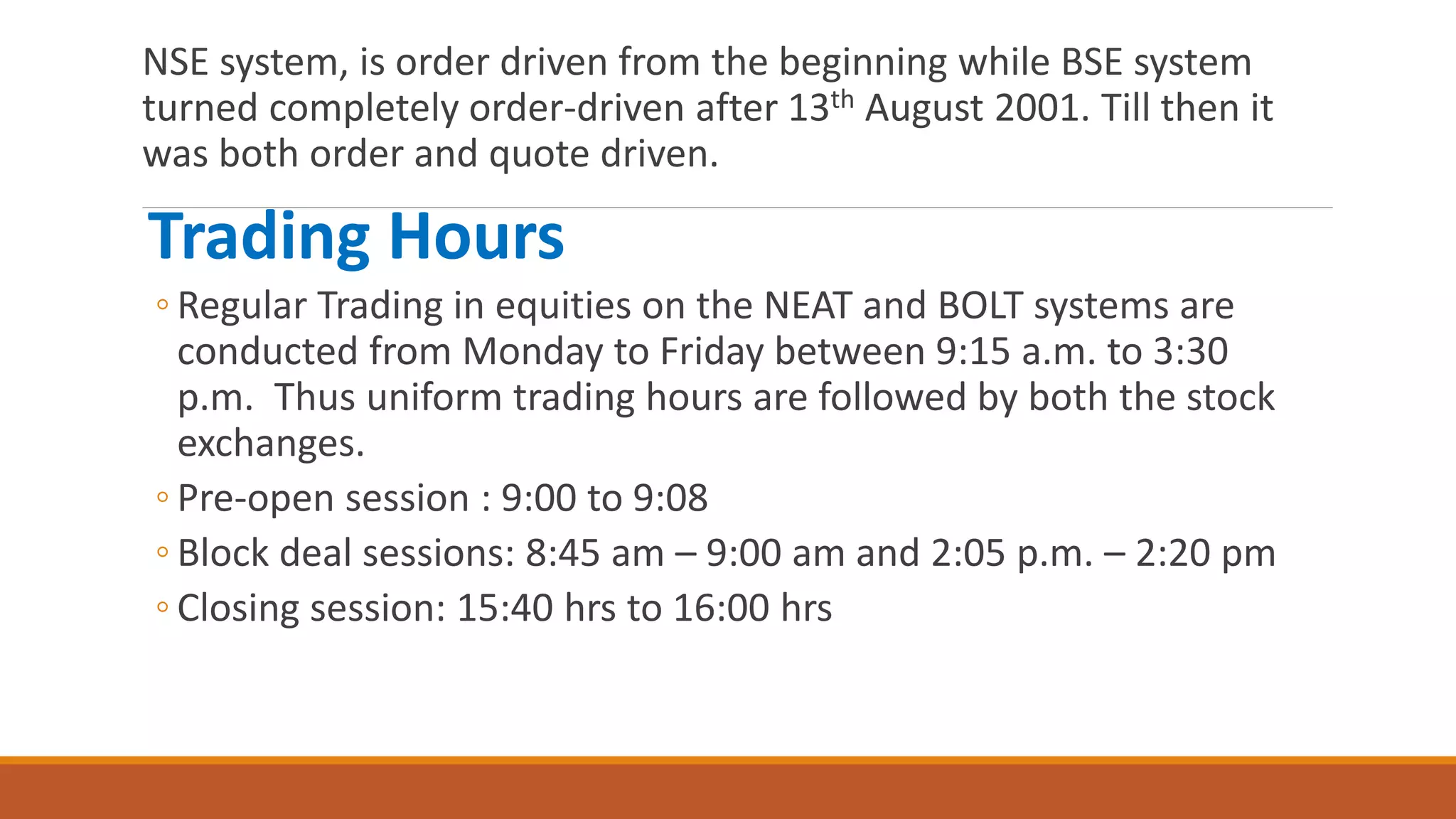
NSE system, is order driven from the beginning while BSE system
turned completely order-driven after 13th August 2001. Till then it
was both order and quote driven.
Trading Hours
◦ Regular Trading in equities on the NEAT and BOLT systems are
conducted from Monday to Friday between 9:15 a.m. to 3:30
p.m. Thus uniform trading hours are followed by both the stock
exchanges.
◦ Pre-open session : 9:00 to 9:08
◦ Block deal sessions: 8:45 am – 9:00 am and 2:05 p.m. – 2:20 pm
◦ Closing session: 15:40 hrs to 16:00 hrs
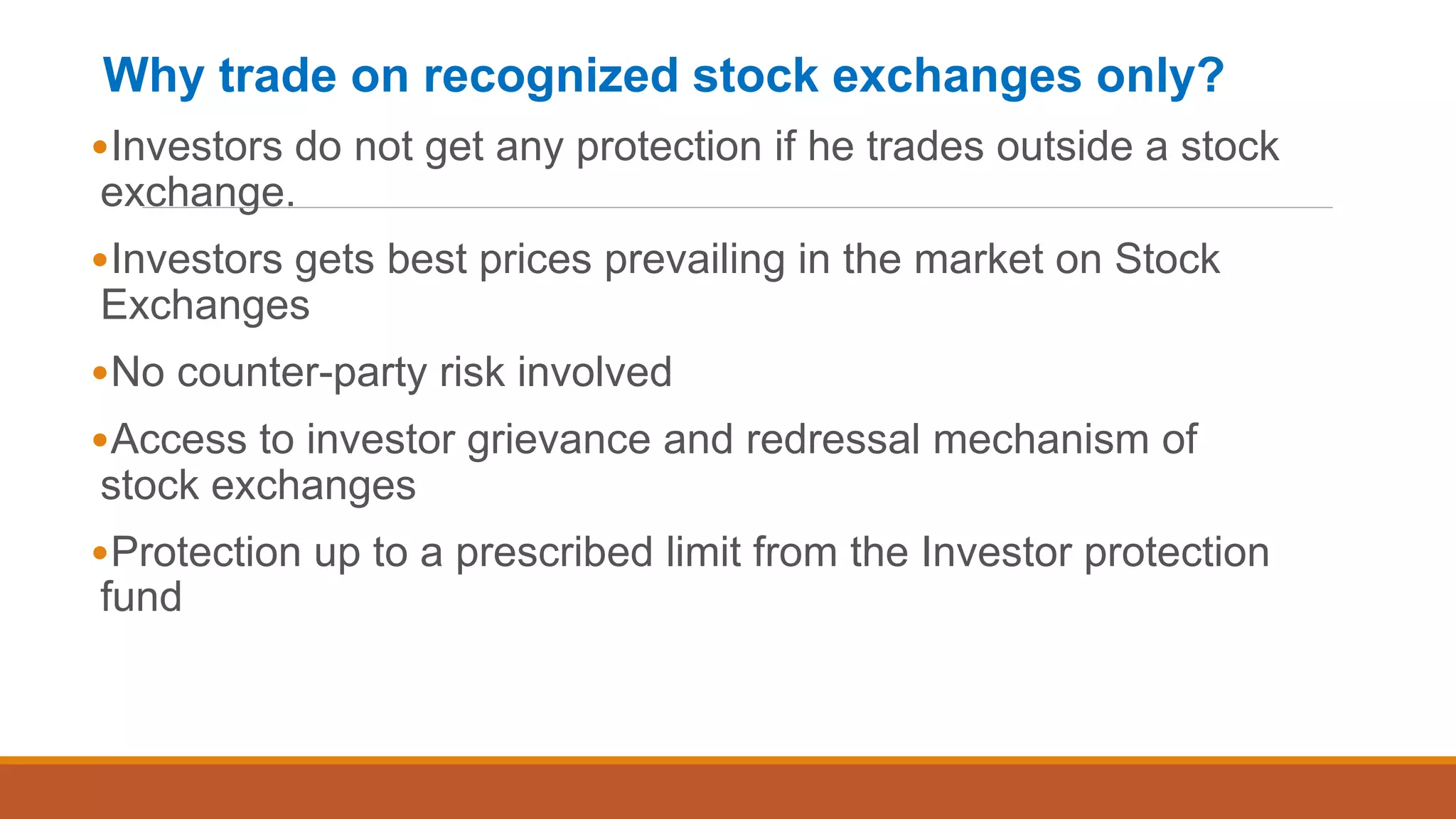
Why trade on recognized stock exchanges only?
•Investors do not get any protection if he trades outside a stock
exchange.
•Investors gets best prices prevailing in the market on Stock
Exchanges
•No counter-party risk involved
•Access to investor grievance and redressal mechanism of
stock exchanges
•Protection up to a prescribed limit from the Investor protection
fund
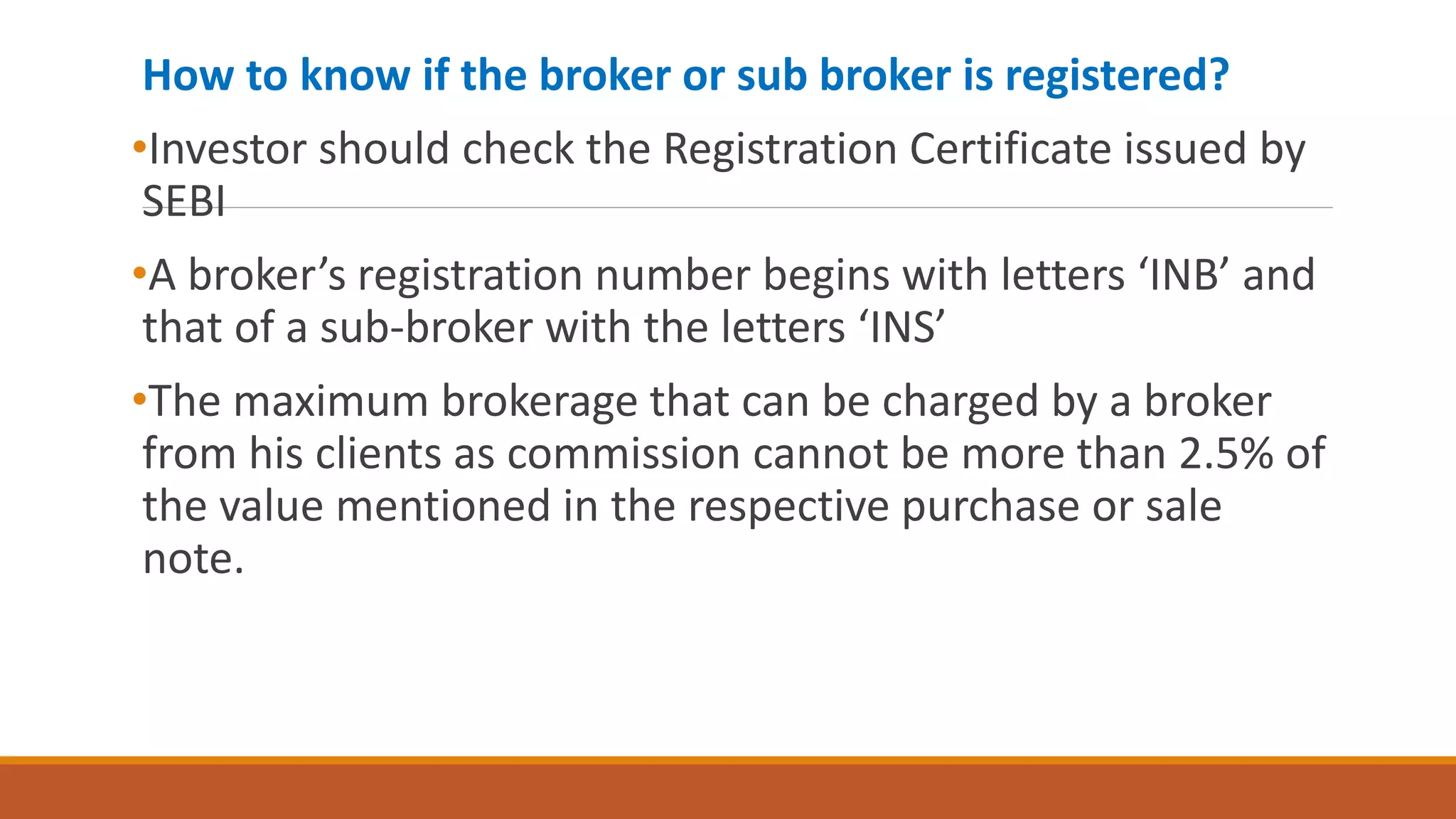
How to know if the broker or sub broker is registered?
•Investor should check the Registration Certificate issued by
SEBI
•A broker’s registration number begins with letters ‘INB’ and
that of a sub-broker with the letters ‘INS’
•The maximum brokerage that can be charged by a broker
from his clients as commission cannot be more than 2.5% of
the value mentioned in the respective purchase or sale
note.
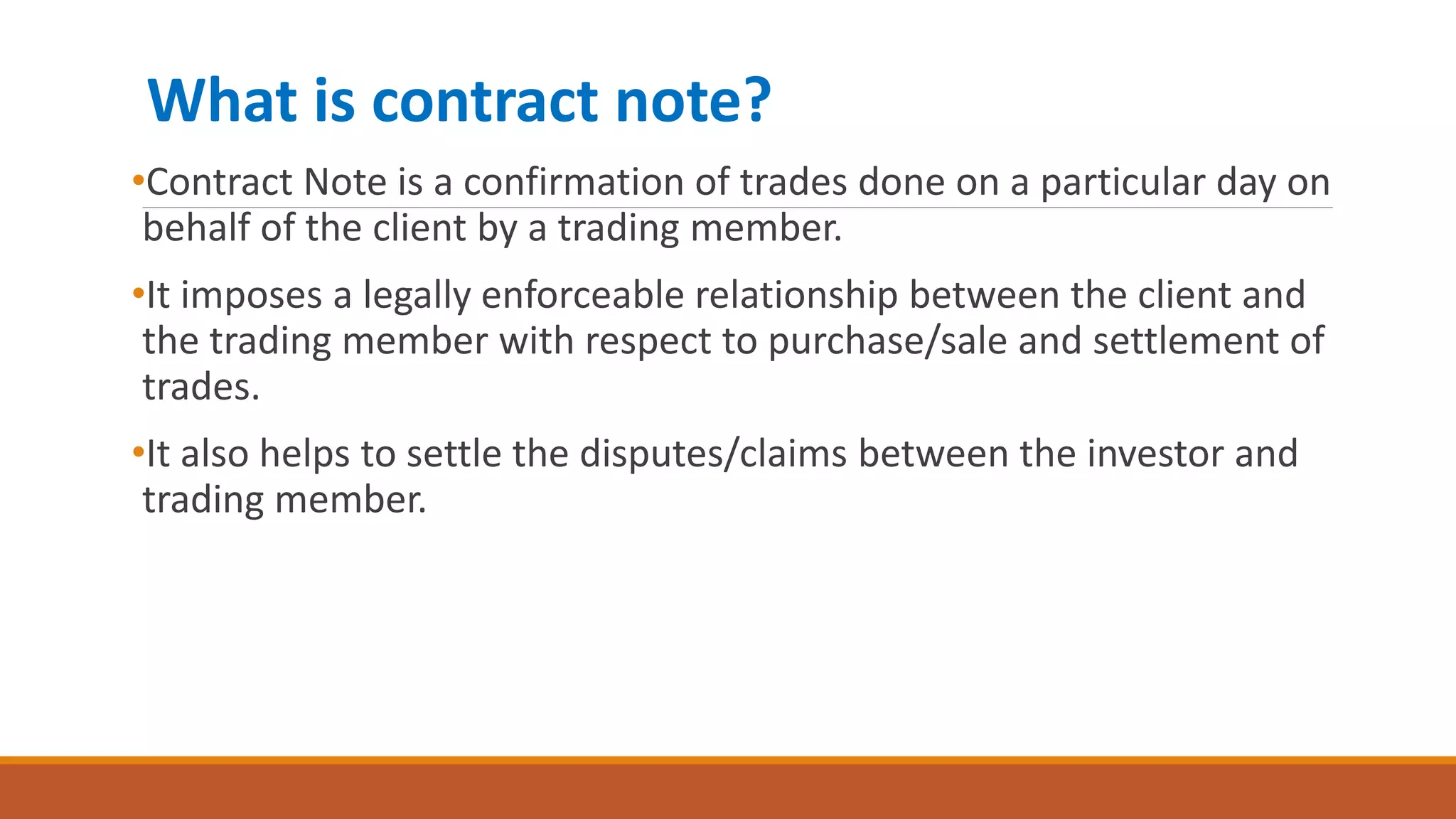
What is contract note?
•Contract Note is a confirmation of trades done on a particular day on
behalf of the client by a trading member.
•It imposes a legally enforceable relationship between the client and
the trading member with respect to purchase/sale and settlement of
trades.
•It also helps to settle the disputes/claims between the investor and
trading member.
TRADING SYSTEM USER-HIERARCHY
3 LEVELS OF USER-HIERARCHY
1) Corporate Manager
2) Branch Manager
3) Dealers
1.Corporate Manager
The Corporate Manager is the user placed at the highest level. Such a user can
perform all offer-related activities and receive the reports for all branches of the
trading member. Additionally, the Corporate Manager can define the offer value
limits for the branches and individual dealers of his firm. This facility is available
only to the Corporate Manager. The Corporate Manager can modify his own offer
or offers of all dealers and branch managers of his trading member firm.
2.Branch Manager
The Branch Manager is the user who is placed under the Corporate Manager. Such
user can perform and view Bid related activities for all dealers under that branch.
The Branch Manager can modify his own offer or offers of any dealer under his
branch.
3.Dealer
Dealers are users at the lower most level of hierarchy. A Dealer can perform and
view offer related activities and information only for oneself and does not have
access to information on other dealers under either, the same branch or other
branches. A Dealer can modify only the Offers entered by him.
Additionally, Syndicate members can view, modify and cancel bids placed by
other members.
(NEAT System, BOLT system and trading system user- hierarchy).pptx

(NEAT System, BOLT system and trading system user- hierarchy).pptx

  • 1.
    NEAT System ,BOLT Systemand Trading System Users Hierarchy BY:ARCHI 7TH SEM 14
  • 2.
    STOCK TRADING ONNEAT AND BOLT •The trading on stock exchanges in India was in open outcry manner till mid 1990s. •In order to provide efficiency, liquidity and transparency, NSE introduced, a nationwide, on-line, fully-automated Screen based trading system (SBTS) in November 1994 known as National Exchange for Automated Trading (NEAT) system. •BSE online trading (BOLT) by BSE started in March 1995
  • 3.
    Screen based tradingsystem •NEAT and BOLT are state-of-the-art client-server based applications where at the server end all trading information is stored in in- memory databases to achieve minimum response time and maximum system availability for users. •A member, broker enter orders from the Trader Work Stations (TWSs) installed in their offices. •A client of these broker can place orders through phone/internet for which he should enter Model Agreement with brokers first.
  • 4.
    Internet based trading •Thereare many brokers who provide internet based trading facility to their clients. •Investors can buy/sell securities through Trader Terminals downloaded on their computers, Trading Apps on their mobiles etc. •Both NSE and BSE systems run on ‘Order driven’ systems What is ‘order-driven’ system? •In an order-driven system, the traders only put their orders for buying or selling of securities whereas, in ‘quote-driven’ system, the jobbers put buy as well as sell quotes in the same scrip with a price difference. •The order-driven system ensures faster processing, matching and execution of orders in a transparent manner.
  • 5.
    NSE system, isorder driven from the beginning while BSE system turned completely order-driven after 13th August 2001. Till then it was both order and quote driven. Trading Hours ◦ Regular Trading in equities on the NEAT and BOLT systems are conducted from Monday to Friday between 9:15 a.m. to 3:30 p.m. Thus uniform trading hours are followed by both the stock exchanges. ◦ Pre-open session : 9:00 to 9:08 ◦ Block deal sessions: 8:45 am – 9:00 am and 2:05 p.m. – 2:20 pm ◦ Closing session: 15:40 hrs to 16:00 hrs
  • 6.
    Why trade onrecognized stock exchanges only? •Investors do not get any protection if he trades outside a stock exchange. •Investors gets best prices prevailing in the market on Stock Exchanges •No counter-party risk involved •Access to investor grievance and redressal mechanism of stock exchanges •Protection up to a prescribed limit from the Investor protection fund
  • 7.
    How to knowif the broker or sub broker is registered? •Investor should check the Registration Certificate issued by SEBI •A broker’s registration number begins with letters ‘INB’ and that of a sub-broker with the letters ‘INS’ •The maximum brokerage that can be charged by a broker from his clients as commission cannot be more than 2.5% of the value mentioned in the respective purchase or sale note.
  • 8.
    What is contractnote? •Contract Note is a confirmation of trades done on a particular day on behalf of the client by a trading member. •It imposes a legally enforceable relationship between the client and the trading member with respect to purchase/sale and settlement of trades. •It also helps to settle the disputes/claims between the investor and trading member.
  • 9.
    TRADING SYSTEM USER-HIERARCHY 3LEVELS OF USER-HIERARCHY 1) Corporate Manager 2) Branch Manager 3) Dealers
  • 10.
    1.Corporate Manager The CorporateManager is the user placed at the highest level. Such a user can perform all offer-related activities and receive the reports for all branches of the trading member. Additionally, the Corporate Manager can define the offer value limits for the branches and individual dealers of his firm. This facility is available only to the Corporate Manager. The Corporate Manager can modify his own offer or offers of all dealers and branch managers of his trading member firm. 2.Branch Manager The Branch Manager is the user who is placed under the Corporate Manager. Such user can perform and view Bid related activities for all dealers under that branch. The Branch Manager can modify his own offer or offers of any dealer under his branch.
  • 11.
    3.Dealer Dealers are usersat the lower most level of hierarchy. A Dealer can perform and view offer related activities and information only for oneself and does not have access to information on other dealers under either, the same branch or other branches. A Dealer can modify only the Offers entered by him. Additionally, Syndicate members can view, modify and cancel bids placed by other members.