NEW DRUG APPLICATION
by
A. Rama Krishna
pharmaceutics
121925101013
 It is an application for the approval of marketing
 This application intended to assist applicants making
regulatory submissions in electronic format to the
Center for Drug Evaluation and Research (CDER)
and the Center for Biologics Evaluation and Research
(CBER), Food and Drug Administration (FDA).
 Regulations in 21 CFR 314.50 provide general
requirements for submitting marketing applications to
CDER.
Supplements and Amendments: this guidelines applies equally to
the original submissions, supplements, and amendments to NDAs
Electronic signatures: The Agency is developing procedures for
archiving documents with electronic signatures. Until those
procedures are in place, documents for which regulations require
an original signature, such as certifications, must be accompanied
by a paper copy that includes the handwritten signature and the
NDA number.
Review Aids: Review aids are electronic files provided in addition to
those provided for archive as described in the guidance. Like the
review copy of an application, a review aid would contain only the
information found in the archival copy of the application, but in a
different format.
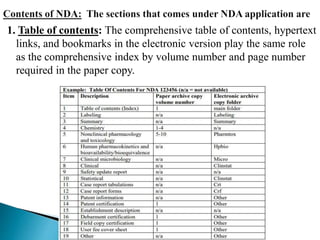
1. Table of contents: The comprehensive table of contents, hypertext
links, and bookmarks in the electronic version play the same role
as the comprehensive index by volume number and page number
required in the paper copy.
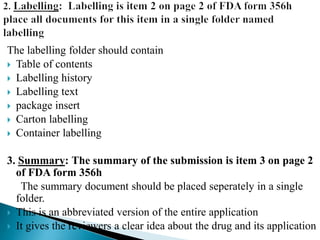
The labelling folder should contain
 Table of contents
 Labelling history
 Labelling text
 package insert
 Carton labelling
 Container labelling
3. Summary: The summary of the submission is item 3 on page 2
of FDA form 356h
The summary document should be placed seperately in a single
folder.
 This is an abbreviated version of the entire application
 It gives the reviewers a clear idea about the drug and its application
This folder of the application includes
 Drug substance: information regarding the drug like description
& characterization, manufacturer, synthesis, microbiology, stability
etc…
 Drug product: information regarding product like composition,
manufacturing method & packing, in process controls & tests,
microbiology, stability etc…
 Investigational formulations: the formulations which are made
during investigation should be placed in a single file seperately
with bookmark and hyperlink.
 Environmental assessments: environmental assessment or a
claim for categorical exclusion should be filed seperately
 Batch records: the information regarding each batch production
record should be filed seperately with the name batch.
 Publications: information like citation for the publication in the
Title portion of the Document Information should be field for each
publication file. The citation should include the first author’s last
name, the year of the publication, and the title of the article
5. Non clinical pharmacology and toxicology: it is the item 5 on
page 2 of FDA form 356h.
This section should of NDA include pharmacology, toxicology and
pharmacokinetics of the drug.
 Animal line listing like body weights, clinical signs should be
provided in a single dataset.
6. Human pharmacology and Bioavailability: This section is
item 6 on page 2 of FDA form 356h.
It contain four sub folders like bio, hupharm, assays and pubs
 The bio folder should provide the information like bio equalence,
bioavailability, food effects, dissolution, and in vitro/in vivo
correlations
 The hupharm folder should contain studies using human
biomaterials, pharmacokinetics studies, and pharmacodynamics
studies
 The pubs folder should contain all the publications.
7. Clinical Micobiology: This section is item 7 on page 2 of FDA
form 356h
 It includes information for anti-infective, anti-viral, and
immunomodulator products submitted to CDER
 This section is mainly required for anti infective drug products
 Biochemical basis of the drug action on microbial physiology
should be mentioned
 Mechanism of resistance of the drug should be mentioned
The other folders that include in this file are table of contents,
summary document, study reports, datasets, publications.
 In this section folder for each indication and each integrated
summary should be create according to the clinical data obtained
 In some cases, folders for individual studies should create and
place them inside the appropriate indications folder where ever
required.
The other folders include table of contents, integrated summaries,
publications.
9. Safety update: This section is item 9 on page 2 of FDA form
356h.
 All documents for this section should be placed in a single
folder named update and a single PDF file provided for each
document.
10. Statistical:
For electronic submissions, item 8 and item 10 are identical.
Documents describing statistical methods and the like should be
included in item 8.
11. Case report tabulation: This section is item 11 on page 2 of
FDA form 356h
 The applicant should provide CRTs in datasets allowing the
reviewers to use their own software for analysis.
 Each dataset is a single file and, in general, includes a combination
of raw and derived data
 In addition to electronic datasets, study data collected for
individual patients, organized by time, can be provided in PDF
files
 Patient profiles should be filed, which include all study data
collected for an individual patient organized by time.
12. Case Report form: This section is item 12 on page 2 in FDA
form 356h
 all data collected for an individual patient should be organized by
domain and time and provided as a PDF file
 This presentation is the same as a patient profile described in item
11(CRT)
13. Patient Information: This section is item 13 on page 2 of FDA
form 356h
 The documents for this section should be placed in folder named
other.
 Information must be submitted regarding any patent held by the
sponser that covers the drug substance, formulation and
composition of the drug product or method of use.
 Upon on approval of NDA this information is published in he
FDAs orange book and serves as a guidence to firms wishing to
develop generic copies
14. Patient Certification: This section is item 14 on page 2 of
FDA form 356h.
 this section of document should be placed in the folder named
other.
 information pertaining to the patent certification should be in a
single PDF file
15. Established Description: This is item 15 on page 2 of FDA
form 356h
 This applies to only submission to CBER
16. Debarment Certification
17. Field copy Certification
18. User Free Cover Sheet
All sections from 16-18 should be filed in a single document and
they should be kept in folder named others.
There should be a hypertext link from the submission table of
contents directly
 Information that is not included in item 1 to 18 is included in this
item. For example, certifications for financial disclosure by
clinical investigators are included in this item.
NDA

NDA

  • 1.
    NEW DRUG APPLICATION by A.Rama Krishna pharmaceutics 121925101013
  • 2.
     It isan application for the approval of marketing  This application intended to assist applicants making regulatory submissions in electronic format to the Center for Drug Evaluation and Research (CDER) and the Center for Biologics Evaluation and Research (CBER), Food and Drug Administration (FDA).  Regulations in 21 CFR 314.50 provide general requirements for submitting marketing applications to CDER.
  • 4.
    Supplements and Amendments:this guidelines applies equally to the original submissions, supplements, and amendments to NDAs Electronic signatures: The Agency is developing procedures for archiving documents with electronic signatures. Until those procedures are in place, documents for which regulations require an original signature, such as certifications, must be accompanied by a paper copy that includes the handwritten signature and the NDA number. Review Aids: Review aids are electronic files provided in addition to those provided for archive as described in the guidance. Like the review copy of an application, a review aid would contain only the information found in the archival copy of the application, but in a different format.
  • 5.
    1. Table ofcontents: The comprehensive table of contents, hypertext links, and bookmarks in the electronic version play the same role as the comprehensive index by volume number and page number required in the paper copy.
  • 6.
    The labelling foldershould contain  Table of contents  Labelling history  Labelling text  package insert  Carton labelling  Container labelling 3. Summary: The summary of the submission is item 3 on page 2 of FDA form 356h The summary document should be placed seperately in a single folder.  This is an abbreviated version of the entire application  It gives the reviewers a clear idea about the drug and its application
  • 7.
    This folder ofthe application includes  Drug substance: information regarding the drug like description & characterization, manufacturer, synthesis, microbiology, stability etc…  Drug product: information regarding product like composition, manufacturing method & packing, in process controls & tests, microbiology, stability etc…  Investigational formulations: the formulations which are made during investigation should be placed in a single file seperately with bookmark and hyperlink.  Environmental assessments: environmental assessment or a claim for categorical exclusion should be filed seperately
  • 8.
     Batch records:the information regarding each batch production record should be filed seperately with the name batch.  Publications: information like citation for the publication in the Title portion of the Document Information should be field for each publication file. The citation should include the first author’s last name, the year of the publication, and the title of the article 5. Non clinical pharmacology and toxicology: it is the item 5 on page 2 of FDA form 356h. This section should of NDA include pharmacology, toxicology and pharmacokinetics of the drug.
  • 9.
     Animal linelisting like body weights, clinical signs should be provided in a single dataset. 6. Human pharmacology and Bioavailability: This section is item 6 on page 2 of FDA form 356h. It contain four sub folders like bio, hupharm, assays and pubs  The bio folder should provide the information like bio equalence, bioavailability, food effects, dissolution, and in vitro/in vivo correlations  The hupharm folder should contain studies using human biomaterials, pharmacokinetics studies, and pharmacodynamics studies
  • 10.
     The pubsfolder should contain all the publications. 7. Clinical Micobiology: This section is item 7 on page 2 of FDA form 356h  It includes information for anti-infective, anti-viral, and immunomodulator products submitted to CDER  This section is mainly required for anti infective drug products  Biochemical basis of the drug action on microbial physiology should be mentioned  Mechanism of resistance of the drug should be mentioned The other folders that include in this file are table of contents, summary document, study reports, datasets, publications.
  • 11.
     In thissection folder for each indication and each integrated summary should be create according to the clinical data obtained  In some cases, folders for individual studies should create and place them inside the appropriate indications folder where ever required. The other folders include table of contents, integrated summaries, publications. 9. Safety update: This section is item 9 on page 2 of FDA form 356h.  All documents for this section should be placed in a single folder named update and a single PDF file provided for each document.
  • 12.
    10. Statistical: For electronicsubmissions, item 8 and item 10 are identical. Documents describing statistical methods and the like should be included in item 8. 11. Case report tabulation: This section is item 11 on page 2 of FDA form 356h  The applicant should provide CRTs in datasets allowing the reviewers to use their own software for analysis.  Each dataset is a single file and, in general, includes a combination of raw and derived data  In addition to electronic datasets, study data collected for individual patients, organized by time, can be provided in PDF files
  • 13.
     Patient profilesshould be filed, which include all study data collected for an individual patient organized by time. 12. Case Report form: This section is item 12 on page 2 in FDA form 356h  all data collected for an individual patient should be organized by domain and time and provided as a PDF file  This presentation is the same as a patient profile described in item 11(CRT) 13. Patient Information: This section is item 13 on page 2 of FDA form 356h  The documents for this section should be placed in folder named other.
  • 14.
     Information mustbe submitted regarding any patent held by the sponser that covers the drug substance, formulation and composition of the drug product or method of use.  Upon on approval of NDA this information is published in he FDAs orange book and serves as a guidence to firms wishing to develop generic copies 14. Patient Certification: This section is item 14 on page 2 of FDA form 356h.  this section of document should be placed in the folder named other.  information pertaining to the patent certification should be in a single PDF file
  • 15.
    15. Established Description:This is item 15 on page 2 of FDA form 356h  This applies to only submission to CBER 16. Debarment Certification 17. Field copy Certification 18. User Free Cover Sheet All sections from 16-18 should be filed in a single document and they should be kept in folder named others. There should be a hypertext link from the submission table of contents directly
  • 16.
     Information thatis not included in item 1 to 18 is included in this item. For example, certifications for financial disclosure by clinical investigators are included in this item.