LEARNING TO LEAD IN
UNCERTAIN TIMES
EDWARD KELLOW
25 APRIL 2017
INTRODUCTIONS
• Edward Kellow
NCVO Charity Leadership course leader, NCVO
• Clare Aarons
Training Coordinator, NCVO
• Lauren Bernard
Webinar organiser, NCVO
2
ABOUT THE WEBINAR
• 30 minute presentation
• 15 minutes Q & A
Please type your questions into the questions
panel at any time (at the bottom of your
webinar dashboard)
• Please complete the short follow-up survey
upon exiting the webinar.
3
LEARNING TO LEAD IN UNCERTAIN TIMES
By the end of the webinar we will have:
• reviewed some of the challenges that today’s
world presents us as charities
• explored a mode of sustainable leadership
• considered the skills and knowledge leaders
will need in the coming decade.
AIMS
‘Leadership and learnership are
indispensible to each other’
Who is this attributed to?
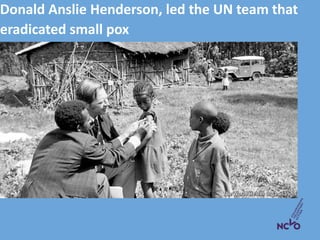
Donald Anslie Henderson, led the UN team that
eradicated small pox
DONALD AINSLIE HENDERSON
Tiny staff but 200,000 locally recruited people worked for
him in 50 countries.
Worked through other people.
Liked to get into the field.
Communications: reporting, answered messages in 3 days
(before email).
Accountability – quality of vaccines, tough diplomacy.
Problem solver: Ethiopian rebels attacked vaccinators,
trucks couldn’t cross bamboo bridges in Bangladesh.
Last naturally occurring case of typhoid was in 1977.
HIS APPROACH TO LEADERSHIP
WHAT I BELIEVE ABOUT LEADERSHIP
• Leadership is contextual
• Leadership is about change
• Leadership is about learning
• There are examples of leadership all around us:
we just have to learn to recognise them
• Learning to lead is about about learning to be
authentic (becoming more yourself)
HEALTH WARNING!
WHAT I BELIEVE ABOUT LEADERSHIP
Asking the right questions is more important than
always knowing the answer.
Leadership is about empowering other people: it’s
about legacy.
There are many ways to lead, and there are some
core skills and attitudes that work in different
situations.
HEALTH WARNING
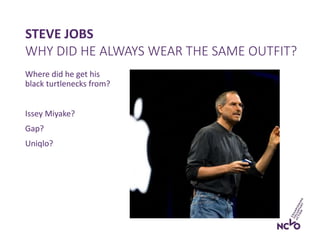
Where did he get his
black turtlenecks from?
Issey Miyake?
Gap?
Uniqlo?
STEVE JOBS
WHY DID HE ALWAYS WEAR THE SAME OUTFIT?
Something has shifted
Brexit
Trump
Social media
“People in this country have had
enough of experts”
Michael Gove, former government minister
and prominent #leave campaigner
LEADING IN A POST FACTUAL WORLD
 Information is available in huge quantities and
can be faked
 Feelings matter more than facts
 Some people trust their Facebook friends more
than they trust traditional sources of
information, such as scientists, government,
the media
 How can we engage and inspire multiple
stakeholders in a post factual world?
WHAT SKILLS AND ATTITUDES DO LEADERS
NEED?
HOW DO YOU KEEP YOURSELF INFORMED?
‘Tweets from Trump, along with those of his
opponents, have caused people to fly apart not
flock together.’
‘If you are on twitter take a hard look at who you
have chosen to follow; the likelihood is that they
all hail from a similar social or intellectual tribe as
you’
Gillian Tett, Anthropologist and US Managing Editor at the Financial
Times 3/03/17
SILOS, BUBBLES, ECHO CHAMBERS
MYTHS VERSUS RATIONALISM
‘I was once a confident optimist and rationalist. I
also used to believe that everybody could be
persuaded by rationale argument. I’ve increasingly
realised that people need mythologies, people
need nationalisms and people need religions’
Adair Turner, former head of the Financial
Services Authority (FSA)
GETTING YOUR MESSAGE ACROSS
How much more
information do we take
in compared to 1986?
3 times more?
5 times more?
10 times more?
INFORMATION GATHERING
WHAT THE INTERNET HAS DONE FOR US
AND BE CAREFUL WHAT YOU BELIEVE
‘I accepted bad news when it chimed with my
beliefs, and dismissed good news when it did not.’
Source: Brexit and the power of wishful thinking’, Tim Harford, FT Weekend,
July 2016
WATCH OUT FOR CONFIRMATION BIAS
‘The trouble with the world is that
the stupid are cocksure and the
intelligent are full of doubt’
Who said this?
IN PRAISE OF THE INCOMPLETE LEADER
Sense making
Relating
Visioning
Inventing
Source: Ancona D, Malone T W, Orlikowski W J, &
Senge P M, Harvard Business Review, February
2007
FOUR KEY SKILLS
IN PRAISE OF THE INCOMPLETE LEADER
‘The incomplete leader has the confidence and
the humility to recognise unique talents and
perspectives throughout the organisation’
Download the article:
https://www.researchgate.net/publication/6460599_In_praise_of_the_incomplete_leader
FOUR KEY SKILLS
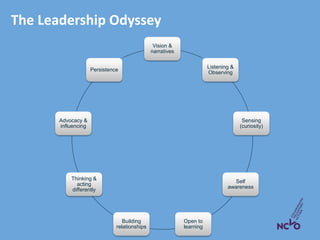
Vision &
narratives
Listening &
Observing
Sensing
(curiosity)
Self
awareness
Open to
learning
Building
relationships
Thinking &
acting
differently
Advocacy &
influencing
Persistence
The Leadership Odyssey
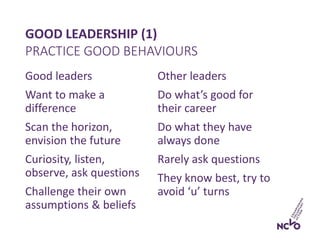
Good leaders
Want to make a
difference
Scan the horizon,
envision the future
Curiosity, listen,
observe, ask questions
Challenge their own
assumptions & beliefs
Other leaders
Do what’s good for
their career
Do what they have
always done
Rarely ask questions
They know best, try to
avoid ‘u’ turns
GOOD LEADERSHIP (1)
PRACTICE GOOD BEHAVIOURS
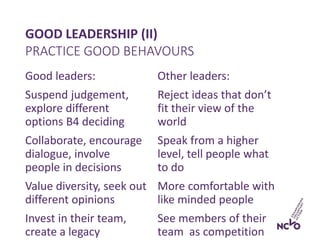
Good leaders:
Suspend judgement,
explore different
options B4 deciding
Collaborate, encourage
dialogue, involve
people in decisions
Value diversity, seek out
different opinions
Invest in their team,
create a legacy
Other leaders:
Reject ideas that don’t
fit their view of the
world
Speak from a higher
level, tell people what
to do
More comfortable with
like minded people
See members of their
team as competition
GOOD LEADERSHIP (II)
PRACTICE GOOD BEHAVOURS
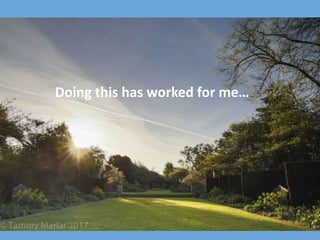
Doing this has worked for me…
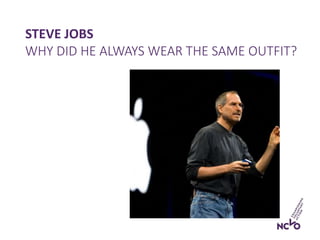
STEVE JOBS
WHY DID HE ALWAYS WEAR THE SAME OUTFIT?
DECISION FATIGUE
‘Understanding decision fatigue and overload
would suggest one should tackle the most
important tasks early in the morning when our
neurochemistry is at its best’
Daniel Levitin, record producer and
neuroscientist, Thinking straight in the Age of
Information Overload, 2014
DECIDING WHAT TO WEAR
‘Don’t be afraid’
Steve Jobs and the ‘reality distortion
field’
Progress comes “from hard struggle,
shared with others, towards some
common goal.”
Larry Harvey, co-founder of the
Burning Man festival, Nevada
FURTHER INFO/CONTACT DETAILS
D A Anslie Obituary
http://www.economist.com/news/obituary/2170
5644-epidemiologist-was-87-obituary-donald-
henderson-died-august-19th
The Positive Deviant: Sustainability Leadership in
a Perverse World, Sara Parkin, 2010
The Self Factor: The Power of Being You, A
Coaching Approach, Duncan Coppock, Findhorn
Press, 2005
LEADERSHIP RESOURCES
Q&A
THANK YOU FOR YOUR QUESTIONS
CHARITY LEADERSHIP IN THE 2020S
STARTS 18 JUNE
THANK YOU
Please complete the short feedback
survey which appears when you exit
the webinar.
training@ncvo.org.uk
31

NCVO Webinar - learningtoleadinuncertaintimes

  • 1.
    LEARNING TO LEADIN UNCERTAIN TIMES EDWARD KELLOW 25 APRIL 2017
  • 2.
    INTRODUCTIONS • Edward Kellow NCVOCharity Leadership course leader, NCVO • Clare Aarons Training Coordinator, NCVO • Lauren Bernard Webinar organiser, NCVO 2
  • 3.
    ABOUT THE WEBINAR •30 minute presentation • 15 minutes Q & A Please type your questions into the questions panel at any time (at the bottom of your webinar dashboard) • Please complete the short follow-up survey upon exiting the webinar. 3
  • 4.
    LEARNING TO LEADIN UNCERTAIN TIMES By the end of the webinar we will have: • reviewed some of the challenges that today’s world presents us as charities • explored a mode of sustainable leadership • considered the skills and knowledge leaders will need in the coming decade. AIMS
  • 5.
    ‘Leadership and learnershipare indispensible to each other’ Who is this attributed to?
  • 6.
    Donald Anslie Henderson,led the UN team that eradicated small pox
  • 7.
    DONALD AINSLIE HENDERSON Tinystaff but 200,000 locally recruited people worked for him in 50 countries. Worked through other people. Liked to get into the field. Communications: reporting, answered messages in 3 days (before email). Accountability – quality of vaccines, tough diplomacy. Problem solver: Ethiopian rebels attacked vaccinators, trucks couldn’t cross bamboo bridges in Bangladesh. Last naturally occurring case of typhoid was in 1977. HIS APPROACH TO LEADERSHIP
  • 8.
    WHAT I BELIEVEABOUT LEADERSHIP • Leadership is contextual • Leadership is about change • Leadership is about learning • There are examples of leadership all around us: we just have to learn to recognise them • Learning to lead is about about learning to be authentic (becoming more yourself) HEALTH WARNING!
  • 9.
    WHAT I BELIEVEABOUT LEADERSHIP Asking the right questions is more important than always knowing the answer. Leadership is about empowering other people: it’s about legacy. There are many ways to lead, and there are some core skills and attitudes that work in different situations. HEALTH WARNING
  • 10.
    Where did heget his black turtlenecks from? Issey Miyake? Gap? Uniqlo? STEVE JOBS WHY DID HE ALWAYS WEAR THE SAME OUTFIT?
  • 11.
  • 12.
    “People in thiscountry have had enough of experts” Michael Gove, former government minister and prominent #leave campaigner
  • 13.
    LEADING IN APOST FACTUAL WORLD  Information is available in huge quantities and can be faked  Feelings matter more than facts  Some people trust their Facebook friends more than they trust traditional sources of information, such as scientists, government, the media  How can we engage and inspire multiple stakeholders in a post factual world? WHAT SKILLS AND ATTITUDES DO LEADERS NEED?
  • 14.
    HOW DO YOUKEEP YOURSELF INFORMED? ‘Tweets from Trump, along with those of his opponents, have caused people to fly apart not flock together.’ ‘If you are on twitter take a hard look at who you have chosen to follow; the likelihood is that they all hail from a similar social or intellectual tribe as you’ Gillian Tett, Anthropologist and US Managing Editor at the Financial Times 3/03/17 SILOS, BUBBLES, ECHO CHAMBERS
  • 15.
    MYTHS VERSUS RATIONALISM ‘Iwas once a confident optimist and rationalist. I also used to believe that everybody could be persuaded by rationale argument. I’ve increasingly realised that people need mythologies, people need nationalisms and people need religions’ Adair Turner, former head of the Financial Services Authority (FSA) GETTING YOUR MESSAGE ACROSS
  • 16.
    How much more informationdo we take in compared to 1986? 3 times more? 5 times more? 10 times more? INFORMATION GATHERING WHAT THE INTERNET HAS DONE FOR US
  • 17.
    AND BE CAREFULWHAT YOU BELIEVE ‘I accepted bad news when it chimed with my beliefs, and dismissed good news when it did not.’ Source: Brexit and the power of wishful thinking’, Tim Harford, FT Weekend, July 2016 WATCH OUT FOR CONFIRMATION BIAS
  • 18.
    ‘The trouble withthe world is that the stupid are cocksure and the intelligent are full of doubt’ Who said this?
  • 19.
    IN PRAISE OFTHE INCOMPLETE LEADER Sense making Relating Visioning Inventing Source: Ancona D, Malone T W, Orlikowski W J, & Senge P M, Harvard Business Review, February 2007 FOUR KEY SKILLS
  • 20.
    IN PRAISE OFTHE INCOMPLETE LEADER ‘The incomplete leader has the confidence and the humility to recognise unique talents and perspectives throughout the organisation’ Download the article: https://www.researchgate.net/publication/6460599_In_praise_of_the_incomplete_leader FOUR KEY SKILLS
  • 21.
    Vision & narratives Listening & Observing Sensing (curiosity) Self awareness Opento learning Building relationships Thinking & acting differently Advocacy & influencing Persistence The Leadership Odyssey
  • 22.
    Good leaders Want tomake a difference Scan the horizon, envision the future Curiosity, listen, observe, ask questions Challenge their own assumptions & beliefs Other leaders Do what’s good for their career Do what they have always done Rarely ask questions They know best, try to avoid ‘u’ turns GOOD LEADERSHIP (1) PRACTICE GOOD BEHAVIOURS
  • 23.
    Good leaders: Suspend judgement, exploredifferent options B4 deciding Collaborate, encourage dialogue, involve people in decisions Value diversity, seek out different opinions Invest in their team, create a legacy Other leaders: Reject ideas that don’t fit their view of the world Speak from a higher level, tell people what to do More comfortable with like minded people See members of their team as competition GOOD LEADERSHIP (II) PRACTICE GOOD BEHAVOURS
  • 24.
    Doing this hasworked for me…
  • 25.
    STEVE JOBS WHY DIDHE ALWAYS WEAR THE SAME OUTFIT?
  • 26.
    DECISION FATIGUE ‘Understanding decisionfatigue and overload would suggest one should tackle the most important tasks early in the morning when our neurochemistry is at its best’ Daniel Levitin, record producer and neuroscientist, Thinking straight in the Age of Information Overload, 2014 DECIDING WHAT TO WEAR
  • 27.
    ‘Don’t be afraid’ SteveJobs and the ‘reality distortion field’
  • 28.
    Progress comes “fromhard struggle, shared with others, towards some common goal.” Larry Harvey, co-founder of the Burning Man festival, Nevada
  • 29.
    FURTHER INFO/CONTACT DETAILS DA Anslie Obituary http://www.economist.com/news/obituary/2170 5644-epidemiologist-was-87-obituary-donald- henderson-died-august-19th The Positive Deviant: Sustainability Leadership in a Perverse World, Sara Parkin, 2010 The Self Factor: The Power of Being You, A Coaching Approach, Duncan Coppock, Findhorn Press, 2005 LEADERSHIP RESOURCES
  • 30.
    Q&A THANK YOU FORYOUR QUESTIONS CHARITY LEADERSHIP IN THE 2020S STARTS 18 JUNE
  • 31.
    THANK YOU Please completethe short feedback survey which appears when you exit the webinar. training@ncvo.org.uk 31

Editor's Notes

  • #5 By the end of the webinar you will: have explored some of the challenges that today’s world presents us as charities been introduced to a model of sustainable leadership have considered the skills and knowledge leaders will need in the coming decade.
  • #6 John F Kennedy, former USA President
  • #11 To avoid decision fatigue Issey Myake
  • #15 https://www.ft.com/content/234ebf52-e351-11e6-8405-9e5580d6e5fb And consider people read and have always read different newspapers.
  • #16 Source Lunch with the FT, 18/19 June 2016
  • #17 5
  • #19 Who said this? Bertrand Russell
  • #20 When I joined LEAD people asked: What is your model of leadership?
  • #22 Download from kellowlearning.com
  • #25 Vision, commitment, consistency, liking, suggesting, doing the basics, building relationships with other gardeners, listening, observing, sense of achievement
  • #26 To avoid decision fatigue Issey Myake
  • #28 https://medium.com/@jhargrave/how-steve-jobs-created-the-reality-distortion-field-and-you-can-too-4ba87781adba Reality distortion field (RDF) is a term coined by Bud Tribble at Apple Computer in 1981, to describe company co-founder Steve Jobs's charisma and its effects on the developers working on the Macintosh project.
  • #32 Fill in evaluation forms