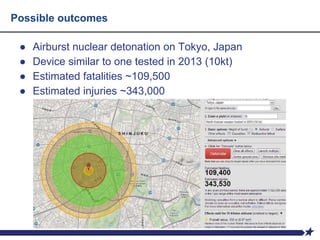
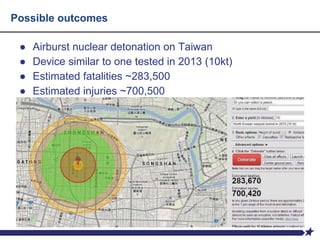
Integrity - Service - Innovation
North Korea
National Critical Intelligence Estimate
Presented by Team 5 O’Clock Somewhere
For Approval by, Prof. Randall Nichols
Team 5 O’Clock
Sub-Team 1
XO: TJ Shakti Ramdass
Political & Economy
Jacob Smaczniak
Tanya Jeffers
Timothy Greiner
William Pagan
Sub-Team 2
XO: Leia Scime’-Stickles
Military/WMD & Cyber Intel
Alina Stechyshyn
Henry Cline
John Stechyshyn
Michael Vedete
Team Leader: Virginia Regester
Agenda
● Executive Summary
● North Korean Overview
● U.S. Interests and Goals
● North Korean Interests and Goals
● Political Estimate
● Economic Estimate
● Military/WMD Estimate
● Cyber & Intelligence Estimate
● Conclusions
● References
Executive Summary (1 of 2)
● North Korea (Democratic People’s Republic of Korea) is
recognized as a totalitarian state
● It functions as a single-party military dictating “Juche”
(self-reliant) republic
● Death of Kim Jong IL and his young son Kim Jong Un’s
appointed as North Korea’s Supreme Leader, have
developed many unknowns about the political climate
● As a centrally directed and least open economy that faces
many chronic problems, impacts of recent changes pose
several questions about the country’s future and stability
Executive Summary (2 of 2)
● North Korea’s nuclear, missile and other asymmetric
military capabilities is a concern to the U.S. and presents
challenges to regional security and stability
● Recent nuclear tests and overt threats by the new leader
required a full analysis to determine North Korea’s
intentions and capabilities
● Using the Analysis of Competing Hypotheses (ACH)
diagnostic technique, critical questions were analyzed
against several hypothesis.
Executive Summary
Political and Leadership Hypothesis
Will North Korea collapse under the Kim Jong Un regime?
● H1. North Korea will continue to survive as it always has; the situation
will remain status quo. China will continue to support yet disagree with
North Korea’s nuclear program
● H2. North Korea will not collapse under Kim Jong Un. Kim's
replacement of senior officials in reality makes room for change and
growth. China will remain an ally.
● H3. North Korea will collapse. China will have reached it's limit and
despite remaining an ally will be forced to use a strong arm
Executive Summary
Economic Hypothesis
Will N. Korean economic reforms stabilize the country’s economy?
● H1: The new economic reforms are legitimate means being pursued to
improve N. Korea’s economy and standard of living. Kim Jong Un will make
good on his economic reform and the economy will stabilize. Foreign aid will
be necessary in the beginning but this need will die as the country gains
financial independence.
● H2: The economic reforms are only rhetoric used to bolster Kim Jong Un’s
position and regime hold on the country. Kim Jong Un sees the black market
as a source of revenue and method of barter. However, like a double edged
sword the black market will also continue to undermine any economic reform
Executive Summary
Conventional Military Hypothesis
Does North Korea have a credible conventional military force?
● H1. North Korea has a strong conventional military, capable of
engaging in total War with S. Korea and the U.S.
● H2. North Korea’s has a weak conventional military that is no threat
to South Korea.
● H3. North Korea has a capable military that could engage South
Korea with the correct strategy
Executive Summary
Weapons of Mass Destruction (WMD) Hypothesis
Does North Korea have the capability of launching a nuclear or
chemical missile at the U.S.?
● H1. North Korea currently had a formidable WMD program with the
capability of launching an armed missile on the U.S.
● H2. North Korea has a credible WMD program but does not possess
the capability launching an armed missile on the U.S.
● H3. North Korea’s WMD program is all a ruse and does not possess
credible capabilities.
Executive Summary
Cyber and Intelligence Hypothesis
Has the DPRK developed a sufficient cyber force to really threaten
the ROK or the US?
● H1: NK has a formidable cyber force capable of launching significant
attacks against the ROK or the US.
● H2: NK’s cyber warfare program is not technically sophisticated to
attack the ROK or the US.
Executive Summary
Political Indicators (1 of 2 )
● Despite China’s condemnation of North Korea’s recent
nuclear test, they will remain a strong ally
● De-emphasizing the role of the military and placing KWP in
control of the government
● Key leadership changes that advocate
commercial/economic changes and support Kim Jong Un
● Regime survival through the pre- establishment of key
advisors and supporters by Kim Jong IL before his death
● Shaping public image of Kim Jong Un in line as role of
Supreme Leader
● North Korea does not want war but wants to be recognized
as a world power
Executive Summary
Political Indicators (2 of 2)
● History of failed diplomacy to denuclearize North Korea
● North Korea’s defiance of UN sanctions and pull out of Six
Party Talks
● China’s condemnation and renewed interest in the Six
Party process when its security was jeopardized by North
Korea’s third nuclear test
Executive Summary
Economic Indicators
● North Korea is in need of hard currency, bringing close or
more to $1 Billion a year in revenue.
● The trading system is almost shut down do to illegal
activities in the black market where everything is cheaper.
● North Korea started to deal with other countries and now
the demand is so high that is hard to stop.
● North Korea haven’t being able to venture further with this
industry do to his restricted market
● They lack reliable energy to continue their projects
● North Korea relies on other countries especially China for
help in their mining industry do to the lack of machinery
● In the long - run there will be change
Executive Summary
Military Indicators
● Multiple conflicts resulting in death of both North Korean and South
Korean personnel have resulted in threats but no increase in military
action
● North Korean and South Korean conflicts highlights lack of military
technological advantage
● Fuel shortages and replacement and maintenance of aged equipment
have reduced number of sorties and military maneuver
● Known Special Forces operations shows that they have already
infiltrated South Korea multiple times
● North Korean military continues to have live drills to examine war
fighting capabilities
● Historically China has assisted NK in past wars
● China’s admonition of North Korea’s brazen threats of war has them
reaching out diplomatically towards the US
Executive Summary
WMD Indicators (1 of 3)
● No evidence exists that suggests NK has tested ICBM technology
● Stanford's Siegfried Hecker says the 2013 nuclear test takes NK 1
step closer to miniaturizing a missile ready weapon.
● December 2012 missile satellite launch aligned with
commemoration of 1st year death anniversary of Kim Jong-IL
● US research community deems the satellite tumbling, dead and
likely not communicating.
● Rocket portion of the launch seemed successful
● US policy is to execute “strategic patience” calls to increase pressure on
NK sanctions to encourage the state to follow through on commitments to
end its nuclear weapons development.
● Six Party talks broke down 2009 when NK indicated it would no longer
participate
Executive Summary
WMD Indicators (2 of 3)
● Key to understand NK intention to nuclear weapons program
● If NK nuclear weapons program is to act as a deterrent to ROK
& US invasion then hope remains for diplomacy.
● If NK wants to threaten US and other targets with ICBM the
other acts of deterrence are necessary
● US policy toward NK has failed to reduce threat to the region
● US withdrew tactical Nuclear Weapons in 1991
● With recent February NK test and ROK belief that NK is not
likely to give up on nuclear weapons most believe either US
returns tactical missiles or ROK develops its own arsenal.
● Further sanctions coming
○ NK already faces a wide range of sanctions to inhibit
nuclear production
○ Susan Rice (US ambassador to the United Nations)
Security counsel will likely look to further sanctions
Executive Summary
WMD Indicators (3 of 3)
● China may be encouraged to more strongly enforce
existing NK sanctions if they believe ROK & Japan plan to
develop their own Nuclear arsenal
Executive Summary
Cyber Indicators (1 of 2)
● Increasing North Korean interest in gathering foreign
intelligence on weapons and nuclear systems
● Primary cyber attack targets are South Korean
government, commerce and military
● China provides means for cyber connectivity such as fiber,
servers and key network hardware
● North Korea continues to launch most attacks from outside
its country
● Russian teachers brought in to teach cyber and/or students
are sent to China or Russia for training
● China is increasingly suspected of using North Korean
hackers to attack South Korean targets giving China
plausible deniability
Executive Summary
Cyber Indicators (2 of 2)
● Computer experts are trained as hackers, denying most
attacks
● North Korea is said to have between 3,000 and 4,000
cyber warriors while South Korea only has 400
● The target of 2013’s attack -Hyundai Merchant Marine Co.
Ltd. - is concerning
Executive Summary
Key Judgments and Possible Outcomes (1 of 2)
Political Estimate
● High confidence that the Kim Jong Un Regime will not collapse and
will maintain control over the country
● Focus of country is to maintain nuclear capabilities as a defense and
resuscitate its failing economy
● Renewal of six Party talks with North Korea is not likely
Economic Estimate
● Fundamental changes are likely to occur in North Korean economy
but it will be slow
● Economic reforms and black-market activities will be central towards
resuscitating North Korea’s economy
● Openness of country will continuously grow with continued
advancement of available technology and expansion of tourism
● China will do what is necessary to ensure North Korea’s stability
Executive Summary
Key Judgments and Possible Outcomes (2 of 2)
Military and WMD Estimate
● Despite the threats made, North Korea will not be the one to strike first
to start a war
● Military capabilities will focus on pursuing and improving asymmetrical
capabilities
● Nuclear program and capabilities is the center of maintaining North
Korea’s philosophy of “Juche”
● Despite UN Sanctions, North Korea will continue with weapons trade
and development of WMD.
● Likely that North Korea has developed a nuclear warhead capable of
being delivered by their Nodong missile
Cyber Estimate
● North Korea will emerge as a country with formidable cyber warfare
capabilities
Executive Summary
Final Analysis (1 of 2)
● Kim Jong Un’s Regime will not follow the same tactics of using
nuclear threats to negotiate and get US-SK concessions.
● The Democratic People’s Republic of Korea (DPRK) will not gamble
everything in launching a surprise attack on South Korea unless
provoked
● Kim Jong Un’s Regime will continue to pursue the DPRK’s nuclear
program and focus on a new strategy with the potential to
fundamentally change the country.
Executive Summary
Final Analysis (2 of 2)
● DPRK’s New Strategy:
○ Continue to build and expand DPRK’s nuclear program and
resuscitate a failing economic
○ Nuclear program provides a means to improve the country’s
economy through weapons and technological trade
○ Nuclear program provides a deterrence and security umbrella to the
country’s sovereignty - “Juche”
○ Successful test of nuclear weapon will give North Korea national
equality with the major nuclear powers
○ Focus on economic reforms to rebuild the country’s economy
Integrity - Service - Innovation
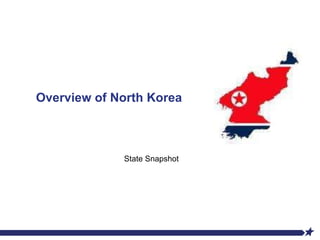
Overview of North Korea
State Snapshot
North Korean Overview (1 of 5)
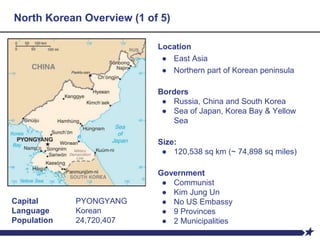
Location
● East Asia
● Northern part of Korean peninsula
Borders
● Russia, China and South Korea
● Sea of Japan, Korea Bay & Yellow
Sea
Size:
● 120,538 sq km (~ 74,898 sq miles)
Government
● Communist
● Kim Jung Un
● No US Embassy
● 9 Provinces
● 2 Municipalities
Capital PYONGYANG
Language Korean
Population 24,720,407
North Korean Overview (2 of 5)
Military
● North Korean People’s Army
● Ground Forces
● Navy
● Air Force
● Civil Securities Forces
○ 22 active divisions
Economy
● Centrally directed and closed market
● Revenue: $3.2 Billion
● Expenditure: $3.3 Billion
● Debt. $12.5 Billion (2001)
Natural Resources
● Core, lead, tungsten, zinc graphite, magnesium, zinc, iron ore, copper, gold,
pyrites, salts, fluorspar, hydropower
North Korean Overview (3 of 5)
Agriculture
● rice, corn, potatoes, soybeans, cattle, pigs, pork and eggs
Industries
● Military products, machine building, electrical power, mining, tourism, food
processing, metallurgy and chemicals
Broadcast Media
● No independent media outlets
● Only 4, all are government owned and pre-tuned to Korean government
approved channels
Dependency Ratio
● 45.2 %
North Korean Overview (4 of 5)
Ethnic Groups
● small population of Chinese
● few Japanese
● mostly homogenous
Religion
● Buddhist and Confucianist, some Christians
Education
● 100% of the population above the age of 15 are literate
Profession
● not allowed to chose
● cannot change easily
North Korean Overview (5 of 5)
Allies
● Russia and China (Both very perturbed by NK 3rd nuclear test)
● Diplomatic relations with 165 states
● No diplomatic relations between US & NK
Refugees
● Thousands fleeing to China due to grave economic state of NK
● Political oppression and starvation
● South Korea not recognized as legitimate state
Disputes
● Islands in Yalu and Tumen rivers with China
● Military demarcation line between North & South Korea
Criminal Activity
● Human trafficking
● Drug trade
● Cybercrime
Integrity - Service - Innovation
National Interests and Goals
U.S. National Interests
● Prevent, deter and reduce the threat of nuclear, biological
and chemical weapons attacks on the U.S. and its military
forces abroad
● Prevent the regional proliferation of WMD and delivery
systems
● Promote the well-being of US allies and friends and protect
them from external aggression
○ South Korea
○ Taiwan
○ Japan
● Prevent, manage & if possible at reasonable cost, end
major conflict in important geographical regions
U.S. Strategic Goals with North Korea
● Prevent DPRK from building, using or threatening the use
of nuclear weapons against U.S. forces or neighboring
countries
● Stop DPRK from stockpiling, using and distributing WMD,
specifically chemical and biological munitions
● Reduce the development and sale of sophisticated ballistic
missiles to other nations or terrorists
● Reduce the likelihood of conventional military conflict
between North and South Korea
● Neutralize China’s effects on North Korea
North Korean Interests and Goals
● The reunification of the Korean Peninsula on North Korean
terms
● North Korea’s goal is to take the strategic lead in inter-
Korean relations
○ Views the entire peninsula as its sovereign territory
● Defending against further encroachment by US
imperialists
● Regime survival
● Self-sufficient “Juche” economy without giving up its
nuclear arms
Integrity - Service - Innovation
Political Estimate
Political Estimate - Agenda
● Overview
● Hypothesis
● Indicators and Evidence/Arguments
● ACH Matrix
● ACH Analysis
● Key Judgments & Outcomes
● Conclusions
● North Korea functions as a single-party state under a totalitarian
dictatorship
● National ideology “Juche” meaning self-reliance or self-dependence
○ An application of Marxism-Leninism.
○ Adopted by Kim Jong IL in the 1970’s
○ Retitled Kim II Sungism
● In December 2011 Kim Jong Un appointed supreme ruler after presiding
ruler and his father, Kim Jong IL passed away
● Korean Workers’ Party (KWP) had died during Kim Jong IL is now on the
uprise with the new supreme ruler Kim Jong Un
● All government officials belong to this KWP
● A few minor political parties are allowed to exist in name only
Political Overview
North Korean Supreme Leader
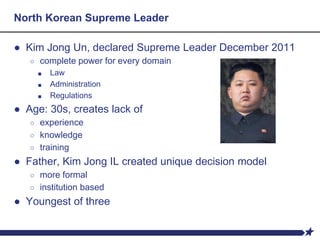
● Kim Jong Un, declared Supreme Leader December 2011
○ complete power for every domain
■ Law
■ Administration
■ Regulations
● Age: 30s, creates lack of
○ experience
○ knowledge
○ training
● Father, Kim Jong IL created unique decision model
○ more formal
○ institution based
● Youngest of three
Is Kim Jong Un ready?
● No political or military experience
before taking putative control of military
● Became leader in his 30’s vs his father
at 53
● Likes to party
○ luxury yacht
○ private island
○ celebrities
● Enjoys high end luxury goods
○ perfume
○ bathroom fittings
○ alcohol
○ electronics
○ watches
Regents Closest to Supreme Leader
● Regents act as advisors and assist in decision making
○ Were put in place by Kim Jong IL
○ Primary purpose to ensure Kim Regime control
● Kim Kyong Hui (Aunt)
○ only person allowed to verbally discuss policy
○ has veto power, except Kim Jung Un
○ protect Kim family equities
○ provide Kim Jong-un leadership training
● Jang Song Taek (Uncle)
○ considered ‘control tower’
○ prioritizes leaders paperwork, cannot alter it
○ maintains control of economic & internal security portfolios
○ was Kim Jong IL’s closest and trusted advisor
○ speculation that he was the one in control
● Choe Ryong Hae (VMAR)
○ ensures loyalty to military
○ does not report through Jang Song Taek
Government Structure Overview (1 of 2)
● Key entities that control the government of the DPRK
○ The Cabinet, formerly known as the State Administration Council
(SAC)
■ administers the ministries
■ has a significant role in implementing policy
■ headed by the premier and is the dominant administrative and
executive agency
○ The NDC
■ responsible for external and internal security
■ assumed a significant role in influencing policy under
Kim Jong IL
○ The Politburo of the Central People’s Committee
■ The top policy making body of the KWP
■ the dominant social institution in North Korea.
Government Structure Overview (2 of 2)
● The Supreme People’s Assembly
○ Officially, the DPRK’s legislature
○ Is the highest organ of state power
○ members are elected every 4 years
○ usually holds only two meetings annually, each lasting a few days
○ A standing committee elected by the SPA performs legislative
functions and appoints judges to highest court
○ serves only to ratify decisions made by the ruling KWP
● North Korea's judiciary is "accountable" to the SPA and the president.
● Administratively, North Korea is divided into nine provinces and two
provincial-level municipalities
○ Pyongyang and Nasun (also known as Najin-Sonbong)
● North Korea is also divided into nine military districts.
Central Committee Department
Consists of 4 Departments
● Political Bureau
○ Full members reduced to 17
■ 5 military/security fractions
■ 12 party/government fractions
● Secretariat is Similar to US Secret Service & White House Office
● Central Inspection Commission Regulates membership within Korean
Workers Party (KWP)
● Central Military Commission
○ development & implementation of KWP military policies
○ Coordinates with National Defense Commission (NDC) to
command and control military/military industries
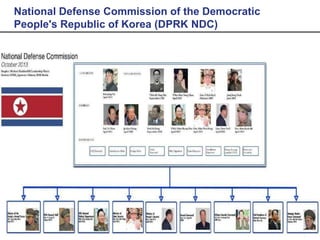
National Defense Commission of the Democratic
People's Republic of Korea (DPRK NDC)
Committee Department Responsibilities
● Formulate & implement KWPs
○ political
○ economic
○ internal security
○ military policies
● Regulate personnel appointments within
○ party
○ government
○ Military
● Regulate DPRKs
○ press
○ media
○ cultural institutions
Current Situation
● China is perturbed by North Korea’s recent nuclear testing.
● North Korea wants to be recognized as a global nuclear power
● Current Laws are merely to protect regimes rule
● Kim Jong Un has promised economic reform
● Kim Jong Un needs to develop relationships with others to effectively
rule
● Relies on groups of regents and advisors for policy making although
he is supreme leader
● Improving ties between North & South
○ South Korea setting aside special tax to help one day reunify the
two provinces
○ Both countries set up lottery reunification days for families split by
the Korean War
○ Reunification is done both in person and online (Sang-Hun, 2013)
Political and Leadership Hypothesis
Will North Korea collapse under the Kim Jong Un regime?
● H1. North Korea will continue to survive as it always has; the situation
will remain status quo. China will continue to support yet disagree with
North Korea’s nuclear program
● H2. North Korea will not collapse under Kim Jong Un. Kim's
replacement of senior officials in reality makes room for change and
growth. China will remain an ally.
● H3. North Korea will collapse. China will have reached it's limit and
despite remaining an ally will be forced to use a strong arm
World Governance Indicators (1 of 2)
● World Governance Indicators (WGI) indicates North Korea's political
stability has improved over the past couple of years following its
power transition
● WGI data reflect perceptions of the likelihood that a government will
be destabilized or overthrown
○ by unconstitutional or violent means
○ by politically motivated violence and terrorism
● WGI covers six categories: voice and accountability; political stability
and absence of violence; government effectiveness; regulatory
quality; rule of law; and control of corruptio
World Governance Indicators (2 of 2)
●
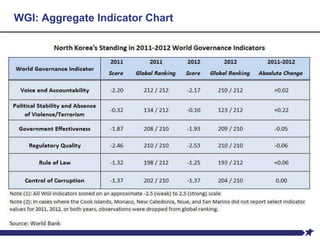
● North Korea’s aggregate indicator of "political stability and absence of
violence" came to 0.01 in 2012, up from minus 0.32 a year earlier.
● North Korea stood in the middle among 215 countries surveyed in
terms of political stability in 2012
● WGI data in context for North Korea
○ 1996- expectation of collapse in stability reached -0.51 upon
founder Kim IL Sung’s death
○ 2008- the figure rose to 0.54 under son Kim Jong IL leadership
○ 2010- the figure plunged to -0.38 after Kim Jong IL health
deteriorated
○ 2011- there was minimal increase to -0.32
○ 2012-rose again to 0.01 due to “political stability and absence of
violence”
WGI: Aggregate Indicator Chart
WGI: Aggregate Indicator Data
● North Korea ranked low in the remaining categories:
○ level of voice and accountability (reflects freedom of
expression and citizen participation in selecting their
government) -2.17
○ government effectiveness -1.93
○ rule of law -1.25
● Little change from previous year
Leadership Changes ( 1 of 2)
● Kim Jong Un has replaced over 44% of government,
military and senior officials
○ many were appointed by his father Kim Jong IL
○ these included the 4 highest ranking officials in 2012
● Kim Jong Un has, for the 4th time, changed DPRK’s army
chief
○ Gen. Kim Kyok Sik was ousted
■ General was well known to be harsh against South Korea
■ Directly responsible for 2 attacks against South Korea
○ 69 year old Gen. Ri Young Gil was appointed
■ General’s position on South Korea is yet to be determined
Leadership Changes (2 of 2)
● Kim Jong Un has also replaced economic advisor in the
Political Bureau
○ Vice Marshall Kim Jong Gak was replaced
○ Pak Pung Ju was appointed
■ Ju as already presided over the economic reforms
plans
■ Ju has close ties with Jang Song Thaek and wife, Kim
Jong Un’s aunt and uncle
● Results of these changes has the Korean Workers Party
taking prominence over the military within the government
Speculations on Leadership Changes
● Newly appointed officials are loyal to Kim Jong Un himself
and support his rule
● Despite continued pursuit of its nuclear program, Kim Jong
Un does not want the military to have the most power.
● Concerns of the military hindering his attempts at
economic reform
● Kim Jong Un attempt to show the international community
that as promised more resources would be directed
towards economic reform
Past Attempts at US Diplomacy (1900s)
Early - 1990’s
● North Korea backed out of agreements
● Removed themselves from the Nuclear Non- Proliferation Treaty (NPT)
1994 – Agreed framework under Clinton administration
● Agreement provided light water reactors and heavy fuel oil in exchange
for a cease and desist of NK plutonium program
● Problems with US Funding & compliance by NK from the beginning
● Agreement suspended in 2003 due to uranium enrichment in 2002
○ Results in kick out of inspectors from the Yongbyon site in 2006
○ North Korea officially withdraws from NPT 2006.
● Agreement officially terminated in 2006
More Recent Diplomatic Attempts (1 of 2)
● 2003-2007: “Six- Party” talks under the George W. Bush
administration is established ( US, China, Russia, South
Korea, North Korea and Japan )
● 2005: Joint Statement with NK agreeing to abandon nuclear
weapons program (NWP) in exchange for aid
● 2006: Agreement ends after issues with releasing NK
assets
● Feb 2007: Agreement for cease and desist of Pyongyang’s
nuclear plant in exchange for economic aid and diplomatic
benefits occurs
More Recent Diplomatic Attempts (2 of 2)
● Oct 2007: Agreement is updated
○ Included the lifting of US sanctions & removal of NK as state
sponsored terrorist
○ Tradeoff in exchange for disablement of Yongbyon plant
● Disagreements that occurred between protocol verification stalled
process
● 2008
○ Yongbyon was partially taken apart
○ US removed North Korea from their terrorist state list
○ No multilateral negotiations on NK nuclear program since
○ North Korean behavior and failure to fulfill agreements has blocked
any efforts to restart the “Six-Party” talks
Failed Agreements Under Obama Administration
● Obama administration inherited very complex situation where neither
North Korea or the US fully completed their ends of pre-existing “Six
Party” denuclearization agreements.
● Prior to Obama’s 1st term North Korea declared that denuclearization
and normalization could not be linked.
● Direct contradiction of the Six-Party joint agreement existed
● North Korea launches a multistage rocket with ballistic missile
technology in 2009 and runs a second nuclear test
● The UN Security Council (UNSC) responded with Resolution 1718
condemning the North Korea for these activities
● Relations Have Deteriorated Under Obama Administration
● 2009 Strategic Patience - US could afford to wait for North Korea to
make a decision regarding denuclearization
Current Diplomatic Relations (1 of 2)
● Direct Bilateral Negotiations (2011-2013)
○ 3 rounds of talk resulting from Intel that DPRK was making steady
progress in the enrichment of uranium and the construction of light
water reactor.
○ Result of talks = LEAP DAY AGREEMENTs
○ US position was to bind DPRK to cease tests and commit Pyongyang
to denuclearization
○ Ousted weeks later with DPRK announcement of failed satellite
launch
Current Diplomatic Relations (2 of 2)
● Obama Administration did not accept DPRK as a
nuclearized state
● Currently tightening sanctions on DPRK & urging China to
persuade its ally
● No direct talks have taken place since the end of
President Obama’s 1st term
● March 2013: North Korea threatens rocket strikes on US
mainland, Guam and Hawaii
● October 2013: US Ships enter South Korean waters and
as a result North Korea threatens “a horrible disaster” on
these ships
North Korea-China Alliance (1 of 2)
● China is North Korea’s most important ally and main
source of food, military supplies and fuel
● Supported North Korea since providing assistance during
the Korean War in 1950
● China has lent political and economic aid
● China has opposed strong US and UN sanctions.
● Steps in diplomatically to prevent the collapse of the
country and influx of refugees into China
● 1961 Sino - North Korean Treaty of Friendship,
Cooperation and Mutual Assistance binds China to defend
NK against unprovoked aggression.
North Korea-China Alliance (2 of 2)
● China remains North Korea’s biggest trading partner
● China is worried about North Korea’s desire to grow its
nuclear program
● Has banned certain chemicals and equipment from being
shipped to NK
● Beijing tired of refugee influx, began building barbed wire
fence along northeastern border in 2006
● In 2006 agreed to UN Resolution 1718 after strict
economic sanctions towards items beyond luxury goods
was removed
● April 2013 China began moving military tanks into North
Korea and conducting fly bys
China’s Interest in North Korea
● North Korea provides economic growth
○ Trade: $6 Billion in revenue in 2011
○ Chinese firms are investing in NK, developing its
mineral resources and in the process gaining
concessions
● North Korea provides security buffer
○ Being an ally ensures a friendly northeastern border
and buffer from SK and US forces
○ American military presence next door would disrupt
several Chinese strategies.
China’s Influence on North Korea
● China’s position is complicated
○ Has financial and military upper hand
○ Strict sanctions may force NK to cooperate for the sake of
their economy
○ Due to proximity of NK, China is also fearful of the young
dictator imploding
○ Has asked North Korea to stop its nuclear testing, yet NK
has not
● China wants North Korea to return to the “Six-Party” Talks
● Tried to influence regime to adopt policies to make North
Korea a responsible member of international community
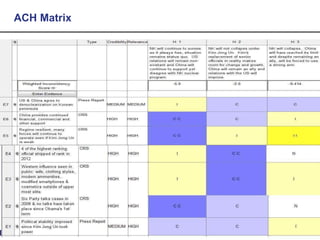
ACH Matrix
ACH Analysis
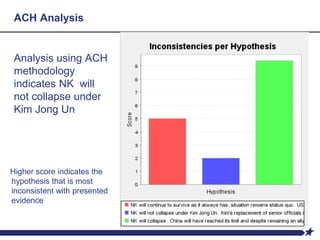
Analysis using ACH
methodology
indicates NK will
not collapse under
Kim Jong Un
Higher score indicates the
hypothesis that is most
inconsistent with presented
evidence
Summary of Key Indicators (1 of 2 )
● Despite China’s condemnation of North Korea’s recent
nuclear test, they will remain a strong ally
● De-emphasizing the role of the military and placing KWP in
control of the government
● Key leadership changes that advocate
commercial/economic changes and support Kim Jong Un
● Regime survival through the pre- establishment of key
advisors and supporters by Kim Jong IL before his death
● Shaping public image of Kim Jong Un in line as role of
Supreme Leader
● North Korea does not want war but wants to be recognized
as a world power
Summary of Key Indicators (2 of 2)
● History of failed diplomacy to denuclearize North Korea
● North Korea’s defiance of UN sanctions and pull out of Six
Party Talks
● China’s condemnation and renewed interest in the Six
Party process when its security was jeopardized by North
Korea’s third nuclear test
Key Judgments and Possible Outcomes
● Kim Jong Un will continue to consolidate power to control the
government
● The regime under Kim Jong Un will not collapse but will
remain stable as he pursues a new strategy
● The new strategy will still be focused on maintaining their
nuclear capabilities as a defense but will include
resuscitating its failing economy
● Continued diplomatic attempts for denuclearization of North
Korea will fail
● Renewal of Six Party talks with North Korea is not likely
● China will intercede only when it jeopardizes their own
economic and security interests
Conclusions
● The inconsistency scores of the ACH analysis shows that Hypothesis
2 is the most likely scenario to the question presented
○ North Korea will not collapse under Kim Jong Un.
○ Kim's replacement of senior officials in makes room for change
and growth.
○ China will remain an ally.
● However, North Korea is an enigma and the ACH analysis also shows
that Hypothesis 1 could be the second most likely scenario.
● Indications of North Korea returning to Six Party talks with no change
in denuclearization stance would be key in a change to supporting this
hypothesis
● The constant in both hypothesis is that Kim Jong Un’s regime will
remain stable
Integrity - Service - Innovation
Economic Estimate
Economic Estimate - Agenda
● Overview
● Hypothesis
● Indicators and Evidence/Arguments
● ACH Matrix
● ACH Analysis
● Key Judgments & Outcomes
● Conclusions
Economic Overview
● Centrally directed and least open economies in the world
● Plagued with chronic economic problems
● Industrial capital stock is unrecoverable due to years of
underinvestment, shortages in material, and lack of
maintenance
● “Military” first policy absorbs a majority of the country’s
income as well as the elite class
● Failed crops and widespread famine in 1995 devastated
the country
● Many North Koreans suffer from malnutrition and poor
living conditions
● UN economic sanctions amplifies the impacts of a failing
economy
Mass Starvation
● Food shortages since the 1990’s
○ Caused by minimal available land for farming (14% of total)
○ Several natural disasters
● According to UNICEF, in 2011 a quarter of the population did not have
enough to eat
● China provides 80% of North Korea’s consumer goods and almost half of
their food
Poor Public Health
● Public healthcare system collapsed in 90’s
● Hospitals located only in prioritized areas like Pyongyang
● Government claims there is Universal health care
Societal Infrastructure
Views of the people
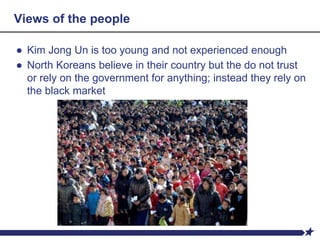
● Kim Jong Un is too young and not experienced enough
● North Koreans believe in their country but the do not trust
or rely on the government for anything; instead they rely on
the black market
Internet Accessibility
● Internet is provided by 1 state controlled service provider and is
available only to the government and military
● Citizens along China's border have limited illegal access to Chinese
internet *
● One cybercafe in Pyongyang, runs on the Red Star operating
system**
● Only a few dozen people in all of North Korea have unfiltered
Internet***
● Smartphones not allowed to data and internet capabilities
● In Feb. 2013 allowed tourists to have Internet access via their 3G
cellphones in hotels.
○ Access was yanked within less than a month (Choney, 2013)
● UN claims Internet is a basic human right
Media Accessibility
● 4 pre-tuned government owned stations
○ No independent media outlets
● Air only approved programming
● Outside media access is illegal accessed via China and the black
market
● Limited press access
● Journalists can be sent to “revolutionization” camps for published
mistakes.*
○ Including simple typos
● No Opinion other than the regimes
Exports/Imports Overview
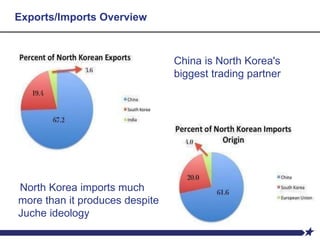
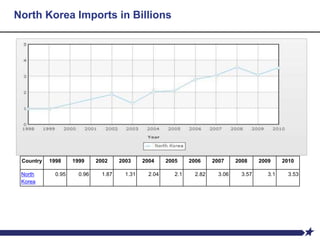
North Korea imports much
more than it produces despite
Juche ideology
China is North Korea's
biggest trading partner
Industries follow “Juche” principle
Juche Ideology: self sufficient - self reliant
Chemicals
● Pre-cursors to nuclear & chemical weapons
○ Examples:
■ Vinalon aka Juche Fiber
Co-Invented by Lee Sung Ki*
■ Carbide production to make
sulphur mustard
Manufacturing
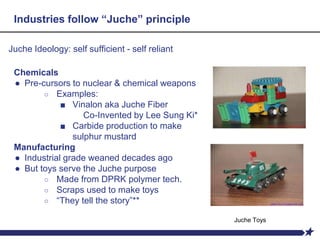
● Industrial grade weaned decades ago
● But toys serve the Juche purpose
○ Made from DPRK polymer tech.
○ Scraps used to make toys
○ “They tell the story”**
Juche Toys
North Korean Industries
● Principal Industry is Mining
● Coal
○ 1.8 billion tons of anthracite coal reserve.
○ No oil or gas reserves.
○ Demand greater than production resulting in energy
shortages
■ Due lack of modern and efficient equipment
● Magnesite
○ Has 490 million ton deposit reserve
○ Used to make ceramics for export and domestic
industrial ceramics
● North Korea has great supply of over 15 minerals in
demand worldwide. *
Black Market
● Existed for decades
● Created by North Koreans as means of survival
○ during famines caused by food shortages
○ natural disasters
● Provides everything from
○ food and entertainment to
○ protection and hard foreign money
● Become the primary source of black-market items globally
● Conducts weapons trafficking to Iran, drugs and
counterfeit currency*
● From the black markets came “Office 39”
“Office 39” (Bureau 39)
● Secret government organization that seeks ways to
maintain the foreign currency of North Korea's leader
● Established in 1970s
● Is suspected of being involved in illegal activities
○ counterfeiting
○ production of controlled substances (methamphetamine and
heroin)
○ International insurance fraud
● Considered critical to leader’s power base
○ enables buying political support
○ “Slush fund”
● Helps fund North Korea’s nuclear weapons program
○ hard foreign currency for arms trade
● Annual coffers are from $500 million to $1 billion annually
● Primary source of global black market items
Current Situation
● Wealth is concentrated in Pyongyang and few other urban centers
● Other parts are left fighting for basic needs
● Dependent on China for food supply and energy resources*
(Bajoria, 2013)
● $6 Billion revenue for China in 2011
● Great consideration for Chinese or German economic reform
● No Effective tax system in place
● The state is main source of employment
● Entrepreneurship is non existent
● $1 US = $900 KPW (won) (Google Currency Converter)
● Difficult to grasp true economic state
● NK does not publish any reliable data (Heritage foundation, 2013)
Economic Hypothesis
Will N. Korean economic reforms stabilize the country’s economy?
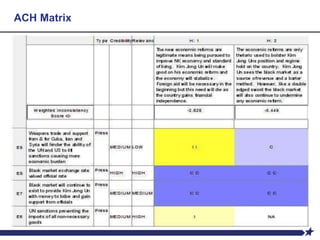
● H1: The new economic reforms are legitimate means being pursued
to improve N. Korea’s economy and standard of living. Kim Jong Un
will make good on his economic reform and the economy will stabilize.
Foreign aid will be necessary in the beginning but this need will die as
the country gains financial independence. The black market will
continue to exist at some level.
● H2: The economic reforms are only rhetoric used to bolster Kim Jong
Un’s position and regime hold on the country. Kim Jong Un sees the
black market as a source of revenue and method of barter. However,
like a double edged sword the black market will also continue to
undermine any economic reform
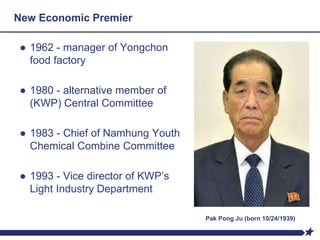
New Economic Premier
● 1962 - manager of Yongchon
food factory
● 1980 - alternative member of
(KWP) Central Committee
● 1983 - Chief of Namhung Youth
Chemical Combine Committee
● 1993 - Vice director of KWP’s
Light Industry Department
Pak Pong Ju (born 10/24/1939)
Pak Pong Ju’s Position
● 1998 - Appointed to Chemical Industries Portfolio
● 2003 - Appointed as Premier* of North Korea
○ Represents and leads the activity of the Cabinet
○ Believed to have lead July 1st Economic Management
Reform Measure of 2002
● 2007 - Relieved of duties
○ misused oil funds
○ too focused on economic ideas from China instead of
military based plans by Kim Song IL
● April, 2013 - Reappointed as Premier after North Korea
announced creation of nuclear bomb building and stronger
economy*
Pak Pong Ju’s Influence
● Perceived as a mastermind of economic reform
● Reappointment as Premier hints towards a more relaxed
economic policy
● Wants to balance military with economic construction
● Has already investigated/identified areas of need and
projects throughout NK
○ Construction of children’s and dental hospital
○ Iron/Steel and Industrial/Electrical Complexes
○ Chemical Complex
○ Hydropower station
● Appeals to workers by dressing equally to them
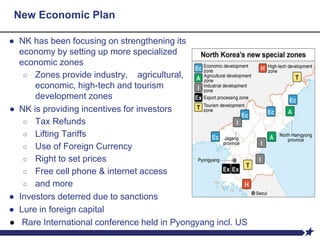
New Economic Plan
● NK has been focusing on strengthening its
economy by setting up more specialized
economic zones
○ Zones provide industry, agricultural,
economic, high-tech and tourism
development zones
● NK is providing incentives for investors
○ Tax Refunds
○ Lifting Tariffs
○ Use of Foreign Currency
○ Right to set prices
○ Free cell phone & internet access
○ and more
● Investors deterred due to sanctions
● Lure in foreign capital
● Rare International conference held in Pyongyang incl. US
Pyongyang International Conference
● North Korea has created a group to assist potential foreign investors,
state media and the organizers
● Held international conference in Pyongyang
● Consisted of academics and experts from 13 countries — including
the US, Canada, India, China, Malaysia and Vietnam — and 60 North
Korean participants
● US Participation allows for monitoring of North Korean economic
plans
● Special economic zones as a means of enticing foreign investment
has existed since the 1990s.
● Rason Special Economic Zone shown success after recently
reinvented as a joint North Korea-China project.
● Kaesong Industrial Complex is another successful joint industrial zone
Creation of An Economic Department
● Established June 2013
● All economic matters to be approved by new department
● All companies must be approved in order to be
established, changed, merged or shut down
● Has the ability to punish it’s own officials
● Other departments (ie military, executive) must also gain
prior approval to earning foreign currency, goods and
services
● June 28 AKA “6.28 Policy.”
● A reform on Agriculture that launched October 1, 2012
○ Reduce the size of agricultural production units to 4-6
people*
○ Allow farmers to keep part of their yields.
○ State will take 50-70% of the target production
○ Farmers will get to keep 30-50% of total yield
○ If the farmers exceed the target then they get to keep the
surplus.
○ Any left over produce kept by the farm can be sold in the
market at market prices not state fixed prices
○ Private investment is allowing as long as it is under the
state or cooperative enterprises
New Economic Management Measures
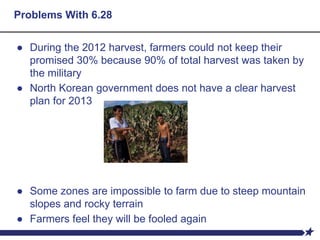
Problems With 6.28
● During the 2012 harvest, farmers could not keep their
promised 30% because 90% of total harvest was taken by
the military
● North Korean government does not have a clear harvest
plan for 2013
● Some zones are impossible to farm due to steep mountain
slopes and rocky terrain
● Farmers feel they will be fooled again
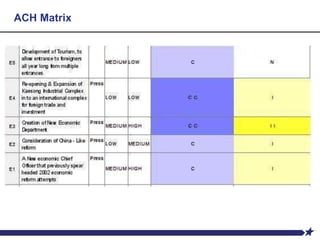
Consideration for China-Like Reform
● In the late 1970’s China divides land owned by the
state amongst farmers and dissolved all state-run
farms.*
● Result: Agriculture yield skyrocketed within the 1st 5
five to six years of implementation
● Kim Jong Un believes in this plan**
● Firing anyone that is not in compliance with his
economic reform
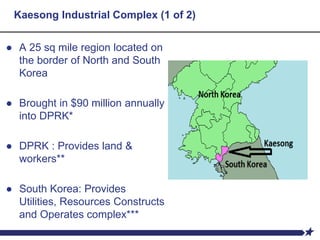
Kaesong Industrial Complex (1 of 2)
● A 25 sq mile region located on
the border of North and South
Korea
● Brought in $90 million annually
into DPRK*
● DPRK : Provides land &
workers**
● South Korea: Provides
Utilities, Resources Constructs
and Operates complex***
Kaesong Industrial Complex (2 of 2)
● Development lead by South Korean conglomerate
Hyundai
● Opened in Dec. 2004 as a result of the first ever summit
between the Koreas
● Provides cheap labor for South Korea and brings in
foreign currency for North Korea
● Used to compete with China and to set an example of
inter-Korean business
● Intended to jumpstart North Korean economy
● South Korean managers - North Korean workers
KIC Pay Break Down
Hours worked
2006: ~55.2 hrs/wk
2012: ~61.6 hrs/wk
Annual wage increase of 5%
Base salary Salary after Overtime
2004: ~$50/mth 2004: ~$63/mth
2013: ~ $70/mth 2013: ~$130/mth
● Wages paid in US dollars to DPRK officials
● 15% to “social security”
● 30% to “socio-cultural policy entitlements”
● 55% to given to the workers in either won or coupons.
○ exchange rate for workers is only a fraction of the US dollar
KIC Rising Tensions
● Pyongyang progressively getting mad at Seoul
○ Joint military drills with the US
○ Backing the UN’s sanctions on NK for nuclear tests
● NK send a message that they’re not reliant on Keasong’s
revenue
● Resulted in Shutdown April, 2013 - September, 2013
● NK recalled all 53,000 workers
● NK denied all trucks and deliveries to the facility
KIC’s Future
● After the 5 month stalemate, an agreement was reached and
Kaesong is reopened
● Rumors of provisions in the agreement include:
o No further shutdowns in the future
o Raise workers’ salary to $300 a month
o Annual wage increase of 10%-12%
● Unsure of Kaesong’s future; 11 companies either ended operations or
completely withdrew from the complex
● North Korean workers went from 53,000 to 43,000
● The “plan” is to develop the inter-Korean park into an international
industrial complex with foreign investment.
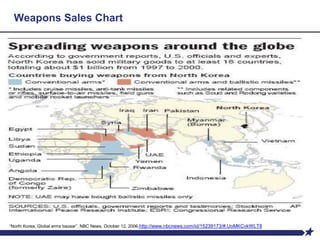
Weapons Sales (1 of 2)
● Illegal shipments of missile technology and weapons from North
Korea have flowed unabated under the leadership of Kim Jong un
● Unhopeful that new leader will moderate its aggressive proliferation
activities
● Ships or planes bound for Myanmar and Syria and loaded with
weapons-related equipment originating in North Korea have been
diverted or blocked in recent months
● DPRK’s defiance of the United Nations imposed sanctions against
weapons trade
● Pyongyang has sold its military goods to at least 18 countries, mostly
in Africa and the Middle East.
● U.S. officials, recent public assessments and outside experts report
sales of missiles or related components to Egypt, Iran, Pakistan,
Libya, Syria, the United Arab Emirates and Yemen.
Weapons Sales (2 of 2)
● Kim Jong Un is believed to have a personal fortune estimated at $4
billion, partially through drug and missile sales and counterfeiting.
● August 2005 report from the Congressional Research Service said
North Korea secured $1 billion from 1997 to 2000 in one area of arms
deals: conventional sales with developing nations.
● Suspected that North Korea attempted to get new customers trying to
sell missile technology to Nigeria and may have recently tried to sell
missiles to Burma.
● North Korea is believed to make hundreds of millions of dollars
annually from weapons sales
● Revenues may be shrinking,because of international pressure to
avoid the unpredictable government.
Weapons Sales Chart
“North Korea, Global arms bazaar”, NBC News, October 12, 2006,http://www.nbcnews.com/id/15239173/#.UoMKCvkWLT8
Development of Tourism
● Open the country to year round tourism
● 3 main areas in a specialized “zone”*
○ Paektu Mountain, Kumgang, Chilbo and Wonsan
● 400% increase in inquiries from people wanting to visit the country in
2013. **
● Tourists will still not be able to enter from South Korea
● Chinese news reporting the allowance of day trips from Dandong City,
China.
● Plans to expand air routes from:
○ Beijing/ Shanghai/ Yanji
○ Other parts of SE Asia
○ Europe
● UN Sanctions preventing development
● Abandon raising pigs, poultry and other grain fed animals.
○ Will focus on grass-fed animals instead
○ Due to mass starvation of country
○ Pig farms will now raise goats
○ Poultry farms will now raise rabbits.
● A more open ruler has encouraged:
○ China to invest in mines & border economics
○ Russia to upgrade cross-border rail roads
■ Also forgave D.P.R.K’ $11 billion debt.
● Allowance of small roadside and established vendors selling food and
water
● October 2013, province officials directed to identify 2 cities as
potential sites for development
● Creation of 2 bank cards by Foreign Trade & Koryo Banks.
Other Steps to Improve Economy
Paving the Way Forward
North Korea’s “Gray Market”
● Black Market not really Black since the government knows
about it.
● By allowing this market to thrive economic growth is
encouraged.
● 8000 won/dollar vs offical 96 won/dollar
○ Gives North Koreans more money to save and invest
back into the economy
○ For example: Upgrading farm & manufacturing
equipment
Black Market - Weapons Trade (1 of 2)
SYRIA
● Provided Syria with chemical weapons technology (CWT)
since early 90’s
● Followed by the development of 2 fabrication facilities for
Syria in the mid-90’s
○ These 2 facilities are high end and maintained by Syrians all year
○ At least 1 facility actually houses missiles
● Several North Korean advisors live in Syria
● Origins: Saudi government paid Syria for fighting with them
in the Gulf War. This money was used to fund WMD
program
Black Market - Weapons Trade (2 of 2)
Iran & The Middle East
● Client of North Korea for both chemical & nuclear weapons
● Saudi money gone, so Iran now pays for and shares
ownership of Syria’s program
Cuba
● Established relations in 1960
● June 2013 D.P.R.K. Vice Minister of Foreign affairs, Choi Su
Hon, visits Cuba.
○ Mission: strengthen bilateral ties
● July 2013 North Korean Ship, Chong Chon Gang was halted
drug suspicions
○ Ship was carrying what appeared to be an old Soviet military radar
system, missile parts and missile technology.
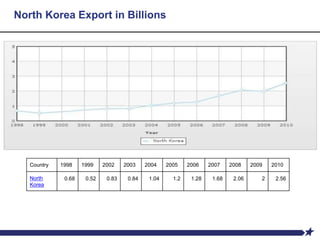
North Korea Export in Billions
Country 1998 1999 2002 2003 2004 2005 2006 2007 2008 2009 2010
North
Korea
0.68 0.52 0.83 0.84 1.04 1.2 1.28 1.68 2.06 2 2.56
North Korea Imports in Billions
Country 1998 1999 2002 2003 2004 2005 2006 2007 2008 2009 2010
North
Korea
0.95 0.96 1.87 1.31 2.04 2.1 2.82 3.06 3.57 3.1 3.53
ACH Matrix
ACH Matrix
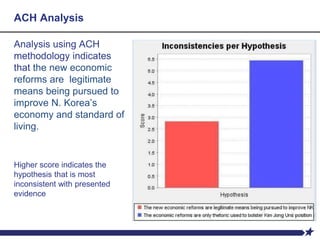
ACH Analysis
Analysis using ACH
methodology indicates
that the new economic
reforms are legitimate
means being pursued to
improve N. Korea’s
economy and standard of
living.
Higher score indicates the
hypothesis that is most
inconsistent with presented
evidence
Summary of Key Indicators
● North Korea is in need of hard currency, bringing close or
more to $1 Billion a year in revenue.
● The trading system is almost shut down do to illegal
activities in the black market where everything is cheaper.
● North Korea started to deal with other countries and now
the demand is so high that is hard to stop.
● North Korea haven’t being able to venture further with this
industry do to his restricted market
● They lack reliable energy to continue their projects
● North Korea relies on other countries especially China for
help in their mining industry do to the lack of machinery
● In the long - run there will be change
Key Judgments & Possible Outcomes
• Farmers promised yield was taken up to a 90% towards the
military
• Over-populated and will consume more than produced plus less
options on farming animal will become another lack of resources
• Unless established a more open trading market pass China and
South Korea their economy will still rely on their 2 neighbors for
help regardless of what adjustments they do within their
government
• Mining industries lack the resources on new machinery,
sustainable energy an open market and they rely too much on
other countries for their mining projects
• Pak’s past economic reform was the same one under Kim Jong Il
by emphasizing on the workers necessity and passing the
economic power to the state
Conclusions
● These reforms have already been implemented with no
successful outcome
● Another way of giving false hope to the country’s working
class
● In order to this reforms take a long successful effect the
new president will have to expand their trading partners
past China and South Korea
● Absolute power must be given to the Workers Party of
Korea and continue to consolidated their power in the
government.
Integrity - Service - Innovation
Military Estimate
Conventional Military Estimate - Agenda
● Overview
● Hypothesis
● Indicators and Evidence/Arguments
● ACH Matrix
● ACH Analysis
● Key Judgments & Outcomes
● Conclusions
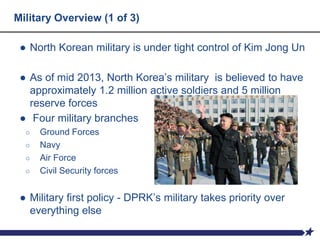
Military Overview (1 of 3)
● North Korean military is under tight control of Kim Jong Un
● As of mid 2013, North Korea’s military is believed to have
approximately 1.2 million active soldiers and 5 million
reserve forces
● Four military branches
○ Ground Forces
○ Navy
○ Air Force
○ Civil Security forces
● Military first policy - DPRK’s military takes priority over
everything else
Military Overview (2 of 3)
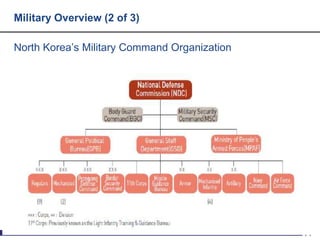
North Korea’s Military Command Organization
Military Overview (3 of 3)
● North Korea is developing its military capabilities to deter an
external attack
● North Korea currently possesses many missiles of varying
range
● Feb. 2013 conducted 3rd nuclear test in the past 7 years
● North Korea is capable of manufacturing chemical weapons
● April-August 2012: Kim Jong Un began missile testing
● March 2013: North Korea makes preemptive nuclear threats
against the US and South Korea
● April 2013: North Korea states they will retaliate against any
provocation
Conventional Military Hypothesis
Does North Korea have a credible conventional military force?
● H1. North Korea has a strong conventional military, capable of
engaging in total War with S. Korea and the U.S.
● H2. North Korea’s has a weak conventional military that is no threat
to South Korea.
● H3. North Korea has a capable military that could engage South
Korea with the correct strategy
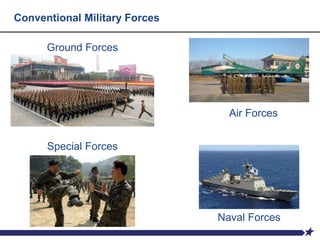
Conventional Military Forces
Ground Forces
Air Forces
Naval Forces
Special Forces
Ground Forces
Strengths
○ Size
• 950,000 active soldiers (includes Special Forces)
• Approx. 5 million reserve
• North Korean forces outnumber US and South Korean troops 8.5 to
1
Weaknesses
○ The 5 million reserve forces lack adequate training
○ Much of the population is malnourished including the reserve army
○ Old technology, most of the 3500 tanks are from the Soviet Union in
the 1940s
○ Many North Korean weapon systems were developed in the 1960s
and 1970s cannot compare to US and South Korean weapons
○ In a country already relying on outside aid, feeding such a large
army would be difficult
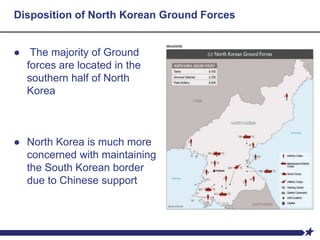
Disposition of North Korean Ground Forces
● The majority of Ground
forces are located in the
southern half of North
Korea
● North Korea is much more
concerned with maintaining
the South Korean border
due to Chinese support
North Korean Tunnels
● North Korea is the worlds most-tunneled nation.
● Expertise in digging tunnels for warfare was demonstrated during the
Vietnam War.
○ North Korea sent about 100 tunnel warfare experts to Vietnam
○ Built tunnels for North Vietnamese and Viet Cong troops
○ The tunnels were instrumental in the Vietnamese victory.
● Tunnel entrances are built to withstand US chemical and biological
attacks.
● Tunnels run zig-zag and have seals, air-purification units, and safe
places for the troops to rest.
● North Korea is believed to have built about 20 large tunnels near the
DMZ.
● A large tunnel can transport 15,000 troops per hour across the DMZ
and place them behind the US troops.
North Korean Artillery
● North Korea reported to have more than 13,000 artillery guns and
long-range batteries
● Artillery is capable of hitting Seoul which is 30 miles from the border
(10 million people)
● Artillery advantage is an initial heavy bombardment on the capital
inflicting millions of casualties at the onset of hostilities
● North Korean artillery showered front-line South Korean island with
shells in November 2010
○ killed four people
○ disputed sea border
● South Korea believes they could neutralize 70% of artillery batteries
along the border in 5 days if war broke out.
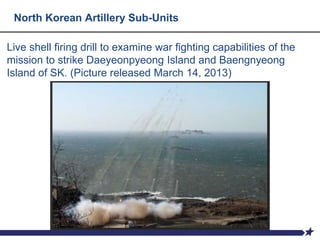
Live shell firing drill to examine war fighting capabilities of the
mission to strike Daeyeonpyeong Island and Baengnyeong
Island of SK. (Picture released March 14, 2013)
North Korean Artillery Sub-Units
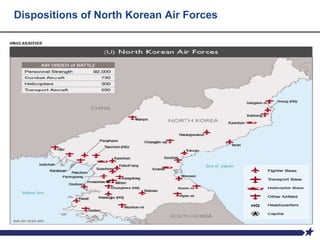
Air Force
Strengths
● Stockpile of stealth transport aircraft fitted with KN-01
● Much of the aircraft and equipment has been updated
Weaknesses
● Most aircraft was built during the Cold War and prior to 1960
● Belief in innovation with old technology instead of
modernization
● Fuel shortage has impacted readiness in cutting number of
sorties
○ N. Korea avoided using aircraft against S. Korean fighter jets
in May 2011
Dispositions of North Korean Air Forces
Naval Forces
Strengths
● 70 attack, coastal, and midget-type submarines
● Largest Submarine force in the world
● 60% forward deployment - could be used in a surprise attack
● Naval Mine Capabilities
● 2010 - NK sank SK ship with torpedo
● Most menacing threats are their navy are small submarines
○ capable of deploying commando raiders along the South Korean
coast
Weaknesses
● Limited Air detection Capabilities
● Old vessels
○ Oct 2013 a North Korean ship sunk, possibly due to old age (built
in 1960’s)
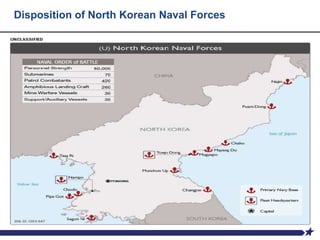
Disposition of North Korean Naval Forces
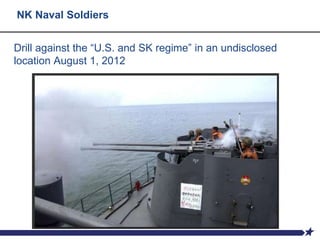
NK Naval Soldiers
Drill against the “U.S. and SK regime” in an undisclosed
location August 1, 2012
North Korean Naval Conflicts
● In March 2010, North Korean submarine suspected of
killing 46 South Koreans in a Yellow Sea attack on their
warship
● Since 1999, North and South Korean navies have fought
three bloody conflicts near their disputed western maritime
border.
● Battles show that the North relies heavily on the element
of surprise
○ North's patrol boats used were built in the 1960s
○ Cannons on the boats are aimed manually and are
considerably less accurate
Special Forces
● Largest Special forces in the world
● Estimated 200,000 special forces
● Likely to be the most highly trained, well-equipped, best
fed and most motivated forces
● They have been used before in 1968 and 1996 to infiltrate
South Korea and disable military equipment
● Work in teams of 20-30
● Could be used in a guerilla style attack to create many
battlefronts
Known Special Forces Operations
● 31 North Korean commandos stormed Seoul's presidential Blue
House in 1968
○ failed assassination attempt against then-President Park Chung-
hee
● Over 120 North Korean commandos snuck into eastern South Korea
also in 1968
○ killed 20 South Korean civilians, soldiers and police officers.
● 26 North Korean agents infiltrated South Korea's northeastern
mountains after their submarine broke down in 1996
○ sparked a manhunt
○ resulted in all but two dead
○ 13 South Korean soldiers and civilians were killed.
Incidents Between North and South Korea (1 of 2)
● January 1968 - NK Commandos stage a raid on Seoul’s presidential
Blue House in attempt to assassinate President Park Chung-Hee. NK
stopped 800 yards away and all are killed or captured.
● August 1974 - NK agent fires at Park during a speech. Shot misses
and hits his wife.
● October 1983 - NK agents blow up a landmark in Burma before SK
President arrives. 4 SK Cabinet Ministers and 16 others killed.
● November 1987 - NK agents plants and explodes bomb on SK airline,
all 115 on board killed.
● September 1996 - NK submarine lands commandos on SK coast. SK
engages in manhunt, 24 shot dead (11 by own hand), 1 captured, 1
unaccounted for.
Incidents Between North and South Korea (2 of 2)
● June 1999 - Yellow Sea border naval battle. NK boat with estimated
20 sailors sunk.
● June 2002 - Yellow Sea battle while Seoul hosts football world cup.
SK ship sunk, 6 sailors killed. Estimated 13 North Koreans killed.
● November 2009 - NK and SK navies exchange fire on Yellow Sea
border. No SK hurt. NK retreats with patrol boat in flames.
● March 2010 - Unexplained explosion near disputed border hits the
Cheonan, SK warship, breaks in two. 58 sailors rescued, 46 die.
(reports say it was a torpedo launched by NK submarine)
● October 2010 - NK and SK troops exchange fire across border before
G20 Summit in Seoul.
● November 2010 - NK fires artillery shells onto SK border island killing
2 SK soldiers. SK exchanged fire and sent fighter jet.
North Korean Syrian and Iranian Connections (1 of 2 )
● NK has formed alliance with Syria
● Possible chemical weapons exchange
● Turkey seized a shipment of arms, ammunition and gas
masks from North Korea
● Damascus and Pyongyang have had close ties for five
decades
● Syria and NK ran joint nuclear program in mid 2000s
● Syrian nuclear reactor is presumed to be built by North
Korea and funded by Iran
● Similarities identified with Yongbyon facility
North Korean Syrian and Iranian Connections (2 of 2 )
● 10 North Koreans technicians were killed in Israeli air strike,
Operation Orchard
● Since 1970s, Pyongyang has been trading weapons and
equipment to raise much-needed hard currency
● 1973, Pyongyang sent advisers and equipment for Syria’s
sneak attack against Israel
● Gen Kim Kyok-sik’s career was advanced due to these
operations
● Recently reports indicate he has been fired
● Regime of Bashar al-Assad using NK Pilots to man attack
helicopters
North Korean and Cuban Connection
● Panamanian authorities seized shipment from North
Korea to Cuba
● Shipment included sophisticated Russian radar for SA-2
surface-to-air missiles
● Radar was Russian SNR-74 tracking and guidance
system
● SA-2 missiles first developed in early 1960s
● Recent upgrade with modern computers, electronics and
optical sensors
● Shipment is part of military cooperation to upgrade each
country’s SA-2s with advanced tracking electronics
North Korea - China Alliance
● China is North Korea’s most important ally
● China sees North Korea as a buffer, however, it comes
with the cost of being drawn into any North Korean military
conflict with the US or South Korea.
● North Korea is critical to China's national security interests
as determined from historical conflicts with Japan
● China has contingency plan to dispatch troops to North
Korea in case of instability
● Relationship based on Sino-North Korean Mutual Aid and
Cooperation Friendship Treaty established in 1961, 1981
and 2001
○ China pledges to immediately render military assistance by all means to
its ally against outside attacks
○ Renewal of Treaty is due in 2021
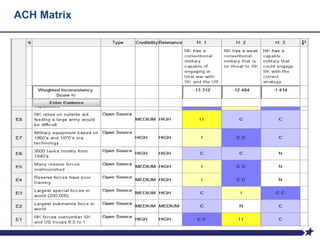
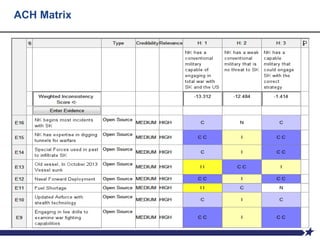
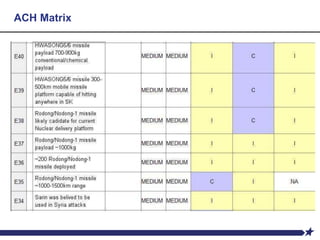
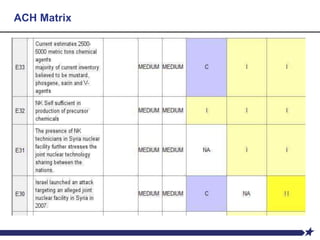
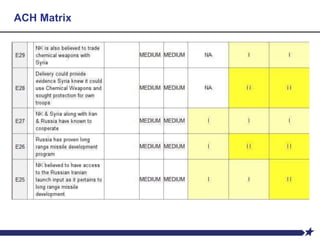
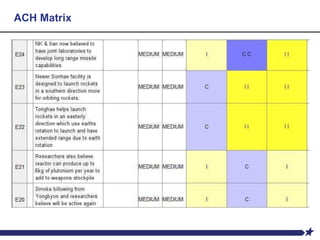
ACH Matrix
ACH Matrix
ACH Analysis
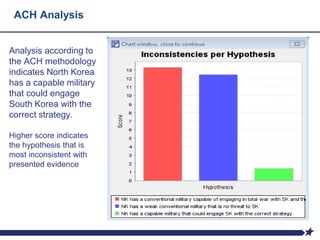
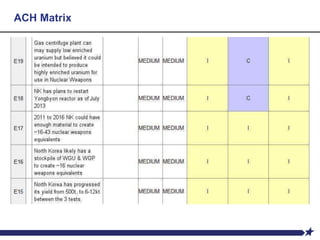
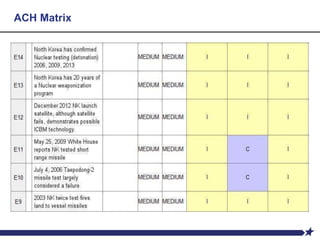
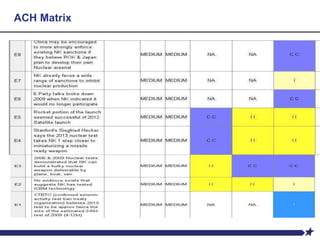
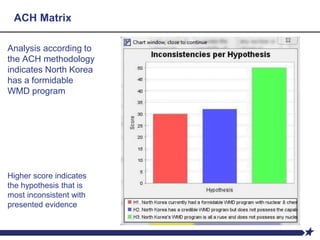
Analysis according to
the ACH methodology
indicates North Korea
has a capable military
that could engage
South Korea with the
correct strategy.
Higher score indicates
the hypothesis that is
most inconsistent with
presented evidence
Summary of Key Indicators
● Multiple conflicts resulting in death of both North Korean and South
Korean personnel have resulted in threats but no increase in military
action
● North Korean and South Korean conflicts highlights lack of military
technological advantage
● Fuel shortages and replacement and maintenance of aged equipment
have reduced number of sorties and military maneuver
● Known Special Forces operations shows that they have already
infiltrated South Korea multiple times
● North Korean military continues to have live drills to examine war
fighting capabilities
● Historically China has assisted NK in past wars
● China’s admonition of North Korea’s brazen threats of war has them
reaching out diplomatically towards the US
Key Judgments and Possible Outcomes (1 of 2)
● North Korea is capable of engaging South Korea in a war based on
the size of their military but will not be the one to strike first to start it
● Continuous probes and conflicts to test military posture will continue
without escalation
● If engaged in a war North Korea would need to win quickly
○ Heavy reliance on asymmetrical capabilities is expected
○ Heavy equipment deployed by naval and air forces requires
extensive repairs and are outdated
○ South Korean and US equipment would out perform and outlast N.
Korea
○ North Korea's wartime resources, mostly stored underground,
would last only two to three months
○ North Korea has expertise in digging tunnels for warfare
Key Judgments and Possible Outcomes (2 of 2)
● China’s role should not be underestimated in the event of
open hostilities
○ Diplomacy would be engaged first to de-escalate a war situation
○ China’s national interests would be paramount to protect and would
influence their level of response
Conclusions (1 of 2)
● The inconsistency scores of the ACH analysis shows that
Hypothesis 3 is the most likely scenario to the question
presented
○ North Korea has a capable military that could engage South
Korea with the correct strategy
● North Korea is capable of engaging South Korea in war
based on the size of their military
● In a conventional war North Korea would need to win
quickly
● S. Korean and US equipment would out perform and
outlast N. Korea
● Much of N. Korean Military is outdated and poorly trained
● North Korean Special Forces could be used disable South
Korean equipment
Conclusions (2 of 2)
● North Korea will use Guerrilla warfare tactics to engage
South Korea
● The biggest advantage for North Korea’s military is the
knowledge that the US and S. Korea will not engage first
Integrity - Service - Innovation
Weapons of Mass Destruction (WMD) Estimate
WMD Estimate - Agenda
● Overview
● Hypothesis
● Indicators and Evidence/Arguments
● ACH Matrix
● ACH Analysis
● Key Judgments & Outcomes
● Conclusions
North Korean WMD Overview
● North Korea has been suspected of having a nuclear
development program since the 1980s
● Yongbong reactor was the first plutonium reactor built
● Most of the known existing ballistic missile facilities exist in
the northeastern part of North Korea
● South Korea & US Targets are considered to be within
range of nearly all North Korean missile platforms
● North Korea has varying missile platforms that can
potentially deliver chemical and nuclear payloads.
● North Korean Intercontinental Ballistic Missiles are not
believed to be ready
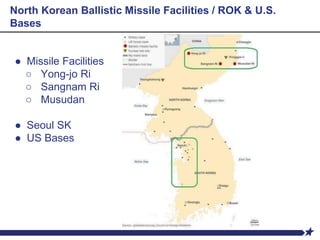
North Korean Ballistic Missile Facilities / ROK & U.S.
Bases
● Missile Facilities
○ Yong-jo Ri
○ Sangnam Ri
○ Musudan
● Seoul SK
● US Bases
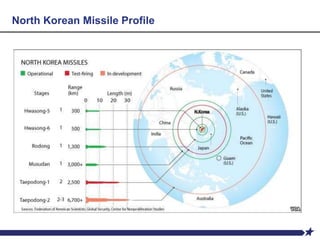
North Korean Missile Profile
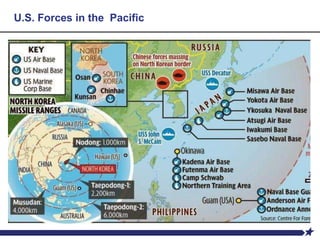
U.S. Forces in the Pacific
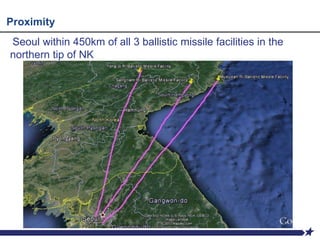
Seoul within 450km of all 3 ballistic missile facilities in the
northern tip of NK
Proximity
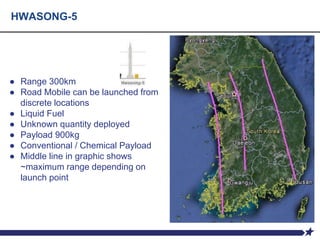
HWASONG-5
● Range 300km
● Road Mobile can be launched from
discrete locations
● Liquid Fuel
● Unknown quantity deployed
● Payload 900kg
● Conventional / Chemical Payload
● Middle line in graphic shows
~maximum range depending on
launch point
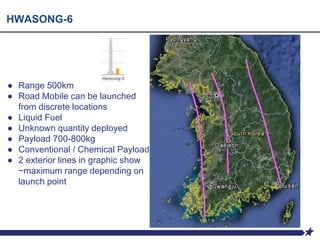
HWASONG-6
● Range 500km
● Road Mobile can be launched
from discrete locations
● Liquid Fuel
● Unknown quantity deployed
● Payload 700-800kg
● Conventional / Chemical Payload
● 2 exterior lines in graphic show
~maximum range depending on
launch point
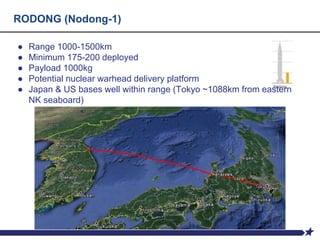
RODONG (Nodong-1)
● Range 1000-1500km
● Minimum 175-200 deployed
● Payload 1000kg
● Potential nuclear warhead delivery platform
● Japan & US bases well within range (Tokyo ~1088km from eastern
NK seaboard)
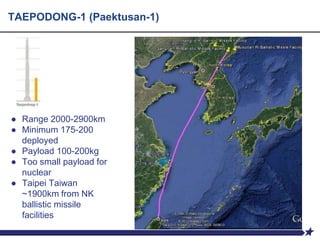
TAEPODONG-1 (Paektusan-1)
● Range 2000-2900km
● Minimum 175-200
deployed
● Payload 100-200kg
● Too small payload for
nuclear
● Taipei Taiwan
~1900km from NK
ballistic missile
facilities
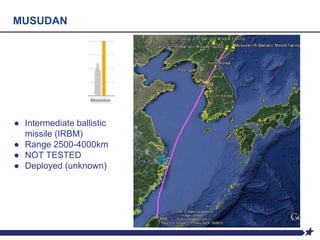
MUSUDAN
● Intermediate ballistic
missile (IRBM)
● Range 2500-4000km
● NOT TESTED
● Deployed (unknown)
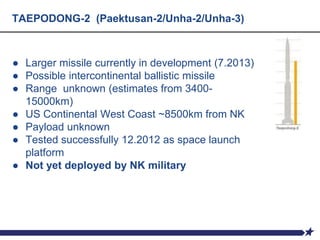
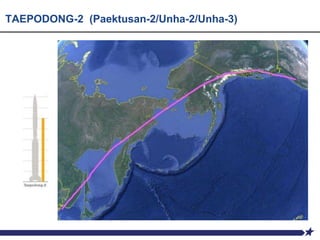
TAEPODONG-2 (Paektusan-2/Unha-2/Unha-3)
● Larger missile currently in development (7.2013)
● Possible intercontinental ballistic missile
● Range unknown (estimates from 3400-
15000km)
● US Continental West Coast ~8500km from NK
● Payload unknown
● Tested successfully 12.2012 as space launch
platform
● Not yet deployed by NK military
TAEPODONG-2 (Paektusan-2/Unha-2/Unha-3)
WMD Organizations
● KWP Munitions Industry Department has organizations responsible
for chemical weapons research, development and production
○ Second Academy of Natural Sciences
○ Second Economic Committee’s Fifth Machine Industry Bureau
■ Controls all facilities that manufacture chemical weapons
● Both organizations receive co-operation and assistance from the
Academy of Sciences and the Korean People’s Army (KPA).
● The academy’s Third Machine Industry manufactures artillery shells
● The Fourth Machine Industry manufactures missile warheads
● The Seventh Machine Industry manufactures air delivered weapons
● There are at least 18 facilities that have been associated with
chemical precursor or agent production
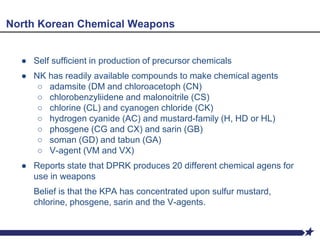
● Self sufficient in production of precursor chemicals
● NK has readily available compounds to make chemical agents
○ adamsite (DM and chloroacetoph (CN)
○ chlorobenzyliidene and malonoitrile (CS)
○ chlorine (CL) and cyanogen chloride (CK)
○ hydrogen cyanide (AC) and mustard-family (H, HD or HL)
○ phosgene (CG and CX) and sarin (GB)
○ soman (GD) and tabun (GA)
○ V-agent (VM and VX)
● Reports state that DPRK produces 20 different chemical agens for
use in weapons
Belief is that the KPA has concentrated upon sulfur mustard,
chlorine, phosgene, sarin and the V-agents.
North Korean Chemical Weapons
Chemical Weapons Production and Capacity
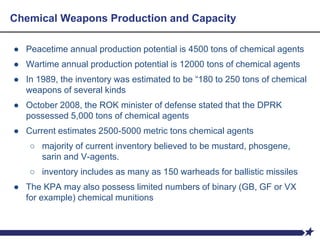
● Peacetime annual production potential is 4500 tons of chemical agents
● Wartime annual production potential is 12000 tons of chemical agents
● In 1989, the inventory was estimated to be “180 to 250 tons of chemical
weapons of several kinds
● October 2008, the ROK minister of defense stated that the DPRK
possessed 5,000 tons of chemical agents
● Current estimates 2500-5000 metric tons chemical agents
○ majority of current inventory believed to be mustard, phosgene,
sarin and V-agents.
○ inventory includes as many as 150 warheads for ballistic missiles
● The KPA may also possess limited numbers of binary (GB, GF or VX
for example) chemical munitions
WMD Hypothesis
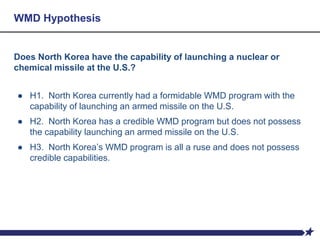
Does North Korea have the capability of launching a nuclear or
chemical missile at the U.S.?
● H1. North Korea currently had a formidable WMD program with the
capability of launching an armed missile on the U.S.
● H2. North Korea has a credible WMD program but does not possess
the capability launching an armed missile on the U.S.
● H3. North Korea’s WMD program is all a ruse and does not possess
credible capabilities.
Missile Tests
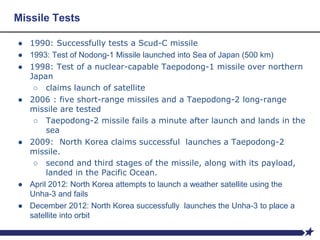
● 1990: Successfully tests a Scud-C missile
● 1993: Test of Nodong-1 Missile launched into Sea of Japan (500 km)
● 1998: Test of a nuclear-capable Taepodong-1 missile over northern
Japan
○ claims launch of satellite
● 2006 : five short-range missiles and a Taepodong-2 long-range
missile are tested
○ Taepodong-2 missile fails a minute after launch and lands in the
sea
● 2009: North Korea claims successful launches a Taepodong-2
missile.
○ second and third stages of the missile, along with its payload,
landed in the Pacific Ocean.
● April 2012: North Korea attempts to launch a weather satellite using the
Unha-3 and fails
● December 2012: North Korea successfully launches the Unha-3 to place a
satellite into orbit
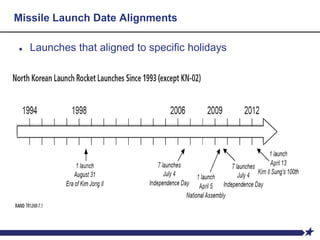
Missile Launch Date Alignments
● Launches that aligned to specific holidays
● April 2003 North Korea declare it has Nuclear Weapons
● 2006 North Korea claims to have successfully tested a
nuclear weapon (aprox. 500t)
○ Test conducted in an underground facility
○ S. Korea detects artificial earthquake
○ Radioactive debri detected confirming test
● 2009 Second nuclear test conducted (aprox. 2-6 kt)
○ North Korea also test fires short range missile
● 2013 Third nuclear test conducted (aprox. 6-12kt)
○ conducted after January 2013 when North Korea
announces it will continue missile and nuclear testing
○ after a rocket launch was conducted
Nuclear Tests
Nuclear and Missile Diplomacy (1 of 2)
● In 1985 North Korea accedes to the nuclear Nonproliferation Treaty
(NPT) but does not complete a safeguards agreement with the
International Atomic Energy Agency (IAEA).
● In 1994 North Korea’s announces intent to withdraw from nuclear
Nonproliferation Treaty (NPT)
● Agreed Framework established with U.S.
○ Pyongyang committed to freezing its illicit plutonium weapons
program in exchange for aid.
○ Agreement collapses in 2002
● North Korea claims it has withdrawn from the NPT in January 2003
and once again began operating its nuclear facilities.
Nuclear and Missile Diplomacy (2 of 2)
● Six-Party Talks initiated in August of 2003 which involved China,
Japan, North Korea, Russia, South Korea, and the United States
● In 2005 North Korea pledged to abandon “all nuclear weapons and
existing nuclear programs” and return to the NPT
● In 2007 parties agreed on a series of steps to implement that 2005
agreement.
● Talks break down in 2009 following disagreements over verification
● North Korean rocket launch is condemned internationally
● Pyongyang states that it would never return to the talks and is no
longer bound by their agreements.
● Remaining five parties state that they remain committed to the talks,
and have called for Pyongyang to recommit to its 2005 de-
nuclearization pledge.
UN Sanctions (1 of 2)
● Resolution 825 (May 11, 1993)
○ Cals upon North Korea to reconsider withdrawing from the Treaty
on Non-proliferation of Nuclear Weapons.
○ Urges North Korea to honor its non-proliferation obligations under
the Treaty.
● Resolution 1540 (April 28, 2004)
○ Affirms that proliferation of nuclear, chemical and biological
weapons, as well as their means of delivery, constitutes a threat
to international peace and security
○ Urges all States to take additional effective measures to prevent
proliferation
UN Sanctions (2 of 2)
● Resolution 1695 (July 15, 2006)
○ Condemns the DPRK nuclear weapons program
○ Calls for diplomatic solution to the situation
○ Demands that the DPRK cuts back its missile launches
○ Bans all member states from transactions with North Korean
involving material, technology or financial resources transfer
connected to DPRK's missiles or weapons of mass destruction
programs.
● Resolution 1718 (October 14, 2006)
○ Imposed in relation to DPRK’s nuclear test
○ Established an embargo on military and technological materials,
as well as luxury good
○ Did not include reference to military intervention as the US
proposed initially
○ Demanded the freezing of North Korea's financial assets with the
exception of funds necessary to meet basic needs.
Response to 2013 Launch and Test
● U.N. Security Council has imposed new sanctions on
Pyongyang for its launch (UN Resolution 2087)
● Pyongyang says it should be allowed to launch satellites
for peaceful purposes.
● KCNA(Korean Central News Agency) statement shortly
after 2013 test stated Pyongyang will continue building its
arsenal
● North Korea want US to recognise its right to launch
satellites and further develop nuclear program
● China condemns North Korea’s third nuclear test
Weapons Grade Uranium & Plutonium Production
● Yongbyon is center of plutonium production
● Nuclear weaponization program 20 years old
● Confirmed nuclear detonation testing in 2006, 2009, 2013
● Has progressed its yield from 500t, to 6-12kt between the 3
tests
● Likely has a stockpile of WGU & WGP to create ~16
nuclear weapons equivalents
● 2011 to 2016 NK could have enough material to create
~16-43 nuclear weapons equivalents
● Exact amounts of fissile material unknown
Weapons Grade Uranium & Plutonium Production
Estimate
Weapons Grade Uranium & Plutonium Production
Estimate
Yongbyon Nuclear Research Center (1 of 2)
● Yongbyon is 100 miles north of Pyongyang
● Operational 1986 - 2008
● Planned to restart Yongbyon reactor as of July 2013
● Smoke billowing from Yongbyon
○ Researchers believe will be active again shortly
● November 2012 most exterior construction completed
○ doubts remain about the ability to connect the reactor to the
old power grid
● Contains fuel refabrication and reprocessing facility
● Gas centrifuge plant can supply low enriched uranium
○ believes it could produce highly enriched uranium
Yongbyon Nuclear Research Center (2 of 2)
● Light Water Reactor mostly used for civilian power
productions but can have alternate uses
● Researchers also believe reactor can produce up to 6kg of
plutonium per year to add to weapons stockpile
● 5MW reactor produced the plutonium for NK first nuclear
device
● Also contains a 50MWe reactor - never completed
● IRT 2000 research reactor supplied by Russia
North Korean Satellite Launch
● Sonhae Satellite Launching Station on West Coast
● Sonhae facility is designed to launch rockets in a southern
direction
○ Used more for orbiting rockets
● Tonghae Satellite Launching Station on East Coast
● Tonghae helps launch rockets in an easterly direction
○ Uses earths rotation to launch and have extended range
● General Satellite Control and Command Centre tracks and
controls satellite data
● Multi stage liquid fuel missile launches tend to be complex
and warnings can be detected from satellite when this is
happening in advance
North Korea/Pakistan Connection
● U.S. Intelligence officials claim Pakistan was a key supplier of
uranium enrichment technology
● Reports suggest Pakistan exchanged centrifuge enrichment
technology for NK help in developing longer range missiles
● Japanese report stated Pakistan exported actual centrifuge rotors
(2,000-3,000) to NK
● A Pakistani official reports NK ordered P-1 centrifuge components
from 1997-2000
● Khan Research Laboratories (KRL) cooperated with NK in developing
the Ghauri (Haft 5), around 1993
● The Ghauri 1 - liquid-propellant, nuclear-capable, 1500km-range
ballistic missile - successful flight test April 1998
● KRL also collaborated with NK on liquid fueled missiles derived from
Scuds.
● Significant details of cooperation between NK and Pakistani
government are missing
● NK and Pakistan both deny nuclear technology was provided to NK
North Korea / Iran Connection
● Early relationship Iran traded cash to NK for missile parts and
technology
● Early beliefs Iran & NK was simply transactional relationship
● NK & Iran now have signed technological cooperation
● NK & Iran now believed to have joint laboratories to develop long range
missile capabilities.
● NK & Iran agreement also includes information sharing between IT,
engineering, biotechnology, and renewable energy.
● NK successful satellite launch now believed to be stemming from
Iran’s 2009 launch.
● Iran 2009 launch success believed to be influenced by Russian
cooperation.
● NK believed to have access to the Russian Iranian launch input as it
pertains to long range missile development.
● Russia has proven long range missile development program
● It is believed that closer attention to supply chain and find ways to
provide incentives to disrupt those chains to impact NK missile
development
North Korea / Syrian Connection
● NK & Syria both consider US an enemy which ties them together
● NK & Syria along with Iran & Russia have known to cooperate
● NK has delivered arms ammunition and gas masks en route to Syria
Turkish believed to have confiscated.
● Delivery could provide evidence Syria knew it could use Chemical
Weapons and sought protection for own troops
● NK is also believed to trade chemical weapons with Syria
● Israel launched an attack targeting an alleged joint nuclear facility in
Syria in 2007.
● Japanese television reported 10 NK technicians were also killed in the
attack.
● The presence of NK technicians in Syria nuclear facility further
stresses the joint nuclear technology sharing between the nations.
Chemical Weapons Proliferation (1 of 3)
● Since the 1990s repeated reports indicate that the DPRK has
provided chemical weapons, agents or technology to Egypt, Iran,
Libya and Syria.
● Sale are primarily of defensive equipment, manufacturing technology,
assistance in developing chemical warheads for Scud class ballistic
missiles and development of chemical warfare production
infrastructure.
● 2007 the DPRK-Syria chemical weapons-related activity increased
around Aleppo
● It was near Aleppo that a chemical-related accident allegedly occurred
in July 2007
○ Both Syrian and DPRK personnel were killed when a missile with
a chemical warhead exploded prematurely
○ Reports were numerous but remain unconfirmed
Chemical Weapons Proliferation (2 of 3)
● September 22, 2009 the ROK Coast Guard intercepted the
Panamanian registered container ship MSC Rachele
○ ship had previously stopped in Nampo (DPRK) from China
○ inspection in port of Busan identified four containers
○ containers had DPRK-origin chemical protective suits destined for
Syria
● November 2009, the Greek government inspected another shipment
originating from Nampo enroute to Syria
○ four shipping containers contained 13,000 chemical protective
suits, 23,600 gas indicator ampoules to detect specific chemical
substances and other items
Chemical Weapons Proliferation (3 of 3)
● March 2012, the Syrian Government stated that this shipment of
chemical protective suits and ampoules was for agricultural and
laboratory use.
● The Syrian Environmental Study Center appears to be linked with the
Higher Institute of Applied Sciences and Technology
○ provides training to the Scientific Studies and Research Center
(CERS)
○ previously implicated in Syria’s weapons of mass destruction
programs
ACH Matrix
ACH Matrix
ACH Matrix
ACH Matrix
ACH Matrix
ACH Matrix
ACH Matrix
ACH Matrix
Analysis according to
the ACH methodology
indicates North Korea
has a formidable
WMD program
Higher score indicates
the hypothesis that is
most inconsistent with
presented evidence
ACH Matrix
Indicators (1 of 3)
● No evidence exists that suggests NK has tested ICBM technology
● Stanford's Siegfried Hecker says the 2013 nuclear test takes NK 1
step closer to miniaturizing a missile ready weapon.
● December 2012 missile satellite launch aligned with
commemoration of 1st year death anniversary of Kim Jong-IL
● US research community deems the satellite tumbling, dead and
likely not communicating.
● Rocket portion of the launch seemed successful
● US policy is to execute “strategic patience” calls to increase pressure on
NK sanctions to encourage the state to follow through on commitments to
end its nuclear weapons development.
● Six Party talks broke down 2009 when NK indicated it would no longer
participate
Indicators (2 of 3)
● Key to understand NK intention to nuclear weapons program
● If NK nuclear weapons program is to act as a deterrent to ROK
& US invasion then hope remains for diplomacy.
● If NK wants to threaten US and other targets with ICBM the
other acts of deterrence are necessary
● US policy toward NK has failed to reduce threat to the region
● US withdrew tactical Nuclear Weapons in 1991
● With recent February NK test and ROK belief that NK is not
likely to give up on nuclear weapons most believe either US
returns tactical missiles or ROK develops its own arsenal.
● Further sanctions coming
○ NK already faces a wide range of sanctions to inhibit
nuclear production
○ Susan Rice (US ambassador to the United Nations)
Security counsel will likely look to further sanctions
Indicators (3 of 3)
● China may be encouraged to more strongly enforce
existing NK sanctions if they believe ROK & Japan plan to
develop their own Nuclear arsenal
Key Judgments (1 of 2)
● Minimum 400 Hwasong-5/Hwasong-6 missiles have
estimated range to hit any target in South Korea
● Hwasong missile platform capable of delivering chemical
weapon agents
● North Korea possesses a large number of chemical agents
and components to make more.
● North Korea possesses small but relevant numbers of
missiles capable of delivering Nuclear payload.
● North Korea likely has the material and technology to
miniaturize nuclear warhead for Nodong missile (varying
reliability).
Key Judgments (2 of 2)
● Nodong missile has a maximum range of 1000-1500km
● Seoul & US military bases reside within 500km of Ballistic
Missile facilities
● Seoul & US military bases only ~100 km from NK border
Possible outcomes
● Airburst nuclear detonation on Seoul, South Korea
● Smallest tested 2006 device
● Estimated fatalities ~23,000
● Estimated injuries ~58,500
Possible outcomes
● Airburst nuclear detonation on Seoul, South Korea
● Similar to device tested in 2009 (~6kt max)
● Estimated fatalities ~71,000
● Estimated injuries ~221,000
Possible outcomes
● Airburst nuclear detonation on Seoul, South Korea
● Device similar to one tested in 2013
● Estimated fatalities ~111,000
● Estimated injuries ~314,500
Possible outcomes
● Airburst nuclear detonation on Tokyo, Japan
● Device similar to one tested in 2013 (10kt)
● Estimated fatalities ~109,500
● Estimated injuries ~343,000
Possible outcomes
● Airburst nuclear detonation on Taiwan
● Device similar to one tested in 2013 (10kt)
● Estimated fatalities ~283,500
● Estimated injuries ~700,500
Integrity - Service - Innovation
Cyber & Intel Estimate
Cyber and Intelligence Estimate - Agenda
● Overview
● Hypothesis
● Indicators and Evidence/Arguments
● ACH Matrix
● ACH Analysis
● Key Judgments & Outcomes
● Conclusions
Cyber Overview
● North Korea believed to be responsible for a series of
effective cyber attacks against South Korea and the U.S.
over a four year period
● North Korea suspected of over 6,000 cyber attacks against
South Korea and the US since 2010
● North Korea denies any involvement in cyber attacks
● North Korean cyber attacks seen as “unsophisticated”
indicating that their attacks may just be testing defenses
● Cyber warriors identified for training as early as grade
school
● China vital to North Korea’s cyber capabilities
Cyber Overview - Organizations (1 of 3)
● Unit 121 (KPAs Joint Chiefs Cyber Warfare Unit)
○ Formed in 1998
○ NK’s premier cyber warfare unit
○ Believed to have over 17,000 hackers making it the largest NK
cyber warfare organization
○ Part of the Reconnaissance Bureau (6th Bureau)
○ Responsible for knocking out South Korea’s C3 (Command, Control
and Communications) during armed conflict
○ Elements stationed in China
○ Believed to have participated in the DDoS attacks in July 2009
against the U.S. and South Korea as well as the primary actor in
most of the attacks carried out by NK
Cyber Overview - Organizations (2 of 3)
● Unit 110 (Technology Reconnaissance Team)
○ Carried out the DDoS attacks in July 2009 against the U.S. and
South Korea
○ Stationed in China at the Shanghai Hotel in Dandong
● Unit 204 (Enemy Secret Department Cyber Psychological
Warfare Unit)
○ Has approximately 100 hackers
● Unit 35 (Central Party’s Investigations Department)
○ Smallest of the four groups
○ Responsible for internal defensive and offensive capabilities
Cyber Overview - Organizations (3 of 3)
● Korean Computer Center (KCC)
○ Located in Pyongyang
○ Software corporation focused on research, development, training,
marketing and distribution
○ Controls “Kwangmyong”, the national intranet operating 24 hours a
day and available to North Korean citizens
○ Provides internet but requires special authorization and is used
primarily for government purposes
History of Significant Cyber Attacks
Spring 2013 Spring 2011 Summer 2009
DDoS
Advanced
Persistent Threat
(APT). Spear-
phishing emails.
Targets: South
Korea and China
Banking, military
and government
websites were
attacked and shut
down. Target: South
Korea
A series of
coordinated cyber
attacks against
major government,
news media, and
financial websites
incorporating a
botnet. Targets:
South Korea and US.
Kimsuky
Spring 2013
“DarkSeoul”
targeting banks
and the Korean
Broadcasting
Station. Target:
South Korea.
● More than 6,000 attacks against the South since 2010
● NK denies all attacks
Cyber Hypothesis
Has the DPRK developed a sufficient cyber force to really threaten
the ROK or the US?
● H1: NK has a formidable cyber force capable of launching significant
attacks against the ROK or the US.
● H2: NK’s cyber warfare program is not technically sophisticated to
attack the ROK or the US.
Cyber - Indicators (1 of 2)
● Increasing North Korean interest in gathering foreign
intelligence on weapons and nuclear systems
● Primary cyber attack targets are South Korean
government, commerce and military
● China provides means for cyber connectivity such as fiber,
servers and key network hardware
● North Korea continues to launch most attacks from outside
its country
● Russian teachers brought in to teach cyber and/or students
are sent to China or Russia for training
● China is increasingly suspected of using North Korean
hackers to attack South Korean targets giving China
plausible deniability
Cyber - Indicators (2 of 2)
● Computer experts are trained as hackers, denying most
attacks
● North Korea is said to have between 3,000 and 4,000
cyber warriors while South Korea only has 400
● The target of 2013’s attack -Hyundai Merchant Marine Co.
Ltd. - is concerning
China
● Opposing viewpoints
● Cyber attacks are launched by China who makes them
look like North Korean
● China hires North Korean hackers to launch attacks
● China and North Korea are in cooperative relationship
● China has control over North Korean Internet.
Cyber - ACH Matrix
Cyber - ACH Analysis
Analysis using the ACH
methodology indicates NK
has a formidable cyber
force capable of launching
significant attacks against
the ROK or the US.
Higher score indicates the
hypothesis that is most
inconsistent with presented
evidence
Cyber - Key Judgments and Outcomes (1 of 2)
● Has the DPRK developed a sufficient cyber force to really
threaten the ROK or the US?
○ With the aid of Russia and China, North Korea will emerge as
a country with top-tier cyber warfare capabilities
○ North Korea will likely focus most of their cyber attacks
against South Korea and US Forces in South Korea
○ North Korea understands the cost effectiveness and
worldwide anonymous reach of cyber attacks
○ Cyber attacks from North Korea have a tendency to become
more sophisticated with time.
Cyber - Key Judgments and Outcomes (2 of 2)
○ China will continue to provide North Korea strategic
locations outside of North Korea for launching cyber attacks
○ China will continue to provide North Korea with state-of-the-
art cyber equipment and internet connectivity
○ China’s support ensures that North Korea becomes a
formidable cyber warfare actor
○ China will continue to use North Korea as a pawn to gather
intelligence; plausible deniability
Conclusions
● Based on indicators above NK presents a sufficient cyber
threat to South Korea and its allies
● Multiple espionage attacks with a purpose of intelligence
collecting will continue
● These minor attacks will result in rare but major
coordinated attacks
● Targets will most likely be organizations within the military,
government, financial and media sectors
Integrity - Service - Innovation
Overall Analysis and Conclusions
Overall Estimate (1 of 3)
● Despite Kim Jong Un’s age and inexperience, the control of the
government and military under his regime will remain stable
● Leadership changes have occurred to realign those loyal to the
Supreme Leader and his new strategy
● Shift in military having less control over DPRK’s policies is
occurring
● Economic reforms and pursuit of change through continued
technological advancement is touted by the Supreme Leader
● Technological advancements bring with it the inherent
subjugation of exposure to the outside world affecting North
Korea’s isolationist philosophy
● Blackmarket and Tourism brings in and is a result of economic
development efforts
Overall Estimate (2 of 3)
● Denuclearization will not be accepted by North Korea as it
depends upon it as a deterrence and security umbrella to the
country’s sovereignty
● Weapons and technology trading will continue with Middle East
states like Syria and Iran.
● Exchange in science and technology knowledge base with Iran,
Syria, and China will expedite nuclear program goals
● Miniaturization of nuclear warhead will require additional test
● Reliable and accurate ICBM capabilities has not yet been
achieved
● Intermediate missile systems (i.e. Nodong) are fully capable of
inflicting mass casualties and to U.S. forces in the Pacific
Region
Overall Estimate (3 of 3)
● Despite the brazen threats of war, North Korea will not be the
first to engage in a total war with South Korea
● The most likely scenario is a country that will slowly undergo
reform and fundamental changes
● These changes must be slow and controlled as significant
changes can disrupt an already strained country that could end
in an internal revolt
● Kim Jong Un is following a different strategy than his father Kim
Jong IL
Conclusions
● Kim Jong Un’s Regime will continue to pursue the DPRK’s
nuclear program and focus on a new strategy focused on
resuscitating the economy.
● New Strategy:
○ Continue to build and expand DPRK’s nuclear program and
resuscitate a failing economic
○ Nuclear program provides a means to improve the country’s
economy through weapons and technological trade
○ Nuclear program provides a deterrence and security umbrella to the
country’s sovereignty - “Juche”
○ Successful test of nuclear weapon will give North Korea national
equality with the major nuclear powers
○ Focus on economic reforms to rebuild the country’s economy
References (Primary)
2013 Index of Economic Freedom – North Korea. Heritage Foundation. Retrieved on November 4, 2013,
from http://www.heritage.org/index/country/northkorea
Bajoria, Jayshree. 2013. The China North Korea Relationship. Council on Foreign Relations. Retrieved
on October 26, 2013 from http://www.cfr.org/china/china-north-korea-relationship/p11097
Bajoria, Jayshree & Xu, Beina. (2013). The China-North Korea Relationship. Retrieved
From: http://www.cfr.org/china/china-north-korea-relationship/p11097
Bardsley, D. (2011, October 23). UN: North Korea's policies cause the nation's food shortages.
Retrieved October 23, 2013, from The National website: http://www.thenational.ae/featured-
content/latest/un-north-koreas-policies-cause-the-nations-food-shortages
Bermudez Jr., J. S. (2010, June 11). 38 NORTH SPECIAL REPORT: A NEW EMPHASIS ON
OPERATIONS AGAINST SOUTH KOREA. Retrieved October 31, 2013, from 38 North Informed
analysis of events in and around the DPRKwebsite: http://38north.org/wp-
content/uploads/2010/06/38north_SR_Bermudez2.pdf
References (Primary)
Bruce Bechtol, interview by Changsop Pyon, RFA’s Korean Service. October 3, 2013.
Bureau of East Asian and Pacific Affairs. (2012, December 17). US Relations with North Korea.
Retrieved October 23, 2013, from US Department of State website:
http://www.state.gov/r/pa/ei/bgn/2792.htm
Byun, S.W and Snyder, Scott. 2009. The Obama Administration & Preparations for North Korea
Instability. Asia Foundation. Retrieved on October 31, 2013 from
http://asiafoundation.org/resources/pdfs/SnyderByunKINU2009.pdf
Carpenter, T. (2003). Options for Dealing with North Korea. [e-book] Washington, D.C: Cato Institute.
pp. 1-6. Available through: object.cato.org http://object.cato.org/sites/cato.org/files/pubs/pdf/fpb73.pdf
[Accessed: 4 Nov 2013].
Carroll, W. (2007, December 24). Inside DPRK’s Unit 121. Retrieved October 31, 2013, from
DefenseTech.org website: http://defensetech.org/2007/12/24/inside-dprks-unit-121/
Center for Asia Pacific Policy; RAND National Security Research Division; RAND Project Air Force.
(2013, October). North Korea. Retrieved October 31, 2013, from RAND Corporation website:
http://www.rand.org/topics/north-korea.html
References (Primary)
Chanlett-Avery, E., & Nanto, D. (2009). North Korea: Economic Leverage and Policy Analysis.
Washington: Congressional Research Service.
Chanlett-Avery, E. & Rinehart, I.E.. 2013. North Korea: U.S. Relations, Nuclear Diplomacy and Internal
Situation. Congressional Research Service. Federation of American Scientist. Retrieved on October
22, 2013 from http://www.fas.org/sgp/crs/nuke/R41259.pdf
CIA. (2013, September 25). The World FactBook. Retrieved October 26, 2013, from
CIA.GOV library publications website: https://www.cia.gov/library/publications/the-world-
factbook/geos/kn.html
Cornum, R. L. (2002). NORTH KOREA AND THE UNITED STATES: LEARNING HOW TO WAGE
PEACE IN THE TWENTY FIRST CENTURY. Retrieved November 7, 2013, from National Defense
University National War College: HSDL.Org website: http://www.hsdl.org/?view&did=1381
Croddy, Eric. 2003. Vinalon, the DPRK, and Chemical Weapons Precursors. The Nuclear Threat
Initiative. Retrieved on November 6, 2013 from http://www.nti.org/analysis/articles/vinalon-dprk-and-
chemical-weapons/
References (Primary)
Eberstadt, N. (2011, September 22). Should North Korea be provided with humanitarian aid? Retrieved
October 25, 2013, from American Enterprise Institute: http://www.aei.org/article/should-north-korea-
be-provided-with-humanitarian-aid/
Gause, K. E. (2013). North Korean Leadership Dynamics and Decision-making under Kim Jong-un: A
First Year Assessment. Alexandria: CNA Strategic Studies.
Hanke, Steven H. 2013. North Korea: from Hyperinflation to Dollarization? CATO Institute. Retrieved on
November 4, 2013 from http://www.cato.org/publications/commentary/north-korea-hyperinflation-
dollarization
Imamura, H. (2012, August). The Prospects for North Korean Economic Transformation. Retrieved
October 23, 2013, from IGCC.UCSD.EDU: http://igcc.ucsd.edu/assets/001/503988.pdf
Joon Ho Kim. 2013. Illegal Trade in North Korean Homes Flourishes. Radio Free Asia. Retrieved on
November 6, 2013 from http://www.rfa.org/english/news/korea/housing-05072013164432.html
References (Primary)
Kan, P. R., Bechtol Jr., B., & Collins, R. (2010, April 12). Criminal Sovereignty: Understanding North
Korea's Illicit International Activities. Retrieved November 7, 2013, from US Army War College
Strategic Studies Institute website:
http://www.strategicstudiesinstitute.army.mil/pubs/display.cfm?pubID=975
KCNA. (2003, September 3). 1st Session of 11th SPA of DPRK Held. Retrieved November 2013, 2013,
from KCNA websiste: http://www.kcna.co.jp/item/2003/200309/news09/04.htm#11
KCNA. (2007, April 14). 5th Session of 11th SPA of DPRK Held. Retrieved November 7, 2013, from
KCNA: http://www.kcna.co.jp/item/2007/200704/news04/12.htm#1
Lerner, K. L., & Lerner, B. W. (2004). Encyclopedia of Espionage, Intelligence, and Security. In K. L.
Lerner, & B. W. Lerner, Vol. 121 F-Q (p. 369). Farmington Hills, MI: The Gale Group Inc.
Lewis, P. (2013). What Military Threat Does North Korea Pose? | Chatham House: Independent thinking
on international affairs. [online] Retrieved from:
http://www.chathamhouse.org/media/comment/view/190677 [Accessed: 4 Nov 2013].
Liberty In North Korea. (n.d.). Liberty in North Korea: the People's Challenges. Retrieved October 28,
2013, from Liberty In North Korea Website: http://www.libertyinnorthkorea.org/learn-nk-challenges/
References (Primary)
Madden, Michael. 2013. Kim Jong Un’s Pyongyang Shuffle. 38 North. Retrieved on November 6, 2013
from http://38north.org/2013/04/mmadden040513/
Mansaurov, A. (2012, December 17). Part I: A Dynamically Stable Regime. Retrieved November 7,
2013, from 38 North.org website: http://38north.org/2012/12/amansourov121712/
Manyin, M., & Nanto, D. (2012). China-North Korea Relations. Washington: Congressional Research
Service.
Manyin, M., & Nikitin, M. B. (2013). Foreign Assistance to North Korea. Washington: Congressional
Research Service.
Moon, S. H. (2013, August 22). North Korea Moves to End Reliance on 'Grain-Fed' Animals for Food.
Retrieved November 7, 2013, from Radio Free Asia (RFA.org) website:
http://www.rfa.org/english/news/korea/reliance-08222013161918.html
Moon, S. H. (2013, October 3). North Korean Farmers Fear Government 'Betrayal' Over Distribution
Plan. Retrieved November 7, 2013, from Radio Free Asia (RFA) website:
http://www.rfa.org/english/news/korea/betrayal-10032013160327.html
References (Primary)
Neuman, S. (2013, March 20). When It Comes To Cyberwarfare, North Korea Is No Newbie. Retrieved
October 27, 2013, from NPR.ORG website: http://www.npr.org/blogs/thetwo-
way/2013/03/20/174847448/when-it-comes-to-cyber-warfare-north-korea-is-no-newbie
Noland, M. (2013, February). The Elusive Nature of North Korean Reform. Retrieved November 7, 2013,
from East-West Center website: http://www.eastwestcenter.org/sites/default/files/private/api108.pdf
NTI. (2013, October). North Korea. Retrieved October 31, 2013, from NTI.org: http://www.nti.org/country-
profiles/north-korea/
NTI. (2011). 2010 Defense White Paper. Retrieved October 27, 2013, from NTI.org:
http://www.nti.org/media/pdfs/2010WhitePaperAll_eng.pdf?_=1340662780
Office of the Secretary of Defense, Department of Defense. (2013). Military and Security Developments
Involving The Democratic People's Republic of Korea 2012. Retrieved from website:
http://www.defense.gov/pubs/report_to_congress_on_military_and_security_developments_involving_the
_dprk.pdf
Rahn, K. (2011, May 3). NK launched cyber attack on Nonghyup . Retrieved November 7, 2013, from The
Korea Times website: from http://www.koreatimes.co.kr/www/news/nation/2011/05/117_86369.html
References (Primary)
Reudiger, Frank. 2013. North Koreas Rolling Economic Reforms. East Asia Forum. Retrieved on
November 6, 2013 from http://www.eastasiaforum.org/2013/09/24/north-koreas-rolling-economic-
reforms/
Rhem, K. (2003). Defense.gov News Article: North Korean Military 'Very Credible Conventional Force'.
[online] Retrieved from: http://www.defense.gov/News/NewsArticle.aspx?ID=27769 [Accessed: 4 Nov
2013].
Ryssdal, Kai. 2011. North Korea: A Fragile Economy After Kim Jong-IL. Marketplace.org. Retrieved on
November 6, 2013 from http://www.marketplace.org/topics/world/north-korea-fragile-economy-after-
kim-jong-il
Savada, A. M., & ed. (2013). North Korea: A Country Study INDUSTRY. Retrieved November 7, 2013,
from U.S. Library of Congress website: http://countrystudies.us/north-korea/48.htm
Sigal, L. (2003, May). DPRK Briefing Book: U.S. Interests And Goals On The Korean Peninsula.
Retrieved November 7, 2013, from Nautilus Institute web site:
http://nautilus.org/publications/books/dprkbb/uspolicy/dprk-briefing-book-u-s-interests-and-goals-on-
the-korean-peninsula/#axzz2jz3hc3Ux
References (Primary)
Snyder, Scott. 2013. U.S. Policy Toward North Korea. Council on Foreign Relations. Retrieved on
October 29, 2013 from http://www.cfr.org/north-korea/us-policy-toward-north-korea/p29962
Williams, M. (2012, February 12). Pyongyang satellite monitoring station. Retrieved October 31, 2013,
from North Korea Tech: http://www.northkoreatech.org/2012/02/12/pyongyang-satellite-monitoring-
station/
Williams, M. (2013, September). Korea Computer Center tags. Retrieved October 31, 2013, from
NorthKoreaTech.org website: http://www.northkoreatech.org/tag/korea-computer-center/
WordPress. (2011, January 28). Noland on DPRK grain prices. Retrieved November 7, 2013, from North
Korean Economy Watch website: http://www.nkeconwatch.com/2011/01/28/noland-on-dprk-grain-
prices/
WordPress. (2013, August 23). Pak Pong Ju’s Return. Retrieved November 7, 2013, from Research and
Analysis on the DPRK Leadership website: http://nkleadershipwatch.wordpress.com/2010/08/23/pak-
pong-jus-return/
WordPress. (2013, July). Research and Analysis on the DPRK Leadership. Retrieved November 7,
2013, from North Korea leadership watch website:
http://nkleadershipwatch.wordpress.com/category/pak-pong-ju/page/4/
References (Primary)
WordPress. (n.d.). Research and Analysis on the DPRK Leadership. Retrieved October 29, 2013, from
North Korea Leadership Watch Wordpress.com website: http://nkleadershipwatch.wordpress.com/
References (Secondary)
2012. North Korean self-sufficiency: in the Sphere of Nails. New Focus International. Retrieved on
November 5, 2013 from http://newfocusintl.com/north-korean-self-sufficiency/
2013. China’s Limited Influence over North Korea. South China Morning Post. Retrieved on October 28,
2013 from http://www.scmp.com/comment/insight-opinion/article/1212566/chinas-limited-influence-
over-north-korea
Berlinger, Joshua. 2012. Russia Forgives $11 Billion North Korean Debt. Business Insider. Retrieved on
November 6, 2013 from http://www.businessinsider.com/russia-forgives-11-billion-north-korean-debt-
2012-9
DPRK's Socialist Constitution: SUPREME PEOPLE'S ASSEMBLY . (1998, September 5). Retrieved
November 7, 2013, from Novexcn.com website: http://www.novexcn.com/dprk_constitution_98.html
AhnLabMan. (2011, March 9). CEOs record of DDoS Attack in Korea. Retrieved November 10, 2013,
from AhnLab Security Blog website: http://ahnlabblog.cafe24.com/wordpress/archives/204
AFP. (2009, June 11). N Korea demands millions. Retrieved November 7, 2013, from News 24 website:
http://www.news24.com/World/News/N-Korea-demands-millions-20090611
References (Secondary)
AFP. (2013, October 8). S. Korea confirms North's plutonium reactor restart. Retrieved October 24,
2013, from Yahoo News website: http://news.yahoo.com/korea-confirms-norths-plutonium-reactor-
restart-113143869.html
Associated Press. (2013). North Korea says naval vessel sank last month on ‘combat
duties,’ killing crew. Retrieved From:
http://www.foxnews.com/world/2013/11/04/north-korea-says-naval-vessel-sank-last-month-on-combat-
duties-killing-officers/?intcmp=latestnews
Baker, R. (2013, April 16). China and North Korea: A Tangled Partnership . Retrieved October 27, 2013,
from Stratfor Global Intelligence website: http://www.stratfor.com/weekly/china-and-north-korea-
tangled-partnership
Blachard, B. (2013, April 1). Chinas anger at North Korea overcomes worry over U.S. stealth flights.
Retrieved November 7, 2013, from Reuters website: http://www.reuters.com/article/2013/04/01/us-
korea-north-china-idUSBRE9300JO20130401
Cain, Geoffery. (2013). Syria’s other key ally: North Korea. Retrieved From:
http://www.globalpost.com/dispatch/news/regions/asia-pacific/north-korea/130906/syria-north-korea-
alliance-chemical-weapons
References (Secondary)
Capaccio, T. (2012, October 22). North Korea Improves Cyber Warfare Capacity, U.S. Says. Retrieved
November 7, 2013, from Bloomberg Businessweek website:
http://www.businessweek.com/news/2012-10-22/north-korea-improves-cyber-warfare-capacity-u-dot-
s-dot-says
Cathcart, A. (2013, May 12). Premier Pak Pong-ju: The Helmsman Looks North. Retrieved November 7,
2013, from SINO NK website: http://sinonk.com/2013/05/12/pak-pong-ju-helmsman-looks-north/
Chinoy, M. (2013, April 12). Why North Korean intelligence is so hard to read. Retrieved October 27,
2013, from CNN.com: http://www.cnn.com/2013/04/12/world/asia/north-korea-nuclear-capabilities/
Choe, S.-h. (2010, August 23). North Korea Reinstates Market-Oriented Official. Retrieved November 7,
2013, from The New York Times website:
http://www.nytimes.com/2010/08/24/world/asia/24korea.html?_r=2&hp&
Choney, S. (2013, March 29). North Korea's Internet? What Internet? For most, online access doesn't
exist. Retrieved October 31, 2013, from NBC News.com Website:
http://www.nbcnews.com/technology/north-koreas-internet-what-internet-most-online-access-doesnt-
exist-1C9143426
References (Secondary)
Chumley, Cheryl, K. (2013). North Korea on High Alert, Threatens U.S. Ships with “Horrible Disaster”.
The Washington Times. Retrieved on October 26, 2013 from
http://www.washingtontimes.com/news/2013/oct/8/n-korea-high-alert-threatens-us-ships-horrible-dis/
Clarke, R. A. (2010). In Cyber War: The Next Threat to National Security and What to Do About It (p.
26). New York: HarperCollins Publishers.
Clayton, M. (2013, October 19). In cyberarms race, North Korea emerging as a power, not a pushover.
Retrieved November 7, 2013, from CS Monitor web site: http://www.csmonitor.com/World/Security-
Watch/2013/1019/In-cyberarms-race-North-Korea-emerging-as-a-power-not-a-pushover
Cullinane, S. (2013, April 9). How does North Korea make its money? Retrieved October 25, 2013, from
CNN.COM website: http://www.cnn.com/2013/04/09/business/north-korea-economy-explainer/
Dieterie, D. (2012, March 6). North Korea’s Cyber War Forces. Retrieved October 31, 2013, from
Infosec Island website: http://infosecisland.com/blogview/20532-North-Koreas-Cyber- War-
Forces.html
References (Secondary)
Fisher, M. (2013, August 21). How North Korea got itself hooked on meth. Retrieved November 7, 2013,
from The Washington Post website:
http://www.washingtonpost.com/blogs/worldviews/wp/2013/08/21/how-north-korea-got-itself-hooked-
on-meth/
Fisher, M. (2013, March 29). North Korea almost certainly lacks basic technical capability to carry out its
big war plan. Retrieved October 24, 2013, from The Washington Post WorldViews:
http://www.washingtonpost.com/blogs/worldviews/wp/2013/03/29/north-korea-almost-certainly-lacks-
basic-technical-capability-to-carry-out-its-big-war-plan/
Fisher, M. (2013, October 25). North Korea is losing a crucial source of income: Koreans in Japan.
Retrieved October 25, 2013, from The Washington Post WorldViews Blog:
http://www.washingtonpost.com/blogs/worldviews/wp/2013/10/25/north-korea-is-losing-a-crucial-
source-of-income-koreans-in-japan/
Gertz, Bill. (2013). Military Cooperation Between Cuba, North Korea Revealed.
Retrieved From: http://freebeacon.com/military-cooperation-between-cuba-north-korea-revealed/
Gertz, Bill. 2013. Risky Business: China Continues Military Build up near North Korean border as Tanks,
Armor Deploy. Washington Times. Retrieved on October 27, 2013 from
http://www.washingtontimes.com/news/2013/apr/3/risky-business-china-continues-military-buildup-
ne/?page=all
References (Secondary)
Google Currency Converter. Google.com. Retrieved on November 5, 2013 from
https://www.google.com/finance/converter
Greitens, S. C. (2012, March 3). A North Korean Corleone. Retrieved October 26, 2013, from The New
York Times Sunday Review website: http://www.nytimes.com/2012/03/04/opinion/sunday/a-north-
korean-corleone.html?pagewanted=all
Haggard, S. (2012, November 27). North-South trade update 1: Wages and wage payments at Kaesong.
Retrieved November 7, 2013, from Peterson Institute for International Economics Website:
http://www.piie.com/blogs/nk/?p=8216
Healey, J. (2013, April 9). North Korea's Cyber Stunts Aren't War, So Act Accordingly. Retrieved
November 7, 2013, from US News website: http://www.usnews.com/opinion/blogs/world-
report/2013/04/09/stopping-north-korean-cyber-attacks-starts-in-china
Hewitt, G. (2013, February 20). North Korea: A nuclear 7-Eleven? Retrieved November 7, 2013, from
Yahoo news website: http://sg.news.yahoo.com/north-korea-nuclear-7-eleven-130215483.html
Hinata-Yamaguchi, R. (2011). The Real North Korea Threat. [online] Retrieved from:
http://thediplomat.com/new-leaders-forum/2011/11/29/the-real-north-korea-threat/ [Accessed: 6 Nov
2013].
References (Secondary)
Jamieson, Alastair. 2013. Japan, US agree North Korea Must not Have Nuclear Weapons. NBC-
WORLDNEWS. Retrieved on October 26, 2013 from
http://worldnews.nbcnews.com/_news/2013/04/14/17745795-japan-us-agree-north-korea-must-not-
have-nuclear-weapons
Johnson, Mark. 2013. North Korea Plots “Bright Future” For Tourism Industry, Despite Legacy of Failed
Projects. Retrieved on November 6, 2013 from http://www.ibtimes.com/north-korea-plots-bright-future-
tourism-industry-despite-legacy-failed-projects-1401810
Jong-Heon, L. (2013, September 12). How stable is N. Korea? Kim Jong-Un names third military chief in
a year. Retrieved October 23, 2013, from WorldTribune.com:
http://www.worldtribune.com/2013/09/12/how-stable-is-n-korea-kim-jong-un-names-third-military-chief-
in-a-year/
Jun, K. (2013, April 3). A rundown of the Kaesong Industrial Complex. Retrieved November 7, 2013,
from The Wall Street Journal website: blogs.wsj.com/korearealtime/2013/04/03/a-rundown-of-the-
kaesong-industrial-complex/
Jun, K. (2013, 5 November). South Korean businesses quit Kaesong. Retrieved November 7, 2013, from
The Wall Street Journal website: http://blogs.wsj.com/korearealtime/2013/11/05/south-korean-
businesses-quit-kaesong/
References (Secondary)
Keck, Z. (2013, May 17). North Korea Pushes Ahead on Agricultural Reforms. Retrieved November 7,
2013, from The Diplomat website: http://thediplomat.com/pacific-money/2013/05/17/north-korea-
pushes-ahead-on-agricultural-reform/
Kim, C., & Davis, A. (2013, October 8). S. Korea confirms North has restarted Yongbyon nuclear site.
Retrieved October 23, 2013, from Chicago Tribune: http://www.chicagotribune.com/topic/sns-wp-blm-
news-bc-nkorea08-20131008,0,3804517.story
Kim, S. (2013). How Strong Is NKorea's Military?. [online] Retrieved from:
http://www.huffingtonpost.com/2013/04/25/how-strong-is-north-koreas-military-
capabilities_n_3153691.html [Accessed: 4 Nov 2013].
Kim, Soo . 2013. North Korea’s “Bright Future” in Tourism. The Telegraph. Retrieved on November 6,
2013 from http://www.telegraph.co.uk/travel/travelnews/10271837/North-Koreas-bright-future-in-
tourism.html
Kredo, A. (2013, July 22). Mike Rogers: China, Iran, and Russia Launching Cyber Attacks Against U.S.
Retrieved November 7, 2013, from The Washington Free Beacon website:
http://freebeacon.com/mike-rogers-china-iran-and-russia-launching-cyber-attacks-against-u-s/
References (Secondary)
Laurence, J. (2012). North Korea military has an edge over South, but wouldn't win a war, study finds.
[online] Retrieved from: http://www.csmonitor.com/World/Latest-News-Wires/2012/0104/North-Korea-
military-has-an-edge-over-South-but-wouldn-t-win-a-war-study-finds [Accessed: 4 Nov 2013].
Lee, D. (2012, December 10). North Korea: On the net in world's most secretive nation. Retrieved
October 31, 2013, from BBC news website: http://www.bbc.co.uk/news/technology-20445632
Lee, J. (2013, April 6). Made in Korea: Inside jointly run Kaesong factory. Retrieved November 7, 2013,
from USA News Today website: http://www.usatoday.com/story/news/world/2013/04/06/made-in-
korea-rare-look-at-jointly-run-factories/2058547/
Lee, Y. (2013, March 24). North Korea Cyber Warfare: Hacking 'Warriors' Being Trained In Teams,
Experts Say. Retrieved November 7, 2013, from Huffington Post Website:
http://www.huffingtonpost.com/2013/03/24/north-korea-cyber-warfare-warriors-trained-
teams_n_2943907.html
Lim, B. K. (2012, July 20). North Korea’s Kim Jung-un to reform economy after purge: Report. Retrieved
November 7, 2013, from The Star.com website:
http://www.thestar.com/news/world/2012/07/20/north_koreas_kim_jongun_to_reform_economy_after_
purge_report.html
References (Secondary)
Lister, T. (2010). North Korea's military aging but sizable. [online] Retrieved from:
http://www.cnn.com/2010/WORLD/asiapcf/11/24/north.korea.capability/ [Accessed: 7 Nov 2013].
McEachern, P. (2005, April 11). North Korea PM Says Farming, Increased Electricity, Coal Production
Key in 2005. Retrieved November 7, 2013, from FatCow website: http://relooney.fatcow.com/SI_FAO-
Asia/N-Korea_112.pdf
Moon, Sung Hui. 2013. 6.28 Policy on Agriculture. North Korea Economy Watch. Retrieved on
November 6, 2013, from http://www.nkeconwatch.com/category/policies/6-28-policy-on-agriculture-
june-28/
Nklw, M. (2013, July 16). DPRK Cabinet Holds Second Plenum. Retrieved November 7, 2013, from
paper blog website: http://en.paperblog.com/dprk-cabinet-holds-second-plenum-589969/
North Korea Rumblings from below. (2013, 9 February). Retrieved November 7, 2013, from The
Economist website: http://www.economist.com/news/briefing/21571404-sealed-and-monstrously-
unjust-society-changing-ways-its-despotic-ruler-may-not-be-able
Panin, Alexander. 2013. International Business: North Korean Style. The Moscow Times. Retrieved on
November 6, 2013 from http://www.themoscowtimes.com/business/article/international-business-
north-korean-style/486574.html
References (Secondary)
Payet, L. (2013, May 29). South Korean Financial Companies Targeted by Castov. Retrieved November
10, 2013, from Symantec.com website: http://www.symantec.com/connect/blogs/south-korean-
financial-companies-targeted-castov
Pearson, James. 2013. Black Market Gets Some Respect in North Korea. New York Times. Retrieved
on November 6, 2013 from http://www.nytimes.com/2013/11/05/business/international/black-market-
gets-some-respect-in-north-korea.html
Pennington, M. (2013, October 23). Images Show New Work at NKorea's Nuclear Test Site. Retrieved
October 23, 2013, from ABC News website: http://abcnews.go.com/Politics/wireStory/images-show-
work-nkoreas-nuclear-test-site-20658287
Perlez, J., & Sang-Hun, C. (2013, April 7). China Hints at Limits to North Korea Actions. Retrieved
November 7, 2013, from The New York Times website:
http://www.nytimes.com/2013/04/08/world/asia/from-china-a-call-to-avoid-chaos-for-selfish-
gain.html?pagewanted=all&_r=0
Perlez, Jane. 2013. China Bans Items for Export to North Korea, Fearing Their Use in Weapons. The
New York Times. Retrieved October 29, 2013 from
http://www.nytimes.com/2013/09/25/world/asia/china-bans-certain-north-korean-exports-for-fear-of-
weapons-use.html?_r=0
References (Secondary)
Petty, D. (2013, March 11). Do people in North Korea have access to cell phones, Internet and social
media? AP bureau chief Jean Lee explains. Retrieved October 23, 2013, from The Denver Post
TechKnow Bytes blog:
http://blogs.denverpost.com/techknowbytes/2013/03/11/whats-social-media-like-from-inside-north-
korea/8964/
Rose, D. (2009, August 9). North Korea's Dollar Store. Retrieved November 7, 2013, from Vanity Fair
website: http://www.vanityfair.com/politics/features/2009/09/office-39-200909?printable=true
Ryall, J. (2013, April 1). North Korea rehabilitates purged capitalist premier . Retrieved November 7,
2013, from The Telegraph website:
http://www.telegraph.co.uk/news/worldnews/asia/northkorea/9964923/North-Korea-rehabilitates-
purged-capitalist-premier.html
Sang-Hung, Choe. 2013. North and South Korea Set Dates for Family Reunions After 3-Year Hiatus.
The New York Times. Retrieved on October 28, 2013 from
http://www.nytimes.com/2013/08/24/world/asia/north-and-south-korea-begin-talks-on-reuniting-
divided-families.html
Sang-Hung, Choe. 2013. North Korean Leader Tightens Grip with Removal of His Top General. The
New York Times. Retrieved on October 28, 2013 from
http://www.nytimes.com/2013/10/11/world/asia/north-korean-leader-tightens-grip-with-removal-of-top-
general.html?_r=1&
References (Secondary)
Sherstobitoff, R., Liba, I., & Walter, J. (2013). Dissecting Operation Troy: Cyberespionage in South Korea.
Retrieved November 10, 2013, from McAfee.com website: http://www.mcafee.com/us/resources/white-
papers/wp-dissecting-operation-troy.pdf
Soffer, Ari. (2013). Report: Syrian Regime Using North Korean Pilots. Retrieved From:
http://www.israelnationalnews.com/News/News.aspx/173417#.UnrFQ6U94mx
Suk, H. H. (2003). North Korea Military Tactics In A War With US. Retrieved from
Website: http://www.rense.com/general37/nkorr.htm
Tandon, S. (2013, September 11). North Korea restarts plutonium reactor: analysts. Retrieved October 23,
2013, from FOX News website: http://www.foxnews.com/world/2013/09/11/north-korea-restarts-
plutonium-reactor-analysts/
Tarakanov, D. (2013, September 11). The "Kimsuky: Operation: A North Korean APT? Retrieved November
10, 2013, from
http://www.securelist.com/en/analysis/204792305/The_Kimsuky_Operation_A_North_Korean_APT
The Axis of Cyber Evil: A North Korean Case of Cyber Espionage. (2013, October 10). Retrieved November
7, 2013, from HS Today.US website: http://www.hstoday.us/blogs/critical-issues-in-national-
cybersecurity/blog/the-axis-of-cyber-evil-a-north-korean-case-of-cyber-
espionage/3072be3aacf419cc494e3910a62107b2.html
References (Secondary)
The Christian Science Monitor. (2013, October 19). North Korea advances toward dream of being cyber-
superpower. Retrieved October 26, 2013, from TribLive US World website:
http://triblive.com/usworld/world/4912701-74/north-south-korea#axzz2igcsb7ME
Thomson Reuters. (n.d) The North Korean Military. [online] Retrieved from:
http://www.reuters.com/news/pictures/slideshow?articleId=USRTR2VGGV#a=3 [Accessed: 4 Nov 2013]
Twentieth edition of the N&O column / Spooks newsletter. (1999, December 3). Agency profile - North and
South Korea. Retrieved October 31, 2013, from CVI.net website:
http://www.cvni.net/radio/nsnl/nsnl020/nsnl20kr.html
UNK. (2010, November 23). North Korea's conflict with the South: timeline. Retrieved November 10, 2013,
from The Telegraph News website:
http://www.telegraph.co.uk/news/worldnews/asia/southkorea/8153048/North-Koreas-conflict-with-the-South-
timeline.html
Various. (2013, October). North Korea. Retrieved October 31, 2013, from The Asahi Shimbun: Asia & Japan
Watch: http://ajw.asahi.com/tag/North%20Korea
Waggoner, P. (2013). North Korea is Disappearing From the Headlines, But Could It Come Back?. [online]
Retrieved from: http://www.policymic.com/articles/39133/north-korea-war-why-it-s-not-in-the-news-anymore
[Accessed: 4 Nov 2013].
References (Secondary)
Williams, m. (2011, July 6). DDoS attack in March likely N.Korean work, says McAfee. Retrieved
November 10, 2013, from ComputerWorld.com Website:
http://www.computerworld.com/s/article/9218191/DDoS_attack_in_March_likely_N.Korean_work_say
s_McAfee?taxonomyId=80&pageNumber=2
Winter, C. (2013, October 02). Who Wants to Go to North Korea for Christmas. Retrieved October 25,
2013, from BloomberBusinessweek website: http://www.businessweek.com/articles/2013-10-02/who-
wants-to-go-to-north-korea-for-christmas
Winter, M. (2013, September 11). Report: N. Korea may be restarting plutonium reactor. Retrieved
October 23, 2013, from USA Today website:
http://www.usatoday.com/story/news/world/2013/09/11/north-korea-reactor-possibly-
restarted/2802005/
Woodrow Wilson Center. (2013, July 30). Knowing the North: Intelligence and Intentions of the DPRK.
Retrieved October 26, 2013, from YouTube website video:
https://www.youtube.com/watch?v=NJtS4KVMSbg
Yong News Agency. (2013, September 25). North Korea more stable since Kim JOng Un took power:
World Bank. Retrieved October 23, 2013, from GlobalPost: America's world news site:
http://www.globalpost.com/dispatch/news/yonhap-news-agency/130925/n-korea-more-politically-
stable-after-power-shift-world-bank
References (Secondary)
Yoo, A. (2013, October 11). North Korean spies enter South Korea posing as defectors, says lawmaker.
Retrieved October 31, 2013, from South China Morning Post:
http://www.scmp.com/news/asia/article/1329421/north-korean-spies-enter-south-korea-posing-
defectors-says-lawmaker
Young, Lee Sang. 2013. NK Touts Economic Reform Aims. DAILY NK. Retrieved on November 6, 2013
from http://www.dailynk.com/english/read.php?cataId=nk00400&num=11089

ncie-northkorea

  • 1.
    Integrity - Service- Innovation North Korea National Critical Intelligence Estimate Presented by Team 5 O’Clock Somewhere For Approval by, Prof. Randall Nichols
  • 2.
    Team 5 O’Clock Sub-Team1 XO: TJ Shakti Ramdass Political & Economy Jacob Smaczniak Tanya Jeffers Timothy Greiner William Pagan Sub-Team 2 XO: Leia Scime’-Stickles Military/WMD & Cyber Intel Alina Stechyshyn Henry Cline John Stechyshyn Michael Vedete Team Leader: Virginia Regester
  • 3.
    Agenda ● Executive Summary ●North Korean Overview ● U.S. Interests and Goals ● North Korean Interests and Goals ● Political Estimate ● Economic Estimate ● Military/WMD Estimate ● Cyber & Intelligence Estimate ● Conclusions ● References
  • 4.
    Executive Summary (1of 2) ● North Korea (Democratic People’s Republic of Korea) is recognized as a totalitarian state ● It functions as a single-party military dictating “Juche” (self-reliant) republic ● Death of Kim Jong IL and his young son Kim Jong Un’s appointed as North Korea’s Supreme Leader, have developed many unknowns about the political climate ● As a centrally directed and least open economy that faces many chronic problems, impacts of recent changes pose several questions about the country’s future and stability
  • 5.
    Executive Summary (2of 2) ● North Korea’s nuclear, missile and other asymmetric military capabilities is a concern to the U.S. and presents challenges to regional security and stability ● Recent nuclear tests and overt threats by the new leader required a full analysis to determine North Korea’s intentions and capabilities ● Using the Analysis of Competing Hypotheses (ACH) diagnostic technique, critical questions were analyzed against several hypothesis.
  • 6.
    Executive Summary Political andLeadership Hypothesis Will North Korea collapse under the Kim Jong Un regime? ● H1. North Korea will continue to survive as it always has; the situation will remain status quo. China will continue to support yet disagree with North Korea’s nuclear program ● H2. North Korea will not collapse under Kim Jong Un. Kim's replacement of senior officials in reality makes room for change and growth. China will remain an ally. ● H3. North Korea will collapse. China will have reached it's limit and despite remaining an ally will be forced to use a strong arm
  • 7.
    Executive Summary Economic Hypothesis WillN. Korean economic reforms stabilize the country’s economy? ● H1: The new economic reforms are legitimate means being pursued to improve N. Korea’s economy and standard of living. Kim Jong Un will make good on his economic reform and the economy will stabilize. Foreign aid will be necessary in the beginning but this need will die as the country gains financial independence. ● H2: The economic reforms are only rhetoric used to bolster Kim Jong Un’s position and regime hold on the country. Kim Jong Un sees the black market as a source of revenue and method of barter. However, like a double edged sword the black market will also continue to undermine any economic reform
  • 8.
    Executive Summary Conventional MilitaryHypothesis Does North Korea have a credible conventional military force? ● H1. North Korea has a strong conventional military, capable of engaging in total War with S. Korea and the U.S. ● H2. North Korea’s has a weak conventional military that is no threat to South Korea. ● H3. North Korea has a capable military that could engage South Korea with the correct strategy
  • 9.
    Executive Summary Weapons ofMass Destruction (WMD) Hypothesis Does North Korea have the capability of launching a nuclear or chemical missile at the U.S.? ● H1. North Korea currently had a formidable WMD program with the capability of launching an armed missile on the U.S. ● H2. North Korea has a credible WMD program but does not possess the capability launching an armed missile on the U.S. ● H3. North Korea’s WMD program is all a ruse and does not possess credible capabilities.
  • 10.
    Executive Summary Cyber andIntelligence Hypothesis Has the DPRK developed a sufficient cyber force to really threaten the ROK or the US? ● H1: NK has a formidable cyber force capable of launching significant attacks against the ROK or the US. ● H2: NK’s cyber warfare program is not technically sophisticated to attack the ROK or the US.
  • 11.
    Executive Summary Political Indicators(1 of 2 ) ● Despite China’s condemnation of North Korea’s recent nuclear test, they will remain a strong ally ● De-emphasizing the role of the military and placing KWP in control of the government ● Key leadership changes that advocate commercial/economic changes and support Kim Jong Un ● Regime survival through the pre- establishment of key advisors and supporters by Kim Jong IL before his death ● Shaping public image of Kim Jong Un in line as role of Supreme Leader ● North Korea does not want war but wants to be recognized as a world power
  • 12.
    Executive Summary Political Indicators(2 of 2) ● History of failed diplomacy to denuclearize North Korea ● North Korea’s defiance of UN sanctions and pull out of Six Party Talks ● China’s condemnation and renewed interest in the Six Party process when its security was jeopardized by North Korea’s third nuclear test
  • 13.
    Executive Summary Economic Indicators ●North Korea is in need of hard currency, bringing close or more to $1 Billion a year in revenue. ● The trading system is almost shut down do to illegal activities in the black market where everything is cheaper. ● North Korea started to deal with other countries and now the demand is so high that is hard to stop. ● North Korea haven’t being able to venture further with this industry do to his restricted market ● They lack reliable energy to continue their projects ● North Korea relies on other countries especially China for help in their mining industry do to the lack of machinery ● In the long - run there will be change
  • 14.
    Executive Summary Military Indicators ●Multiple conflicts resulting in death of both North Korean and South Korean personnel have resulted in threats but no increase in military action ● North Korean and South Korean conflicts highlights lack of military technological advantage ● Fuel shortages and replacement and maintenance of aged equipment have reduced number of sorties and military maneuver ● Known Special Forces operations shows that they have already infiltrated South Korea multiple times ● North Korean military continues to have live drills to examine war fighting capabilities ● Historically China has assisted NK in past wars ● China’s admonition of North Korea’s brazen threats of war has them reaching out diplomatically towards the US
  • 15.
    Executive Summary WMD Indicators(1 of 3) ● No evidence exists that suggests NK has tested ICBM technology ● Stanford's Siegfried Hecker says the 2013 nuclear test takes NK 1 step closer to miniaturizing a missile ready weapon. ● December 2012 missile satellite launch aligned with commemoration of 1st year death anniversary of Kim Jong-IL ● US research community deems the satellite tumbling, dead and likely not communicating. ● Rocket portion of the launch seemed successful ● US policy is to execute “strategic patience” calls to increase pressure on NK sanctions to encourage the state to follow through on commitments to end its nuclear weapons development. ● Six Party talks broke down 2009 when NK indicated it would no longer participate
  • 16.
    Executive Summary WMD Indicators(2 of 3) ● Key to understand NK intention to nuclear weapons program ● If NK nuclear weapons program is to act as a deterrent to ROK & US invasion then hope remains for diplomacy. ● If NK wants to threaten US and other targets with ICBM the other acts of deterrence are necessary ● US policy toward NK has failed to reduce threat to the region ● US withdrew tactical Nuclear Weapons in 1991 ● With recent February NK test and ROK belief that NK is not likely to give up on nuclear weapons most believe either US returns tactical missiles or ROK develops its own arsenal. ● Further sanctions coming ○ NK already faces a wide range of sanctions to inhibit nuclear production ○ Susan Rice (US ambassador to the United Nations) Security counsel will likely look to further sanctions
  • 17.
    Executive Summary WMD Indicators(3 of 3) ● China may be encouraged to more strongly enforce existing NK sanctions if they believe ROK & Japan plan to develop their own Nuclear arsenal
  • 18.
    Executive Summary Cyber Indicators(1 of 2) ● Increasing North Korean interest in gathering foreign intelligence on weapons and nuclear systems ● Primary cyber attack targets are South Korean government, commerce and military ● China provides means for cyber connectivity such as fiber, servers and key network hardware ● North Korea continues to launch most attacks from outside its country ● Russian teachers brought in to teach cyber and/or students are sent to China or Russia for training ● China is increasingly suspected of using North Korean hackers to attack South Korean targets giving China plausible deniability
  • 19.
    Executive Summary Cyber Indicators(2 of 2) ● Computer experts are trained as hackers, denying most attacks ● North Korea is said to have between 3,000 and 4,000 cyber warriors while South Korea only has 400 ● The target of 2013’s attack -Hyundai Merchant Marine Co. Ltd. - is concerning
  • 20.
    Executive Summary Key Judgmentsand Possible Outcomes (1 of 2) Political Estimate ● High confidence that the Kim Jong Un Regime will not collapse and will maintain control over the country ● Focus of country is to maintain nuclear capabilities as a defense and resuscitate its failing economy ● Renewal of six Party talks with North Korea is not likely Economic Estimate ● Fundamental changes are likely to occur in North Korean economy but it will be slow ● Economic reforms and black-market activities will be central towards resuscitating North Korea’s economy ● Openness of country will continuously grow with continued advancement of available technology and expansion of tourism ● China will do what is necessary to ensure North Korea’s stability
  • 21.
    Executive Summary Key Judgmentsand Possible Outcomes (2 of 2) Military and WMD Estimate ● Despite the threats made, North Korea will not be the one to strike first to start a war ● Military capabilities will focus on pursuing and improving asymmetrical capabilities ● Nuclear program and capabilities is the center of maintaining North Korea’s philosophy of “Juche” ● Despite UN Sanctions, North Korea will continue with weapons trade and development of WMD. ● Likely that North Korea has developed a nuclear warhead capable of being delivered by their Nodong missile Cyber Estimate ● North Korea will emerge as a country with formidable cyber warfare capabilities
  • 22.
    Executive Summary Final Analysis(1 of 2) ● Kim Jong Un’s Regime will not follow the same tactics of using nuclear threats to negotiate and get US-SK concessions. ● The Democratic People’s Republic of Korea (DPRK) will not gamble everything in launching a surprise attack on South Korea unless provoked ● Kim Jong Un’s Regime will continue to pursue the DPRK’s nuclear program and focus on a new strategy with the potential to fundamentally change the country.
  • 23.
    Executive Summary Final Analysis(2 of 2) ● DPRK’s New Strategy: ○ Continue to build and expand DPRK’s nuclear program and resuscitate a failing economic ○ Nuclear program provides a means to improve the country’s economy through weapons and technological trade ○ Nuclear program provides a deterrence and security umbrella to the country’s sovereignty - “Juche” ○ Successful test of nuclear weapon will give North Korea national equality with the major nuclear powers ○ Focus on economic reforms to rebuild the country’s economy
  • 24.
    Integrity - Service- Innovation Overview of North Korea State Snapshot
  • 25.
    North Korean Overview(1 of 5) Location ● East Asia ● Northern part of Korean peninsula Borders ● Russia, China and South Korea ● Sea of Japan, Korea Bay & Yellow Sea Size: ● 120,538 sq km (~ 74,898 sq miles) Government ● Communist ● Kim Jung Un ● No US Embassy ● 9 Provinces ● 2 Municipalities Capital PYONGYANG Language Korean Population 24,720,407
  • 26.
    North Korean Overview(2 of 5) Military ● North Korean People’s Army ● Ground Forces ● Navy ● Air Force ● Civil Securities Forces ○ 22 active divisions Economy ● Centrally directed and closed market ● Revenue: $3.2 Billion ● Expenditure: $3.3 Billion ● Debt. $12.5 Billion (2001) Natural Resources ● Core, lead, tungsten, zinc graphite, magnesium, zinc, iron ore, copper, gold, pyrites, salts, fluorspar, hydropower
  • 27.
    North Korean Overview(3 of 5) Agriculture ● rice, corn, potatoes, soybeans, cattle, pigs, pork and eggs Industries ● Military products, machine building, electrical power, mining, tourism, food processing, metallurgy and chemicals Broadcast Media ● No independent media outlets ● Only 4, all are government owned and pre-tuned to Korean government approved channels Dependency Ratio ● 45.2 %
  • 28.
    North Korean Overview(4 of 5) Ethnic Groups ● small population of Chinese ● few Japanese ● mostly homogenous Religion ● Buddhist and Confucianist, some Christians Education ● 100% of the population above the age of 15 are literate Profession ● not allowed to chose ● cannot change easily
  • 29.
    North Korean Overview(5 of 5) Allies ● Russia and China (Both very perturbed by NK 3rd nuclear test) ● Diplomatic relations with 165 states ● No diplomatic relations between US & NK Refugees ● Thousands fleeing to China due to grave economic state of NK ● Political oppression and starvation ● South Korea not recognized as legitimate state Disputes ● Islands in Yalu and Tumen rivers with China ● Military demarcation line between North & South Korea Criminal Activity ● Human trafficking ● Drug trade ● Cybercrime
  • 30.
    Integrity - Service- Innovation National Interests and Goals
  • 31.
    U.S. National Interests ●Prevent, deter and reduce the threat of nuclear, biological and chemical weapons attacks on the U.S. and its military forces abroad ● Prevent the regional proliferation of WMD and delivery systems ● Promote the well-being of US allies and friends and protect them from external aggression ○ South Korea ○ Taiwan ○ Japan ● Prevent, manage & if possible at reasonable cost, end major conflict in important geographical regions
  • 32.
    U.S. Strategic Goalswith North Korea ● Prevent DPRK from building, using or threatening the use of nuclear weapons against U.S. forces or neighboring countries ● Stop DPRK from stockpiling, using and distributing WMD, specifically chemical and biological munitions ● Reduce the development and sale of sophisticated ballistic missiles to other nations or terrorists ● Reduce the likelihood of conventional military conflict between North and South Korea ● Neutralize China’s effects on North Korea
  • 33.
    North Korean Interestsand Goals ● The reunification of the Korean Peninsula on North Korean terms ● North Korea’s goal is to take the strategic lead in inter- Korean relations ○ Views the entire peninsula as its sovereign territory ● Defending against further encroachment by US imperialists ● Regime survival ● Self-sufficient “Juche” economy without giving up its nuclear arms
  • 34.
    Integrity - Service- Innovation Political Estimate
  • 35.
    Political Estimate -Agenda ● Overview ● Hypothesis ● Indicators and Evidence/Arguments ● ACH Matrix ● ACH Analysis ● Key Judgments & Outcomes ● Conclusions
  • 36.
    ● North Koreafunctions as a single-party state under a totalitarian dictatorship ● National ideology “Juche” meaning self-reliance or self-dependence ○ An application of Marxism-Leninism. ○ Adopted by Kim Jong IL in the 1970’s ○ Retitled Kim II Sungism ● In December 2011 Kim Jong Un appointed supreme ruler after presiding ruler and his father, Kim Jong IL passed away ● Korean Workers’ Party (KWP) had died during Kim Jong IL is now on the uprise with the new supreme ruler Kim Jong Un ● All government officials belong to this KWP ● A few minor political parties are allowed to exist in name only Political Overview
  • 37.
    North Korean SupremeLeader ● Kim Jong Un, declared Supreme Leader December 2011 ○ complete power for every domain ■ Law ■ Administration ■ Regulations ● Age: 30s, creates lack of ○ experience ○ knowledge ○ training ● Father, Kim Jong IL created unique decision model ○ more formal ○ institution based ● Youngest of three
  • 38.
    Is Kim JongUn ready? ● No political or military experience before taking putative control of military ● Became leader in his 30’s vs his father at 53 ● Likes to party ○ luxury yacht ○ private island ○ celebrities ● Enjoys high end luxury goods ○ perfume ○ bathroom fittings ○ alcohol ○ electronics ○ watches
  • 39.
    Regents Closest toSupreme Leader ● Regents act as advisors and assist in decision making ○ Were put in place by Kim Jong IL ○ Primary purpose to ensure Kim Regime control ● Kim Kyong Hui (Aunt) ○ only person allowed to verbally discuss policy ○ has veto power, except Kim Jung Un ○ protect Kim family equities ○ provide Kim Jong-un leadership training ● Jang Song Taek (Uncle) ○ considered ‘control tower’ ○ prioritizes leaders paperwork, cannot alter it ○ maintains control of economic & internal security portfolios ○ was Kim Jong IL’s closest and trusted advisor ○ speculation that he was the one in control ● Choe Ryong Hae (VMAR) ○ ensures loyalty to military ○ does not report through Jang Song Taek
  • 40.
    Government Structure Overview(1 of 2) ● Key entities that control the government of the DPRK ○ The Cabinet, formerly known as the State Administration Council (SAC) ■ administers the ministries ■ has a significant role in implementing policy ■ headed by the premier and is the dominant administrative and executive agency ○ The NDC ■ responsible for external and internal security ■ assumed a significant role in influencing policy under Kim Jong IL ○ The Politburo of the Central People’s Committee ■ The top policy making body of the KWP ■ the dominant social institution in North Korea.
  • 41.
    Government Structure Overview(2 of 2) ● The Supreme People’s Assembly ○ Officially, the DPRK’s legislature ○ Is the highest organ of state power ○ members are elected every 4 years ○ usually holds only two meetings annually, each lasting a few days ○ A standing committee elected by the SPA performs legislative functions and appoints judges to highest court ○ serves only to ratify decisions made by the ruling KWP ● North Korea's judiciary is "accountable" to the SPA and the president. ● Administratively, North Korea is divided into nine provinces and two provincial-level municipalities ○ Pyongyang and Nasun (also known as Najin-Sonbong) ● North Korea is also divided into nine military districts.
  • 42.
    Central Committee Department Consistsof 4 Departments ● Political Bureau ○ Full members reduced to 17 ■ 5 military/security fractions ■ 12 party/government fractions ● Secretariat is Similar to US Secret Service & White House Office ● Central Inspection Commission Regulates membership within Korean Workers Party (KWP) ● Central Military Commission ○ development & implementation of KWP military policies ○ Coordinates with National Defense Commission (NDC) to command and control military/military industries
  • 43.
    National Defense Commissionof the Democratic People's Republic of Korea (DPRK NDC)
  • 44.
    Committee Department Responsibilities ●Formulate & implement KWPs ○ political ○ economic ○ internal security ○ military policies ● Regulate personnel appointments within ○ party ○ government ○ Military ● Regulate DPRKs ○ press ○ media ○ cultural institutions
  • 45.
    Current Situation ● Chinais perturbed by North Korea’s recent nuclear testing. ● North Korea wants to be recognized as a global nuclear power ● Current Laws are merely to protect regimes rule ● Kim Jong Un has promised economic reform ● Kim Jong Un needs to develop relationships with others to effectively rule ● Relies on groups of regents and advisors for policy making although he is supreme leader ● Improving ties between North & South ○ South Korea setting aside special tax to help one day reunify the two provinces ○ Both countries set up lottery reunification days for families split by the Korean War ○ Reunification is done both in person and online (Sang-Hun, 2013)
  • 46.
    Political and LeadershipHypothesis Will North Korea collapse under the Kim Jong Un regime? ● H1. North Korea will continue to survive as it always has; the situation will remain status quo. China will continue to support yet disagree with North Korea’s nuclear program ● H2. North Korea will not collapse under Kim Jong Un. Kim's replacement of senior officials in reality makes room for change and growth. China will remain an ally. ● H3. North Korea will collapse. China will have reached it's limit and despite remaining an ally will be forced to use a strong arm
  • 47.
    World Governance Indicators(1 of 2) ● World Governance Indicators (WGI) indicates North Korea's political stability has improved over the past couple of years following its power transition ● WGI data reflect perceptions of the likelihood that a government will be destabilized or overthrown ○ by unconstitutional or violent means ○ by politically motivated violence and terrorism ● WGI covers six categories: voice and accountability; political stability and absence of violence; government effectiveness; regulatory quality; rule of law; and control of corruptio
  • 48.
    World Governance Indicators(2 of 2) ● ● North Korea’s aggregate indicator of "political stability and absence of violence" came to 0.01 in 2012, up from minus 0.32 a year earlier. ● North Korea stood in the middle among 215 countries surveyed in terms of political stability in 2012 ● WGI data in context for North Korea ○ 1996- expectation of collapse in stability reached -0.51 upon founder Kim IL Sung’s death ○ 2008- the figure rose to 0.54 under son Kim Jong IL leadership ○ 2010- the figure plunged to -0.38 after Kim Jong IL health deteriorated ○ 2011- there was minimal increase to -0.32 ○ 2012-rose again to 0.01 due to “political stability and absence of violence”
  • 49.
  • 50.
    WGI: Aggregate IndicatorData ● North Korea ranked low in the remaining categories: ○ level of voice and accountability (reflects freedom of expression and citizen participation in selecting their government) -2.17 ○ government effectiveness -1.93 ○ rule of law -1.25 ● Little change from previous year
  • 51.
    Leadership Changes (1 of 2) ● Kim Jong Un has replaced over 44% of government, military and senior officials ○ many were appointed by his father Kim Jong IL ○ these included the 4 highest ranking officials in 2012 ● Kim Jong Un has, for the 4th time, changed DPRK’s army chief ○ Gen. Kim Kyok Sik was ousted ■ General was well known to be harsh against South Korea ■ Directly responsible for 2 attacks against South Korea ○ 69 year old Gen. Ri Young Gil was appointed ■ General’s position on South Korea is yet to be determined
  • 52.
    Leadership Changes (2of 2) ● Kim Jong Un has also replaced economic advisor in the Political Bureau ○ Vice Marshall Kim Jong Gak was replaced ○ Pak Pung Ju was appointed ■ Ju as already presided over the economic reforms plans ■ Ju has close ties with Jang Song Thaek and wife, Kim Jong Un’s aunt and uncle ● Results of these changes has the Korean Workers Party taking prominence over the military within the government
  • 53.
    Speculations on LeadershipChanges ● Newly appointed officials are loyal to Kim Jong Un himself and support his rule ● Despite continued pursuit of its nuclear program, Kim Jong Un does not want the military to have the most power. ● Concerns of the military hindering his attempts at economic reform ● Kim Jong Un attempt to show the international community that as promised more resources would be directed towards economic reform
  • 54.
    Past Attempts atUS Diplomacy (1900s) Early - 1990’s ● North Korea backed out of agreements ● Removed themselves from the Nuclear Non- Proliferation Treaty (NPT) 1994 – Agreed framework under Clinton administration ● Agreement provided light water reactors and heavy fuel oil in exchange for a cease and desist of NK plutonium program ● Problems with US Funding & compliance by NK from the beginning ● Agreement suspended in 2003 due to uranium enrichment in 2002 ○ Results in kick out of inspectors from the Yongbyon site in 2006 ○ North Korea officially withdraws from NPT 2006. ● Agreement officially terminated in 2006
  • 55.
    More Recent DiplomaticAttempts (1 of 2) ● 2003-2007: “Six- Party” talks under the George W. Bush administration is established ( US, China, Russia, South Korea, North Korea and Japan ) ● 2005: Joint Statement with NK agreeing to abandon nuclear weapons program (NWP) in exchange for aid ● 2006: Agreement ends after issues with releasing NK assets ● Feb 2007: Agreement for cease and desist of Pyongyang’s nuclear plant in exchange for economic aid and diplomatic benefits occurs
  • 56.
    More Recent DiplomaticAttempts (2 of 2) ● Oct 2007: Agreement is updated ○ Included the lifting of US sanctions & removal of NK as state sponsored terrorist ○ Tradeoff in exchange for disablement of Yongbyon plant ● Disagreements that occurred between protocol verification stalled process ● 2008 ○ Yongbyon was partially taken apart ○ US removed North Korea from their terrorist state list ○ No multilateral negotiations on NK nuclear program since ○ North Korean behavior and failure to fulfill agreements has blocked any efforts to restart the “Six-Party” talks
  • 57.
    Failed Agreements UnderObama Administration ● Obama administration inherited very complex situation where neither North Korea or the US fully completed their ends of pre-existing “Six Party” denuclearization agreements. ● Prior to Obama’s 1st term North Korea declared that denuclearization and normalization could not be linked. ● Direct contradiction of the Six-Party joint agreement existed ● North Korea launches a multistage rocket with ballistic missile technology in 2009 and runs a second nuclear test ● The UN Security Council (UNSC) responded with Resolution 1718 condemning the North Korea for these activities ● Relations Have Deteriorated Under Obama Administration ● 2009 Strategic Patience - US could afford to wait for North Korea to make a decision regarding denuclearization
  • 58.
    Current Diplomatic Relations(1 of 2) ● Direct Bilateral Negotiations (2011-2013) ○ 3 rounds of talk resulting from Intel that DPRK was making steady progress in the enrichment of uranium and the construction of light water reactor. ○ Result of talks = LEAP DAY AGREEMENTs ○ US position was to bind DPRK to cease tests and commit Pyongyang to denuclearization ○ Ousted weeks later with DPRK announcement of failed satellite launch
  • 59.
    Current Diplomatic Relations(2 of 2) ● Obama Administration did not accept DPRK as a nuclearized state ● Currently tightening sanctions on DPRK & urging China to persuade its ally ● No direct talks have taken place since the end of President Obama’s 1st term ● March 2013: North Korea threatens rocket strikes on US mainland, Guam and Hawaii ● October 2013: US Ships enter South Korean waters and as a result North Korea threatens “a horrible disaster” on these ships
  • 60.
    North Korea-China Alliance(1 of 2) ● China is North Korea’s most important ally and main source of food, military supplies and fuel ● Supported North Korea since providing assistance during the Korean War in 1950 ● China has lent political and economic aid ● China has opposed strong US and UN sanctions. ● Steps in diplomatically to prevent the collapse of the country and influx of refugees into China ● 1961 Sino - North Korean Treaty of Friendship, Cooperation and Mutual Assistance binds China to defend NK against unprovoked aggression.
  • 61.
    North Korea-China Alliance(2 of 2) ● China remains North Korea’s biggest trading partner ● China is worried about North Korea’s desire to grow its nuclear program ● Has banned certain chemicals and equipment from being shipped to NK ● Beijing tired of refugee influx, began building barbed wire fence along northeastern border in 2006 ● In 2006 agreed to UN Resolution 1718 after strict economic sanctions towards items beyond luxury goods was removed ● April 2013 China began moving military tanks into North Korea and conducting fly bys
  • 62.
    China’s Interest inNorth Korea ● North Korea provides economic growth ○ Trade: $6 Billion in revenue in 2011 ○ Chinese firms are investing in NK, developing its mineral resources and in the process gaining concessions ● North Korea provides security buffer ○ Being an ally ensures a friendly northeastern border and buffer from SK and US forces ○ American military presence next door would disrupt several Chinese strategies.
  • 63.
    China’s Influence onNorth Korea ● China’s position is complicated ○ Has financial and military upper hand ○ Strict sanctions may force NK to cooperate for the sake of their economy ○ Due to proximity of NK, China is also fearful of the young dictator imploding ○ Has asked North Korea to stop its nuclear testing, yet NK has not ● China wants North Korea to return to the “Six-Party” Talks ● Tried to influence regime to adopt policies to make North Korea a responsible member of international community
  • 64.
  • 65.
    ACH Analysis Analysis usingACH methodology indicates NK will not collapse under Kim Jong Un Higher score indicates the hypothesis that is most inconsistent with presented evidence
  • 66.
    Summary of KeyIndicators (1 of 2 ) ● Despite China’s condemnation of North Korea’s recent nuclear test, they will remain a strong ally ● De-emphasizing the role of the military and placing KWP in control of the government ● Key leadership changes that advocate commercial/economic changes and support Kim Jong Un ● Regime survival through the pre- establishment of key advisors and supporters by Kim Jong IL before his death ● Shaping public image of Kim Jong Un in line as role of Supreme Leader ● North Korea does not want war but wants to be recognized as a world power
  • 67.
    Summary of KeyIndicators (2 of 2) ● History of failed diplomacy to denuclearize North Korea ● North Korea’s defiance of UN sanctions and pull out of Six Party Talks ● China’s condemnation and renewed interest in the Six Party process when its security was jeopardized by North Korea’s third nuclear test
  • 68.
    Key Judgments andPossible Outcomes ● Kim Jong Un will continue to consolidate power to control the government ● The regime under Kim Jong Un will not collapse but will remain stable as he pursues a new strategy ● The new strategy will still be focused on maintaining their nuclear capabilities as a defense but will include resuscitating its failing economy ● Continued diplomatic attempts for denuclearization of North Korea will fail ● Renewal of Six Party talks with North Korea is not likely ● China will intercede only when it jeopardizes their own economic and security interests
  • 69.
    Conclusions ● The inconsistencyscores of the ACH analysis shows that Hypothesis 2 is the most likely scenario to the question presented ○ North Korea will not collapse under Kim Jong Un. ○ Kim's replacement of senior officials in makes room for change and growth. ○ China will remain an ally. ● However, North Korea is an enigma and the ACH analysis also shows that Hypothesis 1 could be the second most likely scenario. ● Indications of North Korea returning to Six Party talks with no change in denuclearization stance would be key in a change to supporting this hypothesis ● The constant in both hypothesis is that Kim Jong Un’s regime will remain stable
  • 70.
    Integrity - Service- Innovation Economic Estimate
  • 71.
    Economic Estimate -Agenda ● Overview ● Hypothesis ● Indicators and Evidence/Arguments ● ACH Matrix ● ACH Analysis ● Key Judgments & Outcomes ● Conclusions
  • 72.
    Economic Overview ● Centrallydirected and least open economies in the world ● Plagued with chronic economic problems ● Industrial capital stock is unrecoverable due to years of underinvestment, shortages in material, and lack of maintenance ● “Military” first policy absorbs a majority of the country’s income as well as the elite class ● Failed crops and widespread famine in 1995 devastated the country ● Many North Koreans suffer from malnutrition and poor living conditions ● UN economic sanctions amplifies the impacts of a failing economy
  • 73.
    Mass Starvation ● Foodshortages since the 1990’s ○ Caused by minimal available land for farming (14% of total) ○ Several natural disasters ● According to UNICEF, in 2011 a quarter of the population did not have enough to eat ● China provides 80% of North Korea’s consumer goods and almost half of their food Poor Public Health ● Public healthcare system collapsed in 90’s ● Hospitals located only in prioritized areas like Pyongyang ● Government claims there is Universal health care Societal Infrastructure
  • 74.
    Views of thepeople ● Kim Jong Un is too young and not experienced enough ● North Koreans believe in their country but the do not trust or rely on the government for anything; instead they rely on the black market
  • 75.
    Internet Accessibility ● Internetis provided by 1 state controlled service provider and is available only to the government and military ● Citizens along China's border have limited illegal access to Chinese internet * ● One cybercafe in Pyongyang, runs on the Red Star operating system** ● Only a few dozen people in all of North Korea have unfiltered Internet*** ● Smartphones not allowed to data and internet capabilities ● In Feb. 2013 allowed tourists to have Internet access via their 3G cellphones in hotels. ○ Access was yanked within less than a month (Choney, 2013) ● UN claims Internet is a basic human right
  • 76.
    Media Accessibility ● 4pre-tuned government owned stations ○ No independent media outlets ● Air only approved programming ● Outside media access is illegal accessed via China and the black market ● Limited press access ● Journalists can be sent to “revolutionization” camps for published mistakes.* ○ Including simple typos ● No Opinion other than the regimes
  • 77.
    Exports/Imports Overview North Koreaimports much more than it produces despite Juche ideology China is North Korea's biggest trading partner
  • 78.
    Industries follow “Juche”principle Juche Ideology: self sufficient - self reliant Chemicals ● Pre-cursors to nuclear & chemical weapons ○ Examples: ■ Vinalon aka Juche Fiber Co-Invented by Lee Sung Ki* ■ Carbide production to make sulphur mustard Manufacturing ● Industrial grade weaned decades ago ● But toys serve the Juche purpose ○ Made from DPRK polymer tech. ○ Scraps used to make toys ○ “They tell the story”** Juche Toys
  • 79.
    North Korean Industries ●Principal Industry is Mining ● Coal ○ 1.8 billion tons of anthracite coal reserve. ○ No oil or gas reserves. ○ Demand greater than production resulting in energy shortages ■ Due lack of modern and efficient equipment ● Magnesite ○ Has 490 million ton deposit reserve ○ Used to make ceramics for export and domestic industrial ceramics ● North Korea has great supply of over 15 minerals in demand worldwide. *
  • 80.
    Black Market ● Existedfor decades ● Created by North Koreans as means of survival ○ during famines caused by food shortages ○ natural disasters ● Provides everything from ○ food and entertainment to ○ protection and hard foreign money ● Become the primary source of black-market items globally ● Conducts weapons trafficking to Iran, drugs and counterfeit currency* ● From the black markets came “Office 39”
  • 81.
    “Office 39” (Bureau39) ● Secret government organization that seeks ways to maintain the foreign currency of North Korea's leader ● Established in 1970s ● Is suspected of being involved in illegal activities ○ counterfeiting ○ production of controlled substances (methamphetamine and heroin) ○ International insurance fraud ● Considered critical to leader’s power base ○ enables buying political support ○ “Slush fund” ● Helps fund North Korea’s nuclear weapons program ○ hard foreign currency for arms trade ● Annual coffers are from $500 million to $1 billion annually ● Primary source of global black market items
  • 82.
    Current Situation ● Wealthis concentrated in Pyongyang and few other urban centers ● Other parts are left fighting for basic needs ● Dependent on China for food supply and energy resources* (Bajoria, 2013) ● $6 Billion revenue for China in 2011 ● Great consideration for Chinese or German economic reform ● No Effective tax system in place ● The state is main source of employment ● Entrepreneurship is non existent ● $1 US = $900 KPW (won) (Google Currency Converter) ● Difficult to grasp true economic state ● NK does not publish any reliable data (Heritage foundation, 2013)
  • 83.
    Economic Hypothesis Will N.Korean economic reforms stabilize the country’s economy? ● H1: The new economic reforms are legitimate means being pursued to improve N. Korea’s economy and standard of living. Kim Jong Un will make good on his economic reform and the economy will stabilize. Foreign aid will be necessary in the beginning but this need will die as the country gains financial independence. The black market will continue to exist at some level. ● H2: The economic reforms are only rhetoric used to bolster Kim Jong Un’s position and regime hold on the country. Kim Jong Un sees the black market as a source of revenue and method of barter. However, like a double edged sword the black market will also continue to undermine any economic reform
  • 84.
    New Economic Premier ●1962 - manager of Yongchon food factory ● 1980 - alternative member of (KWP) Central Committee ● 1983 - Chief of Namhung Youth Chemical Combine Committee ● 1993 - Vice director of KWP’s Light Industry Department Pak Pong Ju (born 10/24/1939)
  • 85.
    Pak Pong Ju’sPosition ● 1998 - Appointed to Chemical Industries Portfolio ● 2003 - Appointed as Premier* of North Korea ○ Represents and leads the activity of the Cabinet ○ Believed to have lead July 1st Economic Management Reform Measure of 2002 ● 2007 - Relieved of duties ○ misused oil funds ○ too focused on economic ideas from China instead of military based plans by Kim Song IL ● April, 2013 - Reappointed as Premier after North Korea announced creation of nuclear bomb building and stronger economy*
  • 86.
    Pak Pong Ju’sInfluence ● Perceived as a mastermind of economic reform ● Reappointment as Premier hints towards a more relaxed economic policy ● Wants to balance military with economic construction ● Has already investigated/identified areas of need and projects throughout NK ○ Construction of children’s and dental hospital ○ Iron/Steel and Industrial/Electrical Complexes ○ Chemical Complex ○ Hydropower station ● Appeals to workers by dressing equally to them
  • 87.
    New Economic Plan ●NK has been focusing on strengthening its economy by setting up more specialized economic zones ○ Zones provide industry, agricultural, economic, high-tech and tourism development zones ● NK is providing incentives for investors ○ Tax Refunds ○ Lifting Tariffs ○ Use of Foreign Currency ○ Right to set prices ○ Free cell phone & internet access ○ and more ● Investors deterred due to sanctions ● Lure in foreign capital ● Rare International conference held in Pyongyang incl. US
  • 88.
    Pyongyang International Conference ●North Korea has created a group to assist potential foreign investors, state media and the organizers ● Held international conference in Pyongyang ● Consisted of academics and experts from 13 countries — including the US, Canada, India, China, Malaysia and Vietnam — and 60 North Korean participants ● US Participation allows for monitoring of North Korean economic plans ● Special economic zones as a means of enticing foreign investment has existed since the 1990s. ● Rason Special Economic Zone shown success after recently reinvented as a joint North Korea-China project. ● Kaesong Industrial Complex is another successful joint industrial zone
  • 89.
    Creation of AnEconomic Department ● Established June 2013 ● All economic matters to be approved by new department ● All companies must be approved in order to be established, changed, merged or shut down ● Has the ability to punish it’s own officials ● Other departments (ie military, executive) must also gain prior approval to earning foreign currency, goods and services
  • 90.
    ● June 28AKA “6.28 Policy.” ● A reform on Agriculture that launched October 1, 2012 ○ Reduce the size of agricultural production units to 4-6 people* ○ Allow farmers to keep part of their yields. ○ State will take 50-70% of the target production ○ Farmers will get to keep 30-50% of total yield ○ If the farmers exceed the target then they get to keep the surplus. ○ Any left over produce kept by the farm can be sold in the market at market prices not state fixed prices ○ Private investment is allowing as long as it is under the state or cooperative enterprises New Economic Management Measures
  • 91.
    Problems With 6.28 ●During the 2012 harvest, farmers could not keep their promised 30% because 90% of total harvest was taken by the military ● North Korean government does not have a clear harvest plan for 2013 ● Some zones are impossible to farm due to steep mountain slopes and rocky terrain ● Farmers feel they will be fooled again
  • 92.
    Consideration for China-LikeReform ● In the late 1970’s China divides land owned by the state amongst farmers and dissolved all state-run farms.* ● Result: Agriculture yield skyrocketed within the 1st 5 five to six years of implementation ● Kim Jong Un believes in this plan** ● Firing anyone that is not in compliance with his economic reform
  • 93.
    Kaesong Industrial Complex(1 of 2) ● A 25 sq mile region located on the border of North and South Korea ● Brought in $90 million annually into DPRK* ● DPRK : Provides land & workers** ● South Korea: Provides Utilities, Resources Constructs and Operates complex***
  • 94.
    Kaesong Industrial Complex(2 of 2) ● Development lead by South Korean conglomerate Hyundai ● Opened in Dec. 2004 as a result of the first ever summit between the Koreas ● Provides cheap labor for South Korea and brings in foreign currency for North Korea ● Used to compete with China and to set an example of inter-Korean business ● Intended to jumpstart North Korean economy ● South Korean managers - North Korean workers
  • 95.
    KIC Pay BreakDown Hours worked 2006: ~55.2 hrs/wk 2012: ~61.6 hrs/wk Annual wage increase of 5% Base salary Salary after Overtime 2004: ~$50/mth 2004: ~$63/mth 2013: ~ $70/mth 2013: ~$130/mth ● Wages paid in US dollars to DPRK officials ● 15% to “social security” ● 30% to “socio-cultural policy entitlements” ● 55% to given to the workers in either won or coupons. ○ exchange rate for workers is only a fraction of the US dollar
  • 96.
    KIC Rising Tensions ●Pyongyang progressively getting mad at Seoul ○ Joint military drills with the US ○ Backing the UN’s sanctions on NK for nuclear tests ● NK send a message that they’re not reliant on Keasong’s revenue ● Resulted in Shutdown April, 2013 - September, 2013 ● NK recalled all 53,000 workers ● NK denied all trucks and deliveries to the facility
  • 97.
    KIC’s Future ● Afterthe 5 month stalemate, an agreement was reached and Kaesong is reopened ● Rumors of provisions in the agreement include: o No further shutdowns in the future o Raise workers’ salary to $300 a month o Annual wage increase of 10%-12% ● Unsure of Kaesong’s future; 11 companies either ended operations or completely withdrew from the complex ● North Korean workers went from 53,000 to 43,000 ● The “plan” is to develop the inter-Korean park into an international industrial complex with foreign investment.
  • 98.
    Weapons Sales (1of 2) ● Illegal shipments of missile technology and weapons from North Korea have flowed unabated under the leadership of Kim Jong un ● Unhopeful that new leader will moderate its aggressive proliferation activities ● Ships or planes bound for Myanmar and Syria and loaded with weapons-related equipment originating in North Korea have been diverted or blocked in recent months ● DPRK’s defiance of the United Nations imposed sanctions against weapons trade ● Pyongyang has sold its military goods to at least 18 countries, mostly in Africa and the Middle East. ● U.S. officials, recent public assessments and outside experts report sales of missiles or related components to Egypt, Iran, Pakistan, Libya, Syria, the United Arab Emirates and Yemen.
  • 99.
    Weapons Sales (2of 2) ● Kim Jong Un is believed to have a personal fortune estimated at $4 billion, partially through drug and missile sales and counterfeiting. ● August 2005 report from the Congressional Research Service said North Korea secured $1 billion from 1997 to 2000 in one area of arms deals: conventional sales with developing nations. ● Suspected that North Korea attempted to get new customers trying to sell missile technology to Nigeria and may have recently tried to sell missiles to Burma. ● North Korea is believed to make hundreds of millions of dollars annually from weapons sales ● Revenues may be shrinking,because of international pressure to avoid the unpredictable government.
  • 100.
    Weapons Sales Chart “NorthKorea, Global arms bazaar”, NBC News, October 12, 2006,http://www.nbcnews.com/id/15239173/#.UoMKCvkWLT8
  • 101.
    Development of Tourism ●Open the country to year round tourism ● 3 main areas in a specialized “zone”* ○ Paektu Mountain, Kumgang, Chilbo and Wonsan ● 400% increase in inquiries from people wanting to visit the country in 2013. ** ● Tourists will still not be able to enter from South Korea ● Chinese news reporting the allowance of day trips from Dandong City, China. ● Plans to expand air routes from: ○ Beijing/ Shanghai/ Yanji ○ Other parts of SE Asia ○ Europe ● UN Sanctions preventing development
  • 102.
    ● Abandon raisingpigs, poultry and other grain fed animals. ○ Will focus on grass-fed animals instead ○ Due to mass starvation of country ○ Pig farms will now raise goats ○ Poultry farms will now raise rabbits. ● A more open ruler has encouraged: ○ China to invest in mines & border economics ○ Russia to upgrade cross-border rail roads ■ Also forgave D.P.R.K’ $11 billion debt. ● Allowance of small roadside and established vendors selling food and water ● October 2013, province officials directed to identify 2 cities as potential sites for development ● Creation of 2 bank cards by Foreign Trade & Koryo Banks. Other Steps to Improve Economy Paving the Way Forward
  • 103.
    North Korea’s “GrayMarket” ● Black Market not really Black since the government knows about it. ● By allowing this market to thrive economic growth is encouraged. ● 8000 won/dollar vs offical 96 won/dollar ○ Gives North Koreans more money to save and invest back into the economy ○ For example: Upgrading farm & manufacturing equipment
  • 104.
    Black Market -Weapons Trade (1 of 2) SYRIA ● Provided Syria with chemical weapons technology (CWT) since early 90’s ● Followed by the development of 2 fabrication facilities for Syria in the mid-90’s ○ These 2 facilities are high end and maintained by Syrians all year ○ At least 1 facility actually houses missiles ● Several North Korean advisors live in Syria ● Origins: Saudi government paid Syria for fighting with them in the Gulf War. This money was used to fund WMD program
  • 105.
    Black Market -Weapons Trade (2 of 2) Iran & The Middle East ● Client of North Korea for both chemical & nuclear weapons ● Saudi money gone, so Iran now pays for and shares ownership of Syria’s program Cuba ● Established relations in 1960 ● June 2013 D.P.R.K. Vice Minister of Foreign affairs, Choi Su Hon, visits Cuba. ○ Mission: strengthen bilateral ties ● July 2013 North Korean Ship, Chong Chon Gang was halted drug suspicions ○ Ship was carrying what appeared to be an old Soviet military radar system, missile parts and missile technology.
  • 106.
    North Korea Exportin Billions Country 1998 1999 2002 2003 2004 2005 2006 2007 2008 2009 2010 North Korea 0.68 0.52 0.83 0.84 1.04 1.2 1.28 1.68 2.06 2 2.56
  • 107.
    North Korea Importsin Billions Country 1998 1999 2002 2003 2004 2005 2006 2007 2008 2009 2010 North Korea 0.95 0.96 1.87 1.31 2.04 2.1 2.82 3.06 3.57 3.1 3.53
  • 108.
  • 109.
  • 110.
    ACH Analysis Analysis usingACH methodology indicates that the new economic reforms are legitimate means being pursued to improve N. Korea’s economy and standard of living. Higher score indicates the hypothesis that is most inconsistent with presented evidence
  • 111.
    Summary of KeyIndicators ● North Korea is in need of hard currency, bringing close or more to $1 Billion a year in revenue. ● The trading system is almost shut down do to illegal activities in the black market where everything is cheaper. ● North Korea started to deal with other countries and now the demand is so high that is hard to stop. ● North Korea haven’t being able to venture further with this industry do to his restricted market ● They lack reliable energy to continue their projects ● North Korea relies on other countries especially China for help in their mining industry do to the lack of machinery ● In the long - run there will be change
  • 112.
    Key Judgments &Possible Outcomes • Farmers promised yield was taken up to a 90% towards the military • Over-populated and will consume more than produced plus less options on farming animal will become another lack of resources • Unless established a more open trading market pass China and South Korea their economy will still rely on their 2 neighbors for help regardless of what adjustments they do within their government • Mining industries lack the resources on new machinery, sustainable energy an open market and they rely too much on other countries for their mining projects • Pak’s past economic reform was the same one under Kim Jong Il by emphasizing on the workers necessity and passing the economic power to the state
  • 113.
    Conclusions ● These reformshave already been implemented with no successful outcome ● Another way of giving false hope to the country’s working class ● In order to this reforms take a long successful effect the new president will have to expand their trading partners past China and South Korea ● Absolute power must be given to the Workers Party of Korea and continue to consolidated their power in the government.
  • 114.
    Integrity - Service- Innovation Military Estimate
  • 115.
    Conventional Military Estimate- Agenda ● Overview ● Hypothesis ● Indicators and Evidence/Arguments ● ACH Matrix ● ACH Analysis ● Key Judgments & Outcomes ● Conclusions
  • 116.
    Military Overview (1of 3) ● North Korean military is under tight control of Kim Jong Un ● As of mid 2013, North Korea’s military is believed to have approximately 1.2 million active soldiers and 5 million reserve forces ● Four military branches ○ Ground Forces ○ Navy ○ Air Force ○ Civil Security forces ● Military first policy - DPRK’s military takes priority over everything else
  • 117.
    Military Overview (2of 3) North Korea’s Military Command Organization
  • 118.
    Military Overview (3of 3) ● North Korea is developing its military capabilities to deter an external attack ● North Korea currently possesses many missiles of varying range ● Feb. 2013 conducted 3rd nuclear test in the past 7 years ● North Korea is capable of manufacturing chemical weapons ● April-August 2012: Kim Jong Un began missile testing ● March 2013: North Korea makes preemptive nuclear threats against the US and South Korea ● April 2013: North Korea states they will retaliate against any provocation
  • 119.
    Conventional Military Hypothesis DoesNorth Korea have a credible conventional military force? ● H1. North Korea has a strong conventional military, capable of engaging in total War with S. Korea and the U.S. ● H2. North Korea’s has a weak conventional military that is no threat to South Korea. ● H3. North Korea has a capable military that could engage South Korea with the correct strategy
  • 120.
    Conventional Military Forces GroundForces Air Forces Naval Forces Special Forces
  • 121.
    Ground Forces Strengths ○ Size •950,000 active soldiers (includes Special Forces) • Approx. 5 million reserve • North Korean forces outnumber US and South Korean troops 8.5 to 1 Weaknesses ○ The 5 million reserve forces lack adequate training ○ Much of the population is malnourished including the reserve army ○ Old technology, most of the 3500 tanks are from the Soviet Union in the 1940s ○ Many North Korean weapon systems were developed in the 1960s and 1970s cannot compare to US and South Korean weapons ○ In a country already relying on outside aid, feeding such a large army would be difficult
  • 122.
    Disposition of NorthKorean Ground Forces ● The majority of Ground forces are located in the southern half of North Korea ● North Korea is much more concerned with maintaining the South Korean border due to Chinese support
  • 123.
    North Korean Tunnels ●North Korea is the worlds most-tunneled nation. ● Expertise in digging tunnels for warfare was demonstrated during the Vietnam War. ○ North Korea sent about 100 tunnel warfare experts to Vietnam ○ Built tunnels for North Vietnamese and Viet Cong troops ○ The tunnels were instrumental in the Vietnamese victory. ● Tunnel entrances are built to withstand US chemical and biological attacks. ● Tunnels run zig-zag and have seals, air-purification units, and safe places for the troops to rest. ● North Korea is believed to have built about 20 large tunnels near the DMZ. ● A large tunnel can transport 15,000 troops per hour across the DMZ and place them behind the US troops.
  • 124.
    North Korean Artillery ●North Korea reported to have more than 13,000 artillery guns and long-range batteries ● Artillery is capable of hitting Seoul which is 30 miles from the border (10 million people) ● Artillery advantage is an initial heavy bombardment on the capital inflicting millions of casualties at the onset of hostilities ● North Korean artillery showered front-line South Korean island with shells in November 2010 ○ killed four people ○ disputed sea border ● South Korea believes they could neutralize 70% of artillery batteries along the border in 5 days if war broke out.
  • 125.
    Live shell firingdrill to examine war fighting capabilities of the mission to strike Daeyeonpyeong Island and Baengnyeong Island of SK. (Picture released March 14, 2013) North Korean Artillery Sub-Units
  • 126.
    Air Force Strengths ● Stockpileof stealth transport aircraft fitted with KN-01 ● Much of the aircraft and equipment has been updated Weaknesses ● Most aircraft was built during the Cold War and prior to 1960 ● Belief in innovation with old technology instead of modernization ● Fuel shortage has impacted readiness in cutting number of sorties ○ N. Korea avoided using aircraft against S. Korean fighter jets in May 2011
  • 127.
    Dispositions of NorthKorean Air Forces
  • 128.
    Naval Forces Strengths ● 70attack, coastal, and midget-type submarines ● Largest Submarine force in the world ● 60% forward deployment - could be used in a surprise attack ● Naval Mine Capabilities ● 2010 - NK sank SK ship with torpedo ● Most menacing threats are their navy are small submarines ○ capable of deploying commando raiders along the South Korean coast Weaknesses ● Limited Air detection Capabilities ● Old vessels ○ Oct 2013 a North Korean ship sunk, possibly due to old age (built in 1960’s)
  • 129.
    Disposition of NorthKorean Naval Forces
  • 130.
    NK Naval Soldiers Drillagainst the “U.S. and SK regime” in an undisclosed location August 1, 2012
  • 131.
    North Korean NavalConflicts ● In March 2010, North Korean submarine suspected of killing 46 South Koreans in a Yellow Sea attack on their warship ● Since 1999, North and South Korean navies have fought three bloody conflicts near their disputed western maritime border. ● Battles show that the North relies heavily on the element of surprise ○ North's patrol boats used were built in the 1960s ○ Cannons on the boats are aimed manually and are considerably less accurate
  • 132.
    Special Forces ● LargestSpecial forces in the world ● Estimated 200,000 special forces ● Likely to be the most highly trained, well-equipped, best fed and most motivated forces ● They have been used before in 1968 and 1996 to infiltrate South Korea and disable military equipment ● Work in teams of 20-30 ● Could be used in a guerilla style attack to create many battlefronts
  • 133.
    Known Special ForcesOperations ● 31 North Korean commandos stormed Seoul's presidential Blue House in 1968 ○ failed assassination attempt against then-President Park Chung- hee ● Over 120 North Korean commandos snuck into eastern South Korea also in 1968 ○ killed 20 South Korean civilians, soldiers and police officers. ● 26 North Korean agents infiltrated South Korea's northeastern mountains after their submarine broke down in 1996 ○ sparked a manhunt ○ resulted in all but two dead ○ 13 South Korean soldiers and civilians were killed.
  • 134.
    Incidents Between Northand South Korea (1 of 2) ● January 1968 - NK Commandos stage a raid on Seoul’s presidential Blue House in attempt to assassinate President Park Chung-Hee. NK stopped 800 yards away and all are killed or captured. ● August 1974 - NK agent fires at Park during a speech. Shot misses and hits his wife. ● October 1983 - NK agents blow up a landmark in Burma before SK President arrives. 4 SK Cabinet Ministers and 16 others killed. ● November 1987 - NK agents plants and explodes bomb on SK airline, all 115 on board killed. ● September 1996 - NK submarine lands commandos on SK coast. SK engages in manhunt, 24 shot dead (11 by own hand), 1 captured, 1 unaccounted for.
  • 135.
    Incidents Between Northand South Korea (2 of 2) ● June 1999 - Yellow Sea border naval battle. NK boat with estimated 20 sailors sunk. ● June 2002 - Yellow Sea battle while Seoul hosts football world cup. SK ship sunk, 6 sailors killed. Estimated 13 North Koreans killed. ● November 2009 - NK and SK navies exchange fire on Yellow Sea border. No SK hurt. NK retreats with patrol boat in flames. ● March 2010 - Unexplained explosion near disputed border hits the Cheonan, SK warship, breaks in two. 58 sailors rescued, 46 die. (reports say it was a torpedo launched by NK submarine) ● October 2010 - NK and SK troops exchange fire across border before G20 Summit in Seoul. ● November 2010 - NK fires artillery shells onto SK border island killing 2 SK soldiers. SK exchanged fire and sent fighter jet.
  • 136.
    North Korean Syrianand Iranian Connections (1 of 2 ) ● NK has formed alliance with Syria ● Possible chemical weapons exchange ● Turkey seized a shipment of arms, ammunition and gas masks from North Korea ● Damascus and Pyongyang have had close ties for five decades ● Syria and NK ran joint nuclear program in mid 2000s ● Syrian nuclear reactor is presumed to be built by North Korea and funded by Iran ● Similarities identified with Yongbyon facility
  • 137.
    North Korean Syrianand Iranian Connections (2 of 2 ) ● 10 North Koreans technicians were killed in Israeli air strike, Operation Orchard ● Since 1970s, Pyongyang has been trading weapons and equipment to raise much-needed hard currency ● 1973, Pyongyang sent advisers and equipment for Syria’s sneak attack against Israel ● Gen Kim Kyok-sik’s career was advanced due to these operations ● Recently reports indicate he has been fired ● Regime of Bashar al-Assad using NK Pilots to man attack helicopters
  • 138.
    North Korean andCuban Connection ● Panamanian authorities seized shipment from North Korea to Cuba ● Shipment included sophisticated Russian radar for SA-2 surface-to-air missiles ● Radar was Russian SNR-74 tracking and guidance system ● SA-2 missiles first developed in early 1960s ● Recent upgrade with modern computers, electronics and optical sensors ● Shipment is part of military cooperation to upgrade each country’s SA-2s with advanced tracking electronics
  • 139.
    North Korea -China Alliance ● China is North Korea’s most important ally ● China sees North Korea as a buffer, however, it comes with the cost of being drawn into any North Korean military conflict with the US or South Korea. ● North Korea is critical to China's national security interests as determined from historical conflicts with Japan ● China has contingency plan to dispatch troops to North Korea in case of instability ● Relationship based on Sino-North Korean Mutual Aid and Cooperation Friendship Treaty established in 1961, 1981 and 2001 ○ China pledges to immediately render military assistance by all means to its ally against outside attacks ○ Renewal of Treaty is due in 2021
  • 140.
  • 141.
  • 142.
    ACH Analysis Analysis accordingto the ACH methodology indicates North Korea has a capable military that could engage South Korea with the correct strategy. Higher score indicates the hypothesis that is most inconsistent with presented evidence
  • 143.
    Summary of KeyIndicators ● Multiple conflicts resulting in death of both North Korean and South Korean personnel have resulted in threats but no increase in military action ● North Korean and South Korean conflicts highlights lack of military technological advantage ● Fuel shortages and replacement and maintenance of aged equipment have reduced number of sorties and military maneuver ● Known Special Forces operations shows that they have already infiltrated South Korea multiple times ● North Korean military continues to have live drills to examine war fighting capabilities ● Historically China has assisted NK in past wars ● China’s admonition of North Korea’s brazen threats of war has them reaching out diplomatically towards the US
  • 144.
    Key Judgments andPossible Outcomes (1 of 2) ● North Korea is capable of engaging South Korea in a war based on the size of their military but will not be the one to strike first to start it ● Continuous probes and conflicts to test military posture will continue without escalation ● If engaged in a war North Korea would need to win quickly ○ Heavy reliance on asymmetrical capabilities is expected ○ Heavy equipment deployed by naval and air forces requires extensive repairs and are outdated ○ South Korean and US equipment would out perform and outlast N. Korea ○ North Korea's wartime resources, mostly stored underground, would last only two to three months ○ North Korea has expertise in digging tunnels for warfare
  • 145.
    Key Judgments andPossible Outcomes (2 of 2) ● China’s role should not be underestimated in the event of open hostilities ○ Diplomacy would be engaged first to de-escalate a war situation ○ China’s national interests would be paramount to protect and would influence their level of response
  • 146.
    Conclusions (1 of2) ● The inconsistency scores of the ACH analysis shows that Hypothesis 3 is the most likely scenario to the question presented ○ North Korea has a capable military that could engage South Korea with the correct strategy ● North Korea is capable of engaging South Korea in war based on the size of their military ● In a conventional war North Korea would need to win quickly ● S. Korean and US equipment would out perform and outlast N. Korea ● Much of N. Korean Military is outdated and poorly trained ● North Korean Special Forces could be used disable South Korean equipment
  • 147.
    Conclusions (2 of2) ● North Korea will use Guerrilla warfare tactics to engage South Korea ● The biggest advantage for North Korea’s military is the knowledge that the US and S. Korea will not engage first
  • 148.
    Integrity - Service- Innovation Weapons of Mass Destruction (WMD) Estimate
  • 149.
    WMD Estimate -Agenda ● Overview ● Hypothesis ● Indicators and Evidence/Arguments ● ACH Matrix ● ACH Analysis ● Key Judgments & Outcomes ● Conclusions
  • 150.
    North Korean WMDOverview ● North Korea has been suspected of having a nuclear development program since the 1980s ● Yongbong reactor was the first plutonium reactor built ● Most of the known existing ballistic missile facilities exist in the northeastern part of North Korea ● South Korea & US Targets are considered to be within range of nearly all North Korean missile platforms ● North Korea has varying missile platforms that can potentially deliver chemical and nuclear payloads. ● North Korean Intercontinental Ballistic Missiles are not believed to be ready
  • 151.
    North Korean BallisticMissile Facilities / ROK & U.S. Bases ● Missile Facilities ○ Yong-jo Ri ○ Sangnam Ri ○ Musudan ● Seoul SK ● US Bases
  • 152.
  • 153.
    U.S. Forces inthe Pacific
  • 154.
    Seoul within 450kmof all 3 ballistic missile facilities in the northern tip of NK Proximity
  • 155.
    HWASONG-5 ● Range 300km ●Road Mobile can be launched from discrete locations ● Liquid Fuel ● Unknown quantity deployed ● Payload 900kg ● Conventional / Chemical Payload ● Middle line in graphic shows ~maximum range depending on launch point
  • 156.
    HWASONG-6 ● Range 500km ●Road Mobile can be launched from discrete locations ● Liquid Fuel ● Unknown quantity deployed ● Payload 700-800kg ● Conventional / Chemical Payload ● 2 exterior lines in graphic show ~maximum range depending on launch point
  • 157.
    RODONG (Nodong-1) ● Range1000-1500km ● Minimum 175-200 deployed ● Payload 1000kg ● Potential nuclear warhead delivery platform ● Japan & US bases well within range (Tokyo ~1088km from eastern NK seaboard)
  • 158.
    TAEPODONG-1 (Paektusan-1) ● Range2000-2900km ● Minimum 175-200 deployed ● Payload 100-200kg ● Too small payload for nuclear ● Taipei Taiwan ~1900km from NK ballistic missile facilities
  • 159.
    MUSUDAN ● Intermediate ballistic missile(IRBM) ● Range 2500-4000km ● NOT TESTED ● Deployed (unknown)
  • 160.
    TAEPODONG-2 (Paektusan-2/Unha-2/Unha-3) ● Largermissile currently in development (7.2013) ● Possible intercontinental ballistic missile ● Range unknown (estimates from 3400- 15000km) ● US Continental West Coast ~8500km from NK ● Payload unknown ● Tested successfully 12.2012 as space launch platform ● Not yet deployed by NK military
  • 161.
  • 162.
    WMD Organizations ● KWPMunitions Industry Department has organizations responsible for chemical weapons research, development and production ○ Second Academy of Natural Sciences ○ Second Economic Committee’s Fifth Machine Industry Bureau ■ Controls all facilities that manufacture chemical weapons ● Both organizations receive co-operation and assistance from the Academy of Sciences and the Korean People’s Army (KPA). ● The academy’s Third Machine Industry manufactures artillery shells ● The Fourth Machine Industry manufactures missile warheads ● The Seventh Machine Industry manufactures air delivered weapons ● There are at least 18 facilities that have been associated with chemical precursor or agent production
  • 163.
    ● Self sufficientin production of precursor chemicals ● NK has readily available compounds to make chemical agents ○ adamsite (DM and chloroacetoph (CN) ○ chlorobenzyliidene and malonoitrile (CS) ○ chlorine (CL) and cyanogen chloride (CK) ○ hydrogen cyanide (AC) and mustard-family (H, HD or HL) ○ phosgene (CG and CX) and sarin (GB) ○ soman (GD) and tabun (GA) ○ V-agent (VM and VX) ● Reports state that DPRK produces 20 different chemical agens for use in weapons Belief is that the KPA has concentrated upon sulfur mustard, chlorine, phosgene, sarin and the V-agents. North Korean Chemical Weapons
  • 164.
    Chemical Weapons Productionand Capacity ● Peacetime annual production potential is 4500 tons of chemical agents ● Wartime annual production potential is 12000 tons of chemical agents ● In 1989, the inventory was estimated to be “180 to 250 tons of chemical weapons of several kinds ● October 2008, the ROK minister of defense stated that the DPRK possessed 5,000 tons of chemical agents ● Current estimates 2500-5000 metric tons chemical agents ○ majority of current inventory believed to be mustard, phosgene, sarin and V-agents. ○ inventory includes as many as 150 warheads for ballistic missiles ● The KPA may also possess limited numbers of binary (GB, GF or VX for example) chemical munitions
  • 165.
    WMD Hypothesis Does NorthKorea have the capability of launching a nuclear or chemical missile at the U.S.? ● H1. North Korea currently had a formidable WMD program with the capability of launching an armed missile on the U.S. ● H2. North Korea has a credible WMD program but does not possess the capability launching an armed missile on the U.S. ● H3. North Korea’s WMD program is all a ruse and does not possess credible capabilities.
  • 166.
    Missile Tests ● 1990:Successfully tests a Scud-C missile ● 1993: Test of Nodong-1 Missile launched into Sea of Japan (500 km) ● 1998: Test of a nuclear-capable Taepodong-1 missile over northern Japan ○ claims launch of satellite ● 2006 : five short-range missiles and a Taepodong-2 long-range missile are tested ○ Taepodong-2 missile fails a minute after launch and lands in the sea ● 2009: North Korea claims successful launches a Taepodong-2 missile. ○ second and third stages of the missile, along with its payload, landed in the Pacific Ocean. ● April 2012: North Korea attempts to launch a weather satellite using the Unha-3 and fails ● December 2012: North Korea successfully launches the Unha-3 to place a satellite into orbit
  • 167.
    Missile Launch DateAlignments ● Launches that aligned to specific holidays
  • 168.
    ● April 2003North Korea declare it has Nuclear Weapons ● 2006 North Korea claims to have successfully tested a nuclear weapon (aprox. 500t) ○ Test conducted in an underground facility ○ S. Korea detects artificial earthquake ○ Radioactive debri detected confirming test ● 2009 Second nuclear test conducted (aprox. 2-6 kt) ○ North Korea also test fires short range missile ● 2013 Third nuclear test conducted (aprox. 6-12kt) ○ conducted after January 2013 when North Korea announces it will continue missile and nuclear testing ○ after a rocket launch was conducted Nuclear Tests
  • 169.
    Nuclear and MissileDiplomacy (1 of 2) ● In 1985 North Korea accedes to the nuclear Nonproliferation Treaty (NPT) but does not complete a safeguards agreement with the International Atomic Energy Agency (IAEA). ● In 1994 North Korea’s announces intent to withdraw from nuclear Nonproliferation Treaty (NPT) ● Agreed Framework established with U.S. ○ Pyongyang committed to freezing its illicit plutonium weapons program in exchange for aid. ○ Agreement collapses in 2002 ● North Korea claims it has withdrawn from the NPT in January 2003 and once again began operating its nuclear facilities.
  • 170.
    Nuclear and MissileDiplomacy (2 of 2) ● Six-Party Talks initiated in August of 2003 which involved China, Japan, North Korea, Russia, South Korea, and the United States ● In 2005 North Korea pledged to abandon “all nuclear weapons and existing nuclear programs” and return to the NPT ● In 2007 parties agreed on a series of steps to implement that 2005 agreement. ● Talks break down in 2009 following disagreements over verification ● North Korean rocket launch is condemned internationally ● Pyongyang states that it would never return to the talks and is no longer bound by their agreements. ● Remaining five parties state that they remain committed to the talks, and have called for Pyongyang to recommit to its 2005 de- nuclearization pledge.
  • 171.
    UN Sanctions (1of 2) ● Resolution 825 (May 11, 1993) ○ Cals upon North Korea to reconsider withdrawing from the Treaty on Non-proliferation of Nuclear Weapons. ○ Urges North Korea to honor its non-proliferation obligations under the Treaty. ● Resolution 1540 (April 28, 2004) ○ Affirms that proliferation of nuclear, chemical and biological weapons, as well as their means of delivery, constitutes a threat to international peace and security ○ Urges all States to take additional effective measures to prevent proliferation
  • 172.
    UN Sanctions (2of 2) ● Resolution 1695 (July 15, 2006) ○ Condemns the DPRK nuclear weapons program ○ Calls for diplomatic solution to the situation ○ Demands that the DPRK cuts back its missile launches ○ Bans all member states from transactions with North Korean involving material, technology or financial resources transfer connected to DPRK's missiles or weapons of mass destruction programs. ● Resolution 1718 (October 14, 2006) ○ Imposed in relation to DPRK’s nuclear test ○ Established an embargo on military and technological materials, as well as luxury good ○ Did not include reference to military intervention as the US proposed initially ○ Demanded the freezing of North Korea's financial assets with the exception of funds necessary to meet basic needs.
  • 173.
    Response to 2013Launch and Test ● U.N. Security Council has imposed new sanctions on Pyongyang for its launch (UN Resolution 2087) ● Pyongyang says it should be allowed to launch satellites for peaceful purposes. ● KCNA(Korean Central News Agency) statement shortly after 2013 test stated Pyongyang will continue building its arsenal ● North Korea want US to recognise its right to launch satellites and further develop nuclear program ● China condemns North Korea’s third nuclear test
  • 174.
    Weapons Grade Uranium& Plutonium Production ● Yongbyon is center of plutonium production ● Nuclear weaponization program 20 years old ● Confirmed nuclear detonation testing in 2006, 2009, 2013 ● Has progressed its yield from 500t, to 6-12kt between the 3 tests ● Likely has a stockpile of WGU & WGP to create ~16 nuclear weapons equivalents ● 2011 to 2016 NK could have enough material to create ~16-43 nuclear weapons equivalents ● Exact amounts of fissile material unknown
  • 175.
    Weapons Grade Uranium& Plutonium Production Estimate
  • 176.
    Weapons Grade Uranium& Plutonium Production Estimate
  • 177.
    Yongbyon Nuclear ResearchCenter (1 of 2) ● Yongbyon is 100 miles north of Pyongyang ● Operational 1986 - 2008 ● Planned to restart Yongbyon reactor as of July 2013 ● Smoke billowing from Yongbyon ○ Researchers believe will be active again shortly ● November 2012 most exterior construction completed ○ doubts remain about the ability to connect the reactor to the old power grid ● Contains fuel refabrication and reprocessing facility ● Gas centrifuge plant can supply low enriched uranium ○ believes it could produce highly enriched uranium
  • 178.
    Yongbyon Nuclear ResearchCenter (2 of 2) ● Light Water Reactor mostly used for civilian power productions but can have alternate uses ● Researchers also believe reactor can produce up to 6kg of plutonium per year to add to weapons stockpile ● 5MW reactor produced the plutonium for NK first nuclear device ● Also contains a 50MWe reactor - never completed ● IRT 2000 research reactor supplied by Russia
  • 179.
    North Korean SatelliteLaunch ● Sonhae Satellite Launching Station on West Coast ● Sonhae facility is designed to launch rockets in a southern direction ○ Used more for orbiting rockets ● Tonghae Satellite Launching Station on East Coast ● Tonghae helps launch rockets in an easterly direction ○ Uses earths rotation to launch and have extended range ● General Satellite Control and Command Centre tracks and controls satellite data ● Multi stage liquid fuel missile launches tend to be complex and warnings can be detected from satellite when this is happening in advance
  • 180.
    North Korea/Pakistan Connection ●U.S. Intelligence officials claim Pakistan was a key supplier of uranium enrichment technology ● Reports suggest Pakistan exchanged centrifuge enrichment technology for NK help in developing longer range missiles ● Japanese report stated Pakistan exported actual centrifuge rotors (2,000-3,000) to NK ● A Pakistani official reports NK ordered P-1 centrifuge components from 1997-2000 ● Khan Research Laboratories (KRL) cooperated with NK in developing the Ghauri (Haft 5), around 1993 ● The Ghauri 1 - liquid-propellant, nuclear-capable, 1500km-range ballistic missile - successful flight test April 1998 ● KRL also collaborated with NK on liquid fueled missiles derived from Scuds. ● Significant details of cooperation between NK and Pakistani government are missing ● NK and Pakistan both deny nuclear technology was provided to NK
  • 181.
    North Korea /Iran Connection ● Early relationship Iran traded cash to NK for missile parts and technology ● Early beliefs Iran & NK was simply transactional relationship ● NK & Iran now have signed technological cooperation ● NK & Iran now believed to have joint laboratories to develop long range missile capabilities. ● NK & Iran agreement also includes information sharing between IT, engineering, biotechnology, and renewable energy. ● NK successful satellite launch now believed to be stemming from Iran’s 2009 launch. ● Iran 2009 launch success believed to be influenced by Russian cooperation. ● NK believed to have access to the Russian Iranian launch input as it pertains to long range missile development. ● Russia has proven long range missile development program ● It is believed that closer attention to supply chain and find ways to provide incentives to disrupt those chains to impact NK missile development
  • 182.
    North Korea /Syrian Connection ● NK & Syria both consider US an enemy which ties them together ● NK & Syria along with Iran & Russia have known to cooperate ● NK has delivered arms ammunition and gas masks en route to Syria Turkish believed to have confiscated. ● Delivery could provide evidence Syria knew it could use Chemical Weapons and sought protection for own troops ● NK is also believed to trade chemical weapons with Syria ● Israel launched an attack targeting an alleged joint nuclear facility in Syria in 2007. ● Japanese television reported 10 NK technicians were also killed in the attack. ● The presence of NK technicians in Syria nuclear facility further stresses the joint nuclear technology sharing between the nations.
  • 183.
    Chemical Weapons Proliferation(1 of 3) ● Since the 1990s repeated reports indicate that the DPRK has provided chemical weapons, agents or technology to Egypt, Iran, Libya and Syria. ● Sale are primarily of defensive equipment, manufacturing technology, assistance in developing chemical warheads for Scud class ballistic missiles and development of chemical warfare production infrastructure. ● 2007 the DPRK-Syria chemical weapons-related activity increased around Aleppo ● It was near Aleppo that a chemical-related accident allegedly occurred in July 2007 ○ Both Syrian and DPRK personnel were killed when a missile with a chemical warhead exploded prematurely ○ Reports were numerous but remain unconfirmed
  • 184.
    Chemical Weapons Proliferation(2 of 3) ● September 22, 2009 the ROK Coast Guard intercepted the Panamanian registered container ship MSC Rachele ○ ship had previously stopped in Nampo (DPRK) from China ○ inspection in port of Busan identified four containers ○ containers had DPRK-origin chemical protective suits destined for Syria ● November 2009, the Greek government inspected another shipment originating from Nampo enroute to Syria ○ four shipping containers contained 13,000 chemical protective suits, 23,600 gas indicator ampoules to detect specific chemical substances and other items
  • 185.
    Chemical Weapons Proliferation(3 of 3) ● March 2012, the Syrian Government stated that this shipment of chemical protective suits and ampoules was for agricultural and laboratory use. ● The Syrian Environmental Study Center appears to be linked with the Higher Institute of Applied Sciences and Technology ○ provides training to the Scientific Studies and Research Center (CERS) ○ previously implicated in Syria’s weapons of mass destruction programs
  • 186.
  • 187.
  • 188.
  • 189.
  • 190.
  • 191.
  • 192.
  • 193.
  • 194.
    Analysis according to theACH methodology indicates North Korea has a formidable WMD program Higher score indicates the hypothesis that is most inconsistent with presented evidence ACH Matrix
  • 195.
    Indicators (1 of3) ● No evidence exists that suggests NK has tested ICBM technology ● Stanford's Siegfried Hecker says the 2013 nuclear test takes NK 1 step closer to miniaturizing a missile ready weapon. ● December 2012 missile satellite launch aligned with commemoration of 1st year death anniversary of Kim Jong-IL ● US research community deems the satellite tumbling, dead and likely not communicating. ● Rocket portion of the launch seemed successful ● US policy is to execute “strategic patience” calls to increase pressure on NK sanctions to encourage the state to follow through on commitments to end its nuclear weapons development. ● Six Party talks broke down 2009 when NK indicated it would no longer participate
  • 196.
    Indicators (2 of3) ● Key to understand NK intention to nuclear weapons program ● If NK nuclear weapons program is to act as a deterrent to ROK & US invasion then hope remains for diplomacy. ● If NK wants to threaten US and other targets with ICBM the other acts of deterrence are necessary ● US policy toward NK has failed to reduce threat to the region ● US withdrew tactical Nuclear Weapons in 1991 ● With recent February NK test and ROK belief that NK is not likely to give up on nuclear weapons most believe either US returns tactical missiles or ROK develops its own arsenal. ● Further sanctions coming ○ NK already faces a wide range of sanctions to inhibit nuclear production ○ Susan Rice (US ambassador to the United Nations) Security counsel will likely look to further sanctions
  • 197.
    Indicators (3 of3) ● China may be encouraged to more strongly enforce existing NK sanctions if they believe ROK & Japan plan to develop their own Nuclear arsenal
  • 198.
    Key Judgments (1of 2) ● Minimum 400 Hwasong-5/Hwasong-6 missiles have estimated range to hit any target in South Korea ● Hwasong missile platform capable of delivering chemical weapon agents ● North Korea possesses a large number of chemical agents and components to make more. ● North Korea possesses small but relevant numbers of missiles capable of delivering Nuclear payload. ● North Korea likely has the material and technology to miniaturize nuclear warhead for Nodong missile (varying reliability).
  • 199.
    Key Judgments (2of 2) ● Nodong missile has a maximum range of 1000-1500km ● Seoul & US military bases reside within 500km of Ballistic Missile facilities ● Seoul & US military bases only ~100 km from NK border
  • 200.
    Possible outcomes ● Airburstnuclear detonation on Seoul, South Korea ● Smallest tested 2006 device ● Estimated fatalities ~23,000 ● Estimated injuries ~58,500
  • 201.
    Possible outcomes ● Airburstnuclear detonation on Seoul, South Korea ● Similar to device tested in 2009 (~6kt max) ● Estimated fatalities ~71,000 ● Estimated injuries ~221,000
  • 202.
    Possible outcomes ● Airburstnuclear detonation on Seoul, South Korea ● Device similar to one tested in 2013 ● Estimated fatalities ~111,000 ● Estimated injuries ~314,500
  • 203.
    Possible outcomes ● Airburstnuclear detonation on Tokyo, Japan ● Device similar to one tested in 2013 (10kt) ● Estimated fatalities ~109,500 ● Estimated injuries ~343,000
  • 204.
    Possible outcomes ● Airburstnuclear detonation on Taiwan ● Device similar to one tested in 2013 (10kt) ● Estimated fatalities ~283,500 ● Estimated injuries ~700,500
  • 205.
    Integrity - Service- Innovation Cyber & Intel Estimate
  • 206.
    Cyber and IntelligenceEstimate - Agenda ● Overview ● Hypothesis ● Indicators and Evidence/Arguments ● ACH Matrix ● ACH Analysis ● Key Judgments & Outcomes ● Conclusions
  • 207.
    Cyber Overview ● NorthKorea believed to be responsible for a series of effective cyber attacks against South Korea and the U.S. over a four year period ● North Korea suspected of over 6,000 cyber attacks against South Korea and the US since 2010 ● North Korea denies any involvement in cyber attacks ● North Korean cyber attacks seen as “unsophisticated” indicating that their attacks may just be testing defenses ● Cyber warriors identified for training as early as grade school ● China vital to North Korea’s cyber capabilities
  • 208.
    Cyber Overview -Organizations (1 of 3) ● Unit 121 (KPAs Joint Chiefs Cyber Warfare Unit) ○ Formed in 1998 ○ NK’s premier cyber warfare unit ○ Believed to have over 17,000 hackers making it the largest NK cyber warfare organization ○ Part of the Reconnaissance Bureau (6th Bureau) ○ Responsible for knocking out South Korea’s C3 (Command, Control and Communications) during armed conflict ○ Elements stationed in China ○ Believed to have participated in the DDoS attacks in July 2009 against the U.S. and South Korea as well as the primary actor in most of the attacks carried out by NK
  • 209.
    Cyber Overview -Organizations (2 of 3) ● Unit 110 (Technology Reconnaissance Team) ○ Carried out the DDoS attacks in July 2009 against the U.S. and South Korea ○ Stationed in China at the Shanghai Hotel in Dandong ● Unit 204 (Enemy Secret Department Cyber Psychological Warfare Unit) ○ Has approximately 100 hackers ● Unit 35 (Central Party’s Investigations Department) ○ Smallest of the four groups ○ Responsible for internal defensive and offensive capabilities
  • 210.
    Cyber Overview -Organizations (3 of 3) ● Korean Computer Center (KCC) ○ Located in Pyongyang ○ Software corporation focused on research, development, training, marketing and distribution ○ Controls “Kwangmyong”, the national intranet operating 24 hours a day and available to North Korean citizens ○ Provides internet but requires special authorization and is used primarily for government purposes
  • 211.
    History of SignificantCyber Attacks Spring 2013 Spring 2011 Summer 2009 DDoS Advanced Persistent Threat (APT). Spear- phishing emails. Targets: South Korea and China Banking, military and government websites were attacked and shut down. Target: South Korea A series of coordinated cyber attacks against major government, news media, and financial websites incorporating a botnet. Targets: South Korea and US. Kimsuky Spring 2013 “DarkSeoul” targeting banks and the Korean Broadcasting Station. Target: South Korea. ● More than 6,000 attacks against the South since 2010 ● NK denies all attacks
  • 212.
    Cyber Hypothesis Has theDPRK developed a sufficient cyber force to really threaten the ROK or the US? ● H1: NK has a formidable cyber force capable of launching significant attacks against the ROK or the US. ● H2: NK’s cyber warfare program is not technically sophisticated to attack the ROK or the US.
  • 213.
    Cyber - Indicators(1 of 2) ● Increasing North Korean interest in gathering foreign intelligence on weapons and nuclear systems ● Primary cyber attack targets are South Korean government, commerce and military ● China provides means for cyber connectivity such as fiber, servers and key network hardware ● North Korea continues to launch most attacks from outside its country ● Russian teachers brought in to teach cyber and/or students are sent to China or Russia for training ● China is increasingly suspected of using North Korean hackers to attack South Korean targets giving China plausible deniability
  • 214.
    Cyber - Indicators(2 of 2) ● Computer experts are trained as hackers, denying most attacks ● North Korea is said to have between 3,000 and 4,000 cyber warriors while South Korea only has 400 ● The target of 2013’s attack -Hyundai Merchant Marine Co. Ltd. - is concerning
  • 215.
    China ● Opposing viewpoints ●Cyber attacks are launched by China who makes them look like North Korean ● China hires North Korean hackers to launch attacks ● China and North Korea are in cooperative relationship ● China has control over North Korean Internet.
  • 216.
  • 217.
    Cyber - ACHAnalysis Analysis using the ACH methodology indicates NK has a formidable cyber force capable of launching significant attacks against the ROK or the US. Higher score indicates the hypothesis that is most inconsistent with presented evidence
  • 218.
    Cyber - KeyJudgments and Outcomes (1 of 2) ● Has the DPRK developed a sufficient cyber force to really threaten the ROK or the US? ○ With the aid of Russia and China, North Korea will emerge as a country with top-tier cyber warfare capabilities ○ North Korea will likely focus most of their cyber attacks against South Korea and US Forces in South Korea ○ North Korea understands the cost effectiveness and worldwide anonymous reach of cyber attacks ○ Cyber attacks from North Korea have a tendency to become more sophisticated with time.
  • 219.
    Cyber - KeyJudgments and Outcomes (2 of 2) ○ China will continue to provide North Korea strategic locations outside of North Korea for launching cyber attacks ○ China will continue to provide North Korea with state-of-the- art cyber equipment and internet connectivity ○ China’s support ensures that North Korea becomes a formidable cyber warfare actor ○ China will continue to use North Korea as a pawn to gather intelligence; plausible deniability
  • 220.
    Conclusions ● Based onindicators above NK presents a sufficient cyber threat to South Korea and its allies ● Multiple espionage attacks with a purpose of intelligence collecting will continue ● These minor attacks will result in rare but major coordinated attacks ● Targets will most likely be organizations within the military, government, financial and media sectors
  • 221.
    Integrity - Service- Innovation Overall Analysis and Conclusions
  • 222.
    Overall Estimate (1of 3) ● Despite Kim Jong Un’s age and inexperience, the control of the government and military under his regime will remain stable ● Leadership changes have occurred to realign those loyal to the Supreme Leader and his new strategy ● Shift in military having less control over DPRK’s policies is occurring ● Economic reforms and pursuit of change through continued technological advancement is touted by the Supreme Leader ● Technological advancements bring with it the inherent subjugation of exposure to the outside world affecting North Korea’s isolationist philosophy ● Blackmarket and Tourism brings in and is a result of economic development efforts
  • 223.
    Overall Estimate (2of 3) ● Denuclearization will not be accepted by North Korea as it depends upon it as a deterrence and security umbrella to the country’s sovereignty ● Weapons and technology trading will continue with Middle East states like Syria and Iran. ● Exchange in science and technology knowledge base with Iran, Syria, and China will expedite nuclear program goals ● Miniaturization of nuclear warhead will require additional test ● Reliable and accurate ICBM capabilities has not yet been achieved ● Intermediate missile systems (i.e. Nodong) are fully capable of inflicting mass casualties and to U.S. forces in the Pacific Region
  • 224.
    Overall Estimate (3of 3) ● Despite the brazen threats of war, North Korea will not be the first to engage in a total war with South Korea ● The most likely scenario is a country that will slowly undergo reform and fundamental changes ● These changes must be slow and controlled as significant changes can disrupt an already strained country that could end in an internal revolt ● Kim Jong Un is following a different strategy than his father Kim Jong IL
  • 225.
    Conclusions ● Kim JongUn’s Regime will continue to pursue the DPRK’s nuclear program and focus on a new strategy focused on resuscitating the economy. ● New Strategy: ○ Continue to build and expand DPRK’s nuclear program and resuscitate a failing economic ○ Nuclear program provides a means to improve the country’s economy through weapons and technological trade ○ Nuclear program provides a deterrence and security umbrella to the country’s sovereignty - “Juche” ○ Successful test of nuclear weapon will give North Korea national equality with the major nuclear powers ○ Focus on economic reforms to rebuild the country’s economy
  • 226.
    References (Primary) 2013 Indexof Economic Freedom – North Korea. Heritage Foundation. Retrieved on November 4, 2013, from http://www.heritage.org/index/country/northkorea Bajoria, Jayshree. 2013. The China North Korea Relationship. Council on Foreign Relations. Retrieved on October 26, 2013 from http://www.cfr.org/china/china-north-korea-relationship/p11097 Bajoria, Jayshree & Xu, Beina. (2013). The China-North Korea Relationship. Retrieved From: http://www.cfr.org/china/china-north-korea-relationship/p11097 Bardsley, D. (2011, October 23). UN: North Korea's policies cause the nation's food shortages. Retrieved October 23, 2013, from The National website: http://www.thenational.ae/featured- content/latest/un-north-koreas-policies-cause-the-nations-food-shortages Bermudez Jr., J. S. (2010, June 11). 38 NORTH SPECIAL REPORT: A NEW EMPHASIS ON OPERATIONS AGAINST SOUTH KOREA. Retrieved October 31, 2013, from 38 North Informed analysis of events in and around the DPRKwebsite: http://38north.org/wp- content/uploads/2010/06/38north_SR_Bermudez2.pdf
  • 227.
    References (Primary) Bruce Bechtol,interview by Changsop Pyon, RFA’s Korean Service. October 3, 2013. Bureau of East Asian and Pacific Affairs. (2012, December 17). US Relations with North Korea. Retrieved October 23, 2013, from US Department of State website: http://www.state.gov/r/pa/ei/bgn/2792.htm Byun, S.W and Snyder, Scott. 2009. The Obama Administration & Preparations for North Korea Instability. Asia Foundation. Retrieved on October 31, 2013 from http://asiafoundation.org/resources/pdfs/SnyderByunKINU2009.pdf Carpenter, T. (2003). Options for Dealing with North Korea. [e-book] Washington, D.C: Cato Institute. pp. 1-6. Available through: object.cato.org http://object.cato.org/sites/cato.org/files/pubs/pdf/fpb73.pdf [Accessed: 4 Nov 2013]. Carroll, W. (2007, December 24). Inside DPRK’s Unit 121. Retrieved October 31, 2013, from DefenseTech.org website: http://defensetech.org/2007/12/24/inside-dprks-unit-121/ Center for Asia Pacific Policy; RAND National Security Research Division; RAND Project Air Force. (2013, October). North Korea. Retrieved October 31, 2013, from RAND Corporation website: http://www.rand.org/topics/north-korea.html
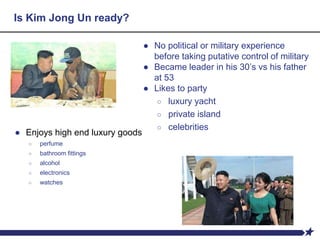
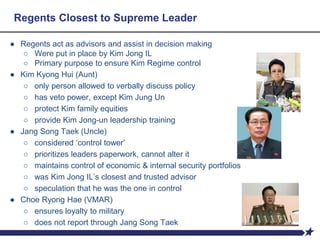
  • 228.
    References (Primary) Chanlett-Avery, E.,& Nanto, D. (2009). North Korea: Economic Leverage and Policy Analysis. Washington: Congressional Research Service. Chanlett-Avery, E. & Rinehart, I.E.. 2013. North Korea: U.S. Relations, Nuclear Diplomacy and Internal Situation. Congressional Research Service. Federation of American Scientist. Retrieved on October 22, 2013 from http://www.fas.org/sgp/crs/nuke/R41259.pdf CIA. (2013, September 25). The World FactBook. Retrieved October 26, 2013, from CIA.GOV library publications website: https://www.cia.gov/library/publications/the-world- factbook/geos/kn.html Cornum, R. L. (2002). NORTH KOREA AND THE UNITED STATES: LEARNING HOW TO WAGE PEACE IN THE TWENTY FIRST CENTURY. Retrieved November 7, 2013, from National Defense University National War College: HSDL.Org website: http://www.hsdl.org/?view&did=1381 Croddy, Eric. 2003. Vinalon, the DPRK, and Chemical Weapons Precursors. The Nuclear Threat Initiative. Retrieved on November 6, 2013 from http://www.nti.org/analysis/articles/vinalon-dprk-and- chemical-weapons/
  • 229.
    References (Primary) Eberstadt, N.(2011, September 22). Should North Korea be provided with humanitarian aid? Retrieved October 25, 2013, from American Enterprise Institute: http://www.aei.org/article/should-north-korea- be-provided-with-humanitarian-aid/ Gause, K. E. (2013). North Korean Leadership Dynamics and Decision-making under Kim Jong-un: A First Year Assessment. Alexandria: CNA Strategic Studies. Hanke, Steven H. 2013. North Korea: from Hyperinflation to Dollarization? CATO Institute. Retrieved on November 4, 2013 from http://www.cato.org/publications/commentary/north-korea-hyperinflation- dollarization Imamura, H. (2012, August). The Prospects for North Korean Economic Transformation. Retrieved October 23, 2013, from IGCC.UCSD.EDU: http://igcc.ucsd.edu/assets/001/503988.pdf Joon Ho Kim. 2013. Illegal Trade in North Korean Homes Flourishes. Radio Free Asia. Retrieved on November 6, 2013 from http://www.rfa.org/english/news/korea/housing-05072013164432.html
  • 230.
    References (Primary) Kan, P.R., Bechtol Jr., B., & Collins, R. (2010, April 12). Criminal Sovereignty: Understanding North Korea's Illicit International Activities. Retrieved November 7, 2013, from US Army War College Strategic Studies Institute website: http://www.strategicstudiesinstitute.army.mil/pubs/display.cfm?pubID=975 KCNA. (2003, September 3). 1st Session of 11th SPA of DPRK Held. Retrieved November 2013, 2013, from KCNA websiste: http://www.kcna.co.jp/item/2003/200309/news09/04.htm#11 KCNA. (2007, April 14). 5th Session of 11th SPA of DPRK Held. Retrieved November 7, 2013, from KCNA: http://www.kcna.co.jp/item/2007/200704/news04/12.htm#1 Lerner, K. L., & Lerner, B. W. (2004). Encyclopedia of Espionage, Intelligence, and Security. In K. L. Lerner, & B. W. Lerner, Vol. 121 F-Q (p. 369). Farmington Hills, MI: The Gale Group Inc. Lewis, P. (2013). What Military Threat Does North Korea Pose? | Chatham House: Independent thinking on international affairs. [online] Retrieved from: http://www.chathamhouse.org/media/comment/view/190677 [Accessed: 4 Nov 2013]. Liberty In North Korea. (n.d.). Liberty in North Korea: the People's Challenges. Retrieved October 28, 2013, from Liberty In North Korea Website: http://www.libertyinnorthkorea.org/learn-nk-challenges/
  • 231.
    References (Primary) Madden, Michael.2013. Kim Jong Un’s Pyongyang Shuffle. 38 North. Retrieved on November 6, 2013 from http://38north.org/2013/04/mmadden040513/ Mansaurov, A. (2012, December 17). Part I: A Dynamically Stable Regime. Retrieved November 7, 2013, from 38 North.org website: http://38north.org/2012/12/amansourov121712/ Manyin, M., & Nanto, D. (2012). China-North Korea Relations. Washington: Congressional Research Service. Manyin, M., & Nikitin, M. B. (2013). Foreign Assistance to North Korea. Washington: Congressional Research Service. Moon, S. H. (2013, August 22). North Korea Moves to End Reliance on 'Grain-Fed' Animals for Food. Retrieved November 7, 2013, from Radio Free Asia (RFA.org) website: http://www.rfa.org/english/news/korea/reliance-08222013161918.html Moon, S. H. (2013, October 3). North Korean Farmers Fear Government 'Betrayal' Over Distribution Plan. Retrieved November 7, 2013, from Radio Free Asia (RFA) website: http://www.rfa.org/english/news/korea/betrayal-10032013160327.html
  • 232.
    References (Primary) Neuman, S.(2013, March 20). When It Comes To Cyberwarfare, North Korea Is No Newbie. Retrieved October 27, 2013, from NPR.ORG website: http://www.npr.org/blogs/thetwo- way/2013/03/20/174847448/when-it-comes-to-cyber-warfare-north-korea-is-no-newbie Noland, M. (2013, February). The Elusive Nature of North Korean Reform. Retrieved November 7, 2013, from East-West Center website: http://www.eastwestcenter.org/sites/default/files/private/api108.pdf NTI. (2013, October). North Korea. Retrieved October 31, 2013, from NTI.org: http://www.nti.org/country- profiles/north-korea/ NTI. (2011). 2010 Defense White Paper. Retrieved October 27, 2013, from NTI.org: http://www.nti.org/media/pdfs/2010WhitePaperAll_eng.pdf?_=1340662780 Office of the Secretary of Defense, Department of Defense. (2013). Military and Security Developments Involving The Democratic People's Republic of Korea 2012. Retrieved from website: http://www.defense.gov/pubs/report_to_congress_on_military_and_security_developments_involving_the _dprk.pdf Rahn, K. (2011, May 3). NK launched cyber attack on Nonghyup . Retrieved November 7, 2013, from The Korea Times website: from http://www.koreatimes.co.kr/www/news/nation/2011/05/117_86369.html
  • 233.
    References (Primary) Reudiger, Frank.2013. North Koreas Rolling Economic Reforms. East Asia Forum. Retrieved on November 6, 2013 from http://www.eastasiaforum.org/2013/09/24/north-koreas-rolling-economic- reforms/ Rhem, K. (2003). Defense.gov News Article: North Korean Military 'Very Credible Conventional Force'. [online] Retrieved from: http://www.defense.gov/News/NewsArticle.aspx?ID=27769 [Accessed: 4 Nov 2013]. Ryssdal, Kai. 2011. North Korea: A Fragile Economy After Kim Jong-IL. Marketplace.org. Retrieved on November 6, 2013 from http://www.marketplace.org/topics/world/north-korea-fragile-economy-after- kim-jong-il Savada, A. M., & ed. (2013). North Korea: A Country Study INDUSTRY. Retrieved November 7, 2013, from U.S. Library of Congress website: http://countrystudies.us/north-korea/48.htm Sigal, L. (2003, May). DPRK Briefing Book: U.S. Interests And Goals On The Korean Peninsula. Retrieved November 7, 2013, from Nautilus Institute web site: http://nautilus.org/publications/books/dprkbb/uspolicy/dprk-briefing-book-u-s-interests-and-goals-on- the-korean-peninsula/#axzz2jz3hc3Ux
  • 234.
    References (Primary) Snyder, Scott.2013. U.S. Policy Toward North Korea. Council on Foreign Relations. Retrieved on October 29, 2013 from http://www.cfr.org/north-korea/us-policy-toward-north-korea/p29962 Williams, M. (2012, February 12). Pyongyang satellite monitoring station. Retrieved October 31, 2013, from North Korea Tech: http://www.northkoreatech.org/2012/02/12/pyongyang-satellite-monitoring- station/ Williams, M. (2013, September). Korea Computer Center tags. Retrieved October 31, 2013, from NorthKoreaTech.org website: http://www.northkoreatech.org/tag/korea-computer-center/ WordPress. (2011, January 28). Noland on DPRK grain prices. Retrieved November 7, 2013, from North Korean Economy Watch website: http://www.nkeconwatch.com/2011/01/28/noland-on-dprk-grain- prices/ WordPress. (2013, August 23). Pak Pong Ju’s Return. Retrieved November 7, 2013, from Research and Analysis on the DPRK Leadership website: http://nkleadershipwatch.wordpress.com/2010/08/23/pak- pong-jus-return/ WordPress. (2013, July). Research and Analysis on the DPRK Leadership. Retrieved November 7, 2013, from North Korea leadership watch website: http://nkleadershipwatch.wordpress.com/category/pak-pong-ju/page/4/
  • 235.
    References (Primary) WordPress. (n.d.).Research and Analysis on the DPRK Leadership. Retrieved October 29, 2013, from North Korea Leadership Watch Wordpress.com website: http://nkleadershipwatch.wordpress.com/
  • 236.
    References (Secondary) 2012. NorthKorean self-sufficiency: in the Sphere of Nails. New Focus International. Retrieved on November 5, 2013 from http://newfocusintl.com/north-korean-self-sufficiency/ 2013. China’s Limited Influence over North Korea. South China Morning Post. Retrieved on October 28, 2013 from http://www.scmp.com/comment/insight-opinion/article/1212566/chinas-limited-influence- over-north-korea Berlinger, Joshua. 2012. Russia Forgives $11 Billion North Korean Debt. Business Insider. Retrieved on November 6, 2013 from http://www.businessinsider.com/russia-forgives-11-billion-north-korean-debt- 2012-9 DPRK's Socialist Constitution: SUPREME PEOPLE'S ASSEMBLY . (1998, September 5). Retrieved November 7, 2013, from Novexcn.com website: http://www.novexcn.com/dprk_constitution_98.html AhnLabMan. (2011, March 9). CEOs record of DDoS Attack in Korea. Retrieved November 10, 2013, from AhnLab Security Blog website: http://ahnlabblog.cafe24.com/wordpress/archives/204 AFP. (2009, June 11). N Korea demands millions. Retrieved November 7, 2013, from News 24 website: http://www.news24.com/World/News/N-Korea-demands-millions-20090611
  • 237.
    References (Secondary) AFP. (2013,October 8). S. Korea confirms North's plutonium reactor restart. Retrieved October 24, 2013, from Yahoo News website: http://news.yahoo.com/korea-confirms-norths-plutonium-reactor- restart-113143869.html Associated Press. (2013). North Korea says naval vessel sank last month on ‘combat duties,’ killing crew. Retrieved From: http://www.foxnews.com/world/2013/11/04/north-korea-says-naval-vessel-sank-last-month-on-combat- duties-killing-officers/?intcmp=latestnews Baker, R. (2013, April 16). China and North Korea: A Tangled Partnership . Retrieved October 27, 2013, from Stratfor Global Intelligence website: http://www.stratfor.com/weekly/china-and-north-korea- tangled-partnership Blachard, B. (2013, April 1). Chinas anger at North Korea overcomes worry over U.S. stealth flights. Retrieved November 7, 2013, from Reuters website: http://www.reuters.com/article/2013/04/01/us- korea-north-china-idUSBRE9300JO20130401 Cain, Geoffery. (2013). Syria’s other key ally: North Korea. Retrieved From: http://www.globalpost.com/dispatch/news/regions/asia-pacific/north-korea/130906/syria-north-korea- alliance-chemical-weapons
  • 238.
    References (Secondary) Capaccio, T.(2012, October 22). North Korea Improves Cyber Warfare Capacity, U.S. Says. Retrieved November 7, 2013, from Bloomberg Businessweek website: http://www.businessweek.com/news/2012-10-22/north-korea-improves-cyber-warfare-capacity-u-dot- s-dot-says Cathcart, A. (2013, May 12). Premier Pak Pong-ju: The Helmsman Looks North. Retrieved November 7, 2013, from SINO NK website: http://sinonk.com/2013/05/12/pak-pong-ju-helmsman-looks-north/ Chinoy, M. (2013, April 12). Why North Korean intelligence is so hard to read. Retrieved October 27, 2013, from CNN.com: http://www.cnn.com/2013/04/12/world/asia/north-korea-nuclear-capabilities/ Choe, S.-h. (2010, August 23). North Korea Reinstates Market-Oriented Official. Retrieved November 7, 2013, from The New York Times website: http://www.nytimes.com/2010/08/24/world/asia/24korea.html?_r=2&hp& Choney, S. (2013, March 29). North Korea's Internet? What Internet? For most, online access doesn't exist. Retrieved October 31, 2013, from NBC News.com Website: http://www.nbcnews.com/technology/north-koreas-internet-what-internet-most-online-access-doesnt- exist-1C9143426
  • 239.
    References (Secondary) Chumley, Cheryl,K. (2013). North Korea on High Alert, Threatens U.S. Ships with “Horrible Disaster”. The Washington Times. Retrieved on October 26, 2013 from http://www.washingtontimes.com/news/2013/oct/8/n-korea-high-alert-threatens-us-ships-horrible-dis/ Clarke, R. A. (2010). In Cyber War: The Next Threat to National Security and What to Do About It (p. 26). New York: HarperCollins Publishers. Clayton, M. (2013, October 19). In cyberarms race, North Korea emerging as a power, not a pushover. Retrieved November 7, 2013, from CS Monitor web site: http://www.csmonitor.com/World/Security- Watch/2013/1019/In-cyberarms-race-North-Korea-emerging-as-a-power-not-a-pushover Cullinane, S. (2013, April 9). How does North Korea make its money? Retrieved October 25, 2013, from CNN.COM website: http://www.cnn.com/2013/04/09/business/north-korea-economy-explainer/ Dieterie, D. (2012, March 6). North Korea’s Cyber War Forces. Retrieved October 31, 2013, from Infosec Island website: http://infosecisland.com/blogview/20532-North-Koreas-Cyber- War- Forces.html
  • 240.
    References (Secondary) Fisher, M.(2013, August 21). How North Korea got itself hooked on meth. Retrieved November 7, 2013, from The Washington Post website: http://www.washingtonpost.com/blogs/worldviews/wp/2013/08/21/how-north-korea-got-itself-hooked- on-meth/ Fisher, M. (2013, March 29). North Korea almost certainly lacks basic technical capability to carry out its big war plan. Retrieved October 24, 2013, from The Washington Post WorldViews: http://www.washingtonpost.com/blogs/worldviews/wp/2013/03/29/north-korea-almost-certainly-lacks- basic-technical-capability-to-carry-out-its-big-war-plan/ Fisher, M. (2013, October 25). North Korea is losing a crucial source of income: Koreans in Japan. Retrieved October 25, 2013, from The Washington Post WorldViews Blog: http://www.washingtonpost.com/blogs/worldviews/wp/2013/10/25/north-korea-is-losing-a-crucial- source-of-income-koreans-in-japan/ Gertz, Bill. (2013). Military Cooperation Between Cuba, North Korea Revealed. Retrieved From: http://freebeacon.com/military-cooperation-between-cuba-north-korea-revealed/ Gertz, Bill. 2013. Risky Business: China Continues Military Build up near North Korean border as Tanks, Armor Deploy. Washington Times. Retrieved on October 27, 2013 from http://www.washingtontimes.com/news/2013/apr/3/risky-business-china-continues-military-buildup- ne/?page=all
  • 241.
    References (Secondary) Google CurrencyConverter. Google.com. Retrieved on November 5, 2013 from https://www.google.com/finance/converter Greitens, S. C. (2012, March 3). A North Korean Corleone. Retrieved October 26, 2013, from The New York Times Sunday Review website: http://www.nytimes.com/2012/03/04/opinion/sunday/a-north- korean-corleone.html?pagewanted=all Haggard, S. (2012, November 27). North-South trade update 1: Wages and wage payments at Kaesong. Retrieved November 7, 2013, from Peterson Institute for International Economics Website: http://www.piie.com/blogs/nk/?p=8216 Healey, J. (2013, April 9). North Korea's Cyber Stunts Aren't War, So Act Accordingly. Retrieved November 7, 2013, from US News website: http://www.usnews.com/opinion/blogs/world- report/2013/04/09/stopping-north-korean-cyber-attacks-starts-in-china Hewitt, G. (2013, February 20). North Korea: A nuclear 7-Eleven? Retrieved November 7, 2013, from Yahoo news website: http://sg.news.yahoo.com/north-korea-nuclear-7-eleven-130215483.html Hinata-Yamaguchi, R. (2011). The Real North Korea Threat. [online] Retrieved from: http://thediplomat.com/new-leaders-forum/2011/11/29/the-real-north-korea-threat/ [Accessed: 6 Nov 2013].
  • 242.
    References (Secondary) Jamieson, Alastair.2013. Japan, US agree North Korea Must not Have Nuclear Weapons. NBC- WORLDNEWS. Retrieved on October 26, 2013 from http://worldnews.nbcnews.com/_news/2013/04/14/17745795-japan-us-agree-north-korea-must-not- have-nuclear-weapons Johnson, Mark. 2013. North Korea Plots “Bright Future” For Tourism Industry, Despite Legacy of Failed Projects. Retrieved on November 6, 2013 from http://www.ibtimes.com/north-korea-plots-bright-future- tourism-industry-despite-legacy-failed-projects-1401810 Jong-Heon, L. (2013, September 12). How stable is N. Korea? Kim Jong-Un names third military chief in a year. Retrieved October 23, 2013, from WorldTribune.com: http://www.worldtribune.com/2013/09/12/how-stable-is-n-korea-kim-jong-un-names-third-military-chief- in-a-year/ Jun, K. (2013, April 3). A rundown of the Kaesong Industrial Complex. Retrieved November 7, 2013, from The Wall Street Journal website: blogs.wsj.com/korearealtime/2013/04/03/a-rundown-of-the- kaesong-industrial-complex/ Jun, K. (2013, 5 November). South Korean businesses quit Kaesong. Retrieved November 7, 2013, from The Wall Street Journal website: http://blogs.wsj.com/korearealtime/2013/11/05/south-korean- businesses-quit-kaesong/
  • 243.
    References (Secondary) Keck, Z.(2013, May 17). North Korea Pushes Ahead on Agricultural Reforms. Retrieved November 7, 2013, from The Diplomat website: http://thediplomat.com/pacific-money/2013/05/17/north-korea- pushes-ahead-on-agricultural-reform/ Kim, C., & Davis, A. (2013, October 8). S. Korea confirms North has restarted Yongbyon nuclear site. Retrieved October 23, 2013, from Chicago Tribune: http://www.chicagotribune.com/topic/sns-wp-blm- news-bc-nkorea08-20131008,0,3804517.story Kim, S. (2013). How Strong Is NKorea's Military?. [online] Retrieved from: http://www.huffingtonpost.com/2013/04/25/how-strong-is-north-koreas-military- capabilities_n_3153691.html [Accessed: 4 Nov 2013]. Kim, Soo . 2013. North Korea’s “Bright Future” in Tourism. The Telegraph. Retrieved on November 6, 2013 from http://www.telegraph.co.uk/travel/travelnews/10271837/North-Koreas-bright-future-in- tourism.html Kredo, A. (2013, July 22). Mike Rogers: China, Iran, and Russia Launching Cyber Attacks Against U.S. Retrieved November 7, 2013, from The Washington Free Beacon website: http://freebeacon.com/mike-rogers-china-iran-and-russia-launching-cyber-attacks-against-u-s/
  • 244.
    References (Secondary) Laurence, J.(2012). North Korea military has an edge over South, but wouldn't win a war, study finds. [online] Retrieved from: http://www.csmonitor.com/World/Latest-News-Wires/2012/0104/North-Korea- military-has-an-edge-over-South-but-wouldn-t-win-a-war-study-finds [Accessed: 4 Nov 2013]. Lee, D. (2012, December 10). North Korea: On the net in world's most secretive nation. Retrieved October 31, 2013, from BBC news website: http://www.bbc.co.uk/news/technology-20445632 Lee, J. (2013, April 6). Made in Korea: Inside jointly run Kaesong factory. Retrieved November 7, 2013, from USA News Today website: http://www.usatoday.com/story/news/world/2013/04/06/made-in- korea-rare-look-at-jointly-run-factories/2058547/ Lee, Y. (2013, March 24). North Korea Cyber Warfare: Hacking 'Warriors' Being Trained In Teams, Experts Say. Retrieved November 7, 2013, from Huffington Post Website: http://www.huffingtonpost.com/2013/03/24/north-korea-cyber-warfare-warriors-trained- teams_n_2943907.html Lim, B. K. (2012, July 20). North Korea’s Kim Jung-un to reform economy after purge: Report. Retrieved November 7, 2013, from The Star.com website: http://www.thestar.com/news/world/2012/07/20/north_koreas_kim_jongun_to_reform_economy_after_ purge_report.html
  • 245.
    References (Secondary) Lister, T.(2010). North Korea's military aging but sizable. [online] Retrieved from: http://www.cnn.com/2010/WORLD/asiapcf/11/24/north.korea.capability/ [Accessed: 7 Nov 2013]. McEachern, P. (2005, April 11). North Korea PM Says Farming, Increased Electricity, Coal Production Key in 2005. Retrieved November 7, 2013, from FatCow website: http://relooney.fatcow.com/SI_FAO- Asia/N-Korea_112.pdf Moon, Sung Hui. 2013. 6.28 Policy on Agriculture. North Korea Economy Watch. Retrieved on November 6, 2013, from http://www.nkeconwatch.com/category/policies/6-28-policy-on-agriculture- june-28/ Nklw, M. (2013, July 16). DPRK Cabinet Holds Second Plenum. Retrieved November 7, 2013, from paper blog website: http://en.paperblog.com/dprk-cabinet-holds-second-plenum-589969/ North Korea Rumblings from below. (2013, 9 February). Retrieved November 7, 2013, from The Economist website: http://www.economist.com/news/briefing/21571404-sealed-and-monstrously- unjust-society-changing-ways-its-despotic-ruler-may-not-be-able Panin, Alexander. 2013. International Business: North Korean Style. The Moscow Times. Retrieved on November 6, 2013 from http://www.themoscowtimes.com/business/article/international-business- north-korean-style/486574.html
  • 246.
    References (Secondary) Payet, L.(2013, May 29). South Korean Financial Companies Targeted by Castov. Retrieved November 10, 2013, from Symantec.com website: http://www.symantec.com/connect/blogs/south-korean- financial-companies-targeted-castov Pearson, James. 2013. Black Market Gets Some Respect in North Korea. New York Times. Retrieved on November 6, 2013 from http://www.nytimes.com/2013/11/05/business/international/black-market- gets-some-respect-in-north-korea.html Pennington, M. (2013, October 23). Images Show New Work at NKorea's Nuclear Test Site. Retrieved October 23, 2013, from ABC News website: http://abcnews.go.com/Politics/wireStory/images-show- work-nkoreas-nuclear-test-site-20658287 Perlez, J., & Sang-Hun, C. (2013, April 7). China Hints at Limits to North Korea Actions. Retrieved November 7, 2013, from The New York Times website: http://www.nytimes.com/2013/04/08/world/asia/from-china-a-call-to-avoid-chaos-for-selfish- gain.html?pagewanted=all&_r=0 Perlez, Jane. 2013. China Bans Items for Export to North Korea, Fearing Their Use in Weapons. The New York Times. Retrieved October 29, 2013 from http://www.nytimes.com/2013/09/25/world/asia/china-bans-certain-north-korean-exports-for-fear-of- weapons-use.html?_r=0
  • 247.
    References (Secondary) Petty, D.(2013, March 11). Do people in North Korea have access to cell phones, Internet and social media? AP bureau chief Jean Lee explains. Retrieved October 23, 2013, from The Denver Post TechKnow Bytes blog: http://blogs.denverpost.com/techknowbytes/2013/03/11/whats-social-media-like-from-inside-north- korea/8964/ Rose, D. (2009, August 9). North Korea's Dollar Store. Retrieved November 7, 2013, from Vanity Fair website: http://www.vanityfair.com/politics/features/2009/09/office-39-200909?printable=true Ryall, J. (2013, April 1). North Korea rehabilitates purged capitalist premier . Retrieved November 7, 2013, from The Telegraph website: http://www.telegraph.co.uk/news/worldnews/asia/northkorea/9964923/North-Korea-rehabilitates- purged-capitalist-premier.html Sang-Hung, Choe. 2013. North and South Korea Set Dates for Family Reunions After 3-Year Hiatus. The New York Times. Retrieved on October 28, 2013 from http://www.nytimes.com/2013/08/24/world/asia/north-and-south-korea-begin-talks-on-reuniting- divided-families.html Sang-Hung, Choe. 2013. North Korean Leader Tightens Grip with Removal of His Top General. The New York Times. Retrieved on October 28, 2013 from http://www.nytimes.com/2013/10/11/world/asia/north-korean-leader-tightens-grip-with-removal-of-top- general.html?_r=1&
  • 248.
    References (Secondary) Sherstobitoff, R.,Liba, I., & Walter, J. (2013). Dissecting Operation Troy: Cyberespionage in South Korea. Retrieved November 10, 2013, from McAfee.com website: http://www.mcafee.com/us/resources/white- papers/wp-dissecting-operation-troy.pdf Soffer, Ari. (2013). Report: Syrian Regime Using North Korean Pilots. Retrieved From: http://www.israelnationalnews.com/News/News.aspx/173417#.UnrFQ6U94mx Suk, H. H. (2003). North Korea Military Tactics In A War With US. Retrieved from Website: http://www.rense.com/general37/nkorr.htm Tandon, S. (2013, September 11). North Korea restarts plutonium reactor: analysts. Retrieved October 23, 2013, from FOX News website: http://www.foxnews.com/world/2013/09/11/north-korea-restarts- plutonium-reactor-analysts/ Tarakanov, D. (2013, September 11). The "Kimsuky: Operation: A North Korean APT? Retrieved November 10, 2013, from http://www.securelist.com/en/analysis/204792305/The_Kimsuky_Operation_A_North_Korean_APT The Axis of Cyber Evil: A North Korean Case of Cyber Espionage. (2013, October 10). Retrieved November 7, 2013, from HS Today.US website: http://www.hstoday.us/blogs/critical-issues-in-national- cybersecurity/blog/the-axis-of-cyber-evil-a-north-korean-case-of-cyber- espionage/3072be3aacf419cc494e3910a62107b2.html
  • 249.
    References (Secondary) The ChristianScience Monitor. (2013, October 19). North Korea advances toward dream of being cyber- superpower. Retrieved October 26, 2013, from TribLive US World website: http://triblive.com/usworld/world/4912701-74/north-south-korea#axzz2igcsb7ME Thomson Reuters. (n.d) The North Korean Military. [online] Retrieved from: http://www.reuters.com/news/pictures/slideshow?articleId=USRTR2VGGV#a=3 [Accessed: 4 Nov 2013] Twentieth edition of the N&O column / Spooks newsletter. (1999, December 3). Agency profile - North and South Korea. Retrieved October 31, 2013, from CVI.net website: http://www.cvni.net/radio/nsnl/nsnl020/nsnl20kr.html UNK. (2010, November 23). North Korea's conflict with the South: timeline. Retrieved November 10, 2013, from The Telegraph News website: http://www.telegraph.co.uk/news/worldnews/asia/southkorea/8153048/North-Koreas-conflict-with-the-South- timeline.html Various. (2013, October). North Korea. Retrieved October 31, 2013, from The Asahi Shimbun: Asia & Japan Watch: http://ajw.asahi.com/tag/North%20Korea Waggoner, P. (2013). North Korea is Disappearing From the Headlines, But Could It Come Back?. [online] Retrieved from: http://www.policymic.com/articles/39133/north-korea-war-why-it-s-not-in-the-news-anymore [Accessed: 4 Nov 2013].
  • 250.
    References (Secondary) Williams, m.(2011, July 6). DDoS attack in March likely N.Korean work, says McAfee. Retrieved November 10, 2013, from ComputerWorld.com Website: http://www.computerworld.com/s/article/9218191/DDoS_attack_in_March_likely_N.Korean_work_say s_McAfee?taxonomyId=80&pageNumber=2 Winter, C. (2013, October 02). Who Wants to Go to North Korea for Christmas. Retrieved October 25, 2013, from BloomberBusinessweek website: http://www.businessweek.com/articles/2013-10-02/who- wants-to-go-to-north-korea-for-christmas Winter, M. (2013, September 11). Report: N. Korea may be restarting plutonium reactor. Retrieved October 23, 2013, from USA Today website: http://www.usatoday.com/story/news/world/2013/09/11/north-korea-reactor-possibly- restarted/2802005/ Woodrow Wilson Center. (2013, July 30). Knowing the North: Intelligence and Intentions of the DPRK. Retrieved October 26, 2013, from YouTube website video: https://www.youtube.com/watch?v=NJtS4KVMSbg Yong News Agency. (2013, September 25). North Korea more stable since Kim JOng Un took power: World Bank. Retrieved October 23, 2013, from GlobalPost: America's world news site: http://www.globalpost.com/dispatch/news/yonhap-news-agency/130925/n-korea-more-politically- stable-after-power-shift-world-bank
  • 251.
    References (Secondary) Yoo, A.(2013, October 11). North Korean spies enter South Korea posing as defectors, says lawmaker. Retrieved October 31, 2013, from South China Morning Post: http://www.scmp.com/news/asia/article/1329421/north-korean-spies-enter-south-korea-posing- defectors-says-lawmaker Young, Lee Sang. 2013. NK Touts Economic Reform Aims. DAILY NK. Retrieved on November 6, 2013 from http://www.dailynk.com/english/read.php?cataId=nk00400&num=11089