The National Committee on
Vital and Health Statistics
Data Access and Use
Joshua Rosenthal, PhD
Systems & Practices
2
SYSTEMS & PRACTICES
Structure
Ecosystem Interaction
How does someone find a site / delivery mechanism
or information within a site / delivery mechanism
via another channel?
UI / UX
[User Interaction / User Experience]
How does someone use and experience
a site / delivery mechanism?
Information Architecture
How does someone find information within
a site / delivery mechanism?
Data
How useful and usable is the data within
a site / delivery system?
3
SYSTEMS & PRACTICES
Structure
Ecosystem Interaction
How does someone find a site / delivery mechanism
or information within a site / delivery mechanism
via another channel?
UI / UX
[User Interaction / User Experience]
How does someone use and experience
a site / delivery mechanism?
Information Architecture
How does someone find information within
a site / delivery mechanism?
Data
How useful and usable is the data within
a site / delivery system?
4
SYSTEMS & PRACTICES
Structure
Data
How useful and usable is the data within
a site / delivery system?
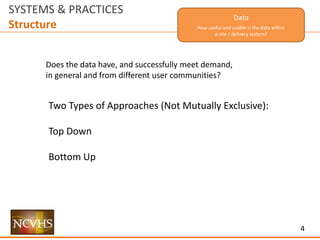
Does the data have, and successfully meet demand,
in general and from different user communities?
Two Types of Approaches (Not Mutually Exclusive):
Top Down
Bottom Up
5
SYSTEMS & PRACTICES
Structure
Data
How useful and usable is the data within
a site / delivery system?
Does the data have, and successfully meet demand,
in general and from different user communities?
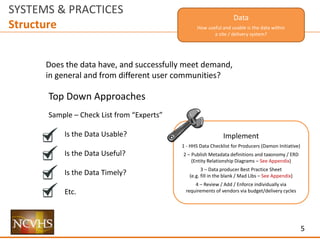
Top Down Approaches
Sample – Check List from “Experts”
Is the Data Usable?
Is the Data Useful?
Is the Data Timely?
Etc.
Implement
1 - HHS Data Checklist for Producers (Damon Initiative)
2 – Publish Metadata definitions and taxonomy / ERD
(Entity Relationship Diagrams – See Appendix)
3 – Data producer Best Practice Sheet
(e.g. fill in the blank / Mad Libs – See Appendix)
4 – Review / Add / Enforce individually via
requirements of vendors via budget/delivery cycles
6
SYSTEMS & PRACTICES
Structure
Ecosystem Interaction
How does someone find a site / delivery mechanism
or information within a site / delivery mechanism
via another channel?
UI / UX
[User Interaction / User Experience]
How does someone use and experience
a site / delivery mechanism?
Information Architecture
How does someone find information within
a site / delivery mechanism?
Data
How useful and usable is the data within
a site / delivery system?
7
SYSTEMS & PRACTICES
Structure
Information Architecture
How does someone find information within
a site / delivery mechanism?
Two Types of IA Approaches (Not Mutually Exclusive):
Top Down
Bottom Up
Can someone find information navigating in different
ways, and is there navigation informed by / are they able
to judge the usefulness and utility of the information?
8
SYSTEMS & PRACTICES
Structure
Information Architecture
How does someone find information within
a site / delivery mechanism?
Two Types of IA Approaches (Not Mutually Exclusive):
Top Down Approaches:
Sample Mechanisms (See Appendix for sample schema)
Site Map (structured around IA Taxonomy)
[PRO TIP / V2: this should intersect with metadata taxonomy]
Source vs./and Topics – Parallel navigation (supports different users / use cases)
Tags – Taxonomy Tags - Expert assigned / objective [e.g. file format; publisher]
Navigation/Exploration: Search, filter, sort, Bread Crumbs to taxonomy/site map
Implement
Data.gov has most of this (needs ERDs, bread crumbs beyond publishing org); expand and extend
Where not be possible in specific sites via security / privacy, consider in meta sites (data.gov, etc.)
Review / Add / Enforce individually via requirements of vendors via budget/delivery cycles –
(copy specs from data.gov)
9
SYSTEMS & PRACTICES
Structure
Information Architecture
How does someone find information within
a site / delivery mechanism?
Two Types of IA Approaches (Not Mutually Exclusive):
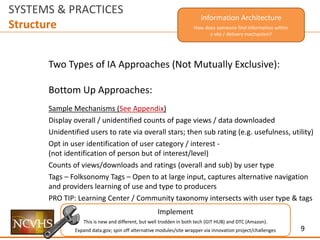
Bottom Up Approaches:
Sample Mechanisms (See Appendix)
Display overall / unidentified counts of page views / data downloaded
Unidentified users to rate via overall stars; then sub rating (e.g. usefulness, utility)
Opt in user identification of user category / interest -
(not identification of person but of interest/level)
Counts of views/downloads and ratings (overall and sub) by user type
Tags – Folksonomy Tags – Open to at large input, captures alternative navigation
and providers learning of use and type to producers
PRO TIP: Learning Center / Community taxonomy intersects with user type & tags
Implement
This is new and different, but well trodden in both tech (GIT HUB) and DTC (Amazon).
Expand data.gov; spin off alternative modules/site wrapper via innovation project/challenges
10
SYSTEMS & PRACTICES
Structure
Ecosystem Interaction
How does someone find a site / delivery mechanism
or information within a site / delivery mechanism
via another channel?
UI / UX
[User Interaction / User Experience]
How does someone use and experience
a site / delivery mechanism?
Information Architecture
How does someone find information within
a site / delivery mechanism?
Data
How useful and usable is the data within
a site / delivery system?
11
SYSTEMS & PRACTICES
Structure
UI / UX
[User Interaction / User Experience]
How does someone use and experience
a site / delivery mechanism?
User Interaction / User Experience
Two Types of Approaches (Not Mutually Exclusive):
Score Carding (See Appendix for example)
Work from checklist, score instance and offer improvements
Emulate Model (See Appendix for example
Work from example of what already works within a similar context and modify
UI / UX
[User Interaction / User Experience]
How does someone use and experience
a site / delivery mechanism?
Implement
Copy data.gov as model for individual HHS sites/instances; modify based on constraints of individual
instance; expand, extend and improve based on users, goals and priorities of instance.
Review / Add / Enforce individually via requirements of vendors via budget/delivery cycles
12
SYSTEMS & PRACTICES
Structure
Ecosystem Interaction
How does someone find a site / delivery mechanism
or information within a site / delivery mechanism
via another channel?
UI / UX
[User Interaction / User Experience]
How does someone use and experience
a site / delivery mechanism?
Information Architecture
How does someone find information within
a site / delivery mechanism?
Data
How useful and usable is the data within
a site / delivery system?
13
SYSTEMS & PRACTICES
Structure
Ecosystem Interaction
How does someone find a site / delivery mechanism
or information within a site / delivery mechanism
via another channel?
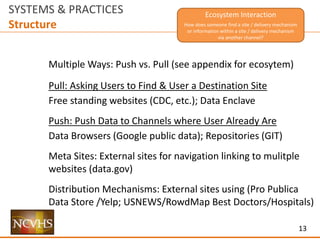
Multiple Ways: Push vs. Pull (see appendix for ecosytem)
Pull: Asking Users to Find & User a Destination Site
Free standing websites (CDC, etc.); Data Enclave
Push: Push Data to Channels where User Already Are
Data Browsers (Google public data); Repositories (GIT)
Meta Sites: External sites for navigation linking to mulitple
websites (data.gov)
Distribution Mechanisms: External sites using (Pro Publica
Data Store /Yelp; USNEWS/RowdMap Best Doctors/Hospitals)
14
SYSTEMS & PRACTICES
Structure
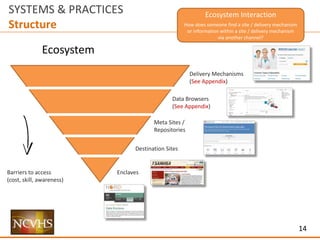
Ecosystem
Barriers to access
(cost, skill, awareness)
Enclaves
Destination Sites
Meta Sites /
Repositories
Data Browsers
(See Appendix)
Delivery Mechanisms
(See Appendix)
Ecosystem Interaction
How does someone find a site / delivery mechanism
or information within a site / delivery mechanism
via another channel?
15
SYSTEMS & PRACTICES
Structure
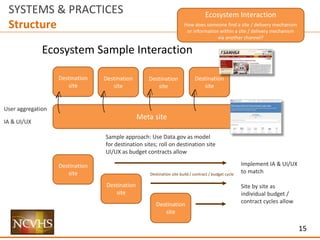
Ecosystem Sample Interaction
Meta site
Destination
site
Destination
site
Destination
site
Destination
site
Destination
site
Destination
site
Destination
site
User aggregation
IA & UI/UX
Implement IA & UI/UX
to match
Site by site as
individual budget /
contract cycles allow
Sample approach: Use Data.gov as model
for destination sites; roll on destination site
UI/UX as budget contracts allow
Destination site build / contract / budget cycle
Ecosystem Interaction
How does someone find a site / delivery mechanism
or information within a site / delivery mechanism
via another channel?
16
SYSTEMS & PRACTICES
Appendix
Taxonomy and Metadata
Entity Relationships Diagrams (ERD)
17
SYSTEMS & PRACTICES
Taxonomy and Metadata Entity Relationships Diagrams
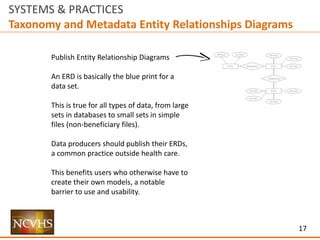
Publish Entity Relationship Diagrams
An ERD is basically the blue print for a
data set.
This is true for all types of data, from large
sets in databases to small sets in simple
files (non-beneficiary files).
Data producers should publish their ERDs,
a common practice outside health care.
This benefits users who otherwise have to
create their own models, a notable
barrier to use and usability.
18
SYSTEMS & PRACTICES
Taxonomy and Metadata Entity Relationships Diagrams
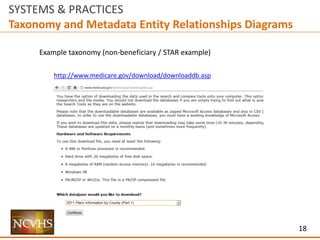
http://www.medicare.gov/download/downloaddb.asp
Example taxonomy (non-beneficiary / STAR example)
19
SYSTEMS & PRACTICES
Taxonomy and Metadata Entity Relationships Diagrams
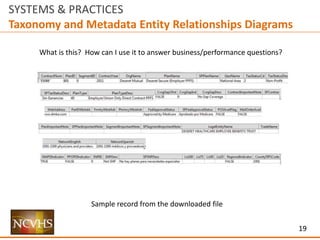
What is this? How can I use it to answer business/performance questions?
Sample record from the downloaded file
20
SYSTEMS & PRACTICES
Taxonomy and Metadata Entity Relationships Diagrams
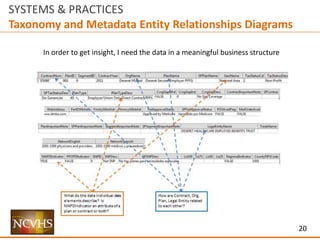
In order to get insight, I need the data in a meaningful business structure
21
SYSTEMS & PRACTICES
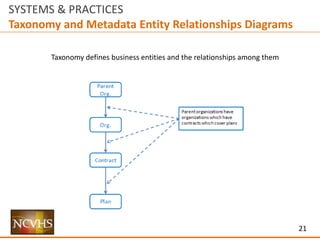
Taxonomy and Metadata Entity Relationships Diagrams
Taxonomy defines business entities and the relationships among them
22
SYSTEMS & PRACTICES
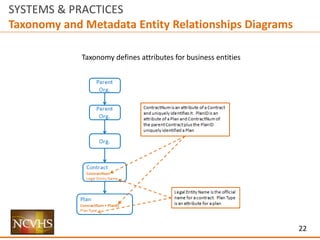
Taxonomy and Metadata Entity Relationships Diagrams
Taxonomy defines attributes for business entities
23
SYSTEMS & PRACTICES
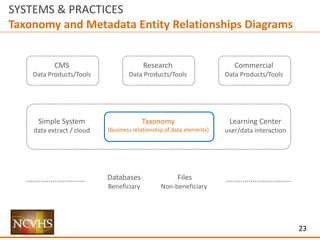
Taxonomy and Metadata Entity Relationships Diagrams
Taxonomy
(business relationship of data elements)
CMS
Data Products/Tools
Research
Data Products/Tools
Commercial
Data Products/Tools
Simple System
data extract / cloud
Learning Center
user/data interaction
Databases
Beneficiary
Files
Non-beneficiary
24
SYSTEMS & PRACTICES
Taxonomy and Metadata Entity Relationships Diagrams
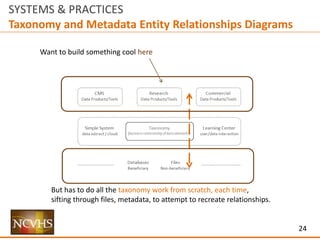
Want to build something cool here
But has to do all the taxonomy work from scratch, each time,
sifting through files, metadata, to attempt to recreate relationships.
25
SYSTEMS & PRACTICES
Appendix
Data Producer /
Best Practice Worksheet
26
SYSTEMS & PRACTICES
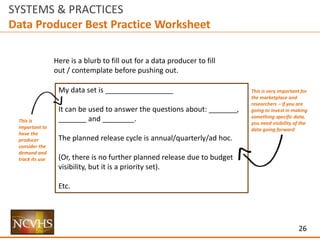
Data Producer Best Practice Worksheet
Here is a blurb to fill out for a data producer to fill
out / contemplate before pushing out.
My data set is _________________
It can be used to answer the questions about: _______,
_______ and ________.
The planned release cycle is annual/quarterly/ad hoc.
(Or, there is no further planned release due to budget
visibility, but it is a priority set).
Etc.
This is very important for
the marketplace and
researchers – if you are
going to invest in making
something specific data,
you need visibility of the
data going forward
This is
important to
have the
producer
consider the
demand and
track its use
27
SYSTEMS & PRACTICES
Appendix
Top Down Information Architecture
(IA) Schema
28
SYSTEMS & PRACTICES
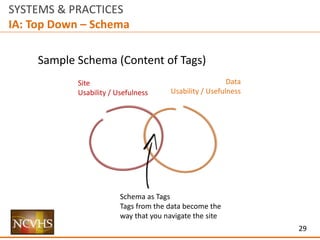
IA: Top Down – Schema
Sample Schema (Content of Tags)
File format
JSON
XML
PDF
Etc.
Geographic grain
Country
State
County
PUMA
HRR
HSA
Zip
Neighborhood Block
Etc.
Dates
[Range]
Dates Frequency
Topic
Agency
Producer
Etc.
Etc.
29
SYSTEMS & PRACTICES
IA: Top Down – Schema
Sample Schema (Content of Tags)
Data
Usability / Usefulness
Site
Usability / Usefulness
Schema as Tags
Tags from the data become the
way that you navigate the site
30
SYSTEMS & PRACTICES
Appendix
Bottom Up Information Architecture
(IA) Approaches - Various
31
SYSTEMS & PRACTICES
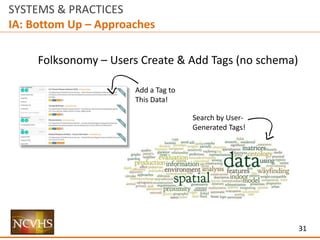
IA: Bottom Up – Approaches
Folksonomy – Users Create & Add Tags (no schema)
Add a Tag to
This Data!
Search by User-
Generated Tags!
32
SYSTEMS & PRACTICES
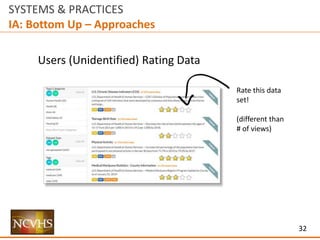
IA: Bottom Up – Approaches
Users (Unidentified) Rating Data
Rate this data
set!
(different than
# of views)
33
SYSTEMS & PRACTICES
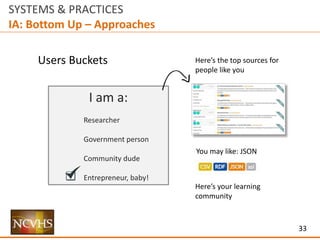
IA: Bottom Up – Approaches
Users Buckets
I am a:
Researcher
Government person
Community dude
Entrepreneur, baby!
Here’s the top sources for
people like you
You may like: JSON
Here’s your learning
community
34
SYSTEMS & PRACTICES
Taxonomy across Data & Metadata
Taxonomy ensures users both find the data and find it meaningful
Data
Usability / Usefulness
Site
Usability / Usefulness
Taxonomy / Folksonomy
Tags from the data become the
way that you navigate the site
35
SYSTEMS & PRACTICES
Appendix
Top Down User Interaction / User Experience
(UI/UX) – Score Carding
36
SYSTEMS & PRACTICES
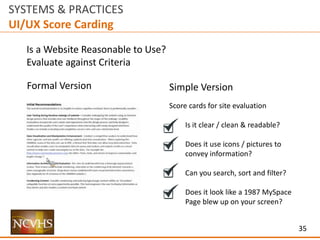
UI/UX Score Carding
Simple Version
Score cards for site evaluation
Is it clear / clean & readable?
Does it use icons / pictures to
convey information?
Can you search, sort and filter?
Does it look like a 1987 MySpace
Page blew up on your screen?
Formal Version
Is a Website Reasonable to Use?
Evaluate against Criteria
37
SYSTEMS & PRACTICES
Appendix
User Interaction / User Experience
(UI/UX): Emulate a Model
38
SYSTEMS & PRACTICES
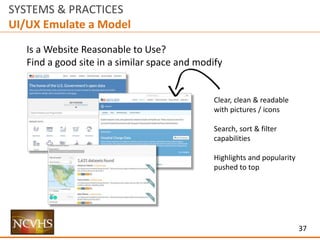
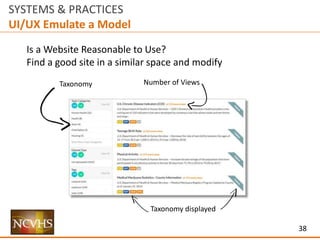
UI/UX Emulate a Model
Is a Website Reasonable to Use?
Find a good site in a similar space and modify
Clear, clean & readable
with pictures / icons
Search, sort & filter
capabilities
Highlights and popularity
pushed to top
39
SYSTEMS & PRACTICES
UI/UX Emulate a Model
Taxonomy Number of Views
Taxonomy displayed
Is a Website Reasonable to Use?
Find a good site in a similar space and modify
40
SYSTEMS & PRACTICES
Appendix
Data Browsers
41
SYSTEMS & PRACTICES
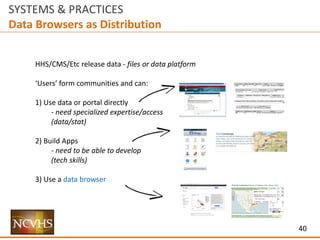
Data Browsers as Distribution
HHS/CMS/Etc release data - files or data platform
‘Users’ form communities and can:
1) Use data or portal directly
- need specialized expertise/access
(data/stat)
2) Build Apps
- need to be able to develop
(tech skills)
3) Use a data browser
42
SYSTEMS & PRACTICES
Data Browsers as Distribution
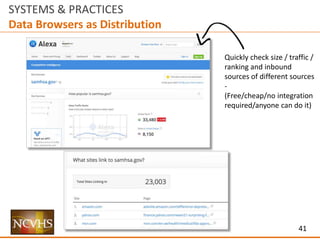
Quickly check size / traffic /
ranking and inbound
sources of different sources
-
(Free/cheap/no integration
required/anyone can do it)
43
SYSTEMS & PRACTICES
Data Browsers as Distribution
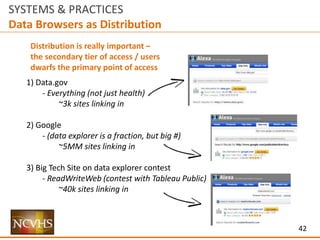
1) Data.gov
- Everything (not just health)
~3k sites linking in
2) Google
- (data explorer is a fraction, but big #)
~5MM sites linking in
3) Big Tech Site on data explorer contest
- ReadWriteWeb (contest with Tableau Public)
~40k sites linking in
Distribution is really important –
the secondary tier of access / users
dwarfs the primary point of access
44
SYSTEMS & PRACTICES
Data Browsers as Distribution
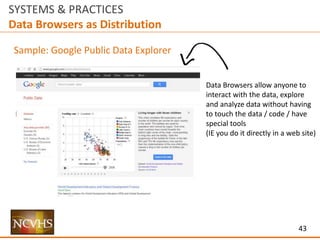
Sample: Google Public Data Explorer
Data Browsers allow anyone to
interact with the data, explore
and analyze data without having
to touch the data / code / have
special tools
(IE you do it directly in a web site)
45
SYSTEMS & PRACTICES
Data Browsers as Distribution
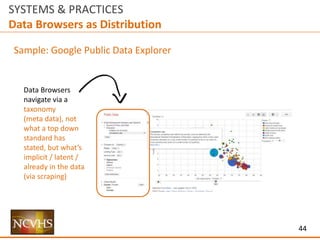
Sample: Google Public Data Explorer
Data Browsers
navigate via a
taxonomy
(meta data), not
what a top down
standard has
stated, but what’s
implicit / latent /
already in the data
(via scraping)
46
SYSTEMS & PRACTICES
Data Browsers as Distribution
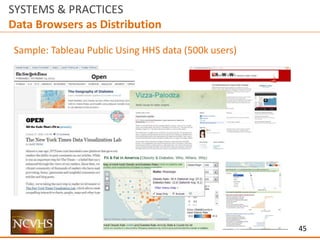
Sample: Tableau Public Using HHS data (500k users)
47
SYSTEMS & PRACTICES
Data Browsers as Distribution
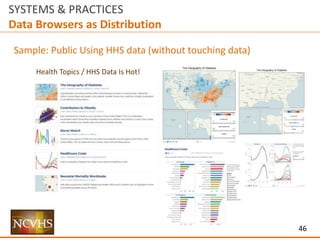
Sample: Public Using HHS data (without touching data)
Health Topics / HHS Data Is Hot!
48
SYSTEMS & PRACTICES
Appendix
Distribution Mechanisms
49
SYSTEMS & PRACTICES
Distribution Mechanisms
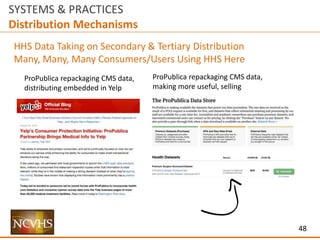
HHS Data Taking on Secondary & Tertiary Distribution
Many, Many, Many Consumers/Users Using HHS Here
ProPublica repackaging CMS data,
making more useful, selling
ProPublica repacking CMS data,
distributing embedded in Yelp
50
SYSTEMS & PRACTICES
Distribution Mechanisms
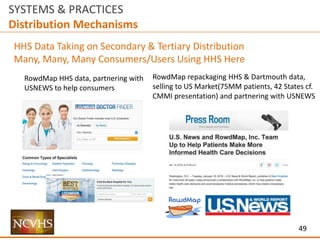
HHS Data Taking on Secondary & Tertiary Distribution
Many, Many, Many Consumers/Users Using HHS Here
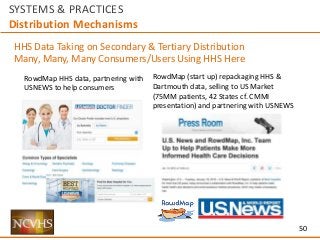
RowdMap (start up) repackaging HHS &
Dartmouth data, selling to US Market
(75MM patients, 42 States cf. CMMI
presentation) and partnering with USNEWS
RowdMap HHS data, partnering with
USNEWS to help consumers

NCVHS Data Access and Use Joshua Rosenthal

  • 1.
    The National Committeeon Vital and Health Statistics Data Access and Use Joshua Rosenthal, PhD Systems & Practices
  • 2.
    2 SYSTEMS & PRACTICES Structure EcosystemInteraction How does someone find a site / delivery mechanism or information within a site / delivery mechanism via another channel? UI / UX [User Interaction / User Experience] How does someone use and experience a site / delivery mechanism? Information Architecture How does someone find information within a site / delivery mechanism? Data How useful and usable is the data within a site / delivery system?
  • 3.
    3 SYSTEMS & PRACTICES Structure EcosystemInteraction How does someone find a site / delivery mechanism or information within a site / delivery mechanism via another channel? UI / UX [User Interaction / User Experience] How does someone use and experience a site / delivery mechanism? Information Architecture How does someone find information within a site / delivery mechanism? Data How useful and usable is the data within a site / delivery system?
  • 4.
    4 SYSTEMS & PRACTICES Structure Data Howuseful and usable is the data within a site / delivery system? Does the data have, and successfully meet demand, in general and from different user communities? Two Types of Approaches (Not Mutually Exclusive): Top Down Bottom Up
  • 5.
    5 SYSTEMS & PRACTICES Structure Data Howuseful and usable is the data within a site / delivery system? Does the data have, and successfully meet demand, in general and from different user communities? Top Down Approaches Sample – Check List from “Experts” Is the Data Usable? Is the Data Useful? Is the Data Timely? Etc. Implement 1 - HHS Data Checklist for Producers (Damon Initiative) 2 – Publish Metadata definitions and taxonomy / ERD (Entity Relationship Diagrams – See Appendix) 3 – Data producer Best Practice Sheet (e.g. fill in the blank / Mad Libs – See Appendix) 4 – Review / Add / Enforce individually via requirements of vendors via budget/delivery cycles
  • 6.
    6 SYSTEMS & PRACTICES Structure EcosystemInteraction How does someone find a site / delivery mechanism or information within a site / delivery mechanism via another channel? UI / UX [User Interaction / User Experience] How does someone use and experience a site / delivery mechanism? Information Architecture How does someone find information within a site / delivery mechanism? Data How useful and usable is the data within a site / delivery system?
  • 7.
    7 SYSTEMS & PRACTICES Structure InformationArchitecture How does someone find information within a site / delivery mechanism? Two Types of IA Approaches (Not Mutually Exclusive): Top Down Bottom Up Can someone find information navigating in different ways, and is there navigation informed by / are they able to judge the usefulness and utility of the information?
  • 8.
    8 SYSTEMS & PRACTICES Structure InformationArchitecture How does someone find information within a site / delivery mechanism? Two Types of IA Approaches (Not Mutually Exclusive): Top Down Approaches: Sample Mechanisms (See Appendix for sample schema) Site Map (structured around IA Taxonomy) [PRO TIP / V2: this should intersect with metadata taxonomy] Source vs./and Topics – Parallel navigation (supports different users / use cases) Tags – Taxonomy Tags - Expert assigned / objective [e.g. file format; publisher] Navigation/Exploration: Search, filter, sort, Bread Crumbs to taxonomy/site map Implement Data.gov has most of this (needs ERDs, bread crumbs beyond publishing org); expand and extend Where not be possible in specific sites via security / privacy, consider in meta sites (data.gov, etc.) Review / Add / Enforce individually via requirements of vendors via budget/delivery cycles – (copy specs from data.gov)
  • 9.
    9 SYSTEMS & PRACTICES Structure InformationArchitecture How does someone find information within a site / delivery mechanism? Two Types of IA Approaches (Not Mutually Exclusive): Bottom Up Approaches: Sample Mechanisms (See Appendix) Display overall / unidentified counts of page views / data downloaded Unidentified users to rate via overall stars; then sub rating (e.g. usefulness, utility) Opt in user identification of user category / interest - (not identification of person but of interest/level) Counts of views/downloads and ratings (overall and sub) by user type Tags – Folksonomy Tags – Open to at large input, captures alternative navigation and providers learning of use and type to producers PRO TIP: Learning Center / Community taxonomy intersects with user type & tags Implement This is new and different, but well trodden in both tech (GIT HUB) and DTC (Amazon). Expand data.gov; spin off alternative modules/site wrapper via innovation project/challenges
  • 10.
    10 SYSTEMS & PRACTICES Structure EcosystemInteraction How does someone find a site / delivery mechanism or information within a site / delivery mechanism via another channel? UI / UX [User Interaction / User Experience] How does someone use and experience a site / delivery mechanism? Information Architecture How does someone find information within a site / delivery mechanism? Data How useful and usable is the data within a site / delivery system?
  • 11.
    11 SYSTEMS & PRACTICES Structure UI/ UX [User Interaction / User Experience] How does someone use and experience a site / delivery mechanism? User Interaction / User Experience Two Types of Approaches (Not Mutually Exclusive): Score Carding (See Appendix for example) Work from checklist, score instance and offer improvements Emulate Model (See Appendix for example Work from example of what already works within a similar context and modify UI / UX [User Interaction / User Experience] How does someone use and experience a site / delivery mechanism? Implement Copy data.gov as model for individual HHS sites/instances; modify based on constraints of individual instance; expand, extend and improve based on users, goals and priorities of instance. Review / Add / Enforce individually via requirements of vendors via budget/delivery cycles
  • 12.
    12 SYSTEMS & PRACTICES Structure EcosystemInteraction How does someone find a site / delivery mechanism or information within a site / delivery mechanism via another channel? UI / UX [User Interaction / User Experience] How does someone use and experience a site / delivery mechanism? Information Architecture How does someone find information within a site / delivery mechanism? Data How useful and usable is the data within a site / delivery system?
  • 13.
    13 SYSTEMS & PRACTICES Structure EcosystemInteraction How does someone find a site / delivery mechanism or information within a site / delivery mechanism via another channel? Multiple Ways: Push vs. Pull (see appendix for ecosytem) Pull: Asking Users to Find & User a Destination Site Free standing websites (CDC, etc.); Data Enclave Push: Push Data to Channels where User Already Are Data Browsers (Google public data); Repositories (GIT) Meta Sites: External sites for navigation linking to mulitple websites (data.gov) Distribution Mechanisms: External sites using (Pro Publica Data Store /Yelp; USNEWS/RowdMap Best Doctors/Hospitals)
  • 14.
    14 SYSTEMS & PRACTICES Structure Ecosystem Barriersto access (cost, skill, awareness) Enclaves Destination Sites Meta Sites / Repositories Data Browsers (See Appendix) Delivery Mechanisms (See Appendix) Ecosystem Interaction How does someone find a site / delivery mechanism or information within a site / delivery mechanism via another channel?
  • 15.
    15 SYSTEMS & PRACTICES Structure EcosystemSample Interaction Meta site Destination site Destination site Destination site Destination site Destination site Destination site Destination site User aggregation IA & UI/UX Implement IA & UI/UX to match Site by site as individual budget / contract cycles allow Sample approach: Use Data.gov as model for destination sites; roll on destination site UI/UX as budget contracts allow Destination site build / contract / budget cycle Ecosystem Interaction How does someone find a site / delivery mechanism or information within a site / delivery mechanism via another channel?
  • 16.
    16 SYSTEMS & PRACTICES Appendix Taxonomyand Metadata Entity Relationships Diagrams (ERD)
  • 17.
    17 SYSTEMS & PRACTICES Taxonomyand Metadata Entity Relationships Diagrams Publish Entity Relationship Diagrams An ERD is basically the blue print for a data set. This is true for all types of data, from large sets in databases to small sets in simple files (non-beneficiary files). Data producers should publish their ERDs, a common practice outside health care. This benefits users who otherwise have to create their own models, a notable barrier to use and usability.
  • 18.
    18 SYSTEMS & PRACTICES Taxonomyand Metadata Entity Relationships Diagrams http://www.medicare.gov/download/downloaddb.asp Example taxonomy (non-beneficiary / STAR example)
  • 19.
    19 SYSTEMS & PRACTICES Taxonomyand Metadata Entity Relationships Diagrams What is this? How can I use it to answer business/performance questions? Sample record from the downloaded file
  • 20.
    20 SYSTEMS & PRACTICES Taxonomyand Metadata Entity Relationships Diagrams In order to get insight, I need the data in a meaningful business structure
  • 21.
    21 SYSTEMS & PRACTICES Taxonomyand Metadata Entity Relationships Diagrams Taxonomy defines business entities and the relationships among them
  • 22.
    22 SYSTEMS & PRACTICES Taxonomyand Metadata Entity Relationships Diagrams Taxonomy defines attributes for business entities
  • 23.
    23 SYSTEMS & PRACTICES Taxonomyand Metadata Entity Relationships Diagrams Taxonomy (business relationship of data elements) CMS Data Products/Tools Research Data Products/Tools Commercial Data Products/Tools Simple System data extract / cloud Learning Center user/data interaction Databases Beneficiary Files Non-beneficiary
  • 24.
    24 SYSTEMS & PRACTICES Taxonomyand Metadata Entity Relationships Diagrams Want to build something cool here But has to do all the taxonomy work from scratch, each time, sifting through files, metadata, to attempt to recreate relationships.
  • 25.
    25 SYSTEMS & PRACTICES Appendix DataProducer / Best Practice Worksheet
  • 26.
    26 SYSTEMS & PRACTICES DataProducer Best Practice Worksheet Here is a blurb to fill out for a data producer to fill out / contemplate before pushing out. My data set is _________________ It can be used to answer the questions about: _______, _______ and ________. The planned release cycle is annual/quarterly/ad hoc. (Or, there is no further planned release due to budget visibility, but it is a priority set). Etc. This is very important for the marketplace and researchers – if you are going to invest in making something specific data, you need visibility of the data going forward This is important to have the producer consider the demand and track its use
  • 27.
    27 SYSTEMS & PRACTICES Appendix TopDown Information Architecture (IA) Schema
  • 28.
    28 SYSTEMS & PRACTICES IA:Top Down – Schema Sample Schema (Content of Tags) File format JSON XML PDF Etc. Geographic grain Country State County PUMA HRR HSA Zip Neighborhood Block Etc. Dates [Range] Dates Frequency Topic Agency Producer Etc. Etc.
  • 29.
    29 SYSTEMS & PRACTICES IA:Top Down – Schema Sample Schema (Content of Tags) Data Usability / Usefulness Site Usability / Usefulness Schema as Tags Tags from the data become the way that you navigate the site
  • 30.
    30 SYSTEMS & PRACTICES Appendix BottomUp Information Architecture (IA) Approaches - Various
  • 31.
    31 SYSTEMS & PRACTICES IA:Bottom Up – Approaches Folksonomy – Users Create & Add Tags (no schema) Add a Tag to This Data! Search by User- Generated Tags!
  • 32.
    32 SYSTEMS & PRACTICES IA:Bottom Up – Approaches Users (Unidentified) Rating Data Rate this data set! (different than # of views)
  • 33.
    33 SYSTEMS & PRACTICES IA:Bottom Up – Approaches Users Buckets I am a: Researcher Government person Community dude Entrepreneur, baby! Here’s the top sources for people like you You may like: JSON Here’s your learning community
  • 34.
    34 SYSTEMS & PRACTICES Taxonomyacross Data & Metadata Taxonomy ensures users both find the data and find it meaningful Data Usability / Usefulness Site Usability / Usefulness Taxonomy / Folksonomy Tags from the data become the way that you navigate the site
  • 35.
    35 SYSTEMS & PRACTICES Appendix TopDown User Interaction / User Experience (UI/UX) – Score Carding
  • 36.
    36 SYSTEMS & PRACTICES UI/UXScore Carding Simple Version Score cards for site evaluation Is it clear / clean & readable? Does it use icons / pictures to convey information? Can you search, sort and filter? Does it look like a 1987 MySpace Page blew up on your screen? Formal Version Is a Website Reasonable to Use? Evaluate against Criteria
  • 37.
    37 SYSTEMS & PRACTICES Appendix UserInteraction / User Experience (UI/UX): Emulate a Model
  • 38.
    38 SYSTEMS & PRACTICES UI/UXEmulate a Model Is a Website Reasonable to Use? Find a good site in a similar space and modify Clear, clean & readable with pictures / icons Search, sort & filter capabilities Highlights and popularity pushed to top
  • 39.
    39 SYSTEMS & PRACTICES UI/UXEmulate a Model Taxonomy Number of Views Taxonomy displayed Is a Website Reasonable to Use? Find a good site in a similar space and modify
  • 40.
  • 41.
    41 SYSTEMS & PRACTICES DataBrowsers as Distribution HHS/CMS/Etc release data - files or data platform ‘Users’ form communities and can: 1) Use data or portal directly - need specialized expertise/access (data/stat) 2) Build Apps - need to be able to develop (tech skills) 3) Use a data browser
  • 42.
    42 SYSTEMS & PRACTICES DataBrowsers as Distribution Quickly check size / traffic / ranking and inbound sources of different sources - (Free/cheap/no integration required/anyone can do it)
  • 43.
    43 SYSTEMS & PRACTICES DataBrowsers as Distribution 1) Data.gov - Everything (not just health) ~3k sites linking in 2) Google - (data explorer is a fraction, but big #) ~5MM sites linking in 3) Big Tech Site on data explorer contest - ReadWriteWeb (contest with Tableau Public) ~40k sites linking in Distribution is really important – the secondary tier of access / users dwarfs the primary point of access
  • 44.
    44 SYSTEMS & PRACTICES DataBrowsers as Distribution Sample: Google Public Data Explorer Data Browsers allow anyone to interact with the data, explore and analyze data without having to touch the data / code / have special tools (IE you do it directly in a web site)
  • 45.
    45 SYSTEMS & PRACTICES DataBrowsers as Distribution Sample: Google Public Data Explorer Data Browsers navigate via a taxonomy (meta data), not what a top down standard has stated, but what’s implicit / latent / already in the data (via scraping)
  • 46.
    46 SYSTEMS & PRACTICES DataBrowsers as Distribution Sample: Tableau Public Using HHS data (500k users)
  • 47.
    47 SYSTEMS & PRACTICES DataBrowsers as Distribution Sample: Public Using HHS data (without touching data) Health Topics / HHS Data Is Hot!
  • 48.
  • 49.
    49 SYSTEMS & PRACTICES DistributionMechanisms HHS Data Taking on Secondary & Tertiary Distribution Many, Many, Many Consumers/Users Using HHS Here ProPublica repackaging CMS data, making more useful, selling ProPublica repacking CMS data, distributing embedded in Yelp
  • 50.
    50 SYSTEMS & PRACTICES DistributionMechanisms HHS Data Taking on Secondary & Tertiary Distribution Many, Many, Many Consumers/Users Using HHS Here RowdMap (start up) repackaging HHS & Dartmouth data, selling to US Market (75MM patients, 42 States cf. CMMI presentation) and partnering with USNEWS RowdMap HHS data, partnering with USNEWS to help consumers